Chair: Mary Love | Vice Chair: Robin Cape | Treasurer: Leesa Sluder | Secretary: Jamie Shelton Chrissy Burton, Stephens Farrell, Tal Ingram, Rob Johnson, Alesha Reardon, Deborah Wright, Ben Yoke
This year’s Green Building Directory is dedicated to the memory of Jean Webb and Karen Cragnolin, two extraordinary women whose imagination and leadership were instrumental in the restoration of the French Broad River. Both women died in early 2022, and their lives stand as a call to action and renewal. They helped us to see that we could change course and reverse a trend the industrial era brought to the French Broad. As foundational leaders at local nonprofit RiverLink, Karen and Jean led our community to change its relationship with the French Broad — birthing a revitalized river corridor. Of course, the river is still in transition, but these women have left an indelible legacy from which there is no turning back.
Leigha Dickens
Welcome to the Directory
At Green Built Alliance, we strive everyday to be in service to our community and environment through a holistic set of programs and resources designed to help you and your neighbors make sustainable building and clean energy choices that save money, help the environment and boost equity and inclusion.
The Green Building Directory you hold in your hands is a compilation of resources, insight, inspiration and know-how that we hope will help you and this community save energy, money, and make the world a better place.
It is apparent to most of us that the world needs help and the earth needs healing. We are awash in news and information about the climate crisis, injustice in the world and the economic perils of short-sighted decisions. It makes us wonder, what can we do to create a livable planet and thriving community that future generations will be grateful to inherit, while living in balance today?
In our 21st year as a local nonprofit, we provide those solutions by advancing sustainable living, green building and climate justice through inspired action, community education and collaborative partnerships in Western North Carolina and beyond.
We believe in the motto to “think global and act local,” and realize that only through pulling together our collective resources, knowledge and efforts will we be able to make the tremendous shift needed to bring balance to the world and build a community that serves as a positive model to the ecological, economic and social challenges we face.
We do this through making programs available to all people in the community and working to meet each person, family, and organization where they are in hopes that we can take the action steps needed to help meet the bold goals of 100 percent renewable energy by 2042 that Buncombe County and the City of Asheville have set.
Being in service
Through our Blue Horizons Project (BHP) program, we are setting the course for a clean-energy future and helping anyone in Buncombe County find the resources to save energy and money. We offer free Home Energy Chats to help you learn how to make your home more energy efficient and green.
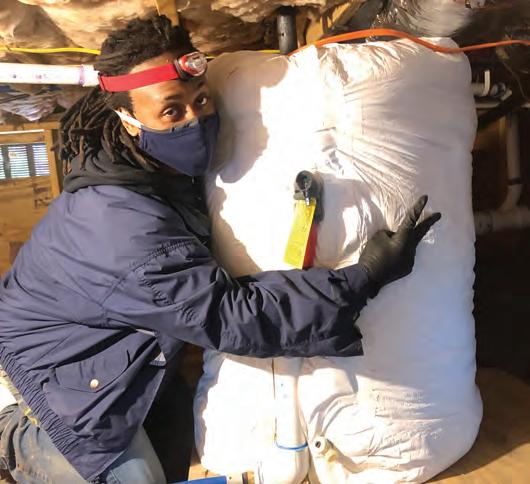
Energy Savers Network (ESN), which has provided energy-efficiency upgrades for more than 850 low-income households with high energy burdens, performs about four weatherization projects per week utilizing the skill of staff and the care of volunteers. This program is available to income-qualified owners and renters, and now includes home repair and heating system repairs and upgrades.
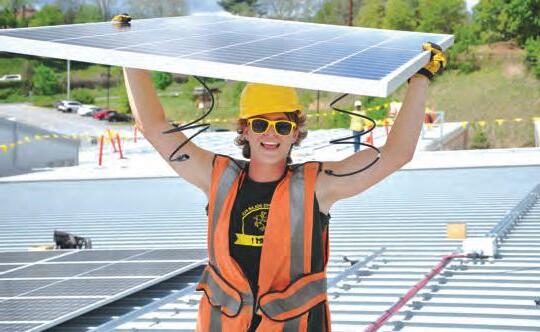
Through our Neighbor to Neighbor program, we are installing solar panels on low-income homes that have historically been left out of the clean-energy movement, thus lowering our community’s carbon footprint one house at a time. Twelve systems were installed in 2021, and we plan to do another 16 over the next two years. This program, as well as ESN and BHP, are funded through the generosity of the Sustainability Offices of Buncombe County and the City of Asheville.
We also continue to strengthen our impact through Green Built Homes. We have certified more than 2,500 homes (including 60 net-zero homes) that protect the land, are non-toxic, use renewable materials, and conserve water and energy. In 2021, four Appalachian State University dorms were built and certified. Now we are helping other multifamily projects that include affordable housing become certified Green Built Homes.
Following the success of the 300 kW Isaac Dickson Elementary School solar project, Appalachian Offsets helped fund a 10kW PV system for St. Paul’s Missionary Baptist fellowship hall, which serves as an expanded space for
educational classes and community events. With the intention of funding clean-energy upgrades for local schools and nonprofits, this local carbon-offset program is now raising money for a solar system for the United Way of Asheville and Buncombe County building downtown. Please visit cutmycarbon.org to support that project.
Among Green Built Alliance’s legacies is the high-quality education we offer building professionals and the public. Through our Regenerative Professional Accreditation program, we will continue to lead classes that offer continuing-education credits for builders and architects, as well as provide insight and inspiration for your projects.
Growing and changing
Over the past two years, we have made considerable effort and progress in boosting our capacity to be an effective and holistic organization. Our 11 staff members and five contractors work each day to fulfill our mission in various ways and allow us to grow and mature as an organization in service to the community.
To help us mature and plan for the future, we are engaged in a strategic-planning process this year that will guide our work for the next three to five years. We are also taking seriously the need
to improve our diversity, equity and inclusion efforts, as we know our work can only be successful if we include all voices.
We are fortunate to have wellrounded sources of income from grants, local government contracts, new and long-term members, and events. However, we see a need to reach out to more passionate and committed people in this community who have the capacity to support us financially so that we can boost our ability to be effective in the community. To deepen our work, we are seeking support from private donations. We invite you to visit greenbuilt.org/donate to help us broaden our impact.
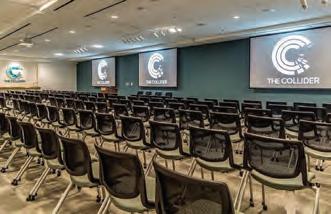
After 14 years on Haywood Road in West Asheville, we moved our offices to The Collider on Haywood Street downtown. This move has provided space for our growing staff, connections with other climate-oriented organizations, and a space to host meetings and events.
We hope to see you face to face soon. As the world opens back up after more than two years, we will be hosting more inperson events like our annual party, CiderFest NC fundraiser, and member meetups. We also plan to be at more festivals and events promoting our good work in the community and helping people find the resources needed to live the greenest life possible.
Rebates for Green Home Building
BY LEIGHA DICKENS
Local government and utility rebates for new green homes have expanded notably in the past few years in our region. Here is a quick overview of what financial incentives are available for new construction.
For Builders
From Duke Energy Progress
The utility’s Residential New Construction rebate program offers two paths:
n 90 cent rebate per kilowatt hour of electricity saved up to $9,000 with their HERS + HERO program (requires enrolling in a third-party verification program, getting a HERS score, meeting some minimum construction standards, and hiring a rater to verify). Participating in this path is one of two possible prerequisites in Green Built Alliance’s own Green Built Homes certification program.
OR
n $300 to $350 for ENERGY STAR ® -qualified heating and water heating equipment
From Duke Energy Carolinas
New in 2022, the utility’s Residential New Construction program has expanded into Duke Energy Carolinas territory as well. The program offers same two paths, but with slight differences:
n 75 cents per kilowatt hour of electricity saved up to $6,000 max with their HERS + HERO program (same process for third-party verification),
OR
n $300 for each new ENERGY STAR ® -qualified heat pump installed
From the City of Asheville
Rebates against building permit fees are available:
n $500 rebate for a new home certified through our Green Built Homes program
n $250 rebate for a new home that earns a verified HERS score of 49 or lower
n $175 rebate for a new home with a solar photovolatic system
n $100 rebate for an ENERGY STAR ® -labeled new home
n $100 rebate for protecting an existing tree or planting a new tree during construction
From the Town of Black Mountain
n A $500 permit fee rebate is available for homes that earn Green Built Homes or LEED for Homes certification.
From the Federal Government
Historically, there has been a business tax credit from the federal government for each new home that meets certain energy-efficiency criteria, often called the 45L tax credit, though historically this credit also expired and had to get extended by Congress every year (previously it was as much as $2,000 per home). This credit is expected to be extended for 10 years as part of the Inflation Reduction Act, which was in the process of being passed as this publication was going to print in August 2022. The incentive was expected to be increased to $2 ,500 for each ENERGY STAR ®labeled new home and $5,000 for each certified DOE Zero Energy Ready Home. Check with your HERS Rater for eligibility of your future projects.
For Homeowners
From Duke Energy Carolinas or Duke Energy Progress
n ENERGY STAR ® -labeled homes receive a 5 percent discount per kilowatt hour.
n There are many rebates for energy-efficiency measures for existing homes through Duke’s Smart Savers program as well as the Energy Wise Home and Energy Wise Business programs.
From Dominion Energy (formerly PSNC)
n ENERGY STAR ® -labeled homes received a discount of 5 cents per therm.
From the Federal Government
There has long been a federal personal income tax credit on the cost of qualifying solar electric, solar thermal, or geothermal systems installed as part of new construction or added to an existing home. In 2021, that credit started to sunset from 30 percent of eligible system costs down to 26 percent. However, the Inflation Reduction Act, which was in the process of being passed at the time of this publication, may extend then 30 percent offering for another 10 years. Otherwise, this tax credit still offers 22 percent of system costs until the end of 2023.
Conservation with Compromise
Building Green on a Budget with a Touch of Extravagance
BY MELISSA NICHOLSON
Having worked with his local design-build company for many years, my husband Will Nicholson developed a plan for building our house in the forest near Asheville.
Experience and knowledge from past projects allowed us to balance building green on a strict budget, while including some luxuries we deemed necessary for our new home. Upon completion, our all-electric home cost $170 per square foot and achieved Green Built Homes’ Gold Net-Zero Ready level of certification with a Home Energy Rating System (HERS) Score of 48.
Energy efficiency, budget and location were the three priorities that influenced our decisions to achieve a sustainable house that is economically built and operated with some features that are not distinctly green.
To best enjoy the arboraceous views, we have at least ten very large windows throughout the house, most larger than 5-by-5 feet. This amount of glass makes the house less efficient due to heat loss and gain and affects the overall R-value of the building. We felt this was a necessary energy expense and attempted to make up for it through an improved building envelope design.
These design features include 10 inches of spray foam under the roofdeck, a Blow-In Blanket (BIBS) insulation system in the walls, sealed crawlspace, and zipboard system sheathing throughout the house. We spent many hours sealing our home’s building envelope by hand using caulk, tape, and other proprietary methods resulting in a tight house and an ACH50 (air change per hour at 50 pascals) score of less than 1.
This home also includes some
inefficient amenities such as a hot tub, an electric on-demand water heater, and electric heated floors in the foyer and masterbath. These choices were offset by many energy-efficient items, such as LED lights throughout the house and all ENERGY STAR ® -certified appliances including an induction cooktop and condenser dryer.
The less-efficient energy consumption of the on-demand hot water heater is offset by our lifestyle choices. With two people in the home, hot water use can be kept to a minimum through thoughtful planning, thus adding efficiency in the long term. Less conscious choices and large groups of people increase the likelihood of wasteful energy use and could arguably make an on-demand hot water heater an inferior choice as compared to a hybrid water heater.
The builders also chose to in-
clude mini-split heating and cooling systems. Not only are the minisplits highly efficient on their own, they also allow for zoned heating and cooling opportunities, which increase their efficiency. For example, four to six months out of the year, we only need to heat or cool the master bedroom at night. Strategic window placement allows the house to stay cool most of the summer. Also, large parts of the house can be comfortably unconditioned throughout the year, if necessary.
Budget restrictions justified our decision to build a solar-ready
Project Team
The front view of the house. MELISSA NICHOLSON PHOTO
house while not yet investing in the system. The strategic placement of the house and curation of the developing forest allows for this as a future supplement.
The kitchen and bedroom cabinets as well as the luxury vinyl plank flooring were inexpensive choices made to stay within budget, however these items are not green-rated. To offset the formaldehyde content of the floors and cabinets, we used zeroVOC paints throughout the house and installed an energy recovery ventilator (ERV) system that constantly replaces the air in the house with fresh air.
To add personality and charm, we designed and built additional cabinets and shelves throughout the house using local formaldehyde-free plywood and wood repurposed from scraps.
While we were ineligible for points in the Green Built Homes certification system that can be earned by projects located in proximity to urban infrastructure, we justified our remote setting by choosing a natural location with the home tucked neatly into a forest environment. This thoughtful decision eliminates the need for irrigation and lawn maintenance.
Some trees were removed from the home’s footprint, but we chose not to mill lumber because of the high cost.
It was impossible to include any passive solar design features because the home is shrouded by the existing mature trees that tower above the roof line of the house.
The home and septic system were placed tightly in the land-
scape while still allowing for existing trees and flora within 10 feet of the footprint.
This layout made it difficult to incorporate water-retention or greywater systems. The loss of these opportunities, however, was offset by causing very low impact to the environment. The entire landscape on this 1-acre lot consists of a native forest habitat, some mulch beds and a gravel driveway and walkway. Instead of constructing a garage or storage space, we placed a reused shipping container in our woods. The lack of outdoor water-saving systems was further offset by reduced indoor water use thanks to low-flow water fixtures, appliances, and a centralized plumbing system.
A few other indulgences include a 150-square-foot foyer with 24-foot ceilings to emphasize the home’s setting. We chose to include very few ceiling fans in our house, and only placed them on the upper level. We designed the master bathroom with a double shower and an in-wall bidet toilet with a heated seat. We also utilize continuous multi-color ambient lighting throughout the home which is fun, and makes our home seem like a spaceship in the forest at night.
Melissa Nicholson is a writer and artist. She is currently working on a project detailing how to cultivate a small forest. She studies symbiotic relationships found among species and records the effort made to find balance within that system. Connect with Melissa at oldnorthstatebuildingcompany.com
The view from master bedroom.
Duke Street Cottages
An Innovative Pocket Neighborhood in Granite Falls
BY SUSANNA SHETLEY
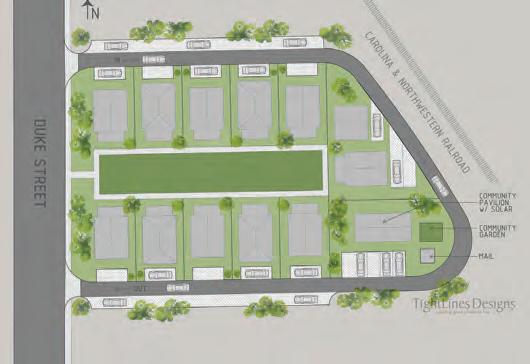
The concept of pocket neighborhoods may be relatively new, but for Rob Howard of Howard Building Science, it’s a way to move Granite Falls, N.C., into the future while honoring the town’s mill village past. Technically speaking, pocket neighborhoods, a concept created by architect Ross Chapin, are clustered groups of neighboring houses gathered
around a shared green space, which creates a communal sense of territory and stewardship.
“I saw Chapin speak at the Innovative Housing Summit hosted by the MicroLife Institute in Atlanta a few years ago, and I bought a copy of his book called ‘Pocket Neighborhoods: Creating SmallScale Community in a Large-Scale World,’” Howard said. “That’s what inspired me to build one of these communities in Granite Falls.”
While eating dinner at Granite Falls Brewing Co., Howard noticed a vacant piece of land across the street. Further investigation on Caldwell County GIS revealed the owner of the 1.25 acres to be a family friend who not only sold him the land, but also financed it for him.
“It was the perfect location close to downtown with water and sewer,” said Howard, who later applied for a Planned Unit Develop-
ment with the Town of Granite Falls and received approval for 11 lots surrounding a shared green space. Howard’s net-zero energy pocket neighborhood is called Duke Street Cottages, and his team is presently in the building phase. There are currently six homes at various points in the build process. There are two floor plans being used. Both have roughly the same footprint, but one is a single story at 800 square
A new net-zero energy pocket neighborhood called Duke Street Cottages is under development in Granite Falls, NC. HOWARD BUILDING SCIENCE PHOTOS
feet with 2 bedrooms and 1 bath, while the other is two stories at 1400 square feet with 3 bedrooms and 2.5 baths.
“I felt like I was at the right place at the right time hearing Chapin speak,” Howard said. “The concept runs counter to the traditional development we’ve seen over the past 20 to 30 years with pavement down the middle. Not only will Duke Street Cottages be Zero Energy Ready Homes, there is green space down the middle and instead of a back deck, each house has an oversized front porch. The goal is for the design to foster interaction among neighbors.”
A centralized outdoor space is a key trait of a pocket neighborhood. Homeowners hold shared ownership in the common space and are collectively responsible for its care and oversight, thereby creating a sense of togetherness and security.
Project Team
Builder — Howard Building
Science
HERS Rater — Southern
Energy Management
Site Design — Shabeldeen
Engineering
Home Plans — Tightlines
Designs
SIPS — Eco-Panels
Framing — Hardin Creek
Timber Frame
Roofing — Northwest
Roofing and Solar
HVAC — Morris Heating & Cooling
Ventilation — Green R
Realtor — Hickory Real
Estate Group
Lender — United Bank
Marketing — Pfahlert
Creative Labs
Sustainability is woven throughout pocket neighborhoods, from the small carbon footprints of the homes to the focus on outdoor living space. For Duke Street Cottages, additional sustainable components prioritize airtight building envelopes, energy-efficient appliances, efficient heating and cooling systems, mechanical ventilation for healthy indoor air quality, local and natural materials without harmful chemicals, solar panels, EV charging stations and sidewalks connecting the neighborhood to downtown Granite Falls.
“Along with creating a net-zero neighborhood, we’re trying to open up more ‘missing middle housing,’” Howard said. “By that, I don’t mean middle-income housing. I mean housing types in between single-family homes and large apartment buildings, including duplexes and accessory dwelling units. We like to say it’s housing that’s sustainable and attainable.”
Like many towns in the south, the history of Granite Falls is deeply ingrained in their mill village past. Shuford Mills was established in 1880. Generations of families worked in various positions at the mill, enjoying evenings and weekends on their front porches and in their yards, getting to know neighbors and keeping watch over the community. Unfortunately, the historic mill was destroyed in a massive fire in 2017, but its legacy will live on forever.
“Granite Falls is my hometown,” Howard said. “I’m excited about this project because I want to set an example for a different type of development. This is more high density than what modern Granite Falls citizens are accustomed to, but, in a way, it’s getting back to the history of our town. Shuford
The smaller of the two floor plans (above) includes a single story at 800 square feet with 2 bedrooms and 1 bath. Pocket neighborhoods are clustered groups of neighboring houses gathered around a shared green space, which creates a communal sense of territory and stewardship.
Mills was the primary employer for decades and there was a strong sense of community surrounding the mill and the mill village homes.
So, in some ways, Duke Street Cottages is an opportunity to return to our roots.”
Susanna Shetley is a reporter at Smoky Mountain News, with which Green Built Alliance partners to publish its annual Green Building Directory.
Decades in the Making
From Foreclosed Overgrown Parcel to Green Homes in Progress
BY STUART ZITIN
The first time my wife Maureen and I looked at this overgrown 4-acre property in the Oakley neighborhood in the city of Asheville, I held our 3year-old daughter in my arms to protect her from the large, lonely mare that was literally running free.
Piles of manure on the narrow, dead-end road surely disturbed the neighbors who parked there. The 1932 ranch house was significantly fire-damaged, and the single-wide next door could have been condemned. The two junked cars in the makeshift garage, the electrical service cut at the masthead by the power company, and the squatter with a sordid history rounded out the picture. They say he won the place in a card game, that someone died there, that the fire was suspicious.
Regardless, the house was in foreclosure and needed a ton of work, and Maureen recalls me saying, “Over my dead body.”
After searching for months more, we bought the place, and replaced the trailer with a new double-wide (grandfathered in), where we lived while we renovated the house over several months. We put in all new heating, electrical, and plumbing systems, as well as good new windows and doors, leaving only the roof and the original oak floor, which refinished nicely.
We spent $60,000 to fix up the house and, with new insulation where there was none, our home performed the same or better than the most efficient home of its type. The new propane furnace broke down after 25 years, so we replaced it with a high-efficiency electric heat pump, which Maureen supplements with electric space heaters as she needs.
The house continues to be most efficient. We raised two children and several dogs and cats here, and we remain here today. The daughter I mentioned is now 35 and our son is 30. We’ve
been here a while — you can do the math.
New urbanism
We were both drawn to the Traditional Neighborhood Development, now known as New Urbanism, encouraging social connection among neighbors, often in mixed-use environments.
Located a mile from Biltmore Village, density on this land was most appropriate. We wanted to build cottage development — small, close-in homes around a common space, with designated parking away from the homes. Sadly, we were unable to accommodate a cottage development on the steep land.
After renting it out for years, we finally moved the double-wide off the land and built and bonded a road out front. We completed and sold the first 3-bedroom, 2.5bath, 1,484-square-foot home at the end of 2018, which was certified through Green Built Homes and ENERGY STAR ® with a Home
Energy Rating System (HERS) Score of 79.
Since then, through the pandemic and all, an 18-home development was designed complete with new road, street trees and lighting, stormwater retention system, and common land where there’s a small stream. A licensed utility contractor completed most of the phase one infrastructure
Project Team
Builder — Building for Life HERS Rater — Vandemusser Design Site Design — Advantage Civil Engineering Licensed Utility Contractor — Chonzie Inc.
Home Plans — Rick Thompson Plans Foundation — Tinajero Masonry Painting — Padilla’s Painting Roofing — Century Contractors Realtor — Asha Hertel with Town and Mountain Realty Lender — State Employees Credit Union
The first 3-bedroom, 2.5bath, 1,484-square-foot home was completed and sold in late 2018.
THOM GAINES PHOTOS
(road, sewer, water) and we bonded the rest with the city of Asheville.
We recently got property identification numbers for the first two lots, and I just received the building permit for the next home, also a 3-bedroom, 2.5-bath.
All along, it’s been one darn delay after another, trying our patience, and while I’m sure that will continue, it’s a great relief to finally get building. We are certainly grateful to make our dream a reality.
Project priorities
With the evaluation of an energy rater, all the homes will be certified through Green Built Homes and ENERGY STAR ® to maximize comfort, efficiency, and indoor air quality. A geezer like me can always benefit from updated “building science” — barely a term when I apprenticed in the early 1970s, when heating oil was about 36 cents a gallon ($1.61 adjusted for inflation), astronomically less than the current $5.14 a gallon.
I have chosen two different stock plans from an architect, who altered them slightly at my request, including adding floor trusses for plumbing and ductwork, and 2-foot-by-6-foot exterior walls for insulation. Most, if not all, of this architect’s plans have only four foundation corners and some interior piers, and they use material efficiently.
Thanks to my rater’s advice, it was surprisingly simple to build my first Green Built Homes and ENERGY STAR ® -certified home, after building four new homes and numerous substantial additions over my nearly 50-year career.
The first home we built here is
on a sealed, conditioned crawl space with a dehumidifier whose condensate is piped to the outside. The next several homes are on steeper slopes, and will have roughed-in, unfinished daylight basements with a utility room. All are solar ready.
Both density and green certification were among our priorities, as was affordability. I initially wanted at least 20 percent of the homes to be affordable by HUD standards, with a mortgage no more than 30 percent of 80 percent of the local median household income of about $53,600. This would translate to a payment of $1,072 per month not including taxes and insurance, meaning a new home sale price of $23 5,000.
Sadly, I can’t build, much less sell, the house for that today. While I built the first home for about $150 per square foot and sold it for about $250 per square foot, I expect the next one to cost $200 or more per square foot and sell for more than $300 per square foot.
Our long-term goal remains providing more affordable houses, which may come to pass before we’re done. We’re just rolling with the dramatic changes in the Asheville real estate market over the last few years. Currently, the American dream of home ownership is simply not attainable for many folks.
Throughout this project we have used some of our own funds and also OPM, or other people’s money. For the infrastructure and the first home, we borrowed from a beloved client and friend, and gave her a healthy return when we sold the home for full asking price after a week on the market. Cur-
rently, we have borrowed from two friends at a reasonable APR. We also have a substantial Home Equity Line of Credit with our mortgage lender.
Fortunately, the housing market here looks like a solid investment, at least for now. We hope and expect that after these first two, the new homes will begin pre-selling, so we can continue to use OPM as the buyers get a convertible construction loan.
The first home was certified through Green Built Homes and ENERGY STAR ® systems with a HERS score of 79.
Zitin is a husband and father, as well as a dog guardian, who walks in the woods every day, thus remaining relatively sane. A licensed general contractor and owner of Building for Life, he is impassioned by affordable, green housing, and lives in Asheville. He is a minimalist in most regards. Connect with Stuart at buildingforlifeasheville.com.
Stuart
Located a mile from
Biltmore Village, density on this land was most appropriate.
Energy Retrofits at Gray Rock Inn
The Benefits of Efficiency Upgrades on Mature Buildings
BY JOHN SENECHAL
The building was tired, but the bones were good.
In 2001, the Gray Rock Inn at 100 Biltmore Avenue in downtown Asheville was in bad shape with a leaking roof, termite damage, and falling plaster. It fronted the street with gray granite and a two-story sitting porch, not quite sheltered
from passing traffic by four spruce trees. It needed a whole lot of TLC at first.
For 90 years, the building had served the area as a traveler’s inn, tourist home, boarding house, and rooming house. When it was built in 1911 at the turn of the 20th century, it was stylish and attractive. By the turn of the 21st century, it
was rundown and failing. Buildings in the U.S. account for 40 percent of total energy use. Since the 1970s, building codes have required increased insulation for energy conservation. A lot of older buildings, especially those from before 1950, have little insulation and are energy hogs, disproportionately contributing to the
aforementioned 40 percent. In 1911, there was little understanding about how to conserve or why one should bother. A hundred years later, excessive fossil fuel consumption is affecting the earth’s climate. Older buildings are allowed to continue under the grandfather loophole, and owners take advantage of it to leave
The Gray Rock Inn was built by Morris Meyers in 1911 as a boarding house. It has been a short-term rental ever since, with weekly rents and shared facilities. JOHN SENECHAL PHOTOS
wasteful facilities in place.
Strengths and weaknesses
The structure of the Gray Rock Inn was old, but its systems were restorable. Upgrading the building performance on older buildings can have a big impact. Yet, energy retrofits have value beyond just cost. The payoff is in making spaces more comfortable as well as more efficient. The comfort payback is immediate. The cost payback for insulation and conservation is just a few years.
Several features of this building are impractical to recreate today in new construction, like the 18inch thick solid brick walls. Appraisers call this a “super adequacy,” meaning the extra masonry is so much more than enough, nobody does it like that anymore. It’s stronger than necessary and it would cost too much to build it today. With that much mass, there is a heat sink and fly-
Project Team
wheel effect keeping the building occupants cool in summer and warm in spring and fall. The bricks warm up during the day and release their heat at night. They are cool by morning, so in summer they moderate the daytime temperatures. But in the dark depth of winter when the bricks never warm up, the walls are always cold.
Coal was the fuel back when the inn was built. There was evidence of black coal dust in every crevice. The original coal furnace heated water and pumped it to radiators. A natural gas boiler supplies hot water to the radiators today.
The exterior masonry walls had no insulation at all. For this rehab, rigid foam insulation was added to the interior side of the outer brick walls in each room, one room at a time. Sheetrock covers it up, so it doesn’t look like anything has changed. Window jambs were extended to accommodate the extra wall depth.
All the windows were original from 1911. They were, as you would expect, in terrible condition. There were 24 double-hung windows, 6feet tall with single-pane glass and broken ropes. A few lovely diamond pane windows on the front were in good enough shape to keep. All the windows leaked air around the wood frames.
They were replaced with new vinyl insulated double hung windows. It’s worth noting that the cheap replacement windows
didn’t hold up over time very well. They are currently being replaced again with better quality windows. Still, they did the important job of stopping air leakage.
The diamond-pane windows facing the street remained in place, with new replacement windows installed directly behind them. The foam insulation on the walls and double-pane thermal windows helped so much, causing gas use to drop significantly.
Solar and salvage
The building has very good solar exposure to the south, which was an advantage for solar hot water panels. There was a great spot on the south side. The balcony wrapped around to a roof area that made a perfect place for tall water panels. It was just the right size for six 4-foot-by-10-foot used panels, recycled from their first home in Swannanoa. They were a fraction of the cost of new panels, and they fit nicely into place.
Scheduled annual maintenance is not usually necessary for a solar hot water system as is the case with furnaces. The moving parts are few, and there is no dangerous combustion. Solar water heaters are simple to maintain, though there could be an occasional pump or sensor breakdown that is easily repairable.
From the south-facing roof, these six panels send hot water to two 160-gallon tanks. From there preheated water is piped to a standard gas water heater, and then delivered to the residents for hot showers. On a clear day, the needs of 20 people are taken care of by the sun. On cloudy days, the water is heated by natural gas.
With all three measures in place (insulation, windows, and solar), gas use went down to 40 percent of the original volume as measured by CCFs (hundred cubic
Residential Energy Use
Intensity by Age
Year Built KBtu/sq ft/yr Prior to 195074.5 1950 to 196966.0 1970 to 197959.4 1980 to 198951. 9== 1990 to 199948.2 2000 to 200544.7
Source: Residential Energy Consumption Survey, 2005
feet) of gas consumed.
A lot of recycled materials went into the rehab. Habitat ReStore provided some great parts. Fire doors came from the classifieds. The building is furnished with antique used tables, chairs, and dressers gleaned from local shops. Finishes are latex waterbased no-VOC, except for floor paint which requires a harder coating. Pest control is with baits and traps. All light bulbs were replaced with compact fluorescent spiral bulbs until those became obsolete and were then replaced with LEDs.
Houseplants fill the common spaces. Landscape planting and water barrels around the building round out the exterior with natural beauty and water retention. At more than 110 years old, the building feels happy again and is restored to full functionality with updates for the next century.
John Senechal is a green builder and founding member of the WNC Green Building Council, now known as Green Built Alliance. His special interests are solar, community and real estate. General interests are gardening, dancing and peace. Connect with John at jasenechal@bellsouth.net.
BY REBECCA MORRIS
Going hand in hand with its mission to provide safe, attractive and affordable homes in good neighborhoods, Mountain Housing Opportunities (MHO) is committed to building energy-efficient and environmentally sustainable buildings.
The Asheville Housing Authority (AHA) has invested more than $10 million in energy efficiency improvements in MHO’s communities over the last 15 years.
So when the two organizations partnered to develop Maple Crest at Lee Walker Heights, an affordable-housing apartment complex in downtown Asheville, there was no doubt that energy efficiency would play a large role in its design and construction. MHO and AHA worked to make Maple Crest Apartments as energy efficient as possible through the implementation of energy efficient HVAC systems, low-flow plumbing fixtures, and white TPO (Thermoplastic Polyolefin) cool roofs.
While the development was under construction, Rich Olejniczak, senior real estate developer at MHO, identified a new funding source from the North Carolina Housing Finance Agency which allowed the development team to consider adding rooftop solar.
Both AHA and MHO knew that solar energy would provide environmental and economic benefits for many years to come, but anyone who has ever built an apartment building knows that rooftop solar can be difficult to pair with multifamily construction due to the large number of rooftop plumbing penetrations and mechanical equipment.
With these concerns about
Natural Partners
Pairing Affordable Housing with Renewable Energy
rooftop solar in mind, AHA and MHO brought our team on board to conduct full feasibility studies, through which four buildings were selected to house the solar photovoltaic (PV) arrays. During design and engineering, we planned the layout of the arrays to address clients’ concerns and ensure efficient use was made of the apart-
ment buildings’ large roof areas. However, maximizing roof space wasn’t the only challenge. We also had to consider an allowance of only 8 pounds per square foot of additional loading capacity, as well as the relatively high winds that frequent the apartment complex. As our clients and the residents of Maple Crest
Apartments can attest, it can get windy on top of a four-story building on top of the site. We ultimately designed the PV systems to withstand 115 mph winds.
In the fall of 2021, the project was ready to go out to bid and another North Carolina solar company with an Asheville presence was selected to install the solar ar-
All solar systems are go at Maple Crest Apartments at Lee Walker Heights. MICHAEL CHURCHMAN PHOTO
Project Team
Development Team —
Asheville Housing Authority and Mountain Housing Opportunities
Builder — Weaver Cooke
Construction
Architectural Team —
McMillan Pazdan Smith
Architecture and David
Baker Architects
Civil Engineering — Civil Design Concepts
Solar Designer and Construction Administrator — Pisgah Energy
Solar Contractor — Eagle
Solar & Light
Solar Panel Equipment —
(415) Q-Cell 425W Modules
Solar Racking Equipment
— PanelClaw’s claw FR10⁰
Solar Inverter Equipment
— (10) SolarEdge Three Phase Inverters
rays. Our team continued to work on the project as construction administrator, providing inspections at key milestones and serving as the liaison between our clients, the installer, and the utility. Working within the aforementioned design constraints, the construction team was able to install the solar panels using a flat roof racking system and a combination of ballast blocks and mechanical attachments to make for a safe and sound installation.
“We were very pleased to work with the Asheville Housing Authority and two local solar companies to create one of the largest rooftop solar arrays (if not the largest) in downtown Asheville,” MHO Executive Director Scott Dedman said. “Affordable housing and renewable energy are such
natural partners because lower utility bills help us to keep our housing affordable for the next generation. These systems will also help meet Asheville and Buncombe County’s ambitious goals for renewable energy.”
The combined efforts of all these organizations resulted in 176 kWdc of solar capacity generating more than 243,000 kWh of renewable energy across four separate PV systems, making Maple Crest Apartments home to one of the largest solar arrays in downtown Asheville.
But our clients are not resting on these sunny laurels. MHO has recently ramped up implementation of solar PV systems with the generous philanthropic support from Mrs. Erna Earle in memory of her late husband Mr. Norman Earle, one of the founders of MHO. Through the support of a legacy gift from the Earle family, MHO installed a 47 kW PV system at Eagle Market Place in downtown Asheville and a 17 kW PV system at East Haven Apartments in Swannanoa and plans to install another significant PV system in the coming year.
We applaud their dedication to creating affordable, environmentally sustainable housing and continued efforts to support Asheville and Buncombe County’s ambitious goals for renewable energy.
Rebecca Morris is the director of marketing for Pisgah Energy. Her company provides comprehensive solar and energy storage design and development services for commercial, institutional and municipal clients throughout the Southeast. Connect with Rebecca at pisgahenergy.com.
Eagle Solar & Light’s crew installs solar modules on the rooftop at 10 Lee Garden. REBECCA MORRIS PHOTO
Beyond Ornamentation
Living Roofs and Green Infrastructure as a Path to Climate Resilience
BY MELISSA REARDON
On the third-floor terrace of Mission Hospital’s North Tower, patients and staff can take a lunch break or respite amid a sun-dappled ornamental garden, while savoring westward views of Mount Pisgah and the Blue Ridge Mountains.
It’s a big step up from the previous alfresco break space, which was essentially the parking lot. Having that connection to nature and beauty that the living environment provides is an obvious enhancement.
A lot of people think of a green or living roof as an amenity, says Kate Ancaya, who, along with her partner, Emilio, own Ashevillebased Living Roofs Inc., one of only two companies in the Southeast that specializes in green roof design and installation.
They installed a living roof at the hospital and on dozens of other residential and commercial properties across the Southeast, but beautification, Kate says, is merely a superficial benefit of what a green roof can do for a city as a whole.
Living roofs as green infrastructure
Green roofs can play a crucial role in a city’s infrastructure — in both its ability to manage stormwater and also safeguard the environment to the benefit of all. It’s also an energy and cost-saving measure for building owners.
As climate change brings increasing precipitation to parts of the planet, and urbanization increases the square footage of impermeable surfaces, managing stormwater is a pressing concern
for many cities, including Asheville. A major rain event can overwhelm existing (and often outdated) conventional stormwater infrastructure, forcing overflow water into sewer systems and roadways, where it picks up all sorts of nasty pollutants before heading into our waterways, poisoning the environment in the process and, in some instances, causing massive flood damage.
Green infrastructure — meaning design solutions that work with nature’s natural processes such as rain gardens, bioretention ponds, and living roofs — helps reduce stormwater runoff by absorbing water and filtering pollutants before entering waterways. These nature-based solutions work in tandem with gray infrastructure (i.e. pipes, dams, and other engineering that strives to control nature).
Both forms of infrastructure have a role to play, though, according to the EPA, shifting toward more green infrastructure is the future of climate resiliency.
“Green roofs are the first line of stormwater capture in urban areas,” Kate said. “They can absorb and divert as much as 80 percent of a structure’s stormwater runoff and reduce the rate at which water leaves the roof, which decreases pollution, flooding, and erosion during rain events.”
Project Team
Green Roof Design and
Installation — Living Roofs Inc.
Architect — MHAworks
Engineer — Civil Design Concepts
Builder — Beverly Grant
The green roof project at 145 Biltmore helped the developers avoid having to install a subsurface stormwater containment system and, instead, repurpose the saved space for parking. The green roof also helps lower the building’s energy costs and will extend the lifespan of the roof. LIVING ROOFS INC. PHOTOS
Green roofs also help reduce urban heat, lower a building’s energy demands, increase biodiversity, and improve air quality.
The approach to green roofing as infrastructure was the goal of one downtown Asheville project executed by Living Roofs, which is the condo development at 145 Biltmore.
Unless you’ve got a perfectly angled vantage point, you’d hardly know the building’s roof was an expansive meadow of grasses and perennials, interspersed with big humming metal boxes housing HVAC and other mechanical systems. Even those who live in the building don’t get access to this little oasis. That’s because it exists specifically to reduce stormwater runoff.
As the engineer on the project, Chris Day of Civil Design Concepts was tasked with maximizing the building’s footprint. He also had to adhere to the City of Asheville’s federally mandated stormwater requirements, which call for installing permanent measures to control the volume of runoff in an effort to reduce pollutants and flooding. By incorporating a green roof, Day was able to avoid a subsurface stormwater containment system and repurpose the saved space for needed parking.
“They were thinking about it early on,” Emilio said. When clients or architects and engineers on a project have the forethought to consider a green roof as infrastructure and collaborate early on in the design process, Emilio says, he and his team are able to design in a way that meets the project’s budget and goals. Determinations also need to be made early on as to whether the structure is designed to hold the green roof’s extra weight.
For this specific development, covering only a portion of the building with a living roof system was necessary to meet the city’s stormwater permit requirements. There was much to be gained, though, from covering the majority of the roof with plants. As added benefits, the green roof would also lower the building’s energy demands by shading the surface and reducing indoor temperatures, and would extend the lifespan of the roofing by insulating it from temperature fluctuations, UV rays, and exposure to the elements.
So the Living Roofs’ team came up with a cost-efficient solution. Rather than using a costly modular pre-vegetated system, they pro-
posed a traditional layered system and planting approach that used a mixture of plant plugs and seeds while still achieving the goal. And to seal the deal, they were also able to convey the additional ways the new green roof could serve the greater good.
Addressing heat and creating habitat
Green roofs help reduce what’s called “urban heat island effect,” which occurs in concrete-dense cities where pavement, buildings, and other surfaces absorb and retain heat. It’s how cities like New York or Chicago can suffer deadly heat waves.
“People can relate to that here in Asheville,” Emilio said. “You can be downtown and then drive out to Bent Creek and tell the difference.”
With climate change, rising temperatures and heat waves are expected to increase in frequency and duration. But green infrastructure like urban gardens, trees along city streets, and living roofs can help cool down these concrete jungles, and cooler cities make for more pleasant and healthier places to live and visit.
Another added benefit is biodiversity. Living Roofs uses native and ornamental grasses and perennials they know will thrive in the specific conditions. It’s why they don’t often use succulents and sedums commonly associated with living roofs, since those plants prefer hotter, drier climates. By incorporating a diversity of native plant species, the living roof is able to support native pollinators that sustain our environment and food supply. Imagine a city filled with living roofs, Kate says, and you’ve got the potential for corridors that can provide habitat, food, and refuge for native and migrating species.
“Urban areas actually have a great opportunity to boost biodiversity,” Kate said. “In some cases, even more so than some rural and suburban areas with expansive turf or acres of monocultures, such as farmland that’s dominated by a single crop.”
Additionally, the plants also serve to filter pollution and particulate matter out of the air, thus improving air quality.
There are also social, community-based benefits as well. By installing more living roofs, we are contributing to a more climate resilient future that everyone will benefit from. And for those living
It’s easy to think of a living roof as just an amenity, but the economic and environmental benefits of a green roof go far beyond ornamentation. Reducing stormwater runoff and pollution entering waterways and helping cool concrete-dense cities are two impacts a green roof can have.
roofs that are accessible to people, that connection with nature promotes overall well-being and health. Indeed, the aesthetics are a benefit as well.
Melissa Reardon is an Asheville-based freelance writer
and former editor-in-chief for WNC magazine. She pens and publishes stories about travel, adventure, food and beverage, arts, culture, and architecture. See more of her work at melissareardon.com.
We are a family-owned residential and light commercial solar installation company focusing on sustainable idealism, a personal customer experience, and an unwavering commitment to quality workmanship.
A Steep Learning Curve
Tackling Technical and Social Challenges of Stormwater Management
BY TIM ORMOND, RENEE FORTNER AND KEITH MCDADE
Here’s your chance to be a detective: The next time it rains, notice what happens to the rain falling on your roof. It probably flows into a rain gutter and then into a downspout pipe. But, then where does it go? Quite often our downspouts are piped directly into the street or a storm sewer system, transporting all kinds of pollutants into our creeks and rivers.
In Asheville, during a typical year, a 1,000 -square-foot roof would shed almost 30,000 gallons of rainwater. Now, imagine the volume of water generated from the roofs of thousands of homes, and we’re dealing with many millions of gallons of runoff, and often pollutants, flowing into our creeks and rivers every year.
Disconnected Impervious Surface, or DIS, is a simple, inexpensive type of stormwater green infrastructure, recognized by the state of North Carolina. DIS involves redirecting roof runoff to a
relatively flat, pervious, vegetated area. From there, the water can infiltrate into the ground, support plant life and habitat, remove pollutants, reduce the burden on urban stormwater infrastructure, reduce downstream flooding and protect water quality.
Although DIS is a simple and cost-effective practice, it is generally limited to slopes of 8 percent or less. Within our mountain region, DIS is often not considered as an option because with our steep slopes, runoff can flow too quickly, resulting in erosion, flash flooding and even slope instability.
To address the challenges of applying DIS in the mountain region, the North Carolina Land and Water Fund awarded a grant to RiverLink to conduct a pilot research project to develop designs particularly suited to the steep slope conditions of our mountain region. RiverLink is partnering with Green Built Alliance member Blue Earth Planning, Engineering & Design to conduct the research and develop and install pilot designs.
The focus of the project is on residential sites in the Central Asheville Watershed near downtown Asheville that meet specific criteria, including having slopes greater than 8 percent. For six selected sites, the project team worked with homeowners to develop designs that direct stormwater runoff from rooftops into storage areas on steep slopes where it can soak into the ground.
The innovative and aesthetic DIS designs included “earth works” such as swales and basins with compacted earthen berms. Downspouts were piped underground via 4-inch PVC pipes with overflows managed through 4-inch diameter riser pipes.
And in October 2021, the pilot sites were constructed by local contractor Asheville Drainage + Rainwater Harvesting. The native soils were mechanically “fluffed” to a depth of 18 inches in order to increase infiltration. All of the sites were mulched and planted with native and edible vegetation. A total of 900 plug plants were
planted at the six sites with RiverLink volunteers.
With help from the homeowners, the project team is now monitoring these innovative stormwater practices for their performance effectiveness and resilience. Monitoring data is being collected through a smart phone application and includes rainfall, runoff, outflow and infiltration rates.
In addition to the technical challenges, stormwater management also involves social chal-
Project Team
Funding — North Caroina Land and Water Fund
Project Sponsor — RiverLink
Lead Consultant — Blue Earth Planning, Engineering & Design
Social Research — Lenoir-Rhyne University Construction — Asheville Drainage + Rainwater Harvesting
Monitoring — RiverLink, Blue Earth, Wildlands Engineering
Completed site mulched and planted with native vegetation.
Wrap-around double-swale system installed on a slope of 28 percent. BLUE EARTH PHOTO
lenges, such as the perception that stormwater management may be too difficult and costly for homeowners. In order to address social obstacles in implementing DIS on a wide scale, faculty and students from the Sustainability Studies Program at Lenoir-Rhyne University Asheville are conducting social research as part of the pilot project.
The Lenoir-Rhyne team members are using focus groups, surveys and interviews to assess residents’ awareness, understanding and perceived benefits and barriers of DIS. A particular focus of the social research is a method known as Community Based Social Marketing, or CBSM, that is based in social psychology and draws from the idea that sustainable behavior change is most effective when it involves direct contact with people and carried out at the community level. CBSM includes five main steps:
n Selecting the specific behaviors to address
n Identifying the perceived barriers to (and benefits of) a behavior
n Developing CBSM strategies to engage the community in overcoming barriers
n Pilot testing the strategies and making necessary changes
n Implementing and evaluating the program across a community
The Lenoir-Rhyne team members have already made many interesting discoveries related to the social aspects of stormwater management in our region and will be publishing their findings soon. With many of the potential early adopters that were surveyed, there is a desire to develop stormwater management practices on their properties, even if they have never heard the term “Disconnected Impervious Surface.” Many respondents desire to implement rain gardens, rain barrels as well as other stormwater practices.
One significant perceived bar-
Learn More
If you’re interested in implementing these or other water-management techniques on your own property, check out RiverLink’s WaterRICH program, a free resource for residential stormwater management: riverlink.org/work/waterrich
rier, shared by many, is a “lack of technical knowledge.” The DIS pilot sites and other strategies, like educational materials, are being pilot-tested in an effort to help overcome the technical knowledge barrier. One promising sign is that a majority of those surveyed believe that the responsibility for addressing stormwater on private property is shared among many parties including local governments, businesses, neighbors and “myself.” This indicates a great potential for future collaboration among many stakeholders.
The entire RiverLink team is excited to partner with our local community in conducting this innovative research project and demonstrating that DIS can be an effective tool in the effort to protect our creeks, rivers and watersheds, even in our challenging mountain region. Our hope is that these simple effective practices will become widespread in our mountain region and beyond.
And if you happen to be in the Central Asheville Watershed, we invite you to once again put on your detective hat and be on the lookout for the educational signs and observe these innovative practices in action.
Tim Ormond, P.E. is a water resources engineer with expertise in hydrology, stormwater management, green infrastructure, and innovative research. Tim is co-founder of
Blue Earth Planning, Engineering & Design, a Certified B Corporation specializing in regenerative systems that are mindful of the interconnections of the water cycle, ecosystems, and people. Connect with Tim at blueearth.us.
Renee Fortner serves as RiverLink’s watershed resources manager, leading water conservation initiatives, including stormwater, stream restoration, and watershed planning projects. She has 20 years of experience engaging the public in environmental
Project site with double-swale system on 33 percent slope during storm event. Note that all runoff remained on site.
conservation. Renee was RiverLink’s project manager for the development of the Central Asheville Watershed Restoration Plan. Connect with Renee at riverlink.org.
Keith McDade, Ph.D. is a professor of Sustainability Studies at Lenoir-Rhyne University Asheville, a director of the Master of Science in Sustainability Studies program, and a director of the Reese Institute for Conservation of Natural Resources. Connect with Keith at lr.edu/sustainabilitystudies-ms.
BEN HARPER PHOTO
Green Spaces that Give Back Parks
as Places for Community Resiliency
BY JASON SEICKEL
Parks and other public spaces are hubs for recreation, gathering, socializing, and providing opportunities to strengthen communities.
They can also serve to provide greater resiliency within our communities. Sustainably designed and built parks can provide refuge for a community.
As part of the planning process for designing a park, a list of program elements, or key amenities, is typically developed that meet the desires and needs of the public. These are then incorporated into the design and the construction of a park.
However, many park projects are located along a river or other body of water as these are often more challenging places for other types of development. Based on the location of these parks, they offer great opportunities to provide resiliency from flooding that has increased due to more impervious surfaces and climate change.
But planning for resiliency can be more than just protection against floods.
Designing for resilience
There are several ways a park can be designed with resiliency in mind. When utilizing green infrastructure as a means for building resiliency, there are many community goals that can be met, providing for social, economic, and environmental resiliency.
Looking at design with these synergies in mind takes creative planning. Identifying the natural assets that provide a function such as storage during rain events is one example of the planning process. Natural features should be identified as key elements to integrate into a park design.
Next, planning for stormwater design that goes beyond the basic requirements is another innovative idea when designing for resiliency because stormwater standards are usually set as a baseline for design and approvals and not
a gold standard.
Then, it’s the design itself. The site engineering that integrates the park amenities with the existing topography and drainage patterns can provide for a sustainably constructed park.
When all these work together, a park can be designed for resiliency.
This doesn’t mean the park will not flood. On the contrary, the park is planned for flooding and is carefully designed so that the flooding does not cause considerable damage to the park. The design allows flood waters to have a place to go, it provides storage and treatment of stormwater runoff, and hopefully allows for faster recovery after a significant storm event, leaving a community hub as a place to gather once again.
As alluded to in the above paragraph, the green infrastructure components of a park can be a large part of building a park’s resiliency as they serve many functions.
Innovative green infrastructure
Green infrastructure can replace or complement traditional piped water drainage systems. Vegetation, soils, and natural processes capture and infiltrate or evaporate water before it enters the piped system or natural water systems.
Green infrastructure can help reduce flooding and water pollution by absorbing and filtering stormwater. It simultaneously provides a natural relief to the built environment, improves the development aesthetic, and delivers social and health benefits to the community.
Looking beyond just treating stormwater, innovative green infrastructure considers:
n A systems approach to planning, design and implementation n Synergies with other community goals
n Climate change and increased storm intensities, such as in cloudbursts
n Site-specific demands that may
View from Silver-Line Park boardwalk over wetland toward the playground.
EQUINOX PHOTO
not fit into a predetermined Stormwater-Control Measure design
This approach is more challenging than traditional grey infrastructure and even standard green infrastructure approaches as it takes planning and site analysis from multiple disciplines working together to paint a holistic picture of the development site and the setting in which it exists.
The result is certainly worth the effort as it solves more than one problem, meets more than one goal, and is built to last.
Woodfin Greenway & Blueway projects
As an example of resiliency put into action, the Town of Woodfin is developing two parks as part of its Woodfin Greenway & Blueway project. Riverside Park is currently being designed for resiliency as a regional park, and Silver-Line Park opened in the spring of 2022 as a community park.
In this article we focus on one development in particular: SilverLine Park.
Silver-Line Park, which held its grand opening in April 2022, is one of these two parks located along the bank of the French Broad River. The park features river access, a nature-based playground, a train platform for leisure trips provided by Craggy Mountain Railway, and a constructed wetland.
The Town of Woodfin was looking for a park to meet the growing demands of the community. Goals identified through a public process included creating open space, a space for play, and a space for interpretation. Other municipal goals included treating stormwater prior to its release into the French Broad and building a park resilient to high-intensity storm events and flooding.
Site analysis and investigation
Early site investigations revealed the site to be a place of dumped construction debris and the previous home of a trailer park with remnant concrete pads.
The presence of a wetland in poor condition was also discovered on site. This, in and of itself, provided design challenges, but also spurred questions and creative design.
What is causing the water to pool here? Will the wetland dry up if stormwater is funneled elsewhere?
Taking a systems approach to
design and considering the sitespecific conditions and constraints, it was determined that cleaning up and expanding the wetland, rather than simply working around it or removing it all together, would meet many goals of the project.
Design
The wetland at Silver-Line Park became a critical feature of an adaptable and resilient park.
It became a place to treat stormwater runoff, mitigate flooding events, provide habitat, and an opportunity for interpretation.
To be sure the existing wetland is not further stressed, constructed wetlands receive the stormwater first, providing water storage and cleaning prior to the water working its way to the existing resource.
From the stormwater design utilizing green infrastructure, the rest of the park design fell into place, connecting open space, play and interpretation into a design that is resilient. The design of the wetland, now as a park feature, serves as:
n A recreation amenity
n An educational opportunity
n Habitat creation
n Flood storage
n Improved water quality
These synergies in design met many of the communities’ goals and set the stage for community members to take ownership of a park built to last.
A park open to the public
In its first months open, the park is already well used and loved.
The wetland is a central feature that draws people to it and through it.
Kids peer over the boardwalk counting tadpoles, adults chat while sitting on the landscape boulders, and several species of aquatic life and birds have found it and now call it home.
Like other great parks, this park has the foundation to be a hub for recreation, gathering, socializing, and providing opportunities to strengthen Woodfin and weather the storms to come.
Jason Seickel is a landscape architect specializing in innovative stormwater and park design. He understands the value of conducting landscape performance so that we can learn from our designs. He has spoken at the local, state, and national level on the impact of parks on social interaction and community building. Connect with Jason at equinoxenvironmental.com.
Small footprint, efficient homes built on your land, ours, or we can help find land for you. We have our own local Prefab Wall Factory, and have built over 185 local homes! We streamline the home building process, and work to make it as stress-free as possible.
For more than two decades,
Green Built Alliance has been working to advance sustainability in the built environment, and we would not have been able to make such an impact without the support of the many individuals who energize our mission by engaging with our programs. Thanks to all those who have supported our work by building green projects, donating to improve the homes of our neighbors in need, and offsetting their carbon footprints in the past year.
Builders who have certified projects through Green Built Homes
Altitude Builders
Amarx Construction
Andy Barnett
Asheville Area Habitat for Humanity
Balsam Homes
Beach Hensley Homes
BH Wicker
Blue Ridge Concepts
Broad River Builders
Brown Wulff Homes
Cardinal Point Construction
Community Builders of Asheville
Continuous Improvement Construction
Corner Rock Builders
DA Fiore Construction
Demos Builders
Equinox Woodworks
Green Light Home Builders
Green Room Builders
GreenSource Construction Management
Habitat Re-Imagined
Homesource Real Estate & Construction
Housing Assistance Corporation
Irving Homes
JAG & Associates
Judd Builders
Living Stone Design + Build
LMT Homes
McCourry Construction
McMaster Real Estate Group
Meinch Construction
Milestone Contracting
Milo Construction
Mountain Sun Building & Design
Multi Construction
Mystic Builders
Nicholson and Sun
Old North State Building Company
Osada Construction
River Birch Builders
Scroggs Construction
Solid Rock Builders
Standing Stone Builders
StoDodd, LLC
Sure Foot Builders
THINK BUILD + Design
WSM Craft
Individuals and businesses who donated to support home-efficiency improvements for neighbors in need through Energy Savers Network
Asheville Area Chamber of Commerce
Atmos Financial
Bobbi Holland
Brian Siana
Bryce Arghiere
Darlene Kucken
Dennis Loftin
Don McAdam
Earth Equity Advisors
Edward Prestemon
Energy Smith
Frances Stewart
Gerald Kirksey
Gertrude Galynker
Herman and Gail Lankford
James McMichael
Jane Laping
Jane Roman Pitt
Jeffrey Dektor
Mark Hackett
Penelope Silverman
Pisgah Energy
Polly Medlicott
Rebecca Norris
Jeremy Staum and Kathryn Callaghan
Joanne Lazar
Joe Wombwell
John and Claire Tiernan
Rotary Club of Asheville
Sarah Alice Wyndham
Second Gear
Jubilee Community Church
Katherine Carmichael Morosani
Kim Cobb
Lew Gelfond
Marc Langweiler
Individuals and businesses who offset their carbon footprint and support clean-energy projects in local schools and nonprofits through Appalachian Offsets
Alesha Reardon
Amanda Clayton
Andrew McCroan
Asheville Home Builders Association
Ben Yoke
Chrissy Burton
Deltec Homes
Grace Curry
JAG & Associates Construction Inc.
James Johnstone
Joseph Stelpflug
LaZoom
Leesa Sluder
Leigha Dickens
Mosaic Community
Lifestyle Realty
Stacey Bailey
Robin Cape
Sarah Alice Wyndham
Stephens Smith
Farrell Architecture
Sure Foot Builders
Todd Hoke
Wicked Weed
Brewing
William Hite
Swannanoa Valley Friends Meeting
Vernon and Mary Joyce Dixon
Vicki Dibble
Walter Rouse
BY LEIGHA DICKENS
The Green Built Homes program recently certified its 2,50 0th home — a milestone more than 17 years in the making.
Pioneered by a group of dedicated builders, realtors, and concerned homeowners, the nonprofit Green Built Alliance’s certification program has helped builders measurably reduce the energy use, improve the air quality, and reduce the environmental impact of new homes.
Many of the construction practices we have worked for have withstood the test of time, becoming mainstream as their benefits become more visible. Other practices have evolved as the available technology and methods have changed. Still other philosophical concepts in green building have moved more to the forefront in our minds as we aim to tackle the next technical frontier in reducing a new home’s total impact.
As Green Built Alliance’s new green building program manager, here are four of the most important trends I see in green building:
Heat pumps
Heat pumps are an amazing technology. They use some principles of thermodynamics to move heat from one place to another, rather than burning a fuel to generate it, and they actually produce more heating energy than they consume in electricity. They have been around for decades, but have varied in their efficiency, and in how effective they were for home heating when it was too cold outside.
The much-lauded geothermal heating and cooling systems are
Getting Greener All The Time
What’s New and What’s Next in Green Building
actually just a specific type of heat pump that uses the ground as the heat source, increasing their efficiency even further. But geothermal’s cousins, air-source heat pumps, are becoming quite efficient on their own these days, and most critically, are becoming effective even in very cold climates where historically they didn’t work
so well. That’s important because even air-source heat pumps are far superior to fossil fuel heat for efficiency, further supporting the total electrification of homes (my next coming trend).
Heat pump technology is fast moving into other appliances that might have traditionally used fossil fuels. Take water heating. A new
heat pump water heater can generate a stunning 3.85 more energy out for each unit of electricity put in, making them the most energyefficient hot water choice short of solar thermal.
Heat pump dryers are another development on the heat pump front, offering yet another all-electric way for a standard appliance
to deeply cut energy used compared to non-heat pump options.
Total electrification
Natural gas or propane have long been strong fuel choices for the biggest energy users in a home: space heating, water heating, cooking, even clothes drying. And yet, there are now all-electric options for each of these functions that just knock the socks off of other choices on efficiency. (Thanks, heat pumps!) Even transportation, long reliant on gasoline, is moving toward electrification, with electric vehicle (EV) charging stations as a growing feature in new Green Built Homes.
The benefits of total home electrification are many.
As mentioned, the all-electric options for our common needs — heat pumps for heating, induction ranges for cooking, heat pump water heaters for our water, and even heat pump dryers for our clothes — just use way less energy to begin with than equivalent fossil fuel burning options.
Electricity can be generated on site with renewable energy, and potentially stored in batteries,
The share of the electricity on U.S, electricity grids being produced from renewable sources continues to increase. WORLD OF DATA GRAPH
even if a home does not do so right away, while even the most efficient of gas-powered appliances must still burn fossil fuel to operate.
Thanks to consumer demand and state-level policies, grid electricity overall is becoming increasingly renewable and will likely continue moving in that direction.
Routing all options through one fuel source creates future opportunities for simplification, innovation, and reliability. For example, microgrids can be developed that use community solar to brace areas against blackouts during natural disasters. Utilities can store excess grid energy in people’s heat pump water heaters, and potentially draw on that extra heat like batteries in times of need. Future EV batteries can even act as whole-house batteries tied to an on-site photovoltaic system.
Read more about our region’s efforts to electrify in the articles about our nonprofit’s Blue Horizons Project program on pages 36 to 39.
Embodied carbon
This phrase might have seemed
an academic one relegated to architectural circles 11 years ago when I first started in this industry. However, embodied carbon has been the talk of the various green building design newsletters that fill my inbox these days, and it’s even worming its way into the thought processes of consumers and smaller green builders.
Considering embodied carbon means comparing the climate impacts of the extraction, manufacture, shipping, and end of use of the products that we buy, and adjusting purchasing decisions accordingly. It’s not a minor deal in green building; the carbon emissions associated with creating the materials used in our buildings make up a whopping 11 percent of total U.S. greenhouse gas emissions, according to the U.S. Information Agency.
Yet understanding embodied carbon is also really hard. How do you consider this when you are buying hundreds of different products from hundreds of suppliers, in a complex supply chain that is dynamic and not very transparent?
Thankfully, the roadmap is starting to form. We know that the Portland cement in concrete is one of the largest components of that 11 percent carbon-emissions puzzle, so minimizing concrete and looking for concrete mixes that use fly ash is one huge step that more builders need to be doing as a matter of course.
As for the rest, there are growing tools to help. One to be aware of is the free EC3 (Embodied Carbon in Construction Calculator) tool developed by the Washington state nonprofit Building Transparency. This tool uses building material quantities and a database of material types to calculate the carbon footprint of a build project. Explore it at buildingtransparency.org.
Corporate sustainability
More and more, we are deciding as a society that companies large and small should have clear, science-based sustainability programs, metrics, and goals. Customers want the products they buy and the builders they use to be engaged.
Corporate sustainability programs range in their scope, from large companies that put out full Environmental Product Declarations (EPDs) on the embodied carbon of their materials (data that gets fed into the EC3 tool mentioned above), to companies making small scale commitments to offset just their shipping mileage — such as some of the local companies described in our story about our nonprofit’s Appalachian Offsets program on page 48.
Even small builders and their customers have opportunities to engage, such as buying offsets, certifying building projects through Green Built Homes, joining a campaign to request that more manufacturers produce EPDs, and more.
Just as green building has advanced from what it was decades ago, so has what it means to be a green company (or a green consumer). We continue to learn how we are all connected in what we do.
Technology continues to advance and lead us toward a grid that is more renewable, and more adaptable overall. I am excited to see what the next decade of green building brings to our region, and I hope that you are too!
Leigha Dickens is the green building program manager for the Green Built Alliance. She was formerly sustainability manager at Deltec Homes, where she worked for more than 11 years to help clients build greener homes and increase Deltec corporate sustainability. Connect with Leigha at leigha@greenbuilt.org.
Our region has set ambitious goals for a community-wide transition to 100 percent renewable energy within the next two decades.
The Perplexities of Pristine Power
Buncombe’s Plans to Reach 100 Percent Renewables Goals
at what will get us to 100 percent renewable energy, but it also entails considering all of the other effects that such endeavors might have, specifically on our community. We are working to find actions that benefit the local community as a whole, with an emphasis on those that have social justice and equity aspects, financial and economic development promise, promote sustainable land use and development, and that are feasible and scalable.
BY DAVID GORDON
Five years ago, Buncombe County, in collaboration with the City of Asheville, voted to adopt a resolution for county operations and the community as a whole to be powered by 100 percent renewable energy by 2042.
This is quite the ambitious goal, and one that more and more cities, counties, and states have committed to striving toward. In fact, according to the Clean Energy States Alliance, more than 51 percent of the U.S. population now lives in states that have established 100 percent clean energy goals. North Carolina is included on that list, as it recently set a goal for carbon neutrality in the electricity sector by 2050.
However, Buncombe County is way ahead of the state on this one, both in its time frame for transition and in the scope of its ambitions. Buncombe County’s goals focus not only on the electricity sector, but all energy sectors.
Setting lofty goals is a great first step in achieving high-level success, but the devil is in the details. How in the world does an entire county — not just government operations, but everyone and everything who resides within it — transition everything away from fossil fuels to run completely on renewable energy?
Well, that’s where the Blue Horizons Project Community Council
(BHPCC) comes into play. The BHPCC is the successor to the Energy Innovation Task Force (EITF), which was a collaborative effort between Buncombe County, City of Asheville, and Duke Energy along with local business and nonprofit leaders. EITF realized its first goal several years ago by playing a key role in influencing Duke Energy’s decision to take off the table plans to build a natural gas peaker plant. With that accomplished, and under the new name of BHPCC, this dedicated group set their sights on the goal of a clean-energy future.
The BHPCC is composed of many different active parts, and one vital piece is that of the group working on the strategic plan. This group consists of several experts within their field who meet monthly, and work tirelessly to come up with a plan for Buncombe County to arrive at its 100 percent renewable energy goal by the year 2042.
Luckily, we have a solid foundation on which to build, including the “Moving to 100 Percent” report completed by The Cadmus Group. Building upon this report, the BHPCC strategic plan committee set out to tackle this challenge in phases.
Phase one is complete and consists of developing a more comprehensive and inclusive calculation of overall baseline energy use within the county, and then utilizing that data to model and fore-
cast future energy use. Of course, models and forecasts depend on a variety of factors, and no one can tell the future, but through this process we discovered three key elements to the success of transitioning the county to 100 percent renewable energy. The three key elements are as follows:
Increase Efficiency: Undertake a variety of initiatives to reduce energy demand. The less energy needed, the less renewable energy required.
Electrify Everything: Convert almost all current direct uses of fossil fuels to electricity, including but not limited to transportation, stoves and heaters.
Green the Grid: All electricity produced (including that which comes from the utilities) needs to come from renewable energy sources.
Efficiency improvements and electrification can reduce the total energy required for the transition to renewable energy by about 50 percent. This drastically reduces the amount of renewable energy required to “green the grid” and get us to our goal.
Phase two of the process is where things start to hit home a bit more. In general, phase two will look at specific actions, projects and programs that we believe will help get us to 100 percent renewable energy by 2042. However, it is not as simple as A + B = C.
Phase two will not look solely
We also understand that our definitions and beliefs of what these terms and ideas mean to us may not fully capture what they mean to others in our community. Therefore, we are committed to engaging with the full range of Buncombe County stakeholders, especially BIPOC ( Black, Indigenous and people of color) communities, in hopes to gain a better understanding of local priorities around energy efficiency and clean energy.
This engagement process will serve populations identified in the city of Asheville’s Climate Justice Data Map as well as other energyburdened populations. The information gathered from this will guide the assessments and evaluations of future potential projects, actions, and programs to ensure that we are transitioning to 100 percent renewable energy in a just and equitable way.
Despite the constant onslaught of tragedies throughout the country and world with plenty to get us down, the 100 percent renewable energy goal is one of the things that I look to with hope and positivity. It is truly an exciting undertaking to be a part of that has incredible potential to create exponential good for so many people and the planet.
I look forward to seeing how the plan unfolds and learning new and better ways to serve and improve our community and planet, while also achieving our community-wide goal of 100 percent renewable energy by 2042. David Gordon received a master’s degree in Sustainability Studies from Lenoir-Rhyne University, and grew up in Oakland, Calif. He has worked as a teacher, naturalist, backcountry guide, Civicorps crew leader, park ranger, green builder, and currently serves as a project management consultant with Blue Horizons Project at Green Built Alliance. Connect with David at david@bluehorizonsproject.com.
Solar Power
Blue Horizons Project Builds on Solarize Campaign with Low-Income Equity Efforts
BY SUMMER WINKLER
Blue Horizons Project is building on the success of its Solarize campaign last year with an enhanced commitment and broader investment in no-cost solar for low-income families through its Neighbor to Neighbor Solar program.
With plans to put 12 systems on local homes in the next year, Blue Horizons Project has selected Sugar Hollow Solar as its partner on the installations.
Sugar Hollow Solar Chief Operating Officer Clary Franko is thrilled to partner with the nonprofit Green Built Alliance and its Blue Horizons Project program on this effort.
“At Sugar Hollow Solar, we’re big fans of Blue Horizons Project and their commitment to a clean energy future that benefits all,” she said. “We’re so glad to be able to assist in giving solar to low-income families right here in Buncombe County.”
To qualify for Neighbor to Neighbor, families must make below 100 percent of Buncombe County’s area median income (AMI).
Neighbor to Neighbor participants are also eligible for services from partner program Energy Savers Network, also a program of Green Built Alliance. Energy Savers Network provides free energy-efficiency and weatherization up-
grades to qualifying households. Both programs strive to ease the energy burden on community members that are typically more vulnerable to the effects of climate change.
Funding for the Neighbor to Neighbor Solar campaign is provided by Buncombe County, the City of Asheville, and generous donations from individuals. The goal is to do around 16 installations over the next two years.
Blue Horizons Project Manager Jamie Wine expressed his thanks to our generous funders and donors who support the mission to achieve a clean-energy future in an equitable way.
“Our continued success comes from our community partnerships and support from companies and individuals that believe, as we do, that no one should have to choose between energy and prescriptions, or clothes, or food,” he said. “Together, with your help, we can end energy poverty in Buncombe County.”
Solarize summary
Solarize Asheville-Buncombe County launched in 2021 between community members and mission-aligned organizations in order to provide affordable solar installations within the community.
The campaign goals were 500 sign-ups and 100 contracts for solar energy systems, and those
Garcia plays with his children outside their Swannanoa home, which received a solar system at no cost thanks to Blue Horizons Project's Neighbor to Neighbor initiative.
numbers were easily exceeded.
Of 21 communities participating in Solarize campaigns, Solarize Asheville-Buncombe had the most solar installations with 182 contracts signed.
The final piece remaining in the Solarize campaign involves the donation of a solar energy system to be installed on a local nonprofit. After a committee-based selection process, involving members of the community and the Solarize project team, BeLoved Asheville was chosen as the recipient. The nonprofit’s commitment to meeting community needs and envi-
ronmental and financial sustainability makes it a perfect fit for this program.
The two organizations’ work might seem different on the surface. Blue Horizons Project is about making a clean-energy future a reality in Buncombe County and preserving our skies and waters for generations to come. BeLoved is about building a community focused on equity where impacted people can resource one another and create solutions together.
However, it couldn’t be a better match.
Antonio
A SHOT ABOVE PHOTO
Give Back
Those interested in donating to support the Blue Horizons Project’s Neighbor to Neighbor Solar efforts can visit greenbuilt.org/donate, mail a check to Green Built Alliance at PO Box 2594, Asheville NC 28802, or email office@greenbuilt.org for more information.
The climate crisis is the biggest humanitarian issue of our time and affects BIPOC (Black, Indigenous and people of color) and low-income individuals the most. Applying a climate solution to BeLoved’s operations helps amplify both organizations’ work, resolving the climate crisis and creating racial and economic equity, improving the lives of people that need it most.
BeLoved’s vision for their space is inspiring. What is now an empty warehouse of an old transmission shop will soon become a community hub powered by solar. There will be gardens, educational and community space, a thrift store, space to recycle building materials to keep them out of the waste stream, space for coordinated action for equity, office space, and resources for their street medics, food access projects, community leadership network, and more.
BeLoved Co-Director Amy Cantrell is excited about the message that receiving this installation will send to the community. BeLoved lives in the “eye of the storm” providing for those in need and helping us to remember the humanity in all people.
“We are bringing human energy and we’re bringing solar energy, and we’re bringing plant energy into this hub,” Cantrell said. “It will be a place where we can turn this
energy into innovative solutions to tackle all the challenges that we face; a place where we can inspire one another to act in concert and in community, to really change things for the better.”
From a practical standpoint, this community-funded solar installation will allow BeLoved to put resources saved on their energy bills directly into their critical work in the community. The match creates a long-term, positive ripple effect for years to come in a classic full circle moment.
“If we can pay less for electricity, we will have more funds to continue the projects we are working on and care for the planet at the same time,” BeLoved Co-Director Ponkho Bermejo said.
Other happenings with BHP
Blue Horizons Project welcomed new staff in the spring with Jamie Wine joining as Blue Horizons Project Manager and Summer Winkler joining as Blue Horizons Project Coordinator.
Blue Horizons Project is excited to offer Home Energy Chats. These chats are a free home-energy consultation service provided via Zoom for Buncombe County residents. Our experts give individualized recommendations to save energy and save money on your bill.
Join Blue Horizons Project staff for a new monthly Virtual Coffee Hour series. Watch Blue Horizons Project's Facebook page and newsletter for upcoming dates and times. Our resident experts on staff will facilitate a discussion of steps for saving money, being comfortable in your home and making a difference for the climate.
We are excited to get back to in-person events. Sign up for our newsletter or follow us on social media to stay up to date on events and ways to get involved.
Blue Horizons Project is recruit-
ing a Community Engagement Facilitator to lead a series of community engagement events to gather feedback from low-income and historically redlined communities (those who will be impacted most severely by climate change and have the most to gain by a thoughtful and equitable transition to renewable energy). If this sounds like you or someone you
know, contact us at info@bluehorizonsproject.com. Summer Winkler serves as Blue Horizons Project coordinator. Prior to joining staff, she worked as an intern with Green Built Alliance while receiving a Graduate Certificate of Sustainability from Virginia Tech. Connect with Summer at summer@bluehorizonsproject.com.
BeLoved Co-Director Amy Cantrell and Blue Horizons Project staff talk about BeLoved’s vision for their new building space. PONKHO BERMEJO PHOTOS
BeLoved and Blue Horizons Project are excited to partner on this project.
to a grant we received from the Dogwood Health Trust, we have been able to continue with these projects through the end of 2022. Our goal is to help as many as 25 homes by the end of this year.
Health and safety projects are an important pillar we can provide for our community, but HVAC projects can be just as important. Many lower-income households struggle to keep their energy use and utility bills low. These households usually spend more of their income on energy than the average household. This is largely due to the lack of financial resources for regular maintenance, repairs and equipment upgrades. Not to mention, HVAC projects can be very expensive for any household regardless of income.
Growth Opportunities for Energy Savers Network
Creating Safer and Healthier Living Spaces in our Community
BY HANNAH EGAN
Energy Savers Network (ESN) is a program of Green Built Alliance that provides free energy-efficiency upgrade and weatherization services to income-qualified households in Buncombe County, which has helped more than 700 households since its inception in 2017.
ESN’s scope of work has historically consisted of air sealing, installation of low-flow water fixtures and LED lights bulbs, water heater insulation, installing reusable air filters, and more.
Thanks to grants and government funding, ESN has been able to significantly expand its scope of work by helping households with health and safety projects, as well as repairing and replacing HVAC units with more energy-efficient mini-splits and heat pumps.
Housing conditions contribute greatly to physical and mental health and for some individuals and families, their living spaces aren’t always a comfortable or safe place. Many people do not have the financial means or resources to keep up with essential
home repairs themselves. This creates an increasingly unsafe environment over time, especially for disabled individuals, elderly adults and children.
Beginning in August 2020 through September 2021, ESN partnered with fellow local nonprofit Community Action Opportunities and its Healthy Homes Initiative (HHI) program. This program gave ESN the ability to assist clients that received weatherization services with health and safety projects in households
where health issues were present. This collaboration allowed us to complete projects such as floor repair, ceiling and roof repair, gutter repair or installation, ramp installation, water heater replacement, mold remediation, and dehumidifier installation. ESN completed a total of 16 projects as a result of this collaboration.
When the HHI program concluded, there was the realization that there was still a great need to continue with health and safety projects among our clients. Thanks
The Bank of America Charitable Trust and a private donation granted ESN the ability to start helping homes with HVAC repairs and replacements. We were able to use the funds to provide five HVAC repairs and two heat pump installations.
Due to the CO VID-19 pandemic, the federal government passed the American Rescue Plan Act (ARPA). This effort provides state and local governments with resources to help alleviate negative impacts caused by the pandemic. Green Built Alliance and ESN received some of this funding to help households in the City of Asheville and Buncombe County with heat pump repairs and installations to reduce the economic burden that broken, old, or inefficient systems place on families. We have partnered with Sustainable Air Inc. as the contractor for these projects through 2025. Our goal is that these HVAC repairs and replacements will provide energy security and improve the air quality of these homes.
Coming out of the pandemic hasn’t been easy for anyone, but so much of the current economic burden is being placed on our most vulnerable members of the community. These funding sources allow us to invest in families and improve quality of life.
Hannah is the outreach and resource coordinator for Energy Savers Network and has been working with Green Built Alliance for more than four years. She has a Bachelor of Science degree from Appalachian State University focused on community, regional, and global development. Connect with Hannah at hannah@greenbuilt.org.
Energy Savers Network Project Manager Kelvin Bonilla inspects a mini-split after installation PAT BARCAS PHOTO
The entryway of a mobile home before and after the completion of a health and safety project.
TONY BEURSKENS PHOTO
BY BRAD ROUSE
Editor’s note: The earliest days of our nonprofit’s Energy Savers Network program are remembered by co-founder Brad Rouse in this excerpt from his new book, “Climate Warrior: Climate Activism and Our Energy Future.”
Energy Savers Network’s first client, Maria, was a joy to help.
We patched numerous holes and put in a new back door on her home. She had some extra insulation that she bought to install under her floor. We also discovered some leaky windows, and ordered some interior storm window inserts for her home.
Maria was so gracious, and I remember the wonderful lunch she served the team that day. Maria later donated to Energy Savers Network, and she helped us find other clients.
We were saddened to learn that Maria, who had been in the U.S. for many years, had become very fearful due to the anti-immigrant efforts of the Trump administration. Maria eventually sold her home and moved back to her native Mexico because she felt so unwelcome in the U.S. It was a loss to our country.
We got our second client through a referral from a member of the Creation Care Alliance team at a Presbyterian Church, who was also a volunteer crisis counselor. Woody, an elderly man who had cancer, lived in an old home in the Montford section of Asheville. His home was extremely drafty. When the wind blew outside, you could feel a breeze inside.
It was winter 2017, and the oil furnace was barely able to keep up. When we looked in the leaky basement, we discovered that one of the heat supply ducts was broken, and much of the heat was not making it upstairs. Then, we noticed that we could see from the basement directly into the kitchen above. The floor in the kitchen was slowly caving in. We patched the ductwork, replaced the light bulbs with LEDs, weather-stripped the doors, used spray foam to fill some holes, and did some projects.
We also thought that those interior storm windows we had purchased for Maria would be a good solution to the leaky drafty windows, but we couldn’t afford to
A Movement Begins Reflecting on the Roots of Energy Savers Network
buy commercial grade window inserts for every home. We learned how to build our own helping Woody. It was a good solution.
All these measures were bandaids when the house had a gaping wound — that collapsing floor. This was far beyond our scope of work or capability. We reported it back to the crisis organization that had referred us, and we discussed options with Woody. Unfortunately, the ownership of the house was in question, so Woody had not been able to get the paperwork needed to get other charitable organizations to help, and he didn’t want to move.
One of the unfortunate aspects of Energy Savers Network is that for every Maria there is at least one Woody. We come in, we see the situation, and we yearn to help. We want to help more. But we won’t achieve our mission of touching as many families as we can if we get involved with so many needs that are so extensive
out there.
Over time, we’ve developed the strategy of discussing the other social service organizations that are out there and leaving a list of phone numbers the client can call. And most recently we’ve won several grants that allow us to hire contractors to make urgent repairs. Energy Savers Network stays focused on its broader mission of providing each client with basic energy-saving measures, making referrals as needed, and moving on to the next client.
We were going strong in 2017. One of our most memorable experiences was getting involved with Dolce Lomita Mobile Home Cooperative, a predominantly Hispanic co-housing group in the Emma area of Asheville. It consisted of one house and seven mobile homes, all owned jointly by a corporation the residents had formed. We weatherized all the homes in the cooperative and were treated by our gracious hosts
to several lunches on picnic tables in their common area. It was a great experience.
There are many stories of families that we have helped and homes we have encountered. Some houses are just too far gone, and we have to beg off. On a few occasions, the floors were rotting to such an extent that it was just not safe for us to continue. One mobile home had experienced a fire, and all the windows save one was boarded up. The power had been disconnected, and only one bedroom was habitable at all. In those cases, we do what we can safely do, provide LED light bulbs, refer the clients to other agencies that might be able to help, and move on.
Other times, we run into dogs that are not under control, although we make it very clear to clients now that they must keep their dogs on a leash or separated from the team. I had one unfortunate incident where I left a fence
Energy Savers Network Co-Founder Alice Wyndham and Susan Presson work on building the first interior storm windows outside a client’s house in 2 017. BRAD ROUSE PHOTOS
gate open for just a moment, and the dog ran out and was hit almost immediately by a car. It was traumatic for all concerned and resulted in some huge vet bills, which we paid, and which, thankfully, our insurance company mostly covered.
At first, I would go out to do an assessment, and then a team of volunteers would return on a separate date, for two visits to every client. Sometimes, clients would not schedule the second visit, and we have concluded that we could do everything for the client in one visit.
In 2020, our individual donors got together to purchase a van that we keep permanently loaded with all the supplies that we might need for a project. We wrapped the van with our logo and contact information, so now we have an ad for people to call us to get help as we ride around to do projects.
We continue the work building custom storm window inserts for families that have single-pane windows. It would be great for these people to get new windows, but new windows tend to be so ex-
pensive that they are almost never justified based on energy savings alone. Plus, we just don’t have the budget.
Our interior storm windows, however, do make an immediate difference for clients and come at a far lower price — perhaps $20 per window in supplies. We measure the windows on site and then have “window workshops,” where we get a group of volunteers together at a local non-profit to assemble from fifteen to twenty windows in a two-hour volunteer session. I have set up a workshop in my basement to cut all the frames myself.
We have built almost 1,000 windows in all at this point.
Brad Rouse is a climate activist living in Asheville, who is deeply involved in local efforts around the energy transition. He lobbies Congress for carbon fees and dividends as a volunteer for the Citizens’ Climate Lobby. He started Energy Savers Network in 2016 after decades of studying and working in energy economics. Connect with Brad at climatewarriorbook.com.
A windows workshop with volunteers Stephen, Brad, Yulia, Rocco and Sean.
POR KELVIN BONILLA
En estos tiempos cuando todo se siente que cuesta un ojo de la cara, todos tratamos de encontrar maneras para ahorrar dinero y mantener la comodidad de nuestros hogares. Una de las maneras más fáciles para ahorrar dinero en su hogar, es a través de la educación acerca de cómo usted usa la energía en su hogar y/o por donde se sale. Hay muchas cosas que usted puede hacer para ahorrar. A continuación, le ofrecemos un par de consejos (baratos y sencillos) que se han probado ser eficaces para guardarse un par de dólares en su bolsillo:
Cambiar sus focos a LEDs. ¿Se acuerda como sus padres siempre le decían que apagaran la luz cuando saliera del cuarto? Con la nueva tecnología de los LEDs, eso ya no es un problema tan grande. La cantidad de energía que usan estos focos en comparación a sus contrapartes, es abismalmente minúscula. Un foco LED cuesta alrededor de $1-$2 al año y estos pueden durar hasta más de dos décadas en algunas ocasiones. Aunque el precio original de un LED pueda ser un poco más alto que un foco incandescente (de los viejos) o CFL (de los espirales), con los ahorros anuales, estos se pagan solos en un par de meses. Cambielos todos!
Lavar con agua fría. Ahora en día, los detergentes que compra en la tienda para lavar su ropa, son suficientemente efectivos para que queden limpios sus pantalones. La temperatura del agua, no afecta que tan limpia queda la ropa. El agua fría es mejor, no solo porque le ahorrará el gasto de agua caliente, sino porque también mantiene los colores de su ropa vibrantes sin desteñir.
Usar la secadora solar. Si es posible, seque la ropa al aire libre. El sol es una fuente de energía gratis que también puede secar su ropa. Y cuando tenga que usar su secadora eléctrica, asegúrese de limpiarla por dentro después de cada lavada y por fuera una vez por año.
Usar ventiladores de techo. Los ventiladores de techo son geniales para ahorrar energía, ya que usan una fracción de esta comparada con el aire acondicionado. Lo más importante es recordar que los
Hermelinda, una cliente y luego voluntaria de Energy Savers Network, está sellando arriba de la pared exterior para reducir las fugas de aire.
ENERGY SAVERS NETWORK PHOTOS
Consejos para Ahorrar Energía en su Hogar
Maneras
Sencillas
y de Bajo Presupuesto para Ahorrar en sus Biles de la Luz
ventiladores únicamente enfrían a las personas, no a los cuartos. Si el ventilador está prendido y no se encuentra nadie en el cuarto, se está desechando la energía. Estos también tienen una función para las temporadas de frío y calor. En el verano, la dirección debe ser en dirección contraria a las agujas del reloj y viceversa en el invierno.
Limpiar debajo del refrigerador. Todos sabemos que hay que limpiar las canaletas por lo menos una vez por año pero… ¿cada
cuanto se debe limpiar debajo de la refri? La mayoría de refrigeradores nuevos, tienen el condensador por debajo. Este jala aire para hacer la conversión de caliente a frío. Al jalar el aire, también se lleva todo lo que se encuentra en el piso; polvo, pelos del perro, etc. Cuando el condensador está sucio, trabaja más fuerte, se calienta más, y trabaja menos eficiente. Por eso es importante limpiar debajo del refrigerador por lo menos 2 veces por año.
Filtros de la Calefacción/AC. Es importante que los filtros de la calefacción/ aire acondicionado se mantengan limpios. Cuando estos están sucios, a la unidad le cuesta más trabajo calentar o enfriar el aire porque el flujo de aire está obstruido. Esto hace que consuma más energía y la vida del aparato se haga más corta. Recomendamos que los filtros se cambien/limpien cada mes o mes y medio. Corrientes fantasmas. En su
Translation
Access an English version of this article in the directory articles section of our website at greenbuilt.org/directory.
hogar, cualquier aparato que esté conectado en un enchufe, le está jalando electricidad. Aun cuando el aparato esté apagado, siempre está coleccionado electricidad. Para evitar esto, le recomendamos desenchufar los aparatos o conectarlos a una regleta con un switch que corta la electricidad. Cambiar la ducha del baño. ¿Alguna vez se ha quedado sin agua caliente después de que su hijo adolecente se ha bañado? Una de las maneras para que esto no le pase, es cambiando su ducha. Recomendamos que las duchas tengan una medida de no más de 1.5GPM (galones por minuto). También recomendamos cambiar los aireadores del baño a 0.5GPM y el de la cocina a 1.0GPM. También puede ahorrar al bajar la temperatura de su tanque del agua a 120F. Aislamiento del agua caliente. Si usted toca las tuberías del agua
caliente y fría que salen del tanque, va a notar que ambas se sienten calientes. La razón es porque el agua que se encuentra dentro de estas tuberías, está jalando el calor que está dentro del tanque hacia fuera. Esto por consiguiente, desperdicia la energía que se usó para calentar el agua dentro del tanque. Recomendamos que se le instale aislamiento a los primeros 5 pies de tubería accesible del agua caliente y fría. Y también recomendamos aislar el tanque del agua caliente, especialmente si se encuentra fuera del espacio acondicionado del hogar.
Estos consejos son una buena manera de empezar su viaje para ahorrar en sus biles de la luz, pero puede encontrar estos y mucho más en nuestra página web energysaversnetwork.org. Y si vive en el condado de Buncombe y está dentro de los ingresos anuales, Energy Savers Network puede ir a su casa a trabajar sin costo. Puede dejarnos un mensaje por la página web o llamarnos al 828-585-4492 x3.
Kelvin se unió a Green Built Alliance en la primavera del 2020. Originario de Honduras, Kelvin aporta más de una década de experiencia en la
industria de la ciencia de los edificios al equipo de Energy Savers Network. En su trabajo, Kelvin continúa con su pasión por la justicia climática al trabajar para reducir el
consumo de energía de los hogares en comunidades marginadas, que suelen ser las más afectadas por el cambio climático. Conéctese con Kelvin en Kelvin@greenbuilt.org.
Daniel, sintiéndose feliz después de ponerle aislamiento a este tanque de agua.
BY LEIGHA DICKENS
Last fall, I attended the switch-flipping ceremony for the new solar array at Isaac Dickson Elementary School funded by Green Built Alliance’s Appalachian Offsets program.
Consisting of 300 kilowatts of solar photovoltaic panels, the project was six years in the making, and is estimated to save the school more than $30,000 a year in energy bills–money that can be put back into school programming.
Attending the official switchflipping ceremony brought many things full circle for me. As a former board member and now brand new staff member of the Green Built Alliance, I was happy to see our Appalachian Offsets program make this possible. Yet the event had personal significance, as my husband had attended Issac Dickson as a child, and I was able to bring our toddler to see the switch flipping at the same school his father attended.
Back when I was in elementary school, I was once given an assignment to design ways to improve our school. Budding environmentalist that I was, I drew a school covered with skylights and solar panels. I remember feeling a little chagrined when the teacher said that was neat, but probably impractically expensive — yet here, I got to see that idea realized on a real elementary school.
What is Appalachian Offsets?
Appalachian Offsets is a community-based carbon-offsetting program: individuals or businesses can use the tools on our website at cutmycarbon.org to calculate the environmental impact, in terms of tons of carbon dioxide emitted into the atmosphere, of various activities.
They can then purchase offsets to counteract those emissions, and those offsets provide funding to local energy efficiency or solar projects that can deliver these emissions reductions. The Appalachian Offsets program has been part of our community since 2005, and it has funded numerous other solar energy or energy efficiency improvements for nonprofits, schools, churches, or low-income housing communities in Western North Carolina.
Looking Forward Appalachian Offsets Supports Nonprofits with Solar, Reducing Community Carbon
Nationally, as well as internationally, offset markets are growing as a way for individual and corporate citizens to make contributions to fighting climate change.
In 2022, the Appalachian Offsets program has been busy. In June, we completed the install of an 8.6KW solar array at St. Paul’s Missionary Baptist Church in the historic Burton Street community.
As we look forward to our next project, designs and fundraising for a solar array on the United Way of Asheville and Buncombe County building downtown are now underway.
A growing niche for business sustainability
Seeing these projects complete comes full circle for me in another way as well, as the former sustainability manager for local company
Deltec Homes.
In that role, I was tasked with reducing the environmental impact of our company. We chose to diversify how we went about reducing our carbon footprint through various measures: energy upgrades to our building, producing renewable energy ourselves, but also through offsetting the yearly shipping miles associated with selling our product to customers through Appalachian Offsets.
The local reach of the Appalachian Offsets program was appealing to us, and being able to focus on one chunk of our impact at a time (mileage from shipping) was also an appealing way to tell a story and make a real difference.
The lesson: you don’t have to offset 100 percent of your carbon to do something meaningful.
Offsetting mileage in particular may be a growing trend among local businesses.
Those driving around Asheville these days may start to notice some iconic vehicles, such as the LaZoom Tours purple buses and Wicked Weed delivery vehicles, with the Appalachian Offsets logo proudly declaring that those vehicles emissions had been offset.
In 2022, Wicked Weed chose to offset the mileage for three of their around-town vehicles, while LaZoom Tours has offset the mileage of their bus tours for 2021 and 2022, earning each the right to display our new vehicle emissions offset sticker.
What’s in an offset
Some people might ask, wait a minute, isn’t an offset just a way to pay to keep polluting as usual?
An Appalachian Offset project benefits a community building in the Burton Street community. Solar panels were installed on St. Paul’s Missionary Baptist Church in the summer of 2022. MB HAYNES PHOTO
At a Glance
Appalachian Offsets’ latest project collaborated with MB Haynes to install solar on the rooftop of St. Paul’s Missionary Baptist fellowship hall. The building serves as an expanded space for classes and community events in West Asheville’s historic Burton Street neighborhood.
By the numbers:
n 24 410-watt modules
n 8.6 Kilowatts AC
n $21,000 raised by Appalachian Offsets
Surely, we can’t all just offset our way out of the climate challenges we face?
I would argue that the answer is not “either, or” but “yes, and.”
Offsetting is one tool, a freemarket mechanism to deliver energy savings and renewable energy to our community at large as quickly as possible. It isn’t sustainable in the long run for a company or individual to eliminate their entire carbon footprint forever through offsets alone, nor is it technologically or economically
feasible for most of us to live in this society and totally eliminate our carbon footprint instantly.
We still use energy for business, personal matters, food, and transportation. We should take every step to reduce the impact of that energy through all means: investment in energy efficiency or renewable energy where feasible, policies (whether personal or organizational) to facilitate more conscious consumption, advocating for greener sources of fuel for the electric and transportation systems we depend upon, and also giving back to the community where and when we can.
Think of an Appalachian Offset as less like an “indulgence” and more like a charitable contribution to your community to fund the change you want to see in the world. Plus, using the web tool to calculate your carbon footprint can help you discover the most impactful places where you can make a difference in reducing your energy use on the front end.
Appalachian Offsets is not just for businesses. Individuals can contribute as well.
Last year, I decided to use it to calculate and offset my family’s carbon footprint as well, and I
The author is pictured at center holding her son at the switch-flipping ceremony in September 2021 for the solar system at Asheville’s Isaac Dickson Elementary School, which was funded with the support of Appalachian Offsets. PAT BARCAS PHOTO
know several fellow Green Built Alliance board members and other community members did as well.
Even calculating your carbon footprint can help you see a useful way to get a picture of the impact of what you do, and the impact of any potential reductions you may be motivated to make.
Leigha Dickens is the green
building program manager for Green Built Alliance. She was formerly the sustainability manager at Deltec Homes, where she worked for more than 11 years to help clients build greener homes and increase Deltec’s corporate sustainability. Connect with Leigha at leigha@greenbuilt.org.
Notes on a Design Journey
The Romance and Intrigue of Green Building
BY STEPHENS SMITH FARRELL
Any good story has to have either an epic journey, a juicy romance, and/or at least the threat of violence to qualify as worthy.
These requirements pose somewhat of a challenge for writers of the green-building persuasion. Most often our tales involve CFM, ACPH at 50 Pascals, R-values and the intricacies and inanities of the law; hardly the stuff of a tale well spun.
Journey: Buildings don’t normally move; that’s more or less the point. Or more precisely, buildings shouldn’t move. If your house moves, you’ve got several pressing issues, none of them good.
Romance: The design and construction of buildings, particularly homes, frequently lead to relationship stress with romance coming, if ever, much later.
Violence: There is, hopefully, a noticeable absence of violence in the design and construction of a
building. Unfortunately, threats of violence are increasing in our industry. Just last week I threatened a sheet of plywood when I saw it cost $86!
Oblige me then this tale of a design and construction journey taken many years ago and in many ways still unfolding. This is the story of a very special house built for two very special human beings: Dr. Make (pronounced MaKay) Duhkbuhda and his lovely wife Ciara.
Make and I were friends long before he became a client. The phrase “client” is nowhere near an accurate description of our relationship. We are that most dangerous of human connections — collaborators.
I met Make at base camp in Peru where we were both members of separate expeditions attempting to summit Chocicalqui in the winter of 2004. As it turns out, neither of our expeditions was successful, owing to a perfect storm of bureaucratic incompe-
tence, bad weather, and that frequent foil of alpinists and architects alike — hubris.
But that is, as the saying goes, another story for another day.
Make and Ciara then joined us for a considerably less difficult climb up Tajumulco in Guatemala.
It was while in camp just below the summit of this dormant volcano that we learned of Make and Ciara’s passion for sustainability, art, and architecture. (Make’s father is a very well-regarded Filipino architect.)
Fast forward ten years and Make and Ciara had purchased property near ours in Asheville, but were years away from building.
Make and Ciara ask me to design a small high-performance house for their steeply sloping site. By this point, I knew their taste in architecture varied widely from Antonio Gaudi to Fay Jones to Tom Kundig, so I had plenty to go on. Their property, while steep, had a wide open solar window.
This was, however, one of those speculative design projects as it wasn’t going to happen for at least a few years.
The road to design
Normally the design of a building comes in fits and starts. It’s been accurately described as tacking upwind in a sailboat. The progress is obvious but can be painstakingly slow. Occasionally the first idea holds but more often than not it’s a canard.
This is why we refer to the first version of a design as the “Sacrificial Design.” It’s a serious proposal but its real role is to provoke a response and to give us something to push off of.
Not this one.
Nothing felt right. We’d explore what felt like exciting avenues only to see that they wouldn’t work for either cost or topographical considerations (or both).
Full disclosure. We could have built any of those initial design
In designing this home, the architect aimed to realize the full potential of the site, the view, and the budget. WELLS HENDERSON PHOTOS
concepts but they would not have realized the full potential of the site, the property, the view, the program, and the budget. This is the tricky bit about architecture; when to pull the trigger and when to swim a little farther out to sea.
Here’s where things got kinda weird.
Does anyone remember the winter of 2009-10? It was cold and icy and windy and snowy. There was snow on the ground from Thanksgiving until the middle of February.
The recession was in full swing and there was not a whole lot going on in the design and construction world. To those of you younger than 30 years of age, take note. The construction industry always — and I mean always — gets hot and cold and goes up and comes down. It usually happens on a 10-to-15-year cycle and you might wanna brace yourself for 2023.
It’s not necessarily a bad thing if you prepare for it. You clean the shop, take a vacation, work on the house, maybe rebuild a 1969 Triumph TR6 in British Racing Green.
Point is, it happens. But it comes back. Trust me. I’ve experienced it three times now.
This particular downturn coincided with some of the worst weather in recent memory. I slipped and fell hard on the ice in January of 2010. Whilst on the cold ground literally seeing stars, I made the decision to get the hell out of this frozen Dodge.
My girlfriend at the time, Dana (now wife) and I loaded up Betty the Westy (a 1976 VW Vanagon Westfalia) with some food, a box
of tolerable Italian wine, the dog (handsome Jack Jackson), and a few books and headed south.
Because we could. Because we had to.
The hero’s journey
Our goal was the Yucatan Peninsula.
We never made it because we were the victims of climate change and dubious engineering.
We were doing fine cruising through the Southeastern U.S. then into Mexico when disaster struck in Veracruz. Short story long, after a torrential downpour and vehicle breakdown, we spent seven days in Veracruz, where we pulled the engine, ordered a new block, and rolled Betty the Westy under a huge Kopek tree in the corner.
It was under this huge tree that two interesting things happened. I read “The Lacuna” by Barbara Kingsolver, and I designed Make and Ciara’s Asheville house (remember them?).
“The Lacuna” is a very fine novel by one of our best writers; the story, oddly enough, revolves around Asheville, Mexico City, and (wait for it) Veracruz. It is debatably Kingsolver’s best book and definitely worth a read.
Under the shade of that tree in that dusty yard full of old rusty trucks and scattered tires and car parts, I picked up a pen and my sketchbook and proceeded to draw a building, fully formed, that to this day stands on Beaucatcher Mountain.
Despite architects’ intentions and owners’ insistence, the design process remains decidedly elusive
and mysterious. One catches glimpses of plans and details only to have them slip away or prove to be inadequate to the issue at hand.
Design is hard. Or, more precisely, design demands commitment. And patience — lots and lots of patience.
Not so this day in Veracruz. I felt like I was just the conduit. The concept came fully formed and fully organized. I just had to let it happen.
To this day (I’ve built over 300 projects), this has never happened again. What came to be Make and Ciara’s house came to me fully realized in a junkyard in Veracruz, Mexico.
The subtle tones
I could tell you the design elements of a net-positive building but if you’ve read this far you know what they are: SPV, SHGC, ASHPWH, ACH, R-Value, blah, blah, blah, blah.
What I’d like to share with you is what I learned from this experience and others and what I continue to practice to this day.
Do your homework. Learn about the site, the view, the wind,
the sun, the rules, the technology, the trees, the geology, the owner’s program and budget, and the best examples of prior art.
Don’t be afraid to back up if your first blush doesn’t click.
Be equally patient and persistent.
But most of all, listen to the subtle tones of your heart. This is hard to do.
The signals are faint, but once you’ve learned to recognize them they are unmistakable.
This is frequently translated to listening to your gut.
This, to me, is the essence of design. It has a humbling effect that helps keep us connected and calm. It comes from years of experience and struggle. It implies a beginner’s curiosity.
The design, detailing, and engineering of this project came easily after that. The construction of the house took almost two years.
But that’s yet another story we’ll save for later.
Until later.
Stephens Smith Farrell is an architect and green building enthusiast. Connect with Stephens at ashevillearchitect.com.
The clients requested a small high-performance house for their steeply sloping site. WELLS HENDERSON PHOTOS
Hickory Nut Forest Eco Community
Where People Come Home to the Wild
BY SUSANNA SHETLEY
Jane Lawson and her late husband, John Myers, pieced together several parcels of land in the Upper Hickory Nut Gorge in 2004, which eventually became Hickory Nut Forest Eco Community.
Within this space, John and Jane created a sustainable living community, Laughing Waters Retreat, and placed 100 acres in a conservation easement with Conserving Carolina. It’s a beautifully preserved natural playground where folks can live and enjoy the surrounding mountains.
“John was the mastermind in acquiring the contiguous property that ended up being close to 300 acres,” Lawson said. “We wanted to make sure the property remained in its wilderness state as much as possible. As part of this venture, we created a conservation-minded community on one corner of the property to help finance the endeavor. One thing led to another and the Hickory Nut Forest Eco Community with 20 homesites and Laughing Waters Retreat was created.”
Laughing Waters Retreat was established as a community center for homeowners as well as an event venue for weddings, family reunions and other celebrations. It’s also a meeting and gathering place for nonprofit organizations. The
“John’s legacy is about keeping the land pristine and sharing it with the greater community.”
— Jane Lawson
access to the entire acreage of Little Bearwallow LLC, which is the entity that owns the Laughing Waters property. This property includes an apple orchard, community gardens, Hickory Nut Creek frontage, and access to miles and miles of trails in Hickory Nut Gorge.
Jane said John always felt at home in the outdoors. He grew up in a rural community in Ohio and spent all of his free time in the woods. As a teenager, he became a passionate rock climber, and in his adult year, he worked to gain access to many climbing areas in the Southeast as well as New York, New Jersey and Kentucky.
“John’s belief, and now mine as well, is that if one can spend time in the wilderness, a love of nature will surely ensue, and along with it, a desire to protect land for generations to come,” Lawson said. This section of Hickory Nut Gorge has been designated as a Significant Natural Area by biologists. The Rich Cove community is home to a very healthy and diverse ecosystem of plants and animals thriving in the undisturbed mountain environment.
Laughing Waters buildings are powered by Hickory Nut Creek with a hydropower system built by John.
Of the 20 homesites located in the community, seven are complete and one is in the building phase. The community offers a set of design guidelines which encourages homeowners to design and build homes that are in harmony with the natural environment. The guidelines are intended to assist property owners, architects, landscape architects and building contractors.
“While each lot owner is free to choose their own builder, we have community covenants that call for sustainable building practices,” Lawson said. “We require that new homes are ENERGY STAR ® certified, and we encourage each resident to achieve Green Built Homes certification. Most sites use some form of alternative energy, and all homes have passive solar energy at the least. Rainwater catchment is utilized in some homes as well.”
Lot owners and residents have
“John’s legacy is about keeping the land pristine and sharing it with the greater community,” Lawson said. “Before he died, he was celebrated by Conserving Carolina and the Carolina Climbers Association in a gathering at Laughing Waters for his efforts to protect land, envision the Upper Hickory Nut Gorge trail system (which is now being manifest through the efforts of Conserving Carolina), and his work in gaining access to numerous climbing sites. The Little Bearwallow Falls cliffs have been dedicated to his memory and are utilized by climbers who come from all over.”
Susanna Shetley is a reporter at Smoky Mountain News, with which Green Built Alliance partners to publish its annual Green Building Directory.
The community offers a set of design guidelines, which encourages homeowners to design and build homes that are in harmony with the natural environment. MARK GODIN PHOTO
Lot owners and residents have access to the entire acreage of Little Bearwallow LLC, including an apple orchard, community gardens, Hickory Nut Creek frontage, and access to miles and miles of trails in Hickory Nut Gorge.
ADRIAN ETHERIDGE PHOTO
Redlining and Green Trees
The History of Inequality in Asheville’s Urban Tree Canopy
BY AMY SMITH
Asheville is known for being a small mountain town nestled among the forests. Our urban tree canopy is prized by residents and visitors alike for its scenic beauty, wildlife habitat, climate change mitigation, cooling shade, and countless other values. A major benefit of trees in cities is that they enhance property values, and people prefer areas with tree-lined streets, shaded parks, and a beautiful diversity of trees, wildlife, and nature.
Unfortunately, these benefits are not equally distributed in urban settings, causing an inequality in urban forest canopy in the city.
Current research is now showing that this unequal distribution of tree canopy is not accidental and can be traced back to historic inequality and housing discrimination. The historic effects of racially motivated discriminatory housing practices in the United States are still evident today.
Grading on a curve
The federal government’s Home Owners’ Loan Corporation (HOLC) graded neighborhoods in U.S. cities beginning in the 1930s and limited the ability of minority groups to own homes, creating a legacy of inequitable wealth distribution, home ownership, and other social and economic conditions that have persisted for generations.
Another product of historic redlining can be seen in the amount of tree canopy cover in U.S. cities, and studies from around the country continue to illustrate the correlation between urban tree canopy cover and HOLCgraded neighborhoods.
Scientists have used current tree canopy cover data combined
with historic redlining maps to analyze how urban tree canopy cover varies within cities across the country. A recent study examined tree canopy versus HOLC-graded neighborhoods in 37 U.S. cities and found a significant difference in tree canopy cover today in those neighborhoods with an A grade from the 1930s as compared to those with a D grade.
In the historic HOLC grading structure, neighborhoods with an A grade were those that were characterized as the “Best”, with mostly white residents in newer housing stock. Neighborhoods with a D grade were those inhabited by mostly racial and ethnic minorities and were labeled as “Hazardous.”
The study found that D-graded neighborhoods have around 23 percent canopy cover today, compared to A-graded neighborhoods with nearly double the amount of tree canopy at around 43 percent on average.
This data combined with current research on the impacts of the urban heat island effect and other negative consequences of low tree canopy cover on humans and the environment clearly illustrate how these historic practices have created a legacy of inequity.
The local impact
In Asheville, work has begun on comparing historically redlined neighborhoods to assess existing tree canopy cover, but that research is incomplete.
When overlaying the historic HOLC maps of Asheville with existing canopy cover data, there are clear correlations and researchers are working on adding in socioeconomic data to get a better idea of this relationship.
A 2019 study on urban heat islands and tree canopy cover by
NASA Develop did find areas of high heat vulnerability in Asheville when overlaying census blocks with high poverty or elderly populations with locations that lack tree canopy.
This combination of socioeconomic data and tree cover clearly illustrates where residents are most vulnerable to heat, particularly when combined with the lack of shade from trees. It is also easy to visually see the differences between tree-lined, canopy-covered neighborhoods in Asheville that are predominantly wealthier and historically in the HOLC A and B
gagement well before any trees are planted. In Asheville we have strong neighborhood groups and community connections that can be rallied to include support for tree canopy preservation and planting programs.
A legacy of tree loss
The legacy of historic redlining practices continues to impact cities across the United States. Differences in current land use, socioeconomic factors of residents, and even tree canopy and urban heat island effects is apparent even more than 80 years later. The inequitable distribution of urban tree canopy cover leaves vulnerable populations more at risk from extreme heat, flooding, high energy costs, and other impacts from the lack of trees. Data from recent scientific studies can help to inform local and statewide decision making that can help to address these environmental and climate justice issues. While these studies make it clear that urban tree canopy cover is not evenly or equitably distributed in cities, they do not address some of the underlying reasons why some people choose not to have trees on their property, or why some cities do not actively work to improve tree canopy conditions.
Ongoing work performed by cities, environmental and tree nonprofits, and residents needs to be evaluated to determine which efforts are most successful in mitigating tree canopy inequity and addressing the reasons why these trends continue to persist.
graded areas, compared to streets that lack tree canopy and are historically in the C or D graded neighborhoods.
The legacy of redlining is evident in Asheville, but the solutions are not as clear. Studies have shown that tree planting projects that simply put trees into neighborhoods where canopy is lacking have little chance of success. Tree planting and increasing tree canopy cover is a process that must involve local residents and foster community support and en-
Understanding how the legacy of redlining has resulted in inequitable tree canopy distribution in U.S. cities is one way that policy makers and citizens can begin to address this climate justice issue. Amy Smith is a professor of science at Purdue University Global and a REALTOR® with Modern Mountain Real Estate in Asheville. She is LEED AP accredited and holds a Master of Science in Forest Ecology and Management, as well as a Master of Science in Environmental Policy. Amy serves as the chair of the Asheville Urban Forestry Commission and is a volunteer member of the Asheville Tree Protection Taskforce. Connect with Amy at asmithrealtor.com.
An Asheville Street in a historically D Grade neighborhood (top) and an Asheville street in a historically A Grade neighborhood (above).
AMY SMITH PHOTOS
BY MARY LOVE
When starting on a new project, it is important for builders to take into consideration the desires of homebuyers.
The most in-demand style of housing continues to be singlefamily detached three-bedroom, two-bath homes with 1,900 to 2,500 square feet. Buyers are trending toward less yard space nationally and preferring half an acre or less. Suburban living and open floor plans still account for the most wanted features.
When taking these features into consideration, where does green building fit?
The U.S. Green Building Council recently released the results of the 2021 World Green Building Trends report. It shows that despite all the changes from the COVID-19 pandemic — or perhaps because of them — green buildings continue to be a global priority. In fact, green building activity is projected to grow through the next three years. The combination
Spending Green to Go Green
Are Buyers Willing to Pay More?
of residential and commercial new construction projects is projected to represent close to 25 percent of the building sector.
With growing public awareness of building health, sustainability and climate change, homeowners are asking for green features. There has been a steady climb in the percentage of certified green homes in the building market.
Various surveys state that buyers want and are willing to pay more for environmentally friendly homes, or that such homes sell faster.
Freddie Mac research found that homes with high energy-efficiency ratings sold for 2.7 percent more on average compared to homes that did not.
A new Zillow analysis shows homes with solar-energy systems sold for 4.1 percent more on average than others nationwide in the past year.
The National Association of Realtors’ (NAR) 2022 Substantiality Report states that 36 percent of properties with solar panels saw
an increase in the perceived property value.
Zillow research found that home listings with descriptions mentioning “eco,” “energy efficient” or similar terms sell more than two days faster than expected. Listings that mention drought-resistant landscaping can sell 13 days faster, while smart sprinkler systems and energy-conserving double pane windows are associated with homes selling more than a week quicker than expected.
These are fantastic indicators that sustainability is finally moving forward in the housing industry.
Dollars and sense
But not so fast, another statistic from a recent National Association of Home Builders (NAHB) report is concerning. Although 78 percent of buyers report being concerned about the impact building their home has on the environment, only 15 percent are actually willing to pay more for a home described as “environment friendly.”
This is a huge disconnect. Do buyers really only claim they care about the environment but then flake if it costs a little more?
In order to get a clearer understanding of this, the compared houses would have to be in a buyer’s price range. When that is taken into consideration, the key to what buyers really want and are willing to pay for is education. When features in a house are presented in a factual way that shows economical and environmental impact, buyers are willing to pay more. As energy costs continue to rise, it is understandable that energy-saving features are the most desired green features. These features can be calculated to demonstrate a return on the investment.
“On average, buyers would pay up to $9,292 more for a home in order to save $1,000 annually on utility costs,” according to the NAHB’s study.
In fact, NAR’s survey states, “57 percent are willing to pay $5,000 or more, on top of the price of the
home, in order to save $1,000 a year in utilities.”
The NAHB’s latest e dition of “What Home Buyers Really Want” cited energy-efficient features among the top “must-haves” for today’s homebuyer. The survey found that:
• 83 percent of buyers desire ENERGY STAR ® -certified windows.
• 81 percent of buyers desire ENERGY STAR ® -certified appliances.
• 80 percent of buyers desire energy-efficient lighting.
• 79 percent of buyers desire an ENERGY STAR ® -certified rating for the entire home.
• 73 percent of buyers desire triple-pane insulated glass windows.
The chief motivation for these sustainable features is the potential savings they offer in annual utility costs. According to the U.S. Department of Energy, the typical family spends at least $2,200 per year on energy bills, but energyefficient upgrades could reduce that cost by up to 30 percent.
Communicating the value
Homeowners are also increas-
ingly aware of the value of indoor air quality. While buyers can understand the health value of clean air, it is challenging for them to add monetary value to it. It is easier to lay out the options and values in new construction and give the client choices that fit individual needs. The learning curve is how to promote those benefits in an existing home. When buyers are presented with the values of a HVAC that promotes indoor air quality, they will usually want that feature. If it can be linked to an added value of $1,000 or less, then according to a NAR study, 19 percent of buyers will pay more.
For the most part, buyers state that the added value of green features aren’t obvious to them. They don’t understand the difference and often have a bad impression of some features. Many still remember the frustration of original low-flow toilets. Some are confused about the difference between a modular and mobile home. Unless features can be explained in a simple manner, buyers don’t consider them an added value.
The NAHB sur vey found that buyers liked green certification
and, when presented with a detail report, were willing to pay as much as $2,500 more for the house. In areas, such as California, where certification programs are part of a sale marketing campaign, buyers are willing to pay 9 percent more.
Our homes have a huge environmental impact. Twelve years ago, The Guardian produced a report that stated, “Building a typical code house produces around 80 tons of carbon dioxide emissions, the equivalent of the emission of five new cars. Most of the environmental impact of a home occurs while people are living in them. Buildings use 41 percent of the energy in U.S. and are responsible for 40 percent of U.S. carbon emissions.”
Our choices matter I keep thinking about what buyers say they want and care about, as compared what they are willing to pay for.
The fact is that buyers will eventually pay more for those homes that are built just to code. As personal home energy and water costs rise, the less efficient systems will bring higher bills.
The long-term effects of the cli-
mate impact of homes will eventually affect property value. We are at a point where building science can create a resilient home. The merging of smart and green features make it much easier to see in real time the added value of green features.
Buyers care about the environment and, with proper education and effective marketing, they can see the value of up-front costs versus long-range return.
Making wise decisions when purchasing or upgrading your home is empowering. What we do as individuals, living in our home, does have an impact on the environment. When we can connect the dots, we all have a sense of being part of something bigger. Our choices matter.
Mary Love is the owner of Love The Green Real Estate Consulting Firm and Mary Love Consulting. She has been a lifelong advocate of green building and longtime supporter of Green Built Alliance. Mary is currently the chair of Green Built Alliance’s Board of Directors and grateful to be part of the organization. Connect with Mary at lovethegreen.org.
Fireplaces and Indoor Air Quality
Do Fireplaces Right and Don’t Ignore Physics
BY AMY MUSSER
AND LEIGHA DICKENS
Ah, fireplaces. Few design decisions are more technical or more emotional than that of how to operate a fire safely and effectively inside a building.
Fire is a deeply rooted part of the human psyche. It is also a chemical reaction whose byproducts are harmful to human health, and that requires a specific environment to occur successfully.
These are fundamental laws of nature (and human nature) that often butt heads in today’s buildings.
Local energy raters like to joke that February is “fireplace month” in their offices, because it’s the time of year when the phone starts ringing off the hook with people whose fireplaces aren’t working right in their new home.
Are fireplaces incompatible with green building?
No, but you must get the right kind, and respect building physics.
When fireplaces don’t work well, there are two common issues. First, the combustion byproducts end up in the indoor air, potentially harming property and human bodies, or second, the fire won’t light, won’t stay lit, or won’t sustain a satisfactory kind of flame.
Modern homes can exacerbate the problem compared to older homes, where open fireplaces were once common. Our buildings are much more air-tight now — a win for heating and cooling costs and many aspects of indoor air quality, but as a result, changes in building pressure from exhaust fans, open windows, or even a particularly windy day can more easily wreak havoc on effective chimney operation. This can fill the indoor air
Our standards for indoor air quality (and our growing knowledge of the health impacts) are also much advanced from the days of fireplace yore.
What types of fireplaces are acceptable?
There are still two types of fireplaces that work just fine and are fully approved by green building programs.
Direct-vent gas (or propane): Direct-vent fireplaces have sealed glass doors, isolating the flame from indoor air. These fireplaces have outside air intakes that pull the needed oxygen to operate from outside of the home, not from your living room, and they exhaust their combustion fumes to the outside as well.
They do all of this in a manner totally sealed off from your indoor air. This not only protects you from a direct physical path for combustion fumes to reach you, it also protects the fireplace chamber from air pressure differences that otherwise pull exhaust into the living space.
There are a lot of things in a home that can create such suction: a bath fan, your dryer vent, or perhaps that stylish super high CFM (cubic feet per minute) range hood. Direct-vent fireplaces, because they are sealed, don’t feel suction created when one of those fans is operating. They can keep doing their thing, and you can keep doing yours.
with smoke and particulates, and cause fires to struggle to stay lit.
However, it’s worth stressing that open fires in older homes have long been recognized as a health risk; the “good old days” weren’t always good. Before we go blaming modern buildings for being too air-tight, we must remember that our comfort standards have also changed.
Even back when open fireplaces were the only source of heat in buildings, they didn’t actually work very well; it’s just that people didn’t have better options. You might have felt a little bit warmer standing right next to one, but the net effect of pushing so much warm air out of the chimney was actually to suck cold air in through cracks in the building’s leaky exterior, making exterior rooms colder. (Those physics are still true today.)
EPA-qualified, sealed combustion wood fireplace (or freestanding wood stove): The same physics applies to burning wood (or even pellets), although the wood industry doesn’t tend to use the term “direct vent.” But you can get a wood stove or wood stove insert with an outside air intake that connects directly into the firebox, and one that has a tightly latching door mechanism, effectively creating the same situation.
These fireplaces come in all kinds of styles to match varying appearance needs. The same specs should be used whether it is a fireplace built into a mantle as pictured, or a freestanding wood stove or pellet stove.
If the fireplace or stove is EPA qualified for low particulate matter, includes an outside air intake kit, and is HUD approved for mobile home use, it’s good to go. (Be-
An EPA-qualified wood fireplace with tightly fitting doors and an outside air intake adds efficient coziness to a modern green home.
cause mobile homes are so small, only the tightest and safest appliances can be used in them.) As an added bonus, these units burn cleaner and your neighbors will thank you for the better outdoor air.
What about other types?
There are many other types of fireplaces still being put into new homes every day and they are all varying degrees of sub-optimal.
They include: “vent-free” fireplaces, open wood fireplaces not so different from the ones of yore, open fireplaces that have a big fan in the chimney to try to suck the exhaust out, gas log inserts for an old wood fireplace, and fireplaces or wood stoves that are relatively sealed but lack the outside air intake. Many of these are disallowed or complicate the process of participating in a green-building certification program.
We do recognize that people have aesthetic reasons for making decisions. We recognize that the fireplaces we are labeling as problematic exist in different home contexts where they may have seemed to work fine. We recognize the strong emotional connection
Amy Musser’s personal woodburning fireplace, built into a hearth. This fireplace has tightly closing gasketed doors and an outside air intake kit, and is EPA qualified and HUD approved for mobile home use.
humans have to fire, and that any individual’s risk calculus when it comes to low level air pollutant exposure is a personal decision (albeit one that most people make with incomplete information).
But we can also tell you that when homeowners buy a home with a fireplace, they expect it to
work, and we’ve seen far too many unhappy homeowners when it doesn’t. Amy has seen $30,000 worth of smoke damages come out of a poor fireplace choice. Leigha has watched a builder pay big appeasement bucks to add an outside air intake to a wood stove that just wouldn’t light.
What do green building programs say?
Green Built Alliance’s Green Built Homes certification system requires that fireplaces have outside air intakes, and tightly fitting doors if they are gas, and the program requires a carbon monoxide alarm in each room with a fireplace.
ENERGY STAR ® for Homes does technically allow vented fireplaces that don’t otherwise meet the definition of direct vent, but it also places limits on the size of the home’s exhaust fans. This can be very limiting and costly if you have to add fan-driven kitchen makeup air. Even then, it’s often not a sufficient condition to make the fireplace actually draw well. This is particularly true if a home is located on a mountainside where it experiences high wind conditions.
A last piece of advice: don’t do a see-through fireplace in an exterior wall (so you can see from inside to outside). In addition to being incredibly gimmicky, they’re impossible to air seal around and we worry about condensation. If you want indoor and outdoor fireplaces, just do back-to-back fireplaces with an insulated wall between them.
Amy Musser, Ph.D., of Vandemusser Design is a mechanical engineer and energy rater who has inspected hundreds of certified green homes. She is an A SHRAE fellow and noted national expert on indoor air quality, and loves her EPA-qualified fireplace, though she admits her home is so efficient she doesn’t use it much. Connect with Amy at vandemusser.com.
Leigha Dickens, green building program manager with Green Built Alliance, applies a background in physics to helping make buildings in our region healthier and energy efficient. She manages our Green Built Homes program. Connect with Leigha at Leigha@greenbuilt.org.
A Tale of Two Practices Finding Harmony Between Architecture and Engineering
BY SCOTT MCGEHEE
Two ivory towers stand purposefully across from one another along an age-old road called “Design.”
The first monument resembles and admires the Greek civilization. Ionic columns preserve the entry way as the eye is drawn up through an intricate adornment of corbels, entablatures, and pediments. The building is cast in pentelikon marble decorated with meaningful inscriptions. The structure sits at a slight angle from the street to achieve greatness in solar efficiency. Twelve letters are massed across its skin: A-R-C-H-I-T-E-C-T-U-R-E.
The view of the tower across the roadway is quite simple in comparison. A large steel box stands modest with symmetric glass, straight lines, and an inert feeling that it could survive a category five hurricane. The word hung above its front glass doors read: E-N-G-I-N-E-E-R-I-N-G.
As commuters drive down this road known as design, in search of assistance in creating their future home, they consistently veer towards the beautiful Greek-like facade. After months of debilitating decision making inside the tower, the commuter has a completed home design. During this twilight hour, the architect walks across Design Road and delivers the plan set to a structural engineer. The engineer adds beams, columns, concrete, steel, and other material in their toolbox. There is minimal intimacy in these steps, as the engineer understands that tomorrow the architect will bring an entirely new house design in need of the same ingredients. If these two towers were no longer isolated from one another, a harmonious collaboration could occur promoting creative, profound habitats; something that exists in small doses today. A homeowner does not use the
structure; they use the space. It is understandable that to involve additional complexities into the design process of a home is not on their mind. Instead, sitting in the visionary’s driver seat are spatial configurations and aesthetic styling meant to convey their personal taste. These primary drivers, along with modern innovations in the wood and steel industry, bring about the allowance for design to supersede practicality. Design is heavily important and should remain the priority, although strength is a trait that can define the stability of a home.
ing that grants entry to the area is flanked by two sensibly sized timber columns. Along the top of the opening lies an overcast cedar beam that extends past each column and terminates into the wall. After breaching the boundary of the entrance, the space is delighted to share its elevated ceilings, equipped with lateral beams that portray the roof assembly above. Undoubtedly, this space portrays the vitality of the structure buried beneath.
With the inclusion of open floor plan design comes the argument that unobstructed views resonate most with the circadian rhythm of a homeowner. To achieve openness, a substantial part of an engineer’s job will include the concealment of many structural members into the wall, ceiling, or floor system of the home.
The preparation taken to de-
them within the spatial configuration, designated load path locations can be used within the design. If a column is placed at a wall end and made wider than the thickness of the wall, a beautiful wall cap can be captured. Halfheight walls flanked between two columns and equipped with a counter can be used to separate a space while also creating a hybrid open floor plan.
Roof overlays used in conjunction with the floor plan can help prevent scenarios where wide open spaces are placed directly under a roof ridge. Depending on the use of space directly below the roof (attic / conditioned space), vertical roof braces may have a burning desire to extend straight down from the ridge and transfer their loading to the foundation.
The recognition of strength is quite simple for some of our fellow Blue Ridge inhabitants. A marbled salamander may choose an indigenous rock for shelter while an eastern screech owl finds safety and solace in an evergreen tree. These natural habitats are chosen for their sturdy and dependable qualities.
Strength can be embraced and used as a secondary focal point to tell the story of why a house continues to stand. Pieces of lumber that are typically used for bracing can remove their shroud behind drywall and describe why the harboring storm outside does not shake the shelter newly built. Aesthetics find themselves interpreted by the eye of the beholder, whereas safety is instinctively understood by all. It is a quality spoken in every language.
Picture entering the heart of a home, commonly known to be the kitchen. As the hallway leading to the space escapes from sight, the room begins to unfold. The open-
sign a home equally involves as many aspects that are known to the designer. It is the designer’s job to establish the primary parameters that will gently mold the clay of the initial design. Solar orientation, natural topography, regional wind patterns, soil properties, and many more play a scrimmage match to determine which will prevail. Although most experienced designers understand the structural assemblies that together build a home, certain recommendations can further aid in the integration of structure and design. Suggestions such as preliminary column schedules, roof overlays and central courtyards provide assistance in bridging the gap between the two disciplines.
Column schedules are grid-like patterns shown in plan view that indicate where each column will live for a particular floor. Their size and spacing can vary based on the loading of the stories above, but by generalizing the calculation process and allocating space for
Central courtyard can be used to break up the overall scale of the roof as house dimensions grow. If a roof system has to span over a large home width, resulting in a roof height that pierces the clouds, the roof can instead be broken up into two smaller roof sections with a central open space. With the proper drainage system, interior courtyards can also reduce and simplify the roof assembly, allowing for a reduction in materials and labor.
There exists a sea of traits by which to describe a house. Countless attributes derived from aesthetics, spatial coordination, and the structure hidden behind the walls. Although each may prove to be essential in describing the place called home, none would exist without the fundamental characteristic of strength. Through the inclusion of the structural assemblies concurrent with the initial design process of a home, the need for two zealous ivory towers across from one another may cease all existence.
Scott McGehee is leader of Paper Fox Collective and a licensed professional engineer with a passion for home design. Through the combination of his knowledge and experience in the fields of design and engineering, Scott is able to provide a practical and effective residential solution. Connect with Scott at paperfoxcollective.com.
A collection of structural assemblies that embrace the quality of strength.
How can you support a clean energy future for Buncombe County?
OUR DEMAND FOR ENERGY DEMANDS ACTION.
An entire level of a home can be assembled in a few hours. Wall Panels are organized in placement order and cranes are used to assist in putting the walls in place. More efficient and safer than traditional on-site framing. COMPACT COTTAGES PHOTOS
Prefab for the Future
penses by reducing material waste and decreasing the time expended in the framing process. In a House Factory, lumber can be cut in advance and pulled to order for a specific panel design. By having a system of standardized panels and using innovative building methods, lumber is cut more efficiently, smaller pieces are used in structural components, and fewer cuts are made because the full length of wood can be completely utilized.
This move has increased efficiency by 20 percent or more. Our team is seeing less than a cubic yard of waste per home, compared with 15 to 20 cubic yards of waste per home with traditional framing. On a typical jobsite, these valuable pieces of lumber would be heading for the landfill. With increased costs of lumber and waste disposal, this can add up to a large sum of squandered resources, reducing the affordability of a home and increasing costs for the builder.
Panelizing also increases the quality of the homes being built, as the cuts are more accurate and the machine squares the walls at the factory, resulting in a higher quality product.
New House Factory Aims to Help Affordable Housing, Environment
BY KRISTEN ALFREY
With home values and interest rates on the rise, there is a desperate need to expand the inventory of affordable housing in our region and around the country. According to a recent housing report, the median home sale price in Asheville has increased 18 percent during the past year to $425,194. That is simply out of touch with the income levels of many of the people who live in our area.
Creating more affordable and environmentally sustainable building models through intelligent design and conservative land use could very well be the approach needed to create a housing market that is more accessible to the median income household.
Our company shifted to a pan-
elized-wall method of construction in 2021 and is expanding beyond our current panel-building facility to a House Factory on Sweeten Creek Road in Asheville.
The new House Factory will allow us to move toward more complete prefabricated house pieces and full ADUs (Accessory Dwelling Units). We plan to assemble fulllength home walls with windows and siding already installed, complete bathroom “pods” with fixtures, and turnkey prefabricated ADU “building blocks” that could function standalone or be connected for any size home. It’s an exciting time as it takes straight aim at our company mission to be a leader in affordable housing solutions.
Compared to onsite framing, panel production is a method of building that lowers overhead ex-
home design that best suits their lifestyle and budget, much like putting together a Lego set. This is paving the path towards a business model that could factory build, transport and assemble more affordable, energy efficient, qualitybuilt homes on site — something that the Western North Carolina community desperately needs.
A recent survey of local hospitality workers conducted by the Asheville Independent Restaurant Association offered some interesting insights:
89.7 percent of respondents are renters.
84.8 percent of these respondents said they needed to have roommates to afford rent in the Asheville area.
85.5 percent of them answered that they spend more than 30 percent of their income on rent or mortgage payments.
71 percent of the respondents indicated that they would like to purchase a home.
This shows that the market for affordable home ownership is strong but we, as builders, may
A typical panelized wall can be framed in a House Factory in less than 15 minutes. A prebuilt home is stored on crates and delivered to the jobsite where the pieces are lifted into place by a crane or telescoping forklift, and attached by a crew onsite. Each eight-foot section of wall takes about four and a half minutes to lift and set. Because of the reduction of onsite work, less building time is lost due to inclement weather, providing more stable employment for staff and more hospitable working conditions with most of their time spent in a temperature-controlled environment. The jobsite is also a much safer place, with lower risk of falls and other injuries.
need to adopt more creative solutions to provide the inventory required to close the gap in home ownership accessibility.
With all of the benefits that prefabricated and panelized construction provides — from conserving financial and material resources, improving working conditions, creating more job stability, as well as reducing the amount of waste heading for the landfill — it is proving to be an important tool for the future of building affordably and sustainably.
As far as the impact that panelization has on design and accessibility to quality affordable housing, the possibilities are expansive. With a standardized set of panels, a client should be able to participate in more of the conceptual process by offering the opportunity for them to piece together a
Kristen Alfrey is a long-time Asheville resident and works for Compact Cottages and Thirsty Monk. She currently spends hours a week sourcing electric panels and appliances, and all the other hard to find things in the home building supply chain. Connect with Kristen at compactcottages.com.
This Wall Panel equipment can frame a wall in just a few minutes. Wall panels are designed like puzzle pieces that can be assembled to build many different house plans.
Health Considerations in a Green Remodel
Knowing Your Home’s History is Key
BY RICK BAYLESS
If you haven’t recently moved into a brand-new, green-certified home (or aren’t anxiously waiting for the build to be complete), chances are you’re one of the four in 10 Americans living in an older home.
In fact, 40 percent of the United States’ 137 million homes were built before 1969.
Before you begin any renovations to update that kitchen or bring your home up to today’s green standards, it is important to consider potential health issues that are the result of construction practices in days of yore.
According to the Environmental Protection Agency (EPA) and the U.S. Department of Housing and Urban Development, more than 30 million homes have serious healthiness issues related to their design and construction. Additionally, more than 20 million homes test positive for lead.
Before we get to the present, let’s take a look back at what may be lurking in some of these older homes and what you can do about it.
Common culprits
Arsenic: This toxic substance was commonly used as a fixative for the bold colors, particularly green, in Victorian wallpaper.
“Amounts of arsenic that were deadly to children and the elderly were easily metabolized by healthy adults, which is one of the reasons it took many people so long to accept that arsenic wallpaper was bad news,” according to Smithsonian magazine article “Arsenic and Old Tastes.” You’ll want to be extremely careful when dealing with centuries-old renovations of any kind.
Non-grounded outlets: Those outlets for three-pronged devices weren’t just a “new” thing beginning in the 1960s. The two-
pronged outlets lack the safety features designed to protect people from electrocution and fire. In 2002, the American Journal of Public Health stated that housing design and construction materials can directly influence fire risk. You’ll want to budget for new professional wiring at each outlet.
Clay and cast-iron pipes: These drain slowly, get backed up, are prone to tree-root invasions, and may have blockages or large breaks and cracks. Call a plumber to have these replaced.
Lead paint: This is a common one. In fact, 69 percent of homes built between 1940 and 1959, and 87 percent built before 1940 are likely to contain lead-based paint, according to the EPA. Even though the phase-out began in the 1950s, homes built between 1960 to 1977 remain 24 percent more likely to contain lead-based paint. Lead paint was finally banned in 1978. You can start with a home
test kit, and get professionals to help remove it.
Asbestos: This was present in a wide range of materials. It was durable and heat resistant, which made it perfect for fireproofing. The bad news? It can show up in insulation, ceiling and floor tiles, shingles and flashing, walls, windows, sheetrock, around boilers and pipes, in siding, and in joint compounds. If it’s intact, it’s no big deal. But airborne fibers can cause cancers and lung disease. Call a professional to mitigate damaged, broken or worn asbestos in your home.
Galvanized plumbing: This was zinc-coated, which meant it wouldn’t rust. To today’s homeowner, it means corrosion, sediment, low water pressure, and limited plumbing function. Call a plumber and have it replaced.
Other lead-based materials: Lead can be found in vinyl tiles, blinds, plumbing fixtures, and
Knowing the house’s history is key to accurately assessing any factors that may influence health. MONICA SILVESTRE PHOTO
more. Lead in the water continues to be an issue everywhere, and it’s worth investing in a plumbing lead test.
Pesticides: In the past, it wasn’t an uncommon practice to spray insecticides at cabinet kick plates in the kitchen and bathroom. Herbicides, rodenticides, and insecticides that are now banned have been stored, sprayed, and spilled in basements, garages, and storage rooms. Look for leftover residues of these poisonous chemicals.
Modern materials
Even with great strides to improve sustainability, advances in building materials and better awareness, there are still some health-centered concerns.
Brownfield sites: Toxicity or contamination from former industrial or agricultural uses can be common in older buildings. If your home is built on or near a brownfield site, you should probably get it tested.
Mold: Here in Western North Carolina, our southeast climate is an especially perfect recipe for mold. Uncontrolled mold overgrowth can lead to allergies, asthma, and compromised im-
mune systems. You’ll need to focus on repairing the underlying cause, and not just mitigation, to see long-term improvements in healthiness.
Radon: The second leading cause of lung cancer, this radioactive gas lies in a swath underneath much of Western North Carolina. Odorless and tasteless, it seeps into cracks in the foundation from the ground. The EPA estimates that 6.8 million homes in the U.S. are above the levels requiring remedial action. Start with a low-cost home kit.
Super insulated structures: Airtight buildings decrease energy costs but can simultaneously trap moisture and air. Good ventilation practices are a key. ERVs (energy recovery ventilation) balances air exchange.
VOCs: Many paints, stains and building materials contain these volatile organic compounds. Insist on zero of low-VOC alternatives.
Electromagnetic radiation: Though earth itself is a gigantic magnetic field, there are increasing concerns about the effect EMR has on cells, health and tissue. The greater the distance between you and an EMR source, like smart me-
ters and electrical panels, the better. Limit the time spent near modems, routers and Wi-Fi connections.
Moving forward
Every age has seen strides forward. Electricity replaced the always-on gas lamps, which basically poisoned us slowly, but the wiring created possible electrocution. Asbestos insulated us from the heat and cold, but later we discovered
it caused lung cancer. Lead pipes replaced wood that rotted, but has now resulted in a huge health problem.
Solar, energy efficiency, use of reclaimed or recycled materials, best design practices and thoughtful land management have become great achievements in the 21st Century.
Though there is progress, health-centric understanding of the home still has a long way to go in our understanding of how our home environment shapes our well-being. We must continue to be mindful of how our indoor living spaces impact our health as much as we’re concerned with how buildings impact the planet. Rick Bayless is a nationally award-winning Environmental Home Healthiness Expert, Board Certified as an Indoor Environmental Consultant, and a Healthy Homes Specialist. Rick and his team offer expert, unbiased evaluations, identification and solutions regarding potential systems problems and wellness issues, including Sick House Syndrome. Connect with Rick at ahealthierhomenc.com.
A healthy renovation requires some detective work.
DOLAN HALBROOK PHOTO
A Breath of Fresh Air
The Importance of Indoor Air Quality
BY SEAN SULLIVAN
Homebuyers today are increasingly concerned about the indoor air quality of their homes. Issues like mold, radon, carbon monoxide and toxic chemicals have received greater attention than ever as poor indoor air quality has been linked to a host of health problems.
A Wellness-Within-Your-Walls (WWYW) cer tification is a good way to ensure healthy indoor air. WWYW is an informational resource group created to provide education and guidance on chemicals commonly found in living environments. Check out the Ready Residence, which is soon to be the first WWYW cer tified home in North Carolina.
Many years ago, we built a home for Steve and Betty. Like all
of our homes, it was certified and very energy efficient.
Steve and Betty told us that they wanted to provide their own cabinets from a company that is known for “do it yourself” because it was less expensive. We tried talking them out of this decision, but they had their hearts set on it.
On the day that the cabinet parts were delivered to the site, we asked Steve who was going to put together the cabinets. The cabinets came unassembled in flat boxes and reeked of formaldehyde. Steve was shocked, and hadn’t thought about who would put them together (or install) his cabinets. Once he realized how heavy they were, he decided to have our trim carpenters do it for him.
After the cabinets were assembled and installed, it cost more than if they had gone with a de-
cent quality wood/plywood cabinet. Not only that, but the home was now filled with off-gassing particleboard.
It was only a few years later that I heard Betty was diagnosed with cancer. Obviously, we cannot prove the causation, but the correlation is certainly reason for alarm.
Considering contaminants
If you’re building a custom home, you are likely not planning to sell it any time soon. Aging-InPlace certifications are also important if you’re building your forever home.
New homes are much tighter than homes built before the first energy-efficiency legislation in 1978. However, even if your home is built and ENERGY STAR ® certified, there is no documentation
Did You Know?
There are many reasons to consider indoor air quality when building your new custom home.
n Up to 90 percent of our time is spent indoors
n 750,000 new asthma cases are diagnosed per year in the U.S. alone
n Childhood asthma has increased 600 percent in the last 30 years
n Homes built today are much tighter than just a few years before and fresh air is hard to get into the home
for the quality of the contents pertaining to air.
Homes built to earn the Indoor airPLUS label include features to reduce contaminants that can lead to poor indoor air quality, including mold, moisture, radon, carbon monoxide, toxic chemicals and more. Unfortunately, homeowners are not taught of the dangers that home furnishings can present when brought into the home after completion.
Contaminants in a home include toxic compounds and can be found in products such as building materials, furniture, carpets, paint, and cleaning chemicals.
Flame retardants and other chemicals have been used for decades in the production of commercial and residential upholstered furniture as a method for achieving fire protection. The California Air Resources Board (CARB) has classified formaldehyde as a Toxic Air Contaminant, based on its potential to cause cancer and other adverse health effects.
Finding formaldehyde
Formaldehyde is a colorless gas. At elevated concentrations it has a strong, pungent odor and can be irritating to the eyes, nose, and lungs.
Formaldehyde is released into the home from a variety of indoor sources. Some resins, or glues, used to bind wood chips or fibers into plywood, particleboard, and other pressed wood products, contain formaldehyde. Cabinetry and some floor and wall materials are often made from such products. Formaldehyde is also used in
fabrics to impart wrinkle resistance or to fix color, and in some consumer products it is used as a hardening agent or preservative.
Also, formaldehyde is a byproduct of cabinetry, and gas appliances are common sources of two combustion processes, such as wood burning, gas appliance use, and cigarette smoking.
Formaldehyde is usually present at lower (but not necessarily healthy) levels in outdoor air; it is emitted in some industrial sources, and is also created from chemical reactions in the air among combustion pollutants, such as those in automobile exhaust.
Some common sources of formaldehyde indoors include:
Pressed wood products: particleboard, plywood, medium-density fiberboard (MDF); of ten used in cabinetry, and wall and floor materials
Consumer Products: fingernail hardeners, nail polish, wallpaper, some other paper goods, paint, coatings; often a preservative in these and other products
Coatings for Some Cabinet and Furniture Products: acid-catalyzed urea-formaldehyde type finishes
Permanent Press Fabrics: cloth-
ing, linens, draperies
Combustion Appliances: wood stoves, gas appliances, kerosene stoves
Tobacco products: cigarettes, cigars
Health effects from exposure to formaldehyde can include eye and nose irritation; nasal stuffiness; lung discomfort such as coughing, wheezing and bronchitis symptoms; allergic reactions or worsening of asthma; and cancer
Improving air quality
There are practical steps you can take to reduce your exposure to formaldehyde in your home. Levels can be reduced whether you are building a new home, remodeling an older home, or seeking to reduce exposure from sources you may have in your home.
The most effective way to reduce formaldehyde in indoor air is to remove or reduce sources of formaldehyde in the home and avoid adding new sources. Formaldehyde from sources such as pressed wood products can off gas for years.
Additionally, porous materials and furnishings can absorb formaldehyde and re-emit it later.
Thus, avoidance of sources and prevention of emissions from the start is best.
Because homes are built so tight today, building a new home can unintentionally create a harmful environment for breathing. Research the products that go into your home, including the furnishings, or hire a builder that is an expert on indoor air quality and builds Indoor airPLUS -certified homes.
Sean D. Sullivan is an Accredited Master Builder and president of Living Stone Design+Build. He and his wife, Laura K. Sullivan of ID.ology Interiors & Design, have combined their passion for quality and green living by launching a 2 0,000 -square-foot studio — Atelier Maison Co. — featuring healthy furnishings. Connect with Sean at livingstonedesignbuild.com.
Wood + moisture = fungal ecosystem. Healthy for the fungus, but not for the human-building occupants.
JOHN
One Green Feature You Don’t Want
Mold in the Home Environment
BY JOHN MUELLER
Here in Western North Carolina, we have a perfect storm of interrelated environmental factors which often lead to excess moisture and mold growth in houses of all ages and design.
As an equal-opportunity fungal parasite, mold doesn’t care when the house was built or whether it is “green.” As long as there is sufficient moisture and organic material to feast on, such as wood and drywall, plan on hosting mold at the banquet!
The good news is that indoor mold problems can be prevented or managed with a greater awareness of conditions of concern and a plan to identify and address moisture issues as they arise. This article will help you towards that goal.
Why it’s pervasive
In addition to the many natural blessings the mountain region offers, it also poses challenges to the goal of staying dry, which is the critical requirement for preventing indoor mold growth.
Climate: With annual rainfall totals of up to 100 inches and relative humidity hitting the dew point most summer nights, fungal diversity and proliferation are here to stay. In addition, the cooler mountain temperatures lessen demand for air conditioning during the humid summer months when it is needed to control humidity.
Topography: Most mountain lots slope to one or more sides of the house which creates the need for properly designed, constructed, and maintained systems to effectively divert stormwater runoff away from the foundation.
Geology: Compounding the rain and runoff conditions, the heavy clay subsoils don’t drain but rather swell and hold moisture.
Hydrogeology: Intermittent springs and seeps are common in the mountains. Sometimes such features aren’t discovered until after the house is built!
Dendrology: Dense and mature trees and shrubs contribute to both moisture retention around houses as well as shading which results in cooler homes with reduced need for moisture-reducing
conditions allows the contractor to implement appropriate monitoring, prevention, and response measures, such as: real-time humidity and material moisture monitoring; temporary installation of dehumidifiers and other mechanical controls as needed to quickly dry materials and prevent mold growth; and mold remediation as needed.
Mold growth in existing construction usually falls within one of several categories specific to the structure.
n Water leaks (i.e., plumbing, roof, foundation, flashing)
n Outdated and inadequate construction methods (i.e., waterproofing of foundation walls in below-grade basements and crawl spaces)
n Deferred maintenance (i.e., clogged gutters)
n Plumbing leaks (i.e, freeze damage, clogging, corrosion)
n Lack of awareness (i.e., unattended vacation home, investment property, people comfortable in a tropical indoor environment)
Contrary to popular belief, older homes are not inherently more mold-prone than new construction. In fact, some materials commonly found in older homes (e.g., plaster) are more mold-resistant than modern alternatives (e.g., drywall).
air conditioning. In addition, leaf litter clogs drainage systems, such as gutters, while serving up an annual supply of groceries to our fungal friends and neighbors. Also, beware the dendro-root systems which can compromise belowgrade foundation walls and contribute to basement moisture infiltration.
How it happens
We can categorize housing mold problems in terms of existing construction and under construction, each with their own set of moisture concerns.
Houses under construction face unique temporary challenges associated with exposure to wet weather and construction delays and sequencing issues. For example, a house must be “dried-in” before the heating, ventilation, and air conditioning systems are installed and activated. Uncontrolled moisture in the interim puts framing lumber and finish materials at risk of mold growth. The consequences can present major setbacks to the budget and schedule.
Awareness of these and related
In addition, older growth lumber is denser and less prone to mold growth than new lumber. Older construction “breathes” more than the tight and energyefficient, modern home. That’s why it is important to incorporate appropriate ancillary ventilation and humidity control systems into the green-built design, such as energy recovery ventilators.
On the other hand, older construction has had more time for moisture issues to develop due to age-related conditions such as material and component degradation and deferred maintenance.
Regardless of whether the house is existing or under construction, mold prevention and control starts with moisture monitoring. By keeping tabs on moisture conditions, a problem can be identified before it escalates to the point of causing mold growth and resultant unhealthy impacts to indoor air quality.
The two basic tools of the trade are a meter for measuring material moisture levels and a hygrometer for humidity monitoring. The data provided by such tools is useful
MUELLER PHOTOS
under many scenarios, such as ensuring that framing lumber and concrete slabs are sufficiently dry before installing flooring or wall coverings or monitoring indoor humidity levels to warn against high moisture conditions before mold growth starts.
When to seek help
Despite best efforts and intentions, stakeholders often find themselves in need of professional mold and moisture services to evaluate sources and identify effective corrective measures.
When seeking help, it’s important to understand that mold inspections are not created equally. North Carolina does not regulate the industry, and there are no licensing, experience, or educational requirements as there are for engineers and home inspectors, for example.
An unlicensed service provider has nothing to lose, no skin in the game, and no one to hold them accountable. This places the onus on the client to assess qualifications before hiring, with questions such as:
n Do you have a relevant professional state license?
n What is your education and ex-
High material moisture in a basement belowgrade wall is an indicator of moisture infiltration and likely hidden mold growth in the wall cavity.
uation is dependent upon the client’s concerns, purpose, and scope. Inspection and testing fees will range accordingly.
perience background?
n Do you have an annual continuing education requirement?
n Do you have excellent reviews and references?
n Do you provide a custom, professionally written and reviewed report including data interpretation, conclusions, and recommendations?
Once you’ve found your environmental consultant and entered under contract, a mold and moisture inspection with testing is typically the next step.
The type and number of samples appropriate for any given sit-
Air samples to evaluate breathing zone mold spore concentrations are always informative because that is the primary exposure pathway. In addition, site-specific conditions and client objectives should be considered in the mold sampling design. For example, high material moisture levels in a below-grade wall would indicate the need for wall cavity air samples to evaluate potential hidden mold growth.
If inspection and testing reveal significant impacts to indoor air quality from mold growth, it is important to eliminate the sources of mold and the moisture conditions that caused them. As a rule, mold remediation should be performed under containment and negative air pressure by trained personnel to prevent dispersal of mold spores to other areas of the house.
If you proceed as a do-it-yourself project on minor mold issues, be sure to follow industry standards and guidance to ensure appropriate personal protection and cleanup methods are used.
Upon completion of remedia-
tion, clearance inspection and testing is recommended to be performed by an independent third-party indoor environmental professional (IEP). By comparing pre-remediation mold concentrations to post-remediation, insight is gained into the effectiveness of remediation efforts.
Hopefully, you will end up with only normal background mold concentrations in the air, no remaining visible mold growth, and no ongoing elevated moisture conditions.
Whether you are a builder or homeowner, the old adage “an ounce of prevention is worth a pound of cure” is one that is particularly applicable to mold in Western North Carolina.
John Mueller is president of local, family-owned and operated, Mueller Environmental and Home inspection Inc., serving Western North Carolina since 2 003. As a North Carolinalicensed engineer and home inspector with 35 years of experience, Mueller offers consulting services aimed at characterizing and solving client concerns at homes and businesses. Connect with John at muellerhomeenvironment.com.
How Homes Have Evolved
It’s All About Moisture
BY JONATHAN GACH
My obsession-turned-profession with learning as much as I can about home building has involved a lot of reading, but maybe not the kind of reading you might think.
Of course, my bookshelf has much of today’s required reading about current building best practices, but my favorite stories are those told by the homes themselves rather than the people that built them or live in them.
It has taught me how to understand an undercover language not written in books, but written by elusive water stains, deep crawl spaces, and dark attics.
Doing this requires me to keep a flashlight with me at all times and to look at something more than once in hopes of seeing something different than the time before. The truth can be concealed and sometimes, secrets are revealed.
The secret language of homes is told through the how and, most importantly, the why. To share the secrets of how and why homes have changed over time, it’s hard to avoid telling the story as told directly to me by my own home
in Saluda, N.C., a single-family home of just two owners built in 1890. But before we go there, let’s go back even further.
In our region of the country, ideal land for building needs to be relatively flat and clear of trees and rocks.
This might have been harder to come by than you think. It’s easy to take for granted how much of today’s flat land came to be through modern earth-moving equipment. Before bulldozers, tractors, and even mules, where did flat land come from?
Nature’s way of creating its own flat and clear land was through another necessary element for a homestead — water. A cleared and relatively flat site afforded indigenous people and settlers alike the ability to build straight on the ground with natural materials.
Living with an earthen floor in a moist environment had its challenges. Ironically, both moisture and fire damage are the likely explanation for why so few of these homes remain. Eventually, with access to newer tools, materials, and building methods, early builders sought to literally elevate homes off the ground by creating a plat-
form supported by piers.
This is where the story of my own home in Saluda fits into the timeline. Discovering a variety of materials in my crawl space used to elevate this home off the ground — including stacked stones, brick columns, and one or two metal jack posts — quickly told an unmistakable story of structural improvements through the decades.
When my wife and I purchased this 130-year-old home, the second-story back porch was still supported by a single and impressive locust post. It was so impressive in fact, that I replaced it not because the locust post had decayed, but because of the moisture-related soil settlement of a large stone on which the locust was resting.
The obvious advantage of building this type of home over the ground instead of on it brought eagerly sought benefits, but also new challenges.
The open crawl space allowed for plenty of ventilation and a place to store dry wood. A shallow depression and adjacent pile of excavated soil with a lingering smell of decades gone by con-
firmed a dog’s favorite spot to cool down on a hot day.
Before air conditioning, summer ventilation was a priority in order to keep a house cool and dry. During the winter, to avoid the need to burn the amount of fuel it would have required to keep this type of home comfortable (basically what we would consider these days to be a barn), a door on every room meant you didn’t have to heat the whole house all the time.
It wasn’t until the installation of indoor plumbing (probably during the 1930s) and ducted central heating (likely the ‘30s or ‘40s) that the crawl space was enclosed.
Along with digging out a section of the crawl space to make room for these modern mechanical systems, a non-load bearing stone skirt was filled in between the existing stone piers, still with no footers to speak of.
A half-century since this home’s story began, the family living there at this time enjoyed electricity, indoor plumbing, central heating, and even rock wool insulation throughout the ceilings and walls. By now, the home’s means of dealing with heat and moisture have changed.
Left: Moisture Management Field Testing Head Quarters, our 1890s Saluda, NC home. A story of foundation improvements told through the decades. JONATHAN GACH PHOTOS
Among other changes affecting heat and moisture movement in the home, when the crawl space was closed, it became part of the home’s interior space. With this improvement, plumbing was better protected from freezing temperatures and heat was retained from the furnace and uninsulated ducts.
Though as musty smells began to linger, the challenge of elevated moisture (most certainly made worse by a lack of gutters) prompted the need for ventilation. It wouldn’t be until more recently that the realization would be made — for reasons best left to its own story entirely — that ventilated crawl spaces take on more moisture than they release. So it would seem an earlier chapter of this story is retold when the benefits of enclosed crawl spaces became known once again, but this time as sealed and conditioned spaces.
As I continue to listen to the stories told to me by our wise old home and new perspectives gained by constant observation of the built environment around me, an unavoidable theme has made itself known.
It is all about moisture! Almost
Look for Issues That May Be Hidden in an Older Home That Could Affect Your Health.
Examination Includes:
• A comprehensive survey of your home environment’s healthiness status
• Information on a home’s healthiness beyond an inspection
• Unbiased, expert evaluation
• DIY solutions to save time and money
• Recommendations when a pro is needed
as if moisture is the leading edge of nature’s means of reclaiming our built spaces by inviting life and bringing them back into the natural cycle.
Without the need for data to prove it, a snake spotted in a crawl space tells me that moisture has been keeping an open invitation for nature to join in. At first, the moisture might only support biological growth and an ideal habitat for other wood-destroying organisms, but soon more insects came to feed, then rodents followed, which inevitably tempted larger predators including snakes.
So as the story of how and why our homes are built the way they are, it has to do with more than open floor plans or more storage space. If you look closely, it all has to do with moisture.
Referred to on occasion as a home whisperer, Jonathan Gach is the owner of Energy Home Inspection, which offers realestate inspections, building diagnostics and building-science consulting services for those seeking optimal home performance. Connect with Jonathan at EnergyHomeInspection.com.
A Healthier Home, LLC
Air Craftsman Heating & Cooling
Alice Dodson Architect, PA
Appalachian Builders Collective
Asheville Solar Company
Blackrock Surveying and Land Design PC
Blocke Builders LLC
Bold Mountain Team at Nest Realty
Cady/Guyton Construction
Capua Law Firm
Earthtone Builders
Eco-Sense
Economy Services
Equinox Woodworks
Evergreen Construct Inc.
Grammatico Signature Homes
Green Home Solutions of Asheville
Greencraft, Inc.
High Country Timberframe & Gallery
Woodworking Co.
K-Wall Poured Walls, LLC
Kathleen Cook at Mosaic Community
Lifestyle Realty
Lenoir-Rhyne University Asheville
Living Roofs, Inc.
LMT Homes
McHugh Designs
NC Sustainable Energy Association
For
Nicholson and Sun LLC
Olivette Riverside Community and Farm
Pisgah Energy
Rare Earth Builders, Inc.
Rhino Renewables Solar & Electric
RS Motley Construction
Samsel Architects, P.A.
Sineath Construction Company
Solid Rock Builders LLC
Stephens Smith Farrell Architecture
Sundog Homes
THINK BUILD + design
Thorpe Landscapes, LLC
Timberframe Horizons, LLC
Whole Log Reclaimed
MEMBER DIRECTORY
The contents of this directory are approved by the Green Built Alliance Board of Directors and are intended for informational purposes only. Green Built Alliance does not endorse or recommend the products or services mentioned herein, and disclaims any and all warranties, express or implied, in any way related to advertisements, events, businesses, organizations or other information presented within the member directory.
Alternative & Natural Building
***Yes
Deltec Homes
Steve Linton Asheville • 828.253.0483
slinton@deltechomes.com deltechomes.com
Deltec Homes is an award-winning prefabricated homebuilder. Offering round, traditional and modern styles, our homes are best known for energy efficiency, flexible floor plans and durability. We also offer a line of pre-designed net-zero homes. We pride ourselves on manufacturing homes sustainably in a facility powered with 100% renewable energy.
***Yes
Evergreen Construct, Inc.
Darren Henegar
Leicester • 828.779.4077
evergreenconstructinc@gmail.com
evergreenconstruct.com
Evergreen Construct specializes in custom-built homes and renovations, using your inspiration to create mindfully crafted structures through a collaborative process.
***Yes
Greencraft, Inc.
James Bound Fairview • 828.713.2316
greencraft.jb@gmail.com
ashevillegreenbuilder.com
We are committed to serving Asheville as a sustainable builder. Our focus is super energy-efficient, high-quality and environmentally sound home-building.
Green
Earth Developments
James Boren Asheville • 386.690.0886
JamesnBoren@yahoo.com
loveyournewgreenhome.com
Our business involves developing responsible homes on a site where the trees are considered very important assets to this planet. Love your new green home!
Jade Mountain Builders is a team of 39 craftsmen who pride themselves on taking an ecologically sensitive approach to building homes.
***Yes
MudStrawLove, LLC
Steve Kemble Asheville • 828.775.4823 connect@mudstrawlove.com
mudstrawlove.com
We help plan homes and teach techniques using straw bales, earthen materials (cob, earthbag, etc.), and lime- or claybased plasters, paints and floors. Site and Design Consultation, Workshops, Aprrenticeships, Crew Trainings, Permaculture since 1990.
River Birch Builders specializes in large and full-scale renovation services, as well as custom green-built homes. Our team strives to offer the highest quality in craftsmanship and project experience for our clients.
“FOR MOST
OF
HISTORY
,
man has had to fight nature to survive; in this century he is beginning to realize that, in order to survive, he must protect it.”
— Jacques Cousteau
***Yes
Sage Builders
Doug Keefer Asheville • 828.713.7208
info@thesagebuilders.com
thesagebuilders.com
SAGE uses Sustainable, Appropriate, Green and Efficient building techniques to create beautifully hand-crafted homes with passive and active solar amenities.
***Yes
Steel Root Builders
Bob Koplos
Asheville • 830.832.7610
bob@steelrootbuilders.com
steelrootbuilders.com
We specialize in modern luxury homes, complete renovations and commercial upfits.
***Yes
Sure Foot Builders, Inc.
Raymond Thompson Asheville • 828.242.0925
surefootbuilders@gmail.com
surefootbuilders.com
We are a green home building company working in the greater Asheville area. It is our passion to build beautiful and creative homes that add value and comfort to the lives of our owners and community. In each home we strive to articulate modern green building practices.
***Yes
Timberframe Horizons, LLC
Tom Rouse Fairview • 828.222.2555
ali.timberframe@gmail.com
TimberFrameHorizons.com
We are a design build firm that specializes in creating energy-efficient custom artisan homes utilizing timber frame construction.
Appraisers
***Yes
JW Appraisal Services, LLC
Janice Whitson Waycaster Marion • 828.925.8157 jwappraisalservices@gmail.com
Alice Dodson Weaverville • 828.712.9326 alice@alicedodsonarchitect.com AliceDodsonArchitect.com
Integrated and affordable residential design, long-time experience with alternative energy use and various energy-efficient, high-performing construction.
Arcisan, Inc.
Ben Settle, AIA, LEED AP Justin Patterson, AIA, LEED GA Greenville • 86 4.607.2428 ben@arcisandesign.com arcisandesign.com
Griffin Architects provide years of experience and interpretations of specific information relative to the clients needs, the site and its orientation, and the neighborhoodÍs relationship to the community. We offer 3-D Energy Modeling/Virtual imaging services of custom residential designs and additions, commercial developments, environmental design, community planning, and historic preservation.
Kenneth J. Wertheim, Architect
Ken Wertheim Asheville • 828.298.7280 k.wertheim@att.net mtnarc.com
APPALACHIAN OFFSETS is a voluntary carbon-offset program from Green Built Alliance that offers businesses, organizations, and individuals the option to easily reduce or offset their carbon footprint. Supporters offset their emissions by paying into a fund that helps make energy-efficiency improvements within nonprofits, schools and low-income housing. Learn more and donate at cutmycarbon.org.
***Yes
Mathews Architecture, P.A.
Jane Mathews, FAIA, LEED AP BD+C Asheville • 828.253.4300
firm@mathewsarchitecture.com
mathewsarchitecture.com
Jane Mathews leads a firm of LEED Accredited Professionals, offering design solutions for residential, commercial, governmental, and nonprofit buildings across the Southeast. The first NC Healthy Built Homes Program pilot project and Asheville's LEED Platinum Dr. Wesley Grant Sr. Southside Center are two in a wide spectrum of sustainable projects.
***Yes
Narwhal Design Build, PLLC
Joe Archibald Asheville • 828.273.9509
joe@narwhalbuilt.com narwhalbuilt.com
Craft-based design & fabrication firm providing architectural design and custom woodworking, utilizing environmental practices & materials and guided by social consciousness.
PFA Architects, PA
Maggie Carnevale Asheville • 828.254.1963
mcarnevale@pfarchitects.com pfarchitects.com
Red House
Architecture, Inc.
Robert Todd Asheville • 828.350.0605
rt@byredhouse.com
ByRedHouse.com
Red House specializes in the design of architecture to be sustainable, smart and always with the signature Red House touch of modern elegance. The studioÍs project-expertise ranges from commercial to residential with a focus on breweries, restaurants, entertainment facilities and boutique retail.
***Yes
Samsel Architects, P.A.
Samsel Architects Asheville • 828.253.1124
info@samselarchitects.com
samselarchitects.com
Samsel Architects was founded in 1985 with a strong sense of stewardship for the environment and our community.
Stephens Smith Farrell
Architecture
Stephens Farrell Asheville • 828.231.4915
SSF@ashevillearchitect.com
ashevillearchitect.com
This LEED-accredited practice celebrates the joy of design and building with owners and developers of sustainable commercial and residential projects.
***Yes Virant Design, Inc.
Tom Virant Asheville • 828.231.0092 info@virantdesign.com virantdesign.com
Delightful, green architectural design through a fun collaborative process. Flexible, affordable services. 3D computer visualization & solar analysis. Over 30 years experience. LEED AP
***Yes
Wilson Architects, Inc.
Calder Wilson Asheville • 828.257.4930 calder@w2arch.com w2arch.com
Small footprint, efficient homes built on your land, ours, or we can help find land for you. We have our own local Prefab Wall Factory, and have built over 100 local homes! We streamline the home building process, and work to make it as stress-free as possible. Check out our Online Cottage and ADU Configurator – Design and Price your own Cottage or Escape Pod!
***Yes
Continuous Improvement Construction, LLC
Duane Honeycutt
Black Mountain • 828.551.7573 cicllc.duane@gmail.com cic-llc.squarespace.com
***Yes
Capua Law Firm
Paul Capua Asheville • 828.406.6205 christa@capualaw.com capualaw.com
Capua Law is a full service construction, employment and business firm with offices in North Carolina and Florida.
Builders
2L's Custom Building & Design
Kevin Lunsford East Flat Rock • 828.551.1840 info@2lsCustomBuilding.com 2lscustombuilding.com
With 2L's Custom Building & Design you can expect detailed craftsmanship and quality construction. Our customers can attest that with over 30 years in the business, we deliver on our commitment and have the experience and the expertise for your residential, commercial, utility, & grading. Another bonus in our company assists many clients with design from land planning, architectural prep to finishes. 2L's Custom Building & Design is a licensed Unlimited, Unclassified contractor.
Alair Homes Hickory
Cody Byrd Lenoir • 828.292.5664
cody.byrd@alairhomes.com alairhomes.com/hickory
Beach Hensley Homes provides sensibly crafted, fixed-priced homes that are affordable, responsibly built designs with a focus on efficiency and urban infill building. To us, it's bigger than home building - we want to foster the growth of the community while simultaneously preserving the integrity of our Appalachian ecology.
Alan Best Clyde • 828.506.9943 info@bestbuiltcustoms.com bestbuiltcustoms.com
Veteran Green Built Contractor located in Haywood County. Design-built custom homes tailored to fit your lot or one of ours. Lots or Home/Land packages available.
BH Wicker, LLC
Benjamin Wicker Asheville • 828.575.4168 bhwickerllc@gmail.com
***Yes
Buchanan
Construction, LLC
Rick Buchanan Asheville • 828.650.6565 rick@buchananconstruction.com buchananconstruction.com
A green home is healthier to live in and healthier for our planet. It is our mission to build green homes that bring together the features of an environmentallyfriendly structure, while maintaining the function and design of a custom built, upscale home - our unique hybrid of green and luxury.
***Yes Cardinal Point Construction, Inc. Dan Clere Asheville • 828.712.5424 danielclere@gmail.com
Evergreen Construct specializes in custom-built homes and renovations, using your inspiration to create mindfully crafted structures through a collaborative process.
***Yes
Falcon Construction and Development
David Ross
Asheville • 828.274.3055
tanya@falconbuilt.com
falconbuilt.com
Residential and Commercial construction services. 2012 Parade of Homes Best in Show winner. Specializing in quality green construction and design build of both new homes and remodels of existing
Forward Construction, Inc.
Jim Forward Asheville • 828.298.9532
JTFBuilder@gmail.com
Going Green Builders, LLC
Ryan Jacques Brevard • 828.577.3472 goingreenbuilders@gmail.com goinggreenbuilders.info
***Yes
Grammatico Signature Homes
Brooke Geiger
Biltmore Lake • 734.945.1565 grammaticohomes@gmail.com grammaticohomes.com
Grammatico Signature Homes is an Asheville-based full-service building company offering complete home building, remodeling, consulting, and real estate.
Green Earth Developments
James Boren
Asheville • 386.690.0886
JamesnBoren@yahoo.com
loveyournewgreenhome.com
Our business involves developing responsible homes on a site where the trees are considered very important assets to this planet. Love your new green home!
We are committed to serving Asheville as a sustainable builder. Our focus is super energy-efficient, high-quality and environmentally sound home-building.
Hanson Builders
Rick Hanson Waynesville • 828.400.9671 rickhansonbuilder@gmail.com
High Country Timberframe & Gallery Woodworking Co.
We specialize in design/construction of high-performance homes that meet Green Built Homes and NC Energy Star 3 standards.
***Yes
HomeSource Real Estate & Construction Co., Inc.
Timothy Alexander Asheville • 828.252.1022 tim@homesourcebuilders.com homesourcebuilders.com
Fully licensed and insured custom home builder and remodeling contractor, providing expertise and commitment in construction. Offering turnkey service, including home design, kitchen and bath design, and product selection under one roof. Current and past projects include more than 100 custom homes and hundreds of remodels from large to small.
Housing Assistance Corporation
Sean Rose Hendersonville • 828.692.4744 sean@housing-assistance.com housing-assistance.com
Howard Building Science, Inc.
Rob Howard Granite Falls • 828.217.0506 rob@howardbuildingscience.co
Jade Mountain Builders is a team of 39 craftsmen who pride themselves on taking an ecologically sensitive approach to building homes.
***Yes
JAG & Assoc.
Construction, Inc.
Jody Guokas Asheville • 828.216.0914
jody@jaggreen.com
JAGGREEN .com
JAG Construction is a small company specializing in in-town urban spec construction. Our goal is to make healthy, creative, long-lasting houses more available to the general public. We're examining new ways to reduce the impact of construction on the environment around us and preparing for a future of alternative energy.
Kaizen Homes
Jonathan Landry Candler • 828.450.1317
jlandry@khbuilt.com khbuilt.com
Kogi Group, LLC
Alfonso Socarras Arden • 828.775.5901
alfonsosocarras@hotmail.com
***Yes
Living Stone Design+Build
Aundrea Hutchinson Black Mountain • 855.720.2435
aundrea@livingstoneconstruction.com
livingstoneconstruction.com
Living Stone Design+Build crafts awardwinning custom homes that exceed clients’ expectations. For over 20 years, our proven process and strategic partnerships with architects, designers and realtors has delivered dream-worthy homes at the best value to hundreds of families and couples seeking a happier, healthier life in the mountains.
LMT Homes
Lauren Tamayo Asheville • 828.318.3740
lauren@lmthomes.com lmthomes.com
LMT Homes is a modern builder taking a unique approach. Our form and design follow the functionality in a home.
M.C. Kern Contracting, Inc.
Matt Kern Asheville • 828.231.1252 cazkern@aol.com
***Yes
McHugh Designs
Bobby McHugh Asheville • 828.712.8451 rebaloo@bellsouth.net mchugh-designs.com
We strive to make art that you live in. Custom woodwork, in-house design, and attention to detail sets us apart.
McMaster Real Estate Group
Matthew McMaster Asheville • 828.676.4775 office@wncps.com
A small design/build firm focused on sitespecific design and zero energy homes, we can work with clients from finding the perfect lot through move in and landscaping. Our passion is creating finely crafted, light filled homes that connect interior spaces with their natural surroundings.
Christopher Wilson Asheville • 828.606.6444 cwilson@mystic-builders.com
***Yes
Nicholson and Sun, LLC
Donald Nicholson Asheville • 828.620.3000 nicholsonandsun@gmail.com nicholsonandsun.com
Using a foundation of science, aptness for innovation, and passion for arresting climate change, we build unique true green homes
Osada Construction, LLC
Matt Osada Asheville • 828.606.7890 info@osadaconstruction.com osadaconstruction.com
PebbleDash Builders
Brian Hutzler
Enka • 828.215.3905
bhutzler@pebbledashbuilders.com
pebbledashbuilders.com
Pioneer Construction and Development, Inc.
Duane Liming Asheville • 828.242.5101
duane@pioneerasheville.com pioneerasheville.com
***Yes
Rare Earth Builders, Inc.
Mark Bondurant
Canton • 828.492.0534
rareearthbldrs@bellsouth.net
RareEarthBuilders.com
We build high-performing, exceptionally beautiful custom homes while minimizing negative environmental impacts with attention to construction details and client comfort.
***Yes
RCJ Building, Inc.
Robert Jacobelly
Asheville • 828.216.4433
rcjbuilding@yahoo.com
RCJ Building Inc.'s custom homebuilding professionals have the knowledge and expertise that you'll need when you have the opportunity to build the house you've always wanted. We understand what goes into the building process, and more importantly, what goes through the minds of future homeowners during the build.
Red Tree Builders, Inc.
Brandon Bryant Asheville • 828.712.1518
Brandon@redtreebuilders.com
redtreebuilders.com
At Red Tree Builders, we strive to ensure that each of our clients receives a home that is as masterfully crafted as it is mindful. To us, this means tending to our clients’ needs as well as respecting the land on which the home is built.
River Birch Builders specializes in large and full-scale renovation services, as well as custom green-built homes. Our team strives to offer the highest quality in craftsmanship and project experience for our clients.
Robert Roepnack
Robert Roepnack
Asheville • 828.545.5363
Bob@roepnack.com jcrdesigns.net
RS Motley Construction
Rob Motley
Asheville • 828.776.7470
rsmotleyconstruction@gmail.com
robmotleybuilder.com
We distinguish ourselves through communication, honesty, transparency, attention to detail, and building each home as if it were our own.
***Yes
Sage Builders
Doug Keefer Asheville • 828.713.7208
info@thesagebuilders.com
thesagebuilders.com
SAGE uses Sustainable, Appropriate, Green and Efficient building techniques to create beautifully hand-crafted homes with passive and active solar amenities.
Scroggs Construction Services, LLC
Nicholas Scroggs
Swannanoa • 828.552.3222
Nick@scroggsconstruction.com
ScroggsConstruction.com
***Yes
Sineath Construction Company
Allyson Sineath
Weaverville • 828.645.8518
asineath@sineathconstruction.com
SineathConstruction.com
We're committed to offering you a place constructed with care; using quality, sustainable materials with enduring value and timeless appeal.
***Yes
Solid Rock Builders, LLC
Travis Meinch Asheville • 828.712.3280
travis@solidrockbuilders.com
solidrockbuilders.com
We focus on providing our customers with a wonderful building experience, and a beautiful efficient custom home.
We are a green building and design firm constructing the areas most energy efficient homes since 1979. We were pioneers in the green building movement long before it had a name. Our turn-key approach to building allows us to keep construction costs low and maintain the highest quality.
David Ulrichs Asheville • 828.713.2771 daveulrichs@gmail.com standingstonebuilders.com
***Yes
Steel Root Builders
Bob Koplos Asheville • 830.832.7610 bob@steelrootbuilders.com steelrootbuilders.com
We specialize in modern luxury homes, complete renovations and commercial upfits.
Stillwell Carpentry, LLC
Nick Stillwell Black Mountain • 828.273.6425 nickstillwell@gmail.com
StoDodd, LLC
Jonathan Stokes Mills River • 828.230.6834 jonathanleestokes@gmail.com
The Brigman Group
Tim Brigman
Weaverville • 828.273.1185
timbrigman@gmail.com
thebrigmangroup.com
The Brigman Group is a team of collective thinkers dedicated to high quality construction through custom, investment, and renovated home building in Western North Carolina.
***Yes
THINK BUILD + design
Travis McKay Asheville • 828.209.8855
think.build.design@gmail.com thinkbuilddesign.com Eco-friendly design-build and remodeling firm focused on providing superior quality and workmanship for aesthetically pleasing construction of modern homes.
David Wells Asheville • 828.712.2669 dfwells@bellsouth.net
***Yes WSM Craft
Smith McAulay Asheville • 828.337.1957 smcaulay@wsmcraft.com wsmcraft.com
Commercial Builders
***Yes
MudStrawLove, LLC
Steve Kemble
Asheville • 828.775.4823
connect@mudstrawlove.com mudstrawlove.com
We help plan homes and teach techniques using straw bales, earthen materials (cob, earthbag, etc.), and lime- or clay-based plasters, paints and floors. Site and design consultation, workshops, aprrenticeships, crew trainings, permaculture since 1990.
Crawlspace Sealing
Conservation Pros
Harper Robinson Asheville • 828.713.3346
info@conservationpros.com
Energy-efficiency retrofitting firm specializing in insulation, air sealing, crawlspace encapsulation and duct sealing. Serving WNC since 2007.
***Yes
Sulaski & Company
Robert Sulaski Asheville • 828.273.4458 robert@sulaskico.com sulaskico.com
We are a builder and developer of wellplanned homes and communities.
***Yes
Timberframe Horizons, LLC
Tom Rouse Fairview • 828.222.2555
ali.timberframe@gmail.com
TimberFrameHorizons.com
We are a design build firm that specializes in creating energy-efficient custom artisan homes utilizing timber frame construction.
***Yes
Buchanan Construction, LLC
Rick Buchanan Asheville • 828.650.6565 rick@buchananconstruction.com buchananconstruction.com
Developers & Communities
Asheville Housing Authority
David Nash Asheville • 828.258.1222
dnash@haca.org haca.org
Building for Life, LLC
***Yes
Sundog Homes
David Earley Asheville • 828.774.5720 info@sundoghomes.com sundoghomes.com
Sundog Homes is a division of Sundog Development Company LLC, an unlimited general contractor with projects in NC and SC
***Yes
Sure Foot Builders, Inc.
Raymond Thompson Asheville • 828.242.0925 surefootbuilders@gmail.com surefootbuilders.com
We are a green home building company working in the greater Asheville area. It is our passion to build beautiful and creative homes that add value and comfort to the lives of our owners and community. In each home we strive to articulate modern green building practices.
***Yes
Timberline Custom Homes, LLC
Mark Montini Asheville • 828.776.1511 timberlinehomes@att.net timberlinecustoms.com
A green home is healthier to live in and healthier for our planet. It is our mission to build green homes that bring together the features of an environmentallyfriendly structure, while maintaining the function and design of a custom built, upscale home - our unique hybrid of green and luxury.
Consultants
***Yes
Love The Green Team Real Estate Consulting Firm
Mary Love Asheville • 828.279.6723 mary@lovethegreen.org lovethegreen.org
Love The Green Team is a women/veteran-owned full-service real estate company. Our mission is to create a sustainable world, one home at a time. We provide services to buyers and sellers, and property management services. We are your matchmaker for the home that you love which fits your budget.
DUKE ENERGY'S HOME ENERGY HOUSE CALL
program offers eligible homeowners a free home-energy assessment to help you learn how your home uses energy, including where you can improve comfort and maybe even save money. You’ll also get a free Energy Efficiency Starter Kit. Learn more at bluehorizonsproject.com.
Stuart Zitin
Asheville • 828.230.1424
stuartzitin@gmail.com
buildingforlifeasheville.com
We have completed many renovations, additions, and several new homes in Asheville since 1996. Now we have begun developing 4 south-facing acres in Oakley, a mile from Biltmore Village. All homes are Energy Star/Green Built Certified — some with breathtaking views.
Green Earth Developments
James Boren
Asheville • 386.690.0886
JamesnBoren@yahoo.com
loveyournewgreenhome.com
Our business involves developing responsible homes on a site where the trees are considered very important assets to this planet. Love your new green home!
***Yes
Hickory Nut Forest Eco
Community
Jane Lawson Gerton • 828.571.0366
laughingwaterscontact@gmail.com
hickorynutforest.com
Hickory Nut Forest Eco-Community in Gerton 17 miles from Asheville, sits on over 100 acres with waterfalls, wildflowers, and mountain vistas. 20 home sites with green, solar homes surrounded by forever-protected wilderness, organic orchard/gardens, hiking trails, and Laughing Waters Retreat Center, which utilizes hydropower generated from Hickory Nut Creek.
***Yes
JAG & Assoc.
Construction, Inc.
Jody Guokas
Asheville • 828.216.0914
jody@jaggreen.com
JAGGREEN .com
JAG Construction is a small company specializing in in-town urban spec construction. Our goal is to make healthy, creative, long-lasting houses more available to the general public. We're examining new ways to reduce the impact of construction on the environment around us and preparing for a future of alternative energy.
Olivette is a 346-acre planned community and historic farm on the French Broad River, just 6.7 miles from downtown Asheville.
***Yes
Sure Foot Builders, Inc.
Raymond Thompson Asheville • 828.242.0925
surefootbuilders@gmail.com
surefootbuilders.com
We are a green home building company working in the greater Asheville area. It is our passion to build beautiful and creative homes that add value and comfort to the lives of our owners and community. In each home we strive to articulate modern green building practices.
Village at High Cove, Inc.
Richard Martin
Bakersville • 941.780.7817
richardsrq@gmail.com highcove.com
THE SMALL BUSINESS ENERGY SAVER program through Duke Energy pays up to 80 percent of your costs to make energy-efficiency improvements to your business. On average, 60 percent of project costs are covered. Learn more at bluehorizonsproject.com.
Our programs focus on a variety of teaching techniques, including live projects. Students acquire skills in energy efficiency, renewable-energy technologies, and construction materials and methods associated with high-performance buildings. We are Asheville’s training center for renewable energy, advanced framing methods, green building, energy-auditing techniques, and software associated with building-energy analysis.
Energy-efficiency retrofitting firm specializing in insulation, air sealing, crawlspace encapsulation and duct sealing. Serving WNC since 2007.
LV Energy Systems, LLC
Jesus Rodriguez
Las Vegas • 702.602.1176
pd@lvenergysystems.com lvenergysystems.com
***Yes
Vandemusser Design
Amy Musser Asheville • 828.348.4723
amy@vandemusser.com vandemusser.com
We provide technical consulting and certification services for green residential construction to builders, architects, developers, and homeowners in Western North Carolina and beyond. Our company is run by an architect and engineer with extensive experience in the industry. We are here to assist with all technical aspects of green building.
Engineers
***Yes
Appalachian Landslide Consultants, PLLC
Jennifer Bauer Asheville • 828.209.8642 jennifer@appalachianlandslide.com appalachianlandslide.com
Paper Fox Collective 484.883.9583 scott@paperfoxcollective.com
For more than 25 years, USGBC and its member companies have come together to make our planet stronger, greener and more sustainable. USGBC is a leading worldwide movement that is transforming the building industry through the LEED program.
We help plan homes and teach techniques using straw bales, earthen materials (cob, earthbag, etc.), and lime- or claybased plasters, paints and floors. Site and Design Consultation, Workshops, Aprrenticeships, Crew Trainings, Permaculture since 1990.
Finishes - Interior
Fluid Form Concrete Design
Harvest Leasure
Brevard • 828.577.6233
harvest@fluidformdesign.com
fluidformdesign.com
***Yes
Blue Earth Planning, Engineering & Design, PC
Tim Ormond Asheville • 828.989.8075
tormond@blueearth.us blueearth.us
***Yes
ECS Southeast, LLP
Matthew Fogleman Asheville • 828.665.2307
mfogleman@ecslimited.com ecslimited.com
ECS is the premier local provider of geotechnical engineering and environmental consulting services. We specialize in steep slope properties, retaining walls, landslides, specialty foundations, contamination assessments, and asbestos/lead/mold testing.
***Yes
Geothermal Design Center, Inc. Rick Clemenzi, PE, CGD Asheville • 828.712.6786
We are Geothermal HVAC Experts focused on using Geothermal Heat Pumps (GHP) to achieve Decarbonization. Geothermal provides the most efficient, cost-effective, longest life, and reliable HVAC system possible for all residential, commercial, and industrial sites. We are glad to support those who consider Climate Action important and want to help the planet.
We provide technical consulting and certification services for green residential construction to builders, architects, developers, and homeowners in Western North Carolina and beyond. Our company is run by an architect and engineer with extensive experience in the industry. We are here to assist with all technical aspects of green building.
Look to General Equipment Rental for your equipment needs. From construction to landscaping, earth moving to grounds care and more, we are your one-stop rental solution. We proudly sell Honda and Husqvarna outdoor power equipment, and we service everything that we rent or sell, in-house, with minimal turnaround time.
Finishes - Exterior
***Yes
Best Buy Metals, LLC
Heaven Patterson Asheville • 828.667.8555
media@bestbuymetals.com bestbuymetalroofing.com
Metal roofing manufacturer. Serving residential, agricultural, and commercial industries with next day service, on-site manufacturing, and customer trim work. Stocking all metal roofing trim and accessories.
It is the mission of fluid form concrete design to design and make high-quality, custom, precast concrete for commercial and residential interiors, exteriors, and the general building industry. We work handin-hand with builders, designers, architects and individual clients to meet their vision and budget while keeping a low environmental footprint. Integrity, paired with friendly, knowledgeable, and professional customer service, drive all her employees to build positive and lasting relationships with our clients.
***Yes
HomeSource Design Center
Danielle King Asheville • 828.712.6860
mudstrawlove.com
help plan homes and teach techniques using straw bales, earthen materials (cob, earthbag, etc.), and lime- or claybased plasters, paints and floors. Site and Design Consultation, Workshops, Aprrenticeships, Crew Trainings, Permaculture since 1990.
***Yes
RockStar Marble & Granite
George Douglas Fletcher • 828.505.2137
george@rockstarmarble.com
rockstarmarble.com
RockStar Marble and Granite is a leading countertop supplier of hand-finished natural stone, quartz and recycled products. Opened in 2006, we have built our customer base by providing top quality products at a fair price and a reasonable time frame.
***Yes
Square Peg Construction, Inc.
Leslie Humphrey
Asheville • 828.277.5164
info@squarepeginc.net
squarepeginc.net
***Yes
The Arch Architectural Finishes, Flooring and More
Catherine Silver Asheville • 828.253.5455
cmsilver@thearchnc.com thearchnc.com
The Arch is your source for American Clay Earth Plaster, Forno Bravo Wood fired ovens, Vermont Natural Coatings for interior and exterior wood, and healthy flooring options including Kahrs, Tesoro Woods and APC Cork. We are a stocking American Clay dealer offering sales and application services as well as sales and installation services for Forno Bravo wood fired ovens. Please visit our website or call for current hours.
Flooring
***Yes
HomeSource Design Center
Danielle King Asheville • 828.712.6860
danielle@the-homesource.com
the-homesource.com
One convenient location providing home improvement, new construction and remodeling products; kitchen and bath design; and all your construction needs. Specializing in cabinets, countertops, hardwood flooring, tile, closet systems, stone, cabinet and bath hardware, and window treatments. Visit our showroom to view samples, make selections or speak with a designer.
***Yes
The Arch Architectural Finishes, Flooring and More
Catherine Silver Asheville • 828.253.5455
cmsilver@thearchnc.com thearchnc.com
The Arch is your source for American Clay Earth Plaster, Forno Bravo Wood fired ovens, Vermont Natural Coatings for interior and exterior wood, and healthy flooring options including Kahrs, Tesoro Woods and APC Cork. We are a stocking American Clay dealer offering sales and application services as well as sales and installation services for Forno Bravo wood fired ovens. Please visit our website or call for current hours.
Taylor Fearrington Chapel hill • 919.454.6412 tfearrington@southern-energy.com southern-energy.com
***Yes
Vandemusser Design
Amy Musser Asheville • 828.348.4723
amy@vandemusser.com vandemusser.com
We provide technical consulting and certification services for green residential construction to builders, architects, developers, and homeowners in Western North Carolina and beyond. Our company is run by an architect and engineer with extensive experience in the industry. We are here to assist with all technical aspects of green building.
Mike Young Swannanoa • 828.581.4045 myoung@gentryservice.com gentryservice.com
***Yes
Morris Heating & Cooling, LLC
William Morris Marion • 828.659.2400 wmorris@morrisheatingandcooling.com morrisheatingandcooling.com
We are proud to be 2020 Mitsubishi Top Sales for North Carolina. Using ductless efficient mini-splits we can help your home be more energy efficient. We specialize in custom home new construction system design. With over 30 employees, we offer Precision Tune up plans that best fit your needs.
Sustainable Air, Inc.
Tyler Healy
Asheville • 828.691.9221 info@sustainable-air.com
“WHEN
Indoor Air Quality & Health
***Yes
A Healthier Home, LLC
Rick Bayless Asheville • 828.243.5192 rickbayless@ahealthierhomenc.com ahealthierhomenc.com
Immune-system challenges, overall body health and wellness can be connected to your home environment. Board-certified indoor environmental consultant; homehealth investigator.
***Yes
Blue Ridge Radon
Solutions
Tucker Wilson Asheville • 828.252.2212 info@blueridgeradonsolutions.com blueridgeradonsolutions.com
Blue Ridge Radon Solutions provides radon testing and mitigation including roughed in radon systems and consultation during construction. Serving all of WNC.
Green Home Solutions of Asheville
Evan McIntosh
Mills River • 828.332.3087 evan.mcintosh@greenhomesolutions.com greenhomesolutions.com/asheville-nc
We provide holistic, non-toxic solutions (mold remediation, crawl space encapsulation, odor/allergen control) to create healthy indoor environments.
***Yes
Green R, Inc.
Ron Pariseau
Mars Hill • 828.680.9615 Ron@GreenRInc.com
Ventilation is key to the Indoor Air Quality of your energy efficient home. Give us a call and we can help you select the right equipment from bathroom fans to whole house fresh air exchange equipment
***Yes
Living Stone Design+Build
Aundrea Hutchinson
Black Mountain • 855.720.2435
aundrea@livingstoneconstruction.com
livingstoneconstruction.com
***Yes
Morris Heating & Cooling, LLC
William Morris
Marion • 828.659.2400
wmorris@morrisheatingandcooling.com
morrisheatingandcooling.com
We are proud to be 2020 Mitsubishi Top Sales for North Carolina. Using ductless efficient mini-splits we can help your home be more energy efficient. We specialize in custom home new construction system design. With over 30 employees, we offer Precision Tune up plans that best fit your needs.
***Yes Mueller Environmental & Sustainability Solutions, Inc.
John Mueller Candler • 828.667.8578
johnmueller.pe@gmail.com ashevillemoldguy.com
— Janine Benyus
Living Stone Design+Build crafts awardwinning custom homes that exceed clients’ expectations. For over 20 years, our proven process and strategic partnerships with architects, designers and realtors has delivered dream-worthy homes at the best value to hundreds of families and couples seeking a happier, healthier life in the mountains.
***Yes
Griffin Architects, PA
Robert Griffin
Asheville • 828.274.5979
inquiries@GriffinArchitectsPA.com
GriffinArchitectsPA.com
Griffin Architects provide years of experience and interpretations of specific information relative to the clients needs, the site and its orientation, and the neighborhoodÍs relationship to the community. We offer 3-D Energy Modeling/Virtual imaging services of custom residential designs and additions, commercial developments, environmental design, community planning, and historic preservation.
ID.ology Interiors & Design
Laura Sullivan
Asheville • 828.252.4403
Laura@idologyasheville.com idologyasheville.com
Interior Finishers
Deltec Building Company
Tildon Whiteside
Asheville • 828.257.4907
twhiteside@deltecbuilding.com deltechomes.com
***Yes
RockStar Marble & Granite
George Douglas
Fletcher • 828.505.2137
george@rockstarmarble.com
rockstarmarble.com
RockStar Marble and Granite is a leading countertop supplier of hand-finished natural stone, quartz and recycled products. Opened in 2006, we have built our customer base by providing top quality products at a fair price and a reasonable time frame.
Working to build communities, protect and restore our region’s natural resources, plan for ecological sustainability, and design resilient and regenerative landscapes.
Fusco Land Planning & Design, PLLC
Matthew Fusco
Asheville • 828.243.6604
Matt@FuscoLA.com
FuscoLA.com
***Yes
Osgood Landscape Architecture, Inc.
Joel Osgood Asheville • 828.527.6466 jo@osgoodla.com osgoodla.com
***Yes
V & V Land Management and Resource Recovery, LLC
Carrie Vogler Weaverville • 828.777.6637
carrie@voglerllc.com voglerllc.com
Planning and execution of sustainable property improvements including forestry, mulching, driveway building and repair, boulder walls and dry-stacked masonry tree service, consulting and mapping.
Landscape Architects
***Yes
Osgood Landscape Architecture, Inc.
Joel Osgood Asheville • 828.527.6466 jo@osgoodla.com osgoodla.com
Landscapers
Ambrose Landscapes
Steve Ambrose Asheville • 828.768.1861 marketing@ambroselandscapes.com landscapingasheville.com
Providing design inspired by nature for site design, planting design, permaculture, drainage and stormwater to create beautiful and functional landscapes"
***Yes
Fusco Land Planning & Design, PLLC
Matthew Fusco Asheville • 828.243.6604 Matt@FuscoLA.com FuscoLA.com
We provide holistic, non-toxic solutions (mold remediation, crawl space encapsulation, odor/allergen control) to create healthy indoor environments.
Precision Restoration Services
Anne Bellizio Weaverville • 828.645.4546 anne@restorewnc.com prs2restore.com
Pest Control
Economy Services
Wilson Jones Asheville • 828.254.0691 esi1@economy-services.com economy-services.com
ESI uses reduced risk pest control products in our exterminating services to protect your home, family, pets, and the environment.
Plumbers
***Yes ecology by design
Teresa Rogerson Alexander • 510.227.7804 tallresa@gmail.com ecobydesign.net
Living Roofs, Inc.
Emilio Ancaya Asheville • 828.252.4449 emilio@livingroofsinc.com livingroofsinc.com Green roofs and living walls :: design and installation
Thorpe Landscapes, LLC
Daniel Thorpe Black Mountain • 7 17.752.6496 dsthorpelandscapes@gmail.com thorpelandscapes.com
Professional Landscaping Installation and Maintenance Company. Specializing in environmentally friendly hardscapes, new construction installations, and storm water management solutions.
Mold Moisture
***Yes
A Healthier Home, LLC
Rick Bayless Asheville • 828.243.5192 rickbayless@ahealthierhomenc.com ahealthierhomenc.com
Immune-system challenges, overall body health and wellness can be connected to your home environment. Board-certified indoor environmental consultant; homehealth investigator.
Georg Efird Asheville • 828.423.6289 info@blueplanetplumbing.com blueplanetplumbing.com
Blue Planet Plumbing specializes in premium water filtration (so you can stop paying for bottled water), main line replacements, energy efficient water heater options (hybrid & tankless), well work, inspections, etc. Offering industry leading warranties!
Goodman Plumbing, LLC
Jacob Goodman Asheville • 828.774.7076 info@goodmanforthejob.com goodmanforthejob.com
Radiant Heat
***Yes
Sundance Power Systems
James Fisher Weaverville • 828.776.5349 jfisher@sundancepower.com sundancepower.com
Sundance Power Systems has empowered people with solar since 1995. Whether it’s a solar system with battery backup or radiant floor heat, Sundance has the expertise and knowledge needed to handle the project. From smaller residential systems to large commercial and institutional projects, the Sundance team is ready to dance!
jody@jodywhitehurst.com jodywhitehurst.com
Buying or selling real estate in Western North Carolina can be a complex journey. Let me simplify your experience through hard work, thorough research, and thoughtful communication.
Selling Green, "For The Way You Want To Live." Looking to buy a home with Green Features or want to get the best representation selling your Green Built Home? Let's have a conversation.
Kathleen Cook at Mosaic Community Lifestyle Realty Kathleen Cook Asheville • 828.280.6839
A Building Green Real Estate cerified agent helping residents buy, build, and sell their Green Built Asheville homes.
LeAnn Bound at Mosaic Community Lifestyle Realty
LeAnn Bound Fairview • 828.713.2316
leann@mymosaicrealty.com mymosaicrealty.com
***Yes
Love The Green Team Real
Estate Consulting Firm
Mary Love
Asheville • 828.279.6723
mary@lovethegreen.org lovethegreen.org
Love The Green Team is a women/veteran-owned full-service real estate company. Our mission is to create a sustainable world, one home at a time. We provide services to buyers and sellers, and property management services. We are your matchmaker for the home that you love which fits your budget.
***Yes
MOSAIC Community
Lifestyle Realty
Mike Figura
Asheville • 828.707.9556
Mike@mymosaicrealty.com
mymosaicrealty.com
We specialize in green real estate and intown properties. Our approach is to advance the interests of our clients by being attentive to their needs and to negotiate aggressively on their behalf. Real estate is our job and passion. Call or email for a free consultation over coffee or tea.
***Yes
National Land Realty
Pat Snyder
Fairview • 828.772.5899
psnyder@nationalland.com nationalland.com
National Land Realty supports clients looking to buy or sell large land tracts (10+ acres) for homestead, conservation, investment, recreation, agricultural, family estate, and residential purposes. Our team leverages best-in-class technology and partners with local experts who focus on sustainable forestry and ecological design to protect our natural resources.
The Asheville Habitat ReStores sell donated items to the general public with proceeds supporting Habitat's building programs. Find building materials, appliances, furniture and more. The removal and salvage of usable items such as kitchen cabinets is available through their Deconstruction program.
We are Geothermal HVAC Experts focused on using Geothermal Heat Pumps (GHP) to achieve Decarbonization. Geothermal provides the most efficient, cost-effective, longest life, and reliable HVAC system possible for all residential, commercial, and industrial sites. We are glad to support those who consider Climate Action important and want to help the planet.
Providing comprehensive solar and energy storage design and development services for commercial, municipal and institutional clients across the Southeast.
Pisgah Roofing & Solar is proud to be your hometown solar, roofing, and siding contractor. Locally owned and operated, we bring you premium and affordable solutions for all your home construction and solar
***Yes
SolFarm Solar Co.
Skyland • 828.332.3003
office@solfarm.com
solfarm.com
Serving both the residential and commercial markets since 2012, SolFarm Solar Co. is a one stop shop for all things solar energy, energy storage, and EV chargers. Our team is ready to design, install, and maintain your solar energy system. From off-grid cabins to MW+ projects, we are here to help you reduce your carbon footprint and save on your energy bills.
***Yes
Continuous Improvement Construction, LLC
Duane Honeycutt
Black Mountain • 828.551.7573
cicllc.duane@gmail.com cic-llc.squarespace.com
***Yes
Corner Rock
Building Co.
Zachariah Banks
***Yes
Sugar Hollow Solar, Inc.
Phelps Clarke Fairview • 828.776.9161
info@sugarhollowsolar.com
sugarhollowsolar.com
We are a locally owned, full-service renewable energy company focused on great design, installation and maintenance of solar arrays, electric vehicle (EV) charging stations, and battery backup systems.
***Yes
Sundance Power Systems
James Fisher Weaverville • 828.776.5349
jfisher@sundancepower.com
sundancepower.com
Sundance Power Systems has empowered people with solar since 1995. Whether it’s a solar system with battery backup or radiant floor heat, Sundance has the expertise and knowledge needed to handle the project. From smaller residential systems to large commercial and institutional projects, the Sundance team is ready to dance!
Renovators & Remodelers
Appalachian Builders
Collective
Jonathan Platt
Asheville • 828.793.0143
abcollective.info@gmail.com
appalachianbuilderscollective.com
You dream it, we build it! Appalachian Builders Collective is a worker-owned construction company based in Asheville, NC.
Best Built, Inc.
Alan Best
Clyde • 828.506.9943
info@bestbuiltcustoms.com
bestbuiltcustoms.com
Veteran Green Built Contractor located in Haywood County. Design-built custom homes tailored to fit your lot or one of ours. Lots or Home/Land packages available.
***Yes
HomeSource Real Estate & Construction Co., Inc.
Timothy Alexander Asheville • 828.252.1022
tim@homesourcebuilders.com
homesourcebuilders.com
Fully licensed and insured custom home builder and remodeling contractor, providing expertise and commitment in construction. Offering turnkey service, including home design, kitchen and bath design, and product selection under one roof. Current and past projects include more than 100 custom homes and hundreds of remodels from large to small.
***Yes
RCJ Building, Inc.
Robert Jacobelly
Asheville • 828.216.4433
rcjbuilding@yahoo.com
RCJ Building Inc.'s custom homebuilding professionals have the knowledge and expertise that you'll need when you have the opportunity to build the house you've always wanted. We understand what goes into the building process, and more importantly, what goes through the minds of future homeowners during the build.
***Yes
Mountain Sun Building & Design
Emily Boyd Asheville • 828.713.0549
emily@mountainsunbuilding.com
mountainsunbuilding.com
A small design/build firm focused on sitespecific design and zero energy homes, we can work with clients from finding the perfect lot through move in and landscaping. Our passion is creating finely crafted, light filled homes that connect interior spaces with their natural surroundings.
Evergreen Construct specializes in custom-built homes and renovations, using your inspiration to create mindfully crafted structures through a collaborative process.
***Yes
Falcon Construction and Development
David Ross Asheville • 828.274.3055
tanya@falconbuilt.com falconbuilt.com
Residential and Commercial construction services. 2012 Parade of Homes Best in Show winner. Specializing in quality green construction and design build of both new homes and remodels of existing
***Yes
HomeSource Design Center
Danielle King Asheville • 828.712.6860
danielle@the-homesource.com the-homesource.com
One convenient location providing home improvement, new construction and remodeling products; kitchen and bath design; and all your construction needs. Specializing in cabinets, countertops, hardwood flooring, tile, closet systems, stone, cabinet and bath hardware, and window treatments. Visit our showroom to view samples, make selections or speak with a designer.
***Yes
Jade Mountain Builders & Co., Inc.
Hans Doellgast Fairview • 828.216.3948
hans@jademountainbuilders.com
jademountainbuilders.com
Jade Mountain Builders is a team of 39 craftsmen who pride themselves on taking an ecologically sensitive approach to building homes.
***Yes
JAG & Assoc.
Construction, Inc.
Jody Guokas Asheville • 828.216.0914
jody@jaggreen.com
JAGGREEN .com
JAG Construction is a small company specializing in in-town urban spec construction. Our goal is to make healthy, creative, long-lasting houses more available to the general public. We're examining new ways to reduce the impact of construction on the environment around us and preparing for a future of alternative energy.
Pioneer Construction and Development, Inc.
Duane Liming Asheville • 828.242.5101
duane@pioneerasheville.com pioneerasheville.com
***Yes
Rare Earth Builders, Inc.
Mark Bondurant
Canton • 828.492.0534
rareearthbldrs@bellsouth.net
RareEarthBuilders.com
We build high-performing, exceptionally beautiful custom homes while minimizing negative environmental impacts with attention to construction details and client comfort.
River Birch Builders specializes in large and full-scale renovation services, as well as custom green-built homes. Our team strives to offer the highest quality in craftsmanship and project experience for our clients.
***Yes
RockStar Marble & Granite
George Douglas Fletcher • 828.505.2137 george@rockstarmarble.com rockstarmarble.com
RockStar Marble and Granite is a leading countertop supplier of hand-finished natural stone, quartz and recycled products. Opened in 2006, we have built our customer base by providing top quality products at a fair price and a reasonable time frame.
The Hands of Sean Perry
Sean Perry Asheville • 828.258.7272 hosp@seanperryinc.com seanperryinc.com
Residential Designer
***Yes
HomeSource Real Estate & Construction Co., Inc.
Timothy Alexander Asheville • 828.252.1022 tim@homesourcebuilders.com homesourcebuilders.com
Fully licensed and insured custom home builder and remodeling contractor, providing expertise and commitment in construction. Offering turnkey service, including home design, kitchen and bath design, and product selection under one roof.
***Yes
Timberframe Horizons, LLC
Tom Rouse Fairview • 828.222.2555
ali.timberframe@gmail.com
TimberFrameHorizons.com
We are a design build firm that specializes in creating energy-efficient custom artisan homes utilizing timber frame construction.
Responsible Investing
Jody Whitehurst at Town and Mountain Realty
Jody Whitehurst Asheville • 828.215.3981
jody@jodywhitehurst.com jodywhitehurst.com
Buying or selling real estate in Western North Carolina can be a complex journey. Let me simplify your experience through hard work, thorough research, and thoughtful communication.
***Yes
National Land Realty
Pat Snyder Fairview • 828.772.5899
psnyder@nationalland.com nationalland.com
National Land Realty supports clients looking to buy or sell large land tracts (10+ acres) for homestead, conservation, investment, recreation, agricultural, family estate, and residential purposes. Our team leverages best-in-class technology and partners with local experts who focus on sustainable forestry and ecological design to protect our natural resources.
OUR TEAM at Blue Horizons Project offers free Home Energy Chats to provide unbiased technical advice and expertise about all your home energy questions, including but not limited to solar energy, weatherization, HVAC replacement, and hot water heaters. Learn more at bluehorizonsproject.com.
Reuse Retail
***Yes
Asheville Area Habitat for Humanity
Asheville & Weaverville
828.254.6706
preeves@ashevillehabitat.org ashevillehabitat.org
The Asheville Habitat ReStores sell donated items to the general public with proceeds supporting Habitat's building programs. Find building materials, appliances, furniture and more. The removal and salvage of usable items such as kitchen cabinets is available through their Deconstruction program.
Roofers
***Yes
Best Buy Metals, LLC
Heaven Patterson
Asheville • 828.667.8555
media@bestbuymetals.com bestbuymetalroofing.com
Metal roofing manufacturer. Serving residential, agricultural, and commercial industries with next day service, on-site manufacturing, and customer trim work. Stocking all metal roofing trim and accessories.
Living Roofs, Inc.
Emilio Ancaya
Asheville • 828.252.4449
emilio@livingroofsinc.com
livingroofsinc.com
Green roofs and living walls :: design and installation
***Yes
RCJ Building, Inc.
Robert Jacobelly
Asheville • 828.216.4433
rcjbuilding@yahoo.com
RCJ Building Inc.'s custom homebuilding professionals have the knowledge and expertise that you'll need when you have the opportunity to build the house you've always wanted. We understand what goes into the building process, and more importantly, what goes through the minds of future homeowners during the build.
LAND OF SKY WASTE REDUCTION PARTNERS helps organizations improve environmental and energy management through efficiency techniques that save money. The WRP team conducts free on-site assessments and provides consulting services. Learn more at bluehorizonsproject.com.
Salvage
***Yes
Asheville Area Habitat for Humanity
Asheville & Weaverville 828.254.6706
preeves@ashevillehabitat.org ashevillehabitat.org
The Asheville Habitat ReStores sell donated items to the general public with proceeds supporting Habitat's building programs. Find building materials, appliances, furniture and more. The removal and salvage of usable items such as kitchen cabinets is available through their Deconstruction program.
Whole Log Reclaimed
Jon Gleman
Zirconia • 828.697.0357
jon@wholelogreclaimed.com wholelogreclaimed.com
Suppliers of Rustic & Refined Reclaimed Wood Products since 1984. Character Floors, Mantels & innovative Box Beams are our specialties.
Site Work
***Yes
Rare Earth Builders, Inc.
Mark Bondurant
Canton • 828.492.0534
rareearthbldrs@bellsouth.net
RareEarthBuilders.com
We build high-performing, exceptionally beautiful custom homes while minimizing negative environmental impacts with attention to construction details and client comfort.
***Yes
V & V Land Management and Resource Recovery, LLC
Carrie Vogler
Weaverville • 828.777.6637
carrie@voglerllc.com voglerllc.com
Planning and execution of sustainable property improvements including forestry, mulching, driveway building and repair, boulder walls and dry-stacked masonry tree service, consulting and mapping.
Structural Materials
***Yes
Timberframe Horizons, LLC
Tom Rouse Fairview • 828.222.2555
ali.timberframe@gmail.com
TimberFrameHorizons.com
We are a design build firm that specializes in creating energy-efficient custom artisan homes utilizing timber frame construction.
Supporting Members
Cady/Guyton
Construction
Boone Guyton and Claudia Cady
Alexander • 828.683.3688 boone.guyton@gmail.com
co2mmit
James Tolbert Asheville • 616.813.5978
jimtolbert@co2mmit.org co2mmit.org
***Yes
CompostNow
Stefano Rivera Asheville & Raleigh • 516.996.0073
stefano@compostnow.org compostnow.org
CompostNow is a doorstep collection service in Asheville and the Triangle that makes composting easy for households and businesses. They provide a weekly collection of compostables, turn it into nutrient-dense compost and gives it back to members and local community gardens.
The Residential New Construction Program helps homebuyers find the best, most energy-efficient and comfortable new homes on the market. Homes are verified by independent, nationally accredited Home Energy Rating System Raters to meet stringent standards. Find participating builders at dukeenergy.com/mynewhomewnc. For details on our builder program, visit duke-energy.com/newhomes.
Our services include topographic surveying, construction staking, boundary determination and relocation, subdivision designs, elevation certification and consultation on property use.
Fine Cabinetry. Doors Custom. DesignBuilt. WNC Locally-made Low VOC Finishes. Grid-Tied Solar Powered Shop. Visit our website to request a quote.
Whole Log Reclaimed
Jon Gleman Zirconia • 828.697.0357 jon@wholelogreclaimed.com wholelogreclaimed.com
Suppliers of Rustic & Refined Reclaimed Wood Products since 1984. Character Floors, Mantels & innovative Box Beams are our specialties.
System-Built Homes
***Yes
&
Green Source Construction Management, Inc.
Josh Scala
Black Mountain • 828.337.0284 greensourcebuilder@gmail.com facebook.com/blackmountaingreenbuilder
***Yes
Deltec Homes
Steve Linton Asheville • 828.253.0483 slinton@deltechomes.com deltechomes.com
Deltec Homes is an award-winning prefabricated homebuilder. Offering round, traditional and modern styles, our homes are best known for energy efficiency, flexible floor plans and durability. We also offer a line of pre-designed net-zero homes. We pride ourselves on manufacturing homes sustainably in a facility powered with 100% renewable energy.
***Yes
Timberframe Horizons, LLC
Tom Rouse Fairview • 828.222.2555 ali.timberframe@gmail.com
TimberFrameHorizons.com
We are a design build firm that specializes in creating energy-efficient custom artisan homes utilizing timber frame construction.
Old North State Building Company INC
James Dose
Black Mountain • 828.712.4209 jamesdose828@gmail.com oldnorthstatebuildingcompany.com
ONE call for ALL of your concrete needs. Poured Walls, PreKast™Walls, Flatwork, Gypsum Underlayments & More. Build On Us!
***Yes
MudStrawLove, LLC
Steve Kemble Asheville • 828.775.4823
connect@mudstrawlove.com mudstrawlove.com
We help plan homes and teach techniques using straw bales, earthen materials (cob, earthbag, etc.), and lime- or claybased plasters, paints and floors. Site and Design Consultation, Workshops, Aprrenticeships, Crew Trainings, Permaculture since 1990.
***Yes Superior Walls of NC
Bob Bauer
Old Fort • 828.606.8371
bbauer@superiorwallsnc.com superiorwallsnc.com
Windows, Doors & Awnings
***Yes
Architectural Woodcraft
Craig Weis
Asheville • 828.258.9977
craig@architecturalwoodcraft.com
architecturalwoodcraft.com
Fine Cabinetry. Doors Custom. DesignBuilt. WNC Locally-made Low VOC Finishes. Grid-Tied Solar Powered Shop. Visit our website to request a quote.
Morrison Millwork
Stacy Fields
Fletcher • 828.545.2194
stacy@morrisonmillwork.com
morrisonmillwork.com
Our focus on windows and doors provides unparalleled service, quality products, and competitive pricing. In partnership with clients and vendors, we have established ourselves as a preeminent dealer for windows, doors, and hardware. We invite you to visit one of our showrooms and speak with our knowledgeable and professional staff.
Woodworkers & Cabinetry
Appalachian Builders
Collective
Jonathan Platt
Asheville • 828.793.0143
abcollective.info@gmail.com
appalachianbuilderscollective.com
You dream it, we build it! Appalachian Builders Collective is a worker-owned construction company based in Asheville, NC.
***Yes
Architectural Woodcraft
Craig Weis
Asheville • 828.258.9977
craig@architecturalwoodcraft.com
architecturalwoodcraft.com
Fine Cabinetry. Doors Custom. DesignBuilt. WNC Locally-made Low VOC Finishes. Grid-Tied Solar Powered Shop Visit www.ArchitecturalWoodcraft.com to Request a Quote
Forest Millwork
Susan Costa Asheville • 828.251.5264
Susan@forestmillwork.com forestmillwork.com
***Yes
HomeSource Design Center
Danielle King Asheville • 828.712.6860
danielle@the-homesource.com the-homesource.com
One convenient location providing home improvement, new construction and remodeling products; kitchen and bath design; and all your construction needs. Specializing in cabinets, countertops, hardwood flooring, tile, closet systems, stone, cabinet and bath hardware, and window treatments. Visit our showroom to view samples, make selections or speak with a designer.
***Yes
Ironwood Studios, LLC
Thomas Gibson Asheville • 978.501.6954 tom@ironwoodstudios.org ironwoodcustomcabinetry.com
Ironwood Studio provides innovative and artistic solutions to spacial needs, specializing in custom cabinetry, built-ins and finely crafted furniture.
***Yes
Narwhal Design Build, PLLC
Joe Archibald Asheville • 828.273.9509 joe@narwhalbuilt.com narwhalbuilt.com
Craft-based design & fabrication firm providing architectural design and custom woodworking, utilizing environmental practices & materials and guided by social consciousness.
SAGE uses Sustainable, Appropriate, Green and Efficient building techniques to create beautifully hand-crafted homes with passive and active solar amenities.
THE ENERGYWISE HOME program through Duke Energy is a way for you to help our community to avoid the need to build a new power plant. A free contractor-installed device on your home's heat pump or electric water heater will reduce consumption during times of high demand. Other than the annual discount applied to your bill, most program participants never notice a difference. Learn more at bluehorizonsproject.com.
F or more than two decades, Green Built Alliance has been dedicated to advancing sustainable living, green building and climate justice through inspired action, community education, and collaborative partnerships.
Advancing Sustainability in the Built Environment
Offering programs for the community including:
Become a member of Green Built Alliance today and be a part of the solution that transforms the building industry www.greenbuilt.org