Friday, December 16, 2022
The Smoke Signal
WWW.THESMOKESIGNAL.ORG
Opinion 5
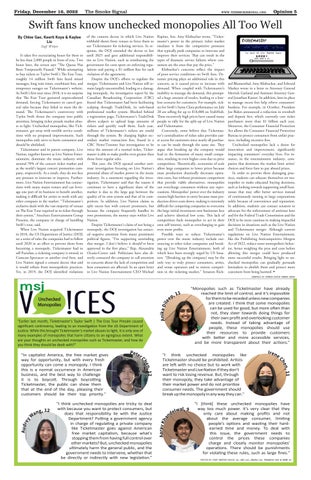
Swift fans know unchecked monopolies All Too Well By Chloe Gao, Keerti Koya & Kaylee Liu Staff Writers It takes five excruciating hours for there to be less than 2,000 people in front of you. Two hours later, the screen says “The Queue Has Been Temporarily Paused.” While attempting to buy tickets to Taylor Swift’s The Eras Tour, roughly 14 million Swift fans faced mixed messages, long wait times, exorbitant fees, and temporary outages on Ticketmaster’s website. As Swift’s first tour since 2018, it is no surprise that The Eras Tour garnered unprecedented demand, forcing Ticketmaster to cancel general sales because they failed to meet the demand. The Ticketmaster’s controversy with Taylor Swift thrust the company into public attention, bringing ticket presale market abuses to light. Unchecked monopolies, like Ticketmaster, get away with terrible service conditions with no proposed improvements. Such monopolies only serve to harm consumers and should be abolished. Ticketmaster and its parent company, Live Nation, together known as Live Nation Entertainment, dominate the music industry with around 70% of the concert ticket market and as the world’s largest concert promotion company, respectively. As a result, they do not face any pressure to innovate or improve. Furthermore, Live Nation Entertainment has connections with many major venues and can leverage one part of its business to benefit another, making it difficult for artists to work with any other company in the market. “Ticketmaster’s exclusive deals with the vast majority of venues on The Eras Tour required us to ticket through their system,” Anschutz Entertainment Group Presents, the company in charge of handling Swift’s tour, said. When Live Nation acquired Ticketmaster in 2010, the US Department of Justice (DOJ) set a series of rules the companies had to follow until 2020 in an effort to prevent them from becoming a monopoly. Ticketmaster had to sell Paciolan, a ticketing company it owned, to Comcast-Spectacor or another rival firm, and Live Nation signed a consent decree that said it would refrain from monopolistic practices. Yet, in 2019, the DOJ identified violations
of the consent decree in which Live Nation withheld shows from venues to force them to use Ticketmaster for ticketing services. In response, the DOJ extended the decree to last until 2025 and gave additional responsibilities to Live Nation, such as reimbursing the government for costs spent on enforcing regulations and paying a $1 million fine for each violation of the agreement. Despite the DOJ’s efforts to regulate the merger, Ticketmaster and Live Nation still remain largely uncontrolled, leading to a damaging monopoly. An investigative report by the Canadian Broadcasting Corporation (CBC) found that Ticketmaster had been facilitating scalping through TradeDesk, its web-based professional reseller system. Blocked behind a registration page, Ticketmaster's TradeDesk allows scalpers to upload large amounts of tickets and quickly resell them. Each year, millions of Ticketmaster’s tickets are resold through the system. By charging higher secondary market transaction fees, found in a CBC News/Toronto Star investigation to be twice the amount of a normal ticket, Ticketmaster is able to make profits even greater than those from regular sales. This year, the DOJ opened another antitrust investigation focusing on Live Nation’s potential abuse of market power in the music industry. In a statement regarding the investigation, Ticketmaster said that the reason it continues to have a significant share of the market is due to the large gap between the quality of its own system and that of its competitors. In addition, Live Nation claims to split excess fees with concert promoters, but because the company frequently handles its own promotions, the money stays within Live Nation. Despite Ticketmaster’s claim of not being a monopoly, the DOJ investigation has attracted negative attention from many prominent political figures. “I’m supporting unwinding that merger. I don’t believe it should’ve been approved in the first place,” Rep. Alexandria Ocasio-Cortez said. Politicians have also directly contacted the company to call attention to concerns about the lack of competition and how consumers are affected. In an open letter to Live Nation Entertainment CEO Michael
Rapino, Sen. Amy Klobuchar wrote, “Ticketmaster’s power in the primary ticket market insulates it from the competitive pressures that typically push companies to innovate and improve their services. That can result in the types of dramatic service failures where consumers are the ones that pay the price.” Klobuchar’s concerns reflect the impact of poor service conditions on Swift fans. Dynamic pricing plays an additional role in this concern, as it caused prices to increase with demand. When coupled with Ticketmaster’s inability to manage the demand, this prompted a huge amount of resales, leading to a loselose scenario for customers. For example, tickets for Swift’s Santa Clara performance on July 28 are selling for up to $18,000 on StubHub. These excessively high prices have caused many people to rally for the split-up of Live Nation and Ticketmaster. Conversely, some believe that Ticketmaster’s centralization of ticket sales provides easier access for customers since nearly all purchases can be made through the same site. They argue that breaking up the company would lead to the formation of many small companies, resulting in even higher costs due to price competition. Theoretically, economies of scale allow large companies to lower prices because mass production drastically decreases operation costs, but without prominent competitors that provide viable alternatives, monopolies can overcharge consumers without any repercussions. Monopolies’ power over the industry creates high barriers to entry because mass production drives costs down, making it extremely difficult for competing companies to overcome the large initial investment new businesses face and achieve identical low costs. This lack of competition fuels monopolies to act in their own self-interest, such as overcharging to gain even more profits. Possible ways to reduce Ticketmaster’s power over the music industry include outsourcing to other ticket companies and breaking up Live Nation Entertainment, both of which have been strongly urged by US Senators. “[Breaking up the company] may be the only way to truly protect consumers, artists, and venue operators and to restore competition in the ticketing market,” Senators Rich-
ard Blumenthal, Amy Klobuchar, and Edward Markey wrote in a letter to Attorney General Merrick Garland and Assistant Attorney General Jonathan Kanter. In addition, laws in place to manage excess fees help relieve consumers’ burdens. For example, in October, President Joe Biden announced a reduction in overdraft and deposit fees, which currently cost ticket purchasers more than $1 billion each year. Moreover, the Consumer Financial Protection Act allows the Consumer Financial Protection Bureau to protect consumers from unfair practices, including excessive fees. Unchecked monopolies lack a desire for innovation and improvement, significantly impacting consumers’ everyday lives. For instance, in the entertainment industry, companies that dominate the market limit artists’ choices and force fans to pay absurd prices. In order to prevent these damaging practices, students can educate themselves on monopolies to make educated buying decisions, such as looking towards supporting small businesses that may offer better services instead of continuously turning to large corporations solely because of convenience and reputation. In addition, students can contact senators to advocate for the enforcement of antitrust laws and for the Federal Trade Commission and the DOJ to be more cautious in making impactful decisions in situations such as the Live Nation and Ticketmaster merger. Although current regulations on Live Nation Entertainment, like the Prohibiting Anticompetitive Mergers Act of 2022, reduce some monopolistic behavior, better weighing the pros and cons before allowing this merger could have produced more successful results. Bringing light to unchecked monopolies can gradually persuade lawmakers to abolish them and protect more customers from being harmed. ▪ GRAPHICS BY OPINION EDITOR ANNIKA SINGH
,(-./!0-1
#
Unchecked Monopolies
,45% #6 !
"I think unchecked monopolies like Ticketmaster should be prohibited. Artists are left with no choice but to work with Ticketmaster and Live Nation if they don’t want to risk losing revenue. But, through their monopoly, they take advantage of their market power and do not prioritize consumer needs. The government should break up the monopoly in any way they can."
/1)!< #1; 5 (
!!!!3%#(
#!
()!**!!
"I think unchecked monopolies are tricky to deal with because you want to protect consumers, but does that responsibility lie with the Justice Department? Putting a government agency in charge of regulating a private company like Ticketmaster goes against American free market capitalism, because what's stopping them from having full control over other markets? But, unchecked monopolies ultimately harm the general public, and the government needs to intervene, whether that be directly or indirectly with new legislation."
"Monopolies such as Ticketmaster have already reached the limit of control, and it’s impossible for them to be receded unless new companies are created. I think that some monopolies can be used for good, but more often than not, they steer towards doing things for their own profit and overlooking customer needs. Instead of taking advantage of people, these monopolies should use their resources to provide customers with better and more accessible services, and be more transparent about their actions."
# &'
!*+!! #()
)!*+
&'
(8 7/
!!!!!!!"#$# %!
,/%/9!:' /
"Earlier last month, Ticketmaster’s Taylor Swift | The Eras Tour Presale caused significant controversy, leading to an investigation from the US Department of Justice. While this brought Ticketmaster’s market abuses to light, it is only one of many examples of monopolies that harm citizens to an egregious extent. What are your thoughts on unchecked monopolies such as Ticketmaster, and how do you think they should be dealt with?"
"In capitalist America, the free market gives way for opportunity, but with every fresh opportunity can come a monopoly. I think this is a normal occurrence in American business, and the best way to challenge it is to boycott. Through boycotting Ticketmaster, the public can show them that at the end of the day, pleasing their customers should be their top priority."
)!** 2 #
"I [think] these unchecked monopolies have way too much power. It's very clear that they only care about making profits and not about the average consumer, limiting people's options and wasting their hardearned time and money. To deal with this issue, the government needs to control the prices these companies charge and closely monitor monopolies' operations. There should be punishments for violating these rules, such as large fines." PHOTOS BY STAFF WRITERS KAYLEE LIU, AMY LUO, ANDRIA LUO, PRAAMESH SIVA & ANNIE XU