6 Bringing low-cost radio astronomy to Ukraine with the TTRT
CONSTRUCTION UPDATE
7 SKA-Low construction highlights
12 SKA-Mid construction highlights
16 Key hardware passes production milestones
FEATURED IMAGE
18 Observing trails
LET’S TALK ABOUT...
20 High-energy cosmic particles
SCIENCE COMMUNITY WEBINARS
23 Join us for the next SKAO Webinar
PATHFINDERS
24 Most detailed map of the Universe’s hidden magnetic fields revealed
26 MeerKAT helps to reveal true scale of hidden giant structure
28 WALLABY’s galaxy atlas takes shape
SKAO CORNER
29 ‘This is a daring project’ – new SKAO Director-General
30 France joins the SKAO
31 Two minutes with... Sophie Bel, French Consul-General
32 A sustainable vision for the Observatory
33 ‘Dazzling array of science’ detailed in new SKAO book TEAM
34 Dr Stefan Ohm, German Centre for Astrophysics (DZA)
DARK & QUIET SKIES
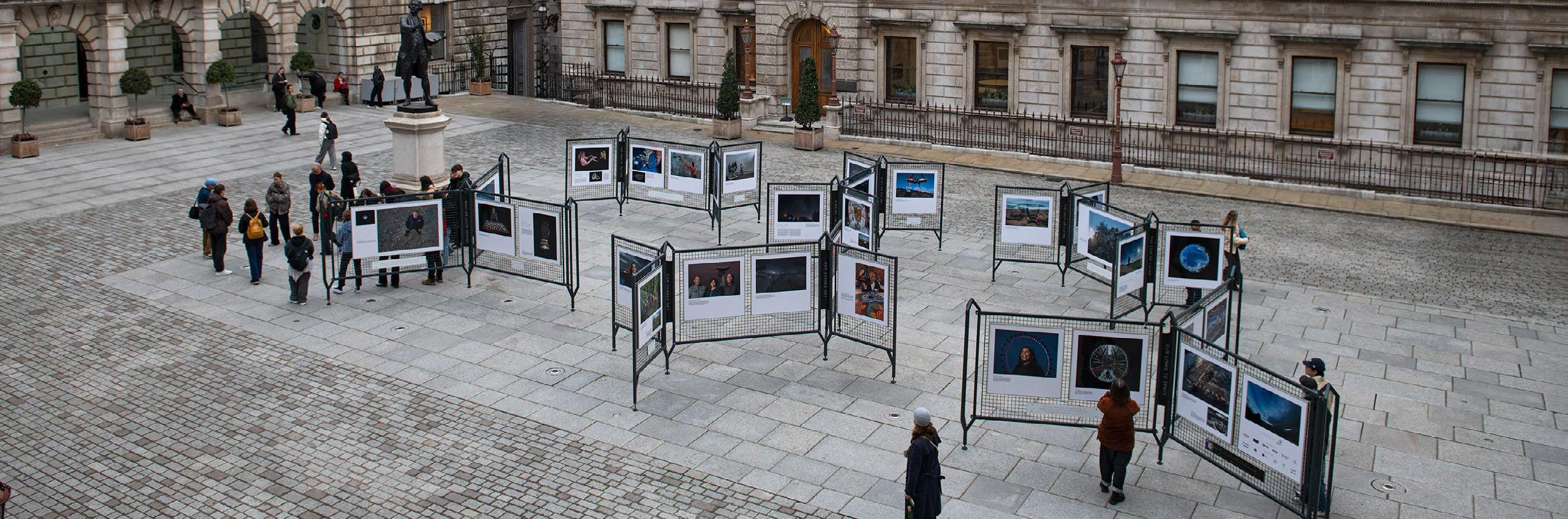
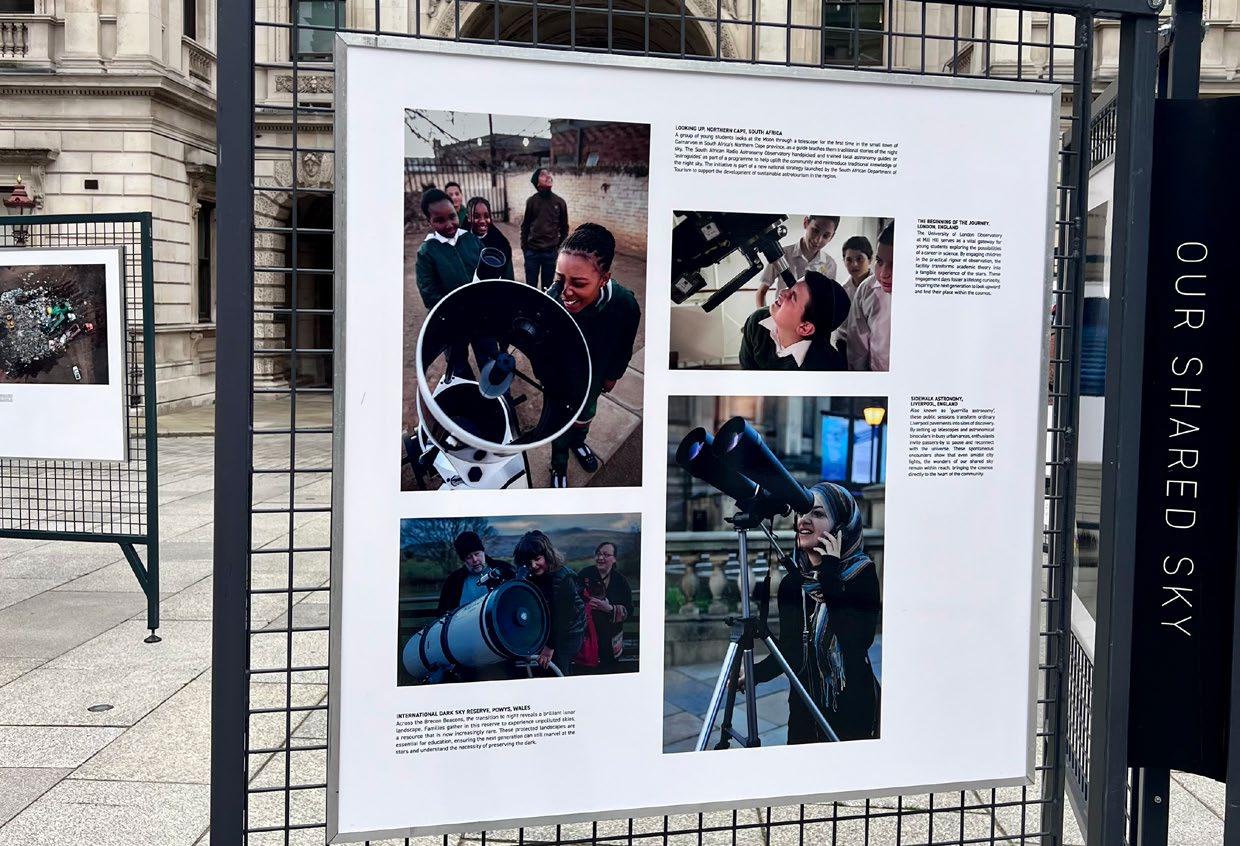
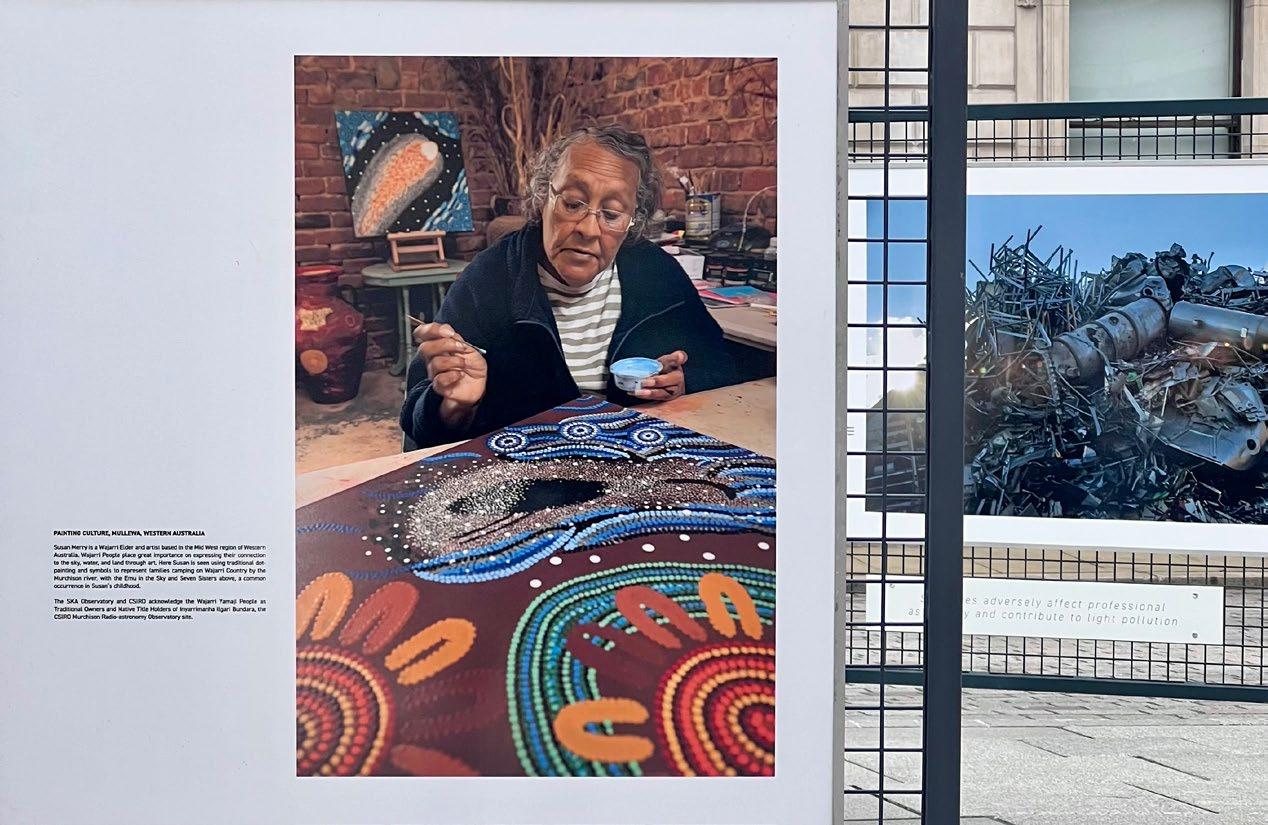
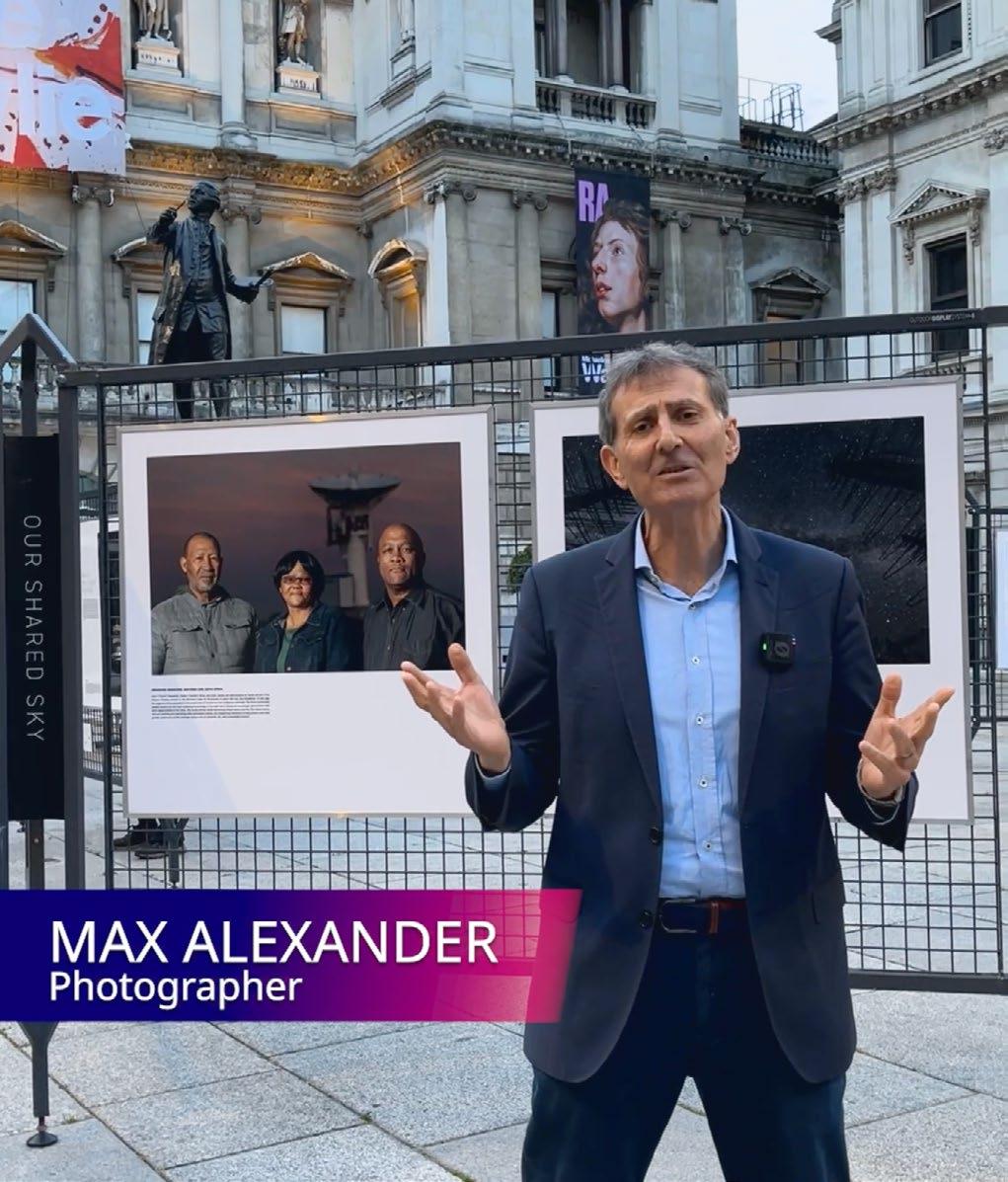
38 Indigenous communities take centre stage in space photographic exhibition
39 The United Nations is seeking your views
40 SKAO signs the Zero Debris Charter to protect our skies
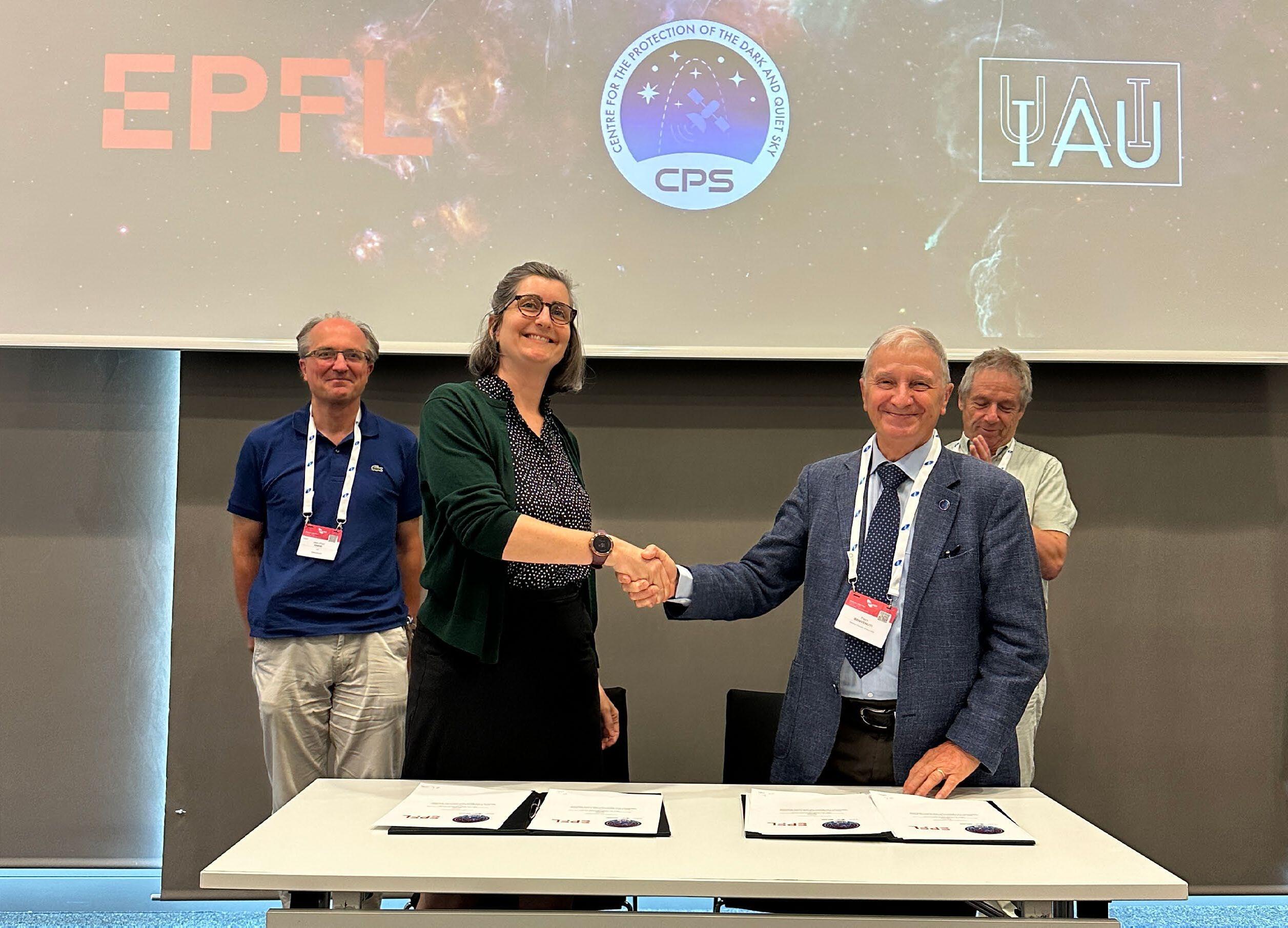
41 EPFL joins Centre for the Protection of the Dark and Quiet Sky
A snapshot of recent events around the globe
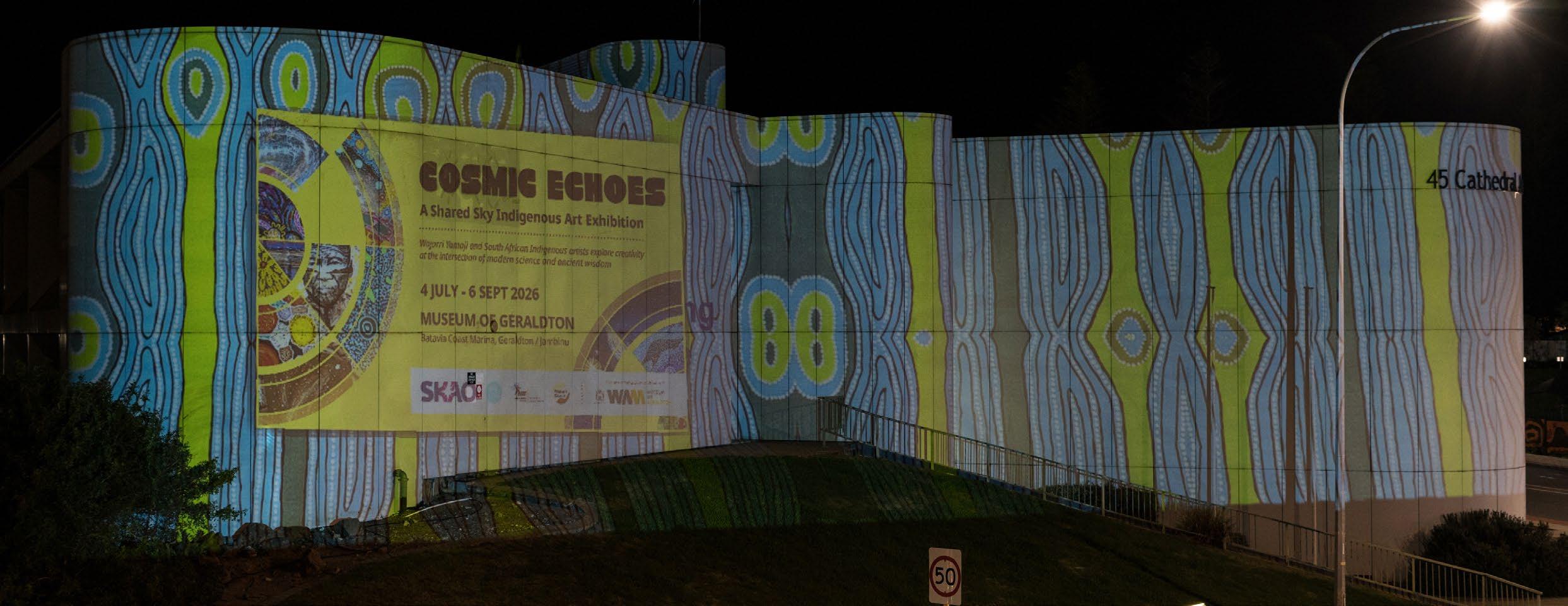
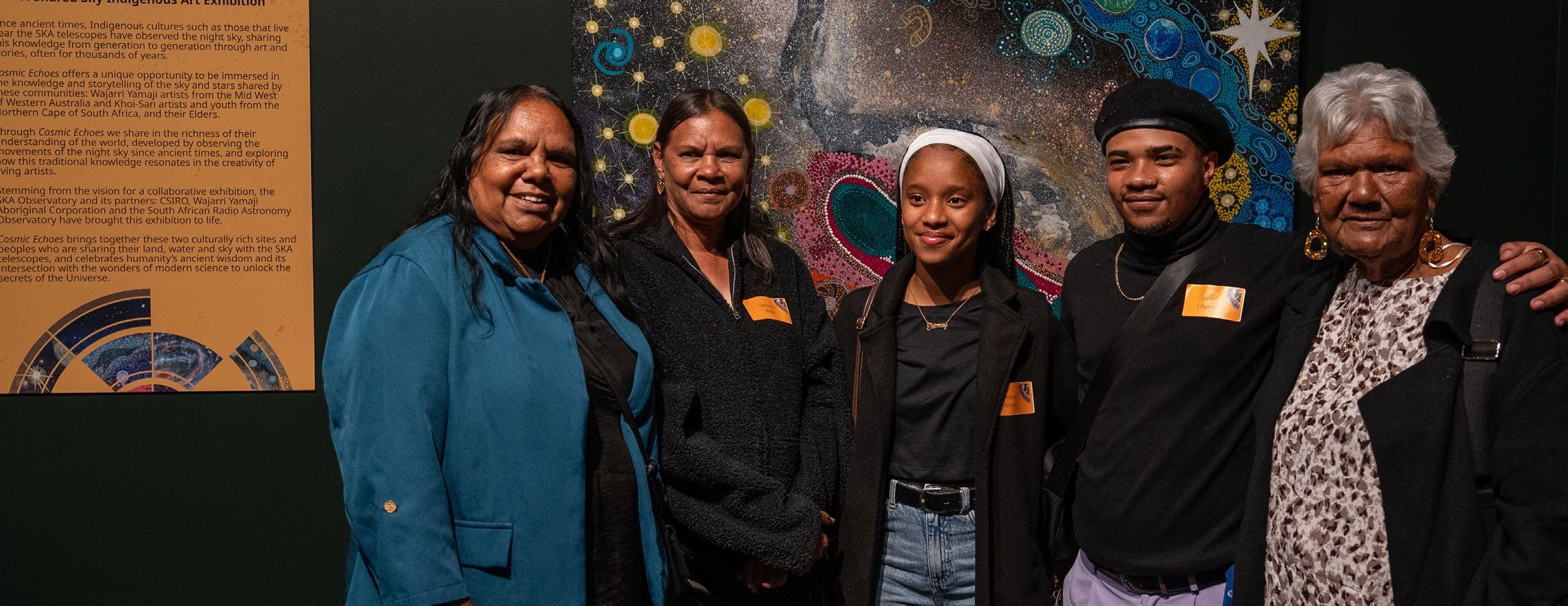
Cosmic Echoes launches in Australia
Hello, and welcome to the 20th issue of Contact. It is the first one where I have the privilege of inviting you to enjoy the contents, as I have now been several weeks succeeding Prof. Phil Diamond as directorgeneral. They have been a whirlwind of days, largely filled with the honour of meeting and talking with the Observatory’s talented and dedicated people. I am writing this from one of the “dongas”, the rooms at Nyingari Ngurra – the SKA-Low construction village at Inyarrimanha Ilgari Bundara, the CSIRO Murchison Radio-astronomy Observatory – having appreciated the incredible Cosmic Echoes opening with Wajarri Yamaji and South African artists and the opportunity to meet with Elders from the community (see page 44). It is a humbling place to stand and watch our expanding project, about to blink its eyes and open its ears to our Universe. The antennas are now hemmed in by wildflowers in a dozen colours, and I’ve never seen so much green in the Outback!
Every time I started writing this piece, I got distracted reading the stories in the magazine. There are some epics in here – from stunning new magnetic maps of our galaxy with CSIRO’s ASKAP telescope (SPICE-RACS, wow, the
acronyms astronomers come up with) and led by our own Alec Thomson, to a primer on cosmic particle alarm clocks, (shout out of thanks to Katie Mulrey, the cosmic ray guru), the science beats are fantastic. Our construction update is well worth a look, especially the description of the intricate and dedicated designs (and sometimes infuriating detective work needed) to keep the SKA-Low computers from interfering with the telescope itself. There are also exciting updates on sustainability work at our facilities and in local communities.
Congratulations and thank you to our huge astronomy community for the completion of the second SKAO science book – 221 chapters, more than 1,500 individual authors, numbers befitting an observatory that will be this impactful.
There are also important articles talking of space sustainability and dark and quiet skies. This is an increasingly vital area of our forward work and one we continue to ask all our national representatives, governments and science community networks to support. We must find a way to regulate and coexist with our ground and space ecosystems and this work must start now if we hope to find a sustainable future in our skies and orbits.
So please, enjoy this edition as much as I did, and onwards and upwards for our next science and project achievements.
Prof. Jessica Dempsey SKAO Director-General
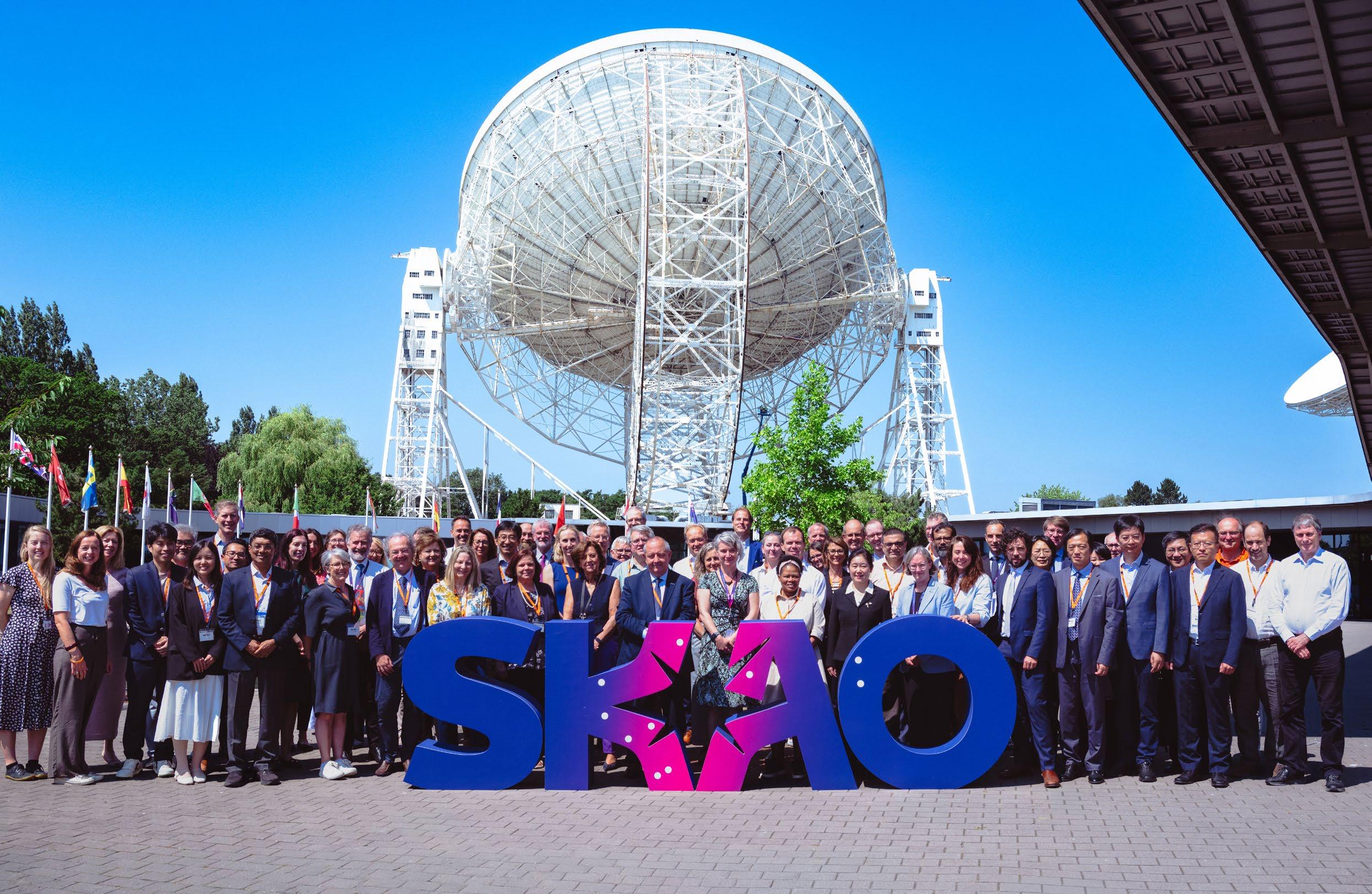
In July 2026, the SKAO Council met at the Observatory’s Global Headquarters in the UK, Prof. Dempsey’s first Council meeting as director-general.
Canada’s nationwide SKA Scientist Programme grows
BY THE NATIONAL RESEARCH COUNCIL OF CANADA (NRC)
The National Research Council of Canada’s SKA Scientist Programme has welcomed two more researchers to its ranks. The programme is designed to support early-career scientists conduct cutting-edge radio astronomy research and shape Canada’s role in the SKAO.
The newest Canadian SKA scientists are Dr Genevieve Schroeder – a specialist in transients – and Dr Nicholas Kern, a data-focused cosmologist.
“The SKA telescopes will transform radio astronomy, and as a Canadian SKA scientist, I’m committed to inspiring our country’s astronomers to push the boundaries of their research,” Dr Schroeder said.
The new SKA scientists join Dr Alice Curtin and Dr Fengqiu (Adam) Dong to form a growing national network of SKA experts.
“This programme has given me the financial support to do independent research and the benefit of strong mentorship – locally at McGill and nationally through the NRC and other Canadian institutions,” says Dr Curtin, one of the inaugural Canadian SKA scientists, based at McGill University.
“That support provides the scientific expertise and leadership guidance I need to grow as a researcher and to develop the next generation of radio astronomers.”
Halfway through her first year of the five-year programme, Dr Curtin has already conducted independent research, mentored undergraduate students and co-authored a chapter on fast radio bursts for the new SKAO science anthology Advancing Astrophysics II (see page 33).
She will also be hosting the first edition of the Canadian Radio Astronomy Summer Institute and Extended School at McGill. The programme will give students a strong foundation in radio astronomy and prepare them to contribute to, and eventually lead, Canada’s radio astronomy facilities.
“Without both the financial and professional support of this programme, I wouldn’t have the freedom to advance both my science and my leadership in radio astronomy,” she says.
The Canadian SKA Scientist Programme will issue its third call for applications in August 2026.
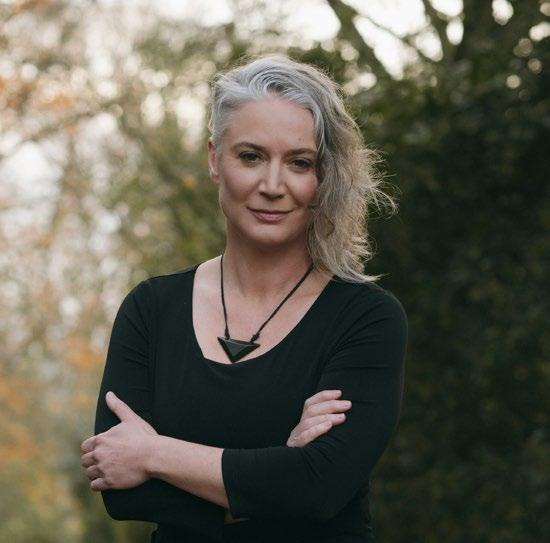
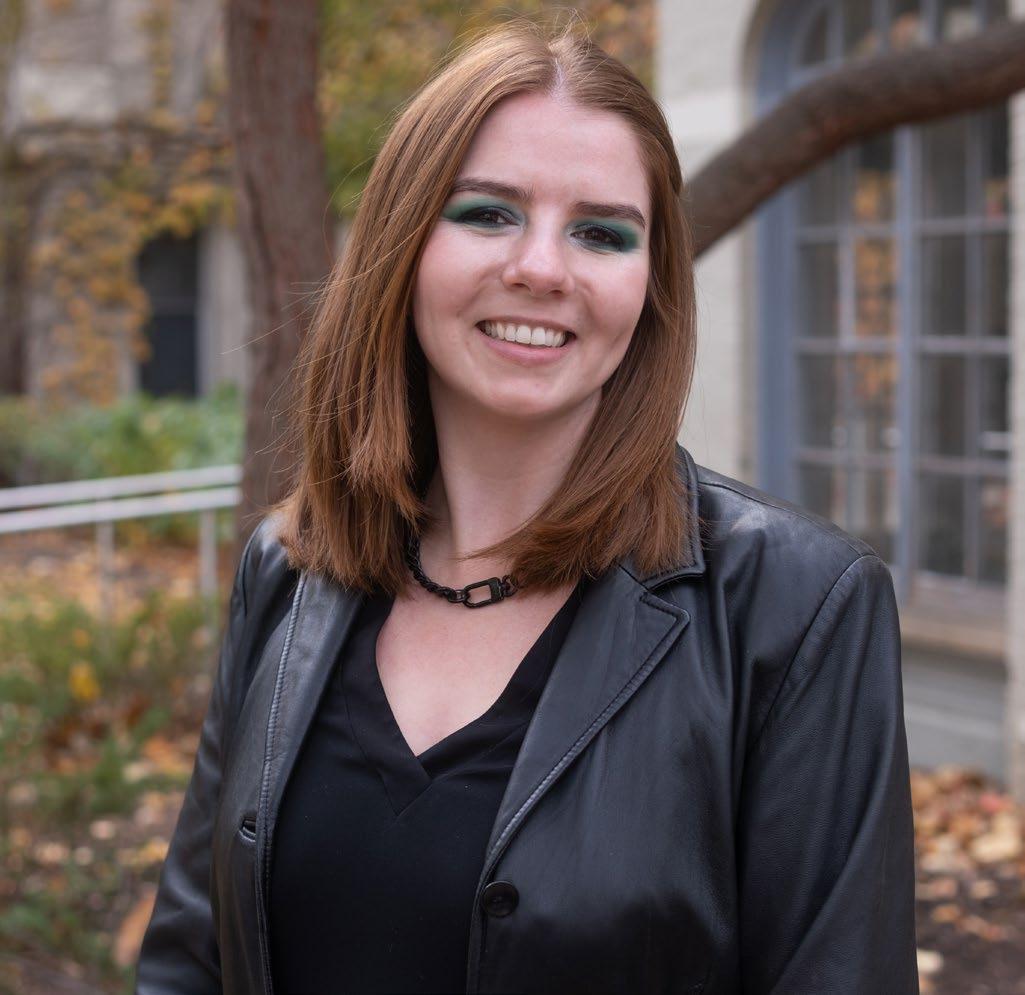
L-R: Dr Genevieve Schroeder and Dr Nicholas Kern are the newest members of Canada’s SKA Scientist Programme. Credit: NRC.
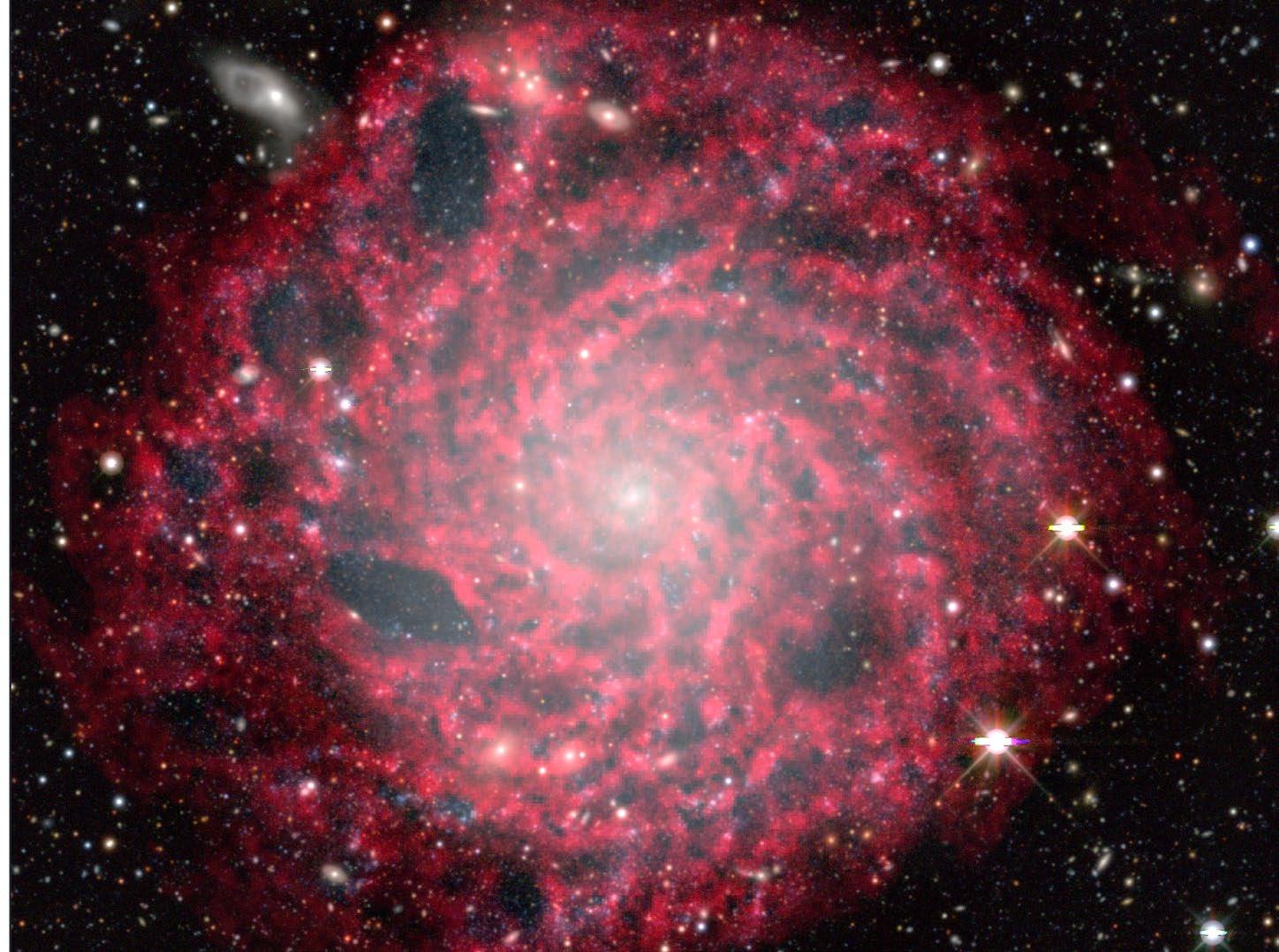
MeerKAT’s view of IC 5332’s extended HI disc - Kyra Kummer, University of Cape Town
Spiral galaxy IC 5332 is sometimes referred to as the corsage galaxy. It hosts an extended ultraviolet disc, suggesting recent massive star formation in the galactic outskirts. The image combines optical images from the Legacy Survey Data Release 10 with a high-resolution MeerKAT L-band image of the galaxy’s neutral atomic hydrogen (HI) disc. The optical image shows emission from the twinkling stellar component of IC 5332, as well as numerous background galaxies. The HI emission is shown in crimson red, and traces the galaxy’s extended HI disc.
Credit: KL Kummer and the PHANGS team; SARAO; CARTA
BY THE INTER-UNIVERSITY INSTITUTE FOR DATA INTENSIVE ASTRONOMY (IDIA)
Two images created using the SKA precursor telescopes MeerKAT in South Africa and ASKAP in Australia have won the CARTA Image Competition for 2025/2026, which celebrates the creativity and scientific insight of the software’s user community.
CARTA (Cube Analysis and Rendering Tool for Astronomy) is a visual analytics platform designed to address the challenges of accessing, visualising, and analysing extremely large astronomical datasets. CARTA enables researchers to work directly with massive remote data stores through a web browser. Its architecture is capable of supporting data cubes [a 3D digital grid mapping position along with frequency, wavelength, or velocity] of several terabytes while continuing to scale to meet the growing demands of next-generation astronomy.
As well as celebrating scientific and artistic possibilities enabled by modern astronomy visualisation tools, the competition provides an opportunity for users to
explore new CARTA capabilities, including its multiband colour imaging features, while sharing striking visual representations of astronomical discovery with the broader community.
Today, CARTA is used by thousands of researchers worldwide and has contributed to over 159 peer-reviewed publications. Through its open-source, browser-based architecture and international development model, CARTA is expanding access to cutting-edge astronomical research and helping scientists worldwide explore increasingly complex datasets in preparation for the data-intensive era of the SKAO and beyond.
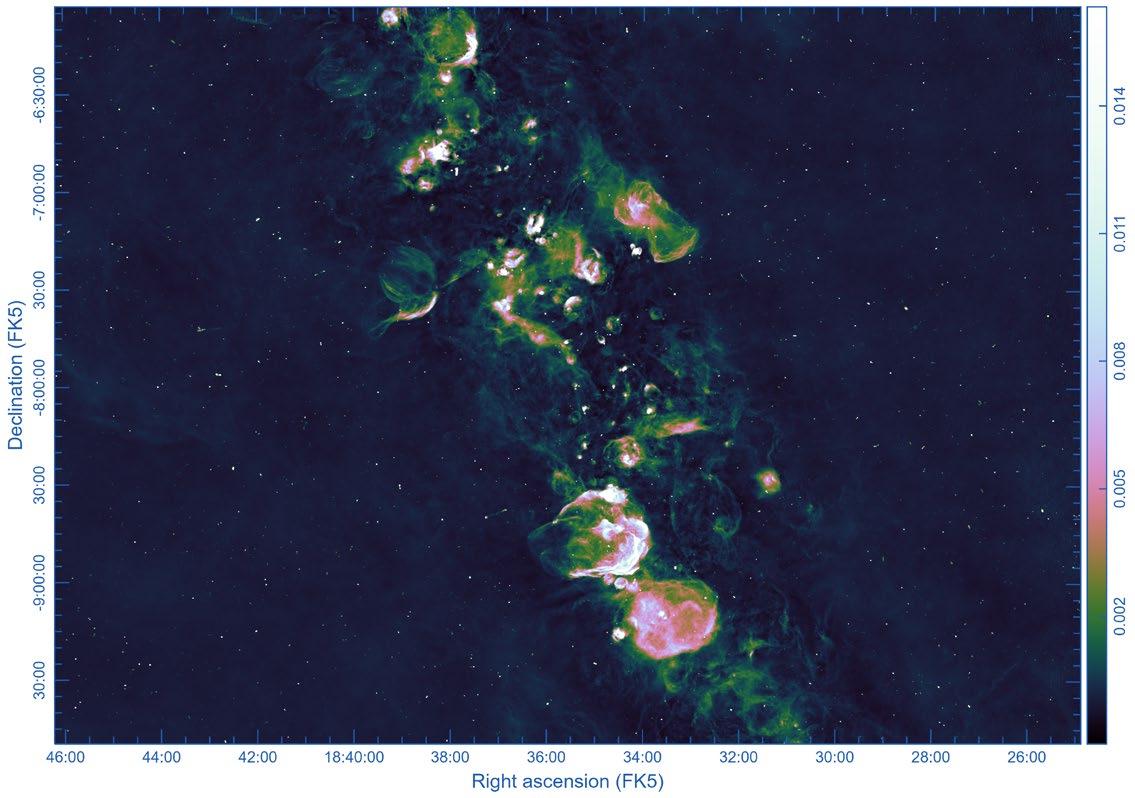
Deep radio-continuum insights towards the galactic plane with ASKAP - Tim Galvin, CSIRO
The 30 deg² field of view is enabled by the phased array feed receiver system on the ASKAP radio telescope, owned and operated by CSIRO, Australia’s national science agency. In this dataset, directed towards the galactic centre, the Variables and Slow Transients (VAST) collaboration was on the hunt for three long-period transient objects. Over a period of 10 hours ASKAP stared towards this patch of sky, building an exquisite dataset.
Credit: T.Galvin; ASKAP; CSIRO
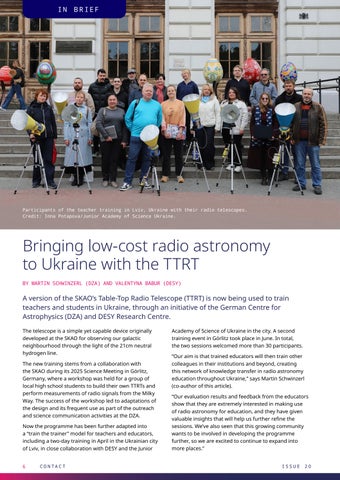
Bringing low-cost radio astronomy to Ukraine with the TTRT
BY MARTIN SCHWINZERL (DZA) AND VALENTYNA BABUR (DESY)
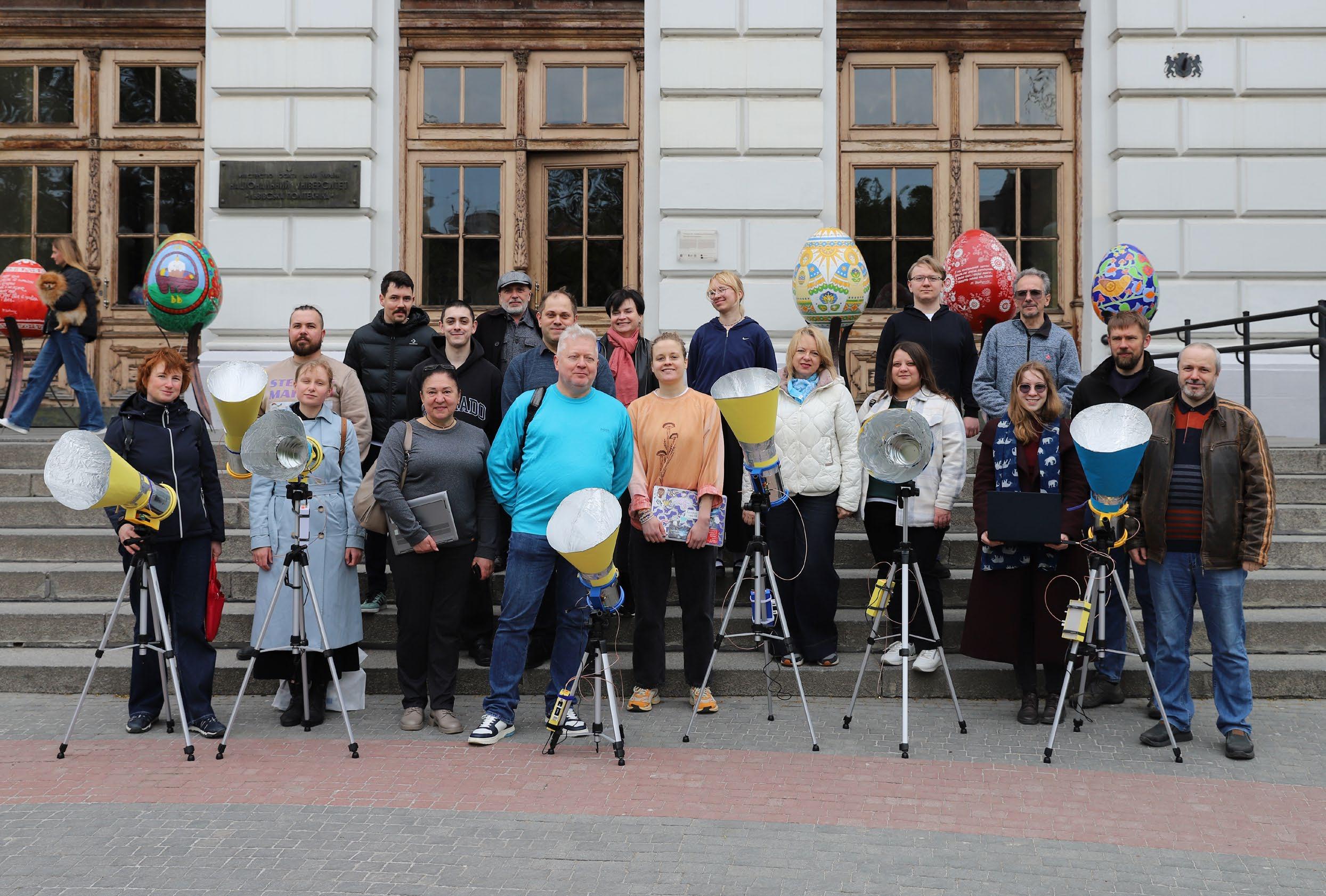
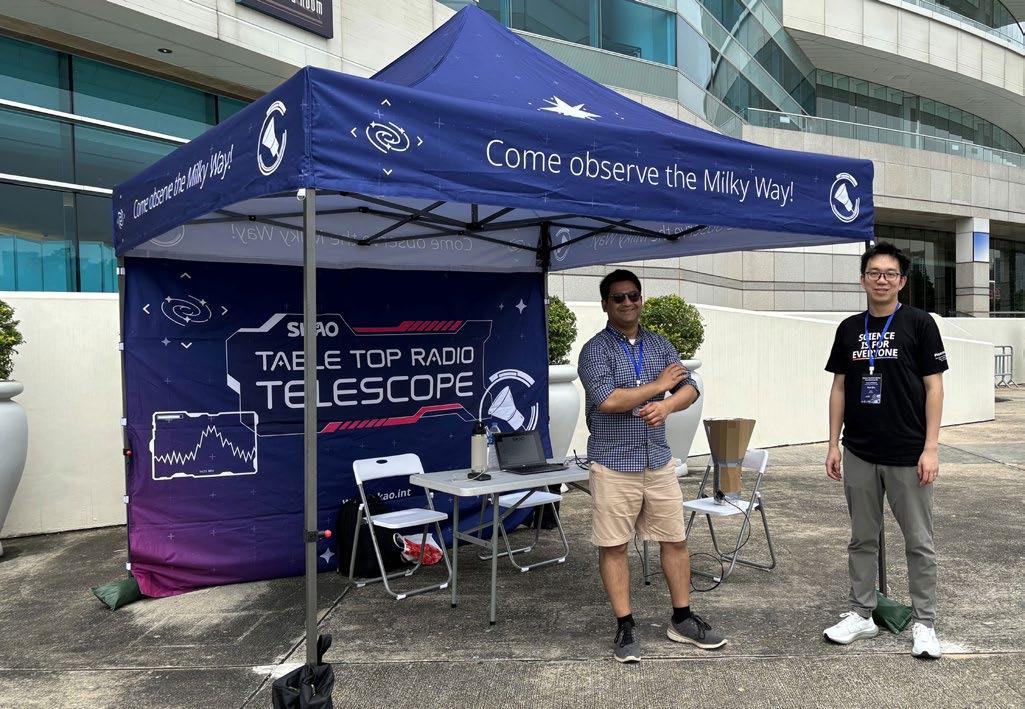
A version of the SKAO’s Table-Top Radio Telescope (TTRT) is now being used to train teachers and students in Ukraine, through an initiative of the German Centre for Astrophysics (DZA) and DESY Research Centre.
The telescope is a simple yet capable device originally developed at the SKAO for observing our galactic neighbourhood through the light of the 21cm neutral hydrogen line.
The new training stems from a collaboration with the SKAO during its 2025 Science Meeting in Görlitz, Germany, where a workshop was held for a group of local high school students to build their own TTRTs and perform measurements of radio signals from the Milky Way. The success of the workshop led to adaptations of the design and its frequent use as part of the outreach and science communication activities at the DZA.
Now the programme has been further adapted into a “train the trainer” model for teachers and educators, including a two-day training in April in the Ukrainian city of Lviv, in close collaboration with DESY and the Junior
Academy of Science of Ukraine in the city. A second training event in Görlitz took place in June. In total, the two sessions welcomed more than 30 participants.
“Our aim is that trained educators will then train other colleagues in their institutions and beyond, creating this network of knowledge transfer in radio astronomy education throughout Ukraine,” says Martin Schwinzerl (co-author of this article).
“Our evaluation results and feedback from the educators show that they are extremely interested in making use of radio astronomy for education, and they have given valuable insights that will help us further refine the sessions. We’ve also seen that this growing community wants to be involved in developing the programme further, so we are excited to continue to expand into more places.”
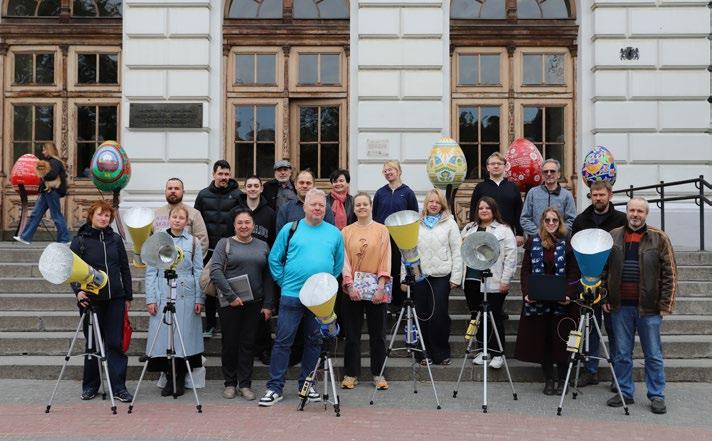
Participants of the teacher training in Lviv, Ukraine with their radio telescopes.
Credit: Inna Potapova/Junior Academy of Science Ukraine.
SKA-Low construction highlights
BY ANT SCHINCKEL (SKAO)
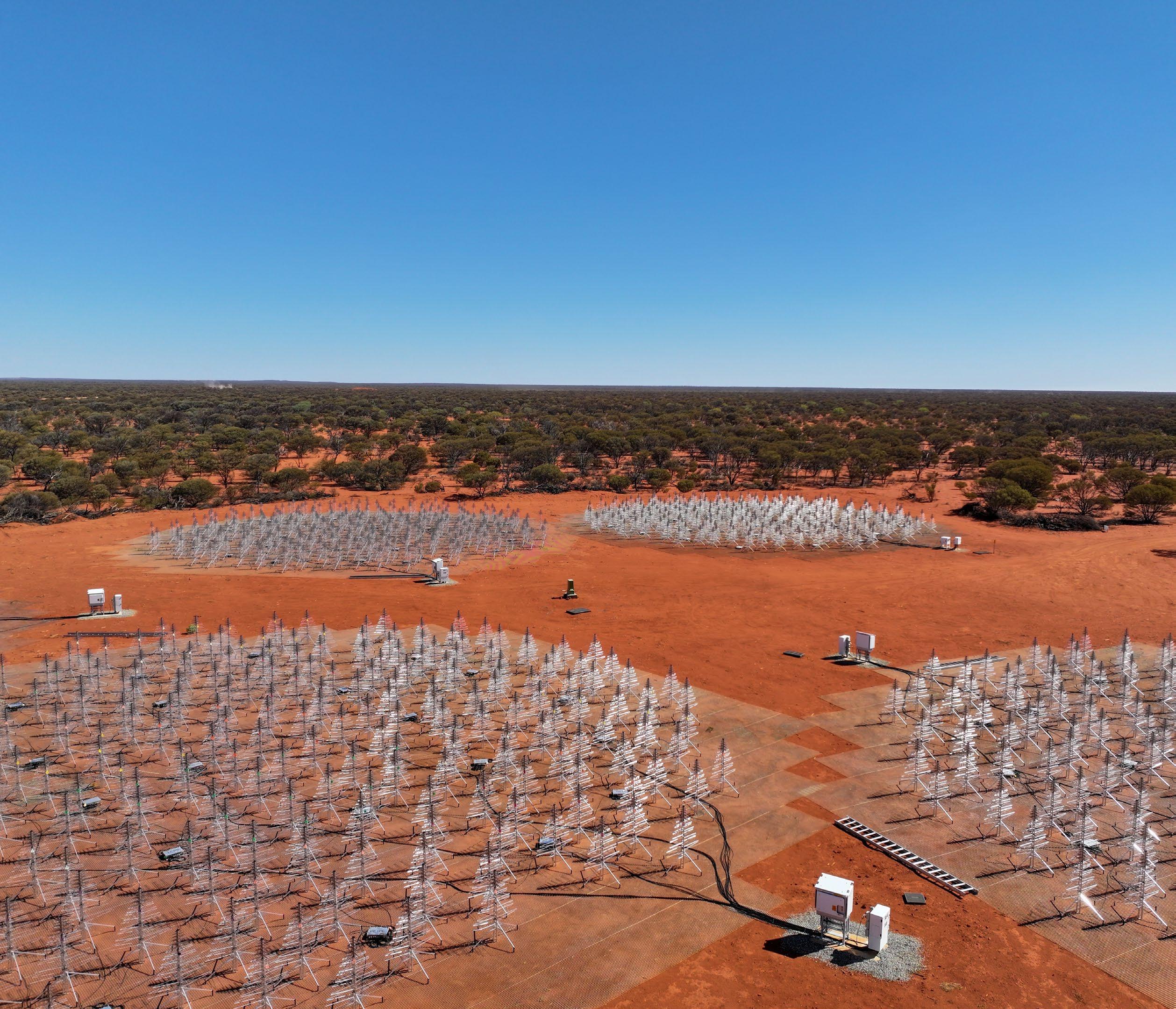
A commitment to sustainability underpins all our work across the SKA-Low site. For instance, we have a duty to monitor and minimise the impact of our operations on the environment. In recent months our focus has been on land and water rehabilitation and preparing to implement renewable energy.
Rehabilitation and water management
The usually hot and dry Murchison landscape features rivers, creek beds and water holes, which fill and overflow during winter. It is home to unique plants and animals, and several significant heritage sites for the Wajarri Yamaji People. The land is not flat, and the creation of tracks and networks can have the unintended consequence of disrupting natural surface water flows, resulting in flooding and ecological damage. In 2024 we worked with our partners at CSIRO to develop a rehabilitation and surface water management plan to ensure both the protection of the land and SKAO assets. This work is ongoing and has been developed to suit the unique landscape of Wajarri Country, and recognises the importance of the flow of surface water as one of
the region’s dominant ecological drivers. Similar to the doctors’ Hippocratic oath, our initial stance is “first, do no harm”, so the process is a slow one of trial and discovery.
The plan identifies the need to protect the fragile surface from misdirected water flows to retain landscape processes and ecological function. It highlights areas of risk within the more than 300km of SKA-Low tracks and networks. It provides a framework to disperse and restore natural surface water flows, especially after rain events, and nurture dormant seeds and protect naturally sprouting seedlings. Across our site we have installed bunds and other measures to slow and redirect surface water. We are also engaging with members of the local Murchison and Wajarri communities that have the landscape literacy to understand where water is needed. (Cont...)
CONSTRUCTION
Renewable power
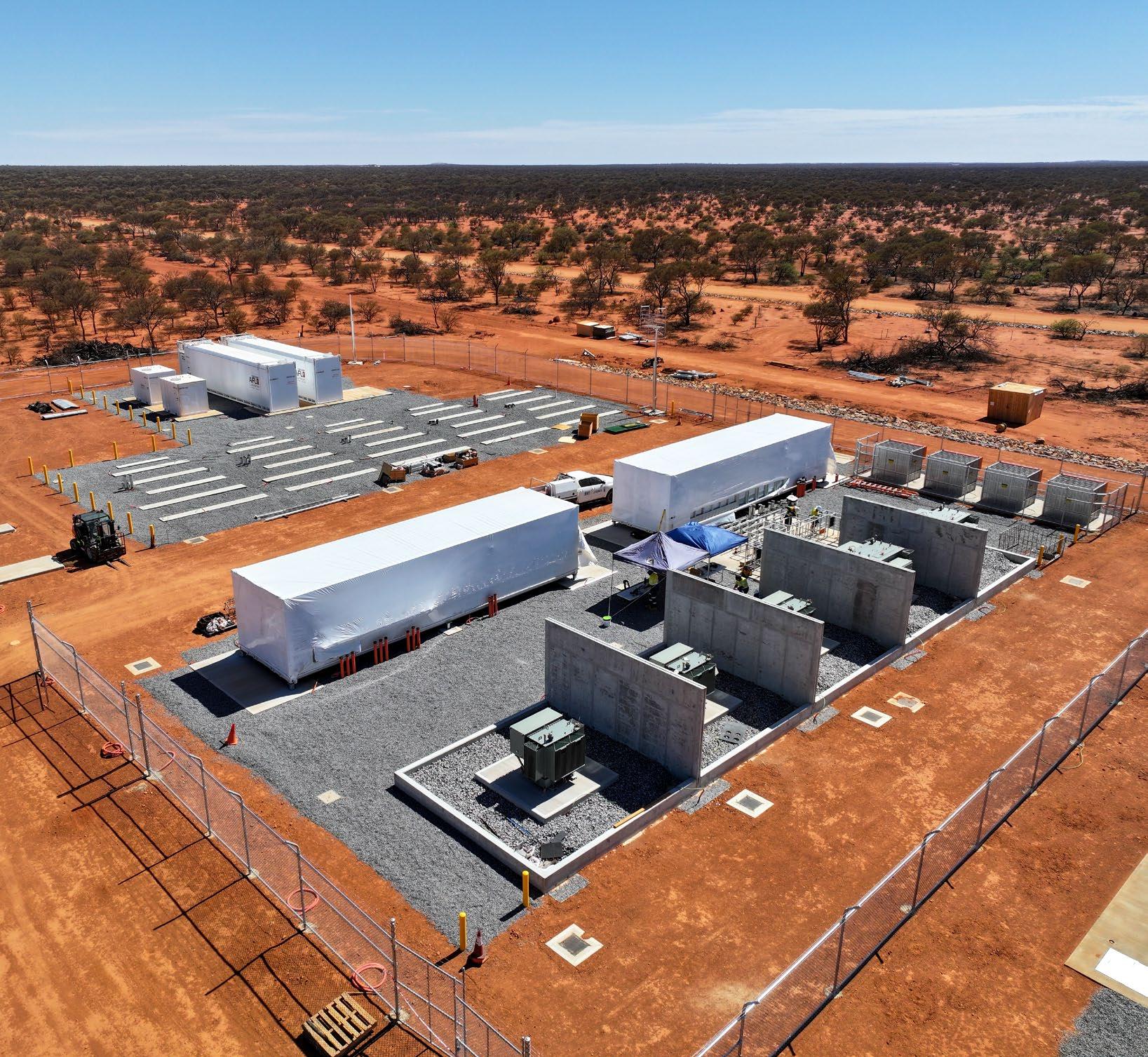
Construction of a fully radio-frequency shielded permanent power station is nearing completion. This initial diesel system, known as phase 1 of the central power station, will support early telescope operations, help assess power requirements and serve as a longterm backup. In January the installation of the highvoltage and low-voltage buildings at the central power station began. In May we received the four RFI shielded generators that make up the system.
This first phase of the power station forms the core for our longer-term hybrid renewables system which will combine a solar photovoltaic array, battery storage and diesel system, the aim being to produce a high fraction of renewable solar energy to ultimately generate around 3 MW. This long-term renewables-based central power station is expected to be implemented from late 2028, once the load required to operate the site is well understood.
Site construction
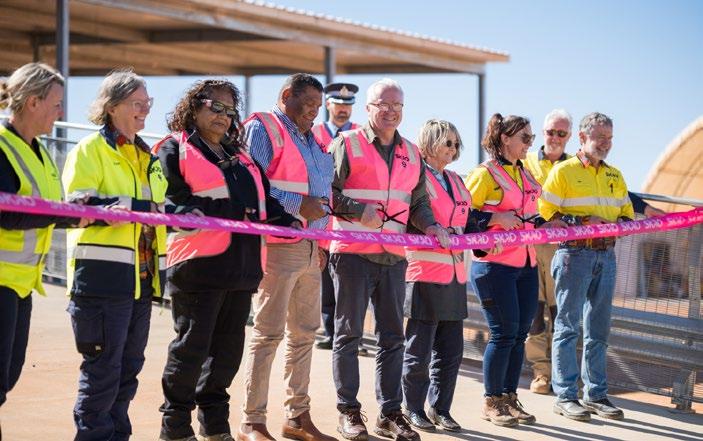
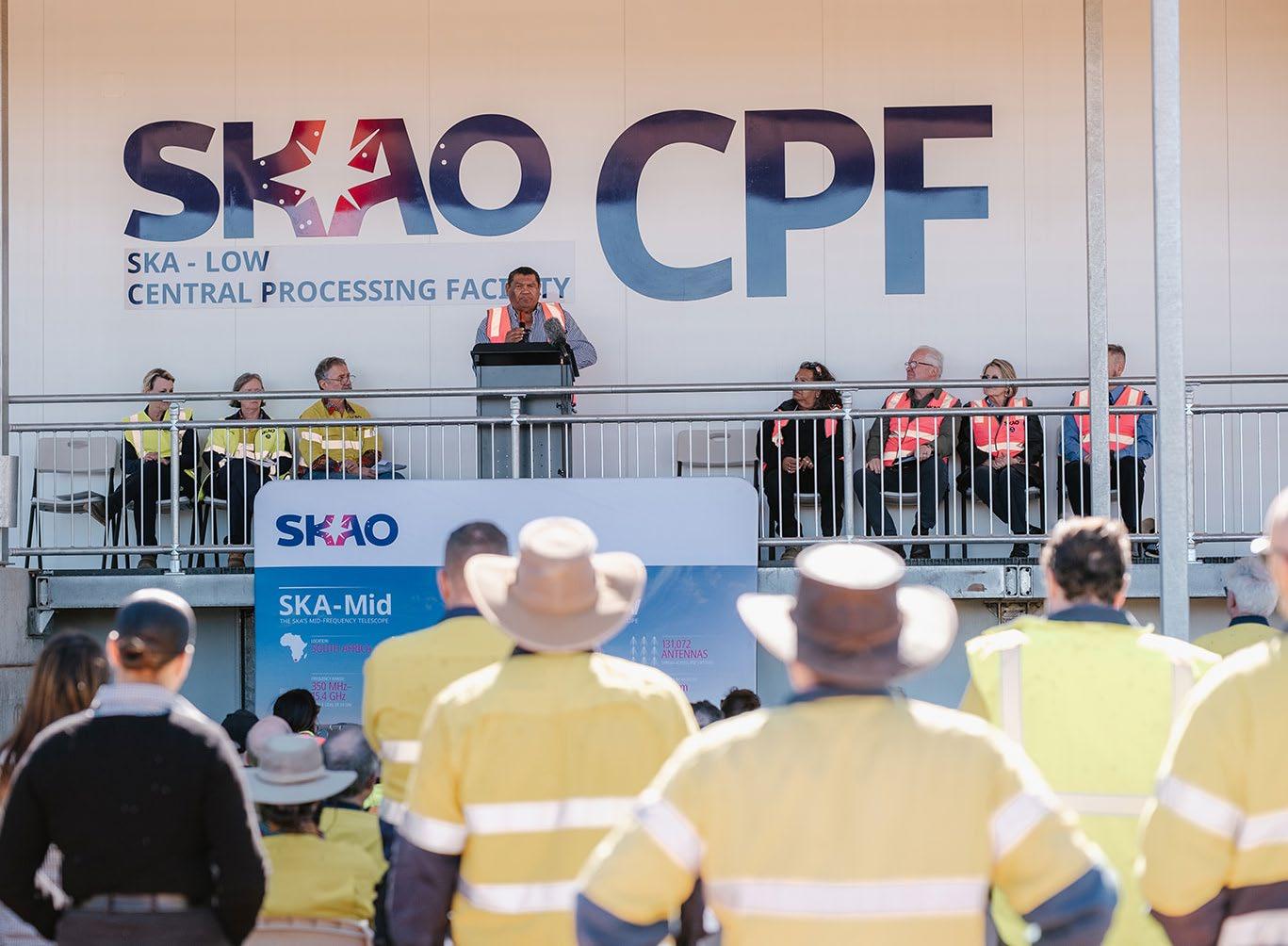
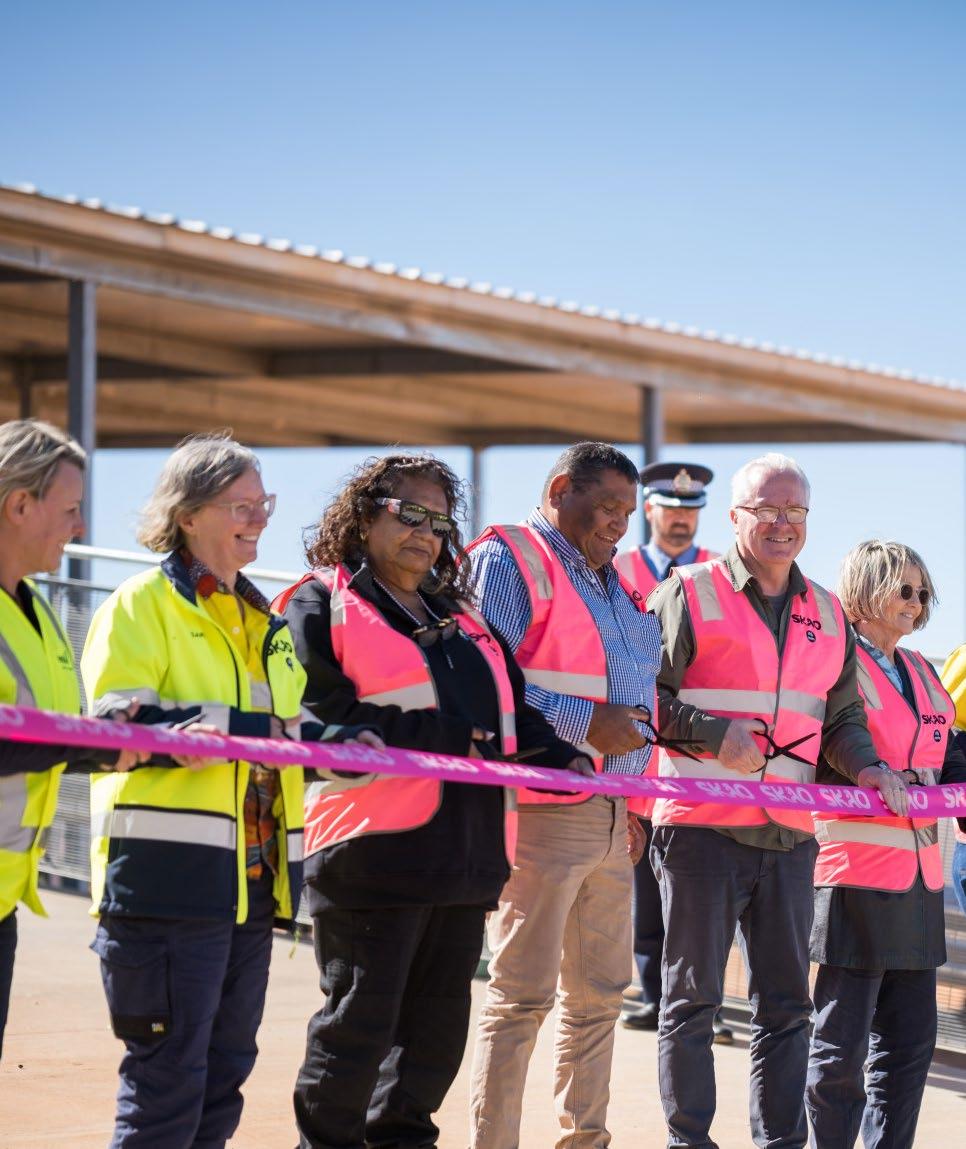
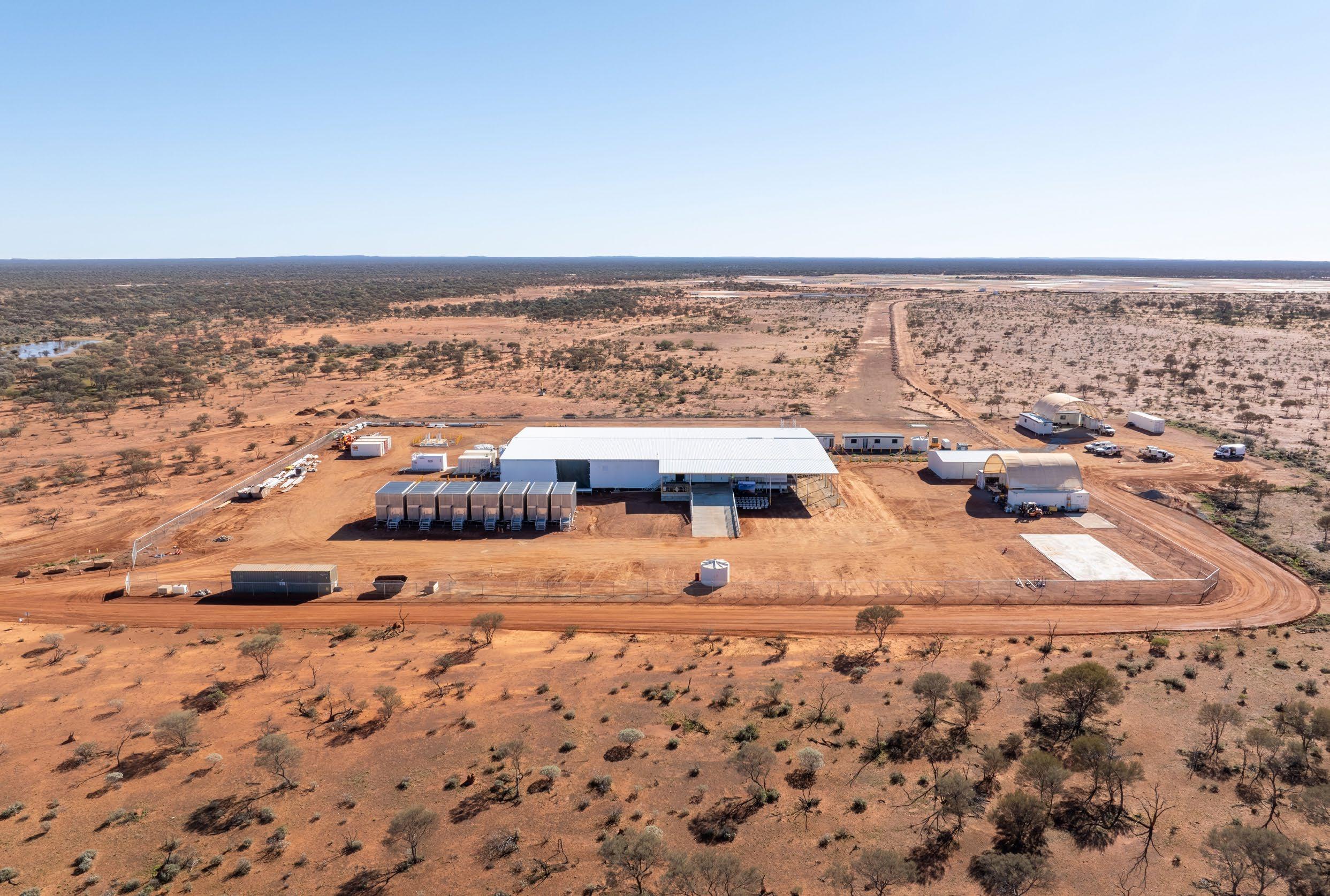
We recently celebrated another infrastructure milestone at the SKA-Low site, with the official opening of Ngurra-Maga, the telescope’s central processing facility building. Ngurra-Maga means “home of the head” in Wajarri language, a perfect name for a facility that will soon house the “brain” of the telescope. We were honoured to have His Excellency the Hon. Chris Dawson AC APM, Governor of Western Australia and Wajarri Yamaji Elders Jennylyn Hamlett and Des Mongoo officially open the building together.
You can read more about this highly specialised facility and what makes it special on page 10. Next, we will install the specialised electronics and computing in the 140 racks within the facility’s innermost room. It is here that data collected from the telescopes antennas will be processed by on-site digital processing systems.
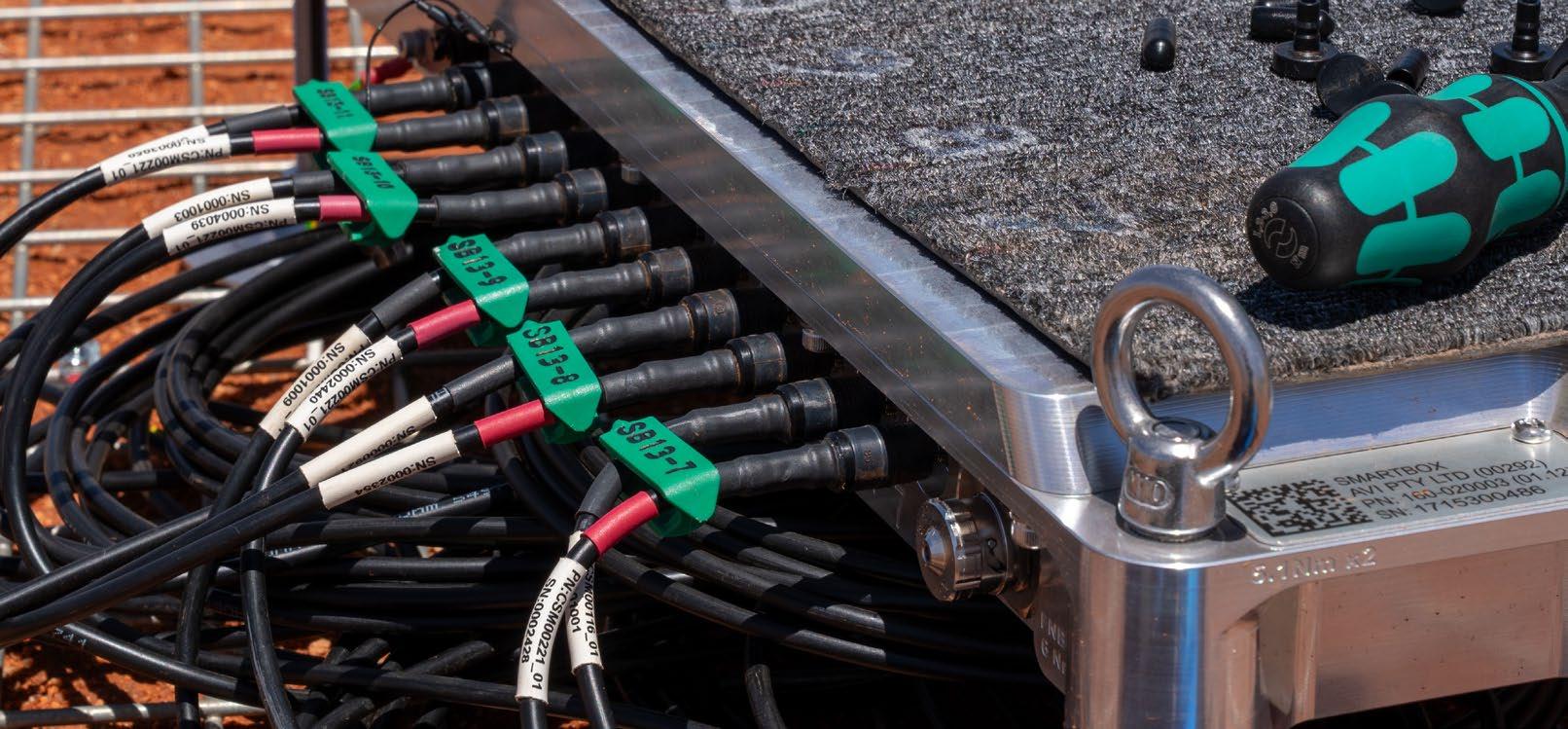
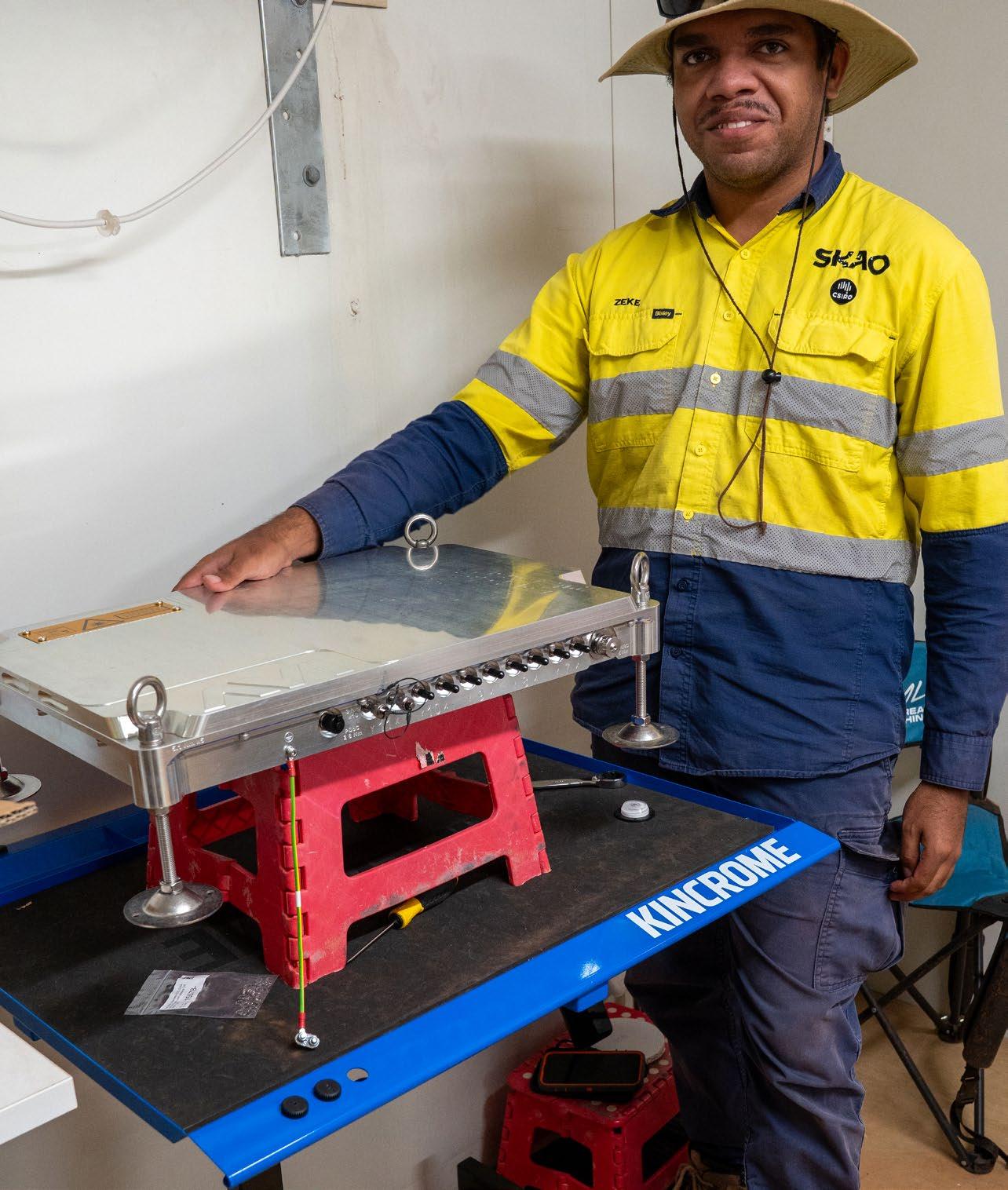
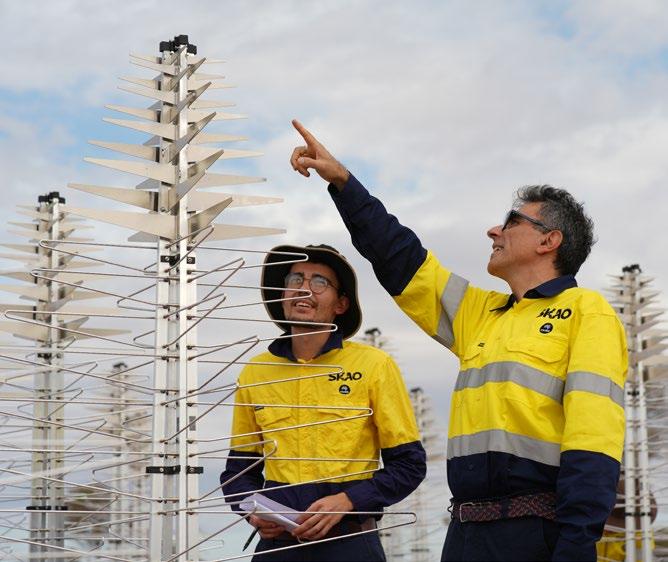
A focus for the SKA-Low teams on site in recent months has been the installation and testing of power and supply distribution infrastructure. This is the hardware that makes it possible to distribute electrical power to the telescope’s antennas and send signals that are received by the antennas from space to on-site processing systems. This work enables more of the existing antennas to be brought into the array. As a consequence, our commissioning scientists are now observing the sky with more than 3,500 of SKA-Low’s antennas.
Science data processor begins installation
In July the installation of the SKA-Low’s science data processor hardware began at the Pawsey Supercomputing Research Centre in Perth. It will process and reduce huge volumes of data to produce ever more detailed images of the sky. Eventually the SKA telescopes will need to process data equivalent to more than one million 4K Netflix streams, and archive almost 700 PB a year. In 2025 computing specialists Bull (then called Eviden) were tasked with building the hardware for the Observatory’s two telescopes, representing the first SKAO construction contract awarded to France.
Construction progress in numbers
Image collage:
1: Wajarri Yamaji Elder and Wajarri Enterprise Limited Chair Des Mongoo welcomes attendees to Wajarri Country at the opening of Ngurra-Maga, the SKA-Low central processing facility.
Credit: SKAO/Ventia
2: His Excellency the Hon. Chris Dawson AC APM, Governor of Western Australia, officially opens Ngurra-Maga, the SKA-Low central processing facility alongside Wajarri Yamaji Elders Jennylyn Hamlett and Des Mongoo together with SKA-Low and construction staff.
Credit: SKAO/Ventia
3: The SKA-Low central power station under construction. Credit: SKAO/Ventia
4: SKA-Low Field Technician Zeke George assembling a SMART Box.
5: A close-up of a SMART Box, part of the supply and power distribution infrastructure.
17,600 antennas
assembled and installed
96,000 sheets
steel mesh laid for antenna stations
530 drums
power cable installed stretching
330km
960km
fibre optic cable installed and connected
The central processing facility, Ngurra-Maga,is 1,500m² in size.
Credit: SKAO/Ventia
Catch 22: how do you protect the Earth’s most sensitive telescope from itself?
BY ANT SCHINCKEL AND SEBASTIAN NEUWEILER (SKAO)
Many of the critical features that will make the next generation SKA telescopes a success will only be possible through software and computing. But when this equipment is needed on-site, how do you protect the telescope from its own noisy interference?
Infrastructure works across the site are nearing completion, our central processing facility will be commissioned and handed over, and we now have access to continuous, centrally produced power across the site – this last one being a surprisingly big challenge. We continue towards our next major milestone, which will soon see SKA-Low become one of the most sensitive low-frequency radio telescopes on the planet.
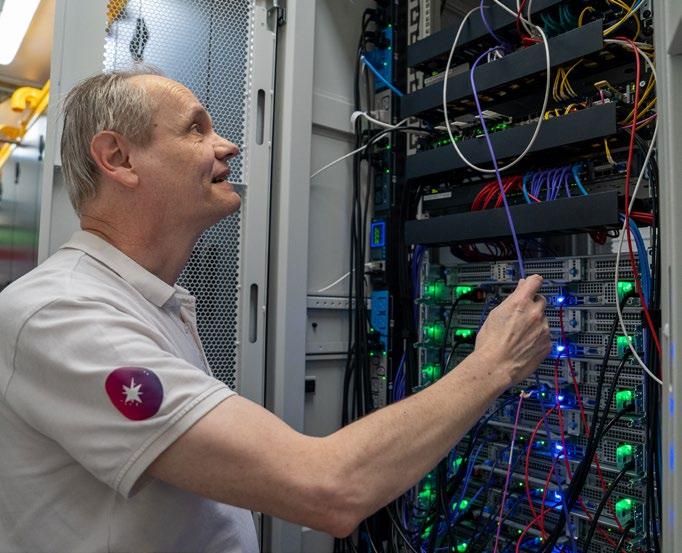
On its surface, SKA-Low looks deceptively simple. But what lies beneath is a vast network of optical fibre, like the nerves of a body. They converge at the 1,500m² central processing facility Ngurra-Maga, or “home of the head” in Wajarri language, a highly specialised facility purpose-designed and built to house 140 19-inch racks of custom high-performance computing equipment.
The journey begins when faint radio waves emitted by objects in the Universe reach the SKA-Low telescope, where they are captured by the antennas. The radio waves induce voltages in the antennas. Using digital, software-enabled circuitry, these voltages are digitised and then these signals are transported through networks of underground optical fibre to Ngurra-Maga, where they face a complex barrage of processing technology which sees them cleaned and digitised.
But to ensure this journey can begin, and the SKA-Low telescope receives those faint radio waves unimpeded, radio “quietness” is needed. One of the biggest threats to astronomy signals is human-made interference, also known as radio frequency interference (RFI). This is why both the SKA-Low and SKA-Mid telescopes are being built in remote locations far from mobile phones, vehicles and
televisions. You might already be seeing a problem. All our equipment – the electronics, network equipment, even air conditioning and plumbing – generates a large amount of RFI. So, to protect the SKA-Low telescope, as well as the nearby radio telescopes ASKAP, the Murchison Widefield Array (MWA) and EDGES, from our own noise, this equipment needs to be shielded. When designing this facility, we drew on the experience gained from the development of CSIRO’s smaller Precursors Control Building that supports these other nearby telescopes.
This noise can be contained in a Faraday cage, a completely sealed conductive metal “skin”, which electromagnetic radiation cannot pass through. The whole processing facility is a Faraday cage, keeping the RFI from our noisy equipment contained inside. Additionally, because of the levels of RFI generated by the high-performance computing equipment, the processor room is independently shielded. The equipment here is in a shielded room, within a shielded building. Each of these layers is providing 80dB of shielding, reducing the power that can be transmitted through the shield by a factor of one ten-millionth. In other words, any RFI generated within the processor room would have been reduced by a factor of 100 trillion by the time it got outside.
But this facility cannot exist in isolation. We need to get several things through that continuous metal skin. For instance, the 140 racks of equipment require a lot of electricity (about 1.2 MW). This energy then needs to be removed from the building through large, chilled water heat exchanges. So, we’re looking at constantly moving people, air, water, electricity and fibre optic signals in and
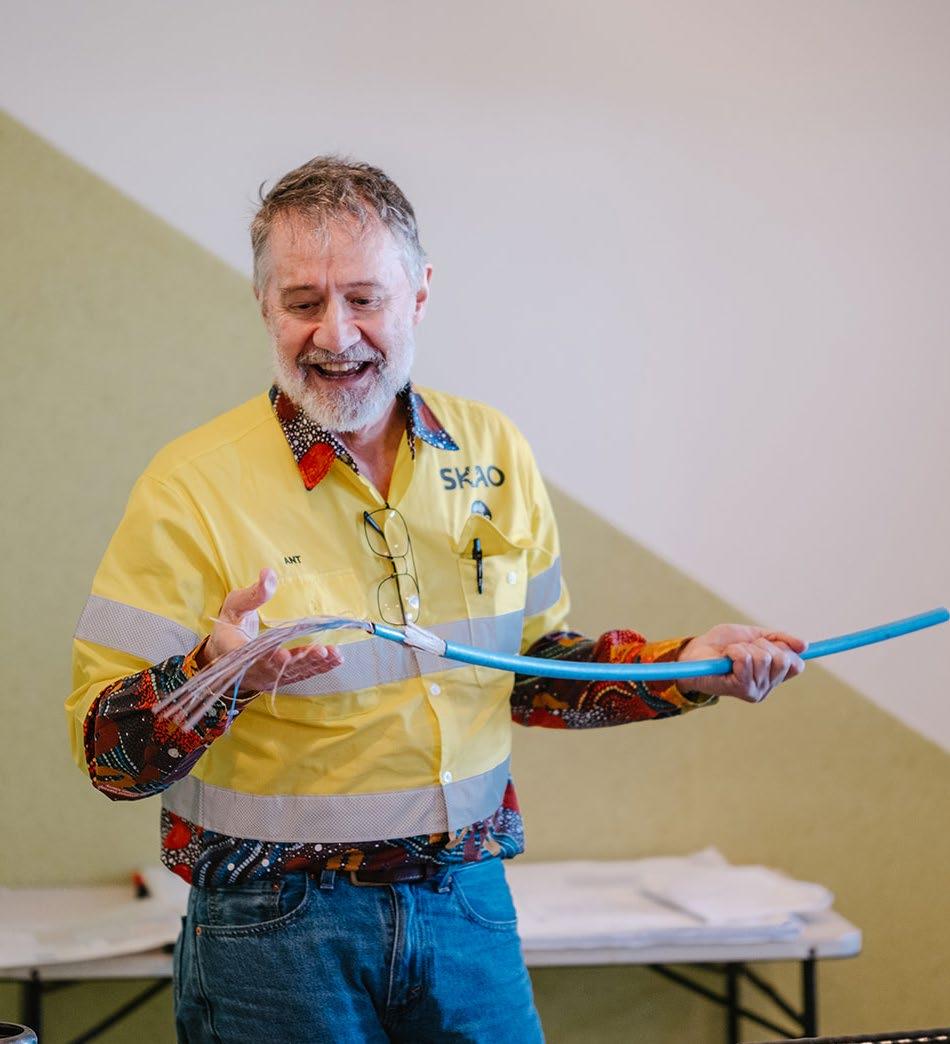
SKA-Low Site Construction Director Ant Schinckel showing optical fibre. In total, 86,000 individual optical fibres enter the central processing facility.
out of the facility. So how do you do it without RFI leaking out?
People and electricity are easy. Using an RFI lock, which is like an airlock in a submarine, people can enter the facility using a two-door system. They will open one RFI-shielded door, step into a holding bay, close the first shielded door behind them and then open the second shielded door to enter the facility. Meanwhile we utilise bit filters to remove any noise from power cables to allow electricity to pass in and out unrestricted.
For water, air and fibre optics, we apply laws of physics. The facility utilises the principle “waveguide beyond cutoff”. If a tube is thin enough, it will only allow electromagnetic radiation of a certain frequency to be transmitted through it. A small metal tube in a hole in Ngurra-Maga’s metal skin will only allow frequencies above a particular cutoff to transmit through the tube. Using this principle we simply choose the length and diameter of the tube to ensure only certain frequencies (that aren’t within the observational ranges of any of the telescopes on site) leak out. This technique is then applied to air, water, and fibre optics which can all pass through such tubes. For larger areas that are needed for air, the filter ends up looking like a thick piece of honeycomb.
By significantly reducing the power of the signals leaking out, the facility gives us access to integral software and computing on site, while also giving the SKA-Low antennas the best opportunity to detect faint signals that have travelled enormous distances across our Universe, in some cases billions of light years.
The facility uses the principle “waveguide beyond cutoff”. These small metal tubes in Ngurra-Maga’s metal skin only allow frequencies above a particular cutoff to transmit through.
SKA-Mid construction highlights
BY TRACY CHEETHAM (SKAO)
The commitment to build a sustainable observatory is embedded in activities at the SKA-Mid site, with sustainable power a primary focus in recent months.
Renewable power
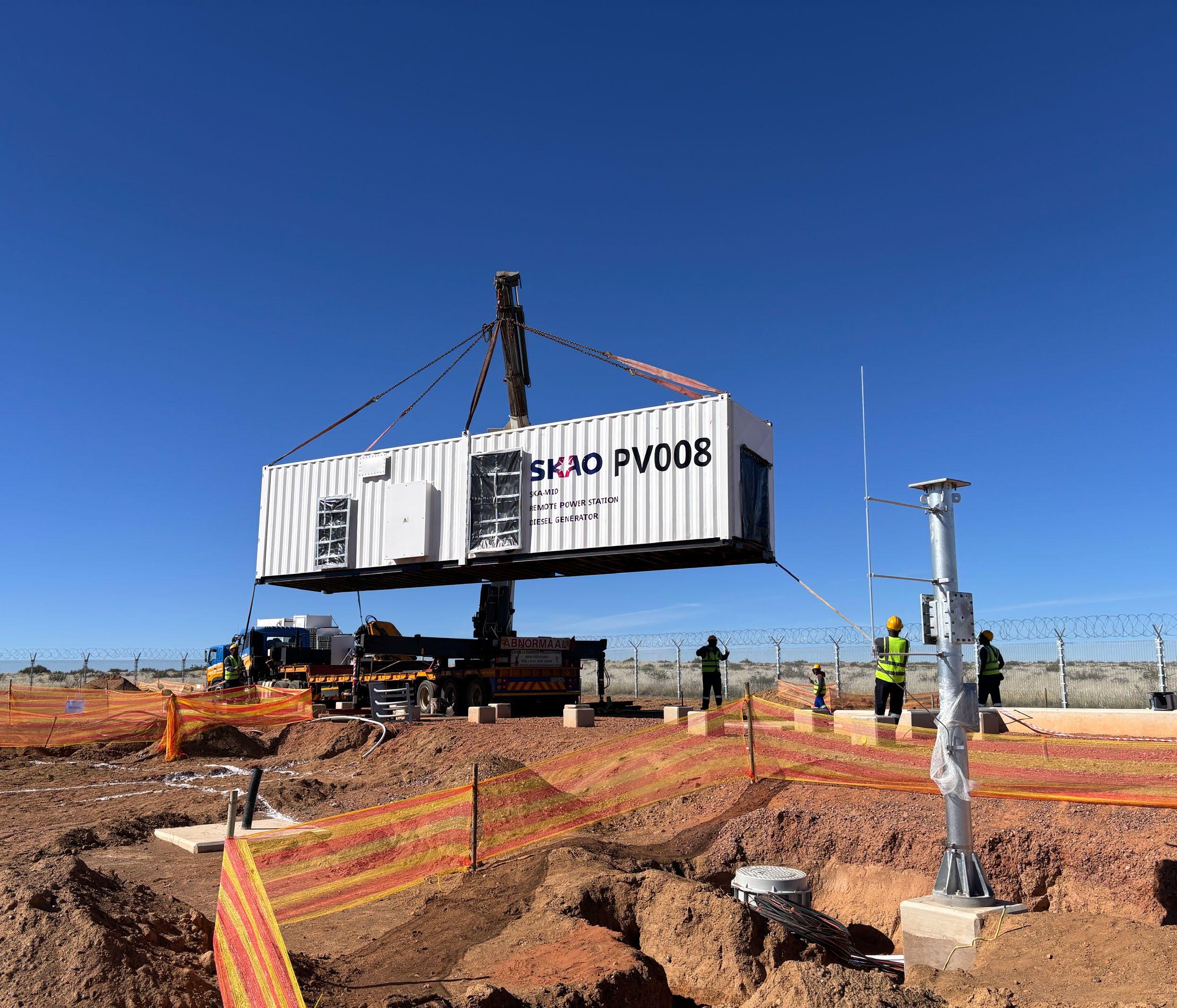
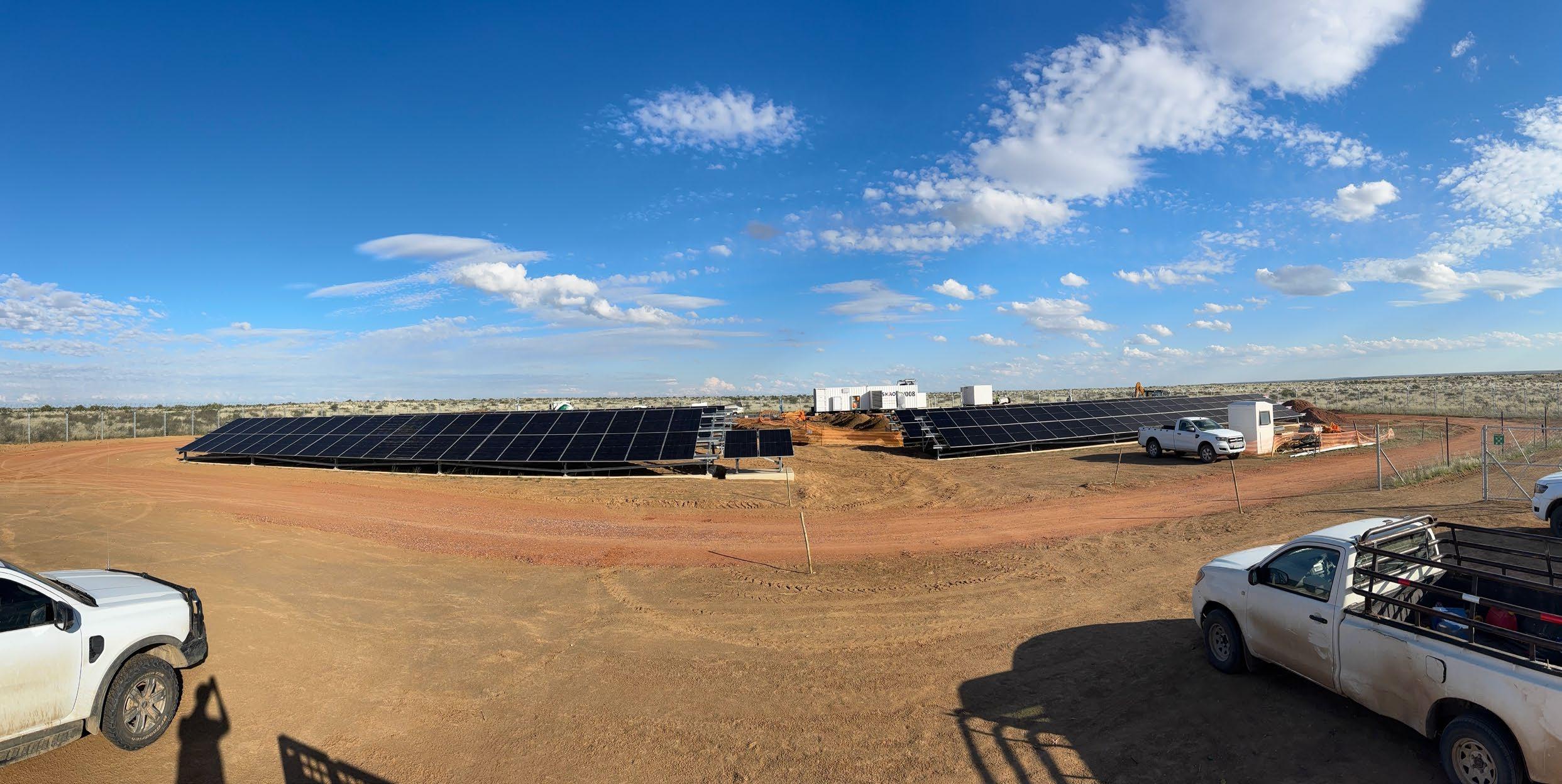
In May, the initial hardware for our first remote solar power station was installed for testing at the future location of the furthest dish on the telescope’s north-west spiral arm, closest to the town of Brandvlei. This was a huge moment for everyone working to make the SKA-Mid telescope as sustainable as possible.
SKA-Mid will be powered by a hybrid power solution. For dishes on the distant parts of the spiral arms – this one is around a two-hour drive from the core of SKA-Mid –running power cables is both expensive and impractical. That makes individual remote solar power stations an excellent choice, but the challenge is to develop one that is radio quiet and won’t interfere with the dishes’ sensitive observations.
This prototype comprises a 120 KW photovoltaic array, and a shielded container holding the power conversion and battery storage system, plus a backup generator.
The container is specially designed to stop any electromagnetic leakage and has been extensively tested off-site. Now technicians will assess the shielding in on-site conditions.
This is a smaller version of a full remote power station, and once it has been validated, the hardware will be converted and repurposed for the full-scale version. We envisage 21 of SKA-Mid’s dishes being powered by these systems (the outer seven dishes on each of the three spiral arms), while the others, closer to the core, will be powered by the Central Power Station, a photovoltaic array paired with a battery-based energy storage system.
The best way to reduce our carbon footprint is to use less power in the first place, so alongside this work on renewable energy solutions, a substantial effort has been made to reduce the dishes’ power requirements, an important component in reducing our carbon footprint across the Observatory.
The prototype photovoltaic array (below) sits alongside a shielded container which includes battery storage and a backup generator (below left).
Parade of dishes on the way to site
Elsewhere on the construction front progress is truly ramping up now. In July we celebrated our 15th “big lift” of a dish on site, and a constant stream of dishes are making their way from the manufacturing site at CETC54 in China to South Africa, with a production rate of two per month. Eight dishes began the 17,000km journey during May and June, and more are already being prepared for shipment. This rate of delivery means that by the end of the year we expect more than 40 dishes to be either on site already (either assembled or awaiting assembly), or on their way.
Verification and commissioning activities continue on site, and there was an important milestone in May with confirmation that four dishes are now working together as an interferometer. This followed closely on the heels of a milestone announced in January, when two dishes were used together for the first time. The measurements from their observations show all the systems are operating as designed, which gives our scientists confidence as they move towards making the first test images of the sky, which we expect to be possible later this year.
The dish structures are being tested in a phased way, with different elements – structural steel, surface panels and so on – assessed and approved before installation, to reduce risk. When everything is assembled, we then assess the structure as a whole to measure factors such as pointing accuracy and stiffness in on-site conditions. These tests began in mid-June, signifying that the team are confident that the performance and bug testing work done in recent months has been effective. Our requirements are extremely stringent so it’s great to be at this advanced stage now.
May also saw the first pre-production unit of a Band 1 receiver, produced by AAC Omnisys in Sweden, installed on a dish. While factory testing is done prior to shipment, on-site testing checks that the feed is integrating well with systems such as the sub-reflector, which is responsible for focusing signals into the receiver. Band 1 will detect the lowest frequencies covered by SKA-Mid, taking over from SKA-Low at 350 MHz, enabling studies of extragalactic, redshifted neutral hydrogen.
Rain and resilience
Despite some extreme weather events which have brought a lot of rain and flooding to the area, most of the infrastructure work is nearing completion on site, including roads, antenna foundations, power and fibre cabling and site and weather monitoring equipment for the full array of 133 dishes. Adapting to the changing climate and repairing infrastructure following particularly bad storms will be an ongoing task for our teams, and they’ve shown great resilience despite the conditions in recent months. Our priority will continue to be the safety of our staff and contractors working on and around the site.
Our joint SKAO-SARAO teams will soon be moving into our new Engineering Operations Centre 85km from site at Klerefontein, which was delivered by SARAO as part of South Africa’s Host Country Deliverables. This is a long-term home base for our site operations and maintenance teams. Sustainability is embedded in this building too, incorporating energy-efficient HVAC and electrical systems, a Building Management System (BMS) for intelligent lighting control, LED lighting with motion sensors, and features such as operable windows, natural ventilation and open-plan spaces that maximise daylight. Together, these features reduce energy consumption and support the organisation’s sustainability objectives.
SKA-Mid’s ‘heartbeat’ arrives on
site
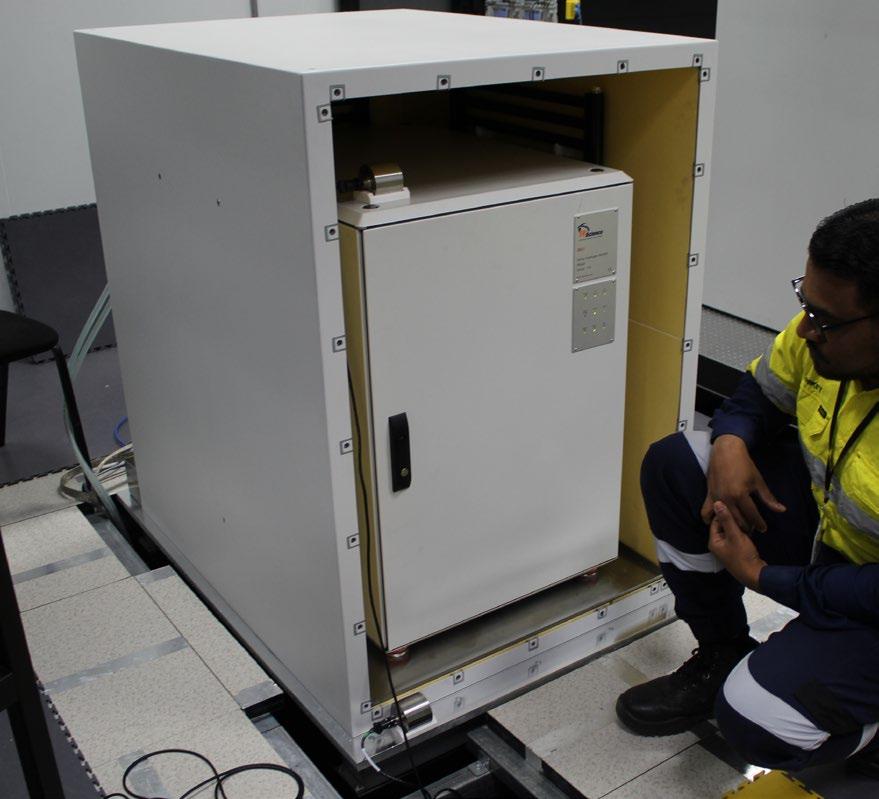
One of the most complex installation activities to date was the installation of a new hydrogen maser clock, the component providing the heartbeat of the telescope. The new maser joins two others that already provide accurate timekeeping for the MeerKAT telescope.
Hydrogen masers send out highly precise timing signals – with better than nanosecond precision – which the telescope needs to correlate observations correctly and achieve its demanding scientific objectives.
The installation required a global team effort; the SKAO team was joined by specialists from the Spanish company Safran that built the maser, the UK’s GMV which is delivering the SKAO’s timescale and German HWL Scientific Instruments that produced the new active vibration isolation platform on which it was installed. The SARAO team also provided expert knowledge based on their extensive operational experience with the MeerKAT masers.
The new SKAO maser is functioning well in its new home, a dedicated SARAO facility where environmental conditions are closely monitored to ensure long-term performance and stability. By the end of the year, the team on site hopes to have the maser up and running as a key component of the Observatory’s synchronisation and timing system.
The new SKAO hydrogen maser joins two others that are already providing accurate time signals for the MeerKAT telescope. The SKAO maser sits on a built-in active vibration isolation platform.
Honouring Nelson Mandela’s legacy with community action
BY CASSANDRA CAVALLARO, KHOMOTSO MOKORI (SKAO) AND NOMFUNDO MAKHUBO (SARAO)
Sustainability commitments are not limited to the construction activities at the SKA telescope sites; they permeate every aspect of our teams’ work. On 18 July, South Africa marked Mandela Day, an annual nationwide event to honour Nelson Mandela’s life and legacy by encouraging people to make positive contributions to their community.
During his 90th birthday celebrations in 2008, Mandela made a call to action: “It is in your hands to make our world a better one for all, especially the poor, vulnerable and marginalised.”
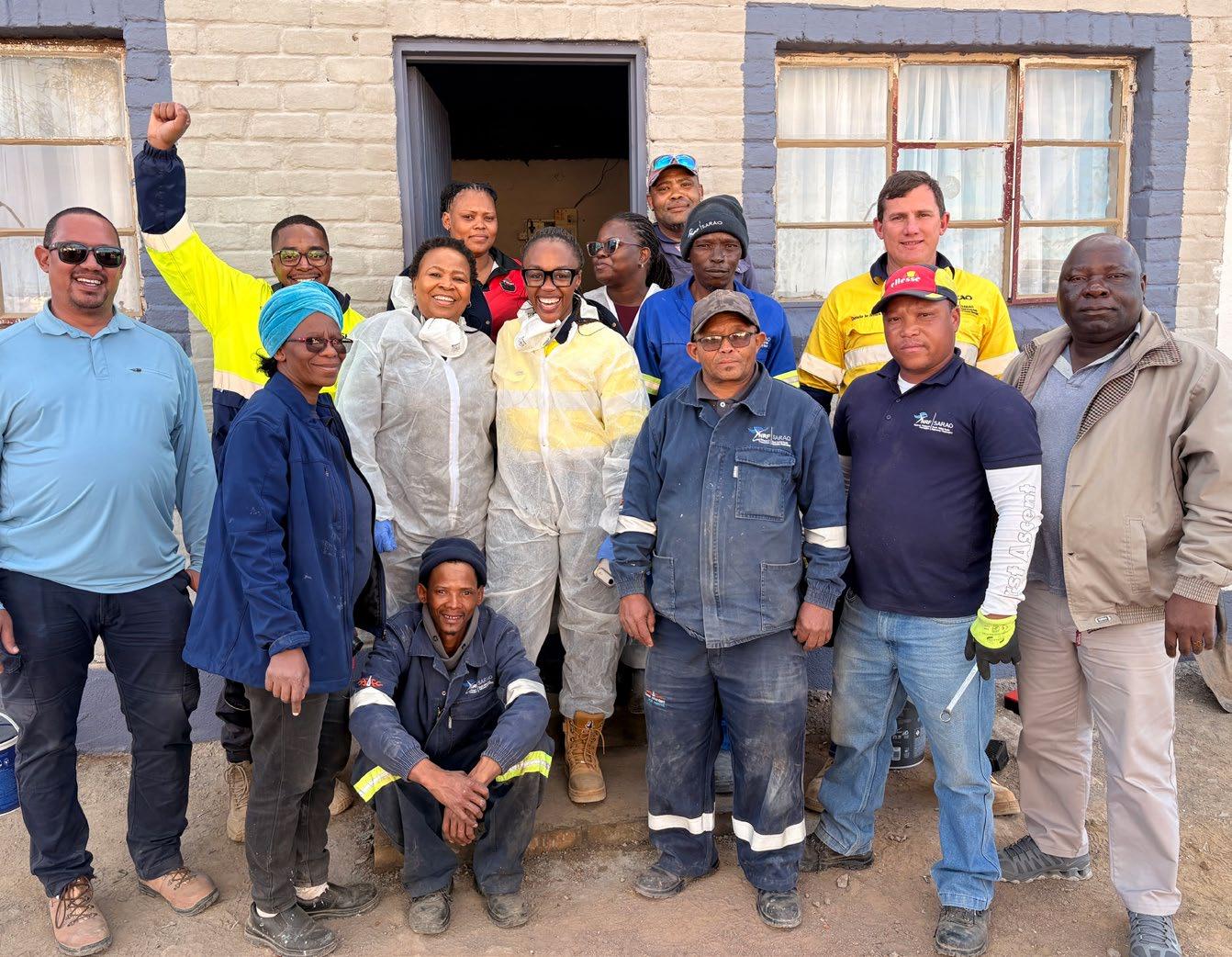
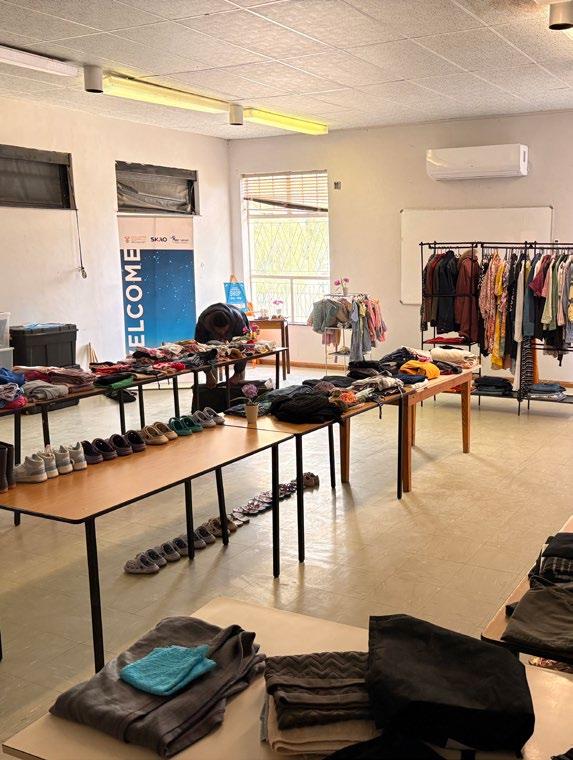
It was in that spirit that a team of SKAO and SARAO staff joined forces with local organisations* and the nongovernmental organisation The Chosen Foundation to organise two initiatives in Carnarvon, the closest town to the SKA-Mid and MeerKAT telescope site: a pop-up free clothing shop, and a major renovation of a local home to improve the living conditions of the family living there.
“As an observatory we are committed to improving social equity, and that’s shared by our partner SARAO, which has been working in these communities for many years, so Mandela Day is an ideal moment to come together and make a tangible difference,” said SKA-Mid Communications Specialist Khomotso Mokori, who co-led the initiatives alongside SARAO Stakeholder Relations Manager Nomfundo Makhubo.
Mandela Day clothing drive
The Stakeholder Relations and Outreach teams had identified a need for donations of clothing, footwear, bedding and kitchen items for local people, so a call went out to staff spread across South Africa: teams based in the area, colleagues in Cape Town, and those at SARAO’s Hartebeesthoek Radio Astronomy Observatory near Johannesburg.
The staff mobilised. Dozens of items were collected and sorted, boxes were packed, and the donations were transported hundreds of kilometres to Carnarvon in the Northern Cape.
There the teams filled the tables of a pop-up store, named Shop for Free, which opened on Mandela Day. Local people were welcomed in, offered refreshments of soup, bread and vetkoek – a traditional fried bread –and encouraged to take up to two items that fit them. More than 95 children and 30 adults came to the store.
A safe home
The work took around a week, and the home was ready to be handed back to the family in time for Mandela Day.
At the same time, the team was finalising the second of the initiatives – renovating a local family home that had fallen into disrepair.
“This family has an elderly blind grandmother who lives with her seven grandchildren, and the conditions in their home were really heartbreaking. The house was falling apart in places,” Mokori said.
“The Chosen Ones Foundation put out a call to companies and organisations to rally around and see how we could all work together to clean up the house for the family,” Makhubo added.
“When the SARAO and SKAO team inspected the home, they identified other areas that needed serious attention and rallied more support from the site-based team in the form of skills, building materials, unused furniture and other construction materials. Partner contractors like WBHO also contributed paint and other materials. It was a case of all hands on deck to make sure we gave this family a dignified home.”
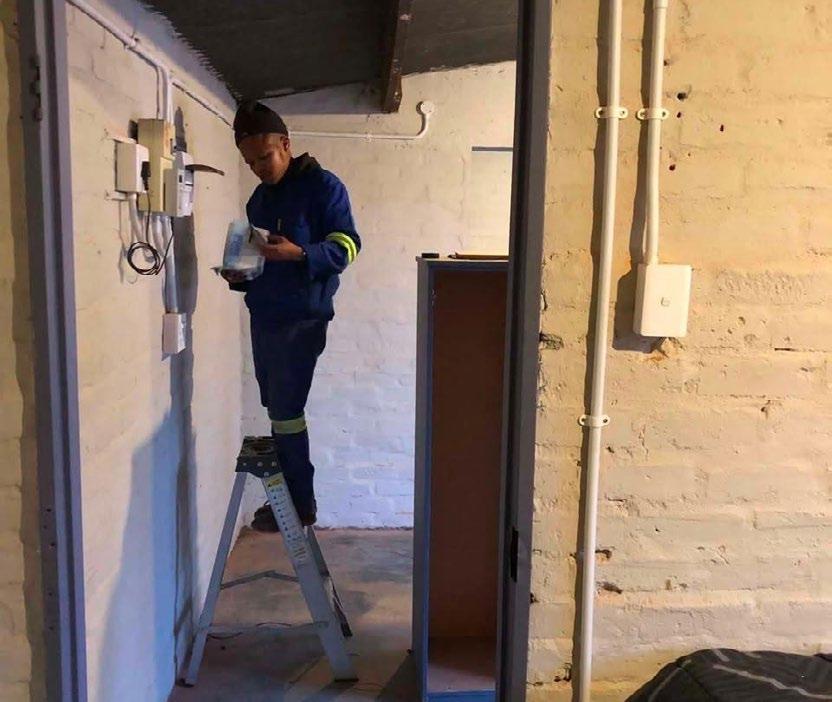
That meant upgrading the electrics, which in places had live wires hanging loose, by installing a new, safe electrical distribution board, proper electrical tubing, and lighting inside and out; the home had previously only had a light in one room.
New beds – seven in total, including three sets of bunks – were welded at the Engineering Operations Centre in Klerefontein (which serves the SKA-Mid and MeerKAT telescopes) using recycled steel from the construction activities on site. They were installed in the house complete with space-themed bedding.
New storage cupboards and kitchen cabinets were also fitted, along with fresh curtains.
“All this was made possible by the remarkable team of people working with SARAO and the SKAO under the leadership of Dawie le Roux, Khulekani Keswa and Mashakanya Mashiloane. They all worked tirelessly to make sure that this family gets a dignified home,” said Makhubo.
“We have been in Carnarvon for years, so this is our community too. Many of the staff members who contributed their skills and time came through initiatives driven by the SARAO Human Capacity Development Programme in local communities through the years. It is amazing to see what a big impact such investments have had, not only on the construction of the MeerKAT and SKA-Mid telescopes, but in the lives of everyday people in our communities.”
To mark last year’s Mandela Day, the SARAO and SKAO team worked together with partner contractors in another local town, replacing an unsafe building at an early childhood development centre in Williston. A new building and terrace were installed, and the exterior has since been decorated with a mural by a local artist.
*These initiatives were supported by Kareeberg Municipality, the Northern Cape Social Development Department, the Chosen Foundation, and the South African Police Service. We thank them for their collaboration.
Images above:
1: The team made sure electrics in the family home were upgraded to a safe standard.
2: Some of the team members who contributed to the Mandela Day initiatives.
3: The free pop-up shop.
Key hardware passes production milestones
BY CASSANDRA CAVALLARO (SKAO)
As construction continues at the SKAO sites in Australia and South Africa, global industrial partners continue to develop major components for each telescope. Two key pieces of hardware recently reached a milestone in the production process – passing factory acceptance testing, which ensures the SKAO’s stringent requirements are met before hardware is shipped to the telescope host countries.
French-made science data processor heading to Australia
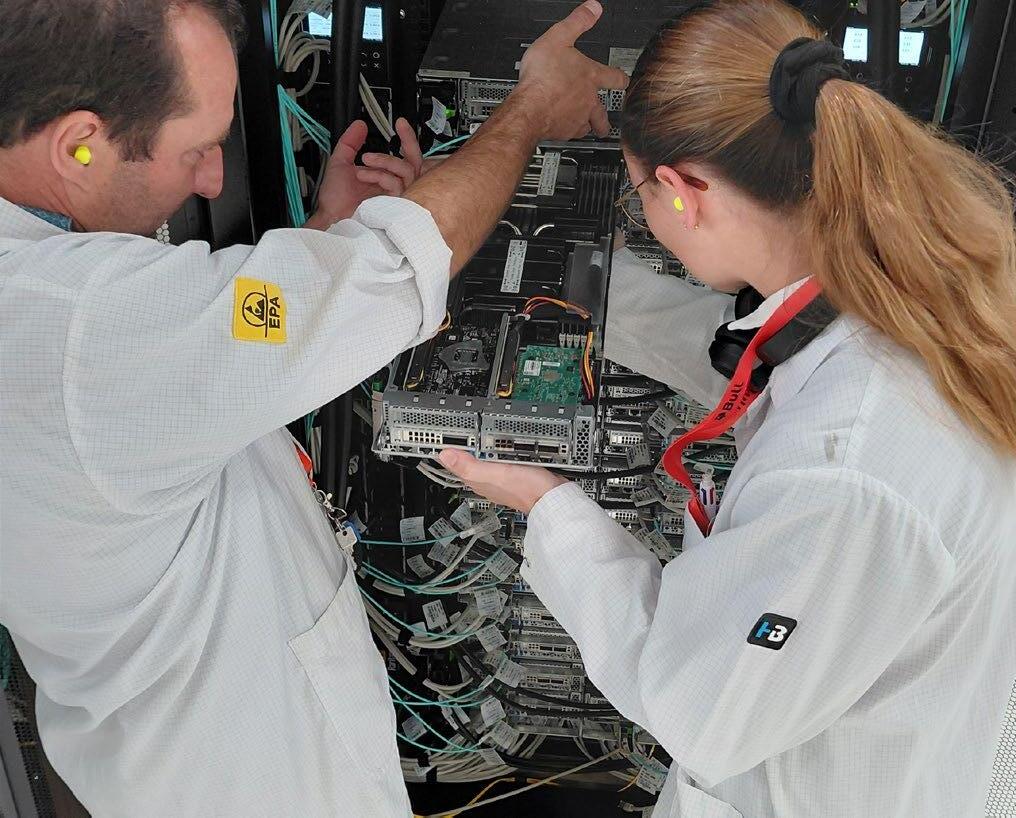
The science data processor (SDP) is the computing brain of the telescopes, processing and reducing huge volumes of astronomical data in order to make images of the sky. SDP hardware for both telescopes is being manufactured in France, and an early version of the system for SKA-Low has now made its way to Australia.
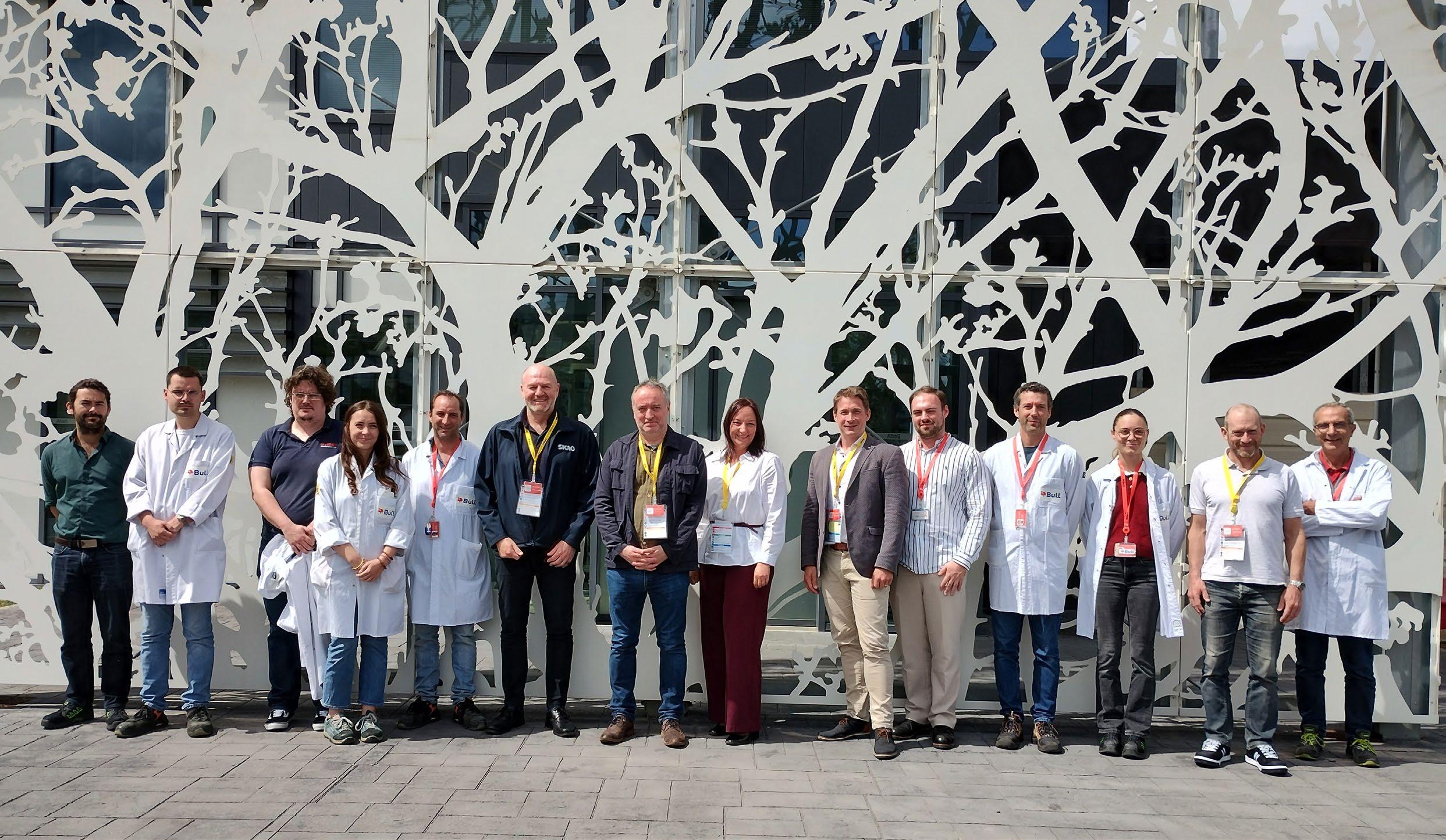
SKAO Project Manager Jeremy Main and Computing Infrastructure Lead Miles Deegan travelled to the Bull factory in Angers, western France, to inspect the first “scalable unit”, which has been fully assembled in the factory for testing.
To a casual observer this looks like a row of computing racks and copious amounts of cabling. These racks house 124 servers, as well as networking and data storage
The SKA-Low science data processor will travel from France to Perth, Australia. Credit: SKAO
The Bull team with SKAO representatives Jeremy Main and Miles Deegan (centre, both in navy). Credit: Bull
hardware, which together forms a high-performance computing cluster which is highly flexible and extensible. This was a key SKAO requirement, as it will allow the architecture to scale incrementally as the telescope arrays grow in size.
The first set of units being manufactured will support early science operations up to the milestone known as Array Assembly 2 (AA2, comprising 68 SKA-Low stations and 66 SKA-Mid dishes), and additional units can then be added as required as construction continues.
The factory tests were passed in June, with the hardware then dismantled and packed for transport to Perth,
SKA-Mid sub-reflectors go into production
By EOSOL and COMPOXI
In May, the first Spanish-made sub-reflector for SKAMid in South Africa passed factory acceptance testing, validating both the product itself and the associated production process. This means the team can now transition to full-scale production.
Spanish engineering services company EOSOL is partnering with COMPOXI, which specialises in the design and production of composite materials, to produce 45 sub-reflectors for SKA-Mid.
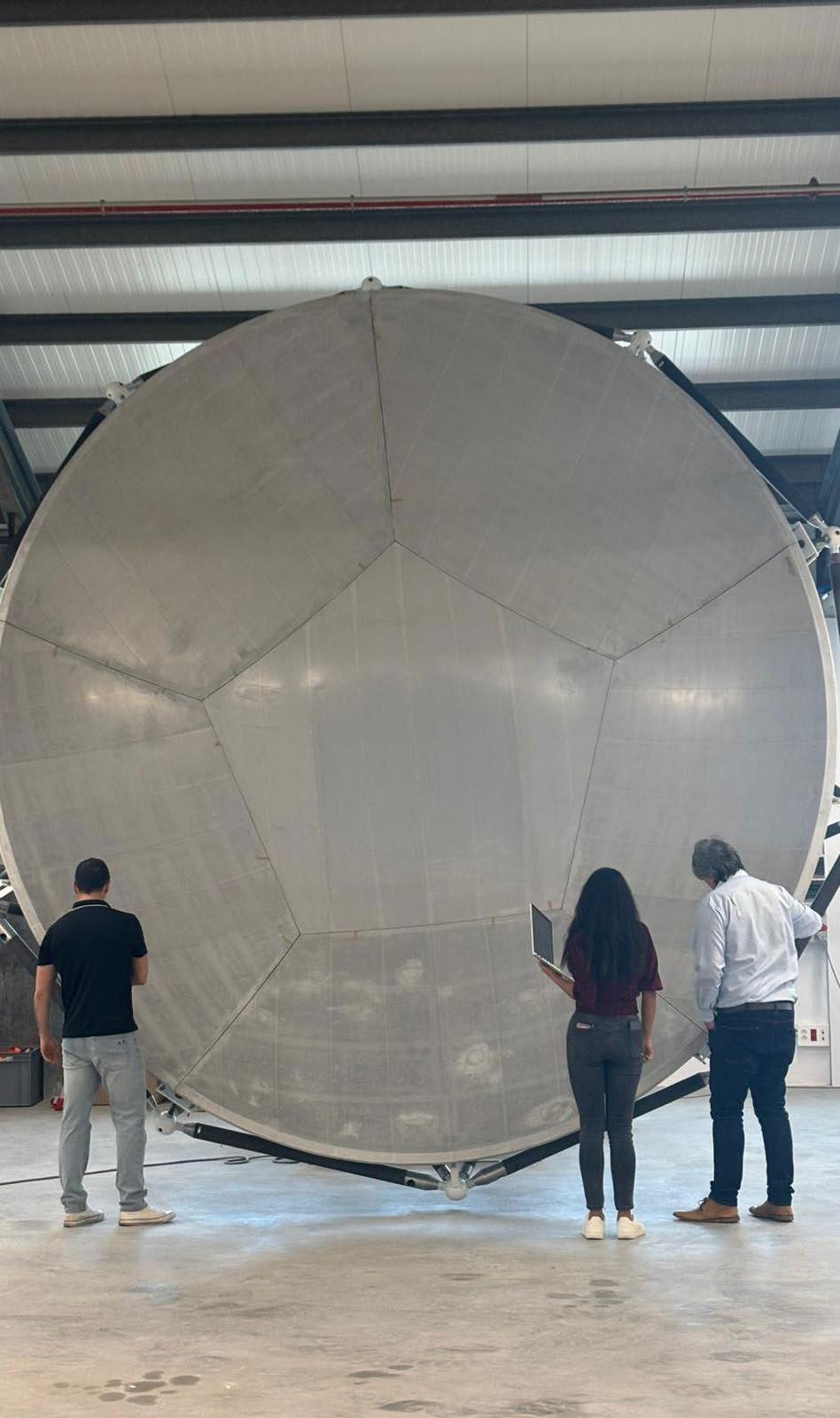
The sub-reflector is a critical component of the antenna, focusing the signals collected by the main reflector into the receivers. The sub-reflector is a 4.5-metre structure made of composite material and metallised to achieve the electromagnetic and mechanical properties required.
The collaboration, with support from the National Research Council of Canada, has resulted in a robust and mechanically stable product improving on the initial specifications, with an overall surface accuracy of better than 0.2mm, and high reflectivity (above 99.9%), designed to operate for the telescope’s projected 50year lifespan in the sometimes harsh environment of the Karoo region in South Africa.
Full-scale production will now begin at COMPOXI’s new facilities in Girona, a state-of-the-art, 3,000m² factory equipped with two cleanrooms, a large autoclave, a paint booth and a metrology laboratory.
where it will be installed and tested again at the Pawsey Supercomputing Research Centre
“The introduction of this first scalable unit will be a major step towards reaching the AA2 phase for the Observatory,” says Jeremy Main.
“This system will provide the very first SKAO data to the science community before allowing us to scale our compute and data pipelines as demand grows and to extract insights faster. Having this scalable unit in place allows us to test and learn how our software works and to adapt it accordingly on our journey to AA2 and beyond.”
The Spanish-made sub-reflectors measure 4.5m in diameter. Credit: EOSOL and COMPOXI
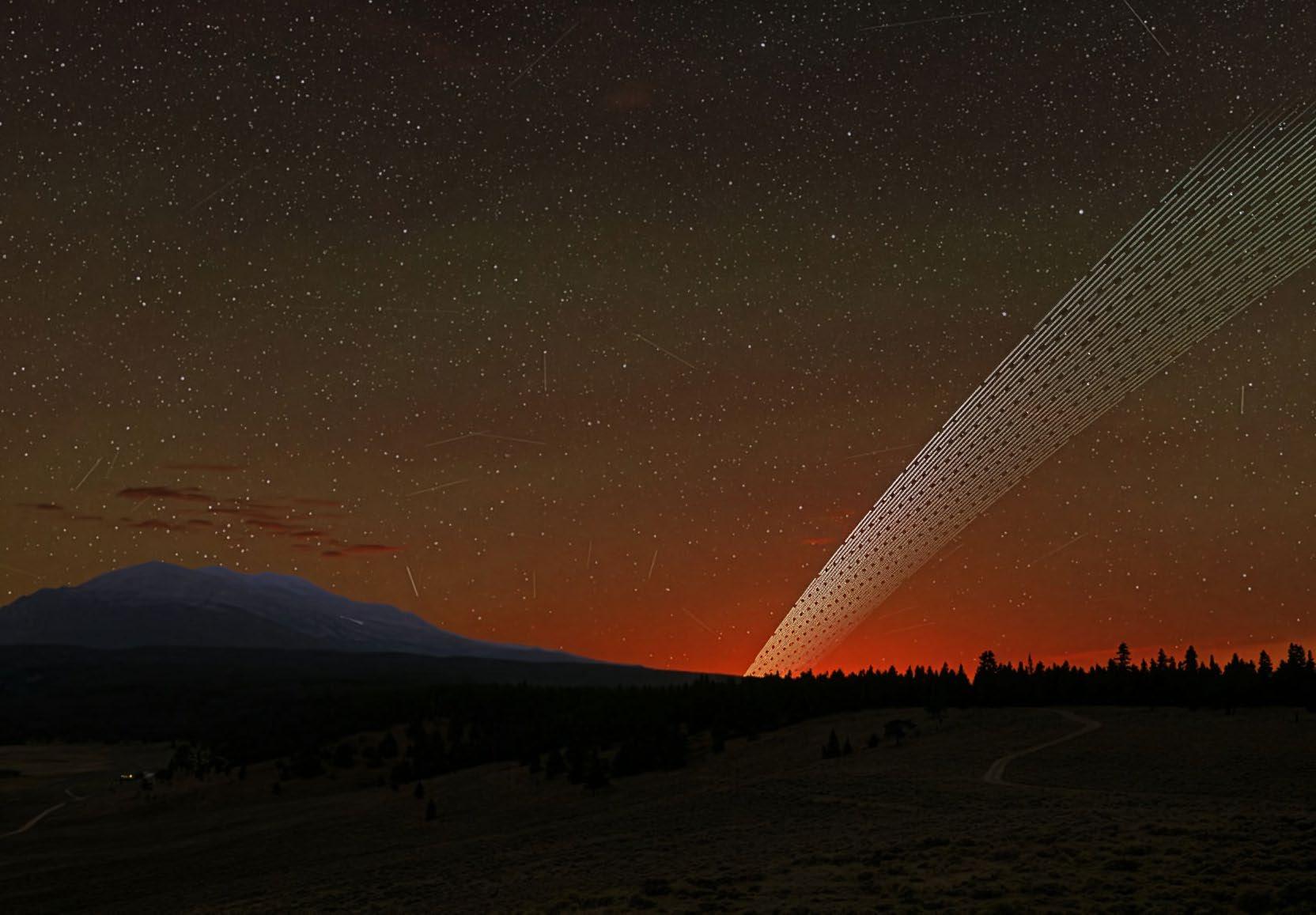
Observing trails
BY MATHIEU ISIDRO (SKAO)
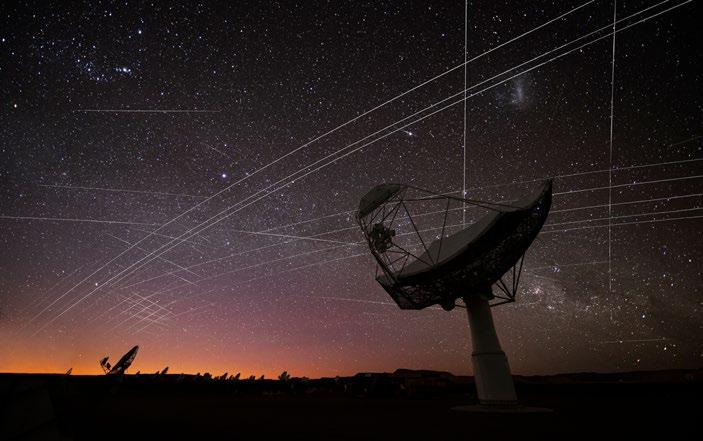
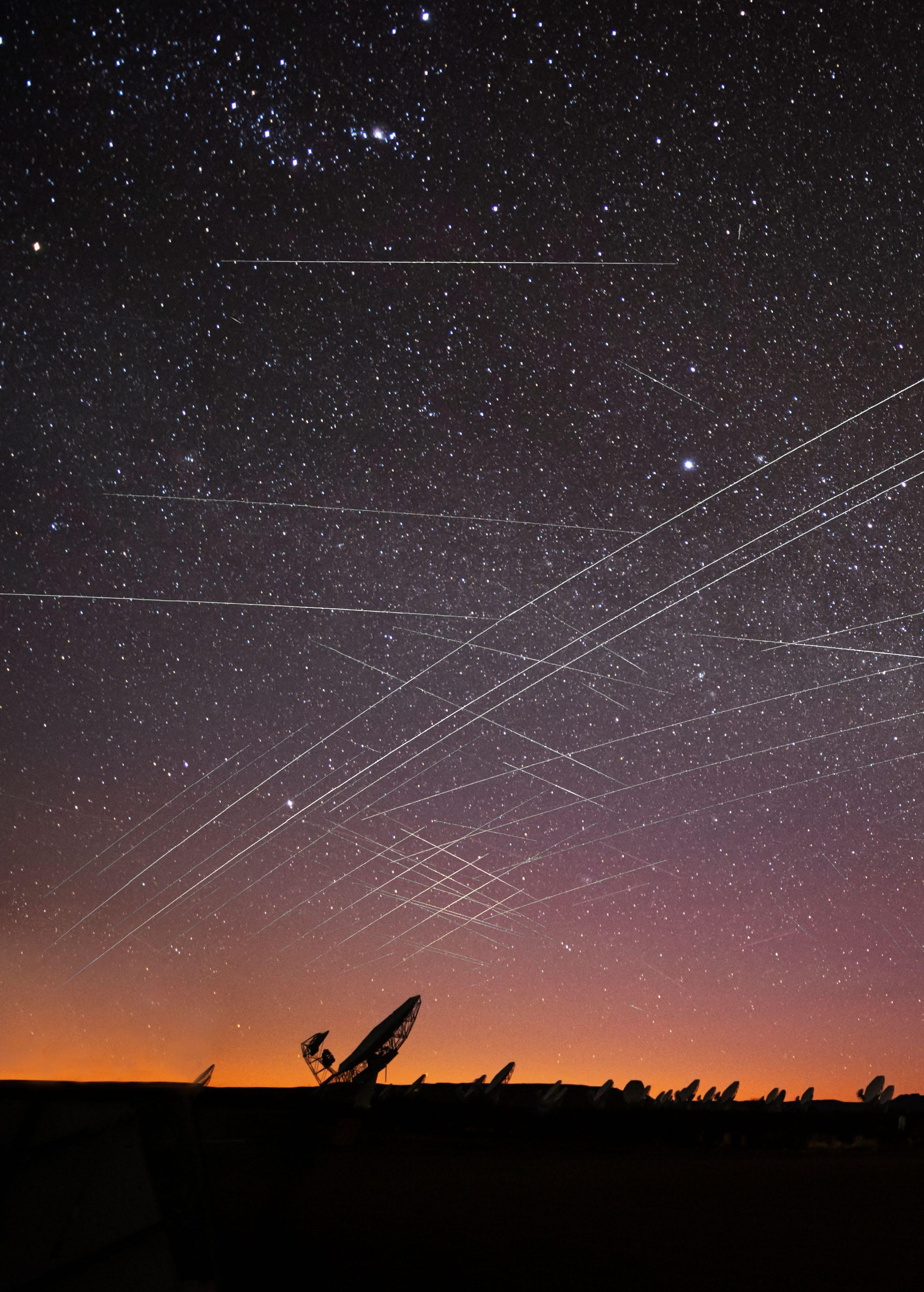
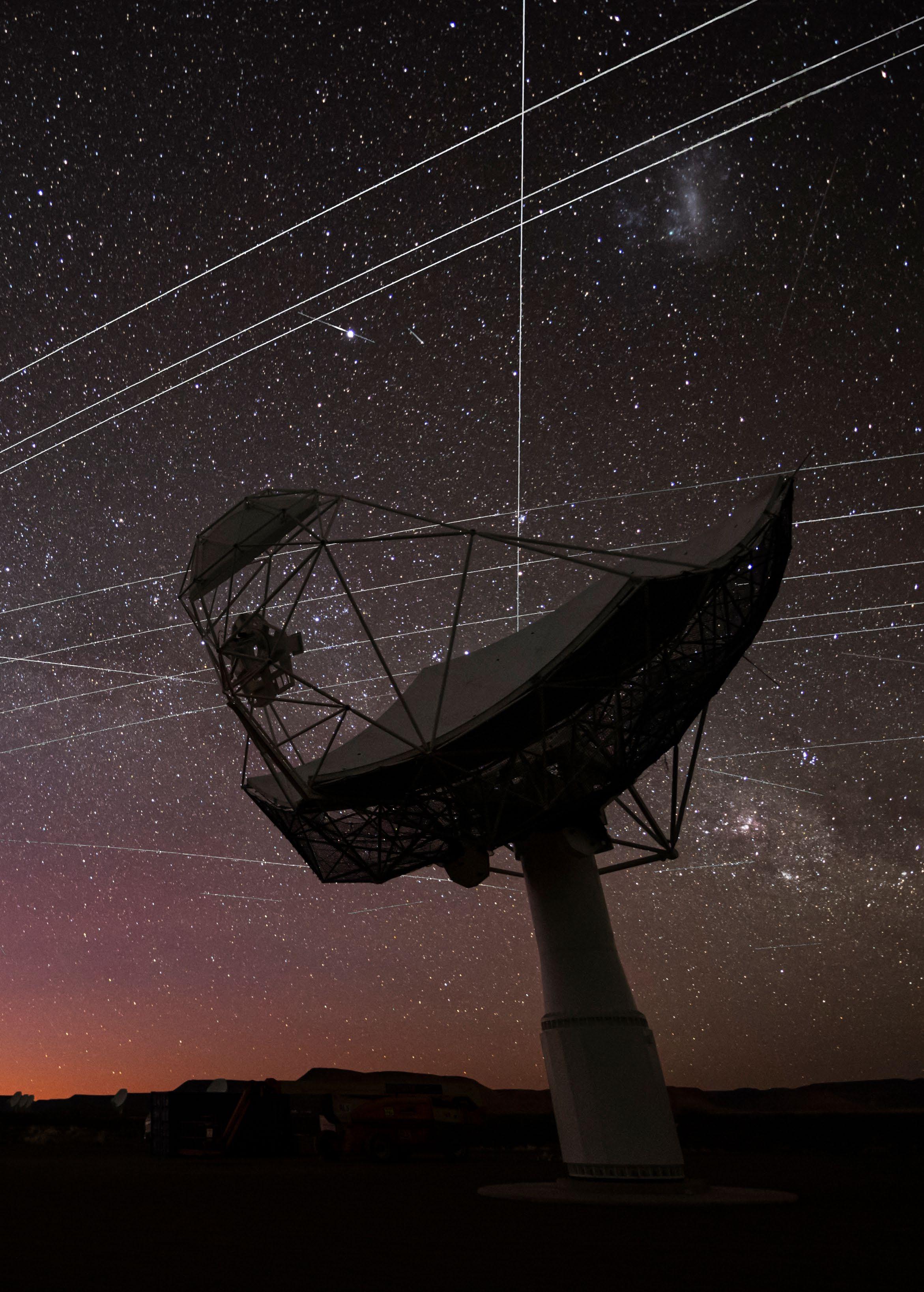
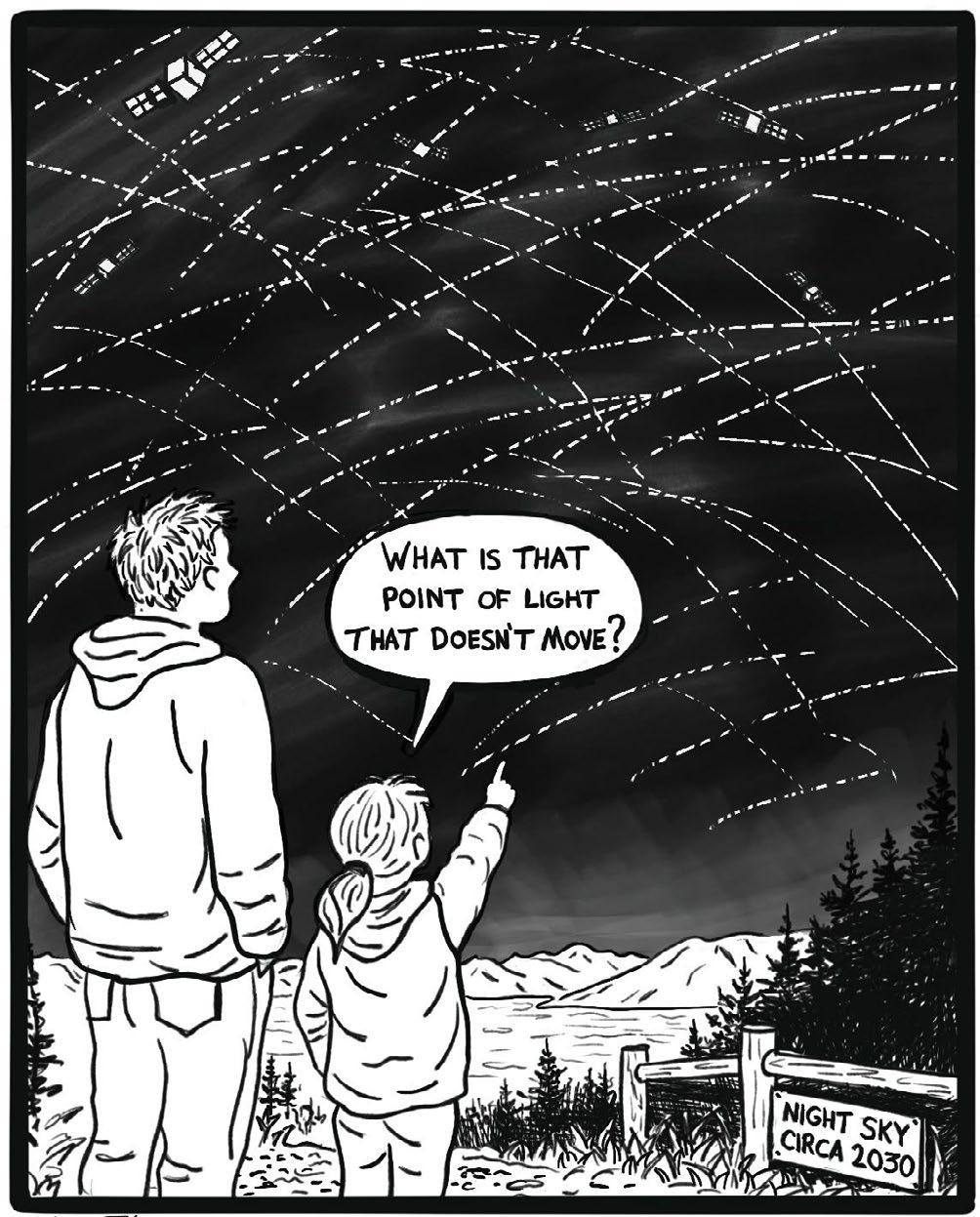
The fast-growing number of satellites in orbit represents an issue for observatories around the world, no matter their location. This composite image, published as part of Max Alexander’s updated Our Fragile Space exhibition (see page 38), captures that challenge, as the SKAO continues to work with international partners to address the impact of satellites on astronomy.
The first of over 100 SKA-Mid dishes gazes into a sky criss-crossed by satellite trails. The scene was recorded in August 2024 over a 10-minute period at dawn, combining 29 individual 20-second exposures stacked into a single frame of the background. Those 10 minutes capture the steady passage of multiple satellites overhead, their tracks accumulating across the frame – a striking reminder of how crowded the Earth’s orbital environment has become.
Although major observatories like the SKAO are built far from cities and most sources of light and radio interference, they cannot avoid the growing presence of satellites in low Earth orbit. While there are around 16,000 satellites in orbit today, experts believe this number could increase to around 100,000 within the next five years.
Credit: SKAO/Max Alexander/Ian Howarth. Photo taken at the South African Radio Astronomy Observatory (SARAO) site in the Northern Cape.
Let’s talk about high-energy cosmic particles
BY ANNE DANIELS (SKAO)
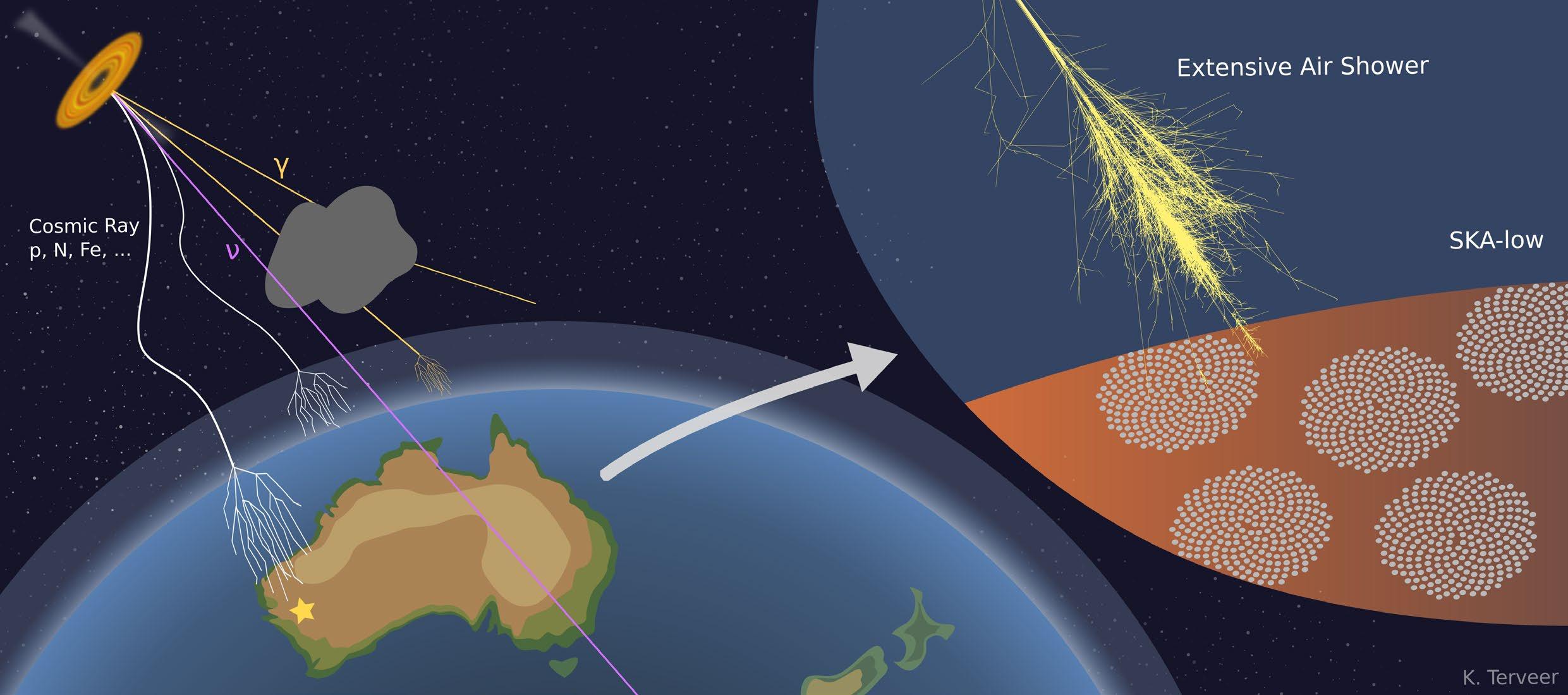
Accelerated by an energetic explosion, a cosmic ray travels speedily across the Milky Way, soaring towards a yellow star in one of its arms. Zooming past Pluto and the gaseous giants, the ray sets forth towards a blue planet where – suddenly – its course is interrupted by a powerful collision with an atmospheric particle. A cascade of collisions follows, triggering particle detectors on the ground below; that’s where the SKA-Low telescope in Australia enters the story.
At the intersection of astronomy and particle physics, we find a group of researchers who cannot wait for the SKA-Low telescope to start its observations. Prof. Katie Mulrey, co-lead of the SKAO’s Science Working Group on High-Energy Cosmic Particles, recently received a grant from the European Research Council to prepare her research with the SKA-Low telescope.
Where most radio astronomers look for faint signals from sometimes billions of light years away, Katie and her Science Working Group colleagues are searching for signals created just above the array when highenergy cosmic rays interact with air particles in Earth’s atmosphere.
“This kicks off a huge cascade of secondary particles, including electrons, muons, photons, hadrons, neutrinos; what we refer to as an ‘air shower’,” says Katie.
“Air showers consist of millions to billions of particles. The total number is related to the energy of the primary cosmic ray that started the whole process.”
These air showers hold the clues to discovering where the energetic particles are coming from and in what processes they were created. Cosmic rays originating from within our galaxy likely come from supernova remnants, but for some very energetic particles their origins remain unknown.
“At the very highest energies we know cosmic rays must be of extragalactic origin, just because there is nothing in our galaxy capable of producing such energetic particles,” says Katie.
At these energies it is not clear how these extremely energetic particles were created, but possible sources include active galactic nuclei – extremely bright centres of galaxies where supermassive black holes feed on gas and dust – or starburst galaxies, where stars are born at a rapid pace.
LOFAR leads the way
In preparation for SKA-Low, the cosmic ray team has been using data from the international LOFAR telescope, an SKA pathfinder telescope that has its core in the Netherlands.
“LOFAR provided critical information for our understanding of radio signals from air showers. The dense antenna array gave us the most detailed picture we had seen of the ‘radio footprint’ from air showers,” says Katie.
“It allowed us to fully understand the processes in air showers that produce radio emission. With these data, we learned how to develop techniques to reconstruct air showers and understand the cosmic rays that produced them.”
Besides scientific advancements, Katie explains that LOFAR has also been instrumental in understanding how to technically approach cosmic ray measurements at radio telescopes.
“We installed a particle detector on the LOFAR superterp [the inner core of the telescope] to detect air shower particles and provide a trigger for radio readout [extracting the data]. This experience is highly valuable, as we are preparing the same thing at SKA-Low now.”
Particle detectors as alarm clock
Prof. Tim Huege, who co-leads the Science Working Group with Katie, adds: “Each air shower emits a very short – few nanoseconds long – radio pulse.”
“The tricky bit is that we cannot store all the raw SKA-Low telescope data to search for such pulses after the fact, the data volume would be prohibitive.”
The SKA-Low core will comprise tens of thousands of antennas observing continuously, resulting in enormous data volumes. An effective way to tackle this data challenge is to only read out data from individual antennas when a cosmic ray detection is confirmed.
The journey of a cosmic ray from its energetic astrophysical source to Earth. Upon entering the atmosphere, it initiates an extensive particle “air shower” that generates a radio pulse detectable by the SKA-Low telescope. Credit: Karen Terveer
Building on experience with LOFAR, the researchers learned that installing particle detectors on the telescope site can be an effective way to know when an air shower is happening.
Tim is closely involved in the development of particle detectors at the Karlsruhe Institute of Technology, together with Katie’s group at Radboud University in Nijmegen and Prof. Stijn Butink’s group at the Free University in Brussels.
“We have decades of experience with particle detectors and we want to upcycle detectors from the KASCADEGrande experiment that ended in 2013. We are now adapting them with the key requirement that they should be absolutely radio quiet,” says Tim.
This means that the particle detectors are checked to ensure they do not emit any radio frequency interference that could disrupt SKA-Low’s observations.
The scientists will use these detectors to piggyback on other planned telescope observations. When an air shower occurs, the particle detectors will give the signal to read out individual antenna measurements.
“Once we have certified that our prototype is radio quiet, we will set it up on site because we need to gather some experience on how it behaves in the harsh environment of 50°C.”
The group hopes to install 120 particle detectors distributed between the stations in the SKA-Low core by the time the telescope starts observing. This number of particle detectors is needed to have an efficient trigger for air showers in the energy range of interest for the researchers. (Cont...)
“
At the very highest energies we know cosmic rays must be of extragalactic origin, just because there is nothing in our galaxy capable of producing such energetic particles. Prof. Katie Mulrey
Credit: Science Working Group on High-Energy Cosmic Particles
A new era of particle science with SKA-Low
Radio signals created during collisions in the air shower travel to the surface in a cone-shaped beam. The radio footprint refers to the area on the surface of this cone when it arrives on Earth.
The footprint’s size depends on the energy of the initial cosmic ray particle and its arrival direction – higher energies and inclined arrival directions result in larger footprints.
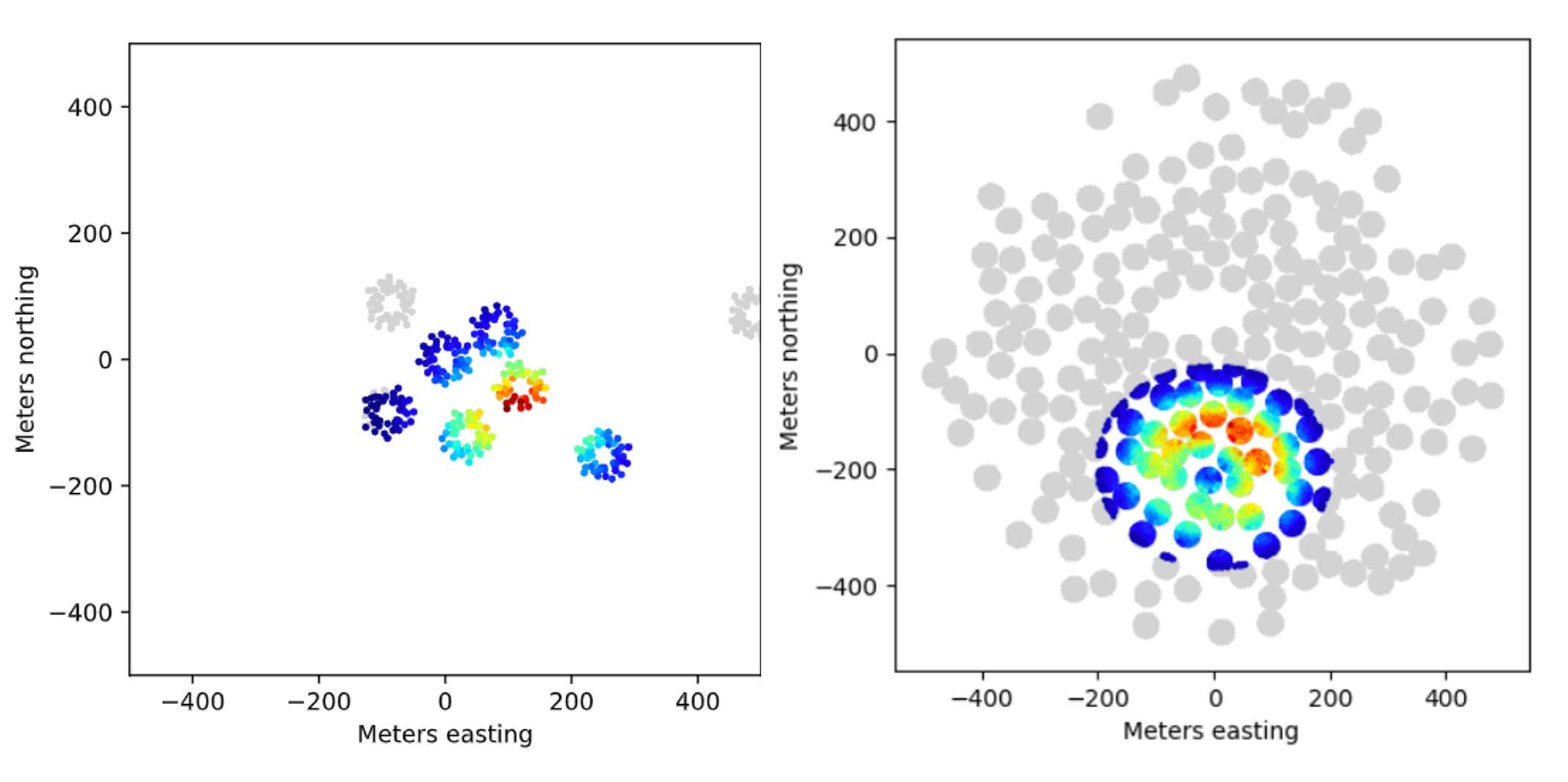
With antennas on the LOFAR superterp researchers study these radio footprints with hundreds of antennas. With the SKA-Low core, one air shower will be detected by tens of thousands of antennas simultaneously, a true revolution for the field.
The scientists will not only have many more data points, but SKA-Low antennas also measure a broader frequency band, sensitive to signals from 50 to 350 MHz.
“The radio signals from air showers are broadband and there’s a lot of information in the region from around 30 to 400 MHz, so this is perfect for SKA-Low antennas,” says Katie.
The group’s research goes beyond astronomy. Detections with the SKA-Low telescope will enable the group to study particle physics in extremely energetic conditions.
“There is still so much to learn about air showers themselves. For example, the hadronic processes that occur in high-energy air showers are not totally understood. SKA-Low measurements will be very valuable to better understand hadronic models.”
Hadrons are subatomic particles like neutrons and protons.
“Nowhere else can you study these particles at these energies. The SKA is one of our best options for figuring out what we don’t know because we’ll have so much more detail.”
The group is also exploring the possibility of using SKALow to do something that has never been done before: the first ever measurements of radio emission from the interaction of high-energy cosmic rays with the Moon.
“Rather than an air shower in the sky, you can also have a shower in the surface of the Moon,” says Tim.
“For these lunar observations, we would need to ask for dedicated observing time to really focus beams at the Moon and then have a chance to pick up these signals.”
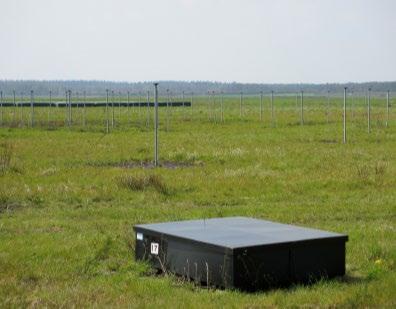
This
antenna station may not look like much, but it contains a sensitive detector measuring cosmic particles.
Credit: Radboud University
black box in front of a LOFAR
The radio “footprint” of an air shower at the LOFAR core on the left compared to that of the SKA-Low core on the right where many more antennas measure the same event.
our next
WEBINAR Join
SKAO science community webinar series
SKAO’s science community webinars are organised regularly throughout the year and are intended to facilitate broad communication directly between the SKAO and our future Science Users’ community.
Receive invites to future webinars, accompanying newsletters and view previous recordings.
PATHFINDERS
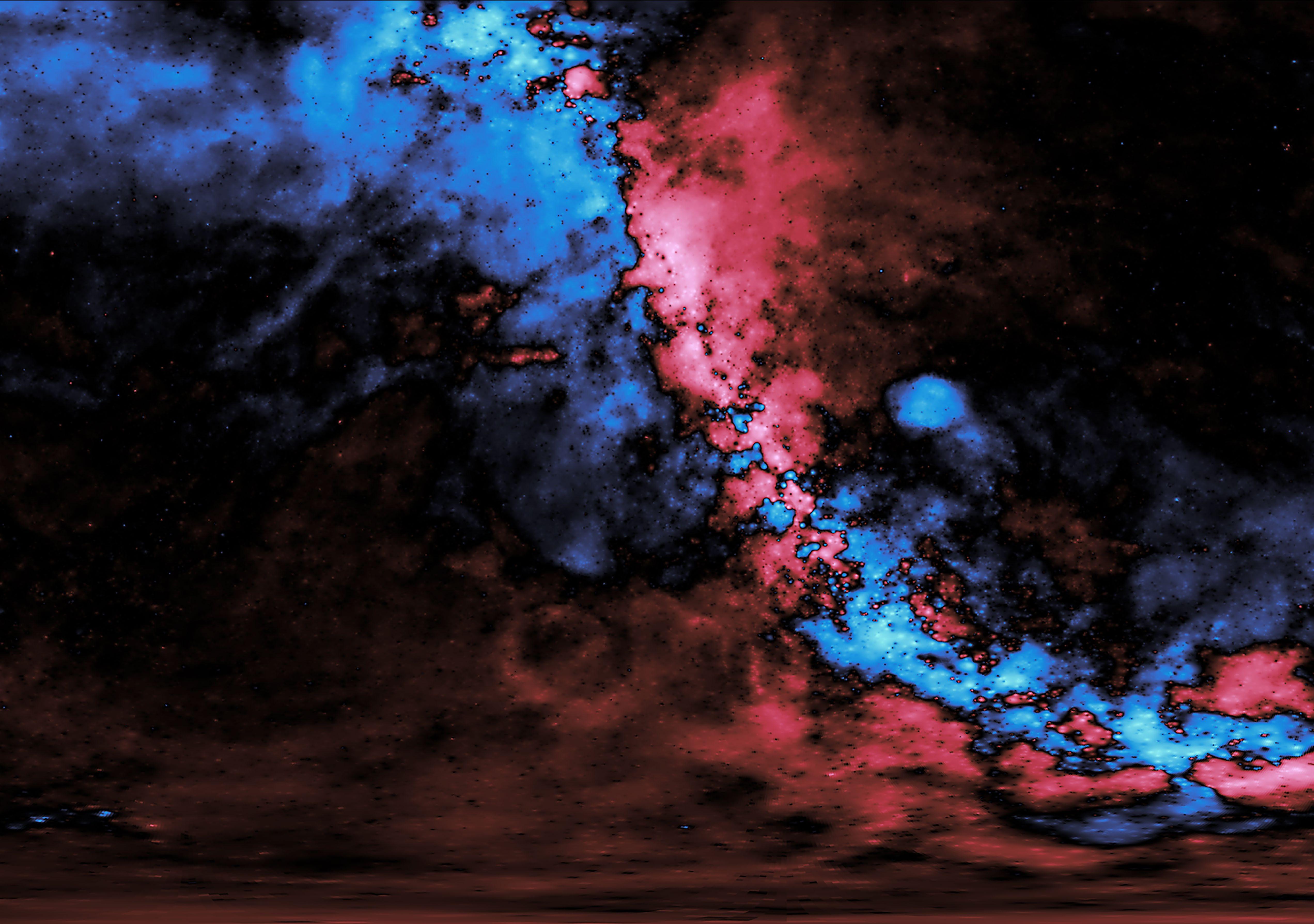
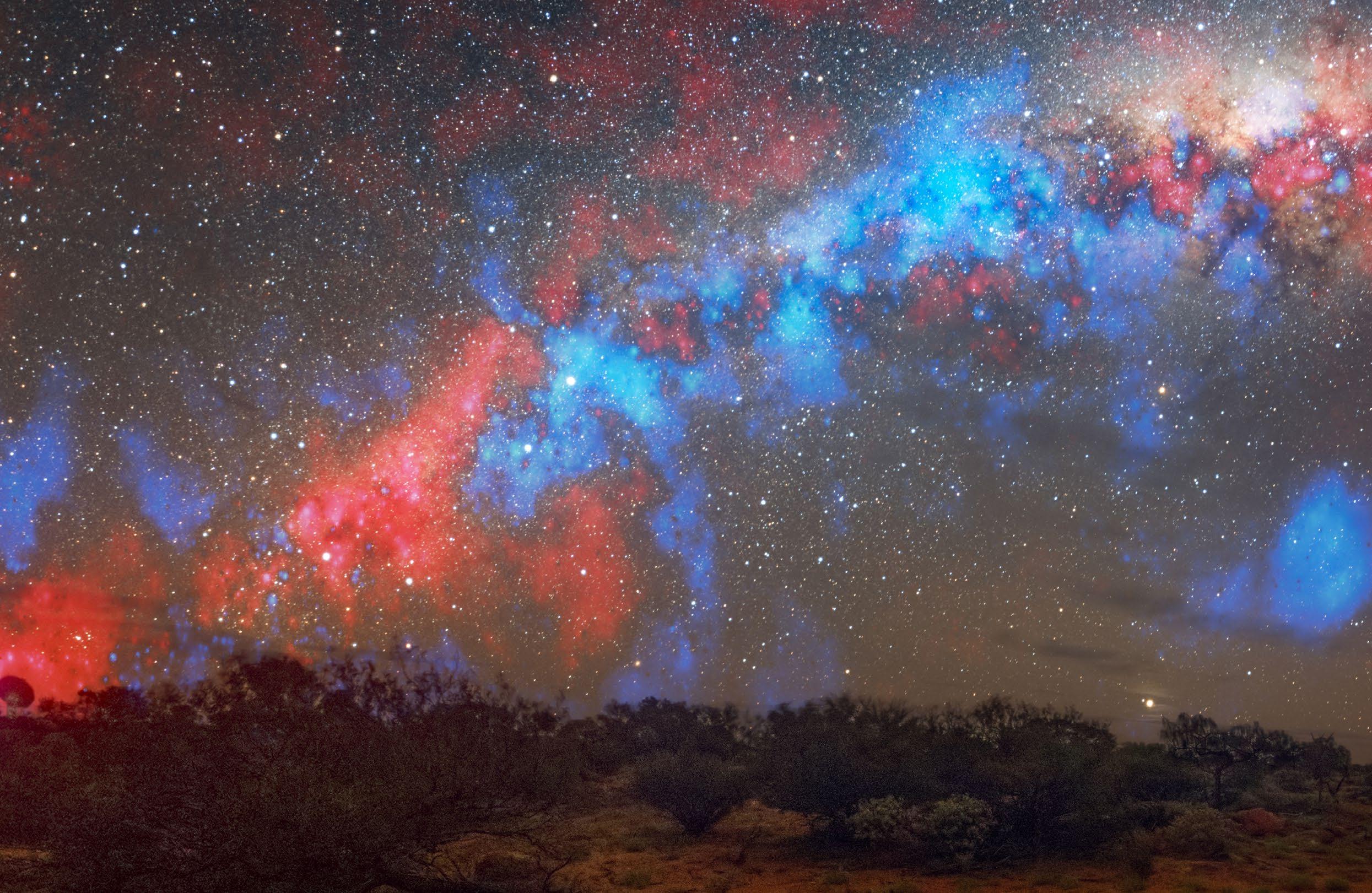
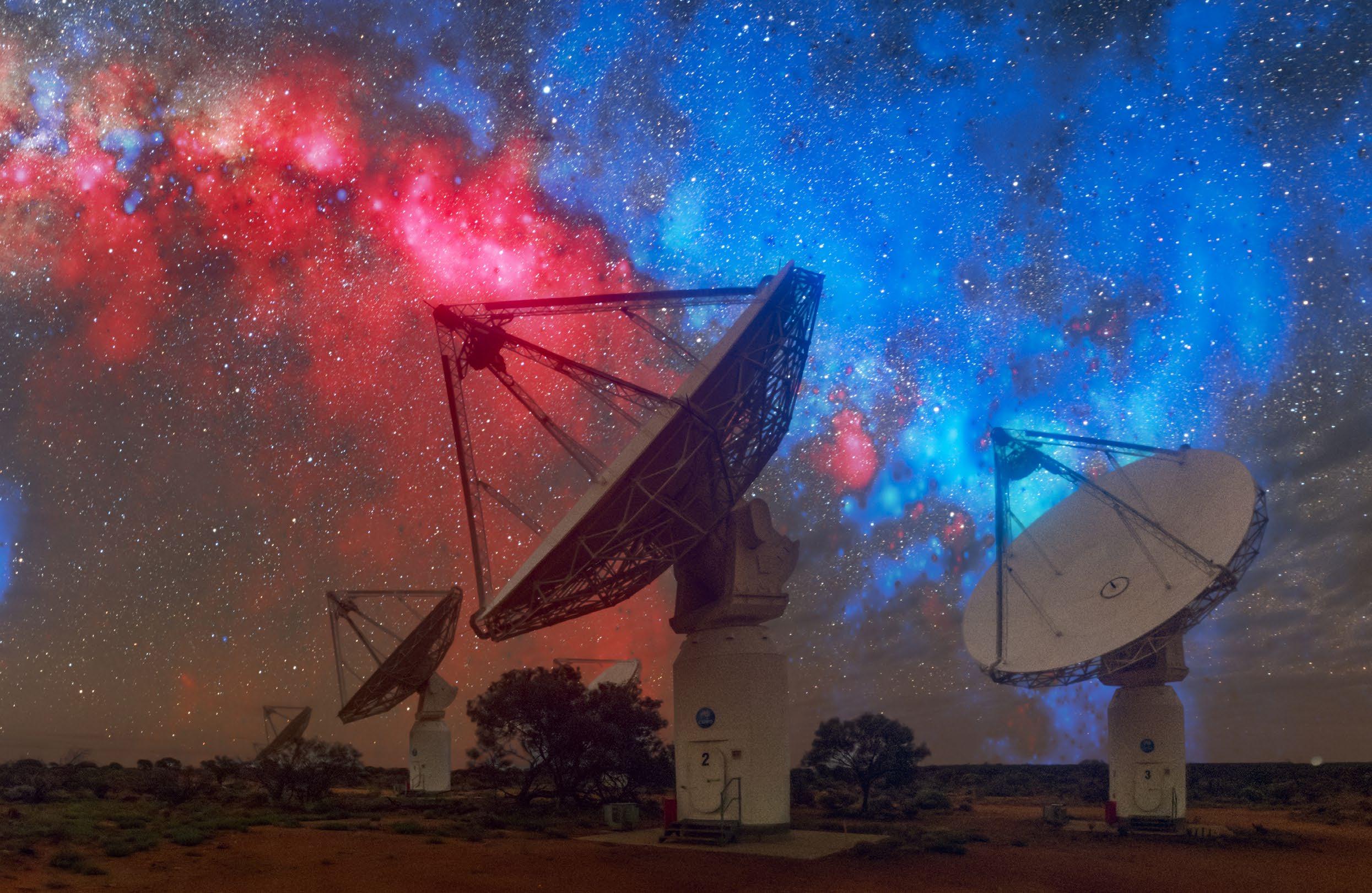
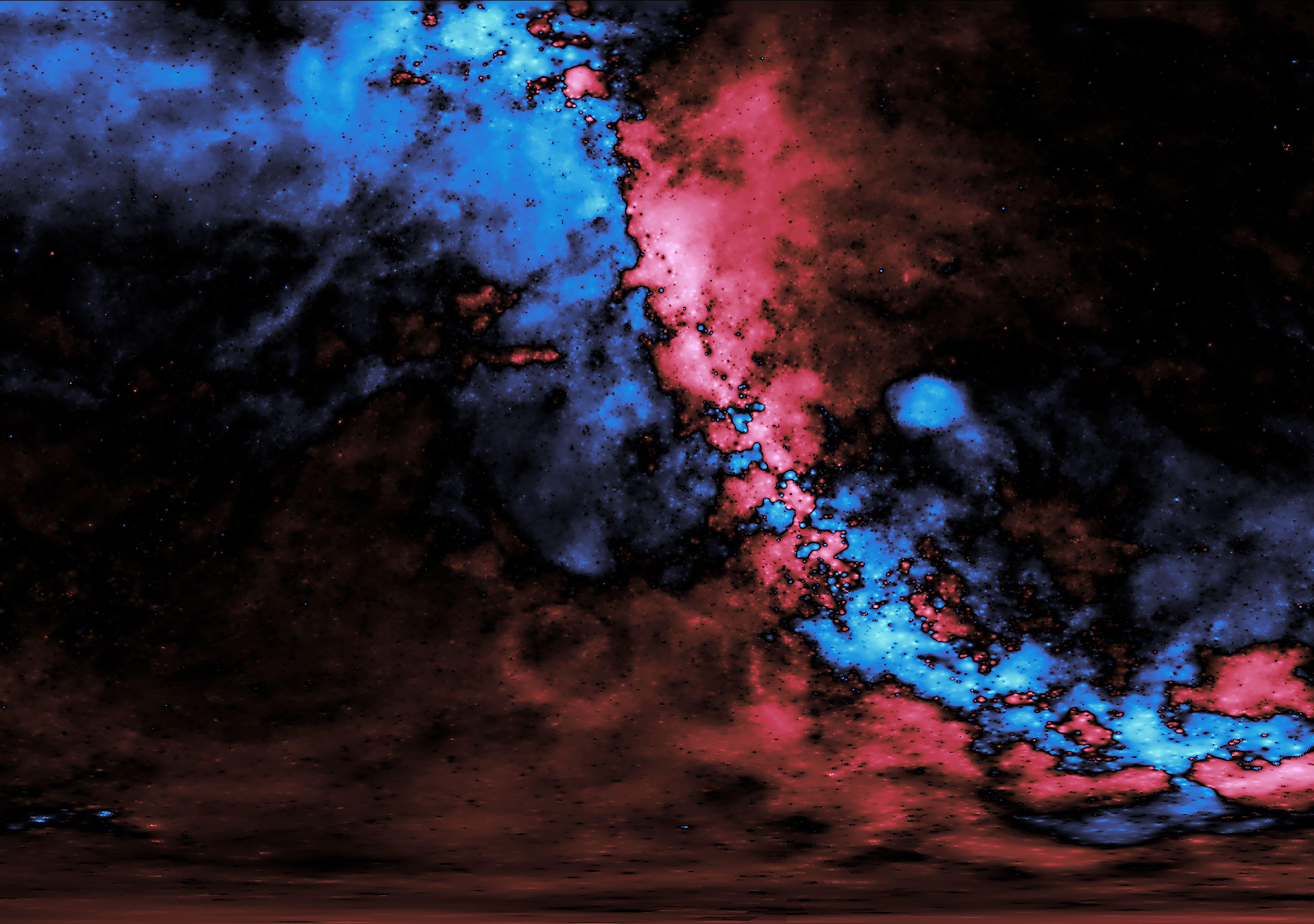
A new map, called SPICERACS, shows magnetic fields throughout the Universe in blue and red. It was produced with CSIRO's ASKAP radio telescope on Wajarri Yamaji Country. Credit: CSIRO/Alec Thomson et al./Alex Cherney and Tom Fowler/Sam Moorfield
Most detailed map of the Universe’s hidden magnetic fields revealed
BY RACHEL RAYNER (CSIRO)
Scientists have produced a map of the Universe’s magnetic fields revealing an invisible cosmic web that shapes how galaxies form and evolve.
The largest magnetic map of the Universe ever produced – five times larger than all previous efforts combined –marks the beginning of a new generation of research into the field of intergalactic magnetism.
Magnetic fields are a fundamental part of the Universe, governing how the building blocks of planets, stars and galaxies move through space. While astronomers don’t yet know how magnetic fields came to exist, they do know they’re everywhere.
The new map was produced by an international team led by researchers at CSIRO, Australia’s national science agency, and the SKAO.
It was the advanced capabilities of CSIRO’s ASKAP radio telescope, located at Inyarrimanha Ilgari Bundara, the CSIRO Murchison Radio-astronomy Observatory on Wajarri Yamaji Country in Western Australia, where the SKAO is building the SKA-Low telescope, that enabled this research.
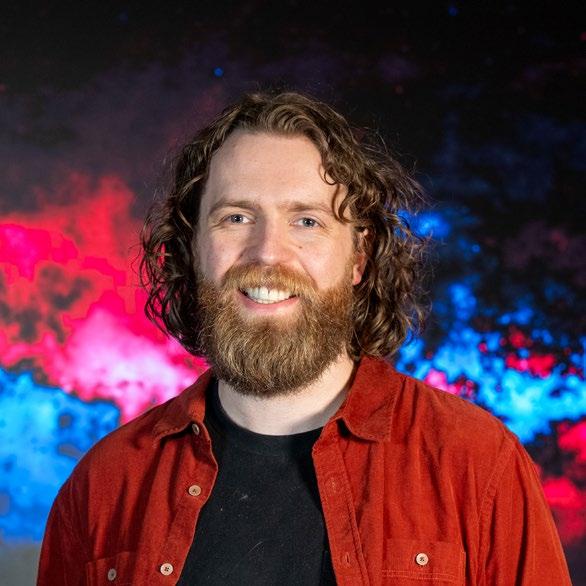
Lead researcher, SKA-Low Commissioning Scientist Dr Alec Thomson, said the scale and density of the map
help us better understand the way energy is distributed across the Universe.
“For the first time, we can investigate fine details of the material between nearby stars, and study a huge number of distant galaxies,” he said.
ASKAP is used to scan the sky regularly to build highly detailed maps of the Universe’s radio signals called the Rapid ASKAP Continuum Surveys (RACS).
This new map, called SPICE-RACS, works on the principle that light twists as it travels through magnetic fields. By measuring how twisted the light detected by ASKAP was, Dr Thomson and his team could show where magnetic fields were located and their relative strength.
“We collected rotation measures from every galaxy detected in RACS – nearly four million galaxies – and reprocessed this original data from ASKAP to retrieve the full picture,” Dr Thomson said.
A magnetic image of this size and scale was previously out of reach, but new technologies such as ASKAP’s large field of view and unique dish rotation system, combined
with the ability to process huge amounts of different data, have unlocked this new chapter of astronomical investigation.
Prof. Naomi McClure-Griffiths, SKAO’s chief scientist and a member of the research team, said SPICE-RACS is a huge leap forward in the study of the Universe’s magnetic fields.
“For the past 20 years we have been working with essentially the same data set, which didn’t even cover the southern sky.” Prof. McClure-Griffiths said.
“This new map provides a much better picture of the Universe’s magnetic structures. We can study things like how magnetic fields affect the galactic-scale interaction of our own Milky Way and its neighbours, the Magellanic Clouds.”
When the SKA telescopes come online later this decade, they will enable astronomers to chart details of the cosmic web in even finer detail.
Prof. McClure-Griffiths said this new class of telescope may even explain what was once thought impossible; the origin of magnetic fields in the Universe.
CSIRO astronomer on the project, Dr Tim Galvin, said the maps are accessible to everyone on CSIRO’s data access portal, data.csiro.au
“The data for this project is already being used by many research teams to produce new insights,” he said.
“
For the first time, we can investigate fine details of the material between nearby stars, and study a huge number of distant galaxies.
Dr Alec Thomson
Credit: SARAO
of hidden giant structure
BY SARAO
Astronomers have uncovered a massive hidden structure in the Universe that had remained concealed behind the dust and stars of our own Milky Way galaxy. Using a new technique, an international team has revealed the true scale of the Vela Supercluster, one of the largest concentrations of matter in the nearby cosmos.
The discovery fills a major gap in our map of the Universe and helps explain how galaxies move under the influence of gravity across enormous cosmic distances. The paper can be found here.
About 20% of the sky is difficult to observe because it lies behind the dense disk of the Milky Way. This region, known as the Zone of Avoidance, hides distant galaxies behind thick clouds of dust and billions of foreground stars.
For decades, this blind spot has prevented astronomers from obtaining a complete picture of the large-scale structure of the Universe. As a result, scientists have struggled to fully understand the origin of the large cosmic flows – the large-scale motions of galaxies caused by the gravitational pull of massive structures.
To overcome this obstacle, the researchers developed a new technique that combines two types of galaxy measurements:
• Galaxy redshifts, revealing how fast galaxies are moving away from us as the Universe expands
• Galaxy distances and peculiar velocities, revealing how galaxies move under gravity across vast cosmic distances.
By combining these measurements, scientists can reconstruct the underlying distribution of mass, including invisible dark matter.
The team used more than 65,000 galaxy distance measurements from the CosmicFlows catalogue and added over 8,000 new galaxy redshifts observed close to the plane of the Milky Way.
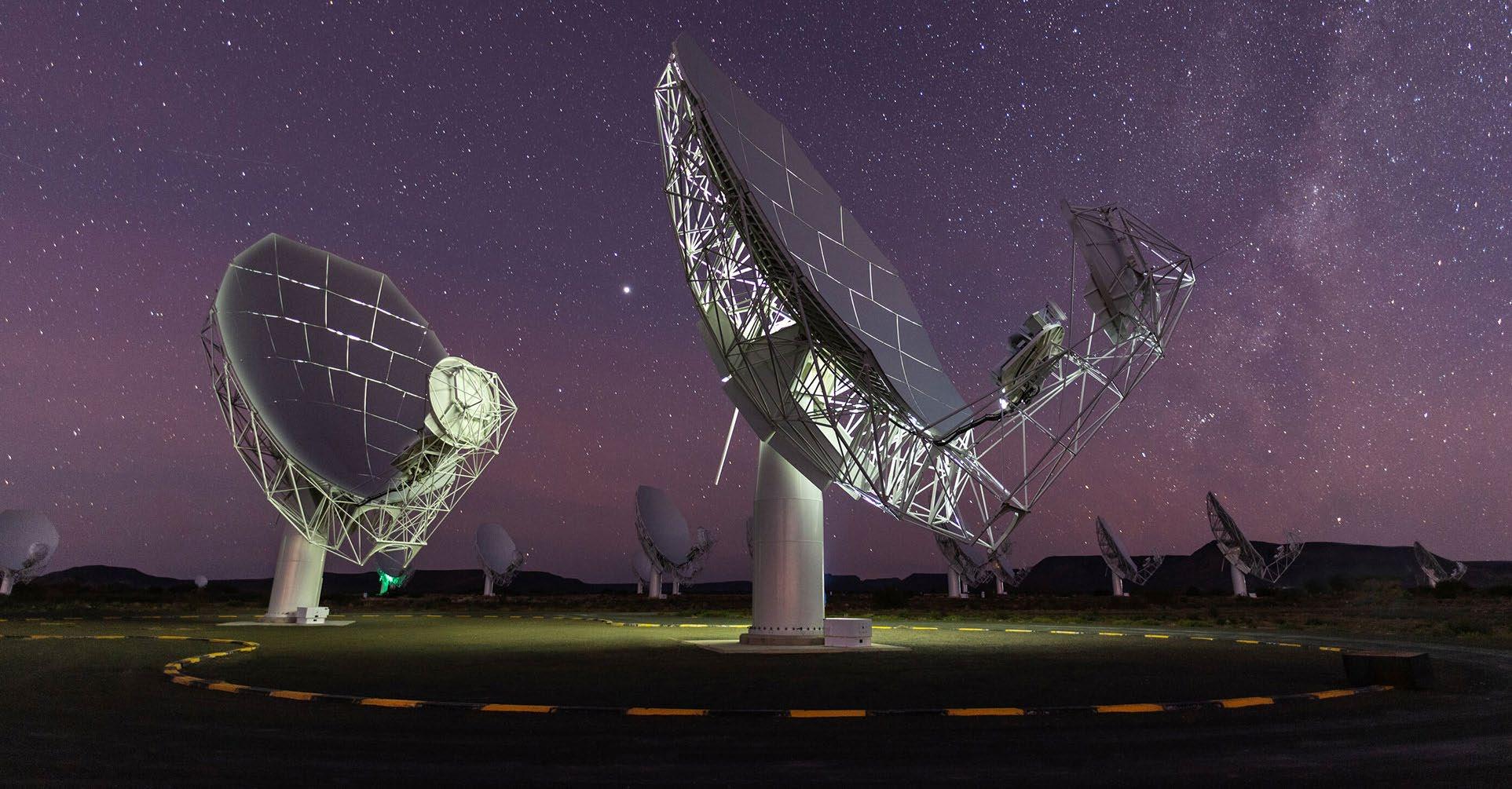
A key breakthrough came from observations with the Southern African Large Optical Telescope (SALT) and the MeerKAT radio telescope in South Africa, one of the most powerful radio arrays in the world and an SKA precursor.
MeerKAT was able to detect galaxies deep inside the most obscured region of the Zone of Avoidance by observing hydrogen gas at radio wavelengths that pass through dust.
These new observations reveal that the Vela Supercluster is far larger and more massive than previously thought. Located roughly 800 million light years away, the structure stretches across about 300 million light years and contains an enormous amount of matter –equivalent to about 30 million billion Suns (equivalent to about 3 × 10¹⁶ solar masses).
The analysis shows that Vela rivals the famous Shapley Supercluster, considered the most massive structure in the nearby Universe. Vela itself has a complex internal structure, with two main dense cores moving toward each other, making this cosmic structure even more remarkable. Its gravitational influence exceeds that of other well-known regions such as Laniakea, the
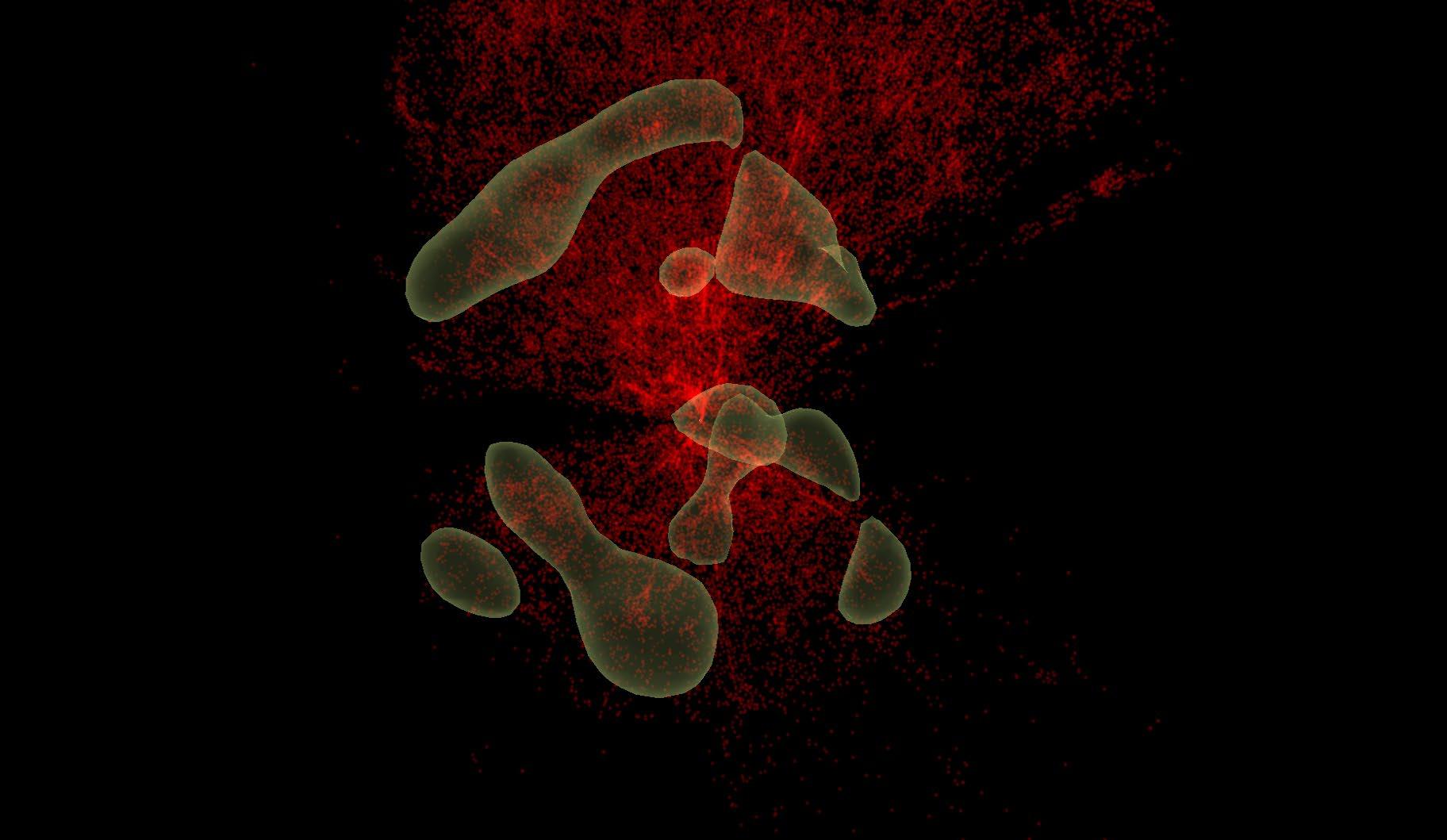
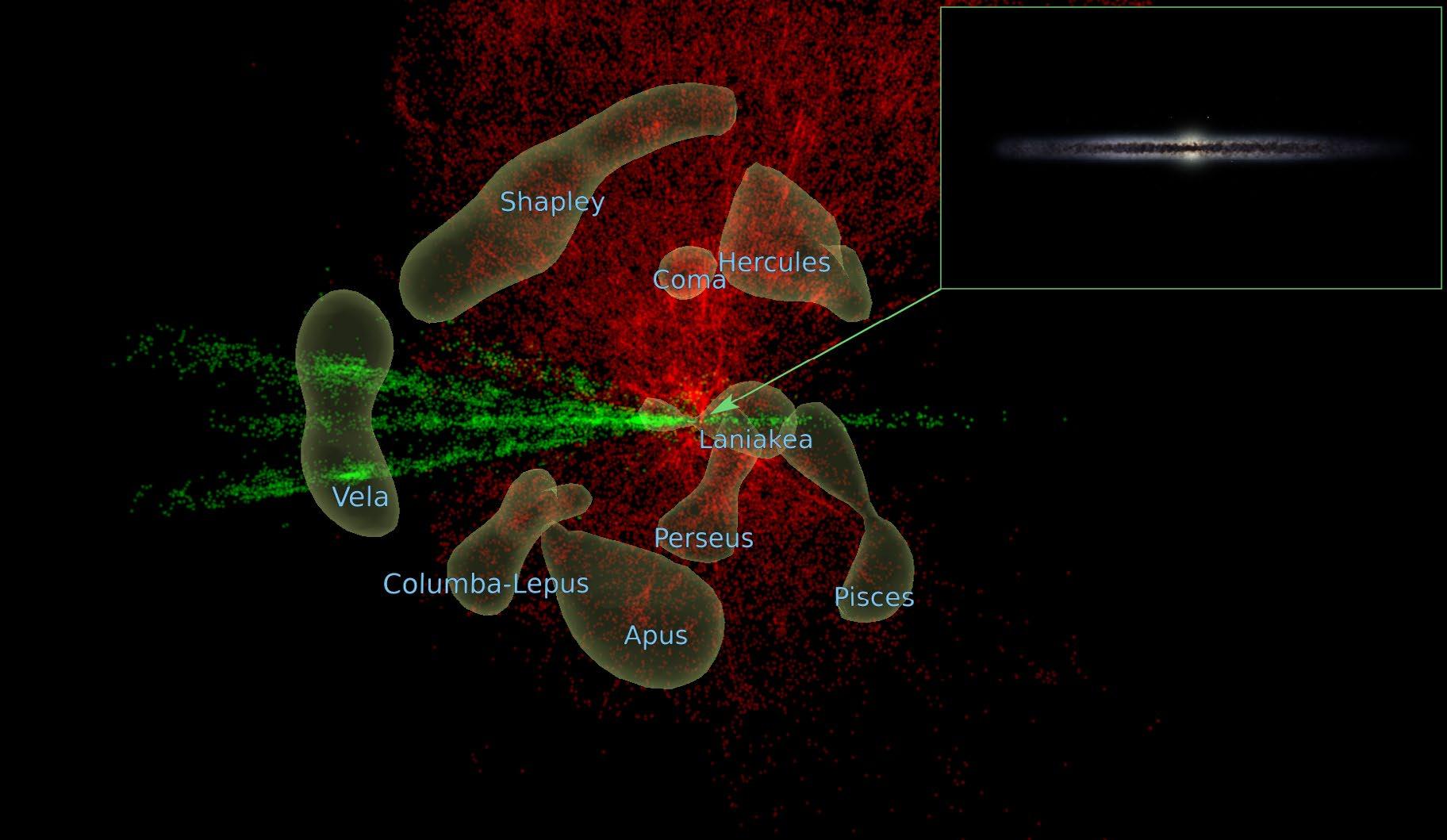
Before and after data visualisation of the same region. Each red point represents a galaxy in the CF4++ catalogue. The yellow regions outline areas where the local galaxy density is higher than average, providing a visual representation of the associated galaxy superclusters.
In the “after” image, we see the newly identified galaxies in the Zone of Avoidance, shown in green – each point again represents a galaxy. These galaxies were detected in particular using SARAO’s MeerKAT radio telescope. The Vela supercluster becomes clearly visible thanks to the newly added galaxies.
The Milky Way is at the centre of the image, approximately 2.3 billion light years from this viewpoint. The Zone of Avoidance corresponds to the region lying along the plane of the Milky Way. Astronomers generally avoid observing this area at visible wavelengths because foreground stars and interstellar dust obscure more distant objects.
supercluster that contains our own Galaxy, and the Great Attractor.
Massive structures like Vela exert a powerful gravitational pull on surrounding galaxies, shaping the large-scale motions of matter in the Universe.
By revealing the true extent of the Vela Supercluster, astronomers can now better understand the cosmic flows that affect the motion of galaxies across hundreds of millions of light years.
The study also demonstrates the power of combining different types of observations to reconstruct the structure of the Universe, even in regions that are difficult to observe directly. Such hybrid techniques will become increasingly important with the next generation of astronomical surveys and observatories, including the
Credit: Jérôme Leca (RSA Cosmos, France)
The editorial team thanks Dr Jérôme Leca at RSA Cosmos in France for his time in producing these images for Contact.
SKAO, which will allow astronomers to map the cosmic web with unprecedented precision, revealing the hidden architecture of the Universe.
The team of astronomers express their acknowledgement and respect for the use of the land in South Africa and Australia on which the telescopes that were used are located, and the communities and custodians of these lands. Given the importance of the SARAO MeerKAT data at lowest latitude in this endeavour, they introduce a locally inspired affectionate name for the Vela supercluster, “Vela-Banzi”, derived from the isiXhosa language, meaning “revealing widely”.
Prof. Renée C. Kraan-Korteweg would like to acknowledge all the students who have worked with her at UCT to learn more about the hidden large-scale structures in the so-called Zone of Avoidance, and the financial support from the NRF and SARAO towards their bursaries and this research.
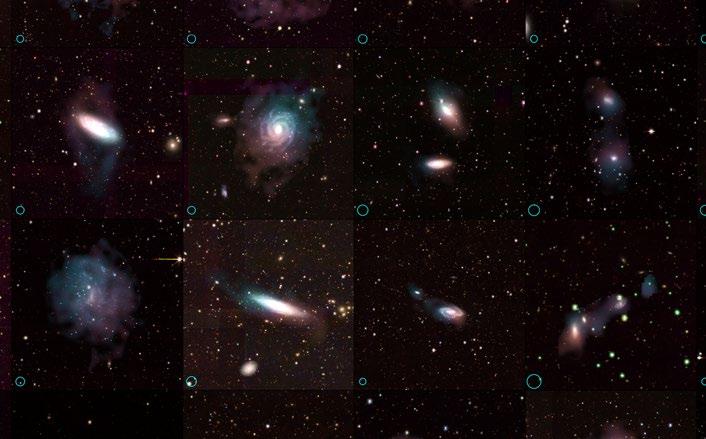
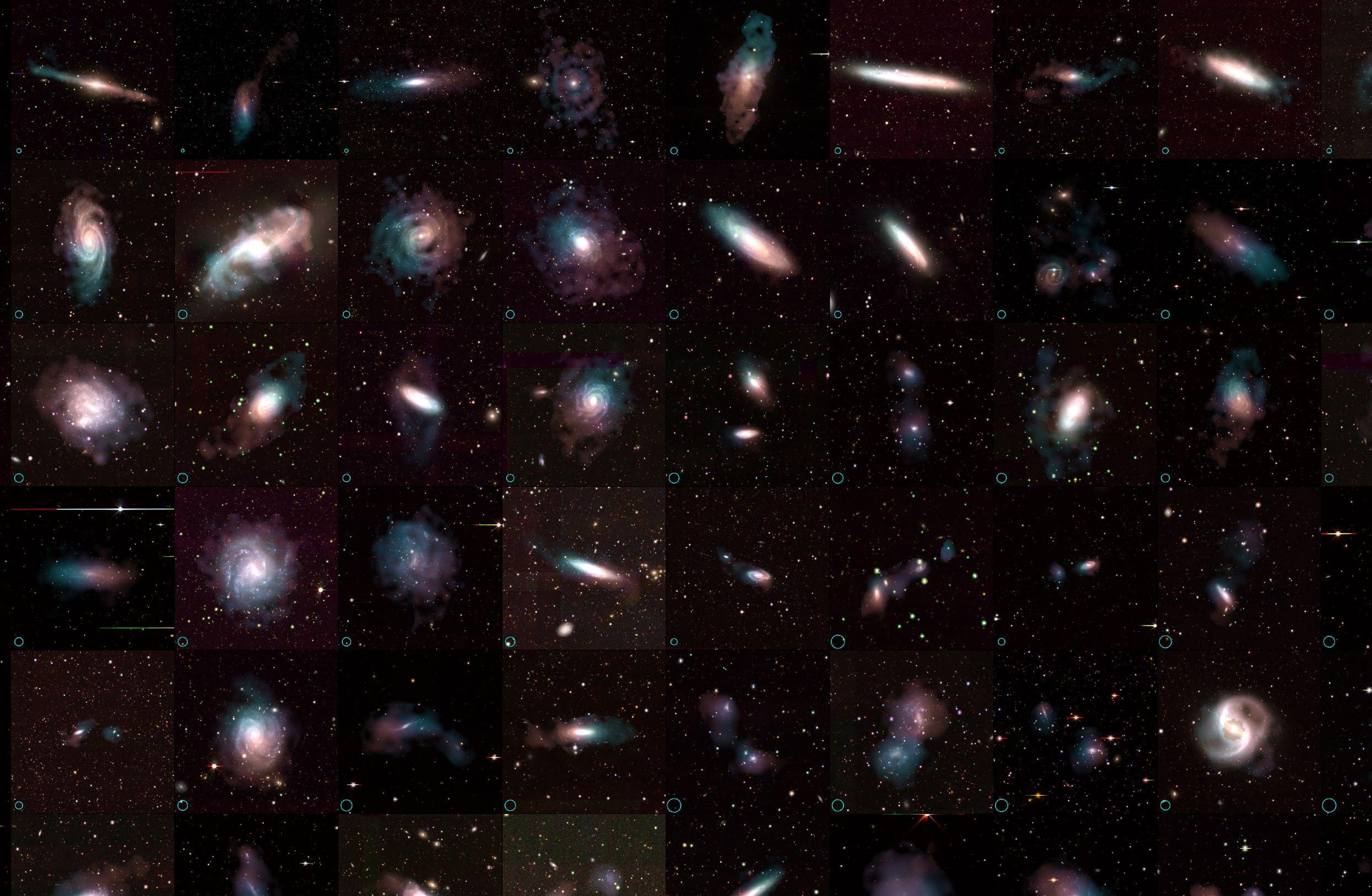
A mosaic of large nearby galaxies detected in the WALLABY survey. The atomic hydrogen gas content of the galaxies is colourised by its motion (red is approaching, blue is receding). The images are overlaid on optical images (Credit: N.Deg/Queen’s/Legacy Survey).
WALLABY’s galaxy atlas takes shape
BY CHARLENE D’MONTE (ICRAR)
A project mapping the sky to better understand how hydrogen gas is distributed between galaxies at large scales has showcased some of the many galaxies detected during the survey so far.
WALLABY (Widefield ASKAP L-band Legacy All-sky Blind surveY) is an ambitiously wide, almost all-sky survey using data from CSIRO’s ASKAP telescope in remote Western Australia, on Inyarrimanha Ilgari Bundara, the CSIRO Murchison Radio-astronomy Observatory.
The project, led by the International Centre for Radio Astronomy Research (ICRAR) is building an atlas of galaxies observed through their emission at the 21cm hydrogen line, tracing the gas that fuels star formation across the local Universe.
The survey has already detected around 10,000 galaxies, completing more than 10% of its target sky coverage. Over the course of the survey, a quarter of a million galaxies are expected to be catalogued, helping researchers measure the distribution of dark matter, the internal motion of galaxies, and how these systems evolve and interact.
The latest release showcases some of the extremes uncovered so far: the most massive and least massive galaxies, the most extended galaxies and galaxy pairs or groups, and the nearest and farthest systems detected to date.
Owing to the sheer scale of the survey, the WALLABY catalogue is expected to lead to many new observations and discoveries. To date, it has generated 40 scientific papers and helped to train 20 PhD students.
Many of the galaxies identified will be studied in far greater detail once the SKA telescopes come online, helping researchers better understand the accretion and interaction processes that shape galaxies over time.
‘This
is a daring project’ – new SKAO Director-General Prof. Jessica Dempsey
“As someone who loves nothing more than building and running telescopes, there is not a better time to be asked to take up this role – we are just getting to the cool stuff!” says Prof. Jessica Dempsey.
The new director-general began a five-year term on 1 June 2026, succeeding Prof. Philip Diamond, and has hit the ground running in her early weeks at the Observatory’s Headquarters in the UK. Following the SKAO Council Meeting in July, she will be spending the coming months in the SKA telescope host countries Australia and South Africa.
“This is a daring project, unprecedented in scale and scope, and it will need the skills of every single team member on three continents and all the support of our broad global partnership to see it come to light.
“It is humbling to be asked to lead these amazing teams and this ambitious global endeavour, and I am passionately dedicated to its success,” she says.
Prof. Dempsey has built and operated telescopes on every continent, in some of the world’s most extreme environments, and was the first Australian woman to work as a scientist at South Pole Station.
Her extensive research interests range from widefield surveys of the diverse molecules in the galaxy at radio wavelengths to being a founding member of the Breakthrough Prize-winning Event Horizon Telescope team, which captured an image of a black hole for the first time.
She brings significant experience in both research and senior leadership, having previously been the director of the Netherlands Institute for Radio Astronomy (ASTRON), deputy director of the East Asian Observatory in Hawai’i, USA, and head of operations at the James Clerk Maxwell Telescope.
The lessons learned from her time in Hawai’i formed a central part of a talk she gave to SKA project staff in June, where she discussed the community-led blockade of the Thirty Metre Telescope site on Maunakea, and put a strong focus on the lasting relationships, and meaningful opportunities and representation that the SKAO must maintain in the communities around the SKA telescope sites.
During her talk, she also shared more about her journey to the SKAO, from growing up in Australia's Northern
Territory, to some perhaps surprising early professions (actress, bouncer, fully qualified firefighter), as well as her vision for the Observatory's future.
On this, she emphasised the importance of creating an inclusive culture where staff feel supported, represented and able to thrive, speaking of the need to bridge cultural, geographical and disciplinary divides across the Observatory's global footprint, and describing diversity as one of the SKAO's greatest strengths.
"Science is the goal of the SKAO," she said. "But it's a human endeavour, and it will be a human achievement."
Read Prof. Dempsey’s biography here.
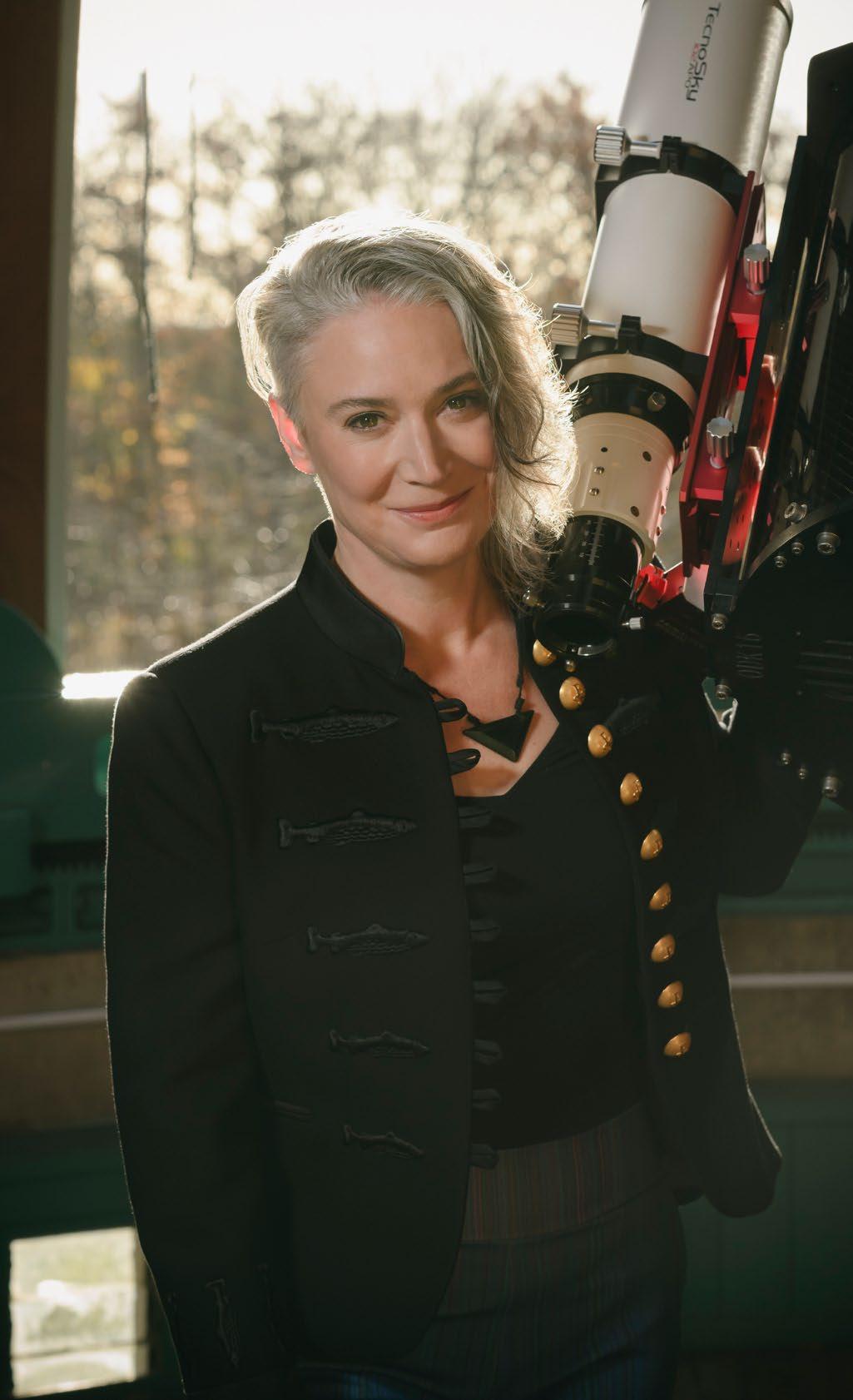
Prof. Jessica Dempsey, photographed by Tina Korhonen.
France joins the SKAO
In June the SKAO said “bienvenue” to France as it became the Observatory’s 14th member state.
After being involved in the SKA project for many years, the country’s road to joining the SKAO formally began in 2021 when, during a state visit to South Africa, French President Emmanuel Macron announced plans to seek membership. This began a national legislative process which concluded with President Macron signing the documents of accession in March, and the membership took effect on 4 June.
It means the SKAO’s membership has doubled in the five years since it was established in 2021
The SKA project has been a top national priority for the French astronomical community for over a decade. This was most recently demonstrated at the SKA national conference, held in Meudon in May 2026, which brought together around 200 participants – the latest in a series of successful SKA-related meetings in France.
The French science community is represented in 13 of the 14 SKAO Science Working Groups, including co-chairing roles in the Cradle of Life and Cosmology groups. The country also has strong expertise in the field of the interstellar medium, a cross-cutting area that spans several Science Working Groups.
“As well as a national legacy of excellence in astronomy across centuries, French institutions’ expertise in supercomputing for big science makes France an invaluable partner as the SKAO progresses towards early science operations in the coming months,” said SKAO Council Chair Dr Filippo Zerbi.
France was awarded its first SKAO construction contract last year, with computing specialists Bull tasked with delivering the science data processor (SDP) hardware for the Observatory. The first SDP unit recently passed testing at the Bull factory in Angers (see page 16) prior to being transported to Perth for installation.
As well as establishing the Extreme Computing Lab for Astronomical Telescopes (ECLAT), a public-private research and development laboratory, France is involved in technical work aimed at minimising the energy consumption of the SDP computational activities.
“France is proud to join SKAO,” said Jean-Luc Moullet, Director-General for Research and Innovation at the Ministry of Higher Education, Research and Space.
“France is contributing through its industry and scientific community – astronomers, computer and data scientists – building on decades of investment in radio astronomy and coordinated national efforts to support SKAO’s mission.”
National coordination of SKA activities in France is carried out by SKA-France, which brings together nine academic partners: CNRS, Inria, CEA, Observatoire de la Côte d’Azur, Observatoire de Paris-PSL, Université de Bordeaux, Université d’Orléans, Université Paris-Saclay, Université de Strasbourg.
Read more about French contributions to the SKAO here
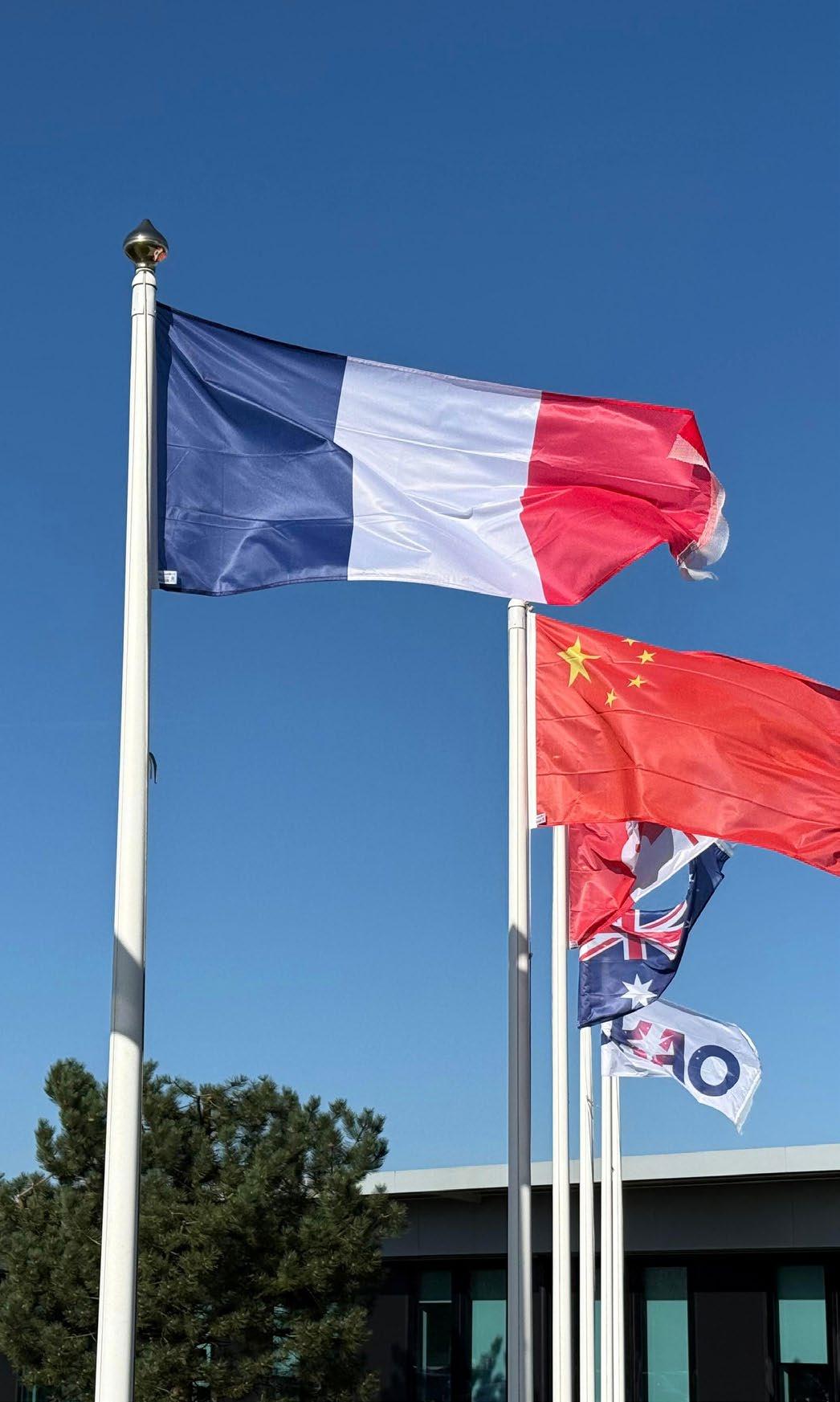
The French flag flying outside SKAO Global Headquarters in the UK. Credit: SKAO
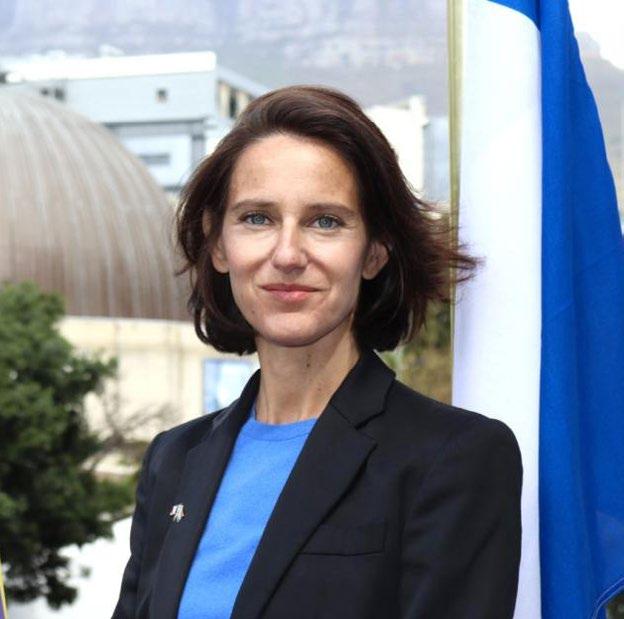
Two minutes with... Sophie Bel
CONSUL-GENERAL OF FRANCE IN CAPE TOWN, SOUTH AFRICA
France joining the SKAO was marked at the SKA-Mid telescope site in South Africa by a visit from French Consul-General Sophie Bel, who spoke to us about the significance for France of joining this international collaboration.
What does France’s accession to the SKAO mean to you, given that you are based in one of the telescope host countries?
France is delighted to join the SKAO and to contribute, alongside South Africa – one of the leading nations in this extraordinary endeavour – to the advancement of radio astronomy. The SKAO is a powerful example of what the international community can achieve when countries come together around a shared vision. Bringing together 14 member states, it demonstrates the strength of international cooperation in science and innovation.
The SKAO is also a relatively young international organisation, having been established only five years ago. I had the privilege of celebrating France’s membership by visiting the telescope site in the beautiful Karoo. It was a truly memorable experience. I felt fortunate to stand before these remarkable instruments and witness firsthand a project that has taken decades of vision, planning and collaboration to become a reality.
France is part of many international scientific collaborations. Why is it important to also become a member of the SKAO?
The SKAO is building the world’s largest and most powerful radio telescope arrays in their frequency ranges. Membership therefore offers a unique opportunity to contribute to groundbreaking discoveries about our Universe while benefiting from the expertise and capabilities of partner countries.
France brings recognised strengths in high-performance computing, data management and scientific data processing – areas that are essential to the success of the SKAO, given the enormous volumes of data generated by the telescopes on a daily basis. We are proud to share this expertise and to support the scientific ambitions of the project.
What was your impression of seeing the dishes up close during your visit to the site?
I was deeply impressed by both the scale and the sophistication of the facility. Walking among the dishes, I felt incredibly small in comparison to these giant instruments. At the same time, I was struck by their precision and the remarkable engineering behind them. The combination of their size, accuracy and scientific purpose makes the site truly awe-inspiring.
Did you learn anything surprising or unexpected during your site visit?
One of the most fascinating things I learned was the crucial role that pulsars play in helping scientists better understand the origins and evolution of the Universe. I was also intrigued to discover how radio astronomy can contribute to the search for the chemical building blocks of life and deepen our understanding of the processes that ultimately led to the formation of our own planet.
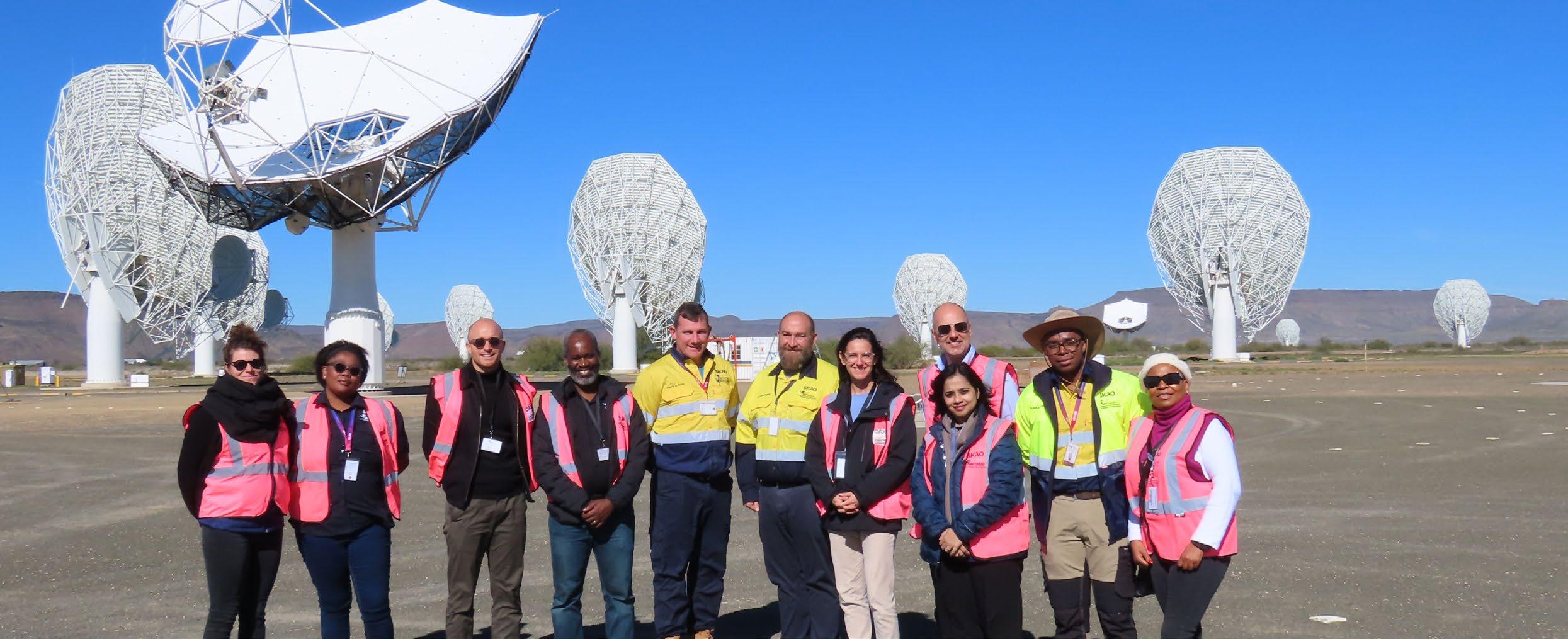
Consul-General of France Sophie Bel (fifth from right) on a visit to the SKA-Mid site.
Credit: Consulate of France in Cape Town.
A sustainable vision for the Observatory
BY ANNE DANIELS (SKAO)
The SKAO sustainability commitments have been set and are publicly available on our website. They capture concrete goals across five core themes: our environmental footprint, open science, social equity, radio spectrum preservation, and education and opportunities.
Sustainability has been an important pillar for the SKA Observatory since its inception, and its principles underlie all processes and decisions. To remain relevant and responsive, the commitments will be reviewed and updated annually.
Incoming Sustainability Manager Helen Cutts says: “It’s great to see our dedication to sustainability put into practice through these sustainability commitments. We will be taking these forward over the course of the year alongside developing our approach to sustainability for the future.”
At the heart of the new commitments, the SKAO pledges to keep its environmental footprint to a minimum by focusing on renewable resources, minimising energy usage and sustainably managing the land where the
telescopes are being built. Read more about these practices in the construction updates on pages 7 to 15.
The Observatory’s commitment to sustainability goes beyond environmental considerations, including creating an equitable, inclusive, and respectful environment, championing open science guided by UNESCO’s principles, and defending the sustainable use of space and the radio spectrum through a leading role in the International Astronomical Union’s Centre for the Protection of the Dark and Quiet Sky.
A final theme focuses on supporting STEM education to inspire the next generation through accessible educational resources. An example of this commitment is the support for the girls’ education project called EMEJA in East Africa (read more about it below).
The astronomy outreach project keeping girls in schools
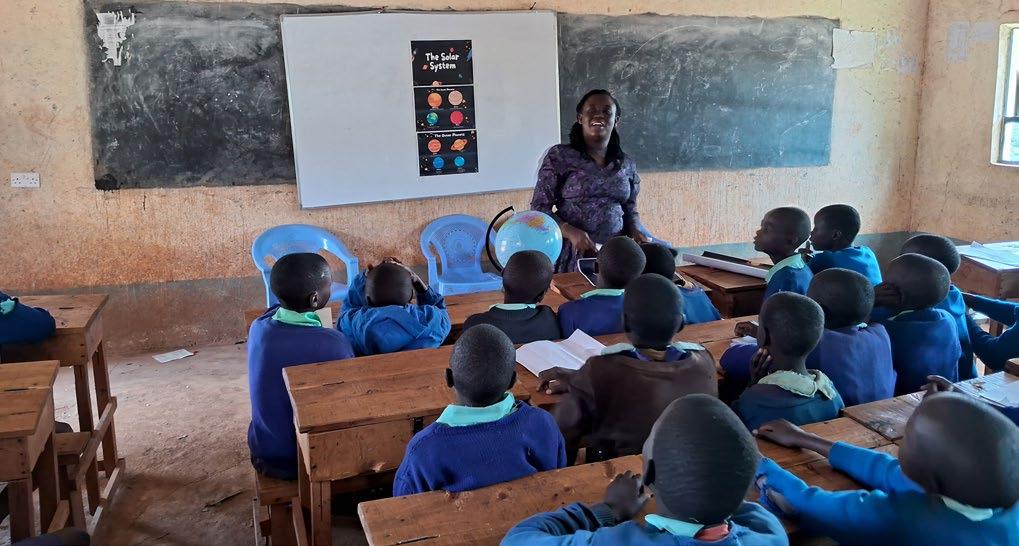
The SKAO has started to support a project in rural Kenya and Uganda that uses astronomy outreach, mentorship and community engagement to improve participation of girls in education in rural communities.
The Elimisha Msichana Elimisha Jamii Na Astronomia (EMEJA) initiative – Swahili for “Educate a girl, educate the entire community with astronomy” – addresses a challenge across rural East Africa, where many girls drop out during the transition from primary to secondary education. Using astronomy outreach and mentorship programmes, girls are empowered to stay in education and choose STEM subjects in high school.
Since the project’s start in 2019, EMEJA has reached more than 40,000 girls and hundreds of teachers across 31 schools in Kenya (one of the SKAO’s African partner countries) and Uganda. It has been supported with funding from the International Astronomical Union’s Office of Astronomy for Development.
The SKA Observatory will back the project through an annual bursary of €15,000 from its sustainability fund over the next three years. The new financial support enables the project to scale up and expand to other rural
areas and more schools across East Africa, with the aim of reaching more than 100,000 girls.
As part of this expansion, the project will establish regional STEM hubs for astronomy education and digital literacy, connected to surrounding schools and communities to ensure equitable access to digital resources.
Read more about EMEJA’s recent activities on our website.
Credit: EMEJA project
‘Dazzling array of science’ detailed in new SKAO book
BY CASSANDRA CAVALLARO (SKAO)
Last year the SKAO called on scientists globally to contribute to a new book documenting the full breadth of astronomical research that the SKA telescopes will enable.
Over 1,500 of them answered the call in 51 countries around the world, extending far beyond the Observatory’s member countries.
The result: Advancing Astrophysics II – a collection of 221 peer-reviewed papers, together providing the most up-todate picture of scientists’ plans for observations across all areas of SKA science.
“This shows not only the dazzling array of science our community will seek to address with the SKA telescopes, but also how the community has grown in size and ambition since our last science book in 2015, with hundreds more contributors this time,” said SKAO Chief Scientist Prof. Naomi McClure-Griffiths, who wrote the introduction.
The papers are grouped into six broad sections:
• Sun, Earth and planets
• Formation and evolution of Stars
• From the Milky Way to distant galaxies
• The cosmos
• The extreme Universe
• Methods and techniques
“Our science explores the Universe across every scale and physical regime, leveraging the SKA telescopes’ transformational sensitivity, survey speed, and imaging capabilities, together with powerful synergies across the world’s leading facilities,” said SKAO Head of Scientific Services Dr Anna Bonaldi.
“The number of submissions also makes clear that the science community’s enthusiasm is only growing as we get closer to the first SKAO science.”
As well as being a testament to the global collaboration behind the SKAO, Advancing Astrophysics II will inform the SKAO’s scientific strategy in the coming years.
The papers are available online through arXiv, with access also on the SKAO website
Team SKA: Dr Stefan Ohm
Head of Regional Networking & Science Communication, DZA
The German Centre for Astrophysics (DZA) was recently established in Görlitz, where it will be a hub for SKAO science in the country, hosting hundreds of scientists and a node of the SKA Regional Centre Network distributing Observatory data to astronomers.
DZA is also part of another story: a major science infrastructure established in a former lignite mining region on the border between Germany and Poland. Its role is to support structural change in the region by making Görlitz a home of cutting-edge science, attracting economic investment, and connecting with communities that have so far not had a chance to interact with “big science” before.
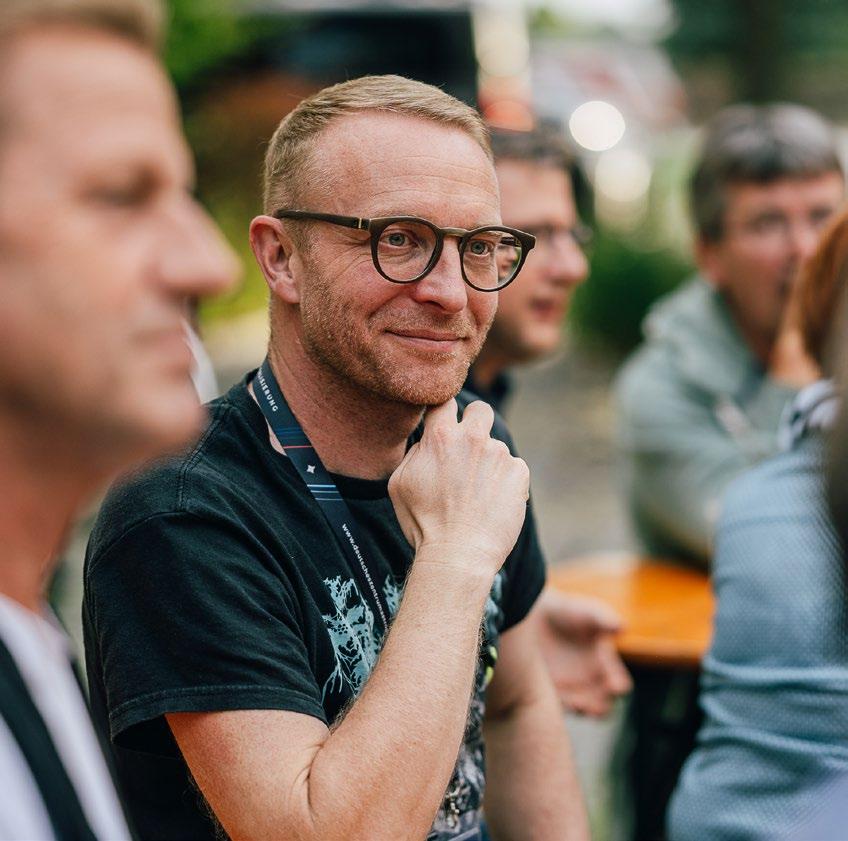
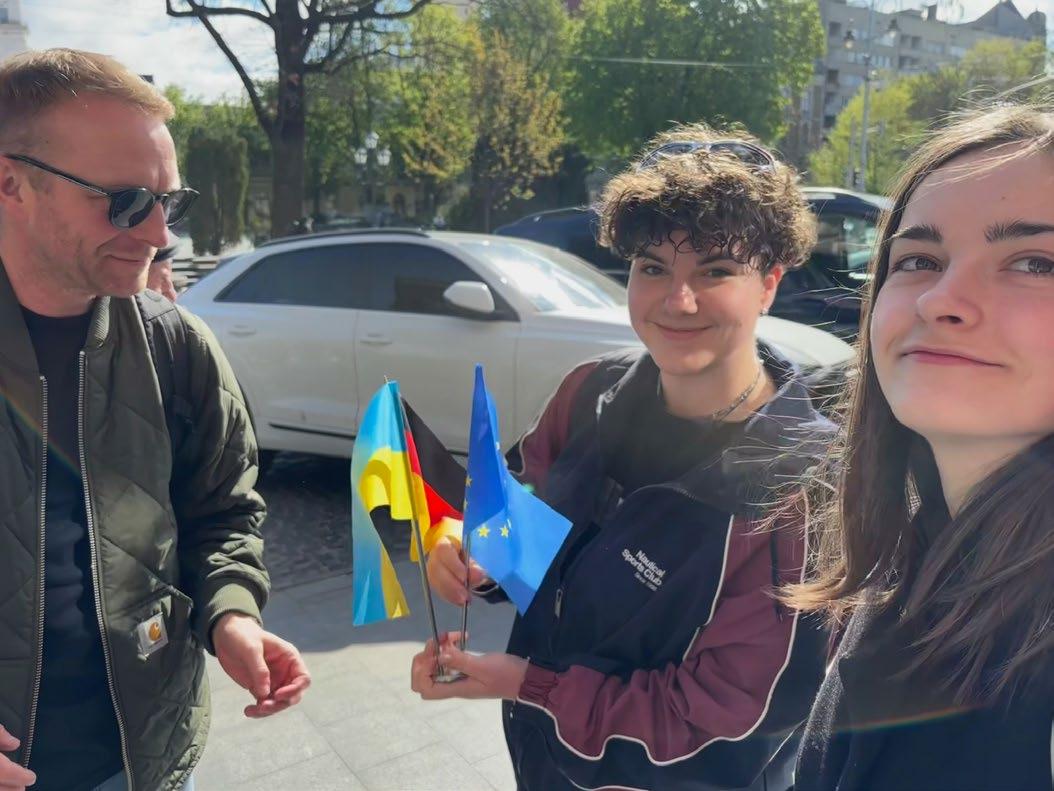
Dr Stefan Ohm is DZA’s Head of Regional Networking and Science Communication, and is shaping the organisation’s collaborations with communities locally and internationally. An experienced astrophysicist, he’s now co-leading a training programme for astronomy educators in Ukraine (See page 6). We spoke to Stefan about his international career, his vision for science engagement, and the importance of scientists being in touch with communities.
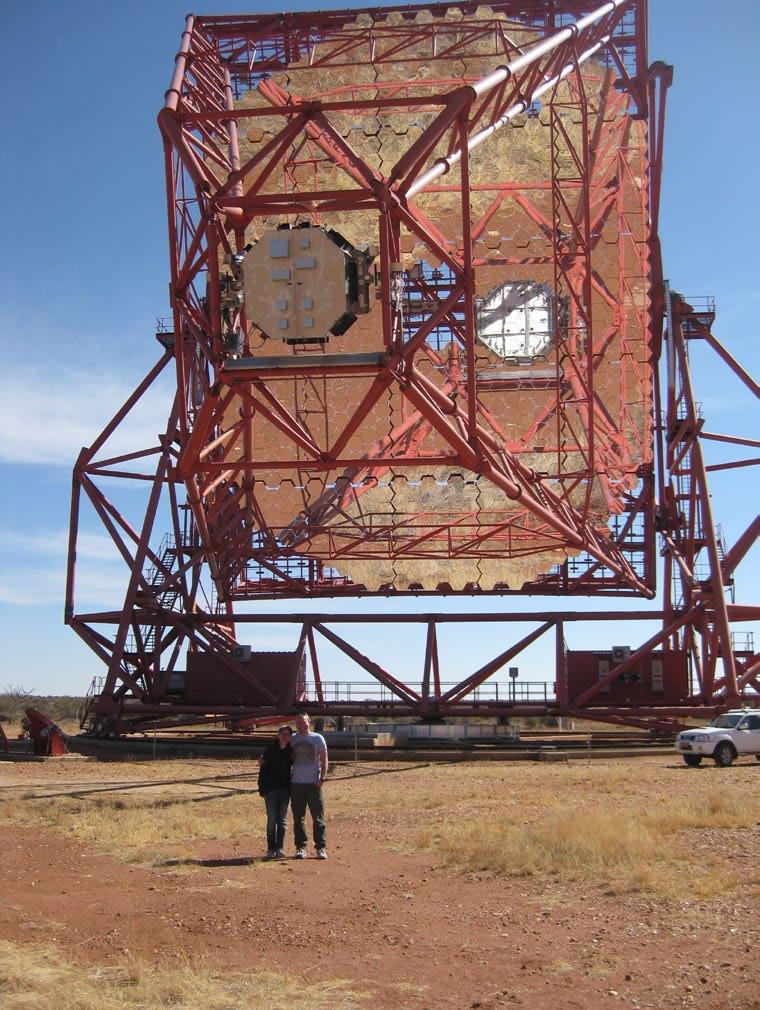
Stefan grew up in rural East Germany (seen here in the early 1980s).
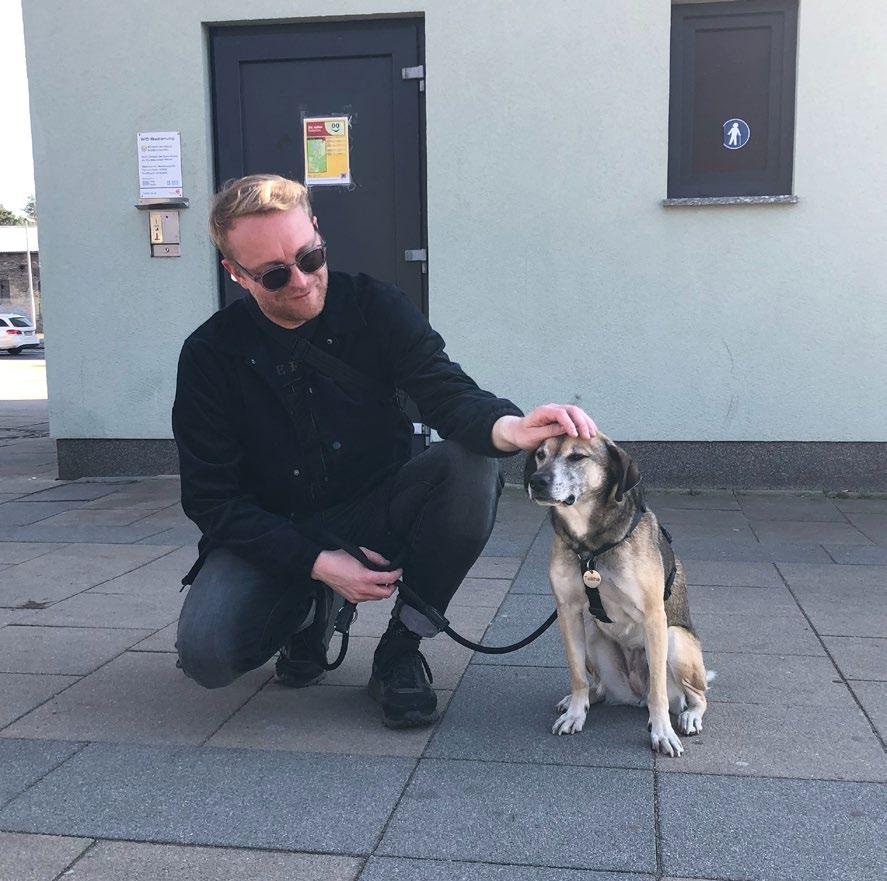
Stefan is an astrophysicist and science engagement specialist.
Credit: Paul Glaser/DESY/DZA
Let’s start with your early life, Stefan – where did you grow up? What was your childhood like?
If you look at the German map and you point your finger at the middle, that’s where I grew up, in a small town in a rural part of Thuringia, in what was then East Germany. It was a very nice childhood, with lots of time outside, lots of friends. My parents always supported me and knew that education was important to be successful later in life, so I went to the gymnasium [secondary school which prepares students for university] and focused on maths and physics, although I also enjoyed architecture and history, and liked playing football.
What did your parents do?
My mother used to work in the finance department of an old mining company, but after the [Berlin] wall came down it went bankrupt, as did so many other industries and companies in East Germany. My father also lost his industrial job, so my family went through this disruption and had to reorient while I was eight years old, and my brother was six. My parents had been studying through a distance-learning university while they were working and raising two kids, but then the wall came down and their grades and their certificates were no longer really worth much.
So the early 90s were really, really hard, but my parents managed, they got new jobs, and I became the first in my family to go away to university. It was good of course that Germany was reunited, but there were disruptions that followed for 20 or 30 years, and that connects to what I’m doing right now.
What sparked your interest in astronomy, and how did you decide that it was what you wanted to do professionally?
I was always curious and interested in the big questions: where we come from, where we are going, anything that was far away and hard to reach sparked my interest.
One day in school, I found an old CD from the University of Heidelberg about studying physics and astronomy. That’s when I decided I will go and study astronomy in Heidelberg. I didn’t even ask myself where else I wanted to go! I was 15, and it was kind of set in stone. It did not come out of nowhere. The first German in space was from Saxony in eastern Germany, so astronomy and space were always very prominent in culture and in education. In every school astronomy was a standalone subject, so that was the foundation for me - without that I would probably never have picked up the CD.
So you studied in Germany and then abroad with postdoctoral positions in the UK – how did that international experience shape your outlook, and your career?
One of the really great things that you can do in science is traveling. You not only get to learn the mysteries of the Universe, you also get to learn new cultures and meet new people.
After my PhD, I got a Humboldt fellowship to go to the UK, first to Leeds and then to Leicester, to do gamma-ray astronomy and astro-particle physics. In the end I stayed three years in the UK. It improved my English a lot, and it was great to see another scientific system. Being exposed to so many different people with different backgrounds and expertise also convinced me even more that you need this to understand your own role better.
You mentioned your research specialism is in high-energy astrophysics, particularly gamma-ray astronomy. What fascinates you about that?
I entered gamma-ray astronomy the way I entered some other things as well: luck, coincidence and curiosity. Originally, I wanted to study cosmology, but all the spots were taken so I looked at the other groups. Gamma-ray astronomy was a new field which was just starting to take off around 2005 with the H.E.S.S., MAGIC and VERITAS telescopes going online. As the H.E.S.S. experiment, which I joined in 2006, wasn’t a huge collaboration or consortium, I was exposed to the instruments and to the data, which was the great appeal for me. Then of course, the science: it’s black holes and neutron stars, and being able to discover new things in a small team.
Do you have a favourite among your team’s discoveries?
Several – one of them was working on an analysis algorithm that helped to discover very-high-energy gamma rays from the NGC 253 starburst galaxy as part of the H.E.S.S. collaboration [a gamma-ray observatory based in Namibia]. I remember to this day meeting in a
small group to decide what to do when we saw a hint of a signal. It was decided we had to go all in and dedicate 150 hours, or 10% of the observing time for the full year, just on this object. I was just a PhD student thinking “oh God, really?!” But we went for the risk and we got the reward.
Your H.E.S.S. work took you to Namibia where the telescopes are located – tell us about that.
I went to Namibia several times during my PhD because as early career scientists we took observing shifts for three weeks at a time at the telescope site, in the middle of nowhere. Some people struggled with the remoteness, but this was my dream: space, animals, silence, nature and telescopes to play around with.
We had open days where local kids would visit, and in the later stages more and more University of Namibia students taking observing shifts and taking over responsibilities for the maintenance of the system - this was a result of an active push to build capacity locally.
Later on, as science manager within the collaboration, my team at DESY was responsible for the upgraded cameras in the four 12m telescopes, and for the data acquisition system.
I got to know the local people and the staff on site so well – it’s a lasting connection over decades. I really hope to go back soon because my last visit was four years ago. In German we have a word, fernweh, which means the opposite of homesickness, kind of “farsickness” or a longing to be away, and I’m starting to feel that for Namibia.
At the H.E.S.S. telescope located in the Khomas Highland of Namibia, about 100km from the capital Windhoek.
So with all this a gamma-ray expertise, how do the SKA radio telescopes interest you?
As I got more into science management and follow-up observations of transient events, I started having more contact with radio astronomy and other wavelengths, and that’s where my horizon became broader. I got to know about other instruments and what they can do, and that every instrument adds a piece of knowledge to a big puzzle.
As a scientist what excites me is the scale of the SKAO and the many different science questions you can answer, but also how you organise and work together on a mission that extends over decades. To build something completely new, we also have to invent things, so the next question is “Is it only useful for science? Or is it also useful for society?” I find this kind of transfer of knowledge especially interesting.
How did your commitment to science engagement begin?
It started off with the usual open day efforts and going into schools, then when we [the H.E.S.S. Collaboration] discovered very-high-energy gamma rays originating from the star Eta Carinae, I worked with a visualisation studio to make a scientific animation of the object. They were really committed to making something scientifically accurate, and it was great to work on my favourite topic for an outreach project. After that, whenever there was a new discovery coming out of our group at DESY or somewhere else, I just raised my hand to help with science engagement. The DZA came along a few years ago, and there was a position in science communication.
Why do you think it’s so important that scientists do engage and communicate their science?
I think it’s important for all of us as scientists to think about how we can share our knowledge to make this a better world. We also have an obligation to answer the hard questions, like why do we spend so much money on something that is curiosity driven? We have good answers, but we have to explain it, that’s our job. There are of course examples like WiFi, which has its roots in radio astronomy. Or the development of distributed data archives, pipelines and HPC infrastructures for processing particle and astrophysics data, that are now the backbone of our modern society.
What’s your vision in your role at DZA?
As scientists we have learned how to tackle big questions and we learned a set of skills that are super useful. In this role I have a great opportunity to take all the good parts of science and give something back. My vision is that we succeed with establishing such a big institute in a region that is maybe not as close to science as other areas of Germany or the EU, and also to set a good example, because if it works here – in a rural area in the border region of three countries – it can work elsewhere.
How is that quite unusual context that DZA is operating in guiding how you do things engagement wise?
We are teaming up with regional partners from education, politics, culture, and other actors. In a nearby city, Hoyerswerda, for example, we’re partnering with the city administration to revive an old youth club and planetarium. DZA’s mission doesn’t include running planetariums, but we want to do science communication, we’re practically next door, we have scientists, and they have this existing infrastructure and a bunch of young people, so this partnership makes sense.
Supporting each other is not that hard – you just have to invest some time and contribute some ideas. Another area we can help is with funding proposals, which scientists know how to write very well! For instance, with the cities of Hoyerswerda and the Polish town Kamienna Góra, we just got EU funding for the emerging topic of astrotourism.
What’s the value of research infrastructures like DZA and the SKAO being present among communities that haven’t traditionally interacted with big science?
The fact that they are big means you have lots of people, and they are an integral part of the society. It’s extremely important that they are engaged in clubs, in schools and talk about their work, to share their excitement.
There are hard discussions going on everywhere, all this fake news and misinformation. These big infrastructures or science institutes are seen as neutral and fact-based.
Stefan with Talitha, a Romanian rescue dog who now enjoys agility training and is living her best life.
Scientists are trusted, and they are the ones who can fight against the misinformation, that’s why this personal connection is super important.
DZA has an in-house sociology team – can you tell us more about that and how it helps you in your work?
I think this is really groundbreaking. Our social scientists are studying how this build-up of a big research infrastructure in a rural area is working, and what doesn’t work. We know from astronomy that you need different specialisms – technicians, data analysts, experimentalists, theorists – all working together to solve big questions.
Many things, at least in big collaborations, are also social or psychological. Embedding big telescopes somewhere in a society is not as simple as just building them –there’s a context, there is a history. Natural sciences and the social sciences are usually so separated, but it really helps to have people who understand how they work together, and why some things may fail.
DZA and DESY are using the SKAO’s Table-Top Radio Telescope to train educators in Ukraine. How did this come about and what’s the long-term goal?
It started as a collaboration during the SKAO science meeting in Görlitz last year, where we held a school outreach event. We expanded it to partner schools in the north of the region, and now we are thinking about how to scale it up and also make it cheaper.
We always wanted to go international, and in Ukraine we were engaged in supporting a summer school already. There is a radio astronomy community and a very active astronomy teacher community there, so we thought we could do something good by providing teacher training workshops using the TTRT. It’s also a way for us to build our scientific connections to other countries.
We ran the first training in April and already got pictures from teachers in Odessa and Kyiv, where they taught their students using the TTRT and made observations of the Milky Way during the day. That was extremely rewarding to see, and also showed it’s not just a symbolic thing we did. We reached people and maybe also gave some hope. I had a little tear in my eye seeing that.
As we’re talking about the next generation, what advice would you give to young people about following a career in science?
Go with the flow. I wanted to do science, and always had a career in research in mind, but science is much more than that, so going with the flow and following my passion was what got me through all the bumps in the road. Also, look left and right, because there are many different ways you can work in science that may not be just doing research. I wish I had known that earlier. Do not be shy about asking for help, and be prepared for failure. It hurts, but it’s part of the job.
During a recent trip to Ukraine
We’ve talked a lot about work, let’s spend a moment on how you fill your free time?
I don’t have so much free time. I’m super lucky to do what I love, so for me this distinction between work and private life is not so clear. I do enjoy listening to music, from metal to electronic, to jazz and the old 80s stadium rock bands. I love movies and TV series – sci-fi, of course! The Expanse is one of my favourite books and TV series. It’s not just that it’s close to the science, it’s also the human perspective and all the politics.
And a guilty pleasure... trash TV! I like psychology, and in Temptation Island there is a moment in every season where people start to open up and be real. Plus, of course, I enjoy all the drama. I start to relate to people and their struggles. Now I’m analysing myself!
That’s the first time Temptation Island has featured in Contact. Let’s finish by looking ahead 10 years –what are your hopes for the impact DZA and the SKAO will have had by then?
For DZA, that we inspired a new generation of people, their parents, their grandparents, and that they see the value of science for society and for their lives. We won’t reach everybody, that’s clear. But helping to shape the identity of people by connecting them to astronomy, to space, that would be great.
For the SKAO, I really hope that it’s taking off and that the younger generation start to get their hands on the data, and that we can start to talk about upgrades. Of course, by then there will have been many amazing discoveries –there’s no question about that.
with Valeriia Pinchuk (centre) and Mariia Seniak (right) from Ivan Franko National University of Lviv.
All images courtesy of Stefan Ohm unless otherwise stated. All rights reserved.
Indigenous communities central to photographic exhibition and book on space sustainability
BY MATHIEU ISIDRO (SKAO)
Max Alexander’s acclaimed photographic exhibition Our Fragile Space recently concluded several weeks on public display at the Royal Astronomical Society in London, enriched with stories of what the night sky represents for Indigenous communities around the world – including the First Nations Peoples who live near the SKA telescope sites.
Centred around space sustainability, the original exhibition was displayed at the United Nations (UN) in Vienna during a plenary session of the Committee on the Peaceful Uses of Outer Space (COPUOS) in 2023, before going on public display for a summer at the Jodrell Bank Observatory in the UK, where the SKAO’s Global Headquarters is located.
In 2024, Max Alexander undertook a global journey to add the perspectives of six Indigenous communities around the world on what the night sky meant to them: the Māori of New Zealand, the Opaskwayak Cree Nation of Canada, Native Hawaiians, the Karamojong of Uganda, and, with support from the SKAO, the Wajarri Yamaji People of Western Australia and descendants of the San
and Khoekhoe of South Africa’s Northern Cape. Their portraits went on to appear at the United Nations Headquarters in New York in November 2025 in an exhibition opened by Director of the UN’s Office for Outer Space Affairs, Aarti Holla-Maini, and sponsored by the German Mission to the UN. In her remarks, the director highlighted the importance of storytelling through images alongside words to convey the message of space sustainability, a vision the SKAO supports.
Following the free public display at the Royal Astronomical Society in the heart of London, there are now talks for it to continue its international tour, including in Australia and South Africa.
In the meantime, a companion book has been produced with support from the Observatory and is being distributed to key stakeholders and the communities involved. It features a chapter dedicated to protecting our shared sky, opening with an essay from Prof. Rangi Mātāmua*, and features photographs from communities, observatories, and stargazers around the world, reminding us of this shared cultural heritage, endangered by an increasingly cluttered and noisy sky.
*Named New Zealander of the year 2023 for his influential role in getting Matariki – the traditional Māori new year centred around the Pleiades – recognised as a national public holiday in New Zealand.arior sitature entotamus.
Images on opposite page:
1: Our Fragile Space on display at the Royal Astronomical Society in London.
Credit: Max Alexander
2: A collage of young people stargazing, including a group of students in the small town of Carnarvon in South Africa’s Northern Cape, looking at the Moon through a telescope for the first time.
3: Susan Merry is a Wajarri Elder and artist based in the Mid West region of Western Australia. Here she is seen using traditional dot painting and symbols to represent families camping on Wajarri Country under the Emu in the Sky.
Video spotlight: Hear from Max Alexander and others about the exhibition and why it’s more important now than ever. Can’t see this video? Access it here
The United Nations is seeking your views
Delegations on the UN’s top space body are seeking communities’ views on satellite constellations and astronomy to inform their work.
The Committee On the Peaceful Uses of Outer Space (COPUOS) is the UN’s top body on all matters related to space. 112 nations are represented on it, including all of the SKAO’s participating countries. The SKAO itself is an observer on the committee.
As the topic of satellite constellations’ impact on astronomy became part of the committee’s work in 2023, a Group of Friends of the Dark and Quiet Sky for Science and Society was formed to look into the issue. Today, 24 member state delegations are part of it.
The group is seeking to gather views on Dark & Quiet Skies to better understand priorities, inform international discussions, and support evidence-based dialogue between sectors, before presenting its work to COPUOS.
Government officials, regulators, industry representatives, members of academia, amateur astronomers, NGOs and Indigenous communities are all invited to complete the anonymous survey to contribute to a representative sample of views.
SKAO signs the Zero Debris Charter to protect our skies
BY BENI SASTRANEGARA (SKAO)
As part of its continuous efforts to protect dark and quiet skies, the SKAO has signed the Zero Debris Charter, adding its support to the international effort to reduce space debris and protect the long-term sustainability of Earth’s orbital environment.
The Zero Debris Charter is a community-driven initiative that sets ambitious and measurable targets for space debris mitigation. Facilitated by the European Space Agency, the charter was formulated by 40 space actors and contains guiding principles and specific defined targets to achieving a zero debris future by 2030. This includes recommendations for the disposal of satellites, avoiding collisions, and limiting their time in orbit after operations.
The charter also includes principles for protecting dark and quiet skies by minimising the impact of space objects on astronomy. The document proposes good practices across the lifetime of satellites, including their design and operations, with a specific mention of the protection of radio astronomy.
In addition to satellites disrupting astronomical observations, space debris also poses a risk of
interference. Defunct satellites and fragments of them may reflect sunlight, emit heat and radiate radio frequencies, possibly causing disruptions to optical, infrared and radio astronomy. That is why it is important to limit the number of objects left in orbit.
As a leading scientific intergovernmental organisation tasked with constructing and operating the world’s most advanced radio telescopes, the SKAO’s signature underscores a critical reality: protecting the space environment is no longer just about avoiding orbital collisions, it is fundamental to the survival of groundbreaking astronomy.
Signing the Charter strengthens the SKAO’s longstanding advocacy on this issue, including co-hosting the IAU Centre for the Protection of the Dark and Quiet Sky, and routinely providing technical expertise to UN forums on space and spectrum management.
Image credit: ESA
of the Dark and Quiet Sky
BY TANYA LISE PETERSEN (EPFL)
The Swiss Federal Technology Institute, Lausanne (EPFL) is now a contributing partner to the International Astronomical Union Centre for the Protection of the Dark and Quiet Sky (IAU CPS).
EPFL signed a memorandum of understanding with the Centre during the European Astronomical Society Annual Meeting, held at the beginning of July in Lausanne.
The Centre brings together astronomers, satellite operators, policy makers and other stakeholders to coordinate international efforts on the protection of the dark and quiet sky from satellite constellation interference. It is co-hosted by the SKAO and the US National Science Foundation’s NOIRLab, with the European Southern Observatory also a contributing partner.
“It is very important for EPFL to have joined the IAU CPS as we’re committed to space sustainability,” said Emmanuelle David, Executive Director of the EPFL Space Center.
“EPFL has a strong astronomy community and researchers that are developing tools to remove radio interference from radio astronomy observations, and we
also have a strong link with the satellite manufacturers, so we can support the development of antennas or materials that will have fewer unintended emissions.”
EPFL has been advocating for dark and quiet skies for many years, and its researchers’ efforts to address the impact of satellite constellations on astronomy have been substantial. This included recently developing software, known as TABASCAL, that helps to remove satellite interference from radio telescope data.
The Centre’s work is organised into four hubs; under the agreement EPFL will support SatHub’s strategic research into the impact that satellites have on astronomical observations; Policy Hub’s studies of national and international policies and regulation related to the use of space and in particular to satellite constellations, and the Industry and Technology Hub, which supports collaboration between the astronomy and satellite communities to allow both to flourish.
(L-R) EPFL's Prof. JeanPaul Kneib and Emmanuelle David, IAU CPS
Director Prof. Piero Benvenuti, and IAU
President Prof. Willy Benz at the signing ceremony in Lausanne.
Credit: SKAO
Members of Team SKA have been busy at many events in recent months – here’s a snapshot across four continents!
The Asia-Pacific Regional IAU Meeting (APRIM) landed in Hong Kong in May providing opportunities for engagement with both the regional astronomy community and the public (images 1 to 3).
Team SKA travelled to Kasane, Botswana in March for the annual African Astronomical Society meeting, and visited local schools to demonstrate the Table-Top Radio Telescope outreach activity (images 4 to 6).
Also in March, ICRAR organised the 11th Australia-China Consortium for Astrophysical Research Conference in Geraldton (image 7), supported by partners including the SKAO. Delegates from China and across Australia shared their cutting-edge work on topics including galaxies and cosmology, pulsars and transients.
As June turned to July, the Swiss city of Lausanne hosted the European Astronomical Society Meeting (images 8 to 10), featuring a day-long SKAO session and plenary talk from new Director-General Prof. Jessica Dempsey, plus engagement with many early-career astronomers at the SKAO stand!
Indigenous astronomy art exhibition shown under Australian skies for the first time
BY SEBASTIAN NEUWEILER (SKAO)
An art exhibition which celebrates humanity’s ancient cultural wisdom and how it relates to modern science has been shown in Australia for the first time.
Cosmic Echoes, a collaboration between the SKA Observatory, CSIRO, the South African Radio Astronomy Observatory (SARAO), and the Wajarri Yamaji Aboriginal Corporation (WYAC) made its Australian debut in Geraldton in July.
The exhibition brings together works by Indigenous artists from Australia and South Africa, drawing a line between the millennia-old knowledge of the communities that live near the SKA telescopes, and the cutting-edge radio astronomy taking place on their ancestral lands.
In Australia, that community is the Wajarri Yamaji, the Traditional Owners and Native Title Holders of Inyarrimanha Ilgari Bundara, the CSIRO Murchison Radio-astronomy Observatory, the site of the SKA-Low telescope, about five hours inland from Geraldton.
Cosmic Echoes first launched at the International Astronomical Union General Assembly in Cape Town in 2024, before beginning a year-long tour of South Africa. The Australian launch was celebrated by a crowd in Geraldton, where the exhibition will be open to the public until early September before it continues its tour through Australia.
The SKAO and CSIRO collaborated with nine artists from the Wajarri Yamaji People in Australia.
One of those artists, Leeann-Kelly Pedersen, whose sister Vanessa Kelly and mother Dawn Hamlett are also featured artists, said the exhibition made her proud.
“I’m glad to have had my artwork travel to another continent, and be seen by a completely different audience, but I’m excited to have Wajarri art back home and show friends and family,” she said.
In South Africa a group of artists worked with local Indigenous youth and Elders from the Northern Cape to produce visual and performance art.
One of those young people, Alishé Malgas, joined South African artist Junior Oliphant in travelling to Australia for the first time to attend the Geraldton launch.
Oliphant said he was honoured to travel to Wajarri Yamaji Country and show his artwork, which explores the connection between Khoisan folklore and cosmic knowledge, with an Australian audience.
“I feel blessed to be able to travel to Australia, to share my paintings and culture, and to be so warmly welcomed,” he said.
His artwork, Children of the San XII “My Ma se Taal”, is a portrait of Dr Katrina Esau, the last living N|UU speaker of the Khoi and San people.
“We’re learning from the South African people, through their stories and their artwork, and their learning from us. There’s a real sharing of culture,” Kelly-Pedersen said.
“I’ve been amazed by the similarities, not just in the artwork, but in our histories, struggles and hardships.
The Cosmic Echoes exhibition is on display in Geraldton for two months. Credit: Visual Vitamins
Wajarri Yamaji Elder and WYAC Director and Chairperson Jennylyn Hamlett was instrumental in the exhibition’s creation.
“As Wajarri People our Dreaming stories, Country, sky and stars are part of who we are,” she said.
“Guided by the knowledge of our Elders and Ancestors, we continue to share stories and cultural knowledge through artwork so our community remains strong and connected.”
Before the exhibition opened, Wajarri artists gathered from Perth, Geraldton and Mullewa for a series of workshops, including one hosted by Mauretta Drage,
whose artworks Woody Pears and Emu Eggs Nesting showcase the bush foods of the Nhanda and Wajarri People, at her gallery Ku’Arlu Mangga (Good Nest) in Northampton.
“This exhibition has given us the opportunity to all get together in one place and share ideas, knowledge and our love for art and culture,” she said.
Cosmic Echoes invites visitors to immerse themselves in the knowledge and storytelling of the sky and stars shared by these communities.
The exhibition can also be viewed online from anywhere in the world on the SKAO website
Cartoon Corner - Night sky circa 2030
BY MATHIEU ISIDRO (SKAO)
Earlier this month, the European Southern Observatory published a new study highlighting the impact that launching all currently proposed satellites (over 1.7 million) would have on astronomy. According to the study, no more than 100,000 faint satellites, below naked eye visibility, should orbit Earth to safeguard our ability to observe the night sky with modern telescopes.
In this cartoon, author Kesley Johnson highlights that from the darkest skies, a typical human eye can see ~5,000 stars with the naked eye. With more than 1.7 million “planned” satellites, and most constellation satellites being brighter than the recommended IAU limit of magnitude 7 (the human eye limit), even if only a fraction of them are launched (experts estimate around 100,000 by 2030), there may come a point where more satellites than stars are visible in the night sky.
Cosmic Echoes artists (left-right) Leeann Kelly-Pedersen, Vanessa Kelly, Alishé Malgas, Junior Oliphant and Dawn Hamlett connecting at the Australian launch, photographed here in front of Dawn and Leeann’s mother-daughter collaborative artwork The First Astronomers.
Credit: Kelsey Johnson
SKAO in the news
Physics World
Jessica Dempsey takes up post as head of the Square Kilometre Array Observatory
The UK Institute of Physics’ magazine reports on Prof. Jessica Dempsey taking on the leadership role of the SKA Observatory.
The Guardian
Connected under the Milky Way: new exhibition shares Indigenous astronomical knowledge from Australia to South Africa
The Guardian spoke to artists Carlleen Dingo and Junior Oliphant, whose work is on display in the Cosmic Echoes exhibition at the Museum of Geraldton in Western Australia. Read more on page 44.
Nature
Africa’s rise in global astronomy
Nature Africa spoke to the managing director of the South African Radio Astronomy Observatory, Pontsho Maruping, on how the MeerKAT telescope and the SKA Observatory are helping to expand Africa’s role in global astronomy.
Daily Maverick
Space to grow: Carnarvon sets sights on jobs through astrotourism
South African publication the Daily Maverick reports on the astrotourism programme set up by the SKAO’s partner in South Africa – the South African Radio Astronomy Observatory (SARAO). Six community members have been trained to take tourists on a tour of the night sky incorporating local traditional stories.
Radio France [in French]
A visit to the site of the future world’s largest telescope in South Africa
The French national public radio broadcaster reports on the SKA-Mid telescope, as France becomes the fourteenth member of the Observatory.
IFL Science
Debris And Satellite Constellations Threaten
The Use Of Space – And That Matters To Everyone
In this piece Alfredo Carpineti takes us on a photo journey using images from the recent exhibition
Our Fragile Space by Max Alexander [see page 38] to explain why it is important to protect dark and quiet skies.
We’re hiring
We’re hiring
With construction underway on the SKA telescopes, we continue to recruit staff across a number of areas at our three locations in the UK, Australia and South Africa. Some of the South Africa and Australia-based roles are employed through our partners CSIRO and SARAO. Make sure to register on our recruitment website to receive alerts.
Health, Safety and Wellbeing Coordinator
Support the delivery of health, safety and wellbeing programmes across SKAO, helping to create a safe, compliant and healthy working environment for staff and visitors.
Data Processing Software Engineer
Develop and support the scalable data processing software that powers the SKA telescopes’ scientific output.
Business Manager -
SKA-Low Telescope (via CSIRO):
Lead the business operations, strategy and organisational support functions for the SKA-Low Telescope, helping transition the world’s largest radio telescope into full operations.
Celebrating our community
In this section we celebrate success and recognise colleagues, partners and members of the community who have received prestigious grants, awards and honours in recent months.
Dr Eleonora Bianchi, co-chair of the Cradle of Life Science Working Group, was awarded a starting grant of €1.3 million by the Italian Ministry of University and Research for the iSEEDs project that will investigate the structure of proto-stellar disks.
Dr Cristiana Spingola, core member of the Very Long Baseline Interferometry Science Working Group, was awarded a starting grant of €1.2 million by the Italian Ministry of University and Research for the DARKER project that will infer the nature of dark energy and dark matter using gravitational lensing.
The SKAO was delighted to receive the Malaspina Award from the Spanish Embassy in Australia and the Association of Spanish Researchers in Australia-Pacific. The Malaspina awards honours individuals and organisations who have made a significant contribution to the scientific and cultural relationship between Spain and Australia.
Prof. Lourdes Verdes-Montenegro Atalaya, member of the Spanish delegation in the SKAO Council, received the Women in Radio Science Ambassador Award from the Spanish National Committee of the International Union of Radio Science, recognising her outstanding scientific career and contributions towards a more equal and inclusive society.
Dr Rafael Bachiller, former member of the Spanish delegation of the SKAO Council, received the Spanish Geographical Society National Award for his extensive contributions to astronomy and science communication in Spain.
Prof. Gwen Eadie, who works with the Canadian SKA pathfinder telescope CHIME, was named Emerging Leader in Statistics by the Committee of Presidents of Statistical Societies for her pioneering work in the growing field of astrostatistics.
Editorial team: Mathieu Isidro and Sebastian Neuweiler
Staff writers: Anne Daniels, Khomotso Mokori, Gina Pearse, Matthew Taylor
Proofreading: Peter Grimley
Design and layout: Gaz Chadwick
Cover design: Gaz Chadwick
We welcome your contributions to Contact! Get in touch with us at magazine@skao.int
All images in Contact are credited to the SKAO unless otherwise indicated.
ABOUT THE SKAO
The SKAO, formally known as the Square Kilometre Array Observatory, is an intergovernmental organisation composed of member states from fi ve continents and headquartered in the UK. Its mission is to build and operate cutting-edge radio telescopes to transform our understanding of the Universe, and deliver benefi ts to society through global collaboration and innovation.
The SKAO recognises and acknowledges the Indigenous peoples and cultures that have traditionally lived on the lands on which our facilities are located. In Australia, we acknowledge the Wajarri Yamaji as the Traditional Owners and Native Title Holders of Inyarrimanha Ilgari Bundara, the CSIRO Murchison Radio-astronomy Observatory, the site where the SKA-Low telescope is being built.
FRONT COVER
This stunning image is the largest and most detailed map of the Universe’s magnetic fi elds ever produced – fi ve times larger than all previous eff orts combined – and marks the beginning of a new generation of research into the fi eld of intergalactic magnetism. Called SPICE-RACS, it was produced with CSIRO’s ASKAP radio telescope, an SKA precursor located on Wajarri Yamaji Country in Western Australia. Read more on page 24.
Credit: Alec Thomson et al.
Contact is produced primarily as a digital magazine. If you are reading a print copy, use the QR code to read this and other issues of Contact online, access the hyperlinks, and subscribe to Contact’s mailing list.