The SKAO grows: Canada, India and Germany bring membership to 12
EU ambassadors visit SKA-Mid site
Wajarri Yamaji representatives share culture at SKAO headquarters
first female astronaut speaks to local students at SKA-Low site
Welcome to the sixteenth edition of the SKAO magazine, Contact. Dear reader, you should sit down with a beverage of your choice and enjoy the excellent articles in this, a bumper edition of Contact. I am impressed by the sheer breadth of work delivered by the global SKAO team.
The major focus of this edition is, naturally, the General Assembly of the International Astronomical Union, which, for the first time in its history, was held in Africa, specifically in Cape Town. With South Africa being the host of one of SKAO’s two telescopes, we took the decision to ensure that the Observatory was well represented at the meeting with the intent of highlighting everything our global partners and we are doing as we build what will be the world’s premier radio astronomy observatory.
Highlights included an impressive pavilion in the exhibition hall (where I am with my wife, Jill, in the image above), which attracted several thousand visitors; the launch of Cosmic Echoes: a Shared Sky Indigenous Art Exhibition, featuring beautiful pieces by local and Indigenous people living close to SKA telescope sites; an excellent day of SKA science featuring an all-female line-up of speakers, coinciding with Women’s Day in South Africa; and outreach activities with undergraduates and high school students featuring Dr Shin’ichiro Asayama’s Table-Top Radio Telescope. In addition, we, along with our colleagues at SARAO, arranged visits to the SKA-Mid/MeerKAT site. The SKAO Communications team visited some of the towns local to the site, meeting young students who we hope will be inspired by the SKAO’s telescope in their backyard, to set them on the path to whatever they dream of being.
While the General Assembly was a major focus for our communications and outreach activities, great progress was being made on the Observatory itself. You can read about the first ‘big lift’ of an SKA-Mid reflector onto its pedestal; about first light from an SKA-Low station and, vitally, the “first fringes” from two SKA-Low stations, a
demonstration that, to first order, the system is working as an interferometer. All these milestones stirred me emotionally and I admitted as much to the staff in my weekly update.
As well as the physical milestones, we’ve seen the SKAO membership grow from nine to twelve, with Canada, India and, most recently, Germany becoming Members in the past few months. I’m hoping to see this growth continue in the coming months.
Earlier this month, the SKAO Council held its final meeting of the year in South Africa. It was held in the town of Kimberley, in the Northern Cape province that is home to the SKA-Mid telescope, allowing us to meet and interact with various senior officials of the provincial government. This Council meeting was particularly special as it marked the end of Dr Catherine Cesarsky’s time as chairperson, after seven years of service to the Observatory and the former SKA Organisation. Her leadership has been instrumental in bringing us to where we are today, and we are immensely grateful for her guidance and vision. She will be succeeded in early 2025 by Dr Filippo Zerbi, whom we welcome and congratulate on his appointment.
So, please enjoy this issue, and join me in congratulating the global SKAO team for all they contribute to the project.
PROF. PHILIP DIAMOND, SKAO DIRECTOR-GENERAL
IAU General Assembly brings astronomy world to South Africa
BY ANNE DANIELS (SKAO)
Thousands of astronomers buzzing around, joining discussions, voting on resolutions and exchanging ideas. The world of astronomy gathered at the start of August in Cape Town, South Africa, for the General Assembly of the International Astronomical Union (IAU). This global meeting takes place every three years, but this was the very first time on the African continent.
The meeting was of particular relevance for the SKAO, with South Africa hosting the SKA-Mid telescope, and interest in radio astronomy growing across the continent. As one of the main sponsors of the event (and having supported the bid), the SKAO was centre stage, and capitalised on the opportunity of having not only so many astronomers, but also many government representatives, media and young learners in one place.
The SKAO opened the General Assembly with a special exhibition: Cosmic Echoes: A Shared Sky Indigenous Art Exhibition. This second installation of the Shared Sky exhibition brought together South African and Australian artists to share their knowledge and interpretations of the sky. The inauguration began with a welcome
ritual from four First Nations chiefs from South Africa’s Northern Cape, where the SKA-Mid telescope is being built. It was especially heartwarming to witness young artists from the Northern Cape see their art on display for the first time to an international crowd.
In the main exhibition hall, a black spaceship-like structure instantly grabbed everyone’s attention; the SKAO pavilion, standing proudly amongst its peers, signified the SKAO’s enthusiasm for the gathering.
A life-size SKA-Low antenna and SKA-Mid dish panel welcomed people into the pavilion that hosted a wealth of information. Visitors explored the two telescope sites using a virtual headset, browsed the digital kiosk and immersed themselves in videos on a cinema-sized screen.
A group of dancers gave a warm welcome during the opening ceremony.
With thousands of astronomers gathered in one location, the SKAO took the opportunity to organise a dedicated session to show and discuss the project’s progress while honouring Women’s Day in South Africa with an allwomen line-up from across the Observatory and partner organisations. A special highlight was the release of a hot-off-the-press first image by one SKA-Low station.
In keeping with the organisers’ determination that the meeting should be accessible to all and leave a lasting impact, it was important for the SKAO to interact not only with established astronomers, but also the next generation. The SKAO outreach team visited nearby universities with its Table-Top Radio Telescope and demonstrated how to build one using everyday items like a can of beans, an umbrella or even a braai (Afrikaans for barbecue).
During two public days, thousands of schoolkids visited the General Assembly and enthusiastically left their signatures on the SKA-Mid dish panel in the pavilion. By the end of the event, the panel, an equilateral triangle measuring three metres along each side, was filled with thousands of colourful signatures and messages, ranging from South African Minister of Science and Innovation Dr Blade Nzimande to visiting parents dedicating inscriptions to their children, covering every centimetre of the huge panel.
The first General Assembly on the African continent formed the perfect backdrop to strengthen relations with the African Astronomical Society (AfAS) and the South African Radio Astronomy Observatory (SARAO). The two African partners signed memoranda of understanding with the SKAO with the aim of expanding human capacity development programmes.
Cape Town is relatively close to the SKA-Mid telescope site, which provided the exciting opportunity for people to visit the site and marvel at the first SKA-Mid dish, which only saw its “big lift” of the main reflector one month before. Astronomers, policy makers, diplomats, journalists, and visiting SKAO staff members made the trip – some for the very first time. It was an eye-opening moment for all; it is truly becoming reality now.
Alongside the packed scientific line up, lively exhibition space and visits, delegates were treated throughout the two weeks to vibrant song and dance performances, invited to browse an artisan craft market, and enjoyed the warm hospitality that is so characteristic of South Africa, all giving the General Assembly a feeling distinct from any that have come before it. It is one that will live long in the memory of those who attended, setting a new benchmark for what can be achieved during this major event in the astronomy calendar.
Clockwise from top left: Team SKA in front of the SKAO pavilion in the exhibitors’ space; the SKAO media briefing in progress (credit: IAU); a colourful band showing everyone the way to the opening reception; a young South African artist walking past a painting from the Cosmic Echoes exhibition.
SKAO tunes in with science community
BY ANNE DANIELS AND CASSANDRA CAVALLARO (SKAO)
“You can feel the excitement in the room!” Dr Shari Breen is surveying a packed venue at the start of a full-day side event at the IAU General Assembly, titled The SKA Observatory, a universe of possibilities.
As the SKAO’s head of science operations, she has spearheaded the effort to bring together, in person, 18 speakers from across the Observatory and several of its partner organisations.
The goal: to showcase progress, inform the community about ways to get involved, and drive home that after 30plus years of meetings, planning and anticipation – and perhaps some doubts along the way – the SKA project is really happening now.
“This is the biggest gathering of astronomers in the world, so it’s a prime opportunity to speak directly not only to our existing community but also beyond that as we get closer to operations,” Dr Breen says.
“Science verification – when astronomers will get their hands on that first data – is only a couple of years away. It’ll be here before we know it.”
Fittingly for an event taking place on Women’s Day in South Africa, the speakers today are all women, leaders and experts in their respective fields.
“A small step towards achieving a more equal gender balance in astronomy and seeing that reflected more often at events like this,” Dr Breen adds.
The choice is welcomed by those present and watching online, more than 150 people in total.
“I’ve NEVER seen this in all my years in astronomy but this just shows that it is possible if organisers are willing to
put in the effort,” astronomer Dr Jane Kaczmarek writes on Instagram as the event begins.
The stage is set for 14 talks and a panel discussion. From the outset, there’s big news to share on the construction of both the SKA telescopes.
The audience hears that the first SKA-Mid dish on site has now been assembled in South Africa, and sees footage of the impressive “big lift” of the 15-m-diameter main reflector onto the pedestal, which took place only a few weeks before. Meanwhile, the SKA-Low telescope site has grown from a solitary two-metre-tall antenna to more than a thousand in just six months.
Impressive feats on their own, but SKA-Low Telescope Director Dr Sarah Pearce has a surprise up her sleeve, revealing the first test images from one SKA-Low telescope station. A video shows a 24-hour observation of the sky, triggering a spontaneous round of applause in the room.
Even for SKAO staff who live and breathe these milestones, presenting such definitive progress to the community is a special moment.
“I get goosebumps when I see the videos of the dish being lifted,” says Dr Rosie Bolton, the SKAO’s Head of Data Operations. “The first big things are happening on site and things are becoming real; it feels very tangible now.”
Group picture of the speakers and presenters of the session from left to right; first row: Nomfundo Makhubo, Jennylyn Hamlett, Nontobeko Mnyandu, Sarah Pearce, Shari Breen, Kristine Spekkens and Danielle Fenech; second row: Tracy Cheetham, Wendy Williams, Sharmila Goedhart, Pontsho Maruping, Rebecca Wheadon, Cathryn Trott, Naomi McClure-Griffiths, Sarah Blythe, Agnieszka (Aga) Słowikowska, Rosie Bolton and Nichol Cunningham.
Pivotal partnerships
Essential to the telescopes’ delivery are the relationships with local and Indigenous communities in both countries. Appropriately, this event also happens to fall on the United Nations-endorsed International Day of the World’s Indigenous Peoples.
Wajarri Aboriginal Liaison Officer Jennylyn Hamlett is here, having travelled from Western Australia to represent the Wajarri Yamaji People, Traditional Owners and Native Title Holders of the land where SKA-Low is being built. She explains how Australia’s national science agency CSIRO and the SKAO are partnering with the Wajarri in areas such as enterprise, training and education.
“Through our partnership with CSIRO and the SKAO we have actually had the opportunity for field technicians,” she says, referring to the programme recruiting technicians to build the SKA-Low antennas.
Seven of the first 10 young people recruited were Wajarri, complementing the large cohort of members of the community already involved in SKA-Low construction activities.
“Building the project out on Country enables our youth to benefit as well as our Wajarri people,” she adds.
At the South African site there is also positive news to report; SKA-Mid Site Construction Director Tracy
Cheetham notes that around 200 local people are now employed there – a number growing by the week –including 10 who have been supported in completing a nationally recognised qualification in construction supervision.
Building trust
The SKAO’s success has always hinged on strong collaborations, including those built over years within the international science community. That’s the focus of the afternoon session.
“The General Assembly puts everything in perspective, because at the end of the day we are building these radio telescopes to be utilised by scientists,” says SKAO Project Manager Nontobeko Mnyandu.
“We see the science coming from existing instruments and precursors; this really motivates us even more to ensure that the SKAO really meets our science goals.”
From selecting targets for science verification, to getting data products to users, at each stage the SKAO needs input and feedback from the science community to ensure the Observatory is performing in the best way possible.
Today is an opportunity to share concrete examples of how scientists can already get involved. Members of the Operations team share the existing tools that are available, including the sensitivity calculator (to
The panel discussion at the end of the day brought together (left to right) moderator Naomi McClureGriffiths and panelists Rosie Bolton, Tracy Cheetham, Shari Breen and Sarah Pearce.
establish how much telescope time is required for a given observation) and a simulator of array assemblies for the two telescopes. People are urged to try them out and submit their feedback.
“The more people we have trying these tools out, the better. We want people with different goals and different needs to get involved so we can make sure that our tools and workflows squeeze every gramme of science potential out of every bit of data,” Dr Breen says.
Community feedback is already helping to shape the SKA Regional Centre Network (SRCNet), the facilities spread around the world that will be the interface between astronomers and the SKAO. This network represents a shift for radio astronomers accustomed to working with raw data; they will remotely access SKAO data products instead, already processed and reduced from the raw observational data in most cases. Some have dipped into this new world through surveys run by SKA precursors, and the Observatory’s own Science Data Challenge series, but this way of working will be further developed during science verification.
“Showing a big audience that we do have a plan is really powerful,” says Dr Rosie Bolton, who also holds the position of Interim SRCNet Project Lead.
“This is a multi-year plan. We’re not just building a telescope, we’re also commissioning it, verifying that we can do the science and seeing how we get the data products into the SRCNet.”
A panel discussion brings the day to a close, just over seven hours after it all began. There’s just time for a group picture before people begin filtering out, locked in discussions over telescope capabilities and possible collaborations.
DR SHARI BREEN SKAO HEAD OF SCIENCE OPERATIONS “
We want people with different goals and different needs to get involved so we can make sure that our tools and workflows squeeze every gramme of science potential out of every bit of data.
Dr Breen takes a moment to assess what has been achieved.
“One moment that really stuck out to me was the spontaneous applause during the panel discussion. The audience applauded a workflow that they have not always been comfortable with. To me this was a signal that we are really getting the community on board with our plans and a sign of a successful meeting,” she says.
“It’s also been really valuable to bring these speakers and this audience together in one room, to enable those direct discussions during the breaks, maybe allay some concerns, impart some new information, and make sure everyone’s on the same page. This isn’t the warm up anymore, it’s real now, and we’re ready.”
Left: A full house listening to Prof. Cathryn Trott’s talk at the SKAO session.
SKAO pavilion pulls in crowds
BY JOE DIAMOND (SKAO)
The SKAO brought its best to Cape Town with a captivating pavilion that became a standout feature at the IAU General Assembly.
Held for the first time on African soil, this event offered an ideal platform to engage delegates from around the world in one of the SKAO’s host countries.
At the heart of the exhibition space was the SKAO pavilion: an expansive space designed for exploration, learning, and connecting. Here, visitors met some of the scientists and engineers behind our telescopes and learned about the cosmic mysteries they will aim to solve.
Highlights included an immersive virtual reality journey to the SKA-Mid and SKA-Low sites, screenings of the award-winning documentary Beyond the Milky Way, and hands-on interactions with real telescope hardware.
Delegates added a personal touch by signing a unique “guestbook” – one of 66 white triangular panels that make up the 15-metre main reflector of the SKA-Mid dishes. The pavilion also featured a full-size replica of an SKA-Low antenna, along with interactive displays and a giant LED screen showcasing the Observatory’s latest milestones.
A curated selection of SKAO merchandise was available, including beadwork models of the SKA-Mid dish crafted by local artisans, with proceeds supporting outreach initiatives in the Karoo.
Over two weeks, thousands visited the pavilion, drawn by its innovative displays and dynamic atmosphere. Reflecting the SKAO’s commitment to sustainability, the modular structure can be reused for future events, ensuring the Observatory can continue sharing its vision with the world in spectacular style.
Right: South African Minister of Science, Technology and Innovation, Dr Blade Nzimande, being interviewed at the SKAO pavilion.
Children listen and watch videos on the big screen in the SKAO pavilion.
Cosmic Echoes: exploring creativity, modern science and ancient wisdom
BY LETEBELE MASEMOLA-JONES, SYLVIA VOLLENHOVEN AND LIZ WILLIAMS (SKAO)
The night before the IAU General Assembly got underway in Cape Town, more than 100 guests were invited to the launch of Cosmic Echoes: a Shared Sky Indigenous Art Exhibition.
Through visual art, poetry and soundscapes, Cosmic Echoes explores how the traditional knowledge of Indigenous people living close to the SKA telescope sites in Australia and South Africa resonates in the creativity of living artists. The exhibition reflects the richness of the Indigenous Peoples’ understanding of the world, an understanding developed by observing the movements of the night sky since ancient times.
“The SKAO collaboration is not only about modern telescopes bringing new technology to look at the stars, it is also about embracing the characteristics of the place where we are building the telescopes,” said SKAO Director of Communications, Education and Outreach William Garnier.
“This means the culture and traditions, the connection of the people with the land and sky, and the fact that these people have been observing the skies for thousands of years.”
Cosmic Echoes features new and established artists from the First Nations Peoples from the Northern Cape of South Africa and the Wajarri Yamaji People of Western Australia. The exhibition was a collaboration between them, together with the SKAO, the South African Radio Astronomy Observatory (SARAO) and CSIRO, Australia’s national science agency.
The SKAO funded a group of professional South African artists to run workshops with local Indigenous youth and elders in Carnarvon in the Northern Cape, where the SKA-Mid telescope is being built, to produce visual and performance art for the exhibition. The SKAO also commissioned artworks from the Wajarri Yamaji community, with the support of Wajarri Yamaji Aboriginal Corporation and CSIRO, connecting these ancient cultures and telescopes.
Curated by Sylvia Vollenhoven and Lukretia Booysen in South Africa, and Chris Malcolm in Western Australia, the exhibition features nine “chapters” which integrate the artists’ contributions into a seamless symphony that crosses borders and collectively speaks to their ancient cultures and traditions.
Right: Breyton Dakens, who took part in the Carnarvon youth workshops, speaking at the Cosmic Echoes launch.
Firing up young learners’ imaginations
It is June in the small Karoo town of Carnarvon, and nothing keeps the cold at bay. June is a time when South Africans celebrate the contribution of the youth to the struggle against apartheid.
Firing up the imaginations of a group of young learners from the local Carnarvon High School are writer and exhibition curator Sylvia Vollenhoven, fine artist Terence Visagie and actor and theatre director Basil Appollis. The background theme is the Universe in all its glory of stars, galaxies, planets, black holes and all it has to offer.
We talk with the youth artists about 19th Century poetry and folkloric stories about the Khoe and San Peoples understanding of the heavens. The budding artists are taken to a rock art site. In addition to the ancient engravings, there are gong rocks that can be played like musical instruments. The site dates back thousands of years and, though it is in their “backyard”, the students have never seen this magnificent aspect of their heritage.
Facilitators and learners alike benefit from the exchanges of stories, poetry, sky viewing and artistic interpretations on canvas, of what we see and feel, when we look to the skies. In the words of the first Peoples of the Northern Cape, the “|Xau is a word in the extinct language of the /Xam people meaning to shoot with a magical arrow or go on a magical expedition” (Sylvia Vollenhoven) – the workshop was exactly that!
It started in a small library hall on a biting winter’s day with a group of hopeful teenagers. Now their work will travel the world in a collaboration that crosses borders, unites generations and that brings art and science yet another step closer.
By Sylvia Vollenhoven, curator and writer
With the support of the SKAO, South African youth artists from Carnarvon and Wajarri Yamaji representatives from Australia attended the launch event, together with the South African professional artists who contributed to the exhibition.
“We are excited to learn even more than we have already and just to be part of all of this,” said Allishé Malgas, one of the youth artists who made the journey to Cape Town.
“I’m feeling very proud,” said Breyton Dakens, who also took part in the youth workshops in Carnarvon. “Look where I am; this is a life changing opportunity. I really feel overwhelmed with joy and happiness. I really think this is having a good impact in our community.”
Wajarri artist Gail Simpson said: “It’s great to be included with each and every one of these Wajarri and South African artists featured in the exhibition; it’s an honour to be a part, it’s unreal.”
Cosmic Echoes builds upon the success of the original Shared Sky exhibition, launched 10 years ago, which stemmed from a vision by the SKAO and its partners to bring together under one sky South African and Australian artists in a collaborative exhibition. Shared Sky has since toured the world, showcasing Indigenous art at locations including the European Commission Headquarters in Brussels.
The SKAO recognises and acknowledges the Indigenous peoples and cultures that have traditionally lived on the lands on which their facilities are located. In Australia, the SKAO acknowledges the Wajarri Yamaji as Traditional Owners and Native Title Holders of Inyarrimanha Ilgari Bundara, the CSIRO Murchison Radio-astronomy Observatory, where the SKA-Low telescope is being built.
Inspiring young minds with outreach in Cape Town
BY MATTHEW TAYLOR (SKAO)
The SKAO’s presence at the IAU General Assembly provided the ideal opportunity to spread awareness of the Observatory among South Africa’s next generation of scientists.
SKAO System Scientist Dr Shin’ichiro Asayama wowed crowds with the SKAO Table-Top Radio Telescope (TTRT) during outreach and education sessions.
The device provides real-time radio astronomy observations of the Milky Way in less than 30 seconds by observing the signal from neutral galactic hydrogen.
Supported by the Communications and Outreach team, hundreds of students attended sessions at the University of Cape Town, University of Western Cape, Stellenbosch University, and Cape Town Science Centre.
Further sessions aimed at high school students were provided at the Cape Town International Conference Centre where, fittingly, the best observations were afforded by the skies over Table Mountain – leading to a new nickname: the SKAO Table Mountain-Top Radio Telescope!
Among the schools involved was Carnarvon High School –the local secondary to the SKA-Mid site in the Karoo.
The initiative formed a valuable part of the SKAO’s outreach commitments, inspiring young people with a fun, hands-on experience to fire the imagination and encourage uptake of STEM subjects.
For the older physics, astronomy and engineering students, it was an important chance for the SKAO to reach some of the brightest minds across the Western Cape,
helping embed the Observatory in their conscience and very possibly providing a first conversation with future SKAO employees.
Regarding the varied career opportunities afforded by SKAMid and the wider Observatory, University of Western Cape Lecturer in Physics Siyambonga Matshawule told students at their demonstration: “I hope you see that this is real, that there is an observatory here in South Africa that needs your expertise and there are jobs out there for young people with your skills.”
Of the TTRT sessions, Brett Yoti, Technical Officer at the University of Cape Town said: “It’s been a great opportunity for the students, and it’s inspired a lot of students to attend the General Assembly for a day session and meet some of these people that they wouldn’t otherwise be able to meet.
“Because South Africa is hosting the SKA-Mid telescope array, it’s brought incredible opportunities to South Africans to learn about radio astronomy and to learn about astronomy on the whole.
“It’s provided funding where students wouldn’t have been able to continue on with graduate programs in astronomy and radio astronomy and the SKAO has done a great job of building up South Africans to be able to run their own equipment in their own country.”
Students at the University of Western Cape, Cape Town, make their own detections of neutral galactic hydrogen using the TTRT.
Two minutes with... Kevin Govender
Years of planning went into the IAU General Assembly in Cape Town, South Africa, with the SKAO contributing to the vision document for the conference. Kevin Govender, Chair of the National Organising Committee and Director of the IAU Office of Astronomy for Development, spoke to us about the highlights and legacy of the event.
The General Assembly was a real success, Kevin.
Can you tell us about the programme and your goals for the conference?
We’ve had a super exciting programme, and what’s great is that anyone, anywhere in the world, has been able to join. There were over 200 different science sessions covering a range of topics, and all these sessions are available to watch on the General Assembly website. It is just one of the ways in which this General Assembly is the first to be completely open to the public.
How did you engage the local community?
We had an extensive range of events and activities that targeted the local community, including school visits, teacher training sessions, public talks, a cultural exchange evening, the SKAO Table-Top Radio Telescope project of course, and so much more. It was great to be able to count on the SKAO as the platinum sponsor and one of our key partners in delivering a large number of these initiatives. The outreach activities of the General Assembly reached around 28,000 school learners, which is an amazing achievement!
What has been the most exciting aspect of the event for you?
This is the first General Assembly on the African continent, and we wanted to create a truly hybrid event while ensuring every virtual participant had a good experience. The reality is that as climate change becomes more and more of a problem, we all need to be conscious of how much we are travelling.
One of my favourite aspects is that, for the first time as far as I know, we have had a fully hybrid poster session. It didn’t matter if a poster presenter was standing in front of the screen or inside the screen; they could still present their work. The coolest part is that the computer systems used for these sessions are going to be loaded with educational materials and donated to 100 local schools as a legacy project of this General Assembly.
Top: SKAO System Scientist Dr Shin’ichiro Asayama demonstrating the TTRT at the University of Western Cape (left) and Stellenbosch University (right). Bottom: high school students at the SKAO visitor pavilion.
SKAO to collaborate on human capital development programmes in Africa
BY ANNE DANIELS (SKAO)
The SKAO teams up with partners in Africa to deliver opportunities for the next generation of students and scientists across the continent.
The Observatory now has memoranda of understanding for the next five years with the South African Radio Astronomy Observatory (SARAO) and the African Astronomical Society (AfAS) aimed at collaborating on human capital development programmes. They were signed at the IAU General Assembly in Cape Town in August.
Partners across the SKAO will also benefit from the exchanges of ideas and knowledge that these programmes bring.
SARAO, a National Facility of the National Research Foundation, is the SKAO’s collaboration partner in delivering the SKA-Mid telescope. It has long-standing bursary programmes to enable South African students and those from the SKA African partner countries to study astronomy, engineering, computer science and other related fields in South Africa.
Under the new agreement, the SKAO and SARAO aim to build on their relationship and work together to provide opportunities for African students to study and train at leading universities in SKAO member countries and to participate in skills development interventions and programmes.
As the pan-African society for professional astronomers, AfAS aims to contribute to addressing the challenges faced in Africa through the promotion and advancement of astronomy. The SKAO and AfAS have now established a determination to work together to develop programmes promoting radio astronomy, multi-wavelength and multimessenger astronomy, and associated sciences on the African continent, using these activities as a tool for social and economic development in Africa.
“There are so many talented young people who can’t wait to get involved in astronomy; the SKAO is very keen to tap into that reservoir of knowledge,” explains Thijs Geurts, Head of International Relations at the SKAO.
“A number of skills acquired during training focused on radio astronomy such as programming, data reduction and analysis can then be used in other disciplines. A student’s career path, whether they are a scientist, an engineer, or a data scientist, is not necessarily limited to radio astronomy, but we of course hope to keep many talented people within the community.”
SKAO Director-General Prof. Philip Diamond signing memoranda of understanding with AfAS President Prof. Thebe Rodney Medupe (left) and SARAO Managing Director Pontsho Maruping (right).
Dark and quiet skies in focus at the General Assembly
BY JOSHUA RODDEN AND MATHIEU ISIDRO (SKAO)
One of the key themes of the 32nd IAU General Assembly in Cape Town was the protection of dark and quiet skies from satellite constellation interference, which featured in several sessions, news announcements, and a newly passed resolution.
With more than 2,500 participants from 109 countries, the General Assembly provided a unique opportunity to raise awareness of the growing impact of satellite constellations on astronomy amongst professional astronomers. The meeting saw a powerful statement from the organisation’s 12,000-strong membership, who for the first time passed a resolution on this issue. The resolution formally includes the protection of dark and quiet skies in the IAU’s mandate, and aims to increase advocacy with governments to unlock more funding, encourage collaboration between industry and the astronomy community, support the adoption of mitigating technology, and establish regulations.
“Because this is now clearly articulated [by the IAU], we can take that as an international position; we can share it with other societies, we can share it with regulatory bodies, we can provide it as informational background, as we make our case that this is a part of space sustainability, it is really a requirement for protecting astronomy,” said Dr Richard Green, interim Director of the IAU Centre for the Protection of the Dark and Quiet Sky from Satellite Constellation Interference (CPS).
The CPS held a media briefing introducing the centre and its activities and announcing a US$750,000 (€677,000) grant from the US National Science Foundation awarded to the centre’s SatHub to support the development of publicly accessible software to mitigate the impact of satellites on observations. These tools will provide astronomers with precise predictions of satellites’ positions, passage times, and brightness, which “will improve observatories’ ability to reduce the frequency of satellite passes affecting observations, therefore improving science outcomes”, said Dr Connie Walker, CoDirector of the CPS and co-PI on the grant proposal.
The CPS also held a dedicated session for astronomers, with over 40 speakers providing updates across the centre’s four hubs of activity. A particular highlight was the participation of industry representatives, which provided attendees valuable insights into the motivations and future plans of the satellite operating sector.
Finally, a CPS booth attracted visitors throughout the two weeks of the conference, with videos explaining each of the CPS hubs’ activities and introducing key concepts behind satellite constellations, and a new virtual reality simulation showing what the night sky would look like with 400,000 satellites in orbit, an estimate of the potential number by 2030. A brochure was also produced for the occasion, and is available here.
The CPS stand at the IAU General Assembly. Credit: IAU
Up-skilling and job creation evident during Karoo trip
BY MATTHEW TAYLOR (SKAO)
It’s the first day of the second week of the IAU General Assembly. After a pre-dawn start, the SKAO Communications, Outreach and Education team are watching the sunrise over mountains in the Tankwa Karoo National Park far below our plane, en route to the SKAMid site.
Accompanied by colleagues from Australia’s International Centre for Radio Astronomy Research (ICRAR), the Swiss SKA Consortium (SKACH) and renowned astrophotographer Max Alexander, we’re soon an hour into our flight and descending toward the dust airstrip on the edge of Carnarvon.
This small town in the Northern Cape region serves as the staging post for our two-day trip, where we’ll find out more about the many positive social, environmental and educational outreach opportunities being provided in the local community.
The Canarvon astroguides
Students in SARAO’s school robotics programme in Carnarvon.
After a tour of the Karoo Array Processor Building (KAPB) Data Centre, our convoy of trucks weaves through MeerKAT’s dishes, stopping to take in the first SKA-Mid dish in what will be the telescope’s core, and out into the wider Meerkat National Park.
We stop at the roadside to admire one of the Karoo’s majestic inhabitants: the quiver tree, which takes its name from the Indigenous San people’s ancient practice of hollowing out the tubular branches to carry arrows.
It’s among the native species under threat from invasive specimens that have depleted the water table, and we hear from officials about how the SKAO and SARAO are working with South Africa’s national oversight body, SANParks, to develop a long-term vision to “rewild” the area to return it to its natural state.
Back to Carnarvon and we visit SARAO’s school robotics programme – an outreach initiative that gives young people the opportunity to develop programming skills in a youth-club-style environment.
Controlled from a laptop by a group of young students from Carnarvon High School, we watch an ingenious LEGO robot roam a miniature village, gathering and rearranging objects, zipping around the table to deposit them in various locations and completing other complex tasks.
Led by Programme Coordinator Odwa Magabuku, students in the programme have gone on to compete at the World Robot Olympiad, and gained onward employment with the likes of BMW.
We also see the brand-new Montessori nursery equipment purchased by the SKAO and SARAO, shrinkwrapped and stacked to the ceiling, awaiting transfer to a new early years centre being built a few blocks over.
An inspiring day is capped off with a stargazing tour by the Carnarvon Astro Guides.
This NRF|SARAO-led programme is another opportunity for local people to be empowered. It was designed to leverage the burgeoning astro-tourism industry developed through KAT7 and MeerKAT and capitalise on the industry that the construction of the SKA-Mid telescope is generating.
Carnarvon local Nicole Vermeulen is among those leading us into a moonlit night to tell us the Indigenous stories behind how constellations came into existence.
Nicole, who is also a mother of three young children, said she was “so excited and grateful” for the opportunity presented by the Astro Guides project, and was now hoping for it to grow, and to be able to tell more people about the science mega-project on her doorstep.
“We are a small town and we are very close-knit people, so seeing what’s happening in our town is impressive,” she said.
“I’m praying for it to grow, praying for our group to stay together, and get more business, learning more and telling people about our beautiful cosmos, and our beautiful Indigenous stories that we have.”
The following day our team travels to Van Wyksvlei Intermidiêre Skool, around an hour’s drive north-west from our hotel in Carnarvon.
We’re invited into classrooms to talk to children about the SKAO, and how the creation of the Observatory has generated job opportunities for people with an array of skills besides science.
Their enthusiasm is clear in the many – often tricky! – questions they pose about the Universe, but also tempered by the challenges they tell us they face: limited school supplies and the long distances they would need to travel to further their education. Certainly a lot of food for thought.
Returning to Cape Town, we reflect on the many positive schemes up-and-running to benefit the communities around our telescope site in South Africa.
The trip has afforded the SKAO Communication team the opportunity to see first-hand the important human capital development programmes that SARAO is running in the surrounding communities and other investments made by the SKAO.
We’ve built contacts at the school and in community groups, and strengthened those with our SARAO communications counterparts, generating ideas on how we can spread word of these beneficial schemes, but also on the more that can always be done to help.
The team visited the MeerKAT telescope core, and the first SKA-Mid telescope dish. Credit SKAO/Max Alexander.
Students and teachers at the school gave the team a warm welcome.
Seeing is believing: site visits bring SKAMid telescope to life
BY CASSANDRA CAVALLARO (SKAO)
Only a short flight (or 700-km drive) from Cape Town, the SKA-Mid telescope is taking shape. Its first dish, towering 20 m tall, was assembled exactly a month before the start of the IAU General Assembly, surrounded by the densely populated core area of the MeerKAT telescope array.
That was the breathtaking view that awaited more than 130 visitors who were welcomed to the SKA-Mid and MeerKAT site during the two weeks of the IAU General Assembly. General Assembly delegates, diplomats, policy makers, journalists and staff from the SKAO and several partner organisations made the journey.
In-person visits are logistically challenging – the site is not open to the public and access is strictly controlled owing to on-going construction and to limit interference with MeerKAT operations – but for the SKAO and SARAO this was an opportunity to demonstrate what is often talked about: the progress and wider benefits of the SKA project.
“Site visits are an extremely powerful way of reinforcing that both MeerKAT and the SKA telescopes are impactdriven projects, and for key people to take that message home with them,” said Dr Lindsay Magnus, SKA-Mid Telescope Director.
“Both MeerKAT and the SKA telescopes are seeking to deliver next-generation technologies and facilities to enable science but also socio-economic development across participating countries.”
The visits started in the Karoo Array Processing Building at Losberg, the power and data hub for the site, before it was time to get up close to the telescopes.
First-time visitors were awestruck, with one journalist declaring: “I used to like the SKA, now I love it!”
Dr Khotso Mokhele, former President and CEO of the South African National Research Foundation and the Academy of Science of South Africa, attended one of the VIP visits. He reminded the guests of the long journey South Africa has been on since the end of the apartheid era, and the country’s achievements in science, and more specifically in astronomy, with the construction of the South African Large Telescope, then MeerKAT, and now the participation in the SKAO and the hosting of its SKA-Mid telescope.
“We decided to be a full member of the nations in the world. We wanted to give children in this country the ability to believe that it is possible,” he said.
“Some of us hope with a project like this and the success of what has been achieved here, we will keep that spirit, keep the flame burning in this country that my goodness, we can do whatever we set our minds to do.”
Visitors in high spirits after seeing the first SKAMid telescope dish on site in South Africa. Credit: SKAO/Bruce Boyd
SKA-Mid construction highlights
BY TRACY CHEETHAM, SKA-MID SITE
CONSTRUCTION DIRECTOR
The windless, crisp winter morning of 4 July 2024 enabled the successful “big lift” of our first SKAO-procured dish on the SKA-Mid telescope site.
There was great jubilation and celebration from teams following a live feed in the Science Operations Centre in Cape Town and in our Global Headquarters in the UK, with everyone glued to the screens as we saw the dish structure successfully being lifted onto its pedestal in its new home in the Karoo. Congratulations to our dish structure contractor CETC54, and all the teams across the Observatory on this wonderful achievement.
The lift was followed by the installation of the subreflector, feed indexer and fibre connections. Next, the surface accuracy will be measured and the main reflector, sub-reflector and feed indexer will be aligned, while work continues to install network switches, receivers and digitisers, and to undertake final integration and commissioning of the whole dish system.
Assembly of the second and third dishes is well underway with the fourth dish recently delivered to site. A further three dish structures have now arrived in South Africa, and four more have completed factory acceptance testing in China and are being prepared for shipment.
Once assembled and commissioned, the first four dishes comprise the first milestone for SKA-Mid construction, known as Array Assembly 0.5 (AA0.5) which is due for completion mid-2025. The AA0.5 dishes are preproduction dishes which will be tested and verified to confirm that they meet the design requirements before CETC54 can proceed with full-scale production.
Land access
Our collaboration partner SARAO has successfully concluded the eight-year land programme which included the acquisition of 135,000 hectares of land by the National Research Foundation, which forms the core of the SKA-Mid telescope. This area is now called the Meerkat National Park (named after the animal, not the telescope), managed by SANParks, the body responsible for managing all of South Africa’s national parks. All the land servitudes required for SKA-Mid’s three spiral arms have also been secured.
The big lift of the first SKA-Mid main reflector on top of its pedestal in July 2024.
Around 450 km of road works (including new roads and upgrades) are required for SKA-Mid, and 650 km of underground and overhead power and fibre are needed to connect to the SKA-Mid dishes.
Within the core area, close to half the roads have now been cleared and road beds prepared, while excavation work continues for the power and fibre trenching, with micro-duct cabling underway to supply power and fibre to the first 30 dishes.
In the spiral arms, construction of new roads has begun, as has preparatory work for power and fibre connections. Beyond the core, it is more cost effective to have overhead power lines, and there has been good progress on the construction of the steel overhead monopole structures from 5 km to 30 km into each spiral arm. The design of the overhead structure includes special earthing, bonding and lightning protection characteristics to avoid “sparking” on the power line which causes interference with the radio telescope.
Piling for the dish antenna foundations in the core is now 70% complete, and the first concrete pours are underway for all the antenna foundations for the next stage of delivery, Array Assembly 1 (AA1), which comprises an additional four dishes added to the AA0.5 milestone.
Signal chain success
Back at our system Integration Test Facility (ITF) at the Science Operations Centre in Cape Town, teams have put together a full signal from the digitiser through to the science data processor. They successfully generated a source signal in the ITF with the “sky simulator”, with system analysts confirming the integrity of the captured signal. This shows not only that the signal chain is working as planned, but also that components produced in many different countries can be successfully integrated into a single functioning system.
The team can now also control and monitor the test system by integrating monitoring and control software, which enables the control of the telescope from a single point. With more hardware and software products being delivered and integrated in the ITF system, the team is now focused on achieving system stability in preparation for starting formal ITF verification.
In September, a team from the SKAO and collaboration partners inspected and tested 517 km of new optical fibre provided by Liquid Intelligent Technologies linking Beaufort West to Cape Town. The route is part of the data transmission link that will eventually carry data at a rate of up to 20 Tb/s (a million times faster than a typical 20 Mb/s household broadband connection speed) from the telescope to the data processing facility in Cape Town.
Putting HSE values into practice
As we continue to embed a safety culture, the SKA-Mid team recently obtained its ISO45001 accreditation, an international standard demonstrating that we have a structured system to identify and manage risks related to employee safety, prevent workplace accidents and comply with legal requirements. We have also introduced monthly contractor health, safety and environmental awards.
The site’s internal low-frequency communication network is now operational, giving teams the ability to communicate with hand-held and fixed communication devices which is critical from a health, safety, and security perspective. The network includes a world-first 26-GHz microwave link operating at a distance of 83.6 km; no previous 26-GHz link has operated at a distance over
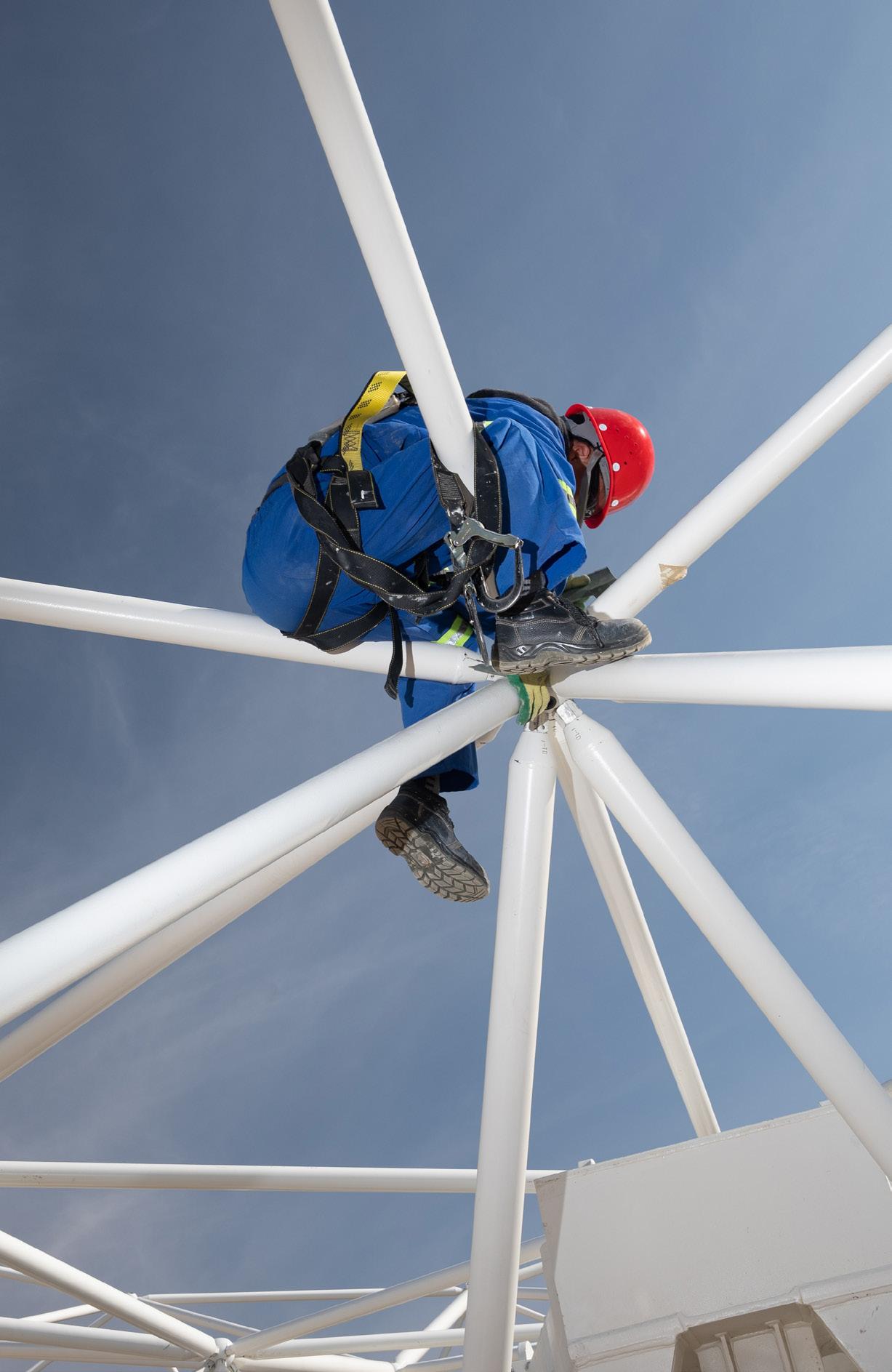
The construction team working on the backup structure of an SKA-Mid dish that will support the 66 panels of the main reflector. Credit: SKAO/Jac Kritzinger
50 km anywhere on Earth! Using these higher, microwave frequencies enables communication without interfering with the radio frequencies used by the telescopes on site.
Environmental walkthroughs of the infrastructure routing continue at the SKA-Mid site in compliance with our environmental management plan. These walkthroughs identify protected flora and fauna and determine whether species need to be protected or relocated or whether infrastructure must be rerouted.
Local community participation
Our local workforce continues to grow on site, reflecting our commitment to ensuring local community participation and stimulating the local economy. More than 273 local community members are now employed by our main infrastructure contractor Power Adenco from Carnarvon, VanWyksvlei, Williston and Brandvlei to work on site; 22% are women, and 62% are between 18 and 35 years old.
Power Adenco has also appointed 11 small, medium and micro enterprises (SMMEs) from the four towns for various construction works to date. Community meetings were held in the towns in July to provide feedback on progress related to local employment and contracting opportunities.
Ten local community members have completed their National Qualification Framework (NQF) learnerships in construction supervision. Two of the graduates have successfully obtained construction work packages as SMMEs and the remainder have been appointed by Power Adenco as construction supervisors, so we extend our congratulations to them all.
We are well on our way now to AA0.5!
An SKA-Mid dish structure next to its pedestal on the telescope site in the Karoo. Credit: SKAO/Jac Kritzinger
Concrete pouring from a mixer truck into the cylindrical base of an SKA-Mid pedestal. Credit: SKAO/Jac Kritzinger
SKA-Low construction highlights
BY ANT SCHINCKEL, SKA-LOW SITE CONSTRUCTION DIRECTOR
Construction activities are progressing at great pace at the SKA-Low site in Western Australia.
Stations along the telescope’s southern arm have been switched on and are moving through a phase of integration, verification and handover, with our first three stations now being used in observations. Clearing and trenching works continue on the northern and eastern spiral arms, while the telescope’s “core” starts to take shape.
Construction leads to first science
Following a major construction milestone for the SKAO earlier this year, with the first of the SKA-Low antennas assembled and installed, our Antenna Deployment and Station teams have been working to continue the deployment of antennas and their supporting systems as they become available.
The 1,024 antennas in four stations that make up Aperture Array 0.5 (AA0.5) have now been installed on Wajarri Yamaji Country at Inyarrimanha Ilgari Bundara, the CSIRO Murchison Radio-astronomy Observatory. Our teams are now working diligently towards our next major milestone – achieving correlation between all of these antennas.
In April, the early prototype power and signal distribution systems were installed across these stations, with the first station being powered on in May. By July the computing and networking for AA0.5 were handed over to the SKA-Low Assembly, Integration and Verification team, with the first AA0.5 integration test taking place just weeks later.
In August, the first image from one whole station (made up of 256 antennas) was captured, giving a small glimpse of what will be possible when the telescope is complete. Just one month later we had “first fringes”. These graphics (see page 35) show the correlated signal from two stations, revealing that the SKA-Low is working as an interferometer.
With these two achievements, we are quickly approaching the completion of our next milestone –correlation between the first four stations. Meanwhile, our Antenna Deployment team is assembling and installing another 3,500 antennas as we move towards AA1 – having 18 stations of the telescope completed.
Work progresses across the SKA-Low site
Significant work has occurred in the SKA-Low core since our last update, including the laying and installing of conduit, power and optical fibre cables. The fibre will feed data from the antenna stations to the on-site specialised digital signal processing systems that will be located at the Central Processing Facility (CPF) nearby. Our contractors are making good progress on the fabrication of the CPF modules in Perth, while on site the cable chamber formwork is nearing completion. While antennas continue to be installed on the southern spiral arm, the steel mesh that creates a consistent base for the antennas has begun to be placed at the core. Around half of the telescope’s total stations will eventually be located here, and it is exciting to see the
Cape Dunstan contractors lay mesh at the core of the SKA-Low telescope.
mesh base for more than 40 stations now installed in the core area, for a total of over 128 stations of mesh across the site.
Further afield, clearing and trenching works are continuing along the northern and eastern spiral arms of the telescope. On the northern arm, concrete pads have been prepared for the installation of power substations, while along the southern arm several more Remote Processing Facilities (RPFs) were successfully delivered and installed in early October. Power and fibre cable installation along the full length of the south arm is completed, with final splicing and testing underway.
Since our last update, a partnership between Wajarri Yamaji Aboriginal Corporation (WYAC) and our SKA-Low infrastructure contractor has been cemented to manage operations of Nyingari Ngurra, the SKA-Low construction village (read more on page 32).
Meanwhile, at the time of writing almost 1,100 people have completed Wajarri-led cultural awareness training sessions since they began last year. These sessions provide thought-provoking and, at times, confronting insights into the experience of Aboriginal people in Australia and are mandatory for all people who visit the SKA-Low site.
Rain a reminder of health, safety and environment challenges
There are many challenges associated with building a telescope the size of the SKA-Low in the Australian outback. This year we experienced a large amount of rainfall in the Murchison region. This made travelling to, and around, site more challenging than usual, especially for heavy vehicles, and gave invasive weed species an opportunity to spread.
SKA-Low Field Technician Emily Goddard assembling an SKA-Low antenna.
Paramedics from St John Western Australia are on site to provide medical support.
It served as a good reminder that the health and safety of both our staff and our contractors, and the protection of the environment, are imperative to the success of the project.
The SKA-Low Health, Safety and Environment team worked closely with contractor Ventia to ensure those working at the site were doing so safely and appropriately. Meanwhile, the SKA-Low environmental advisor worked closely with contractors to target the spread of the weed golden crownbeard.
Another focus for our teams has been risk mitigation in the event of an emergency. Given the remote location of the SKA-Low site, it is vital to have robust medical support for the more than 160 people who are working to construct the telescope on any given day. The SKAO has contracted St John Western Australia to provide paramedic and emergency coverage at the site for the next five years.
Two paramedics now rotate on site, with access to a fully equipped ambulance and medical room to provide immediate care to any workers in an emergency or life-threatening situation. The paramedics also provide proactive and preventative health strategies to support the SKA-Low team, including hydration monitoring, the provision of electrolyte replacement and one-on-one support for staff and contractors. They have also assisted in training the emergency response team.
The SKA-Low Health, Safety and Environment team have worked diligently to ensure we are prepared in the event of an on-site emergency. The team provided emergency response training in road crash rescue to SKA-Low staff, as well as staff from contractors at Ventia and Cape Dunstan. An emergency response trailer, equipped with road crash rescue tools, has been delivered to site. We have also constructed an emergency air strip, between the southern spiral arm and the core, in the event that a person needs to be flown to a hospital in either Geraldton or Perth for urgent medical care.
The end of 2024 is shaping up to be both a busy and exciting time on site, and I look forward to seeing that momentum continue into the new year.
Racks of SKA-Low antennas ready for assembly.
Team SKA: Pontsho Maruping
The close partnership between the SKAO and the South African Radio Astronomy Observatory (SARAO), a National Facility managed by the National Research Foundation (NRF), lies at the heart of the SKA-Mid telescope. SARAO built and operates the SKA precursor MeerKAT telescope and is playing a vital role in the delivery of SKA-Mid.
Pontsho Maruping has been part of SARAO|NRF for eight years, and since 2022 has held the position of managing director. Pontsho spoke to us about her journey from her first job in mining to her current role with SARAO, the impact of large-scale science projects on local communities and the significance of MeerKAT to the SKA project and South Africa.
Let us start with a look back to your childhood, Pontsho. Where did you grow up and when did you start to get interested in science and technology?
I grew up in Soweto, the largest township in South Africa. My interests lay initially more in sports than school but when I got to high school, I started to love school.
As a black person in South Africa, I did not have many role models in science or engineering at the time, so my interest in engineering started out purely coincidental. My plan was to become a maths and science teacher, that is why I completed my initial diploma in science education. During the school holidays in high school I would work in science labs as a type of work experience. After my diploma, I ended up accepting a job at one of the science labs. It is there that I discovered my interest in science and technology, specifically in engineering.
Can you take us on the journey from your very first job to now being managing director of SARAO?
I sometimes like to describe myself as a career nomad because I’ve done so many different things throughout my career. My first formal job was working as a diamond sorter for De Beers. During my time there, I studied mineralogy and moved into my first supervising role where I worked closely with engineers and discovered my interest in solving problems.
Then I made the hard decision to quit my job and study engineering full time. I remember being inspired by the space flight of the first black female astronaut Mae Jemison. I thought to myself: “If someone can be so brave to go to space, I should be brave to quit the job that I
Pontsho Maurping, Managing Director of SARAO, in front of the MeerKAT telescope.
wasn’t loving.” I was fortunate to host Mae on site during the IAU General Assembly and discovered that we share the same birthday: 17 October.
In the lead up to Nelson Mandela’s release [from 27 years of incarceration under the apartheid regime], there was an opportunity to rebuild the science system for South Africa. That is when I started at the Department for Arts, Culture, Science and Technology. Here, my journey into space and astronomy really started. As chief director I worked on a programme to establish the South African space programme. This is also when I heard about the SKA project for the first time.
At the time I worked with Rob Adam, my predecessor as managing director at SARAO, who was the director general of Science and Technology, and through him I applied for my first job at SARAO eight years ago. I started with establishing a commercialisation programme, and later added economic development of local communities to my portfolio. Then two years ago, I became the managing director.
You already mentioned Mae Jemison as someone who has inspired you, have there been other people that have guided you in a way?
Yes, there have been a few. At my first job, my boss told me I should enhance my education to open up more opportunities in my career. She was the one to encourage me to study mineralogy. There was also Dr Hannah Horsch who really supported me by offering me a management
opportunity, running the mineral characterisation laboratory, and supervising my first team.
At home, my parents have also always been supportive and hard-working, especially my mum who is a strong woman who always knew what she wanted. It gave all of us, me and my sisters, the courage to manage and accomplish our own lives.
You have been working at SARAO for eight years, what achievement are you most proud of during this time?
If I had to choose one thing which I helped drive personally, it would be building a strong angle in developing the communities in the towns near the telescopes. Before that, there was already some work done with the schools programme but there was no real effort to integrate a lot of what we do into supporting those communities.
We have also set up a small business training. Through this training, people learned how to manage a business and be compliant with legislation, such as tax and professional registration. This has resulted in small businesses in the area being able to get subcontracts during the construction of the telescopes.
SARAO has extensive experience in running human capacity development programmes; why are those such a focus for you?
When I was working in the public service sector, it became clear that science can have a hugely positive impact in a
Pontsho (in the darker outfit) with her sister during childhood.
developing country like South Africa. Projects like the SKA are so big, that if you do them right, they can really have a lasting impact wherever you are.
For example, there are young people who have gone through our learnership and skills training programmes that are now working for SARAO. Recently a young astronomer contacted us to get involved in our outreach activities, because he grew up in one of the towns and now he wanted to become a role model and encourage youngsters to go and study maths and science.
Last month you signed a memorandum of understanding with SKAO Director-General Prof. Philip Diamond, agreeing to work together to provide opportunities for African students to study and train at leading universities in SKAO member countries. How do you see this collaboration between the SKAO and SARAO?
When South Africa put in their bid to host the SKA telescope, the human capital development programme included supporting students from eight African partner countries with the aim to create a growing community of astronomers in African countries.
The future holds plans to expand beyond these eight countries with the support of the SKAO and scale up to other member countries to raise additional funding and broaden the scope of the project and the support base. When you think about it, there is going to be so much data generated by the SKA telescopes, so we need to build
sufficient capacity to make sure that the science can be done by capable people.
Let’s turn to MeerKAT now. What kind of impact do you feel it has had in terms of radio astronomy in South Africa but also beyond?
MeerKAT has made an impression that definitely surpassed expectations in South Africa and around the world. For example, at the MeerKAT@5 conference earlier this year, an event celebrating five years of world-class science with the telescope, established astronomers from all over the world couldn’t stop talking about how MeerKAT has enabled research that was previously not possible. You have to appreciate that we have built something amazing here. By having MeerKAT, we have to a large degree pre-qualified some of the technologies required for SKA-Mid and it has really improved our understanding of managing the radio frequency interference at the site and what we need in terms of computing and data storage. It has definitely had a major benefit for those involved in the SKA and given the world more validation of the approaches we are taking to design, build and manage the telescopes.
What has been the best thing about being part of Team SKA?
There are not many big multinational projects that have so many different countries involved and that do so well. For South Africa in particular, it is very special being part of this project and highlighting our capabilities. We are being
The robotics teams are one of the impressive human capacity development programmes run by SARAO near the telescope site. Credit: SKAO/Bruce Boyd
Projects like the SKA are so big, that if you do them right, they can really have a lasting impact wherever you are. There are young people who have gone through our learnership and skills training programmes that are now working for SARAO.
PONTSHO MARUPING
SARAO MANAGING DIRECTOR
recognised for supplying solutions in radio astronomy. Before the SKA project, no one would have expected receivers to come from a small company in Cape Town or that a team at SARAO would be building digitisers. All of this has made the project a lot more meaningful. What do you like to do outside of work? Do you have any hobbies or activities that help you wind down?
I think if you ask anyone at NRF, SARAO and SKAO, they will tell you: golf; because I am always trying to convince everybody to play golf. I now travel with my clubs. Back at the start of my career, I would travel a lot but often I would go from the plane to a hotel room, into meeting rooms and onto the plane back home. I have visited a lot of cities and countries that I genuinely did not see.
Now that I have this hobby, I am able to go outside and meet different people from all over the world in a setting that is not work-related. I try to play golf every week at least once and whenever I travel, I try to play on one of the courses there.
I am also a huge Lewis Hamilton fan and so watching Formula 1 is another favourite pastime.
Below: Pontsho during the Carnarvon Golf Challenge, organised by the SKAO and SARAO. The course in Carnarvon, close to the SKA-Mid telescope site, is home to a new initiative to train young people in the sport. Credit: SKAO/Jac Kritzinger
Historic Wajarri joint venture awarded major SKAO contract
BY LIZ WILLIAMS (SKAO), TOGETHER WITH VENTIA AND WAJARRI ENTERPRISES LIMITED
The SKAO has awarded the contract to manage the operations of Nyingari Ngurra, the SKA-Low construction village, to a joint venture partnership between SKA-Low infrastructure contractor Ventia Pty Ltd and Wajarri Enterprises Limited (WEL).
The 50/50 partnership brings together the strengths and expertise of both entities and will create a significant number of roles for Wajarri Yamaji People. The contract for managing the accommodation village was awarded by the SKAO directly to the Ventia-WEL joint venture. WEL and Ventia are partnering to run the camp operations, including maintenance, catering and day-to-day operations.
Ventia is the infrastructure contractor for the SKA-Low telescope in Australia, providing power and fibre to the telescope and designing and commissioning data processing facilities on site. Wajarri Enterprises Limited is part of the Wajarri Group and specialises in engaging and empowering the Wajarri Yamaji People through employment opportunities and sustainable business partnerships.
Through the joint venture, Ventia has committed to employing local people and providing ongoing training and personal development opportunities, as well as seeking local suppliers for products and services, and supporting WEL in its future objectives. Fifty per cent of employees at the SKA-Low accommodation village are Wajarri Yamaji, and the number is growing along with the village.
WEL Chief Executive Officer Ehsan Haque said WEL was excited to be partnering with Ventia for the SKA project.
“It is a fantastic opportunity for members of the Wajarri community to not only be involved in this great project but presents scope for employment, professional growth and widen their options in the future,” Haque said.
“WEL is excited to engage in this venture with Ventia who have a strong commitment to indigenous engagement and capacity building, and thanks the SKAO for this opportunity.”
The SKA-Low construction village was gifted a Wajarri nameNyingari Ngurra - which means ‘Zebra Finch Home’ in Wajarri language. The Zebra Finch is native to the area.
The SKAO is building the SKA-Low telescope at Inyarrimanha Ilgari Bundara, the CSIRO Murchison Radio-astronomy Observatory. The Wajarri Yamaji are the Traditional Owners and native title holders of the observatory site.
Book launch reveals SKAO origins
BY MATTHEW TAYLOR (SKAO)
A new book charting the history of the SKA project was launched at SKAO HQ on 8 July.
The Square Kilometre Array, A Science MegaProject in the Making, 1990-2012 was written by former International Director of the SKA Prof. Richard Schilizzi, Prof. Ron Ekers, Dr Peter Dewdney and Dr Phil Crosby.
“What we’ve attempted to do in the book is capture what things were done right, what things didn’t work out so well, and why,” said Prof. Schilizzi.
Arranged around the themes of global collaboration, science case, engineering design, site selection, and industry engagement, the book covers the prehistory of the project and its foundations at the 1990 IAU Colloquium 131, progressing through to the site selection in 2012.
Reflecting on the SKAO’s foundations, Prof. Schilizzi said: “When you think about the SKA and the different national funding cycles and different cultural approaches to science and decision making that were involved in the collaboration, as well as its technical complexity, it’s amazing that it worked at all, let alone ending up with the SKAO as an intergovernmental organisation with construction underway.”
Former Chair of the Board of Directors of the SKA Organisation (the SKAO’s forerunner), John Womersley, wrote the book’s foreword and also gave a short talk at the book launch.
He said: “This is a story about how a grand vision is becoming a reality.
“It takes enthusiasm, commitment and continued belief to take something like this forward, but the lessons that we’ve learned give me great faith, and being here and seeing this project move forward is hugely inspirational to those of us who’ve been involved in it up to this point.”
The book is published by Springer and is available to download or buy in hardcover here
New facility protects SKA-Low from unwanted interference
BY SEBASTIAN NEUWEILER (SKAO)
Ever wondered how we ensure our telescopes will be protected from the electronic noise of the very systems that make them operational? In Australia, a state-of-the art facility has been completed that will help us test technology for radio frequency interference.
The SKA Observatory telescopes will be extremely sensitive instruments – designed to detect the faintest of radio signals from space. Owing to these sensitivities, all electrical equipment needs to be tested to ensure it doesn’t leak radio waves that would impede our ability to detect these faint signals.
SKA-Low RFI-EMC Engineer Paul Van Der Merwe said any technology that has the potential to interfere with the telescopes would need to be shielded in specially designed cases.
“The SKA-Low telescope requires unparalleled radio quietness,” he said. “Any technology used in proximity to the antennas must meet the strictest radio interference requirements.”
One of the best ways to make sure telescope systems and associated hardware are compliant is testing them in a reverberation chamber – a room with metallic walls that reflect sound – before they go to site.
EMITE OTA test systems, a high-tech company spun-out from the Technical University of Cartagena in Spain, together with Australian partner company Maser, recently manufactured and installed a reverberation
chamber at the SKA-Low Engineering Operations Centre in Western Australia.
The reverberation chamber will be used to characterise the emissions from unshielded technology. This information can then be used to determine the shielding requirements for specific equipment.
So far the team have tested microwaves, radios and custom electronics to identify and prevent possible interference with the telescope, as well as testing the chamber itself for self interference.
EMITE CEO David Sanchez Hernandez said: “Our task is small, a link in the long chain of an extraordinarily complex and challenging project, but one we feel very proud of and acknowledge the confidence that the SKAO project showed in us from minute zero.”
The facility in Australia will be complemented by others elsewhere in the world, including the recently accredited RISE facility in Sweden. RISE has developed instrumentspecific processing software for testing electromagnetic emissions (EMC) from the extremely sensitive radio receivers and other electronic products for the telescopes.
The SKA-Low reverberation chamber in Western Australia. Credit: SKAO/Max Alexander
From dirt to data, SKA-Low reaches first scientific milestone
BY SEBASTIAN NEUWEILER AND CASSANDRA CAVALLARO (SKAO)
The SKAO’s low-frequency telescope (SKA-Low) has achieved an exciting milestone, with the release of “first fringes”, just weeks after producing the first image from one station.
In August, the first image from observations using one complete SKA-Low station was produced, already generating excitement within the community when it was presented during the IAU General Assembly in South Africa. This came just 18 months after the start of construction activities on site, and just five months after the first antenna was installed at Inyarrimanha Ilgari Bundara, the CSIRO Murchison Radio-astronomy Observatory.
Only weeks later, the milestone of “first fringes” was achieved, with the first correlated signal from two separate antenna stations being obtained. This data shows the SKA-Low is working as an interferometer – an instrument that uses many individual antennas, spread over a large distance, to form a large virtual telescope.
SKAO Director-General Prof. Philip Diamond said this marked “the day the SKA Observatory as a scientific facility was born”.
SKA-Low’s antennas do not move, instead using a technique called beamforming to digitally point at different parts of the sky. The data is then combined
and correlated to make sense of the radio signals which arrive at each antenna at marginally different times.
SKA-Low Lead Commissioning Scientist Dr George Heald said finding a strong correlated signal between the first two SKA-Low stations means that the instrument works as expected.
“Now we can scale up the scientific power of SKA-Low as we add more and more stations over the next few years, ultimately enabling us to search for the unknown,” he said.
“This is an incredible milestone. Many astronomers, including myself, are so excited for what comes next as this telescope continues to scale.”
These scientific works use data obtained from Inyarrimanha Ilgari Bundara, the CSIRO Murchison Radio-astronomy Observatory. We acknowledge the Wajarri Yamaji as the Traditional Owners and Native Title Holders of the Observatory site.
A bird’s-eye view of the cluster known as S8, on the southern spiral arm of the SKA-Low telescope, showing the two stations involved in first fringes.
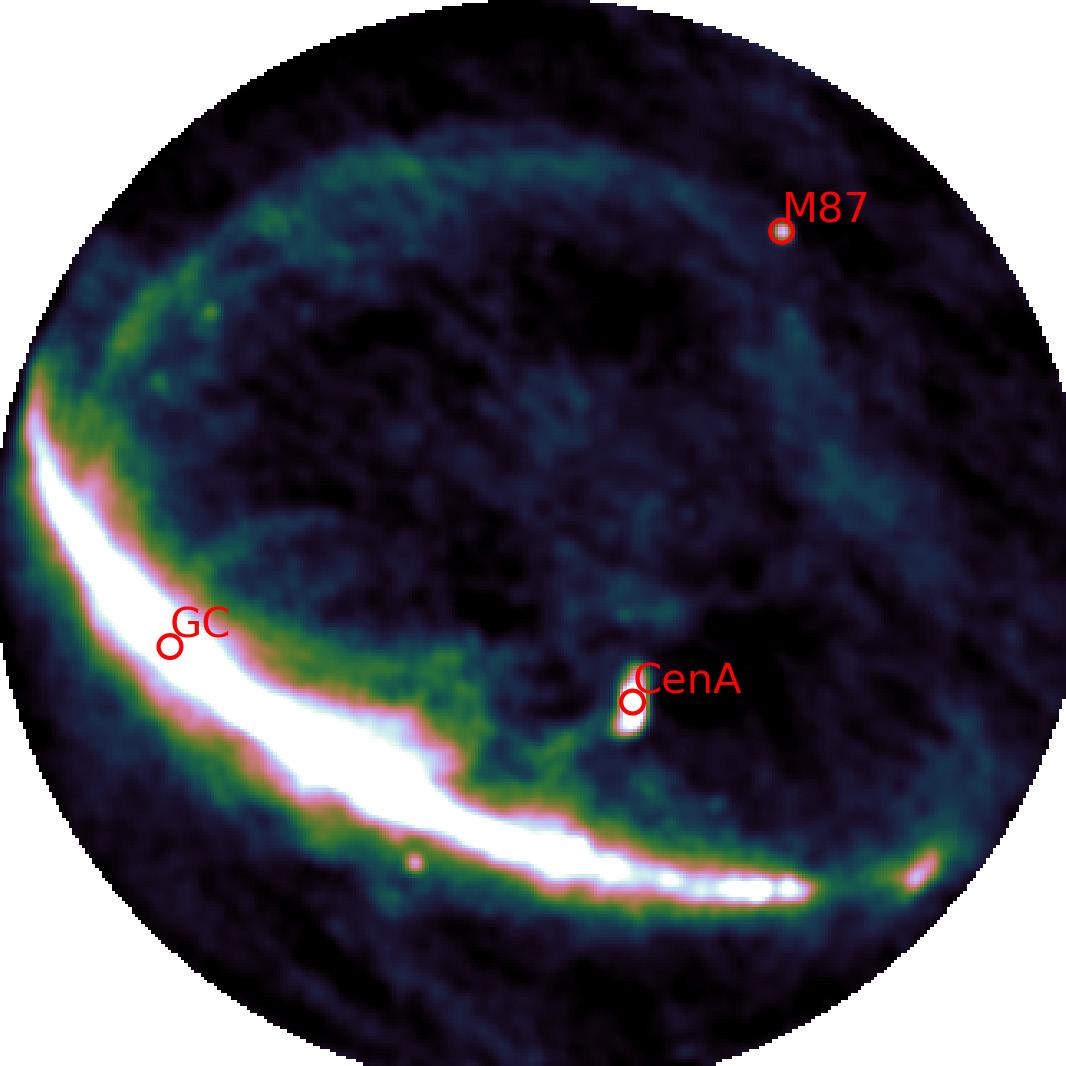
Taken over 24 hours, the first image from a whole SKA-Low station shows the Milky Way rising and passing overhead, as well as the galaxies Centaurus A and M87. The image demonstrates the high sensitivity of a single station and provides a glimpse into the future power of the telescope, with the resolution expected to be 100,000 times higher once all 512 SKA-Low stations are operational.
First fringes: these graphics show the phase structure of the correlated signal between two SKA-Low stations of 256 antennas each.
The SKAO grows: Canada, India and Germany bring membership to 12
BY JOSHUA RODDEN AND ANNE DANIELS (SKAO)
The SKAO has grown from nine to an impressive 12 members in 2024, welcoming Canada, India and Germany within the past five months.
In June, Canada became the first SKAO member state in the Americas. Making the announcement, Minister of Innovation, Science and Industry François-Phillipe Champagne also confirmed a $269m (approximately €182m) investment over eight years, to be overseen by the National Research Council of Canada’s (NRC) Herzberg Astronomy and Astrophysics Research Centre.
Canada’s MDA Space, a longtime industry partner of NRC, has been awarded the SKAO construction contract to develop and integrate the correlator and beamformer for the SKA-Mid telescope – the system that acts as the “brain” of the array, combining signals from all 197 of its dishes.
India’s longstanding involvement in the SKA project also culminated in SKAO membership in July. Its radio astronomy community, led by the late Prof. Govind Swarup, proposed one of the first concepts for a large radio observatory of the class of the SKAO in the 1990s.
India has since made significant contributions to the critical software elements that sit at the heart of the
EU ambassadors visit SKA-Mid
site
In April, the SKAO and its South African partners hosted a major diplomatic visit at the SKA-Mid telescope site in the Karoo, with ambassadors and high commissioners from 17 European countries, the European Union and Australia in attendance.
Above: The Indian, German and Canadian flags waving amongst the other member states’ flags at the SKAO Global Headquarters in the UK.
SKA telescopes, and it will lead the development of the Observatory’s management and control system. Indian membership was marked at a celebratory event in Pune with senior government officials in November.
Good news comes in threes, and so it did for SKAO membership, with Germany joining the Observatory in November. German contributions to the SKAO already include significant investment from the Max Planck Society in the ongoing MeerKAT telescope extension (MeerKAT+), which will ultimately be integrated into the SKA-Mid telescope in the coming years.
German involvement has also included the construction of an SKA-Mid prototype, known as SKAMPI, which saw its first light earlier this year. The prototype dish has enabled radio frequency interference testing on site but is also helping the team prepare for commissioning of the first SKA-Mid dishes.
“I was delighted to experience first-hand the extraordinary and far-reaching work being done at the SKAO. It underscores the strength of the strategic partnership of South Africa and the European Union on science and innovation and how through multilateralism and international cooperation we can address the defining challenges of our time,” said EU Ambassador to South Africa Sandra Kramer.
Wajarri Yamaji representatives share culture at SKAO headquarters
BY SEBASTIAN NEUWEILER AND MATTHEW TAYLOR (SKAO)
The first international session of Wajarri-led cultural awareness training has taken place at SKAO Global Headquarters in the United Kingdom.
In July, Wajarri women Jennylyn Hamlett and Susan Merry travelled from Western Australia to the United Kingdom, on their first ever trip outside Australia, to deliver cultural awareness training and art workshops.
The visit took place during Australia’s NAIDOC week, which celebrates the history, culture and achievements of Aboriginal and Torres Strait Islander Peoples.
Representing the Wajarri Yamaji Aboriginal Corporation, Jennylyn welcomed 60 SKAO staff across three half-day sessions to complete the cultural awareness training.
While the training is mandatory for all visitors to the SKALow telescope site at Inyarrimanha Ilgari Bundara, the CSIRO Murchison Radio-astronomy Observatory, staff were invited to attend from across the headquarters’ teams.
“It is essential that SKAO staff across our sites, whatever their role, understand and appreciate the history, lived experiences and cultures of the places and communities in which we are operating, and hear about it directly from these First Nations’ representatives,” said SKAO DirectorGeneral Prof. Philip Diamond. “We may be separated by continents, but decisions made here at the headquarters need to be informed by that knowledge, and for that reason
we wanted as many staff as possible to undertake this training.”
The sessions provided staff with thought-provoking and, at times, confronting insights into the experiences of Aboriginal people in Australia.
Respected Wajarri artist Susan Merry – whose artwork is featured in the Shared Sky and Cosmic Echoes exhibitions –hosted art workshops for staff and their families to learn about Wajarri painting techniques under her guidance.
As part of their visit, they presented to the SKAO Council at their July meeting to gift Susan’s artwork – Our Home – to the SKAO, on behalf of the Wajarri Yamaji, the Australian and Western Australian governments, and CSIRO.
Our Home was commissioned by Australia to commemorate the SKAO Council’s first visit to the SKA-Low telescope site in October 2023. The painting includes handprints from Council members and represents the beauty of the land with its rich red soil and wildflowers.
The framed artwork will now be hung in a dedicated area of the SKAO Council Chamber.
Wajarri artist Susan Merry presents SKAO Director-General Prof. Philip Diamond
Australia’s first female astronaut speaks to local students at SKALow site
BY SEBASTIAN NEUWEILER (SKAO)
It’s not every day you get to meet an astronaut. Nor is it every day you get the chance to visit one of the world’s biggest radio astronomy telescopes. Students from outback Western Australia recently had the chance to do both.
In August, students from Mullewa District High School, many of them Wajarri Yamaji, boarded a bus to make the three-hour journey to Inyarrimanha Ilgari Bundara, the CSIRO Murchison Radio-astronomy Observatory, the site of the SKALow telescope.
Waiting for them was Australia’s first female astronaut, Katherine Bennell-Pegg, who had travelled to Wajarri Yamaji Country to see the SKA-Low telescope up close and meet with the local students.
Katherine, who is also the first person to train as an astronaut under the Australian flag, recently completed a 13-month training programme in Germany at the European Space Agency to become a qualified astronaut.
After more than a decade of study, she is now awaiting a mission to enter outer space.
Bennell-Pegg said it was special to witness the students enjoy their time learning more about the telescope in their backyard.
“To visit a telescope at their age, I felt I shared that with them,” she said.
“I hope that being here among all of the scientists, engineers and technicians inspires them, just like I was inspired when I was a kid.”
Students also had the chance to speak to the team of SKALow field technicians, who are assembling and installing the antennas that make up the telescope, learning how the equipment collects data from space.
SKA-Low Field Technician Emily Goddard said it was fantastic to have the students on site.
“They brought a level of excitement to the site that we don’t normally get. A few even put their hands up to help build a couple of antennas,” she said.
“Our team were asked some great questions, including ‘what are we looking for?’, ‘are aliens real?’ and the one that knocked me off my feet, ‘what is science?’
“With questions like that, I hope to see these students working on this project in years to come.”
The students’ visit was made possible by the Wajarri Yamaji Aboriginal Corporation, as part of the programme of school visits to the observatory site under the Indigenous Land Use Agreement between Wajarri, the Australian Government and CSIRO.
As part of her trip to the Observatory, Katherine also visited CSIRO’s ASKAP radio telescope and the Curtin Universityled Murchison Widefield Array, two of the SKA precursor telescopes.
Australia’s first female astronaut, Katherine Bennell-Pegg, takes questions from the local students.
SKAO’s 2023 Annual Report released
BY JOSHUA RODDEN (SKAO)
With the publication of the 2023 Annual Report, the SKAO provides a comprehensive overview of the Observatory’s significant achievements and progress last year. The report underscores the SKAO’s resilience in navigating the complex political and economic challenges faced by large-scale research infrastructures.
Key milestones reported on include the commencement of infrastructure work in both South Africa and Australia, the assembly of the first SKA-Mid telescope production dish in China, the delivery of the first batches of SKA-Low antennas in Australia, and the expansion of the organisation’s membership, with Spain joining the SKAO, and both Germany and Canada confirming their intention to join. The year also saw the successful installation and first light of the Aperture Array Verification System 3 (AAVS3), an SKA-Low technology demonstrator.
The report also highlights the Observatory’s commitment to sustainability, including efforts to monitor biodiversity and water consumption at both the SKA-Mid and SKALow telescope sites, and a continued focus on the use of renewable energy. Other highlights include the signing of four cooperation agreements, including one with the European Southern Observatory (ESO), and continued advocacy for both astronomy and dark and quiet skies across major international forums.
Next stage of SKA Science Data Challenge 3 begins
BY DR ANNA BONALDI (SKAO)
The second part of SKA Science Data Challenge 3 is well underway, with more than 50 teams registered to take part over the next six months – an impressive number!
SDC3 focuses on the planned SKA-Low observations of the Epoch of Reionisation (EoR), a remote era of our Universe when the first stars and galaxies formed, and when hydrogen in the Universe transitioned from being neutral to being ionised. The highly technical task in this second part of the challenge, called SDC3 Inference, is to investigate the reionisation properties of the Universe using simulated neutral hydrogen observations.
Stage one of the challenge, SDC3 Foregrounds, completed in November 2023, required teams to “clean” the simulated SKA-Low data, removing the radio emission from our Milky Way and other galaxies, to reveal the much fainter EoR signal. Further analysis of the results has led to an amendment of the previously announced outcome, with the DOTSS21cm team now topping the leaderboard, followed by HIMALAYA.
The cover of the 2023 SKAO Annual Report.
SKAO science meeting heading to Germany in June 2025
BY JOSHUA RODDEN (SKAO)
The historic town of Görlitz, Germany – soon to be the home of the brand-new German Centre for Astrophysics (Deutsches Zentrum für Astrophysik, DZA) – will host the next SKAO general science meeting.
A new era in astrophysics: Preparing for early science with the SKAO will be held from 16-20 June 2025.
“With the construction of our telescopes well underway, and commissioning about to begin, it’s an exciting time for the SKAO. We can’t wait to join our community next year to look ahead to what the telescopes might find during early operations,” said SKAO Scientist Dr Philippa Hartley.
Events around the globe
It’s been a busy few months on the events front in addition to the IAU General Assembly, with the SKAO and its partners taking part in conferences and exhibitions internationally.
The SKAO team was kept busy at the major outreach event Astrofest in Perth in November (top left image), with participants of all ages enjoying engaging activities including building a mini SKA-Low array. At the Big Science Business Forum in Trieste (bottom image), Italy, in October, SKAO Director-General Prof. Philip Diamond took part in a panel with leaders from other major research infrastructures including CERN, ESO and ESA. In July, at the Spanish Astronomical Society meeting in Granada (top right image), with a record attendance of over 630 participants, the SKA project played a prominent role, as the subject of the inaugural plenary lecture, a special session, and featuring in various parallel sessions.
Registration for the meeting will open in the new year, with a dedicated website providing travel details, information on social events and more. For all enquiries regarding the SKAO Science Meeting 2025, please email skaosci2025@ skao.int.
Jobs
With construction underway on the SKA telescopes, we continue to recruit staff across a number of areas at our three locations in the UK, Australia and South Africa. Some of the South Africa and Australia-based roles are employed through our partners CSIRO and SARAO. Make sure to register on our recruitment website to receive alerts.
Product Manager, Control System Software
In SKAO software development, Product Managers ensure progress and alignment with the project’s vision and milestones. This role involves guiding the development of control system products that interface with telescope hardware and software subsystems, providing software tools and services that are used to operate the Mid and Low telescopes.
Data Operations Software Developer
The SKAO Data Operations group is looking to employ a talented and driven software engineer to join our small, friendly team based in the SKAO Global Headquarters located at Jodrell Bank in the UK.
SKA-Low HR Advisor
Following the establishment of the Observatory as an Intergovernmental Organisation and the creation of local offices in Australia and South Africa, there is a requirement for an HR Advisor to provide local HR advice and support to both local and global SKA-Low personnel.
SKA-Low Junior Project Manager
The Junior Project Manager for SKA-Low will report to the Senior Project Manager for SKA-Low and will be responsible for preparing and managing specific construction contracts and work packages for the SKALow project.
SKA-Mid jobs via SARAO
SHEQ Manager
Project Engineer
Assistant Fibre Optic Technician
SKA-Low jobs via CSIRO
Network Engineer
Field Team Supervisor | Multiple Positions
Computing & Software | Multiple Positions
Engineering Operations | Multiple Positions
Field Technician
Village Liaison Officer
Building and Fleet Coordinator
CSIRO Postdoctoral Fellowship in Low Frequency Astronomy
SKAO in the news
SABC
Cape Town hosts IAU’s 32nd General Assembly
South Africa’s public broadcaster SABC reports from the IAU General Assembly and interviews Minister of Science Blade Nzimande inside the SKAO pavilion.
Newsroom Afrika TV
SKA-Mid telescope to help understand state of galaxy
A live report by the 24-hour news channel Newzroom
Afrika at the General Assembly, speaking to the SKAO’s Dr Sarah Pearce about both of the Observatory’s telescopes (pictured below).
Mail & Guardian
World’s largest astronomy meeting debuts in Cape Town
The SKA project’s prominence at the General Assembly is the focus of this piece marking the kick-off of the event.
Xinhua
China’s dark energy detector granted SKA pathfinder status
China’s official news agency reports on a new SKA pathfinder: the Tianlai experiment, which was granted the status in October.
Cosmos
Discover the world’s largest radio telescope
Cosmos magazine offers its readers a downloadable package of content featuring the SKAO, including factsheets and a documentary.
IFL Science
The Night Sky Is In Danger And Astronomers Are Stepping Up To Protect It
The popular science website explores the issue of satellite constellations’ impact on astronomy, speaking to experts including the SKAO’s Dr Lewis Ball and Dr Wendy Williams
ABC News
Australia’s SKA-Low telescope is being built in the outback, in part to answer if we are alone in the universe
Australia’s national broadcaster visits the SKA-Low site to learn more about how the telescope will act as a huge “time machine”. Watch the TV news report here
Earth Sky
SKA telescope gets its ‘1st fringes’
The popular magazine delves into what “first fringes” means for radio telescopes and why reaching the milestone is so significant for the SKAO.
Celebrating our community
In this section we celebrate success and recognise colleagues, partners and members of the community who have received prestigious grants, awards and honours in recent months.
SKAO Council Chair Dr Catherine Cesarsky led her final Council meeting in November 2024 in Kimberley, South Africa. It marked the end of Dr Cesarsky’s seven years of service to the SKA project, having previously chaired the SKA Organisation Board of Directors, before the Observatory was established in 2021. The SKAO thanks Dr Cesarsky for her dedication and leadership during these crucial years in the development of the Observatory.
Prof. Peter Quinn has been inducted into the Western Australian Science Hall of Fame for his outstanding 42-year research career in astrophysics. Prof. Quinn’s roles include serving as head of the Data Management and Operations Division at the European Southern Observatory (ESO) and contributing to the establishment of the SKAO in Australia, as the first executive director of the International Centre for Radio Astronomy Research (ICRAR).
Dr Lourdes Verdes-Montenegro, who has been at the forefront of Spanish participation in the SKA project as both a researcher at the Institute of Astrophysics of Andalusia (IAA-CSIC) and a member of the HI Galaxy Science Working Group, has been awarded the Margarita Salas Medal 2023 by the Spanish National Research Council (CSIC) for her work mentoring and supervising early-career researchers.
Dr Michiel van Haarlem, head of the Netherlands SKA Office, has been appointed as the new executive director of LOFAR ERIC. Dr Van Haarlem will play a crucial role in ensuring the efficient operation of the Low Frequency Array (LOFAR) and leading the planned upgrade to LOFAR 2.0.
Prof. Di Li, the chief scientist of China’s Five-hundredmeter Aperture Spherical Telescope (FAST), an SKA pathfinder telescope, has been awarded the Marcel Grossmann Award for his contributions to the field of fast radio bursts (FRBs). Prof. Li is a member of the SKAO’s Cradle of Life Science Working Group.
SKA-Low Telescope Director Dr Sarah Pearce received the Outstanding Senior Leadership Award at the Women in Technology WA Awards. The organisation is the leading advocate for diversity, inclusion, and equity for women in technology in Western Australia.
Prof. Anton Zensus, director at the Max Planck Institute for Radio Astronomy (MPIfR), has been awarded the Karl Schwarzschild Medal for his leading role in the development of radio astronomical observation methods with very high angular resolution and sensitivity.
Staff writers: Matthew Taylor, Sebastian Neuweiler, Anne Daniels, Joshua Rodden
Proofreading: Peter Grimley
Design: Joe Diamond, based on an original design by Carbon Creative
Cover design: Gareth Chadwick
We welcome your contributions to Contact! Get in touch with us at magazine@skao.int
All images in Contact are are credited to the SKAO unless otherwise indicated.
ABOUT THE SKAO
The SKAO, formally known as the SKA Observatory, is an intergovernmental organisation composed of member states from five continents and headquartered in the UK. Its mission is to build and operate cutting-edge radio telescopes to transform our understanding of the Universe, and deliver benefits to society through global collaboration and innovation.
The SKAO recognises and acknowledges the Indigenous peoples and cultures that have traditionally lived on the lands on which our facilities are located. In Australia, we acknowledge the Wajarri Yamaji as the Traditional Owners and native title holders of Inyarrimanha Ilgari Bundara, the CSIRO Murchison Radio-astronomy Observatory, the site where the SKA-Low telescope is being built.
FRONT COVER
This edition’s cover design encapsulates the vibrant spirit of South Africa that resonated through the IAU General Assembly, held for the first time ever on the African continent in August 2024. Its colour palette and artistic style are a nod to both the South African flag and the SKAO’s Cosmic Echoes Indigenous art exhibition launched at the General Assembly. It also speaks to the many different elements that came together under one event, celebrating science, culture, diversity, education and global collaboration.
Contact is produced primarily as a digital magazine. If you are reading a print copy, use the QR code to read this and other issues of Contact online, access the hyperlinks, and subscribe to Contact’s mailing list.