CONSTRUCTION
Teams take on third SKAO Science Data Challenge

See how work is progressing on the SKAO sites
SCIENCE DIPLOMACY
Dark and quiet skies high on the agenda
Issue 13 | June 2023 The SKAO’s Magazine
DATA
BIG
FOREWORD
3 Prof. Philip Diamond, SKAO Director-General
IN BRIEF
4 Major LOFAR upgrade approved
5 Looking towards a new UK SKA Regional Centre node
5 Total eclipse of the Sun in Western Australia
6 SKAO allocates second batch of radio astronomy outreach funding
7 UK teams awarded contract for SKA-Low signal processing system
7 Safran to provide SKA telescopes with timing and synchronisation solution
8 New CHIME outrigger telescopes boost search for fast radio bursts
9 Forging local collaboration between the SKAO and Karoo stakeholders
CONSTRUCTION UPDATE
10 Construction activities for SKA-Mid telescope are ramping up
12 Preparatory construction works begin in Western Australia
14 Global construction picks up pace
FEATURED IMAGE
16 Astronomers assemble for Vancouver meeting
FOCUS ON
18 SKA and ngVLA: radio astronomy’s new eyes on the Universe
PATHFINDERS
20 First radio detection of ‘type Ia’ supernova
21 SKA pathfinders unite for PEGASUS survey’s first image of Milky Way

22 Bursting at the extremes
23 Nine new, exotic creatures for pulsar zoo
24 Effelsberg radio telescope sheds new light on binary black holes

25 MeerKAT finds largest hydrogen atoms in distant galaxy
26 Major survey provides new insights into pulsar behaviour
SKAO CORNER
28 SKAO membership grows
29 Dark and quiet skies high on the agenda
30 High-level visitors welcomed at SKAO offices

32 Teams take on third SKAO Science Data Challenge
34 Two minutes with... Dr Cathy Foley
34 Digging deep: HQ staff join charity tree planting
35 ‘Seeing poetry in the cosmos’
TEAM SKA
36 Dr Takuya Akahori – Scientist at NAOJ and SKAO
EVENTS
39 ESO-SKAO meeting lays groundwork for joint surveys of southern sky

40 Granada hosts first SKA Open Science school as hybrid meeting

41 AfAS conference highlights rise of astronomy in Africa
41 Jodrell Bank ‘Meet the Expert’ session goes global with SKAO
42 Sweden: SKA scientists make connections ready for future projects 43 Upcoming events

2 CONTACT ISSUE 13 05 18 Contents 14 21 40 32
NEWS
SKAO in the news 44 Cartoon corner JOBS
SKAO and partner jobs CELEBRATING OUR COMMUNITY
Celebrating our community: awards and honours
44
45
46
Dear friends and colleagues,
This 13th issue of Contact is bursting at the seams with news of science results, meetings, construction activities on both telescope sites, progress towards getting new members of the SKA Observatory, and with interesting articles on outreach, along with a profile of our Japanese colleague Dr Takuya Akahori.
It is great to see this acceleration in progress across the global SKAO partnership and community. I feel a palpable sense of excitement when I speak to colleagues both within and without the Observatory. This was captured for me, personally, when I attended the SKAO-ngVLA meeting in Vancouver. First, it was good to meet face-to-face with many colleagues whom I had not seen for several years, for reasons we all know. Secondly, as the article on the meeting mentions, there was a vibrancy in the room, with many of the speakers (most of whom seemed impossibly young!) showing great new results and highlighting what they felt would be some of the great capabilities that would become available in the relatively near future.

We’re seeing this anticipation and excitement being fulfilled as we receive photographs and hear status reports on the construction activities on the two sites. As I write this, we now have contractors deployed in both the Karoo and the Murchison and the long-awaited deployment of SKA infrastructure has begun.
I hope you enjoy reading Contact. I should mention that Cassandra (Managing Editor) and Joe (Design) both recently received SKAO Recognition Awards for Excellence for the work they do on the magazine. These awards are nominated by colleagues and selected by a panel of peers.
PROF. PHILIP DIAMOND, SKAO DIRECTOR-GENERAL

3 JUNE 2023 CONTACT
Major LOFAR upgrade approved
BY MISCHA BRENDEL AND WIM VAN CAPPELLEN (ASTRON)
The board of the International LOFAR Telescope has approved the purchase of upgraded hardware for all 52 stations of the pan-European telescope, plus two additional stations, and spare parts.
The upgrade, known as LOFAR2.0, has seen contracts with a total value of €10m awarded to the Dutch companies Neways¹, Major Electronics², Variass³, and Batenburg Industriële Elektronica⁴.

LOFAR has thousands of antennas spread across 10 partner countries, with the core of its stations in the Netherlands. The new investment will mean it is possible to use all the LOFAR antennas – high and low band –together for the first time.
“The simultaneous low- and high-band observing provides a full view over four octaves of radio frequencies; plus, the
telescope’s field-of-view will also increase. This enables both wide-area and ultra-deep surveys of the low-frequency sky, which aim to detect, for example, star-planet interactions, the cosmic web between galaxies, and galaxies in formation during the early history of the Universe,” says ASTRON’s Prof. Jason Hessels.
“What excites me most are the excellent prospects for discovering something unexpected and unpredicted because we will be charting the sky as never before possible.”
Production and delivery of the modules is expected in 2024.
¹ Neways will manufacture the UniBoard2 digital processing boards that enable simultaneous observations with the low band and high band antennas.
² Major Electronics will produce the cabinet clock distribution module, LOFAR mid-plane board and the antenna processing subrack power unit module.
³ Variass will manufacture the receiver modules (RCU2) for the telescope, 6,000 pieces in total. These amplify the antenna signals and allow astronomers to select specific frequency ranges. After the analogue signal amplification and filtering, the signal is digitised by the analogue-to-digital converter and is sent to the Uniboard2 for further signal processing via the LMP Module. Each RCU2 module handles three antenna signals individually.
⁴ Batenburg Industriële Elektronica is responsible for the manufacturing of more than 200 clock distribution modules, which distribute the highly accurate and stable station clock to the various modules inside the station sub-rack.
4 CONTACT ISSUE 13 In brief
ABOVE: The LOFAR2.0 Low Band Receiver (10-90 MHz) developed by ASTRON and INAF. Credit: Wim van Cappellen/ASTRON
Looking towards a new UK SKA Regional Centre node
BY DR HILARY KAY (UNIVERSITY OF MANCHESTER – UK SKA) AND DR LOUISE CHISHOLM (UNIVERSITY COLLEGE LONDON)
In January, the Science and Technology Facilities Council (STFC) funded a consortium* from the UK astronomy and digital research infrastructure communities to increase national participation in the global SKA Regional Centre Network (SRCNet).
The funding will also create a UK SKA Regional Centre (UKSRC) node with the aim of providing scientists based in the country with seamless access to future SKA science data. In collaboration with the SRCNet prototyping teams, they will develop a proto-UKSRC facility, utilising new technologies across cloudcomputing, data logistics, data archives and science platforms. Research groups will be able to use the facility for SKAO Science Data Challenges and SKA pathfinder and precursor science, which provides valuable opportunities for the team to test the facility.
Engagement with the future UK SKA user community is essential. The project was co-created with astronomy researchers based across the UK who, via a series of workshops, identified the initial UKSRC science demonstrator cases, which
Total eclipse of the Sun in Western Australia
BY RACHEL RAYNER (CSIRO)
are aligned with the SKA key science areas. These and future cases will inform the technical development of the proto-UKSRC.
Along with providing UKSRC-specific training and support for users, the team is launching a scheme to provide early career leadership opportunities and community-led training initiatives. Recruitment will start soon at partner institutions: this includes project managers, research software engineers, data stewards and experts in research computing and radio astronomy.
To keep up to date, visit the UKSRC website and follow the team on LinkedIn and Twitter
*University of Cambridge, Durham University, University of Edinburgh, University of Hertfordshire, University of Manchester, StackHPC Ltd, STFC Rutherford Appleton Laboratory, UCL

On 20 April, a very small part of Australia –Ningaloo Reef in Western Australia – was privileged to witness a rare hybrid solar eclipse.
The limited viewing access did not hamper the rest of Western Australia from celebrating this rare phenomenon, with astronomy events encouraging young and old to look up. CSIRO was a sponsor for both Astrotourism WA’s Eclipse Discovery Tour, where regional communities held stargazing events featuring speakers from the field of astronomy (including SKAO and CSIRO staff), and for the inaugural Ancient Lands Under Brilliant Skies festival, held across two days in the lead up to the eclipse, where CSIRO and SKAO staff met local people and visitors to the region.
A hybrid solar eclipse involves both a total eclipse and annular eclipse. An annular eclipse is where a narrow bright ring forms around the Moon when it covers the Sun. This is often called the “ring of fire”. In a total eclipse, the Moon appears to completely block the Sun so that only the solar corona (the
“crown” of light that is emitted by the Sun) is visible. In April, this all happened over a very short period of time, with the hybrid process taking about a minute. Although most of the country saw only a partial eclipse, this was the first time a solar eclipse of any sort had been visible in Australia since 2012.
The eclipse’s path of totality was nearly 800 km away from Inyarrimanha Ilgari Bundara, the CSIRO Murchison Radioastronomy Observatory, home to the SKA-Low telescope and one of its precursors, CSIRO’s ASKAP radio telescope.
The ASKAP team took the opportunity to explore interplanetary scintillation during the eclipse. The partial coverage of the Sun visible on Wajarri Country allowed the telescope to better observe how solar winds can cause distant galaxies to twinkle, distorting the signal. By analysing the solar wind more closely, researchers can get more accurate data on distance galaxies.

5 JUNE
CONTACT
2023
Watch: ASKAP Solar Eclipse
SKAO allocates second batch of radio astronomy outreach funding
BY MATHIEU ISIDRO (SKAO)
The SKAO has awarded a second round of funding to support the development of radio astronomy outreach activities and resources under a joint scheme with the International Astronomical Union’s Office for Astronomy Outreach (IAU OAO).
The scheme, managed by the OAO, is funded by the SKAO. It supports the development of freely accessible public outreach content and resources about radio astronomy, and fosters new international collaborations between outreach experts and astronomers in the SKAO’s partner countries and beyond.

In this second year, the SKAO has allocated a total of €15,000 to four projects that span Europe and Africa.
The 2023 funding will support the production of two podcast series, a medium that has proved extremely popular to engage wider audiences with science. These include a new Franco-Swiss podcast in French on radio-astronomy, and The Cosmic Savannah, the highly successful podcast series produced in South Africa that shines a spotlight on astronomy in Africa.
This year’s funding will also support a European collaboration to engage schools with their local radio astronomy observatories and share their experiences, and the development of a three-antenna radio interferometer in Greece dedicated to outreach and education.
To be awarded funding, the proposals needed to demonstrate a focus on radio astronomy public engagement and outreach, involve international collaboration, and be widely accessible. Applicants were also encouraged to highlight how they will support the SKAO’s values, in particular in terms of diversity and inclusion.
The 2023 winning proposals are as follows:
• Sharing a baseline: a hands-on international radio astronomy pilot for kids – Sweden, Finland, Italy, the Netherlands, and Spain (€5,000)
• Making waves: a new podcast for sharing radio astronomy with regular earthlings – France and Switzerland (€5,000)
• The Cosmic Savannah, a podcast series featuring astronomy from across Africa – South Africa (€2,500)
• JAM radio, a three-antenna radio interferometer for education and outreach – Greece, Sweden, Australia, and South Africa (€2,500)
You can read about the previous winners here
6 CONTACT ISSUE 13
UK teams awarded contract for SKA-Low signal processing system
BY DR HILARY KAY (THE UNIVERSITY OF MANCHESTER – UK SKA)
Teams from the University of Oxford and the STFC Rutherford Appleton Laboratory have
been awarded a £3.4m (€3.8m) contract to provide firmware development and integration for the SKA-Low telescope’s signal processing system (SPS).
The SPS plays a complex and fundamental role in the telescope’s operation. After receiving the radio frequency signals from each of the 131,072 low-frequency antennas, it cleans and digitises the signals and combines them to form one or more “beams” from each station of antennas, before transporting the data to the Science Processing Centre in Perth.
Building on experience gained by the teams during the eightyear SKA detailed design phase, the contract will see the UK team grow with the initial appointment of three new engineers at the University of Oxford. They will deliver firmware for the cabinet and sub-rack management board, as well as the firmware for the 8,000+ tile processing modules which each
digitise and convert the signals from 16 antennas. They will also provide the cabinet chassis and management board as well as the AC power distribution and cooling system.
“We are excited to contribute to what will become the largest digital phased array system in the world, at whose heart lies the most sophisticated signal processing algorithms implemented on cutting-edge technology supplied by UK industry,” says Dr Kristian Zarb Adami, who is leading the University of Oxford team.
The contract will run until December 2025, and will see the construction, installation and integration of a total of 12 SPS cabinets on the SKA-Low site.
Safran to provide SKA telescopes with timing and synchronisation solution
BY MATHIEU ISIDRO (SKAO)
A Spain-based business of multinational technology company Safran has been awarded a highly technical contract to supply time distribution for the SKAO’s telescopes in Australia and South Africa.
Time distribution is a scheme where multiple sites share a precise reference time. Safran Trusted 4d is developing the final designs and providing the hardware to the SKAO. Using White Rabbit (WR) technology first developed by CERN will allow the design to distribute timing information over long distances with sub-nanosecond accuracy – a perfect solution for the SKA telescopes, for which the achievement of the science cases requires synchronising signals reaching multiple antennas with a time accuracy better than two nanoseconds.
The system’s master unit located in the correlator buildings delivers a “ping” each second respectively to each of the SKA-Mid dishes, and SKA-Low’s remote processing facilities (RPFs), which are located along the telescope’s spiral arms in
shielded containers. This ping travels along the optical fibres – up to 175 km in the case of the SKA-Mid telescope in South Africa and 74 km for the SKA-Low telescope in Australia – and the WR solution compensates for any distortions in the fibre due to temperature changes, wind, or other environmental effects along the way. The timing provided is then used to stamp the digitised data produced at each dish and RPF with an accurate time, so the data can be synchronised precisely, an essential part of the array’s functionality.
“Safran’s solution for the SKA telescopes is taking the White Rabbit technology to the next level, and probably represents the first time it is used on such distances,” said Ben Lewis, SKA-Mid senior project manager.
7 JUNE 2023 CONTACT
New CHIME outrigger telescopes boost search for fast radio bursts
BY MEAGHAN THURSTON, FERGUS GRIEVE (MCGILL UNIVERSITY) AND MEAGHAN MACSWEEN (UNIVERSITY OF TORONTO)
In the quest to identify the origins of one of astronomy’s biggest mysteries – fast radio bursts (FRBs) – Canada’s world-renowned telescope, the Canadian Hydrogen Intensity Mapping Experiment (CHIME), is getting back-up.
Supported by approximately $10 million in grants from the Gordon and Betty Moore Foundation, the CHIME/FRB Outriggers project has now secured funding to complete the construction of three new radio telescopes to work in conjunction with the main CHIME instrument.
CHIME is an SKA pathfinder telescope located in British Columbia’s Okanagan Valley. It has had a radical impact on FRB science, allowing scientists to observe the vanishingly brief bursts with exquisite time resolution. CHIME’s limitation, however, has been its inability to identify with any precision where the FRBs were coming from. The new telescopes, known as outriggers, will enable this huge leap.
“The CHIME telescope can currently locate the position of a fast radio burst to a patch of sky equivalent to the size of the full Moon. With the addition of the three new outrigger telescopes, this patch of sky can be reduced to the size of a quarter [a coin with about 24 mm diameter] held at roughly 40 km,” explained McGill University’s Dr Patrick Boyle, senior project manager for the CHIME/FRB Outriggers project.

By pinpointing FRBs, the new telescopes will allow scientists to zoom in on the environments within galaxies from which the bursts originate and, in so doing, narrow down the possible explanations for their existence.
The three outrigger telescopes are smaller versions of the original, set to be built in three locations:
• Near Princeton, British Columbia, on land kindly leased to CHIME by HML Mining Ltd. where construction of the new telescope’s reflector has already been completed.
• At Green Bank Observatory in the US state of West Virginia, where it sits in the middle of the National Radio Quiet Zone.
• Hat Creek Radio Observatory in California, where the CHIME/FRB project has partnered with the SETI Institute.
Read more in the full press release from the University of Toronto.
8 CONTACT ISSUE 13
BELOW: The new CHIME outrigger telescope being built near Princeton, British Columbia. Credit: Jane Kaczmarek
Forging local collaboration between the SKAO and Karoo stakeholders
BY LETEBELE JONES (SKAO)
The beginning of construction of the SKA telescopes comes with the important consideration of the various stakeholders in the host countries, particularly the regions where they are being built.
In South Africa, municipalities close to site in the Karoo had a series of interactions with the SKAO and the South African Radio Astronomy Observatory (SARAO) leadership, to engage on the SKA project. Eight stakeholder meetings took place over a six-week period between March and May 2023. Key to these meetings was getting to know who’s who, ensuring that introductions are made to the communities and their leaders and sharing with them the profile and identity of the SKAO as an observatory, the work it will be doing and the manner in which it will be doing it during both the construction and operations phases of the project. Further meetings were organised locally allowing the SKAO to affirm its desire to involve the local communities and lay out what it may have to offer during construction. In this respect, the infrastructure construction company Power Adenco was introduced to communities in Van Wyksvlei, Carnarvon, Brandvlei and Williston, to outline the local participation plan and opportunities for local training and employment, a prerequisite imposed by the SKAO on to the companies bidding for the infrastructure work. This requirement is part of the SKAO’s commitment to capacitybuilding and job creation, as part of the observatory’s contribution to the UN Sustainable Development Goals. There were many positive outcomes from the meetings. Municipal leaders particularly welcomed the investment in local small, medium and micro enterprise (SMME)
development and education, and interest was high among local people, with approximately 250 attendees at the two meetings that were open to the public.
The engagements have been a great opportunity for sharing areas of common interest and challenges in preparation and anticipation for a rewarding, positive and mutually beneficial SKA-Mid construction phase in South Africa.
One member of the community, Brandon Booysen, who owns a local SMME, said: “For me, SARAO community meetings are extremely important because you get first-hand information about projects and events at SARAO/SKAO.”
During the municipality meetings, council members thoroughly probed the SKAO and SARAO’s plans and what they would mean in the short and long term. The transparency these engagements have afforded all parties concerned has been critical to the optimisation of the social license to operate in the communities in South Africa – with this element in place, the global collaboration is in a positive place locally, to become a reality.

9 JUNE 2023 CONTACT
ABOVE: The SKAO/SARAO South African leadership in stakeholder engagements with municipalities in the towns of Carnarvon, Williston and Calvinia. Credit: Letebele Jones/SKAO
Construction activities for SKA-Mid telescope are ramping up
BY TRACY CHEETHAM (SKAO)
The construction programme at SKA-Mid in the Karoo, South Africa, is progressing well. After almost two years of the expected seven-year construction phase of the telescope, 13 contracts have been awarded for SKA-Mid, with 13 more to go.
These contracts were awarded in a variety of countries including the UK, South Africa, Italy and Spain, and include software development, supporting professional services contracts, items required for the first construction milestone (AA0.5 delivery), and a major contract for infrastructure construction. In South Africa, a joint venture between Power and Adenco construction companies was awarded the major local infrastructure contract, known as Infrastructure 1.
Land access
A key dependency for building the telescope is land access. Overall, the National Research Foundation owns 90% of the land where SKA-Mid will be located and construction licences have been secured for this land. In addition, 73 “pockets” of land are required for the telescope’s “spiral arms” where servitude agreements are needed so the SKAO can have access and install the SKA-Mid dishes. Of these, 56 have been secured with landowners with the others in the process of negotiation.
The site conditions report, which describes the state of the land and infrastructure before construction commences, is currently being reviewed and finalised. This report is a critical document as it will form a baseline description of the land as an input to the decommissioning plan which will require the land to be returned to the same condition or better when SKA-Mid is eventually decommissioned in 50+ years.
SKA-Mid facilities
The SKA-Mid team has established an interim Engineering Operations Centre at Klerefontein, close to the telescope site in Losberg, Karoo, until the long-term Engineering Operations Centre (EOC) is constructed by SARAO, as part of its host country responsibilities.
The concept design of the long-term EOC has been completed and SARAO has advertised the tender for the design and construction of this facility. It will include new offices, meeting rooms, a server room, stores, mechanical, electrical and instrumentation workshops and a Radio
Frequency Interference (RFI) reverberation chamber and is expected to be completed late in 2025. This will accommodate up to 70 SKAO staff in addition to site entity personnel (SARAO staff). SARAO is also preparing the design and construction tender for the long-term, Cape Town-based SKA Science Operations Centre and Science Processing Centre.
Community meetings
Together, the SKAO and SARAO have incorporated important lessons learnt within the communities from the building of the MeerKAT telescope into planning for SKA-Mid. Extensive stakeholder engagements have been conducted this year with the local authorities and communities to discuss all aspects of the SKA project, particularly during the construction phase.
A requirement of the Infrastructure 1 contract awarded to Power Adenco is to ensure a certain level of local participation from the surrounding communities of Brandvlei, Van Wyksvlei, Carnarvon, and Williston. As such, Power Adenco is assessing the skills levels of the local enterprises and workforce to ensure a common understanding of the opportunities for work and needs for upskilling, and to ensure that local people can respond to construction opportunities. Following the community engagement meetings, Power Adenco has also established databases on the local labour force and small and mediumsized enterprises.
The communities have welcomed the chance to engage so thoroughly, and turnout at the community meetings has been very encouraging and positive. [Read more about these community meetings on the previous page].
SKA-Mid construction is on track with new personnel coming on board regularly. With the infrastructure construction designs underway and early access in progress, the exciting reality of AA0.5 is now in sight.
10 CONTACT ISSUE 13
Construction Update
RIGHT: An SKA-Mid antenna foundation under construction. Credit: Hendrik Hurter/SKAO


11 JUNE 2023 CONTACT
The Engineering Operations Centre (EOC) in Klerefontein, near the site where the radio telescope is being built in the Karoo. Credit: Lindsay Magnus
Preparatory construction works begin in Western Australia
BY ANT SCHINCKEL (SKAO)
The SKAO team is happy to be moving ahead with preparatory works on the SKA-Low site, with a range of activities underway or beginning soon.
A period of significant ground-based surveying activities commenced in late April at Inyarrimanha Ilgari Bundara, the CSIRO Murchison Radio-astronomy Observatory. This initial phase will run until July 2023.
Pre-construction works involved land surveying activities, including unmanned aerial vehicle-based photographic measurements along with real-time kinematic surveying. Geotechnical tests were also performed, such as boring holes and taking samples to look at soil and rock hardness at the construction camp location, the site of the emergency airstrip and main road, and the Central Processing Facility (CPF) compound. These tests will inform the final design of foundations and earthworks.
Finally, soil resistivity measurements were undertaken at several locations, to inform how the mesh ground plane for the antenna stations will perform, and what earthing connection is required.
The creation of the first “turkey’s nest” (water dam) near the Bordella well as a repository for water extracted under our water bore test conditions marks another important milestone. This work was performed by Wajarri Holdings Ltd, a small Wajarri-owned company, under subcontract to Ventia.

Critical to all these works is the involvement and consent of the Wajarri. Our pre-construction activities were undertaken in conjunction with the Indigenous Land Use Agreement (ILUA) Heritage Protection Committee, through the CSIRO site entity team who are responsible for managing the broader observatory site. Even though there was an extensive Wajarri walkover of all the land where the telescope will be deployed, as agreed in the ILUA and is common practice, Indigenous site monitors are required to be present during initial grounddisturbing activities to check for any missed heritage items. Wajarri site monitors were present during this phase, to ensure preservation of cultural heritage and identification and preservation of any cultural artefacts discovered.
The SKA-Low team has continued finalising the many important administrative activities required before work can commence on site. These range from the myriad of health, safety, and environment policies and procedures to specific permits for clearing, water access, borrow pits (gravel quarries) and other activities.
There’s also been great progress on the hardware front. In February the first shipment of SKA-Low antennas was received from SIRIO, the manufacturer in Italy. In the first
12 CONTACT ISSUE 13
AAVS3, the final technology demonstrator for the SKA-Low telescope, during deployment in May. Credit: SKAO
two weeks of May, the SKAO team in Australia led the deployment of AAVS3 (Aperture Array Verification System, version 3), in collaboration with Curtin University and contractors. AAVS3 represents a significant evolution from previous SKA-Low technology demonstrators, including nextgeneration prototype digital systems, and will be the first instrument owned, operated and maintained by SKAO staff in Australia. Its primary objective is to ensure continuity for the product development teams and to reduce risk for the delivery of the construction phase, increasing the probability that performance, cost, and schedule are maintained.


The interim Engineering Operations Centre (EOC) in Geraldton continues to grow – both from a staff perspective and physically. In February installation of the relevant rooms for the Integration and Test Facility (ITF) was completed, and the ITF Infrastructure readiness review was held. Test cases are now being prepared by the AIV (Assembly, Integration and Verification) team. This facility is critical to the project – it is where all the different subsystems of the telescope come together for the first time to be tested as a whole.
In May, Ventia – who have been contracted to deliver infrastructure for the SKA-Low telescope – held a one-day workshop in Geraldton to promote a range of business and employment opportunities as part of their Indigenous and local participation plan. This presented an excellent opportunity for Ventia to connect and show the community some of its works in Western Australia, establishing a number of good contacts. While delivering the SKA-Low telescope is of course our main focus, part of the legacy will be in helping small Wajarri and regional enterprises make the transition to broader commercial engagements.
Over the next few months, the emphasis will be on further early construction activities, leading to the establishment of the construction camp and early works on the various infrastructure contracts in the third quarter.
13 JUNE 2023 CONTACT
ABOVE AND BELOW: Pre-construction survey activities under way at Inyarrimanha Ilgari Bundara, the CSIRO Murchison Radio-astronomy Observatory. Credit: SKAO
Global construction picks up pace
BY MATTHEW TAYLOR (SKAO)
The SKA annual construction update was held at the SKAO’s headquarters in April 2023.
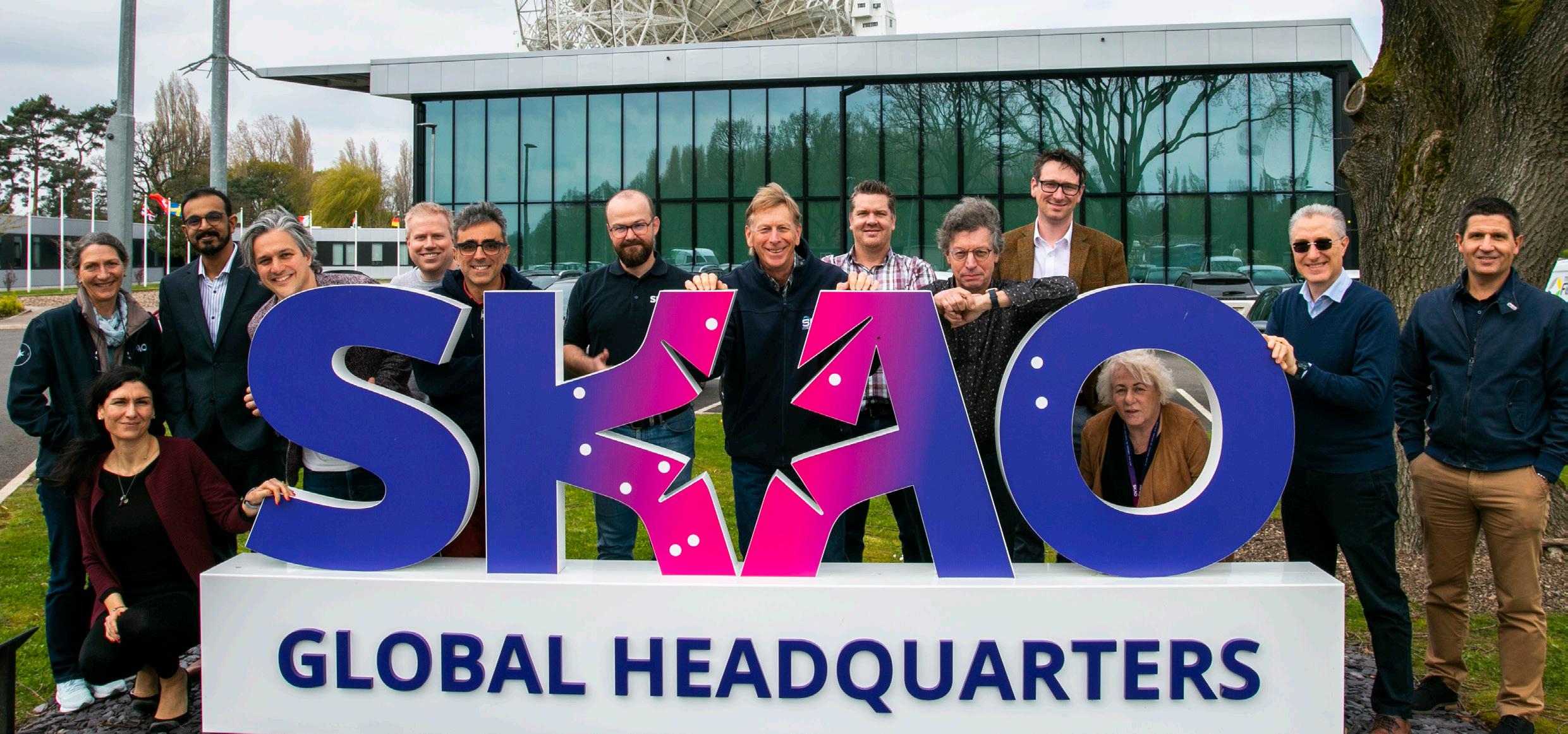
The meeting invited speakers from across SKAO business areas to share updates from the past 12 months and help drive alignment across the telescope sites for the year ahead. The event was also planned to coincide with the in-person meeting of the global SKA Telescope Engineering team which saw our engineering team together face-to-face for the first time since travel restrictions eased.
Deputy Director-General Dr Joe McMullin emphasised the high-level strategy to deploy and integrate working systems as early as possible to demonstrate the capability of the telescopes’ architecture.
Senior Project Managers for SKA-Low and SKA-Mid, André van Es and Ben Lewis, detailed activities helping push Array Assembly (AA) 0.5 towards completion.
AA0.5 is the first major construction milestone representing the delivery, assembly, and verification of six stations for the SKA-Low telescope (representing some 1,536 antennas) and four dishes for the SKA-Mid telescope
Multiple key accomplishments over the past 12 months are helping to realise AA0.5.
For SKA-Mid, Lewis reflected on mitigations to alleviate pandemic-related supply chain issues and global inflation faced in 2022, including placing direct orders for long lead items and making contracts more robust to eliminate uncertainty.
The past year also saw a large amount of work on improving the dish structure and design, strengthening technical
relationships between the SKAO and fabrication teams at CETC54 in China.
In 2023, key areas include validating dish structure radio frequency interference compliance and planning logistics around dish construction itself, and the commencement of large-scale infrastructure works.
Lewis said: “2022 was a huge year for the Mid telescope, particularly in the areas of contract preparation and procurement, and design finalisation and de-risking. In 2023 we begin to see the fruits of these efforts, culminating in the construction of the first SKA dish in the Karoo by the end of the year.”
For SKA-Low, Van Es outlined many of the high-level activities achieved during 2022. In the construction and contracting sphere, this included site access and preparation ahead of the expected completion of construction camps and access roads during 2023.
Van Es said: “In 2023, on-site construction has now really started. Our most visible goal is the realisation of AAVS3, a pre-construction station at Inyarrimanha Ilgari Bundara, the CSIRO Murchison Radio-astronomy Observatory, used for verifying the design and refining station deployment. In parallel the site will be prepared for building our first four stations in early 2024. This is the real start for the instrument and our team is looking forward to this first step in building SKA-Low.”
ABOVE: Members of the SKA-Low engineering and project management team meeting in person at SKAO Global HQ. Credit: SKAO
14 CONTACT ISSUE 13
TOP THREE IMAGES: SKA-Mid dish elements under construction in China, including panels of the dish surface, the pedestal and sub-reflector. Credit: SKAO


BOTTOM THREE IMAGES: SKA-Low antenna elements under construction in Italy. Credit: SIRIO


15 JUNE 2023 CONTACT
Astronomers assemble for Vancouver meeting
Collaboration in radio astronomy was at the heart of the New Eyes on the Universe meeting held in Vancouver, Canada, and online from 1-5 May 2023. It brought together researchers at all career levels to discuss the science, engineering and broader impact of the SKA telescopes and the next generation Very Large Array (ngVLA). Turn the page to read more!

Featured image

SKA and ngVLA: radio astronomy’s new eyes on the Universe
 BY CASSANDRA CAVALLARO (SKAO)
Radio astronomy is heading into a bright future – that was the message that came loud and clear from the joint SKA-ngVLA meeting, New Eyes on the Universe, held in Vancouver, Canada in May.
The city may not be renowned for its weather, but for almost the full five days of meeting there were clear skies overhead. A good omen, perhaps, for an astronomy conference (although radio astronomers would be quick to point out that clouds do not trouble their telescopes).
Inside the venue, the Pan-Pacific Hotel on the city’s waterfront, around 300 attendees from 21 countries were treated to a five-day programme featuring 60 speakers. Together they represented the current and next generation of radio astronomers.
Co-organised by the SKAO and US National Science Foundation’s National Radio Astronomy Observatory (NRAO), the meeting was designed to highlight the synergies and complementarities between two of the premier radio astronomy facilities of this century. Talks explored the science they will enable by covering a vast swathe of the radio spectrum, from 50 MHz at the lower end of the SKAO’s coverage, to 116 GHz at the upper limit of the ngVLA’s planned range.
Canada was a fitting host for the meeting as a contributor to both the ngVLA and SKAO, and having recently announced its intention to become a full SKAO member [see page 28]. More than two dozen colleagues from Canada’s National Research
Council (NRC) were present, including Dr Luc Simard, director general of the Herzberg Astronomy and Astrophysics Research Centre and Canadian representative in the SKAO Council. He opened proceedings with an Indigenous land acknowledgement, noting that the city of Vancouver is located on the unceded, ancestral and traditional territory of the xʷməθkʷəy əm (Musqueam), Sḵwx̱wú7mesh (Squamish), and səlilwətaɬ (Tsleil-Waututh) peoples.
Introductory remarks from SKAO Director-General Prof. Philip Diamond and NRAO Director Dr Tony Beasley highlighted the shared challenges and immense scientific promise of both endeavours.
“The ngVLA and SKAO will together provide a global capability in the radio, with the ability to observe the entire sky. With our joint capabilities, we will be able to deliver a greater range of science than at any other waveband,” Prof. Diamond told the opening session.
Then it was time for the packed science agenda to get under way: exploring the sub-surfaces of planets, detecting fast radio bursts, studying astrochemistry and the building blocks of life, characterising interstellar magnetic fields – and that was just day one.
18 CONTACT ISSUE 13 Focus on
ABOVE: Science synergies between the SKA and ngVLA telescopes were high on the agenda for New Eyes on the Universe.
Later in the week operations plans for both observatories took centre stage; an opportunity to show future users how they will apply for time on the telescopes, and access data products from their observations. For the SKAO in particular, with early science operations only a few years away, communicating this level of detail on practicalities to the community is vital.
The meeting was organised in hybrid format to be as inclusive and accessible as possible, with sessions streamed in real-time for virtual attendees, and recordings made available the following day. A dedicated Slack workspace provided introductions and interactions through the week.

For the SKAO’s communications team, the meeting was a prime opportunity to convey the vibrancy of the radio astronomy community, the level of science that these publicly funded facilities will deliver, and the broad range of activities that such a meeting makes possible. To that end, interviews with presenters, both in-person and remote, were posted on Instagram and Twitter throughout the week, along with other highlights.
Beyond the main conference hall, members of some SKAO Science Working Groups, who are often separated by continents, capitalised on being in the same place by holding face-to-face discussions on their science. During the breaks the many PhD students and postdoctoral fellows in attendance – supported through reduced registration and accommodation fees – chatted with senior researchers and experts in their fields, forming contacts for the future.
“It was extremely encouraging to see many early career astronomers at the meeting, sharing their fantastic ideas for the transformational science they wish to undertake with these ‘new eyes’,” said SKAO Senior Scientist Dr Tyler Bourke, co-organiser of the meeting alongside NRAO’s Dr Eric Murphy.
Poster boards decorated the conference space and were complemented by entertaining poster flash sessions,
a minute-long opportunity to make one’s mark on stage or Zoom. The best poster award went to Australian SKA Regional Centre Director Dr Karen Lee-Waddell who presented hers in rhyming verse, a feat which was captured on camera
A thought-provoking session devoted to observatories’ broader impact and the importance of local community engagement drew an almost full house, with presentations by communications and outreach professionals from the SKAO, NRAO and IAU Office for Astronomy Development. It was followed by a panel discussion chaired by Prof. Kristine Spekkens of the Royal Military College of Canada and Queen’s University, who is also the Canadian SKA science director.
She said: “Ensuring that the telescopes we build and use deliver a positive broader impact to society is a very high priority for the Canadian astronomical community in particular. It’s one of the reasons to build telescopes, beyond doing breakthrough science and developing new technology. I appreciated the chance to learn about initiatives and plans to deliver these broader impacts across the decades-long lifetimes of the SKA and ngVLA.”
As the meeting wrapped up, and the events team was thanked for the hard work that ensured everything ran so smoothly, there was time to reflect on what it all means for the coming decades in radio astronomy. It was left to Dr Michael Rupen, director of NRC’s Dominion Radio Astrophysical Observatory, home to SKA pathfinder CHIME, to make the closing remarks.
“It’s finally happening. Many people have been working towards this point for many decades, and we owe them a great debt for their enthusiasm and persistence,” he said.
“These facilities aren’t just for the people in this audience; they’re going to be for your students and your students’ students. They have a lifespan of at least 50 years and will keep being cutting-edge instruments for decades to come.”
19 JUNE 2023 CONTACT
BELOW: There was a strong turnout for the session dedicated to broader impacts of observatories on society.
First radio detection of ‘type Ia’ supernova
BY THE INSTITUTE OF ASTROPHYSICS OF ANDALUSIA (IAA-CSIC)
A recent work published in Nature announced the first-ever radio detection of a “type Ia” supernova. The discovery has been possible thanks to observations by the e-MERLIN array in the UK, and data analysis at the Spanish prototype SKA Regional Centre (SPSRC).
Type Ia supernovae occur when a white dwarf, the “corpse” of a Sun-like star, absorbs material from a companion star and reaches a critical mass, around 1.4 solar masses, triggering an explosion with a similar luminosity in almost all cases. This uniformity makes type Ia supernovae ideal for measuring cosmic distances. Nevertheless, until now it was not known whether this companion was another white dwarf or a Sun-like star, something that radio imaging can reveal.
“When we saw signs of a strong interaction with the companion star material in supernova SN2020eyj, we tried to observe the explosion in radio, something that had been attempted without success for decades,” explained Dr Erik Kool from Stockholm University, lead author of the paper.
Now, in this first radio detection of a type Ia supernova, the radio data contribution led by the IAA-CSIC, combined with optical data has confirmed that the material expelled in the supernova explosion collided with the surrounding material, composed mostly of helium, which indicates that the companion star was not a white dwarf.
“This is a milestone that has allowed us to demonstrate that the exploded white dwarf was accompanied by a normal, non-degenerate star before the explosion. In addition, with these observations we can estimate the mass and geometry of the material surrounding the supernova, which allows us
to better understand what the system was like before the explosion,” said Dr Javier Moldón, researcher at the IAA-CSIC who participated in the discovery.
“The unusual light curve of SN 2020eyj, the infrared emission, the detection of helium emission lines and the unprecedented radio detection make this supernova unique, a treasure trove of information with implications for multiple fields of research,” said Dr Miguel Pérez Torres, IAA-CSIC researcher participating in the study.
“Now that we have shown that radio observations can provide direct and unique information to understand this type of supernovae, it opens a path to study these systems with the new generation of radio instruments, such as the SKA telescopes in the future,” added Dr Moldón.
e-MERLIN is the UK’s national radio telescope interferometer headquartered at Jodrell Bank Observatory and operated by the University of Manchester on behalf of the Science & Technology Facilities Council. The SPSRC is located in the Institute of Astrophysics of Andalusia (IAA-CSIC) and supports preparatory scientific activities for future SKA projects while promoting Open Science practices.
ABOVE: Artist’s impression of a type Ia supernova, in which a white dwarf star absorbs material from its companion star. Credit: Adam Makarenko/W. M. Keck Observatory.

20 CONTACT ISSUE 13 Pathfinders
SKA pathfinders unite for PEGASUS survey’s first image of Milky Way
BY ELEONORA FERRONI (INAF)
A large section of the galactic plane is the subject of a stunning new image combining observations from the ASKAP radio telescope and Parkes radio telescope, Murriyang, both owned and operated by Australia’s national science agency, CSIRO.
A group of radio astronomers, led by Italy’s National Institute of Astrophysics (INAF), used Parkes to “photograph” a large portion of the disk of our galaxy, about 6-7 degrees or 12-14 full Moons in length, as part of the PEGASUS survey. This image was combined with one produced with ASKAP for the EMU project led by Australia’s Macquarie University, obtaining an image of exceptional quality.

PEGASUS, which has now completed pilot observations, aims to use Parkes to map the entire southern sky at 700-1,440 MHz with about 2,100 hours of observation in the next two years.
The image shows a region (only about 1% of the whole Milky Way) featuring extended emissions associated with hydrogen gas filling the space between the stars, dying stars called supernova remnants, and hot bubbles of ionised hydrogen gas related to the birth of new stars. The stars themselves are not visible, as starlight contains minimal radio emissions. This view shows details of the birth and deaths of stars only visible to radio telescopes.
“When we combined the PEGASUS map with that from the EMU observations, the result was amazing, in quality and beauty,” said INAF’s Dr Ettore Carretti, co-leader of the PEGASUS project along with Dr Tom Landecker from the National Research Council of Canada (NRC) and Dr Xiaohui Sun from Yunnan University in China.
“This survey aims to understand the magnetic fields of our galaxy, their origin and their effects on various phenomena, such as supernova remnants and the large structures of the Milky Way, such as the North Polar Spur, and to study galaxies, radio galaxies, and galaxy clusters. “ASKAP, like other interferometers, is not sensitive to large angular scales: therefore, PEGASUS’ data collected with Parkes will complement ASKAP data, adding to the existing fine details on the complete shape, size and total power emitted by these objects. Furthermore, with the combined data, we can study the physics of the phenomena that drive them,” Dr Carretti said.
The galactic plane is where our Solar System resides: it contains numerous stars, dust, and gas clouds, as well as a significant amount of dark matter, and its diffuse emission makes obtaining artefact-free images challenging.
Nevertheless, the quality of the image of this first observation is superb. Data from these surveys and others currently using ASKAP and Parkes promise to produce many impressive images of our Milky Way and beyond, providing an exciting prologue to what astronomers hope to see with the SKA telescopes.
ASKAP and Parkes are part of CSIRO’s Australia Telescope National Facility. CSIRO acknowledges the Wajarri Yamaji people as the Traditional Owners and native title holders of Inyarrimanha Ilgari Bundara, the CSIRO Murchison Radio-astronomy Observatory, where ASKAP is located, and the Wiradjuri people as the traditional owners of the Parkes Observatory.
21 JUNE 2023 CONTACT
RIGHT: A part of the galactic plane as seen by the ASKAP radio telescope and the Parkes radio telescope, Murriyang, showing supernova remnants and the space between the stars. Credit: R. Kothes (NRC) and the PEGASUS team
Bursting at the extremes
BY RACHEL RAYNER (CSIRO)
When a one in 10,000 year event flooded gammaray detectors in space, telescopes around the world were asked to point at the source. CSIRO’s radio telescope ASKAP, an SKA precursor, was no exception.
The event was a gamma-ray burst: one of the biggest known explosions in the Universe. Detailed findings about the burst have been published in The Astrophysical Journal Letters It is thought bursts of gamma radiation and x-rays erupt during the death throes of enormous stars collapsing into black holes. One has never been detected in our own galaxy, which is good: it has been predicted that such an enormous explosion close to Earth could blow our atmosphere away!

This bright burst offered the perfect opportunity to test current models on what happens during a star’s demise. This is when material is being expelled from the star at almost the speed of light as it collapses into a black hole. It is important that telescopes of all wavelengths quickly conduct observations to understand more about these extreme events.
Australian astronomers observed the cosmic event’s radio wave signature with ASKAP. The radio waves are produced by shockwaves from the highly energetic ejected material ploughing into the surrounding matter. Observations from ASKAP, combined with data from other telescopes, such as the
XMM-Newton space observatory which looks for x-rays, showed that they are difficult to explain within current theoretical models of gamma ray burst events.

A brightening supernova was expected to occur a few weeks after the initial event. However, none has yet been detected, showing that the Universe still has plenty of mysteries for us to uncover.
The radio follow up observations are detailed here
ABOVE: XMM-Newton images recorded 20 dust rings, 19 of which are shown here in arbitrary colours. The image merges observations made two and five days after GRB 221009A erupted. Dark stripes indicate gaps between the detectors. GRB221009A is only the seventh gamma-ray burst to display X-ray rings, and it triples the number previously seen around one. Credit: ESA/XMM-Newton/M. Rigoselli (INAF)
22 CONTACT ISSUE 13
BELOW: This NASA graphic depicts the different types of light emitted following a gamma ray burst. Credit: NASA’s Goddard Space Flight Center.
Nine new, exotic creatures for pulsar zoo
BY DR NORBERT JUNKES (MAX PLANCK
INSTITUTE FOR RADIO ASTRONOMY)
Nine new millisecond pulsars, some of them quite unusual, have been identified using the MeerKAT radio telescope in South Africa, from a target list compiled from NASA’s Fermi Gamma-ray Space Telescope. The results have been published in the Monthly Notices of the Royal Astronomical Society
Pulsars are rapidly spinning neutron stars, the collapsed cores of dead stars. Millisecond pulsars are much faster and rarer than standard pulsars, rotating hundreds of times in a second.
“We used machine-learning methods to determine pulsarlikeliness for all Fermi catalogue sources unassociated with known celestial objects,” explained Dr Colin Clark from the Max Planck Institute for Gravitational Physics. “After we had identified the most pulsar-like sources in the Fermi catalogue, we whittled down our target list to those sources which would most likely be detectable by our survey.”
Seventy-nine sources were observed with MeerKAT in the framework of TRAPUM (TRansients and Pulsars using MeerKAT), exploiting the extra sensitivity provided by MeerKAT to reduce observation times to just 10 minutes, much shorter than the hour-long observations previously required to find pulsars in these sources.
Searching for pulsars in large amounts of data from TRAPUM observations requires lots of computing power and a quick turnaround to free up storage space for further observations.
“We ran purpose-built data analysis pipelines on 120 graphics processing units (GPUs) in a dedicated computing cluster to sift through our MeerKAT survey observations. We quickly found nine millisecond pulsar candidates, and confirmed all of them with additional MeerKAT observations,” said TRAPUM Project Scientist Dr Ewan Barr from the Max Planck Institute for Radio Astronomy.

One of the discoveries, called PSR J1526-2744, was closely studied afterwards. Following the detection of this radio pulsar in a binary system, the researchers also picked up the neutron star’s gamma-ray pulsations. Using all available Fermi data, they could precisely study the orbital motion and determine the binary system’s properties. Most likely, the neutron star orbits the common centre of mass with a lightweight white dwarf in less than five hours. This would make it the pulsar-white-dwarf binary system with the second shortest orbital period. The team also searched for continuous gravitational waves from PSR J1526-2744 which could not be confirmed.
Another two pulsars, called PSR J1036-4353 and PSR J18036707, are typical “redback” pulsar systems consisting of neutron stars with companion stars of at least a quarter the mass of our Sun. They evaporate and destroy their companions over time, hence the reference to their spidery namesake, Australian redback spiders.
The astronomers are confident that future observations can discover several more millisecond pulsars. In the target list, there are several candidates that are very likely pulsars, but several surveys so far have not found radio-wave or gamma-ray pulsations. New telescopes, analysis methods, and repeated observation attempts may reveal their pulsar nature. With more Fermi observation time the underlying source catalogue will grow and additional pulsar-like sources will appear and become potential targets.
23 JUNE 2023 CONTACT
ABOVE: All-sky map by Fermi’s Large Area Telescope. The most prominent feature is the bright, diffuse glow running along the middle of the map, which marks the central plane of our Milky Way galaxy. Credit: NASA/DOE/Fermi LAT Collaboration
Effelsberg radio telescope sheds new light on binary black holes
BY DR NORBERT JUNKES (MAX PLANCK INSTITUTE FOR RADIO ASTRONOMY)
Multi-wavelength observations involving Germany’s Effelsberg 100 m radio telescope have provided important new insights into the binary black hole at the centre of the active galaxy OJ 287.
Using the densest and longest radio-to-high-energy observations to date, scientists tested crucial binary model predictions and, for the first time, an independent black hole mass determination of the system was performed. The results have been published in the Monthly Notices of the Royal Astronomical Society: Letters and The Astrophysical Journal
When two galaxies collide and merge, supermassive binary black holes are formed. These binaries a play a key role in the evolution of galaxies and the growth of supermassive black holes. Furthermore, coalescing binaries are the Universe’s loudest sources of gravitational waves.

The blazar OJ 287 is one of the best candidates for hosting a compact binary supermassive black hole. A blazar is observed when a black hole consuming large amounts of gas and dust at the centre of a galaxy emits jets of plasma travelling at close to the speed of light which are pointing towards Earth.
Exceptional outbursts of radiation which repeat every 11 to 12 years are OJ 287’s claim to fame. Some of these are so bright that OJ 287 temporarily becomes the brightest source of its type in the sky. As the second black hole in the system orbits the other more massive one, its motion affects the radiation that is observed from its partner’s jet and/or accretion disk, dimming the light output in a semi-periodic way.
However, until now there has been no direct independent determination of the mass of the more massive black hole in the system. None of the models could be critically tested in systematic observing campaigns because these campaigns lacked broadband coverage involving radiation of many
different frequencies. Now, multiple simultaneous X-ray, UV and radio observations, along with optical and gamma-ray bands, have been used.
“OJ 287 is an excellent laboratory for studying physical processes in an extreme environment: disks and jets of matter in the immediate vicinity of one or two supermassive black holes,” said Dr Stefanie Komossa of the Max Planck Institute for Radio Astronomy, who led the research group. “Therefore, we started high-cadence observations of OJ 287 at more than 14 frequencies from the radio to the high energy regime lasting for years.”
The mass of the primary black hole was derived from the motion of gaseous matter bound to the black hole, amounting to 100 million times the mass of our Sun.
“This result is very important, as the mass is a key parameter in the models studying the evolution of this binary system: how far are the black holes separated, how quickly will they merge, how strong is their gravitational wave signal?” said Dr Dirk Grupe, associate professor at Northern Kentucky University and a coauthor on both papers.
The new results imply that an exceptionally large mass of the black hole of OJ 287, exceeding 10 billion solar masses, is no longer required. The results rather favour a binary model of more modest mass.
The study resolves two old puzzles: the apparent absence of the latest of the bright outbursts which OJ 287 is famous for, and the emission mechanism behind the outbursts. The observations allow for the precise timing of the latest outburst; it did not occur in October 2022, as predicted by the “hugemass” model, but rather in 2016-2017. Radio observations with the Effelsberg 100 m telescope reveal that these outbursts are non-thermal in nature, implying that jet processes are the power source of the outbursts.
The results affect ongoing and future search strategies for binary systems using major facilities such as the Event Horizon Telescope and, in the future, the SKA telescopes. They could enable direct radio detection and spatial resolution of the binary sources in OJ 287 and similar systems, as well as the detection of gravitational waves from these systems.
24 CONTACT ISSUE 13
BELOW: A deep ultraviolet image of OJ 287 and its environment (left), and artist’s impression of the very centre, including the accretion disk, the jet, and a second black hole orbiting the primary black hole (right). Credit: S. Komossa et al.; NASA/JPL-Caltech
MeerKAT finds largest hydrogen atoms in distant galaxy
BY THE MEERKAT ABSORPTION LINE SURVEY TEAM
Scientists using the MeerKAT radio telescope to study a galaxy 7.3 billion light years away have unexpectedly found gas clouds made up of some of the largest hydrogen atoms in the Universe, Rydberg atoms.
It is the first time scientists observed these hydrogen atoms in a distant galaxy. What’s more, they believe the large atoms are spread throughout the galaxy in ionised interstellar gas clouds. The discovery could help researchers to understand the nature and evolution of interstellar gas in galaxies and how Rydberg atoms are formed in space. A paper on the discovery was recently published in The Astrophysical Journal
The light from a distant quasar (an extremely luminous active supermassive black hole at the centre of a galaxy), located 11.1 billion light years away in the constellation Sagittarius, was key to the discovery.

Quasar PKS1830-211 is one of the brightest radio sources in the sky since the high-power jet from its super massive black hole is pointed directly at Earth (meaning it is also known as a blazar). As light from the quasar travels towards Earth, it passes through the foreground galaxy – located 7.3 billion light years from us, between our planet and the quasar – illuminating molecular chemistry in the galaxy’s spiral arms. This rare alignment has allowed the large hydrogen atoms to be observed.
A Rydberg atom refers to an atom with an electron in a high energy state. Radio light amplifies the Rydberg atoms, and under just the right conditions, the atoms become naturally occurring lasers. Finding the conditions for this to occur in distant galaxies has been a long-standing mystery, but a new generation of state-of-the-art radio telescopes observing the Universe at centimetre to metre wavelengths are making it possible for the first time.
Large surveys that cover the sky using wide bandwidth receivers have high enough precision to look for spectral fingerprints from many wavelengths simultaneously. The MeerKAT Absorption Line Survey (MALS) led by Prof. Neeraj
Gupta of the Inter-University Centre for Astronomy and Astrophysics (IUCAA), India, is one such survey.
Using the MeerKAT data processed at the dedicated highperformance computing setup at IUCAA, the MALS team found 44 fingerprints from Rydberg atoms and used them to study the physical and dynamic structures in the foreground galaxy.
“The Rydberg atoms could be coming from large clouds of gas that are ionised by the radiation from young massive stars. These atoms tell us that interstellar gas in this galaxy is much denser than what is found in the Milky Way,” said Dr Kimberly Emig, a Jansky Fellow at the US National Radio Astronomy Observatory (NRAO) and lead author of the paper.
“We were excited to discover these high-excitation hydrogen atoms in such a distant galaxy. It gives a new way to observe our Universe and possibly study the evolution of interstellar gas in galaxies over cosmic time. They could also help us to understand how interstellar gas drives and inhibits the activity of super massive black holes.”
The discovery also provides an exciting prelude to what will be possible with the SKAO.
“This first discovery demonstrates that, with the huge sensitivity of the future SKA telescopes, we will be able to detect many other sources in these spectral lines, or fingerprints, corresponding to the atom recombination [when an electron binds to a proton]. This will multiply our ability to detail the physical conditions of remote sources,” said Prof. Françoise Combes, astronomer at Paris Observatory and cochair of the SKA Extragalactic Spectral Line working group.
ABOVE: Light from the distant quasar (far left) travels through the foreground galaxy (centre) on its way to Earth, illuminating molecular chemistry in the galaxy’s spiral arms. Image credits: ESA + K. Emig
25 JUNE 2023 CONTACT
Major survey provides new insights into pulsar behaviour
BY DR HILARY KAY (THE UNIVERSITY OF MANCHESTER – UK SKA)
Our understanding of fast-spinning neutron stars, known as pulsars, has taken another step forward as an international team of scientists published the largest ever pulsar survey. The MeerKAT Thousand Pulsar Array project has observed more than 1,200 pulsars, more than a third of all known pulsars. The findings have been published in two papers in Monthly Notices of the Royal Astronomical Society
Pulsars emit beams of radio waves as they rotate. Each time these beams face the Earth, we can detect them, like beams of light from a lighthouse. These pulses can be measured incredibly accurately and used to test the laws of physics. While pulsars do slow down, they do so predictably, and the most predictable can be used as very precise clocks.
The unprecedented sensitivity of the MeerKAT radio telescope in South Africa enabled a team led by researchers at the University of Oxford in the UK to study the statistical properties of the shape of the pulses observed.

“We find that the most important property governing the radio emission of a pulsar is its so-called spin-down power. It quantifies the energy set free by a neutron star each second as its rotation slows down. Some of this spin-down power is used to produce the observed radio waves,” said Dr Bettina Posselt of the University of Oxford, lead author of the first paper
Pulsar models predict that the radio pulses are produced by continual discharges of ionised gas surrounding the star. The MeerKAT Thousand Pulsar Array (TPA) data indicates that both the height above the surface of the neutron star where the radio emission happens, and the amount of energy given to the charged particles, are influenced by the spin-down power, although why the radio emission’s height in turn affects spin-down power is not yet clear. The team found that since even the pulsars with the lowest spin-down power emit intense radio emission that can be detected at large distances, there may be a larger undiscovered population of pulsars than previously thought.
University of Manchester (UoM) scientists led accompanying work, detailed in a second paper, to analyse a staggering one million individual pulses from the survey, with each individual pulse having a different shape and strength.
“Despite these differences, high precision timing measurements can be made by taking an average of many pulses; this average tends to be extremely stable and can be obtained very easily using millisecond pulsars which have hundreds of pulses per second,” said UoM’s Dr Patrick Weltevrede, co-author of the second paper.
Some pulsars exhibit patterns of diagonal stripes within their series of pulses, which are produced by the lightning storms swirling around the star.
“The superb quality of the TPA data and our sophisticated analysis allowed us to reveal these patterns for many pulsars for the first time,” said Dr Xiaoxi Song of the UoM, lead author of the second paper.
Unexpectedly, the team discovered that contrary to predictions, although the lightning storms originally swirl fast and chaotically around the star, after a few million years they slow down and become steadier, eventually stopping altogether after a few billion years. At this point, the pulsars will no longer be detectable.
Dr Weltevrede explained: “As it slows down, a pulsar is losing rotational energy that can be used to power its activities. When the pulsar slows down too much, the amount of power it can generate is too little. Quite literally the pulsar battery gets drained.”
The TPA team includes researchers from the UK, Australia, Germany, Italy, Poland, and South Africa.
26 CONTACT ISSUE 13
BELOW: The MeerKAT radio telescope in South Africa. Credit: SARAO

SKAO membership grows
BY ANIM VAN WYK (SKAO)
The SKAO has much to celebrate on the membership front: Spain has completed its internal approval process to join the Observatory, while Canada and Germany have announced their intention of signing up. All 3 countries have a long history of involvement in the SKA project.
By formally joining the Observatory, Spain gains representation in the SKAO Council as full members and Spanish industry can bid for contracts to help build the SKA telescopes.
Industry in Spain is already earmarked to provide sub-reflectors for the SKA-Mid dishes and the equipment necessary to synchronise radio signals. Spain’s astronomical community will also gain access to observations with the telescopes once the instruments are completed.
As it stands, Spanish astronomers are participating in 13 of the 14 SKA science working groups. The country is furthermore contributing to the development of the SKA Regional Centre (SRC) Network and currently runs an SRC prototype in the city of Granada.
The Spanish Minister of Science and Innovation, Diana Morant, said: “In Spain, we are committed to joining forces with the other member states of the SKAO to build a more powerful, innovative and transformative observatory that, through the use of cutting-edge technologies and Big Data techniques, is called to revolutionise astronomy.”
Spain’s interest in the SKA project dates back to its earliest days in the 1990s. The country participated in the design of the telescopes and other preparatory work leading to its membership of the SKAO’s predecessor, the SKA Organisation, in 2018.

Two countries on the cusp of joining
Canada

Canada’s Minister of Innovation, Science and Industry François-Philippe Champagne announced in January that the country intends to seek full SKAO membership.
Canada is an observer of the SKAO Council through a cooperation agreement that its National Research Council (NRC) has with the Observatory. Full membership will provide Canadian astronomers use of the SKA telescopes and support establishing a domestic regional centre.
The NRC’s Herzberg Astronomy and Astrophysics Research Centre has been identified to represent Canada in the governance of the SKAO and will work with domestic and international partners to deliver key Observatory systems. This includes the digital correlator, the all-important “brain” behind the SKA-Mid telescope in South Africa.
Germany

German Federal Research Minister Bettina Stark-Watzinger announced that the country would pursue full membership of the SKA Observatory on a visit to the SKA-Mid telescope site in South Africa in March.
Germany is currently an observer of the SKAO Council. During the site visit, Director of the Max Planck Institute for Radio Astronomy Dr Michael Kramer and SKA-Mid Telescope Director Dr Lindsay Magnus celebrated the signing of a new cooperation agreement between the SKAO and the country’s Max Planck Society, a non-profit organisation comprising 86 institutes and research facilities.
During the SKAO’s pre-construction phase, Germany was involved in six of the 11 design consortia, and the country’s scientists represented the third largest contributors to the SKA science case.
28 CONTACT ISSUE 13
SKAO Corner
ABOVE: SKAO Director-General Prof. Philip Diamond holds the Observatory Convention between the Spanish and SKAO flags. Credit: SKAO
Dark and quiet skies high on the agenda
BY MATHIEU ISIDRO (SKAO)
It’s been a busy period on the topic of large satellite constellations and the protection of dark and quiet skies.
In May, the G7 science and technology ministers (Canada, France, Germany, Italy, Japan, the United Kingdom, the United States; also includes the EU) met in Japan ahead of the G7 Summit. For the first time, they discussed the issue of dark and quiet skies, and expressed support for continued engagement, a clear sign that the issue has reached the highest levels, and is gathering support. The SKAO and fellow astronomy organisations played a key role in reaching out to decision-makers in government to highlight the importance of the issue.
“We recognize the importance of continued discussion, in the UN COPUOS and International Telecommunications Union (ITU) frameworks, as well as with the International Astronomical Union (IAU) on the impact of large constellations of satellites on astronomy for the protection of the dark and quiet skies.” – G7 science and technology ministers’ communique
The SKAO actively participates in both the ITU and the United Nations’ Committee on the Peaceful Uses of Outer Space (COPUOS), and has long advocated for better regulations and protection for radio astronomy.
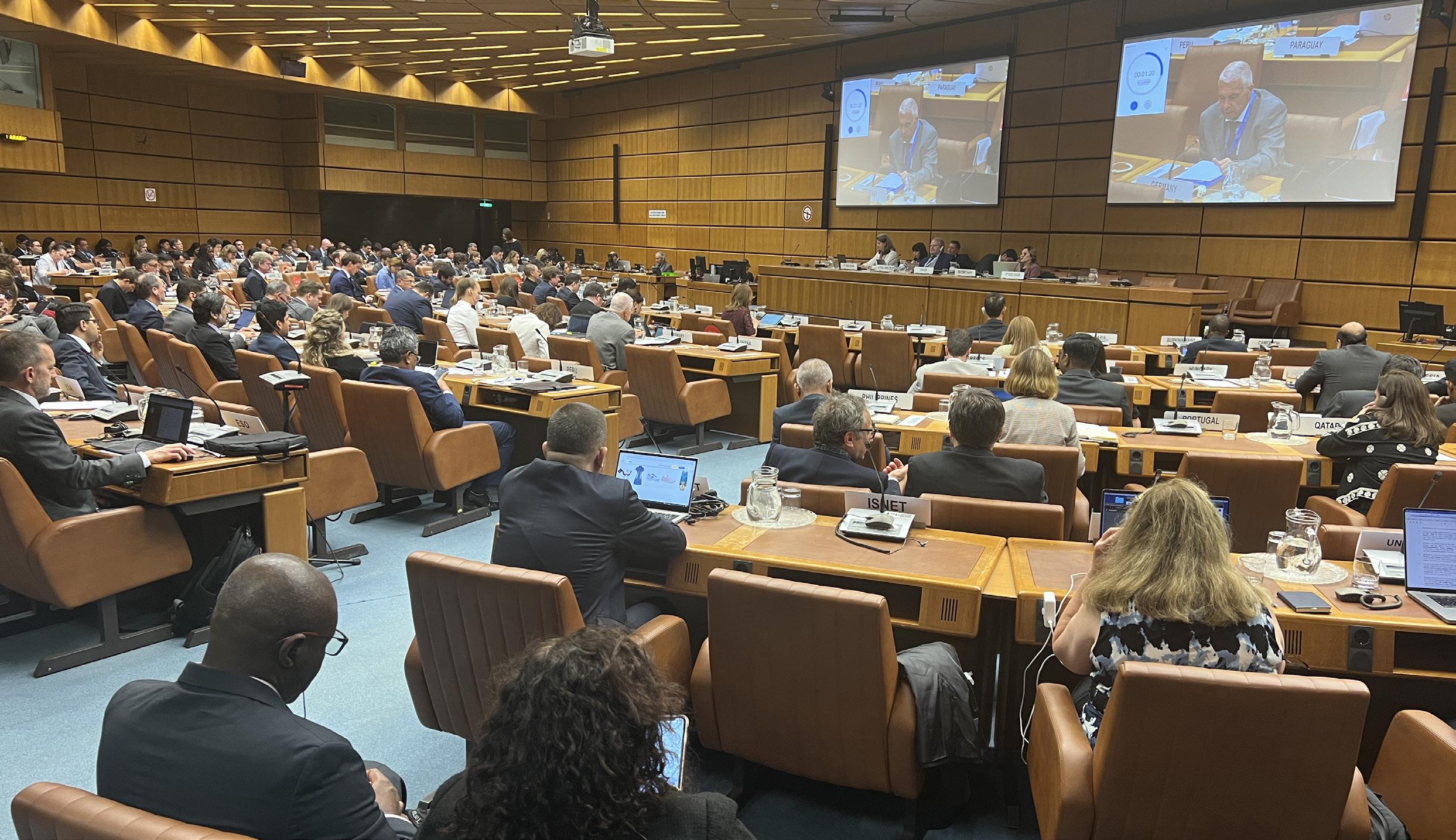
At the beginning of June, COPUOS met in Vienna, Austria, where the issue was extensively discussed by the 100+ countries represented in the committee. Led by a proposal from Spain, Chile, South Africa and others, several dozen delegations expressed support for COPUOS to continue discussing the issue. A side event organised by the Spanish delegation provided an opportunity for Federico Di Vruno, the SKAO’s Spectrum Manager, to update delegations on the satellites’ impact on radio-astronomy.
With financial support from the SKAO and NOIRLab, the two co-hosts of the IAU centre that tackles the impact of satellites on astronomy, the UN Office in Vienna also hosted the photo exhibition Our Fragile Space by renowned photographer Max Alexander during COPUOS. The exhibition shines a light on the issue of space sustainability, and in particular space debris and the impact of satellites on astronomy. The exhibition is heading to Jodrell Bank next (home of the SKAO’s HQ), where it will be on display over the northern summer.
29 JUNE 2023 CONTACT
ABOVE: The 66th session of UN COPUOS took place in Vienna, Austria, with dark and quiet skies on the agenda. Credit: SKAO
High-level visitors welcomed at SKAO offices
BY SKAO
Recent months have seen a number of VIP visits to SKAO offices, with government officials keen to learn more about the progress being made across the observatory.
In May, SKAO Global Headquarters welcomed South Africa’s Minister of Higher Education, Science and Technology, Dr Bonginkosi Emmanuel “Blade” Nzimande, as part of a delegation which included Antony Phillipson, British High Commissioner to South Africa. They held discussions with SKAO Director-General Prof. Philip Diamond and Head of the Director-General’s Office Simon Berry, and met staff during a tour of the building. With plans progressing for an SKA visitor centre in Carnarvon, South Africa, the delegation also took the opportunity to tour the First Light Pavilion, a new public engagement centre at the neighbouring Jodrell Bank Observatory.
The previous month, the HQ welcomed Italy’s Ambassador to the UK, Indigo Lambertini, with a delegation including the Italian Consul in Manchester, Matteo Corradini, and Prof. Roberto Buizza, scientific attaché at the Italian Embassy in London. The ambassador was pleased to hear about the number of Italian contributions to the project in the fields of science and engineering, and complimented the high quality of the work carried out by Italy’s National Institute for Astrophysics (INAF) and other Italian industrial partners. The delegation joined Italian members of staff for lunch in the SKAO Hub restaurant , an opportunity to chat informally and further discuss the project,

the Observatory’s values, and its wider goals.
Senior figures in India’s Department of Science and Technology visited the HQ in January. Secretary Dr Srivari Chandrasekhar and colleagues were in the country in support of UK-Indian bilateral relations in science, which includes collaborating through the SKAO. The delegation also took time to speak to some of the Indian computing specialists working at the HQ.
The SKAO’s offices in South Africa and Australia have been busy with visitors too. Among them, the German Consul General to South Africa, Tanja Werheit, visited the SKA-Mid Science Operations Centre in May, following a previous visit to the radio telescope site in the Karoo. She toured the Integration Test Facility and was able to gain more insight into the groundbreaking technology, science, and research that the project will enable. The interaction was a positive step in building the important relationship with Germany, which recently announced its intention to become a full member of the SKAO.
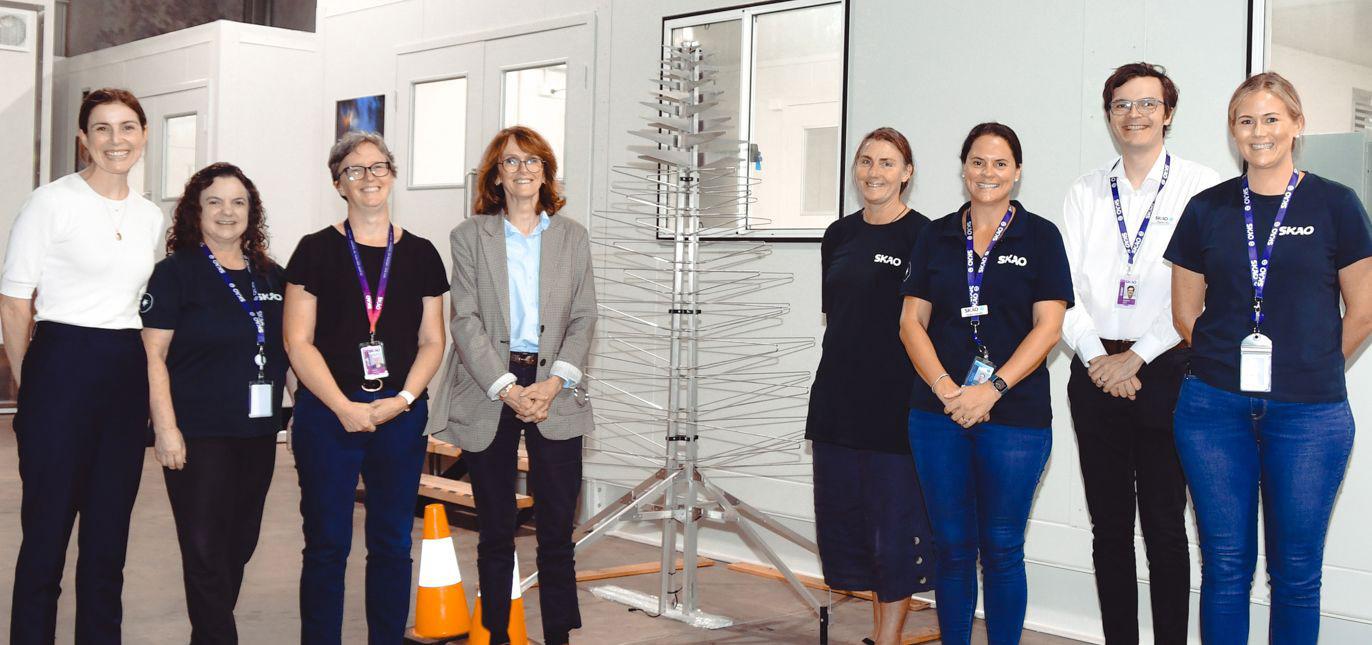
Across the ocean in Australia, the SKA-Low Engineering Operations Centre in Geraldton, Western Australia, welcomed Chief Scientist Dr Cathy Foley in March. [Read more in our interview on page 34].
30 CONTACT ISSUE 13
BELOW: Italian Ambassador to the UK Inigo Lambertini (centre with the Italian flag) with HQ staff members during his visit to SKAO HQ. Credit: SKAO



31 JUNE 2023 CONTACT
Dr Cathy Foley (fourth from left), Australia’s Chief Scientist, on a visit to the SKA-Low Engineering Operations Centre in Geraldton, Australia.
South African Minister Blade Nzimande (right) met SKAO Director-General Prof. Philip Diamond on his visit.
Dr Srivari Chandrasekhar (right), secretary of India’s Department of Science and Technology, visited the HQ in January.
German Consul General Tanja Werheit (second from right) during her visit, with (L-R) SKA-Mid Telescope Director Sudeshen Chetty, German Consulate intern Charlotte Begas, SARAO Managing Director Pontsho Maruping and SKA-Mid Telescope Director Lindsay Magnus. Credit: SKAO
Teams take on third SKAO Science Data Challenge
BY CASSANDRA CAVALLARO (SKAO)
The latest SKAO Science Data Challenge is under way, with 33 teams spread across 16 countries busy analysing a huge dataset that simulates one of the SKAO’s key science goals.

In total, 234 participants have registered for this third challenge in the series, with a particularly strong showing from China and India where dozens of researchers are taking part. Participants are being supported by 12 supercomputing centres in 10 countries, including SKA Regional Centre prototypes, which are providing the resources for participants to access the data and deploy their analysis pipelines.
The challenge simulates observations of the Epoch of Reionisation, when the Universe transitioned from the so-called dark ages, to when the first stars and galaxies formed, ionising the surrounding gas. EoR studies aim to establish when this happened, through observing neutral hydrogen (i.e. not ionised). The neutral hydrogen signal – also known as the 21cm line due to its wavelength – is visible to radio telescopes, so the reionisation of the Universe is characterised by an absence of the signal.
32 CONTACT ISSUE 13
Teams are analysing a 7.5 TB data cube which has layers of simulated astronomical data going back billions of years through cosmic time. Behind it all lies the EoR signal. If observed from Earth, its very faint light is obscured by everything in between us and it: the light from other galaxies and emission from within our own galaxy in the foreground.

“Removing the foreground emission is extremely challenging because there are so many objects – even the needle in a haystack analogy doesn’t do it justice!” SKAO Postdoctoral Fellow Dr Simon Purser said. “It demands sophisticated algorithms to characterise those objects so they can be removed, sifting through the data to gradually root out the signal we’re looking for. Some of these sources haven’t been observed before so that adds an extra challenge.”

The purpose of the challenges is not only to prepare the astronomical community for dealing with such huge data sets, and accessing them remotely rather than on their own laptops, but also to assess the most effective ways to process the data.
“Part of the value is seeing the techniques that teams choose and the innovations they make. We have learned a lot from the previous challenges – so much so that we’ve written a paper on Science Data Challenge 2 which highlights the lessons we’ve taken from that,” said SKAO Scientist Dr Philippa Hartley. “We’ve learned in particular that you can get better results by combining different techniques, not just relying on one. It’s vital that we do this work ahead of time so that when
the data does start to flow, we have all the best tools at our disposal to exploit it.”
Working with the 12 computing centre partners – four more than last time – is helping the SKAO to establish the amount and type of computing resources different science observations will demand, making it an important exercise for the SKAO’s Data Operations team, too.
“It’s really valuable as it has been allowing us to test prototypes and processes that are being developed for the SKA Regional Centre network,” said SKAO Operations Data Scientist Dr James Collinson. “Thanks to SDC3 we completed our biggest data transfer yet, when we replicated the 7.5 TB data cube between two of the computing centres using the prototype data lake manager Rucio [a central repository for managing large amounts of data and storing corresponding metadata]. Previously our largest transfers were at the GB scale, so this has been a great performance test as we look to the future with SKA-scale data, and allows us to demonstrate what works and what needs refining.
“Just as importantly, the data challenges present us with a key opportunity to get feedback from the scientists involved, which will lead to a more capable SRC network and a better user experience.”
The challenge will run until August, and the results will be featured in the next issue of Contact!
33 JUNE 2023 CONTACT
ABOVE: Slices of a SDC3 data cube showing the simulated EoR signal (left) and the foreground emission which is obscuring it (right: orange dots are galaxies, and the ribbon-like shape is diffuse gas in our galaxy). While the features of each image appear equally bright here, in the data cube the background is millions of times fainter than the foreground. Credit: Dr Philippa Hartley (SKAO)
Two minutes with... Dr Cathy Foley

In March, Australia’s Chief Scientist Dr Cathy Foley visited the SKA-Low Engineering Operations Centre in Geraldton, Western Australia.
Tell us about your recent visit to Geraldton.
I was in Geraldton as part of my consultations around Australia on the refresh of the national science and research priorities. This is something I am leading on behalf of the government. Over six weeks of roundtables, I spoke with a wide range of people about the big challenges that science and research can help address, and to outline Australia’s strengths and opportunities.
I was fortunate to be shown some of the engineering operations that make the SKA project so fascinating and promising for Australia’s future. To see such a clever, high-tech operation in one of the more remote parts of Australia is stunning. They’ve got state-of-the-art IT, they’ve marshalled the engineering so quickly, and it’s already showing itself to be an attractor for researchers around the world.
What role do research infrastructures such as the SKA Observatory play for Australia?
The SKA Observatory is a standout example of the future of science. It will lead the way in helping us understand how to process, store, and make the best use of enormous volumes of data. The scale of data that will be generated by the telescopes is mind-blowing.
The SKA project in Australia demonstrates that state-ofthe-art science can be done in remote parts of the country, which will be important for the whole of Australia in the shift to high-tech manufacturing, new forms of mining, and the clean energy transition. It showcases what can be achieved with international collaborations, and the centrality of shared infrastructure to the future of science. It really demonstrates how ambitious we can be in our science and discovery aspirations.
How do you see big science and research infrastructure projects, particularly those with significant Australian involvement, influencing people pursuing a career in STEM?
It takes enormous resources to see a project such as the SKA through. Australia has a long-standing dedication to fundamental research and discovery, and had several decades of radio astronomy expertise under our belt before the SKA project was underway. Australia does excellent science – it’s world-class. Big projects like the SKA show our future STEM workforce that Australia prioritises science and backs its researchers and STEM industries in the long term.
Digging deep: HQ staff join charity tree planting
BY CASSANDRA CAVALLARO (SKAO)
In what has become an annual tradition, staff from the SKAO’s headquarters took part in a local tree-planting day on the outskirts of Manchester in March.

Braving the region’s typical spring weather which alternated between rain, wind, sunshine, and sleet, the HQ team helped to plant some 250 trees alongside volunteers from other local organisations and under the guidance of the charity City of Trees. The charity’s goal is to tackle the climate emergency by planting trees and restoring woodlands for people and wildlife across the Greater Manchester region.
The SKAO’s involvement is part of the communications team’s partnership with local design agency Carbon Creative; for every graphic design project commissioned, a tree is planted. The agency says the type of native broadleaf planted by the team will typically lock up 135 kg of carbon across a 30-year period.
DRAFT 34 CONTACT ISSUE 13
BELOW: The HQ tree planting volunteers, from left to right: Cassandra Cavallaro, Raphaël Thénevin, James Collinson, Mathieu Isidro and Alex Clarke
‘Seeing poetry in the cosmos’
BY CASSANDRA CAVALLARO
UNESCO World Poetry Day, marked annually on 21 March, celebrates how poetry speaks to our common humanity and shared values, making it a catalyst for dialogue and peace.
Art and science have been linked throughout history, and Team SKA only needed a little encouragement to pen some poems for the occasion. A wider collection is featured on our Instagram page
Marking World Poetry Day helps to remind us that even mega-science projects are at their core human endeavours.
Beamforming Bristling alloy spines, Motionless, yet steered at will. Knowledge falls like rain.
Dr Andrew Stevenson, former assistant manager at the Australian SKA Office, wrote 21 haikus for the occasion, a selection of which are below. He says: “Scientists are also in awe of nature, and find it sublime and humbling. Behind all that scientific method and equipment are real people, with real feelings about the world, who see poetry in the cosmos, and the structures they build to study it.”
Induction
An electron moves; Ten billion light years distant, Another is moved.
Redshift
Photons stretch like silk –This web sparkles like dew drops. A galaxy is caught.
The Space Between Filaments
Giant Cosmic Void –a trillion ghosts stare inwards. None venture here.
By Dr Andrew Stevenson
Former Assistant Manager, Australian SKA Office and Astronomy Branch, Department of Industry, Science and Resources
35 DRAFT JUNE 2023 CONTACT
Dr Takuya Akahori –Scientist at NAOJ and SKAO

The SKAO community stretches far beyond the Observatory’s current membership, with important contributions coming from partners in more than 20 countries.
Among the SKAO’s prospective member states is Japan, an observer on the SKAO Council and future home of an SKA Regional Centre.
The Japan SKA consortium, established in 2008, now has more than 270 scientists and engineers involved in the project. Among them is Dr Takuya Akahori, an astronomer at the National Astronomical Observatory of Japan (NAOJ) who has also been seconded to the SKAO. He spoke to us about revealing the hidden Universe, travelling the world, and sampling the traditional tipples of SKA partner countries!
Let’s start with your early life, Takuya. Where did you grow up and what kind of things did you enjoy as a child?
I was born and raised in the vicinity of Tokyo, Japan, on the border between the city and the mountains. When I was a child, I often played in the river and forest, catching fishes and insects, but I dreamed of running a toy store that sold Gundam plastic models and remote control cars.
What inspired you to follow the astronomy path?
As a child, I wanted to build a time machine! When I was six years old, I received an illustrated book about space as a gift, which was my first encounter with astrophysics. In primary school, I visited the Usuda 64 m radio telescope and the Nobeyama 45 m radio telescope, and saw an immense human-made object making a loud motor sound while gazing at a single point in the sky, which made me feel romantic about the Universe.
So your interest started very early! Do you come from a scientific family?
Not at all. My father was a banker and my mother was a homemaker. My parents gave me many opportunities, and through them, I became interested in science. My grandfather, although I never saw his work, was a veterinary surgeon, so maybe I have inherited a little sense of science from him!
In high school, I enjoyed studying physics and by that time I already dreamed of becoming an astrophysicist. I studied relativity and particle theory at university. My lab promoted X-ray astronomy, so I did theoretical research in graduate school as well as observational X-ray astronomy. Once I had the opportunity to operate the Nobeyama 45 m telescope as an assistant operator for a collaborator’s observation, and I was very impressed with the experiment.
36 CONTACT ISSUE 13
Team SKA
Takuya has been involved in the SKA project for many years; seen here visiting the SKA Organisation – forerunner of the SKAO –in the UK in 2015.
Tell me about your research and what it is that particularly interests you about your chosen field.
I am interested in the physics of magnetised plasmas in space in general. Recently, I have had two main interests. One is to understand the formation and evolution of magnetic fields underlying the large-scale structure of the Universe including galaxies, galaxy clusters, and filaments. The other is to understand the physics of the mechanism of radio emission from radio transients such as fast radio bursts (FRBs) and magnetars.
What do you most want to discover when the SKA telescopes come online?
I am convinced that there is a vast and beautifully diverse Universe hidden in faint and diffuse radio emissions that cannot be observed by present telescopes but is shaped by the presence of magnetic fields. The goal is to uncover such a hidden Universe.
What was your route to becoming involved in the SKA project?
I got involved as a member of the international SKA Science Working Groups, participating in discussions with researchers from around the world, and that has made me feel part of the SKA family. I am now also working on the SKA Regional Centre Network [the computing centres that will process, store and provide access to the telescopes’ data], so I feel part of that SKA community as well.
You’re based at NAOJ but have worked abroad a lot as well. What did you gain from those experiences?
I worked in Daejeon, South Korea, for three and a half years, and then in Sydney, Australia, for two years. After that, I worked in Kagoshima, Japan, for a few years, during which I was transferred to the SKA Organisation [precursor to the SKA Observatory] for a year-long secondment. What I have gained from these experiences is the importance of being sensitive to research trends, having an open mind, and balancing work and personal life. Of course, I have met invaluable leaders and colleagues during my stays in different places.

You mentioned your work on the SKA Regional Centres (SRCs) and your secondment to the SKAO as part of it –what has that work involved?
I have five work tasks, but I think they can be broadly divided into two categories. The first is to collaboratively develop the SRC Network. I am part of the team working on matters related to the Asia-Pacific region, and I am coordinating the team responsible for prototyping the computing platform, to prepare for long-distance network testing, for example. The second task is to deepen the relationship between the cosmic magnetism community and the SRCs. I am responsible for planning the magnetism Science Data Challenge [part of a series of challenges helping to prepare the science community for dealing with SKA data – see page 32]. This is not only a scientific challenge, but also an attempt to clarify how much resources are needed within the SRCs to study cosmic magnetism, and what kind of problems may arise there. I hope to start the challenge within this year if possible.

37 JUNE 2023 CONTACT
ABOVE: A childhood visit to Japan’s Usuda Deep Space Centre in 1990 helped to spark Takuya’s interest in space.
BELOW: Takuya assisting the operation of the Nobeyama 45m telescope in 2003.
Tell us about the Japanese science community’s interest in the SKA – is there excitement for Japanese involvement?
In Japan, there is a highly active research community called the Japan SKA Consortium (SKAJP), which was established in 2008 and has grown impressively – we now have around 270 registered members, not only scientists but also engineers. We also have 10 Science Working Groups, and members study papers and plan observations on a monthly basis. Key science areas that Japan wants to promote include EoR, magnetism, and pulsars. They have been busily engaged in activities such as publishing a Japanese SKA Science Book of 453 pages in 2020 and recently publishing a special issue in a peer-reviewed journal, PASJ. With various funds, we are also sending young people to SKA-related countries to conduct joint research. Now that the pandemic is about gone, young Japanese researchers are very excited about going abroad, and the prospect of SKA science now just around the corner. So you can see, there is a lot going on in the SKA Japan community!
Why do you think it’s important for Japan to be involved in the SKA project, and to also host an SRC?
If Japan wishes to continue to advance cutting-edge research in the field of astronomy, I think it is natural and important to have access to the SKA telescopes, which will be the world’s largest radio astronomy facility in the coming decades. Likewise, participation in the SRC Network, one of the world’s largest academic IT infrastructures, is important for Japan to maintain its position as an advanced country in computer science that has achieved the world’s fastest supercomputer many times in the past.

What’s the best thing in your opinion about being part of Team SKA?
Thanks to SKAO’s worldwide efforts, I have been fortunate to meet people from different countries around the world, experience different values, customs, and cultures, and have the opportunity to understand and appreciate each other.
I have also been lucky to have work and personal opportunities to visit those countries. One of my favourite things to do is to try the local drinks in each SKAO country, for example, armagnac in France, port wine in Portugal, sparkling shiraz in Australia, and of course various whiskies in the UK! Not only do I enjoy the taste, but it also brings back memories of the places I have visited and the smiling faces of friends I have made, something that I have come to appreciate more and more recently.
What do you like to do outside of work? Are there any hobbies or activities that particularly help you to wind down?
I enjoy watching movies and animations, especially science fiction, and US TV dramas like Prison Break, This is Us, and the One Chicago franchise. There are also many good dramas in Japan, but it is a pity that they have not been translated into English! Japanese animation is of course world famous; my favourites are Stand Alone Complex, and Sword Art Online. I occasionally do bouldering; it’s not just about using the body flexibly, but also interesting to plan a strategy to find a route.
I also like to travel around the world and have visited more than 30 countries. The pandemic situation has limited my enjoyment, but I’m sure we’ll be back on track soon.
All images courtesy of Takuya Akahori. All rights reserved.
38 CONTACT ISSUE 13
Takuya’s travels have taken him to visit precursors and prototypes at both SKA telescope sites in South Africa and Western Australia.
ESO-SKAO meeting lays groundwork for joint surveys of southern sky
BY THE SKAO SCIENCE TEAM
How
can major observatories work together to maximise the science impact of their observations? That was the topic for the Coordinated Surveys of the Southern Sky symposium, jointly organised by the European Southern Observatory (ESO) and the SKAO from 27 February to 3 March.
More than 200 participants gathered in person at ESO’s headquarters in Garching, near Munich, Germany, and online, with a goal of planning how to get the most from surveys conducted by both organisations’ telescopes.

To achieve this, the symposium had sessions focusing on planned surveys and current and upcoming survey facilities, including SKA pathfinder and precursor instruments and the SKA telescopes, and ESO’s optical, near infrared and millimetre facilities. It covered a variety of research areas: science within the Milky Way galaxy and our own Solar System, galaxy evolution, the Epoch of Reionisation, cosmology and the high-redshift Universe, and transients
and time-domain science. Time was also reserved for more focused discussion sessions to forge synergies between different teams and develop plans for collaborative surveys and cross-facility follow-up programmes.
“We were very happy with the outcome and the impressive turnout,” says Dr Anna Bonaldi, SKAO senior scientist and co-organiser of the meeting. “People were deeply engaged in suggesting and discussing synergetic science over the course of the symposium. Those ideas will be consolidated over the next months into a white paper, that will be a point of reference for collaborations going forward.”
39 JUNE 2023 CONTACT Events
BELOW: The meeting brought together more than 200 researchers in person and online. Credit: ESO
Granada hosts first SKA Open Science school as hybrid meeting
 BY DR THERESA WIEGERT (INSTITUTE OF ASTROPHYSICS OF ANDALUSIA – IAA-CSIC)
The emerging era of Big Data is demanding a transformation in the way science is done, with a growing push to make scientific research more accessible, a movement known as “Open Science”. To explore what this means in practice for researchers, the first SKA Open Science School took place in Granada, Spain, from 8-10 May 2023, bringing together 80 participants from 14 countries.
The hybrid school was endorsed by the SKA Regional Centre partner training programme and co-organised with the SKAO under the IAA-CSIC Severo Ochoa Programme.
Participants ranged from graduate students looking for tips on making their thesis work reproducible (making tools and techniques public so that others – and even the original researchers themselves – can achieve the same results later), to the already Open Science-savvy wanting to learn practical tools. Instructors discussed transitions in science practices with accompanying challenges, and presented practical solutions, including hands-on demos. They covered topics on how to make projects/code portable throughout new versions of software, how to best use containers and science platforms, virtual observatories, setting up citizen science projects, licenses, and more.
Discussions continued between sessions on how to change habits that give quick, publishable results (the “publish-or-
perish” mentality) and instead invest the time needed for long-term open and reproducible science, including how Open Science work can be appreciated by employers. As Prof. Eva Mendez of Charles III University of Madrid (UC3M) asked: “Are we prepared for a new research evaluation?”
SKAO Scientist Dr Philippa Hartley shared the new SKAO statement on Open Science, including its mission and what Open Science will do for the SKA, and the IAA’s Dr Lourdes Verdes-Montenegro, coordinator of the Spanish participation in the SKA, noted that “large scientific infrastructures have an ethical role and a practical need in Open Science”.
Sessions from the Open Science school are publicly available on the school webpage
The IAA-CSIC Severo Ochoa program CEX2021-001131-S is funded by MCIN/AEI/ 10.13039/501100011033.
40 CONTACT ISSUE 13
ABOVE: The IAA-CSIC Severo Ochoa Open Science school at the Institute of Astrophysics of Andalusia was organised as a fully hybrid meeting, with around 50% of its participants attending online. Credit: IAA-CSIC
highlights rise of astronomy in Africa
BY LETEBELE JONES (SKAO)
March 2023 was an important month for the SKAO and its connection with astronomy on the African continent, with attendance of the annual African Astronomical Society (AfAS) conference.

The week-long hybrid event drew an audience of over 300 astronomers from around the world. It was held at The Origin Centre – a museum that focuses on human heritage in days gone by and the origins of humankind – at the University of the Witwatersrand in Johannesburg, South Africa.
SKA-Mid Telescope Director Dr Lindsay Magnus presented on the development of the SKAO in South Africa since its establishment in 2021, and spoke to the importance of working with astronomers, engineers, and data specialists from various countries and backgrounds, emphasising the global collaboration and unity of purpose that is required over the next few years to complete construction of the SKA telescopes.
In his opening address of the conference, former National Research Foundation CEO Dr Khotso Mokhele took attendees on a walk back in time to the early days of South African astronomy, and how bold scientists were in their approaches
to developing the field in the country, which is what eventually led to the bid for South Africa hosting the SKA project. He encouraged people to be “audacious” in their thinking and implementation of astronomy projects and recommended that African countries should focus on capacity building in this area to broaden the experience, open awareness and promote the benefits of astronomy on the continent.
Alongside science talks, there was also a wide variety of informative talks on outreach and its challenges, with speakers describing the innovative ways they approach education and outreach for people in communities across Africa.
Jodrell Bank ‘Meet the Expert’ session goes global with SKAO
BY DR HILARY KAY (THE UNIVERSITY OF MANCHESTER – UK SKA)
A live link-up across continents allowed SKA-Mid telescope director Dr Lindsay Magnus to take part in a special international outreach event held in the UK in February.
The event linked Dr Magnus and the SKAO’s South Africa office with nearly 100 visitors at the Jodrell Bank Centre for Engagement near Manchester during the UK school holidays, as part of one of the centre’s regular “Meet the Expert” Sessions.
They were treated to an engaging presentation on the global nature of the SKA project, how interferometry works, and why specific locations in South Africa and Australia were chosen to host the SKA telescopes. As ever, the audience had plenty of thought-provoking questions, and not just about the telescopes. They were also interested to know what attracted him to radio astronomy, what a typical day as the SKA-Mid
telescope director is like, and how the SKAO is taking the climate emergency into consideration as it builds the next generation of radio telescopes.
“It was an honour to share our journey of what is involved in building transformational telescopes in Southern Africa,” said Dr Magnus. “With hope, the next generation represented at the Jodrell Bank session will continue to build on the foundation.”
The success of the session means the Jodrell Bank Centre for Engagement team are looking forward to planning more live link ups with astronomers, scientists, and engineers in unique science locations across the globe.
41 JUNE 2023 CONTACT AfAS
conference
ABOVE: The AfAS Conference and Exhibition in Johannesburg, South Africa, was attended by more than 300 astronomers. Credit: Letebele Jones/SKAO
Sweden: SKA scientists make connections ready for future projects
BY ROBERT CUMMING (ONSALA SPACE OBSERVATORY, CHALMERS UNIVERSITY OF TECHNOLOGY)
With full membership in sight and contracts being signed, 2023 is a big year for Sweden in the SKA. This momentum was the backdrop for February’s national SKA science meeting, the first of the SKAO era, which brought together more than 60 people in person at Stockholm University, with more joining online.

“There is quite a bit of excitement in Sweden for the SKA project. That shows through the build-up of the SKA Regional Centre, and the growing collaboration and communication between institutes in Gothenburg, Stockholm, Uppsala and elsewhere,” said Dr Kelley Hess, an astronomer at Chalmers University.

International guests A/Prof. Leah Morabito (Durham University), Prof. Jason Hessels (ASTRON/University of Amsterdam) and SKAO Science Director Dr Robert Braun showcased the potential of the SKA telescopes and how MeerKAT, LOFAR and other pathfinder facilities are taking us there.
The message was echoed in presentations by early-career scientists. Local PhD student Alexandra Le Reste’s work spans two Swedish research specialties, starburst galaxies and the Epoch of Reionisation, in which the SKA telescopes promise new breakthroughs.
“I think we’re on the edge of something really big. The observations that the SKA telescopes are going to enable are going to bring us so much more information about the Universe, especially the early Universe,” she said. The benefit of joining a global collaboration was another theme in many of the talks.
“The thing that I’m most excited about when the SKA telescopes come online is this global community of
researchers. It gives you access to all of these amazing people who spend a lot of time working in radio data,” said PhD student Deepika Venkattu.
Prof. John Conway, director of Onsala Space Observatory, commented that the SKA project marks the end of “black belt” radio astronomy, that is a discipline which was mostly exclusively accessible to radio experts until now. Vast amounts of new data will be more than ever open to everyone, with the help of support staff and data archives, he explained.
A video report from the meeting, featuring more interviews, is available here
Watch: Sweden gears up for SKA science

42 CONTACT ISSUE 13
BELOW: Researchers from across Sweden attended the meeting to share their plans for SKA science. Credit: SKAO
Upcoming events
Below you will find a (non-exhaustive!) list of events in the coming months that the SKAO supports or where it will have a presence. More information is available on the SKAO website.
Astronomical Society of Australia – Annual Science Meeting
The Astronomical Society of Australia will be holding its Annual Science Meeting at Macquarie University in Sydney. Cohosted by Macquarie and CSIRO and sponsored by the SKAO, the hybrid event will include an SKAO and ESO town hall, an SKAO workshop, and a talk on the science operations of the SKAO by Dr Shari Breen, head of science operations. Registration closes on 23 June.
When: 3-7 July 2023
MORE INFO
European Astronomical Society Meeting
The Annual Meeting of the European Astronomical Society will take place in Krakow, Poland. With around 1,500 registered participants, EAS is the largest astronomical meeting outside the US. SKAO Director-General Prof. Philip Diamond will be delivering the SKAO’s Community Report, alongside those from ESA and ESO. There will also be an SKAO town hall meeting aimed at the Polish community to raise awareness about the SKAO in the country, as well as presentations on the SKAO, as well as presentations on satellite mega-constellations, communications and outreach and an SKAO stand. Registration closes on 9 July.
When: 10-14 July 2023
MORE INFO
Asia-Pacific Regional IAU Meeting 2023
The Asia-Pacific Regional IAU Meeting will take place in Koriyama, Japan, as a hybrid event. There will be an SKAO stand, with attendance from SKAO scientists and members of the SKA Japan consortium.
When: 7-11 August 2023
MORE INFO
URSI General Assembly and Scientific Symposium
The 35th URSI General Assembly and Scientific Symposium will take place in Sapporo, Japan. There will be an SKAO stand, with attendance from SKAO scientists and engineers and members of the SKA Japan consortium.
When: 19-26 August 2023
MORE INFO
43 JUNE 2023 CONTACT
SKAO in the news
US vice-presidential speech
During a visit to Ghana in March, US Vice-President Kamala Harris mentioned the SKA-Mid telescope as an example of innovation on the African continent.
20Minutos
SKAO, el mayor radiotelescopio del mundo con sus 197 platos y sus más de 130.000 antenas [In Spanish] –The popular news site provided an overview of the SKA telescopes and what astronomers hope to achieve by using them.
SABC
Carnarvon High learners to represent SA in international robotics competition in Morocco – The SABC interviewed high school students supported by the South African Radio Astronomy Observatory (SARAO) before they left the country for the first time to compete in North Africa.
Hindustan Times
SKA a next-generation radio astronomy observatory, says Yashwant Gupta – The National Centre for Radio Astrophysics’ director expanded on India’s role in the SKA project during a talk about radio astronomy in the 21st century.
Cosmos
SKA-Low: hope for more opportunities for the Wajarri people – A roundup of the significance of the SKA-Low telescope for the Wajarri, Traditional Owners of the site where the SKA-Low telescope is being built.
ProSieben
Metallbäume in der Wüste [In German] – A crew representing prime-time television show Galileo interviewed SKA-Low leaders in Geraldton and Perth and took viewers inside the Pawsey Supercomputing Centre.
Cartoon Corner
As International Day of Women in Engineering (INWED) approaches on 23 June, we take this opportunity to celebrate women working in engineering across the SKA project (take a look at our dedicated women in STEM page), and highlight the challenges women continue to face in the workplace, such as those depicted in the cartoons of Did this really happen?!, which are based on real stories.
Credit: didthisreallyhappen.net

44 CONTACT ISSUE 13 News
Jobs
With the start of construction of the SKA telescopes, we continue to recruit staff across a number of areas at our three locations in the UK, Australia and South Africa. Some of the South Africa and Australia-based roles are employed through our partners CSIRO and SARAO. Make sure to register on our recruitment website to receive alerts.
Operations Scientist
The successful candidate will draw on their experience, expertise within their established networks and the broader astronomical community to inform the detailed SKAO operational plan and policies.
Deadline: 23/06/2023
APPLY HERE
Controls ManagerSKA-Low Telescope
The SKA-Low controls manager is responsible for building and leading the controls software team for the SKA-Low telescope in Australia.
Deadline: 09/07/2023
Network EngineerSKA-Low Telescope
The SKA-Low network engineer will be responsible for the deployment, configuration, and support of the networking infrastructure of the SKA-Low Telescope and the Engineering Operations Centre in Geraldton.
Deadline: 25/06/2023
APPLY HERE
Senior HSE AdvisorSKA-Low Telescope
The HSE Advisor will be part of the SKA-Low project team based at our Engineering Operations Centre on Nhanhangardi, Naaguja, Wilynyu and Amangu Country in Geraldton.
Deadline: Ongoing
Engineering ManagerSKA-Mid Telescope
The SKA-Mid telescope engineering manager will be responsible for building a team of engineers with extensive domain knowledge of all technologies that are fundamental to the operation and maintenance of a radio telescope
Deadline: 02/07/2023
APPLY HERE
Field Technicians Multiple Positions
- SKA-Low
Telescope
We’re seeking a diverse group of passionate individuals to form the backbone of our engineering operations team.
Deadline: Ongoing
APPLY HERE
Engineers & Developers - Multiple Positions - SKA-Low Telescope

APPLY HERE
APPLY HERE
Data Analysts Multiple Positions - SKALow Telescope


Range of exciting opportunities available within our computing and software team, from entry level positions through to experienced professionals and experts in their fields.
Deadline: Ongoing
APPLY HERE
We have a range of exciting opportunities available within our science operations team, from entry level positions through to experts in their fields.
Deadline: Ongoing
APPLY HERE
45 JUNE 2023 CONTACT Jobs
Celebrating our community: awards and honours
In this section we celebrate success and recognise colleagues, partners and members of the community who have received prestigious grants, awards and honours in recent months.
SKAO Council Chair Dr Catherine Cesarsky has been awarded the Centennial Medal by the Harvard Kenneth C. Griffin Graduate School of Arts and Sciences, her alma mater. The medal recognises alumni whose contributions to knowledge, to their disciplines, to their colleagues, and to society have made a fundamental and lasting impact. The citation reads: “Catherine Cesarsky’s trailblazing achievements in astronomy are matched only by her leadership in some of the highest-ranking scientific positions in Europe.”

Prof. Anton Zensus, director at the Max Planck Institute for Radio Astronomy (MPIfR) and head of its Radio Astronomy/Very Long Baseline Interferometry (VLBI) department, has received the European Astronomical Society’s prestigious Tycho Brahe Medal for major advances of VLBI that led to the first images of the shadows of the black holes in the galaxy Messier 87 and in our own galactic centre.

Prof. Matthew Bailes, Prof. Duncan Lorimer and Prof. Maura McLaughlin, members of the SKAO’s Pulsar Science Working Group, have been jointly awarded the Shaw Prize in Astronomy for the discovery of fast radio bursts, detailed in a seminal research paper published in 2007.

46 CONTACT ISSUE 13
CONTACT ISSUE 12
Prof. Jason Hessels, co-chair of the SKAO’s Transients Science Working Group, has been awarded a €3.5 million ERC Advanced Grant to search for the origin of fast radio bursts. Prof. Hessels, based at the University of Amsterdam and Chief Astronomer at ASTRON, will use the award to develop new hardware to set up a coordinated network of European radio telescopes to study repeating FRBs in more detail, and to set up a research team.


Dr Rafael Bachiller, director of the Spanish National Astronomical Observatory and member of the Spanish delegation at the SKAO Council, is one of the winners of the 2023 CSIC-Fundación BBVA prize for scientific communication for his sustained dedication to the dissemination of knowledge.

Software engineer and data scientist Nicholas Pritchard, part of the computing team working on SKA software at ICRAR/University of Western Australia, has been awarded a Westpac Future Leaders Scholarship to undertake a PhD in data-intensive astronomy, to progress the use of artificial intelligence in radio astronomy. The scholarships include a ninemonth bespoke leadership development programme and international experiences such as overseas study or placements.
SKA-Low Head of Engineering Operations Angela Teale made the final of Engineer of the Year at the Australian Space Awards, which recognise the leading individuals and businesses driving the development of Australia’s space economy.

47 JUNE 2023 CONTACT
FEBRUARY 2023
CONTACT – THE SKAO’S MAGAZINE
Published by the SKAO Communications team.
Editor: William Garnier william.garnier@skao.int
Managing Editor: Cassandra Cavallaro
cassandra.cavallaro@skao.int
Editorial team: Mathieu Isidro, Liz Williams, Letebele Jones
Staff writers: Matthew Taylor, Anim van Wyk
Design: Joe Diamond, based on an original design by Carbon Creative
We welcome your contributions to Contact! Get in touch with us at magazine@skao.int
All images in Contact are courtesy of SKAO unless otherwise indicated.
ABOUT THE SKAO
The SKAO, formally known as the SKA Observatory, is an intergovernmental organisation composed of Member States from five continents and headquartered in the UK. Its mission is to build and operate cutting-edge radio telescopes to transform our understanding of the Universe, and deliver benefits to society through global collaboration and innovation. Its two telescopes, each composed of hundreds of dishes and thousands of antennas, will be constructed in South Africa and Australia and be the two most advanced radio telescopes on Earth. A later expansion is envisioned in both countries and other African partner countries.
Together with other state-of-the-art research facilities, the SKAO’s telescopes will explore the unknown frontiers of science and deepen our understanding of key processes, including the formation and evolution of galaxies, fundamental physics in extreme environments and the origins of life. Through the development of innovative technologies and its contribution to addressing societal challenges, the SKAO will play its part to address the United Nations’ Sustainable Development Goals and deliver significant benefits across its membership and beyond.
The SKAO recognise and acknowledge the Indigenous peoples and cultures that have traditionally lived on the lands on which our facilities are located. We acknowledge the Wajarri Yamaji as the Traditional Owners and native title holders of Inyarrimanha Ilgari Bundara, the CSIRO Murchison Radio-astronomy Observatory, the site where the SKA-Low telescope will be built. Inyarrimanha ilgari bundara means ‘sharing sky and stars’ in the Wajarri language.
FRONT COVER: A slice of a data cube at 150 MHz created for the SKAO’s third Science Data Challenge. The challenge simulates observations of the Epoch of Reionisation (EoR), when the Universe transitioned from the so-called dark ages, to when the first stars and galaxies formed, ionising the surrounding gas. The very faint EoR signal is obscured by foreground emission from our own galaxy and others, which is depicted in the cover image; the orange dots are galaxies, while the ribbon-like shape is diffuse gas in the Milky Way. In the challenge, teams must find ways to effectively remove this foreground emission to identify the EoR signal. Credit: Dr Philippa Hartley (SKAO)

Contact is produced primarily as a digital magazine. If you are reading a print copy, use the QR code to read this and other issues of Contact online, access the hyperlinks, and subscribe to Contact’s mailing list.

