Historic moment as the SKA Observatory Council approves construction
SKAO unveils new brand for a new era

A closer look at the Science Data Challenge
2 Issue 08 | July 2021




2 CONTACT ISSUE 8 FOREWORD 3 Prof. Philip Diamond, SKAO Director-General IN BRIEF 4 Where art meets science 5 Astronomers gather virtually for UK SKA Science Meeting 5 India’s Giant Metrewave Radio Telescope accorded IEEE Milestone status 6 The IAU and SKAO team up to fund new radio astronomy outreach FOCUS ON 8 A closer look at SKAO Science Data Challenge 2 LET’S TALK ABOUT 10 The dawn of the Universe FEATURED IMAGE 14 Fresh eyes on the galactic plane SKAO CORNER 16 Historic moment as SKAO Council approves construction 20 SKAO unveils new brand for a new era 23 Explainer: SKAO governance 24 Membership of SKAO grows 25 SKAO establishes presence in telescope host countries 26 SKAO’s EDI Commitment 26 2 minutes with... Colin Greenwood INSIGHT 27 Powering the world’s largest radio telescopes sustainably PATHFINDERS 32 First pulsar discovery for the Murchison Widefield Array telescope 33 Ultra-sensitive radio images reveal thousands of starforming galaxies in early Universe 34 SKA pathfinders reveal the messy eating habits of black holes 35 NenuFAR correlator NICKEL built in collaboration with ASTRON 36 FAST’s first international Call for Proposals attracts broad interest 37 South Africa’s MeerKAT Radio Telescope discovers eight new millisecond pulsars TEAM SKA 38 Dr Lourdes Verdes-Montenegro – Researcher, IAA-CSIC EVENTS 42 Biggest ever SKA science meeting held 42 SKAO at the Africa-Europe Science & Innovation Summit 43 Strong SKAO presence at EAS Leiden 2021 meeting 44 Indo-French scientific collaboration in radio astronomy 45 Fostering collaboration through the East Asia SKA Workshop NEWS 46 SKAO in the news JOBS 47 SKAO jobs 47 Partner institute jobs 04 20 37 14 38 Contents 10


Dear Friends and Colleagues,
“The most momentous week of my professional career”; that’s what I wrote in a message to the SKAO’s senior staff in an email on 21 June prior to the third meeting of the SKAO Council.
As described elsewhere in this edition of Contact, it was at that Council meeting that approval was granted for the start of construction of the two SKA telescopes. This decision is the culmination of a long journey that began more than 30 years ago with the first thinking about the need to explore the history of the Universe through hydrogen, the resultant technology developments that guided the design of the SKA telescopes, the search for and selection of the two telescope sites in Australia and South Africa, the brainstorming that resulted in the writing of a treaty and the establishment of the SKAO, the development of a compelling case to build and operate a sustainable observatory with a wider impact to society, the work to pull together a partnership of nations and the required funding, all culminating in the recommendation that Council approve the start of construction.
All those who have worked on the SKA project over the years should feel a sense of pride and satisfaction in this outcome, it would not have been possible without the efforts of a huge number of people from across the globe, and I thank them all.
With that said, we are wasting no time and on 1 July procurement activities have formally began. Over the coming months the SKAO will place ~75 contracts in its Member States; amongst the first will be those for the two construction camps in the Karoo and the Murchison
along with contracts for elements of the infrastructure and for Observatory software. Others will follow in due course. Building the telescopes will be a complex project management job, especially as the pandemic is still with us, but I am confident that the team is well prepared to overcome the challenges ahead.
As we are establishing the SKAO in Australia and South Africa I am very pleased that we have managed to recruit the key individuals who will play a prominent role for us in the site host countries, namely Dr Sarah Pearce and Dr Lindsay Magnus as the respective Telescope Directors and Antony Schinckel and Tracy Cheetham as the respective Site Construction Directors. I am looking forward to working closely with all four of them.
Finally, I would like to congratulate the Comms team on their work to develop the new SKAO brand, exemplified by the new logo. As in other areas of the project, the work behind this involved a large amount of international collaboration and consultation and has resulted in a highquality piece of work. I am especially impressed with the story that sits behind the logo
I hope you enjoy this eighth edition of Contact.
PROF. PHILIP DIAMOND, SKAO DIRECTOR-GENERAL
3 JULY 2021 CONTACT


Where art meets science
BY PRAN GOVENDER (SKAO)
A new collaboration between the European Organisation for Nuclear Research (CERN) and Pro Helvetia, the Swiss Arts Council, is providing artistic residencies with scientific organisations, including the South African Radio Astronomy Observatory (SARAO).
Connect, launched in April, is a global platform for interactions and dialogue between artistic and scientific communities across Switzerland, Chile, South Africa and India. As part of the Connect South Africa programme, SARAO will jointly host a resident artist with their optical counterpart the South African Astronomical Observatory (SAAO).
Colleagues across various disciplines working on the SKA precursor telescope MeerKAT will work in collaboration with the resident artist as part of the programme.
In both residencies, the selected artists are invited to research and explore new expressions in connection with fundamental research and physics of the cosmos, spending three weeks at CERN in Geneva and five weeks in South Africa.
The goal of this research-led residency programme is to develop and realise new artworks in dialogue with the scientists, engineers and staff of the laboratories and observatories, and with the support of the Arts at CERN team in Geneva. The selected artists will be announced at the end of July.
Science and culture can be intimately connected and throughout history, many illustrious scientists have thrived and left an imprint thanks to their creative thinking.
Art can also be a powerful medium to enhance science communication and education efforts, and increase societal impact.
The SKAO’s Shared Sky exhibition of Indigenous astronomy art is one such example, and the connection between science and culture – be it art, poetry, writing or pop culture – is also highlighted in the SKA Construction Proposal, which notes that as an integral part of society with deep aspirations to understand the Universe, the SKAO will naturally have an impact on culture more broadly.
4 CONTACT ISSUE 8
CREDIT: SARAO CREDIT: SALT
In brief
Astronomers gather virtually for UK SKA science meeting
BY DR HILARY KAY (THE UNIVERSITY OF MANCHESTER – UK SKA)
The UK SKA Science Committee held a Town Hall meeting in March, aimed at encouraging scientists at all career stages to engage with the SKA project.
More than 120 astronomers attended virtually across the UK to hear the latest news and discuss the UK’s long-term involvement in SKA science.
SKAO Science Director Prof. Robert Braun and Project Scientist Dr Anna Bonaldi, provided a timely update on recent developments during what has been an unprecedented year for the project, along with an overview of the SKA science drivers. Prof. Matt Jarvis, from the University of Oxford, concluded the talks with a summary of the myriad of SKA pathfinder and precursor projects and surveys, which play an essential role in preparing future SKA users with experience of working with large, complex datasets.
A whistle-stop tour of the SKA key science areas followed, with Science Working Group (SWG) representatives outlining how scientists can engage with the SKA project (presentations are available on the meeting website). A series of breakout sessions enabled participants to join SWG members to discuss new scientific results and future projects.
“The Town Hall meeting was a most enjoyable and informative afternoon, showing again the interest and energy of the UK’s SKA community. I was particularly pleased to see new early career researchers asking questions about how to get more involved in the SKA effort,” said Science Committee Chair Dr David Bacon.
India’s Giant Metrewave Radio Telescope accorded IEEE Milestone status
BY PROF. YASHWANT GUPTA (NCRA)
India’s Giant Metrewave Radio Telescope (GMRT), an SKA pathfinder, has been awarded Milestone status by the Institute of Electrical and Electronics Engineers (IEEE). It is one of only a handful of radio astronomy observatories to be accorded this prestigious international status.
The IEEE is the world’s largest technical professional organisation, dedicated to advancing technology in all areas related to electrical and electronics engineering. Its Milestones programme honours significant technical achievements and excellence for the benefit of humanity, carried out anywhere in the world, which have had a major impact.
The award citation notes that GMRT, which is operated by the National Centre for Radio Astrophysics (NCRA), “pioneered new techniques in antenna design, receiver systems, and signal transport over optical fibre” and made important discoveries in areas such as pulsars, supernovae, galaxies, quasars, and cosmology, “greatly enhancing our understanding of the Universe”.
The formal announcement was made at a dedication ceremony on 30 March 2021, by Chair of the IEEE History Committee Dr Janina Mazierska, and the immediate past President and CEO of the IEEE, Prof. Toshio Fukuda. The highlight of the event was a message from the Honourable Prime Minister of India, Shri Narendra Modi, who congratulated all the scientists and engineers associated with the GMRT. He described the observatory, with users from all over the world, as a modern symbol of India’s tradition of excellence in the field of astronomy.
The citation plaque was unveiled remotely by the Chief Guest, Shri K. N. Vyas, Secretary of the Department of Atomic Energy. Several other dignitaries were also present, and spoke of their hope that GMRT’s success would inspire the Indian science and technology community to reach even greater heights.

ABOVE: The presentation of the IEEE Milestone plaque for the GMRT by IEEE members Girish Khilari (Chair, IEEE Pune Section) and Dinanath Kholkar (Chair, Industry Relations IEEE Pune Section) to NCRA members Prof. Yashwant Gupta (Centre Director, NCRA) and Prof. Jayaram Chengalur (Dean NCRA Faculty). CREDIT: NCRA and IEEE Pune Section
5 JULY 2021 CONTACT

The IAU and SKAO team up to fund new radio astronomy outreach
BY MATHIEU ISIDRO (SKAO)
In 2020, the International Astronomical Union started to provide all IAU national outreach representatives with a dedicated funding system to support the network on their outreach initiatives and increase the number of activities being conducted.
The funding scheme embodies the IAU’s mission of building international cooperation, by encouraging National Outreach Coordinators (NOCs) to form partnerships to present proposals addressing common challenges. The NOCs are national-level representatives for the IAU’s Office for Astronomy Outreach (OAO), who act as a point of contact for astronomy outreach for a country or territory.
In this second year, the SKAO teamed up with the IAU, providing additional funding to sponsor projects on radio astronomy outreach bringing together the IAU’s network and the SKAO’s own communications and outreach network SKACON. The partnership aims at bridging a gap in existing astronomy outreach and encouraging the development of more radio astronomy content that educators can use, as well as fostering international collaborations and cross-fertilisation of ideas between the SKAO and the IAU’s outreach networks.
In this first year of the partnership, the SKAO has provided a commitment of €6,500, with three projects being awarded funding after a two-stage review process by outreach experts and astronomers to develop material that will be open source:
• From SKAO to the World, a collaboration between Portugal, Spain, Brazil, Mexico, Nicaragua, Bolivia and Colombia to promote radio astronomy literacy to Portuguese and Spanish speaking communities through the development of online science communication and education products, designed primarily to target high school students
• Observing the Milky Way at home: hands-on the radio waves, a collaboration between France, Portugal, Poland, Cameroon and Haiti to upgrade the web interface of a European network of small radio telescopes and increase access to it for learning communities
• Low-cost educational package for radio astronomy outreach in schools, a collaboration between India and Mauritius to put together a prototype package or “kit” with simple, low-cost educational resources along with do-it-yourself (DIY) ideas
The agreements are now being finalised for the projects to start and already, the SKAO and the OAO are looking at continuing the partnership for a second year running.
6 CONTACT ISSUE 8

CoSMaRA
Conference on Spectrum Management for Radio Astronomy
Find out more about this virtual conference: skatelescope.org/CoSMaRA Announcement coming soon!
A stakeholder engagement to keep the radio windows to the universe open.
7 JULY 2021 CONTACT
Focus on
SKAO Science Data Challenge 2
Teams analysing
1TB
of astronomical data
280
22 registered participants in countries
8 supercomputing centres
15 million

A closer look at the Science Data Challenge 2
BY CASSANDRA CAVALLARO (SKAO)
Late last year, 280 participants in 22 countries registered for the SKAO’s Science Data Challenge 2 (SDC2). Supported by the resources of eight supercomputing facilities around the world, teams were tasked with using computer algorithms to find and analyse nearly 250,000 galaxies in a simulated SKAO data cube
As the challenge heads towards its conclusion in July, we spoke to two members of the SKAO team involved in organising it, Postdoctoral Fellow for Radio Astronomy Simulations Dr Philippa Hartley and Operations Data Scientist Dr James Collinson, to hear more about its goals.
What was the motivation behind this second Science Data Challenge?
PHILIPPA: It’s part of a series we’re running to prepare the community for the huge and complex data sets the SKA
telescopes will provide. Every observatory’s observations have their own characteristics, so these challenges will help people to become familiar with SKAO data and develop their own analysis pipelines to extract science from it in a reasonable time. It will also help astronomers to plan what kind of observations they might do; the sooner they can understand what SKA data will look like, the better they can design their experiments.
JAMES: The much larger data volumes mean SKAO data will have to be analysed in the cloud through a network of SKA
8 CONTACT ISSUE 8
Participants 1–5 6–10 11–20 20+
The challenge’s 3D data cube is a series of stacked radio images, each reflecting a different frequency. It shows galaxies across a distance of 4 billion light years.
MAP OF WORLDWIDE PARTICIPATION THE CHALLENGE IN NUMBERS
AusSRC & Pawsey Perth, Australia
ENGAGE SKA - UCLCA Aveiro & Coimbra, Portugal
IAA-CSIC Granada, Spain IRIS (STFC) UK
CPU core hours* and 15 TB RAM available for teams Computing facilities *A core hour refers to the number of processor units (cores) used, multiplied by the duration of the job in hours.
CSCS Lugano, Switzerland INAF Rome, Italy
GENCIIDRIS Orsay,France China SRC-proto Shanghai, China
Regional Centres (SRCs), rather than on astronomers’ personal computers. That requires a lot of preparation, developing software and systems for these platforms. The challenge allows us to trial early prototype components of such systems, make fixes and get feedback from the users as we continue to develop them. This helps with predictability of the end results, but also keeps the astronomers involved in the process, so the end products reflect what they want, rather than what we think they’ll want.
What’s so different about SKAO data, aside from the size?
PHILIPPA: Because the SKA telescopes will be so sensitive, they will see many more sources. If you’re making an image of the sky, instead of it being relatively sparsely populated it will be really dense with all these overlapping galaxies, making it harder to separate and measure them. One aspect we wanted the community to test is how well they can separate these really crowded fields. The images will also have significantly fewer artefacts compared to existing telescopes. These aspects will allow people to do much more and much better science.
In contrast to SDC1, this one involves partner computing facilities. What benefit has that brought?
PHILIPPA: Their contribution is invaluable and creates an even more exciting challenge. In the first challenge the data size was small enough to download, but this time we wanted to provide realistically large data sets of 1 TB. To ensure we were inclusive and everyone could access the data without worrying about download speeds, storage or processing facilities, we developed a model of hosting it on our computational resource partners’ facilities. Without their support we wouldn’t have been able to offer a realistic data set.
 DR JAMES COLLINSON Operations Data Scientist
DR PHILIPPA HARTLEY Postdoctoral Fellow for Radio Astronomy Simulations
DR JAMES COLLINSON Operations Data Scientist
DR PHILIPPA HARTLEY Postdoctoral Fellow for Radio Astronomy Simulations

JAMES: Absolutely, the partner facilities have been essential for us to deliver this challenge at this stage of the SKAO’s life, as we don’t yet have any of the computers that will eventually form the final SRCs. If we built a full-scale SRC now, the hardware would be out of date by the time the SKAO starts producing data! That being said, some of the partner facilities will eventually become the final SRCs in the coming years. By borrowing computing power from existing facilities now, we can deliver the data challenges, and test out and help improve some technologies that might be used in future SRCs.
Do you think SDC2 could have an impact beyond the astronomical community?
PHILIPPA: It’s a real test-bed for driving forward new technologies like machine learning, which some teams are using to speed up processing times and accuracy. That’s very relevant to a wider community. We also partnered with the Software Sustainability Institute to run ‘reproducibility awards’ for teams whose pipelines could be re-run by anyone else to give the same result, and whose codes are ‘reusable’ so that other people could use parts to develop other software. This concept of reproducibility sits at the core of SKAO Open Science principles.
JAMES: It will be really interesting to see how the teams solve the problem as set, since a lot of the existing solutions to such problems will struggle to scale up to the SDC2 data sizes. It’s likely that the algorithms most suited to solving SDC2 will have applications beyond astronomical source finding, particularly if they have been demonstrated at the scales we’re dealing with here, and in a cloud environment. So while it’s hard to make specific predictions, I’d be much more surprised if there were no innovations beyond the scope of the challenge!

ABOVE: One of the galaxies used to create the simulated data set that teams have been analysing in SDC2.
CREDIT: THINGS collaboration (Walter et al. 2008)
9 JULY 2021 CONTACT

Let’s talk about... the dawn of the Universe
BY CASSANDRA CAVALLARO (SKAO)
If we cast our minds back to the early 1990s, astronomers involved in the early days of the SKA project were beginning to think about an ambitious goal: to look back further into the history of the Universe than ever before, to the time when the very first stars and galaxies began to light up the darkness. This was the Cosmic Dawn.
That goal would require the detection of signals so faint that many considered it impossible, and indeed it would require major advances in technology to achieve.
“Detection of the faint signal of hydrogen from the infant Universe will be transformational to our understanding of the foundations on which the entire currently visible Universe is built.”
It doesn’t get much more emphatic than that statement from Prof. Leon Koopmans of Kapteyn Astronomical Institute in the Netherlands, an expert
in this field.
In the period following the Big Bang, 13.8 billion years ago, the Universe entered an era that we refer to as the Dark Ages. With no starlight, and full of neutral hydrogen, it was an extremely dark, bleak place. That began to change with the Cosmic Dawn, as gravity caused small pockets of gas to collapse and form the first stars and galaxies.
Let’s quickly remind ourselves of some high school physics. Hydrogen is the most abundant element in the Universe. In its neutral state it comprises one electron and one proton; they are in
balance, so there is no electrical charge. If that balance is upset, the atom becomes charged, or ionised.
During the Cosmic Dawn the ionisation process began. The first stars and stellar remnants emitted ultraviolet, Lyman-alpha and X-ray radiation, which together caused the neutral hydrogen in and between galaxies to warm up and start absorbing background radiation from the Big Bang, known as the Cosmic Microwave Background. This process created bubbles of ionised gas which gradually grew until they joined up. This period is called the Epoch of Reionisation (EoR).
Astronomers want to directly observe the full imprint from these processes. Using highly sensitive radio telescopes, they aim to look back in time and detect the signal from neutral hydrogen in the intergalactic medium during the early Universe and map its distribution over hundreds of millions of years.
“Light travels at a constant velocity, and
10 CONTACT ISSUE 8
The EoR, in the middle of this image between the Big Bang on the right, and present day on the left, was characterised by bubbles of ionised gas forming and gradually joining over time.
Let’s talk about
CREDIT: NASA/STScI
the photons emitted during the EoR can be observed here on Earth today, so we are able to effectively look back in time and reconstruct that period in the Universe,” says SKAO Project Scientist Dr Jeff Wagg.
To date, there has only been one tentative detection of neutral hydrogen from the Cosmic Dawn period (more on that shortly), so most of the current thinking is based on theoretical predictions and computational models.
“The Planck satellite has given us the most recent and high precision view of the Cosmic Microwave Background, but we know very little about what happened between that point and the time when the first galaxies were forming,” Jeff explains. “Mapping the neutral hydrogen during the EoR and Cosmic Dawn would allow us to better understand this period, and this is a big motivating factor for the SKALow telescope, to actually make these measurements and verify whether or not the predictions are correct.”
Neutral hydrogen emits at a wavelength of 21cm, which equates to a frequency of 1420 MHz in the radio part of the electromagnetic spectrum. Simple enough to detect if you are standing close to it, but because the Universe is expanding that wavelength is “stretched” as it travels across space in a process known as redshift. That means that we observe it at lower frequencies here on Earth: the higher the redshift, the further the radio wave has travelled. Astronomers view this as a line (the “21cm line”) and while they are not totally sure when the Epoch of Reionisation occurred, based on current evidence they believe it should mostly be below 200 MHz, an area covered by SKA-Low.
“One the most exciting aspects of studying the Cosmic Dawn/EoR via the
“Detection of the faint signal of hydrogen from the infant Universe will be transformational to our understanding of the foundations on which the entire currently visible Universe is built.”
PROF. LEON KOOPMANS
redshifted 21cm line is that it opens an entirely new and unexplored era of the Universe, which often leads to very unexpected discoveries,” says Leon, who is also a member of the SKAO’s EoR science working group. “The 21cm line contains an incredible amount of information about the distribution of the gas, where and when it was ionised, how it moved into dark-matter haloes [regions of gravitationally bound matter], what its temperature was (hence how it was heated). This tells us about the first formation of stars, galaxies and black holes.”
But how does this line tell us so much? What astronomers are able to model, and aim to directly detect, are fluctuations in that 21cm signal, which reflect changes to the physical conditions of the hydrogen gas. When all the gas has ionised the signal will effectively “switch off”. This is very mathematical, but here’s Jeff to break it down for us.
“When you study hydrogen during the EoR, you observe changes in the brightness of the hydrogen between the galaxies, and within different regions of the early Universe. Those changes in brightness occur on three scales: the frequency dimension, which we can think of as different points in time, and the two-dimensional image

plane dimension – so at each step in time you’ll have a different image of the gas, and some regions will look brighter than others.”
“The changes could reflect different physical conditions like changes in density of the gas, changes in the neutral fraction of gas (i.e. how much of it has been ionised), or how fast the gas is moving. All of these different physical terms can be reflected in the level of hydrogen ‘brightness’.”
Clear? Let’s plough on…
In Cosmic Dawn studies, the biggest news of recent years came in 2018 when the EDGES experiment, a USfunded project located at the SKA-Low telescope site in Western Australia, announced a possible detection of hydrogen from 180 million years after the Big Bang. That would be a signal from the Cosmic Dawn. The result is still being followed up and confirming it is not an easy task. Part of the challenge is disentangling it from everything else the telescope can see.
“It requires the removal of a very bright foreground signal [from our own galaxy and other galaxies], that can be about 10,000-times brighter than the signal of interest,” Leon says. “Very small instrumental effects also need to be controlled, so much of the debate currently focuses on whether what has
DID YOU KNOW – COSMIC DAWN vs EOR
Until the Epoch of Reionisation, the hydrogen in the Universe was generally colder than the Cosmic Microwave Background. During the EoR, for the first time it was warmer than that background radiation. This is regarded as the transition from the Cosmic Dawn to the Epoch of Reionisation, but astronomers don’t yet know exactly when it happened.
11 JULY 2021 CONTACT
been detected is correctly interpreted. Small changes in the foreground and instrument models can have a large impact on the remaining and faint 21cm signal.”
One surprising interpretation of the result (aside from it being achieved by a telescope which looks like a simple tabletop) was that it suggests the Universe was twice as cold as had been predicted in this period.
“The EDGES signal is hard to explain with standard physics. If confirmed, it almost certainly would need new physics, or leads to a previously unknown population of radio sources at very high redshifts, for which currently no credible explanation exists,” Leon adds. While the hunt for a verified direct detection continues, astronomers do have another method for studying this period, by observing the brightness of the light from the early stars and galaxies. This tells us how many photons they sent into the surrounding hydrogen, allowing astronomers to make estimates about the effect on the surrounding gas and how it was ionised. Even in the last couple of decades these types of studies have led to huge shifts in what we think happened during this period.
“Evidence is increasing from various studies that reionisation occurred relatively ‘late’ in the Universe, possibly only really ending at redshifts of 5-6, when the Universe was only around a billion years old,” Leon explains. “This is in sharp contrast to 15-20 years ago, when this was thought to happen around redshift of ~20, or roughly 200 million years old.”
Indirect methods have their limits though, as the light from such distant objects becomes increasingly faint. That means much more sensitive lowfrequency radio telescopes, including

SKA pathfinders LOFAR, MWA, HERA and NenuFAR, and eventually culminating with SKA-Low, will be key to exploring these distant realms. One thing they all have in common is deceptively simple looking receivers which are small and low to the ground. So how could they detect such a faint signal?
Their power comes as a collective: thousands of small antennas – 131,072 for SKA-Low – which create a huge collecting area and the ability to see a large volume of the Universe.
DID YOU KNOW?
The EDGES experiment result did not look for individual signals from a specific direction. Instead it took measurements from across the whole sky and created an average measurement. Read more about the result here.
“The larger the volume of the Universe that is observed, the more signal fluctuations can be observed, and hence the higher the significance of the signal that can be achieved,” Leon explains. “There’s also a benefit to placing the receivers in a compact configuration, so all arrays – MWA, LOFAR, NenuFAR, HERA, and SKA-Low – have a very compact core with many receivers that try to observe as much of the Universe as possible.”
As with much in radio astronomy, and particularly when dealing with such faint signals, interference from artificial sources can be a problem. Not an insurmountable one, though. This part of the spectrum is heavily used by society (FM radio broadcasts use low frequencies), so you can mitigate this by building your telescope in
12 CONTACT ISSUE 8
ABOVE: It is now thought that reionisation ended when the Universe was around one billion years old. CREDIT: S. G. Djorgovski et. al & Digital Media Center, Caltech
radio quiet zones like the Murchison Radio-astronomy Observatory, future home of SKA-Low in Western Australia. That leaves the problem of airborne interference: satellites and planes.
“Most of this can be removed thanks to data processing techniques, but actually even with LOFAR, in the 100 to 200 MHz frequency range only a few percent of the data contain strong radio frequency interference (RFI), and that is in the middle of Europe, hence a much ‘noisier’ location than the site of SKALow,” Jeff points out. “This kind of RFI –from airplanes, for example – has quite predictable characteristics so can be excised from the data quite effectively.”
Of course, with several telescopes already on the hunt for this signal, it’s possible that one of them could make a confirmed detection first. But SKA-Low is seeking to do much more, mapping the whole period, adding detail that cannot be matched elsewhere. One advantage for SKA-Low in particular is that bigger telescopes have a better noise-to-signal ratio – noise being all the foreground astronomical objects and artefacts in the data caused by the telescope itself. SKA-Low will be so large that this noise will be less apparent, while the EoR signal should appear stronger than in current telescopes, making it “easier” to extract.
“SKA-Low will undoubtedly transform the field – it is a giant leap forward in sensitivity and design over all current instruments. This sensitivity will enable SKA-low to directly image the 21cm
signal and the ionised bubble around ionising sources – no other instrument will be able to do this,” Leon says.
“Enormous progress is being made in particular due to more sophisticated data processing and analyses methods developed over the past years. SKA will greatly benefit from this work, but it also emphasises that the success of radio astronomy these days is as much the result of good design but also good software and algorithms. SKA will build on the shoulders of the pathfinder and precursors, and the decades of preparation by all teams.”
While radio astronomy is the key to unlocking much of this period via the 21cm line, to get the fullest picture will require combining results with facilities operating in other parts of the electromagnetic spectrum.
“One of the main objectives of NASA’s much-anticipated James Webb Space Telescope (JWST) is to detect the first galaxies in the infrared, and it will be able to estimate their redshifts well into the EoR,” Jeff says. “ALMA is also contributing to these studies, and soon large ground-based optical telescopes like the European ELT will do so as well. Detecting the intergalactic hydrogen gas is where the SKA comes in.”
The JWST is anticipated to be as groundbreaking as the Hubble Space Telescope, but it will only be able to see a fraction of the sky compared to SKA-Low, and only radio astronomy can


see into the deepest reaches of the Universe.
Here’s a tantalising thought to end on. Being Earth-bound places some limits on the lowest-frequency studies regardless of the size of a telescope, because the combination of the ionosphere and radio frequency interference make it nearly impossible to observe the Universe below 50 MHz – corresponding to the most distant redshifted hydrogen signals. You know what that means…
“The next steps are going into space,” Leon says. “Some astronomers –including me – are starting to look at observations of the Dark Ages which preceded the Cosmic Dawn, which are probably only accessible via the 21cm lines, since no stars or stellar remnants had formed by then. This will require instruments in the radio-shadow of the Moon, either in orbit or on the lunar surface.”
Those first steps are already being taken. In 2018, China’s Chang’e 4 mission delivered the NetherlandsChina Low-Frequency Explorer to the Moon, three radio antennas that will be pathfinders for any future lunar observatory. And in April this year NASA granted funding to enable further investigations on the proposed Lunar Crater Radio Telescope, an early concept for a radio telescope on the far side of the Moon. It seems the next 10 years could change everything in this exciting field.
13 JULY 2021 CONTACT
LEFT: SKA-Low promises to revolutionise EoR studies. CREDIT: SKAO
RIGHT: The deceptively simplelooking EDGES telescope. CREDIT: CSIRO

Fresh eyes on the galactic plane
BY ELEONORA FERRONI (INAF)
The Australian SKA Pathfinder (ASKAP) has taken its first glimpse at the galactic plane, contributing to this stunning new composite image of the region in both radio and infrared wavelengths.
The Galactic Plane is the place in the Milky Way where the Solar System resides: it contains countless stars, dust, and gas clouds, as well as a significant amount of so-called dark matter. Studying the equator of our Galaxy has always been one of the essential objectives for radio astronomers.
ASKAP, operated by Australia’s national science agency CSIRO, mapped the entire area of the SCORPIO survey, one of the exploration projects of the Evolutionary Map of the Universe (EMU) programme, which will use ASKAP to make a census of radio sources of the whole southern hemisphere. In the image, radio emission (in blue) traces ionised gas, while the infrared emission observed by NASA’s Spitzer Space Telescope GLIMPSE project (in green) and ESA’s Herschel Space Observatory Hi-GAL survey (in red) traces the dust in the galactic plane.
The ASKAP study was led by the Italian National Institute of Astrophysics (INAF) and Macquarie University in Sydney.
“These observations have highlighted the unique feature of ASKAP to map complex objects at a range of angular scales, critical in studying the Galactic Plane,” says Dr Grazia Umana of INAF, principal investigator of the SCORPIO survey and first author of one of the two articles on this study. “New ASKAP
observations of the Galactic Plane as part of the EMU survey, and later with the SKA telescopes, will allow us to explore a whole series of astrophysical processes, with a very high probability of discovering new classes of objects.”
At the time observations were carried out, 15 of ASKAP’s 36 antennas were operational, and these were used to image an area of about 40 square degrees. The team was able to measure more than 3600 compact radio sources in the SCORPIO field, many of which are unclassified, as well as detecting all the previous sources classified as HII regions or planetary nebulae. Thanks to ASKAP, it is possible to reveal many sources once referred to as radio-quiet and discover numerous extended, unclassified sources belonging to the class of “galactic bubbles” constituting a new sample for identifying supernova remnants.
The leader of the EMU project, Prof. Andrew Hopkins of Macquarie University, explains: “Even data taken at that early stage in the commissioning of ASKAP demonstrates its excellent sensitivity to extended radio emission. This is critical in enabling the detection of these important structures in the Milky Way, enabling new insights into the formation and evolution of its stars”.
The findings are detailed in two Monthly Notices of the Royal Astronomical Society papers, available here:
https://doi.org/10.1093/mnras/stab1279
https://doi.org/10.1093/mnras/stab028
14 CONTACT ISSUE 8
Featured image


TOP
15 JULY 2021 CONTACT
ABOVE: ASKAP’s image of the SCORPIO field at 912 MHz, with some representative objects highlighted. From left: a supernova remnant (SNR), a star-forming region with a Massive Young Stellar Object, another star-forming region, and a couple of SNRs. CREDIT: G. Umana/INAF
: Composite image of a portion of the SCORPIO field with data from Spitzer/Glimpse in green, from Herschel/Hi-GAL in red, and ASKAP in blue.
CREDIT
: G. Umana/INAF

Historic moment as SKAO Council approves construction
BY CASSANDRA CAVALLARO AND MATHIEU ISIDRO (SKAO)
We are GO for SKA construction. It was not announced quite like that, but when the SKAO’s Member States voted to approve construction of the SKA telescopes, at their third Council meeting on 25 June 2021, it marked a truly historic moment for thousands of people who have worked towards this goal over the past 30 years. The telescopes, SKA-Low in Australia and SKA-Mid in South Africa, will be the two largest and most complex networks of radio telescopes ever built.
Recent times have brought so many milestones for the SKA project that the momentum has been almost palpable: the approval of the telescopes’ design at the end of 2019, multiple ratifications of the SKAO treaty leading to the creation of the Observatory in January 2021, the unveiling of the SKAO brand in May, the accession — or announcement of future accession — of new members to the Observatory and now, at last, the beginning of construction activities.
“This decision by Council is arguably the biggest milestone of the project to date,” said SKAO Director-General Prof. Philip Diamond following the meeting. “It opens the door for us to start construction, and in not so many years start the delivery of science by the SKA telescopes.” Prof. Diamond announced the news to some 600 astronomers from the global astronomy community in a plenary talk at the European
Astronomical Society’s Annual Meeting a few days later, on 29 June.
The SKAO wasted no time in getting procurement under way; on 1 July those activities formally began, after months of preparation and Contract Readiness Reviews, and in recent weeks several market surveys. In the coming months, the SKAO will place some 75 contracts in its Member States, for a total construction cost of €1.3billion (2021 euros). Operations will represent an additional €0.7billion over the 2021-2030 period.
On the two sites, the first significant activity is due to happen early next year, with construction of the telescopes lasting until 2028. Early science opportunities will start well before that, in the next few years, thanks to the telescopes’ array
16 CONTACT ISSUE 8
SKAO Corner
“I would like to thank everyone who has contributed to making this possible over the past decades, from the early inception of the project until now, and in particular all the teams who have worked so hard over recent years and powered on through a pandemic in very difficult circumstances to meet deadlines and make this milestone possible. I would also like to thank our Member States for their vision and the trust they’re placing in us by investing in a large-scale, long-term research infrastructure at a time when public finances are under intense pressure.”


design, which allows observations to take place with a subset of the full array. From then onwards, we can look forward to 50 years or more of SKA science.
“I have been involved in many large projects - every time it’s a big excitement and of course SKA is such a wonderful project that the excitement is enormous,” said SKAO Council Chairperson Dr Catherine Cesarsky.
Last year two key documents vital to the construction effort were approved by the Council: the Observatory’s Construction Proposal and Observatory Establishment and Delivery Plan. The documents represent the culmination of over seven years of design and engineering work by more than 500 experts from 20 countries to develop and test the technologies needed to build and operate the SKA telescopes. Eleven international consortia representing more than 100 institutions including research labs, universities and companies from around the world, designed the antennas, networks, computing, software, and infrastructure
needed for the telescopes to function.
That incredible collaborative effort has been the key to keeping the SKA project moving despite the inevitable challenges experienced by major international projects, and the unforeseeable ones, namely the global upheaval brought by the COVID-19 pandemic.
“One very impressive point about this approval of the start of construction is the incredible commitment of the Member countries throughout the pandemic to still go ahead and take this decision,” Dr Cesarsky said. “It shows their confidence in the professional work that’s been done by the SKAO to get here, with a sound plan that is ready for implementation, and in the bright future of this groundbreaking research facility.”
Over the past few years, the excitement in the science community about using the SKA telescopes to answer some of the most fundamental questions about our Universe, has been growing. Recent meetings have demonstrated this huge scientific interest, with close
17 JULY 2021 CONTACT
PROF. PHILIP DIAMOND SKAO DIRECTOR-GENERAL
ABOVE : SKA construction was approved at the third meeting of the SKAO Council, organised in a hybrid manner, with members of the SKAO Management attending in person in the Council Chamber of the SKAO Global Headquarters. Note that COVID-19 protection masks have been taken off for the photo opportunity.
Location: South Africa
131,072 antennas spread between 512 stations SKA-Mid SKA-Low
to 1,000 scientists taking part in the latest SKAO Science Meeting, held virtually in March of this year. More than 1,000 researchers from hundreds of institutions across 40 countries are also involved in the SKAO’s Science Working Groups that are working to ensure that the maximum science potential of the new observatory can be quickly realised.
and technological spin-offs, to new high-tech jobs and boosted industrial capacity, among others. The SKAO Members States’ decision to approve construction is “a strong signal for others to get aboard and reap the benefits of participation in this one-of-akind research facility”, Dr Cesarsky said.
Frequency range: 350 MHz to 15.4 GHz with a goal of 24 GHz
197 dishes (including 64 MeerKAT dishes)
Location: Australia
Frequency range: 50 MHz to 350 MHz
“We have arrived at this maturity level in terms of science thanks to the fact we’ve been working all together through the Science Working Groups all over the world. This is something motivating all of us,” said Dr Chiara Ferrari, astronomer and Director of SKAFrance, at a press conference following the construction announcement. “The SKA telescopes will be a gamechanger in many different fields: astronomy, astrophysics, cosmology and fundamental physics.”
This new phase will not only bring exciting and revolutionary science, but also further tangible societal and economic benefits for the countries involved, which are already flowing thanks to their contributions to the project to date. These benefits are highlighted in the SKA Construction Proposal, from the direct and indirect economic returns from innovation
In preparation for construction, there has been significant engagement between the SKAO’s local partners, the South African Radio Astronomy Observatory (SARAO) and Australia’s Commonwealth Scientific and Industrial Research Organisation (CSIRO), and local communities around the SKA telescope sites, including a Memorandum of Understanding (MoU) between SARAO and farm owners around the SKA site in South Africa. Respectful dialogue and engagement with Indigenous communities has also been a hallmark of the project, with the signing of a MoU between the San Council of South Africa and SARAO and, in June, in-principle support for the project from the Wajarri Yamaji, the traditional owners of the land on which the SKA-Low telescope will be built, ahead of the formal completion of Indigenous Land Use Agreement negotiations.

18 CONTACT ISSUE 8
ABOVE: Screenshot of the SKA History video featuring 30 years of development of the SKA Project, in science, engineering, and policy.
“The SKAO will be a good neighbour and will work with local stakeholders, and in particular Indigenous communities, to ensure that they also benefit from the SKA project alongside other stakeholders nationally and internationally,” said Prof. Diamond. “We certainly intend to play our part in supporting local communities and boosting the local economy.”
So our eyes turn to the coming months, when contracts will be awarded, ground will be broken and teams will continue to grow in order to support the delivery of the telescopes.
That delivery will come quickly, with the first working arrays due in early 2024, just over two and a half years from now. By early 2026, more than two years before the end of construction, the SKA telescopes will equal the largest existing radio telescopes of their kind, with some 16,000 low-frequency antennas in Australia and some 64 SKA dishes in South Africa.
“The scale of the SKA really challenges us on every front, not just in technology but in terms of the logistics and construction,” said Dr Joe McMullin, SKAO Head of Programme and Deputy Director-General. “Our strategy is to develop the earliest possible working demonstration of the facilities in each country, allowing us to test those aspects. Because of that, we have to engage in almost all these approximately 75 contracts within the first 12 months, so between now and July 2022, 85% of those contracts will be awarded and under way, driving us forward.”
With plenty of work completed, and plenty more to come, one thing is for certain: in the next few years, the SKA telescopes which until now have only existed in technical plans, artists’ impressions and the minds of many, will gradually - finally - begin to take shape in Australia and South Africa.
“The SKA telescopes will be a gamechanger in many different fields: astronomy, astrophysics, cosmology and fundamental physics.”
DR
CHIARA
FERRARI
ASTRONOMER

AND SKA-FRANCE DIRECTOR
Construction timeline
19 JULY 2021 CONTACT
Key project milestone SKA-Low telescope SKA-Mid telescope Start of construction (T0) 1st July 2021 1st July 2021 Earliest start of major contracts (C0) August 2021 August 2021
Assembly 0.5 finish (AA0.5)
6-station array
4-dish array Q1 2024 Q1 2024 Array Assembly 1 finish (AA1) SKA-low: 18-station array
8-dish array Q1 2025 Q1 2025 Array Assembly 2 finish (AA2) SKA-low: 64-station array SKA-mid: 64-dish array Q1 2026 Q4 2025 Array Assembly 3 finish (AA3) SKA-low: 256-station array SKA-mid: 133-dish array Q1 2027 Q3 2026 Array Assembly 4 finish (AA4) SKA-low: full array
full array, including MeerKAT dishes Q4 2027 Q2 2027 Operations Readiness Review (ORR) Q1 2028 Q4 2027 End of Construction July 2029 July 2029
Array
SKA-low:
SKA-mid:
SKA-mid:
SKA-mid:
A new brand for a new era
BY WILLIAM GARNIER AND MATHIEU ISIDRO (SKAO)
In April the newly born SKA Observatory launched its brand. The result of extensive consultation and research over the past few years, this new brand, coinciding with a new chapter for the SKA project, aims to carry the observatory through the next decade and beyond. We take a look at why this change was needed and what it means.

ABOVE: 20 years of evolution of the SKA logo, reflecting evolutions in graphic design and scope of the project: from scientific collaboration at the turn of the millenium to intergovernmental organisation in a digital age.
It is often said the SKA was born global. In its early days, many independent institutions came together to collaborate on a common project, the project to deliver the Square Kilometre Array or SKA. The SKA brand, designed 20 years ago in a community competition, was a reflection of this: as a project brand, its logo belonged to all stakeholders involved in the SKA, and importantly, did not represent any institution in particular.
The impending creation of a new legal entity, the SKA Observatory or SKAO, in charge of delivering this project, therefore posed interesting questions if we maintained the status quo. And so the creation of the SKAO required the creation of a unique logo that would represent it as an organisation, and not the project(s) it delivers.
But beyond the logo, and perhaps more importantly, the creation of this new organisation also required the definition of a clear vision, mission, and values answering key questions
that its stakeholders - funders, collaborators, current & prospective employees - would ask: What is its purpose? What is its vision for its impact on the world? What does it stand for? It required a brand that permeates throughout the observatory and guides its relationships, from high level presentations to business dealings, recruitment efforts, and down to websites, social media, brochures and other visuals.
To deliver this, we therefore embarked on a real brand journey, and a 5-year exercise that had never been done before in the project’s 30-year history. We mapped the history of the SKA brand, undertook surveys with all our major stakeholder groups, capturing in the process feedback from some 400 people in 40 countries, and consulted fellow organisations that had done substantial work on their brand or faced similar challenges - CERN, the European Space Agency, the European Southern Observatory, UK Research & Innovation, Vera Rubin Observatory and the Royal Astronomical Society
PROTECTION OF THE BRAND
The SKAO logo and brand is trademarked in all 193 member countries of the World Intellectual Property Organization, WIPO, and its use is generally reserved to the SKAO and its employees. If you’d like to make use of it, please take a look at our Brand Book where permitted uses and a logo use request form are included.
20 CONTACT ISSUE 8
Logo (rationale)
The hidden star
Hidden in plain sight at the centre of our logo, symbolising how radio astronomy studies the invisible Universe.
The explosion
Representing the Big Bang and our original ambition to look back to the Cosmic Dawn when the first stars and galaxies formed; but also, as an exploding star, the particular focus of radio astronomy on the study of extreme events and the transients they form such as pulsars.
The dots
Representing early galaxies in an expanding Universe, but also particles or material ejected from an exploding star. Linked together, they represent our global network of regional centres where SKAO data will be accessible to the science community, but also the open star cluster of the Pleiadesknown by civilizations world-wide for thousands of years - as seen from our telescope sites in the Southern Hemisphere.
The Pleiades have traditionally been known as the Seven Sisters by Aboriginal Australians and the Rain Stars by the Khoekhoen of southwestern Africa, symbolising at the same time our global membership and our connection to the land and Heritage of the sites from which we will operate.
The gradient
The blue-red gradient, representing the concept of blueshift and redshift and the accelerated expansion of the Universe that the SKAO will study by mapping the position of billions of galaxies and their evolution throughout time.
The SKAO logo carries a strong narrative around the themes of exploration, collaboration, excellence and connection with ancient cosmovision, and brings with it several messages of relevance for the Observatory in line with our values. You can view this rationale in our Brand Book.
amongst others. A clear outcome of this process called loud and clear for a brand that was inspiring, innovative, modern and futuristic. In short, a compelling brand that would instil a “wow” factor in stakeholders, befitting the scale and ambition of the SKA Observatory, something that was at odds with our brand at the time, which had aged considerably.
We then appointed a professional brand consultancy, Spanish agency Summa, to work with us to develop a brand that would take into account this feedback.
After months of logo development based on a series of briefings and workshops and after discarding countless logo options in the process we were finally in a position to present a logo and overall brand we felt accurately represented our observatory, to the SKAO Council in February, and received the approval for the launch of the SKAO brand in April! Coinciding with major milestones, this launch signals a new era for the SKA project, as a decade of international design activity
concludes, and construction activities start under a new international observatory. Simple, modern and, we believe, inspiring, it is our hope it will carry the SKAO through the next decade, guiding the delivery of the project, but also how the observatory conducts its activities and relationships with its many stakeholders.
“The SKAO brand befits the scale and ambition of the SKA Project, and defines our vision for our impact on the world, our mission as a world-leading Observatory, and our core values,” said SKAO Director-General Prof. Philip Diamond on the occasion of the brand launch. “All these elements will guide us as we embark on this exciting new decade for the project towards delivering world-class science that will transform our understanding of the Universe.”
Its core principles are captured in our Brand Book, a key document of the observatory, that we encourage all those involved in the SKA endeavour to familiarise themselves with.
21 JULY 2021 CONTACT
/19
At its heart lies the SKAO logo. It had to capture many of the themes that are important to the SKA project: science, technology, global collaboration, and respect for local heritage, and yet had to be simple, modern, and inspiring, a challenge that Summa took on and answered elegantly with our guidance.
A brand is a living thing, and in coming months and years as we learn to use the new SKAO brand we will continue to develop our thinking around it, with new uses and new products, so watch this space and refer to our Brand Book for more!

WHAT’S IN A TAGLINE AND NAME?
Those of us who regularly discuss the SKA project with stakeholders from outside the field and the general public have known for a long time the challenges of explaining the project.
Our tagline had long been to “build the world’s largest radio telescope”, a tagline designed around the original name of the telescope, the Square Kilometre Array. That fairly (let’s face it) unimaginative name had been defined by radio astronomers in the early 1990s to describe the collecting area of the telescope, at a time when it was envisioned it would be in one location.
Some 20 years later, after the dual site decision, we would constantly have to explain that we are in fact building not one but two telescopes, that each of these “telescopes” are actually made up of many antennas, and that under current plans, the telescopes wouldn’t actually amount to a square kilometre of collecting area. More frequently than not, we would have to explain that the telescopes would in fact occupy much more than a one square kilometre plot of land, especially to local farmers and stakeholders.
No wonder people were confused!
The new brand, supported by wording and style guide notes in the Brand Book, aims to clarify these confusing and conflicting messages and bring consistency across the brand to reflect what we are delivering.
The vision of the SKAO is our ultimate ambition, while our mission will guide us in our delivery in the coming years, and our values will guide us in our relationships with our staff, partners, stakeholders and local communities where we operate. Each of these elements builds on fundamental principles spelled out in the SKAO Convention, the foundational treaty of the observatory that each Member State adheres to.
Our vision
The SKAO is one observatory, with two telescopes, on three continents; a 21st century observatory and an inter-governmental organisation with sustainability and respect to all our communities at its heart, driven by a commitment to fundamental science and technology.
Our Mission Statement
The SKAO’s mission is to build and operate cutting-edge radio telescopes to transform our understanding of the Universe, and deliver benefits to society through global collaboration and innovation.
Our values
Diversity & Inclusion
We aim to create a welcoming and inclusive environment where everyone feels they belong, there is fairness and respect for everyone as an individual, and diverse perspectives and ideas thrive.
Creativity & Innovation
We will foster a culture of creativity and innovation where we take time to seek innovative, better solutions and problem-solving, focusing on delivering value to our user’s community.
Excellence
We value professional excellence in the delivery of world class transformational science. This is founded on ways of working where leadership, integrity, personal responsibility and safety are at the heart of everything we do.
Collaboration
We are aligned around common goals and actively create and promote collaborative working across cultural and geographical, functional and specialist boundaries.
Sustainability
We take a long-term view and ensure sustainability is integrated into everything we do, taking into account social, financial, ecological and environmental responsibilities, both globally and locally.
CONTACT ISSUE 8
ABOVE: Watch our brand launch video, capturing the SKA Observatory’s mission and values with a nod to our original ambition and some of our science goals.
Explainer: SKAO governance
Ever wondered about the role of the SKAO’s Council and committees?
Here’s a brief guide to three of the key bodies guiding the Observatory as we start the construction phase.
SKAO Council
The SKAO Council is the main decision-making body for the SKAO. It is made up of representatives from each of the SKAO Member States and is supported by an elected Chair and Vice-Chair. Observers, from associated countries and institutions are also invited to attend meetings. In 2021, as we start our activities, the SKAO Council will meet four times but in the following years the frequency will typically be three times per year.
The Council is responsible for the SKAO’s overall strategic and scientific direction as defined in the SKAO Convention: “To facilitate and promote a global collaboration in radio astronomy with a view to the delivery of transformational science. The first objective of this global collaboration shall be the implementation of the SKA Project.”
The Council is where the biggest decisions are made such as approvals to start SKA telescopes construction! It is also responsible for approving key policies and high-level documents such as the funding schedule for construction and operations, the Construction Proposal and Observatory Establishment and Delivery Plan. Very importantly, Council gives approval when new members want to join the SKAO.
The Council also appoints the Director-General (D-G) to act as the chief executive and legal representative of SKAO. The D-G is responsible for the day-to-day operation of the SKAO and provides a report to Council at each of their meetings. While these are just a few of the Council’s responsibilities, it’s already a lot of work for one body. For that reason, the Council is assisted by two key committees, that provide advice and guidance to the Council
The Finance Committee (FC)
The SKAO Convention states that the Observatory “shall follow the principles of sound financial management, efficiency, transparency and accountability in the planning and management of the financial resources”. That’s where the Finance Committee (FC) comes in. The FC provides Council with advice and recommendations regarding all the financial matters of the SKAO.
This includes financial management and oversight, procurement, budgets, as well as staff regulations and remuneration. Crucially, as the SKAO enters the construction phase,
the FC will oversee the SKAO procurement processes and review contract award recommendations. Every SKAO Member is represented on the committee, something also stipulated in the Convention.
Science and Engineering Advisory Committee (SEAC)
As well as the financial side, the Council and Director-General are assisted with advice on scientific and technical matters by the SKAO’s Science and Engineering Advisory Committee (SEAC), an independent body populated by 18 highly regarded specialists in topics of particular relevance to the SKAO. They provide advice on a wide range of science matters: the scientific scope of the observatory and its telescopes, planning for science operations, and data management, and technical and engineering advice during the construction phase. Each SKAO member has been given the opportunity to nominate an expert on the SEAC, along with representatives from countries with observer status at the SKAO Council, and up to five representatives-at-large (nominated by the Director-General) who may be from countries beyond the Observatory’s membership. All are appointed as experts in their own right and do not represent national interests during their three-year terms.
The SKAO Secretariat, a team within the Office of the DirectorGeneral, provides logistical and administrative support for meetings of the SKAO Council, its committees and subcommittees, as well as for SKAO working groups and internal meetings (in addition to providing administrative support for functions across the organisation). SKAO Secretariat comprises the Head of Secretariat, EA to the Director-General, receptionists and administrators.

Membership of SKAO grows
Following the formal launch of the SKAO in February, its membership is already growing. May and June saw a flurry of activity with China’s ratification of the SKA Observatory Convention, French President Emmanuel Macron’s confirmation that France will join the SKAO, and a cooperation agreement being signed between the Observatory and Swiss technology university EPFL.
In early June, China completed its national ratification process and formally joined the SKAO, following the approval of the national legislature and signature of President Xi Jinping.
China joins the Netherlands, Italy, South Africa, Australia, the UK and Portugal in ratifying the SKAO Convention, meaning that all the original signatories who gathered in Rome in March 2019 have now completed their processes. National participation in the SKAO is led by the Chinese Ministry of Science and Technology (MOST).
Among China’s many contributions to the SKA project, Chinese industry led the international consortium tasked with designing the SKA-Mid telescope dishes and manufactured two prototype dishes The first prototype SKA Regional Centre (SRC) was realised at Shanghai Astronomical Observatory, which has since been joined by prototypes in more SKAO partner countries, and researchers based at Chinese institutions are highly active in the SKA science community, with some 50 researchers participating in 13 of the SKAO’s Science Working Groups, a number in constant growth. China’s Guizhou province is also home to the Five-hundred-meter Aperture Spherical Telescope (FAST), the world’s largest single-dish radio telescope and part of the SKA pathfinder family.
More countries are due to join the Observatory in the coming weeks and months. On 28 May, while on a state visit to SKAO telescope host country South Africa, French President Emmanuel Macron confirmed that France will be among them, announcing during a joint press conference with
President Cyril Ramaphosa: “France will join the SKA Observatory.” The announcement followed a unanimous decision by the SKAO Council.
The following week saw further significant news when the prestigious Swiss science and technology university École Polytechnique Fédérale de Lausanne (EPFL) signed a Cooperation Agreement with the SKAO on behalf of the Swiss astronomy community. The agreement between the SKAO and EPFL, which is one of two Swiss Federal Institutes of Technology, will allow the Swiss scientific and engineering community to participate in the project until a decision by the federal government on Switzerland to join the Observatory as a full Member. In a timely manner, a few days before the signature event, the
Federal Council – the country’s highest executive authority – confirmed their intention to eventually join the SKAO as a full member, pending approval from Parliament on the funding required for the participation of Switzerland until 2030.” after Parliament.
“We knew when we signed the SKAO Convention in 2019 that it was just the beginning, and that our membership would grow,” said SKAO DirectorGeneral Prof. Philip Diamond. “To see these rapid developments in recent weeks, with more countries and institutions committing to being part of the SKAO, reflects the incredible momentum behind our global collaboration, and shows that we are on firm footing as we now begin construction.”

24 CONTACT ISSUE 8
ABOVE: French President Emmanuel Macron and South African President Cyril Ramaphosa during President Macron’s state visit to South Africa on 28 May 2021, where he announced France will join the SKA Observatory.


SKAO establishes presence in telescope host countries
The SKAO presence is kicking off in Australia and South Africa, hosts of its two telescopes, as preparations ramp up for construction.
Agreements have been signed with the partner institutes in both countries - CSIRO in Australia and SARAO in South Africa - to optimise the efficient and productive function of the Observatory. They set out the principles for cooperation for the delivery of day-to-day functions and activities of the SKA telescopes, and are in addition to the Host Country Agreements which are currently being finalised. The partner institute agreements cover matters including procurement, health, safety and environmental rules, relations with local communities around the two sites, and staffing.
Almost all staff working in Australia or South Africa to deliver the SKA telescopes will be employed by either SARAO or CSIRO, but there will be some key exceptions, including the SKAO’s two telescope directors and two site construction directors.
In May, Dr Sarah Pearce and Dr Lindsay Magnus were appointed as telescope directors for SKA-Low in Australia and SKA-Mid in South Africa, respectively. Both are highly respected figures in the field: Dr Pearce was chief scientist of Australia’s national science agency CSIRO, while Dr Magnus was
head of operations at SARAO. They are the most senior SKAO operations representatives in each country, overseeing staff and all elements of the respective telescope systems which are distributed across a number of locations, and reporting directly to Director of Operations Dr Lewis Ball.
In early June there was further progress as the SKAO’s Site Construction Directors were appointed to lead construction activities in the two countries. Tracy Cheetham, previously the head of construction planning for SARAO, was appointed in South Africa. Antony Schinckel, previously the SKA’s head of construction planning for Australia and lead of the SKA programme at CSIRO, takes on the role in Australia. Between them, they have nearly 50 years’ experience delivering telescopes and associated infrastructure, including the design and construction of SKA precursor telescopes MeerKAT and ASKAP.
These rapid developments will continue in the coming months with more staff being recruited for both sites, as the team expands out from SKAO Global HQ in the UK in preparation for this new exciting phase.
25 JULY 2021 CONTACT
CLOCKWISE FROM TOP LEFT:
Dr Sarah Pearce, Dr Lindsay Magnus, Antony Schinckel and Tracy Cheetham
SKAO’s EDI commitment
BY MATHIEU ISIDRO (EDIWG INTERIM CO-CHAIR)
On 16 June 2020, in a Statement on Racism and Discrimination in the wake of the global Black Lives Matter movement, the SKAO Director-General instructed the Observatory’s Equality, Diversity & Inclusion Working Group (EDIWG) to “look at practices and processes across the organisation and produce a plan on how we might enhance them to ensure that discrimination and bias in our workplace and recruitment processes are totally absent”.
The DG also challenged SKAO’s staff, our community and the members of the Board to identify any issues of inequality to ensure we can seek and retain diverse talent from all parts of society.
Following that call, the membership of the existing EDIWG was expanded to reflect our growing diversity and a new purpose set to define the EDI approach of the Observatory and enable the building of a culture that embraces EDI and reflects our diverse nature. The group was also tasked with identifying and delivering actions and making recommendations to the senior management.
The EDIWG conducted a staff survey on EDI topics, with over 200 individual inputs received. Research was also conducted, with participation in workshops, webinars, seminars and talks, including the joint organisation of a workshop on accessibility with the International Astronomical Union, the European Space Agency and the European Southern Observatory.
Building on this input, the EDIWG has now produced a draft EDI Action Plan for the SKAO across four key areas: Culture & Values, Leadership & Governance, Policies & Procedures, and Recruitment & Development. The 50-page document includes highlevel recommendations and more specific guidance for the short, medium and longterm to address areas of interest such as ensuring improved accessibility, monitoring diversity data across the organisation, further strengthening recruitment practices and looking into development opportunities like fellowships, mentorship, etc. to support our diversity ambitions.
The document is now being reviewed by the SKAO’s Senior Leadership Team. Already, some actions are underway, with teams discussing how to improve web and software accessibility for example.
2 minutes with...
Colin Greenwood
When SKAO Head of Secretariat Colin Greenwood joined the SKA project in 2007, it formally comprised three people. When the SKA Organisation was established in 2012, he became employee number one on the staff roll.
Nine years later, with some 130 employees now on the payroll, times have changed... We caught up with him following the SKAO Council’s approval of construction to hear what this means to someone who has been there from day one.

Tell us about those early SKA project days, Colin. How has it changed?
When I joined as an Executive Officer in April 2007 the office was in the Netherlands before moving to the UK, based at the University of Manchester. I was supporting the then-Director Richard Schilizzi, who also had a PA, so there were three of us. In 2012 we became a company independent of the university, the SKA Organisation, with about six staff. Needless to say it has grown since then! I became Company Secretary, Head of Administration and Legal, and now I’m Head of Secretariat in the Observatory.
How significant is this milestone compared to those that have come before?
It’s the biggest! We’ve had some major milestones along the way but this is the culmination of what we’ve all been working towards for years. Some people were involved in the early days developing the concepts for the SKA, so for them it’s decades of work to come to this point.
Has the project become what you imagined when you first got involved?
From the earliest days of working on the SKA Project, Richard Schilizzi was very effective at communicating the vision and the magnitude of what we were trying to achieve: that the SKA would be a groundbreaking scientific instrument for decades to come. What wasn’t clear was the availability of funding to achieve the vision and the timescales for doing so. It’s thanks to our Members that we have been funded to reach the point where we are ready to start construction; over the past years, Members and their communities have maintained the ambition to work together in a global collaboration to build the world’s largest radio telescope.
How do you see the coming months and years now that construction is approved?
We’ve all been working at full capacity towards construction-readiness for a long time now, and it’s an appropriate time to reflect on the historic events taking place at this time, including establishment of the SKA Observatory as an Intergovernmental Organisation and start of construction. Undoubtedly, the move into the construction phase, and then into early operations, will bring new challenges, but I’m confident that we’ve got the right people in place to meet them. We’re innovating in so many areas, including new technologies, new processes and new structures, so it’s a chance to demonstrate that these new ways of working can deliver a major infrastructure project on time and on budget.
Finally, what does this moment mean to you on a personal level?
It’s the highlight of my working life and what I’ve been working towards for the past 15 years. I feel very strongly it’s been an opportunity to contribute to something that’s going to change the lives of people around the world. So, start of construction is a very important milestone both for the project and for me personally.
26 CONTACT ISSUE 8
Powering the world’s largest radio telescopes sustainably
BY MATHIEU ISIDRO (SKAO)
Answering some of the biggest questions about our Universe has an impact much closer to home, in terms of powering facilities in remote places, powering and cooling supercomputing facilities, and the travel required to deliver on a complex international project. With the world committing to reverse the trend of continually increasing global greenhouse gas emissions and achieve a carbon neutral world by 2050 under the Paris Agreement, this is driving a push towards sustainability in the way we do astronomy. But powering the world’s largest radio telescopes sustainably comes with significant challenges that keep the SKAO Operations team busy.
SKAO’s commitment to constructing and operating a sustainable observatory over its planned lifetime of at least 50 years is in our DNA, as is a commitment that the SKAO will play its part in addressing several of the United Nations’ Sustainable Development Goals (SDGs), including Climate Action (SDG13) and Responsible Consumption & Production (SDG12).
“We were keen that our approach be consistent with the United Nations’ definition of sustainability,” explains Dr Lewis Ball, SKAO Director of Operations, “which is to meet the needs of the present without compromising the ability of future generations to meet their own needs.”
The Observatory has already been working hard to refine the design of its telescopes and all associated elements, taking into account its impact on the environment and where its biggest emissions are likely to come from and seeking to minimise those impacts where possible, setting important foundations for the future along the way.
Power, the SKAO’s main source of emissions
“Electricity consumption by the SKA telescopes and computing facilities will by far be the largest source of CO2 emissions from our activities,” says Lewis. “In fact, we currently estimate at least 90% of CO2 generated by the SKAO will come from these sources.”
“So if we don’t minimise our electricity usage and ensure our power is sourced sustainably, anything else we do to reduce our carbon footprint will have little impact,” adds Adriaan Schutte, SKAO Power Engineer.
This explains why the SKAO is investing the greatest effort to reduce the emissions from power generation. To achieve this, the Observatory has taken a two-pronged approach in line with SDG12.
Responsible consumption
Reducing power needs is the surest way to reduce emissions. “It’s the electricity we don’t need and don’t use that has the largest impact on reducing our footprint,” Lewis emphasises.
SUSTAINABILITY AT THE SKAO
SKAO’s Vision
As one of the world’s largest science facilities, with a truly global membership, we take our responsibilities seriously: […] to minimise our impact on the environment and contribute to the UN’s Sustainable Development Goals.
SKAO’s Sustainability value
We take a long-term view and ensure sustainability is integrated into everything we do, taking into account social, financial, ecological and environmental responsibilities, both globally and locally.
27 JULY 2021 CONTACT
Insight
Adriaan and his team first developed an overall power budget for the Observatory, broken down into an allocation of electricity usage for each of the work packages – antennas, networks, computing, etc. - which then became a design requirement for each of the teams. That encouraged each team to drill down into the design of the telescopes, question power-hungry choices, and find alternative solutions to reduce the overall power needs wherever possible.
As a result, engineers have made significant strides over the past seven years in reducing the power that will be needed to run the SKA telescopes.
“We halved the estimated power consumption of the SKA telescopes thanks to innovative design and by adopting more efficient technologies,” says Adriaan.
“Having a power consumption management strategy minimises power consumption and allows us to get really accurate consumption figures, so that the power generation capacity matches our needs without overcapacity, which means inefficiency.”
Responsible production
The second strand of work has been to explore options to optimise the share of renewables in our power production. It’s a complex picture, as the SKAO needs to procure no fewer than six different but interconnected power stations or supplies - two for the telescope cores, two types of distributed systems for the stations most distant from the core, and two for the Science Processing Centres (SPCs) in Cape Town and Perth. Each has very different requirements and challenges including the need to limit Radio Frequency Interference (RFI)artificially-generated ‘noise’ interfering with the radio signals the telescopes are meant to detect -, land availability, and reliability of grid supplies.
For over a year Adriaan and his colleagues have been developing a power procurement plan to tackle these challenges - conducting workshops, stakeholder engagement sessions and working with expert contractors.
“We halved the estimated power consumption of the SKA telescopes thanks to innovative design and by adopting more efficient technologies.”
ADRIAAN SCHUTTE SKAO POWER ENGINEER
The power model
“On the market, a photovoltaic power station of the size we need would cost tens of millions of euros to build,” says Adriaan. Representing a significant share of the construction and 10-year operation costs for the SKA telescopes, it’s a capital cost the Observatory can’t take on. Instead, the SKAO is pursuing a strategy to secure Power Purchase Agreements (PPA) in both Australia and South Africa through which a power supplier will construct and operate power plants at the telescope sites.
The supplier takes on the capital cost of building the power plant, but then recovers their investment through a 20 to 30-year PPA to supply power to the customer at an agreed tariff. These types of contracts are commonplace in the renewable energy industry, and have in fact become the standard operating model for many power companies and clients.
SKAO’s power requirements
Unlike most other facilities, the SKA telescopes will require an almost constant source of power, 24 hours a day, seven days a week, 365 days a year. This is driven by the SKAO’s operational availability target of 95% for the telescopes, and of course, by the fact radio telescopes observe during daylight as well as at night, unlike optical telescopes. Coupled with its computing needs, this means the SKAO’s energy requirements are significant for an observatory, but it also means its power demand won’t have big peaks and troughs.
“All these things make us attractive for energy suppliers, because they’re ensured a steady need of power over decades,” adds Adriaan. Unsurprisingly, there has been lots of interest, with some of the biggest names
in the energy industry responding to the SKAO’s earlier Requests for Information.
In total, the SKA telescopes and computing facilities are expected to require around 12 MW of power. That’s not much when you compare it to large mines and some industrial users that require three or four times more, but still significant.
Eliminating risk
What is special about the SKA telescopes is their extreme sensitivity to radio waves, requiring the power stations to produce almost zero RFI that would mask the faint emissions from the distant Universe that the telescopes are designed to detect. “One of the key issues we’ve faced is the RFI risk associated with the project,” says Adriaan. “Because our RFI requirements are so stringent on site, and so unusual for an energy supplier, placing that risk on them would escalate the price very significantly.” At a cost of several million euros a
DID YOU KNOW?
Totalling some 12 MW, the SKAO’s energy requirements for its telescopes and computing facilities represent the average annual consumption of some 10,000 homes, and potentially up to 95,000 tonnes of CO2 every year if powered using only fossil fuels, hence the Observatory’s keen interest in reducing its consumption and optimising the share of renewables in its power production. The observatory’s second highest source of emissions – staff flights – comes far behind, representing just under 1,000 tonnes of CO2 in 2019.
28 CONTACT ISSUE 8

DID YOU KNOW?
In Australia, the Murchison Radio-astronomy Observatory already hosts a hybrid 2 MW solar power station supplemented by a 2.5 MWh battery system, which supplies around 60% of the Australian SKA Pathfinder telescope’s power needs.
year, power will represent the SKAO’s second largest operational expense behind staff, so understandably, the Observatory is keen to both minimise its power consumption and get the best possible tariff. Lowering the risk is key to that.
The proposed solution? Rather than placing the risk of delivering extremely low levels of RFI solely on energy suppliers who will be unfamiliar with such requirements, the Observatory will own the initial risk of developing an RFI-compliant design. The contractors will then be asked to price against that design and, if selected, manufacture to those specifications. Additionally, if changes to the design are required once on site, the contractor will be responsible for implementing those changes, but crucially, the Observatory will take on the financial cost. Furthermore, the supplier will be responsible for maintaining the RFI performance appropriately throughout the operation of the power facility.
Together, both of those things are a game-changer
according to Adriaan. “We believe we’ve almost completely eliminated the financial risk associated with developing what is really a quite unique, custom-built power solution for our observatory.”
So what happens now? Adriaan has been assembling a multi-disciplinary, multi-national team from partner institutes to develop an RFI-compliant design in sprints, inspired by the successful adoption of the Agile SAFe methodology in the SKAO’s software development (read our previous article here). Once a detailed reference design has been created, a Request for Proposals against that design will be issued, most likely towards the end of this year.
So what percentage of renewables can we expect to get on site? Adriaan believes we need to be ambitious in our design. “We’ll prepare both a costoptimal reference design and a high renewables penetration design for a scenario with 90% plus renewables. We want to make it attractive for power companies to offer us power stations with high renewables penetration percentages, which we expect would only cause a small increase in tariff but would make a significant difference to our environmental footprint.”
The 90% reference level is driven by climate patterns at the sites like average cloud cover. To go even higher would require a much larger battery system on the off-chance of several overcast days in a row, hugely increasing the cost of the system and the tariff the SKAO would have to pay, but with only a minor decrease in environmental impact. By providing both reference designs SKAO aims to be able to implement a high renewables penetration supply that is affordable.
Powering the SKAO’s supercomputers
Powering the telescopes is of course only a part of a bigger picture. In the age of Big Data Astronomy, how we do big data science without big power consumption is a big question.
Here again, the SKAO has worked hard to reduce its consumption. With a current estimated consumption of 2 MW, instead of the original estimate of 6 MW, the Observatory’s two supercomputing centres will be equivalent to the world’s fastest supercomputers in 2019, but will use three times less power than current industry-standard, significantly lowering their carbon footprint. Such stringent requirements are also driving innovation in low-power electronics, which will not only benefit the SKAO but will very

29 JULY 2021 CONTACT
LEFT: A view of the Pawsey Supercomputing Centre in Perth, Western Australia, with its solar panel facade. Together with its roof panels, the facility generates 140 kW of solar power. CREDIT: Pawsey
CREDIT: CSIRO

likely find their way into other uses in society, contributing to lowering our global carbon footprint.
The two computing facilities, located in Cape Town, South Africa, and Perth,
DID YOU KNOW?
From this year, the SKAO Global Headquarters, located on The University of Manchester grounds, will benefit from such a model guaranteeing its power is 100% renewable through a wheeling arrangement the university is entering into. The HQ building was also designed to minimise power consumption, with features such as ground source heat pumps, LED lighting and motion sensors, and as a result has obtained a Very Good BREEAM rating, an international scheme that provides independent third party certification of the assessment of the sustainability performance of buildings.
Western Australia, will be connected to the grid, where the share of renewables was respectively 16% and 24% in 2020.
In Perth, the Pawsey Supercomputing Centre which will host the SKA-Low Science Processing Centre (SPC) is already equipped with solar panels on its roof and façade that generate 140 kW of electricity, and uses a groundwater system to reduce its electricity requirements for cooling the supercomputers.
“To offset SKAO’s emissions there, we will likely enter into what is called a wheeling arrangement,” explains Adriaan. “Essentially, we will pay renewable energy projects elsewhere, which inject energy into the grid and help increase the share of renewables throughout the state.”
both commercial and private customers in some countries like the UK to offset their consumption.
SKAO’s Science Processing Centre (SPC) for SKA-Mid is yet to be built. Its site has been identified on the outskirts of Cape Town, and is shared with iThemba LABS, the National Research Foundation’s particle accelerator facility. The current concept design proposes solar panels on the SPC’s roof with a 2.5 MW photovoltaic plant and batteries on adjacent land, which would meet a significant fraction of the SPC’s load. “Our goal is to work with SARAO to source power from a
This is a common approach, available to

30 CONTACT ISSUE 8
ABOVE: Map of natural shielding provided by the landscape at the South African SKA site. Major power infrastructure is identified by pins, as well as a potential location for an SKA-Mid solar power station (Northern PV location) and power line (light blue)
ABOVE: The current concept design for the SKAO’s South African Science Processing Centre proposes solar panels on the SPC’s roof (left) with a 2.5 MW photovoltaic plant and batteries on adjacent land (right).
“The member countries of the SRC Network are certainly focused on achieving the processing and storage capacity needed for the SKA telescopes in a sustainable manner. We are already engaged with several international supercomputing centres and high-performance computing providers who are progressing towards green-computing at the exa-scale”
PROF. PETER QUINN CHAIR OF THE SRC STEERING COMMITTEE
combination of an onsite generation facility incorporating solar panels, a substantial battery system and an uninterruptible power supply (UPS), with the goals of reducing the environmental footprint and to minimise the effect of load shedding events that limit the availability from the grid,” explains Adriaan.
This hybrid system will also enable the SKAO to reduce the SPC’s power bill, with the solar panels charging the batteries, whose energy is then used during peak periods when tariffs are much more expensive, or during load shedding (also known as rolling blackout) events.
Beyond the SKAO
The SKAO’s computing needs aren’t limited to the Observatory itself. Beyond its two SPCs, the Observatory will rely on a network of SKA Regional Centres (SRCs) funded by and distributed around its member countries to store its data and serve as the interface with the international scientific community, where science data products will be processed.
Overall, some 700 PB of data will be added to the science archive every year across the SRC network, which will have a collective computing capacity of some 500 PFLOPS, or five times the world’s fastest supercomputer in 2019. While these facilities are outside the SKAO’s scope, there are already discussions to secure sustainable sources of power. “The Observatory’s commitment to sustainability extends to our interactions with partners,” explains Lewis Ball. “We’ve already initiated discussions with some of the prototype facilities to identify how we can work together to realise a sustainable network.”
“The member countries of the SRC Network are certainly focused on achieving the processing and storage capacity needed for the SKA telescopes in a sustainable manner. We are already engaged with several international supercomputing centres and high-performance computing providers who are progressing towards green-computing at the exa-scale,” added Prof. Peter Quinn, Chair of the SRC Steering Committee.
Environmental sustainability beyond power
While power for the telescopes and computing facilities will represent the vast majority of the Observatory’s emissions, work to minimise its environmental footprint overall is an everyday challenge.
The Observatory is for instance aiming to minimise travel, a trend that has grown with the pandemic. Earlier this year, the SKAO’s Science Meeting was held virtually for the first time, enabling some 950 participants from around the world to take part, as opposed to an anticipated 300 for an in-person meeting. In total, it is estimated the entire online meeting generated just seven tonnes of CO2, compared to a single return flight from the UK to South Africa (where the meeting would have been held) which would have emitted an average of two to three tonnes of CO2, representing a reduction in emissions by more than a factor of a hundred.
“This also made the meeting more inclusive and allowed junior colleagues such as PhD students and postdocsand those from institutions with less funding - to participate fully in our global collaboration,” adds Dr Anna Bonaldi, SKAO Project Scientist, co-
organiser of the Science Meeting. Looking ahead, the SKAO will continue to look at hybrid and other forms of collaboration to maximise inclusion and sustainability but also engagement and opportunities.
In line with its recently approved environmental policy, the SKAO is also committed to monitoring and reporting on measurable environmental impacts such as CO2 emissions, water usage and waste generation.
“Monitoring and reporting our environmental impact makes our emissions visible, which helps drive further improvements,” explains Lewis Ball.
Many other small activities add up to ensure the project takes its environmental impact seriously, from the work by our South African and Australian colleagues to restore ecosystems and manage precious water resources, to funding and planting local species of trees via our outreach activities and providing electric vehicle charging points free of charge at the headquarters, thus encouraging staff to make the move to electric or hybrid vehicles.
The Observatory is also considering undertaking a comprehensive estimate of CO2 emissions across the full range of SKAO activities.
As a newly-born intergovernmental organisation, the SKAO is working to ensure its policies and processes are in line with our commitment to sustainability, and the ground-breaking science promised by this unique facility does not come at the expense of our own planet.
31 JULY 2021 CONTACT
First pulsar discovery for the Murchison Widefield Array
BY ICRAR
The Murchison Widefield Array (MWA), one of the SKA precursors in Australia, has discovered a new pulsar – a dense and rapidly spinning neutron star sending radio waves into the cosmos – promised to be the first of many by the team behind the work.
Nick Swainston, a PhD student at the Curtin University node of the International Centre for Radio Astronomy Research (ICRAR), made the discovery while processing data collected as part of an ongoing pulsar survey. The research has been published in a paper in The Astrophysical Journal Letters. “Pulsars are born as a result of supernovae – when a massive star explodes and dies, it can leave behind a collapsed core known as a neutron star,” he said, adding that pulsars spin rapidly and emit electromagnetic radiation from their magnetic poles.
“Every time that emission sweeps across our line of sight, we see a pulse – that’s why we call them pulsars. You can imagine it like a giant cosmic lighthouse.”
ICRAR-Curtin astronomer Dr Ramesh Bhat said that despite the MWA not being designed with pulsar searches in mind, through software ingenuity and processing on supercomputers their team has been able to gear up the MWA for pulsar science, including large surveys, leading to this first success.
“Not only is this pulsar special because it’s the MWA’s first, it’s also incredibly faint – 98 per cent of pulsars of its type tend to be brighter than this one,” he said. “We made this finding using about one per cent of the large volume of data collected for the pulsar survey, so we’ve only scratched the surface. When we do this project at full-scale, we expect to find hundreds of pulsars in the coming years.”
Once the new pulsar was discovered, the team quickly swung into action and obtained follow up observations using two SKA pathfinders: the Parkes radio telescope in Australia and the uGMRT in India.
MWA Director Prof. Steven Tingay said the discovery hints at a large population of pulsars awaiting discovery in the Southern Hemisphere.
“This finding is really exciting because the data processing is incredibly challenging, and the results show the potential for us to discover many more pulsars with the MWA and the lowfrequency part of the SKA.”
“The study of pulsars is one of the headline areas of science for the SKA telescopes, so it is great that our team is at the forefront of this work,” he said.

ABOVE: An artist’s impression of one of 256 tiles of the Murchison Widefield Array radio telescope observing a pulsar – a dense and rapidly spinning neutron star sending radio waves into the cosmos.
CREDIT: Dilpreet Kaur / ICRAR / Curtin University.
32 CONTACT ISSUE 8 Pathfinders

LEFT: The deepest LOFAR image ever made, in the region of sky known as ‘Elais-N1’, which is one of the three fields studied as part of this deep radio survey. This image arises from a single LOFAR pointing observed repeatedly for a total of 164 hours. Over 80,000 radio sources are detected; this includes some spectacular large-scale emission arising from massive black holes, but most sources are distant galaxies like the Milky Way, forming their stars.
CREDIT: Philip Best & Jose Sabater, University of Edinburgh.
Ultra-sensitive radio images reveal thousands of star-forming galaxies in early Universe
BY ALICE SPRUIT (ASTRON)
The International Low Frequency Array (LOFAR) has been used to create the most sensitive images of the Universe ever taken at low radio frequencies.
By observing the same regions of sky over and over again and combining the data to make a single very-long exposure image, as was done for the famous Hubble Deep Fields, an international team of astronomers detected the faint radio glow of stars exploding as supernovae, in tens of thousands of galaxies out to the most distant parts of the Universe.
A special issue of the scientific journal Astronomy & Astrophysics is dedicated to fourteen research papers describing these images and the first scientific results.
“When we look at the sky with a radio telescope, the brightest objects we see are produced by massive black holes at
the centre of galaxies,” says Prof. Philip Best of the University of Edinburgh, UK, who led the deep survey. “However, our images are so deep that most of the objects in it are galaxies like our own Milky Way, which emit faint radio waves that trace their on-going star-formation.”
“The combination of the high sensitivity of LOFAR and the wide area of sky covered by our survey – about 300 times the size of the full moon – has enabled us to detect tens of thousands of galaxies like the Milky Way, far out into the distant Universe. The light from these galaxies has been travelling for billions of years to reach the Earth; this means that we see the galaxies as they were billions of years ago, back when they were forming most of their stars.”
Dr Isabella Prandoni of Italy’s National Institute of Astrophysics (INAF) in Bologna adds: “Star formation is usually enshrouded in dust, which obscures our view when we look with optical telescopes. But radio waves penetrate the dust, so with LOFAR we obtain a complete picture of their starformation.”
The deep LOFAR images have led to a new relation between a galaxy’s radio emission and the rate at which it is forming stars, and a more accurate measurement of the number of new stars being formed in the young Universe.
The remarkable dataset has enabled a wide range of additional scientific studies, ranging from the nature of the spectacular jets of radio emission produced by massive black holes, to that arising from collisions of huge clusters of galaxies.
33 JULY 2021 CONTACT

Artist’s impression of a galaxy with an active nucleus, a supermassive black hole in the centre.
CREDIT: ESA/C. Carreau
SKA pathfinders reveal the messy eating habits of black holes
BY DR HILARY KAY (THE UNIVERSITY OF MANCHESTER – UK SKA)
An international team of researchers has used ultrasensitive radio observations with the UK’s e-MERLIN National Facility and the European VLBI Network (EVN), both SKA pathfinders, to shed light on the eating habits of supermassive black holes. Their conclusion: black holes are rather messy eaters!
Active galaxies have been studied extensively by astronomers for more than six decades. At their heart lies a supermassive black hole, which swallows material from its close surroundings, causing the emission of radio, infrared, ultraviolet and X-ray radiation. However, not all supermassive black holes consume, or accrete, material in the same fashion.
The team discovered that distant active galaxies exhibit a wide variety of behaviours. Whilst some accrete material at a rapid rate, others accrete at a slower, steadier rate, with the remainder not accreting material at all. This variation in behaviour was
also seen in the relationship between accretion and star formation in the host galaxy. Whilst the accretion phase sometimes occurred simultaneously with a period of star formation, this was not true in the majority of cases. If star formation is ongoing, activity in the nucleus is difficult to detect. In addition, the nuclear accretion process was not found to consistently generate radio jets, regardless of the accretion rate.
These high-sensitivity observations illustrate the importance of radio observations in understanding the processes at work in the centre of galaxies.
“This means the SKA telescopes and their precursors such as MeerKAT and ASKAP will play a crucial role in unravelling the eating habits of supermassive black holes in unprecedented detail,” says principal investigator Dr Jack Radcliffe of the University of Pretoria, South Africa and The University of Manchester, UK.
“We are getting more and more indications that all galaxies have enormously massive black holes in their centres. Of course, these must have grown to their current mass,” adds co-author Prof. Peter Barthel of the University of Groningen in the Netherlands. “It seems that, thanks to our observations, we now have these growth processes in view and are slowly but surely starting to understand them.”
These results have been published in the Astronomy & Astrophysics journal and are available on the arXiv here and here
34 CONTACT ISSUE 8
NenuFAR correlator NICKEL built in collaboration with ASTRON
BY ALICE SPRUIT (ASTRON)
A highly successful collaboration between the Netherlands Institute for Radio Astronomy (ASTRON) and Nançay Radio Observatory (NRO) has resulted in a state-of-the-art GPU correlator for the SKA pathfinder NenuFAR telescope array at Nançay, France.
Saving years of work in a matter of weeks has resulted in making highquality NenuFAR data available to astronomers worldwide. The GPU correlator, called NenuFAR Imaging Compute Kluster Elaborated from LOFAR’s (NICKEL), was inspired by the correlator of another SKA pathfinder, LOFAR’s mega mode correlator COBALT2.0.
The correlator is the brain for radio
telescopes like LOFAR and NenuFAR (and eventually the SKA) as it processes and combines in real time the digital streams arriving from the antennas (stations). The output astronomical data is then ready for astronomical analysis.
The COBALT2.0 correlator design was adapted, scaled and optimised, in collaboration between NRO and ASTRON, for the requirements of NenuFAR’s antenna field. NICKEL

also makes use of LOFAR’s GPUbased correlation software suite (originally developed at ASTRON) after incorporating significant necessary adaptations and optimisations for NenuFAR operations.
The sharing, reuse and re-optimisation of the correlator hardware design and the software suite is a shining example of open science and technical collaboration between SKA pathfinders and across the SKA community. Such collaboration is key to the success of large international endeavours like the SKA Project.
NenuFAR is now carrying out astronomical observations utilising its new imaging mode. The images at the top of the picture on the left are the first-light images resulting from a 10 hour observation of the giant elliptical galaxy Virgo A (also known as M87) in the lower part (29.5-32 MHz) and the upper part (63.5-66.5 MHz) of the NenuFAR band. The orange ellipses show the primary beam of the instrument. At low frequencies, we clearly see the diffuse emission from the tip of the Loop I region. At high frequencies, several 3C radio sources are also seen, including M84, another giant elliptical galaxy very close to Virgo A, which appears as a powerful unresolved source.
The observations were carried out using only central 56 mini arrays having a maximum baseline of about 400m. The angular resolution and sensitivity will significantly improve when observations with all the 96 mini arrays having up to 3km baselines and full bandwidth (10-85MHz) are carried out in the near future.
More information can be found at the NenuFAR webpage.
35 JULY 2021 CONTACT
CREDIT: NenuFAR/ASTRON

FAST’s first international Call for Proposals attracts broad interest
BY PROF. BO PENG (DIRECTOR, CAS KEY LABORATORY OF FAST, NAOC, CHINA)
The first international Call for observing Proposals with China’s Five-hundred-meter Aperture Spherical radio Telescope (FAST), an SKA pathfinder facility, was issued on 31 March 2021.
To coincide with this momentous event, the CGTN’s (China Global TV Network) Dialogue programme arranged a joint interview with myself, the Director of the Max Planck Institute for Radio Astronomy Prof. Michael Kramer, and the Science Director of the SKAO Prof. Robert Braun to discuss the implications of FAST’s arrival on the international scene for the global scientific community, our Data Policy, cooperation opportunities as well as differences between FAST, now the world’s largest single dish telescope, and the future SKA telescopes.
Ten percent of FAST’s observing time is allocated to international scientists, and is open to users from any nationality or affiliation.
We received 216 proposals from 49 institutions across 16 countries for this first international call, requesting a total of more than 7200 hours of observing time. Combined with the domestic call, the overall figure demonstrates the strong interest in using FAST. The proposals covered a broad range of
scientist interests, including pulsar search and timing, single pulses, fast radio bursts, Galactic and extragalactic spectral lines as well as many other topics such as pulsar scintillation, pulsar polarization, stellar radio flares, comets, dark matter, neutrinos, SETI, and others.
Prof. Keping Qiu from Nanking University was appointed Chair of the FAST Time Allocation Committee (TAC). They have invited tens of international reviewers to assess the call, making use of the SKA expertise in the community, in order to assign 5 or more TAC members and external experts for each scientific category, which roughly corresponds to 10 proposals per reviewer.
The TAC is now reviewing these and accepted proposals will be announced on 20 July, then scheduled for observations from August onwards over the next year.
Further information and updates for the scientific community are available on the FAST website.
36 CONTACT ISSUE 8
South Africa’s MeerKAT radio telescope discovers eight new millisecond pulsars
BY ELEONORA FERRONI (INAF)
A group of astronomers, led by the Italian National Institute of Astrophysics (INAF) and the Max Planck Institute for Radio Astronomy (MPIfR) in Germany, has discovered eight millisecond pulsars (all located within globular clusters) using South Africa’s MeerKAT radio telescope.
Detailed in a Monthly Notices of the Royal Astronomical Society paper, the impressive result comes from the synergic work of two of the MeerKAT Large Survey Proposals, TRAPUM (Transients and Pulsars with MeerKAT, led by the University of Manchester and the MPIfR) and MeerTime (led by the Swinburne University of Technology). These are the first pulsars discovered using MeerKAT, one of two SKA precursors in South Africa. Millisecond pulsars are among the
most extreme objects in the Universe, spinning up to 700 times per second.
“We directed the MeerKAT antennas toward nine globular clusters, and we discovered new pulsars in six of them!” says the lead author, Dr Alessandro Ridolfi, a post-doctoral research fellow at INAF and MPIfR.
“One of the pulsars, named PSR J18233021G, is interesting because of its highly elliptical orbit, and massive companion. This system is likely the

result of an exchange of partners: following a ‘close encounter’, the original partner was expelled and replaced by a new companion star”.
Tasha Gautam, doctoral researcher at the MPIfR and co-author of the paper, explains: “This particular pulsar could have a high mass, more than two times the mass of the Sun, or it could be the first confirmed system formed by a millisecond pulsar and a neutron star. If confirmed by current additional observations, PSR J1823-3021G will be a formidable laboratory for studying fundamental physics.“
“The MeerKAT radio telescope is a huge technological step forward for the research and the study of pulsars in the southern sky,” adds Dr Andrea Possenti from INAF.
The eight new pulsars are just the tip of the iceberg: the observations that led to their discovery used only about 40 of MeerKAT’s 64 dishes and focused only on the central regions of the globular clusters. This also highlights how powerful the SKAO’s mid-frequency telescope will be – with 197 dishes including the MeerKAT array – in searching for millisecond pulsars in the future.
LEFT: The globular cluster NGC 6624 was captured by the NASA/ESA Hubble Space Telescope. The location of some of the pulsars hosted by the cluster has been highlighted in the inset: in red, the new pulsar G, found by MeerKAT. The cluster NGC 6624 is located in the constellation of Sagittarius at about 7880 light-years from the Sun.
CREDIT: A. Ridolfi et al./INAF/Hubble Space Telescope
37 JULY 2021 CONTACT

Dr Lourdes Verdes-Montenegro Senior Scientific Researcher, IAA, Spain
Dr Lourdes Verdes-Montenegro has been at the forefront of Spain’s involvement in the SKA project for many years, coordinating Spanish participation through the Institute of Astrophysics of Andalucia (IAA-CSIC) in Granada.
A highly regarded researcher on galaxies in extreme environments, Lourdes is also a strong proponent of Open Science and reproducibility as a route to improving access and equality, giving regular talks on the subject at an international level. We spoke to her about all these things, plus what inspired her love of astronomy, the health challenges which affect her everyday life, and how we can all contribute to inclusivity at work.
Let’s discuss your early years, Lourdes: where did you grow up, and was science always a part of your life?
I was born in Switzerland, my family were immigrants from Spain, and from the age of five I grew up in Madrid. That’s the time I started looking at the
sky. I went with my family to a friend’s summer house in the countryside and the skies were very dark. My two brothers and I would look at the stars and at how complicated everything was. I wanted to understand what’s up there. I remember we talked about what we would do if an alien ship came down, and I said I would jump in and try to find out everything! Then a cat passed by and gave us a fright, and we were saying “OK that’s just a cat… imagine ET”!
That’s a scarier prospect! So when did you realise you wanted to be an astronomer?
I was about 11 or 12. I had a little diary where I wrote about things like the 1970s TV show Space: 1999, which I found very exciting, thinking about life on other planets. In my diary I found old newspaper cuttings about
observatories in Spain and things from around that time too. Some years later I understood that physics was a way to follow astronomy, so I studied physics. In that time Isaac Asimov books played a relevant role too.
Talk us through your route to the SKA project.
Even before I graduated from university, I went to the Institute of Astrophysics of Andalucía (IAA-CSIC) to find out if I could do some work there. I started doing some astronomical work at Sierra Nevada Observatory in Granada, doing photometry of variable stars, and one day in the library I met a new researcher at the institute who was a radio astronomer (José M. Torrelles). I ended up doing my PhD with him, so I entered the radio astronomy world, first studying our galaxy and then other galaxies in my
38 CONTACT ISSUE 8
Team SKA
postdoc in Marseille with Albert Bosma.
It was clear to me that understanding the 21cm line [emitted by neutral hydrogen in the Universe] was very important to understand how galaxies interact, so I arrived at the SKA from the science point of view. When I learned what the SKA was going to do, I thought “wow, that’s what I need as an instrument.”
Also when I became assistant director for instrumentation at the institute, it became clear to me that if you want to use an instrument in the best possible way, it’s best to be involved at the conception and not when it’s already built, so you can really understand how it works. So this all took me to the SKA Project.
You mentioned your research on galaxies at IAA in Granada. What excites you most about that field?
To tell you the truth I think anything would be exciting to me because I love everything in astronomy, and other fields also. My own project, AMIGA, is a study of isolated galaxies and also galaxies in compact groups. Having very well-defined samples is very important to understand a process, because you minimise many external influences so you can focus on what’s happening because of a galaxy’s internal evolution, so for me these galaxies in extreme environments are ideal laboratories. The isolated are at one extreme, and the dense compact groups at the other. These compact groups have five to 10 galaxies which nearly touch together, and they’re in not very populated environments, so kind of the equivalent to isolated galaxies. I’m particularly excited since I recently got PI time with MeerKAT to study the atomic gas in these groups. So this year I expect to learn a lot more about these groups with this impressive SKA precursor.
Open Science is a real focus of your work. Why do you feel it’s so essential?
It started from my own needs in trying to reproduce science. For example,

I’ve always tried to be very organised but often I found it hard to reproduce my own work from some years ago, or when students or postdocs moved to a new job and I wanted to build on the work they did, it was not straightforward. I realised this was a general problem, even before “the crisis of reproducibility in science” was widely known, and mentioned in many journals. Along the way I discovered other things. If you do Open Science you allow other people to validate your work; you’re exposed, but we don’t only do science to be right, we do it to find the “answers”. Transparency means other people can give you feedback to improve your work, it’s more efficient
and knowledge flows more easily to society as well. This past year we all realised that’s so important.
You have also spoken about how Open Science can improve equality.
Yes and also inclusivity. We know many institutions in the developing world don’t have access either to publish or to read journals that you have to pay for, for example. Open Science means you are less restricted by economic capacities. In addition, sometimes people’s work is hidden by the hierarchy, so with transparency you favour inclusivity.
I also realised that we need to move out of the hero culture – the idea that
39 JULY 2021 CONTACT
ABOVE: Lourdes in 1991, during the final year of her PhD, at the Sierra Nevada Observatory in Granada. She often volunteered to help with observing at the observatory.
“We need to move out of the hero culture. For me, Open Science is against this idea; there’s not one hero, we all should be the hero to do the science, to fix the problems of the planet.”
DR LOURDES VERDES-MONTENEGRO
someone very powerful external to us is going to come and “save the planet”. For me, Open Science is against this idea; there’s not one hero, we all should be the hero to do the science, to fix the problems of the planet. Opening research and its materials and tools favours the collective effort.
How can the SKAO contribute to that?
It is already doing it. Open Science is in the foundational principles of SKAO, it is in the Construction Proposal. Another important thing is how you measure the success of research, and reproducibility of science is included as a metric of success in the SKAO Establishment and Delivery Plan. It’s the first Observatory that I know of in the world that considers the reproducibility of the science that we will do as an indicator of success in addition to
other more standard indicators such as bibliometrics. It also features in the SKA Science Data Challenge 2 (page 8), so all this is sending the message of how important Open Science is.
You have been instrumental in Spanish participation in the SKA, and Spain has announced their intention to become a member of the Observatory. How do you hope Spain will benefit from this?
Firstly, I want to say it’s a community effort. We wouldn’t be here without the constant support of the astronomical community, the Ministry which was always engaged with the project, and my own institute, IAA-CSIC. In fact, in 2018 IAA-CSIC received the Severo Ochoa Centre of Excellence Accreditation, and the SKA is a key part of our Strategic Plan under this accreditation, so this demonstrates the

support for SKA activities. I think I’m good at motivating people, getting the ball rolling. It has been rolling for many years now and I just try to help.
It’s very obvious that there is a benefit to being part of this major adventure in terms of science. There is research in Spain in all areas that SKAO will touch in terms of astronomy and fundamental physics. There’s also the engineering and science policy, and I noticed that we have a higher power of attracting talent since we got engaged in the SKA Project, so to be part of this global collaboration is really a benefit, and of course Spain also has a lot of expertise it can contribute.
The IAA is developing a Spanish Prototype SKA Regional Centre. Why do you feel it’s important for Spain to host an SRC?
It’s important for all countries interested in doing science with the SKA because it’s going to change the way we do science. The community needs to be ready from the practical point of view for the data analysis, which will happen at the SRCs, but also to get prepared for the Key Science Projects. That involves a lot of collaboration to make the best of the Observatory’s data. Even before that, we need to support the community in precursor and pathfinder projects which already request special resources to deal with their data.
The community is distributed, the SKAO’s infrastructure will be in Africa and Australia, but the regional centres are in countries, so it implies a 100% national return on the investment while creating skills at national level, not only in science but also in areas of social impact as Big Data, e-Science or Green computing.
40 CONTACT ISSUE 8
You’ve been doing all this work while facing significant health challenges. How have you dealt with that and what would you like people to know about it?
This is the first time I have described in detail my disease, as explaining it to people is actually one of the difficulties of having this illness. What I’ve had since 2010 is Chronic Fatigue Syndrome, which manifests as debilitating fatigue, chronic widespread pain (with a flu-feeling that gets exacerbated in “flares”, often following minor exertions) or sleep disturbances. The problem with this kind of health issue is that after so many years the cause is not understood and the diagnosis is based on symptoms, due to the absence of tests. Just washing your hair can leave you bedridden. Since there’s a higher prevalence in females it has often been considered psychological, which doesn’t help to find a cure. When it started, I couldn’t even move, I had to lie down for months. You always think you’re going to recover, so when you are in an “up” you are tempted to think that you are finally recovering and you start things like the SKA adventure (which I do not regret at all). Currently I’m doing better than at the beginning since I’m learning to handle the ups and downs: the aim is to maintain a balance, this is for now the best ‘treatment’.
For a long time you did not tell many people, is that right?
At first, I only mentioned it to my team, because I feared that people wouldn’t understand, since I didn’t understand it myself. Then, when you become older you realise that many people are going through difficult situations and will empathise. One day I decided to tell people from IAA’s administration, who then started to understand me better. Since then, they have been even more supportive. And of course there is my team. I must say that even if I always feel tired, having this great team around me is really invigorating.
There are moments in which I would like people to try to understand what having this illness means. Recently I decided to talk about it more widely, because I’m the lucky one who can have videocons or flexible working time, but there are so many people who have to quit jobs because they cannot handle it... I thought speaking about it could be helpful for other people.

What can individuals and organisations do – especially in this era of endless Zoom meetings – to ensure inclusivity for people with health issues and disabilities, some of which may be hidden or less obvious?
A very practical thing is that everyone needs to have some rest. We are jumping like crazy from one Zoom to the next one and it feels like you need to apologise because you want to have a 15-minute break: people are worried that it may look unprofessional. I think we should all recognise that we are humans. Everyone has limitations of one kind or another. In my case it’s more hidden. I also don’t mind people asking me about my condition. Some people ask how they can help. Simply knowing that people understand that you have a special health condition and are empathetic about it, helps more than one can think.
We’ve spoken a lot about your career but let’s end by discussing what brings you happiness and enjoyment beyond work.
I always liked hikes in the mountains and dancing - I danced tango or salsa for several years. I also did amateur theatre for a while but when that became quite tiring I became good at adapting! Now I do yoga, whose power I discovered during the lockdown. One short yoga session is equivalent to one dose of pain-killer, like magic! I also liked to do huge dinners for my friends before I was sick, but now I have moved to slow cooking. And family is a priority,
ABOVE: A young Lourdes with her bags packed, ready for her SKAO adventure.
especially my mother, since it has just been the two of us here in Granada for more than 30 years.
Another thing I like very much is reading, especially Ted Chiang-style, who writes science fiction very similar to the Black Mirror TV show, on where technology could take over our society. He even wrote a short paper in Nature on the future of science, about how machines will do science, and we will do reverse engineering to find out how a result was obtained, because machines are so fast. I mentioned at the start that I read Isaac Asimov as a child – well this is like my Asimov of the future!
All images courtesy of Dr Lourdes Verdes-Montenegro.
TEAM SKA
In each issue of Contact, we’ll get to know one of the many talented people contributing to the SKA project, hearing about their work, how they got here and their advice for the next generation. You can find more profiles on our website

41 JULY 2021 CONTACT
Biggest ever SKA science meeting held
BY DR JEFF WAGG (SKAO)
From 15-19 March, over 950 scientists representing 36 countries attended our first fully virtual SKA science conference
While we had originally planned to hold the conference last year, in-person in Cape Town, we were forced to change plans once the full impact of the COVID-19 pandemic became evident. This follows our series of in-person meetings in 2014 (Sicily, Italy), 2016 (Goa, India), and 2019 (Alderley Park, UK). Typically we would expect around 300+ attendees, so one clear virtue of the virtual conference was the possibility for many more scientists to participate.
Running a fully virtual conference is new to us, but the event team, led by Dr Anna Bonaldi of the SKAO Science team and Sarah Lamb of the SKAO Communications team, pulled it off as smoothly as could be expected. During the week over 270 talks were presented in science-themed sessions and focused splinter sessions run by our Science Working Groups. The conference highlighted the amazing science emerging from the SKA precursor and pathfinder telescopes, and that much of this science is being driven by the younger generation of post-docs and students, who before we know it will be using

SKA to make major scientific breakthroughs.
The feedback from a former board member is a fair summary of the overall feedback we have received: “Of all the virtual conferences I’ve gone to in the last year, this one was by far the most functional and informative, and the one that was closest in spirit and function to a face-to-face meeting. Thank you!”
SKAO at the Africa-Europe Science & Innovation Summit

Organised by AERAP, the Africa-Europe Radio Astronomy Platform, the event brought together online policy makers and speakers to discuss the impact of science and innovation on society.
A dedicated session focused on the SKA Observatory and its ambition to “enable global science through radio astronomy”. The session first highlighted the key science objectives for the SKA telescopes and then took stock of current scientific preparations ahead of the telescopes coming online. Focus was put on the importance and the need for a global collaboration to tackle the challenges, in particular in the field of Big Data. The session looked at Big Data both from the point of view of a technical and computing challenge
in itself, due to the sheer volume of data the SKA telescopes will have to transport and process, but also as an opportunity for social impact. It was also an opportunity to discuss specific case studies where investment in radio astronomy has led to direct and lifesaving contributions to fighting the global COVID-19 pandemic.
Invited speakers included Dr Anna Bonaldi on the science prospects of the SKA telescopes and its pathfinders and precursors, Cristina Garcia-Miro on the European VLBI Network, Dr George
Miley on the SKA pathfinder LOFAR, Dr Philippa Hartley on the SKA Science Data Challenges, Dr Carolina OdmanGovender on the work to develop the next generation of data scientists in South Africa, Dr Adrian Tiplady on the work of SARAO to support South Africa’s fight against COVID-19 and William Garnier on the socio economic impacts the SKAO will bring. The session was moderated by Dr Simon Berry, Head of the SKAO Director-General’s Office.
You can watch the talks on our YouTube channel
42 CONTACT ISSUE 8 Events
Strong SKAO presence at EAS Leiden 2021 meeting
One of the biggest events of the year for the astronomy community, the European Astronomical Society (EAS) Annual Meeting, was held from 28 June to 1 July, with more than 2,250 people from around the world registered for the week-long event. Originally planned as an in-person gathering hosted at Leiden Observatory in the Netherlands, the meeting was transformed once again into a fully virtual event due to the ongoing pandemic, while retaining its “EAS Leiden 2021” title.
Throughout the week, the SKAO was well represented in a wide range of sessions including a plenary talk by SKAO DirectorGeneral Prof. Philip Diamond. Following a project update, Prof. Diamond announced the SKAO’s big news: that the Council had voted to approve construction of the SKA telescopes (see page 16 for more). That moment was followed by SKAO Council Chairperson Dr Catherine Cesarsky being presented with the prestigious American Institute of Physics Tate Medal, awarded biennially to non-US citizens in recognition of their leadership, research contributions, and service to the international physics community.
The packed schedule included 20 plenaries, over 1,100 talks, almost as many ePosters, and an array of virtual networking and social events, including a games night and musical performances. The programme was complemented by a Slack forum which enabled lively discussions to continue.
Alongside astronomy and data science talks from the SKAO’s Dr Rosie Bolton and Prof. Anna Scaife of the Operations team, and Dr Jeff Wagg from the Science team, more SKAO representatives gave presentations on wider topical issues surrounding astronomy.
Federico Di Vruno presented the SKAO’s quantitative study of the impact of satellite mega-constellations on the SKA telescopes, while Director of Operations Dr Lewis Ball spoke about the Observatory’s commitment to sustainability in construction and operations, particularly in powering the telescopes. SKAO Communications Director William Garnier invited attendees to “forget the science” for a moment, highlighting the broader benefits of the SKA project and how socio-economic impact has become one of the main drivers for large-scale research infrastructures, while Communications Manager Mathieu Isidro spoke about the Observatory’s work to embed equity, diversity and inclusion (EDI) principles in all its activities.
Those who attended the meeting can still access all the talks until 2 August 2021 via the OnAir platform using the original registration details.

43 JULY 2021 CONTACT

Indo-French scientific collaboration in radio astronomy
BY MAMTA PANDEY-POMMIER (UNIVERSITY CLAUDE BERNARD LYON 1)
In March, Dr. Chinnathambi Muthumariappan and Prof. Annapurni Subramaniam from the Indian Institute of Astrophysics and myself organised the Indo-French CEFIPRA Astronomy & Astrophysics Meeting (IFCAAM 2021) on the theme of the Galactic and Extragalactic universe in the era of new generation radio (SKA and pathfinders)/infrared/optical(MSE) facilities.
The meeting was held under the auspices of the Indo-French Centre for the Promotion of Advanced Research, and was also part of celebrations marking the Golden Jubilee of India’s Department of Science and Technology and the Indian Institute of Astrophysics (IIA).
The conference had three objectives:
• To strengthen collaborative and partnership research in the upcoming mega international projects in astronomy and foster exchange programmes for students and researchers,
• To promote Women’s careers in astronomy to balance the gender-gap in academia and research, and
• To discuss the importance of communication, outreach, and the management of diversity and inclusion in large international collaborations
Scientifically, the meeting addressed current key science questions, recent discoveries, and advances expected with future facilities. Researchers from several institutes in France, India and their international partners established contacts and started scientific collaborations on galactic and extragalactic astronomy projects using facilities such as GMRT, IRAM and others, while long-term collaborations in the context of upcoming mega facilities such as the SKA and TMT were also started between Lyon University, NCRA, the IIA and other institutes.
Participants highlighted continuing discrepancies between women’s and men’s careers, with women more likely to be in fixed-term positions. They called for institutional actions to hire more women researchers at permanent positions to help overcome biases, as well as more training programmes to create awareness of stereotypes and more mentoring, career development programmes and role models for women. Participants also highlighted the importance of communication and outreach in the development of large international scientific collaborations, for social development and accountability of public funds used to fund research.
In terms of how meetings should be run in a post-pandemic world, 92% of participants voted in favour of hybrid meetings in the future. It was acknowledged that while virtual meetings are more economical, inclusive and environment friendly, faceto-face meetings are equally important for networking and building longer-term collaborations.
Overall the conference was a success and further strengthened long-term ties between SKA partner countries India and France, and international partners in upcoming high priority mega-science projects in astronomy.
ABOVE: Participation of French, Indian, and international (Germany, Japan, Spain, UK, US and other EU countries) faculties and students in the event.
44 CONTACT ISSUE 8
Fostering collaboration through the East Asia SKA Workshop
BY DR TAKUYA AKAHORI (NAOJ/SKAO), ON BEHALF OF THE ORGANISERS OF EASKA2021
The 2021 East Asia SKA Workshop (EASKA2021), held from 26-28 May, brought together 126 participants from 11 countries to hear about the latest SKA-related activities in the region and further afield.
The meeting has taken place several times over the past 10 years, and this time was hosted by Kagoshima University in Japan, but held remotely due to the COVID-19 pandemic. Presentations were delivered by Zoom, which also enabled live discussions, while a Slack workspace was set up for poster presentations and to continue discussions in writing. In total, EASKA2021 gathered 31 invited talks, 13 contributed talks and three posters.
On the first day, there were reports on SKA activities in China, Japan and Korea, as well as SKA precursors MWA, ASKAP, MeerKAT and pathfinders FAST in China, and VERA (which is part of the East Asian VLBI Network) in Japan. There were also presentations by SKAO Director-General Prof. Philip Diamond on the current status of the SKAO, and the SKAO’s Programme Director Dr Joe McMullin and Director of Operations Dr Lewis Ball presented the construction and operation plans, respectively.
The remaining two days were filled with presentations on diverse, exciting subjects in SKA science and engineering. Through the discussion, the participants agreed on several action points. Firstly, to aim for a wider collaboration involving Australia, India, and other Asian countries and regions for the next meeting. Secondly, to seek bi- or tri-lateral funding for EASKA activities and encourage human exchange including cross-appointments between organisations.
Finally, to utilise the Chinese SKA Regional Centre (SRC) prototype and explore an Asian SRC through scientific cooperation. The workshop proceedings will be published on the workshop website
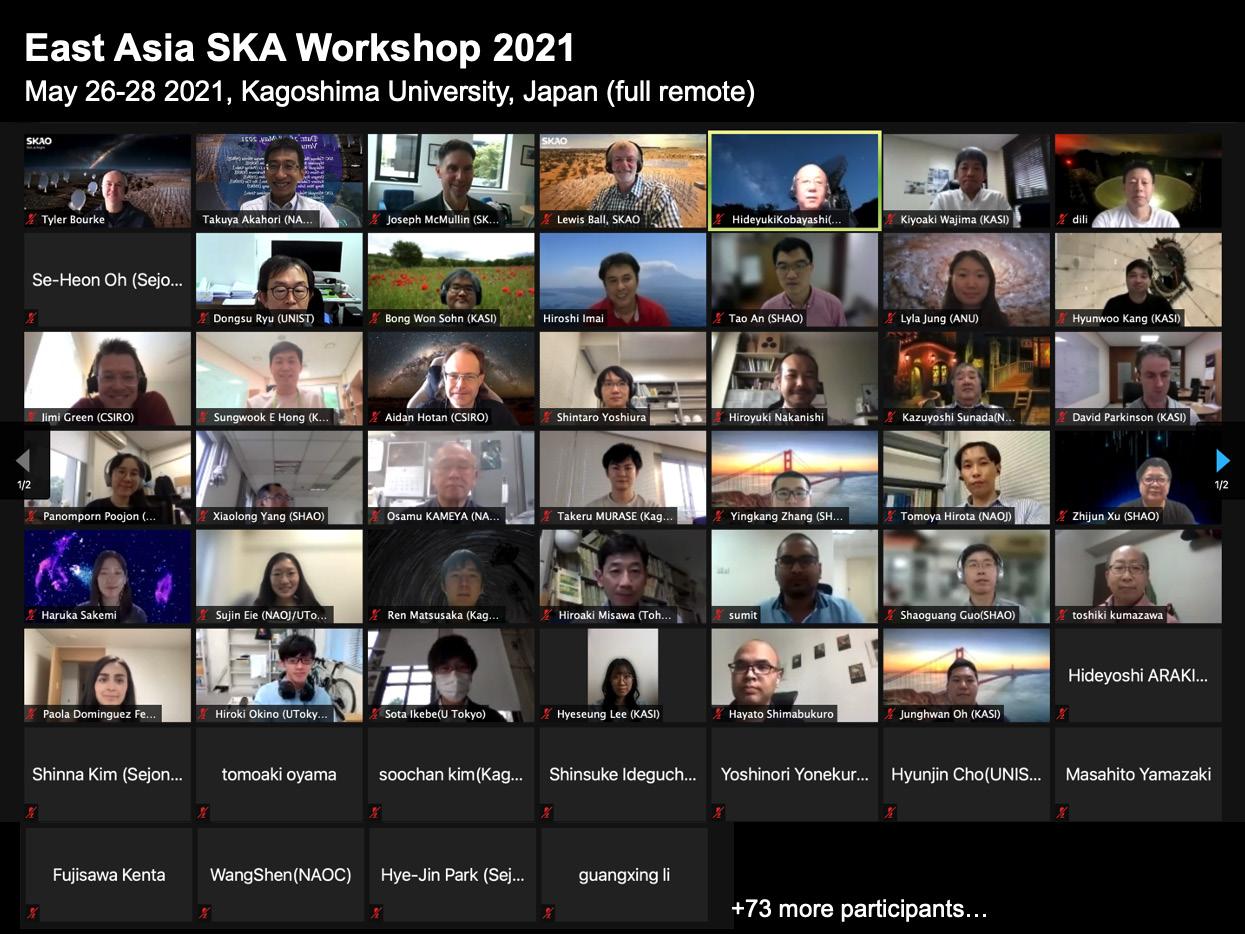
45 JULY 2021 CONTACT
LEFT: EASKA2021 welcomed attendees from 11 countries.
CREDIT: EASKA2021
SKAO in the news
News of the SKAO Council’s decision to approve the start of SKA construction truly made headlines around the world, with some 300 media articles written, reaching a total of more than one million readers! Below is a selection of the coverage, with the publication’s average readers per month and estimated article reads on the day of publication.
Forbes (68M readers, 56,000 article reads)
Say Hello To The $2.2 Billion ‘SKA’ As Humanity’s Biggest-Ever Telescope Gets The Green Light
Financial Times (16M readers, 13,000 article reads)
Say Hello To The $2.2 Billion ‘SKA’ As Humanity’s Biggest-Ever Telescope Gets The Green Light
From around the SKA world...
China - Tencent’s QQ (213M readers, 177,000 article reads)
The construction of the square kilometer array radio telescope starts (in Chinese)
France - Ciel & Espace
Feu vert pour lancer la construction des 2 plus grands observatoires radio du monde: SKAO (in French)
Germany - Heise (9M readers, 7,500 article reads)
130.000 Antennen: Baubeginn für weltgrößtes Radioteleskop (in German)
India - Saam TV News
Learn about the world’s largest telescope (in Marathi)
India - The Indian Express (68M readers, 56,000 article reads)
Construction of the world’s largest radio telescope to begin on Thursday
Italy - Il Messaggero (11M readers, 8,000 article reads)
Trent’anni di lavoro, al via la costruzione di Ska (in Italian)
The Netherlands - De Volkskrant (4M readers, 2,600 article reads)
De krachtigste radiotelescoop ter wereld krijgt groen licht om ‘fascinerende geheimen’ te onderzoeken (in Dutch)
Portugal - Expresso (2.4M readers, 2,000 article reads)
Se houver uma civilização desenvolvida a 475 mil milhões de quilómetros de distância, o SKAO vai detetá-la. Portugal está no projeto (in Portuguese)
Spain - El Espanol (32M readers, 26,000 article reads)
El sello español en el SKA, el nuevo radiotelescopio más grande del mundo (in Spanish)
...and beyond
Brazil - Canaltech (14M readers, 11,600 article reads)
Aprovada a construção do maior radiotelescópio do mundo — o SKA Observatory
Iran - Euronews Persian (1M readers, 800 article reads)
The world’s largest radio telescope will be built after 30 years of planning (in Persian)
Middle East - RT Arabic (9M readers, 7,500 article reads)
Construction of a unique radio telescope begins (in Arabic)
Norway - Digi.no (318k readers, 265 article reads)
Verdens største radioteleskop er endelig underveis (in Norwegian)
Russia - Vesti VGTRK (9M readers, 7,500 article reads)
Его ждали 30 лет: начато строительство уникального радиотелескопа (in Russian)
Turkey - Milliyet (35M readers, 29,000 article reads)
Dünyanın en büyüğünün inşası başladı! Evrenin sırlarını keşfedecek (in Turkish)
Vietnam - Lao Động (7M readers, 5,800 article reads)
Mạng lưới kính thiên văn vô tuyến lớn nhất thế giới đang được xây dựng (in Vietnamese)
And in other news…
Interesting Engineering
Life in 2050: A Glimpse at Space in the Future – A look at the ways space studies will advance in the coming decades with the advent of new facilities including the SKA telescopes.
Space in Africa
Cambridge Researchers Contribute to African Development with Radio Astronomy – Training and development is a key impact of the SKA project in Africa, as this piece highlights.
SpaceNews
Radio telescope faces “extremely concerning” threat from satellite constellations.
46 CONTACT ISSUE 8 News
SKAO jobs
As we enter the start of construction, we will be recruiting HQ based staff in Procurement, Finance, Communications, IT, Health & Safety and Engineering roles. We are also starting to recruit for some roles to be based in Australia and South Africa. Some of those roles will be employed through our partners CSIRO and SARAO. Make sure to register on our recruitment website to receive alerts.
Antenna Manufacturing Engineer
The Antenna Manufacturing Engineer will work primarily with the Field Node Product Delivery Team (PDT) which is responsible for delivering the antenna array of the SKA LOWTelescope. The Antenna Manufacturing Engineer will supervise and coordinate all phases of the production process of low frequency filar antennas.
Deadline: 13/07/2021
APPLY HERE
Head of Engineering Performance
The Head of Engineering Performance will be responsible for managing and directing the work of the Engineering Performance team within the Operations group and to deliver the objectives of the group. The appointee will be an individual experienced with the wide span of observatory operations, with specific proficiency of engineering operations in the context of an astronomical observatory.
Deadline: 30/07/2021
APPLY HERE
Health Safety & Environment (HSE) Manager at CSIRO
You will be the key CSIRO HSE resource for the SKAO in Australia, leading the HSE through the SKA-LOW construction phase on the MRO. You will provide tailored support and coordinate the consistent delivery of improving HSE. outcomes and metrics, HSE activities and initiatives for the SKAO
APPLY HERE .
Partner institute jobs
Data scientist at EPFL
SCITAS is looking for a Data Scientist to develop the Data Science activities and related astrophysical research developed at EPFL, in particular for the SKA and for the Cherenkov Telescope Array.
APPLY HERE
Postdoctoral Researcher in Radio Astronomy Simulations
The post holder will report to the SKA Project Scientist and be responsible for the coordination of the SKA Science Data Challenges.
Deadline: 31/08/2021
APPLY HERE
DevOps Engineer
The SKAO Computing and Software team is looking for a talented DevOps Engineer to work with other Software Engineers in establishing the Continuous Delivery pipeline supporting a software system that will have to last, and be continually developed, for decades.
Deadline: 18/08/21
APPLY HERE
Operations Manager at EPFL
EPFL is looking for an Operations Manager to organise and lead the contribution of Switzerland to the SKA Observatory, managing the EPFL local team, with a mix of engineers, researchers and PhD students.
APPLY HERE
47 JULY 2021 CONTACT
Jobs
Published by
EDITOR: William Garnier william.garnier@skao.int
EDITORIAL TEAM: Mathieu Isidro, Cassandra Cavallaro comms@skao.int
DESIGN: Joe Diamond, based on an original design by Carbon Creative
We welcome your contributions to Contact! Find out how to submit ideas here
All images in Contact are courtesy of SKAO unless otherwise indicated.
ABOUT THE SKAO
The SKAO, formally known as the SKA Observatory, is a global collaboration of Member States whose mission is to build and operate cutting-edge radio telescopes to transform our understanding of the Universe, and deliver benefits to society through global collaboration and innovation.
Headquartered in the UK, its two telescope arrays will be constructed in Australia and South Africa and be the two most advanced radio telescope networks on Earth. A later expansion is envisioned in both countries and other African partner countries. Together with other state-of-the-art research facilities, the SKAO’s telescopes will explore the unknown frontiers of science and deepen our understanding of key processes, including the formation and evolution of galaxies, fundamental physics in extreme environments and the origins of life.
Through the development of innovative technologies and its contribution to addressing societal challenges, the SKAO will play its part to address the United Nations’ Sustainable Development Goals and deliver significant benefits across its membership and beyond.
FRONT COVER: The SKAO logo captures many of the themes that are important to the SKA project: science, technology, global collaboration, and respect for local heritage. Watch our brand launch video or take a look at our Brand Book to see what’s behind it.


For printed versions
HYPERLINKS: Contact is produced primarily as a digital magazine. If you are reading a print copy, use the QR code to read this and other issues of Contact online and access the hyperlinks.
– THE SKAO MAGAZINE
CONTACT
the
SKAO Communications team.
