silverchips
March 24, 2025 Features D1/D2
Center Spread
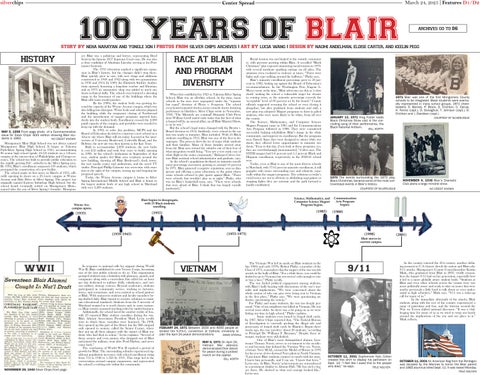
100 YEARS OF BLAIR
archives go to D6
STORY BY neha narayan and yongle xin | PHOTOS FROM silver chips archives | ART BY lucia wang | DESIGN BY naomi andelman, eloise carter, and keelin pegg
history
MAY 9, 1998 Front page photo of a Commemorative issue for Silver Chips’ 60th edition showing Blair students in 1962. NO CREDIT KNOWN
Montgomery Blair High School was not always named Montgomery Blair High School. It began as Takoma Park-Silver Spring High School in 1925, accommodating 86 senior high school (grade 10-12) students on a 3.8-acre campus at the intersection of Philadelphia and Chicago avenues. The school was built to provide public education to the rapidly growing D.C. suburbs in the Silver Spring area. By 1934, Blair’s enrollment surpassed 450 students, which prompted the construction of a new facility. The school made its first move in March of 1935, officially opening its doors on a 23.5-acre campus at Wayne Avenue and Dale Drive in Silver Spring. The project was originally named Eastern Suburban High School, but the school board eventually settled on Montgomery Blair— named after the son of Silver Spring’s founder. Montgom-
race at blair and program diversity
ery Blair was a politician and lawyer, representing Dred Scott in his famous 1857 Supreme Court case. He was also a close confidant of Abraham Lincoln, serving as his Postmaster General. The 1935 relocation marked a significant expansion in Blair’s history, but the changes didn’t stop there. Blair quickly grew in size, with new wings and additions constructed in 1940 and 1942 along with two gymnasiums in 1936 and 1954. In 1969, the Elizabeth Stickley Auditorium opened, honoring a long-time teacher and librarian, and in 1973 an automotive shop was added to teach students technical skills. The school even featured a shooting range in the basement of one of the buildings where the Blair rifle team would practice. By the 1990s, the student body was growing beyond the capacity of the Wayne Avenue campus, which was also falling into disrepair. Water leaks and asbestos plagued the building, while the temporary closing of Northwood and the introduction of magnet programs injected hundreds into the student body. Enrollment crossed the 2,000 pupil capacity of the campus, and portables were needed to keep up with the demand. In 1992, to solve this problem, MCPS and the Board of Education decided to construct a new school on a 42-acre site where Blair still sits today. Located at the intersection of University Boulevard, Colesville Road, and the Beltway, the new site was then known as the Kay Tract. Built to accommodate 2,830 students, the new facility cost $52 million and took four years to build, opening in 1998. At the school’s dedication in September of that year, student guides led Blair area residents around the new building, showing off Blair Boulevard’s clock tower, the new media center and auditorium, and the novel TV studio. Principal Phillip Gainous was overcome with emotion at the sight of the campus, tearing up and forgoing his prepared speech. Today, the Wayne Avenue campus is home to Silver Spring International Middle School and Blair is home to the largest student body of any high school in Maryland with over 3,200 students.
When first established in 1925 as Takoma-Silver Spring School, Blair was an all-white school. At the time, many schools in the area were segregated under the “separate but equal” doctrine of Plessy v. Ferguson. The school even hosted minstrel shows—racist comedy shows featuring performers in blackface. Silver Chips wrote in November, 1938, “The Minstrels are coming!! Dramatic Club President William Groff stated early today that the first of what is hoped will be an annual affair, an all Blair Minstrel Show, is on its way.” But the school’s legal status changed with the Brown v. Board decision in 1954. Suddenly, every school in the nation was made to integrate, Blair included. With 25 Black students enrolling in 1955, Blair was one of the first to desegregate. The process drew the ire of many white students and their families. Many of those families moved away from the Blair area toward the suburbs out of their fear of what integration would bring. “You saw a very stark case of white flight in the entire community,” Rahman Culver, former Blair assistant school administrator and graduate, says. As the school’s population declined, its minority enrollment percentage increased, growing to around 10 percent by 1971. Blair garnered a negative reputation, seen as dangerous and offering a poor education, to the point where some schools refused to play sports against Blair. “There were schools that wouldn’t play us at night,” Platky, who was on Blair’s basketball team, says. “There were schools that were afraid of Blair. I think that was largely racially motivated.,”
(1985)
(1955-1975)
(1939-1945)
NOVEMBER 28, 1940 Silver Chips front page.
In response to national calls for support during World War II, Blair established its own Victory Corps, becoming one of the first public schools to do so. This organization grouped students into a battalion with platoons, squads, and companies along with a curriculum that called for an hour per day dedicated to military drills, calisthenics, and various military strategy courses. Beyond academics, students participated in community service, working in factories, stores, and restaurants, and even assisted as school janitors at Blair. With numerous students and faculty members being drafted daily, Blair turned to creative solutions to maintain educational standards. Students from the University of Maryland stepped in to teach classes and, in some instances, Blair seniors assumed teaching roles for underclassmen. Additionally, the school faced the somber reality of loss, with 23 reported Blair student casualties during the war. Blair Alumni Association President Mark Levin recalls ways in which these casualties were honored. “In 1998, they opened up this part of the library [on the SSI campus] only opened to seniors, called the Senior Corner, where they put up all these plaques with the names of Blair students who had died in action,” Levin explains. “Several of those seniors and even juniors who dropped out of Blair and joined the military, went after Pearl Harbor, and never came back.” The conclusion of World War II marked a period of growth for Blair. The surrounding suburbs experienced significant population increases, with school enrollment rising from 714 in 1946 to 1,323 by 1951. This surge led to the conversation around campus expansions, and represented the school’s evolving role within the community.
vietnam
FEBUARY 24, 1971 Between 3500 and 4000 people attended the N.P.A.C. convention at Catholic University to plan the April 24 peace demonstrations. DAVID STOVALL MAY 6, 1971 On April 24, Vietnam War veterans demonstrated their desire for peace during a protest march on the capital. BILL KORTH
COURTESY OF SILVERLOGUE
BILL KORTH
1970 The events surrounding the 1970 play, Black Christmas, became some of the most controversisal events in Blair’s history.
Science, Mathematics, and Computer Science Magnet Program begins.
(1955)
(1935)
JANUARY 13, 1971 King Foster leads Black Christmas Show cast in the concluding song of their performance, the Black National Anthem.
1971 Blair was one of the first Mongomery County schools to be integrated. Black students were eventually represented in many school groups. 1971 cheerleaders: S. Barnes, P. Brock, S. Crichton, C. Carusi, K. Farina (capt.), D. Donaghue, T. Johnson (capt.), D. Crichton and J. Davidson (capt.)
NOVEMBER 4, 1938 Blair’s Dramatic Club plans a large minstrel show.
COURTESY OF SILVERLOGUE
Blair begins to desegregate, with 25 Black students enrolling.
Wayne Ave. campus opens.
WWII
Racial tension was not limited to the outside community, with pressure growing within Blair. A so-called “Black Christmas” play exposed simmering racial tension in 1970, with several incidents sparking outrage on all sides. The situation even escalated to violence at times. “There were fights and cops walking around the hallways,” Platky says. Blair’s minority enrollment percentage grew to 58 percent in 1982, butting up against the Board of Education’s recommendations. In the Washington Post, Eugene L. Meyer wrote at the time, “Blair advocates see this as ‘a slow death’ making the school a vulnerable target for closure in coming years, as the minority percentage exceeds the ‘acceptable’ level of 60 percent set by the board.” County officials suggested rezoning the school or even closing it altogether, but after pushback from students and staff, a new plan was adopted: Magnet programs to draw in gifted students, who were more likely to be white, from all over the county. The Science, Mathematics, and Computer Science Magnet Program came in 1985 and the Communications Arts Program followed in 1988. They were considered successful, helping rehabilitate Blair’s image in the white community, and improve its enrollment. But the programs were flawed. Since they were designed to attract white students, they offered fewer opportunities to minority students. “Even to this day, if you look at those programs, yes, they are overwhelmingly [non-minority],” Culver says. The STEM magnet had 6.6 percent and 5.5 percent Black and Hispanic enrollment, respectively, in the 2020-21 school year. Today, even as Blair is one of the most diverse schools in Maryland, with 77.61 percent minority enrollment, it still grapples with issues surrounding race and ethnicity, especially within the magnet programs. The solutions to today’s racial issues are not as obvious as abolishing segregation or stopping fights; they are systemic and the path forward is hardly established.
The Vietnam War left its mark on Blair students in the late 1960s and early 1970s. Robert Platky, a member of the Class of 1973, remembers that the impact of the war was felt acutely in the halls of Blair. “For a while there, you could be drafted to go to Vietnam but you weren’t old enough to vote or buy a beer,” Platky recalls. The war fueled political engagement among students, with Blair’s halls buzzing with discussions of the war’s morality and implications. “We were concerned about the whole notion of why our guys were being sent to Vietnam in the first place,” Platky says. “We were questioning authority, questioning the system.” For Platky and many students, the war was deeply personal. “One of my neighbors was killed in Vietnam. He was several years older. So there was a lot going on as we were hitting our time in high school,” Platky explains. Some students even turned to forged draft cards. In 1967, Silver Chips reported that, “The Federal Bureau of Investigation is currently probing the illegal sale and possession of forged draft cards by Blairites. Begun three weeks ago, the case involves ‘about 20 students,’ according to Principal Dr. Williams F. Brennan.” Despite these attempts, students were still drafted. One of Blair’s most distinguished alumni, Lieutenant Thomas Norris, serves as a testament to the sacrifices and heroism that defined the Vietnam War era. Norris, a former Navy SEAL, earned the Medal of Honor in 1976 for his rescue of two downed Navy pilots in North Vietnam. “I just know Blair students connect so much with his story. I knew him personally, and I can say, ‘I know that hero,’” Levin says. At Blair, Norris’ achievements are remembered in a prominent display in Alumni Hall. “He has such a legacy there. He showed us what real courage looked like,” Levin says.
NO CREDIT KNOWN
Communication Arts Program begins.
(1988)
(1998)
Blair moves to current campus.
9/11
OCTOBER 11, 2001 Sophomore Kyle Cohen created this shirt to display his patriotism on Sept. 13. “I feel like I owed this to the people who died,” he says. TRUC NGUYEN
(2001)
As the country entered the 21st century, another defining moment in U.S. history shook the nation and Blair—the 9/11 attacks. Montgomery County Councilmember Kristin Mink, who graduated from Blair in 2003, vividly remembers the impact 9/11 had on her generation, especially how it led to a more globally aware student body. “Students at Blair and even other schools across the county were way more politically aware and ready to take on issues that were maybe previously a little hard to talk about or even understand as high schoolers,” Mink says. “9/11 was a wake-up call for many of us.” In the immediate aftermath of the attacks, Blair students along with the rest of the country experienced a surge of patriotism and fear, and the rhetoric around the War on Terror shifted national discourse. “It was a challenging time for many of us as we tried to wrap our heads around the implications of the war and our place in it,” Mink reflects.
OCTOBER 11, 2001 An American flag from the Pentagon was donated by the Marines to honor the Blair parent and 1965 alumnus killed Sept. 11. It was raised Monday. TRUC NGUYEN