For over 100 years, the Department of Communication Studies has delivered information to the Shorter community through the publications of The Periscope newspaper and The Argo yearbook. Both publications served their purpose for their time, and we are proud to have been the voice for students through these publications. Our department would like to continue the rich history of delivering information and preparing students for careers in communications through the medium of a digital magazine, The Hawkeye. Because of the ever-changing industry of communications, production of a digital magazine provides real, on-thejob training for our students focusing in public relations. The Hawkeye will release two publications a year. Look for links to our publications through campus email and our Facebook and Instagram pages. I want to thank this semester’s magazine staff for the hard work and dedication they brought to this publication. Please enjoy reading the first edition of The Hawkeye magazine.
The Hawkeye Staff
Casey Raschen Editor
Andrea Medel
Carly Tipton
Caroline Wheeler
Cat Bloedow
Hayley Arthur
Melissa Baskin The Hawkeye Faculty Advisor
The Hawkeye
Dr. Earl Kellett Dean, College of Humanities and Social Sciences Professor of Christian Studies
Melissa Baskin Assistant Professor of Communication Studies The Hawkeye Faculty Advisor
Dr. William Mullen Chair, Department of Communication Studies Professor of Communication Studies
Cover photo by Alexis Arthur Back cover photo by Katherine Dudley Staff photos by Tate Tipton Melissa Baskin’s photo by Jenny Pilgrim
The Hawkeye 2
Inside This Issue 4
Sophomore Alexis Bagley serves on mission in Houston, Texas.
5
6
7
8
9
Shorter Student Serves On Mission
Football Team Mentors Youth The football team hosts an event for ESP You and Me, an organization that offers experiences of a lifetime to those with disabilities.
Shorter Student Teachers Impact Local Schools Education majors share their experiences serving as student teachers.
10
Inside the Making of Student Films Majors in communication studies write, produce, shoot, and edit their own short films.
Transformation Through Theatre Makeup
12
A theatre makeup class helps students get into character.
Science majors focus on their senior projects and look ahead to the future.
Professors Publish Poems and a Textbook
14
Dr. Fabrice Poussin publishes a collection of poems, while Dr. Terry Morris and Dr. Charles Carter publish a history book.
Chip Williams: More Than An Athlete Chip Williams, a senior, is a role model both on the football field and in the classroom.
Science Majors Find Success in Their Field
Class Studies Disney’s Impact on American Culture
Shorter students evaluate the impact that Walt Disney has had on American culture.
16
Communication Studies Students Serve Community Students serve at nonprofit organizations as a part of their Crisis Communications class.
The Hawkeye 3
Shorter Student Serves on Mission Story by Andrea Medel Photos submitted by Alexis Bagley
Alexis Bagley, a sophomore Christian Studies major, spent the summer of 2021 on mission with Mission Centers in Houston, Texas, where she and her team shared Christ and served the people of Houston. Bagley worked along side people from Texas, South Carolina, and Georgia. She said everyone on the team was easy going and were great communicators with each other. All of these attributes led to a team who worked well together to accomplish great things in God’s service. The team members participated in prayer walks and served those in need such as the homebound and homeless. In addition, they helped to organize a food pantry
Alexis Bagley (left) greets a member of the local Houston community where she served on mission last summer.
and hosted clubs for children that focused on sharing Christ. During her mission trip, Bagley learned about the power and effectiveness of prayer and how to serve others. “As Christians, we often forget how powerful prayer actually is until we see God continuously answer them right in front of us,” said Bagley. The power of God and faith in prayer were demonstrated over and over. Being a servant of God was demonstrated to Bagley and her team as night after night churches and families blessed those on mission with home-cooked meals and encouragement. In one nightly worship service, a church group talked about the act of washing
The Hawkeye 4
Alexis Bagley and her teammates enjoy a time of Christian fellowship during their mission trip.
feet as Jesus did for his disciples. Bagley was surprised when a girl came up to her and asked if she could wash her feet. “It was the most humbling thing I’ve ever been through,” she said. Naturally shy, this mission trip was a huge step for Bagley. Sometimes people need a little push to step out of their comfort zone. Bagley said this mission experience was exactly what she needed. She put all her trust in God for His protection and to help her in this mission effort. “God can and did use me for His purpose. All I had to do was let Him bring me out of my comfort zone,” stated Bagley. After her experiences on mission, Bagley learned what God’s power can do and believes God will direct her life. Lessons were learned by all during this mission trip, and Bagley was no exception. Her experience made her believe in herself and helped her overcome some of her fears. Likewise, the experience made her realize that she takes many things for granted. The people Bagley and her team served often had many needs that she took for granted in her own life. “The people we served were happy as long as they had God,” said Bagley. Although the work was hard, Bagley would love to go back and continue to build relationships with the community she served.
Football Team Mentors Youth Story by Cat Bloedow Photos by Cat Bloedow & Maddalena LoRae
The Shorter University Hawks football team had the opportunity to practice with some of their biggest fans in October of 2021. These fans were associated with ESP You and Me, an organization that offers experiences of a lifetime to those with disabilities. Over 20 people, ranging from young children to young adults, came out to not only support the Hawks but to also become part of the Hawks football team for the day. For this particular event, ESP participants gained insight into the life of college studentathletes. During the Hawks’ practice session, the football players led the ESP You and Me participants through drills including throwing and receiving passes along with scoring touchdowns. Cam Shirley, a senior special education major, was the point person who connected the Shorter football team with ESP You and Me. Shirley commented that he loved the touchdown dances the kids performed when they ran into the end zone. Shirley said, “My favorite part was getting to see my football team autograph t-shirts. It brought smiles not only to the kids’ faces, but also to my teammates who haven’t had the chance to serve the community in such a significant way.” In bright blue letters, the t-shirts sported the words “Adapt and Overcome.” The honorary athletes made a positive impact on the Shorter football players. They learned that disabilities do not have to hinder individuals from having fun, accomplishing desires, and maneuvering obstacles that life places in their path. As practice came to a close, everyone gathered for a team picture and some pizza. An old adage says that a picture is worth a thousand words, and with that, the photos display a world of happiness beyond belief. This was a moment both the Shorter Hawks players and the ESP You and Me participants will always remember.
The Shorter Hawks mentor local youth and believe it is an honor to serve those in their local community. Photo by Maddalena LoRae
A student tosses around the football around with some of the Shorter Hawks quarterbacks. Photo by Cat Bloedow
Qwentravez Moss, a sophomore sport management major, autographs a t-shirt for a young participant. Photo by Maddalena LoRae
The Hawkeye 5
Transformation Through Theatre Makeup Story and Photos by Cat Bloedow
April Moore, costume designer, shop manager, and an adjunct instructor in Shorter’s Department of Theatre, helps students prepare for the stage through her Theatre Make-Up class. Moore helps students recreate a look based on a character by using make up or prosthetics. This class prepares theatre students to accurately communicate words and designs through facial expressions and make-up. Students must create a visual aid presentation at the end of the semester to show their progression of make-up techniques and to display their skills. Will Gowens, a senior theatre major, took this class in order to learn how make-up is used on actors rather than just actresses. Gowens stresses that the importance of theatre make-up is to enhance features that characters need to have. “Different makeup styles that you use on a character emphasize that particular character’s traits,” commented Gowens. For example, someone might use heavy blue eyeshadow to convey that the character is unhinged. Because of this course, Gowen now understands that a lot of effort goes into theatre make-up, and he plans to use his newfound skills after graduation in his future theater productions. Kennedy Neely, a sophomore musical theatre major, loves this class because it will benefit her greatly in her future career path. She elaborates that being cast for a show is not only based on acting. Rather, directors and agents seek out well-rounded individuals who can apply other skills such as doing their own make-up. Recreating wounds really helped Neely push the boundaries of normal makeup application. Neely also opened up about the difficulties of finding the right shade of make-up for her dark skin complexion. Through this course, Neely learned that “No matter what anyone says, you can always find make-up for your skin.”
The Hawkeye 6
Emily Tumlin, a senior theatre major, applies eyeshadow to enhance her creative makeup look.
Weston Snell, a junior theatre major, recreates SamWise Gamgee from the Lord of the Rings films.
Hannah Autry, a junior theatre major, uses makeup to try and look like the late Diana, Princess of Wales.
Professors Publish Poems and Textbook Story and Photos by Caroline Wheeler
Everyone on the Hill is quite familiar with the friendly face and welcoming personality of Dr. Fabrice Poussin, Associate Professor of French. However, not many know he is actually a poet at heart. He recently published a collection of his poems titled In Absentia. The title translates from Latin to “absence” and is the general theme of the book. It captures the feeling of something missing or a void in one’s life. There are seventysix poems in this collection. He first began arranging and compiling his works during Christmas of 2020. Poussin was hesitant at first to show such a vulnerable and intimate side of himself to the general public, but a colleague convinced him to step out of his comfort zone and create this collection of his writing. Poussin said, “The artist creates to share a glimpse of the soul so that the audience can enrich their own souls through such vulnerability. I am interpreting my soul to assist Dr. Fabrice Poussin proudly displays his others in interpreting their own.” This is Poussin’s second published work, In Absentia. literary publication as he has written over 900 poems that have been accepted in countless magazines. We are beyond thrilled and blessed to have such talented professors like Poussin who have a true appreciation for the arts and continue to share their gifts with the world. Two of Shorter’s history professors wrote a textbook together titled The World Transformed: Modern Civilization Since 1648. This textbook will be used for their HIS 1020 Modern Civilization Since 1648 course. Dr. Terry Morris, Professor of History, wrote the beginning half from 1648-1815, and Dr. Charles Carter, Associate Professor of History, wrote the second part from 1815 to the present. Morris has been collecting information to construct such an informative textbook for over 50 years, and he has been teaching this course for over 20 years. “The goal is to provide a direct link between histories of the past and present. We pay close attention to the theological disciples and the curiosities history has shown over time. After all, everything has a history,” Morris explained. The HIS 1020 Modern Civilization Since 1648 classes are highly sought out by students who have a desire to learn about every corner of the globe. This class is used to show how the modern world came to be and how history has influenced the world as a whole. Morris called upon Carter to assist him in the making of this history book to closely examine the drastically different regions without neglecting the modernity that arose from the western world, which today is difficult to find. The process of assembling such a detailed piece took a little over a year to complete, and both professors reported that it Dr. Terry Morris (left), Professor of History, and was a pleasure working with the other. Dr. Charles Carter, Associate Professor of History, display their latest textbook.
The Hawkeye 7
Chip Williams: More Than An Athlete Story and Photos by Casey Raschen
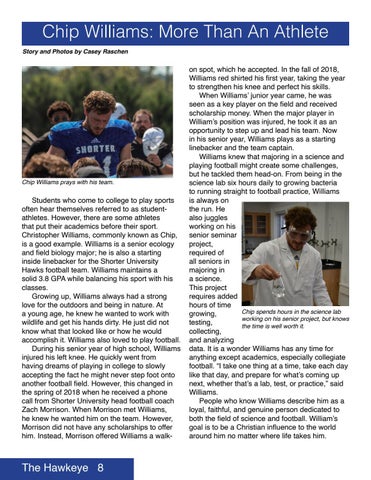
Chip Williams prays with his team.
Students who come to college to play sports often hear themselves referred to as studentathletes. However, there are some athletes that put their academics before their sport. Christopher Williams, commonly known as Chip, is a good example. Williams is a senior ecology and field biology major; he is also a starting inside linebacker for the Shorter University Hawks football team. Williams maintains a solid 3.8 GPA while balancing his sport with his classes. Growing up, Williams always had a strong love for the outdoors and being in nature. At a young age, he knew he wanted to work with wildlife and get his hands dirty. He just did not know what that looked like or how he would accomplish it. Williams also loved to play football. During his senior year of high school, Williams injured his left knee. He quickly went from having dreams of playing in college to slowly accepting the fact he might never step foot onto another football field. However, this changed in the spring of 2018 when he received a phone call from Shorter University head football coach Zach Morrison. When Morrison met Williams, he knew he wanted him on the team. However, Morrison did not have any scholarships to offer him. Instead, Morrison offered Williams a walk-
The Hawkeye 8
on spot, which he accepted. In the fall of 2018, Williams red shirted his first year, taking the year to strengthen his knee and perfect his skills. When Williams’ junior year came, he was seen as a key player on the field and received scholarship money. When the major player in William’s position was injured, he took it as an opportunity to step up and lead his team. Now in his senior year, Williams plays as a starting linebacker and the team captain. Williams knew that majoring in a science and playing football might create some challenges, but he tackled them head-on. From being in the science lab six hours daily to growing bacteria to running straight to football practice, Williams is always on the run. He also juggles working on his senior seminar project, required of all seniors in majoring in a science. This project requires added hours of time Chip spends hours in the science lab growing, working on his senior project, but knows testing, the time is well worth it. collecting, and analyzing data. It is a wonder Williams has any time for anything except academics, especially collegiate football. “I take one thing at a time, take each day like that day, and prepare for what’s coming up next, whether that’s a lab, test, or practice,” said Williams. People who know Williams describe him as a loyal, faithful, and genuine person dedicated to both the field of science and football. William’s goal is to be a Christian influence to the world around him no matter where life takes him.
Student Teachers Impact Local Schools Story by Casey Raschen Photos submitted by Nolan Reece, Celia Alvarado, and Madison Floerchinger
Shorter’s School of Education is one of the premier education programs in the state of Georgia, and its students are among the best future educators. Students enter the program at the beginning of their sophomore year and complete it after student teaching in Nolan Reece, a senior schools in Rome or secondary education major, plans to follow in his parents’ in the surrounding footsteps and become a communities. teacher. Student teaching is one of the most significant components of the department as students put into practice what they have learned in the classroom. During their student teaching, students learn the daily tasks of teaching and how to interact with their students. Nolan Reece, a senior, secondary education major from Adairsville, Georgia, has always known he wanted to teach. He was surrounded by teachers his entire life because both of his parents were teachers. After graduation, Reece hopes to move back to Adairsville to teach and one day become the athletic director of the school district. Currently, he student teaches at Calhoun High School. Reece said, “Student teaching is much different than just being behind a desk; I see firsthand what it takes to be a teacher.” From early morning to late in the day, Reece not only watches but also participates in teaching students. Celia Alvarado is senior from Cobb County pursuing a Bachelor of Music Education degree. Currently, Alvarado is student teaching at Sonoraville High School. During her time at Shorter, Alvarado has loved the education and training she has received in all aspects of her life. Initially, Alvarado pushed back on becoming a
teacher. However, as she saw God working firsthand in her life, it became evident that her calling was to teach. Alvarado said, “The most significant difference between being a student and being a teacher is the pressure I feel because these students rely on me.” Celia Alvarado, a senior However, that pressure music education major, believes God has called her drives her to be the best version of herself to be a teacher. for her students. Madison Floerchinger, a middle grades education major in Shorter’s new Master of Arts in Teaching: Pedagogy program, from Valdosta, Georgia, is living her dream of becoming an educator. Currently, Floerchinger student teaches at Lee County Middle School and feels she is living her dream. While at Shorter, Floerchinger credits the School of Education faculty for preparing Madison Floerchinger, a her to teach, investing middle grades education major in the new Masters of in her personally, and Arts in Teaching Pedagogy making her confident program, is living her dream in herself as a future of being an educator. teacher. Reece, Alvarado, and Floerchinger are grateful for how the School of Education faculty invested in them. Because of the training and support these students have received, they all feel ready to tackle the world of teaching upon graduation.
The Hawkeye 9
Inside the Making of Student Films Story and Photos by Carly Tipton
Students in the Department of Communication Studies have created various genres of films, including drama, suspense, and thriller productions, since the implementation of the digital production program in the fall of 2018. Digital production students are first introduced to filmmaking in the Fundamentals of Digital Production class where they learn about basic production concepts and the overall responsibilities of being a filmmaker. Students continue to learn about the digital production process through the Scriptwriting, Production, Post-Production, and Advanced Production classes. “Once students reach the Advanced Production class, they are expected to pitch their own movie ideas, write their own scripts, and then bring the stories to life through the production process,” said Katherine Dudley, Associate Professor of Communication Studies. In the fall of 2021, Advanced Production students produced two student-led films: Tips and Nemesis. Tips was a suspense film, while Nemesis was a thriller. The production process for both films started with writing scripts, location scouting, shooting schedules, casting calls, and production design with props and set dressings. The cinematographers for both films were challenged with filming many unique shots in a variety of locations. Calvin Durham, a senior communication studies major, served as the director for Tips and said that his time in the digital production program has prepared him for a future in the film industry. “The hardest part about being the director was the continuity of shooting out of order and taking advice from other students since it was a learning environment. Having hands-on training in film and working with other students provided me with a great learning environment. I feel prepared to enter the film industry after graduation,” said Durham. Cooper Hunt, a junior communication studies major and director of Nemesis, agreed with Durham. “Working with other students who have similar goals and are passionate about filmmaking has been the highlight of my career at Shorter. I am thankful for Professor Dudley’s
The Hawkeye 10
dedication to her students and her ability to train us to best meet those future goals,” said Hunt. Dudley was proud of her students who worked on each film. “Both films were challenging and genres that have not been done before by Hawkeye Productions. My students took the challenge and ran with their creative ideas of filmmaking,” she said.
Calvin Durham, a senior communication studies major, served as the director of Tips.
Cooper Hunt, a junior communication studies major, directed Nemesis.
The cast and crew get ready to film a scene for Nemesis, a student-led and created film.
Pictured from left to right: Braxton Fleetwood, Blake Baldwin, Cooper Hunt, Calvin Durham, William Gowens, Jared Ivey, and Trinity Haynes work on the set of Tips, a student-led and created film.
Griffin Skates, a sophomore communication studies major, records audio for a student film.
Students film on location at the historical Myrtle Hill Cemetery located in Rome, Ga. Pictured from left to right: Hayley Arthur, Seth Calero, Trinity Haynes, Cooper Hunt, and Griffin Skates.
The Hawkeye 11
Science Majors Find Success in Their Fields Story and photos by Andrea Medel
Allie Walker, is a senior, biochemistry major with minors in mathematics and chemistry. After graduation, Walker will attend the Harrison School of Pharmacy at Auburn University to obtain a Pharm. D. degree. Upon completion of pharmacy school, Walker desires to work in a hospital/clinical setting with a focus on pediatrics and also compounding medications. Her aspiration is to serve others to the best of her ability. “I was blessed to receive the education I have; therefore, I want to give back to others by using my knowledge to serve others,” said Walker. Currently, Walker is doing her senior capstone project on testing the adaptive resistance of serratia marcescens (gram negative bacteria) against zinc oxide nanoparticles. The research consists of growing cultures of serratia marcescens in a nutrient broth and placing nanoparticles in some of the test tubes. At specific time intervals, Walker uses a spectrophotometer to measure the absorbency level of each test tube. From the
Latasha Corntassel (left), a senior biology major and Allie Walker, a senior biochemistry major, credit Shorter’s science faculty with their success.
The Hawkeye 12
Allie Walker, a senior biochemistry major, uses aseptic technique to inoculate S. marcescens into nutrient broth for the purpose of growing the bacteria.
absorbency measurement, she can get a colony count of the bacteria in each test tube and determine the effect of the zinc oxide nanoparticles. According to Walker, she chose this particular experiment for her research because “I have a fascination with bacteria and health.” Through this research, she hopes to learn more about the resistance of bacteria, as well as the ability to use other products besides antibiotics to combat the resistance of bacteria. Walker is especially grateful to the faculty members at Shorter who have guided her to this point in her college career. According to Walker, the faculty in the College of Natural Sciences and Mathematics, in particular, have helped her to overcome all the challenges, personal doubts, and anxieties she experienced. In particular, Walker relied on Dr. Clint Helms, Dean of the College of Natural Sciences and Mathematics,
Dr. Daniel Clayton, Associate Professor of Chemistry, and Andrea Moss, Assistant Professor of Biology. Clayton, Walker’s advisor, helped to prepare her for scientific battles in research and studies. In the same way, “Dr. Helms is an amazing dean who has been there for me through challenging courses, stressful tests, and more,” said Walker. Blankenship is a wonderful encourager and always finds a way to make Walker smile. Overall, the entire faculty has supported and prepared Walker for what is ahead. Another senior in Shorter’s science area is Latasha Corntassel whose major is biology with a minor in chemistry. After graduation, Corntassel plans to attend veterinary school and hopes to be accepted into Auburn College of Veterinary Medicine. Later, she wants to own a mobile mixed animal practice with a focus on large animal medicine. In addition, Corntassel, along with her family, are establishing a vegetable farm on their land in Gaylesville, Alabama. According to Corntassel, “Our long-term goal is to establish the practice on the farm and eventually raise livestock as well.” One of her family’s main goals is to create an environment where people can learn animal husbandry, reconnect to the land, and practice sustainable veterinary medicine and farming. In addition, Corntassel wants to serve Christ through a non-profit organization called Christian Veterinary Mission. These veterinary professionals travel to countries and communities in need of veterinary services and while there, proclaim the good news of Jesus Christ to those they serve. Corntassel focused her research on equine parasitology due to the growing concern for anthelmintic resistance. Because anthelmintics have been overused and are showing early signs of resistance, Corntassel plans to practice sustainable parasite control protocol in her future practice. College can be challenging and having an amazing faculty can help a lot. Corntassel explained that the faculty and students in the science departments have become like her family. She credits Andrea Moss,
Assistant Professor of Biology, Dr. Paul Bond, Assistant Professor of Biology, Dr. Clint Helms, Dean of the College of Natural Sciences and Mathematics, and Dr. Daniel Clayton, Associate Professor of Chemistry, for their dedication in preparing for her future career. All have helped Corntassel in pursuing her profession and in developing her into an independent researcher and scientist. “They have all been a source of incredible support and encouragement.” Additionally, Corntassel is grateful to Dr. Jill Goad, Assistant Professor of English, who helped her with her essays for her veterinary school application. “She was always there to answer all my questions and advise me on the formatting of my essays.” Because of all the support of the Shorter faculty, Corntassel feels very confident she will be accepted into veterinary school. Both Walker and Corntassel hope to not only pursue their respective careers after graduation, but to also serve others through their careers.
Latasha Corntassel, a senior biology major, counts the number of eggs per gram using a Modified McMaster slide.
The Hawkeye 13
Class Studies Disney’s Impact on American Culture Story by Cat Bloedow Photos by Andrea Medel & Caroline Wheeler
Mickey Mouse and The Happiest Place on earth have become symbols interwoven throughout American culture and are easily recognized. These icons, created or inspired by the famed animator and entrepreneur Walt Disney, were the basis for a new honors course this semester. Dr. Julia Pond, Associate Professor of English, taught the “Storytelling of Disney” class in the fall semester where students reflected on the impact Walt Disney had on American culture. Throughout Disney’s lifetime, he re-imagined stories that originated from other countries, which typically had sad endings. For example, Sleeping Beauty, in the original story, was a victim of assault in her sleep. Yet, Disney transformed a story of harm into one of love, where Sleeping Beauty’s prince rescued her from a deep sleep. Disney also took the world by storm after his creation of the animated character Mickey Mouse. Mickey became a cultural icon on television and in the art realm and was marketed world-wide. These symbols sell an American dream of a world of chances that has no limits. During class, students evaluated this topic and became more self-aware of the impact Disney had on their lives. Students researched, created, and gave presentations about Disney’s impact on music, literature, toys, amusement parks, cruises, magazines, and
The Hawkeye 14
television. Thus, students became more selfaware of the wide range of impact that Disney and his creations have on American culture. Eva Cruz, a senior human services major, gave a presentation of the evolution of Disney Magazine publications throughout history. “I had the opportunity to show the class four different publications: Le Journal De Mickey (1935-Present), Disneyland Magazine for Beginning Reader (1971-1974), Picsou Magazine (1978-present), and the Mickey Mouse Magazine (1987-1993). These magazines were
Dr. Fabrice Poussin, Associate Professor of French and guest lecturer for the class, reenacts the character Linguini from the animated movie Ratatouille. Photo by Andrea Medel
designed to teach and entertain as well as promote the American brand. Unfortunately, the advancements of the Internet, television, and gaming have brought a slow death to the magazine in the United States,” Cruz said. Rin Richardson, a senior interdisciplinary studies major, took this class because she wanted to understand more about how Disney impacted her from early childhood to the present. Richardson learned that Walt Disney domesticated fairy tales into American ideals, which impacted many areas of life. For her project, Richardson focused on how the Disney Brand has impacted the food industry. She testified to having been influenced by Disney when she purchased a Mickey Mouse waffle maker and also created staple food items like Dole Whip, a famous dessert sold at the Walt Disney World theme parks. Walt Disney was the epitome of the American Dream. What many people do not know is that Disney, like other American entrepreneurs, failed multiple times to achieve his dreams. Disney’s philosophy of Dream, Believe, Dare, and Do were eventually achieved because of his continued efforts and desire to succeed. The most notable lesson Richardson learned from this course was about Disney’s motivation and desire to keep moving forward. “As amazing as Walt Disney made the company, he went bankrupt three times before, which reminds me that I can chase after my dreams even if I fail, “ she said.”
Eva Cruz, a senior human services major, and Jackson Wheatley, a senior chemistry major, enjoy Dr. Fabrice Poussin’s, Associate Professor of French, Linguini re-enactment from the movie Ratatouille. Photo by Andrea Medel Pictured on top from left to right: Jared Ivey, Jessi Stallings, Rin Richardson, Kelly Vernon, Chloe Gray, and Jan Kos Pictured on bottom from left to right: Jackson Wheatley, Eva Cruz, Leah Figueroa, Ava Bowman, Isabel Borgers, and Dr. Julia Pond The Disney Honors class continues to learn about the lasting impact Walt Disney has on the world. Photo by Caroline Wheeler
The Hawkeye 15
Communication Students Serve the Community Story by Hayley Arthur Photos by Cooper Hunt
Time…so often we find that it is the big evil mastermind that obstructs us from good. Such was the case for a service project assignment for two communication studies majors. Cooper Hunt, a Evan Windham, a senior junior and Trinity communication studies major, Haynes, a senior, and Taylor Harper, a senior found time to be sport management major, the overshadowing volunteer at Living Proof Recovery, a local non-profit. villain when completing a project for their Crisis Communications class. For the students, the clock started ticking when Dr. William Mullen, Chair of the Department of Communication Studies and Professor of Communication Studies, assigned them a non-profit community service project for his class. The students could choose any organization at any time, as long as it was a non-profit that served the community. When asked why he assigned this project, Mullen explained that not only does serving the community build a reputation that’s essential to crisis leadership, but it also helps students work with people and organizations that deal heavily with crises of all kinds. Thus, the students were to learn about crisis communication, not just from the project itself, but also from the organizations the project served. Nevertheless, aside from the specific crisis communication applications, Mullen put it simply by saying, “The practical benefit of getting people out there is to learn how to serve.” The group in which Haynes served chose to give time and service to Living Proof Recovery, a rehabilitation center for individuals dealing with addictions, located in Rome, Ga. She, along with Evan Windham and Trey Lyles, both
The Hawkeye 16
senior communication studies majors, and Taylor Harper, a senior sport management major and communication studies minor, deep-cleaned a classroom, cleaned and organized a clothing and shoe storage area, and cleaned an art therapy room. The work was dirty, but Haynes recalled countless moments of laughter, fun, and hilarious conversations the students had while mopping, scrubbing a table, or organizing a room. In fact, Haynes noted that the work was a fun and bonding experience for the group saying, “Nothing bonds you faster to some people than doing something that’s worthwhile for someone else.” The students considered their service small, but they walked out closer together than they had been and with a boosted sense of fulfillment. The project that Hunt and his group completed was just as tough, but equally as fulfilling. This small group of students also included Brayden Williams, a sophomore communication studies major, and Tanner Hopkins, Caroline Wheeler, Maverick Beaudreau, all senior communication studies majors. They gave their time and service to West Rome Baptist Church in Rome, Ga. The students took out garbage, cleaned the children’s facility, and organized a storage room. The
Brayden Williams, a sophomore communication studies major, and Maverick Beadreau, a senior communication studies major, do the heavy lifting at West Rome Baptist.
Trinity Haynes, a senior communication studies major, cleans tables at Living Proof Recovery, a rehabilitation center in Rome, Ga., that serves those dealing with addiction.
project involved a lot of heavy lifting both up and down stairs, but the group made it light work by laughing and enjoying each other’s company while doing it. However, that was not even the best part, according to Hunt. To him, the best part was making connections with the employees at West Rome Baptist. He said that the people made a great impression on his group from their wonderful display of leadership to their massive amounts of gratitude towards the students. Such a response to their work made the project, “very rewarding.” Hunt also recalled that the group actually walked away with large cardboard giraffes that the church no longer needed. These cut-out giraffes still stand in the student’s dorms today as room decor! Throughout their projects, the students acknowledged the malicious push-back of a shadowy villain who likes to drum his leathergloved fingers against each other and laugh in the face of every good thing…time. When asked, “What were some conflicts or hurdles that you had to overcome to complete the project?” Both Haynes and Hunt stressed that time was a huge
problem. Coordinating their busy schedules with one another proved to be almost detrimental to the project. Availability was slim, but the need for the students to complete the project and serve their community was great. Time may be one of our biggest enemies, but these wise students realized that overcoming it and doing good in the community was worth more than they had anticipated. In fact, Haynes summarized the experience with this golden piece of advice, “Get involved in the community where you can, and don’t let ‘I’m too busy’ be your excuse, because I know it’s an easy excuse to have.” Hunt wanted his audience to know that “Procrastination is the biggest enemy as we learned.” These students speak powerful truth to the entire world by saying that finding the time to serve is hard, but it is worth it in the end. “Dong!” The clock strikes as it always does, but Mullen and his group of communication studies students did not let it win. From this nonprofit community service project, they beat time and simply learned how, when, and why to serve.
The Hawkeye 17