Refrigerant
Type
Composition
GWP (100 year)
GWP (20 year)
R448A
HFO/ HFC
26% R32 / 26% R125 / 21% R134a / 7% R1234ze / 20% R1234yf
1,400
3,100
R449A
HFO/ HFC
24,3% R32 / 24,7% R125 / 25,7% R134a / 25,3% R1234yf
1,400
3,100
R449C
HFO/ HFC
20% R32 / 20% R125 / 29% R134a / 31% R1234yf
1,200
2,900
R452B
HFO/ HFC
67% R32 / 7% R125 / 26% R1234yf
710
2,100
R513A
HFO/ HFC
44% R134a / 56% R1234yf
600
1,700
R454B
HFO/ HFC
68.9% R32 / 31.1% R1234yf
490
1,700
Source: “Real GWP: 20 years vs 100 years: Impact of Refrigerants Fact Sheet #1 (V.1.1.).” ATMOsphere. Available online at: https://bit.ly/3HJOYJe
1
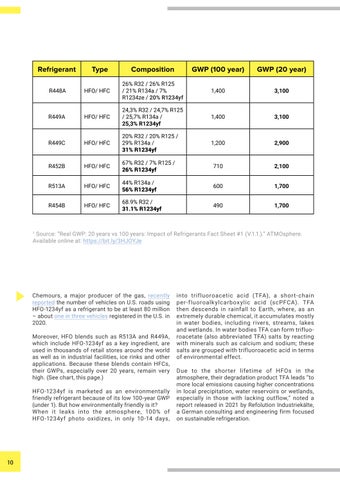
Chemours, a major producer of the gas, recently reported the number of vehicles on U.S. roads using HFO-1234yf as a refrigerant to be at least 80 million – about one in three vehicles registered in the U.S. in 2020. Moreover, HFO blends such as R513A and R449A, which include HFO-1234yf as a key ingredient, are used in thousands of retail stores around the world as well as in industrial facilities, ice rinks and other applications. Because these blends contain HFCs, their GWPs, especially over 20 years, remain very high. (See chart, this page.) HFO-1234yf is marketed as an environmentally friendly refrigerant because of its low 100-year GWP (under 1). But how environmentally friendly is it? When it leaks into the atmosphere, 100% of HFO -1234yf photo oxidizes, in only 10 -14 days,
10
into trifluoroacetic acid ( TFA), a shor t- chain per-fluoroalk ylcarbox ylic acid (scPFCA). TFA then descends in rainfall to Earth, where, as an extremely durable chemical, it accumulates mostly in water bodies, including rivers, streams, lakes and wetlands. In water bodies TFA can form trifluoroacetate (also abbreviated TFA) salts by reacting with minerals such as calcium and sodium; these salts are grouped with trifluoroacetic acid in terms of environmental effect. Due to the shor ter lifetime of HFOs in the atmosphere, their degradation product TFA leads “to more local emissions causing higher concentrations in local precipitation, water reservoirs or wetlands, especially in those with lacking outflow,” noted a report released in 2021 by Refolution Industriekälte, a German consulting and engineering firm focused on sustainable refrigeration.