After more than 70 years, a Lee County farmer is still on the Case The legacy of a farmer who really gave a darn lives on at agriculture museum The team at a Princeton shop invite you to stop by and share in their shear joy
1698263410-t559g.indd 1
PRSRT STD U.S. Postage PAID Permit No. 440 Sterling, IL 61081 CHANGE SERVICE REQUESTED
10/25/2023 2:50:14 PM
2 | A Shaw Media Publication | Ag Mag | Winter 2023
1698261275-nus6d.indd 2
10/25/2023 2:14:36 PM
For Advertising Contact Jill Reyna at 815-631-8774 or jreyna@saukvalley.com Published by Sauk Valley Media 113 S. Peoria Ave., Dixon, IL 61021 815-284-2222 Have a story idea for Ag Mag? E-mail rschrader@saukvalley.com Articles and advertisements are the property of Sauk Valley Media. No portion of Ag Mag may be reproduced without the written consent of the publisher. Ad content is not the responsibility of Sauk Valley Media. The information in this magazine is believed to be accurate; however, Sauk Valley Media cannot and does not guarantee its accuracy. Sauk Valley Media cannot and will not be held liable for the quality or performance of goods and services provided by advertisers listed in any portion of this magazine.
TH
N OR
G MA
Magazine editor & Page design Rusty Schrader
G
Publisher/Ad Director Jennifer Heintzelman
N ILLINOIS A ER
4
inside Still on the Case
More than 70 years ago, a savvy salesman put a farmer’s son in the driver’s seat of a tractor, and he’s still in the driver’s seat today — only now, he’s got a lot more seats to sit in.
22
Treasuring his time The road a Pearl City teen took led him to a leadership position in the FFA, where’s he’s been able to share his passion for ag, and learn more about it along the way.
12
A farmer who really gave a darn
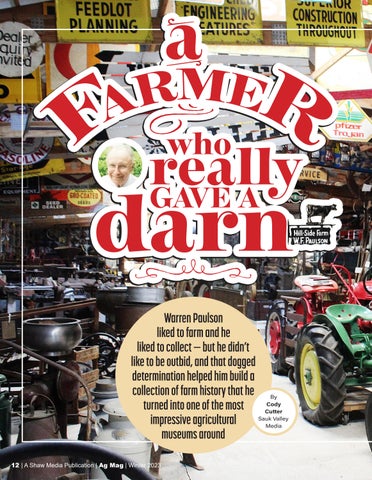
Warren Paulson liked to farm and he liked to collect — but he didn’t like to be outbid, and that dogged determination helped him build a collection of farm history that he turned into one of the most impressive agricultural museums around.
30
Shear joy
Looking for comfy clothing to keep you cozy from head to toe? A Princeton shop has you covered, and that’s not all you’ll find there. It’s got rugs, blankets, yarn and more — all thanks to a fluffy gang of grass-eaters with four legs and a friendly disposition.
See us today for more information on our service inspection offer.
We offer expert service that keeps your machines running season after season. Visit us for a Certified Maintenance Inspection to keep you going strong. • Multi-point Certified Maintenance Inspection performed by our factory-trained technicians. • We have the latest New Holland service and repair information for your machine. • Maintain profitability by reducing downtime with scheduled maintenance inspections.
PEABUDY’S INC 2900 POLO ROAD STERLING, IL 61081 815-626-4600 www.peabudysinc.com
©2016 CNH Industrial America LLC. All rights reserved. New Holland is a trademark registered in the United States and many other countries, owned by or licensed to CNH Industrial N.V., its subsidiaries or affiliates. New Holland Construction and CNH Industrial Genuine Parts are trademarks in the United States and many other countries, owned MRC
by or licensed to CNH Industrial N.V., its subsidiaries or affiliates. www.newholland.com SM-ST2117584
A Shaw Media Publication | Ag Mag | Winter 2023 | 3
1698873062-tgg6u.indd 3
11/1/2023 4:11:05 PM
He’s still on the
Ever hear the one about the farmer’s son? A savvy salesman put him in the driver’s seat of a tractor, and more than 70 years later he’s still in the driver’s seat — only now, he’s got a lot more seats to sit in
Remmer Schuetz has been driving his 1950 Case DC since his father, Reimer, bought it new from a dealer in Elgin, near his family’s farm in West Dundee. It’s one of nearly 80 Case tractors he has on his rural Ashton farm, along with his collection of all things Case.
4 | A Shaw Media Publication | Ag Mag | Winter 2023
1698261271-8p4z5.indd 4
10/25/2023 2:14:34 PM
R
CODY CUTTER/CCUTTER@SHAWMEDIA.COM
emmer Schuetz can remember the day when gravel roads and farm fields dominated the landscape of what would one day become a swath of subdivisions and cul-de-sacs north of Elgin. Time hasn’t been all that kind to Kane County’s farms, and even his land morphed into suburban sprawl. What hasn’t changed in Schuetz’s life is both his love for farming, and his brand loyalty to a certain kind of tractor. Schuetz, 88, is still riding the same 1950 Case DC his father Reimer bought brand new, but these days he’s using it to tend to tasks on the rural Ashton farm he relocated to in 2006. The signature orange doesn’t shine as bright as it used to, and there are some paint chips here and there, but that old Case has character, much like the man who drives it: dependable and dedicated, sturdy and stalwart, tending to the land that’s provided a living for his family for decades. But there’s one thing you won’t find on that tractor: computer chips or hi-tech gadgets — just good old horsepower.
CASE cont’d to page 6
Above: Schuetz drives his 1958 Case 700 H tractor outside of Franklin Grove on July 22, during the Living History Antique Equipment Association’s tractor drive.
A Shaw Media Publication | Ag Mag | Winter 2023 | 5
1698262907-rjz71.indd 5
10/25/2023 2:41:58 PM
CASE cont’d from page 5
Remmer Schuetz looks through a an early 1900s Case tractor owners manual.
The 1950 DC is one of dozens of Case tractors Schuetz has collected over the years, along with countless pieces of Case memorabilia and other mementos from his family’s farming life. His garages serve as a museum of sorts for all things Case, highlighted by around 80 different tractors. How does someone get so many tractors? Well, “Every now and then one follows me home,” Schuetz said. Some of Schuetz’s tractors make it out of the garages and into local tractor shows, where he’s happy to share with folks his lifetime of knowledge about the orange workhorses, and chew the fat with like-minded enthusiasts who have similar collections. “The reason I go, what I like, is meeting the people,” Schuetz said. “Many people will ask questions, and I like explaining the tractors to them. I also like seeing something that I don’t have” — which at this point, isn’t all that easy. “It’s kind of hard to find a Case tractor that I don’t have anyCODY CUTTER/CCUTTER@SHAWMEDIA.COM more” he said. But Schuetz’s collection isn’t just for show. Pick something out from his collection and he’ll have a story to tell about it. He was president of the national J.I. Case Collectors Association from 2015-19 and served 15 years on its board. He knows the value of everything he has, and has a grasp on what items are more sought out than others and what they’re worth. He knows that the older they get, the more valuable they become. “I like to collect and find different stuff,” Schuetz said. “Some day I’ll line this stuff up and have a sale. One day a man came in here, looked at everything, and said he’ll give $150,000 for everything in here. I said, ‘Not today.’”
CASE cont’d to page7
Sales • Farm Management • Market Evaluations Lee County
177+/- Acres, 167+/- ac tillable. Excellent location E of Dixon, good producer, quality soils. SALE PENDING 89 +/- Acres, mostly tillable. Nice location in S Dixon Township near town. PENDING
Ogle County 93+/- Acres SE of Polo at Union & Judson Rds. Mostly tillable w/excellent soils! 98+/- Acres, 90+/- ac tillable. Just SW of Davis Junction.
Carroll County 215+/- Acres, 141.5+/- tillable. Both Elkhorn Grove (Carroll) & Eagle Point (Ogle).
Jo Daviess County
239+/- Acres, 202 +/- tillable. SE of Stockton, full set of buildings SOLD
Whiteside County 715,000 Bushel Grain Storage Setup in Sterling
Matt Hermes, Designated Managing Broker
815-288-4648 • www.heartlandrealty.info 6 | A Shaw Media Publication | Ag Mag | Winter 2023
1698261266-mrsus.indd 6
10/25/2023 2:14:28 PM
Overlooking nothing. Ready for everything. Farmers and ranchers, the world relies on you. And you deserve a bank that’s rooted in the details and dedicated to helping you do more.
/agribusiness
A Shaw Media Publication | Ag Mag | Winter 2023 | 7
1698844633-sf5b5.indd 7
11/1/2023 8:17:15 AM
CASE cont’d from page 7
One of Remmer’s most prized possessions in his Case collection is this neon sign. “I had a guy come in here and [say] ‘How much for that lighted sign and eagle?’ I said ‘$30,000, ‘and he bid me to $24,000.”
Advertising signs, parts molds, owners manuals and other hardto-find Case items are among Schuetz’s collection, as well as farm memorabilia from around his hometown of West Dundee, a few miles north of Elgin. Perhaps no story of any one items is more interesting than the one that brought Case tractors into his life – the one about the 1950 DC he inherited from his father. The tractor came from the Barron Brothers implement dealer in Elgin, where father and son stopped by one day looking to upgrade from the old Case C-series they bought from there. “We went to Barron Brothers and my dad was talking with Dick Barron, the dealer, and told him that the old CC didn’t have enough power to haul the silage up to our silo,” Remmer recalled. “Dick said, ‘You ought to take this tractor home,’ and my dad said he couldn’t afford it. “I was just a kid running around and looking at all of the tracCODY CUTTER/CCUTTER@SHAWMEDIA.COM tors, and I didn’t know what they were talking about when I was running around. My dad then went outside to get parts or something, and Dick says to me, ‘Hey, come here! Try this tractor over here by the gas pump.’ So I did. He puts some gas in it and he says, ‘Just take it home.’ I thought maybe my dad made a deal already. “I went down the road, and when I get home, here’s my dad, and I get my butt kicked. [He said,] ‘What are you doing?’ ‘I don’t know; he told me to take it home, and I took it home.’ My dad said, ‘Well, we can’t afford that.’ Long story short, he said we’ll try it, and so we put it on the silo filler and, shoot, it just went crazy. You couldn’t slow it down. And it still works 73 years later. It’s done a lot of hard work.’”
CASE cont’d to page 9
Become a Part of Illinois Farm Bureau Fights for Farmers Gives Back Works the Hill Keeps you in the Know Saves you Money
JOIN TODAY!
Carroll County 815-244-3001 Lee County 815-857-3531
Ogle County 815-732-2231 Whiteside County 815-772-2165
Experience Matters • Farm Leases • Estate Planning • Farm Sales
114 E. Everett St. Suite 300 Dixon, IL • 815-288-4949 www.egbclaw.com
8 | A Shaw Media Publication | Ag Mag | Winter 2023
1698261254-kdptp.indd 8
10/25/2023 2:14:16 PM
CASE cont’d from page 8 Schuetz has been diligent — and resourceful — in keeping his tractors working well, hunting down parts, or sometime buying parts tractors to keep his primary equipment up and running. “I’ll pull one in that doesn’t run, I’ll work on them when I have time, and in a couple of weeks I’ll drive it out the door,” Schuetz said. “I can take a motor apart and put it back together again and I’ll guarantee it’ll run.” Case made its first farm equipment in 1842 in Racine, Wisconsin. The oldest machine Schuetz has in his collection is a 1918 Case 1018 – 10 horsepower on the drawbar and 18 horsepower on the belt. In those days, giving tractors a signature body color wasn’t as much of a marketing priority as it would later become. The 1018 is green, a darker shade than a John Deere. Gray would later become the color of choice for Case before the company settled on its signature orange in the late 1930s.
CASE cont’d to page 10
Space for his Case Place Tractors and tools, promotional items and parts, signs, manuals and more — if it’s related to Case tractors, Remmer Schuetz will find a place for it in his collection. “I like to collect and find different stuff,” he said.
A Shaw Media Publication | Ag Mag | Winter 2023 | 9
1698261249-7n0mt.indd 9
10/25/2023 2:14:13 PM
CASE cont’d from page 9 Schuetz has a number of different models designed for specific uses — some for orchards, some for high crops, some for vineyards. One of his tractors was made for use at airports, hauling baggage trailers and even towing a few airplanes. Schuetz is like an encyclopedia, having made his life a Case study of the company’s machines. He could talk for hours about the his tractors, telling you what makes them tick, rattling off serial numbers. “Case had a very unique way of making their serial numbers,” Schuetz said. “Very unique. How they did it was that they had a seven-digit number and you take the first two numbers and subtract four, that’s the year it is. On the older models where they had a six-digit serial number, you take the first number and the fourth number, you put them together and you take off three. They did that up until ’54.” Orange Case tractors, in their own right, aren’t made anymore, having merged with International Harvester in 1984, but the name lives on through newer red Case-IH machines. The eagle was Case’s longtime logo, but you won’t find them on the current machines. Why an eagle? Schuetz can share that story, too. “Around the Civil War, a tree blew down and a young Indian found an eagle on it and helped it regain its strength. When the troops from Racine County went off to the Civil War, they took this eagle as their mascot, and it flew into battle. When they got back, Wisconsin adopted it as their state bird. Jerome Case made it his
logo and called it ‘Old Abe.’” Also among the collection are cast iron seats, toy tractors, chauffeur badges (an early form of livery licenses), owners manuals from the turn of the 20th century, and watch fobs that farmers once used to help find watches in their pockets. Elgin was known for being an early milk and butter processing hub in the 1800s, as well as watch manufacturing, from the Elgin National Watch Company. Schuetz also has acquired more than 900 different livestock canes from throughout the years. Some of them have the names of feed stores, and others are from historic events, such as the 1933 World’s Fair in Chicago. “There were dairies on most every farm, and there were dealers who sold you cattle,” Schuetz said. “You’d buy a cow from a dealer, and he’d give you a livestock cane to herd your cows with. A lot of them have names on them, and that makes them worth a lot more.” Case’s closest plant to where Schuetz lives north of Ashton was in Rockford, at a facility formerly home to farm equipment maker Emerson-Brantingham, until Case bought it in November 1928. The last castings were made in the Rockford plant in 1961, and they have commemorative notations on them to signify the occasion. Schuetz saw they were at an auction while he was out of town, and recruited his son to make sure those pieces of history would be among the vast Case collection – no matter the cost.
CASE cont’d to page 11
10 | A Shaw Media Publication | Ag Mag | Winter 2023
1698261247-tbuoq.indd 10
10/25/2023 2:14:07 PM
See how you can save with natural gas for your farm and home.
ENERGY LL J O
ROLL ENE AR RG -C
O-CARROL J L
Switch to natural gas and save!
O
Y
Harvest the Savings
Do you have a classic tractor that looks as good as new? Or is your antique power rough and rusted but still ready to go? Either way, we’d like to share your story with fellow farmers and fans of old farm machines in Ag Mag’s “Still Crankin’ After All These Years,” a feature that celebrates the people who keep farm history alive through their classic tractors. These are the people who will work on their tractor until to the cows come home. They’ll swap stories and swap parts. They’ll scour websites and catalogs and tractor shows to hunt down that hard-to-find piece for their project. They’ll do what it takes to get their tractor to go the extra mile. And when they get those machines to pop and sputter and rumble and roar to life, it’s like music to their ears. Maybe it’s the tractor Grampa owned, or the one Pa taught his son to drive. Maybe it’s a tractor Ma road to town. Whether you’ve rebuilt or restored a ride, or you’ve got a project in progress, drop us a line and let us know about it, and we may just share your story in a future issue of Ag Mag. Email rschrader@saukvalley.com.
JCE R
“I was in Michigan at a tractor show, and I sent my son over to buy them,” Schuetz said. “He called me and said, ‘Do you realize these people are going crazy over here?’ I said, ‘What do you mean?’ He goes, ‘They’re bidding on this stuff like crazy.’ I said, ‘Get your hand in the air, I want them.’” Like other collectables, some farm memorabilia can command high prices. He’s sold a few things from his collection — items that he had doubles of — but many things are too special to give up. One vintage Case sign he has still has the original neon lighting, something that’s hard to find in top condition. “I had a guy come in here and I sold him some signs that I had doubles of, and he looked at that lighted sign and eagle,” Schuetz said. “He says, ‘How much for that lighted sign and eagle?’ I said ‘$30,000, and he bid me to $24,000. My wife said I should have sold it. I said, ‘No.’ She goes, ‘Why not?’ ‘I enjoy seeing it.’ And two, three years from now if I have a sale, it’ll bring more.” Along with his farm collection, Schuetz also has mementos and memories on display from his days as the man behind another kind of horsepower: as captain of the Kane County Sheriff Department’s Mounted Patrol unit. Among the more famous events the patrol participated in were parades for the Cotton Bowl and Fiesta Bowl college football events. Those aren’t Schuetz’s only football-related memories from Kane County, though. He has more from the many tractor shows he’s shown at. One memory in particular involves the Honey Bears cheerleaders that used to be an attraction with the Chicago Bears in
the 1970s and 80s. They performed a show at the Kane County Fair one year, and Schuetz’s show was on right after theirs. For Schuetz, there’s a certain feeling about driving a tractor that’s different than sitting behind the wheel of a car or truck, as one of the cheerleaders found out. “After their show, I did a tractor show,” Schuetz recalled. “I had some of the gray tractors, and one of those young ladies says to me, ‘Could I drive this?’ I said, ‘Sure.’ So I rode on the back and let her drive it around slowly. We stopped and she got off and said, ‘I want to tell you something. We do a lot of things and live pretty high. This is the most fun I’ve had in years.’ She was dead serious as a judge. Just driving that old tractor.” Schuetz is happy to share the stories and knowledge about collection with anyone interested, he’s only a phone call away. He’s had visitors come from as far away as England who had heard about his collection, as well as folks just down the road a piece who never knew such an impressive collection was so close to home. “I’ve had neighbors that I’ve invited to stop in here that live about three or four miles away,” Schuetz said. “One day, after having been here about 10 years, a father and son came over, and they said, ‘Holy cow, I didn’t know you had all this stuff in here!’” Who knows, someday another father and son might stop by to see Schuetz’s tractors, maybe even looking to buy one, and when the dad’s not looking, Schuetz just might tell the boy, “Hey, come here! Try this tractor over here … Just take it home.” n Cody Cutter can be reached at 815-632-2532 or ccutter@shawmedia.com.
GY JO-CA ER R N E
CASE cont’d from page 10
Jo-Carroll Energy
Re li a b l e - Affor dable - Efficient Nat u r al G as A Shaw Media Publication | Ag Mag | Winter 2023 | 11
1698261242-98bv0.indd 11
10/25/2023 2:14:04 PM
By Cody Cutter Sauk Valley Media
12 | A Shaw Media Publication | Ag Mag | Winter 2023
1698263001-jccqx.indd 12
10/25/2023 2:43:33 PM
raveling through the small town of Argyle, which straddles the Boone and Winnebago county lines, drivers will come across a sign that reads, “Argyle – About 90 good people – 1 old grouch – 1 darn good museum.” Warren Paulson was the grouch — but a darn good one. He not only built a living from the ground up, but a museum to celebrate his livelihood, and the industry that feeds the world. That would be the “darn good museum.” Paulson is no longer around, having died in 2012, but his legacy, along with his wife Helen’s, lives on through the care of relatives and trusted docents at Paulson’s Ag Museum of Argyle. With four buildings chock full of regional ag history, Paulson sought to pay tribute to his home stomping grounds’ role in implement manufacturing, tool making, and farm life from decades gone by. Paulson collected anything related to agriculture, museum director Gene Wheeler said, with emphasis on “anything.” “Warren was a grouchy old guy,” Wheeler recalled with a laugh. “He would go to a sale, and if he saw something, you could not outbid him. He would pay way more than what it was worth just because he wanted it.”
PH
MUSEUM cont’d to page 14
T TER/CCUT TER@SH Y CU AW ME OD C DI S: A.C O O OT
M
A Shaw Media Publication | Ag Mag | Winter 2023 | 13
1698347358-o6yfb.indd 13
10/26/2023 2:09:21 PM
MUSEUM cont’d from page 13 No matter how big or small, simple or complex, “You’re gonna see stuff that I wouldn’t have thought of collecting,” Wheeler said. Warren opened the museum in 2006, and passed it on to a six-person board of directors in 2010, when Helen passed away. The land the museum is on once belonged to Helen’s family, and the Paulsons themselves lived about a mile south of town on what would come to be called Paulson Road, south of Harlem Blvd. When he wasn’t farming, Paulson was collecting, and he built up an impressive collection, including many rare machines that once rolled off the Emerson-Brantingham assembly lines in Rockford. A 1915 Emerson-Brantingham with “Emerson Farm Tractor” in large bold letters is among many machines exhibited in the museum’s Rockford Room, and is one of just a few left around the world. Paulson paid nearly $100,000 for it, and had it brought back to the Rockford area from a Montana dealer. Not only did Paulson collect rare machines, but also toy replicas of them, including a replica of the 1915 Emerson-Brantingham that sits among other miniature machines on a shelf in the museum’s front room. Another room has hundreds of toy tractors of models from days gone by, still in their original boxes. MUSEUM cont’d to page 15
Warren and Helen Paulson, shown here in 1993, during their 50th anniversary
AG FINANCING made personal
www.fsbshannon-polo.com
14 | A Shaw Media Publication | Ag Mag | Winter 2023
1698261234-fxmxo.indd 14
10/25/2023 2:13:57 PM
MUSEUM cont’d from page 14 Some of the toy tractors are precision models, ones that came with attachments such as cultivators and corn pickers, and others came packaged with a toy male or female farmer; such models would rarely be found at a toy dealer. There’s a collector community for them throughout the nation, and Paulson took great care of them to assure their values wouldn’t depreciate, his nephew and museum board member Steve Paulson recalled. “He had all of these toys at his house in a vault down in the basement,” Steve said. “He would happily show them to you. It wasn’t entirely big, but it was jam-packed.” The museum consists of three buildings, one with five wings, another with two, and another a single Morton building. Tours are done by group and are not self-guided; that way the docents can provide the necessary back stories to much of what’s on display, and answer questions or hear visitors’ stories about them.
MUSEUM cont’d to page 16
Among the museum’s collection are a number of pieces of EmersonBrantingham equipment, which were made in Rockford from 1860-1928. Among the rarest is this 1915 Emerson tractor (top), shown here with Steve Paulson, nephew of museum found Warren Paulson. Warren paid nearly $100,000 for the prized piece, shipping it back home from a Montana dealer. At right is an Emerson harvester.
Northern Illinois Veterinary Services Milledgeville & Stockton Small Animals by Appointment Small Animal Medicine | Dentistry & Surgery Bovine Medicine & Reproductive Services Feedlot Consultation
Keith Collins, DVM • Jeff Waite, DVM • Chelsey Ramirez, DVM Tracy Burckhardt, DVM • Meghan Ward, DVM • Julie Crome, DVM Preston Cernek, DVM • Krista Carroll, DVM • Colin Marburger, DVM
Milledgeville 651 Otter Creek Dr. • 815-225-7127
Mon-Fri 7:30am-5:00pm • Sat 7:30am-Noon
Stockton 635 N. Simmons St. • 815-947-2626 Mon-Fri 7:30am-5:00pm • Sat 7:30am-Noon
Let's move forward. Together.
We are Here for you through all of life's changes. Whether your operation is growing, changing hands or just starting, our team is here to help you move forward. Operating loans Equipment Purchases Land Purchases Livestock loans
SM-ST2115803
A Shaw Media Publication | Ag Mag | Winter 2023 | 15
1698261231-cfln7.indd 15
10/25/2023 2:13:55 PM
MUSEUM cont’d from page 15
cluded among the items is a brass steam whistle from an old threshing “We don’t think they’ll get machine that has an interesting enough out of it by just looking story. around,” Wheeler said. “We “Warren was excellent at want to tell stories and have them making money,” Steve said. ask questions.” “My dad and Warren worked Visitors will first learn about Waras kids on the farm on the old threshing ren and Helen Paulson’s farming life machine, and when they were selling that and collecting background when they Big and small, the museum’s threshing machine, Dad got the steam whistle begin their tour, and go through a room of got ’em all, from die cast and had it in his basement for years. Warren smaller collector items. Among them: vintage models to full-size machines. knew that, and he wanted it in the worst way. ads that line the walls and promotional maMy Dad passed away, and I got the steam whistle. I put it in my terials once found at feed stores and elevators that touted new house, and Warren came and tried to get it. He brought me a box products and tools. of apples, and wanted it in the worst way.” “That was the way of publicizing what they had,” Wheeler But those apples weren’t worth a whistle — Steve still has the said. “The newspapers didn’t carry the kind of information that original. the farmers were looking for, so they went to the grist mills and “So he got this one instead,” he added. “I think one of the last the elevators, places where farmers congregated, where they things my dad said was, ‘Whatever you do, don’t let him have it.’” would see the posters of their equipment.” Parked in the center of the same room are a vintage hitch The next room on the tour is a multi-purpose room that can be rented out for meetings or parties. Old agricultural signs, feed wagon used to haul beer, a 1905 Emerson Carriage pony cart from Rockford, and an 1890 horse-drawn hearse from the St. bags, children’s pedal tractors and antique gas pumps fill the Louis Coffin Company. When Warren died, he was taken to his space. burial plot in that hearse. The same couldn’t be said for a twoNext up is the room with the toy tractor collection, vintage wagons and several other exhibits, big and small. Most of the toy headed baby pig that was born on his farm in the 1950s; it is on display as well, preserved in formaldehyde in a jar. tractors are in glass cases, as are collector plates, gas rationing stamps from World War II, jackknives and other farm toys. In-
Protection For Your Farm & Home Insurance Needs People helping people. It’s an idea as old as civilization itself and it’s the concept behind your local Mutual Insurance Company. Since 1877
Stability • Service • Strength 815-938-2273 • 800-938-2270 www.fmic.org
MUSEUM cont’d to page 17
R O C K FA L L S , I L L I N O I S 815-438-2730
Irrigation Equipment Manure Equipment • Custom Pumping • Custom Pump Animal Manure • Reinke Center Pivot and Lateral Systems • Water Reels – Ag Turf / Manure • Aluminum and PVC Pipe • Centrufugal Pumps - Water and Manure • Pivot Parts- Motors, Gear Boxes, Sprinklers,etc. • Sprinkler Systems 8096 Luther Road Rock Falls, IL 61071 email@alton-irrigation.com 815-438-2730 Office
16 | A Shaw Media Publication | Ag Mag | Winter 2023
1698783372-e4pon.indd 16
10/31/2023 3:16:14 PM
Historical displays of home life from turn-of-the-century farm life are set up along one of the walls, including a kitchen and living room. The exhibits show the resourcefulness that farm families had in those days — cabinets made from wood from an old stagecoach stop in town, and a woven mat made of plastic bread wrappers. “You can see how clever and inventive these farmers were,” Steve said. “If they had a problem that they felt was unique to them, they came up with a tool or came up with a solution. There’s so much of that on display here.” The display also includes a round ice container from the early 1900s, when ice was delivered to homes, and a sign that would tell the iceman how much to drop off. “You put the sign in the window, whichever number you wanted was [facing] up, he’d bring you [that much] and put it in up top, and you’d have your milk and all of your perishables below,” Steve said. “To find a round one is uncommon, and this one is still in pretty good shape.” The next room houses a model railroad display of the former Kenosha, Rockford and Rock Island railroad, which was later acquired by the Chicago and North Western. The line operated from 1861 to 1939 and went through Argyle, but never made it to Rock Island. The display includes several models of elevators and cooling stations important to ag transportation, similar to how they looked in the nearby towns the line went through. Next up is the Rockford Room, which houses several Emerson-Brantingham machines, made in Rockford from 1860 to 1928, including the aforementioned 1915 tractor. The displays help tell the story of how Rockford was an early farm implement manufacturing hub of the nation in the 1800s. The oldest Emerson reaper in the room helps tell the story about how Abraham Lincoln made his only visit to the Rockford area; Warren found it in pieces underneath a chicken house and restored it.
CODY CUTTER/CCUTTER@SHAWMEDIA.COM
MUSEUM cont’d from page 16
Museum director Gene Wheeler demonstrates an antique lawn clipper.
MUSEUM cont’d to page 18
EXPERIENCED • RESPONSIVE • TRUSTED
Farmers National Bank Ag Lenders Serving Northwest Illinois Since 1902
For All Your Ag Banking Needs • Operating for Crops and Livestock • Equipment and Irrigation
SM-ST2090717
• Buildings, Livestock and Grain Facilities • Farm Land • Prompt and local decisions with access to as much as $10 million per farm customer
PROPHETSTOWN
TOP
100
Ag Bank in the U.S.
www.FarmersNationalBank.bank
114 West Third Street
(815) 537-2348 GENESEO
700 US Highway 6 East
(309) 944-0580 MORRISON
1100 East Lincolnway
(815) 772-3700
A Shaw Media Publication | Ag Mag | Winter 2023 | 17
1698261225-dhv36.indd 17
10/25/2023 2:13:48 PM
Agriculture Loans We focus on your finances, so you can focus on your farm. • Operating • Equipment
• Livestock • Real Estate
www.commstbk.com Morrison • 815-772-4011 Fulton • 815-589-9090
Sterling • 815-625-4300
Rock Falls • 815-625-1110 Dixon • 815-284-8500
Meet Our Ag Lenders:
Dean Zuidema
Kevin Schisler
Don Beswick
Greg Nickrent
Brandon Meyer
SM-ST2115752
18 | A Shaw Media Publication | Ag Mag | Winter 2023
1698261221-z8dzz.indd 18
10/25/2023 2:13:43 PM
CODY CUTTER/CCUTTER@SHAWMEDIA.COM
MUSEUM cont’d from page 18
“Emerson had come out with this reaper around the same time the McCormicks in Chicago came out with their reaper, and they sued the Emersons for patent infringement,” Steve said. “When Ralph Emerson was young, he spent a lot of time in Springfield and became good friends with Abe Lincoln. When it went to court, Emerson brought Abe Lincoln, who walked all the way from Springfield to Rockford — the only time he was ever in Rockford — to represent them in court. He got it transferred to Cincinnati in a federal court, and they won the lawsuit. Unfortunately, Emerson couldn’t keep up with production or make them as cheap as McCormick, and pretty shortly afterward they were out of business.” Now it’s off to another large building with newer machines and thousands of pieces of farm equipment and tractors. Most plentiful are nearly 800 cast iron seats, from tractors and other farm machines, designed with brand names and factory sites. The designs weren’t just for appearances; while they displayed the manufacturer’s name, they also prevented water from puddling on the seats during a rain. That’s not all: The walls are full of wrenches and ag signs big and small. The floors are full of corn shellers, a seed corn cleaner-separator, a wood Steve threshing machine, early garden tractors, plows, old lawn mowers, gas Paulson of engines, a rotating screw cabinet from a former hardware store in Paulson’s Ag MuArgyle, more pedal tractors. Elsewhere, there are windmill weights, seum of Argyle shows hog oilers, 215 different varieties of barbed wire (most of them made off a rotating screw by inventor Joseph Glidden’s Barbed Fence Company of DeKalb), and cabinet once used at a hand-cranked washing machine that sways back and forth like a a local hardware metronome. store.
MUSEUM cont’d to page 20
SELLING IN 2023?
Demand for Farm Land is High! Call Today for a No Obligation Market Analysis of Your Land
grow
At Stillman Bank, we have been committed to
serving our agricultural communities for over 140 years. And we will be around for years to come working with local farmers, our neighbors, offering financial solutions to meet their ever-changing needs.
Contact us today to set up an appointment!
Eric Bird
1688 Brandywine Lane, Dixon (815) 973-6768 ericbird2004@yahoo.com
Ryan Reeverts 815.645.2012
www.stillmanbank.com A Shaw Media Publication | Ag Mag | Winter 2023 | 19
1698261219-8yrzd.indd 19
10/25/2023 2:13:42 PM
MUSEUM cont’d from page 19
Among the more unusual pieces at the museum is this Uni-Farmor, made by Minneapolis-Moline. It promised “5 machines-in-1”! — a farmer could forage, harvest, husk, pick and shell. “It never really caught on very well,” museum director Gene Wheeler said. “The idea was great ... but it took a lot of people a lot of time to change everything.”
In the back of the building is an all-in-one-of-a-kind tractor that never quite caught on: a Minneapolis-Moline Uni-Farmor from the mid-1950s. The tractor, when assembled with other larger pieces, could be used as a combine, corn head, husker, picker sheller and baler all in one. Once considered “the Swiss Army knife” of tractors, most farmers eventually considered it a failure, due to the constant maintenance. Eventually, Minneapolis-Moline sold the concept to New Idea, who continued to develop it until 1973. “It never really caught on very well,” Wheeler said. “The idea was great — you only had one driver and one engine to keep up with — but it took a lot of people a lot of time to change everything, so it never caught on.” The final building on the tour houses more mid-20th century tractors, including one tractor that Steve said looks like something James Bond would have swapped his Aston Martin for, if he’d been a farmer: the International Harvester Farmall orchard tractor. If necessity is the mother of invention, ingenuity is the father, and the pair spawned a child that was the apple of their eye with that IH specialty tractor. “It looks like a James Bond tractor,” Steve said. “You can sit with your head down below the column and still see out. The exhaust comes out the side, the lights are down below, and there are no spokes in the wheels so it wouldn’t get caught up in branches and knock fruit off of the trees.”
MUSEUM cont’d to page 21
CALL US TODAY!
• Sewer Rodding • Kitchen & Bath Remodels • Sewer Televising & Trailer Jetting • Garbage Disposals • Water Heaters • Sewer & Water Line Repairs • Submersible Water Pumps • Site Plumbing • Underground Boring • Sump Pumps • Ejector Pumps • Drainfields & Septics • Backhoe • Goulds Jet Pumps • Boilers • Furnaces • In Floor Heat • Franklin Cattle Waterers
Family Owned & Operated since 1967!
IL licensed 055-000988
815-284-2044 502 IL Rt 2, Dixon
SM-ST2116617
20 | A Shaw Media Publication | Ag Mag | Winter 2023
1698783291-ts8dk.indd 20
10/31/2023 3:14:53 PM
MUSEUM cont’d from page 20 Some of the tractors also are on display each year at the Boone County Fair in Belvidere, which takes place starting on the first Tuesday of the first full week of August. Their appearances also serve as a way to promote the museum, its vast collection, and Warren and Helen Paulson’s life on the farm. “Many people had never even knew this was here, or they drive by not knowing what all is here,” Wheeler said. “We tell everybody, our biggest thing is to tell someone else about this and bring more people.” The museum has welcomed visitors from as far as Germany, and even a few TV celebrities. Not long before Warren died, Mike Wolfe and Frank Fritz of The History Channel’s “American Pickers” paid him a visit to try to buy a few things. Warren proved to be a tough negotiator, Wheeler recalled, and the pair only came away with an oil can. With so many items on display, you’d think the staff would run out of stories to tell visitors, but there’s not much the docents can’t talk about, and they’ve become pretty good storytellers. “We have stuff here that, if you take the time
Come explore Paulson’s Agriculture
Museum of Argyle, 6910 Argyle Road, Caledonia, is open by appointment. Admission is $10, group tours are preferred. Find it on Facebook, email pama6950@gmail.com or call 815-885-3846 to schedule a tour or for more information. to understand it, it’s neat,” Wheeler said. “You can’t explain things only in general. You can’t bore them with details. You have to learn what they’re willing to listen to. I like the guy who asks me questions” — and Wheeler’s met a lot of likable people. “I’ve been fascinated by the stories that people have told me about different things,” he said. Telling stories. Hearing stories. Preserving the past … It’s all part of the museum’s mission to honor the countless men, women and children who’ve played a role in farming through the years, and as far as the people at Paulson’s Ag Museum of Argyle are concerned, that’s a pretty darn good mission. n Cody Cutter can be reached at 815-632-2532 or ccutter@shawmedia.com.
Parkview Retirement Community Parkview’s continuum of care provides 5 levels of care
Maintenance-free independent condos Convenient enhanced independent apartments Cozy and comfortable assisted living apartments Memory care apartments Private and semi-private 24 hour nursing care
For All Your AG & Commercial Lending Needs
Diane Metzler NMLS #461014
Call 815-232-8612 to arrange a personal tour!
Mike Smith NMLS #441583
Amy Appelquist NMLS #2391285
Parkview is a locally managed not-for profit organization
Laura Cary NMLS #1830559
Cael Sanders NMLS #2523687
815-626-0614
1711 W. Church Street, Freeport www.parkviewhome.org Like us on Facebook
...Locally Owned Since 1885 SM-ST2116615
A Shaw Media Publication | Ag Mag | Winter 2023 | 21
1698261217-n38a9.indd 21
10/25/2023 2:13:39 PM
F
PHOTO: CODY CUTTER/CCUTTER@SHAWMEDIA.COM
Illinois FFA’s state treasurer Ben Bremmer, on his family’s farm near Pearl City.
22 | A Shaw Media Publication | Ag Mag | Winter 2023
1698261213-mfsun.indd 22
10/25/2023 2:13:34 PM
ILLINOIS
A
G MA
N OR
N ER
G
TH
ow took ll fo to d e id c e d n ity tee The road a Pearl C Illinois FFA, e th in n io it s o p hip to him to a leaders state, where’s e th t u o h g u ro th and on a journey sion for s a p is h re a h s to able he’s not only been g the way n lo a it t u o b a re o rn m agriculture, but lea en Bremmer is like many other farmers who aspire to run the family spread someday. The fifth-generation farmer enjoys working the same soil his ancestors used to grow their crops and feed their cattle. As part of the 96 percent of Illinois farms that have been passed down through generations of family, Bremmer hopes to one day take over the family land south of Pearl City and operate it with his brothers and cousins. Northern But Bremmer also stands out among his Illinois Ag Mag fellow young farmers and family members. Unique among the generations of Bremmers, though, is Ben’s experiences learning more about agriculture through his visits across the state and the connections he’s made across the country, things he’s been able to do in his role as Illinois FFA’s state treasurer.
BREMMER cont’d to page 24
A Shaw Media Publication | Ag Mag | Winter 2023 | 23
1698874625-stnh0.indd 23
11/1/2023 4:37:07 PM
Bremmer, 19, is nearly halfway through his one term as one of the state’s top officers, logging miles and miles of trips to practically every nook and cranny of Illinois. He visits FFA chapters in high schools, as well as the growing numbers in middle schools, using his agriculture expertise to help grow the ag community and share ideas gleaned from other chapters throughout the state. His resumé is already full of leadership roles and the experiences that come with them: starting as Pearl City High School’s FFA treasurer his sophomore and senior years, becoming its president his senior year; as well as serving concurrently as Illinois Section 1’s sentinel his junior year, vice president his senior year, and president during his freshman year studying at Highland Community College in Freeport. Section 1 includes Jo Daviess, Stephenson, part of Winnebago, part of Carroll and part of Ogle counties. Bremmer has taken a gap year in his college studies, and works out of Springfield in his FFA officer role. He makes it back to the family farm on weekends, helping out wherever he can. His ancestors have farmed elsewhere south of Pearl City since the 1860s, and the property he lives on has been owned by his family since the 1910s. Bremmer Farms, as a business, is owned by Ben’s parents Chad and Deb, and his uncle and aunt, Ross and Melanie. The two families have seven children in all, which include Ben’s brothers Ethan and Eli, and cousins Addison, Ava, Lucas and Jayden. Ben’s grandparents, Ron and Karen, continue to help with the operation. Corn, soybeans and about 650 head of Holstein heifer cattle are raised for two nearby dairies. After his year of FFA service is complete, Bremmer plans to study agribusiness markets and management at the University of Illinois, with a long-term goal of returning to the family farm. Northern Illinois AgMag talked with Bremmer to learn about his role in Illinois agriculture, his family farm and what he does to educate students and promote all things ag …
Ag Consultation
Farm Management
PHOTO: CODY CUTTER/CCUTTER@SHAWMEDIA.COM
BREMMER cont’d from page 25
Real Estate Services
KEITH ZOELLER (815) 626-2437 or (815) 625-3722 E-mail: zoeller@essex1.com
G R O W I N G R E N E WA B L E E N E R G Y.
110 E. Lynn Blvd. Sterling, IL 61081 Cell: (815) 622-1598 www.zoellerag.com
Visit www.scoutcleanenergy.com to learn more
Sauk Valley SM-ST2115813
24 | A Shaw Media Publication | Ag Mag | Winter 2023
1698687527-jpdcl.indd 24
10/30/2023 12:38:49 PM
How do you get to be a state officer, and how does the state officer election process work? By March 15, we have to turn in our resumés, and then on April 1 we have to take an online test of our FFA knowledge. On April 15, [the state’s] selection committee narrows down how many candidates are running, down to 10 candidates. We go through a rigorous day with an interview, group activities, impromptu questions and facilitation training where we have to facilitate a mock workshop to its members. That evening, you get an email saying whether you made the top 10 or if you didn’t. Luckily, I made it through. Then, in the process from April 15 all the way to elections on June 15, we get paired up a mentor and also have to write speeches for the State Convention. With those speeches, we are not running for a specific role. We give a three-minute president speech, and from there on you give oneminute remarks for each office after that: vice president, reporter, secretary, treasurer. You have five speeches prepared and you have to give all of them. There’s a 50-50 shot. Describe your role as Illinois FFA treasurer. Most people when they think of being treasurer, they think of handling money. For the most part, you’re not doing any of that. We have people at the state office in Springfield who take care of the book keeping and accounting records. You’re mostly working as the five officers together to perform a common goal.
BREMMER cont’d to page 26
Johnson’s Processing Plant Inc. Custom Butchering Quarters and Halves For Sale 205 IL., Rt. 40 Chadwick, IL. 61014
(815)684-5183
SM-ST2115801
Excavating Services for Farm Projects
• Trucking and Aggregate Deliveries • Earth Moving and Grading 1567 Heine Rd, Freeport, IL | 815-266-7269 Bill “Woody” Woodruff bwoodruff@fischerinc.com A Shaw Media Publication | Ag Mag | Winter 2023 | 25
1698261209-6idpe.indd 25
10/25/2023 2:13:31 PM
Bremmer Farms, as a business, is owned by Ben’s parents Chad and Deb, and his uncle and aunt, Ross and Melanie. The two families have seven children in all: Ben, his brother Ethan and Eli, and cousins Addison, Ava, Lucas and Jayden. Ben’s grandparents, Ron and Karen, continue to help with the operation, which grows corn and soybeans and raises about 650 head of Holstein heifer cattle. The farm has also been designated as a Centennial Farm by the Illinois Department. of Agriculture. CODY CUTTER/CCUTTER@SHAWMEDIA.COM
BREMMER cont’d from page 25 One thing that we do is go on chapter visits. We’ll visit about 90 to 95 percent of all of the schools in Illinois. There are 359 chapters in the state, and the goal is to go to every single one of them. There are 25 different sections, and each of us five officers will split up and go do different sections and their chapters. That’s our main focus in the fall, but in the summer we’ll meet in [Washington] D.C. with different legislators to talk about Illinois corn, and we also went to a state officer’s summit there for a week-long training with National FFA and met with state officers from across the country. It’s a great way to network. After the first of the year, we’ll work on planning our own convention in June. Mixed in there, we’ll have different conferences to go to. We’ll have a BUILD [Being United in Leadership Development] Conference, a Ground Zero Conference, and new this year is a middle school conference for all junior high members. What have been some profound experiences during your travels? With the chapter visits this fall, getting to meet members all across the state and seeing what works and what doesn’t at the different chapters, and seeing the programs they are offering to their students. With getting to network with state officers around the country and see how differently each state does things, and what works and what doesn’t for them, and finding out how good we may have it here in Illinois.
On the chapter visits, we perform a workshop for the students to do, and then make out goal cards with them so that they come up with core values and shortterm and mid-term to long-term goals. We’ll do the same workshop to each school we go to, and then the rest of it is what all they get to show us about them. Different chapters have greenhouses and different kinds of shops. There is one section that is building a meat facility where they can actually butcher animals on site for meat judging, and learn how to process animals as well. I thought it was really cool that they get that experience at the high school level and not have to wait until college or sometime else.
BREMMER cont’d to page 27
STICHTER CONSTRUCTION CO. INC.
“GREAT DEALS - GREAT SERVICE SINCE 1926”
Quality Work! We Move The Earth!
VAESSEN BROTHERS CHEVROLET, INC.
Tiling RTK, GPS Mapping, Precision Lazer All Types of Excavating • Trucking • Ditch Work • Culverts Basements • Demolition • Site Prep • Clearing • Road Building Paving • Ponds & Waterways • Sanitary Sewer & Water Amphibious Weed Cutting • Concrete & Drainage
HIGHWAY 52 SUBLETTE, IL 61367 (800) 227-5203 SM-ST2116472
WWW.VAESSENBROTHERS.COM SM-ST2115810
FREE ESTIMATES!
BRANDON STICHTER 309-314-0078 and 309-659-2022 Stichter Construction C o m pa n y I n c .
9680 Lyman Road • Erie, Illinois www.stichterexcavating.com
26 | A Shaw Media Publication | Ag Mag | Winter 2023
1698687861-h4zql.indd 26
10/30/2023 12:44:23 PM
BREMMER cont’d from page 26 Being in the role you are in now, you have can have your finger on the pulse of what’s going on in agriculture, as opposed to someone not in your role. Have you found out that it’s helped in the operation of your own farm? Being an advocate for agriculture, being to D.C. multiple times, being across the state, the biggest thing there is networking. Being able to network with people all across the country, even if it’s just meeting a person once and just striking up a conversation, you never know where it’s going to lead you to. What you tell them could influence what they do in their day-to-day operation or business. A lot of it is trying to make those connections and network wherever you can. This is a once-in-a-lifetime experience that you need to make the most of because you never know where those connections are going to lead you to. Maybe that will lead me toward finding more ground for the farming operation, or if I have a problem with a piece of machinery and it’s with someone who’s working for John Deere, I know who to call and talk about that. If it’s somebody who one day I’ll buy seed or chemicals from and is able to work the market a little better for me to help better my operation. So it’s about making friendships all throughout the state that you’ll never forget and make for a long time. One of the worries now is everything with the vulnerability with the markets, with input costs and being able to find enough ground to accommodate more people to come back. I have two younger brothers and two cousins who want to farm, so there’s five of us in the fifth generation that want to come back to this operation that, right now, is supporting two to three people. The goal would be able to have all five of us come back and farm together. We custom raise Holstein heifers, and then I also have my own registered Holstein heifers that I raise and show. Being able to find different avenues to diversify ourselves, and hopefully be able to find more ground to be able to ex-
pand and accommodate more people to come back and farm. What’s it like to work with the team of officers that you are with? We have an FFA center out of Springfield that we all work out of. Whenever we’re in there – and we’re not in there very much, being on the road quite a bit — it’s been real enjoyable working with them. It’s kind of like a family: You’re always with them and working with them like you’re coworkers. We’re working for a common goal, we’re working to get jobs done and helping influence members that you’re going to meet. You plan to study agribusiness markets and management; what interested in you that aspect of farming, as opposed to other ones? I’ve always enjoyed agriculture. Growing up, I knew that’s what I wanted to do. Ever since I was a young kid I wanted to be outside. I got my first heifer when I was 5 years old, and so I’ve shown animals for the past 14 years. I was always riding in the “buddy seat” as many times as I could possibly get in there, and then being able to start operating machinery.
BREMMER cont’d to page 28
Get the financial solutions you need to achieve the success you deserve. PeoPles NatioNal BaNk of kewaNee Kewanee • Annawan • Bradford • Dwight Manlius • Reynolds • Seneca • Sheffield • Tampico “The Bank for All the People”
NMLS # 462098
A Shaw Media Publication | Ag Mag | Winter 2023 | 27
1698711031-28zou.indd 27
10/30/2023 7:10:33 PM
BREMMER cont’d from page 27 Farming’s a business, and we’re in operation to make money. So anymore it’s not just simply sitting there and operating machinery; it’s more about focusing on input costs and marketing — corn and soybeans and commodities — because your marketing techniques can make or break an operation. You have your futures price so you can sell on the cash market, you can use hedges or have puts and call options that you can utilize to help go either way when the markets are going to go up or down, being able to be better prepared for that based on supply and demand across the country. That right there is why I wanted to focus on the markets portion, and being able to understand how that works. Then with the management side, it’s a business and you have to know how to manage a business to be able to run a business and be successful. You have to have great management, and I’ve had great people to follow and learn from; my dad and uncle have been very successful and have been able to help pave the way for me to, hopefully, be able to take over some day. BREMMER cont’d to page 29
SUBMITTED PHOTO
Delegates to the 95th Annual Illinois Association FFA State Convention elected new officers June 15. The members chosen for the officer team were, front row from left: Secretary Riley Kessler and vice president Eric Wisely; and back row: president Thaddeus Bergschneider, treasurer Ben Bremmer, and reporter Cooper Nelson, reporter.
OUR ROOTS
RUN DEEP Ag Solutions For Your Operation.
GET IN TOUCH
(815) 632-4490 Sterling | Dixon | Rock Falls | Harvard www.saukvalleybank.com
28 | A Shaw Media Publication | Ag Mag | Winter 2023
1698693659-slpei.indd 28
10/30/2023 2:21:00 PM
That benefits you when you want to go to college or get a job somewhere. It’s open ended where it can lead you to. You can talk all day about what these roads can lead you to.
BREMMER cont’d from page 28 The other reason for it is that, if I can’t come back and farm, that agribusiness markets and management degree can get me a job just about anywhere, whether that’s working for corporate John Deere or working as an ag lender, something like that. It’s kind of endless.
What does it take to be a great leader? A lot of it is being able to get along with people, and being able to be someone who’s there for everyone else. That’s helped in having role models to look up to.
For those who are looking to get into leadership at the high school or middle school levels, what’s a good reason to pursue it? Always take advantage of every opportunity you’ve given — I’ve been taught that from a very young age. You don’t know where something’s going to lead you to, you don’t know what you may be able to make out of that opportunity, so you might as well try. The worst thing that can happen is to get told no, or fail doing it. So you might Go to ilaged.org for as well try and take advantage of it. more information on For me, I never would have dreamed to the Illinois FFA. be in this position. It just happened as an opportunity there, and I just decided that I was going to take advantage of the opportunity and do it because I don’t know where it’s going to lead. I don’t have to have regrets of not doing it. For younger members, go out and try new things because you don’t know if you’re going to like a contest or not unless you go do it. Some people may have their particulars, but if you go out and do something outside of the comfort zone, that will be for the best, right? There’s so much more than just the production ag side in FFA as people focus on career leadership events or leadership development events. Plus, with the conferences, you can learn new skills or how to work as a team, or build communication skills.
PEACE OF MIND FOR
What else is interesting to you about your role? Some days it just kind of blows my mind to think that, in Illinois, we have more than 41,000 members, and I’m one of five people leading it. When you’re younger, you look up to those people year after year, and it’s something that I never thought in my wildest dreams that I would ever be doing. It’s so cool to see all of the support you get through it all. I will always love agriculture, and that’s always going to be a backbone. n Cody Cutter can be reached at 815-632-2532 or ccutter@shawmedia.com.
Providing farmers with quality coverage is what we do. With Farmers Mutual Hail at Hugh F. Miller Insurance Agency, Inc., your livelihood will be protected, just as it has been for generations.
www.hughmillerinsurance.com 801 1st Ave. Rock Falls, IL (815) 626-1300
YESTERDAY, TODAY & TOMORROW SM-ST2115814
A Shaw Media Publication | Ag Mag | Winter 2023 | 29
1698261202-btfc5.indd 29
10/25/2023 2:13:25 PM
CODY CUTTER/CCUTTER@SHAWMEDIA.COM
30 | A Shaw Media Publication | Ag Mag | Winter 2023
1698261199-olcfc.indd 30
10/25/2023 2:13:21 PM
hen the staff at a Princeton business spins a yarn about their products, the last thing they’re trying to do is pull the wool over your eyes. But they’d more than happy to pull it over your head, or your hands and feet, for that matter. That’s because they’re big fans of the fluffy stuff that comes from a nearby farm and fills the sales floor at The Alpaca Shop, where you’ll find all things alpaca, including people who really know their stuff. Customers at th shhop will find a full line of products that begin life on a Bureau County farm operation that nearly 150 of the fluffy and friendly animals call home, and where the herd will give you the fur off their backs. Alpacas are a relatively recent transplant to the United States, but they’ve become increasingly popular with smaller farms and hobby farmers. The wool that gets sheared each year from the huacaya alpacas at Tiskilwa Farms is used to create clothing, yarn, rugs, blankets and other items sold at The Alpaca Shop in downtown Princeton.
PHOTOS: CODY CUTTER/CCUTTER@SHAWMEDIA.COM
ALPACA cont’d to page 32
A Shaw Media Publication | Ag Mag | Winter 2023 | 31
1698261196-d19e1.indd 31
10/25/2023 2:13:19 PM
ALPACA cont’d from page 31
PHOTOS: CODY CUTTER/CCUTTER@SHAWMEDIA.COM
If you want to know how just versatile alpaca wool is, check out The Alpaca Shop. There, you’ll find clothing, yarn, rugs, yarn, yoga mats and more — even dryer balls, a natural substitute to dryer sheets. Alpaca’s wool is more comfortable than sheep’s, said Mike Kovacs (below), who works at the store, and it also wicks water away better. “Alpaca fiber grows hollow. Inside of each hair follicle is an air pocket, and that’s a natural insulator. It’s the warmest natural fiber available. Our socks are fantastic for hunters. They’re warm. They’re dry.”
BUSHMAN’S SERVICE 309 N Washington, Milledgeville 815-225-7411
ALPACA cont’d to page 33
PERU WALTHAM SERVING YOUR HOME & FARM INSURANCE NEEDS SINCE 1878 Frank McConville McConville Insurance Agency Mendota & Tonica, IL 815-539-9714 815-866-9715 “Spud” James E. Supancic Insurance Rochelle, IL • 815-562-7552 SM-LA2116979
• MICHELIN • MITAS • FIRESTONE • BKT
On-Farm Tire Service
While you won’t find a lot of alpaca merch at your average big-box store, that doesn’t mean there’s no demand for it. The store has found success catering to customers who flock to the flock that comes from alpacas. The store is an extension of the success found on the farm, which raises and sells alpacas, as well as helping people learn more about the animal through farm tours. The farm and store are owned by Bob Sash of Tiskilwa, and run by a team that includes Mike Kovacs, who handles much of both places’ marketing and promotion. “The shop came from having all of this yarn and wondering what we were going to do with it,” Kovacs said. “We always had a small shop at the farm for when we have farm tours, and answering questions like, ‘Why do we do this and why are you raising these funny animals?’ It’s because they make this beautiful product.’” Sash has farmed in Tiskilwa since the mid1980s and started raising alpacas in 1999. The shop opened in Tiskilwa a few years ago before moving to Princeton in April 2022. Tables and racks of yarn and clothing make up the center of the store’s floor, and shelves with more clothing and yarn bundles line the walls — and that’s not all that’s on the wall. There’s a lot of pride, too. The hard work that goes into farm’s livestock in trade has been rewarded with a host of honors that adorn the walls — large, colorful ribbons won at alpaca shows across the nation, proudly showing customers that the alpacas the wool came from are highly regarded. Sash’s alpacas travel to about eight shows a year across the country, competing to be champions of their color and sex, and ultimately best of show. Factors in quality include density of fleece, eyes, teeth, toenails and overall appearance of each alpaca.
Call an agent today!
Rock Falls, IL 815-626-0086 Dixon, IL 815-285-1300
Visit us online at www.perumutual.com
32 | A Shaw Media Publication | Ag Mag | Winter 2023
1698261193-n5l86.indd 32
10/25/2023 2:13:17 PM
ALPACA cont’d from page 32 After trying out several ways to grow his operation early on, Sash settled on alpacas, and it’s proven to be a winning formula for the farm. He started out with just two, but it didn’t take long to become a leader of the alpacas. A year later he had rounded up 40 more, and today Tiskilwa Farms is one of the top alpaca farms in the Midwest. “Bob had owned the farm since the mid-’80s and had tried a little bit of everything while still working a career in Chicago,” Kovacs said. “He had done pigs, he had done sheep, he had done miniature cattle, he had done donkeys and ponies, and they all weren’t successful. He was vacationing in New York … and read in the New York Times about a guy who had an alpaca farm in upstate New York. He got in his car, drove up there, talked to the guy, and then said this is what I’m going to do.” In the past 20 years, the farm operation also has grown to include three more parcels within five miles of the original farm, each with a herds of alpacas. One of the parcels also is used to grow hay, providing feed for the fluffy money makers. Shearing is done every May by a team of hired out from Montana. The wool is sent to an Illinois mill, where the finest of it is spun into yarn, with the rest made into clothing and other products: socks, scarves, sweaters, hats, gloves, blankets, rugs and much more — even yoga mats and dryer balls. Alpaca’s wool more comfortable than sheep’s, Kovacs said, and it also wicks water away better. ALPACA cont’d to page 34
SUBMITTED PHOTO
Tiskilwa Farms owner Bob Sash with one of his prized alpacas
From planting to harvest, we are here for you! • Farm Operating Loans • Livestock Purchase • Farm Real Estate • Equipment Loans • Commercial Real Estate
Savanna-Thomson State Bank is now
SAVANNA (815) 273-2261 SM-ST2115807
THOMSON (815) 259-2455
MT. CARROLL (815) 244-2261 NLMS# 408078
A Shaw Media Publication | Ag Mag | Winter 2023 | 33
1698261191-zaou3.indd 33
10/25/2023 2:13:12 PM
ALPACA cont’d from page 33 “Alpaca fiber grows hollow,” he said. “Inside of each hair follicle is an air pocket, and that’s a natural insulator. It’s the warmest natural fiber available. Sheep’s wool doesn’t grow hollow and can get greasy to the point where it may not be washed out. When you wear a sheep’s wool sweater, you’re always going to wear a T-shirt or some other shirt underneath.” That warm wool is especially popular when winter starts to roll around. “Our socks are fantastic for hunters,” Kovacs said. “They’re warm. They’re dry. Our UPS guy buys at least four or five pairs of socks from us every year.” While having grown in popularity in recent years as a niche industry in the ag world, Alpacas weren’t always as well-known in the U.S. Their history dates back several thousand years, but the first ones weren’t imported into the U.S. until 1984, from South America — many from Chile and Peru — and the alpaca population steadily grew. Imports continued until 1998, when the federal government closed the window on bringing the animals into the U.S., in order to maintain the quality of the alpacas already here. Today, there are an estimated 200,000 huacaya and suri alpacas across the United States. Sash had raised both kinds until selling his last suris a couple of years ago. In South America, alpaca breeding happens when nature takes it course, but in the U.S., that course has a more specific
direction in mind. Breeding is done more deliberately, with quality in mind. “The U.S. quality of alpacas today is better than the average quality in South America,” Kovacs said. “In South America, boys and girls are together, whichever one of the males just happens to breed that female, that’s what happens.” Alpacas also make great introductory animals for those who want to learn about taking care of large animals, Kovacs said. There’s not much consternation in caring for them, and they are environmentally friendly, too. Unlike goats, who rip grass from the ground to eat it, alpacas are gentler on the grass and dirt because they have teeth on just one end of their mouths, and they don’t weigh as much as other livestock, so they aren’t as hard on the land as they move around. The average lifespan of an alpaca is 15 to 20 years, and because they aren’t raised for the purpose of slaughtering, they last longer on a farm and can establish longer human-toanimal attachments, often longer than pets, such as dogs and cats. While the number of alpacas nationwide has remained about the same the past few years, the recent Covid-19 pandemic proved to be a boon for alpaca farmers. Instead of being limited to a few large farms, several smaller farms have added a alpacas to their inventory and turn a profit from their wool.
ALPACA cont’d to page 35
Check out our website for more information on our Agronomy, Grain, & Fuel Services!
www.rockriverag.com
Rock River Lumber & Grain 5502 Lyndon Rd, Prophetstown, IL 61277 (815) 537-5131 • info@rockriverag.com GALT • HOOPPOLE• MORRISON - DOWNTOWN • MORRISON - RT 30 • NORMANDY PROPHETSTOWN BIN SITE • ROCK RIVER MAIN OFFICE • STERLING RAIL • TAMPICO 34 | A Shaw Media Publication | Ag Mag | Winter 2023
1698261188-x0081.indd 34
10/25/2023 2:13:09 PM
ALPACA cont’d from page 34 “Everybody was home, and anyone who had a five-acre farmette that had a little bit of space suddenly wanted more livestock, and we sold more alpacas in 2020 and 2021 than we had sold in any year,” Kovacs said. “We sell a lot to people who have a small farm, or are about to retire and want something to do, or people with young kids and want to teach them the hard work of taking care of animals.” Many outside the farm world often confuse alpacas with llamas, owing to their similarities, but there are differences. While the two are related, and can even be crossbred, alpacas are noticeably smaller, weigh less and are less aggressive. And unlike llamas, alpacas aren’t bred as a working animal, but rather for their fur. If you want to learn more about alpacas, Sash’s business is a one-stop shop for all things alpaca — including knowledge. People not familiar with alpacascan make The Alpaca Shop their initial stop in learning all about them. To help promote the animal, and the store, Alpaca Shop clerk Brittany Sharma began a weekly “Fun Fact Friday” feature on the store’s Facebook page, featuring fun and informative facts about the furry four-leggers. Recent posts shared covered the clicking noises alpacas make when they want to express friendly behavior, alpaca’s average grass consumption (about 2.5 acres of grass per day), and an alpaca history lesson: they were domesticated 6,000 years ago by the ancient Incas. “It helps bring some awareness to the differences between llamas and alpacas, and a lot of fun little details about the alpacas,” Sharma said. “We’ve seen our Facebook page grow in the last two months or so when we started doing that regularly. It’s definitely helping to get more community engagement.” Sharma also enjoys seeing the many people who have come in to see what alpacas, and their wool, are all about. She’s come across many customers who like knowing that the shop is locally owned and that the products come from just a few miles away. “I really love that it’s something that is small-town,” Sharma said. “I’ve always been very craft-oriented and animal-geared, so having the best of both worlds has been a wonderful, relaxing environment that I get to share a lot of knowledge to people about.” The farm has seen an entire lifespan of alpacas come and go in nearly a quarter-century, and the operation continues to thrive. This year, nearly 45 new babies were born on the farm, and that number is expected to nearly double next year. “It’s been a good run, and we’re not getting out of it any time soon,” Kovacs said. “The shop gives us more visibility. We really look at the shop as the entryway for people to learn about alpacas, buy a nice sweater, or think, ‘I can have my own.’ We look at the shop as really being a marketing piece to selling our animals.” n Cody Cutter can be reached at 815-632-2532 or ccutter@shawmedia.com.
The Alpaca Shop, 618 S. Main St. in Princeton, is open from 11 a.m. to 5 p.m. Tuesday through Saturday. Find it on Facebook or call 815-6461300 for more information. Tiskilwa Farms, 11809 1100 North Ave. near Tiskilwa, offers tours of its farm by appointment. Call 815-646-1300 to schedule a tour. Find "Tiskilwa Farms Alpacas,LLC" on Facebook for more information. Go to illinoisalpacas.com for more information about both the farm and shop.
“Serving the Area for Over 30 Years”
Sell and Service ALL Major Brands
16262 WALLER RD (RT 84) FULTON, IL.
309-887-4447
Agriculture Loans Matt Scholl Agriculture Loan Officer
• Real Estate • Operating
• Equipment • Lines of Credit
451 N. Main Ave. Milledgeville, IL • 815-225-7171 www.milledgevillebank.com A Shaw Media Publication | Ag Mag | Winter 2023 | 35
1698262294-yzaup.indd 35
10/25/2023 2:31:37 PM
TRACTOR & COMBINE INSPECTIONS
Utility $349 Combine Inspections 20-60 Series 2 W Row thru S Series $599 Crop $399 X9 Combines 50/60 MFWD thru 8R $449 $699 4WD’s $549 BUY 2 AG INSPECTIONS, GET THE 3RD ONE FREE! MUST SIGN UP BY 1/31/24 All 3 inspections must be completed by Sloans ADDITIONAL SERVICE SPECIALS: • Forage & Hay • Planters & Corn Meters • Sprayers • New Leader Bed Services • Skid Steer Loaders BULK OIL PROGRAM: LOWER cost, FREE delivery, PICKUP of used oil. Genuine John Deere oil & Convenience for you. Call us for details & pricing. BULK DEF is now available
Payment Options*
JD Financial, No Payments No Interest until 11/15/24 OR 2% Cash Discount on Parts & Labor MUST SIGN UP BY 1/31/24 TO QUALIFY FOR DISCOUNT OPTIONS * For repairs > $1,000 ** For JDF Preferred Accounts
Call Dan for details concerning all of the service specials 26208 U.S. Hwy 52 • Lanark, IL 61046 (815) 493-2191 or Toll Free (800) 344-8023
www.sloans.com
36 | A Shaw Media Publication | Ag Mag | Winter 2023
1698261186-fin5u.indd 36
10/25/2023 2:13:06 PM