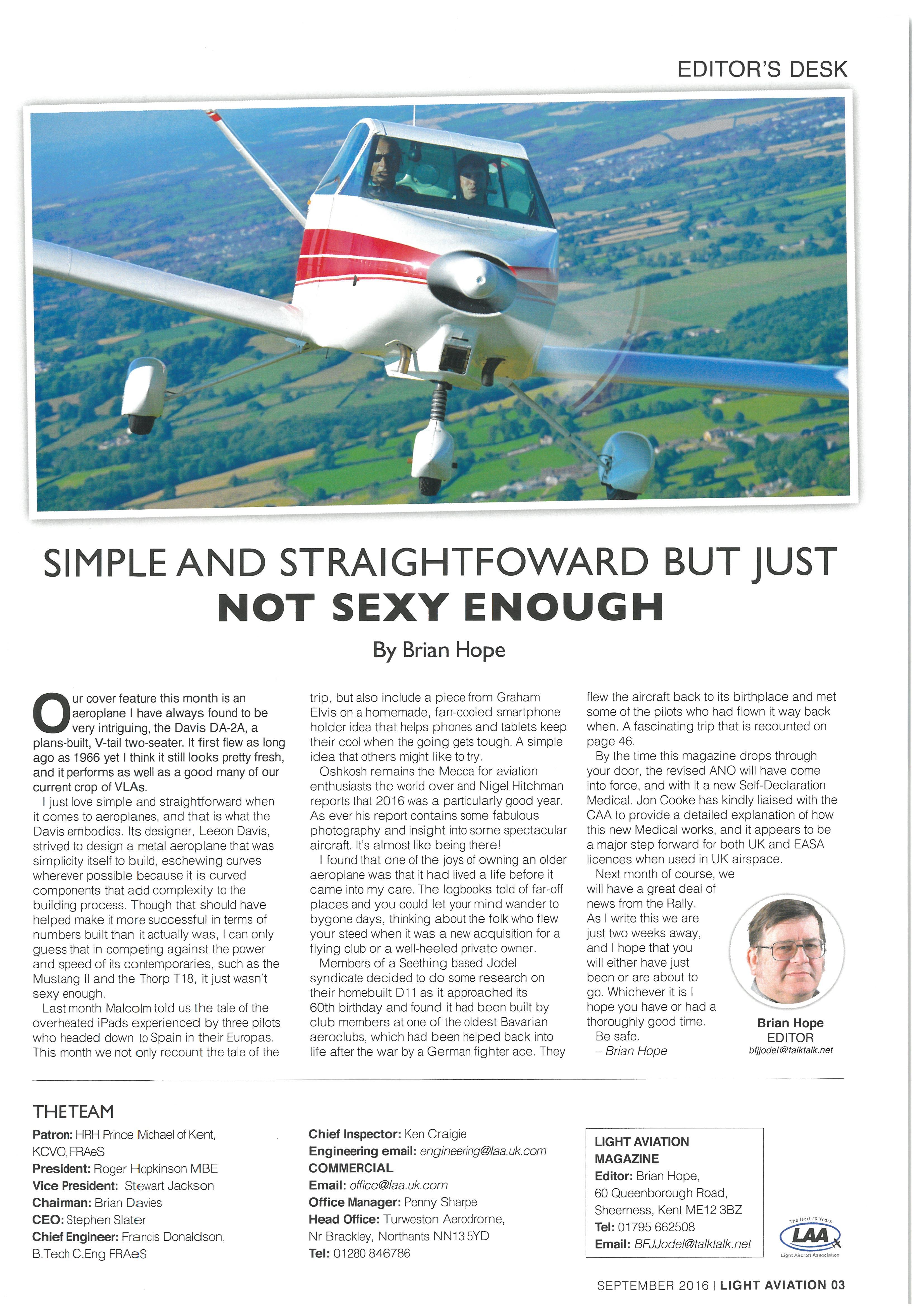
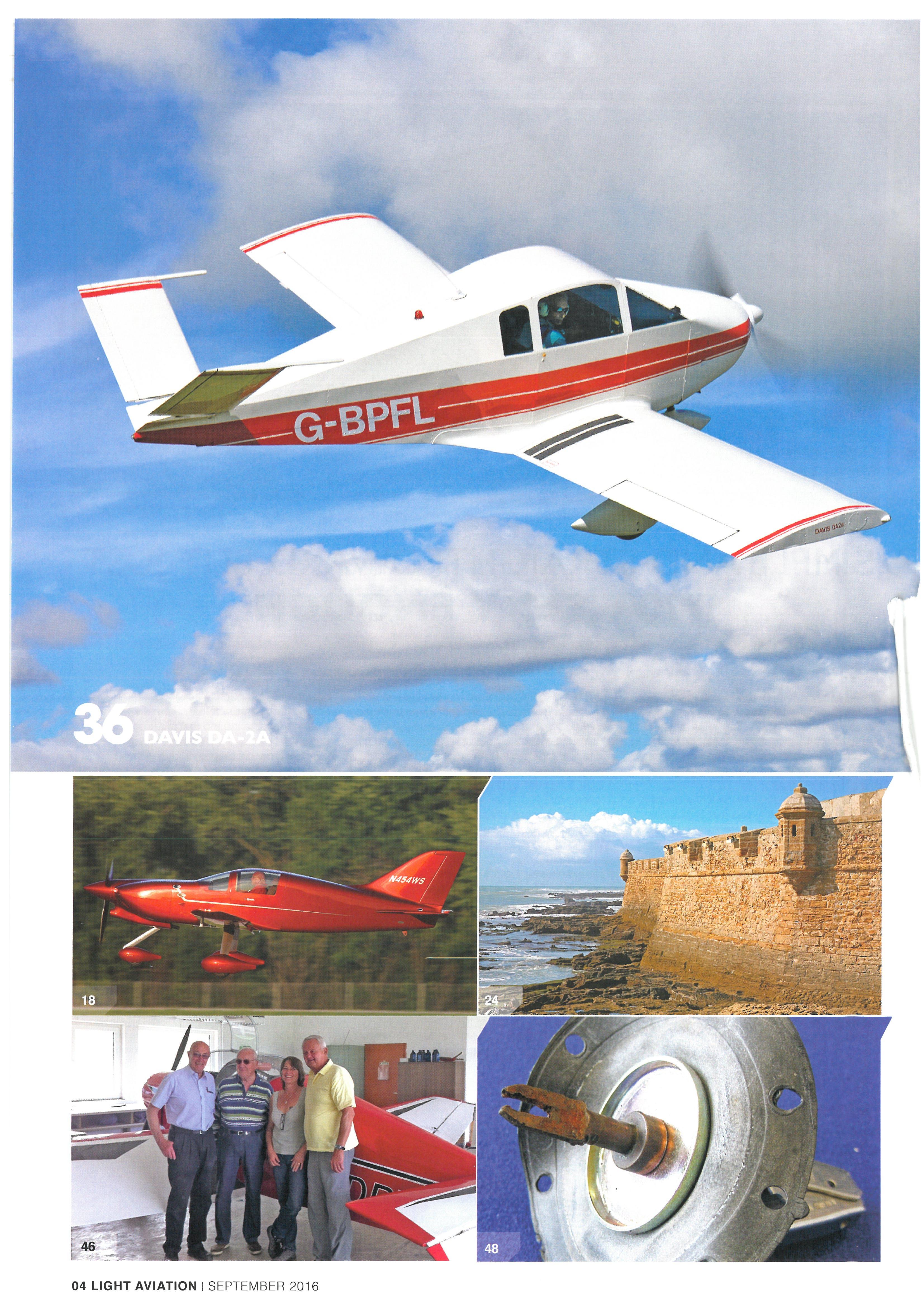
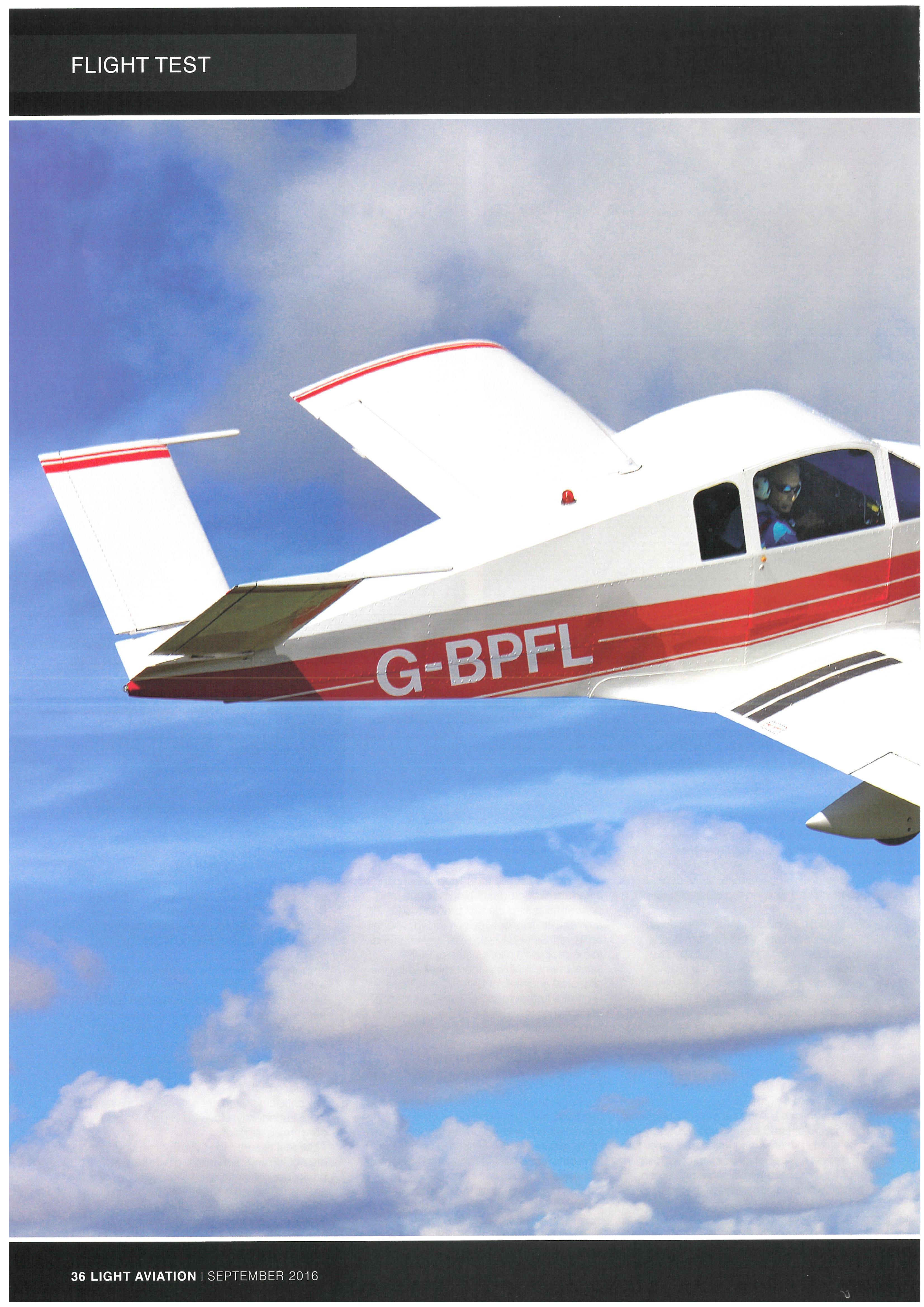
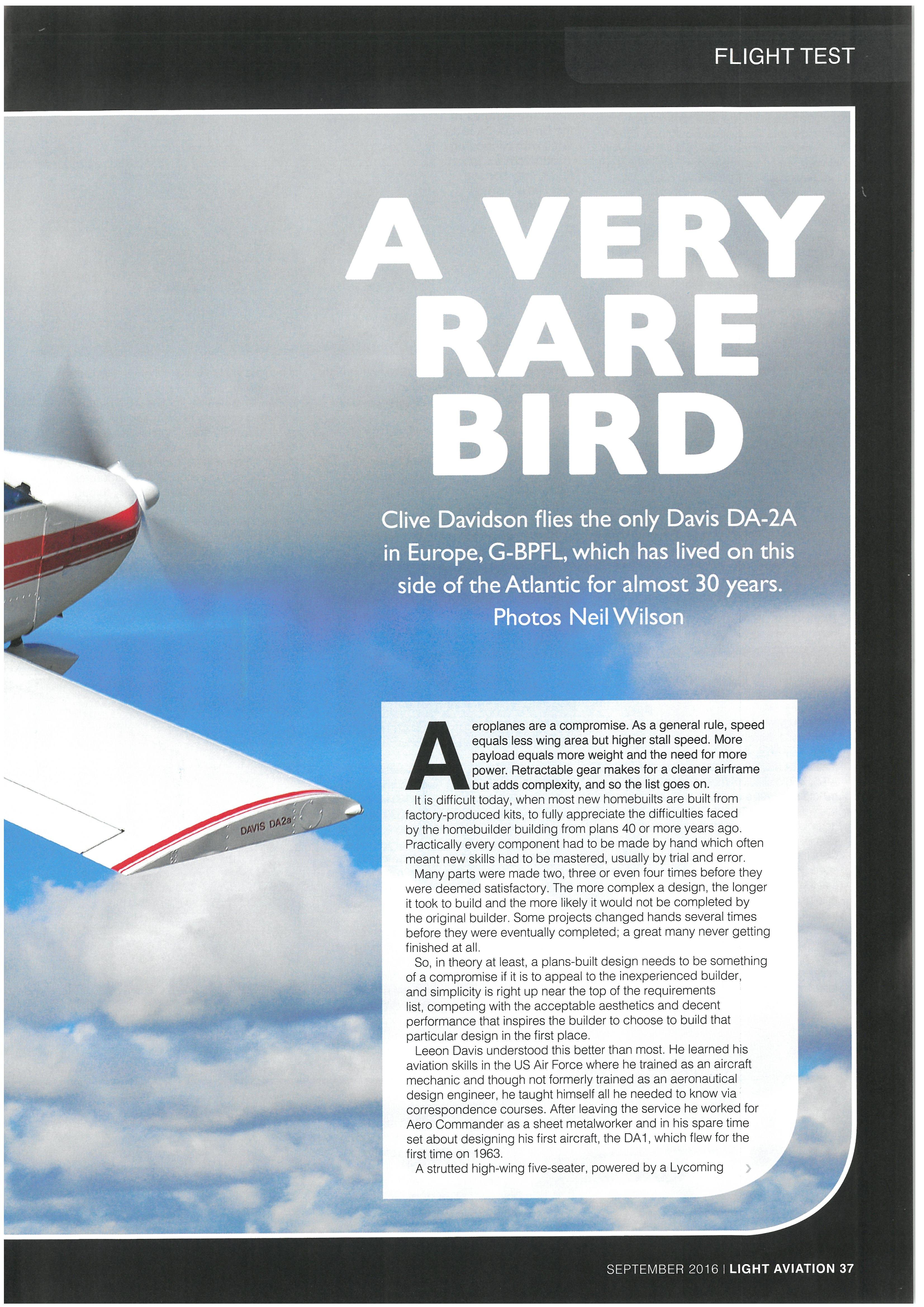
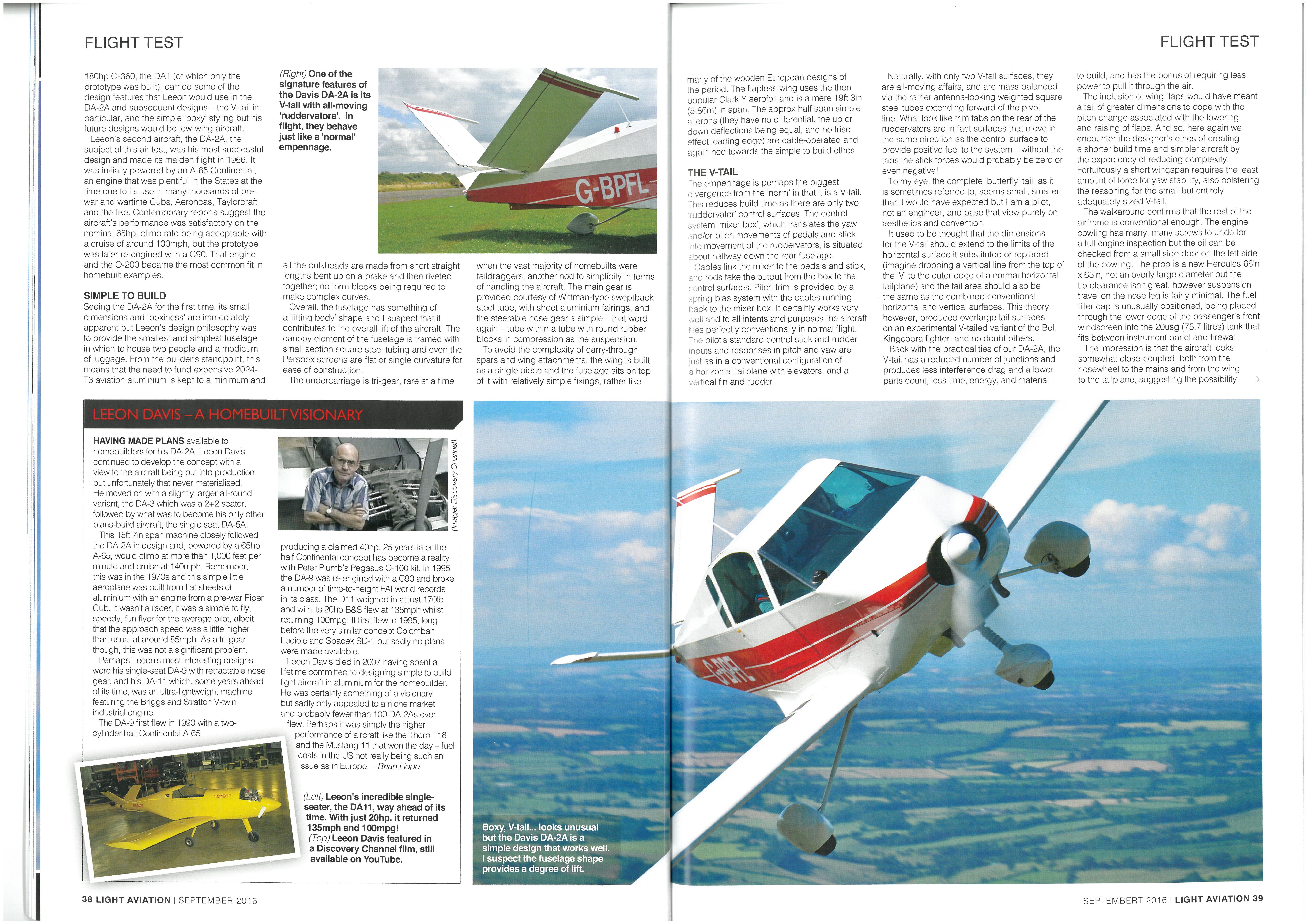
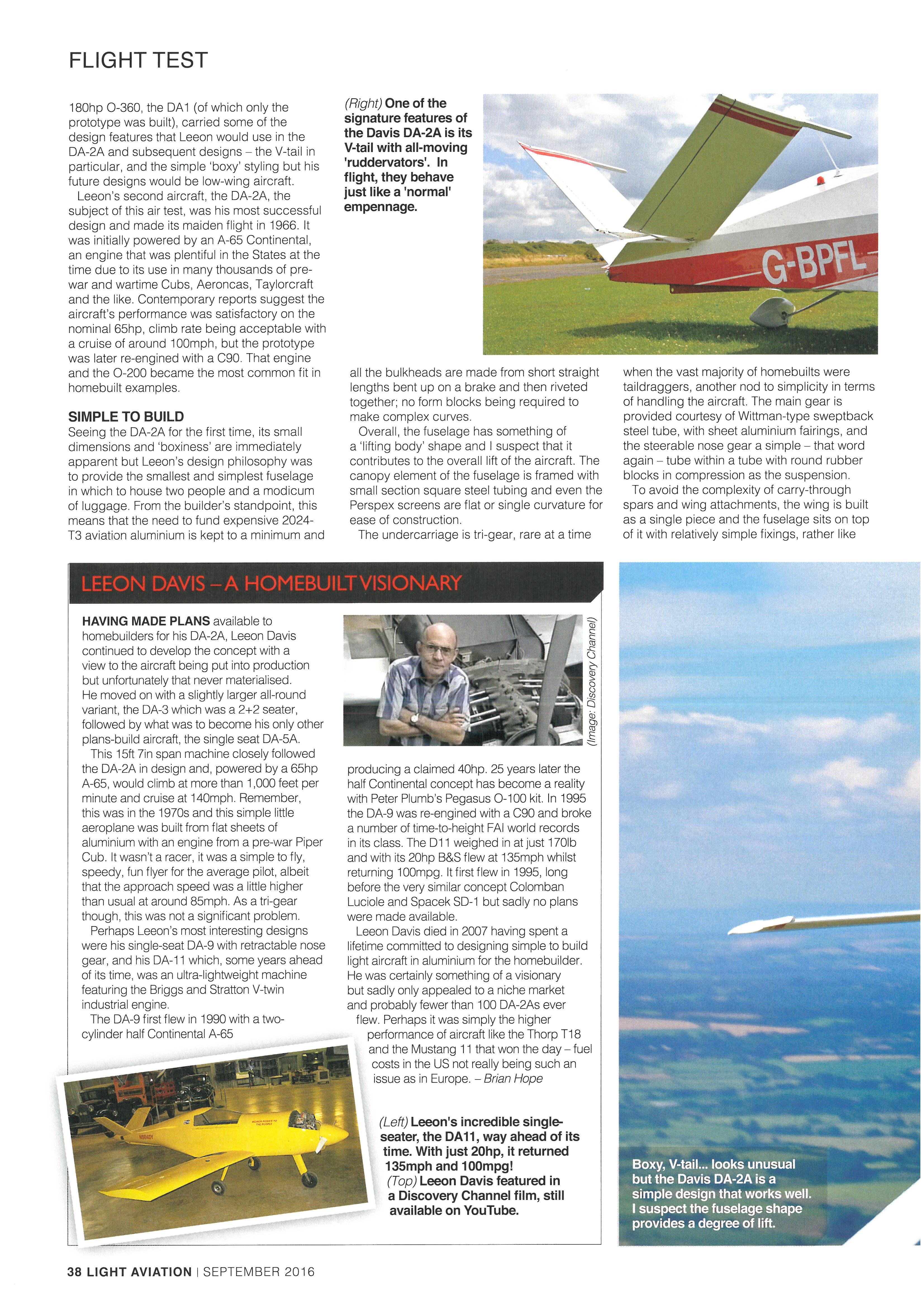
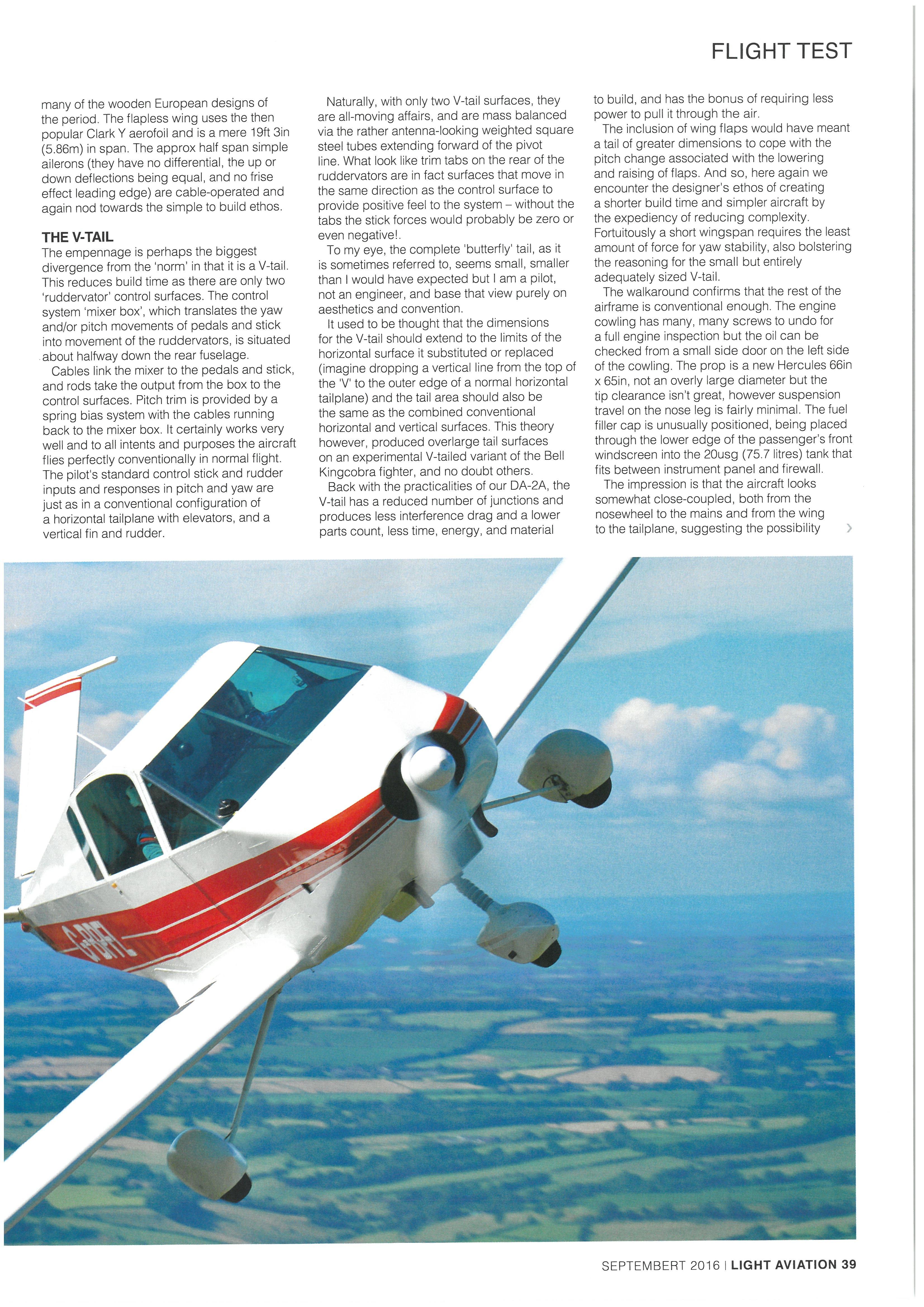
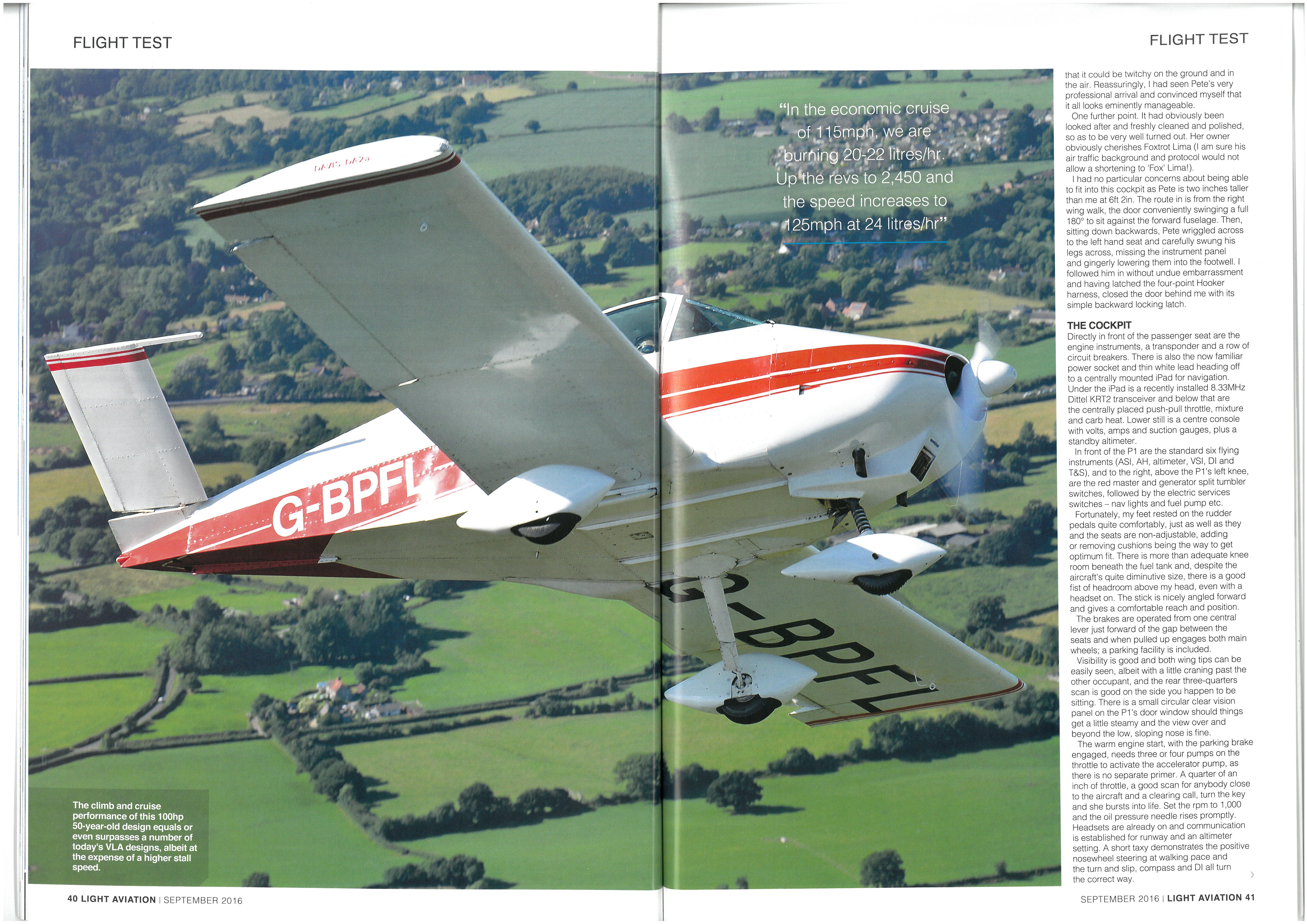
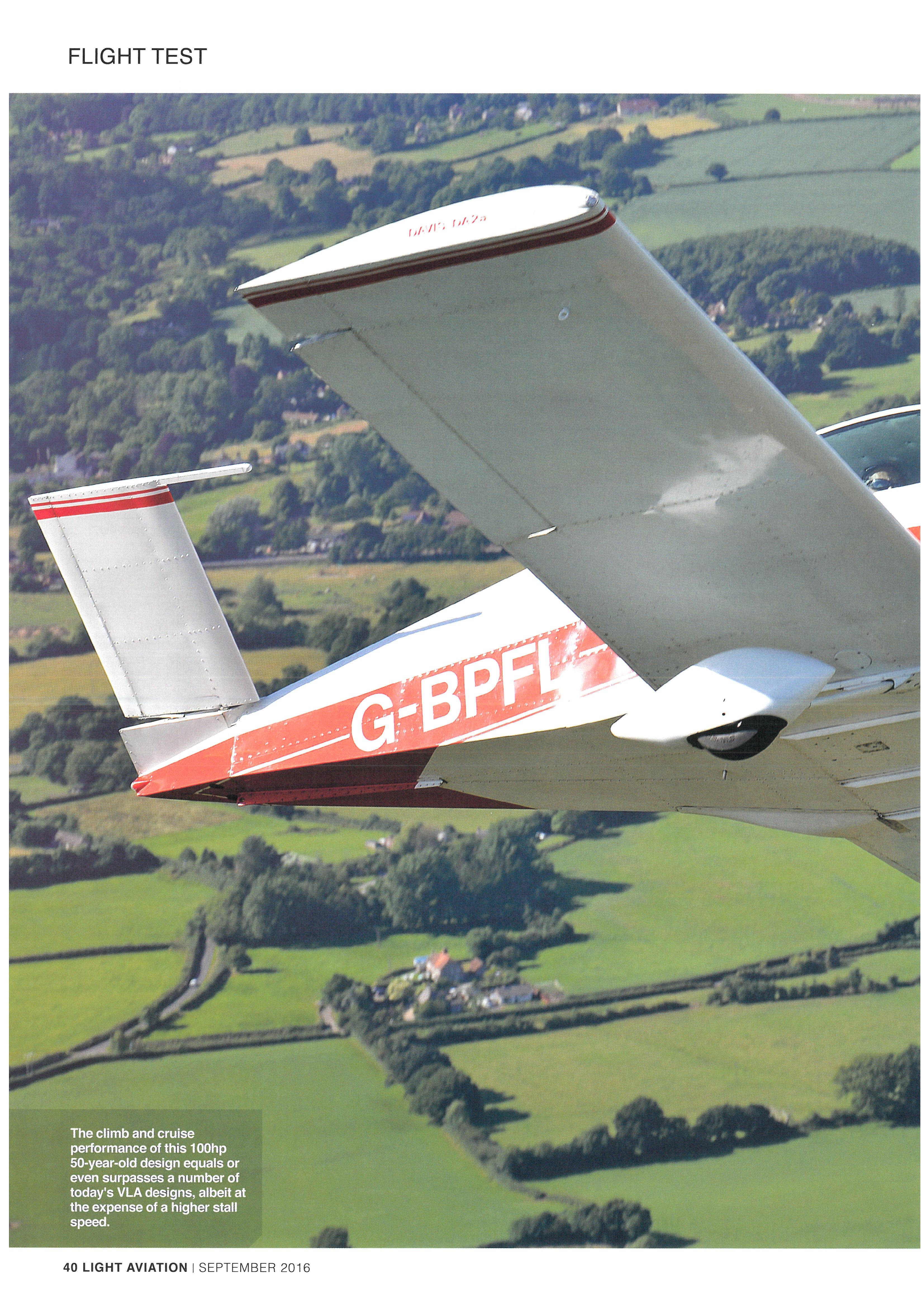
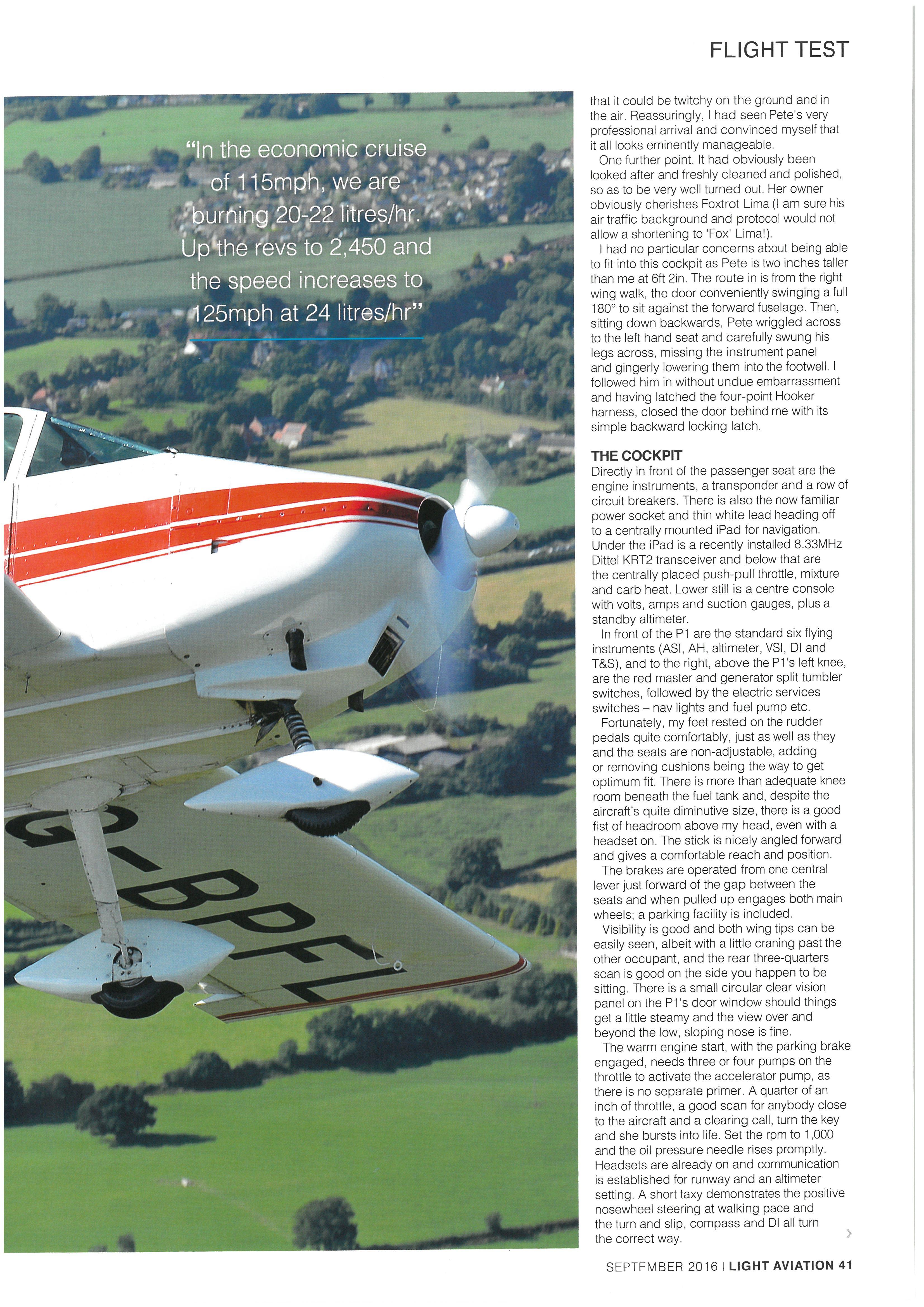
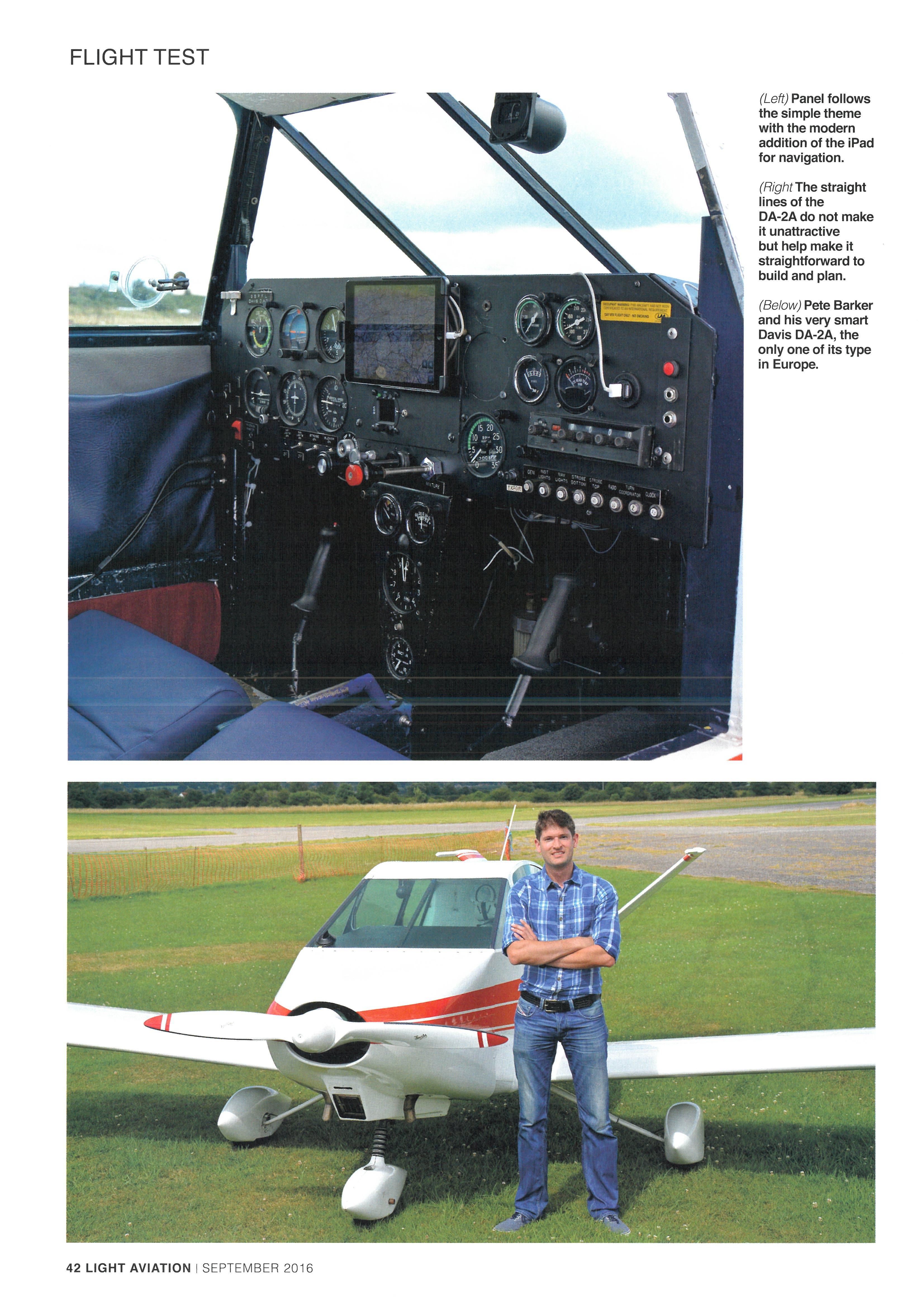
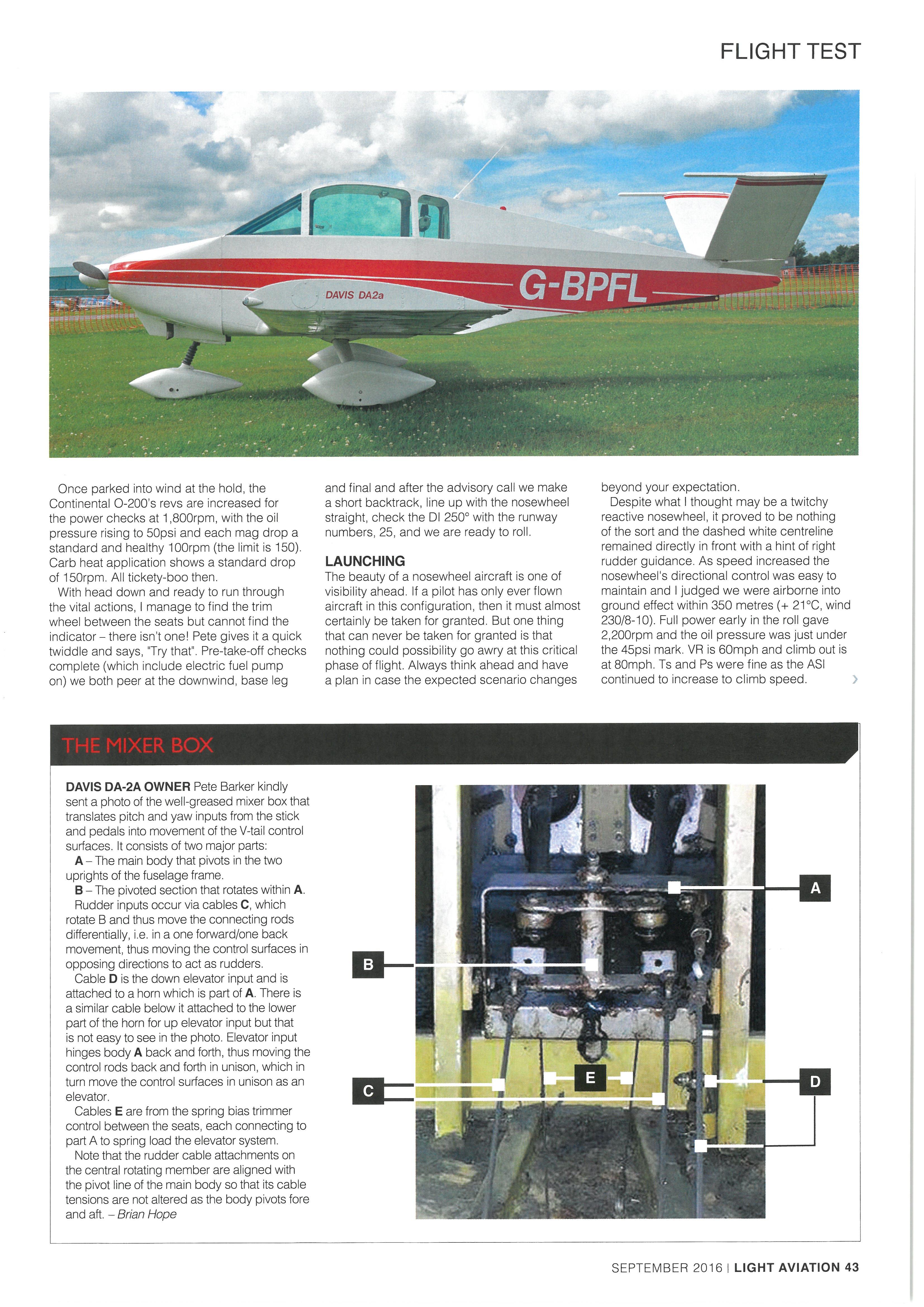
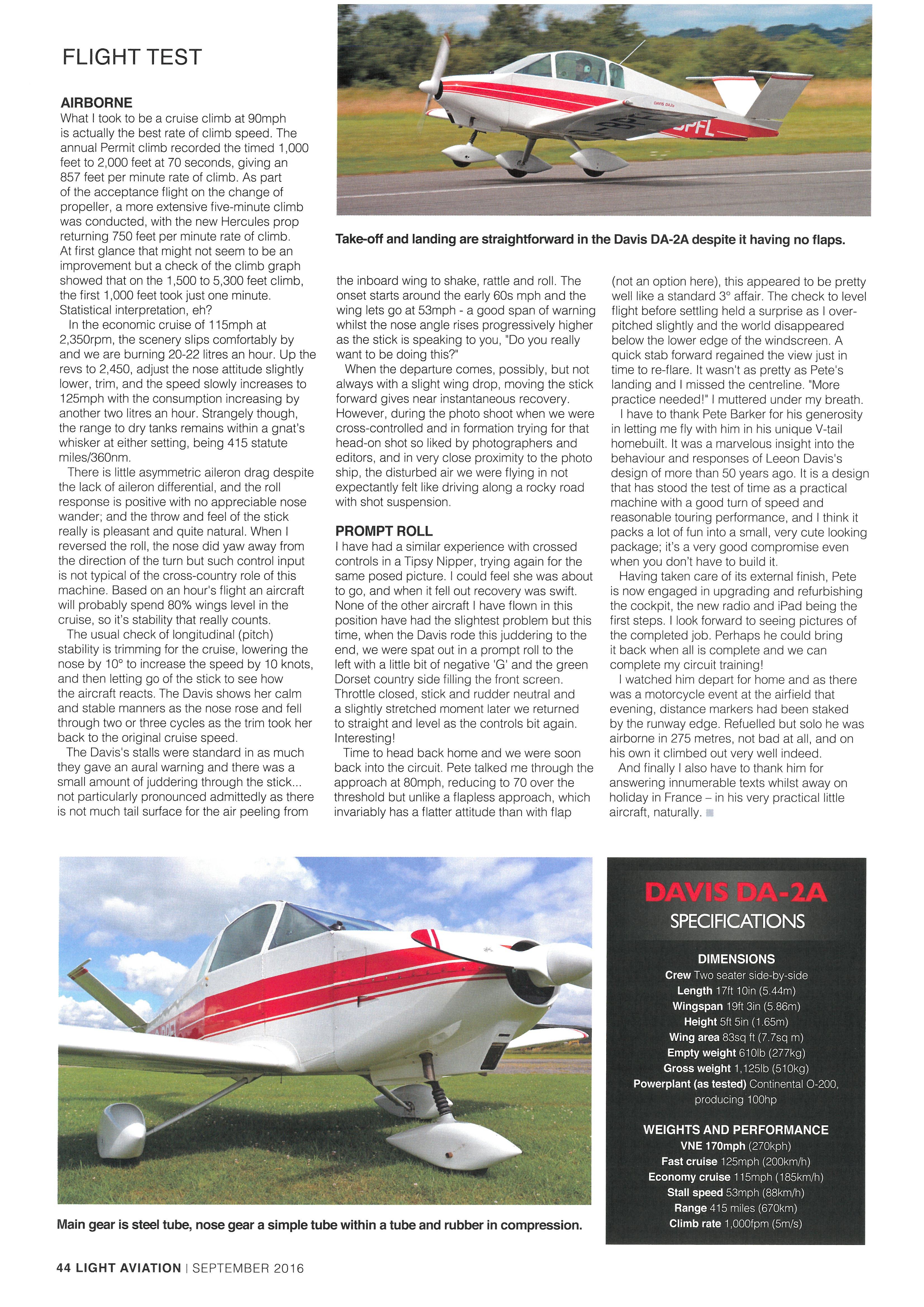
ur cover feature this month is an O-=|havealwaysfound tobe very intriguing, the Davis DA-2A,a plans-built, V-tail two-seater. It first flew as long ago as 1966 yet | think it still looks pretty fresh, and it performs as well as a good many of our current crop of VLAs.
| just love simple and straightforward when it comes to aeroplanes, and that is what the Davis embodies. Its designer, Leeon Davis, strived to design a metal aeroplane that was simplicity itself to build, eschewing curves wherever possible because it is curved components that add complexity to the building process. Though that should have helped make it more successful in terms of numbers built than it actually was, | can only guess that in competing against the power and speed of its contemporaries, such as the Mustang Il and the Thorp 118, it just wasn’t sexy enough.
Last month Malcolm told us the tale of the
By BrianHope
trip, but also include a piece from Graham Elvis on a homemade, fan-cooled smartphone holder idea that helos phones and tablets keep their cool when the going getstough. A simple idea that others might like totry.
Oshkosh remains the Mecca for aviation enthusiasts the world over and Nigel Hitchman reports that 2016 was a particularly good year. As ever his report contains some fabulous photography and insight intosome spectacular aircraft. It's almost like being there!
| found that one of the joys of owning an older aeroplane was that it had lived a life before it came intomy care. The logbooks told of far-off places and you could let your mind wander to bygone days, thinking about the folk who flew your steed when it was a newacquisition for a flying club or a well-heeled private owner.
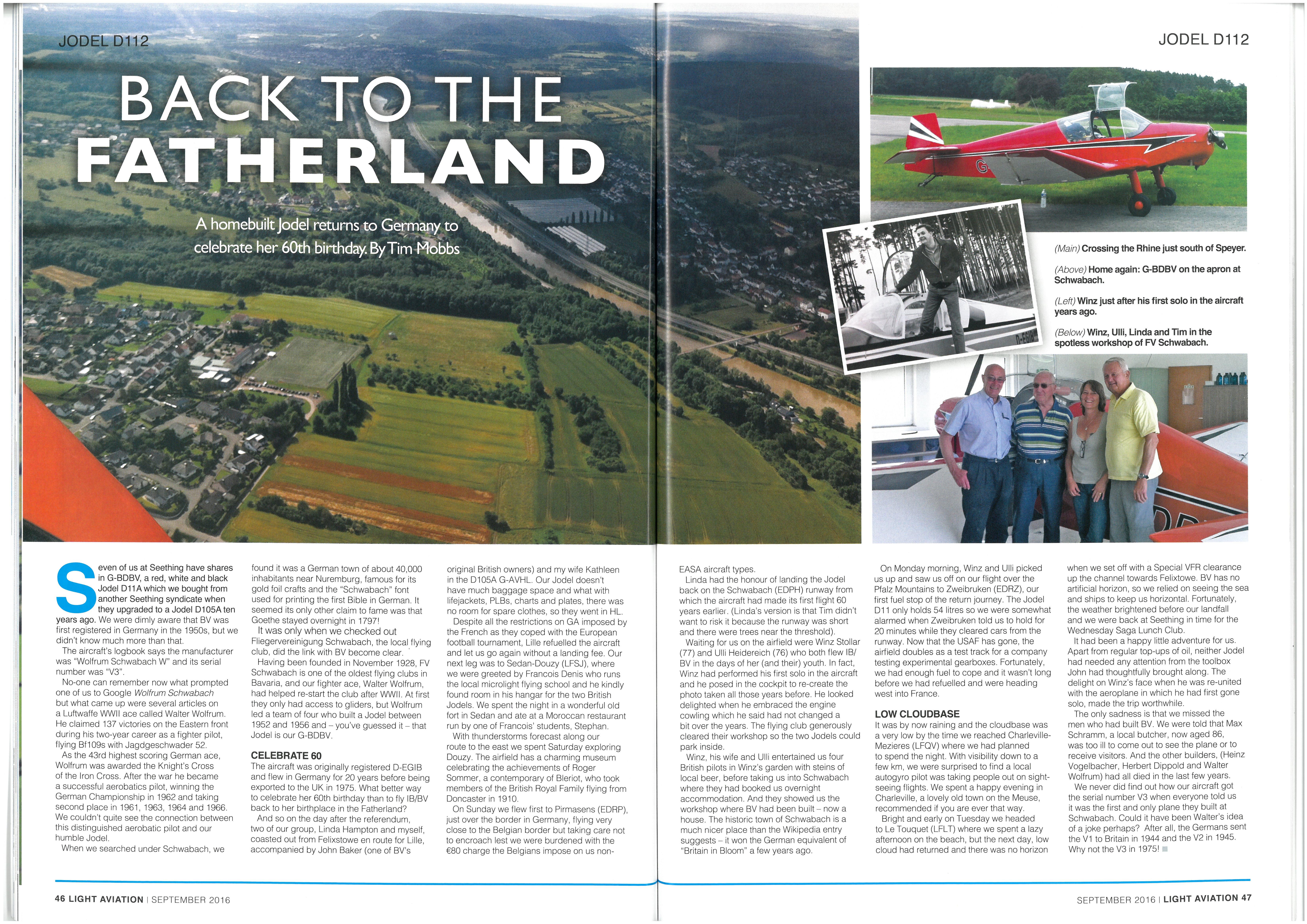
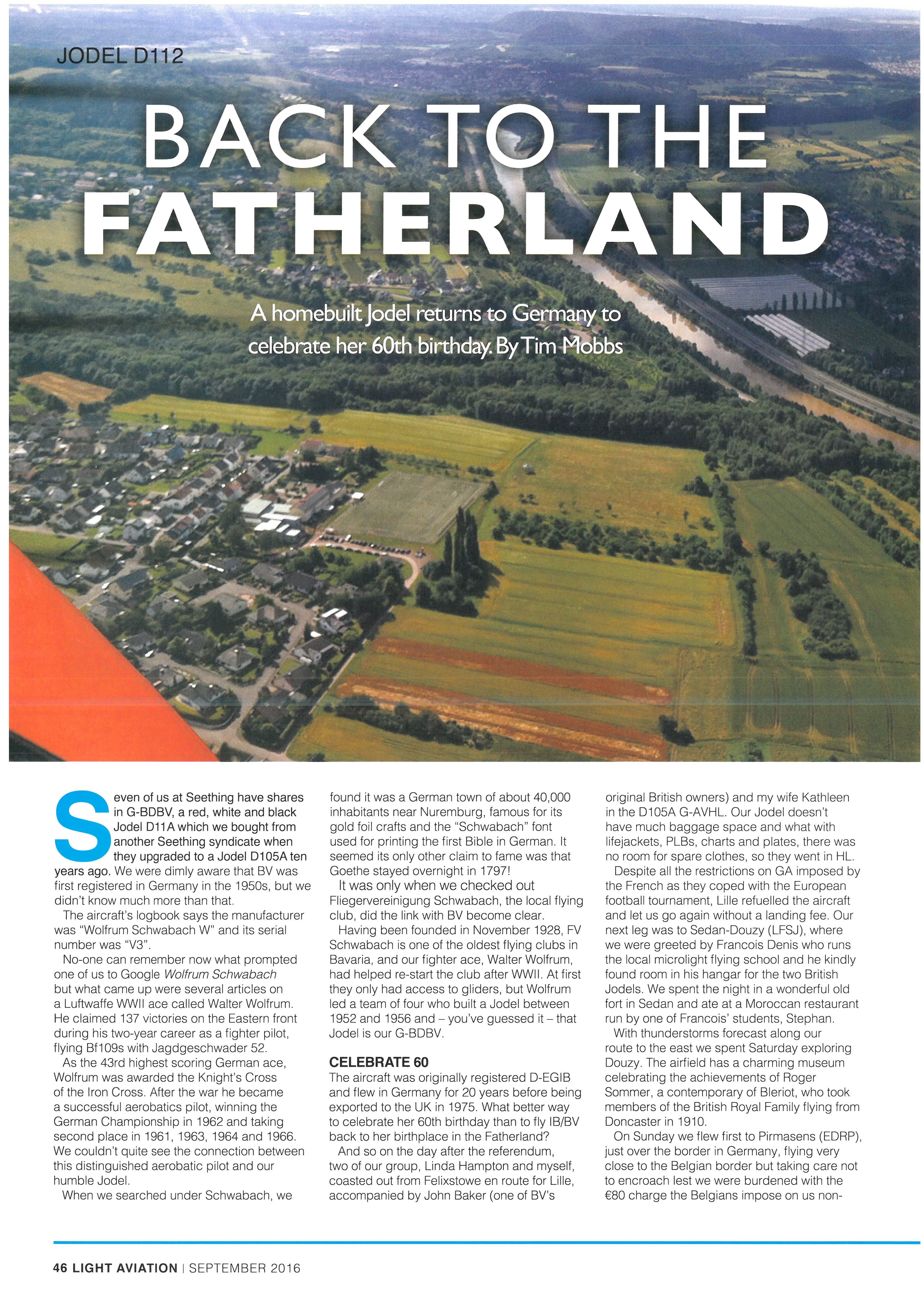
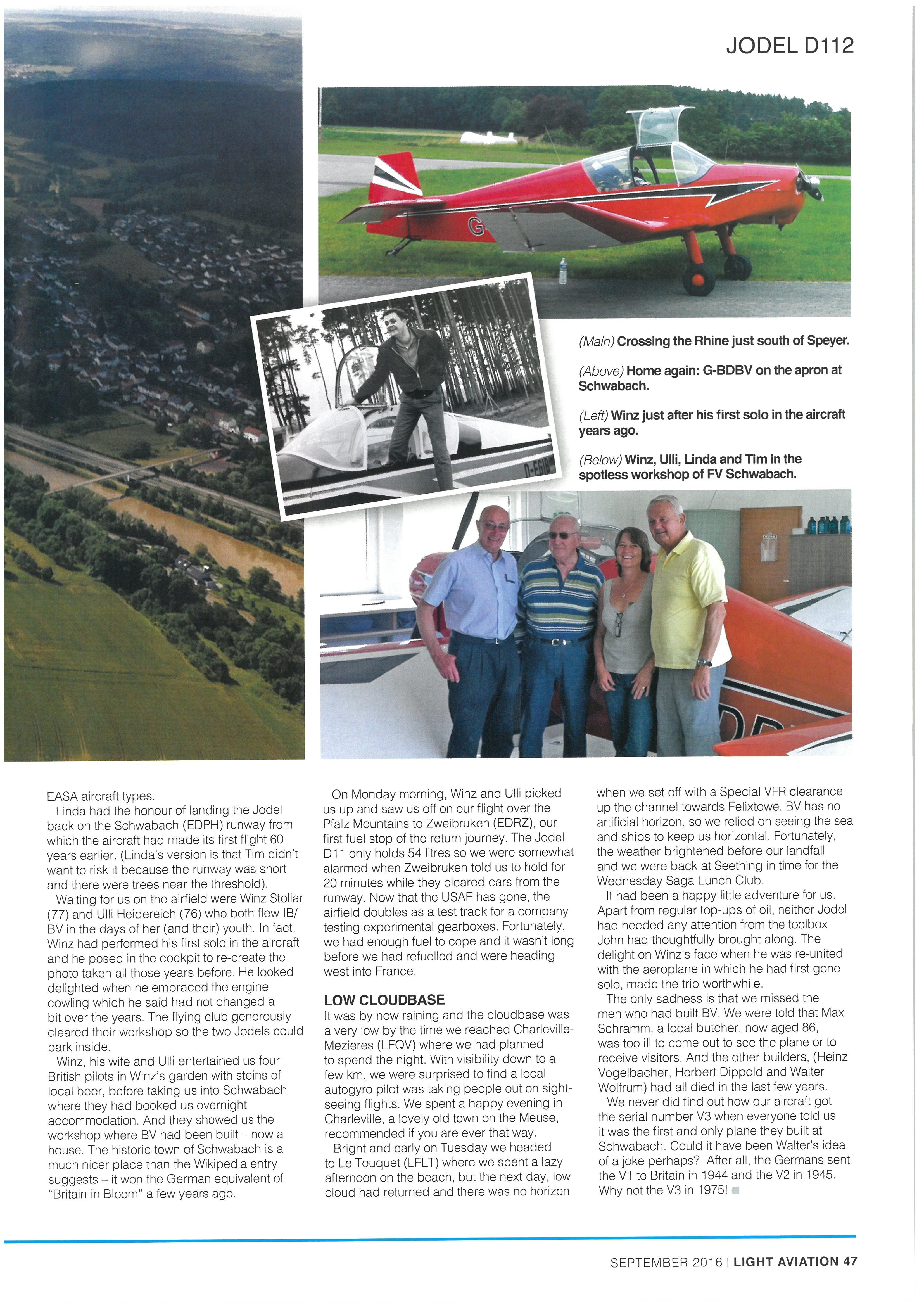
Members of a Seething based Jodel syndicate decided to do someresearch on their homebuilt D11 as it approached its 60th birthday and found it had been built by
flew the aircraft back to its birthplace and met some of the pilots who had flown it way back when.A fascinatingtripthatisrecountedon page 46.
By the time this magazine drops through your door, the revised ANO will have come into force, and with it a new Self-Declaration Medical. Jon Cooke has kindly liaised with the CAA to provide a detailed explanation of how this new Medical works, and it appears to be a major step forward for both UK and EASA licences when used in UK airspace.
Next month of course, we will have a great deal of news from the Rally. As | write this we are just two weeks away, and | hope that you will either have just been or are about to go.Whicheveritis| hope you have or had a overheated iPads experienced by three pilots club members at one of the oldest Bavarian thoroughly good time. Brian Hope who headed down to Spain in their Europas. aeroclubs, which had been helped back into Be safe.
EDITOR This monthwe not only recount the tale of the life after the war by a German fighter ace. They Brian Hope
Be carefulneargliding sitesespecially those with winch launches
|7 LAAAGM
Detailsofthisyear’smeeting
|8 OSHKOSH
Nigel Hitchman’s thorough and colourful photo-report from EAA AirVenture at Oshkosh
24EUROPAS TO GIB
Bob Hitchcock'sflightreportoftaking three Europasto Gibraltar
29 LAA 70 DINNER
Book for the highlight of the year
30 MEDICAL CHANGES
Jon Cookeexplainsthe latest changes to medical requirements with the self-declaration medical
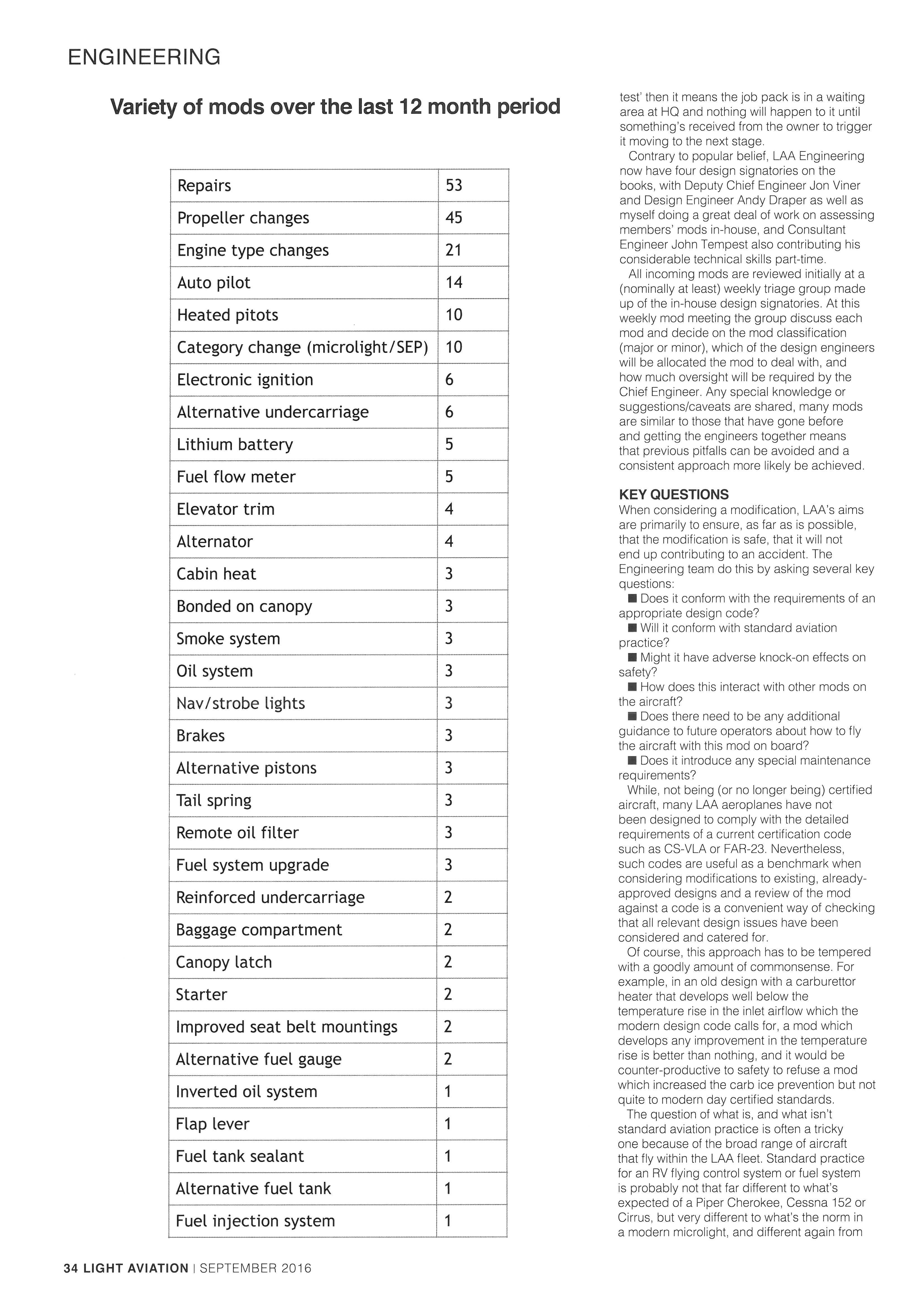
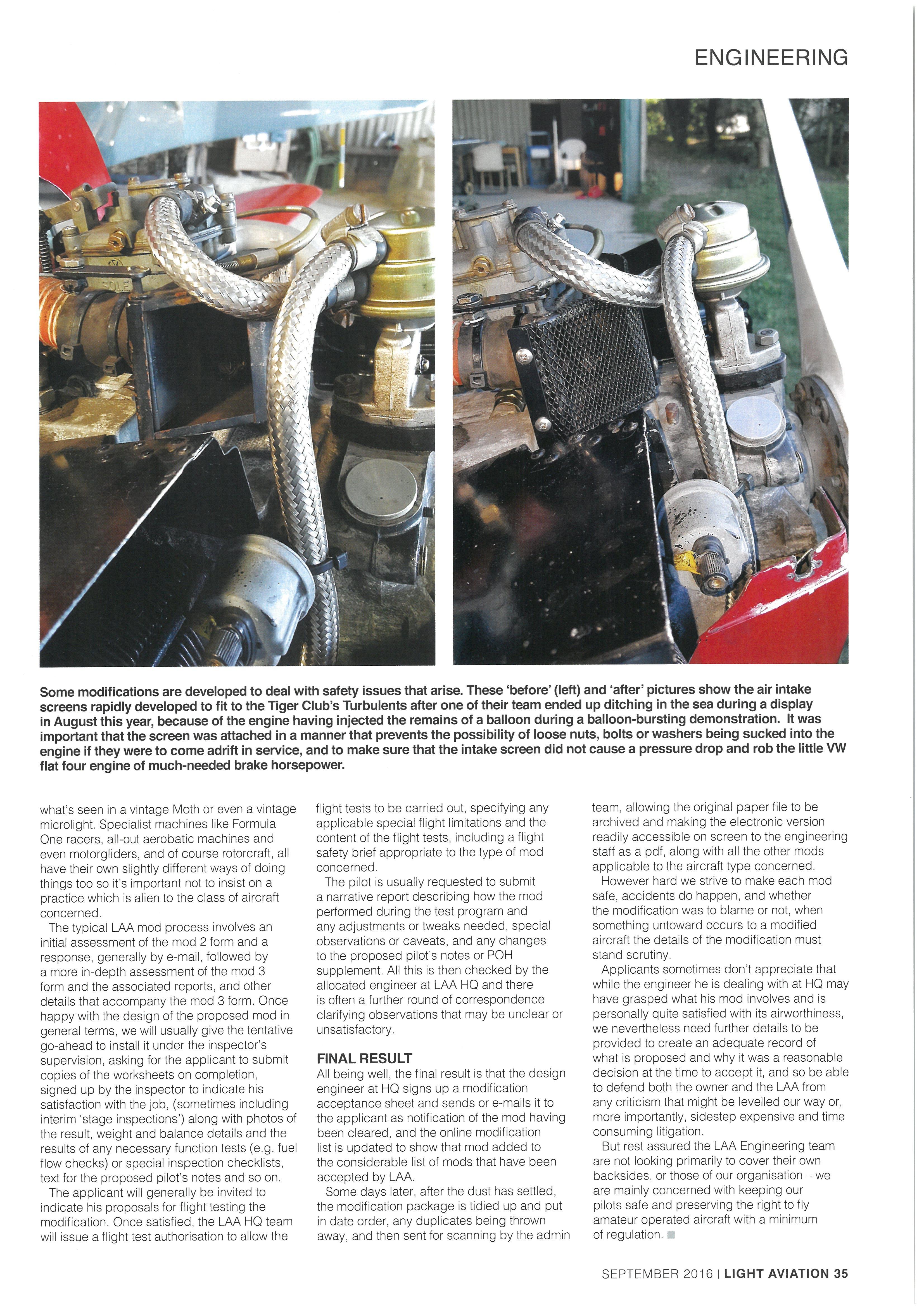
32 MODIFICATIONS
Francis Donaldson reflects on the LAA’s system for modifications ~
36 DAVIS DA-2A
Air test of a very rare aircraft the only one in Europe, in fact
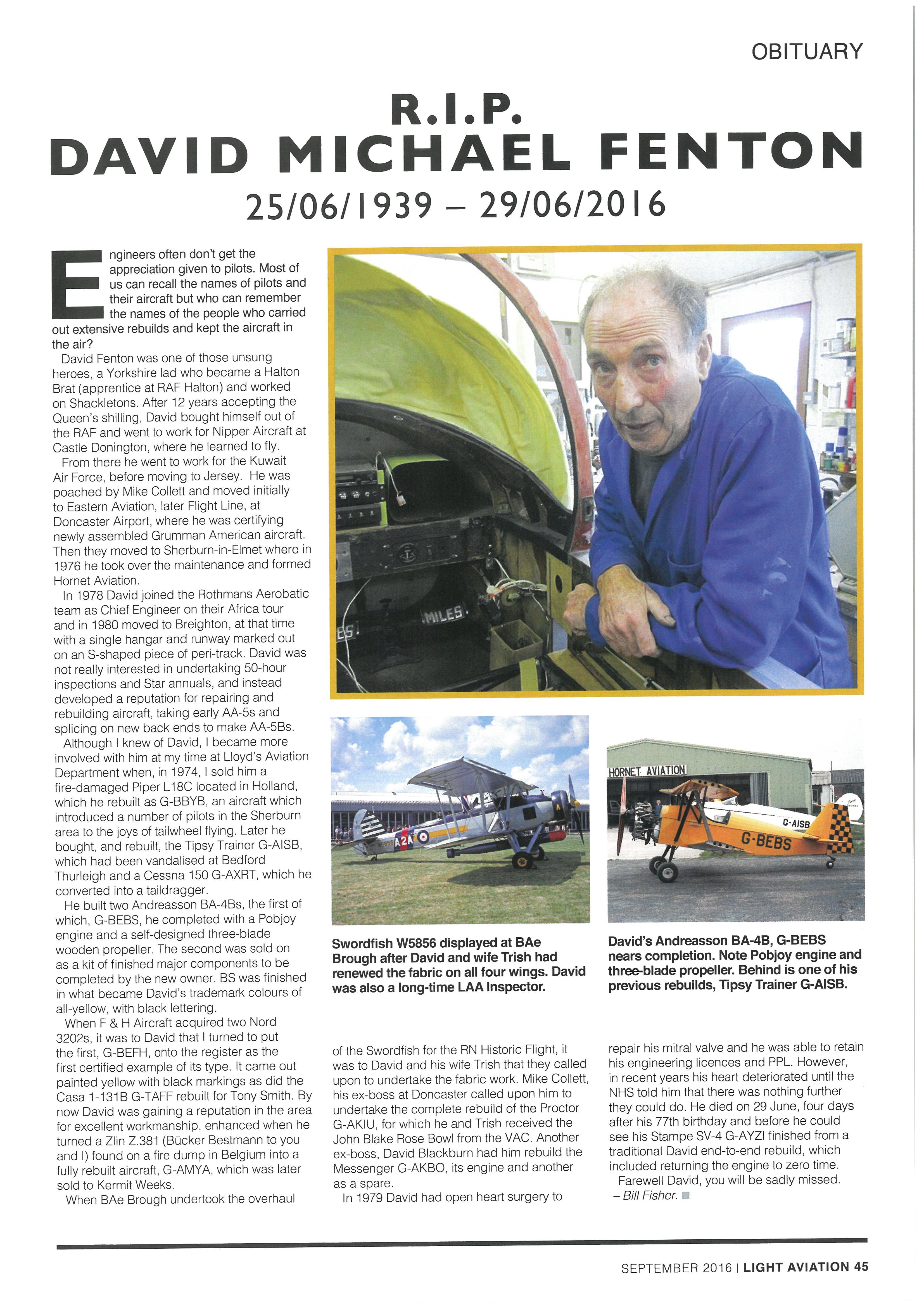
45 DAVE FENTON RIP
Obituaryof an engineerwho made a real difference to classic aircraft
46JODEL’SRETURN
A German-built,UK-regJodel returns to itstownoforigintofind afascinating history
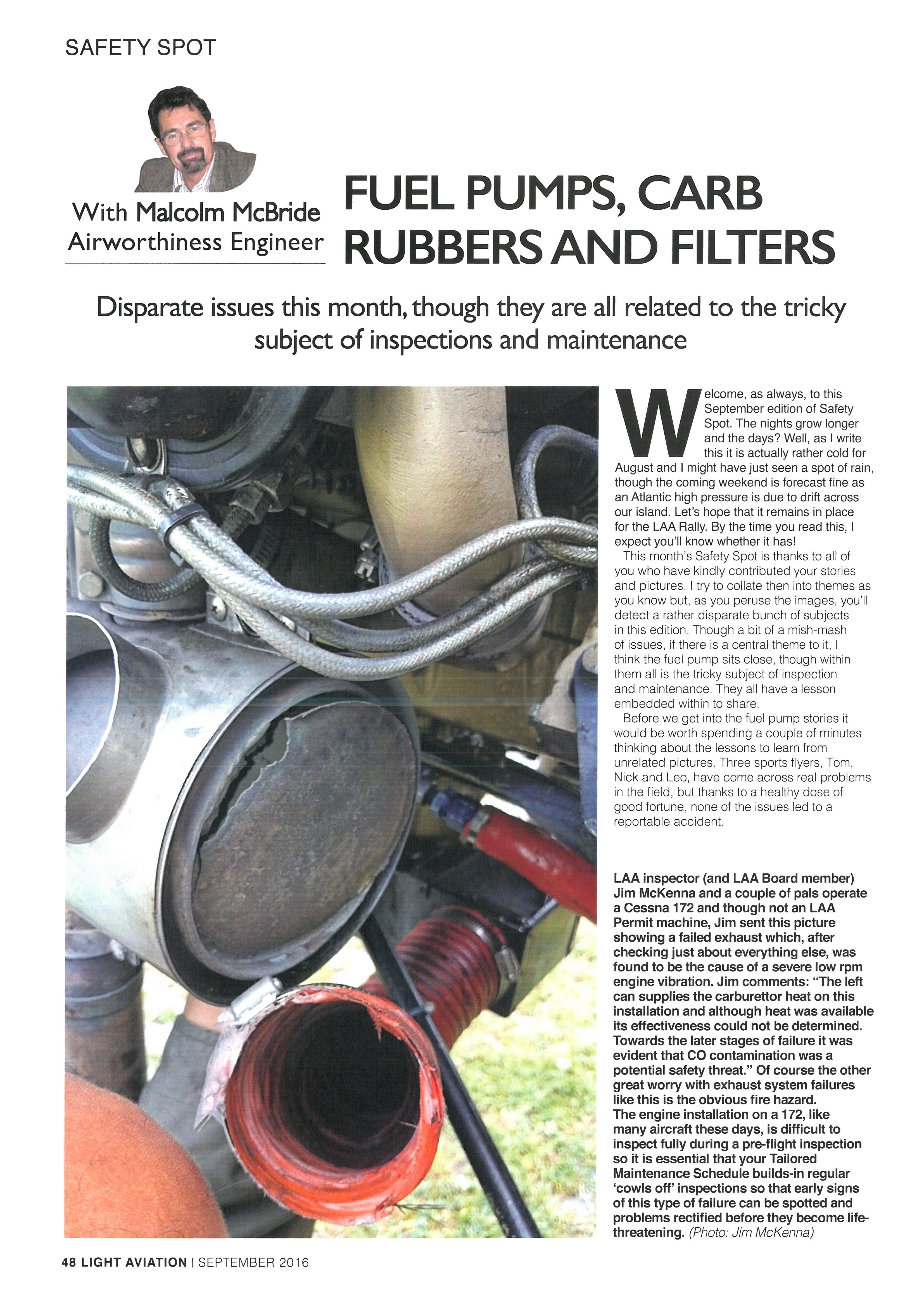
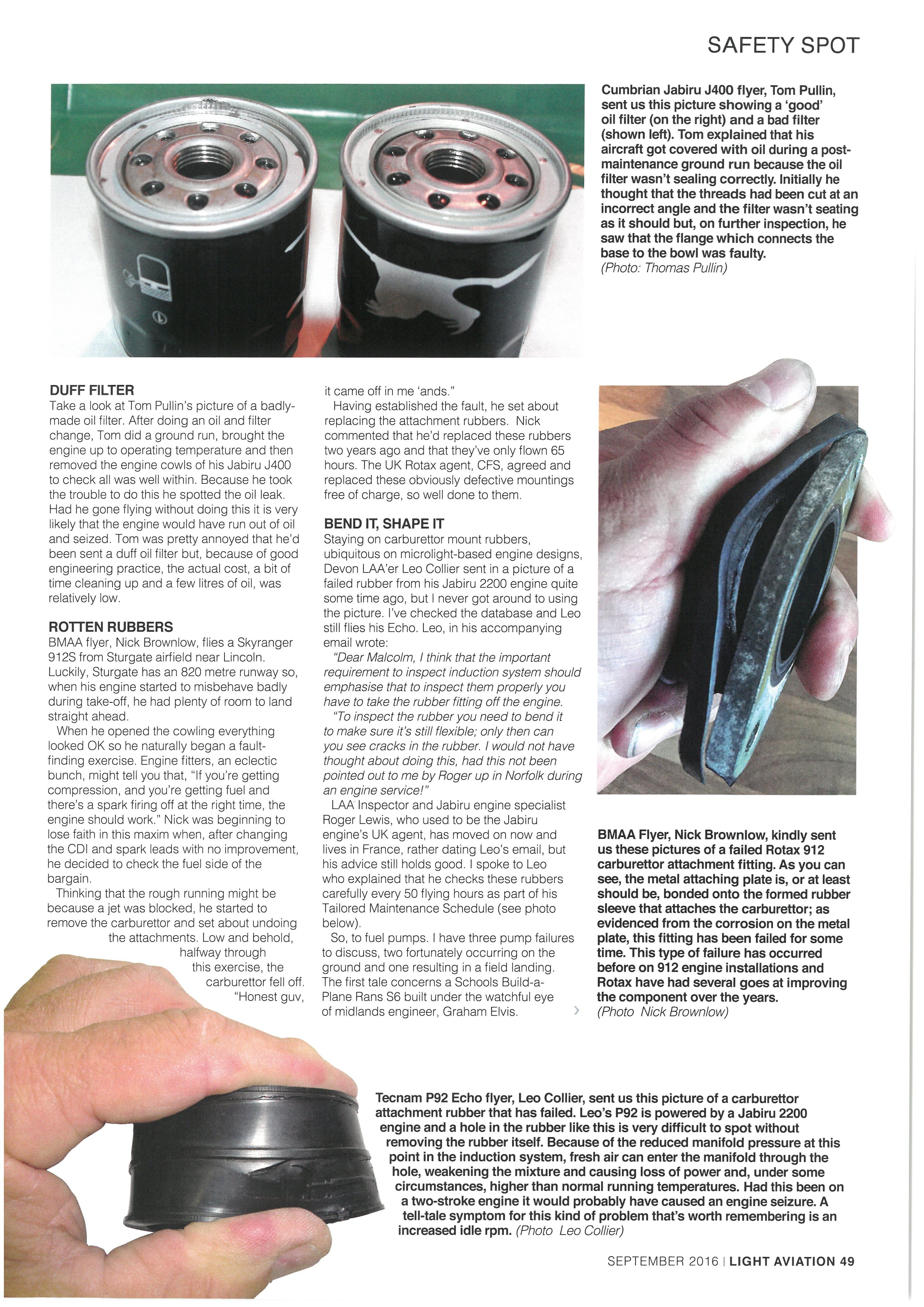
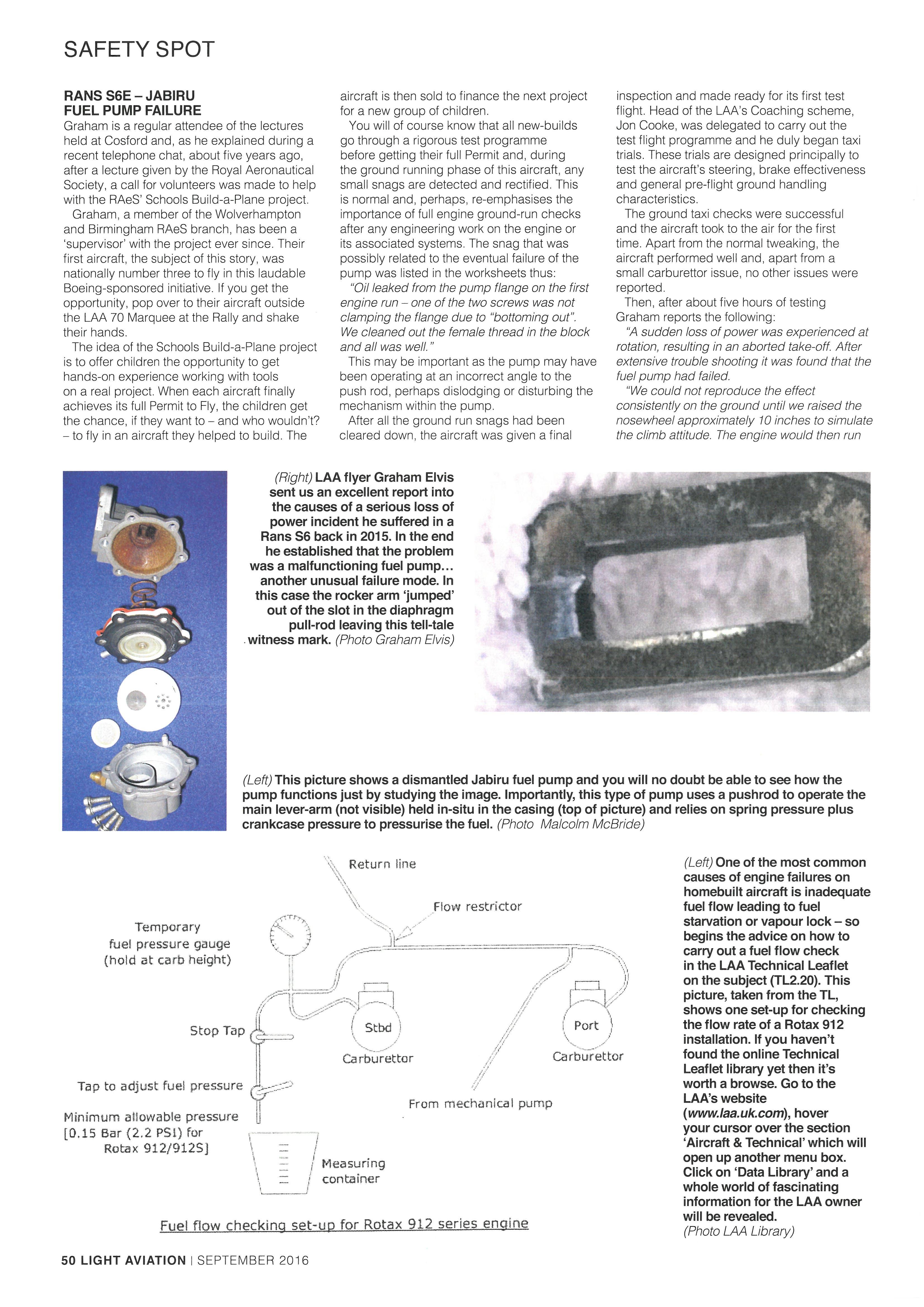
48 SAFETY SPOT
Malcolm McBride reports on carb, filter and fuel pump issues
54COOLTHAT IPAD
Hot tablets such as the iPad can switch off.Here’s a fix!
56 PROJECTNEWSSPECIAL
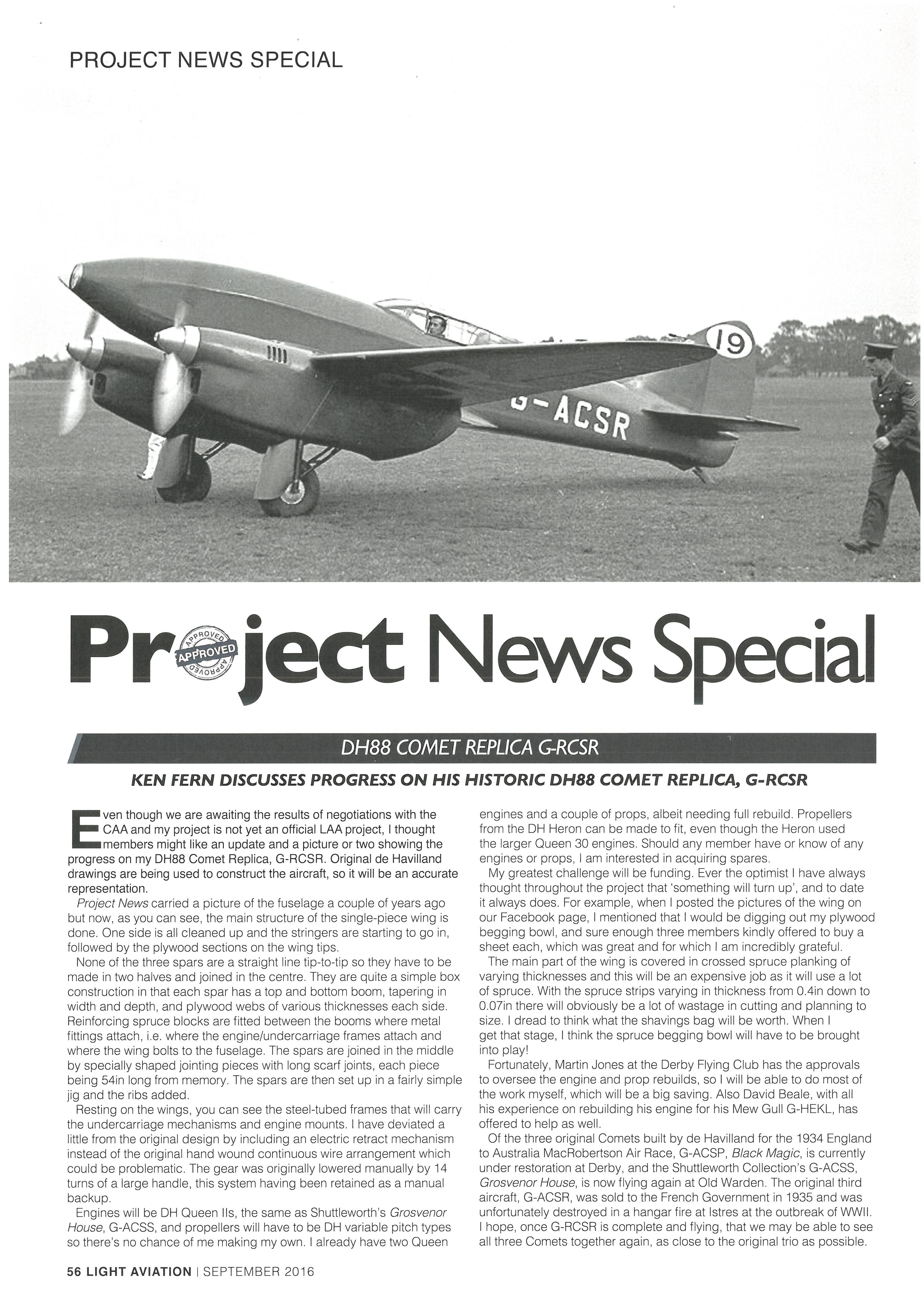
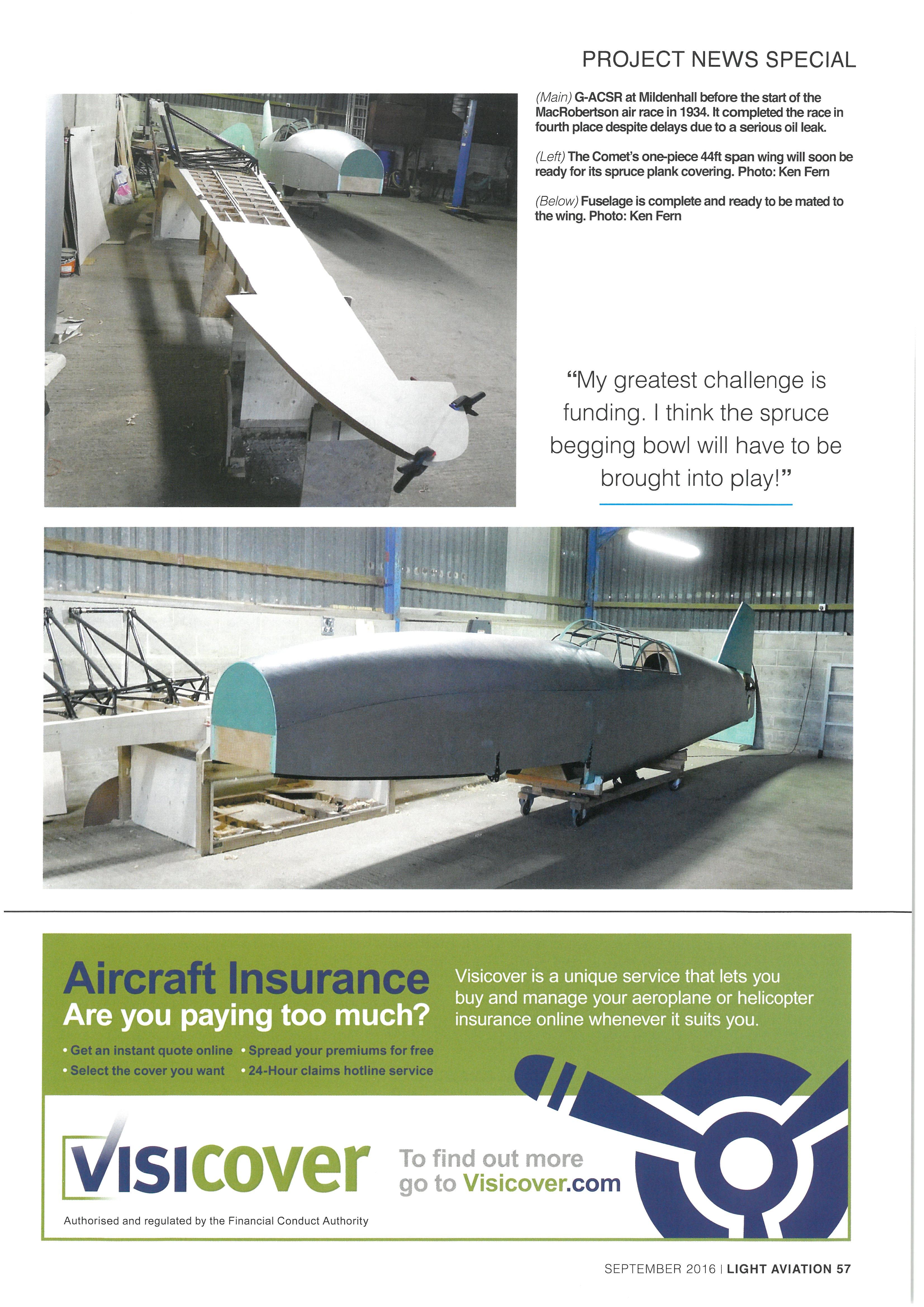
Ken Fern’sextraordinaryComet Racer replicaiscoming along
58 CEOTHOUGHTS
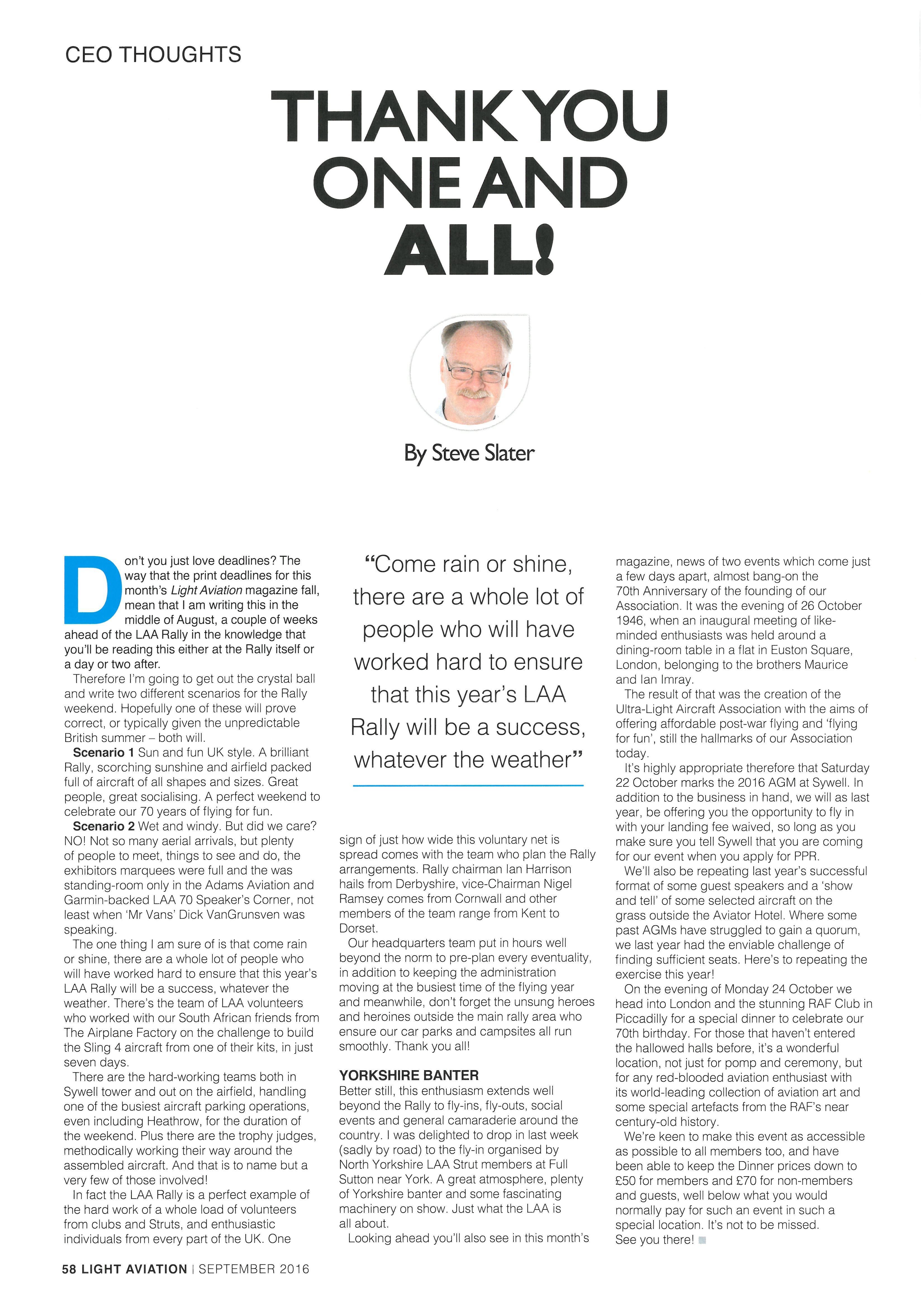
SteveSlateronthe LAA Rally
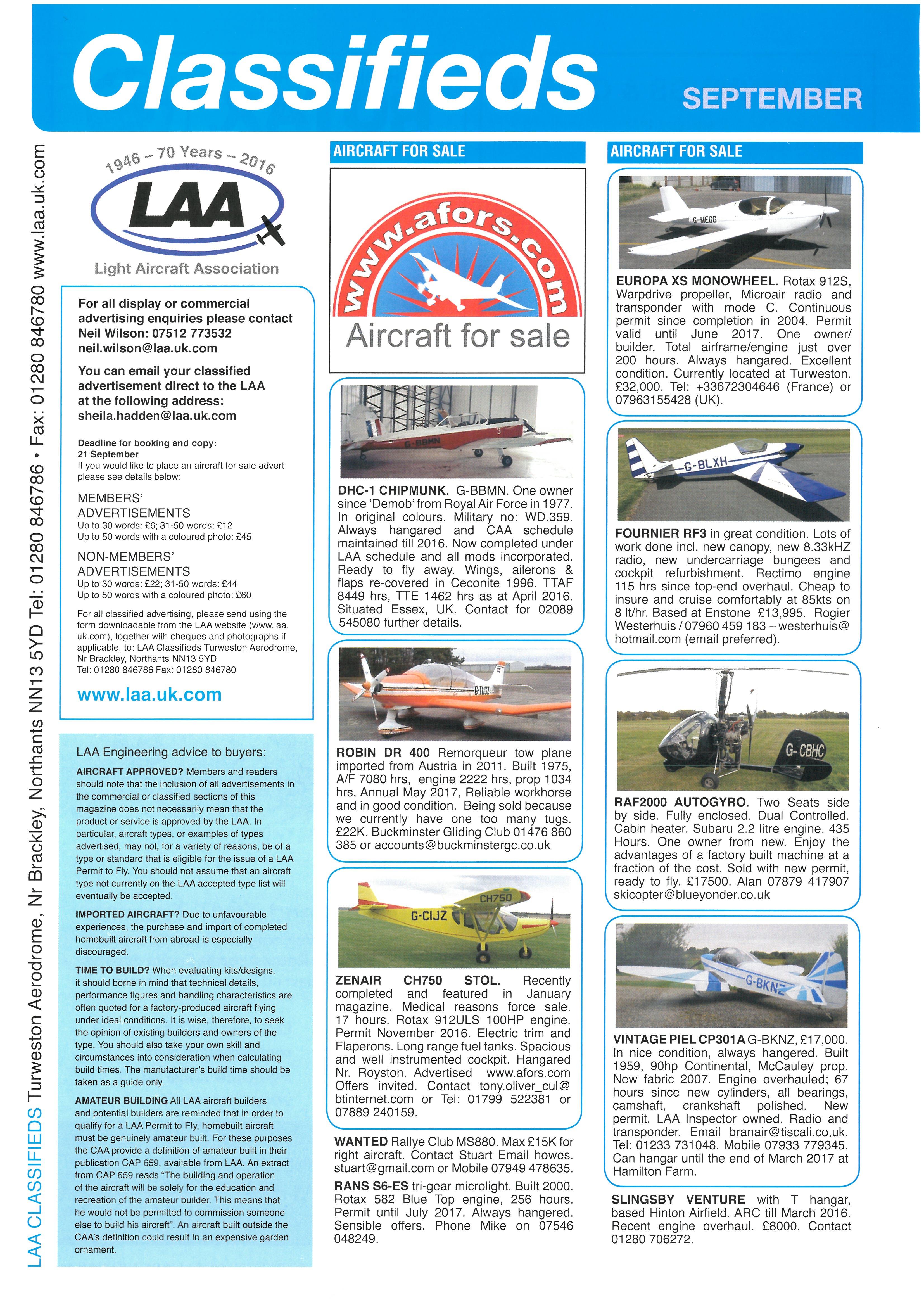
62 LAA CLASSIFIEDS
Aircraft, parts and services for sale
66 WHERE TO GO
Fly-insand other events
‘ntheUK,weatherandfellowship makes an “Suddenly transported|was backtothe 1970s,remembering thewhirlinggears, synchrosandrelaysthatmadeupthe unbelievablycomplex triplexautomatic landingsystem”
enormous difference to the success or otherwise of the many outdoor aviation events that we attend during the year. Only the aeromodellers have solved the outdoor problem by staging some of their events inside exhibition halls and large hangars.
A few weeks ago | had the rare opportunity to escape from weekend motor racing commitments and attended the Europa Club and Gloucester Strut fly-in, which included a top-notch BBQ and a visit to the Jet Age Museum (JAM). The weather co-operated hooray! And despite there being up to ten aircraft at a time trying to enter the circuit of an already very busy airfield, it all went smoothly, everyone behaved and it all worked safely.
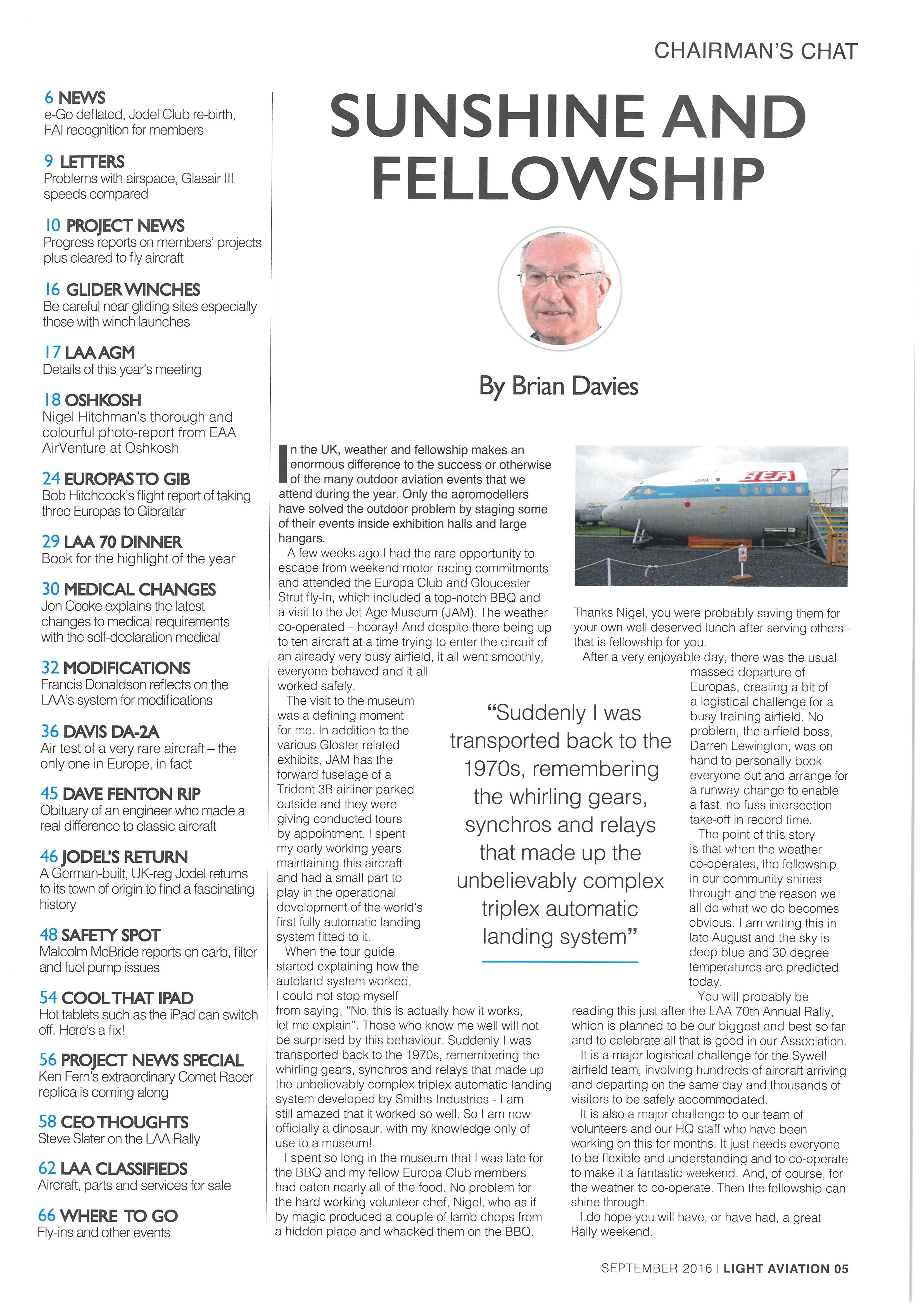
The visit to the museum was a defining moment for me. In addition to the various Gloster related exhibits, JAM has the forward fuselage of a Trident 3B airliner parked outside and they were giving conducted tours by appointment. | spent my early working years maintaining this aircraft and had a small part to play in the operational development of the world’s first fully automatic landing system fitted to it.
When the tour guide started explaining how the autoland system worked, | could not stop myself from saying, “No, this is actually how it works, let me explain”. Those who know me well will not be surprised by this behaviour. Suddenly | was transported back to the 1970s, remembering the whirling gears, synchros and relays that made up the unbelievably complex triplex automatic landing system developed by Smiths Industries - | am still amazed that it worked so well. So | am now Officially a dinosaur, with my knowledge only of use to amuseum!
| spent so long in the museum that |was late for the BBQ and my fellow Europa Club members had eaten nearly all of the food. No problem for the hard working volunteer chef, Nigel, who as if by magic produced a couple of lamb chops from a hidden place and whacked them on the BBQ.
your own well deserved lunch after serving othersthat is fellowship for you.
After a very enjoyable day, there was the usual massed departure of Europas, creating a bit of a logistical challenge for a busy training airfield. No problem, the airfield boss, Darren Lewington, was on hand to personally book everyone out and arrange for a runway change to enable a fast, no fuss intersection take-off in record time.
The point of this story is that when the weather co-operates, the fellowship in Ourcommunity shines hrough and the reason we all do what we do becomes obvious. | am writing this in ate August and the sky is deep blue and 30 degree emperatures are predicted today.
You will probably be reading this just after the LAA 70th Annual Rally, which is planned to be our biggest and best so far and to celebrate all that is good in our Association.
It is a major logistical challenge for the Sywell airfield team, involving hundreds of aircraft arriving and departing on the same day and thousands of visitors to be safely accommodated.
It is also a major challenge to our team of volunteers and our HQ staff who have been working on this for months. It just needs everyone to be flexible and understanding and to co-operate to make it a fantastic weekend. And, of course, for the weather to co-operate. Then the fellowship can shine through.
| do hope you will have, or have had, a great Rally weekend.
a fraction of the required three-quarters of a million pounds required.
“We would have run out of cash by October if we hadn't done something drastic. The only solution was to lay off people. We’re working hard to find a rescue package, ideally one major investor to purchase the business,” said e-Go chairman Terry Holloway.
Meanwhile the workforce has been laid off and the doors will close on 22 September “We have enough cash to keep the company going on a non-trading basis until January,” continued Mr. Holloway.
An intense and public campaign is now underway to find new investment and e-Go planned to be at a number of events from late August onwards, including the LAA Rally.
LAA MEMBERS WIN FAI DIPLOMAS
Congratulations are due to the builders of two fabulous LAA replica aircraft who have recently been awarded prestigious Fédération Aéronautique Internationale Diplomas.
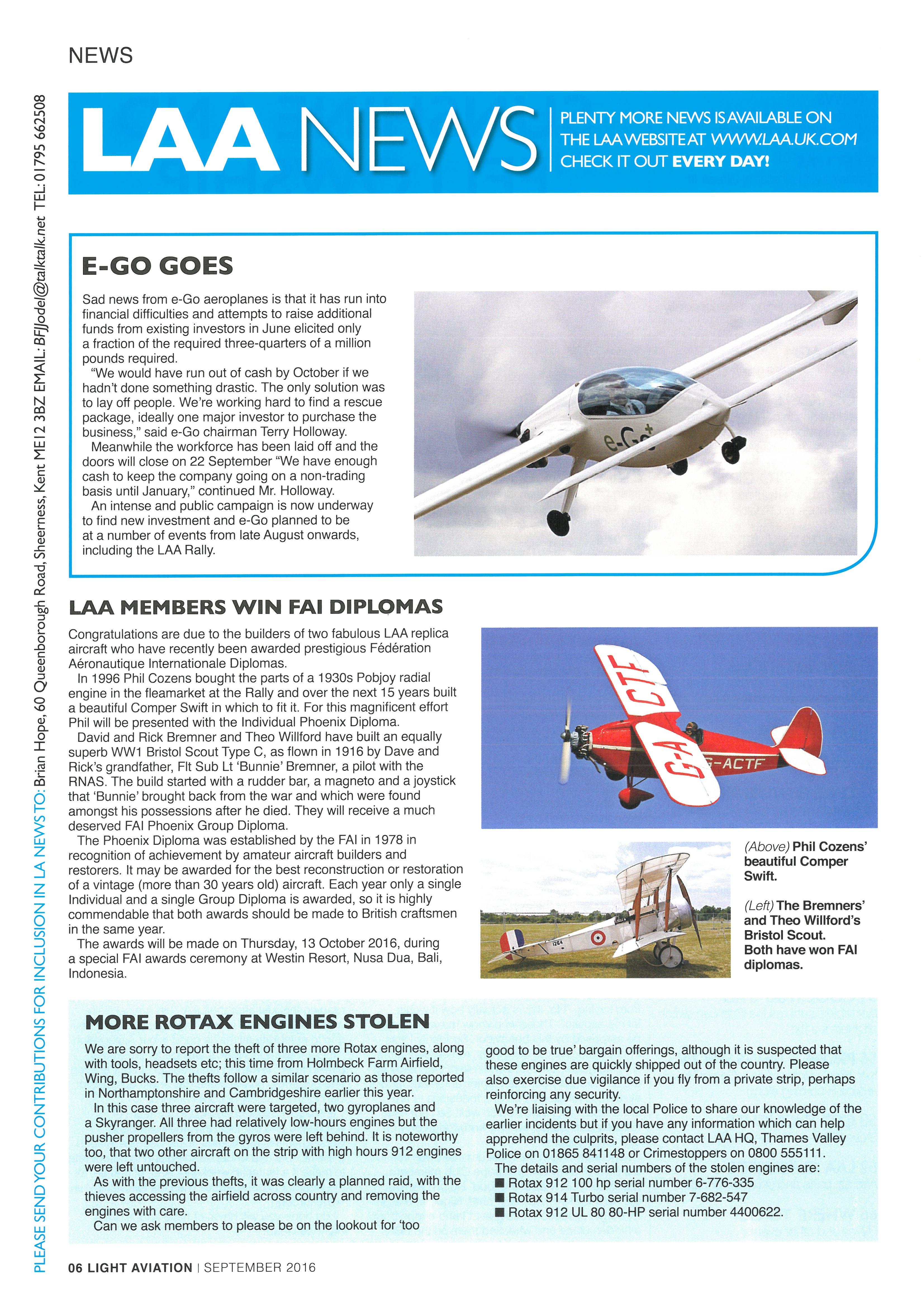
In 1996 Phil Cozens bought the parts of a 1930s Pobjoy radial engine in the fleamarket at the Rally and over the next 15 years built a beautiful Comper Swift in which to fit it. For this magnificent effort Phil will be presented with the Individual Phoenix Diploma.
David and Rick Bremner and Theo Willford have built an equally superb WW1 Bristol Scout Type C, as flown in 1916 by Dave and Rick’s grandfather, Flt Sub Lt ‘Bunnie’ Bremner, a pilot with the RNAS. The build started with a rudder bar, a magneto and a joystick that ‘Bunnie’ brought back from the war and which were found amongst his possessions after he died. They will receive a much deserved FAI Phoenix Group Diploma.
The Phoenix Diploma was established by the FAI in 1978 in recognition of achievement by amateur aircraft builders and restorers. It may be awarded for the best reconstruction or restoration of a vintage (more than 30 years old) aircraft. Each year only a single Individual and a single Group Diploma is awarded, so it is highly commendable that both awards should be made to British craftsmen in the same year.
The awards will be made on Thursday, 13 October 2016, during a special FAl awards ceremony at Westin Resort, Nusa Dua, Bali, Indonesia.
MORE ROTAX ENGINES STOLEN
We are sorry to report the theft of three more Rotax engines, along with tools, headsets etc; this time from Holmbeck Farm Airfield, Wing, Bucks. The thefts follow a similar scenario as those reported in Northamptonshire and Cambridgeshire earlier this year.
Inthis case three aircraft were targeted, two gyroplanes and a Skyranger.All three had relatively low-hours engines but the pusher propellers from the gyros were left behind. It is noteworthy too, that two other aircraft on the strip with high hours 912 engines were left untouched.
As with the previous thefts, it was clearly a planned raid, with the thieves accessing the airfield across country and removing the engines with care.
Can we ask members to please be on the lookout for ‘too
good to be true’ bargain offerings, although it is suspected that these engines are quickly shipped out of the country. Please also exercise due vigilance if you fly from a private strip, perhaps reinforcing any security.
We're liaising with the local Police to share our knowledge of the earlier incidents but if you have any information which can help apprehend the culprits, please contact LAA HQ, Thames Valley Police on 01865 841148 or Crimestoppers on 0800 555111.
The details and serial numbers of the stolen engines are: @Rotax 912 100 hp serial number 6-776-335 @ Rotax 914 Turbo serial number 7-682-547 @ Rotax 912 UL 80 80-HP serial number 4400622.
(Above) Phil Cozens’ beautiful Comper Swift.
(Left) The Bremners’ and Theo Willford’s Bristol Scout. Both have won FAI diplomas.
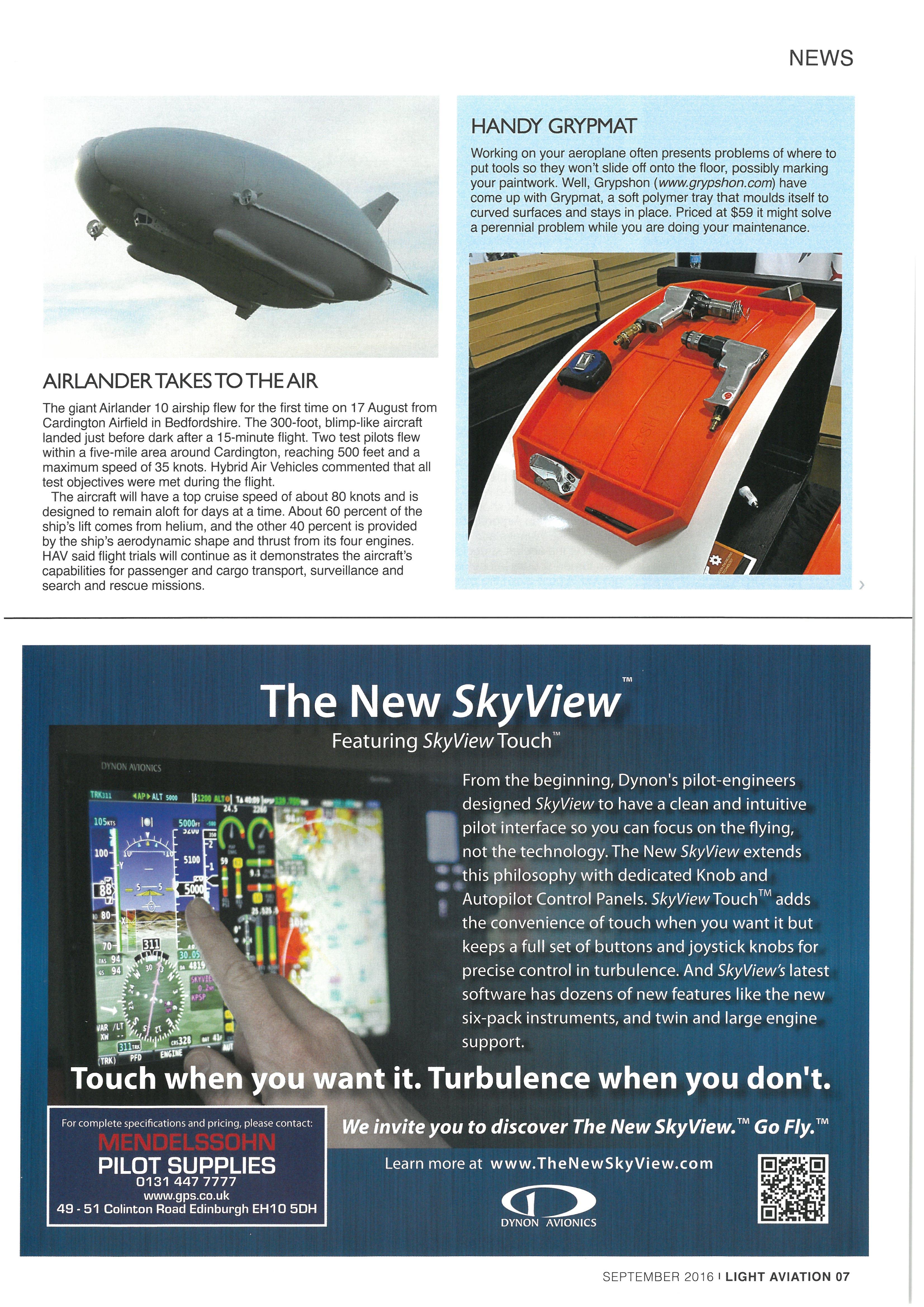
AIRLANDERTAKESTOTHEAIR
The giant Airlander 10 airship flew for the first time on 17 August from Cardington Airfield in Bedfordshire. The 300-foot, blimp-like aircraft landed just before dark after a 15-minute flight. Two test pilots flew within a five-mile area around Cardington, reaching 500 feet and a maximum speed of 35 knots. Hybrid Air Vehicles commented that all test objectives were met during the flight.
The aircraft will have a top cruise speed of about 80 knots and is designed to remain aloft for days at a time. About 60 percent of the ship’s lift comes from helium, and the other 40 percent is provided by the ship’s aerodynamic shape and thrust from its four engines. HAV said flight trials will continue as it demonstrates the aircraft’s capabilities for passenger and cargo transport, surveillance and search and rescue missions.
From the beginning, Dynon's pilot-engineers designed SkyViewto have a clean and intuitive pilot interface soyou can focus on the flying, not the technology. The New SkyViewextends this philosophy with dedicated Knob and Autopilot Control Panels.SkyViewTouch™adds the convenience of touch when you want it but keeps afull set of buttons and joystick knobs for precise control in turbulence. And SkyView’slatest software hasdozens of new features like the new six-pack instruments, and twin and large engine support.
BCAL COMMEMORATION CAN YOU HELP?
LAA member Laurie Price is seeking fellow members’ help with a project to get a UK registered light aircraft painted or decaled in the British Caledonian (BCAL) livery as a visible tribute to the company and all those who worked at the Gatwick based company. 2017 will be the 30th anniversary of BCAL’s takeover by BA, so an aircraft ready and painted/decaled by then would be NSlAVandlaale)NVa
What we need is either a flying club to repaint an existing aircraft or anew acquisition, or find an individual aircraft owner or LAA aircraft builder who would be willing to do so. Ideally it should be low wing, Soa Cherokee family or RV or similar would be ideal.
If anybody can help, please contact Laurie at Laurie I.n.p@btinternet.com
JODELCLUB UK REBIRTH
Remember the Jodel Club? After a 10-year gap it has reformed as a free group open to all Jodel owners, builders, flyers and enthusiasts up and down the country, to provide a place to bring newbies and the experienced together. The main site is at www.jodel.org.uk and provides links to the various social forums used to discuss and exchange technical information, events and photographs.
In addition to the usual rallies, the first Jodel Club UK meet will be at Old Warden on 1 October for an informal gathering of Jodellers, so please PPR as normal. If successful it is hoped this VL3gatheringwillleadtomanymore. EVOLUTION
What better way to promote your product at AirVenture than to say you've just flown in from Belgium!
That's what JMB Aircraft did with their all-composite 472.5kg microlight, the VL3 Evolution.
Designed by Vanessa Air and originally built by Aveko, of Brno in the Czech Republic, JMB now builds the aircraft in Belgium. With a cruise speed of 150kt, the VL3 has a range of 1,200 miles but a 40-litre ferry tank was added for safety reasons.
Pilots Olivier Ronveaux and Harald Dispaux The aircraft flew from Belgium to the UK, then via Iceland and Greenland. PostAirventure it has flown to Florida where negotiations are taking place to establish a US service Centre. Jmbaircraft.com
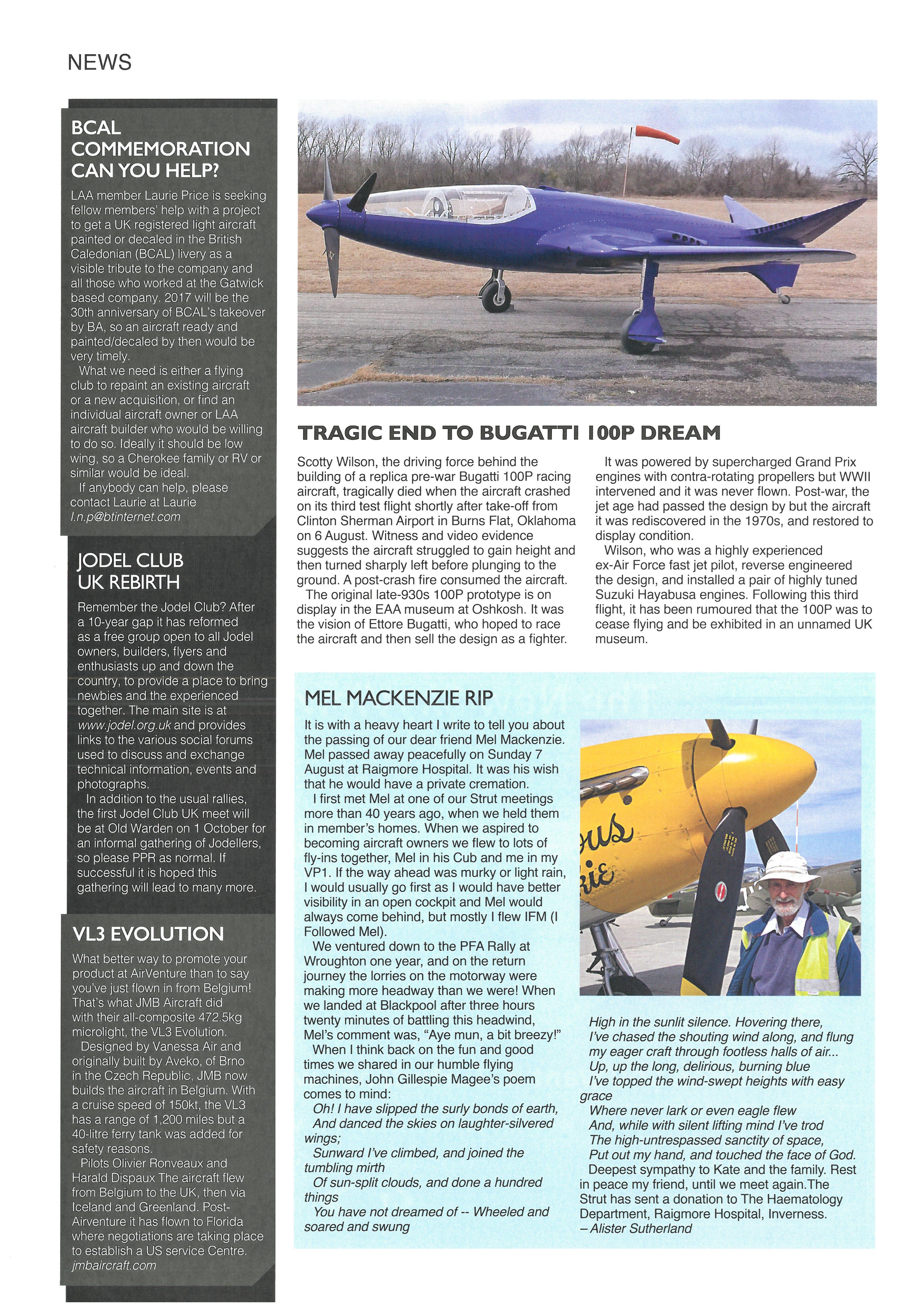
TRAGIC END TO BUGATTI 100P DREAM
Scotty Wilson, the driving force behind the building of a replica pre-war Bugatti 100P racing aircraft, tragically died when the aircraft crashed on its third test flight shortly after take-off from Clinton Sherman Airport in Burns Flat, Oklahoma on 6 August. Witness and video evidence suggests the aircraft struggled to gain height and then turned sharply left before plunging to the ground. A post-crash fire consumed the aircraft. The original late-930s 100P prototype is on display in the EAA museum at Oshkosh. It was the vision of Ettore Bugatti, who hoped to race the aircraft and then sell the design as a fighter.
MEL MACKENZIE RIP
It is with a heavy heart | write to tell you about the passing of our dear friend Mel Mackenzie. Mel passed away peacefully on Sunday 7 August at Raigmore Hospital. It was his wish that he would have a private cremation.
| first met Mel at one of our Strut meetings more than 40 years ago, when we held them in member’s homes. When we aspired to becoming aircraft owners we flew to lots of fly-ins together, Mel in his Cub and me in my VP1. Ifthe way ahead was murky or light rain, | would usually go first as | would have better visibility in an open cockpit and Mel would always come behind, but mostly | flew IFM (I Followed Mel).
We ventured down to the PFA Rally at Wroughton one year, and on the return journey the lorries on the motorway were making more headway than we were! When we landed at Blackpool after three hours twenty minutes of battling this headwind, Mel’s comment was, “Aye mun, a bit breezy!”
When |think back on the fun and good times we shared in our humble flying machines, John Gillespie Magee’s poem comes to mind:
Oh! Ihave slipped the surly bonds of earth, And danced the skies on laughter-silvered
It was powered by supercharged Grand Prix engines with contra-rotating propellers but WWII intervened and it was never flown. Post-war, the jet age had passed the design by but the aircraft it was rediscovered in the 1970s, and restored to display condition.
Wilson,whowasahighly experienced ex-Air Force fast jet pilot, reverse engineered the design, and installed a pair of highly tuned Suzuki Hayabusa engines. Following this third flight, it has been rumoured that the 100P was to cease flying and be exhibited in an unnamed UK museum.
High in the sunlit silence. Hovering there, I’ve chased the shouting wind along, and flung myeager craft through footless halls of air...
Up, up the long, delirious, burning blue I’ve topped the wind-swept heights with easy grace
Where never lark or even eagle flew
And, while with silent lifting mind I’ve trod wings; Thehigh-untrespassedsanctityofspace, Sunward I’ve climbed, andjoined the Put out myhand, and touched the face of God. tumbling mirth
Deepest sympathy to Kate and the family. Rest Ofsun-splitclouds,anddoneahundred inpeacemyfriend,untilwemeetagain.The things Strut has sent a donation to The Haematology Youhave notdreamed of -- Wheeled and Department, Raigmore Hospital, Inverness. soared and swung Alister Sutherland
Letters to the Editor
Beware faulty GPS software | would like to second Brian Hope’s recommendation for pilots to avail of modern electronic options to help prevent airspace infringement, but add a note of caution from recent personal experience.
While using one of these apps onmytabletona recentflight, | narrowly avoided infringing airway L10 over Portaferry (County Down) because the airway was missing from the app’s database.
No, that’s not a mistake on my part a chunk of controlled airspace is completely missing, and my data was fully up to date. | have been in contact with the makers of this particular piece of software and, after checking, they confirmed that this was the case and are now rectifying it.
Up to now | had always assumed that such software packages merely require their makers to feed in the airspace boundary co-ordinates from the official published sources and the software takes care of the rest. It transpires that this was pure naivety on my part airspace boundaries are entered by hand and require afair bit of tweaking to get them all to line up correctly. The human element is, as ever, the weakest link and leaves the whole system open to error.
So just as with GPS navigation, do not rely on these systems for airspace avoidance use your paper ICAO chart as your primary reference and your GPS chart as a secondary support aid. | should also add a cautionary note on transponders. | only discovered the above error because | was squawking mode
C. Belfast ATC informed me that Aldergrove ATC had complained to them that | had climbed into controlled airspace. Inthe end | hadn’t my altitude encoder is currently operating off cockpit pressure rather than the static system so it over-reads by a couple of hundred feet. The thing is, | was only told by ATC well after their systems had told them that | had climbed into their airspace. My past experience has been to receive a warning before making
a mistake, so it came as a shock to me to be informed only after the transgression.
Anyway, the point is that whilst such equipment may help save your bacon from making an unintended infringement, you certainly can’t rely upon it doing so. And for anyone who spots that had | not been squawking mode C, ATC would not have known of the apparent infringement | will point out that the main reason for using a transponder is the far more serious concern of collision avoidance. The displeasure of NATS is vastly preferable than an encounter with an Airbus A320. In short, use every resource at your disposal, but be wary of their limitations. Michael Brooks
In praise of Beverley Airfield
A couple of months ago | was passenger in a Cessna 150 making an afternoon visit to Beverley airfield after a local bimble from Netherthorpe (using a free landing voucher in the LightAviationmag).Duringthe downwind checks prior to landing, carb heat was selected but it was obvious that something was wrong when the carb heat knob pulled the cable through its fitting, and felt as though it was disconnected from the carb heat mechanism.
What to do? The cloud was loweringandtherewasabitof a spit in the air, just the damp conditions to invite carb icing. Should we go straight home, not knowing if carb heat was selected or not, or land as planned and risk attempting to take off again perhaps with hot selected.
A quick call to the A/G service ascertained that a mechanic was on-site, so we landed as planned and were given directions to the maintenance hangar. There, having removed the cowls, the mechanic declared the carb heat cable definitely bust and no spare was available. Discussions with the base mechanic and the Beverley mechanic led us to the conclusion we were grounded. Time for a cup of tea and to plan how to get back to base. At this point Peter, one of the instructors and airfield directors,
month’s test aircraft.
said he’d be happy to take us back in a four-seater once he’d finished instructing, this we readily accepted.
Thanks to everybody that gave us assistance during our visit and full marks to Beverley Airfield, possibly the friendliest airfield I’ve visited.. PhilHartshorn
Glasair Ill speeds
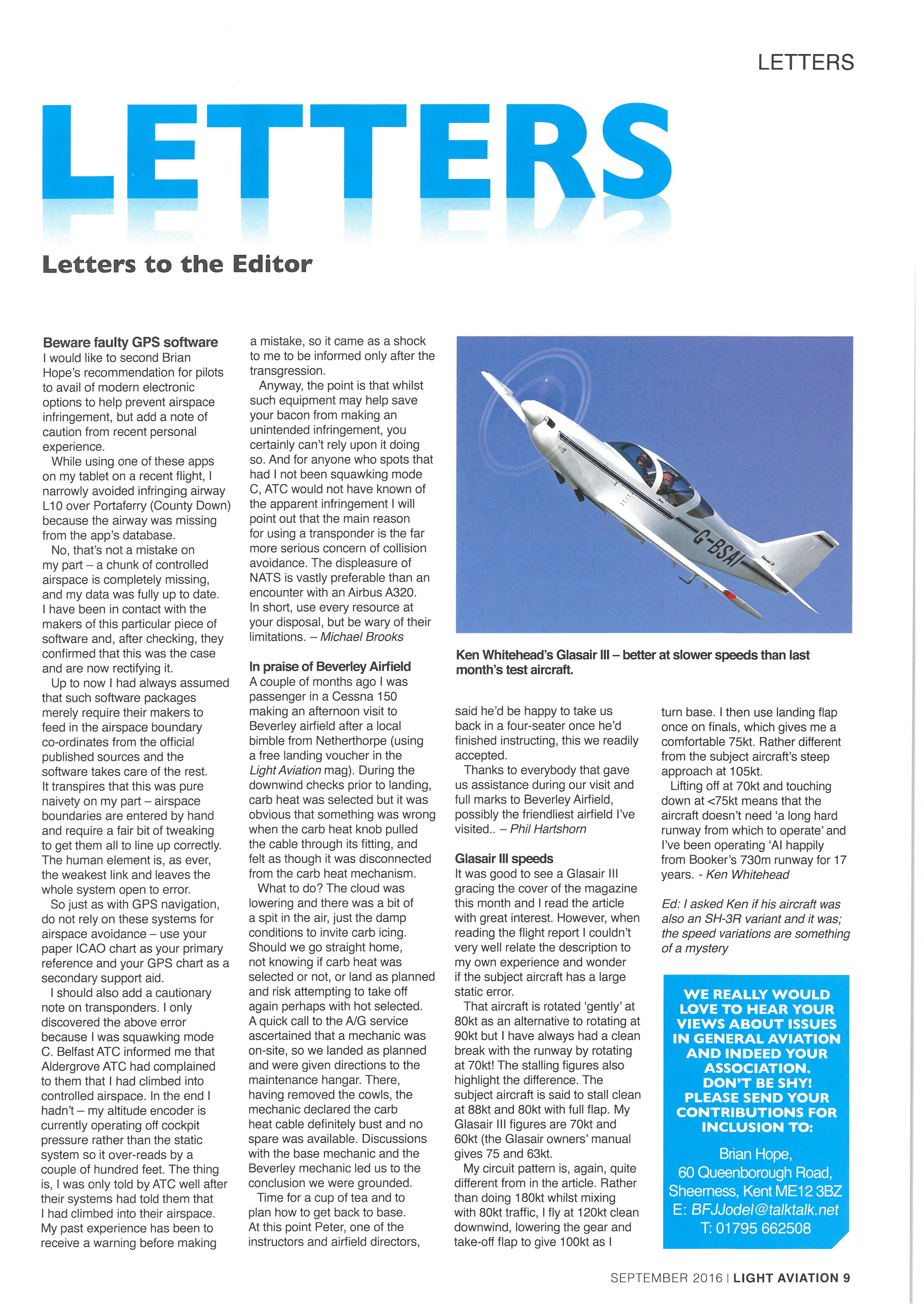
It was good to see a Glasair III gracing the cover of the magazine this month and | read the article with great interest. However, when reading the flight report | couldn’t very well relate the description to my own experience and wonder if the subject aircraft has a large static error.
That aircraft is rotated ‘gently’ at 80kt as an alternative to rotating at 9Oktbut | have always had a clean break with the runway by rotating at 70kt! The stalling figures also highlight the difference. The subject aircraft is said to stall clean at 88kt and 80kt with full flap. My Glasair III figures are 70kt and 60kt (the Glasair owners’ manual gives 75 and 63kt.
My circuit pattern is, again, quite different from in the article. Rather than doing 180kt whilst mixing with 80kt traffic, | fly at 120kt clean downwind, lowering the gear and take-off flap to give 100kt as |
turn base. | then use landing flap once on finals, which gives me a comfortable 75kt. Rather different from the subject aircraft’s steep approach at 105kt.
Lifting off at 70kt and touching down at <75kt means that the aircraft doesn’t need ‘a long hard runway from which to operate’ and I’ve been operating ‘Al happily from Booker’s 730m runway for 17 years. - Ken Whitehead
Ed: | asked Ken if his aircraft was also an SH-3R variant and it was; the speed variations are something of a mystery
WE REALLY WOULD LOVE TO HEAR YOUR VIEWS ABOUT ISSUES IN GENERAL AVIATION AND INDEED YOUR ASSOCIATION. DON’T BE SHY! PLEASE SEND YOUR CONTRIBUTIONS FOR
PprojectNewsexistsnotonlytoshowcase buttoinspire and
encourage members to build their own aeroplane, and this month’s crop of inspiration includes two Sherwood Rangerbuilders.DavidBrownsharesalittle ofhisfirstever project from the start to very near completion, and whilst we have a description here and a few photographs, David has completedaverydetailedonlineblogofthebuildanditiswellq worth taking the time to have a look. Having chosen the out of sequence registration of G-SWAB, | assumed David must be asurgeon,butheadmitsthatwhilsthisprojecthasbeen a bitofan operation, the letters are simply the combined initials of his family.
The second Sherwood builder is none other than leading organiser of the Rally’s Homebuilder Tent, Dudley Pattison, who has probably lost count of the number of build projects he has undertaken.
Cleared to Fly recently was de Havilland Gipsy Moth G-ABJJ. Built in 1931, it was pressed into RAF service as BK482 between 1940 and 1946, and returned to civil use with the flying club at Fairoaks owning it for a while. It was exported to Canada in 1962, where it flew as
CF-AAA, but has recently returned to the UK and has again been reallocated G-ABJJ. Itjoins the growing list of de Havilland aircraft operating on a LAA Permit to Fly.
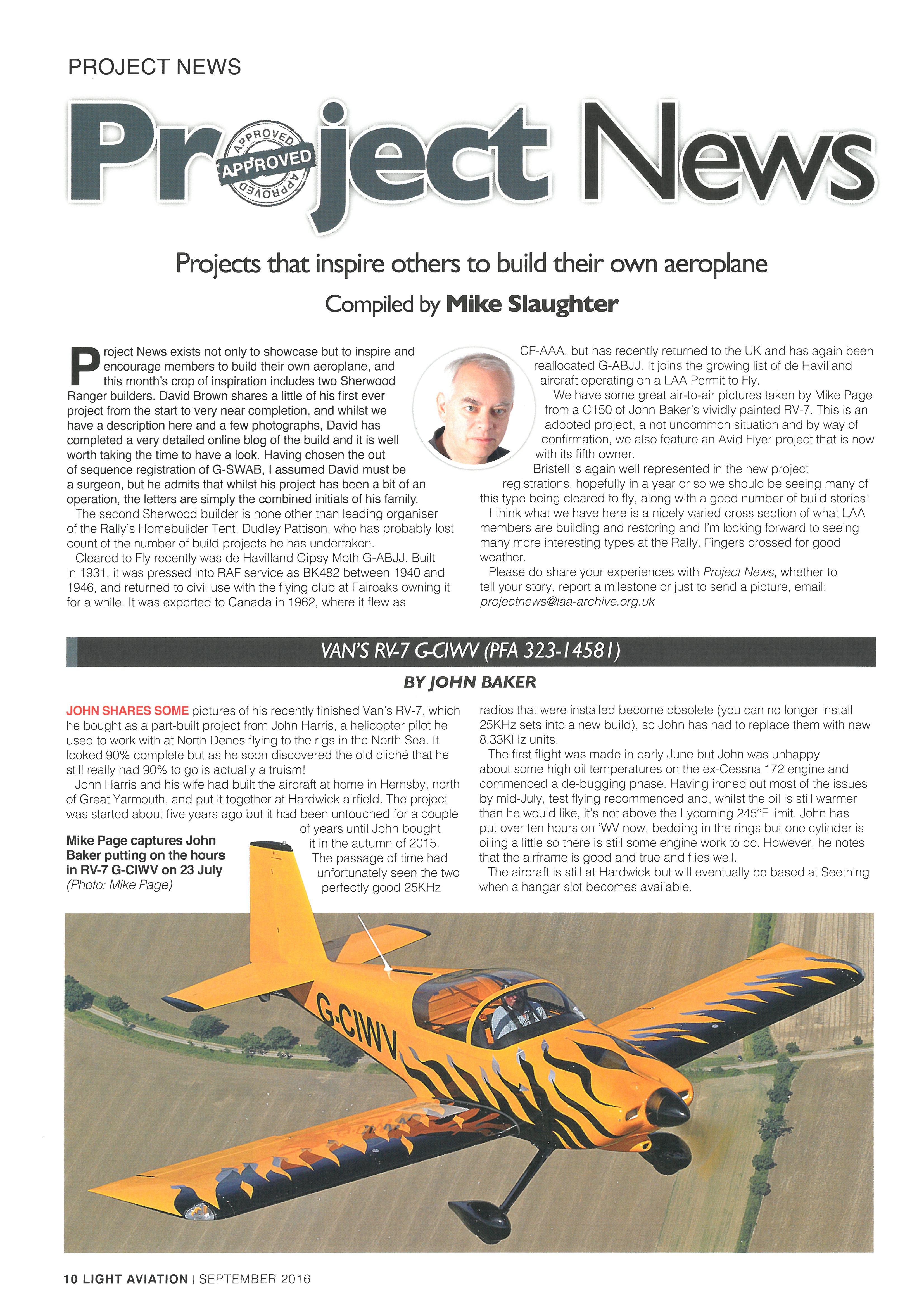
We have some great air-to-air pictures taken by Mike Page from a C150 of John Baker’s vividly painted RV-7. This is an adopted project, a not uncommon situation and by way of confirmation, we also feature an Avid Flyer project that is now with its fifth owner.
Bristell is again well represented in the new project registrations, hopefully in a year or so we should be seeing many of this type being cleared to fly, along with a good number of build stories! | think what we have here is a nicely varied cross section of what LAA members are building and restoring and I’m looking forward to seeing many more interesting types at the Rally. Fingers crossed for good weather.
Please do share your experiences with Project News, whether to tell your story, report a milestone or just to send a picture, email: projectnews@laa-archive.org.uk
pictures of his recently finished Van’s RV-7,which he bought as a part-built project from John Harris, a helicopter pilot he used to work with at North Denes flying to the rigs in the North Sea. It looked 90% complete but as he soon discovered the old cliché that he still really had 90% to go is actually a truism!
John Harris and his wife had built the aircraft at home in Hemsby, north of Great Yarmouth, and put it together at Hardwick airfield. The project was started about five years ago but it had been untouched for a couple of years until John bought it in the autumn of 2015.
Mike Page captures John Baker putting onthe hours u inRV-7G-CIWVon23July |ena (Photo:Mike Page)LY er
The passage of time had unfortunately seen the two perfectly good 25KHz
radios that were installed become obsolete (you can no longer install 25KHz sets into a new build), so John has had to replace them with new 8.33KHZz units.
The first flight was made in early June but John was unhappy about some high oil temperatures on the ex-Cessna 172 engine and commenced a de-bugging phase. Having ironed out most of the issues by mid-July, test flying recommenced and, whilst the oil is still warmer than he would like, it’s not above the Lycoming 245°F limit. John has put over ten hours on ‘WV now, bedding in the rings but one cylinder is oilinga littlesothereisstillsomeengineworktodo.However,henotes that the airframe is good and true and flies well.
The aircraft is still at Hardwick but will eventually be based at Seething when a hangar slot becomes available.
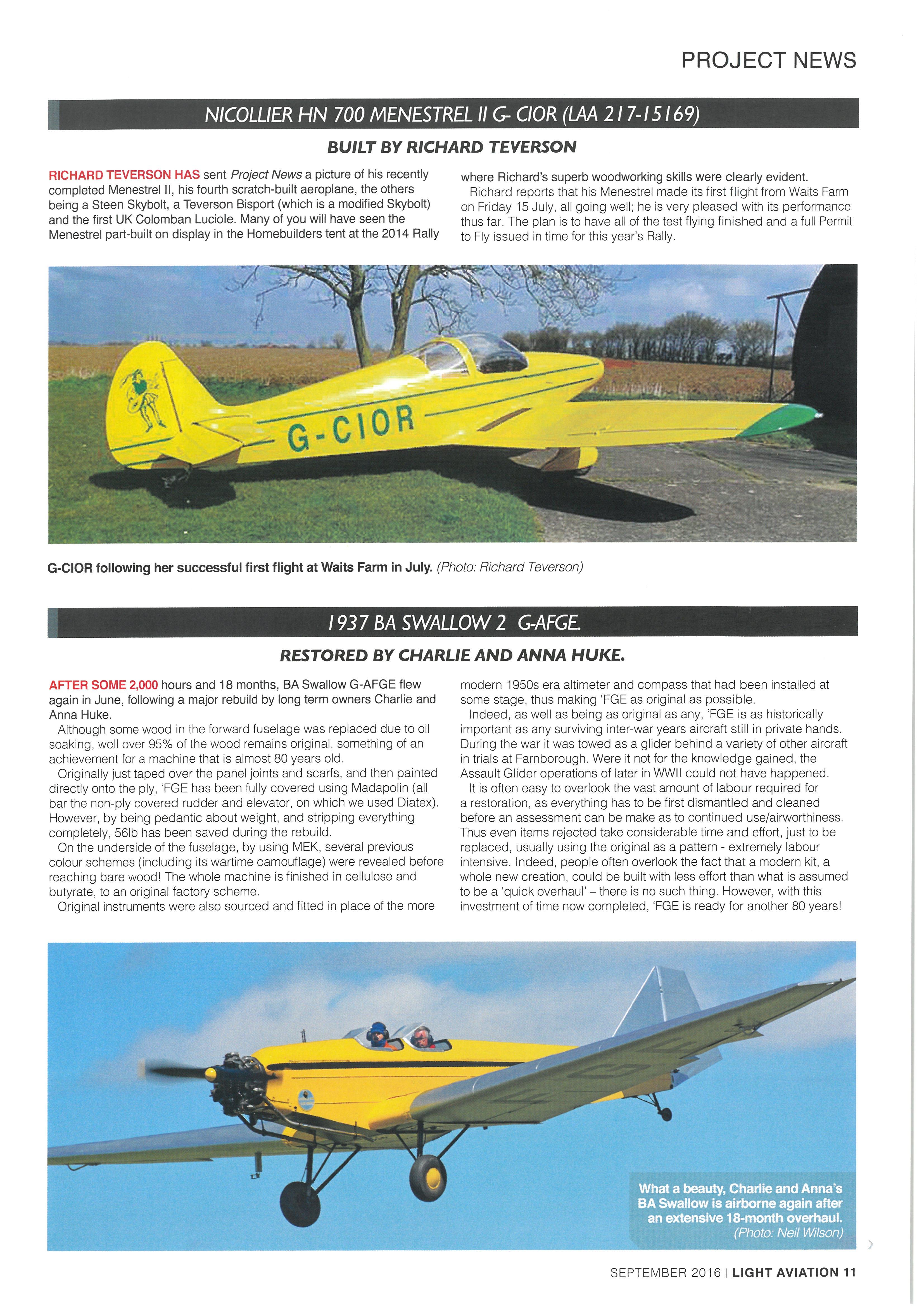
RICHARD TEVERSON HAS sent Project News a picture of his recently completed Menestrel II, his fourth scratch-built aeroplane, the others being a Steen Skybolt, a Teverson Bisport (which is a modified Skybolt) and the first UK Colomban Luciole. Many of you will have seen the
AFTER SOME 2,000 hours and 18 months, BA Swallow G-AFGE flew again in June, following a major rebuild by long term owners Charlie and Anna Huke.
Although some wood in the forward fuselage was replaced due to oil soaking, well over 95% of the wood remains original, something of an achievement for a machine that is almost 80 years old.
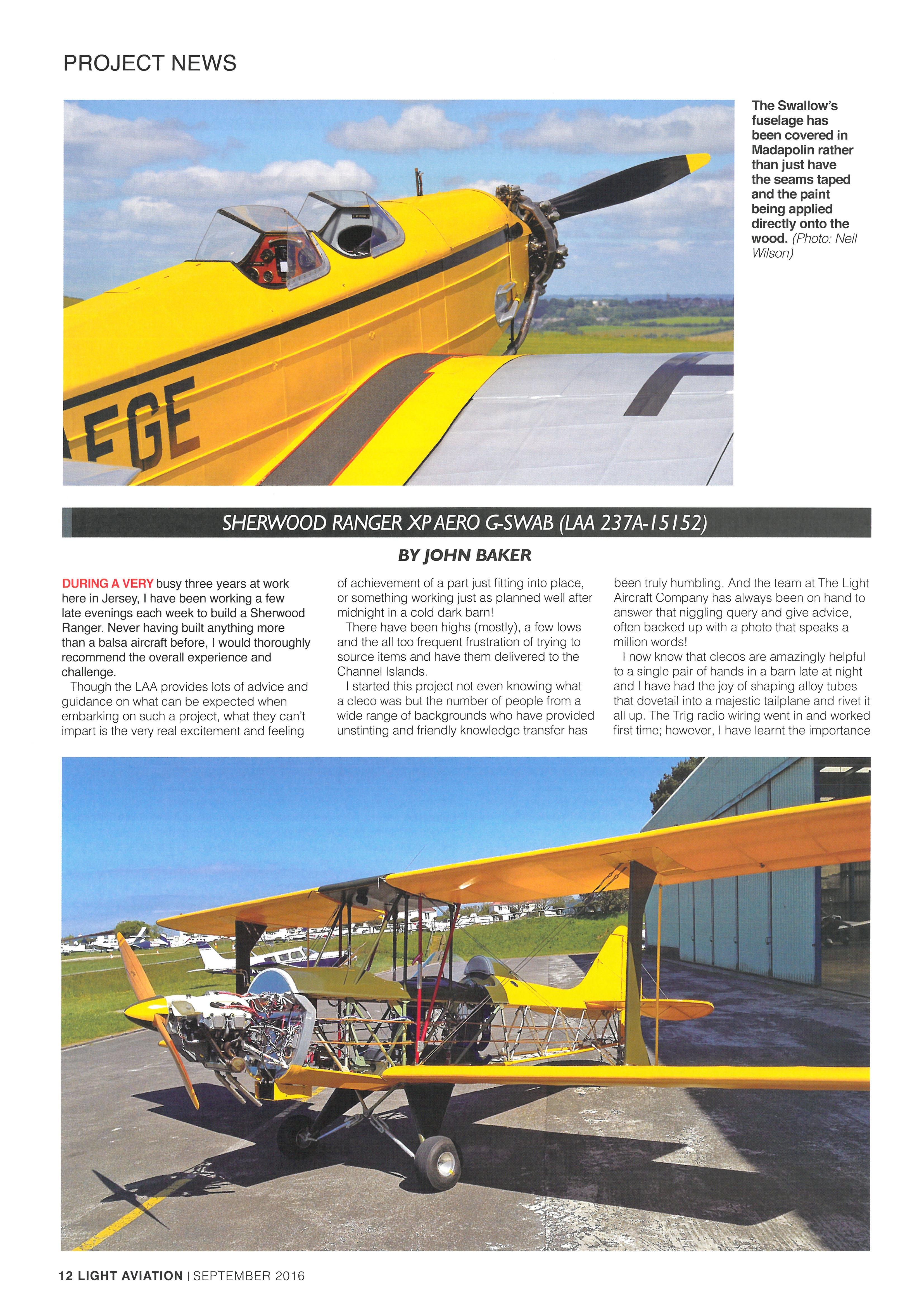
Originally just taped over the panel joints and scarfs, and then painted directly onto the ply, ‘FGE has been fully covered using Madapolin (all bar the non-ply covered rudder and elevator, on which we used Diatex). However, by being pedantic about weight, and stripping everything completely, 56lb has been saved during the rebuild.
On the underside of the fuselage, by using MEK, several previous colour schemes (including its wartime camouflage) were revealed before reaching bare wood! The whole machine is finished in cellulose and butyrate, to an original factory scheme.
Original instruments were also sourced and fitted in place of the more
modern 1950s era altimeter and compass that had been installed at some stage, thus making ‘FGE as original as possible.
Indeed, as well as being as original as any, ‘FGE is as historically important as any surviving inter-war years aircraft still in private hands. During the war it was towed as a glider behind a variety of other aircraft in trials at Farnborough. Were it not for the knowledge gained, the Assault Glider operations of later in WWII could not have happened. It is often easy to overlook the vast amount of labour required for a restoration, as everything has to be first dismantled and cleaned before an assessment can be make as to continued use/airworthiness. Thus even items rejected take considerable time and effort, just to be replaced, usually using the original as a pattern - extremely labour intensive. Indeed, people often overlook the fact that a modern kit, a whole new creation, could be built with less effort than what is assumed to be a ‘quick overhaul’ there is no such thing. However, with this investment of time now completed, ‘FGE is ready for another 80 years!
1937 BA SWALLOW 2 G-AFGE. RESTORED BYCHARLIE AND ANNA HUKE.
The Swallow’s fuselage has been covered in Madapolin rather than just have the seams taped and the paint being applied directly onto the wood. (Photo: Neil Wilson)
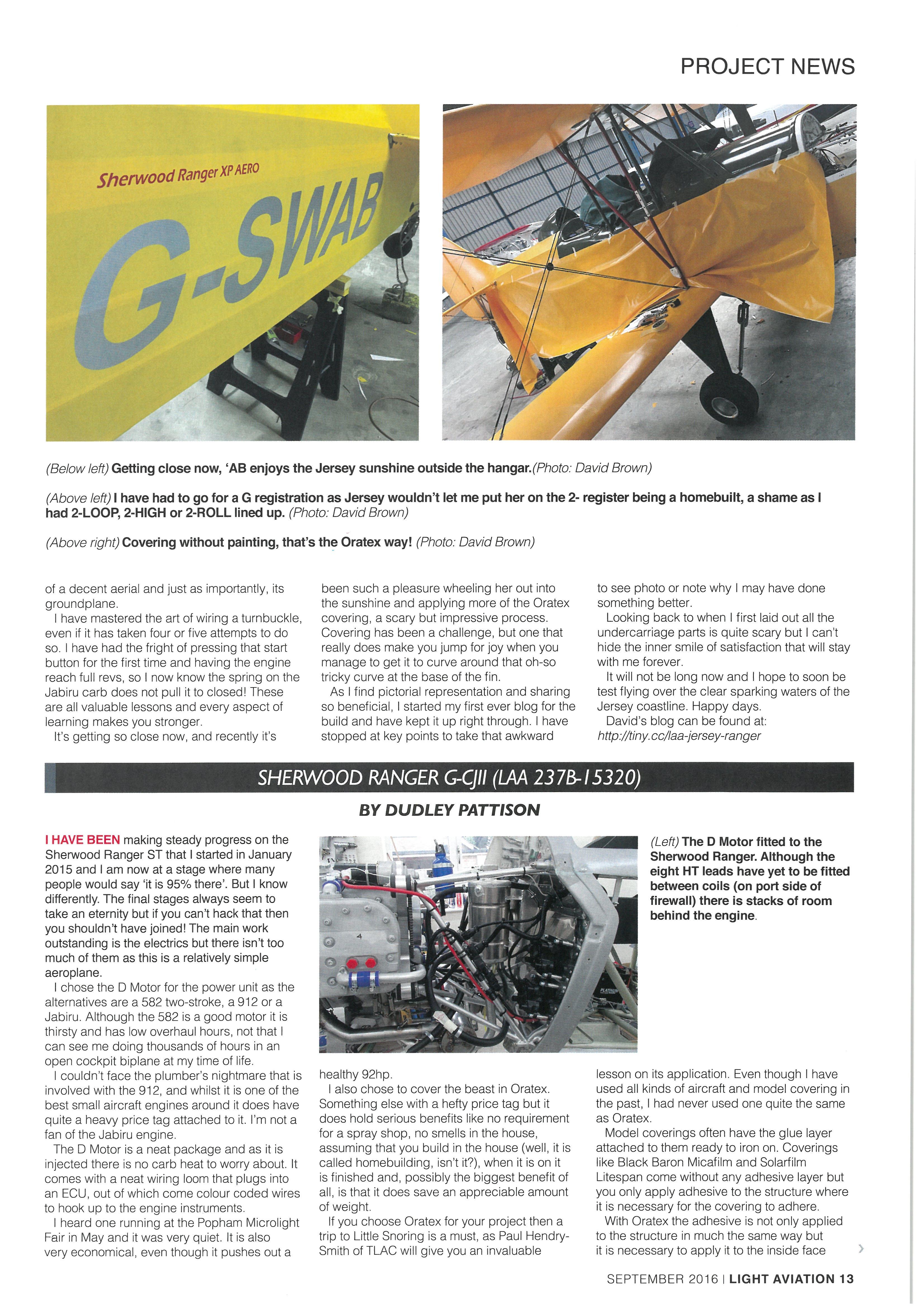
DURINGA VERYbusy three years at work here in Jersey, | have been working a few late evenings each week to build a Sherwood Ranger. Never having built anything more than a balsa aircraft before, | would thoroughly recommend the overall experience and challenge.
Though the LAA provides lots of advice and guidance on what can be expected when embarking on such a project, what they can’t impart is the very real excitement and feeling 12 LIGHT AVIATION | SEPTEMBER 2016
BYJOHN BAKER
of achievement of a part just fitting into place, or something working just as planned well after midnight in a cold dark barn!
There have been highs (mostly), a few lows and the all too frequent frustration of trying to source items and have them delivered to the Channel Islands.
| started this project not even knowing what a cleco was but the number of people from a wide range of backgrounds who have provided unstinting and friendly knowledge transfer has
been truly humbling. And the team at The Light Aircraft Company has always been on hand to answer that niggling query and give advice, often backed up with a photo that speaks a million words!
| now know that clecos are amazingly helpful to asingle pair of hands in a barn late at night and | have had the joy of shaping alloy tubes that dovetail into a majestic tailplane and rivet it all up. The Trig radio wiring went in and worked first time; however, | have learnt the importance
SherwoodRangerXPAERO
of a decent aerial and just as importantly, its groundplane.
| have mastered the art of wiring a turnbuckle, even if it has taken four or five attempts to do so. | have had the fright of pressing that start button for the first time and having the engine reach full revs, so | now know the spring on the Jabiru carb does not pull it to closed! These are all valuable lessons and every aspect of learning makes you stronger. It's getting so close now, and recently it’s
been such a pleasure wheeling her out into the sunshine and applying more of the Oratex covering, a scary but impressive process. Covering has been a challenge, but one that really does make you jump for joy when you manage to get it to curve around that oh-so tricky curve at the base of the fin.
As | find pictorial representation and sharing so beneficial, | started my first ever blog for the
build and have kept it up right through. | have stopped at key points to take that awkward
to see photo or note why | may have done something better.
Lookingbacktowhen | firstlaidoutallthe undercarriage parts is quite scary but | can’t hide the inner smile of satisfaction that will stay with me forever.
It will not be long now and | hope to soon be test flying over the clear sparking waters of the Jersey coastline. Happy days.
SHERWOODRANGERG-CJll(LAA237B-15320)
David’s blog can be found at: http://tiny.cc/laa-jersey-ranger
BY
| HAVE BEEN making steady progress on the Sherwood Ranger ST that | started in January 2015 and | am now at a stage where many people would say ‘it is 95% there’. But | know differently. The final stages always seem to take an eternity but if you can’t hack that then you shouldn't have joined! The main work outstanding is the electrics but there isn’t too muchofthemasthisisa relativelysimple aeroplane.
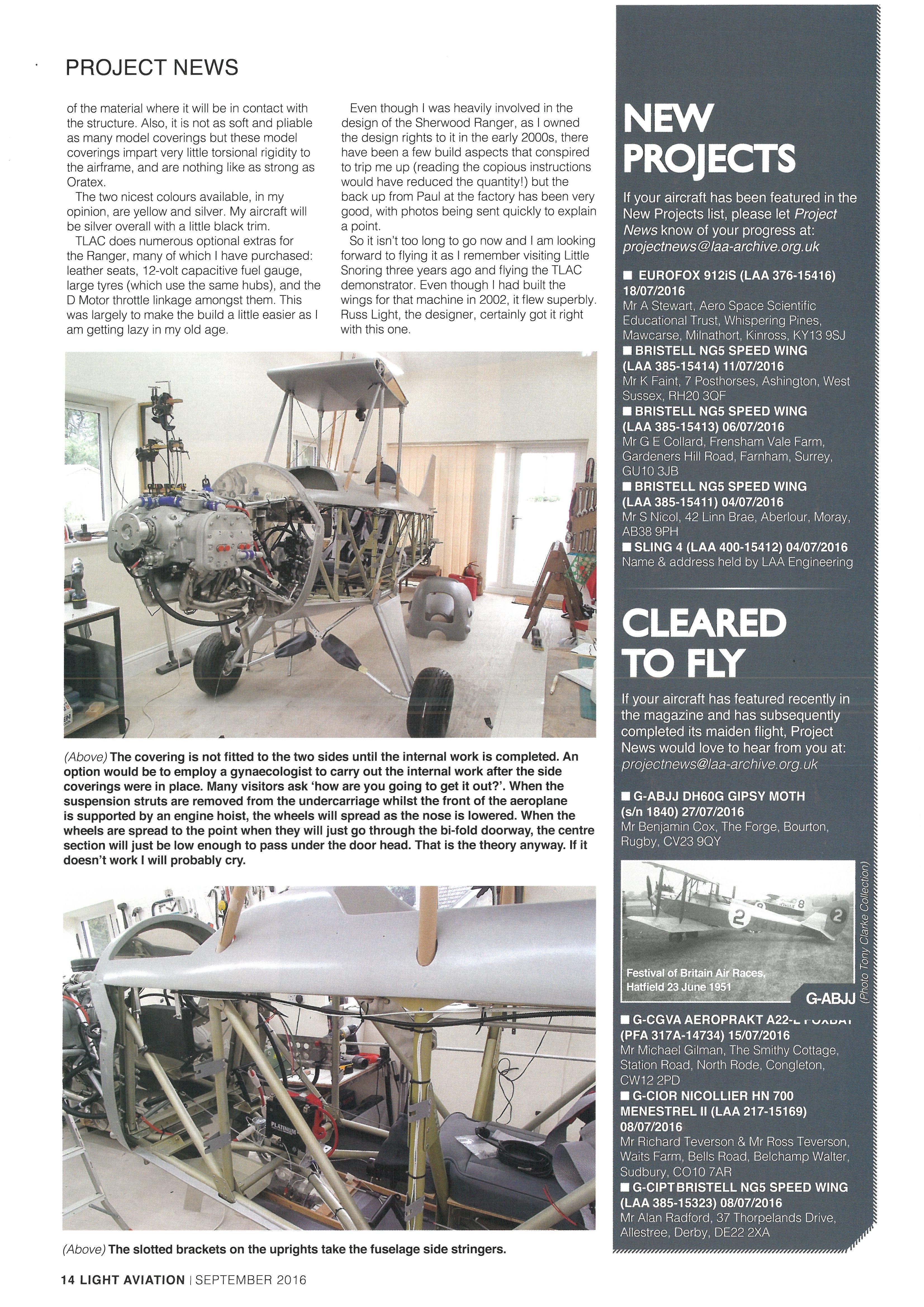
| chose the D Motor for the power unit as the alternatives are a 582 two-stroke, a912 ora Jabiru. Although the 582 is a good motor it is thirsty and has low overhaul hours, not that | can see me doing thousands of hours in an open cockpit biplane at my time of life.
| couldn't face the plumber’s nightmare that is involved with the 912, and whilst it is one of the best small aircraft engines around it does have quiteaheavypricetagattachedto it.I’mnota fan of the Jabiru engine.
The D Motor is a neat package and as itis injected there is no carb heat to worry about. It comes with a neat wiring loom that plugs into an ECU, out of which come colour coded wires to hook up to the engine instruments.
| heard one running at the Popham Microlight Fair in May and it was very quiet. It is also very economical, even though it pushes out a
| also chose to cover the beast in Oratex.
Something else with a hefty price tag but it does hold serious benefits like no requirement for a spray shop, no smells in the house, assuming that you build in the house (well, it is called homebuilding, isn’t it?),when it is on it is finished and, possibly the biggest benefit of all, is that it does save an appreciable amount of weight.
If you choose Oratex for your project then a trip to Little Snoring is a must, as Paul Hendry-
MMMM (\cit) TheDMotorfittedto the Sherwood Ranger. Although the eight HT leads have yet to be fitted between coils (on port side of firewall) there is stacks of room behind the engine.
lesson on its application. Even though | have used all kinds of aircraft and model covering in the past, | had never used one quite the same as Oratex.
Model coverings often have the glue layer attached to them ready to iron on. Coverings like Black Baron Micafilm and Solarfilm Litespan come without any adhesive layer but you only apply adhesive to the structure where it is necessary for the covering to adhere.
With Oratex the adhesive is not only applied to the structure in much the same way but it is necessary to apply it to the inside face
DUDLEY PATTISON
healthy 92hp.
PROJECT NEWS
of the material where it will be in contact with the structure. Also, it is not as soft and pliable as many model coverings but these model coverings impart very little torsional rigidity to the airframe, and are nothing like as strong as Oratex.
The two nicest colours available, in my opinion, are yellow and silver. My aircraft will be silver overall with a little black trim.
TLAC does numerous optional extras for the Ranger, many of which | have purchased: leather seats, 12-volt capacitive fuel gauge, large tyres (which use the same hubs), and the D Motor throttle linkage amongst them. This waslargelytomakethebuildalittle easieras| am getting lazy in my old age.
Even though | was heavily involved in the design of the Sherwood Ranger, as | owned the design rights to it in the early 2000s, there have been a few build aspects that conspired to trip me up (reading the copious instructions would have reduced the quantity!) but the back up from Paul at the factory has been very good, with photos being sent quickly to explain a point.
So it isn’t too long to go now and | am looking forward to flying it as | remember visiting Little Snoring three years ago and flying the TLAC demonstrator. Even though | had built the wings for that machine in 2002, it flew superbly. Russ Light, the designer, certainly got it right with this one.
NY PROJECTS
lf your aircraft has been featured in the New Projects list, please let Project News know of your progress at: projectnews @laa-archive.org.uk
@ EUROFOX 912iS (LAA 376-15416) 18/07/2016
Mr A Stewart, Aero Space Scientific Educational Trust, Whispering Pines, Mawcarse, Milnathort, Kinross, KY13 9SJ
Mr S Nicol, 42 Linn Brae, Aberlour, Moray, AB38 9PH @SLING 4 (LAA 400-1541 2) 04/07/2016
Name & address held by LAA Engineering
CLEARED TO FLY
lf your aircraft has featured recently in the magazine and has subsequently completed its maiden flight, Project News would love to hear from you at: projectnews@laa-archive.org.uk
@ G-ABJJ DH60G GIPSY MOTH (s/n 1840) 27/07/2016
Mr Benjamin Cox, The Forge, Bourton, Rugby, CV23 9QY
number of recent incidents where aircraft over-flying glider sites have come into close proximity with winch-launching gliders, have prompted the UK Airprox Board (UKAB) and the British Gliding Association (BGA) to remind pilots about the dangers of over-flying gliding sites.
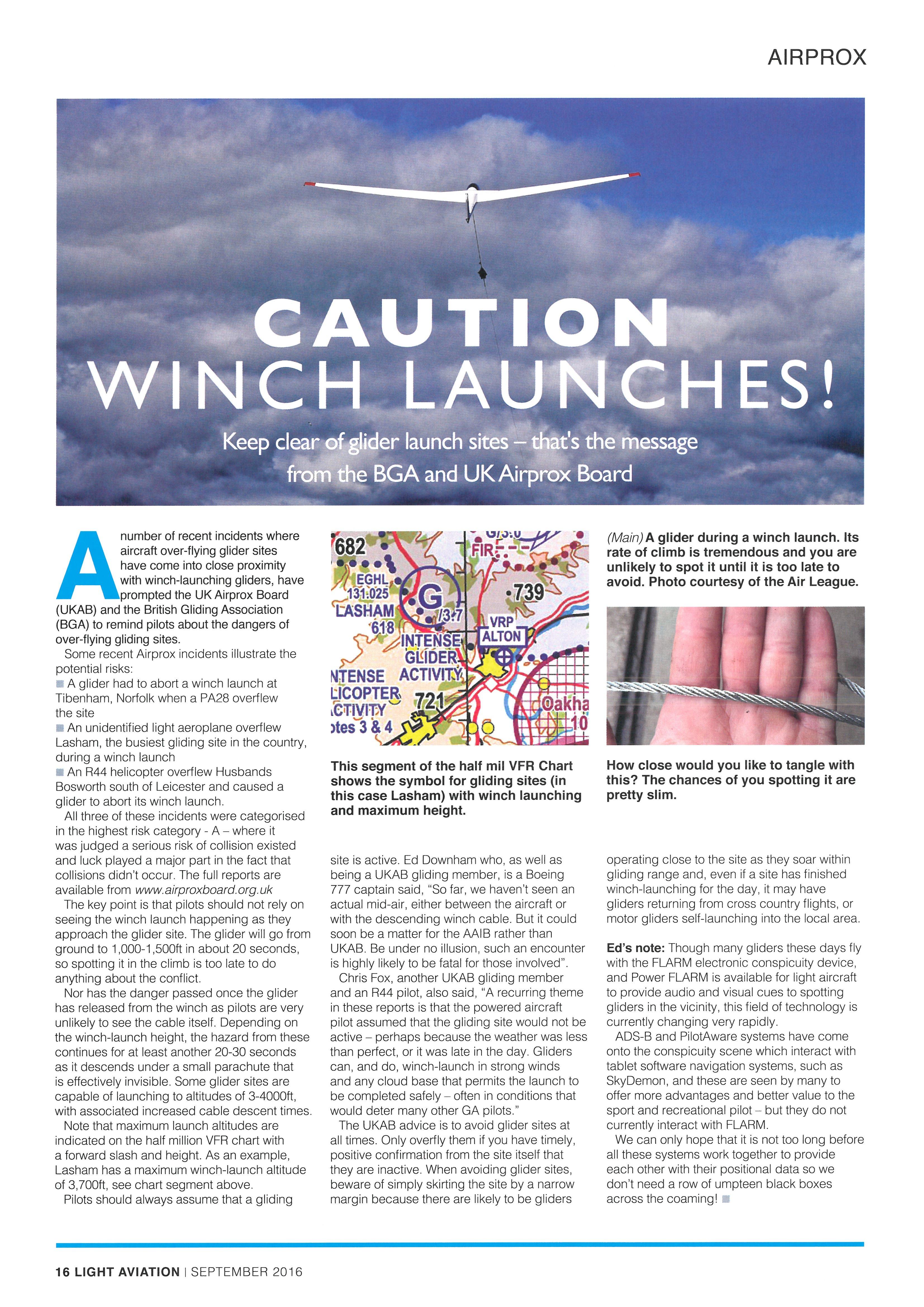
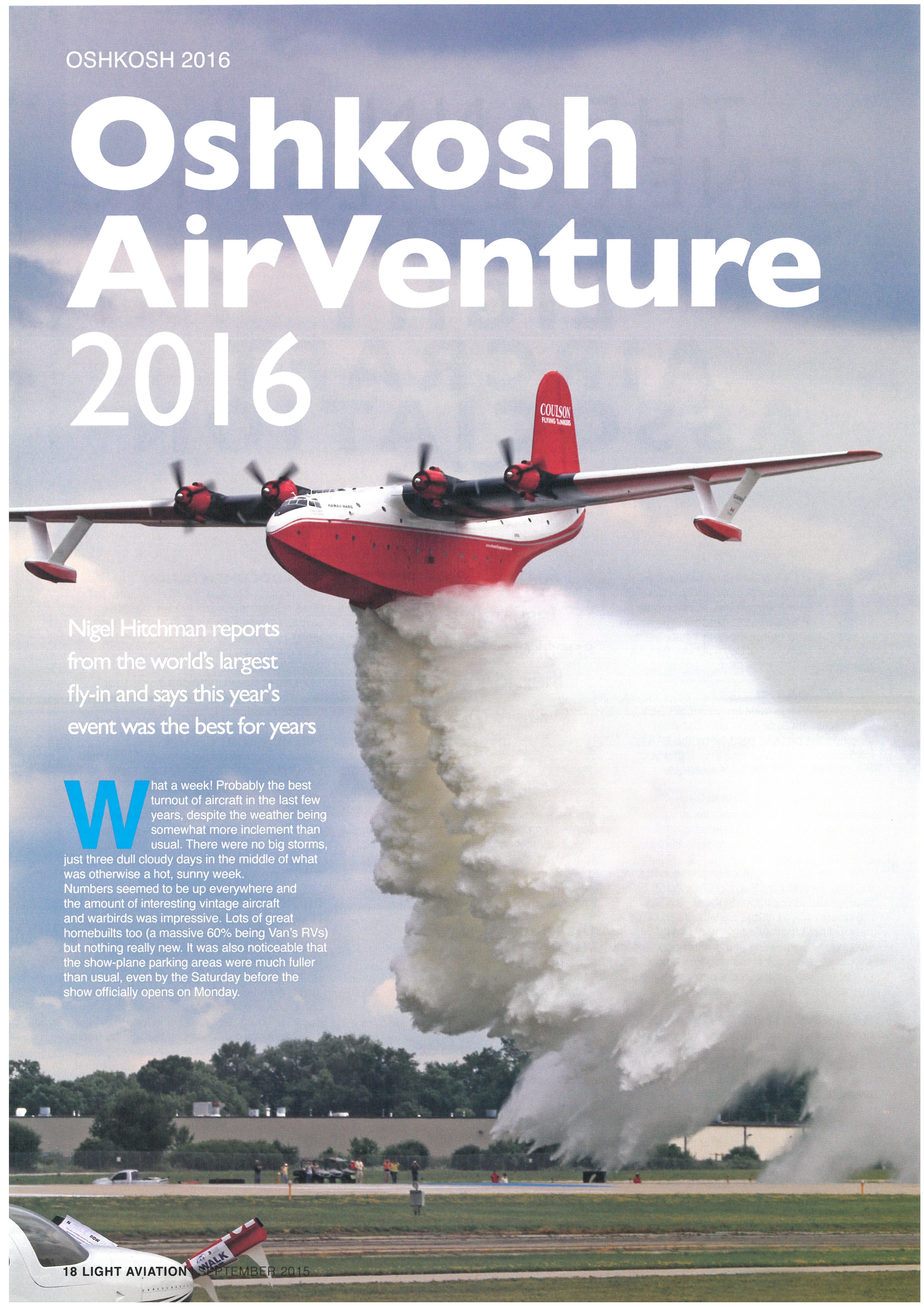
(Main) A glider during awinch launch.Its rate of climb is tremendous and you are unlikely to spot it until it is too late to avoid. Photo courtesy of the Air League. How close would you like to tangle with this? The chances of you spotting it are pretty slim.
with associated increased cable descent times.
Some recent Airprox incidents illustrate the potential risks:
® A glider had to abort a winch launch at Tibenham, Norfolk when a PA28 overflew the site
m®An unidentified light aeroplane overflew Lasham, the busiest gliding site in the country, during a winch launch
mAn R44 helicopter overflew Husbands Bosworth south of Leicester and caused a glider to abort its winch launch.
All three of these incidents were categorised in the highest risk category - A where it was judged a serious risk of collision existed and luck played a major part in the fact that collisions didn’t occur. The full reports are available from www.airproxboard.org.uk
The key point is that pilots should not rely on seeing the winch launch happening as they approach the glider site. The glider will go from ground to 1,000-1,500ft in about 20 seconds, SOspotting it in the climb is too late to do anything about the conflict.
Nor has the danger passed once the glider has released from the winch as pilots are very unlikely to see the cable itself. Depending on the winch-launch height, the hazard from these continues for at least another 20-30 seconds as it descends under a small parachute that is effectively invisible. Some glider sites are capable of launching to altitudes of 3-4000ft,
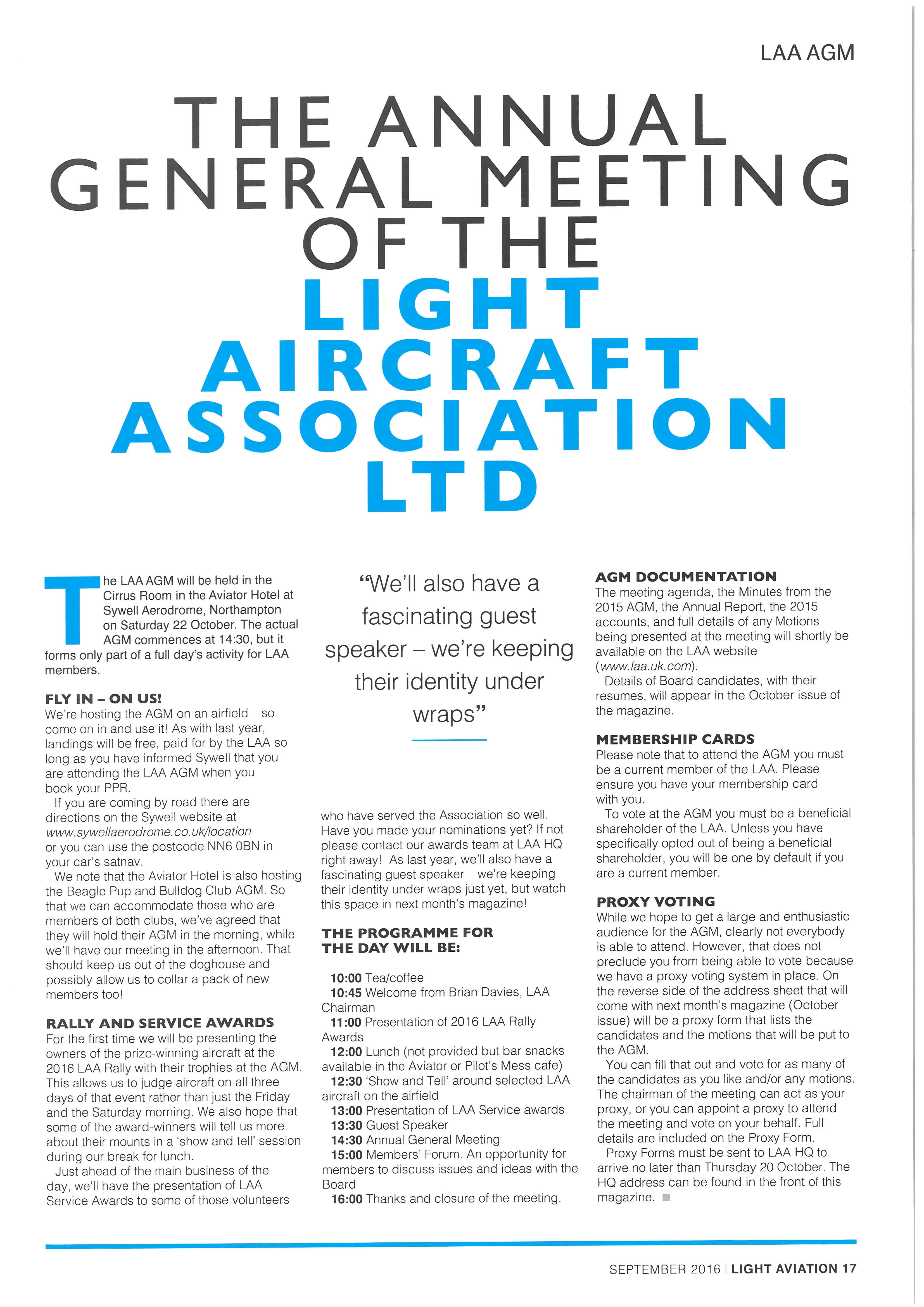
Note that maximum launch altitudes are indicated on the half million VFR chart with a forward slash and height. As an example, Lasham has a maximum winch-launch altitude of 3,700ft, see chart segment above. Pilotsshould always assume that a gliding
LICOPTER,
\CTIVITY »tes3&4
This segment of the half mil VFR Chart shows the symbol for gliding sites (in this case Lasham) with winch launching and maximum height.
site is active. Ed Downham who, as well as being a UKAB gliding member, is a Boeing 777 captain said, “So far, we haven't seen an actual mid-air, either between the aircraft or with the descending winch cable. But it could soon be a matter for the AAIB rather than UKAB. Be under no illusion, such an encounter is highly likely to be fatal for those involved”.
Chris Fox, another UKAB gliding member and an R44 pilot, also said, “A recurring theme in these reports is that the powered aircraft pilot assumed that the gliding site would not be active perhaps because the weather was less than perfect, or it was late in the day. Gliders can, and do, winch-launch in strong winds and any cloud base that permits the launch to be completed safely often in conditions that would deter many other GA pilots.”
The UKAB advice is to avoid glider sites at all times. Only overfly them if you have timely, positive confirmation from the site itself that they are inactive. When avoiding glider sites, beware of simply skirting the site by a narrow margin because there are likely to be gliders
operating close to the site as they soar within gliding range and, even if a site has finished winch-launching for the day, it may have gliders returning from cross country flights, or motor gliders self-launching into the local area.
Ed’s note: Though many gliders these days fly with the FLARM electronic conspicuity device, and Power FLARM is available for light aircraft to provide audio and visual cues to spotting gliders in the vicinity, this field of technology is currently changing very rapidly.
ADS-B and PilotAware systems have come onto the conspicuity scene which interact with tablet software navigation systems, such as SkyDemon, and these are seen by many to offer more advantages and better value to the sport and recreational pilot but they do not currently interact with FLARM.
he LAAAGM will be held in the Cirrus Room in the Aviator Hotel at Sywell Aerodrome, Northampton on Saturday 22 October. The actual AGM commences at 14:30, but it forms only part of a full day’s activity for LAA members.
FLY IN - ON US!
We're hosting the AGM on an airfield so come on in and use it! As with last year, landings will be free, paid for by the LAA so long as you have informed Sywell that you are attending the LAA AGM when you book your PPR.
If you are coming by road there are directions on the Sywell website at www.sywellaerodrome.co.uk/location or you can use the postcode NN6 OBNin your car's satnav.
We note that the Aviator Hotel is also hosting the Beagle Pup and Bulldog Club AGM. So that we can accommodate those who are members of both clubs, we’ve agreed that they will hold their AGM in the morning, while we'll have our meeting in the afternoon. That should keep us out of the doghouse and possibly allow us to collar a pack of new members too!
RALLY AND SERVICE AWARDS
For the first time we will be presenting the owners of the prize-winning aircraft at the 2016 LAA Rally with their trophies at the AGM. This allows us to judge aircraft on all three days of that event rather than just the Friday and the Saturday morning. We also hope that some of the award-winners will tell us more about their mounts in a ‘show and tell’ session during our break for lunch.
Just ahead of the main business of the day, we'll have the presentation of LAA Service Awards to some of those volunteers
“We'll also have a fascinating guest speaker we're keeping their identity under wraps”
who have served the Association so well. Have you made your nominations yet? If not please contact our awards team at LAA HQ right away! As last year, we'll also have a fascinating guest speaker we're keeping their identity under wraps just yet, but watch this space in next month’s magazine!
THE PROGRAMME FOR THE DAY WILL BE:
10:00 Tea/coffee
10:45 Welcome from Brian Davies, LAA Chairman
11:00 Presentation of 2016 LAA Rally Awards
12:00 Lunch (not provided but bar snacks available in the Aviator or Pilot's Mess cafe)
12:30 ‘Show and Tell’ around selected LAA aircraft on the airfield
13:00 Presentation of LAA Service awards
13:30 Guest Speaker
14:30 Annual General Meeting
15:00 Members’ Forum. An opportunity for members to discuss issues and ideas with the Board
AGM DOCUMENTATION
The meeting agenda, the Minutes from the 2015 AGM, the Annual Report, the 2015 accounts, and full details of any Motions being presented at the meeting will shortly be available on the LAA website (www.laa.uk.com).
Details of Board candidates, with their resumes, will appear in the October issue of the magazine.
MEMBERSHIP CARDS
Please note that to attend the AGM you must be a current member of the LAA. Please ensure you have your membership card with you.
To vote at the AGM you must be a beneficial shareholder of the LAA. Unless you have specifically opted out of being a beneficial shareholder, you will be one by default if you are a current member.
PROXY VOTING
While we hope to get a large and enthusiastic audience for the AGM, clearly not everybody is able to attend. However, that does not preclude you from being able to vote because we have a proxy voting system in place. On the reverse side of the address sheet that will come with next month’s magazine (October issue) will be a proxy form that lists the candidates and the motions that will be put to the AGM.
You can fill that out and vote for as many of the candidates as you like and/or any motions. The chairman of the meeting can act as your proxy, or you can appoint a proxy to attend the meeting and vote on your behalf. Full details are included on the Proxy Form.
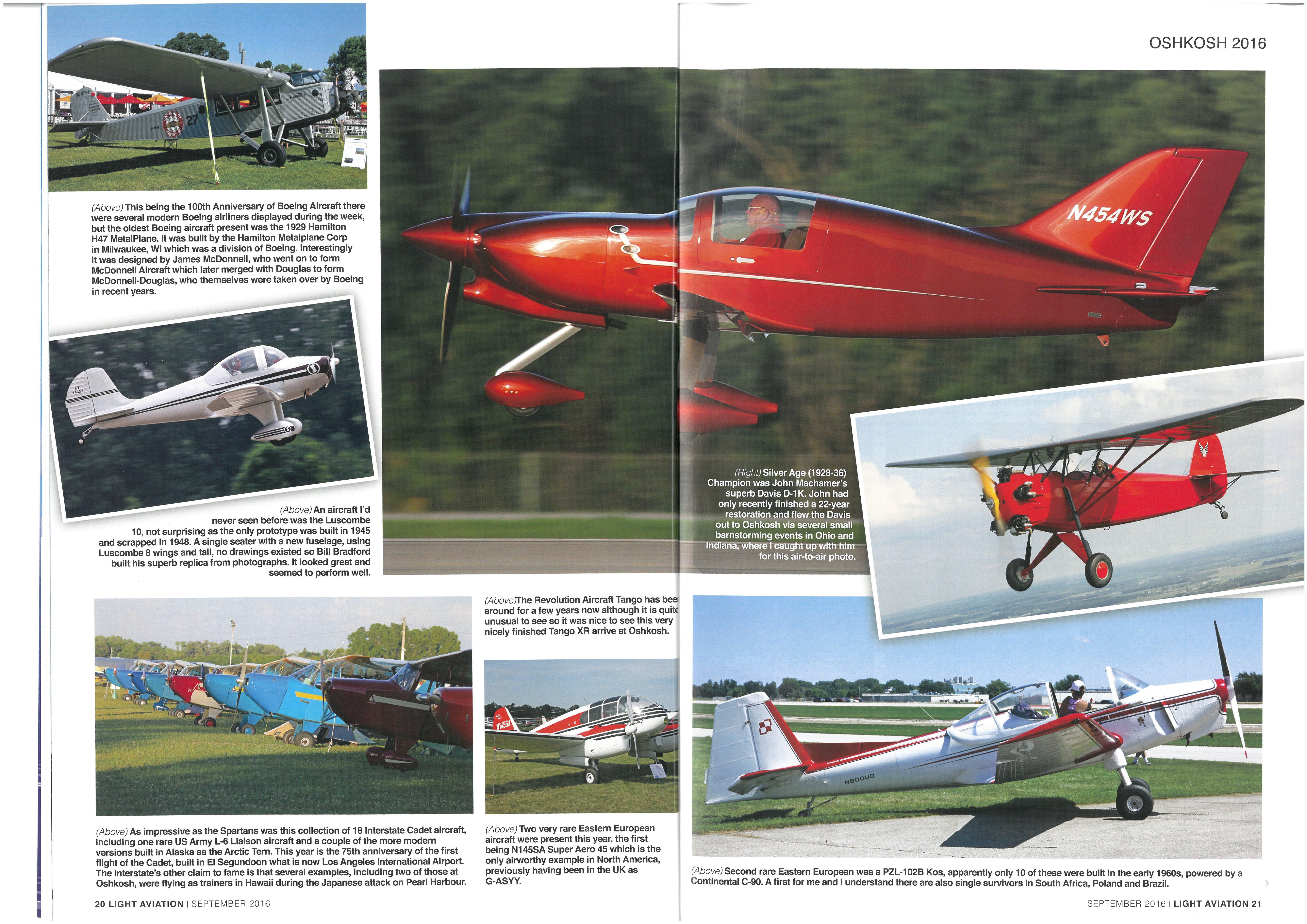
(Above) Grand Champion Antique was Ted Teach’s Ryan ST.One of only five built and the only survivor, it is the predecessor of the ST-A and ST-M as well as the Army PT-22 trainer. A nine-year restoration from what was a complete airworthy aircraft, it made its first flight in 37 years a month before flying to Oshkosh.
(Above) Unusually there were very few open cockpit Wacos, but John Cournoyer’s beautiful newly restored Waco UBF N1244G made up for the lack of numbers.
(Left) Biggest surprise in the Antiques was John Pike’s 1929 Bellanca CH300 Pacemaker, which had just finished a major restoration and set off for Oshkosh from Oregon with only two hours on the clock. A beautiful job, the aircraft is not set to be a hangar queen as it has been sold to North-Wright Airways in Norman Wells, North West Territory, Canada where it will operate on floats doing tourist flights into the Mackenzie Mountains and other areas of the Canadian Arctic.
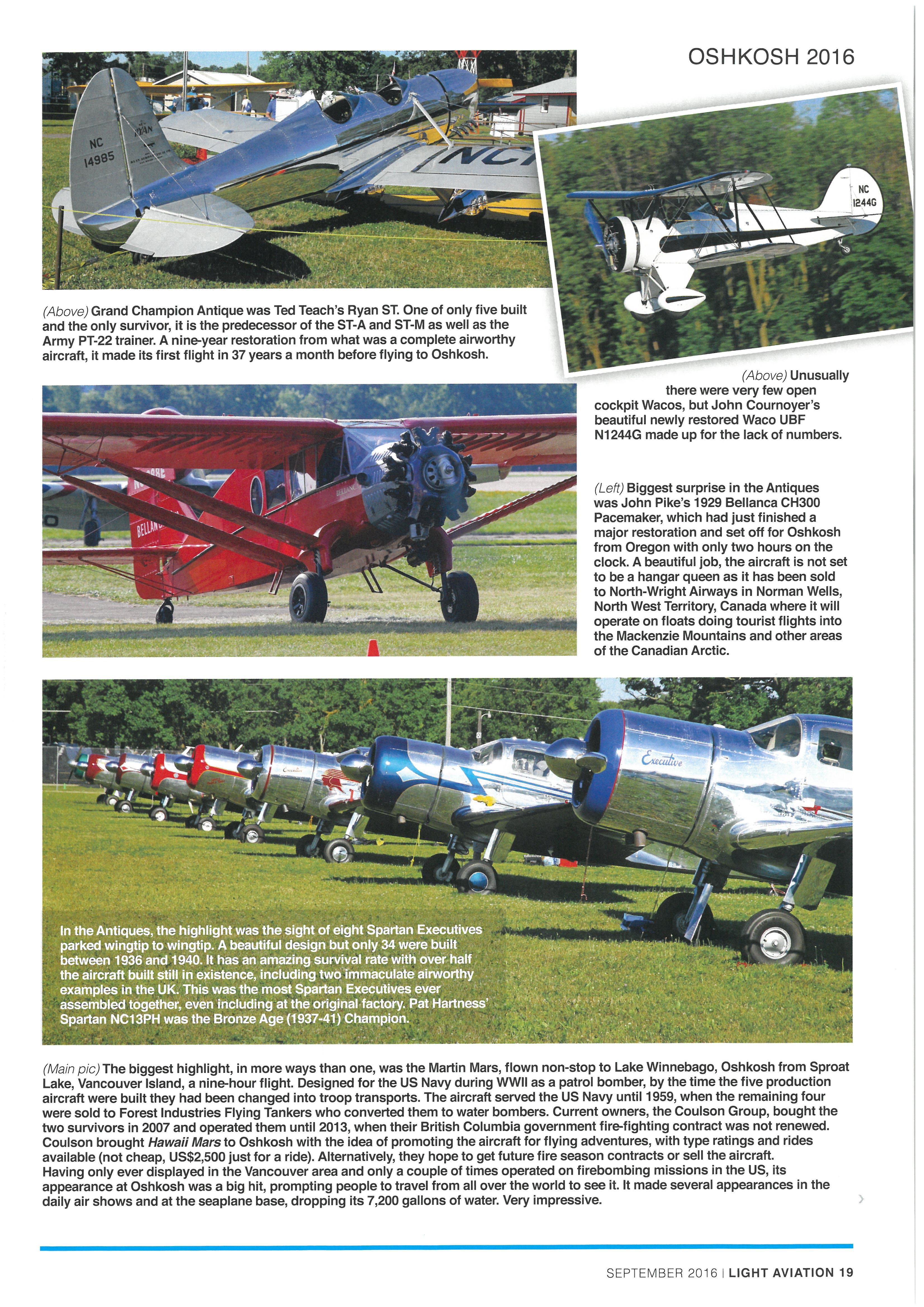
(Main pic)The biggest highlight, in more ways than one, was the Martin Mars, flown non-stop to Lake Winnebago, Oshkosh from Sproat Lake, Vancouver Island, a nine-hour flight. Designed for the US Navy during WWII as a patrol bomber, by the time the five production aircraft were built they had been changed into troop transports. The aircraft served the US Navy until 1959, when the remaining four were sold to Forest Industries Flying Tankers who converted them to water bombers. Current owners, the Coulson Group, bought the two survivors in 2007 and operated them until 2013, when their British Columbia government fire-fighting contract was not renewed. Coulson brought Hawaii Mars to Oshkosh with the idea of promoting the aircraft for flying adventures, with type ratings and rides available (not cheap, US$2,500 just for a ride). Alternatively, they hope to get future fire season contracts or sell the aircraft. Having only ever displayed in the Vancouver area and only a couple of times operated on firebombing missions in the US, its appearanceatOshkoshwasa bighit,promptingpeopletotravelfromallovertheworldtoseeit.Itmadeseveralappearancesinthe daily air shows and at the seaplane base, dropping its 7,200 gallons of water. Very impressive.
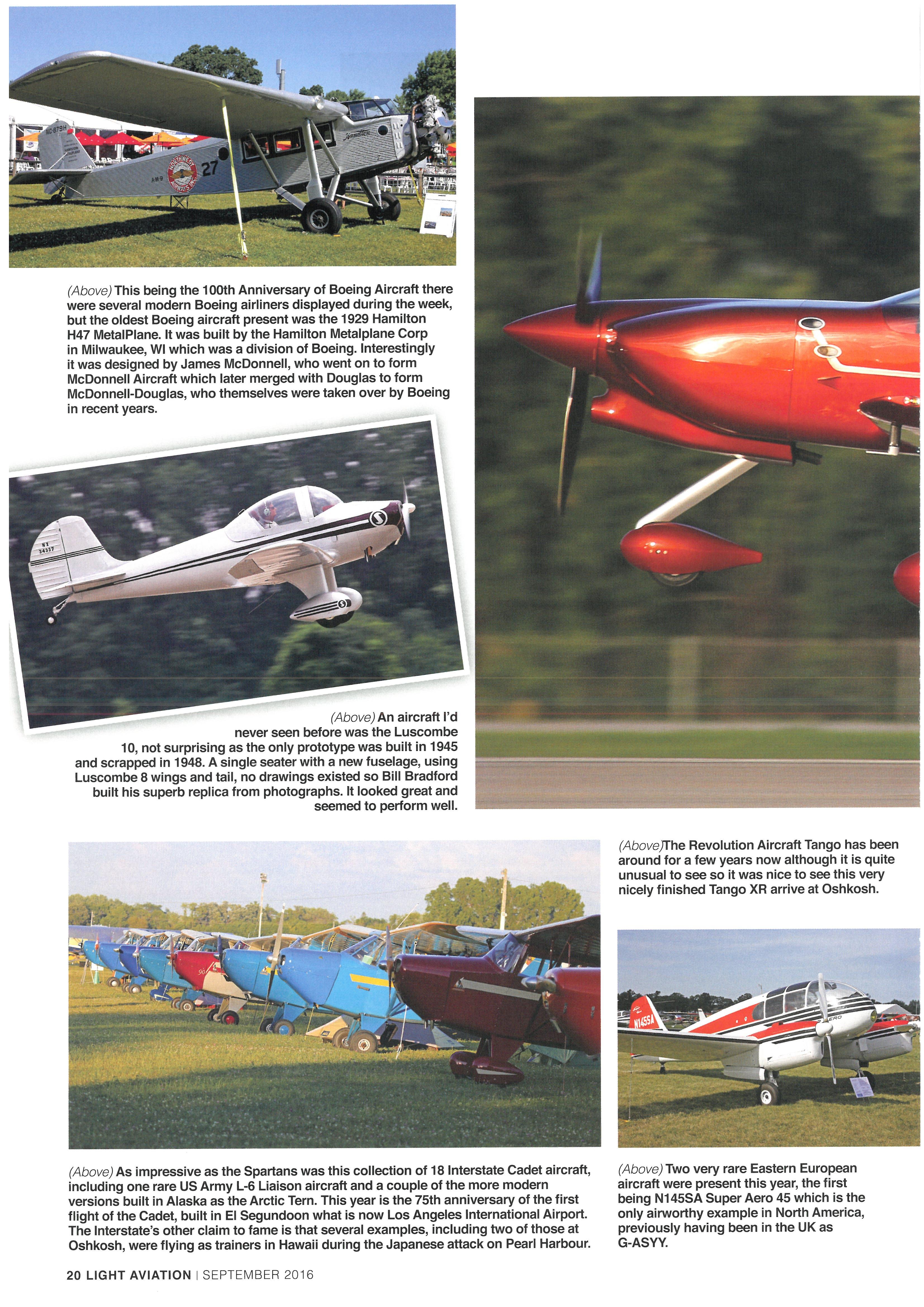
(Above)This being the 100th Anniversary of Boeing Aircraft there were several modern Boeing airliners displayed during the week, but the oldest Boeing aircraft present was the 1929 Hamilton H47 MetalPlane. It was built by the Hamilton Metalplane Corp inMilwaukee,WIwhichwasa divisionofBoeing.Interestingly it was designed by James McDonnell, who went on to form McDonnell Aircraft which later merged with Douglas to form McDonnell-Douglas, who themselves were taken over by Boeing in recent years.
(Above) An aircraft I’d never seen before was the Luscombe 10, not surprising as the only prototype was built in 1945 and scrapped in 1948.A single seater with a new fuselage, using Luscombe8 wings and tail, no drawings existed so Bill Bradford built his superb replica from photographs. It looked great and seemed to perform well.
Interstate’s
were
is that several examples,
(Above) As impressive as the Spartans was this collection of 18 Interstate Cadet aircraft, including one rare US Army L-6 Liaison aircraft and a couple of the more modern versions built in Alaska as the Arctic Tern. This year is the 75th anniversary of the first flight of the Cadet, built in El Segundoon what is now Los Angeles International Airport.
(Above)The Revolution Aircraft Tango has been around for a few years now although it is quite unusual to see so it was nice to see this very nicely finished Tango XR arrive at Oshkosh.
(Above) Two very rare Eastern European aircraft were present this year, the first being N145SA Super Aero 45 which is the only airworthy example in North America, previously having been in the UK as G-ASYY.
The
other claim to fame
including two of those at Oshkosh,
flying as trainers in Hawaii during the Japanese attack on Pearl Harbour.
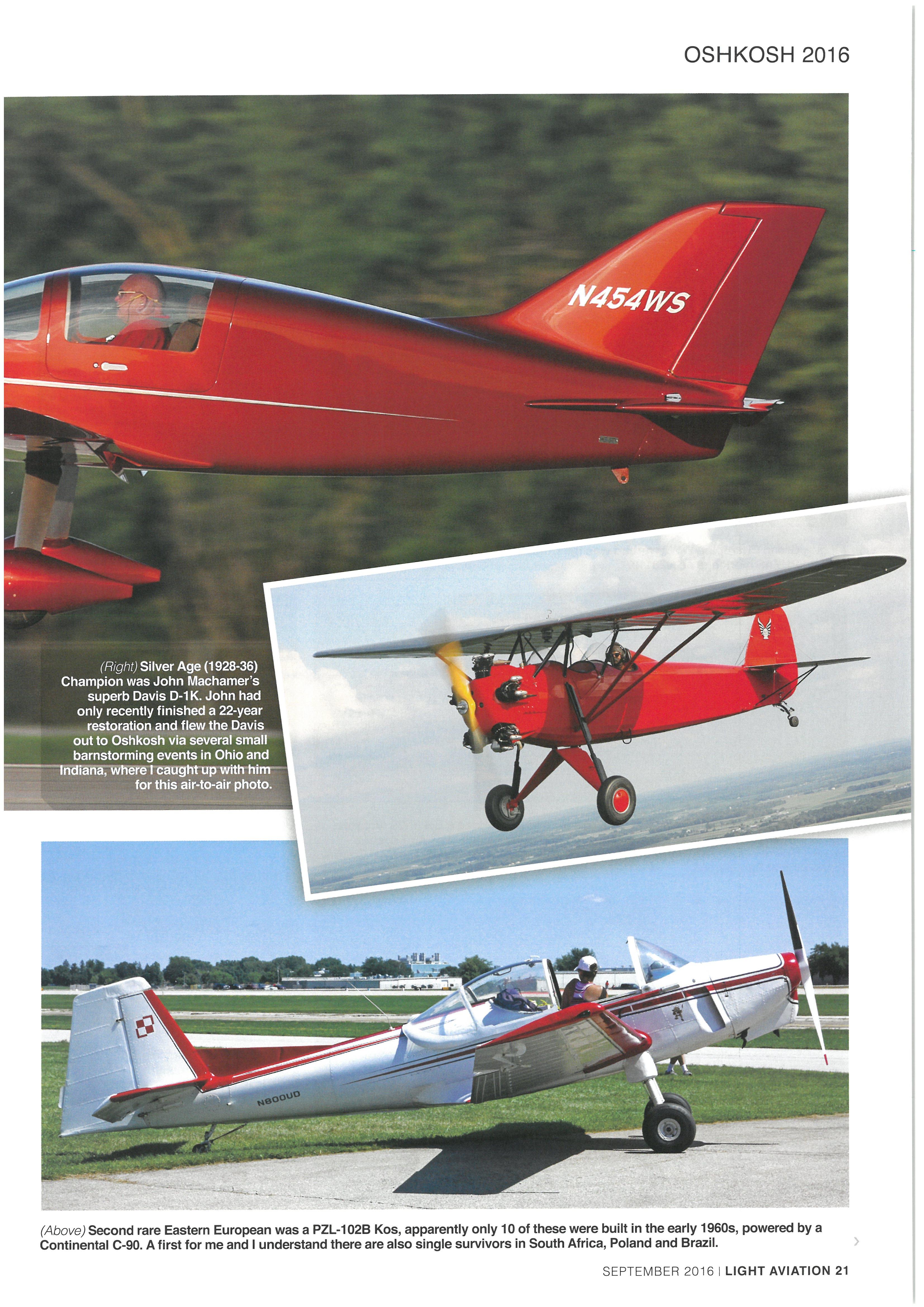
(Right)Silver Age (1928-36) Champion was John Machamer’s superb Davis D-1K. John had only recently finished a 22-year restoration and flew the Davis out to Oshkosh via several small barnstorming events in Ohio and ndiana, whereTcaughtupwithhim for this air-to-air photo.
(Above) Second rare Eastern European was a PZL-102B Kos, apparently only 10 of these were built in the early 1960s, powered by a Continental C-90. A first for me and | understand there are also single survivors in South Africa, Poland and Brazil.
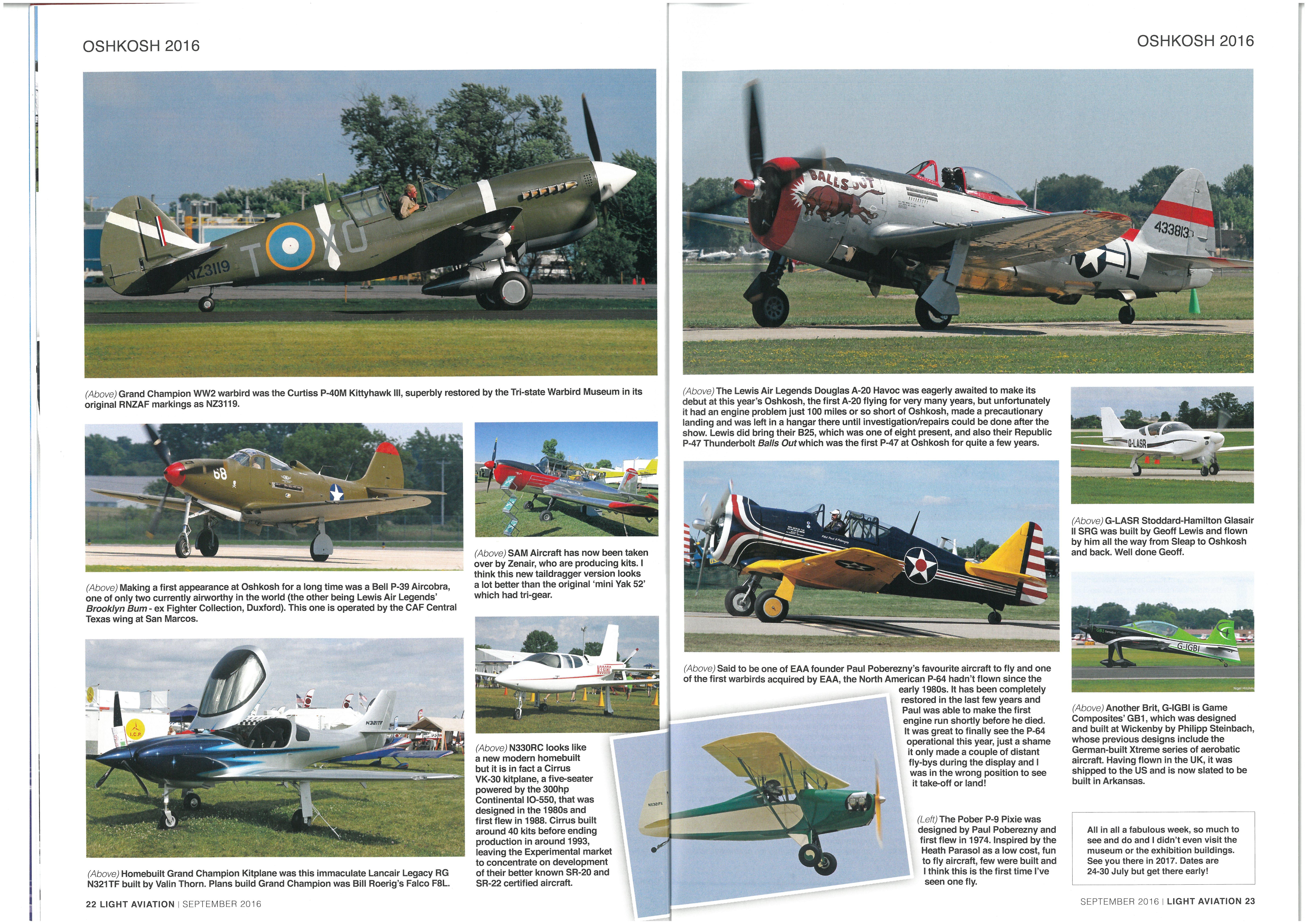
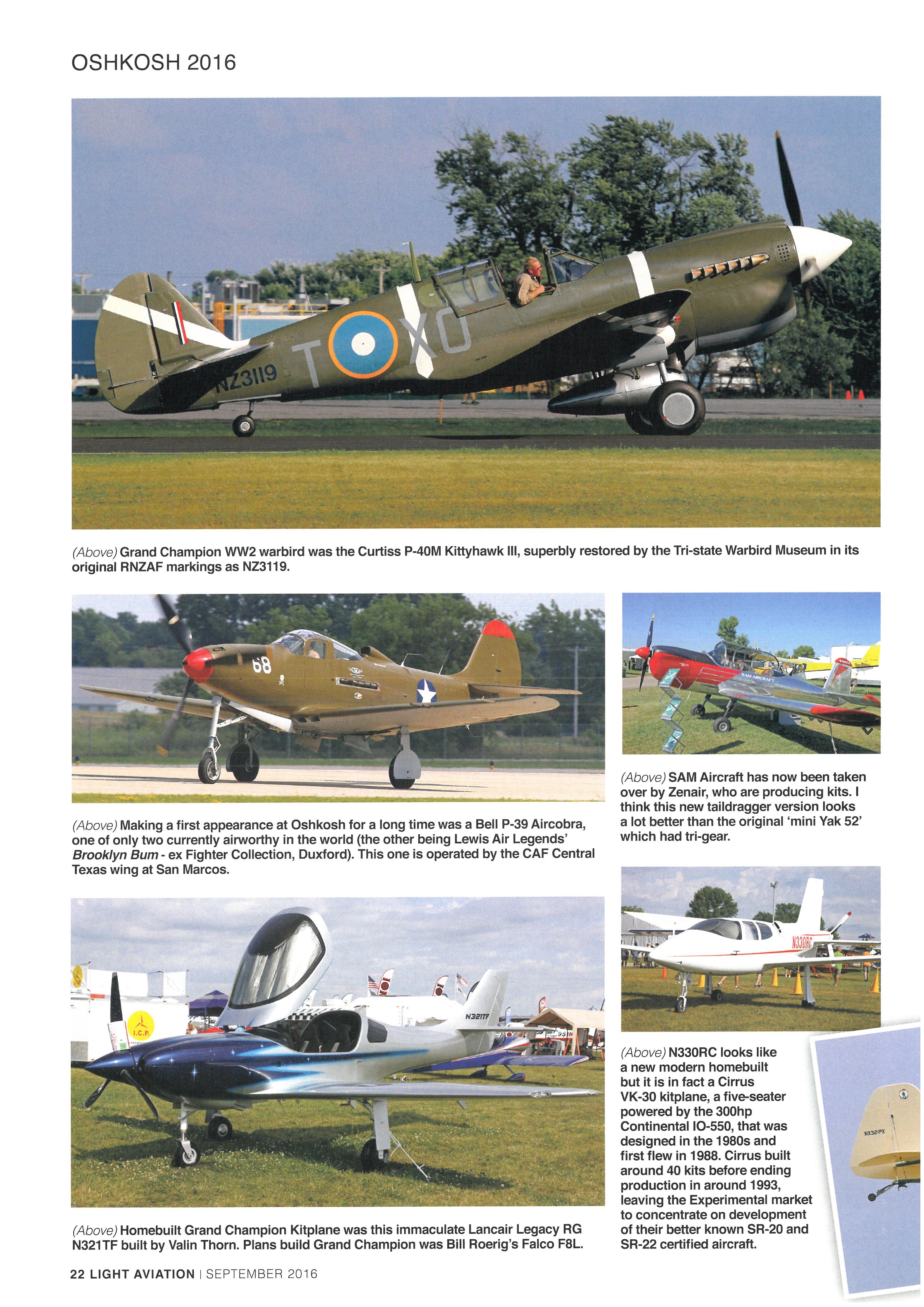
original RNZAF markings as NZ3119.
(Above) Making a first appearance at Oshkosh for a long time was a Bell P-39Aircobra, one of only two currently airworthy in the world (the other being LewisAir Legends’ Brooklyn Bum- ex Fighter Collection, Duxford). This one is operated by the CAF Central Texas wing at San Marcos.
which had tri-gear.
(Above) N330RC looks like a new modern homebuilt but it is in fact a Cirrus VK-30 kitplane, a five-seater powered by the 300hp Continental |O-550, that was designed in the 1980s and first flew in 1988. Cirrus built around 40 kits before ending production in around 1993, leaving the Experimental market to concentrate on development of their better known SR-20 and SR-22 certified aircraft.
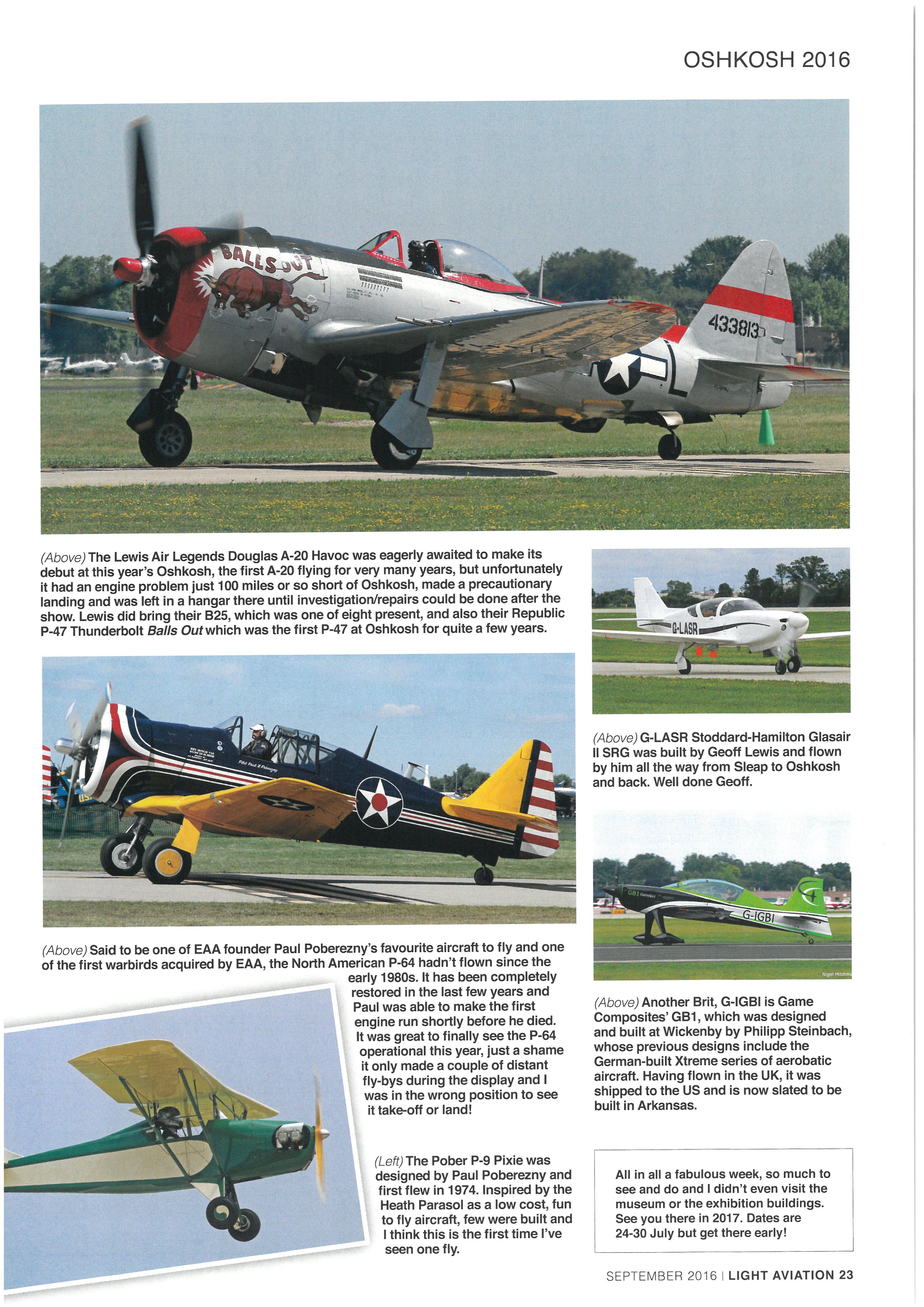
(Above) The Lewis Air Legends Douglas A-20 Havoc was eagerly awaited to make its debut at this year’s Oshkosh, the first A-20 flying for very many years, but unfortunately it had an engine problem just 100 miles or so short of Oshkosh, made a precautionary landing and was left in a hangar there until investigation/repairs could be done after the show. Lewis did bring their B25, which was one of eight present, and also their Republic P-47 Thunderbolt Balls Outwhich was the first P-47 at Oshkosh for quite a few years.
(Above) Said to be one of EAA founder Paul Poberezny’s favourite aircraft to fly and one of the first warbirds acquired by EAA, the North American P-64 hadn’t flown since the early 1980s. It has been completely restored in the last few years and Paul was able to make the first engine run shortly before he died. Itwas great to finally see the P-64 operational this year, just a shame it only made a couple of distant fly-bys during the display and | was in the wrong position to see it take-off or land!
(Left)The Pober P-9 Pixiewas
designed by Paul Poberezny and first flew in 1974. Inspired by the Heath Parasol as a low cost, fun to fly aircraft, few were built and | think this is the first time I’ve seen one fly.
(Above) Another Brit, G-IGBI is Game Composites’ GB1, which was designed and built at Wickenby by Philipp Steinbach, whose previous designs include the German-built Xtreme series of aerobatic aircraft. Having flown in the UK, it was shipped to the US and is now slated to be built in Arkansas.
All in all a fabulous week, so much to see and do and | didn’t even visit the museum or the exhibition buildings. See you there in 2017. Dates are 24-30 July but get there early!
(Above) G-LASR Stoddard-Hamilton Glasair ll SRG was built by Geoff Lewis and flown by him all the way from Sleap to Oshkosh and back. Well done Geoff.
24LIGHTAVIATION|SEPTEMBER 2016
he crossing of the Channel was to be more taxing than normal. When the weather wants to be difficult, it creates a trough, and troughs seem to like to make mischief. The original destination had been Caen but the weather deteriorated to severe IR conditions. Cherbourg and Deauville had already gone red on Orbifly, and airports to the south either demanded more fuel or were similarly impacted by the trough. So the choice was Dinard, hopefully at some point to rendezvous with the other participants in this flying adventure to Spain.
The flight itself from Coal Aston was routine. Above 3,500ft the murky conditions disappeared and despite some radio interference, Southampton gave me a clearance through the Solent airspace. Some miles after St Catherine's Point on the Isle of Wight, the forward vis began to reduce until sea and sky indiscernibly merged. God bless the artificial horizon, which did its job and provided a mechanical alternative.
On track between Gattville lighthouse and DIKRO there was a moment of artistic wonder as two vintage Dakotas in line astern, preparing forparachutedropsatSt-Mére-Eglise,were
ByBobHitchcock
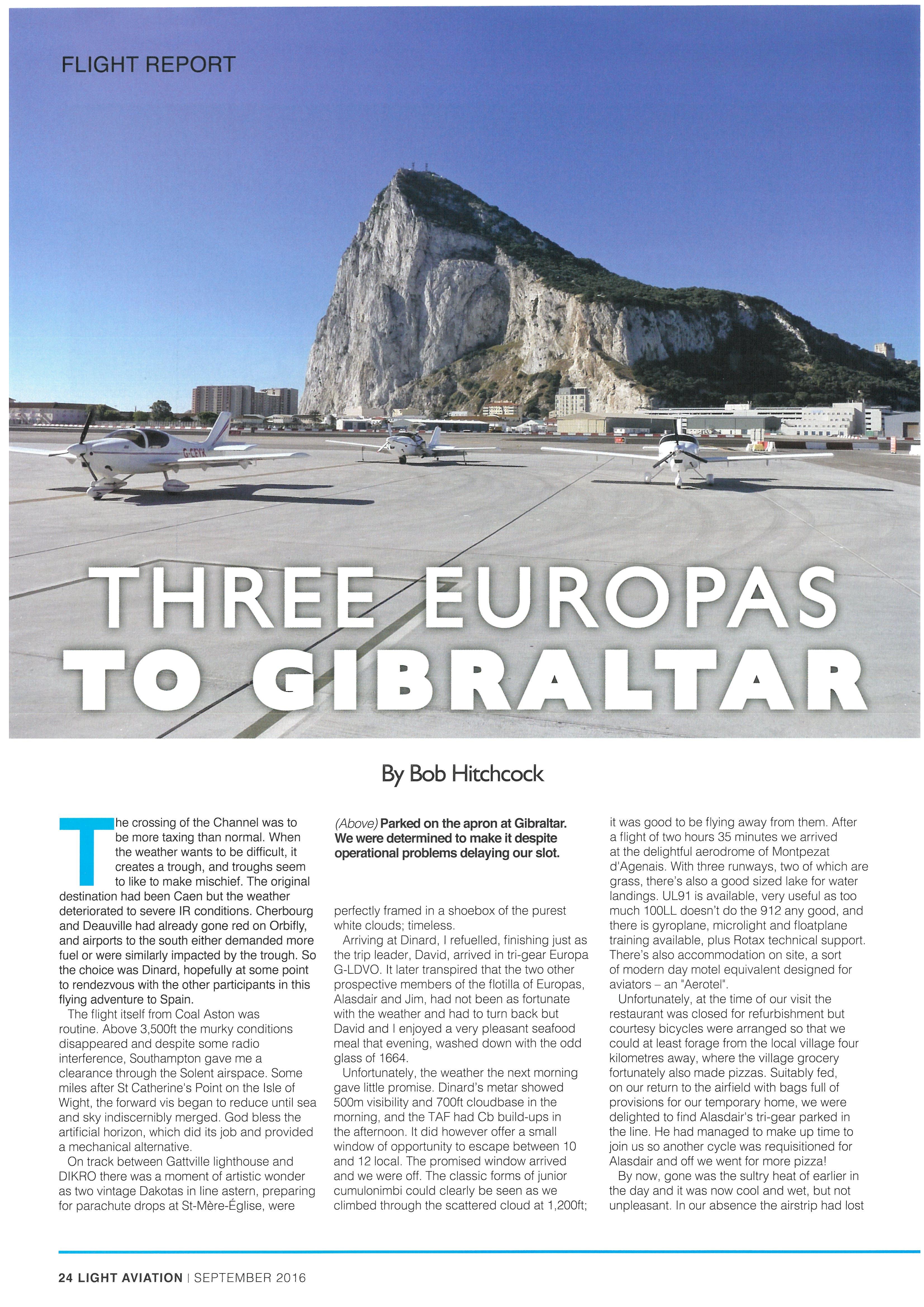
(Above)Parked on the apron at Gibraltar. We were determined to make itdespite operational problems delaying our slot.
perfectly framed in a shoebox of the purest white clouds; timeless.
Arriving at Dinard, | refuelled, finishing just as the trip leader, David, arrived in tri-gear Europa G-LDVO. It later transpired that the two other prospective members of the flotilla of Europas, Alasdair and Jim, had not been as fortunate with the weather and had to turn back but David and | enjoyed a very pleasant seafood meal that evening, washed down with the odd glass of 1664.
Unfortunately, the weather the next morning gave little promise. Dinard’s metar showed 500m visibility and 7O0Oftcloudbase in the morning, and the TAF had Cb build-ups in the afternoon. It did however offer a small window of opportunity to escape between 10 and 12 local. The promised window arrived and we were off. The classic forms of junior Ccumulonimbicould clearly be seen as we climbed through the scattered cloud at 1,200ft:
it was good to be flying away from them. After a flight of two hours 35 minutes we arrived at the delightful aerodrome of Montpezat d'Agenais. With three runways, two of which are grass, there’s also a good sized lake for water landings. UL91 is available, very useful as too much 100LL doesn’t do the 912 any good, and there is gyroplane, microlight and floatplane training available, plus Rotax technical support. There’s also accommodation on site, a sort of modern day motel equivalent designed for aviators an "Aerotel".
Unfortunately, at the time of our visit the restaurant was closed for refurbishment but courtesy bicycles were arranged so that we could at least forage from the local village four kilometres away, where the village grocery fortunately also made pizzas. Suitably fed, on our return to the airfield with bags full of provisions for our temporary home, we were delighted to find Alasdair's tri-gear parked in the line. He had managed to make up time to join us so another cycle was requisitioned for Alasdair and off we went for more pizza! By now, gone was the sultry heat of earlier in the day and it was now cool and wet, but not unpleasant. In our absence the airstrip had lost
electrical power due to a thunderstorm but we could at least make coffee on the gas stove. However, iPads and iPhones were now not able to be charged, so paper charts were brought out so we could plan the next day's activity. Though the power later returned there was no phone signal or connectivity of any sort, except, bizarrely Whatsapp. The digital age does have its limitations!
A positioning flight was needed before the run through the Pyrenees and into Spain so we planned to route to Pau Burros. From Pau we were heading for central Spain, to Casarrubios delMonte,whichdemanded a flightplanfor flight through the mountains. Our IT problems persisted however, and prevented usfrom filing via SkyDemon and, with paper plans no longer accepted, we finally managed to file over the phone with Bordeaux.
Now well south, and with the weather having greatly improved, temperatures were warming up considerably 43° C was forecast for parts of Spain. The transponder was being interrogated more frequently too, and working at its hardest the unit generates 35 watts. Being tightly packed within the panel it has no natural ventilation so | was thankful that | had
“it was on the second of these two flights that we experienced the issue of the iPads switching themselves off, as described in Safety Spot last month”
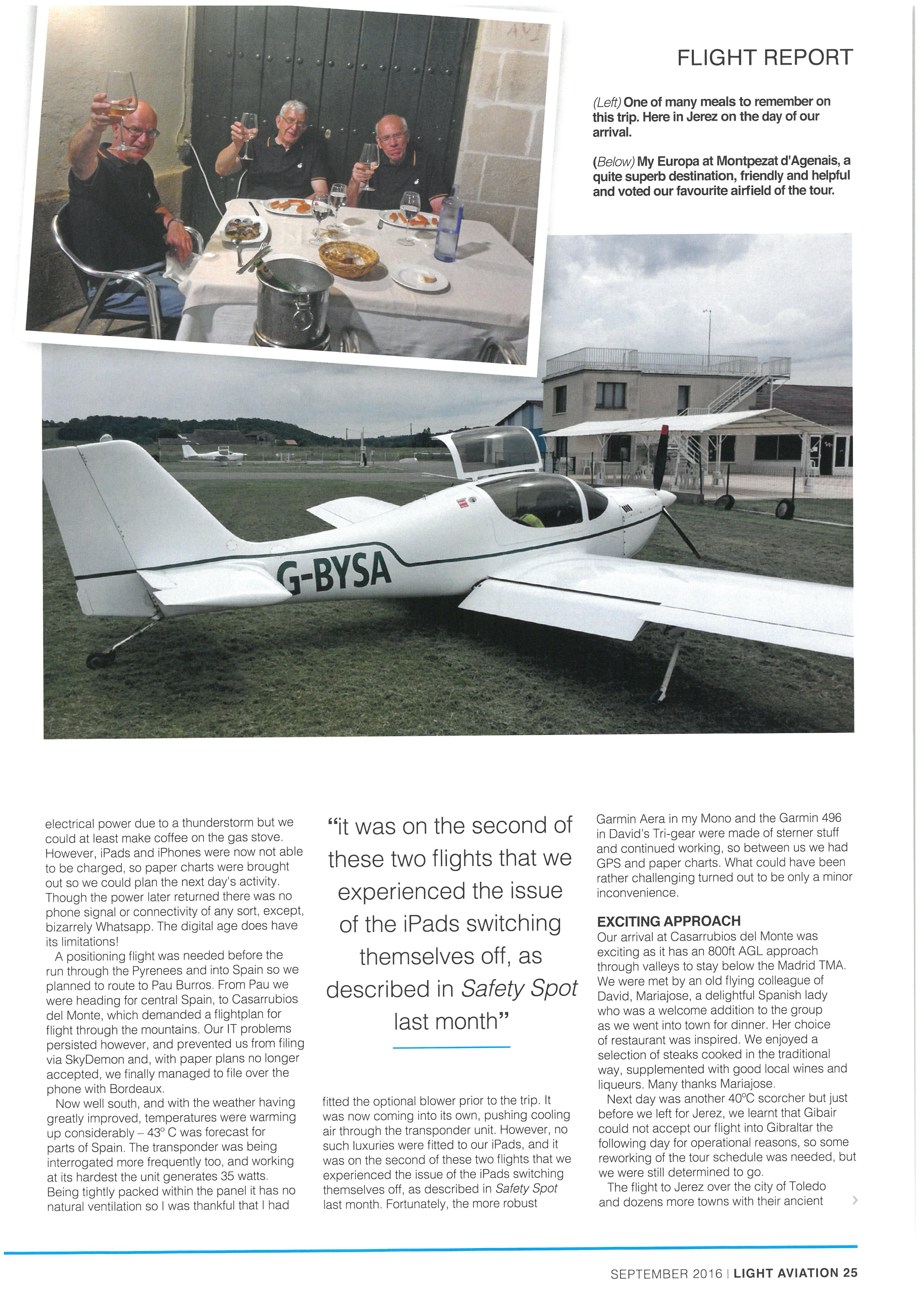
(Left)One of many meals to remember on this trip. Here in Jerez on the day of our arrival.
(Below)My Europa at Montpezat d'Agenais, a quite superb destination, friendly and helpful and voted our favourite airfield of the tour. Garmin Aera in my Mono and the Garmin 496 in David's Tri-gear were made of sterner stuff and continued working, so between us we had GPS and paper charts. What could have been rather challenging turned out to be only a minor inconvenience.
fitted the optional blower prior to the trip. It was now coming into its own, pushing cooling air through the transponder unit. However, no such luxuries were fitted to our iPads, and it was on the second of these two flights that we experienced the issue of the iPads switching themselves off, as described in Safety Spot last month. Fortunately, the more robust
EXCITING APPROACH
Our arrival at Casarrubios del Monte was exciting as it has an 800ft AGL approach through valleys to stay below the Madrid TMA. We were met by an old flying colleague of David, Mariajose, a delightful Spanish lady who was a welcome addition to the group as we went into town for dinner. Her choice of restaurant was inspired. We enjoyed a selection of steaks cooked in the traditional way, supplemented with good local wines and liqueurs. Many thanks Mariajose.
Next day was another 40°C scorcher but just before we left for Jerez, we learnt that Gibair could not accept our flight into Gibraltar the following day for operational reasons, so some reworking of the tour schedule was needed, but we were still determined to go.
The flight to Jerez over the city of Toledo and dozens more towns with their ancient
bull fighting rings revealed old Spain. The hot weather and mountainous terrain didn't help communication - hisses, cracks and whirs again. Contact with Cadiz Approach was not established until well into the last stages of the flight but David did a great job leading the flight and at one point called "Watch out for the eagle". Within milliseconds a large black eagle passed by my starboard wing. Wow. I’ve never had a bird strike and | never want one, those eagles are really big!
Because of the lack of ability to make two-way contact with ATC we were obliged to make most of the trip at 1,000 feet or less, to stay clear of the Madrid TMA controlled airspace. We enjoyed stunning vistas of ambers, yellows, and bleached greens with occasional olive and orange plantations. The temperature in the cockpit were massively high on this leg and dehydration was kept at bay with multiple bottles of water. Even my transponder shut itself down, despite the newly installed blower and its declared working range of -20°C to +55°C. Another improvement project when back home! Fortunately, in respect of this trip, it wasn’t the end of the world because we were on a formation flightplan and only the lead aircraft was required to have its transponder switched on.
At Jerez our formation went into line astern to join midpoint downwind for 20. This place was busy but we flew a full circuit made all the more enjoyable for the challenge of landing, on short separation and clearing the runway at the first exit to allow the next traffic in. Our day ended with a meal in Jerez that finished at midnight fish, wine and sherry. Magic.
It was time to relax and be tourists in Jerez.
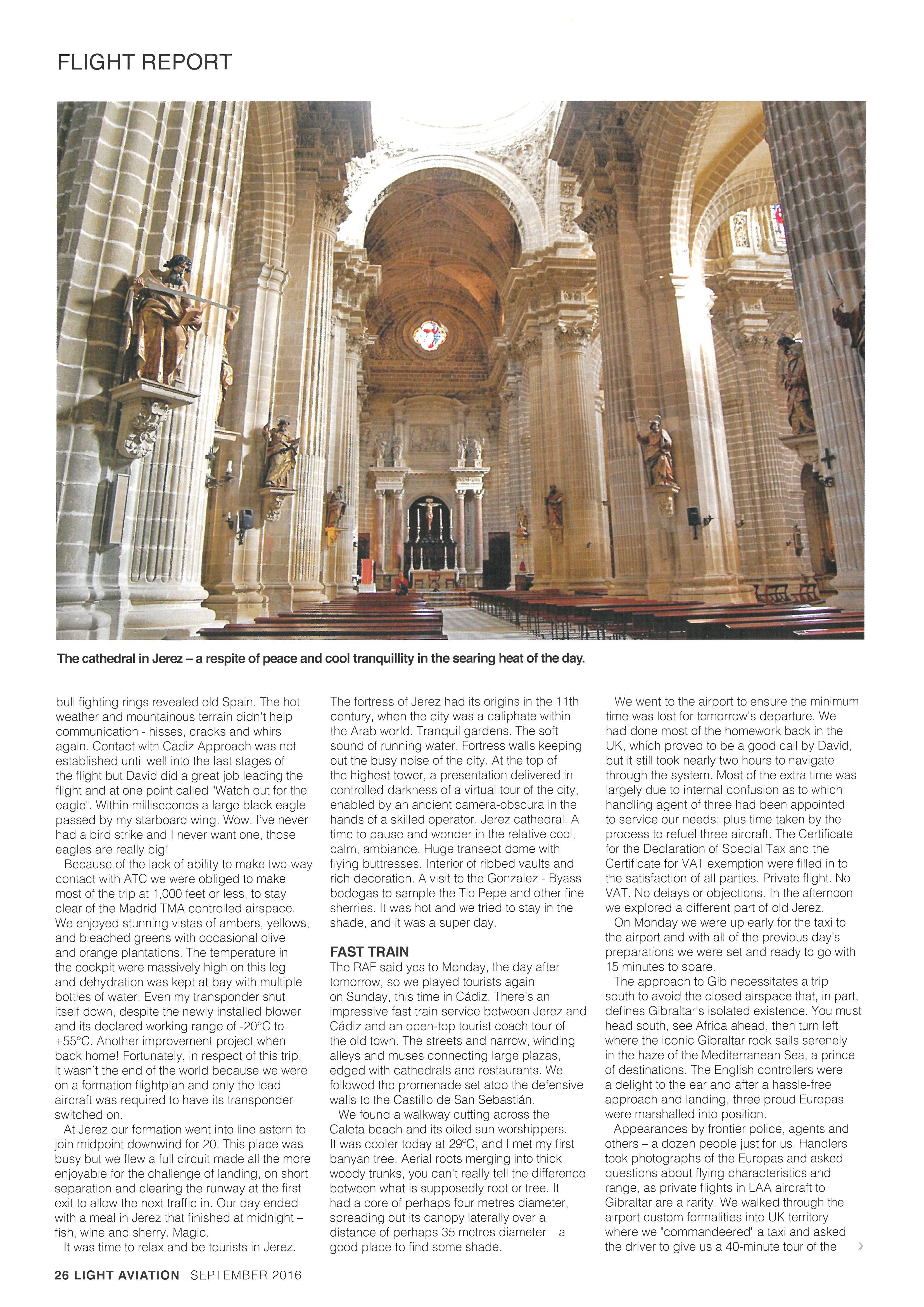
The fortress of Jerez had its origins in the 11th century, when the city was a caliphate within the Arab world. Tranquil gardens. The soft sound of running water. Fortress walls keeping out the busy noise of the city. At the top of the highest tower, a presentation delivered in controlled darkness of a virtual tour of the city, enabled by an ancient camera-obscura in the hands of a skilled operator. Jerez cathedral. A time to pause and wonder in the relative cool, calm, ambiance. Huge transept dome with flying buttresses. Interior of ribbed vaults and rich decoration. A visit to the Gonzalez - Byass bodegas to sample the Tio Pepe and other fine sherries. It was hot and we tried to stay in the shade, and it was a super day.
FAST TRAIN
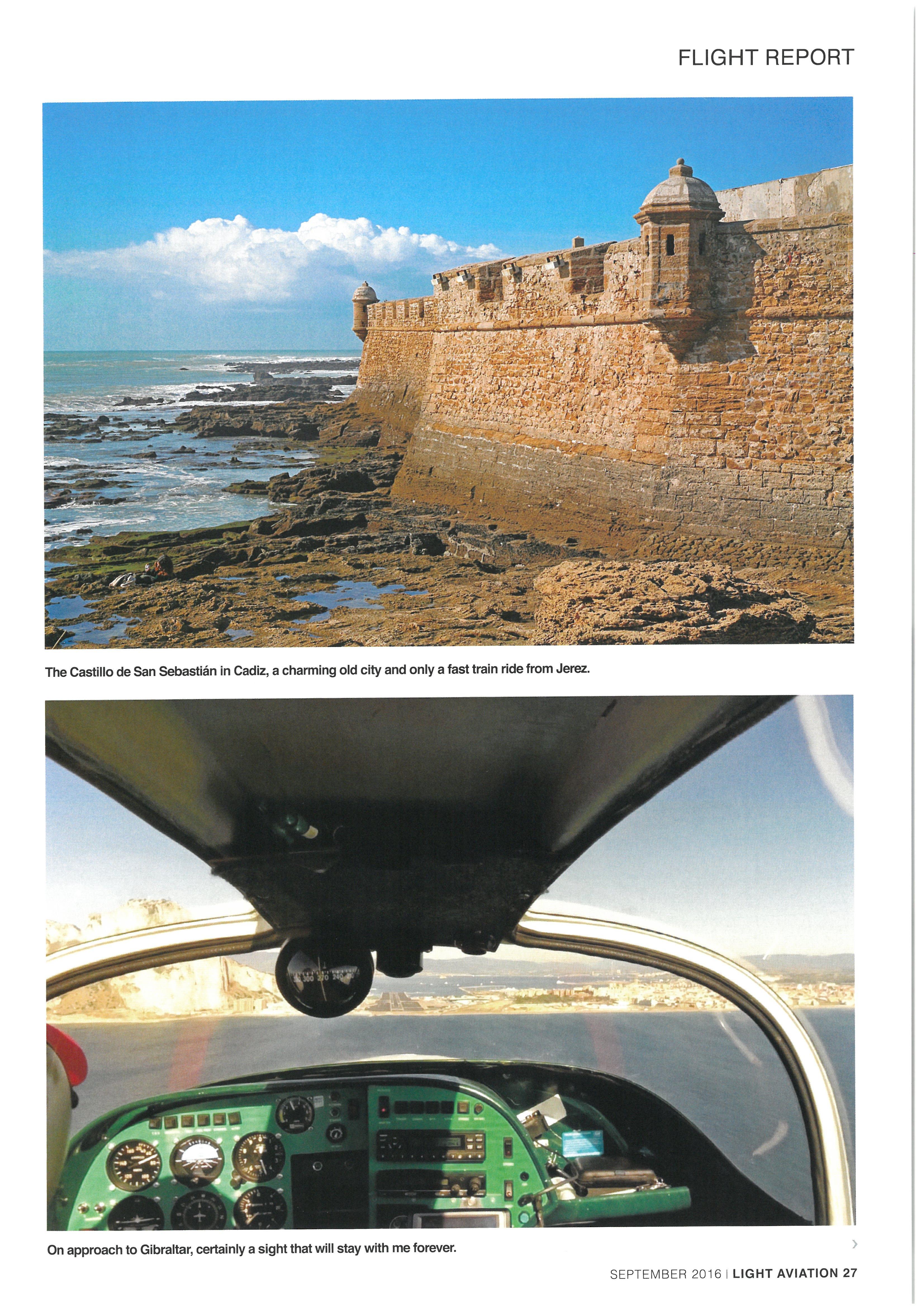
The RAF said yes to Monday, the day after tomorrow, so we played tourists again on Sunday, this time in Cadiz. There’s an impressive fast train service between Jerez and Cadiz and an open-top tourist coach tour of the old town. The streets and narrow, winding alleys and muses connecting large plazas, edged with cathedrals and restaurants. We followed the promenade set atop the defensive walls to the Castillo de San Sebastian.
We found a walkway cutting across the Caleta beach and its oiled sun worshippers. lt was cooler today at 29°C, and | met my first banyan tree. Aerial roots merging into thick woody trunks, you can't really tell the difference between what is supposedly root or tree. It had a core of perhaps four metres diameter, spreading out its canopy laterally over a distance of perhaps 35 metres diameter a good place to find some shade.
We went to the airport to ensure the minimum time was lost for tomorrow's departure. We had done most of the homework back in the UK, which proved to be a good call by David, but it still took nearly two hours to navigate through the system. Most of the extra time was largely due to internal confusion as to which handling agent of three had been appointed to service our needs; plus time taken by the process to refuel three aircraft. The Certificate for the Declaration of Special Tax and the Certificate for VAT exemption were filled in to the satisfaction of all parties. Private flight. No VAT. No delays or objections. In the afternoon we explored a different part of old Jerez.
On Monday we were up early for the taxi to the airport and with all of the previous day’s preparations we were set and ready to go with 15 minutes to spare.
The approach to Gib necessitates a trip south to avoid the closed airspace that, in part, defines Gibraltar's isolated existence. You must head south, see Africa ahead, then turn left where the iconic Gibraltar rock sails serenely in the haze of the Mediterranean Sea, a prince of destinations. The English controllers were a delight to the ear and after a hassle-free approach and landing, three proud Europas were marshalled into position.
Appearances by frontier police, agents and others a dozen people just for us. Handlers took photographs of the Europas and asked questions about flying characteristics and range, as private flights in LAA aircraft to Gibraltar are a rarity. We walked through the airport custom formalities into UK territory where we commandeered’ a taxi and asked the driver to give us a 40-minute tour of the
Rock, which he did admirably. As Europa pilots we had, of course, to go to Europa Point.
The opening and closing of the runway stops the flow of traffic on the peninsula. It is a set routine and the airport is closed for eight minutes when a plane lands. Our Gibraltarian driver stoically accepts the inconvenience, proud of his heritage and dare | say, maybe more British than the British. All too soon it was time to leave and head back to Jerez and start the homeward journey. Take-off presented a gorgeous view over a shimmering sea, ships and yachts filling the harbour and traffic filling the roads. A traffic queue stretched well into Spain, just for us!
UNBEARABLE HEAT
Alasdair is a Europa committee member who takes a pride in his work, and he had to get back prior to a committee meeting on the following Saturday, so for him it was a case of heading straight back to UK via Aerodromo Casarrubios.Davidand| flightplannedfor Portamao on Portugal’s Algarve, which had been on our original itinerary. The wait for fuel at Jerez seemed to take an age and the only shade available on the vast concrete apron was beneath the Tri-gear's wing.
Jerez Airport was extremely busy and, finally refuelled, all three of us were kept waiting at the Echo One hold for a gap on the approach to allow us to take off. The sun beat down onto the concrete and the heat was unbearable, even with the hatch open. Engine temperatures 28 LIGHT AVIATION | SEPTEMBER 2016
soared to maximums and | switched off the engine to stop the needles climbing further and listened out on the radio. Then, after ten minutes, we were off, shallow climbing as aircraft performance was inhibited by the heat. At Portamao we had a quick refuel and flew on to nearby Lagos.
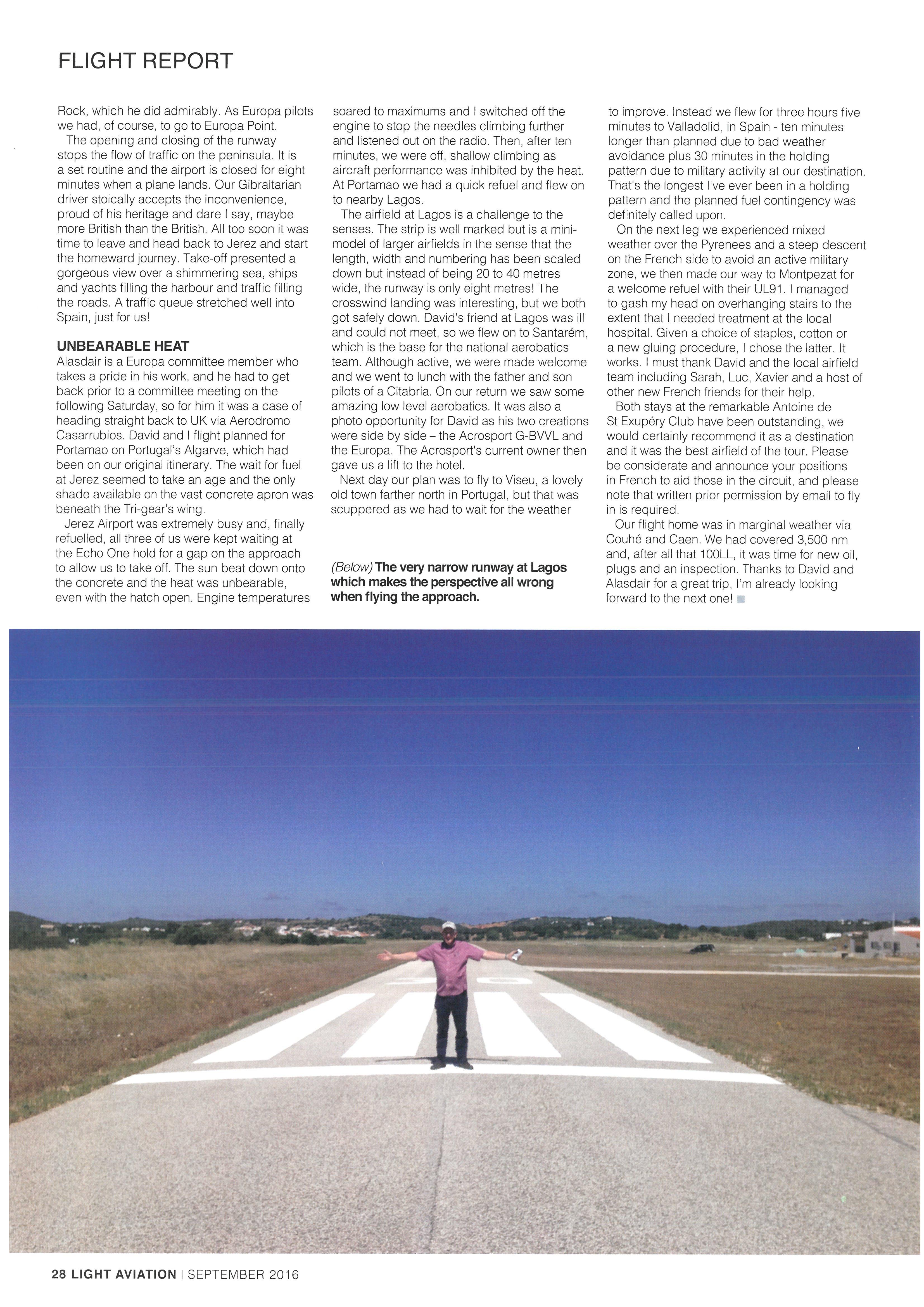
The airfield at Lagos is a challenge to the senses. The strip is well marked but is a minimodel of larger airfields in the sense that the length, width and numbering has been scaled down but instead of being 20 to 40 metres wide, the runway is only eight metres! The crosswind landing was interesting, but we both got safely down. David's friend at Lagos was ill and could not meet, so we flew on to Santarém, which is the base for the national aerobatics team. Although active, we were made welcome and we went to lunch with the father and son pilots of a Citabria. On our return we saw some amazing low level aerobatics. It was also a photo opportunity for David as his two creations were side by side the Acrosport G-BVVL and the Europa. The Acrosport's current owner then gave us allift to the hotel.
Next day our plan was to fly to Viseu, a lovely old town farther north in Portugal, but that was scuppered as we had to wait for the weather
(Below)The very narrow runway at Lagos which makes the perspective all wrong when flying the approach.
to improve. Instead we flew for three hours five minutes to Valladolid, in Spain - ten minutes longer than planned due to bad weather avoidance plus 30 minutes in the holding pattern due to military activity at our destination. That's the longest I've ever been in a holding pattern and the planned fuel contingency was definitely called upon.
On the next leg we experienced mixed weather over the Pyrenees and a steep descent on the French side to avoid an active military zone, we then made our way to Montpezat for a welcome refuel with their UL91. | managed to gash my head on overhanging stairs to the extent that | needed treatment at the local hospital. Given a choice of staples, cotton or a new gluing procedure, | chose the latter. It works. | must thank David and the local airfield team including Sarah, Luc, Xavier and a host of other new French friends for their help.
Both stays at the remarkable Antoine de St Exupéry Club have been outstanding, we would certainly recommend it as a destination and it was the best airfield of the tour. Please be considerate and announce your positions in French to aid those in the circuit, and please note that written prior permission by email to fly in is required.
Our flight home was in marginal weather via Couhé and Caen. We had covered 3,500 nm and, after all that 100LL, it was time for new oil, plugs and an inspection. Thanks to David and Alasdair for a great trip, I’m already looking forward to the next one!
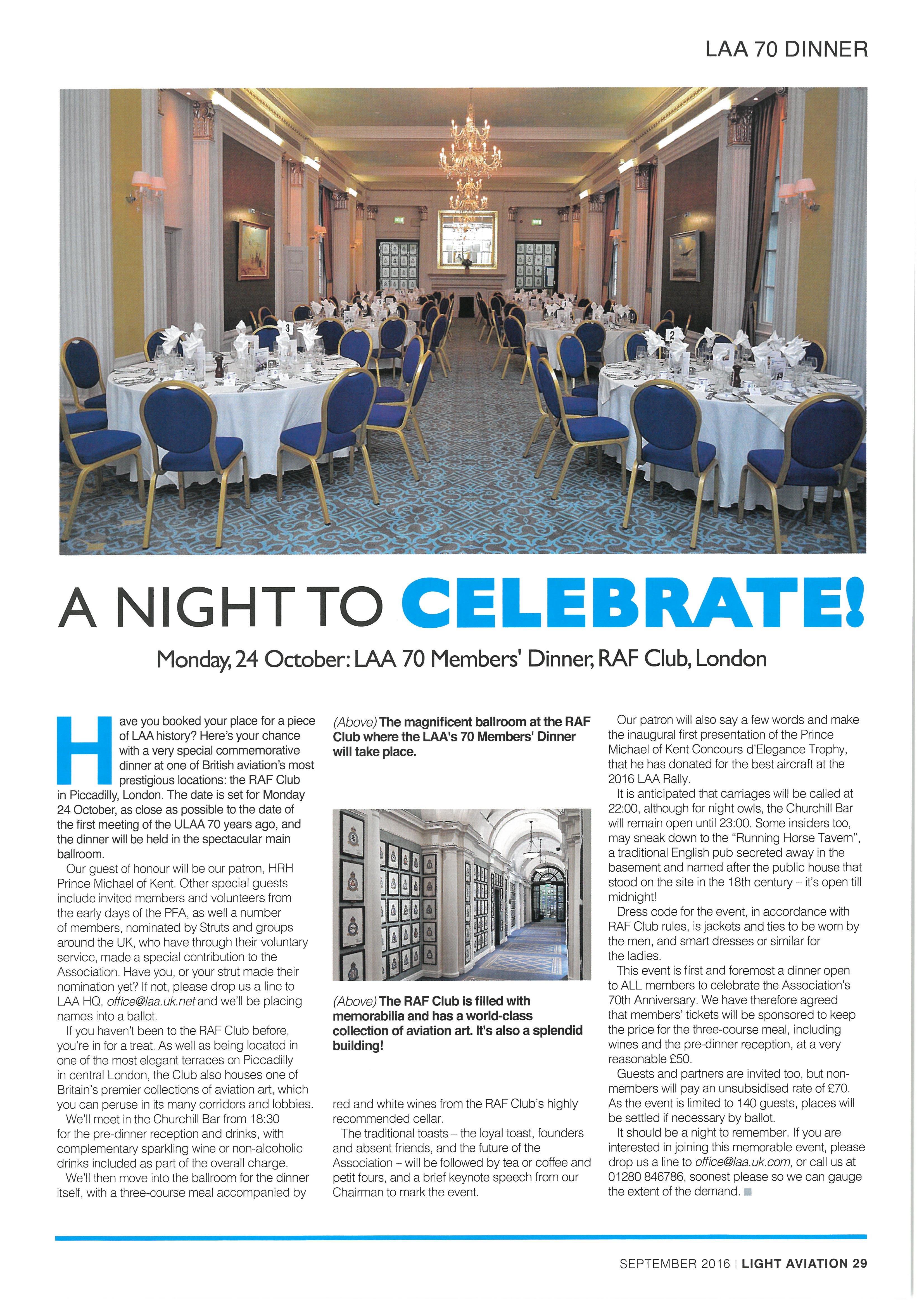
aveyou booked your place for a piece of LAAhistory? Here’syour chance with a very special commemorative dinner at one of British aviation’s most prestigiouslocations:the RAF Club in Piccadilly,London.The date is set for Monday 24 October,as close as possibleto the date of the first meetingof the ULAA70 years ago, and the dinnerwill be held inthe spectacular main ballroom.
Our guest of honour will be our patron, HRH Prince Michaelof Kent.Other special guests include invited members and volunteers from the early days of the PFA,as well a number of members, nominated by Struts and groups around the UK,who have through their voluntary service, made a special contribution to the Association. Have you, or your strut made their nomination yet? If not, please drop us aline to LAA HQ, office@laa.uk.netand we'll be placing namesintoa ballot.
If you haven't been to the RAF Club before, you're infor a treat.As well as being located in one of the most elegant terraces on Piccadilly in central London, the Club also houses one of Britain’s premier collections of aviation art, which you can peruse in its many corridors and lobbies.
We'll meet in the Churchill Bar from 18:30 for the pre-dinner reception and drinks, with complementary sparkling wine or non-alcoholic drinks included as part of the overall charge.
We'll then move into the ballroom for the dinner itself, with a three-course meal accompanied by
(Above)The magnificent ballroom at the RAF Club where the LAA's 70 Members' Dinner will take place.
red and white wines from the RAFClub’s highly recommended cellar.
The traditional toasts the loyal toast, founders and absent friends, and the future of the Association will be followed by tea or coffee and petit fours, and a brief keynote speech from our
Our patron will also say a few words and make the inaugural first presentation of the Prince Michael of Kent Concours d’Elegance Trophy, that he has donated for the best aircraft at the 2016 LAA Rally.
lt is anticipated that carriages will be called at 22:00, although for night owls, the Churchill Bar will remain open until 23:00. Some insiders too, may sneak down to the “Running Horse Tavern”, a traditionalEnglishpub secreted away inthe basement and named after the public housethat stood on the site in the 18th century it’s open till midnight!
Dress code for the event, in accordance with RAFClub rules, isjackets and ties to be worn by the men, and smart dresses or similar for the ladies.
This event is first and foremost a dinner open to ALL members to celebrate the Association's 70thAnniversary. We have therefore agreed that members’ tickets will be sponsored to keep the price for the three-course meal, including wines and the pre-dinner reception, at a very reasonable £50.
Guests and partners are invited too, but nonmembers will pay an unsubsidised rate of £70.
As the event is limited to 140 guests, places will be settled ifnecessary by ballot.
Itshould be a night to remember. Ifyou are interested injoining this memorable event, please dropusalinetooffice@laa.uk.com,orcallusat 01280 846786, soonest please so we can gauge the extent of the demand.
t seems like we just about get chance to catch up with one set of regulations and another set flies in! You may have already seen some information published about EASA Air Operations Annex VII, otherwise known as Part-NCO. This is applicable from 25 August 2016 to those operaiions in aircraft which hold an EASA Certificate of Airworthiness or EASA Permit to Fly. Note that this does include a number of aircraft for which the LAA administer the continued airworthiness, so please check the bottom left hand corner of your Permit to Fly if you’re unsure of your aircraft’s status.
Aligned with the introduction of Part-NCO is the revised Air Navigation Order (ANO) which also comes into effect on 25 August 2016. Within the revised ANO are a number of changes to airworthiness, licensing, and medical requirements.
More information will be provided on a number ofthesubtlerchangesinafuturearticle,but| do want to highlight the new self-declaration medical which will have replaced the old NPPL Medical Declaration by the time this magazine drops on your doorstep.
THE SELF-DECLARATION MEDICAL
There have been a number of consultations over the past year or so which have provided those interested with an insight into the expected changes. Holders of EASA licences, national licences, and NPPLs may benefit from the changes which allow these licences to be used with a self-declaration.
Be warned however, there are restrictions and limitations when validating a licence with a self-declaration so do check carefully first. The self-declaration form and CAA guidance will be published on the CAA website shortly and will be completed and submitted online.
You can continue to validate your UK PPL or NPPL with an EASA Class One or Class Two medical. However, if you’re currently using a NPPL Medical Declaration to validate either of these licences, the requirements are set to change. From 25 August 2016, there will be no further NPPL Medical Declarations issued - instead you will be required to make a self-declaration to the CAA. ANO 2016 Article 163 sets out the new requirements, stating that you must reasonably believe that you meet the medical requirements for a Group 1
“If you suffer or begin to suffer from any of the disqualifying conditions, the idea is for you to go to an AME to see whether you meet the LAPL standard”
licence issued by the DVLA and are not subject to any disqualifying medical condition. These disqualifying conditions are defined in the new ANO and further guidance is provided on the CAA self-declaration form.
RESTRICTION OF PRIVILEGES
If you’re using a self-declaration to validate any licence, regardless of any higher licence privileges, the ANO will restrict your privileges to:
B an aircraft with a maximum take-off mass of 5,700kg or less;
H not more than three passengers on board; by day or night when exercising the privileges of a night rating;
Miin visual meteorological conditions or when exercising the privileges of an instrument meteorological conditions rating;
B and within the United Kingdom unless the holder has the permission of the competent authority for the airspace in which the aircraft is being flown.
This is less restrictive than the previous regulations allowing use of a NPPL Medical Declaration with a UK PPL, and now allows UK PPL holders to exercise the privileges of a night rating and an IMC rating where one is held. In the case of the NPPL, the licence privileges are more restrictive than some of those listed above (no night or IMC for example), so these obviously apply.
DISQUALIFYING MEDICAL CONDITIONS
| would like to emphasise that the wording of the disqualifying conditions in the new ANO is not designed to be as limiting as it might at first appear. If people comply with the guidance on the webpage and form, the CAA will interpret that as having met the requirements of 163 (6), which is the ANO article which describes disqualifying conditions. For the self-declaration the disqualifying medical conditions listed in the new Air Navigation Order which would render the self-declaration invalid include:
B any alcohol or drug abuse, addiction or misuse;
@any neurological condition;
Bianyfunctionaldisability;
@ any surgery or medical treatment; @any collapse, fainting or loss of consciousness;
B any history of the above conditions; or
@ such other medical conditions as the CAA may specify, that might impair the safe operation of normal flight controls or render the licence holder unfit at any time to perform any function for which the licence is granted.
An expanded version of this list is provided on the self-declaration form in which CAA give further guidance of how the disqualifying conditions in the Air Navigation Order should be interpreted.
If you suffer or begin to suffer from any of the disqualifying conditions, the idea is for you to go to an AME to see whether you meet the LAPL standard (if you do, you'll get a LAPL medical and may exercise the same privileges as you would have been able to had you met the selfdeclaration standard).
For minor treatment such as surgery (other than the specific ones mentioned in the guidance like cardiac surgery) which has been completely recovered from, with no side effects relevant to aviation, there is no requirement for recourse to a LAPL medical.
HAVING DIFFICULTY?
Should a LAA member find that they could previously obtain a NPPL Medical Declaration to act as pilot-in-command, but is having difficulty obtaining a medical or completing a self-declaration due to disqualifying conditions under the new system, we would like to hear from you.
REPORTING A CONDITION POST SELF-DECLARATION
If you develop a disqualifying condition post making a self-declaration, you will need to declare it by submitting another self-declaration form the form has a separate tick-box for pilots to declare a disqualifying condition. When the form is submitted to the CAA, this will then render the original self-declaration invalid.
YOUR CURRENT NPPL MEDICAL DECLARATION
For those with an existing NPPL Medical Declaration, there is a transition period where your old NPPL Medical Declaration is considered to fulfil the requirements of the new self-declaration. This will continue to be valid as if it were a self-declaration for period that the NPPL Medical Declaration would have been. Thereafter you will need to make a self-declaration.
There has been some confusion as to whether an existing NPPL Medical Declaration holder is ‘grounded on the 25 August’ if they have suffered from a disqualifying medical condition in the past. It is not the intent to invalidate any UK NPPL Medical Declaration that is valid in accordance with the ANO 2009. Existing NPPL Medical Declarations remain valid until such
“There is a transition period where your old NPPL Medical Declaration is considered to fulfill the requirements of the new self-declaration”
time as they expire, regardless of what the holder may have suffered from in the past. If you develop a disqualifying condition after 25 August then you must comply with the same requirements above as if it were a self-
declaration.CLAARCAASelf-Declaration Medical
EASA PPL AND LAPL SELF-DECLARATION
Previously EASA licence holders were not permitted to validate their Part-FCL licence with a NPPL Medical Declaration. Of note is that the new ANO will allow an EASA Part-FCL PPL or LAPL to be rendered valid for use within the privileges of a UK national licence for those with a self-declaration.
ANO 2016 Article 150 renders valid an EASA licence with a self-declaration as if it were a UK national licence for use in UK airspace.
So, some good news from the CAA for many. The self-declaration replaces the old NPPL Medical Declaration from 25 August 2016, and allows a EASA licence holder or national licence holder to exercise limited privileges within UK airspace, and possibly beyond.
Below is a table which will hopefully help to provide a useful summary of the new medical requirements. As is always the case with such articles, the legislation and any CAAguidance is your primary reference we've done our best to provide a simplification of the changes for you.
If you’ve got any questions about the new self-declaration medical, please call LAA Head Office or have a look on the LAAwebsite where we will endeavour to answer your questions.
ANO 2016 effective 25*" August 2016
Tet-Tala) Medical Self-Declaration|Conditions required permissible
EASA Licences
EASAPart-FCLATPL(A)or(H) EASAClassOne No
EASAPart-FCLCPL(A) or (H) EASAClassOne No
EASAPart-FCLPPL(A)or (H) EASAClassTwo Yes
EASALAPL(A)or (H) EASALAPLMedical Yes
UK national licences
UKATPL{A)or(H} EASAClassOne Yes
UKCPL(A) or (H) EASAClassOne Yes
UKPPL(A)(H}or(G} EASAClassTwo Yes
UKNPPL Self-declaration Yes
Part-FCLATPLalso hasa PPLin SectiontI of the licence
Part-FCLCPLalso has a PPLin Section Ii of the licence
Seenotes (1)(2)(3) when validating with a selfdeclaration
Seenotes (1}(2)(3) when validating with aselfdeclaration
Seenotes(1}(2)(3)(4).NPPLprivilegesmaybe more limiting.
Notes (1) Non-EASAaircraft (2) EASAaircraft (within privileges of a LAPL)until April 2018 (3) Permission required from appropriate authority if outside of UK (4) Medical hierarchy - where a self-declaration is acceptable, an EASALAPLmedical, EASAClassTwo or EASA ClassOne medical is also acceptable
n the old pre-internet days, our then PFA aircraft were treated very much more as ‘one-offs’and modifications were dealt with purely by individual correspondence between the owner and HQ. As types like the Kitfox and Europa began to be built in numbers, and PFA members were more and more able to keep tabs on what fellow builders were doing via the forums, there was an increasing tendency for builders to want to replicate, or perhaps further develop, what others had done before. At HQ we found ourselves more and more often diving into previous aircraft files in search of the vital gems of information hidden amongst discussion about all the other issues relating to the aircraft. With the increasing number of projects on the go, and HQ employing more than one design signatory from the mid-1990s, to administer the work it became essential to follow the industry norm and introduce a mod numbering system
so that each mod could be clearly identified and its approval status formally recorded. Rather than just forming part of the individual aircraft's correspondence file, mods were filed separately by mod number, for ready reference.
As far as possible, correspondence in the mod files was limited to that dealing with each mod, although this has always been a challenge where members choose to address multiple issues in one letter or e-mail. It has seemed ‘a step too far’ to expect that members submitting a number of different modifications at once should confine each letter or email to just referring to one mod so before each mod is filed, correspondence on multiple topics often has to be photocopied and copies placed in each mod file referred to.
LAA Engineering introduced an electronic database in the mid-1990s which was used initiallymainlyasameansofmaintainingalist of ‘our’ aircraft and their permit ‘status’, to issue
32 LIGHT AVIATION | SEPTEMBER 2016
The Engineering Mods Triage team of Francis Donaldson, Andy Draper and Jon Viner plan the progress of new Mod
mod and repair numbers and for tracking the progress throughout the department of each job, ie primarily first issues of Permits, Permit renewals, mods and repairs.
With further development the database became more and more an essential tool within LAA Engineering, being used for things as diverse as sending mailshots of safety information to owners of specified aircraft types, to sending an automatic monthly report of ‘new projects’ and ‘first flights’ to the writer of Project News in the LAA mag.
Originally an access database, developed in-house by then Deputy Chief Engineer John Tempest, the database has more recently been replaced by an externally developed cloudbased database with increased functionality, which is more intimately linked with our membership database.
Whereas previously the database was useful for dealing with individual enquiries, the new database is used increasingly these days to provide statistical and work-flow reports which are useful both for deciding day-to-day priorities between incoming tasks, and for management review of trends and manpower requirements.
It is also vital to the continued airworthiness side of the department's work, as a means of recording airworthiness issues as they arise and ‘red-flagging’ individual aircraft which
are ‘under a cloud’ for some reason where it's important not to renew the Permit to Fly or otherwise facilitate flight until the safety issue has been resolved.
The question of pricing has always been a hot topic with LAA/PFA mods, and over the years prices have risen and fallen with the tide of changing opinion.
CHARGING A MOD FEE
Originally the costs of assessing mods was absorbed as part of the overall costs of administering the Permit to Fly, and it was feared that charging a mod fee at all would ‘oush mods underground’ with adverse consequences for safety, or might discourage innovation. Others felt that charging a small fee would undermine the authority of the Engineering department by under-stating the value of the department's work in investigating all these mods.
Nowadays we have a two-stage mod process where the initial notification of an intention to modify is made with a simple form (mod 2). This allows LAA HQ to comment on the broadbrush proposal and indicate the appropriate requirements to be met and the route to approval before the applicant has to cough up any fee. The response to the mod 2 form includes an estimate of the likely cost in HQ time for dealing with the mod, and the applicant
eeereerrere
is requested to make an appropriate payment when submitting the second stage paperwork (mod 3 form) if he or she chooses to go ahead. The mod forms can be downloaded from the LAA website. Mods are estimated on the basis of a £30 per hour fee, with a minimum of two hours applying. Mods likely to take more than two hours of HQ time are charged for partly at commencement with the mod 3 form, and the remainder on completion. Nowadays the mod payment is generally made online, using the arrangement provided in the member's shop area of the LAA’s website.
A database feature which seems not to have reached the attention of many members doing mods is that the status of each mod can be accessed by the owner in the member's section of the LAA website, in the ‘my aircraft’ area. This allows the owner to see whether a mod which is ‘in progress’ is listed as ‘awaiting review’, ‘awaiting applicant response’, ‘on flight test’ etc., and so track its progress through the system day by day.
Keeping tabs with the mod status allows the owner to check how things are going and also to flag up ifthere’s been glitch for example if the mod status is ‘awaiting applicant response’ but the owner isn’t aware of any such request from HQ then clearly it’s worth following up. If amod status is ‘awaiting applicant response’ or ‘awaiting project completion’ or ‘on flight
Elevator
Bonded
test’ then it means the job pack is in a waiting area at HQ and nothing will happen to it until something’s received from the owner to trigger it moving to the next stage.
Contrary to popular belief, LAA Engineering now have four design signatories on the books, with Deputy Chief Engineer Jon Viner and Design Engineer Andy Draper as well as myself doing a great deal of work on assessing members’ mods in-house, and Consultant Engineer John Tempest also contributing his considerable technical skills part-time.
All incoming mods are reviewed initially at a (nominally at least) weekly triage group made up of the in-house design signatories. At this weekly mod meeting the group discuss each mod and decide on the mod classification (major or minor), which of the design engineers will be allocated the mod to deal with, and how much oversight will be required by the Chief Engineer. Any special knowledge or suggestions/caveats are shared, many mods are similar to those that have gone before and getting the engineers together means that previous pitfalls can be avoided and a consistent approach more likely be achieved.
KEY QUESTIONS
When considering a modification, LAA’s aims are primarily to ensure, as far as is possible, that the modification is safe, that it will not end up contributing to an accident. The Engineering team do this by asking several key questions:
B Does it conform with the requirements of an appropriate design code?
Will it conform with standard aviation practice?
@Might it have adverse knock-on effects on safety?
How does this interact with other mods on the aircraft?
Does there need to be any additional guidance to future operators about how to fly the aircraft with this mod on board?
@Does it introduce any special maintenance requirements?
While, not being (or no longer being) certified aircraft, many LAA aeroplanes have not been designed to comply with the detailed requirements of a current certification code such as CS-VLA or FAR-23. Nevertheless, such codes are useful as a benchmark when considering modifications to existing, alreadyapproved designs and a review of the mod against a code is a convenient way of checking that all relevant design issues have been considered and catered for.
Of course, this approach has to be tempered with a goodly amount of commonsense. For example, in an old design with a carburettor heater that develops well below the temperature rise in the inlet airflow which the modern design code calls for, amod which develops any improvement in the temperature rise is better than nothing, and it would be counter-productive to safety to refuse a mod which increased the carb ice prevention but not quite to modern day certified standards.
The question of what is, and what isn’t standard aviation practice is often a tricky one because of the broad range of aircraft that fly within the LAA fleet. Standard practice for an RVflying control system or fuel system is probably not that far different to what’s expected of a Piper Cherokee, Cessna 152 or Cirrus, but very different to what’s the norm in a modern microlight, and different again from
what's seen in a vintage Moth or even a vintage microlight. Specialist machines like Formula One racers, all-out aerobatic machines and even motorgliders, and of course rotorcraft, all have their own slightly different ways of doing things too so it’s important not to insist on a practice which is alien to the class of aircraft concerned.
The typical LAA mod process involves an initial assessment of the mod 2 form and a response, generally by e-mail, followed by a more in-depth assessment of the mod 3 form and the associated reports, and other details that accompany the mod 3 form. Once happy with the design of the proposed mod in general terms, we will usually give the tentative go-ahead to install it under the inspector's supervision, asking for the applicant to submit copies of the worksheets on completion, signed up by the inspector to indicate his satisfaction with the job, (sometimes including interim ‘stage inspections’) along with photos of the result, weight and balance details and the results of any necessary function tests (e.g. fuel flow checks) or special inspection checklists, text for the proposed pilot’s notes and so on.
The applicant will generally be invited to indicate his proposals for flight testing the modification. Once satisfied, the LAA HQ team willissueaflight testauthorisationtoallowthe
flight tests to be carried out, specifying any applicable special flight limitations and the content of the flight tests, including a flight safety brief appropriate to the type of mod concerned.
The pilot is usually requested to submit a narrative report describing how the mod performed during the test program and any adjustments or tweaks needed, special observations or caveats, and any changes to the proposed pilot’s notes or POH supplement. All this is then checked by the allocated engineer at LAA HQ and there is often a further round of correspondence clarifying observations that may be unclear or unsatisfactory.
FINAL RESULT
All being well, the final result is that the design engineer at HQ signs up a modification acceptance sheet and sends or e-mails it to the applicant as notification of the mod having been cleared, and the online modification list is updated to show that mod added to the considerable list of mods that have been accepted by LAA.
Some days later, after the dust has settled, the modification package is tidied up and put in date order, any duplicates being thrown away, and then sent for scanning by the admin
team, allowing the original paper file to be archived and making the electronic version readily accessible on screen to the engineering staff as a pdf, along with all the other mods applicable to the aircraft type concerned.
However hard we strive to make each mod safe, accidents do happen, and whether the modification was to blame or not, when something untoward occurs to a modified aircraft the details of the modification must stand scrutiny.
Applicants sometimes don’t appreciate that while the engineer he is dealing with at HQ may have grasped what his mod involves and is personally quite satisfied with its airworthiness, we nevertheless need further details to be provided to create an adequate record of what is proposed and why it was a reasonable decision at the time to accept it, and so be able to defend both the owner and the LAA from any criticism that might be levelled our way or, more importantly, sidestep expensive and time consuming litigation.
But rest assured the LAA Engineering team are not looking primarily to cover their own backsides, or those of our organisation we are mainly concerned with keeping our pilots safe and preserving the right to fly amateur operated aircraft with a minimum of regulation.
aaaa)io)aeeaiaeep)feos
eroplanes are a compromise. As a general rule, speed equals less wing area but higher stall speed. More payload equals more weight and the need for more power. Retractable gear makes for a cleaner airframe but adds complexity, and so the list goes on.
It is difficult today, when most new homebuilts are built from factory-produced kits, to fully appreciate the difficulties faced by the homebuilder building from plans 40 or more years ago. Practically every component had to be made by hand which often meant new skills had to be mastered, usually by trial and error.
Many parts were made two, three or even four times before they were deemed satisfactory. The more complex a design, the longer it took to build and the more likely it would not be completed by the original builder. Some projects changed hands several times before they were eventually completed; a great many never getting finished at all.
So, in theory at least, a plans-built design needs to be something of a compromise if it is to appeal to the inexperienced builder, and simplicity is right up near the top of the requirements list, competing with the acceptable aesthetics and decent performance that inspires the builder to choose to build that particular design in the first place.
Leeon Davis understood this better than most. He learned his aviation skills in the US Air Force where he trained as an aircraft mechanic and though not formerly trained as an aeronautical design engineer, he taught himself all he needed to know via correspondence courses. After leaving the service he worked for Aero Commander as a sheet metalworker and in his spare time set about designing his first aircraft, the DA1, which flew for the first time on 1963.
A strutted high-wing five-seater, powered by a Lycoming
FLIGHT TEST
180hp O-360, the DA1 (of which only the prototype was built), carried some of the design features that Leeon would use in the DA-2A and subsequent designs the V-tail in particular, and the simple ‘boxy’ styling but his future designs would be low-wing aircraft.
Leeon’s second aircraft, the DA-2A, the subject of this air test, was his most successful design and made its maiden flight in 1966. It was initially powered by an A-65 Continental, an engine that was plentiful in the States at the time due to its use in many thousands of prewar and wartime Cubs, Aeroncas, Taylorcraft and the like. Contemporary reports suggest the aircraft's performance was satisfactory on the nominal 65hp, climb rate being acceptable with a cruise of around 100mph, but the prototype was later re-engined with a C90. That engine and the O-200 became the most common fit in homebuilt examples.
SIMPLE TO BUILD
Seeing the DA-2A for the first time, its small dimensions and ‘boxiness’ are immediately apparent but Leeon’s design philosophy was to provide the smallest and simplest fuselage in which to house two people and a modicum of luggage. From the builder’s standpoint, this means that the need to fund expensive 2024T3 aviation aluminium is kept to a minimum and
(Right)One of the signature features of the Davis DA-2A is its V-tail with all-moving ‘ruddervators'. In flight, they behave just like a 'normal' empennage.
all the bulkheads are made from short straight lengths bent up on a brake and then riveted together; no form blocks being required to make complex curves.
Overall, the fuselage has something of a ‘lifting body’ shape and | suspect that it contributes to the overall lift of the aircraft. The canopy element of the fuselage is framed with small section square steel tubing and even the Perspex screens are flat or single curvature for ease of construction.
The undercarriage is tri-gear, rare at a time
when the vast majority of homebuilts were taildraggers, another nod to simplicity in terms of handling the aircraft. The main gear is provided courtesy of Wittman-type sweptback steel tube, with sheet aluminium fairings, and the steerable nose gear a simple that word again tube within a tube with round rubber blocks in compression as the suspension.
To avoid the complexity of carry-through spars and wing attachments, the wing is built as a single piece and the fuselage sits on top of itwith relativelysimplefixings, rather like Boxy, V-tail... looks unusual butthe Davis DA-2A is a simple design that works well. | suspect the fuselage shape provides a degree of lift.
HAVING MADE PLANS available to homebuilders for his DA-2A, Leeon Davis continued to develop the concept with a view to the aircraft being put into production but unfortunatelythat never materialised. He moved on with a slightly larger all-round variant, the DA-3 which was a 2+2 seater, followed by what was to become his only other plans-build aircraft,the single seat DA-SA. This 15ft 7in span machine closely followed the DA-2A in design and, powered by a 65hp A-65, would climb at more than 1,000 feet per minute and cruise at 140mph. Remember, this was inthe 1970s and this simple little aeroplane was built from flat sheets of aluminium with an engine from a pre-war Piper Cub. Itwasn’t a racer, itwas a simple to fly, speedy, fun flyer for the average pilot, albeit thattheapproachspeedwasalittle higher thanusualataround85mph.Asa tri-gear though, this was nota significant problem. Perhaps Leeon’s most interesting designs were his single-seat DA-9 with retractable nose gear, and his DA-11 which, some years ahead of itstime, was an ultra-lightweight machine featuring the Briggs and StrattonV-twin industrial engine.
The DA-9 first flew in 1990 with a twocylinder half Continental A-65
producing a claimed 40hp. 25 years later the halfContinentalconcepthasbecomeareality with Peter Plumb’s Pegasus O-100 kit. In 1995 the DA-9was re-engined with a C90 and broke a number of time-to-height FAIworld records in itsclass. The D11 weighed inatjust 170lb and with its20hp B&Sflew at 135mph whilst returning100mpg.Itfirstflewin1995,long before the very similar concept Colomban Luciole and Spacek SD-1 but sadly no plans were made available.
Leeon Davis died in 2007 having spent a lifetimeCommittedto designing simple to build light aircraft in aluminiumfor the homebuilder. Hewas certainly something of a visionary but sadly only appealed to a niche market and probably fewer than 100 DA-2As ever flew. Perhaps itwas simply the higher performance of aircraft likethe Thorp 118 and the Mustang 11that won the day fuel costs inthe US not really being such an issue as in Europe. Brian Hope
(Left)Leeon's incredible singleseater, the DA11, way ahead of its time. With just 20hp, it returned 135mph and 100mpg!
(Top) Leeon Davis featured in a Discovery Channel film, still available on YouTube.
many of the wooden European designs of the period. The flapless wing uses the then popular Clark Y aerofoil and is a mere 19ft 3in (5.86m) in span. The approx half span simple ailerons (they have no differential, the up or down deflections being equal, and no frise effect leading edge) are cable-operated and again nod towards the simple to build ethos.
THE V-TAIL
The empennage is perhaps the biggest divergence from the ‘norm’ in that it is a V-tail. This reduces build time as there are only two ‘ruddervator’ control surfaces. The control system ‘mixer box’, which translates the yaw and/or pitch movements of pedals and stick into movement of the ruddervators, is situated about halfway down the rear fuselage.
Cables link the mixer to the pedals and stick, and rods take the output from the box to the control surfaces. Pitch trim is provided by a spring bias system with the cables running back to the mixer box. It certainly works very well and to all intents and purposes the aircraft flies perfectly conventionally in normal flight. The pilot's standard control stick and rudder inputs and responses in pitch and yaw are just as in a conventional configuration of ahorizontaltailplanewithelevators,anda vertical fin and rudder.
Naturally, with only two V-tail surfaces, they are all-moving affairs, and are mass balanced via the rather antenna-looking weighted square steel tubes extending forward of the pivot line. What look like trim tabs on the rear of the ruddervators are in fact surfaces that move in the same direction as the contro! surface to provide positive feel to the system without the tabs the stick forces would probably be zero or even negative!.
To my eye, the complete ‘butterfly’ tail, as it is sometimes referred to, seems small, smaller than | would have expected but | am apilot, not an engineer, and base that view purely on aesthetics and convention.
It used to be thought that the dimensions for the V-tail should extend to the limits of the horizontal surface it substituted or replaced (imagine dropping a vertical line from the top of the 'V' to the outer edge of a normal horizontal tailplane) and the tail area should also be the same as the combined conventional horizontal and vertical surfaces. This theory however, produced overlarge tail surfaces on an experimental V-tailed variant of the Bell Kingcobra fighter, and no doubt others.
Back with the practicalities of our DA-2A, the \V-tailhas a reduced number of junctions and produces less interference drag and a lower parts count, less time, energy, and material
to build, and has the bonus of requiring less power to pull it through the air.
The inclusion of wing flaps would have meant a tail of greater dimensions to cope with the pitch change associated with the lowering and raising of flaps. And so, here again we encounter the designer's ethos of creating a shorter build time and simpler aircraft by the expediency of reducing complexity.
Fortuitously a short wingspan requires the least amount of force for yaw stability, also bolstering the reasoning for the small but entirely adequately sized V-tail.
The walkaround confirms that the rest of the airframe is conventional enough. The engine cowling has many, many screws to undo for a full engine inspection but the oil can be checked from a small side door on the left side of the cowling. The prop is a new Hercules 66in x 65in, not an overly large diameter but the tip clearance isn’t great, however suspension travel on the nose leg is fairly minimal. The fuel filler cap is unusually positioned, being placed through the lower edge of the passenger's front windscreen into the 20usg (75.7 litres) tank that fits between instrument panel and firewall.
The impression is that the aircraft looks somewhat close-coupled, both from the nosewheel to the mains and from the wing to the tailplane, suggesting the possibility
The climb and cruise performance of this 100hp 50-year-old design equals or even surpasses a number of today's VLA designs, albeit at the expense of a higher stall speed.
“Intheeconomiccruise.
oeimcelPUKolacleA= ELaWigaliptRAC re iges/a)eic Up'therevsto2,450and the speed increases to =We)a0)airetaemiteys),0a a
that it could be twitchy on the ground and in the air. Reassuringly, | had seen Pete's very professional arrival and convinced myselfthat it all looks eminently manageable.
One further point. It had obviously been looked after and freshly cleaned and polished, so as to be very well turned out. Her owner obviously cherishes Foxtrot Lima (| am sure his air traffic background and protocol would not allow a shortening to 'Fox' Lima).
| had no particular concerns about being able to fit into this cockpit as Pete is two inches taller than me at 6ft 2in. The route in isfrom the right wing walk, the door conveniently swinging a full 180° to sit against the forward fuselage. Then, sitting down backwards, Pete wriggled across to the left hand seat and carefully swung his legs across, missing the instrument panel and gingerly lowering them into the footwell. | followed him in without undue embarrassment and having latched the four-point Hooker harness, closed the door behind me with its simple backward locking latch.
THE COCKPIT
Directly in front of the passenger seat are the engine instruments, a transponder and a row of circuit breakers. There is also the now familiar power socket and thin white lead heading off to a centrally mounted iPad for navigation. Under the iPad is a recently installed 8.33MHz Dittel KRT2 transceiver and below that are the centrally placed push-pull throttle, mixture and carb heat. Lower still is a centre console with volts, amps and suction gauges, plus a standby altimeter.
Infront of the P1 are the standard six flying instruments (ASI, AH, altimeter, VSI, DI and T&S), and to the right, above the P1's left knee, are the red master and generator split tumbler switches, followed by the electric services switches nav lights and fuel pump etc.
Fortunately, my feet rested on the rudder pedals quite comfortably, just as well as they and the seats are non-adjustable, adding or removing cushions being the way to get optimum fit. There is more than adequate knee room beneath the fuel tank and, despite the aircraft's quite diminutive size, there is a good fist of headroom above my head, even with a headset on. The stick is nicely angled forward and gives a comfortable reach and position.
The brakes are operated from one central lever just forward of the gap between the seats and when pulled up engages both main wheels; a parking facility is included.
Visibility is good and both wing tips can be easilyseen,albeitwitha littlecraningpastthe other occupant, and the rear three-quarters scan is good on the side you happen to be sitting. There is a small circular clear vision panel on the P1's door window should things getalittle steamyandtheviewoverand beyond the low, sloping nose isfine.
The warm engine start, with the parking brake engaged, needs three or four pumps on the throttle to activate the accelerator pump, as there is no separate primer. A quarter of an inch of throttle, a good scan for anybody close to the aircraft and a clearing call, turn the key and she bursts into life. Set the rom to 1,000 and the oil pressure needle rises promptly. Headsets are already on and communication is established for runway and an altimeter setting. A short taxy demonstrates the positive nosewheel steering at walking pace and the turn and slip, compass and DI all turn the correct way.
(Left) Panel follows the simple theme with the modern addition of the iPad for navigation.
(RightThestraight lines of the DA-2A do not make it unattractive but help make it straightforward to build and plan.
(Below) Pete Barker and his very smart Davis DA-2A, the only one of its type in Europe.
Once parked into wind at the hold, the Continental O-200’s revs are increased for the power checks at 1,800rpm, with the oil pressure rising to 50psi and each mag drop a standard and healthy 100rpm (the limit is 150). Carb heat application shows a standard drop of 150rpm. All tickety-boo then. With head down and ready to run through the vital actions, | manage to find the trim wheel between the seats but cannot find the indicator there isn’t one! Pete gives it a quick twiddle and says, "Try that". Pre-take-off checks complete (which include electric fuel pump on) we both peer at the downwind, base leg
DAVIS DA-2A OWNER Pete Barker kindly sent a photo of the well-greased mixer box that translates pitch and yaw inputs from the stick and pedals intomovement of the V-tailcontrol surfaces. It consists of two major parts:
A-—The main body that pivots inthe two uprights of the fuselage frame.
B The pivoted section that rotateswithin A. Rudder inputs occur via cables C, which rotate B and thus move the connecting rods differentially,i.e. ina one forward/one back movement, thus moving the control surfaces in opposing directions to act as rudders.
Cable D is the down elevator input and is attached to a horn which is part of A. There is a similar cable below it attached to the lower part of the horn for up elevator input but that is not easy to see inthe photo. Elevatorinput hinges body A back and forth, thus moving the control rods back and forth in unison, which in turn move the control surfaces in unison as an elevator.
Cables E arefrom the spring biastrimmer control between the seats, each connecting to part A to spring load the elevator system. Note that the rudder cable attachments on the central rotatingmember are aligned with the pivot line of the main body so that its cable tensions are not altered as the body pivots fore and aft. Brian Hope
and final and after the advisory call we make a short backtrack, line up with the nosewheel straight, check the DI 250° with the runway numbers, 25, and we are ready to roll.
LAUNCHING
The beauty of a nosewheel aircraft is one of visibility ahead. If a pilot has only ever flown aircraft in this configuration, then it must almost certainly be taken for granted. But one thing that can never be taken for granted is that nothing could possibility go awry at this critical phase of flight. Always think ahead and have a plan in case the expected scenario changes
beyond your expectation.
Despite what | thought may be a twitchy reactive nosewheel, it proved to be nothing of the sort and the dashed white centreline remained directly in front with a hint of right rudder guidance. As speed increased the nosewheel's directional control was easy to maintain and |judged we were airborne into ground effect within 350 metres (+ 21°C, wind 230/8-10). Full power early in the roll gave 2,200rpm and the oil pressure was just under the 45psi mark. VR is GOmphand climb out is at 80mph. Ts and Pswere fine as the ASI continued to increase to climb speed.
FLIGHT TEST
AIRBORNE
What | took to be a cruise climb at 90mph is actually the best rate of climb speed. The annual Permit climb recorded the timed 1,000 feet to 2,000 feet at 70 seconds, giving an 857 feet per minute rate of climb. As part of the acceptance flight on the change of propeller, a more extensive five-minute climb was conducted, with the new Hercules prop returning 750 feet per minute rate of climb. At first glance that might not seem to be an improvement but a check of the climb graph showed that on the 1,500 to 5,300 feet climb, the first 1,000 feet took just one minute. Statistical interpretation, eh?
In the economic cruise of 115mph at 2,350rpm, the scenery slips comfortably by and we are burning 20-22 litres an hour. Up the revs to 2,450, adjust the nose attitude slightly lower, trim, and the speed slowly increases to 125mph with the consumption increasing by another two litres an hour. Strangely though, the range to dry tanks remains within a gnat’s whisker at either setting, being 415 statute miles/360nm.
There is little asymmetric aileron drag despite the lack of aileron differential, and the roll response is positive with no appreciable nose wander; and the throw and feel of the stick really is pleasant and quite natural. When | reversed the roll, the nose did yaw away from the direction of the turn but such control input is not typical of the cross-country role of this machine. Based on an hour's flight an aircraft will probably spend 80% wings level in the cruise, So it’s stability that really counts.
The usual check of longitudinal (pitch) stability is trimming for the cruise, lowering the nose by 10° to increase the speed by 10 knots, and then letting go of the stick to see how the aircraft reacts. The Davis shows her calm and stable manners as the nose rose and fell through two or three cycles as the trim took her back to the original cruise speed.
The Davis's stalls were standard in as much they gave an aural warning and there was a small amount of juddering through the stick... not particularly pronounced admittedly as there is not much tail surface for the air peeling from
the inboard wing to shake, rattle and roll. The onset starts around the early 60s mph and the wing lets go at 53mph - a good span of warning whilst the nose angle rises progressively higher as the stick is speaking to you, "Do you really want to be doing this?"
When the departure comes, possibly, but not always with a slight wing drop, moving the stick forward gives near instantaneous recovery. However, during the photo shoot when we were cross-controlled and in formation trying for that head-on shot so liked by photographers and editors, and in very close proximity to the photo ship, the disturbed air we were flying in not expectantly felt like driving along a rocky road with shot suspension.
PROMPT ROLL
| have had a similar experience with crossed controls in a Tipsy Nipper, trying again for the same posed picture. | could feel she was about to go, and when it fell out recovery was swift. None of the other aircraft | have flown in this position have had the slightest problem but this time, when the Davis rode this juddering to the end, we were spat out in a prompt roll to the leftwitha littlebitofnegative'G'andthegreen Dorset country side filling the front screen. Throttle closed, stick and rudder neutral and a slightly stretched moment later we returned to straight and level as the controls bit again. Interesting!
Time to head back home and we were soon back into the circuit. Pete talked me through the approach at 80mph, reducing to 70 over the threshold but unlike a flapless approach, which invariably has a flatter attitude than with flap
(not an option here), this appeared to be pretty well like a standard 3° affair. The check to level flight before settling held a surprise as | overpitched slightly and the world disappeared below the lower edge of the windscreen. A quick stab forward regained the view just in time to re-flare. It wasn't as pretty as Pete's landing and | missed the centreline. "More practice needed!" | muttered under my breath.
| have to thank Pete Barker for his generosity in letting me fly with him in his unique V-tail homebuilt. It was a marvelous insight into the behaviour and responses of Leeon Davis's design of more than 50 years ago. It is a design that has stood the test of time as a practical machine with a good turn of speed and reasonable touring performance, and | think it packsalot offunintoasmall,verycutelooking package; it’s a very good compromise even when you don’t have to build it.
Having taken care of its external finish, Pete is now engaged in upgrading and refurbishing the cockpit, the new radio and iPad being the first steps. | look forward to seeing pictures of the completed job. Perhaps he could bring it back when all is complete and we can complete my circuit training!
| watched him depart for home and as there was a motorcycle event at the airfield that evening, distance markers had been staked by the runway edge. Refuelled but solo he was airborne in 275 metres, not bad at all, and on his own it climbed out very well indeed.
And finally | also have to thank him for answering innumerable texts whilst away on holiday in France in his very practical little aircraft, naturally.
ngineers often don’t get the appreciation given to pilots. Most of us can recall the names of pilots and their aircraft but who can remember the names of the people who carried out extensive rebuilds and kept the aircraft in the air?
David Fenton was one of those unsung heroes, a Yorkshire lad who became a Halton Brat (apprentice at RAF Halton) and worked on Shackletons. After 12 years accepting the Queen’s shilling, David bought himself out of the RAF and went to work for Nipper Aircraft at Castle Donington, where he learned to fly.
From there he went to work for the Kuwait Air Force, before moving to Jersey. He was poached by Mike Collett and moved initially to Eastern Aviation, later Flight Line, at Doncaster Airport, where he was certifying newly assembled Grumman American aircraft. Then they moved to Sherburn-in-Elmet where in 1976 he took over the maintenance and formed Hornet Aviation.
In 1978 David joined the Rothmans Aerobatic team as Chief Engineer on their Africa tour and in 1980 moved to Breighton, at that time with a single hangar and runway marked out on an S-shaped piece of peri-track. David was not really interested in undertaking 50-hour inspections and Star annuals, and instead developed a reputation for repairing and rebuilding aircraft, taking early AA-5s and splicing on new back ends to make AA-SBs.
Although | knew of David, | became more involved with him at my time at Lloyd’s Aviation Department when, in 1974, | sold him a fire-damaged Piper L18C located in Holland, which he rebuilt as G-BBYB, an aircraft which introduced a number of pilots in the Sherburn area to the joys of tailwheel flying. Later he bought, and rebuilt, the Tipsy Trainer G-AISB, which had been vandalised at Bedford Thurleigh and a Cessna 150 G-AXRT, which he convertedintoa taildragger.
He built two Andreasson BA-4Bs, the first of which, G-BEBS, he completed with a Pobjoy engine and a self-designed three-blade wooden propeller. The second was sold on as a kit of finished major components to be completed by the new owner. BS was finished in what became David’s trademark colours of all-yellow, with black lettering.
When F & H Aircraft acquired two Nord 3202s, it was to David that | turned to put the first, G-BEFH, onto the register as the first certified example of its type. It came out painted yellow with black markings as did the Casa 1-131B G-TAFF rebuilt for Tony Smith. By now David was gaining a reputation in the area for excellent workmanship, enhanced when he turned a Zlin Z.381 (BUcker Bestmann to you and |) found on a fire dump in Belgium into a fully rebuilt aircraft, G-AMYA, which was later sold to Kermit Weeks.
When BAe Brough undertook the overhaul
Swordfish W5856 displayed at BAe Brough after David and wife Trish had renewed the fabric on all four wings. David was also a long-time LAA Inspector.
of the Swordfish for the RN Historic Flight, it was to David and his wife Trish that they called upon to undertake the fabric work. Mike Collett, his ex-boss at Doncaster called upon him to undertake the complete rebuild of the Proctor G-AKIU, for which he and Trish received the John Blake Rose Bow! from the VAC. Another ex-boss, David Blackburn had him rebuild the Messenger G-AKBO, its engine and another as a spare. In 1979 David had open heart surgery to
repair his mitral valve and he was able to retain his engineering licences and PPL. However, in recent years his heart deteriorated until the NHS told him that there was nothing further they could do. He died on 29 June, four days after his 77th birthday and before he could see his Stampe SV-4 G-AYZI finished from a traditional David end-to-end rebuild, which included returning the engine to zero time. Farewell David, you will be sadly missed. BillFisher.& I
even of us at Seething have shares in G-BDBV, a red, white and black JodelD11Awhichweboughtfrom another Seething syndicate when they upgraded to a Jodel D105A ten years ago. We were dimly aware that BV was first registered in Germany in the 1950s, but we didn’t know much more than that.
The aircraft's logbook says the manufacturer was “Wolfrum Schwabach W” and its serial number was “V3”.
No-one can remember now what prompted one of us to Google Wolfrum Schwabach but what came up were several articles on a Luftwaffe WWII ace called Walter Wolfrum. He claimed 137 victories on the Eastern front during his two-year career as a fighter pilot, flying Bf109s with Jagdgeschwader 52.
As the 43rd highest scoring German ace, Wolfrum was awarded the Knight’s Cross of the Iron Cross. After the war he became a successful aerobatics pilot, winning the German Championship in 1962 and taking second place in 1961, 1963, 1964 and 1966. We couldn't quite see the connection between this distinguished aerobatic pilot and our humble Jodel.
When we searched under Schwabach, we
found it was a German town of about 40,000 inhabitants near Nuremburg, famous for its gold foil crafts and the “Schwabach” font used for printing the first Bible in German. It seemed its only other claim to fame was that Goethe stayed overnight in 1797!
Itwas only when we checked out Fliegervereinigung Schwabach, the local flying club, did the link with BV become clear.
Having been founded in November 1928, FV Schwabach is one of the oldest flying clubs in Bavaria, and our fighter ace, Walter Wolfrum, had helped re-start the club after WWII. At first they only had access to gliders, but Wolfrum led a team of four who built a Jodel between 1952 and 1956 and you've guessed it that Jodel is our G-BDBV.
CELEBRATE 60
The aircraft was originally registered D-EGIB and flew in Germany for 20 years before being exported to the UK in 1975. What better way to celebrate her 60th birthday than to fly IB/BV back to her birthplace in the Fatherland?
And so on the day after the referendum, two of our group, Linda Hampton and myself, coasted out from Felixstowe en route for Lille, accompanied by John Baker (one of BV’s
original British owners) and my wife Kathleen in the D105A G-AVHL. Our Jodel doesn’t have much baggage space and what with lifejackets, PLBs, charts and plates, there was no room for spare clothes, so they went in HL.
Despite all the restrictions on GA imposed by the French as they coped with the European football tournament, Lille refuelled the aircraft and let us go again without a landing fee. Our next leg was to Sedan-Douzy (LFSJ), where we were greeted by Francois Denis who runs the local microlight flying school and he kindly found room in his hangar for the two British Jodels. We spent the night in a wonderful old fort in Sedan and ate at a Moroccan restaurant run by one of Francois’ students, Stephan. With thunderstorms forecast along our route to the east we spent Saturday exploring Douzy. The airfield has a charming museum celebrating the achievements of Roger Sommer, a contemporary of Bleriot, who took members of the British Royal Family flying from Doncaster in 1910.
On Sunday we flew first to Pirmasens (EDRP), just over the border in Germany, flying very close to the Belgian border but taking care not to encroach lest we were burdened with the €80 charge the Belgians impose on us non-
(Main)Crossing the Rhine just south of Speyer.
(Above) Home again: G-BDBV on the apron at Schwabach.
(Left)Winz just after hisfirst solo in the aircraft years ago.
(Below)Winz, Ulli, Linda and Tim in the spotless workshop of FVSchwabach.
EASA aircraft types.
Linda had the honour of landing the Jodel back on the Schwabach (EDPH) runway from which the aircraft had made its first flight 60 years earlier. (Linda’s version is that Tim didn't want to risk it because the runway was short and there were trees near the threshold).
Waiting for us on the airfield were Winz Stollar (77) and Ulli Heidereich (76) who both flew |B/ BV in the days of her (and their) youth. In fact, Winz had performed his first solo in the aircraft and he posed in the cockpit to re-create the photo taken all those years before. He looked delighted when he embraced the engine cowling which he said had not changed a bit over the years. The flying club generously cleared their workshop so the two Jodels could park inside.
On Monday morning, Winz and Ulli picked us up and saw us Offon our flight over the Pfalz Mountains to Zweibruken (EDRZ),our first fuel stop of the return journey. The Jodel D11 only holds 54 litres so we were somewhat alarmed when Zweibruken told us to hold for 20 minutes while they cleared cars from the runway. Now that the USAF has gone, the airfielddoublesasa testtrackforacompany testing experimental gearboxes. Fortunately, we had enough fuel to cope and it wasn’t long before we had refuelled and were heading west into France.
LOW CLOUDBASE
when we set off with a Special VFRclearance up the channel towards Felixtowe. BV has no artificial horizon, so we relied on seeing the sea and ships to keep us horizontal. Fortunately, the weather brightened before our landfall and we were back at Seething in time for the Wednesday Saga Lunch Club.
It had been a happy little adventure for us. Apart from regular top-ups of oil, neither Jodel had needed any attention from the toolbox John had thoughtfully brought along. The delight on Winz’s face when he was re-united with the aeroplane in which he had first gone solo, made the trip worthwhile.
Winz, his wife and Ulli entertained us four British pilots in Winz’s garden with steins of local beer, before taking us into Schwabach where they had booked us overnight accommodation. And they showed us the workshop where BV had been built now a house. The historic town of Schwabach is a much nicer place than the Wikipedia entry suggests it won the German equivalent of “Britain in Bloom’ a few years ago.
It was by now raining and the cloudbase was a very low by the time we reached CharlevilleMezieres (LFQV) where we had planned to spend the night. With visibility down to a few km, we were surprised to find a local autogyro pilot was taking people out on sightseeing flights. We spent a happy evening in Charleville, a lovely old town on the Meuse, recommended if you are ever that way.
Bright and early on Tuesday we headed to Le Touquet (LFLT) where we spent a lazy afternoon on the beach, but the next day, low cloud had returned and there was no horizon
The only sadness is that we missed the men who had built BV. We were told that Max Schramm, a local butcher, now aged 86, was too ill to come out to see the plane or to receive visitors. And the other builders, (Heinz Vogelbacher, Herbert Dippold and Walter Wolfrum) had all died in the last few years.
meee eenereee rere eee
We never did find out how our aircraft got the serial number V3 when everyone told us it was the first and only plane they built at Schwabach. Could it have been Walter's idea of a joke perhaps? After all, the Germans sent the V1 to Britain in 1944 and the V2 in 1945. Why not the V3 in 1975!
elcome, as always, to this September edition of Safety Spot. The nights grow longer and the days? Well, as | write this it is actually rather cold for August and | might have just seen a spot of rain, though the coming weekend is forecast fine as an Atlantic high pressure is due to drift across our island. Let’s hope that it remains in place fortheLAARally.Bythetimeyoureadthis,| expect you'll know whether it has!
This month’s Safety Spot is thanks to all of you who have kindly contributed your stories and pictures. | try to collate then into themes as you know but, as you peruse the images, you'll detect a rather disparate bunch of subjects inthisedition.Though a bitofamish-mash ofissues,ifthereisacentralthemetoit,| think the fuel pump sits close, though within them all is the tricky subject of inspection and maintenance. They all have a lesson embedded within to share.
Before we get into the fuel pump stories it would be worth spending a couple of minutes thinking about the lessons to learn from unrelated pictures. Three sports flyers, Tom, Nick and Leo, have come across real problems in the field, but thanks to a healthy dose of good fortune, none of the issues led to a reportable accident.
LAA inspector (and LAA Board member) Jim McKenna and a couple of pals operate a Cessna 172 and though not an LAA Permit machine, Jim sent this picture showing a failed exhaust which, after checking just about everything else, was found to be the cause of a severe low rpm engine vibration. Jim comments: “The left can supplies the carburettor heat on this installation and although heat was available its effectiveness could not be determined. Towards the later stages of failure it was evident that CO contamination was a potential safety threat.” Of course the other great worry with exhaust system failures like this is the obvious fire hazard.
The engine installation on a 172, like many aircraft these days, is difficult to inspect fully during a pre-flight inspection so it is essential that your Tailored Maintenance Schedule builds-in regular ‘cowls off’inspections so that early signs of this type of failure can be spotted and problems rectified before they become lifethreatening. (Photo: Jim McKenna)
DUFF FILTER
Take a look at Tom Pullin’s picture of a badlymade oil filter. After doing an oil and filter change, Tom did a ground run, brought the engine up to operating temperature and then removed the engine cowls of his Jabiru J400 to check all was well within. Because he took the trouble to do this he spotted the oil leak. Had he gone flying without doing this it is very likely that the engine would have run out of oil and seized. Tom was pretty annoyed that he’d been sent a duff oil filter but, because of good engineeringpractice,theactualcost,a bitof timecleaningupanda fewlitresofoil,was relatively low.
ROTTEN RUBBERS
BMAA flyer, Nick Brownlow, flies a Skyranger 9128Sfrom Sturgate airfield near Lincoln. Luckily, Sturgate has an 820 metre runway so, when his engine started to misbehave badly during take-off, he had plenty of room to land straight ahead.
When he opened the cowling everything looked OK so he naturally began a faultfinding exercise. Engine fitters, an eclectic bunch, might tell you that, “If you’re getting compression, and you're getting fuel and there’s a spark firing off at the right time, the engine should work.” Nick was beginning to lose faith in this maxim when, after changing the CDI and spark leads with no improvement, he decided to check the fuel side of the bargain.
Thinking that the rough running might be because a jet was blocked, he started to remove the carburettor and set about undoing the attachments. Low and behold, halfway through this exercise, the carburettor fell off.
“Honest guy,
Having established the fault, he set about replacing the attachment rubbers. Nick commented that he’d replaced these rubbers two years ago and that they’ve only flown 65 hours. The UK Rotax agent, CFS, agreed and replaced these obviously defective mountings free of charge, so well done to them.
BEND IT,SHAPE IT
Staying on carburettor mount rubbers, ubiquitous on microlight-based engine designs, Devon LAA’er Leo Collier sent in a picture of a failed rubber from his Jabiru 2200 engine quite some time ago, but | never got around to using the picture. |’ve checked the database and Leo still flies his Echo. Leo, in his accompanying email wrote:
“Dear Malcolm, | think that the important requirement to inspect induction system should emphasise that to inspect them properlyyou have to take the rubber fitting off the engine.
“To inspect the rubberyou need to bend it to make sure It’s still flexible; only then can you see cracks in the rubber. | would not have thought about doing this, had this not been pointed out to me byRoger up in Norfolk during an engine service!”
LAA Inspector and Jabiru engine specialist Roger Lewis, who used to be the Jabiru engine’s UK agent, has moved on now and lives in France, rather dating Leo’s email, but his advice still holds good. | spoke to Leo who explained that he checks these rubbers carefully every 50 flying hours as part of his Tailored Maintenance Schedule (see photo below).
So, to fuel pumps. | have three pump failures to discuss, two fortunately occurring on the groundandoneresultingina fieldlanding. The first tale concerns a Schools Build-aPlane Rans S6 built under the watchful eye of midlands engineer, Graham Elvis.
Cumbrian Jabiru J400 flyer, Tom Pullin, sent us this picture showing a ‘good’ oil filter (on the right) and a bad filter (shown left). Tom explained that his aircraft got covered with oil during a postmaintenance ground run because the oil filter wasn’t sealing correctly. Initially he thought that the threads had been cut at an incorrect angle and the filter wasn’t seating as it should but, on further inspection, he saw that the flange which connects the base to the bowl was faulty.
(Photo: Thomas Pullin)
BMAA Flyer, Nick Brownlow, kindly sent us these pictures of a failed Rotax 912 carburettor attachment fitting. As you can see, the metal attaching plate is, or at least should be, bonded onto the formed rubber sleeve that attaches the carburettor; as evidenced from the corrosion on the metal plate, this fitting has been failed for some time. This type of failure has occurred before on 912 engine installations and Rotax have had several goes at improving the component over the years.
(Photo Nick Brownlow)
Tecnam P92 Echo flyer, Leo Collier, sent us this picture of a carburettor attachment rubber that has failed. Leo’s P92 is powered by a Jabiru 2200 engine and a hole in the rubber like this is very difficult to spot without removing the rubber itself. Because of the reduced manifold pressure at this point in the induction system, fresh air can enter the manifold through the hole, weakening the mixture and causing loss of power and, under some circumstances, higher than normal running temperatures. Had this been on a two-stroke engine it would probably have caused an engine seizure. A tell-tale symptom for this kind of problem that’s worth remembering is an increased idle rpm. (Photo Leo Collier)
SAFETY SPOT
RANS S6E JABIRU
FUEL PUMP FAILURE
Graham is a regular attendee of the lectures held at Cosford and, as he explained during a recent telephone chat, about five years ago, after a lecture given by the Royal Aeronautical Society, a Callfor volunteers was made to help with the RAeS’ Schools Build-a-Plane project. Graham, a member of the Wolverhampton and Birmingham RAéS branch, has been a ‘supervisor’ with the project ever since. Their first aircraft, the subject of this story, was nationally number three to fly in this laudable Boeing-sponsored initiative. If you get the opportunity, pop over to their aircraft outside the LAA 70 Marquee at the Rally and shake their hands.
The idea of the Schools Build-a-Plane project is to offer children the opportunity to get hands-on experience working with tools on a real project. When each aircraft finally achieves its full Permit to Fly, the children get the chance, if they want to - and who wouldn't? to fly in an aircraft they helped to build. The
aircraft is then sold to finance the next project for a new group of children.
You will of course know that all new-builds gothrougha rigoroustestprogramme before getting their full Permit and, during the ground running phase of this aircraft, any small snags are detected and rectified. This is normal and, perhaps, re-emphasises the importance of full engine ground-run checks after any engineering work on the engine or its associated systems. The snag that was possibly related to the eventual failure of the pump was listed in the worksheets thus:
“Oil leaked from the pump flange on the first engine run one of the two screws was not clamping the flange due to “bottoming out”. We cleaned out the female thread in the block and all was well.”
This may be important as the pump may have been operating at an incorrect angle to the push rod, perhaps dislodging or disturbing the mechanism within the pump.
After all the ground run snags had been cleareddown,theaircraftwasgivenafinal
(Right) LAAflyer Graham Elvis sent us an excellent report into the causes of a serious loss of power incident he suffered ina Rans S6 back in 2015. In the end he established that the problem was a malfunctioning fuel pump... another unusual failure mode. In s this case the rocker arm ‘jumped’ out of the slot in the diaphragm pull-rod leaving this tell-tale .witness mark. (Photo Graham Elvis)
inspection and made ready for its first test flight. Head of the LAA’s Coaching scheme, Jon Cooke, was delegated to carry out the test flight programme and he duly began taxi trials. These trials are designed principally to test the aircraft's steering, brake effectiveness and general pre-flight ground handling characteristics.
The ground taxi checks were successful and the aircraft took to the air for the first time. Apart from the normal tweaking, the aircraft performed well and, apart from a small carburettor issue, no other issues were reported.
Then, after about five hours of testing Graham reports the following:
“A sudden loss ofpower was experienced at rotation, resulting in an aborted take-off. After extensive trouble shooting it was found that the fuel pump had failed.
“We could not reproduce the effect consistently on the ground until we raised the nosewheel approximately 10 inches to simulate the climb attitude. The engine would then run
(Left) One of the most common causes of engine failures on homebuilt aircraft is inadequate fuel flow leading to fuel starvation or vapour lock so begins the advice on howto carry out a fuel flow check in the LAA Technical Leaflet on the subject (TL2.20). This picture, taken from the TL, shows one set-up for checking the flow rate of a Rotax 912 installation. If you haven’t found the online Technical Leaflet library yet then it’s worth a browse. Go to the LAA’s website (www.laa.uk.com), hover your cursor over the section ‘Aircraft & Technical’ which will open up another menu box. Click on ‘Data Library’and a whole world of fascinating information for the LAA owner will be revealed. (PhotoLAA Library)
happilyat 2600rpm butat 2900rpm (flat out) it would lose power after about 10 seconds. It ran perfectly with the fuelpump bypassed (gravity only) so the pump contributed significant resistance to the flow in its failed state.”
Naturally the non-functioning pump was changed, fuel flow checks carried out and the aircraft returned to service. Graham commented that when he examined the failed pump he found a number of things he wasn’t happy with, notably the screws holding the two halves of the pump together were barely tight ‘finger-tip on a screwdriver’ though no fuel was leaking from the joint.
A lesson here, if there is one, might be that before you fly an aircraft it is necessary to check absolutely everything; trust nobody. It may be that the person originally assembling this pump was, during its assembly, distracted halfway through. Who is ever going to know?
So, this last tale relates to a failure in a system on anew aircraft, the next fuel pump tale relates to an old aircraft being flown by a new owner while making his first flight in the aircraft. This time the failure ended up with the aircraft in a field, fortunately without damage.
JABIRU SK —-FUEL SYSTEM MALFUNCTION
know that | started this month’s Safety Spot by explaining that |’ll be telling the tale of hree fuel pump failures but, on reflection, this isn't exactly true. The pump in this tale sits at the centre of the story but it didn’t actually ail, rather the opposite. The engine failure was actually caused because the pump was working rather too well. Intrigued? Let’s start rom the beginning.
| got a telephone call from Devon LAA’er, Robert Nicholson, who had found himself in a bit of a fix with his new acquisition, a Jabiru SK. Robert explained that he’d had to land he aircraft in a field near to his home strip at Farway Common because of a severely ‘surging’ engine. Now this happened on Robert's first flight in the aircraft so it has to be said that he did very well indeed getting the aircraft back on the ground during the exercise, which he described as rather harrowing.
Flying a new type of aircraft is, as you would imagine, a time of increased risk. Though | love the experience of learning new tricks and exploring new devices, it’s always sensible to get the advice and help of somebody who has specific knowledge under his or her belt before embarking off on one’s own.
Robert had previously built a Eurostar aircraft and had flown the machine regularly for ten years or so, so he was pretty clued-up when it came to very light aeroplanes. He liked the look of the Jabiru SK when it came up for sale so, after inspecting it on the ground he decided to buy it, subject to a test flight with the previous owner.
As it turned out, for mostly weather-related issues, this dual flight never took place and he aircraft, now at Robert’s strip, sat waiting or good weather and an instructor to arrive at he same time! Frustration got the better of him and, on a nice morning, he took to the skies on his own,
Perhaps because he'd recently carried out a full biennial review flight, he soon got the hang of the Jabiru and, once his heart rate had returned to near normal, he began exploring he aircraft's handling characteristics. Then the engine started to misbehave and rather than have the engine actually stop, Robert elected
‘Before you fly an aircraft it is necessary to check absolutely everything. Trust nobody’
to land in a sizable field and seek help. This was a good decision as it turned out and, once he'd secured the aircraft, he got on the telephone to local LAA Inspector Robin King.
Eventually, after searching every imaginable possibility as to the cause of the engine surging, Robin found the problem a blocked crankcase breather bottle. Robin explained, when|askedhimtosendmea pictureofthe blocked bottle. He said:
“Unfortunately, we cleaned it all up before | took the attached picture of the sludge. However, the picture of the emulsified sludge in thecontainerisasitcameout,albeitwith a little avgas to help its removal.
“/ managed, finally, to clear the sludge using 120psi from my compressor. It’s conjecture Justhow long it takes for a near as dammit solid mass of emulsified oil to build up but | can assure you it was very solid, certainly solid enough to block the breather at the top of the catch tank and the main breather. Itreally did release its first pressure pulse in one great glop to the underside of the fuselage - it was almost comedic.
“I've now done an oil and filter change and conducted a compression test finding that all cylinders were normal.”
What appears to have happened here, primarily to lack of maintenance in the past, is that the crankcase breather has blocked which results in a steadily increasing crankcase
Here’s an unusual picture. This tar-like substancewas,afterrathera lotof persuading, removed from the crankcase breather bottle of a Jabiru SK. It was clear that this bottle hadn’t been cleaned out for quite some time and this lack of maintenance ended up with the pilot force landing into a field. The owner did a good job in getting the aircraft down without damaging anything, especially as this was the first time he had flown the type. We think that there are lots of wider lessons to. learn from this incident. (Photo Robin King)
pressure. This increased pressure is due to what engine fitters describe as ‘piston blow-by’. That's when some of the combustion gas from the top of the cylinder pushes past the piston rings into the engine’s crankcase, or sump. That’s why the system is vented, to release the gas, and the bottle is there to catch the minute particles of oil contained in the gas.
Now, an increased pressure in the crankcase will increase the pressure acting on the fuel pump diaphragm and the fuel delivery pressure will increase. Take a look at the accompanying pictures and you'll see what | mean. Remember that the fuel pressure from this type of pump is related to the spring pressure, flow is a function of the frequency of operation.
In Robert's case, the pressure built up so much that the fuel pressure reached a point where fuel was forced past the float valve in the carburettor. Regular readers will remember that we've seen this before on some Rotax installations fitted with incorrect return line restrictors. Naturally, once the float valve become inoperative the engine will essentially flood with excess fuel and stop.
I've just spoken to Robert who has engaged the expert services of Jim Greenshields to go through the finer points of flying the Jabiru SK and tells me that first he’s going to go through the aircraft with a fine-tooth comb to make sure there are no other maintenance, perhaps lackof-maintenance, issues lurking!
So, what of the last fuel pump failure. Well, the engine of this aircraft stopped whilst at the hold waiting to take off and a gang of blokes had to push the aircraft back to the hangar to find out why. Here’s the story.
JODEL D119 - MECHANICAL AND ELECTRICAL FUEL PUMP FAILURE
| first heard about this event when LAA Inspector David Bonsall called for advice about a fuel issue he’d come across on a Jodel operating from Netherthorpe. He wasn’t sure that the T-piece connected to the carburettor was correct, and wondered whether we had any drawings of a ‘standard’ fuel system installation on the Jodel before he started to investigate the cause of the recent engine failure.
Naturally, we have lots of installation drawing here at LAA Engineering HQ but | couldn’t find one for this particular airframe.
Dave explained that the pilot, who had owned and operated this aircraft for many years, had taxied out for a local flight but, whilst waiting for the runway to clear, had suffered a complete engine failure and, despite many attempts, the engine refused to start. Dave promised to find out why and, when he discovered the answer, would let me know what he found.
A couple of days later Dave rang and explained what had gone wrong. It seems that the root cause of the problem was that the hook that attaches the pump’s drive arm to the diaphragm pull-rod had broken off, rendering the pump inoperative. Fortunately, the aircraft is equipped with an electrical back-up fuel pump for this eventuality, though this had also stopped working.
Actually, Dave got the engine started quite quickly by tapping the electrical pump with a spanner after working out that the engine wasn’t getting any fuel into its carburettor. This fuel pump CPR brought it back to life, though only temporarily of course.
Dave, naturally, replaced both pumps
(Above) Here’s a close-up showing the failed AC pump’s inner arm/diaphragm failure; the broken end of the rocker-arm hasn’t yet been found. (PhotoDave Bonsall)
(Above) This ‘how it works’ pictureof a rather generic AC mechanical fuel pump shows well the basic mechanics of this type of pump. Note that the fuel pressure produced is a function of the main spring pressure plusthe pressure in the spring chamber. (Photo LAA Library)
‘If you have a problem in flight, divert to the nearest landing site as soon as safely possible’
and the engine is now working normally. But we were both surprised that these pumps should fail at the same time and we agreed that this was a lucky escape for the pilot, had this happened shortly after take-off, the story may have been very different.
What seems to have happened here is that the pilot had got into the habit of starting his engine with the electrical stand-by pump switched on and, for some reason, of leaving the electric pump on for the whole flight.
Whilst, with this type of installation, there’s no immediate harm done to the other fuel system components by leaving this pump on, it does mean that, if the main mechanical fuel pump fails, as it had in this case, the pilot wouldn't be aware that the engine is only running on the (essentially) emergency stand-by fuel pump.
Also, the fuel output from these small, essentially automotive, pumps normally only just meets the minimum fuel delivery requirements for an engine at full power.
Naturally, all fuel systems are different, it is essential that every pilot understands how the system on the aircraft they're flying works. Somesystemsinvolveatank,a filter,anon/off valve and some kind of fuel gauge but some require far more components to make the system work correctly.
Certainly, if you are flying an aircraft with more than one fuel tank, it is good practice to check that each tank can deliver fuel before setting off. If you have more than one pump, likewise, check each one before flying. In a pumped system | personally think that it’s foolish not to have a fuel pressure gauge measuring pressure at the carburettor inlet.
For most small aircraft a normal technique might be to taxi the aircraft with the electrical fuel pump off and then, during the pre-flight engine checks, turn the electric pump on with the engine running at a medium power setting, you should see a small change (upwards) in
Here we show another failure mode of an AC mechanical fuel pump; you can see clearly that the slot in the diaphragm pullrod remembering that it’s the spring on this type of pump that does the pushing has failed, most likely because of the abrasive effect of iron oxide between the moving surfaces. (Photo Malcolm McBride)
(Left) This picture, taken from the web, shows how the Polarn pump works. From the sales literature | quote: This pump simplyconnects to the top ofmostlever capjerry cans andallows easy transfer of fuel. Thepumppressurises the jerry can with several pumps and can bestoppedeasily with the air bleed. The pump can emptyajerry can in less than 35 seconds if usedat full flow. The pump means the jerry can does notneed lifting to fill the car. Save your back! Jerrycan notincluded! The pipe is 780mm long as delivered, though an extension is available needed for the Kitfox.
(Photo: ‘Demon Tweeks’)
the fuel pressure.
Most aircraft flight manuals for this class of aircraft will suggest that you leave the pump on for take-off but, when at a safe height, this pump should be switched off and a check of the running fuel pressure made. If an engine starts running roughly during flight the action, after applying carburettor heat, should be to switch the stand-by fuel pump on and, if
(Left) | almost guarantee that you couldn’t guess what this picture shows. No, it’s not a petri dish full of the latest horror bug or a creature from the depths of the mid-Atlantic ridge, though it does rather look like it might be! Thanks to Kitfox flyer, Milt Turner for sending us this picture of debris he found in his ‘Mr Funnel fuel filter’after a recent re-fuel of his Kitfox. | think that we can be fairly sure that the fuel system would have been compromised had this muckfounditswayintothetank. Firstlesson,alwaysuseafilter when refuelling from a can. (Photo: Milt Turner)
(Below)After Milt Turner found the significant amount of FOD in his fuel filter, he decided to check-out where it came from and, after a bit of detective work, he established that the debris was actually the remains of the glue from the duct tape he used to
connect an extension to his fuel delivery pipe. | think Milt would be
better off using jubilee clips to join the two pipes together. (Photo Milt Turner)
appropriate, change fuel tanks.
One further thing, though I’m not suggesting that this is the case in this latest event, it would be tempting, if you did have a mechanical fuel pump failure, to carry on flying with just the stand-by keeping fuel flowing to the engine. No, No, No! That's a silly thing to do as this last story, | hope at least, makes clear. If you have a problem like this in flight, divert to the
nearest landing site as soon as safely possible. Avoid the holes in the Swiss cheese lining up! If you're reading this before the Rally, and | know that Brian is working hard to get Light Aviation out early, just so that you know, I’m looking forward to seeing you there. If you are reading this after the Rally, | hope that you had time to stop for a chat and, if you did, it was good to meet you! Fair Winds.
alcolm Mc Bride’s article in the AugusteditionofLightAviation magazine described how a group of pilots had their navigation devices shut down due to high ambient temperature. | had not heard of this problem so decided to investigate.
| use an iPad Mini as my main display, with an iPhone 6 as backup, both running SkyDemon.
When | checked the allowable ambient temperature range for these devices, | discovered it to be 0 to 35°C. | have a cockpit temperature monitor and it regularly approaches 30°C in sunny UK weather, and mine is a high wing aircraft with no clear panels in the roof. It is clear that the 35°C limit is easily exceeded for an aircraft with a bubble canopy or when flying in hotter climes.
Apple does not specify the conditions whether the device is in open air, in a pocket or clipped into a mounting cradle but clearly anything that restricts air flow around the device will reduce the cooling and exacerbate the problem.
| also discovered that the limitation is due to the batteries —-we have probably all seen the results of battery thermal run-away on YouTube, and that would be very bad news in a cockpit in flight!
| made up a simple cowling and fan for my iPhone using a 12v 40mm fan from electronics parts shop Maplins and based on my existing RAM mount to test the effect of air cooling by measuring the rear case temperature.
Note that the RAM retaining clip has been extended so that the phone sits at an angle, allowing air to flow down the rear of the case and exit via the two large holes drilled near the bottom.
Testing the idea running the TomTom app
LAA'ERS WILL prefer the homemade iPad cooler, we're sure, but there is a proprietary system with nofewerthan four fans (two on the iPad Miniversion). It'sthe X-NautActive Cooling Mount and it's compatible with RAM Mounts. However, it costs an eye-watering $199.95 from Sportys.
(which consistently created the most heat), without cooling the case reached 13.6°C above ambient, but with cooling it rose only 38°C.It would be reasonable to conclude from this that, with forced cooling, the maximum allowable ambient temperature would be increased by 10 to 45°C.
| have now made up a similar arrangement for the iPad and am also working on my PilotAware device.
| also discovered some additional advice on minimising the heat generated:
Turn off any apps not needed
Fully charge the device before flight, especially if it is powered from the aircraft system (the very process of charging creates heat)
Set “Aircraft Mode” to “On” (unless you need the WiFi for PilotAware).
Now all we need is plenty of sunshine to test it in real world conditions!
(Right) The X-Naut iPad cooling system for iPads is compatible with RAM mounts and is available for the Pro, Air and Mini.
E«:though
CAA and my project is not yet an official LAA project, | thought members might like an update and a picture or two showing the progress on my DH88 Comet Replica, G-RCSR. Original de Havilland drawings are being used to construct the aircraft, so it will be an accurate representation.
withthe
weareawaitingtheresultsofnegotiations
engines and a couple of props, albeit needing full rebuild. Propellers from the DH Heron can be made to fit, even though the Heron used the larger Queen 30 engines. Should any member have or know of any engines or props, | am interested in acquiring spares.
Project News carried a picture of the fuselage a couple of years ago but now, as you can see, the main structure of the single-piece wing is done. One side is all cleaned up and the stringers are starting to go in, followed by the plywood sections on the wing tips.
None of the three spars are a straight line tip-to-tip so they have to be made in two halves and joined in the centre. They are quite a simple box construction in that each spar has a top and bottom boom, tapering in width and depth, and plywood webs of various thicknesses each side. Reinforcing spruce blocks are fitted between the booms where metal fittings attach, i.e. where the engine/undercarriage frames attach and where the wing bolts to the fuselage. The spars are joined in the middle by specially shaped jointing pieces with long scarf joints, each piece being 54in long from memory. The spars are then set up in a fairly simple jig and the ribs added.
Resting on the wings, you can see the steel-tubed frames that will carry the undercarriage mechanisms and engine mounts. | have deviated a little from the original design by including an electric retract mechanism instead of the original hand wound continuous wire arrangement which could be problematic. The gear was originally lowered manually by 14 turns of a large handle, this system having been retained as a manual backup.
Engines will be DH Queen Ils, the same as Shuttleworth’s Grosvenor House, G-ACSS, and propellers will have to be DH variable pitch types so there’s no chance of me making my own. | already have two Queen
My greatest challenge will be funding. Everthe optimist | have always thought throughout the project that ‘something will turn up’, and to date it always does. For example, when | posted the pictures of the wing on our Facebook page, | mentioned that | would be digging out my plywood begging bowl, and sure enough three members kindly offered to buy a sheet each, which was great and for which | am incredibly grateful.
The main part of the wing is covered in crossed spruce planking of varyingthicknessesandthiswillbeanexpensivejobasitwillusea lot of spruce. With the spruce strips varying in thickness from 0.4in down to 0.07in there will obviously be a lot of wastage in cutting and planning to size. | dread to think what the shavings bag will be worth. When | get that stage, | think the spruce begging bowl will have to be brought into play!
Fortunately, Martin Jones at the Derby Flying Club has the approvals to oversee the engine and prop rebuilds, so | will be able to do most of the work myself, which will be a big saving. Also David Beale, with all his experience on rebuilding his engine for his Mew Gull G-HEKL, has offered to help as well.
Of the three original Comets built by de Havilland for the 1934 England to Australia MacRobertson Air Race, G-ACSP, Black Magic, is currently under restoration at Derby, and the Shuttleworth Collection’s G-ACSS, Grosvenor House, is now flying again at Old Warden. The original third aircraft, G-ACSR, was sold to the French Government in 1935 and was unfortunately destroyed in a hangar fire at Istres at the outbreak of WWII. | hope, once G-RCSR is complete and flying, that we may be able to see all three Comets together again, as close to the original trio as possible.
(Main) G-ACSRat Mildenhall before the start of the MacRobertson air race in 1934.Itcompleted the race in fourth place despite delays due to a serious oil leak.
(Left)The Comet’s one-piece 44ft span wing will soon be ready for its spruce plank covering. Photo: Ken Fern (Below) Fuselage iscomplete and ready to bematedto the wing. Photo: Ken Fern
“My greatest challenge is funding. | think the spruce begging bow! will have to be brought into play!”
BySteveSlater
on’t you just love deadlines? The way that the print deadlines for this month’sLightAviationmagazinefall, mean that | am writing this in the middle of August, a couple of weeks ahead of the LAA Rally in the knowledge that you'll be reading this either at the Rally itself or a day or two after.
Therefore I’m going to get out the crystal ball and write two different scenarios for the Rally weekend. Hopefully one of these will prove correct, or typically given the unpredictable British summer both will.
Scenario 1 Sun and fun UK style. A brilliant Rally, scorching sunshine and airfield packed full of aircraft of all shapes and sizes. Great people, great socialising. A perfect weekend to celebrate our 70 years of flying for fun.
Scenario 2 Wet and windy. But did we care? NO! Not so many aerial arrivals, but plenty of people to meet, things to see and do, the exhibitors marquees were full and the was standing-room only in the Adams Aviation and Garmin-backed LAA 70 Speaker's Corner, not least when ‘Mr Vans’ Dick VanGrunsven was speaking.
The one thing | am sure of is that come rain or shine, there are a whole lot of people who will have worked hard to ensure that this year’s LAA Rally will be a success, whatever the weather. There’s the team of LAA volunteers who worked with our South African friends from The Airplane Factory on the challenge to build the Sling 4 aircraft from one of their kits, injust seven days.
There are the hard-working teams both in Sywell tower and out on the airfield, handling one of the busiest aircraft parking operations, even including Heathrow, for the duration of the weekend. Plus there are the trophy judges, methodically working their way around the assembled aircraft. And that is to name but a very few of those involved!
In fact the LAA Rally is a perfect example of the hard work of a whole load of volunteers from clubs and Struts, and enthusiastic individuals from every part of the UK. One
“Come rain or shine, there are a whole lot of people who will have worked hard to ensure that this year's LAA Rally will be a success, whatever the weather”
sign of just how wide this voluntary net is spread comes with the team who plan the Rally arrangements. Rally chairman lan Harrison hails from Derbyshire, vice-Chairman Nigel Ramsey comes from Cornwall and other members of the team range from Kent to Dorset.
Our headquarters team put in hours well beyond the norm to pre-plan every eventuality, in addition to keeping the administration moving at the busiest time of the flying year and meanwhile, don’t forget the unsung heroes and heroines outside the main rally area who ensure our Car parks and campsites all run smoothly. Thank you all!
YORKSHIRE BANTER
Better still, this enthusiasm extends well beyond the Rally to fly-ins, fly-outs, social events and general camaraderie around the country. | was delighted to drop in last week (sadly by road) to the fly-in organised by North Yorkshire LAA Strut members at Full Sutton near York. A great atmosphere, plenty of Yorkshire banter and some fascinating machinery on show. Just what the LAA is all about.
Looking ahead you'll also see in this month’s
magazine, news of two events which come just a few days apart, almost bang-on the 70th Anniversary of the founding of our Association. It was the evening of 26 October 1946, when an inaugural meeting of likeminded enthusiasts was held around a dining-room table in a flat in Euston Square, London, belonging to the brothers Maurice and lan Imray.
The result of that was the creation of the Ultra-Light Aircraft Association with the aims of offering affordable post-war flying and ‘flying for fun’, still the hallmarks of our Association today.
It's highly appropriate therefore that Saturday 22 October marks the 2016 AGM at Sywell. In addition to the business in hand, we will as last year, be offering you the opportunity to fly in with your landing fee waived, so long as you make sure you tell Sywell that you are coming for our event when you apply for PPR.
We'll also be repeating last year’s successful format of some guest speakers and a ‘show and tell’ of some selected aircraft on the grass outside the Aviator Hotel. Where some past AGMs have struggled to gain a quorum, we last year had the enviable challenge of finding sufficient seats. Here’s to repeating the exercise this year!
On the evening of Monday 24 October we head into London and the stunning RAF Club in Piccadilly for a special dinner to celebrate our 70th birthday. For those that haven't entered the hallowed halls before, it’s a wonderful location, not just for pomp and ceremony, but for any red-blooded aviation enthusiast with its world-leading collection of aviation art and some special artefacts from the RAF’s near century-old history.
We're keen to make this event as accessible as possible to all members too, and have been able to keep the Dinner prices down to £50 for members and £70 for non-members and guests, well below what you would normally pay for such an event in such a special location. It’s not to be missed. See you there!
Three free landings and one 50% reduced this month, and they give you plenty of opportunity to get out and about. As ever, you are spread the length Britain, from Redhill to Strathaven and must have the voucher with you to claim your landing and do Oaksey Park to Breighton. try to spend some money on refreshments or fuel so everybody HopefullywewillagainenjoyaverysettledAutumnwhichwill winsfromyourvisit.Havefun!
SEPTEMBER
Light Aircraft Association
For all display or commercial advertising enquiries please contact Neil Wilson: 07512 773532 neil.wilson@laa.uk.com
You can email your classified advertisement direct to the LAA at the following address: sheila.hadden@laa.uk.com
Deadline for booking and copy: 21 September
If you would like to place an aircraft for sale advert please see details below:
NON-MEMBERS’ ADVERTISEMENTS
Up to 30 words: £22; 31-50 words: £44
Up to 50 words with a coloured photo: £60
For all classified advertising, please send using the form downloadable from the LAA website (www.laa. uk.com), together with cheques and photographs if applicable, to: LAA Classifieds Turweston Aerodrome,
LAA Engineering advice to buyers: AIRCRAFT APPROVED? Members and readers should note that the inclusion of all advertisements in the commercial or classified sections of this magazine does not necessarily mean that the product or service is approved by the LAA. In particular, aircraft types, or examples of types advertised, may not, for a variety of reasons, be of a type or standard that is eligible for the issue of a LAA Permit to Fly.You should not assume that an aircraft type not currently on the LAA accepted type list will eventually be accepted. ;
IMPORTED AIRCRAFT? Due to unfavourable experiences, the purchase and import of completed homebuilt aircraft from abroad is especially discouraged.
TIME TO BUILD? When evaluating kits/designs, it should borne in mind that technical details, performance figures and handling characteristics are often quoted for a factory-produced aircraft flying under ideal conditions. It is wise, therefore, to seek the opinion of existing builders and owners of the type. You should also take your own skill and circumstances into consideration when calculating build times. The manufacturer’s build time should be taken as a guide only.
AMATEUR BUILDING All LAA aircraft builders and potential builders are reminded that in order to qualify for a LAA Permit to Fly, homebuilt aircraft must be genuinely amateur built. For these purposes the CAA provide a definition of amateur built in their publication CAP 659, available from LAA. An extract from CAP 659 reads “The building and operation of the aircraft will be solely for the education and recreation of the amateur builder. This means that he would not be permitted to commission someone else to build his aircraft”. An aircraft built outside the CAA’s definition could result in an expensive garden ornament.
DHC-1 CHIPMUNK. G-BBMN. One owner since ‘Demob’ from Royal Air Force in 1977. In original colours. Military no: WD.359. Always hangared and CAA schedule maintained till 2016. Now completed under LAA schedule and all mods incorporated. Ready to fly away. Wings, ailerons & flaps re-covered in Ceconite 1996. TTAF 8449 hrs, TTE 1462 hrs as at April 2016. Situated Essex, UK. Contact for 02089 545080 further details.
EUROPA XS MONOWHEEL. Rotax 9128S, Warpdrive propeller, Microair radio and transponder with mode C. Continuous permit since completion in 2004. Permit valid until June 2017. One owner/ builder. Total airframe/engine just over 200 hours. Always hangared. Excellent condition. Currently located at Turweston. £32,000. Tel: +33672304646 (France) or 07963155428 (Uk).
ROBIN DR 400 Remorqueur tow plane imported from Austria in 2011. Built 1975, A/F 7080 hrs, engine 2222 hrs, prop 1034 hrs, Annual May 2017, Reliable workhorse and in good condition. Being sold because we currently have one too many tugs. £22K. Buckminster Gliding Club 01476 860 385oraccounts@buckminstergc.co.uk
FOURNIER RF3 in great condition. Lots of work done incl. new canopy, new 8.33kHZ radio, new undercarriage bungees and cockpit refurbishment. Rectimo engine 115 hrs since top-end overhaul. Cheap to insure and cruise comfortably at 85kts on 8 It/hr. Based at Enstone £13,995. Rogier Westerhuis/07960459183 westerhuis@ hotmail.com (email preferred).
RAF2000 AUTOGYRO. Two Seats side by side. Fully enclosed. Dual Controlled. Cabin heater. Subaru 2.2 litre engine. 435 Hours. One owner from new. Enjoy the advantages of a factory built machine at a fraction of the cost. Sold with new permit, ready to fly. £17500. Alan 07879 417907 skicopter VINTAGE@blueyonder.co.ukPIELCP301AG-BKNZ,£17,000. In 1959,nicecondition,alwayshangered.Built 90hpContinental,McCauleyprop. Newfabric2007.Engineoverhauled;67 hourssince new cylinders,all bearings,
ZENAIR CH750 STOL. Recently completed and featured in January magazine. Medical reasons force sale. 17 hours. Rotax 912ULS 100HP engine. Permit November 2016. Electric trim and Flaperons. Long range fuel tanks. Spacious and well instrumented cockpit. Hangared Nr. Royston. Advertised www.afors.com Offers invited. Contact tony.oliver_cul@ btinternet.com or Tel: 01799 522381 or 07889 240159.
WANTED Rallye Club MS880. Max £15K for right aircraft. Contact Stuart Email howes. stuart@gmail.comorMobile07949478635.
RANS S6-ES tri-gear microlight. Built 2000. Rotax 582 Blue Top engine, 256 hours. Permit until July 2017. Always hangered. Sensible offers. Phone Mike on 07546 048249.
camshaft, crankshaft polished. New permit. LAA Inspector owned. Radio and transponder. Email branair@tiscali.co,uk. Tel: 01233 731048. Mobile 07933 779345. Can hangar until the end of March 2017 at Hamilton Farm.
SLINGSBY VENTURE with T hangar, based Hinton Airfield. ARC till March 2016. Recent engine overhaul. £8000. Contact 01280 706272.
FREEGAClassifieds s)
Find & Sell Aircraft | Equipment | Services
Ei PropellerSellerUK £2@PropellerSeller
JODEL DR250. Lycoming O-320D2A 160HP, 300hrs since zero-timed. 1560hrs TTAF since complete rebuild in 1997. Permit to August 2017. Comfortable fourseat tourer, easy 115kt cruise, lovely handling taildragger. Always hangared. VHF/VOR, Garmin 150 GPS, Trig TT31 Mode S. Available from the end of September. OIRO £35,000. Contact Mike 07885 355765, Julian 07968 726223 or lan 07733 225770.
JODEL Di17 G-BBPS. One owner since 1980. This is a very nice Jodel, which has been extensivelyrestored and _ lovingly refurbished, it handles beautifully and is a fun aircraft to fly. Total airframe 1650 hrs. Engine C-90 14F 130 hrs since zero-timed by Isenburg Engineering. Excellent Evra Pro. Disc brakes and two fuel tanks making it an economic touring aircraft. New permit issued 08/2016. Inviting offers around £15.5k based in East Sussex. Contact 07710 477 573.
JODEL D117A with airbrakes. C90. Sold with new permit. Radio and transponder. Clean and tidy. Spare cowlings and exhaust. Sale due to medical issues. Price firm £12,900. Call Les 07769 562931 or 01535 646048 for further details.
Tel: 0116 2885643 Mob: 07564 192942
www.specialaviationservices.co.uk
Rotax Aircraft Engine Maintenance LAA Inspector
EEZIWEIGH & LIGHT AIRCRAFT SERVICES
Aircraft Weighing - LAA Permit Inspections
Dynamic Propeller Balancing Aircraft Repairs
Hi-tech roll on/roll off scales for your safety& assurance
With a full W&B report
www.lightaircraftservices.co.uk
www.eeziweigh.co.uk
Call Roy Sears 01543 482063 or 07976 602110
Minor. Easy-build all-wood single-seater with a choice of engines 30 - 60 hp. Latest 2016 model is presented on a fresh, newlydrawn set of 12 clear plans direct from the original designer of the first amateur design to gain PFA design approval for homeconstruction after the war. Many examples built world-wide in the past half-century. Real open-cockpit fun to fly - and unlike kitplanes, you control the cost of your project and only buy materials as you need them! Details from Arthur W. J. G. Ord-Hume. aeromusic@archive1.demon.co.uk
EXPERIENCED BUILDER, Pilot, LAA Inspector for wood, metal and composite aircraft. Offers his services for repair work, recovering and spraying. Finishing off projects, assistance with kits and insurance work, building, inspection and Permit renewals. Also a weighing service using the latest computer pads for the most accurate weight possible! For further details, contact Mike Hanley - Tel: 01872 560771, Mobile: 07703 781 628, E-mail mwhflyby@ btinternet.com
WELDING SERVICES (mobile), CAA approved for 4130 steel airframes manufacture and repair. Custom exhaust systems and_= aluminium fuel tanks undertaken. Manchester based. Contact Julian Mills on 07976 530563 or email jpm. aviation@gmail.com
OVERHAUL AND REPAIR of aviation instruments. Tel: 07555 218118. Email: jcaeroparts@gmail.com
NEEDA PARTforyouraircraft?| havethe machinery and the skills to make what you want. Some parts required may be obsolete however in many cases | have been able to remanufacture or re-machine existing. Walter Shine, qualified pilot and toolmaker. Call 0799 147709.
AIRCRAFT PLANS for Sale. Luton LA.4a
ldeal forGenuine Bing parts.
ateDiscount engine parts. 2ndhandparts.Se-BOWEL
JODEL D120A. One sixth share. Based on farm strip near Preston Lancs. £50 per month, £40 per hour wet. £2500. Contact Malcolm 07525 062584 or m.baldwin@ lancs.ac.uk
GARDAN HORIZON, 160hp. F-BLPu, based La Baule (LFRE). Total time 2271 hours. 775 hours left on engine. Always hangered. Price estimated by the Gardan Club of France. First contact, photos and furtherdetails:Froggatt.william@orange.fr
GLOUCESTER BASED RV-4. 1/8 share in a well-equipped and tidy aircraft, always hangared. Fixed costs £56 per month; £70 per hour wet. Share price and full details from Brian 01453 844850 bryn@brianoke. plus.comorharry.hopkins@talktalk.netTel: 01242 260242.
EUROSTAR. Group ‘A’ based Compton Abbas. Group of three or four max so 2 x shares £8640 or 3 x £5760 available. Very low running costs. Phil: 07941 308177.
AA5 GROUP Gamston. Only 1/6 shares so great availability in four-seat tourer. A/F 2100 hours, Lycoming O-320 150hp with only 300 hours since TBO. Now for the first time non equity shares £50 p/h and £120 p/month. 25 hours up front = £1250 to fly off over 12 months. Details: www.gbcpn.co.uk Tel: 07976 802107.
RV6 1/3 SHARE. Excellent condition and well maintained. Hangared at Popham, 160hp Lycoming with wooden prop. 200 hrs TT airframe and engine. Mode S, GPS etc. £150 monthly and £10/Hr dry. £16,500. Small friendly group, Please Text Phil Turneron 07771646969or philturner1@ btinternet.com
QUARTER SHARE Tecnam Echo based Central Scotland. Hangared. Good availability. Monthly direct debit covers fixed costs, own fuel and landings. £9K. Contact Dave 07539 408986.
CONTINENTAL OIL FILTER ADAPTER and oil filter to fit O-200, C90, C85, C75 (-12, -14, -16). Will help members with Mod paperwork, £240. For details see LAA magazine August 2016. Julian Mills Mobile 07976 530563. Email jpm.aviation@gmail. com
CHRIS LODGE PROPELLER. Mahogany with part metal leading edge. 72 x 47. Drawing number 100, Serial 071. Used with both A65 and C85 engines. Excellent condition. £700. Robb Metcalfe 07808 900329.
OIL TANK. Used Continental C85 oil tank with filler cap. Good condition. £50 ono. Robb Metcalfe 07808 900329.
TWO BENDIX MAGNETOS with wiring harness for O-200, for rebuild. Sensible offer accepted. Robb Metcalfe 07808 900329. LARGE QUANTITY of Bulldog spares. Job lot or individual parts. Lycoming O-290G (145hp), total time 514 hours. Signed off by LAA inspector. Price on application. Tel: 07881 541172 Email: bulldogaviation@ hotmail.co.uk
THREE CONTINENTAL STARTERS for C85/O0-200engines. One £50 (starter pinion warn). Two excellent condition, £100 each. Robb Metcalfe 07808 900329.
Sywell LAA National Rally & Exhibition [PPR slots] 01280 846786
Silverstone Motor Cycle British Grand Prix
Ayr Sea Front Scottish Air Show (static at Prestwick) [inc Red Arrows 3]
9 Old Buckenham French Aircraft Fly-in 01953 860806
9 Popham End of Season & Fly-in 01256 397733
9 Solihull Moors FC Birmingham Enthusiast Fair
15 Newark Museum Aeroboot/ Aerojumble Sale 01636 707170
15 Old Warden Shuttleworth Night
PhotoShoot[pre-book]
15-16 Las Vegas (N) Red BullAir Race
22 SywellLAAAnnualGeneral Meeting 01280 846786
22 Fenland FAC Autumn Fly-in
24 RAF Club LondonLAA 70th Anniversary Dinner. Pre-book 01280 846786
28-29 Mesa (N) EAACopperstateFly-in
29 Biggin Hill Crete to Cape RallyAircraftDepartUK
EMERAUDE PROJECT. Wonderful opportunity to buy this lovely aircraft. All woodwork completed to a high standard, fuel tank fitted, undercarriage, wheels etc. Needs engine, covering and instruments | to complete. Photos on__request, Sensible offers please. Contact Rob on 07788916336.
ZENITH 650-B Empennage kit. Barely started project already registered with LAA. Complete Plan set included and some tools to build. £900 Call Mike 07841692490 for more info.
FLITZER PROJECT for sale. Completed fuselage sides, firewall, cross members.
safety breifings in Piper PA28 * Day 8 - Flight test (NFT,GFT)
VHF RT AVAILABLE IF REQUIRED
Derek Davidson - Mobile 07831 517428 (incl. eves) Emailflyderek@hotmail.co.uk (BOURNEMOUTH)
stabiliser,elevator.Allwoodandsomeply Areyoutryingtopassbywatching ~ to complete.All metalfittings,4130tube, television(er,sorry,epROMs)? DEREKDAVIDSON pi ‘
Fiveday,full-timeGroundSchoool hi z 01915261139. annealpatdenendsr
EUROPAXS Monowheelkit, includes Comedownanddoanyoralltheexamsyouneed.Gobacktoyourwife 0145B4885 8453 firewallforwardandrarepre-formedcontrol andschoolandgetonwithyourlife,youknowwhat|mean! i"
Three decades a teacher/examiner surfaces.Verylittleworkcompleted.Easy to TelephoneDerekDavidson, 7am-8.30am & www. ercprops.com change into a tri-gear. No time to build. Best evenings,07831517428(mobile) Email flyderek@hotmail.co.uk offer secures. 07780 706714.