Head Office Turweston Aerodrome, Nr Brackley, Northants NN13 5YD
Telephone for engineering and commercial 01280 846786 LIGHT AVIATION
Editor ED HICKS
Email ed.hicks@laa.uk.com
Strut roots…
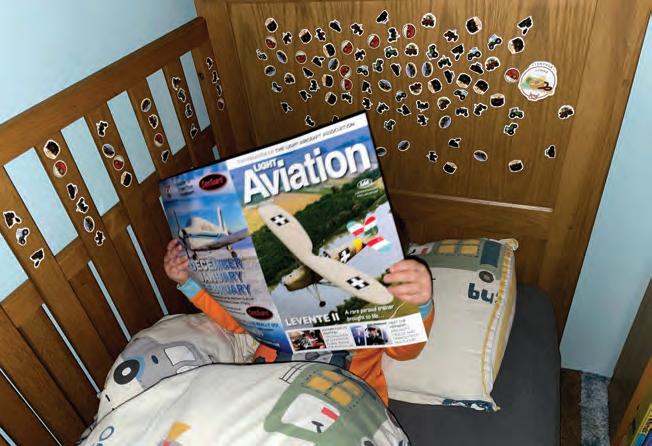
It was great to see – and chat – to a number of members at the LAA AGM at Old Warden recently. Quite a few people nabbed me to talk about a range of topics. However, one in particular, regarding a recent letter, which was published in the October issue, requesting a digital magazine, had clearly prompted several members to check that we aren’t thinking of getting rid of the paper magazine any time soon.
Universally, I got the feeling of a strong love for the paper magazine. I wasn’t surprised as, out of curiosity, I’d also asked the same question when talking to the Bristol Strut earlier in October. Out of the 40-odd people in the room, there were no hands raised when I asked if anyone would prefer a digital item over print. So, while it definitely a case of ‘never say never’ (in my book, being aware of the options for the future is always wise), as far as I’m concerned, I see an overwhelming support and demand for a physical print product. Personally as a member too, I agree.
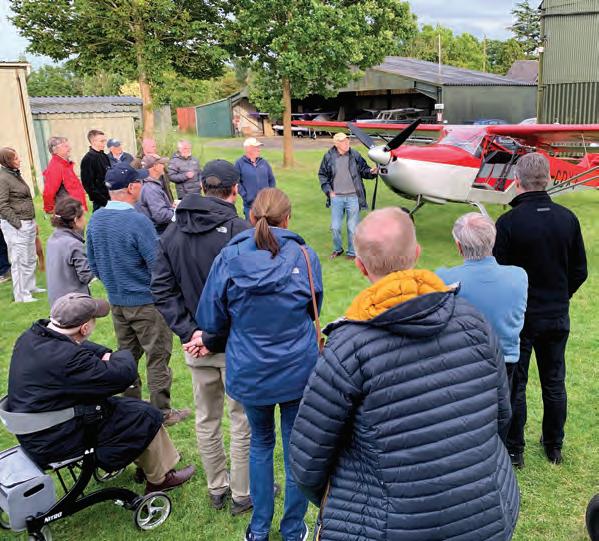
Talking of the Bristol Strut, it was a bit of a return to my roots when I paid them a visit to talk about photo work and EAA Oshkosh, as way back in the late 1990s I had the pleasure of being Strut Co-ordinator for a few years. I joined Bristol in 1992 and some of those first experiences I had would go on to help map out a course to my flying, and my career in the years that followed. Thirty-two years later, there were clearly plenty of new faces, but still one or two members who had been around at the same time.
Struts are an often overlooked LAA resource, and if you haven’t managed to visit
your local group, I would encourage you to seek them out. There’s a full list of Struts on page 43, and many have very active social calendars that could help keep you entertained during the winter months. Who knows, you may also find yourself meeting people who have a share in something interesting for sale, or some local hangarage?
Finally, hot on the heels of this year’s brilliant LAA Rally, our CEO Simon Tilling announced at the AGM that the Rally would be returning to Leicester in 2025 for three days, 29, 30 and 31 August. So get those dates in the diary, and I’ll look forward to seeing you there.
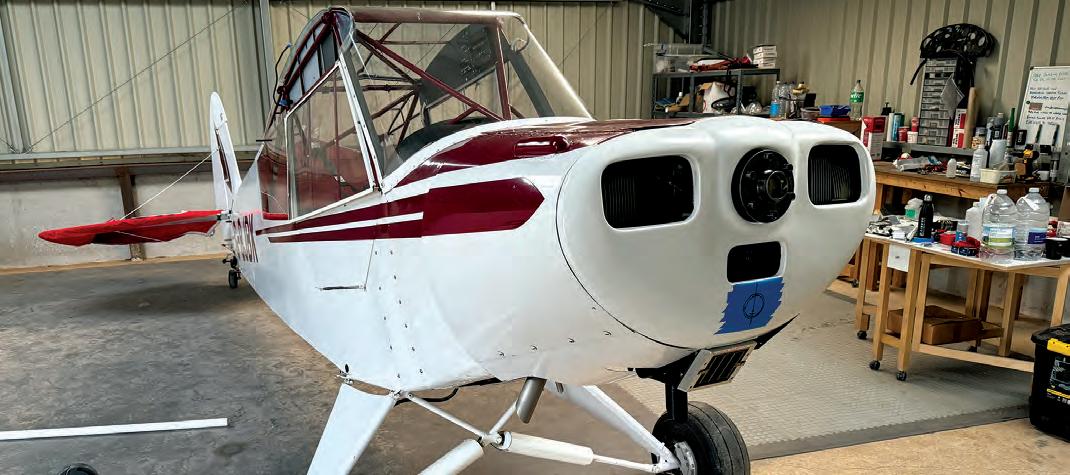
Right, having pretty much finished the fuselage works, the Cub is looking about ready to fit some wings, and I might finally be looking at some spare time to put them on…
ed.hicks@laa.uk.com
FEATURES
12 2024 AGM REPORT
A full report on what went on at this year’s AGM, including presentation of LAA’s awards for 2024.
14 PROJECT NEWS
Steve Markham reports on the trials of a fixed pitch propeller that he figured would keep him flying while waiting on an overhaul for his constant speed MT.
18 FLIGHT TEST
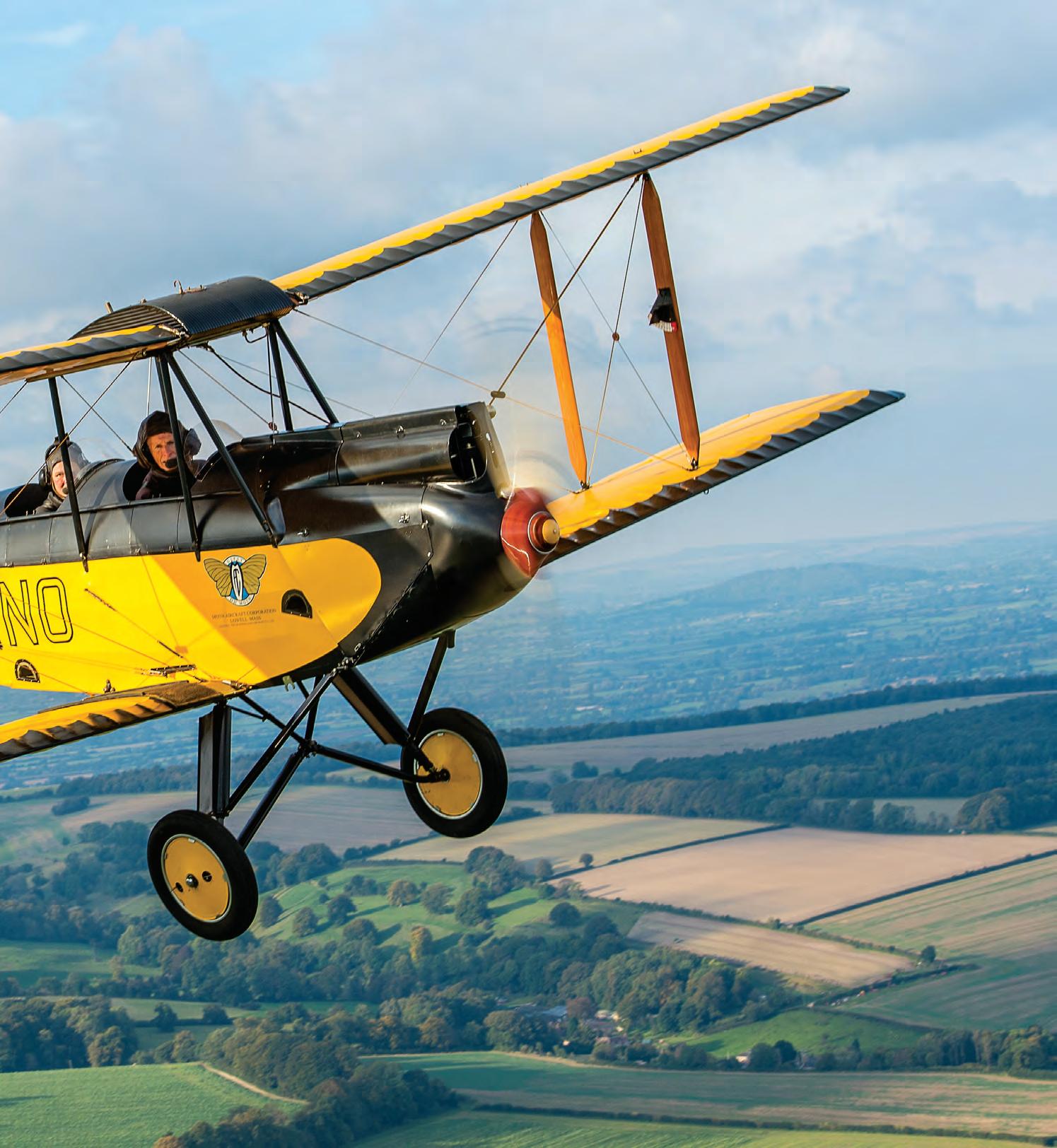
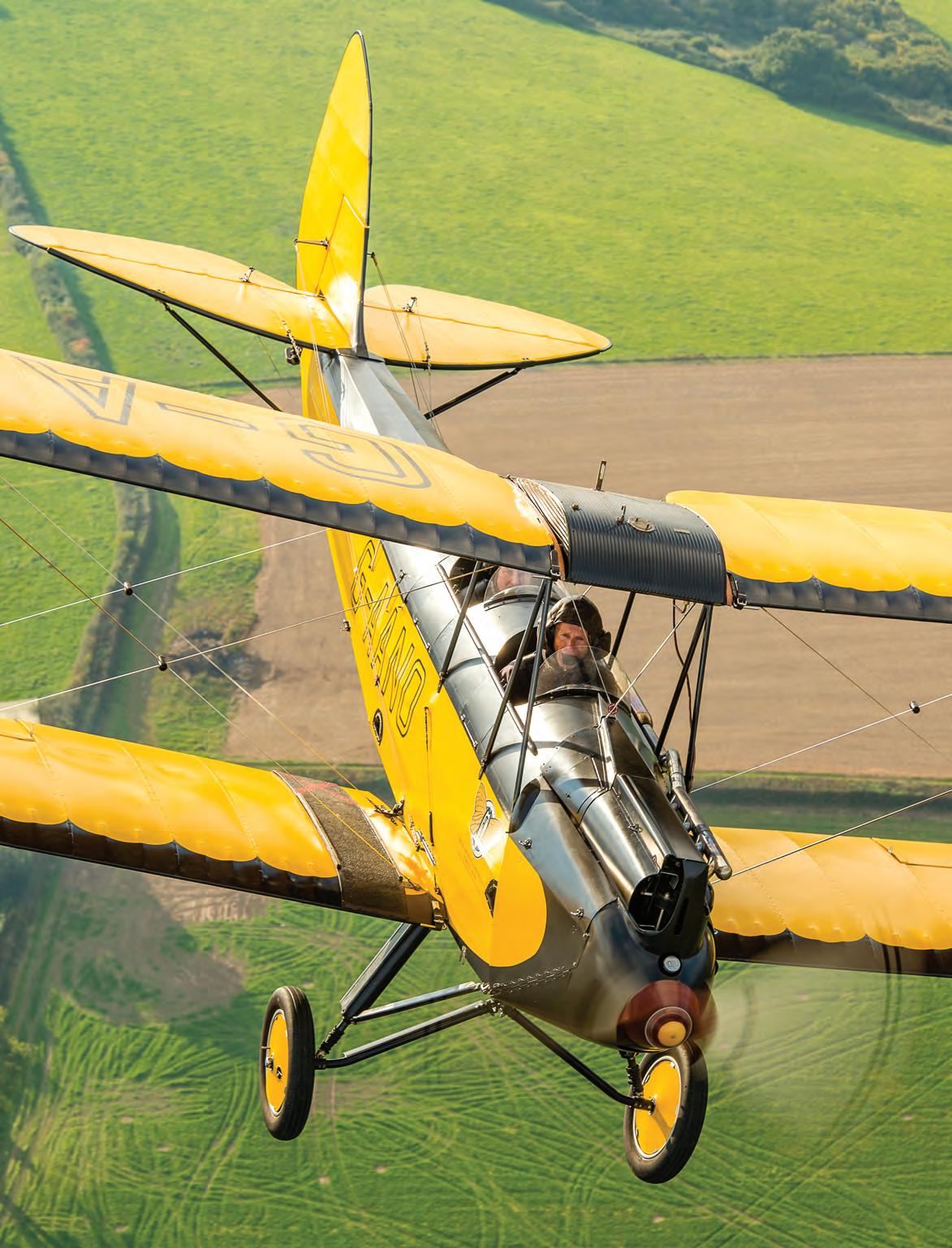
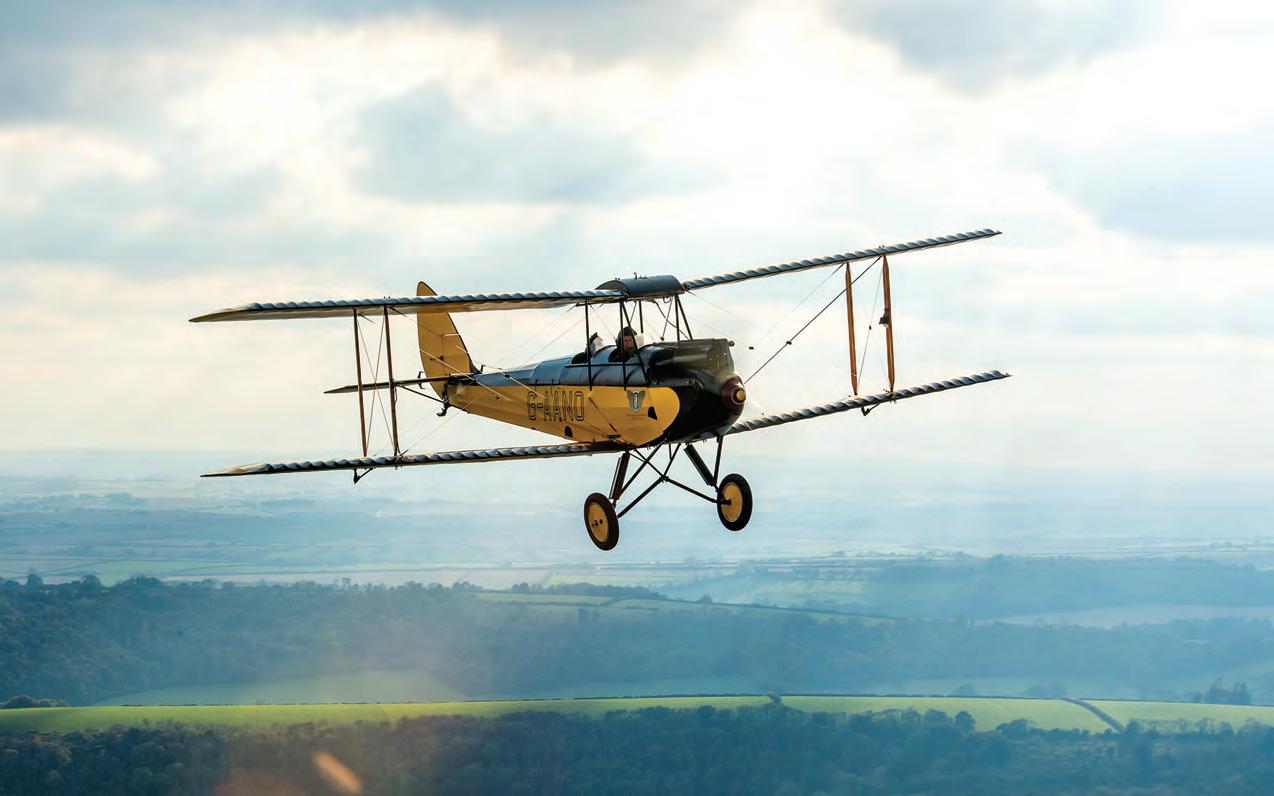
Clive Davidson test flies a fabulous Gipsy Moth restoration.
30 TECHNICAL
Alternator failure can be frustrating and disruptive and, at times, self-inflicted…
36 COACHING CORNER
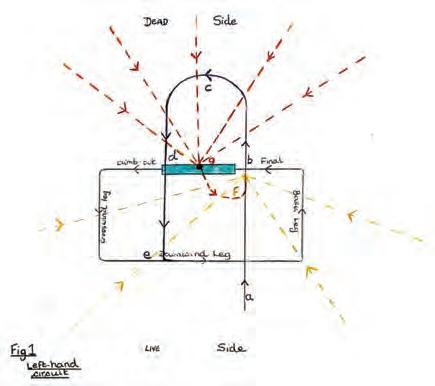
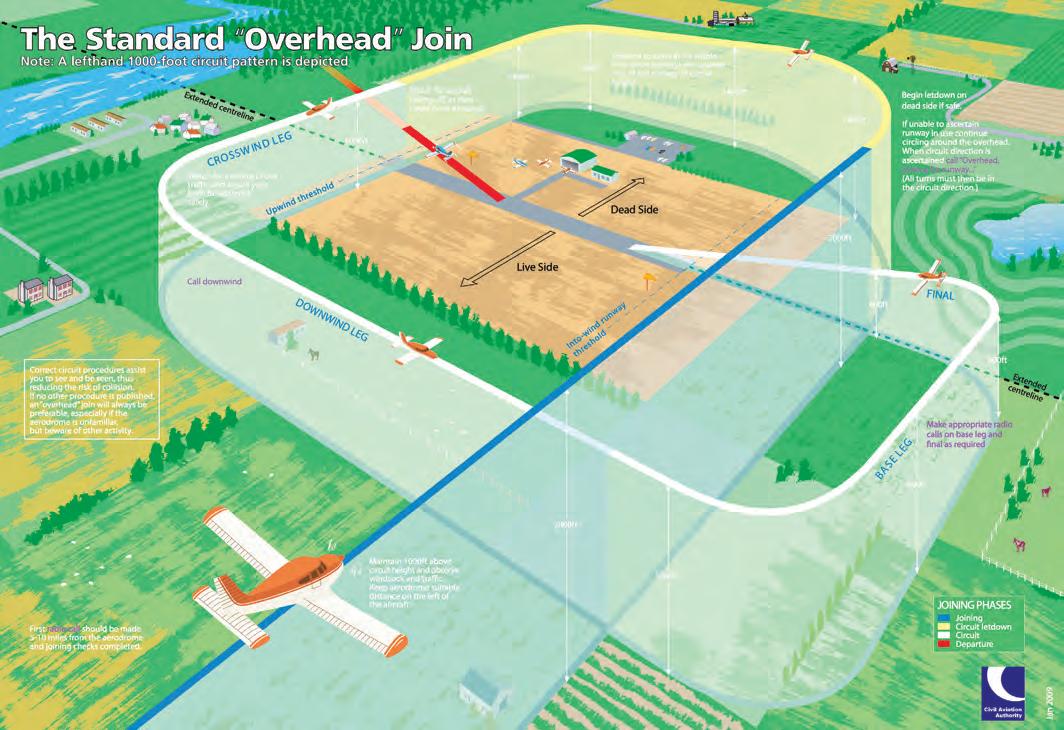
A standard overhead join, allows pilots to quickly assess a wide array of factors when arriving at a new airfield, but it needs to be done competently.
38 ENGINEERING MATTERS
We look at the mandatory use of active CO detectors, LAA unleaded fuel working group news, Engineering team projects and a riveting gotcha…
45 MEET THE MEMBERS
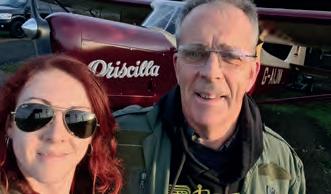
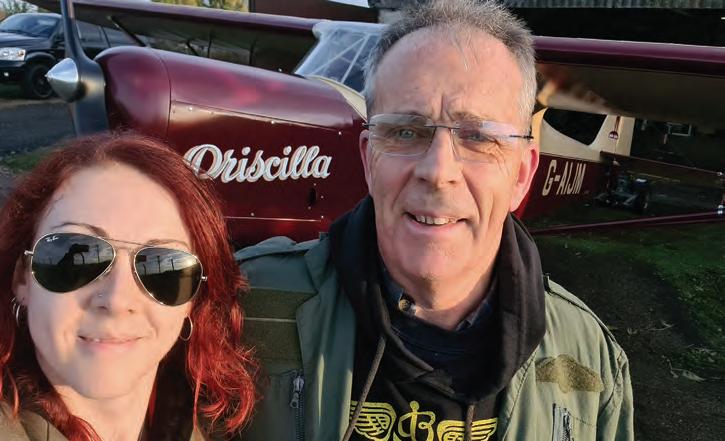
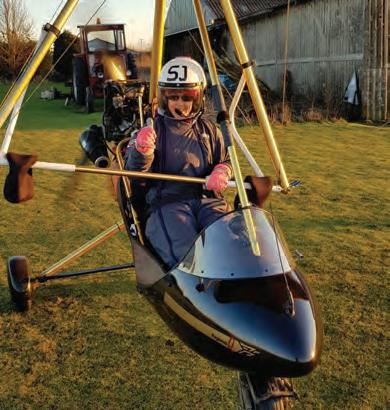
Father and daughter, Nigel and Sj Huxtable, chat to Ed Hicks about how their love of aviaiton runs in the family!
52 LAA PHOTO COMPETITION
The winners of the 2024 Light Aircraft Association calendar competition.
Matthew Boddington honoured with lifetime achievement award
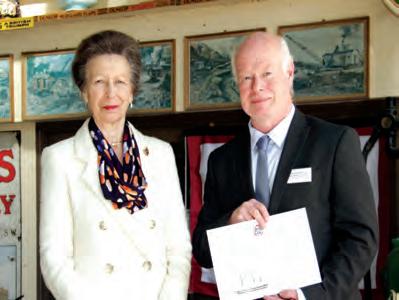
The National Transport Trust honoured long-time LAA member and Inspector, Matthew Boddington, with its 2024 Lifetime Achievement Award – presented by The Princess Royal. Engineer, aircraft constructor and restorer, airworthiness Inspector, display pilot, Matthew has been involved with vintage aviation since childhood.
His father was a pilot with the Barnstormers Flying Circus, and built and flew replica aircraft for several films. Matthew flew with him in early childhood and, after his father was killed in a flying accident, Matthew has devoted his life to building, restoring and flying vintage aircraft.
Bumper round of upcoming LAA courses!
The following LAA courses are available for booking. All will take place at LAA HQ Turweston. Please call LAA on 01280 846786 (ext 2) to book your place. Prices are for LAA members, non-members are welcome, but there is an additional £20 charge per course.
● Working with aluminium Saturday 16 November 2024. Venue: LAA H/Q at Turweston Time: 0900 to 1700. Cost: £250 for members. Our tutors will guide you through the construction of a Van’s toolbox. The build process is specifically designed to teach you drilling, deburring, dimpling and riveting by various methods, and by the end of the day you will have a useful ‘apprentice piece’ to take home with you.
● Rotax carbureted 912/914 installation and operation. Saturday 14 December 2024. LAA H/Q at Turweston. Time: 0930 to 1700. Cost: £200 for members. This course covers everything that those who own/operate a carbureted Rotax 912 (UL, ULS and 914 turbocharged) engine need to know about getting the best out of these very popular engines and keeping them in tiptop condition.
● Rotax fuel injected 912iS/915iS installation and operation. Saturday 8 February 2025. LAA H/Q at Turweston. Time: 0930 to 1700. Cost: £200 for
Based at Sywell Aerodrome he is the ‘go to’ engineer for advice and expertise.
In its recognition of Matthew, the NTT said, “Highly thought of throughout the vintage aircraft world, Matthew’s dedication, expertise and continued lifetime commitment to the restoration of vintage aircraft, make him a worthy recipient of the NTT’s Lifetime Achievement Award.”
Congratulations Matthew, from all at LAA!
members. Course tutor, John Barrott, has developed a course aimed at providing help and advice on the installation and operation of aero engines.
● Permit Aircraft Avionics.
Sunday 8 December 2024. LAA H/Q at Turweston. Time: 0900 to 1700. Price: £200 for members.
This course is an introduction to Permit aircraft avionics. It starts with explaining the LAA rules, how to plan and install your avionics, how modern avionics connect with each other and the various protocols. The course also includes practical demonstration and practice in wiring.
● Flight radio Telephony Operator Licence preparation course. Saturday 23 November 2024. Time: 0900 to 1700. Price: £200 for members. LAA H/Q at Turweston
AeroAdvance, in association with the LAA, is delivering a one-day course with both presentations and interactive exercises to offer attendees the opportunity to develop the skills,
knowledge and understanding of radiotelephony procedures to ensure both confidence when using the radio as a PPL Pilot and support meeting requirements of the SRG1171. Please note, this does not include the FRTOL exam.
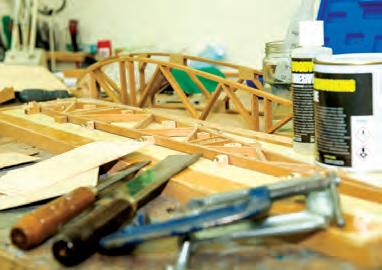
● Aircraft carpentry workshop Saturday 19 November 2024. Time: 0900 to 1700. Price: £200 for members. LAA H/Q at Turweston.
This is the perfect course for the would-be aircraft builder who may be nervous about cutting the first piece of spruce, or anyone contemplating repairing a classic wooden aircraft.
● Permit Aircraft Electrics – Basic Course. Saturday 23 November 2024. Time: 0900 to 1700. Price: £200 for members. LAA H/Q at Turweston. This course provides the theory and practical knowledge to enable the implementation of a basic electrical system in Permit aircraft.
● Permit Aircraft Electrics – Advanced Course. Saturday 7 December 2024. Time: 0900 to 1700. Price: £200 for members. LAA H/Q at Turweston. This advanced course builds on the basics course by providing more detail about component selection and options and the use of integrated power management systems within permit aircraft.
For more information see: www. lightaircraftassociation.co.uk/courses, or contact Cheryl on 01280 846786 or cheryl.routledge@laa.uk.com to book or with any queries.
LAA review membership of Royal Aero Club and EFLEVA
As part of an ongoing process of examining costs and benefits for members, LAA Directors have reviewed the Association’s continued membership of the Royal Aero Club – the fees paid and where the RAeC spent the money. To put this into perspective, the proposed RAeC 2024 fees are £8,002 – and £5,616 (some 70% of the fees) is paid directly to the FAI – World Air Sports Federation and Europe Air Sports. The remainder; £2,406 is used to support the RAeC operation, and the medals & awards process and ceremony.
The Board agreed that as the LAA is a non-sporting body and any LAA member who wants to take part in any form of airsports has also to join the relevant body, (e.g. the 3Rs for air racing) that the CEO should approach the RAeC to make the case for an agreement that the LAA would
LAA at RAeS Design Build Fly conference
LAA CEO Simon Tilling gave a presentation about the LAA’s work at the Royal Aeronautical Society’s President’s Conference 2024: ‘Design, Build, Fly’.
Simon said, “With the LAA’s long history of self-designed and self-built aircraft it is recognised that we can play a key role in supporting the RAeS project. It’s early days for the initiative and a lot of detail needs to be worked out,
only participate in RAeC non-sporting business, including the medals and awards process, with a commensurate reduction in fees. If that proved to not be possible, the LAA would leave the RAeC.
The RAeC debated this in July council meeting, and decided that it would not be prepared to accept any form of non-sporting or associate membership. On that basis, the LAA has informed the RAeC that, with regret, it can no longer continue as a member of the RAeC. The LAA remains open to discussion and hopes that a mutually agreeable solution can be found.
At the same time Directors also discussed our continued membership of EFLEVA – European Federation of Light, Experimental and Vintage Aircraft. The Board is pleased to advise that EFLEVA has agreed that the LAA can remain an associate member, participate in meetings and discussion, but not have any voting rights, for a dramatically reduced annual fee. This will ensure that we can continue to play an active role in supporting light, experimental and vintage aviation across Europe and safeguard the interests of LAA members who fly in Europe.
Changes at HQ
Nick Stone, Head of Airworthiness, has recently decided to leave the LAA. I would like to thank Nick for his contribution and support over the past year and wish him well in his future endeavours.
An update on how the Airworthiness team is structured going forwards will appear in next month’s magazine.
Simon Tilling
RAeS Design Conference
The annual Royal Aeronatical Society Light Aircraft Design conference takes place on 25 November at the RAeS HQ in London.
An exciting programme includes talks on the latest electric power systems, the development of the Pegasus gyroplane, adapting an automotive diesel engine for flight, how to predict the cost of your light aircraft design, common errors in wing design, a hydrogen fuel cell system for aircraft, the Aerocycle Human Powered Aircraft, an update on E Conditions, the restoration of the DH.60 Moth Major, as
but I am positive that this will be a great opportunity to help shape the engineers of the future, and also create a new generation of LAA members and supporters.”
More on event from Simon on page 10.
well as announcement of the winners of the 2023-24 Design Competition. Details of the 2024-25 Design Competition will also be announced at the event.
Both RAeS Members and non-members are welcome to attend, and a reduced member rate is available to LAA members, plus there’s also a specific reduced rate for students and apprentices. Book online at www.aerosociety.com/events-calendar/ raes-light-aircraft-design-conference-2024
Richard Grace 1984 – 2024
The premature passing of Richard Grace, director of Air Leasing and Ultimate Warbird Flights, and an LAA member, has rocked the historic aviation community worldwide, and, more locally, at Sywell where Richard based his business. Richard passed away on the evening of October 15 2024, when he lost his stoic battle with ongoing illness.
As many who saw some of the products of his team’s handiwork, Richard’s skills extended beyond ML407, the famous family Spitfire, to a Stampe, a Fury, Tempest, Yak-3s, Seafire, Hispano Buchóns (Spanishbuilt Messerschmitt Bf109s), P-51 Mustangs, a P-47 Thunderbolt, Hurricanes and several other Spitfires.
Initially Richard’s late father, Nick Grace, restored the ex-Irish Air Force factoryconverted two-seat Spitfire Tr9, but was tragically killed in a car accident, and wife Carolyn trained to fly the aeroplane. She displayed the Grace Spitfire for 25 years, amassing more than 900 hours on Spitfires before retiring from flying in 2017.
It was a long-standing intention of Richard to fly the Spitfire. He was tutored by Pete Kynsey, who had also converted Carolyn onto ML407. Richard first hit the airshow circuit with the ‘Dukes of Cassutt’ team, a pair of former Formula One air racers flown by him and long-time associate, Dave Puleston. The duo then formed and operated a pair of Pitts Specials as a display duo, latterly as the Trig Team.
Richard rightly became one of Britain’s most respected air show pilots. He also gained time on many other classic fighters, restoring them, maintaining them, and flying them. It was the fulfilment of a lifelong dream. In turn, he generously provided opportunities to other pilots and engineers, bringing much talent into the warbird scene.
He was also a generous benefactor to the Thomas Castle Aviation Trust at Sywell and many young pilots have flown Thomases immaculate Tiger Moth. They are now set to follow in Richard’s footsteps into displaying and maintaining older aeroplanes.
Richard leaves behind a wife Daisy, their two children Allegra and Stirling, as well as sisters Olivia and Nicola. Steve Slater
Letters
We are always pleased to receive your letters, photos of your flying, and your feedback. Please email the editor at ed.hicks@laa.uk.com
Home manufacturing article praise
Hi Ed,
I was pleased to see the article on Home manufacturing for the kit builder by Mike Roberts in October’s Light Aviation. I agree there is a lot of opportunity for the home builder with new manufacturing technologies now available at an affordable price, and with the availability of computational design tools it has probably never been easier to design and make individual parts and assemblies up to a whole aircraft.
On my Nicollier Menestrel plans built project, I used a 2D CAD package and water jet cutting for all the 4130N sheet metal parts with great success, saving an awful lot of sawing, drilling and filing. Likewise, I have made a few non-structural pieces with an FDM 3D printer.
After taking early retirement in December 2023, I joined the Black Magic DH88 Comet Racer restoration project at Derby Airfield and we have been using a CNC router to make plywood templates to check the upper wing surface profile at each rib station, which has thrown up some interesting anomalies with the 90-year-old data which we are working through!
I’d echo Mike’s encouragement to ‘have a go’, just involve your Inspector and, if necessary, LAA Engineering to make sure that any material substitution is acceptable. Regards, Tony Razzell.
Hi Ed
I just enjoyed reading Mike Roberts’ Home Manufacturing article in this month’s Light Aviation
I’ve just started a Skybolt build and intend to use 3D printing and CNC machining to try and speed up the build. Thanks, Jon Chippindall.
Digital magazine, no thanks!
Hi Ed,
I read the letter discussing a digital version of LA in the October edition. From my experience, both personal and professional, this is regression. Not everything in this day and age needs to be digitised.
I love having a paper magazine, why? Because I can sit in a chair, which isn’t my desk, away from a bloody screen and read purely for leisure. And when I’m done with it, I
take it to the airfield, and give it to the non-LAA member kid students for inspiration, or the old widower guy who pops along in his camper van for a coffee to watch the comings and goings while he reads in peace.
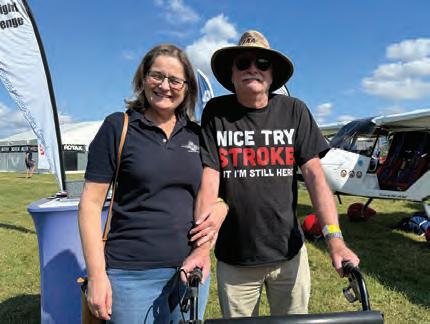
Above Steve Slater and ‘that’ T-Shirt. Keep on with the recovery, Steve!
I have seen several work-related trade magazines move to digital, they email me when the latest edition is out, do I bother? No. I would have – if it was paper – in my break and away from my desk.
The same with our work in-house magazine. It would have come through the post, got put to one side, and read at leisure. In short, I CBA with the digital one.
As a species, we need to reduce our screen time, not increase it. See Stolen Focus by Johan Hari for why. David Leggett.
Dear Ed-the-Ed,
I noted the suggestion from Roger B that there should be a digital version of the magazine. I very much hope that this, if pursued, would not replace the print version. I find reading a ‘magazine’ with plenty of photographs and diagrams, as well as coherent prose (latter meant to be linked to the former but often needing scrolling to connect) very difficult on a laptop, and impossible on smaller digital devices.
Furthermore, the software ‘reader’ apps which ought to interface with the laptop file storage, enabling download and offline printing of selected articles, frequently do not work.
I have ceased my own subscription to one magazine when it went ‘digital only’, and opted not to renew two others when their (gifted) subscriptions expired. And perhaps most importantly, I can leave the printed issues in the ‘free to browse’ pile in the cafe at the Jet Age Museum, where I volunteer. While there, I also proactively give copies to visitors, especially young air-minded ones, who want to become active in GA, pointing out how to find their local Strut.
I gave up active flying a number of years ago. The museum and the (print) magazines are now my only vicarious aviation ‘fix’. I would not want to lose either.
Michael Fortescue.
Rally coverage
Hi Ed,
Thanks, as ever, for another excellent Light Aviation. Lots to enjoy there. The prize for the
photo of the issue, if not Photo of the Year, must go to the picture on page 31 of Steve Slater and ‘that’ T-shirt. Congratulations, Steve.
Cheers, Jon Taylor.
Ed replies: Glad you’re enjoying the magazine Jon, and yes, I’ve got to agree, it was great to see Steve doing so well at the Rally.
Rotax vibration
Having read Kai Maurer’s letter in last month’s magazine, it has prompted me to write about my own group’s experience. We were experiencing severe vibration in the Eurostar on climb out at high power, but engine returning to smooth operation when power was reduced. Carbs were stripped down and blown through with an airline, fuel lines flushed out and filters changed, but the problem persisted. New spark plugs, a replacement ECU and even an overhauled gearbox later, the vibration was still there. We decided to return to the carbs as the chief suspect, and this time we had a Rotax engineer strip them and clean in an ultrasonic bath. After this process a minuscule piece of rubber was found in the bath which must have come from one of the carbs. Aircraft was test flown and ran perfectly. Since then it has flown around 60hrs with no recurrence. Happy days.
Looking back, the last maintenance carried out before the problem started was the five-yearly replacement of the fuel lines. This involves many lengths of tube with many connectors. Some of these connectors have quite sharp edges on them, and can be quite a challenge pushing them on. We suspect that small pieces of rubber were sliced off during this process and since they were downstream of the filter, would go straight to the carbs. Blowing out with an airline did not dislodge it. Also, it only affected one carb which would account for the severe vibration as two cylinders were deprived of fuel. George McNaughton.
Straight and Level Updates from LAA HQ
Straight, from Simon Simon Tilling CEO
Iwas recently asked to speak at the Royal Aeronautical Society’s President’s Conference 2024. The theme of the conference was ‘Design, Build, Fly’.
Drawing inspiration from the German Akafliegs – groups of aeronautical engineering students who team up to design, build and fly small aircraft – DBF aims to build a new collaborative community to develop these cross-cutting skills among young aerospace professionals and students in the UK, creating a platform to learn from each other and develop valuable skills to bridge theoretical knowledge with practical project development. We are creating new engineers who are theory-rich but are
often lacking in hands-on engineering skills. This lack of a next generation of hands-on engineers is a problem which we are all going to face across all aspects of aviation, including GA and, closer to home, our own LAA inspectorate. The RAeS’s intent is to create a programme to encourage/help/incentivise any learning establishment which wants to be involved to design, build and then fly an aircraft. In the motor racing world the shining example of this approach is Formula Student.
With the LAA’s long history of self-designed and self-built aircraft, it is recognised that we can play a key role in supporting the RAeS project. It’s early days for the initiative and a lot of detail needs to be worked out, but I am positive that this will be a great opportunity to help shape the engineers of the future, and also create a new generation of LAA members and supporters. ■
Chairman’s
chat Eryl Smith
Thank you to everyone who participated in the Association’s AGM at Old Warden in late October. The forecast storm deterred the opportunity to fly-in to the event, but a good number of members attended by road, and the AV facilities ensured that others could follow proceedings from the warmth of their homes!
As always, the day was a mixture of dealing with the formalities of the AGM, celebrating the presentation of the Rally and LAA Service awards, as well as the opportunity for an open discussion on matters of the moment. With many of the award winners present on the day it was a pleasure for Simon and I to present them with their trophies and acknowledge their efforts and contributions. There were also three Director’s stepping down, all of whom have given extended service to the Association – a total of 31 years as Directors! It was also an opportunity to acknowledge Roger Hopkinson who completed his service as President of the Association following his time as Chairman. A big thank you to them all.
In my report I updated on the post-fraud actions, where the Financial Ombudsman has formally concluded its investigation and upheld the actions of the bank. As a result the Board has concluded that there is no further redress we can pursue. As such, the matter is closed and Directors will continue to focus and report on ensuring robust governance of financial matters going forward.
Another theme of my report to the AGM was volunteering and contributing to the future success of the Association. Whether it’s as a Director, a volunteer to ensure the continued success of the Rally, or supporting grassroots flying activities at Strut and Club level, our future and the ability to attract future membership is not just about the HQ team. It will be an important consideration over the coming year as the new Board of Directors meet.
The open forum provided for a wide-ranging and spirited discussion about current issues. These ranged from our relationship and activities with key stakeholders from government and CAA to other GA associations and safety organisations; opportunities and initiatives to encourage greater involvement of members; growing our technical training offer and the future of 100LL and alternative fuel options were among the issues raised. As always there is a balance between capacity, resources and funding to develop and progress ideas and initiatives and the Board will reflect on the issues raised.
The day was not complete without acknowledging the success and hard work of all those who contributed to the success of the Rally at Leicester. We are pleased to announce that we have agreement in principle with Leicestershire Aero Club to hold the 2025 Rally at Leicester on 29-31 August 2025. We will now be working to finalise the arrangements as part of an ongoing relationship.
As the clocks change, the days shorten and our flying opportunities diminish… thank you all for your continued support for the LAA. ■
AGM Report: 2024
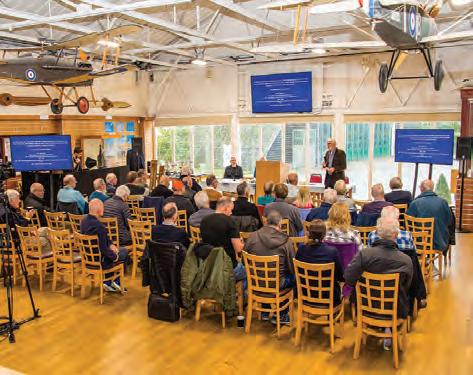
Held on 20 October at the Shuttleworth Collection’s Discovery Centre, the 2024 AGM of the Light Aircraft Association
Limited featured
joint in-person
and virtual attendance.
Atotal of 80 members attended the AGM and LAA Service Awards. Many braved the elements to attend in person, whilst others took advantage of the option to participate online. Apologies were received from David Faulkner Bryant and Marcus de Ferranti.
Celebrating Rally trophies and LAA Service awards
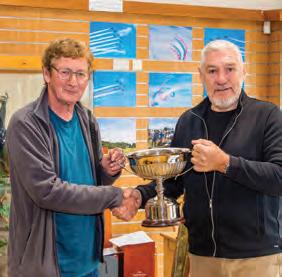
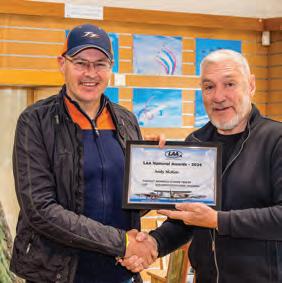
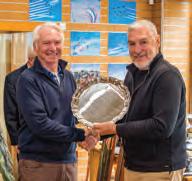
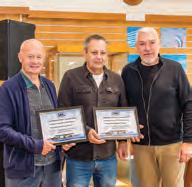
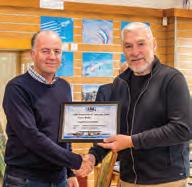
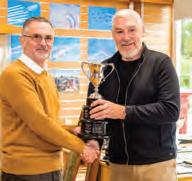
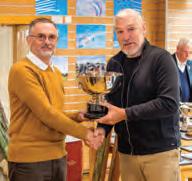
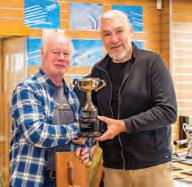
The AGM was preceded by the presentation of trophies and certificates to Rally award winners, plus the LAA Service awards. Many of the winners were featured in the October Light Aviation report on the Rally, with many of the recipients present to collect their awards in person. The LAA Service awards recognise particular contribution to the work of the Association, either in person or as a group or Strut. Full details of all the winners are available on the LAA website and some of the presentations are illustrated in this article. Once again the efforts of Harry Hopkinson, the judging team and Stuart MacConnaher as the custodian of the awards and trophies are greatly appreciated.
AGM proceedings
The formalities of the AGM were concluded with the adoption of the Annual Report and Accounts, the re-appointment of the Association’s auditors, Just Audit and Assurance Ltd, and the re-appointment of Chris Holliday, Ian Sweetland and Eryl Smith as Directors.
In his report to the meeting, Chair, Eryl Smith, updated members on the outcome of the fraud complaint to the Financial Ombudsman. Regrettably, in its final deliberation the Ombudsman has upheld the actions of NatWest bank and not imposed any further redress or compensation. The Board has therefore concluded that there are no more actions it can take and considers the matter closed. In response to a question, CEO, Simon Tilling, reported on the ongoing actions to manage and monitor payments and bank accounts, enhanced governance procedures and continued staff training. The Company Secretary, David Mole, also reported on further considerations that the government is making, which may extend protection in such matters to small businesses and provide additional protection in the future.
The Chair thanked the outgoing Directors, Marcus de Ferranti, John Brady and Brian Davies, who between them had given collectively some 31 years service and included roles of Chair and Vice Chair. Their contributions had been greatly received, and looking forward there was a need to encourage more members to step forward to fill such roles, along with other activities to volunteer time skills and knowledge for members’ benefit.
President, Roger Hopkinson, also concluded his tenure at the
AGM, having served for nine years as President and prior to that as Chairman of the LAA during its transition from the PFA to LAA and the establishment of governance and financial stability that we continue to enjoy. Roger was presented with a framed copy of the LAA 30th anniversary painting.
Open forum
As has become customary, the AGM was followed by an open forum in which members raised a wide range of subject issues to which Simon Tilling and Eryl Smith responded. There was much discussion on how we might address the membership and demographic challenges we face, whether it be in the ways we communicate and the greater use of social media, how best to reach out to younger prospective members and how we can re-energise the grass roots Club and Strut activities. Simon provided a summary of the engagement that the LAA currently has with a wide range of stakeholder organisations from DfT, CAA, fellow member associations and safety forums. He also set out the position with the Royal Aero Club and EFLEVA, reported elsewhere in the News section of the magazine.
Another area of discussion related to the opportunity to expand services for members’ benefit, with examples being, promoting more sales of parts and supplies (sales and wants); an expansion of technical training courses and extending participation to non-members as a means to both encourage future LAA membership and generate income to be re-invested in LAA activity. More complex issues touched on whether there should be more support for the development of new aircraft models, either by competition or more support to the ‘E’ conditions and the future for 100LL fuel replacement with the withdrawal of TEL (tetra-ethyl lead) in 2025.
Rally returns to Leicester for 2025
Simon thanked everyone for the success and safety of the 2024 Rally and presented Leicester Aero Club Chairman, Matt Wennington, with a certificate of appreciation for the contribution that the Leicester team made, without which it would have been impossible to hold the Rally. Simon concluded the meeting by announcing that agreement had been reached in principle to return to Leicester for the 2025 Rally on 29, 30,31 August.
A very positive note to conclude the AGM day, so make a note in your diaries and we look forward to seeing you at the 2025 Rally at Leicester.
The documents related to the AGM including the full Chairman’s report and accounts are available on request from LAA HQ. ■
Presentation of LAA Awards
The Pete Clarke trophy for a major contribution to flight safety was awarded to Ron Perry. Ron, an LAA Coach, has been recognised for his tireless enthusiasm in delivering a range of training for LAA pilot members.
The President’s Joystick for services to the Rally was presented to Dave Barwick, who flew his Eurostar microlight into the Rally on Thursday, and then worked tirelessly throughout the weekend, volunteering on a multitude of tasks.
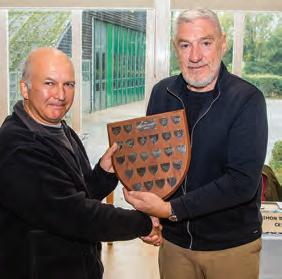
The Faulkner-Bryant Shield for the most active Strut or person within the Strut system was awarded to the Kent Strut, and was collected by Gary Smith. Its citation recognised the efforts behind the Manston charity fly-ins, which have attracted large audiences and been a tremendous overall success.
The Roderick Turner Award for the person who has contributed most to Flying for Fun was awarded to Andy McKee. This year, Andy became the British Aerobatics intermediate level champion flying his homebuilt Silence Twister. His commitment to the sport has been a true display that a homebuilt, lowhorsepower, LAA aeroplane can take on the high-horsepower factory-built aerobatic aeroplanes.
The Frank Hounslow Trophy for services to LAA in Engineering was presented jointly to:
● Nick Sibley
● Pete Pengilly (Pictured)
● Peter Bentley
These members, as the Night/IFR Assessors, have volunteered their time to create and deliver a training package to all Inspectors who go through the Night/IFR Inspector application process. Through this, they have improved the knowledge of all the LAA’s Night/IFR Inspectors and helped ensure these Inspectors are trained to the same standard, understand their role as a Night/IFR Inspector and, most importantly, helped to keep our members safe.
The Lois Parker Trophy for distinguished service in an administrative function, was presented to Mike Slaughter. Mike has been a tireless supporter of the Project News column in Light Aviation magazine for many years, collecting material that helps inspire the members to consider homebuilding or a restoration project. His dedication to the role has meant consistent on-time delivery of material, every issue, without fail.
The following LAA Rally trophy winners were presented with their awards:
Commendation in best plans built presented to Stuart Leonard and David Messenger for Pietenpol Air Camper G-RAGS.
Commendation in best Kit built aircraft was presented to Peter Reid for Van’s RV-10 G-EMMR.
The John Randall Trophy for Best Vintage Aircraft, and the Jim Empson Trophy for Best Fabric Piper was presented to Roger Benson for Piper J4A Cub Coupe, G-AFZA.
The Roy Mills Trophy for Best Classic Aircraft, and the Pooley Sword for Best Replica were presented to Matthew Boddington for his restoration of Slingsby SE5, G-AVOU.
Inspiring members to take on their own aircraft build or restoration project
Compiled by Mike Slaughter
Project News
It’s that maintenance and fettling time of year, so if you have a project underway, why not take the opportunity to update your fellow members on its status? Although the vast majority of reports focus upon aircraft completion, this column welcomes updates at any stage of a build.
Indeed, many projects featured are common types but each have a unique story. It may be your first aircraft, the first that you have painted, or on which you have tackled the wiring, perhaps you have built your pride and joy and now need to learn how to fly! If you’ve an idea for a project report but aren’t sure, please do get in touch, the details are below.
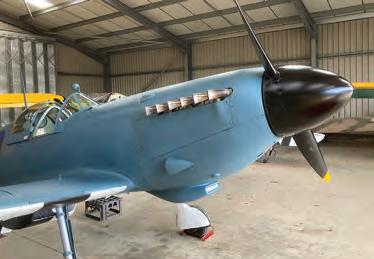
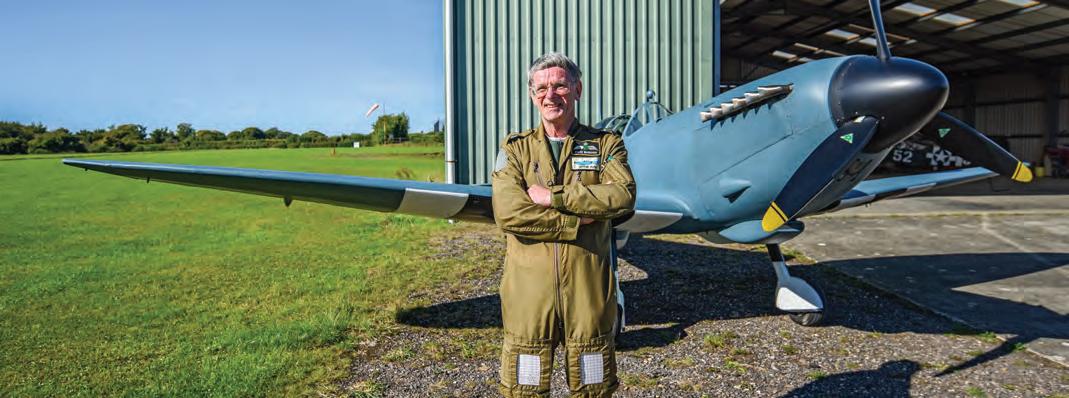
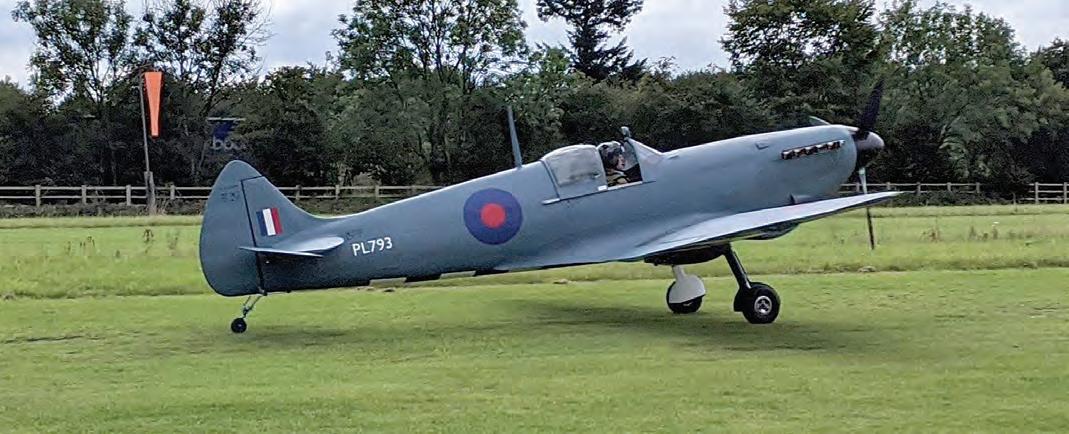
Steve Markham has done just that and while there is probably enough detail building a MK26 Spitfire to fill a book, Steve has just
focused on that part of the project cycle where the building is over and the aircraft simply needs to be brought into service!
Dave Bishop wrote in detail on the build process of the MK26, and for those with an organised set of back copies of Light Aviation, you’ll find his article serialised in the February to May 2015 issues of LA.
Steve’s project report is a very interesting and analytical tale of two propellers, questioning which is best for his aircraft. It is a process that he never intended to undertake but was offered the opportunity by Popham’s sometimes soggy winter surface. Intrigued? Then read his fascinating update below.
To get in touch with Project News, and tell your story, report a milestone or just to send a picture, email: projectnews@laa.uk.com. Please share your story!
G-CIXM (PFA 324-14509) Spitfire MK 26
By Steve Markham
Istarted my Mk26 build in 2006 and 11 years later, in autumn 2017, after 11,500 hours of work it was finished… or so I thought. Dave Bishop has written two excellent Light Aviation magazine articles that describe the problems he encountered building his Mk26 Spitfire.
Suffice to say that my kit had most, but not all, of the
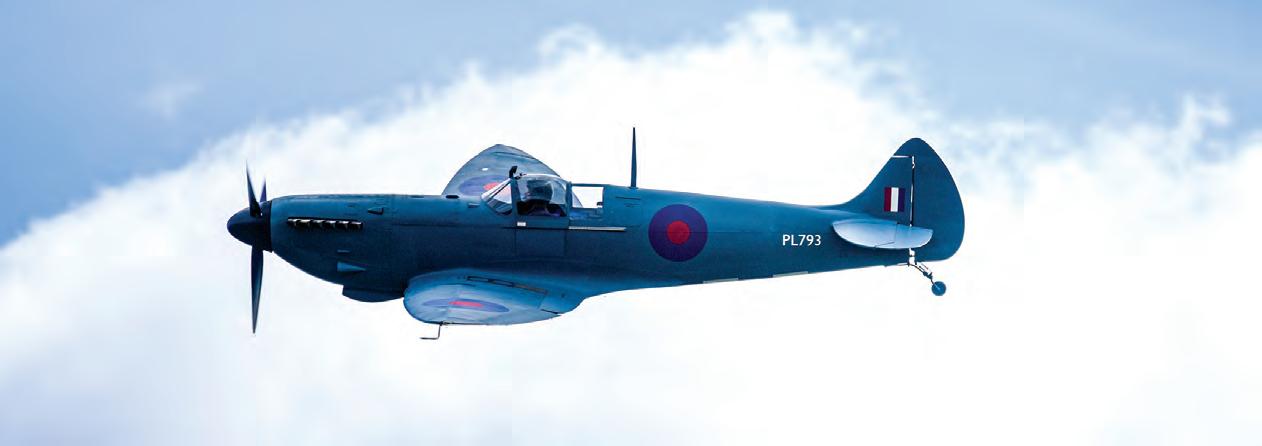
Builder/owner, Steve Markham, with Spitfire Mk26 G-CIXM. In this photo the aircraft is fitted with its three-bladed variable pitch propeller made by MT.
same issues, plus a few extra hurdles that were uniquely my own.
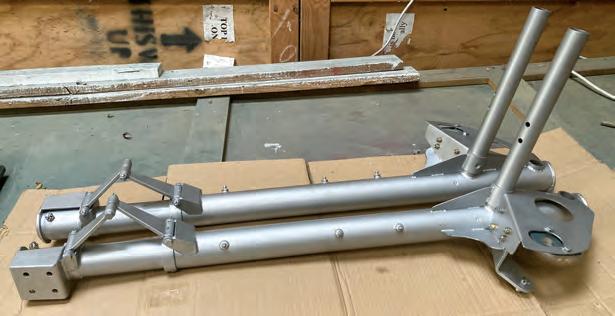
A series of 32 test flights took place from August 2018 to July 2022. There were several major snags, including an overheating engine and an electrical fault that caused an engine failure after take-off. I took the opportunity to build a new pair of undercarriage legs using stronger
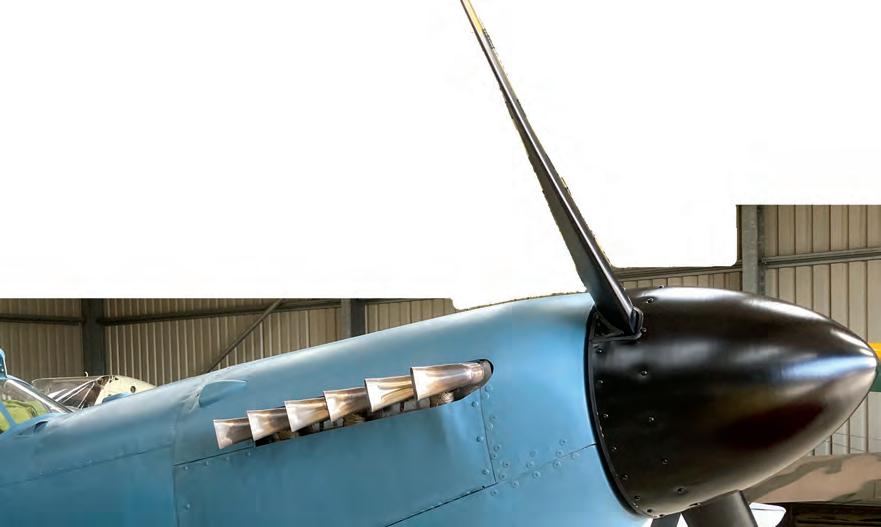
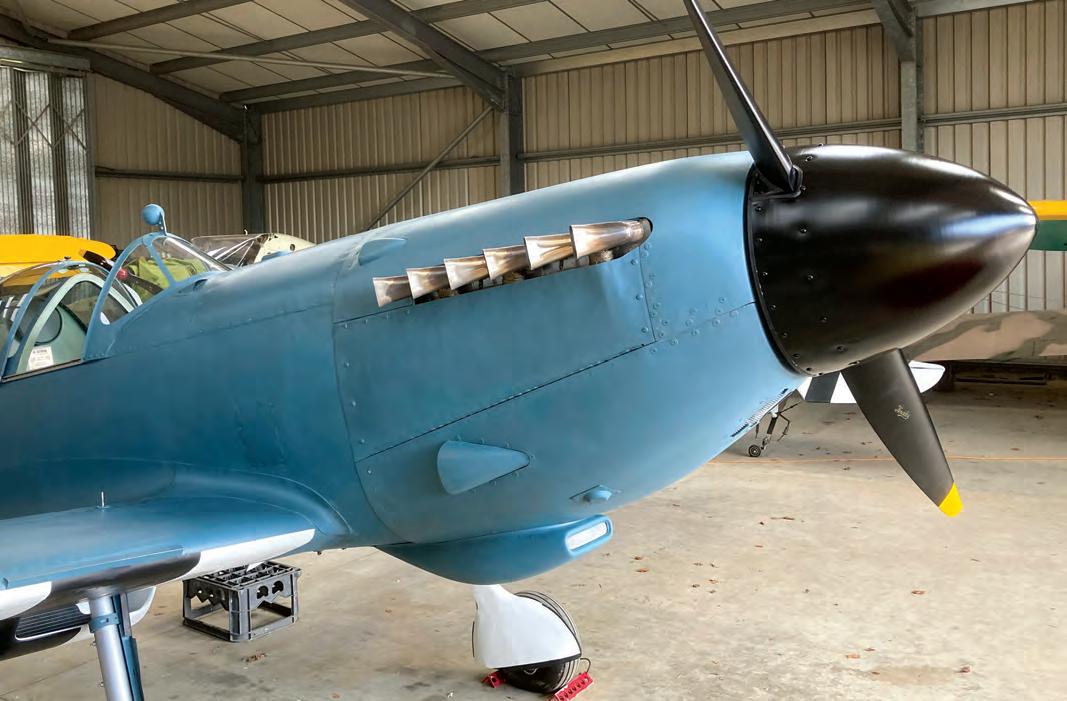
Above The two-bladed fixed-pitch Hercules propeller with its new spinner in the hangar at Popham.
chrome molybdenum steel tubes instead of the original somewhat weaker stainless steel. I fitted torque links to keep the wheels straight instead of the splined shaft arrangement that had failed in another MK26 at about the same time. Delays due to Covid added greatly to the frustration. Eventually though, G-CIXM received her Permit to fly and was awarded the Best Kitbuilt aircraft prize at the LAA 2022 Grass Roots Rally.
Six weeks later, just at the beginning of the rainy season, I managed to locate the first soft spot that had formed in Popham’s Runway 26. My aircraft has a 266hp V6 engine and its large amount of torque puts most of the aircraft weight onto the left wheel during take-off. It sank three inches into the ground and the resulting deceleration caused a nose-down pitch that removed the tips of each of the propeller blades.
MT in Germany agreed to build me a replacement three-bladed variable pitch prop, but it would be nine months before it would ship it to its UK agent, Proptech, at Lee-on-Solent. Assuming a further month for it to be assembled, balanced, delivered, fitted, tested and signed off I was looking at no Spitfire flying for the best part of a year, when again the winter clouds would be gathering. My insurer, Visicover, was magnificent. It processed my claim rapidly and sent me an advance payment so I was able to place the order and at least get the long delivery clock ticking.
Some of the aircraft in my hangar at Popham are fitted with Hercules propellers which perform really well, and I was advised by its owners to contact Rupert Wasey who runs the company in Gloucestershire. Rupert was incredibly helpful. He said he could design and make me a two-bladed fixed-pitch propeller in as little as five weeks from order. The price would be £4,500 compared with the £12,900 that I had just spent for the new MT prop. I justified the expense on the grounds that my otherwise wasted hangarage for the
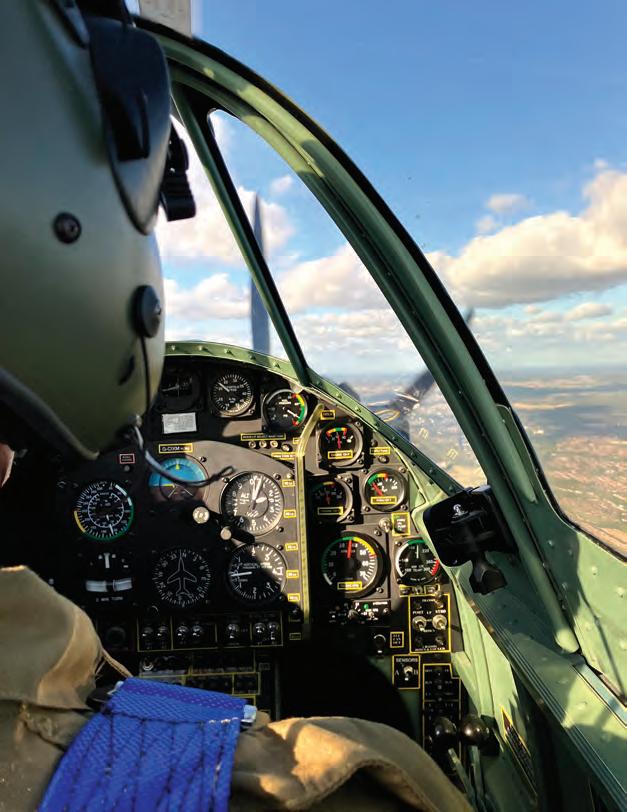
Have you ever wondered what the passenger forward view is like in a MK 26 Spitfire?
year would amount to more than half of the Hercules prop price. Additionally, the same sum would buy just 45 minutes in the passenger seat of a legacy TR.9 Spitfire – and I planned to fly a lot more than that in a year. I would also have a spare prop for use when, every six years or 200 hours, the MT propeller needs an overhaul.
A previous MK26 with the same engine as mine had already been fitted with a Hercules propeller, but because my engine has a different PSRU (Propeller Speed Reduction Unit = gearbox) ratio it needed to go through the full LAA approval process. I forwarded a copy of my engine’s dyno data to Rupert Wasey, plus the results of my previous flight testing. The MT prop had given me a max TAS of 180kt at 2,000ft burning 70 litres an hour. A quieter and significantly less expensive speed is 140kt IAS (148kt TAS) at 1,800 propeller rpm burning 38.5 litres an hour. It looked like attaining this speed at that low rpm would result in a too coarse fixed-pitch prop, so Rupert suggested 140kt at 2,000rpm. This would result in an 80-inch diameter prop (same as the MT) with an impressive 88-inch pitch.
Meanwhile, I designed a new spinner and hub plates for two blades not three, and on the last day of October,
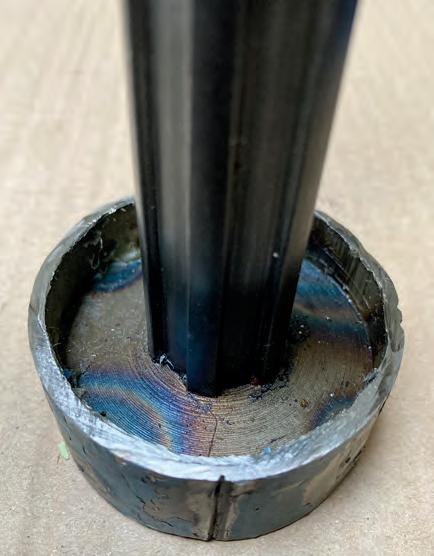
Above (top) The new legs with the scissor-style torque links on the left replace the original splined shaft design.
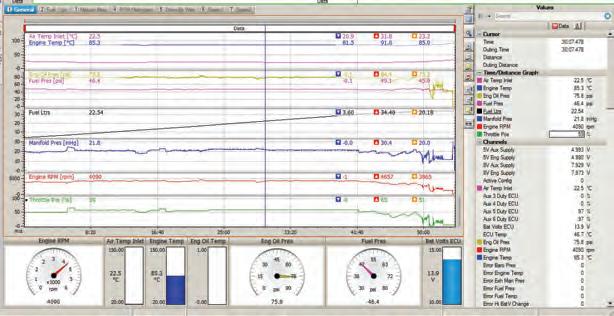
Above (bottom) ECU data downloaded from the MoTeC Engine Control Unit after a flight with the Hercules prop, this made comparisons between the props so much easier.
Above The original undercarriage legs splined shaft – Steve rebuilt these using torque links to keep the wheels straight, as the splined shaft arrangement had failed in another MK26.
just two weeks after my incident, with the help of my LAA Inspector, Barry Goldsack, the MOD4 form was submitted to the LAA. The Certificate of Clearance for the Mod arrived a day before Christmas.
I had already given Hercules the go ahead and the prop had been made and was waiting for painting. By this stage of the winter the ground at Popham was truly soggy and it wasn’t until the middle of May before I could confidently start flight testing.
So, the results… The ground roll before take-off is 400 metres compared to 250 metres for the MT. That is not at all surprising as the aircraft is starting its take-off run effectively in ‘fourth’ gear not ‘first’, which the MT variable pitch unit provides in its fully fine position. I could not exactly measure the landing ground roll distances for the two propellers, but feel that the Hercules takes between 50 and 75 metres more than the MT to stop without using brakes. The lower drag of the Hercules two blades in coarse pitch, compared to MT’s three blades in fine pitch accounts for this.
The average rate of climb from 1,000 to 10,000ft is reduced from 1,800fpm to 1,200fpm. Again, the fixed-pitch propeller remains in ‘fourth’ gear and does not drop down
G-CIXM in flight.
into ‘third’ or ‘second’ as the variable pitch prop does for what is effectively a steep hill climb. Not that 1,200fpm is at all shabby. It is double the climb rate of the other aircraft that I fly.
The 2,000ft maximum level cruise speed was measured to be 7kt lower at 173kt versus 180kt TAS. Again, not too stuffy compared with 90 to 120kt for most light aircraft. The reduction is because the Hercules prop was designed to be optimal at the 140kt economical speed and it cannot go into ‘overdrive’ like the variable pitch MT at top speed.
Fuel consumption is almost identical. At 140kt IAS the MT burns 40.3 litres per hour at 2,000 prop rpm, reducing to 38.5 L/h at 1,800rpm. Fuel burn with the Hercules is 40.15 L/h at the same IAS, turning just a little faster than planned at 2,072rpm. The Motec ECU that controls the V6 engine records this data and many other parameters which can be output after a flight.
Now the really good Hercules news… The MT prop is 13.5kg heavier and needs a 1.5kg lead weight in the tail to keep the CoG in a reasonable position. The ballast weight is not needed with the Hercules and in fact the CoG position is generally always much nearer the centre of the envelope. In total I get a 15kg increase in useful load with the Hercules. When flying with my wife, Kay, as
Below Steve taxing at Popham in September 2020 between the first and second lockdowns, when we were flying with a face covering two up – remember that?
passenger, that makes a huge difference to the available fuel load which goes up from 76 to 97 litres. With a 30-minute VFR reserve that increases the available flight time by 37%, from 1 hour 24 mins to 1 hour 55 mins. The still air range increasing from 207nm to 284nm.
Flying solo makes the fuel difference even greater because the heavy MT prop right out at the front of the aircraft requires ballast to be placed in the baggage compartment in order to keep the CoG aft of the forward limit. The minimum ballast to be carried is 10kg which then allows 145 litres to be in the tanks. With the same CofG position the Hercules needs no ballast and allows 180 litres to be loaded. Allowing for the small difference in fuel burn rates, the still air range (with reserve) of the MT is 483nm compared to 589nm for the Hercules.
So, in summary, which prop is the best? The main advantage of the MT turns out to be its ability to allow the aircraft to operate from shorter airstrips. Otherwise, the fixed-pitch propeller appears to win on most counts, especially initial cost and no need for six-yearly maintenance.
Which would I choose if I had all this information prior to the build? Not sure, possibly the MT because of the take-off performance, but if money was short, then certainly the Hercules. ■
New Projects
If your aircraft has been featured in the New Projects list, please let Project News know of your progress at: projectnews@laa.uk.com
■ Van’s RV-7 (LAA 323-15907) 9/9/2024
Mr B Polwin, 2 Almonds Green, Scopwick, Lincolnshire,LN4 3PW
■ Zenair CH 750 (LAA 381-15908) 9/9/2024
If your aircraft has featured recently in the magazine and has subsequently completed its maiden flight, Project News would like to hear from you at: projectnews@laa.uk.com Cleared To Fly
Mr P Quickenden, Springfield, Old Ways End, East Anstey, Devon, EX16 9JQ
■ Van’s RV-10 (LAA 339-15910) 16/9/2024
Mr M Pilacoutas, 17 Kestrel Way, Aylesbury, Buckinghamshire, HP19 0GH
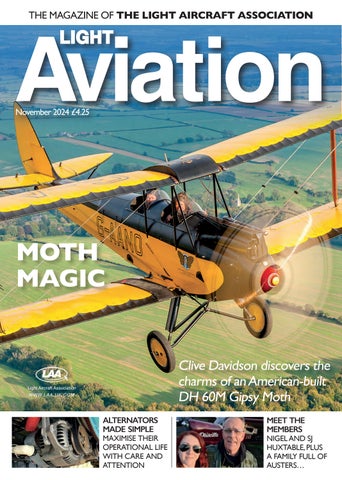
Clive Davidson discovers the charm of an American-built DH 60M Gipsy Moth
Photogr aphy Ed Hicks
Sitting in the cockpit, leather helmet chin strap buckled, goggles on the forehead, shoulders and lap strapped in, left hand resting on the throttle –and the Gipsy ticking over having warmed and run up to 1,600 revs, mag and carb check. Ticking over with a calming low even ‘thrum’ of a beat from the long stainless exhaust. Trimmer set and feet on the rudder pedals. I am comfortable, drop the
shoulders… and relax. I am on the edge of quite an adventure. A journey of discovery. It may only be reflected in the tech’ log with a squiggle of an acceptance signature, but there are literally volumes of sheaves supporting this Moth’s rebirth. I have never flown a Gipsy before, oh sure I have log books full of Tiger Moths, but never the parent, this forerunner, the Gipsy. Mind you, I cannot allow myself to be too excited as that may hinder full methodical concentration for the flight ahead.
Having waited for official clearance, for flooding to
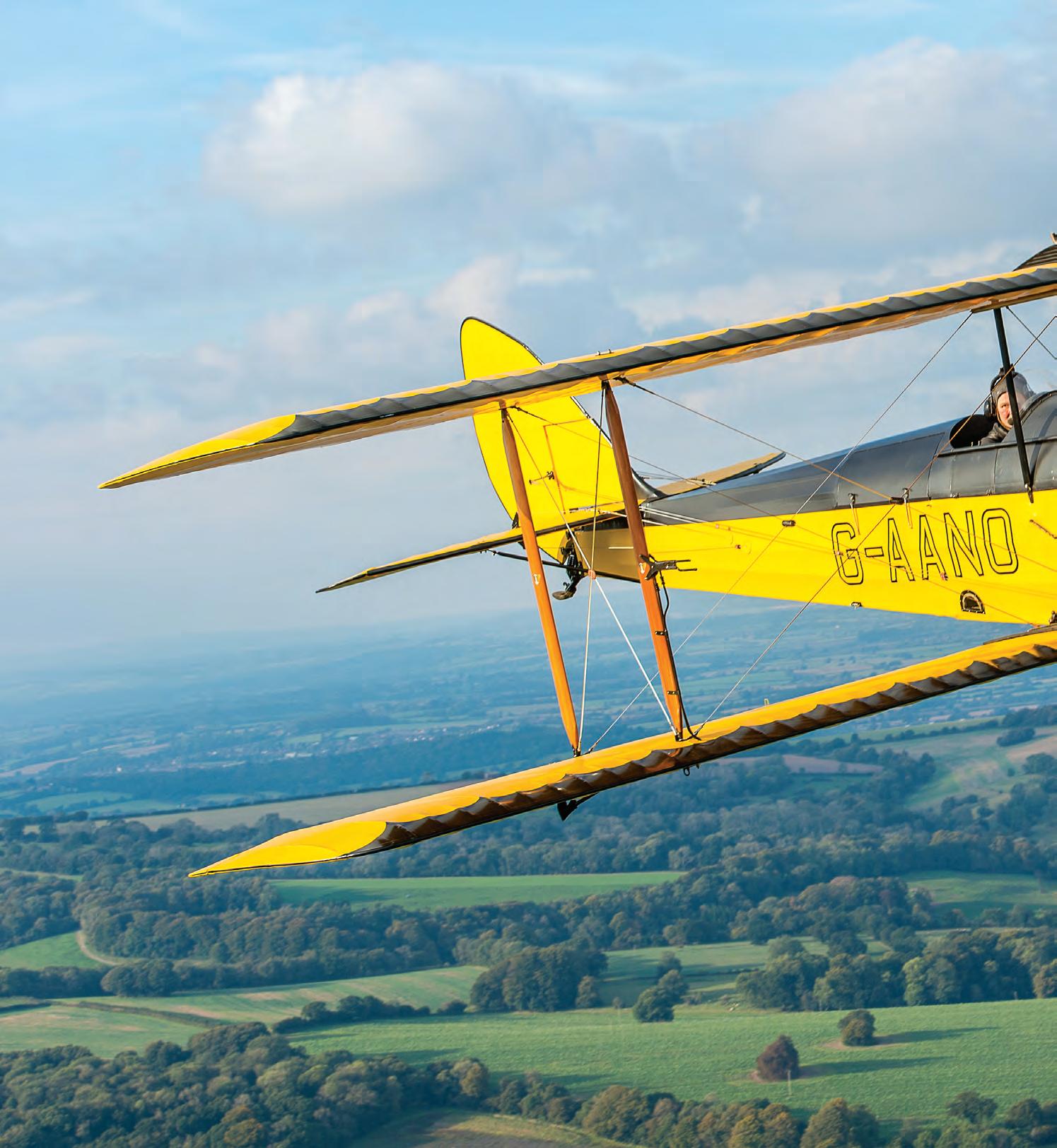
subside and for stable blue skies to air her wings; today the cloud base is sufficiently high and the wind isn’t particularly strong, maybe seven or eight knots from 30° off, from the right. This is fortunate and means I can use the grass area and avoid sliding the metal tailskid over the concrete and tarmac. This is my first take-off with her, her first flight after a seven-year rebuild, some 88 years after she last flew in Massachusetts. I feel really quite privileged. I smile at the prospect, and nod to her owner. A final circular wiggle of the stick around the cockpit
watching the surfaces rise and fall, check fuel, mags and make an RT call to tell the Henstridge traffic that G-AANO is taking off. It is time…
Increasing the power slowly, a little left rudder keeps us straight. The nose now just sits beneath the horizon as the speed increases, the lightness gifted by our wings allows us to rise almost imperceptibly into the air, leaving our shrinking shadow to chase behind. Airborne! Accelerate, I am looking for 65mph and five more in order to comply with the advice of the Gipsy engine rebuilder Paul
Sharman – to keep her cool for the first flights in the climb.
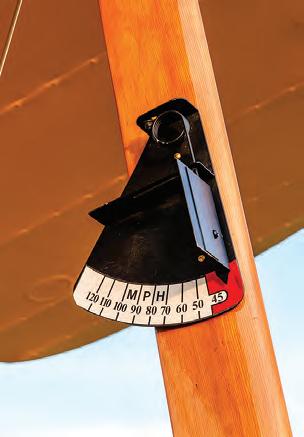
The needle of the ASI isn’t where I expected, a bit low for my attitude and power. The strut-mounted mechanical plate ASI confirmed I had sufficient speed. I am having to apply a tad of left aileron to keep wings level and an equal amount of extra left rudder so as to keep her in, what I feel, is in balance. Not bad rigging at all for a biplane’s first test flight.
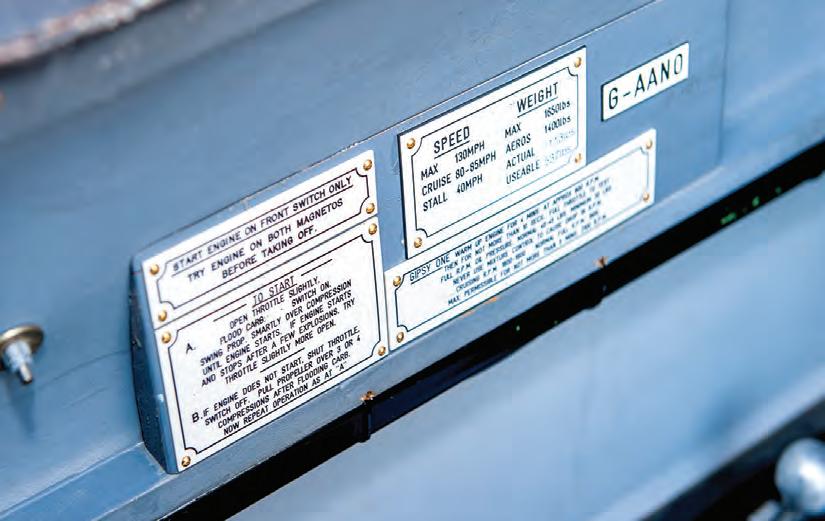
A gentle climbing turn and ‘we’ flew downwind allowing the throttle to be brought back. The cockpit placard stated between 1,800 and 1,900 revs during cruise and my hand on the throttle sat comfortably with 1,870 revs. I opened and closed the throttle slowly, forward and backwards a few times and then, without looking at the revs, resetting what I thought was the same position and sure enough we had the same 1,870 revs. The oil pressure gauge sat at 40 psi. Fine, but the ASI needle wasn’t honestly indicating any believable progress. It was under-reading. I was aloft with an engine I had confidence in having ground run her. It sounded good, too, through the long exhaust. So, with these acceptable conditions I floated around over our home field, pretty pleased with the circumstances and allowed a slight, relaxed smile. The windsock, if anything, was showing less wind strength still from the same 30° off. With a landing to make, some slow flight wouldn't be a bad thing in preparation – no problems there, and keeping a familiar attitude with 65mph on the strut ASI, and remembering to use the carb heat (there is automatic hot air at low power settings in the Tiger Moth), the Gipsy and I settled serenely onto the grass… ‘one’ has to be thankful with fortune occasionally. A weaving taxi back to her
“Originally constructed in 1930, serial number 161 was a DH 60 M licensebuilt by the Moth Corporation of Sorrel, Massachusetts, and flew until heavily damaged in 1936”
hangar, and to her curious owner. He didn’t show it, but could have been quite relieved to see his machine back still in one piece. Smiles all around. Mag check at near idle, throttle fully closed, mags off, then a slight pause as the engine dies, opening the throttle to prevent a run on or kick back. Silence.
Manoeuvering her back into the hangar on her tail skid dolly, the kettle was already singing as we gathered for a debrief. She was no longer solely an object of 1930s aerial Art Deco historic flying appeal, but in fact, a beautiful flying machine.
Arrival
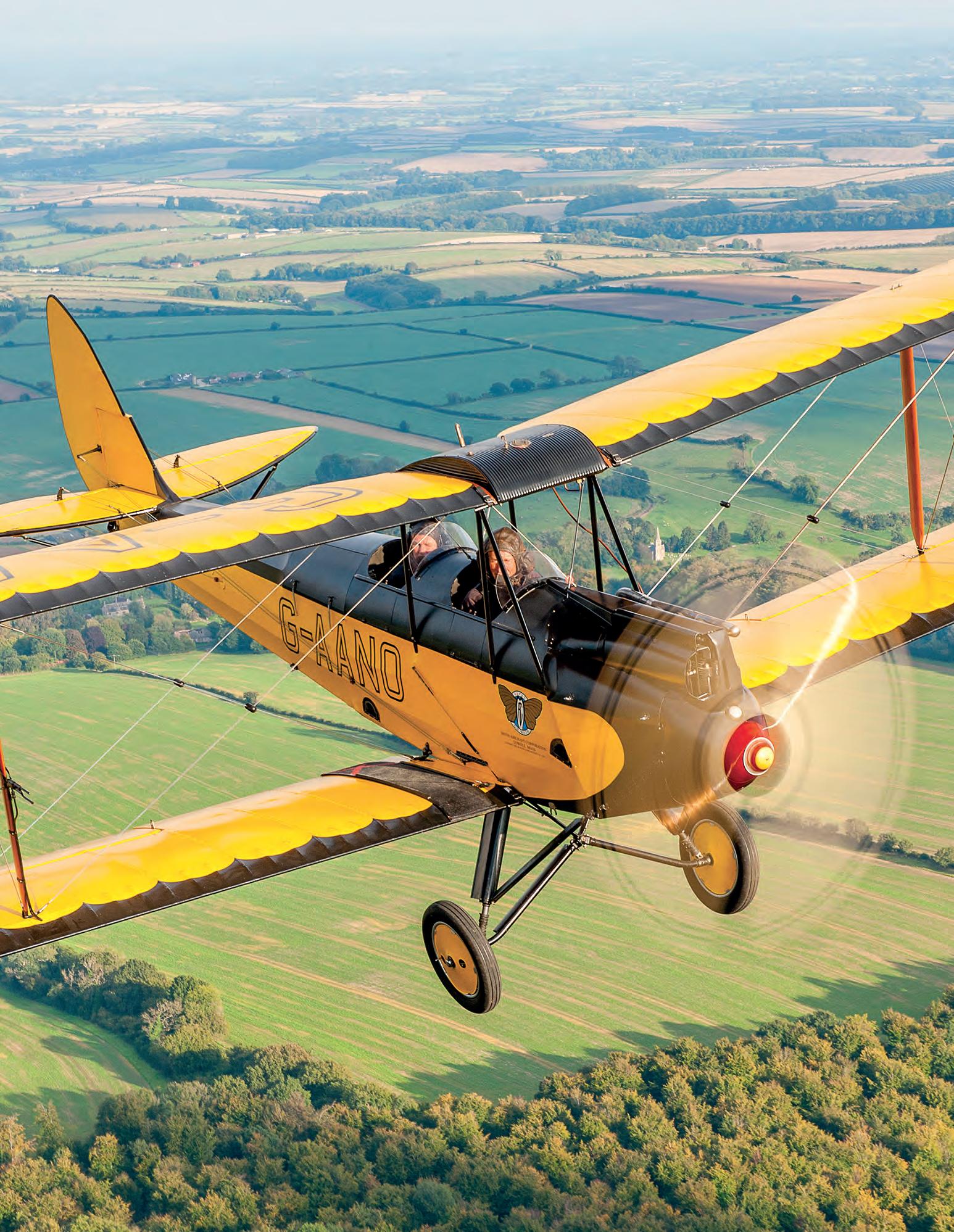
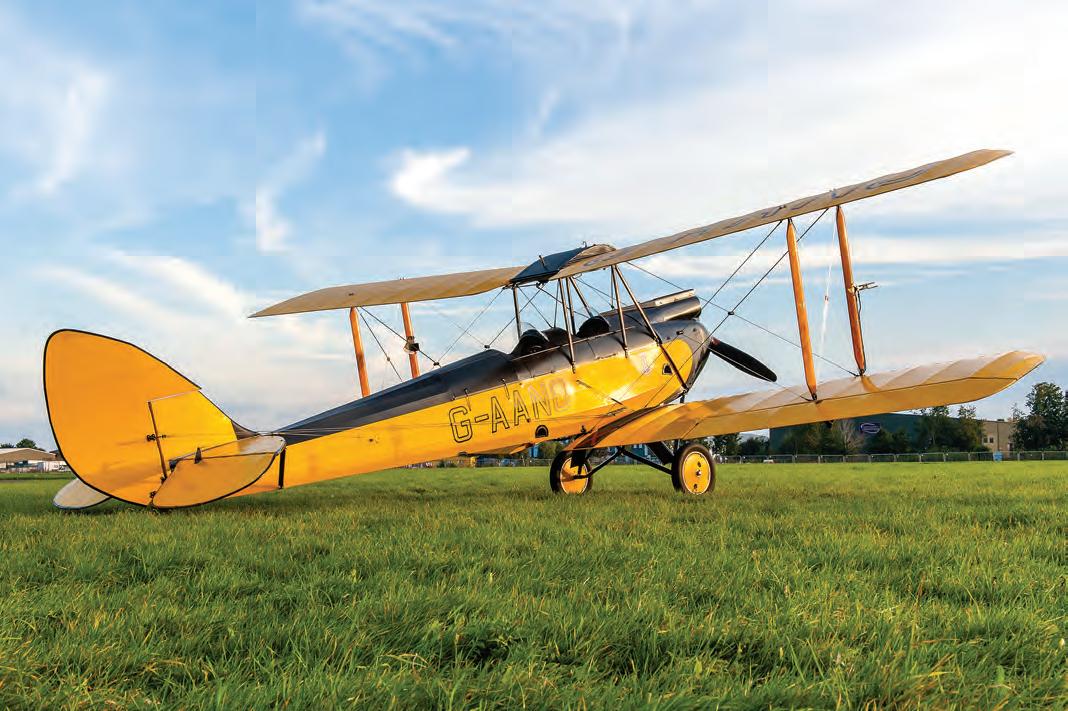
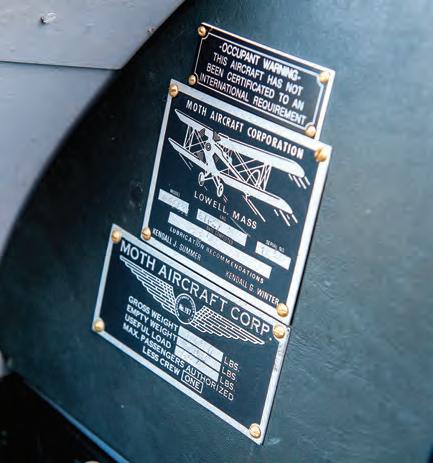
Originally constructed in 1930, serial number 161 was a DH 60 M built under license by the Moth Corporation of Sorrel, Massachusetts. She was registered and flown in the States as NC590N until being heavily damaged, in 1936. She was imported to the UK and passed through two other owners. Until two years – before Covid – when
Opposite Sunlight and shadows pick out all the beautiful details of this Moth restoration. Front seat is a tight fit in among the top wing, cabanes and wires.
Below Fully rigged and ready for flight, because of the long left-hand side exhaust, you climb aboard the Gipsy from the right.
Above Looking into both cockpits –note distinctive brass mag switch, and the long exhaust.
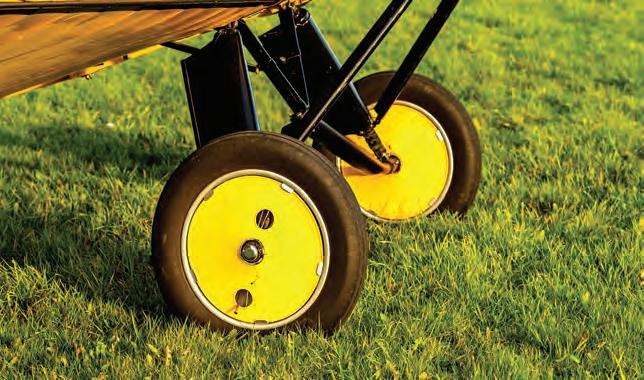
new owner Kevin Crumplin, Annie Burroughes and myself drove up and collected her from Cambridge. The stock of pieces looked like a convincing kit when inspected but, as is often the case, what you have isn’t always what is required to fit that project. But the major items were there and in fair condition. One piece of particularly good fortune was that the original spoked wheels were still present. If any parts for this Moth were considered ‘unobtanium’, it would be these rare items.
Back at Henstridge, Kevin took stock and commenced the weighty task in hand. It took a concerted four years, stretched over nearly seven, but that included a two-year diversion while he and Annie rebuilt a Miles Magister for Czechia-based collector and pilot Richard Santus.
History
There was a time in Britain in the late 1930s when 85% of all light aircraft were De Havillands. There were some very long distance flights which brought huge popular attention
“Some good fortune was that the original spoked wheels were still present – parts that are usually considered ‘unobtanium’…”
to these aircraft and personalities. Two notable endeavours were that of Francis Chichester flying to New Zealand, and beyond to Japan from the UK, and Amy Johnson to Australia. Lores Bonney, an Australian woman, was so impressed and fired with enthusiasm that her husband bought her a Gipsy and having gained her licence, flew all the way around the coast of Australia.
The following year she became the first to fly from Australia to England. Inspiration at its best. I had been unaware of her achievements until sorting through my late mother’s letters, when I found an Australian aerogram celebrating her flights. For some years the Women’s Pilot Association awarded a trophy in her memory and endeavours.
The DH 60 series prototype first flew in 1925 and continued in production up until the late 1930s. The airframe evolved with changes over time, including the all-wooden frame moving to a metal frame, initially for the foreign market for improved longevity, and then for ease of maintenance. De Havilland produced its own range of engines. The Gipsy series 1 of 100hp and 11 of 120 were installed upright as had been the trend up until then, but the 111: later known as the Major, was installed upside down and so lost the distinctive visual clue of the long trailing exhaust on the port/left-hand side of the fuselage. With changes to wing sweep and dihedral, enlarged cockpits and an inverted Gipsy, giving a higher thrust line and a greater prop’ clearance, the Tiger Moth was thus evolved.
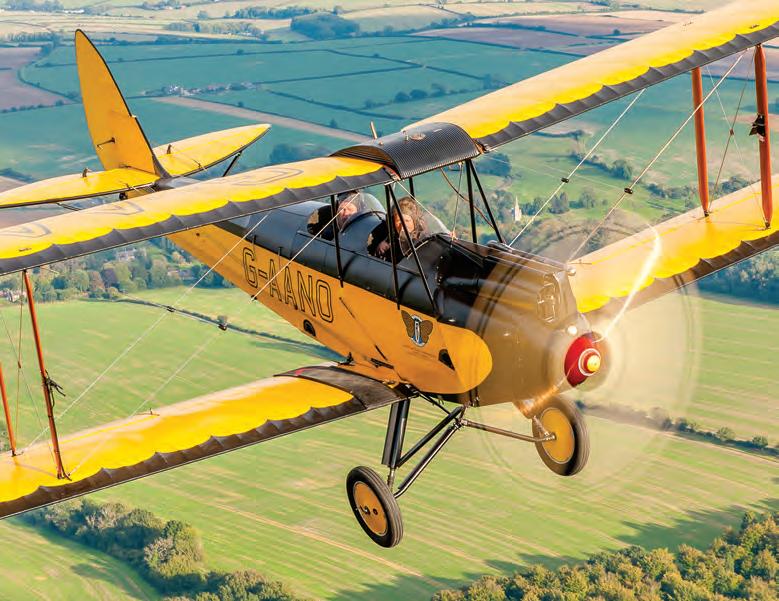
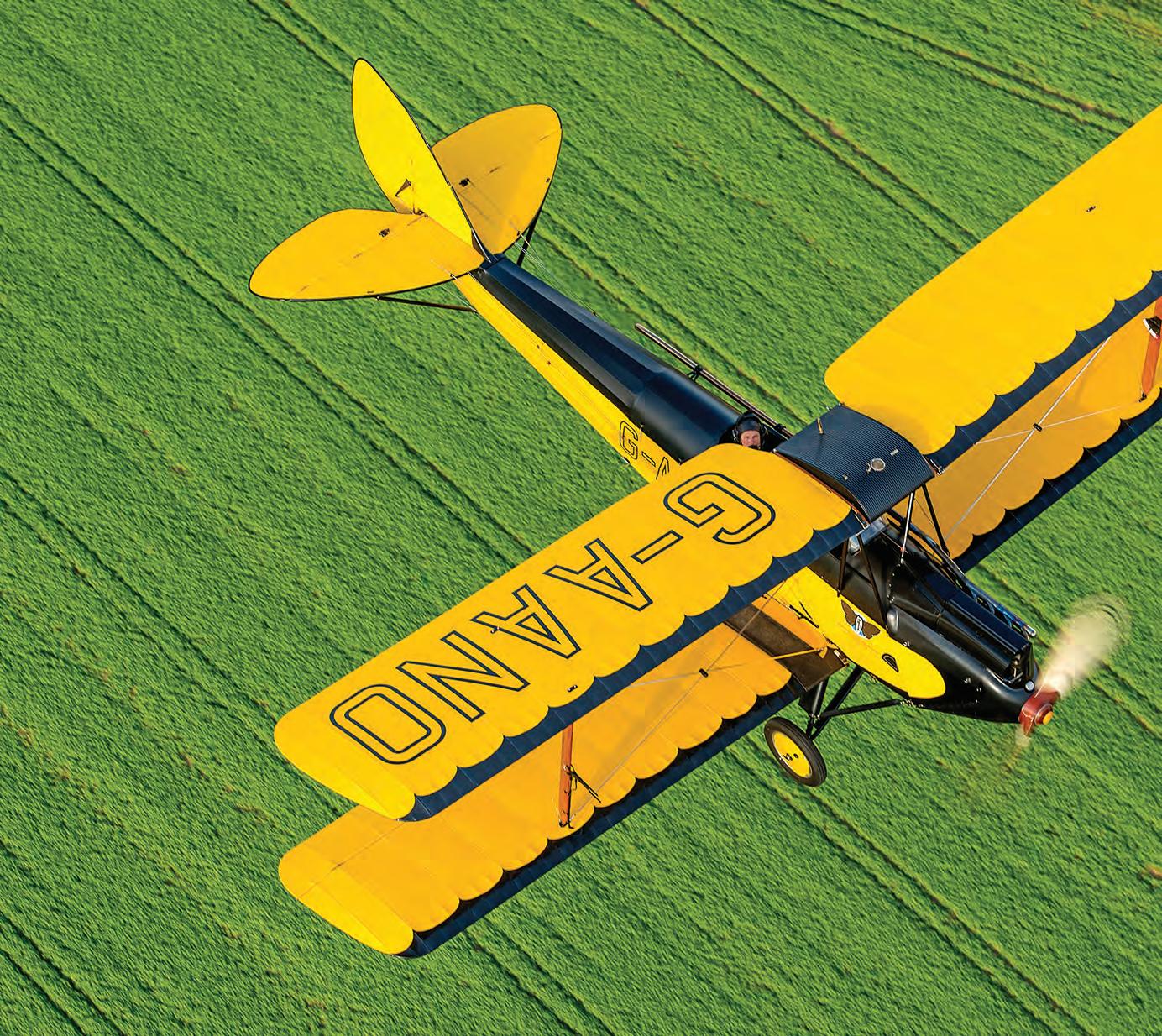
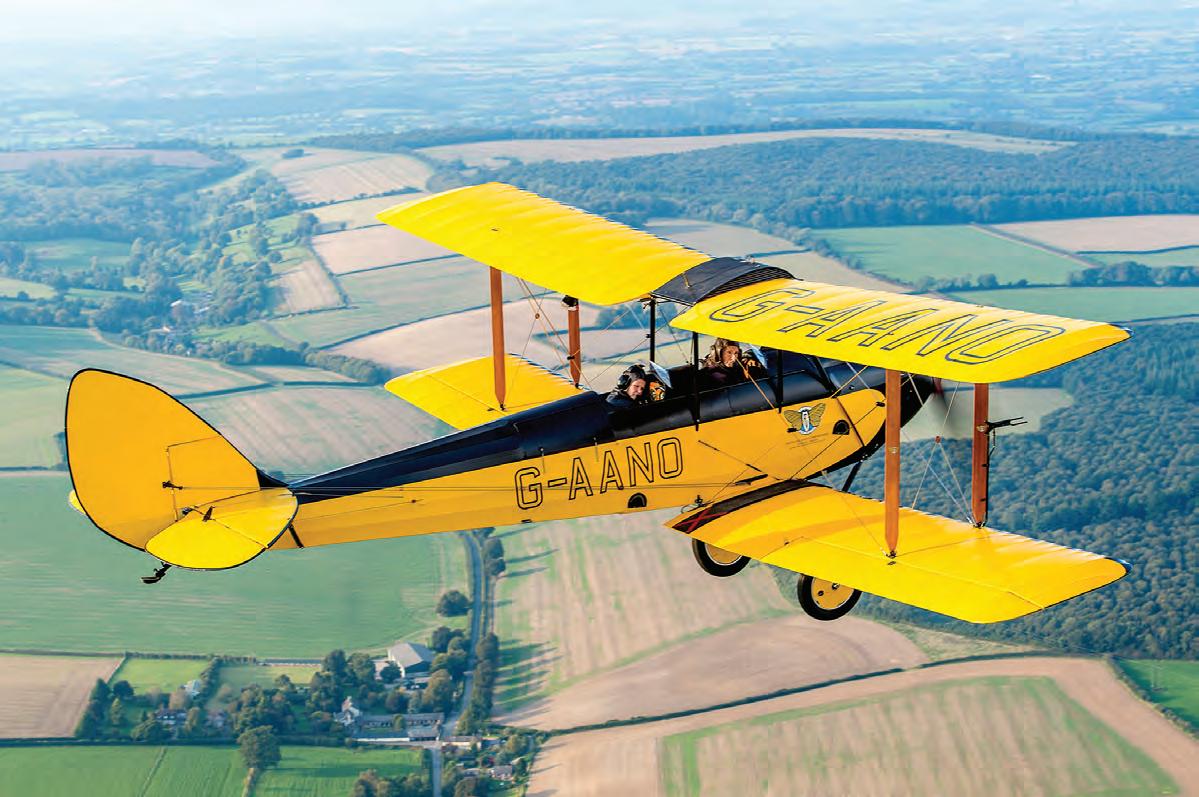
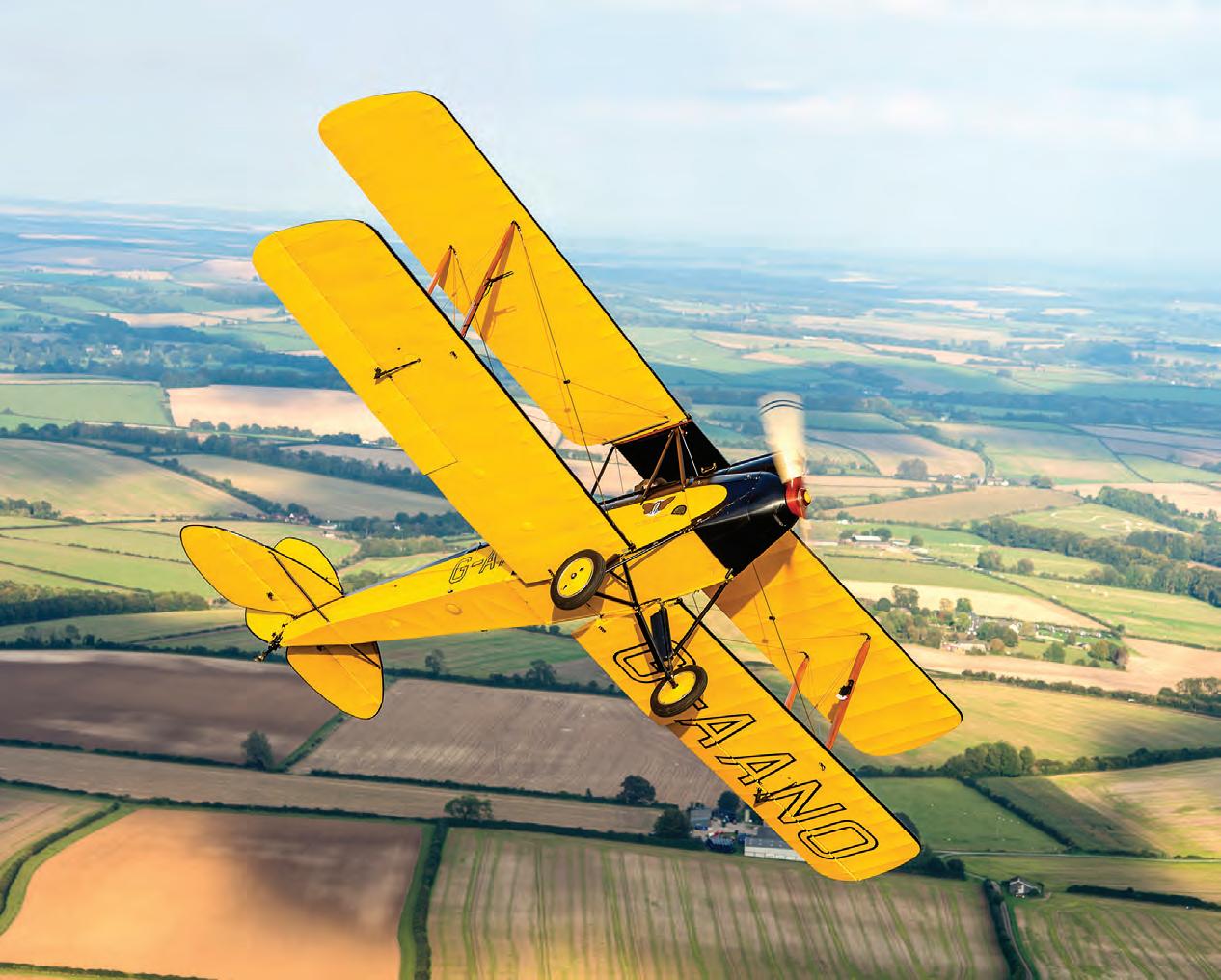
G-AANO shares a hangar with three Tiger Moths at Henstridge, and is now totally rebuilt and painted in the stunning scheme of bright yellow with black trim, mimicking the Gipsy Moth that appeared in the film Out of Africa starring Meryl Streep and Robert Redford. Allied to John Barry’s beautiful soundtrack, the awe-inspiring aerial scenes include one particularly memorable scene of low flying over a lake, causing hundreds of flamingos to take off. In the film, when Redford’s character is asked when he had learned to fly, his answer was the throw away response, “Yesterday”, I nearly choked somewhere between a snort and a laugh. If only…!
Unfolding the wings
Two people who know the sequence will find it a simple task to unfold a Moth. One to unlatch and walk the wing forward through 90° into its flying position, and the other secures the sturdy locking pins, holding it all together.
There is a spring catch next to the aileron holding the wing to the fuselage, when released the wings won’t move yet unless there is a breeze in the hangar. Now swing and walk the wing tip around through the 90° so it sits with the wing fully forward and the second person can push the strong pins into the inboard securing slots, upper and lower.
First time doing this it may seem odd, having to stand on the wheel, holding on one-handed to a forward cabane strut and desperately wiggling the pin into its upper wing slot thinking this has to be rushed. In all honesty, the fellow holding the wing tip has but a light retaining pressure needed, having such a long lever and fulcrum,
Pay attention, there’s some useful info here…
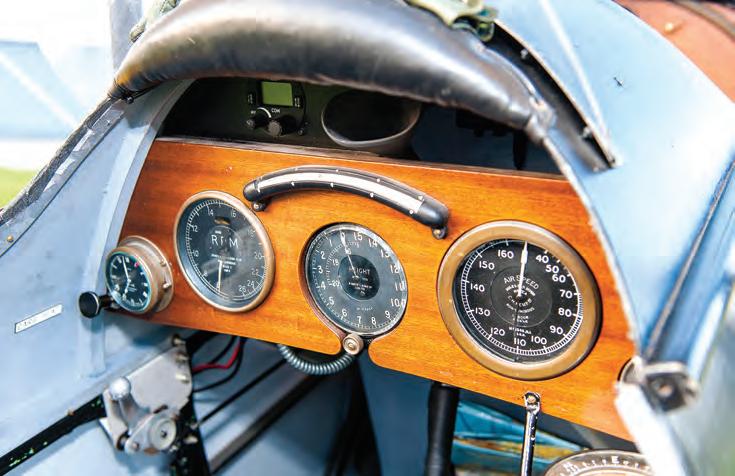
Above An uncomplicated panel. Modern radio lurks out of sight next to original Gosport tube comms.
Left Data plates note this Moth's licence-built origins in the USA.
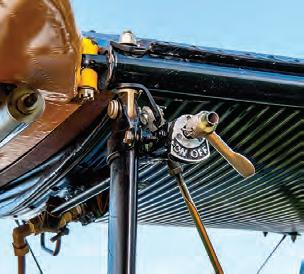
Below Fuel lever sits to the rear of the fuel tank.
Bottom A truly ‘windy’ ASI, with its calibrated flat plate.
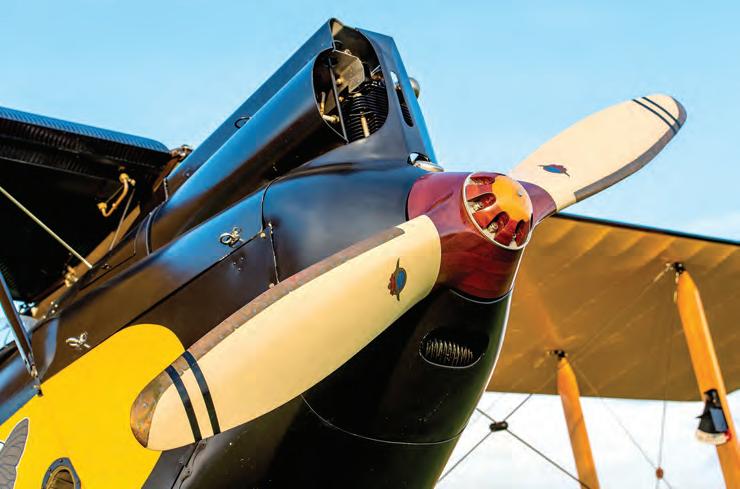
Beautiful propeller and cowlings give form to the Gipsy’s nose.
and could in fact be holding a mug of good coffee while chatting on the phone. The lower pin can be squeezed in with both feet on the ground. The pins are further secured by leather straps, much the same as on satchels, but the leather is thicker and the larger buckles stronger, pulled and the pin’s right angle bend sitting on the wing’s leading edge, tightened and buckled up. The telescopic jury strut may now be removed and placed in its holding slots in line with the oncoming air along the undersurface of the upper wing. Looking ahead, if of a nervous inclination, it may be very disconcerting to get airborne and left wondering if the pins were placed securely, so it is reassuring to know that the pins which sit just slightly forward of the leading edge can be discerned from either cockpit. Looking upwards, the rear pilot can see the vertical fuel gauge float, but should you sit too low in the mistaken thought of being out of the slipstream behind the curved windscreen, you may
“To get in, grab the cabane strut, put a right boot in the foot hole, swing a leg over rear decking, then squeeze a leg through the tiny door gap”
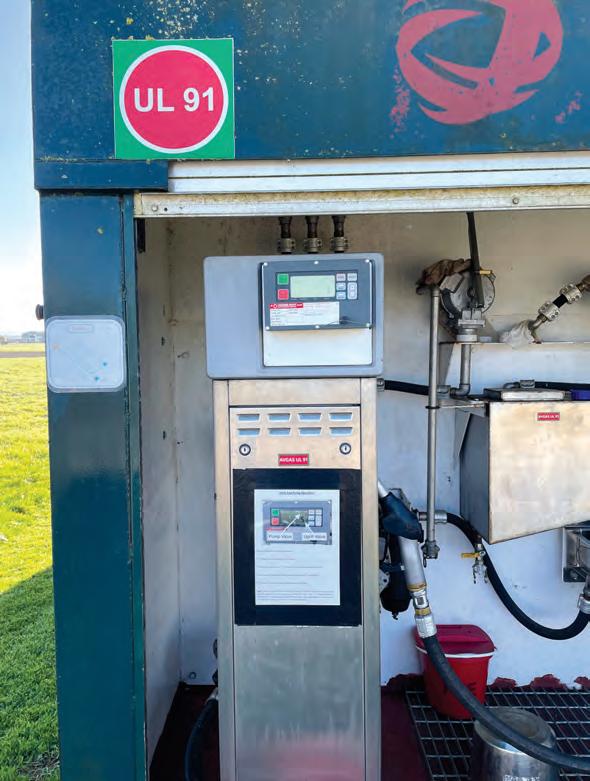
not see the lower section as the rear lip of the tank may shield it. The tank holds 19 imperial gallons/86 litres and we operated using UL 91, which means no decoking required.
Cockpits
Entry to the cockpits is on the right side of the fuselage, this is the only option as the long exhaust from the Gipsy runs down the left side. The rear cabane strut may be grabbed and with a step up putting a right boot in the foot hole, the pilot may pull themself up, swinging a leg over the rear decking before squeezing a leg through the tiny door gap.
Those fold down doors are very small being only 12ins wide and a fold down of just 8ins. Imagine trying to thread between the diagonal flying and landing wires wearing a parachute along the wing walkway and settling into the small front cockpit. It may have been tight even with shorter crews, but the military requested the changes in the airframe that ultimately became the Tiger Moth. I have managed a very minor ‘Van Goghism’ by nicking my left ear on the rear upward sloping flying wire.
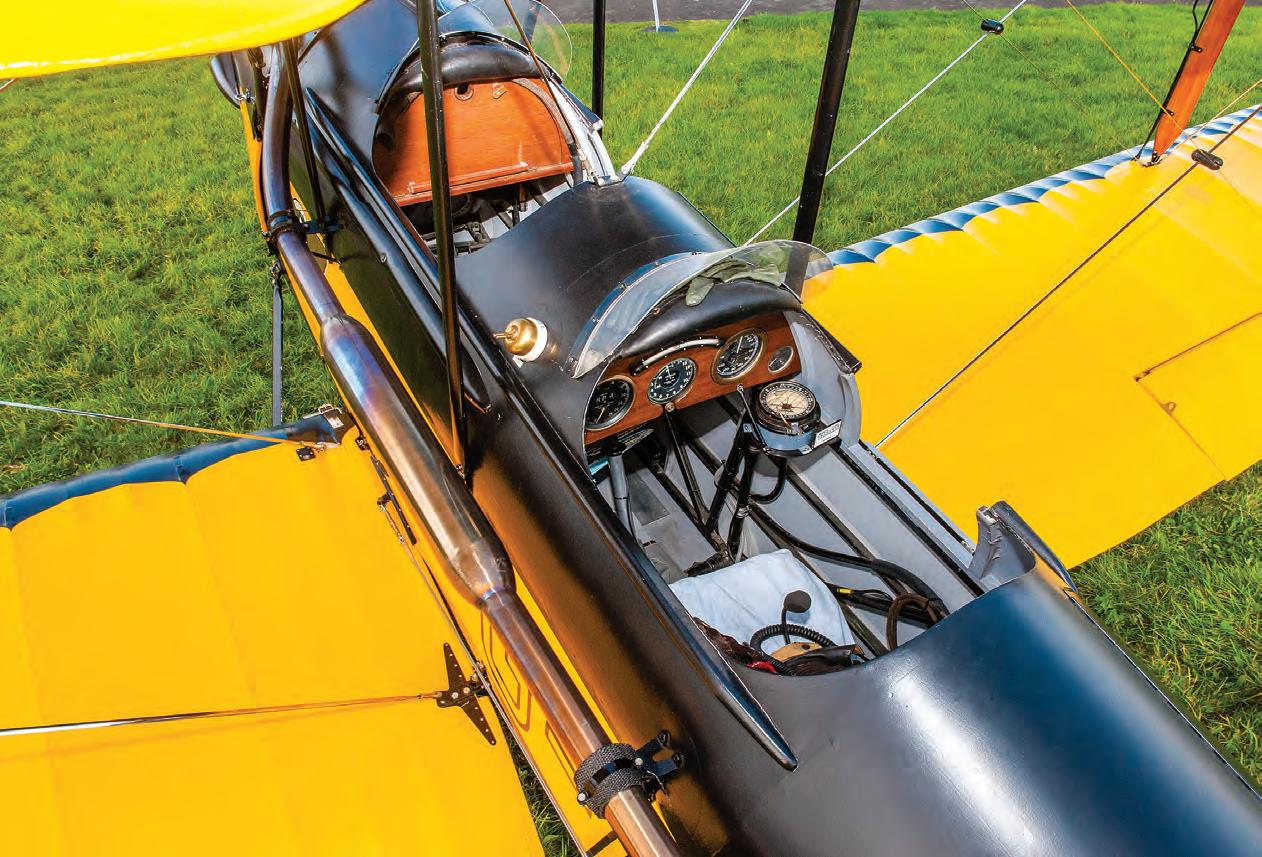
The rear cockpit has just five instruments mounted on a mid-to-dark wooden panel. The clock with Roman numerals is on the left and may be wound up by rotating its knurled edges. The rpm gauge is brass-edged and runs from a tick over of six, (600rpm) to 26, (2,600rpm) and a
Above ’NO wears colours inspired by the famous Out of Africa Moth, and really lights up in late autumn sunshine.
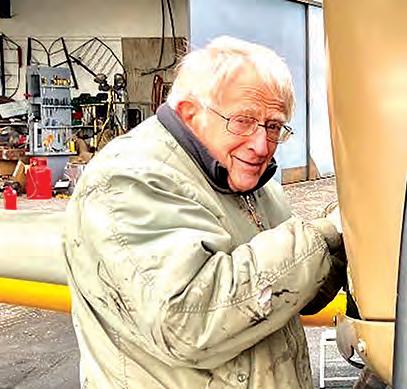
Inset Moth restorer extraodinaire, Kevin Crumplin.
nearby placard dictates the normal range of 1,800 to 1,900rpm, normal full rpm 1,900 with a max permissible for not more than five minutes of 2,100rpm. The central altimeter turns anti-clockwise, has no subscale and a single needle pointing thousands of feet with small subdivisions indicating 200ft. The ASI reads in mph and reaches 160, though the Vne is 130. Placards advise a cruise of between 80-85mph and a stall of 40 mph.
Also given is the actual tire weight of 1,113lb and a usable 537lb for baggage, fuel and crew. A somewhat smaller oil pressure gauge sits on the far right showing a normal pressure of between 40-45 with minimum of 35 psi. The alcohol-filled compass is placed slightly lower but in front of the last gauge, but I appreciate it would be better positioned for reading if centrally placed. That would be awkward in order to avoid settling onto the seat.
Curiosity is invoked by the inverted smiling skid and slip bubble. I had met this before in David Bremner’s fabulous Bristol Scout and then having been briefed, found that one naturally flies by the seat of one’s pants in such aircraft, naturally ruddering. The path to balanced efficient flight is to apply rudder on the opposite side of where the bubble is sitting. After being confronted with this when airborne it takes but a moment to get it right, even if the first go is a rudder push the wrong way! And a lateral wiggle of the stick shows there is going to be masses of adverse, nose swinging, aileron drag, judged alone on the
Above Gipsy 1 has 100hp, note oil filler at the top front of the engine case.
Left American origins further evidenced in this Moth’s logo.
“We have an intercom, but we could always resort to the Gipsy’s fitted voice Gosport tubes and ‘stethoscope’ type earpieces. ”
vast range of upward deflection and the teensy downward droop. This alone might be the fundamental awkwardness of the whole game for a new pilot, that, and seeing the airfield from the rear cockpit attempting to approach to land on the conventional standard runway. The field of view is of course reduced at slower speeds with a higher nose aspect.
so that heat from the engine circulating within the engine bay is fed to the carb, and with it again open cold ambient, denser air is used. The elevator trimmer is a side-mounted lever operating a spring bias and works in the natural sense. The rudder trimmer that pulls the right rudder back, effectively apply left rudder, is a vertical wheel that tightens the spring attached to the base. I could not adjust it in flight as, when trying to put the heel of my boot on the outside edge to rotate clockwise my knee was restricted by the compass mounting. The awkwardness is not my feet, size 6.5 (yes, tiny I know), it’s my tibia and fibula being too long.
The front cockpit has a stick, rudder pedals and a throttle, but no instruments. Novel modern provision has been made to display an iPad that gets a full array of flight data from a hidden Levil Aviation AHRS. A mix of the very new and vintage combined.
Below 'NO turned out to be perfectly rigged from the start, and offers a serene cruising experience.
Under the upper curved panel edge a Becker radio is hiding in the shadows and from view. We have leather capped Lynx headsets with inbuilt intercoms, however, we could always resort to the Gipsy’s fitted voice Gosport tubes and ‘stethoscope’ type earpieces. I remember asking my father of his training on Tigers, if he could actually hear the instructor through these tubes? His reply was that you anticipated and interpreted most of the instructions: you have control, I have control, rudder, and so on as they were so frequent.
There is a carb heat knob above the throttle, fitting snuggly by the cockpit clock, this activates a closing slide
Directly behind the rear cockpit is a lift up baggage bay. At the rear of the bay is an opening of a long cylindrical bag to hold a fishing rod. All mod cons. Baggage of up to 30lb may be carried, but I think you may be close to aft CofG limits if the front seat was empty and there was not a full tank of 19 imperial gallons. Incidentally, the fuel tank contributes towards a high centre of gravity reducing the crosswind limit. The fuel selector sits on the left rear cabane strut supporting the tank and may be turned on by a 60° anti clockwise turn. The all important single set of magneto switches sit forward of the cockpit and are an Edwardian living room brass-domed affair, with the
impulse switch up and on and when running, joined with the other switch.
Front cowls
The combined metalwork of the black engine cowls are an astonishing piece of very skilled metal work – 11 separate sections form a shape reminiscent of the beautiful nose of an Albatross D111. Either side may each be opened by two circular catches. The left has the cylindrical Zenith carburettor and float, and beside it a small four-inch oil dipstick. The left mag and sliding carb heat door can be checked. The dipstick has a pinch fit and my first attempt to check I found I am not quite tall enough to see what or how I could read it. A bit of added height with a small ladder allowed me to see that I had to twist while pressing the side to allow it’s up and out to be read. The oil filler is just above the propeller hub on the engine, and pokes out of the cowling for access.
The exposed rocker arms of the Gipsy requires a level of involvement that will be unfamiliar to owners of more modern machines. Again, using the ladder, this time from the right, a small flap at top opens a box holding an oiler (wrapped in a piece of towelling to prevent rattle and wear). The oiler holds the same oil as in the sump with a nozzle to be placed vertically on the oiling point at the top and the middle of each of the four rocker arms.
The oiler is pumped downwards a few times and the lubricant can be seen to ooze out under pressure when the rocker has sufficient oil.
In the inverted Gipsy engines the rockers are in an oil bath filled on 50 hour checks, here with our Gipsy 1 engine it should be oiled before every flight. Before closing
In order to get to these rockers there is an opening catch at the front of the front open end of the engine, a rod is pulled forward which releases two internal pins. Ideally two crew are needed for this, one to be tall enough, or get a ladder and stand with a hand through the propeller arc to grasp and pull the rod and the other to squeeze the top of the box shaped cowl inwards, applying pressure to reduce the force needed to release the two locking pins inside. Closing after oiling is easier. The right-hand side of the cowling may be opened to check that all is connected as it should be, i.e. the mag’ wiring.
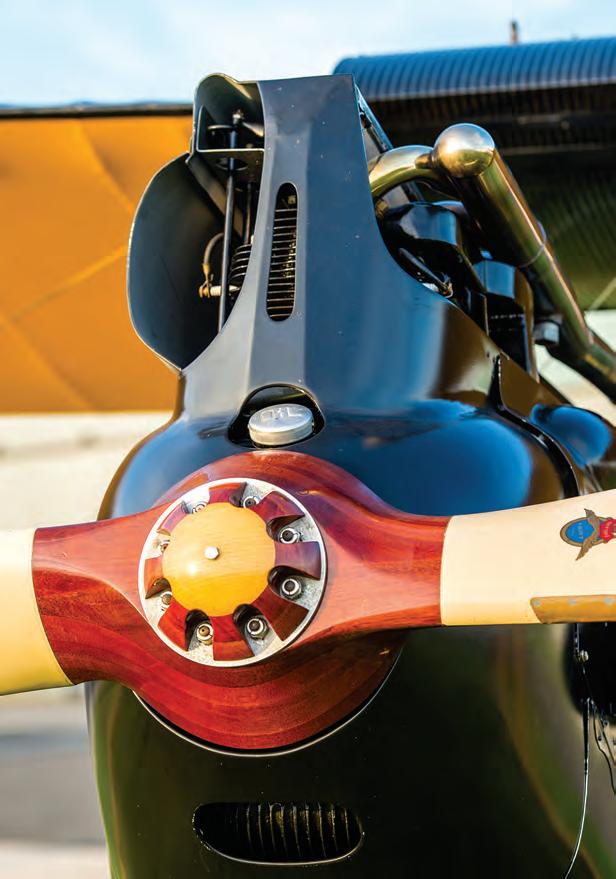
The crowning visual feature of the Moth’s nose is the laminated wooden propeller of extraordinary beauty. The winged decal proclaims this to be a Classic Airscrew’ made in England. The blades are cream with brass leading edges, outward paired vertical black stripes and the hub shows the natural near red coloured wood, finished with a laminated skull cap with eight secured bolts to a metal back plate. It’s truly gorgeous. Its official designation is Lawrence DH5180/5/R.
When swinging to sucking in fuel, either four or six blades, in preparation for the start, having tickled the carb to prime, it is noticeably lighter in compression than the
Above While there might be plenty of airframe to cause drag, overall the Gipsy Moth is actively manoeuvrable.
“The crowning visual feature of the Moth’s nose is the laminated wooden propeller – cream blades with brass leading edges – it’s truly gorgeous”
Tiger Moth’s 130hp, with the effort required passing through the downward near vertical blade position with a right arm. I also found myself stooping at the point of compression making the action rather uncomfortable. I adapted by holding the blade inwards towards the spinner, shortening the lever arm when I pulled her through. This meant I didn’t stoop and the compression felt more like that of the Tiger Moth.
I was fortunate to make another dozen flights amounting to five hours test flying, before Kevin accompanied me, as observer, for the Permit test flight.
The ASI was found to have a slight kink in the static line and has acted normally since adjustment. This was the first time we had a full load of fuel on board and two souls. Our CofG was within limits and I had already completed the spinning and aero check solo at the placarded less than 1,400lb. Our 65mph climb rate worked out at 460fpm and the stall was a gentle nod at 40mph. Vne is 130mph. The whole thing took just a trouble free, satisfying 40 minutes.
One surprise with her performance is that her cruise figures are faster than the Tiger Moth by a tad under 10mph for the same 1,800rpm, despite the Tiger’s 130hp. All down to the props and weight, perhaps? We can also out turn her in theory as the wing loading is lower. The Gipsy is stable in pitch, directionally positive, but not enthusiastically so, principally due to such a small fin and neutral laterally where the cruise revs aid the wing to rise, but keep the left wing low from a constant heading sideslip. The implication being we have to physically ‘lift’ the wing after a side slip to land, rather than just centralising the controls to have wings level. You have to work with her. All very interesting traits. We all have our characteristics and our Gipsy does have a pleasant personality and can thoroughly recommend a flight in her, but if you do, rudder coordination is a must, otherwise the nose will be yawing and swinging out of turns.
Upon starting, invariably on the first swing, the exhaust
note is muted with the aforementioned rather attractive ‘thrum’ reverberating along the stainless exhaust pipe. Tick over is slow at 800rpm and as it warms it rises slowly to just short of 1,000rpm. The oil seems slow to awaken in keeping with the low revs reading on 20 psi initially, but quite normal and rises to 40. Sitting there as she warms is an easy, relaxing four summer minutes (six minutes for winter). The power check is with chocks in at 1,600rpm with a slipstream cooled helper standing and holding the tail, the mag check is more audible than a distinct drop and waiver of the rpm needle for 50rpm at each downward mag flick, but the hot air carb check displays a positive rev drop and back up again. Idle revs are accompanied with a wave to the ground helper to pull the chocks, a quick scan of the sky and we are off again.
After my five hours and the Permit Test Flight, Kevin asked which was my favourite – Tiger or Gipsy? I’m not often tongue tied, and I can’t honestly say. I have called the Tiger my default aircraft for years, as it prepares me for many aircraft – and I truly love it. I have more than 1,450hrs flying the Tiger, that’s 60, 24-hr days, compared with a combined sortie tally of an enjoyable ‘afternoon’ in the Gipsy. Luckily, I don’t have to decide, as we are now fortunate to have both in the Tiger Moth Training school! ■
DH 60 M GIPSY MOTH SPECIFICATIONS
General characteristics
Height 8ft 9 1/2ins
Length 23ft 11ins
Wingspan 30ft
Wing area 243 sq ft
Empty Weight 1,113lb
Gross Weight 1,650lb
Engine Gipsy Major 1
Fuel Capacity 19 Gals
Performance
Anticipated range
England to Australia…
Cruise 80mph at 1,800rpm
Rate of climb (MAUW) 65mph 460fpm
Rate of roll Respectable.
Above Misty Moth magic…
Alternators –made simple…
An alternator failure can be frustrating and disruptive, and as Ian Fraser suggests, sometimes self-inflicted…
Alternators are one of those devices key to the function of our aircraft normally taken for granted – until they break. While not life threatening, failure can be both disruptive, frustrating, expensive, and often self-inflicted. While I have had my own share of problems, I have noticed a recurring theme in social media recently highlighting problems with a specific ‘experimental’ alternator in common use in our Permit aircraft. I pass on my experience with it, and other alternators.
With a hobby background in racing car engines, when I built my RV-6, I had no compunction about using a car alternator rather than the dinosaur used in PA28s etc. with the same engine. I went to a local car parts stockist armed with my spec (voltage and current) and a spring balance to select the lightest suitable one. I quickly discovered that they were all quite heavy and most rotate the ‘wrong way’
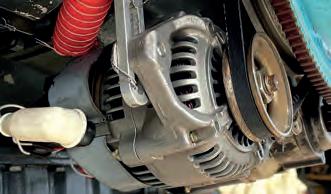
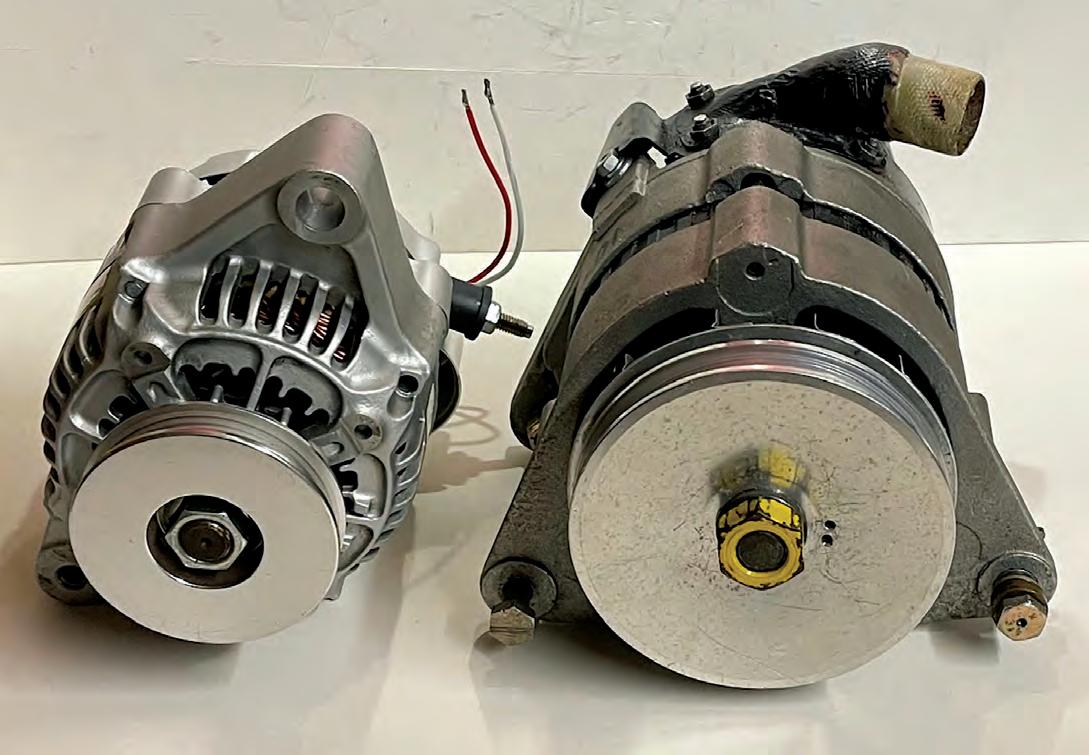
Two ‘stars’ of this piece. On the right is Ian’s RV-6’s original alternator weighing about 6lb. Note its large 4-inch pulley and homemade fibreglass duct for a cooling tube. On the left is its successor, his ‘super alternator’ with its small pulley. It surprisingly also weighs 6lb.
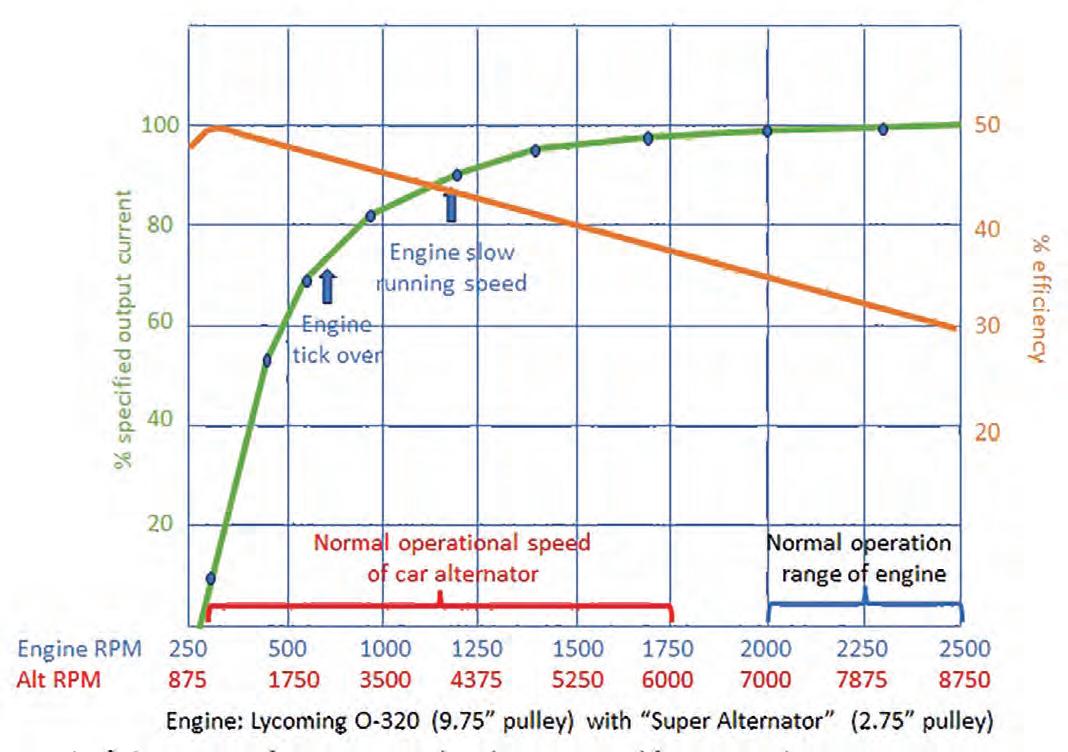
for a Lycoming. Electrically it doesn’t matter which way an alternator rotates; its bridge rectifier ensures that it still produces correct polarity electricity either way, but cooling may be another matter. A Lycoming turns anticlockwise, so a normal car alternator’s cooling fan goes backwards. I ended up using a rather old alternator from my motor sport days from my own spare parts stock. A not so small but light (6lb) Lucas with internal regulator / rectifier and an external fan (pic 1). Its fan was easily modified to correct for the Lycoming rotation. I also added cool air ducting and a larger pulley to reduce rotation speed to the alternator’s specification due to my Lycoming engine’s large 9 3/4 inch diameter belt pulley. It was duly installed and served well for eight years (500 hours) then it failed. The alternator is part of the electricity supply system for an aircraft. Its role is to power the electrics and to keep the battery charged. If it quits, and doesn’t damage
anything else in doing so, your continued comfortable flight is limited to the time your remaining battery power will power the essential electrics, so keeping it charged is important.
Early aircraft were non-electric (except for the self-contained magnetos), then as radios, electric starters and lighting became more common, a battery was needed, and thus a charging system to sustain it. As with cars, early charging solutions in aircraft used a Direct Current (DC) dynamo (invented in the 1830s), but these were very heavy and inefficient. Alternators are much lighter and more efficient and indeed have been around for the same period as dynamos, but they have a catch.
They produce Alternating Current (AC), the same as mains electricity. To charge a battery or run avionics needs DC. This is achieved from an alternator by converting its AC current to DC using a rectifier, a kind of one-way electrical valve. Early rectifiers were large and fragile, and it was not until the development of cheap, compact, and reliable silicon diode rectifiers in the 1960s that alternators became viable and started to appear in cars. Now they are universal and regardless of their label, the majority of GA aircraft alternators, certified or not, are based on commercially available car devices.
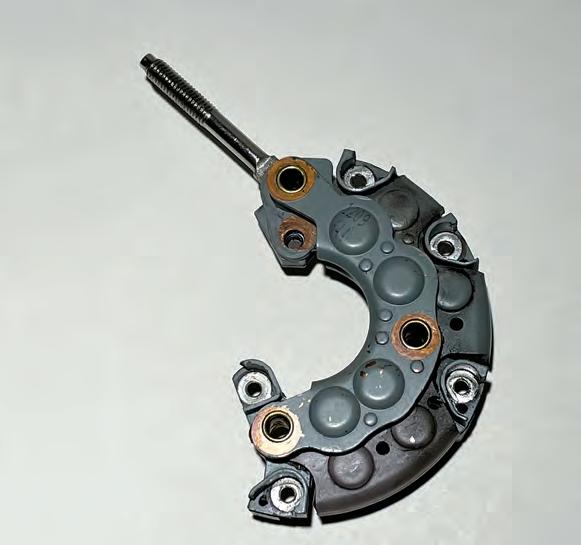
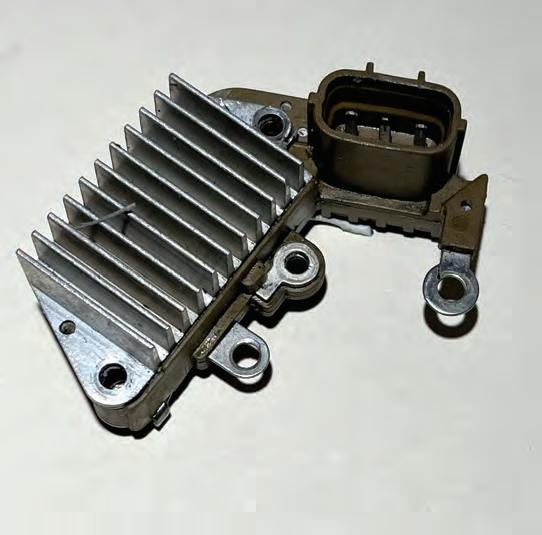
The alternator is driven by the engine through a belt or gear system and generates three phase AC electricity. This is converted into DC by its rectifier diodes (pic 2) and output voltage is controlled by a small electronic device called a regulator (pic 3). This controls the maximum DC voltage output by the alternator to around 14v, which just exceeds the batteries voltage (12v) allowing electricity to flow into the battery and to recharge it. The current (amperage) output of the alternator is controlled by its design, regulated voltage and speed, a typical alternator’s specified rating occurring at about 5,000rpm. Output current should be selected to slightly exceed the operational demand of the aircraft’s equipment so that the battery is always being charged during flight.
Super alternator’s diode pack.
A physically and functionally identical replacement from the auto trade costs about £20.
My original alternator’s failure resulted in it producing too high a voltage for some time before it was spotted.
The cause was a short circuit in the rotor winding of the alternator most probably due to chemical deterioration of its wire’s ancient shellac insulation. The over voltage killed several of the aircraft’s 12v electronic devices.
Investigation revealed such a failure is not uncommon in that old type of alternator. It was my fault. Industry has now developed better insulation materials and also mechanisms to contain the collateral damage if such failures occur. The latter are called ‘over voltage protection’ (OVP) modules.
Indeed, the design standard for aircraft used by the LAA (CS-VLA) now specifies these for any new approval but there are many ‘permit to fly’ aircraft, like my RV-6, and its approval predates this and many do not yet have such protection.
Anyway, lesson learned, and I replaced my broken alternator in 2008 with a brand-new, state-of-the-art modern experimental ‘super alternator’ (pic 1) complete with built in ‘OVP’ function and correctly orientated internal fans for an eye-watering £400. That should have fixed it.
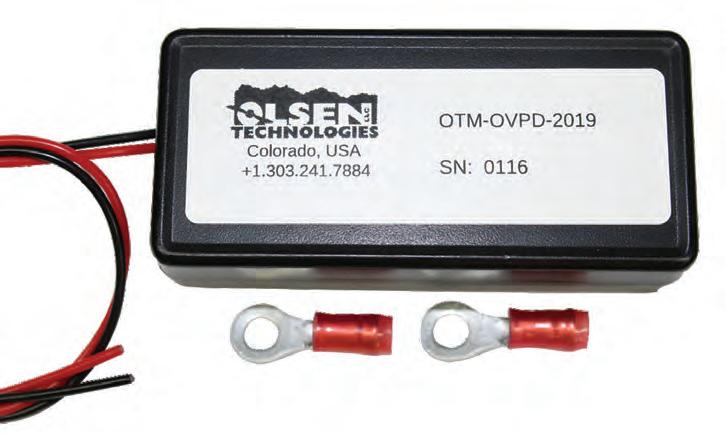
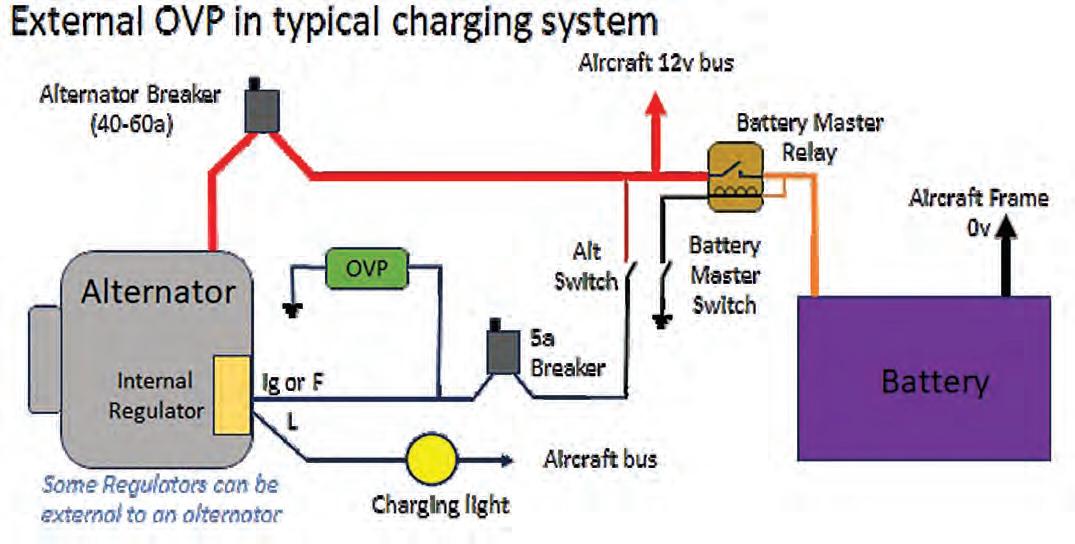
An Over Voltage Protection (OVP) module (pic 4A) is intended to switch the alternator off if something goes wrong before it can damage anything else. Switching an alternator off is simple but, if not done properly, is fraught with risk. Normally, you connect 12v from the battery to the regulator via the alternator switch and it charges, disconnect the regulator and it stops charging (pic 4B). On the other hand, disconnecting the battery via the master switch and relay while the alternator is still charging can produce voltage surges often fatal to the alternator’s rectifier diodes. The common way to implement OVP is called a ‘crowbar’ technique. A low current circuit breaker (typically 5a) is inserted into the regulator connector wire (field or ignition) and the OVP module connected to it and the aircraft frame. The OVP module electronically detects if the voltage goes above a
An alternator regulator. 03
safe limit, typically 16 volts, and shorts out the regulator connection triggering the circuit breaker which immediately and safely disables the alternator. That this has occurred should be indicated by a low voltage warning, alternator charging light or the breaker tell-tale. An external OVP is easy to fit as an aftermarket device and as usual with aviation you have a choice of paying anywhere between £100 to £400 for essentially the same simple electronic device. Note that there is a school of thought that OVP will not work comprehensively, or even at all, on some modern internal regulated alternators. I haven’t come across one yet but, before you install an OVP at least check that the alternator switch does indeed switch off your alternator.
After another trouble-free period of 15 years, I experienced an intermittent master relay. Then the aircraft stopped charging. Investigation revealed the alternator had burned out its rectifier diodes. The cause was the intermittent fault on the master relay disconnecting the alternator from the battery while it was still charging.
Regardless of the alternator type, disconnecting the battery while the alternator is charging creates a massive
Connections for adding an OVP module and circuit breaker to a typical aircraft electrical system. Note the ‘charging light’. Under volt alert is now also an LAA (CS-VLA) requirement.
surge of voltage, which is generally fatal to the alternator’s rectifier (diodes) and it had been. It was not the alternator’s fault.
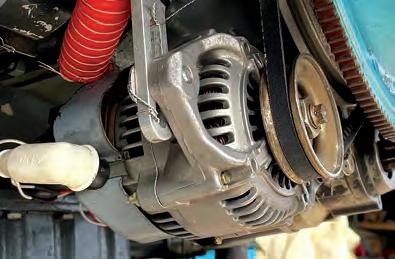
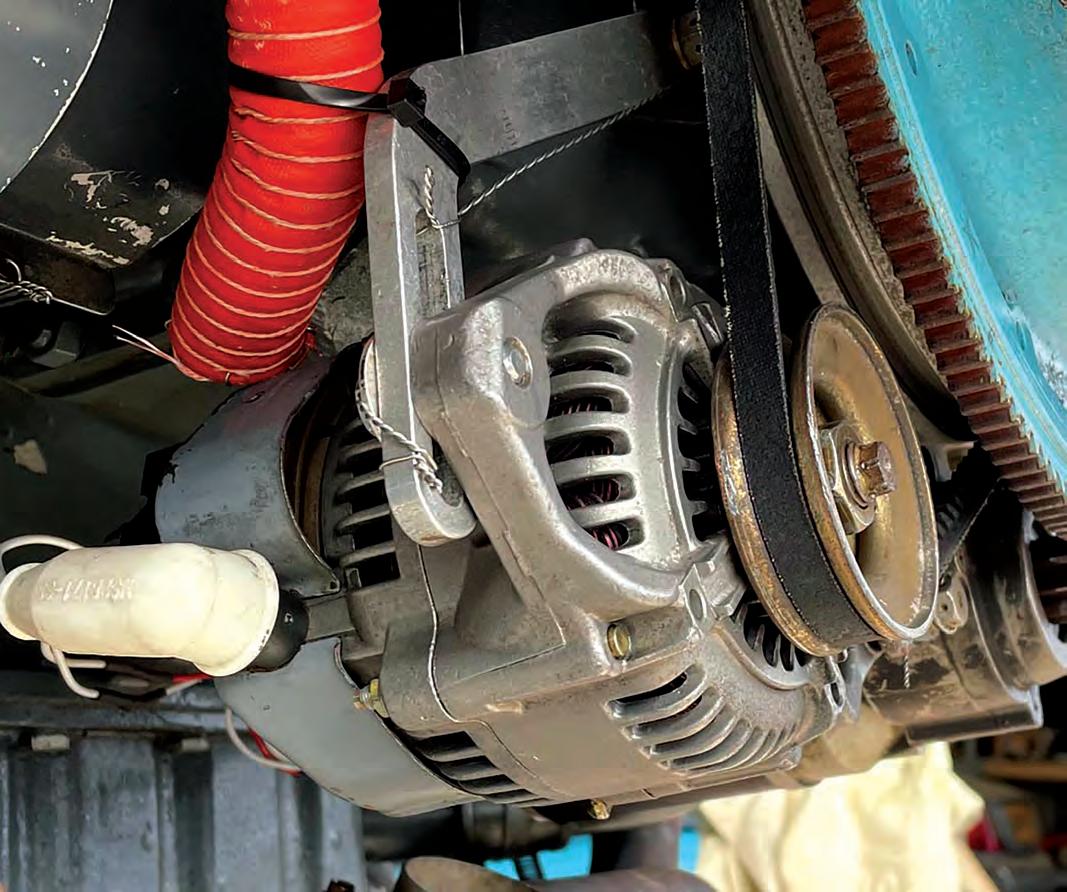
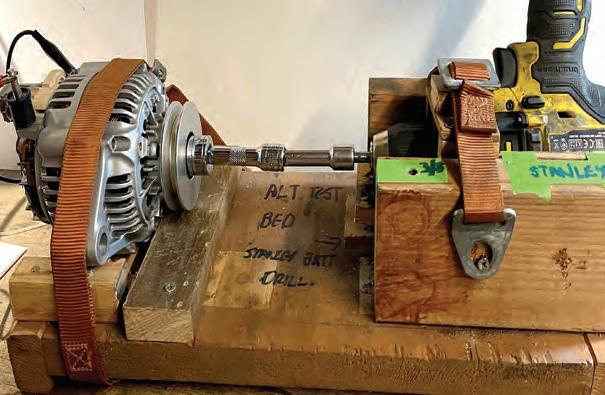
The intermittent master relay, the obvious culprit, was replaced and a temporary alternator (pic 5), an old original Van’s supplied standard automotive alternator together with an external OVP was fitted to keep us in the air while the ‘super alternator’ repair or replacement was investigated. The Van’s original alternator is an unmodified automotive device and retains its clockwise (‘wrong’ way) internal fans. However, although they are going backwards, they are just shifting the air a different way around the alternator, perhaps a little less efficiently but they have a good reputation for reliability. I did, however, empirically check the reverse rotation airflow with a smoke test on my alternator test jig (pic 6) to ensure that I was feeding the cold air tube to the best point to cool the electronics.
Back to the problem ‘super alternator’. After stripping it and testing the components, the diode pack was obviously and unsurprisingly dead and needed replacing,
4B
4B
A low(ish) cost OVP module, small and just two wires to connect.
4A
so enquiries were made. To my horror I was told by the manufacturer that a diode pack could not be replaced and I needed a whole new unit from them, which would cost me staggering £1,800. As a comparison, a similar spec OEM new car alternator is about £120 or less and a freestanding OVP about £100. The innovative small company that originally produced the ‘super alternator’ for experimental aircraft had been bought out by Big GA, which wacked the price up. I am at a loss as to what value it can be adding for that exorbitant sum, it’s still just an uncertified non-TSO alternator that seems to be built with aftermarket auto parts, albeit with a small mod.
Automotive alternators are rebuilt routinely by the auto trade for £100 or so, so I looked there and once I’d understood the component specification system discovered that I could buy a suitable diode pack for about £20. I replaced the diode pack, rebuilt, and tested it in a couple of hours. It will go back on at the next annual because it is a prop off job (to change the belt back).
Big GA’s experimental alternators don’t have the best reputation for reliability. My own failure was self-inflicted, but I do wonder why they are failing others so regularly? A common reported failure is that of the ‘super alternator’s’ modified electronic regulator. Why does it fail?
Electronic components (and wire insulation) in
An original Van’s supplied 60a alternator on my Lycoming O-320. Note the addition of a simple cooling tube fed from the front right inlet baffle.
alternators are, of necessity, high temperature range components typically capable of working up to 125°C, which is approaching the limit of its silicon technology. As long as the air in the engine compartment is significantly less than that, the alternator’s fans should cool its components adequately. The under-bonnet temperature on a modern car is around 80°C or less and that’s what most small alternators are designed to handle. Without a water jacket and with the proximity of exhausts and cylinders to the alternator, aircraft with an air-cooled engine can experience much higher under-cowl temperatures approaching 120°C or more. At that ‘coolant’ temperature the alternator’s cooling mechanism can no longer keep its components below 125°C. No wonder they are vulnerable. This is resolved for many certified aircraft by the installation of an air vent or tube bringing cool air for the alternator from the outside but curiously ‘super alternator’s’ installation spec does not specify such a cooling tube. Maybe it should?
There have also been reports of broken wires in its rotor and stator coils (the heart of an alternator’s function), the suspected cause being vibration, but with no explanation as to why. Neither the base Japanese original nor Chinese replacement automotive versions seem to suffer from these faults… so I wonder what is different in
an aircraft?
Bearing failure is another often reported fault and can be due to out of balance vibration, lubrication failure (is it up to the temperature?), over tightened drive belts or is it just cheap bearings? The classic car world tells us to run the belt as slack as you can get away with. So, in effect, do Lycoming in SB 1129D, but there is no mention of belt tension in the ‘super alternator’s’ installation document. I
Ian’s home alternator test jig. It allows him to spin it up with a drill and check its basic function and airflow.
have come across alternator belts on aircraft so tight they would be more suited as a guitar string. In such a case, as well as excessively loading the bearing, all engine vibration or pulley imperfections are transmitted directly to the alternator rather than being damped by the flexing belt. Am I surprised we hear about bearing and stator failures in such cases? No. Belts do not need to be that tight and, if they are, then bearing failure and associated collateral damage are the likely result. Lycoming says in Service Bulletin 1129D that you only need to set tension to impart 7ft-lb of torque through the belt to the alternator and certainly no more than 10 ft-lb before slip. That’s much looser than you would imagine and looser than many engineers will set it. Lycoming suggest three methods to achieve this with tools most of us have, or that
Graph of alternator performance, speed, and engine speed for a super alternator in my Lycoming O-320. It shows the alternator is outputting 97% of its current at 6000 rpm, any more speed is just stressing it and producing more heat. With the pulley supplied, the super alternator is being run at a constant 7000 - 9000 rpm. Even at tick over it is producing 70% power and normal slow running 90% Why? With a 4” pulley it would still produce 75% at 1200 rpm and 95%+ at normal engine speeds and the alternator would probably last longer
07
Small bulge on the cowl of Ian’s RV-6 to accommodate the Lucas alternator and larger pulley. It might not be necessary for a large pulley on a smaller modern alternator that sits closer to the engine.
“If you do use a car-based alternator, ensure your aircraft is not treating it more harshly than the car it was designed for – keep it cool, run it slow and don’t overload the bearings”
are readily available from eBay.
I am also mystified by the speed we gear alternators to run at in many aircraft. Most 12v alternators are designed to give 95% of their output at about 4,000-5,000rpm. On the cars they originate from they are typically geared 2.5:1, so run at just over twice engine speed. Most of the time even at motorway speeds car engine rpm is 1,500-2,500rpm, so they typically work at 4,000-6,000rpm, often less only occasionally running above that during harsh acceleration. A ‘super alternator’ supplied for a Lycoming engine is geared at around 3.5:1 running at a constant 8,500 rpm at 70% power (cruise), (pic 8) why? For that extra speed they aren’t producing significantly more power, just more heat. It is nearly twice their normal speed in a car. Even minor balance issues could result in significant stress, vibrations or resonances building up and damaging any fragile or rotating parts.
‘Production’ parts for cars are not normally specified to last outside of the car normal use envelope and environment. Even if well balanced, spinning at nearly twice the design speed increases the internal stresses by four times. Are we surprised they break? A larger (thus slower) pulley such as installed on my first alternator is readily available from the motor sport world but may now cost as much as £50 (and may need a small cowling mod (pic 8).
Lessons learned
If I’d had an OVP device (about £100 today) when I built my RV-6 the original Lucas alternator failure would not have damaged the avionics. An OVP module is a lot cheaper than replacing avionics.
Fan direction does not seem to be much of an issue, but you must duct cool air to a sensible point on the alternator to help keep its electronics components cool, i.e. within its maximum temperature specification.
Despite the ‘manufacturers’ position, the ‘super alternator’ with its correct Lycoming rotation can be almost entirely rebuilt (just missing OVP) with after-market components for less than £100. For another £100, big GA’s modified regulator can be purchased with internal OVP bringing it up to its original functional spec. But remember, keep it cool.
Ask yourself why you run the alternator so fast? It may be that in doing so you are risking damaging your bearings and windings and beyond 5,000 rpm, it makes little more power, but much more heat, stress and vibration.
On the whole I found little evidence that there is anything intrinsically wrong with big GA’s ‘super alternator’. Just the price, its small pulley, inadequate documentation and perhaps its installer. It would be helpful to see a more comprehensive specification for it, but at the moment it seems to be just another car device. So perhaps just look after an automotive one properly, add cooling tubes and if compatible, OVP.
In the Permit or experimental world, we can use commercial products, but we must be careful not to stress them beyond their commercial design intent. Many will have been production engineered, a process intended to reduce the cost of making something by ensuring it is not over engineered nor over specified. If you are going to use a car-based alternator, bear that in mind and ensure your aircraft is not treating it more harshly than the car for which it was designed. Keep it cool, run it slow and don’t overload the bearings.
Finally, an electrically safe (Cessna or Piper style) shut down procedure is essential (engine stopped before master off) to preserve the alternator. ■
Coaching Corner…
Joining overhead
The standard overhead can be a useful tool for any pilot, suggests Christine Carlin, LAA’s Pilot Coaching Scheme Head of Training, but it needs to be carried out competently
How many of us have joined the circuit at an aerodrome, only to be surprised by an aircraft suddenly appearing or, based on its radio call, not being where we would expect it to be?
The overhead join was designed to streamline the process of entering an airfield’s circuit pattern, while maintaining separation from other aircraft. It is important to have a standardised method for aircraft to approach a landing strip, especially at fields with no regular radio service.
Use of non-standard procedures, not conducting an effective lookout, and poor situational awareness can potentially lead to a mid-air collision. Moreover, the manoeuvre allows pilots to quickly assess the airfield environment, including wind direction and strength, check for other aircraft in the circuit, and align themselves for a smooth, final approach.
Prior to commencing your flight to another airfield ensure you are aware of any: airspace boundaries or limits, the airfield altitude, radio frequency and call sign (if landing somewhere where there is no frequency allocated, such as at a farm strip, use Safety Com 135.480 MHz).
Check for any relevant Notams, read the aerodrome plate and become familiar with: the circuit layout, direction and height (if no circuit height or direction is given assume 1,000ft and a left hand pattern). Create a picture of how the runways are aligned relative to your direction of approach to the overhead, studying the forecast weather can give a heads up on which runway is likely to be in use – however, be prepared that this may change, check where the windsock is located and if there are any specific areas for visitor parking.
Sometimes an overhead join is not advisable, such as at winch launch glider/parachute sites.
Approach to the airfield
The easiest way to orientate yourself with the circuit direction is that if it is a left-hand circuit then maintain the runway on your left and all your turns are to the left. If it is a right-hand circuit, keep the runway on your right and all turns are to the right.
Make a radio call at least 5nm to run to the overhead. State that you are joining overhead e.g. ‘G-**, five miles to run from the north, altitude 3,000ft, standard overhead join runway **’. You should descend down to 1,000ft above the circuit height (usually means descending to 2,000ft aal). While overhead you can assess the wind direction and strength by observing the windsock and decide which
runway to use. Just a note of caution here, don’t just rely on the signal square if the airfield has one. I have flown to quite a few airfields where the signal square has not been updated. Always check the windsock. If there are other aircraft in the circuit, you should use the same runway as them, providing it is safe to do so, e.g. out of crosswind limits for your aeroplane. You are allowed to join another runway, but you need to communicate and sequence so that you don’t cause a conflict with the existing traffic, which has right of way.
Left-hand circuit
Point A: Approach the overhead 1,000ft above the circuit height.
If you are flying on QNH and do not know the QFE you must allow for the airfield elevation, e.g. if the airfield elevation is 300ft and the circuit height is 1,000ft, you fly the circuit at 1,300ft on the QNH. If you fly at 1,000ft on the QNH then you are only at a height of 700ft aal (above aerodrome level).
The dashed lines on Fig 1 (below) indicate various tracks towards the overhead. All are flown at 1,000ft above the circuit height. If approaching from the dead side, fly over the centre of the runway (point g) and then make a left turn to position at point f, and then point b. If approaching from the live side, fly directly to point f then point b, you should still be 1,000ft above circuit height, do not descend on the live side!
Point B: Fly 1,000ft above circuit height close to the
Right Figure 1overhead join for a left hand circuit.
runway threshold, but keeping it just to your left. By doing this you are well above any aircraft on final approach. Once abeam the runway numbers you can start a descending turn to the left.
Point C: Make a descending turn to the left down to circuit height. When making your descending turn you should call ‘G-**, dead side, descending, runway **’.
Take into account the wind direction and strength, you should be at circuit height, no higher nor lower, by the time you reach Point D.
Point D: By Point D you must be at circuit height. By being over the top end of the runway, you remain clear of any departing aircraft.
There is no need to make a radio call. However, if you think it pertinent to safety, you may do so.
Point E: Turn left onto the downwind leg, call ‘G-** downwind runway **’. You can add left-hand to your call, e.g. ‘G-** downwind runway ** left-hand’.
N.B: Only say ‘G-** downwind runway ** left’ when parallel runways are available and you are positioning for the left of the two runways. Fly the rest of the circuit as normal.
Ensure that there is no conflict with existing circuit traffic, be prepared to manoeuvre to position behind other aircraft.
Right-hand circuit
Point A: Approach the overhead 1,000ft above the circuit height.
Point B: Fly 1,000ft above the circuit height close to the runway threshold but keeping it just to your right.
Point C: Make a descending turn to the right down to circuit height.
Point D: You should be at circuit height by this point.
Point E: Turn right onto downwind, fly the rest of the circuit as normal.
Not just a training manoeuvre…
The standard overhead join isn’t just a training manoeuvre nor is it just for student pilots.
It’s a procedure for everyone and aids in maintaining safety. We use it to evaluate the threats, create situational awareness of the aerodrome, circuit direction and traffic. It’s good airmanship, and helps us with making good decisions.
While it may seem simple in theory, the overhead join requires a high level of skill, precision, and situational awareness to execute correctly. It is an essential tool that all pilots should be able to carry out competently and confidently. ■
Above Visualise the process before you arrive at your destination airfield.
Left Figure 2Overhead join for a right hand circuit.
The latest LAA Engineering topics and
investigations.
Compiled by Jon Viner
Engineering Matters
Including: Mandatory use of active carbon monoxide detectors, LAA unleaded fuel working group news, Engineering team projects and a riveting gotcha…
Welcome to Engineering Matters – the section of Light Aviation that is dedicated to discussing all manner of topics concerning both technical and operational aspects of the LAA fleet. We all learn by sharing information, so if you
Carbon monoxide
There’s been lots of good coverage on the dangers of carbon monoxide (CO) recently, which has generated lots of discussion, as well as raise the general awareness of this important issue. As reported in last month’s Light Aviation, the CAA has mandated the use of active CO detectors in certain circumstances (CAA Safety Directive SD-2024/001). While we would strongly encourage the carriage of CO detectors on all aircraft, it’s
have anything to say that you think would benefit others, or have experienced an interesting technical issue or component failure, then please contact us with a description of what you encountered and include accompanying pictures. Send your submissions to LAA Engineering at engineering@laa.uk.com
Right The CAA Safety Directive contains important information concerning active CO dectectors, plus Safety Sense Leaflet 34 has some useful reminders about Carbon Monoxide safty in GA.
important to note that this Directive does not mandate carriage on all aircraft, all of the time. In particular, the Directive excludes single-seat aircraft, aircraft with an open cockpit, aircraft performing aerobatics, and aircraft with engines above and/or behind the cabin. A detector is also not required if your passenger(s) hold a pilot licence.
It should be noted that passive detectors, such as ‘black spot’ type detectors, do not satisfy the requirement.
CAA has also recently published Safety Sense Leaflet SS34 on ‘Carbon Monoxide Safety’ to complement the Safety Directive, which gives lots of good advice and further information.
In terms of LAA aircraft, permanent installation of a CO detector doesn’t require a mod application, but your Inspector will need to check that the installation follows good practice in terms of security, electrical installation and so forth, with an entry in the aircraft’s logbook with their Permit Maintenance Release statement.
Carry-on devices don’t need an Inspector’s sign-off, but nonetheless care should be taken that the unit doesn’t present a hazard to the occupants by rattling around in the cockpit, possibly jamming controls or hitting you on the head in the event of a firm landing.
Timely warning
Devices don’t need to be TSO’d or have any other formal approval, but those designed for aviation or industrial use are likely to be more accurate and give better or more timely warnings than domestic or commercial off-the-shelf products.
Whatever CO detector is used, it needs to be positioned as effectively as possible. This is likely to be a compromise between available mounting locations, most ergonomic mounting locations and
most effective detection locations.
Units that have displays of CO concentration levels (usually in parts per million – ppm) will give you an idea of whether a problem is starting to develop and which phases of flight are causing issues. For instance take-off might give the worst case where airspeeds are low and the engine is at high power.
Clearly these sorts of detectors need to be somewhere easily read by the pilot. If you’re only relying on an audible alarm from the device, then there’s more flexibility in positioning.
All units should be placed away from fresh air vents which are likely to result in lower CO readings than will be present in the rest of the cockpit, possibly masking a problem.
Owners should consider the nature of audible alarms: might you confuse it with a stall warning or a ‘gear up’ warning, for instance?
Domestic devices can give extremely loud alarms, designed to wake the whole household in the night – in the close confines of a cockpit, this could be rather distracting!
While you’re unlikely to miss an alarm event, the resulting distraction could affect your ability to safely continue the flight. A colleague recently experienced just such an event and the resulting noise made the expeditious landing unnecessarily difficult!
Devices that allow you to silence the alarm (at least for a time) might be a preferable solution.
Finally, have a plan to follow when an alarm goes off or if you start to feel ill.
The first thing must be to continue flying the aircraft. Close off any cabin heat, open any fresh air vents and then land as soon as possible. Don’t forget to investigate the problem and fix it before further flight.
Left A panel mounted Guardian Avionics active carbon monoxide detector.
A small working group consisting of LAA Engineering staff and volunteers from the membership and inspectorate met for the first time in September, chaired by LAA Design Engineer, Miti Ghosh. The aim of the group is to identify possible ways to enable the LAA aircraft, which are not able to run on UL91 or mogas (less than 10% of the active fleet), to carry on flying when the supply of 100LL ends –the supply of the ‘lead’ content (TEL) is scheduled to be banned from May 2025.
One aspect highlighted by the group was that, for most LAA aircraft, UL91 is already a valid alternative. While it’s possible that there will eventually be a ‘drop in’ replacement for 100LL, it’s unlikely that this will be widely available by next May.
We would therefore encourage members to use UL91 wherever possible to stimulate growth of the UL91 supply chain: if more people use it, the more widely it will become available and the cheaper it will be. We will be updating the guidance on our website to include more engines that are able to use existing alternatives to 100LL.
For those engines that rely on the higher octane rating of 100LL (mainly the higher compression Lycoming and Continental engines), the solutions are not as straightforward.
Changing to lower compression ratio pistons and/or cylinders might be an option for aircraft with excess power; other options to restrict power output to avoid the knock/ detonation conditions within a given engine are in discussion among the group, but are not likely to be straightforward.
A member recently contacted us with observations made when installing a traffic awareness system in his aircraft, and thought that others might benefit from his experiences. His first observation was that the system he had bought didn’t provide any audible alarms for nearby traffic: a system that depends on the pilot looking down at regular intervals to check a display at the expense of a good visual lookout is of debatable value.
The second observation was that the system was provided with an antenna with a magnetic base: potentially excellent for quick installation (if you can find a convenient bit of steel), but in this case caused the compass to deviate significantly, even when the antenna was some distance from the compass – clearly not good!
The installation of such devices don’t need applications to LAA Engineering, but you will need to get your Inspector to check the installation for good practice, and make a logbook entry with their Permit Maintenance Release (PMR) statement. TL 3.03 includes good advice and further references on good practice.
1090MHz antenna with a magnetic
Right UL91 fuel.
Riveting gotcha
When repairing an aircraft, it’s sometimes difficult, and sometimes even impossible, to replace solid rivets with new solid rivets due to space or angle restrictions that aren’t present when the aircraft is being newly built. In these circumstances, blind (‘pop’) rivets have to be used instead and we often approve the use of CherryMAX rivets in cases such as this.
Although they have an aluminium alloy body, CherryMAX rivets incorporate a steel mandrel that remains in place in the centre of the pulled rivet to give them a shear strength that exceeds that of
‘AD’ solid rivets that are typically used in aircraft construction. We recently had a repair application that proposed a different type of Cherry rivet. On investigation they turned out to have a shear strength of around one-quarter that of CherryMAX, and less than half the strength of the solid rivets they were replacing. If we hadn’t picked it up, this kind of honest mistake could result in a structural failure down the road due to under-strength joints.
The moral of this story is that there are rivets and there are rivets – not all are made equal!
Engineering team projects
Autumn and winter is the traditional period where the focus of the Engineering team’s attention can move towards the ‘Big Picture’ and longer term projects (although we’re still also dealing with a good deal of mods, repairs, new aircraft, transfers, in-service incidents and the whole gamut of other jobs that we look after). As Simon mentioned last month, one of our key tasks this season is to review the Permit revalidation system – we’re starting from first principles, asking ourselves questions like ‘why do we need to revalidate a Permit’, ‘what does the process add to the airworthiness of an aircraft’ and ‘what could we fundamentally do differently’. Clearly we have some bounds set by CAA and
budgetary constraints, but some interesting lines of thought are emerging. As you can probably guess, we’ve got plenty of feedback from operating the present system over the last 18 months and a revised system will aim to address as many of those issues as we can (we’re unlikely to please everyone, of course!) and make things as straightforward as possible for members, Inspectors and staff. The intention is to have a new system in place around March 2025, and we’ll update you here each month with developments. Other projects include a review of the Technical Leaflets, changes to the modification and repair systems and providing support for engines that can’t run on UL91.
Recent Alerts, Technical Service Bulletins & Mandatory Technical Directives
Alert A-01-2024
All Eurostar aircraft models administered by the LAA
Pitch Trim Range Reduction Modification
Service bulletin SB/EUR/021 Issue 2 has been issued by Airmasters (UK) Ltd under its CAA approval, in consultation with the CAA, LAA and BMAA. The bulletin and installation instructions are available from its website:
LAA Engineering charges
LAA Project Registration
Initial Permit issue Up to 450kg £700
www.airmasters.co.uk The bulletin addresses concerns raised by the Air Accident Investigation Branch (AAIB) regarding the sensitivity of the trim system on the type and modifies the system to reduce the likelihood and consequences of inadvertent operation.
As with all service information published by kit manufacturers/agents, LAA policy is that owners should comply with those
documents unless directed otherwise by LAA.
It is advised that should an owner elect not to follow the manufacturer’s advice, then a written record of the reasons be kept in the aircraft’s logbook.
Note that the CAA has advised that it intends to mandate compliance with this Service Bulletin by the issue of a Mandatory Permit Directive in the near future.
Factory-built gyroplanes*
(all weights)
£310
*Gyros note: if the last Renewal wasn’t administered by the LAA, an extra fee of £125 applies
Category change
Group A to microlight
Microlight to Group A
Change of G-Registration fee
£ 200
£ 200
Issue of Permit documents following G-Reg change
£6 0
£800 1,000kg and above
Permit Revalidation
£9 00
(can now be paid online via LAA Shop)
Up to 450kg
451-999kg
1,000kg and above
£ 230
£ 280
£310
Modification application
Prototype modification minimum £100
Repeat modification minimum £50
Transfer (from C of A to Permit or CAA
Permit to LAA Permit)
Up to 450kg
451 to 999kg
1,000kg and above
£ 280
£320
£360
eplacement Documents
Lost, stolen etc (fee is per document
£25
PLEASE NOTE: When you’re submitting documents using an A4-sized envelope, a first-class stamp is insufficient postage.
Left CherryMAX rivet.
Struts 4U
David Millin compiles news and views from around the Struts
Here we are at the end of our flying season and heading into winter. It certainly seemed like summer flew past, bringing the challenges of shorter days as the nights draw in and the weather becomes a little more challenging, as we slip into winter. So, make the most of every opportunity, go flying – and better still – take someone with you!
On those evenings where you might now not be able to fly, then check out what your local Strut has to offer!
Devon Strut
David Millin writes. “Our last flying event of the season was at Branscombe, and what a cracking day it turned out to be. The weather was kind in the morning, although the usual Branscombe southerly crosswind raised its head during the afternoon. Devon Strut treasurer Tony Gibson donned his chef’s hat and cooked a huge amount of his, now legendary, burgers… all of which disappeared as evidenced by the satisfied faces of those sitting around chatting in the sun.
Dave Burrows and Paul Levio operated the A/G radio, the Strut volunteers manned all points, and the Branscombe Airfield team oversaw the event providing all the support required. Many thanks to everyone who contributed to an event which proved a perfect end to the season.
Our first talk of the winter season began with the LAA’s Chief Inspector, Lucy Wootton who was accompanied by LAA Engineering Consultant, Francis Donaldson. Lucy provided a brief history of her aviation background and an
overview of the LAA Inspector system and associated processes and procedures. The presentation was very well attended and offered a fresh insight into a facet of the Engineering department at Turweston. The information shared by Lucy, followed by a lively Q&A session, provided a greater understanding of the works and complexities of LAA inspectorate.
The next presentation is on Saturday, 2 November and is somewhat of a bonus as we have Rob Hart of SkyDemon coming to update us with the latest hints and tips of the system. On 14 November, once again, we welcome Michael Benson of GASCo who will run a Safety Evening, updating and refreshing us in how to keep out of trouble in the air. Remember to bring along your logbooks for endorsement. I know it is still a little way off, but we will round the year off on Friday 6 December when we will have our Strut Christmas Dinner at the Exeter Court Hotel so, it might be wise to book your place now.”
Youth & Education Support
Mark Bowler writes. “The Strut has been promoting our Young Aviators – 2,024 in 2024 at every opportunity – we have recorded 1,299 Young Aviator flights to date, thanks to Andre Faehndrich’s tireless work to record the flights! We have done well, but would still like to reach our goal of 2,024 in 2024! If you are able to take a young person for a flight to experience the joys of flight, please do – you will find it an extremely satisfying experience and you might just plant the seed towards developing another aviator! Should you take Young Aviators flying, please complete the simple form (available at yesflyers.org.uk – and send it to andre.faehndrich@gmail.com so we can record their flight. We only have 725 Young Aviators to go. Help us achieve the goal!”
Andover Strut
Above One of the Gloster Strut ‘Show and Tell’ evenings that took place at Croft Farm during the summer.
Opposite page, top and bottom Oxford Strut made a visit to the FAST Museum at Farnborough, and explored the enormous wind tunnel.
Bob Howarth writes. “We would like to remind everyone that the evening meetings are held on the Monday of each month starting at about 8pm, the clubroom is open from 7pm for refreshments. The next three talks will include a long-awaited visit from Polly Vacher, talking about her many flying exploits. In December we will have the annual Strut Christmas Quiz with festive refreshments. The New Year will be seen in with a presentation about the rescue, rebuild and restoration of a Cessna O-1 Bird Dog.”
Cornwall Strut
Pete White wrote to remind us about Jay Gates’ fun packed event comprising the annual quiz and Christmas dinner, which takes place on 4 December, followed by their New Year’s Day Fly-In at Bodmin – West Country weather permitting, of course!
Gloster Strut
Mike Waldron writes. “We’re now well into our winter programme having enjoyed a very successful run of summer events at our home base of Croft Farm, where visiting pilots and aircraft were welcomed to the BBQ evenings. A ‘Show & Tell’ presentation on the aircraft took place, followed up with a most sociable evening, engaging both families members and friends. The events were useful in getting a few new members in the process!
“The winter programme of events is held every second Tuesday of each month. To date the Strut has enjoyed a variety of subjects including LAA Rally photo quiz / building a Pietenpol Aircamper and touring down to Italy with a Europa by Tim Houlihan.
This month Phil Hall will present the details on his latest project, which is a very exciting VTOL aircraft, a design for the future! As usual, the Gloster Strut is always ready to welcome visitors to our events. We are a friendly bunch with a wide range of interests in all things aviation, so come along and join us for an evening of aviation fun.”
Suffolk Coastal Strut
Strut meetings are held at Stonham Village Hall where meetings start at 7.30pm. Upcoming is a talk by Rod Dean, former RAF fast jet pilot who has more than 50 years as an airshow display pilot flying both piston and jet aircraft, while in December is the Chairman’s Quiz with Christmas drinks and nibbles.
Oxford Strut
Geraldine O’Meara writes. “We hold a talk each month, with an average attendance of 25-40 people. Plus we have arranged ‘drive outs’ to places such as the FAST Museum at Farnborough, the de Havilland Museum, and Bletchley Park. Our recent and future talks have included Mark Coreth: “Flight to Hope”, Andrew Best: “Designing & Building Blue Two, a new LAA Design”, Eddy Smythe: “My Father, the RAF & the Windrush Generation”, and Arthur Williams: ‘Making the TV programme The Mosquito.”
North Western Strut
Cliff Mort writes. “I find the meetings we are holding at the Club House to be quite rewarding. We are only having informal gatherings but there is so much to talk about that we are still at it until late in the afternoon. New members are always welcome, so join us at 12.30pm for 1pm meeting at the Club House at Boysnope, and a meal if you wish (especially for the OAPs, as we have a cheaper menu). We have booked the Christmas lunch at the Club House, but this time it is on a Friday, 20 December. The Strut will be subsidising the meal cost for members.” ■
Strut Calendar
Please contact your local Strut to check the details before attending the calendar events.
Andover Strut: Spitfire Club, Popham Airfield, SO21 3BD. Contact Bob Howarth email: bobhowarth99@ btinternet.com Phone 01980 611124. 14 October Netheravon and Salisbury Plain Ops, 1900, Tea/Coffee available from 1830. 11 November Round-theworld pilot, Polly Vacher. December 9 Annual Strut Christmas Quiz and Festive refreshments. 13 January 2025 Cessna O-1 Bird Dog, Rescue, Rebuild and Restoration.
Bristol Strut: Contact: chairman@ bristolstrut.uk www.bristolstrut.uk 5 November – Test Pilot Recollections by Air Commodore Dave Best OBE Legion of Merit RAF (Ret’d). Both at BAWA Bristol. 3 December – Strut Christmas Dinner at the Willy Wicket Inn. Details from the Chairman or via the website. Cornwall Strut: The Clubhouse, Bodmin Airfield. Contact Pete White pete@aeronca.co.uk 01752 406660. November 20 Arfur Bryant on Autogyros. 4 December Jay Gates –Annual Quiz and Christmas Meal.
Evening Events at the Exeter Court Hotel, Kennford, Exeter, from 1930. 2 November, SkyDemon Hints & Tips with Rob Hart from 1400, 14 November, Michael Benson – GASCo, 6 December, Strut Christmas Meal. East of Scotland Strut: Harrow Hotel, Dalkeith. 2000. Contact: Tim Raynor hipe@btinternet.com
East Midlands Strut: Meeting on the first Tuesday of the month on Zoom until further notice due to venue availability. Contact: tonyrazzell2@gmail.com We also have a Facebook group and upload recordings of some meetings where we have speakers.
Gloster Strut: Contact: Harry Hopkins phone 07902 650619 harry.hopkins@ talktalk.net
Kent Strut: Contact: Steve Hoskins hoskinsltd@outlook.com 07768 984507. LiNSY Trent Valley Strut: Trent Valley Gliding Club, Kirton Lindsey. pilotbarry1951@gmail. com http:// linsystrut.wixsite.com/website
North East Strut: There are no meetings at present, but if you would like to help to get the NES operational again please get in touch with the Strut Coordinator, David Millin. david.millin@ sea-sea.com
North Western Strut: The Clubhouse, Boysnope. 1400. Third Thursday each month. Contact: cliffmort@btinternet. com 07813 497427. 20 December, Christmas Meal. Earlier time of 1300 North Wales Strut: Caernarfon Airport, Dinas Dinlle. First Sunday of the month – HEMS Bistro Café. 1300. Contact: Gareth Roberts gtrwales@gmail.com 07876 483414.
Oxford Group: Sturdy’s Castle Country
Inn, Banbury Road, Kidlington, OX5 3EP. Second Wednesday each month. Contact LAAOxford@gmail.com www. oxfordlaa.co.uk.
Redhill Strut: The Castle, Millers Lane, Outwood, Redhill, Surrey, RH1 5QB. Pub contact 01342 844491. Third Tuesday of each month, meet at 1900-1930. Contact: david@milstead. me.uk
Shobdon Strut: Hotspur Café, Shobdon Airfield, Hereford HR6 9NR. 1930. Second Thursday of the month. Contact: Keith Taylor bushebiggles@ sky.com
Southern Strut: ‘Longshore’, Brighton Rd, Shoreham-by-Sea BN43 5LD. First Wednesday of the month 1930 for 2000. Contact palmersfarm@sky.com
Suffolk Coastal Strut: From 1930, Earl Stonham Village Hall, IP14 5HJ. www. suffolkcoastalstrut.org.uk/flyin/ Contact: Martyn Steggalls events@ suffolkcoastalstrut org.uk 07790 925142. 20 Nov: Display Flying – Rod Dean, former RAF fast jet pilot with 50 years as a display pilot. 11 Dec. Chairman’s Quiz with Christmas Drinks & Nibbles. The Joystick Club: Activities throughout the year. Pedal planes and simulators at Old Warden Air Shows. Contact: Mike Clews, m.clews@sky. com. 07775 847914. www.joystickclub. co.uk
Vale of York strut: Meetings are held at 1900 on the third Thursday of OctoberMay in the Clubhouse at York Gliding Centre, Rufforth Airfield, YO23 3NA. Contact: Chris Holliday 07860 787801, valeofyorkstrutlaa@gmail.com, LAA Vale of York Strut on Facebook for meeting details.
Wessex Strut: Monthly meetings at Henstridge Airfield Clubhouse. See www.wessexstrut.org.uk for details of upcoming events. November 15 AGM and photo competition. December 13 – John Hunt Flying to the Arctic Circle. Local fortnightly walks are also organised. Contact Neil Wilson at chairman@wessexstrut.org.uk
West Midlands Strut: There are no meetings at present, but if you would like to help to get the WMS operational again please get in touch with the Strut Coordinator, David Millin. david.millin@ sea-sea.com
West of Scotland Strut: Various locations in the Greater Glasgow area. Contact: Graeme Park graemepark01@ gmail.com
Youth & Education Support (YES) – YES also available for Strut talks/ presentations. For any information about YES or Young Aviators 2024, please contact 2024@gmail.com
• Please contact your local Strut to check the details before attending the calendar events.
Take part in webinars from experts like Patty Wagstaff, use our free landing vouchers to save hundreds of pounds, read and watch all our content and connect with new people!
Keeping it in the family
Ed Hicks talks to father and daughter, Nigel and Sj Huxtable
Why aviation, what started your interest?
Nigel: I guess like many people of my generation, I started with Airfix kits before moving to balsa wood model aircraft – free flight, control line and later radio control. This was encouraged and assisted by my father and elder brother. I also have fond memories of being taken to quite a few airshows by my father.
Sj: Well, I think it’s safe to say it’s in my blood! My dad, mum, brother, uncle and my late grandad have all flown, so it’s very much a family affair!
When was your very first flight – what aircraft, where and when?
Nigel: Not completely sure exactly when, but I seem to remember a trial flight out of a field near a caravan site on Hayling Island. Again, like many people, probably in an Auster!
Sj: My first flight was when I was a baby, in 1991. We flew
Above Sj and Nigel with Nigel’s Auster J4, Priscilla!
Left Nigel’s wife Sally and baby Sj in Priscilla
Right Nigel working on the Griffon engine in Spencer Flack’s Spitfire, G-FIRE.
33 years later, after an extensive 30-odd year rebuild, we’re flying in Priscilla again, but now I’ve swapped nappies for a flying suit!
Tell us about learning to fly
Nigel: It all started in 1974 – I couldn’t wait to leave school and get started. I already had an engineering apprenticeship place (actually on helicopters) lined up with Air Gregory at Denham, and it had a fixed-wing operation as well. In my first week I found myself with an instructor in a Cessna 150, heading off to collect some blade tracking equipment from Yeovilton. I signed up at a good staff discount straight away. I never really wanted to fly commercially, or in the military, but just be able to fly anything and everything I could possibly get my hands on.
I completed my PPL in 1976 and, at the same time, met a young woman, Sally (still my wife, amazingly). On an engineer’s salary I just about managed to stay current, but at that time Sally and I took up hang-gliding, which eventually progressed to powered hang-gliding and then microlights. Can you see an ‘anything that flies’ theme developing…?!
Sj: Despite growing up in and around aircraft, life and finances got in the way and meant that I didn’t actually start learning to fly until 2017. After my dad was diagnosed with bowel cancer that year and lost his medical, he ended up buying an old Pegasus XL-Q which he could fly on a self-declaration. One day he suggested we go over to Exodus Airsports at Plaistows after his treatment session so I could have a trial lesson in a flexwing, with the thought this could be an affordable way for me to learn to fly. I was hooked and a year later I had gained my NPPL(m). I then went on to do my three-axis conversion with Rob Grimwood at Exodus, at the same time as purchasing my Rans S6 taildragger. Not content with that, as I have always had my heart set on one day flying my dad’s Auster MK5… I then investigated
Sj… many years ago…
Below (inset) Sj in flexwing.
Nigel at the controls of G-FIRE for an engine run.
how to get my SSEA rating added to my NPPL. It turned out this was a relatively simple exercise, with a minimum three hours instrument and stall awareness training, two theory exams and a GST, which I did with Robin Russell in his Tigermoth, based at White Waltham, which had the added bonus of getting to accompany the Tiger9 to various displays around the country.
How long have you been an LAA member?
Nigel: Since about the early 1980s.
Sj: I joined the LAA in 2019 when
What has the Association enabled you to do?
Nigel: The LAA has allowed me to rebuild, maintain and operate various aircraft at a reasonable cost while bringing up a family, plus it’s also allowed both my children to eventually rebuild or repair their own aircraft. My son Mark with his Midget Mustang, and my daughter Sj with her Rans S6.
Sj: Like dad says, the Association has enabled me to affordably own, repair and maintain my own aeroplane.
Total number of types of aircraft and (rough) hours you have flown:
Nigel: It depends on how you define ‘types’, I guess, but counting all Cessna/Pipers as individual types then just more than 65 types. In the 1990s when air tests were required for CofA renewals, I was approved by the CAA to carry out test flying on all GA types. I also have flown about 15-20 Microlight types.
I’ve been extremely lucky over the years to have flown in some amazing aircraft as well, some with dual controls.
I worked for many years for the late Spencer Flack, initially restoring his MK XIV Spitfire, G-FIRE, and flew quite a bit in his Sea Fury and P-51 Mustang which we operated. Also I’ve managed to fly in Harvards, B-17, B-25, L39, Lockheed Constellation and even on the jump seat in Concorde for the whole flight. In total, I’ve probably got 2,300 in Group A machines, 380 in microlights, and I’ve never logged my hang-glider time!
Sj: I’ve currently got approximately 271 hrs in my logbook and to date have flown nine types, with a good mix of flexwing and three-axis microlights and GA aircraft in there.
Any favourite or less liked types that you’ve flown? If so, why?
Nigel: My favourite would be my MK5 Auster, but I would have to add the MX2 and MXS race aircraft – they have insane performance and handling. I don’t really have a ‘least’ favourite. Unfortunately, I think some people form poor opinions of some types just because they’ve encountered an example that wasn’t correctly rigged or well maintained. Also you have to look at an aircraft for what it is and why it was designed. Which is the best, an Evans VP1, Tiger Moth, RV-7 or a Cirrus? It all depends on the mission and the size of your wallet a lot of the time. One of the worst aircraft I’d recently flown was probably Sj’s Rans, when I ferried it home. Although it had a valid PtF and we spent a day going through it all, when I got airborne it was very out of trim in all three axis, and impossible to trim in pitch. Later, when we dismantled the aircraft, the engine mount had been fitted with the spacers on the rear of the firewall instead of the front, so it had no side thrust, hence being out of trim in yaw. The rest of the aircraft was no better… but that’s another story. So my point is, if anyone had flown it they would have presumed that a Rans was a poor type. After much remedial work it is now sorted and Sj loves it.
Sj: I’ve learned something valuable from every aircraft I’ve flown so far, but my favourite has to be my dad’s Auster MK5. It’s a really fun aircraft to fly, while being incredibly practical. There’s not many GA aircraft out there which can operate from short farm strips, are two-door side-byside, can cruise at 110-115mph and have such usable space and payload. Growing up, it would easily carry two adults, two children and all our holiday baggage. Today, it’s equally at home with the back seat removed (just two bolts) so we can fit our two electric bikes, or a large six man tent and camping gear, all with full fuel tanks.
Current and past (privately) owned aeroplane(s).
Nigel: I’ve rebuilt, and still own (since 1987), two Austers. I restored a Gardan Horizon, which I owned and operated for 20 years. There’s been a Luscombe 8A, a Turbulent, and a Shadow SSDR (still got the Shadow). Also had a
Right Nigel’s work as crew chief for Red Bull racer Nigel Lamb, saw him flying this MXS Race aircraft.
Above Fun with Nigel Lamb.
Above (inset) Nigel in the hot seat of the MXS.
Left Nigel’s view of Lake Tahoe from Nigel Lamb’s Red Bull race aircraft.
Ian Black
half share in a Helton Lark, and of course the Columban Cri-Cri, which everyone asks about.
A Pegasus XL-Q and a Rans S6 ESD. Although, if you looked in the aircraft logbook for the Auster MK5 at the moment, you would think by all the flying I’ve done in it, it was mine and not my dad’s…!
Nigel, there’s not many people who have owned and flown a Cri-Cri twin – what was that like?
In short, amazing. In 1981 I first went to Oshkosh (honeymoon, obviously…) and watched in awe as the French team demonstrated a formation of two Cri-Cri in an amazing aerobatic routine ending in engines-off formation aeros and a landing – well I had to get one of those!
The PFA was having none of it at that time. Roll on 2018 and a damaged one, G-CRIK, came up for sale on AFORS, so the deal was done. After the repair I remember assembling and tying it to a tractor for ground runs. Standing watching the two single-cylinder two-stroke engines shaking around, made me seriously wonder if I had done the right thing. The following day I got into it, or should that be ‘put it on’ to carry out some taxi testing.
This is when I became aware that the design was so well thought through, with everything visible and falling to hand perfectly – throttles, brakes, flaps – all of it just fell to hand perfectly. So back on the lorry and off to Wycombe for the test flying! Performance and handling were great not to mention the visibility. This was the first Cri-Cri in the
Above Mark and Sj in the Rans S6.
Right Sj making improvements to her Rans S6.
Far right The Cri-Cri always drew a big audience – here at the LAA Rally.
Sj and her mum, Sally. Above Sj and Auster MK5.
UK to have the Solo 210 engines and I think the props were not a perfect match, as when on one engine it had a very slow rate of descent rather than a positive rate of climb, just like with the original engines! Interestingly when on one engine, it was best to turn into the dead engine, which is certainly not the norm. It never failed to put a smile on my face and it was a little sad when after three years, I sold it on. It wasn’t a great tourer or had any sort of payload, but it was a huge amount of fun.
You worked in the Red Bull Air Race world as crew chief for Nigel Lamb – do you miss it?
Short answer is: Yes. For sure, I miss all the people and incredible places I have worked, and count as friends with some of the world’s best airshow and aerobatic pilots, but maybe I don’t miss the time away from home so much.
Unfortunately, I was diagnosed with cancer in 2016 so that was the end of it for me. I started with Nigel Lamb and the Breitling Racing Team in 2007 and it certainly was an incredible opportunity, not to mention being on the team when he had his World Championship win in 2014.
Sj, what are your plans for your future in aviation?
I’ve never had any great desire to go commercial, but I plan to fly as many different types – especially vintage –as possible and I would also be interested in becoming an LAA Inspector in due course.
Your best aviation moment and flight – and why?
Nigel: I would probably have to say some of the amazing ferry flights in Nigel’s MXS race aircraft, and most of all, the opportunity to fly from Reno Stead (after having the aircraft on static display during the Reno National race week), ferrying it down to Las Vegas for the next race, via a low level run over Lake Tahoe. My best moments recently have been watching both my children achieve such amazing things – I love to just sit on the bench at the strip with a coffee and watch Sj flying the Priscilla, our Auster J4.
Sj: My best flight has to be my first solo in my dad’s Auster MK5. Having quite literally grown up in and around this
Above (top) The Huxtable family Austers.
Above Nigel and 4 Auster Priscilla at Goodwood Revival.
Below SSDR fun.
Any aviation heroes – if so who and why?
Nigel: I would have to say Neil Williams. I can remember, when I was probably about nine or 10, standing with my father on the fence line at Old Warden watching Neil’s usual low level display in a Spitfire, and then watch as he taxied up to where I was standing, shut down, before jumping into the tailless Granger Archaeopteryx. That scene always stuck in my mind, and was the point when I realised I wanted to fly as many different aircraft as I could. Years later when I was doing my PPL I met him and talked with him quite a bit. He also signed my first log book.
Sj: My dad, of course! But in all seriousness, he has an incredible wealth of experience both flying and maintaining so many different aircraft, so not only was he my inspiration to fly, but being able to spend time flying and working on aeroplanes with him means the world to me.
I should also mention my brother Mark, too. His passion, drive and skills have meant he’s achieved a LOT of ‘firsts’. He was the youngest UK F35 pilot, youngest ever F35 flying instructor and youngest F35 pilot to be selected for the Empire Test Pilot course. Oh and let’s not forget, first person to eject from a UK F35! I am immensely proud of everything he’s achieved so far.
Any favourite aviation books?
Nigel: Wings on my Sleeve by Eric Winkle Brown. Mark and I had the pleasure of talking with him a few years ago while at a lecture he gave. Also, The Wright Brothers by Ian Mackersey. I found this book absolutely fascinating as I thought I knew all about the Wright Brothers until I read it. It’s a great tale that has lots of detail of what it was really like to live in
Below Nigel and Sj’s favourite aviation reads
Sj, Nigel and son Mark.
those times and invent the gliders and first powered aircraft – a must read!
Stick & Rudder by Wolfgang Langewiesch. It’s an old but brilliant book which really clearly explains the principles of flight and flying. I would recommend it for anyone learning to fly or who is converting to taildraggers.
Any lessons that you’ve learned from certain moments/flights?
Nigel: I’ve had a couple of engine failures. One while ferrying an Evans VP2 for a colleague, and one in an Auster that snapped an exhaust valve. Both had happy endings in a field – and with no damage. I hope I’ve learned to try and be prepared, especially when approaching a new type. It’s always good to have a plan of what you’re going to do.
Sj: Having a partial engine failure with Robin Russell in his Tiger Moth on the way back from a Tiger9 display and having to put it down in a field, was certainly a great teaching moment of how to stay calm, fly the aeroplane first and foremost and quickly pick a suitable field and stick with it. Plus, I’m very grateful that my first forced landing (not that I intend to make a habit of it!) was with such an experienced pilot and instructor.
Do you have any ‘fantasy hangar’ aircraft or vehicles that you’d love to own/try?
Nigel: I would love to own a Sopwith Camel or Pup, plus maybe a Hawker Hart. Basically my fantasy hangar is pretty much everything at Old Warden. I would love to have flown some of those aircraft – machines like the Sopwith Triplane, Bristol Boxkite and Comet Racer.
On the car front, for those that know me, that would have to be a Tesla Cybertruck!
Sj: The Stearman has always been right up there as my
fantasy hangar aircraft and I was lucky enough to have a flight in one earlier this year, which has only made me want one more, so here’s hoping for a Lotto win (and a bigger hangar!)!
As for cars, I’ve always loved American vehicles, with the top on my list being a ‘69 Dodge Charger. For now though, I’ll just have to make do with my ‘08 Dodge Ram. Not as cool, but a lot more practical for carrying around jerry cans of mogas!
Do you have other non-aviation hobbies/ interests?
Nigel: Not really, I’ve water and snow skied, windsurfed and that sort of thing, but most of my life has been aviation related.
Sj: Horse riding and looking after my ever-growing menagerie of animals!
Any advice for aircraft owners and pilots?
Nigel: Try and fly all types that you can, be cautious, think ahead and plan as much as you can but most of all enjoy.
Sj: Like dad says, the experience from being able to fly in as many different aircraft is invaluable, so take as many opportunities as you might find yourself presented with. ■
Above After Sj’s Tiger Moth forced landing.
Photo Competition
Simon Ledingham
Title Summer Sunrise on the longest day
Roger Savage
Title Gyro Fun
Sam Finch
Title Tiger Moth joy
Congratulations to our 12 winners of the 2024 LAA Photo Competition. Winners will each receive a copy of the calendar, and a ticket to attend a 2025 Shuttleworth display of their choice (not including Proms event). Calendars should be available to buy in the LAA Shop by December 2024.
Title Chipmunk Sunset Bliss
John Bilcliffe
Title Pitts takes-off at Felthorpe
Malcolm Rogan
Title Moth wings
Carol de Solla
flown
John Fielding
Title Sherwood Ranger
by David Brown
James Haslam
Title Barnstorming at home
Ben Jaffrey
Title Bedtime Reading
Title Which way is up?
Dave Fry
Title Isaacs Furies
Michael Wood
Nigel Harrison
Title Fokker Triplane landing at Sywell
Classifieds
You can email your classified advertisement direct to the LAA at the following address: office@laa.uk.com
For all display or commercial advertising enquiries please contact Phil 07770 807035 advertising@laa.uk.com
Deadline for booking and copy: 19 November 2024
If you would like to place an aircraft for sale advert please see details below:
MEMBERS’ ADVERTISEMENTS
Up to 30 words: £6; 31-50 words: £12
Up to 50 words with a coloured photo: £45
NON-MEMBERS’ADVERTISEMENTS
Up to 30 words: £22; 31-50 words: £44
Up to 50 words with a coloured photo: £60 www.laa.uk.com
AIRCRAFT FOR SALE
Magnum VLA - G-CDBC. SN 001. Unique Max 750 kgs VLA. Rotax 914 with Flydat, 100hp max cont, 115 hp takeoff, low noise exhaust. MT 3 blade electric constant speed prop, hydraulic retracting gear, 30% fowler flaps with negative max cruise setting. Latest avionics; Trig radio, Bose noise cancelling headsets, Garmin G5 Horizon and DI, iPad based Sky Demon nav., FC 10 Fuel computer. Twin altimeters, SkyEcho ident., Bendix King KT 76A transponder. Very fast with low fuel consumption, 148 kts max level, normal cruise 125 kts, low stall <40 kts, potential range over 2,000nm One-up (possible record round Mainland Britain non-stop (One-up)), 200 ltrs max fuel in wing tanks. Originally designed and structurally tested for Full CAA type approval, CAA test pilot report available. Never damaged, 90 hrs logged, LAA PTF FT to be completed. Hangered at Membury Airfield, 50% share sale proposed initially. (Fuel and other services available on site). Handbook and flight test data available. Angus Fleming, Original Designer/ Builder/Owner selling, retiring from flying. Call 07711-618347, email amf5757@gmail.com for more details
STARDUSTER TOO. TT 565 hours. Permit valid to July 2025. Lycoming 0-360 with Hartzell CSU. US logbooks available. £43 000 ono. Further details and photos philipjblewis@hotmail.co.uk
Tipsy Nipper 1960, 245 hrs , 2100cc Revmaster engine , Leburg ignition, Hercules prop. Permit April 2025 £9,000 or sensible offer. 07546 526066. ripley2809@gmail.com for photographs.
November
AIRCRAFT FOR SALE
RV9A, WAM-120, MTV-6, TT350hrs, “steam” gauges, 8.33kHz, ADSB, SkyDemon, Strobes, Nav, Landing, Lights, Electric Flaps and Trim, Aileron Trim, Anti-Splat and large front wheel. Always Hangared, no corrosion or other airframe issues. Mick Allen Paint. Current Ex-Vans, ex-USA QB kit price £45k. Offers over 40k. mark@wilksch.aero 07944 795000
G-ICAN Zenair CH750 STOL. As featured in last month’s LAA Project News, Aerobility now is looking to embark on their next project and are seeking a new home for this fantastic aircraft. Although modified for disabled flyers, the Mods can easily be removed. Engine: ROTAX 912iS, Prop: DUC Flash, PFD: Garmin G3X, Radio: Garmin GTR255, Transponder GTX335. Based Blackbushe Airport, Price £89,950 Contact davidgroves@aerobility.com 07484298752
G-BVWM Europa Monowheel Classic Rotax 912 and Airmaster AP332 VP. Built 1999, 385 total Hours. Permit until April 2025. Based Popham. Garmin Mode C Transponder, Garmin moving map GPS. Cockpit and full covers. One man rigging aids and enclosed trailer. £27k for quick sale - Owner retiring. 07976 319820 tonyhead@hotmail.co.uk
CH 701 SP £39950 SP STOL. Total 357hrs. Rotax 912UL, 12 litres per hour. 2x40 litre fuel tanks. DUC Swirl Prop ground adjustable. STOL performance - T/O take off and land 100m. Climb rate 1,000 ft per min. Huge Tundra tyres. 8.33 radio. Mode S. Standard kit built. Possible re-register as microlight. Last permit and service done April 2024. Based in South Norfolk. Selling due to ill health. Tel: 07831 377469 david.hunter45@btopenworld.com
JABIRU UL450 + low hours spare engine £15000 ono. Recent hip injury and advancing years necessitate reluctant sale after 17 very happy years of ownership. For further details please contact dodger4350@hotmail.com
PROJECTS FOR SALE
Piel CP 328 Super Emeraude project No PFA216-12061. All airframe work essentially complete but uncovered, includes fuel tank, some instruments, windscreen and undercarriage castings. £2,500 The aircraft is in Norfolk. 150hp Lycoming available by separate negotiation. Ring Adrian on 07860 667807
1/8 SYNDICATE SHARE. Popham based Chipmunk in a long established group. £90pm fixed fees, £60 per flight hour (dry). Share price £4500. Contact Andrew.hbloom@gmail.com for more information.
Zenith
D31 Turbulent for sale. 230hrs TT. Jabiru 1600cc engine, 9 litres/hr Avgas. Electric start. Permit renewed in May. Telephone 01584 881 525
PARTS FOR SALE
Falcon 3-1/8 VSI 3000 FPM Model No V813FM-3 for sale. Brand new, boxed with calibration certificate. New cost £375. £250 delivered or very near offer. 07770 920223
PROPERTY
HOUSE, AIRSTRIP AND HANGARAGE, RYE , EAST SUSSEX. £895,000. See AFORS Property section, ad ref 62832. Andrew.pitcher123@btinternet.com, 07802217855
Experienced trim and upholsterer, specialising in light aircraft seats and trim. Will use certified materials where necessary. Based in Swindon, Wiltshire. Contact: wsaircrafttrimming.co.uk or 07818 430365. See website for further details and photos.
Aircraft inspector available for Permit inspections, pre-Permit assistance. Aircraft servicing work. Fault rectification. East Anglia based. Willing to travel for expenses. Andy Hill. Inspector Number 973. Mob: 07799 415044. Email: andyhill296@hotmail.co.uk
Engine Overhaul. Zero time Major engine overhauls on all types, max 670 h.p., dyno run in and full power test. Bonner Engineering, Shoreham Airport. Contact Bill Bonner: 01 273 440250 aerobonner@aol.com
Aircraft Weighing Light Aircraft Weighing Service in Yorkshire, Lincolnshire and surrounding areas. For details contact Demraview Ltd. Email: Demraview@gmail.com Mob: 07984 810 761
FUEL SERVICES
WHERE TO GO
Aselection of flying events for the months ahead, and some you definitely want to add to the calendar for later in the year – and into 2025. Don’t forget, GASCo is always running Safety Evenings up and down the country. We’ve got them listed here, plus it’s worth keeping an eye on its website, www.gasco.org.uk, for further updates.
Kennford, Devon GASCo / LAA Devon
As always, check the Royal Aero Club Events website for the latest information and web links for many of the events: http://events.royalaeroclub.org/events.htm
Our thanks to the RAeC and to Dave Wise for the use of their data. If you have an event you want to advertise on the list, please email the details to Dave at: dave.wise@btinternet.com
25 London RAeS Design Conference
27 Tibenham GASCo Safety Evening
January 2025
1 Bodmin New Year’s Day Fly-in (PPR)
25- Chateau d’Oex, Switzerland Balloon Feb 2 Festival