
[e::bynowthatwehaveshown our beingwell,flyingitbeforetheendoftheevent.
determination to really push the boat out for the Association’s 70th Anniversary. In recent months we have launched the Cross Channel event to show newbie foreign tourists just how straightforward dealing with the formalities and flying of heading off to the continent can be. Then last month we announced the 70th Anniversary British Tour which will start at Duxford and end six days later at Sywell for the start of our annual Rally. | am delighted to report that both of these events have attracted plenty of interest.
This month we can announce an exciting Rally feature that has never before been attempted in the UK. We will be building a kitolane start to finish in seven days and, all
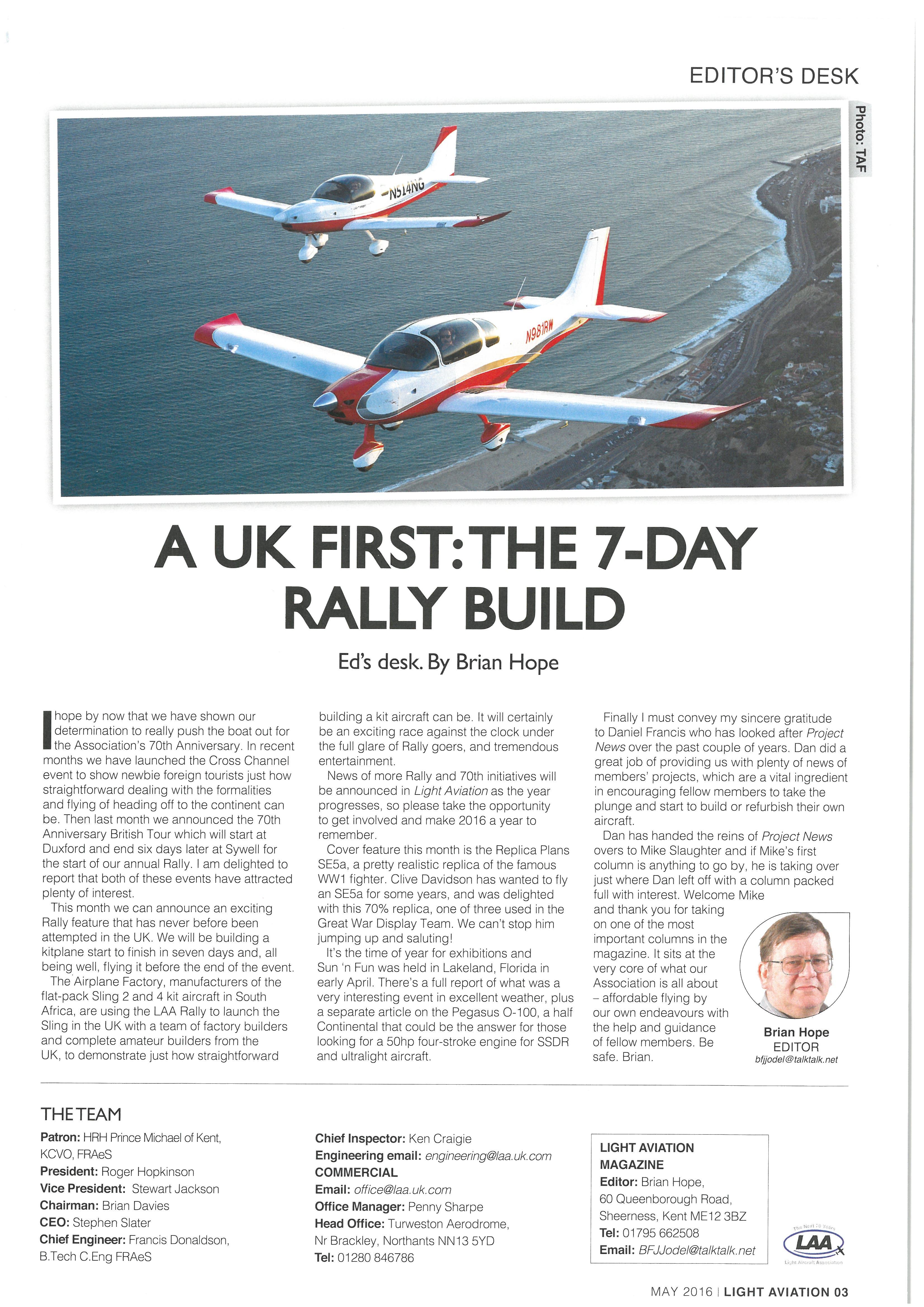
The Airplane Factory, manufacturers of the flat-pack Sling 2 and 4kit aircraft in South Africa, are using the LAA Rally to launch the
building a kit aircraft can be. It will certainly be an exciting race against the clock under the full glare of Rally goers, and tremendous entertainment.
News of more Rally and 70th initiatives will be announced in Light Aviation as the year progresses, so please take the opportunity to get involved and make 2016 a year to remember.
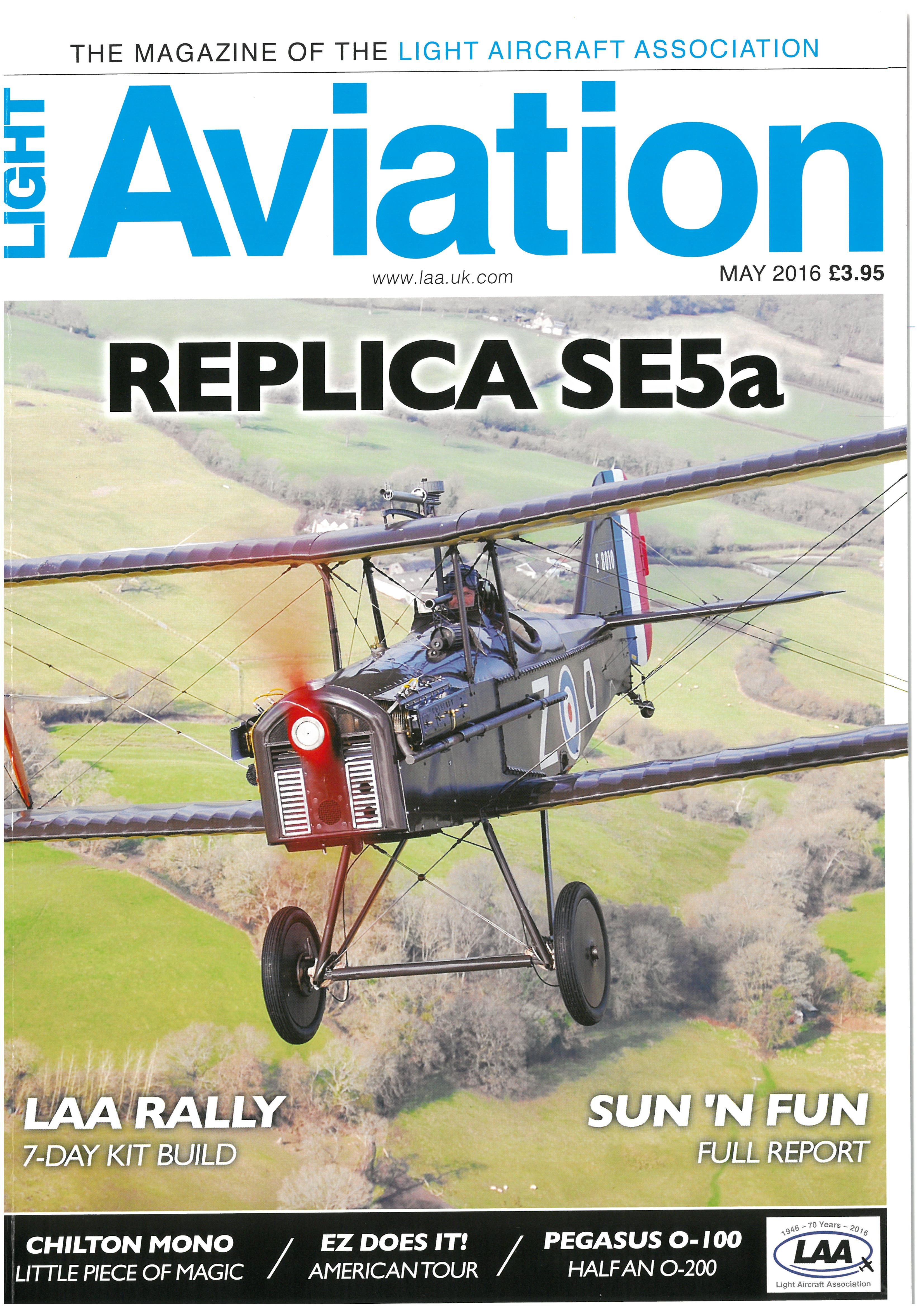
Cover feature this month is the Replica Plans SE5a, a pretty realistic replica of the famous WW1 fighter. Clive Davidson has wanted to fly an SE5a for some years, and was delighted with this 70% replica, one of three used in the Great War Display Team. We can’t stop him jumping up and saluting!
It's the time of year for exhibitions and Sun ‘n Fun was held in Lakeland, Florida in early April. There’s a full report of what was a very interesting event in excellent weather, plus a separate article on the Pegasus O-100, a half
Finally | must convey my sincere gratitude to Daniel Francis who has looked after Project News over the past couple of years. Dan did a great job of providing us with plenty of news of members’ projects, which are a vital ingredient in encouraging fellow members to take the plunge and start to build or refurbish their own aircraft.
Dan has handed the reins of Project News overs to Mike Slaughter and if Mike’sfirst column is anything to go by, he is taking over just where Dan left off with a column packed full with interest. Welcome Mike and thank you for taking on one of the most important columns in the magazine. It sits at the very core of what our Association is all about affordable flying by our own endeavours with
SlingintheUKwithateamoffactorybuildersContinentalthatcouldbetheanswerforthosethehelpandguidance
BrianHope and complete amateur builders from the looking for a 50hp four-stroke engine for SSDR of fellow members. Be EDITOR UK,todemonstratejusthowstraightforward andultralightaircraft. safe.Brian.
bfjjodel@talktalk.net
THETEAM
Patron:HRHPrinceMichaelofKent, ShierInspector:SenCraigie
KCVO,FRAeS Engineering email: engineering@laa.uk.com MAGAZINE
President: Roger Hopkinson
Vice President: Stewart Jackson
Chairman: Brian Davies
CEO: Stephen Slater
Chief Engineer: Francis Donaldson, B.Tech C.Eng FRAeS
COMMERCIAL
Email: office@/laa.uk.com
Office Manager: Penny Sharpe
Head Office: Turweston Aerodrome, Nr Brackley, Northants NN13 5YD
Tel: 01280 846786
Editor: Brian Hope, 60 Queenborough Road, Sheerness, Kent ME12 3BZ
Tel: 01795 662508
Email: BFJJode/@talktalk.net
6 NEWS
FlawedDfTconsultation,helpwanted and much more
9 EZ ONTOUR
Brianbumps intoLAAmembers Pat and LindaElliottontourintheirLongEZ
10PROJECTNEWS
Members’ aircraftprojects and aircraft recentlyclearedtofly.
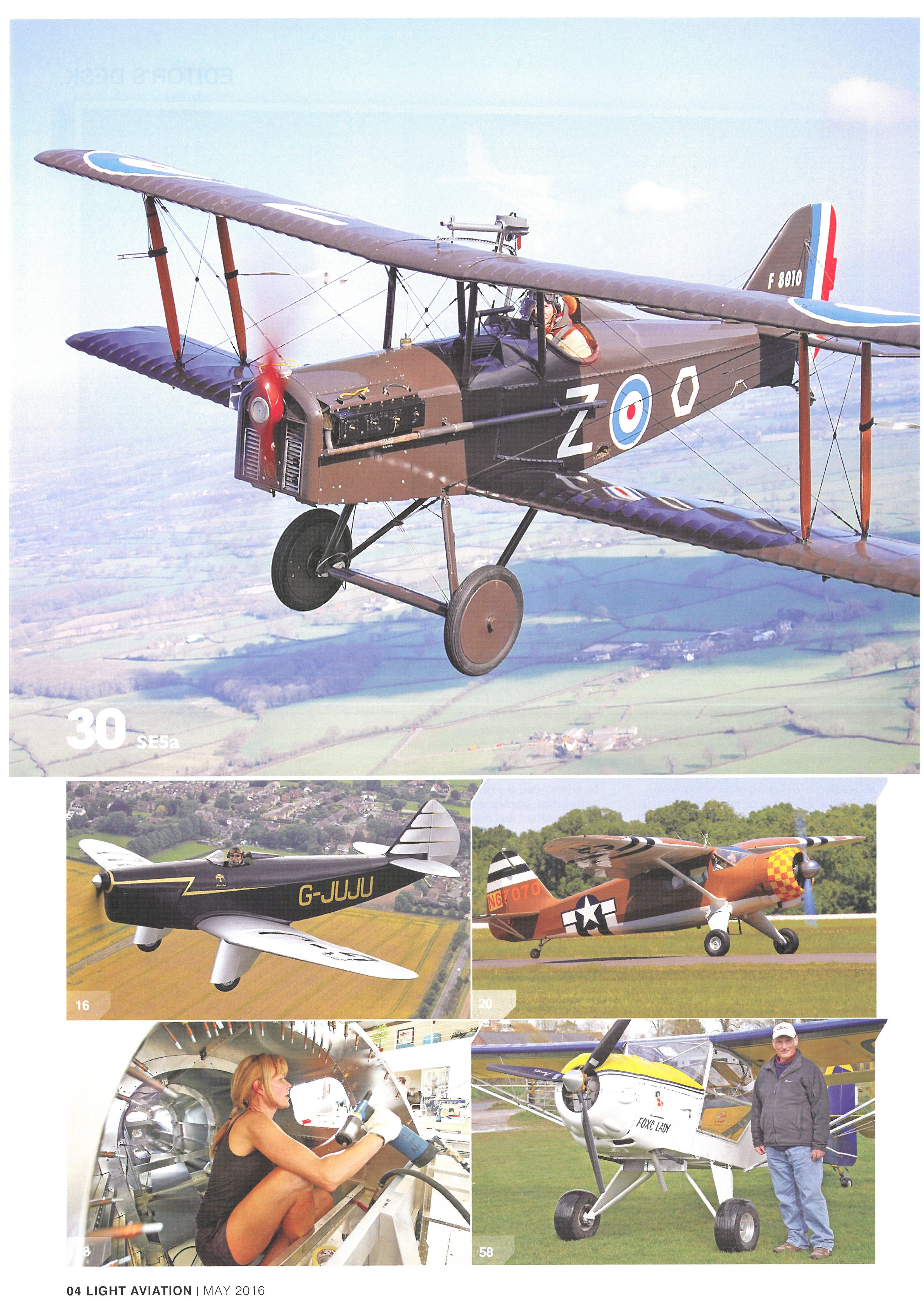
16CHILTON MONOPLANE
DavidReid'slittlebitof BlackMagic
20SUN N FUN 2016
Photoreportby BrianHope and Nigel! Hitchmanfromthisyear’s seasonopening Sun‘nFunairshow
26 HERCULES PROPELLERS
NeilWilsonvisitsthe newfactoryof HerculesPropellers
30 REPLICA PLANS SE5a
Clive Davidson flies a beautiful scale version of the SE5a WWI fighter
38 RALLY 7-DAY BUILD
A huge challengeto celebratethe LAA’s70th anniversary:build a complete kitaircraftin 7 days and fly it!
4| LAAWINGS
News of three recent winners of LAA Wings awards.
42 PEGASUS O-100
One man’s soultion to the need for a smalland lightfour-strokeengine-half a Continental O-200
46 FREE LANDINGS
Fourairfields offer free landings for LAA members this month
47 LAA SHOP
Goon! Spend somemoney!
48 RACE COMPETITION
Avery special prize:a freetraining courseonairracing,plusa freeentry into a race weekend
50 SAFETY SPOT
Malcolm McBride gets to the bottom of some fuel filter issues and discusses lossof control problems
58MEETTHEMEMBERS
TheoWillford,woodworkingspecialist and one of the trio of builders behind the BristolScout replica
6| CEOTHOUGHTS
Whenthe law isan ass...by LAA CEO, Steve Slater
62 WHERE TO GO
Fly-insand other events
63 LAA CLASSIFIEDS
Aircraft, parts and services for sale
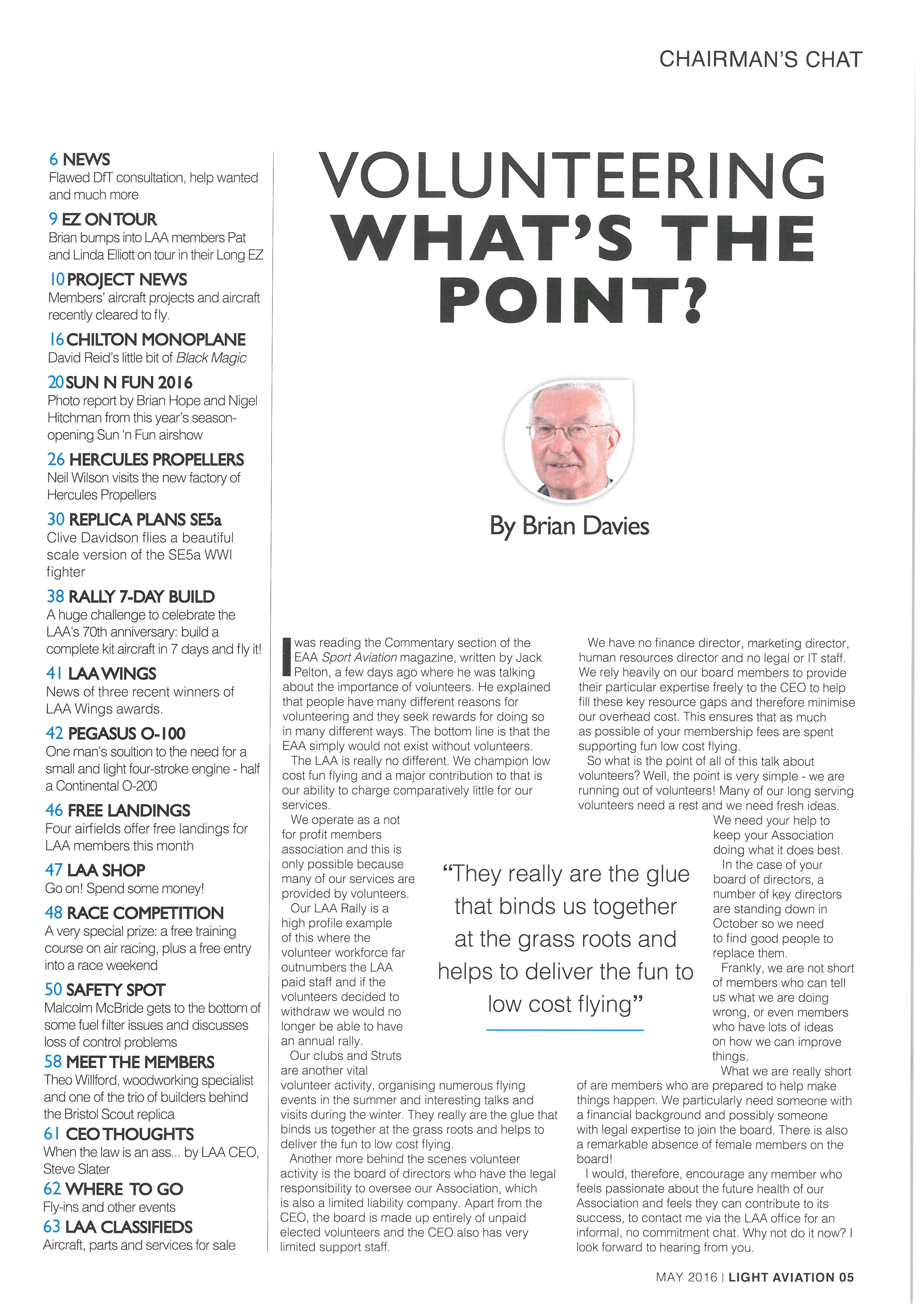
[=readingtheCommentary section “Theyofthereallyaretheglue thatbindsustogether helpsatthegrassrootsand lowtodeliverthefunto costflying”
EAA Sport Aviation magazine, written by Jack Pelton, a few days ago where he was talking about the importance of volunteers. He explained that people have many different reasons for volunteering and they seek rewards for doing so in many different ways. The bottom line is that the EAA simply would not exist without volunteers.
The LAA is really no different. We champion low cost fun flying and a major contribution to that is our ability to charge comparatively little for our services.
We operate as a not for profit members association and this is only possible because many of our services are provided by volunteers.
Our LAA Rally is a high profile example of this where the volunteer workforce far outnumbers the LAA paid staff and if the volunteers decided to withdraw we would no longer be able to have an annual rally.
Our clubs and Struts are another vital volunteer activity, organising numerous flying events in the summer and interesting talks and visits during the winter. They really are the glue that binds us together at the grass roots and helps to deliver the fun to low cost flying.
Another more behind the scenes volunteer activity is the board of directors who have the legal responsibility to oversee our Association, which is also a limited liability company. Apart from the CEO, the board is made up entirely of unpaid elected volunteers and the CEO also has very limited support staff.
We have no finance director, marketing director, human resources director and no legal or ITstaff. We rely heavily on our board members to provide their particular expertise freely to the CEO to help fill these key resource gaps and therefore minimise our overhead cost. This ensures that as much as possible of your membership fees are spent supporting fun low cost flying.
So what is the point of all of this talk about volunteers? Well, the point is very simple - we are running out of volunteers! Many of our long serving volunteers need a rest and we need fresh ideas.
We need your help to keep your Association doing what it does best.
In the case of your board of directors, a number of key directors are standing down in October so we need to find good people to replace them.
Frankly, we are not short of members who can tell us what we are doing wrong, or even members who have lots of ideas on how we can improve things.
What we are really short of are members who are prepared to help make things happen. We particularly need someone with a financial background and possibly someone with legal expertise to join the board. There is also a remarkable absence of female members on the board!
| would, therefore, encourage any member who feels passionate about the future health of our Association and feels they can contribute to its success, to contact me via the LAA office for an informal, no commitment chat. Why not do it now? | look forward to hearing from you.
PLENTY MORE NEWS ISAVAILABLE ON THE LAAWEBSITEAT WWW.LAA.UK.COM
CHECK IT OUT EVERY DAY!
The LAA has responded to the consultation drafted by the Department for Transport (DfT), which seeks views on increasing the maximum fine level applied to persons contravening the Standardised European Rules of the Air.
“After a full review with our technical and airspace team, we conclude that we fundamentally disagree with the proposals,” said LAA CEO Steve Slater.
“Thefocusofcurrentairspacepolicy is toreducetheriskoftheinfringement of controlledairspacebyencouragement,educationandwhennecessary, retraining,inacultureofself-admission ofproblems.Thesepunitiveproposals are fundamentallyflawedandwillpotentially create ratheracoverupCulture,jeopardising “Giventhanenhancingaviationsafety. alltheworkbeingundertaken by
groups such as FASVIG, NATS and the broader air transport and General Aviation community to address this issue and improve GA aircraft conspicuity, the LAA believes that this is not the right time to be introducing new, draconian penalising legislation.”
Further details are available from the News section of the LAA website at www.laa.uk.com
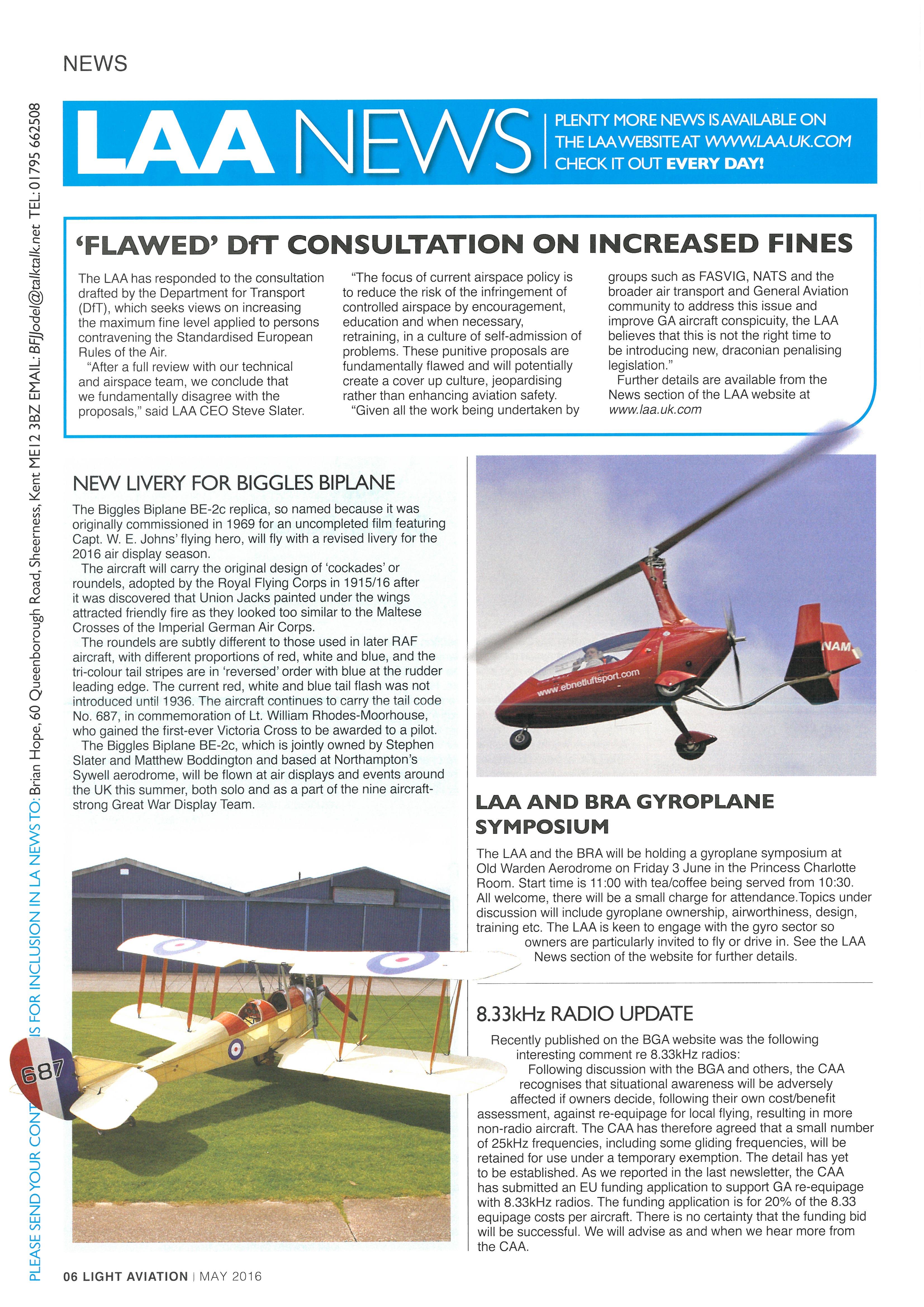
The Biggles Biplane BE-2c replica, so named because it was originally commissioned in 1969 for an uncompleted film featuring Capt. W. E. Johns’ flying hero, will fly with a revised livery for the 2016 air display season.
The aircraft will carry the original design of ‘cockades’ or roundels, adopted by the Royal Flying Corps in 1915/16 after it was discovered that Union Jacks painted under the wings attracted friendly fire as they looked too similar to the Maltese Crosses of the Imperial German Air Corps.
The roundels are subtly different to those used in later RAF aircraft, with different proportions of red, white and blue, and the tri-colour tail stripes are in ‘reversed’ order with blue at the rudder leading edge. The current red, white and blue tail flash was not introduced until 1936. The aircraft continues to carry the tail code No. 687, in commemoration of Lt. William Rhodes-Moorhouse, who gained the first-ever Victoria Cross to be awarded to a pilot.
The Biggles Biplane BE-2c, which is jointly owned by Stephen Slater and Matthew Boddington and based at Northampton’s Sywell aerodrome, will be flown at air displays and events around the UK this summer, both solo and as a part of the nine aircraftstrongGreatWarDisplayTeam. cenacedaibett
The LAA and the BRA will be holding a gyroplane symposium at Old Warden Aerodrome on Friday 3 June in the Princess Charlotte Room. Start time is 11:00 with tea/coffee being served from 10:30. Allwelcome,therewillbeasmallchargeforattendance.Topicsunder discussion will include gyroplane ownership, airworthiness, design, training etc. The LAA is keen to engage with the gyro sector so owners are particularly invited to fly or drive in. See the LAA News section of the website for further details.
Recently published on the BGA website was the following interesting comment re 8.33kHz radios:
Following discussion with the BGA and others, the CAA recognises that situational awareness will be adversely affected if owners decide, following their own cost/benefit assessment, against re-equipage for local flying, resulting in more non-radio aircraft. The CAA has therefore agreed that a small number of 25kHz frequencies, including some gliding frequencies, will be retained for use under a temporary exemption. The detail has yet to be established. As we reported in the last newsletter, the CAA has submitted an EU funding application to support GA re-equipage with 8.33kHz radios. The funding application is for 20% of the 8.33 equipage costs per aircraft. There is no certainty that the funding bid will be successful. We will advise as and when we hear more from the CAA.
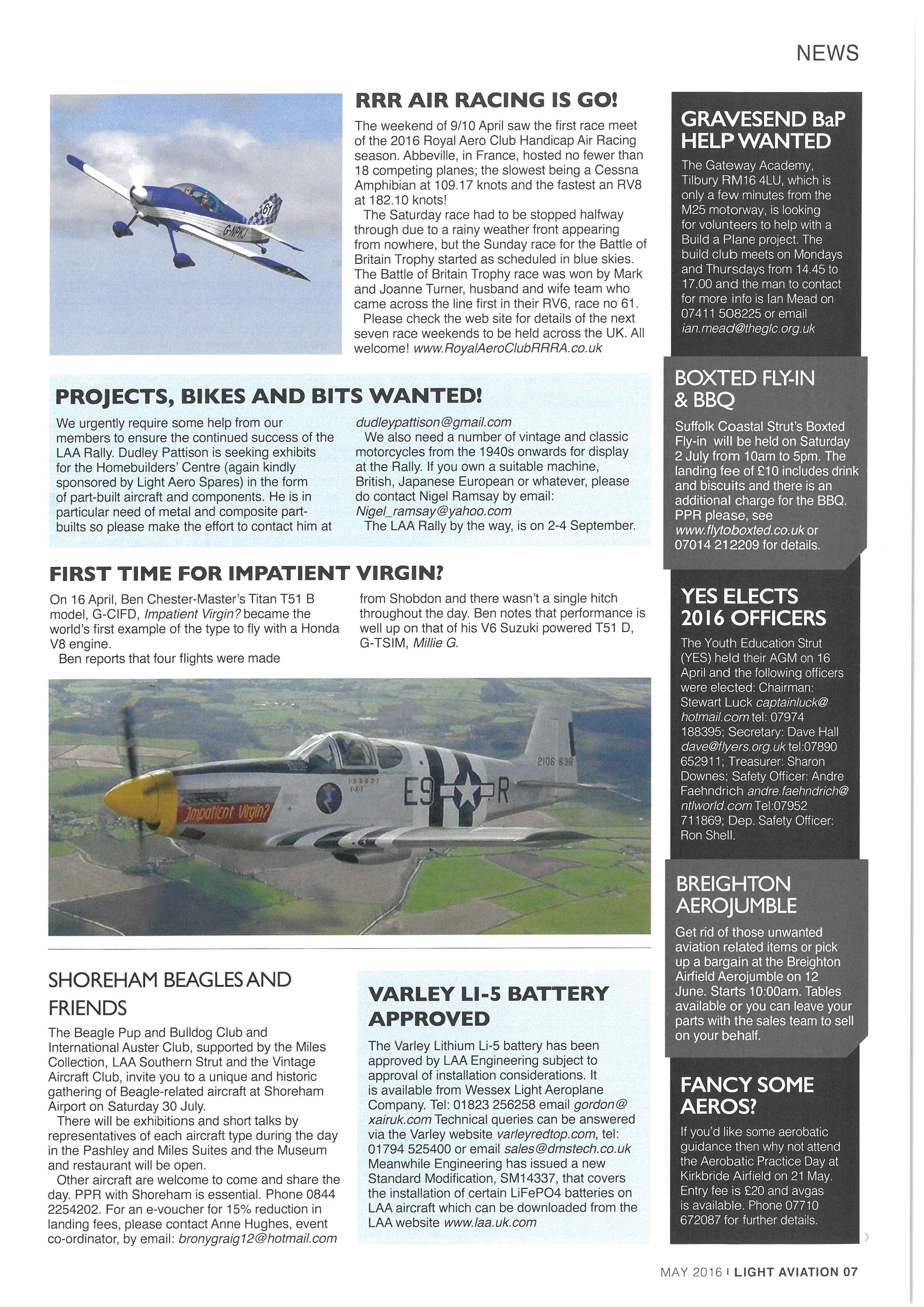
The weekend of 9/10 April saw the first race meet of the 2016 RoyalAero Club Handicap Air Racing season. Abbeville, in France, hosted no fewer than 18 competing planes; the slowest being a Cessna Amphibian at 109.17 knots and the fastest an RV8 at 182.10 knots!
The Gateway Academy, Tilbury RM16 4LU, which is only a few minutes from the M25 motorway, is looking for volunteers to help with a Build a Plane project. The build club meets on Mondays and Thursdays from 14.45 to 17.00 and the man to contact for more info is lan Mead on 07411 508225 or email ian.mead@theglc.org.uk
The Saturday race had to be stopped halfway through due to a rainy weather front appearing from nowhere, but the Sunday race for the Battle of Britain Trophy started as scheduled in blue skies. The Battle of Britain Trophy race was won by Mark and Joanne Turner, husband and wife team who came across the line first in their RV6, race no 61. Please check the web site for details of the next seven race weekends to be held across the UK. All welcome!www.RoyalAeroClubRRRA.co.uk
We urgently require some help from our members to ensure the continued success of the LAA Rally. Dudley Pattison is seeking exhibits for the Homebuilders’ Centre (again kindly sponsored by Light Aero Spares) in the form of part-built aircraft and components. He is in particular need of metal and composite partbuilts so please make the effort to contact him at
dudleypattison@gmail.com
We also need a number of vintage and classic motorcycles from the 1940s onwards for display at the Rally. If you own a suitable machine, British, Japanese European or whatever, please do contact Nigel Ramsay by email: Nigel_ramsay @yahoo.com
TheLAARallybytheway,ison2-4September.
On 16 April, Ben Chester-Master’s Titan T51 B model, G-CIFD, /mpatient Virgin?became the world’s first example of the type to fly with a Honda V8 engine.
Ben reports that four flights were made
fromShobdonandtherewasn’ta singlehitch throughout the day. Ben notes that performance is well up on that of his V6 Suzuki powered T51 D, G-TSIM, Millie G.
Suffolk Coastal Strut’s Boxted Fly-in will be held on Saturday 2 July from 10am to 5pm. The landing fee of £10 includesdrink and biscuits and there is an additional charge for the BBQ. pam (crabs PEST) www.flytoboxted.co.uk or 07014 212209 for details.
The Youth Education Strut (YES) held their AGM on 16 April and the following officers were elected: Chairman: Stewart Luck captainiuck@ hotmail.com tel: 07974 188395; Secretary: Dave Hall dave@flyers.org.uk tel:07890 652911; Treasurer: Sharon Downes; Safety Officer: Andre Faehndrich anare.faehndrich@ ntlworld.com Tel:07952 711869; Dep. Safety Officer: Ron Shell.
The Beagle Pup and Bulldog Club and International Auster Club, supported by the Miles Collection, LAA Southern Strut and the Vintage Aircraft Club, invite you to a unique and historic gathering of Beagle-related aircraft at Shoreham Airport on Saturday 30 July.
There will be exhibitions and short talks by representatives of each aircraft type during the day in the Pashley and Miles Suites and the Museum and restaurant will be open.
Other aircraft are welcome to come and share the day. PPR with Shoreham is essential. Phone 0844 2254202. For an e-voucher for 15% reduction in landing fees, please contact Anne Hughes, event co-ordinator, by email: bronygraig12@hotmail.com
The Varley Lithium Li-5 battery has been approved by LAA Engineering subject to approval of installation considerations. It is available from Wessex Light Aeroplane Company. Tel:01823 256258 email gordon@ xairuk.com Technical queries can be answered via the Varley website varleyredtop.com, tel: 01794 525400 or email sales@dmstech.co.uk Meanwhile Engineering has issued a new Standard Modification, SM14337, that covers the installation of certain LiFePO4 batteries on LAA aircraft which can be downloaded from the LAA website www.laa.uk.com
Get rid of those unwanted aviation related items or pick up a bargain at the Breighton Airfield Aerojumble on 12 June. Starts 10:00am. Tables available or you can leave your parts with the sales team to sell on your behalf.
If you'd like some aerobatic guidance then why not attend the Aerobatic Practice Day at Kirkbride Airfield on 21 May. Entry fee is £20 and avgas is available. Phone 07710 672087 for further details.
On 29-30 May Shobdon Airfield is holding a Vintage Fly-In with free landing for vintage aircraft (pre-1970s) and a prize of member rates on fuel for two months, for the oldest visiting aircraft.
motorbikes to ogle over. No entry fees but donations to the airfield’s War Memorial Fund will be most welcome. For further information pleas contact Kate Tarrant on 01568 708369 or email: There will also be a multitude of beautiful vintage cars and events@shobdonairfield.co.uk
It was announced at Sun ‘n Fun that the EAA had succeeded in gaining an STC on behalf of Dynon for the D10A from the FAAagainst an ASTM standard. Following the standard, the manufacturer has to do a fair amount of work so it’s far from a ‘rubber stamping’ exercise. The STC relates to a number of named aircraft, including C172 and PA28.
This is a first for Dynon but they were enthusiastic at the show that more of their non-certified equipment was likely to follow suit
Although we did not manage to include Ireland in our LAA Round Britain Tour we very much want to encourage members to visit the Emerald Isle. Next month, June, we will be including some Irish landing vouchers in addition to our usual offering, so start planning now for a few days away across the Irish Sea.
One date for the diary is 18-19 June when Enniskillen has a fly-inweekendwitha BBQanda freelanding.Andifyouare in due course. heading off to Southern Ireland they’ll only charge you £1.18 per litre for avgas.
The Civil Aviation Authority (CAA) has given the go-ahead for reclassification of the airspace over Belfast. The change, which comes into effect from 26 May 2016, will see all airspace within the Belfast Terminal Manoeuvring Area (TMA) change from a mix of Class E and D controlled airspace to solely Class D. The newly simplified classification won't affect commercial air
traffic operating in and out of Belfast City or Belfast International airports, but will help ensure radio equipped private aircraft can still enter the airspace following obtaining a clearance from air traffic control.
Non-radio equipped aircraft will still be able to access parts of the area under coordinated arrangements, said the CAA.
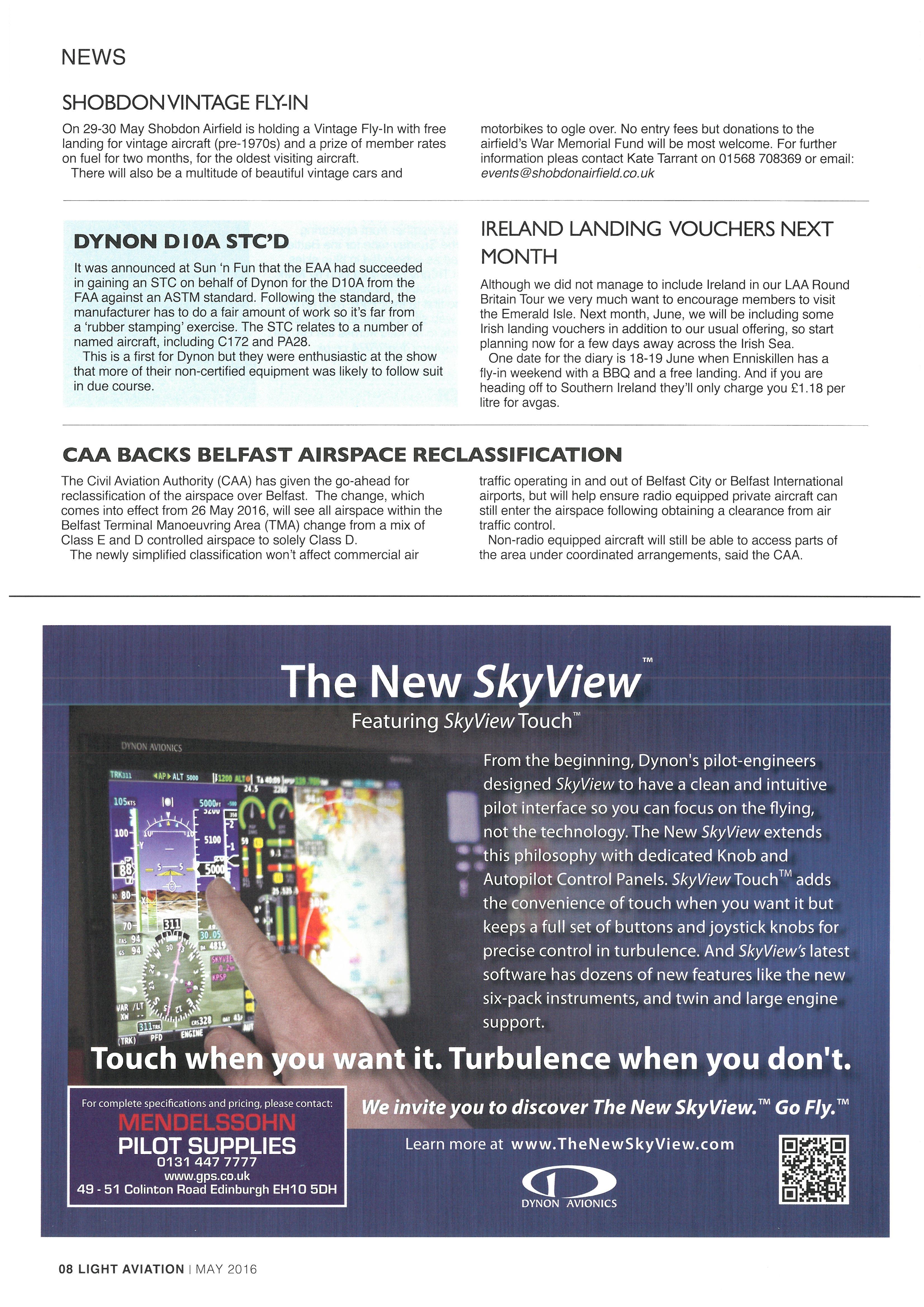
From the beginning, Dynon’'spilot-engineers designed SkyViewto have a clean and intuitive pilot interface so you can focus on the flying, not the technology. The New SkyViewextends “this philosophy with dedicated Knob and “AutopilotControlPanels.SkyViewTouch™adds the convenience of touch when you want it but keepsafull set of buttons and joystick knobs for precise control in turbulence. And SkyView’slatest software has dozens of new features like the new six-pack instruments, and twin and large engine Support.
AMERICAS... Bees(ol0ipMRUr)e(=eemmgrharem
moments!BrianHope catches up with Pat
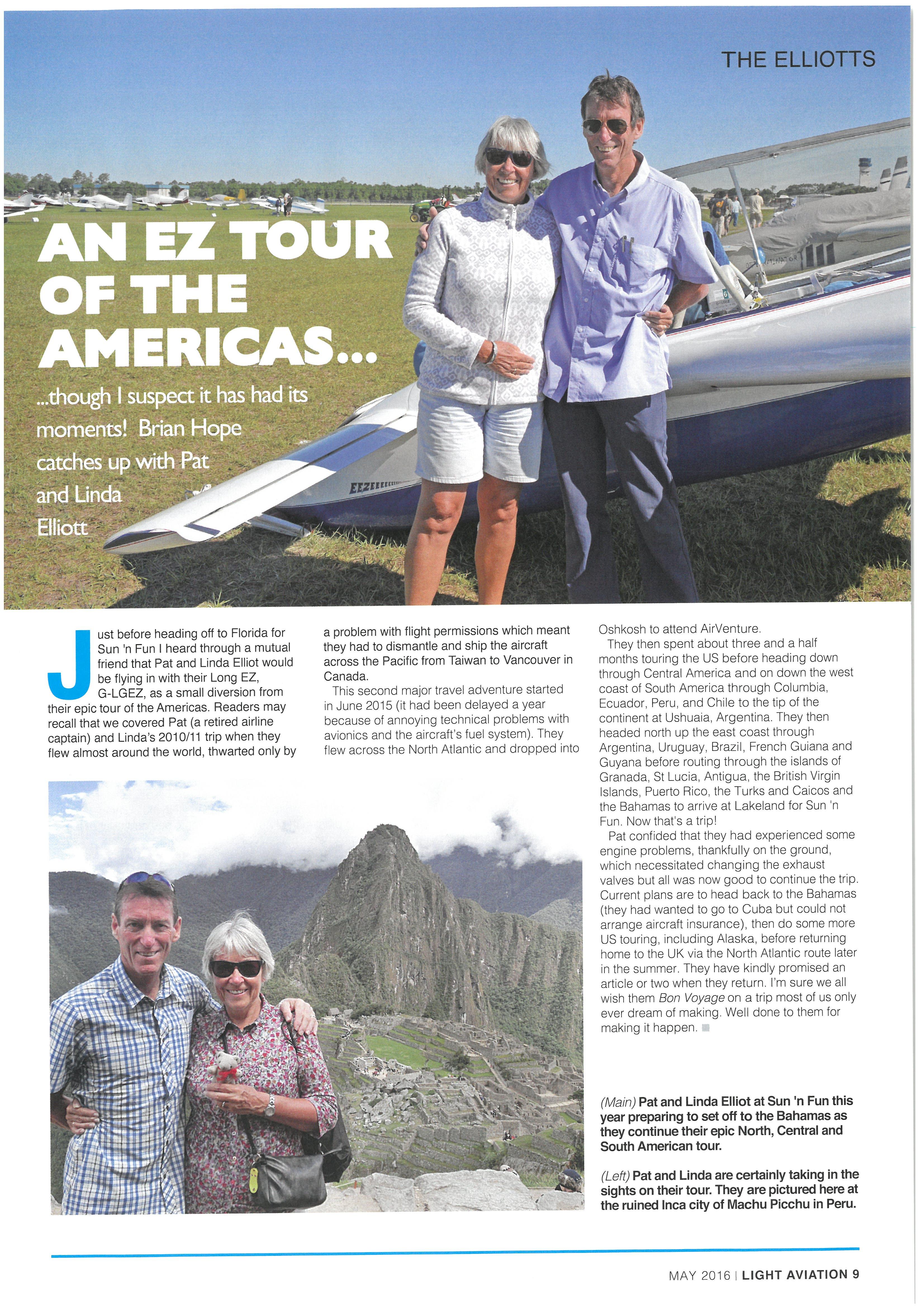
ust before heading off to Florida for Sun 'n Fun | heard through a mutual friend that Pat and Linda Elliot would be flying in with their Long EZ, G-LGEZ, as a small diversion from their epic tour of the Americas. Readers may recall that we covered Pat (a retired airline captain) and Linda’s 2010/11 trip when they flew almost around the world, thwarted only by
a problem with flight permissions which meant they had to dismantle and ship the aircraft across the Pacific from Taiwan to Vancouver in Canada.
This second major travel adventure started in June 2015 (it had been delayed a year because of annoying technical problems with avionics and the aircraft’s fuel system). They flew across the North Atlantic and dropped into
Oshkosh to attend AirVenture.
They then spent about three and a half months touring the US before heading down through Central America and on down the west coast of South America through Columbia, Ecuador, Peru, and Chile to the tip of the continent at Ushuaia, Argentina. They then headed north up the east coast through Argentina, Uruguay, Brazil, French Guiana and Guyana before routing through the islands of Granada, St Lucia, Antigua, the British Virgin Islands, Puerto Rico, the Turks and Caicos and the Bahamas to arrive at Lakeland for Sun 'n Fun.Nowthat'satrip!
Patconfided that they had experienced some engine problems, thankfully on the ground, which necessitated changing the exhaust valves but all was now good to continue the trip. Current plans are to head back to the Bahamas (they had wanted to go to Cuba but could not arrange aircraft insurance), then do some more US touring, including Alaska, before returning home to the UK via the North Atlantic route later in the summer. They have kindly promised an article or two when they return. I’m sure we all wishthemBonVoyageona tripmostofusonly ever dream of making. Well done to them for making it happen.
(Main) Pat and Linda Elliotat Sun 'n Fun this year preparing to set off to the Bahamas as they continue their epic North, Central and South American tour.
(Left)Pat and Linda are certainly taking in the sights on their tour. They are pictured here at the ruined Inca city of Machu
in Peru.
registrations showing a healthy cross section of types, with wood holding its own against metal. Only a few aircraft have been cleared for first flight but interestingly include a new amateur design, and a vintage type making its way on to an LAA Permit following refurbishment to its original livery when supplied new to the RAF.
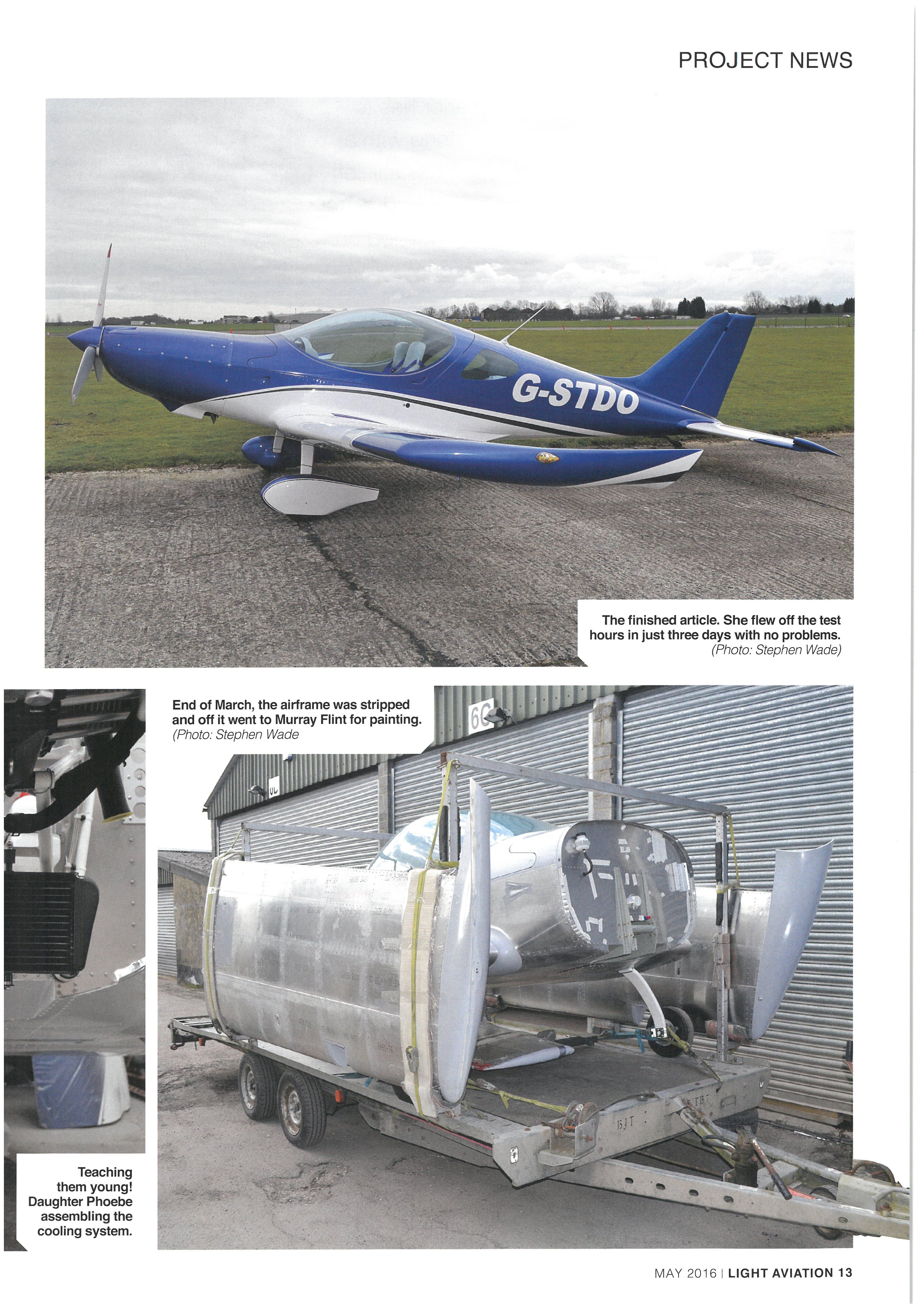
Wehave a fascinatingstoryofBristellG-STDO.TheBristell arguably carries on where the SportCruiser left off and is possibly a little easier to build. However, STDO is the first flying example to use the Rotax 912iS and only the second configured with a tailwheel. It is my observation that everything takes longer than expected but if you deviate from the norm then elapsed time grows exponentially. So, throw into this volatile mix a complex electronic fit and two builders who work full-time and it is staggering that they have progressed from kit delivery to full Permit in only 15 months and 7 days.
As | write, | have just received confirmation from Steve and Dave, the builders, of the arrival of their Permit to Fly. The sun is clearing the rain cloudsawayandtheforecastfortherestoftheweekendisveryflyable, | wonder how Steve and John will spend their Sunday? Lucky chaps!
An update from G-COLS shows a determined effort to get on with the test flying and reach that full Permit as rapidly as possible. | smiled as | read Chris Barnes account of his decision to build after a couple of beers and a question posed “why not build a Chilton?”. Is there a “how hard can it be?” echoing in there somewhere?
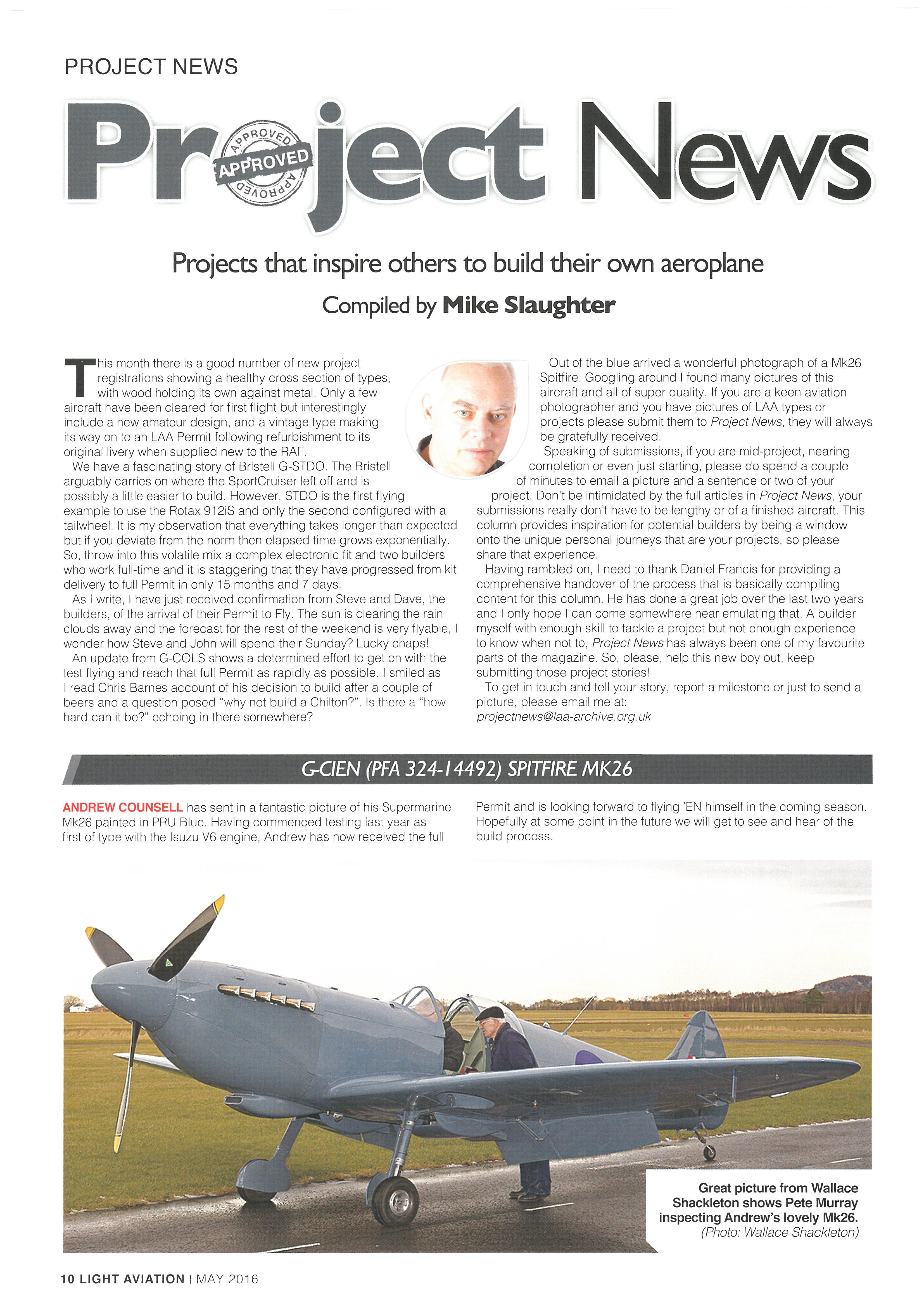
Out of the blue arrived a wonderful photograph of a Mk26 Spitfire. Googling around |found many pictures of this aircraft and all of super quality. If you are a keen aviation photographer and you have pictures of LAA types or projects please submit them to Project News, they will always be gratefully received.
Speaking of submissions, if you are mid-project, nearing completion or even just starting, please do spend a couple of minutes to email a picture and a sentence or two of your project. Don’t be intimidated by the full articles in Project News, your submissions really don’t have to be lengthy or of a finished aircraft. This column provides inspiration for potential builders by being a window onto the unique personal journeys that are your projects, so please share that experience.
Having rambled on, | need to thank Daniel Francis for providing a comprehensive handover of the process that is basically compiling contentforthiscolumn.Hehasdonea greatjoboverthelasttwoyears and | only hope | can come somewhere near emulating that. A builder myself with enough skill to tackle a project but not enough experience to Knowwhen not to, Project News has always been one of my favourite parts of the magazine. So, please, help this new boy out, keep submitting those project stories!
To get in touch and tell your story, report a milestone or just to send a picture, please email me at: projectnews@laa-archive.org.uk
BY CHRIS BARNES
my Chilton nearly 11years ago, after I’d finished my Glastar | bought a kit of spruce cut-to-size from Canada, and my then LAA G-CBAR. | wanted to build a wood single-seater. Why wood? Well | inspector Charlie Huke professed itto be the nicest spruce he had had built models from plans and had also built most of the structure of ever seen. a Falco before | sold it. There had been no wood in the Glastar and |
Anyway, to cut a long story short, the build has progressed very missed it! satisfactorily and has been an absolute joy. Apart from a two-year hiatus Why single-seat? | had owned and modified an Isaacs Furyand due to moving from Hampshire to Norfolk, | have proceeded at a rather missed that too. A couple of beers with my late mate Al Mathie and he leisurely pace, it has to be said, but shortly the airframe will be moved to said, “Why don’t you build a Chilton?” so | contacted Roy Nerou and Priory Farm for final paintwork and assembly. found that yes, it was indeed possible. | had to get permission from The Chilton is powered by a Walter Mikron IIIB of 75hp. | have made
Constance Ward, widow of Reggie Ward, one of the original designers. a slight mod, with Francis’ approval, to delete that section of the flap Mrs Ward wrote me a very nice letter in reply, which now lives in a frame underneath the fuselage.Will it make any difference? | don’t know yet, onmyworkshopwall.Wewereoff! butitdoesmaketheundersidealotcleaner,anda bitstronger,by | visited Roy at his home and viewed G-AFSV,the fourth of the original closing up the hole in the fuselage. Chiltonaircraft.Roykindlygavemesomebitstosetmeonmyway.|
Sowithabitofluck,andassistancefrommycurrentinspectorRoger also visited Dave Elliott in Sussex who was equally helpful and pointed Burrows, | am hoping that G-DWCB will shortly be appearing in the me towards sources of supply, notably for the wheels. Cleared to fly column.
|
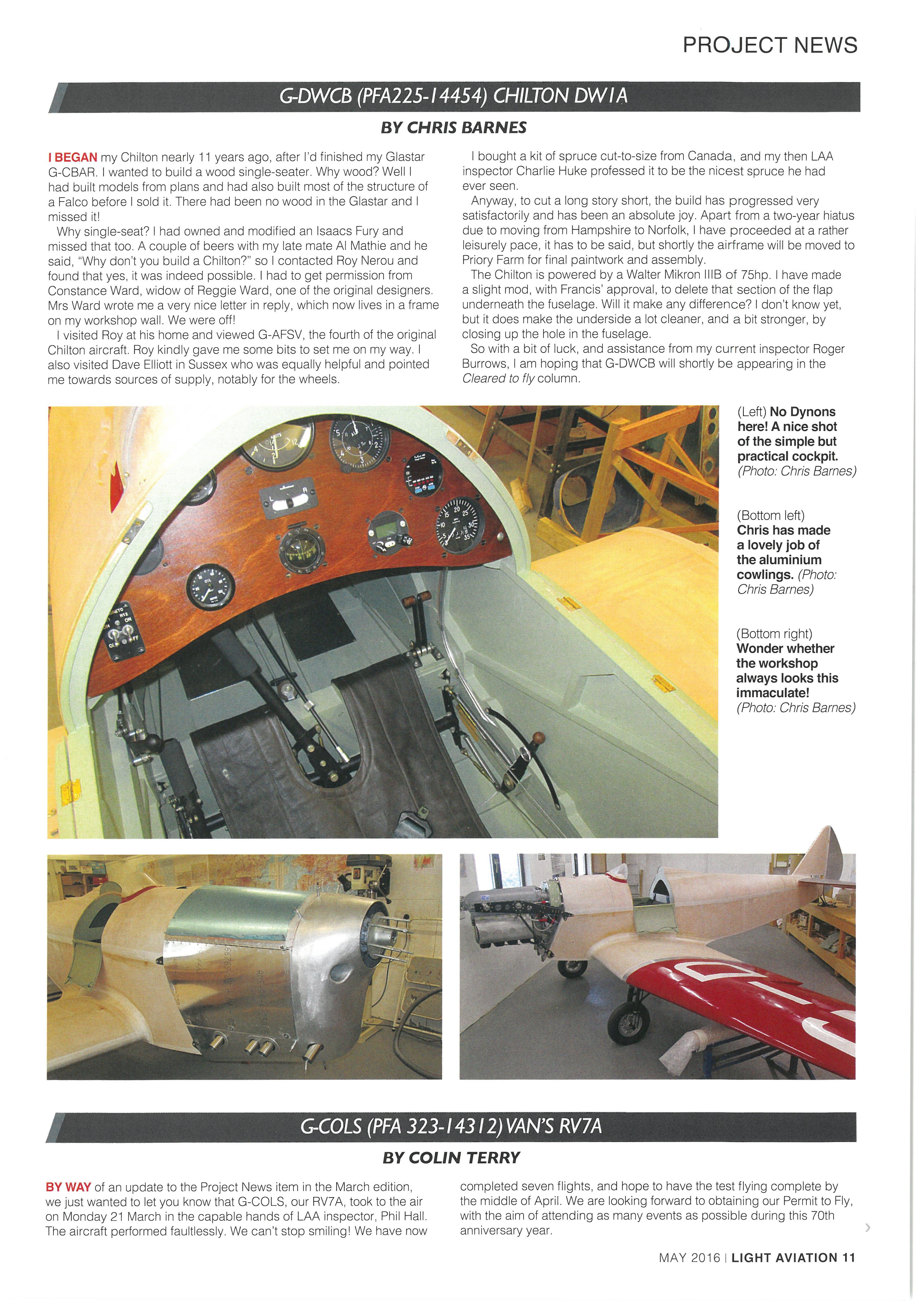
(Left) No Dynons here! A nice shot of the simple but practical cockpit.
(Bottom left) Chris has made a lovely job of the aluminium cowlings. (Photo: Chris Barnes)
(Bottom right)
Wonder whether
theworkshop
alwayslooksthis
immaculate!
(Photo:ChrisBarnes)
of a Bristell NGS TDO Build (or ‘What do you fancy doing in 2015?’ asks my friend).
My flying friend John came to me during 2014 and said, “When we (he and his partner Helen) were at TheFlying Show, we saw this great looking aeroplane, a Bristell NGS. It’s a quick build so how do you fancy tackling one?” Hmm, looks OK, thinks Steve, I'd better float this idea past my better half Sandi.
So the initial idea was born. Unfortunately, both being aircraft electronic engineers, we kept looking at the options list and thinking we wanted more. As we had both just completed he Clacton tailwheel course and we had seen he first Tail Dragger Option (TDO) Bristell in the UK, we decided we had to tick that box. Engines, more thought and investigation needed. Rotax 912ULS or Jabiru 3300 were he offered options, but why not a fuel injected Rotax9121SSport? After all, we should be able o work out the wiring of the ‘brain’ and other ancillaries.
A quick discussion with Farry Sayer (Bristell kit importer for the UK) convinced him that we would be able to be the first builders of this variant (TDO and 912is Sport) to go through the |AA acceptance process, so we ticked yet another box.
For us the instrumentation has to be electronic, more investigation and we decide on a dual Garmin G8X Touch system.
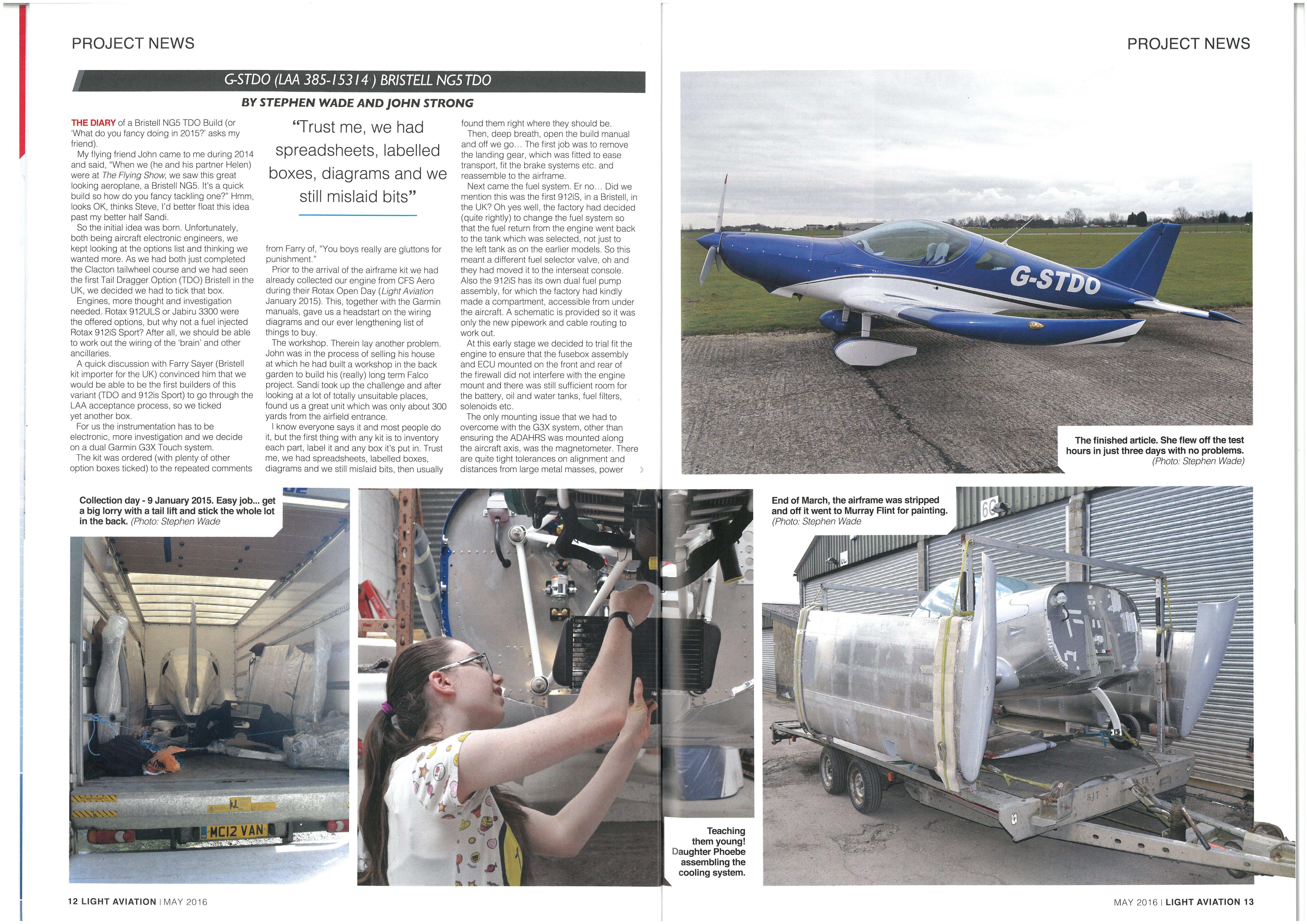
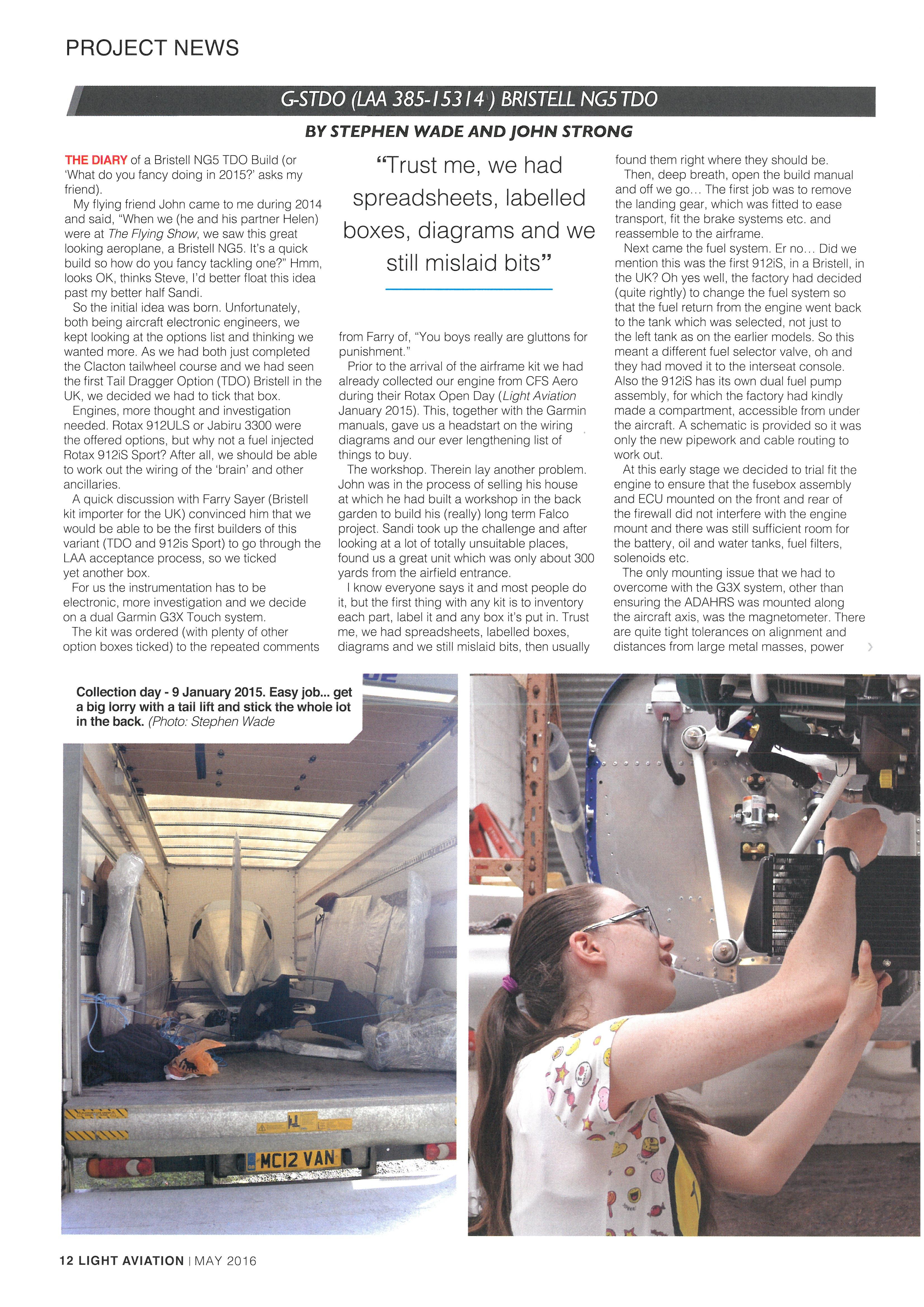
The kit was ordered (with plenty of other option boxes ticked) to the repeated comments in the back. (Photo: Stephen Wade 12 LIGHT AVIATION | MAY 2016
“Trust me, we had spreadsheets, labelled boxes, diagrams and we still mislaid bits”
from Farry of, “You boys really are gluttons for punishment.”
Prior to the arrival of the airframe kit we had already collected our engine from CFS Aero duringtheirRotaxOpenDay(LightAviation January 2015). This, together with the Garmin manuals, gave us a headstart on the wiring diagrams and our ever lengthening list of things to buy.
The workshop. Therein lay another problem. John was in the process of selling his house at which he had built a workshop in the back garden to build his (really) long term Falco project. Sandi took up the challenge and after looking at a lot of totally unsuitable places, found us a great unit which was only about 300 yards from the airfield entrance.
| know everyone says it and most people do it, but the first thing with any kit is to inventory each part, label it and any box it’s put in. Trust me, we had spreadsheets, labelled boxes, diagrams and we still mislaid bits, then usually
found them right where they should be.
Then, deep breath, open the build manual and off we go... The first job was to remove the landing gear, which was fitted to ease transport, fit the brake systems etc. and reassemble to the airframe.
Next came the fuel system. Er no... Did we mention this was the first 912iS, in a Bristell, in the UK? Oh yes well, the factory had decided (quite rightly) to change the fuel system so that the fuel return from the engine went back to the tank which was selected, not just to the left tank as on the earlier models. So this meant a different fuel selector valve, oh and they had moved it to the interseat console. Also the 912iS has its own dual fuel pump assembly, for which the factory had kindly made a compartment, accessible from under the aircraft. A schematic is provided so it was only the new pipework and cable routing to work out.
At this early stage we decided to trial fit the engine to ensure that the fusebox assembly and ECU mounted on the front and rear of the firewall did not interfere with the engine mount and there was still sufficient room for the battery, oil and water tanks, fuel filters, solenoids etc.
The only mounting issue that we had to overcome with the G3X system, other than ensuring the ADAHRS was mounted along the aircraft axis, was the magnetometer. There are quite tight tolerances on alignment and distances from large metal masses, power
cables, motors etc. that have to be observed. Garmin recommend mounting the unit in the wingtips or near the tail, which were not really available to us due to the size of the unit and access, to enable a mounting for the doweled alignment plate to be fabricated. Our solution was to fabricate a composite mount into which we bonded the alignment plate. This was aligned and bonded under the rear of the baggage area, away from where large metal objects could be carried in flight.
Painting: a huge job and not for us. So in preparation we wanted to mount all of the lights, aerials and anything else that would need holes to be drilled in the external surfaces. We also decided to save a few quid by preparing, filling and sanding all of the pop rivet holes... NEVER AGAIN. If you want my opinion it’s the most mind-numbing job and it has to be repeated at least twice for every rivet to get a satisfactory finish so, pay the man!
Whilst the airframe was away being painted, the avionics were ordered and the wiring, switching and routing diagrams prepared. Being in the trade, as it were, these issues fell quite easily to us and we worked in several ‘hooks’ for later expansion, such as ADS-B which the Garmin system allows for.
“The interior has to be fitted along with a multitude of bits still left in those boxes that were sorted and labelled on day one”
breakers to the right. The MFD (Multi Function Display) on the right also sat nicely angled towards the pilot, in the right hand section.
By mid-May the painted airframe, resplendent in its blue and white livery, was back in the workshop and the process of installing all of the external fittings, engine and components could be completed for the final time, with a little help from our families.
from the ECU to the G3X on a dual three-wire CAN bus. The only sensor we had to fit was for the fuel pressure (another three wires).
The old saying 90% done, 90% to go is certainly true. The interior had to be fitted along with a multitude of bits still left in those boxes sorted and labelled on day one. The fuselage had to be moved around in the workshop to allow testing of the wiring to the trim, lights, fuel senders etc. in each wing and tailplane.
The time suddenly arrived in late September when we realised that there was not much more we could do without fully assembling the aircraft, so it was off to the airfield for the final assembly stages. As the workshop was only 300 yards from the airfield gate we decided o walk/tow the fuselage down the road and around the peritrack, job done. Two miles (it doesn’t seem that far in a car!) and three hours ater everything had arrived.
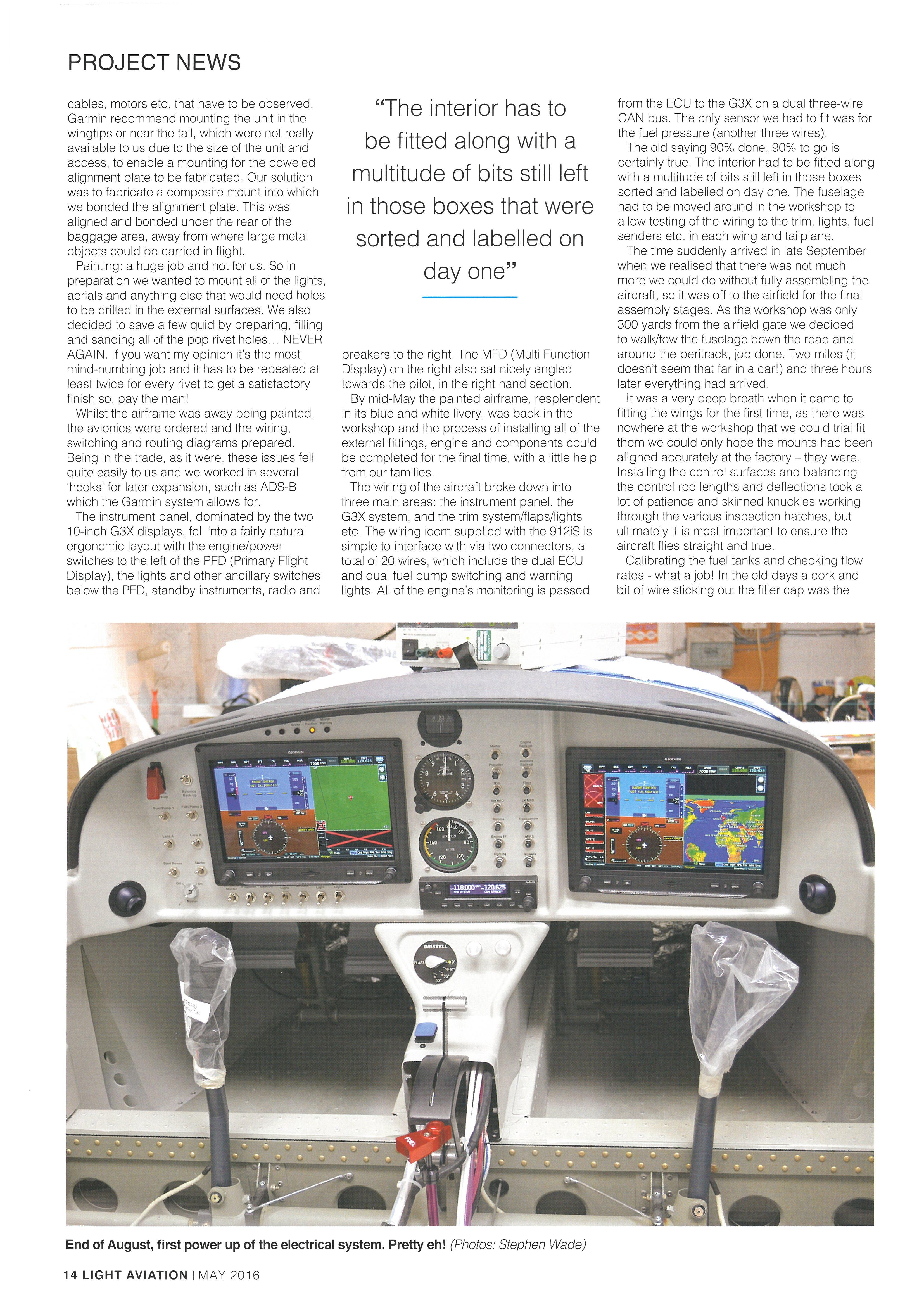
The instrument panel, dominated by the two 10-inch G3X displays, fell into a fairly natural ergonomic layout with the engine/power switches to the left of the PFD (Primary Flight Display), the lights and other ancillary switches below the PFD, standby instruments, radio and
End of August, first power up of the electrical system. Pretty eh! (Photos: Stephen Wade)
The wiring of the aircraft broke down into three main areas: the instrument panel, the G3X system, and the trim system/flaps/lights etc. The wiring loom supplied with the 912iS is simple to interface with via two connectors, a total of 20 wires, which include the dual ECU and dual fuel pump switching and warning lights. All of the engine’s monitoring is passed
It was a very deep breath when it came to itting the wings for the first time, as there was nowhere at the workshop that we could trial fit hem we could only hope the mounts had been aligned accurately at the factory they were. nstalling the control surfaces and balancing he control rod lengths and deflections took a ot of patience and skinned knuckles working hrough the various inspection hatches, but ultimately it is most important to ensure the aircraft flies straight and true.
Calibrating the fuel tanks and checking flow rates - what a job! In the old days a cork and bit of wire sticking out the filler cap was the
hi-tech solution. Now, with the electronics in the cockpit, you can ‘map’ the tank contents to litre accuracy (obviously with the aircraft stationary and level) by calibrating the contents in five litre steps. Only thing is of course, that you have to do exactly the same for both tanks, otherwise you get different values, side to side.
So with every test that we could think of completed, fuel, oil and water filled, nuts, bolts and fixings torqued and checked, there were no more excuses we could think of not to start the engine. Following the Rotax check list, monitoring all the parameters on the G3x, the engine started on the first turn of the key with no dramas.
With all the systems now powered and the aircraft able to be taxied under its own power, it was time to align and set up the G3X systems. A job for an engineering guru maybe, but no, it’s a lot easier than you think especially when we obtained the latest issue of the installation manual; the one supplied was three issues out of date!
The test/set up routine that you have to perform is relatively straightforward providing you have mechanically aligned and configured the ADAHRS, magnetometer and GPS antennas correctly. The test is split into three main areas - alignment, mechanical disturbance and EMC(Electro-Magnetic Compatibility). All of which need to be undertaken in a clear area away from any sources of electrical interference (radio masts) or large metal objects (hangars, fuel bowsers, etc.). Without going into the detail and after a few false starts, the test routines took around an hour to complete a straight run through and were relatively easy to perform.
Another daunting day arrived with the final inspection, which was completed with only a few minor adjustments needing to be undertaken before the submittal of the pack to LAA Engineering.
As this was the first Bristell 912iS installation, we supplied some extra data and pictures to cover the differences from a ‘standard 912’ installation. From this, an issue with one of the elevator control rods was picked up by Engineering, which we happily rectified by returning the offending part to the factory where it was modified. The Bristell factory had already picked up this issue on later kits and put in place a modification, shame they didn’t pass on that piece of info. With the item replaced, the Engineering team completed their work and a Permit to Test was received on 6 January 2016.
Twelve months and 19 days after receiving the kit, our test pilot, Adrian Brook, took to the skies for the first flight of G-STDO to the whooping and screaming of wives and family. The flight test programme was completed in 6 hours 10 mins of flying over three days, without any issues, and the flight test reports filed with LAA Engineering.
Sowhat did we think of the project? The kit was relatively easy to build, only complicated by our decision to opt for a new variant. The fit of the panels, cowlings, interior etc. was very good and did not require much trimming or adjustment. In our (engineering) opinion the Garmin system was also easy to fit and should not be beyond the capabilities of most people if they have the necessary support. And the engine installation was also well documented by Rotax and so did not prove to be a problem. Our thanks, as ever, go to all the people who have helped us complete our project, not least our long suffering wives and partners.
lf your aircraft has been featured in the New Projects list, please let Project News know of your progress at: projectnews @laa-archive.org.uk
m STAAKEN FLITZER Z-2 (LAA 359-15398) 30/03/2016
Mr S Grant, Hobbyhorse, Thorpe Road, Tattershall, Thorpe, Lincolnshire, LN4 4PE
@ DRUINE D.31A TURBULENT (LAA 048-15397) 24/03/2016
Mr W Harley, 4 Tichborne Cottages, Scaynes Hill Road, Haywards Heath, West Sussex, RH16 2Q0Q
@ SLING 2 (LAA 399-15395) 21/03/2016
Mr T D R Hardy, Limbers End, 61 Wilden Road, Renhold, Bedfordshire, MK41 OLY
m STAAKEN FLITZER Z-2 (LAA 359-15393) 17/03/2016
Mr E B Toulson, 24 Carr Lane, Sandal, Wakefield, West Yorkshire, WF2 6HJ
@ BRISTELL NG5 SPEED WING (LAA 385-15392) 09/03/2016
Mr G Beale, 1 The Drive, Blackmore End, Wheathampstead, Hertfordshire, AL4 8LE
@ VAN’S RV-10 (LAA 339-15390) 01/03/2016
Mr J A McGee, 8 Townend Road, Symington, S Ayrshire, KA1 5QQ
@ VAN’S RV-8 (LAA 303-15396) 22/03/2016
Name & address held by LAA Engineering
@ VAN’S RV-8 (LAA 303-15394) 17/03/2016
Name & address held by LAA Engineering
@ EUROFOX 912iS (LAA 376-15391) 08/03/2016
Name&address held CLEAREDbyLAAEngineering TO FLY lfyouraircrafthasfeaturedrecentlyinthemagazineandhassubsequently completeditsmaidenflight,ProjectNewswouldliketohearfromyouat:
projectnews @laa-archive.org.uk
@ G-RGUS FAIRCHILD 24R-46A (1145) 18/03/2016
Richard Ellingworth, Rochford House, Stoke Rochford, Grantham, NG33 SEB
@ G-SGNT SKYLARK (LAA 351-14944) 09/03/2016
Nigel Hughes Townsend, Jockeys, Holt End Lane, Bentworth, Alton, GU34 SLF
@ G-MECK TL2000UK STING CARBON S4 (LAA 347A-15350) 18/03/2016
Name & address held by LAA Engineering
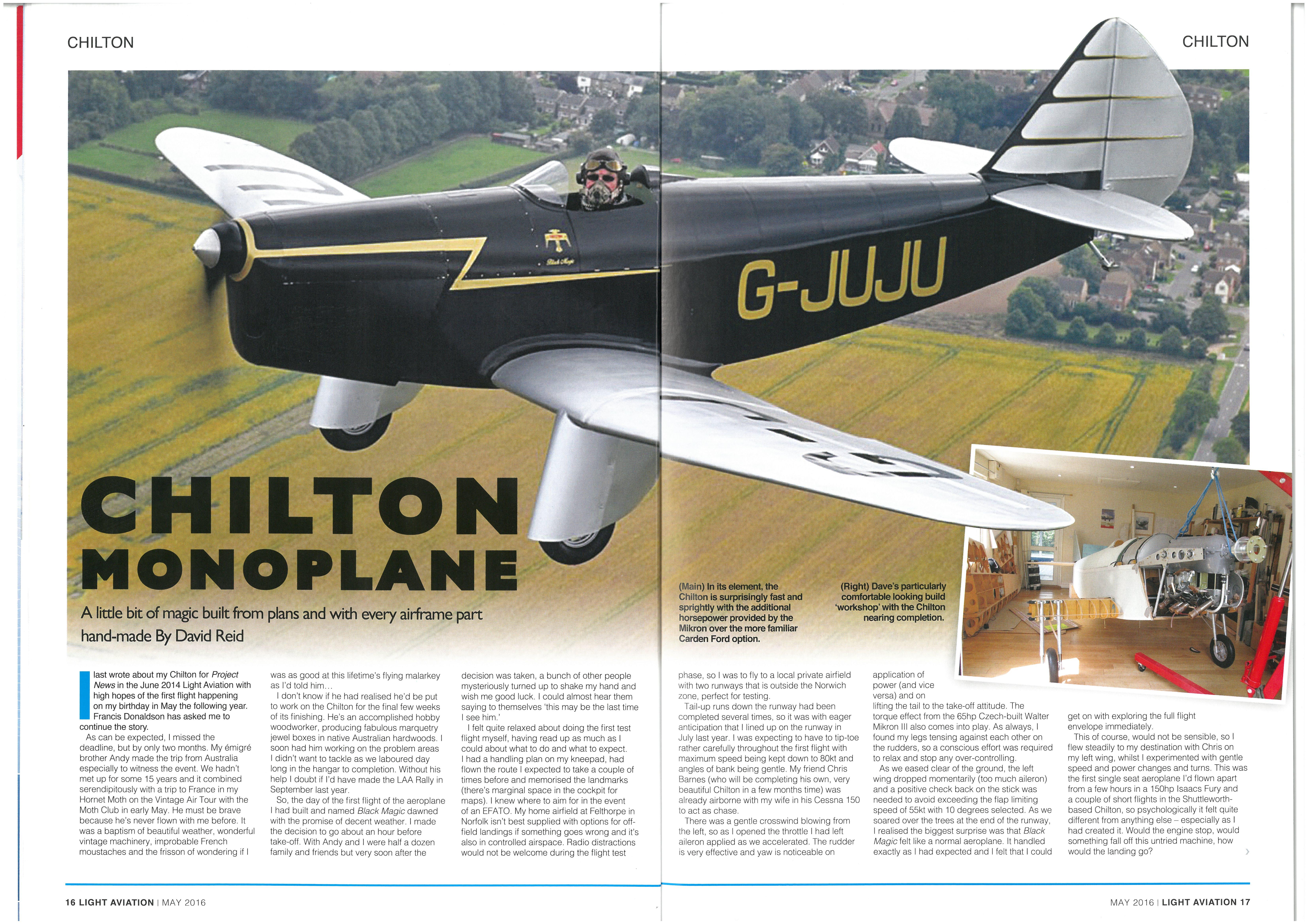
last wrote about my Chilton for Project News in the June 2014 Light Aviation with high hopes of the first flight happening on my birthday in May the following year. Francis Donaldson has asked me to continue the story.
As can be expected, | missed the deadline, but by only two months. My émigré brother Andy made the trip from Australia especially to witness the event. We hadn't met up for some 15 years and it combined serendipitously with a trip to France in my Hornet Moth on the Vintage Air Tour with the Moth Club in early May. He must be brave because he’s never flown with me before. It was a baptism of beautiful weather, wonderful vintage machinery, improbable French moustaches and the frisson of wondering if | (a PESST
was as good at this lifetime’s flying malarkey as |’d told him...
| don’t know if he had realised he’d be put o work on the Chilton for the final few weeks of its finishing. He’s an accomplished hobby woodworker, producing fabulous marquetry jewelboxesinnativeAustralianhardwoods. | soon had him working on the problem areas didn’t want to tackle as we laboured day ong in the hangar to completion. Without his help | doubt if I'd have made the LAA Rally in September last year.
So, the day of the first flight of the aeroplane had built and named Black Magic dawned with the promise of decent weather. | made he decision to go about an hour before ake-off. With Andy and | were half a dozen amily and friends but very soon after the
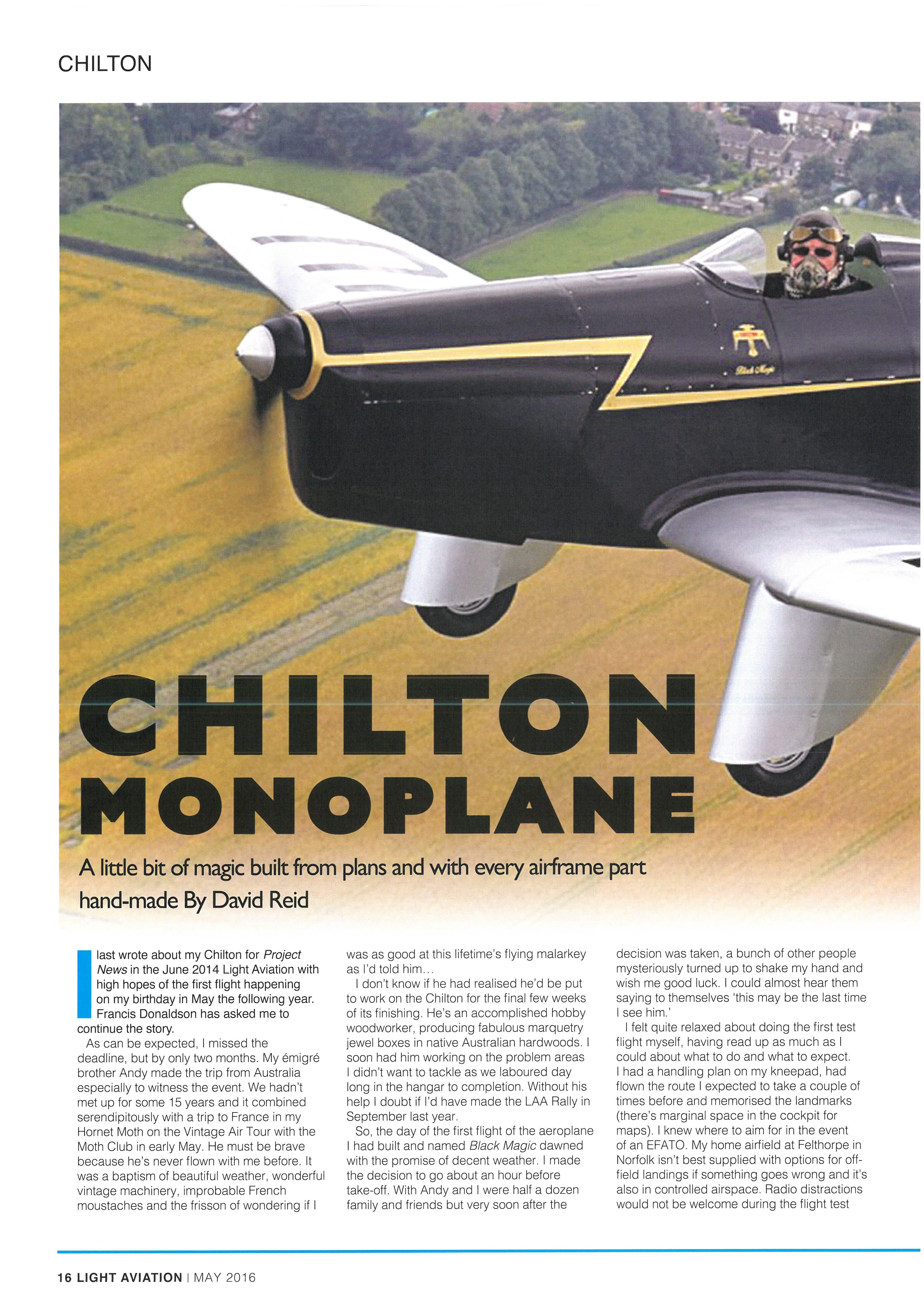
decision was taken, a bunch of other people mysteriously turned up to shake my hand and wish me good luck. | could almost hear them saying to themselves ‘this may be the last time see him.’
| felt quite relaxed about doing the first test light myself, having read up as much as | could about what to do and what to expect. had a handling plan on my kneepad, had lown the route | expected to take a couple of imes before and memorised the landmarks there’s marginal space in the cockpit for maps). | knew where to aim for in the event of an EFATO. My home airfield at Felthorpe in Norfolk isn’t best supplied with options for offield landings if something goes wrong and it’s also in controlled airspace. Radio distractions would not be welcome during the flight test
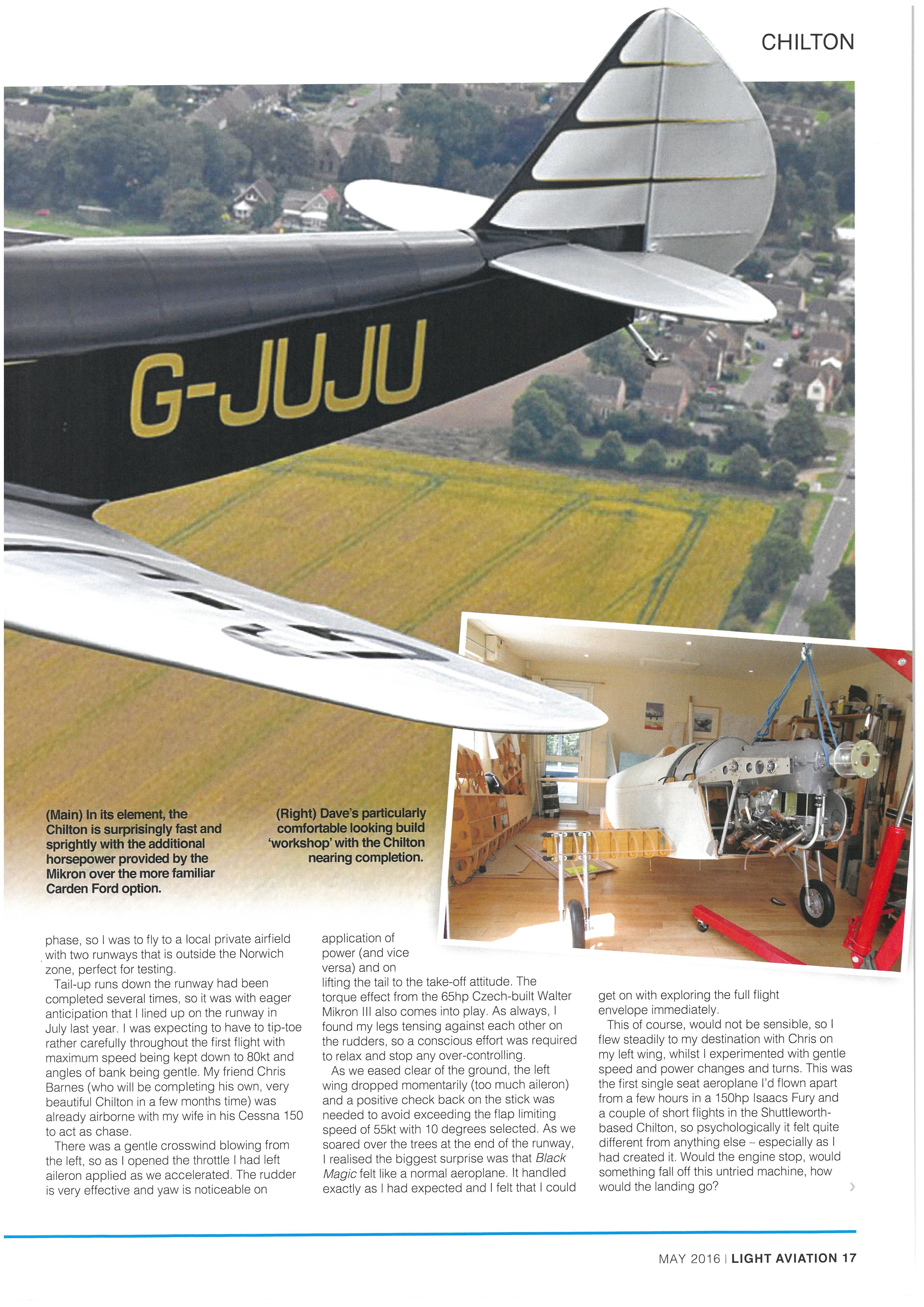
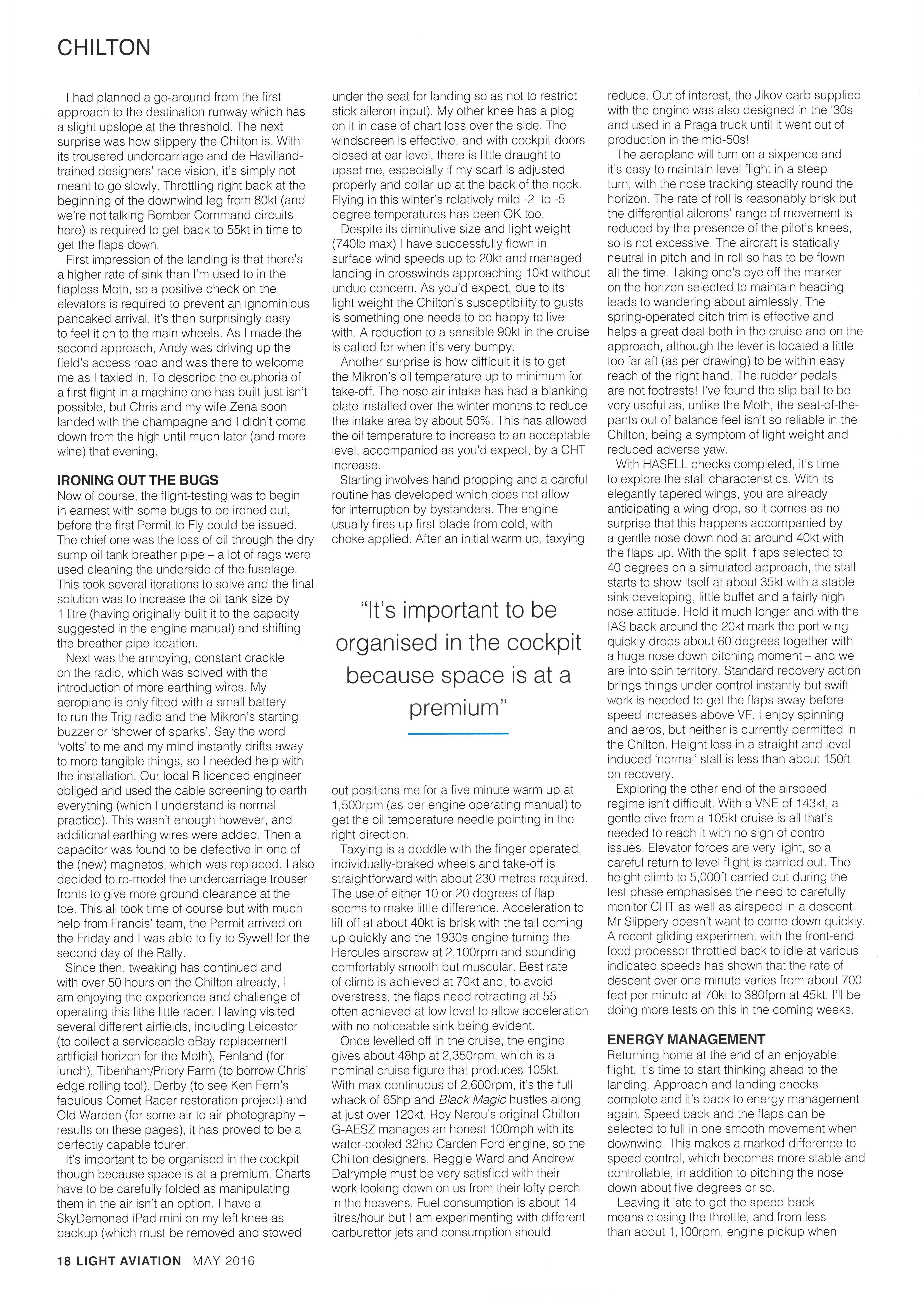
(Main)Initselement, the. Chiltonissurprisinglyfastand comfortablelookingbuild , sprightlywiththeadditional ‘workshop’withtheChilton
horsepowerprovidedbythe nearingcompletion. “e at Mikron over the more familiar Carden Ford option.
phase, so | was to fly to a local private airfield with two runways that is outside the Norwich zone, perfect for testing.
Tail-ujp runs down the runway had been completed several times, so it was with eager anticipation that | lined up on the runway in July last year. | was expecting to have to tip-toe rather carefully throughout the first flight with maximum speed being kept down to 80kt and angles of bank being gentle. My friend Chris Barnes (who will be completing his own, very beautiful Chilton in a few months time) was already airborne with my wife in his Cessna 150 to act as chase.
There was a gentle crosswind blowing from the left, so as | opened the throttle | had left aileron applied as we accelerated. The rudder is very effective and yaw is noticeable on application of power (and vice versa) and on lifting the tail to the take-off attitude. The torque effect from the 65hp Czech-built Walter Mikron III also comes into play. As always, | found my legs tensing against each other on the rudders, so a conscious effort was required to relax and stop any over-controlling. As we eased clear of the ground, the left wing dropped momentarily (too much aileron) and a positive check back on the stick was needed to avoid exceeding the flap limiting speed of 55kt with 10 degrees selected. As we soared over the trees at the end of the runway, | realised the biggest surprise was that Black Magicfelt like a normal aeroplane. It handled exactlyas|hadexpectedand | feltthat|could
get on with exploring the full flight envelope immediately.
This of course, would not be sensible, so | flew steadily to my destination with Chris on my left wing, whilst | experimented with gentle speed and power changes and turns. This was the first single seat aeroplane I'd flown apart from a few hours in a 150hp Isaacs Fury and a couple of short flights in the Shuttleworthbased Chilton, so psychologically it felt quite different from anything else especially as | had created it. Would the engine stop, would something fall off this untried machine, how would the landing go? daeee eee reer reer eeerere
| had planned a go-around from the first approach to the destination runway which has a slight upslope at the threshold. The next surprise was how slippery the Chilton is. With its trousered undercarriage and de Havillandtrained designers’ race vision, it’s simply not meant to go slowly. Throttling right back at the beginning of the downwind leg from 80kt (and we're not talking Bomber Command circuits here) is required to get back to 55kt in time to get the flaps down.
First impression of the landing is that there’s a higher rate of sink than I’m used to in the flapless Moth, so a positive check on the elevators is required to prevent an ignominious pancaked arrival. It’sthen surprisingly easy to feel it on to the main wheels. As | made the second approach, Andy was driving up the field’s access road and was there to welcome me as |taxied in. To describe the euphoria of a first flight in a machine one has built just isn’t possible, but Chris and my wife Zena soon landed with the champagne and | didn’t come down from the high until much later (and more wine) that evening.
Now of course, the flight-testing was to begin in earnest with some bugs to be ironed out, before the first Permit to Fly could be issued. The chief one was the loss of oil through the dry sump oil tank breather pipe a lot of rags were used cleaning the underside of the fuselage. This took several iterations to solve and the final solution was to increase the oil tank size by 1 litre (having originally built it to the capacity suggested in the engine manual) and shifting the breather pipe location.
Next was the annoying, constant crackle on the radio, which was solved with the introduction of more earthing wires. My aeroplane is only fitted with a small battery to run the Trig radio and the Mikron’s starting buzzer or ‘shower of sparks’. Say the word ‘volts’ to me and my mind instantly drifts away to more tangible things, so | needed help with the installation. Our local R licenced engineer obliged and used the cable screening to earth everything (which | understand is normal practice). This wasn’t enough however, and additional earthing wires were added. Then a capacitor was found to be defective in one of the (new) magnetos, which was replaced. | also decided to re-model the undercarriage trouser fronts to give more ground clearance at the toe. This all took time of course but with much help from Francis’ team, the Permit arrived on the Friday and | was able to fly to Sywell for the second day of the Rally.
Since then, tweaking has continued and with over 50 hours on the Chilton already, | am enjoying the experience and challenge of operating this lithe little racer. Having visited several different airfields, including Leicester (to collect a serviceable eBay replacement artificial horizon for the Moth), Fenland (for lunch), Tibenham/Priory Farm (to borrow Chris’ edge rolling tool), Derby (to see Ken Fern’s fabulous Comet Racer restoration project) and Old Warden (for some air to air photography results on these pages), it has proved to be a perfectly capable tourer.
It's important to be organised in the cockpit though because space is at a premium. Charts have to be carefully folded as manipulating them in the air isn’t an option. | have a SkyDemoned iPad mini on my left knee as backup (which must be removed and stowed 18 LIGHT
under the seat for landing so as not to restrict stick aileron input). My other knee has a plog on it in case of chart loss over the side. The windscreen is effective, and with cockpit doors closed at ear level, there is little draught to upset me, especially if my scarf is adjusted properly and collar up at the back of the neck. Flying in this winter’s relatively mild -2 to -5 degree temperatures has been OK too. Despite its diminutive size and light weight (740lb max) | have successfully flown in surface wind speeds up to 20kt and managed landing in crosswinds approaching 10kt without undue concern. As you’d expect, due to its light weight the Chilton’s susceptibility to gusts is something one needs to be happy to live with. A reduction to a sensible 9Okt in the cruise is called for when it’s very bumpy.
Another surprise is how difficult it is to get the Mikron’s oil temperature up to minimum for take-off. The nose air intake has had a blanking plate installed over the winter months to reduce the intake area by about 50%. This has allowed the oil temperature to increase to an acceptable level, accompanied as you’d expect, by a CHT increase.
Starting involves hand propping and a careful routine has developed which does not allow for interruption by bystanders. The engine usually fires up first blade from cold, with choke applied. After an initial warm up, taxying
“It’s important to be organised in the cockpit because space is ata premium”
out positions me for a five minute warm up at 1,500rpm (as per engine operating manual) to get the oil temperature needle pointing in the right direction.
Taxying is a doddle with the finger operated, individually-braked wheels and take-off is straightforward with about 230 metres required. The use of either 10 or 20 degrees of flap seems to make little difference. Acceleration to lift off at about 40kt is brisk with the tail coming up quickly and the 1930s engine turning the Hercules airscrew at 2,100rom and sounding comfortably smooth but muscular. Best rate of climb is achieved at 7Okt and, to avoid overstress, the flaps need retracting at 55 often achieved at low level to allow acceleration with no noticeable sink being evident. Once levelled off in the cruise, the engine gives about 48hp at 2,350rpm, which is a nominal cruise figure that produces 105kt. With max continuous of 2,600rpm, it’s the full whack of 65hp and Black Magic hustles along at just over 120kt. Roy Nerou’s original Chilton G-AESZ manages an honest 100mph with Its water-cooled 32hp Carden Ford engine, so the Chilton designers, Reggie Ward and Andrew Dalrymple must be very satisfied with their work looking down on us from their lofty perch in the heavens. Fuel consumption is about 14 litres/nour but | am experimenting with different carburettor jets and consumption should
reduce. Out of interest, the Jikov carb supplied with the engine was also designed in the '30s and used in a Praga truck until it went out of production in the mid-50s!
The aeroplane will turn on a sixpence and it’s easy to maintain level flight in a steep turn, with the nose tracking steadily round the horizon. The rate of roll is reasonably brisk but the differential ailerons’ range of movement is reduced by the presence of the pilot’s knees, so is not excessive. The aircraft is statically neutral in pitch and in roll so has to be flown all the time. Taking one’s eye off the marker on the horizon selected to maintain heading leads to wandering about aimlessly. The spring-operated pitch trim is effective and helps a great deal both in the cruise and on the approach,althoughtheleverislocatedalittle too far aft (as per drawing) to be within easy reach of the right hand. The rudder pedals are not footrests! I’ve found the slip ball to be very useful as, unlike the Moth, the seat-of-thepants out of balance feel isn't so reliable in the Chilton, being a symptom of light weight and reduced adverse yaw.
With HASELL checks completed, it’s time to explore the stall characteristics. With its elegantly tapered wings, you are already anticipating a wing drop, so it comes as no surprise that this happens accompanied by a gentle nose down nod at around 40kt with the flaps up. With the split flaps selected to 40 degrees on a simulated approach, the stall starts to show itself at about 35kt with a stable sink developing, little buffet and a fairly high nose attitude. Hold it much longer and with the IAS back around the 20kt mark the port wing quickly drops about 60 degrees together with a huge nose down pitching moment and we are into spin territory. Standard recovery action brings things under control instantly but swift work is needed to get the flaps away before speed increases above VF. | enjoy spinning and aeros, but neither is currently permitted in the Chilton. Height loss in a straight and level induced ‘normal’ stall is less than about 150ft on recovery.
Exploring the other end of the airspeed regime isn’t difficult. With a VNE of 143kt, a gentle dive from a 105kt cruise is all that’s needed to reach it with no sign of control issues. Elevator forces are very light, so a careful return to level flight is carried out. The height climb to 5,000ft carried out during the test ohase emphasises the need to carefully monitor CHT as well as airspeed in a descent. Mr Slippery doesn’t want to come down quickly. A recent gliding experiment with the front-end food processor throttled back to idle at various indicated speeds has shown that the rate of descent over one minute varies from about 700 feet per minute at 7Oktto 380fpm at 45kt. I'll be doing more tests on this in the coming weeks.
Returning home at the end of an enjoyable flight, it’s time to start thinking ahead to the landing. Approach and landing checks complete and it’s back to energy management again. Speed back and the flaps can be selected to full in one smooth movement when downwind. This makes a marked difference to speed control, which becomes more stable and controllable, in addition to pitching the nose down about five degrees or so.
Leaving it late to get the soeed back means closing the throttle, and from less than about 1,100rpm, engine pickup when
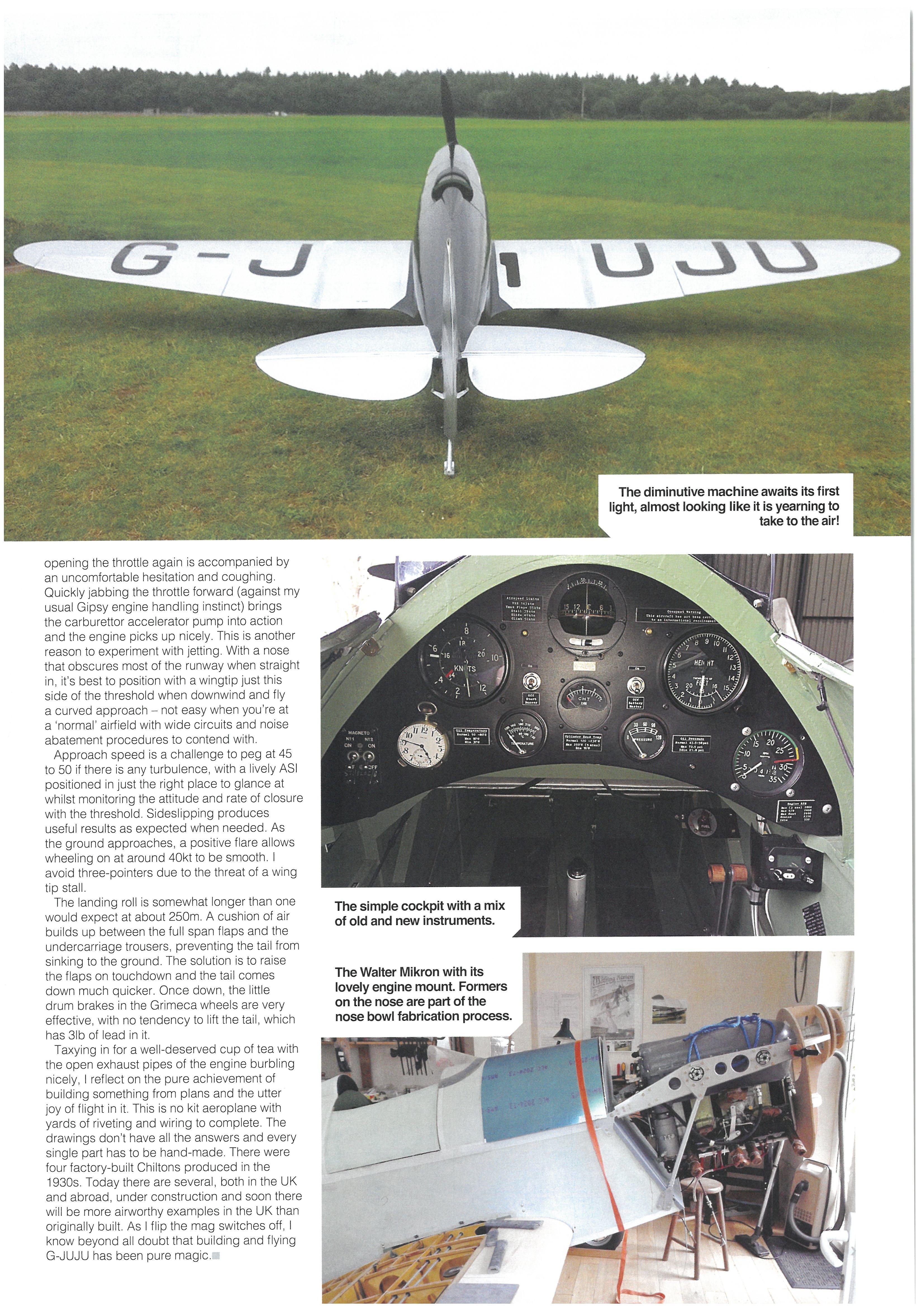
opening the throttle again is accompanied by an uncomfortable hesitation and coughing. Quickly jabbing the throttle forward (against my usual Gipsy engine handling instinct) brings the carburettor accelerator pump into action and the engine picks up nicely. This is another reason to experiment with jetting. With a nose that obscures most of the runway when straight in, it’s best to position with a wingtip just this side of the threshold when downwind and fly a curved approach not easy when you're at a ‘normal’ airfield with wide circuits and noise abatement procedures to contend with.
Approach speed is a challenge to peg at 45 to50ifthereisanyturbulence,with a livelyASI positioned injust the right place to glance at whilst monitoring the attitude and rate of closure with the threshold. Sideslipping produces useful results as expected when needed. As the ground approaches, a positive flare allows wheeling on at around 40kt to be smooth. | avoid three-pointers due to the threat of a wing tip stall.
The landing roll is somewhat longer than one would expect at about 250m. A cushion of air builds up between the full span flaps and the undercarriage trousers, preventing the tail from sinking to the ground. The solution is to raise the flaps on touchdown and the tail comes down much quicker. Once down, the little drum brakes in the Grimeca wheels are very effective, with no tendency to lift the tail, which has 3lb of lead in it.
Taxying in for a well-deserved cup of tea with the open exhaust pipes of the engine burbling nicely, | reflect on the pure achievement of building something from plans and the utter joy of flight in it. This is no kit aeroplane with yards of riveting and wiring to complete. The drawings don’t have all the answers and every single part has to be hand-made. There were four factory-built Chiltons produced in the 1930s. Today there are several, both in the UK and abroad, under construction and soon there will be more airworthy examples in the UK than originallybuilt.As|flip themagswitchesoff,| know beyond all doubt that building and flying G-JUJU has been pure magic.
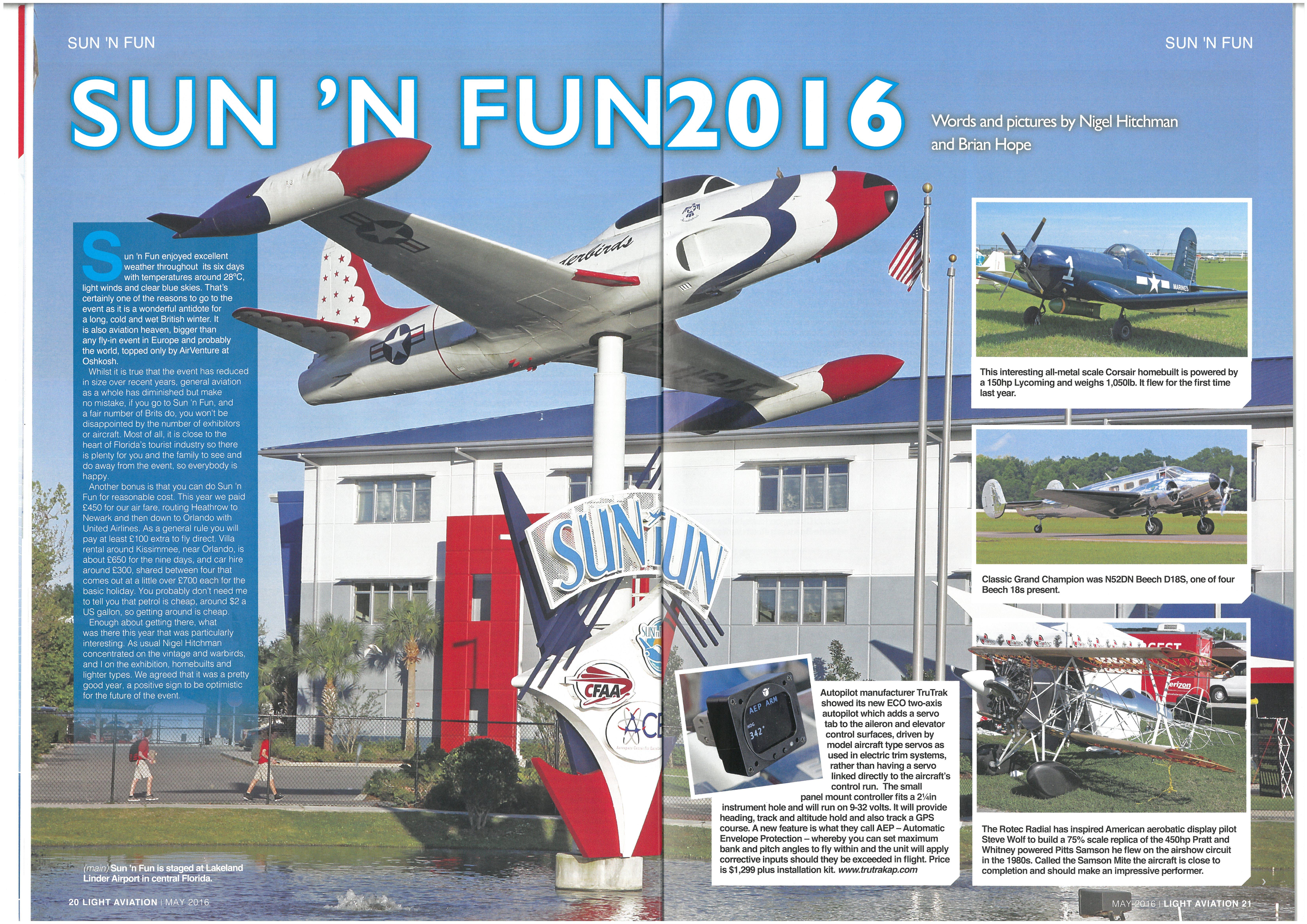
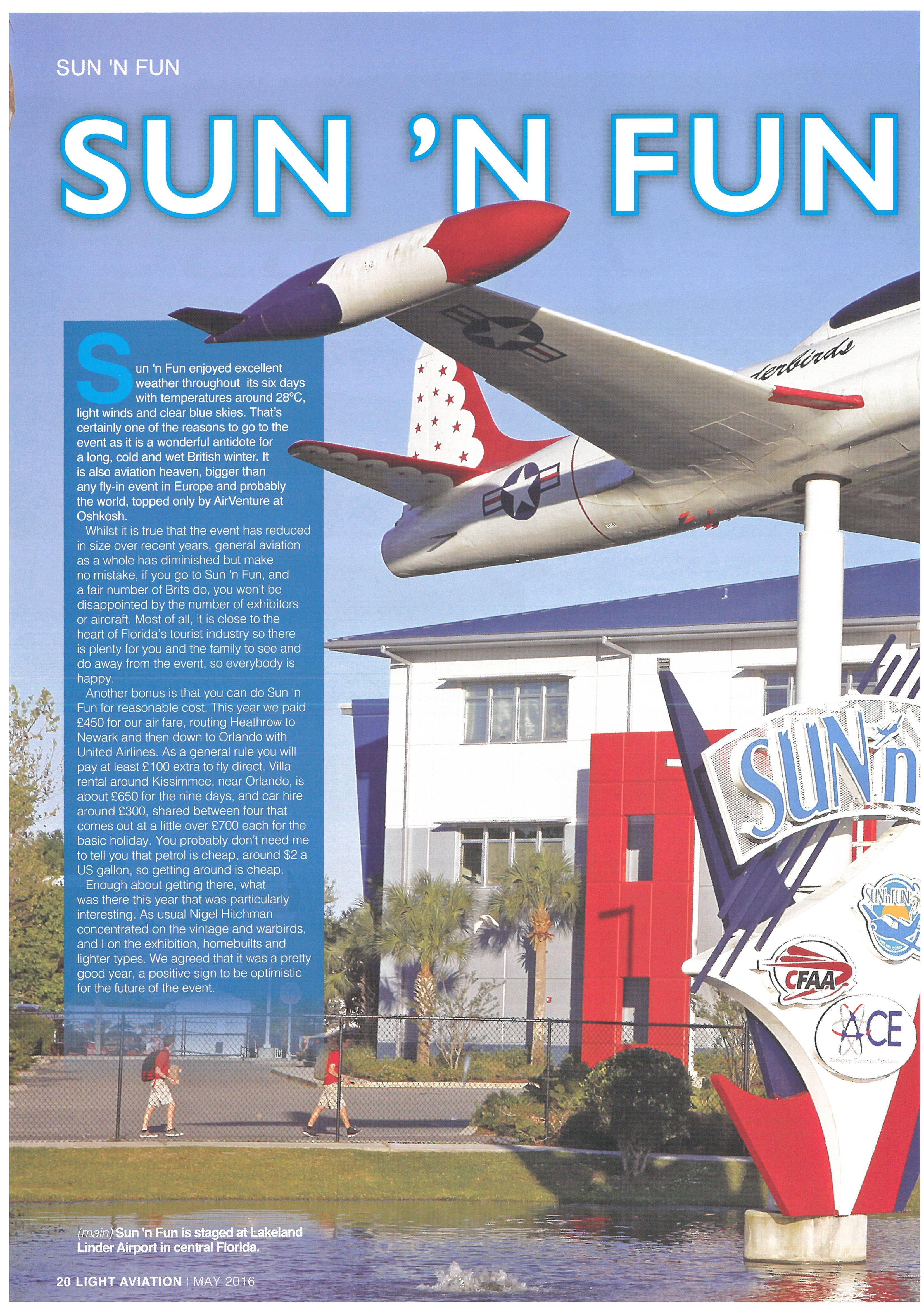
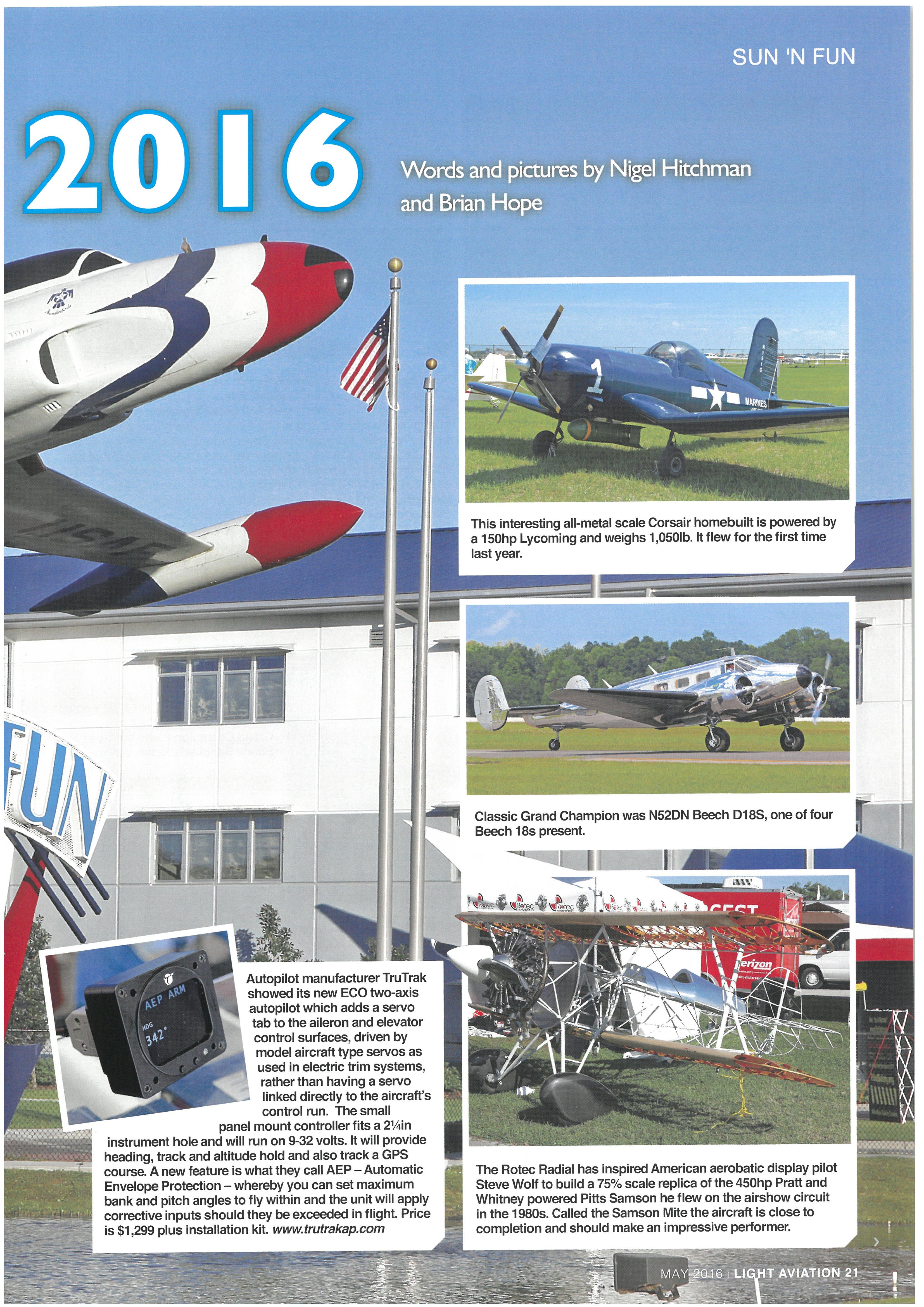
un 'n Fun enjoyed excellent weather throughout its six days with temperatures around 28°C, light winds and clear blue skies. That’s certainly one of the reasons to go to the event as it is a wonderful antidote for a long, cold and wet British winter. It is also aviation heaven, bigger than any fly-in event in Europe and probably the world, topped only by AirVenture at Oshkosh.
Whilst it is true that the event has reduced in size over recent years, general aviation as a whole has diminished but make no mistake, if you go to Sun 'n Fun, and a fair number of Brits do, you won't be disappointed by the number of exhibitors or aircraft. Most of all, it is close to the heart of Florida’s tourist industry so there is plenty for you and the family to see and do away from the event, so everybody is nile]oy"
Another bonus is that you can do Sun 'n Fun for reasonable cost. This year we paid £450 for our air fare, routing Heathrow to Newark and then down to Orlando with United Airlines. As a general rule you will pay at least £100 extra to fly direct. Villa rental around Kissimmee, near Orlando, is about £650 for the nine days, and car hire around £300, shared between four that comesoutata littleover£700eachforthe basic holiday. You probably don't need me to tell you that petrol is cheap, around $2 a US gallon, so getting around is cheap. Enough about getting there, what was there this year that was particularly interesting. AS usual Nigel Hitchman concentrated on the vintage and warbirds, and | on the exhibition, homebuilts and lighter tyoes. We agreed that it was a pretty good year, a positive sign to be optimistic for the future of the event.
Autopilot manufacturer TruTrak showed its new ECO two-axis autopilot which adds a servo tab to the aileron and elevator control surfaces, driven by model aircraft type servos as used in electric trim systems, ____ rather than having a servo = linked directly to the aircraft's control run. The small panel mount controller fits a 2’4in instrument hole and will run on 9-32volts. Itwill provide heading, track and altitude hold and also track a GPS course. A new feature iswhat they call AEP Automatic ™
The Rotec
has
American
pilot Envelope Protection whereby you can set maximum Steve
bank and pitch angles to fly within and the unit will apply |
corrective inputs should they be exceeded in flight. Price | in the
to build a 75% scale
Pitts
Called the
of
is
to is $1,299plus installation kit. www.trutrakap.com = completion and should make an impressive performer.
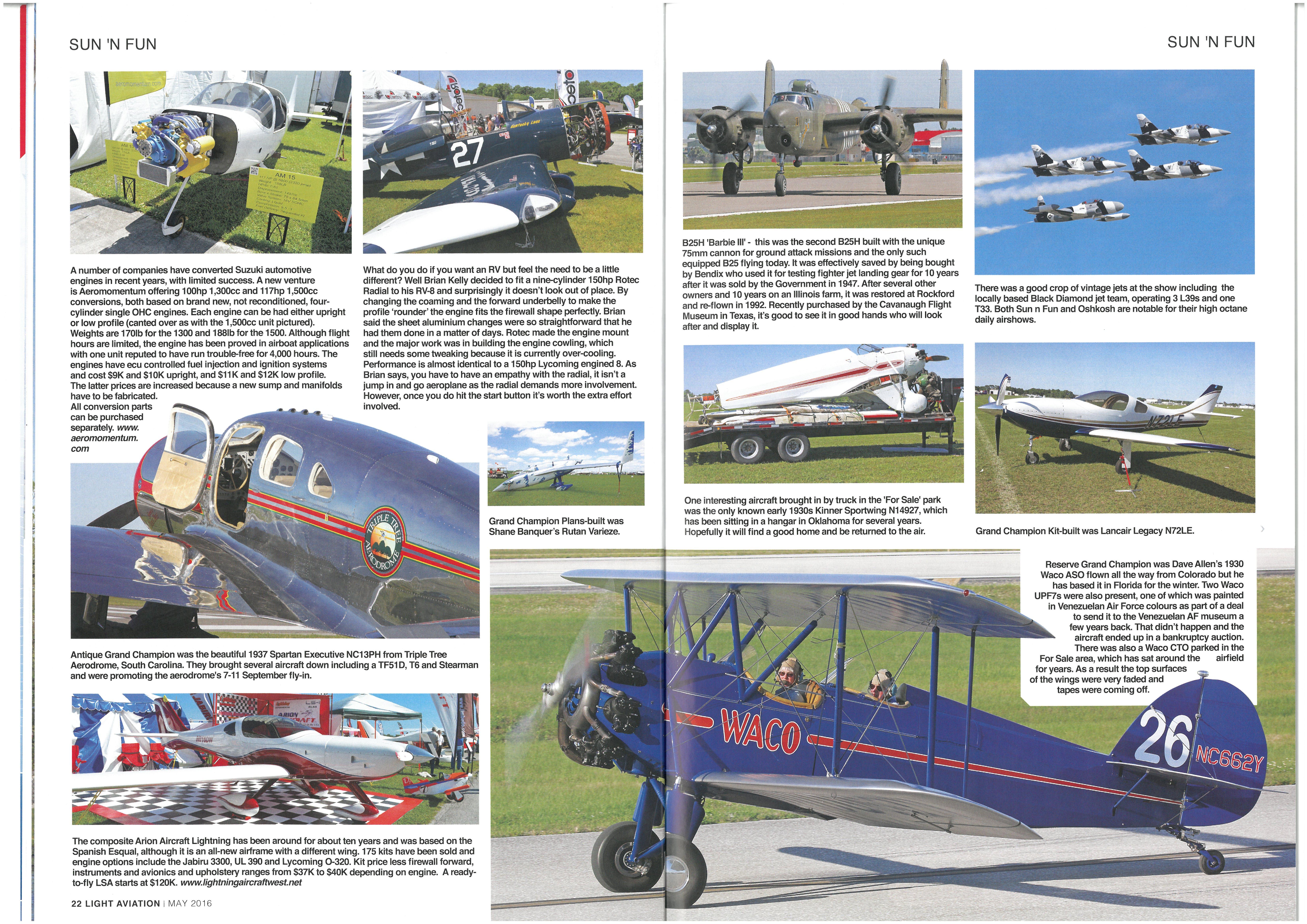
A number of companies have converted Suzuki automotive engines in recent years, with limited success. A new venture isAeromomentum offering 100hp 1,300cc and 117hp 1,500cc conversions, both based on brand new, not reconditioned, fourcylinder single OHCengines. Each engine can be had either upright or low profile (cantedover as with the 1,500ccunit pictured).
Weights are 170Ibfor the 1300and 188Ibfor the 1500.Although flight hours are limited, the engine has been proved in airboat applications with one unit reputed to have run trouble-free for 4,000 hours. The engines have ecu controlled fuel injection and ignition systems and cost $9K and $10K upright, and $11Kand $12K low profile. The latter prices are increased because a new sump and manifolds have to be fabricated. All conversion parts can be purchased separately. www. aeromomentum. com
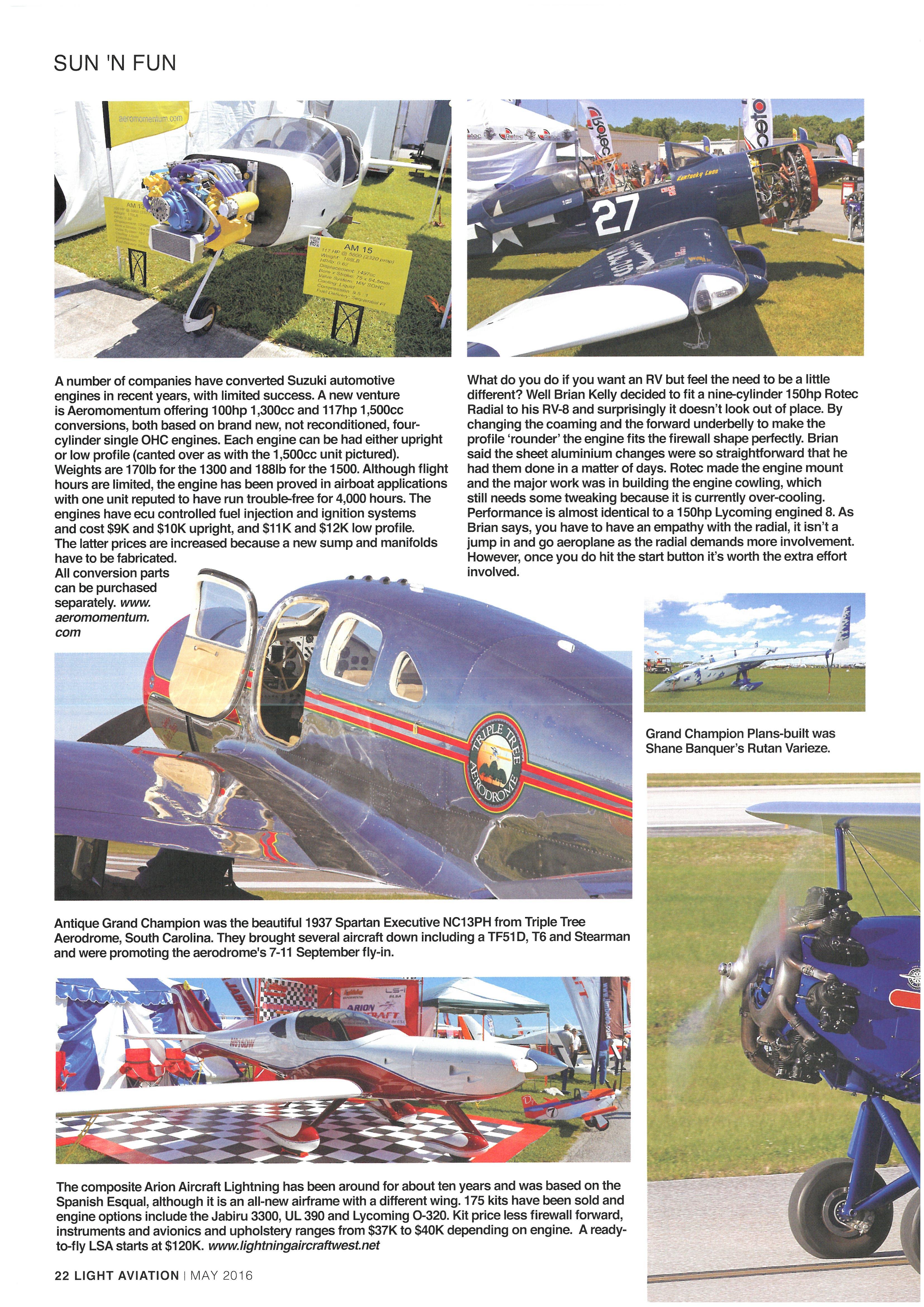
WhatdoyoudoifyouwantanRVbutfeeltheneedtobealittle different? Well Brian Kelly decided to fit a nine-cylinder 150hp Rotec Radial to his RV-8and surprisingly it doesn’t look out of place. By changing the coaming and the forward underbelly to make the profile ‘rounder’the engine fits the firewall shape perfectly. Brian said the sheet aluminium changes were so straightforward that he had them done in a matter of days. Rotec made the engine mount and the major work was in building the engine cowling, which still needs some tweaking because it is currently over-cooling. Performance is almost identical to a 150hp Lycoming engined 8.As Brian says, you have to have an empathy with the radial, it isn’t a jump in and go aeroplane as the radial demands more involvement. However, once you do hitthe start button it’sworth the extra effort involved.
B25H ‘Barbie Ill'- this was the second B25H builtwith the unique 75mm cannon for ground attack missions and the only such equipped B25flying today. Itwas effectively saved by being bought by Bendix who used itfor testing fighter jet landing gear for 10years after itwas sold bythe Government in 1947.After several other owners and 10 years on an Illinoisfarm, itwas restored at Rockford and re-flown in 1992.Recently purchased by the Cavanaugh Flight Museum in Texas,it’s good to see it in good hands who will look after and display it.
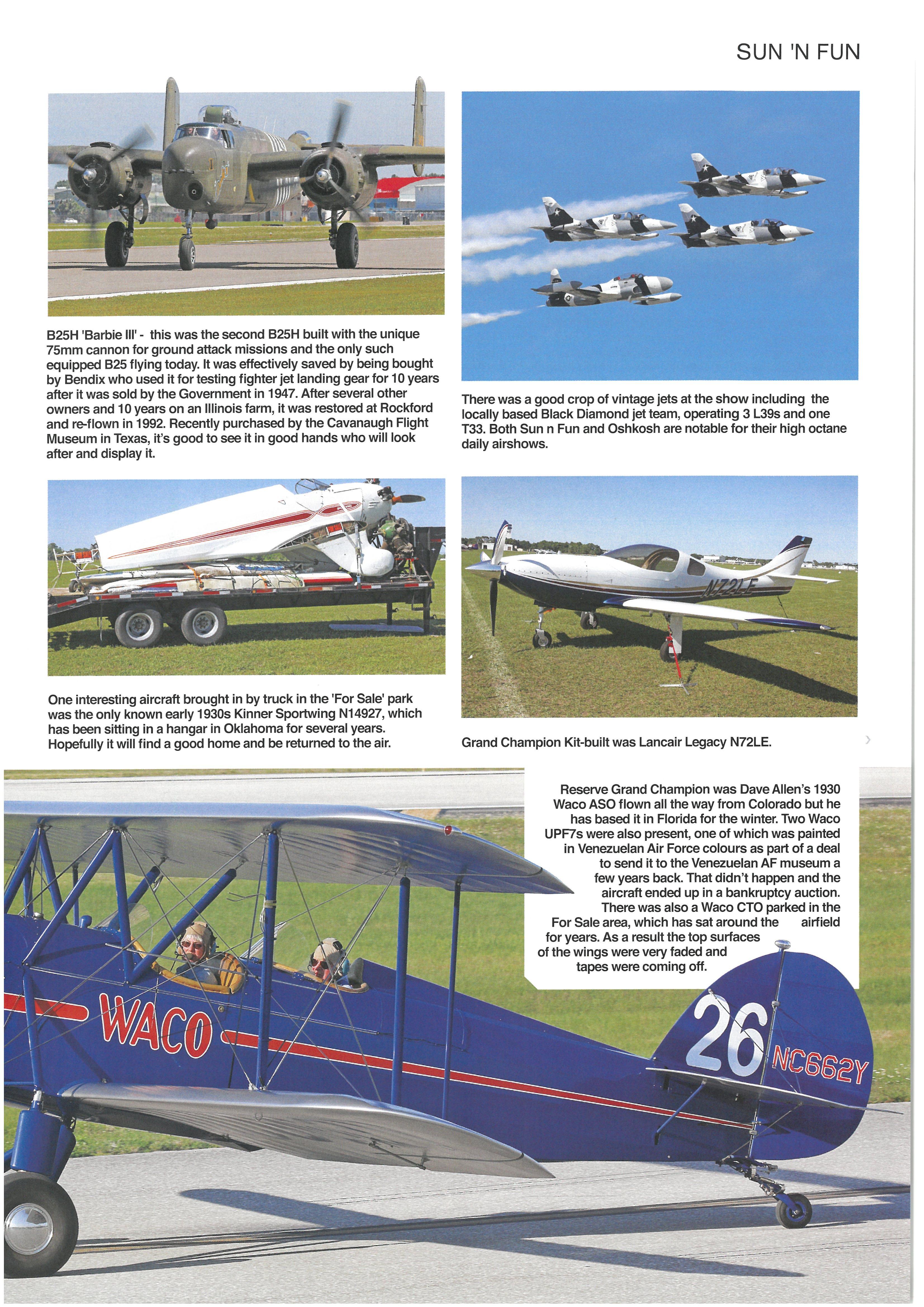
There was a good crop of vintage jets at the show including the locally based Black Diamond jet team, operating 3 L39s and one T33. Both Sun n Fun and Oshkosh are notable for their high octane daily airshows.
Reserve Grand Champion was DaveAllen’s 1930 Waco ASO flown all the way from Colorado but he has based it in Florida for the winter. Two Waco UPF7swere also present, one of which was painted in Venezuelan Air Forcecolours as part of a deal to send it to the Venezuelan AF museum a few years back. That didn’t happen and the aircraft ended up in a bankruptcy auction. There was also a Waco CTO parked in the ForSalearea,whichhassataroundthe__ airfield for years. As a result the top surfaces of the wings were very faded and Ae tapes were coming off.
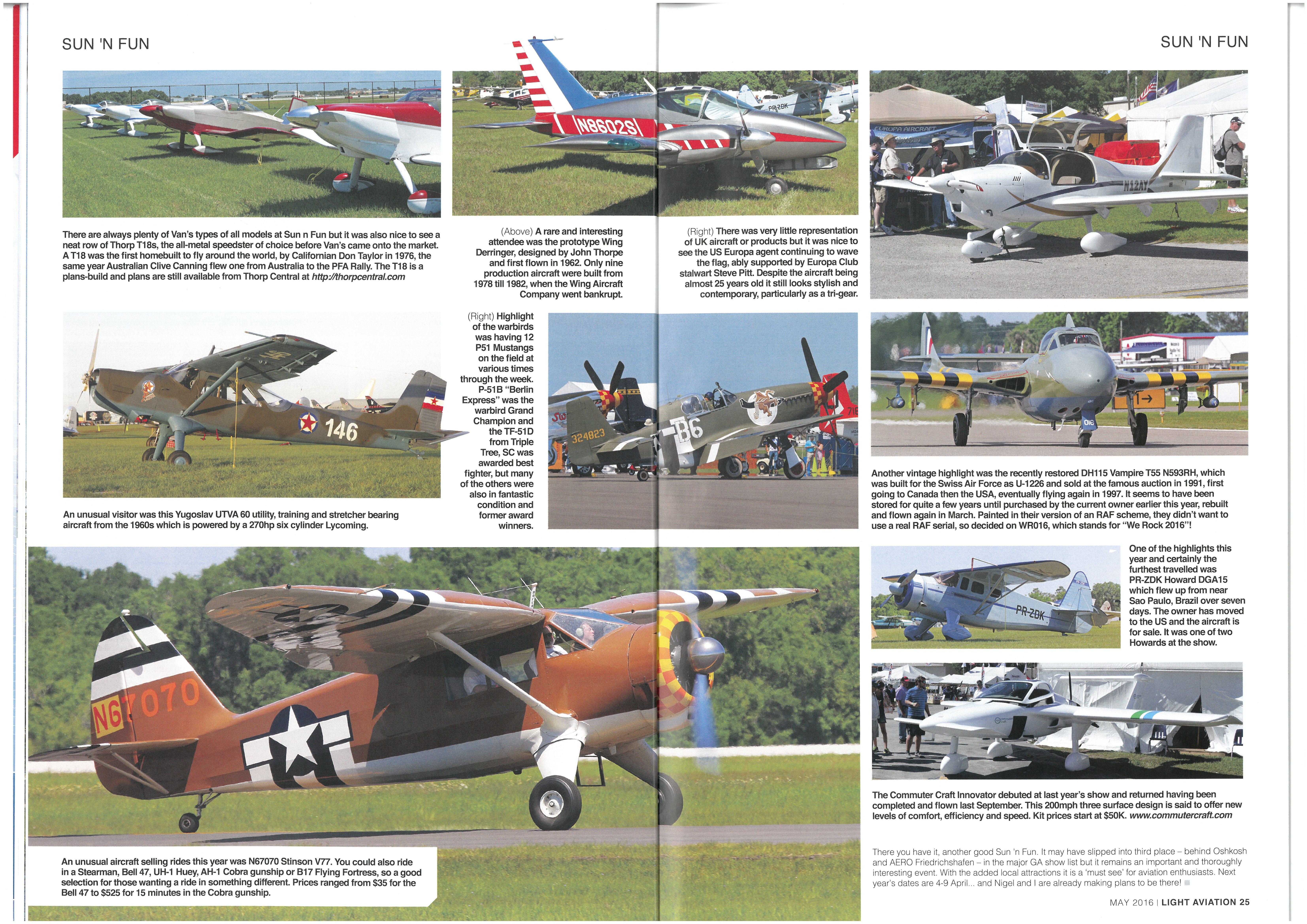
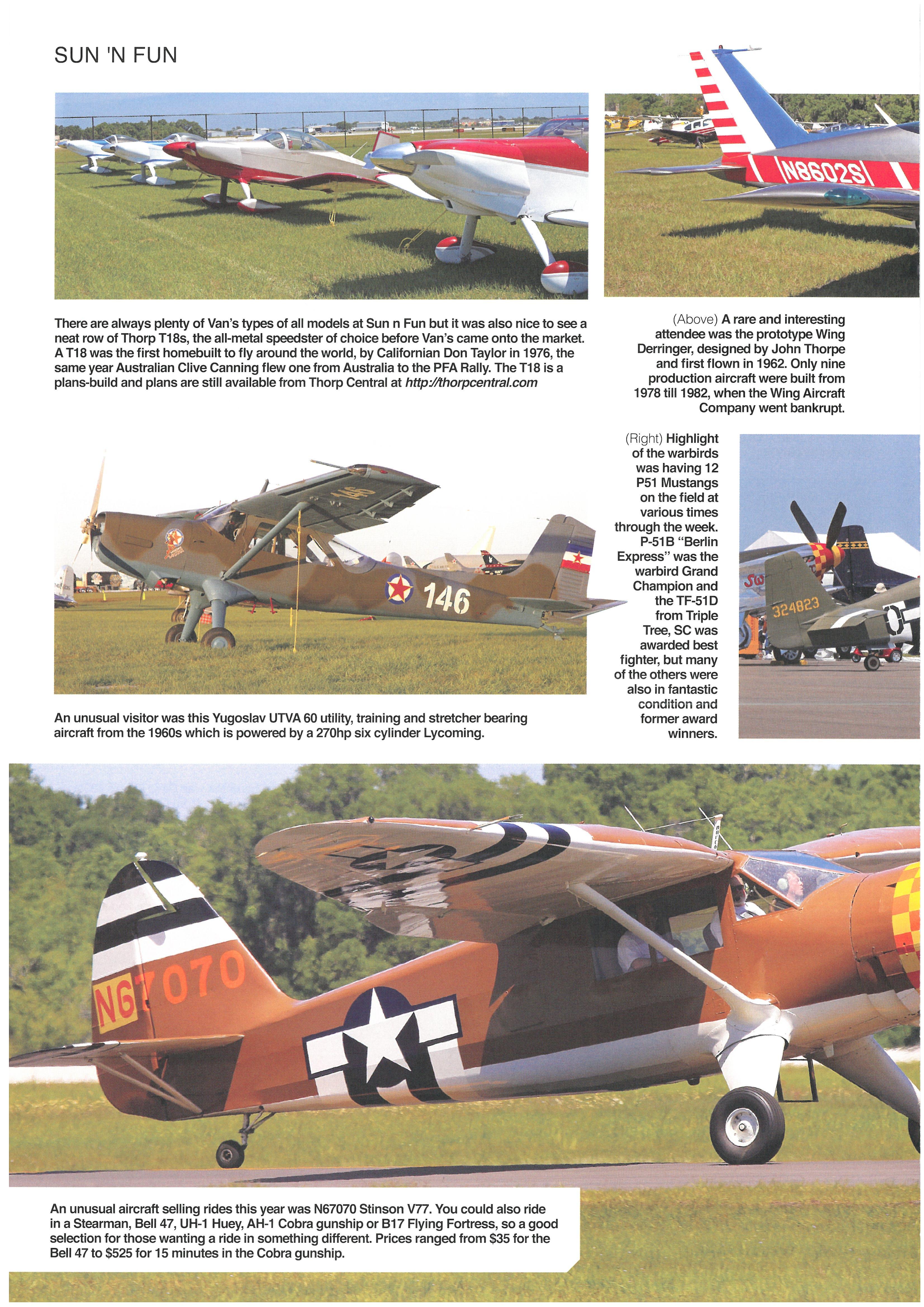
TherearealwaysplentyofVan’stypesofallmodelsatSunnFunbutitwasalsonicetoseea
(Above)Arareandinteresting neatrowofThorpT18s,theall-metalspeedsterofchoicebeforeVan’scameontothemarket. attendeewastheprototypeWing AT18wasthefirsthomebuilttoflyaroundtheworld,byCalifornianDonTaylorin1976,the Derringer,designedbyJohnThorpe same yearAustralian Clive Canning flew one from Australia to the PFARally.The T18is a and first flown in 1962.Only nine plans-buildandplansarestillavailablefromThorpCentralathtto-/thorpcentral.com productionaircraftwerebuiltfrom1978till 1982,when the Wing Aircraft Company went bankrupt.
(Right) Highlight of the warbirds was having 12 P51Mustangs on the field at various times through the week. P-51B “Berlin Express”was the warbird Grand Champion and the TF-51D from Triple Tree, SC was awarded best fighter, but many of the others were also in fantastic condition and
(Right)Therewas very little representation of UK aircraft or products but itwas nice to see the US Europa agent continuing to wave the flag, ably supported by Europa Club stalwart Steve Pitt. Despite the aircraft being almost 25years old it still looks stylish and contemporary,particularlyasa tri-gear.
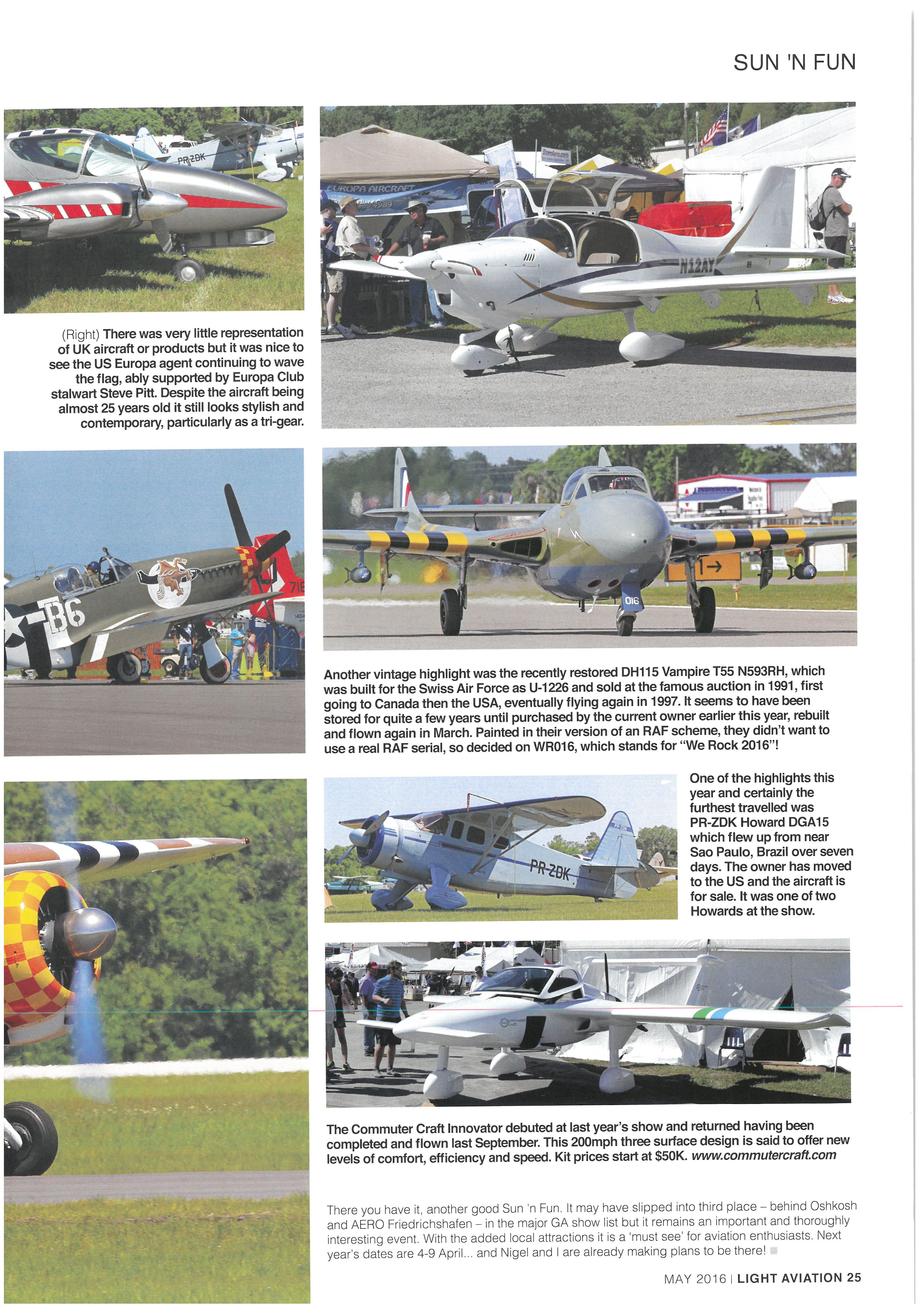
One of the highlights this year and certainly the furthest travelled was PR-ZDK Howard DGA15 which flew up from near Sao Paulo, Brazil over seven days. The owner has moved to the US and the aircraft is for sale. It was one of two Howards at the show.
The Commuter Craft Innovator debuted at last year’s show and returned having been completed and flown last September. This 200mph three surface design is said to offer new levels of comfort, efficiency and speed. Kit prices start at $50K. www.commutercraft.com
There you have it, another good Sun 'n Fun. It may have slipped into third place behind Oshkosh and AERO Friedrichshafen inthe major GA show list but it remains an important and thoroughly interesting event. With the added local attractions it is a ‘must see’ for aviation enthusiasts. Next year’s dates are 4-9 April... and Nigel and | are already making plans to be there!
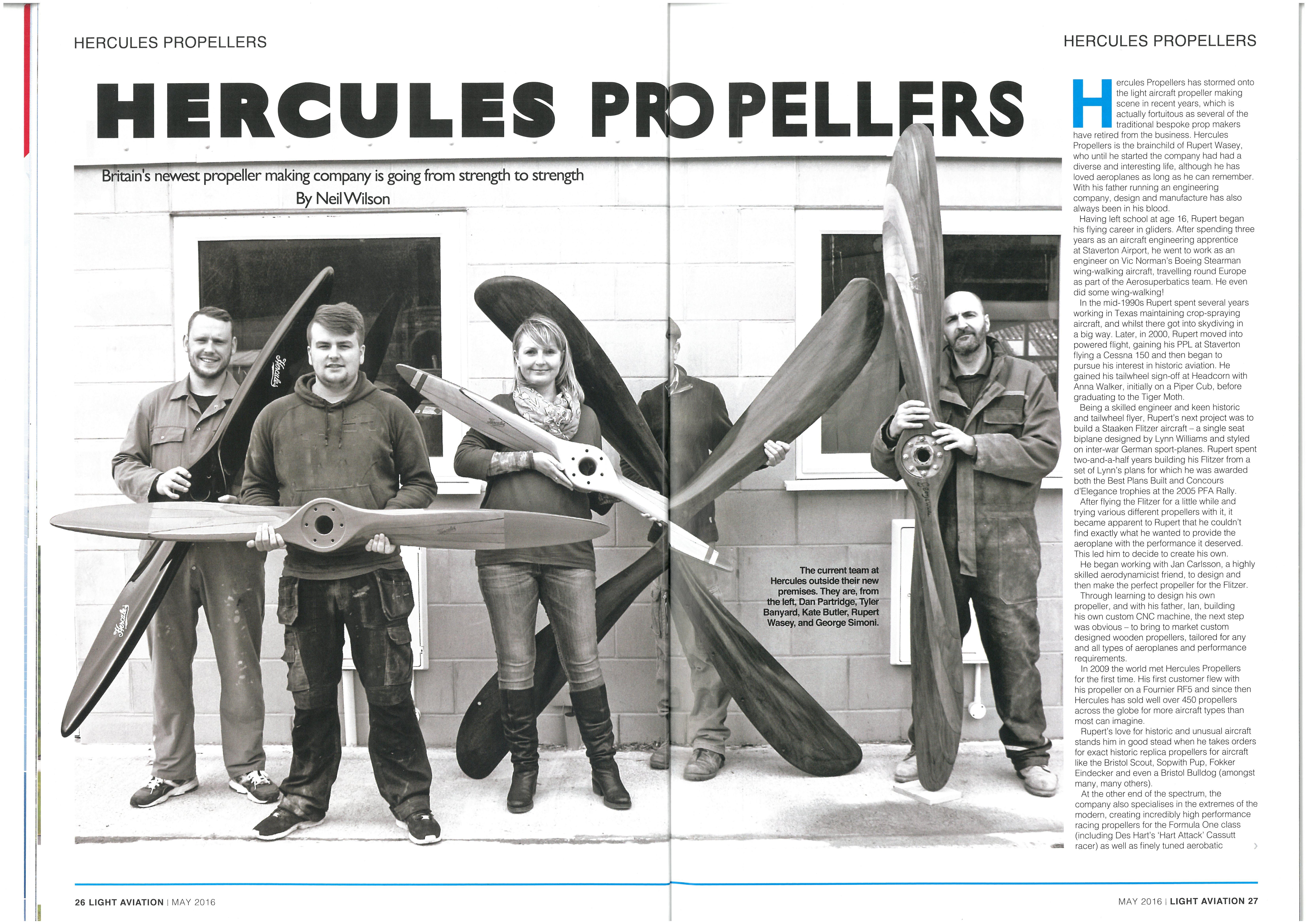
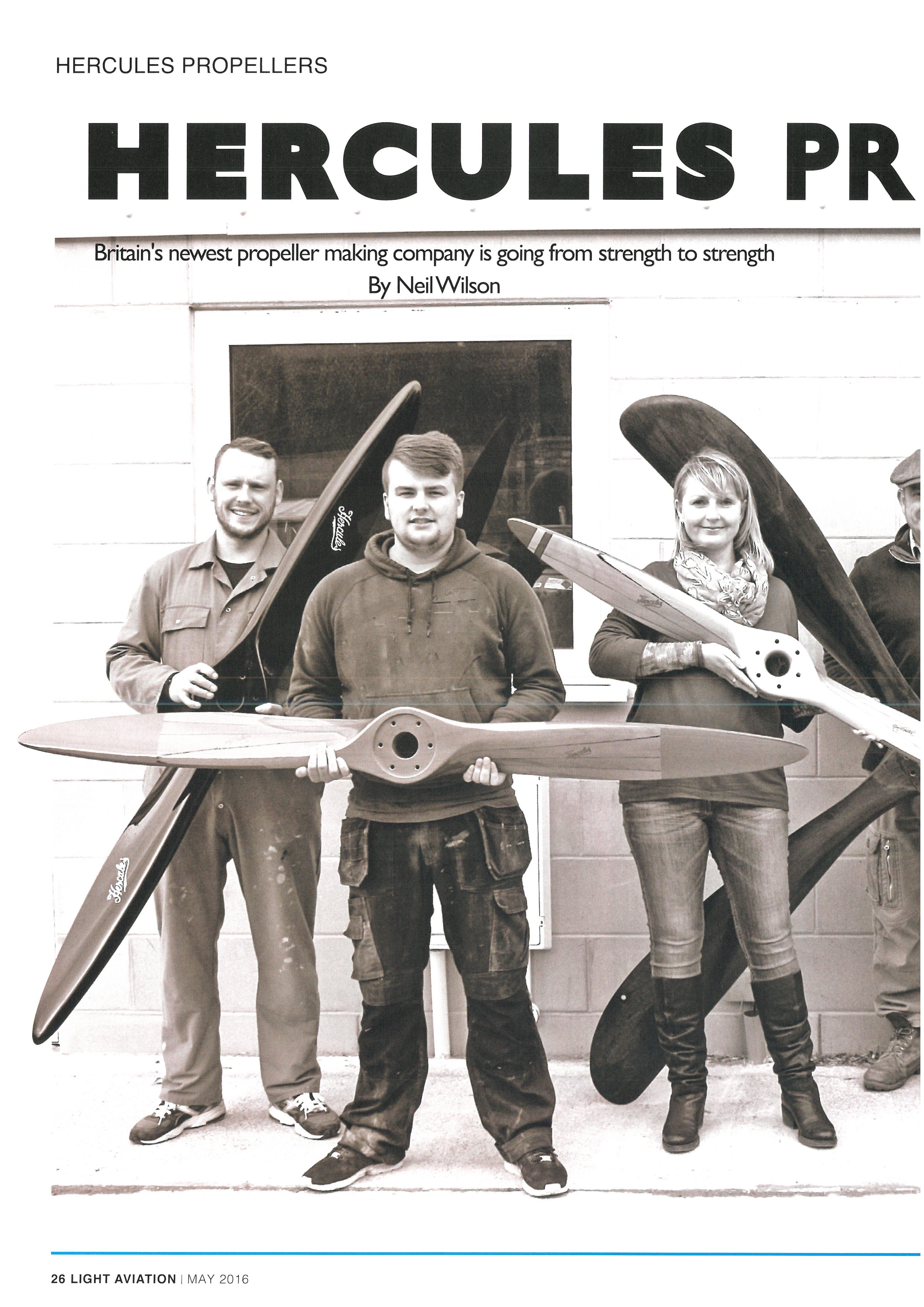
- Britain'snewestpropellermakingcompanyisgoingfromstrengthto strength
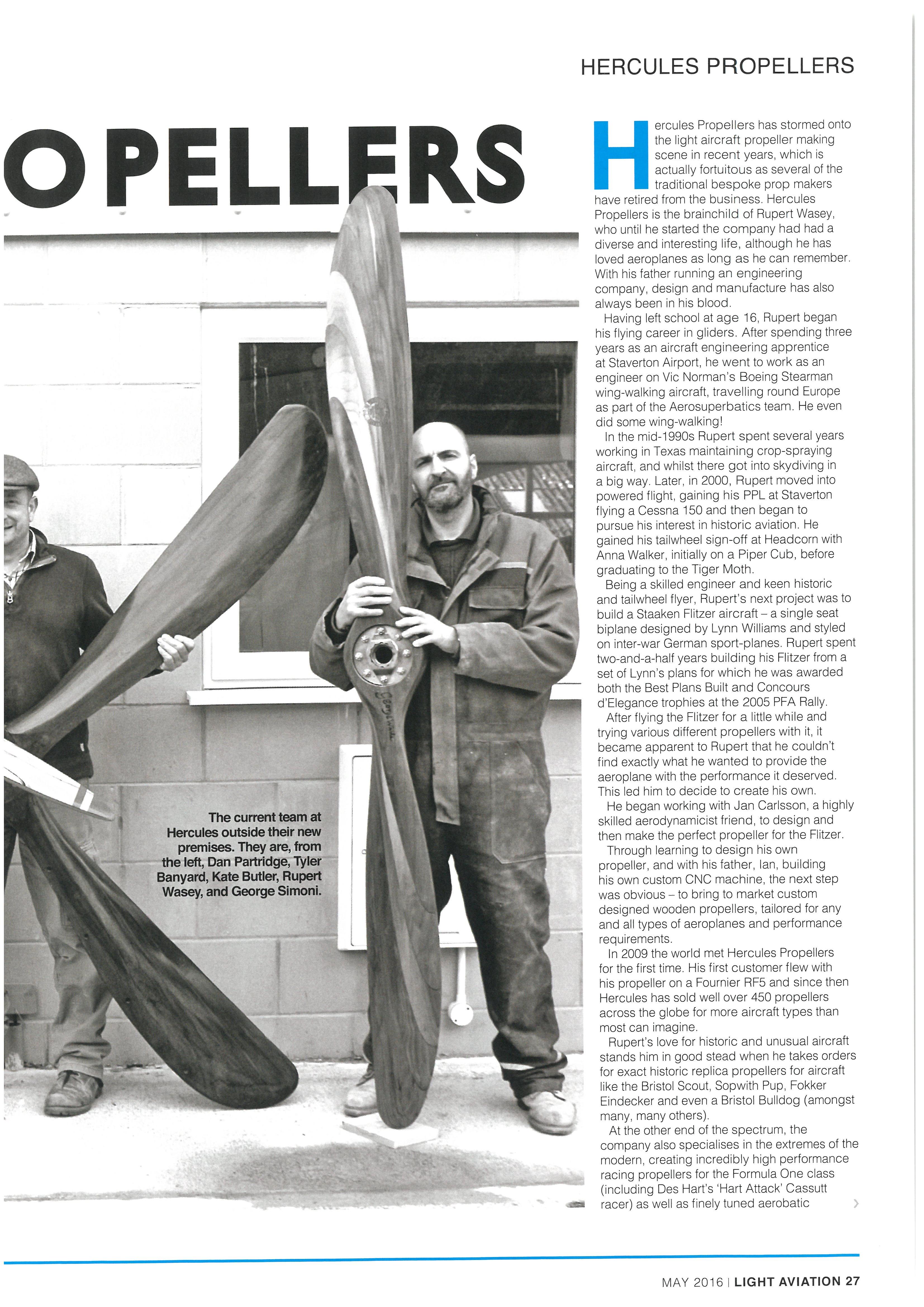
ercules Propellers has stormed onto the light aircraft propeller making scene in recent years, which is actually fortuitous as several of the traditional bespoke prop makers have retired from the business. Hercules Propellers is the brainchild of Rupert Wasey, who until he started the company had had a diverse and interesting life, although he has loved aeroplanes as long as he can remember. With his father running an engineering company, design and manufacture has also always been in his blood.
Having left school at age 16, Rupert began his flying career in gliders. After spending three years as an aircraft engineering apprentice at Staverton Airport, he went to work as an engineer on Vic Norman’s Boeing Stearman wing-walking aircraft, travelling round Europe as part of the Aerosuperbatics team. He even did some wing-walking!
In the mid-1990s Rupert spent several years working in Texas maintaining crop-spraying aircraft, and whilst there got into skydiving in a big way. Later, in 2000, Rupert moved into powered flight, gaining his PPLat Staverton flying a Cessna 150 and then began to pursue his interest in historic aviation. He gained his tailwheel sign-off at Headcorn with Anna Walker, initially on a Piper Cub, before graduating to the Tiger Moth.
Being a skilled engineer and keen historic and tailwheel flyer, Rupert’s next project was to build a Staaken Flitzer aircraft a single seat biplane designed by Lynn Williams and styled on inter-war German sport-planes. Rupert spent two-and-a-half years building his Flitzer from a set of Lynn’s plans for which he was awarded both the Best Plans Built and Concours d'Elegance trophies at the 2005 PFA Rally.
AfterflyingtheFlitzerfora littlewhileand trying various different propellers with it, it became apparent to Rupert that he couldn't find exactly what he wanted to provide the aeroplane with the performance it deserved. This led him to decide to create his own.
He began working with Jan Carlsson, a highly skilled aerodynamicist friend, to design and then make the perfect propeller for the Flitzer. Through learning to design his own propeller, and with his father, lan, building his own custom CNC machine, the next step was obvious to bring to market custom designed wooden propellers, tailored for any and all types of aeroplanes and performance requirements.
In 2009 the world met Hercules Propellers for the first time. His first customer flew with his propeller on a Fournier RF5and since then Hercules has sold well over 450 propellers across the globe for more aircraft types than most can imagine.
Rupert's love for historic and unusual aircraft stands him in good stead when he takes orders for exact historic replica propellers for aircraft like the Bristol Scout, Sopwith Pup, Fokker Eindecker and even a Bristol Bulldog (amongst many, many others).
At the other end of the spectrum, the company also specialises in the extremes of the modern, creating incredibly high performance racing propellers for the Formula One class (including Des Hart's ‘Hart Attack’ Cassutt “ma racer) as well as finely tuned aerobatic
propellers for airshow performers like Lauren Richardson with her Pitts Special. Rupert has also created the unusual pair of contra-rotating propellers for the unique Bugatti 100P replica now flying in the USA.
In 2015 Rupert moved Hercules to a brand new workshop, still in the Stroud valleys but much larger than their original premises, and laid out to suit their unique method of working. The team is ever expanding, with George, Tyler, Simon and Kate now also joining Rupert, with lan his father still helping out on special projects and Jan continuing to consult as the company’s specialist aerodynamicist when new ideas come in.
Hercules has developed its own unique leading edge protection and paint systems, using its own ‘Hercuthane’ material to provide what is an incredibly tough (bullet-proof, quite literally they've had a chunk of their material shot by a marksman to prove it) yet flexible leading edge to protect the propeller from rain
erosion or stone chipping. It's even buzzard strike-proof, although the wood behind isn't quite so strong as one of their customers found out with his Bowers Fly Baby.
Speaking of wood, Hercules mostly uses European Beech to build its propellers. It's a sustainably sourced material with excellent strength properties. The wocd is used to build a laminate blank made up of four, five or six layers around 18mm thick which are bonded together using what was previously known as Aerodux glue (extremely well tried and tested), then compressed in a mechanical heated press. Lamination means the propeller will be stable, not able to warp or bend, and also adds an extra layer of safety in preventing crack propagation should the propeller sustain small damage.
Alternative wood types they sometimes use include American Black Walnut and Honduras Mahogany, both usually for historic replicas. The latter wood is a banned import species and has to be carefully sourced and upcycled most often from old church pews!
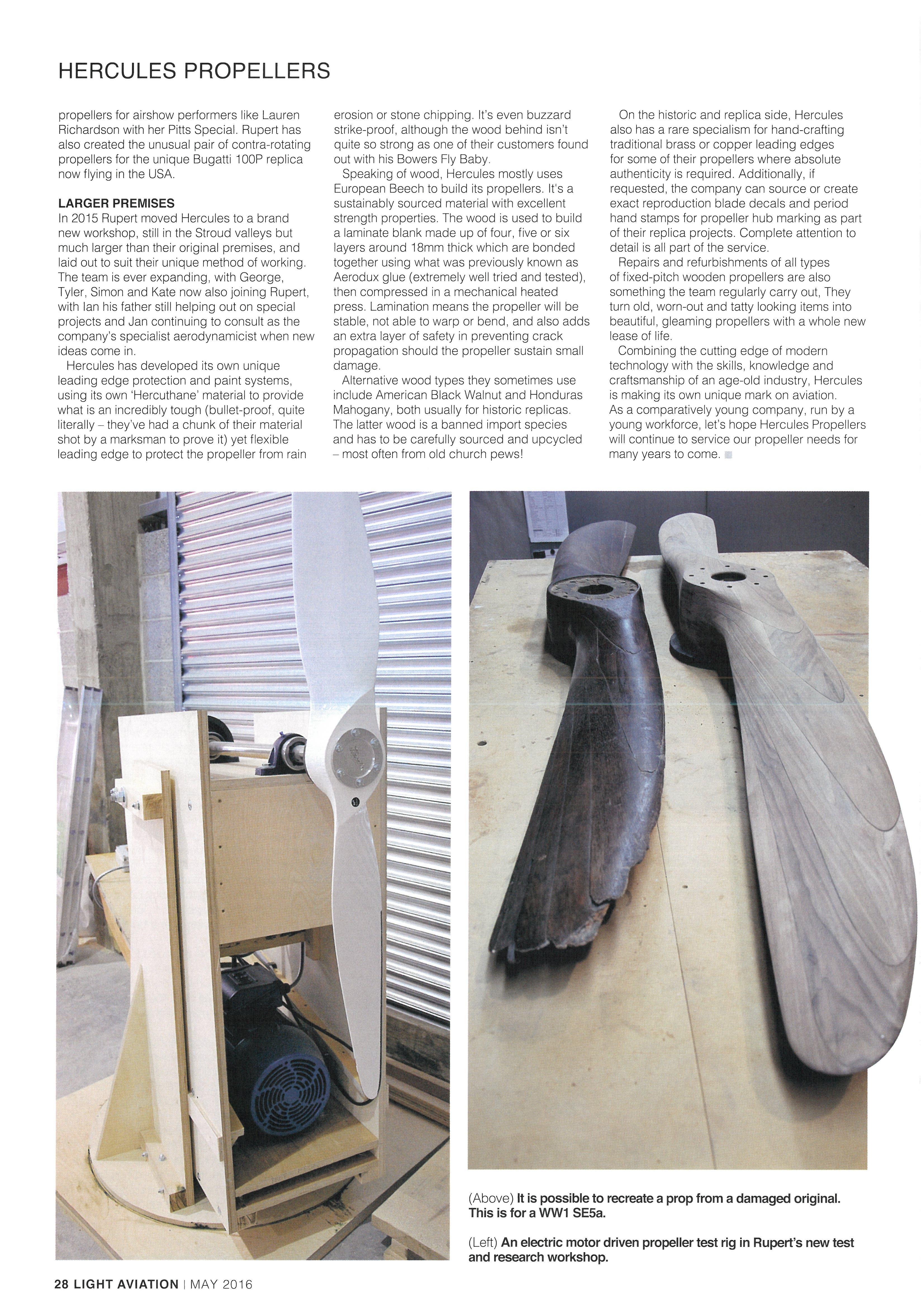
On the historic and replica side, Hercules also has a rare specialism for hand-crafting traditional brass or copper leading edges for some of their propellers where absolute authenticity is required. Additionally, if requested, the company can source or create exact reproduction blade decals and period hand stamps for propeller hub marking as part of their replica projects. Complete attention to detail is all part of the service.
Repairs and refurbishments of all tyoes of fixed-pitch wooden propellers are also something the team regularly carry out, They turn old, worn-out and tatty looking items into beautiful, gleaming propellers with a whole new lease of life.
Combining the cutting edge of modern technology with the skills, knowledge and craftsmanship of an age-old industry, Hercules is making its own unique mark on aviation.
This is fora WW1 SE5a.
(Above) Itis possible to recreate a prop from a damaged original.
As a comparatively young company, run by a young workforce, let’s hope Hercules Propellers will continue to service our propeller needs for manyyearsto come.
£ 595
ATD-300Traffic
ATD-300with ANT300 £ 795
ATD-300w/ ARINC& ANT £995 PLB’s and ELT's
Pricesinclude programming AMERI-KING AK-451-21 ELTJTSO approved406MHzELT £695 AMERI-KING AK-451-15 ELTJTS0
HELICOPTERversion £795
FASTFIND 220 PLB £199
GME MT410G PLB.............. £249
EKP-Vunitonly £ 995
EKP-Vwithdockingstation£1150
EKP-VEFISCompleteSystem£1950
CompleteSystemincludesEKPV,docking station,EngiBoxKitandUltraEFIS
ULTRAEFISGPS £ 635
KRT2 VHFCom8.33kH1........£707 BENDIX/KING

AR6201BECKER AR6203VHFCom8.33kHz2.25"£1295 VHFCom 6.25"£1395BXP6401ModePea$Transponder2.25"£1450
Icom
IC-AGESportspk £208
IC-AGEPropack....£308
IC-A24ESportspk £275
IC-A24E Pro pack £375 <3) We stock a fullrangeof Icom Accessories.
£1025
Electronic Circuit Breaker
VP-X SPORT ..........-.0:sce0e:£995
VP-X PROues £1495
yHarry's HM40
HM40 child headset......... £99
HM40ANRQu... ees £259
Peltor 8006 GA headset £225
Peltor Helicopterheadset £225
David Clark H10-30 £219
David Clark H10-13.4 £259
David Clark H10-13H £276
David Clark H10-60 £295
David Clark ProX ENC........ £550
KSN770SafetyNavigator
GPS,Com,Nav,Chartsandmuchmore£8500
KX165A-02 Nav/Com8.33kHz£3795
KT74ModeStransponder£1995
KR87ADF(OHC)system £1695
KN64DME(OH().............£1295
KX155Nav/Com(OHC)from £995
TT21ModeStransponder£1390 TT22ModeStransponder£1675 TT31ModeStransponder£1620 F.U.N.K.E.ATR833LCDCom8.33kHz...£895ATR833OLEDCom8.33kHz..£995
@ IC-AGEandIC-A24 transceiversnowhave = 8.33kHzchannelspacing. 1C-A120EBASESTATION/VEHICLE MOUNTAIRBANDTRANSCEIVER8:33Khz£687 YAESU AirbandTransceivers
MM001 (UL100)headset £199
MMO001A(UL200)headset £260
MMO001Bhelmetwithheadset£365
MMO001C helmetwithANR £430
MP001 Paramotorheadset £207
MCO001B-MTGyrocopterhelmet£365 MM005 radiointerface £215
AllotherMICROAVIONICSpleasecall
A20GAtwinplug £666
A20GAtwinplugw/bluetooth£733
A20Helicopterw/bluetooth..£733
A20 Lemoinstalledversion £666
A20 Lemow/bluetooth £733
Installedwiringharness.....£ 50
Panel dock AERA500 £99
PaneldockAERA795..........£149
Paneldock GPS 695.......... £149
Paneldock296/495 £75
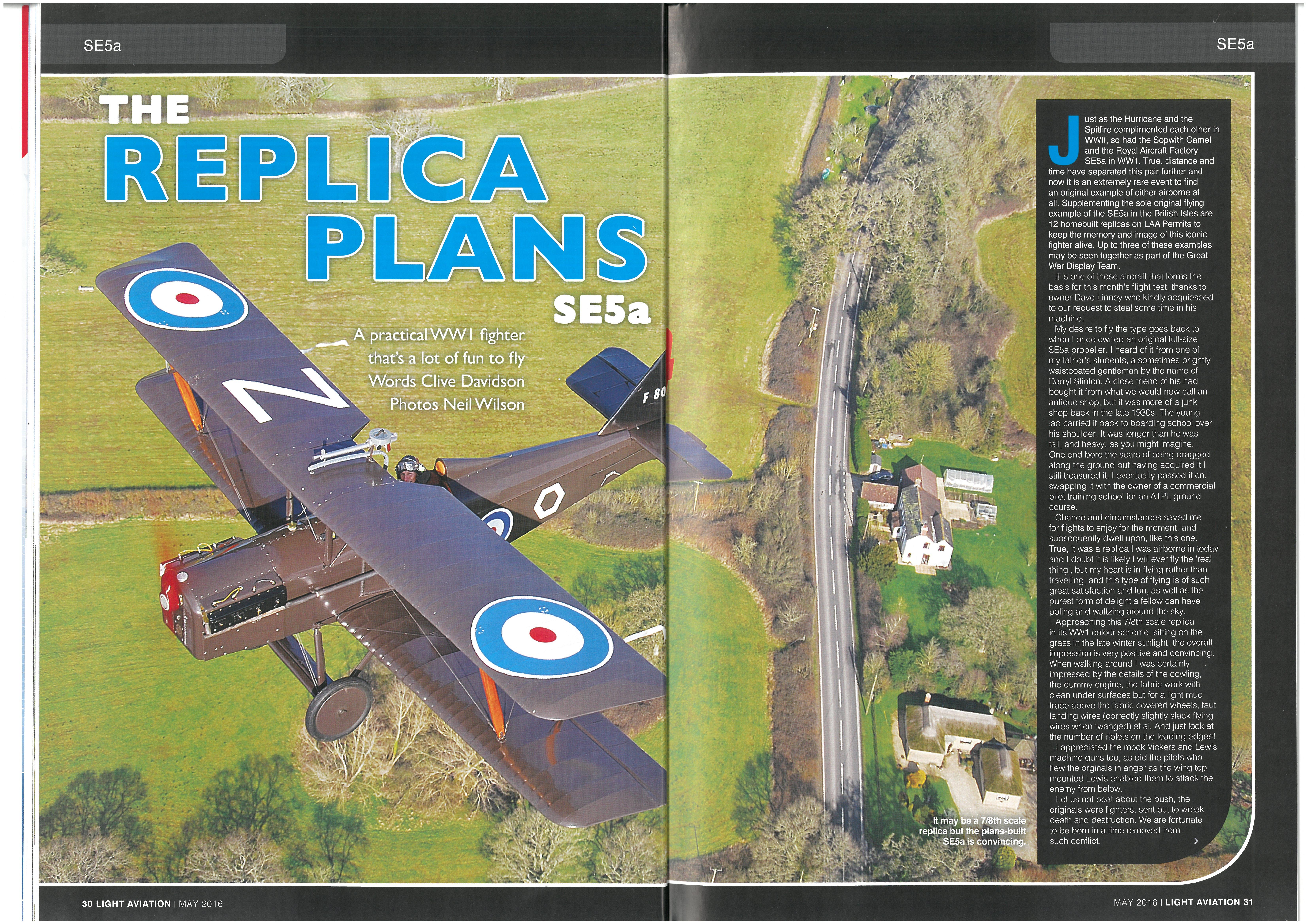
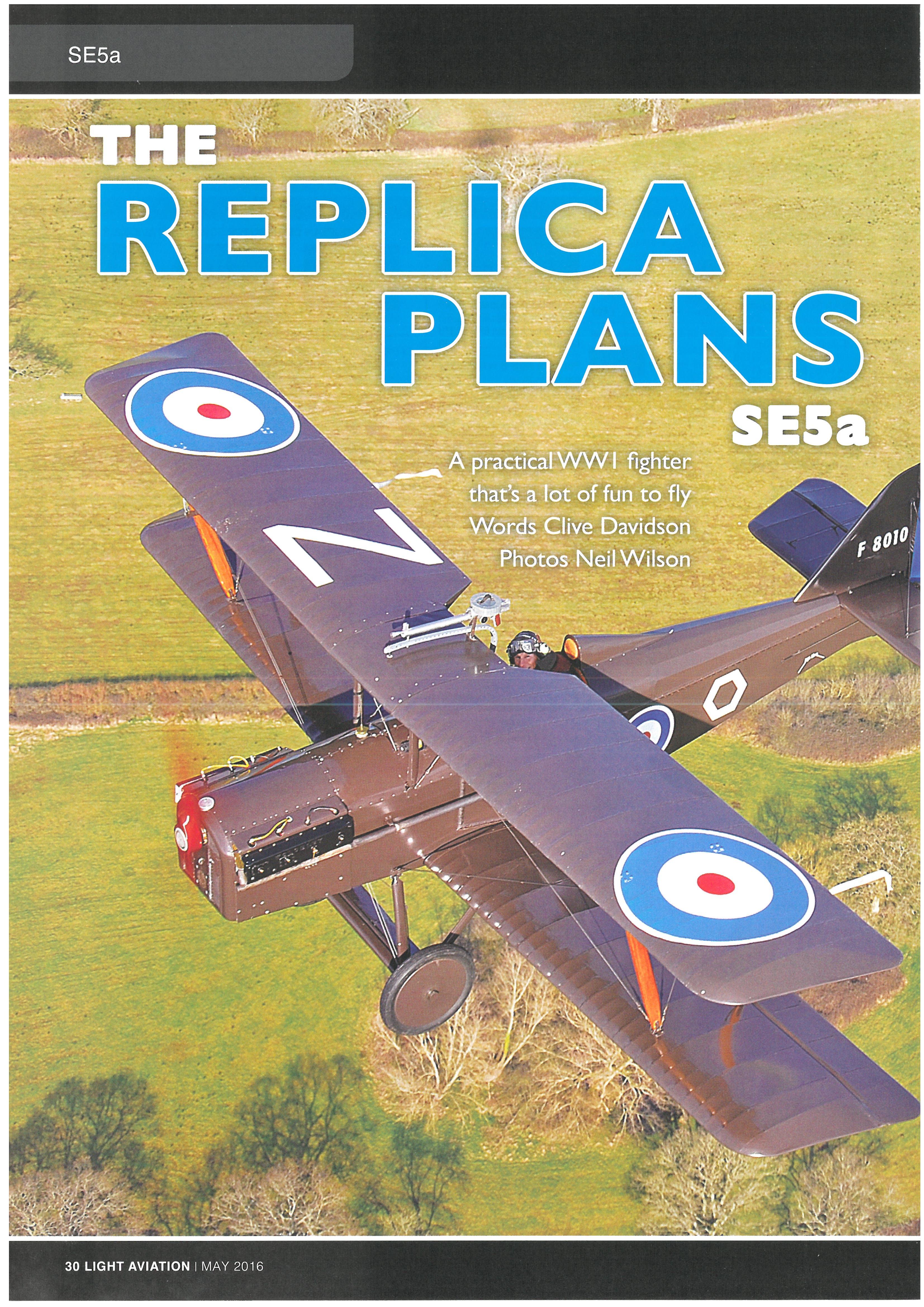
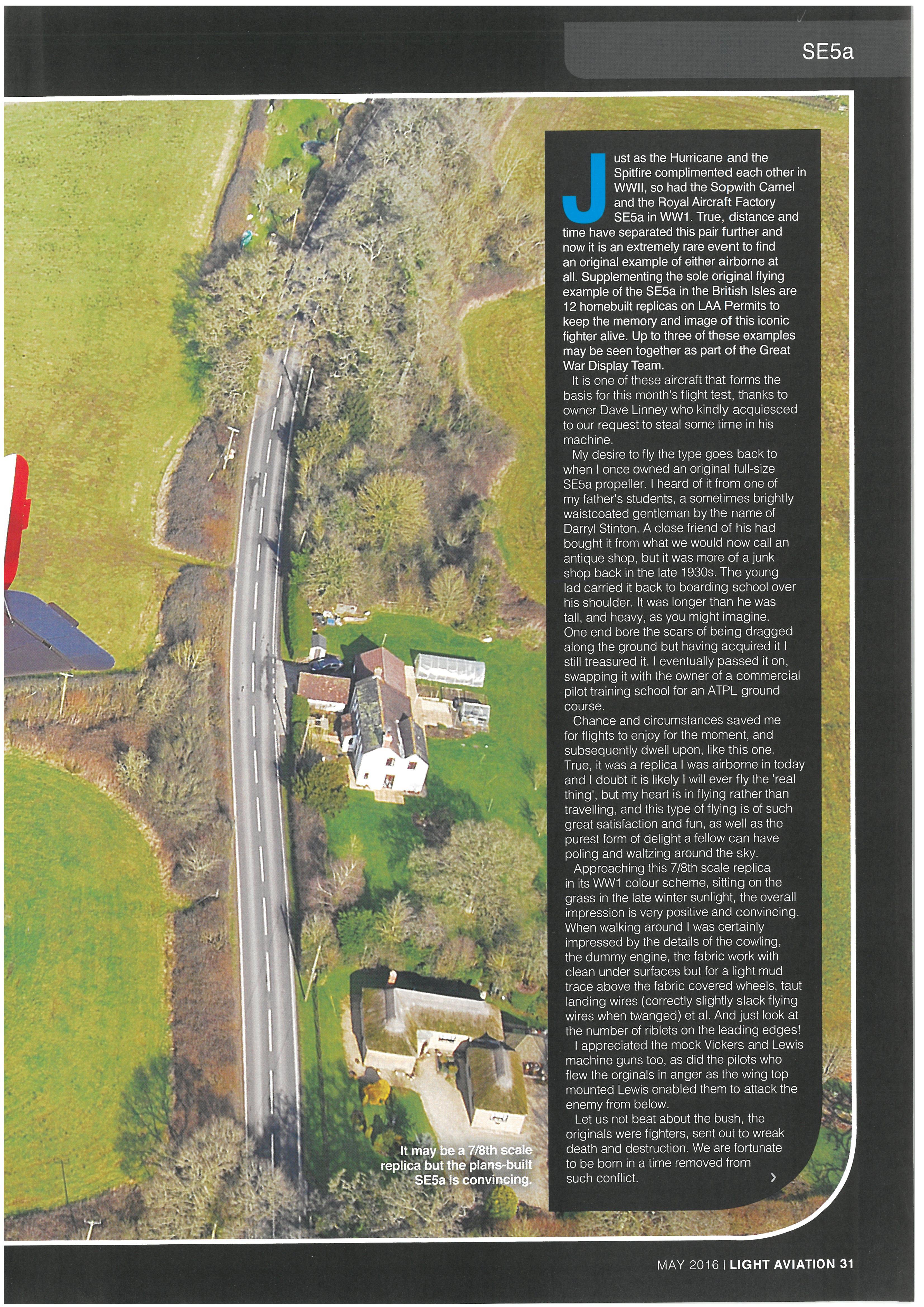
ust as the Hurricane and the Spitfire complimented each other in WWII, so had the Sopwith Camel and the Royal Aircraft Factory SE5a in WW1. True, distance and time have separated this pair further and now it is an extremely rare event to find an original example of either airborne at all. Supplementing the sole original flying example of the SE5a in the British Isles are 12 homebuilt replicas on LAA Permits to keep the memory and image of this iconic fighter alive. Up to three of these examples may be seen together as part of the Great War Display Team.
It is one of these aircraft that forms the basis for this month's flight test, thanks to owner Dave Linney who kindly acquiesced to our request to steal some time in his machine.
My desire to fly the type goes back to when | once owned an original full-size SE5a propeller. | heard of it from one of my father's students, a sometimes brightly waistcoated gentleman by the name of Darryl Stinton. A close friend of his had bought it from what we would now call an antique shop, but it was more of a junk shop back in the late 1930s. The young lad carried it back to boarding school over his shoulder. It was longer than he was tall, and heavy, as you might imagine. One end bore the scars of being dragged along the ground but having acquired it | still treasured it. | eventually passed it on, swapping it with the owner of a commercial pilot training school for an ATPL ground (ereeom
Chance and circumstances saved me for flights to enjoy for the moment, and subsequently dwell upon, like this one.
True, it was a replica | was airborne in today and | doubt it is likely | will ever fly the ‘real thing’, but my heart is in flying rather than travelling, and this type of flying is of such great satisfaction and fun, as well as the purest form of delight a fellow can have poling and waltzing around the sky.
Approaching this 7/8th scale replica in its WW1 colour scheme, sitting on the grass in the late winter sunlight, the overall impression is very positive and convincing. When walking around | was certainly impressed by the details of the cowling, the dummy engine, the fabric work with clean under surfaces but for a light mud trace above the fabric covered wheels, taut landing wires (correctly slightly slack flying wires when twanged) et al. And just look at the number of riblets on the leading edges!
| appreciated the mock Vickers and Lewis machine guns too, as did the pilots who flew the orginals in anger as the wing top mounted Lewis enabled them to attack the enemy from below.
Let us not beat about the bush, the originals were fighters, sent out to wreak ay bea; death and destruction. We are fortunate replicabuttheplan = tobeborninatimeremovedfrom essenoes) | Meeconflict. ee
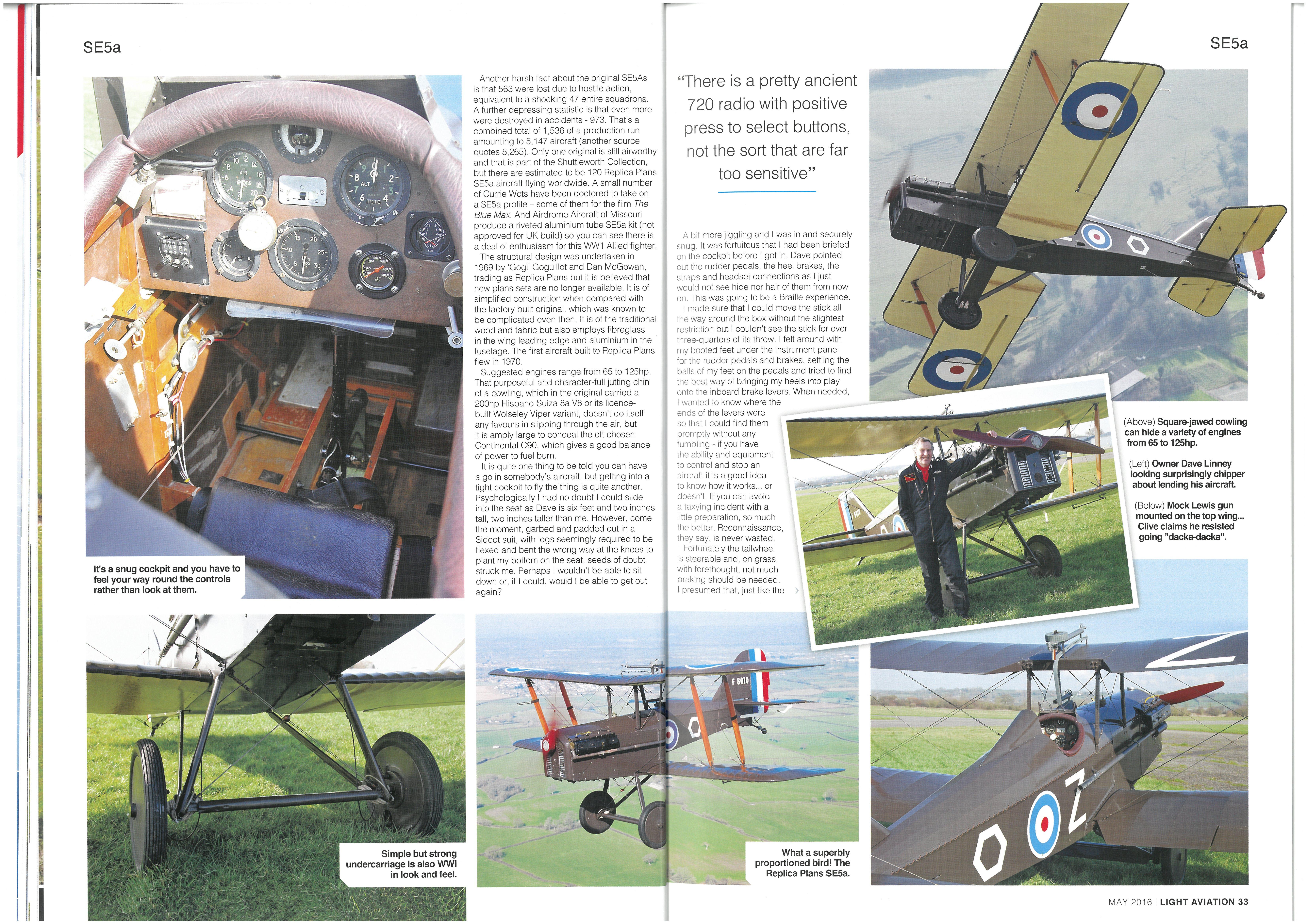
It's a snug cockpit and you have to feel your way round the controls rather than look at them.
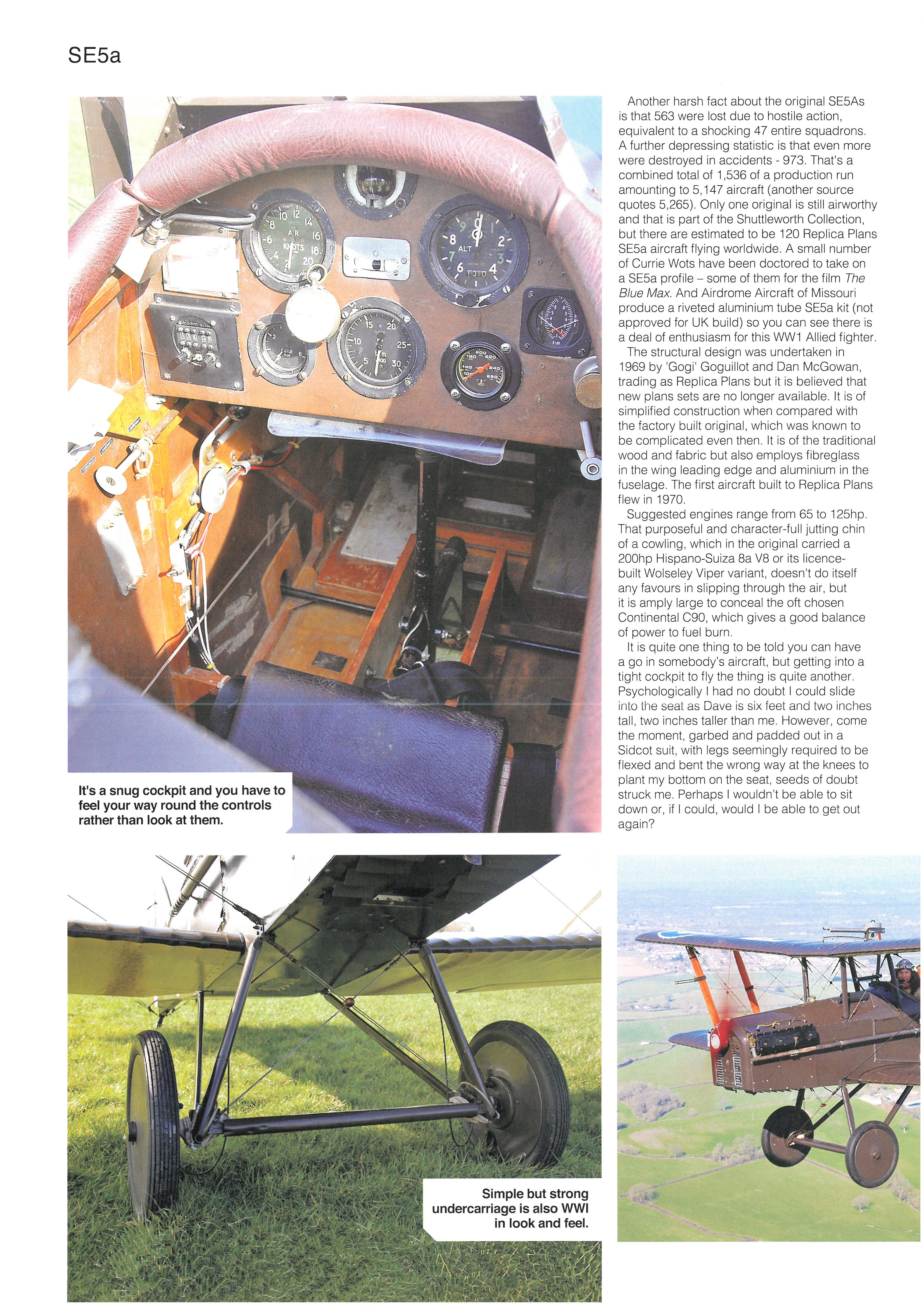
Another harsh fact about the original SE5As is that 563 were lost due to hostile action, equivalent to a shocking 47 entire squadrons. A further depressing statistic is that even more were destroyed in accidents - 973. That's a combined total of 1,536 of a production run amounting to 5,147 aircraft (another source quotes 5,265). Only one original is still airworthy and that is part of the Shuttleworth Collection, but there are estimated to be 120 Replica Plans SE5a aircraft flying worldwide. A small number of Currie Wots have been doctored to take on a SE5a profile some of them for the film The Blue Max. And Airdrome Aircraft of Missouri produce a riveted aluminium tube SE5a kit (not approved for UK build) so you can see there is a deal of enthusiasm for this WW1 Allied fighter.
The structural design was undertaken in 1969 by 'Gogi’ Goguillot and Dan McGowan, trading as Replica Plans but it is believed that new plans sets are no longer available. It is of simplified construction when compared with the factory built original, which was known to be complicated even then. It is of the traditional wood and fabric but also employs fibreglass in the wing leading edge and aluminium in the fuselage. The first aircraft built to Replica Plans flew in 1970.
Suggested engines range from 65 to 125hp. That purposeful and character-full jutting chin of a cowling, which in the original carried a 200hp Hispano-Suiza 8a V8 or its licencebuilt Wolseley Viper variant, doesn't co itself any favours in slipping through the air, but itis amply large to conceal the oft chosen Continental C90, which gives a good balance of power to fuel burn.
It is quite one thing to be told you can have a go in somebody’s aircraft, but getting into a tight cockpit to fly the thing is quite another. Psychologically | had no doubt | could slide into the seat as Dave is six feet and two inches tall, two inches taller than me. However, come the moment, garbed and padded out in a Sidcot suit, with legs seemingly required to be flexed and bent the wrong way at the knees to plant my bottom on the seat, seeds of doubt struck me. Perhaps | wouldn't be able to sit down or, if | could, would | be able to get out again?
“There is a pretty ancient 720 radio with positive press to select buttons, not the sort that are far too sensitive”
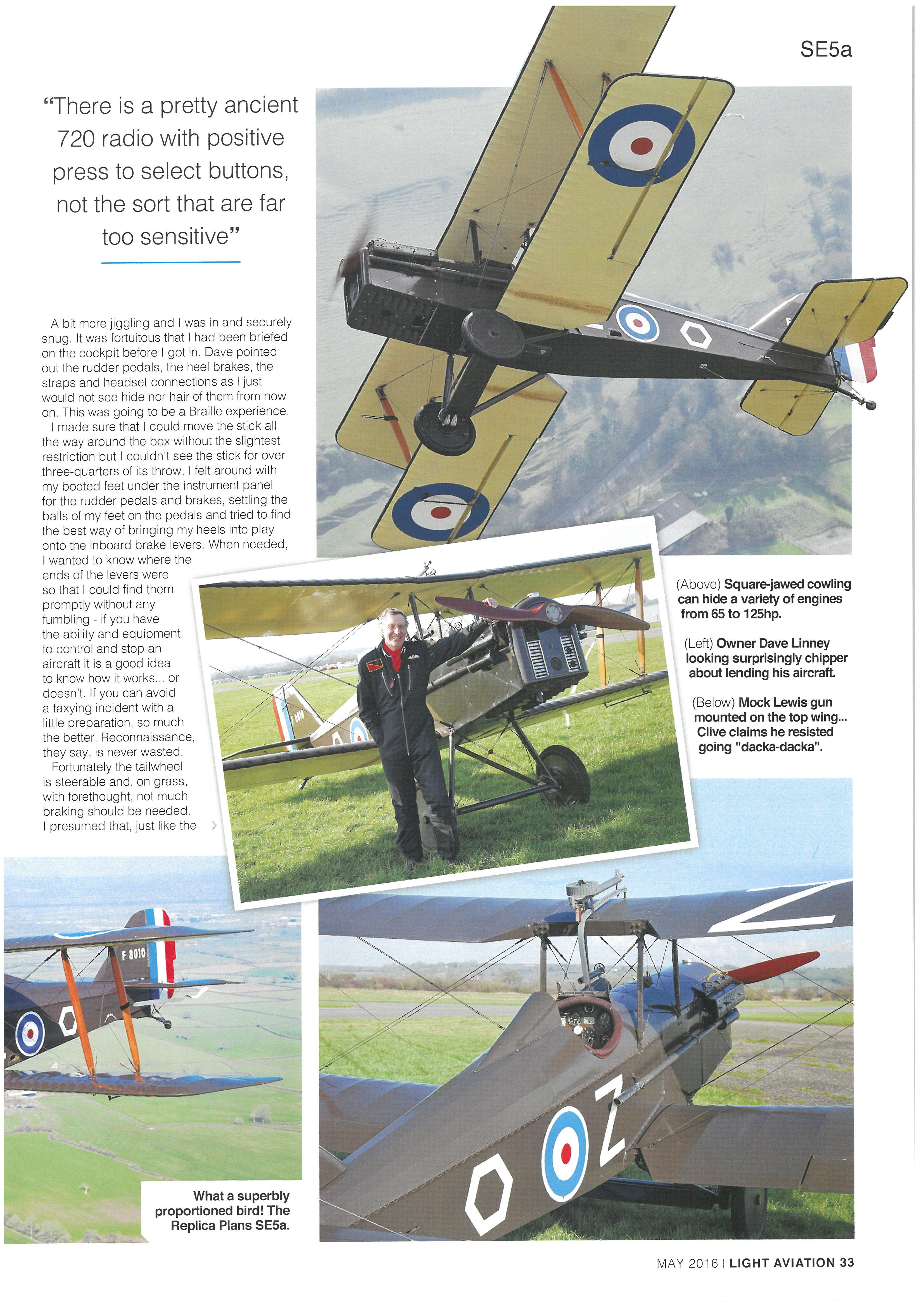
A bit more jiggling and | was in and securely snug. It was fortuitous that | had been briefed on the cockpit before | got in. Dave pointed out the rudder pedals, the heel brakes, the straps and headset connections as |just would not see hide nor hair of them from now on. This was going to be a Braille experience. | made sure that | could move the stick all the way around the box without the slightest restriction but | couldn't see the stick for over three-quarters of its throw. | felt around with my booted feet under the instrument panel for the rudder pedals and brakes, settling the balls of my feet on the pedals and tried to find the best way of bringing my heels into play onto the inboard brake levers. When needed, | wanted to know where the ends of the levers were so that | could find them promptly without any umbling - if you have he ability and equipment to control and stop an aircraft it is a good idea o know how it works... or doesn't. If you can avoid a taxying incident with a ittle preparation, so much he better. Reconnaissance, hey say, is never wasted. Fortunately the tailwheel is steerable and, on grass, with forethought, not much braking should be needed. | presumed that, just like the
(Above)Square-jawed cowling can hide a variety of engines from 65 to 125hp.
(Left) Owner Dave Linney looking surprisingly chipper about lending his aircraft.
(Below) Mock Lewis gun mounted on the top wing... Clive claims he resisted going "dacka-dacka".
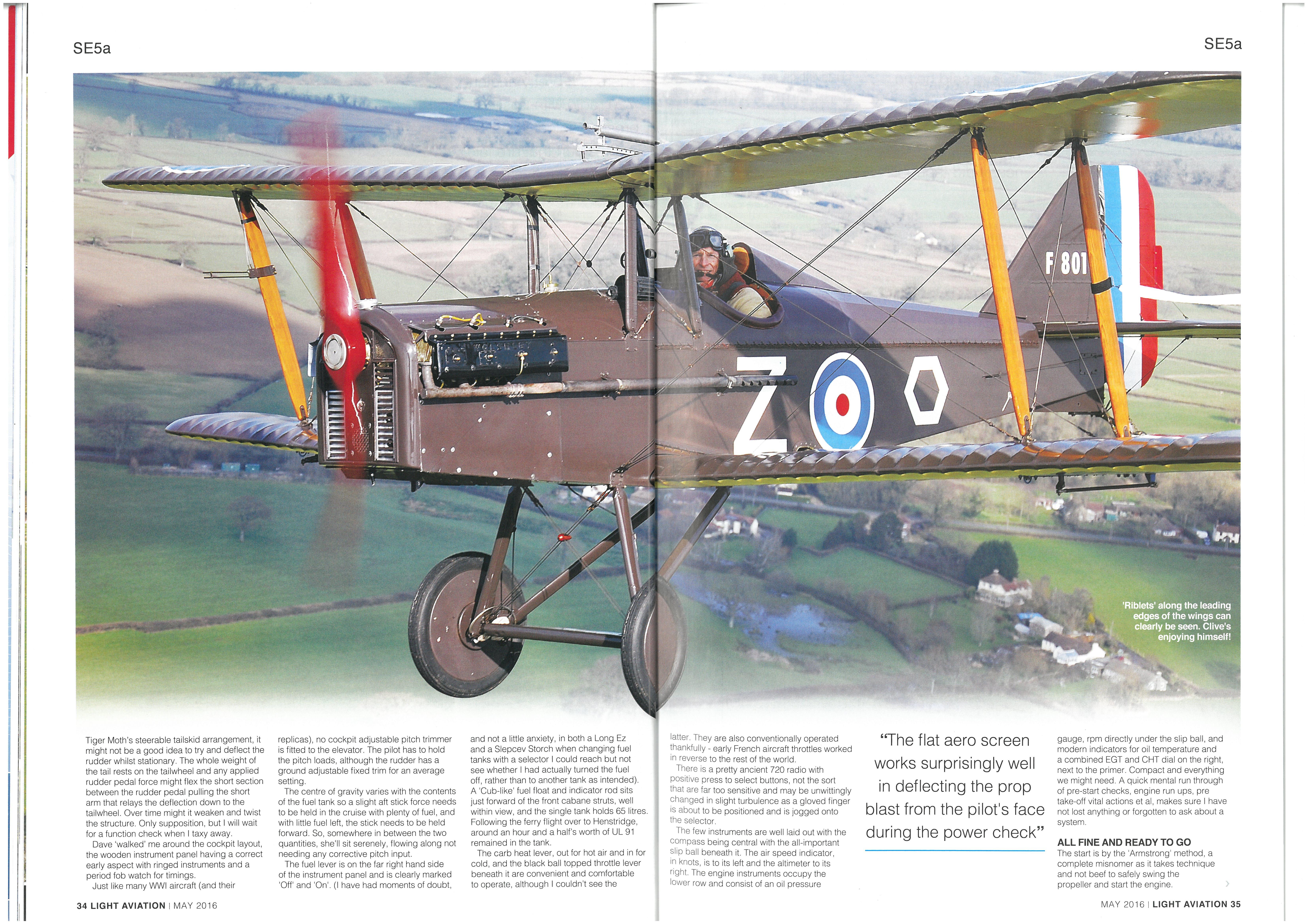
Tiger Moth’s steerable tailskid arrangement, it might not be a good idea to try and deflect the rudder whilst stationary. The whole weight of the tail rests on the tailwheel and any applied rudder pedal force might flex the short section between the rudder pedal pulling the short arm that relays the deflection down to the tailwheel. Over time might it weaken and twist the structure. Only supposition, but | will wait for a function check when | taxy away.
Dave ‘walked’ me around the cockpit layout, the wooden instrument panel having a correct early aspect with ringed instruments and a period fob watch for timings.
Just like many WWI aircraft (and their
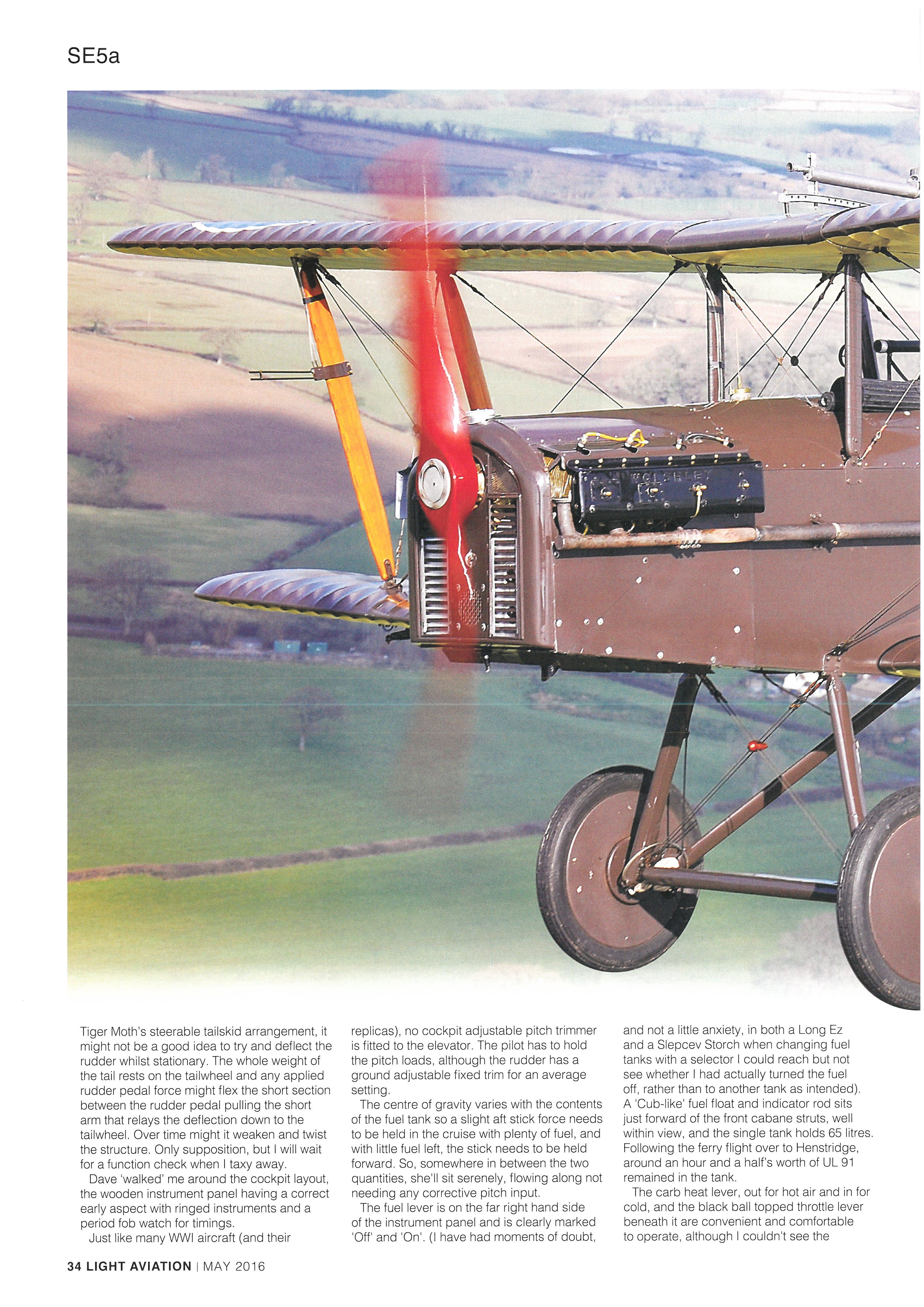
replicas), no cockpit adjustable pitch trimmer is fitted to the elevator. The pilot has to hold the pitch loads, although the rudder has a ground adjustable fixed trim for an average setting.
The centre of gravity varies with the contents of the fuel tank so a slight aft stick force needs to be held in the cruise with plenty of fuel, and with little fuel left, the stick needs to be held forward. So, somewhere in between the two quantities, she'll sit serenely, flowing along not needing any corrective pitch input.
The fuel lever is on the far right hand side of the instrument panel and is clearly marked ‘Off and ‘On’. (| have had moments of doubt,
andnotalittle anxiety,inbothaLongEz and a Slepcev Storch when changing fuel tanks with a selector | could reach but not see whether | had actually turned the fuel off, rather than to another tank as intended).
A 'Cub-like' fuel float and indicator rod sits just forward of the front cabane struts, well within view, and the single tank holds 65 litres.
Following the ferry flight over to Henstridge, around an hour and a half’s worth of UL 91 remained in the tank.
The carb heat lever, out for hot air and in for cold, and the black ball topped throttle lever beneath it are convenient and comfortable to operate, although | couldn't see the
latter. They are also conventionally operated thankfully - early French aircraft throttles worked in reverse to the rest of the world.
There is a pretty ancient 720 radio with positive press to select buttons, not the sort that are far too sensitive and may be unwittingly changed in slight turbulence as a gloved finger is about to be positioned and is jogged onto the selector.
The few instruments are well laid out with the compass being central with the all-important slip ball beneath it. The air speed indicator, in knots, is to its left and the altimeter to its right. The engine instruments occupy the lower row and consist of an oil pressure
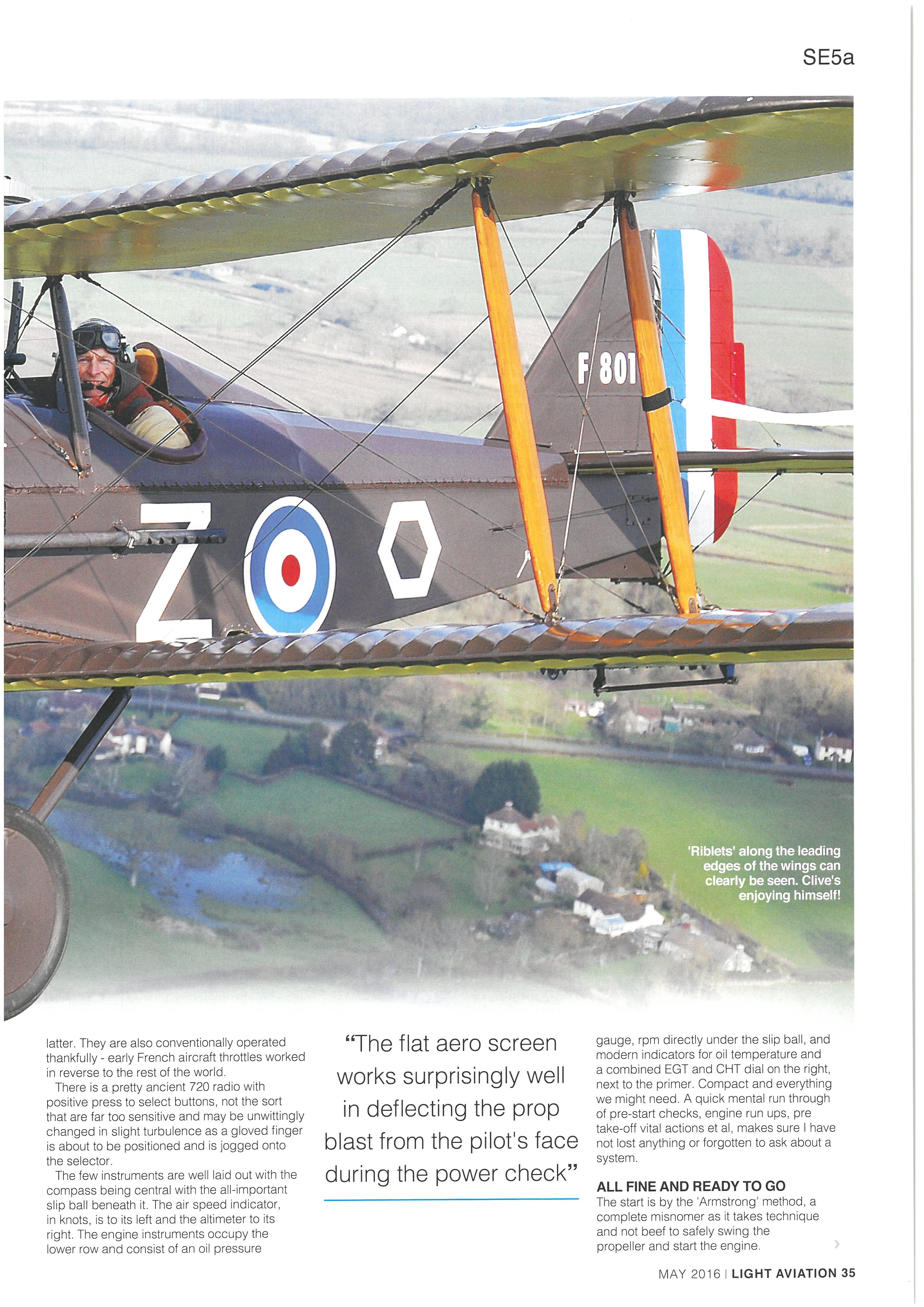
“The flat aero screen works surprisingly well in deflecting the prop blast from the pilot's face during the power check”
gauge, rom directly under the slip ball, and modern indicators for oil temperature and a combined EGT and CHT dial on the right, next to the primer. Compact and everything we might need. A quick mental runthrough of pre-start checks, engine run ups, pre take-off vital actions et al, makes sure | have not lost anything or forgotten to ask about a system.
The start is by the ‘Armstrong’ method, a complete misnomer as it takes technique and not beef to safely swing the propeller and start the engine.
‘Fuel on, throttle set... contact’. Being relatively warm she fired on the first blade, just as Dave had confidently said it would. It sounded sweet too. Oil pressure was up, and with 800 to 1,000 rpm set and flying helmet on, | retrieved the goggles from behind my head and pulled my gloves on. Radio jabbed on and correct frequency set, | had time to sit back, gather my thoughts and get used to the surroundings. | was beginning to feel comfortable.
Dave stood back smiling, standing in a relaxed, casual manner. | am aware that there is both trust and responsibility at play here, there aren't many owners of single seaters who let others fly them. | am not sure there are many who have flown this aircraft since Dave acquired it in August 1999 and re-covered her soon after. No sweat or stress then!
Temps and pressures OK | opened her up o check the magneto switches at 1,600rom against the chocks. The flat aero screen works surprisingly well in deflecting the prop blast rom the pilot's face during the power check.
Just like the Tiger Moth, the mag switches are located outside on the left fuselage side just forward of the cockpit. The mag check rom drop is minimal and a pull to ‘hot' for the carb heat indicates no further drop in rom or rough running. Slowly back to minimum idle rom and a return to 1,000 again. All set, and with a right o left scan to make sure | had left nothing untended, I’m ready.
The gentle weather-cocking influence of the slight crosswind was not awkward to counter when taxying or transiting the hard runway to the grass threshold of 07. Rudder, and the odd dab of brake, kept me tidily in smooth sweeping S movements, clearing the path ahead.
Despite the bluff nose rising over the
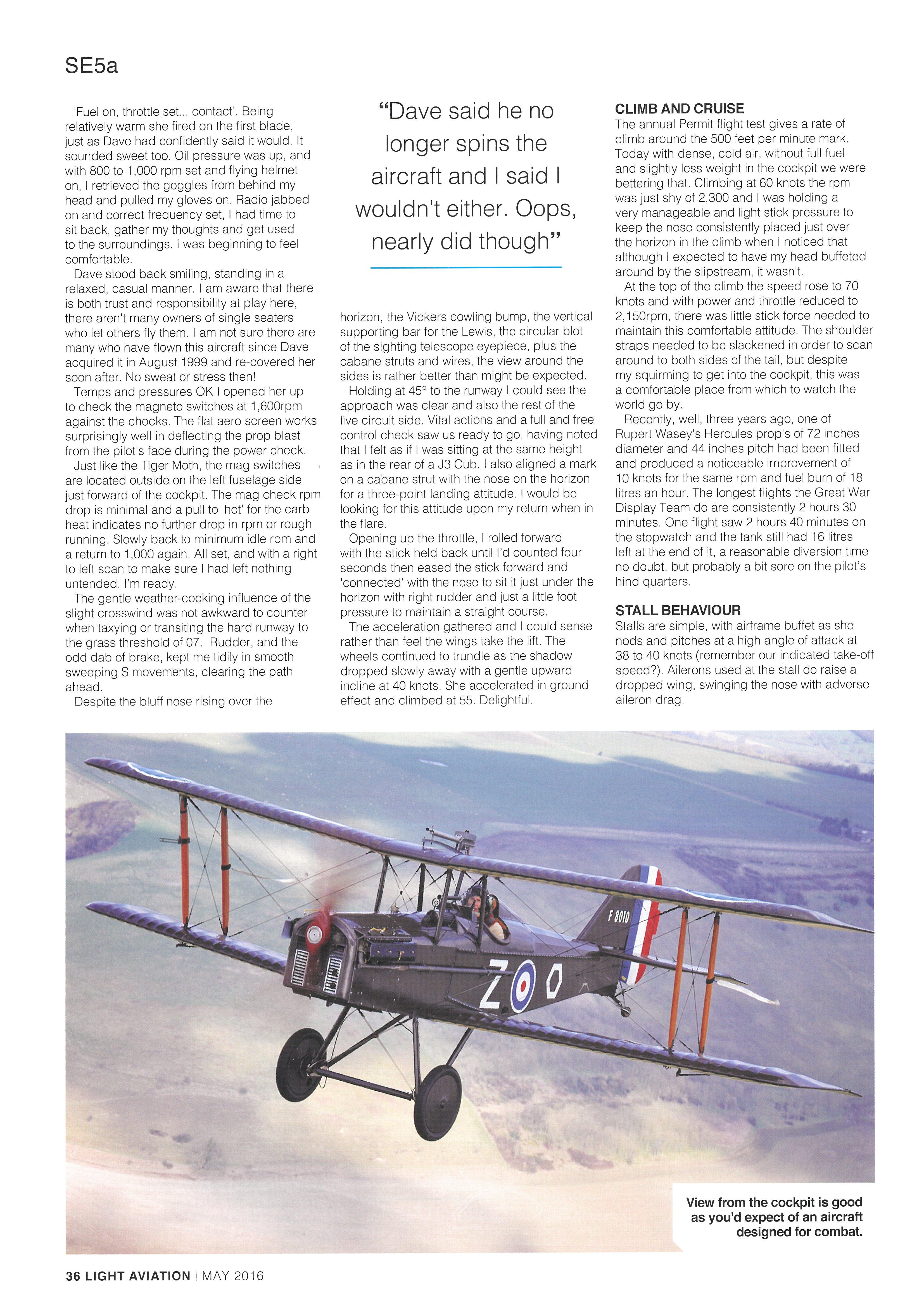
“Dave said he no longerspins the aircraft and | said | wouldn't either. Oops, nearly didthough”’
horizon, the Vickers cowling bump, the vertical supporting bar for the Lewis, the circular blot of the sighting telescope eyepiece, plus the cabane struts and wires, the view around the sides is rather better than might be expected.
Holding at 45° to the runway | could see the approach was clear and also the rest of the live circuit side. Vital actions and a full and free control check saw us ready to go, having noted that | felt as if | was sitting at the same height as in the rear of a J3 Cub. | also aligned a mark on a cabane strut with the nose on the horizon for a three-point landing attitude. | would be looking for this attitude upon my return when in the flare.
Opening up the throttle, | rolled forward with the stick held back until I'd counted four seconds then eased the stick forward and ‘connected' with the nose to sit it just under the horizonwithrightrudderandjustalittle foot pressure to maintain a straight course.
The acceleration gathered and | could sense rather than feel the wings take the lift. The wheels continued to trundle as the shadow dropped slowly away with a gentle upward incline at 40 knots. She accelerated in ground effect and climbed at 55. Delightful.
The annual Permit flight test gives a rate of climb around the 500 feet per minute mark. Today with dense, cold air, without full fuel and slightly less weight in the cockpit we were bettering that. Climbing at 60 knots the rom was just shy of 2,300 and | was holding a very manageable and light stick pressure to keep the nose consistently placed just over the horizon in the climb when | noticed that although | expected to have my head buffeted around by the slipstream, it wasn't.
At the top of the climb the speed rose to 70 knots and with power and throttle reduced to 2,150rpm, there was little stick force needed to maintain this comfortable attitude. The shoulder straps needed to be slackened in order to scan around to both sides of the tail, but despite my squirming to get into the cockpit, this was a comfortable place from which to watch the world go by.
Recently, well, three years ago, one of Rupert Wasey's Hercules prop's of 72 inches diameter and 44 inches pitch had been fitted and produced a noticeable improvement of 10 knots for the same rom and fuel burn of 18 litres an hour. The longest flights the Great War Display Team do are consistently 2 hours 30 minutes. One flight saw 2 hours 40 minutes on the stopwatch and the tank still had 16 litres left at the end of it, a reasonable diversion time no doubt, but probably a bit sore on the pilot’s hind quarters.
Stalls are simple, with airframe buffet as she nods and pitches at a high angle of attack at 38 to 40 knots (remember our indicated take-off speed?). Ailerons used at the stall do raise a dropped wing, swinging the nose with adverse aileron drag.
| finish up on one extended series of wing dropsandrecoveriesreachingafalling leaf, i.e. recovery at the incipient stage to spin, to be followed by one in the opposite direction. Dave said he no longer spins the aircraft and | said | wouldn't either. Oops, nearly did though.
Gentle turns without any balancing rudder ‘can' (to be spoken slowly as | don't wholly approve of the act), 'can' be made with only a small adverse nose dish in the opposite direction. Balancing rudder is the natural sense reaction in such an aeroplane and she does respond to ‘harmonious’ controls.
Being lightly loaded, and with so many square feet of lightly loaded wing area, a 2g turn of 60° bank wracks around in an appreciably tight radius. Great fun hitting your own prop wash accompanied by a wobble of the wings!
The few aerobatic manoeuvres that Dave does in the SE5a commence from the Vne (Velocity never exceed) speed of 100 knots/ 115 mph. You can appreciate that the drag from the airframe makes it awkward to get to this speed and then the energy should be used promptly as it will diminish as soon as the nose is raised.
Ofcourse,witha fixedpitchpropitis imperative to never go beyond the red line speed, so with sufficient height as the nose is positively lowered to gain speed, an eye should be on the rom gauge as well as the ASI and, if needs must, throttle back as velocity is gained to look after the engine. With the 100 knots collected, an arcing wing over Changing direction by 180° is a pleasant experience. Roll is fairly lively.
Check height and head out of the cockpit to check for traffic we nose down again. Rem? Throttle? Speed... 90, 95... 100, pitch up for a loop, nose up, up, farther, past the vertical now, head back to see an early inverted horizon, wings level check, slightly ease the pitch and bring her round and down.
A wingover left... and a right barrel roll with an inverted wings level check with the nose about to descend. The roll rate naturally follows the pitch rate.
| try another barrel roll to the left and, helped bythetorque,|fly itfrom85knots.Hmm,100 is better but it is quite acceptable at 85.
“Great fun hitting your own prop wash accompanied by a wobble of the wings!”
Ahwell,|shouldn'tstayupfortoolong. | still have fuel as the float is just about showing half of what | started with. Dave was quite correct, his radio is good and clear. | had no trouble, or need to decipher today's air trafficker or the three other aircraft in the circuit. Despite an open cockpit, the transmission and reception were Clearly audible 'fives' and free from any annoying background wind noise.
The wind hadn't increased and the grass runway crosswind limit was still comfortably within Dave's nominated 10 knots (seven for hard surfaced runways).
DIMENSIONS Length: Wingspan:18ft2in
Gross weight: 1150lb OS aNa
1 x Continental C-90, 90hp PERFORMANCE
Maximum speed: 110mph
Range: 250 miles
Service ceiling: 10,000ft
Rate of climb: 900fom
The advice | gleaned for the approach was to make the threshold at 50 knots and this tallies, in rounded terms, with the conventional 1.3 of the 38/40 knot stall. | left a little more than a trickle of power on for the flare as | suspected that as soon as you would normally start to float that this girl's drag would take over and dump metoabump.Asshestartedtosink| lether and slowly raised the nose closer and then to my mark on the cabane strut as we sank to a lucky three-pointer. | say lucky. As with all of these things the technique and rate at which the pilot applies inputs is in anticipation of something similar to what he/she is used and there are always other factors involved such as the wind... and luck.
| have just realised | didn't once go 'dacka dacka' against the Auster cameraship and pretend to be something | am not. But | did hink of Louis Strange, a local Dorset fellow, when | raised my right hand through the slipstream in flight up to the mock Lewis gun. t was he, in a Martinsyde scout over the lines in France, that when attempting to change a spent circular ammunition drum his aircraft urned inverted. He was left hanging, clasping he wayward ammunition drum he had been rying to remove! Having attempted several imes to swing his feet back into the cockpit he eventually succeeded and rolled her upright 0 fall mercifully back into the cockpit. On the ground, and in the post calm pause after the drama, the drum unlocked and came away reely.
After | had taxied and parked, the engine cooled and died and | was greeted by smiles. | had to admit | had enjoyed my flight. | had no problem in getting out either. | am afraid | am now like the Canadian correspondent whose article on the type | had read 50 years previously and wished for another flight. In summing up, if you can get into one of these SE5a Replicas, and the hardest part shouldn't be getting into the cockpit, but twisting the arm of an owner (very good luck with that), and with the right attitude and experience you would be bound to come down smiling, having enjoyed your time and association with this lively youngster. Mr Linney Sir, thank you for my most enjoyable flit.
rr
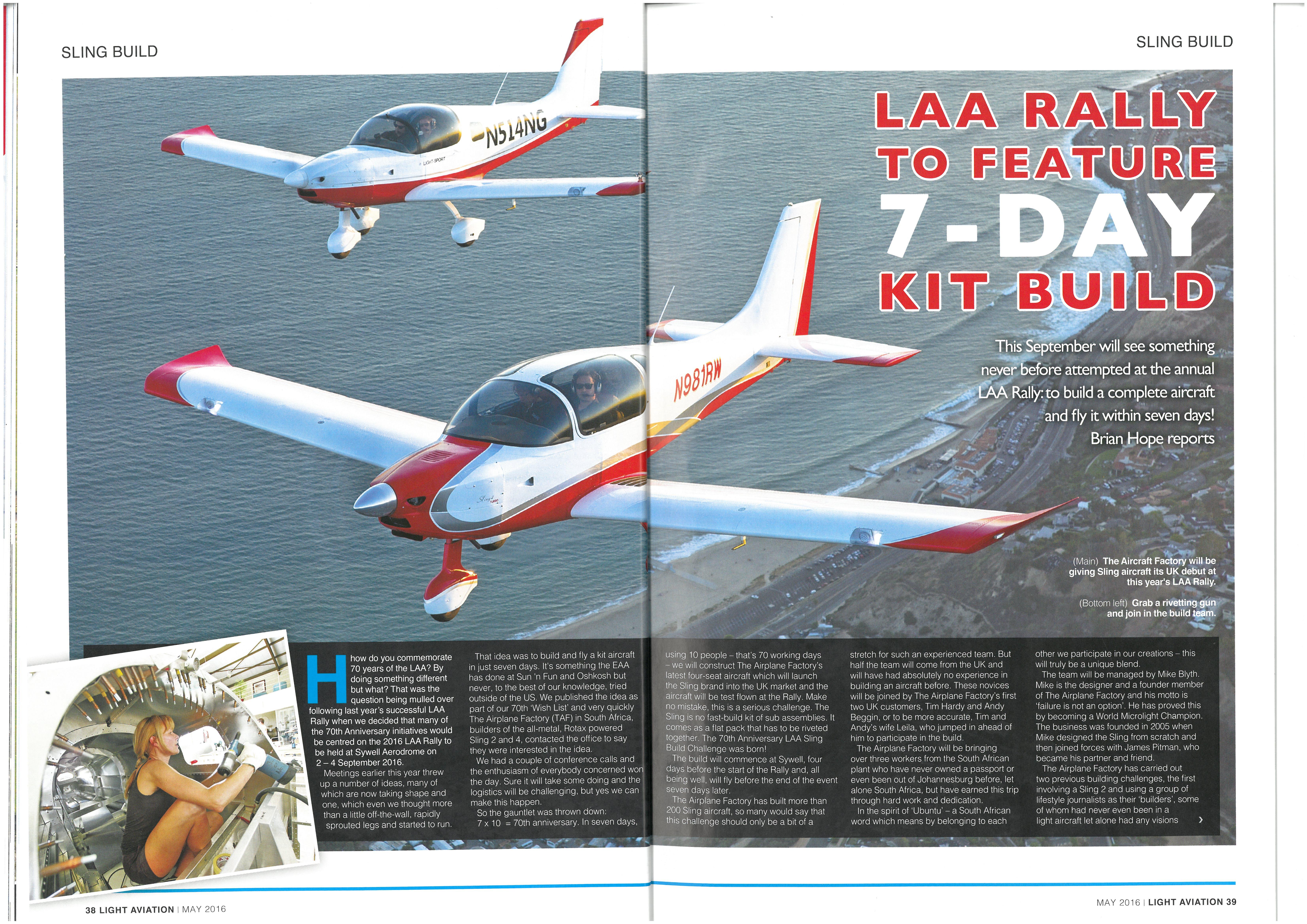
how do you commemorate 70 years of the LAA? By doing something different but what? That was the question being mulled over following last year’s successful LAA Rally when we decided that many of the 70th Anniversary initiatives would becentredonthe2016LAARallyto < meee§=6be
Meetings earlier this year threw up a number of ideas, many of which are now taking shape and one, which even we thought more thanalittle off-the-wall,rapidly sprouted legs and started to run.
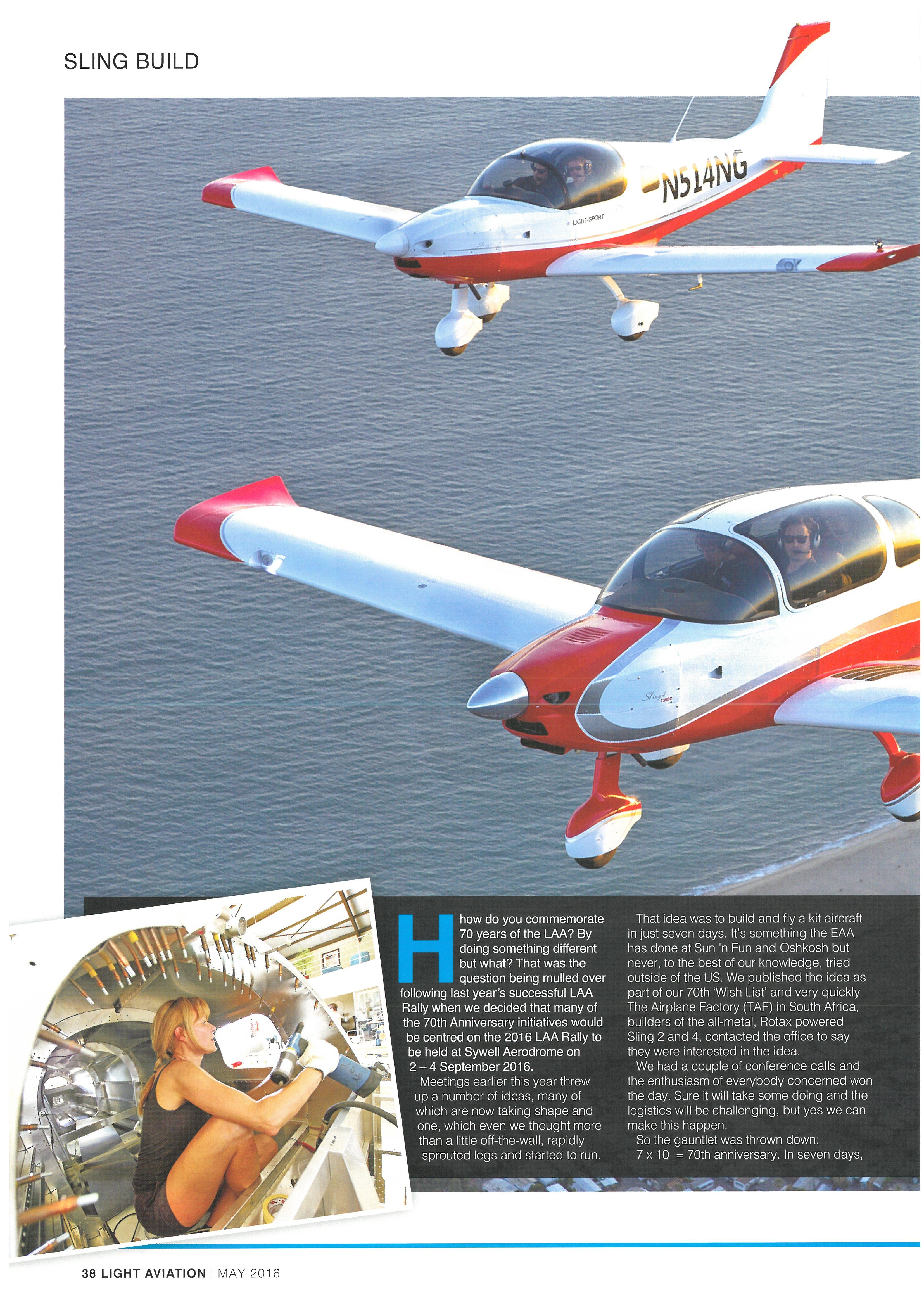
That idea was to build and fly a kit aircraft in just seven days. It's something the EAA has done at Sun ‘n Fun and Oshkosh but never, to the best of our knowledge, tried outside of the US. We published the idea as part of our 70th ‘Wish List’ and very quickly The Airplane Factory (TAF) in South Africa, builders of the all-metal, Rotax powered Sling 2 and 4, contacted the office to say they were interested in the idea.
We had a couple of conference calls and the enthusiasm of everybody concerned won the day. Sure it will take some doing and the logistics will be challenging, but yes we can make this happen.
zTp ao bsSaas
So the gauntlet was thrown down: 7X10 = 70th anniversary. In seven days, "i af
a using 10 people that’s 70 working days —we will construct The Airplane Factory's latest four-seat aircraft which will launch the Sling brand into the UK market and the aircraft will be test flown at the Rally. Make no mistake, this is a serious challenge. The Sling is no fast-build kit of sub assemblies. It comes as a flat pack that has to be riveted together. The 70th Anniversary LAA Sling Build Challenge was born!
The build will commence at Sywell, four days before the start of the Rally and, all being well, will fly before the end of the event seven days later.
The Airplane Factory has built more than 200 Sling aircraft, so many would say that this challenge should only be a bit of a
stretch for such an experienced team. But half the team will come from the UK and will have had absolutely no experience in building an aircraft before. These novices will be joined by The Airplane Factory's first two UK customers, Tim Hardy and Andy Beggin, or to be more accurate, Tim and Andy's wife Leila, who jumped in ahead of him to participate in the build.
The Airplane Factory will be bringing over three workers from the South African plant who have never owned a passport or even been out of Johannesburg before, let alone South Africa, but have earned this trip through hard work and dedication.
(Main) The Aircraft Factory will be giving Sling aircraft its UK debut at this year's LAA Rally.
(Bottom left) Grab a rivetting:gun and join in the build team.
other we participate in our creations this will truly be a unique blend.
The team will be managed by Mike Blyth. Mike is the designer and a founder member of The Airplane Factory and his motto is ‘failure is not an option’. He has proved this by becoming a World Microlight Champion. The business was founded in 2005 when Mike designed the Sling from scratch and then joined forces with James Pitman, who became his partner and friend.
The Airplane Factory has carried out two previous building challenges, the first involving a Sling 2 and using a group of lifestyle journalists as their ‘builders’, some of whom had never even been ina lightaircraftletalonehadanyvisions D2 i
In the spirit of ‘Ubuntu’ a South African word which means by belonging to each
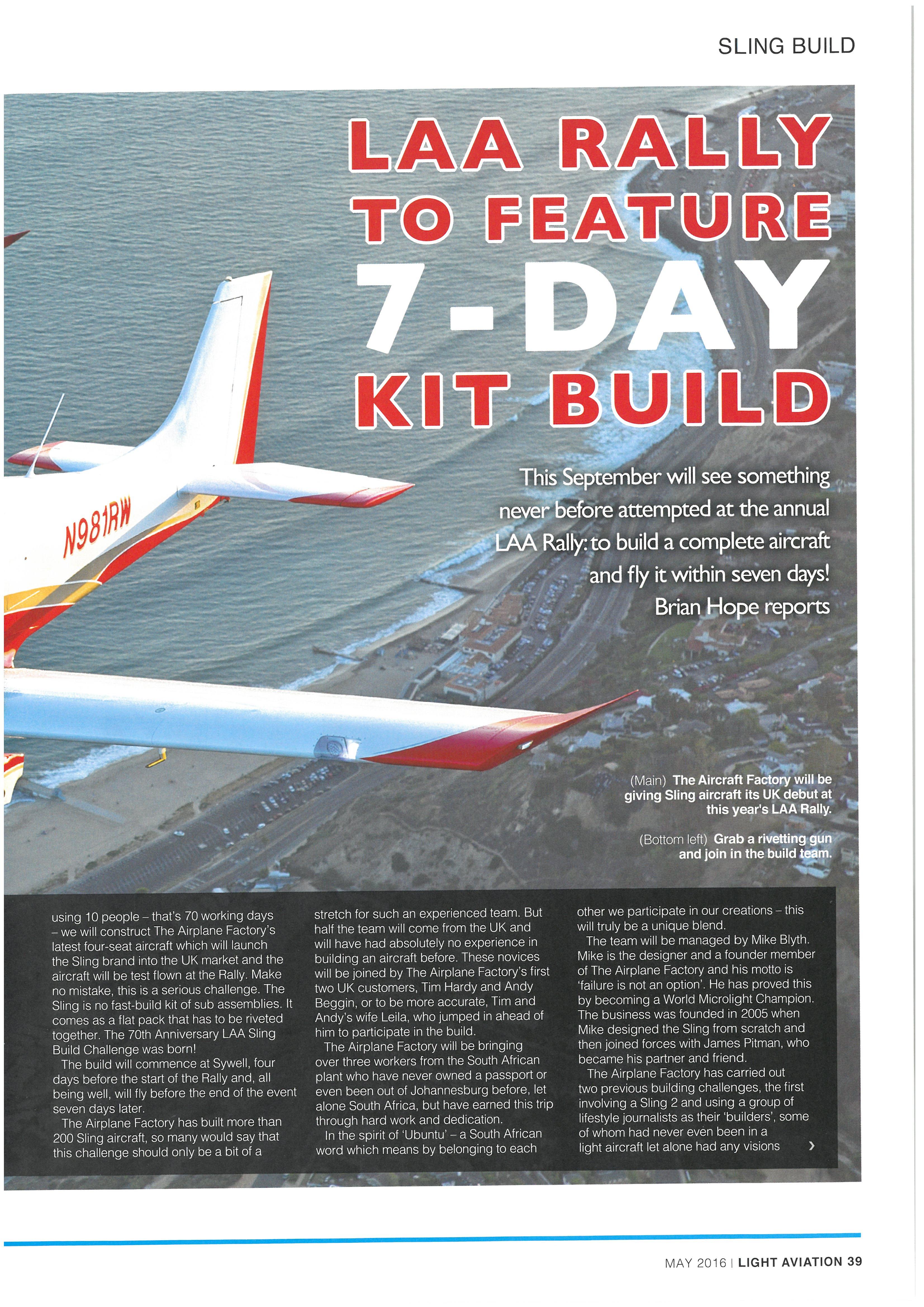
Pe unsSeu VII eccoyaaT=ieal ataot‘beforeattemptedattheannual a=LAARally:tobuildacompleteaircratt
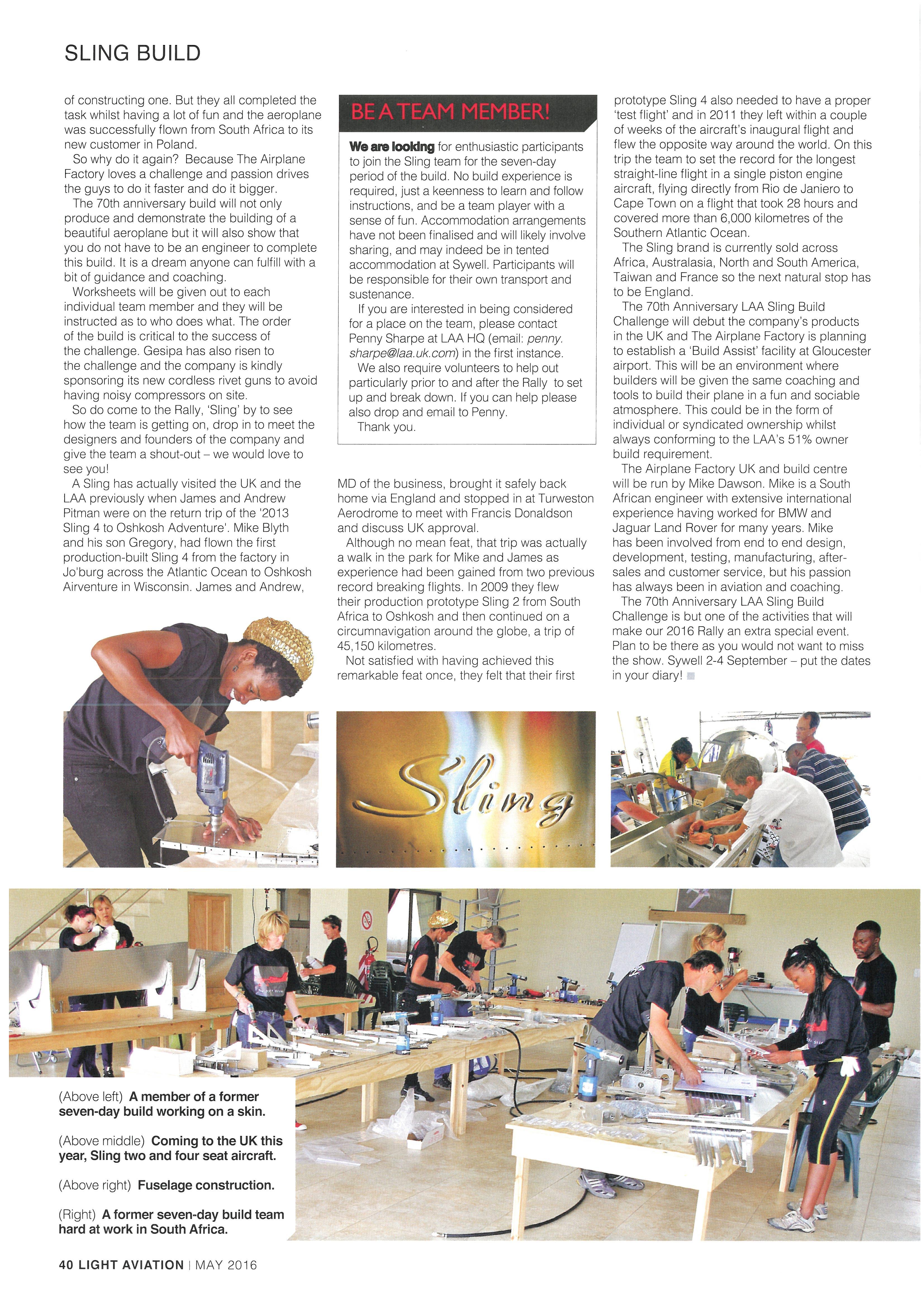
of constructing one. But they all completed the task whilst having a lot of fun and the aeroplane was successfully flown from South Africa to its new customer in Poland.
So why do it again? Because The Airplane Factory loves a challenge and passion drives the guys to do it faster and do it bigger.
The 70th anniversary build will not only produce and demonstrate the building of a beautiful aeroplane but it will also show that you co not have to be an engineer to complete this build. It is a dream anyone can fulfill with a bit of guidance and coaching.
Worksheets will be given out to each individual team member and they will be instructed as to who does what. The order of the build is critical to the success of the challenge. Gesipa has also risen to the challenge and the company is kindly sponsoring its new cordless rivet guns to avoid having noisy compressors on site.
So do come to the Rally, ‘Sling’ by to see how the team is getting on, drop in to meet the designers and founders of the company and give the team a shout-out we would love to see you!
A Sling has actually visited the UK and the LAA previously when James and Andrew Pitman were on the return trip of the '2013 Sling 4 to Oshkosh Adventure’. Mike Blyth and his son Gregory, had flown the first production-built Sling 4 from the factory in Jo'burg across the Atlantic Ocean to Oshkosh Airventure in Wisconsin. James and Andrew,
We are looking for enthusiasticparticipants to join the Sling team for the seven-day period of the build. No build experience is required, just a keenness to learn and follow instructions, and be a team player with a sense of fun. Accommodation arrangements have not been finalised and will likely involve sharing, and may indeed be in tented accommodation at Sywell. Participants will be responsible for their own transport and sustenance.
If you are interested in being considered for a place on the team, please contact Penny Sharpe at LAA HQ (email: penny. sharpe@laa.uk.com) inthe first instance. We also require volunteers to help out particularly prior to and after the Rally to set up and break down. If you can help please also drop and email to Penny. Thank you.
MD of the business, brought it safely back home via England and stopped in at Turweston Aerodrome to meet with Francis Donaldson and discuss UK approval.
Although no mean feat, that trip was actually a walk in the park for Mike and James as experience had been gained from two previous record breaking flights. In 2009 they flew their production prototype Sling 2 from South Africa to Oshkosh and then continued on a circumnavigation around the globe, a trip of 45,150 kilometres.
Not satisfied with having achieved this remarkable feat once, they felt that their first
prototype Sling 4 also needed to have a proper ‘test flight’ and in 2011 they left within a couple of weeks of the aircraft's inaugural flight and tlew the opposite way around the world. On this trip the team to set the record for the longest straight-line flight in a single piston engine aircraft, flying directly from Rio de Janiero to CapeTownonaflight thattook28hoursand covered more than 6,000 kilometres of the Southern Atlantic Ocean.
The Sling brand is currently sold across Africa, Australasia, North and South America, Taiwan and France so the next natural stop has to be England.
The 70th Anniversary LAA Sling Build Challenge will debut the company’s products in the UK and The Airplane Factory is planning to establish a ‘Build Assist’ facility at Gloucester airport. This will be an environment where builders will be given the same coaching and tools to build their plane in a fun and sociable atmosphere. This could be in the form of individual or syndicated ownership whilst always conforming to the LAA’s 51% owner build requirement.
The Airplane Factory UK and build centre will be run by Mike Dawson. Mike is a South African engineer with extensive international experience having worked for BMW and Jaguar Land Rover for many years. Mike has been involved from end to end design, development, testing, manufacturing, aftersales and customer service, but his passion has always been in aviation and coaching.
The 70th Anniversary LAA Sling Build Challenge is but one of the activities that will make our 2016 Rally an extra special event. Plan to be there as you would not want to miss the show. Sywell 2-4 September put the dates in your diary!
elldonetothemall,andtoanumberofotherLAAWingsrecipientsaround thecountry.Whydon’tyoutakealookattheLAAWingswebsite at www.laawings.co.uk toseewhatisinvolvedingainingyourwings?Itisquite probablethatyouwillalreadyhavesufficienthoursandskillstogainatleast BronzeWings,possiblyhigher,andhavingsomethingtoaimforwillhopefully addextrapurposetoyourflyingthissummer.Goodluck!
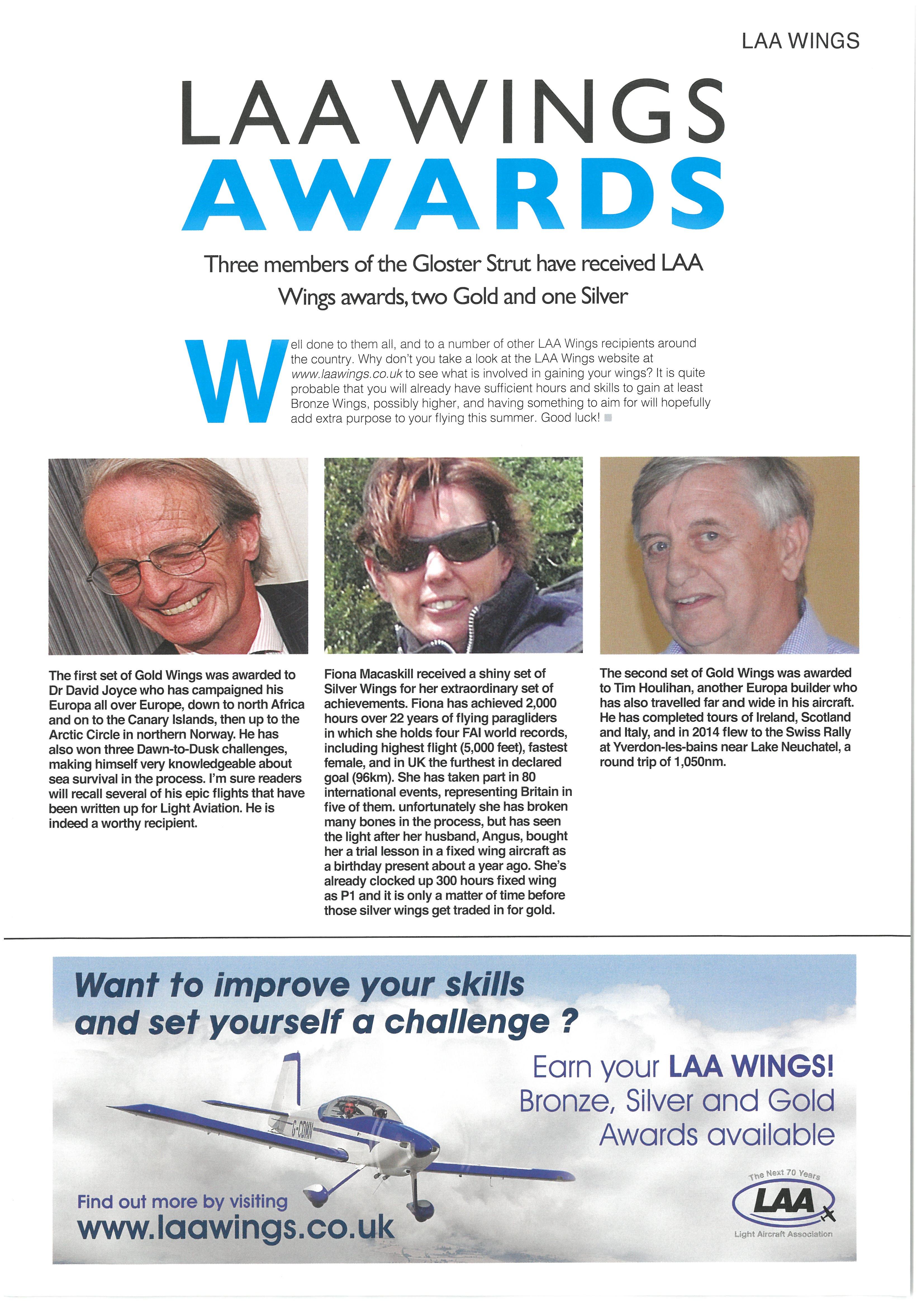
The first set of Gold Wings was awarded to Dr David Joyce who has campaigned his Europa all over Europe, down to north Africa and on to the Canary Islands, then up to the Arctic Circle in northern Norway. He has also won three Dawn-to-Dusk challenges, making himself very knowledgeable about sea survival in the process. I’m sure readers will recall several of his epic flights that have been written up for LightAviation. He is indeed a worthy recipient.
Fiona Macaskill received a shiny set of Silver Wings for her extraordinary set of achievements. Fiona has achieved 2,000 hours over 22 years of flying paragliders in which she holds four FAI world records, including highest flight (5,000feet), fastest female, and in UKthe furthest in declared goal (96km). She has taken part in 80 international events, representing Britain in five of them. unfortunately she has broken many bones in the process, but has seen the light after her husband, Angus, bought her a trial lesson in a fixed wing aircraft as a birthday present about a year ago. She’s already clocked up 300 hours fixed wing as P1 and it is only a matter of time before those silver wings get traded in for gold.
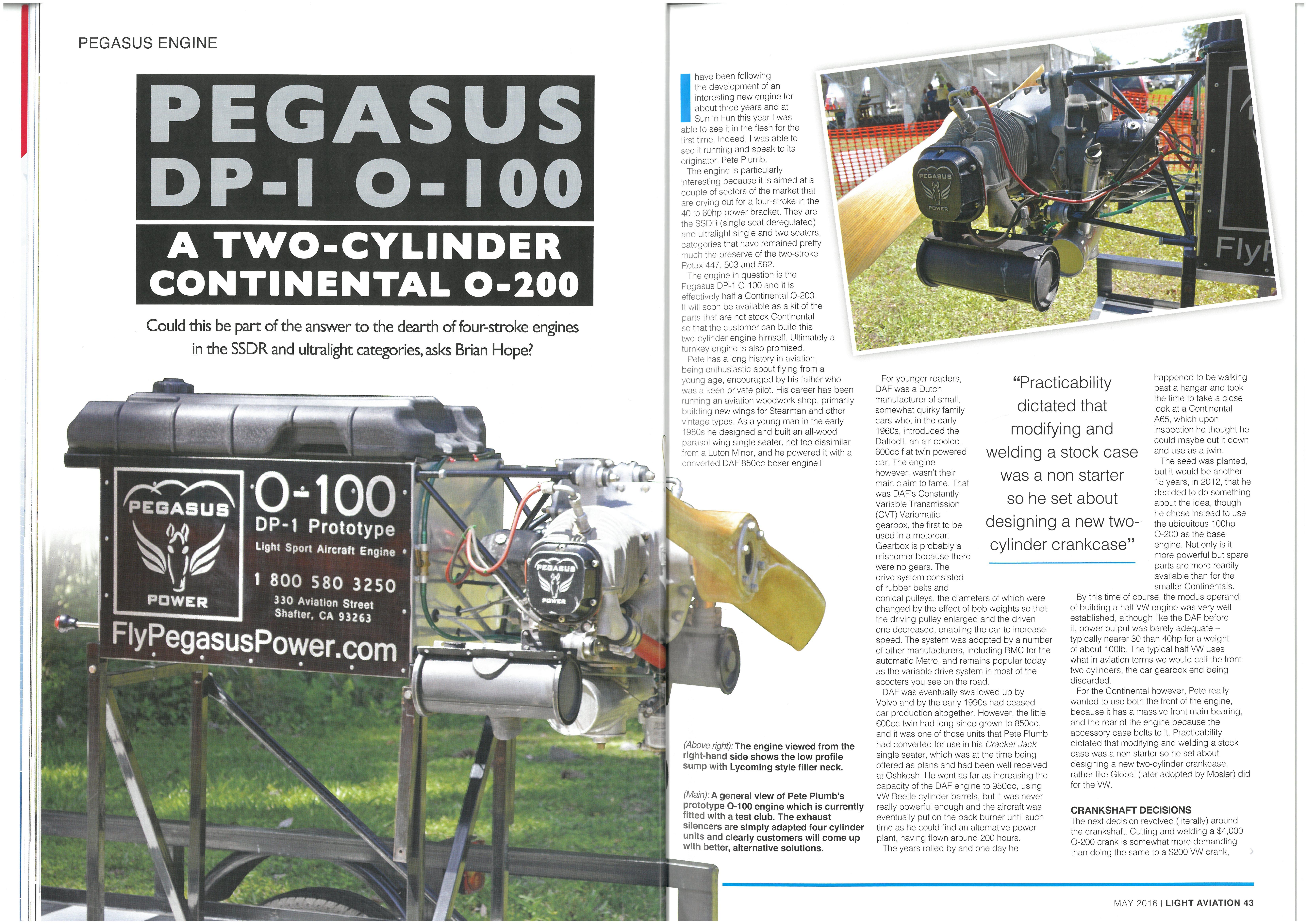

intheSSDRandultralightcategories,asksBrianHope?
have been following the development of an interesting new engine for about three years and at Sun ‘n Fun this year | was able to see it in the flesh for the first time. Indeed, | was able to see it running and speak to its originator, Pete Plumb.
The engine is particularly interesting because it is aimed at a couple of sectors of the market that are crying out for a four-stroke in the 40 to 6Ohp power bracket. They are the SSDR(single seat deregulated) and ultralight single and two seaters, categories that have remained pretty much the preserve of the two-stroke Rotax 447, 503 and 582.
The engine in question is the Pegasus DP-1 O-100 and it is effectively half a Continental O-200. Itwillsoonbeavailableasa kitofthe parts that are not stock Continental so that the customer can build this two-cylinder engine himself. Ultimately a turnkey engine is also promised. Pe
Pete has a long history in aviation, being enthusiastic about flying from a young age, encouraged by his father who was a keen private pilot. His career has been running an aviation woodwork shop, primarily building new wings for Stearman and other vintage types. As a young man in the early 1980s he designed and built an all-wood parasol wing single seater, not too dissimilar from a Luton Minor, and he powered it with a converted DAF 850cc boxer engineT
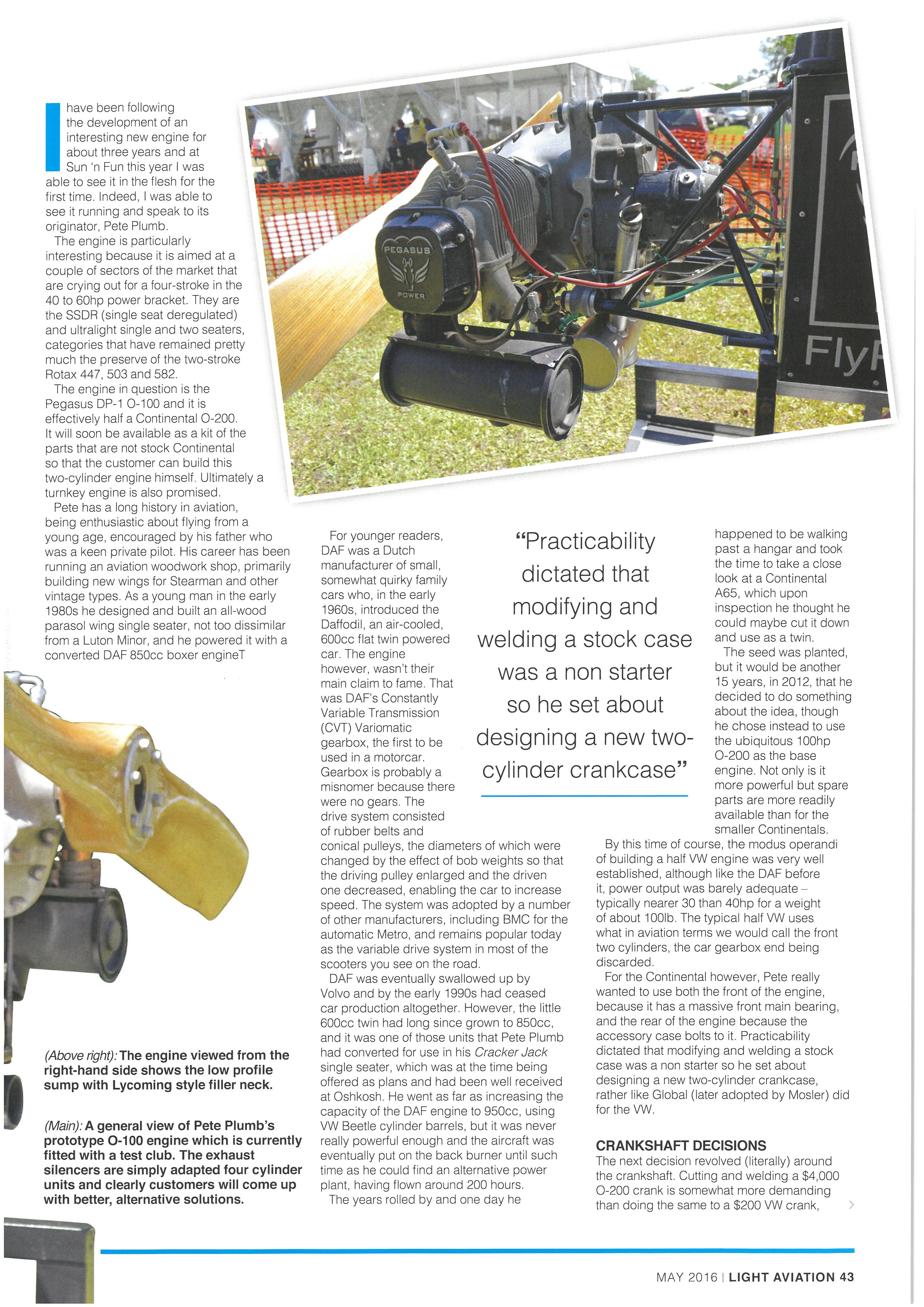
(Aboveright):The engine viewed from the right-hand side shows the low profile sump with Lycoming style filler neck.
(Main):Ageneralviewof PetePlumb’s prototype O-100 engine which is currently fitted with a test club. The exhaust silencers are simply adapted four cylinder units and clearly customers will come up with better, alternative solutions.
For younger readers, DAF was a Dutch manufacturer of small, somewhat quirky family cars who, in the early 1960s, introduced the Daffodil, an air-cooled, 600cc flat twin powered car. The engine however, wasn't their main claim to fame. That was DAF’s Constantly Variable Transmission (CVT) Variomatic gearbox, the first to be used in a motorcar. Gearbox is probably a misnomer because there were no gears. The drive system consisted of rubber belts and conical pulleys, the diameters of which were changed by the effect of bob weights so that the driving pulley enlarged and the driven one decreased, enabling the car to increase speed. The system was adopted by a number of other manufacturers, including BMC for the automatic Metro, and remains popular today as the variable drive system in most of the scooters you see on the road.
Theyearsrolledbyandonedayhe“Practicability dictated weldingmodifyingthatand a
stock case was anon starter so he set about designing a new two- cylinder crankcase”
DAF was eventually swallowed up by Volvo and by the early 1990s had ceased car production altogether. However, the little 600cc twin had long since grown to 850cc, and it was one of those units that Pete Plumb had converted for use in his Cracker Jack single seater, which was at the time being offered as plans and had been well received at Oshkosh. He went as far as increasing the capacity of the DAF engine to 950cc, using VW Beetle cylinder barrels, but it was never really powerful enough and the aircraft was eventually put on the back burner until such time as he could find an alternative power plant, having flown around 200 hours.
happened to be walking past a hangar and took the time to take a close look at a Continental A65, which upon inspection he thought he could maybe cut it down and use as a twin.
The seed was planted, but it would be another 15 years, in 2012, that he decided to do something about the idea, though he chose instead to use the ubiquitous 100hp O-200 as the base engine. Not only is it more powerful but spare parts are more readily available than for the smaller Continentals.
By this time of course, the modus operandi of building a half VW engine was very well established, although like the DAF before it, power Outputwas barely adequate typically nearer 30 than 40hp for a weight of about 100lb. The typical half VW uses what in aviation terms we would call the front two cylinders, the car gearbox end being discarded.
For the Continental however, Pete really wanted to use both the front of the engine, because it has a massive front main bearing, and the rear of the engine because the accessory case bolts to it. Practicability dictated that modifying and welding a stock case was anon starter so he set about designing a new two-cylinder crankcase, rather like Global (later adopted by Mosler) did for the VW.
The next decision revolved (literally) around the crankshaft. Cutting and welding a $4,000 O-200 crank is somewhat more demanding than doing the same to a $200 VW crank,
and besides, Pete wasn’t happy with the weight of the standard rods and pistons. After a lot of research he decided to go for a purpose designed ADI (austempered ductile iron) crank with Carrillo H-beam rods and forged 9:1 high compression pistons (standard compression ratio is 7:1). The crank is statically balanced by a large circular centre flange and dynamically balanced by fixed weights on the prop flange and crankshaft gear (which bolts onto the accessory end of the shaft.
The engine mounts locations are as standard Continental, but the mounting rubbers will not be the Lord type which the O-200 uses. They are costly and allow more movement than the older and considerably cheaper, conical style rubbers of the earlier engines.
The standard Continental accessory case bolts onto the back of the crankcase, allowing magnetos to be driven in the normal way or perhaps use of the self generating E-mag electronic units or triggering devices for other electronic systems. An alternator and/or starter could also be fitted, although for many applications weight would probably preclude such luxuries.
The standard gear-type oil pump is used and any Continental sump from the A65 to the O-200 can be fitted. Pete has designed a low profile sump, which holds just under three litres of oil, and this will be offered as an option.
Carburetion is taken care of by a cast twocylinder version of the Continental spider manifold which bolts to the crankcase joint flange and accepts a Marvel Schebler MA-2 carburettor. Initially Pete fitted a Zenith carb, as fitted to the Great Plains VW conversions,
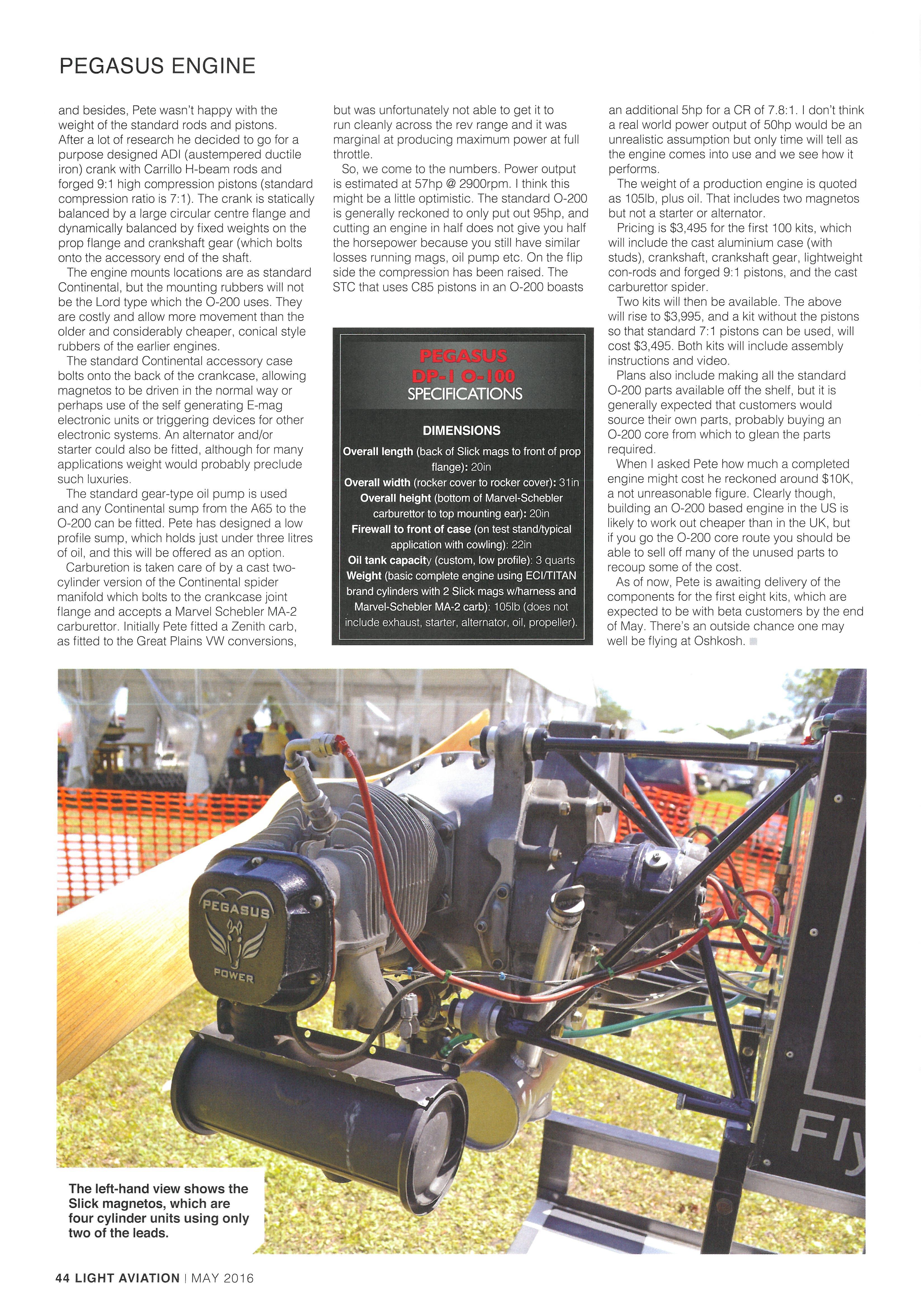
but was unfortunately not able to get it to run cleanly across the rev range and it was marginal at producing maximum power at full throttle.
So, we come to the numbers. Power output is estimated at 57hp @2900rpm. | think this mightbealittle optimistic.ThestandardO-200 is generally reckoned to only put out 95hp, and cutting an engine in half does not give you half the horsepower because you still have similar losses running mags, oil pump etc. On the flip side the compression has been raised. The STC that uses C85 pistons in an O-200 boasts
DiP= |] O=]O9 SPECIFICATIONS
DIMENSIONS
Overall length (back of Slick mags to front of prop flange): 20in
Overall width (rocker cover to rocker cover): 31in
Overall height (bottom of Marvel-Schebler carburettor to top mounting ear): 20in
Firewall to front of case (on test stand/typical application with cowling): 22in
Oil tank capacity (custom, low profile): 3 quarts
Weight (basic complete engine using ECI/TITAN brand cylinders with 2 Slick mags w/harness and Marvel-Schebler MA-2 carb): 105lb (does not include exhaust, starter, alternator, oil, propeller).
an additional 5hp for a CR of 7.8:1. | don’t think a real world power output of 50hp would be an unrealistic assumption but only time will tell as the engine comes into use and we see how it performs.
The weight of a production engine is quoted as 105lb, plus oil. That includes two magnetos but not a starter or alternator.
Pricing is $3,495 for the first 100 kits, which will include the cast aluminium case (with studs), crankshaft, crankshaft gear, lightweight con-rods and forged 9:1 pistons, and the cast carburettor spider.
Two kits will then be available. The above will rise to $3,995, and a kit without the pistons so that standard 7:1 pistons can be used, will cost $3,495. Both kits will include assembly instructions and video.
Plans also include making all the standard O-200 parts available off the shelf, but it is generally expected that customers would source their own parts, probably buying an O-200 core from which to glean the parts required.
When | asked Pete how much a completed engine might cost he reckoned around $10k, a not unreasonable figure. Clearly though, building an O-200 based engine in the US is likely to work out cheaper than in the UK, but if you go the O-200 core route you should be able to sell off many of the unused parts to recoup some of the cost.
As of now, Pete is awaiting delivery of the components for the first eight kits, which are expected to be with beta customers by the end of May. There’s an outside chance one may well be flying at Oshkosh.

ThismonthweofferyouthechancetovisitBeverleynearHull,EasterAirfieldinScotland,Leicesterand StittlesFarmnearLichfield.Allabsolutelyfreeof charge.Someofthe ladsat our strip in Kenthavestarted anewgamewheretheytry to useallfour vouchersinasingleday they'llbestrugglingthismonth!Enjoy your visitsandpleasethankthe operatorsfor their generosityand,if possible,usethe airfields’facilities

E
SittlesFarmisnearLichfieldinStaffordshireandis only please) at Sittles Farm in
you will also rec website.www.sittlesflyers.co.uk.

here are those that say Lady Luck is what wins you an air race but most will say it’s good training and experience and that is exactly what our race school training will give you.
These days the school is a one-day course split into two main sections; the first being a morning long briefing session based on Skysport UK's training manual. Now much refined since it came into being 1996, when | was asked to create the course for the Royal Aero Club's Records, Racing and Rally Association, it contains everything a newcomer needs to know, complete with all the paperwork needed for association membership and the essential Air Racing Licence from the Federation Aeronautique Internationale.
Usually a one-day training school is a one-toone situation. Its first session can last up to two hours as we work our way through all the safety and procedural rules, such as height keeping, race datums and low flying, referring to the ANO where it applies. This also includes racing numbers, insurance requirements, and how we apply the GPS system to our form of racing.
Using maps and diagrams, we also discuss typical race course layouts plus the use of scatter and turning points markers etc. There is also an outline of race finishing heights and the various exceptions granted by the CAA, eg overtaking. This information is presented using an extremely effective Powerpoint presentation accompanied with hard copy maps.
The session is completed with a detailed analysis of the primary phases of a racing turn:
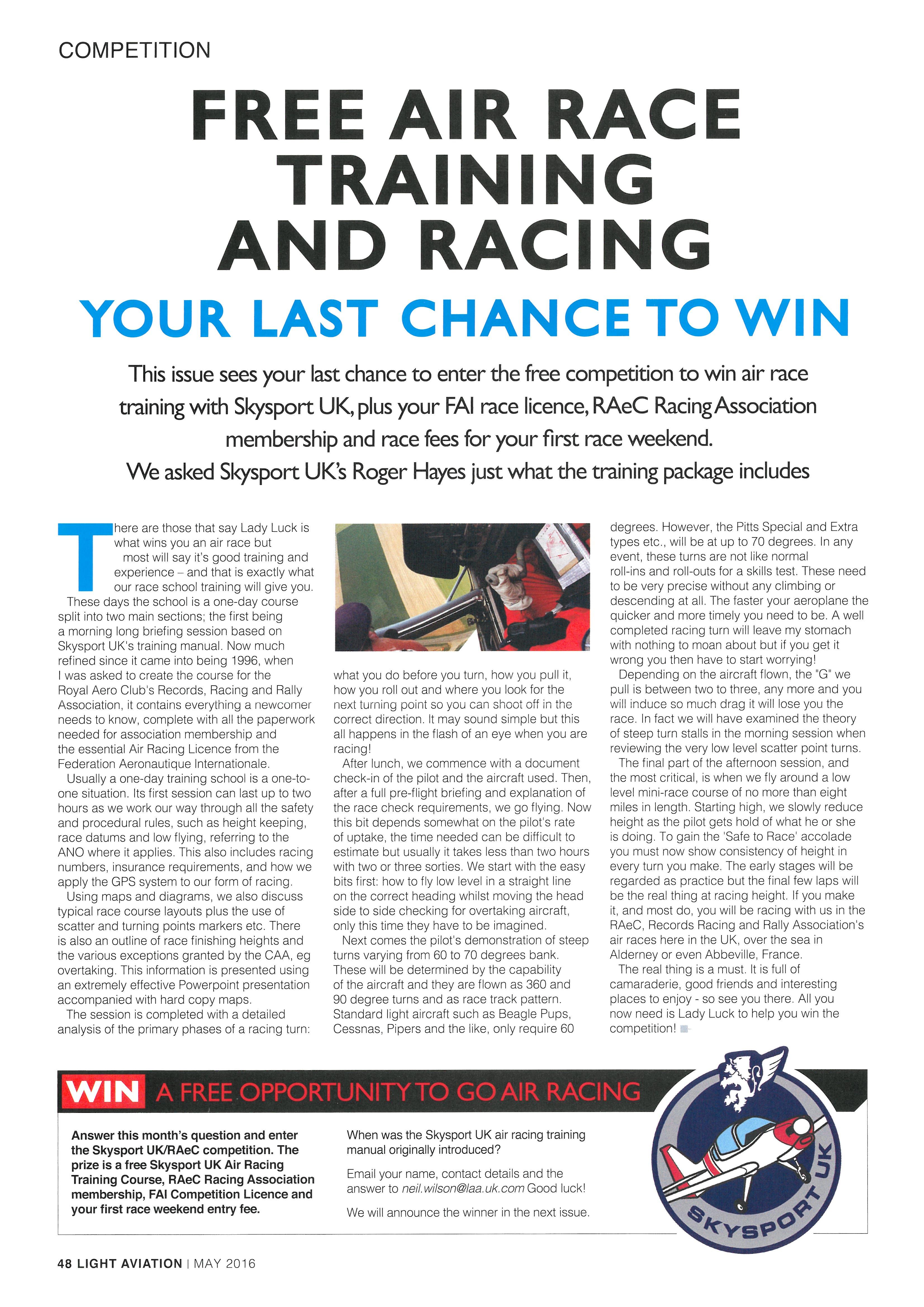
Answer this month’s question and enter the Skysport UK/RAeC competition. The prize is a free Skysport UK Air Racing Training Course, RAeC Racing Association membership, FAl Competition Licence and your first race weekend entry fee.
what you do before you turn, how you pull it, how you roll out and where you look for the next turning point so you can shoot off in the correct direction. It may sound simple but this all happens in the flash of an eye when you are racing!
After lunch, we commence with a document check-in of the pilot and the aircraft used. Then, after a full pre-flight briefing and explanation of the race check requirements, we go flying. Now this bit depends somewhat on the pilot's rate of uptake, the time needed can be difficult to estimate but usually it takes less than two hours with two or three sorties. We start with the easy bits first: how to fly low level in a straight line on the correct heading whilst moving the head side to side checking for overtaking aircraft, only this time they have to be imagined. Next comes the pilot's demonstration of steep turns varying from 60 to 70 degrees bank. These will be determined by the capability of the aircraft and they are flown as 360 and 90 degree turns and as race track pattern. Standard light aircraft such as Beagle Pups, Cessnas, Pipers and the like, only require 60
When was the Skysport UK air racing training manual originally introduced?
Email your name, contact details and the answer to neil.wilson@laa.uk.com Good luck!
We will announce the winner in the next issue.
degrees. However, the Pitts Special and Extra types etc., will be at up to 70 degrees. In any event, these turns are not like normal roll-ins and roll-outs for a skills test. These need to be very precise without any climbing or descending at all. The faster your aeroplane the quicker and more timely you need to be. A well completed racing turn will leave my stomach with nothing to moan about but if you get it wrong you then have to start worrying!
Depending on the aircraft flown, the "G"we pull is between two to three, any more and you will induce so much drag it will lose you the race. In fact we will have examined the theory of steep turn stalls in the morning session when reviewing the very low level scatter point turns.
The final part of the afternoon session, and the most critical, is when we fly around a low level mini-race course of no more than eight miles in length. Starting high, we slowly reduce height as the pilot gets hold of what he or she is doing. To gain the 'Safe to Race’ accolade you must now show consistency of height in every turn you make. The early stages will be regarded as practice but the final few laps will be the real thing at racing height. If you make it, and most do, you will be racing with us in the RAeC, Records Racing and Rally Association's air races here in the UK, over the sea in Alderney or even Abbeville, France.
The real thing is a must. It is full of camaraderie, good friends and interesting places to enjoy - so see you there. All you now need is Lady Luck to help you win the competition!

WithMalcolmMcBride
Engineer
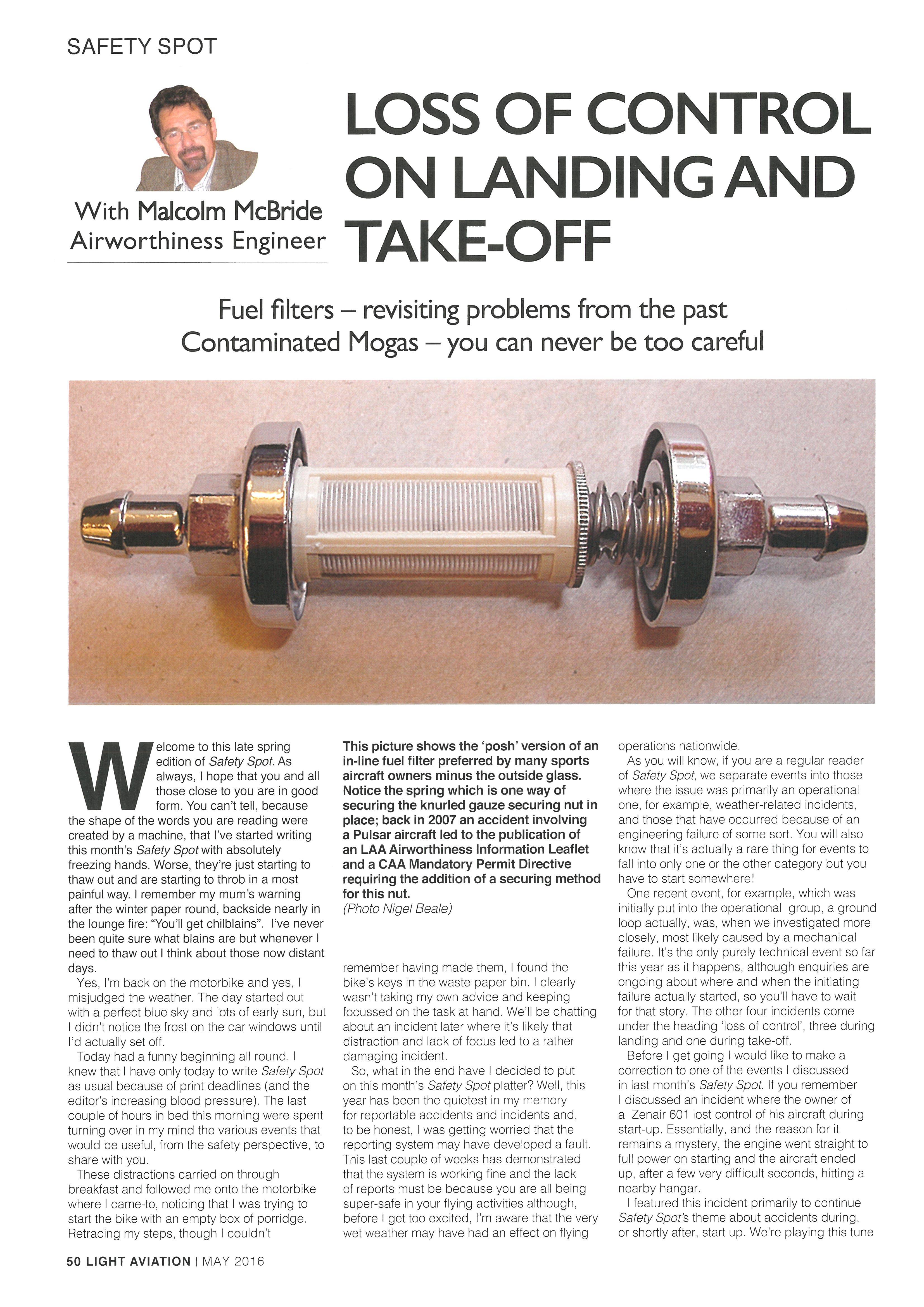
elcome to this late spring edition of Safety Spot. As always, | hope that you and all those close to you are in good form. You can’t tell, because the shape of the words you are reading were created by a machine, that I’ve started writing this month’s Safety Spot with absolutely freezing hands. Worse, they’re just starting to thaw out and are starting to throb in a most painful way. | remember my mum’s warning after the winter paper round, backside nearly in the lounge fire: “You'll get chilblains”. I’ve never been quite sure what blains are but whenever | need to thaw out | think about those now distant days.
Yes, I’m back on the motorbike and yes, | misjudged theweather.The day started out with a perfect blue sky and lots of early sun, but | didn’t notice the frost on the car windows until I'd actually set off.
Todayhadafunnybeginningallround. | knew that | have only today to write Safety Spot as usual because of print deadlines (and the editor's increasing blood pressure). The last couple of hours in bed this morning were spent turning over in my mind the various events that would be useful, from the safety perspective, to share with you.
These distractions carried on through breakfast and followed me onto the motorbike where | came-to, noticing that | was trying to start the bike with an empty box of porridge. Retracing my steps, though | couldn't
This picture shows the ‘posh’version of an in-line fuel filter preferred by many sports aircraft owners minus the outside glass. Noticethe spring which is one way of securing the knurled gauze securing nut in place; back in 2007 an accident involving a Pulsar aircraft led to the publication of an LAA Airworthiness Information Leaflet and a CAA Mandatory Permit Directive requiring the addition of a securing method for this nut.
(Photo Nigel Beale)
remember having made them, | found the bike’s keys in the waste paper bin. | clearly wasn’t taking my own advice and keeping focussed on the task at hand. We'll be chatting about an incident later where it’s likely that distraction and lack of focus led to a rather damaging incident.
So, what in the end have | decided to put on this month’s Safety Spot platter? Well, this year has been the quietest in my memory for reportable accidents and incidents and, to be honest, | was getting worried that the reportingsystemmayhavedevelopedafault. This last couple of weeks has demonstrated that the system is working fine and the lack of reports must be because you are all being super-safe in your flying activities although, before | get too excited, I’m aware that the very wet weather may have had an effect on flying
operations nationwide.
As you will know, if you are a regular reader of Safety Spot, we separate events into those where the issue was primarily an operational one, for example, weather-related incidents, and those that have occurred because of an engineering failure of some sort. You will also know that it’s actually a rare thing for events to all into only one or the other category but you have to start somewhere!
One recent event, for example, which was initially put into the operational group, a ground oop actually, was, when we investigated more closely, most likely caused by a mechanical ailure. It’s the only purely technical event so far his year as it happens, although enquiries are ongoing about where and when the initiating ailure actually started, so you'll have to wait or that story. The other four incidents come under the heading ‘loss of control’, three during anding and one during take-off.
Before | get going | would like to make a correction to one of the events | discussed in last month’s Safety Spot. If you remember discussed an incident where the owner of a Zenair 601 lost control of his aircraft during start-up. Essentially, and the reason for it remains a mystery, the engine went straight to full power on starting and the aircraft ended up, after a few very difficult seconds, hitting a nearby hangar.
| featured this incident primarily to continue Safety Spot's theme about accidents during, or shortly after, start up. We're playing this tune
These pictures show the filter element itself and were taken in2010afteritwasdiscoveredto havecaused a ‘significant’ restriction in fuel flow in a Europa aircraft. On this particular occasion no harm was done because the pilot elected to do a precautionary landing to find out why the engine was losing power. Another more recent problem with this type of filter, this time with a Zenair aircraft is discussed in the text.
(Photo Malcolm McBride)
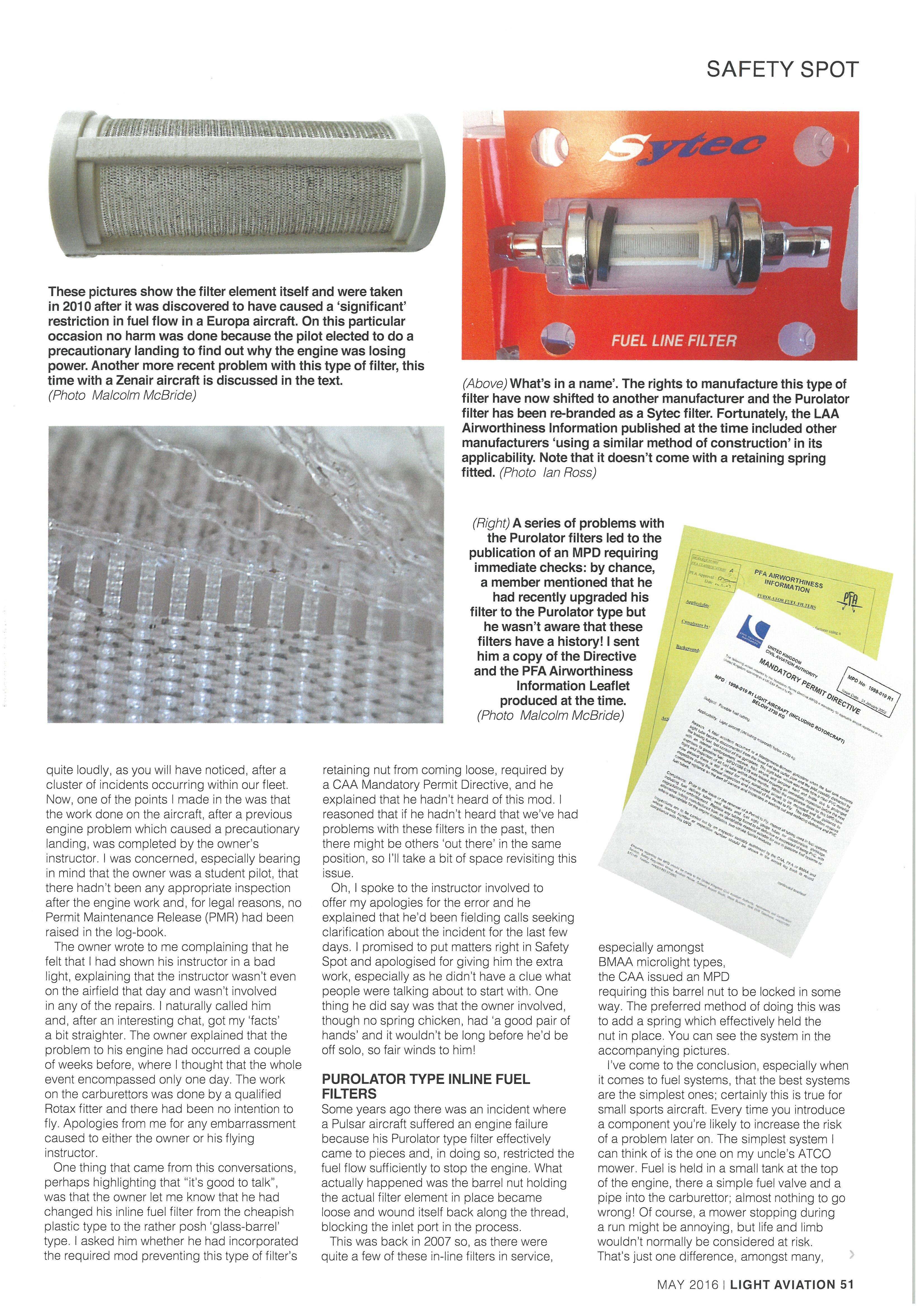
(Above) What’s in a name’. The rights to manufacturethis type of filter have now shifted to another manufacturer and the Purolator filter has been re-branded as a Sytec filter. Fortunately, the LAA Airworthiness Information published at the time included other manufacturers ‘using a similar method of construction’in its applicability. Note that it doesn’t come with a retaining spring fitted. (Photo lan Ross)
(Right)A series of problems with the Purolator filters led to the publication of an MPD requiring
quite a few of these in-linefiltersimmediateinservice,checks: by chance, a member mentioned that he had recently upgraded his filter to the Purolatortype but he wasn’t aware that these filters have a history! | sent him a copy of the Directive and the PFAAirworthiness Information Leaflet produced at the time. (Photo Malcolm McBride)
quite loudly, as you will have noticed, after a cluster of incidents occurring within our fleet. Now, one of the points | made in the was that he work done on the aircraft, after a previous engine problem which caused a precautionary anding, was completed by the owner’s instructor. | was concerned, especially bearing inmindthattheownerwasa studentpilot,that there hadn't been any appropriate inspection after the engine work and, for legal reasons, no Permit Maintenance Release (PMR) had been raised in the log-book.
The owner wrote to me complaining that he elt that | had shown his instructor in a bad ight, explaining that the instructor wasn’t even on the airfield that day and wasn’t involved in any of the repairs. | naturally called him and, after an interesting chat, got my ‘facts’ a bit straighter. The owner explained that the problem to his engine had occurred a couple of weeks before, where | thought that the whole event encompassed only one day. The work on the carburettors was done by a qualified Rotax fitter and there had been no intention to fly. Apologies from me for any embarrassment caused to either the owner or his flying instructor.
One thing that came from this conversations, perhaps highlighting that “it’s good to talk”, was that the owner let me know that he had changed his inline fuel filter from the cheapish plastic type to the rather posh ‘glass-barrel’ type. | asked him whether he had incorporated the required mod preventing this type of filter’s
retaining nut from coming loose, required by a CAA Mandatory Permit Directive, and he explained that he hadn't heard of this mod. | reasoned that if he hadn't heard that we’ve had problems with these filters in the past, then there might be others ‘out there’ inthe same position, so I'll take a bit of space revisiting this issue.
Oh, | spoke to the instructor involved to offer my apologies for the error and he explained that he’d been fielding calls seeking Clarification about the incident for the last few days. | promised to put matters right in Safety Spot and apologised for giving him the extra work, especially as he didn’t have a clue what people were talking about to start with. One thing he did say was that the owner involved, though no spring chicken, had ‘a good pair of hands’ and it wouldn't be long before he’d be off solo, so fair winds to him!
Some years ago there was an incident where a Pulsar aircraft suffered an engine failure because his Purolator type filter effectively came to pieces and, in doing so, restricted the fuel flow sufficiently to stop the engine. What actually happened was the barrel nut holding the actual filter element in place became loose and wound itself back along the thread, blocking the inlet port in the process.
This was back in 2007 so, as there were
especially amongst BMAA microlight types, the CAA issued an MPD requiring this barrel nut to be locked in some way. The preferred method of doing this was to add a spring which effectively held the nut in place. You can see the system in the accompanying pictures.
I've come to the conclusion, especially when it comes to fuel systems, that the best systems are the simplest ones; certainly this is true for small sports aircraft. Every time you introduce a component you're likely to increase the risk of a problem later on. The simplest system | can think of is the one on my uncle’s ATCO mower. Fuel is held in a small tank at the top of the engine, there a simple fuel valve and a pipe into the carburettor; almost nothing to go wrong! Of course, a mower stopping during a run might be annoying, but life and limb wouldn't normally be considered at risk. That’s just one difference, amongst many,
between my uncle’s ATCO and an aeroplane. Nearly ten years have passed since this first incident with the Purolator in-line filter and, on the whole, though fuel system issues feature large in our book of engine failure reasons, we haven't recorded another incident where this type of filter has failed.
| have featured a another historic picture showing a problem that sat at the heart of a reduction in power suffered by a Europa pilot because the filter became clogged by microparticles. A reminder that these tuppenny items are best changed on a regular basis. This filter had been cleaned many times before but as you can see, much of the collected debris, almost too small to see, remained in the filter’s weave even after cleaning.
| have also featured a picture showing a problem with a plastic filter. Again, the failure of this very cheap item cost the owner of this engine bundles. Naturally, I’ve sent a copy of the MPD about the Purolator type filter to our Zenair owner, we don’t want his engine to cause a problem on his first solo now do we!
| used to fly a powered hang-glider, sometimes quite large distances, and generally | used to have a 20 litre jerry can full of two-stroke situated in a space behind my back. The extra fuel extended my range and the can acted as a perfect backrest for the otherwise rather uncomfortable basic seat. | remember thinking that | should really get around to plumbing a fuel valve into the aircraft's fuel system so that | could top-up the main tank in the air. In my mind’s eye | recall thinking that I'd just need a smallfuelpump,avalveanda bitoffuelpipe. | never did get around to it, | think for two reasons. One, |’m not that keen on complex fuel systems on simple aircraft and two, well, it was quite fun landing in a field, often miles from anywhere, to refuel the main tank and to take a comfort break. Whilst | think about it, and though my fingers are working fine again now, the short stop often offered the opportunity for a warm up!
Bearing in mind the above, you will
understandthat|smiledtomyselfwhen|first saw amod proposal from LAA ARV Super Two flyer, Joseph Cullen, with exactly the same idea.
Joseph's plan only differed from mine in that the jerry can sat on the passenger seat next to him. Andy Draper, our design engineer, cleared Joseph’s mod during the summer last year and, to be honest, | never gave the matter another thought. That was until | received a telephone call from Joseph letting us know that he’d had an engine failure and had to force land into a field. Here’s his report.
Hi Malcolm
| am sure now that the reason for the engine failure was that it had ingested fuel that is contaminated with what looks like an oily liquid which, as you will note later on, is quite a bit heavier than petrol. You will recall from our telephone conversation that my intention on the day was an out and return flight from Eaglescott via Land’s End with no intermediate landings.
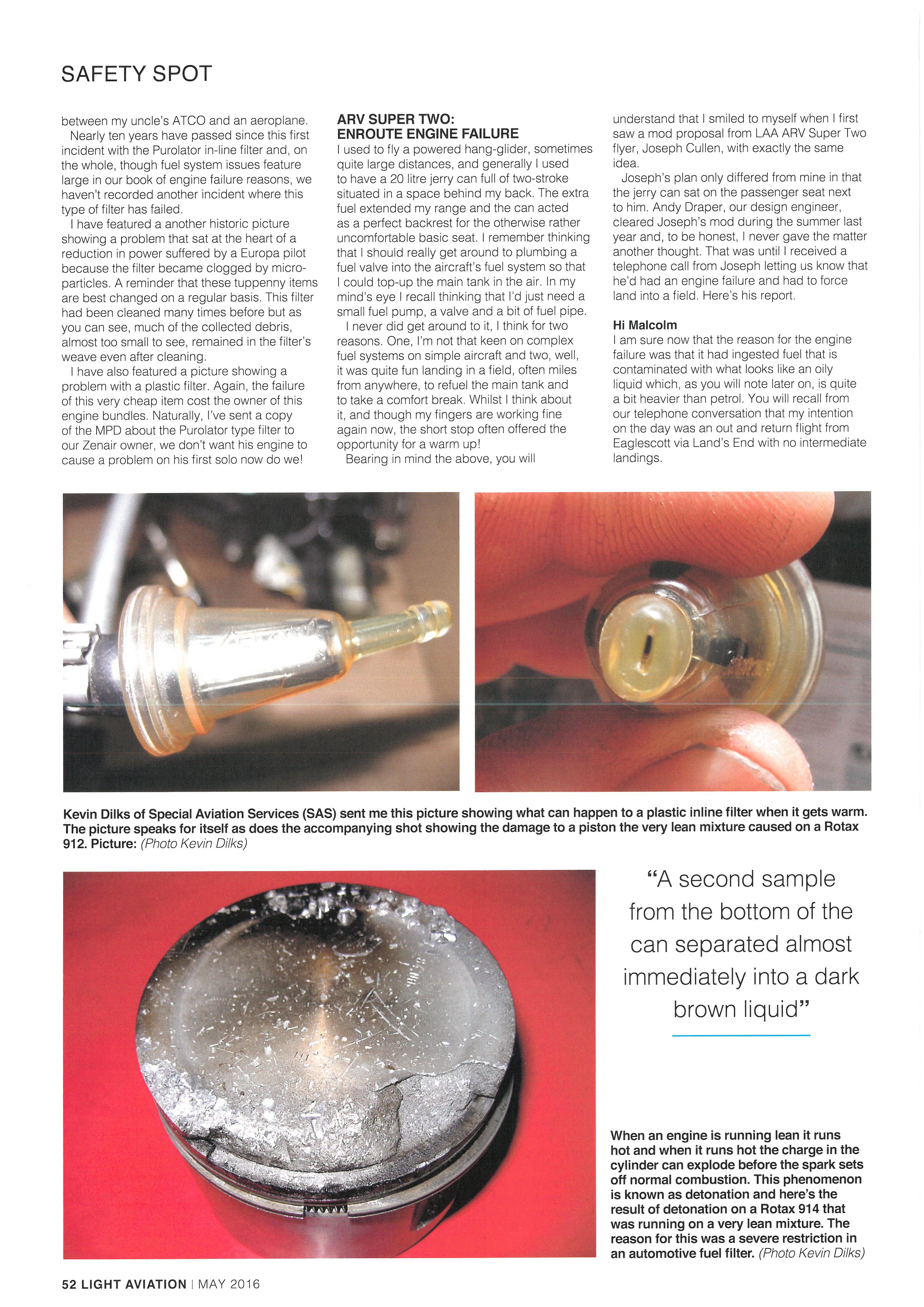
“A second sample from the bottom of the can separated almost immediately into a dark brown liquid”
When an engine is running lean it runs hot and when it runs hot the charge in the cylinder can explode before the spark sets off normal combustion. This phenomenon is known as detonation and here’s the result of detonation on a Rotax 914 that was running on a very lean mixture. The reason for this was a severe restriction in = an automotive fuel filter. (Photo Kevin Dilks)
With regard to the fuel, five NATO standard jerry cans, which will be referred to as JC1 to JC5 in order of use, were thoroughly rinsed with petrol and this petrol was disposed of into my motorcycle! The cans were filled with fuel at he local small garage. G-OTAL was prepared or flight. The aircraft's main tank, which has a capacity of 50 litres, was full and JC1 was oaded to the passenger seat and connected in accordance with my transfer tank mod. | then flew G-OTAL from Eaglescott to Fishguard via Ilfracombe and Worm’s Head and then round the Pembrokeshire coast. The auxiliary (fuel transfer) pump was started at St David’s Head and ran for 23 minutes, topping up the main fuel tank. | continued the flight via Caldey Island and Lundy Island to Hartland Point and then flew back to Eaglescott. [Sounds fabulous. MM]
After landing at Eaglescott, JC2 was emptied into the aircraft's fuel tank leaving it full at 50 itres and | put the aircraft away for the night. A few days later, G-OTAL was again prepared for flight and during this preparation
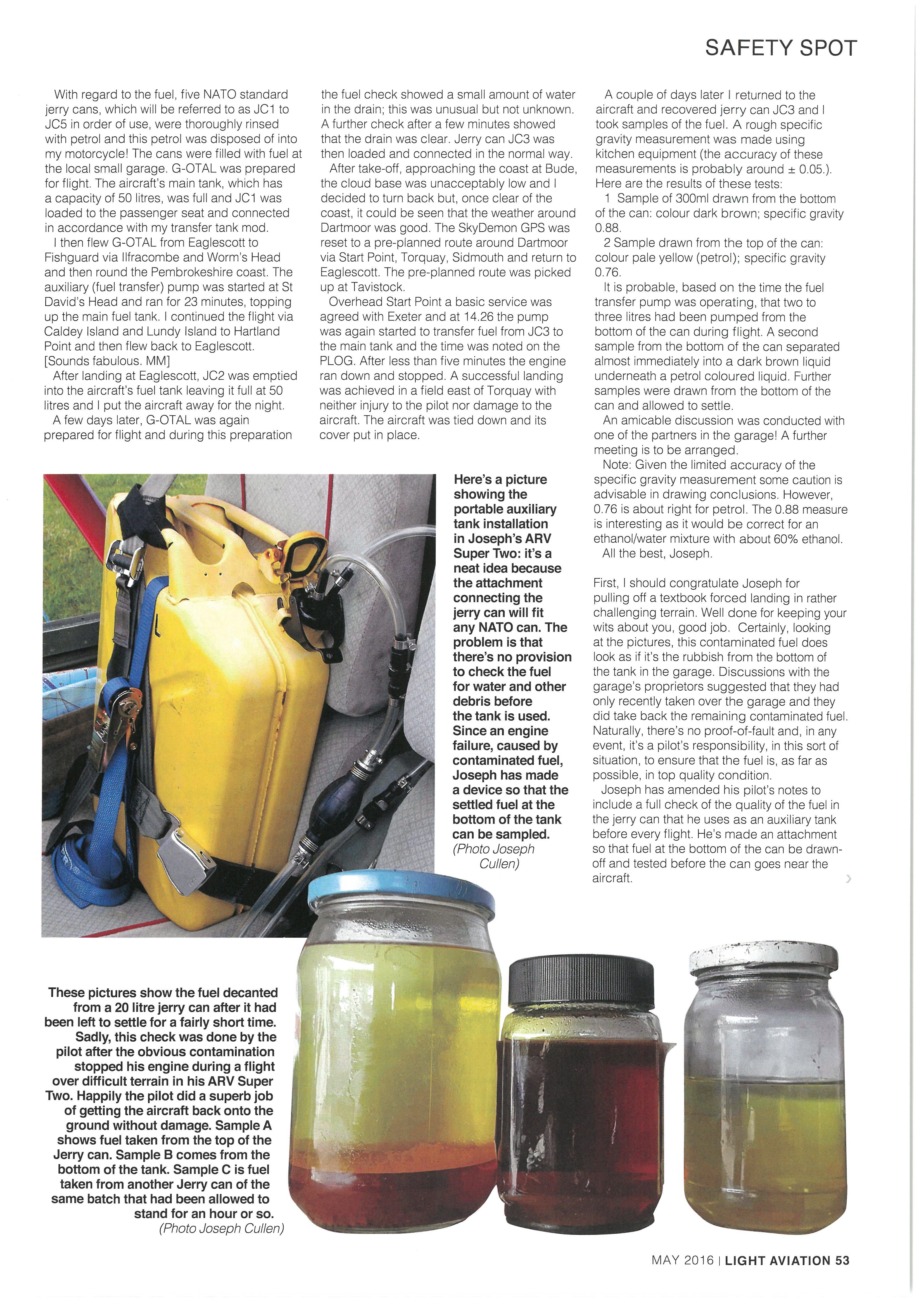
These pictures show the fuel decanted from a 20 litrejerry can after it had been left to settle for a fairly short time. Sadly, this check was done by the pilot after the obvious contamination stopped his engine during aflight over difficult terrain in his ARV Super Two. Happily the pilot did a superb job of getting the aircraft back onto the ground without damage. Sample A shows fuel taken from the top of the Jerry can. Sample B comes from the bottomofthetank.SampleC isfuel taken from another Jerry can of the same batch that had been allowed to stand for an hour or so.
(Photo
Joseph Cullen)
the fuel check showed a small amount of water in the drain; this was unusual but not unknown. A further check after a few minutes showed that the drain was clear. Jerry can JC3 was then loaded and connected in the normal way. After take-off, approaching the coast at Bude, the cloud base was unacceptably low and | decided to turn back but, once clear of the coast, it could be seen that the weather around Dartmoor was good. The SkyDemon GPSwas reset to a pre-planned route around Dartmoor via Start Point, Torquay, Sidmouth and return to Eaglescott. The pre-planned route was picked up at Tavistock.
Overhead Start Point a basic service was agreed with Exeter and at 14.26 the pump was again started to transfer fuel from JC3 to the main tank and the time was noted on the PLOG. After less than five minutes the engine ran down and stopped. A successful landing was achieved in a field east of Torquay with neither injury to the pilot nor damage to the aircraft. The aircraft was tied down and its cover put in place.
Here’s a picture showing the portable auxiliary tank installation yz inJoseph’sARV Super Two: it’s a neat idea because the attachment connecting the jerry can will fit any NATO can. The problem is that there’s no provision to check the fuel for water and other debris before the tank is used. Since an engine failure, caused by contaminated fuel, Joseph has made a device so that the settled fuel at the bottom of the tank can be sampled.
(Photo Joseph Cullen)
A couple of days later | returned to the aircraft and recovered jerry can JC3 and | took samples of the fuel. A rough specific gravity measurement was made using kitchen equipment (the accuracy of these measurements is probably around + 0.05.). Here are the results of these tests:
1 Sample of 300m! drawn from the bottom of the can: colour dark brown; specific gravity 0.88.
2 Sample drawn from the top of the can: colour pale yellow (petrol); specific gravity 0.76.
It is probable, based on the time the fuel transfer pump was operating, that two to three litres had been pumped from the bottom of the can during flight. A second sample from the bottom of the can separated almost immediately into a dark brown liquid underneath a petrol coloured liquid. Further samples were drawn from the bottom of the can and allowed to settle.
An amicable discussion was conducted with one of the partners in the garage! A further meeting is to be arranged.
Note: Given the limited accuracy of the specific gravity measurement some caution is advisable in drawing conclusions. However, 0.76 is about right for petrol. The 0.88 measure is interesting as it would be correct for an ethanol/water mixture with about 60% ethanol.
All the best, Joseph.
First, | should congratulate Joseph for pulling off a textbook forced landing in rather challenging terrain. Well done for keeping your wits about you, good job. Certainly, looking at the pictures, this contaminated fuel does look as if it’s the rubbish from the bottom of the tank in the garage. Discussions with the garage’s proprietors suggested that they had only recently taken over the garage and they did take back the remaining contaminated fuel. Naturally, there’s no proof-of-fault and, in any event, it’s a pilot's responsibility, in this sort of situation, to ensure that the fuel is, as far as possible, in top quality condition.
Joseph has amended his pilot’s notes to include a full check of the quality of the fuel in the jerry can that he uses as an auxiliary tank before every flight. He’s made an attachment so that fuel at the bottom of the can be drawnoff and tested before the can goes near the aircraft.
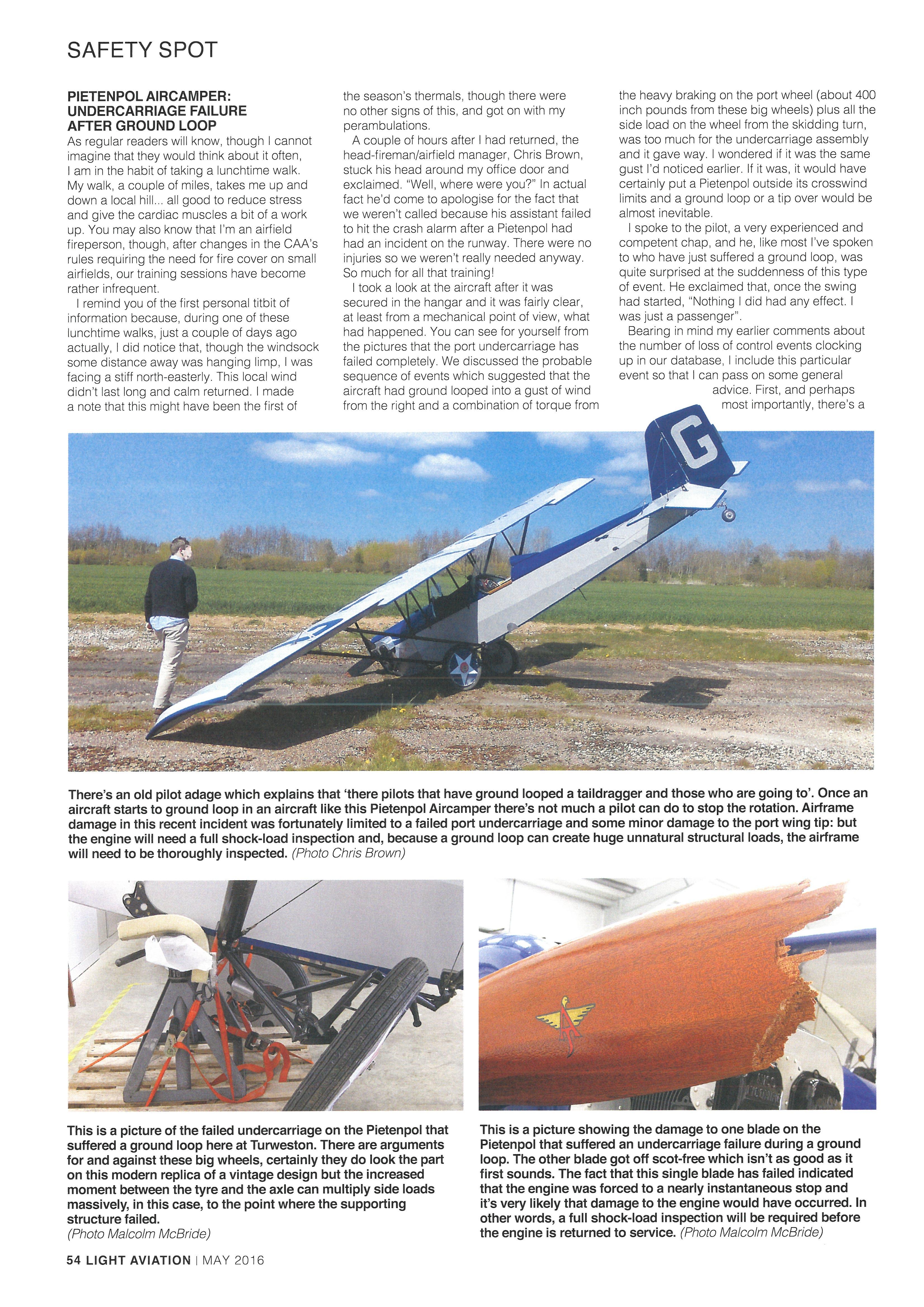
As regular readers will Know,though | cannot imagine that they would think about it often, | am in the habit of taking a lunchtime walk. My walk, a couple of miles, takes me up and down a local hill... all good to reduce stress and give the cardiac muscles a bit of a work up. You may also know that I’m an airfield fireperson, though, after changes in the CAA’s rules requiring the need for fire cover on small airfields, our training sessions have become rather infrequent.
| remind you of the first personal titbit of information because, during one of these lunchtime walks, just a couple of days ago actually, | did notice that, though the windsock some distance away was hanging limp, | was facing a stiff north-easterly. This local wind didn’t last long and calm returned. | made a note that this might have been the first of
the season’s thermals, though there were no other signs of this, and got on with my perambulations.
A couple of hours after | had returned, the head-fireman/airfield manager, Chris Brown, stuck his head around my office door and exclaimed. “Well, where were you?” In actual fact he’d come to apologise for the fact that we weren't called because his assistant failed to hit the crash alarm after a Pietenpol had had an incident on the runway. There were no injuries SOwe weren't really needed anyway. So much for all that training!
| took a look at the aircraft after it was secured in the hangar and it was fairly clear, at least from a mechanical point of view, what had happened. You can see for yourself from the pictures that the port undercarriage has failed completely. We discussed the probable sequence of events which suggested that the aircraft had ground looped into a gust of wind from the right and a combination of torque from
the heavy braking on the port wheel (about 400 inch pounds from these big wheels) plus all the side load on the wheel from the skidding turn, was too much for the undercarriage assembly and it gave way. | wondered if it was the same gust I’d noticed earlier. If it was, it would have certainly put a Pietenpol outside its crosswind limits and a ground loop or a tip over would be almost inevitable.
| spoke to the pilot, a very experienced and competent chap, and he, like most I’ve spoken to who have just suffered a ground loop, was quite surprised at the suddenness of this type of event. He exclaimed that, once the swing had started, “Nothing | did had any effect. | was just a passenger”.
Bearing in mind my earlier comments about the number of loss of control events clocking up in our database, | include this particular event so that | can pass on some general advice. First, and perhaps most importantly, there’s a
This is a picture showing the damage to one blade on the Pietenpol that suffered an undercarriage failure during a ground loop. The other blade got off scot-free which isn’t as good as it sounds. The fact that this single blade has failed indicated that the engine was forced to a nearly instantaneous stop and it’s very likely that damage to the engine would have occurred. In other words, a full shock-load inspection will be required before the engine is returned to service. (PhotoMalcolm McBride)
lesson that | learnt a long time ago and that is: “It's difficult to make a good landing out of a bad approach”. There’s often a tendency to press on regardless on an approach even when the speedis all wrong, or you're at the wrong height. Inthis case, the pilot really wanted to land on the grass but, during the approach it was occupied, so he shifted to therighta littletolandontheadjacenthard runway. Any taildragger pilot will tell you that grass is a much more forgiving landing surface, especially in an incipient ground loop situation.
The second thing that the pilot noted, during the approach, was that the previous fairly smooth flying conditions had become quite turbulent and he had to work quite hard to keep the aircraft straight. In this circumstance, and | use this experienced pilot’s own words, at least more or less his own words, “I’m kicking myself for not going around!”
It'seasytobewiseafteranevent.A PratFPag
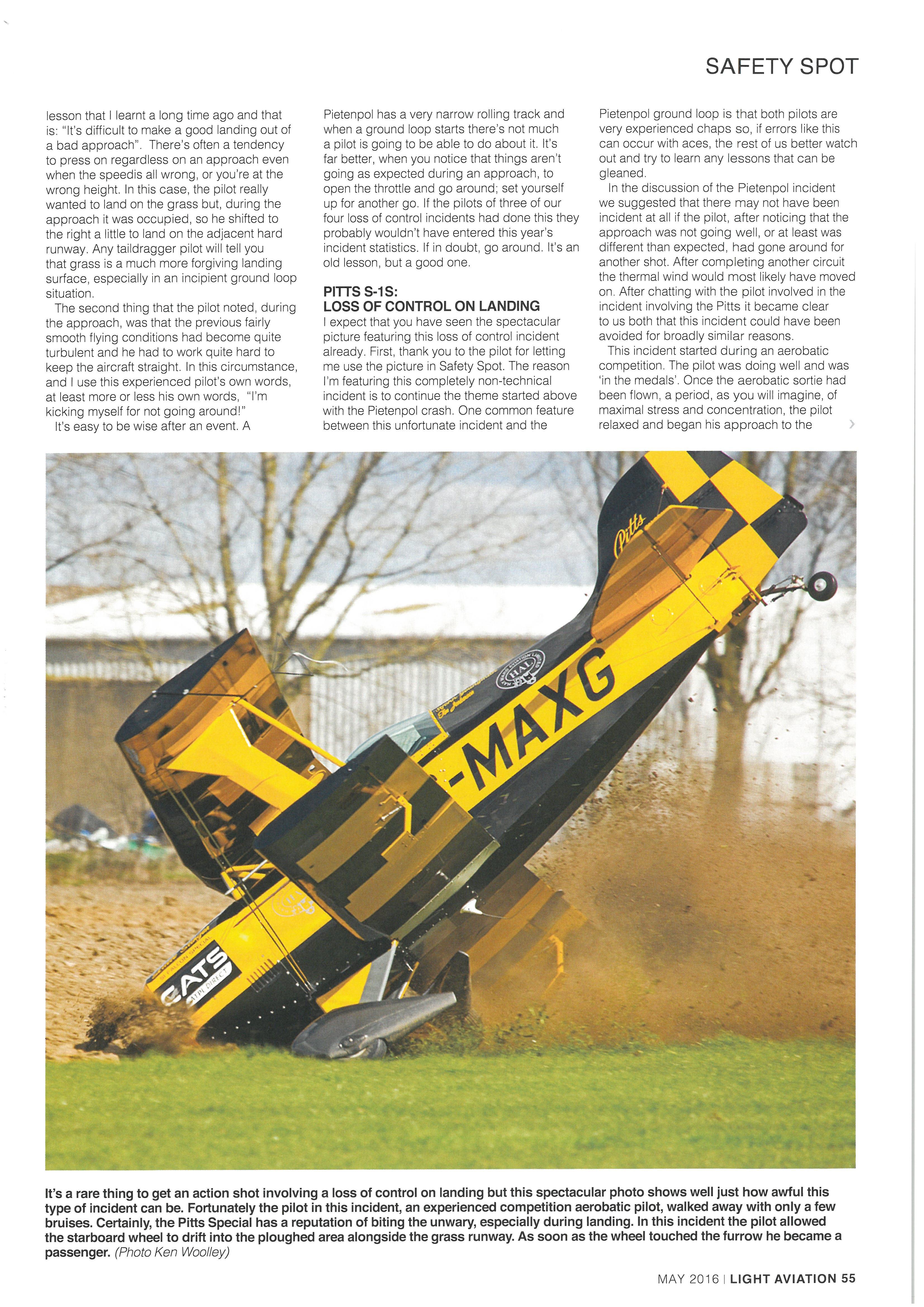
Pietenpol has a very narrow rolling track and when a ground loop starts there’s not much a pilot is going to be able to do about it. It’s far better, when you notice that things aren't going as expected during an approach, to open the throttle and go around; set yourself up for another go. If the pilots of three of our four loss of control incidents had done this they probably wouldn’t have entered this year’s incident statistics. If in doubt, go around. It’s an old lesson, but a good one.
| expect that you have seen the spectacular picture featuring this loss of control incident already. First, thank you to the pilot for letting me use the picture in Safety Spot. The reason I’m featuring this completely non-technical incident is to continue the theme started above with the Pietenpol crash. One common feature between this unfortunate incident and the
Pietenpol ground loop is that both pilots are very experienced chaps so, if errors like this can occur with aces, the rest of us better watch out and try to learn any lessons that can be gleaned.
In the discussion of the Pietenpol incident we suggested that there may not have been incident at all if the pilot, after noticing that the approach was not going well, or at least was different than expected, had gone around for another shot. After completing another circuit the thermal wind would most likely have moved on. After chatting with the pilot involved in the incident involving the Pitts it became clear to us both that this incident could have been avoided for broadly similar reasons.
This incident started during an aerobatic competition. The pilot was doing well and was ‘in the medals’. Once the aerobatic sortie had been flown, a period, as you will imagine, of maximal stress and concentration, the pilot relaxed and began his approach to the
airfield. In his mind was the knowledge that he hadmadeatiny errorinoneofthemanoeuvres and he was itching to discuss this with his chums on the ground - had they noticed? As he turned final he was annoyed to find that there was an Auster on the runway, so he had to go around for another go. His mind, not fully on the job at hand, after all he had completed his mission, perhaps not well enough to be considered perfect, but...
As he lined-up for the second attempt he was confronted with another delay, another aircraft was on final. This time he elected to slow right down, carrying out slow S turns and a few sideslips until, at last, the runway was clear ahead. Itwas a busy time but all this flying was routine and, because of the near refractory period (a technical word often used in another context) after flying a complex aerobatic mission, his mind wasn’t fully engaged. As he lared for the round-out he didn’t notice, until it was too late, that the aircraft had gently drifted oOthe right; the rest, as they say, is history.
We get an awful lot of loss of control incidents. In my view, admittedly with the benefit of hindsight, quite a few of them could have been avoided had the pilot taken time oOremember that it is always a good idea to ully engage and totally focus during all critical phases of flight, however routine the landing or ake-off and recognise quickly when things are going wrong. Never be embarrassed to have another go. Fair winds.
picture on the right was taken by one member who wishes to remain anonymous. Naturally the picture was sent to the Chief Inspector so that he could take a look at the engineering management of this particular aircraft more closely. The picture on the far right shows a rather neater bit of work.
(Photo Malcolm McBride)
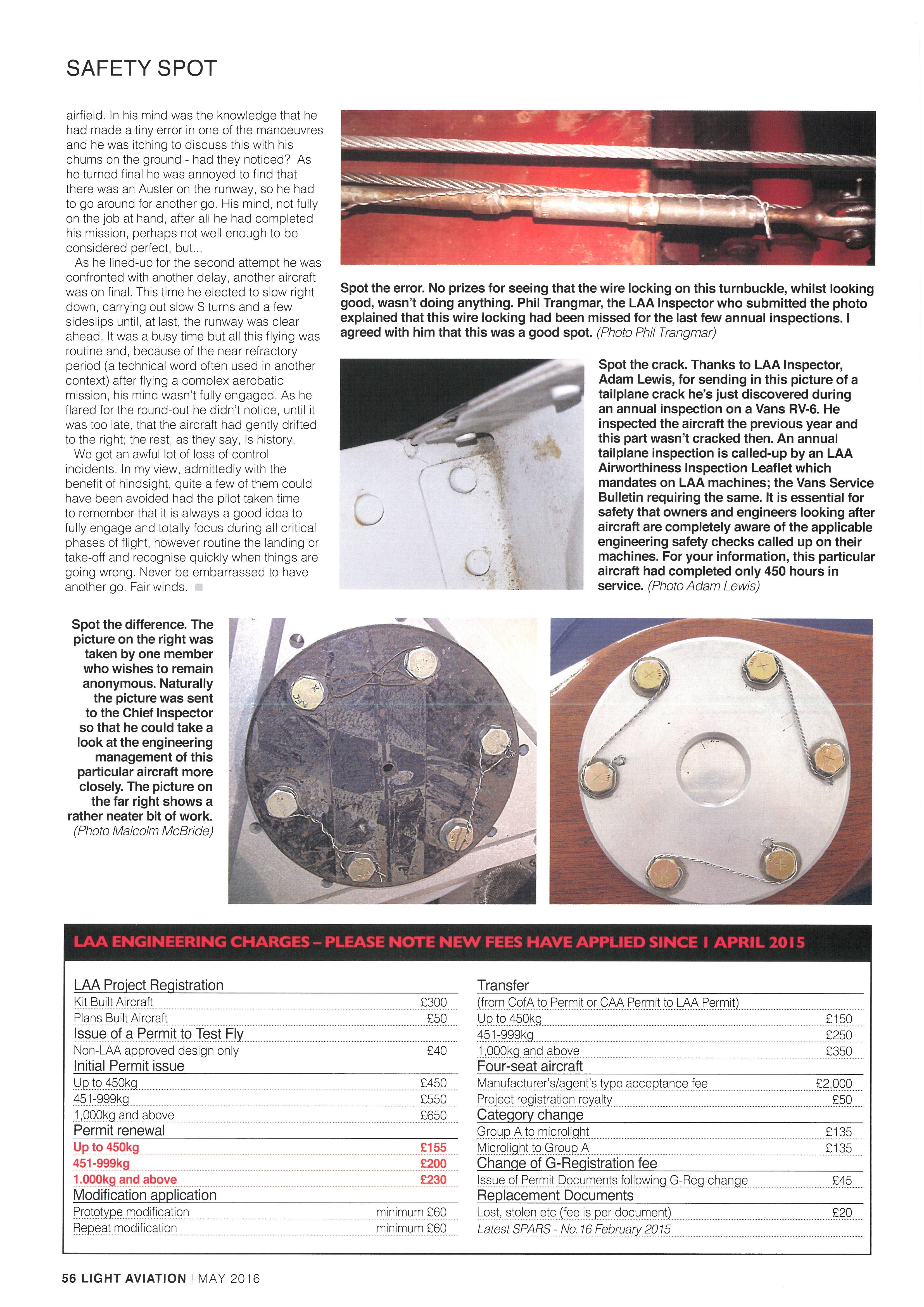
Spot the crack. Thanks to LAA Inspector, Adam Lewis, for sending in this picture of a tailplane crack he’s just discovered during an annual inspection on a Vans RV-6. He inspected the aircraft the previous year and this part wasn’t cracked then. An annual tailplane inspection is called-up by an LAA Airworthiness Inspection Leaflet which mandates on LAA machines; the Vans Service Bulletin requiring the same. It is essential for safety that owners and engineers looking after aircraft are completely aware of the applicable engineering safety checks called up on their machines. For your information, this particular aircraft had completed only 450 hours in service. (PhotoAdam Lewis)

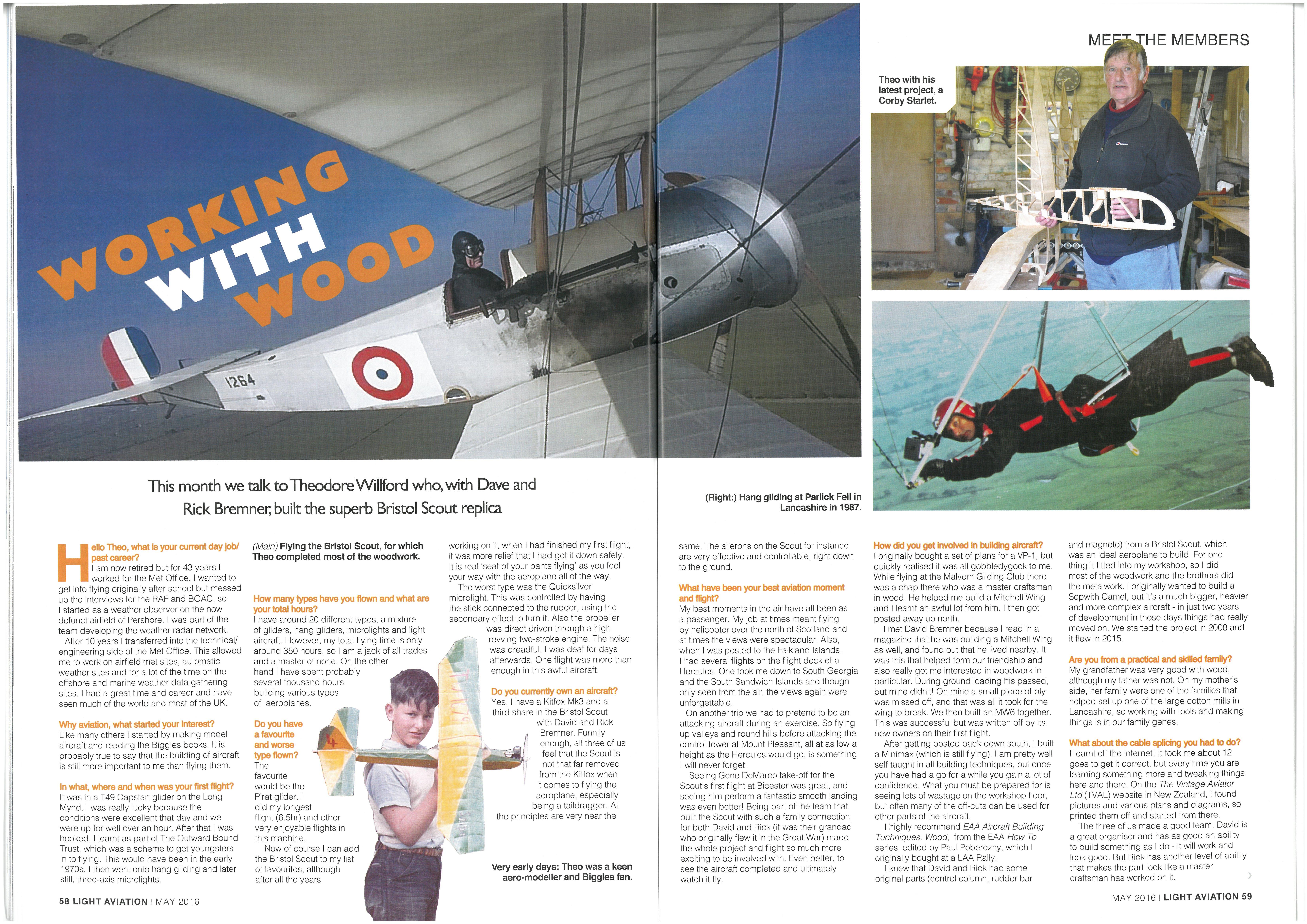
| am now retired but for 43 years | worked for the Met Office. | wanted to get into flying originally after school but messed up the interviews for the RAF and BOAC, so | started as a weather observer on the now defunct airfield of Pershore. | was part of the team developing the weather radar network.
After 10 years | transferred into the technical/ engineering side of the Met Office. This allowed me to work on airfield met sites, automatic weathersitesandfora lotofthetimeonthe offshore and marine weather data gathering sites. | had a great time and career and have seen much of the world and most of the UK.
Like many others | started by making model aircraft and reading the Biggles books. It is probably true to say that the building of aircraft is still more important to me than flying them.
t was in a T49 Capstan glider on the Long Mynd. | was really lucky because the conditions were excellent that day and we were up for well over an hour. After that | was hooked. | learnt as part of The Outward Bound Trust, which was a scheme to get youngsters in to flying. This would have been in the early 1970s, | then went onto hang gliding and later still, three-axis microlights.
(Main) Flying the Bristol Scout, for which Theo completed most of the woodwork.
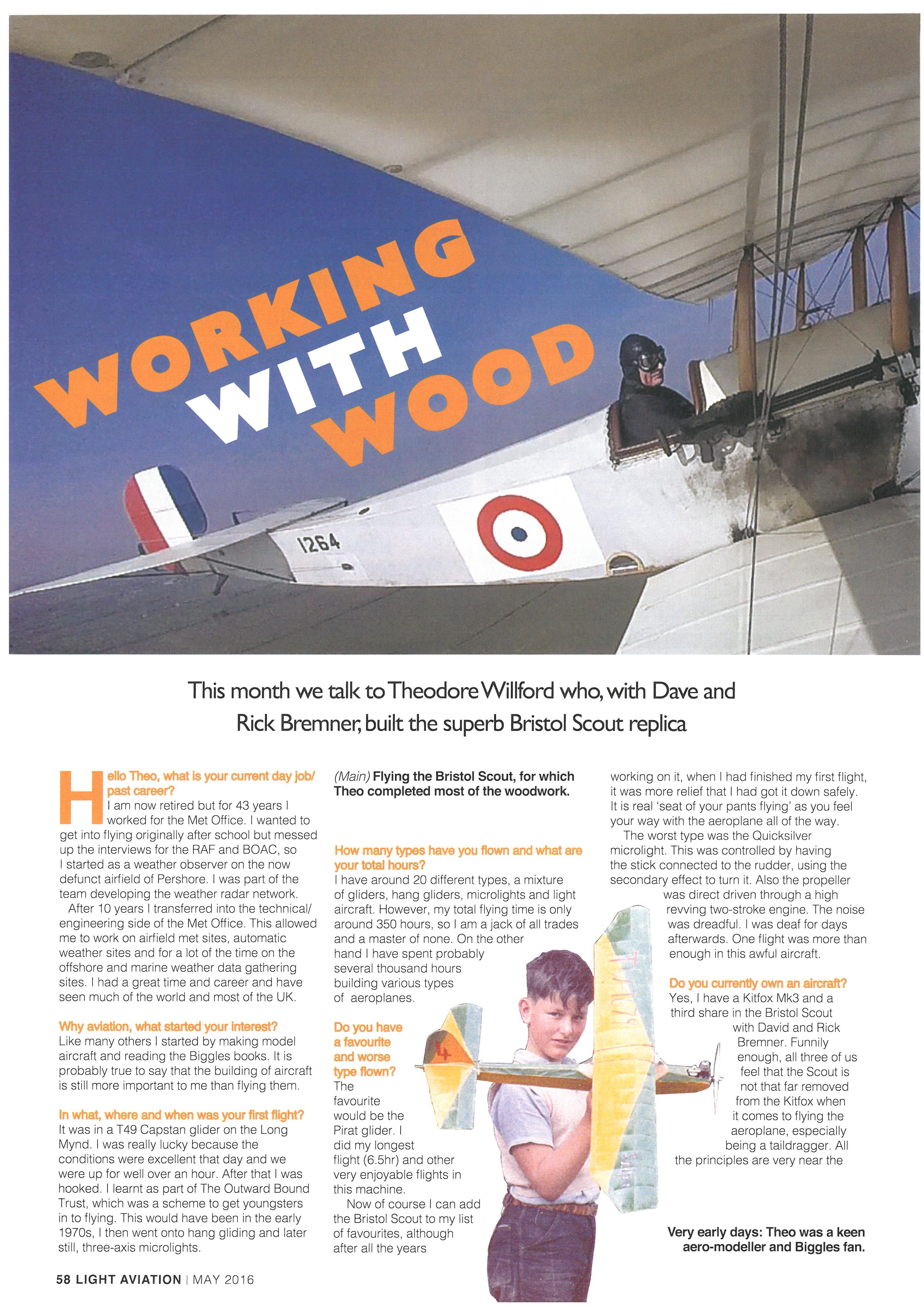
| have around 20 different types, a mixture of gliders, hang gliders, microlights and light aircraft. However, my total flying time is only around 350 hours, so | am a jack of all trades and a master of none. On the other hand | have spent probably several thousand hours building various types of aeroplanes. The favourite would be the qs Pirat glider. | _—— did my longest flight (6.5hr) and other very enjoyable flights in this machine.
Now of course | can add the Bristol Scout to my list of favourites, although after all the years
working on it, when | had finished my first flight, it was more relief that | had got it down safely. It is real ‘seat of your pants flying’ as you feel your way with the aeroplane all of the way. The worst type was the Quicksilver microlight. This was controlled by having the stick connected to the rudder, using the secondary effect to turn it. Also the propeller was direct driven through a high “ revving two-stroke engine. The noise was dreadful. | was deaf for days afterwards. One flight was more than “enough inthis awfulaircraft.
Yes, | have a Kitfox Mk3 and a third share in the Bristol Scout with David and Rick Bremner. Funnily enough, all three of us feel that the Scout is not that far removed from the Kitfox when it comes to flying the aeroplane, especially being a taildragger. All the principles are very near the
Very early days: Theo was a keen aero-modeller and Biggles fan.
same. The ailerons on the Scout for instance are very effective and controllable, right down to the ground.
What have been your best aviation moment andflight?
My best moments in the air have all been as a passenger. My job at times meant flying by helicopter over the north of Scotland and at times the views were spectacular. Also, when | was posted to the Falkland Islands, | had several flights on the flight deck of a Hercules. One took me down to South Georgia and the South Sandwich Islands and though only seen from the air, the views again were unforgettable.
On another trio we had to pretend to be an attacking aircraft during an exercise. So flying up valleys and round hills before attacking the control tower at Mount Pleasant, all at as low a height as the Hercules would go, is something | will never forget.
Seeing Gene DeMarco take-off for the Scout's first flight at Bicester was great, and seeing him perform a fantastic smooth landing was even better! Being part of the team that built the Scout with such a family connection for both David and Rick (it was their grandad who originally flew it in the Great War) made the whole project and flight so much more exciting to be involved with. Even better, to see the aircraft completed and ultimately watch it fly.
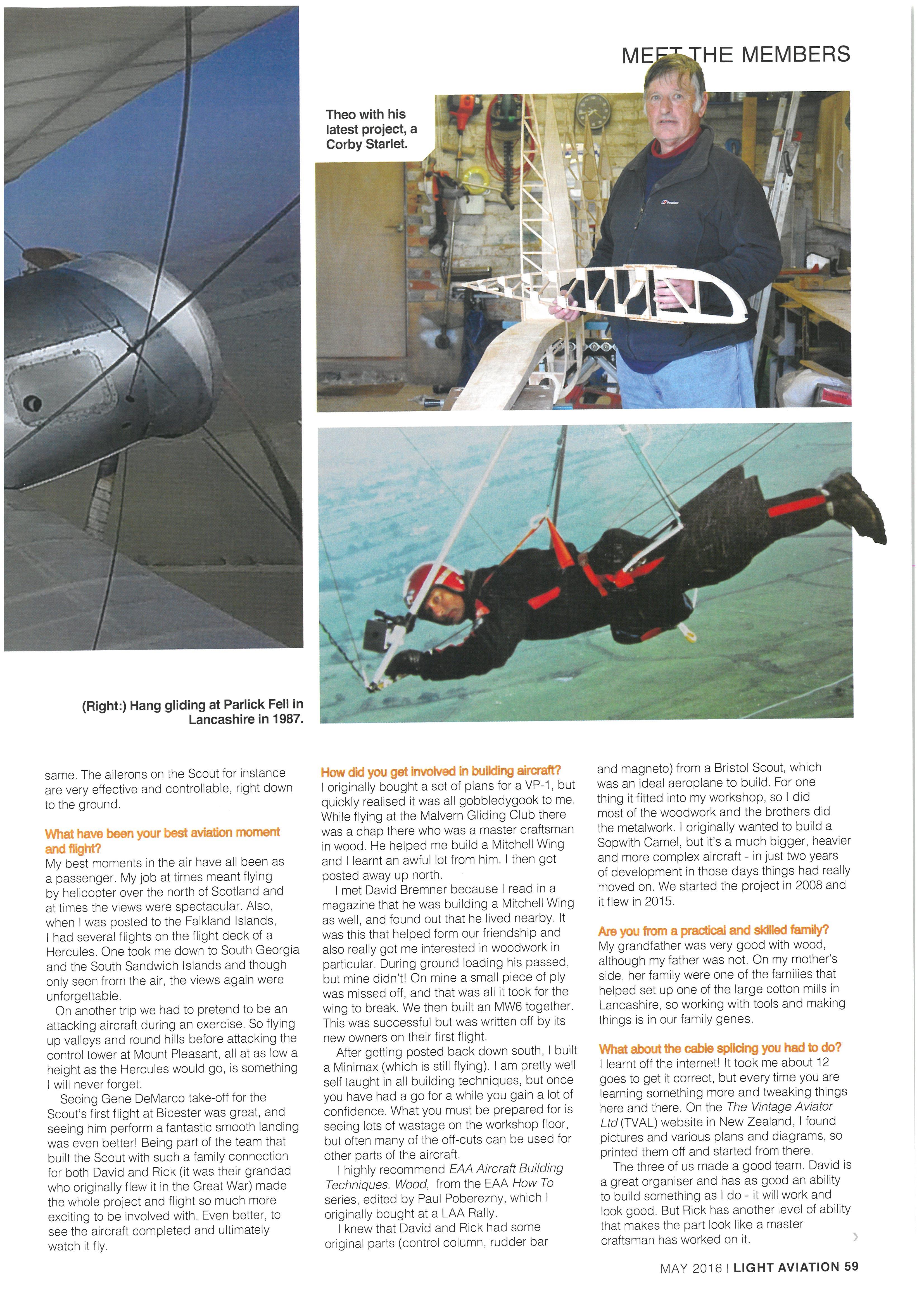
How did you get involved in building aircraft? | originally bought a set of plans for a VP-1, but quickly realised it was all gobbledygook to me. While flying at the Malvern Gliding Club there was a chap there who was a master craftsman in wood. He helped me build a Mitchell Wing and | learnt an awful lot from him. | then got posted away up north.
|metDavidBremnerbecause|readina magazine that he was building a Mitchell Wing as well, and found out that he lived nearby. It was this that helped form our friendship and also really got me interested in woodwork in particular. During ground loading his passed, but mine didn’t! On mine a small piece of ply was missed off, and that was all it took for the wing to break. We then built an MW6 together. This was successful but was written off by its new owners on their first flight.
After getting posted back down south, | built a Minimax (which is still flying). | am pretty well self taught in all building techniques, but once youhavehadagoforawhileyougain a lotof confidence. What you must be prepared for is seeing lots of wastage on the workshop floor, but often many of the off-cuts can be used for other parts of the aircraft.
| highly recommend EAA Aircraft Building Techniques. Wood, from the EAA How To series, edited by Paul Poberezny, which | originally bought at a LAA Rally.
| knew that David and Rick had some original parts (control column, rudder bar
and magneto) from a Bristol Scout,which was an ideal aeroplane to build. For one thing it fitted into my workshop, so | did most of the woodwork and the brothers did the metalwork. | originally wanted to build a Sopwith Camel, but it’s a much bigger, heavier and more complex aircraft - in just two years of development in those days things had really moved on. We started the project in 2008 and it flew in 2015.
Areyou from a practicaland skilledfamily?
My grandfather was very good with wood, although my father was not. On my mother’s side, her family were one of the families that helped set up one of the large cotton mills in Lancashire, so working with tools and making things is in our family genes.
What about the cable splicing you had to do?
| learnt off the internet! It took me about 12 goes to get it correct, but every time you are learning something more and tweaking things here and there. On the The Vintage Aviator Ltd (TVAL)website in New Zealand, | found pictures and various plans and diagrams, so printed them off and started from there.
The three of us made a good team. David is a great organiser and has as good an ability to build something as | do -it will work and look good. But Rick has another level of ability that makes the part look like a master craftsman has worked on it.
Do you have other non-aviation hobbies/ interests?
| am interested in military history and am fascinated by the small factors which could swing a battle one way or another, very often against the odds. Science fiction and deep space astronomy interest me and | would love to journey out to the stars.
Do you have any aviation heroes?
Louis Strange’s life story | find fascinating. | live only a short distance from where he was brought up and can see the field where he and his brother used to land their aeroplanes during WW1 when they visited their parents. He had a most fantastic and interesting life including flying and living through both wars. Put his name in Wikipedia, and it tells his story very well.
Pierre Clostermann’s book, The Big Show, covering fighter operations in the second half of WW2 also helped to get me interested, both in history and flying.
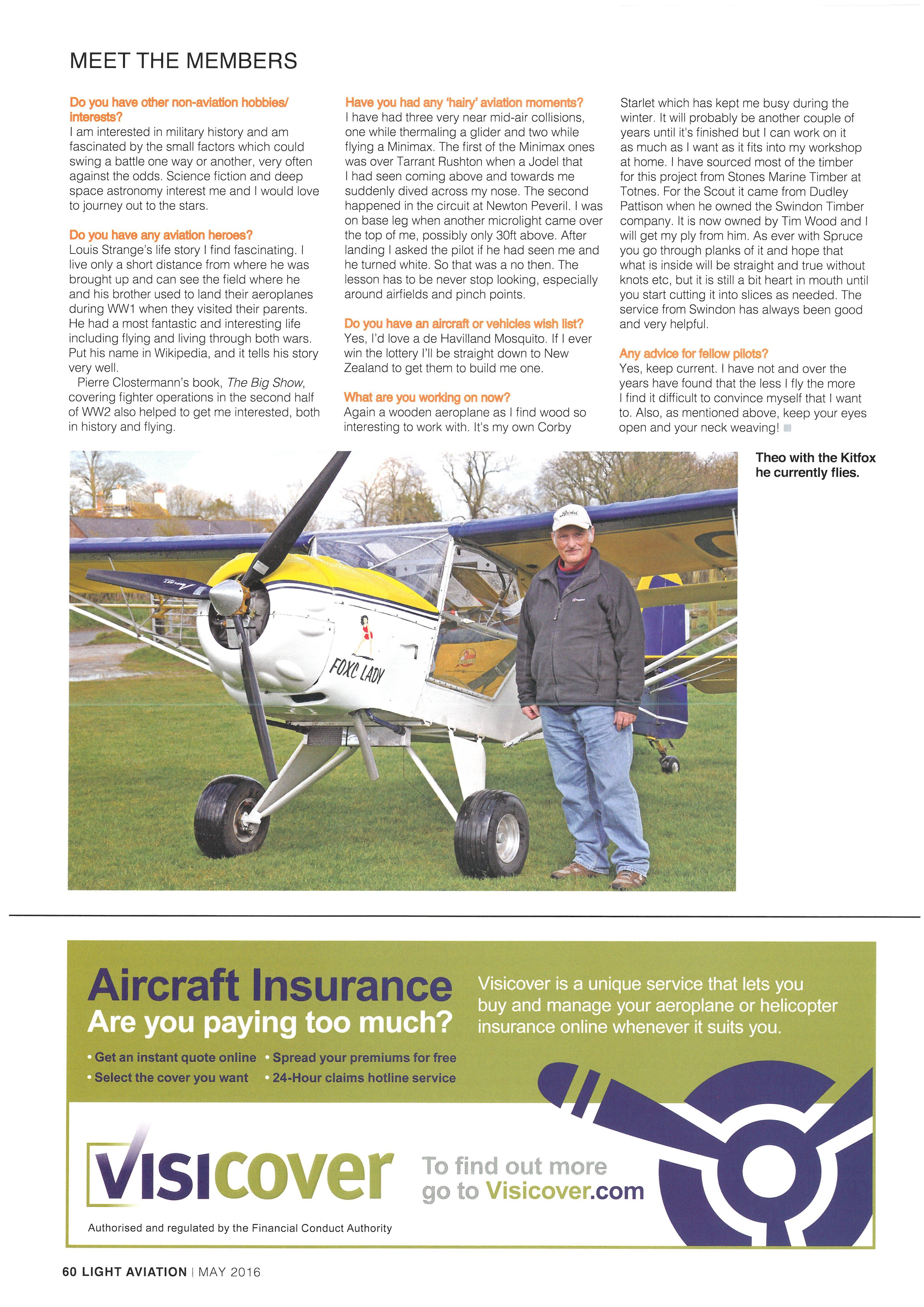
Haveyou had any ‘hairy’aviation moments? | have had three very near mid-air collisions, one while thermaling a glider and two while flying a Minimax. The first of the Minimax ones was over Tarrant Rushton when a Jodel that | had seen coming above and towards me suddenly dived across my nose. The second happened in the circuit at Newton Peveril. | was on base leg when another microlight came over the top of me, possibly only 30ft above. After landing | asked the pilot if he had seen me and he turned white. So that was a no then. The lesson has to be never stop looking, especially around airfields and pinch points.
Do you have an aircraft or vehicles wish list?
Yes, I'd love a de Havilland Mosquito. If | ever win the lottery I'll be straight down to New Zealand to get them to build me one.
Whatareyouworkingon now?
Again a wooden aeroplane as | find wood so interesting to work with. It's my own Corby
Starlet which has kept me busy during the winter. It will probably be another couple of years until it's finished but | can work on it as much as | want as it fits into my workshop at home. | have sourced most of the timber for this project from Stones Marine Timber at Totnes. Forthe Scout it came from Dudley Pattison when he owned the Swindon Timber company. It is now owned by Tim Wood and | will get my ply from him. As ever with Spruce you go through planks of it and hope that what is inside will be straight and true without knots etc, but it is still a bit heart in mouth until you start cutting it into slices as needed. The service from Swindon has always been good and very helpful.
Any advicefor fellow pilots?
Yes, keep current. | have not and over the years have found that the less | fly the more | find it difficult to convince myself that | want to. Also, as mentioned above, keep your eyes open and your neck weaving!
am informed by m’'learned friends that there is a legal term dating back to Shakespearean times, which describes “when the law is an ass”, as when a law is created which defies all logic to such an extent that it is ridiculed by a significant proportion of the populace. Sadly, the phrase came to mind when, a few weeks ago, the CAA issued a new revision to CAP 403 Flying Displays and Special Events: A Guide to Safety andAaministrative Arrangements; the CAA’s ‘pible' for air display organisers and pilots. lt was natural that the CAA would need to do something in the aftermath of last year’s Shoreham air display tragedy, and although some may disagree, the tightening up on air display and aircrew authorisations and the associated increase in charges to cover the additional audit requirements and administration - while burdensome and initially poorly executed, are at least logical.
However, the new revision has also significantly increased the distance between spectators and the display line, with the margin for slower aircraft being increased from 50 to 150 metres, or 230 metres if doing aerobatics. Aircraft with a speed of greater than 300 knots will be required to display a minimum of 450 metres from the crowd. This is both illogical and, given the lessons learned from Shoreham, potentially more rather than less dangerous.
Aside from the obvious reduction in spectacle, which particularly affects display aircraft being operated by LAA members (some aircraft like Pitts Specials will be all but a dot on the horizon) it has negative safety implications too. Positioning the display line further away from paying spectators (none of whom have been impacted in the past six decades) will increase the risk of an off-airfield accident, as tragically happened at Shoreham. Worse still, the more distant spectacle may encourage rather than discourage people from viewing the displays from outside the official (safe) spectator areas.
In another bizarrely illogical move it seems that the CAA’s previous policy of allowing an airfield a blanket exemption from the Rule 5 low flying element of the rules of the air allowing practice displays to be carried out, has now beenrevoked.Thatmeans a pilotordisplay team must now apply for and pay a £220 fee, merely to practice their display in private.
Given that pilot currency is regarded as one of the key display safety concerns, how does this impediment line up with the CAA’s
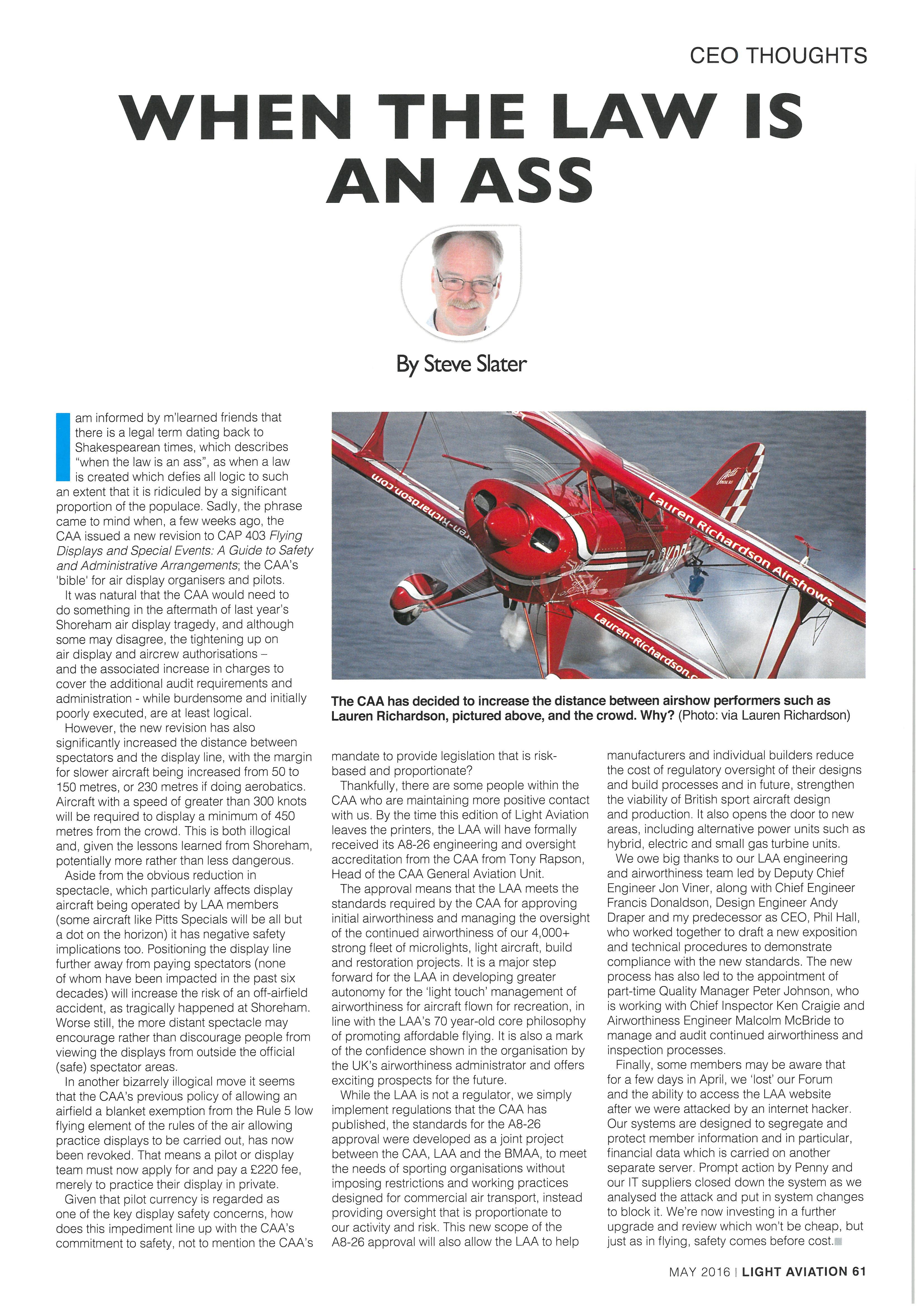
mandate to provide legislation that is riskbased and proportionate?
Thankfully, there are some people within the CAA who are maintaining more positive contact with us. By the time this edition of Light Aviation leaves the printers, the LAA will have formally received its A8-26 engineering and oversight accreditation from the CAA from Tony Rapson, Head of the CAA General Aviation Unit.
The approval means that the LAA meets the standards required by the CAA for approving initial airworthiness and managing the oversight of the continued airworthiness of our 4,000+ strong fleet of microlights, light aircraft, build and restoration projects. It is a major step forward for the LAA in developing greater autonomy for the ‘light touch’ management of airworthiness for aircraft flown for recreation, in line with the LAA’s 70 year-old core philosophy of promoting affordable flying. It is also a mark of the confidence shown in the organisation by the UK’s airworthiness administrator and offers exciting prospects for the future.
While the LAA is not a regulator, we simply implement regulations that the CAA has published, the standards for the A8-26 approval were developed as a joint project between the CAA, LAA and the BMAA, to meet the needs of sporting organisations without imposing restrictions and working practices designed for commercial air transport, instead providing oversight that is proportionate to our activity and risk. This new scope of the A8-26 approval will also allow the LAA to help
manufacturers and individual builders reduce the cost of regulatory oversight of their designs and build processes and in future, strengthen the viability of British sport aircraft design and production. It also opens the door to new areas, including alternative power units such as hybrid, electric and small gas turbine units. We owe big thanks to our LAA engineering and airworthiness team led by Deputy Chief Engineer Jon Viner, along with Chief Engineer Francis Donaldson, Design Engineer Andy Draper and my predecessor as CEO, Phil Hall, who worked together to draft a new exposition and technical procedures to demonstrate compliance with the new standards. The new process has also led to the appointment of part-time Quality Manager PeterJohnson, who is working with Chief Inspector Ken Craigie and Airworthiness Engineer Malcolm McBride to manage and audit continued airworthiness and inspection processes.
Finally, some members may be aware that for a few days in April, we ‘lost’ our Forum and the ability to access the LAA website after we were attacked by an internet hacker. Our systems are designed to segregate and protect member information and in particular, financial data which is carried on another separate server. Prompt action by Penny and our IT suppliers closed down the system as we analysed the attack and put in system changes to block it. We're now investing in a further upgrade and review which won't be cheap, but just as in flying, safety comes before cost.
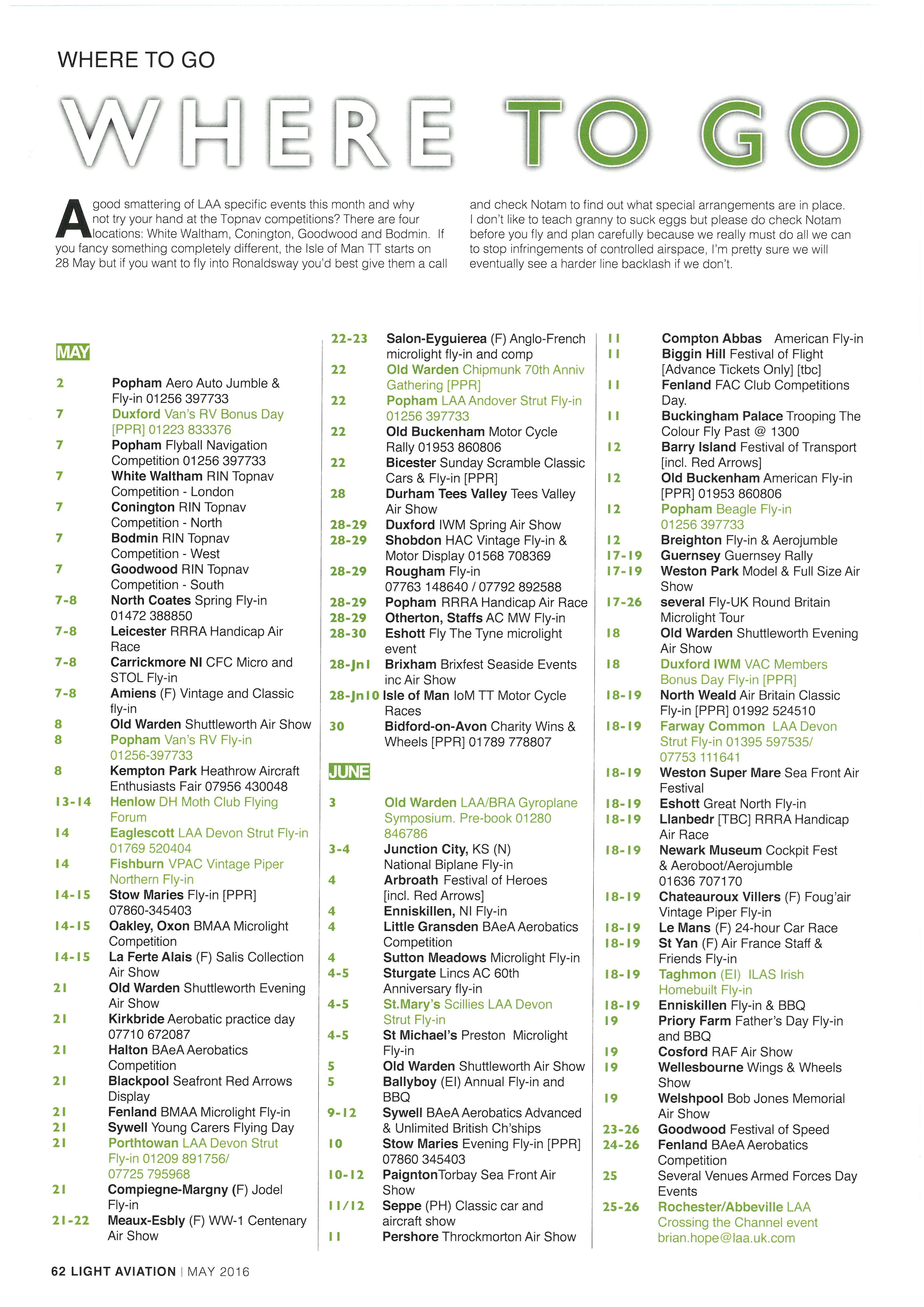
and check Notam to find out what special arrangements are in place. | don't like to teach granny to suck eggs but please do check Notam before you fly and plan carefully because we really must do all we can to stop infringements of controlled airspace, I’m pretty sure we will eventually see a harder line backlash if we don't.
Salon-Eyguierea (F)Anglo-French microlight fly-in and comp
Old Warden Chipmunk 70th Anniv Gathering [PPR]
Popham LAA Andover Strut Fly-in 01256 397733
Old Buckenham Motor Cycle Rally 01953 860806
Bicester Sunday Scramble Classic Cars & Fly-in [PPR]
Durham Tees Valley Tees Valley Air Show
Duxford IWM Spring Air Show
Shobdon HAC Vintage Fly-in & Motor Display 01568 708369
Rougham Fly-in
07763 148640 / 07792 892588
Popham RRRA Handicap Air Race
Otherton, Staffs AC MW Fly-in
Eshott Fly The Tyne microlight event
Brixham Brixfest Seaside Events inc Air Show 28-Jn10 Isle of Man loM TT Motor Cycle
Races
Bidford-on-Avon Charity Wins & Wheels [PPR] 01789 778807
Old Warden LAA/BRA Gyroplane Symposium. Pre-book 01280 846786
Junction City, KS (N) National Biplane Fly-in Arbroath Festival of Heroes [incl. Red Arrows]
Enniskillen, NI Fly-in Little Gransden BAeAAerobatics Competition
Sutton Meadows Microlight Fly-in
Sturgate Lincs AC 60th Anniversary fly-in
St.Mary’s Scillies LAA Devon Strut Fly-in
St Michael’s Preston Microlight Fly-in
Old Warden Shuttleworth Air Show
Ballyboy (El) Annual Fly-in and BBQ Sywell BAeAAerobatics Advanced & Unlimited British Ch’ships
Stow Maries Evening Fly-in [PPR] 07860 345403
PaigntonTorbay Sea FrontAir Show
Seppe (PH) Classic car and aircraft show
Pershore Throckmorton Air Show
25-26
Compton Abbas American Fly-in
Biggin Hill Festival of Flight [Advance Tickets Only] [tbc] Fenland FAC Club Competitions Day.
Buckingham Palace Trooping The Colour Fly Past @ 1300
Barry Island Festival of Transport [incl. Red Arrows]
Old Buckenham American Fly-in [PPR] 01953 860806
Popham Beagle Fly-in 01256 397733
Breighton Fly-in & Aerojumble Guernsey Guernsey Rally
Weston Park Model & Full Size Air Show
several Fly-UK Round Britain Microlight Tour
Old Warden Shuttleworth Evening Air Show
Duxford IWM VAC Members
Bonus Day Fly-in [PPR]
North Weald Air Britain Classic Fly-in [PPR] 01992 524510
Farway Common LAA Devon Strut Fly-in 01395 597535/ 07753 111641
Weston Super Mare Sea FrontAir Festival
Eshott Great North Fly-in
Llanbedr [TBC] RRRA Handicap Air Race
Newark Museum Cockpit Fest & Aeroboot/Aerojumble 01636 707170
Chateauroux Villers (F) Foug’air
Vintage Piper Fly-in
Le Mans (F) 24-hour Car Race
St Yan (F) Air France Staff & Friends Fly-in
Taghmon (El) ILAS Irish
Homebuilt Fly-in
Enniskillen Fly-in & BBQ
Priory Farm Father’s Day Fly-in and BBQ
Cosford RAF Air Show
Wellesbourne Wings & Wheels Show
Welshpool Bob Jones Memorial Air Show
Goodwood Festival of Speed Fenland BAeAAerobatics
Competition
Several Venues Armed Forces Day Events
Rochester/Abbeville LAA
Crossing the Channel event brian.hope@laa.uk.com
For all display or commercial advertising enquiries please contact Neil Wilson: 07512 773532 neil.wilson@laa.uk.com
You can email your classified advertisement direct to the LAA at the following address: sheila.hadden@laa.uk.com
Deadline for booking and copy: 19 May
Ifyou would like to place an aircraft for sale advert please see details below:
MEMBERS’ ADVERTISEMENTS
Up to 30 words: £6; 31-50 words: £12
Up to 50 words with a coloured photo: £45
NON-MEMBERS’ ADVERTISEMENTS
Up to 30 words: £22; 31-50 words: £44
Up to 50 words with a coloured photo: £60
For all classified advertising, please send using the form downloadable from the LAA website (www.laa. uk.com), together with cheques and photographs if applicable, to: LAA Classifieds Turweston Aerodrome, Nr Brackley, Northants NN13 5YD Tel: 01280 846786 Fax: 01280 846780
VAN’S RV12. Winner of two LAA awards. First permit granted Feb 2013, next renewal Nov 2016. Cruise 120kt on 20lph on mogas. Rotax 912 ULS. Dynon Skyview Touch with GPS linked to autopilot. Garmin SL40 radio, Mode S. 114 hours flown. Paint by Mick Allen. A special aircraft. £65,000. Tel: 01295 768116 joe.singleton@ btinternet.com
N REG BOLKOW Junior B208C, 1965. Two seat all metal German aerobatic classic aircraft. TTSN 2500. Cont’ O-200, TTE 50 since overhaul. VFR equipment, Becker radio & transponder. Rated 9 inand out. View it on http:/Avwww.youtube.com/ watch?v=RcBRYtXMjg Aircraft located at Kitty Hawk Airpark, FL. USA. Asking price $29,500. Email schmelzer@windstream. net or UK mobile 07974 188395. A Property at Kitty Hawk Airpark is also available.
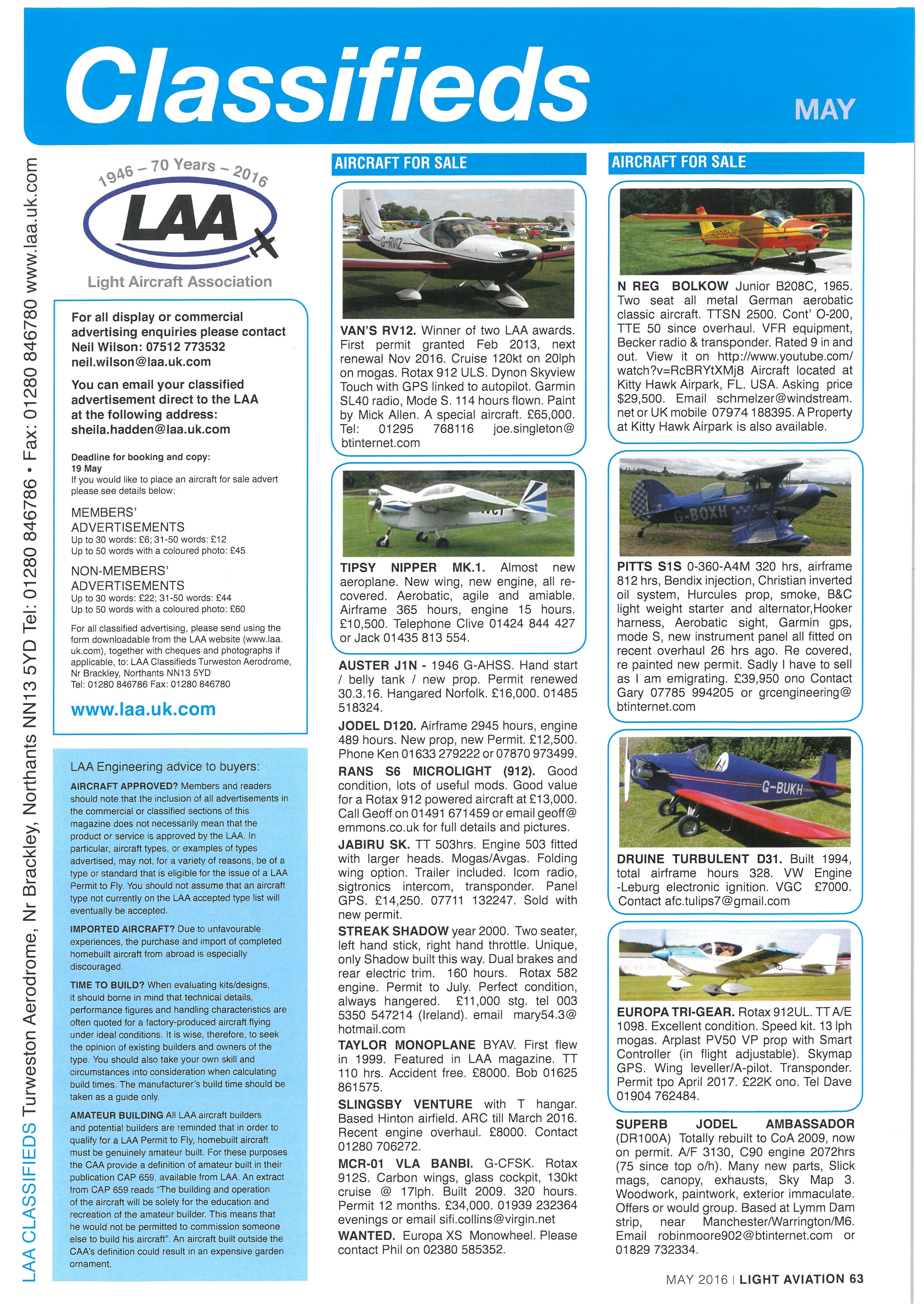
LAA Engineering advice to buyers: AIRCRAFT APPROVED? Members and readers should note that the inclusion of all advertisements in the commercial or classified sections of this magazine does not necessarily mean that the product or service is approved by the LAA. In particular, aircraft types, or examples of types advertised, may not, for a variety of reasons, be of a type or standard that is eligible for the issue of a LAA Permit to Fly. You should not assume that an aircraft type not currently on the LAA accepted type list will eventually be accepted.
IMPORTED AIRCRAFT? Due to unfavourable experiences, the purchase and import of completed homebuilt aircraft from abroad is especially discouraged.
TIME TO BUILD? When evaluating kits/designs, it should borne in mind that technical details, performance figures and handling characteristics are often quoted for a factory-produced aircraft flying under ideal conditions. It is wise, therefore, to seek the opinion of existing builders and owners of the type. You should also take your own skill and circumstances into consideration when calculating build times. The manufacturer’s build time should be taken as a guide only.
AMATEUR BUILDING All LAA aircraft builders and potential builders are reminded that in order to qualify for a LAA Permit to Fly, homebuilt aircraft must be genuinely amateur built. For these purposes the CAA provide a definition of amateur built in their publication CAP 659, available from LAA. An extract from CAP 659 reads “The building and operation of the aircraft will be solely for the education and recreation of the amateur builder. This means that he would not be permitted to commission someone else to build his aircraft”. An aircraft built outside the CAA's definition could result in an expensive garden ornament.
TIPSY NIPPER MK.1. Almost new aeroplane. New wing, new engine, all recovered. Aerobatic, agile and amiable. Airframe 365 hours, engine 15 hours. £10,500. Telephone Clive 01424 844 427 or Jack 01435 813 554.
AUSTER JIN - 1946 G-AHSS. Hand start / belly tank / new prop. Permit renewed 30.3.16. Hangared Norfolk. £16,000. 01485 518324.
JODEL D120. Airframe 2945 hours, engine 489 hours. New prop, new Permit. £12,500. Phone Ken 01633 279222 or 07870 973499. RANS S6 MICROLIGHT (912). Good condition, lots of useful mods. Good value for a Rotax 912 powered aircraft at £13,000. Call Geoff on 01491 671459 or email geoff@ emmons.co.uk for full details and pictures.
JABIRU SK. TT 503hrs. Engine 503 fitted with larger heads. Mogas/Avgas. Folding wing option. Trailer included. Icom radio, sigtronics intercom, transponder. Panel GPS. £14,250. 07711 132247. Sold with new permit.
STREAK SHADOW year 2000. Two seater, left hand stick, right hand throttle. Unique, only Shadow built this way. Dual brakes and rear electric trim. 160 hours. Rotax 582 engine. Permit to July. Perfect condition, always hangered. £11,000 stg. tel 003 5350 547214 (Ireland). email mary54.3@ hotmail.com
TAYLOR MONOPLANE BYAV. First flew in 1999. Featured in LAA magazine. TT 110 hrs. Accident free. £8000. Bob 01625 861575.
SLINGSBY VENTURE with T hangar. Based Hinton airfield. ARC till March 2016. Recent engine overhaul. £8000. Contact 01280 706272.
MCR-01 VLA BANBI. G-CFSK. Rotax 912S. Carbon wings, glass cockpit, 130kt cruise @ 17lph. Built 2009. 320 hours. Permit 12 months. £34,000. 01939 232364 eveningsoremailsifi.collins@virgin.net WANTED. Europa XS Monowheel. Please contact Phil on 02380 585352.
PITTS S1S 0-360-A4M 320 hrs, airframe 812 hrs, Bendix injection, Christian inverted oil system, Hurcules prop, smoke, B&C light weight starter and alternator,Hooker harness, Aerobatic sight, Garmin gps, mode S, new instrument panel all fitted on recent overhaul 26 hrs ago. Re covered, re painted new permit. Sadly | have to sell as | am emigrating. £39,950 ono Contact Gary 07785 994205 or grcengineering@ btinternet.com
DRUINE TURBULENT D931. Built 1994, total airframe hours 328. VW Engine -Leburg electronic ignition. VGC £7000. Contactafc.tulips7@gmail.com
SUPERB JODEL AMBASSADOR (DR100A) Totally rebuilt to CoA 2009, now on permit. A/F 3130, C90 engine 2072hrs (75 since top o/h). Many new parts, Slick mags, canopy, exhausts, Sky Map 3. Woodwork, paintwork, exterior immaculate. Offers or would group. Based at Lymm Dam strip, near Manchester/Warrington/M6. Email robinmoore902@btinternet.com or 01829 732334.
PRIZE WINNING modified Super Cub for sale. L18C upgraded to PA18-160 spec and ona Permit!ZerotimedO-320,flaps,radio, disc brakes, GPS and too many sensible other mods to mention. Please see Nov 2015 edition of LAA mag for details. LAA Rally double prize winner. Gladly deliver to anywhere in Europe! Sold with a new Permit. £66,000 ovno. Tel 01485 521 748 or mob 07540 097 676.
VERY SPECIAL KITFOX MK Ill. Rotax 912 80HP 2009. Engine and Airframe 217 Hours, Permit until 19/10/16. Beautiful condition. ‘OPTIMA’ flat bottomed wings, ‘Grove’ undercarriage with Matco brakes. Radio, cellular mini iPad ideal for SkyDemon subscription. Dual USB charging points, wing lockers, wing tanks total 100 litres (2 x 50 litre). Very low cost operation. Contact Hugh 01753 653 125 or jfc.1@outlook.comfor further information and photos. £20,750 ono.
JABIRU 430 FOUR SEATER. First Permit Sept 2010. Jabiru 3300 engine, Sensenich Prop. Eng & A/F 170hrs. Standard Jabiru instrument panel with a vacuum A/H, Microair VHF, Trig 21 Trpdr, Avmark GPS. Always hangared. Perfect condition. £45K. Tel:07805 675784, email johnfrohnsdorff@ compuserve.com
LUSCOMBE 8A SILVAIRE. Fabric wings and round tail. Whole new front end, new lift struts. 1947. Radio, alternator. Hangared. 14.5 Iph. Tidy interior. More photos available on request. £20,000 ono. Viewing recommended. Tel: 07881 620347, paul@ strawmaster.co.uk
EXPERIENCED BUILDER, Pilot, LAA Inspector for wood, metal and composite aircraft. Offers his services for repair work, recovering and spraying. Finishing off projects, assistance with kits and insurance work, building, inspection and Permit renewals. Also a weighing service using the latest computer pads for the most accurate weight possible! For further details contact Mike Hanley - Tel: 01872 560771, Mobile: 07703 781 628, E-mail mwhflyby@ btinternet.com Engineering skills
rebuild LONG-EZ Fuselage repairs, upholstery and paint completed. Cowlings, wings and canard RUTAN project. for minor repairs and paint. Avionics including Garmin GPS, Dynon EFIS-D60, Grand Rapids EIS and Tru-Track autopilot. Professionally overhauled O-235L2C with 125hp piston kit fitted, ancillaries and SS exhaust included in sale. All work undertaken by composites experienced LAA inspector. £15,000 ono. Contact 07958-293777 for photo’s and details.
RUTAN QUICKIE Q1. Complete as removed from hanger and dismantled for transport. Complete aircraft, panel and 50hp Rotax 503 engine included, with three-blade ground adjustable prop. Log books and history available. This aircraft must be considered a project and will require a full overhaul to achieve permit. £4,750 ono. Contact 07958-293777 for photo’s and details. STEEN SKYBOLT 1990.180hp dismantled, offers. Auster Autocrat complete airframe dismantled, offers. Cirrus minor engine, Dome aircraft hangar, galvanised steel frame needs new cover! Call 01797 280056 or 07736 234503.
LYCOMING O-235L2C log books available. Lycoming O-320 L2CA2B rebuilt and dyno-tested to 160hp log books available. Othermiscellaneousaviationhomebuilding spares available. For further information contact 07958-293777,.
BULLDOG SURPLUS SPARES and engine clearout. bulldog-aviation@hotmail. co.uk Tel: 07881 541172.
OVERHAULED 0-235 Lycoming cylinder complete with fitted new valves, new piston and rings. Release certificates. £450 or offers 01757 28 8344,
LYCOMINGO-360A1B6aerobaticBulldog engine. £8K. Tel: 07881 541172.
WANTED WW2 Spitfire propeller blades. Any condition is of interest, even broken. Call Kate 01453 885853.
www.cambraicovers.aero «info@cambraicovers.com
POPULAR FLYING and Light Aviation magazines from 1974 to recent. Most years’ editions complete. Free as a job lot, not splitting.Forcollectiononlyduetoweight. 01388 745463.
SIGTRONICS SPA 400 4-place intercom. KingKMA20 TSO Panel(withmarkers). 2noNarcoCom810Nav/Comwithtrays. NarcoAT 150TSOTransponder(not mode S) with tray. All ex Robin Regent and in good working order. Sensible offers please to 07860 633 611.
HAMPSHIRE FLYING GROUP operating three aircraft at Popham seeks new members. Vagabond PA17, RobinDR400 andWassmerWA52, all hangaredand well maintained. CRI available within group. All pilots welcome. Flying at £42/E80/£80 per hour. Shares £1850. Further information and contact details at www. hampshireflyinggroup.co.uk
Rotax 912. Built 2001 low airframe and engine hours. 2 seat with luggage space. Permit from November 2015. Hangered Clipgate Farm, Kent CT4 6NS Plenty of availability.£60/month,£40/hourwet. £5000. Offers considered. Peter Bartlett 01580 765120petersbartlett@btinternet.com
AA5 GROUP GAMSTON. Only1/6 shares so great availability in four-seat tourer. AIF 2100 hours, Lycoming O-320 15Ohp with only 300 hours since TBO. Nowfor the first time non equity shares £50p/n and £120 p/month. 25 hours upfront =£1250 to flyoff over 12 months. Details: www.gocpn.co.uk Tel: 07976 802107.
PIPER WARRIOR II share forsale. Only a few regular flyers in this 16 member group (last year the aircraft flew less than 135 hours). G-GHJO is based andhangered at Inverness Airport. Full airways equipped. Satnav etc., two radios with four headset sockets. Online booking. £75 per month (includes all landings at 10 HIAL airports) plus £105 per hour (wet) flyingtime. http:// bracklaflying.co.uk. £3000. For a demo flight and further details contact Davis M Edes 07860 524394.
RV6 % SHARE, White Waltham. 160hp low hours engine. Mode S 8.33 radio. £12,500. €70/hr wet + £150/mon. Friendly group. Online booking. Contact Adrian Mardlin 07920102401oradrian@mardlin.org.uk
GROB 109-B SHARE (1/8) for sale; Compton Abbas; internet booking; GBP 45/ hr wet + yearly GBP approx. 680.00. TTA 4150hrs; TTE 2700hrs; 3000hr done; spar spigot-mod done; group shareincludes new unused GROB 2500 engine; GBP 6,800.00 (oiro); 07919 433 674 or mthornington@ hotmail.com; lost medical.
JODEL 112, 1/6 share £1500. Based at Netherthorpe,electric start and _ alternator. £45 PCM, £7 per hour dry, price includes five hours’free tailwheel instruction. Contact Mikeatvolksman22@btinternet.com