
from rain than cold weather this winter and many grass strips remain unusable. However, it won’t be long now before the flying season will be back in full swing and we can start to enjoy some spring-like weather.
The calendar is certainly filling up with fly-ins and rallies, and hopefully we shall see a few more LAA Strut and Club 70th anniversary events being planned. Certainly our annual Rally is going to be bigger and even better this year with a number of additional attractions to mark our three score years and ten. Make a date for Sywell on 2, 3, 4 September, whether youdriveorcomebyairitisgoingtobea real fun weekend.
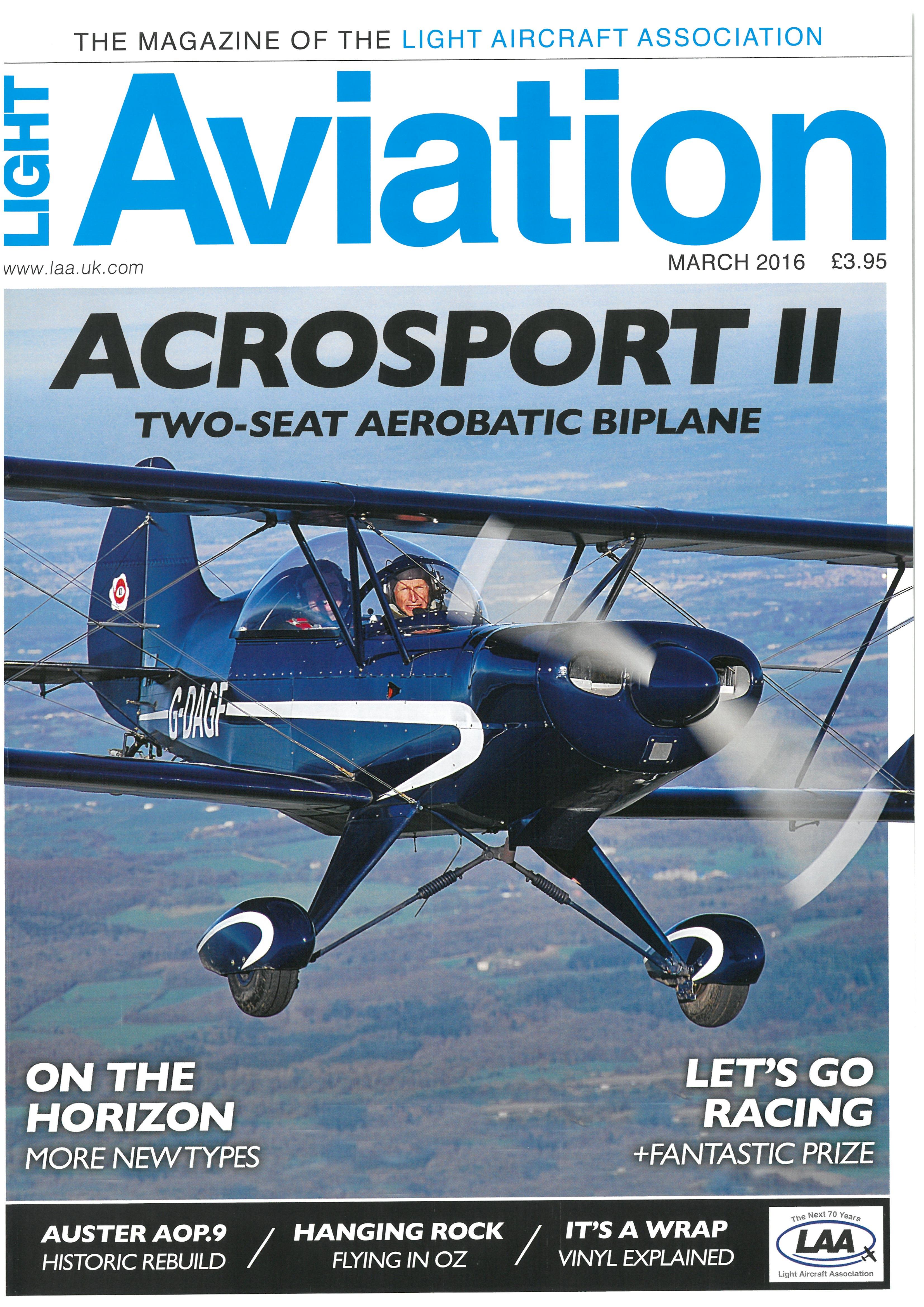
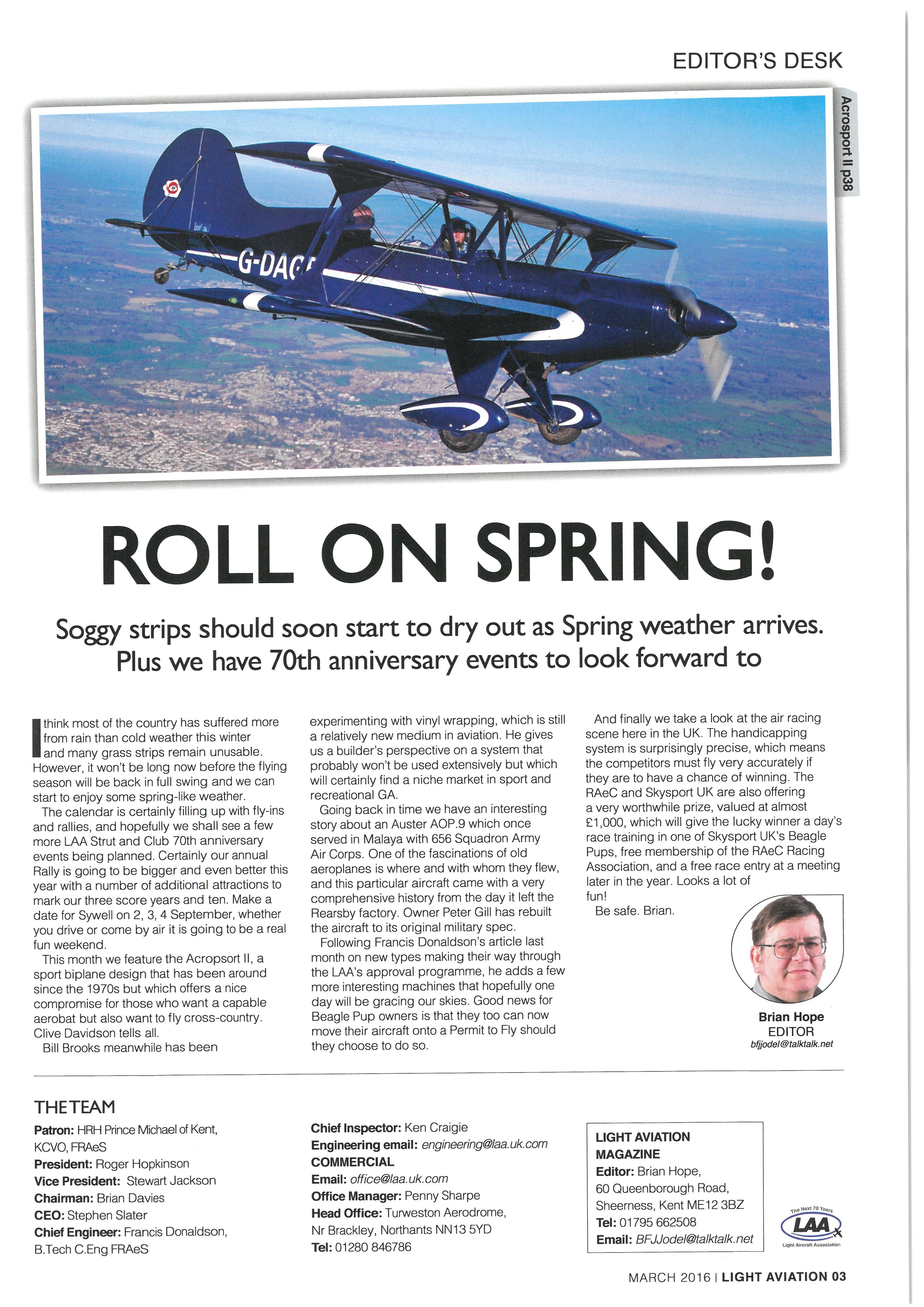
This month we feature the Acropsort Il, a sport biplane design that has been around since the 1970s but which offers a nice compromise for those who want a capable aerobat but also want to fly cross-country. Clive Davidson tells all.
Bill Brooks meanwhile has been
THETEAM
Patron: HRH Prince Michael of Kent, KCVO, FRAeS
President: Roger Hopkinson
Vice President: Stewart Jackson
Chairman: Brian Davies
CEO: Stephen Slater
Chief Engineer: FrancisDonaldson, B.Tech C.Eng FRAeS
experimenting with vinyl wrapping, which is still a relatively new medium in aviation. He gives us a builder’s perspective on a system that probably won't be used extensively but which will certainly find a niche market in sport and recreational GA.
Going back in time we have an interesting story about an Auster AOP.9 which once served in Malaya with 656 Squadron Army Air Corps. One of the fascinations of old aeroplanes is where and with whom they flew, and this particular aircraft came with a very comprehensive history from the day it left the Rearsby factory. Owner Peter Gill has rebuilt the aircraft to its original military spec.
Following Francis Donaldson's article last month on new types making their way through the LAA’s approval programme, he adds a few more interesting machines that hopefully one day will be gracing our skies. Good news for Beagle Pup owners is that they too can now move their aircraft onto a Permit to Fly should they choose to do so.
And finally we take a look at the air racing scene here in the UK. The handicapping system is surprisingly precise, which means the competitors must fly very accurately if they are to have a chance of winning. The RAeC and Skysport UK are also offering avery worthwhile prize, valued at almost £1,000, which will give the lucky winner a day's race training in one of Skysport UK’s Beagle Pups, free membership of the RAeC Racing Association, and a free race entry at a meeting later in the year. Looks a lot of fun!
Be safe. Brian.
Chief Inspector: Ken Craigie
Engineering
email: engineering@laa.uk.com
COMMERCIAL
Email: office@laa.uk.com
Office Manager: Penny Sharpe
Head Office: Turweston Aerodrome, Nr Brackley, Northants NN13 5YD
Tel: 01280 846786
LIGHT AVIATION
MAGAZINE
Editor: Brian Hope, 60 Queenborough Road, Sheerness, Kent ME12 3BZ
Tel: 01795 662508
Email: BFJJode/@talktalk.net
6 NEWS
BeaglePupaircraftallowedto switch to Permitto Flyby EASA
9LETTERS
Reaction to lastmonth’s Fidaling WhileGA Burns. Really?article
|0 PROJECTNEWS
ColinTerry'sVan’sRV-7Aisnowflying after, er, several years and G-FUNN is living up to its registration
|4 PROJECTNEWSSPECIAL
An amazingrestorationofanAuster AOP.9whichlastflewin1964,whilesill inmilitaryservice.
19YOUTH PAGE
Michelle Brown returns with news of a fund-raisingparachutejump
20 LET’S GO RACING!
Air racingwiththe RoyalAeroClub. BrianHopeand NeilWilsonenjoya raceweekendatPopham.
26 ITSAWRAP
BillBrooksof P&MAviationexplains why he’sturningto vinylratherthan paintforhishigh-techmicrolights
3| CHANNEL CROSSING
Join the Kent Strut and learn all you needto knowtoflyto France
32 ENGINEERING
More new aircraft tyoes on the way includingtwoSpitfirereplicas,a Mustangand somepersonalprojects
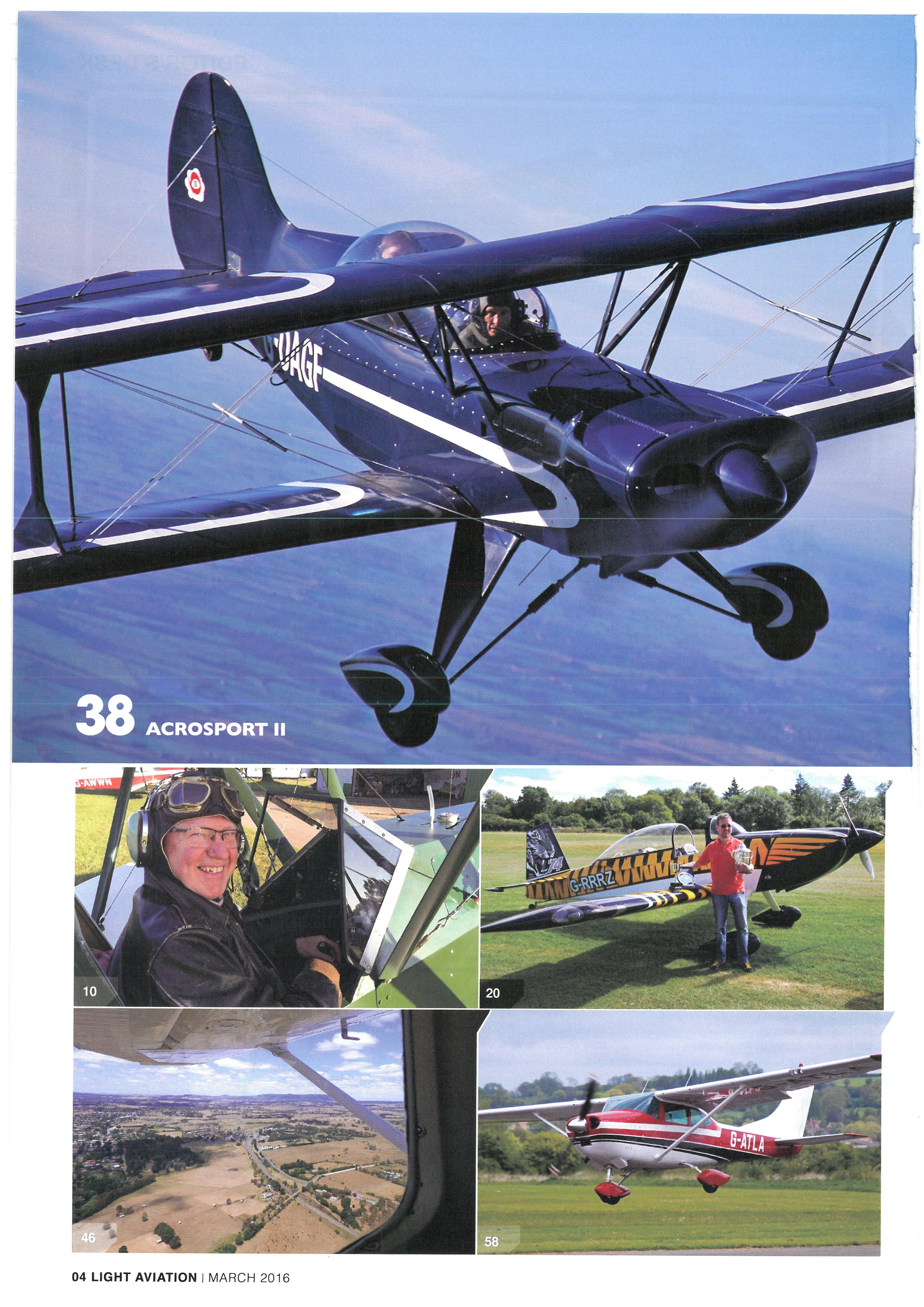
38 ACROSPORT II
Clive Davidson reports on a very nice aerobatic biplane with two seats and touring ability
46 HANGING ROCK
Visitingone ofAustralia’smostfamous landmarks by air
50 SAFETY SPOT
Malcolm McBride with news of Tigert Moth woes and an unfortunate prop swinging accident.
56WHERETOGO
Generalaviationeventscoming up over the next few months
59 MEETTHE MEMBERS
John and Jenny Whicher are both keen pilotsflying a Cessna 182 and a BuckerJungmeister
58 LANDINGVOUCHERS
Threeairfieldstovisitforfree:Lydd, Sherburnand Shipdam,plusa special deal on entrance to the Yorkshire Air Museum
63 BOOK REVIEW
‘ClassicLightAircraftbyRonSmith
64 LAA CLASSIFIEDS
Aircraft, parts and services for sale
two well-known figures who made their mark in aviation in very different ways, yet both have left handsome legacies. In the case of Captain Eric ‘Winkle’ Brown, his records speaks for themselves. He flew an unmatched 487 different types of aircraft, made 2,407 deck landings at sea and 2,721 carrier take-offs, world records unlikely ever to be broken.
As a young Naval officer, Captain Brown survived the torpedoing of his first ship, the escort carrier HMS Audacity, and even before then he had survived a ‘ducking’ when the engine of his Grumman Martlet suffered a ‘dead-cut’ during a low-level inverted pass in front of none other than Winston Churchill! Eric (briefly) fought in the Battle of Britain at the controls of an obsolete Sea Gladiator biplane and went on to fly every major combat aircraft of World War II including gliders, fighters, bombers, airliners, amphibians, flying boats and helicopters.
His contribution to aviation research also covered transonic flight and (due to his having become fluent in German prior to WWII) he both assessed German jets and rocket aircraft, and interrogated their designers and test pilots. He was also the last man living to have flown the Gloster Whittle E28/39 jet and, at the controls of a de Havilland Sea Vampire, made the first carrier deck landing by a jet aircraft.
Although Eric flew little in his later years, many LAA members enjoyed his continuing enthusiasm for aeroplanes, his incisive curiosity, encyclopedic knowledge, razor-sharp memory and dry sense of humour. | am sure many will savour memories similar to my first meeting with him about 15 years ago. When tinkering with my newly acquired Luton Minor at Sywell, | suddenly realised the identity of the dapper gentlemen taking an interest in my parasol-winged steed.
Ericspenta littletimecomparingtheLuton with the similarly configured Zaunkoenig singleseat which he had enjoyed playing with while at Farnborough in the 1940s, and which became one of the founder aeroplanes of the Ultra-Light Aircraft Association, the organisation which grew into the LAA today.
Eric chuckled as he told me how he had probably secured the survival of the Zaunkoenig as he had wrested it from a group of Farnborough test pilots who had been experimenting to see how high above the runway it could be flared without breaking it!
He also told me about the ‘little jewel’ that was its 50hp Zundapp inverted four-cylinder engine, before investigating the nose of the Luton Minor. “What's that there?” he asked. My explanation that it was a modified VW Beetle engine brought an
infectious guffaw of laughter. “Ye gods, what fools we are!”
Just a day after Eric’s passing in his 97th year, we sadly received the news of the loss of another true hero of our aviation world. If Eric Brown was ‘the pilot’s pilot’, then Ron Souch was the ‘restorer’s restorer’.
From his Aero Antiques workshops at Durley in Hampshire, there emerged a seemingly continuous stream of stunning, award-winning restorations of de Havilland Moths, Dragonflies, Fox Moths, Tiger Moths, Puss Moths and Stampes. There were more esoteric types too, including the FosterWickner Wicko, Miles Whitney Straight and perhaps his ultimate project, Richard Seeley’s spectacular 1930s Travelair Mystery Ship racer, recreated following exhaustive research by Ron, his son Michael and his dedicated team of fellow aircraft builders.
The day following Ron’s passing, by coincidence, saw the radial-engined racer make its first post-winter hibernation flight from its base in the hangar next to the LAA offices at Turweston. It also coincided with our inaugural kit aircraft manufacturers’ and agents’ symposium where more than 20 different aircraft makers and importers were represented. Discussions on cutting-edge designs, possible new build programmes and airworthiness requirements briefly went on hold as the entire conference migrated to the window, to watch the barrelshaped red monoplane climb away into a flawless blue sky. The combined ‘wow’ from such a discerning audience was perhaps the best tribute that Ron would have wished for.
The conference was a new step for the LAA and indeed for the kit manufacturers themselves. Pretty well every maker and agent was present, as well as a number of individuals who may be planning to act as agents for some exciting new designs in the future. The meeting covered a wide-ranging field, from how best to meet future customer requirements, the possible creation of factory-assisted and quick-build options, to how to deal with older kit-built aircraft which may face declining spares and product support.
One interesting thing that came from the discussions is that many manufacturers, after several lean years, are seeing the signs of recovery in the market with new kits being sold and new products attracting greater interest. It is perhaps too early to hang out the flags just yet, but from the comments being made at the meeting and some of the plans being divulged, | suspect that this year’s LAA Rally, as well as looking back on our 70-year history, might see some new aircraft, new kit manufacturers and a future legacy of some very exciting aircraft!
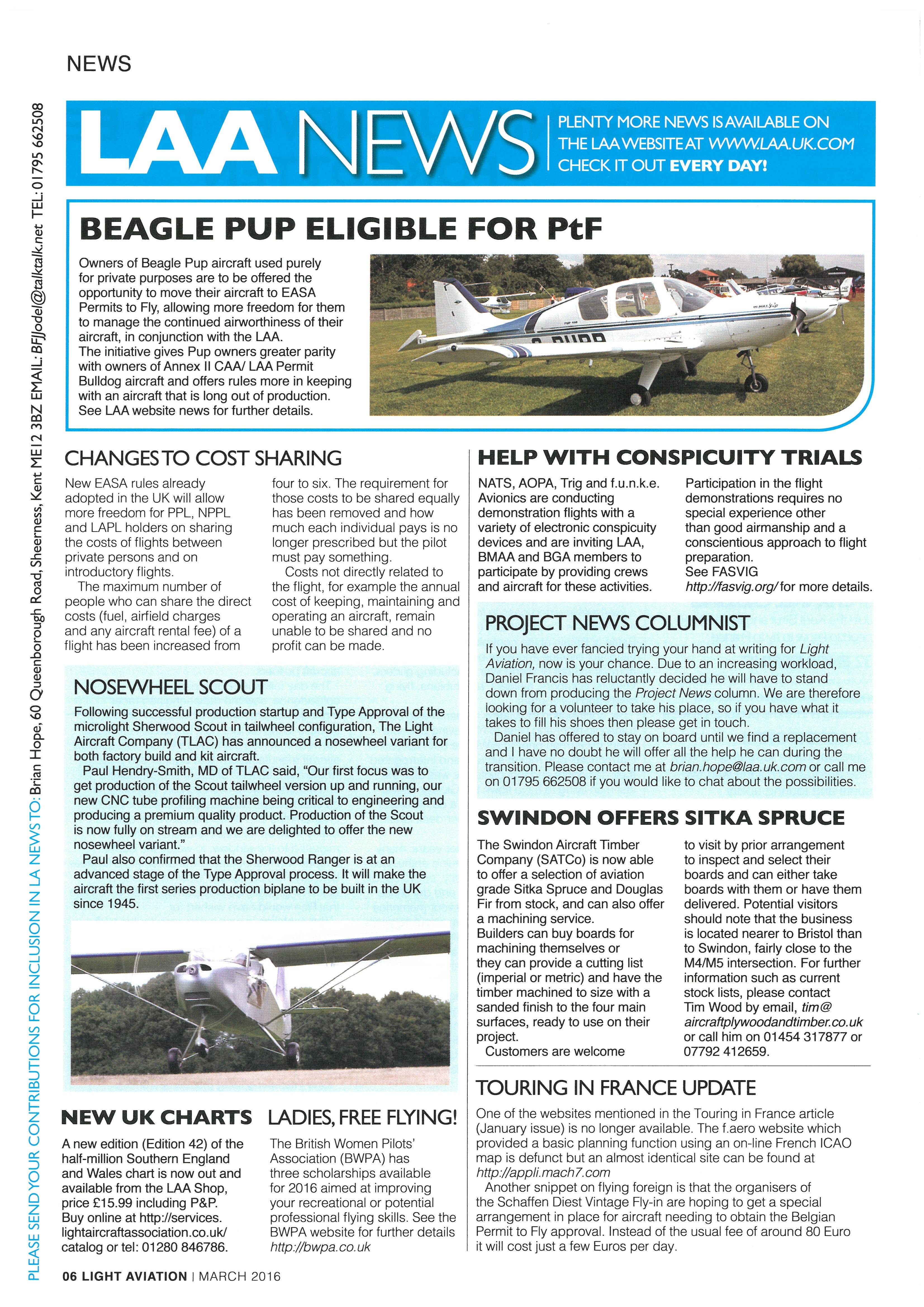
for private purposes are to be offered the opportunity to move their aircraft to EASA Permits to Fly, allowing more freedom for them to manage the continued airworthiness of their aircraft, in conjunction with the LAA.
The initiative gives Pup owners greater parity with owners of Annex II CAA/ LAA Permit
Bulldog aircraft and offers rules more in keeping with an aircraft that is long out of production. SeeLAAwebsite newsforfurtherdetails.
New EASA rules already adopted in the UK will allow more freedom for PPL, NPPL and LAPL holders on sharing the costs of flights between private persons and on introductory flights.
The maximum number of people who can share the direct costs (fuel, airfield charges and any aircraft rental fee) of a flight has been increased from
four to six. The requirement for those costs to be shared equally has been removed and how much each individual pays is no longer prescribed but the pilot must pay something.
Costs not directly related to the flight, for example the annual cost of keeping, maintaining and operating an aircraft, remain unable to be shared and no profit can be made.
Following successful production startup and Type Approval of the microlight Sherwood Scout in tailwheel configuration, The Light Aircraft Company (TLAC) has announced a nosewheel variant for both factory build and kit aircraft.
Paul Hendry-Smith, MD of TLAC said, “Our first focus was to get production of the Scout tailwheel version up and running, our new CNC tube profiling machine being critical to engineering and producing a premium quality product. Production of the Scout is now fully on stream and we are delighted to offer the new nosewheel variant.”
Paul also confirmed that the Sherwood Ranger is at an advanced stage of the Type Approval process. Itwill make the aircraft the first series production biplane to be built in the UK since 1945.
Anew edition (Edition 42) of the The British Women Pilots’ half-million Southern England Association (BWPA) has and Wales chart is now out and three scholarships available available from the LAA Shop, for 2016 aimed at improving price £15.99 including P&P. your recreational or potential Buy online at http://services. professional flying skills. See the lightaircraftassociation.co.uk/ BWPAwebsiteforfurtherdetails catalog or tel: 01280 846786. http://bwpa.co.uk
NATS,AOPA, Trig and f.u.n.k.e. Avionics are conducting demonstration flights with a variety of electronic conspicuity devices and are inviting LAA, BMAA and BGA members to participate by providing crews and aircraft for these activities.
Participation in the flight demonstrations requires no special experience other than good airmanship and a conscientious approach to flight preparation. See FASVIG http://fasvig.org/tormoredetails.
IfyouhaveeverfanciedtryingyourhandatwritingforLight Aviation,nowisyourchance.Duetoanincreasingworkload, DanielFrancishasreluctantlydecidedhewillhavetostand downfromproducingtheProjectNewscolumn.Wearethereforelookingforavolunteertotakehisplace,soifyouhavewhat it takestofillhisshoesthenpleasegetintouch. Danielhasofferedtostayonboarduntilwefindareplacement and transition.|havenodoubthewillofferallthehelphecanduringthe Pleasecontactmeatbrian.hope@laa.uk.com orcallme on01795662508 SWINDONifyouwouldliketochataboutthepossibilities.
The Swindon Aircraft Timber Company (SATCo) is now able to offer a selection of aviation grade Sitka Spruce and Douglas Fir from stock, and can also offer a machining service. Builders can buy boards for machining themselves or theycanprovidea cuttinglist (imperial or metric) and have the timber machined to size with a sanded finish to the four main surfaces, ready to use on their project.
Customers are welcome
to visit by prior arrangement to inspect and select their boards and can either take boards with them or have them delivered. Potential visitors should note that the business is located nearer to Bristol than to Swindon, fairly close to the M4/M5 intersection. For further information such as current stock lists, please contact Tim Wood by email, tim@ aircraftplywoodandtimber.co.uk or call him on 01454 317877 or 07792 412659.
TOURING IN FRANCE UPDATE OneofthewebsitesmentionedintheTouringinFrancearticle (Januaryissue)isnolongeravailable.Thef.aerowebsitewhich providedabasicplanningfunctionusinganon-lineFrenchICAO mapisdefunctbutanalmostidenticalsitecanbefoundat http:/appli.mach7.com
Another snippet on flying foreign is that the organisers of the Schaffen Diest Vintage Fly-inare hoping to get a special arrangement in place for aircraft needing to obtain the Belgian Permitto Fly approval. Instead of the usual fee of around 80 Euro it will cost just a few Euros per day.
efore | met Don he had enjoyed
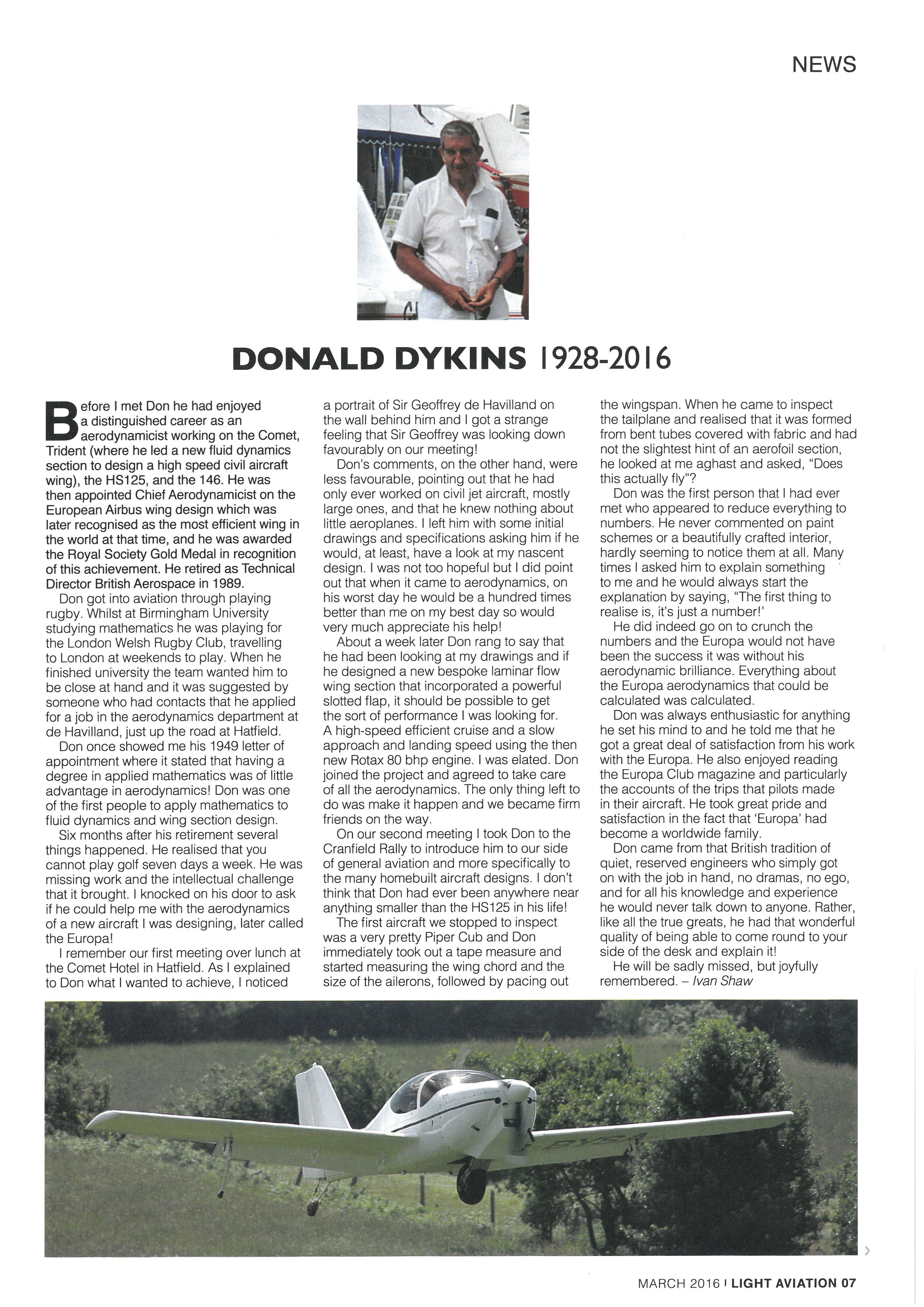
Pyadistinguished career asan aerodynamicist working on the Comet, Trident (where he led a new fluid dynamics section to design a high speed civil aircraft wing), the HS125, and the 146. He was then appointed Chief Aerodynamicist on the European Airbus wing design which was later recognised as the most efficient wing in the world at that time, and he was awarded the Royal Society Gold Medal in recognition of this achievement. He retired as Technical Director British Aerospace in 1989. Don got into aviation through playing rugby. Whilst at Birmingham University studying mathematics he was playing for the London Welsh Rugby Club, travelling to London at weekends to play. When he finished university the team wanted him to be close at hand and it was suggested by someone who had contacts that he applied for a job in the aerodynamics department at de Havilland, just up the road at Hattield. Don once showed me his 1949 letter of appointment where it stated that having a degree in applied mathematics was of little advantage in aerodynamics! Don was one of the first people to apply mathematics to fluid dynamics and wing section design. Six months after his retirement several things happened. He realised that you cannot play golf seven days a week. He was missing work and the intellectual challenge that it brought. | knocked on his door to ask if he could help me with the aerodynamics of a new aircraft | was designing, later called the Europa!
| remember our first meeting over lunch at the Comet Hotel in Hatfield. As | explained to Don what | wanted to achieve, | noticed
a portrait of Sir Geoffrey de Havilland on the wall behind him and | got a strange feeling that Sir Geoffrey was looking down favourably on our meeting!
Don’s comments, on the other hand, were less favourable, pointing out that he had only ever worked on civil jet aircraft, mostly large ones, and that he knew nothing about little aeroplanes. | left him with some initial drawings and specifications asking him if he would, at least, have a look at my nascent design. | was not too hopeful but | did point out that when it came to aerodynamics, on his worst day he would be a hundred times better than me on my best day so would very much appreciate his help!
About a week later Don rang to say that he had been looking at my drawings and if he designed a new bespoke laminar flow wing section that incorporated a powerful slotted flap, it should be possible to get the sort of performance | was looking for. A high-speed efficient cruise and a slow approach and landing speed using the then new Rotax 80 bhp engine. | was elated. Don joined the project and agreed to take care of all the aerodynamics. The only thing left to do was make it happen and we became firm friends on the way.
On our second meeting | took Don to the Cranfield Rally to introduce him to our side of general aviation and more specifically to the many homebuilt aircraft designs. | don’t think that Don had ever been anywhere near anything smaller than the HS125 in his life!
The first aircraft we stopped to inspect was a very pretty Piper Cub and Don immediately took out a tape measure and started measuring the wing chord and the size of the ailerons, followed by pacing out
the wingspan. When he came to inspect the tailplane and realised that it was formed from bent tubes covered with fabric and had not the slightest hint of an aerofoil section, he looked at me aghast and asked, “Does this actually fly’?
Don was the first person that | had ever met who appeared to reduce everything to numbers. He never commented on paint schemes or a beautifully crafted interior, hardly seeming to notice them at all. Many times | asked him to explain something ~ to me and he would always start the explanation by saying, “The first thing to realise is, it’s just a number!’
He did indeed go on to crunch the numbers and the Europa would not have been the success it was without his aerodynamic brilliance. Everything about the Europa aerodynamics that could be calculated was calculated.
Don was always enthusiastic for anything he set his mind to and he told me that he got a great deal of satisfaction from his work with the Europa. He also enjoyed reading the Europa Club magazine and particularly the accounts of the trips that pilots made in their aircraft. He took great pride and satisfaction in the fact that ‘Europa’ had become a worldwide family.
Don came from that British tradition of quiet, reserved engineers who simply got on with the job in hand, no dramas, no ego, and for all his knowledge and experience he would never talk down to anyone. Rather, like all the true greats, he had that wonderful quality of being able to come round to your side of the desk and explain it!
He will be sadly missed, but joyfully remembered. van Shaw
The next LAA ET Woodwork course, run by Dudley Pattison at his home workshop near Swindon, takes place on 13 April. Price is £95, which includes lunch. Places are limited so please book early with LAA HQ on 01280 846786.
The Vintage Aircraft Club recently ran a first aid course at White Waltham airfield. Itwas thought that this could be an important prompt for all clubs and Struts etc to equip their events with a named first aider to be first port of call should any incident occur, from a minorcutorgrazetoalifethreateningsituation.
The day’s course provided an Ofqual registered certificate in first aid valid for three years to those who successfully completed the day. Similar courses can be arranged through St John’s Ambulance or the Red Cross in your area.
Cumbernauld Airport is celebrating its 50th anniversary with a Fly-in on Saturday 26 March, with a barbeque (weather permitting), and visiting single engine aircraft will pay no landing fees. In the event of the weather not being suitable, the fly-in will take place on Sunday 27 March. Note also that all visiting single engine aircraft will have free landings throughout April 2016.
German manufacturer Flight Design GmbH has issued a news release saying that it has has applied for “a planned receivership which allows for reorganisation of the company.”
The filing will enable the company to deal with a financial problem principally caused by an international customer of engineering services that “has not settled a bill of over seven digit Euros,” the company said. CEO Matthias Betsch said, “The company will continue to run normally. Customers will receive the usual service, deliveries proceed.” The company was founded in 1988 and has delivered about 1,500 aircraft.
Halfpenny Green. Organisers have been informed that Halfpenny Green Airfield, which has recently undergone a change of ownership, will not be available to host either of the Easter or August Bank holiday Wings and Wheels events this year. This is an unfortunate blow to Wolverhampton’s Tettenhall Transport Heritage Centre, which benefitted from the proceeds of the events.
Abingdon. The Army has applied to the CAA to re-establish the parachute drop zone at Abingdon airfield. It will be used by a parachute club, aiming to operate every Saturday and Sunday throughout the year. The plan is to carry out at least 20 drops per day, more if they can. Subject to approval they aim to start in early May. Henstridge is offering free tie-downs for anyone who can get out but can’t get back in to a water-logged field for as long as it takes for conditions to improve at your airfield. Also, if you are paying an annual landing card where you are, Henstridge will offer free landings for the period of your stay too. Phone Geoff Jarvis on 01963 363866
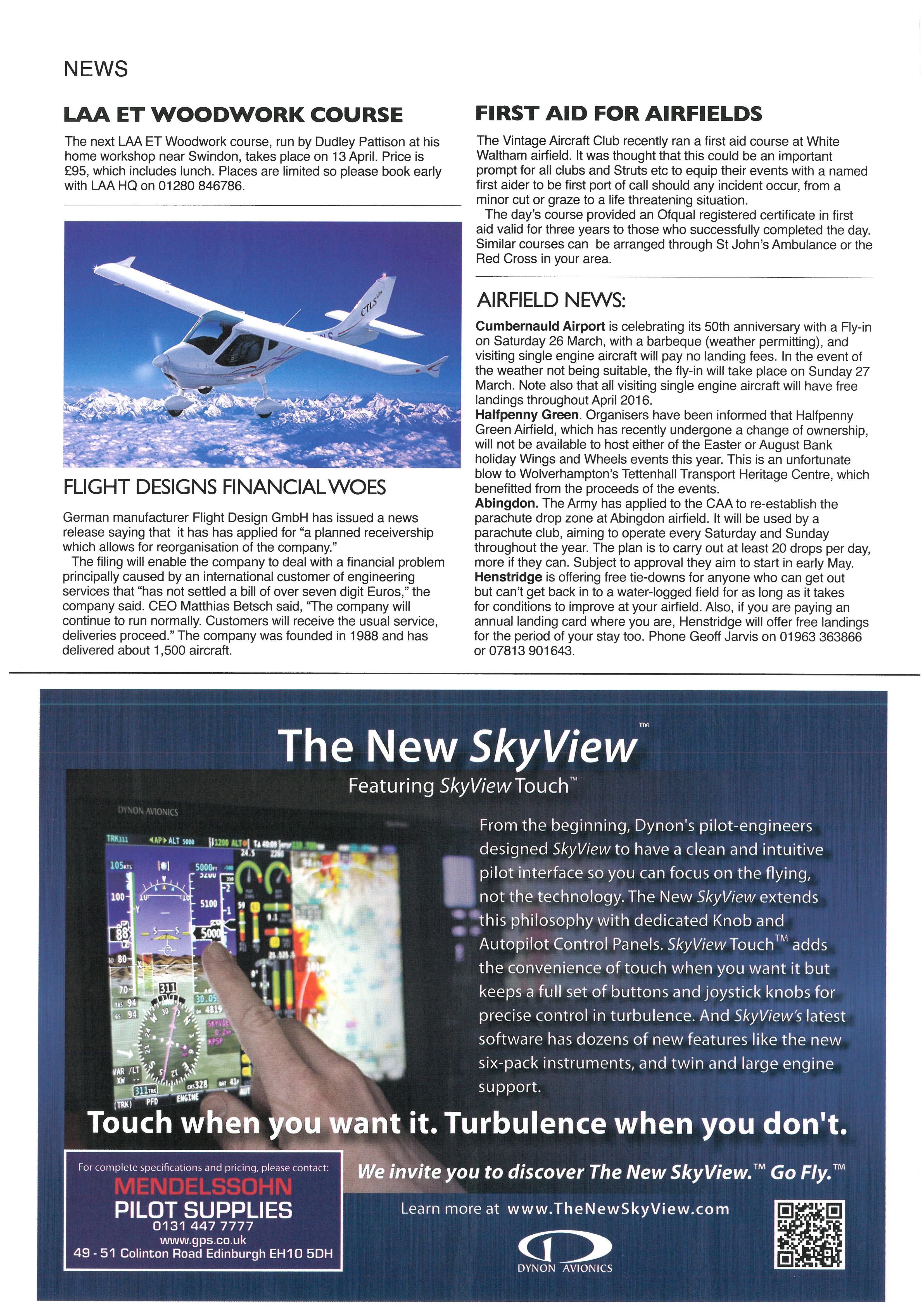
From the beginning, Dynon's pilot-engineers designed SkyViewto have a clean and intuitive | pilot interface soyou canfocus on the flying, not the technology. The New SkyViewextends this philosophy with dedicated Knob and Autopilot Control Panels.SkyViewTouch™adds the convenience of touch when you want it but keeps afull set of buttons and joystick knobs for precise control in turbulence. And SkyView’ latest software has dozens of new features like the new six-pack instruments, and twin and large engine support.
More power to the GAAlliance
The last few paragraphs of your article Fiddling While GA Burns. Really? [February 16] rightly mentioned the work undertaken by the GAAlliance. A brief search of its website revealed that current members are: British Balloon and Airship Club, British Gliding Association, British Hang Gliding and Para GlidingAssociation, British MicrolightAircraft Association, British Parachute Association, Helicopter Club of Great Britain, LightAircraft Association, and Royal Aero Club of the United Kingdom. One does not want to denigrate the GAA’s efforts, for they are indeed worthy and welcome; at least somebody is doing something!
What appears to be missing from that list however, is any contact with the large number of PPLs who fly both vintage [that are not covered by the LAA] and many current aircraft. None of the numerous training organisations or any of the individual aircraft clubs appear on the list either. Yet they all stand to gain from the GAA’s actions.
To my mind for too long has private aviation been a hotch potch of different clubs, many with different agendas and some referring back to matters long since passed as a reason why they do not relate to each other; sad really because the world has changed. We need to have strength, and that’s in numbers surely.
If one compares the situation with that in the vintage and classic vehicle world, where their interests have been focused through the Federation of British Historic Vehicle Clubs since the mid-1980s. FBHVC now represents some 250,000 members of vehicle clubs inthe UK and has done sterling work in contact with the DVLA, has regular meetings at Parliament and maintain a watching brief in Brussels. And the FBHVC is, in part, funded by a modest charge per member on the clubs.
Yes | know that there is a
different scale of members to consider but is there not a case for the GAA to involve more of the individual clubs who are not currently represented, nor learn other than by chance, the activities of the GAA. There is a two way street here!
Let me reiterate that no criticism is intended, the GAA are doing a good job but surely more clubs need to be committed to it and help support it. How many members are there in the different aviation clubs in the UK | wonder? As | said strength comes in numbers. More power to the GAA.
Best regards, Ron Gammons
Promote group ownership to encourage new members.
Reading the current edition of LightAviationtwoarticlesask some thought provoking questions: Fiddling While GA Burned.Really? and the Meet the Members Q&A with the editor; both are asking how we encourage more people to take an interest.
Part of that is marketing and part is about cost. If we can reduce the cost of flying then more will participate, it’s basic economics.
In Project News there is reference to the build of Eurofox 912 G-CIOF by Yorkshire Gliding Club. That article refers to launch costs being reduced to a fraction of the previous Pawnees’ thus allowing charges to be reduced by 20% as a result. That is a significant reduction and if effectively marketed could result in a substantial increase in activity. But it has only been made possible by the existence of the LAA and the Permit scheme allowing the modern Kitfox to be used as a glider tug, replacing older more expensive aircraft.
Surely this is a superb example of innovation, new technology and the opportunity that organisations such as the LAA create? So let’s promote and celebrate it.
In addition, | firmly believe the LAA could and should do more to promote the operation of group owned Permit aircraft. The costs of ownership reduce significantly with
each additional member, albeit | accept that optimum membership is probably four, allowing for adequate aircraft access, group management and synergy. But with two members ownership costs halve, with four they are a quarter the cost of individual ownership. The hourly operating costs are not reduced but the fixed costs are, and significantly with each additional group member. This makes flying very much more affordable, particularly compared with hiring, plus you get greater flexibility.
That cost reduction should help encourage increased participation in GA and groups also offer camaraderie and fellowship and, | believe contribute to flight safety. What better way of helping confidence than flying with a fellow group owner both to ensure currency and provide a second pair of eyes.
Best wishes, Laurie Price
|think Laurie makes a good point so can | call upon members of flying groups toget in touch with
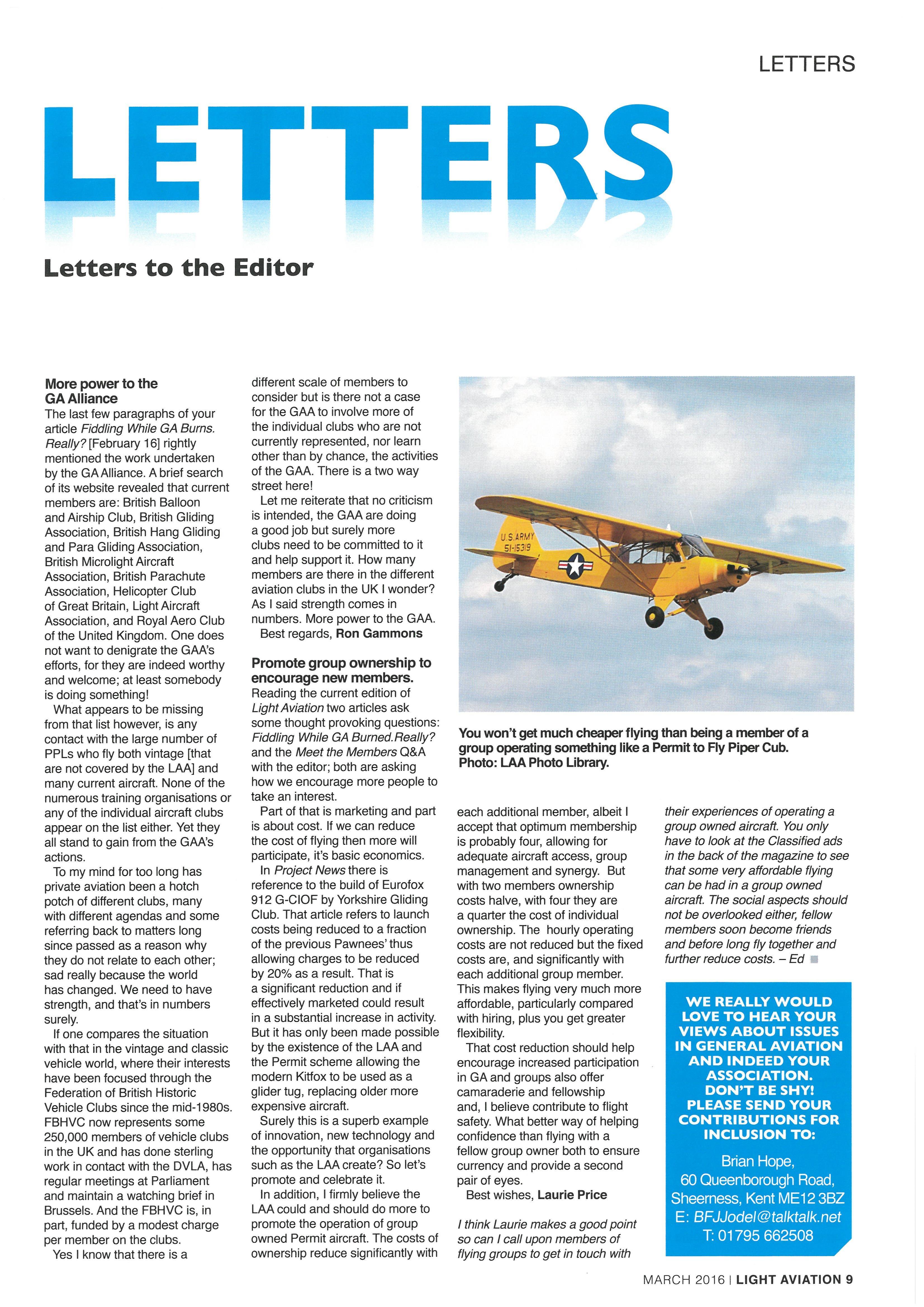
their experiences ofoperating a group owned aircraft. Youonly have to look at the Classified ads in the back of the magazine to see that some very affordable flying can be hadin a group owned aircraft. The social aspects should notbe overlooked either, fellow members soon become friends and before long fly together and further reduce costs. Ed &
WE REALLY WOULD LOVE TO HEAR YOUR VIEWS ABOUT ISSUES IN GENERAL AVIATION AND INDEED YOUR ASSOCIATION. DON’T BE SHY! PLEASE SEND YOUR CONTRIBUTIONS FOR INCLUSION
have ensured another interesting and diverse column.
| photographs and asking for updates on your projects. Keep Amongst the contributors featured are two long-term
| them coming in. | have been lucky to have inherited this job builds that havefinallyemerged fromtheirworkshopsand
| with a great bunch of chaps to supply photographsfor these will hopefully, given due homage to the weather gods, take
| pages, but if you are a keen collector of aircraft pictures to the sky imminently. (especially the very new or more obscure types) and would
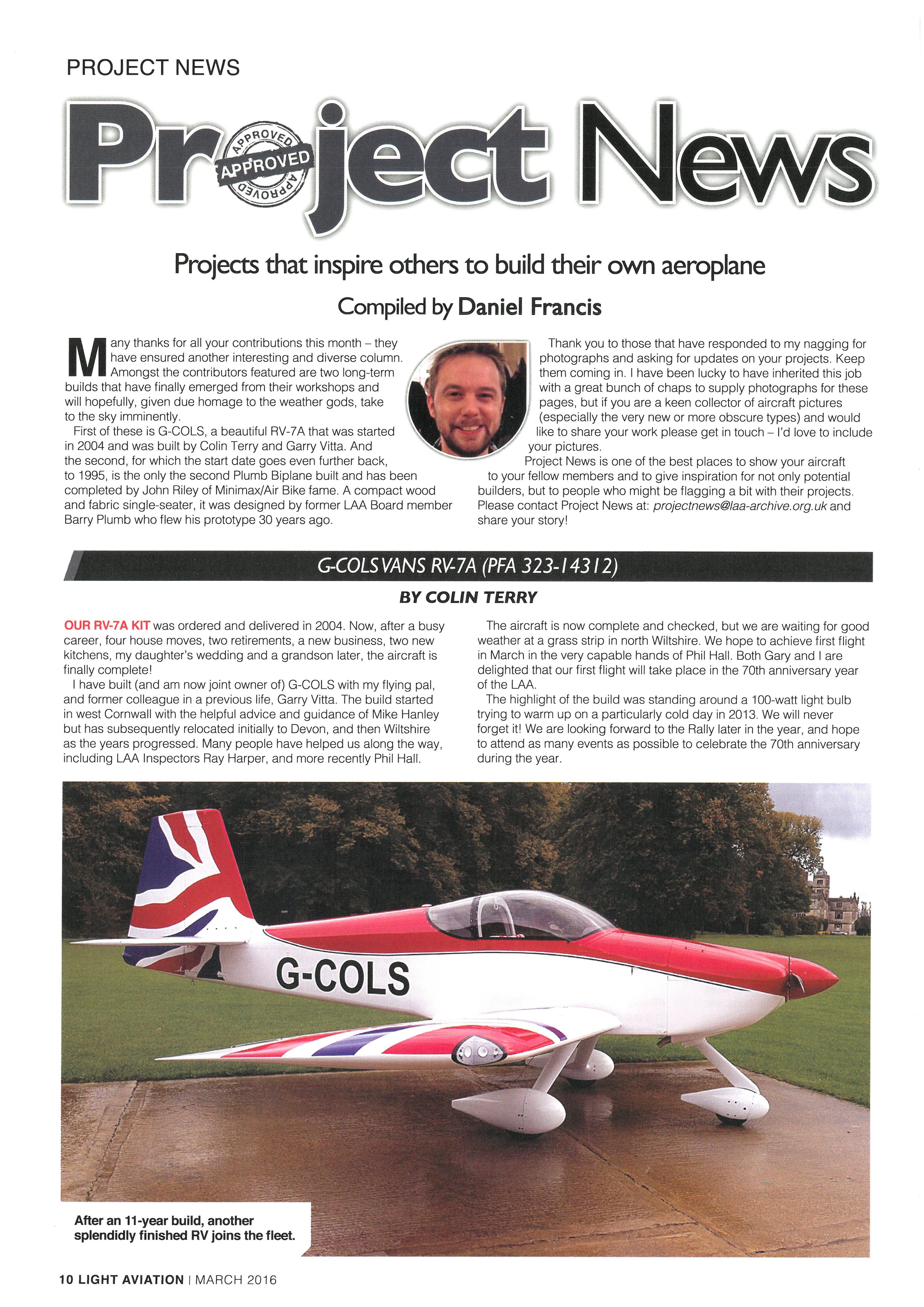
First of these is G-COLS, a beautiful RV-7A that was started like to share your work please get in touch I'd love to include in 2004 and was built by Colin Terry and Garry Vitta. And your pictures. the second, for which the start date goes even further back,
Project News is one of the best places to show your aircraft
to 1995, is the only the second Plumb Biplane built and has been to your fellow members and to give inspiration for not only potential completed by John Rileyof Minimax/Air Bike fame. A compact wood builders, but to people who might be flagging a bit with their projects. and fabric single-seater, itwas designed by former LAA Board member
Pleasecontact Project News at: projectnews@laa-archive.org.ukand Barry Plumb who flew his prototype 30 years ago. share your story!
BY COLIN TERRY
was ordered and delivered in 2004. Now, after a busy
The aircraft is now complete and checked, but we are waiting for good career, four house moves, two retirements, a new business, two new weather at a grass strip in north Wiltshire. We hope to achieve first flight kitchens, my daughter’s wedding and a grandson later, the aircraft is in March in the very capable hands of Phil Hall. Both Gary and | are finally complete! delighted that our first flight will take place in the 70th anniversary year
| have built (and am now joint owner of) G-COLS with my flying pal, of the LAA. and former colleague in a previous life, Garry Vitta. The build started
The highlight of the build was standing around a 100-watt light bulb inwestCornwallwiththehelpfuladviceandguidanceofMikeHanley tryingtowarmupona particularlycolddayin2013.Wewillnever but has subsequently relocated initially to Devon, and then Wiltshire forget it! We are looking forward to the Rally later in the year, and hope as the years progressed. Many people have helped us along the way, to attend as many events as possible to celebrate the 70th anniversary including LAA InspectorsRayHarper,and more recentlyPhilHall. during the year.
After an 11-year build, another splendidly finished RVjoins the fleet.
MARK FIRST WROTE TO Project News in May last year and featured his impressive cabin workshop built specifically for the project. Mark updates us on progress since:
Before | started the build, | decided | would finish each section of the kit as completely as possible before starting the next. This was to avoid coming back to a 90% completed component several months, or even years later trying to recall where | had got up to. So all the tail surfaces are now finished. | had decided to spend the extra time filling and profiling smooth all the tip fairings as |think this gives a better final appearance.
Once this was done the external surfaces were then prepared and painted in Aerowave 2001 epoxy primer and then gloss white all over.
As | am using RAL codes for the paint | won’t have any batch colour problems added to which the paint supplier is someone | have used professionally for several years with great results.
This also means each component can be fully prepared and painted, something that is more difficult with an assembled aeroplane. | have a final paint scheme in mind but the basic scheme is white with trim colours added later, so | can paint each component as it is finished.
No excuse now, better start the wings!
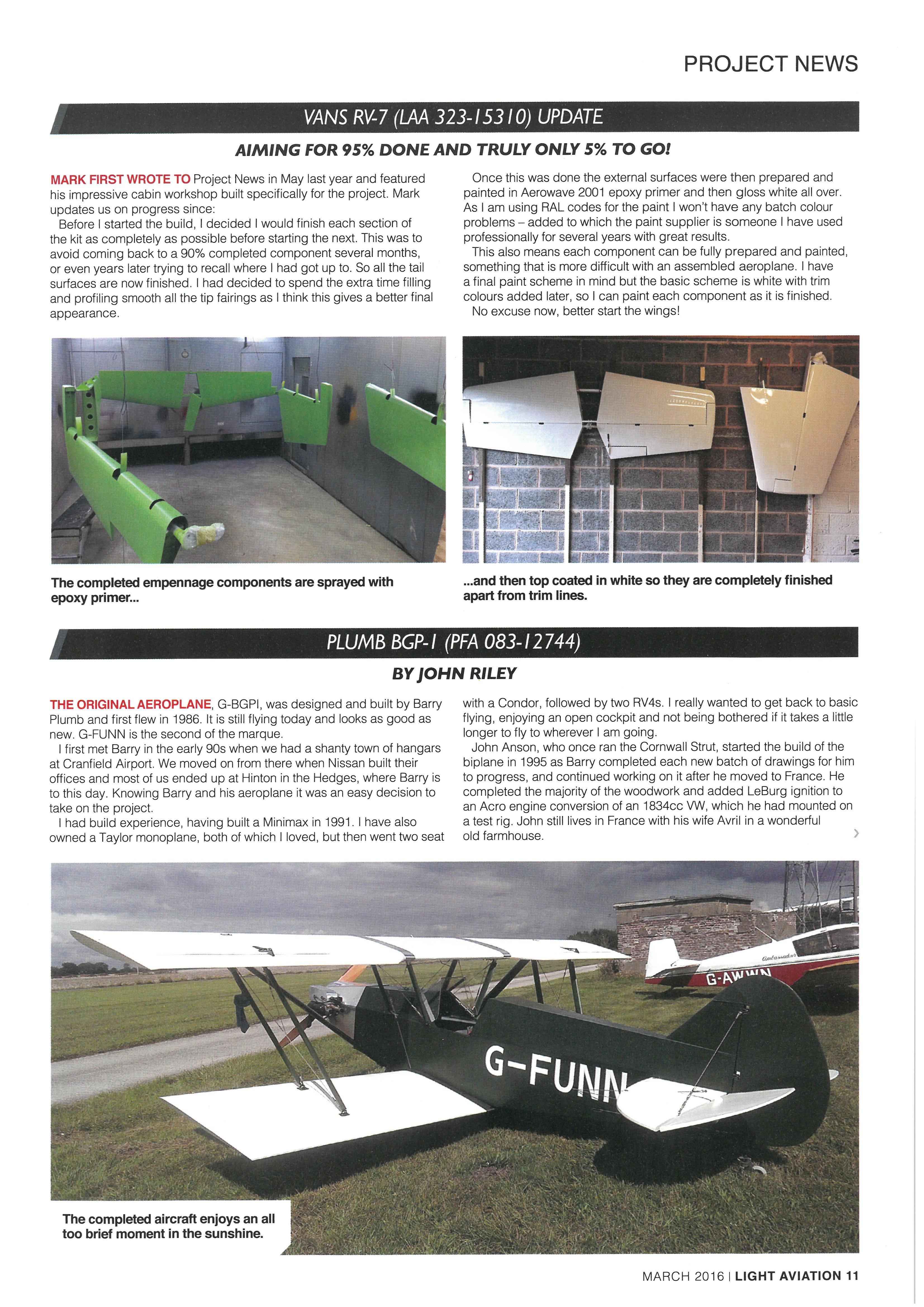
The completed empennage components are sprayed with epoxy primer...
THE ORIGINAL AEROPLANE, G-BGPI, was designed and built by Barry Plumb and first flew in 1986. It is still flying today and looks as good as new. G-FUNN is the second of the marque.
| first met Barry in the early 90s when we had a shanty town of hangars at Cranfield Airport. We moved on from there when Nissan built their offices and most of us ended up at Hinton in the Hedges, where Barry is to this day. Knowing Barry and his aeroplane it was an easy decision to take on the project.
| had build experience, having built a Minimax in 1991. | have also owned a Taylor monoplane, both of which | loved, but then went two seat The completed aircraft enjoys an all too brief moment in the sunshine.
with a Condor, followed by two RV4s. | really wanted to get back to basic flying,enjoyinganopencockpitandnotbeingbotheredifittakesalittle longer to fly to wherever | am going.
John Anson, who once ran the Cornwall Strut, started the build of the biplane in 1995 as Barry completed each new batch of drawings for him to progress, and continued working on it after he moved to France. He completed the majority of the woodwork and added LeBurg ignition to an Acro engine conversion of an 1834cc VW, which he had mounted on a test rig. John still lives in France with his wife Avril in a wonderful old farmhouse.
LAA Inspector Pat Barker brought G-FUNN back to England in 2010 and continued the build, manufacturing the metal fittings, tank and undercarriage. In 2013 | had just finished my Airbike project, an SSDR aeroplane for which Pat was good enough to keep an eye on my fettling, and | decided | needed something else to build... and G-FUNN became available.
Some of the people who have helped complete G-FUNN are Simon Wesley, with welding on the engine mount; Alan Haseldine (Newton Propellers) for the propeller which
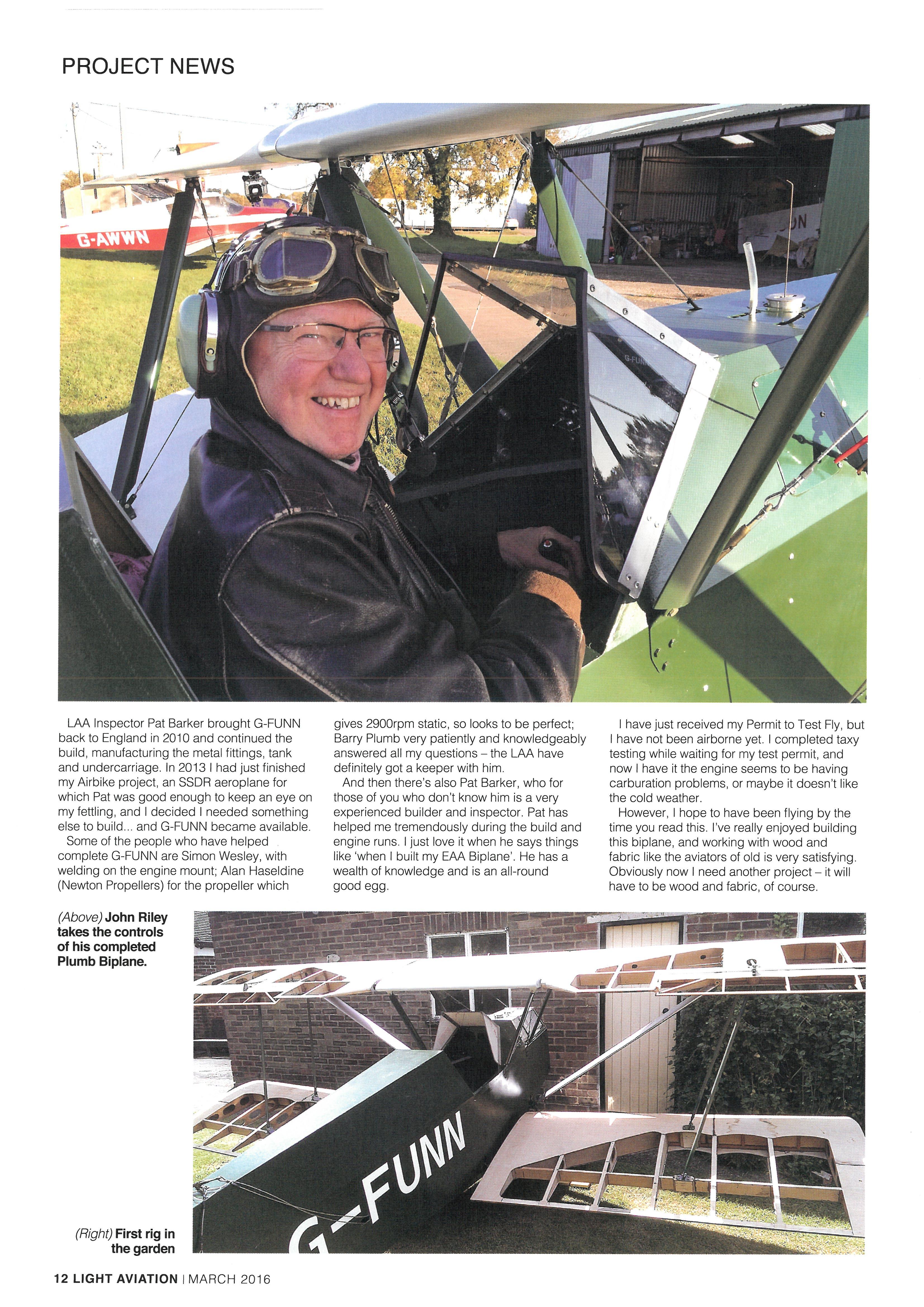
(Above)John Riley takes the controls of his completed Plumb Biplane.
gives 2900rpm static, so looks to be perfect; Barry Plumb very patiently and knowledgeably answered all my questions the LAA have definitely got a keeper with him.
And then there’s also Pat Barker, who for those of you who don’t know him is a very experienced builder and inspector. Pat has helped me tremendously during the build and engine runs. |just love it when he says things like ‘when | built my EAA Biplane’. He has a wealth of knowledge and is an all-round good egg.
| have just received my Permit to Test Fly, but | have not been airborne yet. | completed taxy testing while waiting for my test permit, and now | have it the engine seems to be having carburation problems, or maybe it doesn’t like the cold weather.
However, | hope to have been flying by the time you read this. I’ve really enjoyed building this biplane, and working with wood and fabric likethe aviators of old is very satisfying. Obviously now | need another project it will have to be wood and fabric, of course.
NEWS FROM LYNN WILLIAMS is that his Tigerfalk, a swept-wing Jungmeister-sized aerobatic biplane, powered by a 90hp Salmson 5AQ radial engine, which was last aired at Cranfield’s PFA Rally in 1988, has passed to a new owner so will hopefully be completed.
to come up with all manner of variations on the Flitzer theme, one such being the Vale Stormcock, which is loosely based on the 1928 Lincock light fighter. The Stormcock uses almost 100% of Flitzer fittings and components andthefavouredenginewouldbeafive cylinder Verner radial. However, this may morph into a Laird LC-1W, the precursor to the Laird Super Solution, because the full cowling would enable the installation of a lower cost flat four engine.
The project was put on hold soon after the 1988 Rally and has sadly remained so as the Flitzeremergedasafully fledgeddesign in the early 1990s and, including derivatives, has been Lynn’s Lynn also provided preoccupation ever an impression of a since. possiblecandidate for SSDR, the Flitzer Goblin with a Verner 3-cylinder radial. These are by no means the only designs the Lynn is considering but as he admits
World champion scale modeller, Pete McDermott built and flew an R/C model of the Tigerfalk some years ago and it demonstrated superb aerobatic capabilities, so it will be wonderful so many to see this fascinating aeroplanes, so machine completed and little time! flying.
sHoninieO6/A
Lynn'sfertile
(Above)The proposed gun mounting on the Stormcock. imagination continues
Stormcock (left) and Tigerfalk <_ fuselages in Lynn’s workshop. An idea for an SSDR using a Verner radial engine.
lf your aircraft has been featured in the New Projects list, please let Project News know how you are getting on at: projectnews @laa-archive.org.uk
@ VAN’S RV-7 (LAA 323-15370) 07/01/2016
Mr J Gowdy, Furze Cottage, Furze Cottage, Storrington Road, Thakeham, West Sussex, aimORG) a) @ VAN’S RV-8 (LAA 303-15371) 15/01/2016
Mr S Emery, 43 Tawny Avenue, Upminster, Essex, RM14 2EP @ PITTS MODEL 12 (LAA 349-15372) 20/01/2016
Mr M O'Leary 91 Patterson Lane, Woolstones, Milton Keynes, Buckinghamshire, MK15 OBN @ VAN’S RV-8 (LAA 303-15373) 22/01/2016
Mr V Kiminius, 7 Sudbury Court, Peterborough, Cambridgeshire, PE2 8UW @ EUROFOX 912iS (LAA 376-15374) 22/01/2016
York Gliding Centre, The Aerodrome, Bradley Lane, Rufforth York, YO23 3NA @ BRISTELL NG5 (LAA 385-15376)
25/01/2016
Name & address held by LAA Engineering @ VAN’S RV-8 (LAA 303-15375) 25/01/2016
Mr S Dawson, 50 Crookham Grove, Morpeth, Northumberland, NE61 2XF m@JUST AIRCRAFT SUPERSTOL (LAA 397-15377) 26/01/2016
Mr B Pooler, Lower Grounds Farm, Sherlowe High Ercall, Shropshire, TF6 6LT @ VAN’S RV-14A (LAA 393-15379) 27/01/2016
Mrs EWoolard, 2 Oakview Cottages, Upper Green Road, Shipbourne, Kent, TN11 9PQ m JUST AIRCRAFT SUPERSTOL (LAA 397-15378) 27/01/2016
Mrs C Ho, Napley Cottage, Napley Heath, Market Drayton, Shropshire, TF9 4DP
TO FLY lfyouraircrafthasfeaturedrecently in themagazine completedandhassubsequently Newsitsmaidenflight,Project wouldlove projectnewstohearfromyouat:@laa-archive.org.uk
@ G-STDO BRISTELL NG5 SPEED WING (LAA 385-15314) 07/01/2016
Mr S M Wade, 5 Pike Way, North Weald, Epping, CM16 6BL
Mr J A Strong, 118A Ridge Road, London, N21 3EN
m@G-FUNN PLUMB BGP-1 (PFA 08312744) 12/01/2016
Mr J Riley, 4 Arrow Leys, Bedford, MK41 fo}
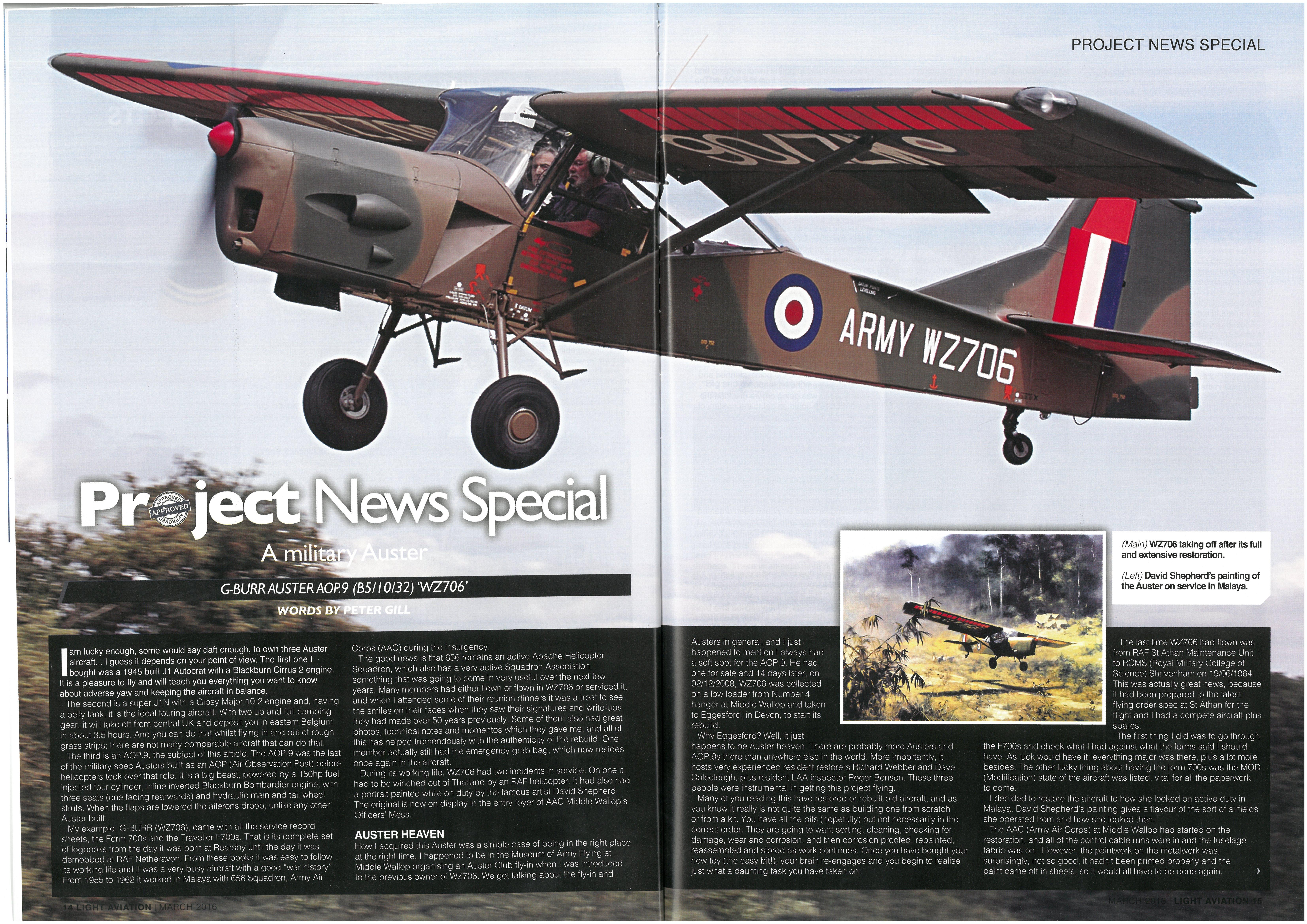
aircraft... | guess it depends on your point of view. The first one | bought was a 1945 built J1 Autocrat with a Blackburn Cirrus 2 engine. It is a pleasure to fly and will teach you everything you want to know about adverse yaw and keeping the aircraft in balance.
The second is a super J1N with a Gipsy Major 10-2 engine and, having a belly tank, it is the ideal touring aircraft. With two up and full camping gear, it will take off from central UK and deposit you in eastern Belgium in about 3.5 hours. And you can do that whilst flying in and out of rough grass strips; there are not many comparable aircraft that can do that.
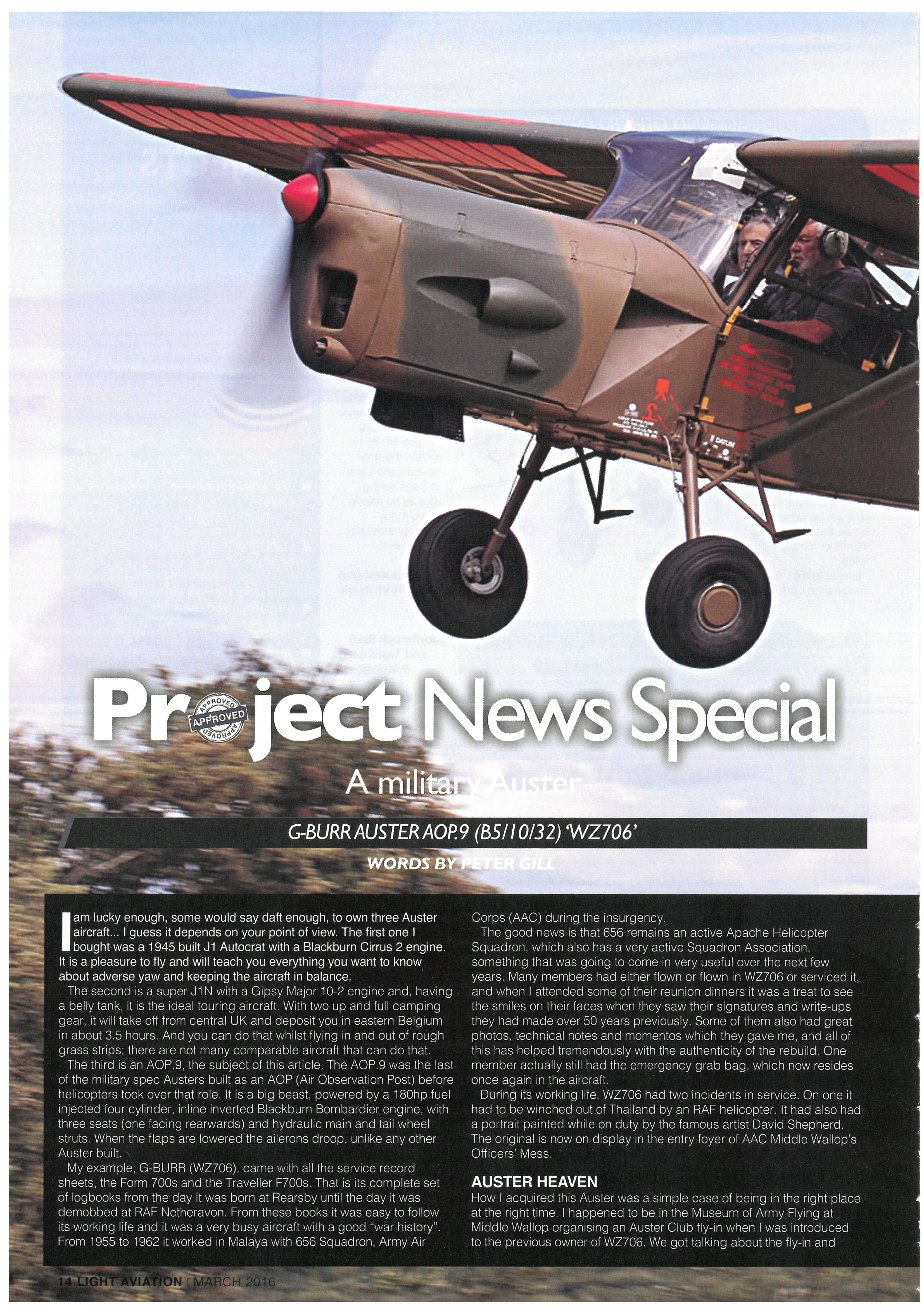
The third is an AOP.9, the subject of this article. The AOP.9 was the last of the military soec Austers built as an AOP (Air Observation Post) before helicopters took over that role. It is a big beast, powered by a 180hp fuel injected four cylinder, inline inverted Blackburn Bombardier engine, with three seats (one facing rearwards) and hydraulic main and tail wheel struts. When the flaps are lowered the ailerons droop, unlike any other Auster built.
My example, G-BURR (WZ706), came with all the service record sheets, the Form 700s and the Traveller F700s. That is its complete set of logbooks from the day it was born at Rearsby until the day it was demobbed at RAF Netheravon. From these books it was easy to follow its working life and it was a very busy aircraft with a good “war history”. From 1955 to 1962 it worked in Malaya with 656 Squadron, Army Air
Corps (AAC) during the insurgency.
The good news is that 656 remains an active Apache Helicopter Squadron, which also has a very active Squadron Association, something that was going to come in very useful over the next few years. Many members had either flown or flown in WZ706 or serviced it, and when | attended some of their reunion dinners it was a treat to see the smiles on their faces when they saw their signatures and write-ups they had made over 50 years previously. Some of them also had great photos, technical notes and momentos which they gave me, and all of this has helped tremendously with the authenticity of the rebuild. One member actually still had the emergency grab bag, which now resides once again in the aircraft.
During its working life, WZ706 had two incidents in service. On one it had to be winched out of Thailand by an RAF helicopter. It had also had a portrait painted while on duty by the famous artist David Shepherd. The original is now on display in the entry foyer of AAC Middle Wallop’s Officers’ Mess.
AUSTER HEAVEN
How | acquired this Auster was a simple case of being in the right place at the right time. | happened to be in the Museum of Army Flying at Middle Wallop organising an Auster Club fly-in when | was introduced to the previous owner of WZ706. We got talking about the fly-in and
justwhatadauntingtaskyouhavetakenon.
Austersingeneral,and|just happened to mention | always had a soft spot for the AOP.9. He had one for sale and 14 days later, on 02/12/2008, WZ706 was collected on a low loader from Number 4 hanger at Middle Wallop and taken to Eggesford, in Devon, to start its rebuild.
Why Eggesford? Well, itjust happens to be Auster heaven. There are probably more Austers and AOP.9s there than anywhere else in the world. More importantly, it hosts very experienced resident restorers Richard Webber and Dave Coleclough, plus resident LAA inspector Roger Benson. These three people were instrumental in getting this project flying.
Many of you reading this have restored or rebuilt old aircraft, and as you know it really is not quite the same as building one from scratch or from a kit. You have all the bits (hopefully) but not necessarily in the correct order. They are going to want sorting, cleaning, checking for damage, wear and corrosion, and then corrosion proofed, repainted, reassembled and stored as work continues. Once you have bought your new toy (the easy bit!), your brain re-engages and you begin to realise
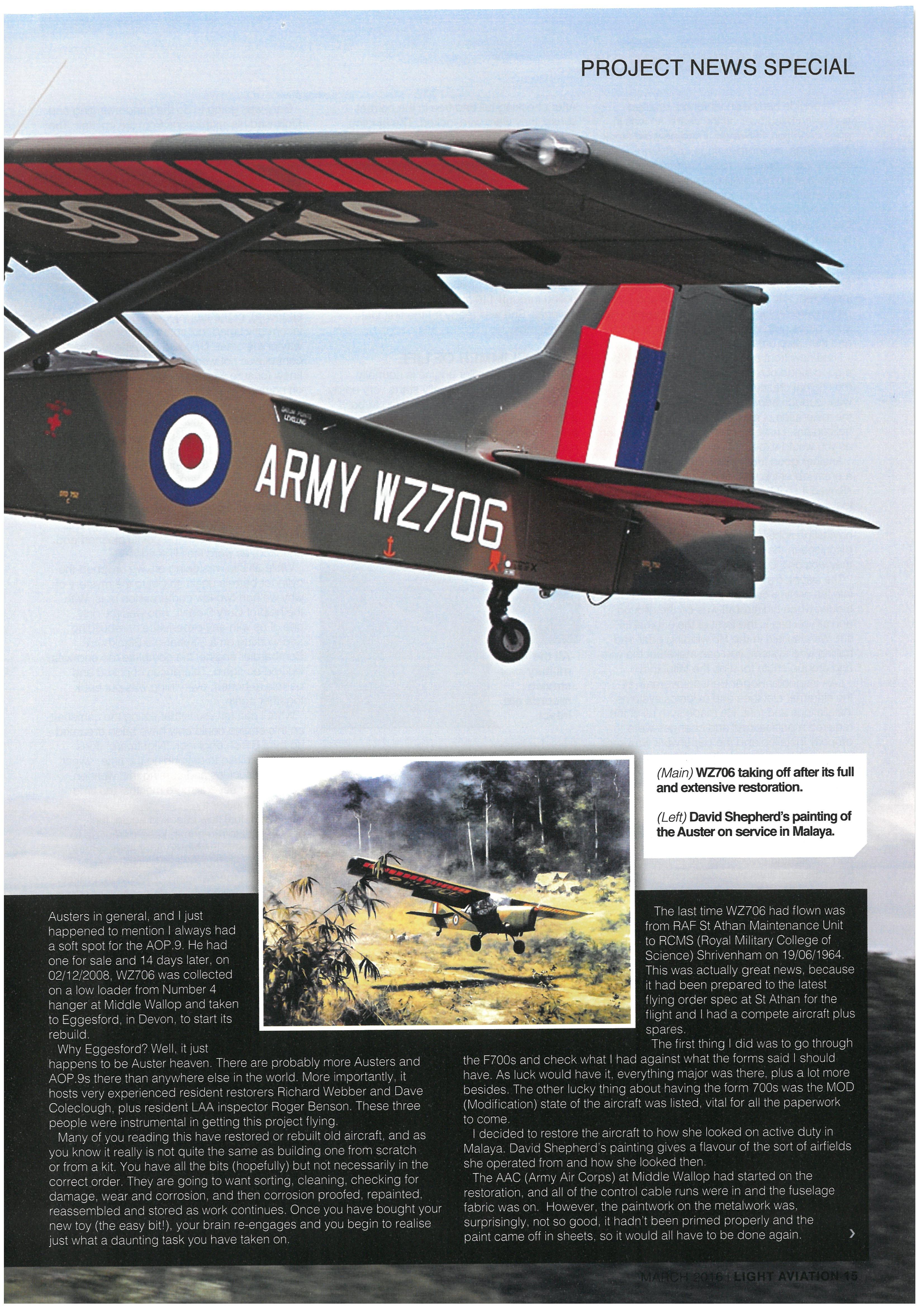
(Main) WZ706 taking off after its full and extensive restoration.
(Left) David Shepherd’s painting of the Auster on service in Malaya.
The last time WZ706 had flown was from RAF St Athan Maintenance Unit to RCMS (Royal Military College of Science) Shrivenham on 19/06/1964.
This was actually great news, because it had been prepared to the latest flying order spec at St Athan for the flight and | had a compete aircraft plus spares.
The first thing | did was to go through the F700s and check what | had against what the forms said | should have. As luck would have it, everything major was there, plus a lot more besides. The other lucky thing about having the form 700s was the MOD (Modification) state of the aircraft was listed, vital for all the paperwork to come.
| decided to restore the aircraft to how she looked on active duty in Malaya. David Shepherd's painting gives a flavour of the sort of airfields she operated from and how she looked then.
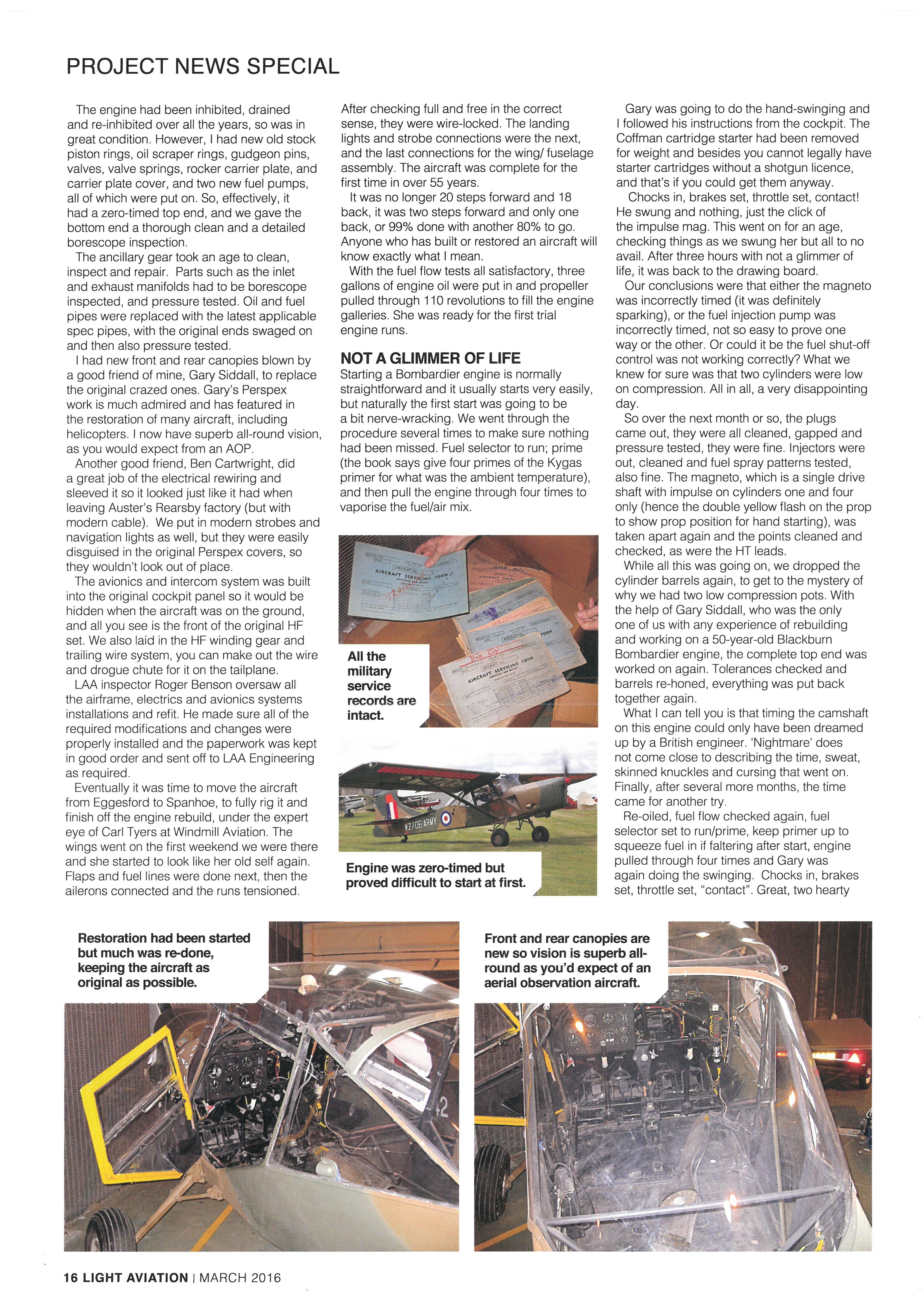
The AAC (Army Air Corps) at Middle Wallop had started on the restoration, and all of the control cable runs were in and the fuselage fabric was on. However, the paintwork on the metalwork was, surprisingly, not so good, it hadn't been primed properly and the paint came off in sheets, so it would all have to be done again.
The engine had been inhibited, drained and re-inhibited over all the years, so was in great condition. However, | had new old stock piston rings, oil scraper rings, gudgeon pins, valves, valve springs, rocker carrier plate, and carrier plate cover, and two new fuel pumps, all of which were put on. So, effectively, it had a zero-timed top end, and we gave the bottom end a thorough clean and a detailed borescope inspection.
The ancillary gear took an age to clean, inspect and repair. Parts such as the inlet and exhaust manifolds had to be borescope inspected, and pressure tested. Oil and fuel pipes were replaced with the latest applicable spec pipes, with the original ends swaged on and then also pressure tested.
| had new front and rear canopies blown by a good friend of mine, Gary Siddall, to replace the original crazed ones. Gary’s Perspex work is much admired and has featured in the restoration of many aircraft, including helicopters. | now have superb all-round vision, as you would expect from an AOP.
Another good friend, Ben Cartwright, did a great job of the electrical rewiring and sleeved it so it looked just like it had when leaving Auster’s Rearsby factory (but with modern cable). We put in modern strobes and navigation lights as well, but they were easily disguised in the original Perspex covers, so they wouldn't look out of place.
The avionics and intercom system was built into the original cockpit panel so it would be hidden when the aircraft was on the ground, and all you see is the front of the original HF set. We also laid in the HF winding gear and trailing wire system, you can make out the wire and drogue chute for it on the tailplane.
LAA inspector Roger Benson oversaw all the airframe, electrics and avionics systems installations and refit. He made sure all of the required modifications and changes were properly installed and the paperwork was kept in good order and sent off to LAA Engineering as required.
Eventually it was time to move the aircraft from Eggesford to Spanhoe, to fully rig it and finish off the engine rebuild, under the expert eye of Carl Tyers at Windmill Aviation. The wings went on the first weekend we were there and she started to look like her old self again. Flaps and fuel lines were done next, then the ailerons connected and the runs tensioned.
Restoration had been started but much was re-done, keeping the aircraft as original as possible. 16 LIGHT AVIATION | MARCH 2016
After checking full and free in the correct sense, they were wire-locked. The landing lights and strobe connections were the next, and the last connections for the wing/ fuselage assembly. The aircraft was complete for the first time in over 55 years.
Itwas no longer 20 steps forward and 18 back, it was two steps forward and only one back, or 99% done with another 80% to go. Anyone who has built or restored an aircraft will know exactly what | mean.
With the fuel flow tests all satisfactory, three gallons of engine oil were put in and propeller pulled through 110 revolutions to fill the engine galleries. She was ready for the first trial engine runs.
Starting a Bombardier engine is normally straightforward and it usually starts very easily, but naturally the first start was going to be a bit nerve-wracking. We went through the procedure several times to make sure nothing had been missed. Fuel selector to run; prime (the book says give four primes of the Kygas primer for what was the ambient temperature), and then pull the engine through four times to vaporise the fuel/air mix.
Gary was going to do the hand-swinging and | followed his instructions from the cockpit. The Coffman cartridge starter had been removed for weight and besides you cannot legally have starter cartridges without a shotgun licence, and that’s if you could get them anyway.
Chocks in, brakes set, throttle set, contact! He swung and nothing, just the click of the impulse mag. This went on for an age, checking things as we swung her but all to no avail. After three hours with not a glimmer of life, it was back to the drawing board.
Our conclusions were that either the magneto was incorrectly timed (it was definitely sparking), or the fuel injection pump was incorrectly timed, not so easy to prove one way or the other. Or could it be the fuel shut-off control was not working correctly? What we knew for sure was that two cylinders were low on compression. All in all, a very disappointing day.
So over the next month or so, the plugs came out, they were all cleaned, gapped and pressure tested, they were fine. Injectors were out, cleaned and fuel spray patterns tested, also fine. The magneto, which is a single drive shaft with impulse on cylinders one and four only (hence the double yellow flash on the prop to show prop position for hand starting), was taken apart again and the points cleaned and checked, as were the HT leads.
While all this was going on, we dropped the cylinder barrels again, to get to the mystery of why we had two low compression pots. With the help of Gary Siddall, who was the only one of us with any experience of rebuilding and working on a 50-year-old Blackburn Bombardier engine, the complete top end was worked on again. Tolerances checked and barrels re-honed, everything was put back together again.
What | can tell you is that timing the camshaft on this engine could only have been dreamed up by a British engineer. ‘Nightmare’ does not come close to describing the time, sweat, skinned knuckles and cursing that went on. Finally, after several more months, the time came for another try.
Re-oiled, fuel flow checked again, fuel selector set to run/prime, keep primer up to squeeze fuel in if faltering after start, engine pulled through four times and Gary was again doing the swinging. Chocks in, brakes set, throttle set, “contact”. Great, two hearty
“Big and menacing on the ground”, WZ706.
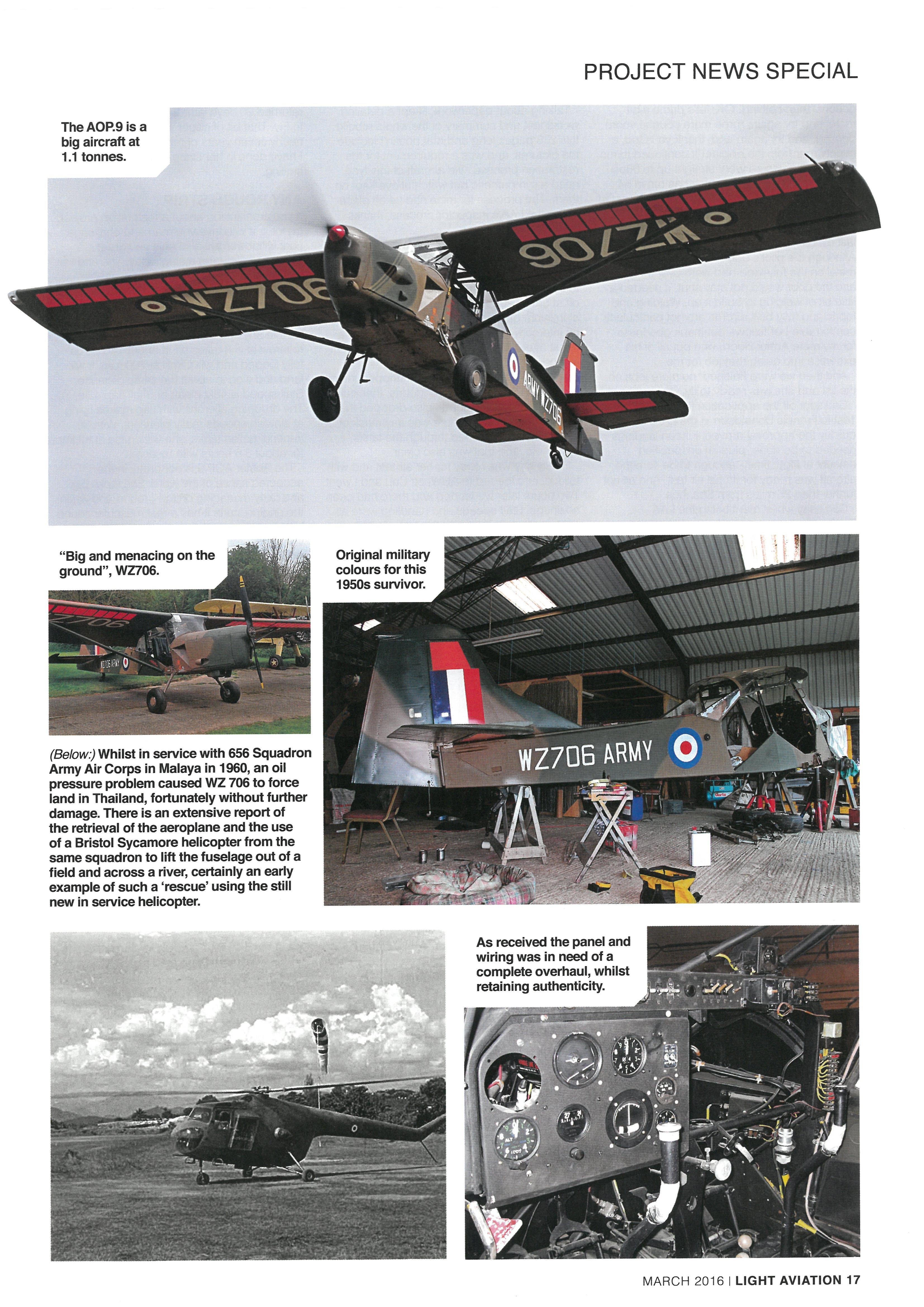
(Below:)Whilst in service with 656 Squadron Army Air Corps in Malaya in 1960, an oil pressure problem caused WZ 706 to force land in Thailand, fortunately without further damage. There is an extensive report of the retrieval of the aeroplane and the use of a Bristol Sycamore helicopterfrom the same squadron to lift the fuselage out of a fieldandacrossariver,certainlyanearly exampleofsucha ‘rescue’usingthestill new in service helicopter.
Original military colours for this 1950s survivor.
As received the panel and wiring was in need of a complete overhaul, whilst retaining authenticity.
coughs, then nothing. OK, let’s prime a bit more, and try again, three more coughs, more priming, and try again and, thank you God, a mighty roar from the engine! It continued to run and the oil pressure went straight up to 50psi. It was the first time this engine has run in 54 years, and | can tell you that it felt and sounded great. | was grinning from ear to ear.
While all this big stuff was going on, all the last minute details were being attended to.
Although the pilot’s door fitted correctly, the metal on the fuselage had worn over the years and the door would not stay shut, it needed a little bit of welding to build it up. Welding and fabric and fully built aircraft are not particularly comfortable bedfellows but thank goodness for my mate Arthur Boon, who put all of his expertise into doing that job for me.
And then we were finished, no more jobs on the list and she was ready to fly.
Carl sent off the application for a Permit to Test to Francis Donaldson at the LAA, and very quickly the approval arrived. Fifteen landings needed to be done, plus an unspecified amount of flight time - enough to be sure the aircraft was ready for its full air test. And all not further than 25 miles from Spanhoe.
Can | say whilst mentioning the LAA Engineering, what great support | had throughout all of the re-build. Advice on what paperwork was needed, where modifications were needed they were approved, and manualsand checklistswere approved. Rigged at Spanhoe for the first time in over 55 years.
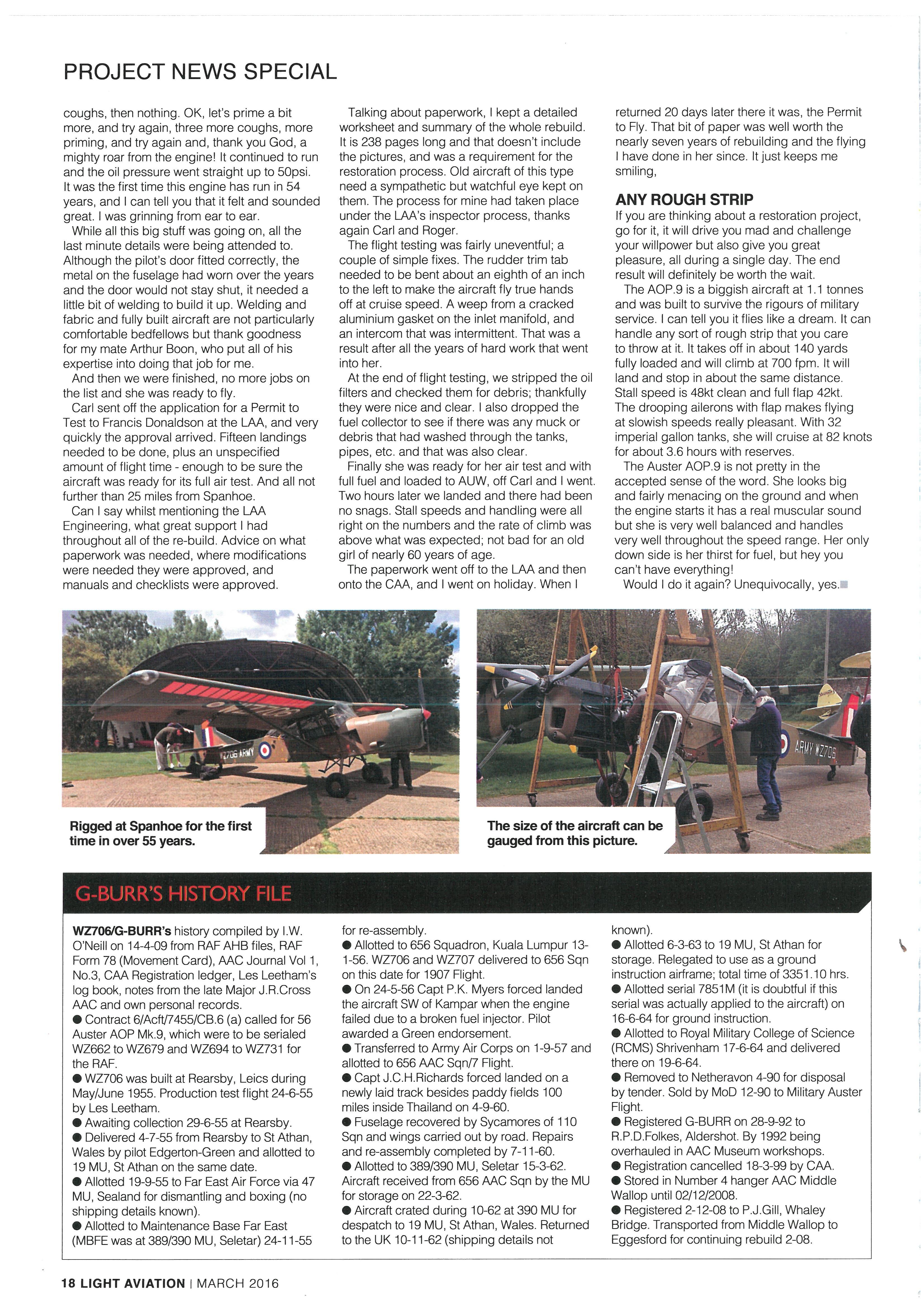
WZ706/G-BURPR’shistory compiled by |.W. O'Neill on 14-4-09 from RAF AHB files, RAF
Form 78 (Movement Card), AAC Journal Vol 1, No.3, CAA Registration ledger, Les Leetham’s log book, notes from the late Major J.R.Cross AAC and own personal records.
®@Contract 6/Acft/7455/CB.6 (a) called for 56 Auster AOP Mk.9, which were to be serialed WZ662 to WZ679 and WZ694 to WZ731 for the RAF.
@WZ706 was built at Rearsby, Leics during May/June 1955. Production test flight 24-6-55 by Les Leetham.
@Awaiting collection 29-6-55 at Rearsby.
@Delivered 4-7-55 from Rearsby to St Athan, Wales by pilot Edgerton-Green and allotted to 19 MU, St Athan on the same date.
@ Allotted 19-9-55 to Far East Air Force via 47 MU, Sealand for dismantling and boxing (no shipping details known).
@ Allotted to Maintenance Base Far East (MBFEwas at 389/390 MU, Seletar) 24-11-55
Talking about paperwork, | kept a detailed worksheet and summary of the whole rebuild. It is 238 pages long and that doesn’t include the pictures, and was a requirement for the restoration process. Old aircraft of this type need a sympathetic but watchful eye kept on them. The process for mine had taken place under the LAA’s inspector process, thanks again Carl and Roger.
The flight testing was fairly uneventtul; a couple of simple fixes. The rudder trim tab needed to be bent about an eighth of an inch to the left to make the aircraft fly true hands off at cruise speed. A weep from a cracked aluminium gasket on the inlet manifold, and an intercom that was intermittent. That was a result after all the years of hard work that went into her.
At the end of flight testing, we stripped the oil filters and checked them for debris; thankfully they were nice and clear. | also dropped the fuel collector to see if there was any muck or debris that had washed through the tanks, pipes, etc. and that was also clear.
Finally she was ready for her air test and with full fuel and loaded to AUW, off Carl and | went.
Two hours later we landed and there had been no snags. Stall speeds and handling were all right on the numbers and the rate of climb was above what was expected; not bad for an old girl of nearly 60 years of age.
The paperwork went off to the LAA and then onto the CAA, and | went on holiday. When |
returned 20 days later there it was, the Permit to Fly.That bit of paper was well worth the nearly seven years of rebuilding and the flying | have done in her since. It just keeps me smiling,
If you are thinking about a restoration project, go for it, it will drive you mad and challenge your willpower but also give you great pleasure, all during a single day. The end result will definitely be worth the wait.
The AOP.9 is a biggish aircraft at 1.1 tonnes and was built to survive the rigours of military service. | can tell you it flies like a dream. It can handle any sort of rough strip that you care to throw at it. It takes off in about 140 yards fully loaded and will climb at 700 fom. Itwill land and stop in about the same distance. Stall speed is 48kt clean and full flap 42kt. The drooping ailerons with flap makes flying at slowish speeds really pleasant. With 32 imperial gallon tanks, she will cruise at 82 knots for about 3.6 hours with reserves.
The Auster AOP.9 is not pretty in the accepted sense of the word. She looks big and fairly menacing on the ground and when the engine starts it has a real muscular sound but she is very well balanced and handles very well throughout the speed range. Her only down side is her thirst for fuel, but hey you can't have everything!
Would | do it again? Unequivocally, yes.
for re-assembly.
@Allotted to 656 Squadron, Kuala Lumpur 131-56.WZ706 and WZ707 delivered to 656 Sqn on this date for 1907 Flight.
@On 24-5-56 Capt P.K. Myers forced landed the aircraft SWof Kampar when the engine failed due to a broken fuel injector. Pilot awarded a Green endorsement.
@Transferred to Army Air Corps on 1-9-57 and allottedto 656 AAC Sqn/7 Flight.
@Capt J.C.H.Richards forced landed on a newly laid track besides paddy fields 100 miles inside Thailand on 4-9-60.
@Fuselage recovered by Sycamores of 110 Sqn and wings carried out by road. Repairs and re-assembly completed by 7-11-60.
@Allotted to 389/390 MU, Seletar 15-3-62. Aircraft received from 656 AAC Sqn by the MU for storage on 22-3-62.
@Aircraft crated during 10-62 at 390 MU for despatch to 19 MU, St Athan, Wales. Returned to the UK 10-11-62 (shipping details not
@Allotted6-3-63to 19MU,StAthanfor \ storage. Relegated to use as a ground instruction airframe; total time of 3351.10 hrs.
@Allotted serial 7851M (it is doubtful if this serial was actually applied to the aircraft) on 16-6-64for ground instruction.
@Allotted to Royal Military College of Science (RCMS) Shrivenham 17-6-64 and delivered there on 19-6-64.
@Removed to Netheravon 4-90 for disposal bytender. Sold by MoD 12-90 to Military Auster Flight.
@Registered G-BURR on 28-9-92 to R.P.D.Folkes,Aldershot. By 1992 being overhauled in AAC Museum workshops. @Registration cancelled 18-3-99 by CAA. @Stored in Number 4 hanger AAC Middle Wallop until 02/12/2008.
@Registered 2-12-08 to P.J.Gill,Whaley Bridge. Transported from Middle Wallop to Eggesford for continuing rebuild 2-08.
s you haveall probably noticed, my column has been absent for the last couple of months due to college exams, | had to forgo the articles. However, I'm back for the next few issues until exams start all over again! So without further ado, here is the latest rundown.
THE SPIRIT OF GOOLE
TSOG, supported by the LAA Educational Trust, is pleased to announce the first dedicated Youth Aviation Centre (YAC) and Kelfield airfield, just 22 miles away from Goole and 10 miles from Sturgate. Kelfield will become the new base for the YAC where we will be running air experience flights alongside engineering and aviation themed weekends all we need is some eeviCmcrclialole
From its early beginnings the organisers and supporters realised that we needed to bring together all the organisations involved in aviation in the UK for young people to understand what aviation and aerospace is about. If we are going to win new members in the years ahead they need to ‘get it’ as young people. The seminar is also focused on making sure the opportunities are there for the next generation of aviators and astronauts. Laugh you might but last year at Brooklands, a speaker from the CAA told us about the requirement to have in place a UK policy on space planes and spaceports. Who will follow in the footsteps of Tim Peake?
This year’s event will be bigger and better than ever before. The Aviation Skills Partnership will be helping to engage with educators and teachers from schools. Colleges will also get a larger ‘youth’ presence at the conference.
“This year we are once again hoping to encourage youth, particularly girls, into becoming involved with aviation activities both in and outside of the school curriculum," said Stewart Luck, organiser of the event.
a lot of money. If you would like to help you
As some of you may know, | have been a part of TSOG since the project first started. | had no interest in aviation and just wanted to do some volunteering towards a VYPER (Volunteering for Young People within the East Riding) award, which | have managed to achieve with over 1,000 recorded volunteer hours.
As the months went on however, | became more involved with the project and it has lead to many brilliant opportunities, such as writing for the LAA in a bid to help start a career in journalism, which|will hopefullyfulfilaftermyeducation.
Also, when my father was diagnosed with cancer in late 2014 and sadly passed away in May 2015, the TSOG project was there to help me by giving me something to focus on. So, as a thank you | have decided to do a skydive in an effort to raise money for the project.
The Sherwood Ranger has made tremendous progress over the winter and is set for completion by the summer, and as many builders know, it is this final push that can cost
yYouth&ee:met can do so by sponsoring my skydive. Please makea donationat: httos://mydonate.bt.com/ fundraisers/michellebrown 1
BROOKLANDS
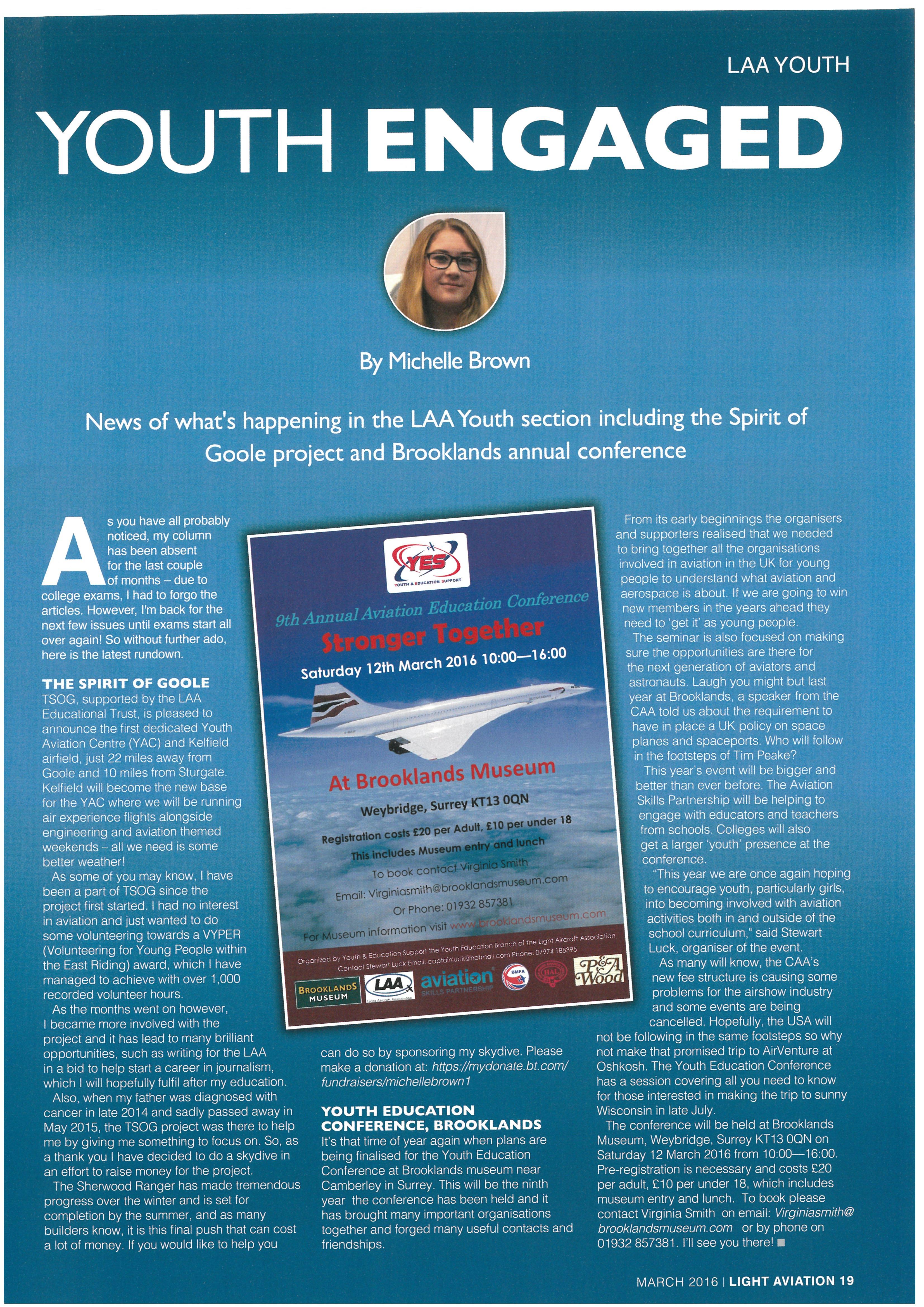
It’s that time of year again when plans are being finalised for the Youth Education Conference at Brooklands museum near Camberley in Surrey. This will be the ninth year the conference has been held and it has brought many important organisations together and forged many useful contacts and friendships.
As many will know, the CAA’s new fee structure is causing some problems for the airshow industry and some events are being cancelled. Hopefully, the USA will not be following in the same footsteps so why not make that promised trip to AirVenture at Oshkosh. The Youth Education Conference has a session covering all you need to know for those interested in making the trip to sunny Wisconsin in late July.
The conference will be held at Brooklands Museum, Weybridge, Surrey KT13 OQNon Saturday 12 March 2016 from 10:00—16:00. Pre-registration is necessary and costs £20 per adult, £10 per under 18, which includes museum entry and lunch. To book please contact VirginiaSmith onemail: Virginiasmith@ brooklandsmuseum.com_ or by phone on 01932 857381. I'll see you there! m
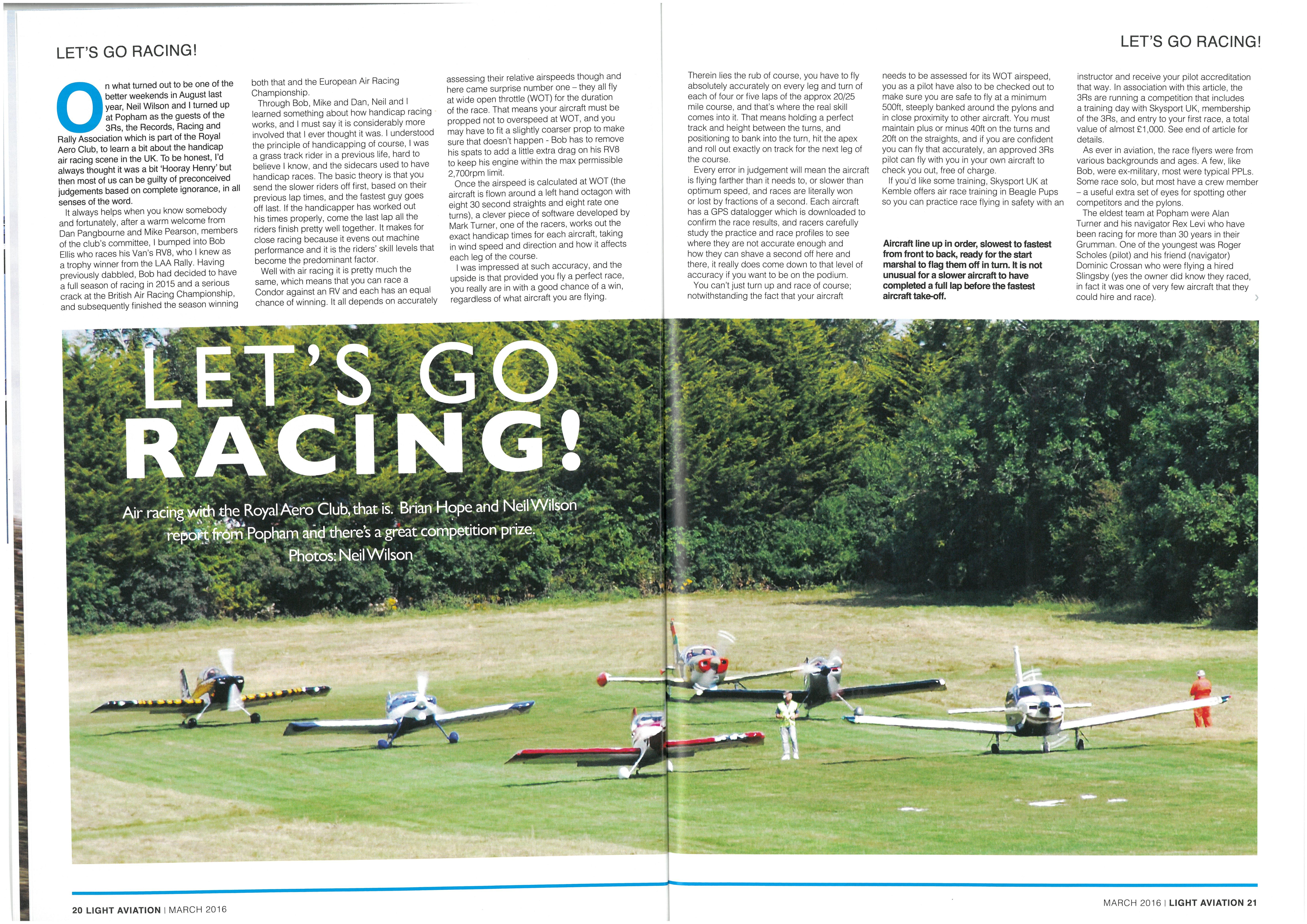
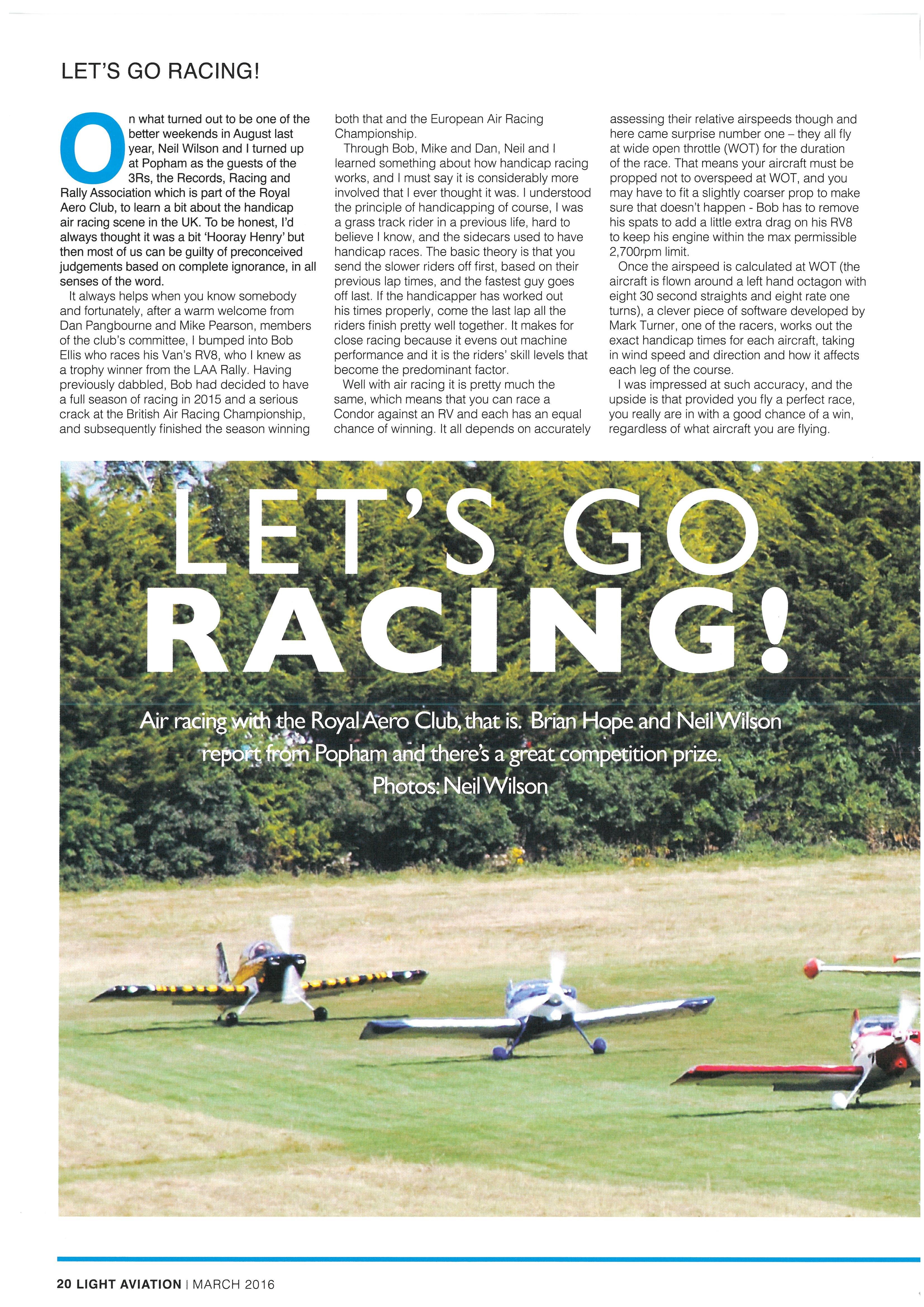
n what turned out to be one of the better weekends inAugust last year, Neil Wilson and | turned up at Popham as the guests of the 3Rs, the Records, Racing and Rally Association which is part of the Royal Aero Club, to learn a bit about the handicap air racing scene in the UK. To be honest, I’d always thought it was a bit ‘Hooray Henry’ but then most of us can be guilty of preconceived judgements based on complete ignorance, in all senses of the word.
both that and the European Air Racing Championship.
Through Bob, Mike and Dan, Neil and | learned something about how handicap racing works, and | must say it is considerably more involved that | ever thought it was. | understood the principle of handicapping of course, | was a grass track rider in a previous life, hard to believe | know, and the sidecars used to have handicap races. The basic theory is that you send the slower riders off first, based on their previous lap times, and the fastest guy goes off last. If the handicapper has worked out his times properly, come the last lap all the riders finish pretty well together. It makes for close racing because it evens out machine performance and it is the riders’ skill levels that become the predominant factor.
lt always helps when you know somebody and fortunately, after a warm welcome from Dan Pangbourne and Mike Pearson, members of the club's committee, | bumped into Bob Ellis who races his Van’s RV8, who | knew as a trophy winner from the LAA Rally. Having previously dabbled, Bob had decided to have a full season of racing in 2015 and a serious crack at the British Air Racing Championship, and subsequently finished the season winning es
Well with air racing it is pretty much the same, which means that you can race a Condor against an RV and each has an equal chance of winning. It all depends on accurately
assessing their relative airspeeds though and herecamesurprisenumberone theyallfly at wide open throttle (WOT)for the duration of the race. That means your aircraft must be propped not to overspeed at WOT, and you may have to fit a slightly coarser prop to make sure that doesn’t happen - Bob has to remove hisspatstoaddalittle extradragonhisRV8 to keep his engine within the max permissible 2,700rpm limit.
Once the airspeed is calculated at WOT (the aircraftisflownaround a lefthandoctagonwith eight 30 second straights and eight rate one turns), a clever piece of software developed by Mark Turner, one of the racers, works out the exact handicap times for each aircraft, taking in wind speed and direction and how it affects each leg of the course.
| was impressed at such accuracy, and the upside is that provided you fly a perfect race, you really are in with a good chance of a win,
Therein lies the rub of course, you have to fly absolutely accurately on every leg and turn of each of four or five laps of the approx 20/25 mile course, and that’s where the real skill comes into it. That means holding a perfect track and height between the turns, and positioning to bank into the turn, hit the apex and roll out exactly on track for the next leg of the course.
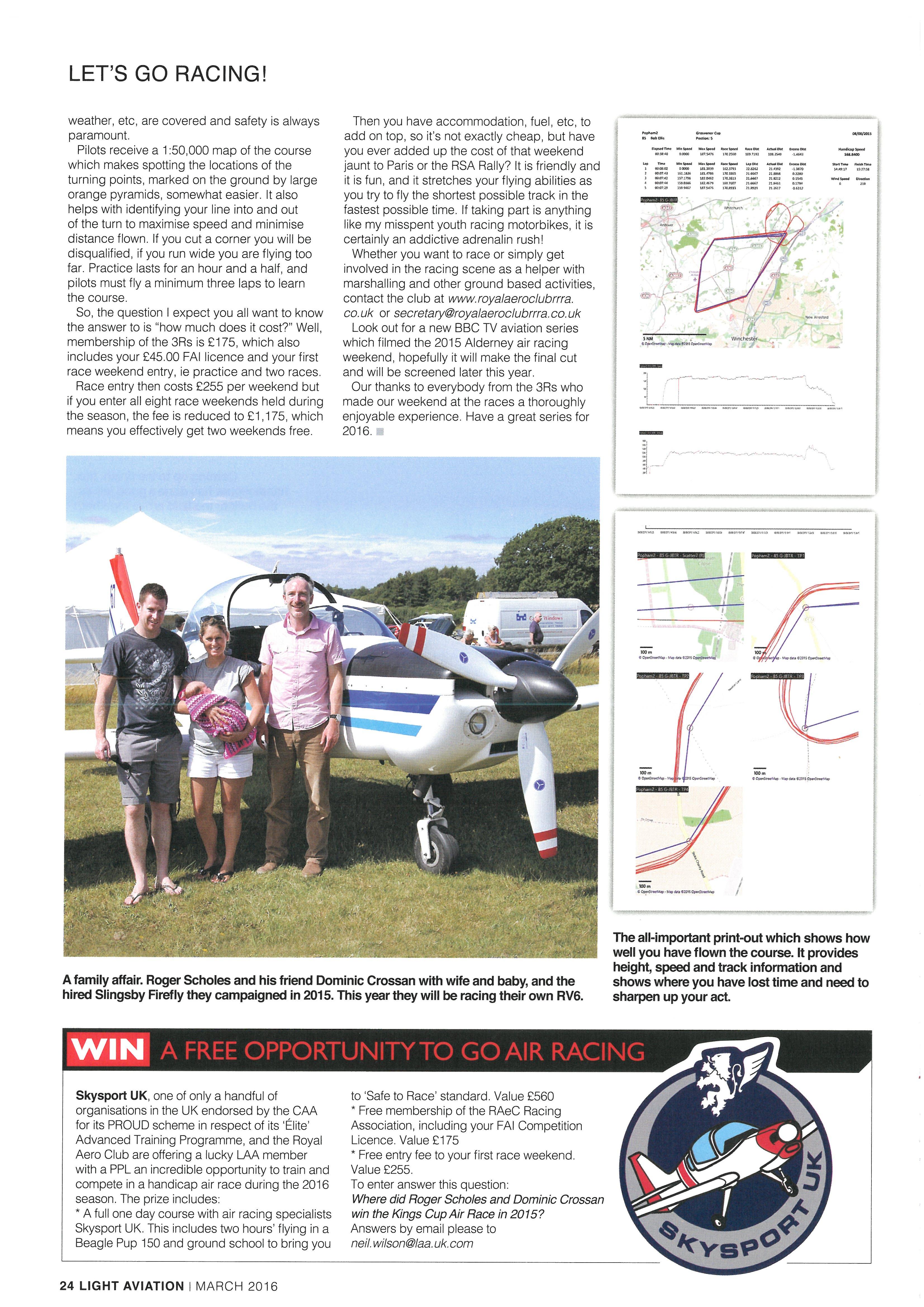
Every error in judgement will mean the aircraft is flying farther than it needs to, or slower than optimum speed, and races are literally won or lost by fractions of a second. Each aircraft has a GPS datalogger which is downloaded to confirm the race results, and racers carefully study the practice and race profiles to see where they are not accurate enough and how they can shave a second off here and there, it really does come down to that level of accuracy if you want to be on the podium.
You can’t just turn up and race of course; notwithstanding the fact that your aircraft
needs to be assessed for its WOT airspeed, you as a pilot have also to be checked out to make sure you are safe to fly at a minimum 500ft, steeply banked around the pylons and in close proximity to other aircraft. You must maintain plus or minus 40ft on the turns and 20ft on the straights, and if you are confident you can fly that accurately, an approved 3Rs pilot can fly with you in your own aircraft to check you out, free of charge.
lf you'd like some training, Skysport UK at Kemble offers air race training in Beagle Pups so you can practice race flying in safety with an
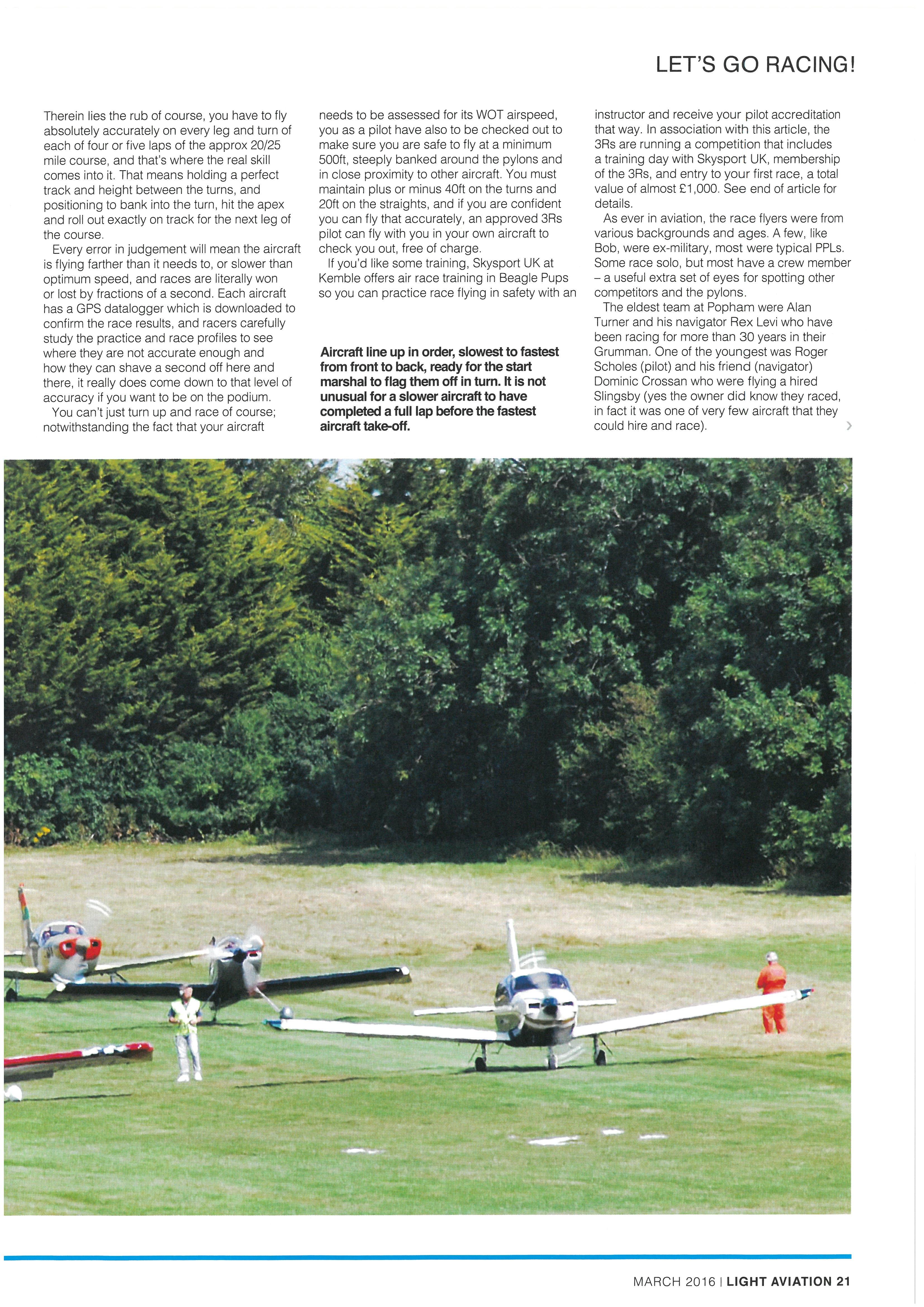
Aircraft line up in order, slowest to fastest from front to back, ready for the start marshal to flag them off in turn. Itis not unusual for a slower aircraft to have completed a full lap before the fastest aircraft take-off.
instructor and receive your pilot accreditation that way. In association with this article, the 3Rs are running a competition that includes a training day with Skysport UK, membership of the 3Rs, and entry to your first race, a total value of almost £1,000. See end of article for details.
As ever in aviation, the race flyers were from various backgrounds and ages. A few, like Bob, were ex-military, most were typical PPLs. Some race solo, but most have a crew member a usefulextrasetofeyesforspottingother competitors and the pylons.
The eldest team at Popham were Alan Turner and his navigator Rex Levi who have been racing for more than 30 years in their Grumman. One of the youngest was Roger Scholes (pilot) and his friend (navigator) Dominic Crossan who were flying a hired Slingsby (yes the owner did know they raced, in fact it was one of very few aircraft that they could hire and race).
Dan Pangbourne invited me to join him in his Grumman Tiger to see what is involved in completing a lap of the Popham race circuit; |took his Dad David's place inthe right hand seat.
We took off heading west, with Dan climbing steadily at speed, as this gains time. The course is marked out on the map, and has four turning points, marked by orange pyramids on the ground. | hoped the near perfect weather would make spotting them fairly easy.
As Dan had already done a few practice laps, he had a good idea of what to look out for, but | still wanted to see if | was up to the job. The Ordnance Survey map helps as it isn’t just about looking for the marker. If you spot a wood that is nearby, or a house or a crossroads, these all help to guide you
towards the target.
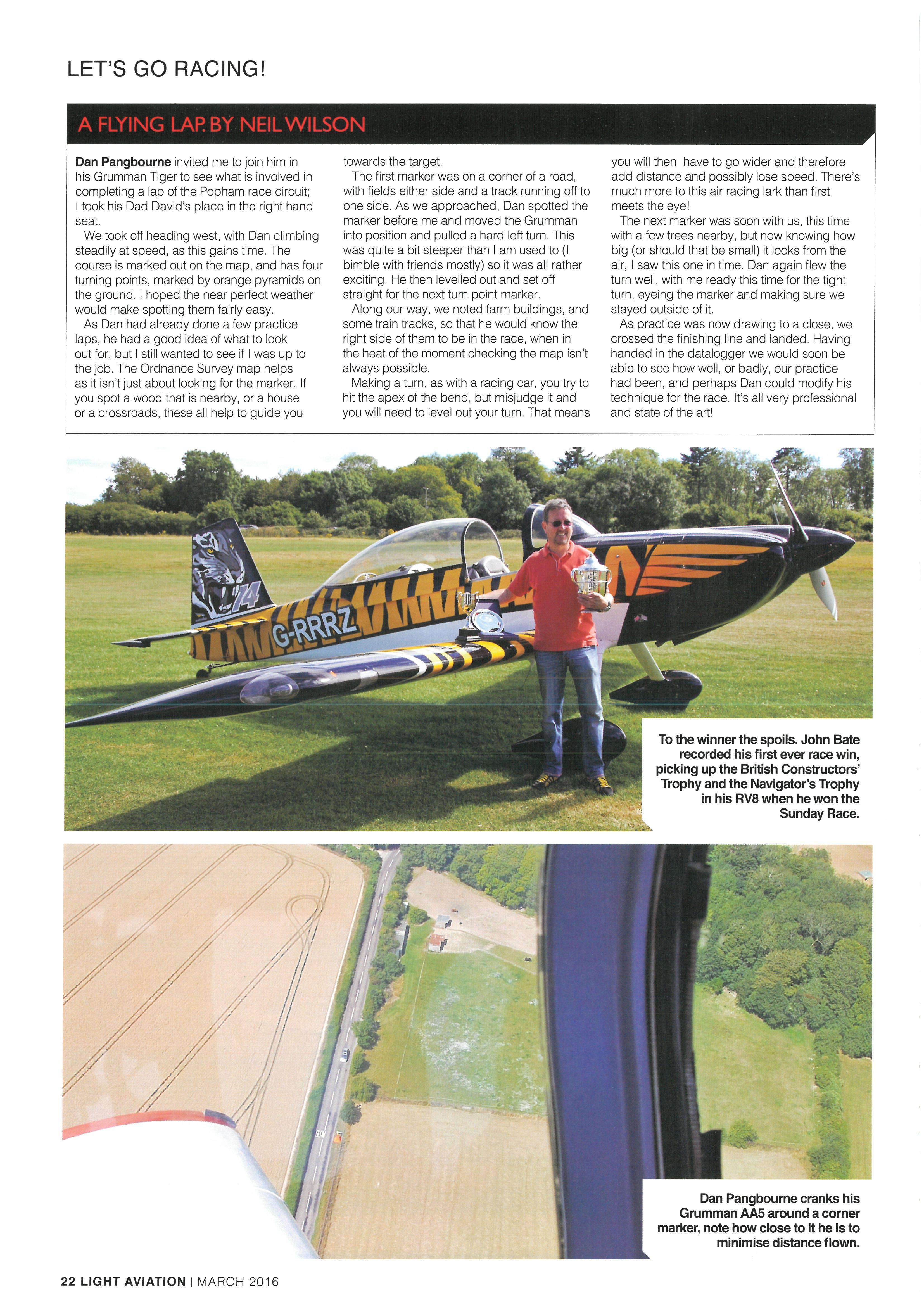
The first marker was on a corner of a road, with fields either side and a track running off to one side. As we approached, Dan spotted the marker before me and moved the Grumman into position and pulled a hard left turn. This was quite a bit steeper than | am used to (I bimble with friends mostly) so it was all rather exciting. He then levelled out and set off straight for the next turn point marker.
Along our way, we noted farm buildings, and some train tracks, so that he would know the right side of them to be in the race, when in the heat of the moment checking the map isn’t always possible.
Making a turn, as with a racing car, you try to hit the apex of the bend, but misjudge it and you will need to level out your turn. That means
you will then have to go wider and therefore add distance and possibly lose speed. There’s much more to this air racing lark than first meets the eye!
The next marker was soon with us, this time with a few trees nearby, but now knowing how big (or should that be small) it looks from the air, | saw this one intime. Dan again flew the turn well, with me ready this time for the tight turn, eyeing the marker and making sure we stayed outside of it.
As practice was now drawing to a close, we crossed the finishing line and landed. Having handed in the datalogger we would soon be able to see how well, or badly, our practice had been, and perhaps Dan could modify his technique for the race. It’sall very professional and state of the art!
Both Roger and Dominic wanted to be pilots in the RAF, but were thwarted by minor health issues at the selection stage. Nonetheless they eventually got their PPLs and decided to go racing, starting in 2013 and they have made great progress they came third in the Schneider Trophy and last year won The Kings Cup Air at Shobdon.
Precisely because it is The Kings Cup, Her Majesty the Queen was sent a message informing her of their triumph, and they in turn receivedaletter ofcongratulationback.Roger and Dominic will officially receive the award at the Royal Aero Club awards presentation later this year, with the cup being presented by the Duke of York.
Both Roger and Dominic are members of
the Southern Strut and subsequent to the Popham race meeting, have gone 50/50 and bought an RV-6for the 2016 season. RVs are fast becoming the most popular aircraft for handicap air racing but as the label implies, you really don’t have to have a super-fast aeroplane, as long as it will run at 100 mph WOT you can race it and be in with as good a chance of winning as anybody else.
So, with some background information, and having met and chatted to some of the racers, my preconceptions of the racing scene were well and truly blown out of the water. These guys are ordinary enthusiastic flyers with a desire to hone their skills and share their knowledge, no different to any other group of pilots who get together to enjoy their hobby.
Winners of the Saturday race were Gordon Dellerby and David Lee in their DR401diesel engined Robin the first time a diesel had won a 3Rs event. Coming upto the finish, the handicapper has done a good job as the bulkof the field arrive together.
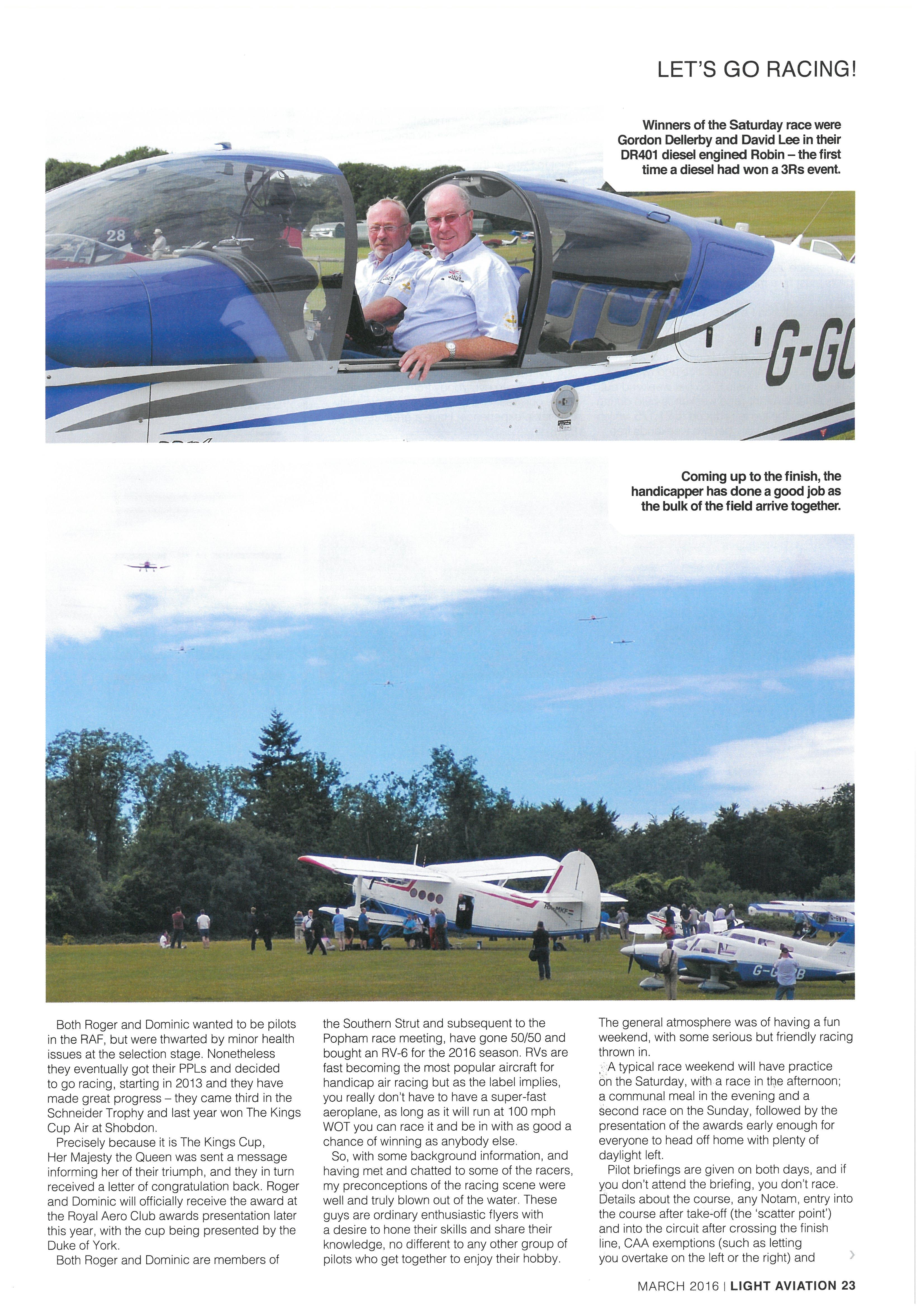
The general atmosphere was of having a fun weekend, with some serious but friendly racing thrown in.
«A typical race weekend will have practice on the Saturday, with.a race in the afternoon; a communal meal in the evening and a second race on the Sunday, followed by the presentation of the awards early enough for everyone to head off home with plenty of daylight left.
Pilot briefings are given on both days, and if you don’t attend the briefing, you don’t race.
Details about the course, any Notam, entry into the course after take-off (the ‘scatter point’) and into thecircuitaftercrossingthefinish line, CAA exemptions (such as letting you overtake on the left or the right) and
weather, etc, are covered and safety is always paramount.
Pilots receive a 1:50,000 map of the course which makes spotting the locations of the turning points, marked on the ground by large orange pyramids, somewhat easier. It also helps with identifying your line into and out of the turn to maximise speed and minimise distance flown. If you cut a corner you will be disqualified, if you run wide you are flying too far. Practice lasts for an hour and a half, and pilots must fly a minimum three laps to learn the course.
So, the question | expect you all want to know the answer to is “how much does it cost?” Well, membership of the 3Rs is £175, which also includes your £45.00 FAI licence and your first race weekend entry, ie practice and two races.
Race entry then costs £255 per weekend but if you enter all eight race weekends held during the season, the fee is reduced to £1,175, which means you effectively get two weekends free.
Skysport UK, one of only a handful of organisations inthe UK endorsed by the CAA for its PROUDscheme in respect of its ‘Elite’ Advanced Training Programme, and the Royal Aero Club are offering a lucky LAA member
Then you have accommodation, fuel, etc, to add on top, so it’s not exactly cheap, but have you ever added up the cost of that weekend jaunt to Parisor the RSARally? It is friendly and it is fun, and it stretches your flying abilities as you try to fly the shortest possible track in the fastest possible time. If taking part is anything like my misspent youth racing motorbikes, it is certainly an addictive adrenalin rush!
Whether you want to race or simply get involved in the racing scene as a helper with marshalling and other ground based activities, contact the club at www.royalaerocluoprrra. co.uk or secretary@royalaeroclubrrra.co.uk
Look out for a new BBC TV aviation series which filmed the 2015 Alderney air racing weekend, hopefully it will make the final cut and will be screened later this year.
Our thanks to everybody from the 3Rs who made our weekend at the races a thoroughly enjoyable experience. Have a great series for Fel2016. ah
to ‘Safe to Race’ standard. Value £560
* Free membership of the RAeC Racing Association, including your FAl Competition Licence. Value £175
“Free entry fee to your first race weekend. Value £255. with a PPL an incredible opportunity to train and compete ina handicap air race during the 2016 season. The prize includes: * A full one day course with air racing specialists Skysport UK.This includes two hours’ flying in a Beagle Pup 150and ground school to bring you
To enter answer this question: Where did Roger Scholes and Dominic Crossan win the Kings CupAir Race in 2015? Answers by email please to neil.wilson@laa.uk.com
The all-important print-outwhich shows how well you have flown the course. Itprovides height, speed and track information and shows where you have lost time and need to sharpen upyour act.
VHFCom8.33k#
KSN770SafetyNavigator GPS,Com,Nav,Chartsandmuchmore£8500 KX165A-02 Nav/Com8.33kHz£3795
KT74ModeStransponder£2095
KR87ADF(OHC)system £1695
SPORT ssicicinsssicsverses £995 VE-KPRO....icssinscccmassare £1395
KN64DME(OH(C).............£1295 KX155Nav/Com(OHC)from£995
AR6203VHFCom8.33kHz6.25"£1295 BXP6401Mode$Transponder2.25£1339 STEP£1025 TT21ModeStransponder£1390 TT22 £1675 TT31ModeStransponder£1620

IC-AGESportspk £208
IC-AGEPropack £308
IC-A24ESportspk £275
IC-A24EPropack...£375 #)Westock a fullrangeof Icom Accessories.
IC-AGEandIC-A24 transceiversnowhave 8.33kHzchannelspacing.
YAESU AirbandTransceivers
FTASS50L Pro X ...eeeesecceees£224
ATR833 LCDCom8.33kHz £895
ATR833 OLEDCom8.33kHz £995
MM001 (UL100)headset £199
MMO001A(UL200)headset £260
MMO001Bhelmetwithheadset£365
MMO01C helmetwithANR £430
MP001 Paramotorheadset £207
MC001B-MTGyrocopterhelmet£365
MM005 radiointerface £215
AllotherMICROAVIONICSpleasecall
RCA11A-8vacuumD.G............£595
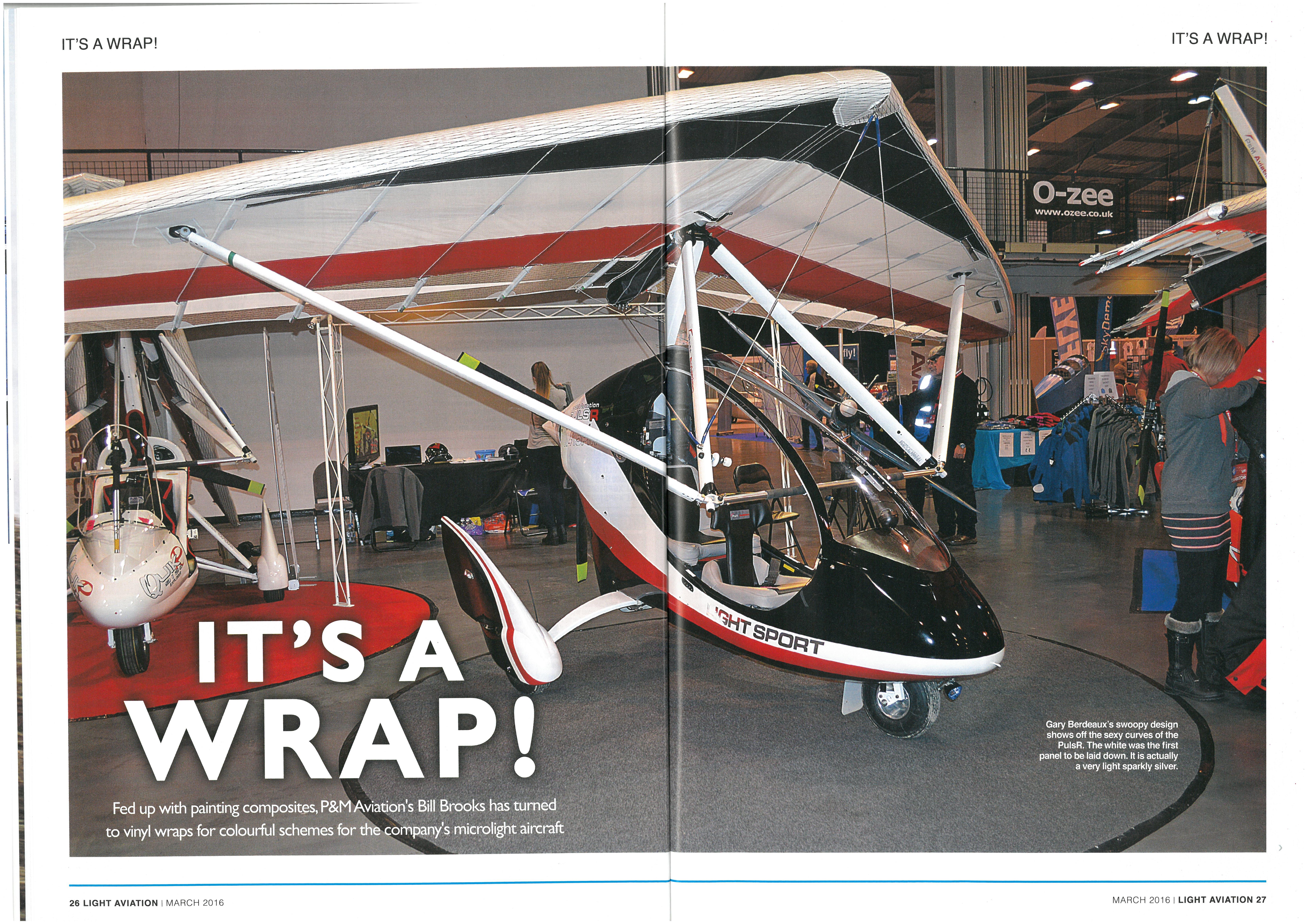
IT’SAWRAP!toFedupwithpaintingcomposites,P&MAviation’BillBrookshasturned vinylwrapsforcolourfulschemesforthe,company'smicrolightaircraft
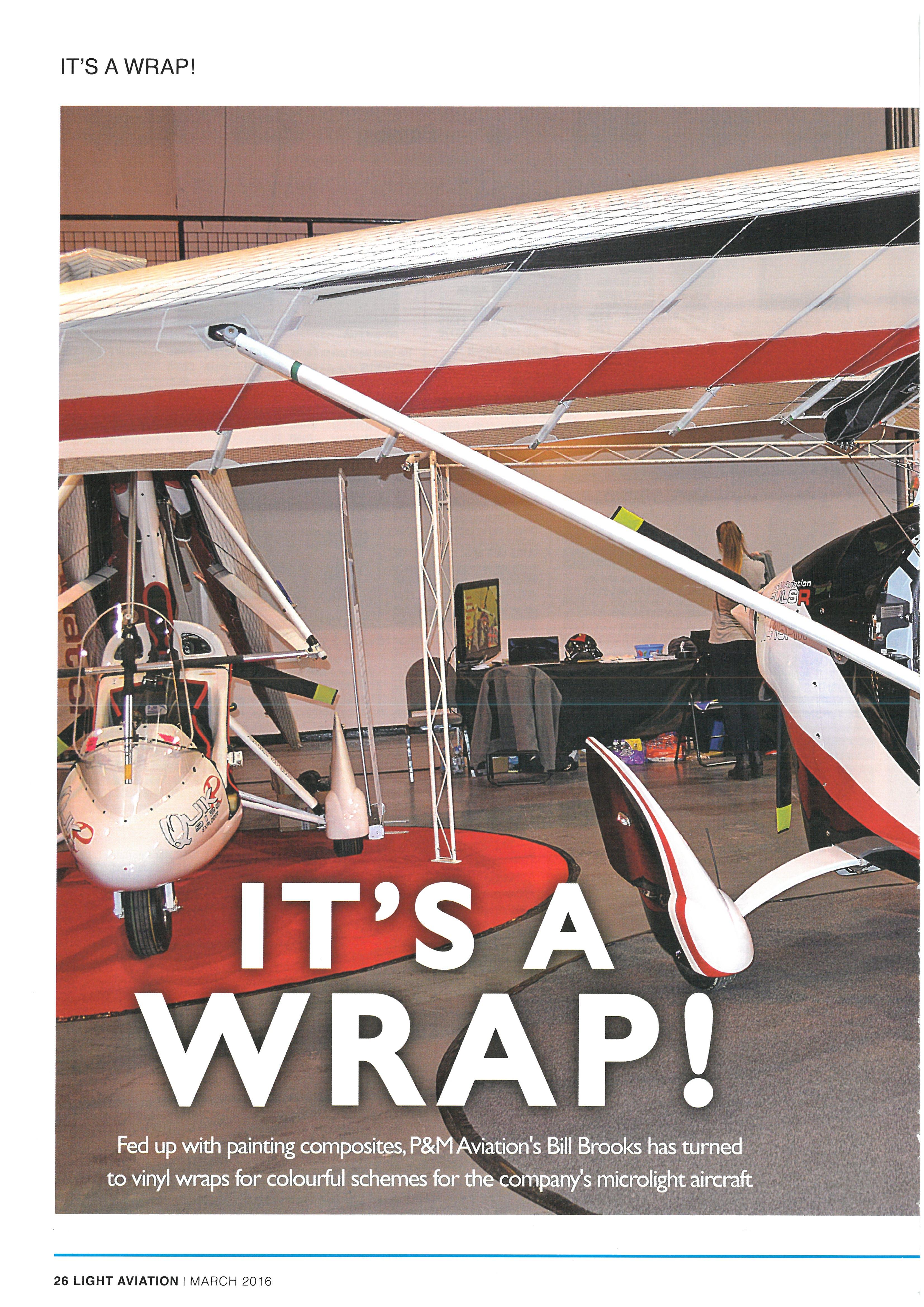
’ AAASydciaMeeMil’ ad
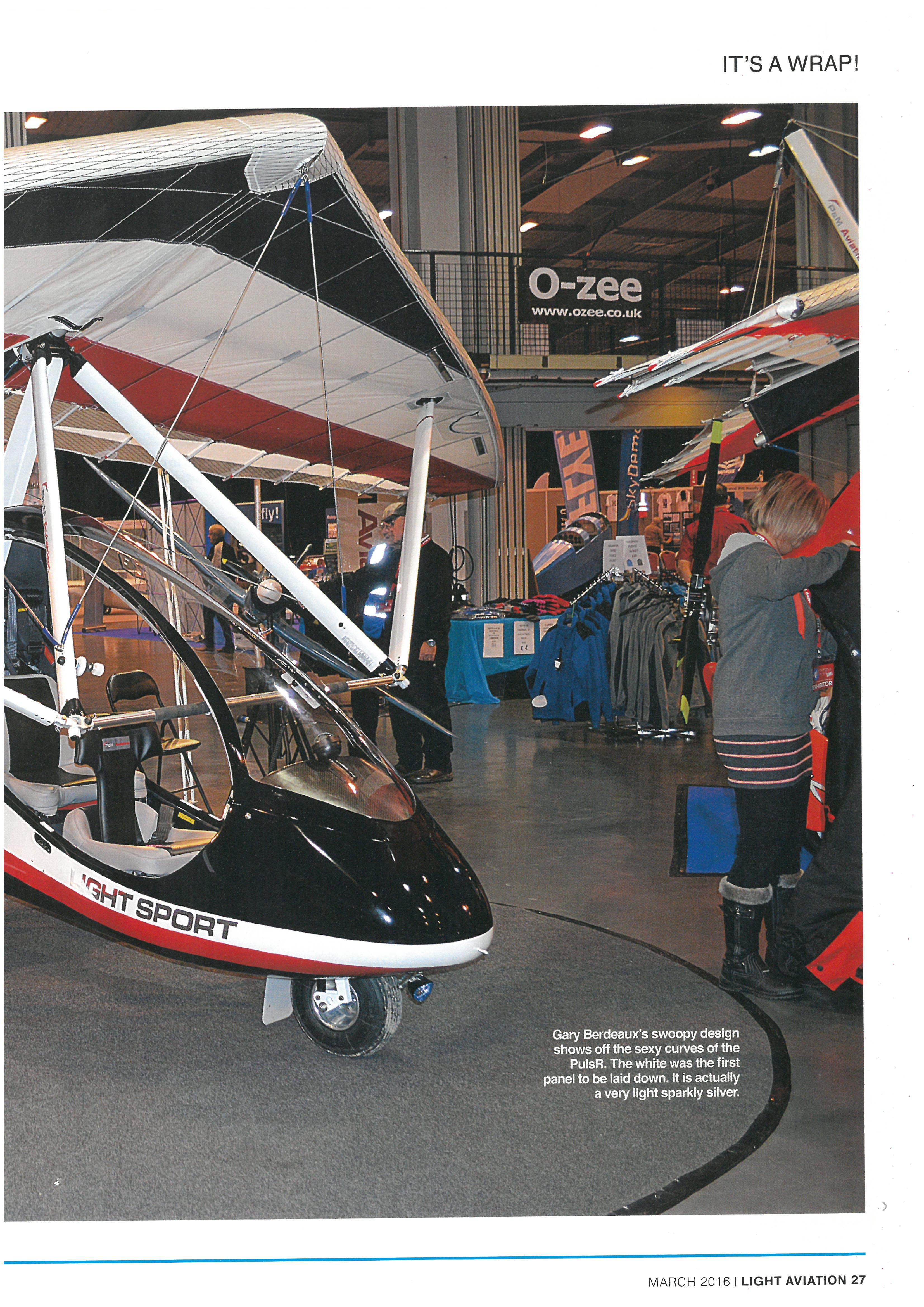
Gary Berdeaux’s swoopy design shows off the sexy curves of the PulsR. The white was the first panel to be laid down. It is actually a very light sparkly silver.
he story goes that a good many years ago, a law was passed in Germany that all taxis had to be finished in beige. Now beige has not been a particularly fashionable car colour since the Austin Allegro, or my Reliant 3-wheeler. The long-lasting Mercedes and BMW German taxis, which should have had a good resale value, did not sell well because few people wanted to buy a beige car.
Around 1990, a vinyl company, KPMF(Kay Premier Marking Films) realised that taxis could be wrapped inthe regulation beige from new so that when the time came to sell, it could be peeled off revealing a pristine, and saleable, gloss black paint finish.
Incidentally the sole reason | got a Reliant (for the princely sum of £50) was to transport hang gliders as they would not fit on my beloved Norton Commando. | will leave the dubious handling of the loaded Reliantto your imagination!
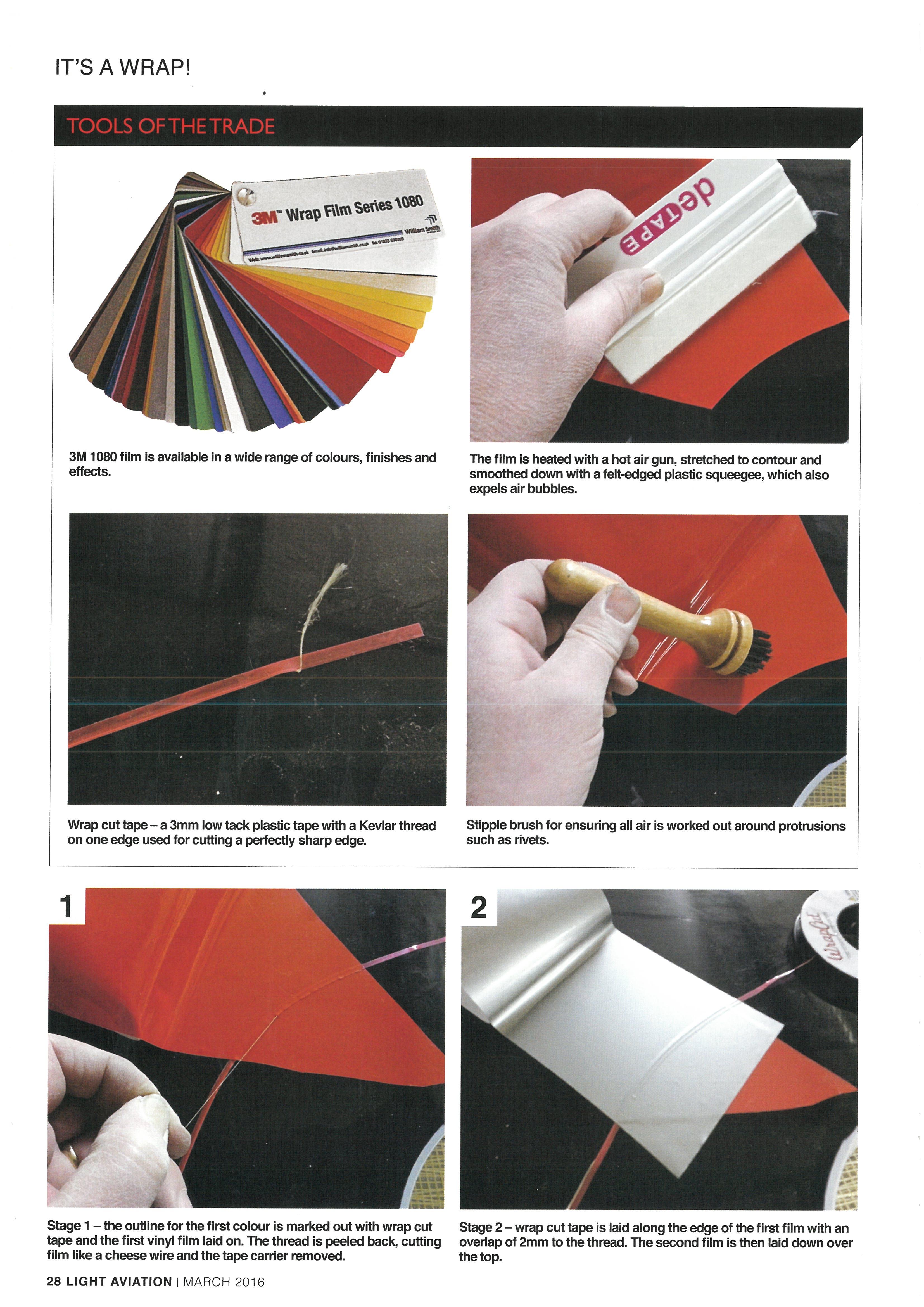
The vinyl wrapping idea began to really take off with digital printing of vinyl films for advertising, for example, on vans and over the past 10 years or so, vinyl wrapping has become a big hit with car customisers. From its beige beginnings there are now several manufacturers of films produced in a wide range of colours and finishes. Some of the effects used are not achievable any other way, especially satins, chromes and films with textured surfaces.
For aircraft, one exciting possibility is to have the film produced with drag-reducing microgrooves, inspired by shark skin. These grooves have been shown to reduce turbulent drag by a few percent as well as delaying the transition of laminar to turbulent flow on an aerofoil (ref. 1 and 3 at the end of this article).
It is well known that owls fly silently, in part due to micro serrations in the leading edges of the feathers which act as vortex generators. Commercial jets have now become so quiet that aerodynamic noise becomes significant, so perhaps owl technology could make them even quieter. Professor Lilley, who died last year, produced a paper on the subject (ref. 2). Riblet or micro grooved films will become more widely
“Some of the effects used are not achievable any otherway, especially satins, chromes and films with textured surfaces”
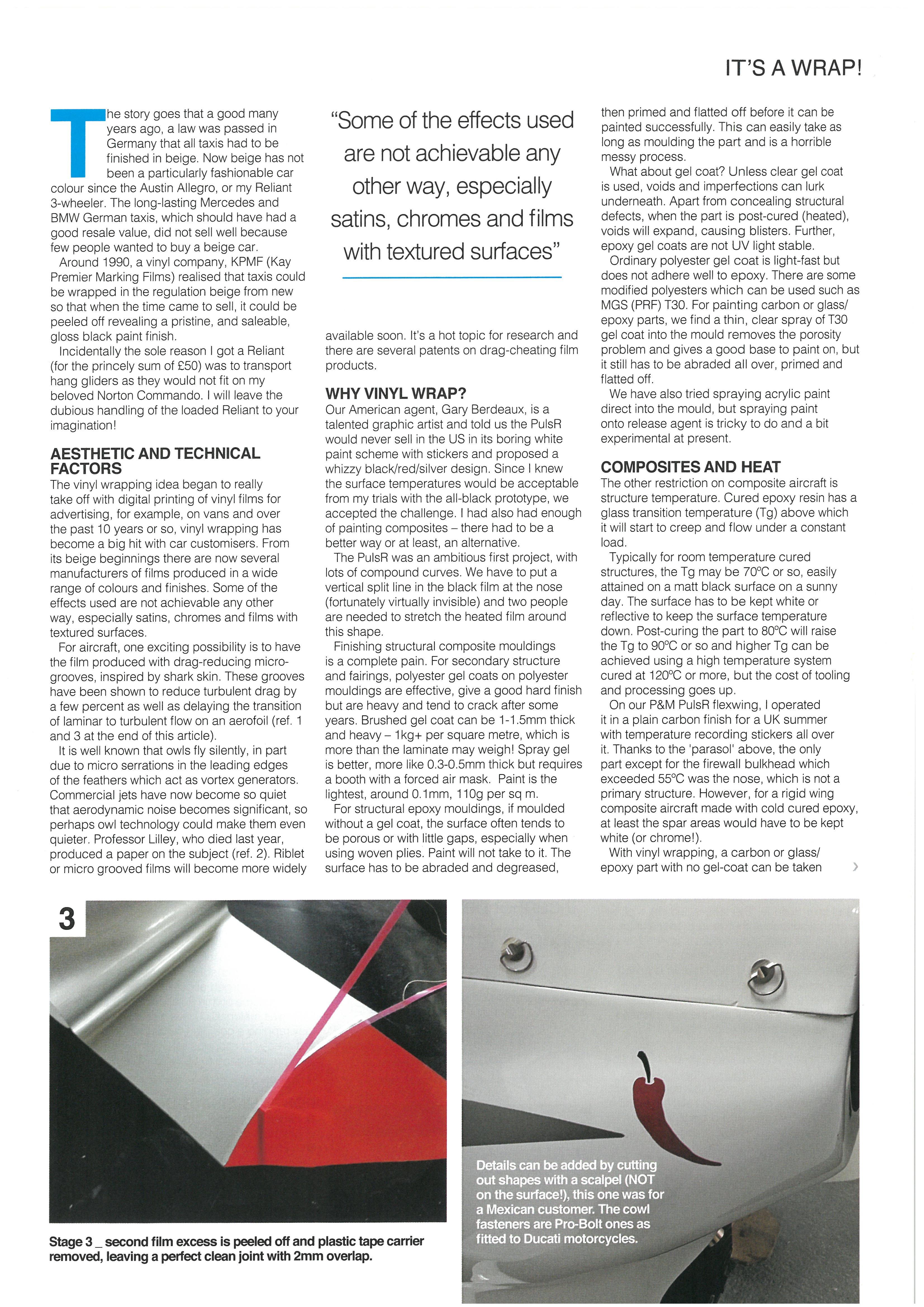
available soon. It’s a hot topic for research and there are several patents on drag-cheating film products.
Our American agent, Gary Berdeaux, is a talented graphic artist and told us the PulsR would never sell in the US in its boring white paint scheme with stickers and proposed a whizzy black/red/silver design. Since | knew the surface temperatures would be acceptable from my trials with the all-black prototype, we accepted the challenge. | had also had enough of painting composites there had to be a better way or at least, an alternative.
The PulsRwas an ambitious first project, with lots of compound curves. We have to put a vertical split line in the black film at the nose (fortunately virtually invisible) and two people are needed to stretch the heated film around this shape.
Finishing structural composite mouldings is acomplete pain. For secondary structure and fairings, polyester gel coats on polyester mouldings are effective, give a good hard finish but are heavy and tend to crack after some years. Brushed gel coat can be 1-1.5mm thick and heavy 1kg+ per square metre, which is more than the laminate may weigh! Spray gel is better, more like 0.3-0.5mm thick but requires a booth with a forced air mask. Paint is the lightest, around 0.1mm, 110g per sq m.
For structural epoxy mouldings, if moulded without a gel coat, the surface often tends to be porous or with little gaps, especially when using woven plies. Paint will not take to it. The surface has to be abraded and degreased,
then primed and flatted off before it can be painted successfully. This can easily take as long as moulding the part and is a horrible messy process.
What about gel coat? Unless clear gel coat is used, voids and imperfections can lurk underneath. Apart from concealing structural defects, when the part is post-cured (heated), voids will expand, causing blisters. Further, epoxy gel coats are not UV light stable.
Ordinary polyester gel coat is light-fast but does not adhere well to epoxy. There are some modified polyesters which can be used such as MGS (PRF)T30. For painting carbon or glass/ epoxy parts, we find a thin, clear spray of T30 gel coat into the mould removes the porosity problem and gives a good base to paint on, but it still has to be abraded all over, primed and flatted off.
We have also tried spraying acrylic paint direct into the mould, but spraying paint onto release agent is tricky to do and a bit experimental at present.
The other restriction on composite aircraft is structure temperature. Cured epoxy resin has a glass transition temperature (Tg) above which it will start to creep and flow under a constant load.
Typically for room temperature cured structures, the Tg may be 70°C or so, easily attained on a matt black surface on a sunny day. The surface has to be kept white or reflective to keep the surface temperature down. Post-curing the part to 80°C will raise the Tg to 90°C or so and higher Tg can be achieved using a high temperature system cured at 120°C or more, but the cost of tooling and processing goes up.
On our P&MPulsRflexwing, |operated it in a plain carbon finish for a UK summer with temperature recording stickers all over it.Thanks to the ‘parasol’ above, the only part except for the firewall bulkhead which exceeded 55°C was the nose, which is not a primary structure. However, for a rigid wing composite aircraft made with cold cured epoxy, at least the spar areas would have to be kept white (or chrome!).
With vinyl wrapping, a carbon or glass/ epoxy partwith no gel-coat can be taken a Mexican customer. The cowl fasteners are Pro-Bolt ones as fitted to Ducati motorcycles.
out of the mould, inspected, defects corrected and filled with black pigmented epoxy filler and then directly vinyl wrapped. In this way considerable weight, time and cost could be saved.
Metal aircraft can be wrapped in vinyl after they have been etch or epoxy primed. | have seen an American RVwrapped all over with a spectacular bird-like design. The owner has a digital printing company!
Wooden aircraft could be wrapped starting with a sealed ply skin. Open structures with ribs can best benefit from new technology coverings which are also structural, e.g. Oratex.
Three of the major brands of wrapping film are KPMF, 3M 1080 and Avery Denison. Of these | have tried the first two and settled on KPMF, at least for now.
| have tested KPMF up to 120°C; it did not degrade or peel off. | also tried putting petrol on it; there was no instant bad reaction, even when rubbing it with a petrol soaked rag.
On this basis after some test pieces | decided to go ahead and wrap a whole PulsR monocoque, which was ambitious as it has plenty of compound curves. | was assisted by Mike Booth, a graphic artist who also makes quarter-scale ultra realistic flying Spitfires. Heusesenginesbiggerthan| startedflying microlights with!
Unless it’s just a narrow stripe, to avoid bubbles, the film MUST have an air releasing adhesive. KPMF film has an adhesive backing with a micro grooved grid in it which allows trapped air to escape. The 3M film has a dusting of microballoons on the adhesive surface, also intended to allow the air to escape until it is fully pressed down. The 3M film has a slightly more glossy finish but the KPMF air release works much better. The adhesive in both films allows repositioning, both are applied dry.
For up to five years, the film can be peeled off without removing properly applied paint. | find it sticks down firmly and would be unlikely to peel off in flight (do your own tests!).
Apart from the film you will also need some wrap-cut tape. Some genius has devised this product which is a narrow (about 3mm) self-adhesive plastic tape with a thin Kevlar thread on one edge. The tape is laid down on the aircraft surface at the desired edges of the wrap film. If a panel with a point is desired, the tape can be looped around. After the vinyl wrap is laid down over it, the Kevlar thread is pulled out of its tape carrier and pulled back, cutting the film like a cheese wire. Finally, the wrap tape carrier is pulled out and the vinyl pressed down, leaving a perfect edge. Neat!
Then you will need a good quality hot-air gun, a scalpel, scissors and a couple of plastic squeegees with a felt edge. Extras include an infra-redthermometer,cottonglovesandarivet brush. The rivet brush has short stiff hairs which canstippledownaround a projection.|got my wrapping film from MDP supplies, who also supply all the necessary items.
“For up to five years, the film can be peeled off without removing properly applied paint. |find itsticks down firmly and would be unlikelyto peeloff inflight”
To get the general idea, there are several good YouTube videos on vinyl wrapping cars (e.g. ref 4), though you have to put your cap on backwards, be under 18, wear low slung baggy trousers and listen to ‘Pendulum’ at high volume for best effect. Start with some test pieces, an old helmet makes a good test for compound curves.
As with anything involving adhesive, the surface MUST be degreased, dry and free from dust. Silicone sprays are the worst for surface contamination. The part must also be well enough supported to take the load of stretching the vinyl over it and not move around.
First, lay down the desired edges of the first vinyl panel using the wrap-cut tape, the Kevlar thread will define the edge. For the main wrap, it is recommended to start with panels having mild compound curvature. The big secret is to keep the film under bi-axial tension. If you pull the film in one axis only, it will contract at 90 degrees and develop longitudinal wrinkles (due to the Poisson’s ratio). Remove the adhesive backing and lay the film down in the centre of any bulge whilst maintaining some tension. Apply heat with the hot air gun as necessary until the film begins to move.
For 2D curvature, like a wing, the film can be laid down evenly all over. Avoid joints facing the airflow especially at the leading edge, use a generous overlap if a joint is needed here. Using the felt-edged squeegee, gently workanyairpocketsouttotheedges before
“Itcannot be emphasised enough thatvinylwrapping is NOT a short cut to a good finish; itshows every imperfection”
It cannot be emphasised enough that viny| wrapping is NOT a short cut to a good finish; it shows every imperfection. However, microporosity in composites, which otherwise has to be sanded and filled, can be bridged by film.
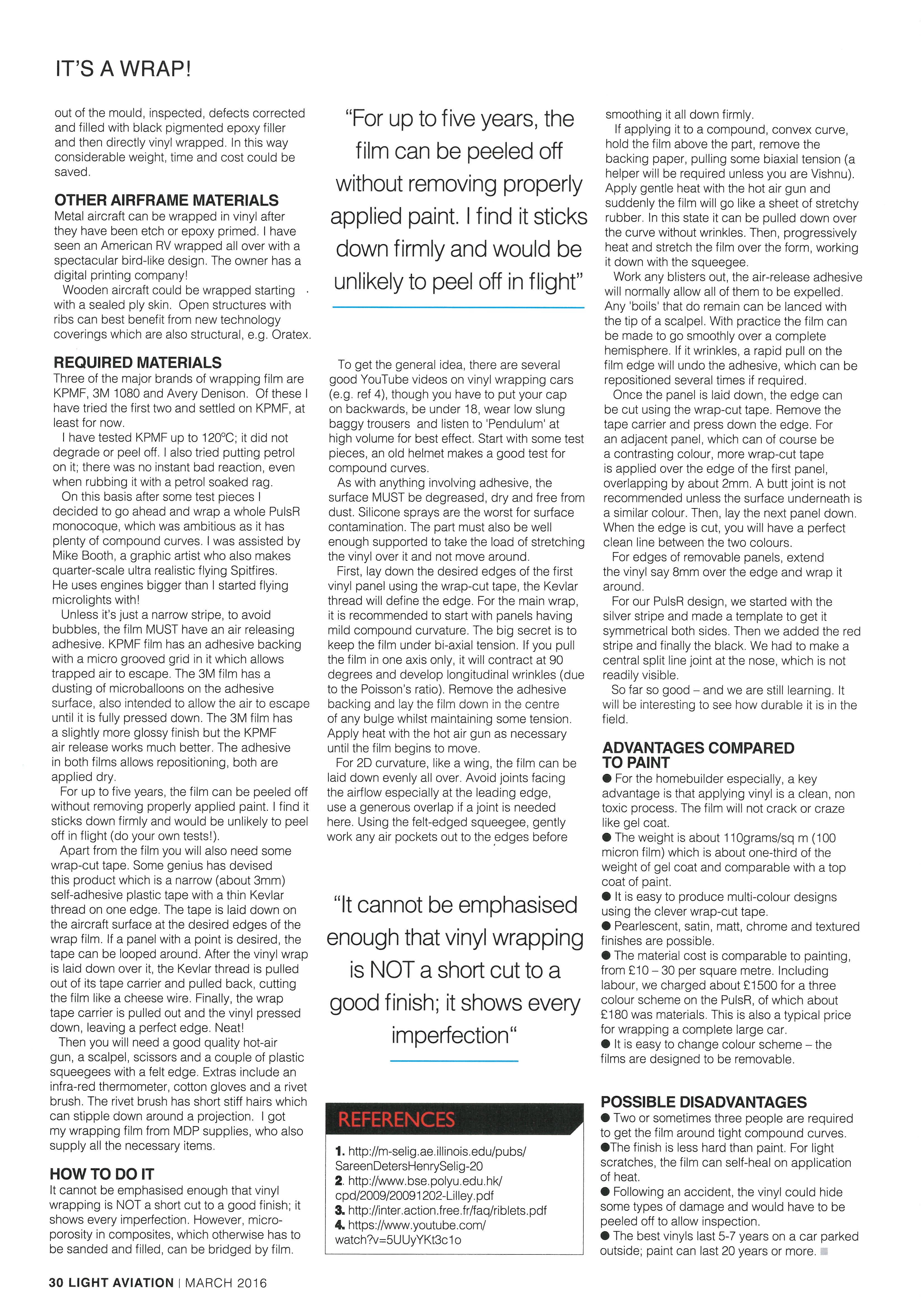
1.http://m-selig.ae.illinois.edu/pubs/ SareenDetersHenrySelig-20 2.http:/Mwww.bse.polyu.edu.hk/ cpd/2009/20091202-Lilley.pdf 3.http://inter.action.free.fr/faq/riblets. pdf 4.httos:/Awww.youtube.com/ watch?v=5UUyYKt3c10
smoothing it all down firmly. If applying it to a compound, convex curve, hold the film above the part, remove the backing paper, pulling some biaxial tension (a helper will be required unless you are Vishnu). Apply gentle heat with the hot air gun and suddenly the film will go like a sheet of stretchy rubber. In this state it can be pulled down over the curve without wrinkles. Then, progressively heat and stretch the film over the form, working it down with the squeegee.
Work any blisters out, the air-release adhesive will normally allow all of them to be expelled. Any 'boils' that do remain can be lanced with the tip of a scalpel. With practice the film can be made to go smoothly over a complete hemisphere. If it wrinkles, a rapid pull on the film edge will undo the adhesive, which can be repositioned several times if required.
Once the panel is laid down, the edge can be cut using the wrap-cut tape. Remove the tape carrier and press down the edge. For an adjacent panel, which can of course be a contrasting colour, more wrap-cut tape is applied over the edge of the first panel, overlapping by about 2mm. A butt joint is not recommended unless the surface underneath is a similar colour. Then, lay the next panel down. When the edge is cut, you will have a perfect clean line between the two colours.
For edges of removable panels, extend the vinyl say 8mm over the edge and wrap it around.
For our PulsR design, we started with the silver stripe and made a template to get it symmetrical both sides. Then we added the red stripe and finally the black. We had to make a central split line joint at the nose, which is not readily visible.
So far so good and we are still learning. It will be interesting to see how durable it is in the field.
@For the homebuilder especially, a key advantage is that applying vinyl is a clean, non toxic process. The film will not crack or craze like gel coat.
@The weight is about 110grams/sq m (100 micron film) which is about one-third of the weight of gel coat and comparable with a top coat of paint.
@It is easy to produce multi-colour designs using the clever wrap-cut tape.
@ Pearlescent, satin, matt, chrome and textured finishes are possible.
@The material cost is comparable to painting, from £10 30 per square metre. Including labour, we charged about £1500 for a three colour scheme on the PulsR, of which about £180 was materials. This is also a typical price for wrapping a complete large car.
@It is easy to change colour scheme the films are designed to be removable.
@Two or sometimes three people are required to get the film around tight compound curves.
@Thefinish is less hard than paint. For light scratches, the film can self-heal on application of heat.
@Following an accident, the vinyl could hide some types of damage and would have to be peeled off to allow inspection.
@The best vinyls last 5-7 years on a car parked outside; paint can last 20 years or more.
ave you always wanted to spread your wings farther afield than the UK but worried that you don’t understand the seemingly complex requirements of flying across the English Channel? Fear no more because help is at hand to guide you through what are in fact the relatively simple paperwork and flight procedures involved. Very soon the world can be your flying oyster!
As part of the LAA’s 70th anniversary celebrations, the LAA Kent Strut has undertaken to organise a cross-Channel adventure for those who have never made the crossingorperhapsneed a refresher.
Strut members will be based at Rochester Airport, EGTO, in Kent and Abbeville Aeroport, LFOI, in northern France, on Saturday 25 June 2016 (fall back in the event of unsuitable weather, Sunday 26 June) to take the worry out of crossing the English Channel.
We aim to make it as simple as possible, so you can concentrate on the actual flying while we look after the paperwork. You will see how the paperwork is dealt with, and receive a comprehensive information pack so that in the future you can deal with it yourself, but we want you to get that first crossing under your belt without having too much to worry about.
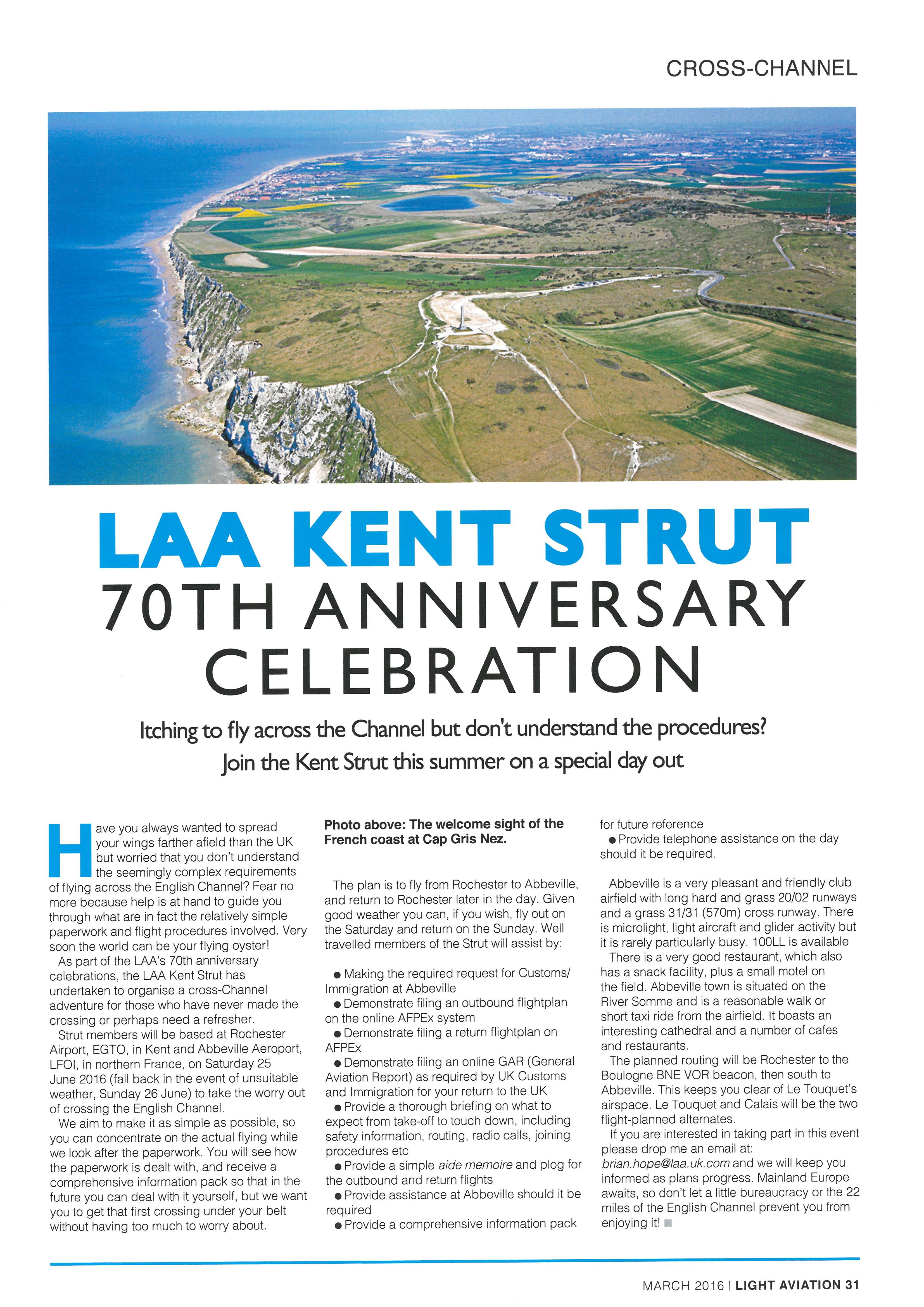
The plan is to fly from Rochester to Abbeville, and return to Rochester later in the day. Given good weather you can, if you wish, fly out on the Saturday and return on the Sunday. Well travelled members of the Strut will assist by:
@Making the required request for Customs/ Immigration at Abbeville
e Demonstrate filing an outbound flightplan on the online AFPEx system
e@Demonstrate filing a return flightplan on AFPEx
e Demonstrate filing an online GAR (General Aviation Report) as required by UK Customs and Immigration for your return to the UK
@Provide a thorough briefing on what to expect from take-off to touch down, including safety information, routing, radio calls, joining procedures etc
@Provide a simple aide memoire and plog for the outbound and return flights
@Provide assistance at Abbeville should it be required
@Provide a comprehensive information pack
for future reference
@Provide telephone assistance on the day should it be required.
Abbeville is a very pleasant and friendly club airfield with long hard and grass 20/02 runways and a grass 31/31 (570m) cross runway. There is microlight, light aircraft and glider activity but it is rarely particularly busy. 100LLis available
There is a very good restaurant, which also has a snack facility, plus a small motel on the field. Abbeville town is situated on the River Somme and is a reasonable walk or short taxi ride from the airfield. It boasts an interesting cathedral and a number of cafes and restaurants.
The planned routing will be Rochesterto the Boulogne BNE VOR beacon, then south to Abbeville. This keeps you clear of Le Touquet'’s airspace. Le Touquet and Calais will be the two flight-planned alternates.
lf you are interested in taking part in this event please drop me an email at: brian.hope@laa.uk.com and we will keep you informed as plans progress. Mainland Europe awaits,sodon’tleta littlebureaucracyorthe22 miles of the English Channel prevent you from enjoying it!
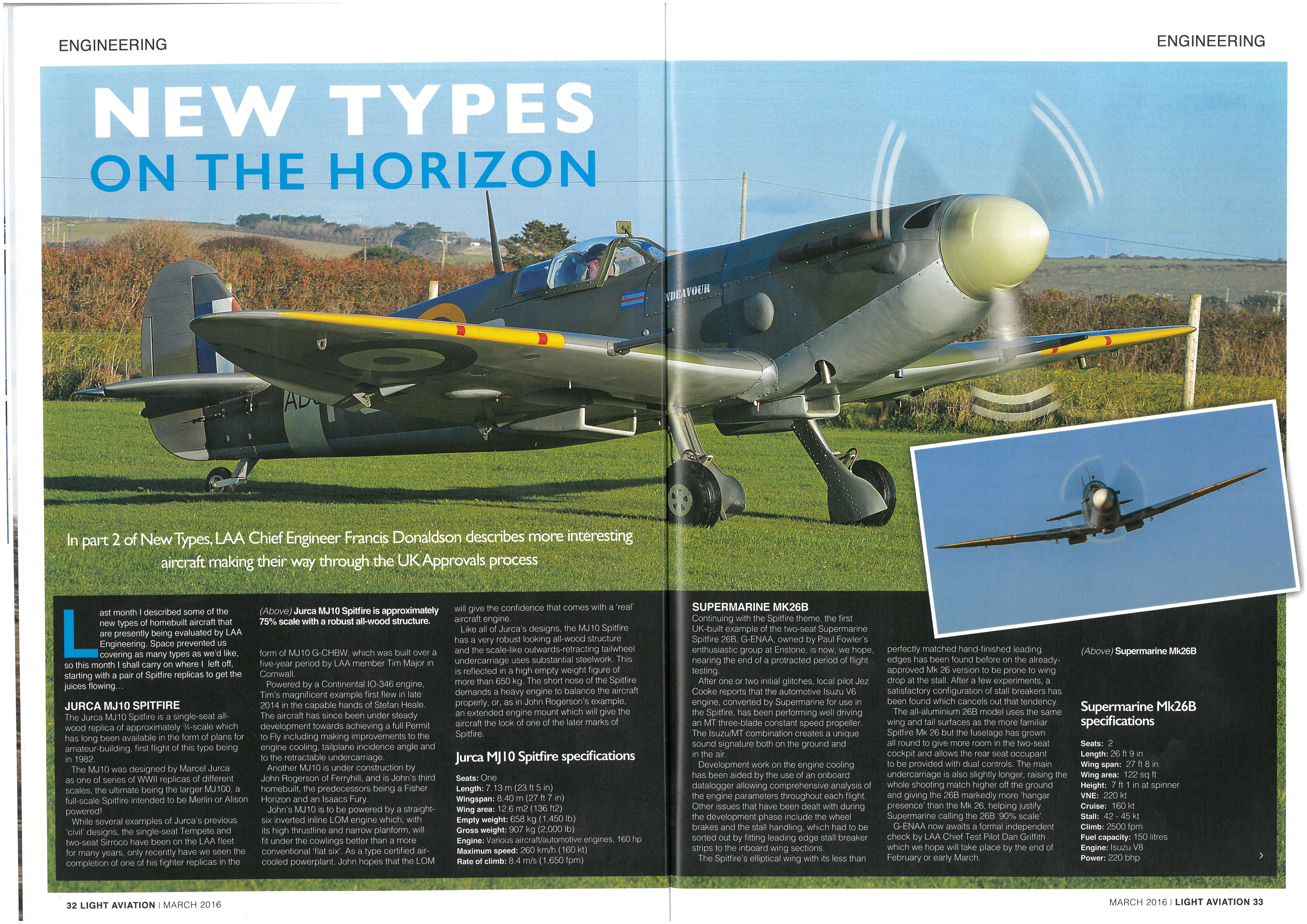
4) J
ast month | described some of the new types of homebuilt aircraft that are presently being evaluated by LAA Engineering. Space prevented us covering as many types as we’d like, so this month | shall carry on where | left off, starting with a pair of Spitfire replicas to get the juices flowing...
The Jurca MJ10 Spitfire is a single-seat allwood replica of approximately 74-scale which has long been available in the form of plans for amateur-building, first flight of this type being in 1982.
The MJ10 was designed by Marcel Jurca as one of series of WWII replicas of different scales, the ultimate being the larger MJ100, a full-scale Spitfire intended to be Merlin or Alison powered!
While several examples of Jurca’s previous ‘civil’ designs, the single-seat Tempete and two-seat Sirroco have been on the LAA fleet for many years, only recently have we seen the completion of one of his fighter replicas in the
(Above) Jurca MJ10Spitfire is approximately 75% scale with a robust all-wood structure.
form of MJ10 G-CHBW, which was built over a five-year period by LAA member Tim Major in Cornwall.
Powered by a Continental |O-346 engine, Tim’s magnificent example first flew in late 2014 in the capable hands of Stefan Heale. The aircraft has since been under steady developmenttowardsachieving a fullPermit to Fly including making improvements to the engine cooling, tailplane incidence angle and to the retractable undercarriage.
Another MJ10 is under construction by John Rogerson of Ferryhill, and is John’s third homebuilt, the predecessors being a Fisher Horizon and an Isaacs Fury.
John’sMJ10istobepoweredbya straightsix inverted inline LOM engine which, with its high thrustline and narrow planform, will fit under the cowlings better than a more conventional ‘flat six’. As a type certified aircooled powerplant, John hopes that the LOM
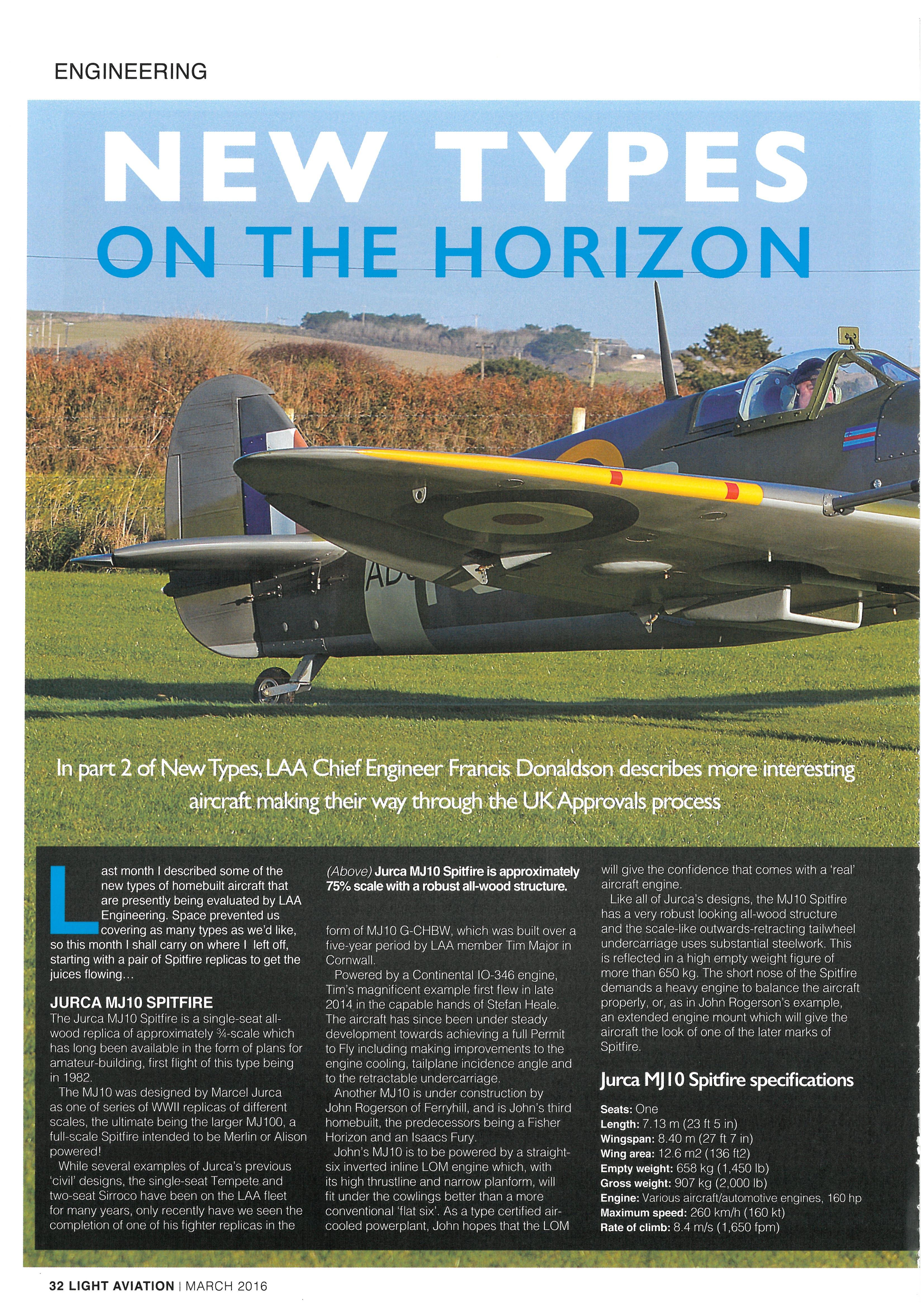
will give the confidence that comes with a ‘real’ aircraft engine.
Like all of Jurca’s designs, the MJ10 Spitfire has a very robust looking all-wood structure and the scale-like outwards-retracting tailwheel undercarriage uses substantial steelwork. This is reflected in a high empty weight figure of more than 650 kg. The short nose of the Spitfire demands a heavy engine to balance the aircraft properly, or, as in John Rogerson’s example, an extended engine mount which will give the aircraft the look of one of the later marks of Spitfire.
Seats: One
Length: 7.13 m (23 ft 5 in)
Wingspan: 8.40 m (27 ft 7 in)
Wing area: 12.6 m2 (136 ft2)
Empty weight: 658 kg (1,450 Ib)
Grossweight: 907 kg (2,000 Ib)
Engine: Various aircraft/automotive engines, 160 hp
Maximumspeed: 260 km/h (160 kt)
Rateof climb: 8.4 m/s (1,650 fom)
Continuing with the Spitfire theme, the first UK-built example of the two-seat Supermarine Spitfire 26B, G-ENAA, owned by Paul Fowler's enthusiastic group at Enstone, is now, we hope, nearing the end of a protracted period of flight testing.
After one or two initial glitches, local pilot Jez Cooke reports that the automotive Isuzu V6 engine, converted by Supermarine for use in the Spitfire, has been performing well driving an MT three-blade constant speed propeller. The Isuzu/MT combination creates a unique sound signature both on the ground and lemtarcuclle
Development work on the engine cooling has been aided by the use of an onboard datalogger allowing comprehensive analysis of the engine parameters throughout each flight. Other issues that have been dealt with during the development phase include the wheel brakes and the stall handling, which had to be sorted out by fitting leading edge stall breaker strips to the inboard wing sections.
The Spitfire’s elliptical wing with its less than
perfectly matched hand-finished leading edges has been found before on the alreadyapproved Mk 26 version to be prone to wing drop at the stall. After a few experiments, a satisfactory configuration of stall breakers has been found which cancels out that tendency.
The all-aluminium 26B model uses the same wing and tail surfaces as the more familiar Spitfire Mk 26 but the fuselage has grown all round to give more room in the two-seat cockpit and allows the rear seat occupant to be provided with dual controls. The main undercarriage is also slightly longer, raising the whole shooting match higher off the ground and giving the 26B markedly more ‘hangar presence’ than the Mk 26, helping justify Supermarine calling the 26B ‘90% scale’.
G-ENAA now awaits a formal independent check by LAA Chief Test Pilot Dan Griffith which we hope will take place by the end of February or early March.
(Above)SupermarineMk26B SupermarineMk26B specifications
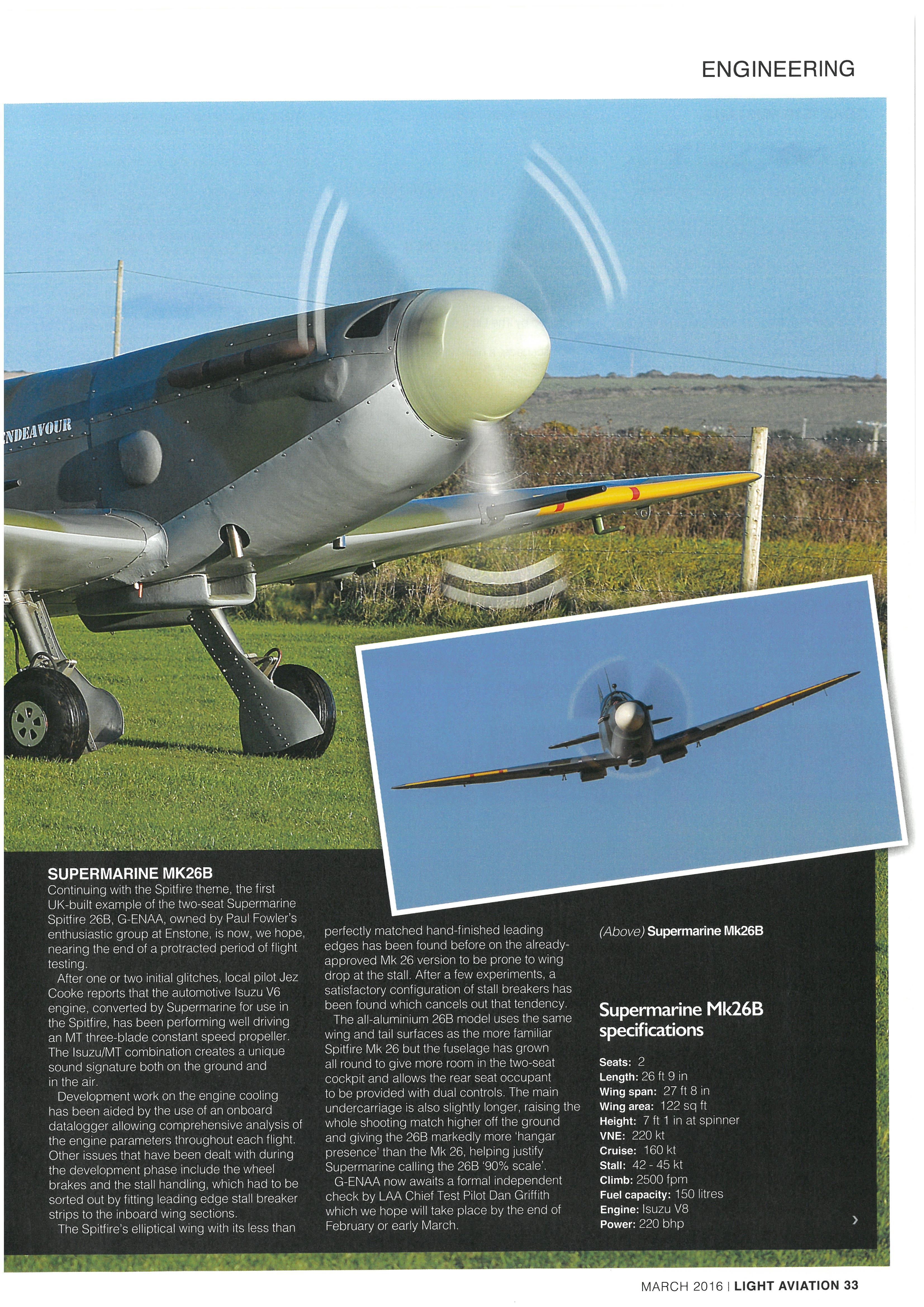
Seats: 2
Length: 26 ft 9 in
Wing span: 27 ft 8 in
Wingarea: 122 sqft
Height: 7 ft 1 in at spinner
VNE: 220 kt
Cruise: 160 kt
Stall: 42 - 45 kt
Climb: 2500 fom
Fuel capacity: 150 litres
Engine: |suzu V8
Power: 220 bhp
Hot on the heels of the Spitfires, another exciting LAA homebuilt nearing completion is the first UK-built example of the razorback version of the Titan T51, being built by Titan’s prolific UK agent for the type, Ben ChesterMaster.
The razorback ‘B’ model, so named because oftherearfuselagehasa taller,sharperprofile than the later bubble-canopy equipped ‘D’ model, has a quite different turtledeck and canopy arrangement but shares the same basic airframe.
Having previously built the Suzuki powered ‘D’ model, Ben found the second project quite straightforward, even though the instructions for this option were sparse. Ben has completed this second T51 with the latest, more powerful, Honda V6 engine which Titan now favours over the Suzuki.
Because of the heavier Honda engine installation, Ben’s T51B is being fitted out as a single-seater, omitting the rear jump seat. Its place will be taken by an additional optional fuel tank intended to help Ben on his way to distant events.
As reported in previous copies of the magazine, Ben has campaigned the Titan Mustang at a number of commemorative events and air displays held across the water inmainlandEurope,andalittle morerangewill bring more options and greater peace of mind.
Seats:2 (1 with larger engines)
Length: 23 ft 6 in
Wing span: 24 ft
Wing area: 118 sq ft
Height: 9 ft 2 in
Empty weight: 850 - 1,180 Ib
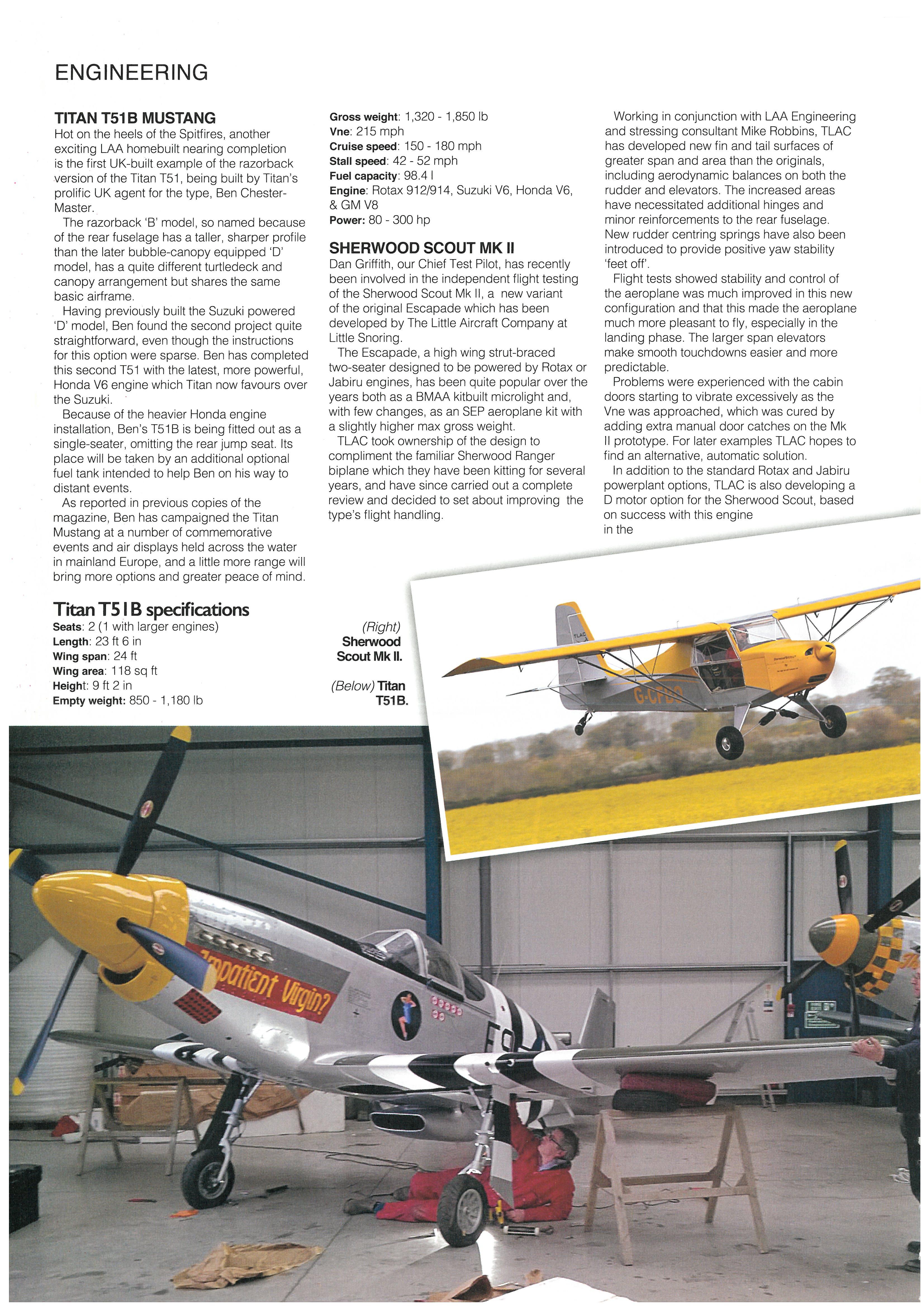
Gross weight: 1,320 - 1,850 Ib
Vne: 215 mph
Cruise speed: 150 - 180 mph
Stall speed:42 - 52 mph
Fuel capacity: 98.4 |
Engine: Rotax 912/914, Suzuki V6, Honda V6, & GM V8
Power:80 - 300 hp
Dan Griffith, our Chief Test Pilot, has recently been involved in the independent flight testing of the Sherwood Scout Mk II, a new variant of the original Escapade which has been developed by The Little Aircraft Company at Little Snoring.
The Escapade, a high wing strut-braced two-seater designed to be powered by Rotax or Jabiru engines, has been quite popular over the years both as a BMAA kitbuilt microlight and, with few changes, as an SEPaeroplane kit with a slightly higher max gross weight.
TLAC took ownership of the design to compliment the familiar Sherwood Ranger biplane which they have been kitting for several years, and have since carried out a complete review and decided to set about improving the type’s flight handling.
Working in conjunction with LAA Engineering and stressing consultant Mike Robbins, TLAC has developed new fin and tail surfaces of greater span and area than the originals, including aerodynamic balances on both the rudder and elevators. The increased areas have necessitated additional hinges and minor reinforcements to the rearfuselage. New rudder centring springs have also been introduced to provide positive yaw stability ‘feet off’.
Flight tests showed stability and control of the aeroplane was much improved in this new configuration and that this made the aeroplane much more pleasant to fly, especially in the landing phase. The larger span elevators make smooth touchdowns easier and more predictable.
Problems were experienced with the cabin doors starting to vibrate excessively as the Vne was approached, which was cured by adding extra manual door catches on the Mk || prototype. For later examples TLAC hopes to find an alternative, automatic solution.
In addition to the standard Rotax and Jabiru powerplant options, TLAC is also developing a D motor option for the Sherwood Scout, based on success with this engine in the - sce
(Below) Titan T51B.
(Above)Cvjetcovic CA-65Skyfly is an allwood two-seater.
| ratherthanconventionaloverhead | valves which allow a particularly | compactinstallationandlight \_weight.
1 TLACplanstomaketheScout | MkIlavailableasafactory-built | microlight as well as in kit form either as a microlight or SEP aircraft.
Seats: 2
Wingspan:8.7m(28ft6 in)
Length: 5.8m (19 ft)
Heighttail dragger: 1.75 m (5.75 ft)
Wing area:9.77 m? (105.5 sq ft)
Emptyweight:539 561 Ib (245 355 kg)
Maxweight (asmicrolight): 450 kg (990 Ib)
Fuel capacity: 2 x 35 It, 4 It header tank
Cruise speed: 80 kt
Vne: 114 kt
Stall speed: 33 kt
Engine: D Motor/ Rotax 912/ Jabiru 2200
Power: 80 - 100hp
Another type which has been slow to emerge on the LAA scene is the Cvjetkovic CA-65 Skyfly, an all-wood low-wing two-seater with a retractable tailwheel undercarriage, designed by American Antov Cvjetkovic.
The prototype first flew in the USA in 1965, powered by a converted Lycoming 0-290 G ground power unit, which at that time was a popular choice amongst EAA members. One was UK built under the PFA scheme, and was almost ready to fly in the late 1990s but the paper trail on this one fades away and its fate is unknown.
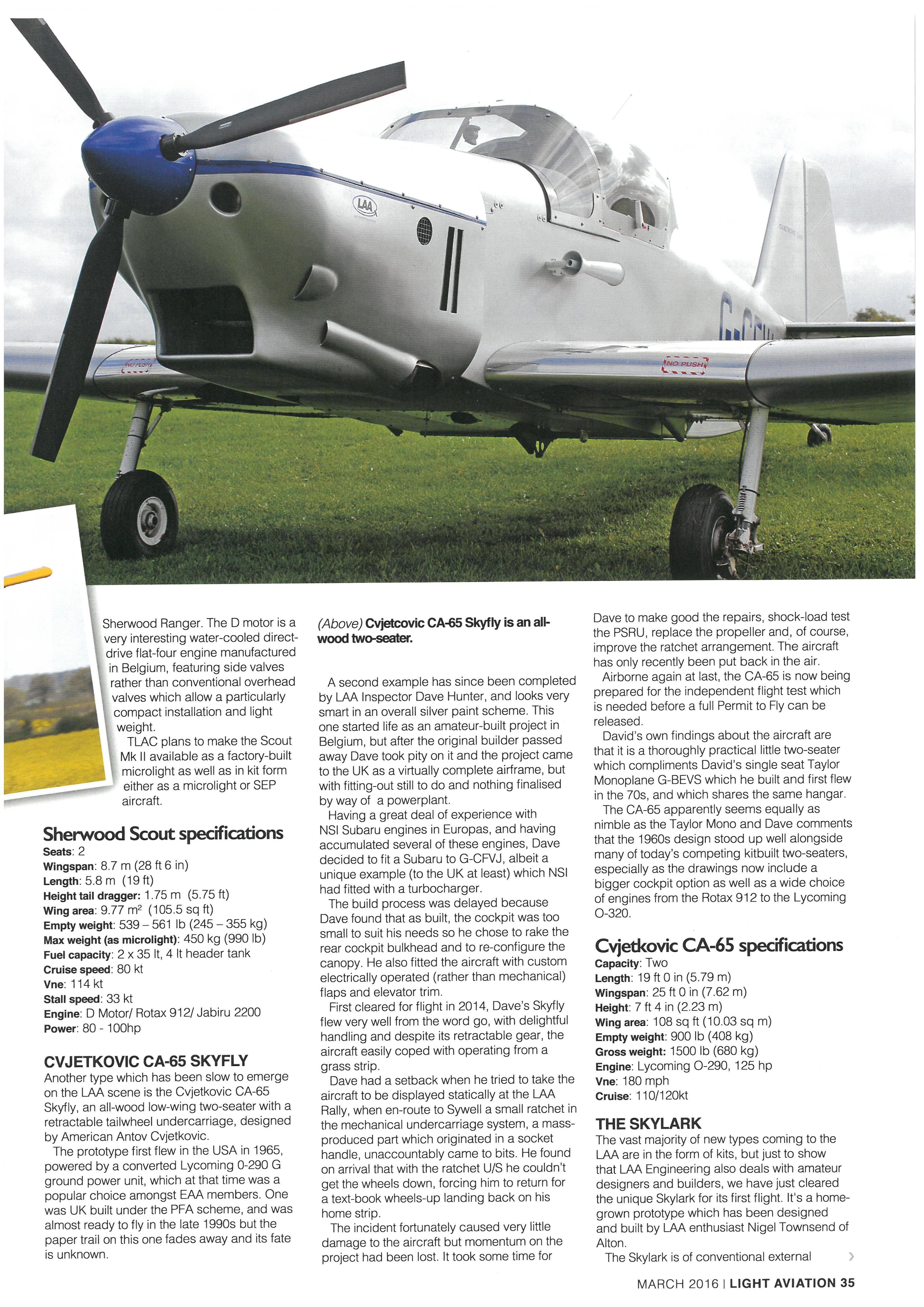
A second example has since been completed by LAA Inspector Dave Hunter, and looks very smart in an overall silver paint scheme. This one started life as an amateur-built project in Belgium, but after the original builder passed away Dave took pity on it and the project came to the UK as a virtually complete airframe, but with fitting-out still to do and nothing finalised by way of a powerplant.
Having a great deal of experience with NSI Subaru engines in Europas, and having accumulated several of these engines, Dave decided to fit a Subaru to G-CFVJ, albeit a unique example (to the UK at least) which NS! had fitted with a turbocharger.
The build process was delayed because Dave found that as built, the cockpit was too small to suit his needs so he chose to rake the rear cockpit bulkhead and to re-configure the canopy. He also fitted the aircraft with custom electrically operated (rather than mechanical) flaps and elevator trim.
Firstcleared for flight in 2014, Dave’s Skyfly flew very well from the word go, with delightful handling and despite its retractable gear, the aircraft easily coped with operating from a grass strip.
Dave had a setback when he tried to take the aircraft to be displayed statically at the LAA Rally, when en-route to Sywell a small ratchet in the mechanical undercarriage system, a massproduced part which originated in a socket handle, unaccountably came to bits. He found on arrival that with the ratchet U/S he couldn't get the wheels down, forcing him to return for a text-book wheels-up landing back on his home strip.
The incident fortunately caused very little damage to the aircraft but momentum on the project had been lost. It took some time for
Dave to make good the repairs, shock-load test the PSRU,replacethe propellerand,of course, improve the ratchet arrangement. The aircraft has only recently been put back in the air.
Airborne again at last, the CA-65 is now being prepared for the independent flight test which is needed before a full Permit to Fly can be released.
David's own findings about the aircraft are that it is a thoroughly practical littletwo-seater which compliments David's single seat Taylor Monoplane G-BEVS which he built and first flew in the 70s, and which shares the same hangar.
The CA-65 apparently seems equally as nimble as the Taylor Mono and Dave comments that the 1960s design stood up well alongside many of today’s competing kitbuilt two-seaters, especially as the drawings now include a bigger cockpit option as well as a wide choice of engines from the Rotax 912 to the Lycoming 0-320.
Capacity: Two
Length: 19 ft 0 in (5.79 m)
Wingspan: 25 ft 0 in (7.62 m)
Height: 7 ft4in(2.23m)
Wing area: 108 sq ft (10.03 sq m)
Emptyweight: 900 Ib (408 kg)
Grossweight: 1500 Ib (680 kg)
Engine:Lycoming O-290, 125 hp
Vne: 180 mph
Cruise: 110/120kt
The vast majority of new types coming to the LAA are in the form of kits, but just to show that LAA Engineering also deals with amateur designers and builders, we have just cleared the unique Skylark for its first flight. It's a homegrown prototype which has been designed and built by LAA enthusiast Nigel Townsend of Alton.
The Skylark is of conventional external
configuration, with a high strut-braced wing, an enclosed cockpit seating two in tandem, a tricycle undercarriage and a Rotax 582 engine mounted tractor-fashion up front. The wings are of two spar type, each spar being a large diameter thin wall aluminium tube as in a Rans S6, Skyranger, Kitfox or similar, while the wing ribs are of wooden construction.
The fuselage is very unusual in that the main structure in the cockpit area is a narrow wooden spruce and ply box forming a central spine which mounts the seats, controls, undercarriage, wing strut mountings and engine, and also the six inch diameter aluminium tube tailboom.
The wings are high-mounted on a pair of hoop-like frames and a secondary structure fairs in the external shape back to the cruciform tail surfaces and braces the rear end of the tail boom. While a stress analysis was used to size components during the design process, the approval of the structure depended to a large extentona seriesoflimitandultimateload tests carried out by Nigel either on a sacrificial structure or on the prototype itself.
While the design has passed all its load tests with flying colours, and is on target weight-wise, Nigel commented that this form of structure probably isn’t as efficient as it might be in terms of strength to weight, or parts count, but it has certainly been a very interesting learning eXeICise.
Still in clear-doped finish, the Skylark is due to fly shortly from Old Sarum, Raymond Proost having been lined up to make the initialflights.
Capacity: Two
Length: 6.25 m (20 ft 6 in)
Wingspan: 8.50 m (27 ft 11 in)
Height: 2.04 m (6 ft 7 in)
Wing area: 12.45 sq m (134 sq ft)
Emptyweight: 209 kg (460 Ib)
Gross weight: 428 kg (940 Ib)
Engine: Rotax 582, 65 bhp
Cruise speed: 70-80 mph
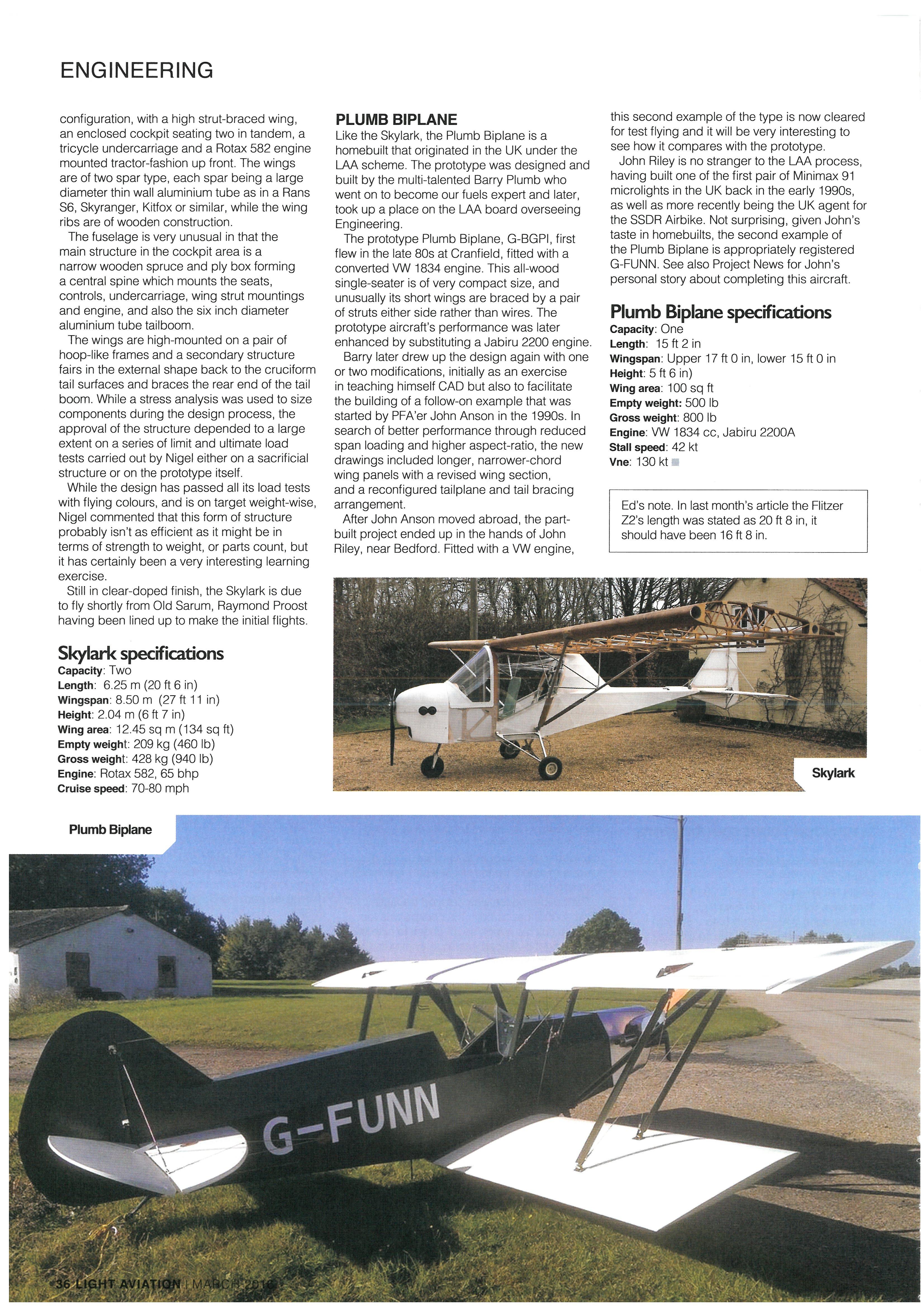
Like the Skylark, the Plumb Biplane is a homebuilt that originated in the UK under the LAA scheme. The prototype was designed and built by the multi-talented Barry Plumb who went on to become our fuels expert and later, took up a place on the LAA board overseeing Engineering.
The prototype Plumb Biplane, G-BGPYI.,first flew in the late 80s at Cranfield, fitted with a converted VW 1834 engine. This all-wood single-seater is of very compact size, and unusuallyitsshortwingsarebracedbya pair of struts either side rather than wires. The prototype aircraft’s performance was later enhanced by substituting a Jabiru 2200 engine.
Barry later drew up the design again with one or two modifications, initially as an exercise in teaching himself CAD but also to facilitate the building of a follow-on example that was started by PFA’er John Anson in the 1990s. In search of better performance through reduced span loading and higher aspect-ratio, the new drawings included longer, narrower-chord wing panels with a revised wing section, and a reconfigured tailplane and tail bracing arrangement.
After John Anson moved abroad, the partbuilt project ended up in the hands of John Riley, near Bedford. Fitted with a VW engine,
this second example of the type is now cleared for test flying and it will be very interesting to see how it compares with the prototype.
John Riley is no stranger to the LAA process, having built one of the first pair of Minimax 91 microlights in the UK back in the early 1990s, as well as more recently being the UK agent for the SSDRAirbike. Not surprising, given John’s taste in homebuilts, the second example of the Plumb Biplane is appropriately registered G-FUNN. See also Project News for John’s personal story about completing this aircraft.
Capacity: One
Length: 15 ft 2 in
Wingspan: Upper 17 ft 0 in, lower 15 ft Oin
Height:5 ft 6 in)
Wing area: 100 sq ft
Empty weight: 500 Ib
Gross weight: 800 Ib
Engine: VW 1834 cc, Jabiru 2200A
Stall speed: 42 kt
Vne: 130 kt
Ed’s note. In last month’s article the Flitzer Z2’slengthwasstatedas20ft8 in,it shouldhavebeen16ft8 in.
UK dealers on www.beringer-aero.com sales@beringer-aero.com(>> LAA approved
Established 1922
Authorised andregulatedby theFinancial ConductAuthority
Competitive quotationsfor all types of aircraft and other orientated
Uniqueinsurancerequirements. aircraft groundrisks/home built constructionfacility. We havebeenassistingPFA/LAA members for 40 years.

L19 Cub.MarkchosePOLY-FIBER for hiscovering for its easyapplicationand unrivalled durability. Wewish him manyyearsof enjoyableflying. Ifyou usePOLY-FIBER for your project or recoveryou will haveasuperbfinishtoo,becauseyouhavechosenthebest. Fifty yearsof trouble-freeusehasmadePOLY-FIBER the clearchoiceof commercialshopsandhome buildersalike. There’s no betterway to cover an aircraft than POLY-FIBERyours included! www.aircraftcoverings.com
COVERING SERVICE AVAILABLE
ForthebestserviceandsupportcalltheEuropeanGietbutars: AIRCRAFT COVERINGS LTD
HENSTRIDGEAIRFIELD,SOM.BA8 OTF
Tel: 01963 363636 e.m.sales@aircraftcoverings.com www.aircraftcoverings.com
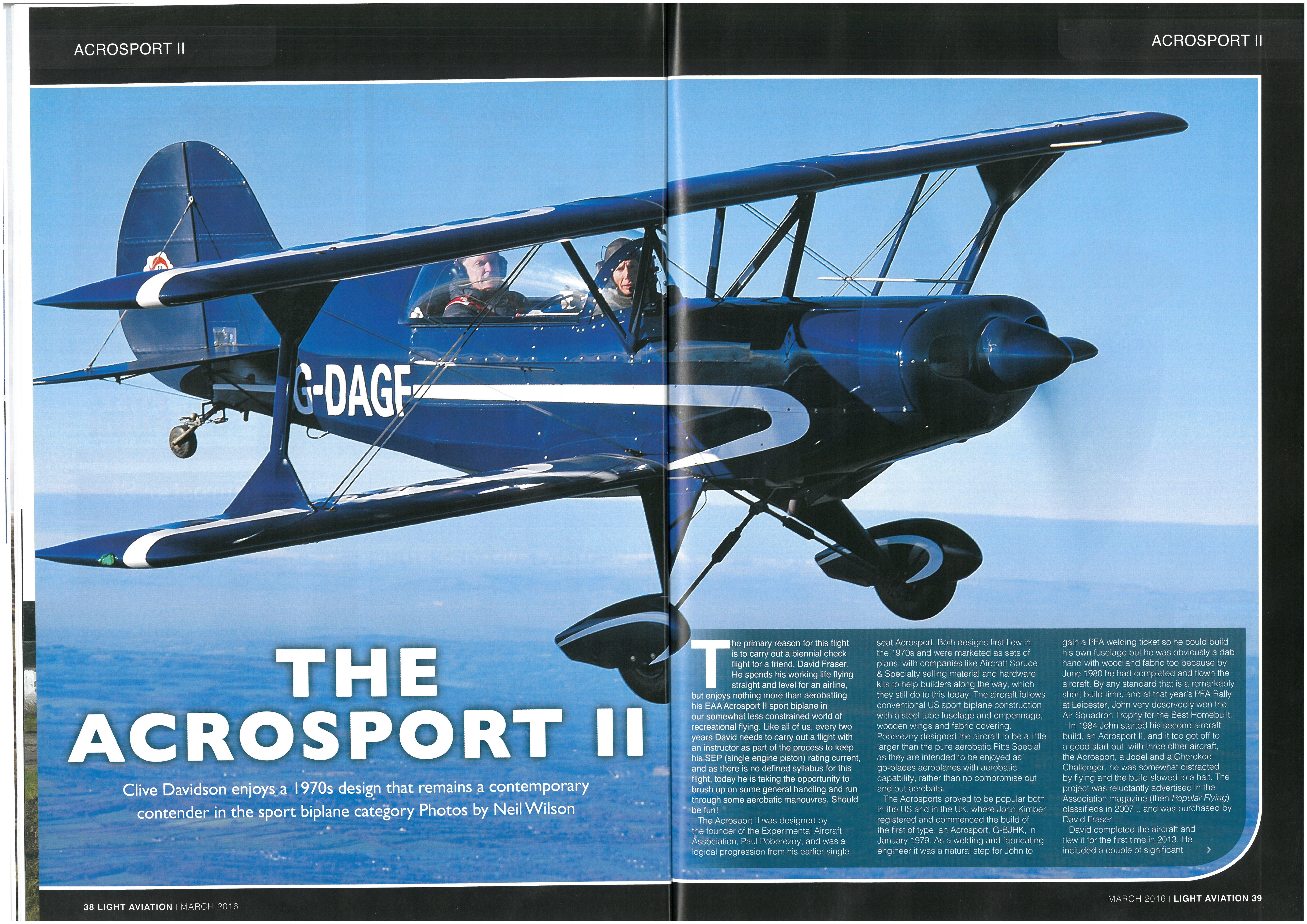
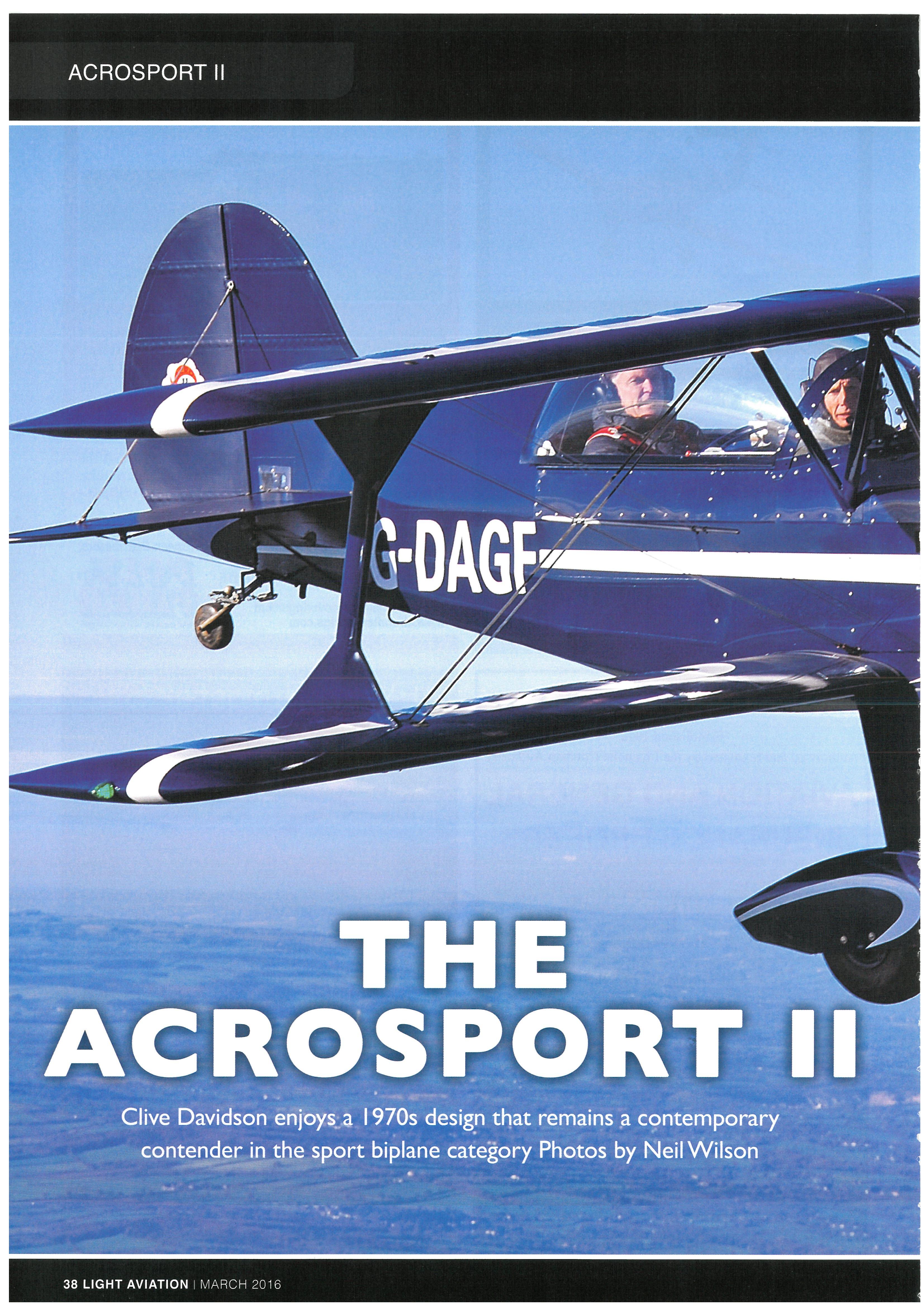
he primary reason for this flight is to carry out a biennial check flight for a friend, David Fraser. He spends his working lifeflying straight and level for an airline, enjoys nothing more than aerobatting nisEAAAcrosport I! sport biplane in ur somewhat less constrained world of ecreationalflying.Likeallof us,everytwo ears David needs to carry out a flight with in instructor as part of the process to keep isSEP(singleenginepiston)ratingcurrent, indas there is no defined syllabus for this ight,today he istakingthe opportunityto brush up on some general handling and run __ through some aerobatic manouvres. Should BaoSiva ae
_ The Acrosport !I was designed by a "thefounderoftheExperimentalAircraft es fAssociation,PaulPoberezny,andwas a ~~ logical progression from his earlier single-
seat Acrosport. Both designs first flew in the 1970s and were marketed as sets of plans, with companies like Aircraft Spruce & Specialty selling material and hardware kits to help builders along the way, which they still do to this today. The aircraft follows conventional US sport biplane construction with a steel tube fuselage and empennage, wooden wings and fabric covering. Pobereznydesignedtheaircrafttobealittle larger than the pure aerobatic Pitts Special as they are intended to be enjoyed as go-places aeroplanes with aerobatic capability, rather than no compromise out and out aerobats.
tee rae a? eaoTiis , cneTee eePeer cata “feetay ei ee ES) eee eae os Coeee
The Acrosports proved to be popular both in the US and in the UK, where John Kimber registered and commenced the build of the first of tyoe, an Acrosport, G-BJHK, in January 1979. As a welding and fabricating engineer it was a natural step for John to RE RSSoie lll
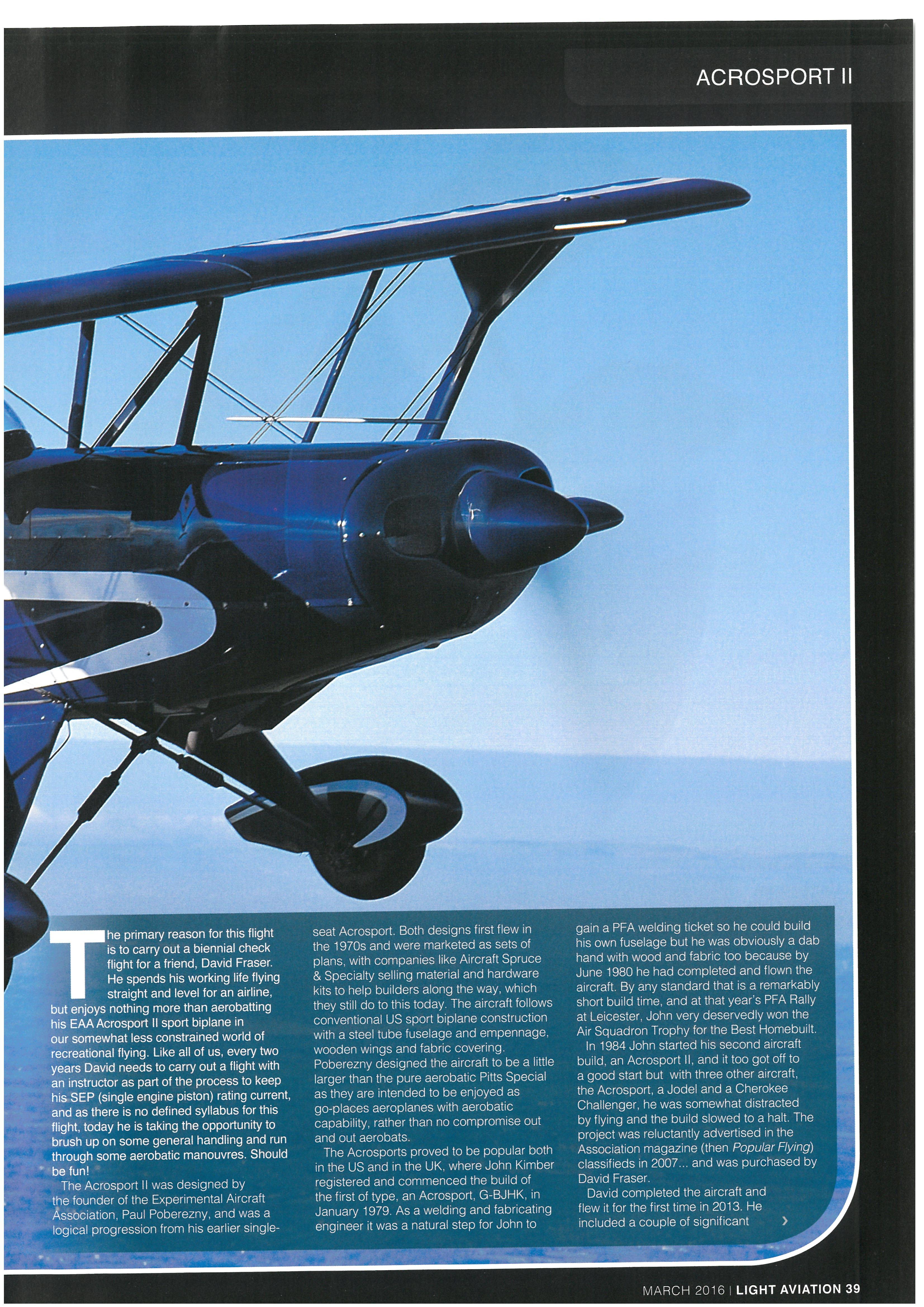
gain a PFAwelding ticket so he could build his own fuselage but he was obviously a dab hand with wood and fabric too because by June 1980 he had completed and flown the aircraft. By any standard that is a remarkably short build time, and at that year’s PFARally ElaWelerctsi(cleevleAlamoNAClos\oA=eVAIOUALS Air Squadron Trophy for the Best Homebuilt. | In1984Johnstartedhissecondaircraft ee build,anAcrosportII,andittoogotoffto ee agoodstartbutwiththreeotheraircraft, ee theAcrosport,aJodelandaCherokee ee Challenger,hewassomewhatdistracted aa byflyingandthebuildslowedtoahalt.The co, project was reluctantly advertised in the one Association magazine (then Popular Flying) re classifieds in 2007... and was purchased by ; DeWekmte
David completed the aircraft and flew it for the first time in 2013. He included a couple of significant
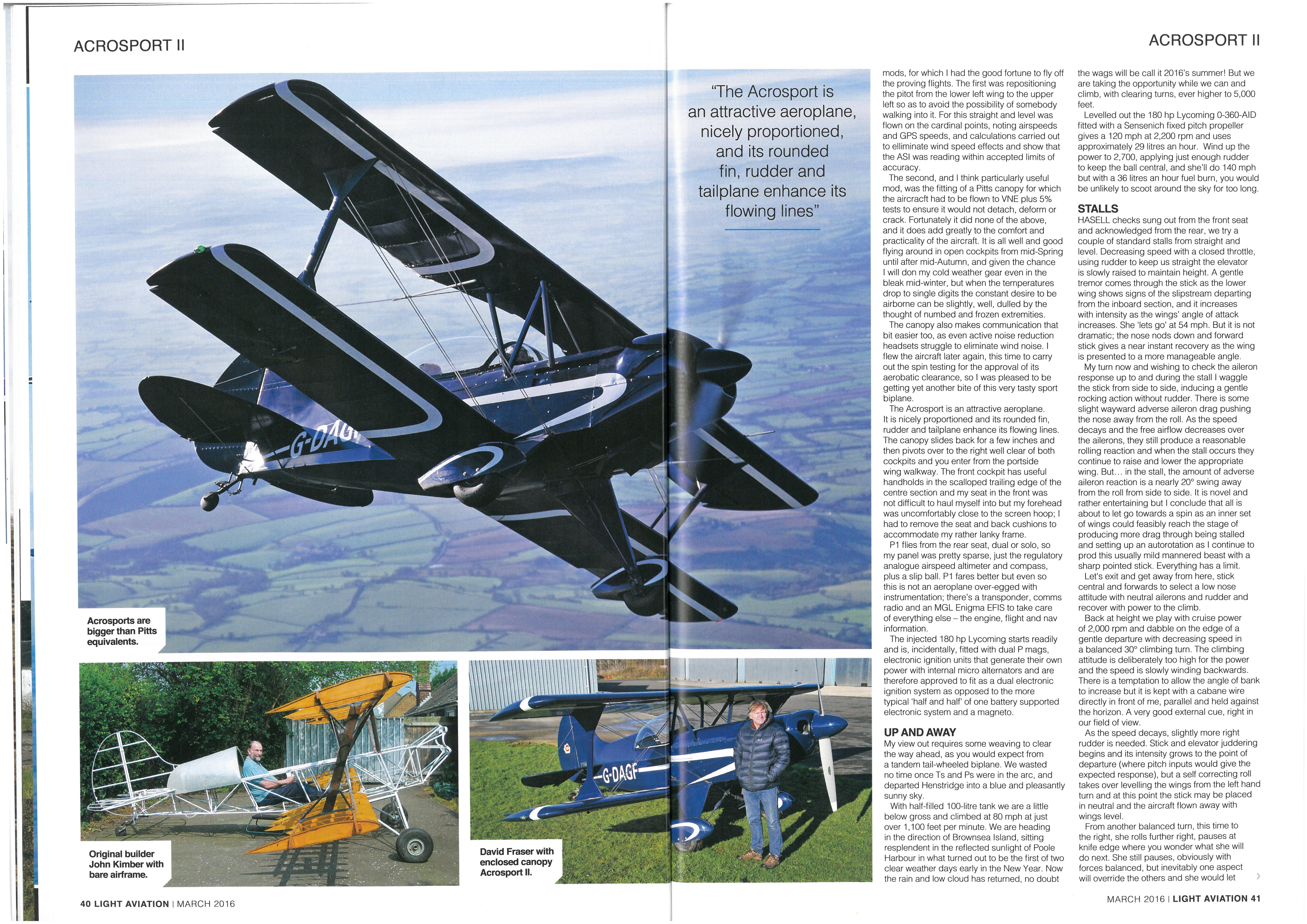
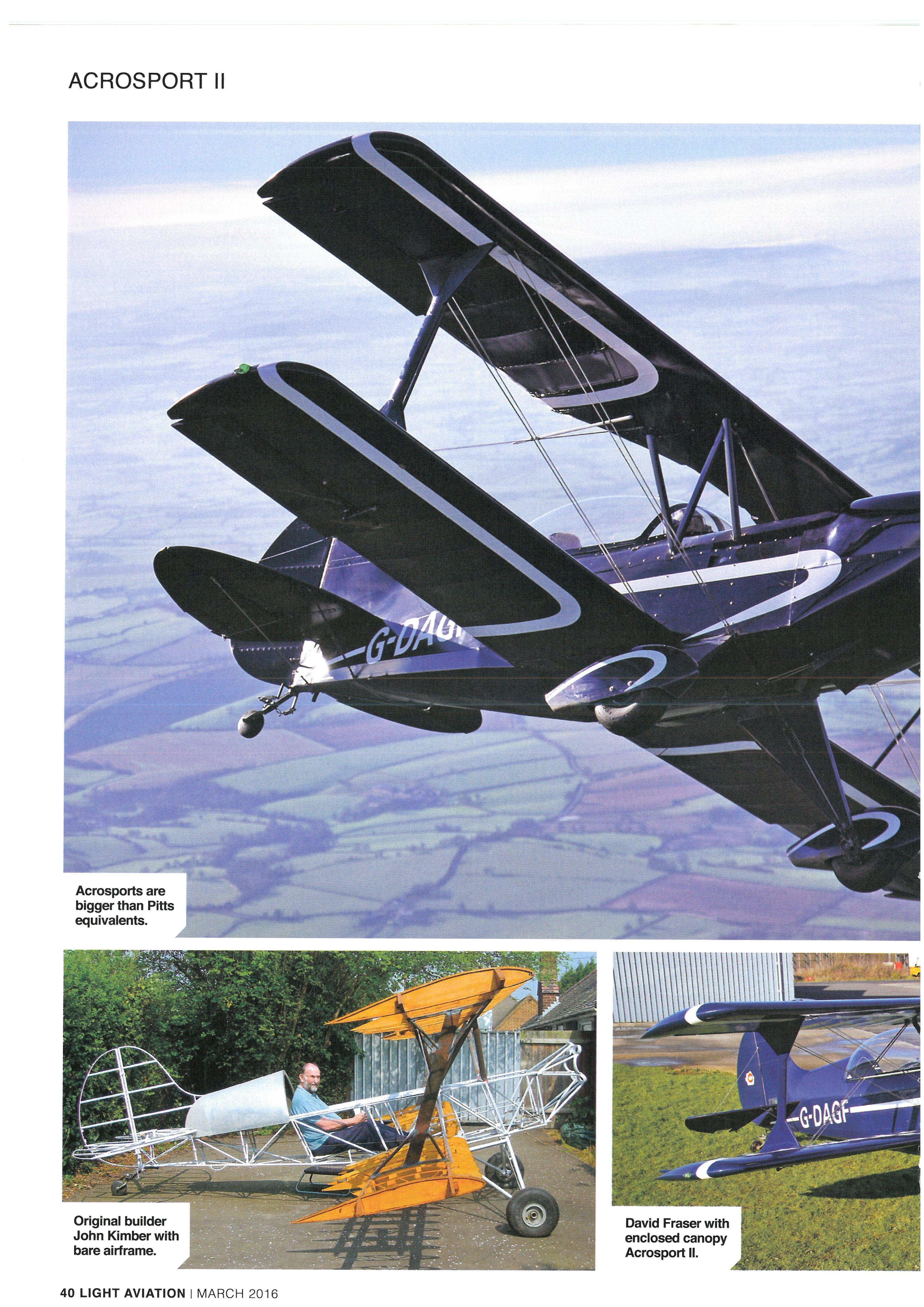
“TheAcrosport is an attractive aeroplane, nicely proportioned, and its rounded fin, rudder and tailolane enhance its flowing lines”
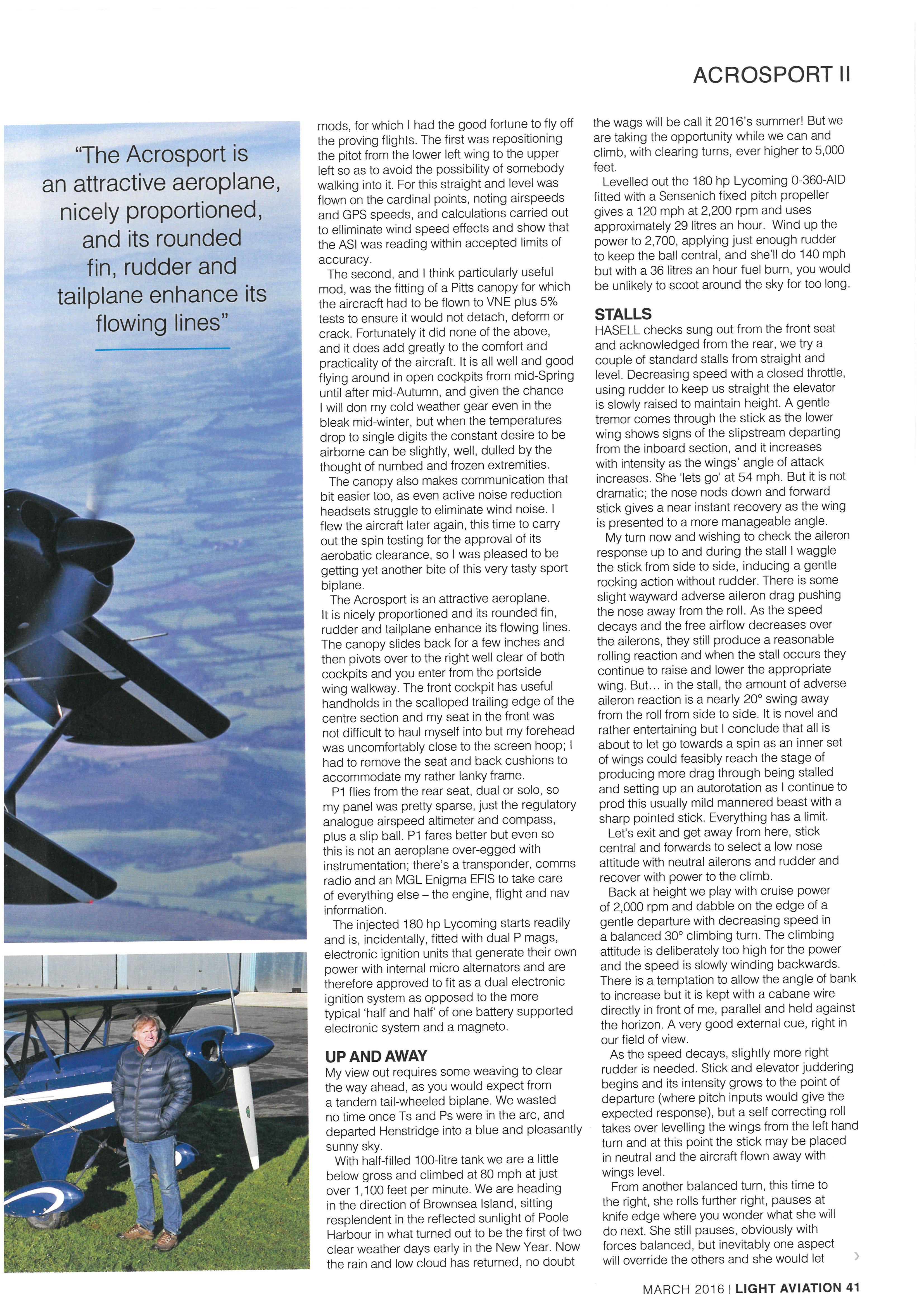
mods, for which | had the good fortune to fly off the proving flights. Thefirst was repositioning the pitot from the lower left wing to the upper left so as to avoid the possibility of somebody walking into it. For this straight and level was flown on the cardinal points, noting airspeeds and GPS speeds, and calculations carried out to elliminate wind speed effects and show that the ASI was reading within accepted limits of accuracy.
Thesecond,and | thinkparticularlyuseful mod, was the fitting of a Pitts canopy for which the aircracft had to be flown to VNE plus 5% tests to ensure it would not detach, deform or crack. Fortunately it did none of the above, and it does add greatly to the comfort and practicality of the aircraft. It is all well and good flying around in open cockpits from mid-Spring until after mid-Autumn, and given the chance | will don my cold weather gear even in the bleak mid-winter, but when the temperatures drop to single digits the constant desire to be airborne can be slightly, well, dulled by the thought of numbed and frozen extremities. The canopy also makes communication that bit easier too, as even active noise reduction headsets struggle to eliminate wind noise. | flew the aircraft later again, this time to carry out the spin testing for the approval of its aerobatic clearance, so | was pleased to be getting yet another bite of this very tasty sport biplane.
The Acrosport is an attractive aeroplane. It is nicely proportionedand its roundedfin, rudder and tailplane enhance its flowing lines. The canopy slides back for a few inches and then pivots over to the right well clear of both cockpits and you enter from the portside wing walkway. The front cockpit has useful handholds in the scalloped trailing edge of the centre section and my seat in the front was not difficult to haul myself into but my forehead was uncomfortably close to the screen hoop; | had to remove the seat and back cushions to accommodate my rather lanky frame.
P1 flies from the rear seat, dual or solo, so my panel was pretty sparse, just the regulatory analogue airspeed altimeter and compass, plus a slip ball. P1 fares better but even so this is not an aeroplane over-egged with instrumentation; there’s a transponder, comms radio and an MGL Enigma EFISto take care of everything else the engine, flight and nav information.
The injected 180 hp Lycoming starts readily and is, incidentally, fitted with dual P mags, electronic ignition units that generate their own power with internal micro alternators and are therefore approved to fit as a dual electronic ignition system as opposed to the more typical ‘half and half’ of one battery supported electronic system and a magneto.
My view out requires some weaving to clear the way ahead, as you would expect from a tandem tail-wheeled biplane. We wasted no time once Ts and Ps were in the arc, and departed Henstridge into a blue and pleasantly sunny sky.
Withhalf-filled100-litretankwearealittle below gross and climbed at 80 mph at just over 1,100 feet per minute. We are heading in the direction of Brownsea Island, sitting resplendent in the reflected sunlight of Poole Harbour in what turned out to be the first of two clear weather days early in the New Year. Now the rain and low cloud has returned, no doubt
the wags will be call it 2016’s summer! But we are taking the opportunity while we can and climb, with clearing turns, ever higher to 5,000 feet.
Levelled out the 180 hp Lycoming 0-360-AID fitted with a Sensenich fixed pitch propeller gives a 120 mph at 2,200 rpm and uses approximately 29 litres an hour. Wind up the power to 2,700, applying just enough rudder to keep the ball central, and she'll do 140 mph but with a 36 litres an hour fuel burn, you would be unlikely to scoot around the sky for too long.
HASELL checks sung out from the front seat and acknowledged from the rear,we try a couple of standard stalls from straight and level. Decreasing speed with a closed throttle, using rudder to keep us straight the elevator is slowly raised to maintain height. A gentle tremor comes through the stick as the lower wing shows signs of the slipstream departing from the inboard section, and it increases with intensity as the wings’ angle of attack increases. She ‘lets go' at 54 mph. But it is not dramatic; the nose nods down and forward stick gives a near instant recovery as the wing is presented to a more manageable angle. My turn now and wishing to check the aileron response up to and during the stall | waggle the stick from side to side, inducing a gentle rocking action without rudder. There is some slight wayward adverse aileron drag pushing the nose away from the roll. As the speed decays and the free airflow decreases over the ailerons, they still produce a reasonable rolling reaction and when the stall occurs they continue to raise and lower the appropriate wing. But... in the stall, the amount of adverse aileron reaction is a nearly 20° swing away from the roll from side to side. It is novel and rather entertaining but | conclude that all is about to let go towards a spin as an inner set of wings could feasibly reach the stage of producing more drag through being stalled and setting up an autorotation as | continue to prod this usually mild mannered beast with a sharppointedstick.Everythinghas a limit.
Let's exit and get away from here, stick central and forwards to select a low nose attitude with neutral ailerons and rudder and recover with power to the climb.
Back at height we play with cruise power of 2,000 rom and dabble on the edge of a gentle departure with decreasing speed in a balanced 30° climbing turn. The climbing attitude is deliberately too high for the power and the speed is slowly winding backwards. There is a temptation to allow the angle of bank to increase but it is kept with a cabane wire directly in front of me, parallel and held against the horizon. A very good external cue, right in our field of view.
As the speed decays, slightly more right rudder is needed. Stick and elevator juddering begins and its intensity grows to the point of departure (where pitch inputs would give the expected response), but a self correcting roll takes over levelling the wings from the left hand turn and at this point the stick may be placed in neutral and the aircraft flown away with wings level.
From another balanced turn, this time to the right, she rolls further right, pauses at knife edge where you wonder what she will do next. She still pauses, obviously with forces balanced, but inevitably one aspect will override the others and she would let
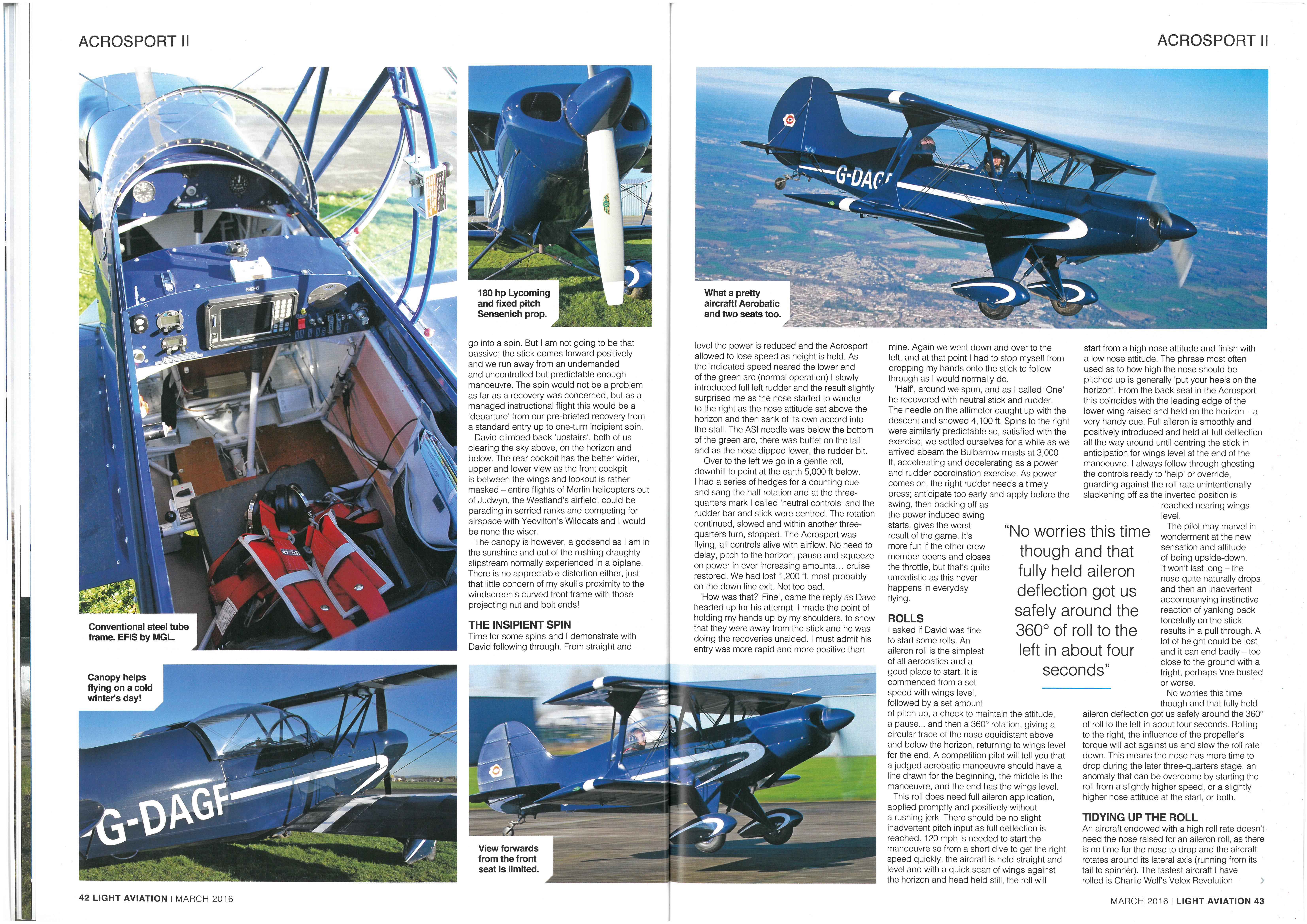
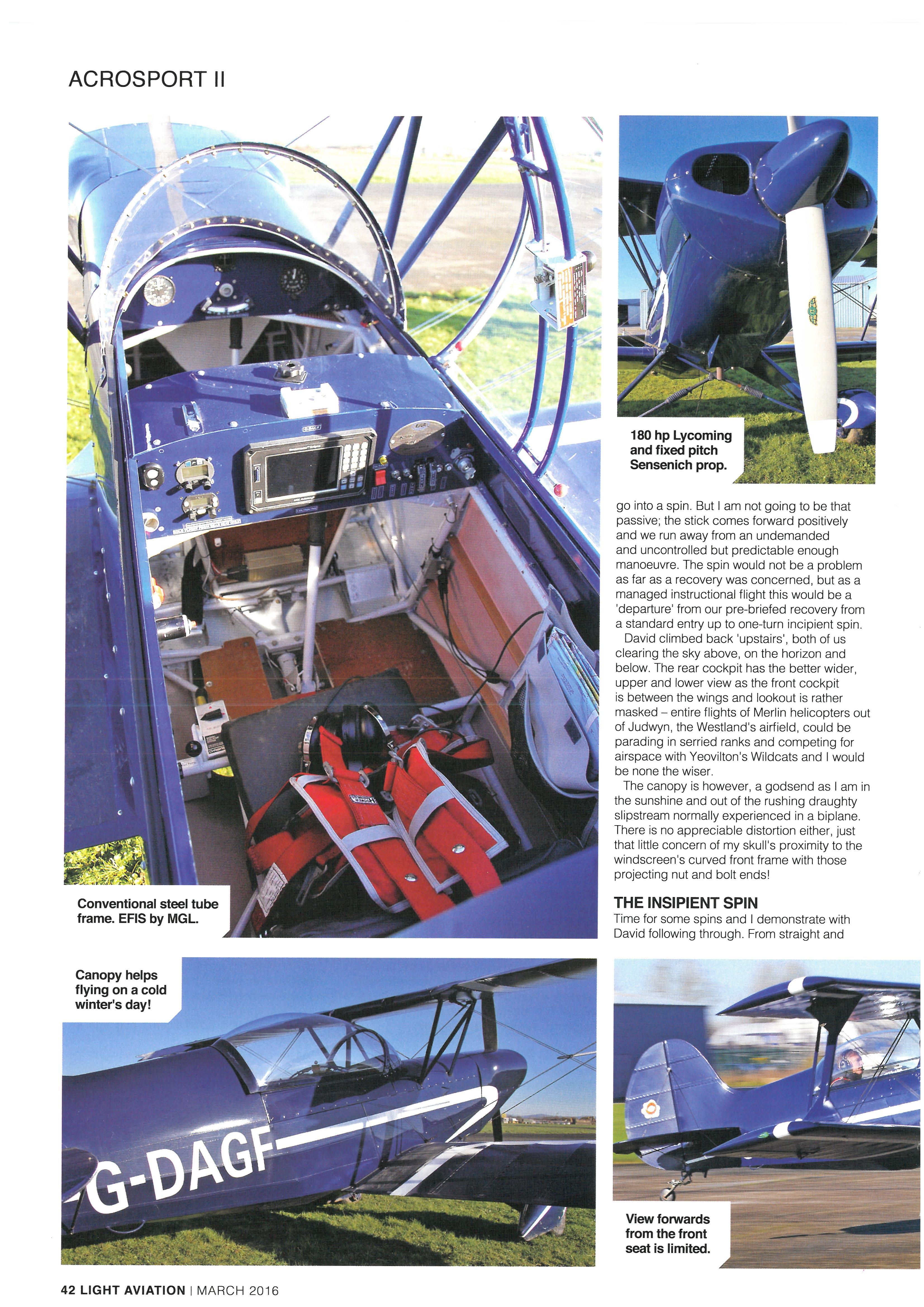
180 hp Lycoming and fixed pitch Sensenich prop.
go into a spin. But | am not going to be that passive; the stick comes forward positively and we run away from an undemanded and uncontrolled but predictable enough manoeuvre. The spin would not be a problem as far as a recovery was concerned, but as a managed instructional flight this would be a ‘departure’ from our pre-briefed recovery from a standard entry up to one-turn incipient spin. David climbed back ‘upstairs’, both of us clearing the sky above, on the horizon and below. The rear cockpit has the better wider, upper and lower view as the front cockpit is between the wings and lookout is rather masked entire flights of Merlin helicopters out of Judwyn, the Westland's airfield, could be parading in serried ranks and competing for airspace with Yeovilton's Wildcats and | would be none the wiser.
The canopy is however, a godsend as | am in the sunshine and out of the rushing draughty slipstream normally experienced in a biplane. There is no appreciable distortion either, just that little concern of my skull's proximity to the windscreen's curved front frame with those projecting nut and bolt ends! THE INSIPIENT SPIN Time for some spins and | demonstrate with David following through. From straight and
aircraft! Aerobatic and two seats too.
level the power is reduced and the Acrosport allowed to lose speed as height is held. As the indicated speed neared the lower end of the green arc (normal operation) | slowly introduced full left rudder and the result slightly surprised me as the nose started to wander to the right as the nose attitude sat above the horizon and then sank of its own accord into the stall. The ASI needle was below the bottom of the green arc, there was buffet on the tail and as the nose dipped lower, the rudder bit.
Over to the left we go in a gentle roll, downhill to point at the earth 5,000 ft below. | had a series of hedges for a counting cue and sang the half rotation and at the threequarters mark | called ‘neutral controls’ and the rudder bar and stick were centred. The rotation continued, slowed and within another threequarters turn, stopped. The Acrosport was flying, all controls alive with airflow. No need to delay, pitch to the horizon, pause and squeeze on power in ever increasing amounts... cruise restored. We had lost 1,200 ft, most probably on the down line exit. Not too bad.
‘How was that? 'Fine’, came the reply as Dave headed up for his attempt. | made the point of holding my hands up by my shoulders, to show that they were away from the stick and he was doing the recoveries unaided. | must admit his entry was more rapid and more positive than
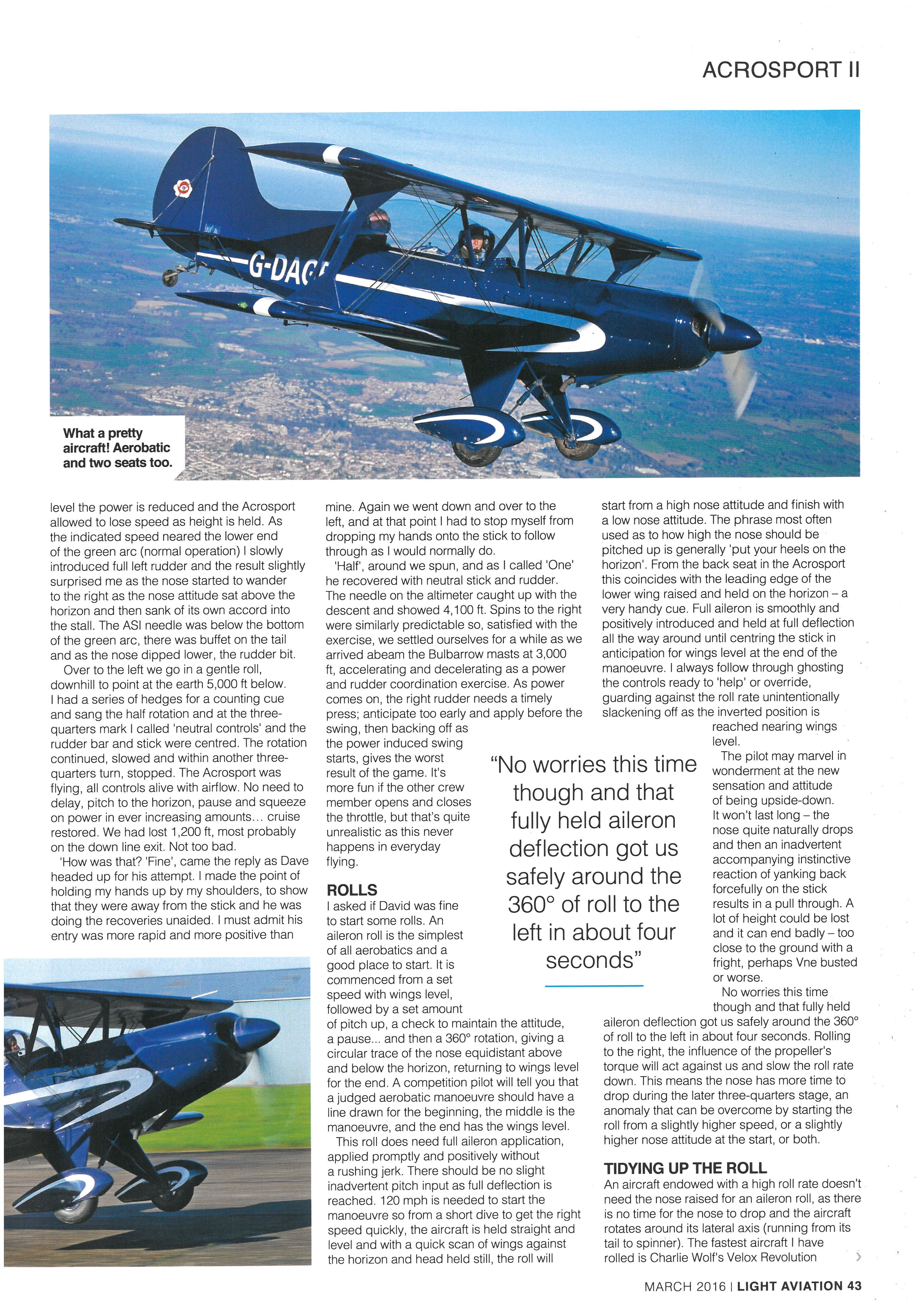
mine. Again we went down and over to the left, and at that point | had to stop myself from dropping my hands onto the stick to follow through as |would normally do.
‘Half’, around we spun, and as | called 'One' he recovered with neutral stick and rudder. The needle on the altimeter caught up with the descent and showed 4,100 ft. Spins to the right were similarly predictable so, satisfied with the exercise, we settled ourselves for a while as we arrived abeam the Bulbarrow masts at 3,000 ft, accelerating and decelerating as a power and rudder coordination exercise. AS power comes on, the right rudder needs a timely press; anticipate too early and apply before the swing, then backing off as the power induced swing starts, gives the worst result of the game. It's more fun if the other crew member opens and closes the throttle, but that’s quite unrealistic as this never happens in everyday flying.
| asked if David was fine to start some rolls. An aileron roll is the simplest of all aerobatics anda good place to start. It is commenced from a set speed with wings level, followed by a set amount of pitch up, a check to maintain the attitude, a pause... and then a 360° rotation, giving a circular trace of the nose equidistant above and below the horizon, returning to wings level for the end. A competition pilot will tell you that a judged aerobatic manoeuvre should have a line drawn for the beginning, the middle is the manoeuvre, and the end has the wings level. This roll does need full aileron application, applied promptly and positively without a rushing jerk. There should be no slight inadvertent pitch input as full deflection is reached. 120 mph is needed to start the manoeuvre so from a short dive to get the right speed quickly, the aircraft is held straight and level and with a quick scan of wings against
start from a high nose attitude and finish with a low nose attitude. The phrase most often used as to how high the nose should be pitched up is generally ‘put your heels on the horizon’. From the back seat in the Acrosport this coincides with the leading edge of the lower wing raised and held on the horizon a very handy cue. Full aileron is smoothly and positively introduced and held at full deflection all the way around until centring the stick in anticipation for wings level at the end of the manoeuvre. | always follow through ghosting the controls ready to ‘help’ or override, guarding against the roll rate unintentionally slackening off as the inverted position is reached nearing wings level.
The pilot may marvel in wonderment at the new sensation and attitude of being upside-down. It won't last long the nose quite naturally drops and then an inadvertent accompanying instinctive reaction of yanking back forcefully on the stick results in a pull through. A lot of height could be lost and it can end badly too close to the ground with a fright, perhaps Vne busted or worse.
No worries this time though and that fully held aileron deflection got us safely around the 360° of roll to the left in about four seconds. Rolling to the right, the influence of the propeller's torque will act against us and slow the roll rate down. This means the nose has more time to drop during the later three-quarters stage, an anomaly that can be overcome by starting the roll from a slightly higher speed, or a slightly higher nose attitude at the start, or both.
An aircraft endowed with a high roll rate doesn't need the nose raised for an aileron roll, as there is no time for the nose to drop and the aircraft rotates around its lateral axis (running from its tail to spinner). The fastest aircraft | have rolled is Charlie Wolf's Velox Revolution
over Florida. Initially its rate of roll was 240° per second and after altering the gearing and stick length it was a mind expanding 420° a second. The higher rate of co-ordination needed to stop with wings absolutely level escaped me. It was so fast that as soon as full deflection was applied the stick had to be brought back to neutral.
In direct contrast you can read a chapter of War and Peace in a Cessna Aerobat as the roll iS So0oO slow.
But back to the job in hand. The aileron roll rate can be increased with rudder in the same rolling direction and a quick demo (literally) illustrates this. If we apply an increasing amount of rudder in the same direction of roll at the three-quarters point, whilst rolling through knife edge the fuselage can contribute to keeping the nose up when the adverse aileron drag wants to lower the nose further.
Another tip to accentuate finesse is when the wings are just reaching level position, it might not have escaped noticed that the nose swings out of alignment as the stick is centred (that accursed aileron drag again.) This can be avoided by continuing the roll for the last 90° with pro-roll rudder and bringing the stick central and aft to keep the nose up. It makes the last quarter incredibly smooth.
And the final suggestion as full rudder is now on and the roll has stopped with wings level, release it s-l-o-w-l-y, still keeping wings level with aileron so that the nose doesn't wobble, otherwise you will have gone to a lot of trouble to mask adverse aileron drag but then given the game away with a coarse rudder release. A shame to spoil the end of a very good near horizontal pirouette in the sky.
But remember, aerobatics is not something for the straight and level pilot to experiment with learn them with an instructor, and only in an appropriate aeroplane. And when you are ready to practice solo, keep it all nice and high. Do not add the complication and the additional stress of being too close to the hard and very
unforgiving ground there is no pause button nor a second chance.
David calls my attention to the time so we make tracks back for Henstridge. We are still at altitude and have to let down slowly, a rapid descent would cool the cylinders down too abruptly on this bitter winter’s day. All circuits are south side and we decide to let down deadside. David turns the radio volume up from the rear cockpit and we can hear traffic joining on the downwind; we both spot the white, high wing traffic on early finals as we join over the upwind threshold.
The downwind checks are short, comprising of fuel contents being sufficient, the float directly in front of my windscreen shows it is under half mast with approximately 25 litres remaining, the fuel pump is on, and we both acknowledge we are strapped in securely. By time we are about to turn final the previous traffic had backtracked and cleared to the north hangar side.
The approach speed is initially 82 mph, but aswearenowona straightinapproachmy shouldersandheadarecontributingnotalot to the scenery, in fact they're doing a rather good job of blanking out the ground based attractions, so a slip swings the nose out to the right Sowe can see the runway ahead.
David rounds out, reduces the power fully, pauses as the speed decays in the flare and allows the aircraft to sink. As the tail feels like it ought to be touching, the stick is eased back for us to sink an inch and all three tyres settle together on the tarmac. Then it’s just a question of keeping straight, the cadence braking coming in quite early. | am surprised the brakes can be applied with so much gusto without any squeal and and no great distance is used to slow to walking pace.
An unhurried runway exit takes us over the white line on the adjoining taxiway and back to the apron, a pause to cool the engine down and the mixture is leaned to stop the whirling prop. Silence pervades and settles easily over
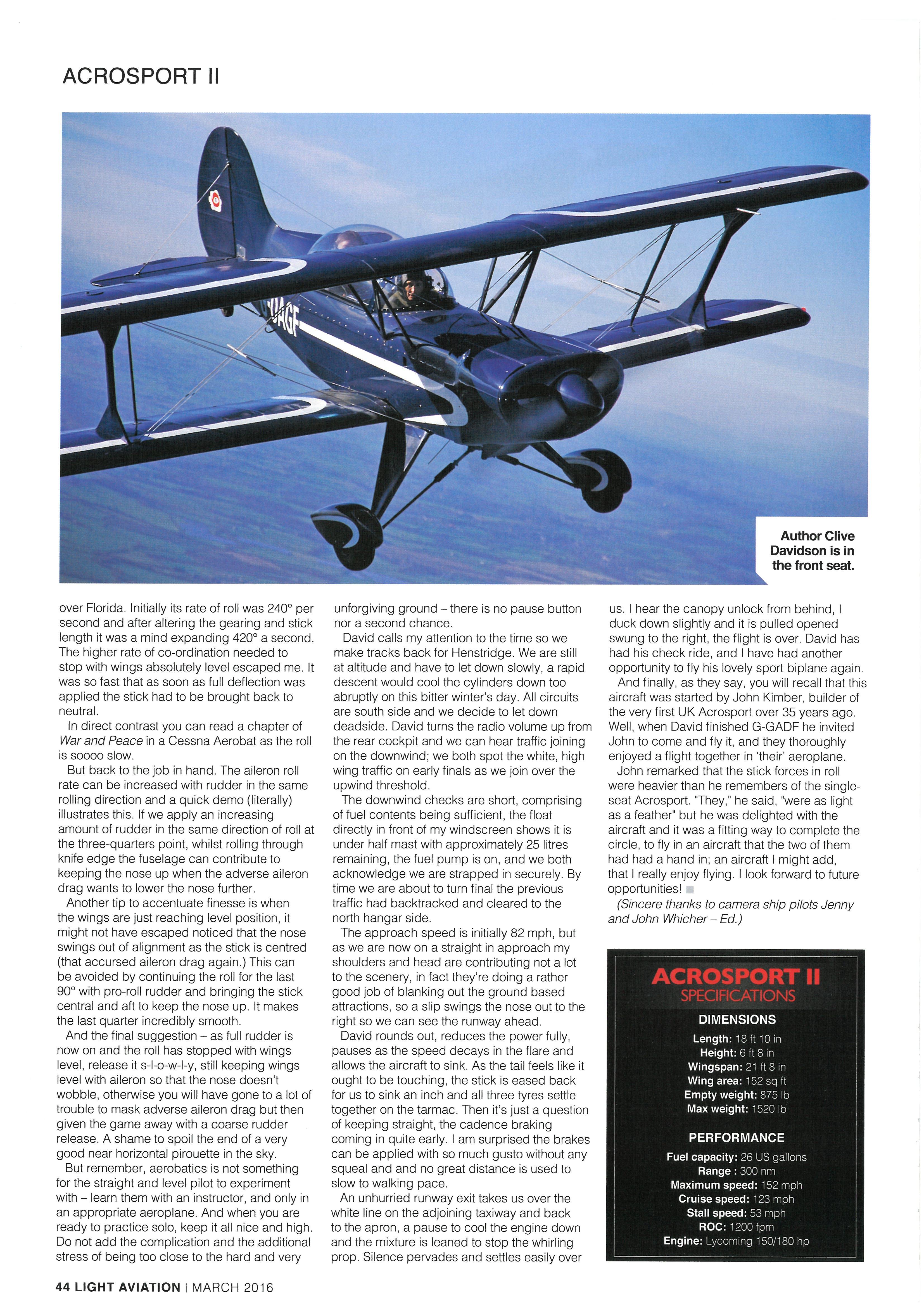
us. | hear the canopy unlock from behind, | duck down slightly and it is pulled opened swung to the right, the flight is over. David has had his check ride, and | have had another opportunity to fly his lovely sport biplane again. And finally, as they say, you will recall that this aircraft was started by John Kimber, builder of the very first UK Acrosport over 35 years ago. Well, when David finished G-GADF he invited John to come and fly it, and they thoroughly enjoyedaflight togetherin‘theiraeroplane. John remarked that the stick forces in roll were heavier than he remembers of the singleseat Acrosport. "They," he said, "were as light as a feather" but he was delighted with the aircraftanditwasafitting waytocompletethe circle, to fly in an aircraft that the two of them had had a hand in; an aircraft | might add, that | really enjoy flying. | look forward to future opportunities!
(Sincere thanks to camera ship pilots Jenny and John Whicher Ed.)
Length: 18 ft 10 in
Height: 6 ft 8 in
Wingspan: 21 ft 8 in
Wing area: 152 sq ft Empty weight: 875 |b

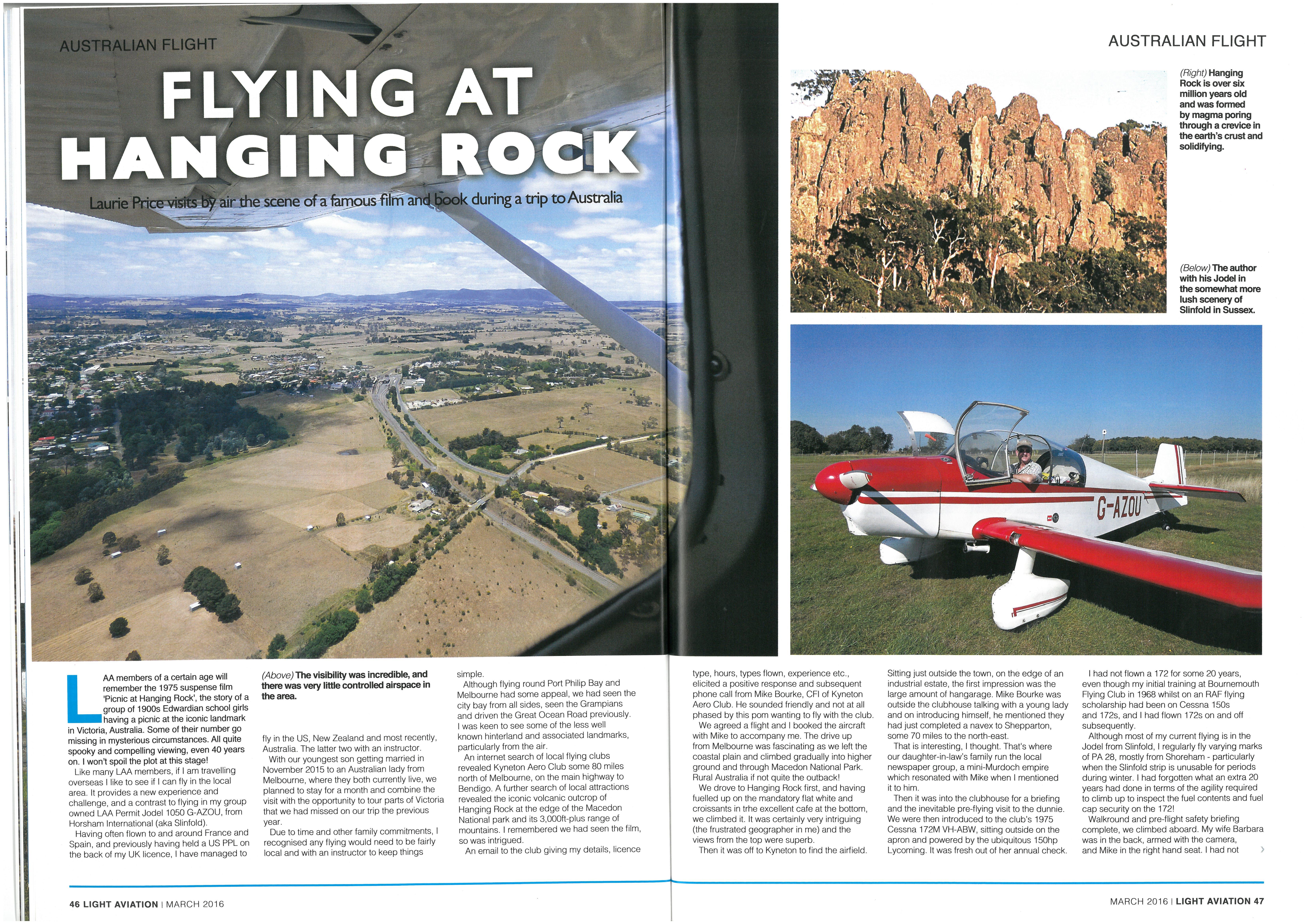
AA members of a certain age will remember the 1975 suspense film ‘Picnic at Hanging Rock', the story of a group of 1900s Edwardian school girls having a picnic at the iconic landmark in Victoria, Australia. Some of their number go missing in mysterious circumstances. All quite spooky and compelling viewing, even 40 years on. | won't spoil the plot at this stage!
Like many LAA members, if | am travelling overseas|liketoseeif|canflyinthelocal area. It provides a new experience and challenge, and a contrast to flying in my group owned LAA Permit Jodel 1050 G-AZOU, from Horsham International (aka Slinfold).
Having often flown to and around France and Spain, and previously having held a US PPLon the back of my UK licence, | have managed to
local and with an instructor to keep things
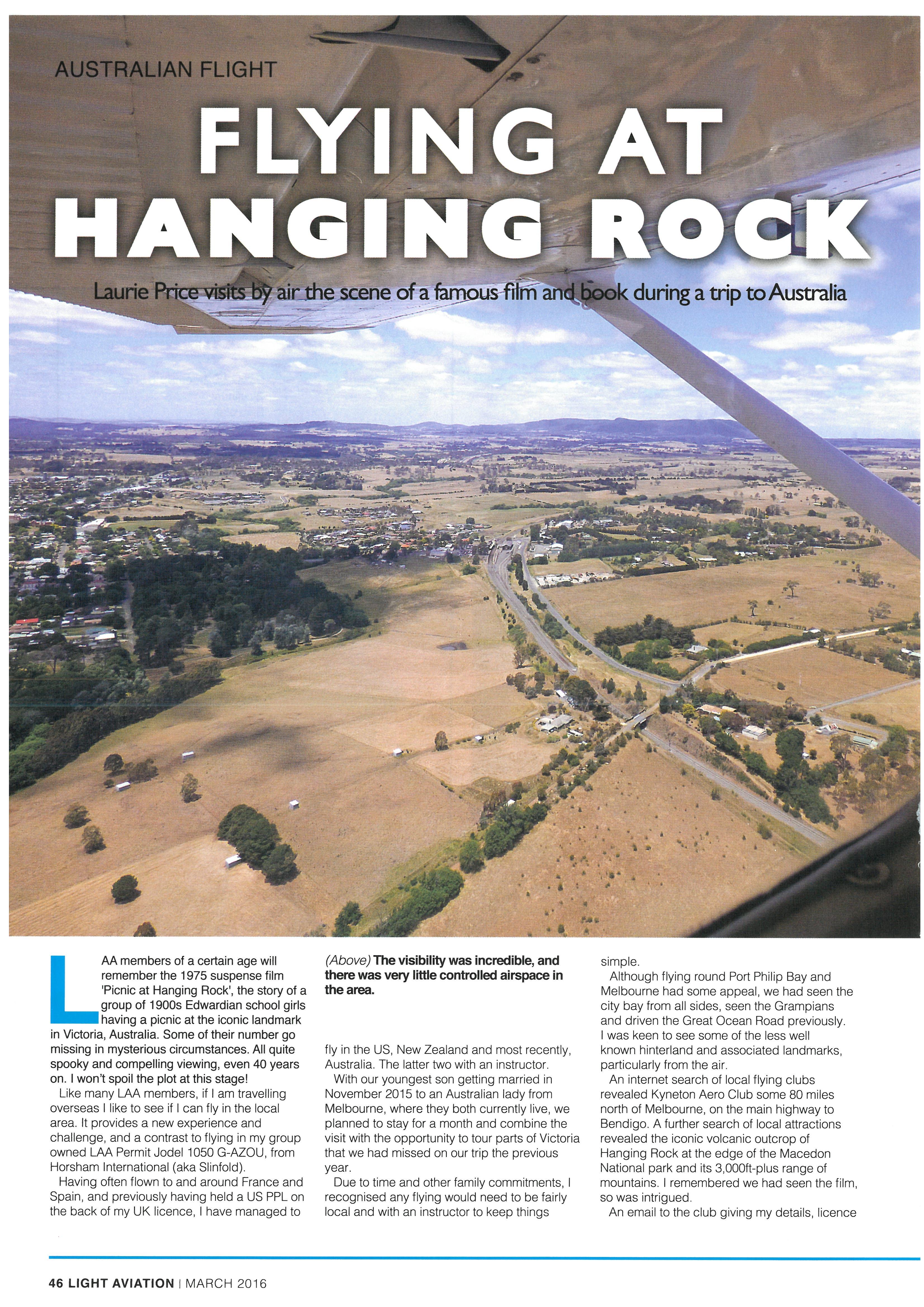
(Above) The visibility was incredible, and there was very little controlled airspace in the area.
fly in the US, New Zealand and most recently, Australia. The latter two with an instructor. With our youngest son getting married in November 2015 to an Australian lady from Melbourne, where they both currently live, we planned to stay for a month and combine the visit with the opportunity to tour parts of Victoria that we had missed on our trip the previous year.
Due to time and other family commitments, | recognised any flying would need to be fairly
simple.
Although flying round Port Philip Bay and Melbourne had some appeal, we had seen the city bay from all sides, seen the Grampians and driven the Great Ocean Road previously. | was keen to see some of the less well known hinterland and associated landmarks, particularly from the air.
An internet search of local flying clubs revealed Kyneton Aero Club some 80 miles north of Melbourne, on the main highway to Bendigo. A further search of local attractions revealed the iconic volcanic outcrop of Hanging Rock at the edge of the Macedon National park and its 3,000ft-plus range of mountains. | remembered we had seen the film, Sowas intrigued.
An email to the club giving my details, licence
type, hours, types flown, experience etc., elicited a positive response and subsequent phone call from Mike Bourke, CFI of Kyneton Aero Club. He sounded friendly and not at all phased by this pom wanting to fly with the club.
Weagreed a flightand|bookedtheaircraft with Mike to accompany me. The drive up from Melbourne was fascinating as we left the coastal plain and climbed gradually into higher ground and through Macedon National Park. Rural Australia if not quite the outback!
We drove to Hanging Rock first, and having fuelled up on the mandatory flat white and croissants in trhe excellent cafe at the bottom, we climbed it. It was certainly very intriguing (the frustrated geographer in me) and the views from the top were superb. Then it was off to Kyneton to find the airfield.
Sitting just outside the town, on the edge of an industrial estate, the first impression was the large amount of hangarage. Mike Bourke was outside the clubhouse talking with a young lady and on introducing himself, he mentioned they had just completed a navex to Shepparton, some 70 miles to the north-east.
That is interesting, | thought. That's where our daughter-in-law’sfamily run the local newspaper group, a mini-Murdoch empire which resonated with Mike when | mentioned it to him.
Then it was into the clubhouse for a briefing and the inevitable pre-flying visit to the dunnie. We were then introduced to the club’s 1975 Cessna 172M VH-ABW, sitting outside on the apron and powered by the ubiquitous 150hp Lycoming. It was fresh out of her annual check.
(Right)Hanging Rock is over six million years old and was formed by magma poring througha crevicein the earth’s crust and solidifying.
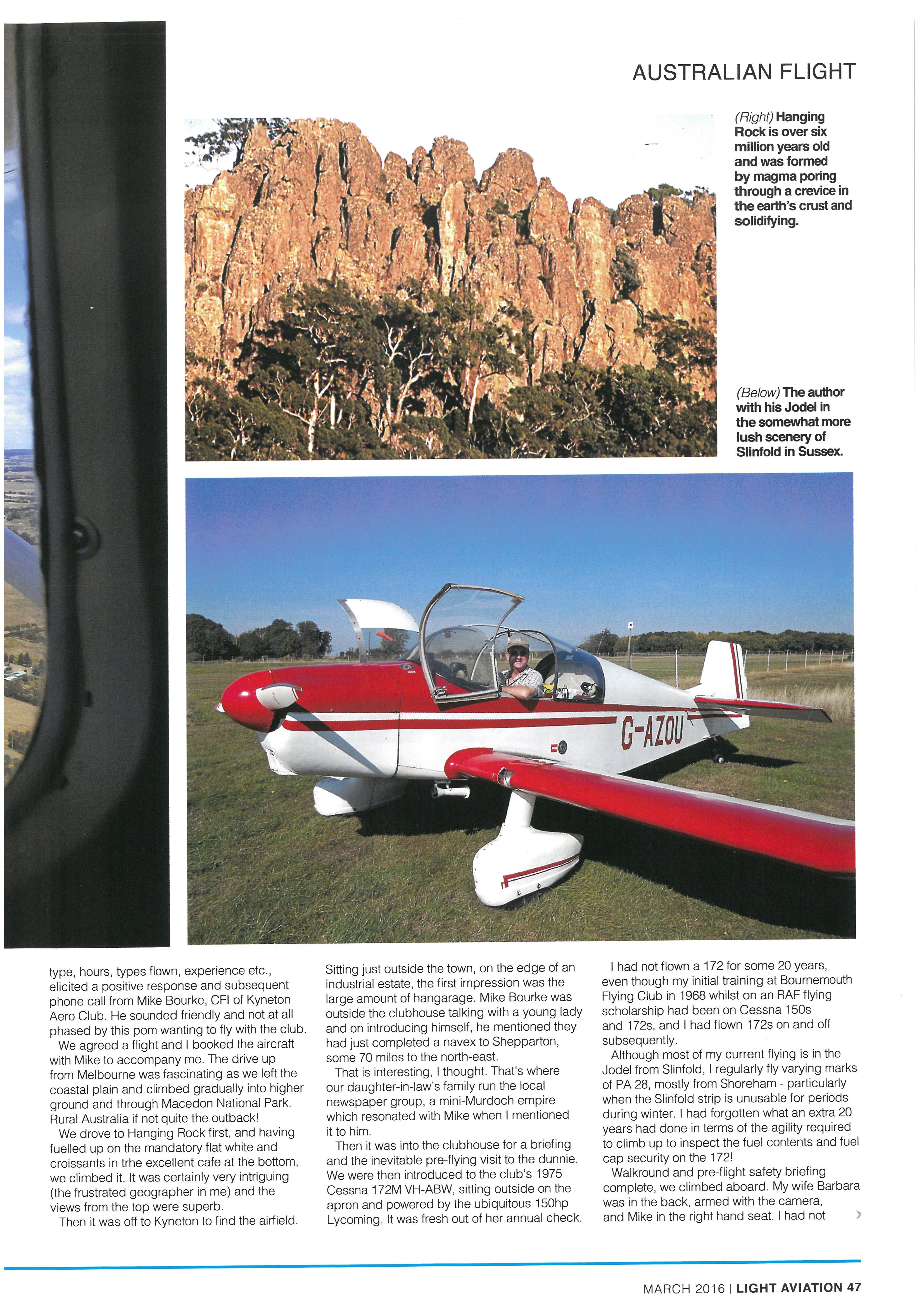
| had not flown a 172 for some 20 years, even though my initial training at Bournemouth Flying Club in 1968 whilst on an RAF flying scholarship had been on Cessna 150s and 172s, and | had flown 172s on and off subsequently. Although most of my current flying is in the Jodel from Slinfold, | regularly fly varying marks of PA 28, mostly from Shoreham - particularly when the Slinfold strip is unusable for periods during winter. | had forgotten what an extra 20 years had done in terms of the agility required to climb up to inspect the fuel contents and fuel cap security on the 172!
Walkround and pre-flight safety briefing complete, we climbed aboard. My wife Barbara was in the back, armed with the camera, and Mike in the right hand seat. | had not
come across the ingenious belt mechanism to stop the P1 and P2 seats inadvertently sliding back before, it was a welcome addition to resolve a previous 172 problem.
The interior was pristine for a 40-yearold aircraft, and a credit to the club and maintenance organisation. A typical suite of radios and avionics was available, but most not required for our planned local flight.
Mike briefed me on the particular requirements of flying from Kyneton, including being alert to stone damage. Although the main 18/36 runway is asphalt, the crosswind 09/27 runway is grass and there are some gravel taxiways and overrun areas/starter strips.
Kyneton Airfield does not have any formal ATC; you just use the common safety frequency 119.0 MHZ, and make blind calls. It does have PilotOperated Lighting, as at many US airfields, activated by depressing the PTT switch if on 120.55 mHz.
Mike mentioned the lack of controlled airspace, even though it is only 70 miles north of Melbourne’s main commercial airport, Tullamarin - the benefits of a very large geographic area and relatively small population. Such a contrast to flying in the south-east of England
The runway in use was 18. So noting the 900-metre strip, 1,650 feet airfield elevation and moderate temperature, tempered by a brisk wind some 10 degrees off the runway heading, we taxied to the concrete hold/run up area.
seemsthat despitethe landareaavailable in
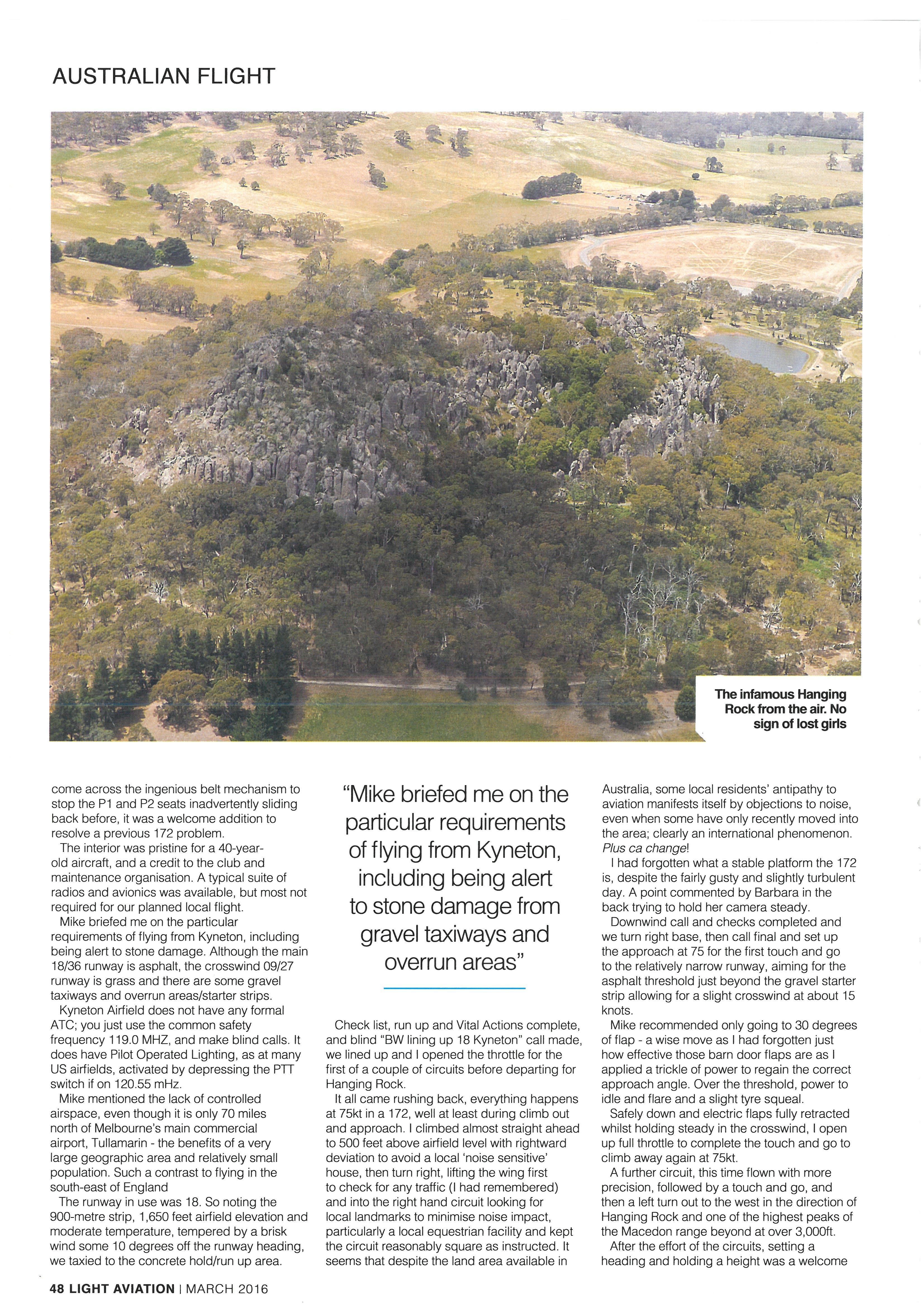
“Mike briefed me on the particular requirements offlying from Kyneton, including being alert to stone damage from graveltaxiways and overrun areas”
Check list, run up and Vital Actions complete, and blind “BW lining up 18 Kyneton” call made, we lined up and | opened the throttle for the first of a couple of circuits before departing for Hanging Rock.
It all came rushing back, everything happens at 75kt in a 172, well at least during climb out and approach. | climbed almost straight ahead to 500 feet above airfield level with rightward deviation to avoid a local ‘noise sensitive’ house, then turn right, lifting the wing first to check for any traffic (| had remembered) and into the right hand circuit looking for local landmarks to minimise noise impact, particularly a local equestrian facility and kept the circuit reasonably square as instructed. It
Australia, some local residents’ antipathy to aviation manifests itself by objections to noise, even when some have only recently moved into the area; clearly an international phenomenon. Plus ca change!
| had forgotten what a stable platform the 172 is, despite the fairly gusty and slightly turbulent day. A point commented by Barbara in the back trying to hold her camera steady.
Downwind call and checks completed and we turn right base, then call final and set up the approach at 75 for the first touch and go to the relatively narrow runway, aiming for the asphalt threshold just beyond the gravel starter strip allowing for a slight crosswind at about 15 knots.
Mike recommended only going to 30 degrees of flap - a wise move as | had forgotten just how effective those barn door flaps are as | applied a trickle of power to regain the correct approach angle. Over the threshold, power to idleandflareanda slighttyresqueal.
Safely down and electric flaps fully retracted whilst holding steady in the crosswind, | open up full throttle to complete the touch and go to climb away again at 75kt.
A further circuit, this time flown with more precision, followed by a touch and go, and thenaleftturnouttothewestinthedirectionof Hanging Rock and one of the highest peaks of the Macedon range beyond at over 3,000ft.
After the effort of the circuits, setting a heading and holding a height was a welcome
break, allowing me to look beyond the immediate area and see the true CAVOK conditions with all that they offered in terms of appreciating the scenery and privilege of flight. Mike said we could see the Pyrenees in the distance (Australian!) such was the phenomenal visibility.
Then in the middle distance, Hanging Rock appeared.|decidedonaleft handorbitas that gave Barbara the best opportunity for photographs. We crossed over the approach road to the car park and the winding footpath to the flights of steps that lead up to the rock that we had climbed an hour or two before. But the perspective was, as ever from the air, so different. A series of basalt protrusions rise out of the surrounding plain but they actually create only a relatively small summit.
Orbits completed and photographs taken, we headed back for Kyneton announcing our intentions on the Unicom frequency. A local Van’s RVannounced he was lining up for a departure for a flight to the south but would be long gone before we re-joined the circuit. Mike mentioned that there are some 60 locally based aircraft, hence all the hangarage we had passed on driving into the airfield.
Then a return to Kyneton. Despite compass and DI, | am sure like all aviators, | try to keep a mental picture of general direction by reference to the sun (when available) and time. But remember when flying in Australia the sun’s daily trajectory is to the north, not south as in
“The lack of traffic and complicated controlled airspace was a welcome contrast to even my usual reasonably unrestricted (otherthan being on the edge ofthe Gatwickzone) farm stripflying from Slinfold in G-AZOU”
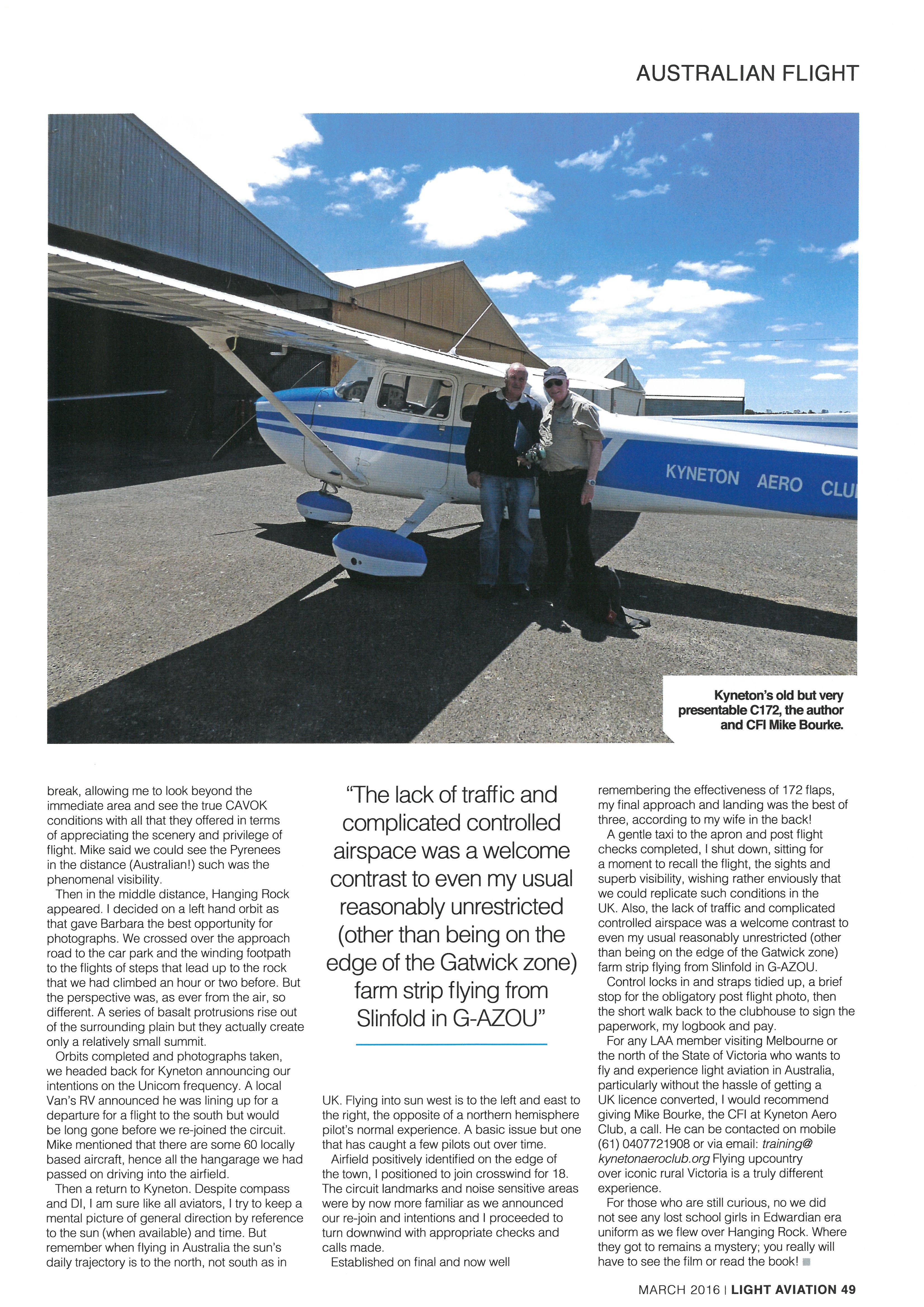
UK. Flying into sun west is to the left and east to the right, the opposite of a northern hemisphere pilot’s normal experience. A basic issue but one that has caught a few pilots out over time.
Airfield positively identified on the edge of the town, | positioned to join crosswind for 18. The circuit landmarks and noise sensitive areas were by now more familiar as we announced our re-join and intentions and | proceeded to turn downwind with appropriate checks and calls made.
Established on final and now well
remembering the effectiveness of 172 flaps, my final approach and landing was the best of three, according to my wife in the back!
A gentle taxi to the apron and post flight checks completed, | shut down, sitting for a moment to recall the flight, the sights and superb visibility, wishing rather enviously that we could replicate such conditions in the UK. Also, the lack of traffic and complicated controlled airspace was a welcome contrast to even my usual reasonably unrestricted (other than being on the edge of the Gatwick zone) farm strip flying from Slinfold in G-AZOU.
Control locks in and straps tidied up, a brief stop for the obligatory post flight photo, then the short walk back to the clubhouse to sign the paperwork, my logbook and pay.
Forany LAA member visiting Melbourne or the north of the State of Victoria who wants to fly and experience light aviation in Australia, particularly without the hassle of getting a UK licence converted, | would recommend giving Mike Bourke, the CFI at Kyneton Aero Club, a call. He can be contacted on mobile (61) 0407721908 or via email: training@ kynetonaeroclub.org Flying upcountry over iconic rural Victoria is a truly different experience.
For those who are still Curious, no we did not see any lost school girls in Edwardian era uniform as we flew over Hanging Rock. Where they got to remains a mystery; you really will have to see the film or read the book!
hoy there. Welcome again to Safety Spot. | hope, as always, that all’s well with you and those close to you. If you’re anything like me (generally a bit seized-up after the winter break), in this period of lengthening days, you'll be finding yourself with too much to do and too little time to do it the grass will be growing next and yes, my lawnmower still needs fixing! Of course we mustn’t moan, it’s always good to get a bit of sun on the bod and you know what they say about idle hands.
We've all been pretty busy here at LAA HQ one way or another; late last month we hosted the LAA’s first Kit-Suppliers/Agents’ Seminar which, I'm happy to say, turned out to be a very useful event: | hope, from both sides of the table.
Actually, the phrase, ‘both sides’ doesn't really apply quite so powerfully in our Association as in some others. We at HQ Engineering are well aware that much of the Association’s expertise lies in the wider membership and much of what we do requires well-oiled partnerships; long may this remain, strength in numbers and all that! The forum ended up being worthy of this title, with many of the delegates taking the opportunity to express and expand on issues presented during the various talks: much was learnt by all.
Primarily, the day was cast so that HQ Engineering could explain the process of getting a new aircraft type into the LAA system and for a commercial type sold through a UK
‘If the devil were to cast his net’ he wouldn’t find any victims in this crowd! Well, hopefully anyway. This isthe line-up of the delegates who attended the recent Agents’ Seminar missing quite a few notables who rushed off at the end so that they could remain day VFR for their flights home. The object of the day was to better explain the process of bringing a new aircraft type onto the LAA’s books and to offer a space for a discussion forum where better ways to make this complex process operate were discussed. We think the day was a success and the LAA intends to put on more seminars in the future.
(Photo Malcolm McBride)
agent, what is expected of the agent when it comes to supporting the people who choose to build and fly it. This required the engineering staff to put together individual presentations explaining the simplified systems we use to keep things as safe as possible, but at a fraction of the cost of the certificated regime. To some extent, trying to explain this task in itself reveals the problems associated with managing the initial and continuing airworthiness issues of such a large and varied fleet of aircraft... it’s difficult to define the un-definable! There’s an old adage which explains that an aircraft cannot fly unless the weight of the paperwork exceeds the weight
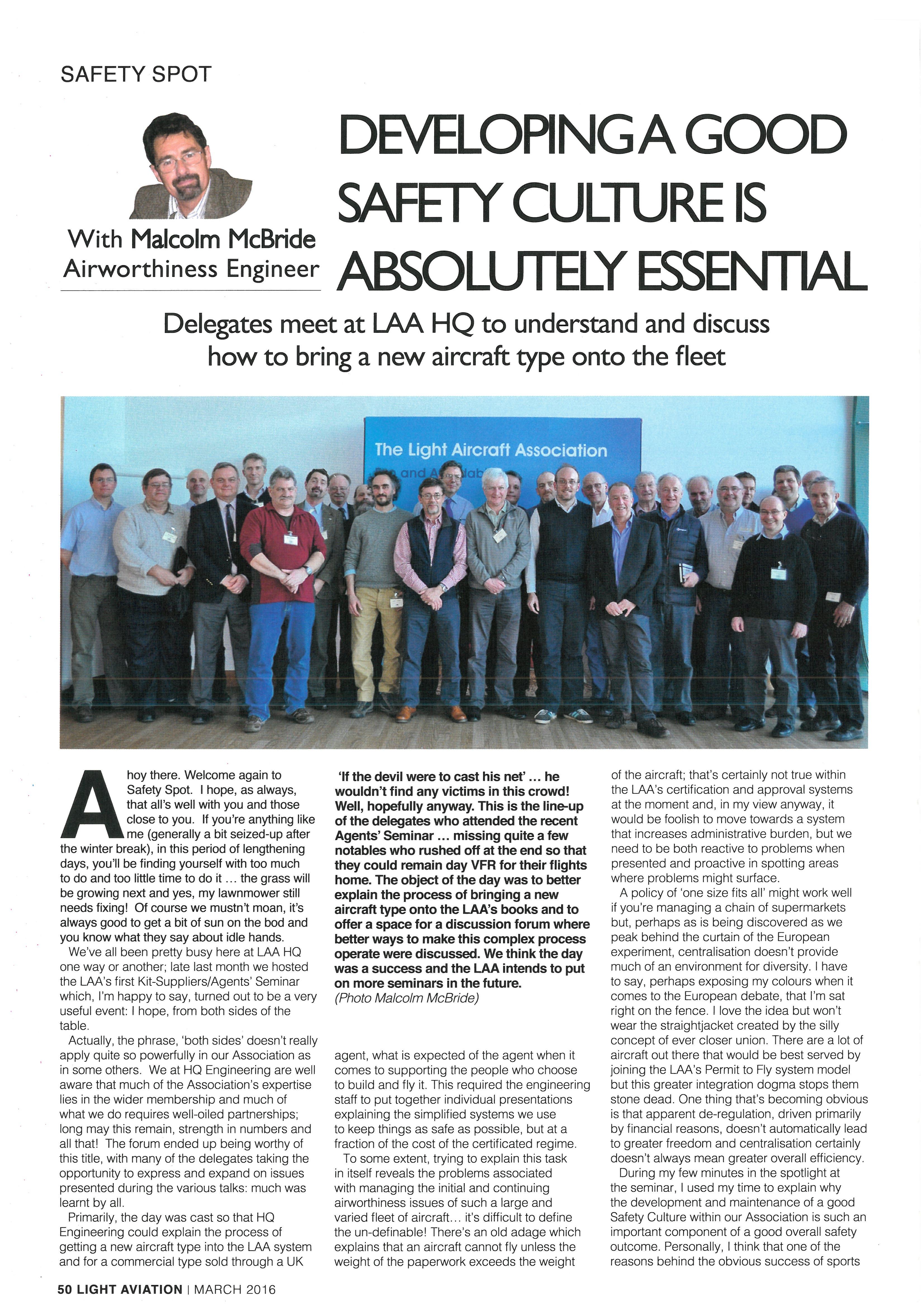
of the aircraft; that’s certainly not true within the LAA’s certification and approval systems at the moment and, in my view anyway, it would be foolish to move towards a system that increases administrative burden, but we need to be both reactive to problems when presented and proactive in spotting areas where problems might surface.
A policy of ‘one size fits all’ might work well if you're managing a chain of supermarkets but, perhaps as is being discovered as we peak behind the curtain of the European experiment, centralisation doesn’t provide much of an environment for diversity. | have to say, perhaps exposing my colours when it comes to the European debate, that I’m sat right on the fence. | love the idea but won't wear the straightjacket created by the silly conceptofevercloserunion.Therearealotof aircraft out there that would be best served by joining the LAA’s Permit to Fly system model but this greater integration dogma stops them stone dead. One thing that’s becoming obvious is that apparent de-regulation, driven primarily by financial reasons, doesn’t automatically lead to greater freedom and centralisation certainly doesn’t always mean greater overall efficiency. During my few minutes in the spotlight at the seminar, | used my time to explain why the development and maintenance of a good Safety Culture within our Association is such an important component of a good overall safety outcome. Personally, | think that one of the reasons behind the obvious success of sports
Managing ContinuingAirworthiness
Good Feedback is Essential
f In-Confidence Owners Reports Inspectorate
Member's Permit Agents ——>__ Aircraft <———__ Renewal
Incidents Findings
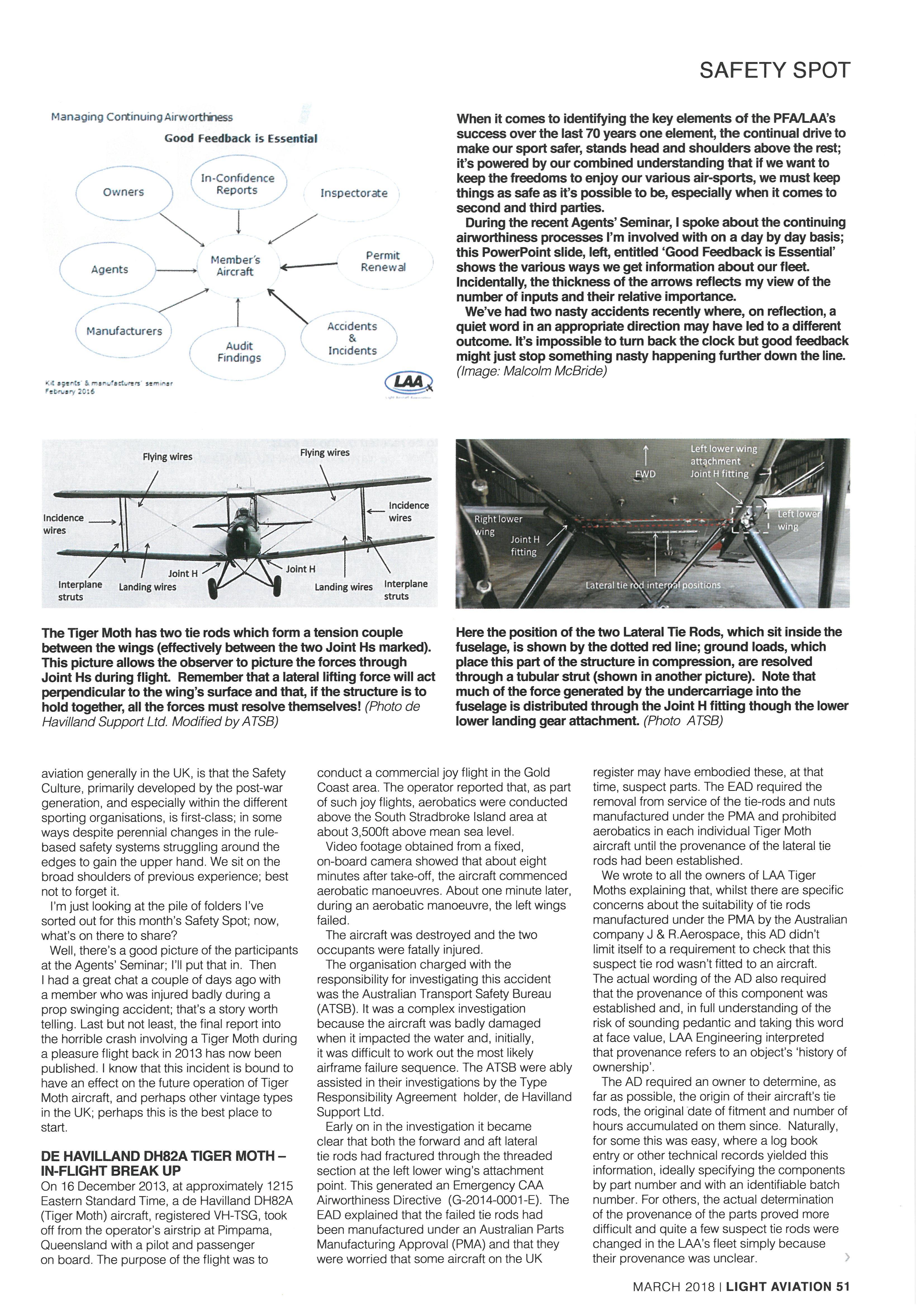
When it comes to identifying the key elements of the PFA/LAA’s success over the last 70 years one element, the continual drive to make our sport safer, stands head and shoulders above the rest; it’s powered by our combined understanding that if we want to keep the freedoms to enjoy our various air-sports, we must keep things as safe as it’s possibleto be, especially when it comes to second and third parties.
During the recent Agents’ Seminar, | spoke about the continuing airworthiness processes I’m involved with on a day by day basis; this PowerPoint slide, left, entitled ‘Good Feedback is Essential’ shows the various ways we get information about our fleet. Incidentally, the thickness of the arrows reflects myview of the number of inputs and their relative importance.
We’ve had two nasty accidents recently where, on reflection, a quiet word in an appropriate direction may have led to a different outcome. It’s impossibleto turn backthe clock but good feedback mightjust stop something nasty happening further down the line.
(Image: Malcolm McBride)
The Tiger Moth has two tie rods which form a tension couple between the wings (effectively between the two Joint Hs marked).
Thispictureallowstheobservertopicturetheforcesthrough JointHsduringflight. Rememberthata lateralliftingforcewillact perpendiculartothewing’ssurfaceandthat,ifthestructureisto holdtogether,alltheforcesmustresolvethemselves!(Photode
onboard.Thepurposeoftheflightwasto
Havilland Support Ltd. Modified byATSB)
aviation generally in the UK, is that the Safety Culture, primarily developed by the post-war generation, and especially within the different sporting organisations, is first-class; in some ways despite perennial changes in the rulebased safety systems struggling around the edges to gain the upper hand. We sit on the broad shoulders of previous experience; best not to forget it.
I'm just looking at the pile of folders I’ve sorted out for this month’s Safety Spot; now, what’s on there to share?
Well, there’s a good picture of the participants at the Agents’ Seminar; I'll put that in. Then | had a great chat a couple of days ago with a member who was injured badly during a prop swinging accident; that’s a story worth telling. Last but not least, the final report into the horrible crash involving a Tiger Moth during a pleasure flight back in 2013 has now been published. | know that this incident is bound to have an effect on the future operation of Tiger Moth aircraft, and perhaps other vintage types in the UK; perhaps this is the best place to start.
On 16 December 2013, at approximately 1215 Eastern Standard Time, a de Havilland DH82A (Tiger Moth) aircraft, registered VH-TSG,took off from the operator’s airstrip at Pimpama, Queensland with a pilot and passenger
Here the position of the two Lateral Tie Rods, which sit insidethe fuselage,isshownbythedottedredline;groundloads,which
placethispartofthestructureincompression,areresolved througha tubularstrut(showninanotherpicture).Notethat muchoftheforcegeneratedbytheundercarriageintothe fuselageisdistributedthroughtheJointHfitting thoughthelower lowerlandinggearattachment.(PhotoATSB)
conduct a commercial joy flight in the Gold Coast area. The operator reported that, as part of such joy flights, aerobatics were conducted above the South Stradbroke Island area at about 3,500ft above mean sea level.
Videofootageobtainedfromafixed, on-board camera showed that about eight minutes after take-off, the aircraft commenced aerobatic manoeuvres. About one minute later, during an aerobatic manoeuvre, the left wings failed.
The aircraft was destroyed and the two occupants were fatally injured.
The organisation charged with the responsibility for investigating this accident was the Australian Transport Safety Bureau (ATSB). It was a complex investigation because the aircraft was badly damaged when it impacted the water and, initially, it was difficult to work out the most likely airframe failure sequence. The ATSB were ably assisted in their investigations by the Type Responsibility Agreement holder, de Havilland Support Ltd.
Early on in the investigation it became clear that both the forward and aft lateral tie rods had fractured through the threaded section at the left lower wing’s attachment point. This generated an Emergency CAA Airworthiness Directive (G-2014-0001-E). The EAD explained that the failed tie rods had been manufactured under an Australian Parts Manufacturing Approval (PMA) and that they were worried that some aircraft on the UK
register may have embodied these, at that time, suspect parts. The EAD required the removal from service of the tie-rods and nuts manufactured under the PMA and prohibited aerobatics in each individual Tiger Moth aircraft until the provenance of the lateral tie rods had been established.
We wrote to all the owners of LAA Tiger Moths explaining that, whilst there are specific concerns about the suitability of tie rods manufactured under the PMA by the Australian company J & R.Aerospace, this AD didn't limit itself to a requirement to check that this suspect tie rod wasn't fitted to an aircraft. The actual wording of the AD also required that the provenance of this component was established and, in full understanding of the risk of sounding pedantic and taking this word at face value, LAA Engineering interpreted that provenance refers to an object's ‘history of ownership’.
The AD required an owner to determine, as far as possible, the origin of their aircraft's tie rods, the original date of fitment and number of hours accumulated on them since. Naturally, for some this was easy, where a log book entry or other technical records yielded this information, ideally specifying the components by part number and with an identifiable batch number. For others, the actual determination of the provenance of the parts proved more difficult and quite a few suspect tie rods were changed in the LAA’s fleet simply because their provenance was unclear.
Thispictureshowsaclose-upoftheJointH fittingitself.During the investigation itwas found this assembly had been assembled using incorrect bolts which could have affected the way the connection behaved during normal operation. (Photo:ATSB)
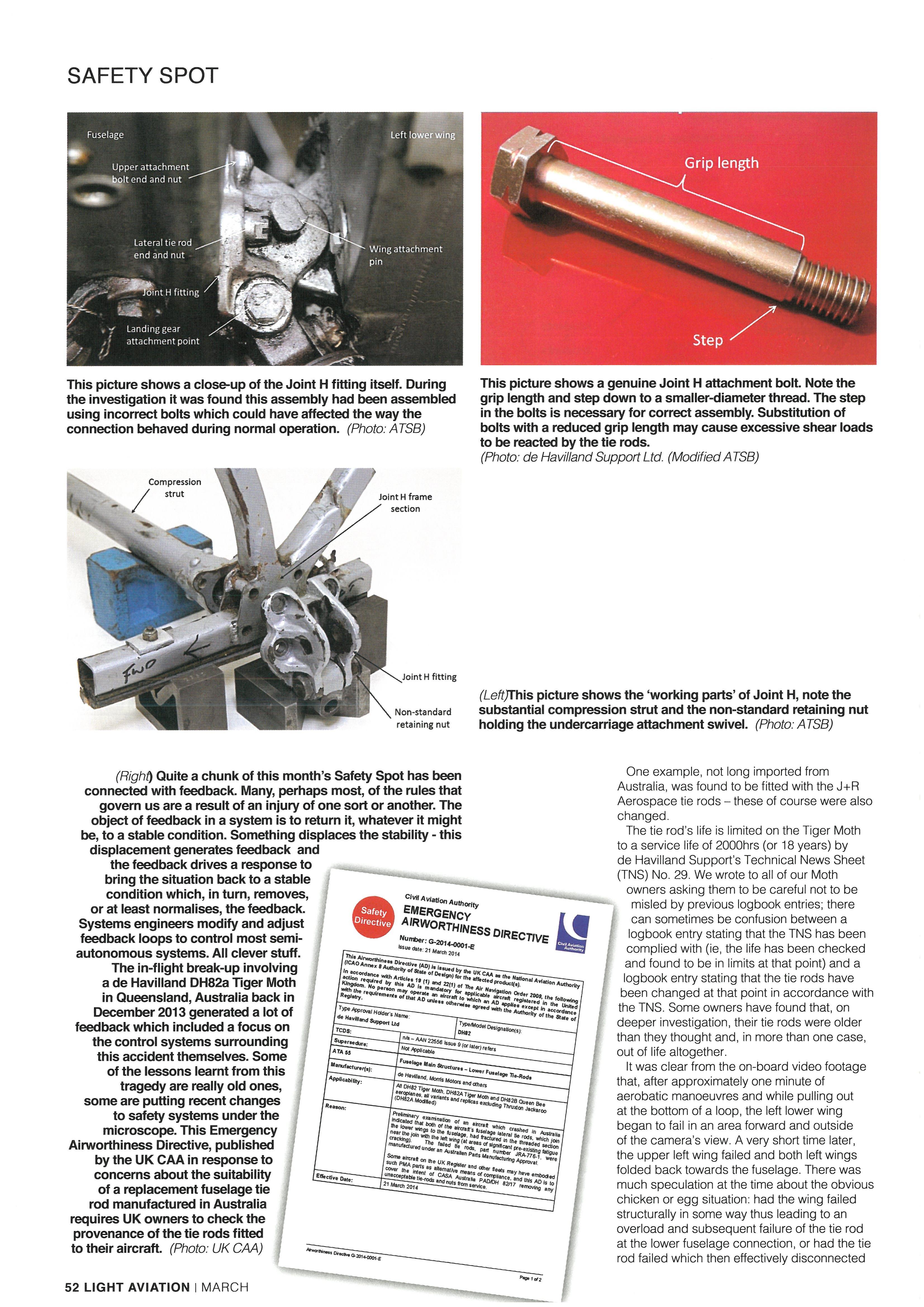
Joint Hfitting
Non-standard retaining nut
(Right)Quite a chunk of this month’s Safety Spot has been connected with feedback. Many, perhaps most, of the rules that govern us are a result of an injury of one sort or another. The object of feedback in a system isto return it, whatever it might be, to a stable condition. Something displaces the stability - this displacement generates feedback and the feedback drives a responseto bring the situation backtoastable =
condition which, in turn, removes,
This picture shows a genuine Joint H attachment bolt. Note the grip length and step down to a smaller-diameter thread. The step in the bolts is necessary for correct assembly. Substitution of bolts with a reduced grip length may cause excessive shear loads to be reacted by the tie rods.
(Photo:de Havilland Support Ltd. (Modified ATSB)
(Left)This pictureshows the ‘working parts’of Joint H, note the substantial compression strut and the non-standard retaining nut holding the undercarriage attachment swivel. (Photo:ATSB)
One example, not long imported from Australia, was found to be fitted with the J+R Aerospace tie rods these of course were also changed.
The tie rod’s life is limited on the Tiger Moth to a service life of 2000hrs (or 18 years) by de Havilland Support’s Technical News Sheet (TNS) No. 29. We wrote to all of our Moth icy owners asking them to be careful not to be CivilAviation a iil 5 oratleastnormalises,thefeedback.
WORTHINESs DIREC @ | logbookentrystatingthattheTNShasbeen feedback loops to control most semi- |
misledbypreviouslogbookentries;there 2 a : Y : n AIR / cansometimesbeconfusionbetweena Systemsengineersmodifyandadjust
autonomous systems. All clever stuff.
The in-flight break-up involving a de Havilland DH82a Tiger Moth in Queensland, Australia back in December 2013 generated a lot of feedback which included a focus on the control systems surrounding this accident themselves. Some of the lessons learnt from this tragedy are really old ones, some are putting recent changes to safety systems under the microscope. This Emergency Airworthiness Directive, published bythe UKCAA in responseto concerns about the suitability of a replacementfuselage tie rod manufactured in Australia requires UKowners to check the provenance of the tie rods fitted to their aircraft. (Photo: UK CAA)
' complied with (ie, the life has been checked ' and found to be in limits at that point) and a ' logbook entry stating that the tie rods have been changed at that point in accordance with the TNS. Some owners have found that, on deeper investigation, their tie rods were older than they thought and, in more than one case, out of life altogether.
It was clear from the on-board video footage that, after approximately one minute of aerobatic manoeuvres and while pulling out at the bottom of a loop, the left lower wing began to fail in an area forward and outside of the camera’s view. A very short time later, the upper left wing failed and both left wings folded back towards the fuselage. There was much speculation at the time about the obvious chicken or egg situation: had the wing failed structurally in some way thus leading to an overload and subsequent failure of the tie rod at the lower fuselage connection, or had the tie rod failed which then effectively disconnected
Normalgrip length
Reducedgrip length
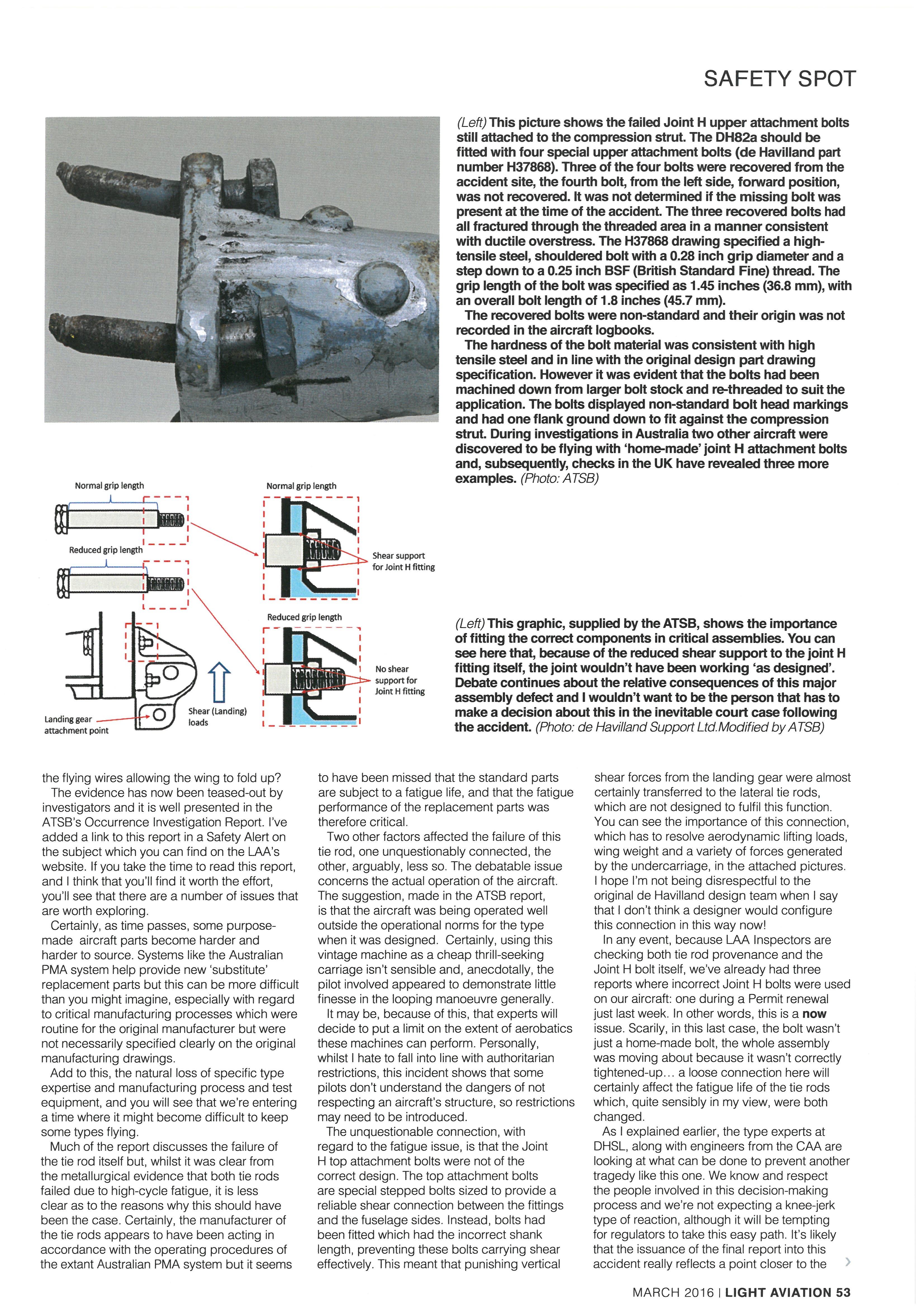
Landinggear attachment point
the flying wires allowing the wing to fold up?
The evidence has now been teased-out by investigators and it is well presented in the ATSB’s Occurrence Investigation Report. I’ve addeda linktothisreportinaSafetyAlerton the subject which you can find on the LAA’s website. If you take the time to read this report, and | think that you'll find it worth the effort, you'll see that there are a number of issues that are worth exploring.
Certainly, as time passes, some purposemade aircraft parts become harder and harder to source. Systems like the Australian PMA system help provide new ‘substitute’ replacement parts but this can be more difficult than you might imagine, especially with regard to critical manufacturing processes which were routine for the original manufacturer but were not necessarily specified clearly on the original manufacturing drawings.
Add to this, the natural loss of specific type expertise and manufacturing process and test equipment, and you will see that we're entering a time where it might become difficult to keep some types flying.
Much of the report discusses the failure of the tie rod itself but, whilst it was clear from the metallurgical evidence that both tie rods failed due to high-cycle fatigue, it is less clear as to the reasons why this should have been the case. Certainly, the manufacturer of the tie rods appears to have been acting in accordance with the operating procedures of
SAFETY SPOT (Left)ThispictureshowsthefailedJointHupperattachmentbolts stillattachedtothecompressionstrut.TheDH82ashouldbe fittedwithfourspecialupperattachmentbolts(deHavillandpart numberH37868).Threeofthefourboltswererecoveredfromthe accidentsite,thefourthbolt,fromtheleftside,forwardposition, wasnotrecovered.Itwasnotdeterminedifthemissingboltwas presentatthetimeoftheaccident.Thethreerecoveredboltshad allfracturedthroughthethreadedareainamannerconsistent withductileoverstress.TheH37868drawingspecifiedahightensilesteel,shoulderedboltwitha0.28inchgripdiameteranda griplengthoftheboltwasspecifiedas1.45inches(36.8mm),with anoverallboltlengthof1.8inches(45.7mm). recordedTherecoveredboltswerenon-standardandtheiroriginwasnot intheaircraftlogbooks. tensileThehardnessoftheboltmaterialwasconsistentwithhigh specification.steelandinlinewiththeoriginaldesignpartdrawing Howeveritwasevidentthattheboltshadbeen machineddownfromlargerboltstockandre-threadedtosuitthe application.Theboltsdisplayednon-standardboltheadmarkings andhadoneflankgrounddowntofitagainstthecompression strut.DuringinvestigationsinAustraliatwootheraircraftwere discoveredtobeflying ‘home-made’jointHattachmentbolts and,subsequently,checksintheUKhaverevealedthreemore
effectively.Thismeantthatexamples.punishingvertical(Photo:ATSB) (Left)This graphic, supplied bythe ATSB, shows the importance of fitting the correct components in critical assemblies. You can see here that, because of the reduced shear support to the joint H fitting itself, the joint wouldn’t have been working ‘as designed’.
~.
Debate continues about the relative consequences of this major assembly defect and |wouldn’t want to be the person has to make a decision about this in the inevitable court case following the accident. (Photo:de HavillandSupportLtd.Modified byATSB)
to have been missed that the standard parts are subject to a fatigue life, and that the fatigue performance of the replacement parts was therefore critical.
Two other factors affected the failure of this tie rod, one unquestionably connected, the other, arguably, less so. The debatable issue concerns the actual operation of the aircraft. The suggestion, made in the ATSB report, is that the aircraft was being operated well outside the operational norms for the type when it was designed. Certainly, using this vintage machine as a cheap thrill-seeking carriage isn’t sensible and, anecdotally, the pilot involved appeared to demonstrate little finesse in the looping manoeuvre generally. It may be, because of this, that experts will decide to put a limit on the extent of aerobatics these machines can perform. Personally, whilst | hate to fall into line with authoritarian restrictions, this incident shows that some pilots don’t understand the dangers of not respecting an aircraft's structure, so restrictions may need to be introduced.
The unquestionable connection, with regard to the fatigue issue, is that the Joint H top attachment bolts were not of the correct design. The top attachment bolts are special stepped bolts sized to provide a reliable shear connection between the fittings and the fuselage sides. Instead, bolts had been fitted which had the incorrect shank length, preventing these bolts carrying shear
shear forces from the landing gear were almost certainly transferred to the lateral tie rods, which are not designed to fulfil this function. You can see the importance of this connection, which has to resolve aerodynamic lifting loads, wing weight and a variety of forces generated by the undercarriage, in the attached pictures. | hope I’m not being disrespectful to the original de Havilland design team when | say that | don’t think a designer would configure this connection in this way now!
In any event, because LAA Inspectors are checking both tie rod provenance and the Joint H bolt itself, we’ve already had three reports where incorrect Joint H bolts were used on our aircraft: one during a Permit renewal just last week. In other words, this is a now issue. Scarily, in this last case, the bolt wasn’t just a home-made bolt, the whole assembly was moving about because it wasn’t correctly tightened-up... a loose connection here will certainly affect the fatigue life of the tie rods which, quite sensibly in my view, were both changed.
As | explained earlier, the type experts at DHSL, along with engineers from the CAA are looking at what can be done to prevent another tragedy likethis one. We know and respect the people involved in this decision-making process and we’re not expecting a knee-jerk type of reaction, although it will be tempting for regulators to take this easy path. It’s likely that the issuance of the final report into this accident really reflects a point closer to the
beginning of this story rather than a point near its conclusion.
The two big engineering points that have come out of this investigation is the great importance of the lateral tie rods in the structure of Moth aircraft and the equal importance of using the correct Joint H attachment bolts.
The first point has been dealt with although, after a comprehensive design survey of these components, I’m sure that we'll see some reduction in their fatigue life. The second point, still being addressed, highlights the problems that can happen when somebody
Throttle lever
Position asfound Start position
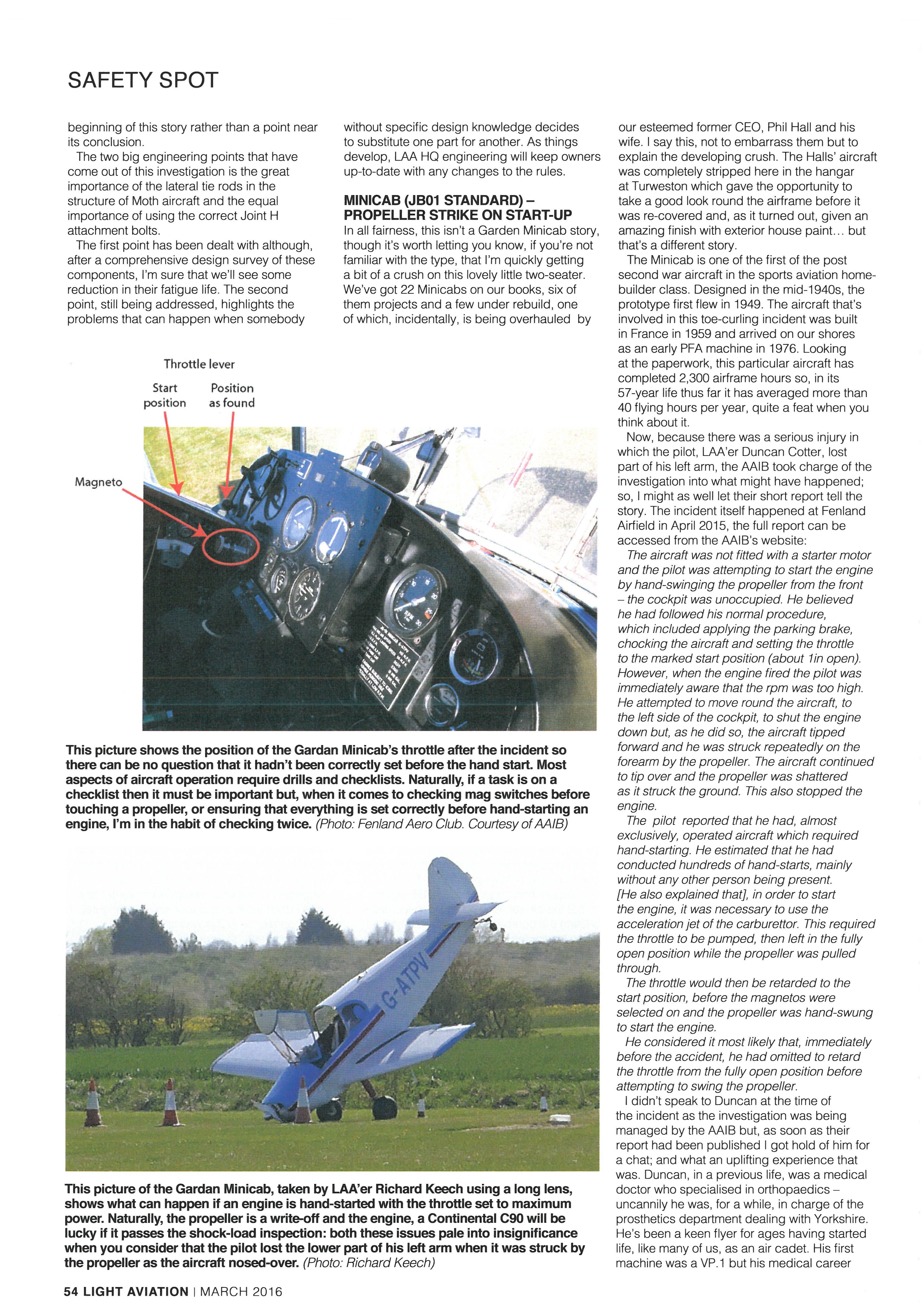
without specific design knowledge decides to substitute one part for another. As things develop, LAA HQ engineering will keep owners up-to-date with any changes to the rules.
In all fairness, this isn’t a Garden Minicab story, though it’s worth letting you know, if you're not familiar with the type, that I’m quickly getting a bit of a crush on this lovely little two-seater. We've got 22 Minicabs on our books, six of them projects and a few under rebuild, one of which, incidentally, is being overhauled by
our esteemed former CEO, Phil Hall and his wife. | say this, not to embarrass them but to explain the developing crush. The Halls’ aircraft was completely stripped here in the hangar at Turweston which gave the opportunity to take a good look round the airframe before it was re-covered and, as it turned out, given an amazing finish with exterior house paint... but that’s a different story.
The Minicab is one of the first of the post second war aircraft in the sports aviation homebuilder class. Designed in the mid-1940s, the prototype first flew in 1949. The aircraft that’s involved in this toe-curling incident was built in France in 1959 and arrived on our shores as an early PFA machine in 1976. Looking at the paperwork, this particular aircraft has completed 2,300 airframe hours so, in its 57-year life thus far it has averaged more than AOflying hours per year, quite a feat when you think about it.
Now,becausetherewasa seriousinjuryin which the pilot, LAA’er Duncan Cotter, lost part of his left arm, the AAIB took charge of the investigation into what might have happened; so, | might as well let their short report tell the story. The incident itself happened at Fenland Airfield in April 2015, the full report can be accessed from the AAIB’s website:
The aircraft was not fitted with a starter motor and the pilot was attempting to start the engine byhand-swinging the propeller from the front the cockpit was unoccupied. He believed he had followed his normal procedure, which includedapplying the parking brake, chocking the aircraft and setting the throttle to the marked start position (about 1inopen). However, when the engine fired the pilot was immediately aware that the rom was too high. He attempted to move round the aircraft, to the left side of the cockpit, to shut the engine down but, as he did so, the aircraft tipped forward and he was struck repeatedly on the forearm by the propeller. The aircraft continued to tip over and the propeller was shattered as itstruck the ground. This also stopped the engine.
The pilot reported that he had, almost exclusively, operated aircraft which required hana-starting. He estimated that he had conducted hundreds of hana-starts, mainly without any other person beingpresent. [He also explained that], in order to start the engine, it was necessary to use the acceleration jet of the carburettor. This required the throttle to be pumped, then leftin the fully open position while the propeller was pulled through.
The throttle would then be retarded to the start position, before the magnetos were selected on and the propeller was hand-swung to start the engine.
He considered itmostlikely that, immediately before the accident, he had omitted to retard the throttle from the fully open position before attempting to swing the propeller.
| didn’t speak to Duncan at the time of the incident as the investigation was being managed by the AAIB but, as soon as their report had been published | got hold of him for a chat; and what an uplifting experience that was. Duncan, in a previous life, was a medical doctor who specialised in orthopaedics uncannily he was, for a while, in charge of the prosthetics department dealing with Yorkshire. He’s been a keen flyer for ages having started life, like many of us, as an air cadet. His first machine was a VP.1 but his medical career
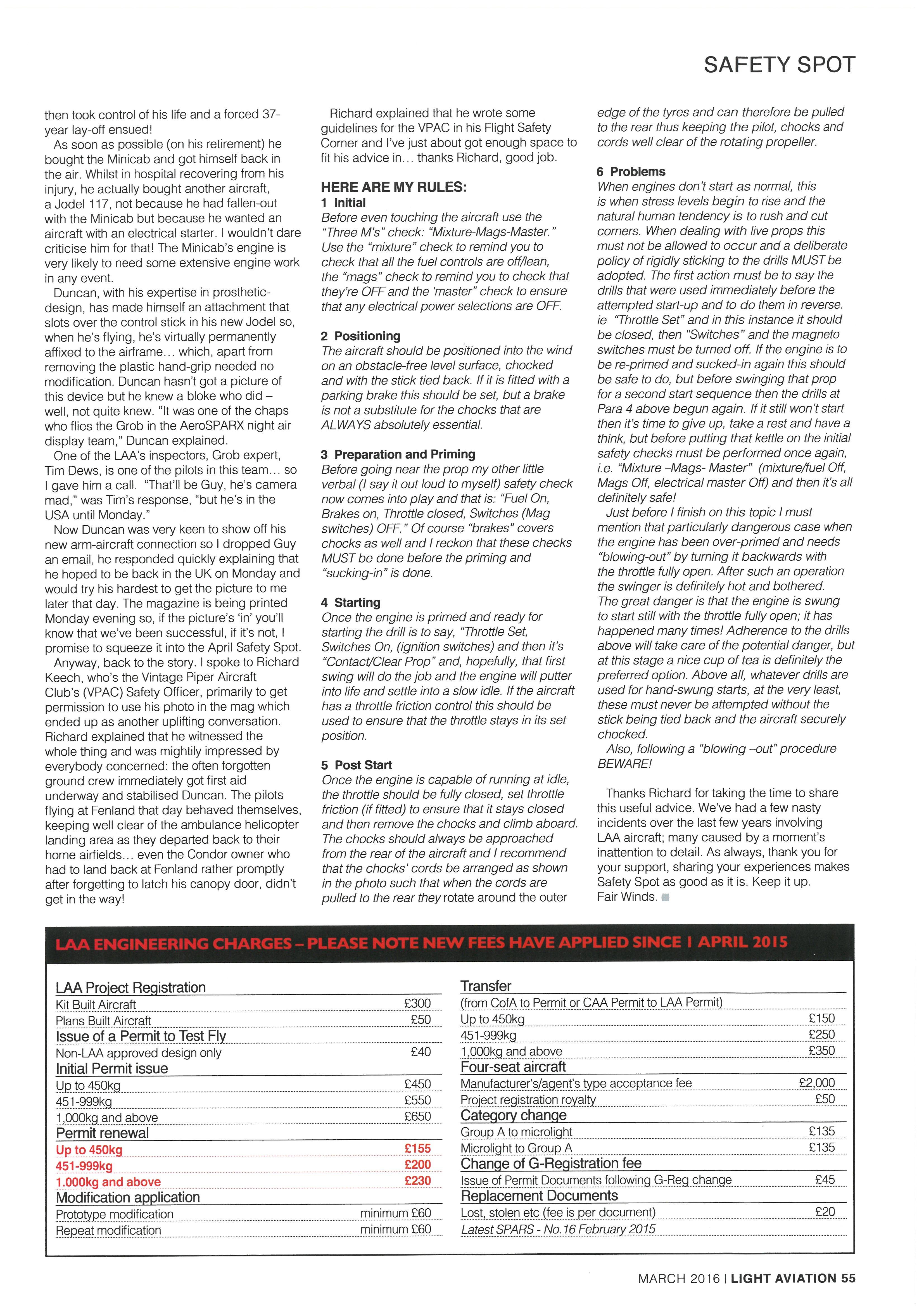
then took control of his life and a forced 37year lay-off ensued!
As soon as possible (on his retirement) he bought the Minicab and got himself back in the air. Whilst in hospital recovering from his injury, he actually bought another aircraft, a Jodel 117, not because he had fallen-out with the Minicab but because he wanted an aircraft with an electrical starter. | wouldn’t dare criticise him for that! The Minicab’s engine is very likely to need some extensive engine work in any event.
Duncan, with his expertise in prostheticdesign, has made himself an attachment that slots over the control stick in his new Jodel so, when he’s flying, he’s virtually permanently affixed to the airframe... which, apart from removing the plastic hand-grip needed no modification. Duncan hasn't got a picture of this device but he knew a bloke who did well, not quite knew. “It was one of the chaps who flies the Grob in the AeroSPARX night air display team,” Duncan explained.
One of the LAA’s inspectors, Grob expert, Tim Dews, is one of the pilots in this team... so | gave him a call. “That'll be Guy, he’s camera mad,” was Tim’s response, “but he’s in the USA until Monday.”
Now Duncan was very keen to show off his new arm-aircraft connection so | dropped Guy an email, he responded quickly explaining that he hoped to be back in the UK on Monday and would try his hardest to get the picture to me later that day. The magazine is being printed Monday evening so, if the picture’s ‘in’ you'll knowthatwe'vebeensuccessful,ifit’snot,| promise to squeeze it into the April Safety Spot. Anyway, back to the story. | spoke to Richard Keech, who's the Vintage Piper Aircraft Club’s (VPAC) Safety Officer, primarily to get permission to use his photo in the mag which ended up as another uplifting conversation. Richard explained that he witnessed the whole thing and was mightily impressed by everybody concerned: the often forgotten ground crew immediately got first aid underway and stabilised Duncan. The pilots flying at Fenland that day behaved themselves, keeping well clear of the ambulance helicopter landing area as they departed back to their home airfields... even the Condor owner who had to land back at Fenland rather promptly after forgetting to latch his canopy door, didn’t get in the way!
Richard explained that he wrote some guidelines for the VPAC in his Flight Safety Corner and I’ve just about got enough space to fit his advice in... thanks Richard, good job.
HERE ARE MY RULES:
1 Initial
Before even touching the aircraft use the “Three M’s”check: “Mixture-Mags-Master.” Use the “mixture” check to remindyou to check that all the fuel controls are off/lean, the “mags” check to remind you to check that they're OFF and the ‘master” check to ensure that any electrical power selections are OFF.
2 Positioning
The aircraft should bepositioned into the wind on an obstacle-free level surface, chocked and with the stick tied back. Ifit is fitted with a parking brake this should be set, but a brake is not a substitute for the chocks that are ALWAYS absolutely essential.
3 Preparation and Priming
Before going near the prop myother little verbal (I say itout loud to myself) safety check now comes into playand that is: “Fuel On, Brakes on, Throttleclosed, Switches (Mag switches) OFF.” Of course “brakes” covers chocks as well and | reckon that these checks MUST be done before the priming and “sucking-in” is done.
4 Starting
Once the engine is primedand readyfor starting the drill is to say, “Throttle Set, Switches On, (ignition switches) and then it’s “Contact/Clear Prop”and, hopefully, that first swing will do thejob and the engine will putter into life and settle into a slow idle. If the aircraft has a throttle friction control this should be used to ensure that the throttle stays in its set position.
5 Post Start
Once the engine is capable ofrunning at idle, the throttle should be fully closed, set throttle friction (iffitted) to ensure that itstays closed and then remove the chocks and climb aboard. Thechocks should always be approached from the rear of the aircraft and | recommend that the chocks’cords be arranged as shown in the photo such that when the cords are pulled to the rear they rotate around the outer
edge of the tyres and can therefore be pulled to the rear thus keeping the pilot, chocks and cords well clear of the rotatingpropeller.
When engines don’t start as normal, this is when stress levels begin to rise and the natural human tendency is to rush and cut corners. When dealing with live props this must not be allowed to occur and a deliberate policyof rigidlysticking to the drills MUST be adopted. The first action mustbe to say the drills that were used immediately before the attempted start-up and to do them in reverse. ie “Throttle Set” and in this instance it should be closed, then “Switches” and the magneto switches must be turned off. Ifthe engine is to be re-primed and sucked-in again this should be safe to do, butbefore swinging that prop for a second start sequence then the drills at Para 4 above begun again. Ifitstill won't start then it’s time to give up, take a rest and have a think, butbefore putting that kettle on the initial safety checks must beperformedonce again, i.e. “Mixture -Mags- Master” (mixture/fuel Off, Mags Off, electrical master Off) and then it’s all definitely safe!
Just before | finish on this topic |must mention that particularly dangerous case when the engine has been over-primed and needs “blowing-out” by turning it backwards with the throttle fully open. After such an operation the swinger is definitely hotand bothered. The great danger is that the engine is swung to start still with the throttle fully open; ithas happenedmanytimes! Adherence to the drills above will take care of the potential danger, but at this stage a nice cup of tea is definitely the preferred option. Above all, whatever drills are used for hand-swung starts, at the very least, these must never be attempted without the stick being tied backand the aircraft securely chocked.
Also, following a “blowing —out”procedure BEWARE!
Thanks Richard for taking the time to share thisusefuladvice.We'vehada fewnasty incidents over the last few years involving LAA aircraft; many caused by a moment's inattention to detail. As always, thank you for your support, sharing your experiences makes Safety Spot as good as it is. Keep it up. Fair Winds.
Aylesbury GASCoSafety Presentation 01442 826365
Littlebury Htl BicesterVACAnnual Dinner
Newark Museum Aeroboot/jumble sale 01636 707170
Old Buckenham LAA and Homebuilt Fly-in 01953 860806
Lee-on-Solent GASCo Safety Presentation 02392 333993
Halfpenny Green GASCoSafety Presentation 01384 221565
Old Sarum GASCo Safety Presentation 01722 212077 Start
19:00
Abu Dhabi A6 Red Bull Air Race
Brooklands 9th YES Youth Aviation Conference 07974 188395
Henlow DH Moth Club Seminar
Turweston VAC Spring Gathering
Cambridge GASCoSafety Presentation 07785 316763
Dunkeswell GASCo Safety Presentation 01404 891643
White Waltham BAeAAerobatic Judging Seminar
Fenland Full English Spot Landing
Booker GASCo Safety Presentation 01494 443737
Seething GASCoSafety Presentation 07976 661784
Wanaka ZK Warbirds Air Show
Sywell RadialandTrainerfly-in
Old Buckenham Military and Vintage Revival Show 01953 860806
Henstridge LAAWessexStrutFly-in 01963 264231
White Waltham GASCo Safety Presentation 07979 781261
Lakeland N EAA Sun n Fun
Lydd GASCo Safety Presentation 01797 320734
Marham GASCo Safety Presentation TBA
Shobdon HAC Ladies Fly-in 01568 708369
Oaksey Park AeroncaClubPicnic Fly-in 01666 577130
Duxford Flight Safety Bonus Day 01223 833376
St Merryn LAA Devon Strut fly-in Abbeville (F) RRRA Handicap Air Race
Popham Jodel Fly-in01256397733
Popham GASCoSafety Presentation 07831 606075 Start
20:00
Fenland VAC Daffodil Fly-in(PPR)
16-17 Breighton BAeAAerobaticComp.
16-17 Shobdon BMAA Microlight Comp.
17 Old Buckenham Wings & Wheels Show 01953 860806
17 K2 Centre Crawley Gatwick Enthusiasts Fair 01403 252628
20-23 Friedrichshafen D AERO 2016 Exhibition
22-23 Spielberg OE RedBullAir Race
22-24 Elvington BAeBAerobaticComp
23-24 Sywell EurostarFly-in
24 Bicester Classic Cars and Fly-in
26 Sturgate GASCoSafety Presentation
27 Breighton GASCoSafety Presentation
30 Bodmin Ladies Day fly-in 01208 821419
30-My I Popham MicrolightTrade fair 01256 397733
30-My | Sywell AtomicVintage Festival
30 Raron (HB) EAS Spring Fly-in
a Popham AeroAutoJumble& Fly-in 01256-397733
7 Duxford Van’s RV Bonus Day [PPR] 01223-833376
7 Popham Flyball Navigation Competition 01256-397733
7 White Waltham RIN Topnav South Competition - London
7 Conington RINTopnavSouth Competition - North
7 Bodmin RIN Topnav South Competition - West
7 Goodwood RIN Topnav South Competition - South
7-8 North Coates Spring Fly-in 01472-388850
7-8 Leicester RRRA Handicap Air Race
8 Old Warden Shuttleworth Air Show
8 Popham Van’s RV Fly-in 01256-397733
Kempton Park Heathrow Aircraft Enthusiasts Fair 07956-430048
Henlow DH Moth Club Flying Forum
14 Eaglescott LAA Devon Strut Fly-in 01769-520404
Stow Maries Fly-in [PPR] 07860-345403
Oakley, Oxon BMAA Microlight Competition La Ferte Alais (F) Salis Collection Air Show
yt Fenland BMAA Fly-in
21 Old Warden Shuttleworth Evening Air Show
21 Halton BAeA Aerobatics Competition
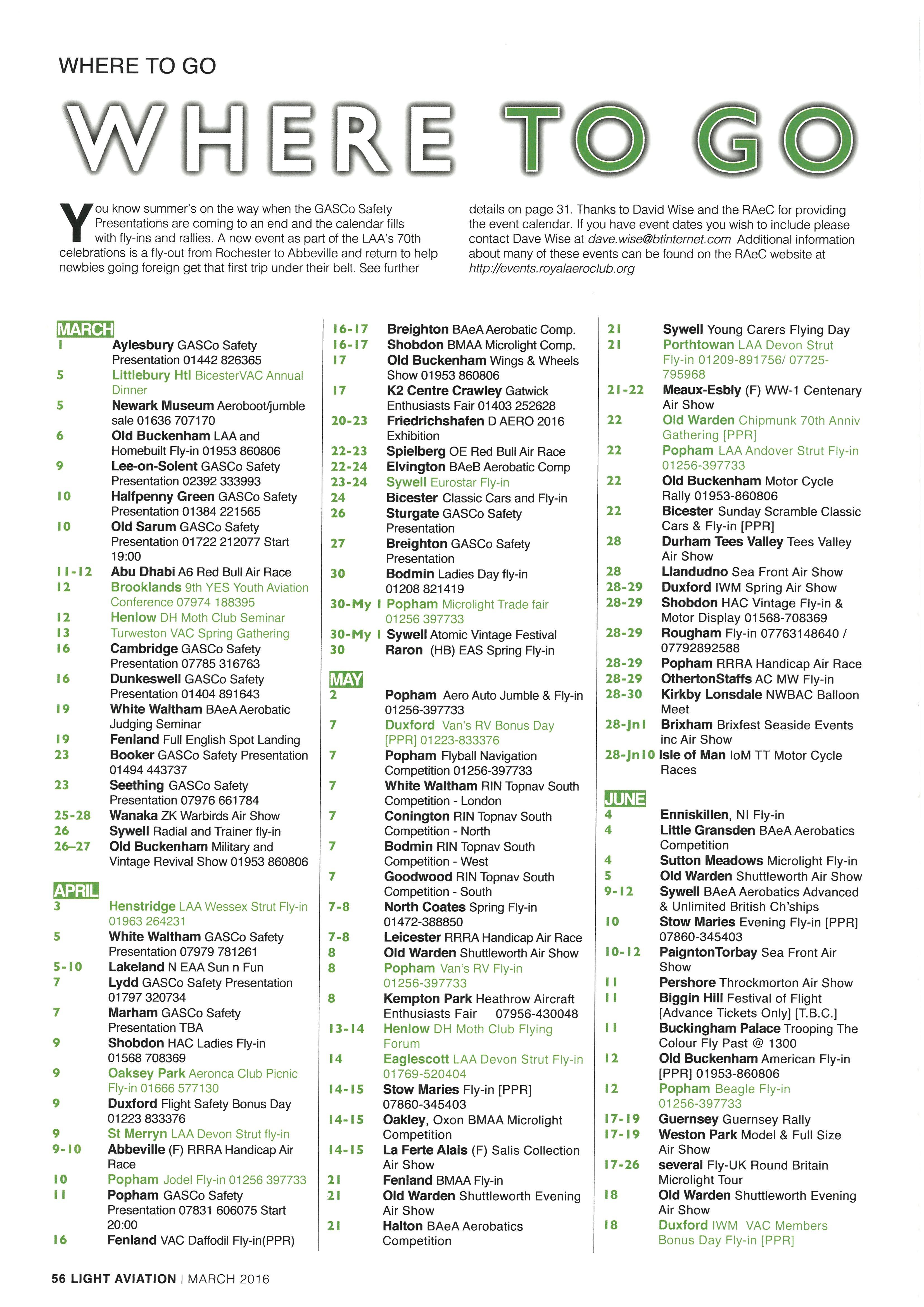
21 Sywell Young Carers Flying Day 21 Porthtowan LAA Devon Strut Fly-in 01209-891756/ 07725795968
21-22 Meaux-Esbly (F) WW-1 Centenary Air Show
22 Old Warden Chipmunk 70th Anniv Gathering [PPR] a Popham LAAAndover Strut Fly-in 01256-397733
22 Old Buckenham Motor Cycle Rally 01953-860806
22 Bicester Sunday Scramble Classic Cars & Fly-in [PPR]
28 Durham Tees Valley Tees Valley Air Show
28 Llandudno Sea Front Air Show
28-29 Duxford IWM Spring Air Show
28-29 Shobdon HAC Vintage Fly-in & Motor Display 01568-708369
28-29 Rougham Fly-in 07763148640 / 07792892588
28-29 Popham RRRA Handicap Air Race
28-29 OthertonStaffs AC MW Fly-in
28-30 Kirkby Lonsdale NWBAC Balloon Meet
28-Jn! Brixham Brixfest Seaside Events inc Air Show
28-Jn10 Isle of Man loM TT Motor Cycle Races 4 Enniskillen, NI Fly-in 4 Little Gransden BAeA Aerobatics Competition 4 Sutton Meadows Microlight Fly-in
5 Old Warden Shuttleworth Air Show
9-12 Sywell BAeAAerobatics Advanced & Unlimited British Ch’ships
10 Stow Maries Evening Fly-in [PPR] 07860-345403
10-!2 PaigntonTorbay Sea FrontAir Show
il Pershore Throckmorton Air Show
i Biggin Hill Festival of Flight [Advance Tickets Only] [T.B.C.]
il Buckingham Palace TroopingThe Colour Fly Past @ 1300
12 Old Buckenham American Fly-in [PPR] 01953-860806
12 Popham Beagle Fly-in 01256-397733
17-19 Guernsey Guernsey Rally
17-19 Weston Park Model & Full Size Air Show
17-26 several Fly-UK Round Britain Microlight Tour
18 Old Warden Shuttleworth Evening Air Show
18 Duxford |WM VAC Members
Bonus Day Fly-in [PPR]

ello John andJenny.What are your current/pastcareers?
John: | trained as a doctor at Cambridge University and the Westminster Hospital (now sadly gone). | specialised in Pathology and ultimately Chemical Pathology. | was a consultant in Bristol for about eight years and then moved to Leeds to take the Chair of Chemical Pathology and ultimately became Professor of Experimental Cancer Research. Learning to fly was a great way to escape the pressures of work. My hobby of geology complements my flying as many aspects of the terrain can be seen so much better from the air.
Jenny: | graduated from Bristol University with a doctorate in pharmacology and my first real job was as a ‘rep’ for a pharmaceutical company, trying to persuade doctors to prescribe my drugs. We then moved to Yorkshire and | worked for a veterinary pharmaceutical company, sorting out the drug licences for both pets and farm
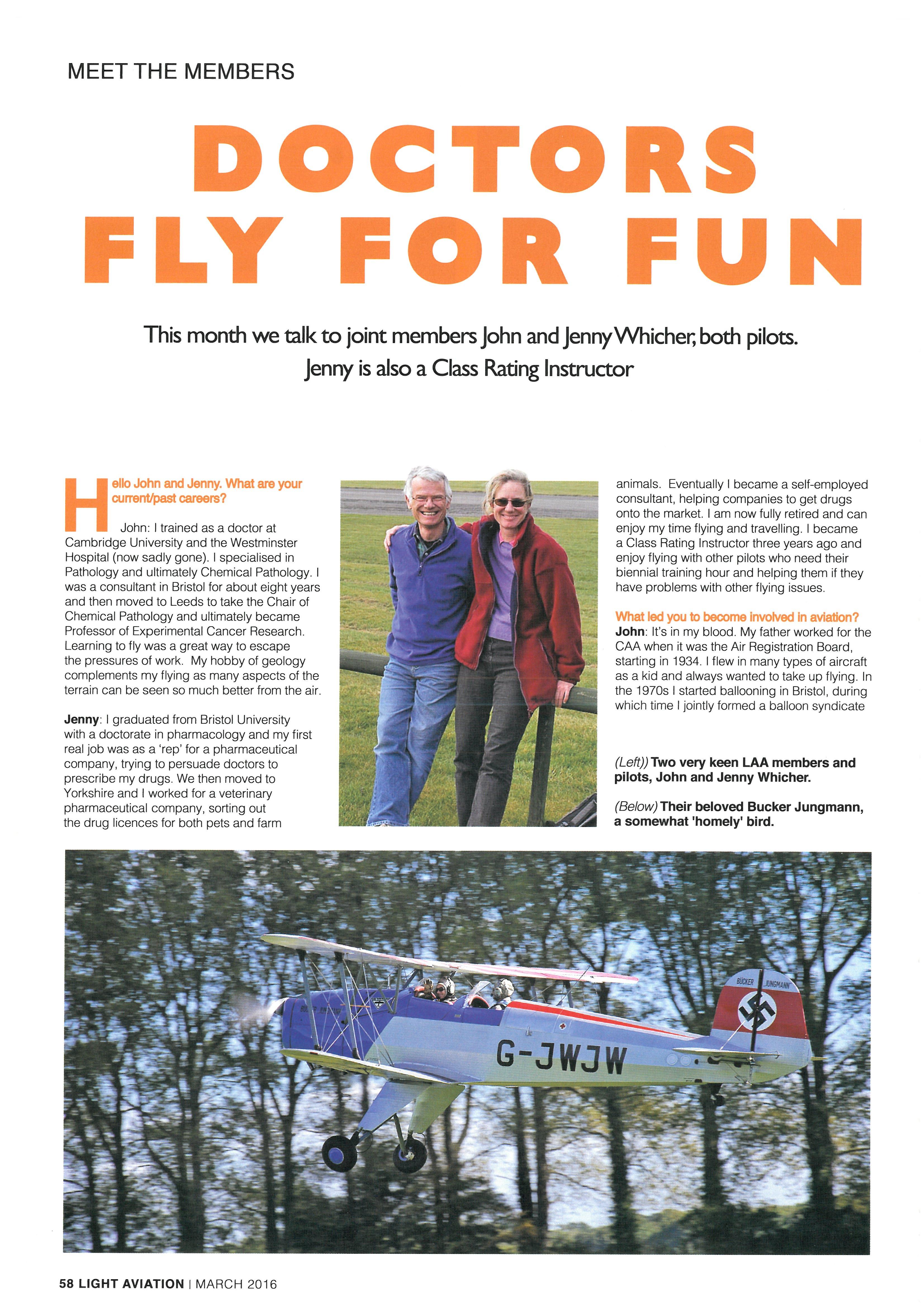
animals. Eventually | became a self-employed consultant, helping companies to get drugs onto the market. | am now fully retired and can enjoy my time flying and travelling. | became a Class Rating Instructor three years ago and enjoy flying with other pilots who need their biennial training hour and helping them if they have problems with other flying issues.
What led you to become involved in aviation? John: It’s in my blood. My father worked for the CAA when it was the Air Registration Board, starting in 1934. |flew in many types of aircraft as a kid and always wanted to take up flying. In the 1970s | started ballooning in Bristol, during whichtime|jointlyformedaballoonsyndicate
(Left))Two very keen LAA members and pilots, John and Jenny Whicher.
(Below)Their beloved Bucker Jungmann, a somewhat 'homely' bird.
Ballooninghasbeena joint aviation interest.
known as the Flying Doctors Balloon Group. Weflewalot andhada lotoffun.|alsobuilt andflewmodelaeroplanesformanyyears. | learnt to fly fixed-wing at Sherburn-in-Elmet in Yorkshire and got my licence in January 1999.
Jenny: My grandfather flew for the Canadian Airforce in WW1 and my mother flew him around in a Luscombe on floats when she was 15,butshewastooyoungtogetherlicence. | never thought about flying until | met John and he invited me to ‘come up in his balloon’ a great chat-up line! | learnt to fly balloons and we shared a balloon for several years. Many years later, when John got his PPL he took me flying and | realised this was far too much fun for him to do it on his own! Obviously | had to get my PPL and three months later | too had a shiny new licence.
Jenny: Probably some sort of commercial Boeing when | was too young to think! My first flight in a light aeroplane was out of Leeds, probably in about 1990, in a Cessna 152 and we did lots of aerobatics which was VERY memorable! !
We both joined the LAA (PFAthen) in 2001 when we decided to buy a Bucker Jungmann. We imported it from Holland where it was on the Dutch register and needed to transfer it to the British register and the LAA helped us with allowing it to become one of their Permit aeroplanes. We completely disassembled the Jungmann and rebuilt it in our garage in Yorkshire. Our LAA engineer Chris Turner and the people at Breighton Airfield were so generous with their time, expertise and encouragement. In 2005 we completed the rebuild and started flying our beautiful Jungmann, which we still fly regularly.
John: In a Percival Proctor for my sixth birthday present from my father. It was at Elstree but | don’t remember much except being very frightened until we were in the air, and then again when we were landing. Nothing changes! Are you paying too much?
When we moved to Somerset, six years ago, we discovered the Wessex Strut. This Strut is based at Henstridge Airfield which is next door to our home, and we quickly joined as it provides a wonderful social side to our
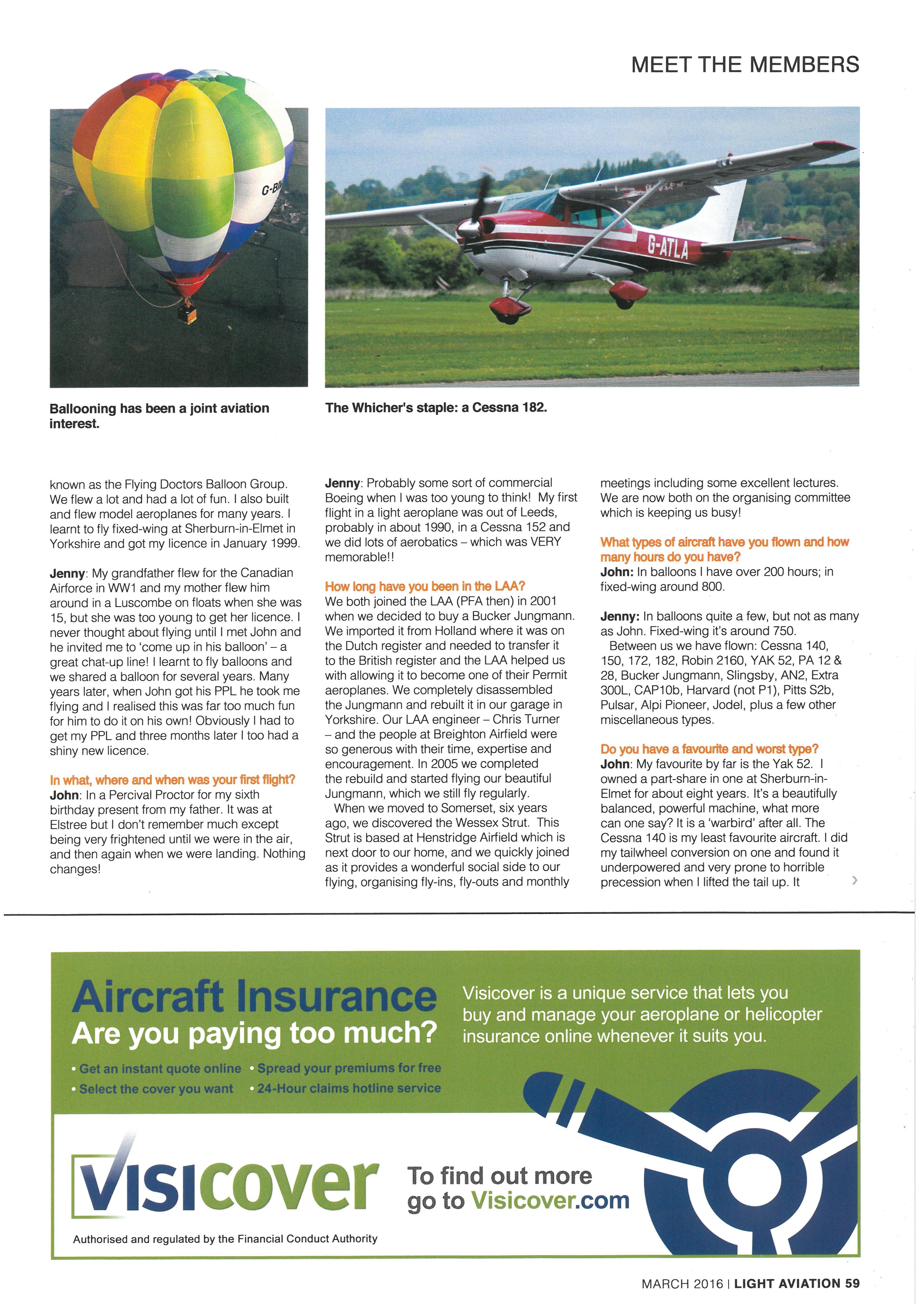
meetings including some excellent lectures. We are now both on the organising committee which is keeping us busy!
John: In balloons | have over 200 hours; in fixed-wing around 800.
Jenny: |n balloons quite a few, but not as many as John. Fixed-wing it’s around 750.
Between us we have flown: Cessna 140, 150, 172, 182, Robin 2160, YAK 52, PA 12 & 28, Bucker Jungmann, Slingsby, AN2, Extra 300L, CAP10b, Harvard (not P1), Pitts S2b, Pulsar, Alpi Pioneer, Jodel, plus a few other miscellaneous types.
John: My favourite by far is the Yak 52. | owned a part-share in one at Sherburn-inElmet for about eight years. It’s a beautifully balanced, powerful machine, what more can one say? It is a ‘warbird’ after all. The Cessna 140 is my least favourite aircraft. | did my tailwheel conversion on one and found it underpowered and very prone to horrible precessionwhen|liftedthetailup.It
you
(Above) John's favourite aircraft, a Yak-52. He owned a part-share for some years.
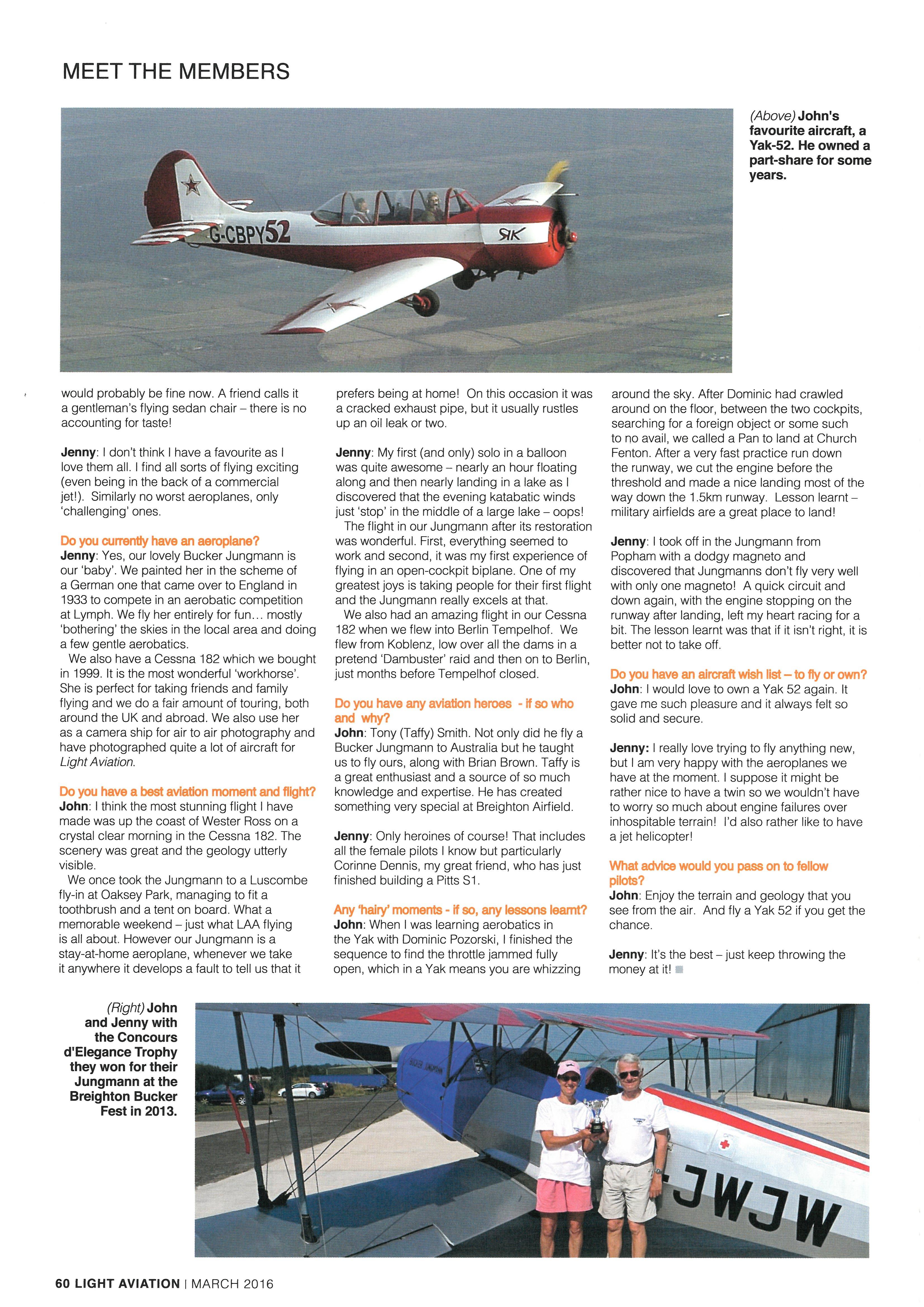
wouldprobablybefinenow.A friendcallsit a gentleman’s flying sedan chair there is no accounting for taste!
Jenny: | don’t think | have a favourite as | love them all. | find all sorts of flying exciting (even being in the back of a commercial jet!). Similarly no worst aeroplanes, only ‘challenging’ ones.
Jenny: Yes, our lovely Bucker Jungmann is our ‘baby’. We painted her in the scheme of a German one that came over to England in 1933 to compete in an aerobatic competition at Lymph. We fly her entirely for fun... mostly ‘bothering’ the skies in the local area and doing a few gentle aerobatics.
We also have a Cessna 182 which we bought in 1999. It is the most wonderful ‘workhorse’. She is perfect for taking friends and family flyingandwedoa fairamountoftouring,both around the UK and abroad. We also use her as a camera ship for air to air photography and have photographed quite a lot of aircraft for LightAviation.
John: | think the most stunning flight | have made was up the coast of Wester Ross on a crystal clear morning in the Cessna 182. The scenery was great and the geology utterly visible.
We once took the Jungmann to a Luscombe fly-in at Oaksey Park, managing to fit a toothbrush and a tent on board. What a memorable weekend just what LAA flying is all about. However our Jungmann is a stay-at-home aeroplane, whenever we take itanywhereitdevelops a faulttotellusthatit
(Right)John and Jenny with the Concours d'Elegance Trophy they won for their Jungmann at the Breighton Bucker Fest in 2013.
Jenny: My first (and only) solo in a balloon was quite awesome nearly an hour floating along and then nearly landing in a lake as | discovered that the evening katabatic winds just ‘stop’ in the middle of a large lake oops! The flight in our Jungmann after its restoration was wondertul. First, everything seemed to work and second, it was my first experience of flying in an open-cockpit biplane. One of my greatest joys is taking people for their first flight and the Jungmann really excels at that.
We also had an amazing flight in our Cessna 182 when we flew into Berlin Tempelhof. We flew from Koblenz, low over all the dams ina pretend ‘Dambuster’ raid and then on to Berlin, just months before Tempelhof closed.
John: Tony (Taffy) Smith. Not only did he fly a Bucker Jungmann to Australia but he taught us to fly ours, along with Brian Brown. Taffy is a great enthusiast and a source of so much knowledge and expertise. He has created something very special at Breighton Airfield.
Jenny: Only heroines of course! That includes all the female pilots | know but particularly Corinne Dennis, my great friend, who has just finished building a Pitts S1. John: When | was learning aerobatics in the Yak with Dominic Pozorski, | finished the sequence to find the throttle jammed fully open, which in a Yak means you are whizzing
around the sky. After Dominic had crawled around on the floor, between the two cockpits, searching for a foreign object or some such to no avail, we called a Pan to land at Church Fenton. After a very fast practice run down the runway, we cut the engine before the threshold and made a nice landing most of the way down the 1.5km runway. Lesson learnt military airfields are a great place to land!
Jenny: | took off in the Jungmann from Popham with a dodgy magneto and discovered that Jungmanns don’t fly very well with only one magneto! A quick circuit and down again, with the engine stopping on the runway after landing, left my heart racing for a bit. The lesson learnt was that if it isn’t right, it is better not to take off.
John: | would love to own a Yak 52 again. It gave me such pleasure and it always felt so solid and secure.
Jenny: | really love trying to fly anything new, but | am very happy with the aeroplanes we have at the moment. | suppose it might be rather nice to have a twin so we wouldn't have to worry so much about engine failures over inhospitable terrain! I’d also rather like to have a jet helicopter!
John: Enjoy the terrain and geology that you see from the air. And fly a Yak 52 if you get the chance.
Jenny: It’sthe best just keep throwing the money at it! ©

Threeairfieldsareofferingfreelandingsthis month,Lyddin Kent,Sherburn-in-Elmettin NorthYorkshire,andShipdhaminNorfolk(pleasenoteShipdhamisonlyopenatweekends. Alsoonofferisthegrouprate(evenifyouareonyourown)atYorkshireAir Museum. Pleaseensureyou havethevoucherwith youwhenyouvisit,photocopieswill not beaccepted. Considerbuyingfood andfuelwhilevisitingsoeverybodyisawinner.
Lydd Airport EGMD is located on Dungeness and Immigration. Avgas is Duty Free
Restaurant with a Traditional Sunday Carvery (
are not accepted. PPR 01797 320881 is NearbyattractionsPortLympneZoo,historiceta directed.www.lydd-airport.co.uk :

aBileswassowet,Sherburnhesuses available.Saaretiatcl@lleAGex heightof1,000ft.Keepclearofall |
Foryour
oremailpeter.matcham@alan-thomas.co.uk
ReviewedbyNigelHitchman
AA member and pilot Ron Smith’s latest book is a comprehensive encyclopaedia of all of the major production light aircraft of the last 30 or so years, plus a lot of the surviving vintage aircraft that might be seen in the UK, US or Australia. A personal archive, the bookcovers800typeswithphotos,alittle historyanddetailsofeach. Also covered are most of the popular homebuilts from the UK and US, together with a few from France and other countries. Some of the more recent European ultralights/light sport aircraft are also included.
The book is a great reference guide for anyone wondering just what was that aircraft they saw at the local airfield. It amazes me sometimes how little some pilots know about the variety of aircraft types they could fly and this book covers nearly all of them. Reading the book you really can discover what a wide range of light aircraft have been produced over the years.
The aircraft are presented and indexed in alphabetic order by manufacturer so it is easy to look up your favourite types, or find out what that wonderplane really looks like.
The photographic coverage is very good for the most part, although reproduction is a bit variable in places and a few photos would have benefitted waiting for people to get out of the way, or getting covers removed. That said, any aviation photographer will know both can be almost insolvable problems.
Overall then an excellent book and well worth the cover price, so | can thoroughly recommend it to LAA members keen to know more about the sheer variety of light aircraft that grace our skies.
Classic Light Aircraft by Ron Smith, Schiffer Publishing Ltd ISBN: 978-0-7643-4896-9 available in the UK from Gazelle Book Services (www.gazellebookservices.co.uk) for £29.50. #

UK Sales & Support Call: 03300 500
For all display or commercial advertising enquiries please contact Neil Wilson: 07512 773532 neil.wilson@laa.uk.com
You can email your classified advertisement direct to the LAA at the following address: sheila.hadden@laa.uk.com
Deadline for booking and copy: 21 March
If you would like to place an aircraft for sale advert please see details below:
MEMBERS’ ADVERTISEMENTS
Up to 30 words: £6; 31-50 words: £12
Up to 50 words with a coloured photo: £45
NON-MEMBERS’ ADVERTISEMENTS
Up to 30 words: £22; 31-50 words: £44
Up to 50 words with a coloured photo: £60
For all classified advertising, please send using the form downloadable from the LAA website (www.laa. uk.com), together with cheques and photographs if applicable, to: LAAClassifieds Turweston Aerodrome, Nr Brackley, Northants NN13 5YD
Tel: 01280 846786 Fax: 01280 846780
LAA Engineering advice to buyers:
AIRCRAFT APPROVED? Members and readers should note that the inclusion of all advertisements in the commercial or classified sections of this magazine does not necessarily mean that the product or service is approved by the LAA. In particular, aircraft types, or examples of types advertised, may not, for a variety of reasons, be of a type or standard that is eligible for the issue of a LAA Permit to Fly. You should not assume that an aircraft type not currently on the LAA accepted type list will eventually be accepted.
IMPORTED AIRCRAFT? Due to unfavourable experiences, the purchase and import of completed homebuilt aircraft from abroad is especially discouraged.
TIME TO BUILD? When evaluating kits/designs, it should borne in mind that technical details, performance figures and handling characteristics are often quoted for a factory-produced aircraft flying under ideal conditions. It is wise, therefore, to seek the opinion of existing builders and owners of the type. You should also take your own skill and circumstances into consideration when calculating build times. The manufacturer’s build time should be taken as a guide only.
AMATEUR BUILDING All LAA aircraft builders and potential builders are reminded that in order to qualify for a LAA Permit to Fly, homebuilt aircraft must be genuinely amateur built. For these purposes the CAA provide a definition of amateur built in their publication CAP 659, available from LAA. An extract from CAP 659 reads “The building and operation of the aircraft will be solely for the education and recreation of the amateur builder. This means that he would not be permitted to commission someone else to build his aircraft”. An aircraft built outside the CAA’s definition could result in an expensive garden ornament.
SLINGSBY VENTURE with T hangar. Based Hinton airfield. ARC till March 2016. Recent engine overhaul. £8000. Contact 01280 706272.
LUSCOMBE 8A SILVAIRE. G Reg. All Metal. LAA Permit 2016. A-65-8f 124 hrs STOH. McCauley metal prop. Icom. All logs. Spats. NDH. All ADs. Cambrai cover. Aircraft spares package. Basic Panel. Hangared. W/ E viewing. £ 19,000 fixed. Contact: 07805 357913.
COLIBRI G-BNDP. VGC. _ Hardened crankcase VW 1834cc, 288 hours. Recently serviced. Dual Leburg electronic ignition. Permit Feb 2016. £9500. Tony 07940 875797.
MCAULLY FLYING GROUP (www. mcaullyflyinggroup.org). Non-equity IMC C172 in north Norfolk. £250 refundable group share. £82.50/hour wet + £60/month or £125/hour wet + £30/month. Good availability. Online booking. Contact Peter Hayward 01692 402810.
AA5 GROUP GAMSTON. Only 1/6 shares so great availability in four-seat tourer. A/F 2100 hours, Lycoming O-320 150hp with only 300 hours since TBO. Now for the first time non equity shares £50 p/h and £120 p/month. 25 hours up front = £1250 to fly off over 12 months. Details: www.gbcpn.co.uk Tel: 07976 802107.
GROUP FORMING TO BUILD RV-12. Third member wanted to complete our builders’ group in Kingston/Wimbledon area. Contact Mark 07941 166018 mark@ thirdrocksystems.co.uk or blloyd61@ gmail.com
BEAGLE PUP 150. North Weald. Shares £1500. £88 per Hobbs hour wet plus £88 per month. Mode S transponder. New Garmin 255C radio. Online booking. Details Kevin Smith 07810 621883.
RV6 QUARTER SHARE, White Waltham. 160hp low hours engine. Mode S, 8.33KHz radio. £12,500. £70/hour wet plus £150 per month. Friendly group. Online booking. Contact Adrian Mardlin 07920 102401 or adrian@mardlin.org.uk
PIPER WARRIOR II share for sale. Only a few regular flyers in this 16 member group (last year the aircraft flew less than 135 hours). G-GHJO is based and hangered at Inverness Airport. Full airways equipped. Satnav etc., two radios with four headset sockets. Online booking. £75 per month (includes all landings at 10 HIAL airports) plus £105 per hour (wet) flying time. http:// bracklaflying.co.uk. £3000. For a demo flight and further details contact Davis M Edes 07860 524394.
JODEL D119 1/6th share. Based Elmsett. £98 pm includes first 10 hours pa. £2000. For full details contact Dave 07710 302821.
FOR SALE: Detached house with 2 workshops in Lechlade, Glos. Guide price: £750,000. 4 bedroom, 4 reception, 4 shower/bathroom, double garage with vehicular access to good-sized garden and workshops (22’ x 12’ & 16’ x 8’). Ideal for plane/car construction. For details contact maureen@jcliff.waitrose.com


LYCOMING O-320 A2B (E3D) for sale. Recent complete rebuild to 160hp. Zero
time.LAApermitissued24/3/14.£POA.
wtmnco@btinternet.com
LUCIOLE PROPELLER, engine, carbon fibre components. All new and unused, available at cost price. You collect 07787 316719 for details.
WANTED.Clustergear,partnumber35016 .
for O-200 Continental engine. Telephone Johnon01202622572.

In addition to our Avionics range, we now stock pilot supplies, such as headsets, charts, training books, emergency equipment and parachutes.