I’m sure we’re all very happy that the long, cold winter ended so abruptly, as May brought record sunshine and some excellent flying conditions. The LAA will be out and about over the coming months see Where to Go on page 62 for more details so please do come and say hello!
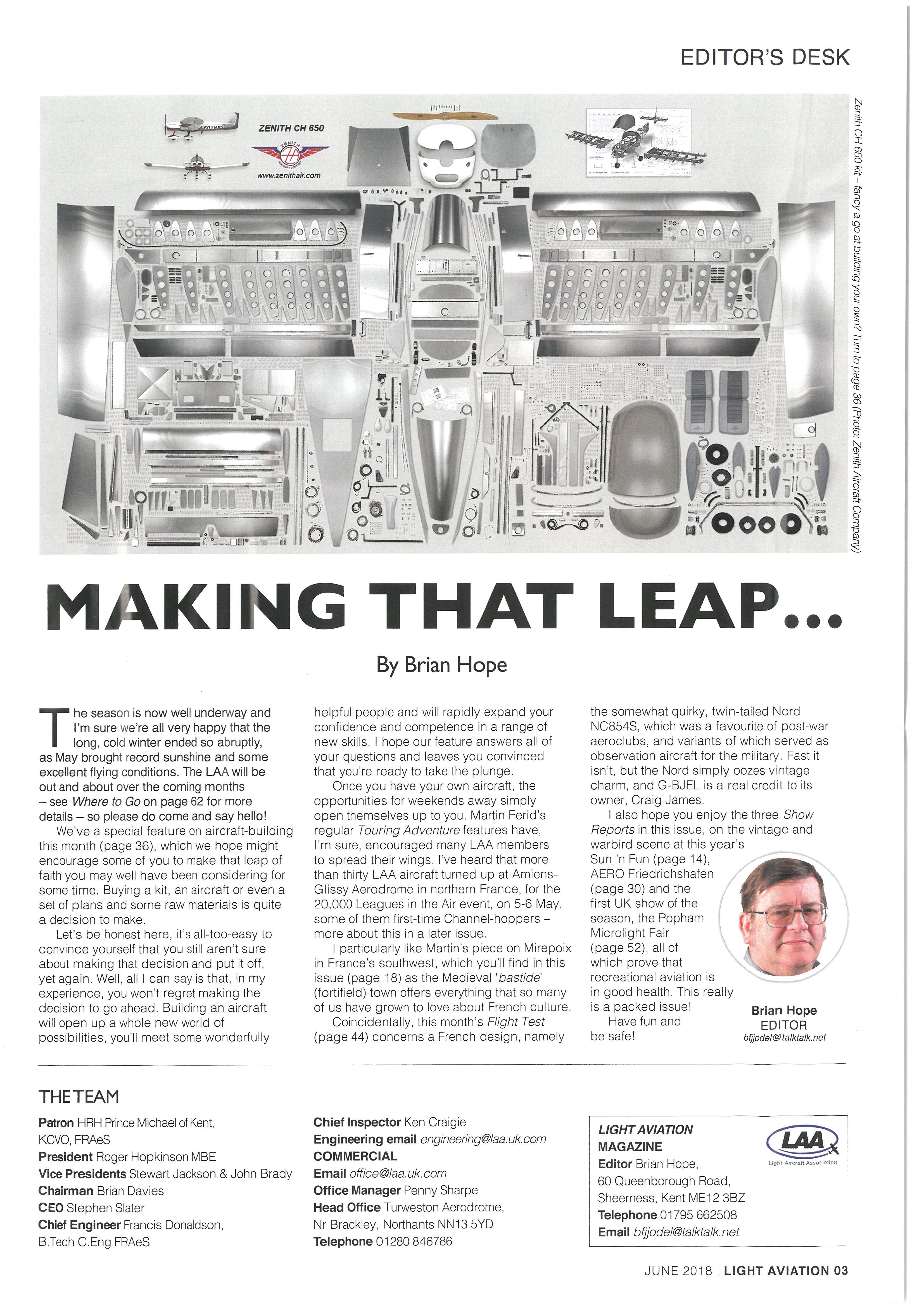
We've a special feature on aircraft-building this month (page 36), which we hope might encourage some of you to make that leap of faith you may well have been considering for some time. Buying a kit, an aircraft or even a set of plans and some raw materials is quite a decision to make.
Let’s be honest here, it’s all-too-easy to convince yourself that you still aren't sure about making that decision and put it off, yet again. Well, all | can say is that, in my experience, you won't regret making the decision to go ahead. Building an aircraft
possibilities,you'llmeetsomewonderfully
helpful people and will rapidly expand your confidence and competence in a range of new skills. | hope our feature answers all of your questions and leaves you convinced that you're ready to take the plunge.
Once you have your own aircraft, the opportunities for weekends away simply open themselves up to you. Martin Ferid’s regular Touring Adventure features have, I’m sure, encouraged many LAA members to spread their wings. I’ve heard that more than thirty LAA aircraft turned up at AmiensGlissy Aerodrome in northern France, for the 20,000 Leagues in the Air event, on 5-6 May, some of them first-time Channel-hoppers more about this in a later issue.
| particularly like Martin’s piece on Mirepoix in France’s southwest, which you'll find in this issue (page 18) as the Medieval ‘bastide’ (fortifield) town offers everything that so many of us have grown to love about French culture.
Coincidentally, this month’s Flight Test
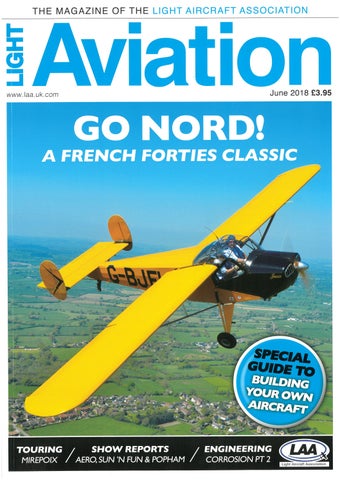
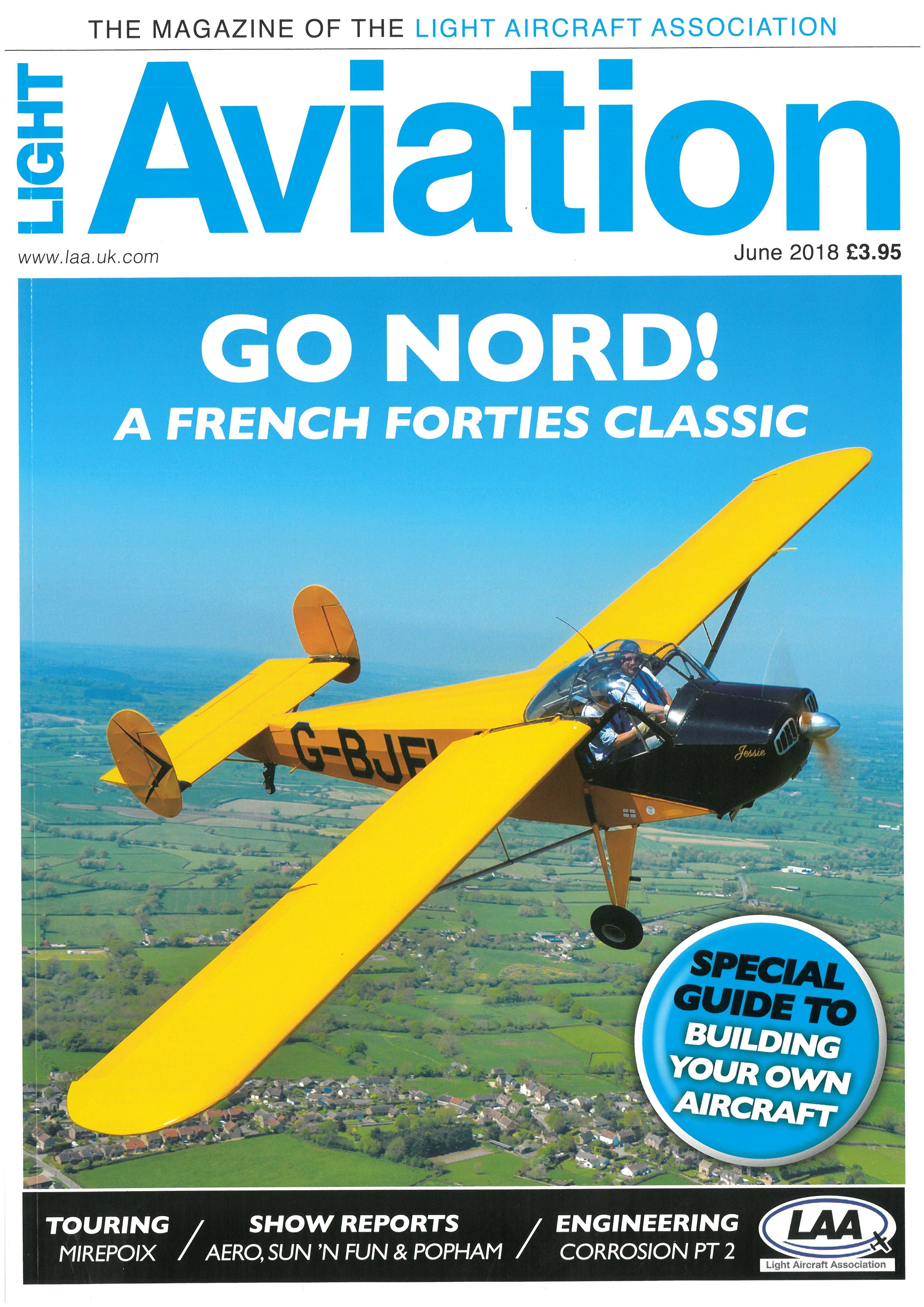
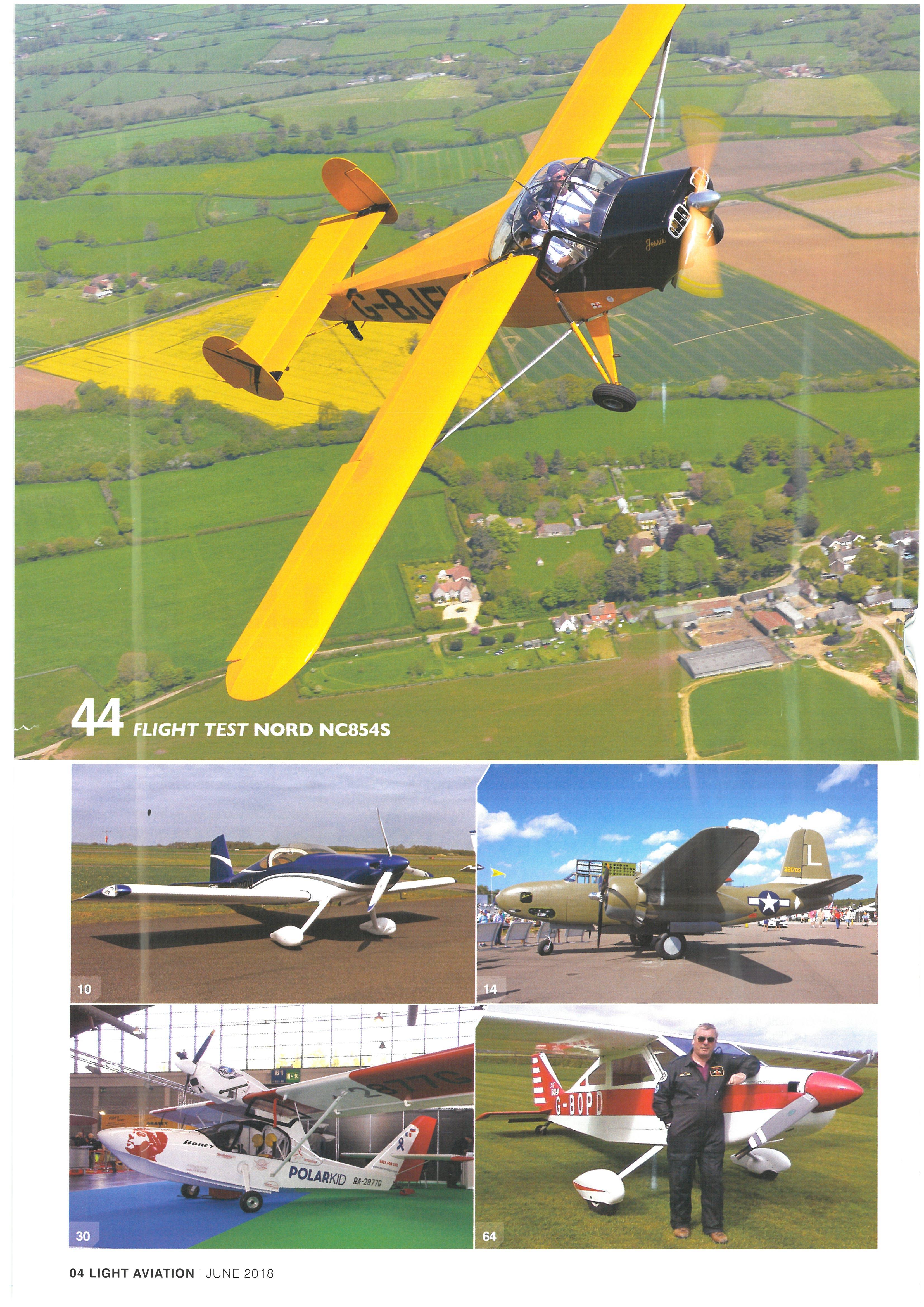
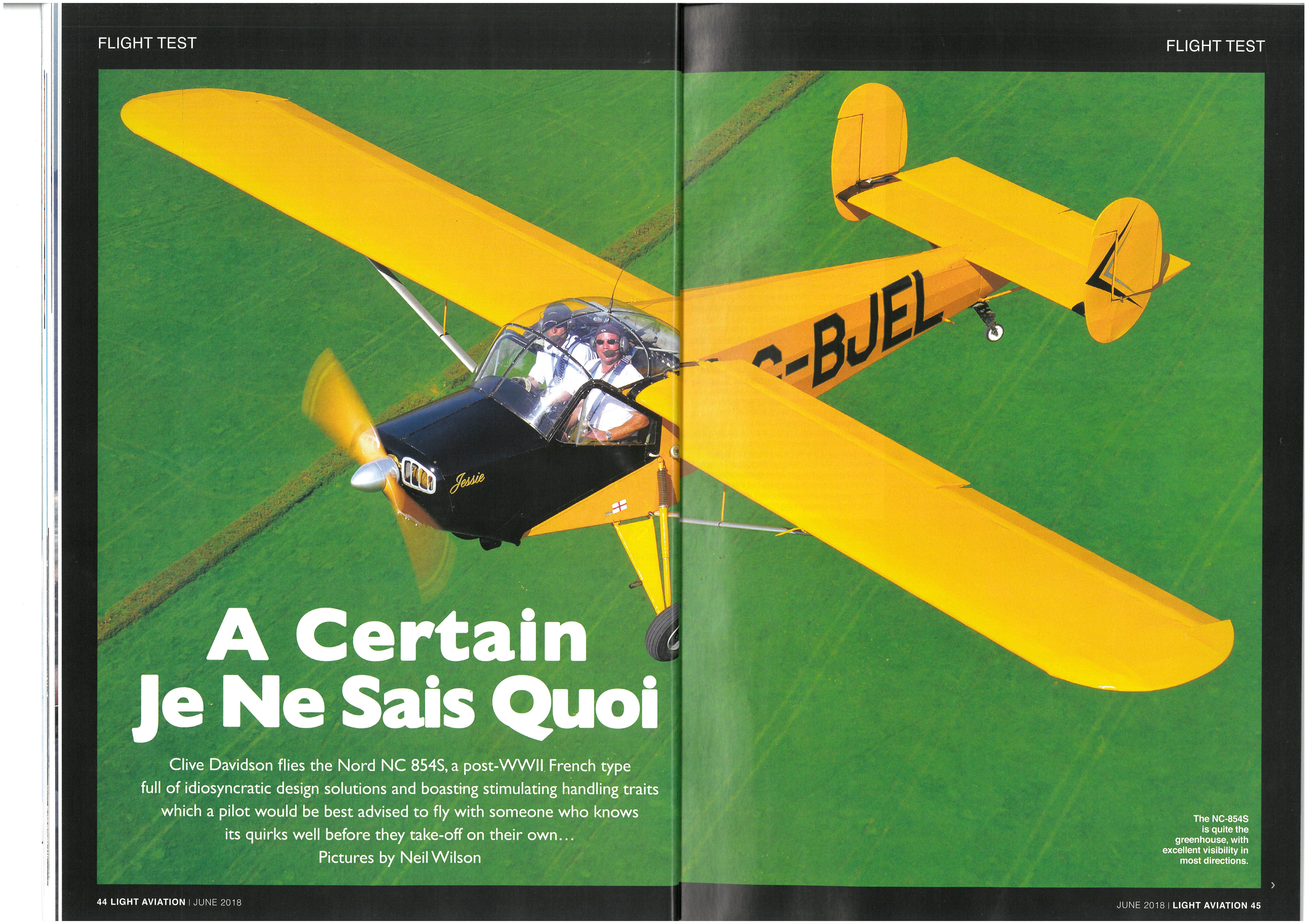
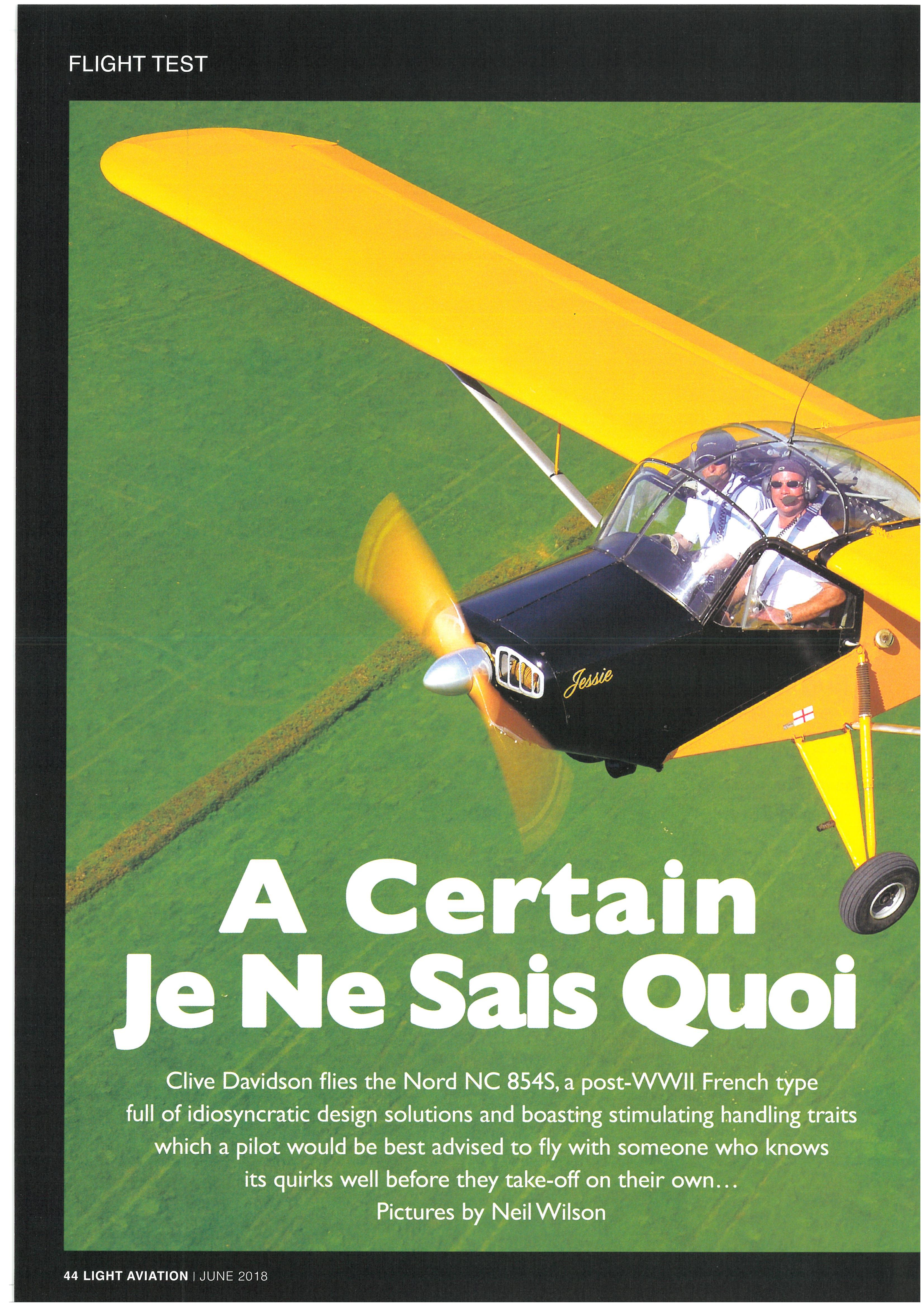
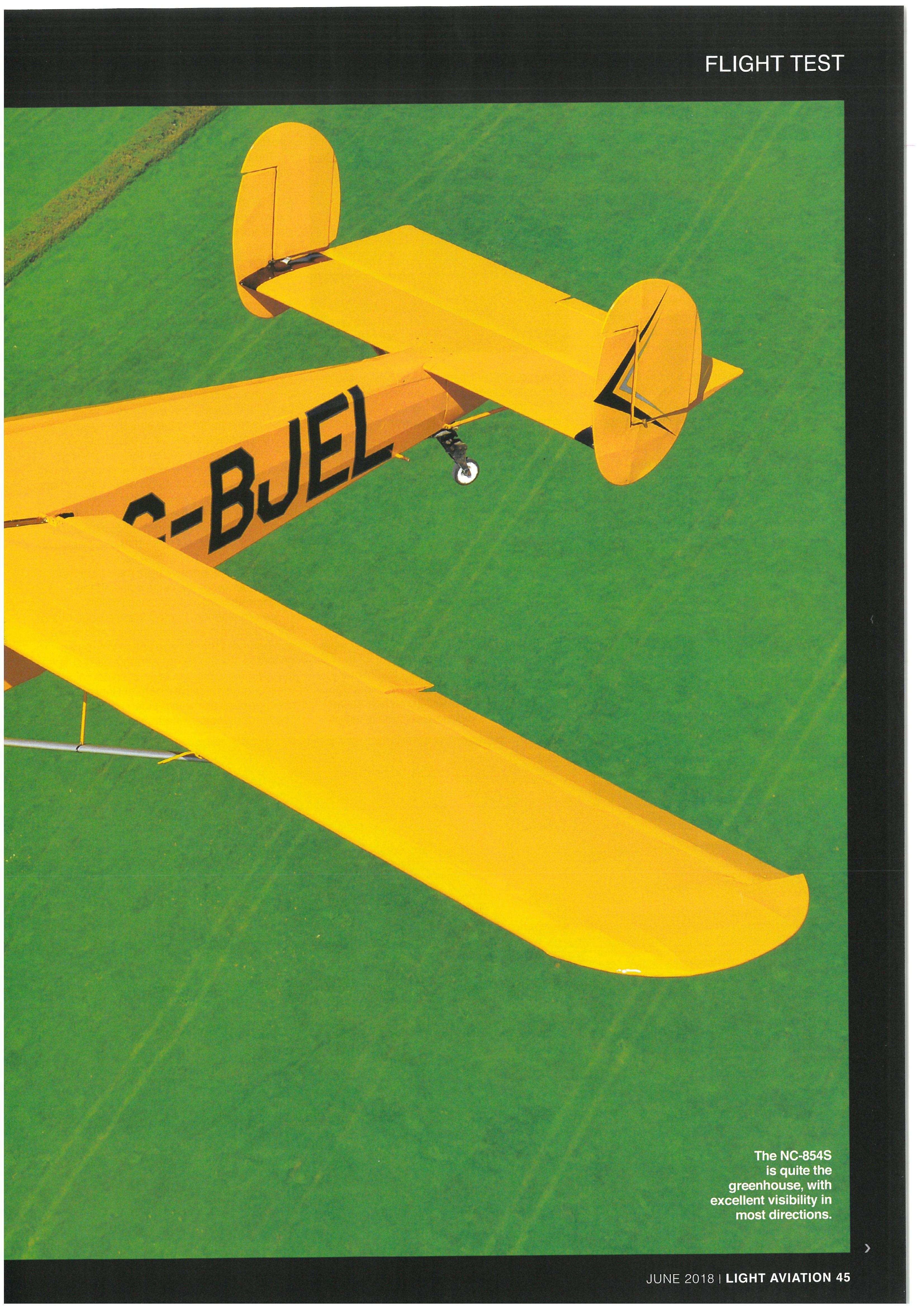
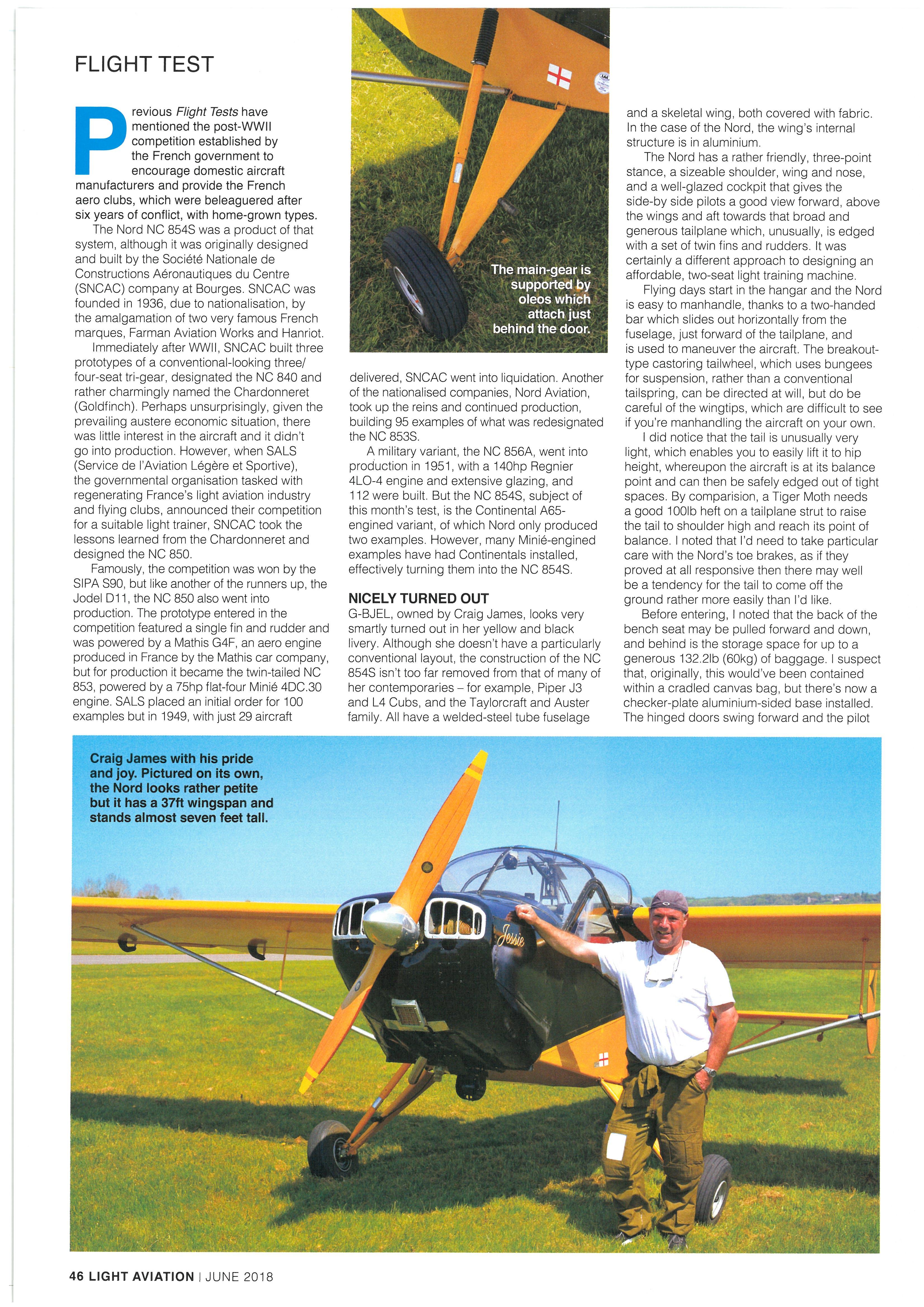
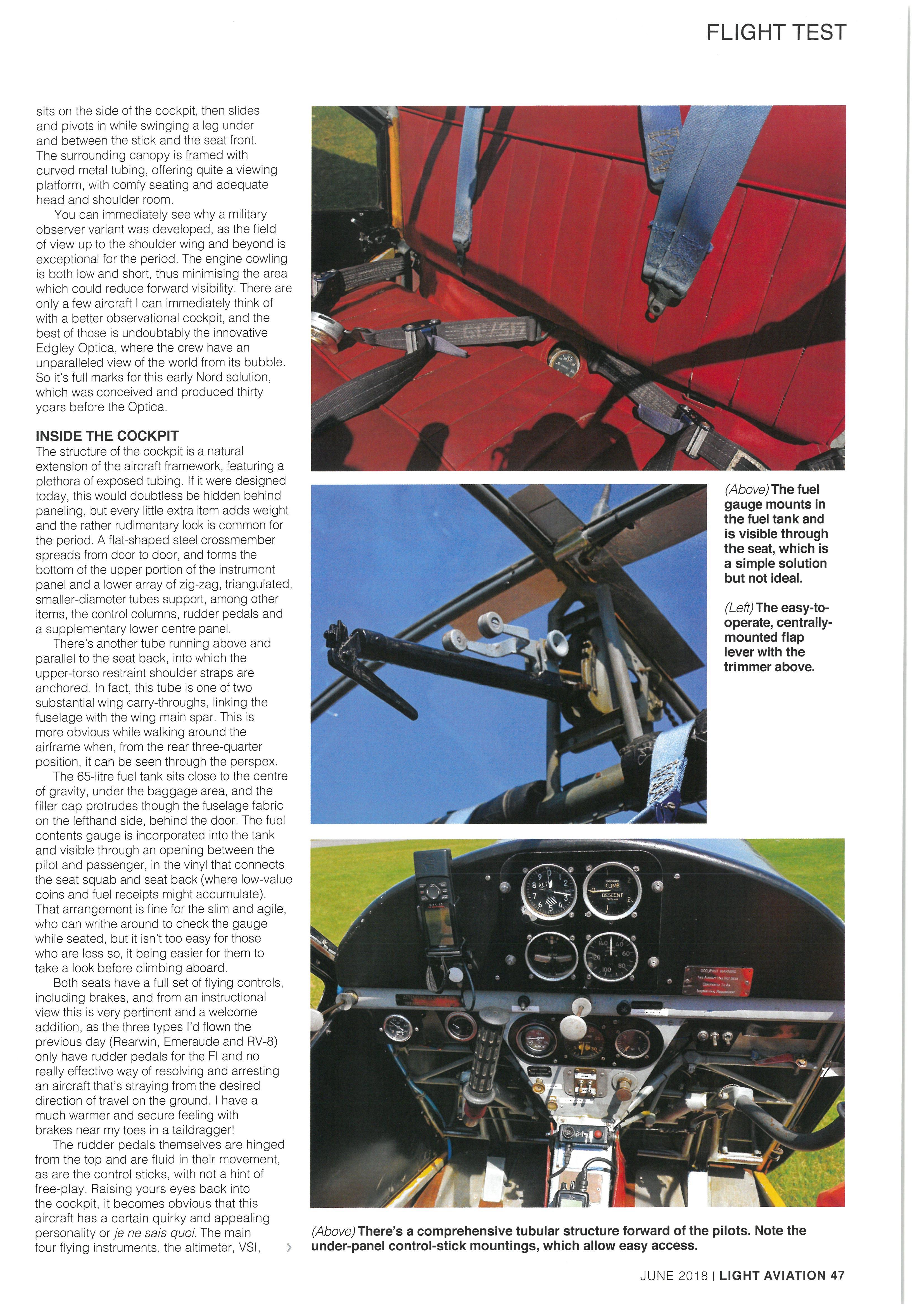
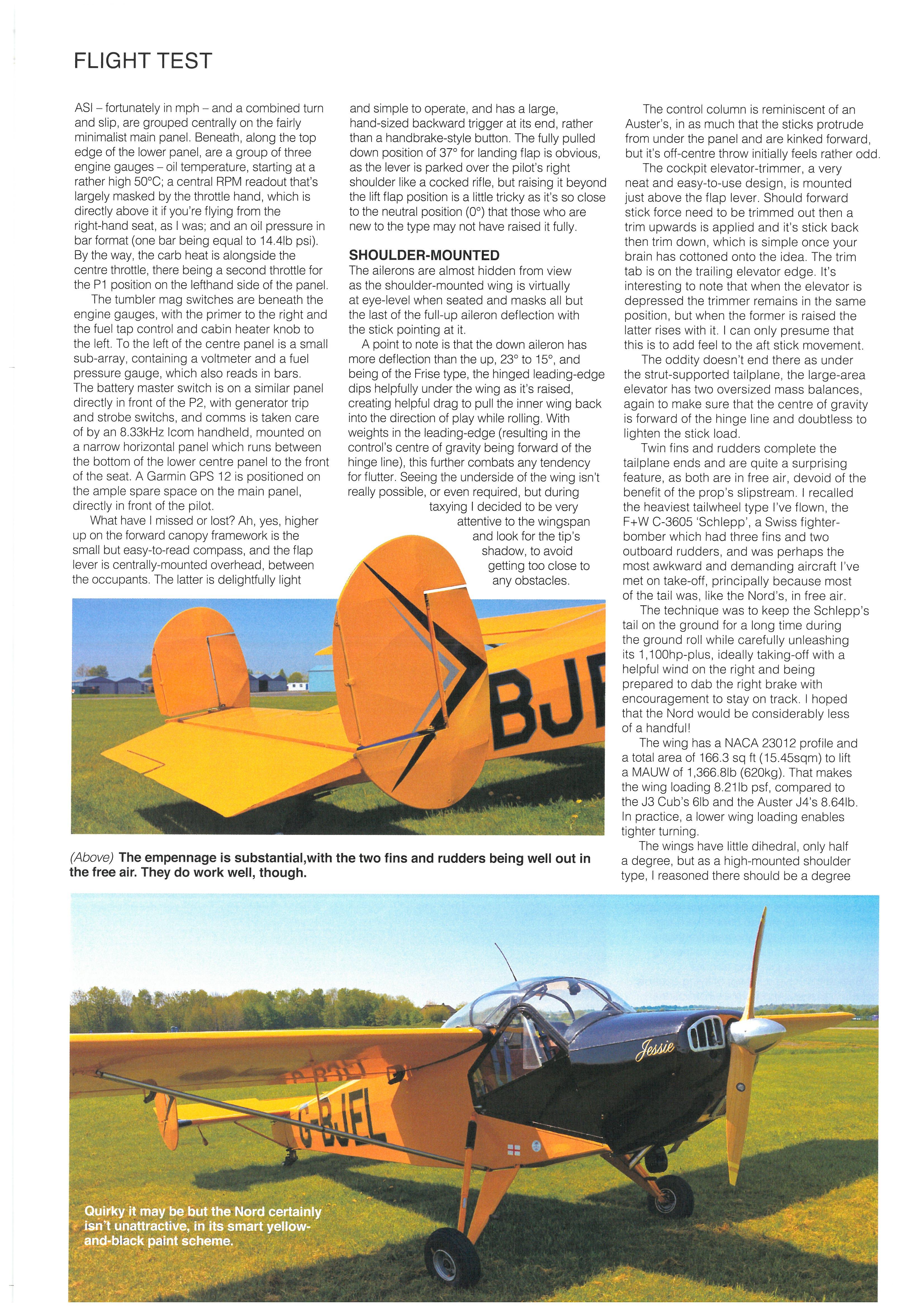
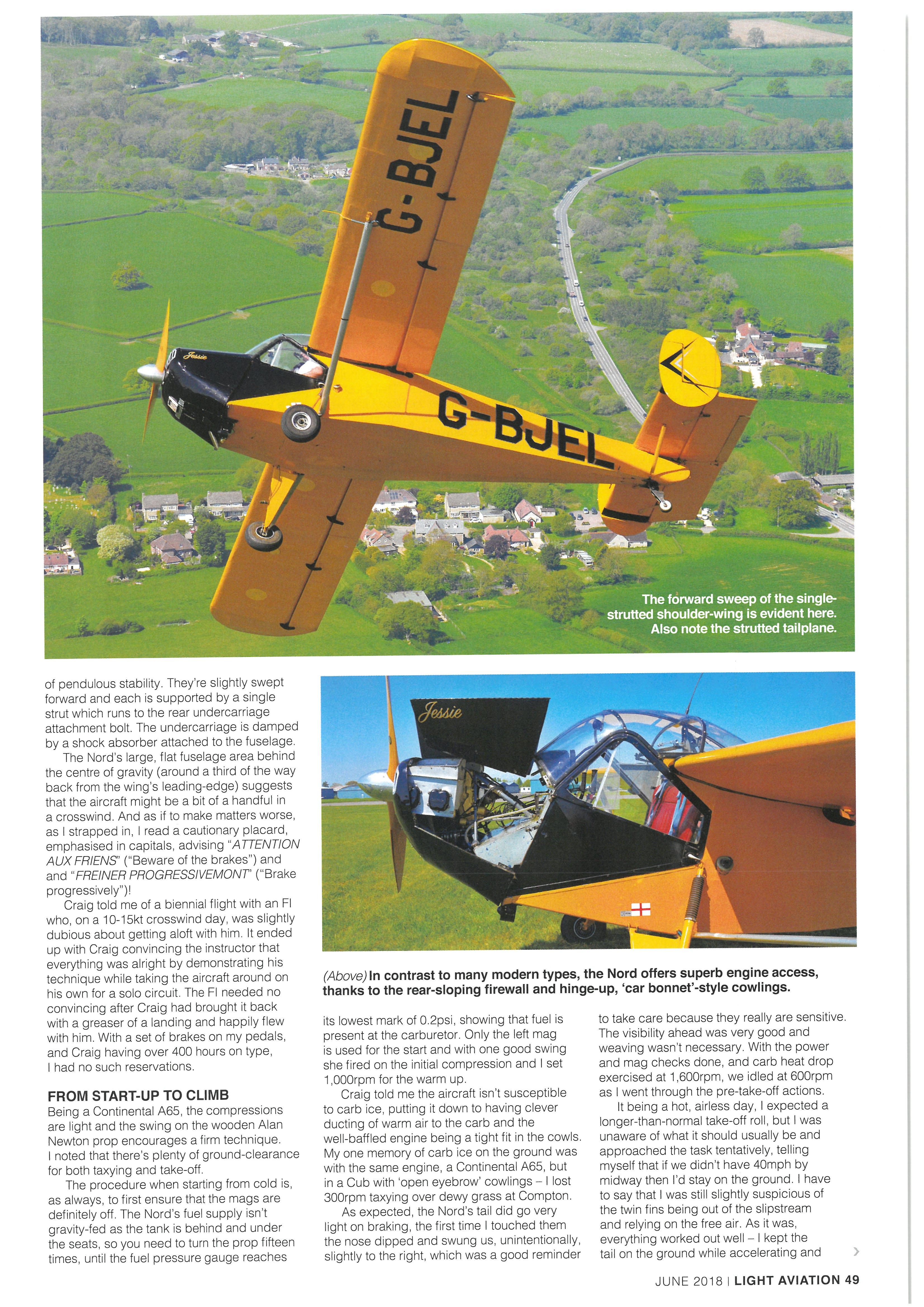
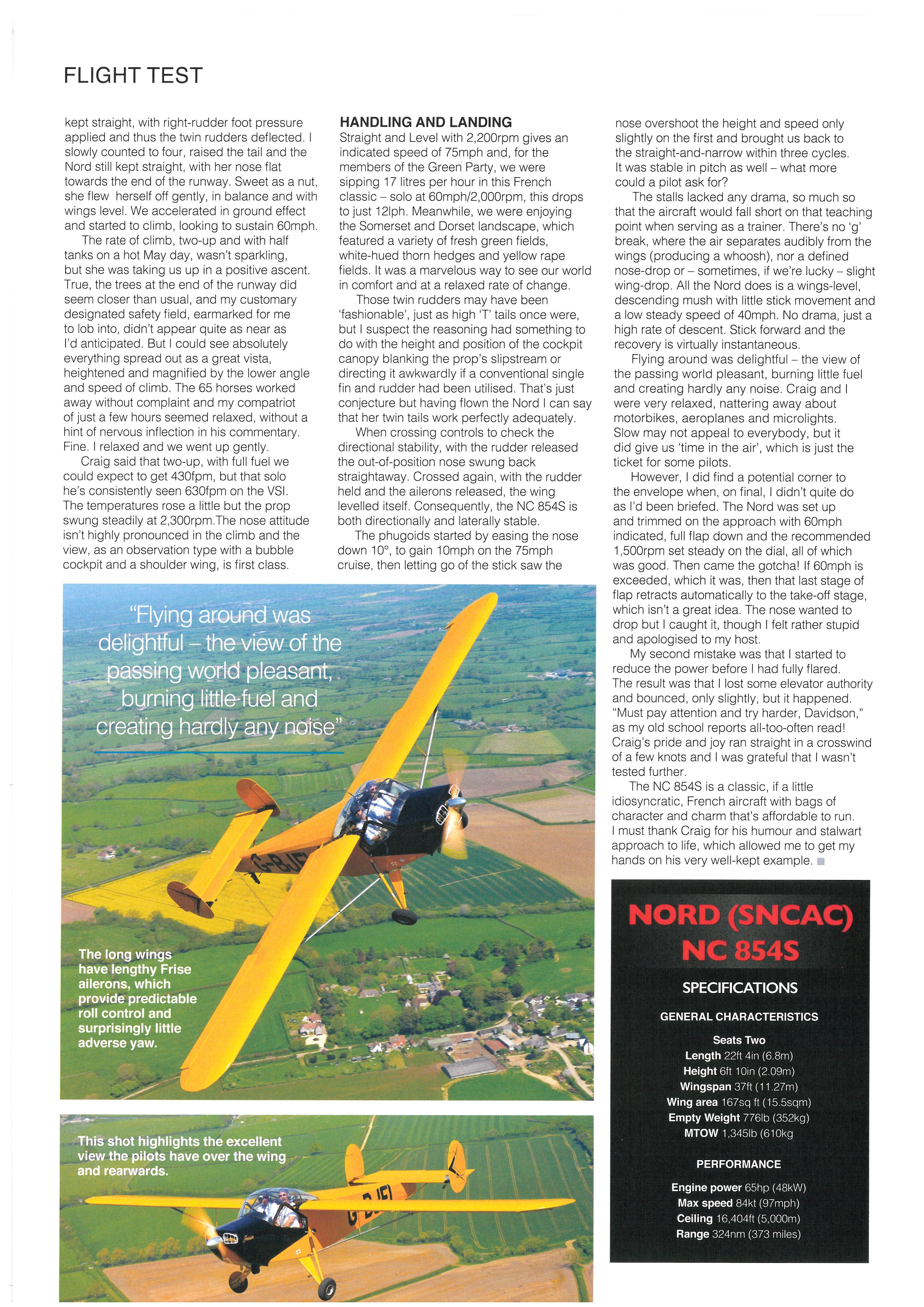
the somewhat quirky, twin-tailed Nord NC854S, which was a favourite of post-war aeroclubs, and variants of which served as observation aircraft for the military. Fast it isn’t, but the Nord simply oozes vintage charm, and G-BJEL is a real credit to its owner, Craig James.
| also hope you enjoy the three Show Reports in this issue, on the vintage and warbird scene at this year’s Sun ’n Fun (page 14), AERO Friedrichshafen (page 30) and the first UK show of the season, the Popham Microlight Fair (page 52), all of which prove that recreational aviation is in good health. This really is a packed issue!
Have fun and
(page44)concernsa Frenchdesign,namely besafe!
President RogerHopkinson MBE
Vice Presidents Stewart Jackson & John Brady
Chairman Brian Davies
CEO Stephen Slater
Chief Engineer Francis Donaldson, B.TechC.Eng FRAeS
Email office@laa.uk.com
Office Manager Penny Sharpe
Head Office Turweston Aerodrome, Nr Brackley, Northants NN13 5YD
Telephone 01280 846786
Editor Brian Hope, 60 Queenborough Road, Sheerness, Kent ME12 3BZ
Telephone 01795 662508
Email bffjode/@talktalk.net
bfiiodel@talktalk.net
FLIGHT TEST NORD NC854S
06 NEWS
Possible new 600kg category, good news for A65 owners, six-day build for Farnborough, Metal Seagulls’ new nest, Valerie Hopkins RIP
|0 PROJECTNEWS
Sling2,Van’sRV-7and Pioneer300 plus New Projectsand ClearedtoFly
14 SUN ’N FUN PART TWO
Nigel Hitchman with the Florida show's vintage and warbird action
|8 TOURINGADVENTURE
Martin Ferid heads to beautiful Mirepoix in southwestern France
24 CORROSION PREVENTION
LAA Engineering’s Jerry Parrwith the second and final instalment of a feature which should be read by every aircraft owner
30 AERO FRIEDRICHSHAFEN
Brian Hope with all of the hot news from Europe’s biggest GA show
36BUILDYOUROWN!
Brian Hope on why constructing an aircraft offers a sense of achievement which few opportunitiescan equal
44FLIGHTTEST
Clive Davidson flies the Nord NC 854S,an idiosyncratic post-WWII French type with stimulating handling
52 POPHAM MICROLIGHT FAIR
Brian Hope on this year’s very sunny and extremely successful event
54 SAFETY SPOT
Malcolm McBride with this month’s cautionary tales for pilots, builders and maintainers
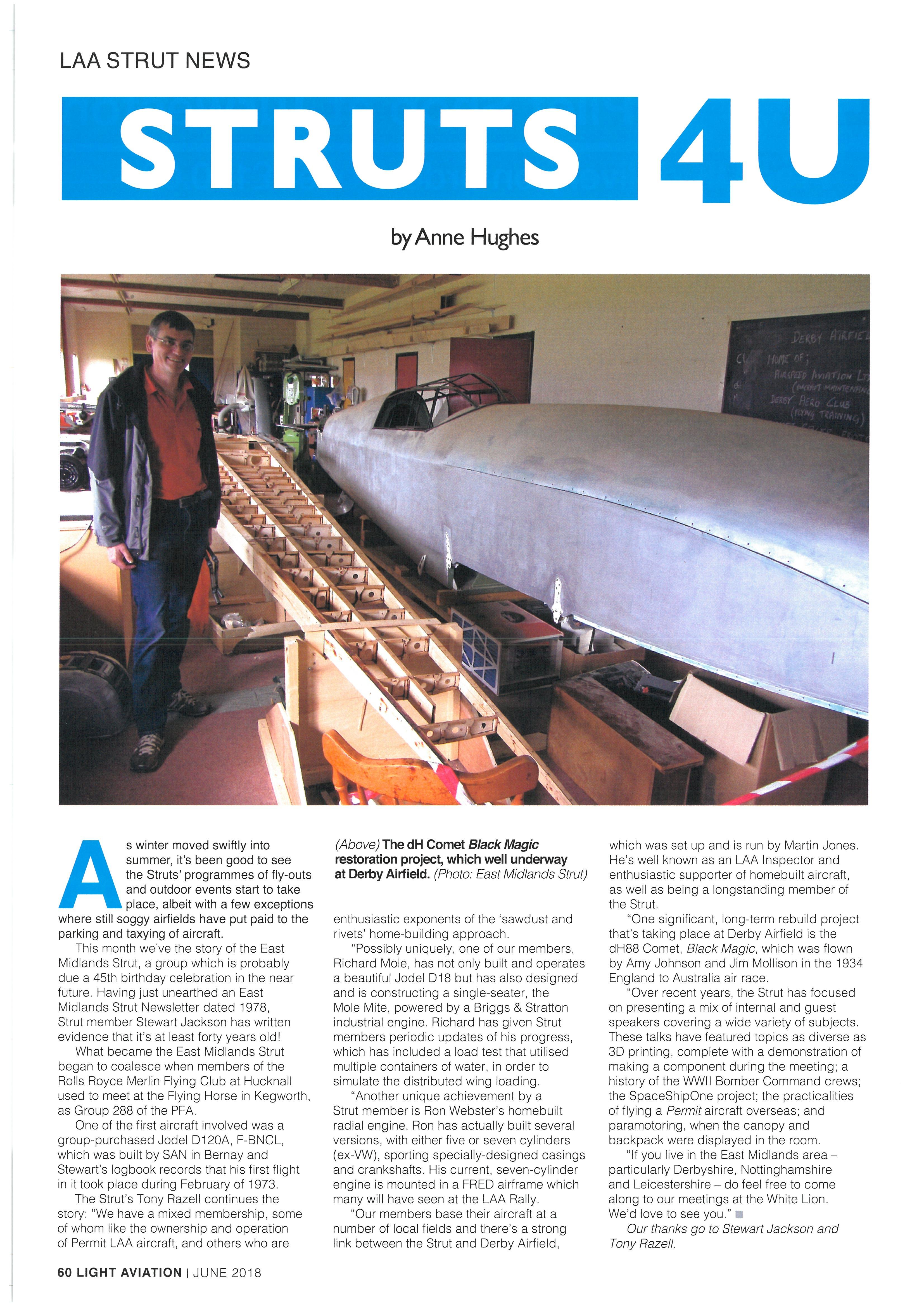
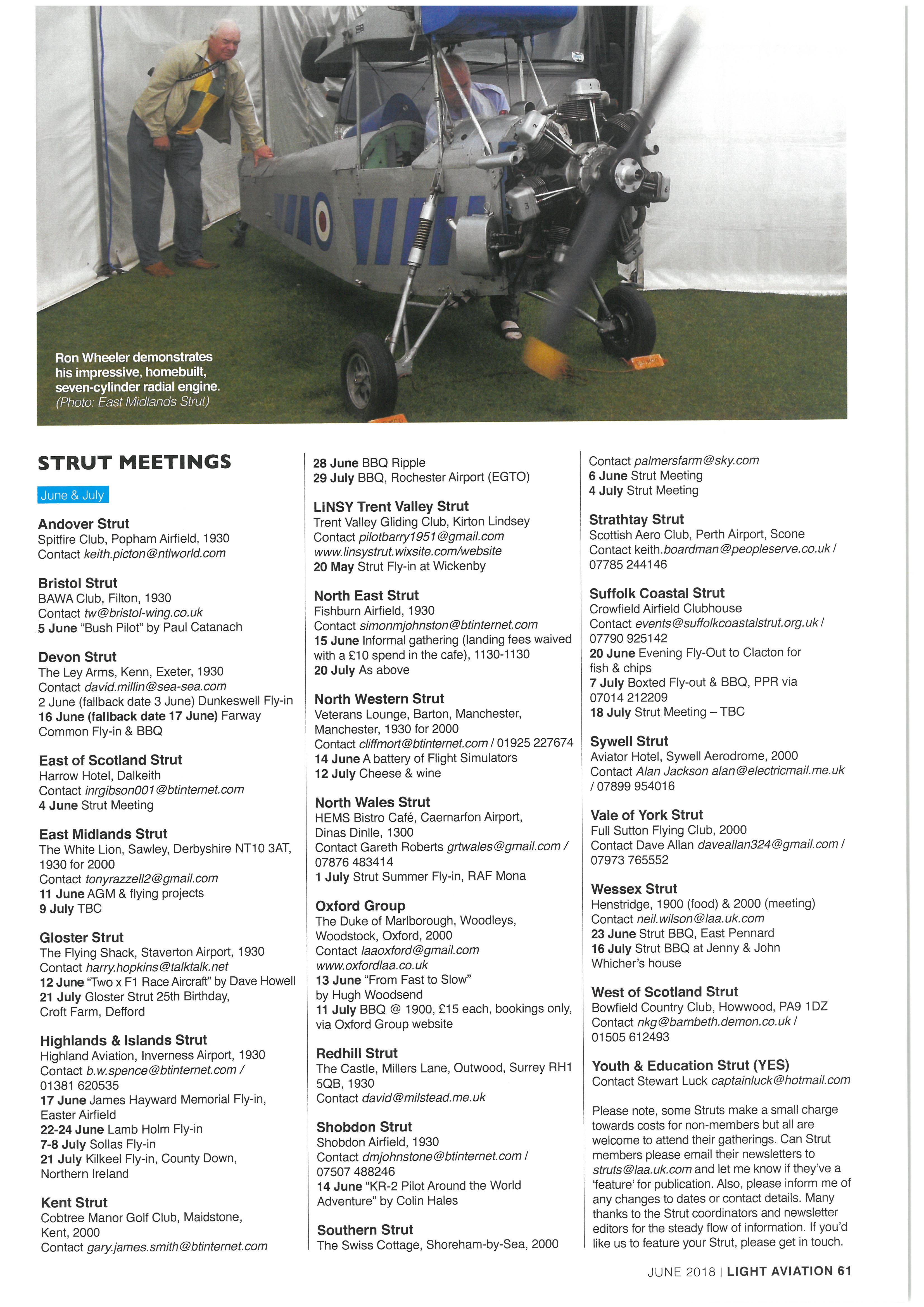
60 STRUTS4U
Anne Hughes with a history of the East Midland Strut, plus all of the latest Strut event listings
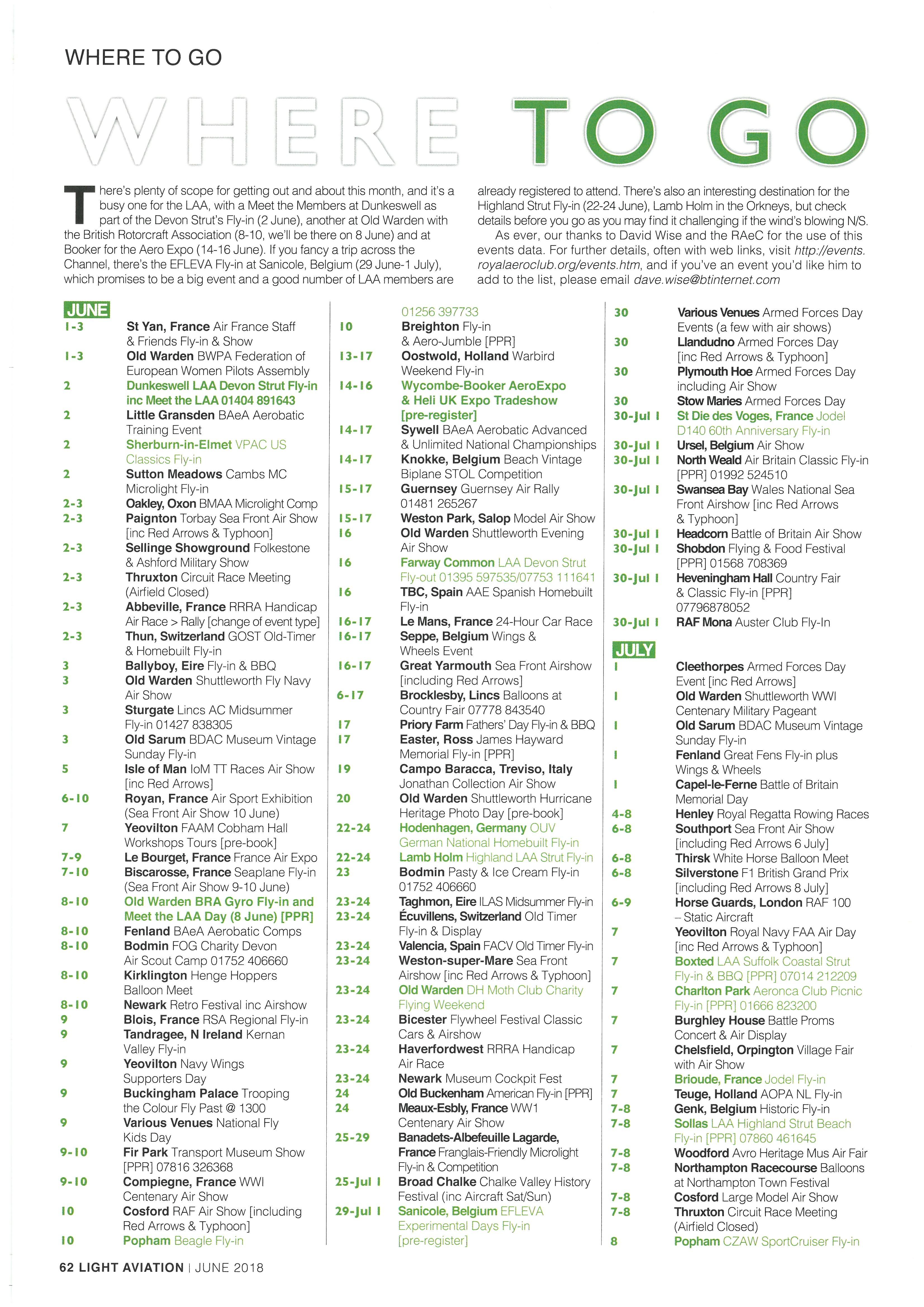
62 WHERETO GO
A bumper listing of events, in the UK and Europe, to help you make the most of the season
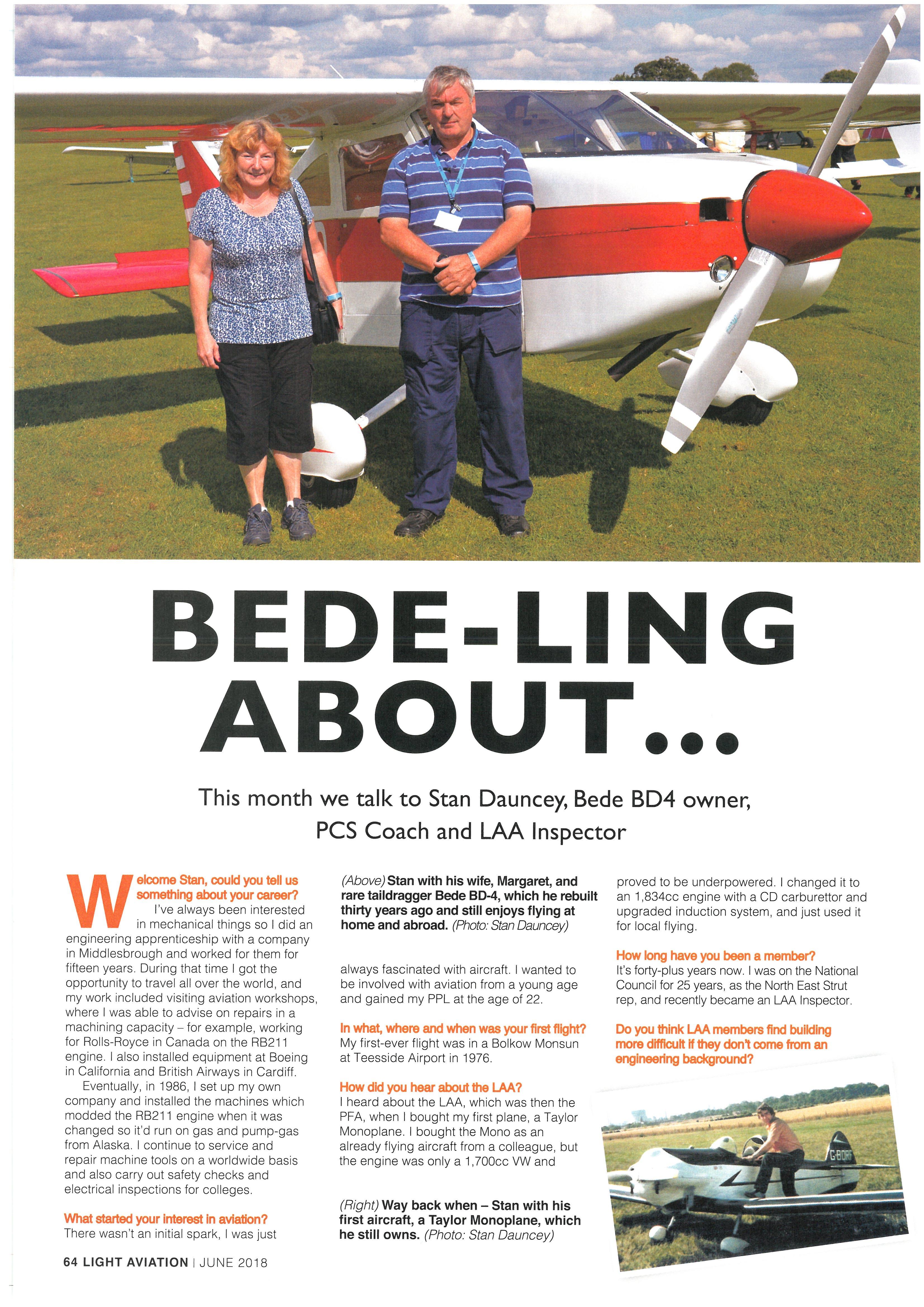
64MEETTHEMEMBERS
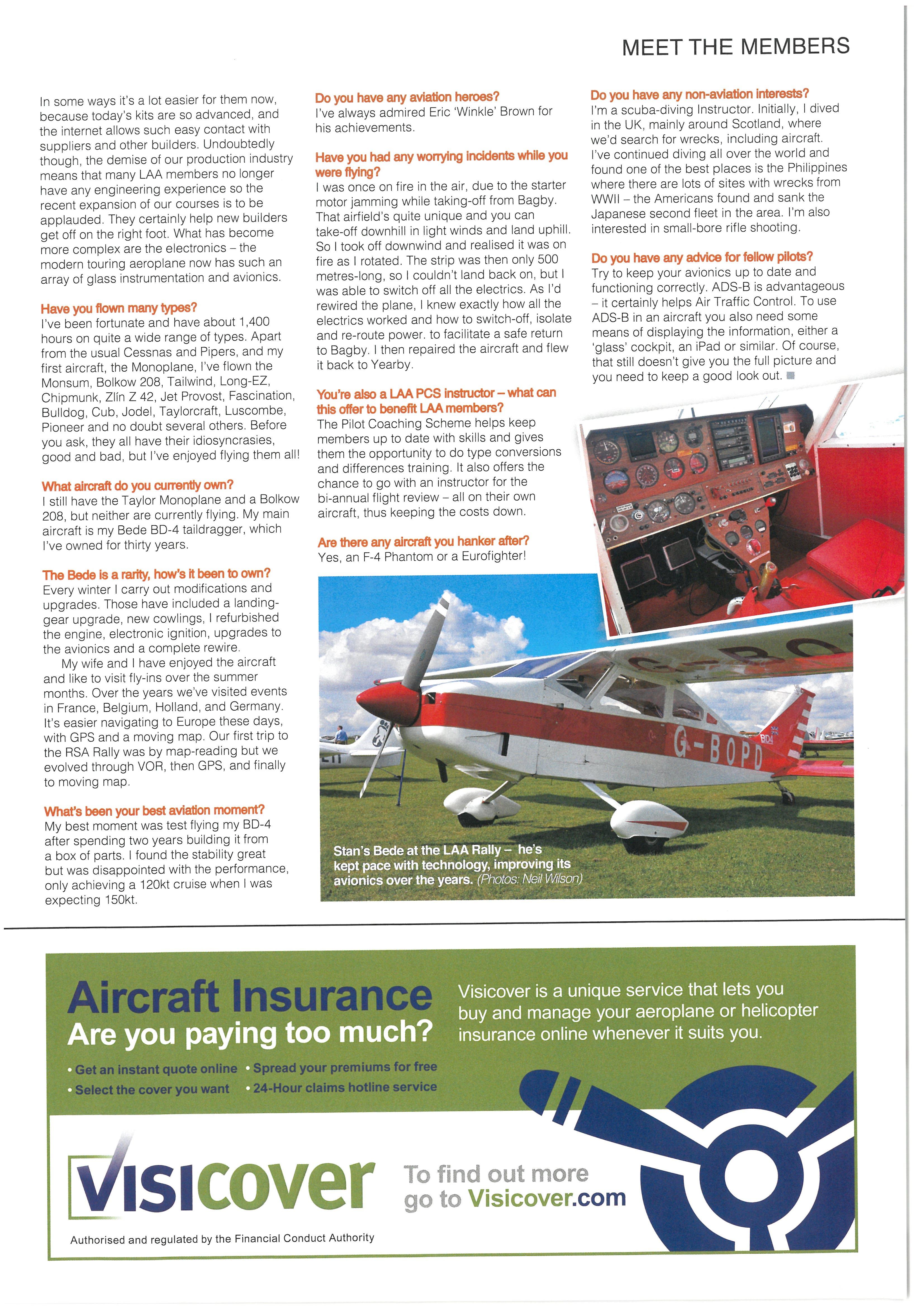
This month we talk to Bede BD4 owner, PCS Coach and LAA Inspector, Stan Dauncey
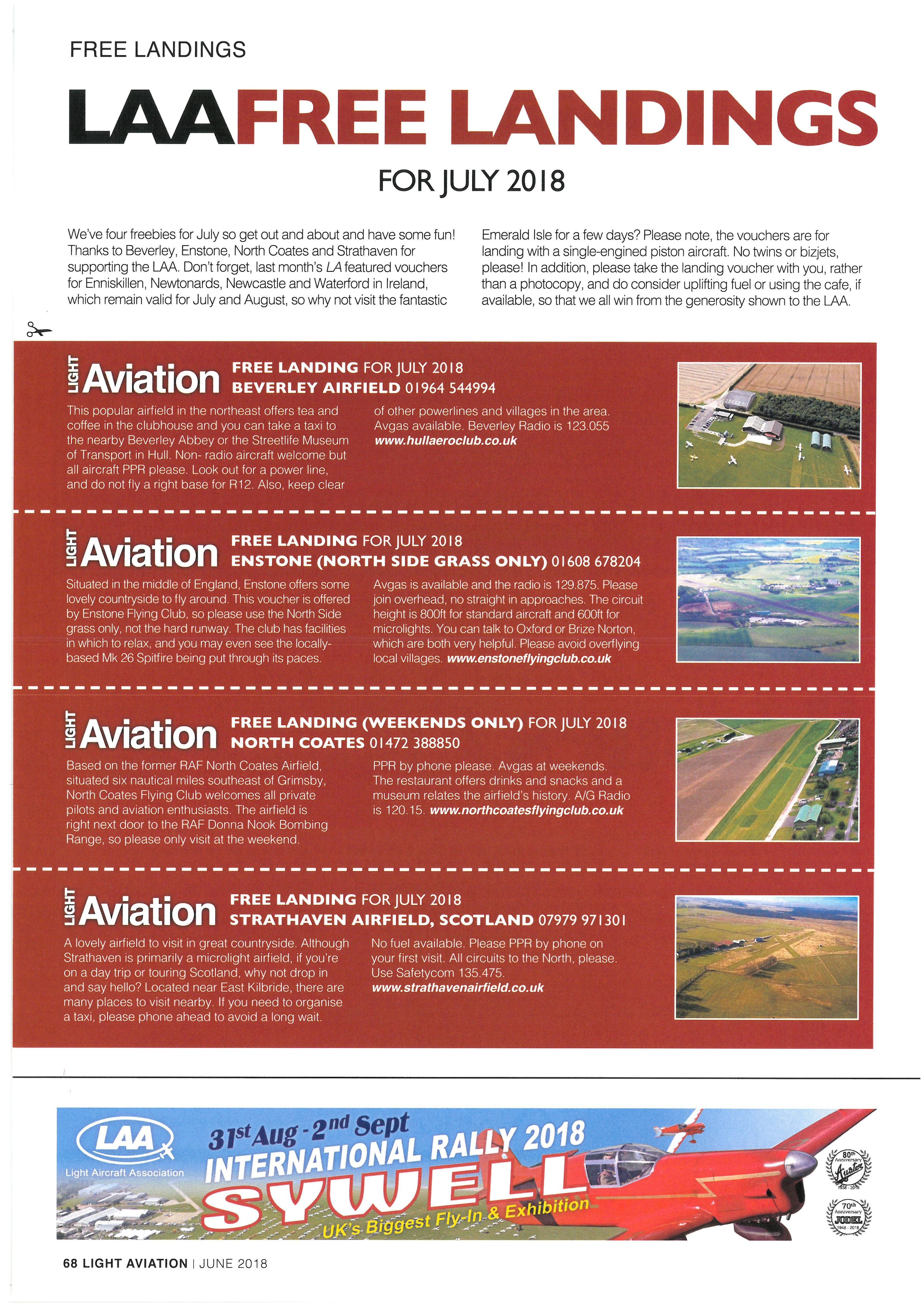
68LANDINGVOUCHERS
Your four free landings for July
70 CEOTHOUGHTS
Steve Slater on why the LAA’s been looking towards Europe and the lack of British exhibitors at AERO Friedrichshafen
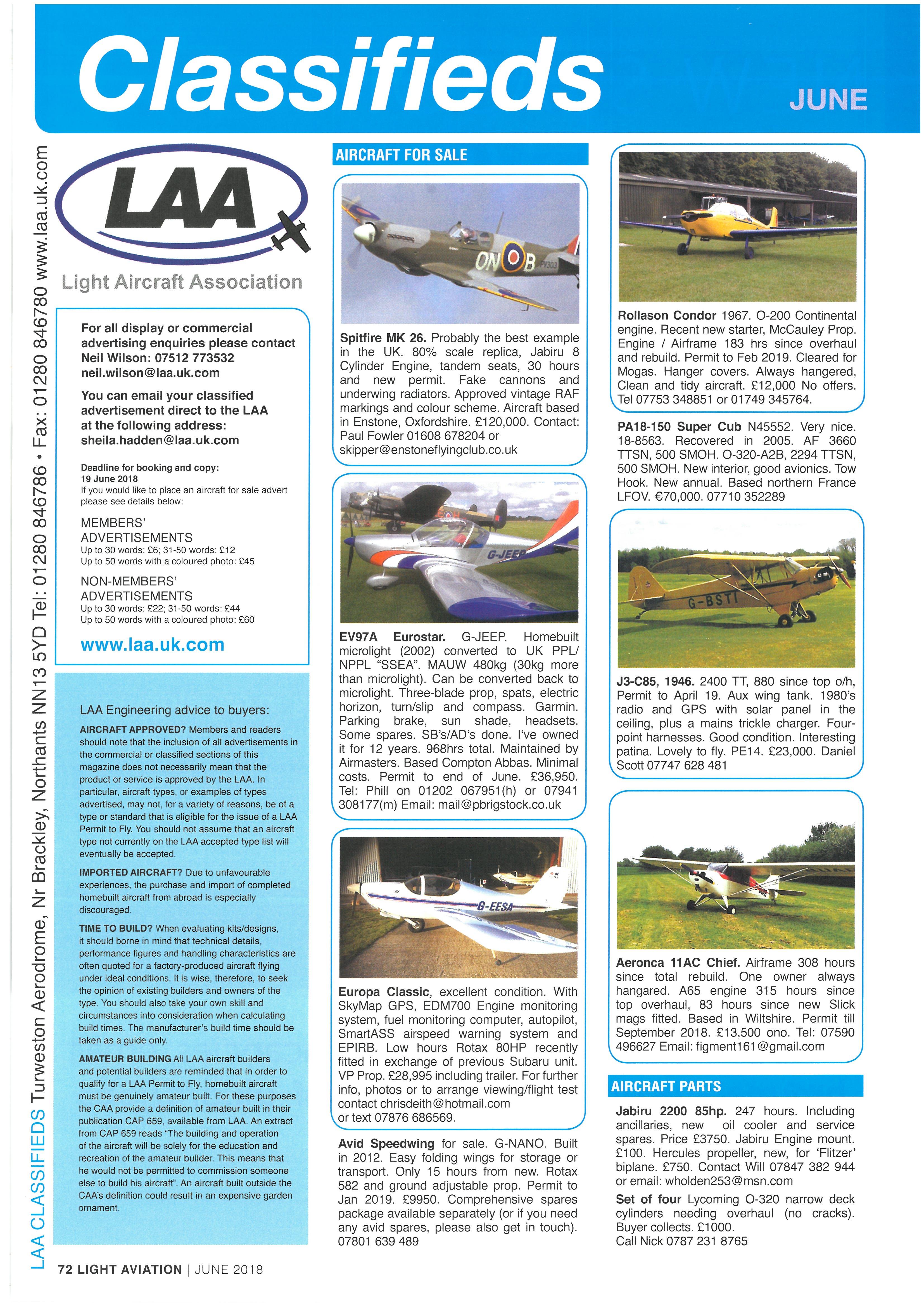
72 LAA CLASSIFIEDS
Aircraft, parts and services for sale
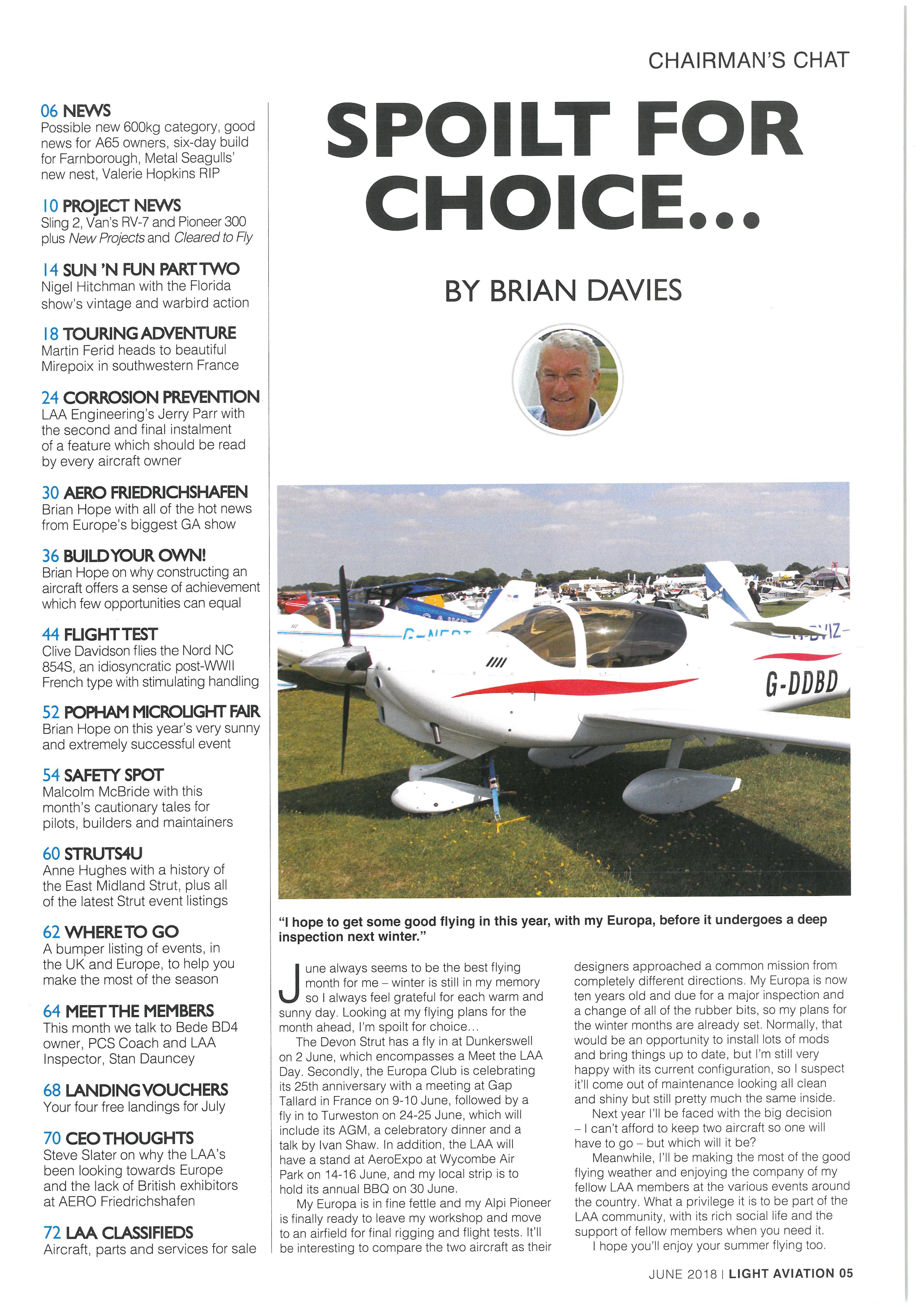
month for me winter is still in my memory so | always feel grateful for each warm and sunny day. Looking at my flying plans for the month ahead, I’m spoilt for choice...
The Devon Strut has a fly in at Dunkerswell on 2 June, which encompasses a Meet the LAA Day. Secondly, the Europa Club is celebrating its 25th anniversary with a meeting at Gap Tallard in France on 9-10 June, followed by a fly in to Turweston on 24-25 June, which will include its AGM, a celebratory dinner and a talk by Ivan Shaw. In addition, the LAA will have a stand at AeroExpo at Wycombe Air Park on 14-16 June, and my local strip is to hold its annual BBQ on 30 June.
My Europa is in fine fettle and my Alpi Pioneer is finally ready to leave my workshop and move toanairfieldforfinal riggingandflighttests.It’ll be interesting to compare the two aircraft as their
designers approached a common mission from completely different directions. My Europa is now ten years old and due for a major inspection and a change of all of the rubber bits, so my plans for the winter months are already set. Normally, that would be an opportunity to install lots of mods and bring things up to date, but I’m still very happy with its current configuration, so | suspect it'll come out of maintenance looking all clean and shiny but still pretty much the same inside. Next year I'll be faced with the big decision —|can’t afford to keep two aircraft so one will have to go but which will it be?
Meanwhile, I'll be making the most of the good flying weather and enjoying the company of my fellow LAA members at the various events around the country. What a privilege it is to be part of the LAA community, with its rich social life and the support of fellow members when you need tt. | hope you'll enjoy your summer flying too.
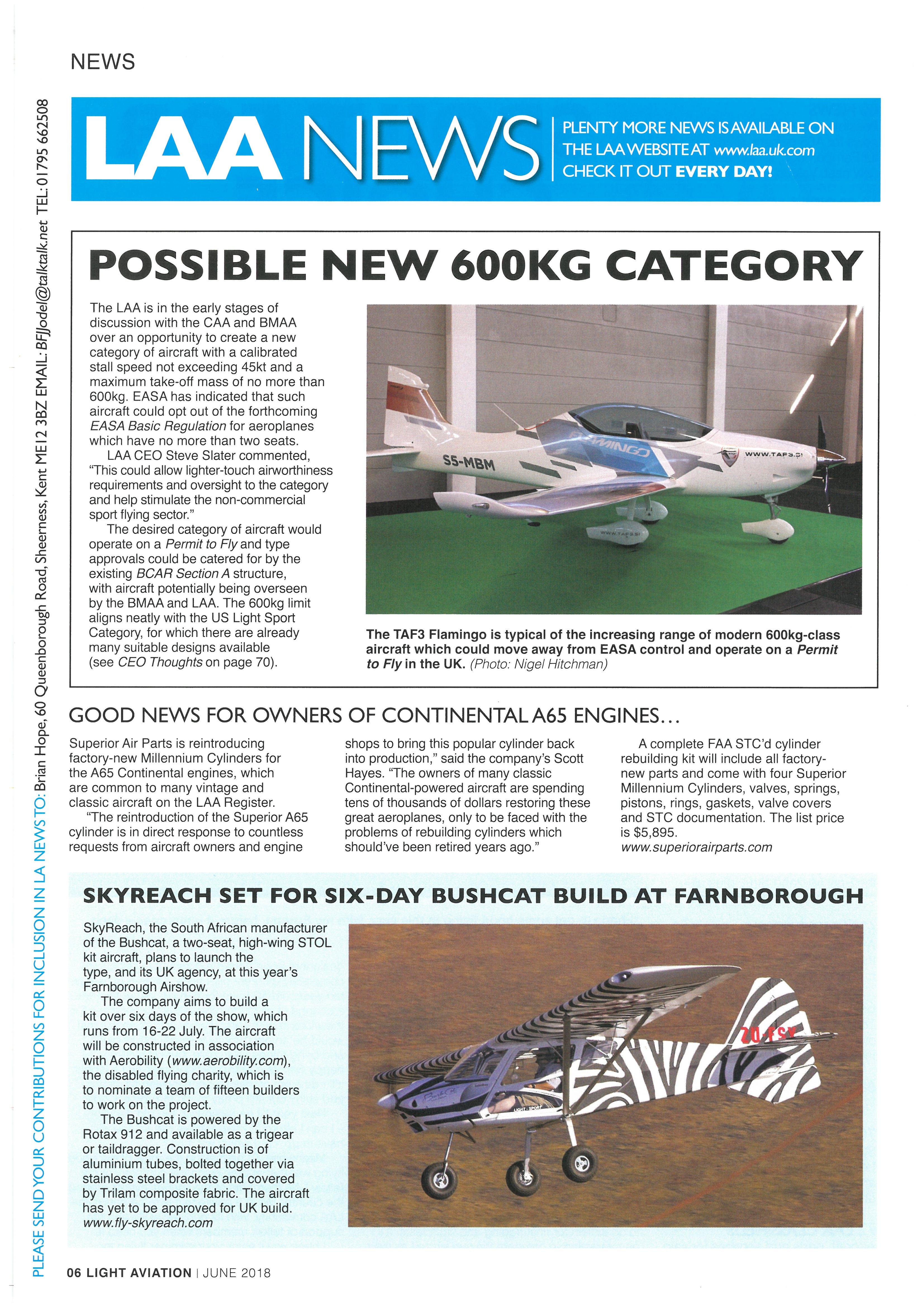
aircraft could opt out of the forthcoming EASA Basic Regulation for aeroplanes which have no more than two seats.
LAA CEO Steve Slater commented, “This could allow lighter-touch airworthiness requirements and oversight to the category and help stimulate the non-commercial sport flying sector.”
The desired category of aircraft would operate on a Permit to Flyand type approvals could be catered for by the existing BCAR Section A structure, with aircraft potentially being overseen by the BMAA and LAA. The 600kg limit aligns neatly with the US Light Sport Category,for which there are already many suitable designs available (see CEO Thoughts on page 70).
Superior Air Parts is reintroducing factory-new Millennium Cylinders for the A65 Continental engines, which are common to many vintage and Classic aircraft on the LAA Register.
“The reintroduction of the Superior A65
cylinder is in direct response to countless requests from aircraft owners and engine
shops to bring this popular cylinder back into production,” said the company’s Scott Hayes. “The owners of many classic Continental-powered aircraft are spending tens of thousands of dollars restoring these great aeroplanes, only to be faced with the
problems of rebuilding cylinders which should’ve been retired years ago.”
range
Acomplete FAA STC’d cylinder rebuilding kit will include all factorynew parts and come with four Superior Millennium Cylinders, valves, springs, pistons, rings, gaskets, valve covers and STC documentation. The list price is $5,895.
www.superiorairparts.com
SKYREACH SET FOR SIX-DAY BUSHCAT BUILD AT FARNBOROUGH
SkyReach, the South African manufacturer of the Bushcat, a two-seat, high-wing STOL kit aircraft, plans to launch the type, and its UK agency, at this year’s Farnborough Airshow.
The company aims to build a kit over six days of the show, which runs from 16-22 July. The aircraft will be constructed in association with Aerobility (www.aerobility.com), the disabled flying charity, which is to nominate a team of fifteen builders to work on the project.
The Bushcat is powered by the Rotax 912 and available as a trigear or taildragger. Construction is of aluminium tubes, bolted together via stainless steel brackets and covered by Trilam composite fabric. The aircraft has yet to be approved for UK build. www.fly-skyreach.com
The TAF3 Flamingo is typical of the increasing
of modern 600kg-class aircraft which could move away from EASA control and operate on a Permit to Flyin the UK. (Photo: NigelHitchman)
METAL SEAGULLS FINDS A NEW NEST AT SLEAP AIRFIELD
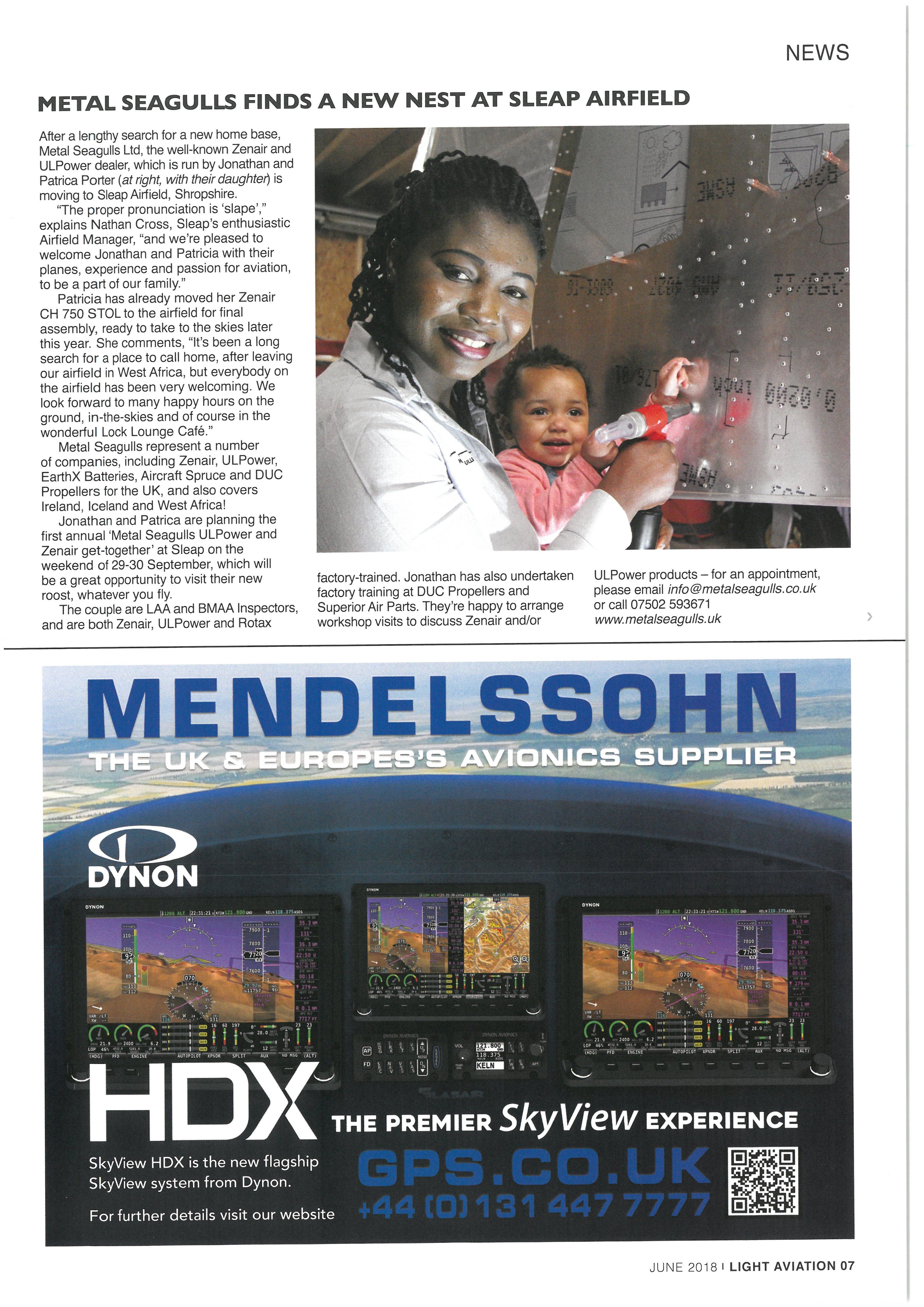
After a lengthysearchfor a new home base, MetalSeagulls Ltd,the well-known Zenair and ULPower dealer,which is run by Jonathan and PatricaPorter(atright,withtheirdaughter)is movingto SleapAirfield, Shropshire.
“The proper pronunciation is ‘slape’,” explains Nathan Cross, Sleap’s enthusiastic Airfield Manager,“and we’re pleased to welcome Jonathan and Patricia with their planes, experience and passion for aviation, to be a part of our family.”
Patricia has already moved her Zenair CH750STOLto theairfieldforfinal assembly, ready to take to the skies later this year. She comments, “It’s been a long search for a place to call home, after leaving our airfield inWest Africa, but everybody on the airfield has been very welcoming. We look forward to many happy hours on the ground, in-the-skies and of course in the wonderful Lock Lounge Café.”
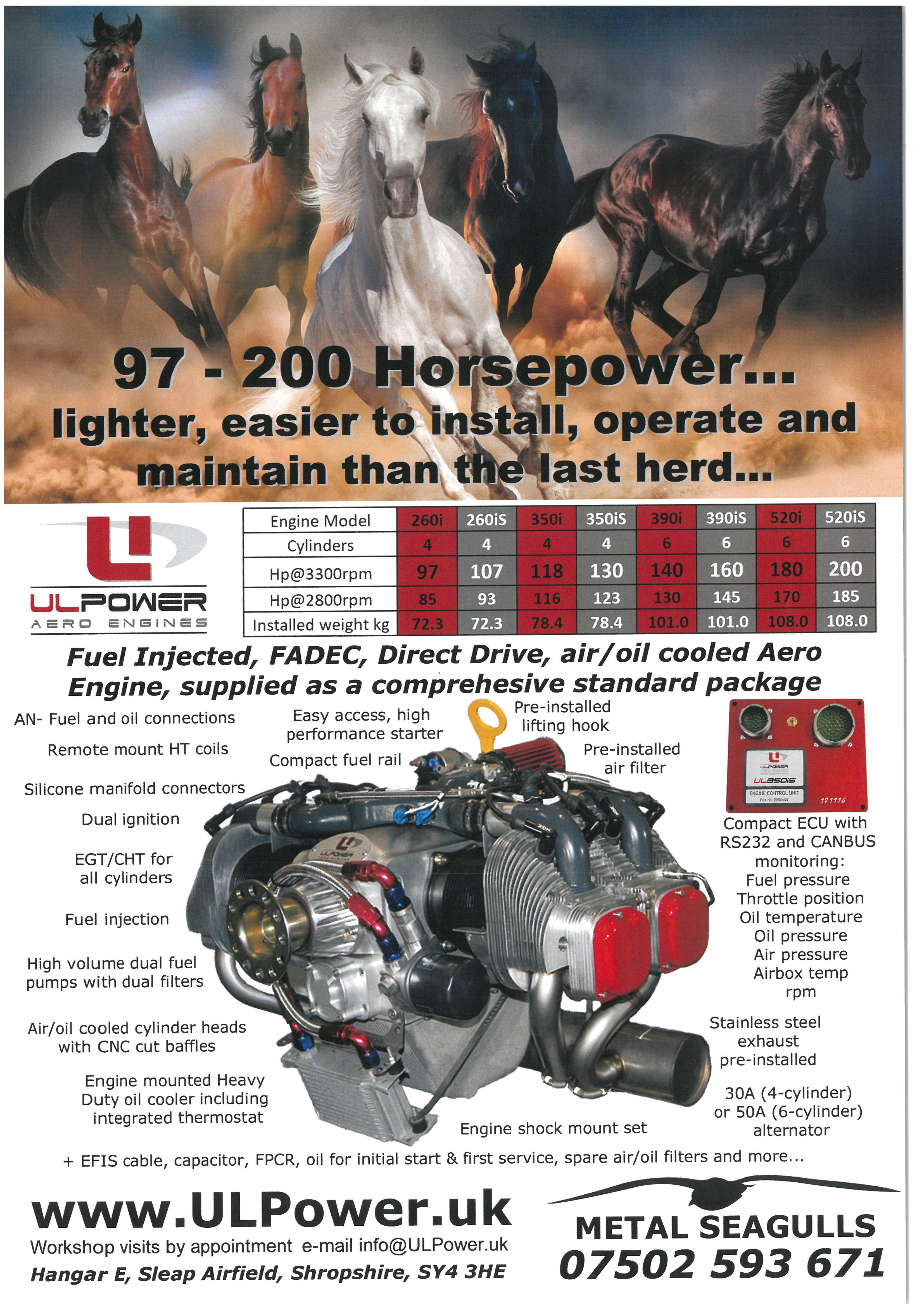
Metal Seagulls represent a number of companies, including Zenair, ULPower, EarthX Batteries, Aircraft Spruce and DUC Propellers for the UK, and also covers Ireland, Iceland and West Africa!
Jonathan and Patrica are planning the first annual ‘MetalSeagulls ULPower and Zenair get-together’at Sleap on the weekend of 29-30 September, which will beagreatopportunitytovisittheirnew
factory-trained.Jonathanhasalsoundertaken=ULPowerproductsforanappointment, roost, whatever you fly. factory trainingat DUC Propellersand pleaseemailinfo@metalseagulls.co.uk
The couple are LAAand BMAA Inspectors, SuperiorAir Parts.They’re happy to arrange or call 07502 593671 and are both Zenair,ULPowerand Rotax workshopvisits to discussZenair and/or www.metalseagulls.uk
Project Phoenix, a team of local experts with a vision to recreate Panshanger Aerodrome, has started a petition to persuade the local council to keep its promise to include an airfield on the site.
The Aerodrome closed three years ago, and in October 2016, Welwyn Hatfield Council made a decision to amend its Draft Local Plan to include provision of an airfield at Panshanger.
“However,” says Project Phoenix’s Sue Hart, “this pledge is under serious threat of being swept under the carpet in the interest of planners’convenience.
“Our mission is to ensure that the council fulfil their promise not only to the people of Welwyn and Hatfield but the General Aviation community nationally.
“Please sign our petition to ensure that the council keeps its promise, in providing the people with what they want Panshanger Aerodrome back operational as a real community asset that everyone can be proud of.”
You can sign the petition now via www.change.org/p/chief-planning-officer and you'll find more information at www.project-phoenix.org.uk
DEFENCE MINISTERAGREES TO A REVIEW OF MOD AIRFIELD SELL-OFF
Following representations by the All Party Parliamentary Group for General Aviation (APPG on GA), Defence Minister Tobias Ellwood MP has agreed to review plans to sell fifteen former MoD airfields for housing.
The APPG is seeking to secure a mixed-use approach to developments on aerodromes. The Minister and officials from the Defence Infrastructure Organisation (which is responsible for the UK’s defence infrastructure) has acknowledged that retaining some of the
NEWS BITES
LOST? LET D&D HELP
The RAF’s Distress & Diversion (D&D) Cell has released a concise and useful, tri-fold information leaflet explaining its activities, frequencies and giving general advice for pilots. Download it free as a PDF from www.tinyurl. com/DDleaflet VALHOPKINS We'resadto r= have thetoreport death,after ashortillness, of ValHopkins, the NiceCO)inatsle Ae
f
LAA Board
member Harry Hopkins. Valwill be known to members as a regular Rally worker and she also helped Harry on the Van’s Aircraft and Gloster Air Parts stands. She would be known to others for her supportof Harry in founding and runningthe Gloster Strut. Val had a dazzling smile and an outgoing personalitywhich endeared her to all who knew her.
NEW QUARTER-MIL
The latest CAA quarter-million England South chart, Edition 22, was published in late May and is now available from the LAA Shop for £15.99 including postage. Buy it online at www.laa.uk.com or call the office on 01820 846786.
aerodromes in question for aviation use could be beneficial to local economies and potential future defence needs.
“The Minister clearly understood the issues facing the £60.6bn wider aviation sector,” says Grant Shapps MP, Chair of the APPG, “and, unbeknown to us in advance of the meeting, happens to understand General Aviation too, as a current FAA licence-holder.
“The APPG is encouraged by the Minister’s commitment to look again
at the list of aerodromes which are due to be sold-off to developers and he has promisedusa detailedletterback.
“It’s in everyone’s interests that General Aviation and the wider aviation sector can thrive, so it’s absolutely vital that the Ministry of Defence works closely with the Department of Transport on this issue, going forwards.”
For the latest developments and more information about the APPG’s work, visit www.generalaviationappg.uk
FORTIETHANNIVERSARY OF UK MICROLIGHT MILESTONE
Today’s microlights have come an awful long way since 9 May 1978, some forty years ago, when Dave Cook flew the first powered hanglider across the Channel, from England
to Bleriot Plage in France. This rather grainy photograph shows Dave, who went on to design and build the highly regarded CFM Shadow three-axis microlights, flying his 9hp, go-kart engine-powered Volmer Jensen VJ-23.
The rigid-wing machine had a top speed of 20mph and minimal climb performance, and Dave sat on a plywood swing seat with no harness as he crossed at a maximum height of 200ft. For his gallant journey, Dave was presented with the Royal Aero Club Medal of Aviation Achievement by HRH Prince Charles.
EUROPA AIRCRAFT’S 25TH ANNIVERSARY
The Europa, the UK’s most successful kit aircraft with over 1,000 sold, celebrates its 25th anniversary this year.
To mark the event, The Europa Club is staging a 25th Anniversary Fly-in at Turweston Airfield on 23 June, in combination with a
BBQ lunch, the Club’s AGM, and a presentation by the Europa’s designer, British pilot lvan Shaw. There will also be an anniversary dinner at the airfield’s restaurant. www.theeuropaclub.org
SYPaes
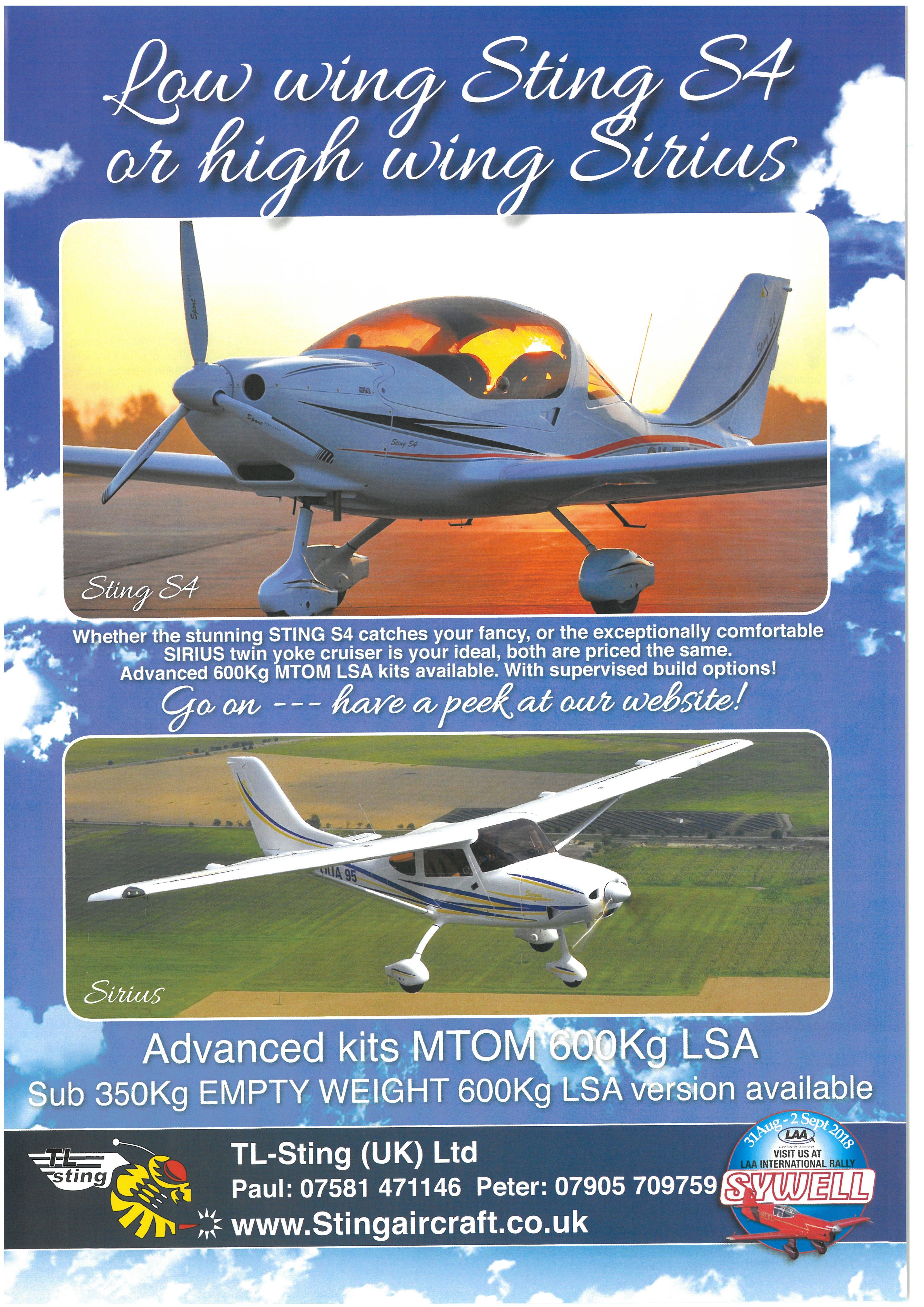
ee ewunningSTINGS4catchesyourfancy,ortheexceptionallycomfortable
‘4g SIRIUStwin yoke cruiser is your ideal,both arepricedthe same.
‘Advanced 600Kg MTOM LSA kits available. With supervised build options!
ell, the Summer Solstice is only a few weeks away on. There are no less than eight aircraft featured in this month’s Cleared to Fly list, all of which have gained that coveted Test Permit, and they represent a true cross-section of LAA types.
Tim Hardy wrote a very good article in the April 2016 edition of LA, about taking a South African flying holiday in a Sling aircraft. He was so impressed with the type that he purchased the empennage kit. Two years on, Tim now reports on the completion and test-flying of the resultant aircraft. That isn't a bad timeframe for a type which is new to the LAA.
lan Coates comments on the highs and lows of building his flat-pack Van’s RV-7,the completion of which sometimes seemed a longwayoff.AndSteveAllenrecountsthetale of the build of his Pioneer P300 Hawk, which he'll be using as the demonstrator for the UK’s new Alpi agents, Cavendish Aviation Ltd.
I'm very grateful to all those members who continue to make submissions, both big and small, to Project News. We all want to see what other members are up to and no two projects are ever the same, so please do get in touch and tell your story, report a milestone or just send a picture by emailing projectnews@laa-archive.org.uk
about the Sling range of aircraft for LA in an article entitled Caution Zebras!, following a visit to meet the team at The Airplane Factory (TAF) in Johannesburg, South Africa, back in early 2016. | now find myself following up on my closing remark in the article as | had, by then, placed an order for an empennage kit.
Much has happened in the intervening two years not only have | built, completed and flown my aircraft, the first two-seat Sling in the UK, but I’ve also travelled to South Africa and Nambia to fly some more examples of the type, participated in the seven-day build of the Sling 4 at the 2016 LAA Rally, and become the UK distributor for TAF!
So, about my aircraft it’s a two-seat, all-aluminium, blind-riveted airframe with a Rotax 914 UL engine, an Airmaster constant-speed propeller and a Garmin G8X panel.
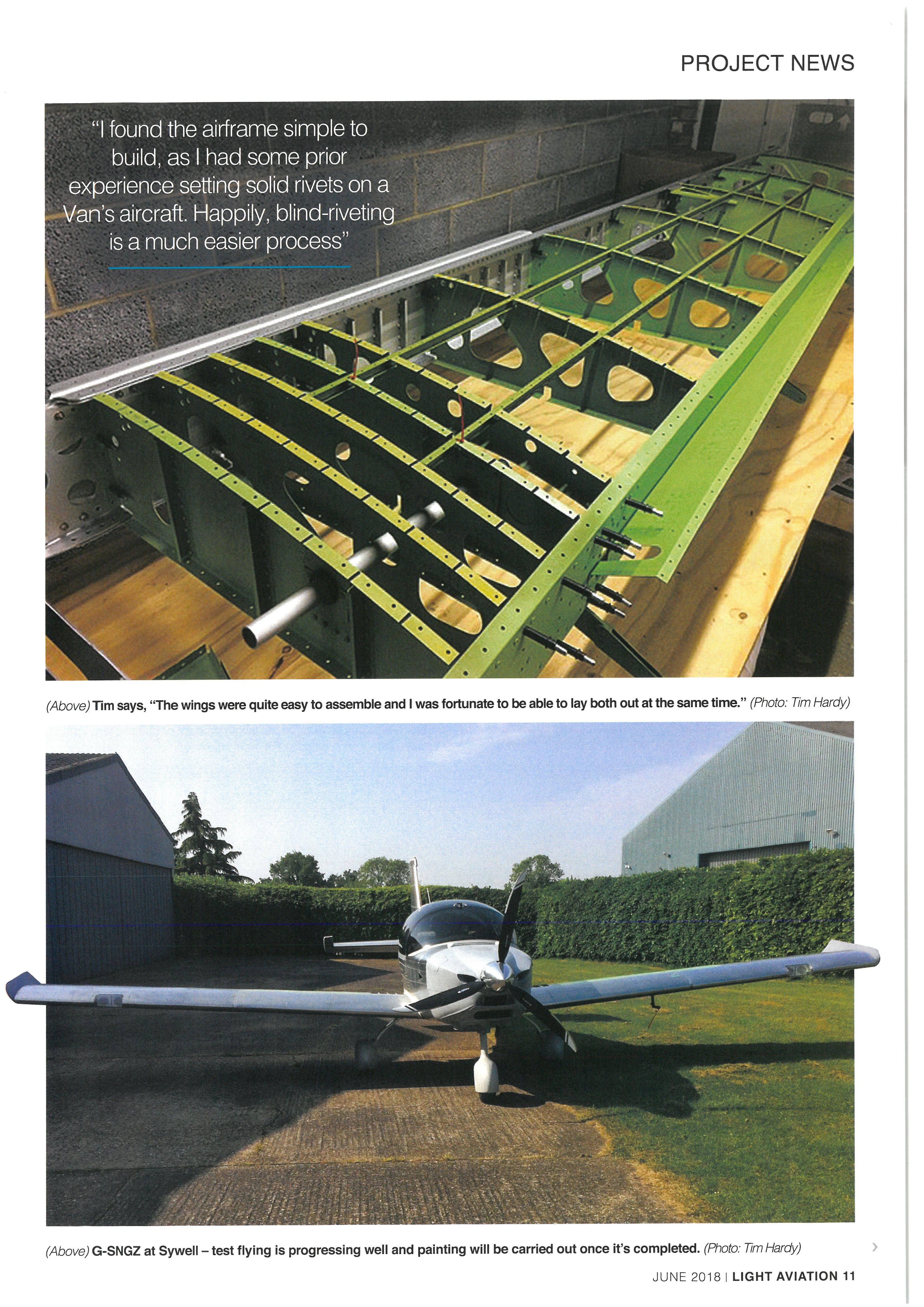
| found the Sling’s airframe simple to build, as | had some prior experience setting solid rivets on a Van’s aircraft. Happily, blindriveting is a much easier process and boasts the appeal of enabling you to complete structures quicker than expected, thus encouraging the builder through sheer momentum. It also helps that you have to try hard to mis-pull a blind rivet, whereas it’s all too easy to make mistakes with the solid type.
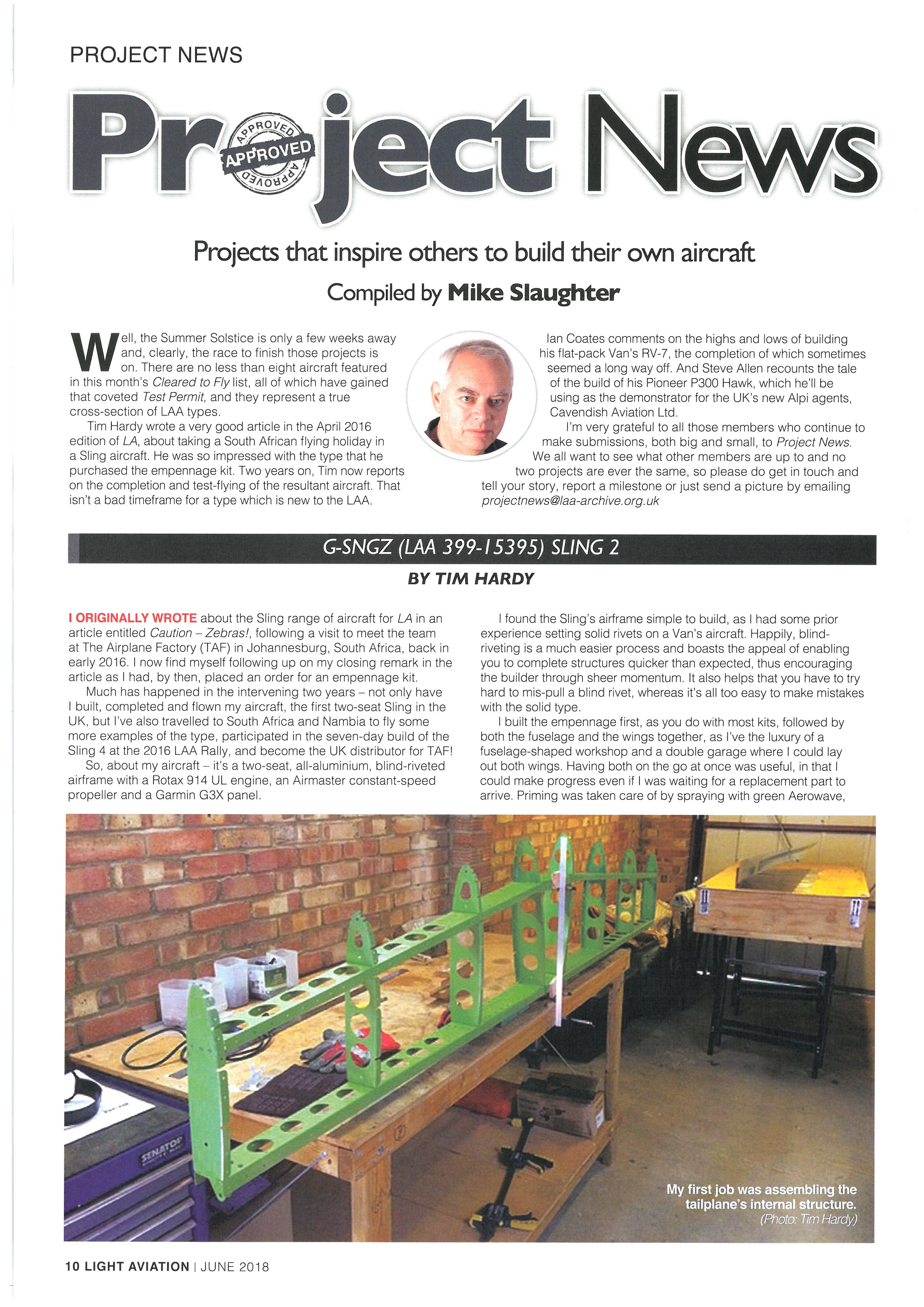
| built the empennage first, as you do with most kits, followed by both the fuselage and the wings together, as I’ve the luxury of a fuselage-shaped workshop and a double garage where | could lay out both wings. Having both on the go at once was useful, in that | could make progress even if | was waiting for a replacement part to arrive. Priming was taken care of by spraying with green Aerowave,
(Above)Tim says, “The wings were quite easy to assemble and |was fortunate to be able to lay both out at the same time.” (Photo:TimHardy)
(Above)“The rear section in my workshop which, happily, is ‘fuselage-shaped’!” (Photo:TimHardy)
following a suggestion by my LAA Inspector, Adam Lewis. | found the process of applying it very doable and the end result very durable.
In January 2017, the engine was hung and that was followed by a lot of head-scratching as to where all the wiring went! At that time, being accustomed to more traditional engines, the Rotax seemed complicated.However,once|learnedtofocusononethingata time, it all came together, with some help from the factory about wiring allocations and so on.
Following that, the propeller and spinner-flange were mounted, and then used to reference the fitting of the engine cowlings. That certainly wasn’t my favourite task but it was one which, like all things building-wise, I'll be able to do more easily the next time around.
Although|like tothinkoftheairframeasbeingeasytobuild,|must confess to making a very stupid mistake on the fuel tanks. For some inexplicable reason, | managed to rivet both filler rings to the outside of the tank, rather than the inside. By the time | realised what I'd done, the Proseal had taken hold, so | decided to start all over again. These tanks are now stored in what someone coined my ‘attic of shame’, the only comfort | have is that they're the space’s sole occupants from my build!
September 2017 saw my completed aircraft at the LAA Rally, alongside Lucien d’Sa’s Sling 4 from the previous year. The past six months or so have been taken up with the myriad details necessary to prepare for G-SNGZ’s first flight, as well as a further trip to South Africa of course, while suffering the UK’s appalling winter weather.
At the time of writing, I’ve taken advantage of the recent CAVOK conditions and launched seven flights, with more to come, to test all of the various aspects of aircraft and its navigational performance,
from a flat-pack kit and the process has taken four-and-a-half years. There have been many highs and lows during the course of the build process, with some of the construction seeming to flow very easily, while other portions proving to be a significant challenge.
Before | started, I’d read that the builder shouldn’t underestimate the time and energy required to complete a project, and |’d fully agree that it became all-consuming. At times, it seemed that completion was so far in the distance that it'd never be achievable.
| really need to thank my partner, Helen, and the rest of the family for their help in setting those rivets which are too hard to reach on your own. Their support while | was locked in the workshop or engrossed in research on the internet, trying to figure out the best approach for a particular build stage, was fantastic. I’ve also received great encouragement and assistance from my LAA Inspector, Neil France, who was only a phone call away if | needed him.
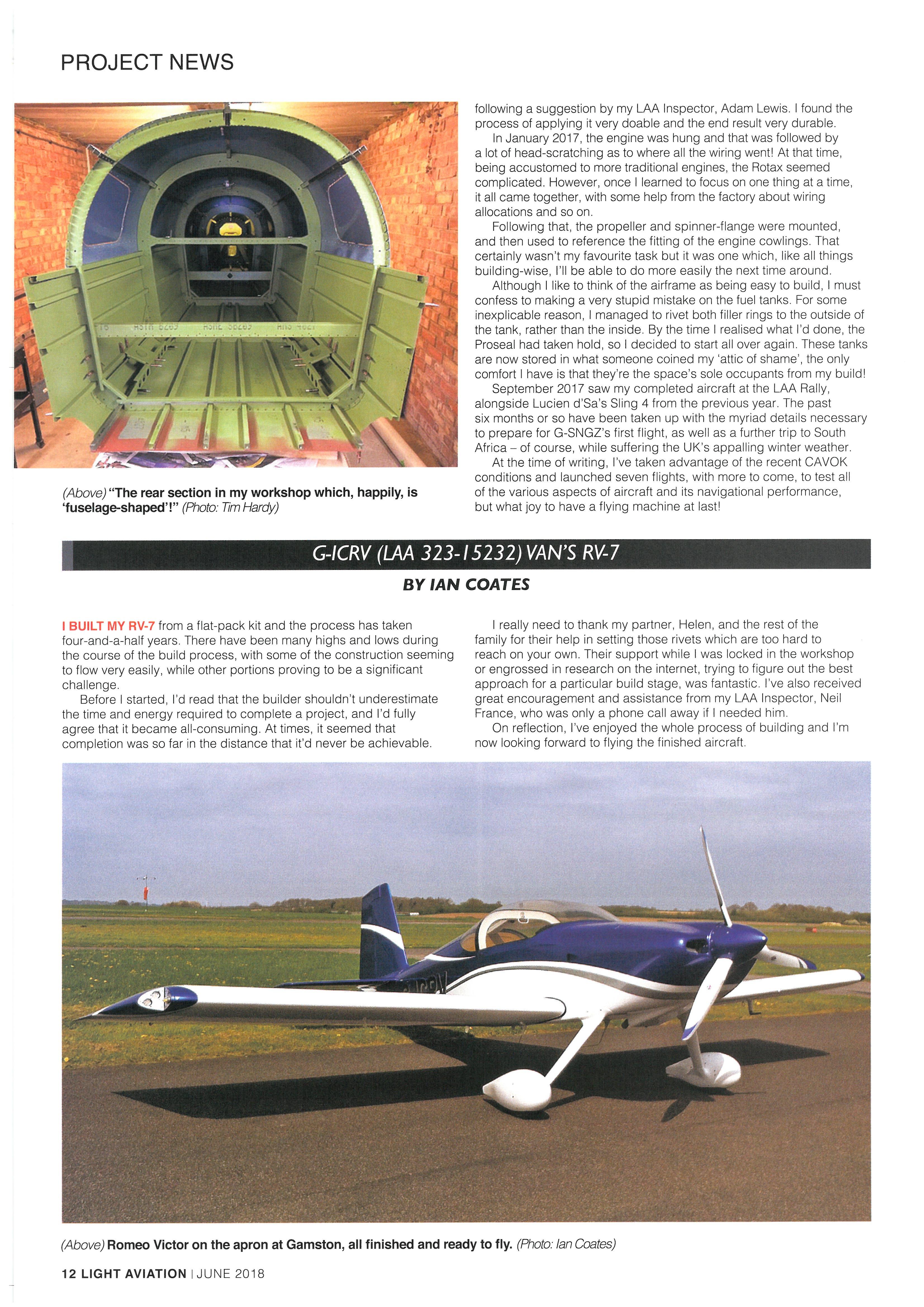
(Above)Romeo Victor on the apron at Gamston, all finished and ready to fly. (Photo:lanCoates)
On reflection, I’ve enjoyed the whole process of building and |’m now looking forward to flying the finished aircraft.
PROJECT NEWS
STEVE HAS BUILT Lima Papa as the company’s new Pioneer 300 Hawk demonstrator. She’s a complex aircraft with variable-pitch propeller, a retractable undercarriage and the benefit of a Rotax 912iS engine. No P300 builds have been started in the UK for nearly five years and there are a number of differences over past models, so she’s virtually been treated as a new type. Among the many improvements areanew,sculptedcarbon-fibreinstrumentpanelandataller canopy.
The performance of the Hawk has been described as being fighter-like, and akin to how people used to speak about flying the Spitfire the aircraft being worn or put on like a pair of personal wings —which is a big claim. From similar models that Steve's flown, she’s expected to cruise in the region of 130kt.
Empty, Lima Papa tips the scales at 358kg and she currently has an mtow of 560kg, but Cavendish Aviation is hoping to increase this to 600kg. She features a glass cockpit, which includes an Avmap GPS and engine-monitoring system, with a fallback suite of conventional ‘steam’ instruments.
The Alpi Pioneer is a wooden-framed aircraft with a composite skin, the outer surface being finished at the factory, to a professional quality which would be hard for a homebuilder to match. Like so many modern kits, the airframe components come well advanced, leaving the builder to complete them, install the engine, and avionics and upholstery, along with undertaking general finishing tasks.
Steve is trying to build the Alpi brand here in the UK and has had type fly-ins at his home airfield of Earls Colne, Colchester. To make the aircraft more attractive, in the UK, Alpi intends to sell the kits in stages so it'll be possible for builders to stagger their expenditure, starting with just the empennage, then purchasing the fuselage and wings separately.
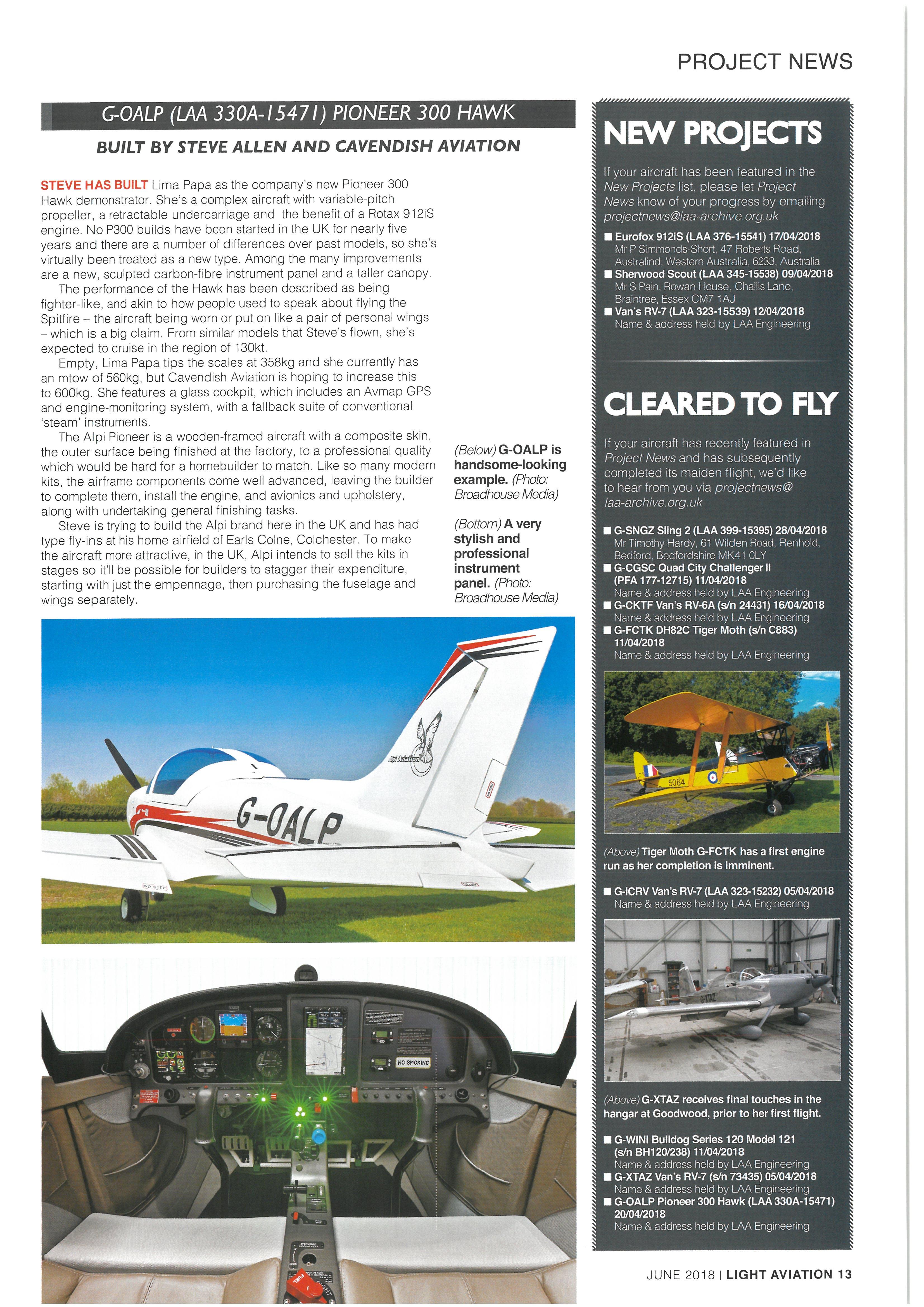
(Below)G-OALP is handsome-looking example. (Photo: BroadhouseMedia)
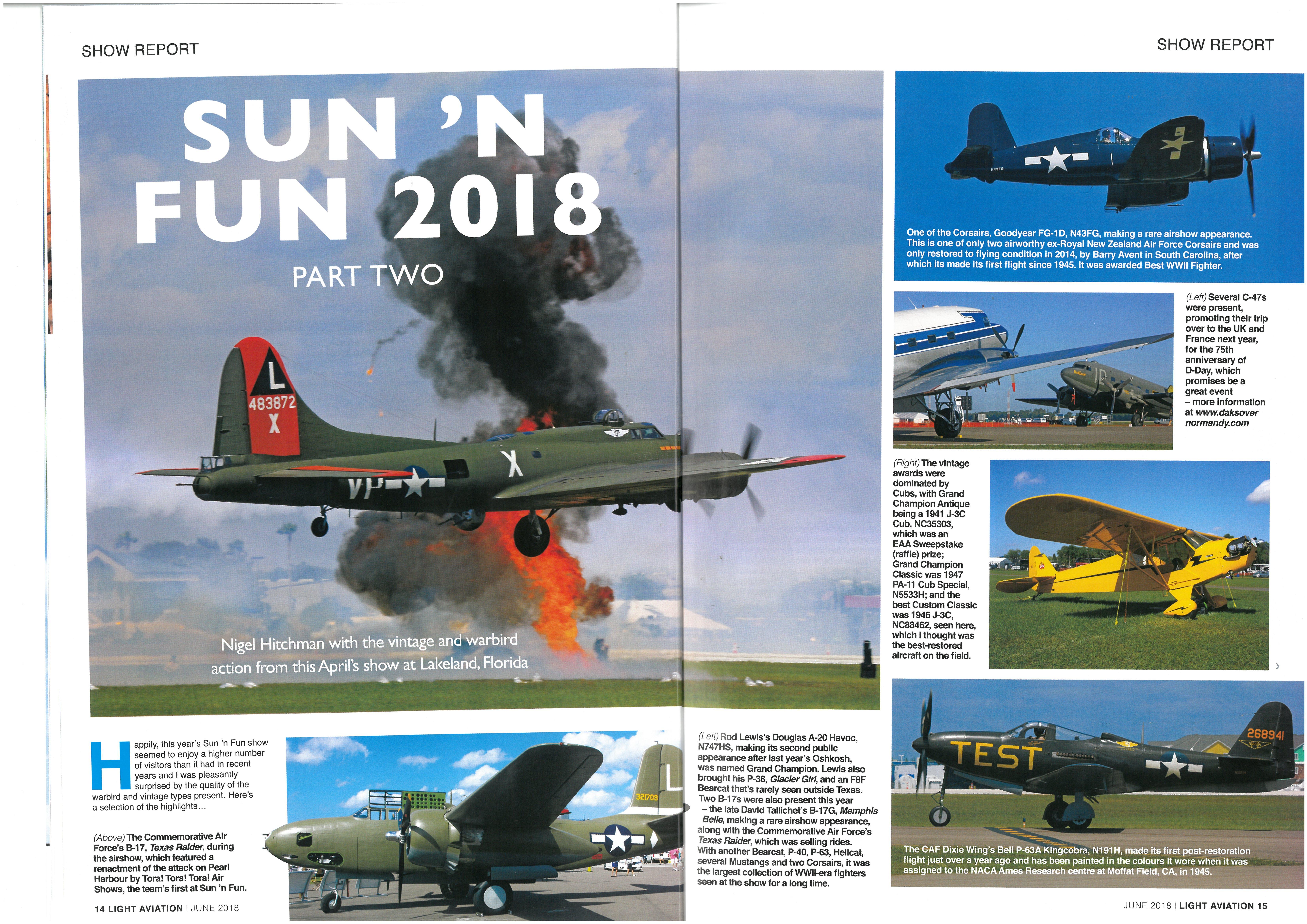
(Bottom)A very stylish and professional instrument panel. (Photo: BroadhouseMecaia)
lf your aircraft has been featured in the New Projects list, please let Project News know of your progress by emailing projectnews@laa-archive.org.uk
@Eurofox 912iS (LAA 376-15541) 17/04/2018
Mr P Simmonds-Short, 47 Roberts Road, Australind, Western Australia, 6233, Australia
lf your aircraft has recently featured in Project News and has subsequently completed its maiden flight, we'd like to hear from you via projectnews@ laa-archive.org.uk
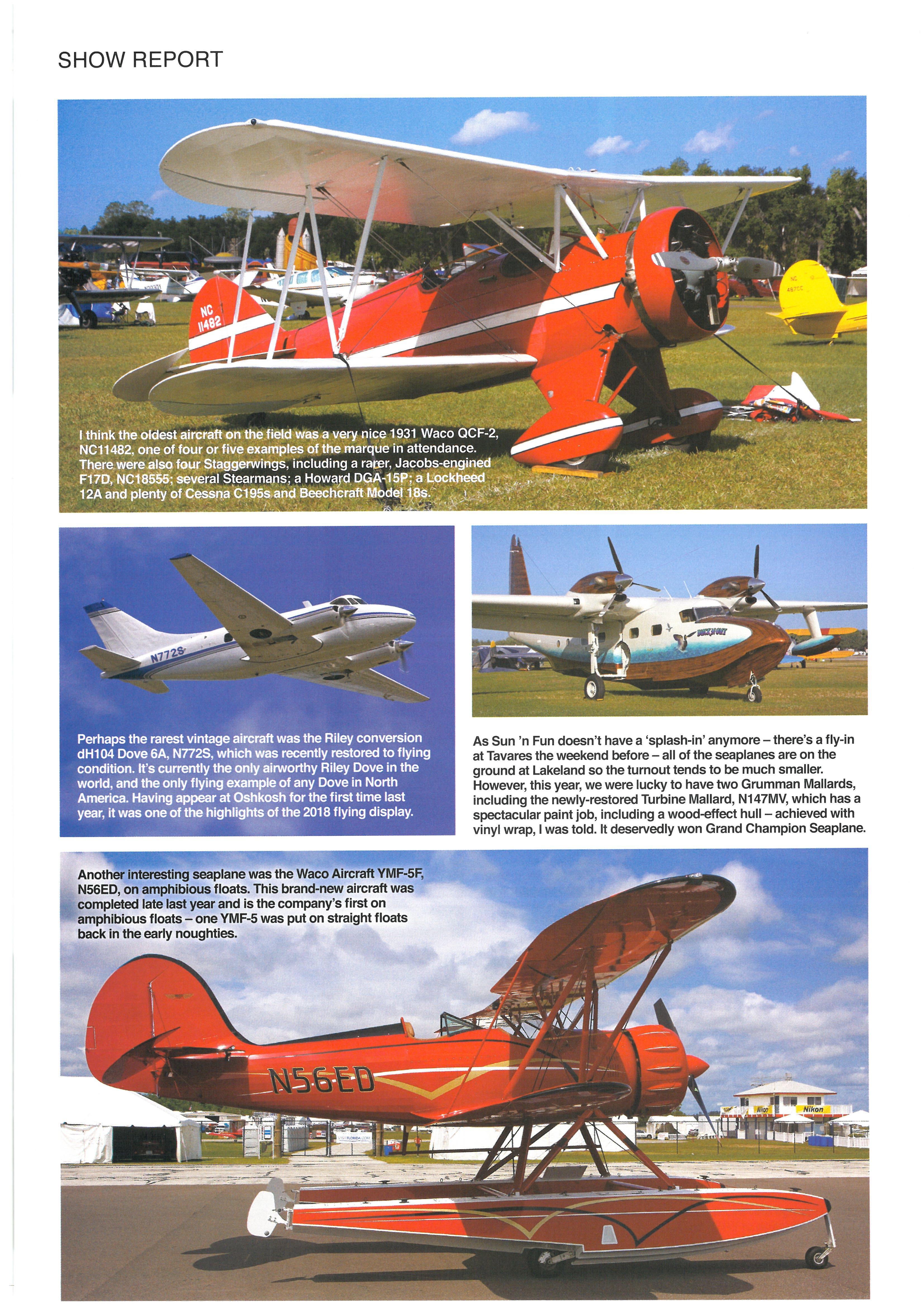
appily, this year’s Sun ’n Fun show seemed to enjoy a higher number of visitors than it had in recent years and | was pleasantly surprised by the quality of the warbird and vintage types present. Here’s a selection of the highlights...
(Left)Several C-47s were present, promoting their trip over to the UK and France next year, for the 75th anniversary of D-Day, which promises be a great event more information at www.daksover normandy.com
(Right)The vintage awards were dominated by Cubs, with Grand Champion Antique being a 1941J-3C Cub, NC35303, which was an EAASweepstake (raffle) prize; Grand Champion Classic was 1947 PA-11Cub Special, N5533H; and the best Custom Classic was 1946 J-3C, NC88462, seen here, which |thought was the best-restored aircraft on the field.
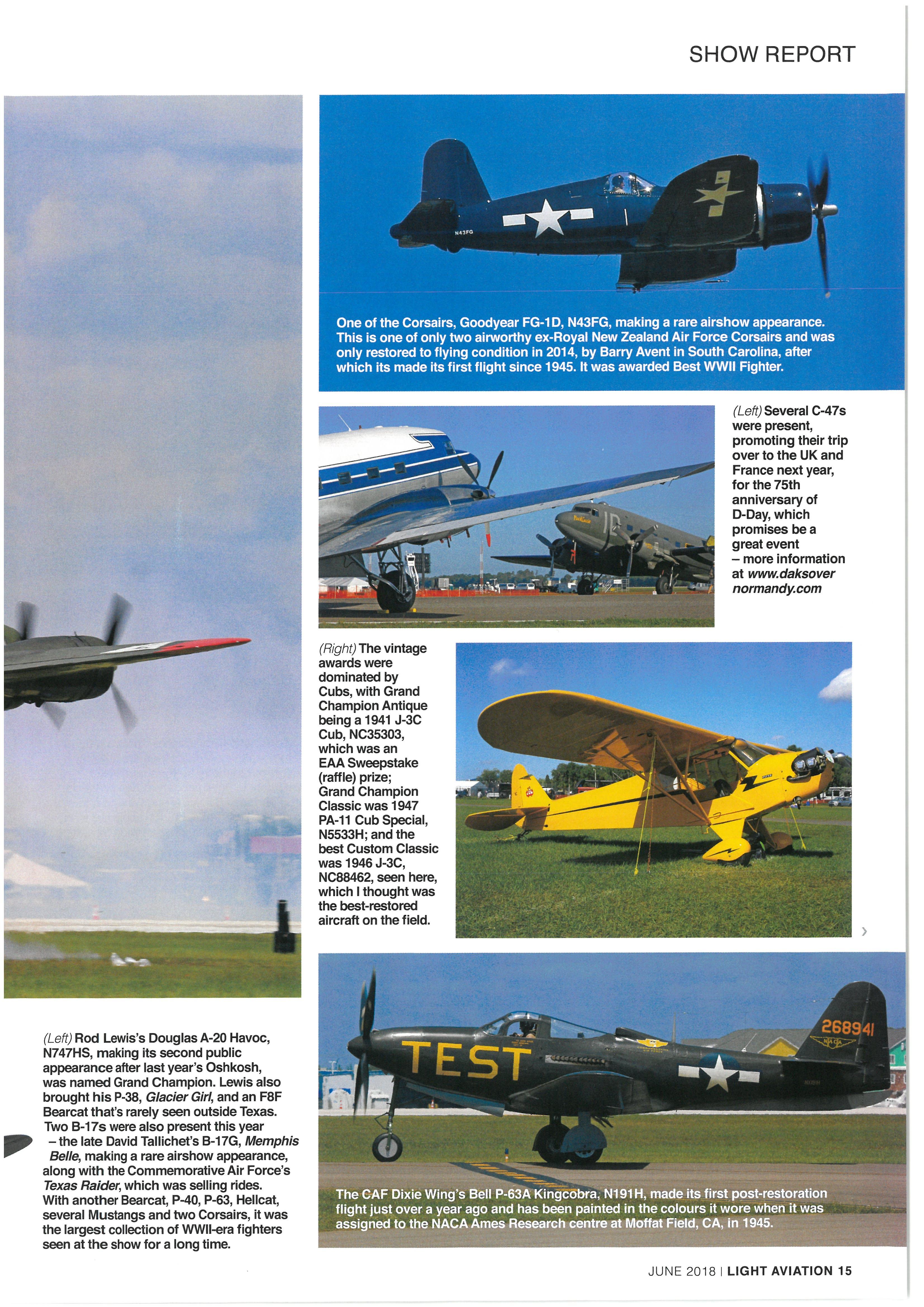
(Left)Rod Lewis’s Douglas A-20 Havoc, N747HS,making its second public appearance after last year’s Oshkosh, was named Grand Champion. Lewis also brought his P-38,Glacier Girl,and an F8F Bearcat that’s rarely seen outside Texas. Two B-17s were also presentthis year the late David Tallichet’s B-17G, Memphis Belle, making a rare airshow appearance, along with the Commemorative Air Force’s Texas Raider, which was selling rides. § several Mustangs and two Corsairs, itwas flight just over a year ago and has been painted in the colours it wore when itwas seen at the show for a long time.
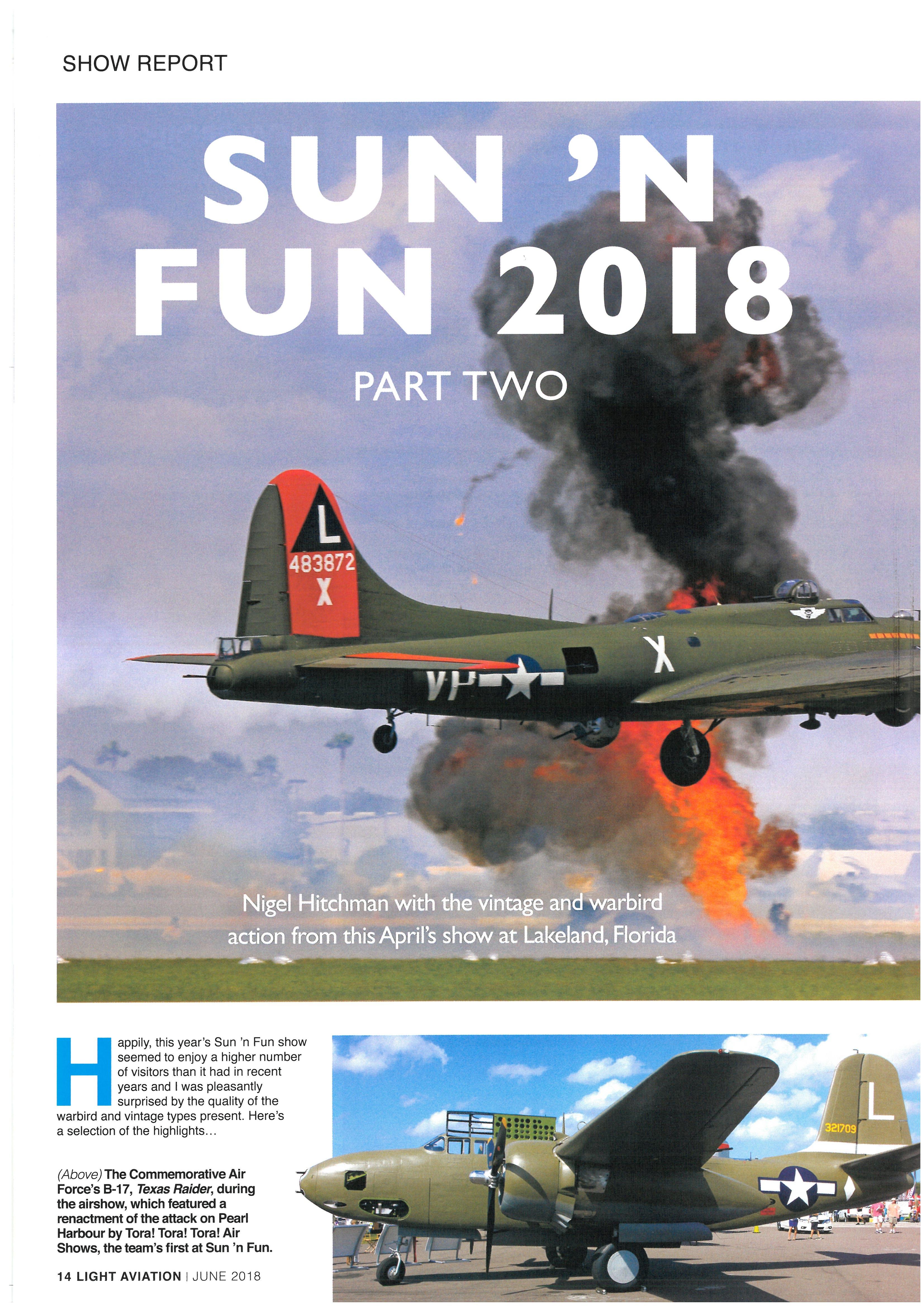
(Above)The Commemorative Air * Force’s B-17, Texas Raider, during the airshow, which featured a renactment of the attack on Pear! Harbour byTora! Tora! Tora! Air Shows, the team’s first at Sun ’n Fun.
| appily, this year’s Sun ’n Fun show |) seemed to enjoy a higher number _ of visitors than it had in recent | years and | was pleasantly l@ surprised by the quality of the warbird and vintage types present. Here’s a selection of the highlights...
(Above) The Commemorative Air Force’s B-17, TexasRaider, during the airshow, which featured a renactment of the attack on Pearl Harbour by Tora! Tora! Tora! Air Shows, the team’s first at Sun ’n Fun.
(Left) Rod Lewis’s Douglas A-20 Havoc, N747HS, making its second public appearance after last year’s Oshkosh, was named Grand Champion. Lewis also brought his P-38,Glacier Girl, and an F8F Bearcat that’s rarely seen outside Texas. Two B-17s were also present this year
Belle, making a rare airshow appearance, along with the Commemorative Air Force’s Texas Raider, which was selling rides. With another Bearcat, P-40, P-63, Hellcat, several Mustangs and two Corsairs, it was the largest collection of WWll-era fighters seenattheshowforalongtime.
(Right)The vintage awards were dominated by Cubs, with Grand Champion Antique being a 1941 J-3C Cub, NC35303, which was an EAA Sweepstake (raffle) prize; Grand Champion Classic was 1947 PA-11Cub Special, N5533H; and the best Custom Classic was 1946 J-3C, NC88462, seen here, which | thought was the best-restored aircraft on the field.
(Left)Several C-47s were present, promoting their trip over to the UK and France next year, for the 75th anniversary of D-Day,which promises be a great event more information at www.daksover normandy.com
AsSun’nFundoesn’thavea‘splash-in’anymore there’safly-in at Tavares the weekend before all of the seaplanes are on the ground at Lakeland so the turnout tends to be much smaller. However, this year, we were lucky to have two Grumman Mallards, including the newly-restored Turbine Mallard, N147MV,which has a spectacular paint job, including a wood-effect hull achieved with vinyl wrap, |was told. It deservedly won Grand Champion Seaplane.
Another interesting seaplane was the Waco Aircraft YMF-5F, N56ED,on amphibious floats. This brand-new aircraft was completed late last year and isthe company’s first on amphibious floats —-one YMF-5was put on straight floats back in the early noughties.
Martin Ferid heads to the beautiful Medieval in he ion irepo ie reg fied) town of M partement of southwestern itan
’ (fort exo tide dé France'sgloriousOcc ‘bas aatsWag
ne of the things about piloting small aircraft is that, depending on what kind of flying you do, you tend to bump into the same people in different places.
‘Social’ pilots can be found at all the gettogethers, ‘local’flyers know everyone at two or three airfields in their area, and ‘tourers’ meet sporadically at fly-ins at far flung places. There’s also another category of pilot, those with ‘Captain Kirk’ syndrome, who try to seek out new places, attempting to go “Where No Man Has Gone Before”. | guess, to varying degrees, we all have aspirations of doing what Manuel Queiroz successfully completed some years ago he sold his share in a Jodel, bought and modified an RV and flew it around the world (then wrote a book about it, Chasing the Morning Sun Ed). A feat such as Manuel’swould’vetakenmealifetime to complete as I’d have wanted to thoroughly explore each new place and meet the locals!
HEADING SOUTH...
Well, it may only be in France, but it’s time to blow the lid on Mirepoix, as it certainly isn’t on the ‘usual suspects’ list, as far as aviators are concerned. As part of this series of articles, lve tried to cover interesting destinations and fly-ins, most of which are well within the capabilities of the average PPL-holder.
However, the southwestern town of Mirepoix, which is situated in the Ariege départementoftheOccitanieregion,near the border withLanguedoc-Roussillon and between Carcassonne and Foix, is aimed at the confident tourer or more adventurous novice. Not that the flying is different in any way, just that instead of going around ina circle for an hour or so, you have to go in straight lines for several hours at a time.
For many pilots it’s the fear of the unknown that’s the biggest hurdle, especially if your ‘spirit for adventure’ doesn’t manage to push it aside. At 90kt the journey to Mirepoix takes about six hours from the southeast coast of England, so the reality is that you may well cross several weather systems, unless you're flying on one of the rare occasions where high pressure dominates the whole of the route. From the very north of France to its extreme
(Oppositepage) Construction started on the Cathédrale Saint-Maurice de Mirepoix in 1298 and then continued, on and off, for another six centuries. It boasts the second widest Gothic arch in Europe.
(Photo:Martin Ferid)
south there can be several changes in conditions and in the times I’ve flown down to the the bottom of /’Hexagone (the Hexagon), as the country is often known, I’ve learnt that you have to be flexible.
When it comes to flying further afield, we all startoffwithalittle toe-dippingandoneofthe major concerns when making the transition from ‘local’ pilot to ‘intrepid tourer’ is the radio, which is strange, as mostly everywhere except for the smaller airfields speaks to us in English. Just spare a thought for the poor overseas pilots who can't fly beyond their borders without having to conduct their RT in English to at least Level 4. Is it any wonder that we see so few overseas-registered aircraft touring the UK, or could it be vagaries of our weather and the complexity of our airspace which puts them off?
Well, maybe not the latter because the last of the main hurdles when looking at the French charts is the airspace and military corridors, which may well appear complex but in truth simply aren't. Firstly, the military tend to shut down on a Friday from about midday until the following Monday morning, and secondly French ATCs will tell you what is and isn't active at any given time, if your GPS doesn't do the job for you. There’s also a dedicated website where you can check the activity of military zones, using ABZA charts, namely www.sia.aviation-civile.gouv.fr/schedules
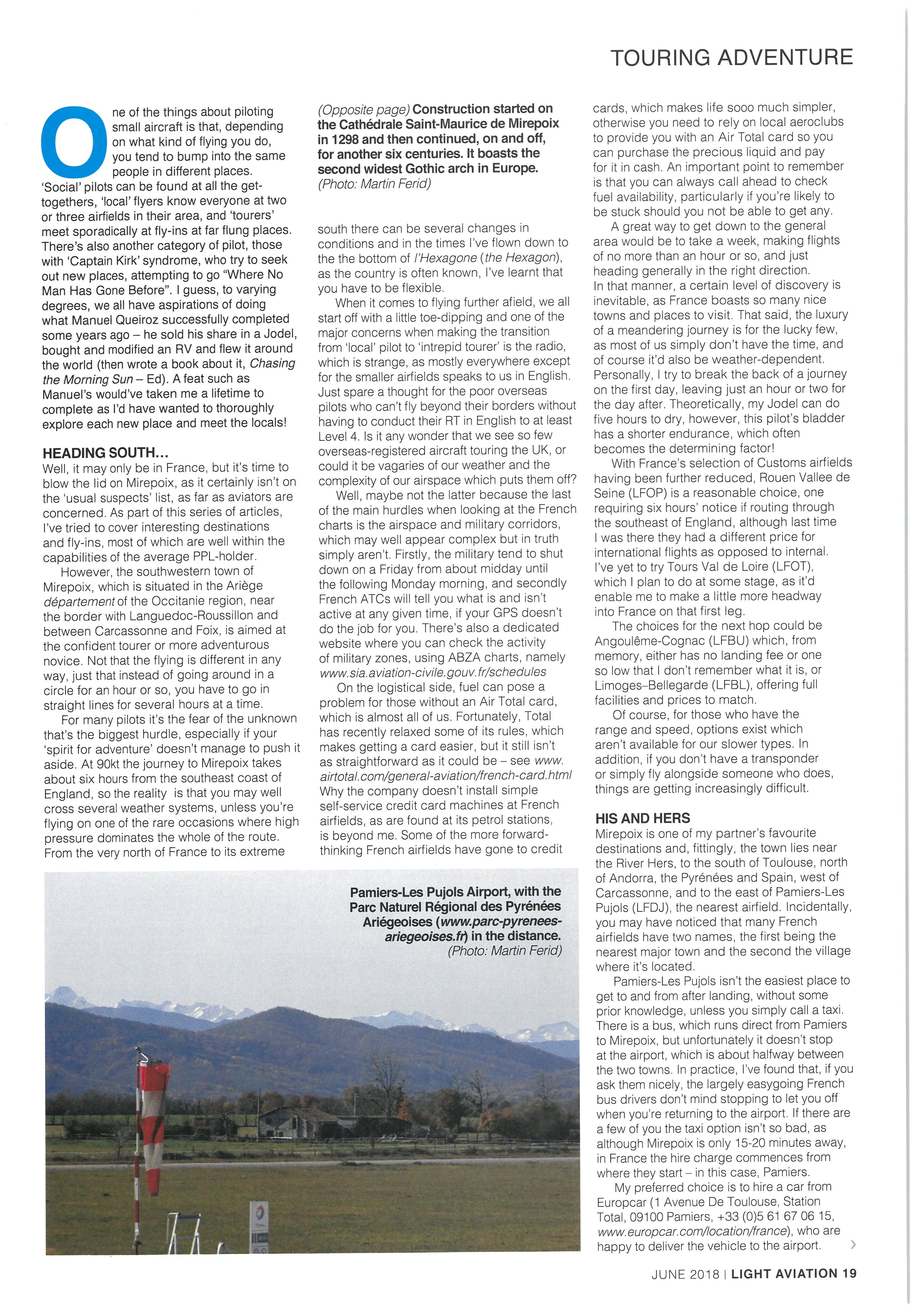
On the logistical side, fuel can pose a problem for those without an Air Total card, which is almost all of us. Fortunately, Total has recently relaxed some of its rules, which makes getting a card easier, but it still isn’t as straightforward as it could be see www. airtotal.com/general-aviation/french-card.html Why the company doesn’t install simple self-service credit card machines at French airfields, as are found at its petrol stations, is beyond me. Some of the more forwardthinkingFrenchairfieldshavegoneto credit Pamiers-LesPujolsAirport, with the ParcNaturelRégionaldes Pyrénées Ariégeoisesariegeoises.fr(www.parc-pyreneesin the distance. (Photo:MartinFerid)
cards, which makes life sooo much simpler, otherwise you need to rely on local aeroclubs to provide you with an Air Total card so you can purchase the precious liquid and pay for it in cash. An important point to remember is that you can always call ahead to check fuel availability, particularly if you’re likely to be stuck should you not be able to get any.
A great way to get down to the general area would be to take a week, making flights of no more than an hour or so, and just heading generally in the right direction. In that manner, a certain level of discovery is inevitable, as France boasts so many nice towns and places to visit. That said, the luxury of a meandering journey is for the lucky few, as most of us simply don’t have the time, and of course it’d also be weather-dependent. Personally, | try to break the back of a journey on the first day, leaving just an hour or two for the day after. Theoretically, my Jodel can do five hours to dry, however, this pilot’s bladder has a shorter endurance, which often becomes the determining factor!
With France's selection of Customs airfields having been further reduced, Rouen Vallee de Seine (LFOP) is a reasonable choice, one requiring six hours’ notice if routing through the southeast of England, although last time |wastheretheyhada differentpricefor international flights as opposed to internal. I've yet to try Tours Val de Loire (LFOT), which | plan to do at some stage, as it’d enablemeto makealittle moreheadway into France on that first leg.
The choices for the next hop could be Angouléme-Cognac (LFBU) which, from memory, either has no landing fee or one so low that | don’t remember what it is, or Limoges-Bellegarde (LFBL), offering full facilities and prices to match.
Of course, for those who have the range and speed, options exist which aren't available for our slower types. In addition, if you don’t have a transponder or simply fly alongside someone who does, things are getting increasingly difficult.
HIS AND HERS
Mirepoix is one of my partner's favourite destinations and, fittingly, the town lies near the River Hers, to the south of Toulouse, north of Andorra, the Pyrénées and Spain, west of Carcassonne, and to the east of Pamiers-Les Pujols (LFDJ), the nearest airfield. Incidentally, you may have noticed that many French airfields have two names, the first being the nearest major town and the second the village where it’s located.
Pamiers-Les Pujols isn’t the easiest place to get to and from after landing, without some prior knowledge, unless you simply call a taxi. There is a bus, which runs direct from Pamiers to Mirepoix, but unfortunately it doesn’t stop at the airport, which is about halfway between the two towns. In practice, I’ve found that, if you ask them nicely, the largely easygoing French bus drivers don’t mind stopping to let you off when you're returning to the airport. If there are a few of you the taxi option isn’t so bad, as although Mirepoix is only 15-20 minutes away, in France the hire charge commences from where they start in this case, Pamiers.
My preferred choice is to hire a car from Europcar (1 Avenue De Toulouse, Station Total, 09100 Pamiers, +33 (0)5 61 67 06 15, www.europcar.com/location/france),whoare happy to deliver the vehicle to the airport.
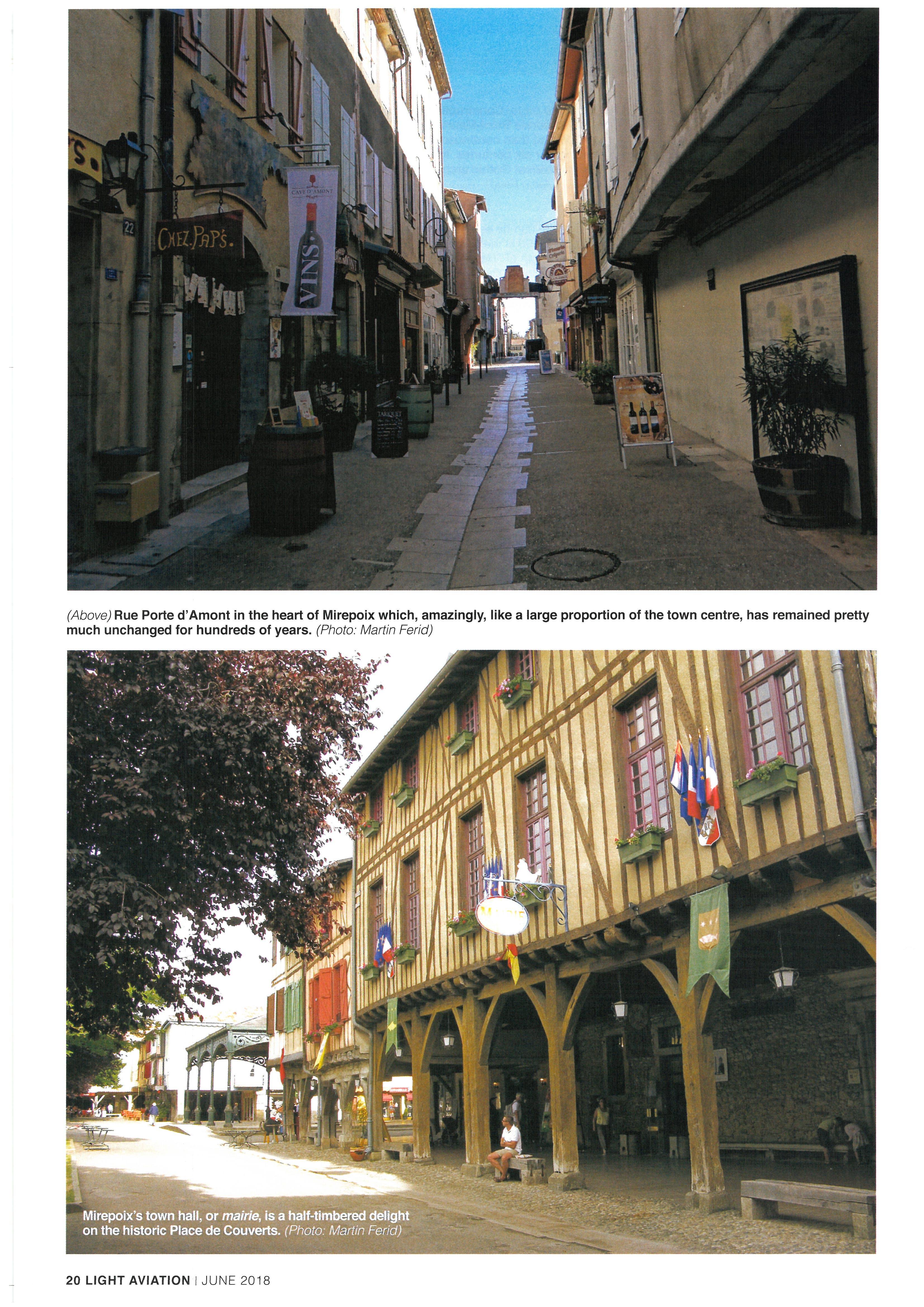
(Above) Rue Porte d’Amont in the heart of Mirepoix which, amazingly, like a large proportion of the town centre, has remained pretty much unchanged for hundreds of years. (Photo: Martin Ferid)
Mirepoix’s town hall, or mairie, isa half-timbered delight on the historic Place de Couverts. (Photo: Martin Ferid)
the France which has
The manager at Pamiers-Les Pujols Airport (3 Route de Pamiers, 09100 Les Pujols, +33 (0)5 61 68 71 43) is a chap named Nicolas Barré who's happy to help in any way he can.
| did mention to Nicolas that, given enough interest,|mayarrange a fly-outtohisfieldand he couldn’t have been more pleased about the idea. In fact, there’s an RSA fly-in at Parmiers in August, which could work well send me an email if you're interested in attending, you'll find my details in the About the Author box at the end of this feature.
On a clear day, there’s an immense sense of satisfaction in tying the aeroplane down after a good flight, with the snow-capped Pyrénées in the background and imposing scenery all around.
For those who love France, the journey from Pamiers-Les Pujols to Mirepoix is equally impressive, especially in a hire car, as you can slow the pace down to match that of the surrounding region.
AN UNTOUCHED GEM
Mirepoix is one of those pleasingly romantic, largely untouched Medieval places that us Brits adore, with a population which has stayed static at around 3,000 for decades.
The town was originally captured in 1209 by Simon V de Montfort and given to one of his lieutenants. Eighty-odd years later, in 1290, it was flooded and rebuilt in its current location, on the opposite side of the Hers River, by Jean de Lévisin.
Unless you're intending to explore the surrounding area, a car is surplus to requirements once you get to Mirapoix as the town can only be explored on foot. Even seeking out all the nooks and crannies should take no more than a few hours.
The foundation stone for the imposing Cathédrale Saint-Maurice de Mirepoix, which dominates the town, was laid by Jean de Lévisin on the 6 May 1298 and it boasts the widest Gothic arch in France, second only to Girona, Spain, in the whole of Europe. The bridge across the Hers River, designed by Jean-Rodolphe Perronet (1708-1794), is quite a feat of engineering, having seven archesandspanning a totalof206metres.
You may not be familiar with the name of ‘Edward of Woodstock’ (15 June 1330 ~ 8 June 1376), who was born in Oxfordshire, the eldest son of King Edward Ill and Philippa of Hainault, but he’s certainly remembered in Mirepoix.
Known as a great English military leader during the Hundred Years War with France, Edward became Prince of Wales and remains of two of the four gates which were built as part of the fortifications erected after his army invaded Mirepoix, to prevent it ever happening again, can still be seen. As Edward’s death preceded his father’s, he never became King and was posthumously given the sobriquet ‘the Black Prince’, either
background colour of his coat of arms.
Hotel prices range from around £50 per night for the charmingly rustic-looking but comfortable Logis Hdtel Le Commerce (20 Cours Docteur Chabaud, 09500 Mirepoix, 33 (0)5 61 68 10 29, www.logishotels.com)to those with a more luxurious feel, such as the Hdtel Les Remparts, 6 Cours Louis Pons Tande, 09500 Mirepoix, +33 (0)5 61 68 12 15, www.hotelremparts.com).
Now when | say a ‘more luxurious feel’, I'm referring solely to the bedrooms don't expect a slicklookingfrontage,reception area or even lifts. The stairs creak and the corridors have a musty aroma found everywhere in ‘Old France’!
CULINARY DELIGHTS
Mirepoix exemplifies the France which has captured the hearts of so many for so long there’s no McDonalds or ‘Just Eat’ delivery service and not even that other British favourite, ‘the curry house’.
A meal at the Logis Hétel Le Commerce is almost a must, particularly for those aviators who recall the Jodel fly-outs to Bernay and the thoroughly enjoyable meals at the Hétel Cheval Blanc d’Angleterre. I’m guessing that Madame, who’s clearly ‘in charge’, has sat in her chair above the reception area, as ‘master of ceremonies’, for the past fifty years or so. I'd think that Madame chose the decor personally when she took over,
TOURING ADVENTURE
possibly from her parents or grandparents in the seventies, and the food hasn’t changed its style and content from the time the recipes were created and passed down through the family. The set-menu cost around €20, with a carafe of wine being approximately €10.
Another favourite, on the other side of town, with more modern decor, is Restaurant Le Grain de Sel (17 Rue Vigarozy, 09500 Mirepoix, +33 (0)5 61 68 30 71)
Do bear in mind that many restaurants in France are only open for lunch on Sundays, although most hotels with restaurants will still serve food in the evening. Wherever you choose to eat, the style of Cuisine is essentially ‘peasant food’ wholesome, filling and copious. There’s no attempt at producing ‘nouvelle cuisine’, either aesthetically or in volume.
Try some of the local specialities, maybe a ‘salade de gésiers’, a warm salad featuring duck and potatoes, or ‘Garbure’, a thick French soup of ham with cabbage and other vegetables, for starters. As far as main courses go, the Cassoulet may say that it’s ‘de Toulouse’, ‘de Castelnaudary or ‘de Carcassonne’, but all the local styles get their name from the ‘cassole’ they're cooked in.
Good alternatives would be Toulouse sausage ‘avec aligot, a creamy dish made with cheese and mashed potato, or ‘magret de canard’, which is duck breast. For desert maybe a ‘croustade aux pommes’, a flaky apple tart, or ‘creme Catalane’, the local creme caramel, and if there’s room for cheese try the Rocamadour, Tomme d'Auvergne or Roquefort. Couple your meal with a bottle of wine from Gaillac, Cahors, Bergerac or Montbazillac, and you'll almost be a local!
TAKE YOUR TIME...
Walking around Mirepoix has to be done at a leisurely pace and certainly not in a rush -it’s a
with all your senses...”
place to savour, not only what you see, but with all your senses. Think Baloo floating down the river in the TheJungle Book, rather than a ‘buzzy bee’ rushing from one place to another.
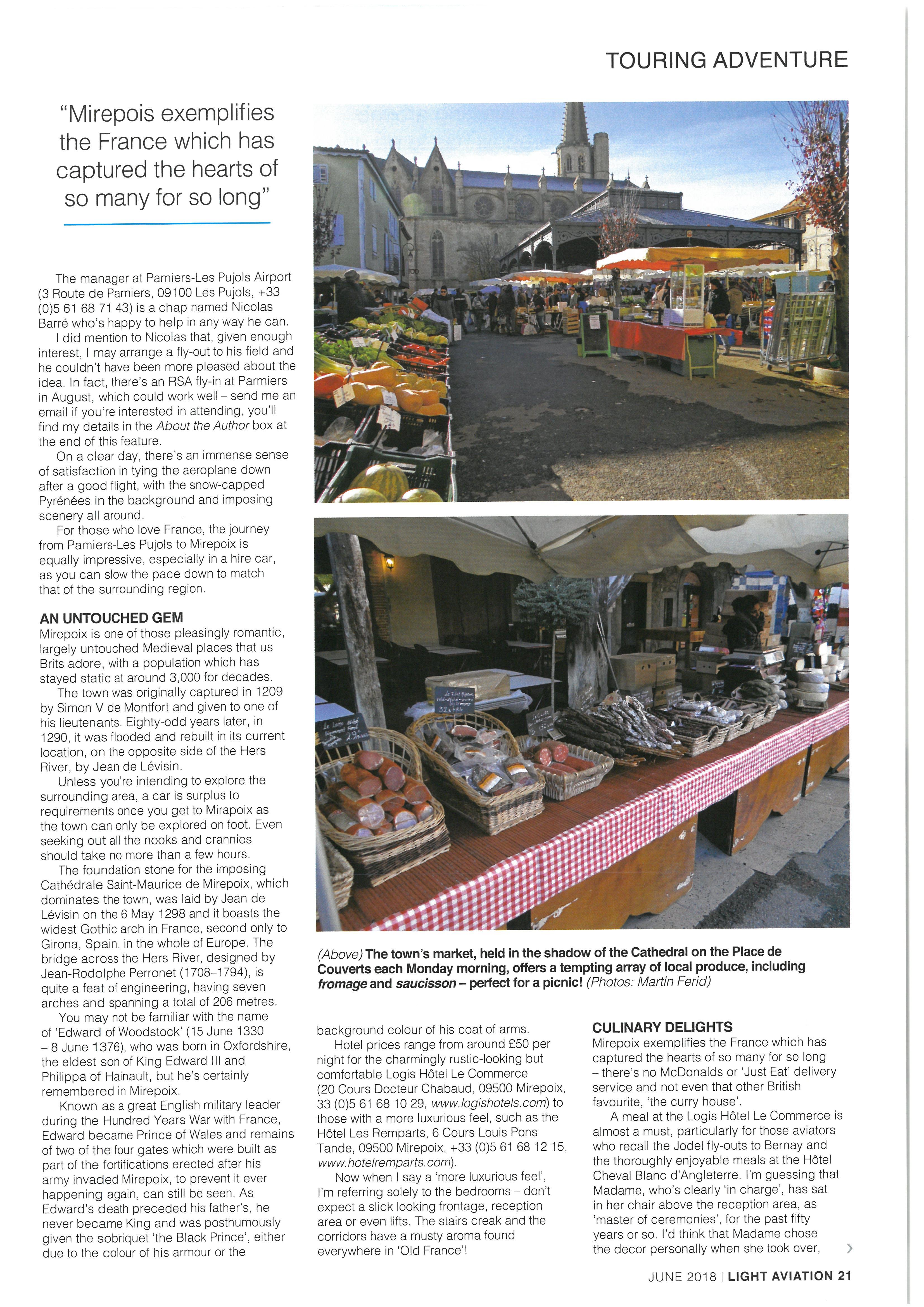
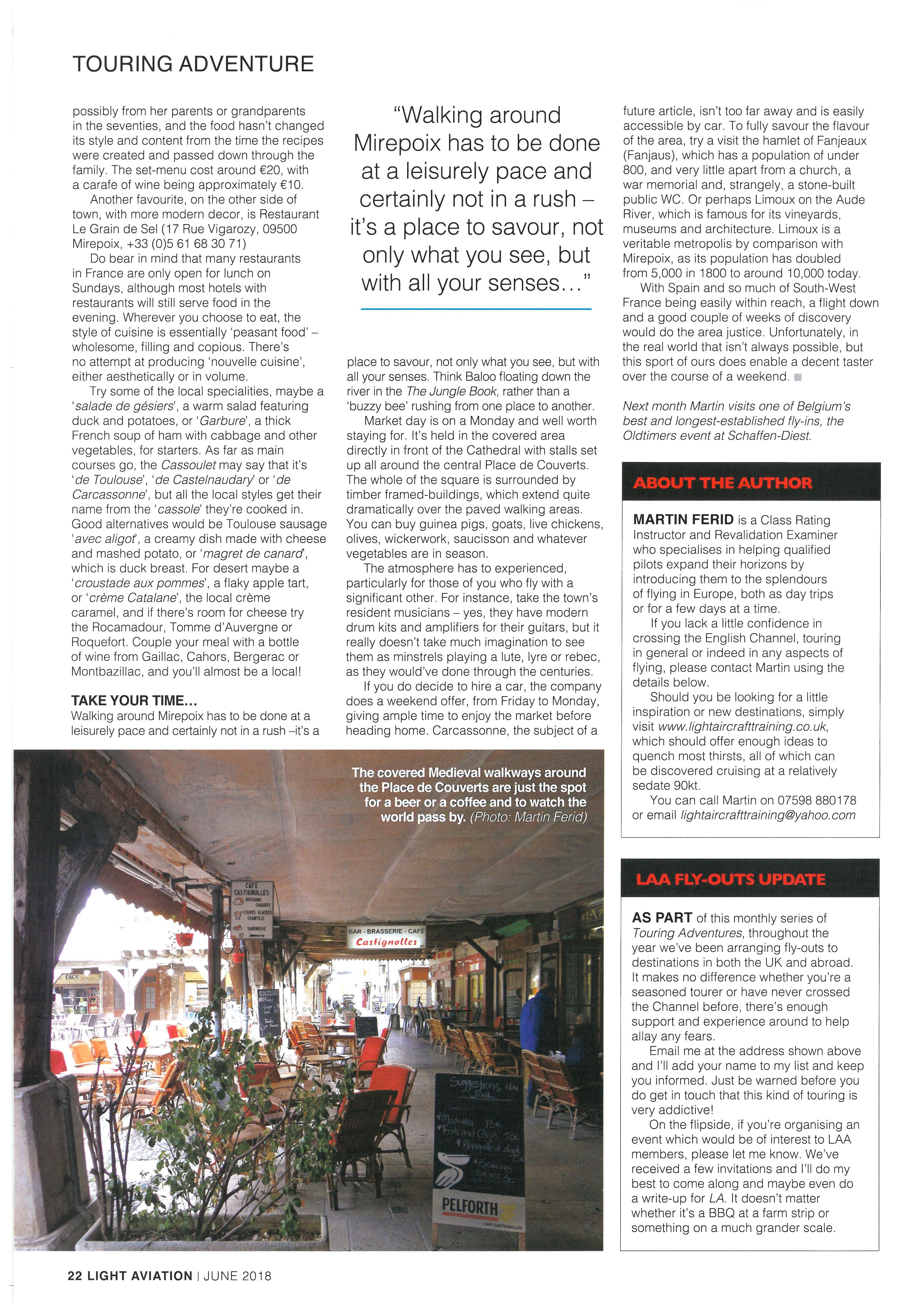
Market day is on a Monday and well worth staying for. It’s held in the covered area directly in front of the Cathedral with stalls set up all around the central Place de Couverts. The whole of the square is surrounded by timber framed-buildings, which extend quite dramatically over the paved walking areas. You can buy guinea pigs, goats, live chickens, olives, wickerwork, Saucisson and whatever vegetables are in season.
The atmosphere has to experienced, particularly for those of you who fly with a significant other. For instance, take the town’s resident musicians yes, they have modern drum kits and amplifiers for their guitars, but it really doesn’t take much imagination to see them as minstrels playing a lute, lyre or rebec, as they would’ve done through the centuries.
If you do decide to hire a car, the company does a weekend offer, from Friday to Monday, giving ample time to enjoy the market before heading home.Carcassonne,the subject of a
The covered Medieval walkways around the Place de Couverts are just the spot for a beer or a coffee and to watch the world pass by. (Photo: Martin Ferid)
future article, isn’t too far away and is easily accessible by car. To fully savour the flavour of the area, try a visit the hamlet of Fanjeaux (Fanjaus), which has a population of under 800, and very little apart from a church, a war memorial and, strangely, a stone-built public WC. Or perhaps Limoux on the Aude River, which is famous for its vineyards, museums and architecture. Limoux is a veritable metropolis by comparison with Mirepoix, as its population has doubled from 5,000 in 1800 to around 10,000 today. With Spain and so much of South-West Francebeingeasilywithinreach,a flightdown and a good couple of weeks of discovery would do the area justice. Unfortunately, in the real world that isn’t always possible, but this sport of ours does enable a decent taster over the course of a weekend.
Next month Martin visits one of Belgium's best and longest-established fly-ins, the Oldtimers event at Schaffen-Diest. ABOUT THE AUTHOR
MARTIN FERID is a Class Rating Instructor and Revalidation Examiner who specialises in helping qualified pilots expand their horizons by introducing them to the splendours of flying in Europe, both as day trips or for a few days at a time.
If you lack a little confidence in crossing the English Channel, touring in general or indeed in any aspects of flying, please contact Martin using the details below.
Shouldyoubelookingforalittle inspiration or new destinations, simply visit www.lightaircrafttraining.co.uk, which should offer enough ideas to quench most thirsts, all of which can be discovered cruising at a relatively sedate 9OKt.
You can call Martin on 07598 880178 or email lightaircrafttraining@yahoo.com
LAA FLY-OUTS UPDATE
AS PART of this monthly series of Touring Adventures, throughout the year we've been arranging fly-outs to destinations in both the UK and abroad. It makes no difference whether you're a seasoned tourer or have never crossed the Channel before, there’s enough support and experience around to help allay any fears.
Email me at the address shown above and I'll add your name to my list and keep you informed. Just be warned before you do get in touch that this kind of touring is very addictive!
On the flipside, if you’re organising an event which would be of interest to LAA members, please let me know. We’ve receiveda fewinvitationsandI'lldomy best to come along and maybe even do a write-up for LA. It doesn’t matter whether it’s a BBQ at a farm strip or something on a much grander scale.
canoften face expensive premium loadings when applying for life cover. . ry we | 07923441269 |
We can usually securestandard | rates with no aviation exclusions.
Nowavailablewithproven 120hp eng
s | uperbDquallitty Kgitwith uilc stopstions eLifeassuranceforyourfamily, Polyhbrecoveringwithfactorypaintfinish.Easyonepersonwingfold | 560kg MAUWwith 270kg pay load mortgage or business
ApprovedwithRotax‘912UL,912ULS,9121S,914ULandnew120HP for | special applications
e We help recreational, commercial, instructor and student pilots
e Cover can be arranged over the phone
e Our insurance advisor holds a PPL
e Online quotes
Quality, Comfor rformance, anew UK choice | ManufacturedinGermany,builtin theUK_EASAPermit,factorybuilt600kgLLSAavailable |
hould you ask a dozen professional painters or homebuilders about what’s the best corrosion-inhibiting paint to use, there’s a good chance you'll get a different answer from each of them. As mentioned previously, it’s important to differentiate between primer and corrosion-inhibiting paint. By definition, primer is a paint used as a go-between to get the top coat ‘finish’ paint to adhere to the metal, while the purpose of corrosion-inhibiting paint is to protect the metal. By themselves, primers are often porous and so aren’t moisture-resistant, therefore it’s imperative to choose the right product for the job.
There’s plenty of information on the internet about types of paint and their uses. In fact, there’s probably too much information, even when you narrow it down to searching for aircraft paints. Some terms for paint types and processes are ‘local’ so what’s called ‘X’ in the UK might well be called ‘Y’ in the rest of the world. Similarly, certain products are available in certain countries but banned in others.
Some primers may well be moisturerepellent, but a careful reading of the paint’s data sheet is required. On the internal structure of the airframe the idea is to protect the metal’s surface from the atmosphere, and there’s rarely an intention (or need) to apply a finish coat to the initial coat. An internal paint finish doesn’t need to be that tough as it'll have minimum contact with anything else during its life, but what it must have is good metal-adherence qualities.
The types of paints favoured by aircraft manufacturers for decades are still preferred by many along the lines of ‘this is what we’ve always used so why change?’ Primers like PR143 are still available and very effective but could be considered heavier, more expensive and ‘complicated’, in that it’s normally applied over an etch primer, PR30B.Consequently, when spraying, you've three ingredients for the etch primer (paint, activator and thinners) and another trio for the epoxy primer top coat. Etch primers, which are also known as wash primer, aren't particularly ‘waterproof’ by themselves so they should ideally be covered over with a waterproof top coat as soon as possible. Moving on from the days of multiple parts to a paint ‘system’, the modern epoxy paints are an easier process in that they’re normally a two-part, or even a single-part paint.
COLOUR & MOISTURE
The choice of paint colour, even for internal surfaces, shouldn't be overlooked. Over the years, aircraft primer’s most common colour has been some form of green mainly because the old varieties were that hue.
The more modern varieties of primers are available in a wide variety of colours, anda lightertonewillmakefutureairframe inspections much easier. However, choosing something other than light grey might be preferable as it can be difficult to distinguish exactly how good the coating is when spraying aluminium, which is effectively the same colour. Ask me how | know...
The Van's quick-build kits are internally painted with a wash primer supplied by Sherwin Williams, namely P60G2. Van's does state that the painting is carried out prior to assembly. The quick-build kits are assembled overseas and the P60G2 used is effectively clear, which in the past has initially caused some builders to doubt whether they’ve actually been primed. Elsewhere in the world, P60G2 has a green tint to it, which makes its use more obvious.
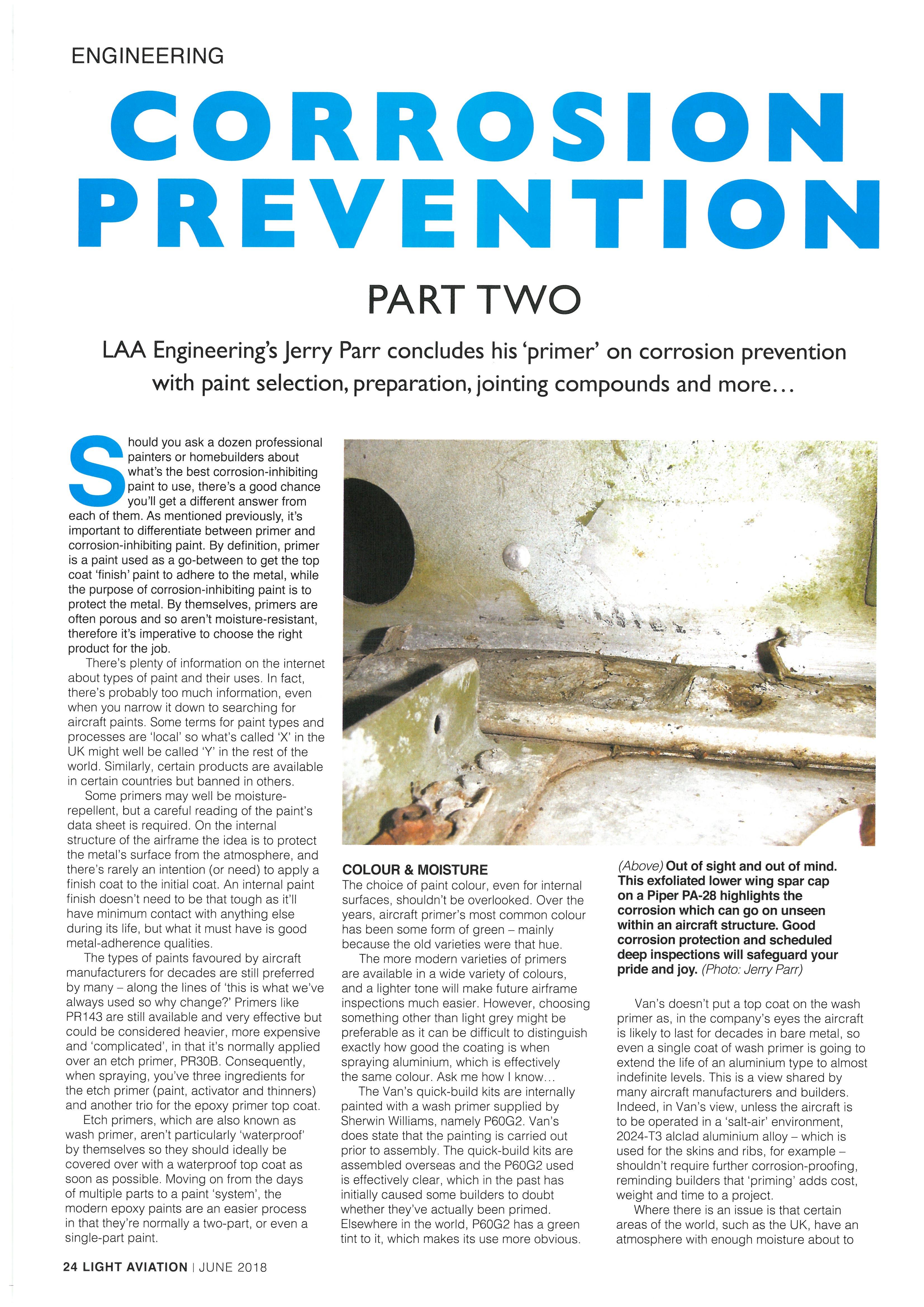
(Above) Out of sight and out of mind. This exfoliated lower wing spar cap on a Piper PA-28 highlights the corrosion which can go on unseen within an aircraft structure. Good corrosion protection and scheduled deep inspections will safeguard your pride and joy. (Photo:Jerry Parr)
Van's doesn’t put a top coat on the wash primer as, in the company’s eyes the aircraft is likely to last for decades in bare metal, so even a single coat of wash primer is going to extend the life of an aluminium type to almost indefinite levels. This is a view shared by many aircraft manufacturers and builders. Indeed, in Van’s view, unless the aircraft is to be operated in a ‘salt-air’ environment, 2024-T3 alclad aluminium alloy which is used for the skins and ribs, for example shouldn't require further corrosion-proofing, reminding builders that ‘priming’ adds cost, weight and time to a project. Where there is an issue is that certain areas of the world, such as the UK, have an atmosphere with enough moisture about to
enable corrosion to appear from the smallest unprotected area. Although this may not be a structuralor terminalissue,it’sveryfrustrating to find corrosion lifting the expensive, shiny top coat after only a few years, which isn't the fault of the builder or the painter who applied the external finish coat. If an airframe was supplied as a quick-build assembly, there isn’t much that can be done to further protect against this happening, apart from regularly applying corrosion inhibitors, as covered later in this article.
SOLVENT- AND WATER-BASED
It’s now a pretty much accepted fact that we must all save the planet and at least one polar bear each. The paint industry’s role in this is, over the past decade, the development of water-based paints, to replace the solventbased variety, especially automotive types, to reduce what's known as the Volatile Organic Compound (VOC) content.
The core composition of the two types of paint are essentially the same and the actual application process for the solvent- and water-based varieties is broadly similar. Both include a pigment to provide colour and a binderto produce a film.Thepigmentsare often the same, but the binders are chemically different the main difference is the carrying agent to get the paint from the gun to the surface. The clue here is in the name. Solvent-based paints use a solvent that’s designed to dissipate over a specific time frame but as it does so releases noxious fumes into the air. The advantage with water-based varieties is that you don’t suffer the noxious fumes, but their drying times are increased, depending on temperature, humidity and the airflow over the painted surface. There have been some additives to water-based paints, to increase performance and reduce drying times, and while these do give off some fumes they aren't as bad as from the solvent-based varieties.
Most car body shops have an oven in which to bake the freshly-applied paint. Unfortunately, this isn’t a luxury afforded to many aviation paint shops, not least because of the size a facility would have to be to bake a complete aircraft, and this is the main reason that aircraft are still painted with solvent-based products.
One issue with the water-based paints is that some consider them not as ‘tough’ as
the solvent-based varieties, and therefore external finish coats need to be protected with a clear coat of lacquer. Unfortunately, water-based clear lacquers haven't proved as successful as the base paints, which has meant that, quite often, a solvent-based clear lacquer is applied over the water-based paint. Normally, the solvent-based and water-based products are compatible.
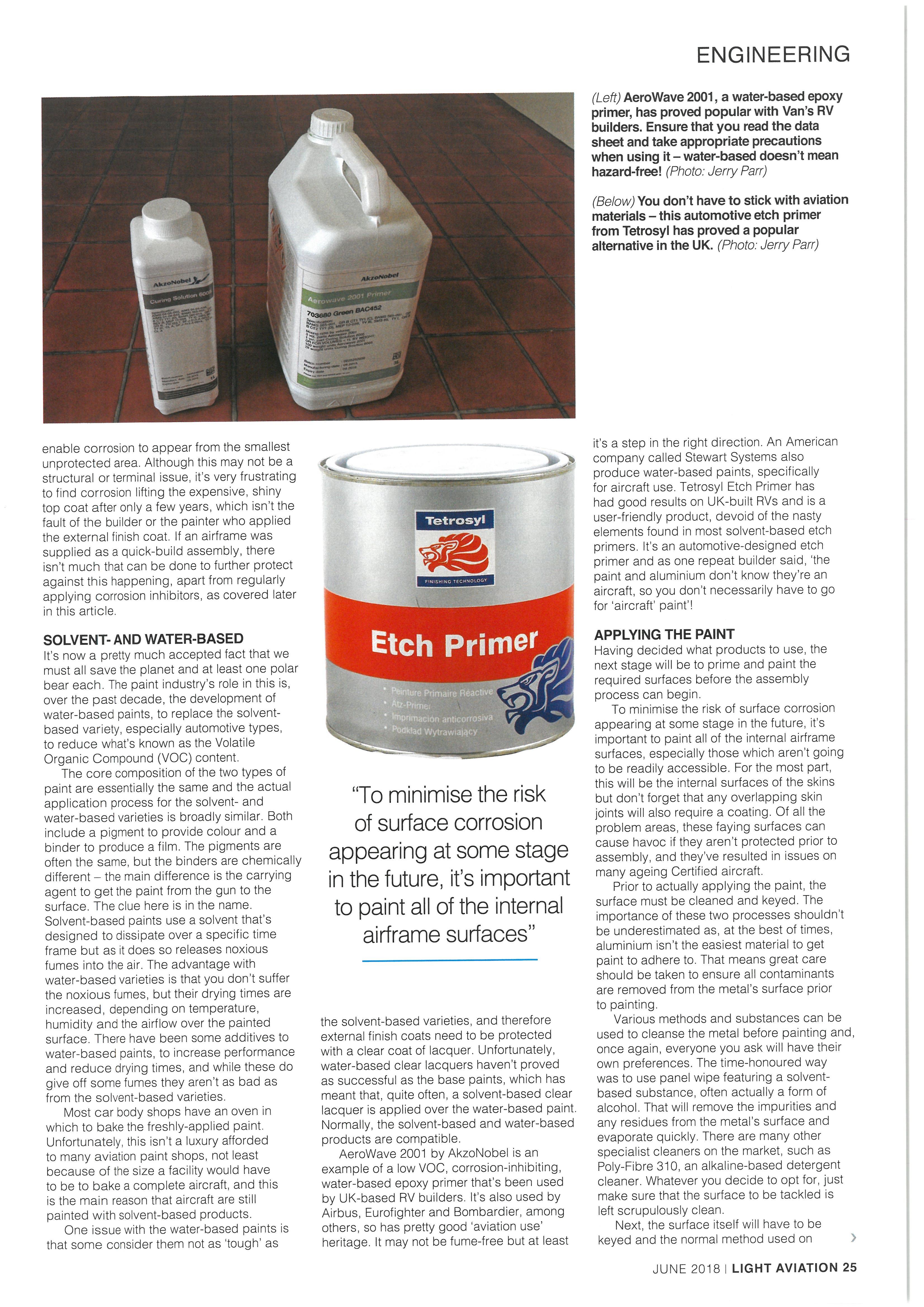
AeroWave 2001 by AkzoNobel is an example of a low VOC, corrosion-inhibiting, water-based epoxy primer that’s been used by UK-based RV builders. It’s also used by Airbus, Eurofighter and Bombardier, among others, so has pretty good ‘aviation use’ heritage. It may not be fume-free but at least
(Left)AeroWave 2001, a water-based epoxy primer, has proved popular with Van’s RV builders. Ensure that you read the data sheet and take appropriate precautions when using it water-based doesn’t mean hazard-free! (Photo:Jerry Parr)
(Below)You don’t have to stick with aviation materials this automotive etch primer from Tetrosyl has proved a popular alternative in the UK. (Photo: Jerry Parr)
it’s a step in the right direction. An American company called Stewart Systems also produce water-based paints, specifically for aircraft use. Tetrosy| Etch Primer has had good results on UK-built RVs and is a user-friendly product, devoid of the nasty elements found in most solvent-based etch primers. It’s an automotive-designed etch primer and as one repeat builder said, ‘the paint and aluminium don’t know they’re an aircraft, so you don’t necessarily have to go for ‘aircraft’ paint’!
APPLYING THE PAINT
Having decided what products to use, the next stage will be to prime and paint the required surfaces before the assembly process can begin.
To minimise the risk of surface corrosion appearing at some stage in the future, it's important to paint all of the internal airframe surfaces, especially those which aren't going to be readily accessible. For the most part, this will be the internal surfaces of the skins but don’t forget that any overlapping skin joints will also require a coating. Of all the problem areas, these faying surfaces can cause havoc if they aren’t protected prior to assembly, and they’ve resulted in issues on many ageing Certified aircraft.
Prior to actually applying the paint, the surface must be cleaned and keyed. The importance of these two processes shouldn't be underestimated as, at the best of times, aluminium isn’t the easiest material to get paint to adhere to. That means great care should be taken to ensure all contaminants are removed from the metal’s surface prior to painting.
Various methods and substances can be used to cleanse the metal before painting and, once again, everyone you ask will have their own preferences. The time-honoured way was to use panel wipe featuring a solventbased substance, often actually a form of alcohol. That will remove the impurities and any residues from the metal’s surface and evaporate quickly. There are many other specialist cleaners on the market, such as Poly-Fibre 310, an alkaline-based detergent cleaner. Whatever you decide to opt for, just make sure that the surface to be tackled is left scrupulously clean.
Next, the surface itself will have to be keyed and the normal method used on >
ENGINEERING
aluminium components is a maroon-coloured Scotch-Brite pad, which works well but isn’t too abrasive. Wire wool or a steel brush should never be used on aluminium parts as small bits may get impregnated into the surface, which will cause dissimilar metal corrosion to form.
Many components in an aircraft, such as control push rods, are formed from non-alclad aluminium for instance, 6061-T6. These require extra attention and it's also advisable to apply paint to the internal surfaces, which can easily be done by pouring paint down one end and letting it run down and coat the internal areas, with the excess draining out of the other end.
STEEL COMPONENTS
When it comes to painting steel components, most people tend to head towards ‘red oxide’, which is also Known as ‘red lead’, because it's been used for decades notably on the Forth Bridge. In actual fact, since the nineties, red oxide hasn’t contained any lead tetroxide, its active ingredient, as this was banned. Instead, its colour comes from a pigment to keep the product's appearance in line with what people remember.
Many of the modern etch and epoxy primers work equally well on steel as they
do aluminium so there’s no need to change the procedures for the steel bits.
JOINTING COMPOUND
Jointing compound is used to reduce the possibility of moisture ingress between two surfaces and to prevent dissimilar metal corrosion at a joint. There are two forms of jointing compound: one type will ‘set’ while the other remains soft throughout its life.
An example of the type that eventually sets hard is Duralac, which is supplied in paste form and contains barium chromate. One potential issue with Duralac is that, being hard-setting, it might crack and allow moisture to reach the metal. Duralac also makes parting components more difficult, should it be required.
JCSA is a non-curing zinc chromate paste which is often preferred because it doesn’t set. The downside is that it’s more expensive than Duralac.
Other jointing compounds are available, such as Mastinox, which is designed to be used in areas that are subjected to higher temperatures, and CA1000, a non-chromate compound. Most of the compounds mentioned are designed specifically for use in aircraft and are resistant to aviation fuels and oils.
In addition to using jointing compound at overlapping skin joints and between components, many builders also use it on rivets,eitherbydippingthemin itpriorto insertion or putting a dob into each rivet-hole. Remember, whenever a hole is drilled, the metal’s corrosion-resistant coating has been effectively cut away, so it needs to be re-protected.
Any excess compound should be wiped away from under rivet heads or at skin joints, as paint doesn’t adhere well to it and that makes painters very unhappy.
To take the jointing compound theory a bit further, some aircraft, like the EV97 EuroStar, have a bonded and riveted structure. The joints are riveted as normal but also bonded with an adhesive, which acts to increase durability but also helps to prevent corrosion.
Some people choose to apply an external sealant to skin lap joints, to prevent moisture ingress. That obviously isn’t a quick job to perform and if the aircraft is to be painted the sealant must be of a paint-friendly type.
Many of the modern Light Sport Aircraft (LSA) types are constructed using blind rivets. These rivets are effectively hollow, with part of the forming steel mandrel remaining inside after they’ve been set. Most of these rivet types don’t suffer unduly from corrosion,
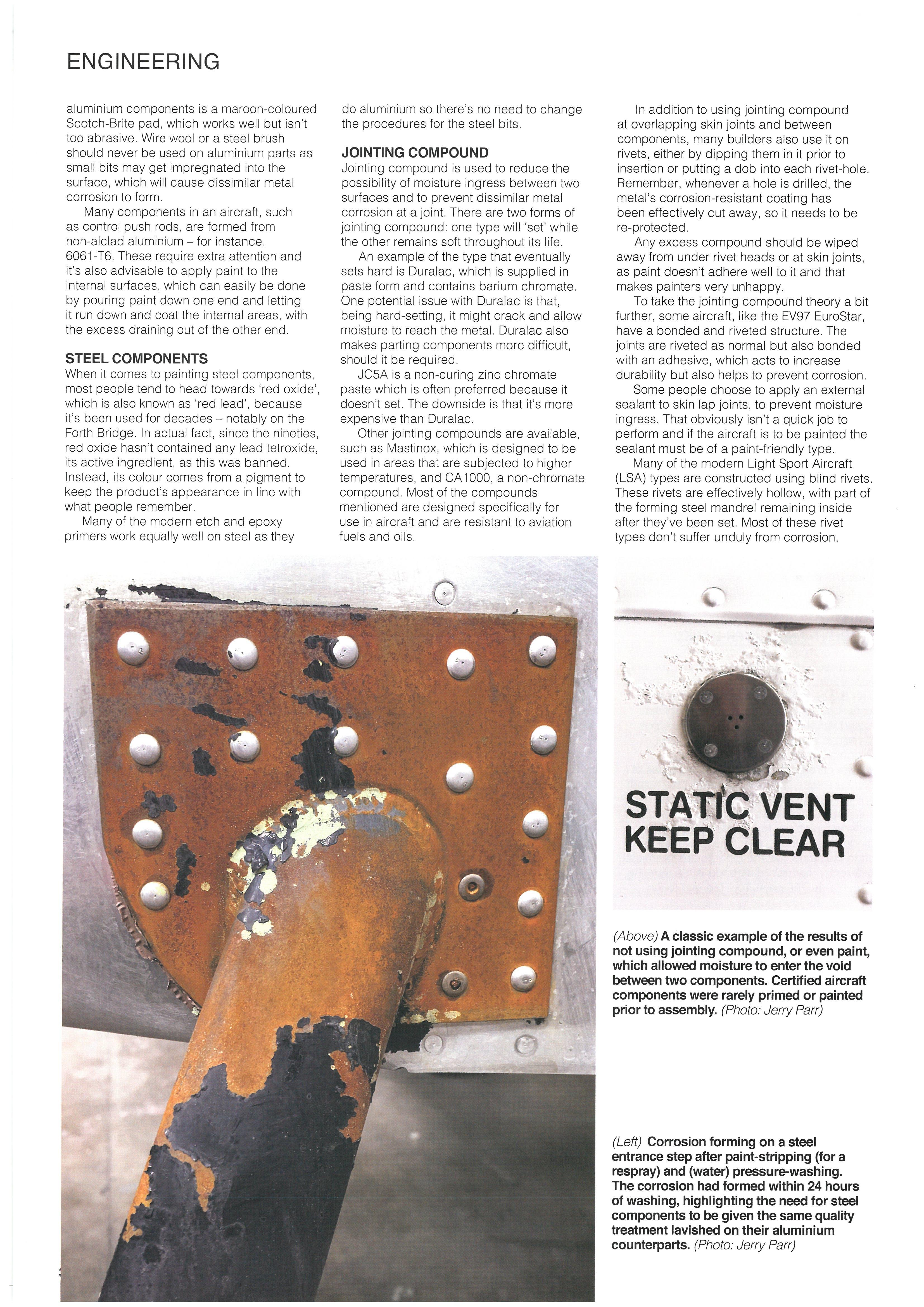
(Above) A classic example of the results of not using jointing compound, or even paint, which allowed moisture to enter the void between two components. Certified aircraft components were rarely primed or painted priorto assembly. (Photo:Jerry Parr)
(Left) Corrosion forming on a steel entrance step after paint-stripping (for a respray) and (water) pressure-washing. The corrosion had formed within 24 hours of washing, highlighting the need for steel components to be given the same quality treatment lavished on their aluminium counterparts. (Photo: Jerry Parr)
despite the dissimilar metal types found in their construction. That said, some builders choose to seal the top of the rivet with mastic, to help prevent any moisture ingress, although painting should have the same effect.
CORROSION INHIBITORS
lf an aircraft has been bought as a flyer and no corrosion-inhibiting treatment was applied during the build then it isn’t normally possible to successfully access many sections of the airframe to paint them, in order to prevent it appearing at some stage.
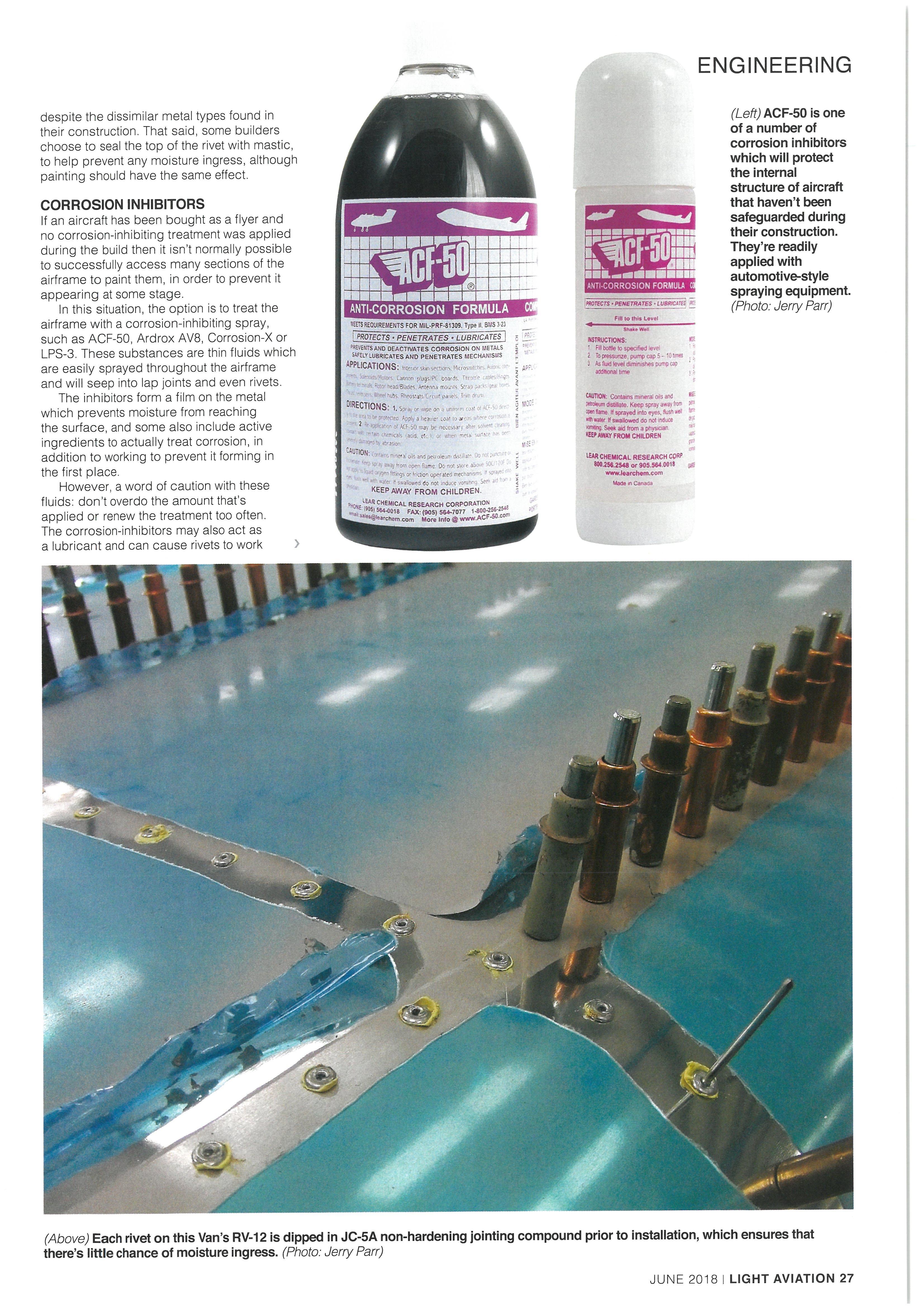
In this situation, the option is to treat the airframe with a corrosion-inhibiting spray, such as ACF-50, Ardrox AV8, Corrosion-X or LPS-3. These substances are thin fluids which are easily sprayed throughout the airframe and will seep into lap joints and even rivets.
Theinhibitorsformafilm onthemetal which prevents moisture from reaching the surface, and some also include active ingredients to actually treat corrosion, in addition to working to prevent it forming in the first place.
However, a word of caution with these fluids: don’t overdo the amount that’s applied or renew the treatment too often. The corrosion-inhibitors may also act as a lubricant and can cause rivets to work
(Left) ACF-50 is one of a number of corrosion inhibitors which will protect the internal structure of aircraft that haven’t been safeguarded during their construction. They’re readily applied with automotive-style spraying equipment. (Photo: Jerry Parr)
NETSREQUIREMENTSFORMIL-PRF-81309,Typeil,
DIRECTIONS:
loose. Some manufacturers recommend reapplying their product annually at least that keeps the sales up.
Application can be done in a mist form with a simple spray gun, the same kind as is used for applying car underseal, via access panels, wingtips and tail fairings. By the time the mist has gone, the inhibitor should have settled on every surface and will then penetrate every nook and cranny, no matter how small.
It should go without saying that it'd be unwise to apply this type of corrosion-inhibitor to an aircraft which is about to go for painting, or indeed to one that’s just been painted. It’s best to leave it a few months, to allow the new paint to properly harden.
store an aircraft is In a climate-controlled, sealed and insulated there aren't many of those around...”
AIRCRAFT HABITAT
So, once the builder has done as much as they can do protect an aircraft from the elements, what steps can be taken to preserve the airframe and systems throughout its operational life?
The ideal place to store an aircraft, when it isn’t doing what it’s designed to do, is in a Climate-controlled, sealed and insulated hangar. Unfortunately, there aren’t many of those around, at an affordable cost.
The options then come down a range of places to keep the aircraft, from being tied down outside and left to the vagaries of the weather to under some kind of shelter.
It's long been argued that a car is better left undercover but open to airflow, such as in a carport, which gives it a chance to dry out. The same could be said for an aircraft.
An uninsulated hangar with a concrete floor can result in a lot of condensation in certain weather conditions. A soil floor, while being a pain to move an aircraft or
to work on, will absorb most of the moisture, keeping the airframe dry.
An ‘open’ hangar will at least keep an aircraft sheltered but allow the air to circulate to keep it dry. If there are no viable hangarage options, then an aircraft left outside should be fine, although it’s advisable to have at least some form of cover over the areas which are more likely to suffer from exposure, such as the cockpit and engine. Covers are good in that they keep the world out, not just the rain but also the sun and birds which are looking for somewhere to build a nest.
There are various options when it comes to covers. The best ones will protect the airframe but allow it to ‘breathe’, to prevent the build-up of condensation. Afull set of airframe covers is ideal but if that isn’t an option then keeping the aircraft clean, polished and lubricated will pay dividends in the long run.
Parking on grass isn’t great because of its ability to hold moisture but is often unavoidable. If at all possible, at least keep the wheels on slabs, to avoid the damp affecting the undercarriage.
SUMMARY
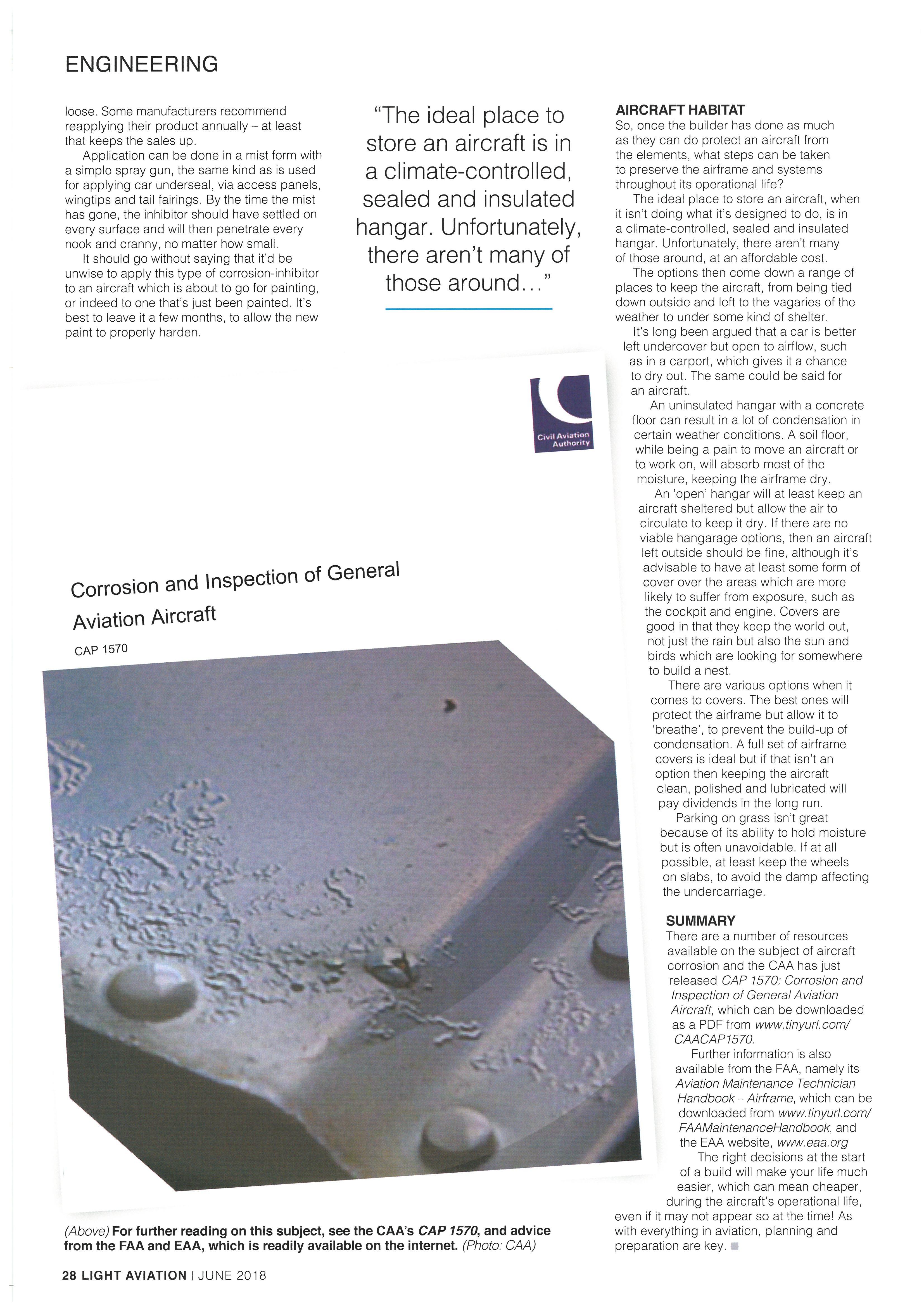
There are a number of resources available on the subject of aircraft corrosion and the CAA has just released CAP 1570: Corrosion and Inspection of General Aviation Aircraft, which can be downloaded as a PDF from www.tinyurl.com/ CAACAP1570.
Further information is also available from the FAA, namely its Aviation Maintenance Technician Handbook-Airframe, which can be downloaded from www.tinyurl.com/ FAAMaintenanceHandbook, and the EAA website, www.eaa.org
The right decisions at the start of a build will make your life much easier, which can mean cheaper, during the aircraft's operational life, even if it may not appear so at the time! As with everything in aviation, planning and preparation are key. !
Civil Aviation Authority
CAP 1570
The IC-A25NE NAV/COM is ICOM's latest airband handheld radio, features include a_ stylish, modern design, easy-to-use interface and large LCDscreen that combine to _ provide stress-freeprogramming and easyin-flight operation.
Telephone:01227TAITAL. re
e-mail:info@icomuk.co.ukwww.icomuk.co.ukCountonus: f
4 Cylinder/4 Stroke Engine with 141HP
e Best Power to Weight Ratio in Class
e Superior Take off Performance
e Lower Fuel Consumption
e Longer Flight Range
n ever-larger number of Brits are attending AERO Friedrichshafen understandably, as it’s a fantasticshow.|liken ittothe nearest thing to a motor show for aeroplanes, such is the quality of the Messe Friedrichshafen exhibition centre and the overall presentation of the event.
AERO is also almost certainly the world’s most important event for VLA, LSA and Ultralight recreational aircraft, and it’s many manufacturers’ chosen opportunity to launch new types and equipment.
Germany isn’t particularly expensive to visit and if you stay a few miles from Friedrichshafen the hotels and apartments are reasonably-priced. AERO takes place in a very nice part of the country, with Lake Constance and pleasant, rolling farmland nearby, all of which is very clean and tidy.
Here’s what caught my eye at this year’s event, but there was so much to see, including larger GA and even exec jets, that this selection really only scratches the surface!
AERO Friedrichshafen runs from Wednesday to Saturday and next year’s event is scheduled for 10-13 April visit www.aero-expo.com
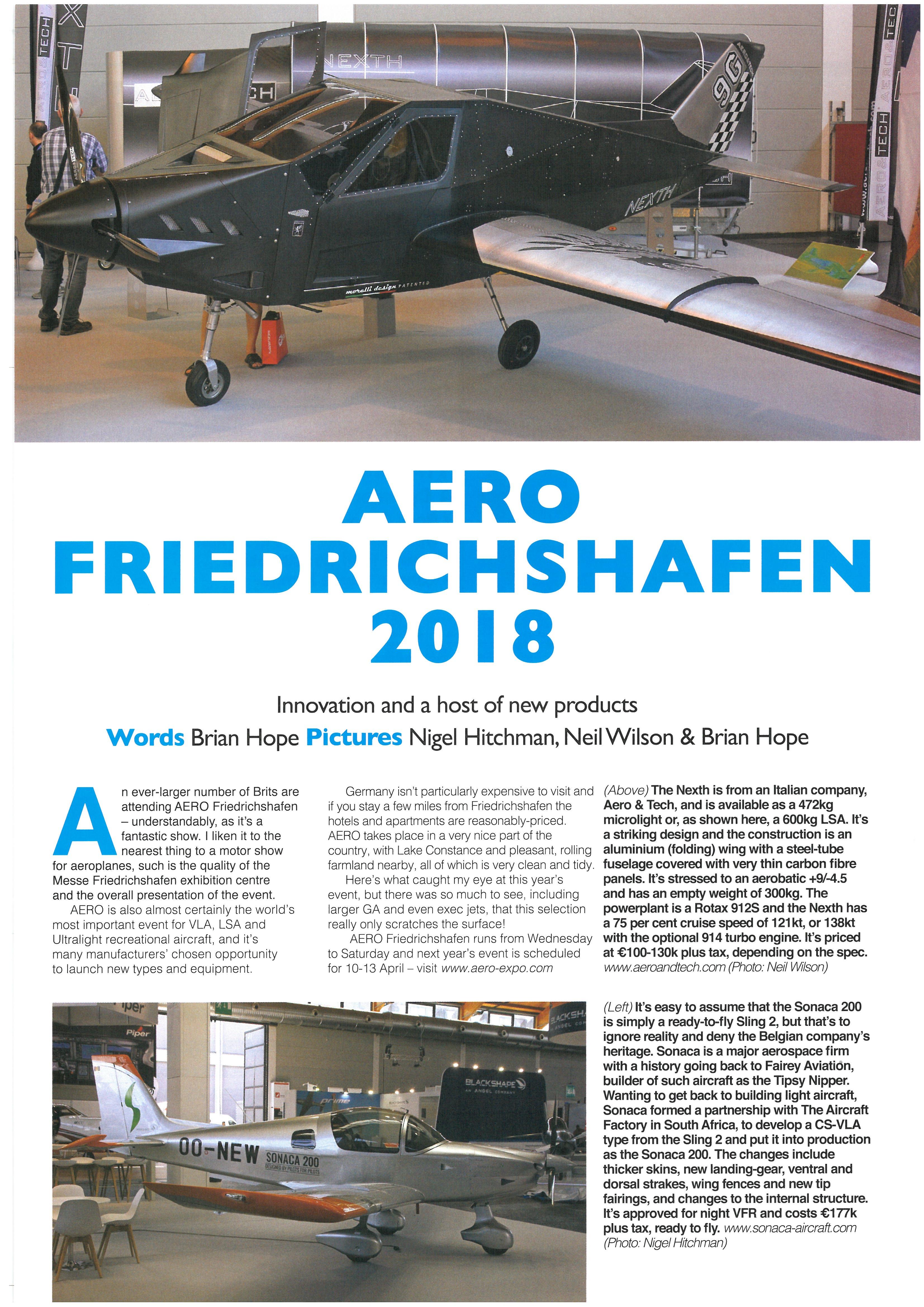
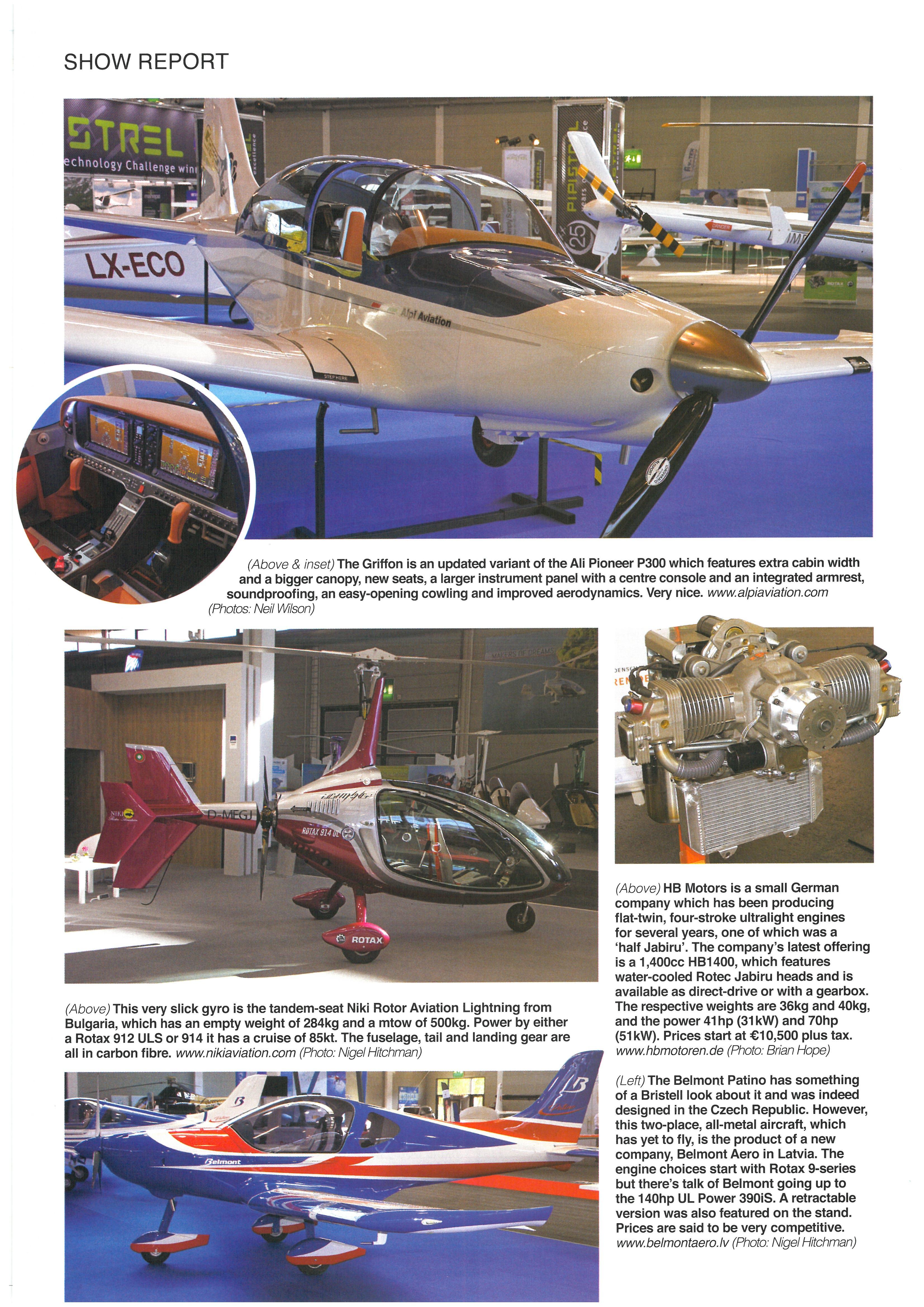
(Above) The Nexth is from an Italian company, Aero & Tech, and is available as a 472kg microlight or, as shown here, a 600kg LSA. It’s a striking design and the construction is an aluminium (folding) wing with a steel-tube fuselage covered with very thin carbon fibre panels. It’s stressed to an aerobatic +9/-4.5 and has an empty weight of 300kg. The powerplant is a Rotax 912S and the Nexth has a 75 per cent cruise speed of 121kt, or 138kt with the optional 914 turbo engine. It’s priced at €100-130k plus tax, depending on the spec. www.aeroanatech.com(Photo:Neil Wilson)
(Left) It’s easy to assume that the Sonaca 200 is simply a ready-to-fly Sling 2, butthat’s to ignore reality and deny the Belgian company’s heritage. Sonaca is a major aerospace firm with a history going back to Fairey Aviation, builderof such aircraft as the Tipsy Nipper. Wanting to get back to building light aircraft, Sonaca formed a partnership with The Aircraft Factory in South Africa, to develop a CS-VLA type from the Sling 2 and put it into production as the Sonaca 200.The changes include thicker skins, new landing-gear, ventral and dorsal strakes, wing fences and new tip fairings, and changes to the internal structure. It’s approved for night VFR and costs €177k plus tax, ready to fly. www.sonaca-aircraft.com (Photo:NigelHitchman)
teri “SSoe > RS [oven
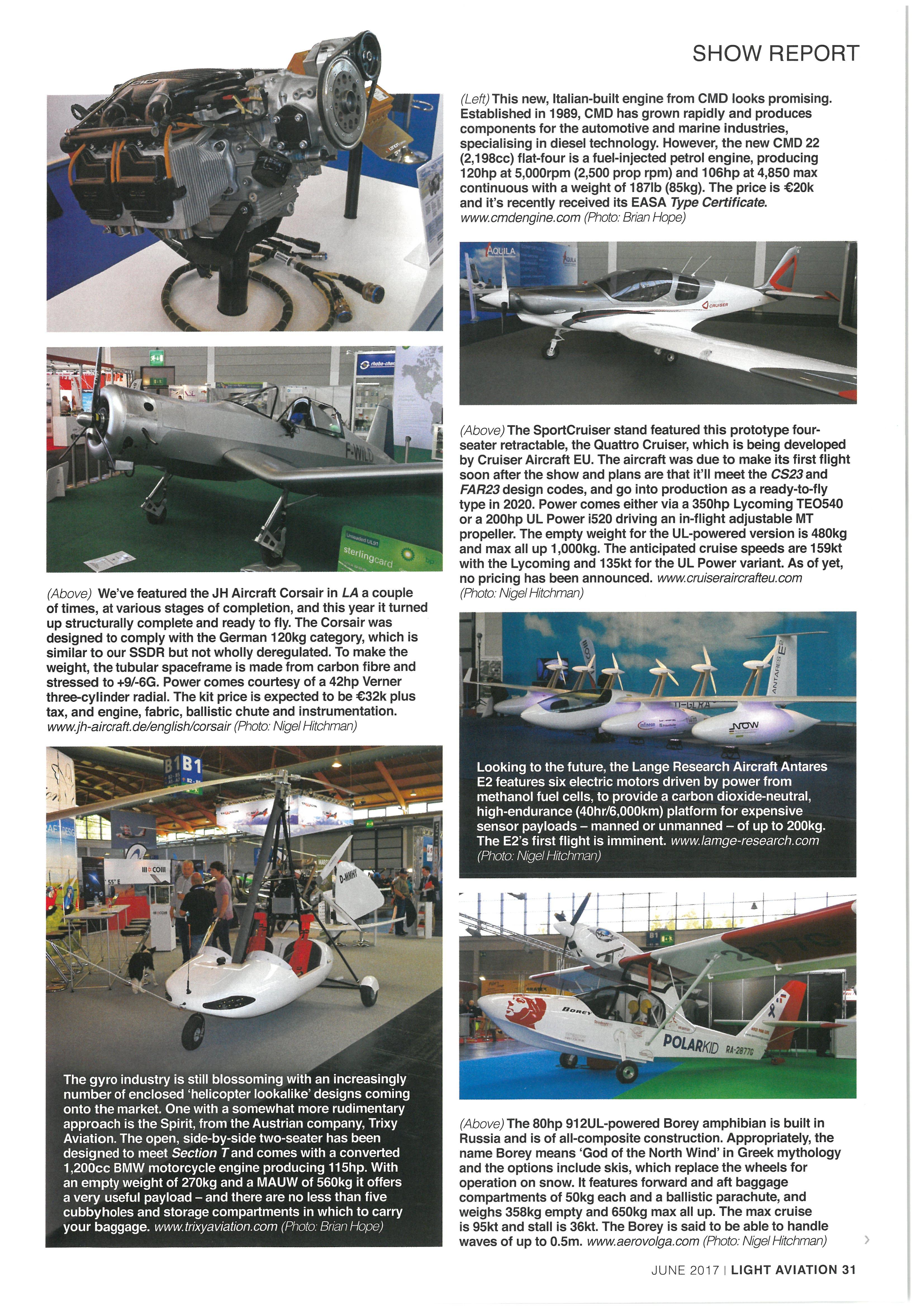
(Above) We’ve featured the JH Aircraft Corsair in LA a couple of times, at various stages of completion, and this year it turned up structurally complete and ready to fly. The Corsair was designed to comply with the German 120kg category, which is similar to our SSDR but not wholly deregulated. To make the weight, the tubular spaceframe is made from carbon fibre and stressed to +9/-6G. Power comes courtesy of a 42hp Verner three-cylinder radial. The kit price is expected to be €32k plus tax, and engine, fabric, ballistic chute and instrumentation. www.jh-aircraft.de/english/corsair(Photo:NigelHitchman)
(Left)This new, Italian-built engine from CMD looks promising. Established in 1989, CMD has grown rapidly and produces components for the automotive and marine industries, specialising in diesel technology. However, the new CMD 22 (2,198cc) flat-four is a fuel-injected petrol engine, producing 120hp at 5,000rpm (2,500 prop rpm) and 106hp at 4,850 max continuous with a weight of 187Ib (85kg). The price is €20k and it’s recently received its EASA Type Certificate. www.cmdengine.com (Photo:BrianHope)
The gyro industry is still blossoming with an increasingly number of enclosed ‘helicopter lookalike’designs coming onto the market. One with a somewhat more rudimentary approach is the Spirit, from the Austrian company, Trixy Aviation. The open, side-by-side two-seater has been designed to meet Section Tand comes with a converted 1,200cc BMW motorcycle engine producing 115hp. With an empty weight of 270kg and a MAUW of 560kg it offers a very useful payload and there are no less than five cubbyholes and storage compartments in which to carry your baggage. www.trixyaviation.com (Photo:BrianHope)
(Above) The SportCruiser stand featured this prototype fourseater retractable, the Quattro Cruiser, which is being developed by Cruiser Aircraft EU.The aircraft was due to make its first flight soon after the show and plans are that it'll meet the CS23 and FAR23 design codes, and go into production as a ready-to-fly type in 2020. Power comes either via a 350hp Lycoming TEO540 or a 200hp UL Power i520 driving an in-flight adjustable MT propeller. The empty weight for the UL-powered version is 480kg and max all up 1,000kg. The anticipated cruise speeds are 159kt with the Lycoming and 135kt for the UL Power variant. As of yet, no pricing has been announced. www.cruiseraircrafteu.com (Photo:NigelHitchman)
Looking to the future, the Lange Research Aircraft Antares E2 features six electric motors driven by power from methanol fuel cells, to provide a carbon dioxide-neutral, high-endurance (40hr/6,000km) platform for expensive sensor payloads manned or unmanned of up to 200kg. The E2’s first flight is imminent. www.lamge-research.com (Photo:NigelHitchman)
(Above) The 80hp 912UL-powered Borey amphibian is built in Russia and is of all-composite construction. Appropriately, the name Borey means ‘God of the North Wind’ in Greek mythology and the options include skis, which replace the wheels for operation on snow. Itfeatures forward and aft baggage compartmentsof50kgeachanda ballisticparachute,and weighs 358kg empty and 650kg max all up. The max cruise is 95kt and stall is 36kt. The Borey is said to be able to handle waves of up to 0.5m. www.aerovolga.com (Photo:NigelHittchman)
(Photos:NeilWilson)
(Above) This very slick gyro is the tandem-seat Niki Rotor Aviation Lightning from Bulgaria, which has an empty weight of 284kg and a mtow of 500kg. Power by either a Rotax 912 ULS or 914 it has a cruise of 85kt. The fuselage, tail and landing gear are all in carbon fibre. www.nikiaviation.com (Photo:NigelHitchman)
(Above) HB Motors is a small German company which has been producing flat-twin, four-stroke ultralight engines for several years, one of which was a ‘half Jabiru’. The company’s latest offering is a 1,400cc HB1400, which features water-cooled Rotec Jabiru heads and is available as direct-drive or with a gearbox. The respective weights are 36kg and 40kg, and the power 41hp (31kW) and 70hp (51kW). Prices start at €10,500 plus tax. www.hbmotoren.de (Photo:BrianHope)
(Left) The Belmont Patino has something of a Bristell look about it and was indeed designed in the Czech Republic. However, this two-place, all-metal aircraft, which has yet to fly, is the product of a new company, Belmont Aero in Latvia. The engine choices start with Rotax 9-series but there’s talk of Belmont going up to the 140hp UL Power 390iS. A retractable version was also featured on the stand. Prices are said to be very competitive. www.belmontaero.I|v(Photo:NigelHitchman)
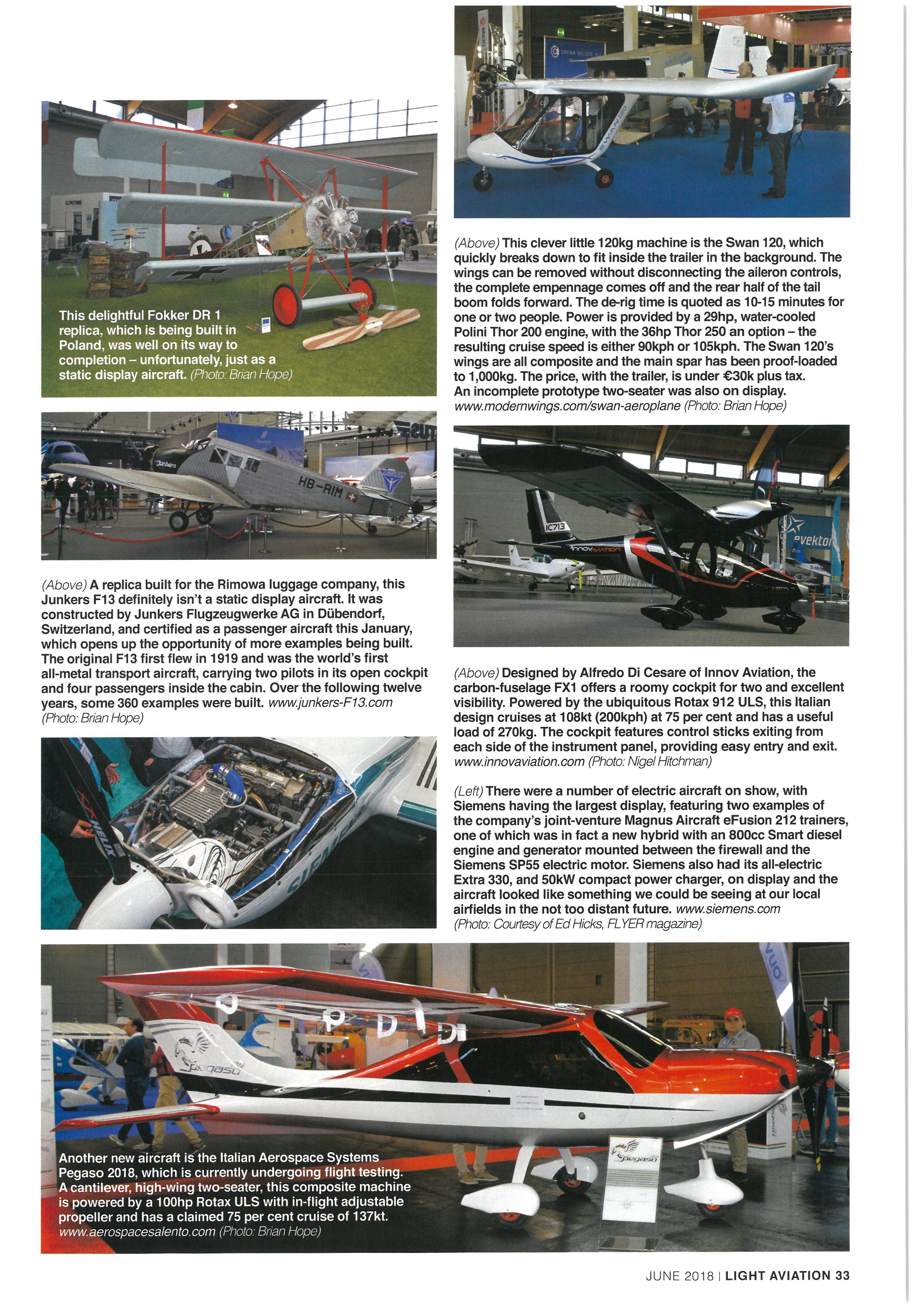
This delightful Fokker DR 1 replica, which is being builtin ~~ Poland, was well on its way to completion unfortunately, just as a static display aircraft. (Photo:BrianHope)
(Above) This clever little 120kg machine isthe Swan 120,which quickly breaks down to fit inside the trailer in the background. The wings can be removed without disconnecting the aileron controls, the complete empennage comes off and the rear half of the tail boom folds forward. The de-rig time is quoted as 10-15minutes for one or two people. Power is provided by a 29hp, water-cooled Polini Thor 200engine, with the 36hp Thor 250 an option the resulting cruise speed is either 90kph or 105kph. The Swan 120’s wings are all composite and the main spar has been proof-loaded to 1,000kg. The price, with the trailer, is under €30k plus tax. An incomplete prototypetwo-seater was also on display. www.modernwings.com/swan-aeroplane(Photo:BrianHope)
(Above) Designed by Alfredo Di Cesare of InnovAviation, the carbon-fuselage FX1 offers a roomy cockpit for two and excellent visibility. Powered by the ubiquitous Rotax 912 ULS, this Italian design cruises at 108kt (200kph) at 75 per cent and has a useful load of 270kg. The cockpit features control sticks exiting from each side of the instrument panel, providing easy entry and exit. www.innovaviation.com(Photo:NigelHitchman)
(Left)There were a number of electric aircraft on show, with Siemens having the largest display, featuring two examples of the company’s joint-venture Magnus Aircraft eFusion 212 trainers, one of which was in fact a new hybrid with an 800cc Smart diesel engine and generator mounted between the firewall and the Siemens SP55 electric motor. Siemens also had its all-electric Extra 330, and 50kW compact power charger, on display and the aircraft looked like something we could be seeing at our local airfields in the not too distant future. www.siemens.com
(Photo:CourtesyofEdHicks,FLYERmagazine)
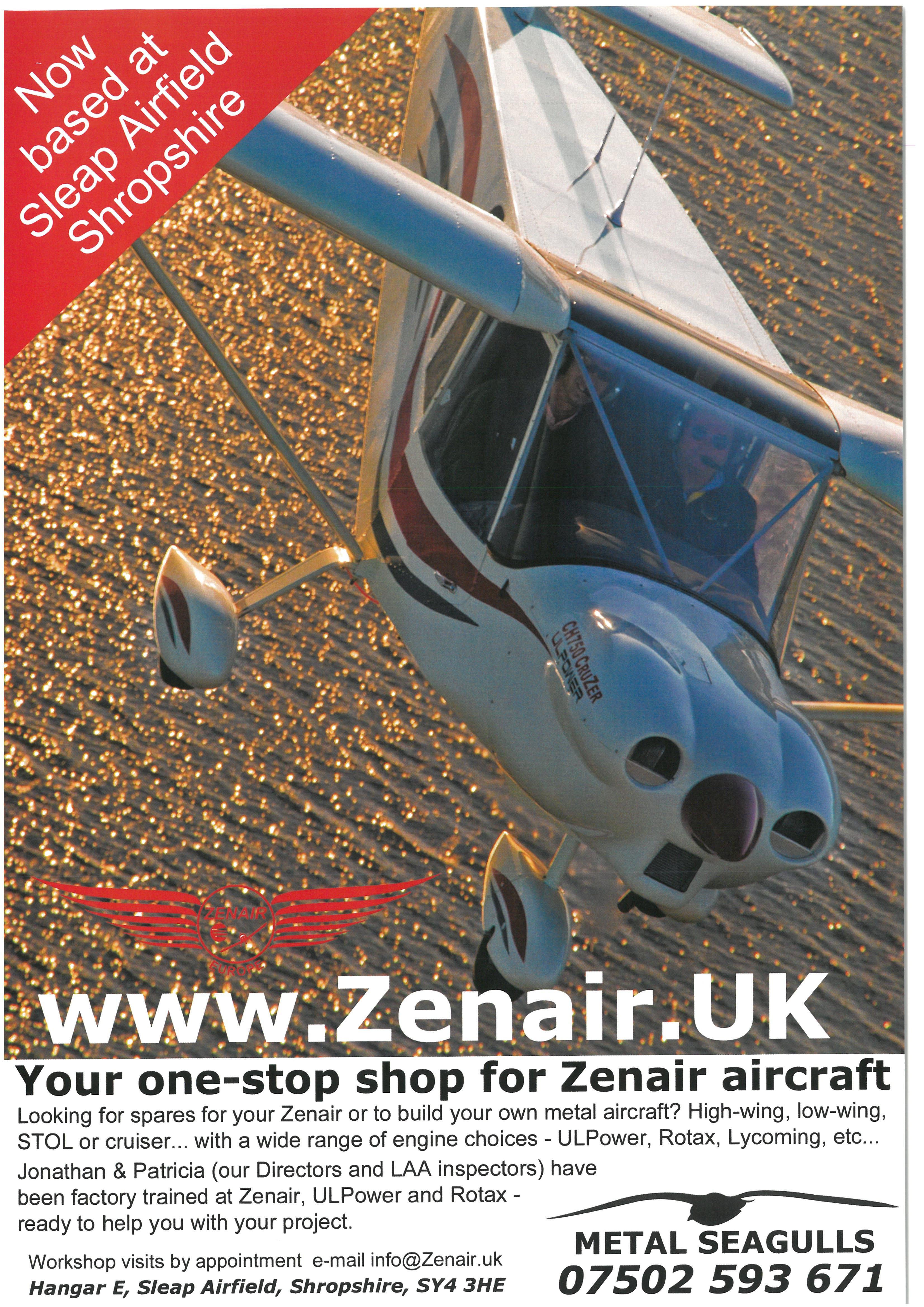
Lookingfor sparesforyourZenairorto buildyourownmetalaircraft?High-wing,low-wing, STOL or cruiser... with a wide range of engine choices - ULPower, Rotax, Lycoming, etc... Jonathan & Patricia (our Directors and LAA inspectors) have beenfactorytrainedatZenair,ULPowerandRotaxSeAe ready to help you with your project.
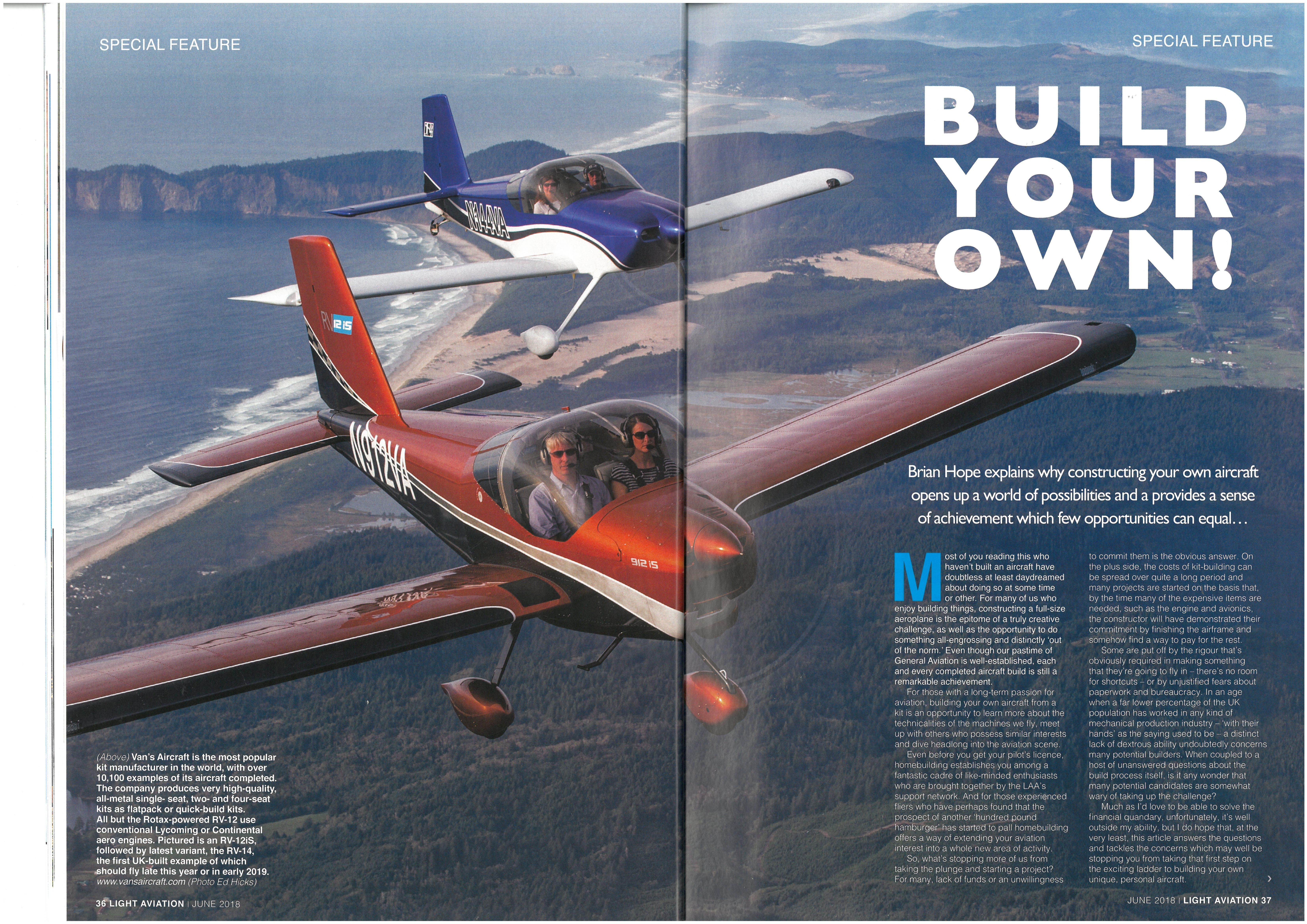
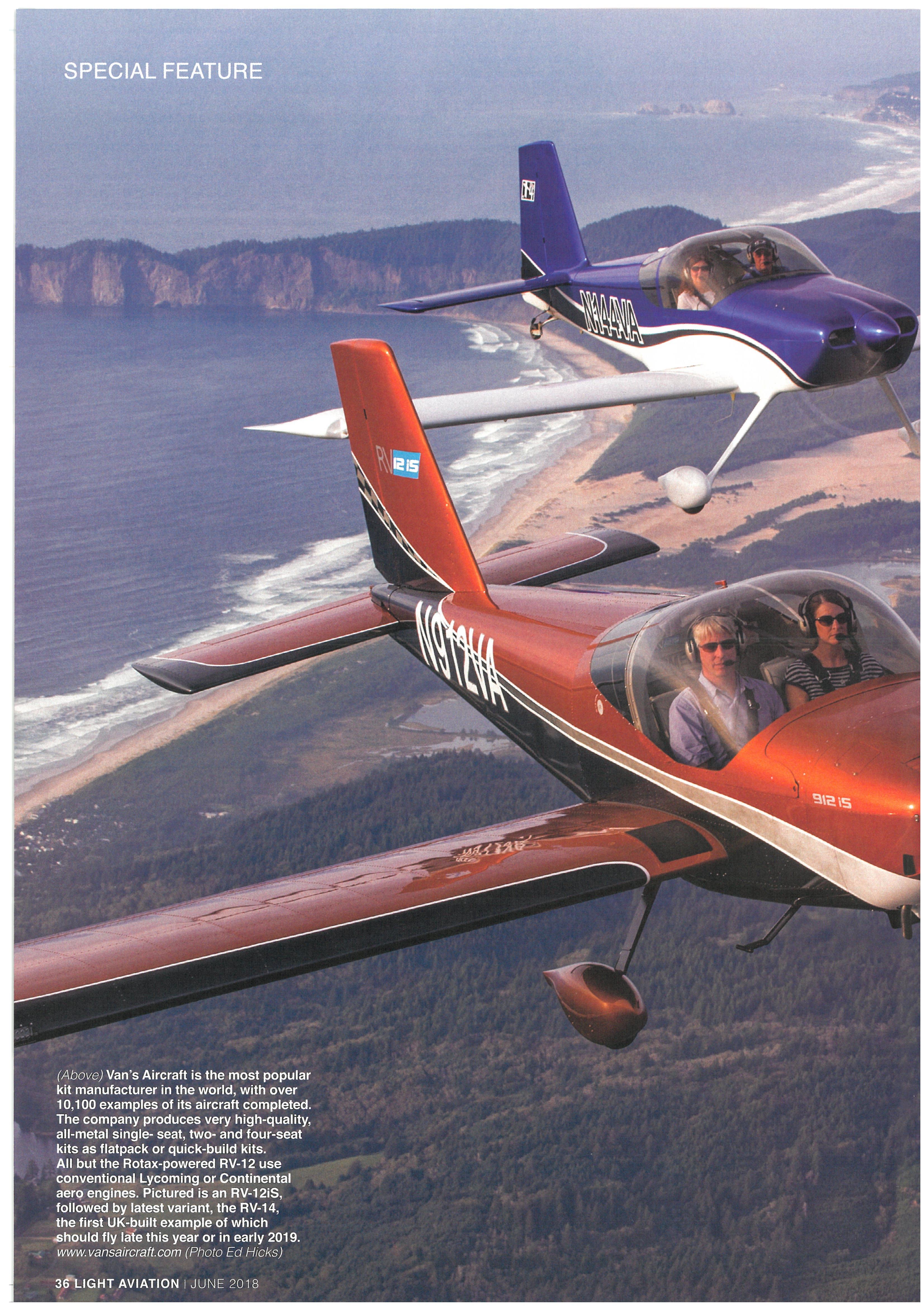
(Above) Van’s Aircraft is the most popular kit manufacturer in the world, with over 10,100 examples of its aircraft completed. The company produces very high-quality, all-metal single- seat, two- and four-seat kits as flatpack or quick-build kits.
All but the Rotax-powered RV-12 use conventional Lycoming or Continental aero engines. Pictured is an RV-12iS, followed by latest variant, the RV-14, aRileSe)GolaCline)(olmiacera) should fly late this year or in early 2019. www.vansaircraft.com (Photo Ed Hicks)
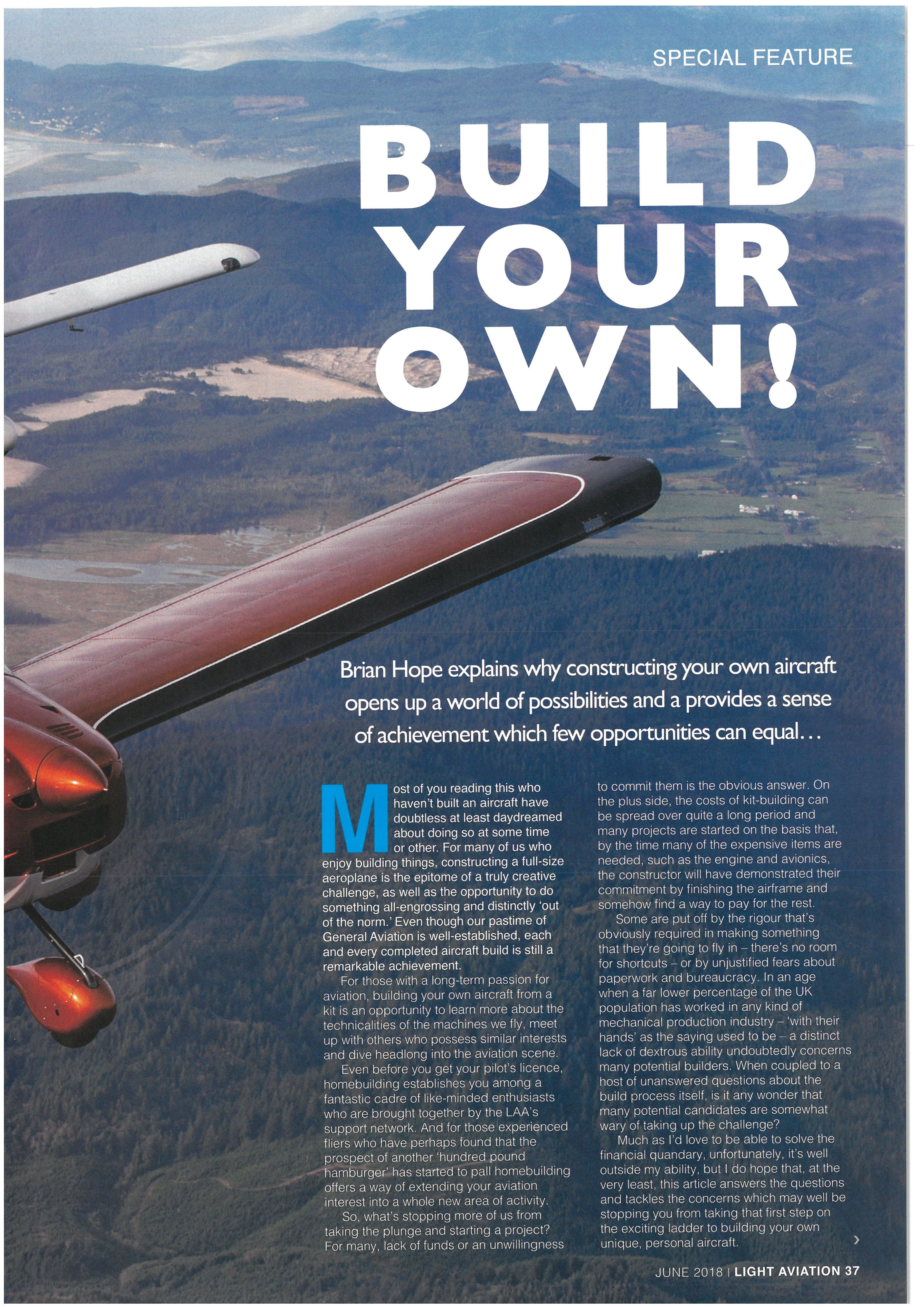
ost of you reading this who haven't built an aircraft have doubtless at least daydreamed about doing so at some time or other. For many of us who enjoy building things, constructing a full-size aeroplane is the epitome of a truly creative challenge, as well as the opportunity to do something all-engrossing and distinctly ‘out of the norm.’ Even though our pastime of General Aviation is well-established, each and every completed aircraft build is still a remarkable achievement.
For those with a long-term passion for aviation, building your own aircraft from a kit is an opportunity to learn more about the technicalities of the machines we fly, meet up with others who possess Similar interests and dive headlong into the aviation scene.
Even before you get your pilot’s licence, homebuilding establishes you among a fantastic cadre of like-minded enthusiasts who are brought together by the LAA’s support network. And for those experienced thers who have perhaps found that the prospect of another ‘hundred pound hamburger has started to pall homebuilding offers a way of extending your aviation interest into a whole new area of activity. So, what's stopping more of us from taking the plunge and starting a project?
For many, lack of funds or an unwillingness
to commit them is the obvious answer. On the plus side, the costs of kit-building can be spread over quite a long period and many projects are started on the basis that, by the time many of the expensive items are needed, such as the engine and avionics, the constructor will have demonstrated their commitment by finishing the airframe and somehow find a way to pay for the rest.
Some are put off by the rigour that’s obviously required in making something that they’re going to fly in there’s no room for shortcuts or by unjustified fears about paperwork and bureaucracy. In an age when a far lower percentage of the UK population has worked in any kind of mechanical production industry ‘with their hands’asthesayingusedtobe a distinct lack of dextrous ability undoubtedly concerns many potential builders. When coupled to a host of unanswered questions about the build process itself, is it any wonder that many potential candidates are somewhat wary of taking up the challenge?
Much as I'd love to be able to solve the financial quandary, unfortunately, it’s well outside my ability, but do hope that, at the very least, this article answers the questions and tackles the concerns which may well be stopping you from taking that first step on the exciting ladder to building your own unique, personal aircraft.
(Above) Van’s Aircraft is the most popular kit manufacturer in the world, with over 10,100 examples of its aircraft completed. The company produces very high-quality, all-metal single- seat, two- and four-seat kits as flatpack or quick-build kits. All but the Rotax-powered RV-12 use conventional Lycoming or Continental aero engines. Pictured is an RV-12iS, followed by latest variant, the RV-14, thefirst UK-builtexampleof which should fly late this year or in early 2019. www.vansaircraft.com (Photo EdHicks)
ost of you reading this who haven't built an aircraft have doubtless at least daydreamed about doing so at some time or other. For many of us who enjoybuildingthings,constructing a full-size aeroplaneistheepitomeofa trulycreative challenge, as well as the opportunity to do something all-engrossing and distinctly ‘out of the norm.’ Even though our pastime of General Aviation is well-established, each and every completed aircraft build is still a remarkable achievement.
For those with a long-term passion for aviation, building your own aircraft from a kit is an opportunity to learn more about the technicalities of the machines we fly, meet up with others who possess similar interests and dive headlong into the aviation scene.
Even before you get your pilot's licence, homebuilding establishes you among a fantastic cadre of like-minded enthusiasts who are brought together by the LAA’s support network. And for those experienced fliers who have perhaps found that the prospect of another ‘hundred pound hamburger has started to pall homebuilding offers a way of extending your aviation interest into a whole new area of activity.
So, what’s stopping more of us from taking the plunge and starting a project?
For many, lack of funds or an unwillingness
to commit them is the obvious answer. On the plus side, the costs of kit-building can be spread over quite a long period and many projects are started on the basis that, by the time many of the expensive items are needed, such as the engine and avionics, the constructor will have demonstrated their commitment by finishing the airframe and somehow find a way to pay for the rest.
Some are put off by the rigour that’s obviously required in making something that they're going to fly in there’s no room for shortcuts or by unjustified fears about paperwork and bureaucracy. In an age whena farlowerpercentageoftheUK population has worked in any kind of mechanical production industry ‘with their hands’ as the saying used to be a distinct lack of dextrous ability undoubtedly concerns many potential builders. When coupled to a host of unanswered questions about the build process itself, is it any wonder that many potential candidates are somewhat wary of taking up the challenge?
Much as I'd love to be able to solve the financial quandary, unfortunately, it’s well outside my ability, but | do hope that, at the very least, this article answers the questions and tackles the concerns which may well be stopping you from taking that first step on the exciting ladder to building your own unique, personal aircraft. Pa
(Left) Zenair’s well-proven types are imported by Metal Seagulls and include the CH 750 STOL (pictured finished with its kit components), the CH650B Zodiac low-wing two-seat sport plane, and the CH 701 STOL, a smaller version of the 750. The CH 750 Cruzer is currently being assessed for UK build. Rotax 912 engines are popular in each model but Metal Seagulls has recently taken on the UL Power agency, so doubtless we'll soon be seeing this Belgian manufacturer’s powerplants installed in more British-built Zenairs. www.metalseagulls.co.uk (Photo: Zenair)
ee
TheAeroproEuroFoxis amoderntakeontheutility styleof t * __ aircraft, which remains popular choice for UK buyers. Builders spend time at the factory in Slovakia, assembling and covering ia GE the aircraft so it can be painted and sent to them in the UK for f i completion. The EuroFox is available in tricycle and taildragger fe format with the Rotax 912 series engines, including a special 120hp normally-aspirated engine variant, and the 914 turbo. www.eurofoxuk.co.uk(Photo:Aeropro)
WHY WOULD YOU WANT TO?
As is the case with most things in life, we all have our own idea of what suits us best, whether that be a career, musical taste, choice of car, house or aircraft. The choice of production aircraft types is actually quite limited, and they're often a compromise, attempting to be all things to all people.
On the other hand, homebuilts or amateurbuilt aircraft, as some like to call them these days, tend to be designed for a specific function. There are high-performance tourers, utility bush planes, scale replicas of historic warbirds, racers, aerobats the choice is almost endless. And although you may consider buying a homebuilt that somebody else has constructed, finding exactly what you want isn’t always possible.
VE MINIMAL ENGINEERING SKILLS, WHERE DOI START?
Okay, firstly you have to decide what medium you want to build in. There are three major build materials: wood, metal and composites. The first two are the most popular but today’s composite kits leave little, if any, actual moulding work to the builder, so don’t rule it out because you once made a mess of trying to fill a hole in your car’s door sill!
Somepeoplehavea naturalaffinityto a material and will have decided straightaway that they want to build in a particular medium. We also have members who try their hand at different materials via our LAA Training Courses. These courses are designed to take you through the correct aeronautical techniques of using a particular material drilling and riveting aluminium, for example, or scarfing and gluing wood. You'll then have an idea of the skills required and will
probably surprise yourself at how easy they actually are to attain.
SHOULD | BUILD FROM PLANS OR A KIT?
The vast majority of new-builds are of kit aircraft rather than from plans. There’s an old adage among LAA members that there are builders and there are flyers but very few builder-flyers. Well, | don’t doubt there was some truth in that during the plansbuilding era because sourcing your parts and materials and having to make almost every component is a long-term job.
Modern kits remove at least fifty per cent of the work, because most of the parts are made for you, and in many kits much of the assembly work has been done too. Which isn't to say that plans-building is no longer an option worth considering. Building from plans will certainly cost less, and the spend can be spread over several years. For instance, | believe that Alan James’ beautiful Isaac’s Spitfire (see the Flight Test in the July 2017 issue of LA) cost less than £20k, with the cost being spread over the three years or so he spent building it. However, it should be noted that Alan is a skilled woodworker, having previously built a very nice Pietenpol Aircamper.
Plans-building is a long-term commitment and those who have done it successfully will advise that you need to build for the love of it, not simply because you want a lower-cost aircraft. That said, most of what follows applies equally to plans- and kit-builders.
CAN | BUILD WHATEVER | LIKE?
Although kits and plans are available from around the world, and the internet has
enabled access to them so much more easily than in the past, here in Britain the Civil Aviation Authority (CAA) dictates that UK-registered aircraft have to be shown to meet a certain standard of design and airworthiness.TheLAAistaskedwith ensuring that amateur-build designs meet those standards before they can be approved for construction in the UK. There are currently over 200 LAA-approved designs and new types are assessed and added to the list each year.
HOW DOI! FIND OUT WHAT’S BEEN APPROVED?
A comprehensive list is available on the LAA website, at www.laa.uk.com click on the ‘Aircraft and Technical’ section and then ‘Building Aircraft’.
In general, of the over 200 approved designs, perhaps about ninety per cent of builders choose from around thirty designs because these are the most current types. Like cars, many people like to have the latest kits.
Onceyou'vemade a shortlist,takealook at the aircraft's Type Acceptance Data Sheet (TADS), which is on the LAA website in the ‘Data Library’ section of ‘Aircraft and Technical’. The TADSwill show what options for that type have been cleared and identify any special requirements or problem areas.
ARE ALL OF THE DESIGNS AVAILABLE IN KIT FORM?
No. The kit revolution really didn’t take hold until the early-nineties but over the last thirty years, they’ve have taken the lion’s share of the amateur build market because they dramatically cut down the amount of work
and time needed to complete a project. Indeed, these days, very few new plans sets are added to the LAA’s list of approved designs.
WHAT DOES AN AIRCRAFT KIT USUALLY CONSIST OF?
In the early days of kit development, some were little more than a set of plans and a pack of the materials and hardware required to build the aircraft. The Avid Flyer and early Kitfoxes then set a new standard, with all the individual parts made but none put together as sub-assemblies you received the individual brackets, wing ribs, etc, anda pre-welded fuselage frame but had to build the remainder of the aircraft from this basic starting point. Such kits, often called flatpacks, are still popular Van's Aircraft’s RV series and the Groppo Trail spring to mind. The wing main spars are sometimes readybuilt with these kits, to ensure they are constructed to the highest standard.
The next advance was to ‘quick build’ options, where the manufacturer assembled the major components say the fuselage, empennage and wings to an almost complete stage, thus saving the homebuilder many hours of work. Van's also offers this level of completion.
Finally, we have the fast-build kits, where individual sub-assemblies are all but finished, maybe requiring only the closing skin panels to be fixed on for instance - the underside
of a wing or fuselage, so that the internals can still be fully inspected before final closure. What you’re effectively doing with the more advanced kits is substituting a higher initial outlay to reduce the build time, so that most of the work done by the amateur is in bolting together the main airframe assemblies and then equipping the aircraft with undercarriage, engine, flight controls and instrumentation. This allows the builder to really go to town with selecting, fitting and commissioning their personalised suite of all the wonderful comms, autopilots and other gizmos which are on offer nowadays.
of the types on the approved list, and/or have decided to become the UK agent for the design. LAA advice is that this isn’t something recommended for first-time builders, as it adds a whole new level of difficulty to the project.
LAA Engineering only takes on designs which appear to have a fighting chance of getting approved. Most countries have less rigorous standards than in the UK, and don’t demand any kind of formal proof of airworthiness, so only a small proportion of the types that LAA Engineering check out get approved. When deciding which types to tackle, LAA Engineers also have to consider whether they'll likely appeal to other members. That said, we do have plenty of ‘one-offs’ in the LAA fleet, which are what helps make the our annual Rally such an interesting event.
AN UNAPPROVED DESIGN FOR CONSIDERATION?
Many kits can be purchased as individual sub-assemblies usually the empennage first, then the wings, followed by the fuselage and the firewall forward. Engines, upholstery and sometimes instrument packages are also available from the kit supplier or can be acquired elsewhere. This allows the builder to spread the costs and put in ‘a toe in the water’ by building, say, the empennage, as a low-cost introduction to the practicalities and techniques which the rest of the project will require, before turning the key on the major financial outlay. CAN I SUBMIT
Yes, you can. The LAA approves several new designs every year and each will have been submitted by a member because they wanted to build that particular aircraft rather than any
As the proposer of a new type, you'll have to supply a significant amount of data to make up the design submission. Sometimes the aircraft's designer can supply a complete design package that’s acceptable to LAA HQ, but if they can’t then there’s the possibility of contracting an aeronautical engineer to produce it. Frankly, the chances are that if the designer hasn't already got a proper design package, then independent checks will show that the design doesn’t meet the appropriate standard such things don’t happen by accident!
In the case of a design which appears fully sound and has been operating abroad in numbers for some time, certain elements of the design submission can be substituted, based on a satisfactory service record.
More information on submitting a new design, or even designing your own aircraft, can be found in the ‘Aircraft and Technical’ section of the LAA website. See also Technical Leaflet TL 1.07: Acceptance Process for New Aircraft Designs, and TL 1.08: How to Gain LAA Acceptance of an Already Established Design.
A FEW CAVEATS...
Take your time in choosing what aircraft kit best suits your needs, abilities and pocket. Talk to owners of the types you’re interested in and, if possible, take a ride or two. Nobody can explain better than a builder how easy (or otherwise) a kit goes together, knows the real final cost or can reveal the level of assistance offered by an agent.
When choosing a kit to buy, note that levels of equipment, build stages, etc, differ between suppliers and it’s often difficult to compare contents and prices accurately you aren't always comparing apples with apples.
Make sure that you know whether VAT is included or not as twenty per cent extra on your costs may sway the selection process in a different direction!
When ‘plus delivery’ is quoted, be aware that it can mean from the factory rather than the local agent ie the kit may be coming from the US or the other side of Europe. Ask for a final delivery cost to avoid the shock of a larger bill than you'd anticipated.
Above all else, don't let your enthusiasm run away with you. Conduct your research properly and you should have a straightforward build which meets your expectations and stays within budget.
HOW DOES THE LAA’S BUILDING SYSTEM WORK?
Having selected a design and bought either a complete/part-kit package or a set of plans, you register your project with the LAA Engineering
POs EEESR
department. You'll then receive a project pack, containing details of the /nspection Schedule, which will need to be followed as the build progresses.
Before you start, you must next contact an LAA Inspector - there are 400 covering the UK so it’s highly likely that there’ll be several in your locale. A list of Inspectors can be ound on the LAA website under ‘Aircraft and Technical’ and then ‘Find an Inspector’.
Once you've an Inspector who's happy o oversee a build and has inspected the workshop and the kit, and discussed procedures with you, you're ready to start. |AA Inspectors are a great source of advice as well as being the overseer for the build, and the builder/Inspector relationship should be one of trust and friendship. See also 7L 1.01:Registering a New Project.
DO | HAVE TO BUILD THE AIRCRAFT EXACTLY AS STANDARD?
LAA advice is to build the aircraft as the designer intended -after all, he probably has more experience in this field than you do! Even the simplest aircraft is the result of thousands of design decisions, and changing one area may have unanticipated and unwanted side effects.
Changes to the design or acceptance of new ‘options’ can only be made subject to approval by LAA Engineering. You should discuss proposed changes with your LAA Inspector, who'll offer advice on their suitability, and if you decide to go ahead you must submit your modification via the Mod Forms available on the website.
Be advised that, as with submitting a new type, the onus will be on you to provide any stress data required to support the suitability of the modification. See also 7L 3.01: Approval of Prototype Modifications.
Previous builders of the same aircraft type may well have already successfully applied for modifications such as using a non-standard engine or propeller, or fitting strobe lights etc., and these mods may be available as Standard Mods which you can easily incorporate. See also TL 3.06: Using an LAA-Approved Standard Mod.
’M
NEW TO AIRCRAFT-BUILDING, IS HELP AVAILABLE?
The prospect of building an aircraft can seem very daunting but plenty of help is at hand. As mentioned already, the LAA has a number of Training Courses you can enrol on most are one-day affairs, designed to give you hands-on experience with the tools you'll require for building your project. Working in Aluminium, Aircraft Woodwork, Aircraft Electrical Wiring, Avionics, Aircraft Fabric Covering and courses in Rotax and Jabiru engines are just some of a growing range of courses available.
Your LAA Inspector will always offer help and advice, and of course the kit supplier usually provides an email or phone helpline. Then there’s the internet. Most of the popular kits and plan types have builder or owner forums, where technical queries will elicit almost immediate responses from those builders who've gone before and know how each and every component can be made or fitted. Many builders also have their own blogs, where they detail their project and post numerous photos, which can be a great help when you’re uncertain of how to do a job.
(Above) The Light Aircraft Company Ltd (TLAC) is a rare UK-based kit producer which offers the delightful Sherwood Ranger, a tandem two-seat biplane (pictured); the two-seat, high-wing Scout, either as a trigear or taildragger; and the SSDR Sherwood Kub. TLAC has also recently taken on the German Ikarus C42 range of microlight and VLA aircraft. www.g-tlac.com (Photo: TLAC)
And finally there are experienced LAA members in your area who'll be able to help. Getting to know them via your local LAA Strut, or at nearby airstrips and airfields, will provide you with a wealth of expertise and spare hands for those jobs where you requireassistance,orperhapsneeda loan of specialist tooling or equipment.
WHAT HAPPENS WHEN PVE FINISHED MY PROJECT?
On completion, the LAA Inspector will carry out the final checks on the aircraft's Inspection Schedule, including such things as weight and balance, radio checks and engine runs, and help you complete the application forms for a Permit to Fly.
You then have to send the forms to LAA HQ for checking over, along with copies of the signed-up /nspection Schedule and other supporting documents, including your
proposals for who'll test-fly the aircraft and from what airfield. LAA HQ checks the paperwork, corresponds with you over any queries and when the Engineering department is happy with it, will clear the aircraft for test flying.
CAN | MAKE THE FIRST FLIGHT IN MY NEW AEROPLANE?
That depends on your level of experience. If the Engineering department considers that you've sufficient recent time in an aircraft of the same or similar type, it may permit you to carry out the test flying. If you don’t have the required experience, or prefer not to carry out the test flying, you can nominate another pilot or Engineering can suggest a suitable person.
HOW MUCH FLIGHT TESTING IS ACTUALLY REQUIRED?
For an already approved desig), it'll be five hours, at the end of which there'll be one or more TestSchedules to be completed, which LAA Engineering will supply, along with safety briefing and guidance material to lead you through the process. The aircraft will usually be restricted to a 25nm radius from its base during the test period.
Fora new design, or a highly modified example of an existing design, the Engineering department will sometimes stipulate a longer period of flight testing, again within a limited area, and the aircraft will also require flight testing by an approved LAA Test Pilot.
| hope the above at least provides you with the basics of what’s involved in building your own aircraft. | think the most important thing you can take away from this article is that you won't be on your own many have gone before and are willing to help fellow builders, and the LAA’s Inspectors and Training Courses offer a serious amount of practical help to get you started.
Building and flying your own aircraft is an educational and character-building exercise that fewotheraspectsofmodernlifecanequalit’s an achievement which will stay with you for the rest of your days. Good luck with that build!
(Right)Cavendish Aviation is the new agency for the Italian Alpi Pioneer range, for which advanced wooden kits are available for the fixed-gear P200 microlight, the fixed or retractable two-seat P300 light aircraft (pictured), and the retractable four-seater P400. www.alpiaviationuk.net (Photo:WikiCommons) LightSportAircraft sellsthepopular, Czech-manufacturedEvektor Sportstarkit,amodern,two-seat,all-aluminium, Rotax-poweredaircraftboastingsuperbvisibilityfromitslargebubblecanopy. EvektorhasbeenastrongsellerintheUKmarketfor anumberofyears. www.lightsportaviation.org.uk(Photo:Evektor)
Breakingboundaries and taking you places!The Sling Airplane isthe perfect recreational plane and ultimate lifestyle choice. Pure performance, absolute quality. Explore your horizons in a Sling 2 or 4 Airplane, select options to match your personal wants and needs.Contact us now to begin and experience the exceptional.
PicturesbyNeilWilson
CliveDavidsonfliesthe Nord NC 854S,apost-WWII Frenchtype fullofidiosyncraticdesignsolutionsandboastingstimulatinghandling(aera which a pilot would be bestadvisedto fly with someonewho knows its quirks well before they take-off on their own...
PicturesbyNeilWilson
TheNC-854S greenhouse,isquitethe with y(n (Mies a mostdirections.
FLIGHT TEST
revious Flight Tests have mentioned the post-WWII competition established by the French government to encourage domestic aircraft manufacturers and provide the French aero clubs, which were beleaguered after six years of conflict, with home-grown types.
The Nord NC 854S was a product of that system, although itwas originally designed and built by the Société Nationale de Constructions Aéronautiques du Centre (SNCAC) company at Bourges. SNCAC was founded in 1936, due to nationalisation, by the amalgamation of two very famous French marques, Farman Aviation Works and Hanriot.
Immediately after WWII, SNCAC built three prototypes of a conventional-looking three/ four-seat tri-gear, designated the NC 840 and rather charmingly named the Chardonneret (Goldfinch). Perhaps unsurprisingly, given the prevailing austere economic situation, there was little interest in the aircraft and it didn’t go into production. However, when SALS (Service de I’Aviation Légére et Sportive), the governmental organisation tasked with regenerating France’s light aviation industry and flying clubs, announced their competition for a suitable light trainer, SNCAC took the lessons learned from the Chardonneret and designed the NC 850.
Famously, the competition was won by the SIPA S90, but like another of the runners up, the Jodel D11, the NC 850 also went into production. The prototype entered in the competition featured a single fin and rudder and was powered by a Mathis G4F, an aero engine produced in France by the Mathis car company, but for production it became the twin-tailed NC 853, powered by a 75hp flat-four Minié 4DC.30 engine. SALS placed an initial order for 100 examples but in 1949, with just 29 aircraft
Craig James with his pride and joy. Pictured on its own, the Nord looks rather petite but it has a 37ft wingspan and stands almost seven feet tall. 46 LIGHT AVIATION | JUNE 2018
The main-gear is supported by oleos which.’ relatcloqaM[Urs behind the door.
delivered, SNCAC went into liquidation. Another of the nationalised companies, Nord Aviation, took up the reins and continued production, building 95 examples of what was redesignated the NC 8538S.
A military variant, the NC 856A, went into productionin 1951,witha 140hpRegnier 4LO-4 engine and extensive glazing, and 112 were built. But the NC 854S, subject of this month’s test, is the Continental A65engined variant, of which Nord only produced two examples. However, many Minié-engined examples have had Continentals installed, effectively turning them into the NC 854S.
NICELY TURNED OUT
G-BJEL, owned by Craig James, looks very smartly turned out in her yellow and black livery. Although she doesn’t have a particularly conventional layout, the construction of the NC 854S isn’t too far removed from that of many of her contemporaries for example, Piper J3 and L4 Cubs, and the Taylorcraft and Auster family. All have a welded-steel tube fuselage
and a skeletal wing, both covered with fabric. In the case of the Nord, the wing’s internal structure is in aluminium.
TheNordhasa ratherfriendly,three-point stance, a sizeable shoulder, wing and nose, and a well-glazed cockpit that gives the side-by side pilots a good view forward, above the wings and aft towards that broad and generous tailplane which, unusually, is edged with a set of twin fins and rudders. It was certainly a different approach to designing an affordable, two-seat light training machine.
Flying days start in the hangar and the Nord is easy to manhandle, thanks to a two-handed bar which slides out horizontally from the fuselage, just forward of the tailplane, and is used to maneuver the aircraft. The breakouttype castoring tailwheel, which uses bungees for suspension, rather than a conventional tailspring, can be directed at will, but do be careful of the wingtips, which are difficult to see if you're manhandling the aircraft on your own. | did notice that the tail is unusually very light, which enables you to easily lift it to hip height, whereupon the aircraft is at its balance point and can then be safely edged out of tight spaces. By comparision, a Tiger Moth needs a good 100!b heft on a tailplane strut to raise the tail to shoulder high and reach its point of balance. | noted that I'd need to take particular care with the Nord’s toe brakes, as if they proved at all responsive then there may well be a tendency for the tail to come off the ground rather more easily than I'd like.
Before entering, | noted that the back of the bench seat may be pulled forward and down, and behind is the storage space for up toa generous 132.2lb (60kg) of baggage. | suspect that, originally, this would’ve been contained within a cradled canvas bag, but there’s now a checker-plate aluminium-sided base installed. The hinged doors swing forward and the pilot
sits on the side of the cockpit, then slides and pivots in while swinging a leg under and between the stick and the seat front. The surrounding canopy is framed with curved metal tubing, offering quite a viewing platform, with comfy seating and adequate head and shoulder room.
You can immediately see why a military observer variant was developed, as the field of view up to the shoulder wing and beyond Is exceptional for the period. The engine cowling is both low and short, thus minimising the area which could reduce forward visibility. There are only a few aircraft | can immediately think of with a better observational cockpit, and the best of those is undoubtably the innovative Edgley Optica, where the crew have an unparalleled view of the world from its bubble. So it’s full marks for this early Nord solution, which was conceived and produced thirty years before the Optica.
INSIDE THE COCKPIT
The structure of the cockpit is a natural extension of the aircraft framework, featuring a plethora of exposed tubing. If itwere designed today, this would doubtless be hidden behind paneling, but every little extra item adds weight and the rather rudimentary look is common for the period. A flat-shaped steel crossmember spreads from door to door, and forms the bottom of the upper portion of the instrument panel and a lower array of zig-zag, triangulated, smaller-diameter tubes support, among other items, the control columns, rudder pedals and a supplementary lower centre panel.
There’s another tube running above and parallel to the seat back, into which the upper-torso restraint shoulder straps are anchored. In fact, this tube is one of two substantial wing carry-throughs, linking the fuselage with the wing main spar. This is more obvious while walking around the airframe when, from the rear three-quarter position, it can be seen through the perspex.
The 65-litre fuel tank sits close to the centre of gravity, under the baggage area, and the filler cap protrudes though the fuselage fabric on the lefthand side, behind the door. The fuel contents gauge is incorporated into the tank and visible through an opening between the pilot and passenger, in the vinyl that connects the seat squab and seat back (where low-value coins and fuel receipts might accumulate). That arrangement is fine for the slim and agile, who can writhe around to check the gauge while seated, but it isn’t too easy for those who are less so, it being easier for them to take a look before climbing aboard.
Bothseatshaveafull setofflyingcontrols, including brakes, and from an instructional view this is very pertinent and a welcome addition, as the three types I'd flown the previous day (Rearwin, Emeraude and RV-8) only have rudder pedals for the Fl and no really effective way of resolving and arresting an aircraft that’s straying from the desired direction of travel on the ground. | have a much warmer and secure feeling with brakes near my toes in a taildragger!
The rudder pedals themselves are hinged from the top and are fluid in their movement, as are the control sticks, with not a hint of free-play. Raising yours eyes back into the cockpit, it becomes obvious that this aircraft has a certain quirky and appealing personality or je ne sais quoi. The main four flying instruments, the altimeter, VSI,
(Above) The fuel gauge mounts in the fuel tank and is visible through the seat, which is a simple solution but not ideal.
(Left)The easy-tooperate, centrallymounted flap lever with the trimmer above.
FLIGHT TEST
ASI fortunatelyinmph and a combined turn and slip, are grouped centrally on the fairly minimalist main panel. Beneath, along the top edge of the lower panel, are a group of three engine gauges oil temperature, starting at a rather high 50°C; a central RPM readout that’s largely masked by the throttle hand, which is directly above it ifyou're flying from the right-hand seat, as | was; and an oil pressure in bar format (one bar being equal to 14.4lb psi). By the way, the carb heat is alongside the centre throttle, there being a second throttle for the P1 position on the lefthand side of the panel.
The tumbler mag switches are beneath the engine gauges, with the primer to the right and the fuel tap control and cabin heater knob to the left. To the left of the centre panel is a small sub-array, containing a voltmeter and a fuel pressure gauge, which also reads in bars.
The battery master switch is on a similar panel directly in front of the P2, with generator trip and strobe switchs, and comms is taken care of by an 8.33kHz Icom handheld, mounted on a narrow horizontal panel which runs between the bottom of the lower centre panel to the front of the seat. A Garmin GPS 12 is positioned on the ample spare space on the main panel, directly in front of the pilot.
andsimpletooperate,andhasa large, hand-sized backward trigger at its end, rather than a handbrake-style button. The fully pulled down position of 37° for landing flap is obvious, as the lever is parked over the pilot’s right shoulder like a cocked rifle, but raising it beyond theliftflappositionisalittletrickyasit’ssoclose to the neutral position (0°) that those who are new to the type may not have raised itfully.
SHOULDER-MOUNTED
The ailerons are almost hidden from view as the shoulder-mounted wing is virtually at eye-level when seated and masks all but the last of the full-up aileron deflection with the stick pointing at it.
The control column is reminiscent of an Auster’s, in as much that the sticks protrude from under the panel and are kinked forward, but it’s off-centre throw initially feels rather odd.
The cockpit elevator-trimmer, a very neat and easy-to-use design, is mounted just above the flap lever. Should forward stick force need to be trimmed out then a trim upwards is applied and it’s stick back then trim down, which is simple once your brain has cottoned onto the idea. The trim tab is on the trailing elevator edge. It’s interesting to note that when the elevator is depressed the trimmer remains in the same position, but when the former is raised the latter rises with it. | can only presume that this is to add feel to the aft stick movement.
What have | missed or lost?Ah, yes, higher up on the forward canopy framework is the small but easy-to-read compass, and the flap lever is centrally-mounted overhead, between the occupants. The latter is delightfully light
(Above) The empennage is substantial,with the two fins and rudders being well out in
A point to note is that the down aileron has more deflection than the up, 23° to 15°, and being of the Frisetype, the hinged leading-edge dips helpfully under the wing as it’s raised, creating helpful drag to pull the inner wing back into the direction of play while rolling. With weights inthe leading-edge (resulting inthe control's centre of gravity being forward of the hinge line), this further combats any tendency for flutter. Seeing the underside of the wing isn’t reallypossible, or even required, but during taxying | decided to be very attentive to the wingspan and look for the tip’s shadow, to avoid getting too close to anyobstacles.
The oddity doesn’t end there as under the strut-supported tailplane, the large-area elevator has two oversized mass balances, again to make sure that the centre of gravity is forward of the hinge line and doubtless to lighten the stick load.
Twin fins and rudders complete the tailplane ends and are quite a surprising feature, as both are in free air, devoid of the benefit of the prop’s slipstream. | recalled the heaviest tailwheel type I’ve flown, the F+W C-3605 ‘Schlepp’, a Swiss fighterbomber which had three fins and two outboard rudders, and was perhaps the most awkward and demanding aircraft I’ve met on take-off, principally because most of the tail was, like the Nora’s, in free air.
The technique was to keep the Schlepp’s tail on the ground for a long time during the ground roll while carefully unleashing its 1,100hp-plus, ideally taking-off with a helpful wind on the right and being prepared to dab the right brake with encouragement to stay on track. | hoped that the Nord would be considerably less of a handful!
The wing has a NACA 23012 profile and a total area of 166.3 sq ft (15.45sqm) to lift a MAUW of 1,366.8Ib (620kg). That makes the wing loading 8.21lb psf, compared to the J3 Cub’s 6lb and the Auster J4’s 8.64lb. In practice, a lower wing loading enables tighter turning.
the free air. They do work well, though.
The wings have little dihedral, only half a degree, but as a high-mounted shoulder type, | reasoned there should be a degree
of pendulous stability. They're slightly swept forward and each is supported by a single strut which runs to the rear undercarriage attachment bolt. The undercarriage is damped by ashock absorber attached to the fuselage.
The Nora's large, flat fuselage area behind thecentreofgravity(aroundathird oftheway back from the wing’s leading-edge) suggests that the aircraft might be a bit of a handful in a crosswind. And as if to make matters worse, as | strapped in, | read a cautionary placard, emphasised in capitals, advising “ATTENTION AUX FRIENS’ (“Beware of the brakes”) and and “FREINERPROGRESSIVEMONT?(“Brake progressively”)!
Craig told me of a biennial flight with an FI who, on a 10-15kt crosswind day, was slightly dubious about getting aloft with him. It ended up with Craig convincing the instructor that everything was alright by demonstrating his technique while taking the aircraft around on his own for a solo circuit. The Fl needed no convincing after Craig had brought it back with a greaser of a landing and happily flew with him. With a set of brakes on my pedals, and Craig having over 400 hours on type, | had no such reservations.
FROM START-UP TO CLIMB
Being a Continental A65, the compressions are light and the swing on the wooden Alan Newtonpropencouragesafirm technique. | noted that there’s plenty of ground-clearance for both taxying and take-off.
The procedure when starting from cold is, as always, to first ensure that the mags are definitely off. The Nord’s fuel supply isn't gravity-fedas the tank is behind and under the seats, so you need to turn the prop fifteen times, until the fuel pressure gauge reaches
The forward sweep of the singlestrutted shoulder-wing is evident here. Also note the strutted tailplane. (Above)In contrast to many modern types, the Nord offers superb engine access, thanks to the rear-sloping firewall and hinge-up, ‘car bonnet’-style cowlings.
its lowest mark of 0.2psi, showing that fuel is present at the carburetor. Only the left mag is used for the start and with one good swing she fired on the initial compression and | set 1,000rpm for the warm up.
Craig told me the aircraft isn’t susceptible to carb ice, putting it down to having clever ducting of warm air to the carb and the well-baffled engine being a tight fit inthe cowls.
My one memory of carb ice on the ground was with the same engine, a Continental A65, but in a Cub with ‘open eyebrow’ cowlings | lost 300rpm taxying over dewy grass at Compton.
As expected, the Nora's tail did go very light on braking, the first time | touched them the nose dipped and swung us, unintentionally, slightly to the right, which was a good reminder
to take care because they really are sensitive. The visibility anead was very good and weaving wasn’t necessary. With the power and mag checks done, and carb heat drop exercised at 1,600rpm, we idled at 60Orpm as |went through the pre-take-off actions. It being a hot, airless day, | expected a longer-than-normaltake-off roll, but |was unaware of what it should usually be and approached the task tentatively,telling myself that ifwe didn’t have 40mph by midway then I’d stay on the ground. | have to say that | was still slightly suspicious of the twin fins being out of the slipstream and relying on the free air. As it was, everything worked out well | kept the tail on the ground while accelerating and JUNE
FLIGHT TEST
kept straight, with right-rudder foot pressure applied and thus the twin rudders deflected. | slowly counted to four, raised the tail and the Nord still kept straight, with her nose flat towards the end of the runway. Sweet as a nut, she flew herself off gently, in balance and with wings level. We accelerated in ground effect and started to climb, looking to sustain 6O0mph.
The rate of climb, two-up and with half tanks on a hot May day, wasn’t sparkling, but she was taking us up in a positive ascent. True, the trees at the end of the runway did seem closer than usual, and my customary designated safety field, earmarked for me to lob into, didn’t appear quite as near as I'd anticipated. But | could see absolutely everything spread out as a great vista, heightened and magnified by the lower angle and speed of climb. The 65 horses worked away without complaint and my compatriot of just a few hours seemed relaxed, without a hint of nervous inflection in his commentary. Fine. | relaxed and we went up gently.
Craig said that two-up, with full fuel we could expect to get 430fpm, but that solo he’s consistently seen 630fpm on the VSI. Thetemperaturesrosealittle buttheprop swung steadily at 2,300rpm.The nose attitude isn't highly pronounced in the climb and the view, as an observation type with a bubble cockpit and a shoulder wing, is first class.
HANDLING AND LANDING
Straight and Level with 2,200rpm gives an indicated speed of 75mph and, for the members of the Green Party, we were sipping 17 litres per hour in this French classic solo at 6Omph/2,000rpm, this drops to just 12loh. Meanwhile, we were enjoying the Somerset and Dorset landscape, which featured a variety of fresh green fields, white-hued thorn hedges and yellow rape fields. It was a marvelous way to see our world in comfort and at a relaxed rate of change.
Those twin rudders may have been ‘fashionable’, just as high ‘T’ tails once were, but | suspect the reasoning had something to do with the height and position of the cockpit canopy blanking the prop’s slipstream or directing it awkwardly if a conventional single fin and rudder had been utilised. That's just conjecture but having flown the Nord | can say that her twin tails work perfectly adequately.
When crossing controls to check the directional stability, with the rudder released the out-of-position nose swung back straightaway. Crossed again, with the rudder held and the ailerons released, the wing levelled itself. Consequently, the NC 854S is both directionally and laterally stable.
The phugoids started by easing the nose down 10°, to gain 10mph on the 75mph
nose overshoot the height and speed only slightly on the first and brought us back to the straight-and-narrow within three cycles. It was stable in pitch as well what more could a pilot ask for?
The stalls lacked any drama, so much so that the aircraft would fall short on that teaching point when serving as a trainer. There’s no ‘g’ break, where the air separates audibly from the wings (producing a whoosh), nor a defined nose-drop or sometimes, if we’re lucky slight wing-drop. All the Nord does is a wings-level, descending mush with little stick movement and a low steady speed of 40mph. No drama, just a high rate of descent. Stick forward and the recovery is virtually instantaneous.
Flying around was delightful the view of the passing world pleasant, burning little fuel and creating hardly any noise. Craig and | were very relaxed, nattering away about motorbikes, aeroplanes and microlights. Slow may not appeal to everybody, but it did give us ‘time in the air’, which is just the ticket for some pilots.
However, | did find a potential corner to the envelope when, on final, | didn’t quite do as |’d been briefed. The Nord was set up and trimmed on the approach with 6Omph indicated, full flap down and the recommended 1,500rpm set steady on the dial, all of which was good. Then came the gotcha! If 6Omph is exceeded, which it was, then that last stage of flap retracts automatically to the take-off stage, which isn’t a great idea. The nose wanted to dropbut|caughtit,though|felt ratherstupid and apologised to my host.
My second mistake was that | started to reduce the power before | had fully flared. The result was that | lost some elevator authority and bounced, only slightly, but it happened. “Must pay attention and try harder, Davidson,” as my old school reports all-too-often read! Craig’s pride and joy ran straight in a crosswind of a few knots and | was grateful that | wasn’t tested further.
TheNC854Sisaclassic,ifalittle idiosyncratic, French aircraft with bags of character and charm that’s affordable to run. | must thank Craig for his humour and stalwart approach to life, which allowed me to get my hands on his very well-kept example. |
NS)6sONTO)NKS
GENERAL CHARACTERISTICS
Seats Two
Length 22ft 4in (6.8m)
Height 6ft 10in (2.09m)
Wingspan 37ft (11.27m)
Wing area 167sq ft (15.5sqm)
Empty Weight 776lb (852kg)
MTOW 1,345lb (610kg
PERFORMANCE
Engine power 65hp (48kW)
Max speed 84kt (97mph)
Ceiling 16,404ft (5,000m)
Range 324nm (373 miles)
The long wings have lengthy Frise EVcelal aleg) provide predictable roll control and surprisingly little
(Right& inset)Perhaps the star exhibitor was PilotAware, which
awarenesssystem.The‘mobile’Rosettaunit(right), whichcan be moved between aircraft almost as easily as a handheld radio,
is a much-tidied version with all the plug-ins now concealed inside a single case. For a permanent installation, choose the Classic unit (now contained in a metal box), which can be mounted behind the panel, use the new remote aerials, and hardwire the audio warning into your intercom and the visual warning into your glass display (or provide a lead to plug it into your tablet) for a very neat fit.
However, PilotAware’s piéce de résistance was a new panelmounted instrument that it’s developed in a joint venture with a
diameterinstrument,whichonlyprotrudes
artificial horizon with slip ball or a direction indicator with heading bug, or can show traffic relative to your aircraft with data generated by your PilotAware. There’s also a flight playback feature. It’s currently in final development and is expected to be available later in the summer at not more that £400.
very tidy ; ae sere MicroBiplane er ; Company Tiger Cub Ps is soon to make its PRAMEMAINTENANCE ai y oe first post-restoration “oie | Ss i aia? flight.Designedby the late Russ Light, itwas a popular three-axis microlight in the eighties and nineties but is a rare sight today. Russ went on to design the Sherwood Ranger, which is now in production with TLAC.
(Left)Paul HendrySmith’s The Light Aircraft Company (TLAC) became the agency for the popular Comco Ikarus C42 late last year and this was the firm’s first show with one of the aircraft. TLAC has also enlisted Stuart Bannister (pictured), formerly with Pooleys, as its sales and marketing man.
a eeMicrolight aesae Resaeee lonybeenamajorannualevent ~ en}theUK.cwAolerelt=lateeterea 7h lcaaeclaTaySacestoaebinoy seSaywae StCa hae, i ineoe ¥: olseVcrclualoeUSN1:(ee AE eget ea : PeeSyntieter ey ERED anddrewayeBiterLUNnumber6Ffvisitors,eaeNatlValeKey d lieter on8-10June,fortheBritishRotorcraft eeebyekes0airewhocertain!weien t oeAssociation’slong-weekendPratietaaersmintLAADay-ontheFriday) ~ ReeceNRColaacnetoyAAAPraelemieiccamiicakclea=lay. Ue)relic]udCeleforgeesAas BUeasyinrecentyagaKs.eetPeieepei DN a EN
#
(Right&inset)PerhapsthestarexhibitorwasPilotAware,which unveiled the latest developments in its budget-priced traffic awareness system. The ‘mobile’ Rosetta unit (right), which can be moved between aircraft almost as easily as a handheld radio, is a much-tidied version with all the plug-ins now concealed inside a single case. For a permanent installation, choose the Classic unit (now contained in a metal box), which can be mounted behind the panel, use the new remote aerials, and hardwire the audio warning into your intercom and the visual warning into your glass display (or provide a lead to plug it into your tablet) for a very neat fit.
However, PilotAware’s piéce de résistance was a new panelmounted instrument that it’s developed in a joint venture with a new company called Aircrew (insef). This standard 3 1/8indiameter instrument, which only protrudes 30mm behind the panel, functions as an artificial horizon with slip ball or a direction indicator with heading bug, or can show traffic relative to your aircraft with data generated by your PilotAware. There’s also a flight playback feature. It’s currently in final development and is expected to be available later in the summer at not more that £400.
(Left)This very tidy Micro Biplane Company Tiger Cub , is soon to make its
firstpost-restoration
flight. Designedby
the late Russ Light, it was a popular three-axis microlight in the eighties and nineties but is a rare sight today. Russ went on to design the Sherwood Ranger, which is now in production with TLAC.
(Left) Paul HendrySmith’s The Light Aircraft Company (TLAC) became the agency for the popular Comco Ikarus C42 late last year and this was the firm’s first show with one of the aircraft. TLAC has also enlisted Stuart Bannister (pictured), formerly with Pooleys, as its sales and marketing man.
(Above& above middle)If you’re looking for really affordable flying, how about (Above) The BMAA’s flexwing the Airplay Eurofly Snake flexwing (above) at £7,242 plus vat and delivery? simulator, an interesting The wing breaks down and the trike folds so it can be carried in the back of a challenge for three-axis reasonably-sized car. Airplay is currently offering five hours’free training ina pilots, saw plenty of use two-seat flexwing as part of the deal. For three-axis pilots the company offers and it'll also be at the LAA the Eurofly Minifox (middle) from £14,214plus vat and delivery as a fast-build kit. Rally why not give ita go?
ello again, and welcome to this mid-summer edition of Safety Spot, a hopefully agreeable viewing portal through which you can survey the continuing-airworthiness world of the LAA Engineering department, of which I’m proud to be a part.
Unusually, given the awful winter weather we all suffered, I’m now sat at my desk at our Turweston HQ and being distracted by lots of aircraft movements there’s a Robinson R44 practicing ‘hovering over uneven ground’ just outside my window. The student in question is making a better job of this quite difficult exercise than he did yesterday, perhaps demonstrating that ‘practice makes perfect’. Mind you, there was quite a bit of wind yesterday, while it’s now really calm on this sunny mid-May morning.
If you’re a regular Safety Spot reader, you'll know that we tend to focus on certain areas of aircraft safety. Recently, LAA Engineering's attention has been cast towards the very great importance of including checks of components and structures which are normally hidden away in your Tailored Maintenance Schedule (TMS). You'll remember that we’ve been asking owners of SportCruiser aircraft to take their spats off regularly, to check the integrity of their noseleg spindle housings. Some owners have come across some near disastrous materials failures after getting their tools out to remove the spats. I’ve squeezed in a picture showing one such horror find (shown at right), just to emphasise the importance of checking things regularly.
While we're on the subject of checking things, during the LAA Engineering’s assessment of quite a few recent Permit Renewal applications, we’ve noticed that many of the worksheets supplied detailing the workcarriedoutfailtoshowa sign-offforboth the initial and the duplicate inspections of any disturbed essential control systems (engine or airframe). If the worksheets don’t describe these important checks, then we have to assume that they haven’t been done and this can delay a Renewal. Remember, if you disconnect or disturb a control system in any way, initial and duplicate (first and second) inspections must be carried out and signatures made on the worksheets. It’s a good idea to print your name against a signature and the qualification, eg LAA Inspector Number/owner/qualified pilot.
‘INSPECTION-TRIGGERING INCIDENTS’
In the May edition of Safety Spot, we also explored problems which were hidden behind
(Above) Here’s a horror which was lurking unseen behind a SportCruiser’s spat. LAA engine specialist, Kevin Hyam, came across this cracked spindle housing after removing the spat on a friend’s machine. The aircraft is nine years old, had completed roughly 350hr and been fitted with the ‘Dover spindle modification’.
(Photo: Kevin Hyam)
panels but, in a weird sort of way, ‘in plain sight’, by shining a light on issues with a wing connection on one de-riggable type. This time we'll look at a few examples where hidden damage to a structure was caused in an incident of one sort or another |’ll coin the term an ‘inspection-triggering incident’.
Naturally, while scheduled maintenance tasks are designed to tease out any sign of trouble due to general usage (and, of course, the effects of ageing), it’s absolutely essential that an aircraft is fully inspected after an incident, however minor.
At this point it might be worthwhile looking at how engineers might define the noun ‘incident.’ One dictionary | use defines the word as, ‘Something dependent on or subordinate to something else of greater or principal importance.’ Carefully steering clear of semantics, I'd suggest a clearer definition for owners/pilots to use as a maintenance trigger how about, ‘Any event where an aircraft has been operated outside its design limitations’?
Here are a few examples of inspectiontriggering incidents: a heavy landing, an engine over-speed, a ground-loop, a manoeuvre overstress, an unexpected impact, exceeding in engine temperature limitations, going over the maximum (Vne) or flap-limiting
(Photo: LAA Engineering)
speed (Vfe). I’m sure that you could add to this already quite long list...
Some of the incidents described involve ‘isolated’ items in an aircraft, though care is needed as calling them such. Little on an aircraft actually operates completely independently, almost every component is part of a system in some way or another. For example, an engine temperature exceedance isn’t likely to affect hidden attachments in the tailplane fitting, though it could disturb the engine mounting and associated structure. A ground-loop will very likely place the empennage structure under great strain, but the side-loads might also dislodge an engine cooling duct. Pilots must always remember that the aircraft they fly may, on the surface, appear structurally simple, but looking with an engineering eye, it’s no such thing.
Aircraft designers work hard to make a structure as strong as possible using the minimum amount of material, in order to keep the weight down. Therefore, the design of an aircraft is a compromise between structural resilience and mass. Most aircraft aren't designed to land with the downward vector longer than the forward one, and it’s always better to stop using the brakes than with a helping hand offered by a fence post or hay bale.
TAYLOR TITCH: LANDING-GEAR COLLAPSE
LAA builder and flyer, Roy Newton called to let us Know that the undercarriage on his Taylor Titch had given way during a normal landing at his farm strip in Sussex. Roy felt that the associated damage was minimal, being limited to the lower cowl and, naturally, the wooden prop.
During our initial conversation, | asked Roy whether he’d recently suffered a heavier-thanusual landing and he said that he hadn't. However, after a short pause, Roy admitted that a year or so earlier he’d landed with a bit of a thump after being caught out by an unexpected gust of wind. He recalled that he was sufficiently worried about the ‘heaviness’ of the landing that he did complete a thorough check throughout the Titch’s airframe.
Roy completed his Taylor Titch in the mid-eighties after an eight-year stint in his workshop, so he knows the aircraft very well really, it’s part of his family! At the end of our conversation, Roy said that he’d get back to me once he’d established the reason for the undercarriage failure.
Looking through our library of drawings here at LAA HQ, | discovered that there were three distinct types of undercarriage system used on the Titch the first being a pair of
single-spring steel legs, the second of a rather more elaborate sprung ‘oleo’ type and the third a one-piece ‘Grove’ undercarriage.
Being one of the first examples of the type built in the UK, Roy’s aircraft was fitted with the two-piece sprung steel legs, each being mounted on a wooden plate in front of the main spar. Three steel reinforcing brackets transfer the landing loads from the undercarriage through its mounting plate into the main spar. The brackets are a simple right-angled plate, braced on each side by a web that’s welded in place. They're arranged so that, when landing, the centre bracket assumes a tensile load, and the left and right outer ones take compressive loads.
The pictures above clearly show that the weld has failed on the centre bracket. This weld holds the strengthening side webs in place once they failed, the bracket couldn't sustain the landing loads. Upon examination, it was Clear that the penetration of the weld was very poor, which rather miffed Roy as he remembered sub-contracting it to an ‘approved’ welder, at great expense.
Lessons learnt? Well, this is an example where perhaps following a heavy landing, the undercarriage and its brackets should’ve been removed for inspection, which would’ve revealed the cracking in >
the bracket. That said, in fairness, judging whether this tyoe of check seemed in order would rather have depended on just how hard the initiating thump had been.
JODEL D120: HIDDEN DAMAGE AFTER TAXYING INCIDENT
(Above) This is an example of fracture damage, most likely caused by the bursting effect of a compressive overstress, in the plywood skin of the Jodel’s main spar. Because this aircraft has a section of false rib over the spar, to maintain wing top surface profile, this damage would be difficult to spot without close examination. (Photo: Alan James)
| often remark about the strange way that, under normal circumstances, distinctly separate events appear to conspire to land, often simultaneously, on my desk, where they present a common theme. When that happens | almost feel obliged to share the event with thereadersofthiscolumn-it’s asortof ‘hairs on the back of the neck’ thing. If you aren't sure what | mean by this, chat to one of the more experienced pilots or engineers in your local Strut, they'll remind you that you should never ignore a moment which prompts a neck rubbing!
Anyway, as you know, we've been focusing our attention on the importance of looking ‘deeper’ intostructures,not only as part of your (Above) The Jodel D120 has a wood-and-fabric wing built around a thin-walled wooden box spar, comprising plywood side, bottom and top panels, bonded to corner elements of rectangular-section timber. A simple form of construction, this confers excellent bending and torsional rigidity when intact, but very little stiffness in the event of loss integrity of the timber corner elements of the box. This picture shows the wing structure with the fabric off and the spar’s top plywood panel removed so you can easily see the damage. Unless this type of damage is very severe, it just wouldn’t be apparent without removing the fabric. (Photo:Alan James)
TMSbut also if you’ve been unlucky enough to have been involved in an inspection-triggering incident. Well, our Chief Engineer, mindful of this ‘safety push’, collared me the other day and suggested that | read through an AAIB report about a Robin DR400 aircraft which had suffered an in-flight structural failure back in the summer of 1996. It sounded like a good tip, so | printed the report off and tucked it into my lunchbox for a bit of bedtime reading. It proved to be quite a harrowing read...
We don’t have any DR400s on our books there are 157 examples flying in the UK, most under a Certificate of Airworthiness but the basic structure of this type is very similar indeed to our very own Jodel machines, so the sad story of this in-flight structure failure resonated somewhat. | resolved to somehow point readers of Safety Spot to this AAIB report.
A couple of days later, we received a Repair Application from LAA Inspector, Alan James, who’s just bought a Jodel D120 rebuild project which had been sitting about for a while, rather unloved. With the Repair Application, Alan posted a couple of pictures showing some damage he’d found after removing the plywood covering from a portion of the wing’s main spar. He’d proposed a scarfrepair,whichisbeing looked at by our design chaps, probably as you read this. As the story of the Robin was still resonating with me, | decided to lookalittle morecloselyatthecauseofthe damage that led to this Repair Application. Time and space limitations don't allow me to go into great detail about the two incidents, bothofwhichperhapshada similartrigger event, but I'll try to precis how contrasting management of these situations led to very different outcomes.
The Robin’s pilot was flying a pal on a return from Cornwall to Kemble. The weather was, in the view of the passenger and the post-incident meteorological evaluation, very turbulent.
(Above) Once the plywood skin was removed, the completely unexpected damage to the main spar’s corner timber could be seen. Compression failures like this are notoriously difficult to spot, and to imagine one occurring in wood it’s important to understand how the material is made up. During the failure, the wood fibres have buckled (like squashed drinking straws) and, therefore, lost all of their tube-like integrity. Fortunately, this simple structure can be repaired by cutting out the damaged timber and scarfing-in a new piece, though naturally a thorough design evaluation of any proposed repair will need to be made by professionals. (Photo: Alan James)
To quote the AAIB report: ‘Due to the strong crosswind and turbulence, the pilot experienced considerable difficulty in making an approach [into Kemble] and had to work hard to maintain wings-level during the touchdown and subsequent landing roll. Witnesses reported hearing a prolonged squeal of the tyres, and a brief but large increase in engine power, suggesting that the pilot was having difficulty in controlling the aircraft at this stage, and may have inadvertently landed with the toe brakes applied.’
That sounds like a pretty hairy landing and later examination of the runway surface revealed rubber tyre marks indicating that the pilot had indeed locked-up the brakes. Further investigation showed that the aircraft had run off the paved runway surface onto the grass and, worse, the Robin’s wing had very likely hit the top of a circular hay bale. Afterwards, it looked like the wing had ridden over the bale, probably lifting it a few inches.
Certainly, the pilot checked the aircraft very thoroughly before departing again - a witness stated that they’d seen him ‘tugging’ the wings during his pre-flight, in a way consistent with being worried about damage having been caused by hitting the hay bale.
After making his inspection and saying his goodbyes to his passenger, the pilot then left for home. The report then moves onto
the radio communications history, which ends with the pilot explaining to ATC that he was having trouble controlling the aircraft the transmission ended abruptly with a single statement: “Oh, God”,
The following comes straight from the report: ‘At about this time, a witness who lived in the vicinity reported that while working in his garden he noticeda light aircraft flying overhead at about 2,000 feet. Shortly afterwards, he hearda sound which he compared to that of a stout piece of timber breaking, followed by the engine throttling back and then power being reapplied. Other witnesses in the area reportedhearing a ‘dull crack’, similar to the noise made by a leather hammer. A number of witnesses saw the aircraft descending in a spiral similar to that of a ‘falling sycamore leaf and observed that one wing was damaged, if notmissing altogether.’
Although it’s pretty harrowing read for pilots and my summation highlights the key points, if you’d like the very detailed report into this incident, AA/B Ref: EW/C96/7/10, you can download it as a PDF from www.tinyurl.com/AAIB-DR400
Clearly, the DR400’s pilot was worried that the structure of the aircraft might've been compromised by the events during the landing. However, despite taking time to give the aircraft a thorough external inspection, he wasn't able to spot that, under the fabric, one of the webs of the spar box had split away from the corner members. This joint failure would've substantially reduced the torsional stiffnessof thewing.It’slikelythatthe resultant twisting of the wing was the reason why the pilot reported difficulty in controlling the aircraft to the ATC.
If you take a look at the pictures on the opposite page, which show the damage to the Jodel D120’s wing, | hope you'll see the similarity to that suffered by the DR400. In the case of the D120, the keen eye of LAA Inspector Chris Turner spotted the tell-tale sign of severe overstress in the buckling failures of the wing’s trailing-edges, even though no impact had been suffered in those areas.
There's no AAIB report into the incident which led to the damage uncovered on the D120, though by chatting to a few LAA members who were around at the time, an accurate enough story materialised. After a perfectly normal landing, the Jodel began to taxi back to the hangar at Breighton when its starboard wing hit a fence post, apparently quite gently, near the wingtip. This swung the aircraft quite rapidly around and the port wing leading-edge hit another fence post. The damage to the leading-edge was more severe on the port side, where the fence post had hit between the ribs. On the starboard side the impact had been taken square on by one of the rips and the leading-edge appeared bruised but basically intact.
Once the fabric was removed, the structural damage was easily seen. Both of the thin wooden trailing-edge members had given way and there was a compression/shear failure of the thin upper plywood web of the box spar. Worse, once this plywood facing had been removed, severe damage to two of the four spar caps was revealed a number of transverse compression failures were present which would’ve robbed these components of almost all of their strength. These are a box spar’s principle load-bearing elements.
Perhaps most soberingly, this very serious spar damage was on the starboard side of the wing, where the leading-edge damage looked relatively inconsequential. That just shows however minor the external damage might be, it's essential to look under the skin.
When apparently minor damage occurs away from the home airfield, ‘get-home-itis’, shock and self-denial kick in strongly and it’s ever so tempting to attempt a return flight for repair back at base. The best advice in such circumstances is to stop, pause and seek qualified independent advice.
Fortunately, the D120 received the appropriate in-depth scrutiny at the incident site, and both the owner of the machine and indeed, the aircraft itself, lived on to fly another day.
(Left) Owner Pete Hyde and his Rebel he tells me that he’s made quite a bit of progress since this picture was taken. Pete began the build in the late-nineties, although what might be described as the ‘normal turbulence’ of life has meant a rather protracted project timeline.
(Photo: Pete Hyde)
MURPHY REBEL: LOSS OF CONTROL DURING LANDING
Coincidence, as | suggested in the tale of the Robin and the Jodel, is something which is only ignored by the unwary, and aviators at least the long-lived ones could never be described as that. So, having described one story where a fortuitous temporal convergence illuminated a safety issue, I’m rather surprised that I’ve another uncanny tale where a past event coalesced with something more recent.
Worryingly, this story also involves two similar aircraft, an AAIB report, airframe skin damage requiring repair approval, and a good spot by an LAA member. So, we have one coincidence, backed up by another, which definitely isn’t something to be ignored.
SAFETY SPOT
This is a story about two Murphy Rebel aircraft, both of which entered the UK as kits in the late-nineties. One aircraft was completed quite quickly, receiving its first Permit in 2001, the other, due to a complex set of reasons, is justclosinginona finalinspectionpoint.
The first aircraft ended up having a ground-loop incident after landing, here’s the synopsis from the 2001 AAIB report into the runway departure: ‘After a satisfactory three-point landing, the aircraft completed about half its expected ground roll but then started to turn left. Thepilot was unable to correct the turn with full right rudder and full right brake. During the subsequent grounad-loop the right landing gear leg collapsed and the aircraft came to rest after turning through approximately 120°.No-one was injured in the accident. It wasn’t possible to determine with confidence the cause of the ground-loop but the most likely reason appearedtobea stiffmainwheelbearing.’
Now the pilot in this incident was a very experience tailwheel pilot and well used to the Murphy Rebel as a type, so it was generally agreed that there was a technical issue somewhere. Even though the stiff wheel bearing seemed a rather questionable reason, no other cause could be found. The aircraft was repaired and new brakes of a different make were fitted.
We saw this first aircraft again, some 400 flying hours and seventeen years later, when the new owner supplied us with a Repair Proposal because he was worried about some skin damage to the underside of the fuselage. Incidentally, although a patch repair was considered, it was decided that the best repair option is a replacement of the complete skin.
Now, what about its ‘sister-ship’? Well, as its builder, LAA’er Pete Hyde, reached the final stages of his build, he started looking closely at the brakes, as supplied by the kit manufacturer. We're pretty certain that this type of brake was fitted to our ‘other’ aircraft though, as stated earlier, these were changed during the repair after the ground-loop incident. Well, | hope you can see from the pictures, when looking at the clearances between the various components in the brake system, there’s a very great possibility that they could’ve jammed in service.
LAAProjectRegistration
Issue of a Permitto Test Fly.
Non-LAAapproved design only Initial Permitissue
(Above) The main ‘gripping’components of an aircraft braking system. When assembled, the inside pad carrier must be able to move freely along the guide pins without contacting any fixed structure, but there mustn’t be enough freedom for it to jam sideways. Pete intends to trim about a sixteenth of an inch from the carrier, which should prevent it from contacting the undercarriage leg. Note that these pads are held onto their carriers using copper rivets, which is quite normal with aircraft brakes.
Some brake pads are fixed to their carriers using adhesive, and the LAA has become aware that some pads used on Rotorsport gyroplanes have been coming loose in service and this has, on more than one occasion, caused complete brake failure. If you’ve suffered an event like this, please get in touch with LAA Engineering so that we can establish if there’s a fleet issue.
(Photo: Pete Hyde)
Pete suggests that the clearances can be increased quite easily by opening them up using a file, although he’s going to inspect the system's operation very closely before opening the throttle for his aircraft's first flight.
Upon discovering the potential brake issue on his aircraft, Pete was reminded of the past incident involving the other Rebel and thought that a brake jam was a more likely explanation for the ground-loop. A past issue bumping into the future...
Brakes are an oft-forgotten area of an aircraft, but when you think about the work you're asking them to perform, they shouldn't be. Perhaps it isn’t a coincidence that I’ve two other incident/accident reports on my desk, both yet to be evaluated fully but still involving braking systems.
Transfer (from Cof
451-999kg
(Above) A point of possible interference between the pad carrier and the bottom of the undercarriage leg. Braking systems are particularly sensitive to issues with clearance between moving components and their stationary supporting structures too tight or loose and they can have a jam potential.
(Photo: Pete Hyde)
One concerns a Jabiru runway departure the aircraft's owner serviced his brakes just before a flight, during which he lost directional control and hit a hedge, though nobody was hurt in either incident, thank goodness. The other is a report from a gyro pilot where there seems to be an issue with fairly regular failures of some bonded brake pads - in the couple of days since receiving the original report, of a very near-miss by a gyro pilot while taxying, I've heard about this happening to a couple of other flyers. However, the right-hand lower corner of Safety Spot's final page is appearing so I'd better get off the keyboard...
I'm away on leave for a couple of days now so I’m hoping that I'll get some nice weather after all, with all these coincidences about, surely it would be fitting! Fair winds.
s winter moved swiftly into summer, it’s been good to see the Struts’ programmes of fly-outs and outdoor events start to take place, albeit with a few exceptions where still soggy airfields have put paid to the parking and taxying of aircraft.
This month we've the story of the East Midlands Strut, a group which is probably due a 45th birthday celebration in the near future. Having just unearthed an East Midlands Strut Newsletter dated 1978, Strut member Stewart Jackson has written evidence that it’s at least forty years old!
What became the East Midlands Strut began to coalesce when members of the Rolls Royce Merlin Flying Club at Hucknall used to meet at the Flying Horse in Kegworth, as Group 288 of the PFA.
One of the first aircraft involved was a group-purchased Jodel D120A, F-BNCL, which was built by SAN in Bernay and Stewart's logbook records that his first flight in it took place during February of 1973.
The Strut’s Tony Razell continues the story: “We have a mixed membership, some of whom like the ownership and operation of Permit LAA aircraft, and others who are
linkbetweentheStrutandDerbyAirfield, >a
dH
(Photo:EastMidlands Strut)
enthusiastic exponents of the ‘sawdust and rivets’ home-building approach.
“Possibly uniquely, one of our members, Richard Mole, has not only built and operates a beautiful Jodel D18 but has also designed and is constructing a single-seater, the Mole Mite, powered by a Briggs & Stratton industrial engine. Richard has given Strut members periodic updates of his progress, which has included a load test that utilised multiple containers of water, in order to simulate the distributed wing loading.
“Another unique achievement by a Strut member is Ron Webster’s homebuilt radial engine. Ron has actually built several versions, with either five or seven cylinders (ex-VW), sporting specially-designed casings and crankshafts. His current, seven-cylinder engine is mounted in a FRED airframe which many will have seen at the LAA Rally.
“Our members base their aircraft at a number of local fields and there’s a strong
which was set up and is run by Martin Jones. He’s well known as an LAA Inspector and enthusiastic supporter of homebuilt aircraft, as well as being a longstanding member of the Strut.
“One significant, long-term rebuild project that’s taking place at Derby Airfield is the dH88 Comet, Black Magic, which was flown by Amy Johnson and Jim Mollison in the 1934 England to Australia air race.
“Over recent years, the Strut has focused on presenting a mix of internal and guest speakers covering a wide variety of subjects. These talks have featured topics as diverse as 3D printing, complete with a demonstration of making a component during the meeting; a history of the WWI| Bomber Command crews; the SpaceShipOne project; the practicalities offlyinga Permitaircraftoverseas;and paramotoring, when the canopy and backpack were displayed in the room.
“If you live in the East Midlands area particularly Derbyshire, Nottinghamshire and Leicestershire do feel free to come along to our meetings at the White Lion. We'd love to see you.”
Our thanks go to Stewart Jackson and Tony Razell.
(Above)The
Comet BlackMagic restoration project, which well underway at Derby Airfield.
Ron Wheeler demonstrates his impressive, homebuilt, seven-cylinder radial engine.(Photo:EastMidlands Strut)
20 June Evening Fly-Out to Clacton for fish & chips
7 July Boxted Fly-out & BBQ, PPR via 07014 212209
18 July Strut Meeting - TBC
Sywell Strut
Aviator Hotel, Sywell Aerodrome, 2000
Contact Alan Jackson alan@electricmail.me.uk / 07899 954016
Vale of York Strut
Full Sutton Flying Club, 2000
Contact Dave Allan daveallan324@gmail.com / 07973 765552
Wessex Strut
Henstridge, 1900 (food) & 2000 (meeting)
Contact neil.wilson@laa.uk.com
23 June Strut BBQ, East Pennard
16 July Strut BBQ at Jenny & John Whicher’s house
West of Scotland Strut
Bowfield Country Club, Howwood, PAY 1DZ
Contactnkg@barnbeth.demon.co.uk / 01505 612493
Youth & Education Strut (YES)
Contact Stewart Luck captainluck@hotmail.com
Please note, some Struts make a small charge towards costs for non-members but all are welcome to attendtheir gatherings. Can Strut members please email their newsletters to struts@laa.uk.comandletmeknowifthey’vea ‘feature’for publication.Also, please inform me of any changes to dates or contact details. Many thanks to the Strut coordinators and newsletter editors for the steady flow of information. If you’d like us to feature your Strut, please get in touch.
St Yan, France Air France Staff & Friends Fly-in & Show
Old Warden BWPA Federation of European Women PilotsAssembly
Dunkeswell LAA Devon Strut Fly-in
inc Meet the LAA 01404 891643
Little Gransden BAéA Aerobatic
Training Event
Sherburn-in-Elmet VPAC US
Classics Fly-in
Sutton Meadows Cambs MC
Microlight Fly-in
Oakley,Oxon BMAAMicrolightComp
Paignton Torbay Sea FrontAir Show [inc RedArrows & Typhoon]
Sellinge Showground Folkestone & Ashford Military Show
As ever, our thanks to David Wise and the RAeC for the use of this events data. For further details, often with web links, visit htto://events. royalaeroclub.org/events.htm, and if you've an event you'd like him to add to the list, please email dave.wise@btinternet.com
Breighton Fly-in & Aero-Jumble [PPR]
Oostwold, Holland Warbird
Weekend Fly-in
Wycombe-Booker AeroExpo & Heli UK Expo Tradeshow [pre-register]
Northampton Racecourse Balloons at Northampton Town Festival
Cosford Large Model Air Show
Thruxton Circuit Race Meeting (Airfield Closed)
Popham CZAW SportCruiser Fly-in
Glass cockpit too complicated or expensive? Wrong!!
The grand unveiling of the RV6!
We are pleased to announce that we will be, for the first
Come and see us at the time, showing the famous G-GDRV complete with its brand AeroExpo stand A1 for the new G3X panel at AeroExpo. As most of you will have seen | ; _ from his articles Manuel has been upgrading his aircraft in atest and greatest in avionics partnership with Adams Aviation and Garmin in order to and much, much more. pave the way for IMC approval. Tofind out where we are with the approval, see live G3X demo’s on display panels and in the actual aircraft, get advice on ADSB and 8.33kHz compliance and much more come and see us at AeroExpo Stand A1. t: +44(0)1689842999 e: rconington@adamsaviation.com W: www.adamsaviation.com
I've always been interested in mechanical things so | did an engineering apprenticeship with a company in Middlesbrough and worked for them for fifteen years. During that time | got the opportunity to travel all over the world, and my work included visiting aviation workshops, where | was able to advise on repairs ina machining capacity for example, working for Rolls-Royce in Canada on the RB211 engine. | also installed equipment at Boeing in California and British Airways in Cardiff. Eventually, in 1986, | set up my own company and installed the machines which modded the RB211 engine when it was changed so it'd run on gas and pump-gas from Alaska. | continue to service and repair machine tools on a worldwide basis and also carry out safety checks and electrical inspections for colleges.
(Above) Stan with his wife, Margaret, and rare taildragger Bede BD-4,which he rebuilt thirty years ago and still enjoys flying at home and abroad. (Photo:StanDauncey)
always fascinated with aircraft. | wanted to be involved with aviation from a young age and gained my PPL at the age of 22.
My first-ever flight was in a Bolkow Monsun at Teesside Airport in 1976.
| heard about the LAA, which was then the PFA, when | bought my first plane, a Taylor Monoplane. | bought the Mono as an already flying aircraft from a colleague, but the engine was only a 1,700cc VW and
(Right) Way back when -Stan with his first aircraft, a Taylor Monoplane, which
proved to be underpowered. | changed it to an 1,834cc engine with a CD carburettor and upgraded induction system, and just used it for local flying.
It's forty-plus years now. |was on the National Council for 25 years, as the North East Strut rep, and recently became an LAA Inspector.
MEET THE MEMBERS
In some ways it’s a lot easier for them now, because today’s kits are so advanced, and the internet allows such easy contact with suppliers and other builders. Undoubtedly though, the demise of our production industry means that many LAA members no longer have any engineering experience so the recent expansion of our courses is to be applauded. They certainly help new builders get off on the right foot. What has become more complex are the electronics the modern touring aeroplane now has such an array of glass instrumentation and avionics.
Haveyouflown manytypes?
I’ve been fortunate and have about 1,400 hours on quite a wide range of types. Apart from the usual Cessnas and Pipers, and my first aircraft, the Monoplane, I’ve flown the Monsum, Bolkow 208, Tailwind, Long-EZ, Chipmunk,ZlinZ 42,Jet Provost,Fascination, Bulldog, Cub, Jodel, Taylorcraft, Luscombe, Pioneer and no doubt several others. Before you ask, they all have their idiosyncrasies, good and bad, but I’ve enjoyed flying them all!
What aircraft do you currently own?
| still have the Taylor Monoplane and a Bolkow 208, but neither are currently flying. My main aircraft is my Bede BD-4 taildragger, which l've owned for thirty years.
TheBedeisararity,how’sitbeentoown?
Every winter | carry out modifications and upgrades. Those have included a landinggear upgrade, new cowlings, | refurbished the engine, electronic ignition, upgrades to the avionics and a complete rewire.
My wife and | have enjoyed the aircraft and like to visit fly-ins over the summer months. Over the years we've visited events in France, Belgium, Holland, and Germany. It’s easier navigating to Europe these days, with GPS and a moving map. Our first trip to the RSA Rally was by map-reading but we evolved through VOR, then GPS, and finally to moving map.
What's been your best aviation moment?
My best moment was test flying my BD-4 after spending two years building it from a box of parts. | found the stability great but was disappointed with the performance, only achieving a 120kt cruise when | was
Do you have any aviation heroes?
I've always admired Eric ‘Winkle’ Brown for his achievements.
Haveyou had any worrying incidentswhile you wereflying?
| was once on fire in the air, due to the starter motor jamming while taking-off from Bagby. That airfield’s quite unique and you can take-off downhill in light winds and land uphill. So | took off downwind and realised it was on fire as | rotated. The strip was then only 500 metres-long, so | couldn't land back on, but | was able to switch off all the electrics. As I'd rewired the plane, | knew exactly how all the electrics worked and how to switch-off, isolate and re-route power. to facilitate a safe return to Bagby. | then repaired the aircraft and flew it back to Yearby.
You'realsoaLAAPCSinstructor whatcan this offer to benefit LAAmembers?
The Pilot Coaching Scheme helps keep members up to date with skills and gives them the opportunity to do type conversions and differences training. It also offers the chance to go with an instructor for the bi-annual flight review all on their own aircraft, thus keeping the costs down.
Are there any aircraft you hanker after? Yes, an F-4Phantomor a Eurofighter! Stan’s Bede at the LAA Rally he’s kept pace with technology, improving its avionics over the years. (Photos:Nei Wilson)
Do you have any non-aviation interests?
I’m a scuba-diving Instructor. Initially, | dived in the UK, mainly around Scotland, where we'd search for wrecks, including aircraft.
I've continued diving all over the world and found one of the best places is the Philippines where there are lots of sites with wrecks from WWII the Americans found and sank the Japanese second fleet in the area. I’m also interested in small-bore rifle shooting.
Doyou haveany advicefor fellowpilots?
Try to keep your avionics up to date and functioning correctly. ADS-B is advantageous | it certainly helps Air Traffic Control. To use ADS-B in an aircraft you also need some means of displaying the information, either a ‘glass’ cockpit, an iPad or similar. Of course, that still doesn’t give you the full picture and you need to keep a good look out.
Lae mi cuiekiel flyingdisplaysand VisitFarnboroughAirshowtoenjoyadiverserangeofaircraft, awealthof exhibits, fromvintagetofastjetsandaerobaticstolargecommercial airliners, plus discover aerospace’s latest innovation and entertainmenterateTeel technology.Seeandgetupclosetoyourfavouriteaircraft.
™@13issuesayeardeliveredtoyourdoor
™Honest,independenthighqualitycontent
® Full digital accessvia iPad,iPhone, ™There’snosponsoredor paid-for editorial
1SignupbyDirectDebit(UKonly)
2 Get thenextthreeissuessentto youfor free Android or PC in FLYER, in print, online, anywhere
3 Carry on becauseyou're enjoying the mag FLYER readersreceiveat least65free
®Written by pilots, for pilots andwe'll only chargeyou £7.50 aquarter landings ayear,worth £852 overthe
M@We testeverything wereview
4 Ifyou don’t think FLYER isfor you, cancel last 13issues.Enoughforthat new
ANR headset!
® Stunningphotography within aweekofreceivingyour third issue
®@Award winning articles and wewon’t chargeyou apenny
We'vefourfreebiesforJulysoget outand aboutand havesomefun! EmeraldIsleforafewdays?Pleasenote,thevouchersarefor Thanksto Beverley,Enstone,NorthCoatesand Strathavenfor landingwitha single-enginedpistonaircraft.Notwinsor bizjets, supportingthe LAA.Don'tforget,lastmonth'sLAfeaturedvouchers please!Inaddition,pleasetakethe landingvoucherwithyou,rather for Enniskillen,Newtonards,NewcastleandWaterfordin Ireland, thana photocopy,and do considerupliftingfuelor usingthecafe,if which remainvalidforJuly and August, sowhy notvisitthe fantastic available,sothatwe allwin fromthe generosityshownto the LAA.
= ] a
FREELANDINGFORJULY 2018
This popular airfield in the northeast offers tea and of other powerlines and villages in the area. coffee in the clubhouse and you can take a taxi to Avgas available. Beverley Radio is 123.055 thenearbyBeverleyAbbeyortheStreetlifeMuseum www.hullaeroclub.co.uk of Transport in Hull. Non- radio aircraft welcome but all aircraft PPR please. Look out for a power line, and do not fly a right base for R12. Also, keep clear
te La 7
FREELANDING FORJULY2018
Situated in the middle of England, Enstone offers some Avgas is available and the radio is 129.875. Please lovelycountryside to fly around. This voucher isoffered join overhead, no straight in approaches. The circuit by EnstoneFlying Club, so please use the NorthSide height is 800ft for standard aircraft and 600ftfor grass only, not the hard runway. The club hasfacilities microlights. You can talk to Oxford or Brize Norton, inwhichto relax,and you may even seethe locally- which are both very helpful.Pleaseavoidoverflying based Mk 26 Spitfirebeing put through itspaces. localvillages. www.enstoneflyingclub.co.uk
FREE LANDING (WEEKENDS ONLY) FORJULY2018
Based on the former RAF North Coates Airfield, PPRby phone please. Avgas at weekends. situated six nautical miles southeast of Grimsby, The restaurant offers drinks and snacks and a North Coates Flying Club welcomes all private museum relates the airfield’s history. A/G Radio pilots and aviation enthusiasts. The airfield is is 120.15. www.northcoatesflyingclub.co.uk right next door to the RAF Donna Nook Bombing Range, so please only visit at the weekend.
A lovely airfield to visit in great countryside. Although No fuel available. Please PPRby phone on Strathaven is primarily a microlight airfield, if you're your first visit. All circuits to the North, please. on a day trip or touring Scotland, why not drop in Use Safetycom 135.475. and say hello? Located near East Kilbride, there are www.strathavenairfield.co.uk many places to visit nearby. If you need to organise a taxi, please phone ahead to avoid a long wait.
Our insuranceservicesinclude competitive quotations for all aviation risk requirements from
Pipette Piers For construction projects cover canbeupgraded UKdealerson underthe samecontractasthe work proceedsand neremVasile
thesuminsuredcanbeadjustedinaccordancewith your instructions asandwhen required. We havebeenassisting PFA/LAAmembers nowfor over40years. As long establishedbrokers (94years) wecanplace mostrisks with bestsuitable underwritersfor your requirements.
ith the Brexit debate in full flight, it may seem strange but in recent months the LAA has been looking towards Europe, both for inspiration and at some important regulatory concessions which might offer exciting opportunities in the future. The latter have long been under debate, and we owe Roger Hopkinson, Graham Newby and James Tannock our gratitude for their continued advocacy of the LAA’sposition, as members of such bodies as the European Federation of Light Experimental and Vintage Aircraft (EFLEVA). Now it seem that some of the proposed changes may,at last, be coming to fruition.
Our European regulator, EASA, took advantage of the recent AERO Friedrichshafen event to host a series of meetings and seminars on its vision for General Aviation and sport flying. At the centre of EASA’s Road Map for the future is the new Basic Regulation (BR) which, after many delays, is finally trundling its way through the corridors of the European Parliament and is expected to come into force later this year.
If you’re operating an EASA-Certificated aircraft, you can potentially look forward to some lighter-touch engineering oversight under anew maintenance regime, which is called Part M-Light. In fact, in some areas, it’s remarkably similar to the LAA’s philosophy of allowing owners to take a more active role in the maintenance of their aircraft. However, possibly even more exciting is the opportunity for some sports-category aircraft to ‘opt out’ from EASA control and revert to national oversight, such as by the CAA, BMAA and ourselves. We've already had some exploratory discussions as to how such an opt-out could be made possible.
The opt-out was triggered by requests from a number of European microlight associations, to increase the MAUW of their aircraft to 600kg, as many existing designs rapidly become overweight when carrying two ‘full-sized’ adults and a decent fuel load.
Although the opt-out seems logical, there could be unintended consequences. We're particularly concerned that if poorly thought-out changes to the definition of a microlight are
made, such as significantly raising the weight limits above those which are currently in place, it could result in large numbers of aircraft on the LAA register having to switch category, thus inconveniencing owners and involving a great deal of work to oversee the splitting of the fleet, to no-one’s benefit. It would also potentially generate further mayhem in the already confusing flight crew licensing system.
The move may well have a negative effect on safety, if traditional aircraft are forced into a category which has maintenance, operational and flight training regimes alien to such types. There would also be doubtful wisdom in allowing existing microlight-licensed pilots to operate aircraft with up to 220 per cent of the kinetic energy at stall, well beyond the terms of their current training syllabus.
We believe it’s more appropriate and beneficial to use the opt-out to explore the exciting opportunity to create a new category of ‘Sport Flying’ aircraft between the current microlight definition and the 600kg/45 kt EASA BR ‘opt-out’ limit, in which the aircraft operate on a Permit to Fly rather than a Certificate of Airworthiness. Both company and product approvals could then potentially be overseen by the BMAA and the LAA.
From a classification and operational point of view, these aircraft could be treated as ‘Microlight Plus’, potentially with enhanced
licensing and/or maintenance requirements, over and above those for a microlight. This could stimulate the manufacture of sensible two-seat aircraft without the additional costs associated with EASA approval.
With appropriate differences training, existing microlight pilots could fly these more practical, factory-built touring aircraft legally, perhaps on their existing licences. Also, those pilots with a SEP rating would then have access to a greater range of factory-built types. | should stress that these ideas are still some distance from fruition, but they could offer an exciting opportunity for the BMAA and the LAA to work together, to really change the sport flying landscape.
Meanwhile, as you'll see on page 30, AERO Friedrichshafen again proved that it’s Europe’s premier GA showcase. But where were the Brits? There wasn’t any shortage of British visitors, including plenty of LAA members, the head of the CAA GA Unit and a delegation from the All-Party ParliamentaryGroup for GA. However, the British exhibitors | could see numbered just a handful, including Barry Jones with his Chimera Dragon, which combines flexwing microlight and gyroplane technology and was likelythe show’s most truly innovative aircraft.
In contrast to the limited British presence, the Czech Republic fielded over a dozen exhibitors, all with smart, government-supported literature. There was also governmental support for an area dedicated to the Hungarian sport aircraft industry and even a stand proudly proclaiming they'd been bolstered by a grant from the European Commission! | wonder whether, for next year’s show, we can persuade some of those visiting Parliamentarians to generate some Ministerial funding for a ‘Brit Zone’, to support our kit-manufacturers, componentsmakersanddesigners?It’scertainlyworthatry!
Inthe meantime, we’re making plans for AeroExpo in June and the public days at Farnborough International Airshow in July, to promote our Flying for Fun message to, we hope, anew and still wider audience. To that end, we need some keen LAA members to join us and help spread our enthusiasm. Fancy being part of the team? Ifyou do, please drop us a line at LAA HQ!
MAF is aChristian aviation charity, working in developing countries to bring hope and essential services to the world's most isolated communities.
We are looking for experienced pilots, engineers and managers to work in fast paced, challenging and exciting settings to bring about positive
Light Aircraft Association
For all display or commercial advertising enquiries please contact Neil Wilson: 07512 773532 neil.wilson@laa.uk.com
You can email your classified advertisement direct to the LAA at the following address: sheila.hadden@laa.uk.com
Deadline for booking and copy: 19 June 2018
If you would like to place an aircraft for sale advert please see details below:
MEMBERS’ ADVERTISEMENTS
Up to 30 words: £6; 31-50 words: £12
Up to 50 words with a coloured photo: £45
NON-MEMBERS’ ADVERTISEMENTS
Up to 30 words: £22; 31-50 words: £44
Up to 50 words with a coloured photo: £60
LAA Engineering advice to buyers: AIRCRAFT APPROVED? Members and readers should note that the inclusion of all advertisements in the commercial or classified sections of this magazine does not necessarily mean that the product or service is approved by the LAA. In particular, aircraft types, or examples of types advertised, may not, for a variety of reasons, be of a type or standard that is eligible for the issue of a LAA Permit to Fly. You should not assume that an aircraft type not currently on the LAA accepted type list will eventually be accepted.
IMPORTED AIRCRAFT? Due to unfavourable experiences, the purchase and import of completed homebuilt aircraft from abroad is especially discouraged.
TIME TO BUILD? When evaluating kits/designs, it should borne in mind that technical details, performance figures and handling characteristics are often quoted for a factory-produced aircraft flying under ideal conditions. It is wise, therefore, to seek the opinion of existing builders and owners of the type. You should also take your own skill and circumstances into consideration when calculating build times. The manufacturer’s build time should be taken as a guide only.
AMATEUR BUILDING All LAA aircraft builders and potential builders are reminded that in order to qualify for a LAA Permit to Fly, homebuilt aircraft must be genuinely amateur built. For these purposes the CAA provide a definition of amateur built in their publication CAP 659, available from LAA. An extract from CAP 659 reads “The building and operation of the aircraft will be solely for the education and recreation of the amateur builder. This means that he would not be permitted to commission someone else to build his aircraft”. An aircraft built outside the CAA’s definition could result in an expensive garden ornament.
Spitfire MK 26. Probably the best example in the UK. 80% scale replica, Jabiru 8 Cylinder Engine, tandem seats, 30 hours and new permit. Fake cannons’ and underwing radiators. Approved vintage RAF markings and colour scheme. Aircraft based in Enstone, Oxfordshire. £120,000. Contact: Paul Fowler 01608 678204 or skipper@enstoneflyingclub.co.uk
Rollason Condor 1967. O-200 Continental engine. Recent new starter, McCauley Prop. Engine / Airframe 183 hrs since overhaul and rebuild. Permit to Feb 2019. Cleared for Mogas. Hanger covers. Always hangered, Clean and tidy aircraft. £12,000 No offers. Tel 07753 348851 or 01749 345764.
PA18-150 Super Cub N45552. Very nice. 18-8563. Recovered in 2005. AF 3660 TTSN, 500 SMOH. O-320-A2B, 2294 TTSN, 500 SMOH. New interior, good avionics. Tow Hook. New annual. Based northern France LFOV. €70,000. 07710 352289
EV97A_ Eurostar. G-JEEP. Homebuilt microlight (2002) converted to UK PPL/ NPPL “SSEA”. MAUW 480kg (80kg more than microlight). Can be converted back to microlight. Three-blade prop, spats, electric horizon, turn/slip and compass. Garmin. Parking brake, sun shade, headsets. Some spares. SB’s/AD’s done. I’ve owned it for 12 years. 968hrs total. Maintained by Airmasters. Based Compton Abbas. Minimal costs. Permit to end of June. £36,950. Tel: Phill on 01202 067951(h) or 07941 308177(m) Email: mail@pbrigstock.co.uk
Europa Classic, excellent condition. With SkyMap GPS, EDM700 Engine monitoring system, fuel monitoring computer, autopilot, SmartASS airspeed warning system and EPIRB. Low hours Rotax 80HP recently fitted in exchange of previous Subaru unit. VP Prop. £28,995 including trailer. For further info, photos or to arrange viewing/flight test contactchrisdeith@hotmail.com or text 07876 686569.
Avid Speedwing for sale. G-NANO. Built in 2012. Easy folding wings for storage or transport. Only 15 hours from new. Rotax 582 and ground adjustable prop. Permit to Jan 2019. £9950. Comprehensive spares package available separately (or if you need any avid spares, please also get in touch). 07801 639 489
Aeronca 11AC Chief. Airframe 308 hours since total rebuild. One owner always hangared. A65 engine 315 hours since top overhaul, 83 hours since new Slick mags fitted. Based in Wiltshire. Permit till September 2018. £13,500 ono. Tel: 07590 496627 Email: figment161@gmail.com
Jabiru 2200 85hp. 247 hours. Including ancillaries, new oil cooler and service spares. Price £3750. Jabiru Engine mount. £100. Hercules propeller, new, for ‘Flitzer’ biplane. £750. Contact Will 07847 382 944 or email: wholden253@msn.com
Set of four Lycoming O-320 narrow deck cylinders needing overhaul (no cracks). Buyer collects. £1000. Call Nick 0787 231 8765
Flying Instructor to complete my training. | have 20 hours, 550m airstrip near Selsey and possible use of an Auster. Open to any solution to get me flying as | have been on it for six years and am determined to complete this year! Call 07768 915100 or email teilo@teilo.com
AA5 Group Gamston. Only 1/6 shares so great availability in four seat tourer. A/F 2100 hours. Lycoming O-320 150hp withonly 300 hours since TBO. Now for the first time, nonequity shares £50 p/h and £120 p/month. 25 hours up front = £1250 to fly off over 12 months. Details:www.gbcpn.co.uk Tel: 07976 802 107
Aero-PAC Aircraft Tug. Tow up to 1200 Kg. Used Once. 950 pounds. Email Robin at robingreatrex@live.com
Flying Holidays. France, Loire, Montrichard airfield. Hangarage for two aircraft, fourperson gite and “just fly in” logistics sorted. £700 p.w. www.lachaumine.co.uk, 07802-217 855.
The SuperStol is packed with lots of fun -flying features. With big spongy tundra tyres, a land anywhere attitude and great visibility, this amazing plane takes short-field performance toa whole new level.
Foldable wings with auto-retracting wing slats and large Fowler Flaps allow the SuperStol to be flown at extremely high angles of attack, enabling it to drop in to small or inclined clearings with ease.
on?
Plexus high performance plastic cleaner, protectantand polish
PROTECTS.Sealsthe poresofthe plastic,keepingout contaminants and harsh chemicals.
QUICK&CONVENIENT.Sprayon andwipe off.Aerosolstores without evaporating and deliversexactamount intended. EXTENDSWINDOW LIFE SPAN. Decreaseswindow replacementfrequency,reducinglifecyclecosts.