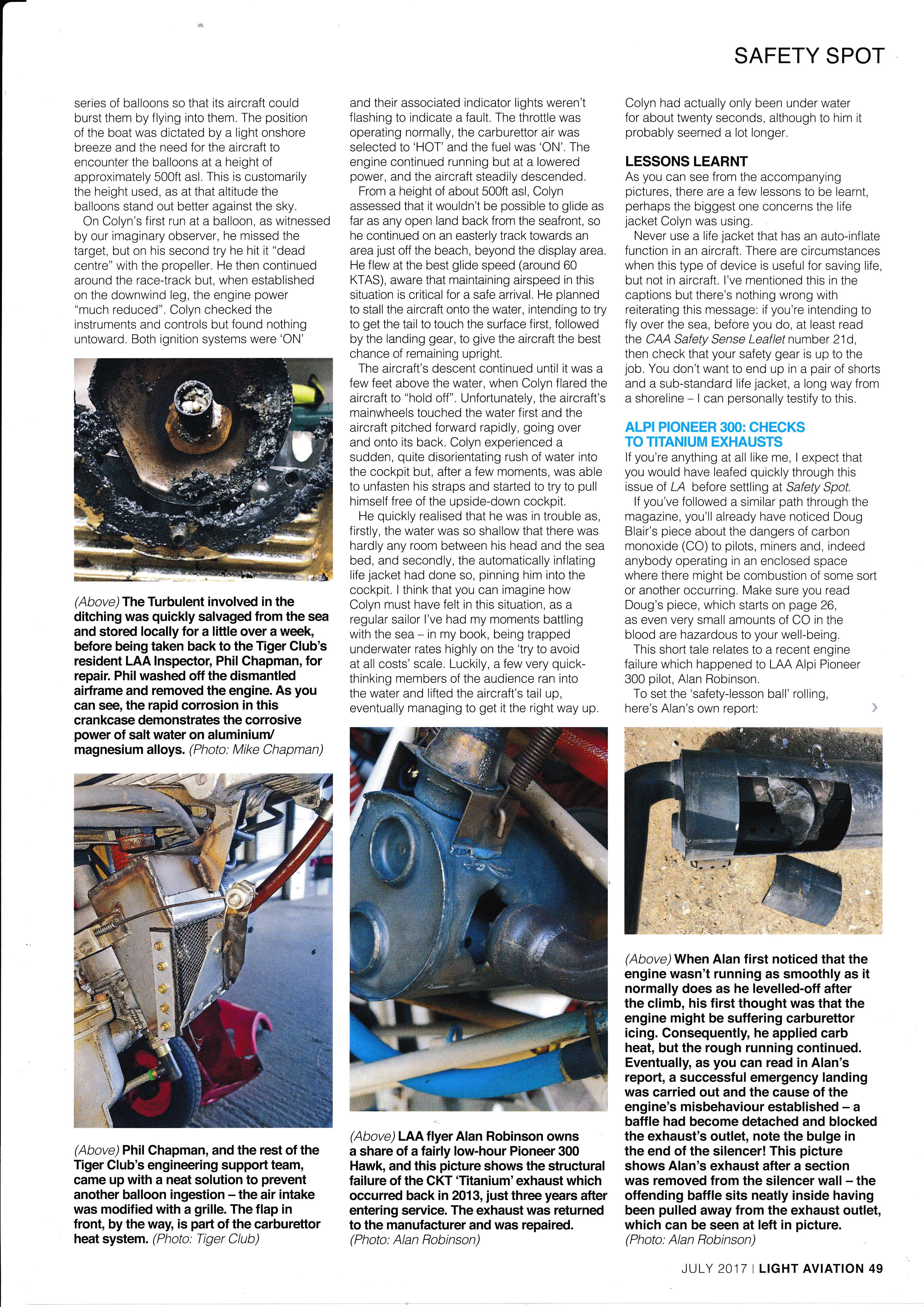
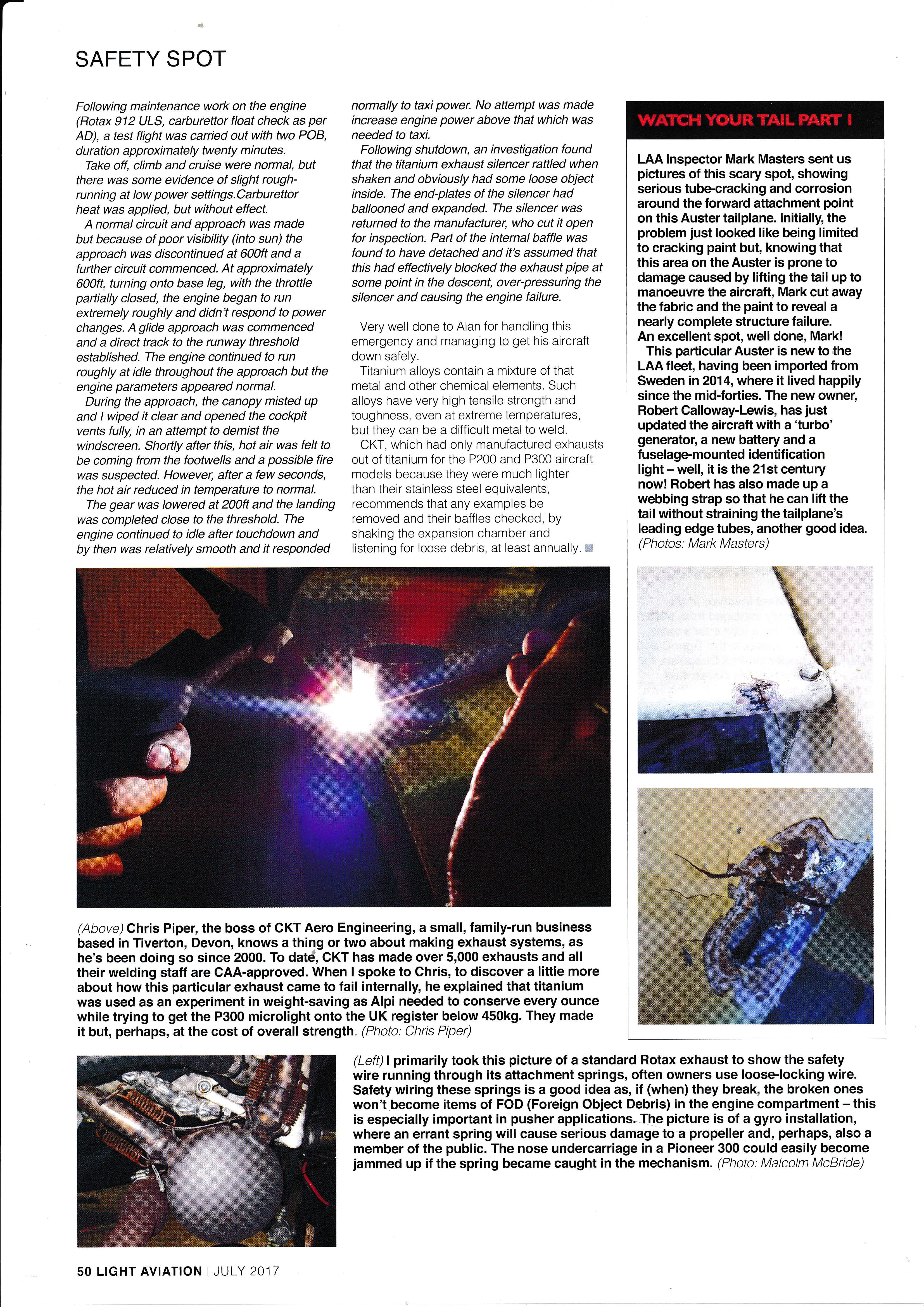
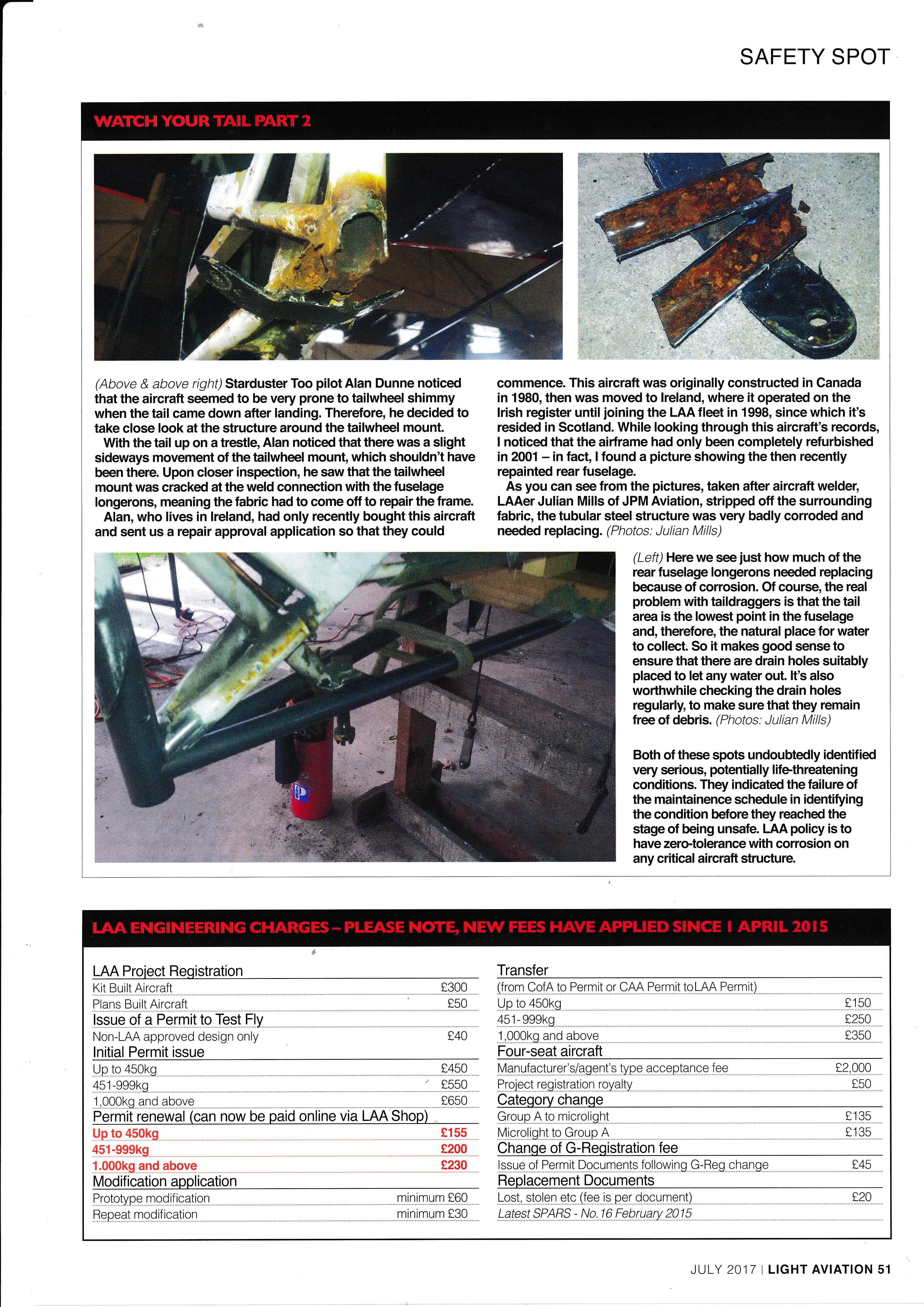
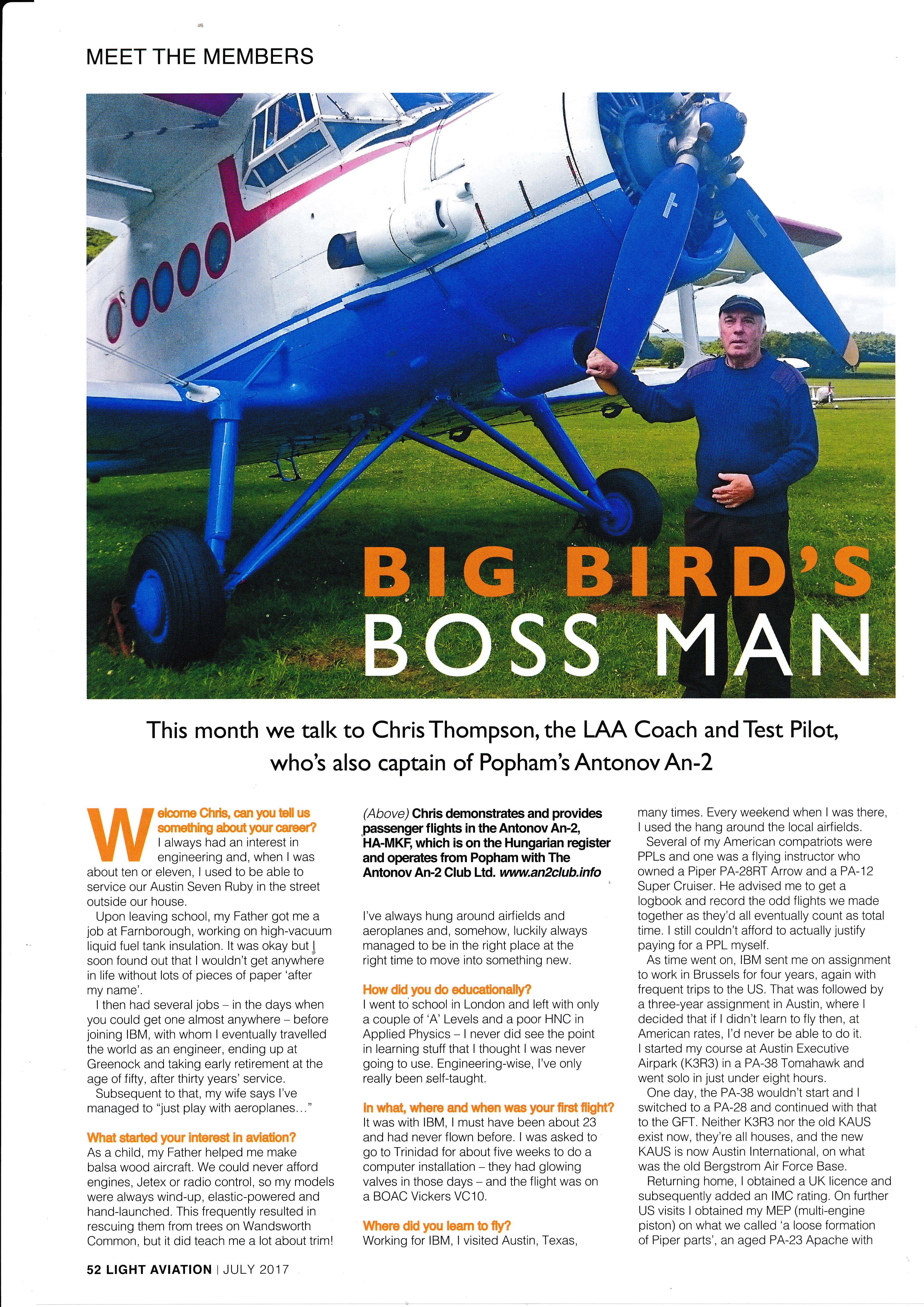
which would have done the South of France proud and | hope that you were able to make good use of such a dramatic startto the summer.We enjoyed three days of good weather for AeroExpo, which is now back at Booker, and as you read this | hope to be enjoying similar fortune at Sanicole, Belgium,for the first-ever European Federation of Light, Experimental andVintageAircraft (EFLEVA)Fly-in,organised on its behalf by the Aeroclub Sanicole.
The plan is to move this to-be-annual event around the European states I’m assured that the UK still counts as such in this context where it will most likely piggy-back with an established show, for instance, the LAA Rally.
We have expressed an interest in hosting the EFLEVA Fly-in, so hopefully in the future, the UK will be a venue under consideration. | was going to say it was a bit like getting to host the Eurovision Song Contest, but maybe not...
Incredible as it may seem, the LAA Rally is now only two months away, so it seems timely to include an early preview of the event in this
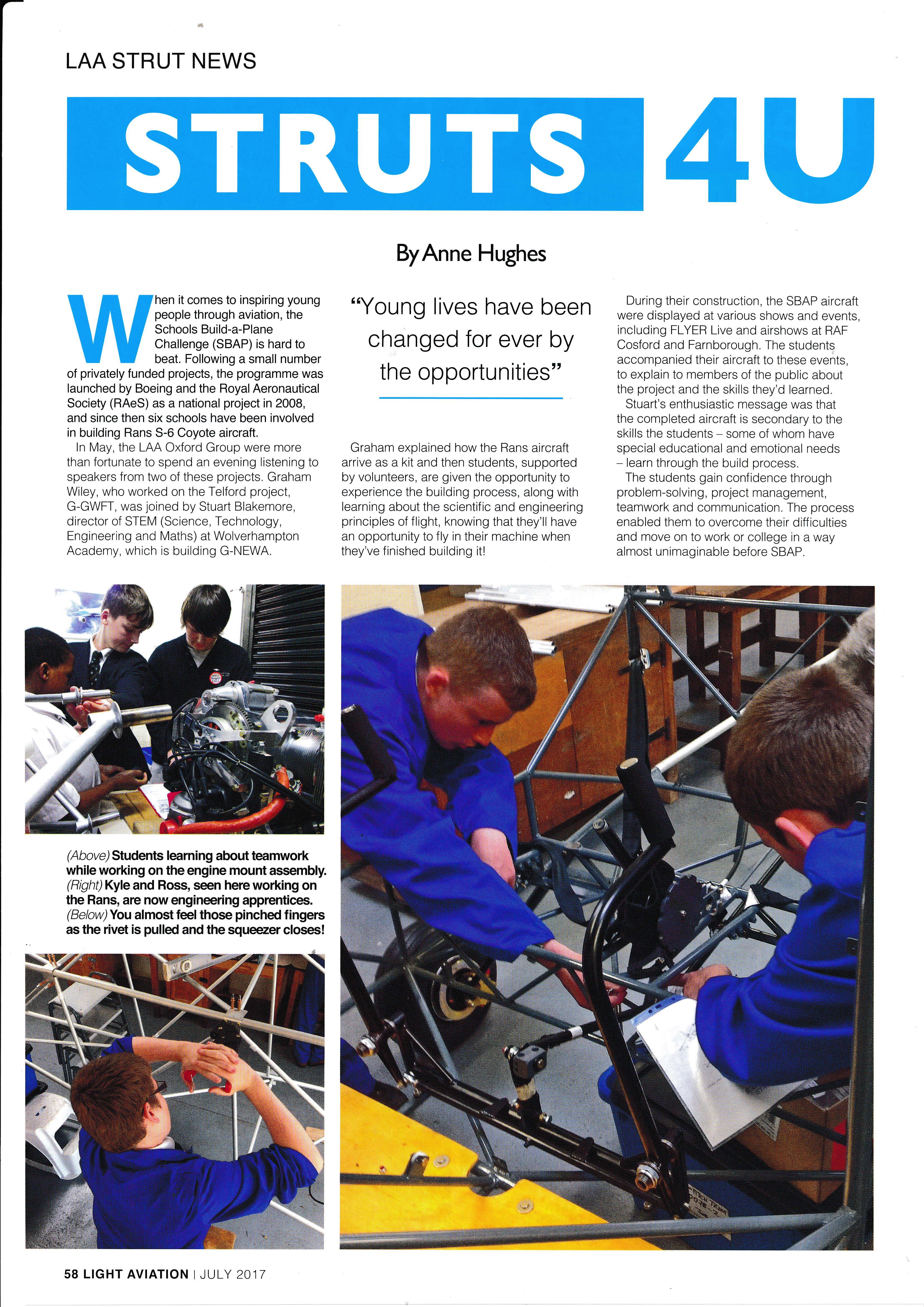
issue. This year, we're promoting Youth in Aviation, with our long-standing involvement with the Boeing/Royal Aeronautical Society Schools Build-a-Plane programme taking centre stage. Turn to this issue’s Struts 4U on page 58 for more detail on the projects undertaken by Schools Build-a-Plane.
If you or a group that you’re associated with have an involvement in bringing aviation to young people, please get in touch because we’re keen to help you promote this very important activity and showcase it at the Rally.
Can | make a plea to pilots not to book multiple slots for the Rally? Last year, the number of available slots was cut, due to CAA concerns, and this means that if you book slots for three days, only intending to come once, you're robbing two fellow members of the opportunity to attend. You'll find more on this issue in the LAA Rally preview on page 24.
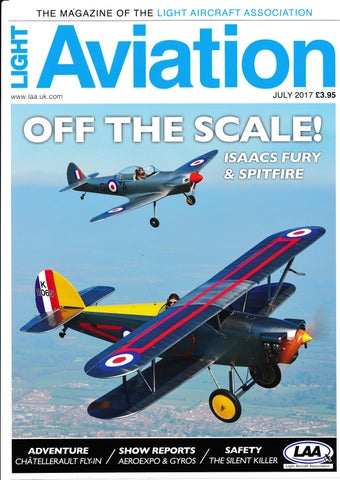
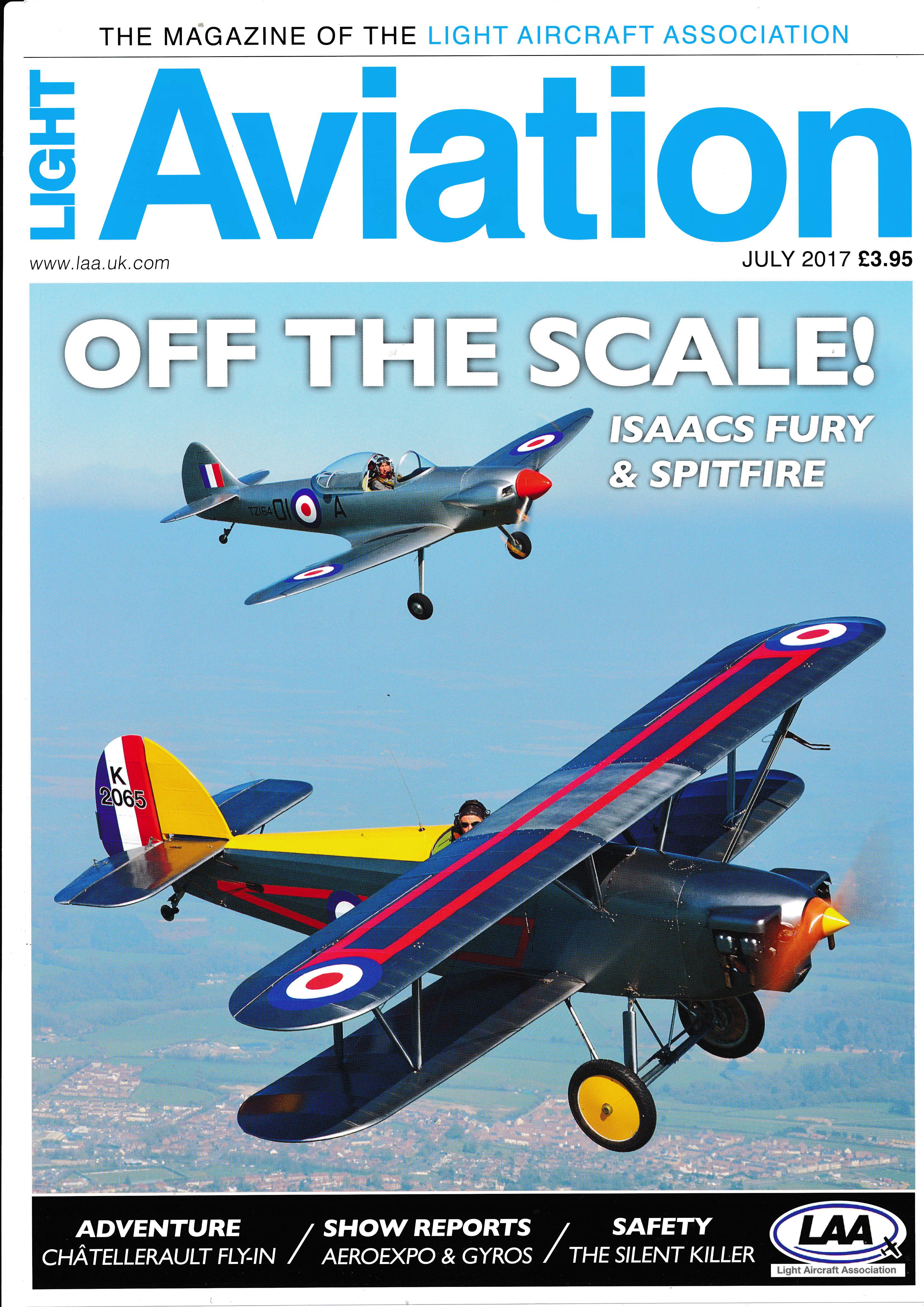
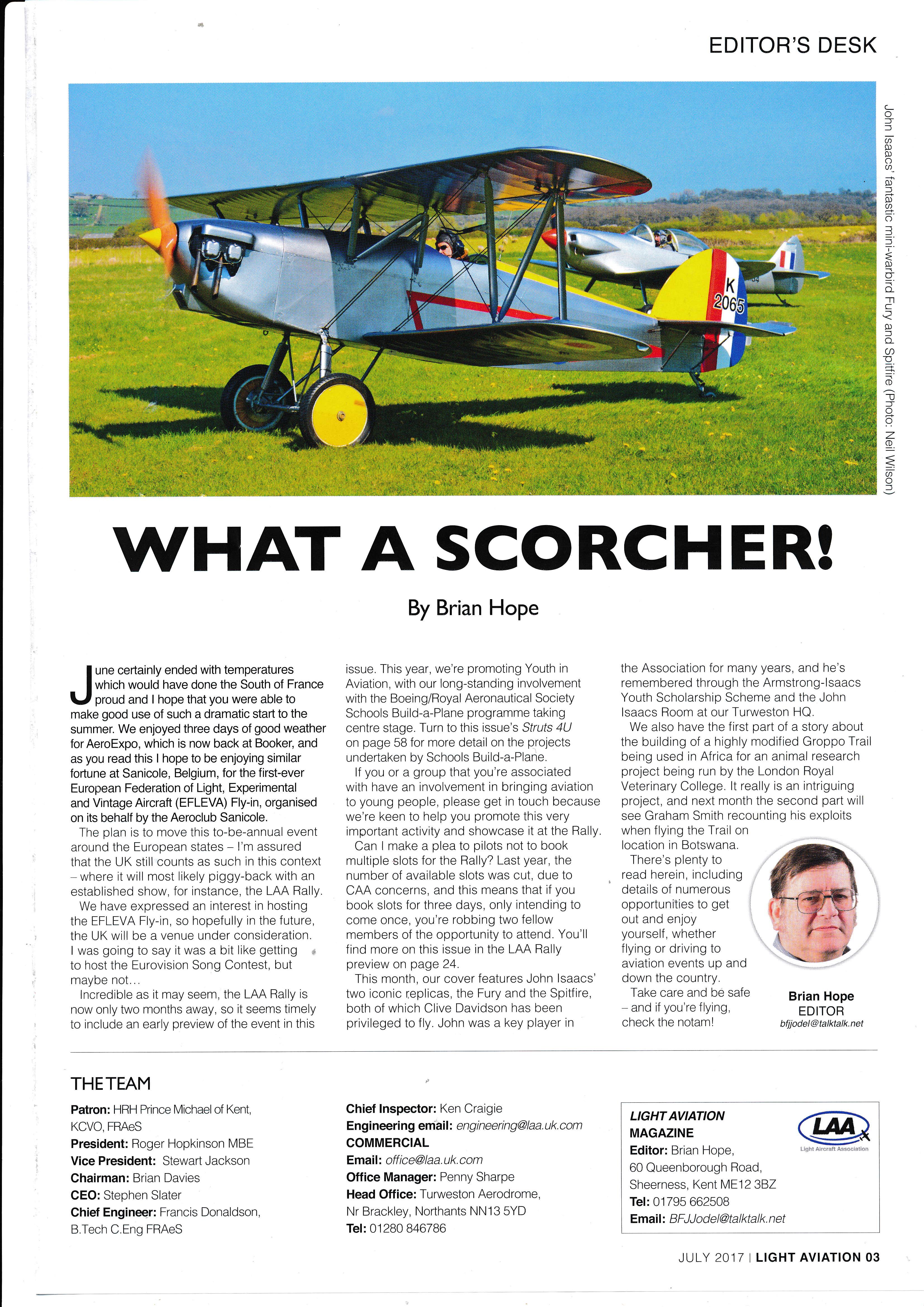
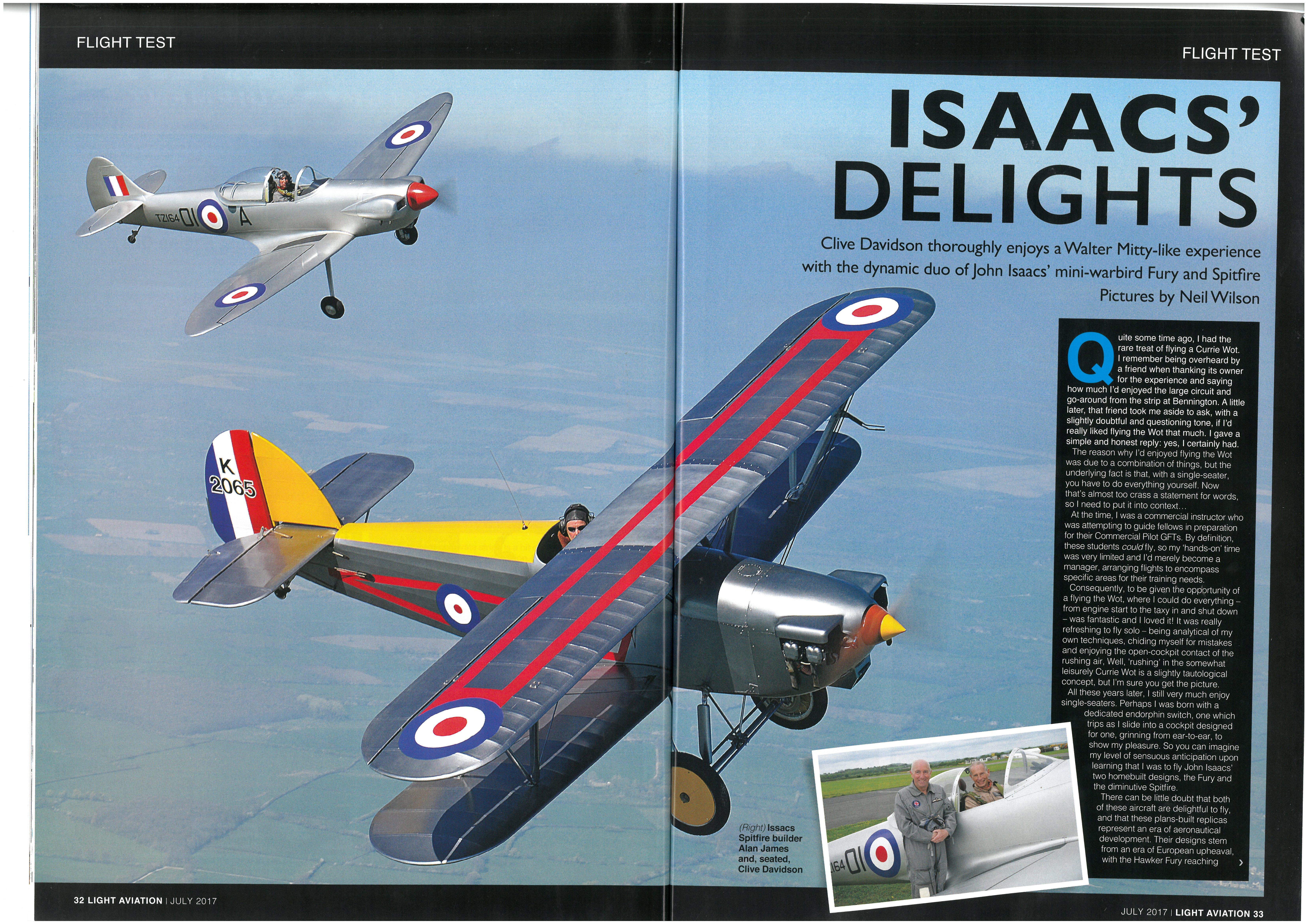
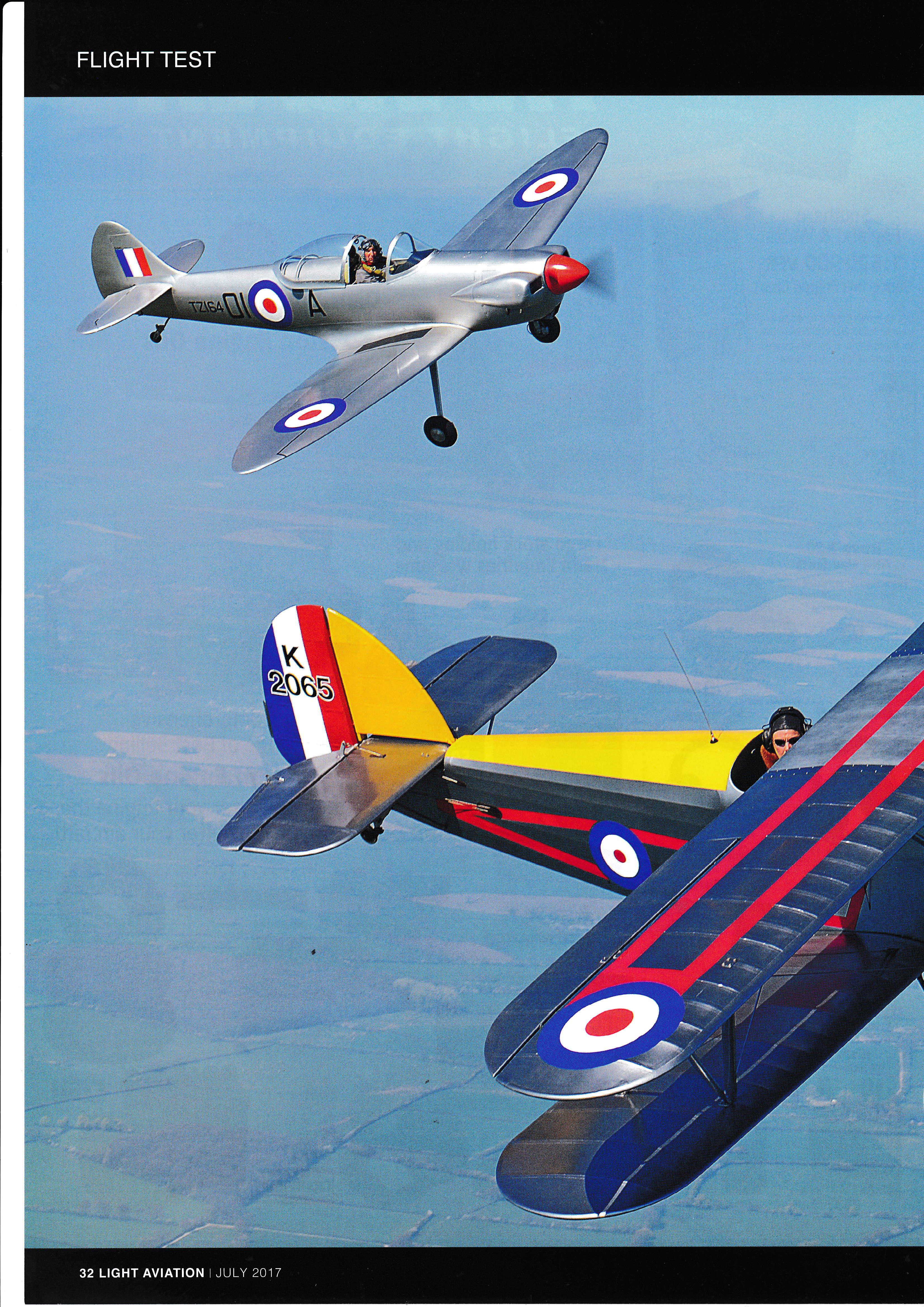
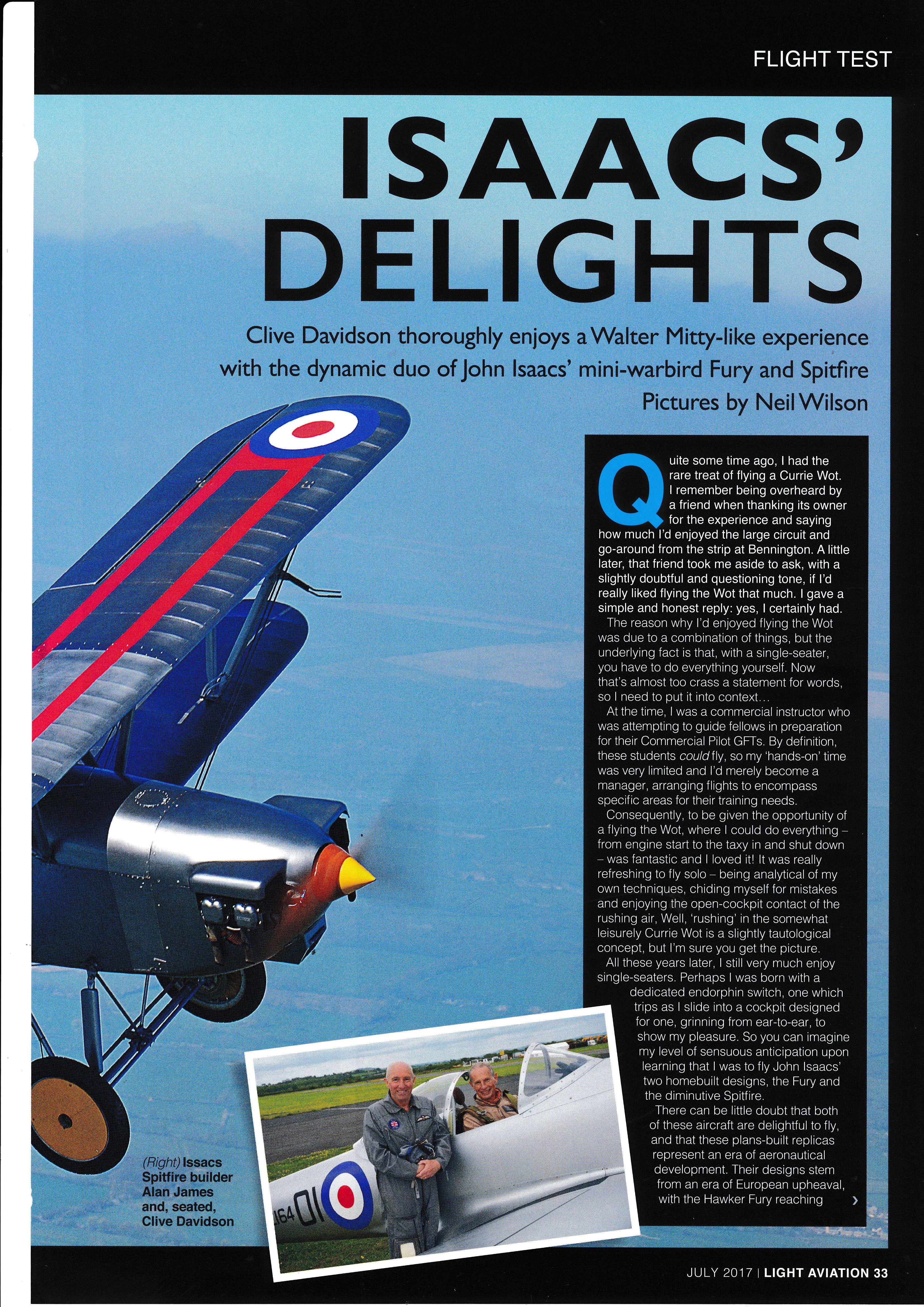
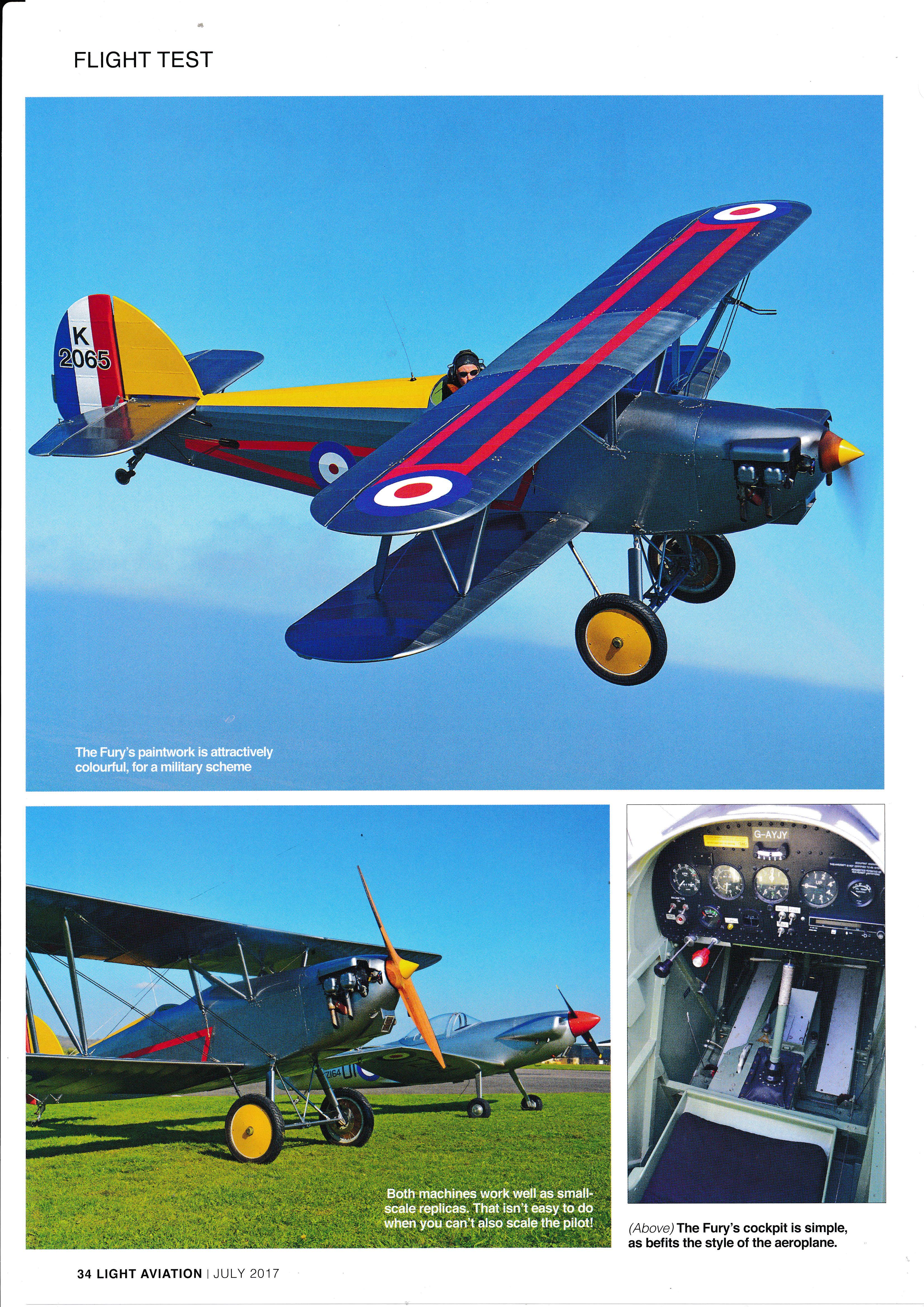
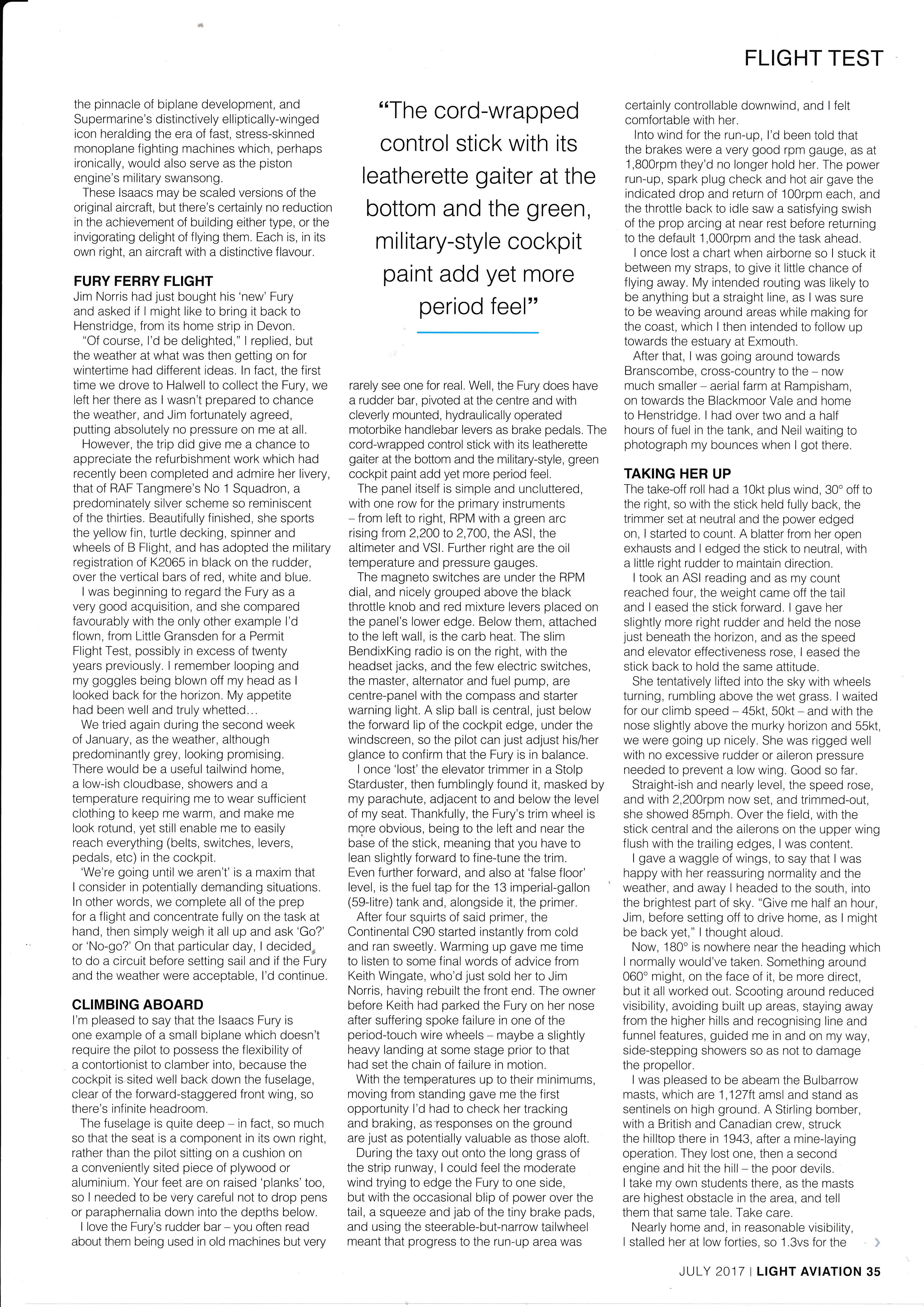
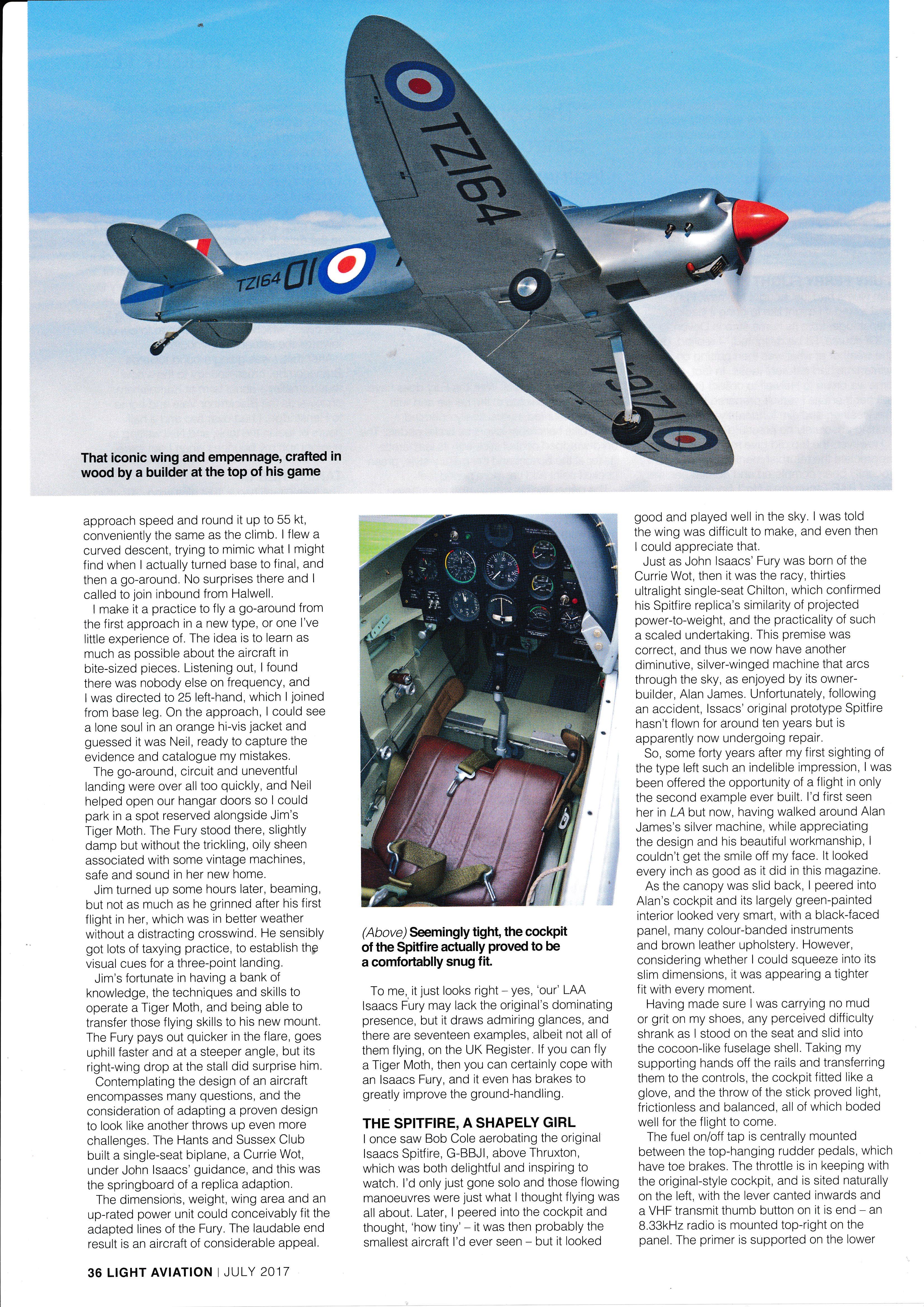
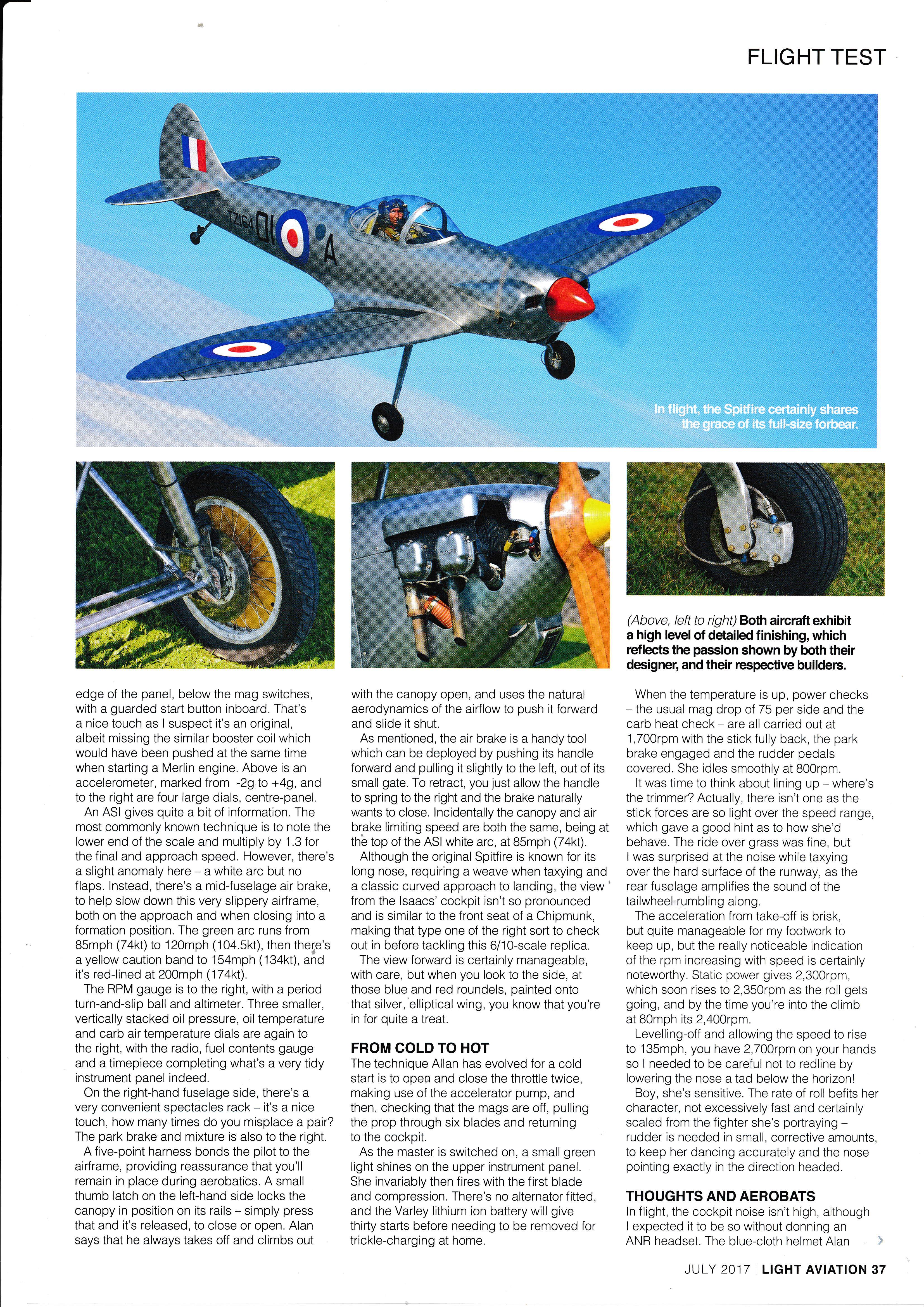
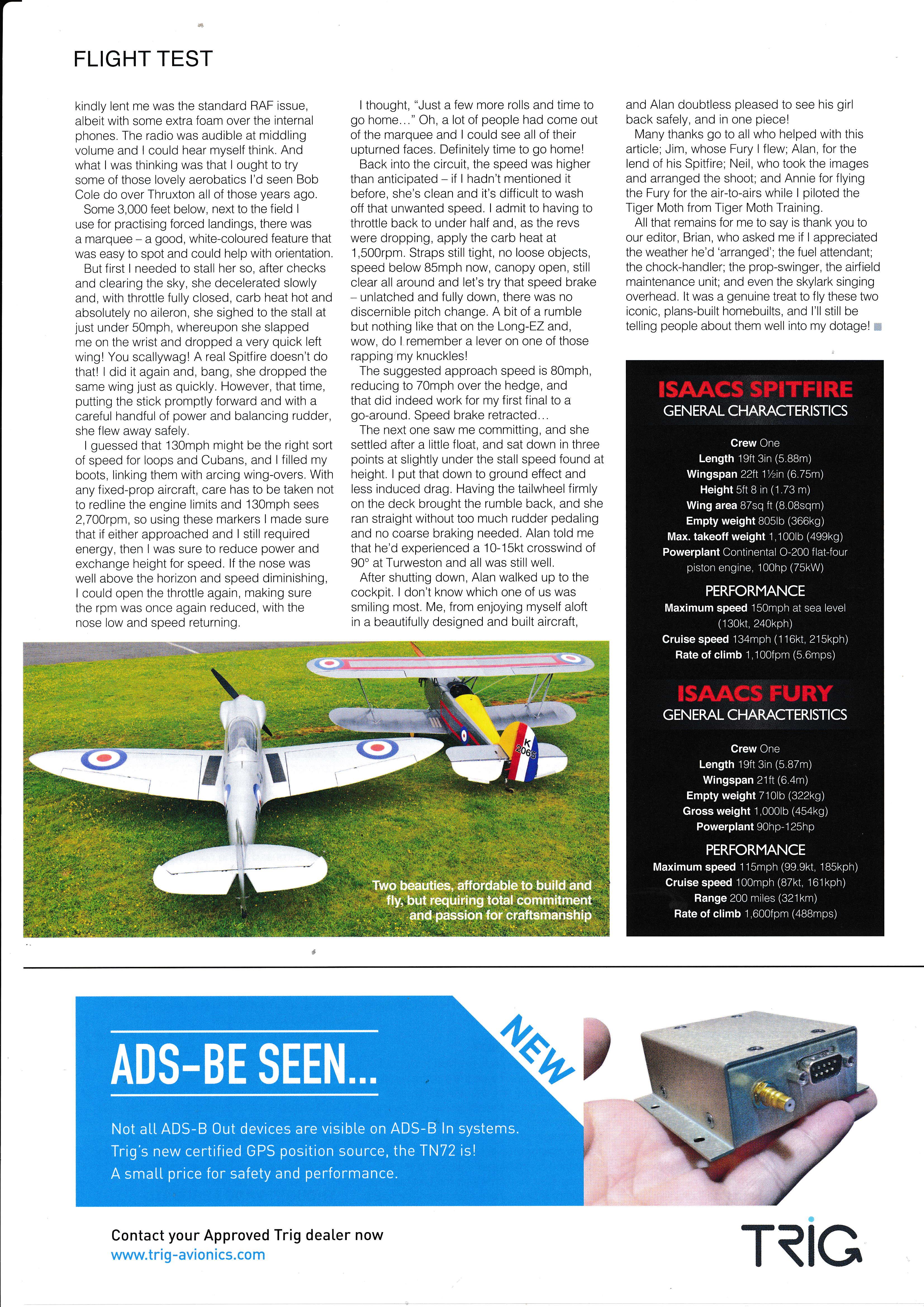
This month, our cover features John Isaacs’ two iconic replicas, the Fury and the Spitfire, both of which Clive Davidson has been
THETEAM
Patron: HRH Prince Michael of Kent, KCVO, FRAeS
President: Roger Hopkinson MBE
Vice President: Stewart Jackson
Chairman: Brian Davies
CEO: Stephen Slater
Chief Engineer: Francis Donaldson, B.Tech C.Eng FRAeS
Chief Inspector: Ken Craigie
Engineering email: engineering@laa.uk.com
COMMERCIAL
Email: office@/aa.uk.com
Office Manager: Penny Sharpe
Head Office: Turweston Aerodrome, Nr Brackley, Northants NN13 5YD
Tel: 01280 846786
the Association for many years, and he’s remembered through the Armstrong-lsaacs Youth Scholarship Scheme and the John Isaacs Room at our Turweston HQ.
We also have the first part of a story about the building of a highly modified Groppo Trail being used in Africa for an animal research project being run by the London Royal Veterinary College. It really is an intriguing project, and next month the second part will see Graham Smith recounting his exploits when flying the Trail on location in Botswana.
There’s plenty to read herein, including details of numerous opportunities to get out and enjoy yourself, whether flying or driving to aviation events up and down the country.
Take care and be safe and if you're flying, check the notam!
Brian Hope EDITOR bfjiode!@talktalk.net
LIGHTAVIATION
MAGAZINE
Editor: Brian Hope, 60 Queenborough Road, Sheerness, Kent ME12 3BZ
Tel: 01795 662508
Email: BFJJodel@talktalk.net
06 NEWS
Freeaccess to Belgian airspace for most, more Rotaxthefts, Aero Space Kinross, potential North Weald threat
10PROJECTNEWS
GroppoTrail,AeropraktFoxbat, Europa Monowheel, Practavia Sprite, & BE2E-1and SopwithSnipereplicas
|6 TOURINGADVENTURE
Martin Ferid heads to France for the Chatelleraulttaildragger fly-in
20 GLOBE-TROTTING
The first of a two-part feature about a GroppoTrail’sinvolvementina Royal VeterinaryCollegeprojectinBotswana
24 LAA RALLY PREVIEW
Brian Hope revealswhat lies in store forvisitorsto Sywellon 1-3September
26 SAFETY:THE SILENT KILLER
Doug Blairon the dangers of carbon monoxide poisoning in aircraft
28 AEROEXPO 2017
Brian Hope reports on the annual aviation event’s return to Booker
32 FLIGHT TEST
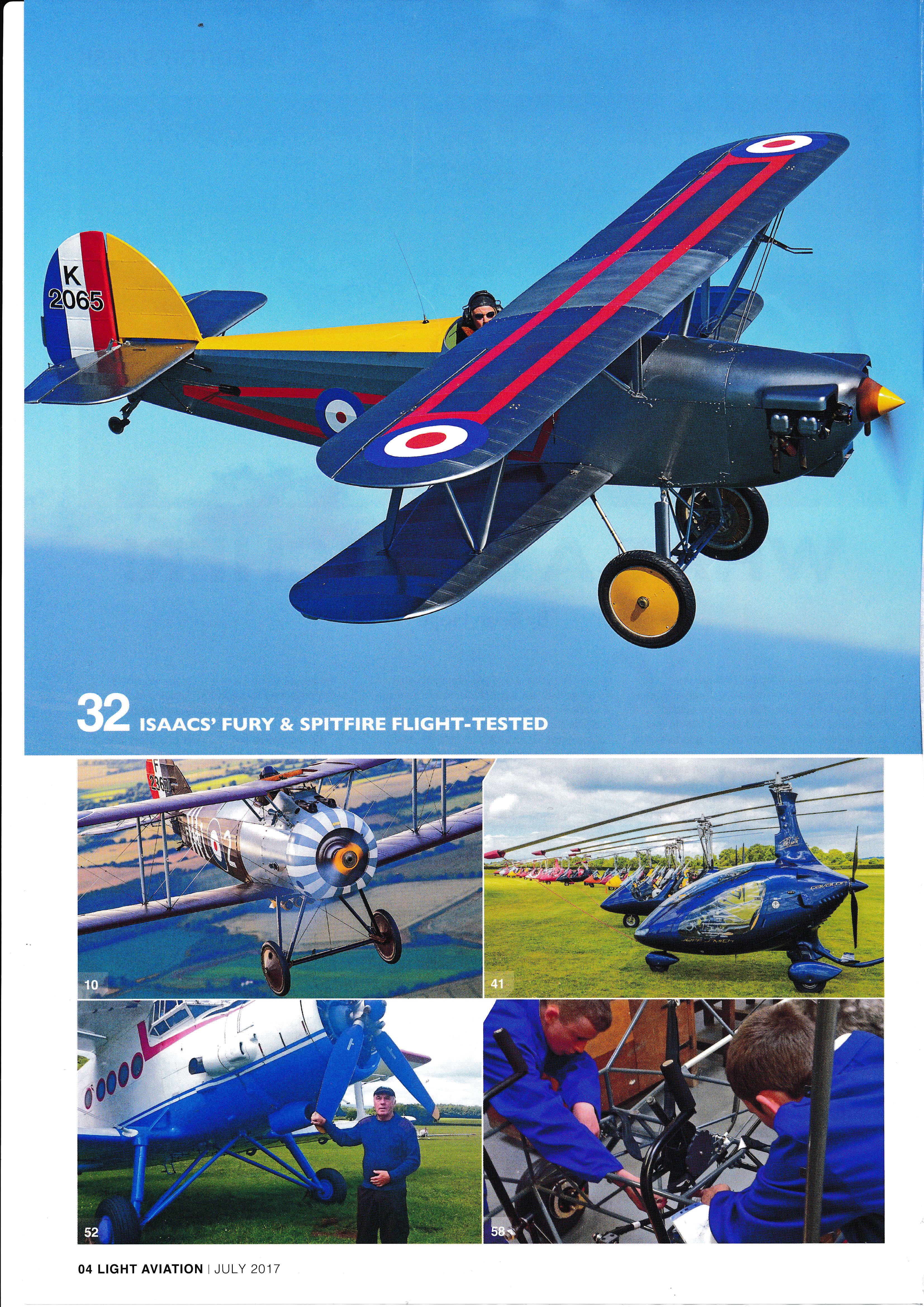
Clive Davidson flies the Isaacs Furyand Spitfire replicas
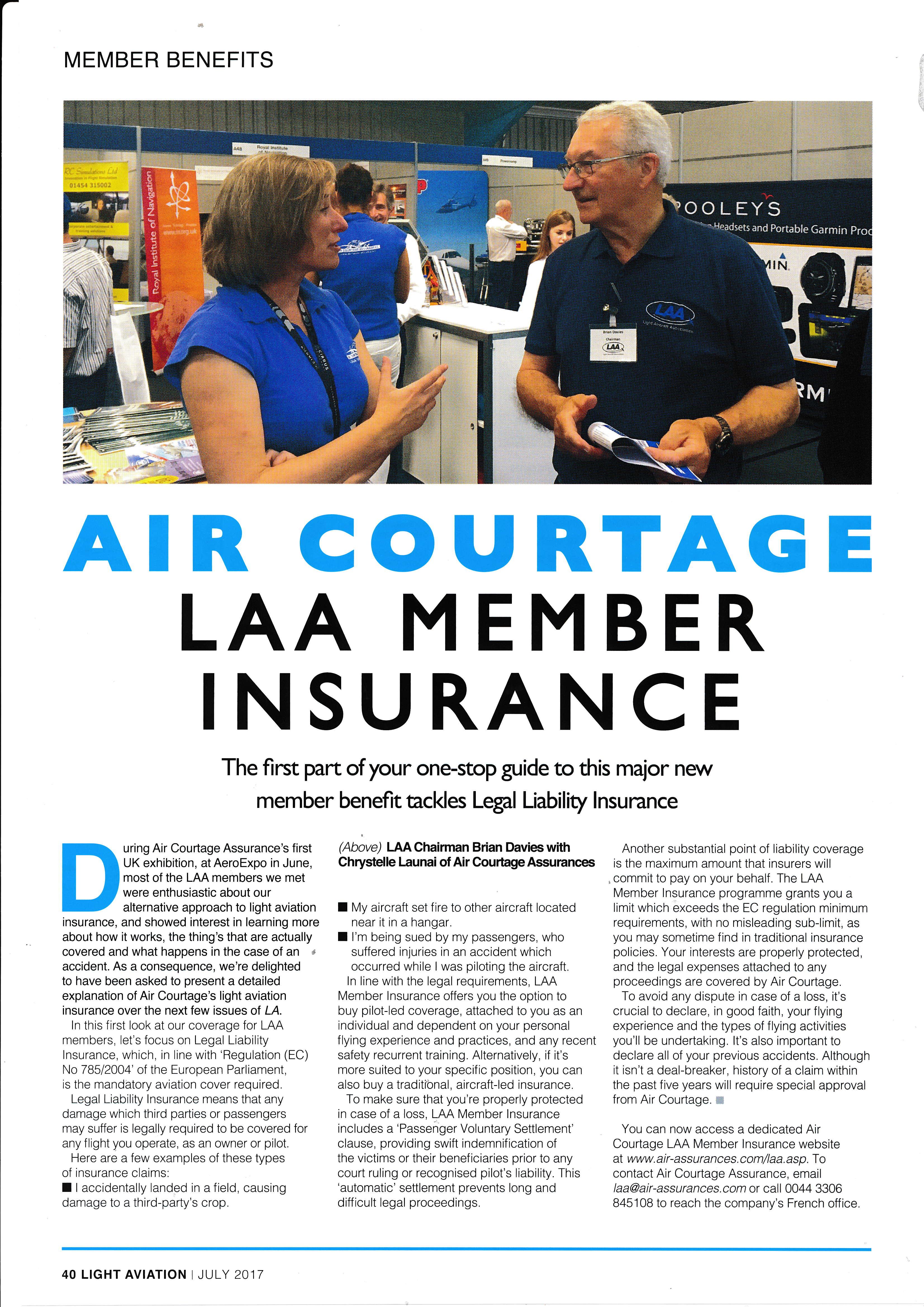
40 AIR COURTAGE
How you can now take advantage of the new insurace programme that’s been tailor-made for LAA members
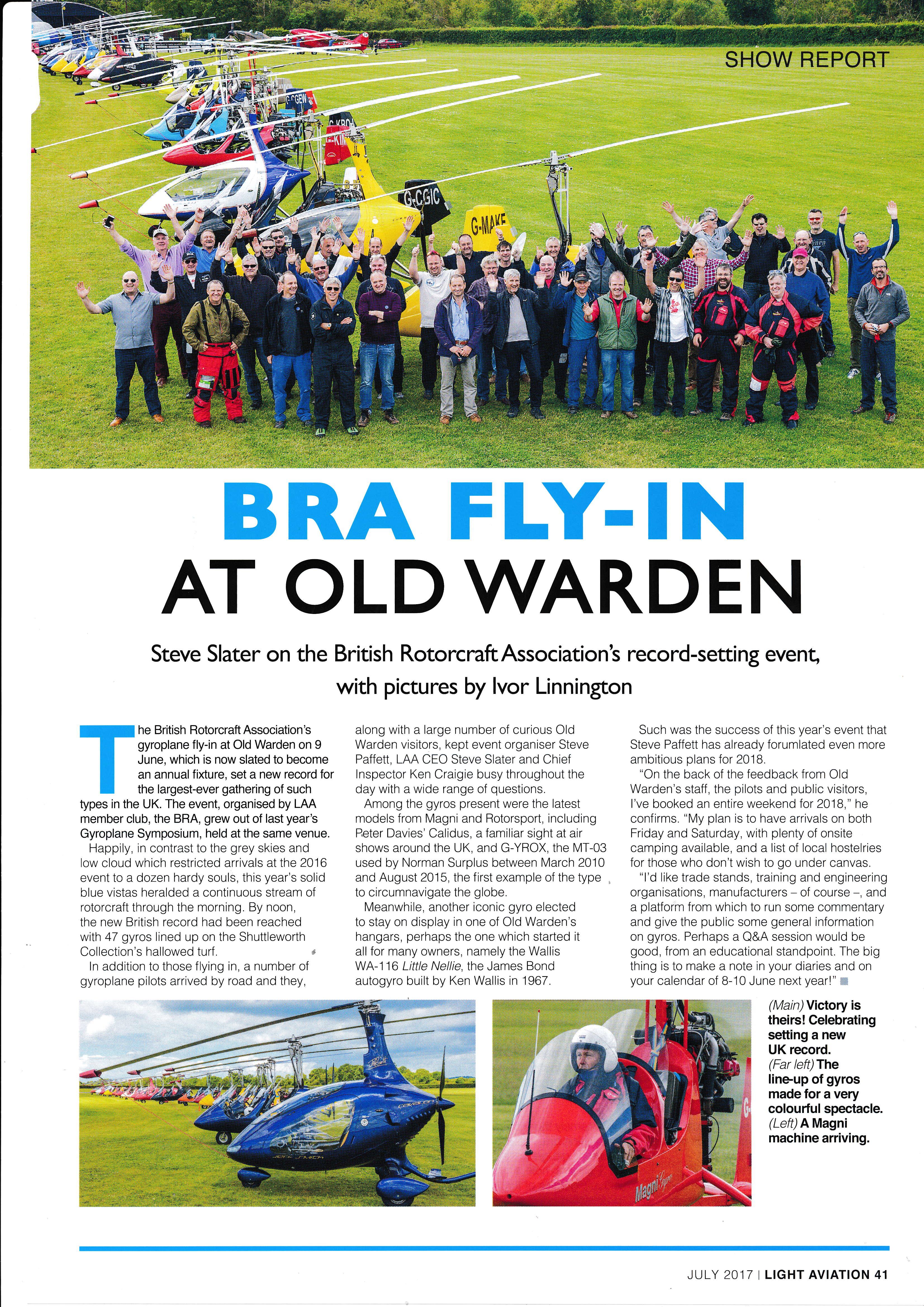
4| GYROSAT OLDWARDEN
Steve Slater on the British Rotorcraft Association’s record-setting event
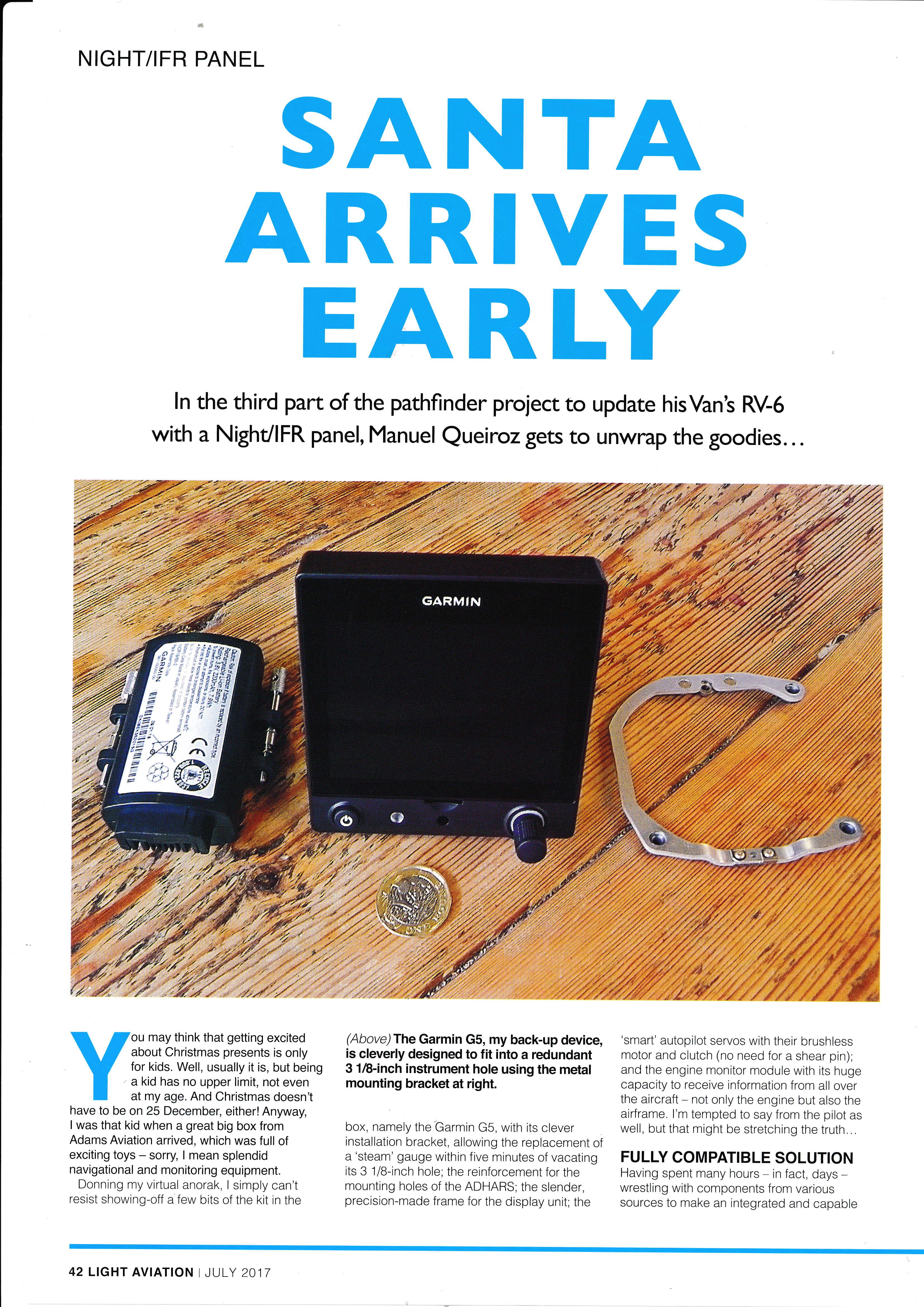
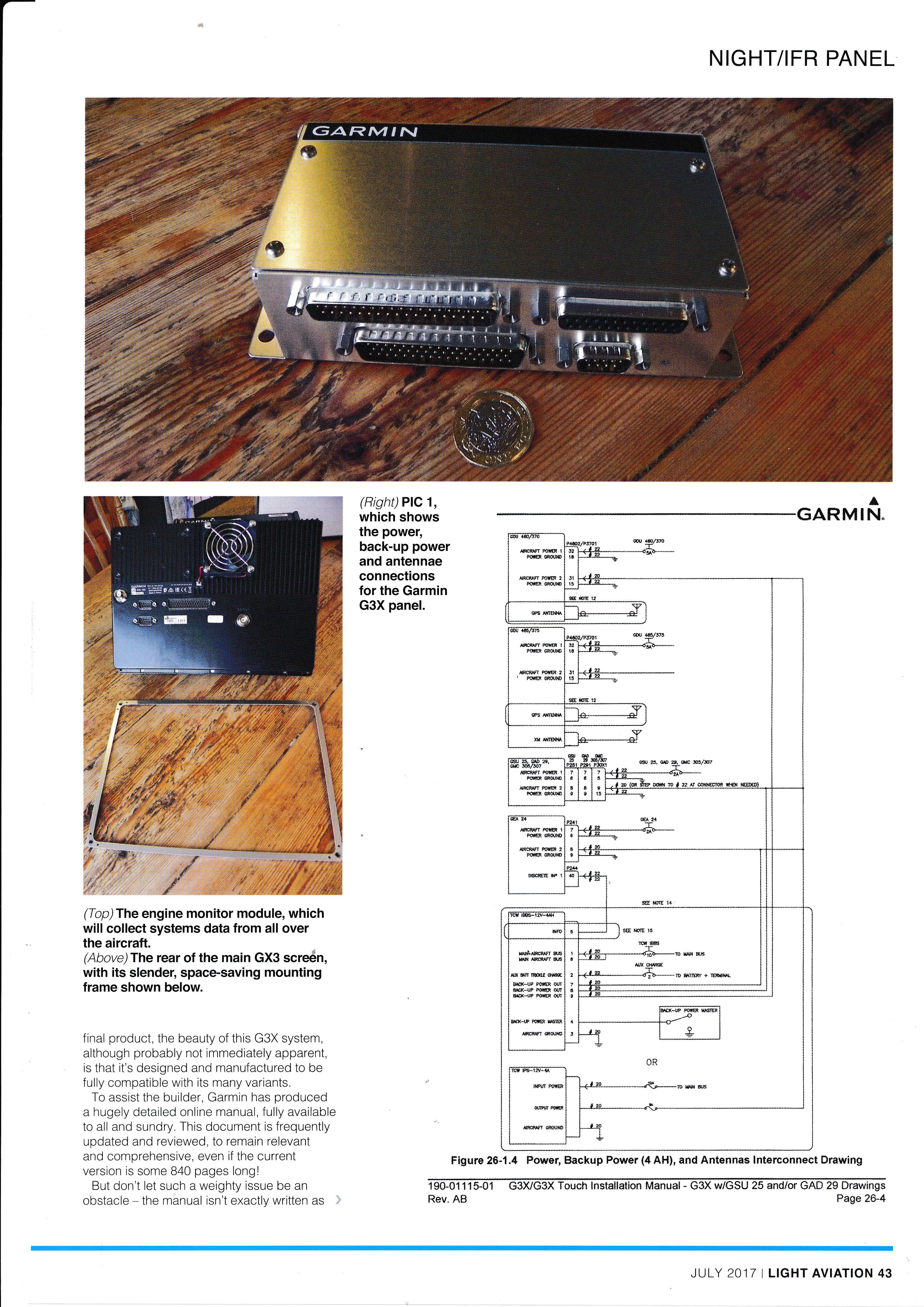
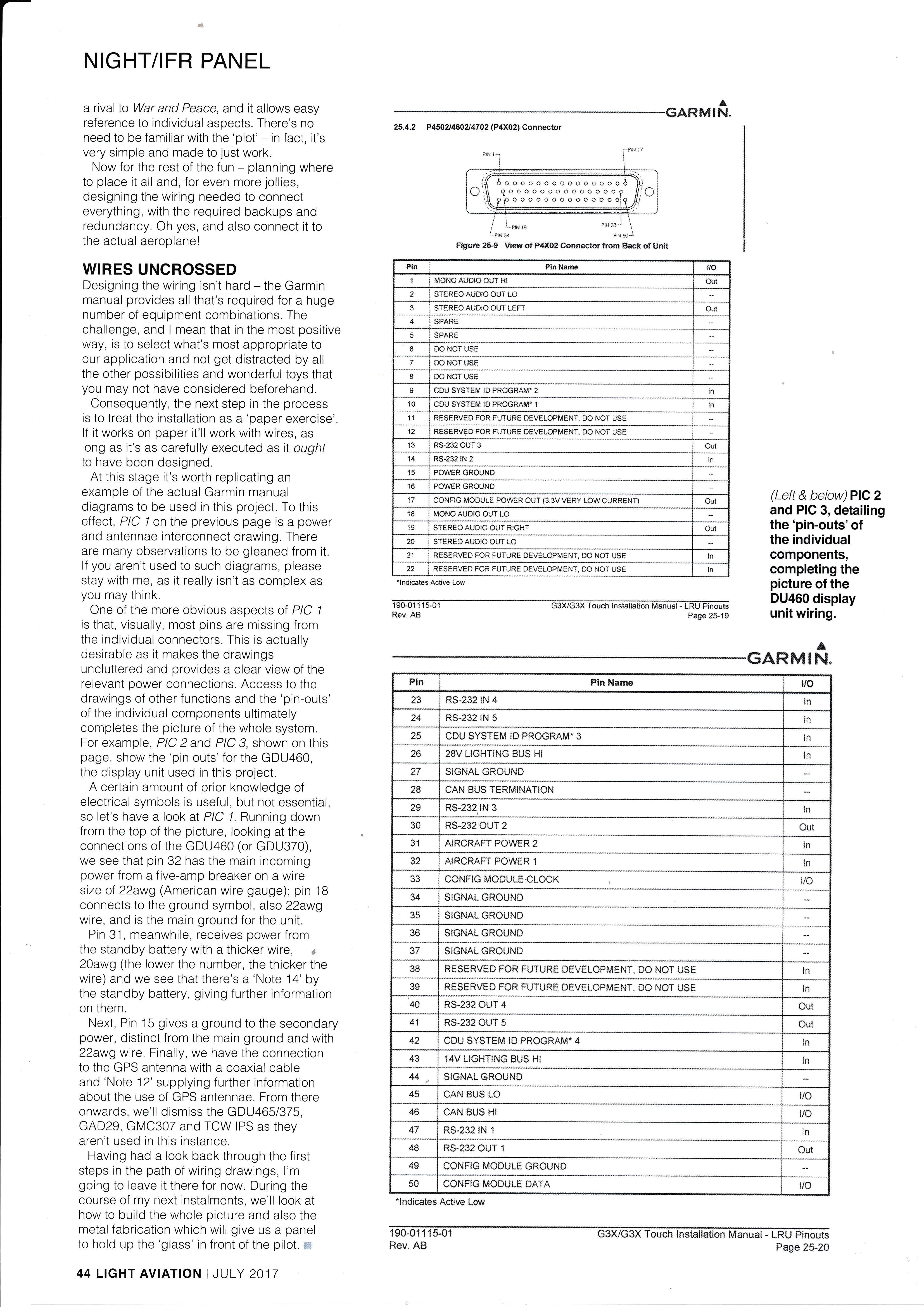
42. NIGHT/IFR PANEL
Manuel Queiroz’s third report on this RV-6‘pathfinder project’
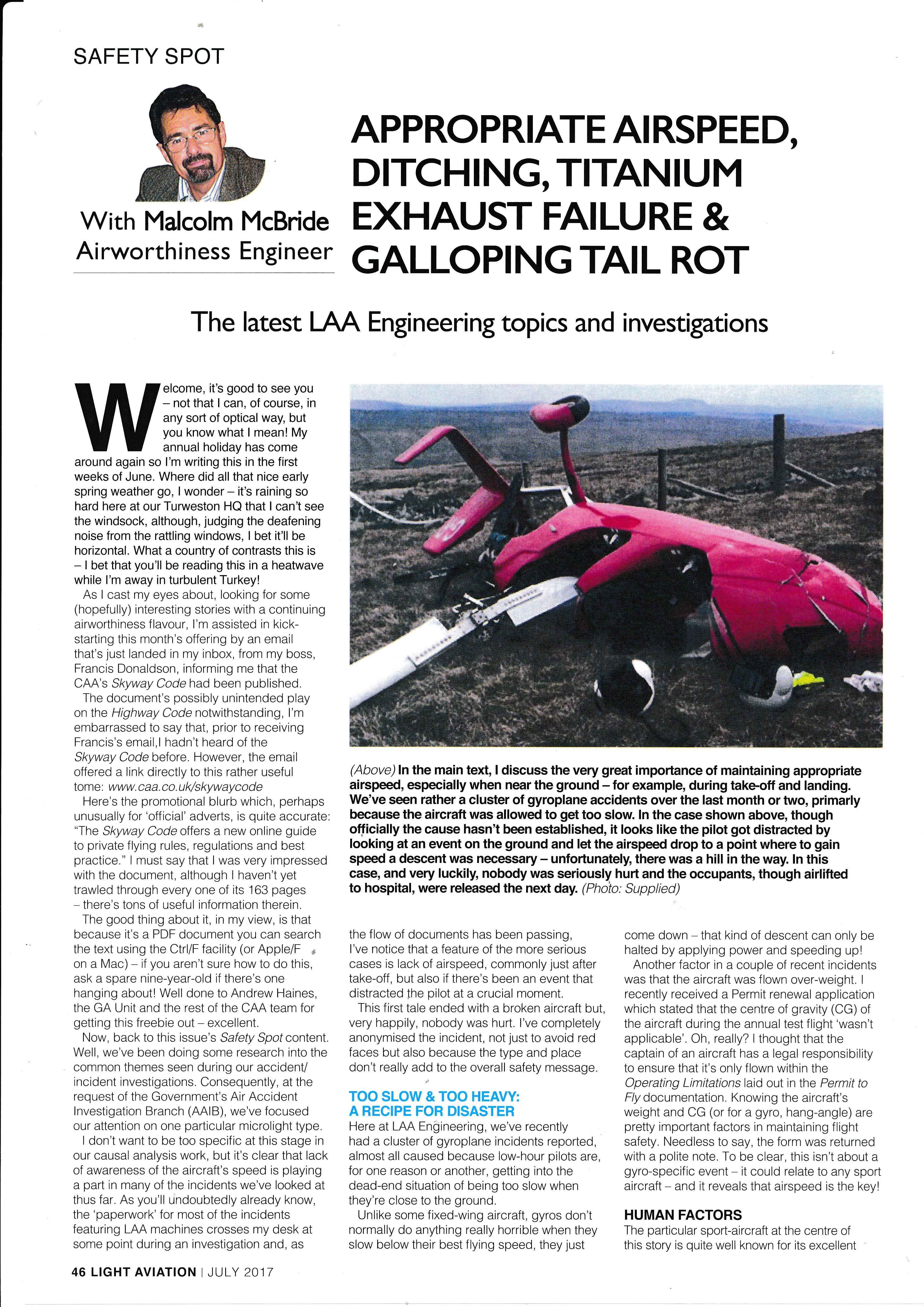
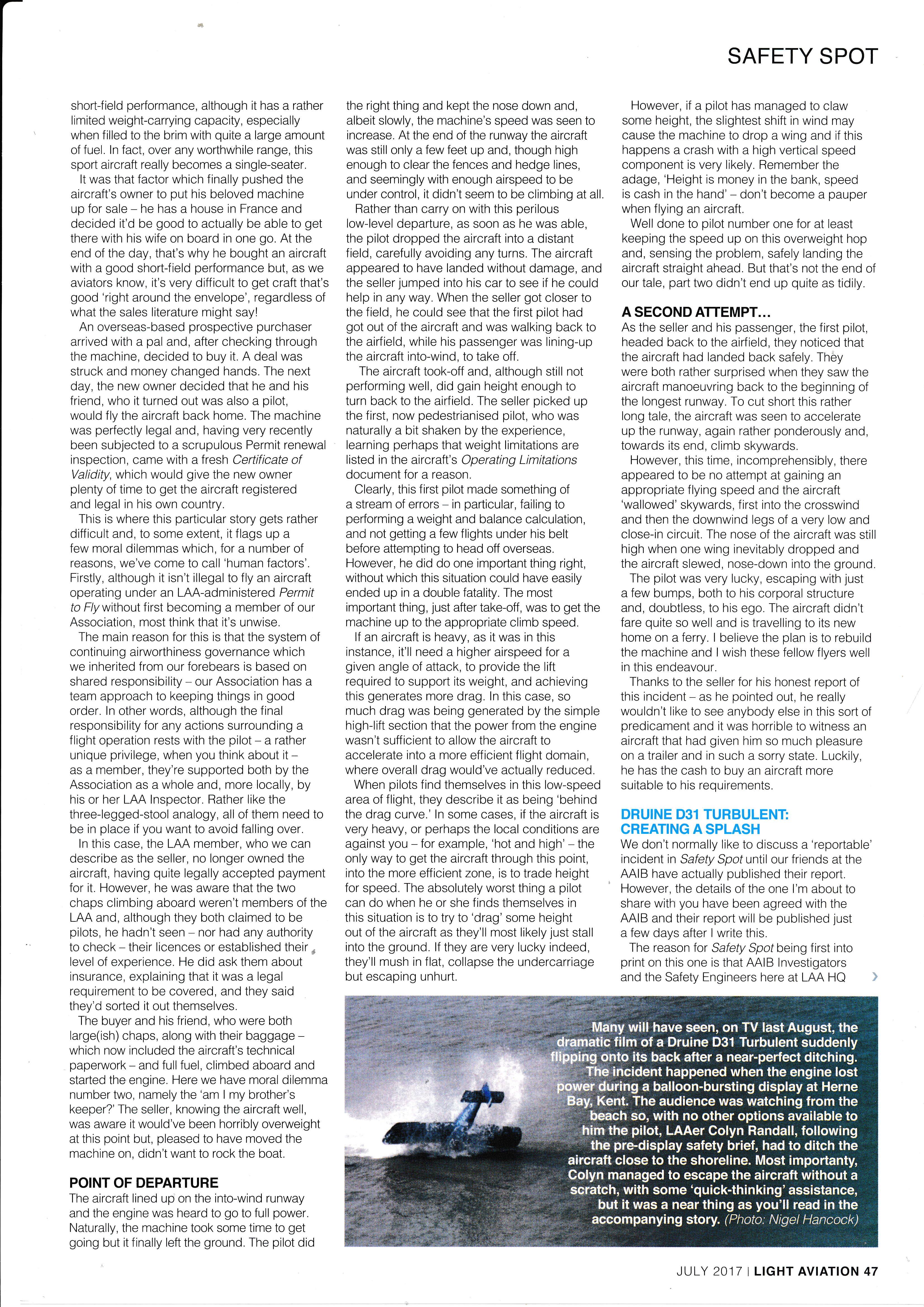
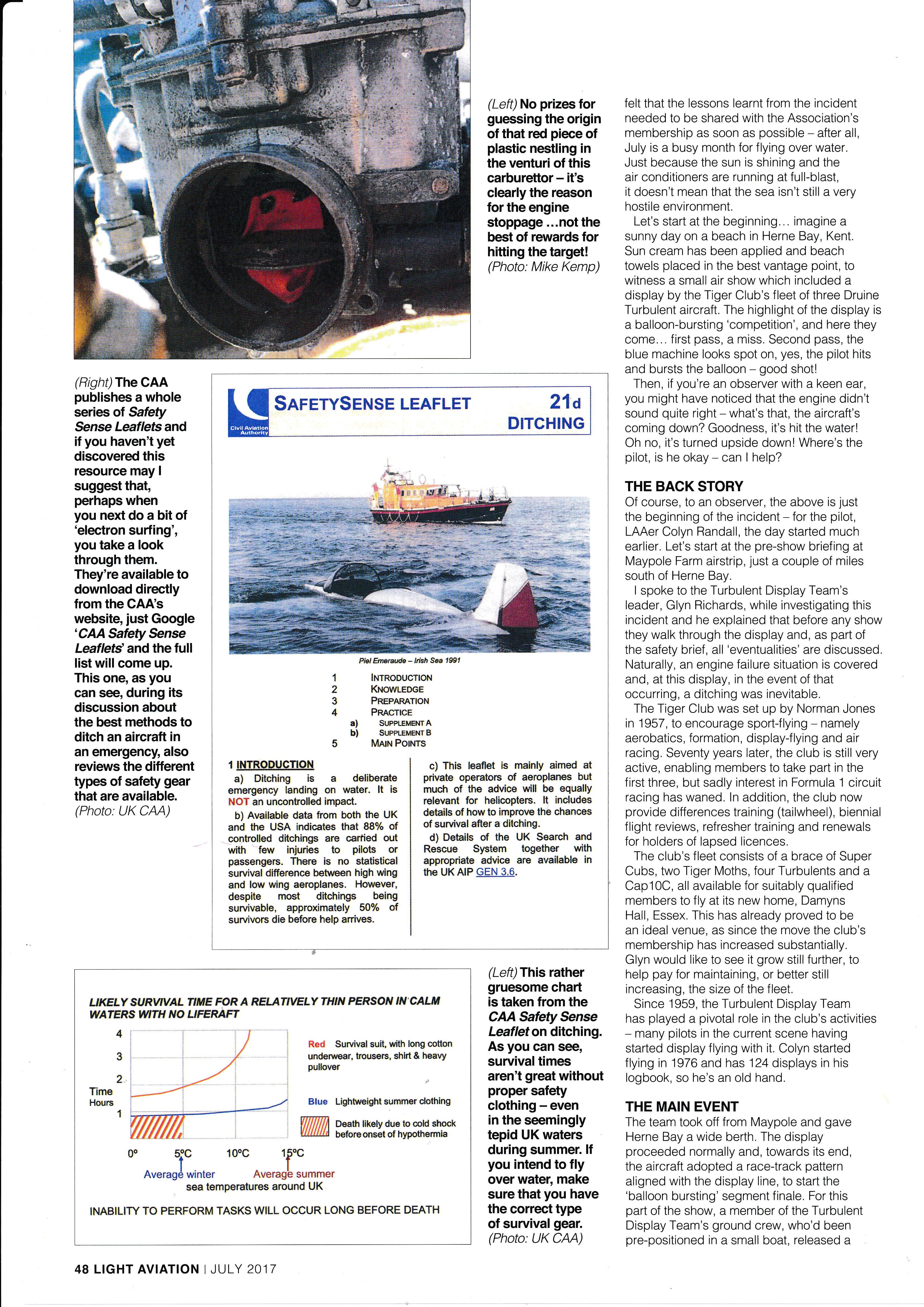
46 SAFETY SPOT
Malcolm McBride on appropriate airspeed,ditching,exhausts & tailrot
52 MEETTHE MEMBERS
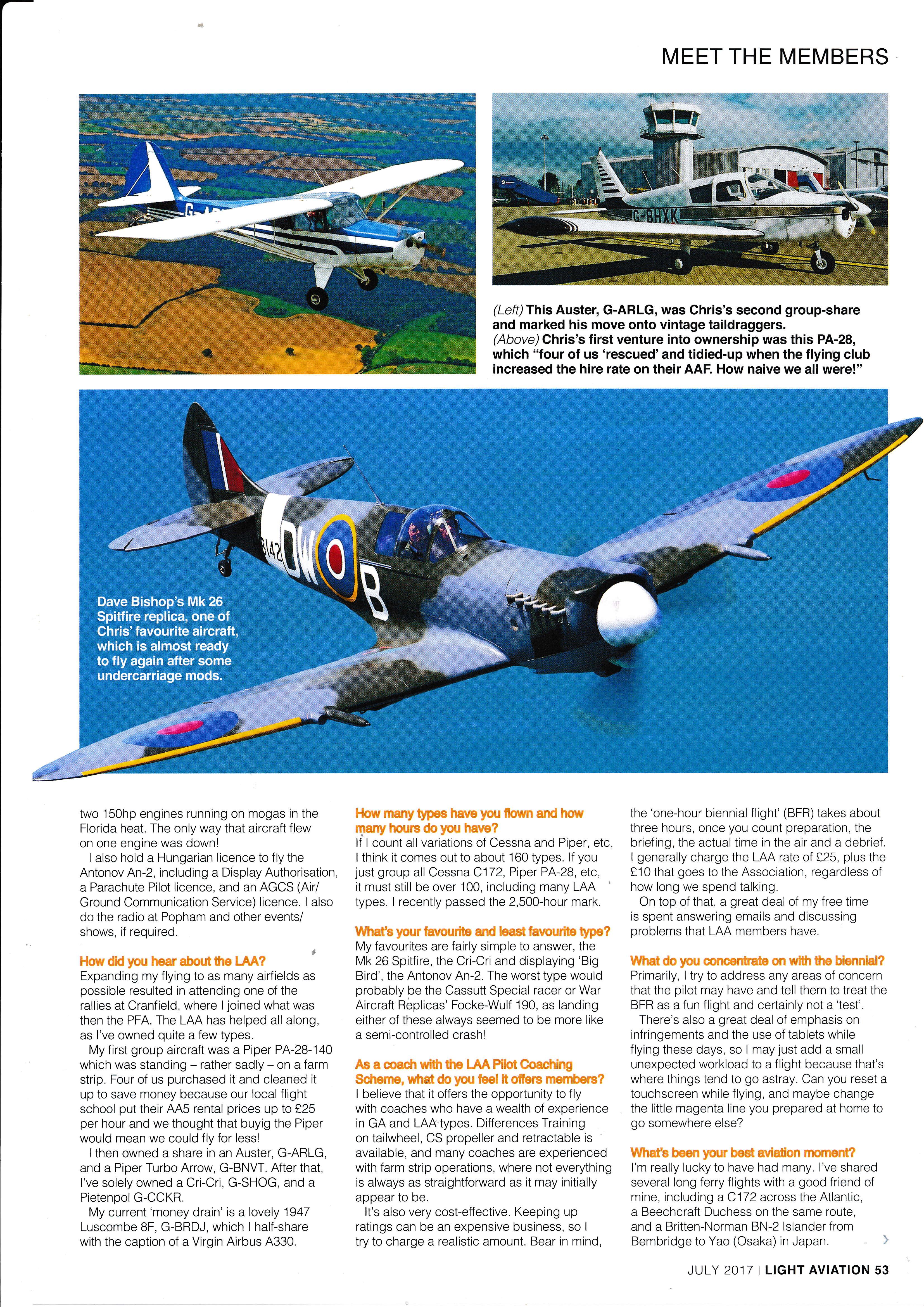
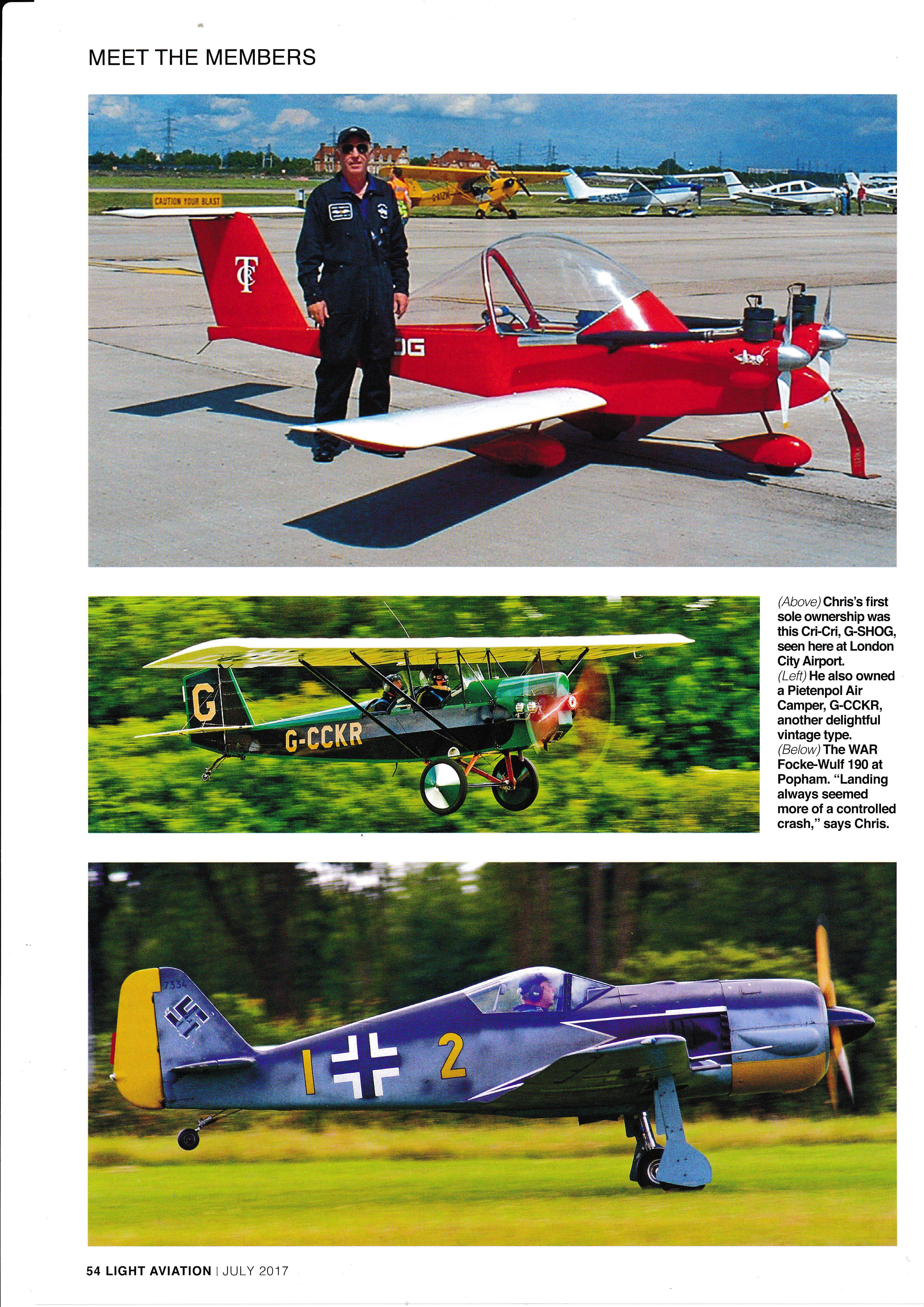
Chris Thompson, LAA Coach and Test Pilot& Popham’s An-2 captain
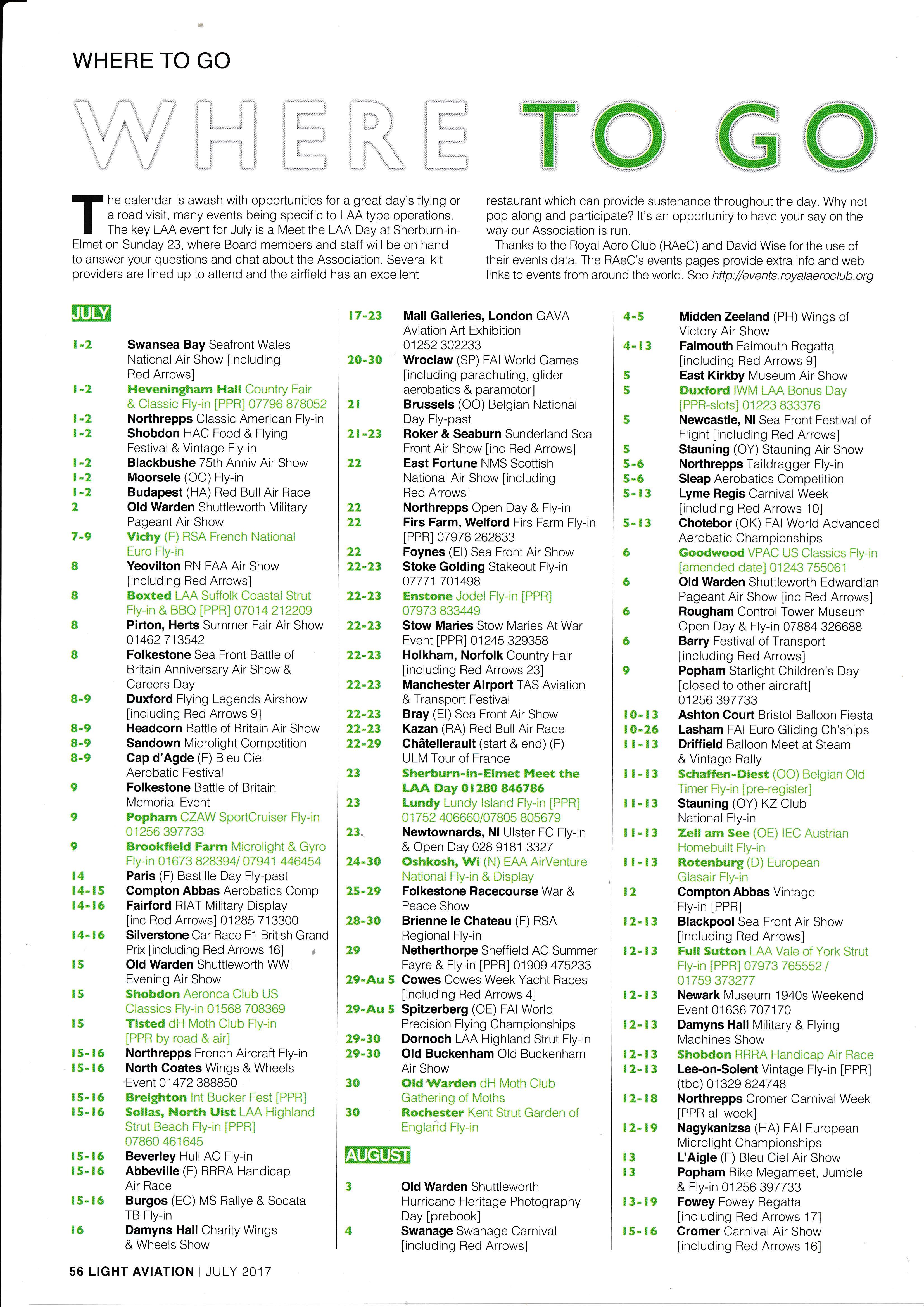
56 WHERETO GO
Fly-insand events for July & August
58 STRUTS 4U
Anne Hugheswith a reportfrom theOxfordGroup& Strutlistings
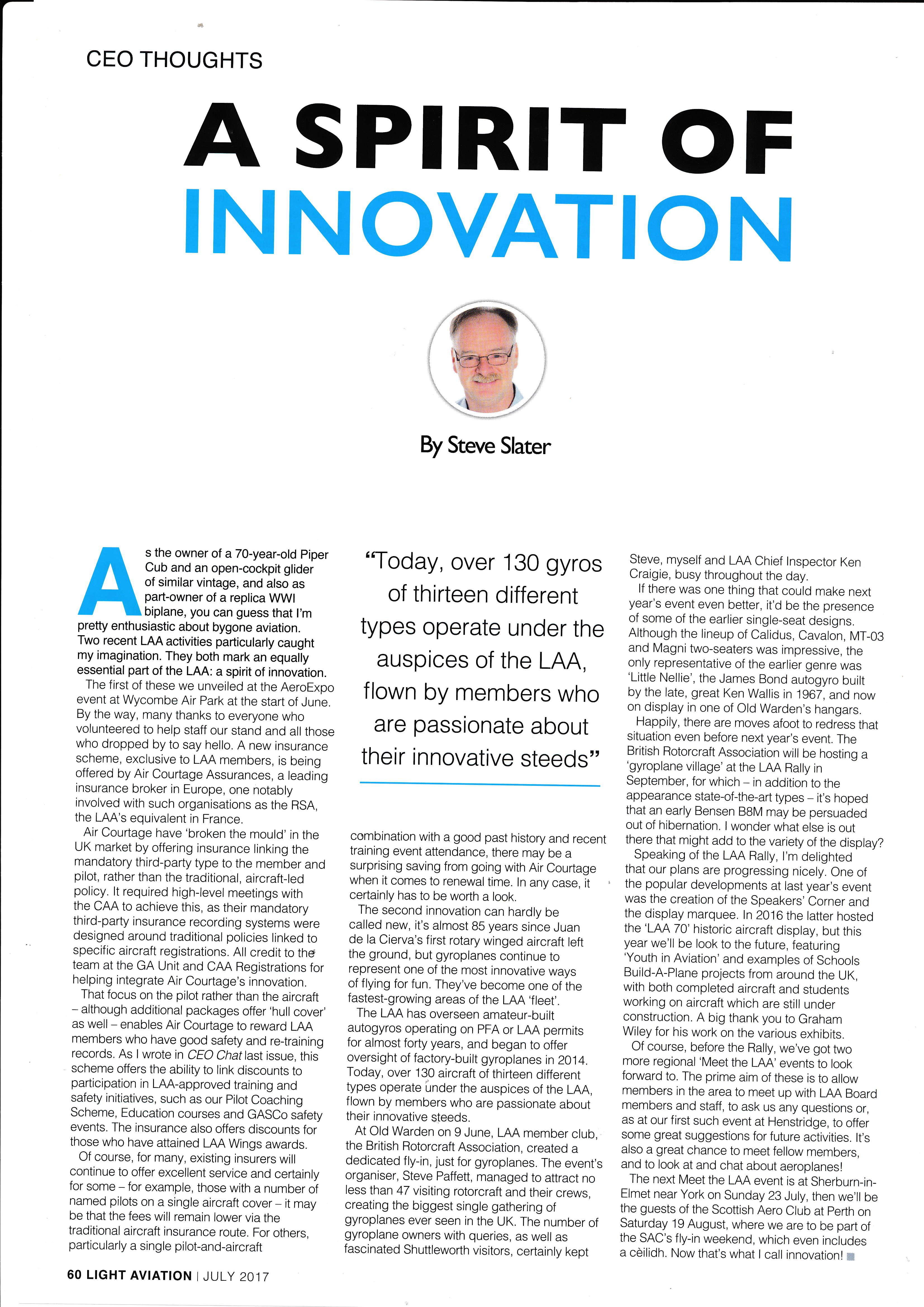
60 CEO CHAT
SteveSlaterpraises the ‘Spiritof Innovation’, from insurance to gyros
6| LANDINGVOUCHERS
Yourfour free landings for July
63 LAA CLASSIFIEDS
Aircraft, parts & services for sale
andenjoyable.Thisshowisonthefringes of our normal market, as it focuses more on the heavier, certified world. What | found interesting was the reaction of pilots who visited our stand. Theydiscoveredthatthere’sa fun, low-costway to developaircraftownershipandflying,one which involves aviators working together and, consequently, brings with it an important social elementsooftenmissinginthecertifiedworld. Air Courtage Assurances occupied the stand next to ours, and the company’s representatives were kept busy explaining the exclusive LAA membership insurance benefits being launched at the show. Itwas noticeable that the Air Courtage stand was staffed entirely by women, but on ours there were only men. We rely heavily on volunteers to do many important things in our Association, and LAA CEO Steve Slater and | have noted that female members play a key role in a number of Struts, however, we don’t see them volunteering for Board positions or Working Groups.
Talking of volunteers, John Brady has served on the Board for the last nine years and has now retired from that position. His contribution has been immense, and in order to prevent him from
escapingcompletely,theBoardhasinvitedJohn to become a Vice President so that we can continue to call upon his extensive experience when needed. This leaves a vacancy on the Board, so we're particularly interested in attracting a volunteer who possesses significant flying and instructing experience, to support this aspect of LAA activities. Is this the time for a female pilot to step forward? If you want to know more, just give me acall at LAA HQ or drop me an email you'll find the contact details on page 3.
It’s important that we recognise the efforts of our members in supporting the aims of our Association, and also to recognise the quality of their workmanship. We do this through our Trophies and Awards Working Group. Each year, it organises the aircraft judging at the LAA Rally, and also awards members for exceptional activities during that year. The Group has been led by Harry Hopkins for some years, and he now needs a fresh face to take over the job. Is this something you could do? If so just give Steve Slater or me a call, or drop us an email.
Remember, in any volunteer-led organisation you only get out what you put in. Maybe it’s time for you to step forward and help for a couple of years?
Safe flying...
From 1July, 2017, Belgium will enact a Royal Decré that recognises the European Civil Aviation Conference (ECAC) | agreements of 1980 (amateur-built aircraft) and 2015 (certain historic types), allowing them free access to Belgian airspace for up to thirty days per a calendar year.
This move comes as the result of a joint effort by the European Federation of Light, Experimental & Vintage Aircraft (EFLEVA, www.efleva.eu),the Vereniging Vlaamse MotorVliegclubs (VVMV, www.vwmv.be),which is the representative body of Belgian aero clubs, and the Belgian Aviation Authorities.
In 1980, ECAC recommended that, “Member States accept home-built aircraft with a certificate of airworthiness or a ‘permit to fly’ issued by another Member State, to fly in their country without any restrictions, other than those stated in the certificate of airworthinessor ‘permitto fly’.”
Belgium noted this at the time, though required specific permission, which incurred a charge. Amateur-built microlights are included, but not factory-builds.
In 2015, EFLEVA succeeded in negotiations with ECAC to include ‘certain historic aircraft’ in a similar document. For the UK, this effectively means ex-ICAO Permit to Fly orphans, although a small number of pure ex-military types are excluded.
“We’ve been working on this since 2007,” commented LAA President, Roger Hopkinson. “I’m absolutely delighted that, at long last, we've achieved a result and I’m grateful for the help given in progressing this from Jonathan Moor and, subsequently, Patricia Hayes, when they held the office of UK Director General of Civil Aviation (DGAC), and their then Belgian counterpart, Frank Durinckx, who’s _ __ interest was a deciding factor. Thanks also to Wim Malcot who, in his role with VVMV, has helped keep this issue to the fore in Belgium. “I’m sure that we'll now see many more LAA pilots taking the opportunity to visit the numerous attractions that Belgium has to offer. | hope, in time, that we'll be able to add gyrocopters and factory-built microlights to the aircraft enjoying these new privileges.”
LAA MEMBER CALLS FOR CAA INDEPENDENT REVIEW PANEL
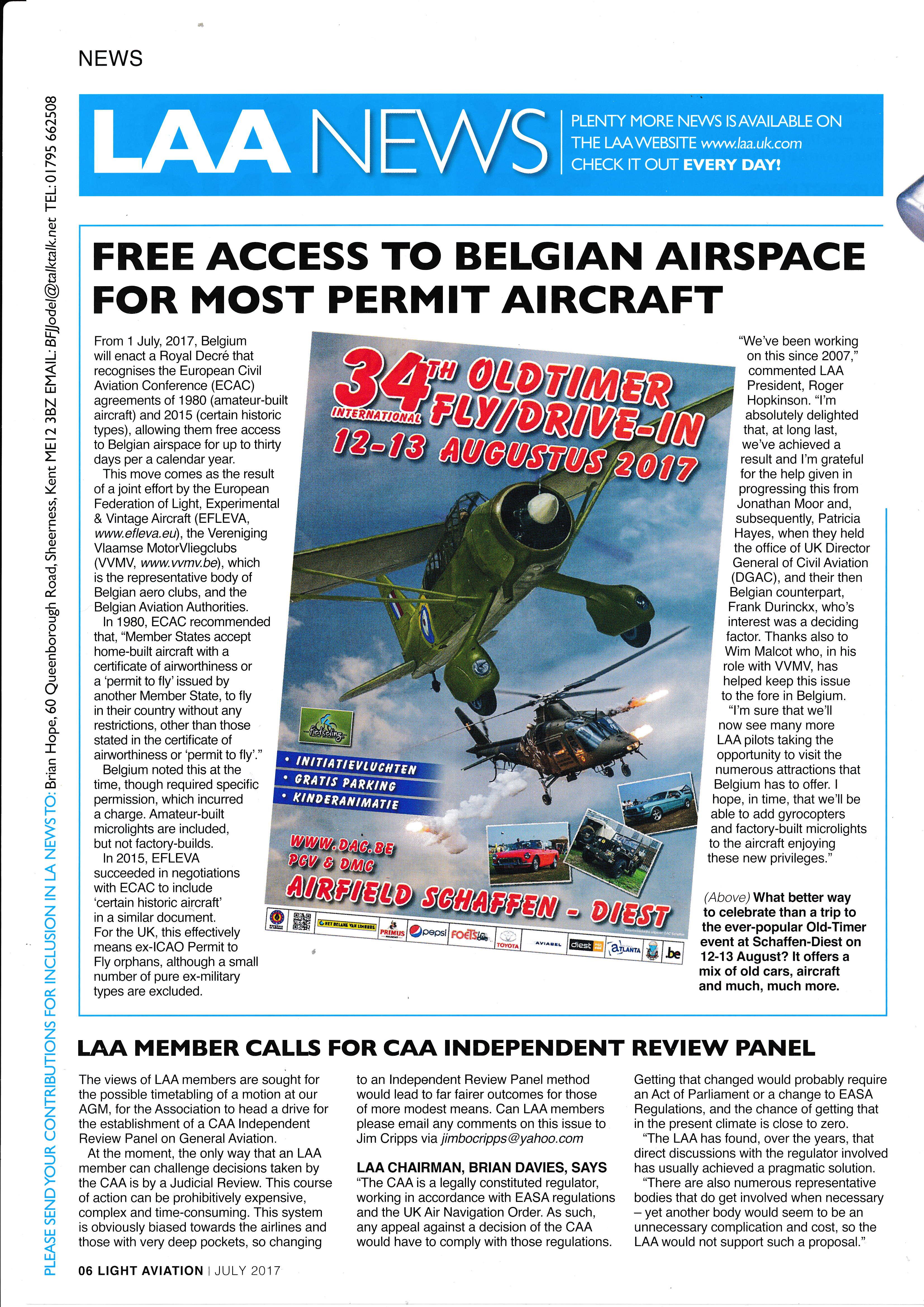
(Above) What better way tocelebratethanatrip to the ever-popular Old-Timer event at Schaffen-Diest on 12-13 August? It offers a mix of old cars, aircraft andmuch,muchmore.
The views of LAA members are sought for the possible timetabling of a motion at our AGM, for the Association to head a drive for the establishment of a CAA Independent Review Panel on General Aviation.
At the moment, the only way that an LAA member can challenge decisions taken by the CAA is by a Judicial Review. This course of action can be prohibitively expensive, complex and time-consuming. This system is obviously biased towards the airlines and those with very deep pockets, so changing
to an Independent Review Panel method would lead to far fairer outcomes for those of more modest means. Can LAA members please email any comments on this issue to JimCrippsviajimbocripps@yahoo.com
LAA CHAIRMAN, BRIAN DAVIES, SAYS
“The CAA is a legally constituted regulator, working in accordance with EASA regulations and the UK Air Navigation Order. As such, any appeal against a decision of the CAA would have to comply with those regulations.
Getting that changed would probably require an Act of Parliament or a change to EASA Regulations, and the chance of getting that in the present climate is close to zero.
“The LAA has found, over the years, that direct discussions with the regulator involved has usually achieved a pragmatic solution.
“There are also numerous representative bodies that do get involved when necessary yet another body would seem to be an unnecessary complication and cost, so the LAA would not support such a proposal.”
adept,professionalcriminals. MORE ROTAX ENGINE THEFTS
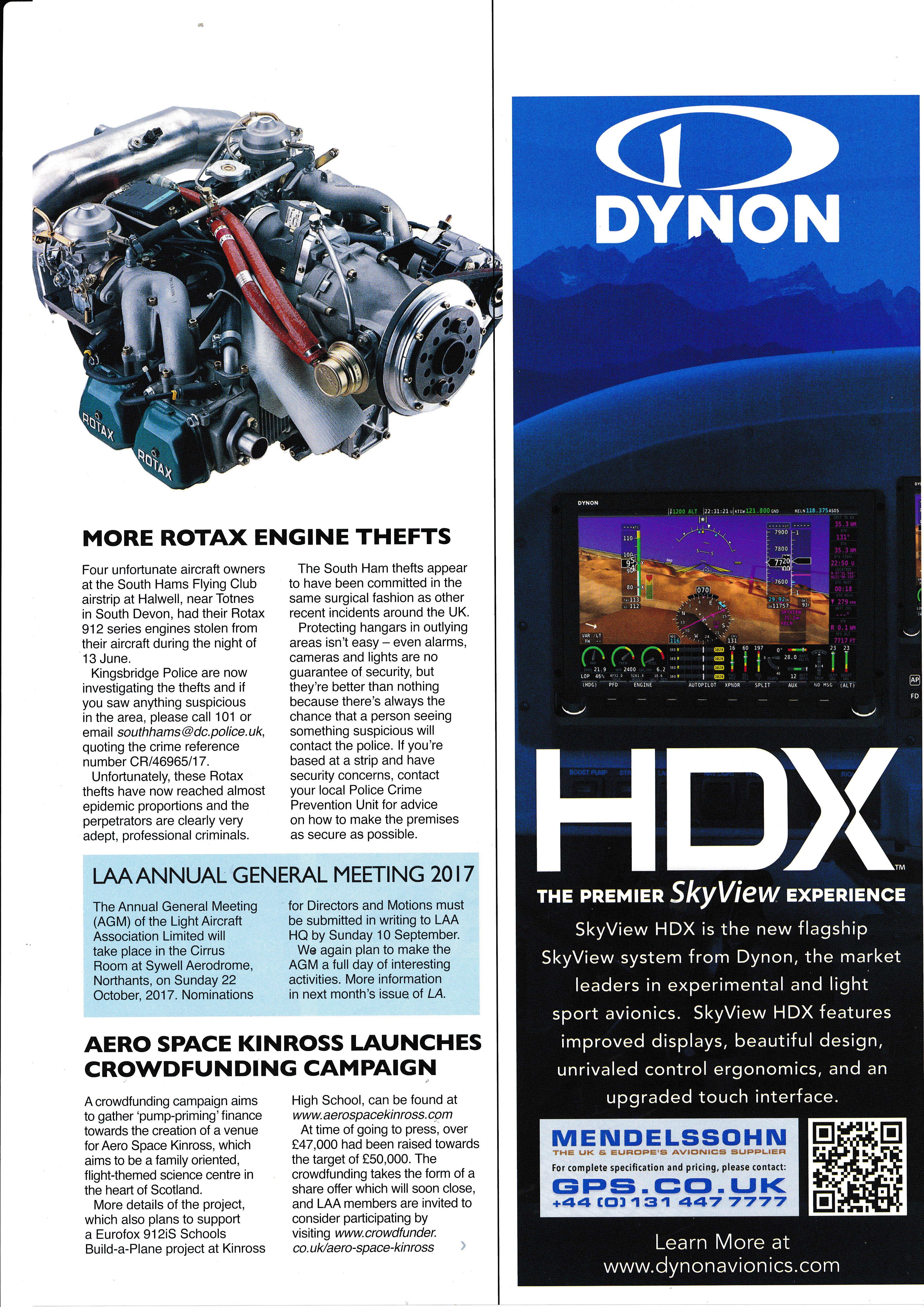
Four unfortunate aircraft owners at the South Hams Flying Club airstrip at Halwell, near Totnes in South Devon, had their Rotax 912 series engines stolen from their aircraft during the night of 13 June.
Kingsbridge Police are now investigating the thefts and if you saw anything suspicious in the area, please call 101 or emailsouthhams@ac.police.uk, quoting the crime reference number CR/46965/17.
Unfortunately, these Rotax thefts have now reached almost epidemic proportions and the perpetrators are clearly very
The South Ham thefts appear to have been committed in the same surgical fashion as other recent incidents around the UK. Protecting hangars in outlying areas isn’t easy even alarms, cameras and lights are no guarantee of security, but they’re better than nothing because there’s always the chance that a person seeing something suspicious will contact the police. If you’re based at a strip and have security concerns, contact your local Police Crime Prevention Unit for advice on how to make the premises
The Annual General Meeting (AGM) of the Light Aircraft Association Limited will take place in the Cirrus Room at Sywell Aerodrome, Northants, on Sunday 22 October, 2017. Nominations for Directors and Motions must be submitted in writing to LAA HQ by Sunday 10 September. We again plan to make the AGMafull dayofinteresting activities. More information innextmonth’sissueofLA.
SkyView HDX is the new flagship SkyView system from Dynon, the market
AERO SPACE KINROSS LAUNCHES CROWDFUNDING CAMPAIGN
Acrowdfunding campaign aims to gather ‘pump-priming’finance towards the creation of a venue forAero Space Kinross,which aims to be a family oriented, flight-themed science centre in the heart of Scotland. More details of the project, which also plans to support a Eurofox 912iS Schools Build-a-Plane project at Kinross
High School, can be found at www.aerospacekinross.com At time of going to press, over £47,000 had been raised towards the target of £50,000. The crowdfunding takes the form of a share offer which will soon close, and LAA members are invited to consider participating by visiting www.crowdfunder. co.uk/aero-space-kinross
sport avionics. SkyView HDX features improved displays, beautiful design, unrivaled control ergonomics, and an upgraded touch interface.
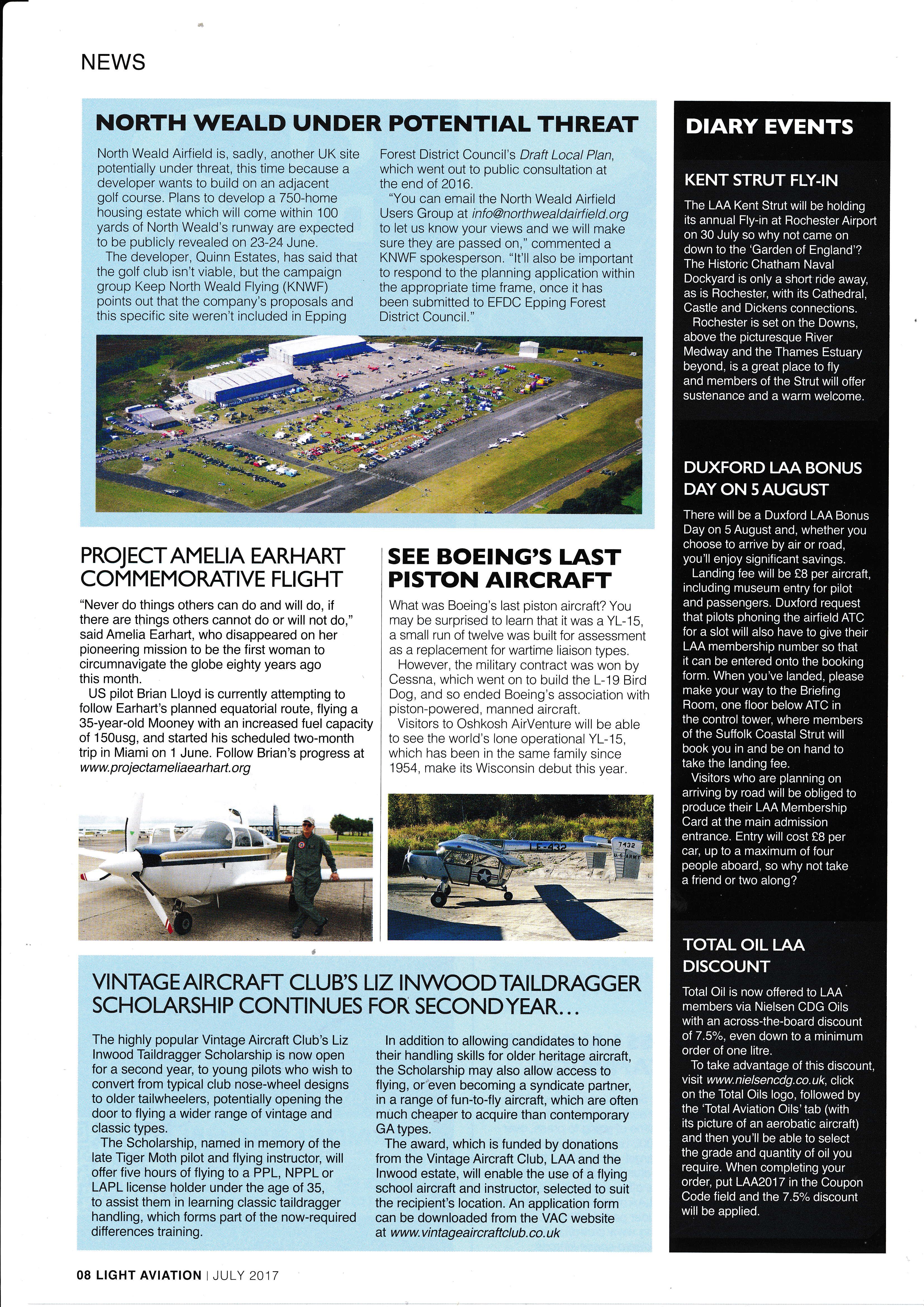
North Weald Airfield is, sadly, another UK site potentially under threat, this time because a developer wants to build on an adjacent golf course. Plans to develop a 750-home housing estate which will come within 100 yards of North Weald’s runway are expected to be publicly revealed on 23-24 June.
The developer, Quinn Estates, has said that the golf club isn’t viable, but the campaign group Keep North Weald Flying (KNWF) points out that the company’s proposals and this specific site weren't included in Epping
Forest District Council’s Draft Local Plan, which went out to public consultation at the end of 2016.
“You can email the North Weald Airfield UsersGroup at info@northwealdairfield.org to let us know your views and we will make sure they are passed on,” commented a KNWEFspokesperson. “It'll also be important to respond to the planning application within the appropriate time frame, once it has been submitted to EFDC Epping Forest District Council.”
DIARY EVENTS
KENT STRUT FLY-IN
The LAA Kent Strut will be holding its annual Fly-in at Rochester Airport on 30 July so why not came on down to the ‘Garden of England’?
The Historic Chatham Naval Dockyardisonlyashortrideaway, as is Rochester, with its Cathedral, Castle and Dickens connections.
Rochester is set on the Downs, above the picturesque River Medway and the Thames Estuary beyond, is a great place to fly and members of the Strut will offer sustenance and a warm welcome.
DUXFORD LAA BONUS DAY ON 5 AUGUST
COMMEMORATIVE FLIGHT
“Never do things others can do and will do, if there are things others cannot do or will not do,” said Amelia Earhart, who disappeared on her pioneering mission to be the first woman to circumnavigate the globe eighty years ago this month.
US pilot Brian Lloyd is currently attempting to follow Earhart’s planned equatorial route, flying a 35-year-old Mooney with an increased fuel capacity of 150usg, and started his scheduled two-month trip in Miami on 1 June. Follow Brian’s progress at www.projectameliaearhart.org
SEE BOEING’S LAST PISTON AIRCRAFT
What was Boeing’s last piston aircraft? You may be surprised to learn that it was a YL-15, a small run of twelve was built for assessment as areplacement for wartime liaison types.
However, the military contract was won by Cessna, which went on to build the L-19 Bird Dog, and so ended Boeing's association with piston-powered, manned aircraft.
Visitors to Oshkosh AirVenture will be able to see the world’s lone operational YL-15, which has been in the same family since 1954, make its Wisconsin debut this year.
The highly popular Vintage Aircraft Club’s Liz Inwood Taildragger Scholarship is now open for a second year, to young pilots who wish to convert from typical club nose-wheel designs to older tailwheelers, potentially opening the door to flying a wider range of vintage and classic types.
The Scholarship, named in memory of the lateTiger Moth pilot and flying instructor,will offer five hours of flying to a PPL, NPPL or LAPL license holder under the age of 35, to assist them in learning classic taildragger handling, which forms part of the now-required differences training.
In addition to allowing candidates to hone their handling skills for older heritage aircraft, the Scholarship may also allow access to flying, oreven becoming a syndicate partner, in a range of fun-to-fly aircraft, which are often much cheaper to acquire than contemporary GA types.
The award, which is funded by donations from the VintageAircraft Club, LAAand the Inwood estate, will enable the use of a flying school aircraft and instructor, selected to suit the recipient’s location. An application form can be downloaded from the VAC website
There will be a Duxford LAA Bonus Day on 5 August and, whether you choose to arrive by air or road, you'll enjoy significant savings. Landing fee will be £8 per aircraft, including museum entry for pilot and passengers. Duxford request that pilots phoning the airfield ATC for a slot will also have to give their LAA membership number so that it can be entered onto the booking form. When you’ve landed, please make your way to the Briefing Room, one floor below ATC in the control tower, where members of the Suffolk Coastal Strut will book you in and be on hand to take the landing fee.
Visitors who are planning on arriving by road will be obliged to produce their LAA Membership Card at the main admission entrance. Entry will cost £8 per Car, up to a maximum of four people aboard, so why not take a friend or two along?
TOTAL OIL LAA DISCOUNT
TotalOilisnowofferedtoLAA | members via Nielsen CDG Oils with an across-the-board discount of 7.5%, even down to a minimum fo)co{=|qe)melalom litem
Totake advantage of this discount, visit www.nielsencdg.co.uk, click on the Total Oils logo, followed by the ‘TotalAviation Oils’ tab (with its picture of an aerobatic aircraft) and then you'll be able to select the grade and quantity of oil you require. When completing your order, put LAA2017 in the Coupon Code field and the 7.5% discount will be applied.
of a trio of WW1 replica aircraft, then May would have been a slender month for project completions.
Dick Forsythe has kindly provided Project News with some professional photographs of these aircraft.
| can recall building in the depths of winter and still being keen, donning several layers of clothing to go out to the garage and, with the aid of a gas heater, remaining almost warm, that is until | picked up tools which had taken all week to even become equalised with the sub-zero temperatures.
However, Alan Mclvor suffered no such hardship, as he managed to build his fantastic-looking Trail at his workplace, a Clinically clean, heated hangar. Alan has recently been offered work overseas and I’ve already seen his Trail listed for sale online, it’s a shame to expend all that effort to build such a fine-looking aircraft, only to have to sell it. But then Alan does
display the signs of a repeat offender when it comes to aircraft building!
Tony Barbar’s Practavia Sprite is an interesting aircraft, the type is a design competition winner from the latesixties, but the number of flying examples can be counted on the fingers of just one hand. He talks briefly about it herein, but hopefully there'll be a more comprehensive write up on his restoration of it in the not-too-distant future.
Glenn Millar shares a about the Foxbat that he’s wanted to build for a long time. Teacher by day and livestock farmer the rest of the time, he’s fortunate to have his own strip mown through one of his pastures I’m sure many of us are envious of that.
Please keep those project updates and pictures coming, we all love to see what fellow members are up to. To get in touch with Project News, and tell your story, report a milestone or just to send a picture, email
VE BEEN SO LUCKY, not only to build this aircraft but also two-thirds of an RV-7, here at my place of work. Being in a hangar at Biggin Hill has had enormous advantages, as it’s heated 24/7 and I’ve been given free building space, so | have been able to create my own workshop on the mezzanine floor. | wasn’t worried about getting the aircraft down a flight of stairs due to the redundant parachute lugs in the hangar design a little hoisting and job done! Having left the wings off, they were easily carried down separately.
I've had an association with Graham Smith back to the time when he supplied the SportCruiser G-MUTT was number twelve off the line from him. | was interested in this Trail project as it was a folding wing design. So, as some of us seem to do, | developed serial build syndrome and was in the market for yet another project after an aborted RV build.
Once I'd received the ‘box’ from Italy, via Graham, | was off and running in late 2013. All the tooling | had from the RV came in handy, ooo
although the construction is mainly of pulled rivets. | think Graham would support my view that the Trail, while in many ways very simplistic to build, requires quite a bit of fettling to get a good result. It can be quite a challenge for the first-timer, when compared to the many virtually complete airframe kits now on the market.
Graham was, as always, very helpful, and | can’t thank him enough for his support with the Trail. | didn’t really keep a log of the hours | put in, but it was a lot, over most weekends during 2013-2016 and with some added time thrown in when it was quiet in the hangar.
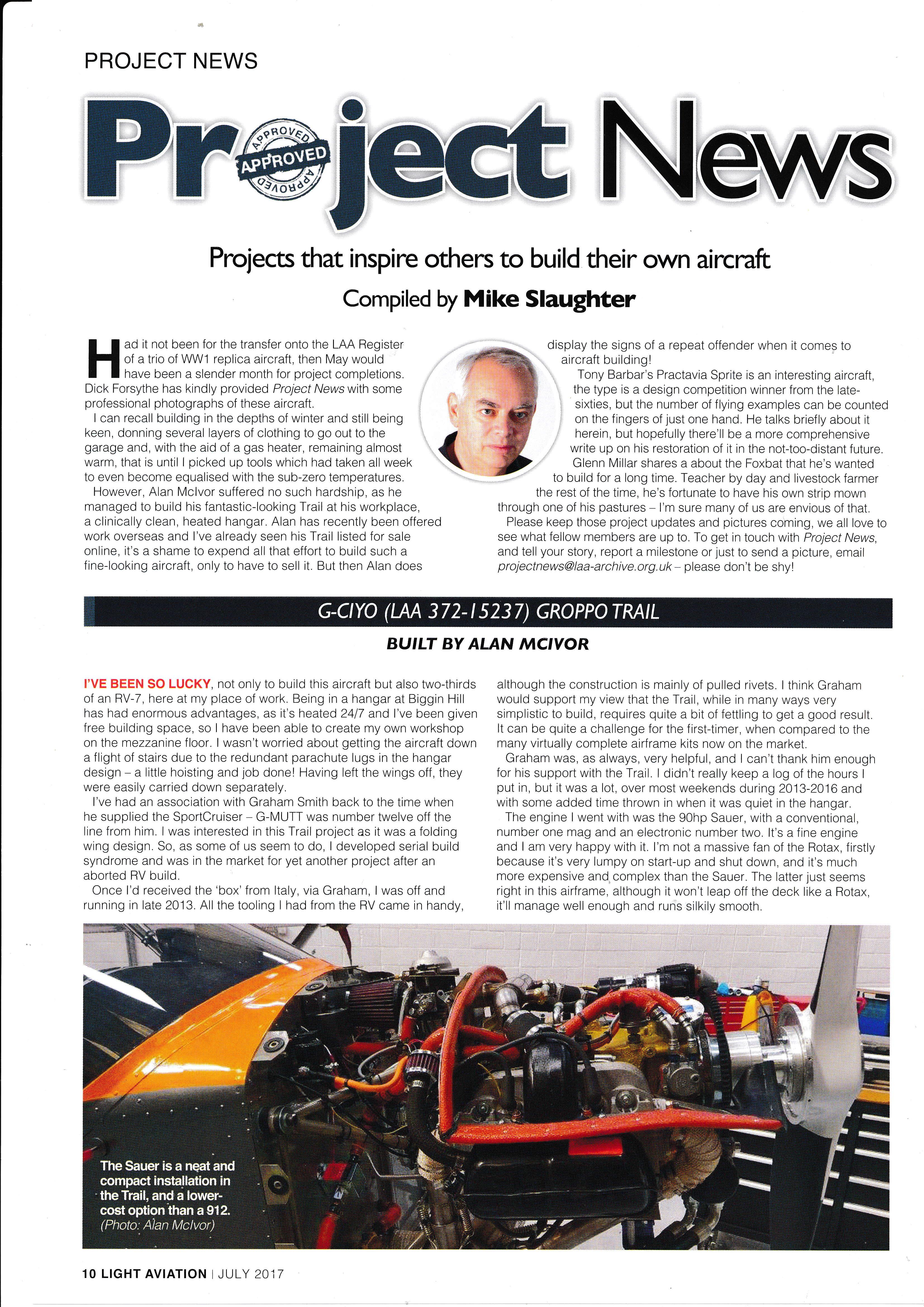
The engine | went with was the 90hp Sauer, with a conventional, number one mag and an electronic number two. It’s a fine engine and | am very happy with it. I’m not a massive fan of the Rotax, firstly because it’s very lumpy on start-up and shut down, and it’s much more expensive and complex than the Sauer. The latter just seems right in this airframe, although it won't leap off the deck like a Rotax, it'll manage well enough and runs silkily smooth.
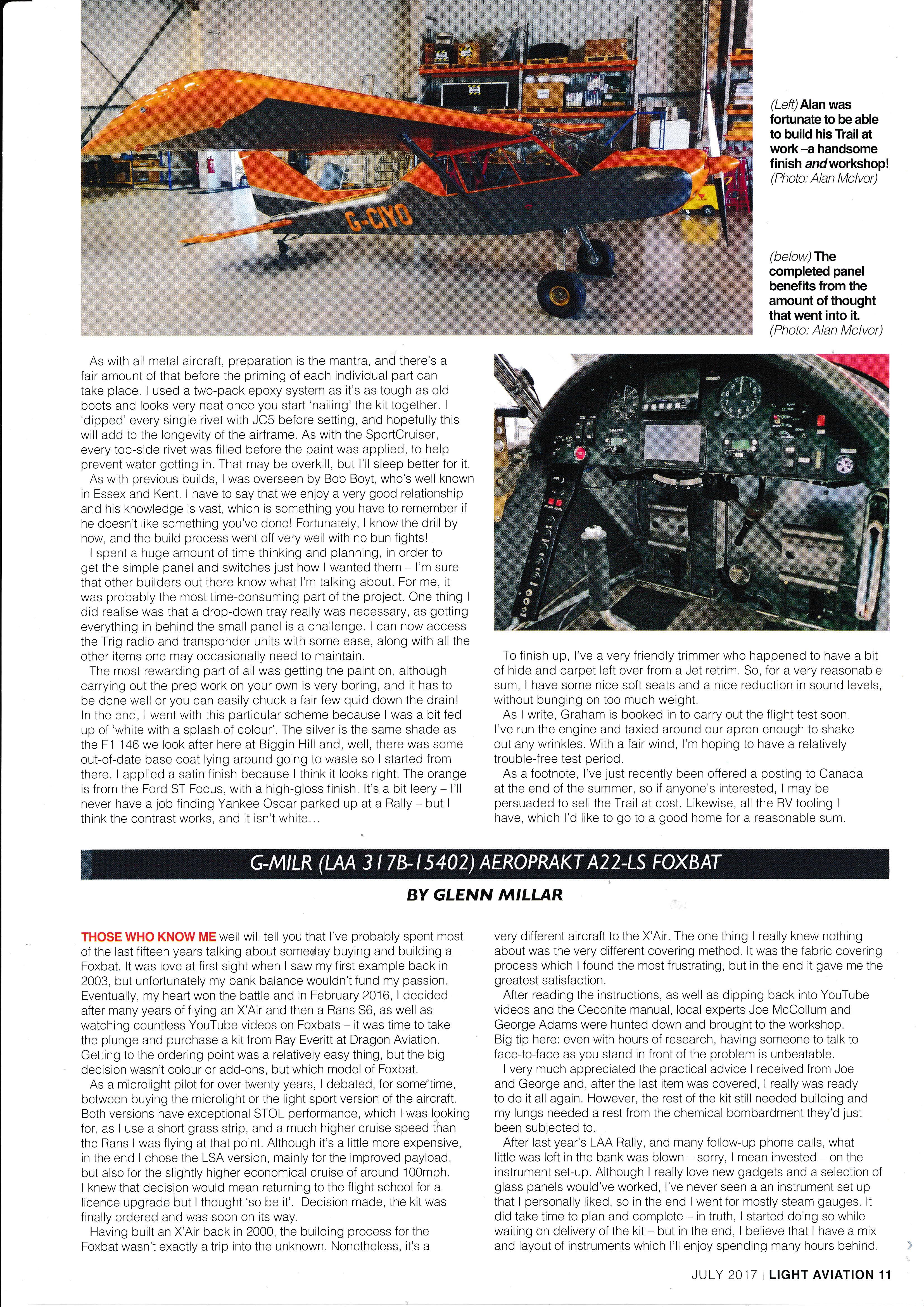
(Left)Alan was
As with all metal aircraft, preparation is the mantra, and there’s a fair amount of that before the priming of each individual part can take place. | used a two-pack epoxy system as it’s as tough as old boots and looks very neat once you start ‘nailing’ the kit together. | ‘dipped’ every single rivet with JC5 before setting, and hopefully this will add to the longevity of the airframe. As with the SportCruiser, every top-side rivet was filled before the paint was applied, to help prevent water getting in. That may be overkill, but I'll sleep better for it.
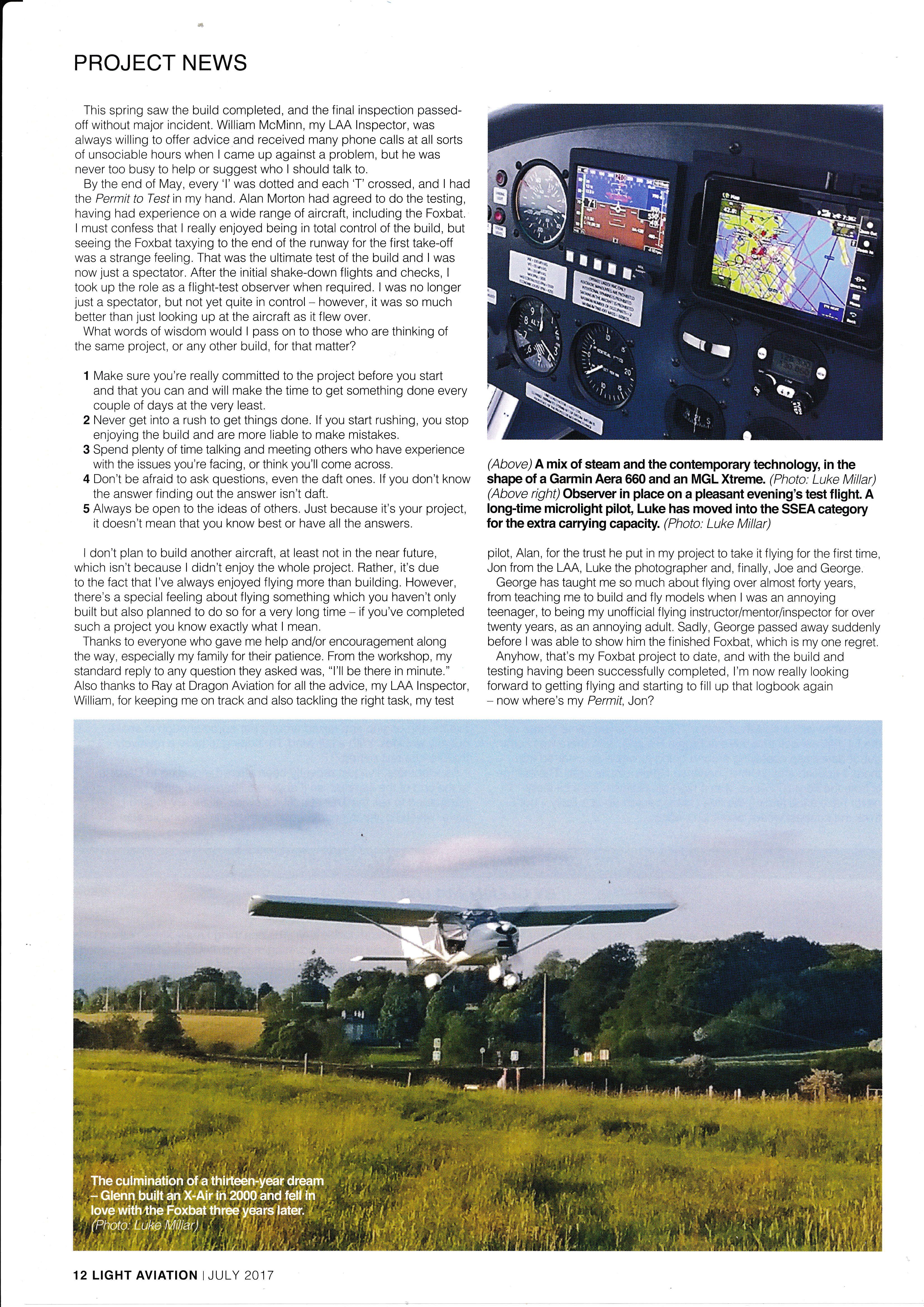
As with previous builds, | was overseen by Bob Boyt, who’s well known in Essex and Kent. | have to say that we enjoy a very good relationship and his knowledge is vast, which is something you have to remember if he doesn’t like something you’ve done! Fortunately, | know the drill by now, and the build process went off very well with no bun fights! | spent a huge amount of time thinking and planning, in order to get the simple panel and switches just how | wanted them I’m sure that other builders out there know what I’m talking about. For me, it was probably the most time-consuming part of the project. One thing | did realise was that a drop-down tray really was necessary, as getting everything in behind the small panel is a challenge. | can now access the Trig radio and transponder units with some ease, along with all the other items one may occasionally need to maintain.
The most rewarding part of all was getting the paint on, although carrying out the prep work on your own is very boring, and it has to be done well or you can easily chuck a fair few quid down the drain! In the end, | went with this particular scheme because | was a bit fed up of ‘white with a splash. of colour’. The silver is the same shade as the F1 146 we look after here at Biggin Hill and, well, there was some out-of-date base coat lying around going to waste so | started from there. | applied a satin finish because | think it looks right. The orange is from the Ford ST Focus, with a high-gloss finish. It’s a bit leery I'll never have a job finding Yankee Oscar parked up at a Rally but | think the contrast works, and it isn’t white...
Tofinishup,I’veaveryfriendlytrimmerwhohappenedtohavea bit of hide and carpet left over from a Jet retrim. So, for a very reasonable sum, | have some nice soft seats and a nice reduction in sound levels, without bunging on too much weight.
As | write, Graham is booked in to carry out the flight test soon. I’ve run the engine and taxied around our apron enough to shake outanywrinkles.Withafairwind,I’mhopingtohavearelatively trouble-free test period.
As a footnote, I’ve just recently been offered a posting to Canada at the end of the summer, so if anyone’s interested, | may be persuaded to sell the Trail at cost. Likewise, all the RV tooling | have, which I'd like to go to a good home for a reasonable sum.
well will tell you that I’ve probably spent most of the last fifteen years talking about someday buying and building a Foxbat. It was love at first sight when | saw my first example back in 2003, but unfortunately my bank balance wouldn't fund my passion. Eventually, my heart won the battle and in February 2016, | decided after many years of flying an X’Air and then a Rans S6, as well as watching countless YouTube videos on Foxbats it was time to take theplungeandpurchase a kitfromRayEverittatDragonAviation. Getting to the ordering point was a relatively easy thing, but the big decision wasn’t colour or add-ons, but which model of Foxbat.
As amicrolight pilot for over twenty years, | debated, for some’time, between buying the microlight or the light sport version of the aircraft. Both versions have exceptional STOL performance, which | was looking or, as | use a short grass strip, and a much higher cruise speed than heRans|wasflyingatthatpoint.Althoughit’salittle moreexpensive, in the end | chose the LSA version, mainly for the improved payload, but also for the slightly higher economical cruise of around 100mph. knew that decision would mean returning to the flight school for a icence upgrade but | thought ‘so be it’. Decision made, the kit was inally ordered and was soon on its way.
Having built an X’Air back in 2000, the building process for the Foxbat wasn’t exactly a trip into the unknown. Nonetheless, it’s a
very different aircraft to the X’Air. The one thing | really knew nothing about was the very different covering method. It was the fabric covering process which | found the most frustrating, but in the end it gave me the greatest satisfaction.
After reading the instructions, as well as dipping back into YouTube videos and the Ceconite manual, local experts Joe McCollum and George Adams were hunted down and brought to the workshop. Big tip here: even with hours of research, having someone to talk to face-to-face as you stand in front of the problem is unbeatable.
| very much appreciated the practical advice | received from Joe and George and, after the last item was covered, | really was ready to do it all again. However, the rest of the kit still needed building and my lungs needed a rest from the chemical bombardment they’d just been subjected to.
After last year’s LAA Rally, and many follow-up phone calls, what little was left in the bank was blown - sorry, | mean invested on the instrumentset-up.Although|reallylovenewgadgetsanda selectionof glass panels would’ve worked, I’ve never seen a an instrument set up that | personally liked, so in the end | went for mostly steam gauges. It did take time to plan and complete in truth, | started doing so while waiting on delivery of the kit but in the end, | believe that | have a mix and layout of instruments which I'll enjoy soending many hours behind.
fortunate to be able to build his Trail at work —ahandsome finish andworkshop!
(Photo:Alan Mclvor)
(below) The completed panel benefits from the amount of thought that went into it.
(Photo:Alan Mclvor)
PROJECT NEWS
This spring saw the build completed, and the final inspection passedoff without major incident. William McMinn, my LAA Inspector, was always willing to offer advice and received many phone calls at all sorts of unsociable hours when | came up against a problem, but he was never too busy to help or suggest who | should talk to.
By the end of May, every ‘I’ was dotted and each ‘T’ crossed, and | had the Permit to Testin my hand. Alan Morton had agreed to do the testing, having had experience on a wide range of aircraft, including the Foxbat. | must confess that | really enjoyed being in total control of the build, but seeing the Foxbat taxying to the end of the runway for the first take-off was a strange feeling. That was the ultimate test of the build and | was now just a spectator. After the initial shake-down flights and checks, | took up the role as a flight-test observer when required. | was no longer just a spectator, but not yet quite in control however, it was so much better than just looking up at the aircraft as it flew over.
What words of wisdom would | pass on to those who are thinking of the same project, or any other build, for that matter?
1 Make sure you’re really committed to the project before you start and that you can and will make the time to get something done every couple of days at the very least.
2 Never get into a rush to get things done. If you start rushing, you stop enjoying the build and are more liable to make mistakes.
3 Spend plenty of time talking and meeting others who have experience with the issues you're facing, or think you'll come across.
4 Don't be afraid to ask questions, even the daft ones. If you don’t know the answer finding out the answer isn’t daft.
5 Always be open to the ideas of others. Just because it’s your project, it doesn’t mean that you know best or have all the answers.
| don’t plan to build another aircraft, at least not in the near future, which isn’t because | didn’t enjoy the whole project. Rather, it's due to the fact that I’ve always enjoyed flying more than building. However, there’s a special feeling about flying something which you haven't only built but also planned to do so for a very long time if you’ve completed such a project you know exactly what | mean.
Thanks to everyone who gave me help and/or encouragement along the way, especially my family for their patience. From the workshop, my standard reply to any question they asked was, “l’ll be there in minute.”
Also thanks to Ray at Dragon Aviation for all the advice, my LAA Inspector, William, for Keeping me on track and also tackling the right task, my test
(Above) A mix of steam and the contemporary technology, in the shape of a Garmin Aera 660 and an MGL Xtreme. (Photo: Luke Millar) (Above right) Observer in place on a pleasant evening’s test flight. A long-time microlight pilot, Luke has moved into the SSEA category for the extra carrying capacity. (Photo:Luke Millar)
pilot, Alan, for the trust he put in my project to take it flying for the first time, Jon from the LAA, Luke the photographer and, finally, Joe and George. George has taught me so much about flying over almost forty years, from teaching me to build and fly models when | was an annoying teenager, to being my unofficial flying instructor/mentor/inspector for over twenty years, as an annoying adult. Sadly, George passed away suddenly before | was able to show him the finished Foxbat, which is my one regret. Anyhow, that’s my Foxbat project to date, and with the build and testing having been successfully completed, I’m now really looking forward to getting flying and starting to fill up that logbook again now where’s my Permit, Jon?
a touch of the wanderlust, despite it only very recently having been test-flown by Andy Draper at Turweston. That resulted in only minimal adjustments and no major hiccups.
Gerry Cole bought the kit in 1995 and recorded 5,500 hours of work, managing to complete the basic structure before, in 2009, selling it on to Malcolm Hendra. Malcolm did some of the surface preparation and finishing, and added the firewall forward before Gerry bought it in 2014. He’s carried out a number of modifications, fitted all the systems and
effectively commissioned the aircraft, and promises more detail on that in a future article. Gerry kindly came down from Scotland to offer Clive help and advice, and they were both delighted when the empty weight came out at just 825lb during the Weight and Balance calculations.
The aircraft flies very nicely on its Rotax 912ULS, stalling at an indicated 53kt clean and 43kt with full flap. The picture below shows the aircraft at Roger Targett’s workshop at Nympsfield during April of this year, where it was taken for final inspection.
conferswithCarl and capable handsof LAA Inspectorand Test Pilot,CarlTyers. Tyers about the Therewere no majorsnags or issues,except a slightly high oil test-flying of his Ifyour aircraft has beenfeatured in temperature,althoughitwaswithinlimits.We'recurrentlyattributing restoredPractavia thethislist,pleaseletusknowof thistoanewlyoverhauledtopendandstraightoil.Flighttestingwill Sprite,oneofonly yourprogressbyemailingusvia in
THESE AREN’T QUITE THE NORMAL type of projects we cover strives to maintain absolute fidelity with the original design. Unwilling herein, but nonetheless this trio of fantastic-looking machines, built to compromise an otherwise authentic airframe for the BE2E, TVAL by The Vintage Aviator Ltd (TVAL) and imported from New Zealand even reverse-engineered an authentic Royal Aircraft Factory 1a V8 a few years ago, are now LAA Permit aircraft. The two BE2E-1 and engine, which the company built from scratch.
the Sopwith Snipe replica found their way onto LAA Permits, having On long-term loan from New Zealand, these aircraft are managed
moved from their native New Zealand register. in the UK by the WWI Aviation Heritage Trust, and are part of the completed its maiden flight, we’d TVAL aims to build WWI aircraft, engines and propellers to the same collection at Old Warden and Stow Maries, which is yet another love to hear from you please
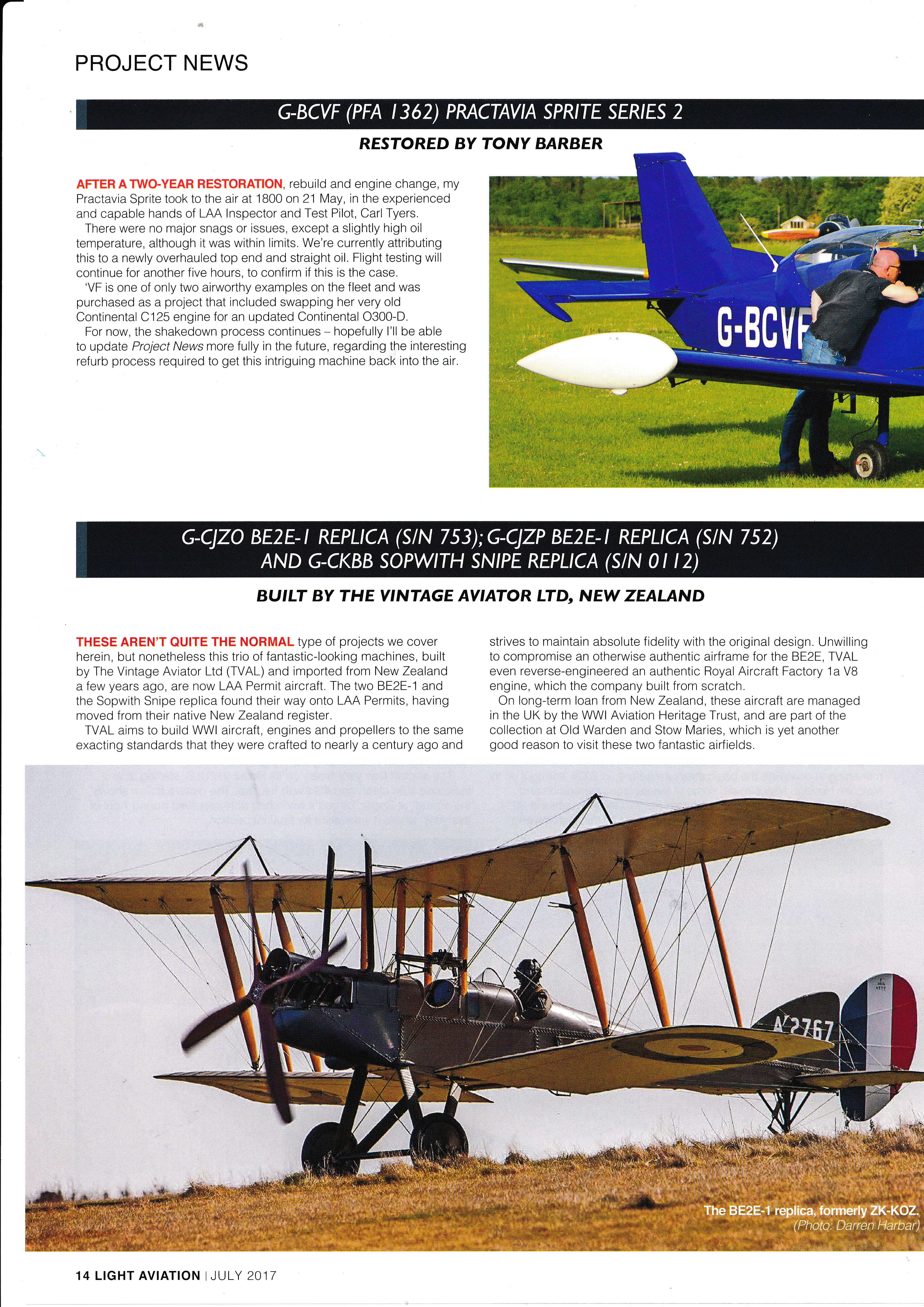
The BE2E-1 replica, formerly ZK-KOZ. Engineering (Photo: Darren Harbar)
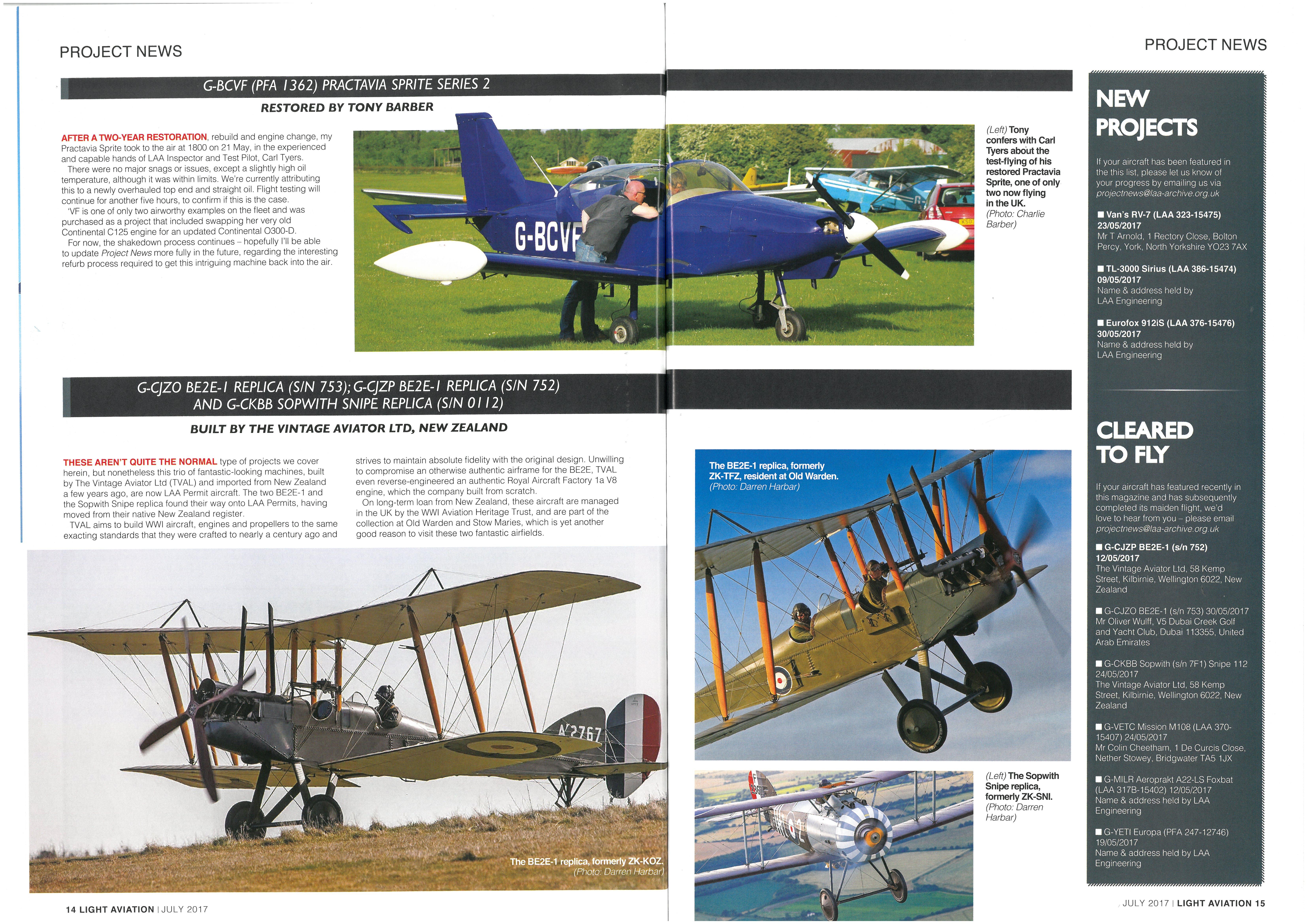
, rebuild and engine change, my Practavia Sprite took to the air at 1800 on 21 May, in the experienced and capable hands of LAA Inspector and Test Pilot, Carl Tyers.
There were no major Snags or issues, except a slightly high oil temperature, although it was within limits. We’re currently attributing this to a newly overhauled top end and straight oil. Flight testing will continue for another five hours, to confirm if this is the case.
‘VF is one of only two airworthy examples on the fleet and was purchased as a project that included swapping her very old Continental C125 engine for an updated Continental O300-D.
For now, the shakedown process continues hopefully I'll be able to update Project News more fully in the future, regarding the interesting refurb process required to get this intriguing machine back into the air.
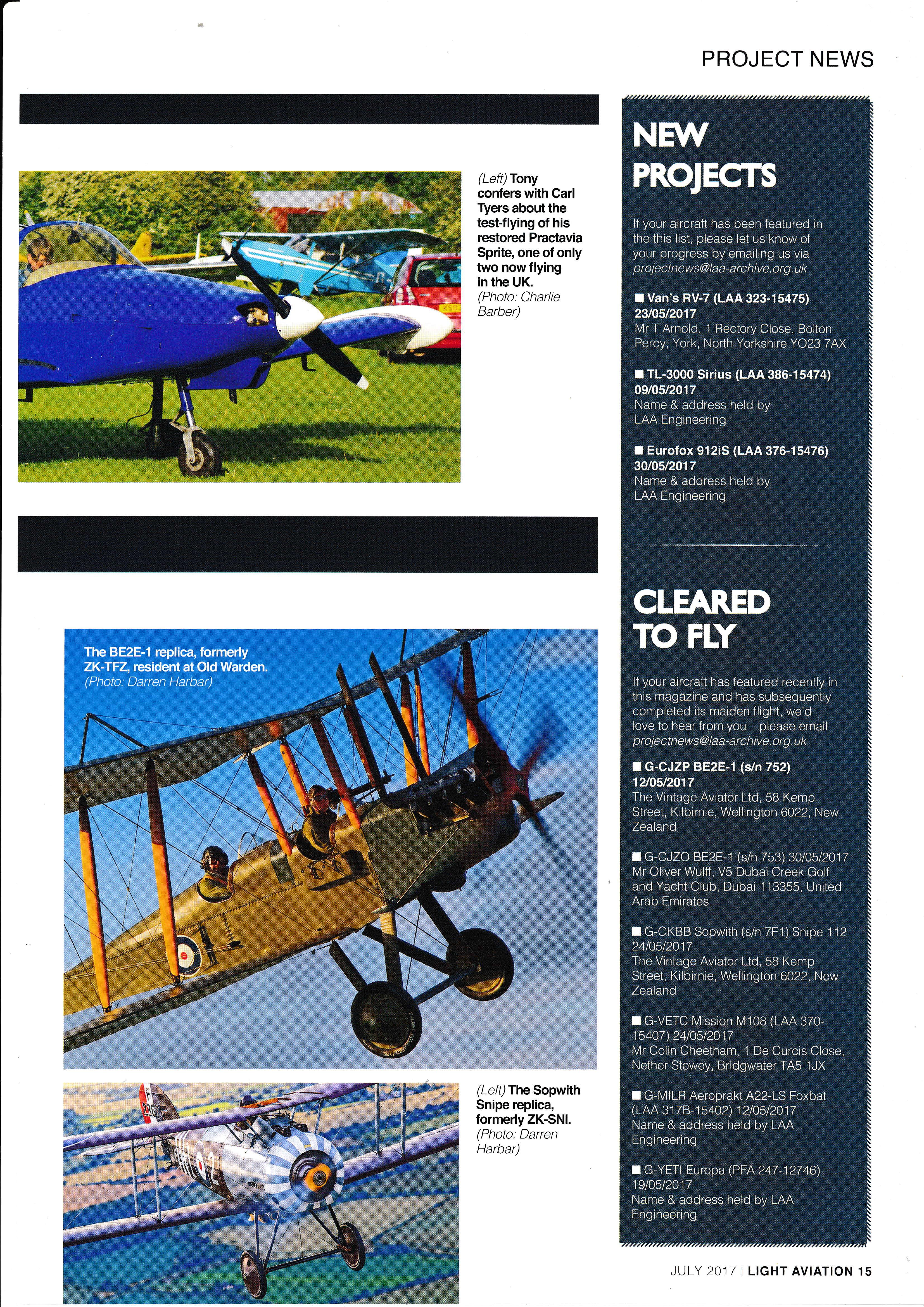
type of projects we cover herein, but nonetheless this trio of fantastic-looking machines, built by The Vintage Aviator Ltd (TVAL) and imported from New Zealand a few years ago, are now LAA Permit aircraft. The two BE2E-1 and the Sopwith Snipe replica found their way onto LAA Permits, having moved from their native New Zealand register.
TVAL aims to build WWI aircraft, engines and propellers to the same exacting standards that they were crafted to nearly a century ago and
strives to maintain absolute fidelity with the original design. Unwilling to compromise an otherwise authentic airframe for the BE2E, TVAL even reverse-engineered an authentic Royal Aircraft Factory 1a V8 engine, which the company built from scratch.
On long-term loan from New Zealand, these aircraft are managed in the UK by the WWI Aviation Heritage Trust, and are part of the collection at Old Warden and Stow Maries, which is yet another good reason to visit these two fantastic airfields.
(Left)Tony confers with Carl Tyers about the test-flying of his restored Practavia Sprite, one of only two now flying in the UK.
(Photo: Charlie Barber)
the this list, please let us know of ~ your progress by emailing us via projectnews@laa-archive.org.uk
If your aircraft has featured recently in _ this magazineand has subsequently __ completed its maiden flight, we'd > love to hear from you- please email projectnews@laa-archive.org.uk MiG-CJZP BE2E-1 (s/n 752)
MrColinCheetham,1Deaa ce Nether Stowey,Bridgwater TAS1JX
@G-MILR Aeroprakt A22-LS Foxbat | (LAA 317B-15402) 12/05/2017 Name & address held by LAA Engineering
19/05/2017 Name & address held by LAA Engineering
(Left)The Sopwith Snipe replica, formerly ZK-SNI.
(Photo: Darren Harbar)
bout this time last year, | got an email from a bunch of guys who were planning flying to France for a few days at the end of September zy) \ they do an annual tour of a week or so from their base in Norfolk. Unusually for me, | had to say that my flying budget for 2016 had been blown and that | couldn’t go.
Their planned route was flexible, but one of the group, an LAA Inspector, had to get to Marmande at some point, to do a permit inspection. It really didn’t take much, but once the seed had been sown | began thinking of going. This time of year, July, the sun is shining, we have long days and good weather, so if we miss a weekend of flying, there’s always the nextto lookforwardto. But,aswinterandthe tail-end of the season approaches, you can’t really let an opportunity pass you by.
Coincidentally, there was a taildragger fly-in atChatellerault, a littlesouthoftheLoireValley, which was organised by the Aéroclub Les Ailes Chatelleraudaises and could serve as a logical stopover for the group. As the departure date approached, with a forecast of wall-to-wall sunshine, and with me being abit like a pencil (easily lead), the temptation was too much and | decided to break out.the credit card and give the Jodel its last decent outing for the year at least as far as the fly-in and back.
Although the Chatellerault event is classed as a taildragger fly-in, that doesn’t preclude anyone else from attending. As far as I’m concerned, a ‘fly-in’ is a ‘fly-in’ and all are welcome. That stance, however, was in direct contradiction with a lady who once asked me what the Jodel was doing at an RVfly-in at Nuits-St-Georges!
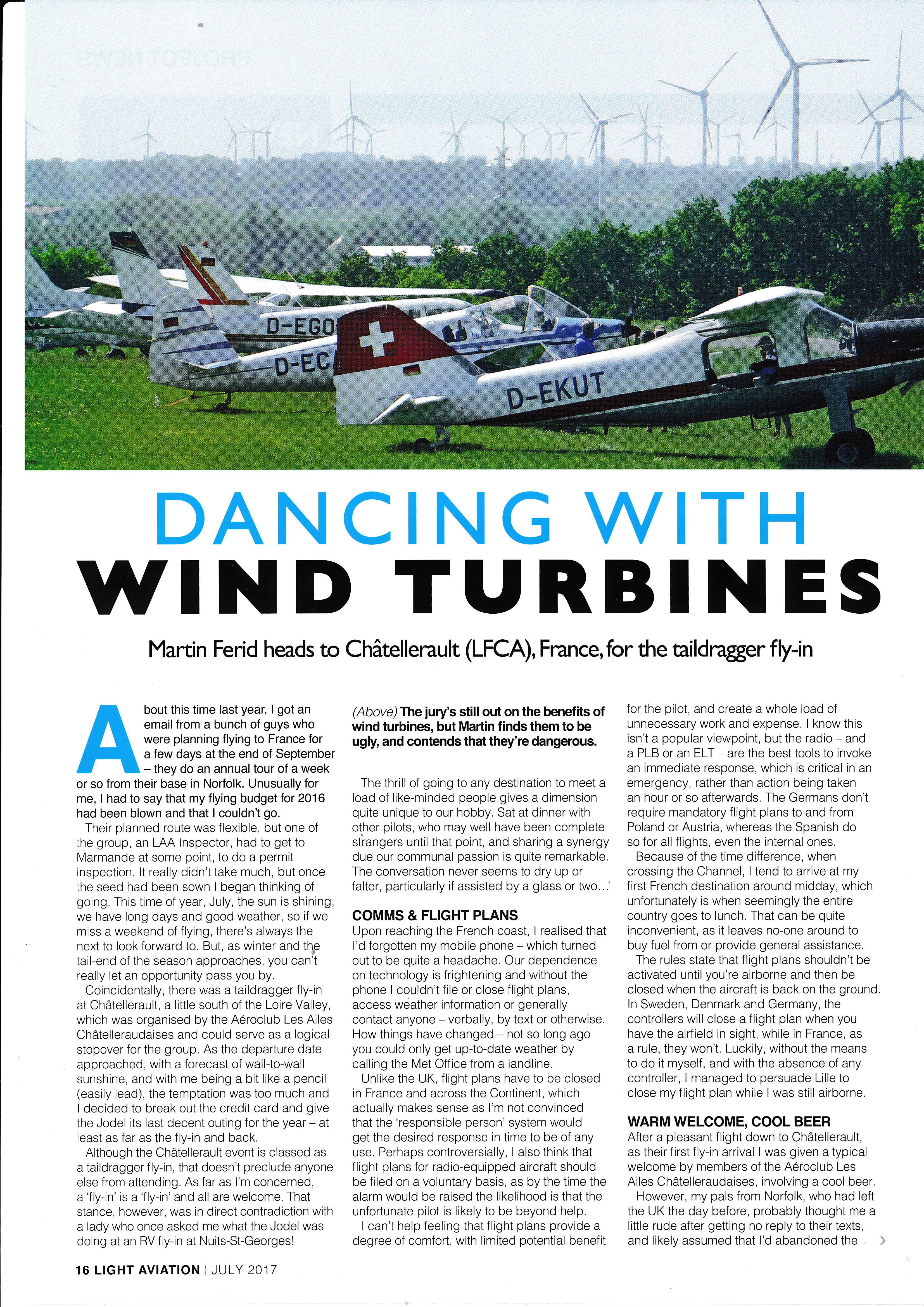
(Above) The jury’s still out on the benefits of wind turbines, but Martin finds them to be ugly, and contends that they’re dangerous.
The thrill of going to any destination to meet a load of like-minded people gives a dimension quite unique to our hobby. Sat at dinner with otherpilots,whomaywellhavebeencomplete strangers until that point, and sharing a synergy due our communal passion is quite remarkable. The conversation never seems to dry up or falter, particularly if assisted by a glass or two...
COMMS & FLIGHT PLANS
Upon reaching the French coast, | realised that I'd forgotten my mobile phone which turned out to be quite a headache. Our dependence on technology is frightening and without the phone | couldn't file or close flight plans, access weather information or generally contact anyone verbally, by text or otherwise. How things have changed not so long ago you could only get up-to-date weather by calling the Met Office from a landline.
Unlike the UK, flight plans have to be closed in France and across the Continent, which actually makes sense as I’m not convinced that the ‘responsible person’ system would get the desired response in time to be of any use. Perhaps controversially, | also think that flight plans for radio-equipped aircraft should be filed on a voluntary basis, as by the time the alarm would be raised the likelihood is that the unfortunate pilot is likely to be beyond help. | can’t help feeling that flight plans provide a degree of comfort, with limited potential benefit
for the pilot, and create a whole load of unnecessary work and expense. | know this isn’t a popular viewpoint, but the radio and a PLB or an ELT are the best tools to invoke an immediate response, which is critical in an emergency, rather than action being taken an hour or so afterwards. The Germans don’t require mandatory flight plans to and from Poland or Austria, whereas the Spanish do so for all flights, even the internal ones.
Because of the time difference, when crossing the Channel, | tend to arrive at my first French destination around midday, which unfortunately is when seemingly the entire country goes to lunch. That can be quite inconvenient, as it leaves no-one around to buy fuel from or provide general assistance.
The rules state that flight plans shouldn’t be activated until you're airborne and then be closed when the aircraft is back on the ground.
In Sweden, Denmark and Germany, the controllers will close a flight plan when you have the airfield in sight, while in France, as a rule, they won't. Luckily, without the means to do it myself, and with the absence of any controller, | managed to persuade Lille to close my flight plan while | was still airborne.
WARM WELCOME, COOL BEER
After a pleasant flight down to Chatellerault, as their first fly-in arrival | was given a typical welcome by members of the Aéroclub Les Ailes Chatelleraudaises, involving a cool beer. However, my pals from Norfolk, who had left the UK the day before, probably thought me a little rude after getting no reply to their texts, and likely assumed that I’d abandoned the
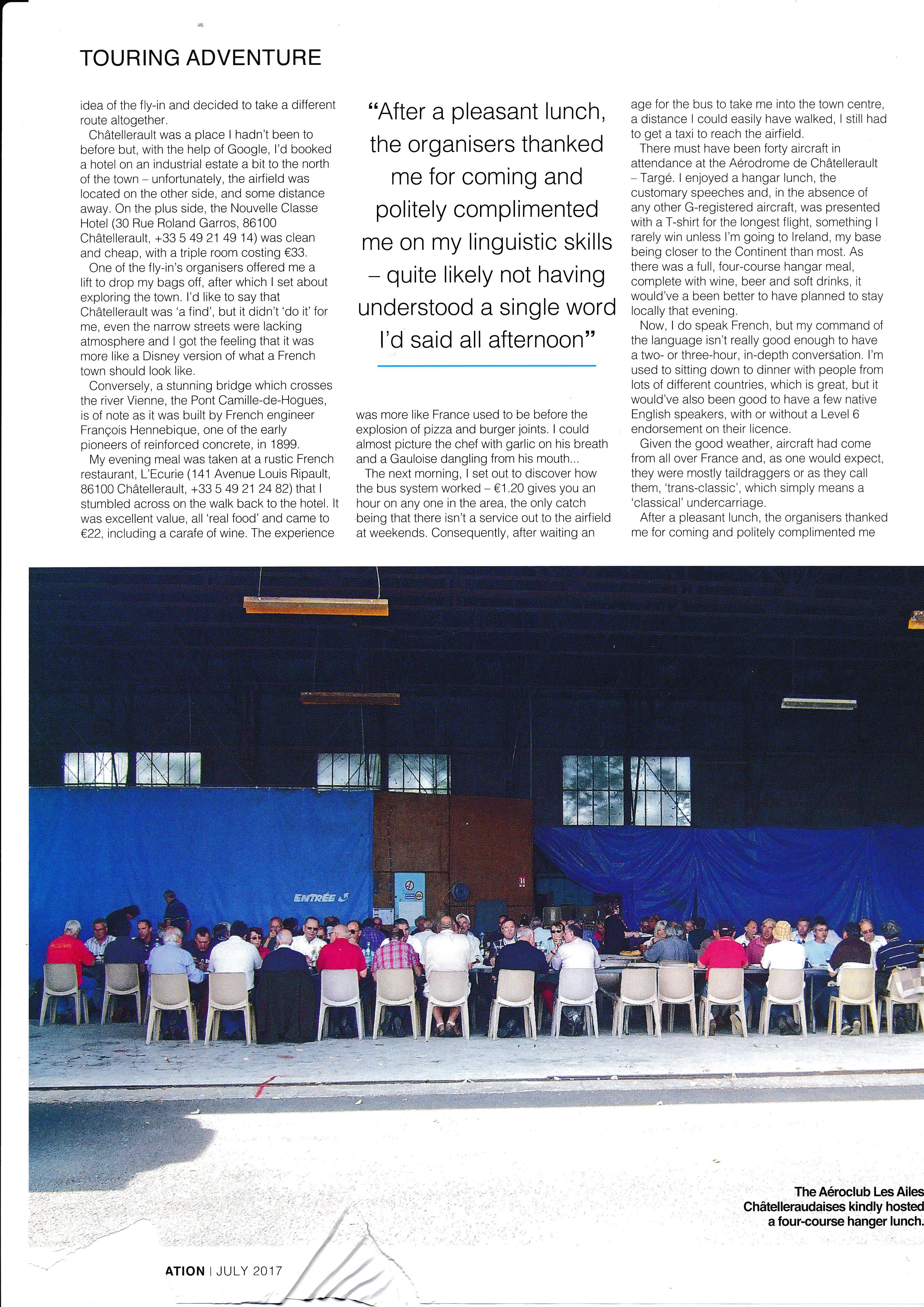
(Above) Thefly-in attracted what the French term 'trans-classic' aircraft from all over the country.
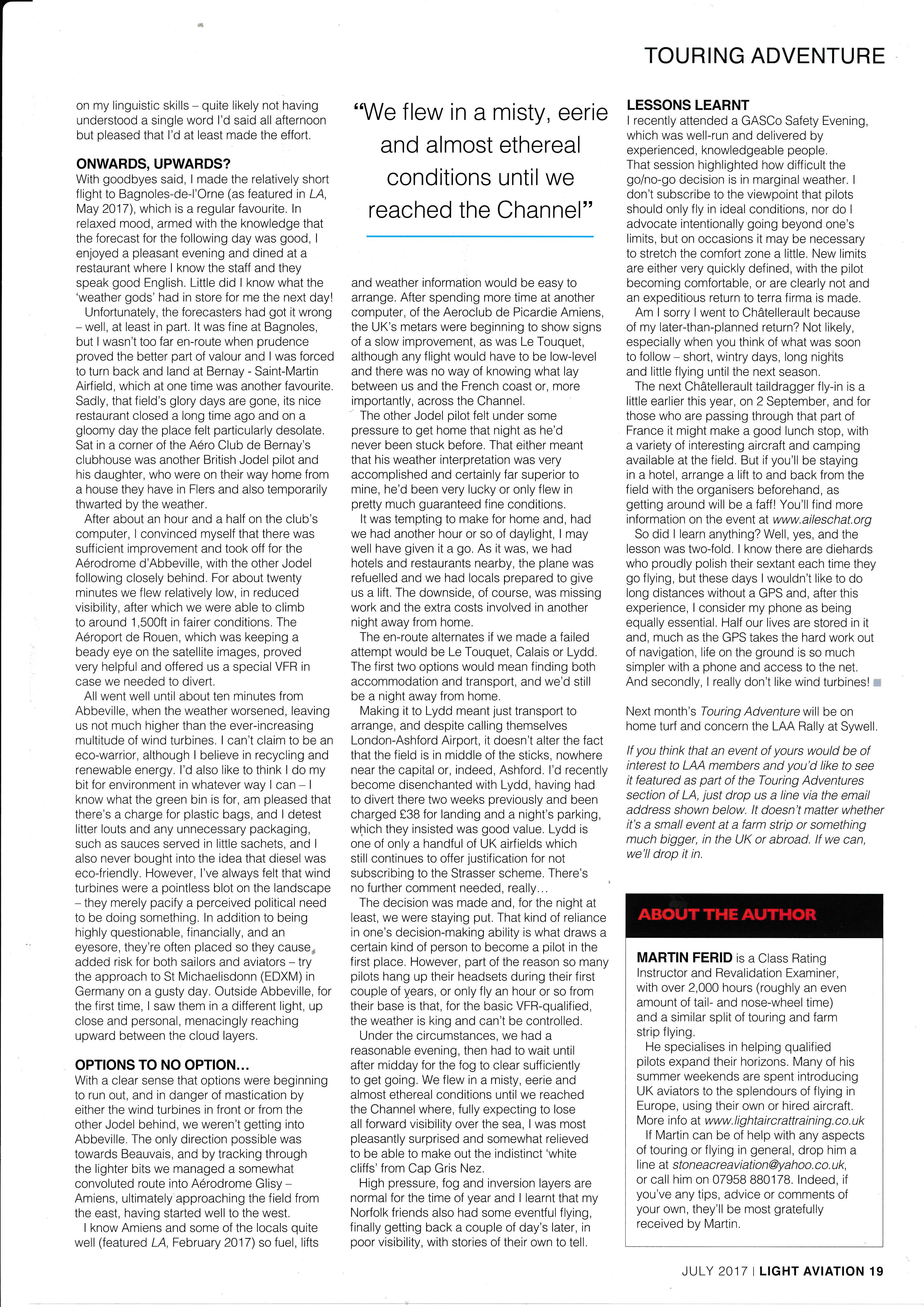
(Right)
was a reminder of how pleasurable, and great value, traditional French bistros can be.
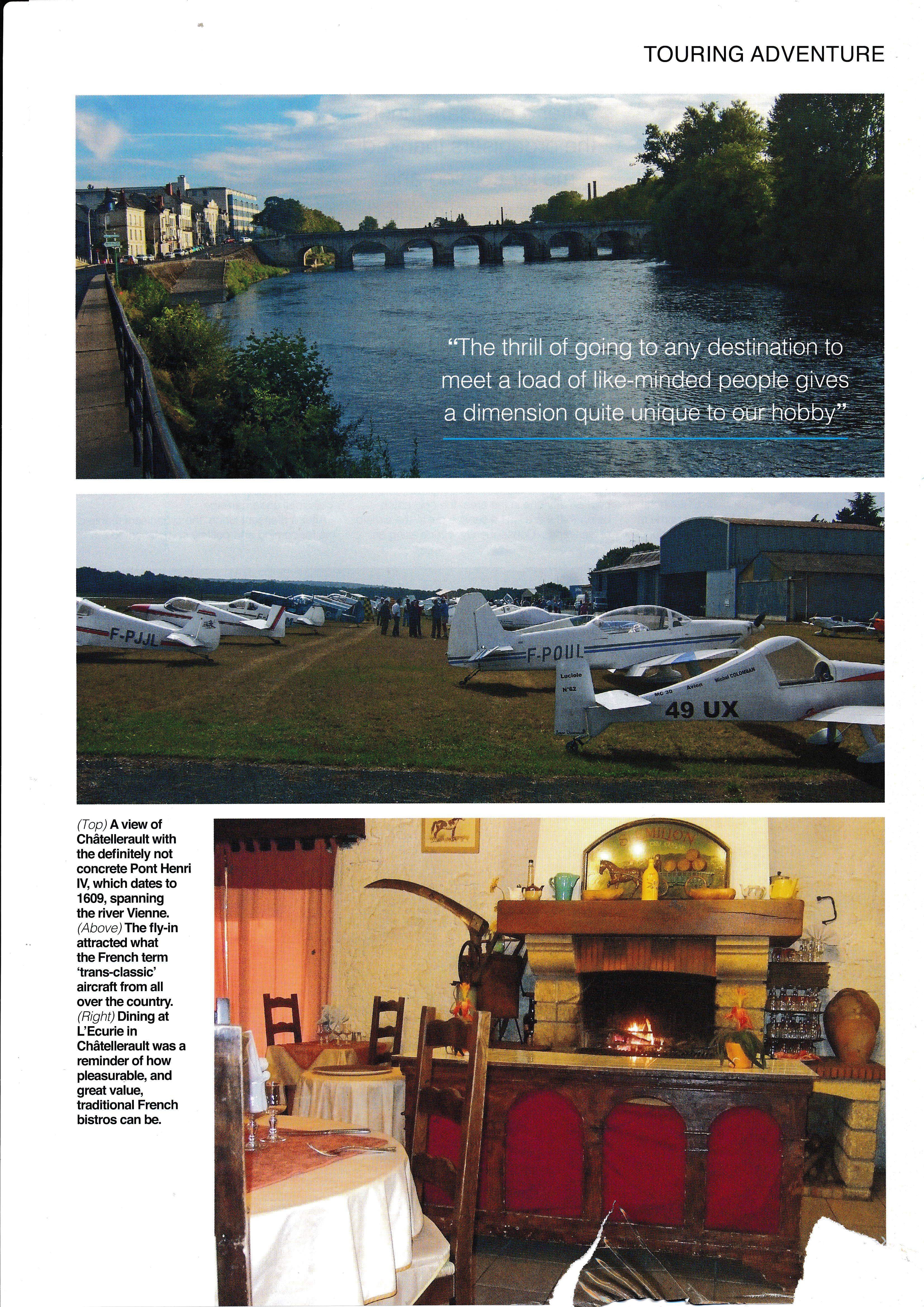
(Top) Avieut ot Chitellerault with the definitely not concrete Pont Henri lV, which dates to 1609, spanning the river Vienne.
Dining at L'Ecurie in Chdtellerault
TOURING ADVENTURE
idea of the fly-in and decided to take a different route altogether.
Chatellerault was a place | hadn't been to before but, with the help of Google, I’d booked a hotel on an industrial estate a bit to the north of the town unfortunately, the airfield was located on the other side, and some distance away. On the plus side, the Nouvelle Classe Hotel (30 Rue Roland Garros, 86100 Chatellerault, +33 5 49 21 49 14) was clean and cheap, with a triple room costing €33.
One of the fly-in’s organisers offered me a lift to drop my bags off, after which | set about exploring the town. I'd like to say that Chatellerault was ‘a find’, but it didn’t ‘do it’ for me, even the narrow streets were lacking atmosphere and | got the feeling that it was more like a Disney version of what a French town should look like.
Conversely, a stunning bridge which crosses the river Vienne, the Pont Camille-de-Hogues, is of note as it was built by French engineer Francois Hennebique, one of the early pioneers of reinforced concrete, in 1899.
My evening meal was taken at a rustic French restaurant, L’Ecurie (141 Avenue Louis Ripault, 86100 Chatellerault, +33 5 49 21 24 82) that | stumbled across on the walk back to the hotel. It was excellent value, all ‘real food’ and came to €22, including a carafe of wine. The experience
I'd
said all afternoon”
was more like France used to be before the explosion of pizza and burger joints. | could almost picture the chef with garlic on his breath and a Gauloise dangling from his mouth...
The next morning, | set out to discover how the bus system worked €1.20 gives you an hour on any one in the area, the only catch being that there isn’t a service out to the airfield at weekends. Consequently, after waiting an
age for the bus to take me into the town centre, a distance | could easily have walked, | still had to get a taxi to reach the airfield.
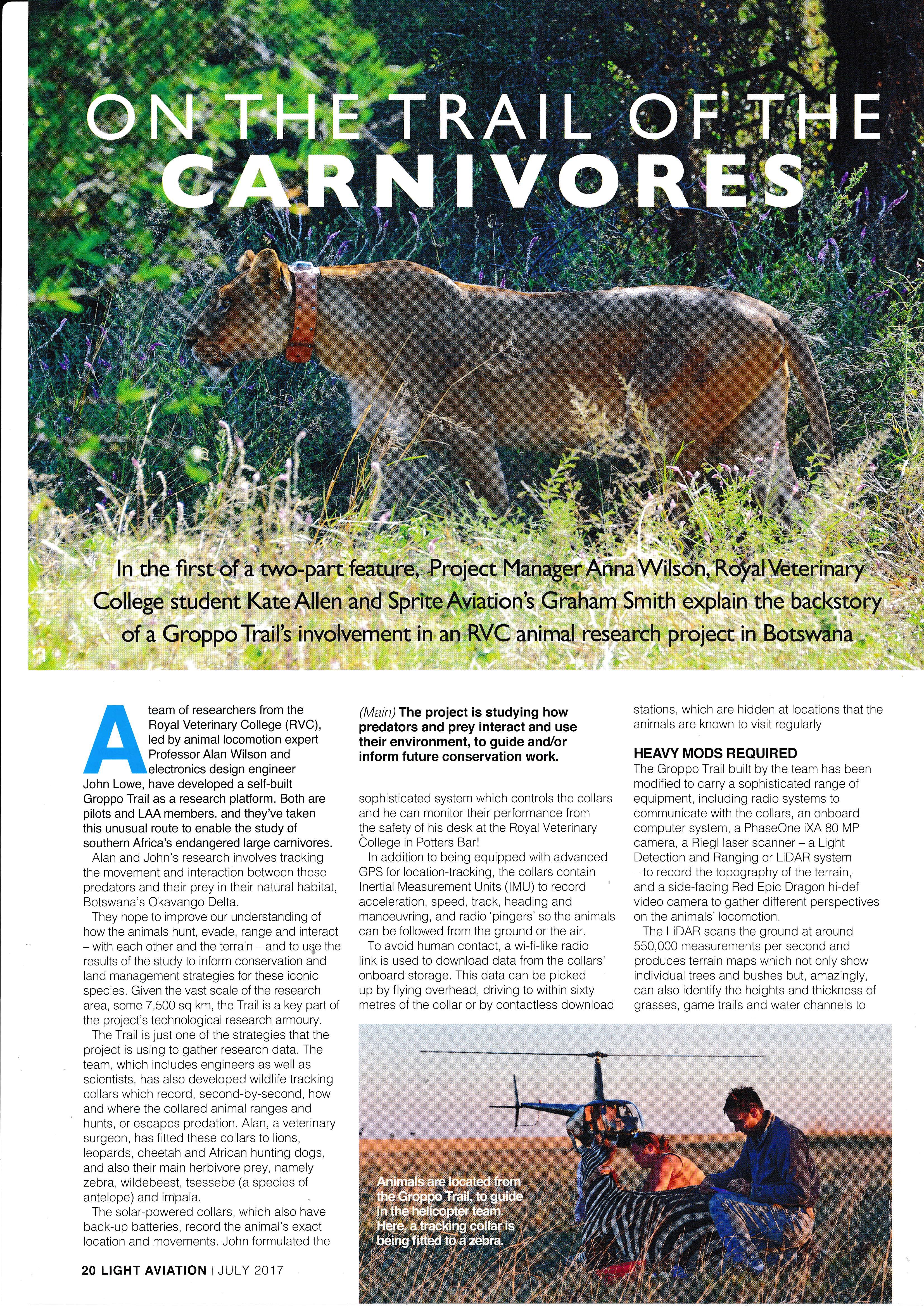
There must have been forty aircraft in attendance at the Aérodrome de Chatellerault —Targé. | enjoyed a hangar lunch, the customary speeches and, in the absence of any other G-registered aircraft, was presented with a T-shirt for the longest flight, something | rarely win unless I’m going to Ireland, my base being closer to the Continent than most. As herewasafull, four-coursehangarmeal, complete with wine, beer and soft drinks, it would've a been better to have planned to stay ocally that evening.
Now, | do speak French, but my command of he language isn’t really good enough to have a two- or three-hour, in-depth conversation. I’m used to sitting down to dinner with people from ots of different countries, which is great, but it would’ve also been good to have a few native English speakers, with or without a Level 6 endorsement on their licence.
Given the good weather, aircraft had come rom all over France and, as one would expect, hey were mostly taildraggers or as they call hem, ‘trans-classic’, which simply means a ‘classical’ undercarriage.
After a pleasant lunch, the organisers thanked me for coming and politely complimented me
The Aéroclub LesAiles Chatelleraudaises kindly hosted a four-course hanger lunch.
on my linguistic skills quite likely not having understood a single word |’d said all afternoon but pleased that I’d at least made the effort.
ONWARDS, UPWARDS?
With goodbyes said, | made the relatively short flight to Bagnoles-de-l’Orne (as featured in LA, May 2017), which is a regular favourite. In relaxed mood, armed with the knowledge that the forecast for the following day was good, | enjoyed a pleasant evening and dined at a restaurant where | know the staff and they speak good English. Little did | know what the ‘weather gods’ had in store for me the next day!
Unfortunately, the forecasters had got it wrong well, at least in part. Itwas fine at Bagnoles, but | wasn’t too far en-route when prudence proved the better part of valour and | was forced to turn back and land at Bernay - Saint-Martin Airfield, which at one time was another favourite. Sadly, that field’s glory days are gone, its nice restaurant closed a long time ago and ona gloomy day the place felt particularly desolate. Sat in a corner of the Aéro Club de Bernay’s clubhouse was another British Jodel pilot and his daughter, who were on their way home from a house they have in Flers and also temporarily thwarted by the weather.
After about an hour and a half on the club’s computer, | convinced myself that there was sufficient improvement and took off for the Aérodrome d’Abbeville, with the other Jodel following closely behind. For about twenty minutes we flew relatively low, in reduced visibility, after which we were able to climb to around 1,500ft in fairer conditions. The Aéroport de Rouen, which was keeping a beady eye on the satellite images, proved very helpful and offered us a special VFR in case we needed to divert.
All went well until about ten minutes from Abbeville, when the weather worsened, leaving us not much higher than the ever-increasing multitude of wind turbines. | can’t claim to be an eco-warrior, although | believe in recycling and renewable energy. I'd also like to think | do my bitforenvironmentinwhateverway|can| know what the green bin is for, am pleased that there’s a charge for plastic bags, and | detest litter louts and any unnecessary packaging, such as sauces served in little sachets, and | also never bought into the idea that diesel was eco-friendly. However, I've always felt that wind turbines were a pointless blot on the landscape they merely pacify a perceived political need to be doing something. In addition to being highly questionable, financially, and an eyesore, they’re often placed so they cause, added risk for both sailors and aviators try the approach to St Michaelisdonn (EDX™M)in Germany on a gusty day. Outside Abbeville, for the first time, | saw them in a different light, up close and personal, menacingly reaching upward between the cloud layers.
OPTIONS TO NO OPTION...
With a clear sense that options were beginning to run out, and in danger of mastication by either the wind turbines in front or from the other Jodel behind, we weren't getting into Abbeville. The only direction possible was towards Beauvais, and by tracking through the lighter bits we managed a somewhat convoluted route into Aérodrome Glisy Amiens, ultimately approaching the field from the east, having started well to the west. | know Amiens and some of the locals quite well (featured LA, February 2017) so fuel, lifts
and almost ethereal
conditions until we
reached the Channel”
and weather information would be easy to arrange. After soending more time at another computer, of the Aeroclub de Picardie Amiens, the UK’s metars were beginning to show signs of a slow improvement, as was Le Touquet, although any flight would have to be low-level and there was no way of knowing what lay between us and the French coast or, more importantly, across the Channel.
The other Jodel pilot felt under some pressure to get home that night as he’d never been stuck before. That either meant that his weather interpretation was very accomplished and certainly far superior to mine, he’d been very lucky or only flew in pretty much guaranteed fine conditions.
It was tempting to make for home and, had we had another hour or so of daylight, | may well have given it a go. As it was, we had hotels and restaurants nearby, the plane was refuelled and we had locals prepared to give us a lift. The downside, of course, was missing work and the extra costs involved in another night away from home.
Theen-routealternatesifwemadea failed attempt would be Le Touquet, Calais or Lydd. The first two options would mean finding both accommodation and transport, and we’d still be a night away from home.
Making it to Lydd meant just transport to arrange, and despite calling themselves London-Ashford Airport, it doesn’t alter the fact that the field is in middle of the sticks, nowhere near the capital or, indeed, Ashford. I’d recently become disenchanted with Lydd, having had to divert there two weeks previously and been charged £38 for landing and a night’s parking, which they insisted was good value. Lydd is one of only a handful of UK airfields which still continues to offer justification for not subscribing to the Strasser scheme. There’s no further comment needed, really...
The decision was made and, for the night at least, we were staying put. That kind of reliance in one’s decision-making ability is what draws a certainkindofpersontobecome a pilotinthe first place. However, part of the reason so many pilots hang up their headsets during their first couple of years, or only fly an hour or so from their base is that, for the basic VFR-qualified, the weather is king and can’t be controlled.
Under the circumstances, we had a reasonable evening, then had to wait until after midday for the fog to clear sufficiently to get going. We flew in a misty, eerie and almost ethereal conditions until we reached the Channel where, fully expecting to lose all forward visibility over the sea, | was most pleasantly surprised and somewhat relieved to be able to make out the indistinct ‘white cliffs’ from Cap Gris Nez.
High pressure, fog and inversion layers are normal for the time of year and | learnt that my Norfolk friends also had some eventtul flying, finally getting back a couple of day’s later, in poor visibility, with stories of their own to tell.
LESSONS LEARNT
| recently attended a GASCo Safety Evening, which was well-run and delivered by experienced, knowledgeable people. That session highlighted how difficult the go/no-go decision is in marginal weather. | don't subscribe to the viewpoint that pilots should only fly in ideal conditions, nor do | advocate intentionally going beyond one’s limits, but on occasions it may be necessary tostretchthecomfortzonea little.Newlimits are either very quickly defined, with the pilot becoming comfortable, or are clearly not and an expeditious return to terra firma is made.
Am| sorry|wenttoChatelleraultbecause of my later-than-planned return? Not likely, especially when you think of what was soon to follow short, wintry days, long nights and littleflying until the next season.
The next Chatellerault taildragger fly-in is a little earlier this year, on 2 September, and for those who are passing through that part of France it might make a good lunch stop, with a variety of interesting aircraft and camping available at the field. But if you'll be staying inahotel,arrangealifttoandbackfromthe field with the organisers beforehand, as getting around will be a faff! You'll find more information on the event at www.aileschat.org So did | learn anything?Well, yes, and the lesson was two-fold. | know there are diehards who proudly polish their sextant each time they go flying, but these days | wouldn't like to do long distances without a GPS and, after this experience, | consider my phone as being equally essential. Half our lives are stored in it and, much as the GPS takes the hard work out of navigation, life on the ground is so much simpler with a phone and access to the net. And secondly, | really don’t like wind turbines!
Next month’s Touring Adventure will be on home turf and concern the LAA Rally at Sywell. Ifyou think that an event ofyours would be of interest to LAA members and you'd like to see it featured as part of the Touring Adventures section of LA, just drop us a line via the email adaress shown below. It doesn’t matter whether it’s a small event at a farm strip or something much bigger, in the UK or abroad. If we can, we'll drop it in.
MARTIN FERID is a Class Rating Instructor and Revalidation Examiner, with over 2,000 hours (roughly an even amount of tail- and nose-wheel time) and a similar split of touring and farm strip flying.
He specialises in helping qualified pilots expand their horizons. Many of his summer weekends are spent introducing UK aviators to the splendours of flying in Europe, using their own or hired aircraft. More info at www.lightaircrattraining.co.uk If Martin can be of help with any aspects of touring or flying in general, drop him a line at stoneacreaviation@yahoo.co.uk, or call him on 07958 880178. Indeed, if you've any tips, advice or comments of your own, they'll be most gratefully received by Martin.
team of researchers from the Royal Veterinary College (RVC), led by animal locomotion expert
Professor Alan Wilson and “electronics design engineer JohnLowe,havedeveloped a self-built Groppo Trail as a research platform. Both are pilots and LAA members, and they’ve taken this unusual route to enable the study of southern Africa’s endangered large carnivores.
Alan and John’s research involves tracking the movement and interaction between these predators and their prey in their natural habitat, Botswana’s Okavango Delta.
They hope to improve our understanding of how the animals hunt, evade, range and interact with each other and the terrain and to use the results of the study to inform conservation and land management strategies for these iconic species. Given the vast scale of the research area, some 7,500 sq km, the Trail is a key part of the project’s technological research armoury.
The Trail is just one of the strategies that the project is using to gather research data. The team, which includes engineers as well as scientists, has also developed wildlife tracking collars which record, second-by-second, how and where the collared animal ranges and hunts, or escapes predation. Alan, a veterinary surgeon, has fitted these collars to lions, leopards, cheetah and African hunting dogs, and also their main herbivore prey, namely zebra, wildebeest, tsessebe (a species of antelope) and impala.
Thesolar-poweredcollars,whichalsorene back-up batteries, record the animal's exact location and movements. John formulated the
(Main) The project is studying how predators and prey interact and use their environment, to guide and/or inform future conservation work.
sophisticated system which controls the collars and he can monitor their performance from the safety of his desk at the RoyalVeterinary CollegeinPottersBar!
In addition to being equipped with advanced GPS for location-tracking, the collars contain Inertial Measurement Units (IMU) to record acceleration, speed, track, heading and manoeuvring, and radio ‘pingers’ so the animals can be followed from the ground or the air.
To avoid human contact, a wi-fi-like radio link is used to download data from the collars’ onboard storage. This data can be picked up by flying overhead, driving to within sixty metres of the collar or by contactless download
stations, which are hidden at locations that the animals are known to visit regularly
HEAVY MODS REQUIRED
The Groppo Trail built by the team has been modified to carry a sophisticated range of equipment, including radio systems to communicate with the collars, an onboard computer system, a PhaseOne ixA 80 MP camera, a Rieg! laser scanner a Light Detection and Ranging or LIDAR system to record the topography of the terrain, and a side-facing Red Epic Dragon hi-def video camera to gather different perspectives on the animals’ locomotion.
The LIDAR scans the ground at around 550,000 measurements per second and produces terrain maps which not only show individual trees and bushes but, amazingly, can also identify the heights and thickness of grasses, game trails and water channels to
within a few centimetres. Combining the collar-derived GPS tracks with the LIDAR terrain maps enables the research team to see exactly where the animals hunt and how they use their environment. The side-facing Red Epic camera is mounted on a motorised FLIR pan-tilt gimbal, controlled by the computer system, combining the Trail’s attitude and position information with that from the collar being tracked, to automatically train the camera accurately.
This technical array means that the team are able to collect a wide range of information, from stride-by-stride collar data during hunting and evasion to aerial video of whole herds of migrating herbivores.
SELF-BUILT SOLUTION :
The need to carry and operate this amount onboardtechnologywasa significantfactorin the team’s choice of aircraft and many options were considered at the start of the project.
Cessna 182s are commonly used in Botswana, but were eliminated early on because of their cost and the difficulty of adapting the aircraft for the required kit. UAVs were also tested, but were found to be insufficiently stable and robust, for the harsh conditions and the weight of equipment.
For the research team, building their own aircraft offered many advantages, as it meant that they were able to modify it to their specific requirements for example, by designing and installing the electrical infrastructure to accommodate the equipment. Purchasing a ready-built aircraft, even a Permit type, and modifying it to their needs, would have been a much costlier and more difficult undertaking.
Firstly, the CAA was asked for an opinion on the legalityof pursuingan amateurbuild under LAA stewardship, as there was a concern that it might fall foul of the slightly grey area of an aircraft being flown for research purposes.
“The CAA was very helpful and their reply positive,” says Alan, “confirming that we were free to use an amateur-built aircraft for research with their blessing, provided that we avoided any commercial operations.
“After evaluating a number of kit aircraft, we decided on a Groppo Trail. The forward fuselage structure, of square steel tube, lends itself well to the load analysis needed to support the required mods, the skin in this area at least being largely non-structural. The Trail also had the payload potential to carry all the equipment we needed and still permit a decent fuel load. Itwas also capable of flying relatively slowly
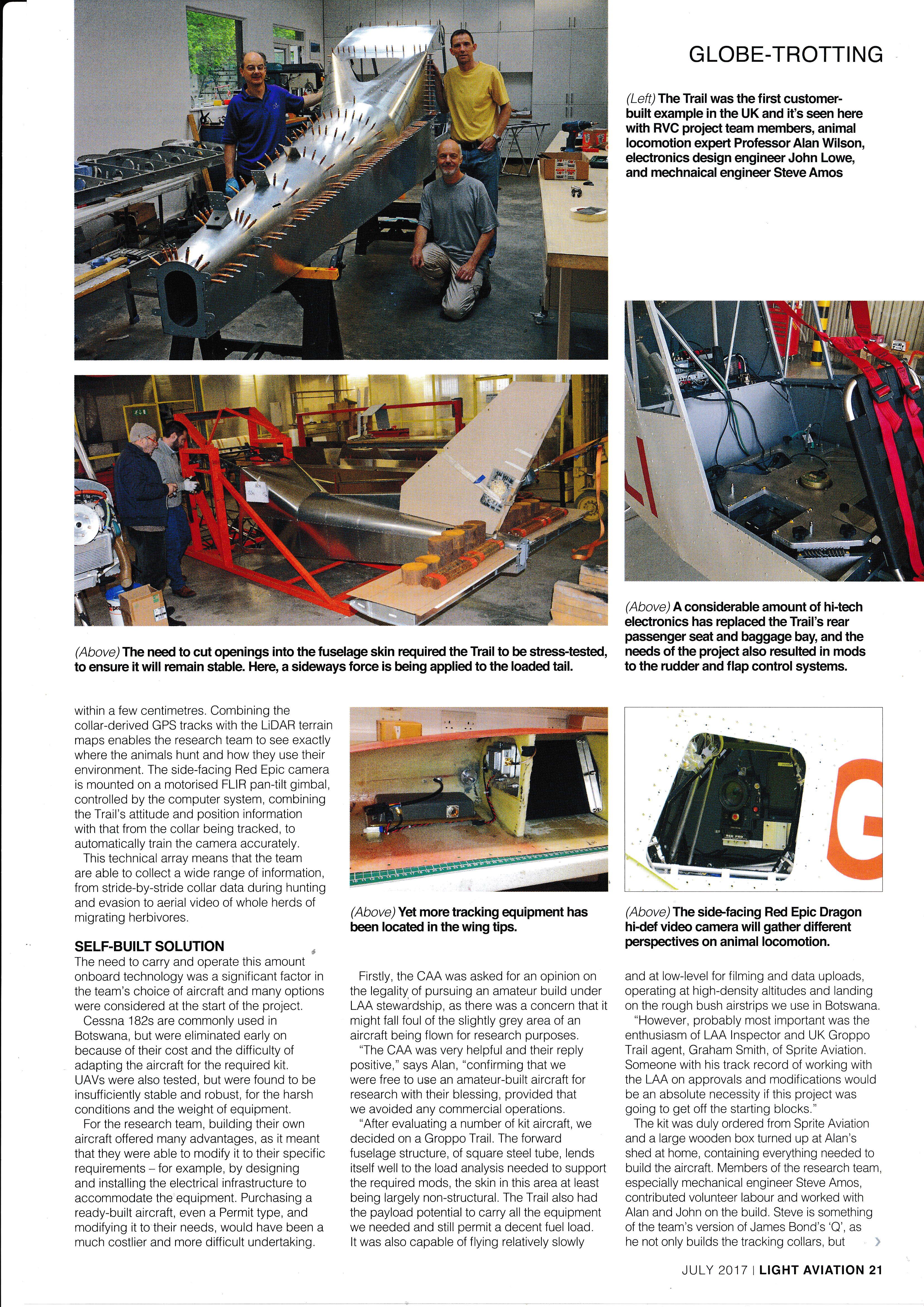
(Left) The Trail was the first customerbuiltexample in the UK and it’s seen here with RVCproject team members, animal locomotion expert ProfessorAlan Wilson, electronics design engineer John Lowe, and mechnaical engineer Steve Amos
The side-facing Red Epic
video camera will gather different perspectives on animal locomotion.
and at low-level for filming and data uploads, operating at high-density altitudes and landing on the rough bush airstrips we use in Botswana.
“However, probably most important was the enthusiasm of LAA Inspector and UK Groppo Trail agent, Graham Smith, of Sprite Aviation. Someone with his track record of working with the LAA on approvals and modifications would be an absolute necessity if this project was going to get off the starting blocks.”
The kit was duly ordered from Sprite Aviation and a large wooden box turned up at Alan’s shed at home, containing everything needed to build the aircraft. Members of the research team, especially mechanical engineer Steve Amos, contributed volunteer labour and worked with Alan and John on the build. Steve is something of the team’s version of James Bond’s ‘Q’, as he not only builds the tracking collars, but
(Above)
Dragon hi-def
has also designed and fabricated a great many of the bespoke components that a project such as this demands.
The plan was to build and fly the Trail as a completely standard aircraft, and then tackle the large number of essential modifications that were needed to turn it into the research platform the team required. The aircraft was finished in standard form the first one completed in the UK and successfully test-flown. After that, the team could focus their attentionon transforming the Trail into a highly specialised, high-tech research survey aircraft.
A COMPLEX TRANSFORMATION
“Although the initial feedback from the LAA about the modifications was encouraging,” Alan explains, “there were plenty of warnings about the complexity of what we were trying to do. After all, one modification for the side-facing cameras was a 34cm-square hole in the fuselage skin, at a point where it was structural, so it was no small undertaking.
“We also wanted a bespoke autopilot, and some very substantial metal framework within the existing structure, to support the computers, cameras, and most importantly, the state-ofthe-art LIDAR system. The LIDAR needed a unique mount isolated from the vibrations of the airframe, which could have disturbed the spin of the scanner head and corrupted the data.
“On top of that, we wanted to mount antennas onalift strutandinthewingtips,andasifthat
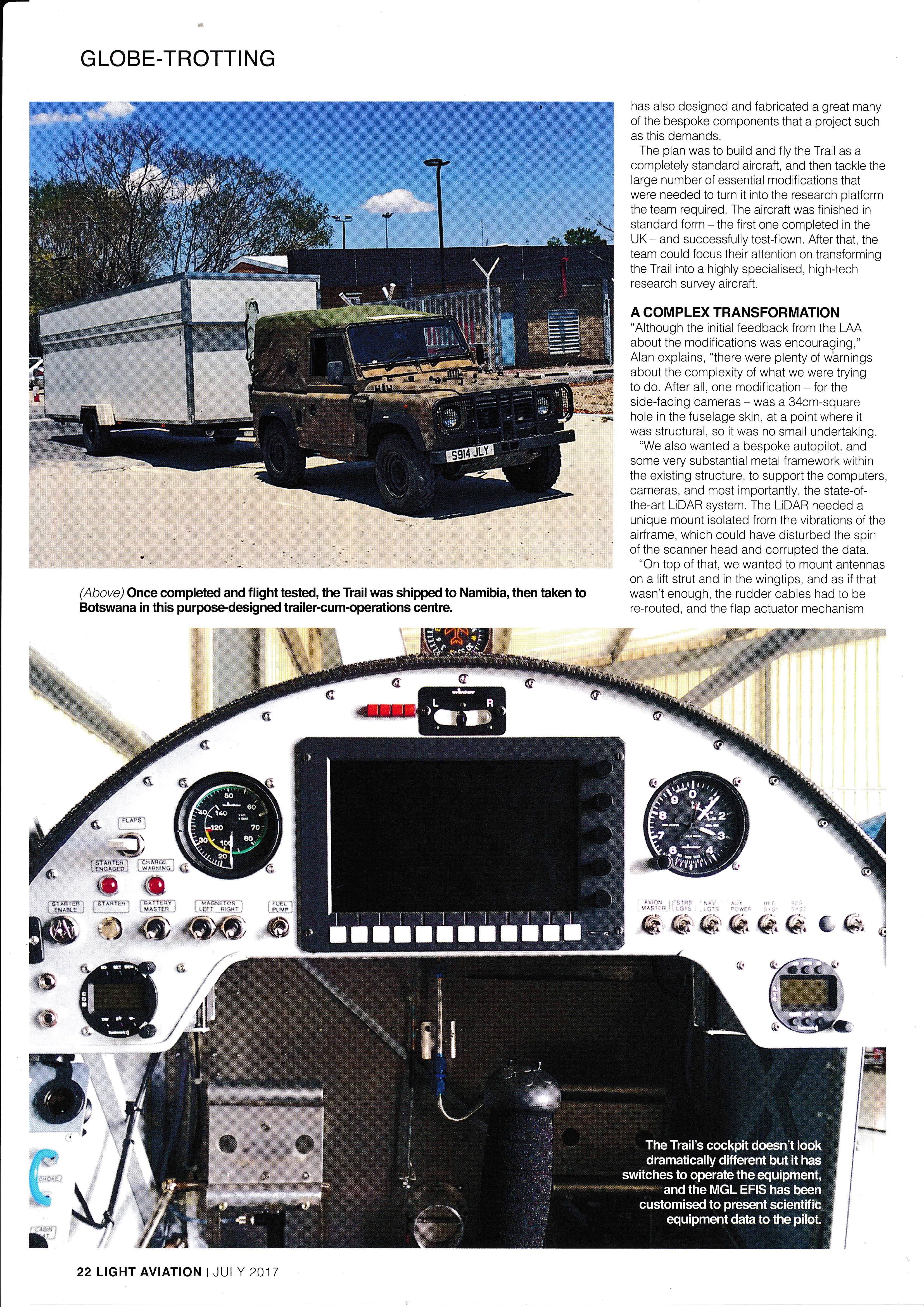
(Above) Once completed and flight tested, the Trail was shipped to Namibia, then taken to wasn’tenough,the rudder cables hadto be Botswana in this purpose-designed trailer-cum-operations centre. re-routed,and theflap actuatormechanism
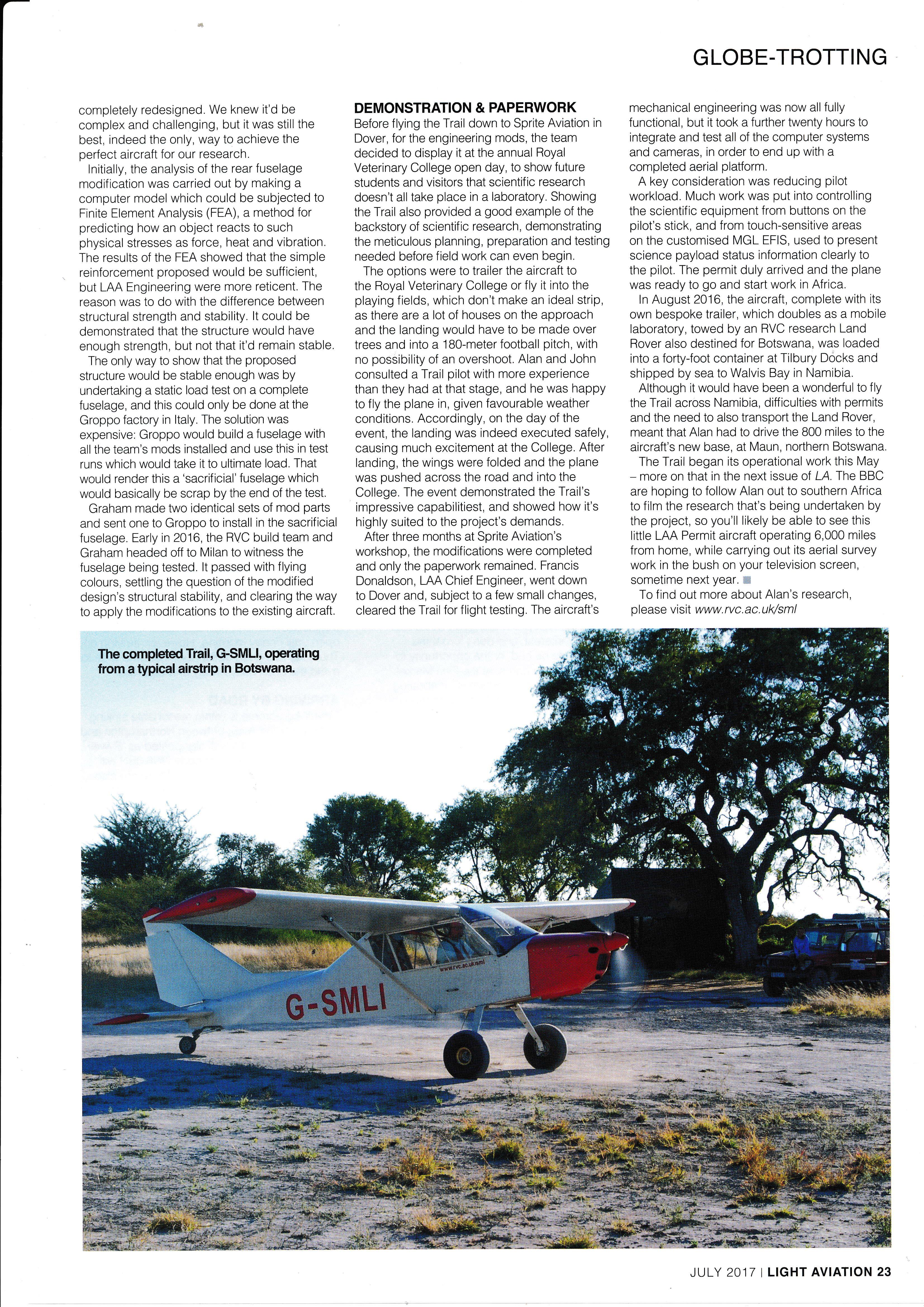
TheTrail’scockpit doesn’t look dramaticallydifferentbutithas | switches to operatethe equipment, | and the MGLEFIS hasbeen ESlu emeMeoecelcaliiem. | equipment datato the pilot. |
completely redesigned. We knew it'd be complex and challenging, but it was still the best, indeed the only, way to achieve the perfect aircraft for our research.
Initially, the analysis of the rear fuselage modification was carried out by making a computer model which could be subjected to Finite Element Analysis (FEA), a method for predicting how an object reacts to such physical stresses as force, heat and vibration. The results of the FEA showed that the simple reinforcement proposed would be sufficient, but LAA Engineering were more reticent. The reason was to do with the difference between structural strength and stability. It could be demonstrated that the structure would have enough strength, but not that it’d remain stable.
Theonlyway to showthat the proposed structure would be stable enough was by undertaking a static load test on a complete fuselage, and this could only be done at the Groppo factory in Italy.The solution was expensive: Groppo would build a fuselage with all the team’s mods installed and use this in test runs which would take it to ultimate load. That would render this a ‘sacrificial’ fuselage which would basically be scrap by the end of the test.
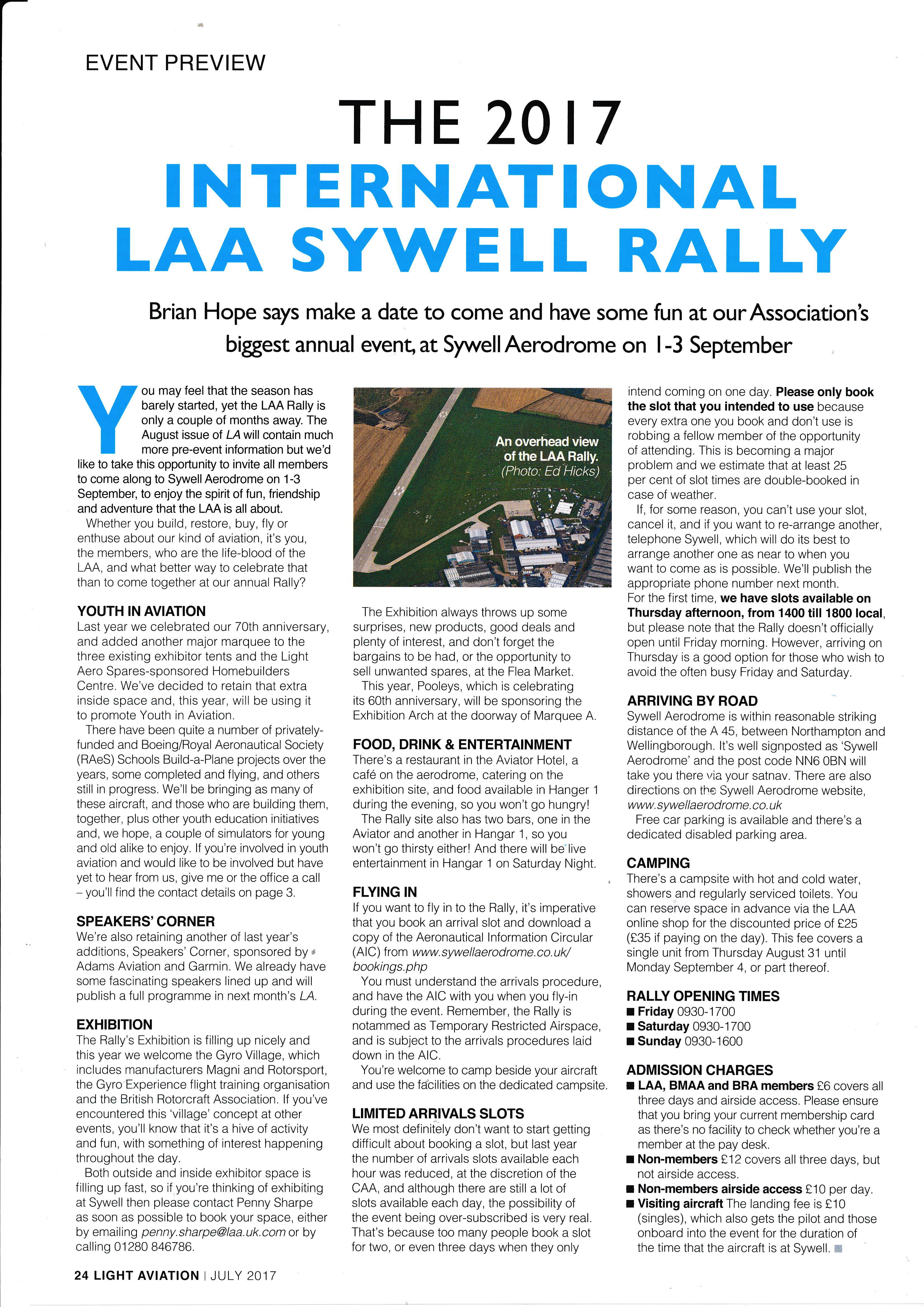
Graham made two identical sets of mod parts and sent one to Groppo to install inthe sacrificial fuselage. Early in 2016, the RVC build team and Graham headed off to Milan to witness the fuselage being tested. It passed with flying colours, settling the question of the modified design’s structural stability, and clearing the way to applythe modificationsto theexistingaircraft. The completed Trail, G-SMLI,operating from atypical airstrip in Botswana.
DEMONSTRATION & PAPERWORK
Before flying the Trail down to Sprite Aviation in Dover, for the engineering mods, the team decided to display it at the annual Royal Veterinary College open day, to show future students and visitors that scientific research doesn't all take place in a laboratory. Showing the Trail also provided a good example of the backstory of scientific research, demonstrating the meticulous planning, preparation and testing needed before field work can even begin.
The options were to trailer the aircraft to the Royal Veterinary College or fly it into the playing fields, which don’t make an ideal strip, as there are a lot of houses on the approach and the landing would have to be made over trees and into a 180-meter football pitch, with no possibility of an overshoot. Alan and John consulted a Trail pilot with more experience than they had at that stage, and he was happy to fly the plane in, given favourable weather conditions. Accordingly, on the day of the event, the landing was indeed executed safely, causing much excitement at the College. After landing, the wings were folded and the plane was pushed across the road and into the College. The event demonstrated the Trail’s impressive capabilitiest, and showed how it’s highly suited to the project’s demands.
After three months at Sprite Aviation’s workshop, the modifications were completed and only the paperwork remained. Francis Donaldson, LAA Chief Engineer, went down to Dover and, subject to a few small changes, cleared the Trailfor flight testing. The aircraft's
mechanical engineering was now all fully functional, but it took a further twenty hours to integrate and test all of the computer systems and cameras, in order to end up with a completed aerial platform.
A key consideration was reducing pilot workload. Much work was put into controlling the scientific equipment from buttons on the pilot’s stick, and from touch-sensitive areas on the customised MGL EFIS, used to present science payload status information clearly to the pilot. The permit duly arrived and the plane was ready to go and start work in Africa.
In August 2016, the aircraft, complete with its own bespoke trailer, which doubles as a mobile laboratory, towed by an RVC research Land Rover also destined for Botswana, was loaded into a forty-foot container at Tilbury Docks and shipped by sea to Walvis Bay in Namibia.
Although itwould have been a wonderful to fly the Trail across Namibia, difficulties with permits and the need to also transport the Land Rover, meant that Alan had to drive the 800 miles to the aircraft's new base, at Maun, northern Botswana.
The Trail began its operational work this May —more on that in the next issue of LA. The BBC are hoping to follow Alan out to southern Africa to film the research that’s being undertaken by the project, so you'll likely be able to see this little LAA Permit aircraft operating 6,000 miles from home, while carrying out its aerial survey work in the bush on your television screen, sometime next year. i
To find out more about Alan’s research, please visit www.rvc.ac.uk/sml
ou may feel that the season has barely started, yet the LAA Rally is only a couple of months away. The August issue of LA will contain much more pre-event information but we’d like to take this opportunity to invite all members to come along to Sywell Aerodrome on 1-3 September, to enjoy the spirit of fun, friendship and adventure that the LAA is all about.
Whether you build, restore, buy, fly or enthuse about our kind of aviation, it’s you, the members, who are the life-blood of the LAA, and what better way to celebrate that than to come together at our annual Rally?
YOUTH IN AVIATION
Last year we celebrated our 7Oth anniversary, and added another major marquee to the three existing exhibitor tents and the Light Aero Spares-sponsored Homebuilders Centre. We've decided to retain that extra inside space and, this year, will be using it to promote Youth in Aviation.
There have been quite a number of privatelyfunded and Boeing/Royal Aeronautical Society (RAeS)Schools Build-a-Plane projects over the years, some completed and flying, and others still in progress. We'll be bringing as many of these aircraft, and those who are building them, together, plus other youth education initiatives and, we hope, a couple of simulators for young and old alike to enjoy. If you’re involved in youth aviation and would like to be involved but have yet to hear from us, give me or the office a call you'll find the contact details on page 3.
SPEAKERS’ CORNER
We're also retaining another of last year’s additions, Speakers’ Corner, sponsored by « Adams Aviation and Garmin. We already have some fascinating speakers lined up and will publish a full programme in next month’s LA.
EXHIBITION
The Rally’s Exhibition is filling up nicely and this year we welcome the Gyro Village, which includes manufacturers Magni and Rotorsport, the Gyro Experience flight training organisation and the British Rotorcraft Association. If you’ve encountered this ‘village’ concept at other events, you'll Know that it’s a hive of activity and fun, with something of interest happening throughout the day.
Both outside and inside exhibitor space is filling up fast, so if you’re thinking of exhibiting at Sywell then please contact Penny Sharpe as soon as possible to book your space, either by emailing penny.sharpe@laa.uk.com or by calling 01280 846786. 24LIGHTAVIATION|JULY2017
The Exhibition always throws up some surprises, new products, good deals and plenty of interest, and don’t forget the bargains to be had, or the opportunity to sell unwanted spares, at the Flea Market.
This year, Pooleys, which is celebrating its 60th anniversary, will be sponsoring the Exhibition Arch at the doorway of Marquee A.
FOOD, DRINK & ENTERTAINMENT
There’s a restaurant in the Aviator Hotel, a café on the aerodrome, catering on the exhibition site, and food available in Hanger 1 during the evening, so you won't go hungry!
The Rally site also has two bars, one in the Aviator and another in Hangar 1, so you won'tgothirstyeither!Andtherewillbe’live entertainment in Hangar 1on Saturday Night.
FLYING IN
If you want to fly in to the Rally, it’s imperative that you book an arrival slot and download a copy of the Aeronautical Information Circular (AIC) from www.sywellaerodrome.co.uk/ bookings. php
You must understand the arrivals procedure, and have the AIC with you when you fly-in during the event. Remember, the Rally is notammed as Temporary Restricted Airspace, and is subject to the arrivals procedures laid down in the AIC.
You're welcome to camp beside your aircraft and use the facilities on the dedicated campsite.
LIMITEDARRIVALS SLOTS
We most definitely don’t want to start getting difficultaboutbooking a slot,butlastyear the number of arrivals slots available each hour was reduced, at the discretion of the CAA, and although there are still a lot of slots available each day, the possibility of the event being over-subscribed is very real. That’s because too many people book a slot for two, or even three days when they only
intend coming on one day. Please only book the slot that you intended to use because every extra one you book and don’t use is robbing a fellow member of the opportunity of attending. This is becoming a major problem and we estimate that at least 25 per cent of slot times are double-booked in case of weather.
If, for some reason, you can’t use your slot, cancel it, and if you want to re-arrange another, telephone Sywell, which will do its best to arrange another one as near to when you want to come as is possible. We'll publish the appropriate phone number next month. For the first time, we have slots available on Thursday afternoon, from 1400 till 1800 local, but please note that the Rally doesn't officially open until Friday morning. However, arriving on Thursday is a good option for those who wish to avoid the often busy Friday and Saturday.
ARRIVING BY ROAD
Sywell Aerodrome is within reasonable striking distance of the A 45, between Northampton and Wellingborough. It’swell signposted as ‘Sywell Aerodrome’ and the post code NN6 OBN will take you there via your satnav. There are also directions on the Sywell Aerodrome website, www.sywellaerodrome.co.uk
Free car parking is available and there’s a dedicated disabled parking area.
CAMPING
There’s a campsite with hot and cold water, showers and regularly serviced toilets. You can reserve space in advance via the LAA online shop for the discounted price of £25 (£35 if paying on the day). This fee covers a single unit from Thursday August 31 until Monday September 4, or part thereof.
RALLY OPENING TIMES
g@Friday 0930-1700
m@Saturday 0930-1700
m@Sunday 0930-1600
ADMISSION CHARGES
@LAA, BMAA and BRA members £6 covers all three days and airside access. Please ensure that you bring your current membership card as there’s no facility to check whether you're a member at the pay desk.
m@Non-members £12 covers all three days, but not airside access.
m@Non-membersairsideaccess£10perday.
@Visiting aircraft The landing fee is £10 (singles), which also gets the pilot and those onboard into the event for the duration of the time that the aircraft is at Sywell. @
CharlesTaylorAdjustingAviationprovideawiderangeofclaims,technicalandconsultancy expertise to aviation insurers and their clients worldwide.
TraineeGeneralAviation Surveyor London Office
Due to expansion of our General Aviation claims adjusting activities, Charles Taylor | AdjustingrequireaTraineeAviationSurveyorwithastrongbackgroundinGeneralAviation, i tobebasedoutofourLondonoffice. |
Ideally the candidate will have experience in both Fixed and Rotary Wing General Aviation Maintenance and Repair. However, suitable candidates with either individual skill set will be consideredand appropriatetraining provided. |
Candidates must be available to travel at short notice and hold a valid EASA Part 66 Aircraft Maintenance Licence with some appropriate Type Ratings or an FAA A+ P Licence.
We offer a competitive salary, benefits package and career development potential.
To apply for a position, please email your CV and covering letter, to recruitment@ctplc.com Closing date for applications is 18/08/2017
West Houghton, Lancashire,killed344 men, being only four survivors.These examples are the UK’sthree worst mining disasters. However,contemporary accounts suggest that very few of the victims actually died from CONCENTRATION
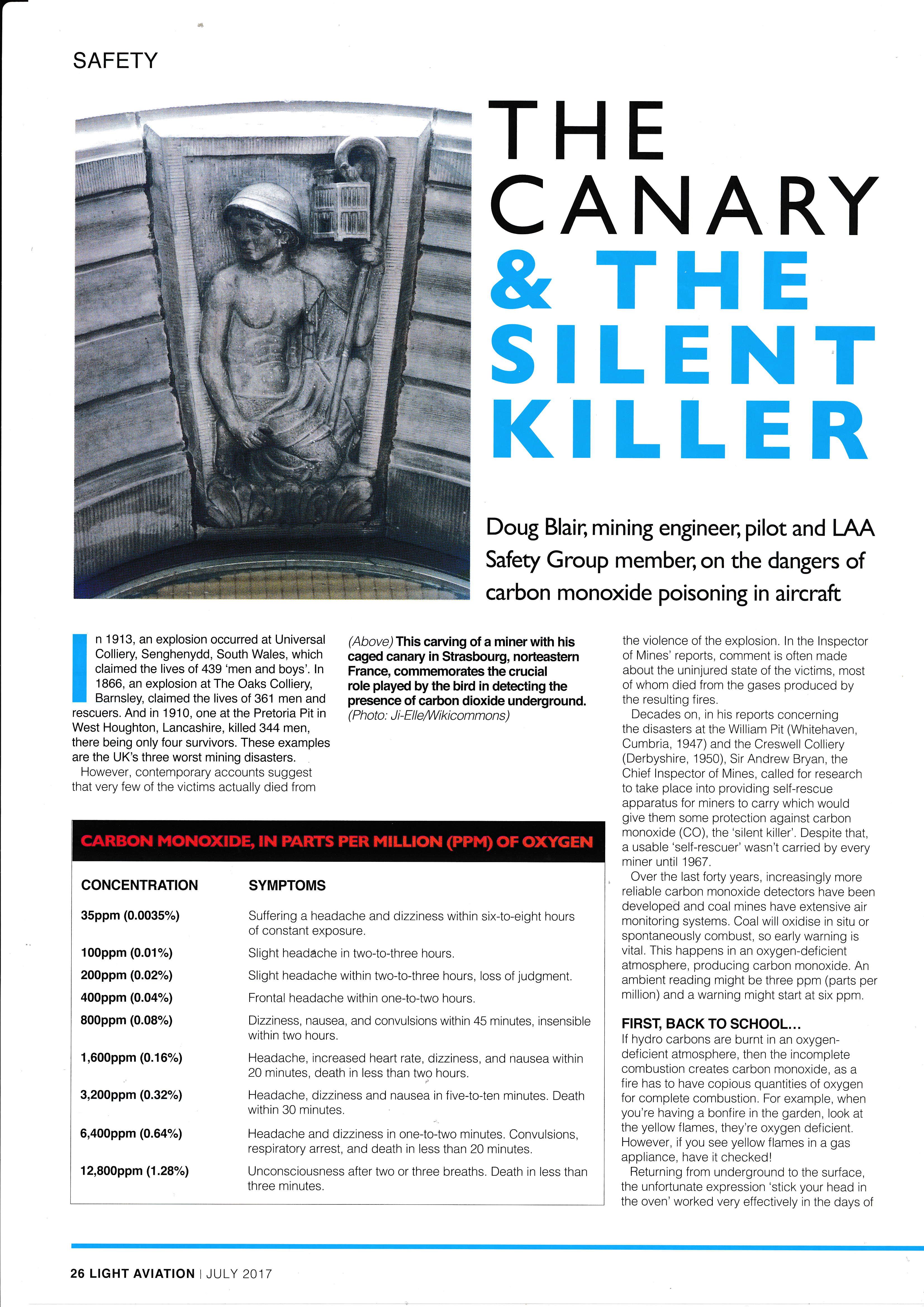
n1913,anexplosionoccurredatUniversalColliery,Senghenydd,SouthWales,which claimedthelivesof439‘menandboys’.In 1866,anexplosionatTheOaksColliery, rescuers.Barnsley,claimedthelivesof361menand Andin1910,oneatthePretoriaPitin (Above) This carving of a miner with his caged canary in Strasbourg, norteastern France, commemorates the crucial role played by the bird in detecting the presence of carbon dioxide underground. (Photo: Ji-Elle/Wikicommons)
35ppm (0.0035%)
100ppm (0.01%)
200ppm (0.02%)
400ppm (0.04%)
800ppm (0.08%)
1,600ppm (0.16%)
3,200ppm (0.32%)
6,400ppm (0.64%)
12,800ppm (1.28%)
SYMPTOMS
Suffering a headache and dizziness within six-to-eight hours of constant exposure.
Slight headache in two-to-three hours.
Slight headache within two-to-three hours, loss of judgment. Frontal headache within one-to-two hours.
Dizziness, nausea, and convulsions within 45 minutes, insensible within two hours.
Headache, increased heart rate, dizziness, and nausea within 20minutes,deathinlessthantwohours.
Headache, dizziness and nausea in five-to-ten minutes. Death within 30 minutes.
Headache and dizziness in one-to-two minutes. Convulsions, respiratory arrest, and death in less than 20 minutes.
Unconsciousness after two or three breaths. Death in less than three minutes.
the violence of the explosion. In the Inspector of Mines’ reports, comment is often made about the uninjured state of the victims, most of whom died from the gases produced by the resulting fires.
Decades on, in his reports concerning the disasters at the William Pit (Whitehaven, Cumbria, 1947) and the Creswell Colliery (Derbyshire, 1950), Sir Andrew Bryan, the Chief Inspector of Mines, called for research to take place into providing self-rescue apparatus for miners to carry which would give them some protection against carbon monoxide (CO), the ‘silent killer’. Despite that, a usable ‘self-rescuer’ wasn’t carried by every miner until 1967.
Over the last forty years, increasingly more reliable carbon monoxide detectors have been developed and coal mines have extensive air monitoring systems. Coal will oxidise in situ or spontaneously combust, so early warning is vital. This happens in an oxygen-deficient atmosphere, producing carbon monoxide. An ambient reading might be three ppm (parts per million) and a warning might start at six pom.
FIRST, BACK TO SCHOOL...
f hydro carbons are burnt in an oxygendeficient atmosphere, then the incomplete combustion creates carbon monoxide, as a ire has to have copious quantities of oxygen or complete combustion. For example, when you're having a bonfire in the garden, look at he yellow flames, they’re oxygen deficient. However, if you see yellow flames in a gas appliance, have it checked!
Returning from underground to the surface, he unfortunate expression ‘stick your head in he oven’ worked very effectively in the days of
card, which goes black in the presence of carbon monoxide. These cards are lifed, generally for no more than twelve months after opening, and some, once they’ve gone black, are no longer serviceable. Others, like this example from Aircraft Spruce and Specialty, return to their neutral colour one the CO presence has ceased and can continue to be used. Makesure you date the card and replace itwhen it’s life has expired.
used,though they’resomewhatlarger =| than purposely designed aviation examples. A quick trawl of the internet brought up this FireAngel CO-9D device, which is 120mmx 74mm x 40mm deep, runsfor seven years on its lithium battery and costs just £18.
coal gas, which was made by heating coal in the absence of oxygen. Coal gas had a high CO content to burn and provide carbon dioxide (CO2).
Today’s natural gas is rather less effective as a domestic killer, as it suffocates by lack of oxygen rather than poisons people, but it’s still deadly. Carbon monoxide is colourless and odourless, it’s the ‘silent killer’.
The current safety requirements around combustion heaters, gas fires, coal fires, wood burners, etc, are largely based around having sufficient ventilation to obtain complete combustion and also to ensure that the products of combustion are flued away from people. We'll all have read of cases where people have fallen asleep on the arm chair in front of a nice cosy fire, never to wake up.
HOW THE SILENT KILLER WORKS
Red blood cells contain a dark-crimson chemical called haemoglobin that combines with oxygen inthe lungs to form oxyhaemoglobin, which transports the oxygen to where it’s needed around the body.
Unfortunately, haemoglobin prefers to combine with carbon monoxide to form carboxyhemoglobin, thus excluding the oxygen. Carboxyhemoglobin takes a long time to reduce in the blood, four-to-six hours to reduce by half. Therefore, with increasingly less oxygen being transported around the body we slowly and quietly die, blissfully unaware of our symptoms.
The legislation requiring canaries or other small birds to be kept at coal mines was only rescinded in the mid-1980s, with the development of reliable carbon monoxide detectors. The law required a small bird to
be taken to a fresh air base when rescue teams were deployed.
The canary has a much faster heartbeat than the human and it therefore absorbs the carbon monoxide faster, and obligingly falls off its perch before we do. Some clever cages with oxygen cylinders to revive the poisoned birds were developed, but remember, it takes a long time to clear carbon monoxide from the blood and return it to transporting oxygen, in both canaries and humans.
GREAT DANGER ALOFT!
We all fly about in a device with a hydrocarbon and oxygen-exploding device up front, one which emits exhaust fumes that, due to imperfect, incomplete combustion, contain carbon monoxide.
Aviators aren't helped by the oldish design of our engines and the lack of the emission control add-ons which are found in today’s automobile powerplants. We only have short exhausts, unlike in automobiles where the nasty stuff is piped to the rear, and often cockpits aren't very well sealed. The gaps in the seals and some of our vents also create suction as we fly along. That's why an inside static might read higher on the altimeter (less pressure),than an outside one. Also, the propeller creates a swirl of air, probably containing exhaust gases, around the fuselage. The above describes my Jodel, and most other light aircraft, very well.
Reduced pressure in the cabin will suck in any carbon monoxide that isn’t being forced out into the slipstream. And if there are exhaust leaks and suitable small holes in the firewall, CO can be readily sucked into the cabin. In addition, during cold weather or at altitude, a
and if it’s corroded or cracked, then it'll blow in carbon monoxide.
As the CO is odourless and colourless, you'll have no idea that you're being poisoned and the effects will slowly build up. You may become sleepy and get a thumping headache, by which point your brain is poisoned and will slow down, impairing logical thought.
METHODS OF DETECTION
We can’t personally detect carbon monoxide so we must either take a canary flying or install a device to detect it. The latter amounts to either the ‘dead stop’ colour-changing card, which should be included in your regular checks, or a domestic or purposely designed aviation CO alarm.
| use a domestic alarm, which also has a readout. LAA Engineering are happy that, providing common sense is used, we can use portable carbon monoxide monitors, but be aware that the domestic fixings may not be adequate for aircraft use.
So if you’re flying, start to feel unwell and think that you may be in the initial throes of suffering carbon monoxide poisoning, or your detector turns black or sounds an alarm, in the first instance continue to pilot the aircraft. You'll need lots of fresh air so, if you have an exhaust heater and it’s on, turn it off. If the vents will rotate to force air into the cabin, that'll also help —-I’ve also read of a rolled-up map being used to duct air to the pilot's face via the direct vis panel.
Next, check that the engine is correctly leaned so it has efficient combustion, tell someone about your predicament and accept that your brain power is more reduced than normal go for simple options. ® ASSSS SR ES EE)
Dark spot indicates
™ CARBONMONOwDEALARMFIreinger
cabin heaterusesan exhaustheatexchanger
ge @
his year’s AeroExpo returned to its old haunt of BookerAirfield, officially Wycombe Air Park.Tobe honest | think it benefitted from the change of venue and, refreshingly,a returnto an (almost)wholly aviation show, ratherthan what the beautifulyoung things keep telling us we all want a hip,trendy but rather desperate ‘lifestyle’ event. No fashion show, no expensive cars, no million-dollar power boats just aviation, static and flying-in, people to talk to, sunshine and a good time. | enjoyed this show more than | have for some years.
Of course, there were the usual gripes on the aviation forums, mainly about the car parking, which was, admittedly, rather shambolic. But does it really matter if you have to queue for a few minutes to get in or out?
I'm also not sure that whoever was operating the ‘slot’ arrival system was too fussed about co-operating with pilots who were ringing in, having been delayed, and were trying to re-schedule. | heard reports that pilots were being told there were no slots available, but apart from the first day, Thursday, the sky wasn’t exactly black with arriving aeroplanes. Rest assured, we'll continue to have a dedicated ‘we're here to help’ attitude regarding slots at « the LAA Rally, which of course remains at Sywell, and will take place on 1-3September. | hope AeroExpo’s ‘new’ format worked for its organisers, AvBuyer. Certainly, moving itfrom early May did result in much warmer, more flyable weather. Visitor numbers seemed okay, rather than outstanding, but |thought itwas a goodshowwithenoughtokeepa typical aviation head interested for a few hours.
It's no good people whinging that AeroExpo isn't AERO Friedrichshafen. Of course it isn’t and the likelihood of the UK ever hosting an event of that stature are pretty much zero. However, not everyone is able to go to AERO Friedrichshafen, and with the loss of FLYER Live, we could all do with supporting the events that do remain, and appreciate their positives, rather than complain about their failings. | hope that AvBuyer are already planning to build on this year’s event for 2018 but, please, no fashion shows!
(Above) The manufacturers of the sleek, composite retractable VL3 Evolution, JMB Aircraft of Amougies, Belgium, tout it as the fastest microlight in the world, but like so many 450kg machines, it has a very limited useful load if you want to put two people and fuel in it. The company is keen to get a VLA fast-build kit version available in the UK, maybe with a factory build-assist programme, and took the opportunity to talk to Jon Viner about UK approval. Oh, the speed, well, a max cruise of 165kt is quoted, so a VLA variant would certainly be a serious go-places machine JMB has already flown the VL3 across the Atlantic to Oshkosh. www.jmbaircraft.com (Photo. Ed Hicks)
(Above) The show saw our Association launch the new, exclusive-to-members, ‘pilot-led’ insurance scheme, operated by French brokers Air Courtage Assurances, which had its stand alongside ours, in Hall A. The LAA isn’t involved in the operation of the insurance, rather it’s simply seen as a member benefit to have coverage that we hope will suit our membership’s’needs. Rather than the thrust of the insurance being based on the aircraft, it’s focused, partly at least, on the pilot so, at last, his or her positive attitude to continued development and their claim record, can bring serious discounts on the premium payable. There’s also an interesting ‘Self-Repair’ option to the Hull Risk cover, which can reduce that aspect of your total insurance premium.
The three ladies on the Air Courtage stand not only proved pleasant company throughout the three-day show, they were also highly knowledgeable, each of them having worked at Lloyds of London at some point during their careers. For further details of Air Courtage Assurance’s offering, please turn to page 40 of this issue. Ourstandsawa steadystreamofvisitorsthroughouttheshow,withLAAers popping in for a chat and interested non-members proving keen to learn more about the affordability of our kind of aviation. (Photo:Nei! Wilson)
VOLISEL funke. FREQ
: SET Pa \i
(Above)According to some providers, the sales of 8.33kHzradios continue to outstrip supply, but itwas interesting to see what was actually on offer. LX, now based at Turweston, isthe agent for a number of avionics companies. One of those is Funke, and LX offers the German company’s ATR833Sfor afew pounds shy of £1k, including VAT,a not unreasonable sum for a panel-mount radio. LX also sells the Icom range, including handhelds, and has recently signed up as agents for its direct competitor, the lower-cost Yeasu. Onlyaround a fifthofthemoneyofferedbytheCAA,fromthe EUfund for 8.33kHz re-equipping, has been accounted for by the first wave of applications. So don’t miss the boat, buyyour kit and why not include a new headset or two. Contrary to rumour, it’s pretty much certain that the CAA won’t be seeking to delay the 1January 2018 implementation date for 8.33kHz. One thing that did come up in conversation was whether a Permit or ARC would be approved post-December 2017,if a
(Above)Getting around to some of the aircraft on show, | was pleasantly surprised to see that a Czech company called Airhero has re-introduced the Sluka single-seat, three-axis microlight, which is of course now a deregulated machine.
The Sluka dates back to the nineties, when it was designed and built by the well-respected Letov company as the LK-2, powered by the ubiquitous Rotax 447. | well remember flying one in the Czech Republic during the mid-nineties it handled very much like a little aeroplane, and Maurice Darlington and the late Roger Jones, the erstwhile editor of this magazine, decided to import the type into the UK. It proved quite a popular little machine and there are still a handful flying here.
This new machine is designated the LK-2H and is powered by a 50hp, flat-twin, two-stroke Hirth F23, which is both lighter and more powerful than the 447. Italso has an emergency parachute, an updated undercarriage,an enlarged,thirty-litre fuel tank and other changes, most of which are also offered as retrofits to older variants.TheLK-2HwillbesoldintheUKasa fast-buildkit,priced at around £23k. www./k-2.eu (Photo: Neil Wilson)
25kHz radio was still fitted to an aircraft. Some suppliers have been suggesting that it won’t, but they’re incorrect.
The CAA ruling for non-commercial operations is that “Existing 25kHz radios can be left installed, provided that they are only used for exempted frequencies, such as the emergency frequency.” It hasn’t yet been decided whether the radio will have to be placarded for use with only the designated frequencies.
Having spoken to the CAA about the exempted frequencies, it appears that the regulator is still awaiting the green light from Europe on an as-yet-undisclosed list.
Hopefully, the CAA will be in a position to announce these exempted frequencies before too long. It’s worth mentioning that the exemption isn’t intended to be a permanent feature, expect it to only last for two or three years.
(Photo: Brian Hope)
SHOW REPORT
(Right)Okay,this isn’t an aircraft, but these bicycles crafted by a Latvian company called Materia are still worth a mention. Boasting a beautifully made wooden frame, carbon forks and high-end bicycle components, they were very easy on the eye and as much a piece of art as a mode of transport. However, prices start at €5,500. www.materiabikes.com (Photo:Brian Hope)
(Below)Tecnam seemingly has the knack of producing pretty yet practical aeroplanes, and the P2010 is no exception. With a 180hp 10-360Lycoming, this four-seater has a 450kg (992Ib) useful load similar to what’s probably its major competitor, the Cessna C172 and a claimed 75% cruise of 133kt at 6,000ft. The P2010’s rounded edges give it a much more modern lookthan the C172, and at €260k for a VFR machine and €277k for IFRequipage, both plus VAT,it’s competitively priced. (Photo: Brian Hope)
provide
agent
(Left)Fuel storage at private strips is a bit of a thorny issue as it’s clouded in more than enough regulation. However, in the future, with mogas likely to become increasingly only available with 10% ethanol content, using it in conventional engines becomes even less of a possibility, thus making buying avgas in bulk more favourable. One solution is to by a purpose-made container from a company like Fuel Proof, who make ‘permanent’ (ie bolted-down) and wheeled bowsers. They come with pumping and meterage systems, operate on 240v,12v or both, and have secure locks to prevent unwarranted use. They could prove a useful solution to a group of owners at a strip, the initial investment being recouped over time by dint of more reasonable fuel costs. www.fuelproof.co.uk (Photo:BrianHope)
(Right)FuelPraolyThe Cavendish Aviation team made their show debut with a very nicely finished Alpi P300 Pioneer demonstrator. The Pioneer has enjoyed success in the UK and it’s good to see a new
stepping in to continue to
this sleek, retractable, wooden two-seater. www.cavendishaviation.net (Photo:Neil Wilson)
GRoes
with the dynamicduoofJohnIsaacs’mini-warbirdFuryandSpitfire
PicturesbyNeilWilson
uite some time ago, had the cleoiger-lMe)minem=MOxUlga(-Whe) 8 |rememberbeingoverheardoN] a friend when thanking its owner fortheexperienceandsaying how much |’d enjoyed the large circuit and go-aroundfromthestripatBennington. A little later, that friend took me aside to ask, with a slightly doubtful and questioning tone, if I’d really liked flying the Wotthat much. | gavea simpleandhonestreply:yes, | certainlyhad. The reasonwhy I'd enjoyed flying the Wot was due to a combination of things, but the underlying fact is that, with a single-seater, you have to do everything yourself. Now NatelwUlaalos<iim(oleort-tSM-MSE-ieant-Tal0)words, so need to put it into context... At the time, | was a commercial instructor who was attempting to guide fellows in preparation fortheirCommercialPilotGFTs.SAC(calaliielay thesestudentscouldfly, somy‘hands-on’time was very limited and I'd merely become a manager, arranging flights to encompass specific areasfortheirtraining needs. Consequently,to be giventheopportunityof a flying the Wot,where | could do everything from engine start to the taxy in and shut down was fantastic and | loved it! It was really ‘a or Do e : refreshingtoflysolo beinganalyticalofmy
, es eee RTA tolgtatto ee chidingmyselfformistakes
3 PO eteae and enjoying the open-cockpit contact of the rushing air, Well, ‘rushing’ inthe somewhat leisurelyCurrie Wot is a slightly tautological concept, but I’m sure you get the picture. almIaleoMVcyc1eM l(a NTTvery much enjoy single-seaters. Perhaps | was born with a dedicated endorphin switch, one which tripsas|slideintoacockpitdesigned for one, grinning from ear-to-ear,to showmypleasure.Soyoucanimagine my level of sensuous anticipation upon learningthat | wasto fly John Isaacs’
two homebuilt designs, the Fury and
thediminutiveSpitfire.
of these aircraft are delightful to 1A
and that these plans-built replicas
represent an era of aeronautical
development.Theirdesignsstem
uite some time ago, | had the rare treat of flying a Currie Wot. | remember being overheard by a friend when thanking its owner for the experience and saying how much I’d enjoyed the large circuit and go-aroundfromthestripatBennington.Alittle later, that friend took me aside to ask, with a slightly doubtful and questioning tone, if I’d really liked flying the Wot that much. | gave a simple and honest reply: yes, | certainly had.
The reason why |’d enjoyed flying the Wot was due to a combination of things, but the underlying fact is that, with a single-seater, you have to do everything yourself. Now that’s almost too crass a statement for words, so | need to put it into context...
At the time, | was a commercial instructor who was attempting to guide fellows in preparation for their Commercial PilotGFTs. By definition, thesestudentscouldfly, somy‘hands-on’time was very limited and I'd merely become a manager, arranging flights to encompass specific areas for their training needs.
Consequently, to be given the opportunity of a flying the Wot, where | could do everything from engine start to the taxy in and shut down was fantastic and | loved it! It was really refreshing to fly solo being analytical of my own techniques, chiding myself for mistakes and enjoying the open-cockpit contact of the rushing air, Well, ‘rushing’ in the somewhat leisurely Currie Wot is a slightly tautological concept, but I’m sure you get the picture.
All these years later, | still very much enjoy single-seaters. Perhaps | was born with a dedicated endorphin switch, one which trips as | slide into a cockpit designed for one, grinning from ear-to-ear, to show my pleasure. So you can imagine my level of sensuous anticipation upon learning that | was to fly John Isaacs’ two homebuilt designs, the Fury and the diminutive Spitfire.
There can be little doubt that both of these aircraft are delightful to fly, and that these plans-built replicas represent an era of aeronautical = development. Their designs stem from an era of European upheaval, with the Hawker Fury reaching >)
the pinnacle of biplane development, and Supermarine’s distinctively elliptically-winged icon heralding the era of fast, stress-skinned monoplane fighting machines which, perhaps ironically, would also serve as the piston engine’s military swansong.
These Isaacs may be scaled versions of the original aircraft, but there’s certainly no reduction in the achievement of building either type, or the invigoratingdelightof flyingthem.Eachis,inits own right, an aircraft with a distinctive flavour.
FURY FERRY FLIGHT
Jim Norris had just bought his ‘new’ Fury and asked if | might like to bring it back to Henstridge, from its home strip in Devon.
“Of course, |’d be delighted,” | replied, but the weather at what was then getting on for wintertime had different ideas. In fact, the first time we drove to Halwell to collect the Fury, we left her there as | wasn’t prepared to chance the weather, and Jim fortunately agreed, putting absolutely no pressure on me at all.
However, the trio did give me a chance to appreciate the refurbishment work which had recently been completed and admire her livery, that of RAFTangmere’s No 1 Squadron, a predominately silver scheme so reminiscent of the thirties. Beautifully finished, she sports the yellow fin, turtle decking, spinner and wheels of B Flight, and has adopted the military registration of K2065 in black on the rudder, over the vertical bars of red, white and blue. | was beginning to regard the Fury as a very good acquisition, and she compared favourably with the only other example |’d flown, from Little Gransden for a Permit Flight Test, possibly in excess of twenty years previously. | remember looping and my goggles being blown off my head as | looked back for the horizon. My appetite had been well and truly whetted...
We tried again during the second week of January, as the weather, although predominantly grey, looking promising. There would be a useful tailwind home, a low-ish cloudbase, showers and a temperature requiring me to wear sufficient clothing to keep me warm, and make me look rotund, yet still enable me to easily reach everything (belts, switches, levers, pedals, etc) in the cockpit.
‘We're going until we aren't’ is a maxim that | consider in potentially demanding situations. In other words, we complete all of the prep for a flight and concentrate fully on the task at hand, then simply weigh it all up and ask ‘Go?’ or ‘No-go?’Onthat particularday, | decided, to do a circuit before setting sail and if the Fury and the weather were acceptable, |’d continue.
CLIMBING
ABOARD
I'm pleased to say that the Isaacs Fury is one example of a small biplane which doesn’t require the pilot to possess the flexibility of a contortionist to clamber into, because the cockpit is.sited well back down the fuselage, clear of the forward-staggered front wing, so there’s infinite headroom.
The fuselage is quite deep in fact, so much so that the seat is a component in its own right, rather than the pilot sitting on a cushion on a conveniently sited piece of plywood or aluminium. Your feet are on raised ‘planks’ too, so | needed to be very careful not to drop pens or paraphernalia down into the depths below. | love the Fury’s rudder bar you often read about them being used in old machines but very
control stick with its
bottom and the green,
rarely see one for real.Well,the Furydoes have a rudder bar, pivoted at the centre and with cleverly mounted, hydraulically operated motorbike handlebar levers as brake pedals. The cord-wrapped control stick with its leatherette gaiter at the bottom and the military-style, green cockpit paint add yet more period feel.
The panel itself is simple and uncluttered, with one row for the primary instruments from left to right, RPMwith a green arc rising from 2,200 to 2,700, the ASI, the altimeter and VSI. Further right are the oil emperature and pressure gauges.
The magneto switches are under the RPM dial, and nicely grouped above the black hrottle knob and red mixture levers placed on he panel’s lower edge. Below them, attached o the left wall, is the carb heat. The slim BendixKing radio is on the right, with the headset jacks, and the few electric switches, he master, alternator and fuel pump, are centre-panel with the compass and starter warning light. A slip ball is central, just below he forward lip of the cockpit edge, under the windscreen, so the pilot can just adjust his/her glance to confirm that the Fury is in balance.
| once ‘lost’ the elevator trimmer in a Stolp Starduster, then fumblingly found it, masked by my parachute, adjacent to and below the level of my seat. Thankfully, the Fury’s trim wheel is more obvious, being to the left and near the base of the stick, meaning that you have to lean slightly forward to fine-tune the trim. Even further forward, and also at ‘false floor’ level, is the fuel tap for the 13 imperial-gallon (59-litre) tank and, alongside it, the primer.
After four squirts of said primer, the Continental C90 started instantly from cold and ran sweetly. Warming up gave me time to listen to some final words of advice from Keith Wingate, who’d just sold her to Jim Norris,havingrebuiltthefrontend.Theowner before Keith had parked the Fury on her nose after suffering spoke failure in one of the period-touchwirewheels maybeaslightly heavy landing at some stage prior to that had set the chain of failure in motion.
With the temperatures up to their minimums, moving from standing gave me the first opportunity I’d had to check her tracking and braking, as responses on the ground are just as potentially valuable as those aloft. During the taxy out onto the long grass of the strip runway, | could feel the moderate wind trying to edge the Fury to one side, but with the occasional blip of power over the tail, a squeeze and jab of the tiny brake pads, and using the steerable-but-narrow tailwheel meant that progress to the run-up area was
certainlycontrollabledownwind,and|felt comfortable with her.
Into wind for the run-up, I’d been told that the brakes were a very good rpm gauge, as at 1,800rom they'd no longer hold her. The power run-up, spark plug check and hot air gave the indicated drop and return of 100rom each, and he throttle back to idle saw a satisfying swish of the prop arcing at near rest before returning o the default 1,000rpm and the task ahead. | once lost a chart when airborne so | stuck it between my straps, to give it little chance of lying away. My intended routing was likely to be anything but a straight line, as | was sure o be weaving around areas while making for he coast, which | then intended to follow up owards the estuary at Exmouth.
After that, | was going around towards Branscombe, cross-country to the now much smaller aerial farm at Rampisham, on towards the Blackmoor Vale and home o Henstridge. | had over two and a half hours of fuel in the tank, and Neil waiting to photograph my bounces when | got there.
TAKING HER UP
The take-off roll had a 10kt plus wind, 30° off to the right, so with the stick held fully back, the trimmer set at neutral and the power edged on, | started to count. A blatter from her open exhausts and | edged the stick to neutral, with a little right rudder to maintain direction.
| took an ASI reading and as my count reached four, the weight came off the tail and | eased the stick forward. | gave her slightly more right rudder and held the nose just beneath the horizon, and as the speed and elevator effectiveness rose, | eased the stick back to hold the same attitude.
She tentatively lifted into the sky with wheels turning, rumbling above the wet grass. | waited for our climb speed 45kt, 50kt and with the nose slightly above the murky horizon and 55kt, we were going up nicely. She was rigged well with no excessive rudder or aileron pressure needed to prevent a low wing. Good so far.
Straight-ish and nearly level, the speed rose, and with 2,200rpm now set, and trimmed-out, she showed 85mph. Over the field, with the stick central and the ailerons on the upper wing flush with the trailing edges, | was content. | gave a waggle of wings, to say that | was happy with her reassuring normality and the weather, and away | headed to the south, into the brightest part of sky. “Give me half an hour, Jim, before setting off to drive home, as | might be back yet,” | thought aloud.
Now, 180° is nowhere near the heading which | normally would’ve taken. Something around O60° might, on the face of it, be more direct, but it all worked out. Scooting around reduced visibility, avoiding built up areas, staying away from the higher hills and recognising line and funnel features, guided me in and on my way, side-stepping showers so as not to damage the propellor.
| was pleased to be abeam the Bulbarrow masts, which are 1,127ft amsl and stand as sentinels on high ground. A Stirling bomber, with a British and Canadian crew, struck the hilltop there in 1948, after a mine-laying operation. They lost one, then a second engine and hit the hill the poor devils.
| take my own students there, as the masts are highest obstacle in the area, and tell them that same tale. Take care.
Nearly home and, in reasonable visibility, | stalled her at low forties, so 1.3vs for the JULY
wood by a builder at the top of his game
approach speed and round it up to 55 kt, conveniently the same as the climb. | flew a curved descent, trying to mimic what | might ind when | actually turned base to final, and hen a go-around. No surprises there and | called to join inbound from Halwell.
| make it a practice to fly a go-around from he first approach in a new type, or one I've ittle experience of. The idea is to learn as much as possible about the aircraft in bite-sized pieces. Listening out, | found here was nobody else on frequency, and was directed to 25 left-hand, which | joined rom base leg. On the approach, | could see a lone soul in an orange hi-vis jacket and guessed it was Neil, ready to capture the evidence and catalogue my mistakes.
The go-around, circuit and uneventful landing were over all too quickly, and Neil helped open our hangar doors so | could park in a spot reserved alongside Jim’s Tiger Moth. The Fury stood there, slightly damp but without the trickling, oily sheen associated with some vintage machines, safe and sound in her new home.
Jim turned up some hours later, beaming, but not as much as he grinned after his first flight in her, which was in better weather without a distracting crosswind. He sensibly got lots of taxying practice, to establish the visual cues for a three-point landing.
Jim’s fortunate in having a bank of knowledge, the techniques and skills to operate a Tiger Moth, and being able to transfer those flying skills to his new mount. The Fury pays out quicker in the flare, goes uphill faster and at a steeper angle, but its right-wing drop at the stall did surprise him.
Contemplating the design of an aircraft encompasses many questions, and the consideration of adapting a proven design to look like another throws up even more challenges. The Hants and Sussex Club built a single-seat biplane, a Currie Wot, under John Isaacs’ guidance, and this was the springboard of a replica adaption.
The dimensions, weight, wing area and an up-rated power unit could conceivably fit the adapted lines of the Fury. The laudable end result is an aircraft of considerable appeal.
To me, it just looks right yes, ‘our LAA Isaacs Fury may lack the original's dominating presence, but it draws admiring glances, and there are seventeen examples, albeit not all of them flying, on the UK Register. If you can fly a Tiger Moth, then you can certainly cope with an Isaacs Fury, and it even has brakes to greatly improve the ground-handling.
THE SPITFIRE, A SHAPELY GIRL
| once saw Bob Cole aerobating the original Isaacs Spitfire, G-BBJI, above Thruxton, which was both delightful and inspiring to watch. I’d only just gone solo and those flowing manoeuvres were just what | thought flying was all about. Later, | peered into the cockpit and thought, ‘how tiny’ it was then probably the smallest aircraft I’d ever seen but it looked
good and played well in the sky. | was told the wing was difficult to make, and even then | could appreciate that.
Just as John Isaacs’ Fury was born of the Currie Wot, then it was the racy, thirties ultralight single-seat Chilton, which confirmed his Spitfire replica’s similarity of projected power-to-weight, and the practicality of such a scaled undertaking. This premise was correct, and thus we now have another diminutive, silver-winged machine that arcs through the sky, as enjoyed by its ownerbuilder, Alan James. Unfortunately, following an accident, Issacs’ original prototype Spitfire hasn't flown for around ten years but is apparently now undergoing repair.
So, some forty years after my first sighting of the type left such an indelible impression, | was been offered the opportunity of a flight in only the second example ever built. I'd first seen her in LA but now, having walked around Alan James’s silver machine, while appreciating thedesignandhisbeautifulworkmanship, | couldn't get the smile off my face. It looked every inch as good as it did in this magazine.
As the canopy was slid back, | peered into Alan’s cockpit and its largely green-painted interior looked very smart, with a black-faced panel, many colour-banded instruments and brown leather upholstery. However, considering whether | could squeeze into its slim dimensions, it was appearing a tighter fit with every moment.
Having made sure | was carrying no mud or grit on my shoes, any perceived difficulty shrank as | stood on the seat and slid into the cocoon-like fuselage shell. Taking my supporting hands off the rails and transferring them to the controls, the cockpit fitted like a glove, and the throw of the stick proved light, frictionless and balanced, all of which boded well for the flight to come.
The fuel on/off tap is centrally mounted between the top-hanging rudder pedals, which have toe brakes. The throttle is in keeping with the original-style cockpit, and is sited naturally on the left, with the lever canted inwards and a VHF transmit thumb button on it is end an 8.33kHz radio is mounted top-right on the panel. The primer is supported on the lower
edge of the panel, below the mag switches, with a guarded start button inboard. That's a nice touch as | suspect it’s an original, albeit missing the similar booster coil which would have been pushed at the same time when starting a Merlin engine. Above is an accelerometer, marked from -2g to +4g, and 0 the right are four large dials, centre-panel.
An ASI gives quite a bit of information. The most commonly known technique is to note the ower end of the scale and multiply by 1.3 for the final and approach speed. However, there’s a slight anomaly here a white arc but no laps. Instead, there’s a mid-fuselage air brake, o help slow down this very slippery airframe, both on the approach and when closing into a ormation position. The green arc runs from 85mph (74kt)to 120mph(104.5kt),then there’s a yellow caution band to 154mph (134kt), and it’s red-lined at 200mph (174kt).
The RPM gauge is to the right, with a period turn-and-slip ball and altimeter. Three smaller, vertically stacked oil pressure, oil temperature and carb air temperature dials are again to the right, with the radio, fuel contents gauge and a timepiece completing what’s a very tidy instrument panel indeed.
On the right-hand fuselage side, there’s a veryconvenientspectaclesrackit’s anice touch, how many times do you misplace a pair? The park brake and mixture is also to the right.
A five-point harness bonds the pilot to the airframe, providing reassurance that you'll remain in place during aerobatics. A small thumb latch on the left-hand side locks the canopy in position on its rails simply press that and it’s released, to close or open. Alan says that he always takes off and climbs out
with the canopy open, and uses the natural aerodynamics of the airflow to push it forward and slide it shut.
As mentioned, the air brake is a handy tool which can be deployed by pushing its handle forward and pulling it slightly to the left,out of its small gate. To retract, you just allow the handle to spring to the right and the brake naturally wants to close. Incidentally the canopy and air brake limiting speed are both the same, being at the top of the ASI white arc, at 85mph (74kt).
Although the original Spitfire is known for its long nose, requiring a weave when taxying and a classic curved approach to landing, the view ° from the Isaacs’ cockpit isn’t so pronounced and is similar to the front seat of a Chipmunk, making that type one of the right sort to check out in before tackling this 6/10-scale replica. The view forward is certainly manageable, with care, but when you look to the side, at those blue and red roundels, painted onto thatsilver,ellipticalwing,youknowthatyou're in for quite a treat.
FROM COLD TO HOT
The technique Allan has evolved for a cold start is to open and close the throttle twice, making use of the accelerator pump, and then, checking that the mags are off, pulling the prop through six blades and returning to the cockpit.
As the master is switched on, a small green light shines on the upper instrument panel. She invariably then fires with the first blade and compression. There’s no alternator fitted, and the Varley lithium ion battery will give thirty starts before needing to be removed for
left to
Both aircraft exhibit a high level of detailed finishing, which reflects the passion shown by both their designer, and their respective builders.
When the temperature is up, power checks the usual mag drop of 75 per side and the carb heat check -are all carried out at 1,700rpm with the stick fully back, the park brake engaged and the rudder pedals covered. She idles smoothly at 800rpm. It was time to think about lining up where’s the trimmer? Actually, there isn’t one as the stick forces are so light over the speed range, which gave a good hint as to how she’d behave. The ride over grass was fine, but | was surprised at the noise while taxying over the hard surface of the runway, as the rear fuselage amplifies the sound of the tailwheel-rumbling along.
The acceleration from take-off is brisk, but quite manageable for my footwork to keep up, but the really noticeable indication of the rom increasing with speed is certainly noteworthy. Static power gives 2,300rom, which soon rises to 2,350rpm as the roll gets going, and by the time you're into the climb at 8Omph its 2,400rom.
Levelling-off and allowing the speed to rise to 135mph, you have 2,700rom on your hands so | needed to be careful not to redline by lowering the nose a tad below the horizon! Boy, she’s sensitive. The rate of roll befits her character, not excessively fast and certainly scaled from the fighter she’s portraying rudder is needed in small, corrective amounts, to keep her dancing accurately and the nose pointing exactly in the direction headed.
THOUGHTS AND AEROBATS
In flight, the cockpit noise isn’t high, although | expected it to be so without donning an ANR headset. The blue-cloth helmet Alan
(Above,
right)
FLIGHT TEST
kindly lent me was the standard RAF issue, albeit with some extra foam over the internal phones. The radio was audible at middling volume and | could hear myself think. And what | was thinking was that | ought to try some of those lovely aerobatics I’d seen Bob Cole do over Thruxton all of those years ago.
Some3,000feetbelow,nexttothefield| use for practising forced landings, there was a marquee a good, white-coloured feature that was easy to spot and could help with orientation. But first | needed to stall her so, after checks and clearing the sky, she decelerated slowly and, with throttle fully closed, carb heat hot and absolutely no aileron, she sighed to the stall at just under 50mph, whereupon she slapped me on the wrist and dropped a very quick left wing! You scallywag! A real Spitfire doesn’t do that! | did it again and, bang, she dropped the same wing just as quickly. However, that time, putting the stick promptly forward and with a careful handful of power and balancing rudder, she flew away safely.
| thought, “Just a few more rolls and time to go home...” Oh, a lot of people had come out of the marquee and | could see all of their upturned faces. Definitely time to go home!
Back into the circuit, the speed was higher than anticipated if | hadn’t mentioned it before, she’s clean and it’s difficult to wash off that unwanted speed. | admit to having to throttle back to under half and, as the revs were dropping, apply the carb heat at 1,500rom. Straps still tight, no loose objects, speed below 85mph now, canopy open, still clear all around and let’s try that soeed brake —unlatched and fully down, there was no discernible pitch change. A bit of a rumble but nothing like that on the Long-EZ and, wow, do | remember a lever on one of those rapping my knuckles!
The suggested approach speed is 80mph, reducing to 7Omph over the hedge, and that did indeed work for my first final to a go-around. Speed brake retracted...
| guessed that 130mph might be the right sort ofspeedforloopsandCubans,and|filled my boots, linking them with arcing wing-overs. With any fixed-prop aircraft, care has to be taken not to redline the engine limits and 130mph sees 2,700rom, so using these markers | made sure thatifeitherapproachedand|still required energy, then | was sure to reduce power and exchange height for speed. If the nose was well above the horizon and speed diminishing, | could open the throttle again, making sure the rom was once again reduced, with the noselowandspeedreturning. Contact your Approved Trig dealer now
The next one saw me committing, and she settledaftera littlefloat,andsatdowninthree points at slightly under the stall soeed found at height. | put that down to ground effect and less induced drag. Having the tailwheel firmly on the deck brought the rumble back, and she ran straight without too much rudder pedaling and no coarse braking needed. Alan told me that he’d experienced a 10-15kt crosswind of 90° at Turweston and all was still well.
After shutting down, Alan walked up to the cockpit. | don’t know which one of us was smiling most. Me, from enjoying myself aloft in a beautifully designed and built aircraft,
and Alan doubtless pleased to see his girl back safely, and in one piece!
Many thanks go to all who helped with this article; Jim, whose Fury | flew; Alan, for the lend of his Spitfire; Neil, who took the images and arranged the shoot; and Annie for flying the Fury for the air-to-airs while | piloted the Tiger Moth from Tiger Moth Training.
All that remains for me to say is thank you to our editor, Brian, who asked me if | appreciated the weather he'd ‘arranged’; the fuel attendant: the chock-handler; the prop-swinger, the airfield maintenance unit; and even the skylark singing overhead. Itwas a genuine treat to fly these two iconic, plans-built homebuilts, and 1’llstill be telling people about them well into my dotage!
GENERAL CHARACTERISTICS
Crew One
Twobeauties, affordable to build and fly, but requiring total commitment and.passion for craftsmanship
GENERAL CHARACTERISTICS
(87kt, 161kph)
uringAir Courtage Assurance’s first UK exhibition, at AeroExpo in June, most of the LAA members we met were enthusiastic about our alternative approach to light aviation insurance, and showed interest in learning more about how it works, the thing’s that are actually covered and what happens in the case of an « accident. As a consequence, we’re delighted to have been asked to present a detailed explanation of Air Courtage’s light aviation insurance over the next few issues of LA.
In this first look at our coverage for LAA members, let’s focus on Legal Liability Insurance, which, in line with ‘Regulation (EC) No 785/2004’ of the European Parliament, is the mandatory aviation cover required. Legal Liability Insurance means that any damage which third parties or passengers may suffer is legally required to be covered for any flight you operate, as an owner or pilot. Here are a few examples of these types of insurance claims:
Wi|accidentallylandedina field,causing damage to a third-party’s crop.
i My aircraft set fire to other aircraft located near it in a hangar.
i |'m being sued by my passengers, who suffered injuries in an accident which occurred while | was piloting the aircraft.
In line with the legal requirements, LAA Member Insurance offers you the option to buy pilot-led coverage, attached to you as an individual and dependent on your personal flying experience and practices, and any recent safety recurrent training. Alternatively, if it’s more suited to your specific position, you can also buy a traditional, aircraft-led insurance.
To make sure that you're properly protected in case of a loss, LAA Member Insurance includes a ‘Passenger Voluntary Settlement’ clause, providing swift indemnification of the victims or their beneficiaries prior to any court ruling or recognised pilot's liability. This ‘automatic’ settlement prevents long and difficult legal proceedings.
Another substantial point of liability coverage is the maximum amount that insurers will ,commit to pay on your behalf. The LAA
Member Insurance programme grants you a limit which exceeds the EC regulation minimum requirements, with no misleading sub-limit, as you may sometime find in traditional insurance policies. Your interests are properly protected, and the legal expenses attached to any proceedings are covered by Air Courtage.
Toavoidanydisputeincaseofa loss,it’s crucial to declare, in good faith, your flying experience and the types of flying activities you'll be undertaking. It’s also important to declare all of your previous accidents. Although it isn’t a deal-breaker, history of a claim within the past five years will require special approval from Air Courtage. ®
You can now access a dedicated Air Courtage LAA Member Insurance website atwww.air-assurances.com/laa.asp. To contact Air Courtage Assurance, email laa@air-assurances.com or call 0044 3306 845108 to reach the company’s French office.
(Above) LAA Chairman Brian Davies with Chrystelle Launai of Air Courtage Assurances
he British Rotorcraft Association’s gyroplane fly-in at Old Warden on 9 June, which is now slated to become an annual fixture, set a new record for the largest-ever gathering of such types inthe UK.The event, organised by LAA member club, the BRA, grew out of last year’s Gyroplane Symposium, held at the same venue.
Happily, in contrast to the grey skies and low cloud which restricted arrivals at the 2016 event to a dozen hardy souls, this year’s solid blue vistas heralded a continuous stream of rotorcraft through the morning. By noon, the new British record had been reached with 47 gyros lined up on the Shuttleworth Collection’s hallowed turf.
4
In addition to those flying in, a number of gyroplane pilots arrived by road and they,
along with a large number of curious Old Warden visitors, kept event organiser Steve Paffett, LAA CEO Steve Slater and Chief Inspector Ken Craigie busy throughout the day with a wide range of questions.
Among the gyros present were the latest models from Magni and Rotorsport, including Peter Davies’ Calidus, a familiar sight at air shows around the UK, and G-YROX, the MT-03 used by Norman Surplus between March 2010 and August 2015, the first example of the type to circumnavigate the globe.
Meanwhile, another iconic gyro elected to stay on display in one of Old Warden’s hangars, perhaps the one which started it all for many owners, namely the Wallis WA-116 Little Nellie, the James Bond autogyro built by Ken Wallis in 1967.
Such was the success of this year’s event that Steve Paffett has already forumlated even more ambitious plans for 2018.
“On the back of the feedback from Old Warden’s staff, the pilots and public visitors, I've booked an entire weekend for 2018,” he confirms. “My plan is to have arrivals on both Friday and Saturday, with plenty of onsite campingavailable,andalist oflocalhostelries for those who don’t wish to go under canvas.
“I'd like trade stands, training and engineering organisations, manufacturers of course -, and a platform from which to run some commentary and give the public some general information on gyros. Perhaps a Q&A session would be good, from an educational standpoint. The big thing is to make a note in your diaries and on your calendar of 8-10 June next year!”
(Main) Victory is theirs! Celebrating setting a new UK record.
(Far left)The line-up of gyros made for a very colourful spectacle.
(Left)A Magni machine arriving.
ou may think that getting excited about Christmas presents is only for kids. Well, usually it is, but being a kid has no upper limit, not even at my age. And Christmas doesn’t have to be on 25 December, either! Anyway, | was that kid when a great big box from Adams Aviation arrived, which was full of exciting toys sorry, | mean splendid navigational and monitoring equipment. Donning my virtual anorak, | simply can't resist showing-off a few bits of the kit in the
(Above)The Garmin G5, my back-up device, is cleverly designed to fit into a redundant 3 1/8-inch instrument hole using the metal mounting bracket at right.
box, namely the Garmin G5, with its clever installation bracket, allowing the replacement of a ‘steam’ gauge within five minutes of vacating its 3 1/8-inch hole; the reinforcement for the mounting holes of the ADHARS; the slender, precision-made frame for the display unit; the
‘smart’ autopilot servos with their brushless motor and clutch (no need for a shear pin); and the engine monitor module with its huge capacity to receive information from all over the aircraft not only the engine but also the airframe. I’m tempted to say from the pilot as well, but that might be stretching the truth...
FULLY
COMPATIBLE SOLUTION
Havingspentmanyhoursin fact,days wrestling with components from various sources to make an integrated and capable
(Right) PIC 1,
which shows
thepower, tae T65789-——— P. 3701 SOU480/370 and antennae connections nnceartrower2|st L-<20 . 15 ie T for the Garmin ee ae G3X panel.
GPS ANTENNA [oan985/505) GPU485/375 AIRCRAFTPOWER1aE sa POWERGROUND | 16 BBs. Same |e ae
SEE WOTE12
XM ANTENNA eae
Aecoh2 +
[CER a at CEA 24 “SPORoROUW |@ [#2 28 ees | ae Pade DISCRETE We1]40 ee
SEE NOTE 14 (Top)Theenginemonitormodule,which (pewesa the aircraft. Tow68s
(Above) The rear of the main GX3 screen, aavres| es with its slender,space-savingmounting aesarTecoe|2 : 1BATTERY+TERNAL frame shown below. a ee| | cake BACK-UPPOWEROUT | 9 ES] IACK--UP
BACK-UPPOWERMASTER | 4+
although probably not immediately apparent, re isthatit’sdesignedandmanufacturedtobe THRST OR fullycompatiblewithitsmanyvariants. wantoie 20 eaemawBus
To assist the builder, Garmin has produced a hugely detailed online manual, fully available a peel ~ toallandsundry.Thisdocumentisfrequently - nncrartonouno | |__#.20 updated and reviewed, to remain relevant —ee + andcomprehensive,evenifthecurrent Figure26-1.4Power,BackupPower(4AH),andAntennasInterconnectDrawing version is some 840 pages long! Butdon’tletsuchaweightyissuebean 190-01115-01|G3X/G3XTouchInstallationManual-G3Xw/GSU25and/orGAD29Drawings obstacle the manual isn’t exactly written as > Rev.AB Page26-4
a rival to War and Peace, and it allows easy reference to individual aspects. There’s no need to be familiar with the ‘plot’ in fact, it’s very simple and made to just work.
Now for the rest of the fun planning where to place it all and, for even more jollies, designing the wiring needed to connect everything, with the required backups and redundancy. Oh yes, and also connect it to the actual aeroplane!
WIRES UNCROSSED
Designing the wiring isn’t hard the Garmin manual provides all that’s required for a huge number of equipment combinations. The challenge, and | mean that in the most positive way, is to select what’s most appropriate to our application and not get distracted by all the other possibilities and wonderful toys that you may not have considered beforehand.
Consequently, the next step in the process is to treat the installation as a ‘paper exercise’. If it works on paper it'll work with wires, as long as it’s as carefully executed as it ought to have been designed.
At this stage it’s worth replicating an example of the actual Garmin manual diagrams to be used in this project. To this effect, PIC 1on the previous page is a power and antennae interconnect drawing. There are many observations to be gleaned from it. lf you aren’t used to such diagrams, please stay with me, as it really isn’t as complex as you may think.
One of the more obvious aspects of PIC 7 is that, visually, most pins are missing from the individual connectors. This is actually desirable as it makes the drawings uncluttered and provides a clear view of the relevant power connections. Access to the drawings of other functions and the ‘pin-outs’ of the individual components ultimately completes the picture of the whole system. For example, PIC 2and PIC 3, shown on this page, show the ‘pin outs’ for the GDU460, the display unit used in this project.
A certain amount of prior knowledge of electrical symbols is useful, but not essential, so let's have a look at P/C 7.Running down from the top of the picture, looking at the connections of the GDU460 (or GDU370), we see that pin 32 has the main incoming power from a five-amp breaker on a wire size of 22awg (American wire gauge); pin 18 connects to the ground symbol, also 22awg wire, and is the main ground for the unit. Pin 31, meanwhile, receives power from the standby battery with a thicker wire, —« 20awg (the lower the number, the thicker the wire) and we see that there’s a ‘Note 14’ by the standby battery, giving further information on them.
Next, Pin 15 gives a ground to the secondary power, distinct from the main ground and with 22awg wire. Finally, we have the connection to the GPS antenna with a coaxial cable and ‘Note 12’ supplying further information about the use of GPS antennae. From there onwards, we'll dismiss the GDU465/375, GAD29, GMC307 and TCW IPS as they aren't used in this instance.
Having had a look back through the first steps in the path of wiring drawings, I’m going to leave it there for now. During the course of my next instalments, we’ll look at how to build the whole picture and also the metal fabrication which will give us a panel to hold up the ‘glass’ in front of the pilot.
25.4.2 P4502/4602/4702 (P4X02) Connector
“Toooooocooooccced | \ 8oF88:6OOOOOkOOOp | | peocscos0o0000000019j} \ v : : SOS ee J J | ein18 PIN33~ \ PIN 34
17 i CONFIGMODULEPOWEROUT(3.3VVERYLOWCURRENT) Out (Left & below) PIC 2 and PIC 3, detailing
hd
|STEREOAUDIOOUTRIGHT the ‘pin-outs’ of
| STEREOAUDIOOUTLO the individual
|RESERVEDFORFUTUREDEVELOPMENT,DONOTUSE components, 22 |RESERVEDFORFUTUREDEVELOPMENT,DONOTUSE completing the “IndicatesActiveLow pictureofthe
elcome, it’s good to see you not that | can, of course, in any sort of optical way, but you know what | mean! My annual holiday has come around again so I’m writing this in the first weeks of June. Where did all that nice early springweathergo,|wonderit’s rainingso hard here at our Turweston HQ that | can’t see the windsock, although, judging the deafening noise from the rattling windows, | bet it'll be horizontal. What a country of contrasts this is | bet that you’ll be reading this in a heatwave while I’m away in turbulent Turkey!
As | cast my eyes about, looking for some (hopefully) interesting stories with a continuing airworthiness flavour, I’m assisted in kickstarting this month’s offering by an email that’s just landed in my inbox, from my boss, Francis Donaldson, informing me that the CAA’s Skyway Code had been published.
The document's possibly unintended play on the Highway Code notwithstanding, I’m embarrassed to say that, prior to receiving Francis’s email,| hadn’t heard of the Skyway Code before. However, the email offered a link directly to this rather useful tome: www.caa.co.uk/skywaycode
Here’s the promotional blurb which, perhaps
“The Skyway Code offers a new online guide to private flying rules, regulations and best practice.” | must say that | was very impressed with the document, although | haven't yet trawled through every one of its 163 pages there’s tons of useful information therein.
The good thing about it, in my view, is that because it’s a PDF document you can search the text using the Ctrl/F facility (or Apple/F s on a Mac) if you aren’t sure how to do this, ask a spare nine-year-old if there’s one hanging about! Well done to Andrew Haines, the GA Unit and the rest of the CAA team for getting this freebie out excellent.
Now, back to this issue’s Safety Spot content. Well, we’ve been doing some research into the common themes seen during our accident/ incident investigations. Consequently, at the request of the Government’s Air Accident Investigation Branch (AAIB), we've focused our attention on one particular microlight type. | don’t want to be too specific at this stage in our causal analysis work, but it’s clear that lack of awareness of the aircraft's speed is playing a part in many of the incidents we've looked at thus far. As you'll undoubtedly already know, the ‘paperwork’ for most of the incidents featuring LAA machines crosses my desk at some point during an investigation and, as
the flow of documents has been passing, I've notice that a feature of the more serious cases is lack of airspeed, commonly just after take-off, but also if there’s been an event that distracted the pilot at a crucial moment.
This first tale ended with a broken aircraft but, very happily, nobody was hurt. I’ve completely anonymised the incident, not just to avoid red faces but also because the type and place don’t really add to the overall safety message.
TOO SLOW & TOO HEAVY: A RECIPE FOR DISASTER
Here at LAA Engineering, we’ve recently had a cluster of gyroplane incidents reported, almost all caused because low-hour pilots are, for one reason or another, getting into the dead-end situation of being too slow when they're close to the ground.
Unlike some fixed-wing aircraft, gyros don’t normally do anything really horrible when they slow below their best flying speed, they just
come down - that kind of descent can only be halted by applying power and speeding up!
Another factor in a couple of recent incidents wasthattheaircraftwasflownover-weight. | recently received a Permit renewal application which stated that the centre of gravity (CG) of the aircraft during the annual test flight ‘wasn’t applicable’. Oh, really? | thought that the captain of an aircraft has a legal responsibility to ensure that it’s only flown within the Operating Limitations laid out in the Permit to Fly documentation. Knowing the aircraft’s weight and CG (or for a gyro, hang-angle) are pretty important factors in maintaining flight safety. Needless to say, the form was returned with a polite note. To be clear, this isn’t about a gyro-specific event it could relate to any sport aircraft and it reveals that airspeed is the key!
HUMAN FACTORS
The particular sport-aircraft at the centre of this story is quite well known for its excellent
SAFETY SPOT
short-field performance, although it has a rather limited weight-carrying capacity, especially when filled to the brim with quite a large amount of fuel. In fact, over any worthwhile range, this sport aircraft really becomes a single-seater.
It was that factor which finally pushed the aircraft's owner to put his beloved machine up for sale he has a house in France and decided it'd be good to actually be able to get there with his wife on board in one go. At the end of the day, that’s why he bought an aircraft with a good short-field performance but, as we aviators know, it’s very difficult to get craft that’s good ‘right around the envelope’, regardless of what the sales literature might say!
An overseas-based prospective purchaser arrived with a pal and, after checking through the machine, decided to buy it. A deal was struck and money changed hands. The next day, the new owner decided that he and his friend,whoitturnedoutwasalsoapilot, would fly the aircraft back home. The machine was perfectly legal and, having very recently been subjected to a scrupulous Permit renewal inspection, came with a fresh Certificate of Validity, which would give the new owner plenty of time to get the aircraft registered and legal in his own country.
This is where this particular story gets rather difficult and, to some extent, it flags up a few moral dilemmas which, for a number of reasons, we’ve come to call ‘human factors’.
Firstly, although it isn’t illegal to fly an aircraft operating under an LAA-administered Permit to Fly without first becoming a member of our Association, most think that it’s unwise.
The main reason for this is that the system of continuing airworthiness governance which we inherited from our forebears is based on shared responsibility - our Association has a team approach to keeping things in good order. In other words, although the final responsibility for any actions surrounding a flight operation rests with the pilot a rather unique privilege, when you think about it as amember, they're supported both by the Association as a whole and, more locally, by his or her LAA Inspector. Rather like the three-legged-stool analogy, all of them need to be in place if you want to avoid falling over.
In this case, the LAA member, who we can describe as the seller, no longer owned the aircraft, having quite legally accepted payment or it. However, he was aware that the two chaps climbing aboard weren't members of the LAA and, although they both claimed to be pilots, he hadn’t seen nor had any authority o check their licences or established their , evel of experience. He did ask them about insurance, explaining that it was a legal requirement to be covered, and they said hey’d sorted it out themselves.
The buyer and his friend, who were both arge(ish) chaps, along with their baggage which now included the aircraft’s technical paperwork and full fuel, climbed aboard and started the engine. Here we have moral dilemma
number two, namely the ‘am | my brother’s keeper?’ The seller, knowing the aircraft well, was aware it would've been horribly overweight at this point but, pleased to have moved the machineon,didn’twantto rockthe boat.
POINT OF DEPARTURE
The aircraft lined up on the into-wind runway and the engine was heard to go to full power. Naturally, the machine took some time to get going but itfinally leftthe ground. The pilot did
the right thing and kept the nose down and, albeit slowly, the machine’s speed was seen to increase. At the end of the runway the aircraft was still only a few feet up and, though high enough to clear the fences and hedge lines, and seemingly with enough airspeed to be under control, it didn’t seem to be climbing at all.
Rather than carry on with this perilous ow-level departure, as soon as he was able, he pilot dropped the aircraft into a distant ield, carefully avoiding any turns. The aircraft appeared to have landed without damage, and he seller jumped into his car to see if he could help in any way. When the seller got closer to he field, he could see that the first pilot had got out of the aircraft and was walking back to he airfield, while his passenger was lining-up he aircraft into-wind, to take off.
The aircraft took-off and, although still not performing well, did gain height enough to urn back to the airfield. The seller picked up he first, now pedestrianised pilot, who was naturally a bit shaken by the experience, earning perhaps that weight limitations are isted in the aircraft's Operating Limitations document for a reason.
Clearly, this first pilot made something of a stream of errors in particular, failing to performing a weight and balance calculation, and not getting a few flights under his belt before attempting to head off overseas. However, he did do one important thing right, without which this situation could have easily ended up in a double fatality. The most important thing, just after take-off, was to get the machine up to the appropriate climb speed.
If an aircraft is heavy, as it was in this instance, it'll need a higher airspeed for a given angle of attack, to provide the lift required to support its weight, and achieving this generates more drag. In this case, so much drag was being generated by the simple high-lift section that the power from the engine wasn't sufficient to allow the aircraft to accelerate into a more efficient flight domain, where overall drag would’ve actually reduced.
When pilots find themselves in this low-speed area of flight, they describe it as being ‘behind the drag curve.’ In some cases, if the aircraft is very heavy, or perhaps the local conditions are against you for example, ‘hot and high’ the only way to get the aircraft through this point, into the more efficient zone, is to trade height for speed. The absolutely worst thing a pilot can do when he or she finds themselves in this situation is to try to ‘drag’ some height out of the aircraft as they’ll most likely just stall into the ground. If they are very lucky indeed, they'll mush in flat, collapse the undercarriage but escaping unhurt.
However, if a pilot has managed to claw some height, the slightest shift in wind may cause the machine to drop a wing and if this happens a crash with a high vertical speed component is very likely. Remember the adage, ‘Height is money in the bank, speed is cash in the hand’ don’t become a pauper when flying an aircraft.
Well done to pilot number one for at least keeping the speed up on this overweight hop and, sensing the problem, safely landing the aircraft straight ahead. But that’s not the end of our tale, part two didn’t end up quite as tidily.
A SECOND ATTEMPT...
As the seller and his passenger, the first pilot, headed back to the airfield, they noticed that the aircraft had landed back safely. They were both rather surprised when they saw the aircraft manoeuvring back to the beginning of the longest runway. To cut short this rather long tale, the aircraft was seen to accelerate up the runway, again rather ponderously and, towards its end, climb skywards.
However, this time, incomprehensibly, there appeared to be no attempt at gaining an appropriate flying speed and the aircraft ‘wallowed’ skywards, first into the crosswind and then the downwind legs of a very low and close-in circuit. The nose of the aircraft was still high when one wing inevitably dropped and the aircraft slewed, nose-down into the ground. The pilot was very lucky, escaping with just a few bumps, both to his corporal structure and, doubtless, to his ego. The aircraft didn’t fare quite so well and is travelling to its new homeonaferry. |believetheplanistorebuild the machine and | wish these fellow flyers well in this endeavour.
Thanks to the seller for his honest report of this incident as he pointed out, he really wouldn't like to see anybody else in this sort of predicament and it was horrible to witness an aircraft that had given him so much pleasure on a trailer and in such a sorry state. Luckily, he has the cash to buy an aircraft more suitable to his requirements.
DRUINE D31 TURBULENT: CREATING A SPLASH
We don’t normally like to discuss a ‘reportable’ incident in Safety Spot until our friends at the AAIB have actually published their report. However, the details of the one I’m about to share with you have been agreed with the AAIB and their report will be published just a few days after | write this.
The reason for Safety Spot being first into print on this one is that AAIB Investigators andtheSafetyEngineershereatLAAHQ > EF)rihaveseen,onTVlastAugust,the filmofaDruineD31Turbulentsuddenly
0 its back after a near-perfect ditching. icident happened when the engine lost juringaballoon-burstingdisplayatHerne ent. The audience was watching from the beach so, with no other options available to
im the pilot, LAAer Colyn Randall, following the pre-display safety brief, had to ditch the aircraft close to the shoreline. Most importanty, _Colyn managed to escape the aircraft without a scratch, with some ‘quick-thinking’assistance, but it was a near thing as you'll read in accompanying story. (Photo. Nigel!Hancock)
(Right)The CAA publishes a whole series of Safety Sense Leaflets and if you haven’t yet discovered this resource may | suggest that, perhaps when you next do a bit of ‘electron surfing’, you take a look through them. They’re available to download directly from the CAA’s website, just Google ‘CAA Safety Sense Leaflets’and the full list will come up. This one, as you can see, during its discussion about the best methods to ditch an aircraft in an emergency, also reviews the different types of safety gear that are available.
(Photo: UK CAA)
(Left) No prizes for guessing the origin of that red piece of plastic nestling in the venturi of this carburettor it’s clearly the reason for the engine stoppage ...notthe best of rewards for hitting the target!
(Photo:Mike Kemp)
felt that the lessons learnt from the incident needed to be shared with the Association’s membership as soon as possible after all, July is a busy month for flying over water. Just because the sun is shining and the air conditioners are running at full-blast, it doesn’t mean that the sea isn’t still a very hostile environment.
Let’s start at the beginning... imagine a sunny day on a beach in Herne Bay, Kent. Sun cream has been applied and beach towels placed in the best vantage point, to witness a small air show which included a display by the Tiger Club’s fleet of three Druine Turbulent aircraft. The highlight of the display is a balloon-bursting ‘competition’, and here they come... first pass, a miss. Second pass, the blue machine looks spot on, yes, the pilot hits and bursts the balloon good shot!
21d DITCHING
Then, if you’re an observer with a keen ear, you might have noticed that the engine didn’t sound quite right what’s that, the aircraft's coming down? Goodness, it’s hit the water! Oh no, it’s turned upside down! Where’s the pilot, is he okay can | help?
THE BACK STORY
Of course, to an observer, the above is just he beginning of the incident for the pilot, LAAer Colyn Randall, the day started much earlier. Let’s start at the pre-show briefing at Maypole Farm airstrip, just a couple of miles south of Herne Bay.
| spoke to the Turbulent Display Team’s eader, Glyn Richards, while investigating this incident and he explained that before any show hey walk through the display and, as part of he safety brief, all ‘eventualities’ are discussed. Naturally, an engine failure situation is covered and, at this display, in the event of that occurring, a ditching was inevitable.
1INTRODUCTION
a) Ditching is a _ deliberate emergency landing on water. It is NOT an uncontrolled impact.
b) Available data from both the UK and the USA indicates that 88% of controlled ditchings are cartied out MAINPoINTS
c) This leaflet is mainly aimed at private operators of aeroplanes but much of the advice will be equally relevant for helicopters. It includes details of how to improve the chances of survival after a ditching.
d)DetailsoftheUKSearchand
with few injuries to pilots or Rescue System together with passengers. There is no statistical appropriate advice are available in survival difference between high wing the UK AIP GEN 3.6. and low wing aeroplanes. However, despite most ditchings being survivable, approximately 50% of survivors die before help arrives.
(Left) This rather gruesome chart
The Tiger Club was set up by Norman Jones in 1957, to encourage sport-flying namely aerobatics, formation, display-flying and air racing. Seventy years later, the club is still very active, enabling members to take part in the first three, but sadly interest in Formula 1 circuit racing has waned. In addition, the club now provide differences training (tailwheel), biennial flight reviews, refresher training and renewals for holders of lapsed licences.
The club’s fleet consists of a brace of Super Cubs, two Tiger Moths, four Turbulents and a Cap10C, all available for suitably qualified members to fly at its new home, Damyns Hall, Essex. This has already proved to be an ideal venue, as since the move the club’s membership has increased substantially. Glyn would like to see it grow still further, to help pay for maintaining, or better still increasing, the size of the fleet.
aren’t
is taken from the CAA Safety Sense Leafleton ditching. As you can see, survival times proper safety clothing even in the seemingly tepid UK waters during summer. If you intend to fly over water, make sure that you have the correct type of survival gear.
(Photo: UK CAA)
Since 1959, the Turbulent Display Team hasplayeda pivotalroleintheclub’sactivities many pilots in the current scene having started display flying with it. Colyn started flying in 1976 and has 124 displays in his logbook, so he’s an old hand.
THE MAIN EVENT
The team took off from Maypole and gave Herne Bay a wide berth. The display proceeded normally and, towards its end, the aircraft adopted a race-track pattern aligned with the display line, to start the ‘balloon bursting’ segment finale. For this part of the show, a member of the Turbulent Display Team’s ground crew, who'd been pre-positioned in a small boat, released a
series of balloons so that its aircraft could burst them by flying into them. The position oftheboatwasdictatedbya lightonshore breeze and the need for the aircraft to encounter the balloons at a height of approximately 500ft asl. This is customarily the height used, as at that altitude the balloons stand out better against the sky.
On Colyn’s first run at a balloon, as witnessed by our imaginary observer, he missed the target, but on his second try he hit it “dead centre” with the propeller. He then continued around the race-track but, when established on the downwind leg, the engine power “much reduced”. Colyn checked the instruments and controls but found nothing untoward. Both ignition systems were ‘ON’
(Above) The Turbulent involved in the ditching was quickly salvaged from the sea and stored locally for a little over a week, before being taken backto the Tiger Club’s resident LAA Inspector, Phil Chapman, for repair. Phil washed off the dismantled airframe and removed the engine. As you can see, the rapid corrosion in this crankcase demonstrates the corrosive power of salt water on aluminium/ magnesium alloys. (Photo: Mike Chapman)
and their associated indicator lights weren't flashing to indicate a fault. The throttle was operating normally, the carburettor air was selected to ‘HOT’ and the fuel was ‘ON’. The engine continued running but at a lowered power, and the aircraft steadily descended.
From a height of about 500ft asl, Colyn assessed that it wouldn't be possible to glide as far as any open land back from the seafront, so he continued on an easterly track towards an area just off the beach, beyond the display area. He flew at the best glide speed (around 60 KTAS),aware that maintaining airspeed inthis situation is critical for a safe arrival. He planned to stall the aircraft onto the water, intending to try to get the tail to touch the surface first, followed by the landing gear, to give the aircraft the best chance of remaining upright.
The aircraft's descent continued until it was a few feet above the water, when Colyn flared the aircraft to “hold off’. Unfortunately, the aircraft's mainwheels touched the water first and the aircraft pitched forward rapidly, going over and onto its back. Colyn experienced a sudden, quite disorientating rush of water into the cockpit but, after a few moments, was able to unfasten his straps and started to try to pull himself free of the upside-down cockpit.
He quickly realised that he was in trouble as, firstly, the water was so shallow that there was hardly any room between his head and the sea bed, and secondly, the automatically inflating life jacket had done so, pinning him into the cockpit. | think that you can imagine how Colyn must have felt in this situation, as a regular sailor I've had my moments battling with the sea in my book, being trapped underwater rates highly on the ‘try to avoid at all costs’ scale. Luckily, a few very quickthinking members of the audience ran into the water and lifted the aircraft's tail up, eventually managing to get it the right way up.
Colyn had actually only been under water for about twenty seconds, although to him it probablyseemed a lotlonger.
LESSONS LEARNT
As you can see from the accompanying pictures, there are a few lessons to be learnt, perhaps the biggest one concerns the life jacket Colyn was using.
Neverusealifejacketthathasanauto-inflate function in an aircraft. There are circumstances when this type of device is useful for saving life, but not in aircraft. |'ve mentioned this in the captions but there’s nothing wrong with reiterating this message: if you’re intending to fly over the sea, before you do, at least read the CAA Safety Sense Leaflet number 21d, then check that your safety gear is up to the job. You don’t want to end up in a pair of shorts and a sub-standard life jacket, a long way from a shoreline | can personally testify to this.
ALPI PIONEER 300: CHECKS TO TITANIUM EXHAUSTS
If you're anything at all like me, | expect that you would have leafed quickly through this issue of LA before settling at Safety Spot. If you've followed a similar path through the magazine, you'll already have noticed Doug Blair's piece about the dangers of carbon monoxide (CO) to pilots, miners and, indeed anybody operating in an enclosed space where there might be combustion of some sort or another occurring. Make sure you read Doug’s piece, which starts on page 26, as even very small amounts of CO in the blood are hazardous to your well-being. This short tale relates to a recent engine failure which happened to LAA Alpi Pioneer 300 pilot, Alan Robinson.
To set the ‘safety-lesson ball’ rolling, here’s Alan’s own report:
(Above) LAAflyer Alan Robinson owns ashareofa fairlylow-hourPioneer300 Hawk, and this picture shows the structural failure of the CKT ‘Titanium’exhaust which occurred back in 2013,just three years after entering service. The exhaust was returned to the manufacturer and was repaired.
(Photo: Alan Robinson)
(Above) When Alan first noticed that the engine wasn’t running as smoothly as it normally does as he levelled-off after the climb, his first thought was that the engine might be suffering carburettor icing. Consequently, he applied carb heat, but the rough running continued. Eventually, as you can read in Alan’s report, a successful emergency landing was Carried out and the cause of the engine’s misbehaviour established a baffle had become detached and blocked the exhaust’s outlet, note the bulge in the end of the silencer! This picture shows Alan’s exhaust after a section was removed from the silencer wall the offending baffle sits neatly inside having been pulled away from the exhaust outlet, which can be seen at left in picture.
(Photo: Alan Robinson)
SAFETY SPOT
Following maintenance work on the engine (Rotax 912 ULS, carburettor float check as per AD), a test flight was carried out with two POB, duration approximately twenty minutes.
Take off, climb and cruise were normal, but there was some evidence of slight roughrunning at low power settings.Carburettor heat was applied, but without effect.
A normal circuit and approach was made but because ofpoor visibility (into sun) the approach was discontinued at 600ft and a further circuit commenced. At approximately 600ft, turning onto base leg, with the throttle partially closed, the engine began to run extremely roughly and didn’t respond to power changes. A glide approach was commenced and a direct track to the runway threshold established. The engine continued to run roughly at idle throughout the approach but the engine parameters appeared normal.
During the approach, the canopy misted up and | wiped it clear and opened the cockpit vents fully, in an attempt to demist the windscreen. Shortly after this, hotair was felt to be coming from the footwells and a possible fire was suspected. However, after a few seconds, the hot air reduced in temperature to normal.
The gear was lowered at200ft and the landing was completed close to the threshold. The engine continued to idle after touchdown and by then was relatively smooth and itresponded
normally to taxi power. No attempt was made increase engine power above that which was needed to taxi.
Following shutdown, an investigation found that the titanium exhaust silencer rattled when shaken and obviously had some loose object inside. The end-plates of the silencer had ballooned and expanded. The silencer was returned to the manufacturer, who cut it open for inspection. Part of the internal baffle was found to have detached and it’s assumed that this had effectively blocked the exhaust pipe at some point in the descent, over-pressuring the silencer and causing the engine failure.
Very well done to Alan for handling this emergency and managing to get his aircraft down safely.
Titanium alloys contain a mixture of that metal and other chemical elements. Such alloys have very high tensile strength and toughness, even at extreme temperatures, but they can be a difficult metal to weld.
CKT, which had only manufactured exhausts out of titanium for the P200 and P3800 aircraft models because they were much lighter than their stainless steel equivalents, recommends that any examples be removed and their baffles checked, by shaking the expansion chamber and listening for loose debris, at least annually. @
LAA Inspector Mark Masters sent us pictures of this scary spot, showing serious tube-cracking and corrosion around the forward attachment point on this Auster tailplane. Initially, the problem just looked like being limited to cracking paint but, knowing that this area on the Auster is prone to damage caused by lifting the tail up to manoeuvre the aircraft, Mark cut away the fabric and the paint to reveal a nearly complete structure failure. An excellent spot, well done, Mark! This particularAuster is new to the LAAfleet, having been imported from Sweden in 2014, where it lived happily since the mid-forties. The new owner, Robert Calloway-Lewis, has just updated the aircraft with a ‘turbo’ generator, a new battery and a fuselage-mounted identification light well, it is the 21st century now! Robert has also made up a webbing strap so that he can lift the tail without straining the tailplane’s leading edge tubes, another good idea. (Photos: Mark Masters)
(Left) | primarily took this picture of a standard Rotax exhaust to show the safety wire running through its attachment springs, often owners use loose-locking wire. Safety wiring these springs is a good idea as, if (when) they break, the broken ones won’t become items of FOD (Foreign Object Debris) in the engine compartment this is especially important in pusher applications. The picture is of a gyro installation, where an errant spring will cause serious damage to a propeller and, perhaps, also a member of the public. The nose undercarriage in a Pioneer 300 could easily become jammed up if the spring became caught in the mechanism. (Photo: Malcolm McBride)
(Above & above right) Starduster Too pilotAlan Dunne noticed that the aircraft seemed to be very prone to tailwheel shimmy when the tail came down after landing. Therefore, he decided to take close look at the structure around the tailwheel mount. With the tail up on a trestle, Alan noticed that there was a slight sideways movement of the tailwheel mount, which shouldn’t have been there. Upon closer inspection, he saw that the tailwheel mount was cracked at the weld connection with the fuselage longerons, meaning the fabric had to come off to repair the frame. Alan, who lives in Ireland, had only recently bought this aircraft and sent us a repair approval application so that they could
commence. This aircraft was originally constructed in Canada in 1980, then was moved to Ireland, where it operated on the Irish register until joining the LAA fleet in 1998,since which it’s resided in Scotland. While looking through this aircraft’s records, | noticed that the airframe had only been completely refurbished in 2001 in fact, | found a picture showing the then recently repainted rear fuselage.
As you can see from the pictures, taken after aircraft welder, LAAer Julian Mills of JPM Aviation, stripped off the surrounding fabric, the tubular steel structure was very badly corroded and needed replacing. (Photos:Julian Mills)
(Left) Here we see just how much of the rear fuselage longerons needed replacing because of corrosion. Of course, the real problem with taildraggers isthat the tail area isthe lowest point in the fuselage and, therefore, the natural place for water to collect. So it makes good sense to ensure that there are drain holes suitably placed to let any water out. It’s also worthwhile checking the drain holes regularly, to make sure that they remain free of debris. (Photos: Julian Mills)
Both of these spots undoubtedly identified very serious, potentially life-threatening conditions. They indicated the failure of the maintainence schedule in identifying the condition before they reached the stage of being unsafe. LAA policy isto have zero-tolerance with corrosion on any critical aircraft structure.
elcome Chris, can you tell us somethingaboutyour career?
| always had an interest in engineering and, when | was about ten or eleven, | used to be able to service our Austin Seven Ruby in the street outside our house.
Upon leaving school, my Father got me a job at Farnborough, working on high-vacuum liquid fuel tank insulation. It was okay but | soon found out that | wouldn’t get anywhere in life without lots of pieces of paper ‘after my name’.
| then had several jobs in the days when you could get one almost anywhere before joining IBM, with whom | eventually travelled the world as an engineer, ending up at Greenock and taking early retirement at the age of fifty, after thirty years’ service.
Subsequent to that, my wife says I’ve managed to “just play with aeroplanes...”
What started your interest in aviation?
As a child, my Father helped me make balsa wood aircraft. We could never afford engines, Jetex or radio control, so my models were always wind-up, elastic-powered and hand-launched. This frequently resulted in rescuing them from trees on Wandsworth Common,butitdidteachmea lotabouttrim!
Chris demonstrates and provides passenger flights in the Antonov An-2, HA-MKF,which ison the Hungarian register and operates from Popham with The Antonov An-2 Club Ltd. www.an2club.info
I’ve always hung around airfields and aeroplanes and, somehow, luckily always managed to be in the right place at the right time to move into something new.
Howdidyoudoeducationally?
| went to school in London and left with only a couple of ‘A’ Levels and a poor HNC in Applied Physics | never did see the point in learning stuff that | thought | was never going to use. Engineering-wise, I've only really been self-taught.
Inwhat, where andwhen was your first flight? It was with IBM, | must have been about 23 and had never flown before. | was asked to go to Trinidad for about five weeks to do a computer installation they had glowing valves in those days and the flight was on a BOAC Vickers VC10.
Where did you learnto fly?
Working for IBM, | visited Austin, Texas,
many times. Every weekend when | was there, | used the hang around the local airfields.
Several of my American compatriots were PPLsandonewasaflying instructorwho owned a Piper PA-28RT Arrow and a PA-12 Super Cruiser. He advised me to get a logbook and record the odd flights we made together as they’d all eventually count as total time. | still couldn’t afford to actually justify paying for a PPL myself.
As time went on, IBM sent me on assignment to work in Brussels for four years, again with frequent trips to the US. That was followed by a three-year assignment in Austin, where | decided that if | didn’t learn to fly then, at American rates, I’d never be able to do it. | started my course at Austin Executive Airpark (K3R3) in a PA-38 Tomahawk and went solo in just under eight hours.
One day, the PA-38 wouldn’t start and | switched to a PA-28 and continued with that to the GFT. Neither K3R3 nor the old KAUS exist now, they're all houses, and the new KAUS is now Austin International, on what was the old Bergstrom Air Force Base.
Returning home, | obtained a UK licence and subsequently added an IMC rating. On further US visits | obtained my MEP (multi-engine piston) on what we called ‘a loose formation of Piper parts’, an aged PA-23 Apache with
(Above)
two 150hp engines running on mogas in the Florida heat. The only way that aircraft flew on one engine was down!
| also hold a Hungarian licence to fly the Antonov An-2, including a Display Authorisation, a Parachute Pilot licence, and an AGCS (Air/ Ground Communication Service) licence. | also do the radio at Popham and other events/ shows, if required.
How did you hear about the LAA?
Expanding my flying to as many airfields as possible resulted in attending one of the rallies at Cranfield, where |joined what was then the PFA.The LAA has helped all along, as I’ve owned quite a few types.
My first group aircraft was a Piper PA-28-140 which was standing rather sadly on a farm strio. Four of us purchased it and cleaned it up to save money because our local flight school put their AA5 rental prices up to £25 per hour and we thought that buyig the Piper would mean we could fly for less!
| then owned a share in an Auster, G-ARLG, and a Piper Turbo Arrow, G-BNVT. After that, I'vesolelyowneda Cri-Cri,G-SHOG,anda Pietenpol G-CCKR.
trytochargearealisticamount.Bearinmind,
My current ‘money drain’ is a lovely 1947 Luscombe 8F, G-BRDy, which | half-share with the caption of a Virgin Airbus A330.
How many types have you flown and how many hours do you have? lf | count all variations of Cessna and Piper, etc, | think it comes out to about 160 types. If you just group all Cessna C172, Piper PA-28, etc, it must still be over 100, including many LAA types. | recently passed the 2,500-hour mark.
What's your favourite and leastfavourite type?
My favourites are fairly simple to answer, the Mk 26 Spitfire, the Cri-Cri and displaying ‘Big Bird’, the Antonov An-2. The worst type would probably be the Cassutt Special racer or War AircraftReplicas’Focke-Wulf190,aslanding either of these always seemed to be more like a semi-controlled crash!
As a coachwith the LAAPilotCoaching Scheme,whatdoyoufeelitoffersmembers?
| believe that it offers the opportunity to fly with coaches who have a wealth of experience in GA and LAA ‘types. Differences Training on tailwheel, CS propeller and retractable is available, and many coaches are experienced with farm strip operations, where not everything is always as straightforward as it may initially appear to be.
It's also very cost-effective. Keeping up ratings can be an expensive business, so |
the ‘one-hour biennial flight’ (BFR)takes about three hours, once you count preparation, the briefing, the actual time in the air and a debrief. | generally charge the LAA rate of £25, plus the £10 that goes to the Association, regardless of how long we spend talking.
On top of that, a great deal of my free time is spent answering emails and discussing problems that LAA members have.
Whatdoyouconcentrate onwiththe biennial?
Primarily, | try to address any areas of concern that the pilot may have and tell them to treat the BFRasa funflightandcertainlynota‘test’.
There’s also a great deal of emphasis on infringements and the use of tablets while flying these days, so | may just add a small unexpected workload to a flight because that’s where things tend to go astray. Can you reset a touchscreen while flying, and maybe change the little magenta line you prepared at home to go somewhere else?
What’s been your best aviation moment?
I'm really lucky to have had many. I’ve shared several long ferry flights with a good friend of mine, including a C172 across the Atlantic, a Beechcraft Duchess on the same route, and a Britten-Norman BN-2 Islander from Bembridge to Yao (Osaka) in Japan.
(Above)Chris’s first sole ownership was this Cri-Cri, G-SHOG, seen here at London City Airport.
(Left) He also owned a Pietenpol Air Camper, G-CCKR, another delightful vintage type. (Below) The WAR Focke-Wulf 190 at Popham. “Landing always seemed more of a controlled crash,” says Chris.
The latter took ten days and there are many stories to tell about that one. Flying my Cri-Cri into London City Air Show many years ago was also interesting.
Being allowed to be an LAA Coach and also doing the LAA Test Pilot course | consider an honour. Overall, there was nothing quite like flight-testing Dave Bishop’s Spitfire Mk 26 as it’s the closest |’ll ever get to fly the real thing. On asummer’s evening, cruising along Gosport seafront at 160kt and 1,000ft, and knowing that all the people down there watching from the beach really don’t realise that it isn’t the real thing magic!
What'stheAn-2 liketo fly?
The An-2 is a big baby. She weighs in at 5,600kg, which is just below the PPL maximum weight limit, and you obviously need some Differences Training because she’s tailwheel (locking), CS propeller and has a supercharged, 1,000hp engine. Because | had all of these ‘differences’, my check-out was with Laszlo, our Chief Pilot from Hungary, who was at Popham to do our air test.
I'd already had a couple of very short flights, just to see what the An-2 was like, and as he spoke a littleEnglish,Laszlosaidtome,“You check out on this, you get free flying’.
That was too tempting to pass up and, with the wind straight down Popham’s R21, | did three ‘stop/go’ circuits. On the final one, Laszlo said to me, “You okay, you no kill yourself!” and that was it!
The An-2 is very light in pitch but extremely heavy in roll a seven-minute display on a hot day takes a lot of effort. We do take up PPLs and letthem fly inthe right-hand seat provided that youhaveafull SEP,youcanlogthetime,astwo of us are CRIs. Everyone who's cone that comes back down with a huge smile on their face.
Howdoyou operatetheAn-2 as regardsflights andtheCAAallowingpassengers?
We operate fully Hungarian but under the CAA, allowing us to offer non-profit flights in interesting or historic aircraft. Flights in HA-MKF are private club flights, restricted to the membership and operated by The Antonov An-2 Club Ltd (the Club). That fully complies with the relevant regulations set down by the UK and Hungarian Civil Aviation Authorities.
The Antonov An-2 is registered in Hungary and has a Certificate of Airworthinessblfor
down and half-buried
‘non-profit flights and parachute jumping’, issued by the Hungarian Civil Aviation Administration, in accordance with the Convention of International Civil Aviation, signed at Chicago on 7 December, 1944. As an historic aircraft, it isn’t required to meet the requirements of the European Aviation Safety Agency (EASA).
Do you have any aviation heroes?
No-one special but | take my hat off to any of the world’s test pilots who venture ‘where no man has gone before’.
How about ‘hairy’aviation moments?
A few! | was given a rear-seat ride in a Harvard and the pilot crashed badly on landing at a private strip. We finished upside-down and half buried in the soft ground. | walked away with some very minor scratches but the pilot unfortunately didn’t survive.
I've had three separate engine failures and put the aircraft into fields without damage on each occasion, so | guess that | must be on borrowed time! The first was in a Thruster Microlight when the engine just quit at 1,00Oft, without any warning. The pilot | was a passenger yelled “Can you handle this?” and | replied, “I guess I'll have to!” As Thrusters glide like the proverbial brick, the only option was to land downwind in the field immediately below. We restarted the engine, tested everything and flew out of the field again.
The second was in my PA-28-140, coming back from Guernsey. We were about fifteen miles short of the Needles at 3,000ft, just below the Airway. There was a loud bang and then terrible vibration. A mayday to Southampton resulted in the Sea King being launched from Lee-on-Solent, as my original estimate was that we would be in the sea before the Needles. | limped along, gradually losing height, but made it over the Needles cliffs and landed in a wheat field near Yarmouth.
The Sea King arrived after | had stopped. We were promptly arrested by the Police because Customs had informed them we’d arrived at a non-approved site without a Gen Dec you couldn’t make it up! The problem was that a rocker shaft had let go, causing the engine to run with one cylinder with both valves shut. The third engine failure was delivering a Piper Cub with a wing tank. | departed ‘full’, with plenty of fuel for the trip back to Popham. When half-way, | switched to the wing tank, only to find that it wouldn’t feed. Watching the ‘cork-on-a-wire’ gradually go down, | flew from field-to-field and the engine eventually ran out over a large field near Alton.
After an uneventful landing, | was telephoning Popham to say that everything was okay, when | noticed that the cork-on-a-wire float was steadily rising in the main tank. There was obviously some airlock that the landing had sorted! |just started the engine again and flew out of the field, back to base! It turned out that the air vent to the wing tank was fitted backwards and the resultant suction was enough to stop the feed as soon as there was no airflow it fed beautifully. The main lesson learned from that one was ‘never assume’!
What's on your wish list?
Like several other people who have been interviewed for Meet the Members, |’d love to fly a dH Rapide and a DCS.The ultimate PFL, in a space shuttle, also appeals to me.
Do you have hobbies or interests outside of aviation?
| stillfollow football Crystal Palace don't laugh, as they were nearest to where we lived in the old days. | also follow Formula 1 and I’m intrigued by the minute technical detail involved to gain thousanaths of a second off a lap time.
Would you recommend any aviation books? I'm not a great book reader, only when I’m on along-haulcommercialflight.Ofcourse, | always read LA in detail every month.
Haveyouanyadviceforfellowpilots?
Yes. Use your LAA Coaches as they have a wealth of experience on many types and can certainly ‘wear the T-shirt’, one with the slogan ‘Been there and done that!’ Your BFR flight is NOT a test and should be a fun flight
JULY
1-2 Swansea Bay Seafront Wales National Air Show [including Red Arrows]
1-2 Heveningham Hall Country Fair & Classic Fly-in [PPR] 07796 878052
1-2 Northrepps Classic American Fly-in
1-2 Shobdon HAC Food & Flying Festival & Vintage Fly-in
1-2 Blackbushe 75th Anniv Air Show
1-2 Moorsele (OO) Fly-in
1-2 Budapest (HA) Red Bull Air Race
2 Old Warden Shuttleworth Military Pageant Air Show
7-9 Vichy (F) RSA French National Euro Fly-in
8 Yeovilton RN FAA Air Show [including Red Arrows]
hen it comes to inspiring young people through aviation, the Schools Build-a-Plane Challenge (SBAP) is hard to beat. Following a small number of privately funded projects, the programme was launched by Boeing and the Royal Aeronautical Society (RAeS) as a national project in 2008, and since then six schools have been involved in building Rans S-6 Coyote aircraft.
In May, the LAA Oxford Group were more than fortunate to spend an evening listening to speakers from two of these projects. Graham Wiley, who worked on the Telford project, G-GWFT, was joined by Stuart Blakemore, director of STEM (Science, Technology, Engineering and Maths) at Wolverhampton Academy, which is building G-NEWA.
Graham explained how the Rans aircraft arrive as a kit and then students, supported by volunteers, are given the opportunity to experience the building process, along with learning about the scientific and engineering principles of flight, knowing that they’ll have an opportunity to fly in their machine when they've finished building it!
During their construction, the SBAP aircraft were displayed at various shows and events, including FLYER Live and airshows at RAF Cosford and Farnborough. The students accompanied their aircraft to these events, to explain to members of the public about the project and the skills they’d learned.
Stuart’s enthusiastic message was that the completed aircraft is secondary to the skills the students some of whom have special educational and emotional needs learn through the build process.
The students gain confidence through problem-solving, project management, teamwork and communication. The process enabled them to overcome their difficulties and move on to work or college in a way almost unimaginable before SBAP.
(Above)Students learning about teamwork while working on the engine mount assembly. (Right)Kyle and Ross, seen hereworking on the Rans,are now engineering apprentices. (Below)Youalmost feel those pinched fingers as the rivet is pulled and the squeezer closes!
Sadly, Graham commented that, “One of the Telford students didn’t get to see the aircraft completed. Her name was Georgia Williams and, aged just seventeen, she was tragically murdered. The aircraft, G-GWFT, is named after her GW and FT for ferret, her nickname. Her parents founded a charity devoted to providing a long-term legacy to this exceptional young lady, The Georgia Williams Trust (www.the georgiawilliamstrust.org), which will enable young people in her community to access adventure, outdoor activities and volunteering.”
Graham is now working with Stuart on G-NEWA, and is looking forward to flying the aircraft for the Wolverhampton group.
STRUT MEETINGS
We have numerous local meetings and events taking place, plus a wealth of knowledge among our membership, which is willingly shared in person or via Strut communications. Why not contact your local Strut or Club?
Andover Strut
Spitfire Club, Popham Airfield, 19.30
Contact keith.picton@ntlworld.com
10 July BBQ ‘Noggin and Natter’ 14 August BBQ
Bristol Strut
BAWA Club, Filton, 19.30
Contact tw@bristol-wing.co.uk No meetings
Devon Strut
TheLeyArms,Kenn,Exeter,19.30
Contact david.millin@sea-sea.com
23 July Lundy Fly-out August Fly-out to Duxford (tbc)
East of Scotland Strut
Harrow Hotel, Dalkeith
Contact inrgibson001 @btinternet.com
15-16 July Sollas Beach (tbc)
29 July Fife Flying Club and Airport Open Day
East Midlands Strut
The Plough, Normanton-on-Soar, Leics, 19.30 for 20.00
Contact tonyrazzell2@gmail.com
10 July Film, ‘The History of the Merlin Engine’ August no meeting
11July (rescheduled) ‘Supermarine Mk 26b Spitfire’ by Trevor Bailey
8 August ‘BP1 Biplanes’ by Barry Plumb and John Riley
Highlands & Islands Strut
Highland Aviation, Inverness Airport
Contact b.w.spence @btinternet.com/ 01381 620535.
15-16 July Sollas Fly-In
29-30 July Dornoch Fly-In
12-13 August Knockbain Fly-In / G-ARNY’s 60th year
Kent Strut
Cobtree Manor Golf Club, Maidstone,
At the beginning of June, it was moved to Halfpenny Green, in readiness for completion and flight testing.
Stuart summed up his part of the talk by saying, “We started Build-a-Plane for STEM reasons, but those skills have turned out to be the least important aspect. Young lives have been changed for ever by the opportunities, friendships and role models that the volunteers and professionals have provided.
“| can’t put it better than the comments made to me last week by a Year 10 student, ‘My social skills have improved, | am more confident, more motivated and better organised. | have talked to strangers at Air
Kent, 20.00
Contact gary.james.smith@btinternet.com
30 July EGTO (Rochester) Fly-in, all welcome 31 August (tbc)
LiNSY Trent Valley Strut
Trent Valley Gliding Club, Kirton Lindsey
Contact pilotbarry1951@gmail. Com www.linsystrut. wixsite.com/website
19 July RAF Scampton Heritage Museum, 11am, for a three-hour visit. Book at least two weeks in advance
North East Strut
Fishburn Airfield, 19.30
Contact simonmjohnston @btinternet.com
North Western Strut
Runway 26 Café-Bar, Barton, Manchester 19.00
Contact cliffmort@btinternet.com / 01925 227674
12 July Social evening, cheese and wine
North Wales Strut
Caernarfon Airport, Dinas Dinlle (Future meetings will be held in the new pilot briefing room)
Contact Gareth Roberts 01492 478497
2 July Strut Summer Picnic at Mona Flying Club, 10am-3pm. Fly or drive
Oxford Group
The Duke of Marlborough, Woodleys, Woodstock, Oxford, 20.00 Contact laaoxford@gmail.com www.oxfordlaa.co.uk
12 July Strut BBQ at Woodstock
9 August ‘Air Ambulance Doctor’ by Dr Tony Bleetham, author of Confessions of an Air Ambulance Doctor
Redhill Strut
The Castle, Millers Lane, Outwood Surrey, RH1 5QB, 19.30
(Please note the venue update) Contact david@milstead.me.uk
The Swiss Cottage, Shoreham-by-Sea, 20.00 Contact palmersfarm@sky.com
Shows about the project and developed IT and simulator skills | have seen a world | didn't even know existed.”
The presentation provided the Oxford Group with much food for thought, and Graham and Stuart are happy to share their story with other groups and Struts, in the hope that others will share their vision and enable young people to develop the skills which can open the doors of opportunity through aviation-related activities. @
For more information on the Schools Build-a-Plane programme, please visit www.aerosociety.com/careers-education/ schools-outreach/schools-build-a-plane/
5 July Film, Flying the Feathered Edge, by Bob Hoover
Please note, some Struts make a small charge towards costs for non-Strut members but all are welcome to attend these gatherings.
Could members please email any Strut newsletters to myself at struts@/aa.uk.com. In addition, please let me know if your Strut has a ‘feature’ story suitable for publication in these pages. Also do remember to inform me of any changes to calendar dates or contact details as soon as possible.
Thanks to all Strut coordinators and newsletter editors for the continuous flow of information for our Struts4U pages!
s the owner of a 70-year-old Piper Cub and an open-cockpit glider of similar vintage, and also as part-owner of a replica WWI biplane, you can guess that I’m pretty enthusiastic about bygone aviation. TworecentLAAactivitiesparticularlycaught my imagination. They both mark an equally essential part of the LAA: a spirit of innovation. ThefirstoftheseweunveiledattheAeroExpo event at Wycombe Air Park at the start of June. By the way, many thanks to everyone who volunteered to help staff our stand and all those who dropped by to say hello. A new insurance scheme, exclusive to LAA members, is being offeredbyAirCourtageAssurances,aleading insurance broker in Europe, one notably involved with such organisations as the RSA, the LAA’s equivalent in France.
Air Courtage have ‘broken the mould’ inthe UK market by offering insurance linking the mandatory third-party type to the member and pilot, rather than the traditional, aircraft-led policy. It required high-level meetings with the CAA to achieve this, as their mandatory third-party insurance recording systems were designed around traditional policies linked to specific aircraft registrations. All credit to the team at the GA Unit and CAA Registrations for helping integrate Air Courtage’s innovation.
That focus on the pilot rather than the aircraft although additional packages offer ‘hullcover’ aswell enablesAir Courtage to reward LAA members who have good safety and re-training records. As | wrote in CEO Chat last issue, this scheme offers the ability to link discounts to participation in LAA-approved training and safetyinitiatives,such as our PilotCoaching Scheme,EducationcoursesandGASCosafety events. The insurance also offers discounts for those who have attained LAA Wings awards. Of course, for many, existing insurers will continue to offer excellent service and certainly for some for example, those with a number of namedpilotsona singleaircraftcoveritmay be that the fees will remain lower via the traditional aircraft insurance route. For others, particularly a single pilot-and-aircraft
thirteen different
their innovative steeds”
combination with a good past historyand recent training event attendance, there may be a surprising saving from going withAir Courtage when it comes to renewal time. In any case, it certainly has to be worth a look.
The second innovation can hardly be called new, it’s almost 85 years since Juan de la Cierva’s first rotary winged aircraft left the ground, but gyroplanes continue to represent one of the most innovative ways of flying for fun. They've become one of the fastest-growingareasofthe LAA‘fleet’.
The LAA has overseen amateur-built autogyros operating on PFAor LAA permits for almost forty years, and began to offer oversight of factory-built gyroplanes in 2014. Today, over 130 aircraft of thirteen different types operate under the auspices of the LAA, flown by members who are passionate about their innovative steeds.
At Old Warden on 9 June, LAA member club, the British Rotorcraft Association, created a dedicated fly-in, just for gyroplanes. The event's organiser, Steve Paffett, managed to attract no less than 47 visiting rotorcraft and their crews, creating the biggest single gathering of gyroplanes ever seen in the UK. The number of gyroplane owners with queries, as well as fascinated Shuttleworth visitors, certainly kept
Steve, myself and LAA Chief Inspector Ken Craigie, busy throughout the day.
If there was one thing that could make next year’s event even better, it'd be the presence ofsomeoftheearliersingle-seatdesigns. Although the lineup of Calidus, Cavalon, MT-03 and Magni two-seaters was impressive, the only representative of the earlier genre was ‘Little Nellie’, the James Bond autogyro built by the late, great Ken Wallis in 1967, and now on display in one of Old Warden's hangars. Happily, there are moves afoot to redress that situation even before next year’s event. The BritishRotorcraftAssociationwill be hostinga ‘gyroplane village’ at the LAA Rallyin September, for which in addition to the appearance state-of-the-art types it’s hoped that an early Bensen B8M may be persuaded out of hibernation. | wonder what else is out therethatmightaddtothevarietyofthedisplay? Speaking of the LAARally,I’mdelighted that our plans are progressing nicely. One of the popular developments at last year’s event was the creation of the Speakers’ Corner and the display marquee. In 2016 the latter hosted the ‘LAA 70’ historic aircraft display, but this yearwe'll be lookto the future,featuring ‘Youth in Aviation’ and examples of Schools Build-A-Plane projects from around the UK, with both completed aircraft and students working on aircraft which are still under construction. A big thank you to Graham Wiley for his work on the various exhibits.
Of course, before the Rally,we’ve got two more regional ‘Meet the LAA’ events to look forward to. The prime aim of these is to allow members in the area to meet up with LAA Board members and staff, to ask us any questions or, as at ourfirst such eventat Henstridge,to offer some great suggestions for future activities. It’s also a great chance to meet fellow members, and to look at and chat about aeroplanes!
The next Meet the LAA event is at Sherburn-inElmetnearYorkon Sunday23 July,thenwe'll be the guests of the Scottish Aero Club at Perth on Saturday19August,wherewe areto be partof the SAC’s fly-in weekend, which even includes a ceilidh. Now that’s what | call innovation!
of
We've four free landings for you this month, at Enstone (North Pleasetake the actual voucher with you, ratherthan a photocopy, Side Grass only) in the Midlands, Longside in East Scotland and do consider uplifting fuel and/or using the café ifthey're (cash only), North Coates in Lincolnshire (which is only open available, so that we allwin from the generosity of these airfields, on weekends) and Spanhoe in Northants (closed on Sundays). and don't forget to thank them for supporting the LAA. Havefun!
= 2s = 7
FREELANDINGFORJULY2017
Situated in the middle of England, Enstone offers airfield and the radio is on 129.875. Join overhead, some lovely countryside to fly around. This voucher is no straight in approaches please. The circuit height offered by the Enstone Flying Club, on the North side is 800ft for light aircraft and 600ft for microlights. You of the main hard runway. The club has facilities in can talk to Oxford or Brize Norton, which are both whichtorelax,andyoumayevenseeaMk26Spitfire veryhelpful.Pleaseavoidoverflyinglocalvillages. being put through its paces. Avgas is available at the www.enstoneflyingclub.co.uk
FREELANDINGFORJULY 2017
This welcoming airfield near the East Coast town only), simply text 07746 550976 the day before you of Peterhead is a great place from which to tour a wish to land. Circuits at 1,000ft to the South, on lovely part of Scotland. PPR is essential please, as Aberdeen QNH. Use SafetyCom on 135.475 and there’s intense helicopter activity nearby. Do not Aberdeen radar is 119.050, should you require overfly Torterston or other nearby residential assistance. www.buchanaeroclub.co.uk buildings. Avgas is available by arrangement (cash
FREELANDING (CLOSEDSUNDAYS)FORJULY2017
This WWll-era, former RAF base is situated near Wittering 125.525. Avgas is available. Please Corby in Northamptonshire and has one grass note that the airfield is closed on Sundays. Use and one hard runway. Please PPRbefore leaving SafetyCom on 135.475. For refreshments, the homebase.Avoidlocalvillagesandlookoutfor WhiteSwanpubisapproximately a fifteen-minute vehicles which occasionally use the runway. When walk away from the airfield. inbound, and prior to departing, please call RAF
SLINGSBY VENTURE with T hangar, based Hinton Airfield. ARC till March 2016. Recent engine overhaul. £8000. Contact 01280 706272.
Light Aircraft Association
For all display or commercial advertising enquiries please contact Neil Wilson: 07512 773532 neil.wilson@laa.uk.com
You can email your classified advertisement direct to the LAA at the following address: sheila.hadden@laa.uk.com
Deadline for booking and copy: 24 JULY 2017
If you would like to place an aircraft for sale advert please see details below:
MEMBERS’ ADVERTISEMENTS
Up to 30 words: £6; 31-50 words: £12
Up to 50 words with a coloured photo: £45
NON-MEMBERS’ ADVERTISEMENTS
Up to 30 words: £22; 31-50 words: £44
Up to 50 words with a coloured photo: £60
For all classified advertising, please send using the form downloadable from the LAA website (www.laa. uk.com),together with cheques and photographsif applicable,to: LAAClassifiedsTurwestonAerodrome,
Nr Brackley, Northants NN13 5YD
Tel: 01280 846786 Fax: 01280 846780
LAA Engineering advice to buyers: AIRCRAFT APPROVED? Members and readers should note that the inclusion of all advertisements in the commercial or classified sections of this magazine does not necessarily mean that the product or service is approved by the LAA. In particular, aircraft types, or examples of types advertised, may not, for a variety of reasons, be of a type or standard that is eligible for the issue of aLAA Permit to Fly. You should not assume that an aircraft type not currently on the LAA accepted type list will eventually be accepted.
IMPORTED AIRCRAFT? Due to unfavourable experiences, the purchase and import of completed homebuilt aircraft from abroad is especially discouraged.
TIME TO BUILD? When evaluating kits/designs, it should borne in mind that technical details, performance figures and handling characteristics are often quoted for a factory-produced aircraft flying under ideal conditions. It is wise, therefore, to seek the opinion of existing builders and owners of the type. You should also take your own skill and circumstances into consideration when calculating build times. The manufacturer’s build time should be taken as a guide only.
AMATEUR BUILDING All LAA aircraft builders and potential builders are reminded that in order to qualify for a LAA Permit to Fly, homebuilt aircraft must be genuinely amateur built. For these purposes the CAA provide a definition of amateur built in their publication CAP 659, available from LAA.An extract from CAP 659 reads “The building and operation of the aircraft will be solely for the education and recreation of the amateur builder. This means that he would not be permitted to commission someone else to build his aircraft”. An aircraft built outside the CAA’sdefinition could result in an expensive garden ornament.
TWO SEAT HELTON LARK 95, rare classic, onlyoneoutsidethe USA. Originaldesign by Al Mooney and Walter Beech. Total time 690 hours on airframe C90 engine. Full Top overhaul using new TCM cylinder kits, new baffles, seals, mounts etc in 2015. B&C lightweight starter and alternator. New Hercules wooden prop. Panel mounted /C, Skymap and Becker AR320tradio. Lovinglymaintainedandcaredfor withfull history. 110 MPH cruise at 19 L/Hr. Tow bar and spares. Permit valid to October 2017. £16,000. Call Nigel on 07999 892610 for further details. Email: nigel_hux@hotmail. co.uk
SKYARROW 650T G-CIAO is reluctantly for sale due to old age. Uniquely, this aircraft is made of carbon fibre, Keviar and stainless steel. Rotax 912 UL using Mogas at 16 Its/ hr. Range 450nm. Three-blade VP prop, electic trim, clock, ammeter, Whelan nav lights, A/H, DI, T/S, G meter, fuel pressure gauge. Fuel flow computer, OAT, intercom with matched headsets, Garmin GNC250, Bendix King 111 GPS, data communication front/rear. Luggage room at rear and under seat.A/C payload almost lifts its own weight. Cruises 109 mph, Max 150 mph. Adjustable pedals and comfortableaccommodation. Full maintenance and overhaul manuals. Flies beautifully and is a crowd puller, my F15. Current permit. One owner from new, has only done TT 259 hrs. VP prop TT 75hrs. All mods to EASA standards. New factory price today is £148,000 sell for around £33,000. Might consider shares in Kent. 01732 822400. bgbarber@tiscali. co.uk for more info and photos.
JABIRU SPL450 (Group A) G-BZST. Built in 2001 with full height rudder. Always hangared. Airframe TT 832 hours. Engine and prop TT 74 hours. 8.33 radio. Mode C Transponder, C11GPS, A/H and turn & slip. Covers and some spares. Exeter based. £15,000 ono. Contact David 01626 833015 or 07941 877443
LUSCOMBE SILVAIRE 8A. G-Regd. All Metal. A-65 8A, 140hrs STOH. Cambrai cover. Limited panel. Spats. No radio. Manuals. All Logs, NDH. Midlands based. Spares package. With next permit. £17,000 Contact 07805 357913. Viewing by appointment.
ZENAIR CH601XL. 140 hours 9128S. Full vacuum IFR panel. VOR with glideslope. Mode S. Garmin 296. 720. Strobes, landing light. Aircraft based at Newport City Aerodrome. £33K ono. Ken Daniels 07810 123505.
JODEL D120. 2945 hours. Engine 485 hours. New propeller. Good fabric. New permit with sale. £12,500. Ken Bowen 01633 279222, mob 07870 973499.
Gloucester based RV-4. 1/8 share in wellequippedandtidyaircraft,alwayshangared. - Fixedcosts£56 per month;70 per hour
wet. Share price and full details from Brian 01453 844840 Email bryn@brianoke.plus. com or Harry, 01242 260242 Email: harry. hopkins@talktalk.net.
AA5 Group Gamston. Only 1/6 shares so great availability in four-seat tourer. A/F 2100 hours, Lycoming O-320 150hp with only 300 hours since TBO. Now for the first time non equity shares £50 p/h and £120 p/month.25hoursupfront=£1250toflyoff over 12 months. Details: www.gbcpn.co.uk Tel: 07976 802107
hours. Excellent condition. Engine RR Continental, 905 hours, 110 since major overhaul including replacement crank, cylinders, cam etc. Carb overhauled, new starter, oil filter conversion. Main gear suspension overhauled, new tail wheel and electronic DI. Fitted with latest Trig 8.33 kHz radio., transponder with Mode C. Permit to 23/6/17. £65 per month, £50 per hour wet. Offers on £5500 to 01386 725319 or email brasenose1 @btinternet.com
WANTED. Would like to purchase 2,200 VW conversion with starter to replace 1835 in my Sonnerai IIL G-PFAT. Please contact Henry Carter 07797 729619. Email: kite246@gmail.com
SPIN ON OIL FILTER ADAPTER to fit Continental O-200, C90, C85, C75 (-12, -14, -16). Will help members with Mod paperwork, £250. For details see LAA magazine August 2016. Julian Mills Mobile 07976 530563, email jpm.aviation@gmail. com
LYCOMING O-290 converted ground power unit with accessories. Dry stored. Location, Rugely Staffs. Tel: Chris 01889 574640. Email: emma.minx@uwclub.net Also see Afors for details/ohotos. Price £2500.
WANTED. Brake calliper with linings for Europa Monowheel. Tel. Tony on 01670 772285. De Havilland Chipmunk quarter share. Private styrip North of Cambridge. Red/silver RAF markings. Offers over £6000 to Dave 07887 427589. AIRCRAFT SERVICES
RECENTLY RETIRED established inspector available for permit inspections and general help with projects etc. Workshop facilities and hangarage available. Essex Norfolk and Suffolk areas covered John Cook 07817 543 754 or hatzflyer2@gmail.com
EXPERIENCED BUILDER, Pilot, LAA Inspector for wood, metal and composite aircraft. Offers his services for repair work, recovering and spraying. Finishing off projects, assistance with kits and insurance work, building, inspection and Permit renewals. Also, a weighing service using the latest computer pads for the most accurate weight possible! For further details, contact Mike Hanley - Tel: 01872 560771, Mobile: 07703 781 628, E-mail mwhflyby@ btinternet.com
WELDING SERVICES (Mobile). CAA approved for 4130 airframes manufacture and repair. Custom exhaust systems and aluminium fuel tanks undertaken. Manchester based. Contact Julian Mills on 07976 530563 or email: jom.aviation@ gmail.com GYRO PILOTS a unique personalized car registration H1 6 YRO.
Offers invited. Alan 07879 417907
TOURING SPAIN? Consider LELH ‘The Airpark’. Murcia. 100 metre taxi, park by your apartment. Easy and _ convenient, ‘Fun in the Sun’. From 20 euro pp. Call +44(0)7771624727 or alanb@flyglide109. comwww.flydiamond365.com
BUDDY FLYING. Are you interested in teaming up with either passengers or pilots for company, cost sharing and friendship rather than fly alone, or not at all? There are undoubtedly people looking to share your flying adventures, or pilots who would like some flying company, so we would like to help members meet and expand their flying experience by offering a free ‘Pilot Buddy’ advertising facility as part of our Classified columns. Just drop the editor an email with your details, requirements, location, contact details etc., and we’ll place the ad (subject to space availability and editorial discretion).
+44(0)1454317877 +44(0)7792412659 GaboonPlywood e OkoumePlywood @ Permagrit Tools = Learntoflyhere!. Trainin the U.S.—Student Visas Available *Acceleratedtraining* Experiencedflight instructors ¢Safe,moderntrainingaircraft* FAAapprovedfor Private,InstrumentandCommercial(single& multi) * Pilot and medical examiners on site *
Batavia,OH45103USA
iEFISDiscovery Lite and engine module bundle,AHRS,GPSmap £2250incivatiL
iEFISExplorer Lite and FREERDACXG engine module worth £179 £2300 incivat FF1FuelComputerandflowsender=£254incivat Bigsavingson Ex-DemoandRecondealsNSae
The Airplane Factory is breaking boundaries and taking you placeswith the ultimate light 2 & 4 seater Sling airplane now available as kits in the UK and ROI.Latest CAD design technology & matched hole manufacturing mean fast build times, getting you airborne sooner! Sling taking you places- your ideal platform for crosscountry flying, IFRcapability and general all round fun. Fitted with modern Rotaxenginesandthe latestavionics,Slingoffersthe ultimate in flying enjoyment. For your personalised quotation, pleaseemail Tim Hardy,our official dealer.Seeyou at the LAARally! +447876791069|tim@airplanefactory.co.uk
Blacksole House, Altira Park, Herne Bay, Kent CT6 6GZ. UK.