Head Office Turweston Aerodrome, Nr Brackley, Northants NN13 5YD
Telephone for engineering and commercial 01280 846786
LIGHT AVIATION MAGAZINE
Editor ED HICKS
Email ed.hicks@laa.uk.com
Design and Print SEAGER PUBLISHING Production Editor LIZI BROWN
Art Editor LISA DAVIES
Opinions expressed by the authors and correspondents are not necessarily those of the Editor or the LAA. No part of this publication may be reproduced in any form without permission.
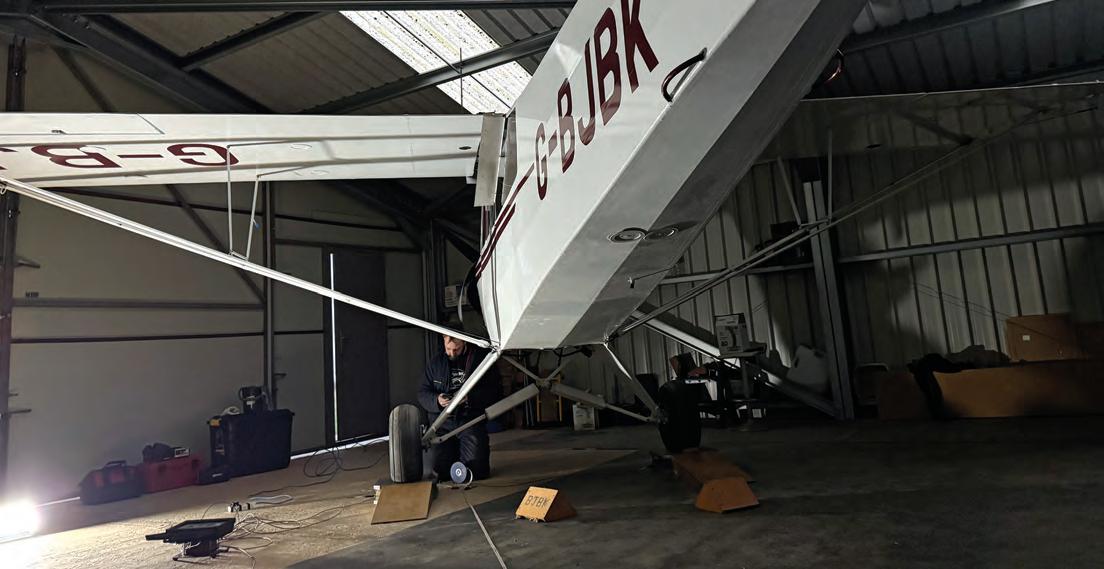
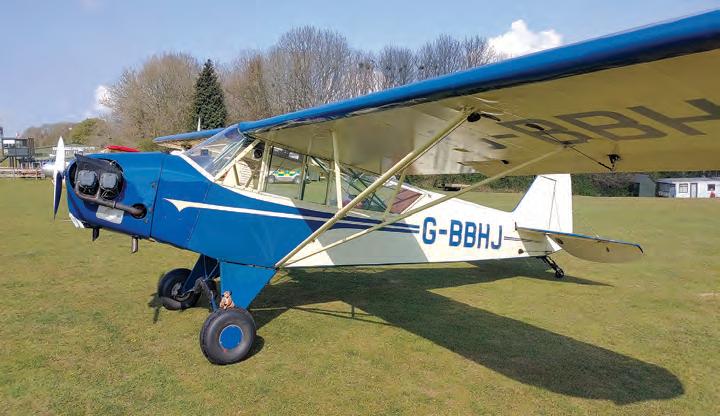
A dark, chilly hangar, but making progress as the Cub steps on the scales…
Weight loss…
Both times I’ve been involved in building an aeroplane, I’ve heeded the advice of homebuilders who have been down the path before me, who have all said the key to making progress is having a comfortable environment in which to work all year round. Of course, that’s been in garages attached to homes, a few steps from the back door, and not a hangar on an airfield needing a car trip to reach.
The hangars I’ve known in my flying life have always been less than inviting spaces in which to make progress during winter, but the last few months has seen this definitely impact progress during the final stages of the Super Cub project.
You might have previously read here how the wings had been successfully reattached to the fuselage, and that had felt like a big push down the last bit of the path to completion. Then the weather stated getting cold, and damp, and the days started getting shorter too… Now, dark I can deal with, though my hangar has no power, so working on past early afternoon in December meant turning on battery lights. But that pervasive British damp cold has just been pretty demotivating at times. Heated clothing can only do so much to keep you going (if you haven’t tried it, I highly recommend it).
Luckily my Inspector, Toby, has been an amazing help, and his encouragement to have a couple of big work days in the hangar have really moved things along.
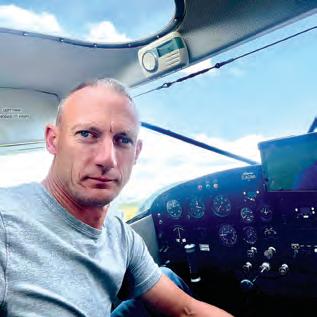
Perhaps the most exciting job of late was to get the Cub on the scales. Looking back through the aeroplane paperwork, a weight schedule from the 1990s suggested the
aeroplane was 1,053lb. Reading that when I acquired the aeroplane a year ago, it was decreed too lardy and the aeroplane was definitely going on a diet. Well, the new result after weight reduction work is 966lb. I definitely know that I’ve taken 65lb out of it, as I’ve been weighing items taken out, and doing the same for items going back in.
I know some owners might roll their eyes at suggestions an aeroplane should be reweighed after 10 years, but if the aeroplane is new to you, and has some history of changes here and there, then in my mind, it makes sense.
As it turned out, the aeroplane is now lighter than its post-1988 rebuild weight, which was 987lb, but still heavier than a time in its life in France with no electrical system, when, in 1969 it tipped the scales at 877lb.
If I sound like a weight nerd… yes, I have a spreadsheet and I’m guilty as charged :)
ed.hicks@laa.uk.com
FEATURES
12 PROJECT NEWS
Steve Jones’ De Havilland DH71 Tiger Moth Racer recreation, Adam Wankowski’s Staaken Z-21 Flitzer project, plus Cleared to Fly.
18 SPECIAL FEATURE
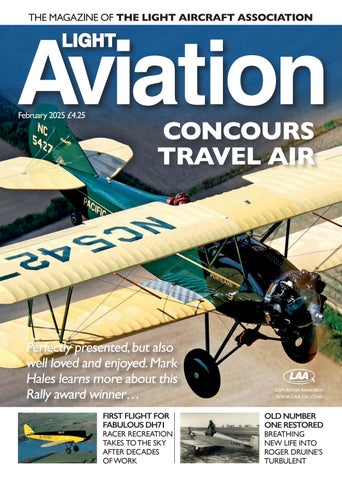
Perfectly presented, but also well lived and enjoyed. Mark Hales learns more about Tom Leaver’s Travel Air 4000, winner of the Concours d’Elegance award at last year’s LAA Rally.
26 SPECIAL FEATURE
Richard Vary discovered Roger Druine’s very own Turb in need of TLC in Devon.
34 COACHING CORNER
Taking friends flying can be fun, but as Christine Carlin, PCS Head of Training suggests, it’s your job to make sure they are properly briefed…
36 ENGINEERING MATTERS
Responsibilities of being a Permit aircraft owner, Cessna 120 corrosion, cracked NSI propeller blade, and a contaminated new stock coolant hose…
45 MEET THE MEMBERS
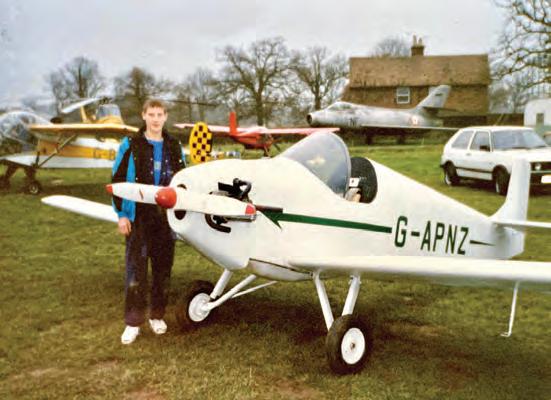
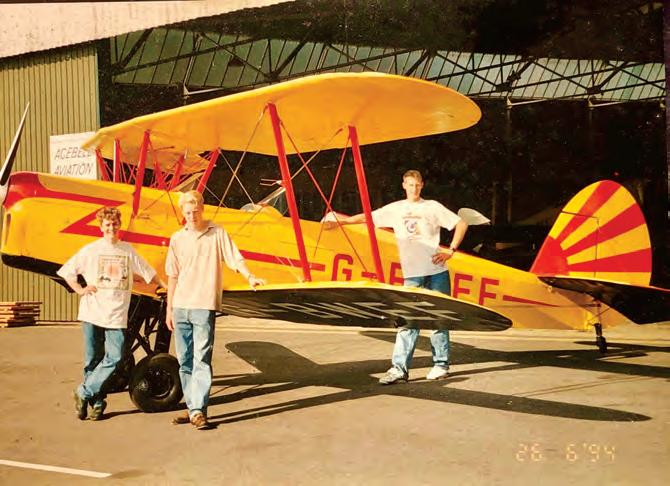
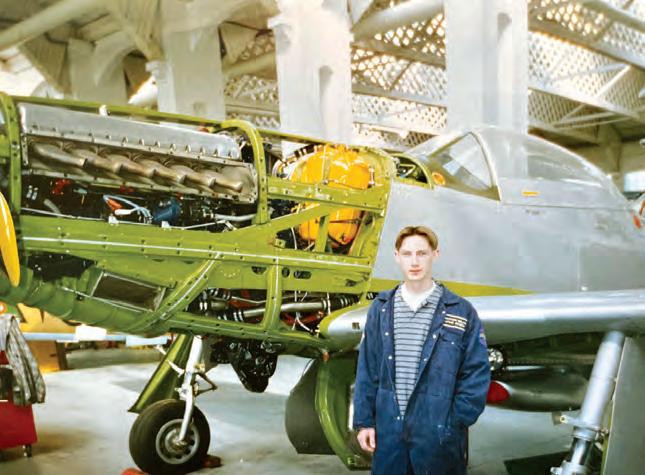
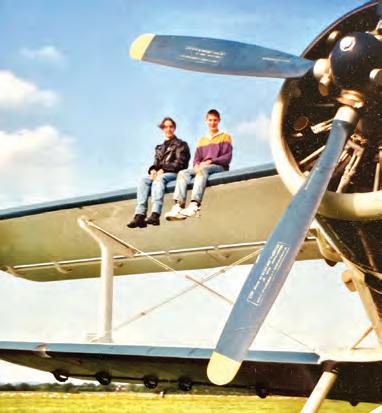
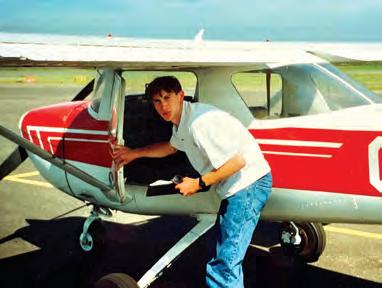
Jonathan Wilkins talks about his teenage days as a hangar rat – to his first display with the Turbulent Team at Cosford…
50 PHOTO COMPETITION
More superb photographs from LAA members as the Photo Competition returns for 2025.
SAVE THE DATE!
LAA HQ open day: 21 June
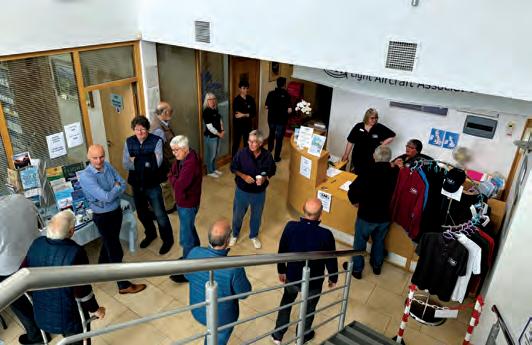
On Saturday 21 June, the LAA will be hosting an HQ open day at Turweston. Come along and meet LAA CEO Simon Tilling, plus members of the Engineering and administration team. Free refreshments will be on hand throughout the day, plus a catering van will be available for food purchases.
LAA Courses for February and March 2025
● Rotax Fuel Injected 912/915iS – 8 February 2025
● Caring for your Gipsy Major – 15 February 2025
● Flight Radio Telephony Operator Licence Preparation – 1 March 2025
● Permit Aircraft Electrics Basic course – 16 March 2025
● Permit Aircraft Electrics Advanced course – 16 March 2025
● Working with Aluminium – 16 March 2025
● Aircraft Carpentry – Tues 18 March 2025 - £206/226
● Avionics for Permit Aircraft – 22 March 2025
● ROCC – 29 & 30 March 2025. £206/226
Pricing: Electrics Basic, Electrics Advanced, Avionics, Rotax Fuel Injected are all £216 for members, or £236 for non-members.
Please contact us for pricing information for the Aluminium course, as changes in course project materials directly impact the course cost.
All the rest are £206 for members/£226 for non-members.
To book, visit the ‘Courses’ section of the LAA website for the latest information www.lightaircraftassociation.co.uk/courses/‘
The General Aviation Awareness Council, long known for its unique planning and property expertise protecting General Aviation Aerodromes, has appointed Simon Tilling, CEO of the Light Aircraft Association, as a new Vice Chairman by the Board.
Simon will work alongside Chairman Matt Wilkins representing the GAAC at regular meetings and advocacy with Government and the CAA.
The Board has also resolved to create a new position: Head of Planning. This is arguably the most vital role, and sees the appointment of Ann Bartaby to the new position. Ann, a town planner, has held a number of positions within aviation, including TAG Farnborough, London Luton, BAE Filton and master planning for Bournemouth Airport.
Dawn to Dusk 2025 entries open
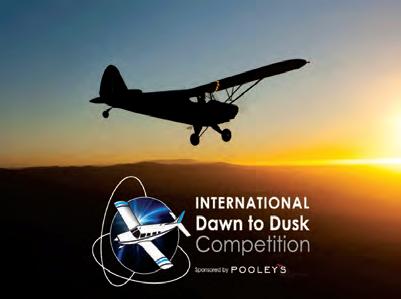
Pooleys Dawn to Dusk competition, now in its 61st year, provides a unique aeronautical challenge participating in a day’s flying using an aircraft of the competitor’s choice. The competition is an opportunity to further your flying, to expand your horizons and to give you the excuse you need to have the flying adventure that you have always wanted to have.
The objective of Dawn to Dusk is to encourage the most interesting employment of a Flying Machine within the limits of competent airmanship and to demonstrate the capabilities of pilot and machine in the hours between
Dawn and Dusk, whilst undertaking an original and praiseworthy objective.
Entries are now open for 2025, and can be flown at any time of the year, with the
cut-off date for submission of pilot’s logs falling on the last day of September. Entries received after this date will be entered into the following year’s competition.
There is a cash prize for 1st Place of £1,000, and all entrants are invited to a Presentation of Awards Reception and Dinner at the RAF Club in Central London. This is expected to take place in February 2026.
Click on the How to Enter tab on www.pooleys.com/dawn-to-dusk, or email enquiries@ pooleysdawntodusk.com for more information.
YES Events coming up in March 2025
Taking place on 22 and 23 March, YES (Youth, Education and Support) will be holding their 17th Youth Aviation Summit and an Airfield Day for young people at the Discovery Centre at Old Warden Aerodrome.
The Youth Aviation Summit will include a fast paced agenda informing young people on a wide range of aviation related activities and career opportunities.
Running from 10am till 4pm, delegate
places are limited, entry and lunch is free. The Airfield day for young people is targeted at those aged six to 18, and will include fantastic ‘hands on’ opportunities from 10am to 2pm for young people to get involved with aviation.
Places are limited, so book your place for these events at www.yesflyers.org.uk
Entrance to the event includes an entry pass to the Shuttleworth Collection and Swiss Garden valid for 30 days, and membership of YES which is free.
Please note that there is a £10 admin fee for each event.
2025 Armstrong-Isaacs applications extended
The application window for the 2025 LAA Armstrong-Isaacs bursary scheme has been extended – candidates have until 28 February 2025 to submit their applications.
Seven bursaries of £1,500 are
available to support young pilots already in PPL training, offering additional funding to help them complete their courses, at a time when, all too often, money starts to run out.
New LAA Coaching Scheme Initiatives
During these winter months Christine Carlin, the LAA’s Head of Training, and National coach, Alex Harris, have been busy working on some new and exciting developments and changes to the Pilot Coaching Scheme and the courses offered by the Association.
Some new courses are in the works that will be available to our members, including a re-establishment of pilot currency and an
The funds will be lodged with the flying school of their choice and must be used exclusively for flying training or flight examinations. To qualify for a bursary a pilot should be under 30 years of age, have completed a minimum of five hours solo training and have gained the necessary medical and ground qualifications to continue their training.
Applicants must complete a form which can be downloaded from the LAA website at https://www. lightaircraftassociation.co.uk/ armstrong-isaacs-bursary-2025.
RT and airspace awareness course. All courses that are already on offer will still be available but with some changes, and new resources will include powerpoint presentations and video guides outlining all important aspects of the training undertaken, as well as notes for both members and coaches to help keep the training we offer, standardised.
We hope to have these changes to the Coaching Scheme live by April 30, and will publish details in the coming months.
LAA Membership Card changes
To do our bit for the environment and to help save costs, including postage, we will no longer be sending out membership cards.
All your membership details (and more!) can be found in your Member Area when you log in (top left-hand side).
From the Home page of the LAA website, click on Log in/Register and enter your Username/Password. If you haven’t got an account, then please Register.
British Empire Medal for Mike
Mike Clews, founder and mainstay of the Joystick Club, has been awarded the British Empire Medal in the New Years Honours List. Mike founded The Joystick Club in 2012, with an aim to bring aviation to a wider range of people, young and old. His award is to recognise services to the promotion of Aviation to Young People.
This is richly deserved for Mike as he puts a tremendous amount of time and effort into this organisation.
David Scott
Letters
We are always pleased to receive your letters, photos of your flying, and your feedback. Please email the editor at ed.hicks@laa.uk.com
That ‘flying feeling’ – editorial
Hi Ed,
I just wanted to say how much I enjoyed your editorial this month. It struck a particular chord with me. When I look at what I particularly enjoyed about flying, it was the feeling when you are up there –‘feet off the ground’ – that there is actually nothing else going through one’s mind, with no distractions.
Back in 2021, I was treated for cancer, with all day chemo sessions at three week intervals for eight sessions. A day or two after several of those sessions, I would take to the air from Wadswick and never felt better. The flying proved thoroughly therapeutic.
Kind regards, John Holden.
LAA Inspector admin/insurance fee
Dear Ed,
I can. I am therefore grateful when anyone puts time and effort to share.
I do wonder though if anyone at LAA studies the takes of experiences to see whether edits or addendums might be appropriate to help firm up the messages that the writer is sharing?As a for instance, Stewart closes with his actions should 100+ppm of CO be detected. He does not include what I would see as a vital action, to open vents in the cockpit to improve airflow.
I think there might be benefit if an objective reader analyses the letters and lessons learned with an eye to ‘are there any messages or tips that could be appended or included to increase safety’.
Just a thought.
Happy New Year!
I note the recent news from the LAA about the discontinuation of charging Inspectors an annual admin/insurance fee. So I write to say ‘good job’ to the present management and the Engineering team for bringing that change about.
When I started as Chief Inspector in 1991, although they were indeed covered by the PFA insurance scheme, there was no fee passed on to Inspectors.
Aside from skills and quality, it was vital that the inspectorate maintained the capacity to deliver an inspection service sufficient to care for the PFA’s expanding fleet of, then, about 1,500 aircraft – and as many again in build. The idea to charge Inspectors a fee was first mooted by superiors in 1993, and it greatly concerned me at the time that on matters of ‘principle’ this was likely to lead to the loss of too many Inspectors. I even bothered to trek from Shoreham to Luton to argue the case with then Chairman (and ‘Head of Everything’) Peter Underhill. I lost that battle, and a £15 fee was introduced soon thereafter. Well, that’s not a lot by any measure, and to be fair, we didn’t lose as many ‘principled and outraged’ Inspectors as I had feared – about a dozen I recall. I suppose if all I had had to focus on was matters of finance, then I may have been more onside.
Since then, naturally the fee has risen pound by pound, topping out at £40 in recent times. Given that personal insurance for such
activity as an individual is unavailable at any affordable level, the LAA scheme provides great value, and remains an essential element of any viable system in this day and age. This is against a background of increasing demand and expectation placed on Inspectors, with past aviation events serving only to ratchet up (never down) the intensity of applicable requirements and procedures, and that is not to mention an LAA project and fleet size now at least twice the number it was back in the early 1990s.
Inevitably, there have been several incidents over the years, with varying outcomes, where Inspectors have had reason to be very glad about the LAA’s Inspectorinsurance arrangements. The important ‘learning point’ arising, and which I preached to Inspectors ad nauseam, is that you don’t have to have done anything wrong to find yourself on the rough end of an expensive claim. Onward and upward!
Ken Craigie (Ret’d of Dorset).
A cautionary CO detector tale Hi Ed,
I was interested to read Kevin Stewart’s letter. I have had similar issues with significant (40-65ppm) readings in my Jodel 117A. Unfortunately she’s been out of the air for nearly 18 months, but one of my jobs when she gets back into the air is to regain confidence in the lack of CO in the cockpit. I have discovered a crack in the silencer during maintenance while she was grounded and that may be a contributory factor. We shall see.
I always read with interest the experiences of others in the magazine and anywhere else
Andy Stocks.
Design competition
Hi Ed,
I saw Mike Robert’s letter regarding a design competition and Simon’s response in the last magazine. I have to agree with Simon, there are far more important things for Engineering to be doing than getting involved with this, I know several people who have had long delays getting their completed aircraft cleared to fly and a full permit, these must be a priority, as well as improving the mods situation.
There have been no worthwhile aircraft coming out of design competitions in the past 40 years that I’ve been a member, yet in the same time there have been many popular new designs, as well as several members who have designed, built and flown their own personal designs without the need for a competition.
The RAeS seems the ideal body to hold such a theoretical competition, then once all the winning design is sorted out and all the data required for approval is produced and funding available to build it, then apply to LAA for approval.
Cheers, Nigel Hitchman.
Ed Hicks replies. Thanks Nigel - fair point. I don’t think we’d want to see it use any Engineering time - it’s more of an exercise to create a little excitement around the potential design of new LAA types.
I would love to see a modern affordable idea for a plans built aircraft that leveraged modern day manufacturing techniques.
Above Reader, John Holden, could relate to Ed Hicks’ experiences of flying…
Straight and Level Updates from LAA HQ
Straight, from Simon Simon Tilling CEO
As we start 2025 it would be worth a quick update on some of the advocacy organisations in which the LAA are actively involved. The General Aviation Alliance (GAA) and The General Aviation Awareness Council (GAAC) both have new leaders: Mike Pearson is the new Facilitator for the GAA. Mike is the manager at Popham Airfield and has a long history of working with government on behalf of GA. Matt Wilkins is the recently appointed Leader of the GAAC. Matt is the manager at Old Buckenham Airfield and is also chairman of BADA (British Air Display Association).
The two organisations, while having similar titles, have a distinct focus:
General Aviation Alliance (GAA) in the UK is an association
Chairman’s chat Eryl Smith
Iof organisations representing the interests of the General Aviation (GA) community. Its members include, LAA, BGA, BMAA, BHPA, PPL/IR. The GAA works to address issues such as access to airspace and regulation. The alliance actively engages with government, the UK Civil Aviation Authority (CAA) and the Department for Transport (DfT) on matters relating to airspace, both specific Airspace Change Proposals (ACPs) and strategic plans, such as the Airspace Modernisation Programme (AMP) to advocate for protection of freedoms for GA.
General Aviation Awareness Council (GAAC). The GAAC campaigns to preserve the UK’s network of smaller airfields, which serve as critical hubs for training, recreation, and emergency services. It works closely with local authorities and planning bodies to protect these airfields from encroaching urban development.
As the new leaders get up to speed, I will keep you updated on their focus, plans and, most importantly, results. ■
recently spent an evening in discussion with the President and fellow members of another national membership organisation to which I, and, I am sure, a number of LAA members also belong. It provides a community-based organisation for likeminded individuals with a strong emphasis on social activity, volunteering and fundraising. It will shortly be celebrating its centenary. While its purpose does not exist to provide technical services for the benefit of its membership, its activities are dependent upon volunteers delivering events and fund-raising for the benefit of the community.
Like the LAA, it faces the challenges of an aging membership demographic, wrestles with where, and how, to attract new members, and how to engage volunteers to deliver events. While the provision of technical services and support to members is at the heart of what we do at LAA, there is much common ground within the respective memberships. Fellowship is a common cause, with both Associations having long histories of grass roots social activity. In the case of LAA, Struts and Type Clubs members have been brought together to share knowledge, provide support, and host social events at a local level and through fly-ins, not least the annual Rally, provide incentive to fly and meet.
There were no easy answers to the conundrum, but a recognition that encouraging interest and activity was, in part, dependent upon the activity of local clubs and individuals.
Sustaining our membership and supporting activity at grass roots has long been an important element of LAA. In recent years we have seen a number of Struts become dormant, in part, as established members and leaders step back having served their time. Maybe the interest in grass roots activities has waned. Are there too many demands on personal time? Is our focus more on flying than social activities?
I believe that without vibrant grass roots activity as an Association we will be the poorer; we will find it harder to organise and deliver events at local, regional and national levels and lose the opportunity to introduce more people to flying and the joy of building, owning and maintaining an aircraft. I am conscious that there is more that we need to do at all levels from the Board down to make a difference, and this must be a priority for 2025.
Together with the Board I will be seeking to re-engage with the Strut and Type Club leaders in particular, and the membership in general, to explore what more we can do to rekindle enthusiasm and activity at the grass roots. If you have views and thoughts, please share them.
It’s early in the year, but I am pleased to report that we have agreed the arrangements for the 2025 LAA Rally, which will return to Leicester on 29-31 August. Both we and Leicester Aero Club are excited to build on the success of last year’s event. A date for your diaries and I look forward to welcoming you there. ■
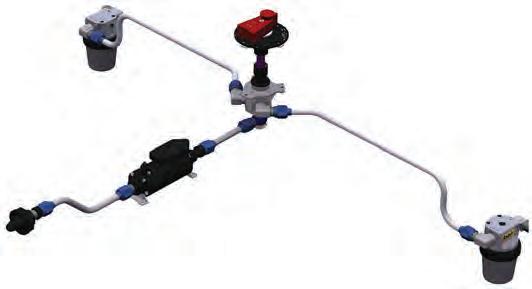
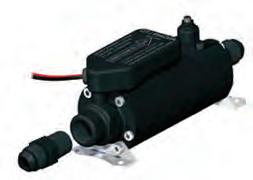
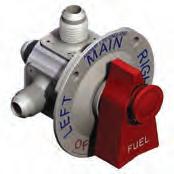
ANDAIR FUEL SYSTEM COMPONENTS COMBINE MODULAR DESIGN, SUPERB QUALITY AND THE FLEXIBILITY TO SUIT ANY AIRCRAFT BUILD PROJECT.
Having built a reputation for excellence in the design and manufacture of light aircraft fuel system components within the amateur-build aircraft sector, Andair has now established a significant presence in the commercial aviation market as well.
Inspiring members to take on their own aircraft build or restoration project
Compiled by Mike Slaughter
Project News
Brrrr! It's been a bit chilly hasn’t it, but then what do we expect for January? Fortunately, it hasn’t stopped fellow members putting virtual pen to virtual paper and reporting on their projects.
A big thank you to former LAA Chief Engineer Francis Donaldson, for his report on the first flight of Steve Jones’ fabulous DH71 Tiger Moth Racer. What an absoultely stunning machine!
Adam Wankowski brings us up to date on his long-term Flitzer project. The type is a lovely looking single-seat wooden bi-plane aircraft, it is a modern design on a 1920s theme. I sometimes think that wooden aircraft look their best just before they are covered – but there’s no reason to leave them like that, is there? Shame!
Looking at Adam’s workshop in his pictures, and feeling a bit of
workshop envy, I’m struck by its reasonable dimensions, and then the fact that the Flitzer wing sits neatly in the middle of the work area on a couple of trestles without being cramped or taking up a huge amount of space. I suppose at around eight feet long, for a lower wing, such a project would be comfortable in even a single garage.
The panel at the end of Project News always reflects what was happening two months ago, maybe it was the run up to Christmas or something else, but there were no New Projects registered in December and indeed only one aircraft was Cleared to Fly. We’d best get our collective building fingers out!
To get in touch with Project News, and tell your story, report a milestone or just to send a picture, email: projectnews@laa.uk.com. Please share your story!
Replica De Havilland DH71 Tiger Moth Racer
Report from Francis Donaldson
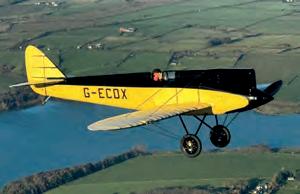
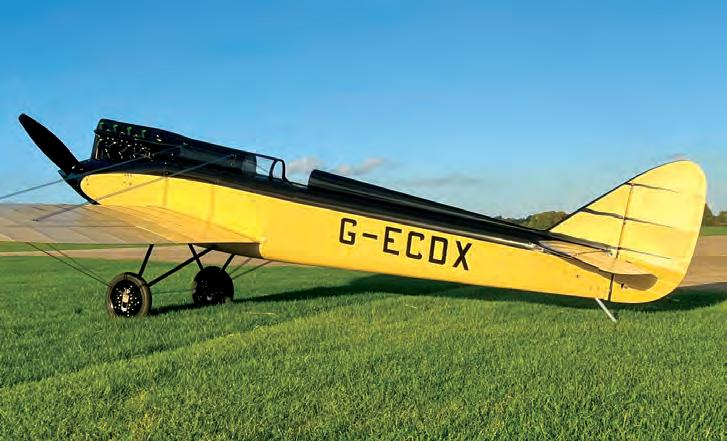
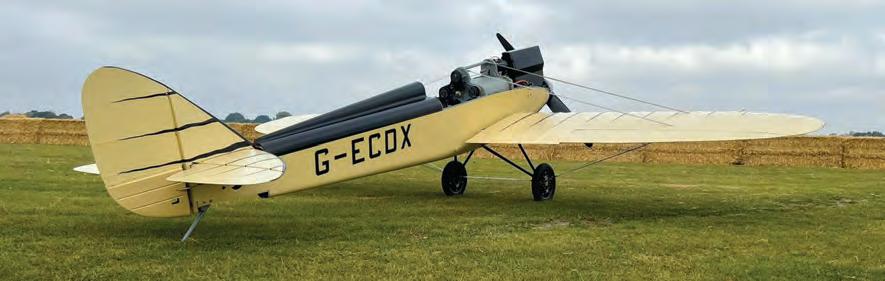
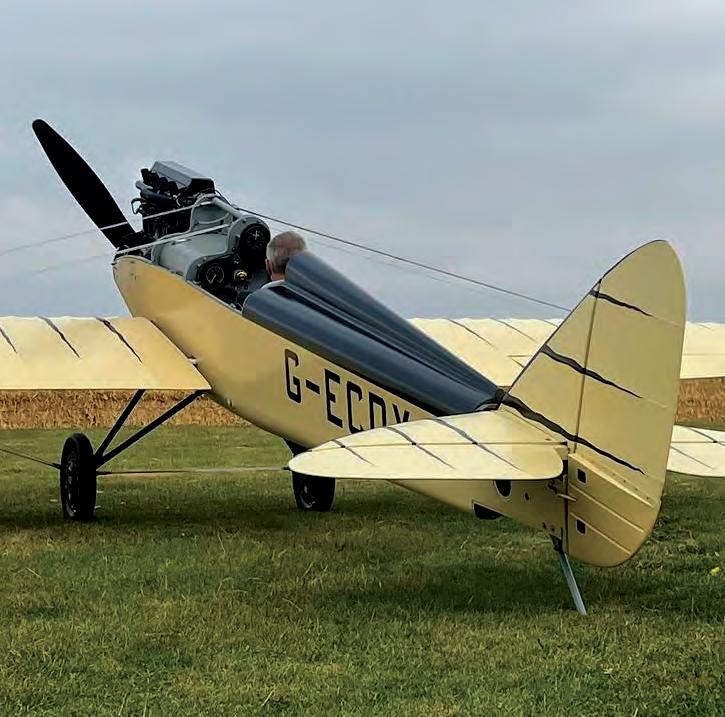
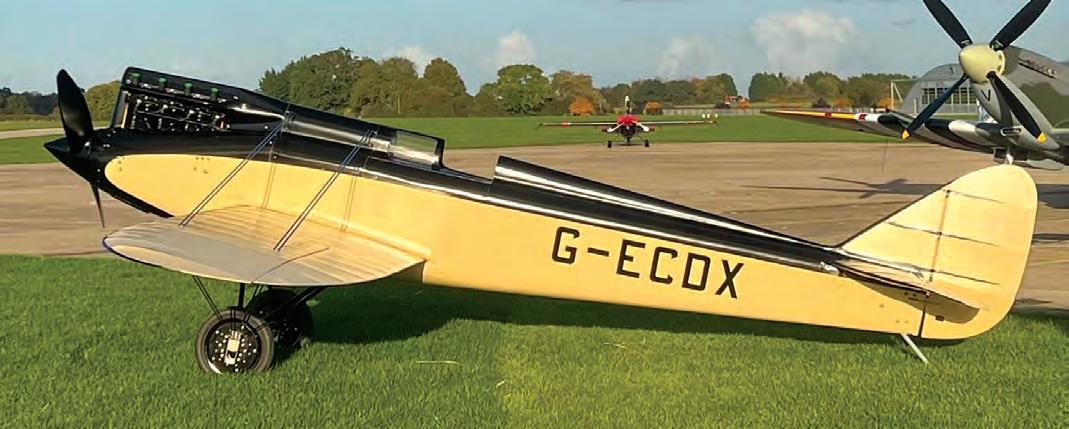
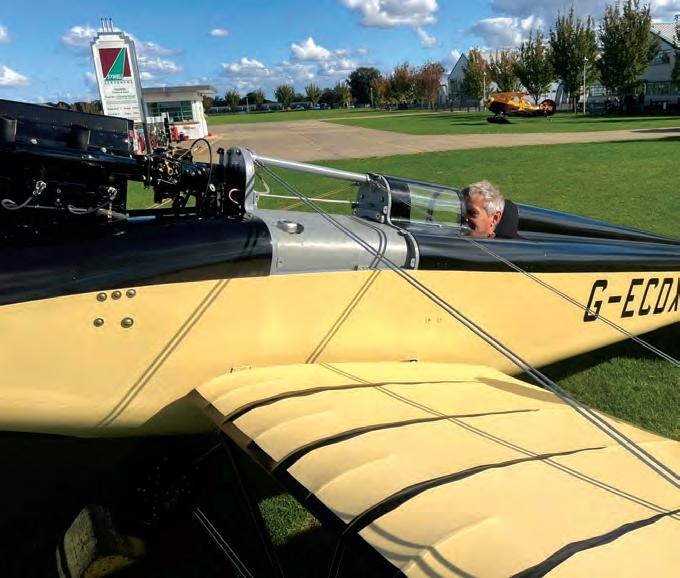
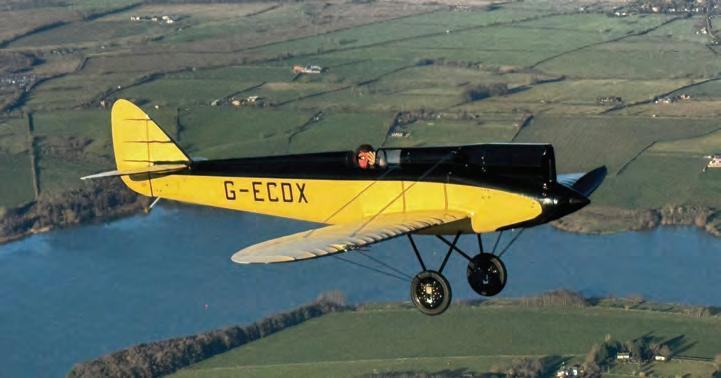
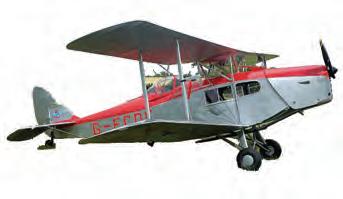
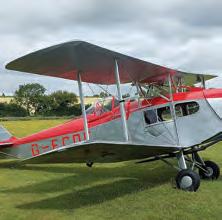
Above G-ECDX is a full-size recreation of the original de Haviland DH71 Tiger Moth Racer
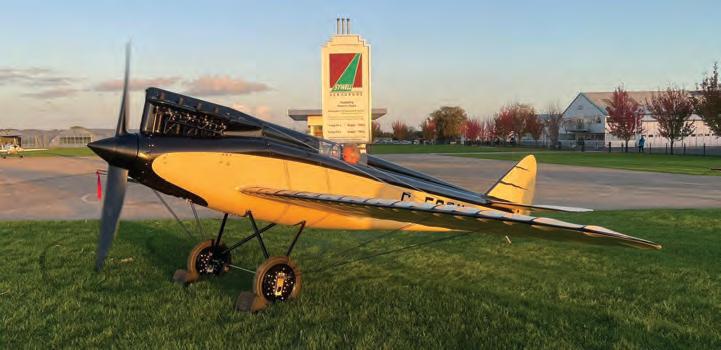
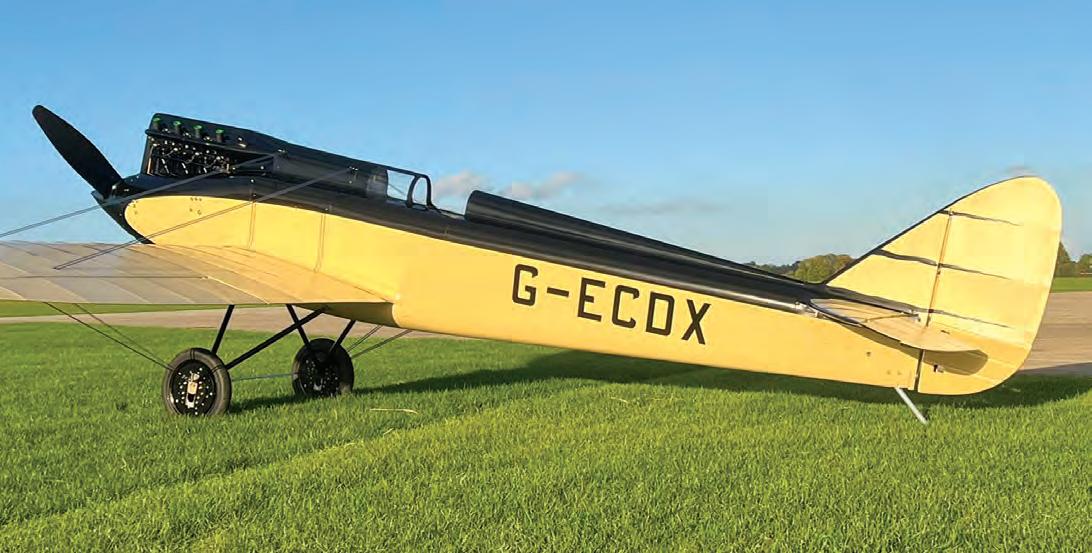
Steve Jones’ replica DH71 Tiger Moth Racer made a highly successful maiden flight on 26 November, piloted by Steve himself. The immaculate monoplane, appropriately registered G-ECDX, is a full-size recreation of one of only two examples built by de Havilland in 1927. Of all wood construction, and fitted with a modified DH Gipsy 1 engine, the original DH71s were created to publicise de Havilland’s new Gipsy engine before releasing it onto the market to power its already successful DH60 Moth biplane. An exercise in light weight and streamlining to
maximise speed, the DH71 was also significant in developing construction techniques that de Havilland used to good effect in later designs, including the Comet Racer and Dragonfly. The original DH71 achieved 186mph around a 65-mile closed circuit course, its Gipsy 1 engine souped-up from 85hp to 130hp for racing.
With encouragement from fellow enthusiasts Nick Parkhouse, Laurie Mayhead and Richard Riding, the replica project was largely built by Ron Souch in the 1990s, under PFA supervision. The aircraft was built using drawings produced by Ron’s friend, Ben Price, a former
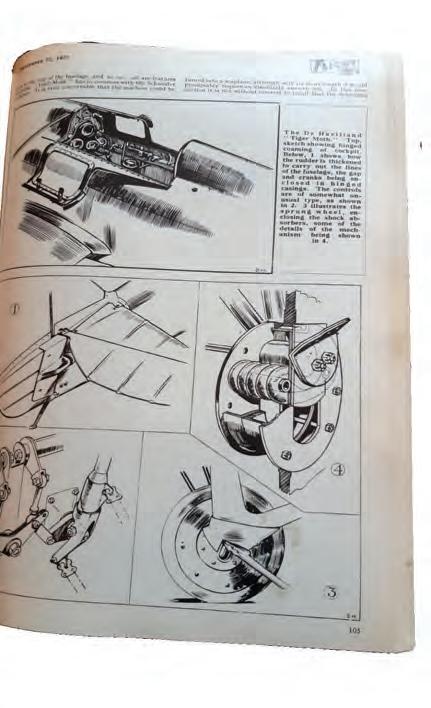
aircraft draughtsman who volunteered to take on this not inconsiderable task as his retirement project. None of the original construction drawings had survived, so the design had to be recreated based on a three-view, photographs, press articles and intimate knowledge of de Havilland’s standard design techniques – and then checked against modern design code requirements. The most challenging part of the design were the details of the internally bungee-sprung wheels, as on the original.
The project was paused for several years after issues came to light with the stressing of the wing spars and undercarriage. Steve Jones, looking for a hangar-mate for his scratch-built Comper Swift project, purchased the DH71 in 2016. Steve quickly got things moving again by commissioning redesigns of some of the original
Top left Steve carries out an early engine test run with the cowlings removed, and shows us what the pilot’s view is like while taxying!
Top right The DH71 cockpit is tight – very tight – all in search of maximum speed.
Above With the engine cowling partially fairing in the upright Gipsy engine, the tank cover in place, and thin, wire-braced wings, the DH71 really shows off its streamlined form.
Left Contemporary articles in the aviation press were crucial in recreating unorthodox features of the design such as the internally bungee-sprung wheels.
components, stripping off the fabric covering, re-sparring the wings and finishing the aircraft off to the same high standard as its original construction. The final examination of the assembled aircraft by LAA HQ’s design staff in November, when ground runs of the modified engine and its very coarse pitch Hercules propeller were demonstrated, took place over three decades after the project’s inception.
When Steve’s replica DH71 first lifted off from Sywell’s grass runway, it was a sight not seen in Britain for 95
Top The DH71 in flight – a sight not seen in British skies since the 1920s (another replica flies in the USA).
Above The pilot has to keep in mind how close the DH71’s prop tips are to the ground.
Below Three decades after work began, the replica is immaculate in every detail.
years. Big congratulations to all involved, especially for Ron and Ben for initiating it, and Steve’s perseverance and skill in finishing all the last details to such a high standard. Honourable mentions also to John Tempest for the re-design work and Ben Cox for inspecting it, this was truly a team effort. Sadly, Ron Souch is no longer with us to see the Racer fly.
Steve describes his aircraft experience as starting as an aircraft engineering apprentice at CSE Kidlington, in the late 1970s. He towed gliders at Husbands Bosworth, in Chipmunks, aged 19, and joined the Tiger Club in the late 1970s, becoming a flying instructor at Staverton 1981. As he describes it, he somehow ended up flying BA 747s for 20-plus years. His remarkable flying career has involved air racing, aerobatic competition and display flying, Red Bull competitions, and record setting in the Rolls-Royce electric-powered Spirit of Innovation aircraft.
How does it fly ?
By the end of 2024, Steve reported that he had flown four sorties totalling 2.5 hours, including a couple of 45 minute flights – and all despite the bracing winter temperatures. After making an adjustment to the tailplane incidence, he reported that the aeroplane was now in trim in all axes, at 110mph, which it sustains using just 1700rpm. ‘Max continuous is 1900 and red line is 2050rpm, so this is a low power cruise, using about 25 litres per hour, giving a safe endurance of over one hour plus reserves’. The aircraft’s speed envelope will be opened up progressively during the test programme but for safety’s sake the Vne has been set conservatively low at this stage.
Steve said, “Generally, it is a pleasant aircraft to fly, with light and powerful controls, albeit with limited stability. I imagine it is fairly typical of a 1927 aeroplane, apart from its flat glide and remarkable lack of drag. Take-off performance is sparkling, and landing performance is fine, following a flat approach ending in a near-level glide with the throttle closed, and a crosswind component of 5-7 knots is manageable.”
A remarkable performance?
It’s not really fair to compare de Havilland’s DH71 with its racing seaplane contemporary, the Supermarine S5, which achieved over 300mph but used 900hp and was an aircraft of similar size to the DH71 but had three-and-ahalf times the loaded weight.
For de Havilland to build an aircraft in 1927 that reached not far short of 200mph on 130hp was extremely impressive, for comparing the DH71 with racers of similar weight and power, its performance would not be out of place among a typical line-up of Formula One racers which were being built three or four decades later. This was a remarkable achievement indeed, particularly bearing in mind the short period of a few months in which it was created and the fact that it was very much a sideline to the company’s main business of building biplanes and developing their own engine.
G-ENIA (PFA 223-14447) Staaken Z-21 Flitzer
By Adam Wankowski
Insert (top right) Here is the colour scheme sent to Adam by Lynn Williams, for encouragement he has a
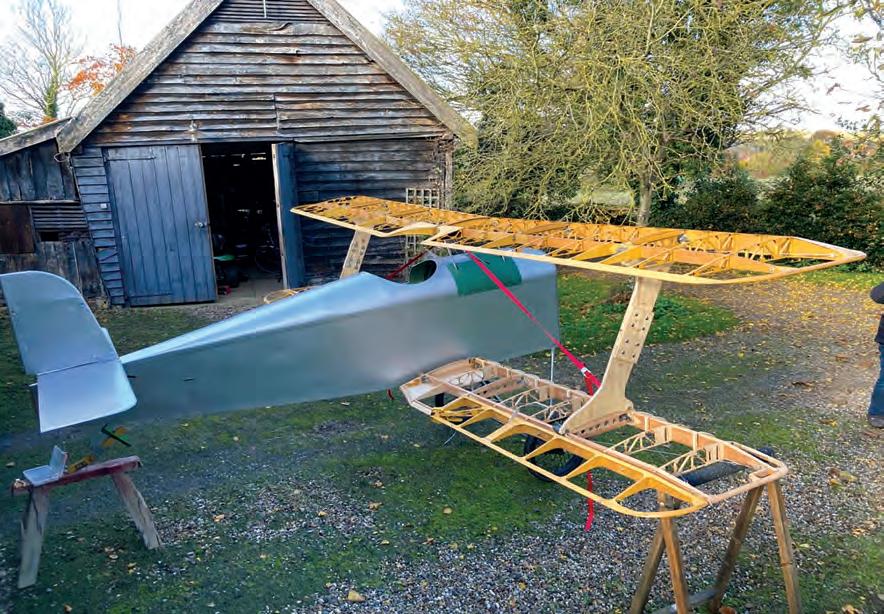
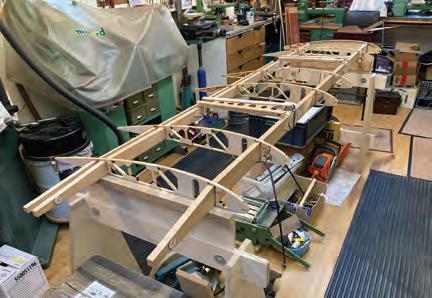
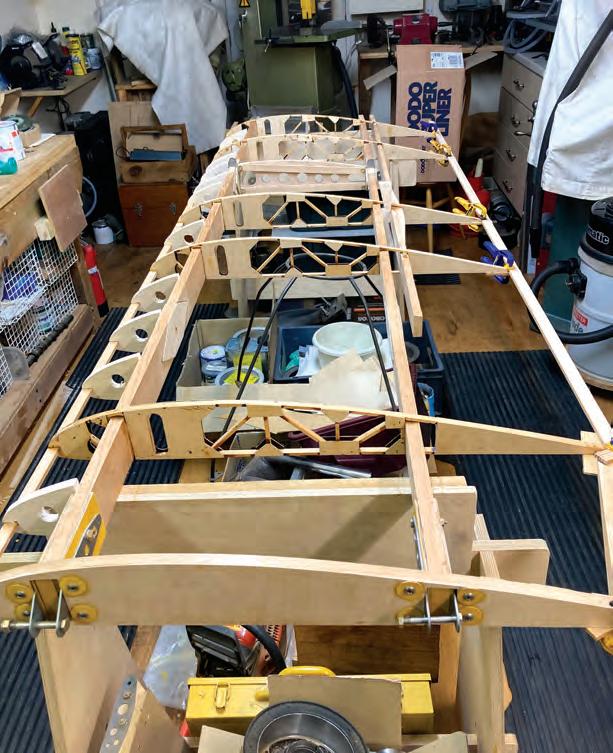
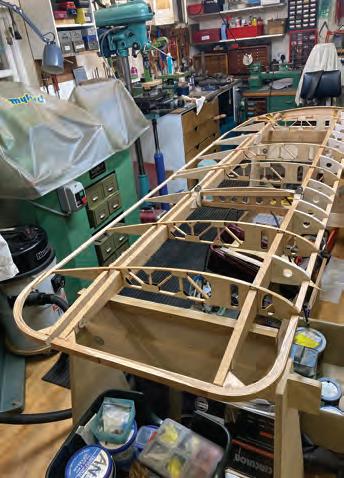
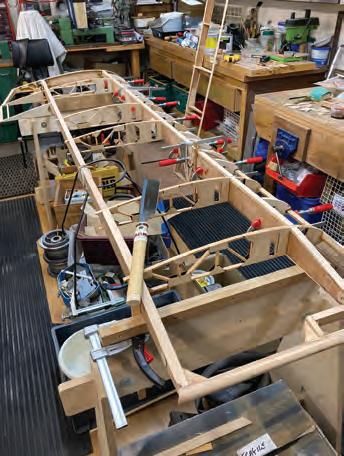
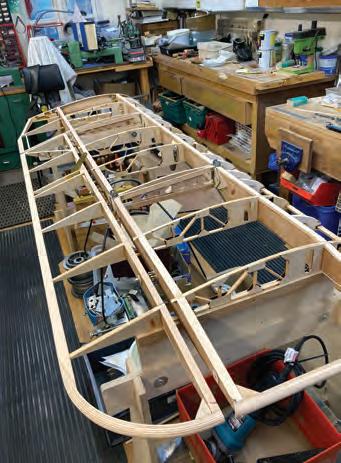
It’s been a very long time since I reported the progress on my Flitzer project. In that previous update, there was a picture of a pile of spruce with a small dog standing next to it. The dog is long gone, but the Flitzer lives on! The first of the accompanying pictures shows the lower wings nearly complete, and the airframe all together as a trial assembly. Once the wings are fully finished, I can move on to covering and painting, finishing the rest of the airframe in the nice colour scheme provided to me by the designer, Lynn Williams. You don’t receive that level of service with a kit!
The project commenced in 2005, the initial reason for the long build being, as usual, a more than full-time job. Since then, however, the build has sent me down all manner of unexpected pathways. Firstly I had to learn to fly. I did that in 2008, it took nearly two years of lessons
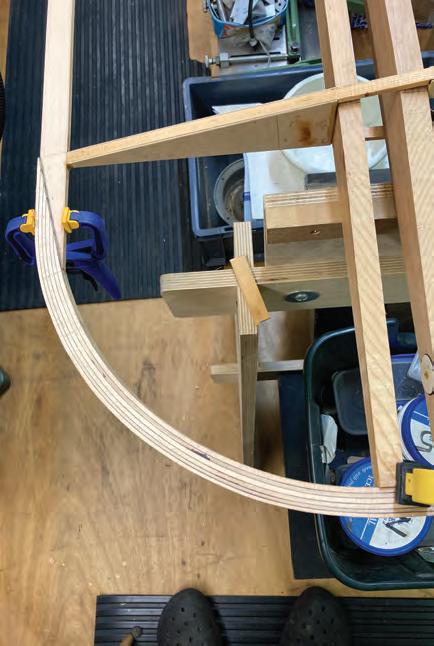
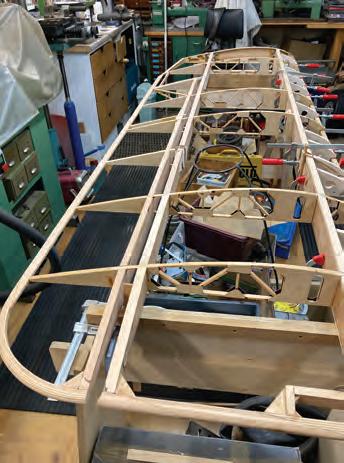
Above The wing with leading edge ribs attached, also leading and trailing edges fitted.
Above A wing at an early stage, the aileron is an integral part of the construction and built into the wing.
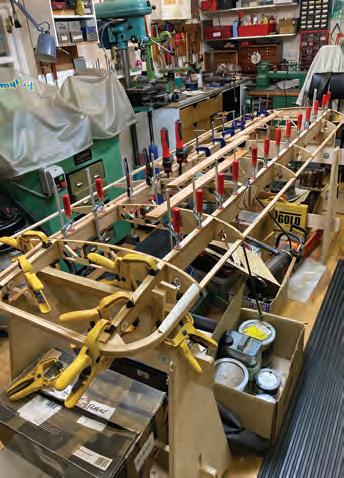
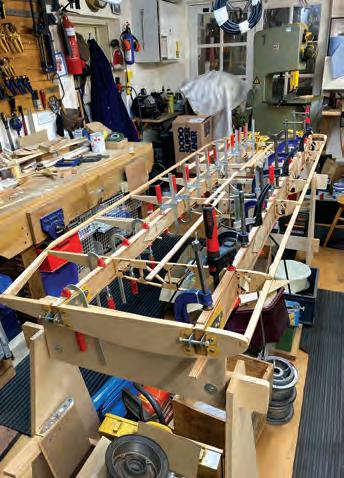
Right Landing wires in red, a recent trial assembly to ensure that Adam has built enough wings.
copy on the workshop wall.
Above The tip bow scarfed into the aileron trailing edge.
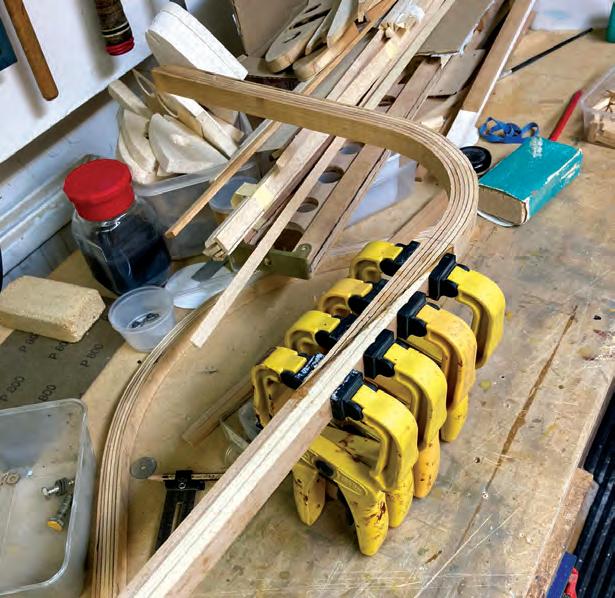
Left Laminating part of a tip bow.
and more than 70 hours of instruction – I’m an old dog.
Then I discovered the sheer fascination of flying, and with my wife as a keen flyer as well, we purchased an Auster – from a Flitzer builder in the USA. The next ‘diversion’ was meeting my current Inspector for the Flitzer when I took the cabane to him for welding. We found that we worked well together and since my retirement from ‘the day job’, I have effectively served a 10-year apprenticeship under his guidance working upon the repair, rebuilding and maintenance of light aircraft. This has led to my appointment as an LAA Inspector, certainly an unexpected honour, but does add to the time away from my workshop.
The next ‘diversion’ was that we discovered the joys of touring by light aircraft and since an initial foray to France in the Auster (why an Auster? Blame the Flitzer, see above) we have toured extensively in Europe, mostly in the Auster, more recently in our RV-9, which took us to the
Above left The wing with leading and trailing edge bows installed, also the strengthened Interplane and inboard aileron end ribs fitted.
Above centre Spar cap strips glued to the top side of the wing, they are oversized to be planned to profile.
Above right Spar caps glued to the underside of the wing.
Balkans this year. Why an RV? Blame the Flitzer again. I met up with a local Flitzer builder who has become a good friend and mentor and who is a keen exponent of all things ‘RV’, having built two and flown many.
The diversionary list could go on, but I now find myself with more than 1,000 hours of flying, virtually all tailwheel, and more than 200 ‘airfields visited’ in my logbook. Additionally, I am assisting with the rebuild of a Vagabond, which will be a good introduction to small, close coupled aircraft before flying the Flitzer. Oh! And I’ve also been learning to fly gliders… yes, another Flitzer-related ‘diversion’. All of these adventures are well beyond my wildest dreams of some 20 years ago.
I relate the above to try and encourage others to take the plunge and build an aircraft. If you are open to ideas, then fate will lead you in all manner of unexpected directions – the stuff of life!
There has been some tradition of making Flitzer
The aileron has been separated from the wing, note the super fine cutting Japanese tenon saw. There is still a leading edge ply D box to add.
registrations girls’ names (G ERTI, G ERDA); Genia is a Polish girls name (short for Evgenia, or Eugenia as we would hear it). I thought of G RETL – but it was too ‘German’ and also lacked the G-E… which was of course the usual start letters for registrations in the late 1920s, the Flitzer was designed as an evocation of a German sport biplane of the late 1920s.
Looking at Lynn’s artwork, the use of the Polish Eagle on an aircraft is not legal in Poland; as a dual national I might get into trouble – but the Eagle applied will be the ‘closed crown’ version which is the Eagle of the Polish Government in Exile (constituted in 1940 and only officially closed down in 1999). Almost any Pole will instantly recognise the closed crown and realise that it is a ‘legal Eagle’. We have the same Eagle on the tail of our Auster and its legality is always recognised when the Auster has visited Poland.
Come to think of it, I would probably not have received my Polish citizenship had it not been for the Flitzer (and hence the Auster) as we would almost certainly not have flown there on our travels.
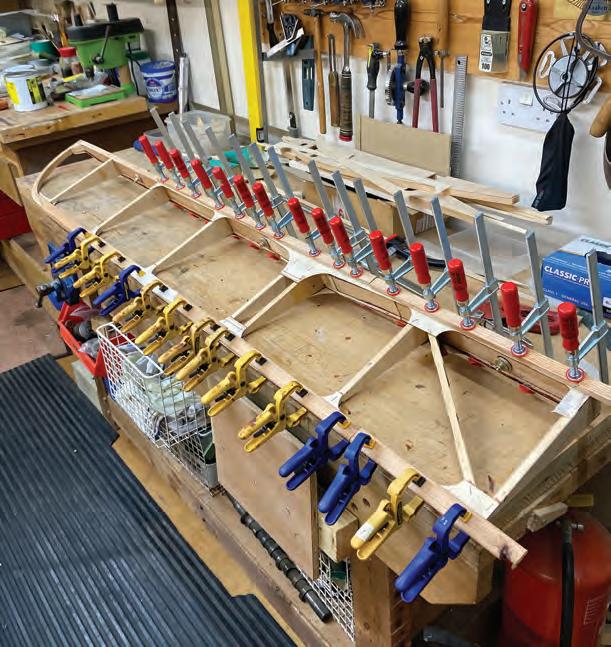
My construction pictures are of the building of a lower wing. The ailerons are built with the wing and then sawn out, one of the more nerve-wracking moments of the process! I use the wonderful Japanese ultra-thin bladed saws for all manner of tasks where precision cutting is required – they have no ‘set’ on the teeth and remove minimal material. Not shown in the pictures, however, are the making and fitting of the numerous metal brackets, more than 120, that are used in a set of Flitzer wings. n
If your aircraft has featured recently in the magazine and has subsequently completed its maiden flight, Project News would like to hear from you at: projectnews@laa.uk.com
n G-ECDF DH83C Fox Moth (s/n FM50) 5/12/2024
Name & Address held by LAA Engineering.
Above The wing with the aileron still integral, bow tip and cap strips now planned to profile and hand-hold added.
Above
Above The separated aileron now mounted and hinged on the wing.
Above The aileron being finished with gussets etc. A lot of clamps are needed to build a wooden aeroplane.
Right G-ECDF Fox Moth has been cleared to fly
The Travel Air 4000 that won the Concours d’Elegance award at the 2024 LAA Rally looks like a new restoration, despite being finished 35 years ago. As Mark Hales discovered, owner Tom Leaver just loves flying this big beautiful biplane…
Photography Peter R March
Tom’s Travel Air
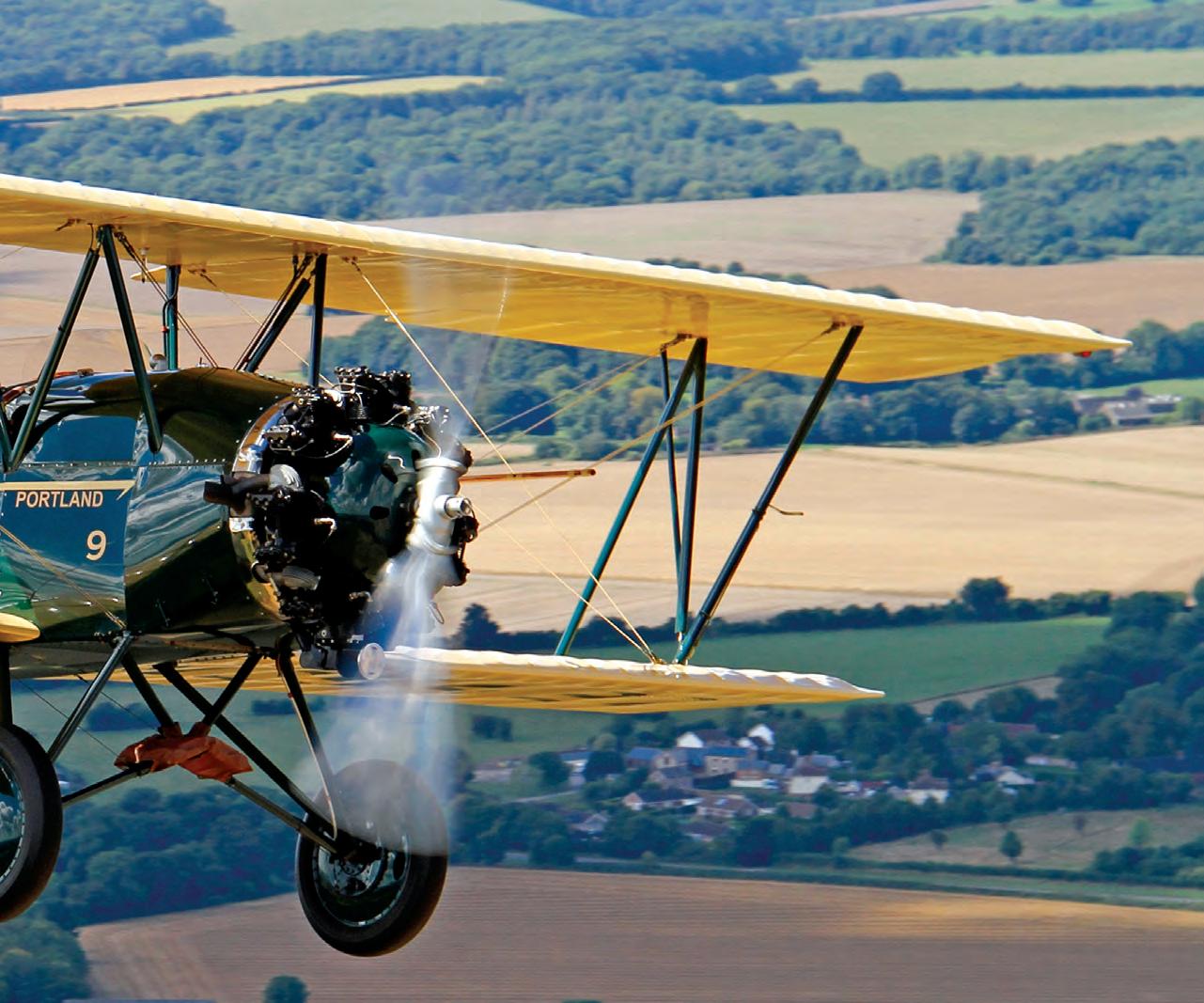
We’ll get to the glorious Travel Air 3/4000 you see in the pictures (made in Wichita in 1928, owned by "a legal alien, a naturalised Brit", his words…) Tom Leaver, in a moment, but before we do, it’s worth considering his reasons for owning it. He already owned a Morane MS 230 Parasol, which was the standard issue French military trainer of the 1930s – to France what the Stearman was to America, or the Tiger Moth was to Britain – and which most of us would see as a rare, not to mention, exclusive choice. There’s just the one on the UK register, and it’s with the LAA, or was, because Tom sold it
before buying the Travel Air. So why the change? “The Morane was a fabulous aeroplane,” says Tom, “but it was probably better suited to big grass fields... it didn’t have any brakes or tailwheel steering…” It would have been picky to mention that neither did a Travel Air when it came out of the factory, in fact nothing much did in the 1920s. It was WWII that gave us runways, and brakes, and steerable tailwheels. “I guess I just love all that period aviation experience…” says Tom. So that will have to do then, a simple explanation for a very complex emotion which is a choice of aeroplane which gives as much pleasure to others as it does to the owner, but which you can actually use in the modern era when the wind may not
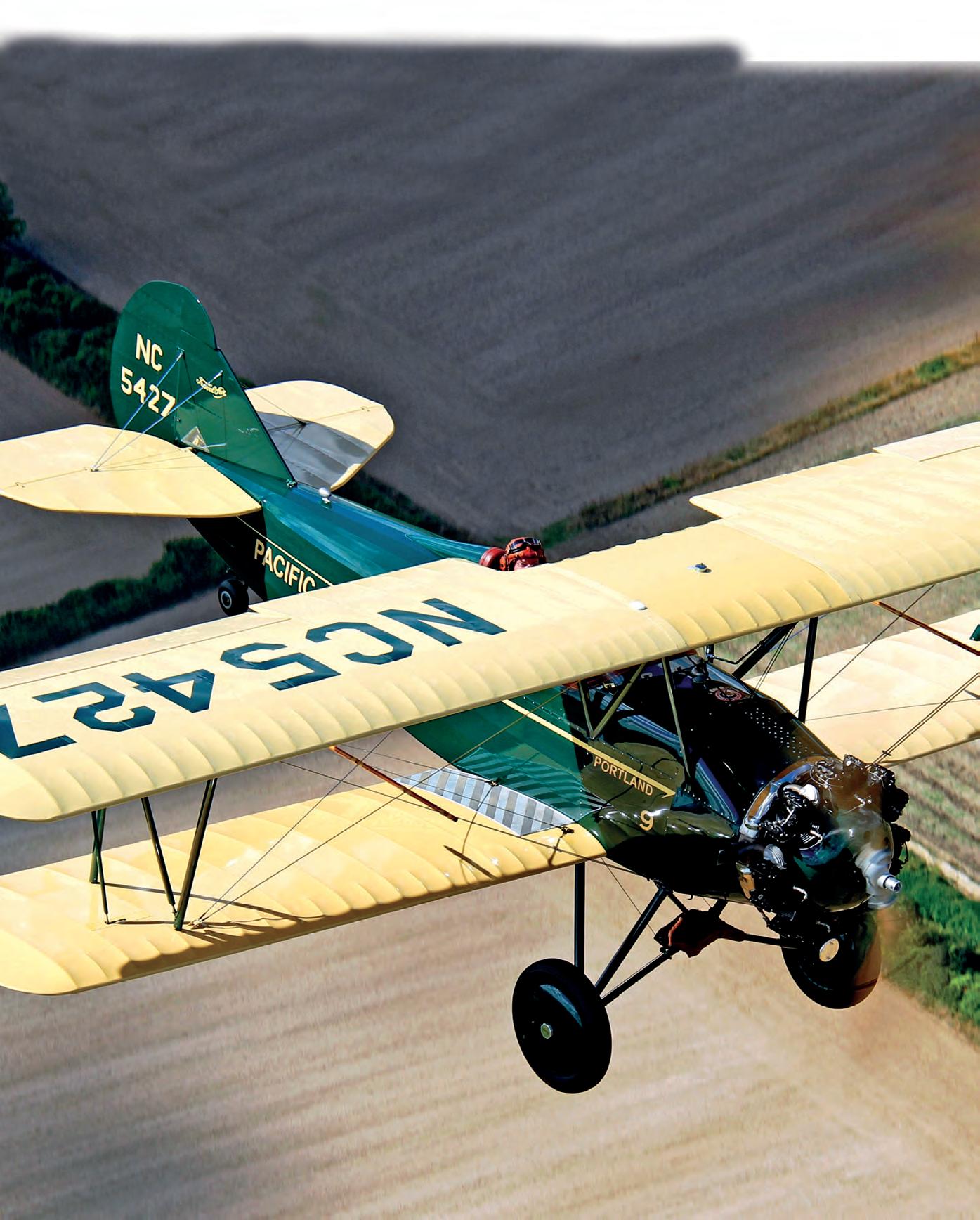
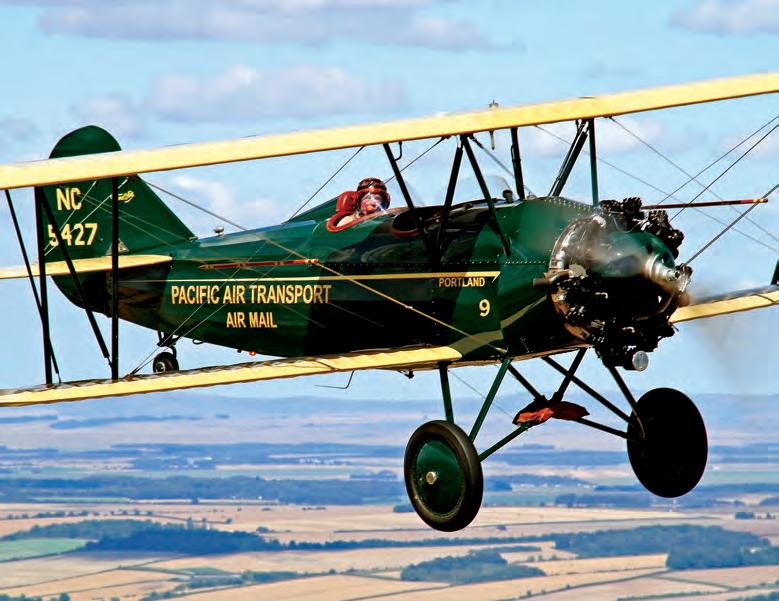
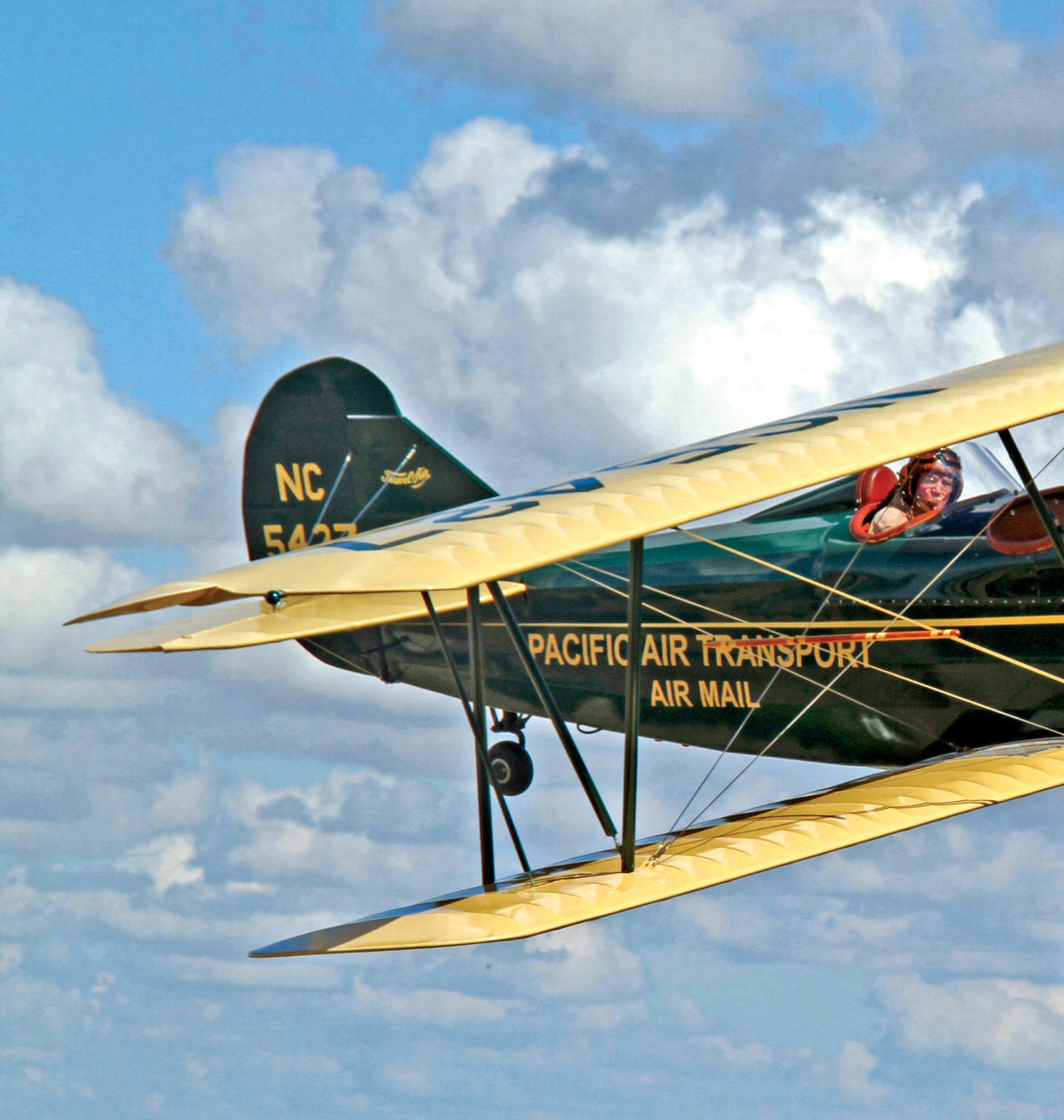
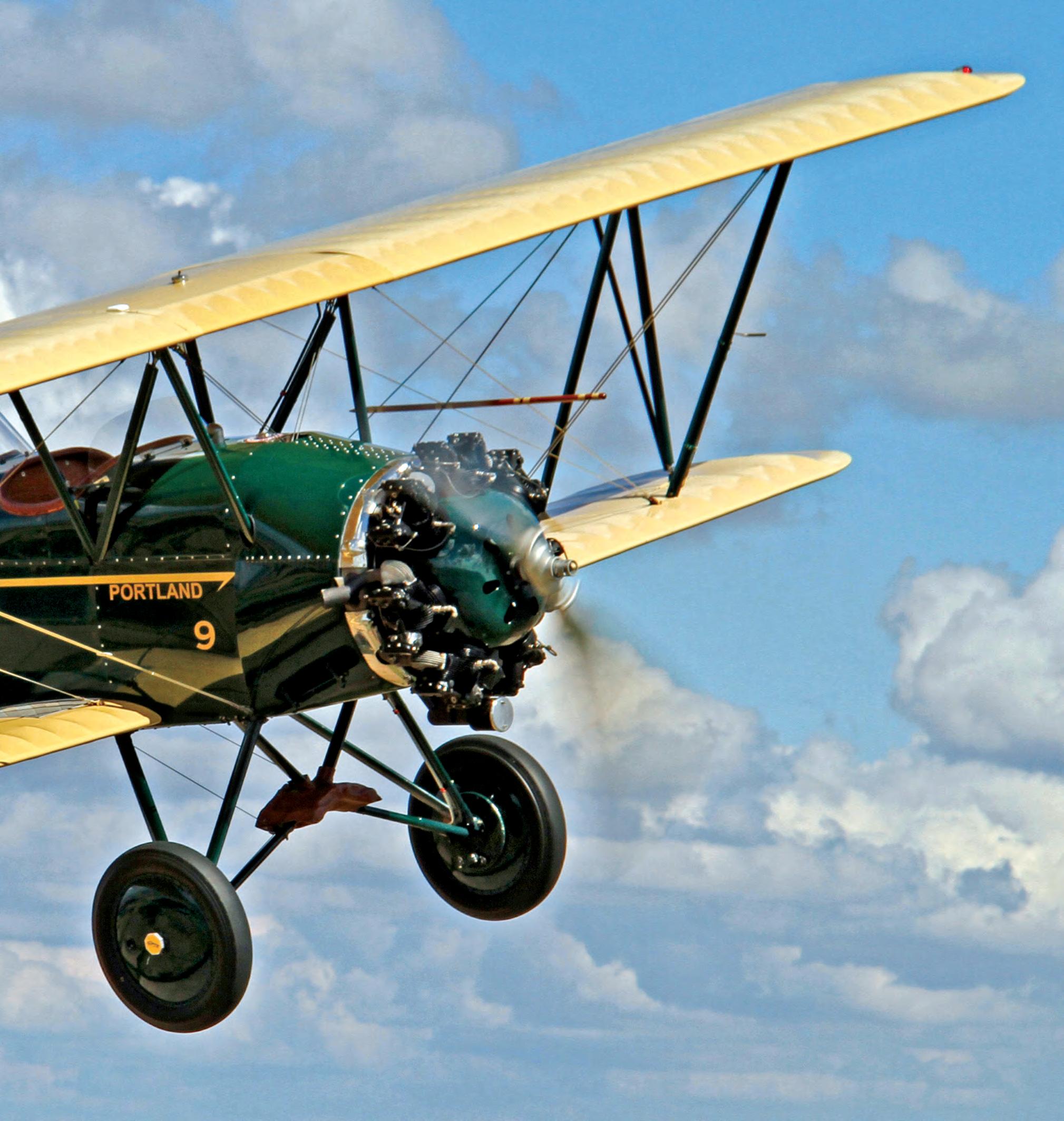
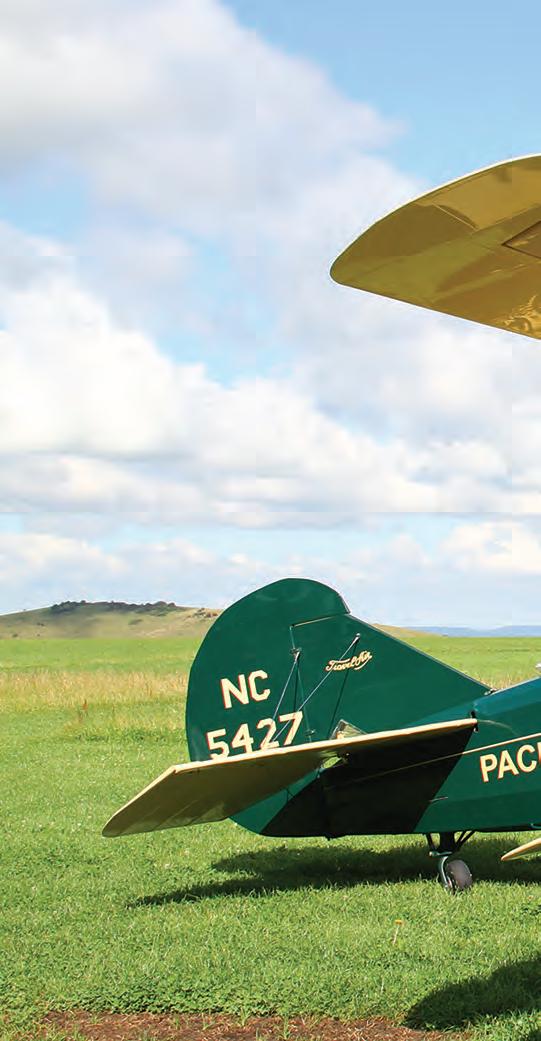
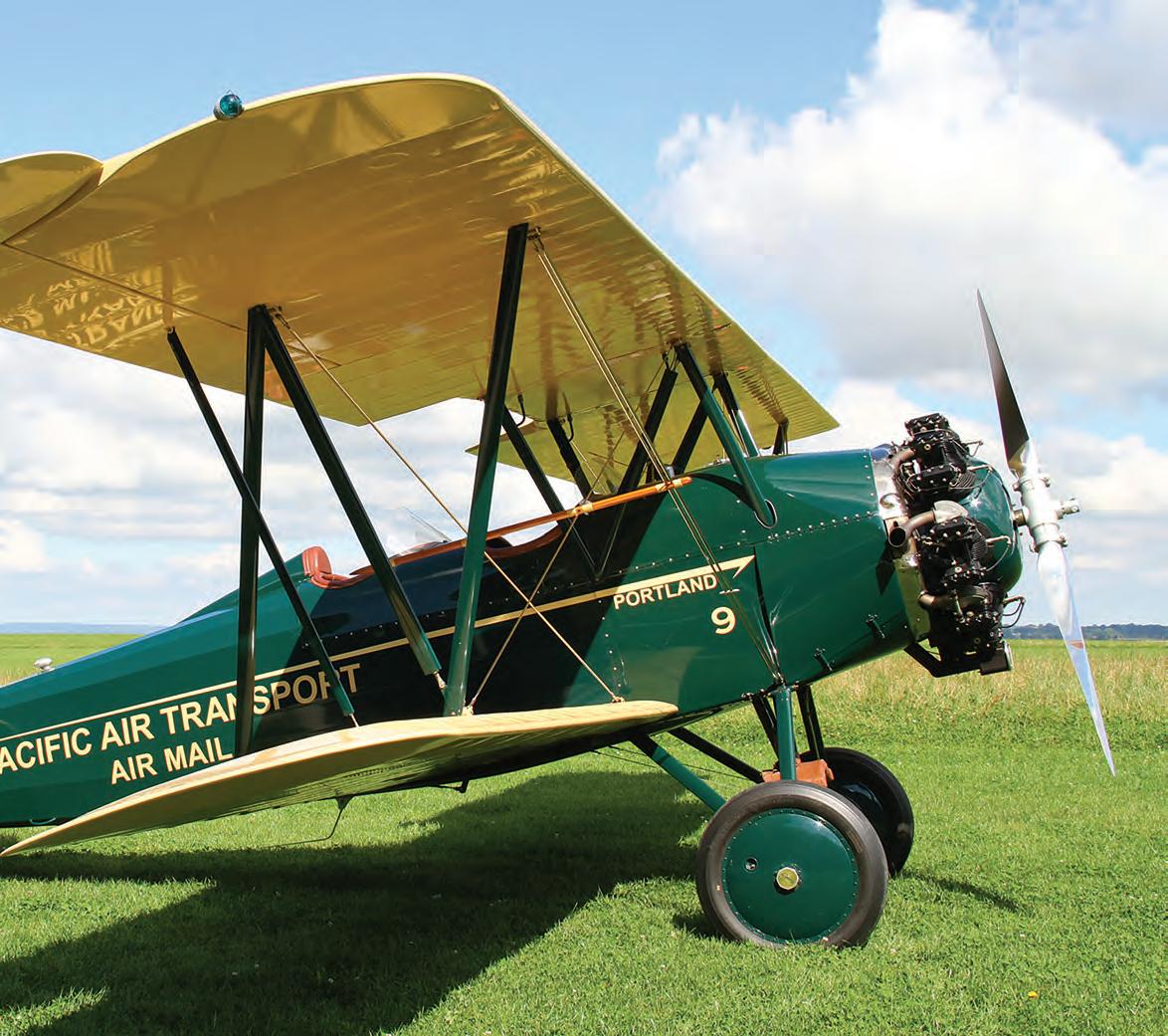
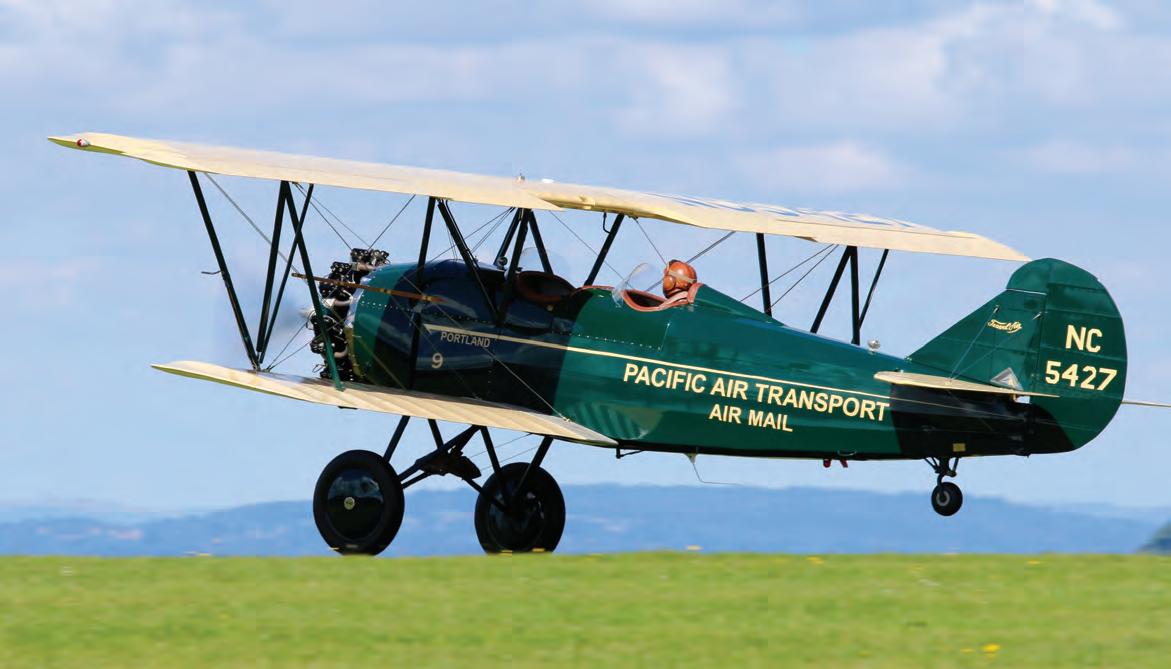
Right Tom's Travel Air spent most of its life instructing or private flying in California before becoming a crop duster in 1945 with Farm Aero. While this particular machine didn’t fly for Pacific Air Transport, the markings were applied for a 2004 Barnstormers tour in the US – and look great!
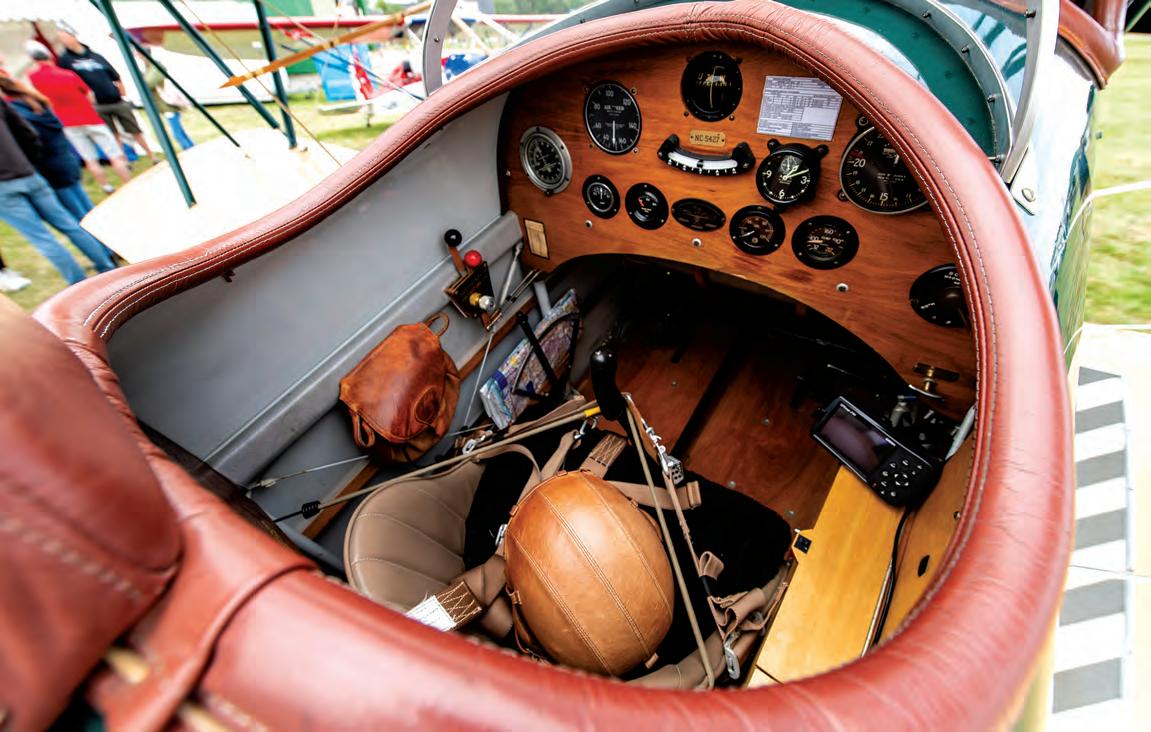
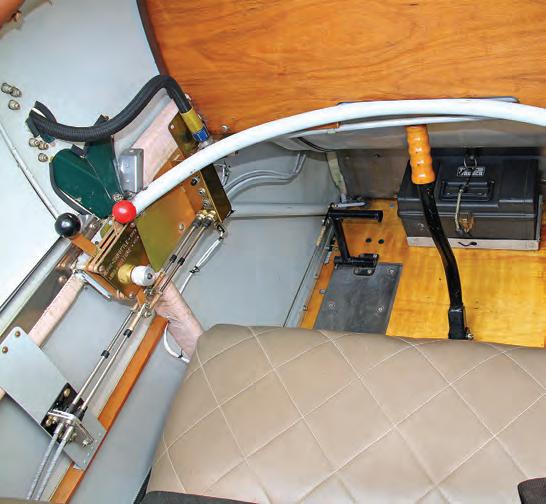
Below right They say time machines don’t exist, but how can this cockpit not take you back in time on every flight?
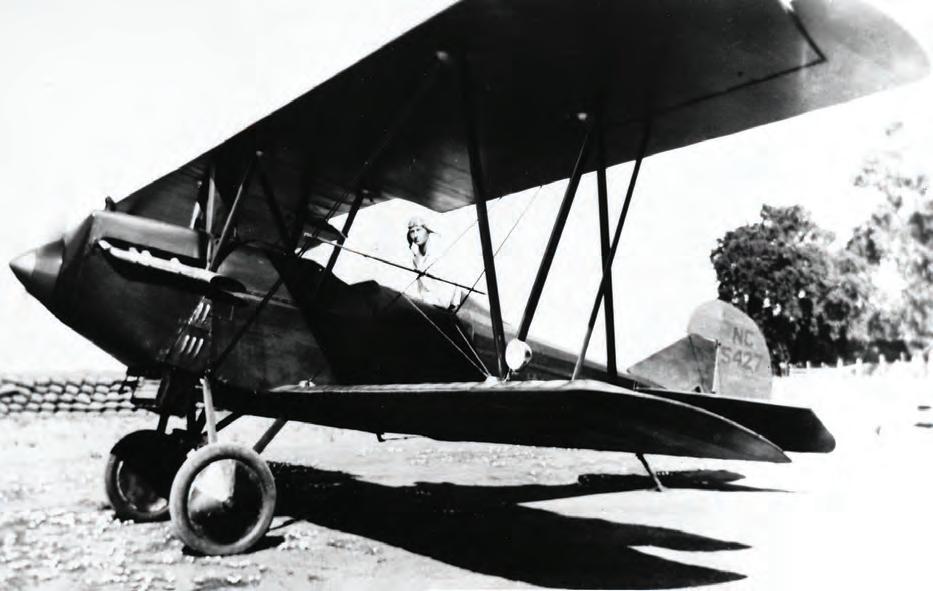
Below NC 5427 pictured in 1928 as a Model 3000 with its original 180hp Hispano Suiza V8.
be straight down the runway. The replacement had to be ‘out of the ordinary’ though – and it had to be OLD. Tom settled on either a Stearman (37 on the UK register) or a Travel Air (just the one…) and he went back to the land of his birth to find a suitable candidate, which I thought might have offered plenty of choice, but as it turned out, none that suited Tom… He found a Stearman in Sonoma California, in Gulf Air colours, which was ‘not great... tired airplane, needed too much work’, and there was a Travel Air in Virginia that he says was really nice, but he couldn’t fit in the rear cockpit which is where you fly it from. “Don't believe all that stuff about American aeroplanes being made for big Americans… I’m 6ft 4in, and I just couldn’t fit…” A Travel Air definitely looks big from outside but seemed to have ruled itself out for an odd reason, but a subsequent conversation with Andy Salter (who had looked after the Morane) offered a solution. Andy would move the floorboards and alter the rudder pedals to suit a 6ft 4 inch pilot. It already had a set of Bendix brakes (on 30 inch x 5 wheels, installed by Long Airmotive Inc of San Francisco Bay Aerodrome, Alameda, CA, in 1936) and a steerable tailwheel (installed, together with a 42 gallon fuel tank and an adjustable metal prop, in August 1939), not to mention a Continental W670 seven cylinder radial engine (installed by Harry Somers and Jim Ward in San Diego around 1990). It also gained a self starter (STC with the FAA), and an electrical system (Ford or GM alternator, also STC) probably around the same time.
It’s a good thing – and this is me talking – that as long as a significant modification has been done a long time ago, and is in character with the rest, it’s OK with most of us. Tom could have fitted the tailwheel and brakes to his Morane, and the American Conti radial in place of the
Ed Hicks
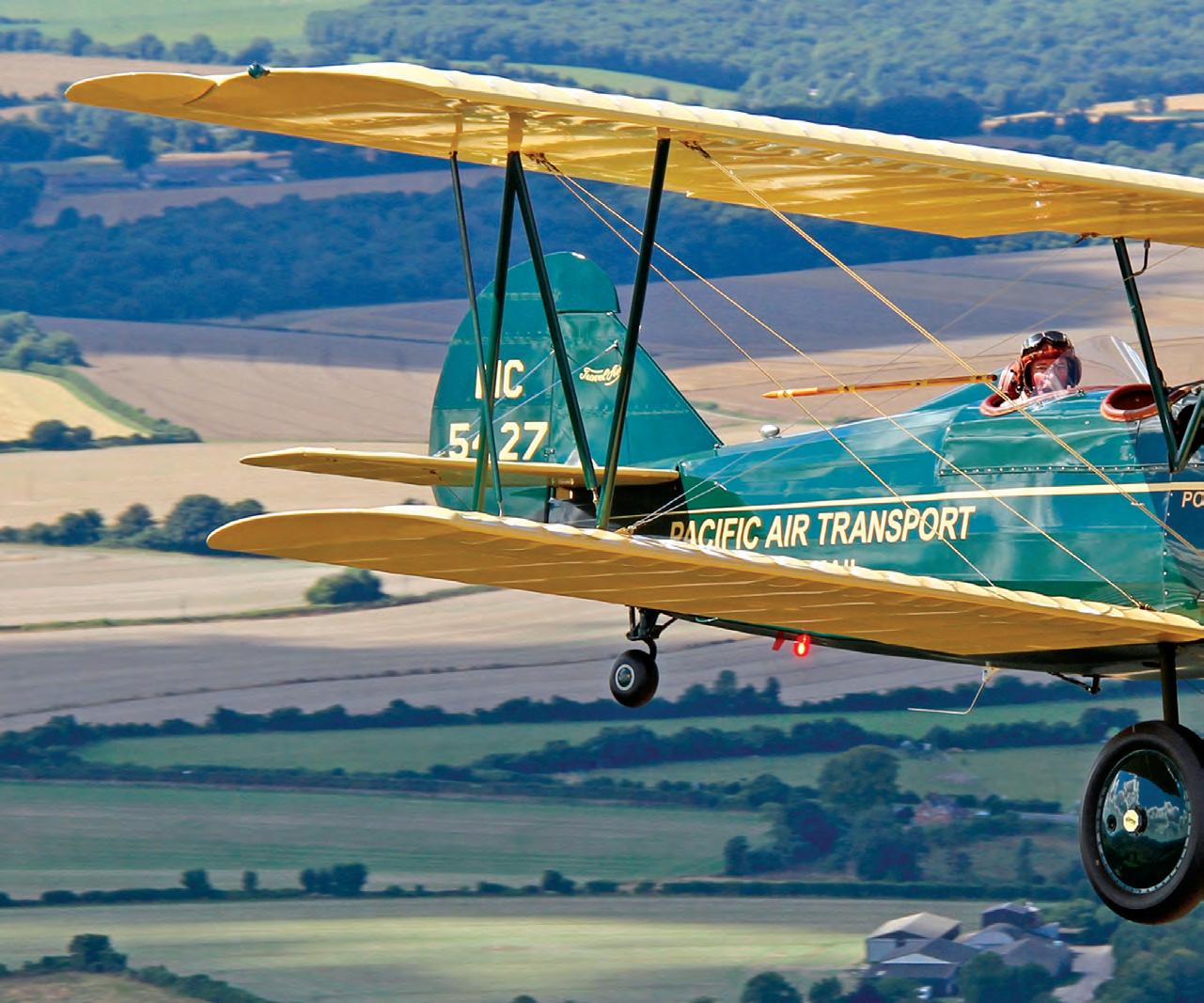
Above No question, this a fabulous way to get a modernday period flight experience.
seemed the Right Thing to Do. Besides, he’d found something with all that stuff done.
Origins
The Travel Air Manufacturing Company was established in Wichita, Kansas, in January 1925, at the height of The Roaring Twenties. The founders were Clyde Cessna, Walter Beech, and Lloyd Stearman. A partnership that would soon be broken up by the Great Depression of 1929, but three names which immediately resonate, each of which would become pivotal in the development of General Aviation. And in the great tradition of American Manufacturing, their handiwork all bears their surnames. Lloyd Stearman was apparently responsible for most of the Travel Air’s engineering and Series 3000, serial no 516 was duly signed off by Walter Beech on 7 May 1928, and given the registration NC 5427.
The Travel Air’s pilot flew from the rear (where there was no visibility on the ground), but there was room for two in the front, where there was slightly more, sat side by side beneath the top wing. A fledgeling industry had already spotted an opportunity to add value by carrying passengers as well as mail.
A style born out of a different, non-military requirement, the Travel Air’s construction was traditional with a wired braced welded steel tube fuselage covered with fabric,
and braced everywhere with hefty steel wires, which according to engineer, Miles McCallum, who looks after the aeroplane, were tight in some places and loose in others. There was no tension in the flying and landing wires, those would tighten when whichever load was applied, but the bracing for the cabin is tight… Why? McCallum says the landing wires tightening up probably produces some dihedral for when you need a bit of stability but the whole thing was just the way Travel Air did it in those days… WACOs, he says, are much tighter all round so it could maybe have to do with how sporty the aeroplane was supposed to be versus how much load it could carry. Like much else, the real reason is probably down to individual design culture, and the pace of development. The Travel Air’s wings were made of wood with conventional ribs and spars, braced with the aforementioned wires and covered, like the fuselage, with cotton fabric.
NC 5427 left the Wichita factory equipped with a water-cooled 180hp Hispano Suiza V8. Designed by a Frenchman for a Spanish company in WWI, the Hispano was licensed and developed by the Wright Company in the US, but having delivered 17 years of reliable service in NC 5427, turning a variety of different propellers, it was replaced in 1945 by a Wright J5 nine-cylinder 200hp radial, as part of the conversion to the aircraft’s new role
as a crop duster. The front seat was replaced by a large hopper and the main fuel tank was also removed, leaving just the upper wing tank which gave about an hour’s endurance, or enough for a dusting job.
In the great American hot rodding tradition, the Wright was then replaced two years later by a 300hp Lycoming R680 nine-cylinder radial from a Stearman with the exhaust routing up and over the wing. By then NC5247 had already morphed into a ‘Curtiss-Wright’ Travel Air which is how it stayed for a while – the companies had merged in 1929 but continued to produce existing designs. The aeroplane underwent its first restoration starting around 1983, or according to Tom, more of a reconstruction using original parts as patterns than a conventional rebuild. It was completed in 1990,, but then a ground loop when the bottom wing caught a bush on a dirt strip in Arizona inflicted a lot of damage. The previous restorers, Harry Somers and Jim Ward, were willing and able to recover the Travel Air to their San Diego workshop where they embarked on another restoration.
New owner Leland Jones, insisted they paint it dark green with cream accents instead of their preferred blue and silver… It acquired the Pacific Air Transport logos in 2004 when the Jones family sold the aeroplane to Joe Santana ready for that year’s Barnstormers tour. A bit of history, when the government had recently approved the
Above Where there was once a hopper filling the space during its crop-dusting days, the Travel Air’s front cockpit is pretty basic, but it has all a passenger needs to enjoy a VFR ride. Originally, it was intended to be for two passengers to squeeze into!
carriage of mail – the Kelly Act of 1925 had removed Post Office Department control of delivery, and allowed private companies to bid for contracts Pacific Air Transport was one of those that bid for the work. In 1928 Pacific Air Transport carried a total of 1,252 passengers and 76,237lb of mail more than 693,350 miles. The following year, the numbers had more than doubled; 3,279 passengers and 254,457lb of mail were transported more than 830,000 miles.
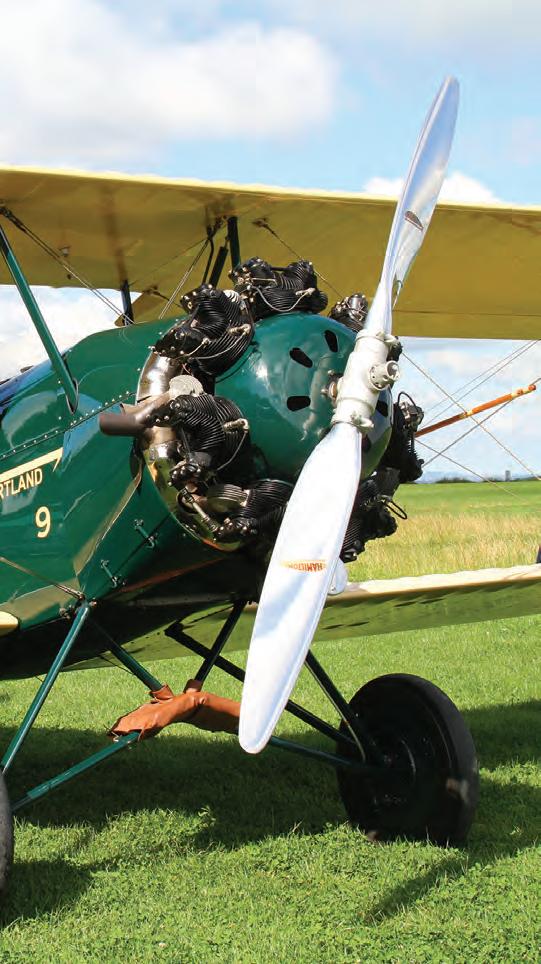
Tom Leaver acquired NC 5427 in 2014, and the aircraft arrived in the UK in 2015. There is no doubt whatsoever as to the quality of Somers and Ward’s craftsmanship; the Poly-Fiber covering they applied is as good now as it was when they applied it, as is the livery. Equally shiny is the highly prized Hamilton Standard ground-adjustable propeller which McCallum says weighs about 150lb and takes two men to lift… What that must do to weight and balance, I can’t imagine.
Part of the joy in owning and operating something like Tom’s Travel Air, is to experience what those close to it might have felt at the time, but although we can see the what, it’s always hard to know exactly the why. Miles McCallum is a good source of inspiration, and he says that the aeroplane is big and strong simply because it was built to carry huge loads when required. Travel Air, he says, pre-dated the others in that respect and a load of 1,000lb was not uncommon, whether it was legal or not, “and you’re not going to do that with a Tiger Moth…”. It would have been nice to see and experience the sound and feel of the Hisso V8 too, but the Continental radial, he reckons, is a good substitute, in keeping with what was around at the time, and because they were made in such large
numbers, there are parts aplenty. Perhaps more importantly, ‘it’s reliable as a boulder…’ He reckons the only problem – apart from adjusting the tappets – each valve is operated by three cam lobes, so you have to check for minimum clearance on the base circle all the way around the cam – is condensation in the top rocker boxes. although unlike earlier radials, the heads are fed oil, but they run so cool that they rarely get hot enough to boil off the water so everything goes rusty. “I’ve told him just to give it more gas. Spin it faster. But he’s ignored me…” "Not guilty" says Tom, "I run her at 1,900 rpm but the temp never gets above 120F on a typical UK weather day and max 140F on a 26C day, so none of this suggestion I don’t use enough throttle to keep the top rollers from rusting!"
Miles says there’s a thing where the aeroplane takes a while to respond, particularly to elevator inputs. He reckons this is partly down to the mass, but also because they used a much thinner, more WWI-styled airfoil. It’s not a response conventional by today’s standards and the crop duster pilots soon learned that they needed to heave the nose up early if they wanted to avoid a set of power lines. Mind you, he adds... they were carrying huge loads, probably without too much regard for a weight and balance schedule. That said, Tom reckons the Travel Air is inherently unstable in roll, which is simply to say that they can’t be left to fly by themselves. A Stearman trimmed straight and level, he says, is ‘a hands off steady platform’ but a Travel Air is ‘always looking for anything but straight and level if left to its own devices’. On the plus side, he adds, “It’s gentle and easy to correct and only gets a bit complicated when you are trying to maintain straight and
Below Taking off from Compton Abbas Airfield.
level while dialling in frequencies and/or transponder codes and reading a map…”
Modern complications y’see, none of which would have troubled a Crop Duster or Mail Pilot.
Lack of visibility ahead…
Before that, Tom says the tailwheel steering and brakes make it easy enough to taxi and line up, although there’s no visibility straight ahead, then once you’ve twiddled your thumbs or scrolled your mobile for 15 minutes while the oil temperature gauge makes its leisurely way towards 110F (the book says 160 is normal), run up is at just 1,400rpm because the brakes won’t hold any more. Check all the bits, trim, fuel, mags, harnesses etc and you’re ready to go. Tom says he lifts the tail soon so he can see but allows the aeroplane to lift off, which it does very quickly. Rudder authority is good and it comes in quickly, so the aeroplane is easy enough to keep straight on the roll. After that, he says it’s a typical vintage aeroplane... Which means heavy on the controls and leisurely in response, but always honest. Cruise is 90mph at 1,800rpm and you can up that to 100mph at 1,950rpm (redline is 2,100), but that will only make more noise and burn more fuel, so it really isn’t worth doing… ‘if you want to go that fast or faster, you are in the wrong machine…’
Tom says there are just two things that have taken a while to process; the first is flying in turbulence when the ailerons shake the stick as the loads feed back from the extended ears forward of the aileron hinge line. “At first you feel there is a gremlin trying to take the stick away, but it comes back instantaneously, wagging the stick back and forth. I just let it go, damping the action with a light hold and just let it do what it does best.”
The other is landing, or something to which most of us can relate.
Tom says his initial technique was to slowly reduce power until he’s sure of making the runway and only pull back to idle over the threshold, whereupon the sink rate increases significantly and then it’s a case of keeping it straight while pulling up slowing to a three point attitude, waiting for the ground, then pull the stick all the way back on contact and be ahead of the rudder pedals.
Tom says crosswinds are tackled ‘as he feels comfortable’ but he is nonetheless ‘cautiously impressed’ with the steerable tailwheel and brakes, ‘as modestly effective as they are’.
More recently though he has decided that wheeling it on – landing on the main wheels, rather than attempt a three point –- is more reliable.
He says a three-point was essential for the Morane because you needed the tail skid to keep it straight, but that wheeling on is the way to go with the Travel Air, even if it ‘still doesn’t feel natural’.
I went through a similar conversion myself. As long as you have at least some brakes, a wheeler is easier, and definitely more repeatable.
There’s no doubt that Tom is very happy indeed with his Travel Air, which in his words, is just a ‘good working airplane…’
I think it’s a lot more than that, so I’ll let Miles have the last word. “What part of 1,800rpm and seven cylinders in a big rumbling biplane can you possibly not like?” ■
Right Groundadjustable Hamilton Standard propeller is a monster 150lb of aluminium and steel.
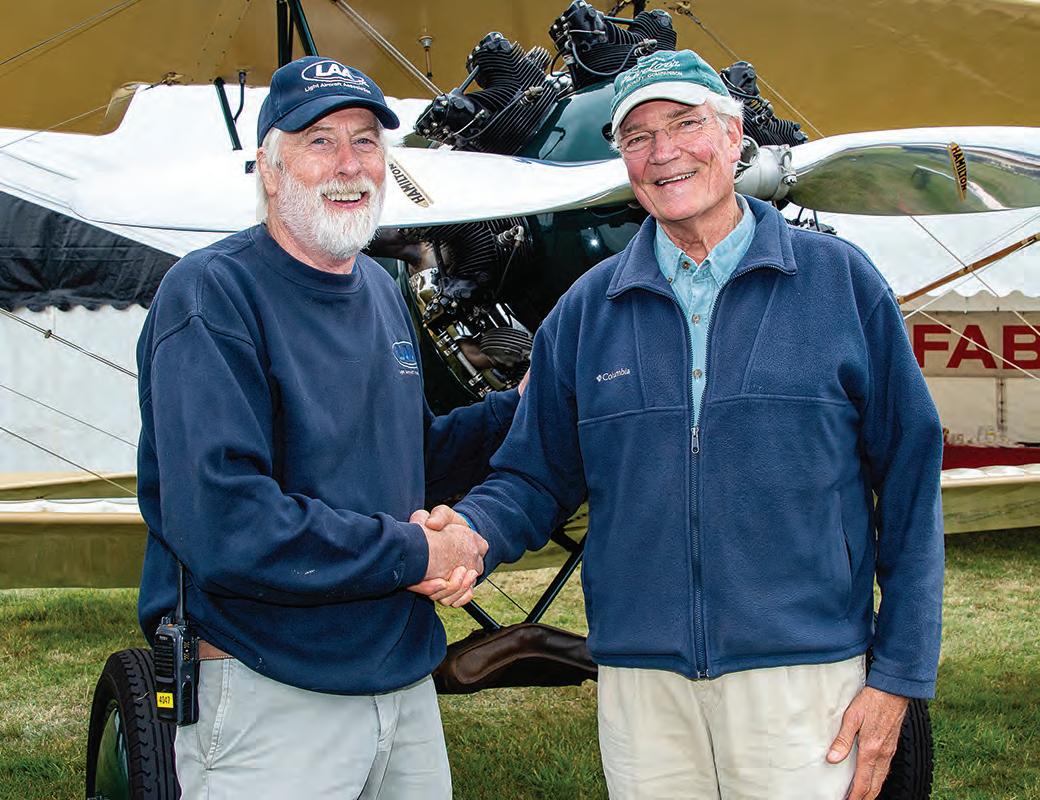
Below Tom (right) is congratulated on his aircraft’s Concours award by LAA Chairman, Eryl Smith, during the 2024 LAA Rally.
Ed Hicks
Old Number One
Always on the lookout for Turbulents in need of TLC, Richard Vary made a very special discovery in Devon… Roger Druine’s very own Turb…
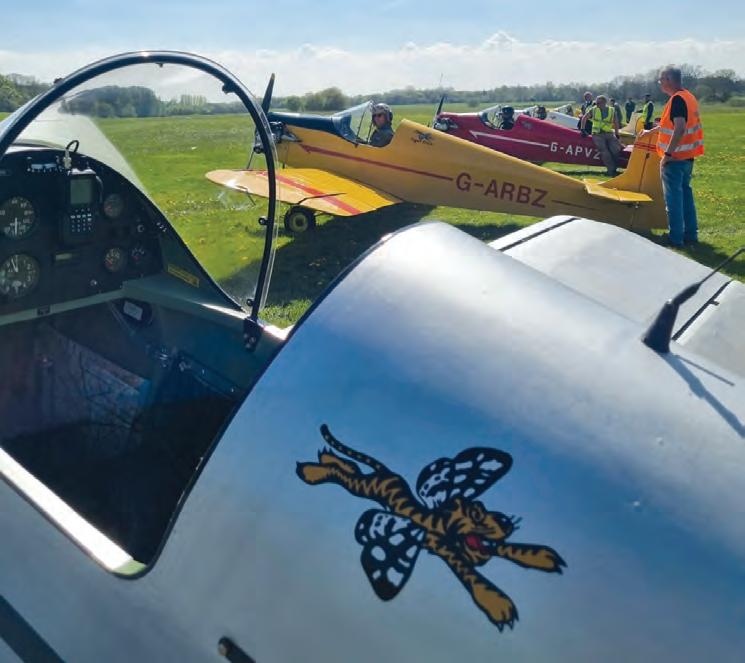
With only four working Turbs, the Tiger Club’s Turb Team sometimes struggled to put out a full team. Faults occurred, and invariably they seemed to show up when there was no time to fix them. We needed a spare aircraft.
An aircraft Inspector in Devon (South West England) sent word that a Turb, which he knew of, might be coming up for sale. So, I jumped in my Cub (Hotel Juliet) early one summer morning and went to have a look. It was too long to make in one hop: the Cub would make it, but I
wouldn’t enjoy a two-hour flight without a break. So I set off first from Slinfold to Popham.
This was a route I knew well, so my map could stay in its pocket. I dragged HJ from her dry hangar up the small slope to the runway, my feet slipping on the dew-wet grass. The strip was deserted, there was nobody about at this early hour, and the air was damp and still. HJ started easily and settled to a regular tick over… the stuttering of her engine cutting the silence.
I let her warm up for the bare minimum of time, worried that the neighbours might be disturbed at this early hour.
Three grey runways at Dunsfold appeared in a triangle under my right wingtip. Formerly a test airfield where the Harrier was developed, today it was little used. A huge white Boeing 747 sat on one taxiway, making an unusual sight in the Surrey countryside. This aircraft had been converted to have mocked-up twin engine pods for a James Bond film some years earlier. Since her brief movie appearance she had sat incongruously at Dunsfold, presumably awaiting being cut up for scrap.
Beyond her I could pick out the markings where the runways and taxiways had been converted into the BBC’s Top Gear test track. That television series was no more, and soon this historic airfield would follow, to make way for another housing estate.
I spotted the power lines that run towards Haslemere, the town itself hidden among the wooded hills ahead. Now we were clear of Gatwick, and I would need some height over those hills. The morning air became cooler as we climbed; I slid the side window shut and did up my collar. HJ’s shadow darted across the fields before me, like a black dog that will not walk to heel. Ahead the sky was clear and a deep blue. I thought of the sausages, eggs and beans served at Popham.
With the low sun shining through the glazing behind my left shoulder, I ran through my checks: controls free, a tug at my harness straps to tighten them, HJ’s few instruments reading normally, fuel on front tank, trim centred. Holding HJ on the brakes I opened the throttle a little and switched off each magneto in turn: the engine kept running, so both magnetos were working. Then, with a mumbled apology to any neighbours still sleeping, I pointed the nose up the slope of Slinfold’s hump-backed runway, held the stick back and slowly opened the throttle, hearing the throaty roar of the engine and feeling Hotel Juliet surge forward as the propeller bit the cool morning air. As she accelerated up the hill, I let the stick come forward, and she picked up her tail. We tracked straight, a lone tree halfway along the runway flashing past the right wingtip. As we reached the crest, the bumping stopped as HJ gently took the weight off her wheels and the air started to lift her.
The back slope of the runway dropped away beneath us, a small road between hedges flashed past, and we were over a brown ploughed field which rose from the bottom of the valley up the other side in a gentle slope. I kept HJ tracking level as the speed picked up, then let the nose come up into the climb. Once we were well past some houses to our right, I turned west, still staying low, as we were under Gatwick’s flight path and control area. Pockets of mist lay on the ground. The bright green of the trees that faced the sun contrasted strongly with the dark browns and black where they cast their shadows.
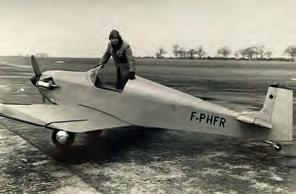
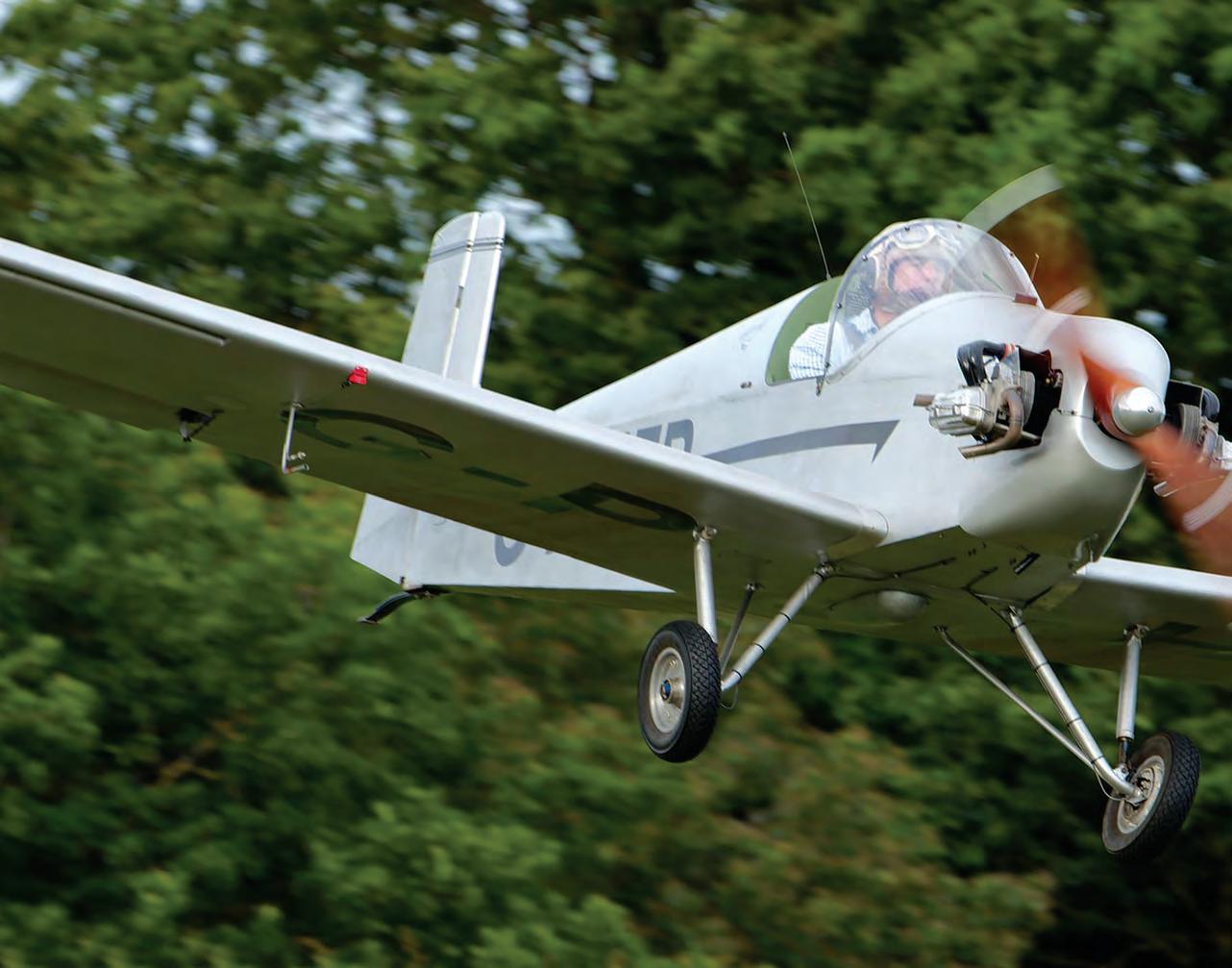
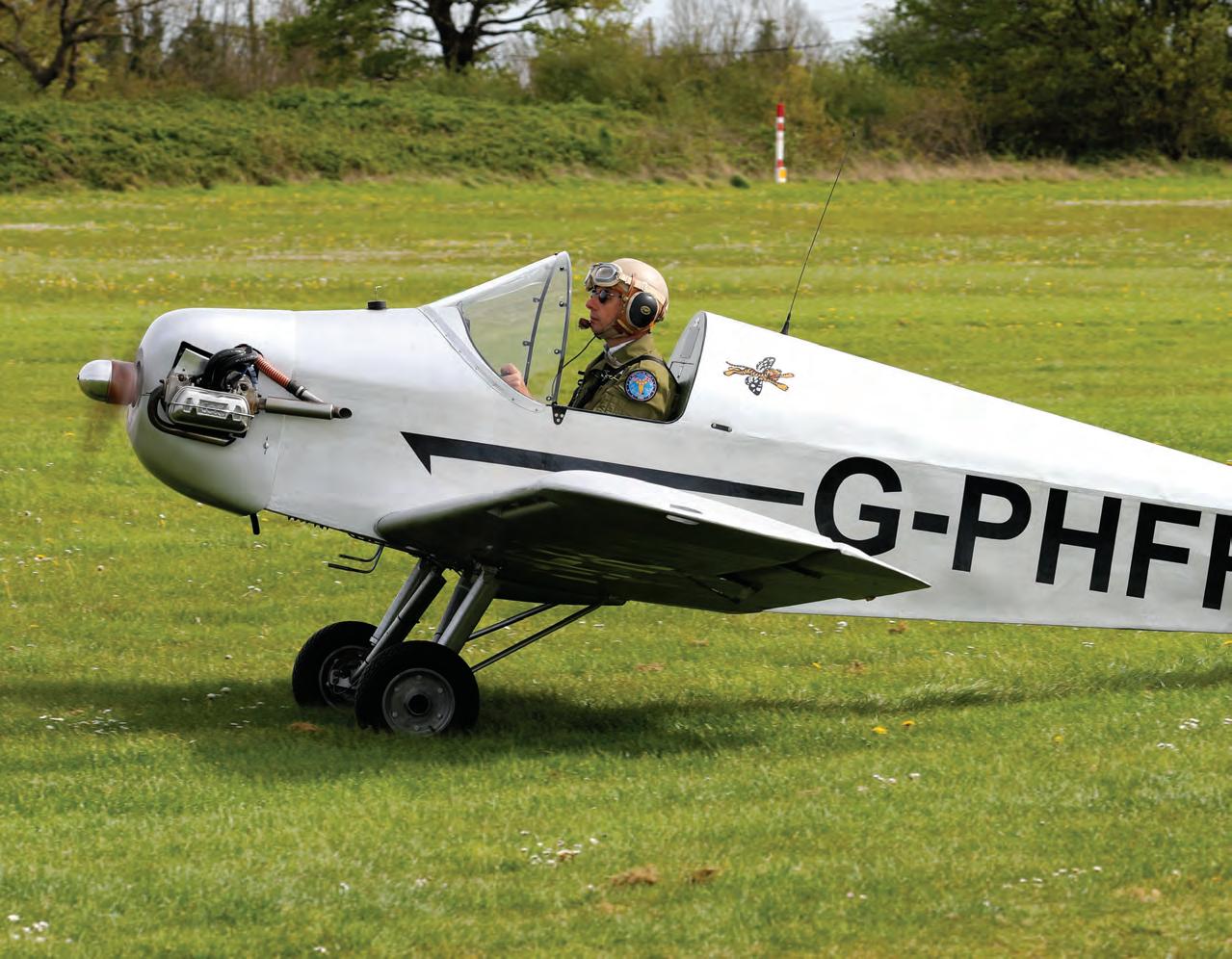
Above (left) The author flying PHFR at Damyns Hall after its return to flight with the
Below HJ at Popham, whilst the pilot enjoys their famous cooked breakfast.
The deep green of the tree-covered hills gave way to browns of open scrubby ground, a military training area. My turning point was Oakhanger, its radio listening devices looking like giant golf balls. We are advised not to fly over them, so I skirted around the south, turning north-west towards Popham over a more familiar landscape of fields and hedges. To my right lay Lasham, a gliding airfield, but in the still flat air of early morning the gliding club was unlikely to be very active. I called up Popham, the first time I had had to use the radio. Popham was using runway 26 so I gently eased the power back, letting HJ drop to 800ft over the large wood, south of the airfield. Because Popham is 500ft higher than Slinfold, my altimeter read 1,300ft. In most aircraft you would adjust the altimeter to the pressure setting for the new airfield,
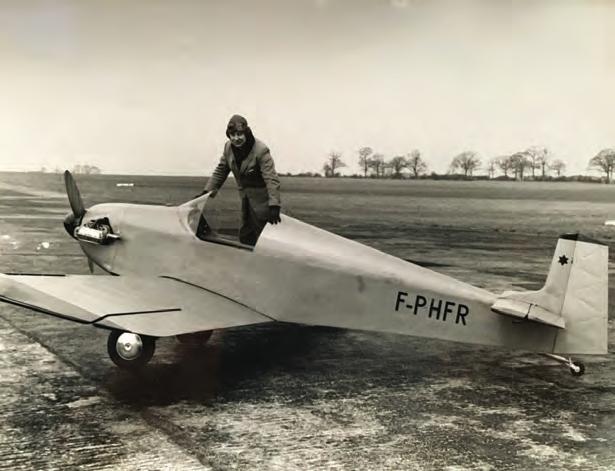
Above Harold Best Devereux after flying PHFR across the Channel on 8 April 1956.
Tiger Club.
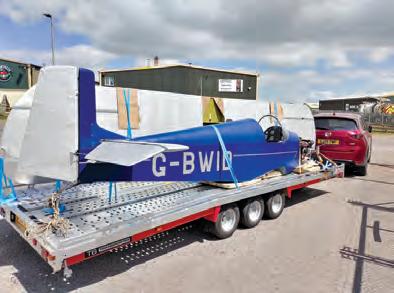
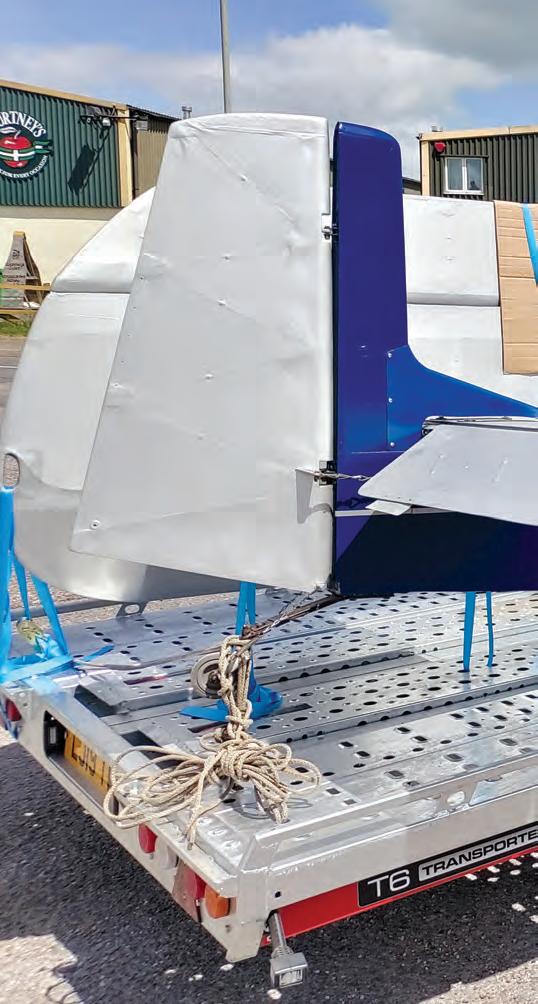
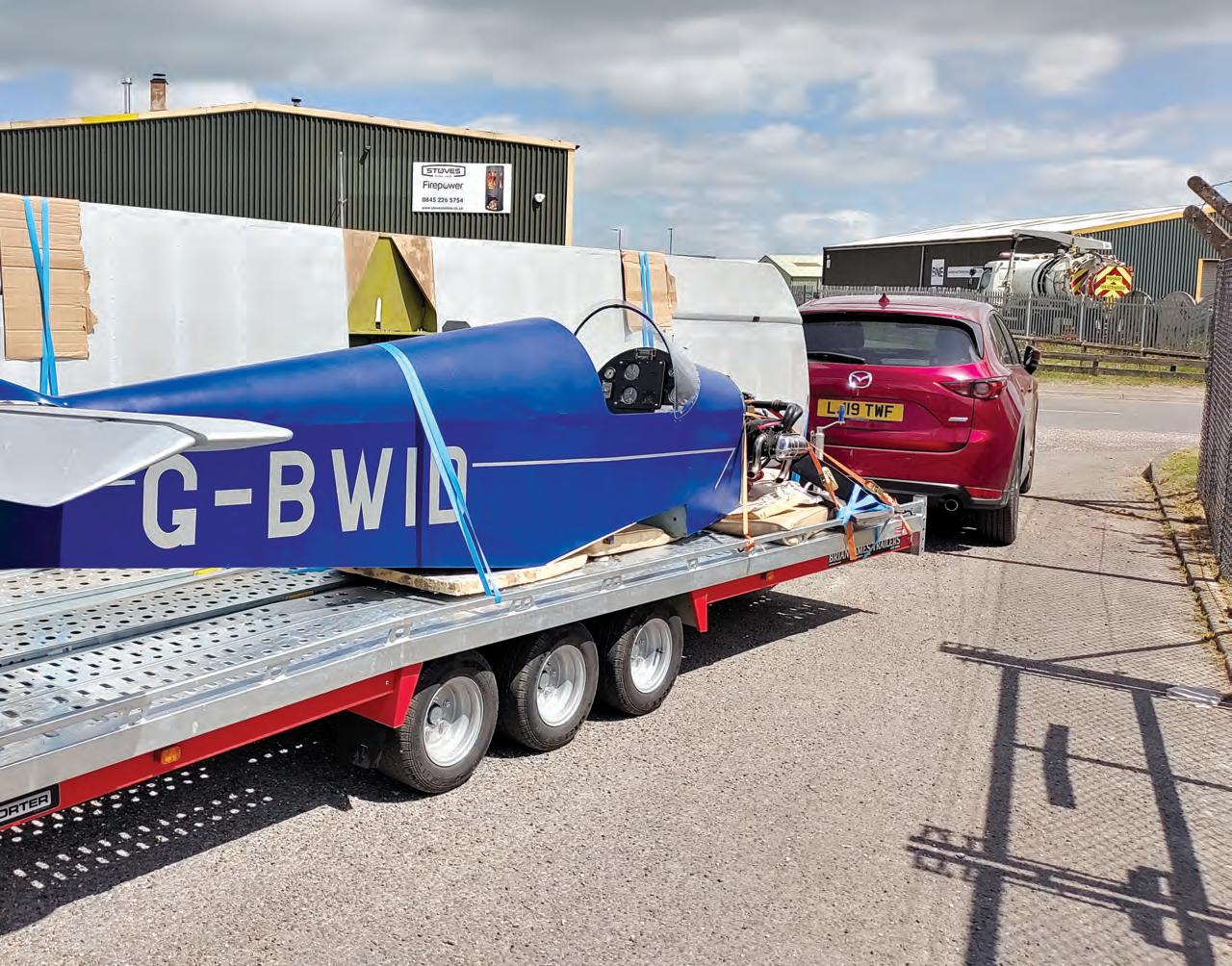
Right An extra large trailer was definitely in order to transport the Turb…
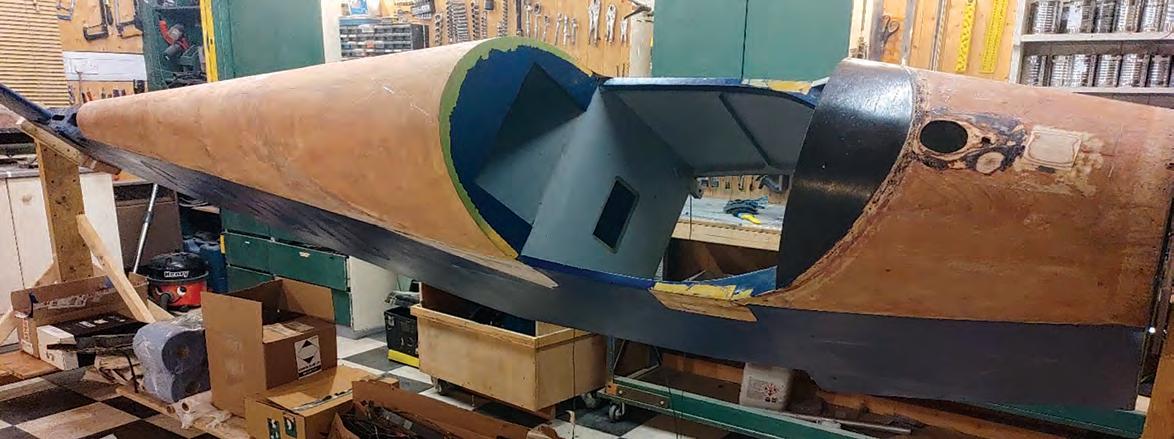
Below … and she was stripped down on arrival in the workshop.
but older Cubs like HJ are flown from the back seat, and the altimeter is in the front, so the pilot can’t reach it to change it. Maths is needed.
I joined the circuit crosswind, and flew a tight righthand circuit. I had learned to fly at Popham, and memories of my examiner John Wilson came back as I ran through my downwind checks. I smiled as I made the radio call late and imagined his tut of displeasure. I trimmed HJ for 60mph, a touch of sideslip brought her onto Popham’s offset threshold, and we were stopped almost before the café. I could smell the sausages.
The next leg was longer. I had to squeeze between Southampton and Boscombe Down airspace, the same route I’d flown as a student on my qualifying cross-country fight to Old Sarum. I picked up the straight road that I had used to cheat on that exercise, and followed it until I could turn west, away from the busy airspace of Southampton, but clear of Boscombe’s military traffic. The landscape opened ahead. The winds were light, so once I was free of airspace restrictions, I could climb without fear of being slowed by too strong a headwind.
Low flight intensity
There is a mental release that comes when climbing in a small aircraft: you don’t realise how intense low flight is until you get back above 1,500ft or so. As I climbed away from the surface, the sky seemed to grow bigger and more open, and the Earth, with its details, its contrasts, its hills and valleys, flattened and receded beneath me. All sense of movement ceased, and time itself seemed to slow. My shoulders moved back, and I felt I could breathe. Then the first sharp stab of chilly air penetrated my flying jacket, and I remembered that the freedom of high flight comes with a price: cold.
I stuck it out until ahead the clouds were getting lower. I passed Yeovilton, the centre of naval aviation, formerly home to Sea Harriers, but today occupied only by helicopters. The ground rose to meet the lowering grey clouds. It started to rain. I passed over Upottery, the airfield featured at the start of the series Band of Brothers, one of the airfields from where the 101st Airborne had departed on D-Day, but today overgrown and neglected.
Ahead I could just make out Dunkeswell, my destination. The clouds were now down below 1,000ft, and droplets of rain ran along my side windows. With the edge of my right foot I pulled on the inconveniently located carburettor heat knob, to stop the wet air turning to ice in HJ’s carburettor. The radio operator directed me to join downwind for runway 22, which I did, slotting in behind a Robin DR400, and dropping HJ onto the long tarmac runway into the gusting south-westerly wind.
I was met by the owners of the Turbulent, and they drove me around the perimeter track to the hangars where she lived. Dunkeswell has a good collection of new metal hangars, and in them some immaculate private aircraft. I wish we had facilities like this nearer to London.
The Turbulent looked in good structural condition, if cosmetically tired. The fuselage had been brush-painted in a thick blue paint. The fuel tank had a split by the lid, and the engine cylinders looked as if they had been dipped in matt black emulsion. A cowling had been beaten from aluminium: it was nicely made but had become a patchwork of blisters and holes to clear the carburettor and other fittings. The paperwork showed that the whole aircraft was overweight, but I thought that if the fuselage were re-covered, a new cowling made in fibreglass and the heavy magnetos replaced with electronic ignition, then this could be brought down a little.
Fascinating history…
But what really caught my attention was the history. This little aircraft had once been F-PHFR, built by Roger Druine himself, and first flown by him on 30 December 1955. The logbook showed Roger Druine’s first flights, collection by Harold Best-Devereux on 8 April 1956, and his flight across the Channel to introduce this brilliant little aircraft to the UK. On 8 April he recorded a 15 minute flight for ‘Press and Television’ – the Pathé newsreel filmed that day can still be found on YouTube.
In one short month, FR acquired some famous names
“The Turbulent looked in good structural condition… albeit cosmetically tired”
in her logbook. David Ogilvie, Mosquito pilot who founded the Vintage Aeroplane Club and became manager of the Shuttleworth Collection, was the first to take her for a flight from Elstree on 10 April. He obviously enjoyed it because he appears several times in the logbook.
Joan Hughes MBE, ATA Ferry pilot and one of the UK’s first female test pilots, flew FR from White Waltham on 15 April. Hugh Kendall, Fleet Air Arm and Chief Test Pilot for Handley Page, flew FR at Woodley. On a trip to Eastleigh, FR was flown by Viv Bellamy, Fleet Air Arm pilot and patron of the Eastleigh flying club, and Jean Bird, the first woman to be awarded RAF wings. Sadly, she died in a crash the following year while surveying a new road route.
I also spotted Beverley Snook OBE, co-founder of the Tiger Club and later chairman of the Royal Aero Club in the logbook. That flight must have been the first in the Tiger Club’s long history of operating the Turbulent. Further down appears George Miles, test pilot and chief designer at Miles Aircraft, responsible for everything from the venerable Magister to the supersonic M52. Ranald Porteous, chief test pilot of Auster Aircraft also flew FR,
and Sir Peter Masefield, a Flying Fortress pilot who went on to create ICAO, became the UK’s air attaché in Washington and, at the young age of 35, became chief executive of BEA. Great names indeed, no longer with us.
Then, on 6 May 1956, in an epic 3 hour 25 minute flight, Harold Best Devereux flew from Croydon to Toussus-le-Noble in France to return it to Roger Druine. It had racked up 42 hours flying in its brief trip to the UK.
What had happened from there was less clear. Until 1967 FR was used as a club aircraft in France, but then there is a gap until a Mr A Turney flew her for 10 minutes at Booker on 4 October 1998, recording in the logbook, ‘first flight for 31 years!’.
Buying FR… accidentally!
Attending a flying display I got chatting to Mike Vaisey, one of the Tiger Nine pilots. He had heard that we had found FR, and was able to fill in some of the gaps. He recalls that he accidentally purchased FR. He had taken a lorry to the south of France to collect some engine parts which he had bought by telephone, and was surprised, on arriving to collect them, to be told that he was now the owner of an airframe as well. Putting it in the back of a lorry, he brought it back to the UK where it was registered G-BWID and flown in 1998.
After being laid up again for a while, my four new Devonian friends had again resurrected her and got her flying, before establishing that none of them were light enough to fly her with more than a few litres of fuel.
However tired she was, my mind was made up. I had to buy her. We agreed a price and I climbed back aboard HJ to fly home. As HJ climbed away from Dunkeswell and we skirted the rain clouds I wondered how I would collect this new Turbulent. Although it had a Permit to test, it was not yet cleared for flight, so I could not fly it home. It would have to be a very large trailer.
After an hour or so, I stopped at Compton Abbas, a delightful airfield on top of a hill. The circuit follows the surrounding valleys and it is difficult to focus on the approach when looking at the spectacular scenery. I was getting tired now, and strong tea revived me for the last leg back to Slinfold.
Some weeks later I hired the largest car trailer I could find. Accompanied by Tim, another Tiger Club member, I drove down to Dunkeswell. We had set off without breakfast, so we pulled into a drive-through McDonald’s on the way before realising that the enormous trailer might not fit. It required some careful manoeuvring, but we managed to get it around the drive-through loop, to the amusement of the serving staff. I don’t advise trying it.
We arrived to find that our Devonian friends had enlisted the help of two equally handy South African pilots. They had already separated the fuselage from the wing. They were strong enough to lift the fuselage without removing the engine, and hefted it onto the trailer, laying the wing alongside, and competently securing the delicate load with my collection of straps. I expressed my admiration for their handiwork and one of the South
Africans shrugged. “We’re used to moving stuff,”he smiled. “Guns, drugs, we can shift it”. I’m not entirely sure that he was joking…
Saving weight
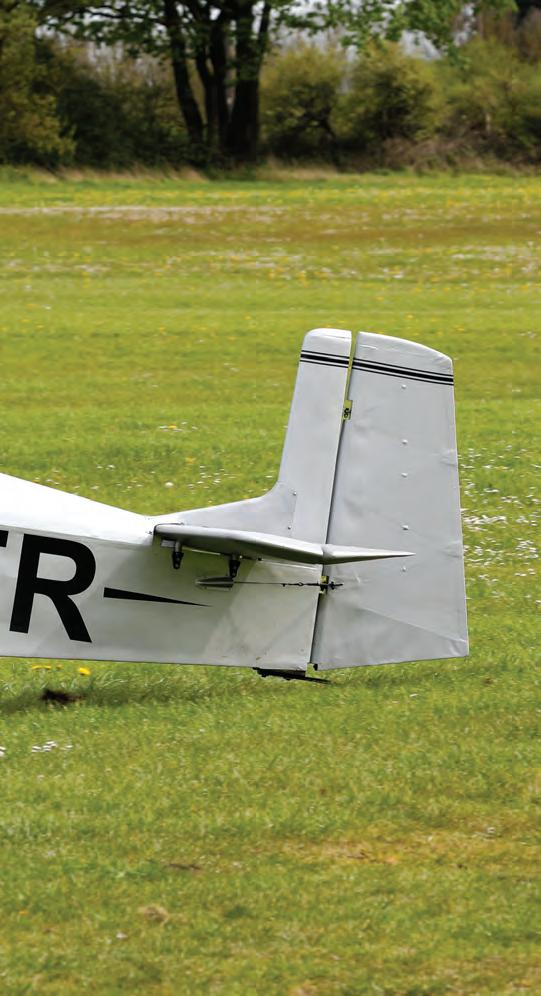
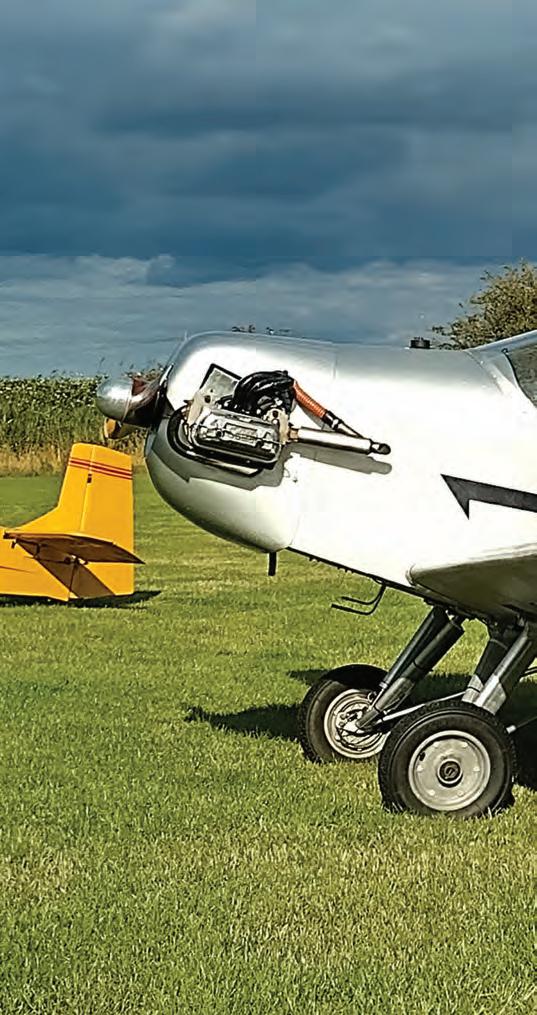
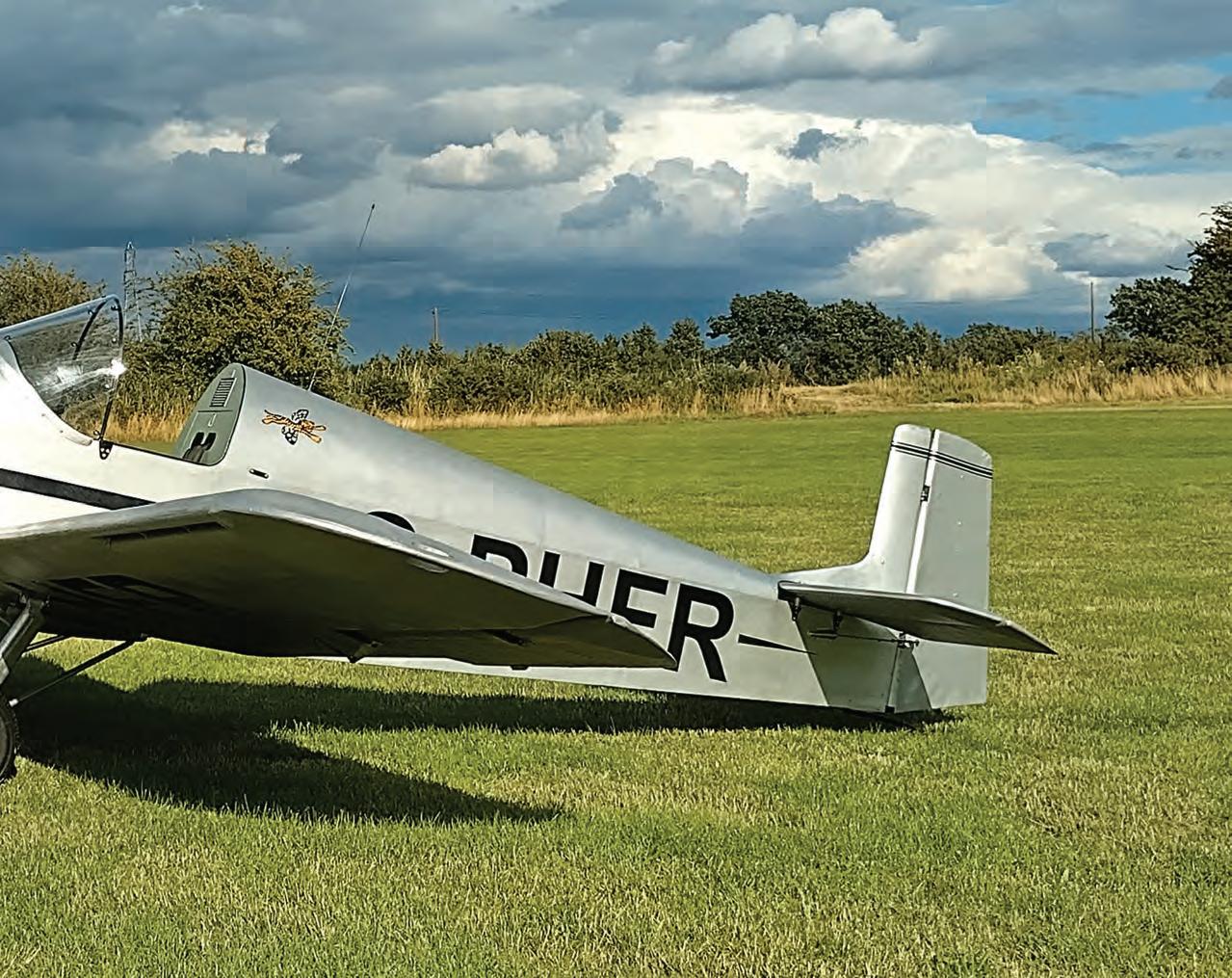
Back in the workshop I set about stripping the covering from the fuselage and removing the thick blue paint. I had decided to re-register her as G-PHFR (copying her original French registration) and bring her to Turb team specification with electronic ignition, an electrical system, and a similar colour scheme, but in silver dope. This would mirror her original silver colouring, and have the advantage of saving weight by dispensing with the gloss coat on top.
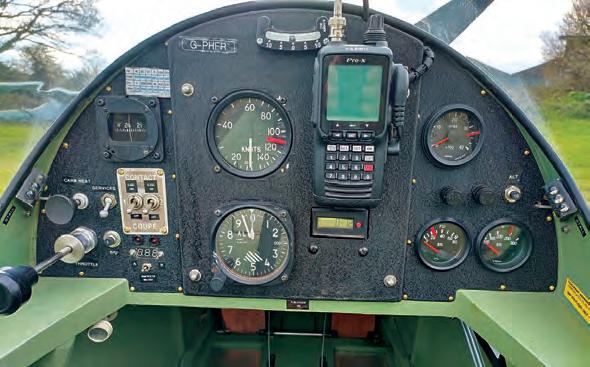
I stripped the fuselage of hardware and set about cleaning it up with a wire brush, before priming and painting. We would need a new canopy and crash arch, so we rescued and restored an arch from our store of old Turb parts. The store provided several other pieces of hardware: shoulder strap fittings, a tailskid, combined brake/rudder pedals and its repaired fuel tank. We fitted a newly refurbished ‘Phil Chapman’ engine. Bro made a set of fibreglass cowls, which Richard Brinklow (Tiger Club chairman) sprayed in Mercedes brilliant silver. Over winter I sanded the cockpit and sprayed it cockpit green. I recovered the fuselage and sprayed it with silver dope. Digging around in the rear fuselage I found a piece of newspaper stuck to the plywood under a layer of varnish. It was an advertisement, in French: I guess M. Druine’s plywood had come wrapped in newspaper and he had not removed it all, so a piece of history had been captured inside the aircraft structure. I made up new
Left PHFR taxis out for a flight test. The block under the leading edge of the tailplane is visible, removing the need for forward stick pressure.
Below (top) New instrument panel in MGB crinkle finish dashboard paint.
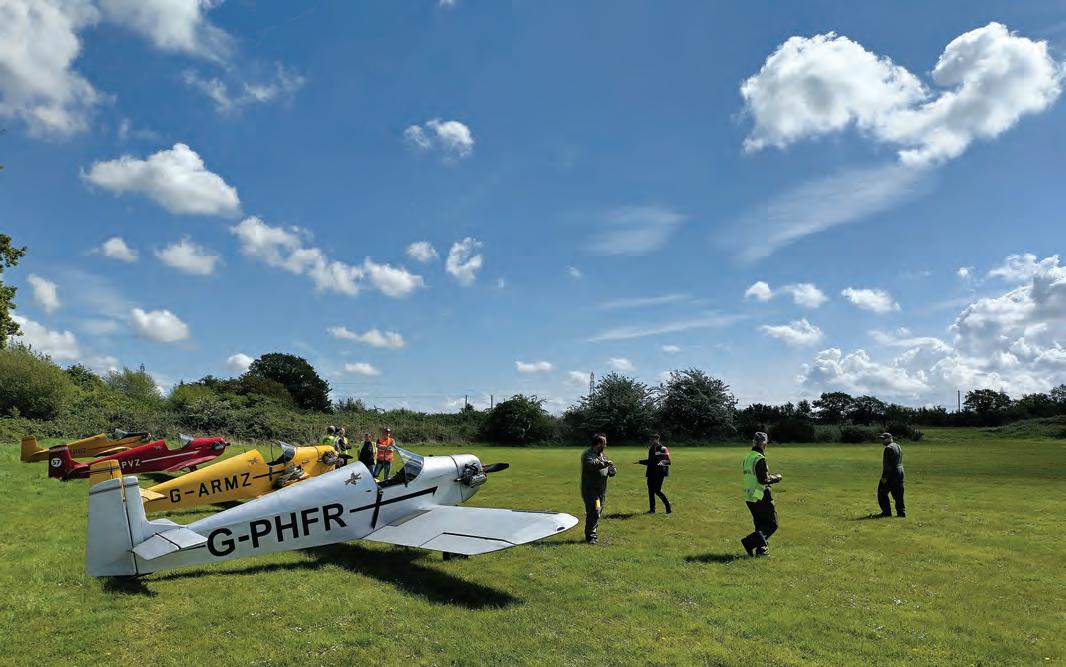
Below (bottom) PHFR taking her lace in the Turb team lineup, as the pilots conduct a walk through.
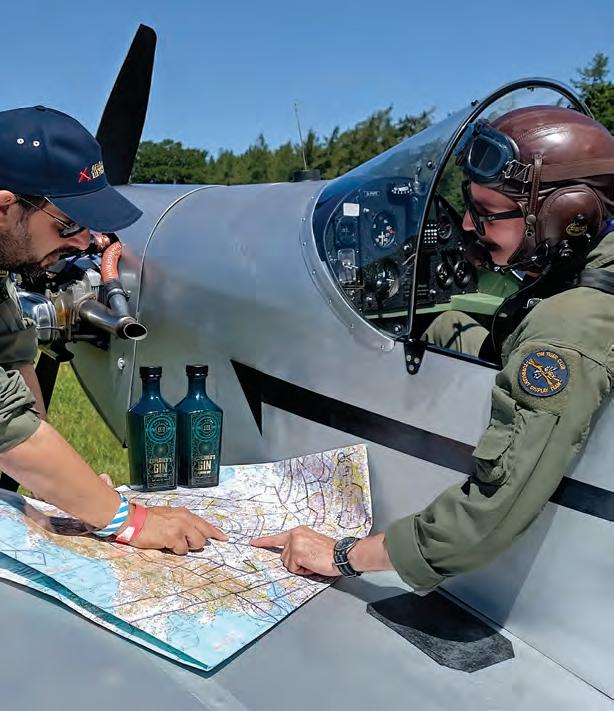
Below (top) David ‘Bro’ Brothers and Adam ‘Visor’ Parnell pose with FR in a publicity shot for Downton Distillery Explorers’ Gin. I recommend it, but only after flying.
Below (bottom) About to start another display practice, FR sits ready for her pilot.
instrument panels in black crackle-finish paint, like an MGB dashboard.
Bro painted the black speed stripe on the fuselage, and she looked spectacular. I had used some stick-on lettering, of a similar size to the original, for her registration, but Mike the Inspector reminded me that CAA regulations nowadays specify the size of the lettering. I peeled off my first attempt and ordered some more to the required size. They looked far too large on the tiny Turbulent (and, I think, stupidly small on a 777), but rules are rules, and if we wanted to fly FR in an air display we should follow them…
I trailered her to the airfield where, with help from Adam ‘Visor’ Parnell and Steve Jenkinson, we assembled the wing onto the fuselage, installed the engine and connected everything. The electrics all worked. The engine ran. We were so pleased with it that we filmed it and sent it around the team.
When summer arrived and the ground dried out, it was time for testing. Mike the Inspector crawled over FR, pointing out all the mistakes I had made. Only when these were corrected could we try the first flight. She is still a little heavy, so is limited to lighter pilots. I will have to get slim…
To carry out test flights on a Permit aircraft, one must be cleared by the LAA as a test pilot. I had not submitted my application in time, so I was confined to taxi testing. David ‘Bro’ Brothers would have to do the first flight. I was
a little disappointed at this, and also rather concerned: if something went wrong I didn’t want someone else to get hurt. But Bro is also a more experienced pilot and a ‘real’ engineer, so it was probably for the best.
Checks complete – time to fly…
One calm summer evening, we had checked everything we could. Taxi tests, including fast tests with the tail up, showed no problems. There were no more excuses. Bro jumped in, and I swung the prop. The new engine had good sharp compressions and she started on the first swing. Bro taxied her out and lined up. No one else was in the circuit. I walked to the middle of the runway, with fire extinguisher and tools in case of problems. Bro opened her up. FR accelerated fast, and quickly left the ground. She climbed into the sunset, wings level, engine pulling hard. I watched, helpless, a lump in my throat. Bro took her over open country to the east of the field and tested her in all axes, before bringing her back for a low pass along the runway. Frantically clicking with my camera, I caught as many photos of the first flight as I could. Then Bro brought her around to land, holding her off until she gently settled on wheels and skid and rolled to a stop.
We had a few jobs to do. FR had a strong nose-up pull, so we needed to make a bigger block for the leading edge of the tailplane. Measuring her against the others, her wing is at a slightly higher incidence than the Rollasons-built aircraft. One aileron needed a triangular
block to make it fly straight hands off. We did these jobs over the next few weekends.
Eventually my test pilot authorisation arrived, and I could fly FR. There is no feeling more exciting than flying something that you have made, and even though I had not built this one but merely refurbished it, I had that thrill as I sat behind the burbling engine. I opened the throttle. FR had real power: this engine was a good one.
She left the ground quickly. Glancing out over my left wing I registered the silver colour, but otherwise I could have been flying any of the other Turbs.
My confidence in this new aircraft quickly grew, and with it the sense of fear and excitement subsided. I went through the LAA’s specified test programme, including a climb to 5,000ft, which she completed faster than any of the others. I flew her in formation practices: she had no problem keeping up.
Bro and I flew her on cross-country flights. A couple of teething problems emerged: a faulty circuit breaker, a broken split pin, but these were quickly replaced. Eventually her Permit to fly came through.
We put in as many hours flying as we could. There were minor problems to correct: fuel leaks, a nonfunctioning oil temperature gauge. But eventually she was ready for a first display, at White Waltham. The weather was fine, the formation tight, and FR behaved perfectly.
The first Turb is on display again and has turned out to be a cracking little aeroplane… n
Above The sun glints between the clouds of an autumn afternoon, catching FR’s silver dope finish.
Coaching Corner…
Passenger briefing
Taking friends flying can be fun, but as Christine Carlin, PCS Head of Training suggests, it’s your job to make sure they are properly briefed
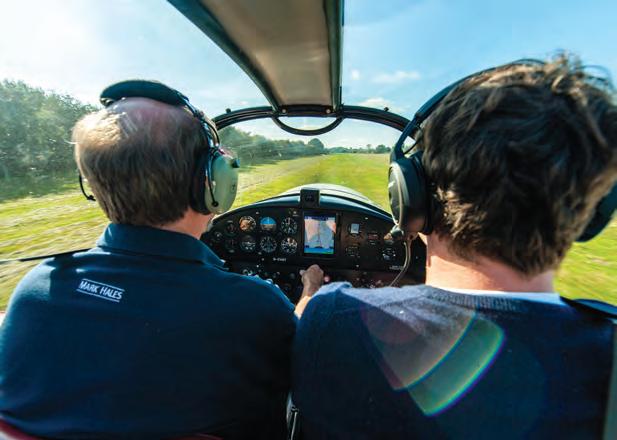
Taking a friend flying, who has never flown in a small aeroplane before, can be an incredibly rewarding experience, but it doesn’t come without obligations. Delivering a thorough briefing before take-off is crucial to ensure safety, comfort, and compliance with aviation regulations. The passenger brief should include safety protocols, emergency procedures, and new for this year, a reminder about the active CO detector you must now carry if that passenger is not a PPL-holder.
What is a passenger brief?
A passenger brief is a detailed explanation given by you, the pilot and captain of the aircraft, to ensure that all occupants understand critical safety information. The purpose is to familiarise the passenger(s) with aircraft
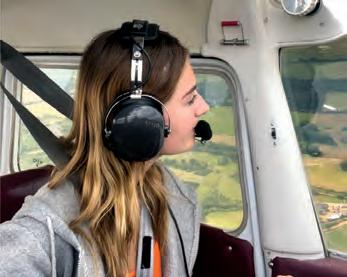
Below A cockpit can be a noisy, distracting place for a passenger, so make sure they understand their surroundings.
“For flights over water, pilots must ensure passengers are wearing a life vest and know how to inflate it, stressing why it must not be inflated until they have exited the aircraft”
systems, emergency equipment, and specific actions they may need to take during normal or emergency situations.
Passenger briefs are legally required and help to minimise confusion or panic in case of an emergency.
Seat harness
Prior to fitting a seat harness, ensure the passenger’s seat is secure, if it’s adjustable in any way, the last thing you want is for their seat to shoot backwards on take-off, which could result in them grabbing the controls at this most critical stage of flight.
Instruct your passenger on how to fasten and unfasten the seat harness, and help them adjust the belt for a snug fit to maximise safety.
Canopy or doors
Explain how to open and close the door(s) or canopy, and show how they are properly latched. Emphasise the importance of not attempting to open during flight unless instructed to do so in an emergency.
It is a good idea to also demonstrate the use of air vents – fresh air can be a great comfort to some passengers, should they feel a little unwell.
Emergency equipment
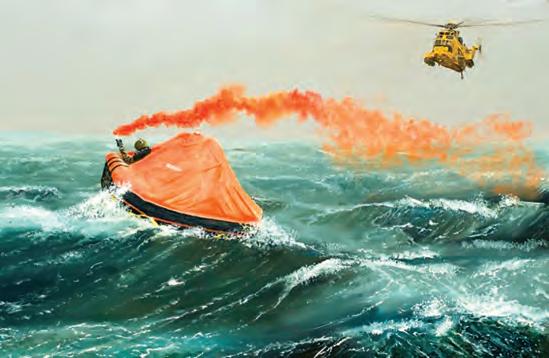
Emergency equipment varies by aircraft type, but you’ll want to let passengers know if you have a fire extinguisher and a first aid kit. For flights over water, pilots must ensure that passengers are wearing a life vest and know how to inflate it, stressing why it must not be inflated until they have exited the aircraft. This also applies to the use of any other flotation device, life raft or dinghy.
Passengers should be shown the location of any ELT (Emergency Locator Transmitter) or PLB (Personal Locator Beacon), how it functions and how to operate it, and its importance in aiding a swift rescue.
For overwater flights, passengers should don their life jacket prior to getting into the aircraft, and should be briefed on:
● How to inflate their life jacket or dinghy after exiting the aircraft.
● To exit the aircraft promptly after it comes to a stop.
● The use of any PLBs, if appropriate.
● To stay together in the water to await rescue.
In flight
Take-off and landing are exciting but critical phases of flight, and passengers should be reminded to remain calm and avoid distracting you in any way, especially by talking.
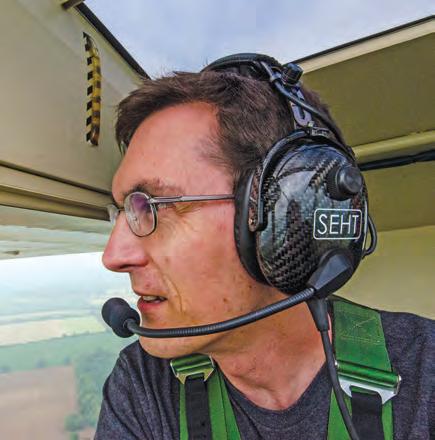
Above A well fitted headset helps reduce noise and microphone placement is important for good comms.
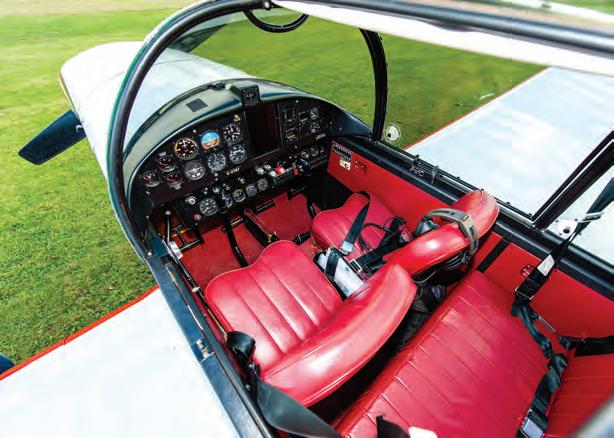
Above right Be sure to explain how any door or canopy works, and how to adjust and secure a seat.
Do tell them to alert you to something, if they feel they’ve spotted something that could be a major problem, or threat, especially something like traffic.
Even in normal ops it’s good practice to brief about leaving the aircraft to the rear, away from the propeller. In the event of a forced landing, while the prop might not be turning anymore, there could be the risk of fire. So moving away from the front of the aircraft is a good thing.
Fire in flight
Remind passengers that it is vital that they remain calm.
● Electrical fire: Brief that you may need your passenger to assist you by using the fire extinguisher if directed by yourself (you will have already briefed them on the location and operation of the fire extinguisher).
● Engine fire: You would typically execute an emergency landing as soon as possible. Keep your passengers fully briefed on your intentions so as to allay any fears.
After a forced landing
Remind passengers how to make the aircraft safe if you, as pilot, are injured or unconscious after a forced landing. That should, at minimum, cover turning the fuel and the electrics off, so be sure to show them where, and how, any levers or switches work.
Passenger comfort and etiquette
Light aircraft are more susceptible to turbulence than large commercial jets, which can cause motion sickness. If your passenger starts to feel unwell you should:
● Offer your passenger a sick bag, and suggest they look to the horizon to help reduce any symptoms they might encounter.
● Suggest light snacks prior to flight, as flying on either an empty or overly full stomach can exacerbate nausea. As communication is vital, a briefing on the correct fitting of headsets and placement of the microphone is key, as is a reminder to keep chatter to a minimum during critical phases of flight. Obviously not touching the
“A well-conducted passenger brief is not just a regulatory requirement, it’s a crucial element of flight safety. Clear briefing during the flight sets the tone for a safe journey
Below While unlikely, it’s important to remind passengers what they can do should you have to force land due to a problem.
controls, either with their hands or feet, is a good reminder – as is not to interfere with any instruments, unless you ask them to do so.
A well-conducted passenger brief is not just a regulatory requirement – it’s a crucial element of flight safety in light aircraft. By ensuring that passengers understand the basic operation of the aircraft, safety procedures, and emergency protocols, you, as pilot in command, can greatly enhance the safety and enjoyment of the flight experience for your passengers, and help make sure they have an enjoyable flight. ■
The latest LAA Engineering topics and investigations.
Compiled by Jon Viner and Lucy Wootton
Engineering Matters
Including: Responsibilities of being a Permit aircraft owner, Cessna 120 corrosion, cracked NSI propeller blade, and a contaminated new stock coolant hose…
Welcome to Engineering Matters – the section of Light Aviation that is dedicated to discussing all manner of topics concerning both technical and operational aspects of the LAA fleet. We all learn by sharing information, so if you
have anything to say that you think would benefit others, or have experienced an interesting technical issue or component failure, then please contact us with a description of what you encountered and include accompanying pictures. Send your submissions to LAA Engineering at engineering@laa.uk.com
Continuing airworthiness issues
A pair of ageing Cessnas
Two examples of the Cessna 120 have been reported with serious corrosion and other problems recently. The first had corrosion of the aluminium skins and certain spars of the tailplane, elevators and ailerons, which appeared to have long gone unnoticed (or at least, long gone untreated), but were very evident when the control surfaces were removed. The elevator skins were also cracked near to and into the rivet holes for the rivets joining the elevator skins together at the trailing edges. While this might have been an acceptable temporary repair, the Cessna repair manual calls for cracked skins to be replaced or repaired and that stop drilling is only a very temporary expedient to stop cracks growing further until dealt with properly. This C120 also suffered from surface rust forming on steel parts, including the wing lift struts and undercarriage legs, and light surface corrosion on both port and starboard wing spar webs.
Left Elevator with multiple stop-drilled cracks at trailing edge into rivet holes.
The second C120 was found to be suffering badly from a different form of corrosion, in the form of very serious exfoliation of the extruded L section aluminium alloy angles that are riveted to the rear fuselage skins to stiffen them. The flanges of the L section had virtually disintegrated locally, as seen in the pictures. The corroded areas appeared to have been painted over at some stage with zinc chromate primer, indicating that someone, at least, was aware of a developing issue. However, it’s well known that exfoliation, once it takes hold, can never be halted by a paint treatment because it infiltrates and undermines the crystal lattice structure of the metal itself.
Below Corroded skins in tail-cone, apparently painted over with zinc chromate primer.
Both of these Cessnas were seriously unairworthy as found and reflected very badly on the quality of both maintenance and inspection, leading to serious questions being asked by HQ. Aircraft such as these are, nowadays, 80 years or so old and simply cannot be expected to remain in safe condition without an appropriate level of TLC and vigilance, including being taken out of service from time to time for ‘deep maintenance’ and parts replacement. While low cost to buy, such aircraft cannot be expected to operate year after year on a shoestring budget – left neglected for too long, these old aircraft soon become unsafe, and often beyond economic repair.
Continued overleaf...
Above Exfoliation of the extruded L section aluminium alloy angles that are riveted to the rear fuselage skins to stiffen them.
Above Wing with corroded spar and skins.
...Continued from overleaf
Crack recently discovered in NSI blade retaining cuff
We’ve recently been informed of a potentially very serious crack developing in the propeller blade retaining cuff of an NSI variable pitch propeller installed on a Europa aircraft, which was found when investigating some vibrations experienced in flight. Had this not been caught in time, further progression of the crack would likely have led to the loss of a blade in flight.
The investigation of the crack incident revealed that the blade retaining cuffs fitted to the aircraft were of an early type, which had been prohibited from being used on LAA aircraft some 20 years previously, due to a similar thing having occurred with one of these propellers on a floatplane in Canada, causing the engine to be ripped from its mount.
To give some background, in 2002, after cracking problems occurred, the manufacturers advised that they were developing an improved thicker wall cuff which would be made available, although this would involve customers sending the blades back to NSI in the States for the new cuffs to be fitted. The LAA (PFA as it was then) issued a warning memo to all owners of aircraft fitted with NSI propellers in April 2002 advising against operating these propellers with the original type of blade cuff for more than 25 flying hours. In October 2004, a further serious incident occurred to a Canadian aircraft fitted with one of these propellers when a crack in an NSI blade cuff progressed to failure, releasing the blade and resulting in the aircraft’s engine breaking loose from its mount. As a result of this, in November 2004, the PFA issued a mandatory airworthiness information bulletin, MOD/247/005, grounding all NSI CAP 140 propellers fitted to PFA aircraft. This grounding applied to those propellers with the original ‘Version 1’ and the improved ‘Version 2’ blade cuffs, and remains in place.
Subsequently, in March 2005, NSI issued an airworthiness directive AD 830605-01 which introduced an improved ‘Version 3’ blade cuff developed for the CAP 140 propeller, and life limits for the
various types of blade, depending on the engine to which it is fitted. PFA sent this AD to affected owners at that time, and afterwards it was promulgated for many years in the LAA Inspector’s SPARS handbook. LAA aircraft must only be flying if fitted with the Version 3 blade cuff, and within the propeller blade cuff life limits in the AD.
It is not known how the aircraft, which had the blade cuff crack recently, came to still be operating with this early type of cuff fitted, despite its use being prohibited 20 years previously.
NSI propellers are now long out of production and are no longer supported. Our records show that the majority of the aircraft in the LAA fleet, which were fitted originally with NSI CAP 140 propellers and are still operational, have since been fitted with an equivalent alternative current production propeller. Our records also indicate that none of the very few LAA aircraft that may still be fitted with NSI propellers have accumulated flying hours approaching the life limit for blades with Version 3 cuffs.
However, because of this potentially very serious recent finding, LAA Engineering wrote to all owners of aircraft which have at some time been cleared to use the NSI CAP 140 type propeller, strongly advising the owners to check that it is fitted with the Version 3 cuffs, plus that the propeller blades have not exceeded their life limit. Details of how to identify the blade cuff type, and the safe life limit are set out in NSI AD 830605-01, which LAA Engineering has sent to owners along with the advice above. To try to ensure this problem never rears its ugly head again, LAA Engineering has advised any owners who may have one of these old – and nowadays obsolete – propellers hanging up somewhere as a keepsake, to tape a copy of the AD securely to it to flag the issue up to anyone who it might pass to in future – as well as, as always, marking up the propeller logbook accordingly.
Right NSI blade cuff showing visible crack.
Responsibilities of being an owner
In sorting out some owner/member issues in recent months, it’s become apparent that the awareness of what owners are responsible for isn’t as widely understood as we’d hoped. But taking a moment to pause for thought, it’s probably not surprising that today’s average owner has less of an awareness of the wider LAA landscape than the average owner of even 10 years ago. Fewer aircraft are being built, with many members new to the LAA buying second-hand aircraft. Many are also owners of aircraft transferring to a Permit to Fly from a Certificate of Airworthiness, where the basic philosophy of aircraft ownership is somewhat different.
The principle tenet of Permit to Fly aircraft ownership is that the owner/operator is responsible for everything! The system that LAA provides under its CAA approval is designed to help the owner meet their responsibilities, and help prevent those holes in the layers of Swiss cheese from lining up. So, it is the responsibility of the aircraft builder to build an aircraft in accordance with the drawings, and their valiant Inspector will do their best to provide advice and a second pair of eyes. It is the aircraft owner’s responsibility to maintain (or ensure that someone maintains) their aircraft in an airworthy condition – and their Inspector is there to certify work done on the aircraft and to regularly confirm that the agreed maintenance regime appears to be being carried out by the owner. If an LAA Inspector carries out maintenance on an aircraft, that is a private arrangement between the owner and that individual, but isn’t a role that they’re doing as an LAA Inspector.
As well as providing the structure and network of Inspectors, the LAA provides a wealth of advice and information. At the last count there were around 90 Technical Leaflets and more than 130 TADS (Type Acceptance Data Sheets), designed to provide members with advice on a whole range of subjects. The challenge with so many documents is to keep them up to date, and we’re busy reviewing the Technical Leaflets to spruce up any outdated information. The Leaflets are divided into three categories: series 1 covers the building, buying and designing of aircraft; series 2 covers the operation and maintenance of aircraft; and series 3 covers the modification and repair of aircraft. Head over to the website and follow the links to discover this treasure trove of support: Info library / Engineering / Technical leaflets.
Of particular interest to the new owner/member is Technical Leaflet 2.01 A guide to LAA aircraft ownership, which has just been updated – we’ll be emailing a copy of this to every new LAA aircraft owner when we learn of a transfer of ownership. If you’re not new to LAA aircraft ownership, please don’t be offended if we send you a copy anyway – we feel that the time when you acquire a new aircraft is a good time to remind you of your responsibilities and where to go for further advice.
The owner/operator is responsible for:
● The continuing airworthiness of an aircraft, and shall ensure that no flight takes place unless the aircraft is maintained in an airworthy condition (as taken from CAA BCAR Section A3-7).
● Ensuring that the Permit to Fly and associated Certificate of Validity remain valid for flight (or arrange for alternatives such as a Certificate of Clearance for test flying).
● Operating the aircraft within the limitations stated on the aircraft’s Operating Limitations document.
● Maintaining the aircraft’s documentation, including airframe and engine logbooks and any associated worksheets, weight and balance schedule, etc.
● Ensuring that the aircraft confirms to an approved design standard, and that no modifications or repairs are introduced except under appropriate LAA procedures.
Lucy Wootton: Head of Airworthiness and Inspection – Updates
An Inspector returns
Welcome back to LAA Inspector, Carl Daniels, who has returned to LAA Inspectorship after a break of eight years.
Carl is located near Salisbury and currently employed at Bournemouth Airport. He has been in the aircraft maintenance industry since 1997, initially completing an apprenticeship with Hunting Aviation/Babcock Aerospace at RAF Lyneham on C130 Hercules structures and components. Since then he has maintained various light aircraft, including Slingsby T67, Grob G115E, Diamond DA40, Diamond DA42, Cessna 421C, along with many other GA and LAA types.
He is currently Hangar Supervisor at Hurn looking after Pilatus PC12 and PC24 aircraft. He holds both UK CAA and EASA Part-66 B1.1, B1.2, B3 and C Licences and has a UK PPL (A).
Carl recently attended a refresher session at LAA HQ to get back up to speed with LAA procedures.
Welcome back Carl, it’s great to have you as part of the team again!
● Ensuring that continued airworthiness requirements such as CAA Mandatory Permit Directives or LAA Mandatory Technical Directives are carried out.
● Ensuring that any work on the aircraft is appropriately signed off, either by an LAA Inspector or, for a number of straightforward tasks, the owner/pilot (see TL 2.04).
● Insuring the aircraft to at least the minimum legal level, including passenger insurance where appropriate.
● Reporting any accidents to the Air Accident Investigation Branch.
● Obtaining and maintaining an appropriate pilot’s licence.
● Operating the aircraft in accordance with the rules of the air.
Much of the above is of course true for aircraft operating on a Certificate of Airworthiness, but the emphasis with a Permit to Fly is that much more of the control is in the hands of the owner/operator – there’s more flexibility to maintain your own aircraft and there are opportunities to modify or repair the aircraft more easily.
These advantages come with the associated need to proactively manage your aircraft, particularly ensuring that you keep on top of the maintenance and monitor LAA channels for airworthiness information.
And remember, your Inspector is there to facilitate, not to take on your airworthiness responsibilities!
The perils of operating from grass airfields in winter
LAA Engineering was recently sent a photo of a fuel drain valve, covered in mud on a PA-28, after the aircraft had been operating on a grass airfield this winter. Although a certified aircraft, the lesson remains the same – ensure fuel drain valves are kept clean and, in particular, cleaned before they are operated if covered in mud, to ensure the valve does not become blocked or stuck open.
Left It’s in there somewhere! A fuel drain valve covered in mud.
Preparation for the new online Permit to Fly revalidation system, being introduced by the start of the new flying season, is continuing in earnest. We are currently working closely with the IT developers to build the new system, incorporating feedback from the in-person consultation sessions that we held at LAA HQ in December with a group of owners and Inspectors. There will be more opportunities for engagement, both written and in person, over the next couple of months. As before, if you would like to provide feedback, please email permit.project@laa.uk.com.
We remain focused on our mission statement to: “Provide a certificate of validity to safe and airworthy aircraft that is easy, efficient and consistent for customers and the LAA, and that complies with the requirements of CAA BCAR A8-26.”
The new Permit to fly revalidation system
Contaminated coolant hose new from manufacturer
An LAA Inspector recently reported that he received a new 12mm internal diameter coolant hose from the manufacturer, sealed in the original ziploc bag.
On removing the hose from the bag, he found it contaminated internally with a lot of debris. Some appeared to be cotton or some similar fabric (probably from the strengthening ‘weave’ embedded in the hose wall), but there were also a lot of metal filings that could be drawn out with a magnet. Obviously, debris introduced into the coolant system is not going to be good for the pump, radiator or coolant galleries. The issue has been highlighted to the supplier and the hose returned for further investigation.
It is certainly a good reminder to inspect any part prior to fitting it to an aircraft or engine. Never assume that just because it is new, it is serviceable and fit for purpose.
Right Debris inside coolant hose as supplied from manufacturer.
Recent Alerts, Technical Service Bulletins & Mandatory Technical Directives
MTD-01-2025 – ‘Inspection of horizontal stabiliser (tailplane) attachment brackets and associated hardware for cracks, looseness and other forms of distress’ was issued on 14 January 2025.
A number of cases have been found whereby the structural integrity of the horizontal stabiliser mountings on the Zenair types identified above have been compromised by one or more of the following:
● cracking of the attachment brackets
● oversize holes
● loose rivets
● distorted and chafed brackets.
LAA Engineering charges
LAA Project Registration
Kit Built Aircraft
Plans Built Aircraft
Initial Permit issue
Up to 450kg
451-999kg
1,000kg and above
Permit Revalidation
£360
£52
£725
£828
£931
(can now be paid online via LAA Shop)
Up to 450kg
451-999kg
1,000kg and above
£ 241
£ 292
£323
These problems could occur due to a number of factors including poor build quality, a build-up of tolerances in the positioning or dimensions of the brackets, improper assembly, rough treatment or inflight vibration.
Failure of a tailplane attachment could result in degraded controllability in flight or loss of control.
Special inspections of this area have been recommended by Zenair since January 2017, in its document ‘Mandatory Action. Jan. 2017 – Inspection of Horizontal Stabilizer tail attachment brackets.’ This Mandatory Technical Directive mandates this safety action for aircraft operating on LAA Permits to Fly.
Factory-built gyroplanes*
(all weights)
£323
*Gyros note: if the last Renewal wasn’t administered by the LAA, an extra fee of £155 applies
Modification application
Prototype modification minimum
£103
Repeat modification minimum
£52
Transfer (from C of A to Permit or CAA
Permit to LAA Permit)
Up to 450kg
451 to 999kg
1,000kg and above
£ 288
£330
£371
Permit flight release certificate £ 26
Category change
Group A to microlight
Microlight to Group A
Change of G-Registration fee
£ 206
£ 206
Issue of Permit documents following G-Reg change
£62
Night/IFR Fee
Certified ADS-B Out fee
Replacement Documents
Lost, stolen etc (fee is per document
£309
£31
£26
Struts 4U
David Millin takes a look at Struts news and view from around the UK
Six months ago, I took on the task of compiling the Struts4U column on a temporary basis. I am now pleased to tell you that as of next month, Neville Parton, Chairman of the Bristol Strut, is to assume this role and continue keeping you all informed of what is going on in the world of the LAA Struts and Type Clubs. I’ve enjoyed my short tenure with this task, as it has given me the chance to interact a little more with both the Struts and the wider membership. I wish Neville every success with the continuation of this page, which represents such an important element of what we do in the LAA.
I would ask that Struts show their support sending Neville regular updates, news and photos. It doesn’t have to be much, as even small contributions help to provide a regular update of what’s going on at a grass roots level within our Association. It also helps encourage those members who haven’t yet connected with their local strut, to maybe make that connection because they see something they would like to join in with.
● Bristol Strut
Neville Parton writes. The Bristol Strut finished a memorable year of activities with a combined Christmas Dinner and Quiz at the Willy Wicket Inn, and the Strut Chair (Neville Parton) was presented with the Ian Leader Trophy for services to the Strut. January’s meeting gave members an opportunity to recap their flying adventures over the previous year, and to discuss plans for 2025, plus there was an update from the recent meeting of the Bristol Airport Local Airspace Infringement Team (LAIT), where the Strut is represented by Trevor Wilcock. February’s Strut activity will be a visit to The Helicopter Museum at Weston-super-Mare. The date of the meeting is still being determined but will be advertised on the Strut website shortly. The following month we revert to meeting at BAWA on Tuesday 4 March, when the LAA’s Chief Inspector, Lucy Wootton, will be talking about all aspects of continuing airworthiness and inspection across the 2,700 aircraft operating under the LAA’s auspices. Again,
Above Joystick Club members and their cockpit simulator at their Bicester Scramble event in January.
more details are available on the website. Importantly, we’re always very happy to see visitors and friends at our Strut Events and Fly-Ins!
● Devon Strut
David Millin writes. The Winter Solstice is behind us and the days are slowly getting longer, now all we need are a few breaks from the grey weather. One such day occurred for me on Sunday 12 January… Jodel ‘Charlie Golf eagerly burst into life on the first blade, despite sitting alone in the hangar for two-and-a-half months. It is just as well to take your time, plan and think things through after a long lay off with a view to maintaining the number of landings to equal the number of take-offs!
Our first Strut Evening of the year was cancelled due to our speaker suffering a bereavement. However, the speaker, Adrian Corfield, from the National Police Air Service has something else for us to look forward to later on in the summer. Our next meeting on 11 February sees our AGM, as well as a visit from Light Aviation Editor, Ed Hicks, who will be talking about air-to-air photography, as well as EAA AirVenture, Oshkosh.
● Joystick Club
Mike Clews writes. As always, the Joystick Club endeavours to spread the joy of aviation to all, especially the youngsters, upon which the future of our kind of aviation depends. Hot on the heels of the New Year and despite the wind and snow, 11 stalwarts of the Joystick Club Scramble to Bicester, including Matthew from Shuttleworth, who kindly brought along his large take apart Hawker Hurricane, Gaynor and husband Mark, Amy and dad, Roger Woodbridge, Roddy Maddocks, plus the ‘usual suspects’. The next Joystick Club Scramble will be at Bicester on 27 April from 0900 to 1600. We look forward to seeing you there.
●
Gloster Strut
Mike Waldron writes. Gloster Strut celebrated 32 years, and still going strong. Bubbles and cake were laid on, of course, putting the New Year resolutions to the back of the mind. However, it’s not all fun and games, as we also have to hold the much more serious affair of our AGM. We don’t do serious very often, so we will try to speed things up a bit by notifying all of our members in advance with the financial state of play for 2024 and the projected budget of 2025. Needless to say, we are cruising along quite nicely with more than 100 members ranging from seven to 87 years old. We also have a few pounds in the bank to subsidise a few outings. The record time set for our AGM was four minutes and thirty seconds, so we will try and do better this year! Post-AGM, we will have a short time slot which we will fill this year by screening a short documentary film of the most incredible aircraft recovery
of all time – the recovery of a P-38 Lightning from under the Greenland icecap where it had lain since WWII. The aircraft went on to be restored to fly as Glacier Girl. Now that’s what I call a rebuild.
● Kent Strut
Nic Orchard writes. It’s a slow time for Kent. Some of the dates of our spring talks are to be confirmed, but we do have LAA CEO Simon Tilling booked for February. Kent Strut meets at alternate venues, monthly: the PAFRA clubhouse at Rochester and the RAF Manston History Museum Cafe.
● East of Scotland Strut
Justin Kennedy writes. Hi All, I hope you had a nice Christmas and a good New Year. We are looking forward to another talk by David Johnstone on 4 February when he will show us some great pictures from America. I hope your aeroplanes are wrapped up warm as the temperature is threatening to sink well below zero, that is, here in the central belt. Those of you further north have already experienced this. My Europa is all cosy in its trailer with a little electric greenhouse heater. As usual, Scotland does come up with a few amazing flying days among the clag. There is always good light for photography on these days, so take a few pictures and send them to Andrew McLeod or myself and we will publish the best in our Newsletter. There’s a challenge! Wrap up warm though.
● Wessex Strut
Neil Wilson writes. Our Strut Awards night takes place on Friday 21 February, followed by the Bournemouth Air Traffic Control talk, which will follow the meal at 1830. On 21 March, there will be a presentation which, although to be confirmed, will not disappoint! The Struts fortnightly walks continue, as always. If you are interested in joining us, for information, drop an email to chairman@ wessexstrut.org.uk
● Cornwall Strut
Pete White writes. Out of the current gloom of the Bodmin Moor there are some brighter periods to look forward to. On 21 February, Kath Burnham will be talking to us about flying a Dakota for ‘D Day 80’. On 19 March Chris Dobrowolski presents as artist, Flying Flea builder and pilot, and on April 16, we are graced with the company of Allie Dunnington who will enlighten us on her adventures of ballooning around the world. Please come along and bring a friend. ■
Strut Calendar
Please contact your local Strut to check the details before attending the calendar events.
Andover Strut: Spitfire Club, Popham Airfield, SO21 3BD. Contact Bob Howarth email: bobhowarth99@ btinternet.com Phone 01980 611124. Bristol Strut: Contact: chairman@ bristolstrut.uk www.bristolstrut.uk. Details from the Chairman or via the website.
Cornwall Strut: The Clubhouse, Bodmin Airfield. Contact Pete White pete@aeronca.co.uk 01752 406660. Devon Strut: The Exeter Court Hotel, Kennford, Exeter. Contact: david. millin@sea-sea.com Evening Events at the Exeter Court Hotel, Kennford, Exeter, from 1930.
East of Scotland Strut: Harrow Hotel, Dalkeith. 2000 hrs. Contact: Tim Raynor hipe@btinternet.com
East Midlands Strut: Meeting at 1930 on the first Tuesday of the month at The Plough, Main St., Normanton on Soar, nr Loughborough, LE12 5HB. Contact Tony Razzell on 07484 873206 or email tonyrazzell2@gmail.com We also have a Facebook group and upload recordings of some meetings where we have speakers.
Gloster Strut: Contact: Harry Hopkins phone 07902 650619 harry.hopkins@ talktalk.net
Kent Strut: Contact: Steve Hoskins hoskinsltd@outlook.com 07768 984507.
LiNSY Trent Valley Strut: Trent Valley Gliding Club, Kirton Lindsey. pilotbarry1951@gmail. com http:// linsystrut.wixsite.com/website North East Strut: There are no meetings at present, but if you would like to help to get the NES operational again please get in touch with the Strut Coordinator, David Millin. david.millin@ sea-sea.com
North Western Strut: The Clubhouse, Boysnope. 1400. Third Thursday each month. Contact: cliffmort@btinternet. com 07813 497427.
North Wales Strut: Caernarfon Airport, Dinas Dinlle. First Sunday of the month – HEMS Bistro Café. 1300. Contact: Gareth Roberts gtrwales@gmail.com 07876 483414.
Oxford Group: Sturdy’s Castle Country Inn, Banbury Road, Kidlington, OX5 3EP. Second Wednesday each month. Contact LAAOxford@gmail.com www.oxfordlaa.co.uk.
The Joystick Club: Activities throughout the year. Pedal planes and simulators at Old Warden Air Shows. Contact: Mike Clews, mgclews@gmail. com. 07775 847914. www.joystickclub. co.uk
Vale of York strut: Meetings are held at 1900 on the third Thursday of October-May in the Clubhouse at York Gliding Centre, Rufforth Airfield, YO23 3NA. Contact: Chris Holliday 07860 787801, valeofyorkstrutlaa@gmail.com, LAA Vale of York Strut on Facebook for meeting details.
Wessex Strut: Monthly meetings at Henstridge Airfield Clubhouse. See www.wessexstrut.org.uk for details of upcoming events. Local fortnightly walks are also organised. Contact Neil Wilson at chairman@wessexstrut.org. uk
West Midlands Strut: There are no meetings at present, but if you would like to help to get the WMS operational again please get in touch with the Strut Coordinator, David Millin. david.millin@ sea-sea.com
West of Scotland Strut: Various locations in the Greater Glasgow area. Contact: New Co-ordinator being sought.
Youth & Education Support (YES) – YES also available for Strut talks/ presentations. For any information about YES or Young Aviators 2024, please contact 2024@gmail.com
• Please contact your local Strut to check the details before attending the calendar events.
Above Snippets from the excellent East of Scotland Strut newsletter.
Flight obsession
Ed Hicks talks to Jonathan Wilkins about his days as a hangar rat, to his first display with the Turbulent Team
What started your interest in aviation?
When my sister and I were young children, mum and dad often took us to Headcorn Aerodrome, which was fairly local to where we lived. We would spend the afternoon sitting in the field adjacent to the runway having a picnic and watching the aircraft take off and land. Yes, I was that small boy that would wave at every single aircraft. While dad was a former sailor in the Royal Navy he still had a big interest in aviation, particularly vintage aircraft, so I regularly went along with him to our local airshows. Manston, Folkestone seafront, Biggin Hill and of course my favourite back then, the Great Warbirds Air Display at West Malling. By that point I’d become obsessed with aeroplanes… and the seed was well and truly sown.
When was your very first flight?
My very first experience of flight was in the mid-1980s, as a member of my local Cub pack we took part in a gliding experience day at Channel Gliding Club at Waldershare Park near Folkestone. I flew in an old silver Blanik from a winch launch, it was dusk and the lights of France were clearly visible way across the Channel, it was an incredible experience that I’ll never forget.
My first powered flight was at Headcorn in 1991 when I was 15 and first started ‘hangar ratting’ for the Tiger Club.
Above Jonathan at the helm of Turbulent G-BUKH.
Below A young Jonathan making an early acquaintance with a Turbulent.
One of the members, a lovely gentleman named Charles Ravenhill, offered to take me flying in the club’s Jodel D120. From that day on I never looked back!
How did you learn to fly?
I’d attended a couple of gliding courses at Challock when I was 16 and had a handful of powered flying lessons at Headcorn the following year but couldn’t really afford to keep it up.
whilst learning to fly at Redhill.
Above Helping out at the Old Flying Machine Company at Duxford.
Top right It’s a long way to fall… hanging out on an AN2.
Above middle right Early days of getting a PPL.
Above right Jonathan’s first aeroplane was a Grasshopper glider.
working my weekends as a Redhill hangar rat. Along with some savings, some gifted money from my grandmother, and a very good deal in return for work at Cubair, I was able to complete my PPL in a Cessna 150 over a period of 18 months, passing my GFT on 8 August 1996. I have to say, I really enjoyed my training, it was an amazing experience made even better thanks to the help of a brilliant instructor.
What happened after you learned to fly?
The years after I gained my PPL were mostly spent flying club Cessna’s. I spent a five year period working on an arable farm in Essex during which time I also managed to do some flying from Andrewsfield. Then in 2005 I took on the role of grounds manager at Headcorn Aerodrome, a position I held for ten years.
As well as flying my own aircraft, I was lucky enough to pick up quite a lot of ferrying jobs delivering or collecting aircraft for maintenance or change of ownership. It gave me the opportunity to fly some different types such as the Robin DR400, Slingsby T67 Firefly, Grumman AA5 and Aquila A210, among others, around South East England and further afield.
After purchasing my Turbulent, and becoming comfortably familiar with it, I was approached by the then Tiger Club manager, Glyn Richards, who offered to mentor me in the skill of formation flying.
I remember well our first flight out of Headcorn. After a comprehensive ground briefing we flew down over Romney Marsh where Glyn had briefed me to position myself and follow his hand signals. I carefully yet anxiously tucked myself in tight to echelon port and followed Glyn through several gentle turns in both directions, before repositioning to echelon starboard. I was chuffed with my progress, flying what felt like close formation for the first time.
However, during our debrief Glyn dispelled any smugness by informing me that when we flew our next sortie I would need to, at least, be flying in the same county as him… followed by his trademark giggle.
Suffice to say I did eventually master ‘tight’ formation flying and it wasn’t long before I was invited to train with the Turbulent Display Team, something that for a young pilot still cutting his teeth in the art of barnstorming was a real privilege, especially when surrounded by so many incredibly experienced pilots.
My first display actually came as a total surprise. Having already completed my Display Authorisation during one of our training days prior, and only expecting to be reserve pilot for my first season, I received a phone call out of the blue from team manager Alan Garside explaining that one of the team had called in sick and they needed a spare pilot to display at RAF Cosford the following day. Nobody else was available, so did I want to do it? This was the precursor to five brilliant seasons of
display flying with the Turb Team around the UK and in France. I was also lucky enough to be asked by Will Greenwood to do a few displays in his Bucker Bestmann, which was a real privilege.
How long have you been an LAA member?
I joined the LAA when I purchased my Druine Turbulent in 2008 and have been a member ever since.
What has the Association enabled you to do?
When I purchased my Turbulent there were several jobs I needed to carry out on the aircraft with the help of my LAA Inspector. However, further help was required from the LAA to complete paperwork for some minor mods, one of which was to change the propeller. I was assisted at the time by Andy Draper who was hugely helpful in advising me and getting the mods approved in the shortest space of time. Having the knowledge and support from the LAA is a vital asset particularly when you’ve just purchased your first aeroplane.
Total number of types of aircraft and hours you have flown
I have around 500 hours logged in 19 different types.
Any favourite or less liked types that you’ve flown? If so, why?
began restoring it with the help of wood and fabric expert Peter Kingsford. Sadly, time and funds got the better of me and the restoration was never completed. It remained stored at Headcorn for several more years before I sold it to the Malta Aviation Museum in Ta’ Qali where to this day it still awaits restoration.
It was 2008 before I purchased my first powered aircraft… and from there tells a very ironic tale…
As a young hangar rat at Headcorn I always had a fascination with the Druine Turbulent, and in later years as a Tiger Club member was eager to fly one.
However, back then an obscure Club rule stated that you had to have been checked out on the Tiger Moth before you could fly the Turb, and at that point I was still mastering the Cub.
One day, during a random conversation with an engineer at Headcorn, the subject of Druine Turbulents came up and he told me that he knew a chap at Maypole Airfield who had one and that he’d muttered about selling. I asked him if he would enquire for me and in a matter of days I was invited to go and view the aircraft.
I’d say my favourite type flown to date has to be the Bucker Bestmann. It’s a beautifully balanced aircraft, perfect for touring, aerobatic, lovely to fly and an affordable warbird on an LAA Permit. What’s not to like?
As for the least liked, being the kind of pilot that enjoys flying anything it would be impossible to single out an aircraft I haven’t enjoyed flying. However, preferring vintage types I’d probably say flying the modern Aquila A210 was a somewhat different experience.
Have you owned any aircraft?
My first aircraft was a vintage glider. Back in 1994, at the age of 18, I purchased a Slingsby TX1 Grasshopper, WZ816, as a project which had been stored in a very sorry state for many years in a workshop at Kenley Airfield. I moved WZ816 to Redhill and then on to Headcorn where I
Above Flying one of the Tiger Club’s Turbulents.
Left In the group owned Luscombe.
Below left Fun in a SnowTurb.
Below middle Jonathan loved owning Turbulent G-BUKH.
Below right
Jonathan currently has a share in this Luscombe.
I met up with the then owner, Ron Armitage, who showed me around the aircraft. Happy and excited with what was before me I put in an offer and became the very proud owner of G-BUKH, an immaculate homebuilt example of Roger Druine’s D31 Turbulent.
After I purchased the aircraft I soon became good friends with Ron and one day in conversation he told me that he once owned and ran Channel Gliding Club at Waldershare Park at which point I explained to him that this was where I took my very first flight in a glider 20 years previous! On finding some old photos of that very day, low and behold, there I am as a young boy sitting in the front of the glider with Ron sitting in the rear seat readying to take me on my very first flight. Who would have thought that 20 years later he’d be selling me my first aeroplane!
Among other aircraft Ron also owned a rare Stits SA3A Playboy, which I ferried down from Breighton for him in 2009. At the time Ron didn’t have the space for it at Maypole so I offered to maintain and fly it at Headcorn
taking part in a 2012 Olympic formation balbo over Kent, flying my Turbulent to Cambrai in France, and not forgetting, of course, my first solo.
However, I think the one flight that really stands out was my trip with Will Greenwood to the Pardubice Airshow in the Czech Republic in his Bucker Bestmann. The whole trip was an incredible experience with some absolutely hilarious moments to boot. Flying through Germany in a Luftwaffe trainer (flown by two Englishmen) certainly stirred some heads. However, one pre-booked overnight stop at Auerbach, a beautiful secluded gliding field in Southern Germany gave us instant celebrity status as we were met upon our arrival by a huge party. We were offered jugs of beer before we’d even exited the aircraft and enough food to feed an entire army. We figured they rarely get visitors, especially those from as far afield as the UK, so they really made the most of our visit and were incredibly welcoming.
I sold ‘Kilo Hotel in 2015 after seven years of raw aviation fun and it was not until 2022 that I purchased a share in my current aircraft, a beautiful Luscombe 8E, G-AGMI, having been able to fly another Turbulent, the Bucker Bestmann and a Cessna 140 between the two.
Your best aviation moment and flight – and why?
I’ve got to say I’ve had some awesome aviation moments, some of my favourites include my first display with the Turb Team at RAF Cosford, displaying over the vast sands of Cleethorpes beach on a stunningly calm sunny summers day, also flying the Turb in the snow on skis,
Above With Will Greenwood and the Bucker Bestmann.
Below Taking part in an Olympic balbo flight in 2012 was a personal highlight for Jonathan.
Below left In the Bucker Bestmann at Le Touquet.
Other highlights of the trip included almost getting arrested by Czech armed police for traveling in the back of a pickup dressed in our military flying suits, getting buzzed by a Fouga Magister jet on our departure from Pardubice and flying through the steep picturesque valleys of south east Germany, it really was an epic trip.
Do you have any aviation heroes?
I was lucky enough to have known Ray and Mark Hanna, and as a youngster they kindly allowed me to spend some weekends up at Duxford cleaning their aircraft, ground crewing at airshows and generally getting hands on with some amazing warbirds. I was learning to fly at the time, Mark was hugely encouraging and always genuinely interested to know how I was getting on. Mark’s untimely passing and latterly Ray’s, left a huge hole in the vintage aviation community, but their legacy was the inspiration they gave to me and many others.
I’ve been incredibly lucky throughout my aviation career to have met, been helped and inspired by many individuals.
The one thing I love about aviation is how, particularly when I was younger, people always wanted to help and encourage me to succeed and two individuals who particularly spring to mind were Alistair White who owned
Acebell Aviation at Redhill and the late Glyn Richards who was manager of the Tiger Club for many years, I certainly owe these two people a lot and certainly without them I wouldn’t have had the opportunities that I did.
Any favourite aviation books?
I’m not a great reader of books, however, I am very keen on aviation history, particularly that of the 1930s and 1940s. I do enjoy reading up on the history of some of my local airfields during that period. One favourite of mine, particularly as a child experiencing my first air shows, and sadly one I never got to write in my logbook, was West Malling, an airfield with an incredibly rich history in aviation. No more so than the hugely important role it played during WWII, depicted in some very well written books that I’ve enjoyed reading.
Any lessons that you’ve learned from certain flights?
I was displaying with the Turb Team at a wedding in Kent when my aircraft’s fuel cap decided to go awol mid display. It’s not a great feeling being in a four-ship tight formation turn with fuel splashing around, so I dropped out of the formation and flew the short distance back to Headcorn for a priority landing. The lesson I learned from that day?
Always check the cork fuel cap gasket hasn’t fallen out when you’re refuelling!
Do you have other non-aviation hobbies/ interests?
Being a country boy and with an agricultural background, I enjoy going to steam and vintage tractor shows as well as walking in, and generally enjoying, our beautiful countryside. I enjoy sport, particularly football and I am a season ticket holder at Gillingham, I get plenty of stick as living in Sussex I’m surrounded by Brighton fans, but my allegiance with my birth county of Kent remains strong.
Above left Aquila didn’t set Jonathan’s world on fire.
Above right Having fun in a Stits Playboy.
Below Jonathan with wife Katherine at Goodwood Revival.
Any aircraft you’d like for a fantasy hangar?
I’ve always been interested in 1940s era warbirds. I like the history that they carry, the vast array of interesting types along with the fact that most of them are big, fast and sound amazing. My cousin has recently purchased a T6 Harvard, which I’ve been lucky enough to fly. It’s certainly different from flying the Luscombe. I’d really love a mighty F4U Corsair for my dream hangar.
That’s an aircraft that without doubt gets my juices flowing. Luckily being a fantasy, I don’t have to think about the fuel bill!
Any advice for other aircraft owners and pilots?
I don’t feel I’m necessarily in a position to be able to advise fellow pilots, other than to say time has taught me that if you respect your aeroplane, it will respect you.
I would, however, actively encourage youngsters who have an interest in aviation to follow their dream.
I didn’t come from a wealthy background and I wasn’t particularly academic, so my only pathway into aviation was to get involved at grass roots and learn from others.
It proved to me that it’s possible to achieve anything if you work hard and put your mind to it. Volunteering at your local flying club is a great place to start.
You’ll learn a lot and meet like minded people in an environment of mutual interest… and that’s exactly what
Photo Competition
The LAA’s photo competition returns for 2025. Once again, it’s open to members and is all about celebrating the joy of flight with LAA aircraft.
Above Graham Wasey – Stits Playboy departs Oaksey Park. Below Alan Mortimer – Pioneer 300 over Loch Drunkie.
Above Paul Bussey – Staaken Flitzer at LAA Rally. Below Damien Dyer – Isaacs Fury flown by Paul Shenton.
A Great Read for All
LANDING MARCH 2025 VOUCHERS
It won’t be long before the flying season kicks in for 2025! Even now we are putting the wintry weather behind us. With that in mind, this month’s Landing Vouchers may tempt you to get out and about! Blackpool Airport has multiple offers to use in March for LA
readers. There is plenty to see in the seaside town, so why not plan your trip? Likewise does Eshott, in stunning Northumberland – and of course Turweston home to LAA HQ, which will be familiar to some – but new to others. Don’t miss out on this trio of treats!
Discounted landing | March 2025 | Multiple offers
Blackpool Airport: 01253 472527
Blackpool has a lot… piers, beach, a zoo and more. The airport offers a 40% discount on landing if 50L of fuel is taken, or a FREE landing if more than 50L is uploaded. There is a GA rest room with tea/coffee facilities, plus avgas and Jet A1. If you require fuel, let them know on arrival and read the details about flying to the airport before departing home base, as there are procedures to follow. All aircraft must submit a PPR. No landing or taxying on the grass. Keep a look out for traffic from BAE Warton. Call Warton if coming in from the South on 129.530. Blackpool Tower approach is 119.955. ATIS is 127.205. www.blackpoolairport.com
Aviation
Free Landing | March 2025
Eshott Airfield: 01670 787881
This is a very friendly airfield with a lovely collection of classic aeroplanes. A well-maintained runway set among the rural scenery of Northumberland, makes Eshott a good destination. A new café has tea, coffee and light meals on offer. Equipped with both hard and grass runways, its location is near the breathtaking coastline, and close to the National Park, so great views are to be enjoyed. Avgas and Jet A1 on site. Radio is 122.855. PPR before leaving home, or visit website www.eshottairfield.com
Aviation
Free Landing with 50L fuel uplift | March 2025
Turweston: 01280 705400
A warm welcome awaits you at Turweston Aerodrome, home of the Light Aircraft Association! The airfield and Flight Deck Café are open every day. Please note, prior permission is required to fly in, and if you plan to eat, we always advise making a reservation in the café, as it is a very popular venue with visitors. Call 01280 705400 Extension 1 for PPR, or Extension 3 to book a table in the café. This offer is for a free landing fee when you uplift 50L of fuel. www.turwestonflight.com
Classifieds
You can email your classified advertisement direct to the LAA at the following address: office@laa.uk.com
For all display or commercial advertising enquiries please contact Phil 07770 807035 advertising@laa.uk.com
Deadline for booking and copy: 18 February 2025
If you would like to place an aircraft for sale advert please see details below:
MEMBERS’ ADVERTISEMENTS
Up to 30 words: £6; 31-50 words: £12
Up to 50 words with a coloured photo: £45
NON-MEMBERS’ADVERTISEMENTS
Up to 30 words: £22; 31-50 words: £44
Up to 50 words with a coloured photo: £60 www.laa.uk.com
LAA Engineering advice to buyers:
AIRCRAFT APPROVED? Members and readers should note that the inclusion of all advertisements in the commercial or classified sections of this magazine does not necessarily mean that the product or service is approved by the LAA. In particular, aircraft types, or examples of types advertised, may not, for a variety of reasons, be of a type or standard that is eligible for the issue of a LAA Permit to Fly. You should not assume that an aircraft type not currently on the LAA accepted type list will eventually be accepted.
IMPORTED AIRCRAFT? Due to unfavourable experiences, the purchase and import of completed homebuilt aircraft from abroad is especially discouraged.
TIME TO BUILD? When evaluating kits/designs, it should borne in mind that technical details, performance figures and handling characteristics are often quoted for a factory-produced aircraft flying under ideal conditions. It is wise, therefore, to seek the opinion of existing builders and owners of the type. You should also take your own skill and circumstances into consideration when calculating build times. The manufacturer’s build time should be taken as a guide only.
AMATEUR BUILDING All LAA aircraft builders and potential builders are reminded that in order to qualify for a LAA Permit to Fly, homebuilt aircraft must be genuinely amateur built. For these purposes the CAA provide a definition of amateur built in their publication CAP 659, available from LAA. An extract from CAP 659 reads “The building and operation of the aircraft will be solely for the education and recreation of the amateur builder. This means that he would not be permitted to commission someone else to build his aircraft”. An aircraft built outside the CAA’s definition could result in an expensive garden ornament.
February
AIRCRAFT FOR SALE
Tipsy Trainer 1. 1,050 hrs TT, engine 9 hrs since rebuild, previously owned by Neil Williams. Delightful economic touring vintage aircraft. £25,000. Call Henry on 0779-903-58-68 New Permit on sale.
D31 Turbulent for sale. 230hrs TT. Jabiru 1600cc engine, 9 litres/hr Avgas. Electric start. Permit renewed in May. Telephone 01584 881 525 colinlbancroft694@btinternet.com
MENESTREL II, a well designed very stable aircraft according to LAA Flight Test. Powered by a Revmaster 2300, 90 hours since major overhaul, new Rotec Carb. Wing recently professionally recovered, full U/C service. New Hercules Propeller, Equipped with Garmin G5, Blaze Engine Monitor, Dual USB port, Hangared North Norfolk. LAA Permit till Sept. 2025. £20,000. Contact Peter 07557 140620. Reason for sale - new aircraft coming
Varieze Eze for sale G-BIMX. Airframe 629.20 hours. Engine 629.20 hours from new. Prop has only done 5 hours from refurb by Hercules Propellers. Aircraft out of permit, last flown 24.3.22. Reason for sale loss of medical. £12,000 o.n.o. Tel: 07940 838 476
PROJECTS FOR SALE
Chipmunk project, excellent fuselage. 6690 hrs. fresh fabric ready to paint. Wings, overhauled 23,250 hrs and 19,500 fatigue hrs remaining. New brakes, wheels. Other components in good order, complete except for engine and prop. Exceptional project deserves best workmanship to complete. All history and log books. £40,000 or best offer. Phone, 01992 892 101
PARTS FOR SALE
RV7 Engine Mount [WD-762-PC] Unused. Genuine reason for sale. Save money on your Finish Kit. For details 07782 172142.
Spruce Works Aviation Ltd. Aircraft woodwork, machining, fabric covering and inspection services available - rebuild, restoration and repair all undertaken. Experienced in vintage & classic aircraft. Contact Sam on 07703007915 or s.tomline@hotmail.co.uk
Sharing Contracts – Information and support for shared-ownership syndicates for light aircraft including guidance notes on setting up a sharing syndicate, legal sharing agreement and existing agreement checklist. www.SharingContracts.com Light Aircraft Weighing Service in Yorkshire, Lincolnshire and surrounding areas. For details contact Demraview Ltd. Email: Demraview@gmail.com Mob: 07984 810 761
ENGINE OVERHAUL. Zero time Major engine overhauls on all types, max 670 h.p., dyno run in and full power test. Bonner Engineering, Shoreham Airport. Contact Bill Bonner: 01 273 440250 aerobonner@aol.com
SERVICES & MORE
WHERE TO GO
We’re looking forwards to some of the great flying events and fly-ins in 2025.
Don’t forget, GASCo is always running Safety Evenings up and down the country. We’ve got them listed here, plus it’s worth keeping an eye on its website, www.gasco. org.uk, for further updates.
Planning ahead
Mar 16 Ardmore, New Zealand NZ Warbirds
Apr 1/6 Lakeland Florida, USA Sun n’ Fun
Apr 5/6 Deenethorpe Spring Gyro Fly-in and Camp (PPR)
Apr 26/27 Breighton Eurostar and friends fly-in (PPR)
May 3 Bodmin TopNav (PPR)
May 10/11 Compton Abbas Pooleys Air weekend (PPR)
May 17/18 Breighton Real STOL Fest (PPR)
May 17 Bodmin Ladies Day and VAC fly-in (PPR)
May 24/26 Glenforsa 53rd Mull Annual Fly-in (PPR)
Jun 6/8
As always, check the Royal Aero Club Events website for the latest information and web links for many of the events: http://events.royalaeroclub.org/events.htm
Our thanks to the RAeC and to Dave Wise for the use of their data. If you have an event you want to advertise on the list, please email the details to Dave at: dave.wise@btinternet.com
Guernsey Guernsey Aero Club 51st Air Rally, Dinner and Ball (PPR)
Jul 12/13 Breighton Vintage Aerobatic Competition and Summer BBQ (PPR)
Jul 12/13 Sleap Sleapkosh 2025 (PPR)
Jul 21-27 Oshkosh Wisconsin, USA EAA AirVenture
Aug 3 Lundy Lundy Sunday 25th Anniversary fly-in (PPR)
Aug 29/31 Leicester LAA Rally (slots)
The LAA’s own Rally returns to Leicester for 2025 on 29-31 August.