a lot of rain in January with the result that many grass airfields and strips are already getting waterlogged. While this creates an opportunity to get on with some maintenance, the near zero temperatures don’t make working in an unheated hangar a whole lot of fun. At least we can sit in the clubhouse and put the world to rights!
Reports seem to be suggesting that the oil price is going to stay low for maybe a couple of years, an unexpected bonus for recreational aviation. Mogas isn’t far off £1 a litre, down by around 20%, and avgas is now steadily dropping too as airfields use up old stock and buy in new. l’ve seen it down to £1.50, including vat. Hopefully the significantly lower cost to fill the tanks will encourage owners to do a bit more flying when the fair weather arrives in two or three months’ time.
THETEAM
Patron: HRH Prince Michael of Kent, KCVO, FRAeS
President: Sir John Allison
Vice President: Roger Hopkinson
Chairman: Brian Davies
CEO: Philip Hall
Chief Engineer: Francis Donaldson, B.TechC.Eng FRAeS
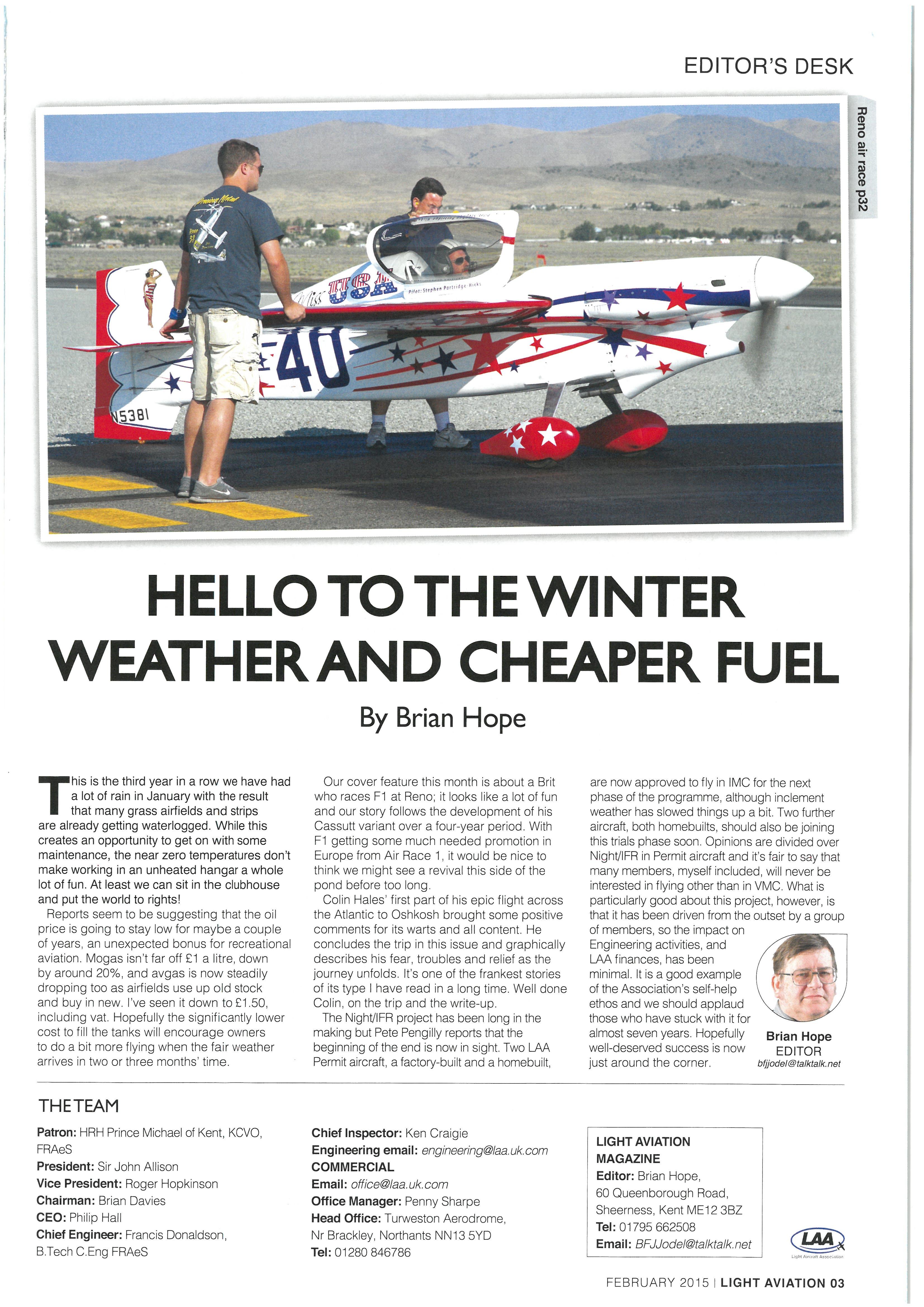
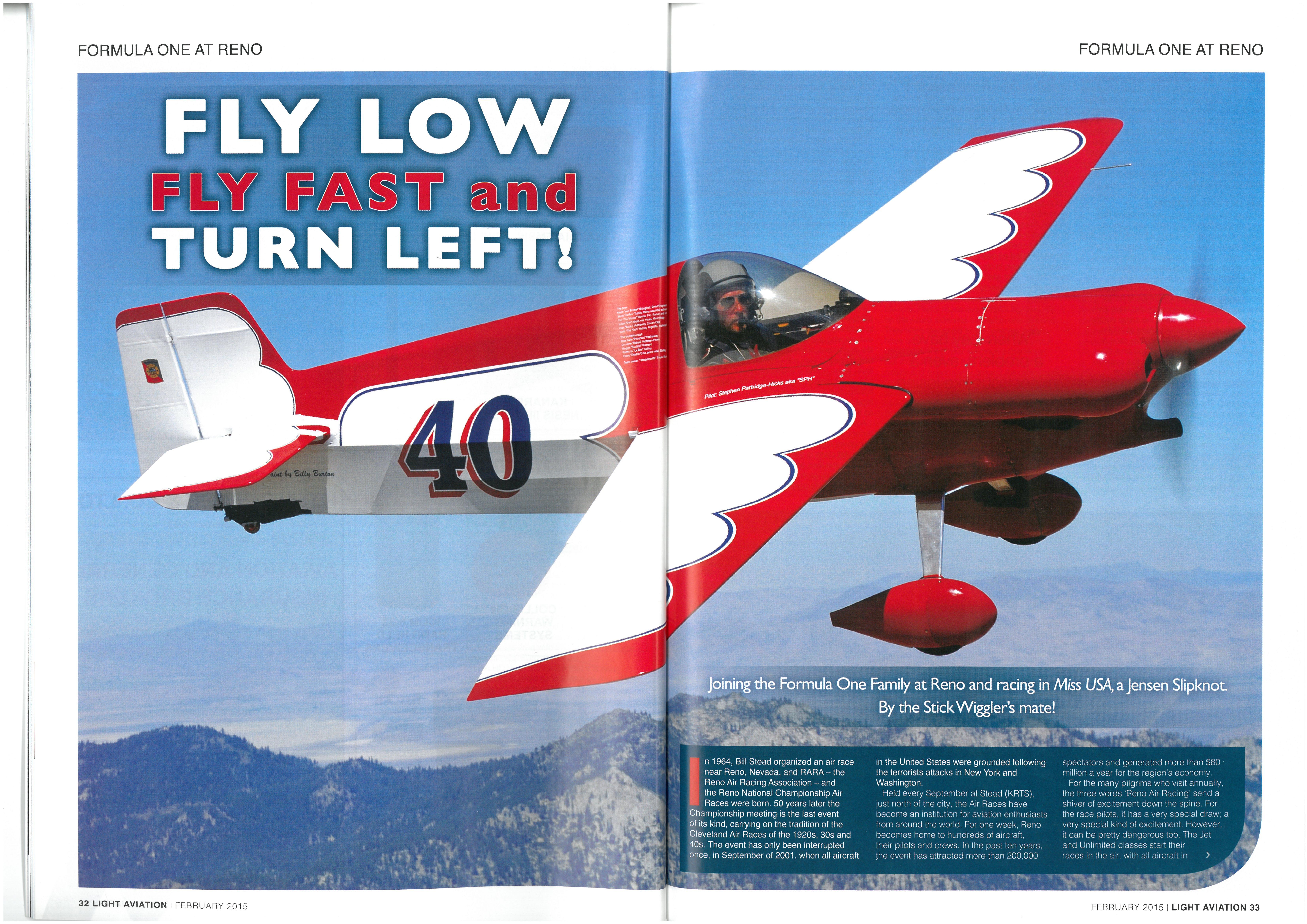
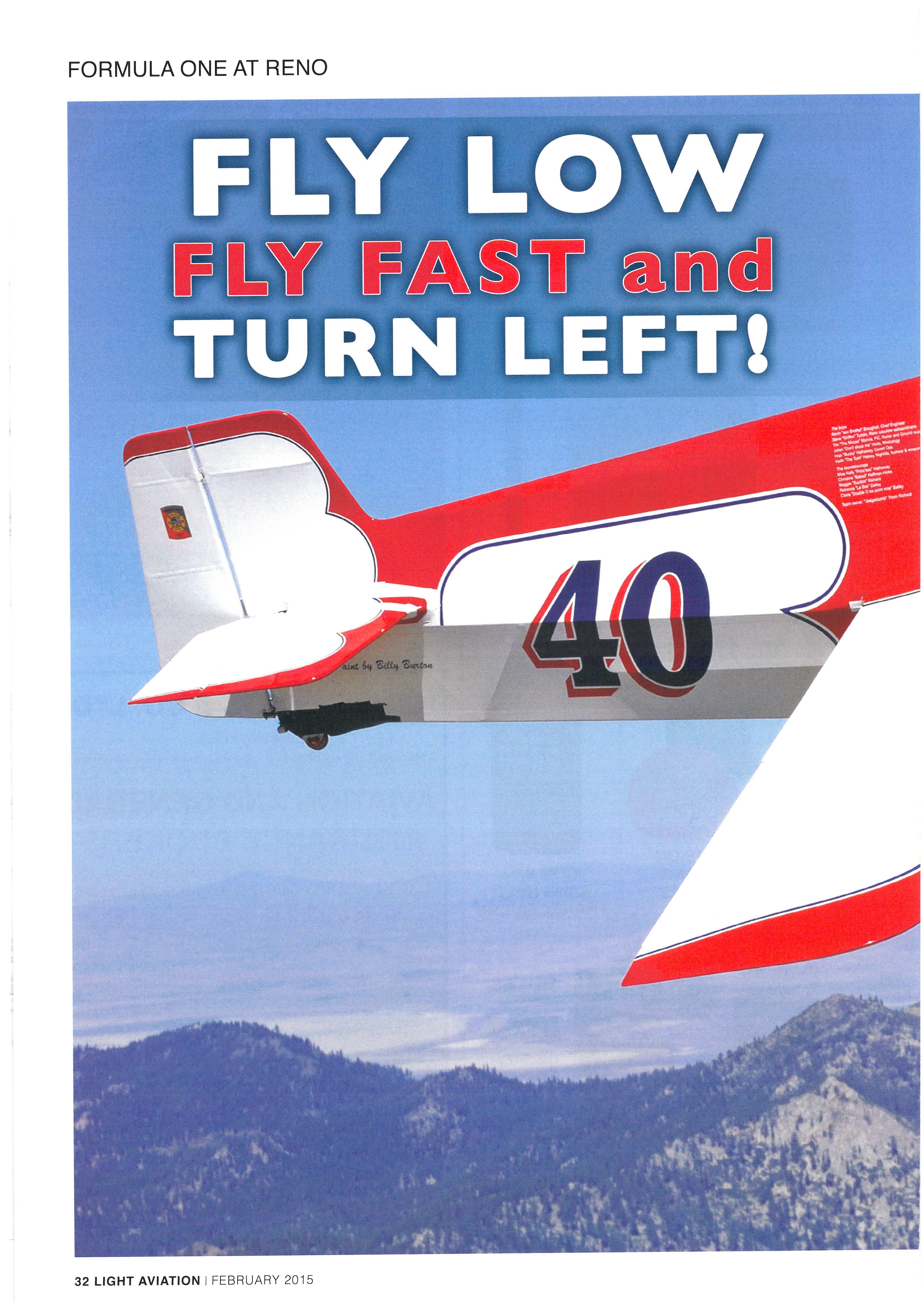
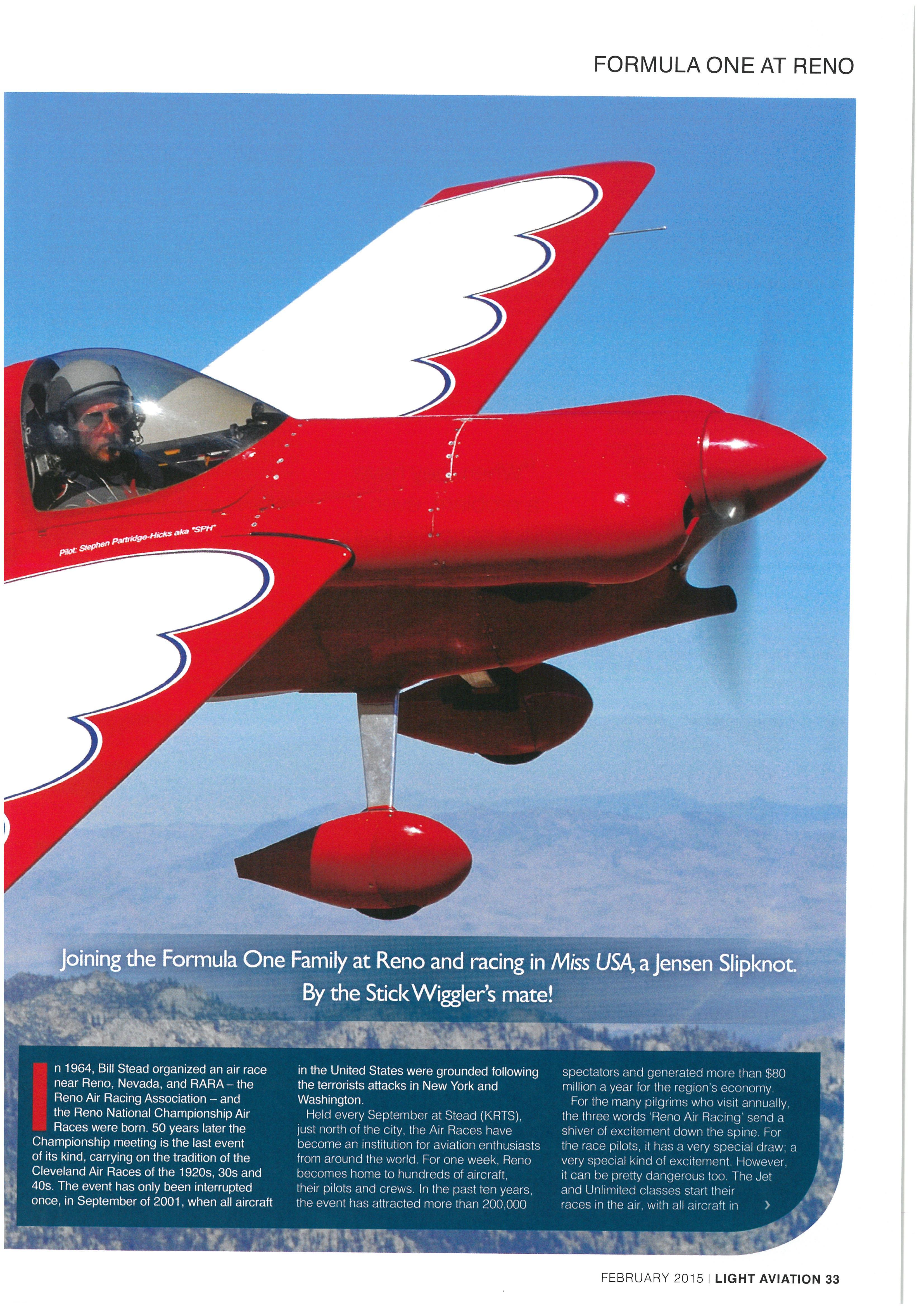
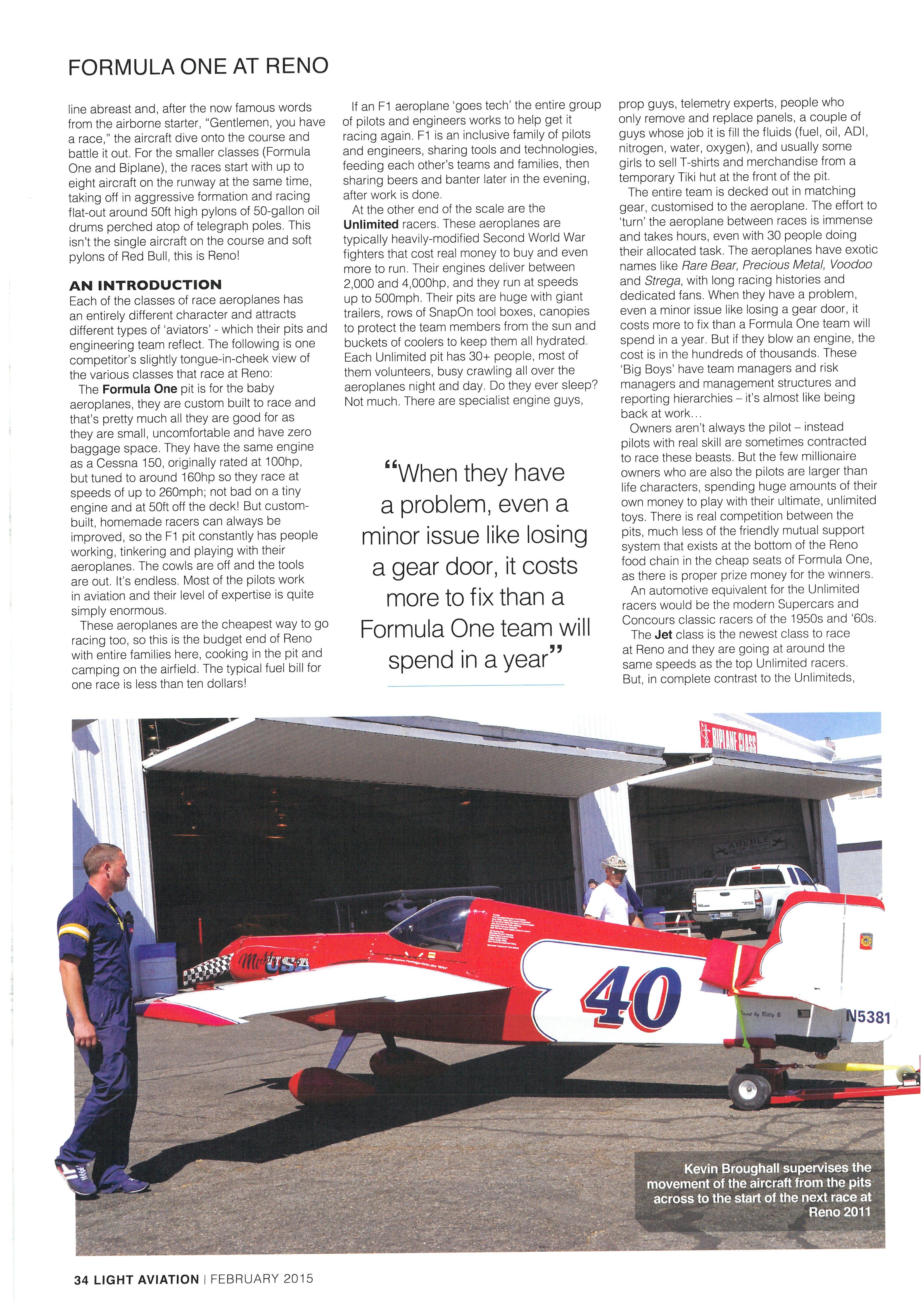
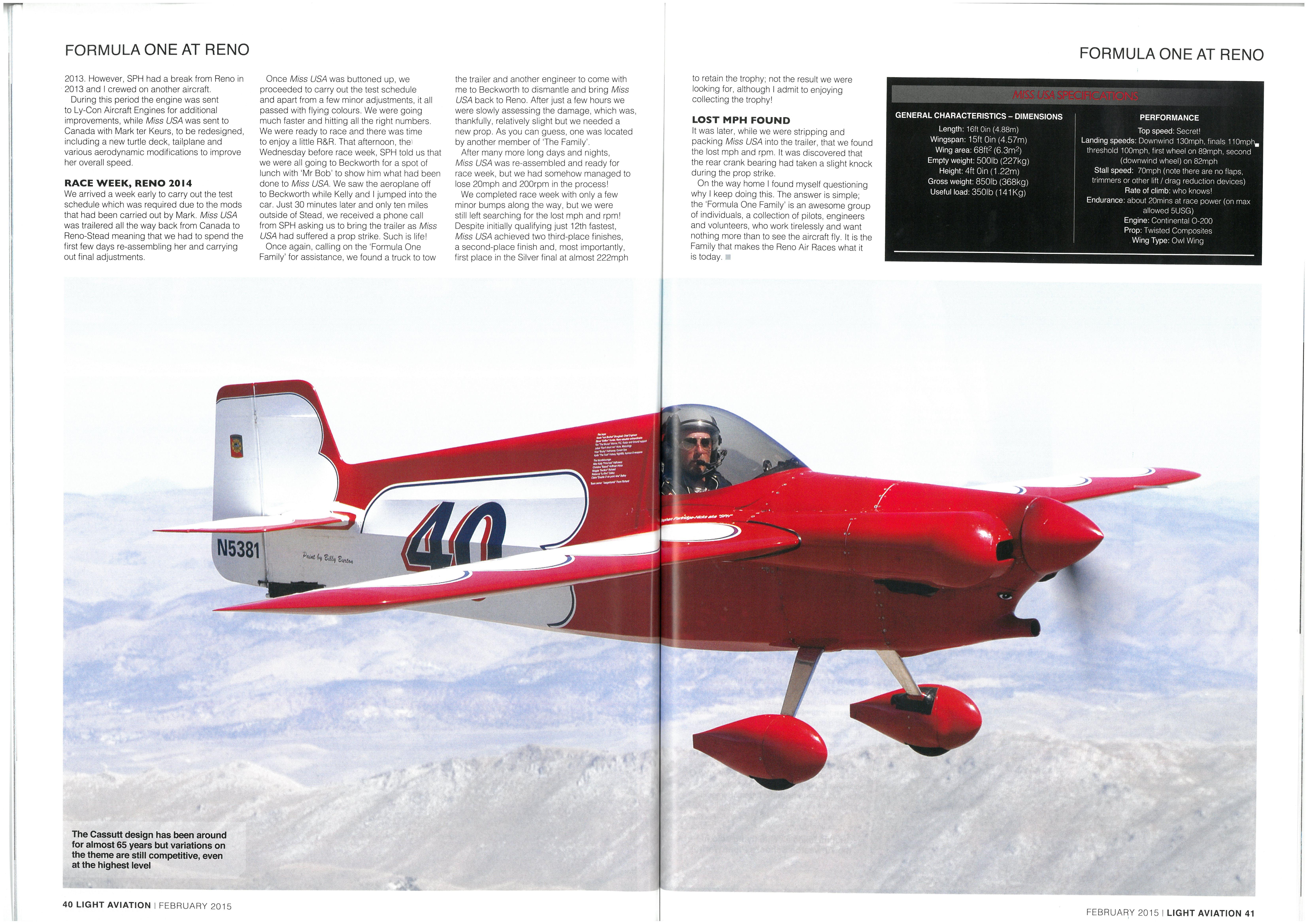
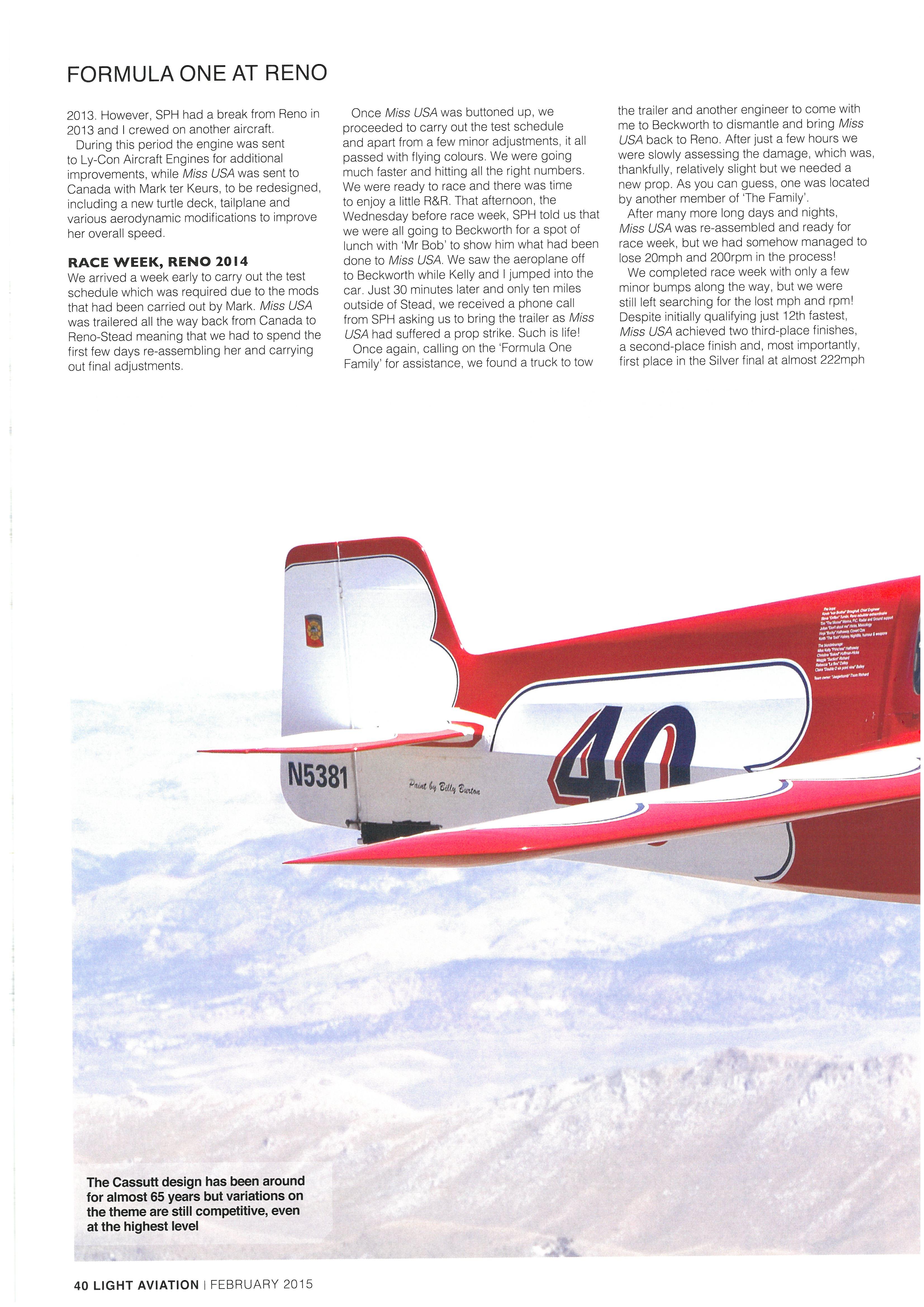
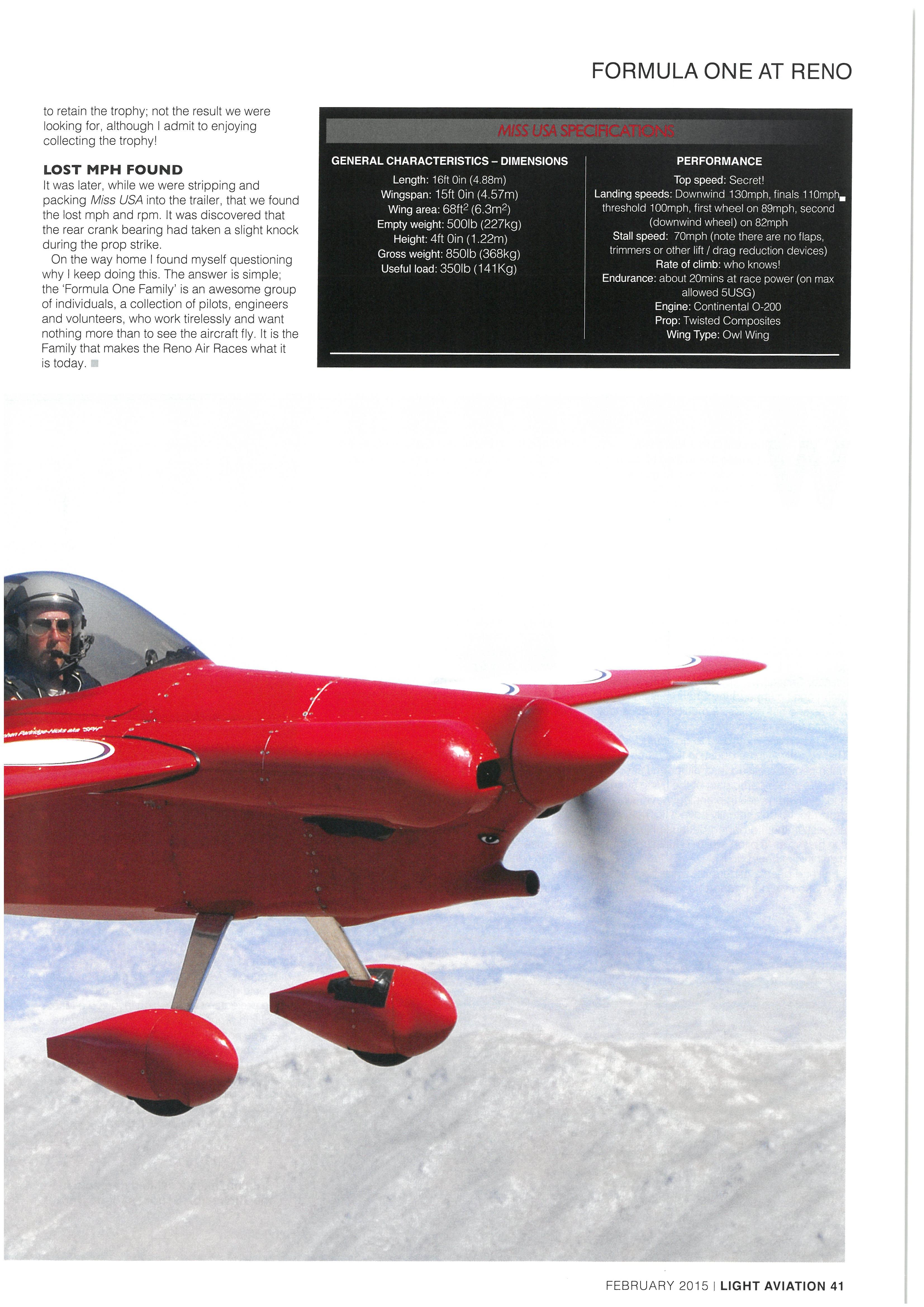
Our cover feature this month is about a Brit who races F1 at Reno; it looks like a lot of fun and our story follows the development of his Cassuittvariant over a four-year period. With F1 getting some much needed promotion in Europe from Air Race 1, it would be nice to think we might see a revival this side of the pond before too long.
Colin Hales’ first part of his epic flight across the Atlantic to Oshkosh brought some positive comments for its warts and all content. He concludes the trip in this issue and graphically describes his fear, troubles and relief as the journey unfolds. It’s one of the frankest stories of its type | have read in a long time. Well done Colin, on the trip and the write-up.
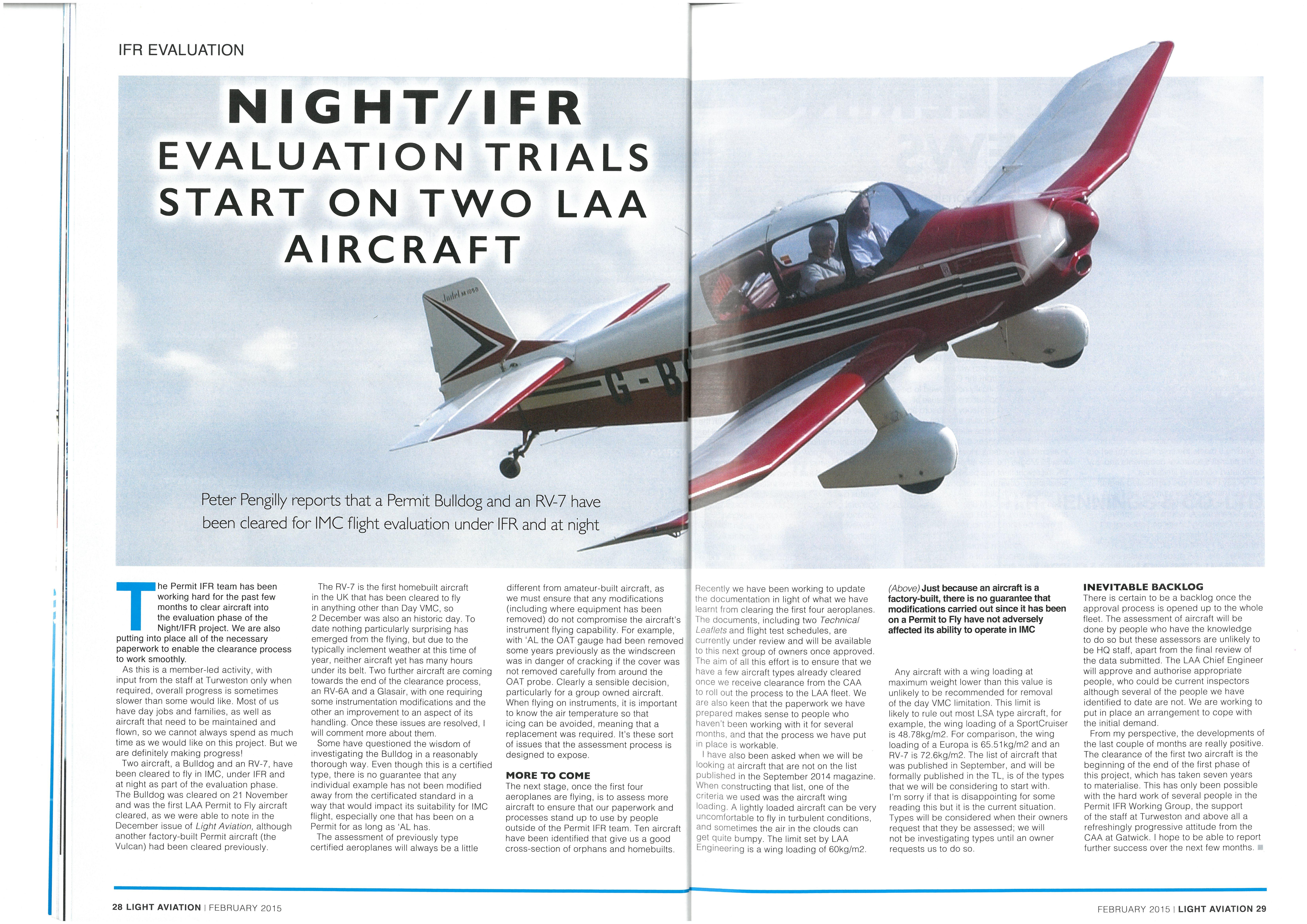
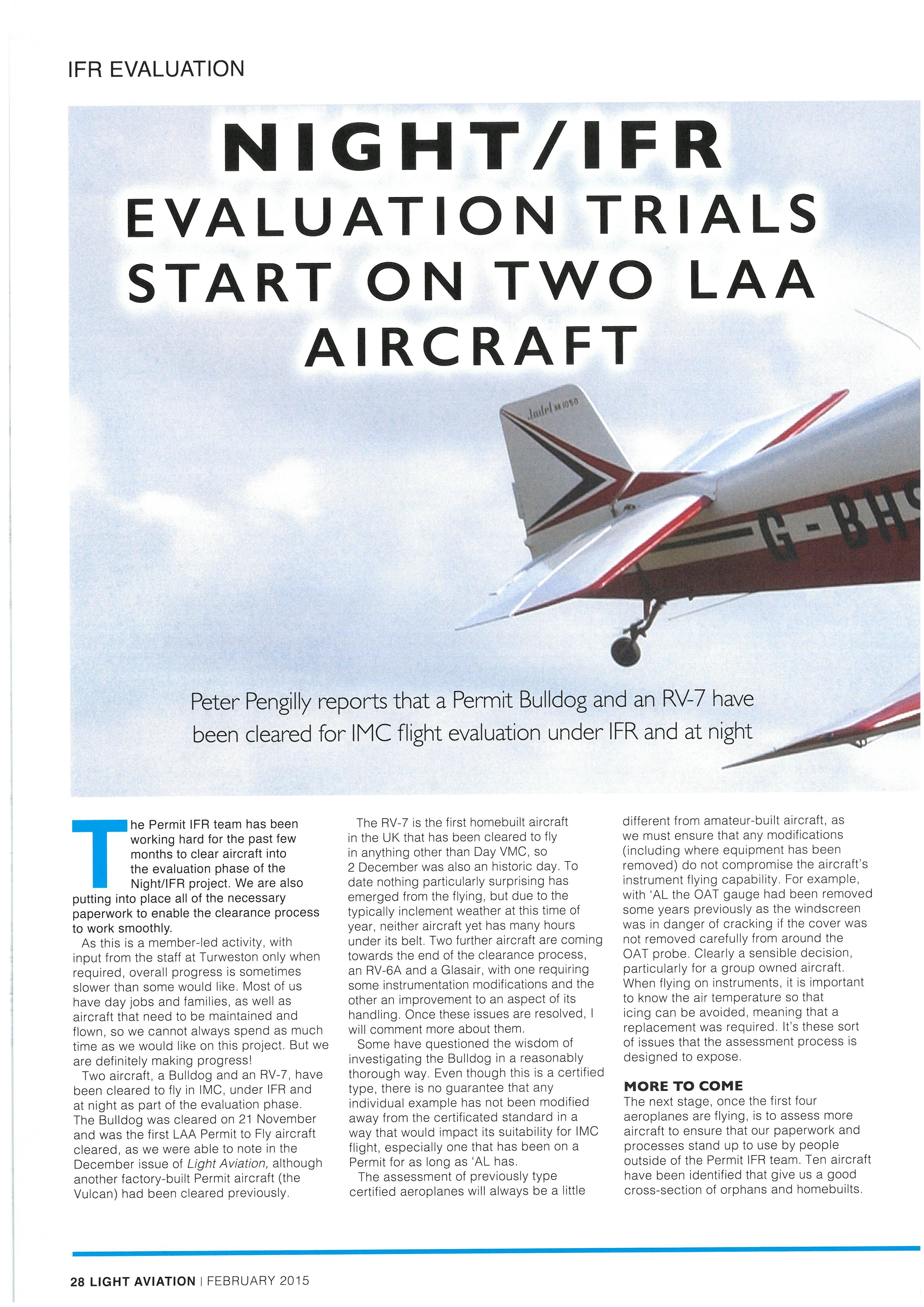
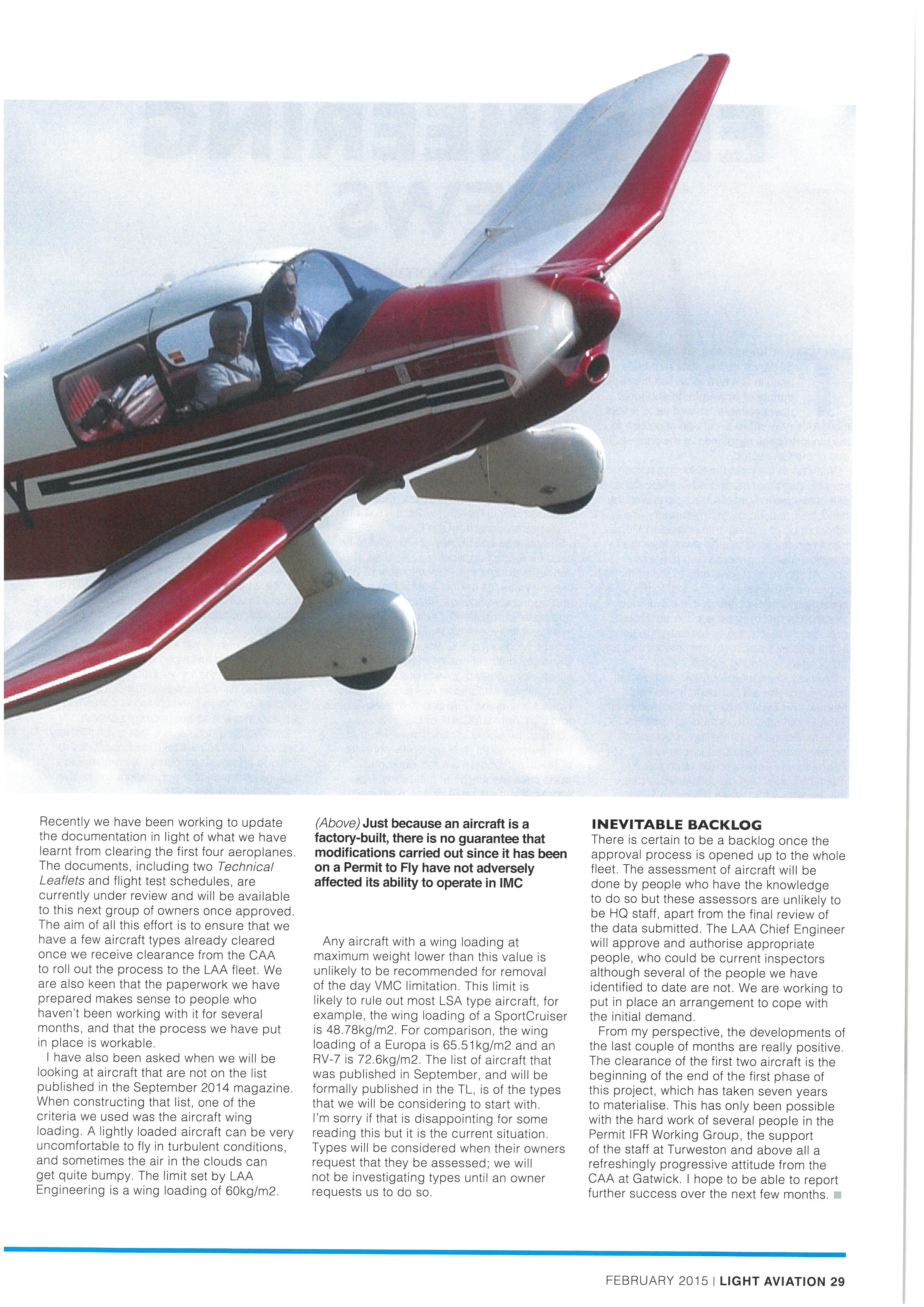
The Night/IFRproject has been long inthe making but Pete Pengilly reports that the beginning of the end is now in sight. Two LAA Permitaircraft, a factory-built and a homebuilt,
Head Office: Turweston Aerodrome, Nr Brackley, Northants NN13 5YD
Tel: 01280 846786
are now approved to fly in IMCfor the next phase ofthe programme, although inclement weather has slowed things up a bit. Two further aircraft, both homebuilts, should also be joining this trials phase soon. Opinions are divided over Night/IFRin Permitaircraftand it’sfairto saythat many members, myself included, will never be interested inflying otherthan in VMC. What is particularly good about this project, however, is that it has been driven from the outset by a group of members, so the impact on Engineeringactivities,and LAA finances, has been minimal. It is a good example of the Association’s self-help ethos and we should applaud those who have stuck with it for almostsevenyears.HopefullyBrianHope well-deserved success is now EDITOR justaroundthecorner. bfjjodel@talktalk.net
LIGHT AVIATION
MAGAZINE
Editor: Brian Hope, 60 Queenborough Road, Sheerness, Kent ME12 3BZ
Tel: 01795 662508
Email: BFJJodel@talktalk.net Light Aircratt Association
The National Council under scrutiny and Rotax 912 throttles
|OPROJECTNEWS
Including a EuroFOXand a building update on a SpitfireMk 26
|6 RELIANT CONVERSION
BrianHope reportson a member's personalchallengetoconvertan automotiveengineforflight
29 CONSULTATION
John Brady isoptimistic about the future of GA and looks forward to the GA Conference at Duxford
24 OSHKOSH PART 2
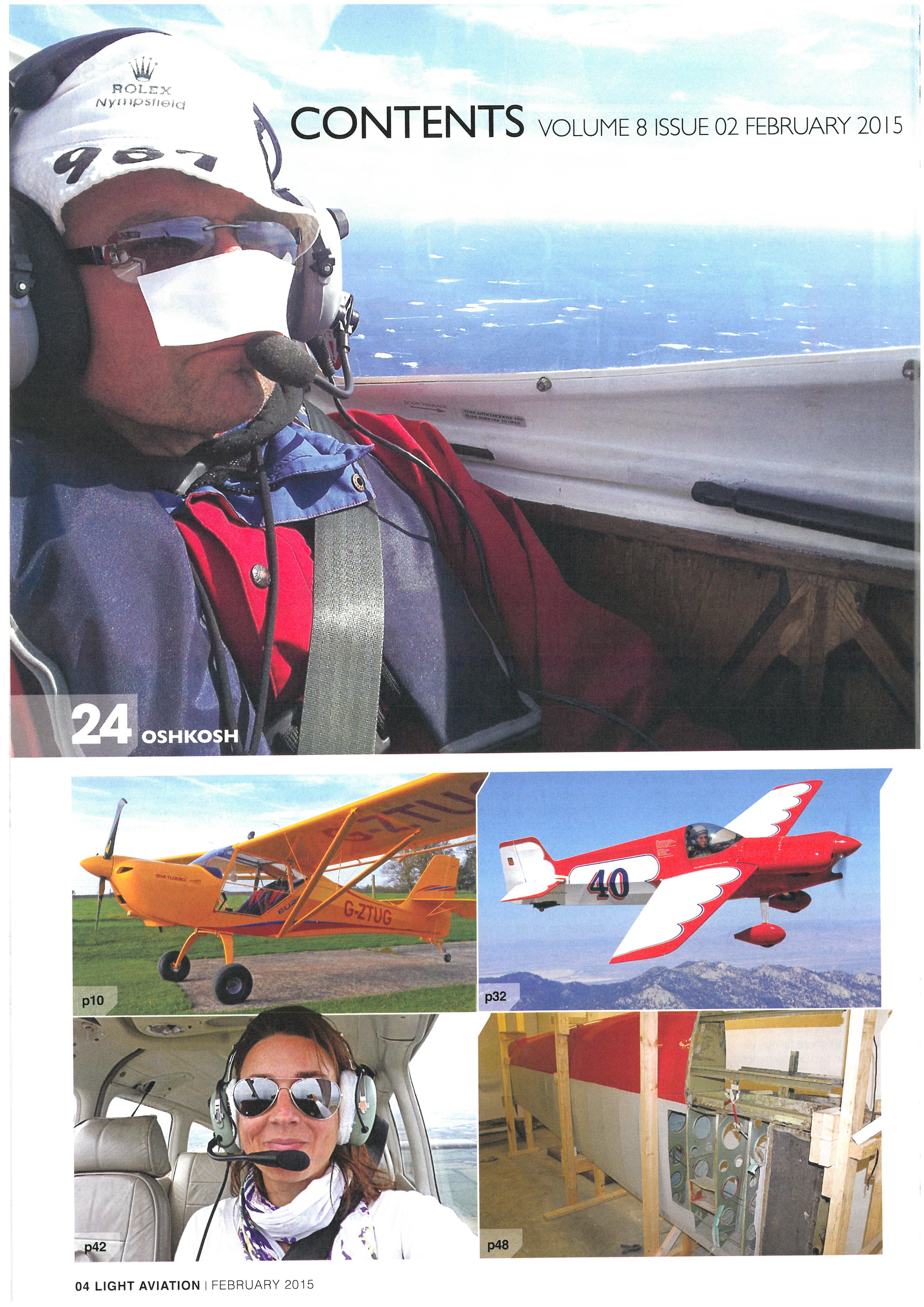
Colin Hales concludes his down-toearthaccount oftheflying hisKR2, Itzy,from the UK to Oshkosh
27 YOUTH PAGE
Michelle Brown rounds up some of the great activities enjoyed by the LAA’s youth division
28 NIGHT/IFR
PeterPengilly reports that a Permit Bulldog and an RV-7have been cleared for IMCflight evaluation under IFRand at night
30 ENGINEERING NEWS
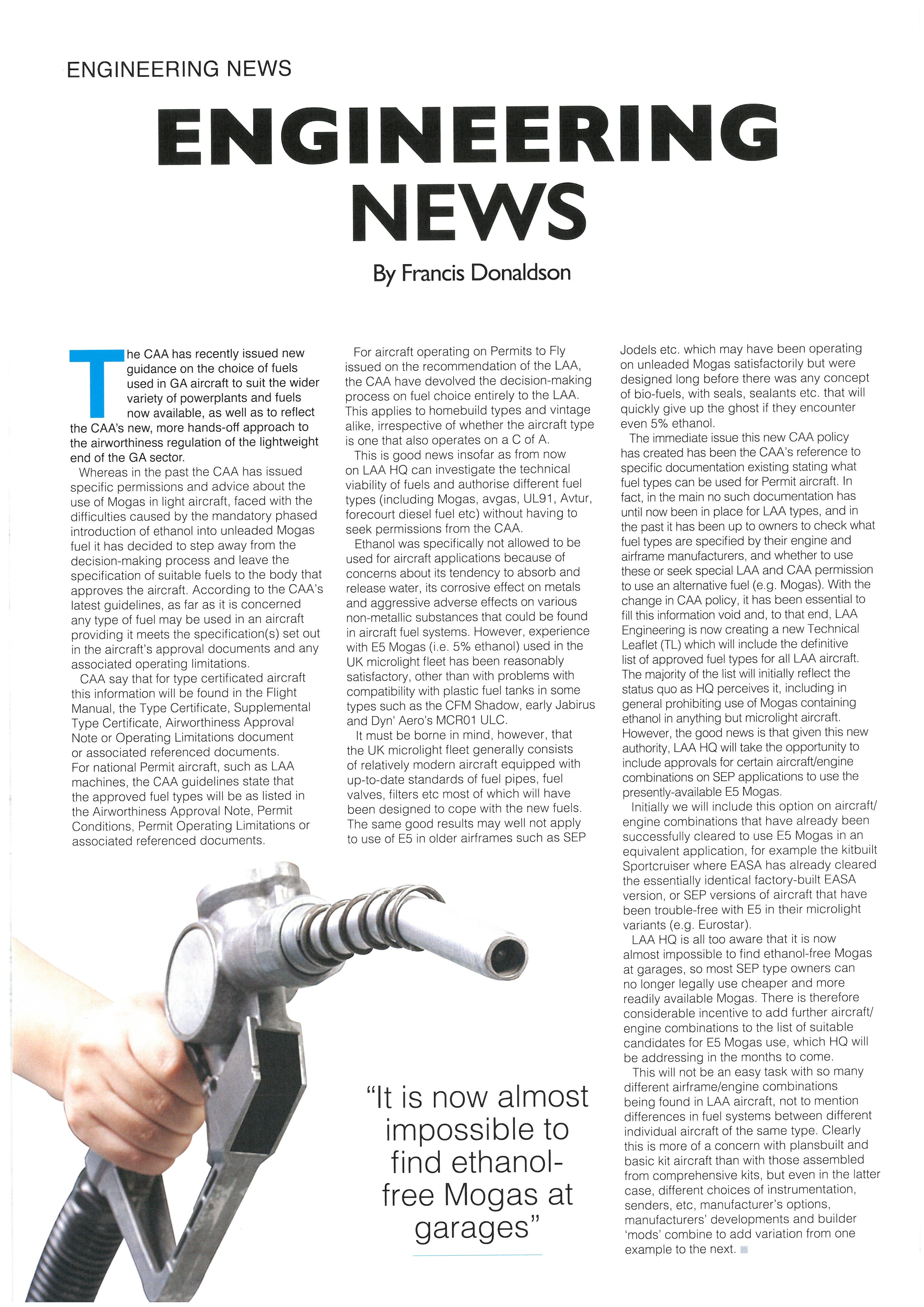
Francis Donaldson highlights a policy change by the CAA on fuels for use in GA aircraft
32 RENO RACER
A fascinatingaccountofjoiningthe FormulaOne Familyat Renoand racing Miss USA,a JensenSlipknot 42 LEARNINGTO FLY
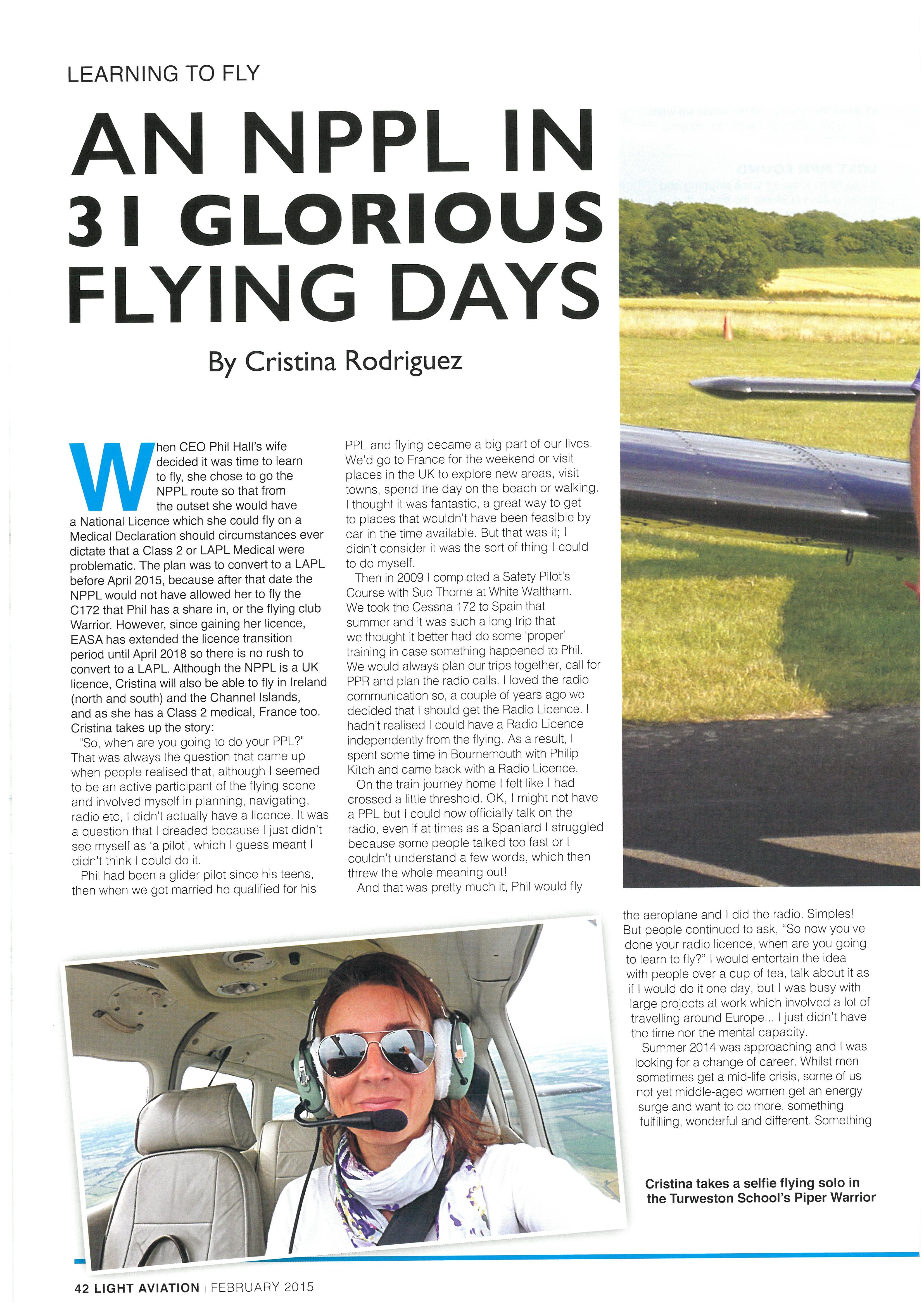
Cristina Rodriguez looks back at 31 days which saw her complete her NPPLtraining at Turweston
48 SAFETY SPOT
An overview of reportable incidents during 2014, plus the case of a serious crack on the main undercarriage of a Chipmunk and incorrectlyfitted Foxbatseatbelts
58MEETTHEMEMBERS
This month we meet MartinCharlick, who shares a Jodel Mascaret and flies outof Henstridge
60 CEOTHOUGHTS
PhilHall’s hopes & plans for the LAA
62 CLASSIFIED ADS
Aircraft for sale and more...
64 WHERETO GO
Flying events inthe coming months
66LANDINGVOUCHERS
Freelandings for three airfields
what is it and what it does? Read on! The acronym stands for Confidential Human Factors Incident Reporting Programme and it is part of the UK’s national air safety system. Dating back to the 1980s, CHIRP developed into its current form in 1997 and its task is to act as a safety net to receive aviation safety reports from pilots, controllers and engineers about issues that might otherwise go unreported.
In the hierarchy of aviation safety reporting inthe UK, accidents and serious incidents are reported to, and investigated by, the AAIB. Less serious events and ‘routine’ issues are reported to the CAA using its Mandatory Occurrence Reporting System (MORS). Infact, in addition to those mandatory reportable events and hazards contained in Civil Aviation Publication 382, just about any incident or hazard can be reported voluntarily using the MORS. But for issues that do not fall within the scope of MORS and when reporters would prefer to report on a confidential basis to an independent organisation, there is CHIRP. CHIRP fulfils the EASA requirement for states to have a voluntary confidential reporting system.
So, what happens if you report to CHIRP? First off, you can contact us any way you choose, freephone, letter, e-mail or on-line; the details are on our website at www.chirp.co.uk. A key feature of reporting to CHIRP is that we will discuss with you how you wish us to proceed. Our discussion will include how we will prevent you being identified and whether you agree to CHIRP contacting third parties to gain further information. Usually your disidentified report and the results of any investigation will be added to the agenda for the next meeting of the CHIRP General Aviation Advisory Board. The GA Board, like the Air Transport Board and the Cabin Crew Board, meets four times each year and its purpose is to assess reports and advise me on what | should do next. Frequently the Board's advice includes publishing the disidentified report in our FEEDBACK newsletter in order to share the lessons identified. Publication of the report is only done with the agreement of the reporter but permission is usually given because many reports are submitted with the laudable aim of sharing experience. Whether or not the report is published, we always write back to the reporter to explain the Board's assessment before closing the report and erasing the reporter's name and contact details from our records.
The Advisory Boards are vital to the CHIRP process and its credibility with reporters, industry and the regulator. There is insufficient room here to
list the GA Board members but they include Philip Hall, CEO of the LAA, and senior representatives from most of the disciplines that constitute GA; the members are listed on our website. Suffice to say that you would need to go a long way to find a group with a greater range and depth of expertise. This provides reporters and readers of FEEDBACK with the confidence that the reports have been discussed and assessed from every angle and that the advice provided can be trusted.
So where can you read FEEDBACK? Simple, we will email it to you. We no longer produce a hard copy version, instead we use the CAA’s list of licence holders to email FEEDBACK to every licenced pilot, ATCO, FISO and engineer. If you are not in one of these categories, or if the CAA doesn’t have your current email address, contact us at mail@chirp.co.uk and we will add you to the distribution list. Alternatively you can download FEEDBACK via our App for smartphones and tablets available at the App Store or Google Play.
What can you expect to read in FEEDBACK? There is a great variety of reports but also a number common themes. First and foremost is the importance of sortie planning. Even a quick ‘flip’ round your local area needs preparation, including checking the NOTAMs, getting a weather brief and thinking about contingencies and emergencies. There are some outstanding electronic sortie planning aids available and GPS is brilliant, but don’t plan to shave the edge of AlZs and controlled airspace en-route; allowing a sensible margin allows you to concentrate on other important aspects of your flight, including looking out. And always carry a paper chart with your planned route marked on it; heading and time will work if the electronics go down. Many reports concern incidents in and around the visual circuit. You need to plan your arrival as thoroughly as the rest of your route, including how you hope to join the pattern, the alternatives and the reference points in the circuit. Finally, do show your fellow aviators the courtesy you hope to receive from them. We don’t want the sky to become as cut and thrust as our roads!
| hope by now you understand what CHIRP is and what it does. | also hope you never find yourself in the position of wanting or needing to submit a report but if you do, you can rely on a confidential service that will provide you with independent expert advice. You can also do your fellow fliers a great service by enabling them to learn from your experience and that always feels good!
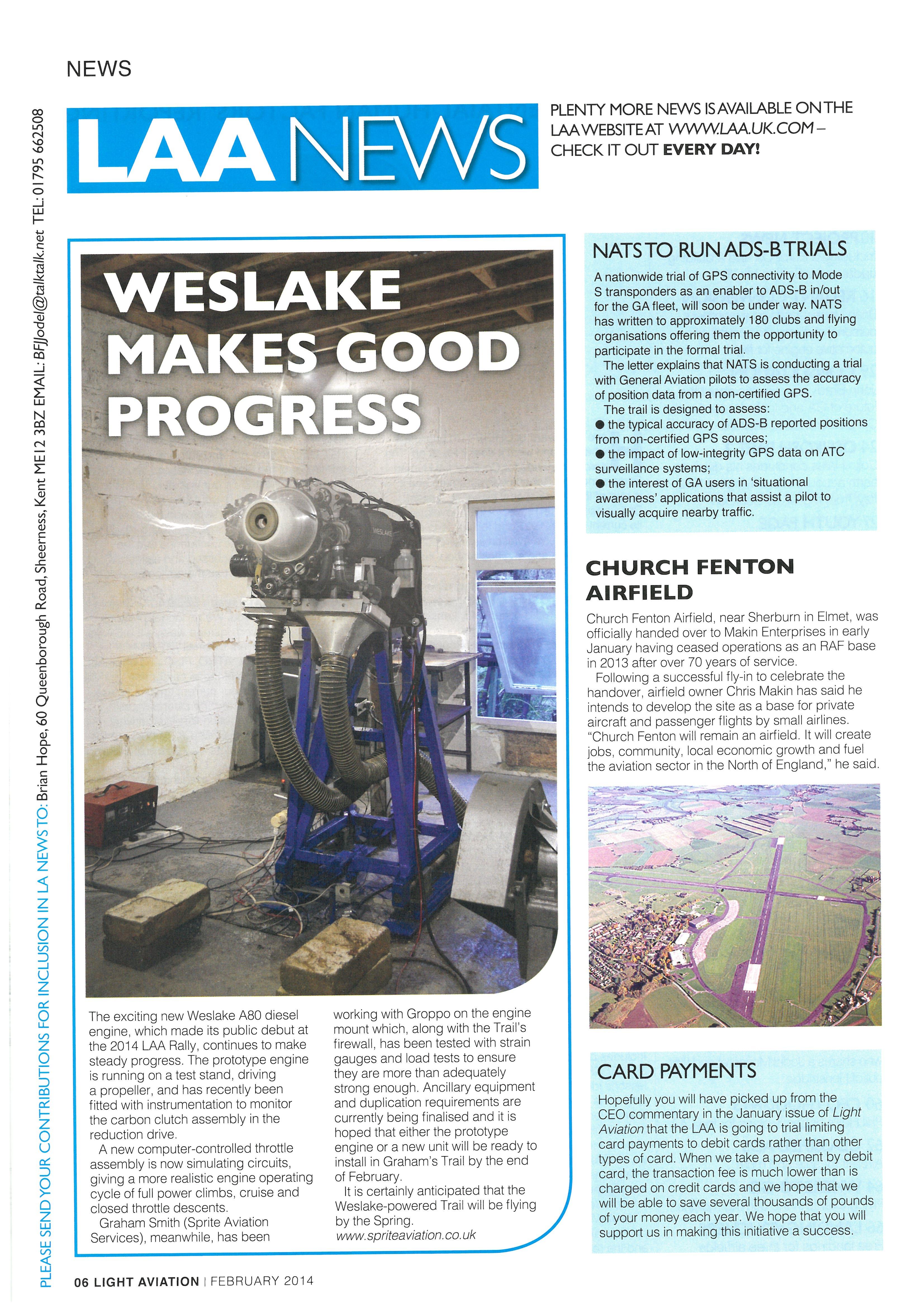
The exciting new Weslake A80 diesel working with Groppo on the engine engine, which made its public debut at mount which, along with the Trail’s the 2014 LAA Rally, continues to make firewall, has been tested with strain steady progress. The prototype engine gauges and load tests to ensure isrunningona teststand,driving theyaremorethanadequately
a propeller, and has recently been strong enough. Ancillary equipment fitted with instrumentationto monitor and duplication requirementsare
PLENTY MORE NEWS ISAVAILABLE ONTHE LAAWEBSITEAT WWW.LAA.UK.COM
CHECK IT OUT EVERY DAY!
NATSTO RUNADS-BTRIALS
A nationwide trial of GPS connectivity to Mode S transponders as an enabler to ADS-B in/out for the GA fleet, will soon be under way. NATS has written to approximately 180clubs and flying organisationsofferingthem the opportunity to participate in the formal trial.
TheletterexplainsthatNATSisconducting a trial with General Aviation pilots to assess the accuracy of position data from a non-certified GPS.
The trail is designed to assess:
@the typical accuracyof ADS-B reported positions from non-certified GPS sources; @the impact of low-integrity GPS data on ATC surveillance systems;
@ the interest of GA users in ‘situational awareness’ applications that assist a pilot to visually acquire nearby traffic.
CHURCH FENTON AIRFIELD
Church Fenton Airfield, near Sherburn in Elmet, was officially handed over to Makin Enterprises in early January having ceased operations as an RAF base in 2013 after over 70 years of service.
Following a successful fly-in to celebrate the handover, airfield owner Chris Makin has said he intends to develop the site as a base for private aircraft and passenger flights by small airlines. “Church Fenton will remain an airfield. It will create jobs, community, local economic growth and fuel the aviation sector inthe North of England,” he said.
CARD PAYMENTS
Hopefully you will have picked up from the the carbon clutch assembly inthe currently being finalised and it is CEO commentary inthe January issue of Light reduction drive. hoped that either the prototype Aviation that the LAA is going to trial limiting
A new computer-controlled throttle engine or a new unitwill be ready to card paymentsto debit cards ratherthan other assembly is now simulating circuits, install in Graham’s Trail by the end types of card. When we take a payment by debit givingamorerealisticengineoperating ofFebruary. card,thetransactionfeeismuchlowerthanis cycle of full power climbs, cruise and It is certainly anticipated that the charged on credit cards and we hope that we closed throttledescents. Weslake-poweredTrailwill be flying will be able to save severalthousands of pounds Graham Smith(Sprite Aviation by the Spring. of your money each year. We hope that you will Services),meanwhile,has been www.spriteaviation.co.uk support us in makingthis initiativea Success.
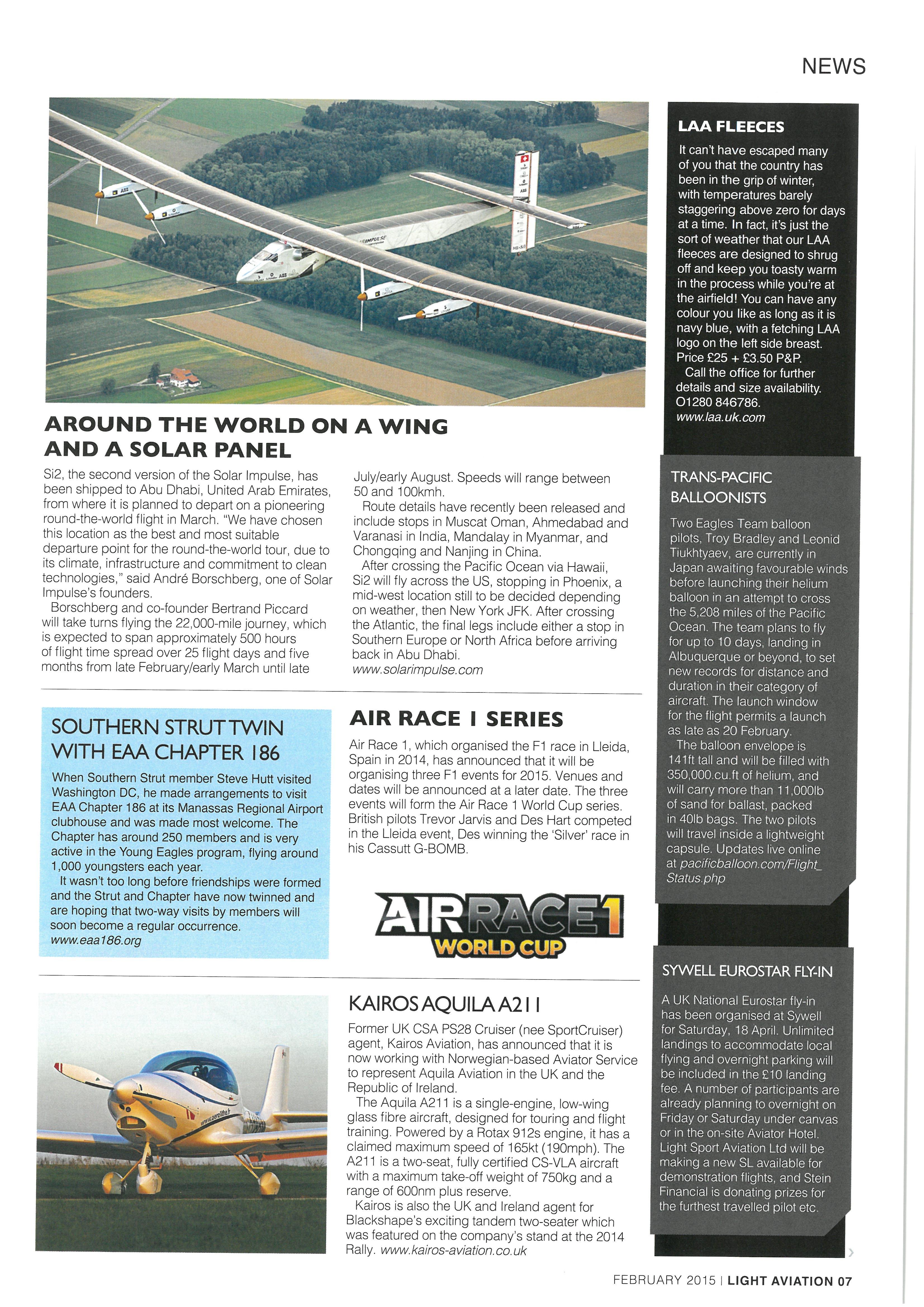
AND A SOLAR PANEL
Si2, the second version of the Solar Impulse, has been shipped to Abu Dhabi, United Arab Emirates, romwhere it is planned to depart on a pioneering round-the-world flight in March. “We have chosen his location as the best and most suitable departure point for the round-the-world tour, due to its climate, infrastructure and commitment to clean echnologies,” said André Borschberg, one of Solar mpulse’s founders.
Borschberg and co-founder Bertrand Piccard will take turns flying the 22,000-mile journey, which is expected to span approximately 500 hours of flight time spread over 25 flight days and five monthsfrom late February/earlyMarch until late
Itwasn’ttoolongbeforefriendshipswereformed ~andtheStrutandChapterhavenowtwinnedand arehopingthattwo-wayvisitsbymemberswill soon become a regular occurrence. www.eaal86.org
July/earlyAugust. Speeds will range between 50 and 100kmh.
Route details have recently been released and include stops in Muscat Oman, Anmedabad and Varanasi in India, Mandalay in Myanmar, and Chongqing and Nanjingin China.
After crossing the Pacific Ocean via Hawaii, Si2will fly across the US,stopping in Phoenix,a mid-west locationstillto be decided depending on weather, then New York JFK. After crossing the Atlantic, the final legs include either a stop in Southern Europe or North Africa before arriving back in Abu Dhabi.
www.solarimpulse.com
AIR RACE I SERIES
Air Race 1, which organised the F1 race in Lleida, Spain in 2014, has announced that it will be organising three F1 events for 2015. Venues and dates will be announced at a later date. The three events will form the Air Race 1World Cup series. British pilots Trevor Jarvis and Des Hart competed in the Lleida event, Des winning the ‘Silver’race in his Cassutt G-BOMB.
LAA FLEECES
It can’t have escaped many of you that the country has been in the grip of winter, with temperatures barely staggering above zero for days at a time. In fact, it’s just the sort of weather that our LAA fleeces are designed to shrug off and keep you toasty warm in the process while you’re at the airfield! You can have any colour you like as long as it is navy blue, with a fetching LAA logo on the left side breast. Price £25 + £3.50 P&P. Call the office for further details and size availability. 01280 846786. www.laa.uk.com
MAN Ga BALLOONISTS
Two Eagles Team balloon pilots, Troy Bradley and Leonid Tiukhtyaev, are currently in Japan awaiting favourable winds before launching their helium balloon in an attempt to cross the 5,208 miles of the Pacific Ocean. The team plans to fly for up to 10 days, landing in Albuquerque or beyond, to set new records for distance and duration in their category of aircraft. The launch window for the flight permits a launch as late as 20 February. The balloon envelope is 141fttallandwillbefilledwith 350,000.cu.ft of helium, and will carry more than 11,000Ib of sand for ballast, packed in 40lb bags. The two pilots will travel inside a lightweight capsule. Updates live online at pacificballoon.com/Flight_ Status.pho
SYWELL EUROSTAR FLY-IN
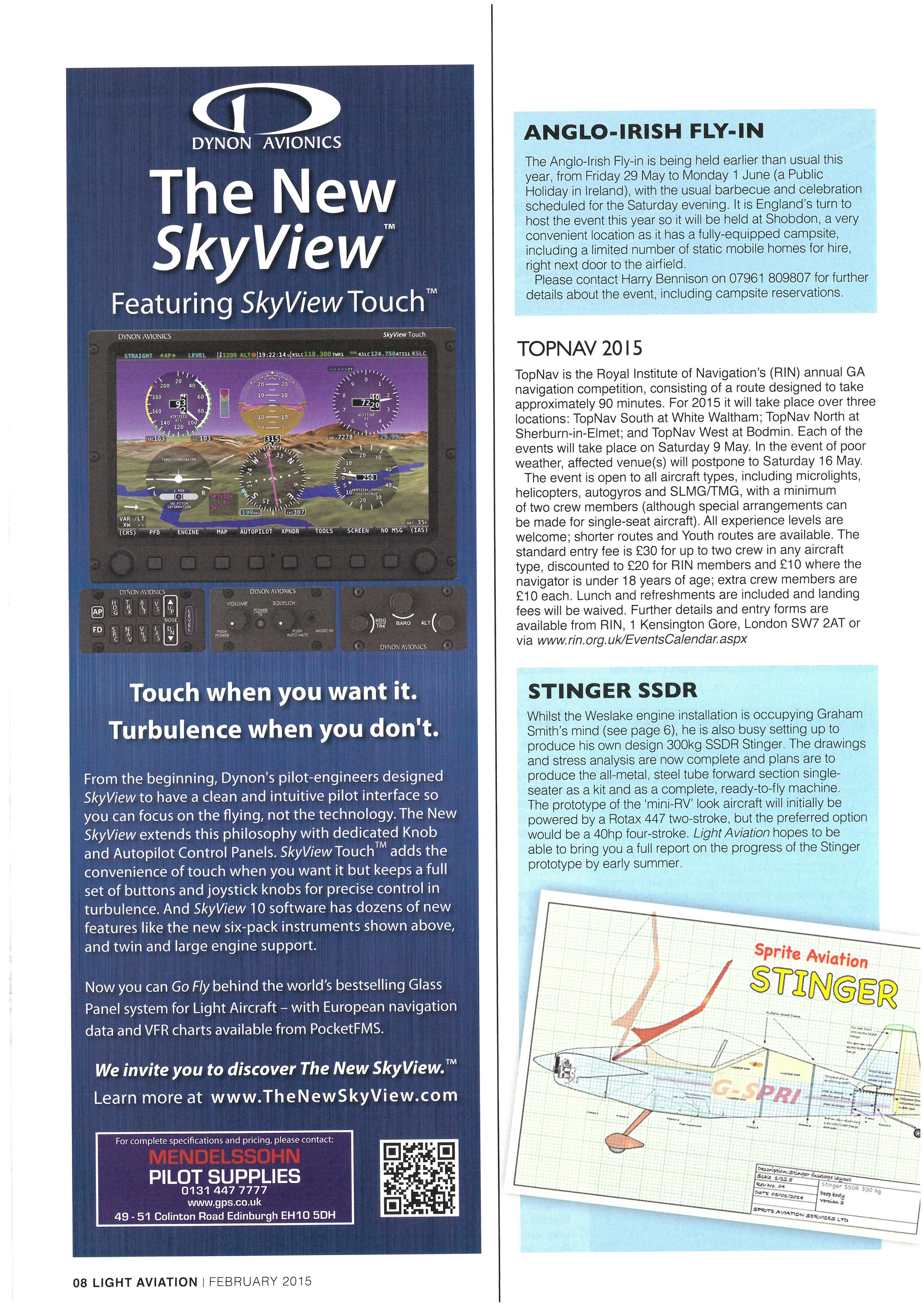
FormerUK CSA PS28Cruiser (nee SportCruiser) agent, Kairos Aviation, has announced that it is now working with Norwegian-based Aviator Service to represent Aquila Aviation in the UK and the Republic of Ireland.
TheAquila A211 is a single-engine, low-wing glass fibre aircraft, designed for touring and flight training. Powered by a Rotax 912s engine, it has a claimed maximumspeed of 165kt(190mph). The A211 is a two-seat, fully certified CS-VLA aircraft with a maximum take-off weight of 750kg and a range of 600nm plus reserve.
Kairos is also the UK and Ireland agent for Blackshape’s exciting tandem two-seater which was featured on the company’s stand at the 2014 Rally. www.kairos-aviation.co.uk
A UK National Eurostar fly-in has been organised at Sywell for Saturday, 18April. Unlimited landings to accommodate local flying and overnight parking will be included in the £10 landing fee. A number of participants are already planning to overnight on Friday or Saturday under canvas or in the on-site Aviator Hotel.
Light Sport Aviation Ltd will be making a new SL available for demonstration flights, and Stein Financial is donating prizes for the furthest travelled pilot etc. FEBRUARY 2015 | LIGHT AVIATION 07
Turbulence when you don't.
Fromthe beginning, Dynon's pilot-engineers designed SkyViewto havea clean and intuitive pilot interface so you canfocus on the flying, not the technology. The New SkyViewextends this philosophy with dedicated Knob and Autopilot Control Panels.SkyViewTouch™addsthe convenienceoftouchwhenyouwantitbutkeeps a full set of buttons and joystick knobs for precise control in turbulence. And SkyView10 software has dozens of new features like the new six-pack instruments shown above, and twin and large engine support.
Now you can GoFlybehind the world’s bestselling Glass Panelsystemfor Light Aircraft with Europeannavigation dataandVFRchartsavailablefromPocketFMS. Weinvite you to discoverTheNewSkyView.” Learnmoreat www.TheNewSkyView.com
ANGLO-IRISH FLY-IN
The Anglo-lrish Fly-inis being held earlierthan usualthis year, from Friday 29 May to Monday 1June (a Public Holiday in Ireland), with the usual barbecue and celebration scheduled for the Saturday evening. It is England’s turn to host the event this year so it will be held at Shobdon, a very convenient location as it has a fully-equipped campsite, including a limitednumberofstaticmobilehomesforhire, right next door to the airfield.
Please contact Harry Bennison on 07961 809807 for further details about the event, including campsite reservations.
TOPNAV 2015
TopNav is the Royal Institute of Navigation’s (RIN) annual GA navigation competition, consisting of a route designed to take approximately 90 minutes. For 2015 it will take place over three locations: TopNav South at White Waltham; TopNav North at Sherburn-in-Elmet; and TopNav West at Bodmin. Each of the events will take place on Saturday 9 May. In the event of poor weather, affected venue(s) will postpone to Saturday 16 May. The event is open to all aircraft types, including microlights, helicopters, autogyros and SLMG/TMG, with a minimum of two crew members (although special arrangements can be made for single-seat aircraft). All experience levels are welcome; shorter routes and Youth routes are available. The standard entry fee is £30 for up to two crew in any aircraft type, discounted to £20 for RIN members and £10 where the navigator is under 18 years of age; extra crew members are £10 each. Lunch and refreshments are included and landing fees will be waived. Further details and entry forms are available from RIN, 1 Kensington Gore, London SW7 2AT or via www.rin.org.uk/EventsCalendar.aspx
STINGER SSDR
Whilst the Weslake engine installation is occupying Graham Smith’s mind (see page 6), he is also busy setting up to produce his own design 300kg SSDRStinger. The drawings and stress analysis are now complete and plans are to produce the all-metal, steel tube forward section singleseater as a kit and as a complete, ready-to-fly machine. The prototype of the ‘mini-RV’ look aircraft will initially be powered by a Rotax447 two-stroke, but the preferred option wouldbea40hpfour-stroke.LightAviationhopestobe abletobringyou a fullreportontheprogressoftheStinger prototype by early summer.
The positivenoisesabout engagement and transparency comingfrom our CEO and new Chairman, Brian Davies, must be music to the ears of any member concerned about the future of our Association. Then we get the tired old guffaboutthe NationalCouncil (NC)losingitswayfromChairman GrahamNewby!NoGraham, the NC didn’t lose its way; it was emasculatedby a Boardwho hadno interestinoutside opinion.
The originalmissionof the NCwas to advise the EC/Board. This has been eroded inword (readthe rules) and deed by a Board‘toobusy’to communicateeffectivelyandoffering only acronym-infusedinformation afterthe eventwithnoopportunityfor meaningfulinput.Tohavean opinion, you haveto knowwhatisbeing planned. Toadvise, someone has to listen.Notsurprisingly,motivation in the NC declined. The governance fiasco further demotivated and even excluded some Struts and Clubs from the NC.
Representingonly15%ofthe membership?Notsurewherethat numbercomesfrom.Assumingthat it'saccurate,it’sprobablyat least doublethatof theflyingmembership and whatever the number, it’sthe ‘doing’partoftheAssociation, organisingthe fly-ins,meetings,talks, camps etc. | don’t see the Jodel owners,much lessthe RV Squadron, doingmuchof that.Then again,the RV Squadronclaimsitsinfluenceby crammingthe Board.
Aforum-basedNC?Wealready have a forum.It’sdeadbecauseany Criticalopinionor insightis excluded. Futureforthe NC?Aquarterly meetingbefore a Boardmeetingwhere strategicdirection,meansof gettingthereand ongoingreviews plus other matters of concernto the boardand membership,can be openlydiscussedand advice/opinion sought bothways!This isthe only meansby which the management of the Association can claim any mandatefrom the membership.The previous management didn’t believe it needed one.
Membershipofthe NC?Any individualregisteringatleast 30 (choosea suitablenumber) membershipproxiesinadvanceof the meeting.Thiswouldincludeall the Strutsand Clubscurrentlyeligible plusanyother membershipgroup who canclaim a degreeof interestor
support even Jodel and RV owners buttheystillneedtoturnup.Discuss. Malcolm Rogan
Forthe benefitofaccuracy|thinkit shouldbe noted that the 15% Strut and Clubmembershipfigureis based on theannualreturnsmadeby Strutsand Clubs.Flyingmembership is considerablyhigher;around50% of themembershipholdsMember PlusbecausetheyuseEngineering services(2,600aircraftare in Permit atanyone time).On topof that, we have a substantialnumberof memberswhoflynon-LAAaircraft, so flyingmembershipcertainly exceeds 60% andsurveyresults suggestitis considerablyhigher. TheRVSquadronandJodel Club are both internet-basedgroups. Neithertheynor any otherclubare excluded from the National Council, theyhave simplynot chosen to engage with it. Itis because we have such groups, many very active within theAssociation, that we need to considera differentandmore inclusive NC format. Ed
Rotax 912 throttles
After some serious and needless ground accidents, forthe last 20 or soyearswe (P&M. Ed.)havefitted a microswitch on our trikes so it is impossibleto energisethe starter solenoid with an open hand throttle.
Runawayaircraftaccidents happenwithsprung-closed,open and positivelydriventhrottles;there isno perfectsystem.Start-upisa hazardous time when unexpected thingscan happenveryfast indeed, so Stickto a drill, cover the switches and be prepared! Years ago | saw a pilotpullstarthisreluctantRotax462, which burst into life at full throttle. He was not strapped in and had no helmeton, and acceleratedstraight intoa plateglasswindow.Hewas fortunate to survive but suffered lifechanginginjuries.
Bill Brooks
AGM ideas
|was readingyour‘Editor’sdesk’ article in the November edition of the LightAviationmagazineandwould liketo endorse your suggestion ofsettingupa webcam atfuture LAAAGMs (andanyotherpublic meetings,forthat matter).| have recentlyretiredfromworkingfor Airbuswherevideoconferencinghas provento be a realmoney-saving
methodof involvinga largegroup (orgroups)of participantsina virtual meetingfromseveralcountries at the same time. | am also sure thata systemofelectronicvoting couldbe employed,based on a ‘log in’codefor participants,to avoid doubleaccountingetc. | hopethese suggestionsareof some value and thank you for such a great magazine.
Trev Jackson
Non ATZ airfields
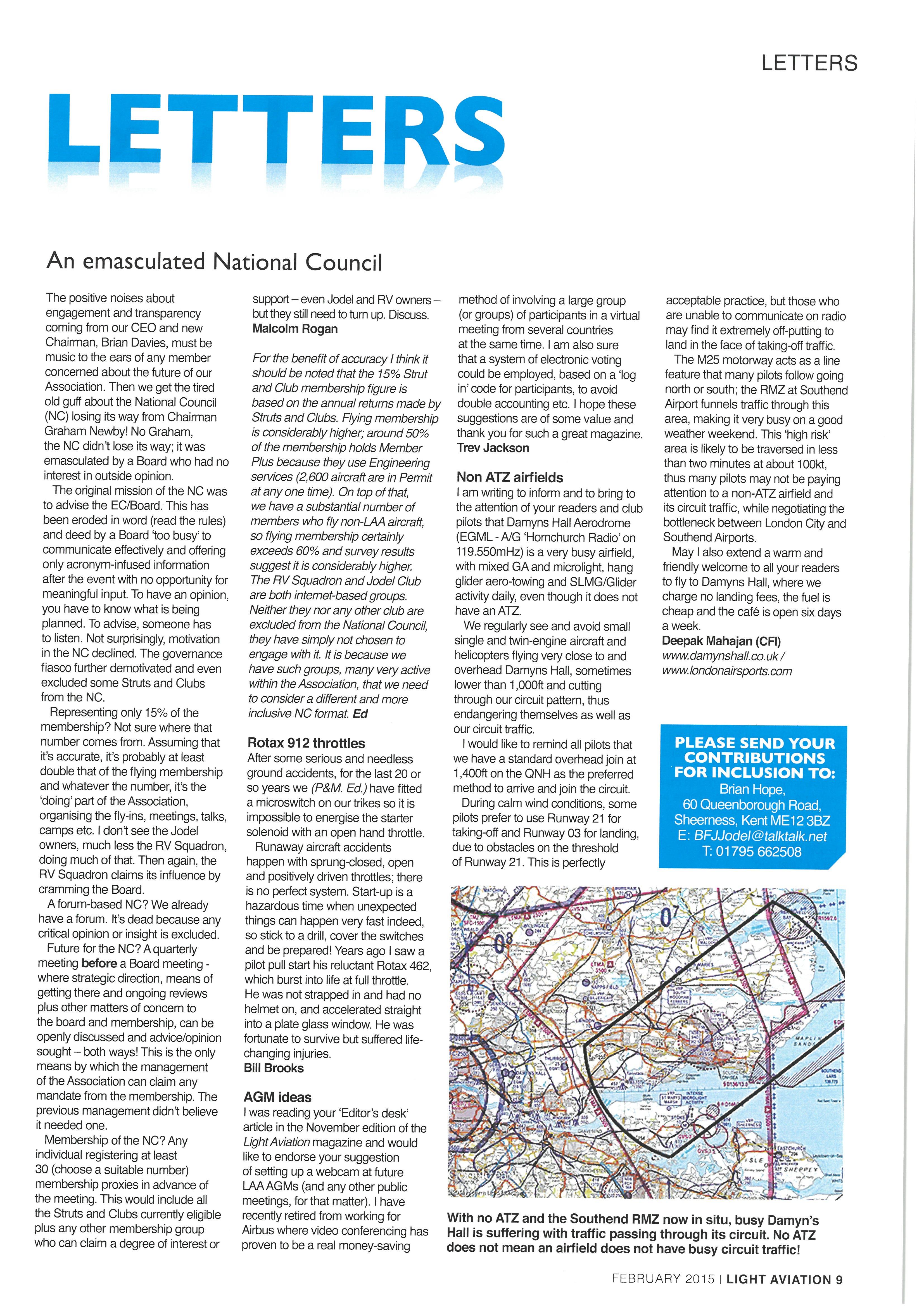
|am writingto informandto bringto the attention of your readers and club pilotsthat DamynsHallAerodrome (EGML-AVG‘HornchurchRadio’on 119.550mHz)isa very busyairfield, withmixedGAandmicrolight,hang glideraero-towingand SLMG/Glider activitydaily,eventhoughitdoes not have an ATZ.
We regularlysee and avoidsmall singleandtwin-engineaircraftand helicoptersflyingverycloseto and overheadDamynsHall,sometimes lowerthan 1,O0Oftand cutting throughourcircuitpattern,thus endangeringthemselvesaswellas Our circuit traffic.
|would liketo remind all pilotsthat we havea standardoverheadjoin at 1,400fton the QNH as the preferred method to arrive andjoin the circuit.
Duringcalmwindconditions,some pilotspreferto useRunway21for taking-offand Runway03for landing, due to obstacles on the threshold of Runway21.This isperfectly
acceptable practice, butthosewho are unable to communicate on radio mayfind itextremelyoff-puttingto land inthe face of taking-offtraffic.
TheM25motorwayactsasa line featurethat many pilotsfollowgoing north or south; the RMZ at Southend Airportfunnelstrafficthroughthis area,makingitvery busyon a good weatherweekend.This ‘highrisk’ areaislikelyto betraversedinless than two minutes at about 10Okt, thus manypilotsmay notbe paying attention to a non-ATZ airfield and itscircuittraffic,whilenegotiatingthe bottleneckbetweenLondonCityand SouthendAirports.
May |alsoextend a warmand friendlywelcometo allyourreaders to flyto DamynsHall,wherewe chargeno landingfees,thefuelis cheap andthe café isopensixdays a week.
PLEASE SEND YOUR CONTRIBUTIONS FOR INCLUSION TO: BrianHope, 60QueenboroughRoad, Sheerness, Kent ME12 3BZ E:BFJJodel@talktalk.net T:01795 662508
detailed piece from David Bishop about his Supermarine Spitfire Mk26 build (G-CEFC).Although missing my informal ‘Spitfire special’ feature several issues ago, | am sure you will enjoy reading the first part of his story, from his earlier experience of building a Europa (G-BWVS),the trials of finding a suitable ‘aircraft factory’ and his innovative ‘Spit Roaster’, | am definitely pleased to say that this particular story was worth waiting for. If you have a similar story to tell regarding your project, have no hesitation in sending it in!
Brian Robe has very kindly written about his ongoing work on Taylorcraft L2, G-BWLJ (otherwise known as a DCO-65). Bought in 2008, Brian continues to work on ‘LJ but reports that it might be quite some time before he is able to complete the project. We wish him good luck in the meantime.
Amongthelistings,therehasbeenaflurryofprojectregistrations for
the ubiquitous RV-7, one new EuroFOX 912 and an aerobatic DR 107 One Design. Joining the fleet there is an Auster 5D (G-ANHX) and a Sherwood Ranger XP (G-TIAC), both cleared to fly. | hope to hear more about the Midget Mustang (G-IIHX) next month, but interestingly and in the meantime, builder Mark Huxtable has uploaded several videos of its construction on YouTube including one in flight. Builders, please keep sending in your stories. Your fellow builders are interested. Innovative building techniques and success (or failure!) stories are extremely useful to others. Finding suitable workshops, keeping the family onside and finding help where needed, they are all part of the story. Even if you can only spare a picture or two (with a caption!), that is fine by me, but please do keep in touch. Whatever stage you are at in your build, or if you are in the process of transferring your aircraft to a Permit, please contact Project Newsatprojectnews@laa-archive.org.uk
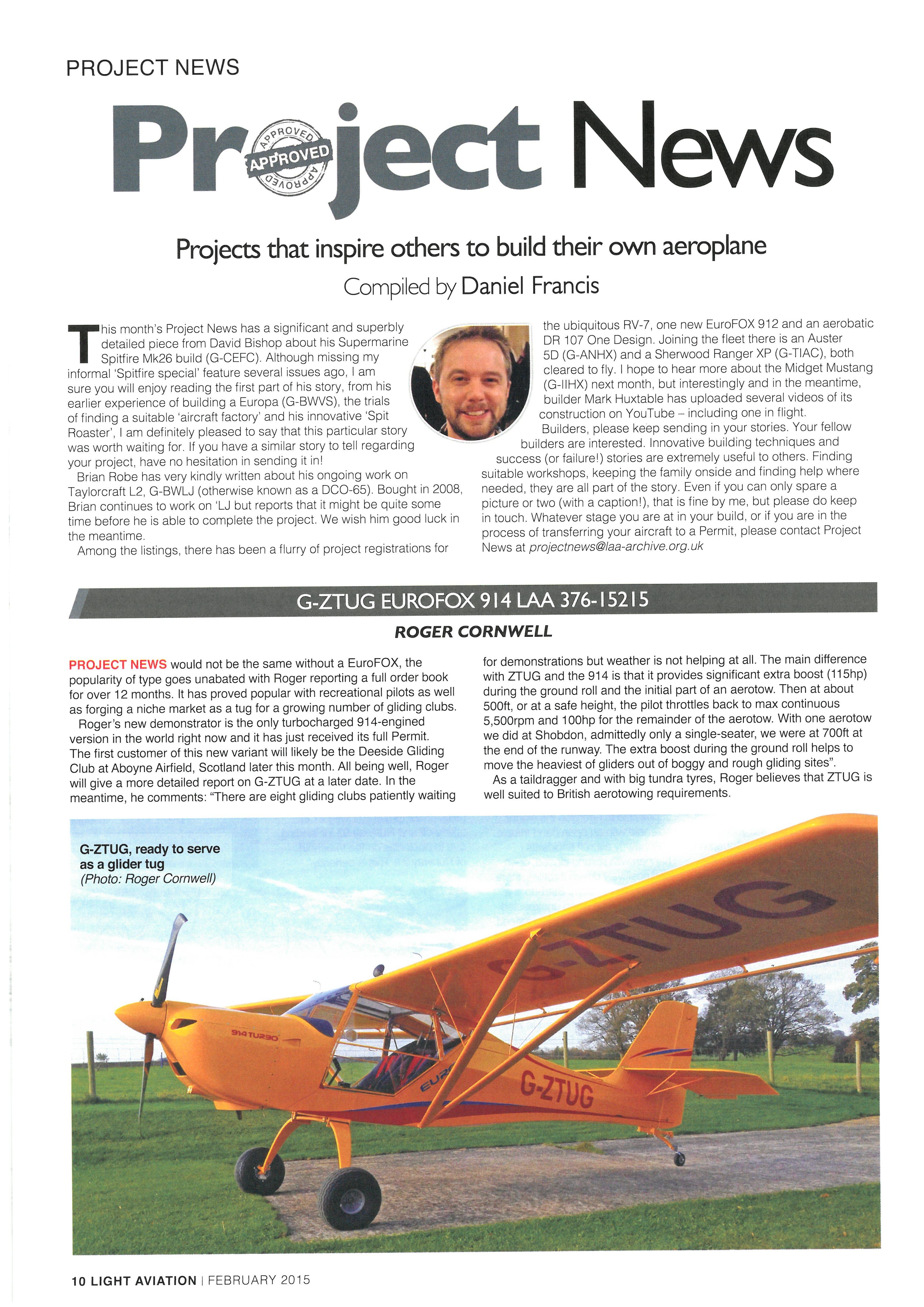
would not be the same without a EuroFOX, the popularityoftypegoesunabatedwithRogerreporting a fullorderbook for over 12 months. It has proved popular with recreational pilots as well as forging a niche market as a tug for a growing number of gliding clubs.
Roger’s new demonstrator is the only turbocharged 914-engined version in the world right now and it has just received its full Permit. The first customer of this new variant will likely be the Deeside Gliding Club at Aboyne Airfield, Scotland later this month. All being well, Roger will give a more detailed report on G-ZTUG at a later date. In the meantime, he comments: “There are eight gliding clubs patiently waiting et geceeee
G-ZTUG, ready toserve as a glider tug
(Photo: Roger Cornwell)
for demonstrations but weather is not helping at all. The main difference with ZTUG and the 914 is that it provides significant extra boost (115hp) during the ground roll and the initial part of an aerotow.Then at about 500ft, or at a safe height, the pilot throttles back to max continuous 5,500rpm and 100hp for the remainder of the aerotow. With one aerotow we did at Shobdon, admittedly only a single-seater, we were at 700ft at the end of the runway. The extra boost during the ground roll helps to move the heaviest of gliders out of boggy and rough gliding sites”.
As a taildragger and with big tundra tyres, Roger believes that ZTUG is well suited to British aerotowing requirements.
FEES aeSy aeeeeeee
excellentarticleintheJanuaryissueofLightAviation has prompted me to tell you about my own ongoing project, G-BWL4, a Taylorcraft L2. It has the same wings as Robert’s BC12-D but the fuselage has a tandem seating arrangement. As Robert mentioned, the L2wasdesignedtobeusedbytheAmericanMilitaryasaliaison aircraft, hencethe ‘L’designation. SimilarlytheAeronca YO 58s were L3s and Piper Cubs were L4s. Robert is correct that the L2s wing was prone to catch pilots out, and it was a fatal accident at Fort Sill in 1943, involving the unfortunatelynamed LieutenantR P Stallings,that stoppedthe L2 and eventually the L3 from being adopted as the Army liaison aircraft; the job went to the L4. The problem with the L2 wing was that when flown at maximum operational weight and g loaded in a steep turn, ithad a tendency for the inner wing to stall and invert the aircraft, resulting in a number of training deaths due to this manoeuvre being practiced at low level and giving insufficient height for recovery. The L4 Cub was slower but much more forgiving.
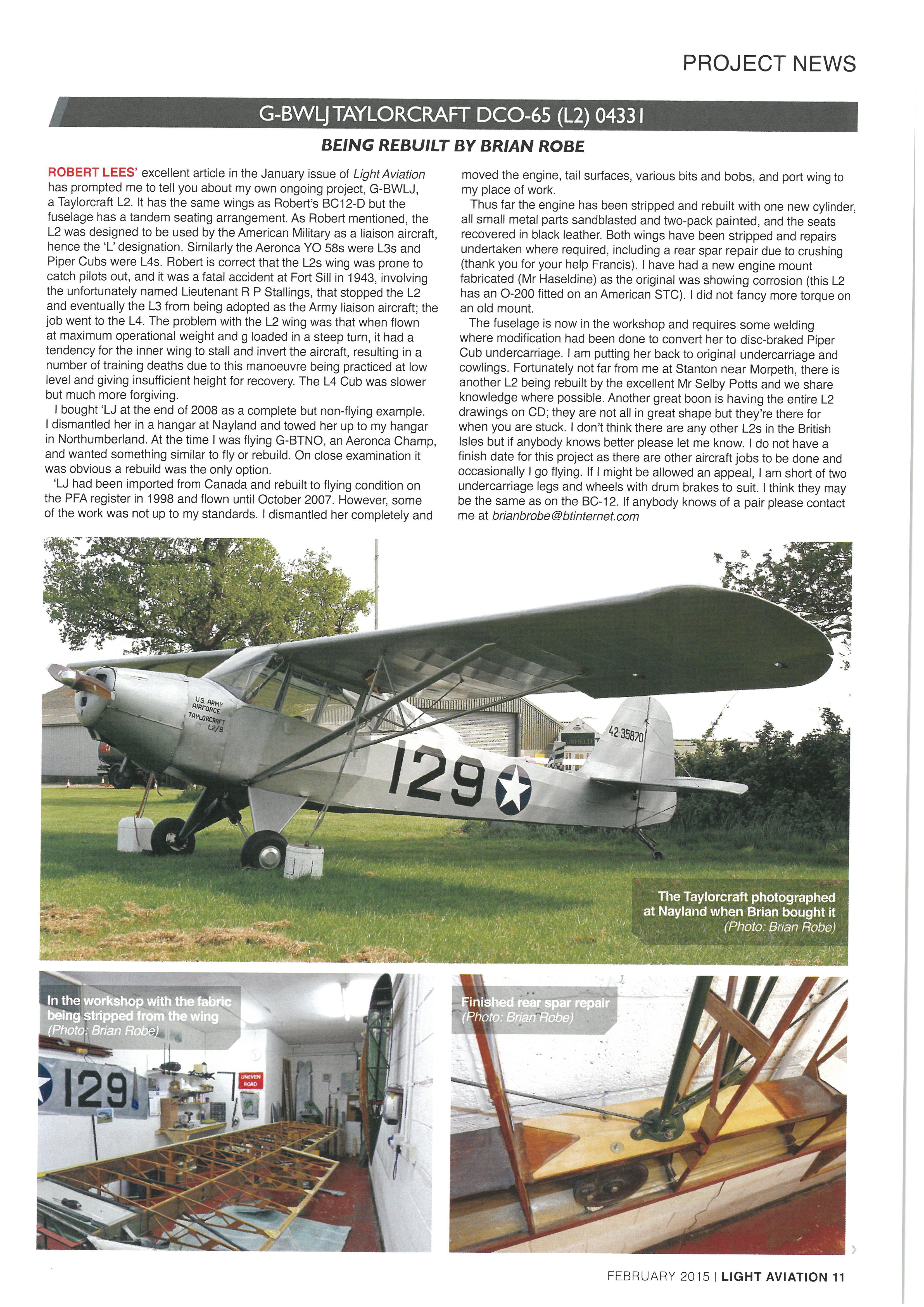
| bought ‘LJ at the end of 2008 as a complete but non-flying example. | dismantled her in a hangar at Nayland and towed her up to my hangar in Northumberland. At the time | was flying G-BTNO, anAeronca Champ, and wanted something similar to fly or rebuild. On close examination it was obvious a rebuild was the only option.
‘LUhad been imported from Canada and rebuilt to flying condition on the PFA register in 1998 and flown until October 2007. However, some
moved the engine, tail surfaces, various bits and bobs, and port wing to my place of work.
Thus far the engine has been stripped and rebuilt with one new cylinder, all small metal parts sandblasted and two-pack painted, and the seats recovered in black leather. Both wings have been stripped and repairs undertaken where required, including a rear spar repair due to crushing (thank you for your help Francis). | have had a new engine mount fabricated (Mr Haseldine) as the original was showing corrosion (this L2 has an O-200 fitted on an American STC). | did not fancy more torque on an old mount.
The fuselage is now in the workshop and requires some welding where modification had been done to convert her to disc-braked Piper Cub undercarriage. | am putting her back to original undercarriage and cowlings. Fortunately not far from me at Stanton near Morpeth, there is another L2 being rebuilt by the excellent Mr Selby Potts and we share knowledge where possible.Another great boon is having the entire L2 drawings on CD; they are not all in great shape but they’re there for when you are stuck. | don’t think there are any other L2s in the British Isles but if anybody knows better please let me know. | do not have a finish date for this project as there are other aircraft jobs to be done and occasionally | go flying. If | might be allowed an appeal, | am short of two undercarriage legs and wheels with drum brakes to suit. | think they may be the same as on the BC-12. If anybody knows of a pair please contact me at brianbrobe@btinternet.com
The Taylorcraft photographed at Nayland when Brian bought it (Photo: Brian Robe)
8 September 2014, my Mk 26 Supermarine Spitfire completed a successful first flight at Lee-on-Solent in the capable hands of LAA flight test pilot Chris Thompson. This was the culmination of 8% years of consistent effort, totalling 5,480 hours of logged work. There were lots of high points during the build, but also some incredible lows, so what follows is my story of the construction of this project.
To set the scene, we need to spool back to 1994 when | began construction of a Europa Classic Monowheel. At that time, my wife and | lived in a large four-bedroomed house with a double garage, which had a large boarded loft area and was ideal for this type of project. 12 months into the build saw us downsizing to a much smaller house with only a single garage.
The following four years were spent juggling with all sorts of cradles, trucks and hoists, while major assemblies took place on the front lawn. Completed parts were stored under beds and anywhere | could find space. Then there was the painting all done in the single garage with two homebuilt extractor units.
The result was a lovely aircraft making its first flight with Martin Stoner at Kemble on 11 March 1999. Total build time for the Europa was five years with 2,000 hours logged. You may be asking by now what has all thistodowiththeSpitfire,well,acoupleofthingsreally.When|finished the Europa, | was completely drained. In fact, | burst into tears as Martin climbedawayand|nevermanagedapictureofthefirstflight!|thought | could never go through all that again, while my long-suffering wife Isabel had some views on it too!
Then, in 2005, | browsed through an article on the Australian-produced Mk 26 Spitfire kitplane. Matthew Russell had just been appointed as UK agent for the kits and the first UK example, ‘JWP,was nearing completion at Matthew’s Kirkbymoorside hangar.
We all know about everyone dreaming of flying a Spitfire, and one winter’s evening Isabel and | were supposedly watching TV when | cautiously produced the brochure saying, “Wouldn't it be lovely to make one of these?”
The immediate response was, “I am not living in an aircraft factory for another five years. You do it if you want to but you will have to find somewhere else to build it.”
Crikey, | thought, that’s a YES! So the next day | ordered the kit from Matthew, becoming his first paid-up customer, and nothing more was said about it until four months later when delivery was imminent.
During the wait for delivery, | started making enquiries about suitable premises in which to build the project. Surely, | thought, someone must have an unused double garage or an outbuilding, or perhaps even a barn or something that | could rent. As time passed | was getting nowhere, so | made enquiries with estate agents to see if any small business premises were available. Several introductions were followed up, but none of them really matched my needs.
By now,the promised delivery date was getting close too close for my liking, so a successful application was made to my local council to rent a single garage. At least there would be somewhere to store the kit parts when they turned up.
The Wing Handler with the better of the two wings installed (Photo: David Bishop)
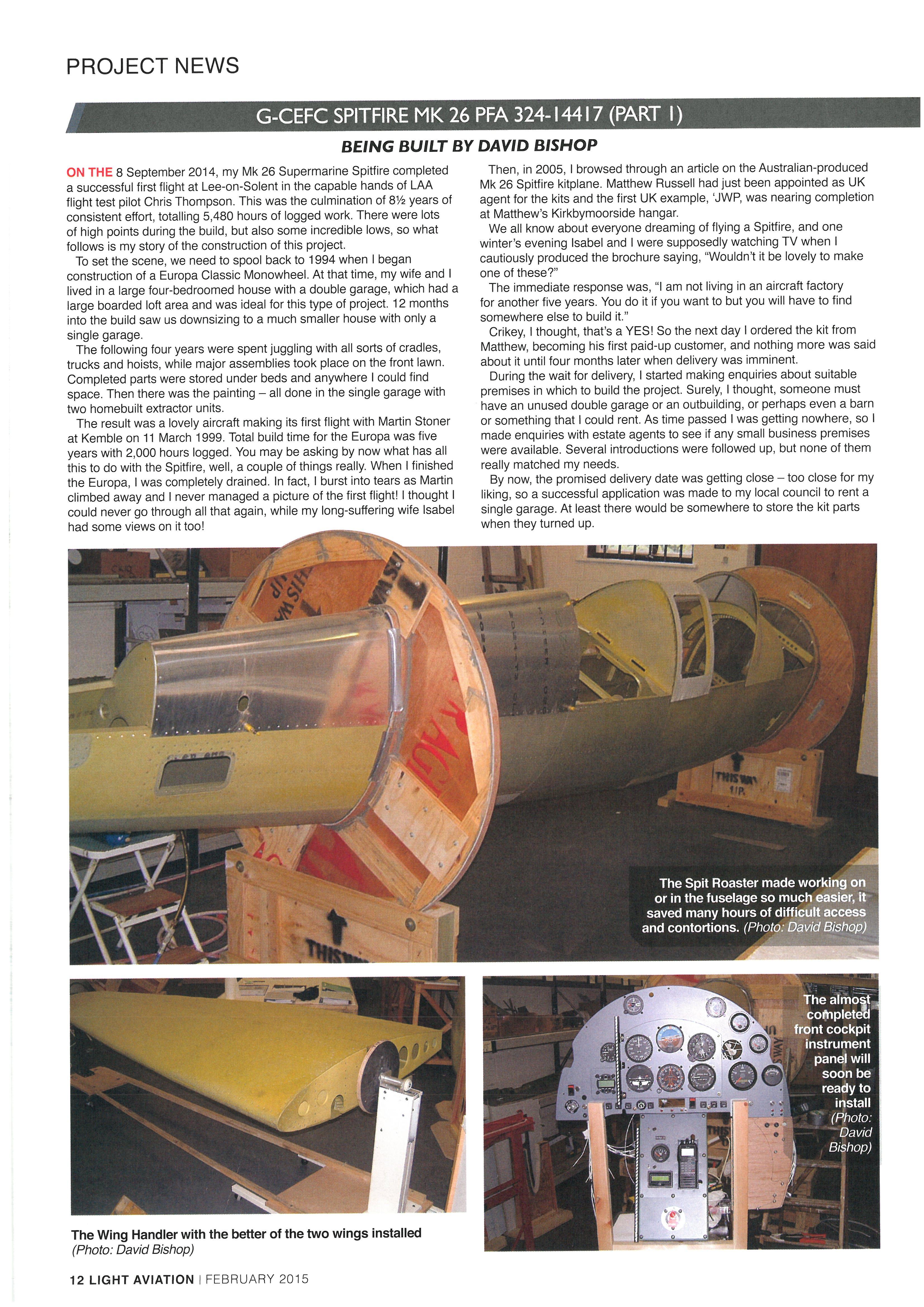
The Spit Roaster made working on or in the fuselage so much easier, it saved many hours of difficult access and contortions. (Photo; David Bishop)
The almost. completed front cockpit instrument panel will soon be ready to Takiel| (Photo: David
It was then that | had two strokes of luck. The first was advice from the then Jabiru UK agent, who suggested | should apply to HM Revenue & Customs for an ‘End Use Relief’ authorisation. Now | had never heard of this, and at first | found it difficult to comprehend. Brieflythis is a scheme whereby ONE imported kit plane from a non-EU country, and any imported parts needed to build it, can be brought through Customs free of import duty. There wasafair bitofredtapetobedoneinanapplication,butinthe end|wasgrantedafive-year relief.Thisappliedtothekitandthe Jabiru engine from Australia, as well as lots of additional materials sourced from LAS Aerospace such as AN nuts and bolts, and extra 2024 T3 Alclad sheet (all from USA). Because the project over-ran for reasons you will read about in due course, | later applied for an extension for another three years and this was granted too. | saved a lot of money thanks to this tip.
The second good fortune was when the estate agent referred me to a vacant unit on a nearby small industrial estate. The existing business had fallen on hard times and the owner was anxious to terminate his lease early. The unit measured 40x19.5ft (780.sq.ft), which included a small office, a toilet and small kitchen area. The site owner interviewed me and expressed great interest in what musthaveseemedlikea prettyriskyenterpriseforhim.However, heproposed a six-yearleaseagreement,whichworriedmea bit.If anything happened to me | was afraid | could leave Isabel with an unwanted legacy. Hewas very understanding so offered to insert a break clause in every year, whereby | could exit with just three months’ notice at any time. The deal was done and | now had a perfect workshop to build the Spitfire.
The previous incumbent was so pleased to be able to terminate his lease he gave me a large amount of steel racking for storage. Benching was sourced and shadow boards made for mounting tools on the wall. The whole thing was set up and ready to go just as the kit arrived.
Matthew Russell and Steve Markham (who was shortly to order his own Spitfire kit from Matthew) spent two days unpacking the crates and checking all the contents with me. At about the same time, my inspector, Barry Goldsack, visited to inspect the kit and my workshop facility. Barry had been my inspector throughout the construction of my Europa and its subsequent annual Permit renewals, so we know each other well. It was really great that he agreedtooverseemynewprojectand | willalwaysbegratefulfor all his advice and support.
WINGING IT
My kit was the first one to be supplied with partly assembled wings, a fact that | was rather disappointed to hear as | was hoping to do it all myself. This pre-build was done by the factory in response to a number of potential customer concerns about their ability to construct the complex wing shape of the Spitfire. Little did | know at the time that | would have more than my share of wing building before this project was completed. The first inkling of trouble to come was on unpacking the wing box; we found a scenario where it looked as if two different people had built the port and starboard wings. The starboard panel was neatly assembled just like the fuselage, but the port wing was something else! It was deeply quilted along the rivet dimple lines, and had loads of areas where theskinpoppedinandoutlike a tinlid andthat’sjusttomention some of the problems!
We all agreed the port wing was unacceptable, and |for one certainly didn’t want anyone to think that | had built it! Because | had wanted to do the construction myself anyway, | volunteered to de-skin and rectify the wing myself. Supermarine agreed and said they would replace any defective parts or those | damaged during dismantling. With this settled, the wing was put to one side whilst | gained experience building the fuselage.
The next step was to make some rotary handling fixtures for the wing and fuselage. Of all the things | designed, the fuselage handler proved the most invaluable piece of equipment. This consisted of two, four foot diameter discs supported on rollers. Each disc was made from the packing case plywood and comprised four segments, each of which could be removed to gain access to the rivets covered by that portion of disc. When demonstrated for the first time to my other half, she said in all innocence, “It looks a bit like a spit roaster,” which indeed it did!
lf your aircraft has been featured in the New Projects list, please let Project News know of your progress at projectnews@laa-archive.org.uk
A ara VAY XEXA RikaPa
Mr M Carter, Pinelands, Penwood Heights, Highclere, Newbury, Berkshire, RG20 9EP
@VAN’S RV-7A (LAA 323-15308) 11/12/2014
Mr T Andrew, Archway House, Llanfynydd, Clywyd, LL11 5HN
@VAN’S RV-7 (LAA 323-15310) 15/12/2014
Mr R M Davies, Bramley Cottage, 34a High Street, Waltham on the Wolds, Leicestershire, LE14 4AH LAee ra VY ERD a eet
Mr R Coates, The Vineries, Lambs Green, Horsham, West Sussex, RH12 4RG
@EUROFOX 912(S) (LAA 376-15309) 23/12/2014
Mr D C Fairbrass, 66 Theydon Grove, Epping, Essex, CM16 4QA
@DR 107 ONE DESIGN (LAA 264-15312) 24/12/2014
Mr P D Baisden, 82 Southwold Crescent, Benfleet, Essex, SS7 5SR
lf your aircraft has featured recently in the magazine and has subsequently completed its maiden flight, Project News would liketohearfromyouatprojectnews@laa-archive.org.uk
Mr MC Huxtable, Ridgwood, Little Lane, Loosley Row, Princes Risborough, HP27 ONX
@G-TIAC SHERWOOD RANGER XP (LAA 237A-14949)
Name & address held by LAA Engineering
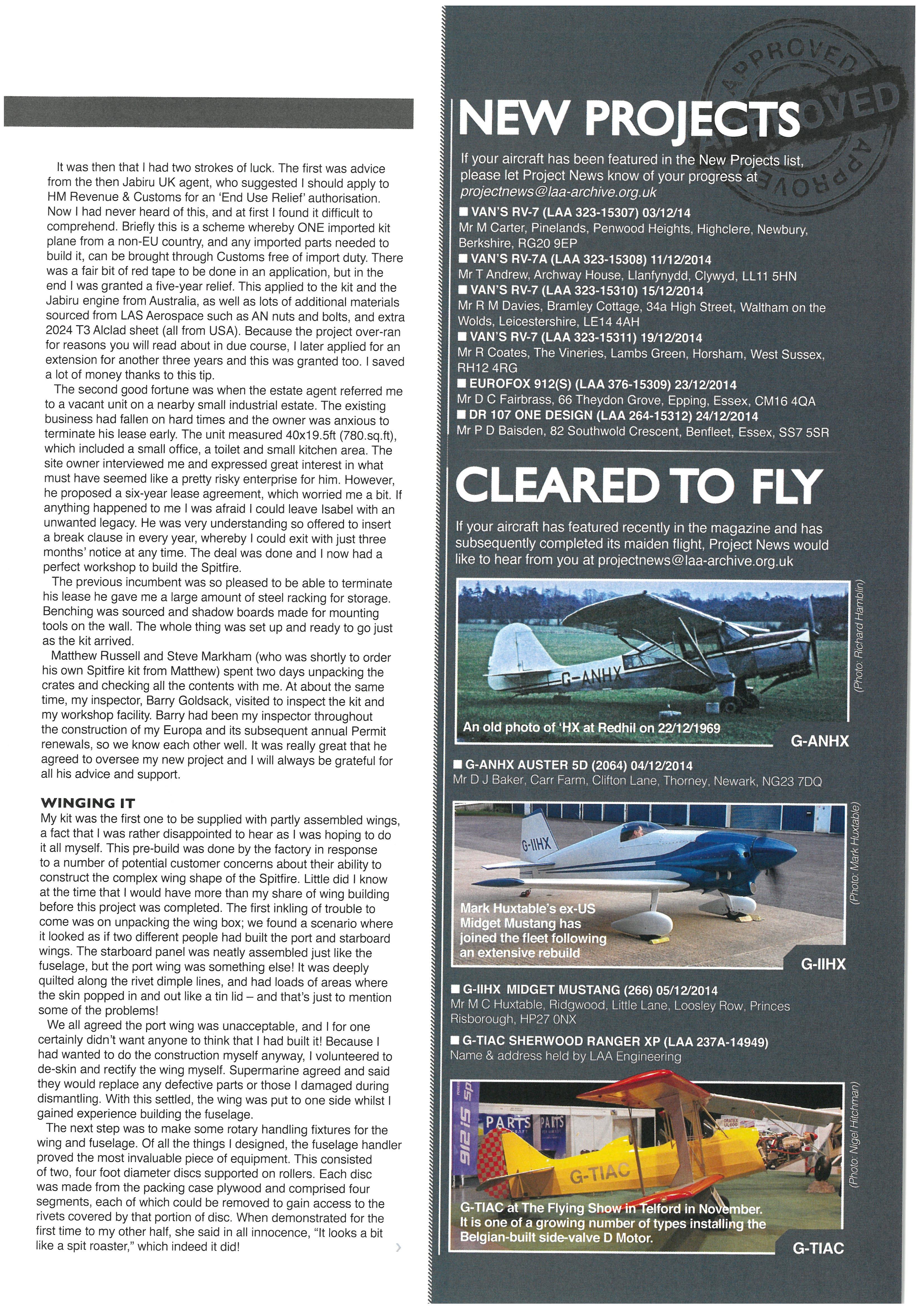
elford in November. It is one of a growing number of types installing the Belgian-builtside-valveDMotor.
PROJECT NEWS
The Spit Roaster was based on my experience of being a toolmaker at Folland Aircraft in the 1950s. | worked on the Midge and Gnat prototypes in the Experimental Department until both aircraft completed their maiden flights. What great days they were. | digress... when the Gnat trainers went into production the fuselages were built in a spit roaster, hence my later tool making involvement. It made for easy build access and reduced all the standing on your head fitting out the instrumentation and controls. You just have to remember your port and starboard orientation and think upside down.
On the Spitfire this tooling was magic. | was able to fully complete all the installation of the instrument panel and its wiring standing up. Similarly, all the control systems were done like this, as was the windscreen. Then when you wanted to get at something else, you just rotated the assembly and locked it in position. Another advantage was that the aircraft horizontal datum was always in alignment.
Sometimes, spending a couple of weeks making up tooling is a wellspent delay in the production of the aeroplane. Although | kept a record of time spent on tools etc, this was never included in the build time record. Every visit to the workshop was always logged, however little was actually done on the Spit and a diary entry made for that visit detailing what was achieved (or not).
The spar was pretty heavy but with the set-up shown in the photograph (page 12), incremental movements were possible, which allowed entry of all the bolts holding the spar to the fuselage. The rear spar followed, but this had to be assembled from something like ten separate pieces, which were partly drilled. On my aircraft | spent ages trying to assemble these bits but ultimately gave up. The spar turned out to be faulty and was replaced by the factory.
WING DROP IN THE STALL...
Whilst all this was being sorted, news started to come through which indicated that some (but not all) flying Spitfires were exhibiting a nasty tendency to drop the left wing at the stall. Stall strips had been tried
buttheportwingstillcouldn’tbetamed.Hmm. portwingsagain. | was advised to check the washout of my two outer wing panels. The information was that if both wings checked out the same, all is well as it is only the port wing that may be faulty.
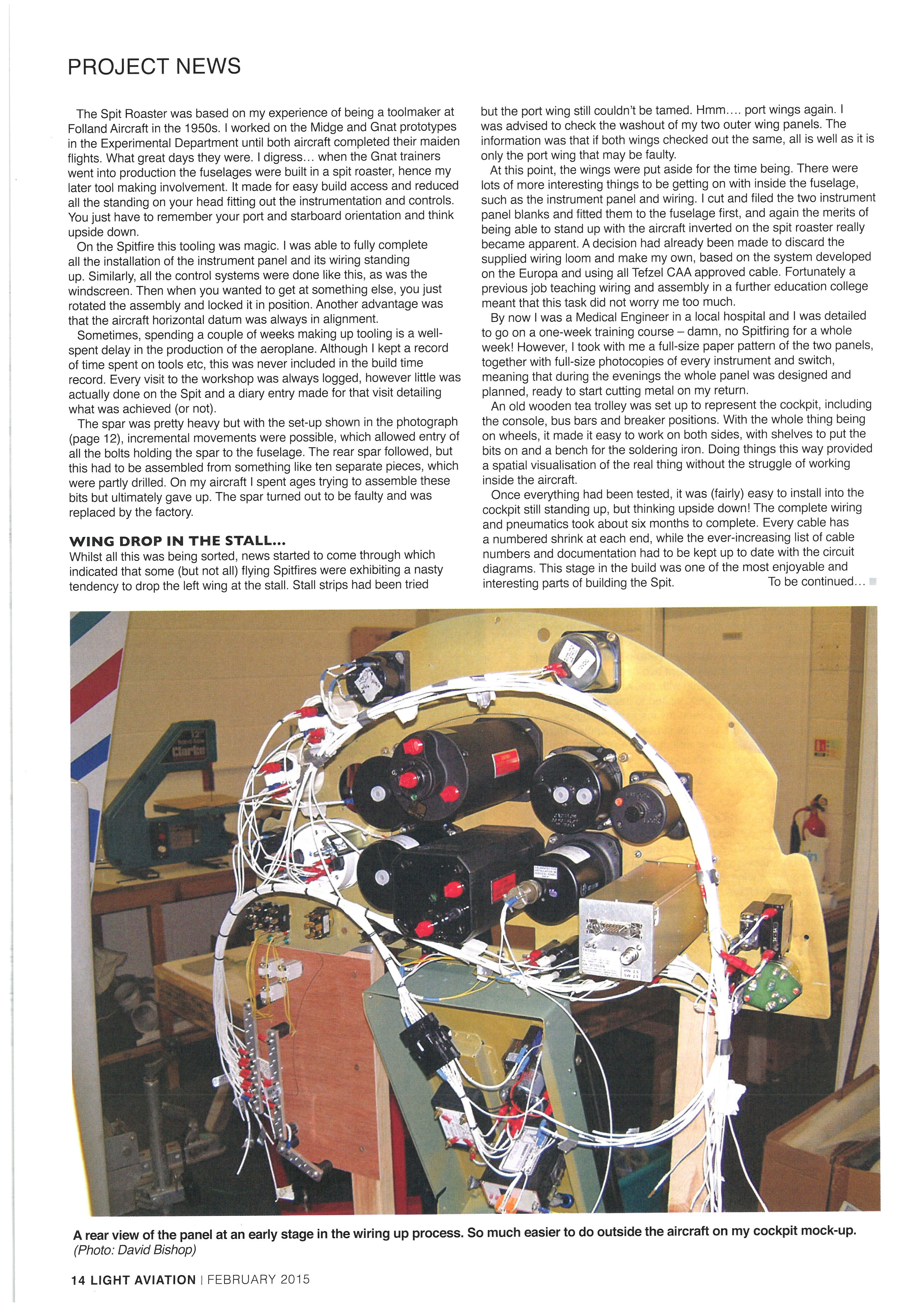
At this point, the wings were put aside for the time being. There were lots of more interesting things to be getting on with inside the fuselage, such as the instrument panel and wiring. | cut and filed the two instrument panel blanks and fitted them to the fuselage first, and again the merits of being able to stand up with the aircraft inverted on the spit roaster really became apparent. A decision had already been made to discard the supplied wiring loom and make my own, based on the system developed on the Europa and using all Tefzel CAA approved cable. Fortunately a previous job teaching wiring and assembly in a further education college meant that this task did not worry me too much.
By now | was a Medical Engineer in a local hospital and | was detailed to go on a one-week training course damn, no Spitfiring for a whole week!However,|tookwithmeafull-size paperpatternofthetwopanels, together with full-size photocopies of every instrument and switch, meaning that during the evenings the whole panel was designed and planned, ready to start cutting metal on my return.
An old wooden tea trolley was set up to represent the cockpit, including the console, bus bars and breaker positions. With the whole thing being on wheels, it made it easy to work on both sides, with shelves to put the bits on and a bench for the soldering iron. Doing things this way provided a spatial visualisation of the real thing without the struggle of working inside the aircraft.
Once everything had been tested, it was (fairly) easy to install into the cockpit still standing up, but thinking upside down! The complete wiring and pneumatics took about six months to complete. Every cable has a numbered shrink at each end, while the ever-increasing list of cable numbers and documentation had to be kept up to date with the circuit diagrams. This stage in the build was one of the most enjoyable and interesting parts of building the Spit. To be continued...
suppose if am being honest I’d have to admit that the Reliant Robin isn’t regarded as one of motoring’s all time classic automobiles. True, like most slightly quirky modes of transport, it has its diehard fans, but its comic role in Only Fools and Horses pretty much sums up how most people regard this fibreglass-bodied and somewhat unstable three-wheeler.
Though today a three-wheeled car seems an anachronism, post WWII it was a very different story. Cars were beyond the reach of most and motorised transport for the masses consisted of a motorcycle. When the family came along, you added a sidecar and simply put up with cold and inclement weather. Seeing a gap in the market, and making the most of an oddity in the law that categorised a three-wheeled car in the same driving licence group as a motorcycle, a plethora of three-wheeled minicars found a ready market. Reliant, which had been formed in 1934 to take over the Raleigh Bicycle Company's three-wheeled vehicle line when it decided to concentrate solely on bicycle production, took a decent slice of the market and built over half a million vehicles, mostly three-wheelers, over the company’s 65 year history.
For many years Reliant used the side-valve 747cc Austin Seven engine but by the early 1960s it introduced its own 600cc, allaluminium, four-cylinder OHV engine. Over the next 15 years the capacity increased until by 1975 it became an 850cc unit. By one of those strange twists of fate, the Reliant engine was adopted by the 750 Racing Club when it too decided it was time to move on from the Austin Seven, so there is a good degree of tuning knowledge available for the engine.
So, what has all this got to do with the price of a loaf of bread or homebuilt aeroplanes?
Well, about ten years ago, LAA member Paddy Jordan was considering what he might like to build in his retirement, albeit that was some years off. He rather liked the Dart Kitten, but as its engine of choice, the horizontally-opposed twin cylinder JAP J-99, was as rare as hens’ teeth and correspondingly costly, he began to ponder a number of options. Well-known local LAA inspector Dave Machin suggested the Reliant engine might have some possibilities as
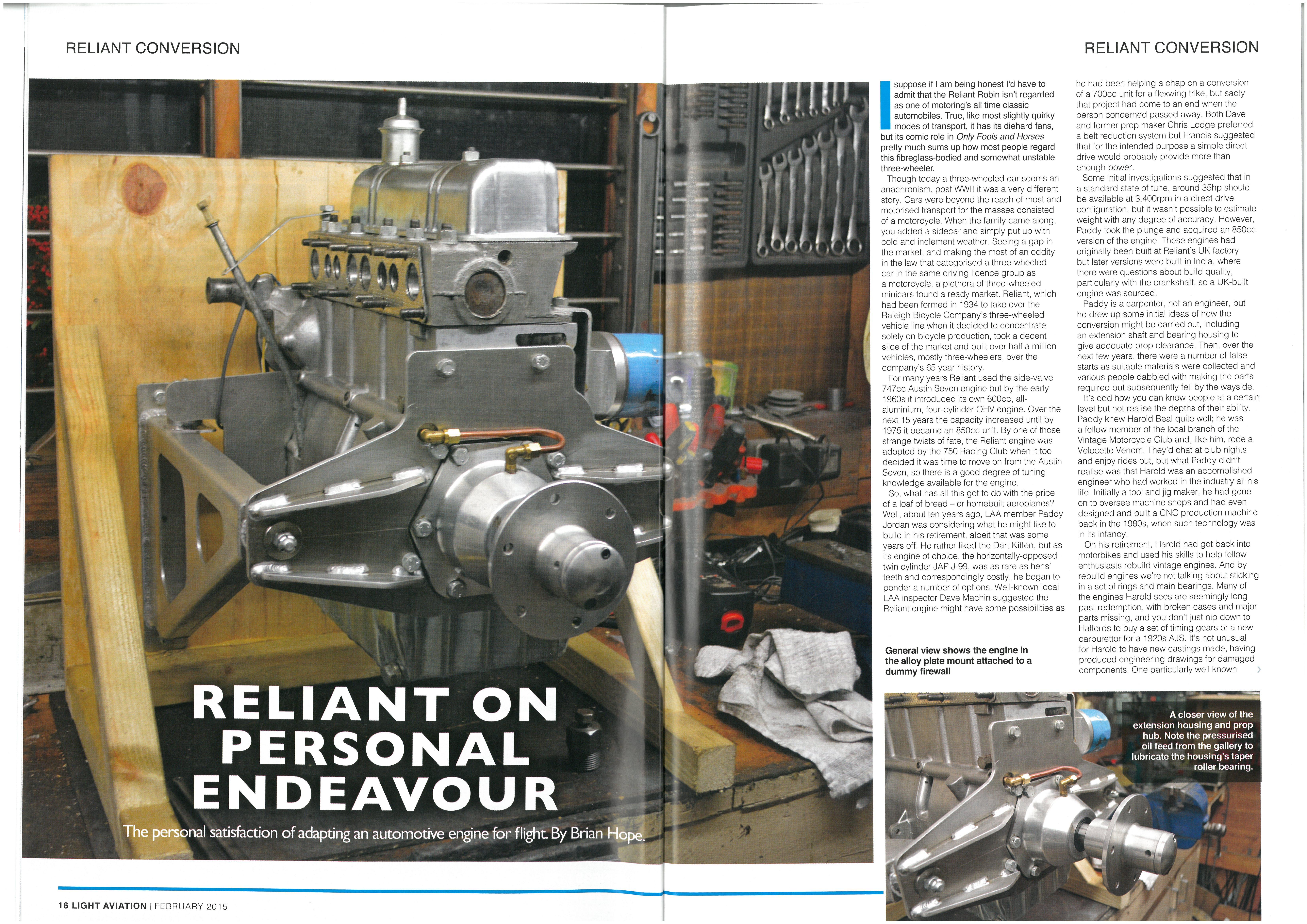
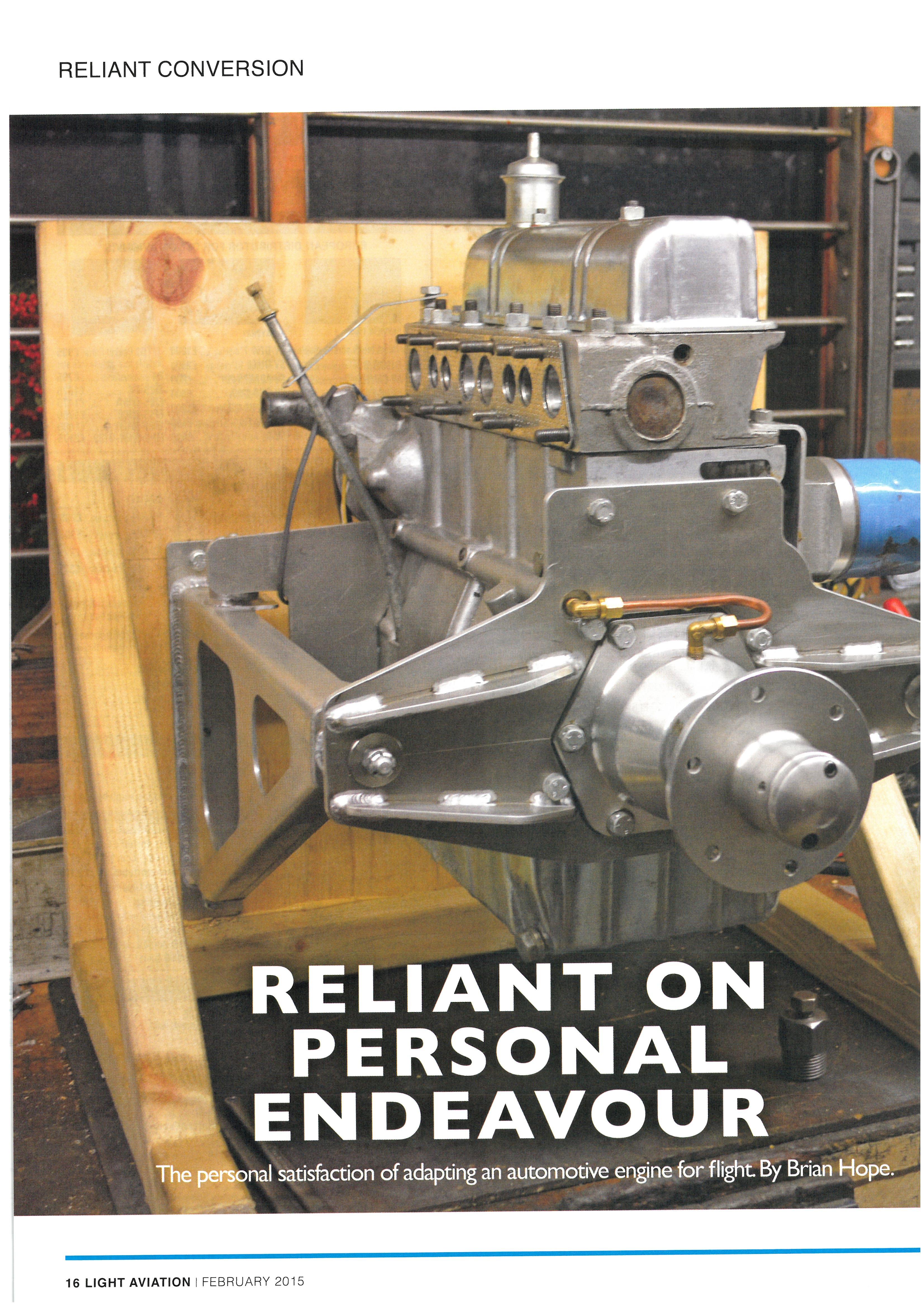
General view shows the engine in the alloy plate mount attached to a dummy firewall
he had been helping a chap on a conversion of a 700cc unit for a flexwing trike, but sadly that project had come to an end when the person concerned passed away. Both Dave and former prop maker Chris Lodge preferred a belt reduction system but Francis suggested that for the intended purpose a simple direct drive would probably provide more than enough power.
Some initial investigations suggested that in a standard state of tune, around 35hp should be available at 3,400rpm in a direct drive configuration, but it wasn’t possible to estimate weight with any degree of accuracy. However, Paddy took the plunge and acquired an 850cc version of the engine. These engines had originally been built at Reliant’s UK factory but later versions were built in India, where there were questions about build quality, particularly with the crankshaft, so a UK-built engine was sourced.
Paddy is a carpenter, not an engineer, but he drew up some initial ideas of how the conversion might be carried out, including an extension shaft and bearing housing to give adequate prop clearance. Then, over the next few years, there were a number of false starts as suitable materials were collected and various people dabbled with making the parts required but subsequently fell by the wayside. It's odd how you can know people at a certain level but not realise the depths of their ability.
Paddy knew Harold Beal quite well; he was a fellow member of the local branch of the Vintage Motorcycle Club and, like him, rode a Velocette Venom. They’d chat at club nights and enjoy rides out, but what Paddy didn't realise was that Harold was an accomplished engineer who had worked in the industry all his life. Initially a tool and jig maker, he had gone on to oversee machine shops and had even designed and built a CNC production machine back in the 1980s, when such technology was in its infancy.
On his retirement, Harold had got back into motorbikes and used his skills to help fellow enthusiasts rebuild vintage engines. And by rebuild engines we're not talking about sticking in a set of rings and main bearings. Many of the engines Harold sees are seemingly long past redemption, with broken cases and major parts missing, and you don’t just nip down to Halfords to buy a set of timing gears or a new carburettor for a 1920s AUS. It’s not unusual for Harold to have new castings made, having produced engineering drawings for damaged components. One particularly well known
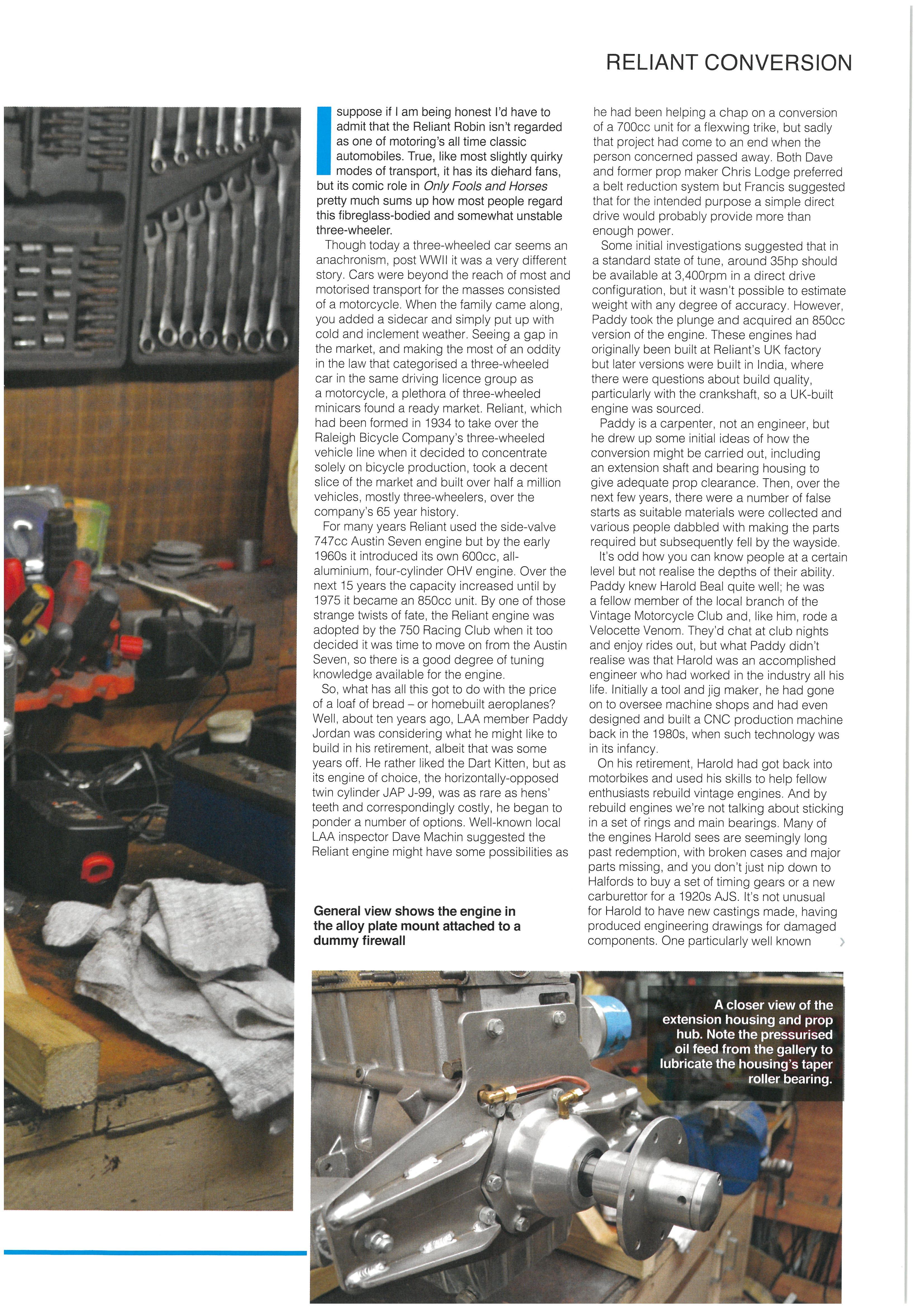
A closer view of the extension housing and prop hub. Note the pressurised oil feed from the gallery to lubricate the housing’s taper roller bearing.
suppose if | am being honest I’d have to admit that the Reliant Robin isn’t regarded as one of motoring’s all time classic automobiles. True, like most slightly quirky modes of transport, it has its diehard fans, but its comic role in Only Fools and Horses pretty much sums up how most people regard this fibreglass-bodied and somewhat unstable three-wheeler.
Though today a three-wheeled car seems an anachronism, post WWII it was a very different story. Cars were beyond the reach of most and motorised transport for the masses consisted of a motorcycle. When the family came along, you added a sidecar and simply put up with cold and inclement weather. Seeing a gap in the market, and making the most of an oddity in the law that categorised a three-wheeled car in the same driving licence group as a motorcycle, a plethora of three-wheeled minicars found a ready market. Reliant, which had been formed in 1934 to take over the Raleigh Bicycle Company’s three-wheeled vehicle line when it decided to concentrate solely on bicycle production, took a decent slice of the market and built over half a million vehicles, mostly three-wheelers, over the company’s 65 year history.
For many years Reliant used the side-valve 747cc Austin Seven engine but by the early 1960s it introduced its own 600cc, allaluminium, four-cylinder OHV engine. Over the next 15 years the capacity increased until by 1975 it became an 850cc unit. By one of those strange twists of fate, the Reliant engine was adopted by the 750 Racing Club when it too decided it was time to move on from the Austin Seven, so there is a good degree of tuning Knowledge available for the engine.
So, what has all this got to do with the price of a loaf of bread or homebuilt aeroplanes? Well, about ten years ago, LAA member Paddy Jordan was considering what he might like to build in his retirement, albeit that was some years off. He rather liked the Dart Kitten, but as its engine of choice, the horizontally-opposed twin cylinder JAP J-99, was as rare as hens’ teeth and correspondingly costly, he began to ponder a number of options. Well-known local LAA inspector Dave Machin suggested the Reliant engine might have some possibilities as
RELIANT CONVERSION
General view shows the engine in the alloy plate mount attached to a dummy firewall
he had been helping a chap on a conversion of a 700cc unit for a flexwing trike, but sadly that project had come to an end when the person concerned passed away. Both Dave and former prop maker Chris Lodge preferred a belt reduction system but Francis suggested that for the intended purpose a simple direct drive would probably provide more than enough power.
Some initial investigations suggested that in a standard state of tune, around 35hp should be available at 3,400rpm in a direct drive configuration, but it wasn’t possible to estimate weight with any degree of accuracy. However, Paddy took the plunge and acquired an 850cc version of the engine. These engines had originally been built at Reliant’s UK factory but later versions were built in India, where there were questions about build quality, particularly with the crankshaft, so a UK-built engine was sourced.
Paddy is a carpenter, not an engineer, but he drew up some initial ideas of how the conversion might be carried out, including an extension shaft and bearing housing to give adequate prop clearance. Then, over the next few years, there were a number of false starts as suitable materials were collected and various people dabbled with making the parts required but subsequently fell by the wayside. It's odd how you can know people at a certain level but not realise the depths of their ability. Paddy knew Harold Beal quite well; he was a fellow member of the local branch of the Vintage Motorcycle Club and, like him, rode a Velocette Venom. They'd chat at club nights and enjoy rides out, but what Paddy didn’t realise was that Harold was an accomplished engineer who had worked in the industry all his life. Initially a tool and jig maker, he had gone on to oversee machine shops and had even designed and built a CNC production machine back in the 1980s, when such technology was in its infancy.
On his retirement, Harold had got back into motorbikes and used his skills to help fellow enthusiasts rebuild vintage engines. And by rebuild engines we're not talking about sticking in a set of rings and main bearings. Many of the engines Harold sees are seemingly long past redemption, with broken cases and major parts missing, and you don’t just nip down to Halfords to buy a set of timing gears or a new carburettor for a 1920s AUS. It’s not unusual for Harold to have new castings made, having produced engineering drawings for damaged components. One particularly well known
A closer view of the extension housing and prop hub. Note the pressurised oil feed from the gallery to lubricate the housing’s taper roller bearing.
RELIANT CONVERSION
bike he has worked on is Whiffling Clara, a 1931supercharged 348cc KTTVelocette, for which he manufactured the complete supercharger. On the bench alongside the Reliant engine was a pre-war Vincent A Model V-twin engine being built around a set of new CNC machined crankcases.
Paddy learnedof Harold's engineering ability via a fellow club member and as he had an interestin aviation,Harold offered to help. It'strue to say that the project has moved on more inthe past six months than it has in the last six years, although the engine isvery much a ‘hospital job’ that goes onto the backburner when there's more urgent bike work to get on with.
As an engineer, Harold quickly saw that some of Paddy's initial ideas were lacking finesse and he has refined the design somewhat. The prop extension’s tapered roller bearing, for instance, is now pressure fed with oil from the main oil gallery rather than relying on splash lubrication, as originally intended. The prop hub is tapered and keyed onto the drive shaft and can be pulled off with the prop still in situ. A very neat drive shaft nut lock consists of a socket shaped ‘hat’ that fits over the nut with a slotted outer ring that fits over the end of the prop hub. An outer cap then retains the ‘locking socket’, sandwiching its flange between the hub and the end cap.
The engine itself has been left in a standard state of tune. Investigations into cam profiles suggest that the standard camshaft, which is favoured by users of the engine in trials cars, is probably the best for power at the lower end of the rev range where it will be operating.
Where mods have been made is in the breathing department. As you can see from the pictures, unfortunately the engine is not a crossflow but improvements include modifying the cast aluminium inlet manifold to take a side-draught rather than a downdraught carb, and generally cleaning up the intake ports to match the manifold. Exhaust-wise the standard cast iron manifold has been discarded and a bespoke stainless steel tube system is being made, again with a clean-up of the ports to match. These mods were primarily made to make the engine more compact, but they should also improve breathing and hopefully addalittle extrapower.
Providing a charging facility when you are going to be using battery-powered ignition systems is a good idea and Paddy has devised a very light and neat solution. Being a water-cooled engine, it has a water pump, and the alternator has been incorporated into
the water pump drive pulley. The internals were originally from a Honda trials bike and the magnetic outer ring is now incorporated into what is anew pump pulley. The fixed stator attaches to the pump body. The pulley is driven by V-belt from the crankshaft, as in the car, and an adjustable tensioner is fitted, the crank and pump locations being fixed and thus not allowing belt adjustment.
Ignition will be taken care of by a switchable, lost spark dual low tension system feeding a single Ford Zetec style ignition coil (as used on the Leburg system). Incorporating the standard distributor, the cam will have a single lobe which will trigger two sets of points (each sparking a pair of cylinders on each crank rotation). The second system utilises a Pazon Ignitions electronic module that is triggered by a Hall Effect arrangement built into the distributor cap, using the rotor arm as the moving component. With single spark plugs, only one system is used at any one time, the electronic system being the favoured set up. For both systems the distributor’s bob-weight advance/retard is retained, giving 20° of retard for ‘soft’ starting.
ENGINE STARTING
Engine starting is an issue that causes experimental engine builders problems, and often self-starters aren't fitted due to complexity and weight. Paddy's solution is a simple ‘shower spark’ arrangement, something that went out of vogue many years ago but certainly has some merit for experimentation as it is virtually weightless, demanding neither starter motor nor high capacity battery. The principle is simple enough you prime the engine and pull it through until the piston on compression is just past top dead centre. You then energise the coil so it sparks the cylinder, hopefully starting the engine. Usually a vibrator switch that rapidly triggers the low tension power open and closed to effectively generate a shower of sparks at the plug is used, hence the name, but Paddy will be using a purpose-designedelectronic rapid switching device to provide his shower. He will also be incorporating a TDC sensor that will light an LED when the optimum cylinder position is reached and a press button to fire the spark; hopefully a quietly purring Reliant will ensue.
That the principle works cannot be denied. In the January LAA eNewsletter, we featured the video of a magnificent 1911 FiatS76 racing car rebuild which has a four-cylinder 28.3 litre engine. Towards the end of the video the
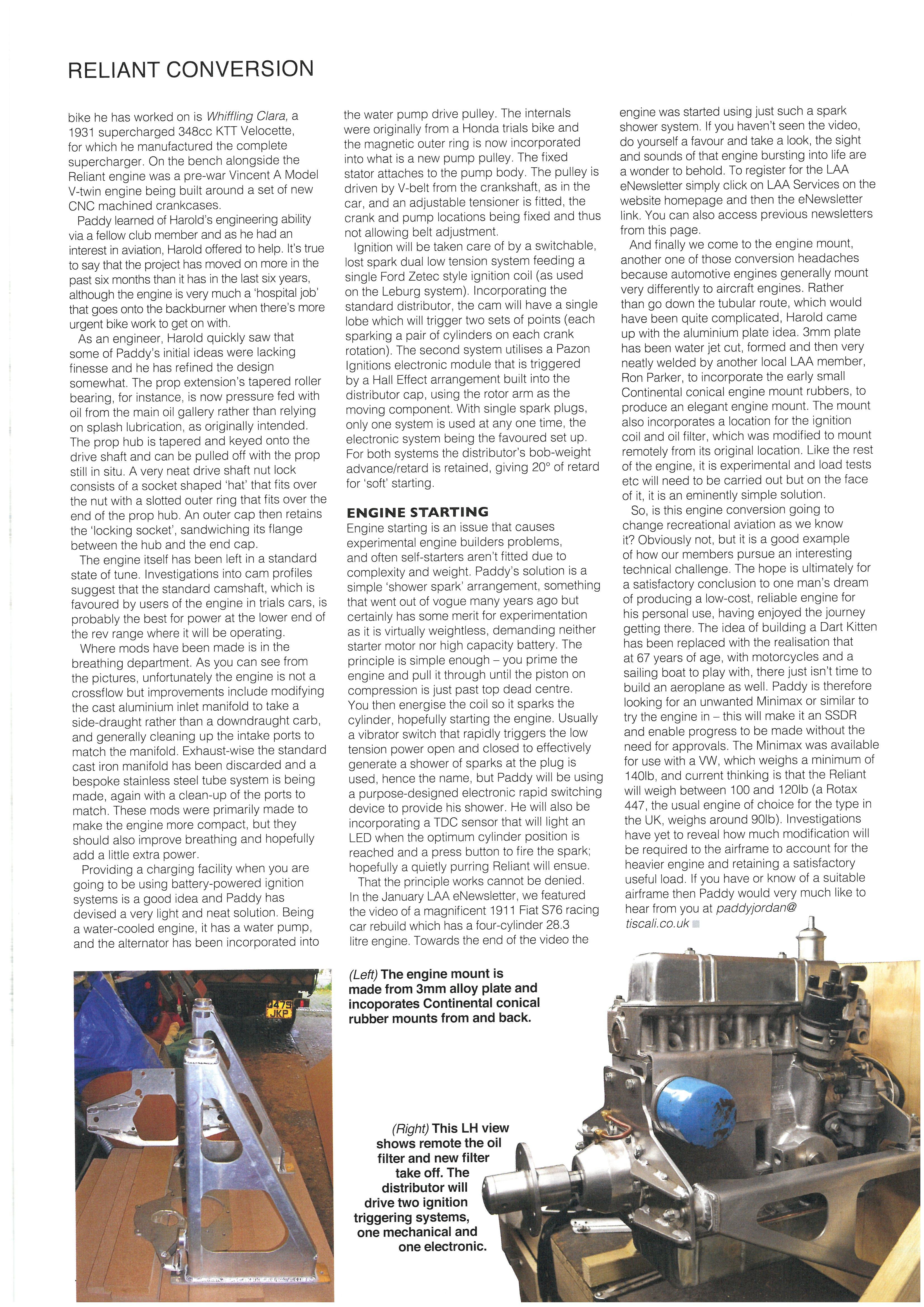
(Left)The engine mount is made from 3mm alloy plate and incoporates Continental conical rubber mounts from and back.
(Right)This LH view shows remote the oil filter and new filter take off. The distributor will drive two ignition triggering systems, one mechanical and one electronic.
engine was started using just such a spark shower system. If you haven't seen the video, do yourselfa favourand take a look,the sight and sounds of that engine bursting into life are a wonder to behold. To register for the LAA eNewsletter simply click on LAA Services on the website homepage and then the eNewsletter link. You can also access previous newsletters from this page.
And finally we come to the engine mount, another one of those conversion headaches because automotive engines generally mount very differently to aircraft engines. Rather than go down the tubular route, which would have been quite complicated, Harold came up with the aluminium plate idea. 3mm plate has been water jet cut, formed and then very neatly welded by another local LAA member, Ron Parker, to incorporate the early small Continental conical engine mount rubbers, to produce an elegant engine mount. The mount also incorporates a location for the ignition coil and oil filter, which was modified to mount remotely from its original location. Like the rest of the engine, it is experimental and load tests etc will need to be carried out but on the face of it, it is an eminently simple solution.
So, is this engine conversion going to change recreational aviation as we know it? Obviously not, but it is a good example of how our members pursue an interesting technical challenge. The hope is ultimately for a satisfactory conclusion to one man’s dream of producing a low-cost, reliable engine for his personal use, having enjoyed the journey getting there. The idea of building a Dart Kitten has been replaced with the realisation that at 67 years of age, with motorcycles and a sailing boat to play with, there just isn’t time to build an aeroplane as well. Paddy is therefore looking for an unwanted Minimax or similar to try the engine in this will make it an SSDR and enable progress to be made without the need for approvals. The Minimax was available for use with a VW, which weighs a minimum of 140lb, and current thinking is that the Reliant will weigh between 100 and 120lb (a Rotax 447, the usual engine of choice for the type in the UK, weighs around 90lb). Investigations have yet to reveal how much modification will be required to the airframe to account for the heavier engine and retaining a satisfactory useful load. If you have or know of a suitable airframe then Paddy would very much like to hearfromyou at paddyjordan@ tiscali.co.uk
he Government and the CAA are holding a General Aviation conference at Duxford on Saturday 28 March 2015. This event will showcase the achievements of the CAA’s GA Unit, witness the unveiling of the Government’s new strategy for GA and see public launch of the Future Airspace Strategy VFR Implementation Plan, all of which aim to change General Aviation for the better. This is all about making our sort of flying easier, more fun and maybe less expensive too, so it has the potential to be the most important event of the year.
There is no doubt that our part of the GA sector has taken a bashing in recent years. n 2006 the CAA’s Review of Costs and Charging, in which we were not allowed Oparticipate but airlines were, dumped huge costs onto us from commercial aviation. Requirements for new radios and ransponders cost us dear, while OFCOM Charging priced out a number of airfield requencies. Moving C of A airworthiness to EASA regulation, where owners were obliged 0 follow procedures designed for airlines, gave the sport massive cost increases and bureaucracy with no improvement in safety, and European pilot licensing has been so complex and confusing that few GA pilots will ever understand it. Gliding, safe and sound under BGA supervision for over 80 years, was buried in massive European regulation that doubled costs; again for no safety benefit.
Meanwhile, as commercial air transport expanded to meet public demand, GA tended to be swept aside to make room; Class G airspace was seen as being akin to a low value brownfield site, ripe for commercial development. And on the ground, the rush for development, planning
lifeto revivethe industry.
regulation and land values are killing our network of airfields. Finding a place to keep an aircraft near a population centre is becoming challenging and costly. All these things taken together are making participation in air sports unaffordable to most people; they are slowly strangling the life out of recreational aviation, starving it of resources and new, younger blood.
For those of us who press on in the face of all this, we see GA flying activity declining, leading to a reduction in recent practice which in turn leads to a reduction in safety. Few people in the prime of their life can afford the time or the money to fly; it is becoming the province of the retired elderly and the sponsored youth.
Are you depressed by all this? Are you even giving up hope that recreational GA has a long-term future? When the Government Aviation Red Tape Challenge swept into town, were you sceptical? Do you think that nobody usually bothers about our bit of aviation except to stamp on it, so despite the rhetoric, this will be like so many past broken promises? Well think again.
FRESH ATTITUDES
This time people are bothering and fresh attitudes are changing the aviation landscape. Change IS happening and there seems to be more to come. Perhaps we are not completely doomed after all; there are real signs of improvement and genuine reason to dare to be optimistic.
This GA Conference will be headed up by the three key people who are leading the commitment for change: Grant Shapps, Minister without Portfolio, the instigator of the Aviation Red Tape Challenge and absolutely forthright in demanding positive change for our sector; And Andrew Haines,
CEO of the CAA; and Patrick Ky, Executive Director of EASA. Haines and Ky are bent on changing the direction of their giant ships of state to undo the restrictions, along with the inevitable additional costs they incur, and in doing so deliver a better GA environment both in the UK and Europe.
Tony Rapson, who heads up the CAA’s new GA department which is getting to grips with unravelling some of the regulatory tangle, will also be in attendance. And last but not least, the Future Airspace Strategy VFR group, led by LAA members Tim Hardy, John Brady and Steve Hutt, will be setting out the programme of change to airspace and regulation that they propose will deliver a more sustainable future for VFR flyers.
Come and hear what they all have to say on 28 March between 10.30am to 3pm at Duxford. Hear for yourself why we have reason, finally, to cast off our old misconceptions and look forward to a brighter, less restrictive future for recreational flying. Come and challenge the people leading the work to make the UK the best country in the world for GA, boosting jobs and growth in the process.
Registered conference attendees will have access to the Imperial War Museum, you can fly in at a reduced landing fee and even enjoy lunch courtesy of the CAA, who together with NATS will have experts on hand to answer your burning questions.
Book your place by emailing GAevent@caa. co.uk with the number of people in your party and whether you intend to fly in or come by road. First come first served. You will get confirmation of successful registration and further information on the event nearer the date. We expect to be able to give you an update on the event in the March issue of LightAviation. See you there!
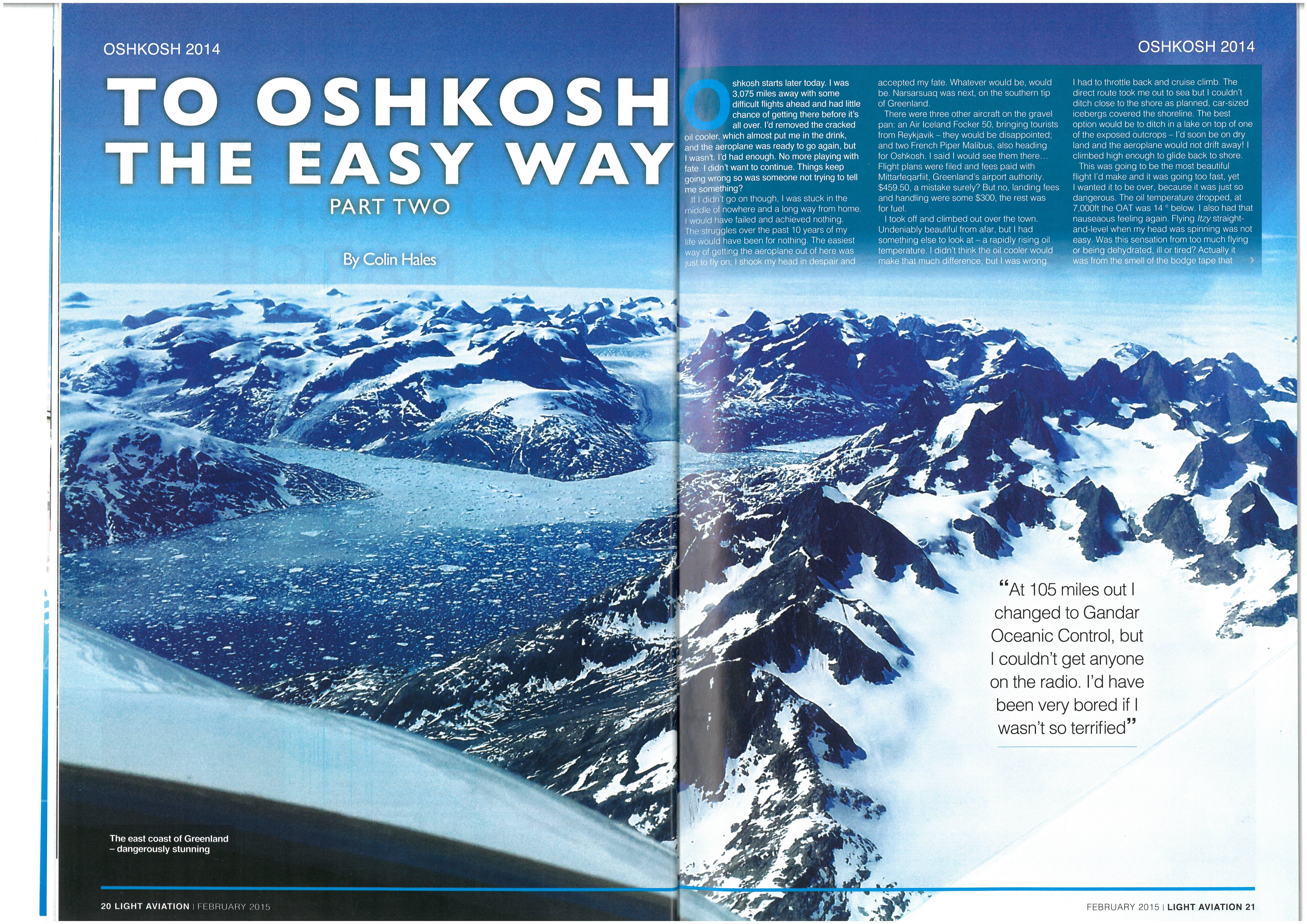
The east coast of Greenland dangerously
shkosh starts later today. | was 3,075 miles away with some difficult flights ahead and had little chance of getting there before it’s all over. l’'d removed the cracked oil cooler, which almost put me in the drink, and the aeroplane was ready to go again, but wasn't. I'd had enough. No more playing with fate. | didn’t want to continue. Things keep goingwrong so was someone not trying to tell me something? if|didn'tgoonthough,|wasstuckinthe middleof nowhereandalongwayfromhome.
| would have failed and achieved nothing. The struggles over the past 10years of my life would have been for nothing. The easiest wayof getting the aeroplane out of here was 9fly on;|shookmyheadindespairand
accepted my fate. Whatever would be, would be. Narsarsuaq was next, on the southern tip of Greenland.
There were three other aircraft on the gravel pan: an Air Iceland Focker 50, bringing tourists from Reykjavik ~ they would be disappointed; and two French Piper Malibus, also heading for Oshkosh. said would see them there... Flight plans were filed and fees paid with Mittarfeqarfiit, Greenland’s airport authority. $459.50, a mistake surely? But no, landing fees and handling were some $300, the rest was ire l@iU(s)p took off and
stunning
The east coast of Greenland
shkosh starts later today. | was 3,075 miles away with some difficult flights ahead and had little chance of getting there before it’s all over. I’d removed the cracked oil cooler, which almost put me in the drink, and the aeroplane was ready to go again, but | wasn't. I’d had enough. No more playing with fate. | didn’t want to continue. Things keep going wrong so was someone not trying to tell me something?
If | didn’t go on though, | was stuck in the middle of nowhere and a long way from home. | would have failed and achieved nothing. The struggles over the past 10 years of my life would have been for nothing. The easiest way of getting the aeroplane out of here was just to fly on; | shookmy head in despair and eSSe
accepted my fate. Whatever would be, would be. Narsarsuaq was next, on the southern tip of Greenland.
There were three other aircraft on the gravel pan: an Air Iceland Focker 50, bringing tourists from Reykjavik they would be disappointed; and two French Piper Malibus, also heading for Oshkosh. | said | would see them there... Flight plans were filed and fees paid with Mittarfegarfiit, Greenland’s airport authority. $459.50, a mistake surely? But no, landing fees and handling were some $300, the rest was ComtU(=1e | took off and climbed out over the town. Undeniably beautiful from afar, but | had something else to look at a rapidly rising oil temperature. | didn't think the oil cooler would make that much difference, but | was wrong.
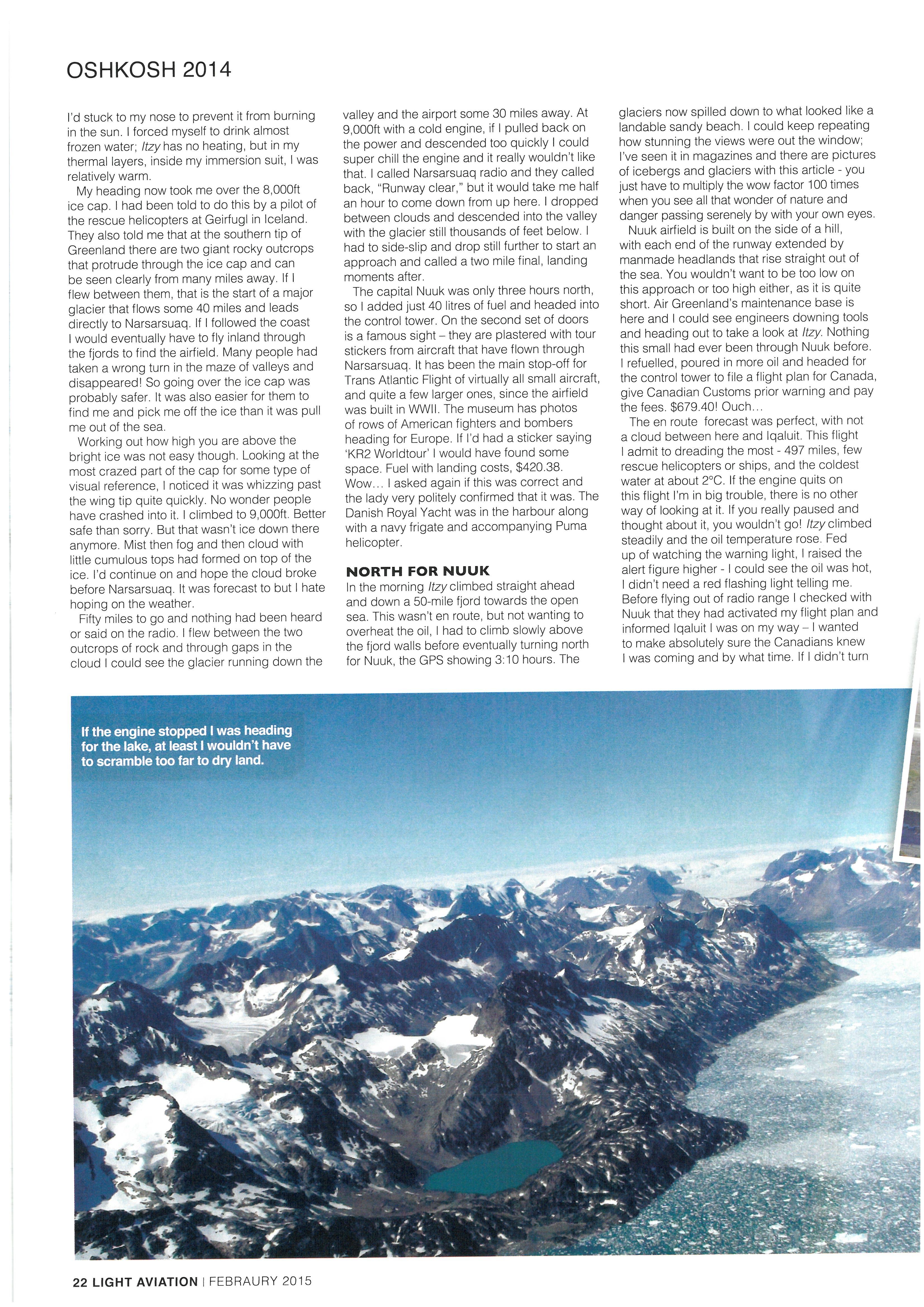
| had to throttle back and cruise climb. The direct route took me out to sea but | couldn't ditch close to the shore as planned, car-sized icebergs covered the shoreline. The best option would be to ditch in a lake on top of one of the exposed outcrops I'd soon be on dry landandtheaeroplanewouldnotdriftaway! | climbed high enough to glide back to shore. This was going to be the most beautiful flight I'd make and it was going too fast, yet | wanted it to be over, because it was just so dangerous. The oil temperature dropped, at 7,000ft the OAT was 14 ° below. | also had that nauseaous feeling again. Flying /tzy straightand-level when my head was spinning was not easy. Was this sensation from too much flying or being dehydrated, ill or tired? Actually it
I'd stuck to my nose to prevent it from burning in the sun. | forced myself to drink almost frozen water; /tzy has no heating, but in my thermal layers, inside my immersion suit, | was relatively warm.
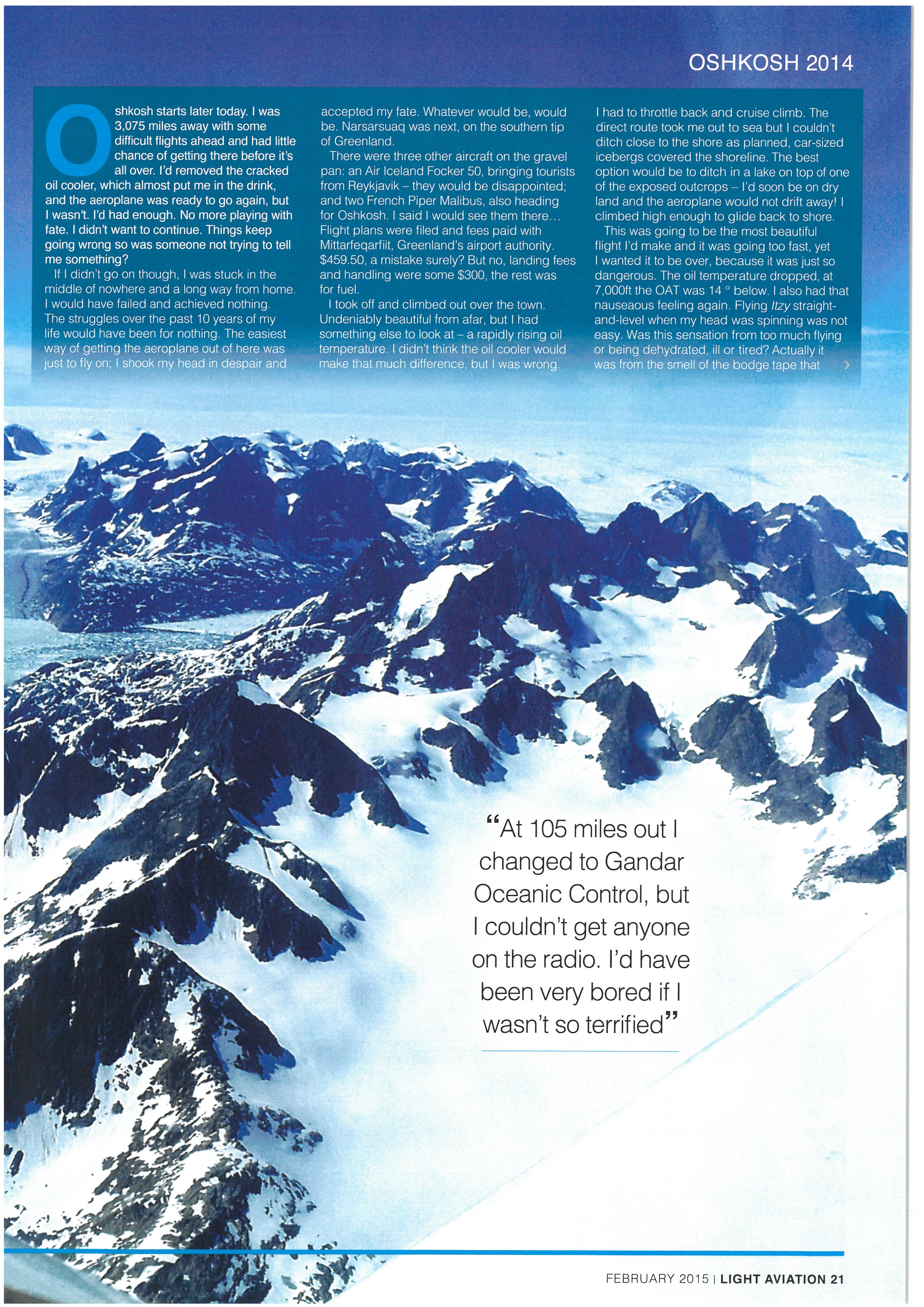
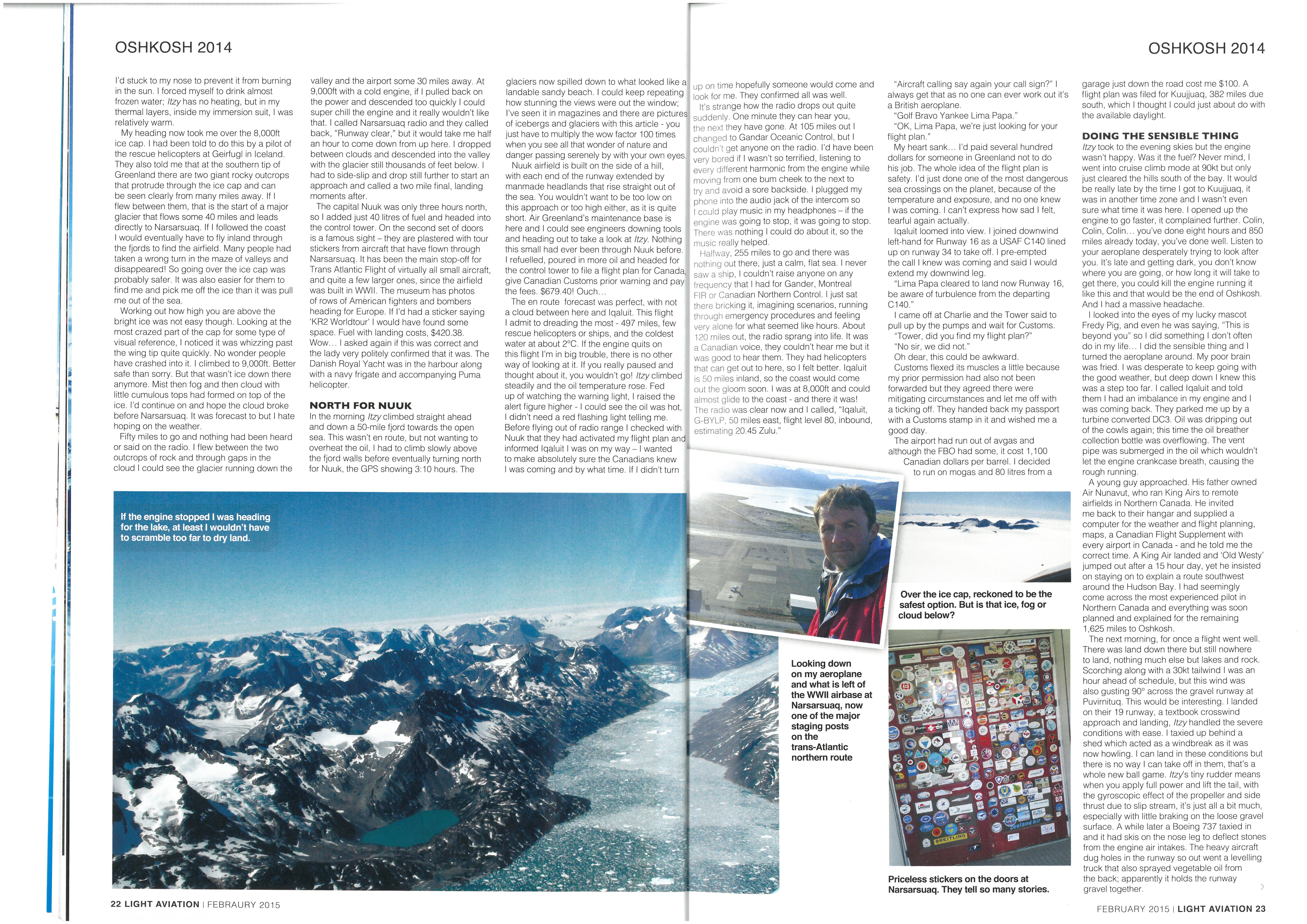
My heading now took me over the 8,00O0ft ice cap. had been told to do this by a pilot of he rescue helicopters at Geirfug! in Iceland. They also told me that at the southern tip of Greenland there are two giant rocky outcrops hat protrude through the ice cap and can be seen clearly from many miles away. If | lew between them, that is the start of a major glacier that flows some 40 miles and leads directly to Narsarsuag. If | followed the coast would eventually have to fly inland through he fjords to find the airfield. Many people had aken a wrong turn in the maze of valleys and disappeared! So going over the ice cap was probably safer. It was also easier for them to ind me and pick me off the ice than it was pull me out of the sea.
Working out how high you are above the bright ice was not easy though. Looking at the most crazed part of the cap for some type of visual reference, noticed it was whizzing past the wing tip quite quickly. No wonder people have crashed into it. climbed to 9,000ft. Better safe than sorry. But that wasn’t ice down there anymore. Mist then fog and then cloud with little cumulous tops had formed on top of the ice. I'd continue on and hope the cloud broke before Narsarsuaq. It was forecast to but | hate hoping on the weather.
Fifty miles to go and nothing had been heard or said on the radio. flew between the two outcrops of rock and through gaps in the cloud | could see the glacier running down the
the engine stopped | was heading for the lake, at least | wouldn’t have to scramble too far to dry land. 22 LIGHT AVIATION | FEBRAURY 2015
valley and the airport some 30 miles away. At 9,000ft with a cold engine, if | pulled back on the power and descended too quickly | could super chill the engine and it really wouldn’t like that. | called Narsarsuaq radio and they called back, “Runway clear,” but it would take me half an hour to come down from up here. dropped between clouds and descended into the valley with the glacier still thousands of feet below. had to side-slip and drop still further to start an approach and called a two mile final, landing moments after.
The capital Nuuk was only three hours north, so | added just 40 litres of fuel and headed into the control tower. On the second set of doors is a famous sight they are plastered with tour stickers from aircraft that have flown through Narsarsuaq. It has been the main stop-off for Trans Atlantic Flight of virtually all small aircraft, and quite a few larger ones, since the airfield was built in WWII. The museum has photos of rows of American fighters and bombers heading for Europe. If I'd had a sticker saying ‘KR2 Worldtour’ would have found some space. Fuel with landing costs, $420.38. Wow... | asked again if this was correct and the lady very politely confirmed that it was. The Danish Royal Yacht was in the harbour along with a navy frigate and accompanying Puma helicopter. NORTH FOR NUUK Inthe morning /tzy climbed straight ahead and down a 50-mile fjord towards the open sea. This wasn’t en route, but not wanting to overheat the oil, | had to climb slowly above the fjord walls before eventually turning north for Nuuk, the GPSshowing 3:10 hours. The
glaciers now spilled down to what looked like a landable sandy beach. could keep repeating how stunning the views were out the window; I've seen it in magazines and there are pictures of icebergs and glaciers with this article - you just have to multiply the wow factor 100times when you see all that wonder of nature and danger passing serenely by with your own eyes. Nuuk airfield is built on the side of a hill, with each end of the runway extended by manmade headlands that rise straight out of the sea. You wouldn't want to be too low on this approach or too high either, as it is quite short. Air Greenland’s maintenance base is here and | could see engineers downing tools and heading out to take a look at /tzy. Nothing his small had ever been through Nuuk before. refuelled, poured in more oil and headed for he control tower to file a flight plan for Canada, give Canadian Customs prior warning and pay he fees. $679.40! Ouch...
The en route forecast was perfect, with not a cloud between here and Iqaluit. This flight admit to dreading the most - 497 miles, few rescue helicopters or ships, and the coldest water at about 2°C. If the engine quits on his flight I’m in big trouble, there is no other way of looking at it. If you really paused and hought about it, you wouldn't go! /tzy climbed steadily and the oil temperature rose. Fed up of watching the warning light, raised the alert figure higher - | could see the oil was hot, | didn't need a red flashing light telling me. Before flying out of radio range | checked with Nuuk that they had activated my flight plan and informed Iqaluit was on my way-| wanted * to make absolutely sure the Canadians knew | was coming and by what time. If didn’t turn
up on time hopefully someone would come and look for me. They confirmed all was well. It’s strange how the radio drops out quite suddenly. One minute they can hear you, the next they have gone. At 105 miles out changed to Gandar Oceanic Control, but | couldn't get anyone on the radio. I'd have been very bored if wasn't so terrified, listening to every different harmonic from the engine while moving from one bum cheek to the next to try and avoid a sore backside. plugged my phone into the audio jack of the intercom so |couldplaymusicinmyheadphones -if the engine was going to stop, it was going to stop. There was nothing could do about it, so the music really helped.
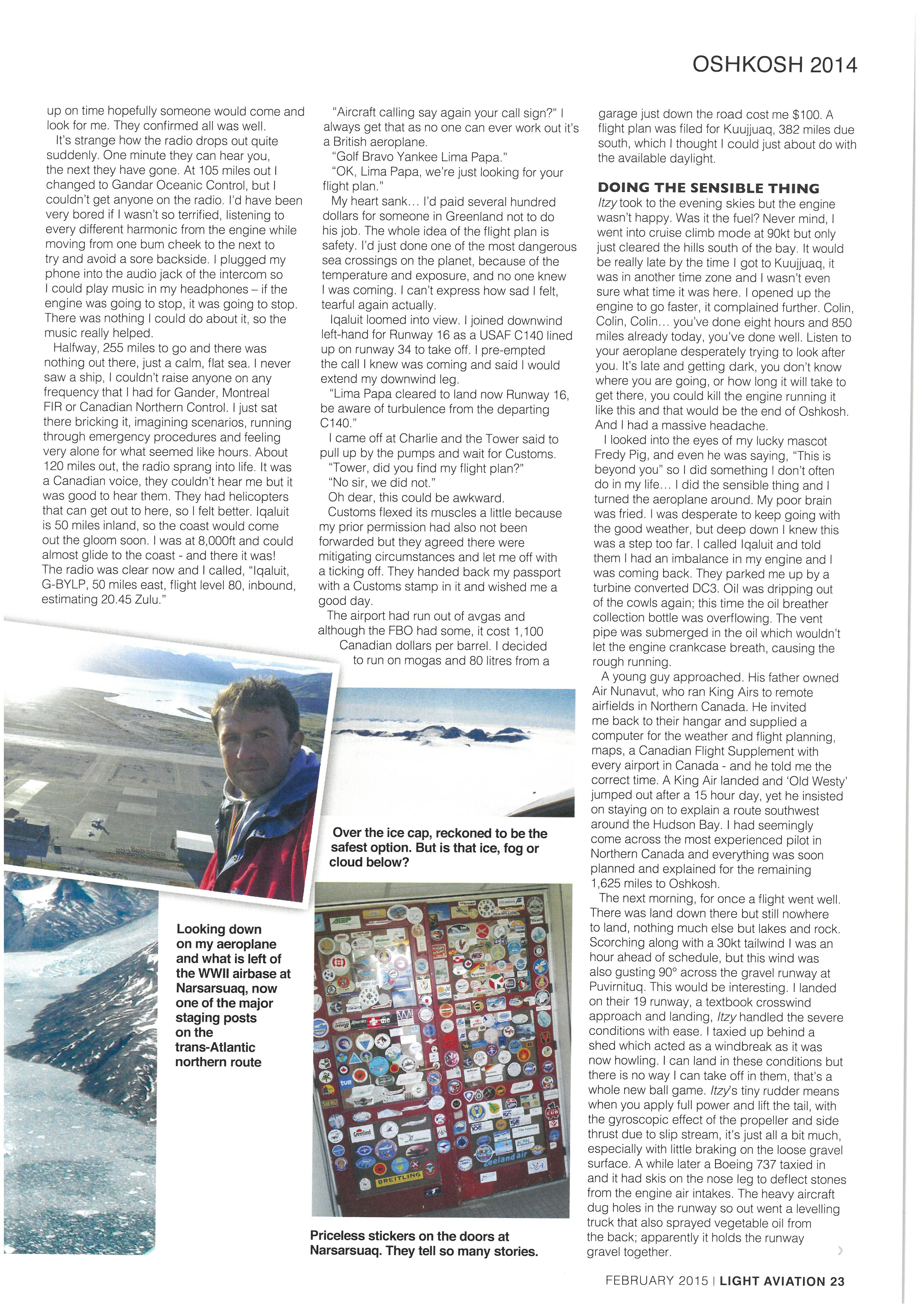
Halfway, 255 miles to go and there was nothing out there, just a calm, flat sea. | never saw a ship, | couldn't raise anyone on any frequency that | had for Gander, Montreal FIR or Canadian Northern Control. just sat there bricking it, imagining scenarios, running through emergency procedures and feeling very alone for what seemed like hours. About 120 miles out, the radio sprang into life. It was a Canadian voice, they couldn't hear me but it was good to hear them. They had helicopters thatcangetouttohere,so| feltbetter.Iqaluit is 50 miles inland, so the coast would come out the gloom soon. | was at 8,000ft and could almost glide to the coast - and there it was!
The radio was clear now and called, “Iqaluit, G-BYLP,50 miles east, flight level 80, inbound, estimating 20.45 Zulu.”
“Aircraft calling say again your call sign?” | always get that as no one can ever work out It’s a British aeroplane.
“Golf Bravo Yankee Lima Papa.”
“OK, Lima Papa, we’re just looking for your light plan.”
My heart sank... I'd paid several hundred dollars for someone in Greenland not to do hisjob. The whole idea of the flight plan is safety. I'd just done one of the most dangerous sea crossings on the planet, because of the emperature and exposure, and no one knew wascoming.|can’texpresshowsad| felt, earful again actually.
Iqaluit loomed into view. |joined downwind eft-hand for Runway 16 as a USAF C140 lined up on runway 34 to take off. | pre-empted he call | knew was coming and said would extend my downwind leg.
“Lima Papa cleared to land now Runway 16, be aware of turbulence from the departing C140.” came off at Charlie and the Tower said to pull up by the pumps and wait for Customs.
“Tower, did you find my flight plan?”
“No sir, we did not.”
Oh dear, this could be awkward.
Customsflexeditsmusclesalittle because my prior permission had also not been forwarded but they agreed there were mitigating circumstances and let me off with a ticking off. They handed back my passport with a Customs stamp in it and wished me a good day.
The airport had run out of avgas and although the FBO had some, it cost 1,100 Canadian dollars per barrel. | decided to run on mogas and 80 litres from a
ST a
Looking down on my aeroplane and what is left of the WWII airbase at Narsarsuaq, now one of the major staging posts on the trans-Atlantic northern route
Over the ice cap, reckoned to be the safest option. But is that ice, fog or cloud below?
garage just down the road cost me $100. A flight plan was filed for Kuujjuaq, 382 miles due south, which thought | could just about do with the available daylight.
DOING THE SENSIBLE THING ltzytook to the evening skies but the engine wasn't happy. Was it the fuel? Never mind, went into cruise climb mode at 9O0ktbut only just cleared the hills south of the bay. It would be really late by the time got to Kuujjuagq,it was in another time zone and wasn’t even sure what time it was here. opened up the engine to go faster, it complained further. Colin, Colin, Colin... you’ve done eight hours and 850 miles already today, you’ve done well. Listen to your aeroplane desperately trying to look after you. It’s late and getting dark, you don’t know where you are going, or how long it will take to get there, you could kill the engine running it like this and that would be the end of Oshkosh. And had a massive headache. looked into the eyes of my lucky mascot Fredy Pig, and even he was saying, “This is beyond you” so | did something | don’t often do in my life... | did the sensible thing and turned the aeroplane around. My poor brain was fried. | was desperate to keep going with the good weather, but deep down knew this was a step too far. called Iqaluit and told them had an imbalance in my engine and was coming back. They parked me up by a turbine converted DC3. Oil was dripping out of the cowls again; this time the oil breather collection bottle was overflowing. The vent pipe was submerged in the oil which wouldn't let the engine crankcase breath, causing the rough running.
A young guy approached. His father owned Air Nunavut, who ran King Airs to remote airfields in Northern Canada. He invited me back to their hangar and supplied a computer for the weather and flight planning, maps, a Canadian Flight Supplement with every airport in Canada - and he told me the correct time. A King Air landed and ‘Old Westy’ jumped out after a 15 hour day, yet he insisted on staying on to explain a route southwest around the Hudson Bay. had seemingly come across the most experienced pilot in Northern Canada and everything was soon planned and explained for the remaining 1,625 miles to Oshkosh.
Thenextmorning,foronceaflight wentwell. There was land down there but still nowhere to land, nothing much else but lakes and rock. Scorching along with a 3Okttailwind was an hour ahead of schedule, but this wind was also gusting 90° across the gravel runway at Puvirnitug. This would be interesting. | landed on their 19 runway, a textbook crosswind approach and landing, /tzy handled the severe conditions with ease. taxied up behind a shed which acted as a windbreak as it was now howling. can land in these conditions but there is no way can take off in them, that’s a whole new ball game. /izy’s tiny rudder means when you apply full power and lift the tail, with the gyroscopic effect of the propeller and side thrust due to slip stream, it’s just all a bit much, especially with little braking on the loose gravel surface. A while later a Boeing 737 taxied in and it had skis on the nose leg to deflect stones from the engine air intakes. The heavy aircraft dug holes in the runway so out went a levelling truck that also sprayed vegetable oil from the back; apparently it holds the runway gravel together.
If
I'd stuck to my nose to prevent it from burning in the sun. | forced myself to drink almost frozen water; /tzy has no heating, but in my thermal layers, inside my immersion suit, | was relatively warm.
My heading now took me over the 8,000ft ice cap. | had been told to do this by a pilot of the rescue helicopters at Geirfugl in Iceland. They also told me that at the southern tip of Greenland there are two giant rocky outcrops that protrude through the ice cap and can be seen clearly from many miles away. If | flew between them, that is the start of a major glacier that flows some 40 miles and leads directly to Narsarsuaq. If | followed the coast | would eventually have to fly inland through the fjords to find the airfield. Many people had taken a wrong turn in the maze of valleys and disappeared! So going over the ice cap was probably safer. It was also easier for them to find me and pick me off the ice than it was pull me out of the sea.
Working out how high you are above the bright ice was not easy though. Looking at the most crazed part of the cap for some type of visual reference, | noticed it was whizzing past the wing tip quite quickly. No wonder people have crashed into it. | climbed to 9,000ft. Better safe than sorry. But that wasn’t ice down there anymore. Mist then fog and then cloud with little cumulous tops had formed on top of the ice. I'd continue on and hope the cloud broke before Narsarsuag. It was forecast to but | hate hoping on the weather.
Fifty miles to go and nothing had been heard or said on the radio. | flew between the two outcrops of rock and through gaps in the cloud | could see the glacier running down the 22 LIGHT AVIATION | FEBRAURY 2015
valley and the airport some 30 miles away. At 9,000ft with a cold engine, if | pulled back on the power and descended too quickly | could super chill the engine and it really wouldn't like that. | called Narsarsuag radio and they called back, “Runway clear,” but it would take me half an hour to come down from up here. | dropped between clouds and descended into the valley withtheglacierstillthousandsoffeetbelow. | had to side-slip and drop still further to start an approach and called a two mile final, landing moments after.
The capital Nuuk was only three hours north, so | added just 40 litres of fuel and headed into the control tower. On the second set of doors is a famous sight they are plastered with tour stickers from aircraft that have flown through Narsarsuaq. It has been the main stop-off for Trans Atlantic Flight of virtually all small aircraft, and quite a few larger ones, since the airfield was built in WWII. The museum has photos of rows of American fighters and bombers heading for Europe. If I'd had a sticker saying ‘KR2 Worldtour’ | would have found some space. Fuel with landing costs, $420.38. Wow... | asked again if this was correct and the lady very politely confirmed that it was. The Danish Royal Yacht was in the harbour along with a navy frigate and accompanying Puma helicopter.
NORTH FOR NUUK
In the morning /tzy climbed straight ahead and down a 50-mile fjord towards the open sea. This wasn't en route, but not wanting to overheat the oil, | had to climb slowly above the fjord walls before eventually turning north for Nuuk, the GPS showing 3:10 hours. The
glaciers now spilled down to what looked like a landable sandy beach. | could keep repeating how stunning the views were out the window; I've seen it in magazines and there are pictures of icebergs and glaciers with this article - you just have to multiply the wow factor 100times when you see all that wonder of nature and danger passing serenely by with your own eyes. Nuuk airfield is built on the side of a hill, with each end of the runway extended by manmade headlands that rise straight out of the sea. You wouldn't want to be too low on this approach or too high either, as it is quite short. Air Greenland’s maintenance base is here and | could see engineers downing tools and heading out to take a look at /izy. Nothing this small had ever been through Nuuk before. | refuelled, poured in more oil and headed for the control tower to file a flight plan for Canada, give Canadian Customs prior warning and pay the fees. $679.40! Ouch...
The en route forecast was perfect, with not a cloud between here and Iqaluit. This flight | admit to dreading the most - 497 miles, few rescue helicopters or ships, and the coldest water at about 2°C. If the engine quits on this flight I’m in big trouble, there is no other way of looking at it. Ifyou really paused and thought about it, you wouldn't go! /tzy climbed steadily and the oil temperature rose. Fed up of watching the warning light, | raised the alert figure higher - | could see the oil was hot, | didn't need a red flashing light telling me. Before flying out of radio range | checked with Nuuk that they had activated my flight plan and informed Iqaluit | was on my way | wanted to make absolutely sure the Canadians knew | was coming and by what time. If | didn’t turn
up on time hopefully someone would come and look for me. They confirmed all was well. It's strange how the radio drops out quite suddenly. One minute they can hear you, the next they have gone. At 105 miles out | changed to Gandar Oceanic Control, but | couldn't get anyone on the radio. |’d have been very bored if | wasn't so terrified, listening to every different harmonic from the engine while moving from one bum cheek to the next to try and avoid a sore backside. | plugged my phone into the audio jack of the intercom so |couldplaymusicinmyheadphonesif the engine was going to stop, it was going to stop. There was nothing | could do about it, so the music really helped.
Halfway, 255 miles to go and there was nothing out there, just a calm, flat sea. | never saw a ship, | couldn't raise anyone on any frequency that | had for Gander, Montreal FIR or Canadian Northern Control. |just sat there bricking it, imagining scenarios, running through emergency procedures and feeling very alone for what seemed like hours. About 120 miles out, the radio sprang into life. It was a Canadian voice, they couldn't hear me but it was good to hear them. They had helicopters that can get out to here, so | felt better. Iqaluit is 50 miles inland, so the coast would come out the gloom soon. | was at 8,000ft and could almost glide to the coast - and there it was! The radio was clear now and | called, “Iqaluit, G-BYLP, 50 miles east, flight level 80, inbound, estimating 20.45 Zulu.”
Looking down on my aeroplane and what is left of the WWII airbase at Narsarsuaq, now one of the major staging posts on the trans-Atlantic northern route
“Aircraft calling say again your call sign?” | always get that as no one can ever work out it’s a British aeroplane.
“Golf Bravo Yankee Lima Papa.”
“OK, Lima Papa, we're just looking for your flight plan.”
My heart sank... I’d paid several hundred dollars for someone in Greenland not to do his job. The whole idea of the flight plan is safety. I’d just done one of the most dangerous sea crossings on the planet, because of the temperature and exposure, and no one knew |wascoming.|can’texpresshowsad|felt, tearful again actually.
Iqaluit loomed into view. | joined downwind left-hand for Runway 16 as a USAF C140 lined up on runway 34 to take off. | pre-empted the call | Knewwas coming and said | would extend my downwind leg.
“Lima Papa cleared to land now Runway 16, be aware of turbulence from the departing C140.”
| came off at Charlie and the Tower said to pull up by the pumps and wait for Customs.
“Tower, did you find my flight plan?”
“No sir, we did not.”
Oh dear, this could be awkward.
Customsflexeditsmuscles a littlebecause my prior permission had also not been forwarded but they agreed there were mitigating circumstances and let me off with a ticking off. They handed back my passport with a Customs stamp in it and wished me a good day.
The airport had run out of avgas and although the FBO had some, it cost 1,100 Canadian dollars per barrel. | decided to runon mogas and 80 litresfrom a Over the ice cap, reckoned to be the safest option. But is that ice, fog or cloud below?
garage just down the road cost me $100. A flight plan was filed for Kuujjuag, 382 miles due south, which | thought | could just about do with the available daylight.
DOING THE SENSIBLE THING
Itzy took to the evening skies but the engine wasn't happy. Was it the fuel? Never mind, | went into cruise climb mode at 90kt but only just cleared the hills south of the bay. Itwould be really late by the time | got to Kuujjuaq, it was in another time zone and | wasn’t even sure what time it was here. | opened up the engine to go faster, it complained further. Colin, Colin, Colin... you’ve done eight hours and 850 miles already today, you’ve done well. Listen to your aeroplane desperately trying to look after you. It's late and getting dark, you don’t know where you are going, or how long it will take to get there, you could kill the engine running it like this and that would be the end of Oshkosh. And | had a massive headache.
| looked into the eyes of my lucky mascot Fredy Pig, and even he was saying, “This is beyond you” so | did something | don't often do in my life... | did the sensible thing and | turned the aeroplane around. My poor brain was fried. | was desperate to keep going with the good weather, but deep down | knew this wasa steptoofar.|calledIqaluitandtold them | had an imbalance in my engine and | was coming back. They parked me up by a turbine converted DC3. Oil was dripping out of the cowls again; this time the oil breather collection bottle was overflowing. The vent pipe was submerged in the oil which wouldn't let the engine crankcase breath, causing the rough running.
A young guy approached. His father owned Air Nunavut, who ran King Airs to remote airfields in Northern Canada. He invited me back to their hangar and supplied a computer for the weather and flight planning, maps, a Canadian Flight Supplement with every airport in Canada - and he told me the correct time. A King Air landed and ‘Old Westy’ jumped out after a 15 hour day, yet he insisted on staying on to explain a route southwest around the Hudson Bay. | had seemingly come across the most experienced pilot in Northern Canada and everything was soon planned and explained for the remaining 1,625 miles to Oshkosh.
Thenextmorning,foronceaflight wentwell. There was land down there but still nowhere to land, nothing much else but lakes and rock. Scorching along with a 30kt tailwind | was an hour ahead of schedule, but this wind was also gusting 90° across the gravel runway at Puvirnitug. This would be interesting. | landed on their 19 runway, a textbook crosswind approach and landing, /tzy handled the severe conditions with ease. | taxied up behind a shed which acted as a windbreak as it was now howling. | can land in these conditions but there is no way | can take off in them, that’s a whole new ball game. /izys tiny rudder means when you apply full power and lift the tail, with the gyroscopic effect of the propeller and side thrust due to slip stream, it’s just all a bit much, especially with little braking on the loose gravel surface. A while later a Boeing 737 taxied in and it had skis on the nose leg to deflect stones from the engine air intakes. The heavy aircraft dugholesintherunwaysooutwentalevelling truck that also sprayed vegetable oil from the back; apparently it holds the runway gravel together.
Priceless stickers on the doors at Narsarsuaq. They tell so many stories.
| really needed to sleep, so climbed back into/tzyandtried,but|couldn't.Itwasalittle stuffy and if | left a gap around the canopy for some air, the mosquitoes came in. It was a torrid night. The next day was lost to rain. Bob Hoover was doing a talk today, the fifth day of Oshkosh. The weather was clear 60 miles to the south and pilots egged me on to have a go, even though ‘cloud base’ was below 100ft. They said there was nothing out there taller than a 6ft pine. But intentionally flying through rain and below low cloud is not for me... honest! However desperate | was to get to Oshkosh, Andrew Bruce’s words not to be in too much of a rush rang out loud in my head, and it would be stupid to be so close and have it end badly because deliberately flew in bad weather.
Danny, one of the Air Inuit engineers, arrived in his big works truck that dwarfed /tzy. He insisted joined everyone for dinner and said, “Bring your wash gear. | bet you could do with one!” think the hot spa in Iceland was my last... The Air Inuit pilots had been fishing and dinner for all the staff was Arctic shark. I’m not a shark fan really, but | couldn’t refuse such a generous offer. Their building was down by the river and the oldest wooden shack in Puvirnituq. It had been the town hall but was now divided into rooms for the visiting Air Inuit employees. In the middle of the river was Dog Island where the Inuit put all their Husky dogs during the summer; it stops them wandering around town. Someone sailed out each day to throw them some food. Arctic shark turned out to be Arctic Char and something of a speciality that resembled salmon, and it was delicious.
One of the pilots sat down with me and went through the procedures for entering America. First | had to register on line with ‘EAPIS’ (Electronic Advanced Passenger Information Service). Next /tzy needed a Decal (Sticker) or Decal Number. I'd never get it sent to me on time but all needed was the application reference. We registered /tzy with ‘DTOPS’ (Decal Transponder Online Procurement System) and | got an email back with the reference number. would have to phone the American Customs department on the day, to make sure they would attend my arrival airfield— | needed to be on time and not get out of my aeroplane until told to do so by their Customs and Border agents. Also on the day, if the Americans were happy, | had to call the Canadian flight planning office to file a Trans Border Flight Plan. Then | could land in the States, clear Customs and Immigration, close my Canadian flight plan and be free to continue to Oshkosh: Heck | might even make the last weekend! The next airfield was Le Grande Riviere, some 386 miles south, and just 1,220 miles to Oshkosh.
BLUE SKIES AND HUSKIES
woke to the sound of the Huskies on Dog Island, and sunny blue skies. Everything had cleared through, but there were thunderstorm forecast. /tzy climbed out and turning left over the Hudson Bay looked back on Puvirnituq. Beautiful. Still nowhere to land mind, just rock and lakes, but it was dead flat for the first hour. | followed the Hudson Bay coast as there were little beaches every five miles or so that | could land on. Heavy rain storms built with lightening
(Left) Half way between Nuuk, Greenland and Iqaluit, Canada. The most worrying leg of the journey.
(Below)Oil in the cowls once more, this time from an overflowing vent capture bottle
striking the ground inland. | found myself flying with fog on the starboard wing and thunder clouds on the port but ahead the route was clear and had a good tailwind. 20 miles from Le Grande, ATC warned of thunderstorms to the northwest. | spotted the runway lights with a storm line one mile to the north and dived in ahead of it. filed the flight plan for my next destination, Kapuskasing, but time was getting short. If could escape from the passing thunderstorm, could probably fly around the other storms once in the air. | asked to line up on runway 31 and was cleared to take off. In the rain at least the engine temperatures kept low. | skirted around for a while, eventually clearing the storms and the last of the rain and headed on track.
The landscape steadily turned from rocks and lakes to trees and lakes to trees and big rivers, but still nowhere to land. The only real sign of life was eventually the highway ahead that led to my destination of Kapuskasing. After shutting down, the oil collector pot was full again. | had no new oil left, so just poured it back into the engine. Kapuskasing is the type of pioneering town | wanted to see in Canada| at least got to see it by night.
Kapuskasing to Sault se Marie was just 198 miles with only 310 miles then to Oshkosh but it was Saturday and | would have to arrive by 2pm as the airfield then closed to all arrivals for the airshow. filed a Notice of Arrival with EAPIS with the Aircraft Decal number. ETA in America in the Central Time Zone with a two hour flight, but gaining an hour, would be Yam. got my EAPIS code by return of email and phoned the US Customs and Immigration office
at my port of arrival to confirm their attendance at the airport. “Have you filed an ESTA?” (an Electronic System Travel Authorisation which is part of the USAVISAwaiver program). hadn't, but he added “Oh, no you don't need to do that, it’s covered in your EAPISapplication with your non-commercial vessel. OK, we will probablybethere10minuteslateasweare busy.”
| asked for his name.
“Bill, agent Bill” and with that he rang off. | took off at 8:10 am local. I’m glad they said hey would be 10 minutes late, as so was I... it was hot already and there was a headwind. The oil temp went higher than I’ve ever seen it.Whatever | did, the GPS said | was going to se 10 minutes later than their 10 minutes late. The engine was on melt down. Approaching he US border and the town of Sault Se Marie, he airfield was to the south of a river. | didn't want to fly low over the town so | headed west around it. To add to the confusion, there are wo Sault Se Marie airfields, about five miles apart, one to the west and in Canada and the other in America which landed at, after some confusion on Unicom because didn’t realise it is actually called Sanderson to differentiate it from its Canadian counterpart.
waited in /tzy and indeed two Customs officers walked out to greet me. But what a greeting. “Sir you may get out of your aeroplane!” went to say hello and shake hands, but note pads and Geiger Counterswere being carried so there was no shaking of hands.
“Sir we have a problem with your documentation and the way you have entered the United States of America.”
The female agent seemed disturbed at my lack of surprise and lack of concern.
“Sir, you did not file an ESTA with our Federal Government Immigration and Customs Department, and you have committed a serious offence in defiance of our United States law.”
| was just about fed up with all this. It wasn't serious. hadn’t shot anyone or stolen anything, it’s just paperwork! She asked me for my passport and said, “I'll be holding on to that!” | wished the guy would stop waving that Geiger counter at my areplane; | very much doubted it was radioactive...
“Look!” | said with a raised voice, “| discussed this ESTAthing this morning with an officer Bill and he said didn’t need to file one as was entering your country in a noncommercial aircraft.”
“We don’t have an agent Bill.”
Bugger! The guy now Geigering one of my teddy bears said, “We do have an agent Hill.” That then changed things; I’m so glad wrote his name down, even if incorrectly. It transpired that agent Hill’s understanding was
incorrect and had to go down town to the Customs office to sort out the problem. Time was ticking away but it finally got resolved and, with a stamp in my passport, | was bade the inevitable, “Have a nice day.”
3:15 TO OSHKOSH now had only 3:15 hours to get to Oshkosh before the field closed for the airshow and it wasa threehourflight.|boughtandpoured in some more oil and departed - which was somewhat easier now that | knew what the airfield was called. The engine had hardly cooled down in the sweltering heat and as | climbed out past 2,000ft the warning light was flashing, and that was at the raised level | had set to stop it flashing. | could see some cumulous cloud caps ahead. Itwas quite windy and thought that thermal streeting might occur. If | could find them could raise Itzy higher into cooler air using thermals rather than the engine. It worked well and soon | was up at 4,000ft and able to lower the nose for greater cooling speed. The FEBRUARY 2015 LIGHT AVIATION 25
‘Old Westy’ from Air Nunavut who gave me so much help and advice. | was fortunate to meet many helpful and friendly people along the way.
| really needed to sleep, so | climbed back into/tzyandtried,but|couldn't.Itwasa little stuffy and if | left a gap around the canopy for some air, the mosquitoes came in. It was a orrid night. The next day was lost to rain. Bob Hoover was doing a talk today, the fifth day of Oshkosh. The weather was clear 60 miles o the south and pilots egged me on to have a go, even though ‘cloud base’ was below 100ft. They said there was nothing out there aller than a 6ft pine. But intentionally flying hrough rain and below low cloud is not for me... honest! However desperate | was to get to Oshkosh, Andrew Bruce's words not to be in too much of a rush rang out loud in my head, and it would be stupid to be so close and have it end badly because | deliberately flew in bad weather.
Danny, one of the Air Inuit engineers, arrived in his big works truck that dwarfed /tzy. He insisted |joined everyone for dinner and said, “Bring your wash gear. | bet you could do with one!” | think the hot spa in Iceland was my last... The Air Inuit pilots had been fishing and dinner for all the staff was Arctic shark. I’m not a shark fan really, but | couldn't refuse such a generous Offer.Their building was down by the river and the oldest wooden shack in Puvirnituq. It had been the town hall but was now divided into rooms for the visiting Air Inuit employees. In the middle of the river was Dog Island where the Inuit put all their Husky dogs during the summer; it stops them wandering around town. Someone sailed out each day to throw them some food. Arctic shark turned out to be Arctic Char and something of a speciality that resembled salmon, and it was delicious.
One of the pilots sat down with me and went through the procedures for entering America. First | had to register on line with ‘EAPIS’ (Electronic Advanced Passenger Information Service). Next /tzy needed a Decal (Sticker) or Decal Number. I'd never get it sent to me on time but all | needed was the application reference. We registered /tzywith ‘DTOPS’ (Decal Transponder Online Procurement System) and | got an email back with the reference number. | would have to phone the American Customs department on the day, to make sure they would attend my arrival airfield— | needed to be on time and not get out of my aeroplane until told to do so by their Customs and Border agents. Also on the day, if the Americans were happy, | had to call the Canadian flight planning office to file a Trans Border Flight Plan. Then | could land in the States, clear Customs and Immigration, close my Canadian flight plan and be free to continue to Oshkosh. Heck | might even make the last weekend! The next airfield was Le Grande Riviere, some 386 miles south, and just 1,220 miles to Oshkosh.
BLUE SKIES AND HUSKIES
woke to the sound of the Huskies on Dog sland, and sunny blue skies. Everything had cleared through, but there were thunderstorm orecast. /tzy climbed out and turning left over he Hudson Bay | looked back on Puvirnituq. Beautiful. Still nowhere to land mind, just rock and lakes, but it was dead flat for the first hour. followed the Hudson Bay coast as there were ittle beaches every five miles or so that | could and on. Heavy rain storms built with lightening
(Left) Half way between Nuuk, Greenland and Iqaluit, Canada. The most worrying leg of the journey.
(Below) Oil in the cowls once more, this time from an overflowing vent capture bottle
striking the ground inland. | found myself flying with fog on the starboard wing and thunder clouds on the port but ahead the route was clear and | had a good tailwind. 20 miles from Le Grande, ATC warned of thunderstorms to the northwest. | spotted the runway lights with a storm line one mile to the north and dived in ahead of it. | filed the flight plan for my next destination, Kapuskasing, but time was getting short. If | could escape from the passing thunderstorm, | could probably fly around the other storms once in the air. | asked to line up on runway 31 and was cleared to take off. In the rain at least the engine temperatures kept low. | skirted around for a while, eventually clearing the storms and the last of the rain and headed on track.
The landscape steadily turned from rocks and lakes to trees and lakes to trees and big rivers, but still nowhere to land. The only real sign of life was eventually the highway ahead that led to my destination of Kapuskasing. After shutting down, the oil collector pot was full again. | had no new oil left, so |just poured it back into the engine. Kapuskasing is the type of pioneering town | wanted to see in Canada| at least got to see it by night.
Kapuskasing to Sault se Marie was just 198 miles with only 310 miles then to Oshkosh but it was Saturday and | would have to arrive by 2pm as the airfield then closed to all arrivals for the airshow. | filed a Notice of Arrival with EAPIS with the Aircraft Decal number. ETA in America in the Central Time Zone with a two hour flight, but gaining an hour, would be 9am. | got my EAPIS code by return of email and phoned the US Customs and Immigration office
0aloneason an J irnituqin) want to
at my port of arrival to confirm their attendance at the airport. “Have you filed an ESTA?” (an Electronic System Travel Authorisation which ispartoftheUSAVISAwaiverprogram). | hadn't, but he added “Oh, no you don’t need to do that, it's covered in your EAPISapplication with your non-commercial vessel. OK, we will probably be there 10 minutes late as we are busy.”
| asked for his name.
“Bill, agent Bill” and with that he rang off. | took off at 8:10 am local. I’m glad they said they would be 10 minutes late, as so was l... It was hot already and there was a headwind. The oil temp went higher than I’ve ever seen it. Whatever | did, the GPS said | was going to be 10 minutes later than their 10 minutes late. The engine was on melt down. Approaching the US border and the town of Sault Se Marie, the airfield was to the south of a river. | didn’t want to fly low over the town so | headed west around it. To add to the confusion, there are two Sault Se Marie airfields, about five miles apart, one to the west and in Canada and the other in America which | landed at, after some confusion on Unicom because | didn’t realise it is actually called Sanderson to differentiate it from its Canadian counterpart.
| waited in /tzy and indeed two Customs officers walked out to greet me. But what a greeting. “Sir you may get out of your aeroplane!” | went to say hello and shake hands, but note pads and Geiger Counters were being carried so there was no shaking of hands.
“Sir we have a problem with your documentation and the way you have entered the United States of America.”
The female agent seemed disturbed at my lack of surprise and lack of concern.
“Sir, you did not file an ESTA with our Federal Government Immigration and Customs Department, and you have committed a serious offence in defiance of our United States law.”
| was just about fed up with all this. It wasn’t serious. | hadn’t shot anyone or stolen anything, it’s just paperwork! She asked me for my passport and said, “I'll be holding on to that!” | wished the guy would stop waving that Geiger counter at my areplane; | very much doubted it was radioactive...
“Look!” | said with a raised voice, “| discussed this ESTAthing this morning with an officer Bill and he said | didn’t need to file one as | was entering your country in a noncommercial aircraft.”
“We don’t have an agent Bill.”
Bugger! The guy now Geigering one of my teddy bears said, “We do have an agent Hill.” That then changed things; I’m so glad | wrote his name down, even if incorrectly. It transpired that agent Hill’s understanding was
incorrect and | had to go down town to the Customs office to sort out the problem. Time was ticking away but it finally got resolved and, with a stamp in my passport, | was bade the inevitable, “Have a nice day.”
3:15
TO OSHKOSH
| now had only 3:15 hours to get to Oshkosh before the field closed for the airshow and it was a three hour flight. | bought and poured in some more oil and departed - which was somewhat easier now that | knew what the airfield was called. The engine had hardly cooled down in the sweltering heat and as | climbed out past 2,000ft the warning light was flashing, and that was at the raised level | had set to stop itflashing. | could see some cumulous cloud caps ahead. It was quite windy and | thought that thermal streeting might occur. If | could find them | could raise [tzy higher into cooler air using thermals rather than the engine. It worked well and soon | was up at 4,000ft and able to lower the nose for greater cooling speed. The FEBRUARY 2015 | LIGHT AVIATION 25
‘Old Westy’ from Air Nunavut who gave me so much help and advice. | was fortunate to meet many helpful and friendly people along the way.
thermals died out over Lake Michigan as | turned south to follow the shore line. | could still use the Canadian map for a while, as it extended into America, but soon | was off the end. It was time to review a quick sketch | had made, not yet having acquired any American charts.
| went through all 15 pages of the ‘Oshkosh Arrivals Notam’ that I’d printed out in Iceland. | had hardly dared look at them sooner in case it brought bad luck. Well, now | needed to and it felt good. Music, put music on to calm the nerves. | could hardly see the shoreline for the murk. Still 150 miles to go in 90 minutes. | tuned onto Oshkosh’s ATIS and turned the squelch right down on the radio. “Page 8 and 12 of the NO... This is Os--osh inf- at tim-”
I'd heard Oshkosh Info! For the last 42 days I'd been trying to get there, trying my best and now | could hear Oshkosh... but would | get to see it? | listened to the signal getting stronger for the next half-an-hour. Look at the time... must go faster. Look at the temps... can't go faster.
DON'T STOP ME KNOW
There was cloud en route that | went below, hen coastal fog crept in off Lake Michigan, but no way, not this time. No cloud was stopping methistime.Damn,therewasa bigairportthat must have missed off my sketched map. I'd better go low and south and hope nothing big comes along. /tzy was now on track for Rippon, he start of the VFR route to Oshkosh, but also quite low. | tried the thermaling technique again 0 gain more height. Rippon was 50 miles away and 35 minutes at 9Okt, which is all | could do or fear of cooking the oil. Well it was cooked already, but it just had to get me another 30 minutes, that’s all. The oil pressure was down at 30 instead of the normal 55psi. This was bad, but sorry engine, I’m not stopping now. | changed to Fisk approach frequency 120.7 approaching Rippon as requested by the Notam. | heard one aircraft turning to the tower frequency and then silence. On ‘Arrivals Day’ on Monday, 5,000 odd aircraft arrive at Oshkosh on this route. It’s the busiest airfield in the world by a very long way. The radio is non-stop, but all was silent. You are supposed to monitor and say nothing; they have spotters
on the ground who radio up to you and ask you to rock your wings to confirm they've got you right. Anyway, 10 minutes engine, just do me 10 more minutes! | promised a new cooler and oil for just 10 more minutes. The Notam mentions keeping line astern with half a mile between aircraft, but I’m on my own up here, I've been very alone up here actually. Just the flight to Hurka-dalsh-mela in Iceland, and the Hercules at Iqaluit, they are the only aircraft I've seen flying since | left England.
My head was full of memories, friends I’ve made, the unfairness of the journey. | picked up Fredy Pig my lucky mascot and tears fell on his head because without him, | surely wouldn't be here. | placed him back on the intercom so he could see out better. | was over Fisk but no one was looking up anymore, why would they? Who in their right mind turns up at the biggest airshow in the world five minutes before it closes totraffic?Noonewasgoingtoseeorhear,so| called, “Fisk approach G-BYLP overhead.”
“Aircraft calling Fisk say again?”
“G-BYLP overhead Fisk.”
“Oh yeah, the little white aircraft, rock you wings!”
| did.
“Good rock, thank you, OK runway in use 36 left hand. Contact tower on 126.60.”
Oh wow, there it is coming out of the murk, aprettyamazingsight!Therewere a lotof aircraft down there. | had the video cameras rolling, | was going to make a big speech for my film. | failed! | could hardly breathe, let alonetalk or see throughtearfuleyes.Yousee, the last 42 days has taken years of my life to achieve, about 10 years. | can’t be a Formula One driver or an Olympic swimmer, rower or cyclist, but | can do this. | can build aeroplanes and fly them to pretty extreme places and make the right decisions at the right times. Anyone who might think it easy, well have a go at building your own aeroplane and flying it to Oshkosh. So this approach to Runway 36, that | had just been cleared to land on at the yellow dot, indicating half way down the runway, well this approach was my 100 metre Olympic final, my last lap of Monaco or Silverstone, blimey, why not my ‘Giant leap for mankind!’ It's probably the best thing I'll ever do. And did | land on the yellow dot? You bet | did... aced it,
smack bang in the middle. Anyway, whatever. I'd made it - made it —-made it - made it! Well done aeroplane, well done engine and well done Fredy Pig.
FACTS AND FIGURES
For those who love facts and figures, /tzy had flown 4,615 miles in 43:07 hours to get to Oshkosh, used 828 litres of fuel and 12 litres of oil, but most of that oil was soaked into the ground in Kulusuk or turned into vapours on the last few flights. On reflection, by far the most important figure to consider was the amount of decisions to be made. Weather, route, pilot fatigue and stupidity, engine condition, cloud avoidance, wind direction, airport, time... The amount of correct decisions made was quite high by my reckoning. The amount of poor decisions made? | should never have had that hotdog in Reykjavik! The journey cost £4,488 for two months travel, but a quarter of the budget was spent in three days with Greenland’s handling fees. Would | do it again? No way! Without a doubt, no! It’s far too risky and dangerous, and the benefits don’t even come close to being able to live longer, pretty icebergs or no pretty icebergs.
| went on to fly over the Rockies, which was not that easy either, to the west coast and California for a KR gathering. 10 KRs gathered at Chino. | won a trophy for the furthest flight totheevent,bysome4,800miles.Then | flew up to the Reno Air Races and, having missed histalk,/tzymetBobHooverinperson,while | got involved with F1 ‘Team Madness’ and had an amazing week of toil and fortune. /tzy is presently down with good friends in San Diego while | came back home to catch up with all the things|didn’tgetdonebefore|left.
I'll be back out by the time you read this, to continue /tzy’s journey around the world. | think we are about 1/3rd the way. Central America, Russia, Japan, South Korea and China next... I'll be needing my lucky pig!
Any questions? Feelfree to contact me at colinhales@hotmail.com. You can ‘friend request’ /izy on Itzy’s Facebook page ‘KRii Worldtour’. The whole story so far in full is on my blog at kr2worldtour.blogspot.co.uk and all the photos are at www.flickr.com/ photos/126203497@N03/sets/v finish line in sight, Ohkosh's lay36 and Fredy gets a bird’s
n this month’s issue, | have split my column into different sections to give you an insight into some of the exciting youth activities that you can get involved with. Although primarily aimed at youth involvement, the activities are open to people of all ages.
If you are involved in or aware of any interesting aviation activities in your area andwouldlikemetoincludethemin this column, then you are more then welcome to get in touch via email at michelle@thespiritofgoole.co.uk.
And don't forget to check out TheSpirit of Goole’s Facebook and Twitter pages, or the website, www.thespiritofgoole.co.uk,for updates on this fantastic Build-a-Plane project!
TOPNAV
The RoyalInstituteof Navigation(RIN)holdsan annualnavigationcompetitioncalledTopNav.As | mentioned last month, last year four participants fromTheSpiritof Goole(TSOG)projecttook part, becoming the firstyouth teamto enter.
Although traditionally an adult competition, it is an ideal opportunity in which pilots can team up with younger enthusiasts to help with the navigating. RIN is hoping that moreyouth teams will enter the competition this year; it's a great day's flying for all involved.
The competition itself seems simple enough; you plan the route and fly it with a pilot, navigating them around the course. What's hard about that? Well, you are not allowed
to use a GPS, you have to plan it the good old fashioned way with a chart, protractor and whizz-wheel, and then fly with only a chart, compass and stopwatch. It is quite challenging, especially if the wind doesn’t turn out to be quite as forecast, but it is a lot of fun.
The winners are then invited to the RINAGM for the awards presentation, and last year the awards being presented by none other than HRH Prince Philip, The Duke of Edinburgh. TSOG will be entering again this year with more students on the quest to defend the title they won last year!
The 2015 RIN Competition dates for your diary are:
@9 May 2015 Sherburn in Elmet e@ 9 May 2015 White Waltham e@ 9 May 2015 Bodmin with a reserve date of 16 May. For more information visit: www.rin.org.uk/search.aspx?searchstr=TopNav
YOUTH AND EDUCATION SUPPORT
YES successfully transported the NEWA (Wolverhampton) School’s Build-a-Plane project to the SSAT Conference in Manchester at the beginning of December. The school is building a Rans S6, which it showcased at the event on the 4th and 5th. Around 800 UK head teachers, plus some from the Netherlands,
attendedtheeventandtherehasbeenalotof positive attitude towards the project.
For more information on UK Build-a-Plane projects, visit www.yesflyers.org.uk/build-aplane-projects-map
Annual Aviation Education Perea esas)
Preparations are well underway for the 8th Annual Aviation Education Conference (AAEC), which is organised by YES, and will be held at the Brooklands Museum, Weybridge, Surrey, onSaturday18Aprilbetween10:00 16:00 There are limited free spaces available, which are going fast, so for more details visit www.yesflyers.org.uk
The LAA Educational Trust (LAAET)will be co-sponsoring the event and hopes to attract both adults and youngsters to the conference.
LAAET NEEDS AIRCRAFT INSTRUMENTS
LAAET is planning to establish a STEM (Science, Technology, Engineering and Math) outreach programme and as part of this we want to teach young people about aircraft instruments. Can you help?
Mark Turner was one of three pilotswho kindlyflew the TSOG TopNav team members in last year’s competition
We need surplus (working or not)instruments so we can teach the inner workings. If anyone has any instruments they would be kind enough to donate,they will be gratefullyreceived. Pleaseemail jackmilnes@thespiritofgoole. co.ukwith detailsor for more information.#
he Permit IFR team has been working hard for the past few months to clear aircraft into the evaluation phase of the Night/IFR project. We are also putting into place all of the necessary paperwork to enable the clearance process to work smoothly.
As this is a member-led activity, with input from the staff at Turweston only when required, overall progress is sometimes slower than some would like. Most of us have day jobs and families, as well as aircraft that need to be maintained and flown, So we cannot always spend as much time as we would like on this project. But we are definitely making progress!
Two aircraft, a Bulldog and an RV-7, have been cleared to fly in IMC, under IFR and at night as part of the evaluation phase.
The Bulldog was cleared on 21 November and was the first LAA Permit to Fly aircraft cleared, as we were able to note in the DecemberissueofLightAviation,although another factory-built Permit aircraft (the Vulcan) had been cleared previously.
The RV-7 is the first homebuilt aircraft in the UK that has been cleared to fly in anything other than Day VMC, so 2 December was also an historic day. To date nothing particularly surprising has emerged from the flying, but due to the typically inclement weather at this time of year, neither aircraft yet has many hours under its belt. Two further aircraft are coming towards the end of the clearance process, an RV-6A and a Glasair, with one requiring some instrumentation modifications and the other an improvement to an aspect of its handling. Once these issues are resolved, will comment more about them.
Some have questioned the wisdom of investigating the Bulldog in a reasonably thorough way. Even though this is a certified type, there is no guarantee that any individual example has not been modified away from the certificated standard ina way that would impact its suitability for IMC flight, especially one that has been ona Permit for as long as ‘AL has.
The assessment of previously type certifiedaeroplaneswillalwaysbealittle
different from amateur-built aircraft, as we must ensure that any modifications (including where equipment has been removed) do not compromise the aircraft's instrument flying capability. For example, with ‘AL the OAT gauge had been removed some years previously as the windscreen was in danger of cracking if the cover was not removed carefully from around the OAT probe. Clearly a sensible decision, particularly for a group owned aircraft. When flying on instruments, it is important to know the air temperature so that icing can be avoided, meaning that a replacement was required. It’s these sort of issues that the assessment process is designed to expose.
MORE TO COME
The next stage, once the first four aeroplanes are flying, is to assess more aircraft to ensure that our paperwork and processes stand up to use by people outside of the Permit IFR team. Ten aircraft have been identified that give us a good cross-section of orphans and homebuilts.
Recently we have been working to update the documentation in light of what we have learnt from clearing the first four aeroplanes. The documents, including two Technical Leaflets and flight test schedules, are currently under review and will be available to this next group of owners once approved. The aim of all this effort is to ensure that we have a few aircraft types already cleared once we receive clearance from the CAA to roll out the process to the LAA fleet. We are also keen that the paperwork we have prepared makes sense to people who haven't been working with it for several months, and that the process we have put in place is workable.
| have also been asked when we will be looking at aircraft that are not on the list
Published in the September 2014 magazine. When constructing that list, one of the criteria we used was the aircraft wing loading. A lightly loaded aircraft can be very uncomfortable to fly in turbulent conditions, and sometimes the air in the clouds can get quite bumpy. The limit set by LAA Engineeringisawing loadingof 60kg/m2.
(Above) Just because an aircraft is a factory-built, there is no guarantee that modifications carried out since it has been on a Permit to Fly have not adversely affected its ability to operate in IMC
Any aircraft with a wing loading at maximum weight lower than this value is unlikely to be recommended for removal of the day VMC limitation. This limit is likely to rule out most LSA type aircraft, for example, the wing loading of a SportCruiser is 48.78kg/m2. For comparison, the wing loading of a Europa is 65.51kg/m2 and an RV-7 is 72.6kg/m2. The list of aircraft that was published in September, and will be formally published in the TL, is of the types that we will be considering to start with.
I’m sorry if that is disappointing for some reading this but it is the current situation.
Types will be considered when their owners request that they be assessed; we will not be investigating types until an owner requests us to do so.
INEVITABLE BACKLOG
There is certain to be a backlog once the approval process is opened up to the whole fleet. The assessment of aircraft will be done by people who have the knowledge to do so but these assessors are unlikely to be HQ staff, apart from the final review of the data submitted. The LAA Chief Engineer will approve and authorise appropriate people, who could be current inspectors although several of the people we have identified to date are not. We are working to put in place an arrangement to cope with the initial demand.
From my perspective, the developments of the last couple of months are really positive. The clearance of the first two aircraft is the beginning of the end of the first phase of this project, which has taken seven years to materialise. This has only been possible with the hard work of several people in the Permit IFR Working Group, the support of the staff at Turweston and above alla refreshingly progressive attitude from the CAA at Gatwick. hope to be able to report furthersuccessoverthe nextfewmonths.
he Permit IFR team has been working hard for the past few months to clear aircraft into the evaluation phase of the Night/IFR project. We are also putting into place all of the necessary paperwork to enable the clearance process to work smoothly.
As this is a member-led activity, with input from the staff at Turweston only when required, overall progress is sometimes slower than some would like. Most of us have day jobs and families, as well as aircraft that need to be maintained and flown, so we cannot always spend as much time as we would like on this project. But we are definitely making progress!
Two aircraft, a Bulldog and an RV-7, have been cleared to fly in IMC, under IFR and at night as part of the evaluation phase.
The RV-7 is the first homebuilt aircraft in the UK that has been cleared to fly in anything other than Day VMC, so 2 December was also an historic day. To date nothing particularly surprising has emerged from the flying, but due to the typically inclement weather at this time of year, neither aircraft yet has many hours under its belt. Two further aircraft are coming towards the end of the clearance process, an RV-6A and a Glasair, with one requiring some instrumentation modifications and the other an improvement to an aspect of its handling.Oncetheseissuesareresolved, | will comment more about them.
Some have questioned the wisdom of investigating the Bulldog in a reasonably thorough way. Even though this is a certified type, there is no guarantee that any individual example has not been modified away from the certificated standard in a way that would impact its suitability for IMC flight, especially one that has been on a Permit for as long as ‘AL has.
The Bulldog was cleared on 21 November and was the first LAA Permit to Fly aircraft cleared, as we were able to note in the DecemberissueofLightAviation,although another factory-built Permit aircraft (the Vulcan) had been cleared previously. |EC
The assessment of previously type certifiedaeroplaneswillalwaysbealittle
different from amateur-built aircraft, as we must ensure that any modifications (including where equipment has been removed) do not compromise the aircraft's instrument flying capability. For example, with ‘AL the OAT gauge had been removed some years previously as the windscreen was in danger of cracking if the cover was not removed carefully from around the OAT probe. Clearly a sensible decision, particularly for a group owned aircraft. When flying on instruments, it is important to know the air temperature so that icing can be avoided, meaning that a replacement was required. It’s these sort of issues that the assessment process is designed to expose.
MORE TO COME
The next stage, once the first four aeroplanes are flying, is to assess more aircraft to ensure that our paperwork and processes stand up to use by people outside of the Permit IFR team. Ten aircraft have been identified that give us a good cross-section of orphans and homebuilts.
Recently we have been working to update the documentation in light of wnat we have learnt from clearing the first four aeroplanes. The documents, including two Technical Leaflets and flight test schedules, are currently under review and will be available to this next group of owners once approved. The aim of all this effort is to ensure that we have a few aircraft types already cleared once we receive clearance from the CAA to roll out the process to the LAA fleet. We are also keen that the paperwork we have prepared makes sense to people who haven't been working with it for several months, and that the process we have put in place is workable.
Engineering is a wing loading of 60kg/m2. (Above) Just because an aircraft is a factory-built, there is no guarantee that modifications carried out since it has been on a Permit to Fly have not adversely affected its ability to operate in IMC
INEVITABLE BACKLOG
| have also been asked when we will be looking at aircraft that are not on the list published in the September 2014 magazine. When constructing that list, one of the criteria we used was the aircraft wing loading. A lightly loaded aircraft can be very uncomfortable to fly in turbulent conditions, and sometimes the air in the clouds can get quite bumpy. The limit set by LAA
Any aircraft with a wing loading at maximum weight lower than this value is unlikely to be recommended for removal of the day VMC limitation. This limit is likely to rule out most LSA type aircraft, for example, the wing loading of a SportCruiser is 48.78kg/m2. For comparison, the wing loading of a Europa is 65.51kg/m2 and an RV-7 is 72.6kg/m2. The list of aircraft that was published in September, and will be formally published in the TL, is of the types that we will be considering to start with. I'm sorry if that is disappointing for some reading this but it is the current situation. Types will be considered when their owners request that they be assessed: we will not be investigating types until an owner requests us to do so.
There is certain to be a backlog once the approval process is opened up to the whole fleet. The assessment of aircraft will be done by people who have the knowledge to do so but these assessors are unlikely to be HQ staff, apart from the final review of the data submitted. The LAA Chief Engineer will approve and authorise appropriate people, who could be current inspectors although several of the people we have identified to date are not. We are working to put in place an arrangement to cope with the initial demand.
From my perspective, the developments of the last couple of months are really positive. The clearance of the first two aircraft is the beginning of the end of the first phase of this project, which has taken seven years to materialise. This has only been possible with the hard work of several people in the Permit IFR Working Group, the support of the staff at Turweston and above all a refreshingly progressive attitude from the CAA at Gatwick. | hope to be able to report further success over the next few months. aaaa aS
he CAA has recently issued new guidance on the choice of fuels used in GA aircraft to suit the wider variety of powerplants and fuels now available, as well as to reflect the CAA’s new, more hands-off approach to the airworthiness regulation of the lightweight end of the GA sector.
Whereas in the past the CAA has issued specific permissions and advice about the use of Mogas in light aircraft, faced with the difficulties caused by the mandatory phased introduction of ethanol into unleaded Mogas fuel it has decided to step away from the decision-making process and leave the specification of suitable fuels to the body that approves the aircraft. According to the CAA's latest guidelines, as far as it is concerned any type of fuel may be used in an aircraft providing it meets the specification(s) set out in the aircraft's approval documents and any associated operating limitations.
CAA say that for type certificated aircraft this information will be found in the Flight Manual, the Type Certificate, Supplemental Type Certificate, Airworthiness Approval Note or Operating Limitations document or associated referenced documents.
For national Permit aircraft, such as LAA machines, the CAA guidelines state that the approved fuel types will be as listed in the Airworthiness Approval Note, Permit Conditions, Permit Operating Limitations or associated referenced documents.
For aircraft operating on Permits to Fly issued on the recommendation of the LAA, the CAA have devolved the decision-making process on fuel choice entirely to the LAA.
This applies to homebuild types and vintage alike, irrespective of whether the aircraft type is one that also operates on a C of A.
This is good news insofar as from now on LAA HQ can investigate the technical viability of fuels and authorise different fuel types (including Mogas, avgas, UL91, Avtur, forecourt diesel fuel etc) without having to seek permissions from the CAA.
Ethanol was specifically not allowed to be used for aircraft applications because of concerns about its tendency to absorb and release water, its corrosive effect on metals and aggressive adverse effects on various non-metallic substances that could be found in aircraft fuel systems. However, experience with E5 Mogas (i.e. 5% ethanol) used in the UK microlight fleet has been reasonably satisfactory, other than with problems with compatibility with plastic fuel tanks in some types such as the CFM Shadow, early Jabirus and Dyn' Aero’s MCRO1 ULC.
It must be borne in mind, however, that the UK microlight fleet generally consists of relatively modern aircraft equipped with up-to-date standards of fuel pipes, fuel valves, filters etc most of which will have been designed to cope with the new fuels. The same good results may well not apply to use of E5 in older airframes such as SEP
Jodels etc. which may have been operating on unleaded Mogas satisfactorily but were designed long before there was any concept of bio-fuels, with seals, sealants etc. that will quickly give up the ghost if they encounter even 5% ethanol.
The immediate issue this new CAA policy has created has been the CAA’s reference to specific documentation existing stating what fuel types can be used for Permit aircraft. In fact, in the main no such documentation has until now been in place for LAA types, and in the past it has been up to owners to check what fuel types are specified by their engine and airframe manufacturers, and whether to use these or seek special LAA and CAA permission to use an alternativefuel (e.g. Mogas). With the change in CAA policy, it has been essential to fill this information void and, to that end, LAA Engineering is now creating a new Technical Leaflet (TL) which will include the definitive list of approved fuel types for all LAA aircraft. The majority of the list will initially reflect the status quo as HQ perceives it, including in general prohibiting use of Mogas containing ethanol in anything but microlight aircraft.
However, the good news is that given this new authority,LAA HQwill take the opportunity to include approvals for certain aircraft/engine combinations on SEPapplications to use the presently-availableESMogas.
Initially we will include this option on aircraft/ engine combinations that have already been successfully cleared to use E5 Mogas in an equivalent application, for example the kitbuilt Sportcruiser where EASA has already cleared the essentially identical factory-built EASA version, or SEP versions of aircraft that have been trouble-free with E5 in their microlight variants (e.g. Eurostar).
LAA HQ is all too aware that it is now almost impossible to find ethanol-free Mogas at garages, so most SEP type owners can no longer legally use cheaper and more readily available Mogas. There is therefore considerable incentive to add further aircraft/ engine combinations to the list of suitable candidates for E5 Mogas use, which HQ will be addressing in the months to come.
This will not be an easy task with so many different airframe/engine combinations being found in LAA aircraft, not to mention differences in fuel systems between different individual aircraft of the same type. Clearly this is more of a concern with plansbuilt and basic kit aircraft than with those assembled from comprehensive kits, but even in the latter case, different choices of instrumentation, senders, etc, manufacturer's options, manufacturers’ developments and builder ‘mods’ combine to add variation from one example to the next.
n1964,BillSteadorganizedanairrace intheUnitedStatesweregroundedfollowing spectatorsandgeneratedmorethan$80near Reno, Nevada, and RARA the the terrorists attacks in New York and million a year for the region’s economy. RenoAirRacingAssociationand Washington. Forthemanypilgrimswhovisitannually, the Reno NationalChampionshipAir Held every September at Stead (KRTS), the three words ‘RenoAir Racing’ send a Races were born. 50 years later the just north of the city, the Air Races have shiver of excitement down the spine. For Championshipmeetingisthe lastevent becomean institutionforaviationenthusiasts the race pilots,ithasa veryspecialdraw;a Ofits kind, carrying on the tradition of the from around the world. For one week, Reno very special kind of excitement. However, Cleveland Air Races of the 1920s,30s and = becomes home to hundreds of aircraft, it can be pretty dangerous too. The Jet 40s. The event has only been interrupted their pilots and crews. In the past ten years, and Unlimited classes start their once, in September of 2001, when all aircraft the event has attracted more than 200,000 races in the air, with all aircraft in »
n 1964, Bill Stead organized an air race in the United States were grounded following spectators and generated more than $80 near Reno, Nevada, and RARA the the terrorists attacks in New York and million a year for the region’s economy. RenoAirRacingAssociation and Washington. Forthemanypilgrimswhovisitannually, the RenoNationalChampionshipAir HeldeverySeptemberat Stead(KRTS), the threewords ‘RenoAir Racing’ send a Races were born. 50 years later the just north of the city, the Air Races have shiver of excitement down the spine. For Championshipmeetingisthelastevent becomeaninstitutionforaviationenthusiasts __theracepilots,ithasaveryspecialdraw:a of its kind, carrying on the tradition of the from around the world. For one week, Reno very special kind of excitement. However, Cleveland Air Races of the 1920s, 30s and becomes home to hundreds of aircraft, it can be pretty dangerous too. The Jet 40s. The event has only been interrupted their pilots and crews. In the past ten years, and Unlimited classes start their once, in September of 2001, when all aircraft the event has attracted more than 200,000 races in the air, with all aircraft in >
FORMULA ONE AT RENO
line abreast and, after the now famous words from the airborne starter, “Gentlemen, you have a race,” the aircraft dive onto the course and battle it out. For the smaller classes (Formula One and Biplane), the races start with up to eight aircraft on the runway at the same time, taking off in aggressive formation and racing flat-out around 50ft high pylons of 50-gallon oil drums perched atop of telegraph poles. This isn’t the single aircraft on the course and soft pylons of Red Bull, this is Reno!
AN INTRODUCTION
Each of the classes of race aeroplanes has an entirely different character and attracts different types of ‘aviators’ - which their pits and engineering team reflect. The following is one competitor's slightly tongue-in-cheek view of the various classes that race at Reno:
The Formula One pit is for the baby aeroplanes, they are custom built to race and that’s pretty much all they are good for as they are small, uncomfortable and have zero baggage space. They have the same engine as a Cessna 150,originally rated at 100hp, but tuned to around 160hp so they race at speeds of up to 260mph; not bad on a tiny engine and at 50ft off the deck! But custombuilt, homemade racers can always be improved, so the F1 pit constantly has people working, tinkering and playing with their aeroplanes. The cowls are off and the tools are out. It’s endless. Most of the pilots work in aviation and their level of expertise is quite simply enormous.
These aeroplanes are the cheapest way to go racing too, so this is the budget end of Reno with entire families here, cooking in the pit and camping on the airfield. The typical fuel bill for one race is less than ten dollars!
lf an F1 aeroplane ‘goes tech’ the entire group of pilots and engineers works to help get it racing again. F1 is an inclusive family of pilots and engineers, sharing tools and technologies, feeding each other’s teams and families, then sharing beers and banter later in the evening, after work is done.
At the other end of the scale are the Unlimited racers. These aeroplanes are typically heavily-modified Second World War fighters that cost real money to buy and even more to run. Their engines deliver between 2,000 and 4,000hp, and they run at speeds up to 500mpnh.Their pits are huge with giant trailers, rows of SnapOn tool boxes, canopies to protect the team members from the sun and buckets of coolers to keep them all hydrated. Each Unlimited pit has 30+ people, most of them volunteers, busy crawling all over the aeroplanes night and day. Do they ever sleep? Not much. There are specialist engine guys,
more to fix than a Formula One team will
prop guys, telemetry experts, people who only remove and replace panels, a couple of guys whose job it is fill the fluids (fuel, oil, ADI, nitrogen, water, oxygen), and usually some girls to sell T-shirts and merchandise from a temporary Tiki hut at the front of the pit.
The entire team is decked out in matching gear, customised to the aeroplane. The effort to ‘turn’ the aeroplane between races is immense and takes hours, even with 30 people doing their allocated task. The aeroplanes have exotic names like Rare Bear, Precious Metal, Voodoo and Strega, with long racing histories and dedicated fans. When they have a problem, even a minor issue like losing a gear door, it costs more to fix than a Formula One team will spend in a year. But if they blow an engine, the cost is in the hundreds of thousands. These ‘Big Boys’ have team managers and risk managers and management structures and reportinghierarchiesit’s almostlikebeing back at work...
Owners aren't always the pilot instead pilots with real skill are sometimes contracted to race these beasts. But the few millionaire owners who are also the pilots are larger than life characters, spending huge amounts of their own money to play with their ultimate, unlimited toys. There is real competition between the pits, much less of the friendly mutual support system that exists at the bottom of the Reno food chain in the cheap seats of Formula One, as there is proper prize money for the winners.
An automotive equivalent for the Unlimited racers would be the modern Supercars and Concours classic racers of the 1950s and ‘60s.
The Jet class is the newest class to race at Reno and they are going at around the same speeds as the top Unlimited racers. But,incompletecontrastto the Unlimiteds, Kevin Broughall supervises the movement of the aircraft from the pits across to the start of the next race at Reno 2011
the jets have pits consisting of a pilot and just one bored crew, who usually turns up late, nursing a hangover. Jets are modern, easy and reliable. Startingthem is like switching on a hair dryer. Click, whoosh, see ya! And they are either working or they are completely and expensively broken. All the crew gets to do is to add fuel and oil, top up hydraulic fluid, check the tyres and pass the pilot a bottle of water (that he or she doesn’t really need since the aircraft is air conditioned).
The jets have really cool paint jobs and they make nice whistling noises as they pass by the crowd - so unlike the throaty roar of the Unlimited racers. The rules don't allow swept wing jets or the use of afterburners (they would be too fast and the risks of putting the wreckage of a large lump of metal turning 700mph across a swathe of Nevada is simply too great), so these are straight wing jets, either vintage or modern trainers.
If the jet class had an automotive equivalent it would be a hot hatchback. After all, a Golf GTi is more reliable than, and just as fast as, the classic cars of 30 or 40 years ago.
The Sport and Super Sport classes cover a range of aeroplanes that start at the useful, practical end of General Aviation, with two or four seats, baggage space and meaningful range, through to highly developed modern racers. Since most of these aeroplanes are used every week, they tend to run consistently and any mods have been made and tested throughout the year. These aeroplanes start at around $100k and go through to a couple of million. The custom racers are worked on during the week, but they turn around easily and the small crews are mostly wealthy families who take care of their teams. This is civilised racing among like-minded people.
the RARA hangar with the Formula Ones. These are Pitts specials and a single Mong. The Pitts are regular aerobatic biplanes with tiny wingspans and loads of drag from their two, stubby, wire-braced wings. They have no crew and the pilots don’t work on them; they top them up with fuel, check the oil and go for lunch.
The biplanes are the ‘comedy turn’ at Reno due to their funny landings. They bounce and jiggle and pop up and down, put the power on, settle and skid and slide. The tyres puff smoke and make the sound of small puppies barking. It's hard to count how many landings they make for each flight - maybe a dozen? Sometimes they even take-off again and come back to land in the other direction. It’s all part of biplane fun. We should have PT Barnum’s circus music playing to prepare everyone for the show! All of this excludes the single Mong Biplane called Phantom, which is more like something out of Star Trekthan a biplane. Glistening, pure white and stunning to look at, it always wins. And the pilot can land it without looking likea Circus act too.
If the biplane class were cars, they would be Reliant Robins: three-wheelers, shockingly impractical, from anotherage, but charming in an odd and rather inexplicable sort of way.
INTRODUCING THE CREW CHIEF
If the T-6 class were cars they would be vintage Bentleys or Morgans; expensive, ponderous and hard to operate, but loved by pretty much everybody, despite the awful noise they make on take-off.
The final class is the Biplanes which share
At the centre of every great team is the leader. With Formula One racing at Reno, it is usually the Crew Chief who holds the team together. For Team Miss USA, this role is carried out by an English engineer, Kevin ‘The Blade’ Broughall. This is his take on Reno: | was carrying out the pre-flight checks on the Seafire 17 at the Flying Legends airshow in 2008 and this smartly dressed gentlemanintroducedhimselfas‘SPH’. 4 y
Ifthese
cars they would be everything from the family Ford through to the Mercedes and Porsche class at Le Mans.
FORMULA ONE AT RENO
We chatted about various aircraft and | thought he seems like a pleasant sort before we parted company. Over the following years we spoke on several occasions, keeping in touch on various aircraft projects.
In 2010, another interesting gentleman crossed my path. | was working on the Centaurus 18 engine for the Sea Fury T.20 when a chap introduced himself as Thom Richard. He proceeded to ask me if |would be interested in crewingfora friendofhisattheRenoAirRaces.
To be honest, | did not know much about Reno, only what | had read in magazines but, of course | said “Yes”, not having a clue as to what | was getting involved in.
The months rolled by but nothing else was mentionedaboutRenoand|carriedonwiththe restoration of the Sea Fury. Then in December 2010, SPH walked into the hangar and asked if Kevin was around. At this point the penny dropped; this was the ‘friend’ that Thom had mentioned. The rest is history...
InJune2011SPHand | attendedthePylon Race Seminar (PRS),basically Reno Racing Rookie School. While SPH attended all the various lectures and carried out the paperwork exercises, the real work started for me!
ROOKIE WEEK
| walked into the RARA hanger where Formula One and Biplanes are based during the seminar, and for the very first time | saw a wing on trestles, a pile of flying controls and a fuselage with an engine strapped to the front of it. My first reaction was, “What the hell have | got myself involved in?”
What happened next can only be described as the ‘Formula One Family’. As | placed my tools on the floor | was greeted by several American chaps who asked me if | needed a hand. | immediately said “Yes” and we proceeded to assemble Miss USA,a Jensen Slipknot variant of the Cassutt. Steve Tumlin, Matt Williams, Bryant Steele and | spent the first
two days putting Miss USA together, getting her ready for Tech Inspections, which were carried out by the Tech Committee, and make sure the aircraft are safe to fly. Had it not been for the assistance | received from the ‘Family’ this would never have been possible.
SPH had finished his ground school and was ready to fly. Miss USAperformed well and SPH was gaining confidence while enjoying Rookie school, but we were there to race and go fast. SPH felt we were not going fast enough and needed modifications! Over the next couple of days we explored new cooling baffles and various other ‘go-faster’ modifications, which gave us an extra 2mph here and 3mph there, but not enough. We needed more speed!
SPH got his race ticket and we were all set for Race Week, but Miss USA’s engine seized on the last flight due to an oil pressure fitting on the side of the crankcase coming apart in flight, at 50ft and 230 mph, requiring a zoom climb into the overhead and a dead stick landing... And a note for those that are interested, at race revs it takes just eight seconds to empty an O-200 of oil and for the crank to seize!
During the months between PRS and race week,SteveTumlinaccepted the challenge
fitted around the existing wings (Photo:
say about a man that undertakesa projectto significantlychange a FormulaOne aeroplaneinone year,when everyonetold himhewas biting offmorethan he can chew?Againstallodds, and advice, Mark,with helpfrom PaulTrudel,completed the monumental listof modifications and by August 2014, Miss USAwas readyto compete with the best of Formula One.
This is Mark’s(co-crew chief 2014)story: Jay Jones, pilotof race number 45, was kind enough to drivethe Miss USAteam van, trailer and airplaneupto BoundaryBay(CZBB) south of Vancouver, Canada, where it arrived in November 2013.Thefirstthing required was a thoroughinspection.Duringthe initialinspection, itbecame clearthatthefabric - although aesthetically clean was in poor condition.
Inflight the aerodynamic pressuresdeformed thefabric significantly;something| had been ableto seeinaphotographof MissUSAon the racecoursein2012.Thefabric pushed in, wrapping aroundthe fuselage diagonals and along these linesthe fabric had developed long tears. What’s more, the fabric was contaminated with engine oilalmostup to the top of the vertical stab.
All ofthe fabric was removed fromthe fuselage and tailfin, and replacedwitha carbon/foam shell.Primarilythe carbon shell provides stable aerodynamicflow. Secondly, itallows a removable turtle-deck, which facilitates maintenance.
Elevatorslop was found to be present, approximately1.5inofcabledroopwasfoundin the aftend of thefuselage,simply because one could not check nor reach itwhen completing the yearly maintenance.
Beforecompletely removingthe fabric from the bottom of thefuselage, it had one more job to do. | used it, some spray foam and some plaster, as a plug for the carbon bottom shell. Construction isone layerof 50z carbon, one layer of 1/8inDivinycell,laterfollowed by one layerof 50z carbon.
To encourage everybody outtherewho thinks that this might have been an expensive hobby, I'd liketo pointoutthattwo smallpieces of equipment were acquired to complete the task.Thefirst,a power supply for hot-wirecutting along with some bows and smallpieces from Home Depot - costjust$50. Not bad when compared to the $450versionfrom homebuiltparts suppliers.Then therewasa vacuumpump made froma salvaged refrigerationcompressor which, along with some sewage tubing, salsajars and $5 worth of electronicsand a micro controller,completed the task. The pump is capable of pulling and holding 27in of vacuum. The commercial offering costs
over $500 plus the control electronics!
A few piecesofscrap wood made for a perfect vertical spar mould and cheap insulationfoam from the hardware store was hot-wired to the outside mould line of the vertical stab. The whole piece of foamwasthen covered inclear packing tape.Thishadtwofunctions.Firstly,clear packing tape works perfectlyas a releaseagent for epoxy; secondly, clear tape is nice and smooth, so ifyou apply itcarefullyyou saveyourselfa lotoffinishing time later. A local discount store made for a perfect sourceof clear plasticvacuum bags. While at the hardware store | found a sheet of Formicathat had a large chunk broken out of it,so
New aluminium wing root fairings were carefully
Mark terKeurs)
to make Miss USA go faster and he worked tirelessly on her. By race week, she looked very different with a new engine cowling and a few other ‘go-faster’ mods.
RACE WEEK, RENO 2011
| flew back out to Reno in time for race week while Steve Tumlin had trailered a very different Miss USAinto Reno by road. Unfortunately there was no time to test the mods as the engine was being rebuilt at Ly-Con until late in the day.
Due to race regulations, we had to leave Reno/Stead airport and carry out the testing at Beckworth, a small airport located in nearby California. We packed Miss USA into the trailer and left by road. When we arrived it was raining, dark and miserable; but out of the dark came a ray of light known as ‘Mr Bob’ who was a QB (Quiet Birdman), one of a group of experienced aviation engineers and pilots who assist others in aviation who are in a spot of bother. We were definitely in that category! He opened his hangar up to us and told us to use it as our own. What a gentleman!
We proceeded to complete the various mods and wheeled Miss USA out for engine runs.
New plenums were created to direct the cooling airflow over the cylinder heads more accurately. About 40% of total drag comes from cooling air so, slowing the air by expanding it in a controlled way and directing it accurately is really important. (Photo:Mark ter Keurs)
|was able to negotiate a 50% discount for it.The fuselagesidesweremade intwo pieces because the Formicawould notconform to a compound Curveparticularlywell.Thesheetwas hot-gluedto thefuselageand itmadefor awonderfullysmooth surface to vacuum the carbon-foam-carbon sheets to.
The next step was to build the turtle-deck. It was loftedinthe computer as a single piece. Thedrawingwas thensliced into30cm pieces and each one of the sections was transferred to a piece of the Formica.A 22x2x8ft piece of foam was sourced from a construction company and was sliced into 30cm slabs. Then each slab was hot-wiredto shape alongthetemplates.Finally, individual slabs were glued back together to produce a turtle-deck plug.
Part-waythroughJune | realisedthattherewas a lot of work left to do, which | would not be able to finish intime on my own. My friend PaulTrudel is a masterful builder and already has two Molt TaylorCootsto his name,the second of which | get to fly regularly.He iscurrentlybuilding a GP-4.
Like most F1 race planes, Miss USA has no Starter (to save weight) so we hand prop to Start... We pulled and pulled and pulled but she would not start. We concluded that the carb was unserviceable and had probably taken a hit when the engine was transported. Once again the ‘F1family’ was contacted and a serviceablecarb was located, fromJay New carbon fibre top and bottom cowlings were manufactured, complete with blisters to accommodate the new longer spark plugs. (Photo:Mark ter Keurs)
FORMULA ONE AT RENO
Jones, and driven to Beckworth. It was soon fitted and, on pulling through the second blade, she roared into life!
The rest of race week was relatively smooth with only a couple of bumps, such as the tailwheel (a non-steerable roller blade wheel mostly hidden inside the tail) departing the aircraft; but this is considered ‘normal’ for race planes. Miss USAfinished four races; gaining two sixth place finishes, a fourth, along with a first place in the first Silver heat - pretty good for our first year.
TRAGIC FINISH
Unfortunately, 2011 finished rather abruptly with the tragic Jimmy Leeward P-51D Mustang accident but on the plus side, | was presented with ‘Crew Chief of the Year’, a very humbling experience. In short, 2011 represented almost 18hours-a-day. | slept on the aeroplane all the way home and over the next few months | had time to analyse and question whether | could do it again. Before | knew it | was signed up for 2012! Meanwhile, while | had been soul searching, Miss USAhad been given back to Steve Tumlin for further modifications, ready for 2012.
The exterior shell was manufactured from carbon fibre, replacing the old fabric
Hewas kindenough to drop everythingand come to our rescue.
Since time was running short,we elected to keep the cowling we had, but applied some modifications to its exterior. The intakes look very large whileinfact theirfrontalarea is only six square inches per side.The cowling exhaust was made much smaller than before, but appropriately sized for the intakes. Itwas, however, repositioned to a more productive location. Theactual move was only about three inches.
Some invisible, but as far as | was concerned mandatory detailswereaddressed. Theaircraft nowhasstaticportsoneithersideof thefuselage. Thewhole airplanewas rewiredwith newwiring harnessesand neatlyorganized to keep ignition noise out of the EFIS. Holes in the firewall from years of modifications were patched with stainless steel.The airplane now has a proper ground plane for the comms antenna. A small, lightweightsingle batteryreplaced the two heavyones.
The pilot's seat was raked to provide a better positionandto keeptheparachutefromfouling in the controls, and the seat and backrest werestrengthened.Duringthis processitwas discoveredthatthe existingseatstrutshad never been fullywelded!
Newaluminiumcowlings were fabricated to go around the existingwing rootto reduce drag atthe intersectionofthewing and fuselage, whilenew top and bottom cowlings with blisters were fabricated in carbon fibre to accommodate new,longerspark plugs. New plenumswere added to improvethe flow of cooling over the cylinder heads, whilethe wing rootswere extended slightly.
After all the hard work was completed, the new Miss USAwas sleeker,weighed lessand wasexpectedto be significantlyfaster.This proved to be the case as the results of the 2014 racesClearlydemonstratedwith race speeds progressivelyincreasingfroma qualifyingspeed of around 200mph to almost 222mph achieved in the Silver race.
(Photo: Mark ter Keurs)
SPH ON THE STICK WIGGLER’S PERSPECTIVE
“Frommyperspectiveas ‘StickWiggler’,|get most of the abuse from the Team although |do the least amount of actual work and get all of the glory. So it’sa pretty good trade! The flying isn’t that difficult. With some tailwheel, aerobatic and formation experience, most competent PPLs could race in the Formula One class at Reno.G-loads are low (pulling g slows the plane down) and we only race for 10 minutes at a time although it does take most of the day to fully come back down to earth again.”
THE IMPORTANCE OF THE TEAM:
“Reno has a way of kicking you just when everything seems to be finally working out as it should. Just to get a plane and a team to Reno,to operate for a week, to qualify and then to compete is a big commitment. Equipment, teams and pilots all routinely get broken and if any one component fails then you don't get to race. In 2014 I'm pretty happy that we have been effective, the team has worked really well, the plane has been put back together and we have competed in every race, and, as the ‘stick wiggler’, | have screwed up only once.
“The important thing to remember is that this is a Team experience and it cannot be undertaken without the support of the engineers and the broader support of everybody involved. | consider myselfvery fortunate to be able
Kevin, Mark, Kelly my wife, a host of friends and volunteers and by the broader ‘Formula One Family’.
“Thetruth isthat |wouldn't be flying at all withoutthem. I’mjustthe stickwiggler.”
CONCLUSION
“Running the pylons is an amazing flying experience. The actual flying is about going fast on a clean line, without climbing or descending at all, and with the least deflection of the control surfaces and minimum-g, is subtle. The friendship and support are
incredible; it’s likejoining a whole new extended family.
“If you have some tailwheel, formation and aerobatic experience, then you should be here too. It’s not expensive and the experience is unrepeatable. Although not for the faintheated, for real pilots and a few true aviators, it is not to be missed.
“To fly in close formation with seven other planes at 50-feet over the Reno desert and at 250 mph around the pylons is one of the finest aviationexperiences.”
Fly Low, Fly Fast and Turn Left!
The new-look and extensively rebuilt Miss USA,photographed while turning around a pylon at the 2014 Reno Races (Photo:
Naomi West)
RACE WEEK, RENO 2012
Everything had been put in place to have a fairly smooth year... once we had put the aircraft together and passed the various Tech Inspections we were ready to fly. SPH climbed in and we were off.
After several hours of testing it was found that the new cowling configuration was not cooling the engine sufficiently for the speeds and demands we were now achieving. We spent the next few days adjusting various cooling ramps and ducting, unfortunately all of which failed.
| went for a walk to clear my head when | found myself in an Unlimited pit and it dawned on me; how do these guys do it? A ‘spray bar’! | ran back to the pit and bumped into Mark ter Keurs’ Crew Chief for Poode, another F1 Cassutt, and discussed the idea with him. We looked through the rules and there was no mention that a spray bar system could not be used, Sowe quickly decided to turn the idea into reality.
That evening, Mark and | visited various shopping outlets inthe area, including one where | ended up walking around the store for ten minutes holding a weed killer pump, until we finally discovered that a fish tank
the rules and there was no mention that a spray
pumpwasa bettersolution-thecriteria being light and easy to fit. That evening we started construction. A spray bar system sprays atomised water (it has to be atomised or it can cause thermo-shock and crack the cylinders) over the cylinder heads, increasing the humidity of the airflow to achieve a cooling effect. We worked all night and had it ready for testing by the morning.
FORMULA ONE AT RENO
We pulled the aircraft out and she went racing. Unfortunately there was a fuel pressure connection omitted and after just two laps Miss USA declared a ‘Mayday’. The conclusion drawn was that it had been a long day, a lack of checks and we were all tired: a massive learning curve once again for all of us. We all went to bed and agreed we would meet back in the hangar later. That evening we gave Miss USA a fresh pair of eyes and we were ready for the next day.
READY TO RACE
The following morning SPH climbed in and was ready to race. He won the heat and | cannot express the emotion that was felt by every member of the team. After all, that is exactly why you do Reno!
After SPH had landed, we went to retrieve and congratulate him on his success. | asked SPH how was it, and he replied, “You're a genius, it works, but it smelt like | was flying a laundry!” The spray bar was a complete success and lowered the cylinder temps by almost 100°. Later in the week, Miss USA went on to win the silver final.
Once again | slept all the way home on the flight and found myself questioning
2013. However, SPH had a break from Reno in 2013 and crewed on another aircraft. During this period the engine was sent to Ly-Con Aircraft Engines for additional improvements, while Miss USA was sent to Canada with Mark ter Keurs, to be redesigned, including a new turtle deck, tailplane and various aerodynamic modifications to improve her overall speed.
RACE WEEK, RENO 2014
We arrived a week early to carry out the test schedule which was required due to the mods that had been carried out by Mark. Miss USA was trailered all the way back from Canada to Reno-Stead meaning that we had to spend the first few days re-assembling her and carrying out final adjustments.
Once Miss USA was buttoned up, we proceeded to carry out the test schedule and apart from a few minor adjustments, it all passed with flying colours. We were going much faster and hitting all the right numbers. We were ready to race and there was time
0enjoyalittle R&R.Thatafternoon,the!
Wednesday before race week, SPH told us that we were all going to Beckworth for a spot of unch with ‘Mr Bob’ to show him what had been done to Miss USA. We saw the aeroplane off o Beckworth while Kelly and | jumped into the car. Just 30 minutes later and only ten miles outside of Stead, we received a phone call rom SPH asking us to bring the trailer as Miss USA had suffered a prop strike. Such is life!
Once again, calling on the ‘Formula One Family’ for assistance, we found a truck to tow
The Cassutt design has been around for almost 65 years but variations on the theme are still competitive, even at the highest level
the trailer and another engineer to come with me to Beckworth to dismantle and bring Miss USA back to Reno. After just a few hours we were slowly assessing the damage, which was, thankfully, relatively slight but we needed a new prop. As you can guess, one was located by another member of ‘The Family’.
After many more long days and nights, Miss USA was re-assembled and ready for race week, but we had somehow managed to lose 20mph and 200rpm in the process!
We completed race week with only a few minor bumps along the way, but we were still left searching for the lost mph and rpm!
Despite initially qualifying just 12th fastest, Miss USA achieved two third-place finishes, a second-place finish and, most importantly, first place in the Silver final at almost 222mph
to retain the trophy; not the result we were looking for, although | admit to enjoying collecting the trophy!
LOST MPH FOUND
It was later, while we were stripping and packing Miss USAinto the trailer, that we found the lost mph and rpm. It was discovered that therearcrankbearinghadtaken a slightknock during the prop strike.
On the way home | found myself questioning why | keep doing this. The answer is simple; the ‘Formula One Family’ is an awesome group of individuals, a collection of pilots, engineers and volunteers, who work tirelessly and want nothing more than to see the aircraft fly. It is the Family that makes the Reno Air Races what it is today.
CHARACTERISTICS DIMENSIONS
Length: 16ftOin(4.88m)
Wingspan:15ft Oin(4.57m)
Wingarea:68ft?(6.3m2)
Emptyweight:500Ib (227kg)
Height:4ft Oin(1.22m)
Grossweight:850Ib (868kg)
Usefulload:350Ib (141Kg)
FORMULA ONE AT RENO
2013. However, SPH had a break from Reno in 2013 and | crewed on another aircraft. During this period the engine was sent to Ly-Con Aircraft Engines for additional improvements, while Miss USA was sent to Canada with Mark ter Keurs, to be redesigned, including a new turtle deck, tailplane and various aerodynamic modifications to improve her overall speed.
RACE WEEK, RENO 2014
We arrived a week early to carry out the test schedule which was required due to the mods that had been carried out by Mark. Miss USA was trailered all the way back from Canada to Reno-Stead meaning that we had to spend the first few days re-assembling her and carrying out final adjustments.
The Cassutt design has been around for almost 65 years but variations on the theme are still competitive, even at the highest level
Once Miss USA was buttoned up, we proceeded to carry out the test schedule and apart from a few minor adjustments, it all passed with flying colours. We were going much faster and hitting all the right numbers. We were ready to race and there was time toenjoy a littleR&R.Thatafternoon,the Wednesday before race week, SPH told us that we were all going to Beckworth for a spot of lunch with ‘Mr Bob’ to show him what had been done to Miss USA.We saw the aeroplane off to Beckworth while Kelly and | jumped into the car. Just 30 minutes later and only ten miles outside of Stead, we received a phone call from SPH asking us to bring the trailer as Miss USA had suffered a prop strike. Such is life!
Once again, calling on the ‘Formula One Family’ for assistance, we found a truck to tow
the trailer and another engineer to come with me to Beckworth to dismantle and bring Miss USA back to Reno. After just a few hours we were slowly assessing the damage, which was, thankfully, relatively slight but we needed a new prop. As you can guess, one was located by another member of ‘The Family’.
After many more long days and nights, Miss USA was re-assembled and ready for race week, but we had somehow managed to lose 20mph and 200rpm in the process!
We completed race week with only a few minor bumps along the way, but we were still left searching for the lost mph and rom! Despite initially qualifying just 12th fastest, Miss USA achieved two third-place finishes, a second-place finish and, most importantly, first place in the Silver final at almost 222mph
to retain the trophy; not the result we were looking for, although | admit to enjoying collecting the trophy!
LOST MPH FOUND
lt was later, while we were stripping and packing Miss USA into the trailer, that we found the lost mph and rom. It was discovered that the rear crank bearing had taken a slight knock during the prop strike.
On the way home |found myself questioning why | keep doing this. The answer is simple; the ‘Formula One Family’ is an awesome group of individuals, a collection of pilots, engineers and volunteers, who work tirelessly and want nothing more than to see the aircraft fly. It is the Family that makes the Reno Air Races what it is today.
GENERAL CHARACTERISTICS DIMENSIONS
Length: 16ft Oin(4.88m)
Wingspan: 15ft Oin (4.57m)
Wingarea:68ft? (6.3m2)
Emptyweight:500Ib (227kg)
Height:4ft Oin (1.22m)
Grossweight:850lb (868kg)
Usefulload:350Ib (141Kg)
FORMULA ONE AT RENO
PERFORMANCE
Top speed: Secret!
Landingspeeds:Downwind 130mph,finals 110mphy threshold 100mph, first wheel on 89mph, second (downwind wheel) on 82mph
Stall speed: 7Omph (note there are no flaps, trimmers or other lift / drag reduction devices)
Rate of climb: who knows!
Endurance: about 20mins at race power (on max allowed 5USG)
Engine: Continental O-200
Prop: Twisted Composites
Wing Type: Ow! Wing
LEARNING TO FLY
hen CEO Phil Hall’s wife decided it was time to learn to fly, she chose to go the NPPL route so that from the outset she would have a National Licence which she could fly on a Medical Declaration should circumstances ever dictate that a Class 2 or LAPL Medical were problematic. The plan was to convert to a LAPL before April 2015, because after that date the NPPL would not have allowed her to fly the C172 that Phil has a share in, or the flying club Warrior. However, since gaining her licence, EASA has extended the licence transition period until April 2018 so there is no rush to convert to a LAPL. Although the NPPL is a UK licence, Cristina will also be able to fly in Ireland (north and south) and the Channel Islands, and as she has a Class 2 medical, France too. Cristina takes up the story:
"So,when are you going to do your PPL?"
That was always the question that came up when people realised that, although | seemed to be an active participant of the flying scene and involved myself in planning, navigating, radio etc, | didn't actually have a licence. It was aquestionthat|dreadedbecause|just didn't seemyselfas‘apilot’,which|guessmeant | didn't think | could do it.
Phil had been a glider pilot since his teens, then when we got married he qualified for his 42 LIGHT AVIATION | FEBRUARY 2015
PPL and flying became a big part of our lives. We'd go to France for the weekend or visit places in the UK to explore new areas, visit towns, spend the day on the beach or walking. | thought it was fantastic, a great way to get to places that wouldn't have been feasible by car in the time available. But that was it; | didn't consider it was the sort of thing | could to do myself.
Then in 2009 | completed a Safety Pilot's Course with Sue Thorne at White Waltham. We took the Cessna 172to Spain that summer and it was such a long trip that we thought it better had do some ‘proper’ training in case something happened to Phil. We would always plan our trips together, call for PPRand plan the radio calls. | loved the radio communication so, a couple of years ago we decided that | should get the Radio Licence. | hadn't realised | could have a Radio Licence independentlyfromtheflying.Asaresult, | spent some time in Bournemouth with Philip Kitch and came back with a Radio Licence.
Onthetrainjourneyhome|felt like|had crossedalittle threshold.OK,|mightnothave a PPL but | could now officially talk on the radio, even if at times as a Spaniard | struggled becausesomepeopletalkedtoofastor| couldn't understand a few words, which then threw the whole meaning out!
And that was pretty much it, Phil would fly
the aeroplane and | did the radio. Simples! But people continued to ask, “So now you've done your radio licence, when are you going to learn to fly?” | would entertain the idea with people over a cup of tea, talk about it as if | would do it one day, but | was busy with largeprojectsatworkwhichinvolved a lotof travelling around Europe... | just didn’t have the time nor the mental capacity.
Summer2014 was approaching and |was looking for a change of career. Whilst men sometimes get a mid-life crisis, some of us not yet middle-aged women get an energy surge and want to do more, something fulfilling, wonderful and different. Something
Cristina takes a selfie flying solo in the Turweston School’s Piper Warrior
challenging and with a purpose. | decided it was time to learn to fly.
With Philworking at Turweston, it was the obvious place to learn; we could go ‘to work’ together, |would go study and fly, and Phil could earn the money to pay for my NPPL! Well, not really, | had saved some money and had budgeted around £6,500 for the flying, plus | felt comfortable studying and preparing for the exams by myself, which would save up to £2,000 if using a groundschool.
DAY ONE
On 23 April | went up for half-an-hour with one of the instructors, lan Underwood, to see how | would get on. Being used to White Waltham, Turweston is fairly relaxed, much smaller school where | could get on with my studying and be able to fly morning and afternoon slots every day, with my chosen instructor.
(Above) Cristina with Turweston Flying School's CFI Mike Robinson, following the successful completion of her Qualifying Cross-country
Having been flying with Philfor over 10years, | thought learning would be relatively easy as | was familiar with much of what the aircraft had to offer. However, being in the left-hand seat andtakingthedecisionswasa differentkettle of fish and that was on day one! Anyway, while | struggled with the rudder pedals as it seemed | had to press them very hard, apparently | managed to keep the aeroplane quite straight on take-off, so | must have been doing something right. 40 minutes logged and we agreed | would be back the following week to start training.
It's all about decisions when flying and not having even started, | had to make my mind up on whether |was going to go fora PPLora NPPL. | already had my Class 2 Medical, which covered me whichever way | went, but the more we discussed it,the more it seemed appropriate to complete an NPPL. The main reason would be that up to April 2015 (it was still a few months before the extension to April 2018 was granted) | would have a UK licence which | could exercise on a Medical Declaration. | could then apply for the European LAPL, once | had flown six hours P1following the issue of my licence, meaning | would effectively end up with two licences and be able to continue flying should | lose my Class 2 Medical for any reason. PostApril 2015 (now 2018), a LAPLwill allow me to continue to fly EASA aircraft with maximum take-off weight less than two tonnes, carry a maximum of three passengers and fly abroad.
LEARNING TO FLY
Tuesday 29 April and we set off in G-BORK, the PA-28 Warrior which was going to become mytrainingaircraftandwhich|liked much more than the Cherokee. The week before | had borrowed the relevant books and enjoyed numerous coffees with flying friends, asking them about the exams. Why do people get so worked up about them? The big worry for me was going solo - | thought it would give meaheartattack!Really,thatishow | feltat the thought of being by myself in control of an aeroplane. Phil and | went through the NPPL syllabus, it really seemed an insurmountable task. Had | made a mistake in saying | wanted to learn to fly? No. | knew there was no going back; the genie was now out of the bottle!
My diary entry on the 29 April reads, ‘Did | really think it could be easier than it seems? Today's take-off was OK but we just kept going to the left; good job it’s a left-hand circuit. | must apply more right rudder.’ It was so hard. We also practiced climbing and descending which,havingdonealotofflying|didnotfind so difficult, but although lan told me where to head, | still had no real idea where we were. An hour in the air just passed so quickly and when it came to landing, which | had a go at, | ballooned and lan had to sort it out. Not bad for a second lesson though.
The
The following day was so sunny and when we levelled off at about 1,800ft we were amongst the most amazing fluffy clouds; flying in between them to get to a clearer area was just magical. | was excited at being ‘in command’. Then in the afternoon | had the pleasure of flying in the back of a Cessna 180 with a friend going to Enstone to see some replica Spitfires being built. It reminded me that there is always something going on at an airfield and if you happen to call in, you get to experience so much of what aviation is really about and meet interesting people as well. My third lesson wasn't until mid-May but inbetween|spent a lotofthetimestudying what we were going to put into practice slow flying and stalling. However, for some reason | seemed not to be able to do simple 30° turns, despite lan repeating how we had done it in the last lesson. Maybe that week off showed how important it is to practice as much as possible in a continuous manner. We landedand|felt verydeflatedbutfortunately the afternoon session went much better; we had a great hour practicing stalls and even ‘unintentional aerobatics’, as lan put it | pushed the stick forward too fast after a stall, followed by full power. Perhaps | had just been trying too hard in the morning.
The next day, 4.7 hours in, it was the first attempt at circuits and my left hand was killing me! It was a real non-stop, "Do this at 400ft, do that at 1,300ft, turn right, call downwind, do BUMFICH, turn again, land,” and no rest before you do it all over again. Four circuits, a large cup of coffee and up again. In the first circuit | was just getting my bearings and subsequent ones got better but | noted that | needed to control my height on base, establish myself well on final and to learn to land! In the next few days we did many more circuits, morning and afternoon sessions, and | was becoming increasingly frustrated at not being able to judge the flare or land.
By 20 May and 10 hours in, while | was getting better at flaring, the ‘holding off wasn't as good, although lan said that | completed one of the five landings all by myself. | spoke to some flying friends again and asked for landing tips. Everyone had different ways of doing it but what really helped was Sue's tip on that transition between looking at the numbers as you come in to the flare, then smoothly transfering your focus to the very end of the runway. It clicked, thanks Sue!
By 22 May | had 13.2 hours and had completed 35 touch-and-goes, so lan introduced me to EFATO - Engine Failure After
pre-flight inspection is an important part of learning to fly. Here Cristina checks for water in the fuel.
Take Off. We practiced how and where to land in an emergency, it was hard but it soon started to come together.
GOING SOLO
The following week started with me feeling ratherdeflatedagain.15hoursinand|still wasn't consistent on landings. | was average and that was making me feel down. As a successful career woman, learning to fly was proving to be a difficult challenge. To make things worse, | had been doing some practice exercises for the Air Law exam and was struggling a bit there too. However, on the afternoon of 29 May | flew a different Warrior before my instructor and | went on to Hinton to deliver an aeroplane and bring back another one from a 50-hour check. My confidence levels were up, just like getting into a hire car and getting on with it, | felt | was progressing. And then it happened! On 3 June we had done three circuits in the morning when lan said, “Let's make this one a full-stop and have a cup of tea." We landed and proceeded to vacate when he added, "Stop here. How do you feel about going by yourself on the next one?" Amazingly enough | was so calm, | did feel confident and to a point surprised that when the time came to go solo, | didn't feel nervous.
| suppose that is what it means to be ready and looking forward to it.That first time when you are there, all by yourself, looking out to the end of the runway, not wanting to spend too much time thinking about what you are about to do, is just incredible. | did my vital actions, applied full power, released the brakes and went, as if my instructor were still inside. Full rom, speed is live, 40, 50 and getting to 60kt, rotate and yes, | was in the air, by myself. | purposely didn't want to think too much about it and make myself too nervous, and on downwind | allowed myself to enjoy the moment. | opened the little side window and shouted to the world down below, “I am flying! Yes, it's me, Cristina!" and laughed out loud, so happy and proud of myself. In a way, it didn't matter how long | was going to take to complete the NPPL because | had already achieved so much: | had gone solo and that was a big step.
Having completed that first solo, the focus changed to going cross-country and getting all the exams out of the way. Other students at the school had been using an app called EASA PPL Exams by Robert McPhee and really recommended it. For £8.99 you can practice exam questions on a tablet or the phone till your heart's content. It is very easy to use and it really helped.
LEARNING TO FLY
On the 23 June | passed three of the exams and two days later | did my first Nav exercise, which | loved. The visibility was great so we decided to do a couple of flights, then onthe second one we went to overhead Leicester and back. It was my first attempt at using the whizz-wheel, with lan promising we could go to White Waltham to see some of my friends for the first cross-country. Although everyone was of the opinion that White Waltham is not the best place to go for a student, | planned it well, although my first attempt saw me drawing a line on the map from Northampton to White Waltham instead of from Turweston, and then wondering why the route was different from what we had discussed the day before, when we talked about how the track went abeam Brize Norton.
Anyway, all corrected and with 3.1 hours solo and 30 dual, off we set for my first land-away exercise. | was so excited. We left Turweston radio, then talked to Brize for a traffic service before requesting joining instructions at White Waltham when we were at point November.
Runway in use was 11, which was bumpy but my landing wasn’t too bad. After going around the clubhouse with a big smile saying hello to everyone, we had a sandwich and a cup of tea and set off back; a great end to another busy
In Warrior G-BORK, chart in hand and ready to put those navigational skills into practice
LEARNING TO FLY
week, and now | had to get on with my Nav exam. | was definitely back on a high! | needed to build some solo time so after covering glide approaches with lan, |set off to practice steep turns, which | don't really like, and PFLs. After three circuits to finish | landed with another 1.2 hours solo. It seems to take ages to build up time. My next Nav exercise was to Cambridge, what seemed to me to be a ‘proper’ airfield. The good thing about Cambridge is that you can join the Cambridge Airport Flying Community online and they give each student pilot two free landings a month, as well as 50% discount on landing fees on Sundays and 25% on Saturdays for qualified pilots.Saving the £20 anding fee made ita good place to go and have unch at their nice restaurant.
One of the things | struggled with is that time
an and | talked about it and he agreed that he best thing to do is to over-fly the airfield and then set the first heading rather than rying to set off directly, which then spoilt the planning and timings. | suppose with time and experience it will become easier but at the moment, this is my preferred method. On that irst flight to Cambridge, my workload went up when my headset battery died as | was talking o Cranfield, which caused me to wander off rack. | corrected my heading and arrived at Cambridge intending to make a standard overhead join when | was asked to hold at 1,500ft as there was a Citation jet taking off. | coped OK though.
Leicester on the Qualifying Cross-country
| took the Navigation Skills test with the CFI Mike Robinson on 10 July. Itwas a very hot and sunny afternoon and planning the route outside Turweston’s Flying Pig café with everyone commenting on it wasn't the best idea. | enjoyed the trip though Turweston to Oundle with a diversion at Tatenhill, to Corby and then back to Turweston. | managed to find the diversion after correcting my timings and 1.3 hours later, and with a few tips from Mike such as not lowering the nose to look for places, | passed. Itwas hard work but very enjoyable.
QUALIFYING CROSS-COUNTRY
Then came the Qualifying Cross-Country, the exercise | was always most in awe of with student pilots. Phil and | would be having a cup of tea at the airfield before taking off for home, when a student would land as part of their QXC and go to have their piece of paper signed. And there | was about to do it myself, and very much looking forward to it. Turweston
Cambridge Leicester Turweston. As soon as | arrived at Cambridge | wanted to leave and get on with it. The sky looked grey and slightly threatening, so | handed over my free landing voucher, got the paper signed, had a photo taken and took off for Leicester. | was calm and happy, concentrating on the planning and the route and making sure all went well. | had a drink at Leicester and stopped for only 15 minutes; it was 13:30 and | couldn't believe how quickly the time
had gone; | knew there was another booking waiting for the aeroplane. Arriving back at Turweston was great; a feeling of immense achievement. | now had 8.8 hours solo and 39.1 dual.
Having returned from a two-week flying holiday in France, on 7 August | set off to practice for the Skills test. Since | had not flownsince18July,|noticed|wasalittle bit rusty but soon got back into it, although PFLs were still not my forte. After lunch Mike talked me through the test and in no time we were up and running through the syllabus steep turns, recovery from stalls and spiral dives, PFLs, touch-and-goes, glide approaches, the works. An hour-and-a-half later we landed back at Turweston and | was exhausted but | had passed. | was a qualified pilot!
| had completed 10.5 hours solo and 41.1 hours dual, a total of 51.6 hours. | was somewhat over my initial £6,500 budget because | had taken longer than the minimum hours required, but that is not at all unusual and you really should factor an overrun into your calculations. | paid £155 an hour, whether solo or dual, so in all the course cost £7,825.
| received my licence in mid-August and since then | have been enjoying flying from WhiteWalthamandTurweston.What'snext? | need to do a taildragger conversion before | can fly our Minicab but for now | am content to buildupmyexperience.Itreallyhasbeenalot of fun and to think | once believed learning to fly would be beyond my ability!
he Icicle has been running since 2006 and involves the hardiest of souls flying into a different airfield each year in deepest winter and camping overnight. The procedure of setting up the tent, going to the nearby pub for dinner and a quiz, and an awards ceremony, then back to the tent for a midnight barbecue and flying home the next day, is not so unusual - except that the Icicle is held only on weekends when the weather is forecast to involve sub-zero temperatures.
The event started with just four aircraft attending in 2006 (at Eaglescott), but is generally well attended each year by both LAA and BMAA members and aircraft, peaking in 2012 with 42 aircraft at Wolverhampton. The 2014/15 event was held at Long Marston and was originally planned to take place between January and March 2014, but due to a very wet and warm period, it was not held. The organisers therefore took the opportunity to run
the eventon Sunday/Monday 28/29 December because the coldest night of the year was forecast, but with blue skies and light winds during the days. And the weathermen were correct, as at Sam on the 29th, the temperature at long Marston was measured at -7°C, and it was only marginally warmer in my tent!
BY AIR AND ROAD
Probably due to the event starting on Sunday and finishing on Monday (albeit during the holidayperiod),numbersweredownalittle but a respectable 17 aircraft arrived to camp and, bizarrely, three pilots turned up for various reasons in their cars and camped anyway. 17 aircraft stopping overnight is not bad for a summer fly-in, so we are delighted so many decided to attend. Often the Icicle attracts pilots from far afield; in the past from Northern Ireland, Newcastle, Bournemouth, Norfolk and Wales, and 2014 also had its share of long distance arrivals.
Aircraft types ranged from flexwing microlights (a 25-year-old Pegasus Q toa 10-hour-old P&M Explorer), and on the fixedwing side, an AX2000 microlight to an Alpi Pioneer and a Europa, with lots in between.
A total of nine awards, cups, medals and Mars bars were presented, most notably:
eFirst Icicle attendee Glenn Fish, 100nm in a two-stroke Quantum flexwing from Scunthorpe.
e Longest flight/shortest distance
Dave Hinson, 47nm in two hours in a Pegasus Q flexwing.
e@Ownerwholooksmostliketheiraircraft
Dave Nixon, an old wrinkly owner in an old but not-so wrinkly aircraft.
eFurthest travelled Carl Bayliss and Phil Chapman fromInce, north of Liverpool.
The 2015/16 Icicle will be held sometime from December 2015 onwards, at a venue yet to be decided. Dig out your thermals and plan to come along for a fun weekend.
Yes, it really was cold, -7°C during the night with a hard frost
elcomeagainto SafetySpot; as always, |do hope all’swell for you and those close to you. Personally,I’mfeeling a lot better now that I’ve shed a bit of the Christmasgrowth... mostlyroundthe middle. January hasbeena monthof meagre portions and very littleinthe way of excitingfood. | know that I’mintroubleintheweightdepartment,not only because of the obvious difficulty indoing up thetrousersbutalsobymeasuringthetrouble | havehaulingmy personalmassupwardsafter squatting-downtogetthe icecreamfromthe bottom cabinet of our stand-up freezer.The ice cream, and thereforethis test, has had to go: along withthe biscuits,chocolateandsadly mostofthe otherenjoyabletasteexperiences.
Touchy? Me? Surelynot... Butthen you haven't started readingthisSafetySpotto hearabout my personalweightmaintenancefailureoverthe Christmas break or even my recent successes in that department,sowhat's been going on inthe continuing airworthinessworld | inhabit here at LAA HQ?
I've just added up all the ‘Reportable’ accidents involving LAA machines that were recorded in 2014 and, rather like the recent announcements about ‘improvements’ in the airliner crash statistics, we didn’t, in my humble opinion, have too bad a year.
With regard to the airliner accident statistics published recently in Flight magazine, which are based upon its FlightGlobal database, its analysis suggest that there were 19 accidents ‘involving a fatality’ in 2014 against 26 fatal accidents in 2013; quite a drop and, on the surface, good news. But, perhaps demonstrating again that a clever person can adapt any statistic to prove any individual point, there’s a bit more that needs to be considered before using adjectives like good or bad. For instance, if you count the number of deaths due to these accidents, you'll see that the number was substantially higher in the period; 671 in 2014 against 281 in 2013 so, from the perspective of individuals who have died, it might be considered a bad year. After all, each death is a death too many.
There’s a reason for this divergence of course as David Learmount, in his excellent safety article, points out; three of the accidents in the 2014 period involved pretty big jets and one large turboprop.
We, rather more relevantly to this publication, suffered two fatalities in 2014, which is a
little less than 50% of the ten-year average. Incidentally, this average annual number of deaths in LAA-administered Permit aircraft has remained fairly constant, even though our fleet size has more than doubled during the period. We should take some pride, as a family of flyers, in this fairly low number, especially when one considers the types of aircraft we all fly. But, as | said earlier, one death is too many and we all must continue in our joint safety efforts. As many of you will know, this year has started badly with the report of a fatal accident involving a Pioneer 400.
So, what about our numbers in 2014? Well, Maxine Oades, who as many of you will know manages our excellent Engineering Admin Department, has just sent round the Engineering ‘Activity’ totals for 2014 and | think that it's worth sharing these before we look at the accident totals. When Maxine publishes these activity reports each month, I’m mostly interested in the number of Permit renewals carried out during the period; this reflects the number of LAA aircraft that are operating.
Naturally, we have quite a few aircraft that have just been issued with their first Permit which don't feature in this number and, importantly in this safety context, a number of aircraft yet to receive a Validity Certificate, but are flying on test.
Looking through the data, without being too precise, we renewed 2,564 Certificates of Validity (about 80 up on the 2011-13 average) last year. Add to this, 123 aircraft which received their first Permit and some 50 aircraft flying on initial test permits, and you see that there are about 2,737 aircraft flying, one way or another, in our fleet.
You might be interested to hear that our total fleet size, as | write (this number fluctuates day by day, as you will imagine), is 6,473 aircraft,sosomethingalittle overtwothirds of our fleet is either being restored, repaired, under construction or just plain languishing groundside for the time being. For the purposes of my simple flight safety review for 2014, as | mentioned, I’m only interested in aircraft that are currently flying and, for this purpose we'll settle, if you let me, on 2,737.
So, what did 2014 look like from the flight safety perspective, overall? Well, before | give you the numbers, | should relate one statistical tale that I've been hearing of late. | appreciate that the following might go against the grain in our new environment, where reductions in
regulation and doing away with, so-called, ‘gold plating’; knowing my role as a safety engineer, | know you wouldn't expect less. To the tale, which | nearly started to believe!
“Don't you know that almost all of the money in continuing airworthiness support goes on trying to prevent failures due to technical issues and almost nothing on errors caused by pilots”?
“No,” says |, wondering about my career prospects.
“Yes, with over 90% of accidents caused by pilots ‘screwing things up’ and have nothing to do with things breaking, are we spending the money wisely?”
| definitely agreed that more resource should be allocated to pilot educational programmes and | know that discussions about how we might better do this are being held at LAA Director level.
The claim that most accidents start with an error by the pilot might be true, especially when you consider that an LAA machine's maintenance is managed by the owner (who, more often than not, is also the pilot) and not necessarily a trained aircraft engineer, and this deserves a closer look. Here’s what | found when | started to crunch the numbers.
REPORTABLE ACCIDENTS IN 2014 - A BRIEF ROUND-UP
First of all | should explain that the numbers | lay out below reflect only those incidents that have been reported to the UK AAIB; that's important as we have no way of knowing how these numbers relate to accident rate ‘reality’. We have to start somewhere however, So it's probably worth starting as | mean to go on, with a lot of health warnings. First health warning then: we don’t have an accurate percentile input recording rate. For some types of accident this is probably close to 1, a crash on an airfield is likely to be reported one way or another but | suspect that field damage caused, just for example, by an engine failure might not be. Because we’re an honest lot in the LAA, | would put the figure quite high, perhaps0.7,maybeabit higher,butitwon't be 1.
These days, where clever computer systems and ruthless accountants rule, it’s unlikely that the AAIB will conduct a full investigation into a light aircraft accident unless the accident endsupinafatality orifthereissomeother serious safety implication.
These pictures show why it’s important to include, as part of the aircraft’s Tailored Maintenance Schedule, checks for problems found in the past. The schematic shows a number of components where history has demonstrated that a close look is warranted at regular intervals. For the Chipmunk aircraft, information about the empennage area is covered in a number of Technical News Sheets and engineers consider that these checks are so important that they’re actually backed-up by CAA Airworthiness Directives so they become ‘must do’jobs. The Chipmunk tail is effectively held on by brackets and steel tubes, you can see the tubes in the schematic, marked CI-T5A. History has shown that these steel tubes are proneto corrosion and because of their structural importance, they need to be X-rayed every seven years. The X-ray pictures I’ve shown offer guidance as to the maximum acceptable limit of corrosion before the parts are scrapped. The method to be used and the period between checks is laid out in TNS 186.
Some owners have been asking the LAAwhether the period between checks, currently seven years, could be increased to, say 12 years, bringing them into line with other Chipmunk X-ray checks. | asked Bill Taylor, De Havilland Support’s knowledgeable boss, whether these requests could be considered. Heexplained, “Certainly, we could consider extending the distance between checks but we'd need some evidence before we could explore this possibility. If LAA members can provide us with evidence that the safety of the aircraft wouldn’t be compromised, then we’d be happy to re-visit the issue.” So, if you've got radiological evidence that, in service, weakeningcorrosionisn’tformingthensendittoBill.He’salreadygota ‘file’,sohetellsme!Incidentally,thepartcircled(CI-FS1499) is subject to another TNS, TNS 209... but that’s another story! (Diagram:DHC-1 PartsManual(1959)/DHSL)
|suppose,likeeverybody,everynowandagain|getalittle boost. | received a lovely email from Finnish LAA’er Raimo Toivio a few weeks ago which, in excellent English for somebody who lives in such a different land, reminded us that we’ve still not found a mechanical solution to prevent pilots of Europa aircraft taking-off without first securing their doors. Here’s the slightly edited email from Raimo. Hello Malcolm. |am a Finnish LAA Member, regularreaderand an absolute fan also!|have builtan EuropaXS and have flown itsince 2007: 430 hoursand 690 landings withoutproblems. In LightAviation (September 2014) you wrote about Europa door accidents and|gota déja vu moment! Years ago, |decided to writeyoumythoughtsaboutEuropadoorsandnowIfinallydoit. (You can see why | got a boost) When builtcorrectly, the Europa’s doors are easily closable. When Europa is operated correctly, they are surelyandsafely closedbefore take-off. But, because ofslight variations in the buildanda human errorin the pre-flightinspections, a door is easily not-correctly closed and will open unintentionally. That action is dangerous, make hassle andis frightening, and demands an awful much work, time and money to repair that error. That'spossible, ifyou are even alive to do that work. When building, |wanted to prevent this situation so|planned andbuilta modinvolvingmicroswitches andpanel-mounted warning lights. Ifportor/and starboard side dooris incorrectly closed (i.e. one or even two shooting boltsare notengaged deep enoughinthetunnel)Ihaveredlights.If|addsomepower,as| do usuallyduring take-off, because ofa throttle switch, |getalso a loudbuzzer. |get two greens when closed. Toget this simple system |needed couple ofhours, five microswitches, four LEDs, a buzzerand some wire. The weight penaltyis onlyaround 100gr.
(Photo: Raimo Toivio)
SAFETY SPOT
The AAIB relies instead for its brief monthly write-up and overall accident statistic on information received from, normally, the pilot involved in the incident; the AAIB calls these ‘Correspondence Reports’. Interestingly,in the January 15 AAIB ‘Red Top’, there were no ‘investigations’undertakeninthe GA world but about half a dozen reports created from informationgained from telephonecalls,emails and by letter. Obviously, this is health warning number two: it’s very hard to put one’s hand up to a mistake that’s led to an accident, we're all, as a basic requirement for LAA membership, human.
The LAA has, as a matter of policy, rather shied away from taking up the role as the accident investigator; we rather support the independence offered by the UK AAIB. Naturally though, when an incident or accident involves one of our aircraft, we try hard to get to the root cause. It wouldn't be correct though to assume that an individual cause Is always fully or sometimes even correctly elucidated. You guessed it, health warning number three. For example, we know of one incident where the loss of control on take-off has been listed
in the subsequent report as ‘poor engine performance’, a technical matterwhich should focus our efforts into improvements in maintenance and, perhaps, the annual flight test. Closer investigation by the LAA later demonstrated clearly that aircraft was being flown, at least flight was being attempted, in a considerably overweight condition.
“Well, it was alright last year when we went off on our holiday; can’t understand it, very embarrassing!”
All that said, the total number of reportable accidents in 2014 was 63. The last time we did a thorough (with health warnings) analysis was in 2011 and the total number of reportable incidents was listed as 60 (see the 2011 Accident Summary in the December 2012 edition of Light Aviation). Our active population of aircraft in 2011 was 2,505, so we've seen our fleet increase in size by about 11% in the period but our reported accident rate only rose bya littleunder5%.
As I've explained before in Safety Spot, we file the accidents into two basic categories: pilot error, which we call out of kindness, Operational Incidents; and those that have, at their root, some kind of technical issue, which we call Technical Incidents.
OPERATIONAL INCIDENTS
The total number of Operational Incidents throughout 2014 was 38; these break down into the following individual failure areas:
e Technical error by the pilot = 2 (both related to undercarriage operation)
e Loss of Control by the pilot = 35 (Taxi/Startup/Parking = 4, Take-Off = 9 (1 Fatal)
e@Landing = 22.
@Collision = 1 (Fatal)
TECHNICAL INCIDENTS
The total number of Technical Incidents throughout 2014 was 25; these break down into the following individual failure areas: eAccidentswheretheoriginwasafailure of the engine = 13 (Take-Off = 7, other = 6).
e Accidents where the origin was a structure or component failure = 12; these break down as follows:
e Undercarriage Failures = 8 (Nose = 6, Main = 2)
e@Door/Canopy Failure = 2
@Pitot Head Failure = 1
| must admit to quite liking the idea about a microswitch driven door warning system and, stimulated by Raimo’s email (see p49) took some time to chat this idea through with the LAA’s Europa Guru, Design Engineer, Andy Draper. | asked Andy how the various safety options were going. He explained, “There are a number of ideas on the table, for example, there are two different proposals which mechanically prevent the shoot-bolts from going into their respective orifices in the fuselage frame unless the door is fully shut. Both are good ideas but, in practice, have been difficult to get to work reliably enough to be called a safety system. We have considered warning lights but really this sort of thing needs to be built in when the aircraft’s made and would be difficult to retro-fit”.
Andy went on to explain that there was a number of owners working on the project in the field and he hopes to have an approved mod completed shortly. However, he continues, “I’ve got reservations about whether any ‘bolt-on’ safety solution would ever be 100%reliable and that good pre-take-off checks are surely the answer.”
As it turns out, Raimo has some proof that Andy’s predictions are probably accurate. Raimocontinues,“Despiteallthissafetysystem,once|wasin so muchhurrythat| took-off despite one redlight (and a screaming buzzer). |couldn*tthinkitispossible (for me) butit was! The reason for myhurry was because my willing to follow my fast wife taking offbefore me!| was wondering ‘What the hellis screaming here in the cockpit?’, until|noticed: the door was just going open but|managed to grab itbackand close it (during take-off). Shame on me, butit was notclosedat all! HeyI‘m human also! So, this system is notan idiot-proof(apilot who is following his dream lady), butat least works in normal circumstances!”
Raimowentontodescribesomeotherissueshe’shadwithhisEuropawhich|‘filed’ for later use... | think that the point’s been made. Before committing to flight in any aircraft remember ‘Hoods and Hatches Closed and latched’.
(Photo: Raimo Toivio)
@Primary Structure Failure = 1 (Tailplane) Out of interest, perhaps stimulated by recent problems being suffered by one engine manufacturer because of an apparent lack of reliability, | looked at a breakdown of engine failures leading to an accident by engine type The following is what | found:
Naturally, because these engine failure numbers relate only to incidents that reach or surpass the ‘reportable’ threshold, in other words where there’s a subsequent accident which causes damage to the airframe or injury to the pilot or their passengers, our health warnings need to be applied with regard to this engine failure rate. The majority of engine failures suffered by LAA’ers are competently handled and don't lead to an accident, meaning that many will therefore remain unreported. Also, it must be remembered that an engine failure caused by a structural failure of the engine itself is a relatively rare thing, even among our aging engine fleet. Most engine stoppages are the result of failures in the associated ancillary items, like the magnetos and carburettors (which should be counted as part of the engine) or a fuel supply issue (which is normally considered as part of the airframe).
(Above)The right-hand picture shows a new ‘straight out of the stores’ part; the part on the left, according to LAA Inspector Richard Kilham,
who is responsible for the repair, has completed in excess of 140,000
take-offs and landings. Shouldn’t complain really!
(Photo: DHSL/Richard Kilham
(Left)X-ray beams travel in straight lines so there are a number of different angles used to check the undercarriage casting on the Chipmunk aircraft. This is the angle that found the crack. I’ve included the X-ray picture for your interest, the crack is clearly visible. Remember, this crack would normally be hidden by the top wing skin and casting so, without actually removing the casting, X-rays are the only way of inspecting the part. (Photo:DHSL)
e series of pictures above and yhtclearly show the good use X-ray inspection to look inside bllow structures. This picture of the ipmunk wing shows just how much the surrounding structure, which mpletely masked visual inspection, d to be removed to gain access to e component.
oto: Richard Kilham)
™@ (Below) Once removed, the cracks can be easily seen although, in situ it would be virtually impossible. Clearly this part has seen better days and needs replacing.
(Photo: Richard Kilham)
SAFETY SPOT
Regular readers of Safety Spot will know that many of the incidents listed above will have beendiscussedatsomelengthalready.As| sit here | note that some remain on the chopping block and some still sit in the larder... Perhaps future food for thought.
DE HAVILLAND DHC.! CHIPMUNK - MAIN UNDERCARRIAGE LEG MOUNTING - SERIOUS CRACK
Certainly, one way of reducing accidents and potentially dangerous incidents is to ensure that the aircraft you're flying is in top-notch condition. Military and airline pilots get used to enjoying the fantastic engineering backup provided; this ‘division of responsibility’ between aircrew and technical support has, to some extent, bled-through into operating practice inthe PPLtraining school and, although less so, in the flying club environments. When operating an LAA Permit aircraft, the onus of responsibility for all things rests with the owner, who is normally the pilot or, in the case of a group owned machine, the technical representative.
One element necessary to keep the flying machine in this near-perfect state is adherence to a carefully thought-through maintenance schedule. This is part of the deal when you hire an aircraft with a full Certificate of Airworthiness but, in the Permit to Flyworld, the application of the maintenance is primarily the responsibility of the owner. Naturally, in reality, responsibility for good continued airworthiness is, in the LAA system, shared three ways.
First, HQ Engineering plays its part by offering technical assistance where necessary and by sharing continuing airworthiness information, either directly or in technical publications (like this one). The LAA also provides the ‘platform’ upon which the aircraft can be safely managed.
Secondly, an important member of the team is the LAA Inspector. These very special aircraft engineers, carefully selected because of their ability to spot issues on an airframe or engine before they become problems, are integral to the success of the LAA’s system. Thirdly, last but not least, perhaps the most important person in the three legged stool supporting all of this is, naturally, the owner him or herself.
The LAA recommends that all aircraft owners create a Tailored Maintenance Schedule for their aircraft and offer guidance in the form of anumber of Technical Leaflets which are easily downloadable from our website, including a Generic Maintenance Schedule, which covers the basics, as a starting point. If you're thinking of doing this, it's best to get your inspector on-board with the project early. A Tailored Maintenance Schedule should not only include the normal manufacturer's maintenance requirements but should also include maintenance applicable to any specific equipment fitted (for example VP propellers or installed ballistic parachute).
Local operational effects, that won't normally have been considered by the manufacturer, also need to be considered. For example, one particular machine might operate from a perfect runway in only perfect weather; another similar machine may operate from a rough farm strip in the roughest of conditions. A Tailored Maintenance Schedule should be designed to reflect these differences.
Another factor that we've talked about before in this column is the effects of low utilisation
on an airframe. Your Tailored Maintenance Schedule needs to be written in such a way that calendar time limits are given more weight if the airframe is only rarely used. I’m not actually sure (yet) about the average annual hours flown by the average LAA pilot, if there is such a thing. Perhaps another health warning? But I’d be surprised if it were more than 25 hours per year. That's four years between 100 hour maintenance checks, clearly not sensible. The LAA’s general system, where the annual check which takes place at the Permit renewal inspection, is based upon a 100-hour check and goes some way towards filling this gap but, unless deep-checks are mandated, as in the case of this particular story, there's a natural reluctance in carrying them out.
Whilst we’re on the subject of calendar-driven checks, when you design and construct your Tailored Maintenance Schedule, build-in regular deep inspections. Personally, with low utilised aircraft | like to see a relatively deep inspection after three years, then a very deep inspection at six years. Ifyou're clever, where appropriate you can synchronise this very deep check with your six-yearly CS propeller overhaul requirement.
So,whatofthecrackfoundinafairly highhour Chipmunk? Well, I’ve included it in this month’s Safety Spot because it’s an interesting example of how continuing airworthiness is managed on an aircraft with known ‘problem’ components. In this case, because of the material specification and manufacturing method used in the main undercarriage attachment housing, they have been known to crack. In actual fact, materials experts have worked out that the cracking is primarily due to stress corrosion cracking and not because of locally applied overloads. That means, in short, that crack propagation is a function of time and not operational effects.
To accommodate this known weakness and
to avoid complete failure, a Technical News Sheet (DHSL TNS 165 issue 7) was issued laying out the rules engineers must follow both in the frequency of checks and the limits of acceptable cracking. Notice that this TNS has reached issue seven, this is because, as more experience has been gained through the years, the rules have been tweaked to become more appropriate to the problem. The only way to check these components in situ is using X-Ray technology and this can be very expensive. I've discussed this particular ‘Spot’ in amore focussed way under the pictures. This narrative, stressing the importance of creating and adhering to a Tailored Maintenance Schedule, wouldn’t be complete without reminding owners of the importance of including engineering advice gained over the years. This information, in the aircraft engineering world, comes in many forms which include Airworthiness Directives (ADs), Service Bulletins (SBs), Airworthiness Information Leaflets (AlLs) and, as in this case, Technical News Sheets (TNSs).We try to maintain an accurate record of all this information in the aircraft's Tyoe Acceptance Data Sheet (TADS) which, for many types, can be downloaded from the technical section of our website. The diligent owner would be wise to explore all this technical information and, where appropriate, add these requirements into their Tailored Maintenance Schedule.
AEROPRAKT A22-L FOXBATSEAT BELT INCORRECTLY FITTED |receivedanemailfrommidlandsLAA‘er, Graham Elvis, who was concerned that he’s been flying around for the last 100 hours or so in his Foxbat A22L microlight aircraft thinking that he was securely strapped in. However, when he looked more closely at the straps adjustment fitting because one of the straps was a bit ‘stiff’, he discovered that both he and his passenger might as well not have bothered to put the shoulder strap on at all. Here's a copy of Graham's email:
Hi Malcolm, Here’s a new subject for you. Since | bought my Foxbat I've had one of those minor, nagging, problems - one of the two shoulder straj-adjusters has been very hard to alter. Oddly, the same was true of the passenger side, | had tried lubrication but to no avail. | have just found the cause and thought I'd better let other people know about it through your Safety Spot column. | found that the webbing had been threaded the wrong way round in the adjuster (see my picture). Naturally |put things right so to speak, and all was well. | felt pleased with myself, as one does on solving a long-term problem.
Itwasa littlewhilebefore|realisedthetrue significance and how dangerous to my health this situation was. The way the belt had been assembled meant that the webbing would have parted company with the adjuster in a crash because only the plastic frame was holding the two parts together! | think that this error was made by the belt manufacturer and has gone undetected since new.
Since this type of adjuster is very common in our LAA fleet, as | said, it’s worth letting other members know.
| look forward to reading your Safety Spots in 2015!
Regards, Graham
Thanks Graham for your ‘head’s-up’ about this issue and, as you can see, I've included your picture and sketch showing the problem you found. | agree with Graham that this type of harness is used extensively, especially among the kitbuilt microlight types in the LAA fleet. We've got 50 Foxbats on our books, 36 of them currently flying. The machine has a number of variants which, depending on the model, are classified in the UK as either an SEP(Single Engine Piston) with a maximum weight of 475kg or 600kg, or as a microlight, where the maximum all up weight is limited to 450kg.
Graham's actual aircraft bucks the trend slightly when it comes to annual flying hours achieved; | note that last year the aircraft flew over 70 hours. | don’t blame him, if | had one I'd be in the air in it whenever | could too! This aircraft is coming up for 250 flight hours old and received its first Permit in 2007 so, aside from the initial Permit issue inspection, this aircraft has had seven annual inspections, two of which should have been relatively deep inspections, yet this issue with the straps wasn't discovered.
Had Graham, or either of the aircraft's two previous owners, suffered an accident where these straps were needed, the outcome may have ended up much worse, especially in terms of upper body and facial injury. My advice, when carrying out an annual inspection, is to start with a clean sheet of paper; don't assume, just because things look OK on the surface that all’s well behind the scenes. I've got the renewal paperwork for this aircraft on my desk and quite a few people have signed over the years that the harness is fit for service despite the serious assembly (or, perhaps, re-assembly) error.
There’s more than the average number of pictures this month so limitations in space means I'll have to put my pen down for another month. Fair Winds.
This picture shows a shoulder strap adjustment buckle from a Foxbat aircraft. From the surface, the strap looks perfectly normal but, because the webbing was incorrectly looped against the restraint, forces imposed were only reacting against the plastic cover and this device would have undoubtedly failed when called upon to restrain a pilot in an emergency.
This sketch, created by Foxbat owner Graham Elvis, shows what was wrong with the assembly. We think that there are three engineering points where this error may have been introduced: the first is that it was a manufacturer defect; the second possibility is that the harness was misassembled during initial build; and the third is that at some point during maintenance or repair the straps were removed and incorrectly re-fitted. In any event, checking the function of the straps is an annual requirement so this error should have been picked up earlier. (Diagram: Graham Elvis)
(Photo: Graham Elvis)
The bar (red) overlaps the base plate (grey) at the ends and is free to slide in the direction of tension
Here’s a pictureofapartthatKenCraigie,ourChiefInspector,gavemetheotherday.ThepartwasprovidedbyStAthan-based LAAInspectorJohnSparksafterasitevisitwhichispartoftheLAA’sauditprogramme.|gaveJohnacall, bothtothankhimforthe gift and to find out a little more about its origin. John explained that he had purchased the aircraft, a Cessna 150A, with a view to refurbishing the machine. The aircraft itself needed a new firewall because of serious cracking; this, as you will imagine, is ajob not for the faint-hearted!
When the old firewall was finally removed, John was shocked at the level of corrosion he found and so decided to carry out a deep inspection of the whole aircraft. This particular machine first went into service as a training machine in 1968, nearly half a century ago, and has, in this time, accumulated nearly 7,000 flying hours. The actual rib shown in the picture is the one that holds the electric motor that drives the flap. You can see that this rib appears to have corroded from the inside out; from the surface this type of corrosion is easily missed and, as you can see, this attachment wasn’t that far away from failure.
What | think has happened is that the flap motor has probably been changed at some time in the past and the mechanic doing the job refitted the new part without including some corrosion protection (for example, chromate paste) in the joints, especially the joint between the attaching steel bolts and the aluminium alloy of the rib. In this case the bolt has acted as a cathode and the rib the anode. The small, but continuous current created in this little battery has led to this intergranular corrosion which was only discovered after John called for a ‘finger-tip’inspection of the whole aircraft. Certainly, had this structural weakness not have been found then there would have always been the possibility of a flap failure which would have certainly spoilt somebody’s day.
AsAirworthinessEngineerfortheLAA,|havetheverygreatprivilegeof beingablereadmost,if notall,ofthelocalstrut newsletters; some, | have to say, make a very good read. | saw the above graph in the excellent Devon Strut January 2015 newsletter and thought that, because it relates to a very importanttopic, I’d share it more widely. As you can see, the lines on the graph relate to the height loss in a 360° power-off turn at varying angles of bank. The graph was based upon experiments made by LAA’er Peter Gorman who, when | had the opportunity to chat to him directly, explained that his early career started as an engineer and mathematician but ended up as a Chartered accountant. He’s been flying now since the 1990s and has toured extensively in both a Jodel and, latterly, in his RV-6. He added that “The 6’s cockpit feels like home!”
In the newsletter, Peter writes, ‘This is an interesting confluence between engineering, empirical flying, aviation culture and mass psychology!’
‘I think we shouldnotlimitourstudy of these matters for fear thatitmightbe unsuccessfullyattemptedby those who are not competent to do so. In that case no-oneshould ever practisestalling or othermanoeuvres which, ifbotched, couldleadto mishap. The competence of ‘average Joe’shouldnotbe the limits ofpossibilityfor everyone, especially for those who fly a type regularlyor fly their own aeroplane and who ought to knowits envelope ofpracticalpossibilities in the event ofan engine failure.
‘Instructors, all the more so, shouldbe able to give relevantactionable advice and training topilots for an EFATO scenario. Just saying that turn-backis out of the question, and therefore shouldnotbe taught orpractisedbecause rustypilots mightmishandleit andcome to grief, is a counsel of despair you couldsay the same aboutaverage Joe going flying atall!’ | do agree that it’s necessary to include all types of failure situation into a pilot’s training and well done to Peter for going out there and getting some interesting ‘real life’data and sharing it with us all.
Clearly, in some circumstances, it might be possible to turn-back with relative safety. Peter’s graph is useful albeit a bit optimistic in my view, in that it shows that, up to a point, quite a steep turn appears to be the option that equates to the least height loss: in some cases, it might be possible to turn back straight into the down-wind leg of a circuit pattern and land normally. If this is an option, a sensible rate turn would be, as the graph suggests, the most sensible plan. The reason why the ‘Never Turn Back’concept was introduced, | think, between the first and second European wars, was that people were getting killed regularly attempting it. The biggest problem faced by the pilot when his or her engine quits will be that they won’t be expecting it and, in all too many cases, pilots stop flying the aircraft and start doing a complicated analysis about options available. My message is, and will remain, in an emergency situation, ‘Fly the Aircraft First’. Once you’re doing this, explore as many options you want, but bear in mind that in real life your options after an EFATOwill almost always be very limited.
LOGBOOKS
Pooleys UK Flight Guide 2015,
and Rudder(Langewiesche)
Airfoil Selection (Wainfan)
Design of the Aeroplane (Stinton) Es Evans Lightplane Designer’s Handbook £30
Flying on Your OwnWings: A Complete Guide to Understanding Light Airplane Design (Heintz)
WeldersHandbook(Finch) £22 _ CuriousitiesofFlight-SomeUnusual Wood Aircraft Building Techniques Ideason Flying,from Flapping Wings to (EAA/Poberezny)
(Harnitton-Paterson)
| recently retired after 35 years as a chartered loss adjuster, handling major industrial fire and flood damage, specialising in business financial restoration after catastrophic events.
The work has taken me to various Overseas locations including the Caribbean (hurricanes), West Africa (gold mines and oil field fires), Gibraltar (storm damage on the Costa del Sol) and Italy (bank heists and energy plant construction failures). | also set up a property marketing company from 2000-2007 and have been involved with other start-ups.
Reading comic books and stories about the wartime aviators when | was a boy. | also
Owning a half share in Mascaret G-BHVF has greatly increased Martin’s annual flying hours; he now wishes he had bought into an aircraft much sooner.
becameaprolific Airfixkitbuilder,allhungoff my bedroom ceiling. | used to cycle to my local airfield (Stapleford Tawney in Essex)on those long hot summer days we always seemed to have back then, and watch the planes take off and land from the airfield boundary.
A K21 two-seat glass fibre glider during a two-week holiday course at Dunstable Downs
in 1984. My first solo was in a K18 singleseat glider after about 15 hours flying. | then went on to take lessons at Stapleford Flying Club in Cessna 152s and gained my PPL in 1985. | have subsequently been a member at Southend Flying Club, where | completed an IMC rating, and having moved to Shaftesbury in 1998, Compton Abbas and Old Sarum flying clubs.
| have 17 distinct types, mostly of the Cherokee 140/180 and Cessna 152/172 variety, and roughly 250 hours total time. That's been over almost 30 years, with a number of spells of inactivity. | have had to retake the GFT about four or five times to regain currency! | now
have about 75 hours tailwheel and having a share inthe Jodel means | now fly much more regularly.
Do you have any particular favourite type you have flown?
Not really, although having moved on to the Jodel in recent years | am enjoying the lighter handling of a wood and fabric machine. Last June | had to do an SEP revalidation flight back at Compton to get my paperwork and hours sorted. The flight test was in their club Warrior, a type | have not flown for 10 years, and it felt like driving a heavy truck around the sky in comparison.
| have sampled 30 minutes in a SV4C Stampe, my only open-cockpit biplane experiencewhichwasmagical,and|flewa Polish-built Aero AT-3, a small two-seat lowwing metal light sport aeroplane with Rotax engine and free-castoring nosewheel,which made take-offs somewhat testing.
Do you currently own your own aeroplane? If so, what type is it?
Yes, Jodel Mascaret D150 G-BHVF, which was built by SAN (Bernay) in 1963. Dave Gibson and | have a half share each and we're based at Henstridge.
What has been your most memorable aviation moment?
| really enjoyed the challenges of training for the IMC rating (sadly long expired) for which | flew cross Channel flights between Southend and Calais (one hour each way plus duty frees...). The achievement of dancing down the ILSat Calais in snow showers (on one flight) and finally mastering the NDB approach back at Southend in all winds was fantastic. The Cherokee 140 was very robust for this role (as was my instructor), landing sideways in strong crosswinds.
Fromacommercialflyingpointofview, | was lucky enough to experience a night-time arrival in a Cathy Pacific B747 into Hong Kong Kai Tak airport, obviously before it closed, the one where they aimed at a red and white checkerboard on the mountainside before turning final and descending through the tower
Do you have any non-aviation hobbies or interests?
| was a member at Lagos Yacht Club during my time in Nigeria and we used to race two-man 14ftsailing dinghies at weekends. | quite fancy taking it up again... although not in Lagos.
Tell us about your aviation heroes
Pierre Clostermann was one of the greatest Free French pilots who flew for the RAF from 1942 until the end of the war. His book TheBig Show is based on his wartime diaries and is, in my opinion, one of the best military flying accounts to come out of WWII. As a boy, | read and re-read the 1952 paperback edition endlessly until it eventually fell to pieces. That was an ‘abridged’ version because of paper shortages at the time, and it was still subject to censorship. | now have the complete unabridged version, published in 2004 shortly before he died. It’s an astonishing personal perspective not just for the drama and incockpit action, but showing the immense stress and attrition of simply going out on ops day after day.
In the modern update, there is an amazing revelation,a history-changing action his squadron was involved in during one of their sorties inJuly 1944(following D-Day), excluded from the 1952 account by the censors and | believe unknown to the participants until long after the war on release of archives in 1975. This edition also includes a brief retrospective introduction written by Clostermann in 2004, providing his final thoughts looking back on the war and the loss of many friends, which was a profound (to me) and very emotional contrast with the flying action and my memories of reading the book as a boy.
Any ‘hairy’ moments and lessons learned? | remember joining a formation trip to France with three club Piper Cherokees out of Southend, which started very badly. | went along with an instructor, but had never flown formation and received no briefing so was unprepared for the need to adjust throttle on climb out to maintain position (three aircraft starting line abreast on the runway). As a
student, you're taught to max the throttle all the way up and keep it there. A very close inspection of the underside of the adjoining aircraft ensued. It got worse when we encountered low cloud and descended towards the scenery with no visibility and no view of the other aircraft, plus there was a high mast somewhere inthe vicinity. The instructor ‘took over' and started talking to the other instructors and ATC whilst contemplating a turn back. | watched as his attention to 'aviating' waned and the artificial horizon tipped over. He was too busy for me to interrupt and offer to help with the flying whilst hedidthethinkingandtalking,andanyway | was just an inexperienced student. | think we were lucky to avoid a collision and it served to illustrate the dangers of being overawed by greater experience or authority.
Do you have an aircraft or vehicle wish list? Apart from the obvious Spitfire/warbird action (which might be a possibility with the Boultbee Academy), | would love to have a seaplane or floatplane. There seem to be almost no opportunities or facilities in the UK, although Scotland and Ireland appear to offer limited scope for training, but weather and sea conditions are often not conducive. The possibility of a light sport runway and water capable amphibian, such as the Rotaxpowered Searay operating out of Henstridge, intrigues me though.
Visicover is a unique service that lets you buy and manage your aeroplane or helicopter insurance online whenever it suits you.
What advice do you have for fellow pilots? | wish | had bought into a share of an aircraft much earlier. My flying career involving purely renting club aircraft has been characterised by minimal hours, long layoffs and re-tests, either because of ‘insufficient funds’ or lack of access to club aeroplanes when the weather finally behaved itself. Difficulty of maintaining confidence coupled with currency averaging little more than eight hours per annum has a highly discouraging effect, and | had almost given up returning to flying. Having been kindly invited to buy into Dave's lovely Jodel Mascaret at the end of 2013, | have since got my tailwheel ticket and flown 30+ hours in 2014. | am looking forward to expanding both myhoursandhorizons.
astmonth|gaveyoualittletaster of my hopes and vision for our Association in the coming years; this month | want to share some more of my thoughts with you all. | believe that we should aspire to become the logical partner for all sports and recreational pilots, a natural home, regardless of aircraft type or certification standard. Regardless of whatever plans and programmes we choose to adopt, they must be realistic, achievable and ensure that they provide a viable result.
| have said many times that behind every aircraft that we help to support is an owner, builder, pilot or enthusiast. We must also recognise that we will never represent all of the light aircraft on the British register and that the significant rate of growth in our fleet seen over recent years is naturally going to slow down. Key to our continued success will be to focus on people, remembering to put members before machines and processes. To make this happen we need to spend more time understanding your needs and aspirations, and give you every opportunity to share your thoughts too.
Our organisation was founded on the hard work of dedicated volunteers and we must continue to encourage and support volunteering. We recognise that much of the volunteering effort is delivered from the Strut
and Type club community, and that community must be nurtured and encouraged to flourish. It is clear that our current membership demographic is too narrow in terms of age, gender and race, and it is important that we widen our membership offering to appeal to a wider cross-section of society.
administrative functions would provide our members with further benefits. Now really is the time to seize the opportunity to take these steps, given that there are other complementary activities such as a new restaurant and tower building being progressed by the airfield owner.
In modern society the General Aviation community competes against an increasingly diverse and easily accessible range of leisure activities. It is essential to work with other similar organisations to promote General Aviation to the general public and to allocate some limited funds to support such activities. We also have a clear duty to act in the best interests of our members and be careful so that our actions do not damage the wider General Aviation community.
FURTHER MEMBER BENEFITS
There would be much to be gained through the development of our physical presence at Turweston, making our HQ more than simply an office. The improvement of educational and reference resources alongside our
Like many similar organisations, our resources are limited and we have a duty to eliminate waste across the Association. | am especially keen to drive forward administrative efficiencies, reduce unnecessary bureaucracy and embrace modern business practices, including new technologies. The HQ team has already started to cut waste, but we still have further to go. We all know that money doesn't grow on trees and self-funding will always constrain what the organisation can achieve. We need to work hard to attract external funding inthe form of sponsorship, commercial partnership and grants. Indeed, the LAA Education Trust has recently secured three different sets of youth funding without needing to look to the LAA for money.
Recent initiatives such as the Red Tape Challenge have shown how regulatory, economic and social pressures can radically change, with potential knock-on effects to the operating models on which the Association has traditionally depended on. However, | am firm in the belief that by continuing to serve the needs of the General Aviation community we will ensure the longevity of our Association. After all, we have been at the forefront of recreational aviation in the UK for almost 70 years; | see no reason why we shall not continue to lead the way!
3% Aircraft Associa NS
Light Aircraft Association
For all display or commercial advertising enquiries please contact Neil Wilson: 07512 773532 neil.wilson@laa.uk.com
You can email your classified advertisement direct to the LAA at the following address: sheila.hadden@laa.uk.com
Deadline for booking and copy: 19 February
If you would like to place an aircraft for sale advert please see details below:
MEMBERS’ ADVERTISEMENTS
Up to 30 words: £6; 31-50 words: £12
Up to 50 words with a coloured photo: £45
NON-MEMBERS’ ADVERTISEMENTS
Up to 30 words: £22; 31-50 words: £44
Up to 50 words with a coloured photo: £60
For all classified advertising, please send using the form downloadable from the LAA website (www.laa. uk.com), together with cheques and photographs if applicable, to: LAA Classifieds Turweston Aerodrome,
Nr Brackley, Northants NN13 5YD
Tel: 01280 846786 Fax: 01280 846780
LAA Engineering advice to buyers: AIRCRAFT APPROVED? Members and readers should note that the inclusion of all advertisements in the commercial or classified sections of this magazine does not necessarily mean that the product or service is approved by the LAA. In particular, aircraft types, or examples of types advertised, may not, for a variety of reasons, be of a type or standard that is eligible for the issue of a LAA Permit to Fly. You should not assume that an aircraft type not currently on the LAA accepted type list will eventually be accepted.
IMPORTED AIRCRAFT? Due to unfavourable experiences, the purchase and import of completed homebuilt aircraft from abroad is especially discouraged.
TIME TO BUILD? When evaluating kits/designs, it should borne in mind that technical details, performance figures and handling characteristics are often quoted for a factory-produced aircraft flying under ideal conditions. It is wise, therefore, to seek the opinion of existing builders and owners of the type. You should also take your own skill and circumstances into consideration when calculating build times. The manufacturer’s build time should be taken as a guide only.
AMATEUR BUILDING All LAA aircraft builders and potential builders are reminded that in order to qualify for a LAA Permit to Fly,homebuilt aircraft must be genuinely amateur built. For these purposes the CAA provide a definition of amateur built in their publication CAP 659, available from LAA. An extract from CAP 659 reads “The building and operation of the aircraft will be solely for the education and recreation of the amateur builder. This means that he would not be permitted to commission someone else to build his aircraft”. An aircraft built outside the CAA’s definition could result in an expensive garden
G-BHTC, JODEL DR1051M1 Sicile Record serial 581. Carries three adults or 2+2. Mogas, UL91 or Avgas. Endurance 6.5 hr at 100 kt. LAA Permit to 29 June 2015. Charles Ollivier-doctored 105 hp Potez 4E20 with extensive spares. Bendix mags, frontend automotive starter, alternator, oil cooler, pushrod tubes. New battery. Refurbished instrument panel. Excellent Perspex. Evra prop refurbished by Hercules. Fabric and paint good. Engine 235 hr since full rebuild, 1141hrremaining.cgraham978@aol.com
AUSTER J1N G-ARUY. 1962 TTAF 1990, Gipsy Major 441hours, Top overhaul 242hours. Permit to 07/15. Becker radio. Based and Hangared at Andewsfield. £20,000. David 01245 237356 david@ burnham6686.freeserve.co.uk
CRICKET (EVERETT REPLICA) Excellent example of this classic gyroplane. Very low hours engine/airframe. Rotax 582. Warp Drive 52” prop. Rotordynes 22’. Exempt restrictions of MPD 2005-008. Suit student or experienced single-seat pilot. View at Barton airfield. £5900 includes trailer. Contact John: 07971 564199. Email: cedarstreet13@gmail.com
WITTMAN TAILWIND G-BJWT for sale due to close of Hucknall airfield. Engine LycomingO-290, 160 hours since zerotimed by Airspeed Aviation Derby. Full panel, transponder, Airbox Clarity2 gps. Catto propeller.21 gallon tank. Cruises 115-125kt. It’sa delight to fly and a great touring aircraft. 12 month permit. £19,500. John Bakewell. 0115 9526 924.
STAMPE SV4C FOR SALE. Renault 4PO03 engine with recenttop end overhaul. Hoffman composite prop. Private CofA. Many engine and airframe spares. Hangared atWickenby NE Lincoln. Price for discussion. Dwebley@ btinternet.com or +44 1526 321 392.
DH82A THRUXTON JACKAROO G-AOIR (one of only three worldwide). Gypsy Major 1, 247 STOH. TNS complete. All logs and manuals. ARC/Annual to April 2015, could go onto a Permit. Woburn Rally regular. Selfstarter, Icom. £47,000. For inspection phone evenings 01827 874572.
FOR SALE AT £47,000 N.O. DH82A Thruxton Jackaroo G-AOIR (one of only three worldwide). Gypsy Major 1, 247 STOH. TNS complete. All logs and manuals. ARC/ Annual to April 2015, could go onto a Permit. Woburn Rally regular. Self-starter, Icom. For inspection phone evenings 01827 874572. West Midlands.
DH82A TIGER MOTH G-BPAJ for sale. In tip-top condition. Gipsy Major 1C,TTSN 4580 hrs, TTSO 750 hrs. Hoffman prop. Kevlar cowlings, Becker radio and intercom. LAA permitto be renewed before purchase. Price £57,000. Can be viewed near Huntingdon, Cambs. Contact Peter Jackson on 01487 822591oremailsop.with@btinternet.com
TWO DAVID CLARKE Headsets, H10-13.4 and a H10-80, £90 the pair. Flight Computer, AFE’s ARC-2, half price £35. Call Peter 07989 659951.
* Reduce Pre-Flight Time * Improve Engine Starting
RV10KIT.Empennage 90%finished. Wings skinned. Tailplane 90%. Fuselage well under way. Stripped Lucoming 540F1B5 engine, 40 hours from new and approved for use by LAA. Kit includes landing lights, strobes and Trio servo electric trim. Located in York. £40,000 ono. 07985 151185.
ZENAIR ZODIAC CH601. Airframe kit for sale. All materials, ribs, stringers, sheet alloy for skin etc, plus books and documents. For price and info please email: aaronbraid@ uwclub.net
MINIMAX PART BUILT. Fuselage, tailplane, wing complete to high standard. One wing to finish, ribsdone. Mounting for 447. Noengine. £1300, could deliver at cost. Tel: 01425 620740.Email:peterdibble@hotmail.com HAPI CYGNET SF2A G-BRZD offered as a project because out of permit and stored since 2004. 2 litre VW engine disassembled for inspection. Comes with full documentation, manuals, new parts and other extra kit. £9,500. Forfulldetails email charles.coghill@ ntlworld.com or phone 01252 722278.
HANGAR CLEAR-OUT. 600x6 and 500x5 Cleveland wheels. Chipmunk exhaust (new),andatriple gauge(fuel,oilpressure and oil temp). Mick on 07813 095856. FULL SET OF WING RIBS for a Pietenpol Aircamper. Call Mike on 01242 702967/ 07787 123941 or email: info@ carouselgolfing.com
LUSCOMBE INSTRUMENT panel, uncut blank. Can supply with swaged instrument cut-outs. Pictures available. Luscombe cowlings, uncut. Contact for info. 01962 777261 or owenwattsmail@btinternet.com
WANTED - ABANDONED PROJECT. Outright purchase or would consider swap with adjustment for my Europa mono with current Permit (reason second Europa recently completed). bob.fairall@fairalls. co.uk or 07973 408 329.
LYCOMING 0O-320-D3G. TT since Lycoming Overhaul: 616.5 (23/09/04). Carb/mags/mount/plugs included - new with engine. Stored since March 2006. All logs available. Engine is boxed up and ready to go. GBP 4500 ono. Phone 02380 693207 or 07881 541172.
LYCOMING 0-320 A2B (E3D) for sale. Recent complete rebuild to 160hp. Zero time. LAA permit issued 24/3/14. £POA. wtmnco @btinternet.com
CONTINENTAL TAPPET bodies #30851. New and reconditioned for C-90 and O-200. Selection of A-65 crankshafts with paperwork at M10. A-65_ reconditioned #4546 camshafts. New timing gears. 01962 777261 or owenwattsmail@btinternet.com
JABIRU UL430. One quarter share, based at Bodmin. £60 per month, £10 per hour dry. £5,000 Tel: lan 01822 870496 or 07768 475904.
1/46 SHARE FALCONAR F111 (Jodel) G-AWHY, £2000. £95 per month, £25 hour dry. Hangared Goodwood. Call Jerry 07920 510135orjerrypinner@live.co.uk
AA5 GROUP. Gamston. Only 1/6 shares so great availability in four-seat tourer. A/F 2100 hours, Lycoming O-320 150hp with only 300 hours since TBO. NOW FOR THE FIRST TIME non equity shares £50 p/h and £120 p/month. 25 hours up front = £1250 to fly off over 12 months. Details: www.gbcpn.co.uk Tel: 07976 802107.
1/46 SHARE PIPER CUB L18-C based Redhill. £45 per hour wet, £120 per month. £2500. Tel: Brad 07876 502474 Email brs_ hough@hotmail.com
Microlite to SSEP Piston (aircraft)
Three days - Fixed price
* Day 1 - Ground school ad exam (aircrafttechnical)
* Day 2 - Flighttraining (differences)includingflight safety breifings in Piper PA28
* Day3 - Flighttest (NFT,GFT) VHF RT AVAILABLE IF REQUIRED
Derek Davidson - Mobile 07831 517428 (incl. eves) Emailflyderek@hotmail.co.uk (BOURNEMOUTH)
Emailflyderek@hotmail.co.uk
and
reserve and available for sale. Sensible enquiries to Alex Berry on 07475 220029 or alex.berry@flying-spirits.com. www.flying-spirits.com
pads for the most accurate weight possible! For further details contact Mike Hanley - Tel: 01872 560771, Mobile: 07703 781 628, E-mail mwhflyby@
Leartoflyhere! Train in the U.S.—Student Visas Available eAcceleratedtraining*Experiencedflightinstructors ¢Safe,moderntrainingaircraft«FAAapprovedforPrivate,InstrumentandCommercial(single& multi) ¢Pilotandmedicalexaminersonsite¢Cincinnatimetro area
sportysacademy.com
TOOLS FOR VAN’S BUILDERS most of the tools you will need, including; rivet gun (x3), air drill, 100s of clecos, pop riveter, seamer, fluter. Good prices, call Peter (builtG-RVPL) 07989 659951.
BUILDING AN RV? Various _ tools, compressor, cables etc. What doesn’t sell will go to the LAA Educational Trust for the metalwork courses. Please ring on 01208 815163.
Sywell VAC Valentine Social Fly-in (PPR) 01604 644917
15 Old Buckenham Valentine’s Day Fly-in (PPR)
18 Bodmin GASCo Safety Presentation Evening
20 Bidford on Avon GASCo Safety Presentation Evening
25 Lasham GASCo Safety Presentation Evening
Subscribe now to FLYER from just £7.50 per quarter*
Wearethe home of top GAwriters, including Paul Bonhomme,Paul Bertorelli and lan Seager.
Enjoy more exclusive flight tests than any other UK GAmagazine,from the very latest new aircraft to historic beauties and classic marques.
Benefit from free landings offers too, adding up to many times the cost of a subscription.
Plus honest reviews of the latest pilot kit, real opinionsonthenewsthatmatters,andflying adventures that will inspire and excite you.
“£7.50 is our best deal and available for Direct Debit subscriptions in the UK. **Subscribers are only permitted to take advantage of this offer once.
SUBSCRIBE NOW!
Call 01225 632188 with your credit/debit card details or email subscriptions@seager.aero FLYER. FOR THE JOY OF FLYING. www.flyer.co.uk