THE MAGAZINE OF THE LIGHT AIRCRAFT ASSOCIATION
Aviation LIGHT
February 2024 £4.25
Light Aircraft Association WWW.LAA.UK.COM
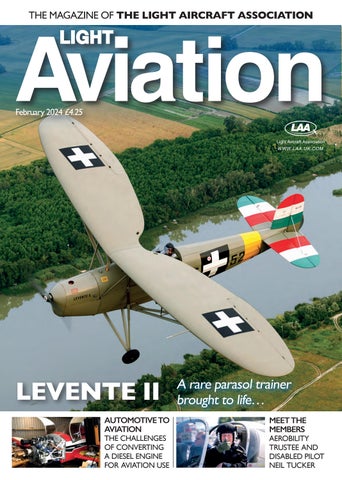
LEVENTE II AUTOMOTIVE TO AVIATION THE CHALLENGES OF CONVERTING A DIESEL ENGINE FOR AVIATION USE
A rare parasol trainer brought to life… MEET THE MEMBERS
AEROBILITY TRUSTEE AND DISABLED PILOT NEIL TUCKER
ANDAIR FUEL SYSTEM COMPONENTS COMBINE MODULAR DESIGN, SUPERB QUALITY AND THE FLEXIBILITY TO SUIT ANY AIRCRAFT BUILD PROJECT.
Having built a reputation for excellence in the design and manufacture of light aircraft fuel system components within the amateur-build aircraft sector, Andair has now established a significant presence in the commercial aviation market as well.
www.andair.co.uk
Ed’s Desk
Share your best photos of your flying in 2024 with us for the LAA photo competition!
Chairman ERYL SMITH CEO SIMON TILLING Chief Technical Officer JON VINER CEng MEng MRAeS Chief Inspector LUCY WOOTTON MEng(Hons) DIS DipHE MRAeS
President ROGER HOPKINSON MBE Vice President BRIAN DAVIES Engineering email engineering@laa.uk.com Email office@laa.uk.com Office Manager Penny Sharpe Head Office Turweston Aerodrome, Nr Brackley, Northants NN13 5YD Telephone for engineering and commercial 01280 846786
LIGHT AVIATION MAGAZINE Editor ED HICKS Email ed.hicks@laa.uk.com
Design and Print SEAGER PUBLISHING Production Editor LIZI BROWN Art Editor LISA DAVIES Opinions expressed by the authors and correspondents are not necessarily those of the Editor or the LAA. No part of this publication may be reproduced in any form without permission.
Determination…
W
ell, I think it’s fair to say that give or take one or two good days of flying weather, the start of 2024 has been somewhat wet and windy! Personally, thanks to a case of the winter lurgy that left me feeling distinctly unairworthy that, and the grim weather, has seen my flying activities for the beginning of the year relegated to hangar maintenance and not much else. I really am looking forward to the 2024 season though, which leads me on to something new for LAA and the magazine for this year. You’ll see in the News section that we’re launching a new LAA photographic competition for the year. After all, we all know flying is full of beautiful visual moments, so let’s share the joy of LAA flight. Each month we’ll showcase the best of your entries in a photo gallery in Light Aviation – then, at the end of the year we’ll pick 12 winners whose images will be used to create an special LAA Members calendar for 2025. To enter, send us your photos as jpeg files of at least 1Mb, along with a brief description of what’s going on in the photo. Send them to ed.hicks@laa.uk.com and office@laa.uk.com including your name and LAA membership number. I really hope you enjoy Ken Scott’s report on the wonderful Levente II project. While it’s not an LAA machine, it’s fascinating none-theless, and something I thought worthy of a wider audience. I’m always astounded by stories of the groups of people who get together and invest thousands of hours of work in recreating long-lost aeroplanes – driven by sheer determination.
Another determined individual is Mark Hales. You can read about his project to convert a VW diesel car engine into a Jodel DR1051 powerplant (page 26). Mark’s project, which has been carried out under UK CAA E-Conditions, is one I’ve been keeping an eye on for quite a while now, and having chatted to him on numerous occasions, I am just a tiny bit wiser to the technical challenges of designing gearboxes and dealing with torsional vibration, which come with such a project. Mark reckons that to get this far, it’s taken around 2,000 hours of work – not all his – he’s always been keen to recognise that a number of other talented engineers have helped him out during the project, many of them LAA members. Impressive stuff for sure…
ed.hicks@laa.uk.com
February 2024 | LIGHT AVIATION | 3
Contents February 2024
FEATURES 13 PROJECT NEWS
An update on Andy Best’s original design, two-seat carbon aircraft, Blue Two, a Sling 2, plus New Projects and Cleared to Fly
18 SPECIAL FEATURE
Hungarian engineer András Fábián’s plan to build an example of the Levente II was stymied, as there were no drawings or data to use. But, as Ken Scott found out, one example still remained to measure…
26 TECHNICAL
Mark Hales decides to convert an automotive diesel engine to power a Jodel as part of an E-Conditions project. In Part 1, he reveals just ‘why and how’
34 TECHNICAL
Ian Fraser and Ruth Kelly ask, does the wartime history of piston engine development hold any clues as to whether we can manage without 100LL while we wait for unleaded options?
42 COACHING CORNER
18
Levente II
A poignant final article following the recent death of David Cockburn, LAA’s Pilot Coaching Scheme Head of Training
43 ENGINEERING MATTERS
Taking a look at the Oratex fabric covering system and a Facet electric fuel pump failure
50 MEET THE MEMBERS
Ed Hicks talks to Aerobility trustee and disabled pilot Neil Tucker
26
50 REGULARS 03 EDITORIAL 06 NEWS 09 STRAIGHT AND LEVEL 11 LETTERS 48 STRUTS4U 58 WHERE TO GO
13 February 2024 | LIGHT AVIATION | 5
LA News
News
Updates available on the LAA website at www.laa.uk.com – check it out every day!
LAA Rally 2024 returns – to Leicester! The Light Aircraft Association's much-missed annual Rally will return in 2024, centrally located for LAA members at the new venue of Leicester Airport. In his announcement about the event, LAA CEO Simon Tilling said, “I am very pleased to announce that, following agreement with the airport management team yesterday, the 2024 LAA Rally will be held at Leicester Airport over the weekend of 30 August to 1 September 2024. “I am really happy that we are going back to Leicester Airport
and glad that the team at Leicester are just as keen as we are to make this a fantastic event – whether you are a pilot, owner or enthusiast.” Older members will recall that Leicester hosted the PFA Rally in 1979, 1980 and 1981. More information will be published in Light Aviation as it becomes available.
Popham Airfield under threat downloaded from tinyurl.com/ Pophamplanresponseform and sent to Local.plan@basingstoke.gov.uk or by writing to: Civic Offices, London Road, Basingstoke, RG21 4AH.
The 16th Aviation Education Conference – organised by YES
Areas you may wish to consider in your response are: ● Popham is not a green field site, it is a CAA recognised airfield (EGHP) ● The airfield supports a number of businesses – three flying schools and an onsite maintenance organisation, and has a cafe which employs six (at least) full- and part-time staff ● The airfield is open to the public and is a major attraction for the local public to enjoy, especially in summer ● The airfield is used frequently by the army, air force and civilian services (e.g. Helimed and police) for exercises and as a facility ● Popham Airfield is playing a major role in research into the safe and equitable integration of UAV technology into the aviation industry ● Popham Airfield is one of the very few, so far, airfields which has invested in electric aviation and supports its development ● Popham Airfield hosts major commercial events in support of the UK-wide aviation economy ● The airfield site maintains a unique floral environment. Some areas of the airfield are restricted to ensure this environment is not compromised.
YES, Youth Education and Support, is pleased to announce its16th Aviation Education conference which will take place on Saturday 23 March 2024 in the Discovery Zone at Old Warden Aerodrome. The theme this year is Young Aviators, a major scheme to fly 2,024 in 2024. The programme will include information and guidance on a wide range of aviation-related activities, careers for young people and especially how to obtain Young Aviator Flights. There will also be opportunities to find out about airfield day, bursaries and grants, Build-a-Plane projects, Flying Cadets and Gliding Opportunities, LAA Junior Members, Models and Model Flying with the BMFA, Scout Aviation Activities, Air-Scouts and Camps and training opportunities for aviation-related jobs. An important aspect of the day will be opportunities to talk with those who deliver these activities, plus networking. A brief tour of the museum facilities will be available along with lunch. Entry is free to delegates who must pre-register by emailing Stewart Luck, on Captainluck@ hotmail.com
Popham Airfield is under threat of being turned into a garden village with 3,000 homes being built on the Hampshire site. The airfield was included in the local council’s strategic plan as a potential site for a major housing development. That draft plan was presented to the council’s cabinet during January and the next stage of its process was approved. A thriving centre for sport and recreational aviation, Popham has already become home to aviators displaced from other airfields that have closed and would be a huge loss to the community. The draft Local Plan Update is available for public consultation for a period of six weeks between 22 January 2024 and midnight on 4 March 2024. Once you have registered, comments can be submitted through the online portal at the following address and the use of this portal is strongly encouraged: www.tinyurl.com/ Pophamportal Alternatively, a response form can be
6 | LIGHT AVIATION | February 2024
LA News
LAA 2024 photo contest We’re launching a new monthly photo contest, and we’d love to see your images that capture the joy of LAA flight. The contest will see the best of each month’s entries published in Light Aviation magazine. Then, at the end of the year, 12 winners will be chosen and those images used to create an LAA calendar for 2025 that will be sent to members. To enter, send your photos as jpeg files of at least 1Mb along with a brief description of what’s going on in the photo. Send them to ed.hicks@laa.uk.com and office@laa.uk.com and include your name and LAA membership number.
Free money for EC! Still not bought an Electronic Conspicuity device? Then don’t forget the CAA’s EC rebate scheme runs until 31 March 2024. Those meeting the requirements can claim a 50% rebate of the purchase cost of an EC device to a maximum of £250 (including VAT), per applicant. To qualify, you must hold a UK-issued pilot licence, and the rebate can be used towards the purchase of equipment including, ADS-B Out capable transponder inclusive of GNSS position source (Mode S ES Enabled), ADS-B Out capable transponder without GNSS position source (Mode S ES), Certified GNSS source for Mode S ES transponders (including a GNSS position sources in line with the recently published AIC2019Y141, example being Trig TN72), FLARM, Power FLARM, Pilot Aware Rosetta and the uAvionix Sky Echo 2. For more information, visit tinyurl.com/CAAECrebate
Remembering Mollie and Dylan Paul Lawrence reports: “The LAA Rally Workers Strut are sad to report the deaths of two of our long-standing canine volunteers, Mollie and Dylan Gaffney. Dylan passed away in September after a short illness and Mollie early January. “Mollie and Dylan will be very much missed at future rallies having been members of The Rally Workers Strut since 2013. Members will remember Molly and Dylan greeting Rally visitors as part of fund raising activities for the Air Ambulance. “We hope now after having crossed the rainbow bridge they are having fun pursuing their favourite activities – dismembering squeaky toys, chasing tennis balls, rolling on their backs, swimming in the lagoon and leaning on people’s legs. “We send our sympathy and condolences to Mike and Jan Gaffney, and brother Purdy.”
Flying instructor sought! Otherton Airfield is seeking a current, or aspiring, flexwing or fixed-wing instructor. This is a great opportunity to take on your own portfolio of students, new and old, on a self-employed basis. A hangar and heated office are provided with an onsite kitchen offering refreshments every weekend. If this sounds like an opportunity for you, even if you are not yet qualified as an instructor, then please contact Alex at ajscrowley@gmail.com for further information.
New Piper Aircraft books
Roger Peperell, who is the official historian of the Piper Aircraft Corp as well as being a successful author on the marque, has some new books becoming available that he hopes will be of interest to UK Vintage Piper owners and enthusiasts. Roger said, “For more than 50-plus years, I've had a love affair with everything Piper Aircraft. I have collected thousands of Piper marketing photographs. These collections of photographs are not only beautiful, but also historical to general aviation and I felt the need to share them. This is how this limited collection of picture books came to be.” The limited edition series includes, ‘Piper Cubs, Coupes, Cruisers and Super Cubs’, ‘Piper Comanche’ and ‘Piper Vagabonds, Clippers, Pacers and Colts’ Roger is aiming to find out roughly how many people on this side of the Atlantic will be interested in purchasing a copy so that a bulk shipment may be made in order to minimise the associated costs. If you're interested in buying copies then please do get in touch with Roger at: roger.peperell@btconnect.com.
Strategic Aerodrome Network launched
A Strategic Aerodrome Network has been launched by the Airfield Operators Group and the UK AFE VFR Flight Guide. The Network was suggested by Lord Byron Davies in his 2018 report that accompanied a Green Paper, Aviation 2050: The Future of UK Aviation. The purpose of the Network is to: ● Draw more attention to the range of General Aviation (GA) airfields across the UK ● Highlight their economic, transport, connectivity, recreational, training, community, environmental and emergency service value ● Promote their importance now and for the future ● Help protect and ensure they are able adapt and meet future aviation needs ● Promote the sector to public bodies. The group has already taken their first step, contacting UK airfields with a survey. www.airfieldoperatorsgroup.co.uk
LAA needs YOU! The LAA is seeking applicants for two important roles within the Association. Following Brian Hope’s recent decision to step down as Head of technical training, we are looking for someone new to take on this role and enhance the number and types of training we offer, including a new ‘How to’ video initiative. Chris Thompson has also expressed a desire to retire from the Pilot Coaching Scheme National Coach role. Pilot Coaching is another area that the LAA is looking to enhance so this is an opportunity for someone new to make a real difference. Both roles will be fully expensed. Please apply in the first instance to office@laa.uk.com. LAA’s Simon Tilling said, “Both Brian and Chris have done great work in their roles in recent years, and I’m sorry to see them both go. On behalf of the members, I’d like to thank them both for their efforts.” February 2024 | LIGHT AVIATION | 7
Obituaries
David Cockburn 1948 – 2024
David Cockburn, 75, of Asenby in North Yorkshire, passed away on Sunday 7 January after a year-long battle with pancreatic cancer. He is survived by his wife, Alison, and children Robert, John and Lucy. Born in Glasgow in 1948, David attended the Glasgow Academy. While there he attained a scholarship to join the RAF as a pilot. It was during his time at the Academy that David started flying both powered aircraft, obtaining his PPL at Carlisle Airport, and gliders, with his first solo flight in 1965. Despite losing his own father weeks before he was due to start at RAF Cranwell, David was commissioned in August 1968. David’s RAF career was a varied one, including co-piloting Vulcans and flying Canberras, training pilots and navigators in Jet Provosts and teaching elementary flying in Chipmunks. His career also included international liaison
Martin Emery 1948 – 2023
Roy Newton 1938 – 2023
Roy Newton died in November 2023 aged 85. One of a sadly dwindling band of post-war pioneers who were able to fulfil their dreams to build and fly their own aircraft built entirely from plans. Roy caught the flying bug after completing his National Service and his electrician apprenticeship, luckily finding himself working near Panshanger. He soon started lessons with the Club, initially on the Aircoupe and then Austers. PPL 8 | LIGHT AVIATION | February 2024
work. He served with the British Commander in Chief’s Mission to the Soviet forces in Germany (BRIXMIS) in Berlin in the 1980s, and later with the Joint Arms Control Implementation Group (JACIG). David’s tour with BRIXMIS saw him flying a Chipmunk over Berlin to gather intelligence on Soviet and East German forces in the region, and that at JACIG involved inspection of the reduction of armaments for the implementation of the Treaty on Conventional Forces in Europe. David’s gained his Silver Badge and qualified as a glider instructor while at Cranwell. He was a member of a number of gliding clubs, including the Yorkshire Gliding Club, with whom he remained active until his latest illness, and served as Chief Flying Instructor at Humber Gliding Club at various times. He actively competed in the UK and abroad – winning the 1976 and 1993 Inter-Service competitions - and achieved his Diamond badge, no. 70 in the UK. After leaving the RAF in 1994, David taught Royal Saudi Air Force pilots in Riyadh and then worked for the CAA for 15 years as Safety Information Officer. In that role he obtained permission for light aircraft to continue flying during the Iceland ash cloud incident in 2010. With c.14,000 flying hours, David was a Fellow of the Royal Institute of Navigators, a Master Air Pilot, Liveryman of the Honourable Company of Air Pilots and former co-Chair of the European General Aviation Safety Team. David’s life was focused on making flying a safer and more enjoyable experience for all. He will be dearly missed by his family and friends. Cockburn family.
Martin lived and breathed aviation having been a flight instructor, air traffic controller, commercial pilot, glider pilot and recently even tried his hand at helicopters. His dramatic landing of a Boeing 707, when two engines departed the starboard wing in 1992, halted his commercial piloting but didn’t dent his enthusiasm, and was depicted in an episode of Air Crash Investigation called ‘Double Trouble’. He owned a variety of aircraft and projects including two Czech-built Let 200 Moravas and an Aerovodochy Ae-45, but his pride and joy was a French SIPA S.903, which he bought in 1974, and always thought he’d get it back into the air someday. Martin Cobb
in hand, he grabbed every opportunity to fly whatever he could afford: Turbulent, Tiger Moth, Cub, Jodel, Miles Gemini, Wittman Tailwind and Austers. But his goal was to build, so in 1968 he paid John Taylor’s widow, Eve, £12 10s for the plans of a Taylor Titch, jokingly writing to her of his plan to finish by 1969! And, 18 years of meticulous engineering later, G-BARN took her first flight with Bill Bowker squeezed into her tiny cockpit. For the next 36 years Roy was her dedicated and sole guardian – they last flew together in September 2023 just months before his death. Roy was a highly gifted craftsman of the old school, cautious and determined to get things perfect. He was not the easiest hangar mate, partly because of this – and his stubborn refusal to move into the 21st century: electronic kit or even radio were not for him, but his breadth of knowledge and his help to me and my Stinson were greatly appreciated. In his last years Roy beautifully restored a rather dilapidated Taylor Monoplane for his son James, who now has the honour of owning and flying both Taylors. The Sussex skies by Beachy Head and the Seven Sisters will certainly be emptier without his silver Titch darting over the waves and soaring up over the cliffs. RIP Roy. Mike Lodge
Straight and Level
Straight and Level Skills and currency Simon Tilling CEO
I
Updates from LAA HQ
Permit revalidation performance is still tracking to plan (acknowledging it’s a quiet time). This would be a great time for any of you who want to move their renewal date to a more suitable time, to take up the offer of doing so at no extra cost. Nick Stone, our new Head of Airworthiness, is working with the team to enhance the process to make it easier and simpler to complete the forms and will update in the near future on any changes. As you will have heard the LAA Rally is back this year and will be at Leicester. We are already working hard on the plans and Eryl has kindly agreed to take the lead on the planning and organising. This is a huge event for us and if anyone would like to volunteer with the Rally in any way please get in touch. Roll on spring!
would like to start by recognising, with sadness, the passing of David Cockburn. There is a more in-depth tribute in the magazine but, just to add, this is a loss to aviation as a whole, not just to the LAA. I offer my condolences to his family and friends. As you read this it will be early February, the days will just be beginning to get longer and our thoughts will be turning to the flying season ahead. For many of us this will mean getting back in the air after a break of a few months. This is a time where we all need to be cautious. We know that piloting an aircraft is a very perishable skill and that currency is an important aspect of maintaining that skill. If you haven’t flown for a while I would encourage you to consider how you get ‘back in the saddle’ rather than just ‘jump in and go’. On a related theme, I thought it would be good to show you the statistics we collect and collate relating to the number of accidents we have reported to us. You can see, right, the number of aircraft with valid permits and the number of accidents per year from 1994 to date. It is interesting to note that while the size of the fleet has more than doubled in that time, the number of accidents per year has remained almost flat. While there will Above Size of LAA fleet versus number of accidents, from 1994 to 2023. be a number of reasons for this it is still a useful data point. We do not, however, want to consider this accident number as acceptable. To that end we continue to work with the AAIB and the CAA to understand the root causes, identify mitigations and look for trends. More on this work in the coming months.
“Make sure that
you consider how you get ‘back in the saddle’ rather than just ‘jump in and go’…”
Above Permit renewal performance for 2023. February 2024 | LIGHT AVIATION | 9
Straight and Level
Challenges and opportunities Eryl Smith Chairman
I
t is sad to start my first piece of 2024 reflecting on the sudden death of our Pilot Coaching Scheme Head of Training, David Cockburn. While many knew that he had been battling illness his untimely death was unexpected. David was widely known and respected throughout the GA sport and recreational flying community. We all benefitted from his regular features and safety insights for this magazine, among others. His tireless work on behalf of LAA, particularly on pilot licensing issues, will be sorely missed. On behalf of all members we are grateful for his contribution to the Association and our thoughts are with his family and close friends.
Airspace and airfield threats
It might be a new year but some things don’t change! Once again we find ourselves facing threats to airfields and airspace; the latter through the multitude of applications for drone or RPAS activity, and the former as developers continue to seek financial gain from the development of open spaces, primarily to meet housing provision. As a case in point, the current Basingstoke Local Plan contains a proposal to develop land which encompasses Popham Airfield. It might seem a long shot and a long time away, but once acknowledged within a Local Development Plan it provides a green light for developers to pursue the opportunity. So if you make one aviation-related resolution for 2024, please take the time to respond to a consultation or planning application that threatens your – and others – enjoyment of our recreational activity. Don’t assume it won’t happen or that someone else will make a response for you.
Rally returns to… Leicester
On a more positive note, I am delighted that we have been able to announce the return of a full Rally for 2024. For those who remember the Rally at Leicester between 1979-81 this may feel like ‘Back to the Future!’ The team at Leicester are enthusiastic about hosting the Rally and keen to work with us to create a successful event as we build the Rally back. While the heart of the Rally is our annual opportunity to gather together, it is a great opportunity to showcase to the wider aviation community what we can offer, whether it’s to a prospective Permit aircraft builder or owner, or simply anyone interested in the world of sport and recreational flying. Detailed planning is underway with the intention to provide all the regular elements of the Rally, while at the same time looking at how we can broaden the appeal of the event overall. Over the coming months we will set out the plans and programme. If you have ideas as to how we can improve the event and the offer please let Simon or me know via the LAA office. In the meantime make sure to put the Rally dates in your diary! Writing this in the grip of snow and freezing weather the flying season seems a long way off. When the opportunity presents itself don’t forget those essential checks – and fly safe! ■ 10 | LIGHT AVIATION | February 2024
Letters We are always pleased to receive your letters, photos of your flying, and your feedback. Please email the editor at ed.hicks@laa.uk.com Aviation piston fuels
Dear Ed, The authors of the article, Aviation fuel – what’s the future post-2025? (published in January’s Light Aviation) are to be congratulated, so ‘well done and thank you’ to Ian Fraser and Ruth Kelly. Hopefully, their piece will go some way towards debunking some of the myths surrounding the 100LL vs UL91 debate, and I feel that education on this topic is definitely in order. I say this since, as Ian and Ruth say, only a fraction of those aircraft which could use UL91 actually do so, and hence there is a danger that, on commercial grounds, we could lose the ability to source UL91 because so little of it is sold. Well, at my base airfield this has already happened – the supply of UL91 was discontinued here last year and the tank / pump facility has now been given over to additional 100LL. So, unless I always source my fuel elsewhere I’m now stuck with using the poisonous and carcinogenic 100LL in the little old aircraft which I fly– one of which was certified to use 73 octane fuel and the other 80/87! No. I definitely don’t need, nor want, to use 100LL. Regarding the EU legislation which will ban the transport of T.E.L. from 2025, I have been in touch with an industry insider who told me that he’s of the opinion that the implementation of this will be delayed. If not, it will certainly put ‘the cat among the pigeons’ as far as 100LL is concerned, given that the sole manufacturing source of T.E.L. is at Stanlow in northern Cheshire, whereas our nearest avgas refinery is in Rotterdam. No wonder avgas is so expensive! Best wishes, Richard Keech.
Why is EC seen as a problem?
Dear Ed, What can possibly be wrong with enjoying some assistance looking out for traffic? Or indeed telling others of our presence? Is it because the probability of a mid-air accident is low? Is it because some of our cockpits are not sufficiently equipped nor spacious enough? Surely it’s not because our activities are covert, or we simply must safeguard our privacy at all costs? Regarding that last point, there is very little that is truly private and unlikely to be recorded
Letters
somewhere – road traffic cameras, CCTV cameras, doorbell cameras, telephone recordings, Flightradar24 – a very long list for ‘big brother’ or anyone else so interested. I am assuming (yes, I know the pitfall) that an extra dedicated traffic scan is seen as an advantage – most likely to be better than the contribution of a non-aviating passenger and, like everything else in life, not perfect but a very significant help – and that fictitious passenger is not going to let other aircraft know where we are… A mid-air collision not very likely? Indeed it is, but if you do suffer one, your survivability probabilities are not good. Some wag once said that Russian roulette survivability is 83% – accurate, quite high, but spectacularly bad when it all goes wrong – not that I would compare the two situations! There are many systems available to help pilots with that scanning task – regrettably there’s less interoperability than we should have, and the CAA must bear most of that responsibility by not simply copying the FAA example. But I’ll leave that for another day. Simple cockpits without electric power? Flying a hang glider? No problem. If you have a smartphone you can have SafeSky (www. safesky.app/en/communaute) in there for free – SafeSky will detect most (all?) conspicuity protocols most of the time and it must be tried to appreciate just how good it is. Did I mention it was a FREE App? Give it a go! Blue skies, Manuel Queiroz.
Mogas
Dear Mr Viner, I write to seek clarification regarding the use of mogas in LAA in approved engine types. I refer to the aviation fuel article in the January issue of Light Aviation. If I am reading the mogas paragraph on page 38 correctly, the previous concession given in CAP747 is no longer valid. Furthermore, the article also states that unless we are operating a Microlight aircraft, then ‘the ethanol content in UK forecourt pump fuel prohibits its use in aviation’. This rather blanket statement, unfortunately does not cover the use of mogas with zero ethanol content, nor expand on the use of Shell V power or Esso equivalent 99 octane MON. Our local flying group members, mainly equipped with Continental engines, are currently operating regularly using mogas, as previously approved in each individual aircraft case, following Inspector approval in the log books. Additionally, every uplift of mogas from
local pumps is tested for ethanol content. To date, we have been fortunate to have sourced supplies with zero ethanol content, including Esso 99. Please can you verify that we may continue to fly using mogas of zero ethanol content, and also Esso 99 / VPower? I look forward to an early reply so that we may continue to fly using zero ethanol fuels (as soon as it stops snowing that is!) Thank you. RA Phillips. Ed replies: Apologies, LAA Engineering had sent me some additional remarks about Mogas use being permissible in some circumstances, which missed being added to the version that was printed. A correction is included in part two that starts on page 34. It’s worth noting that Esso announced last year that its Synergy Supreme ’99 mogas would transition to contain a maximum of 5% ethanol at ALL Esso pumps, irrespective of which part of the country they are located in. Up until then, Esso had supplied some parts of the UK with ethanol-free Synergy Supreme ’99.
Assistance & Inspiration
Hi Ed, Lacking the relevant tools and experience when the RV that we purchased a few years ago was in need of a new-build airframe part, we were bewildered as to where to begin. Fortunately, we spotted Dudley Pattison’s magazine ad, offering project help while he awaited his next kit. Having briefly met Duds at the Homebuilders tent at the 2021 Rally, we recognised an opportunity for support. An e-mail and phone call later, Duds was immediate in providing friendly knowledge and guidance. He, and his wife, Jane, subsequently gave us a warm and generous welcome to their home over several days, while Duds offered up workshop, tools, skills and encouragement (and some wit) to help us achieve what had previously felt beyond us. We were grateful to leave not only with the required aeroplane part in our hands, but more-so having been gifted priceless knowledge, skills and understanding – mystique eliminated – genuinely inspired that aircraft building is possible… and fun. That Duds asked for nothing more than our engagement in return made his and Jane’s generosity even more remarkable. Duds tells us he had other replies to his ad, but ours was the only project that followed through, which is a shame. We’re fortunate
Above Aspiring Sopwith pilot Ellie Carter’s Moth instructor has also flown a Strutter.
for the wealth of expertise in our community, and individuals so enthusiastically willing to share it. We certainly gained more than just the completion of our project. Martin Owen & Neil McAllister.
An earlier Strutter pilot
Ed, I was pleased to see Ellie Carter in the Meet the Members section of the January issue – a young pilot with both motivation and the chance of flying a soon-to-be completed replica Sopwith One and a Half Strutter. For this endeavour Ellie is training with Annabelle Burroughes at Henstridge in one of TMT’s Tiger Moths. Strangely enough, Annabelle flew the Pterodactyl CZ-operated Sopwith example, also powered with a Rotec, from Jihlava, some 10 years ago. Annie has also flown David Bremner’s Bristol Scout powered by a LeRhone 80hp rotary engine, probably the only woman to fly behind a rotary engine in 35 years. So while Ellie might not be the first woman to fly a ‘Strutter’, who better an instructor than Annabelle to show her the ropes? Sincerely, Clive Davidson
EC? A lifesaver
Hi Ed, Just opened the latest magazine and notice you end your opener by saying ‘that a search didn’t reveal any further UK mid-air collisions’. I’m sure I won’t be the only one to reply, but in Aug ’23 two gliders had a fatal midair at a Hus Bos competition. These are guaranteed to have both been using an interoperable Flarm-based system, yet still it occurred. There are obvious differences with GA, in that gliders do like to fly in close proximity to each other while joining and sharing a thermal, but for some reason Flarm didn’t keep them out of trouble that time. Gerry Robertson Ed replies: Thanks Gerry, you were the only one to write in to flag that, so thanks for the information. Like you say, I would guess both had Flarm. I await the AAIB report. February 2024 | LIGHT AVIATION | 11
Take part in webinars from experts like Patty Wagstaff, use our free landing vouchers to save hundreds of pounds, read and watch all our content and connect with new people!
Join us on our #fly2024 challenge! Fly 2,000nm, introduce two new people to GA flying and visit four new airfields.
Project News
Inspiring members to take on their own aircraft build or restoration project Compiled by Mike Slaughter
Project News T his month we have a nice project update from Dominic Green on his recently completed Sling 2. In his report Dominic comments that there is no such thing as a ‘standard’ aircraft, he is of course referring to the many different options, avionics, paint and upholstery etc, available to him when finishing his Sling. I was amused to read that in common with many other builders, his first task was to increase the size of his garage workshop. Requiring him not to rush out and purchase an air compressor or pillar drill, but in fact a cement mixer! Similarly, his engine turned up very early in the project and became the kitchen table for a year. Blue Two is an ‘own design’ project conceived and constructed by Andy Best, and we’ve followed its progress in Project News over the years. The aircraft is an all composite carbon fibre, two-seat microlight and we last had an update from Andy in mid-2022 as he got to grips with the oil system, having discovered that the standard Rotax ‘oil can’ or remote sump wasn’t going to fit under the cowling.
Andy is now debugging a fully rigged aircraft that moves under its own power. He takes us through the amendments that he’s had to make to the brakes, steering, canopy and cooling. There’s only so much that can be achieved at the design phase, and now the aircraft is built it will need a good period of ground testing to reveal any snags. Let’s not forget, this is not a kit or a plans built, this is a completely unique design created by the builder for his own enlightenment and enjoyment. Every LAA build or restoration project is different as a result of its creators skills, experience and expectations. I’ve had people say to me ‘you don’t want to hear about my project, you featured one of those last month’. Project News reports inspire others by giving an insight into individual builder’s journeys. So why not drop Project News an email and let your fellow members see how you’re getting on with your project, it doesn’t have to be finished, as many updates are progress reports. Email: projectnews@laa.uk.com. Please share your story!
G-CMOG (LAA 399-15749) Sling 2 By Dominic Green
H
aving flown rented aircraft for a few years, I found I was increasingly noticing privately owned aeroplanes of varying types, they all looked good and I began to think it would be exciting to have my own to go on little tours. Owners I spoke to who had built their own said ‘Why don’t you build one’? At the time building an aeroplane seemed like a huge and daunting project, and as I was working abroad most of the time was a non-starter. Then covid came along, changing lots of plans, my time abroad ended, and so an opportunity appeared! I wanted something I could build at home and that would be good for touring, a low-wing and tricycle undercarriage. Having little experience of woodwork, and even less of composites, I felt more comfortable with a metal construction. I came across both Sling’s 2 and 4, which seemed to fit the bill. The ‘4’ seemed a tall order for my first project, and was a stretch for my budget. The ‘2’ with its 700kg MTOW seemed a good fit. There were already examples flying in the UK and overseas. I didn’t
Above Early building progress, Dominic with the completed fin and rudder. February 2024 | LIGHT AVIATION | 13
Project News Left The wings are loaded into a rental van to go to Top Farm for a little assisted building. This turned out to be a good move.
think I needed too many sophisticated options, just standard avionics. Then I was introduced to the comprehensive options list… I was not even sure what some of them were. With lots of guidance from the UK Sling distributor, Tim Hardy, I eventually settled on the options I wanted, and an order was placed. I came to realise there isn’t really a standard aircraft, as no two aircraft are exactly the same, particularly regarding the avionics. I liked the look of the modern glass cockpit, so opted for the Garmin G3X with G5 back up. The next thing I learned was that my garage was not long enough. The first winter of my project, 2021-22 was spent digging out, mixing concrete and building a garage extension. Not quite the glory of aircraft building I had envisaged. Then before the garage was finished, parts of the kit started arriving. First the empennage, and for some reason the engine. Where do you keep an engine when the garage is full of other stuff and the roof is not complete? The answer turned out to be the kitchen. We put a tablecloth over the engine crate, to make it look less obvious and it became part of the furniture, for a year! The WhatsApp builders community was welcoming, with lots of tips, advice and discussion about all sorts of topics. The project would have been far more difficult without the group’s support, many of whom had built aircraft before, or have a background in aircraft industry. 14 | LIGHT AVIATION | February 2024
Above The skeletal fuse in its fetching green two-part Aerowave primer.
Other parts of the kit soon started arriving. Building settled down into a routine, first the empennage, then wings took shape. The fuel tanks are part of the leading edge of the wing, and I was advised that it would be better to finish the wings and fuel tanks at Ventura Aviation, Slings support centre at Top Farm near Cambridge, so we transported the wings in a rented van. Assembly of the fuel tanks and fitting to the wings does need several pairs of hands and I was glad of the support from staff and other builders. Doing parts of the project at Ventura turned out to be helpful in other ways too, there was always someone to ask general questions, other visitors would often have something helpful to add, and there is a community spirit with other builders based there. Building the wings and fuselage was in some ways a more straightforward part of the build. I had all the parts, tools and instructions, so I could progress at my own pace. Avionics and external colour schemes were a different matter. I had ordered the glass cockpit and avionics as part of the kit. When it arrived, it contained all the components I had asked for, plus a pile of wires and all sorts of plugs, sockets and connectors. I wasn’t even sure what some of them were for. I hadn’t really appreciated at the outset that connecting it all together and building the ‘loom’ was a significant task in itself. At the time there were not a great deal of companies in the UK I could ask to help with this work. However, one of the visitors I had met at Ventura was professional avionics engineer Manuel Querioz, and after some discussion he seemed to think that, with a bit of support, I could build the loom myself. About the same time, the LAA ran an electrical training course which was another valuable source of knowledge and confidence. By this time it was winter 2022/23, it was much more attractive studying aircraft wiring indoors, compared to standing in a freezing garage or hangar. Bit by bit, the Garmin installation manuals started to make sense, and I began to build up a diagram on a spreadsheet of how the wiring could look. At each stage I asked Manuel to review the spreadsheet, to which he provided very helpful
Above Powered by a low capacity source, the first system power-up went well with no flashes nor smoke!
Project News
feedback. After a few months I had got to a stage where I felt confident enough to start to install some of the wiring, and begin terminating cables to the numerous plugs. After every set of cable installations I would check with a multimeter that they were installed correctly, I did find some errors in my own work along the way. When the day of initial power-up came, I had feared smoke would come pouring out of the back of something, so I only used a small 12v power supply for the initial power testing. To my amazement, there was no smoke, and the avionics came to life. The other decision I had to make was regarding the colour scheme. Having no strong view on this, my initial assumption was ‘I’ll just have white with a red stripe down the side’. Then, Tim Hardy suggested the polishing option, another Sling 2 owner has already done this. I met the owner of this polished Sling 2 (featured in LA magazine in 2020), and he was very helpful and honest about the reality of polishing. Polishing the aluminium was as dirty and time consuming as I had been warned. On the other hand I could do the polishing in my own time, it avoids the added weight of paint and waiting for a paint job at the end of the project. I opted to have the composite parts, cowling, spats, etc, painted. Most of which could be taken to my local auto-painters in the back of the car. The time came to move the nearly completed fuselage to join the wings at Ventura Aviation. As it was two hours away we used the very professional Ponsonby transport services. At Ventura, with skilled staff, and other builders on
Above Oscar Golf fuse ready to join the rest of the project at Top Farm. Below All finished and ready for testing.
hand to assist with tricky jobs like windscreen installation and fitting the wings, everything was completed without too much drama. I enjoyed the collaborative support in the hanger and inevitable chats over packed lunches. A major milestone was the initial engine run. The engine started first time, and I was amazed that there were no oil nor coolant leaks. The project has been a journey into the unknown for me and I’ve certainly learned a lot. I am delighted at how it has turned out, and can’t wait for the better weather to progress test flying, and some new adventures.
February 2024 | LIGHT AVIATION | 15
Project News
G-CLOA (LAA 388-15251) Blue Two By Andy Best
A
t last! It moves under its own ‘steam’. Taxi testing has commenced with my own design ‘microlight’ Blue Two. Like all creations, there are always some worries and uncertainties. Will it operate in the way that I designed it to? What is likely to fail, drop off or leak? Having worked with prototype vehicles, in another life, I know it’s usually the things that have been taken for granted that can go wrong. Anyway, the first problem was that the engine, a Rotax 912 ULS, wouldn’t start. The diminutive Varley lithium battery at 1.2kg was fantastic at cranking, though. The next day, when I discovered I hadn’t turned the fuel on, it started instantly. I do worry about myself sometimes. The oil pressure was good and I was reassured by the smooth tick over, right down to 1,400rpm. However, the cylinder head temperature started rising and rising… and rising. It didn’t stop, so after about three minutes I had to switch the engine off. Ah well, a chance to check the engine bay for leaks. There was one minor leak from a coolant hose, rectified by tightening the hose clamp, but the rest were all good. The other immediate problem was the brakes, which seemed almost totally ineffective, and once I’d started moving, this did give me a scare. They wouldn’t hold the aeroplane from creeping forwards at anything over 2,000rpm. Originally, I was going to have toe brakes, as they work well and are good for manoeuvring, but decided to have just one master cylinder, for simplicity, and to mount both the brake lever and master cylinder on the throttle lever. Ergonomically this was good and felt comfortable to use. I made a longer lever in an attempt to increase the force on the master cylinder and this did improve the braking somewhat. The creep forwards now started at about 2,500rpm. Right, time for a rethink. My answer was to mount the master cylinder on the cockpit floor and use a yet even longer brake lever. This does seem to work quite well, though I suspect some of the improvement is due to the pads bedding into the discs. You can see from the photo, showing the long lever, the master cylinder, mounted on the floor and the fluid reservoir tie wrapped to the fuselage sidewall. The silver rod passing in front of the lever is the push-pull throttle connection. The brown cable passing over the top of the
16 | LIGHT AVIATION | February 2024
Above left Andy’s amended brake lever installation. Above The front wheel spat is structural, making ground handling acceptable, requiring its modification. Above right Intended to make life easy, the canopy gas struts were forcing the front of the canopy up into the airflow, not ideal, so another modification was required. Below Look carefully and you can see the original two gas struts pushing back from the firewall to lift the canopy.
brake reservoir is from the radio aerial and, apparently, needs to be routed separately from all other cables. The nosewheel steering is operated directly with pushrods from the pedals. Rather unjustifiably, I suspect, I can’t bring myself to like the apparent vagueness of self-castering nosewheels. Do you really have to put the brakes on to keep the aircraft from turning left on the take-off run? I shouldn’t be too smug, as my system had far too much caster trail, meaning that the nosewheel fell over onto lock and was very difficult to get straight again. I sort of ended up going round in circles. The front wheel spat is structural, taking all the nosewheel loads from the axle and required a bit of re-engineering to move the axle forwards about 70mm. The canopy has two forward hinges and incorporates the instrument panel which goes up with it on opening, like many gliders. This does give good access to the instrument wiring and the pedal assembly. An automotive gas strut acts on each hinge and opens and holds the canopy up well. However, after a rather blustery day with the canopy open from time to time, I noticed – to my alarm – that there were cracks developing where the hinges were bonded to the canopy frame. This was quite easily fixed with more carbon cloth and epoxy resin, but worrying nonetheless. What other detail might I have got wrong? Another problem that had not been envisaged was that the considerable force exerted by the gas struts was distorting the canopy frame at the front, leading to the
Project News
front edge of it lipping up above the fuselage profile. My solution to this has been to delete the gas struts. You will see in one photo a rather cluttered view of the two gas struts that held the canopy up and distorted it. In their place I have installed a rather glorified bonnet prop, shown in a further photo. Rather agricultural, I’m afraid, but light and functional. Time will tell whether or not this was a good idea… The fuel in the aeroplane is split between two tanks, both in the fuselage. In many ways they are better out of the way, in the wings, leaving more space in the fuselage. Because of their varying weight, which is substantial, they need to be close to the centre of gravity to avoid large trim changes or even having the CofG out of limits. Putting them in the wings is, of course, not without its own problems. The structural implications of having, say, a one metre long aluminium (and only aluminium in this age of ethanol) tank where the ribs should be, worried me. The other potential problem is making an acceptable venting system. I once saw fuel pouring out of a wing tip vent on
Above left Gas struts deleted, the canopy is now held open with a simple ‘bonnet prop’. Above The canopy stay in position when the canopy is closed. Below Blue Two shortly before Christmas 2023, looking very sleek.
an aircraft turning to line up on a runway. So, there is a 45 litre tank behind the seats with a sight tube for checking the contents and a 32 litre tank under the cockpit floor, below my thighs. The rear tank drains directly into the front tank, which is lower. The front tank has a sender unit bolted into it for a normal electric fuel gauge. This tank has been in and out four times now, with leaks around the sender and the fixing bolts. It’s driving me nuts. For cooling, I have used a Suzuki 650 rad, slightly larger and much more affordable that the standard Rotax item, it’s housed in its own separate duct within the engine bay with a seven row oil cooler behind. Was the ducting hopelessly incorrect? I couldn’t see why, but decided that more information was required. To this end, I fitted an additional actual water temperature gauge, as opposed to the cylinder head temperature gauge, by installing a sender unit in the ‘top hose’. This required an adaptor to be inserted in the pipework. The aluminium adaptor was beautifully made and anodised – all the way from China for about £6. I’m not quite sure what all this has done to the system, perhaps cleared an air lock, but at the last running, admittedly on rather a cold windy day, the coolant temperature did stabilise at around 60°C. Phew! I hope all this doesn’t sound too gloomy. It’s been quite exciting really, and for example, giving the engine a blast of power and feeling the aircraft surge forwards was fun – as well as knowing that finally it’s coming together and that the great majority of things seem to work well. ■
New Projects If your aircraft has been featured in the New Projects list, please let Project News know of your progress at: projectnews@laa.uk.com
Cleared To Fly If your aircraft has featured recently in the magazine and has subsequently completed its maiden flight, Project News would like to hear from you at: projectnews@laa.uk.com
n Cozy IV (LAA 159A-15895) 19/12/2023 Name & Address held by LAA Engineering n KFA Safari (LAA 402-15896) 19/12/2023 Name & Address held by LAA Engineering
n KFA Safari (LAA 402-15893) 6/12/2023 Name & Address held by LAA Engineering n Van’s RV-10 (LAA 339-15894) 12/12/2023 Name & Address held by LAA Engineering
n G-CMOG Sling 2 (LAA 399-15749) 20/12/2023 Mr Dominic Green, 2 Parkwood, Badingham Road, Framlingham, Woodbridge, IP13 9JX n G-WENY Zenair CH 750 Cruzer (LAA 381A-15567) 8/12/2023
Mrs Patricia Porter, Hangar 2, Haverfordwest Airport, Tangiers, Haverfordwest, SA62 4BU n G-OXIV Van’s RV-14 (LAA 393-15383) 13/12/2023 Name & Address held by LAA Engineering
February 2024 | LIGHT AVIATION | 17
Special Feature
Levente II? Say, ‘what’ now…? When Hungarian pilot András Fábián wanted to build an example of the Levente II, he first had to fix the problem of there being no drawings or data to use. Luckily, as Ken Scott discovered though, one original example still remained to measure… Photography courtesy Levente II team 18 | LIGHT AVIATION | February 2024
Special Feature
S
ome years ago, I was manning the phones for a kit aircraft company in the Western US. I answered one of the first calls of the day from someone asking in accented, but perfectly understandable, English if we had ‘a weighted flop tube for a fuel tank in stock and could we ship it soon?’ We did. So I asked where we might be shipping it. Hungary, replied the caller. I’d fielded calls from all over western Europe, South America, Australia, South Africa… but I didn’t know we had a customer in Hungary. I said as much. “Oh, it is not for one of your aeroplanes. It is for
another type of aeroplane we are making here.” What might that be, I inquired. “Oh, you have never heard of it,” said the voice. Whoa. Game on. I do pretty darn well in the ‘namethat-plane’ contests that crop up around work. I have read ALL the books in my father’s extensive aviation library. On my birthday my wife asked all the guests from our airpark to bring a photo of an aeroplane to try and stump me. It was pitiful. Of course, I know a Miles Libellula or a Bristol Bagshot when I see one. So, with some confidence – and quite a bit of ego – I said, “Try me…” “We are making a Levente II,” came the reply. I had never heard of it. February 2024 | LIGHT AVIATION | 19
Special Feature
Above András Fábián the Elder, designer of the Levente II, sometime in the early 1940s. Above right András Fábián the Younger, part of a team that recreated his great-uncle’s design. Main image Before construction began András spent two years modelling the structure of the aeroplane in CAD. Right A row of the first Levente IIs to be delivered.
Chastened, I googled ‘Levente II’ the instant I hung up the phone. What appeared was a pretty little primary trainer. It had two open cockpits in tandem, a slender inline engine and a tall tailskid landing gear. Its outstanding feature was an extremely graceful all-wood elliptical wing, mounted on struts above the fuselage. It was a completely Hungarian aeroplane, manufactured in Hungary, powered by an engine built in Hungary and designed by Hungarian engineer András Fábián. Wait a minute… I glanced at my order pad. The flop tube had been ordered by András Fábián! The man I’d just spoken with could have been old enough to have designed an aeroplane that first flew in 1940. So I emailed and asked András to tell me about his project. The 'modern' András was the namesake and greatnephew of the designer. He and friends László Váradi, Zsolt Gettler, and Attila Gyetvai had started thinking about building a Levente II in about 2007, but there was a problem. No drawings nor engineering data had survived World War II. Designer András Fábián, too, had perished in an Allied bombing raid. Although four prototype and 86 production Levente II aircraft had been built up until 1944, the war had left just a handful of rebuilt survivors. These
“Googling ‘Levente II’ showed a
little primary trainer, with two open cockpits in tandem, inline engine and a tall tailskid landing gear” 20 | LIGHT AVIATION | February 2024
had seen limited post-war use as glider tugs and club aeroplanes until attrition and disinterest had reduced their number to… one. That sole survivor was sitting, rather forlornly, in the Hungarian Technical and Transportation Museum in Budapest.
Cosmetic restoration
The team got its big break in 2009, when the museum contracted them to do a ‘cosmetic restoration’. Sensing its opportunity, the team took it much farther than that. “We had the aeroplane for six months, and during that time we dismantled it completely,” András says. “We measured every part and drew it, both by hand and in CAD. After that we developed a complete 3D model of the aeroplane and its systems. The modelling project took more than two years.” The computer files were used to develop templates for the parts and the jigs to assemble them. This was particularly useful when building the wing. European spruce forests are not gone, but finding trees that could yield spar stock for a 9.5 metre, two-spar wing was, as András puts it, ‘a very hard task’. With help from a German aircraft restorer, he was finally able to import suitable timber from Sweden. Once the material was on hand they faced reality: building an elliptical wing is a geometric nightmare. Such wings were quite in vogue during the 1930s. Major manufacturers such as Supermarine and Heinkel used them, but the aerodynamic advantages could not overcome the manufacturing difficulties and by the end of World War II they had virtually disappeared from production aeroplanes. The Levente II wing uses stick-built truss ribs — only two can be the same — and the ailerons have to match the curve of the training edge.
Special Feature
February 2024 | LIGHT AVIATION | 21
Special Feature
Above With the major components completed, a trial fit was carried out. The parts count, specially for the wing, is massive.
Add to that a wing with a double taper in thickness and a 7.5° sweep and it’s easy to understand the 3,744 man-hours that went into a set of wings – that’s without counting the difficult plywood skin that covers the leading edge. In the end the team produced a set of wood wings that matched the computer model to within four millimetres, measured diagonally across the span! It is an exceptional feat of craftsmanship. Using the computer model, a massive fuselage jig was welded up from rectangular steel tubing. Clamps installed on the jig held the 4130 steel tubes of the fuselage in place while they were TIG welded together. It is a time-consuming and exacting task to cut, fit and weld even the basic structure – and after that comes a seemingly endless number of brackets, tabs and clevises. Then there was the matter of the engine. The original
“A few cylinders, a corroded main
bearing and all the valve guides were replaced, but the cam, crankshaft and connecting rods were re-used” 22 | LIGHT AVIATION | February 2024
Levente II used a MÁVAG-Hirth — a German Hirth 504 A2 built under licence in Hungary. The Hirth is an inverted inline four-cylinder engine that uses 242 cubic inches to develop 105hp at 2,530rpm. It has a magnesium alloy crankcase and a roller bearing crankshaft. Hungarian MÁVAG-Hirth versions were extinct, but András managed to find a German Hirth in Lithuania. After purchasing it, he accompanied it to the workshops of Dirk Bende in Germany. Bende is well known for his airframe and engine restorations, and is fully capable of building any engine part he can’t find in his extensive collection of spares. The engine was found to be in very good condition internally. A couple of cylinders, a corroded main bearing and all the valve guides were replaced, but the cam, crankshaft and connecting rods were re-used. Later, when it was installed on the covered fuselage, the original hand crank started it easily.
Radioactive radium in dials!
No period Hungarian instruments could be found, but most of them were licence-built versions of German units. A set of German instruments was gathered, all with radioactive radium still on the dials! They were stripped and the faces re-screened for use in the Levente II. In 2014 there was good news, the Csepel district of Budapest (where the original production started in 1942)
Special Feature
Above CAD was used to build a jig for the fuselage, here being worked on in their Atkar workshop. Right Build team member László Váradi fitting the curved ailerons to the curved wing. Far right 80 year old overhauled Hirth 504 A2 engine. February 2024 | LIGHT AVIATION | 23
Special Feature
Above Original instruments were not available, so the team took period German items and had them restored with Hungarian markings for both cockpits. Below Aloft at last!
awarded the project the equivalent of $28,000 US. It was a welcome boost to the team (in the end András estimates the aeroplane cost between $90,000 to $100,000). There was also some difficulty: Hungarian aviation authorities insisted on a completely new set of load calculations and engineering data before issuing the Permit to fly. Five students at the Nyíregyháza Aerospace College made the necessary calculations as part of their degree. They confirmed the wood wing did meet the ultimate load factor calculated by the original designers: 12! By 2015 the team could assemble the uncovered airframe. A wood propeller had been copied from an
24 | LIGHT AVIATION | February 2024
original prop using a pantograph machine. The wood formers had been installed on the steel-tube fuselage. The difficult sheet metal nose bowl and cowlings had been formed and fitted. It looked like a flying aeroplane was not far away, but as anybody who has built an aircraft can tell you, when it looks like an aeroplane you’re not even halfway there. Covering, painting, systems, rigging… it all consumes vast amounts of time. It was October 21, 2019 before it could be rolled out onto the grass airstrip and flown. Early in the construction process, András had been able to interview an elderly pilot who had flown the
Special Feature
Top The finished Levente II, at home on the grass at Tököl Airport (LHTL). Above László Váradi and András Fábián, the builders of the aircraft, after the aircraft completed its maiden flight. Right Levente II. above the Danube river at Tököl flown by test pilot Zsolt Gettler. Levente II. They found their version of the aircraft matched his description quite well. It’s a docile machine, quite stable and easy to fly. Stalls are straight forward, with no tendency to drop a wing. There are conflicting specs for the original propellers, and the prop chosen has proved a little too large. “We plan to trim the prop blades by 20mm to allow more rpm,” says András. “And right now the stick must be pushed forward at cruise speed, so we are working to find the best setting for the horizontal stabiliser. Both these things should help the speed. The published speed in level flight is 180kph, but I will settle for 175 – I know most aircraft manufacturers like to round up…” Manoeuvrability is quite good and a full aerobatic workup at the hands of Hungarian Red Bull pilot Peter Besenyi is planned. The team is careful to point out that its aeroplane is not a replica nor restoration. For all practical purposes it is another production aeroplane. Now when Hungarian plane-spotters see that graceful wing overhead, they will know it is not a new design. It is just the 91st Levente II – flown 76 years after the 90th. ■
LEVENTE II SPECIFICATIONS General characteristics
Performance
Length 22ft 4in Wingspan 31ft Height 8ft 3in Aerofoil NACA 23012 Seats Two Empty Weight 475kg MTOW 750kg Useful load 225kg Fuel Capacity 90 litres
Max Speed 97kt Cruise Speed 86kt Stall Speed 43kt Rate of climb 980fpm Range 350nm Engine Hirth HM 504 A2 Power 105hp Fuel consumption 21l/hr www.levente2.hu
February 2024 | LIGHT AVIATION | 25
Special Feature
A home-grown diesel engine
Not one to evade a challenge, Mark Hales decided to convert an automotive diesel engine to power a Jodel as part of an E-Conditions project. In Part 1, he says ‘why and how’…
T
here’s usually a point in any complex project when you wonder why you are doing it. Not necessarily for a bad reason, but probably. Sometimes though, it’s just because someone has asked. In my case as in, “Why on Earth are you doing this...? You probably won’t get it past the authorities and if you do, it’ll take ages to make it work properly and the amount you’ll save on fuel would fly you behind an O-200 for as long as you can pass the medical…” They’re right on all counts, but that O-200 up front wouldn’t be mine… And besides, the amount I’d save sitting behind said
26 | LIGHT AVIATION | February 2024
Above Engine in and running but still lots to do. Air filter sticking forward was an early idea, now superseded. Note the orange pipe leading back to the firewall which takes unused fuel from the injection pump back to the tank.
powerplant can soon be eaten up with new Millennium cylinders, magneto overhauls, gaskets and the like, all of which wear a price tag unrelated to the complexity or quality of the item. And it still wouldn’t be mine. Truth is, the 200 quid (or whatever it is this week) every time I fill up something powered by a mere 100hp, seems to grate a lot more than the capital cost of doing this project. And the 200 quid bit obviously multiplies the further you travel. Towards the end of last year, I was contemplating a self-fly trip to Portugal for the races and although that’s probably a definition of madness, the
Special Feature
Below (top left) Back from Lola Parts, measurements completed, mount manufactured but removed for transit. Below (top right) The sad sight of Robin DR200 G-BHRW which nevertheless served a vital role as a pattern. Note the lightweight engine mounts which have flown more than 1,300 hours in France... Below (bottom left) Joining the dots by connecting the points. Substantial jig made from a sheet of 1/4inch steel keeps everything steady. Below (bottom right) Plumb Bob marks the centre, horizontal bar checks the thrust line.
clincher was the £1,000 for the fuel just to get there and back. That would have left a lot less for Sardines and Sagres. This year though, I’m hoping to do the round trip to Portimao and back for a little over £250 – which incidentally is about the same as the return ticket with That Budget Airline. I’d have to allow myself time for weather – and of course, the overnight stays in the middle of France – but crucially, I’d be able to avoid parking and security at Manchester Airport.
Some work to do…
The reality is closer than it was when I began three years ago and the CAA’s E-Conditions has been a very good way to design, develop and test the engine and installation. The aeroplane is now flying very nicely and I’ve logged over 30 hours in the air using about 10 litres of red diesel per hour, but since this is still an LAA project, now I have to address the Association’s concerns regarding the belt driven speed reduction unit. I’m on with all that and I’m optimistic that it will result in the issue of a Permit to Fly well before the races in Portugal. You’ll be able to read all about it here... Three years and more and I have a flying prototype, but there are still times when I wonder why. Approval continues to be stressful, and meanwhile, my crafting skills for things like cowlings remain modest. Any such task involves various degrees of learning which can be frustrating when all you want to do is get the job done. And even if the result is functional and safe, if it looks a bit rubbish, then all that’s behind it will be deemed likewise. It’s one of the curses of a modern world obsessed with appearance. It’s also true that engine projects are sufficiently challenging that even bigger manufacturers can struggle. I was mitigating some of that
February 2024 | LIGHT AVIATION | 27
Special Feature
by using a type of engine which has already travelled millions of miles, but, as soon as it is connected to something for which it wasn’t designed, the worm can pops open again, and without the massive resources that helped establish the engine’s reliability in the first place. That said, there is more information than ever available these days. Someone, somewhere has probably done something similar, and most likely they will have put it online, happy to share their brains with everybody. A massive wellspring of information certainly, and an occasional source of frustration when you see how you might have done it differently… There is also the modern wonder of Computer Aided Design, a benign form of AI that, in the right hands, can transform my pencil sketches into something a complex machine can understand. The result arrives from the shop and the bolts drop straight in. Even 50 years ago, a similar result would have involved a lot more work and knowledge.
Diesel aviation engine project
The seeds for my diesel project had already been sown when, in the early 2000s, FLYER magazine publisher Ian Seager flew me to France in the company 182, to look at a diesel aviation engine project. It was based on the all-aluminium 1.6 litre powerplant fitted to smaller Citroens and Peugeots (and Fiestas and Volvos) between 2004 and 2011, and it came in 90 and 110hp versions, with either eight valves and one camshaft, or 16 and two. This one was an eight-valve 90hp, fitted with a neat and compact-looking cantilever belt drive. Interesting, but it proved outside my budget, even if he had started with a brand new engine from the factory. I went off on a tangent and built a 200hp VW conversion of my own, which ended up costing a lot more… but that’s another story. Above Gusset at the end of the cantilever boom adds a huge amount of strength. Large Fibet cab mounts soak up the diesel’s vibration and are fail safe. Steel support underneath front edge is sacrificial but essential for accuracy. Right Hefty CDS tubes add strength to the prototype’s mount. Note rear beam which supports central third mount for the engine, reacts sideloads to the engine mounting bolts. Far right Selfsupporting at last. Hoop under engine’s sump still to be added. 28 | LIGHT AVIATION | February 2024
Special Feature Left Third Fibet mount is bolted to a bespoke aluminium carrier which attaches to the engine’s block in the top mount position when fitted in the car. Pulley to the left is for the Bosch injection pump which replaces the Hdi high pressure unit. Below (top) Gusseted hoop ties the booms together. Water reservoir is a Mk1 version, now replaced with a larger one mounted higher up Below (bottom) The next one will be made of smaller and lighter tubes. Possibly…
Some time later, the engine I’d seen in France popped up on a website with news that another misguided soul was planning to put it in a Jodel D11, the lightest of the bent wing designs, powered by a featherweight Beetle engine. Using my best schoolboy French, I wrote to point out that the diesel engine weighed as much as the aeroplane (or nearly...), and he could save himself the inevitable heartache by selling it to me... And so it was that I eventually loaded the engine into the race team’s truck somewhere on the outskirts of Paris, and the story began in earnest. I had recently acquired a suitable test bed in the form of a tidy-ish example of the wonderful Jodel 1051 M1. The ‘1’ specifying a 105hp Potez engine instead of the 1050’s Continental O-200, the ‘M1’ denoting CEA’s addition of a swept fin and all-flying stabilator which became a blueprint for the Robin 200 and 300 series. The M1 also offered a 50kg gross weight hike – which more than equals the engine’s extra weight – but predictably extends the CofG envelope aft rather than forward, which would have been handy. The plan was to fly the Potez while I was building the Citroen installation, but having just renewed the Permit, I discovered a crack in the Potez’s crankcase. So that’s where the oil was coming from… No matter, I’d swap the cylinders on to a good crankcase which I’d previously bought wearing a duff top end, and the plan could remain intact. The combination ran fine, except that the oil pressure was off the clock – as in 180lb, or enough to split the oil cooler. I rang the bloke from whom I purchased the engine. “That Potez... apart from the fact it was guzzling oil, was the pressure OK ?…” “Errr, I dunno, the aeroplane didn’t have a gauge, just a light…” It didn’t have an oil cooler either, so he was happily flying about just worrying about consumption rather than pressure. It does reinforce the point – yet again – that aircraft engines will fly without protest when they really shouldn’t. There was a complete Potez engine among the boxes in the hangar, but it prompted another ‘why am I doing this’ February 2024 | LIGHT AVIATION | 29
Special Feature
moment. The effort required to swap an engine might be better spent on the diesel and, before anybody rolls their eyes and says they could have told me that… I’ve sat behind a Potez for many happy hours and would do so again. Just not then.
A neat concept…
The newly acquired diesel bore the grime from sitting below various benches but looked like it had never been in a car, and the reduction gear was certainly a neat concept, but maybe needing a bit of revision. There was no provision for tensioning the toothed belt, which in itself is not necessarily a problem, but how do you get the belt on, especially if the bearings in the pulleys are an interference fit on the shaft? That much would cause more than a few headaches going forward. By the mid-2000s, the Peugeot / Citroen 1.6 litre diesels were electronically managed – hence the Hdi moniker – but I wanted a purely mechanical setup, so the Hdi’s high pressure pump was replaced by a good ole Bosch VE – as seen on pretty much everything during the 1990s – connected to a set of injectors from a VW V6. Retaining the electronic control
Above (left) Back in Mark’s workshop. Scrap bin provided the steel for the mount, local woodshop routed out a plywood firewall, local laser cutters produced a mild steel covering. Above (right, top) In the workshop, Mk 1 cooling pod just visible in the background. Soon to lose its aluminium shine. Above (right, bottom) Berlingo intercooler visible to the left was an early version. Piece of wood at top of engine supports the top cowl.
“There was no provision for
tensioning the toothed belt, so how do you get the belt on, especially if the bearings in the pulleys are an interference fit on the shaft?” 30 | LIGHT AVIATION | February 2024
would have been much easier, partly because it’s already there, but also because you can fiddle with everything via your laptop – like fuel delivery, boost pressure, tickover and timing, and it feeds a rev counter, of which more later...
Compression ignition
There are plenty of specialists who will reprogramme the car’s box (to beyond 200hp, if you so desire…), and there are standalone ECUs on the market, but in theory, the mechanical setup should make it more attractive to regulators who are still windy about replacing magnetos with solid state ignition. It’s also much more tolerant of different fuels, like AVTUR and filtered chip fat, so, thinking ahead… if someone wanted to use the engine in Africa or Brazil, mechanical is the only option. That’s not to say mechanical was completely straightforward and the problems I encountered were, for the most part, nothing I’d expected. Like turning the engine off. There’s no spark to cut and if you simply stop the fuel supply, the engine will keep running for some time which is obviously no good in an aeroplane. The early VE pumps had a mechanical STOP, familiar to owners of early diesel Ford Escorts, but they weren’t designed to suit a turbocharger, and besides, I couldn’t find one. The only available pumps featured an electrical solenoid which opens and shuts the pump’s internal fuel supply, and they require electrical power to run (ETR). That’s clearly no good for aviation because an electrical failure stops the engine. Much research revealed a solenoid designed for marine use which operates in the reverse sense (Electric to Stop). Losing the engine on the high seas obviously isn’t good either, but it was only a partial answer because
Special Feature
there was still the problem of stopping the engine if you lost the electrics. The eventual solution was a throttle butterfly from a Rover MGF, adapted to fit in the intake system and controlled by a cable in the cockpit. In addition to an extra layer of stop-redundancy, it provided a means to starve the engine of air in the case of a turbo runaway (I’ve seen it happen), and it certainly makes the shutdown nice and smooth. If there’s no air to compress at 15:1, the engine doesn’t rattle the airframe while it runs to a halt. Rotax owners, eat your heart out... My VW conversion had come out a bit porky, so this time I weighed everything carefully before I started and, including all the ancillaries, the total came to 290lb. That’s more than an O-200 but about the same as a Lycoming O-320 – depending on where you look – or a bit less if you fit a silencer and a metal propeller. More important, the weight and balance calculations said the 1051 could cope with the extra weight of the engine and still carry a useful load. The LAA downgrades the aeroplane to a two-seater if it’s fitted with an experimental engine, so even if the CofG was a bit close to the forward limit, it still wasn’t possible to get the aeroplane anywhere near gross, even with both tanks full of Kerosene and two big blokes and their luggage on board. It looked like a goer but I didn’t have any drawings for an engine mount. The pile of parts included a pair of cantilever mounts which looked as if they’d been made for a Jodel – but didn’t look anything like strong enough – and I already knew that in the 1980s, Jodel designer Jean Delemontez had drawn up an installation to fit a 1.9 litre Peugeot engine in a Robin DR300 to create the Delvion. That and the handful of pictures on the internet showing an engine like mine in various Jodels.
Above Pattern for the power quadrant which was manufactured by Miles McCallum. Right (top) In-line thermostat in the hot water outlet pipe seemed like a good idea at the time… Now on the Mk3 version. Right (bottom) The anti-lozenge hoop, now with its anti-swivel bracket. Below Berlingo intercooler duct took a while to get a good fit that was easy to de-cowl.
sketch, a task which would have been impossible without all the strategically placed hardware. It’s how you rebuild something like a crashed vintage race car for which there are no drawings, and it is a satisfying process because you can actually see where everything needs to be, and why. Chris then made a substantial stand to go on the bench, placed the engine on jacks and Lawrence connected it all with lengths of hefty CDS tube which Chris had in stock. The CDS bit created some raised eyebrows
Saved from the breakers
Meanwhile, I had purchased the fuselage of a previously nice Robin DR200, the certified CEA / Robin version of the 1051. It had suffered a propeller strike, been written off by the insurance company and before anyone could stop them, sold as a sacrificial prop for a mainstream TV motoring programme. All it needed was a shock load and an Evra from somewhere, but to add insult, the new role bestowed the ignominy of having its wings sawn off just beyond the gear. With less than a minute in the can as testament, it went to the scrap heap. The fuselage, thankfully, had remained intact, so I bought it. I loaded that onto a trailer, chucked the engine and the rest in the tow van and took it all to Chris at Lola Spares near Huntingdon, where he and his men build and repair the wonderful Lola race cars which are still both numerous and competitive in historic race events worldwide. I had decided to copy the Delemontez arrangement – or nearly – so John the stress expert from Acroflight kindly came up from Essex to join the party, and we set up the fuselage on trestles, bolted the lightweight engine mounts to the firewall as a datum and plonked the engine on a setup table. Then it was a case of moving and shimming the engine to sit it as close as possible (within reason) to the firewall, and more important to get the thrust line where John said it needed to be. Preferably it also had to clear the inside of the cowl. John measured everything very carefully and produced a dimensioned February 2024 | LIGHT AVIATION | 31
Special Feature
undertaking the substantial amount of work required to fit a bigger rear tank. Added to which, a diesel engine has to have a return for the unused fuel, so I thought it would be a simple matter to tee it in to the breather on the front tank. Wrong… When I got the engine running, sometimes fuel would siphon out of the breather, sometimes not. Fortunately, the Jodel’s front tank has a filler big enough to see into the tank, so I drained the fuel and drilled the tank to take a riveted boss for the return, and was able to see when I’d vacuumed out any debris.
Changing the panel…
because it’s not 4130 and therefore not aviation, but it’s what Chris uses for his Lola chassis and their roll over protection, so we reckoned we had some evidence. Besides, it’s a fraction of the price and it doesn’t need heat treating… Meanwhile, in the machine shop, Andrew hobbed out a rear mount from aluminium so I could bolt everything to the original hard points. Delemontez had designed a neat scheme for the Delvion using a single central reinforcement to the back of the firewall using a tower of Beech planks but that requires a bare fuselage to accomplish and, besides, if I wanted to fit the engine to anything else, it might be handy to have a four-hardpoint concept. John then carried out a FEA stress analysis on the mount, about which the regulators initially weren’t happy because of inadequate support against side loads. The addition of a hoop under the engine’s sump, and some reinforcing plates between the mount and the firewall, eventually solved the problem. A year down the road, the engine was on a mount and on the aeroplane. And however satisfying that might have been, that’s a 50% done 90% still to do, point in the proceedings… The 1050/51 has a fuel tank behind the panel, and another under the rear seat, so in theory, because the engine uses half the amount of fuel, I could have deleted the front tank and enjoyed similar range. One of the changes Robin made in order to create the DR series was to remove the 1050’s front tank, which made the cockpit bigger (and created space for instruments and radios) and installed a single double-sized tank under the rear seats. After some deliberation, I decided to retain the 1051’s existing tanks and enjoy the extra range rather than 32 | LIGHT AVIATION | February 2024
Above (left) Trial fitting the stretched cowls. They’re still in use, but they don’t look like that now. Above (top right) Jodel panel comprises top and bottom halves, the top one overlapping the bottom. This is the new top one, with ubiquitous ipad already loaded with SkyDemon and showing local terrain… Above Bottom half of panel. Fuel gauges are original and work well. Icom radio has to go down there because it’s too long to clear the fuel tank which sits behind the firewall. Right Mk1 squareedged underbelly cooling pod, which actually worked much better than Mark initially thought.
Then there was the panel… That thing which you stare at whenever you fly, and the constant source of annoyance because someone has drilled holes to fit the latest radio and then patched up the old ones, a detail which defined most of the panel. That and the placards in differing typefaces… The top half had also been extended on stalks to accommodate the radio and clear the fuel tank, and the vintage turn and slip and the AI. Despite all that, I wanted to retain it if possible because I already had enough to do, and as most owners of Old Aeroplanes already know, changing a panel is not the work of a moment… Andy, my ever helpful mentor, made the decision for me. “You need to rip all that out and start again. It’ll be less work in the end, and it will look better…” He was, of course, right, but it very definitely wasn’t the work of a moment, more like three months. And having done it, why did the battery keep going flat despite the careful installation of a master relay. And why would the radio transmit, but not send the audio to the headphones… I never found an answer to the former, so I finally accepted defeat and refitted the vintage mechanical master from the original Jodel. The latter turned out to be
Special Feature
“The throttle quadrant had to be
a mismatch in the wiring to the jack plugs which I had carried over from the existing loom. Not discovered, however, before I had dismantled the whole radio installation. And yes, I did test everything on the bench. Meanwhile, every investigation required removal of both seats in order to lay with my back stretched over the spar, where I discovered the focal length of my glasses meant I couldn’t see things just in front of my face. Having endured sufficient pain and frustration, the cockpit is now more spacious and the panel does look tidier.
connected and matched to the pump’s travel, leaks of fluid and gas had to be tracked down and sealed”
Easy to understand WWII designs
I had already decided that the radiator wasn’t going under the cowl. If I put it in a pod mounted on the underbelly, it would be easier to feed in the air, and it might also handily shift the CofG aft. The designs from WWII used for the North American Mustang’s distinctive cooling pod – and many others – are easily accessible and easy to understand. You gather the air, smooth it out via a duct which has to equal or be longer than the width of the radiator and with a third of its area, then open it up to slow the air down as it gets to the core so it has more time to surrender the heat. It’s also important to consider the exit. The length of the duct and where the air rejoins the slipstream is as important as its entry – check out the Meredith Effect... I made a pattern with cardboard and a hot glue gun, Matt the Cadman drew it all up and disassembled it on screen, Simon the Laser cutter made an Airfix kit of parts in aluminium, and Lawrence welded it all together. I attached the nutplates and bolted it to the radiator which Pete had made. The result was a bit square on the edges but it did tuck up out of the way onto the floor of the rear passenger compartment where you couldn’t see it, and the pipes were easy to route close to the underbelly. The intercooler wasn’t so easy. Initially I used one from a Citroen Berlingo to match the engine, but making the cowls fit around everything is a story much like the one about the panel. I had a couple of sets of fairly rubbish 1050 cowls, acquired over many years of Jodel ownership so I had decided to adapt them rather than making completely new ones. I also told myself there would likely be different setups – particularly with oil and intercoolers – so maybe do the slinky set of cowls once I’d finalised the design... It still took ages and there were several attempts that ended up in the bin after a week of work. If you stretch a compound curve – in this case both top and bottom cowlings by about 50mm to accommodate the longer powerplant – then you have to alter the angle of both sides or you get a step. It’s obvious, but hard to accomplish. And then there was the ducting for the intercooler which I’d sited on the side to make the two-inch diameter intake pipes easier to route but sealing the bottom cowl round the cooler so the cowl would go on and come off easily, took about 10 times longer than it should. From the outside the eventual result looked almost presentable, especially once Shaun had turned it shiny and red, white and black to match the fuselage, but I couldn’t say I was happy with it. The next few months felt very long, so here’s the short version: the engine would start but not rev up, so with nothing obvious to go on, the injection pump and injectors
Above (top) Warp Drive 66inch carbon fibre propeller with spinner. The Mk2 air inlet is just visible to the left, feeding the same Karbon Kustom Kanister air filter, now mounted vertically. Above (bottom) Full power endurance runs – a frightening activity – with the tail tied to Mark’s van. Essential because the brakes were never designed to hold against full power, and the Jodel will easily jump chocks or tip on its nose. Andy the diesel expert is wielding the camera, having arrived in his Thruster which is just visible to the left.
were eventually sent for overhaul and adjustment. Andy then did the timing with a set of dial gauges and special adaptors; the engine’s timing marks no longer apply because the pump is not original – so the camshaft and pump have to be timed separately, then aligned with each other. The throttle quadrant made so nicely by Miles had to be connected and made to match the pump’s travel, a dozen leaks of every type of fluid and gas had to be tracked down and sealed and in several cases, the union redesigned. Eventually, we managed to get the engine to run and to rev up but then it wouldn’t tick over. And when I fixed that and triumphantly bolted on the three-blade Warp Drive propeller, the result wasn’t the divine shaft of light I had hoped for. The whole lot vibrated enough to flex the propeller tips forward and back a good seven or eight inches, while the drive belt, which had proved so difficult to install, looked as if it was devoid of tension and ready to snap. It was so violent that the engine refused to rev beyond tickover and the drive was clearly about to self-destruct if I tried to persuade it. Closer inspection revealed that the Centaflex rubber doughnut coupling had been squashed enough to hit the reduction drive’s front plate. Which, is simply Torsional Vibration in action. Until you encounter the phenomenon called resonance, it’s not a problem you knew you had... Next month. Finally, the first flight. ■ February 2024 | LIGHT AVIATION | 33
Technical
Leaded avgas – can we manage without it?
In part two of their article, Ian Fraser and Ruth Kelly wonder if the wartime history of piston engines reveals whether we can manage without 100LL as we wait for unleaded options Things are starting to get rough. Automatically I have followed my self-imposed drill: reflector sight on; gun button to fire; propeller pitch to 2650 revs – better response. Press the emergency boost override, lower my seat a notch and straps tight. Geoffrey Wellum, First Light.
I
t was in WWII that the piston aero engine reached the peak of its development, just 40 years after the first powered flight. The battle for air supremacy was arguably the most important of the war. But the antagonists had a common enemy: engine reliability, and specifically, detonation.
34 | LIGHT AVIATION | February 2024
High octane air combat
Geoffrey Wellum was preparing to go into his first major scrap during the Battle of Britain, flying a Mk 1b Spitfire. The emergency boost override gave him direct control over the Merlin’s throttle valve (located between the carburettor and the supercharger), allowing him to use more boost pressure from the supercharger – at a cost. A Spitfire’s throttle lever was not connected directly to the throttle valve, but to a combination of swinging links, valves and an aneroid capsule, designed to hold the manifold pressure constant despite changes in altitude. The maximum safe manifold pressure (MAP) for an early Merlin was around 21 psi, equating to 6 psi of ‘boost’
Technical
above the sea level atmospheric pressure of (roundly) 15 psi. The throttle was also linked to the mixture control, so that as the boost was increased the mixture was enriched. Both the 6psi limit and the automatic mixture control were there to prevent detonation. The override button doubled the boost to 12 psi, enabling the engine to develop extra power, giving the pilot a crucial edge in combat at medium heights. The feature was introduced progressively, with field modifications, as supplies of new 100 octane fuels with better resistance to detonation became available, imported mainly from America. Its use had to be recorded in the engine log though: it put a lot of additional stress on the engine, and pilots were warned about the dramatic increase in fuel consumption it entailed. The aircraft could still fly on standard 87 octane fuel. To avoid problems with detonation, all that was required was to keep the boost pressure below 6 psi. The ‘economical cruise’ boost of 2.5lb would have been fine for a delivery flight, even using the fuel supplied for motor vehicles.
Top right Spitfire cockpit, throttle quadrant with red boost pressure override button. Right Air Ministry memo detailing field conversion for Merlins for 100 octane fuel; note the final paragraph stipulating that use of the boost pressure override had to be logged. February 2024 | LIGHT AVIATION | 35
Technical
It is important to understand that high octane fuel isn’t somehow more potent in itself. The energy content of higher octane fuels tends to be lower. It is the design of the engine and its operating parameters that determines the power output. High octane fuel simply eases the restriction imposed by detonation. Putting high octane fuel into an engine designed to run on a lower grade will achieve nothing – indeed, it may produce less power rather than more. Running an engine designed for 100 octane on a lower-grade fuel required careful handling of the controls, but it was done, without damage. Thanks to heroic efforts in the North Atlantic, the Allies maintained sufficient stocks of 100 octane fuel and front line units operated on high-octane fuels throughout the war. On the other hand, the German forces were crippled by very serious fuel supply problems. Most of their petrol was synthetic, made by the coal hydrogenation process.
Above The BMW801 Kommandogerät was an elaborate electro-mechanical system that gave the pilot singlelever control over the BMW 801 engine.
“Putting high octane fuel into an
engine designed to run on a lower grade will achieve nothing – it may produce less power not more” 36 | LIGHT AVIATION | February 2024
The basic product was an 80 octane fuel suitable only for training aircraft and motor vehicles. Adding tetra-ethyl lead (TEL) brought it up to 87 octane – the blue-dyed B4 ‘service fuel’ used throughout the Luftwaffe. A 100 octane grade known as C3 ‘special fighter fuel’ was also available. It too was leaded, dyed green, and had additives including iso-octane and aromatics such as benzene. It took considerably more effort to produce. Only around 10% of German aviation fuel was C3. The Messerschmitt Bf109 experienced many problems running on C3. It damaged the aircraft’s flexible fuel tank – made from rubberised canvas – and contaminated the engine oil. The latter resulted in bearing failures, and both problems caused detonation, reducing the overhaul interval to 50 hours. Most Bf109s therefore flew on 87 octane B4 fuel, so they could not use full boost, putting them at a combat disadvantage. There is no evidence from WWII that leaded fuel protected the valves, or prevented valve seat recession. The opposite was the case. Lead was found to cause corrosion throughout the engine, and deposits on the exhaust valves led to premature failure. In 1939 many Bf109s didn’t even reach their normal overhaul interval because of valve problems. Analysis of the failed valves showed that the deposits were 58% lead. The valve problems experienced by motorists when leaded petrol was withdrawn were likely the result of the lower octane fuel raising the cylinder temperatures and pressures – even to the point of mild detonation – which took its toll on cheaply made valves and soft valve seats. The FW190 fared better on the 100-octane C3 fuel. It didn’t have the flexible tank and the air-cooled engine ran hotter, so fuel contamination of the oil was less of a problem. It also had a very sophisticated engine control system. The kommandogerät was an electro-mechanical device that gave the pilot true single-lever control over the air-cooled BMW 801 powerplant – one of the many features that made the FW190 such a dangerous adversary for the Spitfire Mk V. Most of the C3 fuel was reserved for them. It had to be, if the aircraft was to perform to its full potential. Even so, in 1942 many FW190s were also de-rated to run on B4.
The path to power
Wartime fighter engines like the Merlin, the Bf109’s DB601 and the BMW 801 (designed after BMW built air-cooled American radials under license) were all developed in pursuit of the same goals: maximum power to weight, across an increasing altitude range, with manageable levels of fuel economy and reliability. Good power-to-weight ratio was the defining feature of the IC engine. First appearing in the 19th century as primitive gas and oil engines, they were lighter and more portable than steam engines – and did away with a separate boiler. Perfected by Gottlieb Daimler, the motor car made its appearance in 1896. Powered flight came just seven years later. Thirteen years on and the RAF SE5a was making its mark in WWI, powered by a 200hp liquid-cooled Hispano Suiza V8, running on fuel of around 40 octane. By 1931, Britain had won outright the Schneider Trophy with the Supermarine S6b – powered by a V12 Rolls-Royce R engine developing 2300HP.
Above The 1931 Supermarine S6b used a fuel that was 55% 74 octane gasoline, 23% ethanol and 22% benzene, with 7cc of TEL per gallon. Not practical for everyday use, but it was rated at 96 octane by the ASTM method. The progress was astonishing, and the full range of necessary technological development is too wide to cover here. But the rapidly developing science of thermodynamics had pointed the way – increased power depended on higher compression ratios, faster engine speeds, and getting engines to breathe effectively. The compression ratio is a design fundamental: the higher it is, the more efficient, and the more power it can make from a given capacity. At the end of the 19th century Dr Rudolf Diesel conceived an engine with a compression ratio of 100:1, running on coal dust. The huge compression would have made for astonishing efficiency, and the heat of compression would have ignited the coal dust spontaneously – no need for a troublesome ignition system. But the practical problems were quite insurmountable at the time. Modern diesels use compression-ignition of course, and do have higher compression than petrol engines, making them very economical. Experiments were made, notably by Junkers, but in the 1930s diesel engines were generally too heavy for aircraft use, so the spark ignition petrol engine – with supercharger and compression ratios in the region of 6:1 – reigned supreme. The period from WWI to the birth of the jet age certainly saw an increase in aero engine rpm, but this was not an easy path to power. Key components had to be made both lighter and stronger, ultimately demanding exotic alloys not yet developed, vibration problems got worse, difficulties were encountered with lubrication and bearings and, ultimately, the engine still had to drive a propeller of manageable size at a speed dictated by the air, which often meant adding a heavy reduction gearbox. Engine breathing is a matter of piping a
Below Engine change for a Mk IX Spitfire. Stanley Hooker is well remembered for the improved power of the Merlin X, XX and 45 series engines that followed from his changes to the supercharger design.
sufficient charge of fuel and air into the cylinders, and then scavenging the exhaust products. Here there was more scope for power increases. The bigger the charge, the higher the cylinder pressure (once ignited) and hence more power. The layout of the induction system is critical, providing a smooth path so that fuel / air can be drawn through it easily; the size, number and position of the valves in the cylinder head, and the valve timing. Here the German engineers gained an advantage. Their early adoption of direct fuel injection meant they could experiment with valve overlap, where both exhaust and inlet valves are open at the same time between the exhaust and induction strokes, which improves both
February 2024 | LIGHT AVIATION | 37
Technical
induction and scavenging. Carburetted engines can also have valve overlap, but it hits the fuel economy hard – some of the fuel / air mixture entering through the inlet goes straight out the exhaust. However, in 1943 a plan to increase the power of the BMW 801 by making it run faster was abandoned because it was impossible to get enough fuel / air into the cylinders without making the valves bigger, which couldn’t be done. Supercharging provides a very direct way to make an engine breath better. Apart from compensating for decreasing manifold pressure with altitude, the supercharger – a centrifugal air compressor usually driven off the end of the crankshaft – can be used to increase power output at any given altitude by ramming a bigger charge of fuel/air into the cylinders.
Heat: the ultimate limit
Below RV-8 G-XRVB by a fuel bowser with ‘No 100LL’ sign.
“Carburetted engines can have valve overlap, but it hits the fuel economy hard – some of the fuel / air mixture entering through the inlet goes straight out the exhaust”
38 | LIGHT AVIATION | February 2024
Of course there are limits to the power that can be gained. A bigger fuel / air charge increases cylinder pressures, putting more load on the engine structure and bearings, and creates more heat, which can lead to detonation if the heat can’t be dissipated fast enough. So engine cooling was another critical area of research and development. Liquid cooled engines have an advantage, piping a water / glycol mix through the cylinder heads and around the barrels was an efficient way to remove heat. Britain gained an advantage by using pressurised cooling systems – smaller radiators, less drag. In Germany, Willy Messerschmitt complained bitterly about the large radiators he was compelled to use on the Bf109 because the DB601 had a low-pressure cooling system. Air cooling is simpler but less efficient, and air-cooled engines tend to run hotter, making detonation more of a risk. The hottest components in an engine tend to be the spark plugs and the exhaust valves. The German engineers really struggled in this area because of a shortage of nickel. The valves on the air-cooled BMW 801 engine suffered because of the lead in its synthetic fuel. In the end they resorted to thick chrome plating as the only way to give them a decent life. Britain developed a high-performance nickel-chrome alloy called Brightray to coat the valves in the Merlin, which also had sodium filled stems, and had far less trouble. American engines used
Technical Left A Lycoming parallel valve head… Below… and the angle valve head.
crown is shaped differently so that it doesn’t hit the valves at TDC. The slightly higher compression ratio would make the fuel / air charge slightly hotter at the top of the compression stroke, assuming the same size charge was drawn in. What really matters though is that the higherpowered engine has a smoother induction pathway. Air and fuel flow more freely into the cylinder, so it gets a bigger charge of fuel / air. The result is a higher cylinder pressure, once ignited, and this is what gives an extra 20hp at full chat. The ignition timing is less advanced than most Lycomings too, only 20° instead of 25. The denser charge of fuel and air burns hotter and faster… and that’s why the engine requires 100 octane fuel. Remember: the lead in the fuel is there to boost the octane rating, and prevent detonation when running at full power. It is not there to protect the valve seats. Tests conducted in 1989 by the National Institute for Petroleum and Energy Research in the USA found that a Lycoming IO-320 running on unleaded automobile gasoline suffered slightly less valve seat wear than an identical engine running on 100LL. Stellite, and to cope with the heat problems in air-cooled radials, developed the hollow-head valve where both head and stem are sodium-filled, still found on Lycoming engines today. There were some advantages to not using direct fuel injection. We all know about carb icing, where evaporating petrol cools the air flowing through the carburettor to a dangerous degree. Spraying petrol into the eye of the supercharger had the benefit of cooling the fuel / air charge, reduced the need for intercooling and allowed a further small boost in power output. Spraying fuel into the inlet ports has a similar benefit, and addresses a problem found on some carburettor engines, where the mixture varies between cylinders, making some of them more vulnerable to detonation than others.
Why do we need 100LL?
So what about the problem we face when 100LL fuel becomes unavailable, and there is no unleaded 100 octane replacement? Does the wartime history of piston engine development hold any clues? Let’s take a look at Ruth’s ex-RAF Lycoming IO-360A1B6. Its American heritage is evident: air cooled, big sodium-cooled valves, fuel injection by spray into the inlet ports. It has a rated maximum power of 200hp at 2700 rpm and 27.6in MAP and may only use 100LL. The IO-360-B series engines, on the other hand, have the same bore and stroke but they are rated at 180hp at the same revs and MAP… and they are cleared to run on UL91. How do the engines differ? Or, to put it another way, where does Ruth’s extra 20hp come from? Ruth’s engine has a slightly higher compression ratio: 8.7:1 as opposed to 8.5:1. This arises mainly from the design of the cylinder head – and that is where the two engines differ quite markedly. The B series engine has so-called parallel valves – the stems run parallel to the axis of the cylinders. Ruth’s engine has what is known as an angle valve head; the valve stems are not parallel to the cylinder axis, but canted over at about 20°. The piston
“Remember: the lead in the fuel is
there to boost the octane rating, and prevent detonation when running at full power. It is not there to protect the valve seats” February 2024 | LIGHT AVIATION | 39
Technical
What can we do?
It will be rather like flying a Spitfire on 87 octane, or an FW190 on B4. We will need to de-rate our engines by doing the equivalent of using a lower boost pressure. On a naturally aspirated engine that simply means limiting the MAP by not using full throttle. Ruth’s engine delivers 200hp at sea level with 2,700rpm and 27.6in MAP. We can derate the engine to 180hp – to give it the same performance as the IO-360-B 40 | LIGHT AVIATION | February 2024
Above Performance graph for Lycoming IO-360-A. The left-hand side shows the power output for different combinations of MAP and rpm.
series – by limiting the manifold pressure to 26.2in at the same rpm. All we need to do is not open the throttle fully. By doing this we effectively eliminate the power benefit of the angle-valve head. Those of us with constant speed props are familiar with the rule that we should limit the MAP (in inches of mercury) to no more than the engine speed (in hundreds of rpm). So, a power setting of ‘24 square’ is 24in MAP and 2,400 rpm. In fact, higher MAPs than this are allowed
Technical
when operating on 100LL. But when operating on UL91 it might be advisable to keep to the rule. For aircraft with fixed pitch propellers, limiting the throttle opening will likewise limit the MAP. However, a throttle stop will probably prevent the engine reaching full rpm, so it may also be necessary to fit a finer pitched prop to maintain the desired take-off performance. This may not be practical for some lower-powered engines. Keeping the mixture on the rich side may also be
beneficial. In a technical article (https://www.lycoming.com/ tips/detonation) Lycoming says that the number one cause of detonation is excessive leaning at high power settings. As explained in part one, the MON octane rating of 100LL avgas is 100/130. The second number refers to the rich mixture rating. Introduced during the war, it was relevant to supercharged engines operating at high boost. Rich mixtures are less prone to detonation, they burn cooler. And as we have seen, the evaporation of fuel as it is squirted into the induction manifold also cools the fuel / air charge. Operating on UL91 we might be more cautious with leaning, and accept a higher fuel flow, while keeping a careful eye on cylinder head and exhaust gas temperatures. Aero engines are tested to make sure that they function without detonation at all operating conditions within the flight envelope. We are suggesting that, with unleaded fuel, we will have to modify the range of operating conditions. But how can we tell when an engine is detonating? Car engines are generally quiet enough for it to be heard, as a knock or ‘pink’. Modern cars have electronic knock sensors that can detect the sound and make automatic adjustments to timing and mixture. These don’t work very well with large-capacity aero engines – the sounds of detonation are lower in frequency because of the large cylinders, and they can be masked by the general racket emanating from the engine. Back in the 1920s and 1930s it was common for a person to listen to the engine using a kind of stethoscope. Or, the ‘bouncing pin’ method could be used, which was a kind of mechanical resonator tuned to react to the internal shock waves of detonation. An appropriate sensor coupled to a spectrum analyser might be the modern equivalent, some experiments will be needed. In conclusion, it seems likely that there will be a gap between the end of 100LL and the arrival of an unleaded 100 octane replacement. What we need right now is our own EAGLE committee (Eliminate Aviation Gasoline Lead Emissions: see part 1) to evaluate the options. We are aware that relying on pilot operation limits is fraught with risk. But with independent control over engine revs, MAP and mixture, many of us are capable of forcing our engines to detonate – it is a risk we already live with. Wartime experience of operating high-powered engines on low octane fuels nonetheless suggests that we could run on UL91, with the right operating limits. And while our focus has been on our Lycomings there are similar palliative options available for most engines. It just needs research, and industry support to carry out some tests. ■ LAA Engineering recognises the issues highlighted by Ian and Ruth in their recent articles and work is underway to review the current situation and identify potential solutions for the future. In the meantime, contrary to the assertions in the January 2024 article, mogas may continue to be used in LAA aircraft in accordance with the information published on the LAA website (accepting that references to the now-deleted CAA GC5 need to be updated). CAA has confirmed that as part of their approval, LAA Engineering is at liberty to approve whichever fuels can be justified for any given airframe/ engine on the LAA fleet for which they have design authority – establishing an acceptable justification is, of course, the challenge. Guidance on fuels can be found: www.lightaircraftassociation.co.uk/operating-andmaintaining February 2024 | LIGHT AVIATION | 41
Coaching Corner
Coaching It’s good Corner… to talk… Crew room chat is useful says PCS Head of Training David Cockburn, as is making good use of the help of Air Traffic
R
eaders will know I was a RAF pilot for many years. A number of the traditions of the Service I joined were taken into civilian flying after WWII, as my airline colleagues of my vintage will testify. However, many of these traditions are no longer part of even RAF life, mainly because society has moved on, and very few have lasted in civilian life. It can be argued that several of these traditions served no useful purpose, and may even have been detrimental. However, one tradition which, I regret, has been generally lost is the ‘crew room’. Before and after a planned flight, pilots (and other aircrew) would spend some time in a relaxing environment with others and talk about what they had done or were about to do. The discussions would often involve others who were not planning to fly on that day, but who had no reason to be elsewhere, and much useful advice could be gleaned from listening, even if one did not get directly involved. Of course, not all that advice could be guaranteed to be of the highest quality, but in the crew room environment it was possible to check anything which seemed dubious with others, either at the time or later. That was a benefit of having a number of pilots in the same place. If there were only a few present there was the chance that bad advice might go unchallenged, especially if it was being spread by someone with apparently more flying experience. Although many aerodromes have cafés, and perhaps even crew rooms, where such discussions can take place, many of our members operate from strips, sometimes as the sole aircraft based there, and you can miss out on the crew room discussion.
It’s good to talk… two
It’s not just on the ground that conversation can provide advice and guidance. Something else that my time in the RAF taught me was that Air Traffic Services is there to help pilots. They want to do so, and can, but only if they know what the pilot needs, and can understand how they can help. That only happens if you talk to them and communicate your needs. Despite the bad press that controllers seem to suffer from in the world of GA, they really do provide an excellent service. Unfortunately, they are established and employed to provide a smooth and safe flow of air traffic, and are usually understaffed, so controllers and FISOs normally have little time to spare. If the pilot of an aircraft is unable to communicate their messages clearly and concisely, the controller has to give priority to traffic which can. ■
42 | LIGHT AVIATION | February 2024
Editor’s note: You’ll have read elsewhere in the magazine of the sad passing of David Cockburn. He was always punctual with copy delivery, even after he began dealing with his recent illness. This last piece, on the left, was submitted on time in true David-style just a few days before he died, with a note as to its brevity. When I was Editor on FLYER magazine, I organised an interview with David just as he started his LAA post. To close out David’s last Coaching Corner, I thought these three answers were worth sharing one final time.
What are your plans for your new role?
I aim to encourage more pilots to make use of the LAA’s coaching scheme. All our coaches are highly skilled experts with a lot of knowledge, which isn’t restricted to LAA types of aircraft. Glider pilots tend to fly with an instructor regularly, but many powered pilots appear to avoid flying with an instructor unless it becomes a legal requirement. I’d like to change this attitude.
Why should pilots fly with a coach?
If you’re flying an aircraft that isn’t certified to international standards, especially a homebuilt one, it’ll be a unique machine, and almost certainly have slightly different flying characteristics to the next one of its type. Our coaches understand these idiosyncrasies. They don’t just give pilots guidance on how to fly their specific machine though, they also help them expand their flying experience. They can give advice on skills outside general aircraft handling, like operating out of small farm strips and taking your aircraft overseas, and being CRIs they can provide the necessary ‘flights with an instructor’ for Rating revalidation. Apart from that, if you only fly a few times a year, your flying skills tend to drop away. It’s very important that these skills are recovered safely. What better way of doing this than in your own aircraft with a mentor who understands that aircraft and who can relate and guide you through the process?
What do you love about flying most?
I just love being airborne, looking down and seeing the ‘marvels which God hath wrought’. I especially like flying gliders, soaring with eagles, as I’ve done over the Alps, or just looking around at the scenery below, it’s fantastic. To be honest I’m a very lazy pilot, I prefer to ‘let the plane take the strain’. When I’m instructing, I actually spend much of my time telling the student to trim, relax, and enjoy the flight. After all, why are we up there, if not for our enjoyment? ■
Engineering Matters
The latest LAA Engineering topics and investigations. Compiled by Nick Stone
Engineering Matters Including: Unexpected failure of a Facet fuel pump, Oratex fabric covering and inspecting inaccessible control cables
W
elcome to Engineering Matters – the section of Light Aviation that is dedicated to discussing all manner of topics concerning both technical and operational aspects of the LAA fleet. We all learn by sharing information, so if you
have anything to say that you think would benefit others, or have experienced an interesting technical issue or component failure, then please contact us with a description of what you encountered and include accompanying pictures. Send your submissions to LAA Engineering at engineering@laa.uk.com.
Unexpected failure of a Facet fuel pump On removal from the aircraft, the pump was taken apart to investigate its failure and the defective components. The solidstate pump board is made up of several microchips and other components, which unfortunately had failed. The Facet solid-state technology electronic fuel pumps are used in a multitude of LAA aircraft and microlights, sometimes as the primary pump, but in most cases as a secondary pump. Facet cube fuel pumps are self-priming, with a dry lift capacity of 120in. They can operate at various pressures 1.5-4.0, depending on the facet model, enabling them to be used in many aircraft/microlights/ gyro, covering lots of applications and engine types. In-service facet cube pumps have been proven, over the years, to give good reliable service year after year with little maintenance other than visual inspections. When a pump is selected you will get the reassuring chatter that it is working as expected. Generally, you go flying without issues or concerns, but there is always the unexpected, which is exactly what happened to one of our members, who has shared his experience with us. This is always a positive move to enhance continued airworthiness of the LAA fleet. Unbeknown to the pilot, the pump had burned out during a recent flight, and the only indicator was a small amount of ‘smoke’ and smell in the cabin while in flight. Initially the smoke wisp was thought to come from the engine compartment but, on inspection, this was not the case. It had, in fact, come from the Facet pump situated under P2 seat in the cabin. With an unclear reason for the smoke and the smell of burning, the pilot became focused, and was able to get back on the ground quickly and exit the aircraft safely. After ensuring any potential risk of fire had passed, the engine cowlings were removed to find the potential cause of the smoke. However, nothing was found on inspection, which was puzzling. It wasn’t until a few days later when the pilot attempted to start the engine in an effort to diagnose the cause of the smoke that the pump failure finally came to light, as there was no fuel pressure at all needed to prime the carbs to start the aircraft. This electric
pump installation is only a boost pump for climb and take-off, but also used during the start process having a mechanical pump for normal operations. Who would suspect that there are quite sophisticated electronics inside what seems like such a simple pump? The pump was taken apart to investigate the failure, and the reason behind the failure was clear – the electronic board had failed (giving a wisp of smoke and the smell of burning). The pump is of a type that was designed ‘not rebuildable’ and was therefore replaced with a new unit and scrapped. It is always good to remember all is not potentially as it seems!
Above The disassembled Facet fuel pump, revealing the failure of the electronic board. February 2024 | LIGHT AVIATION | 43
Engineering Matters
Oratex – the environmental alternative in aircraft fabric covering Following on from the last article on aircraft coverings, it is important to give a balanced view on which aircraft covering are available to LAA members. What we are looking at is the European environmental fabric covering option. If you intend to carry out any aircraft re-covering, please look at TL 3.05 for more information on fabric replacement – essentially you don’t need a mod or repair application if the method of attachment isn’t being changed. After a slow start, the use of Oratex in the United States has grown significantly during the last 10 years, and now takes a large amount of the German factory production. That said, it is a much bigger market than the UK. The LAA homebuilt market had initial reservations, but has slowly started to change from the heritage solvent-based products to Oratex. This, I would guess, is on the back of numbers of STC’s in Europe, Canada, and the United States, which starts to give confidence in Oratex. The factory claims to have gained STCs for covering just about every fabric-covered aircraft worldwide, which is believed to have given a resurgence of demand across Europe. Oratex is based on a woven polyester fabric, but unlike other aircraft fabric systems, the weave filler, UV protection, and colour coats are added at the factory. There is no potential overspray, odour, fire, or chemical safety issue. A builder may cover aircraft panels almost anywhere without potential risk from solvent inhalation, including any enclosed space or even the kitchen table, which is an important factor for a builder, as this is where most LAA members’ projects begin. Oratex is made by Lanitz-Prena Folien Factory GmbH, located in the former East German city of Leipzig. The company founder, Siegfried Lanitz, has produced a line of model aeroplane film coverings since 1985, including one with a polyester fabric backing. Many of the model making members may have come across the covering from their model building days and even used it but, to be
Above Oratex products ready to start the re-cover process.
44 | LIGHT AVIATION | February 2024
fair, it has been developed considerably since then. In 2001, a university design team selected the covering for an experimental microlight glider. The experimental project had such positive results that Lanitz decided to develop covering materials for light aircraft and gliders. Today Lanitz-Prena manufactures Oratex in two weights, both made from highly modified polyester, the difference being the number of filaments in each fibre, which increases strength and durability. ● Oratex 600 has been designed for the microlight and light-wing loading aircraft (in the UK a wing loading of 11.6lb per sq foot ). ● Oratex 6000 has been designed for aircraft that can weigh up to 6,000kg. There is an increasing trend for builders of even lightweight aircraft to opt for the Oratex 6000 for added strength and toughness. Although there is a weight penalty using a heavier fabric, with that in mind, the builders still know they will potentially save a significant amount of weight as opposed to more traditional solvent-based systems. The application methods are simplistic and relatively quick, the Oratex looks like a fabric-textured coloured plastic film. It is ironed on using a water-based heat activated glue and needs no further treatment nor painting. One fact that members may like, is that there is no dope nor paint, which is an important factor if you don’t have the facilities needed for a traditional re-cover. The manufacturer states that the material can be painted if needed, but maybe this detracts from its original concept. That said, it is always good for aircraft builders to add their own individuality to a project. Much evidence of this can be seen at the LAA Rally, with all manner of elaborate paint designs. The Oratex fabric adhesive system has been further developed to
Continued overleaf...
Engineering Matters
Lucy Wootton: Chief Inspector notes Updates from the LAA Chief Inspector. Night / IFR Inspectors
As many of you will remember, the LAA introduced the pathway for some LAA aircraft to be approved to operate in IMC, under IFR or at night, in 2017. In 2023, as this process had been operating for six years, LAA Engineering decided it was time to review how it had been going so far. As with any new processes, it is good to review them after a period of time to see what improvements and tweaks are needed in the light of experience. One such tweak was some amendments to the LAA Permit to Fly revalidation forms, which help to clarify for owners and Inspectors whether individual aircraft, which have been granted a Night-IFR clearance in the past, are still being maintained in a manner that allows them to continue to exercise these extra privileges. With the passage of time (and particularly, changes of owner), we felt it important to highlight this to owners and Inspectors, to ensure aircraft remain in a condition eligible for this higher-risk type of operation. At present, there are 24 aircraft on the LAA fleet that have been approved for Night and/or IFR flight, with others at various stages in the Night/IFR initial approval process. Therefore, as part of a standardisation and training process to coincide with the Night/IFR process review, and to ensure the continued safety of pilots in LAA Night/IFR approved aircraft, we decided to reassess LAA Inspectors who previously held LAA Night/IFR authorisations. This reassessment is in the form of a new training and assessment programme, covering the role of a Night/IFR Inspector in detail. This standardisation process was specifically implemented in mid-December, where there was subsequently a six-week period in which no Night/IFR approved aircraft were due for Permit to Fly revalidation, in order to allow time for Inspectors who were needed to revalidate Permits in January to complete the necessary training and standardisation. I am pleased to report that a total of 25 Inspectors have either been through, or are going through, the Night/IFR Inspector standardisation and training process, with new Night/ IFR Inspectors appearing on the online Inspector Map each week. As part of this process, a briefing session is delivered to potential Night/IFR Inspectors by our Night/IFR Assessors –
Above Simon Boynett Left Daniel Couzens
Nick Sibley, Peter Pengilly and Peter Bentley. I would like to take this opportunity to thank them for their hard work in putting the briefing package together.
New Inspectors
January has been a very busy month, with lots to catch up on after the Christmas break. As I write, three more potential Inspectors are undergoing an Assessment Day at Turweston, so I hope to be able to bring you news of three more new Inspectors in next month’s issue of Light Aviation. Last month, I reported on seven new Inspectors who qualified in December. Photographs of five of them were included in the last issues of Light Aviation, so I attached photos of the remaining two – Simon Boynett and Daniel Couzens.
Inspector Training Seminars
The next Inspector Training Seminar is at the Imperial War Museum, Duxford, in early February, with the final Seminar of this ‘Inspector Year’ at the National Space Centre, near Leicester, in March.
“I am pleased to report that a total of 25
Inspectors have either been through, or are going through, the Night/IFR Inspector standardisation and training process” February 2024 | LIGHT AVIATION | 45
Engineering Matters Continued from overleaf... ensure the best possible bond, with the properties of a hot melt adhesive, which the manufacturers say is combined epoxy and a supreme glue all rolled into one. Activated by heat to start the bonding process, Oratex hot melt adhesive has been tested to provide adhesion level of more than 100lb per sq inch. ● Oratex hot melt glue is activated between 50-100°C (ensure you check the heat sink effect of the material being covered) ● Oratex fabric shrinks at temperatures between 100-200°C The basic recovering process is quite straightforward, although the first step is critical, parts must be carefully cleaned. Oratex adhesive contains no solvents, so it will not dissolve nor disperse traces of grease, skin oil, or other surface contaminants that could compromise bond strength. Bonding is further improved if the surface is scuffed with a mild abrasive to increase adhesion. The best prep for an aluminium tube structure is a thorough scrub with a water/detergent/acid solution, using red Scotch-Brite pads or similar. When dry, the framework can be sprayed with a quality two-part epoxy primer, or the builder may proceed directly to covering over bare aluminium.
Being water based helps a lot when it comes to clearing up the mess after the job is finished, tools are simply and easily cleaned with cold water. This would be a good time to bring in your chosen LAA Inspector in again to enable them to check progress and ensure the correct methods and processes are being followed. It is important when using the Oratex fabric system that the builder and the LAA Inspector overseeing the re-cover completely understand the process and the requirements to ensure the fabric is correctly bonded and the glue is activated at the correct temperatures.
4. Good use and temperature control of the heat gun is of paramount importance
2. Hot melt glue being applied to airframe structure. Following successful adhesion to the airframe of the fabric, plus a pre-covering inspection by your LAA Inspector, the Oratex material is then shrunk with heating irons or heat guns to shrink the fabric to the required tension during the process – and care must be taken not to distort the airframe by not equality applying the heat shrinking to the airframe components. Some of the benefits of the Oratex covering system highlighted by the manufacturer, are the non-toxic and environmentally friendly products used, helping aircraft builders work in a safer environment. There is no need to wear respirators, no need for pressure-fed breathing systems, in fact, you can use Oratex in an unventilated workshop.
The correct use of the shrinking iron and the hot air gun temperatures and settings of the equipment are included in the manufacturer’s manual. It is important that the manual is closely followed by the owner ensuring all the steps are followed.
5. Finishing iron temperature control is important throughout the process
3. Fabric covering of a fuselage in relatively short time 46 | LIGHT AVIATION | February 2024
It is recommended, prior to starting your re-covering project, that LAA members attend a product course on the application of the product. Courses are run for LAA members and LAA Inspectors, the Oratex installation and care courses are comprehensive – and cover all aspects of Oratex system and available products. Courses are also run by suppliers of the traditional fabric coverings and are highly recommended. If you are unsure of what fabric covering system you want to use on your project, attend a few of the training courses to make a balanced decision on the option best suitable for you. It’s also a great learning experience!
Engineering Matters
Inspection of inaccessible flight controls cables Following on from our article on cables in Light Aviation December 2023, Inspector Dave Silsbury contacted Engineering to pass on some information on some Rans S6 flight control cable damage, which is always helpful and appreciated. It also helps to enhance the airworthiness of the ever-growing LAA fleet. Dave, having removed a rudder cable from a Rans S6 that indicated fraying and potential damage at a fairlead by the aircraft battery box was found to have a significant amount of strand damage to the cable. It is important for owners of a Rans S6 fitted with a Rotax 912 engine and other aircraft with similar installations to have a look for damage to the all-control cables in areas that are not always easy to get to. The control cables on this Rans S6 are galvanised and run through a plastic fairlead 31in forward of the rudder horn. The damage to the cable was found at the fairlead, it was a good spot and needs to be investigated. The cable looks as if it has been rubbing on some structure and started to get worse over time, but through diligent inspection was found before it got worse. Something to note is that the fairleads are not fitted to all Rans S6 aircraft fitted with small Rotax engines 503/582 with the battery box fitted forward. The control cables used in this particular Rans S6 were found to be galvanised, a lot of control cables applications are stainless, but they bring their own fatigue issues and are not always better in all applications. Factors to think about on control cables include, it’s best not to assume what is fitted is correct – it may have been incorrectly changed in service over the years. Also, during any inspection, it is important to check that the correct Nico sleeves have been used in the construction of the control cable. Just for reference, a copper sleeve being used for a galvanised cable and a tin-plated Nico press 428 series sleeve used for stainless cable. It is always good to check how long your control cables have been in service, there may be no record in the aircraft logbook indicating that any control cables have been replaced. In this case we need to assume that they are the same age as the aircraft. It is good practice to introduce control cable inspections periodicity’s 5-10 years on aircraft that are starting to age. This can be captured in your
Above Rans S6 rudder control cable damage found during inspection.
maintenance programme, removing cables to be inspected on the bench and not in the aircraft. This can be time consuming, but enables inspection of the whole cable, especially the areas that cannot be seen easily during an annual Permit inspection.
LAA Engineering charges LAA Project Registration Kit Built Aircraft Plans Built Aircraft Initial Permit issue Up to 450kg 451-999kg 1,000kg and above Permit Revalidation
*Gyros note: if the last Renewal wasn’t Project registration royalty £50 £350 administered by the LAA, an extra fee of Category change £50 £125 applies Group A to microlight £200 Modification application Microlight to Group A £200 £700 Prototype modification minimum £100 Change of G-Registration fee £800 Repeat modification minimum £50 Issue of Permit documents following £900 Transfer (from C of A to Permit or CAA G-Reg change £60
Up to 450kg 451-999kg 1,000kg and above Factory-built gyroplanes*
£230 £280 £310
(can now be paid online via LAA Shop)
(all weights)
Permit to LAA Permit)
£310
Up to 450kg 451 to 999kg 1,000kg and above Four-seat aircraft Manufacturer’s/agent’s type acceptance fee
£280 Replacement Documents £320 Lost, stolen etc (fee is per document) £25 £360 PLEASE NOTE: When you’re submitting documents using an A4-sized envelope, £2,000 a first-class stamp is insufficient postage. February 2024 | LIGHT AVIATION | 47
LAA Strut News
Struts 4U
F
Andrew Caldecott rounds up Struts news and views
irstly, congratulations to our LAA HQ team for providing the dates and a new venue for this year’s LAA Rally. This now allows the Struts team to focus on what the individual Strut’s would like to see provided within the Strut Zone. Apart from the tea, coffee and biscuits (which will be available as usual), how can we help you present information about your Strut, type group or organisation? Initially, if you have a banner / pop-up we can put these on show. Is there something you have (a project, event, person etc.) which we can exhibit? Above Past newsletters of the Vintage Aircraft Club - it’s their 60th anniversary this year. Right It’s 90 years since DH Comets raced to Australia. See G-ACSS at Old Warden during the YES conference on Saturday 23 March…
48 | LIGHT AVIATION | February 2024
LAA Strut News
Strut Calendar Please contact your local Strut to check the details before attending the calendar events. Although the date seems some way off – time flys – and before you know it, it will soon be here. Please contact me with your ideas and suggestions and we will address these to make your area the ‘best in show’. Secondly, anniversaries this year appear to be significant, not least with the Vintage Aircraft Club. Anne Hughes has written this piece to promote the 60th year of VAC. Thank you Anne, every continuing success for the Club and for your events this year. “A few of our S4U readers may be a little taken aback to discover that they are listed among the visionaries who were there in the 1960s and 1970s in the VAC’s early days. When the group met at Hatch End in the 1960s, Alan Chalkley was secretary of the group and put the magazines together – typewriter, banda machine and foolscap paper at hand! Alan also wrote under the ‘nom de plume,’ John Beeswax, to share stories of the VAC with the PFA’s magazine. Finmere Airfield is remembered with nostalgia as a base for the VAC with fly-ins, impromptu flying displays, campfire tales and plentiful food. We are now in a different place in aviation, but the aircraft we own can tell their own stories, some pre-dating their owners’ first birthdays, as they made their maiden flights in the 1920s and 1930s. This year, with a membership around 400, we are celebrating the 60th birthday with a new logo and sharing memories both at our fly-ins and later on at our Zoom evenings. Two celebration fly-ins have been organised at Breighton and Old Warden – and cake will be shared! Anne Hughes (VAC Chair)” Other dates are being highlighted, as I previously mentioned, the Vintage Pipers has its 40th and 2024 is also an 80th, the 6 June commemorating the D-Day Landings and Battle of Normandy in 1944. I do believe there will be a few DC-3s in the air. The 90th celebration in October will see recognition of the Mildenhall to Melbourne spectacular flying race. This was held in 1934 to celebrate Melbourne’s 100th anniversary. The 1934 MacRobertson Centenary Air Race from Mildenhall (near London) to Melbourne was divided into two divisions – speed and handicap – with no limits to aircraft size, power or crew. There are a few aircraft from this event still flying – not least the DH88 Comet ‘Grosvenor House’. This has (in my opinion) pride of place at the Shuttleworth Collection, Old Warden. Seeing this displaying is a fantastic sight, G-ACSS powered by two Gypsy Six engines bringing a very powerful and memorable sound. This brings me nicely on to my third item – YES. Apart from the project ‘Get 2024 Young Aviators flying in ‘24’, the annual YES Conference will be at Old Warden on Saturday 23 March. All the details for both these events will be on the YES website so please find all information by visiting them there. (yesflyers.org.uk). As we hope the weather improves we look forward to flying events – updates are always welcome. If you have anything you wish to include in Struts4U, please contact me at acss@gmx.com ■
Andover Strut: Jan 8 AGM & Members Evening, Feb 12 Supermarine Seaplane build project with Will Hosie. Spitfire Club, Popham Airfield, SO21 3BD. Contact Bob Howarth email:bobhowarth99@ btinternet.com Phone no. 01980 611124 Bristol Strut: Contact: chairman@ bristolstrut.uk www.bristolstrut.uk Cornwall Strut: The Clubhouse, Bodmin Airfield. Contact Pete White pete@aeronca.co.uk 01752 406660 Devon Strut: The Exeter Court Hotel, Kennford, Exeter. 5-6 August – Fly-Out to Dunkeswell. Contact: david.millin@ sea-sea.com East of Scotland Strut: Harrow Hotel, Dalkeith. 2000. Contact: Tim Raynor hipe@btinternet.com East Midlands Strut: Meet at 1930 on the first Tuesday of each month at The Plough, Main St, Normanton on Soar, Loughborough, LE12 5HB. Contact: tonyrazzell2@gmail.com We also have a Facebook group and upload recordings of some meetings where we have speakers. Gloster Strut: Contact: Contact: Mike Waldron info@carouselgolfing.com Highlands & Islands: Contact: b.w.spence@btinternet.com 01381 620535. Kent Strut: Contact: Steve Hoskins hoskinsltd@outlook.com 07768 984507. LiNSY Trent Valley Strut: Trent Valley Gliding Club, Kirton Lindsey. pilotbarry1951@gmail.com http:// linsystrut.wixsite.com/website North East Strut: There are no meetings at present, but if you would like to help to get the NES operational again please get in touch with the Strut Coordinator, David Millin. david.millin@ sea-sea.com North Western Strut: The Clubhouse, Boysnope. 1400. Third Thursday each month. Contact: cliffmort@btinternet. com 07813 497427. North Wales Strut: Caernarfon Airport, Dinas Dinlle. First Sunday of the month – HEMS Bistro Café. 1300. Contact: Gareth Roberts gtrwales@gmail.com 07876 483414. Oxford Group: Sturdy’s Castle Country Inn, Banbury Road, Kidlington, OX5 3EP. Second Wednesday each month. Contact LAAOxford@gmail.com www.oxfordlaa.co.uk Redhill Strut: The Castle, Millers Lane, Outwood, Redhill, Surrey, RH1 5QB. Pub contact: 01342 844491. Third Tuesday of each month, meet at 1900-1930. Contact: david@milstead. me.uk Shobdon Strut: Hotspur Café, Shobdon Airfield, Hereford HR6 9NR. 1930. Second Thursday of the month. Contact: Keith Taylor bushebiggles@
sky.com Southern Strut: ‘Longshore’, Brighton Rd, Shoreham-by-Sea BN43 5LD. First Wednesday of the month 1930 for 2000. Contact palmersfarm@sky.com Strathtay Strut: Scottish Aero Club, Perth Airport, Scone. Scone Clubhouse. Contact: keith.boardman@ peopleserve.co.uk 07785 244146. Suffolk Coastal Strut: Wed 21 Feb – Andrew Caldecott. History and operations of the East Anglian Air Ambulance (EAAA). Contact: Martyn Steggallsevents@suffolkcoastalstrut. org.uk / 07790 925142. www. suffolkcoastalstrut.org.uk/flyin/ Contact: Martyn Steggalls events@ suffolkcoastalstrut.org.uk 07790 925142 The Joystick Club: 7 Jan. Bicester Scramble from 0800 taking Pedal Planes and Tomahawk. Jan 22 1930 Talk by WgCdr Rtd Graham Perry. ‘Some RAF characters from the Cold War era’. Contact: Mike Clews m.clews@sky.com. 07775 847914. www.joystickclub.co.uk Vale of York Strut: Chocks Away Café, Rufforth East Airfield. 1900. Contact: Chris Holliday 07860 787801 valeofyorkstrutlaa@gmail.com www. valeofyorkstrutlaa.wordpress.com Vintage Piper Aircraft Club: 20 Apr Sleap, 25 May: Perth, 8 June: Sywell (VPAC 40th Anniversary), 6 July: Cromer, 10 August: Oaksey Park, 14 September: Leicester Wessex Strut: Henstridge Airfield Clubhouse. August: Monthly summer BBQs and activities. See www. wessexstrut.org.uk for updates. Local fortnightly Strut walks organised by Wessex Aviators Leisure Klub. Contact: neil.wilson@laa.uk.com West Midlands Strut: There are no meetings at present but if you would like to help to get the WMS operational again please get in touch with the Strut Coordinator, David Millin. david.millin@ sea-sea.com West of Scotland Strut: Various locations in the Greater Glasgow area. Contact: Graeme Park graemepark01@gmail.com Youth & Education Support (YES) Conference 24, Old Warden, Saturday 24 March, Project 2024 throughout the year. Contact: Stewart Luck captainluck@hotmail.com (Contact 07974188395 to volunteer.) A copy of the Struts Handbook, •issued in pdf format to celebrate the
LAA 75th birthday, can be found on the LAA website.
Please contact your local Strut to •check the details before attending the calendar events.
February 2024 | LIGHT AVIATION | 49
Meet the Members
When triumphs trump the trials… Ed Hicks talks to Aerobility trustee and disabled pilot Neil Tucker
W
hy aviation, where did your interest begin?
It all started with “Mrs Tucker, it’s a baby boy…!” As long as I can remember I’ve been a complete propeller head (and genuinely can’t understand why anyone wouldn’t love flight). One of my earliest memories was of being dropped into a Hawker Hunter at RAF St Athan, in the early 1970s with a Mk 1 bonedome slapped on my head, for a photo opportunity. From a young age, I would spend all the hours I could, reading about aeroplanes, building Airfix kits and throwing gliders out of my bedroom window. How unusual, eh?
50 | LIGHT AVIATION | February 2024
Above Full of pride. Below Young Neil in a Hunter.
Your very first flight – what aircraft, where and when?
1983 Filton aerodrome with No. 3 AEF when I was an Air Cadet. Like most of the LA readership, it was in the venerable DHC Chipmunk flown by an ex B-29 Washington pilot. The memory will stay with me forever. Walking out to the aeroplane, stooped over like a banana because of the parachute, cloth flying helmet with a silver hard-shell… and that first time in a cockpit, that wonderful smell of sweat, avgas, oil and vomit. I call that my ‘happy smell’ now. In later life, all I wanted was a Chipmunk, but my word, haven’t those cockpits shrunk?
Meet the Members
Above and right Neil was awarded a flying scholarship.
Tell us about your personal ‘learning to fly’ journey?
I have a disability, so my personal flying (and indeed life) journey has been in two stages, pre- and post-accident. In 1985 I was awarded an RAF Flying Scholarship and I went on to get my PPL, flying Traumahawks from Cardiff, I then went on to fly Chipmunks when I was at Dartmouth with the Royal Navy, where it was an absolute privilege to fly with the late Lt Cdr Pete Sheppard, the legendary Sea Fury and Sea Vixen pilot who berated ‘Taff’ more than once for his premature lift offs and late flares. Life followed a different course and I didn’t fly for 30-something years. Then in September 2014 I was involved in a catastrophic motorcycle accident where I lost my leg, the use of my left arm and ended up with more plates and bolts in me than a Meccano set. I was in a coma for a month and hospital for six, and it was this life-changing event that prompted me to hatch a plan to fly again. I came across the very wonderful disabled flying charity, Aerobility. Over a period of about a year, it was able to teach me to fly safely, despite all the extra ‘baggage’ I have. When I was 17, it took me seven-and-ahalf hours to solo, it was probably double that, plus a bit more, this time round. I suppose I could cut myself a little slack, after all, imagine what it’s like trying to hit the numbers on a gusty approach with one arm and a tin leg, the 17-year-old was younger, thinner, and was bubbling with (over)confidence! It took me five attempts to get a Class 2 Medical. On first meeting the AME, he asked, “You didn’t think you’d walk out of here today with a medical, did you Mr Tucker?” Crestfallen I said: “…actually, yes!” But, I’m lucky to have a supportive AME who took me from ‘you’ve gotta be kidding’ to ‘here’s your Class 2’, with a few steps in between. My journey still continues and now my efforts are all focused on the perfect barrel roll and flying in weather that birds would think twice about, and then it will be on to my taildragger rating. The latter will need an adapted training aircraft (LAA territory again) as, holding the tail down, adding power gently, while then bringing the tail up will take a bit of doing with only one arm. Then hopefully, one day, teaching disabled people how to fly.
Above Budget Top Gun, flying Chipmunks with the Royal Navy. Above Aftermath of Neils motorcycle crash. Below left Leg x-ray, and pelvis and femur bolts galore. Above Learning to walk again.
February 2024 | LIGHT AVIATION | 51
Meet the Members Left First flight with Aerobility.
How long have you been an LAA member, and how does the Association help you fly?
I’ve been with the LAA since 2019. Without the Engineering team, flying my lightly adapted Bulldog would have just been a pipe dream. This year, my aircraft will be used by Aerobility to change the lives of others. The LAA has been a vital part of that.
Total number of types of aircraft and (rough) hours you have flown Any favourite or less liked types, that you’ve flown? – if so, why?
Six types logged and liked them all for one reason or another, especially The Chipmunk. I came to Aerobilty with a grand total of 56 hours, and now have just more than 400 since 2019, which I’m quite pleased with, considering covid and a few instances under the knife. The only aircraft that hasn’t really suited me to date was the venerable Cub, with heel brakes and throttle/trim positioned as they are, it doesn’t really suit my lack of limbs. Also, it’s not very tolerant of my, err, ‘chunky’ physique!
Current and past (privately) owned aeroplane(s). Above Solo celebrations…
I currently own a Scottish Aviation Bulldog XX699 / G-IDID. Aerobility has G-ICAN, UCAN and so, naturally, IDID. I went to Australia in 2020 via Bangkok with three
Above Being awarded the Pooleys Sword for Aerobility Aviator of the Year in 2021. 52 | LIGHT AVIATION | February 2024
Meet the Members
mates to take off the wings and ship it back in a container, (a story in itself) armed with a Swiss Army knife, a Halfords socket set and buckets of exuberance. I love the Bulldog, it’s pretty much the Jack of all trades. It’ll tour comfortably and you can also chuck it around in hooligan mode. Plus, it’s not a particularly challenging aircraft to fly, and by that, I mean it’s not going to bite a low hour pilot unless you do something very stupid and what’s more, it’s built like an outside privy. I also still fly Aerobility’s fleet and look forward to flying the Zenair that the charity is building.
You’re a trustee at Aerobility – what does that mean to you personally? Are there ways that LAA members can help the charity out with their aims?
I haven’t looked back since my first flight with Aerobility. The Charity, its people and flying are my life. I was the sort of chap that would irritate the heck out of my family, happily singing and whistling first thing in the morning, the accident knocked the stuffing out of me I lost my gloss and purpose. It was Aerobility who took me from a very dark corner to a place of laughter-silvered wings and, whilst I’m left with chronic physical and painful legacies, it’s now its charitable work and wonderful community that drives me. Whether taking a person living with a disability for their first flight, or being part of the leadership team, I’m involved in life-changing events – and now all I want to do is to put back in where I once took out.
Above D-DAY at Daedalus.
As part of our advocacy work, I also want to play a part in shaping the world we live in to make it more accepting of, and accommodating for, people with disabilities. Apart from the philanthropic angle, it’s also a criminal waste of skills of some very talented people which I want to see addressed. At some point in the future, a disabled pilot, engineer or airport manager will be asked, ‘…do they remember their first flight, when and where was it?’ They’ll answer, ‘…it was with an organisation called Aerobility’ and if I’m fortunate they’ll also remember the face of the one-armed, one-legged Welshman that turned them upside down for the first time. I’d really encourage my fellow members to take a good look at our website www.aerobility.com we’re growing in size and geography and we need a good team to do that, volunteers and employees, so we’re looking for help. We also need to find a PA32-260 to buy or lease (we had one on the fleet some years ago, but when it left we lost a big chunk of capability) and a friendly storage facility, so please let us know if you know of anything.
Your best aviation moment and flight – and why?
Without a doubt, the honour of being awarded The Pooley’s Sword for Aerobility’s Aviator of the Year in 2021. Being presented the sword by The Red Arrows was the culmination of my dream, when I first saw that sword hanging on the wall at Aerobility, adorned with the brass name plates… The end of one journey and the start of the next. Best flight? Blimey, they’re all wonderful, but the two that stick out are passing my skills test, which was the final step after so many battles with health, medicals and nay-sayers (and lack of skill) and then, last year, flying over to Le Touquet for that hundred-dollar burger. The met office had confounded three previous attempts, and when I took off, the cloud base almost made it number four, I took the decision to go on-top (albeit with plenty of holes underneath) and had a real ‘moment’ above the clouds where I realised that all I’d been through in life had put me right there. And Mrs T says to me, “Don’t you ever get bored with the same view up there?” Strange people, these ground-folk.
February 2024 | LIGHT AVIATION | 53
Meet the Members Left Neil and team after packing his Bulldog in the crate in Australia. Below Neil accepting the Bulldog from Paul Shenton (left) after it’s UK approval on LAA Permit.
Any aviation heroes – if so who and why?
Of course. The trouble is there are so many, that it’s difficult to narrow down the list. Can I have three? For an amputee pilot, it might seem obvious that Sir Douglas Bader is a life-long hero of mine, but the reasons why may not be so obvious. My admiration of Sir Douglas came in two stages: pre- and post-accident. Pre-accident, I admired him as the stoic national hero, as most able-bodied people do. Post-accident it was very different, even though flying without limbs is very ‘doable’ (especially if they don’t have toe brakes) – if you’re not an amputee, you’ll never know the sheer strength and balance it would take to climb into a Spitfire and then out, with 0.5 legs. So my admiration goes to him, not simply for that, but for the fact that he actually got back into the seat, fighting the institutional and societal discrimination of that time, not taking ‘no’ for an answer, single-mindedly getting back into the seat and becoming the figurehead for the disabled community that his memory still offers. My second is the late Major Brian Shul, USAF SR-71 pilot, photographer Above Sir Douglas Bader and inspirational public
54 | LIGHT AVIATION | February 2024
speaker. Many of you would be aware of his YouTube ‘LA Speed Story’, if not, please Google it and have a listen, you’ll laugh like drains. It was this story that led me, while laying in my hospital bed, to watch more of this incredible man. His story took him from a horrifically burned pilot, baling out over Vietnam, to the seat of the fastest jet aircraft ever built and it was a story that made this very broken and bent person think, ‘…I wonder if I can do that?’ (The flying bit, not the SR-71 bit.) Finally, Aerobility’s CEO Mike Miller Smith. Despite living with a truly horrible illness, which means the only movement he has is in one thumb, he is the indefatigable drive behind Aerobility’s success and an utter tour de force who everyone looks up to, myself included.
Any favourite aviation books?
Above Nichol’s book is a favourite
Recently John Nichol’s work has become a firm favourite, especially his latest Eject Eject. John was able to convey the fragility of life, feelings of uncertainty and fear for life in an intensive care unit following a major accident. It brought back all my old demons… he has a heck of a talent for describing feelings and situations he may not have experienced himself.
Right ‘Doing the dog.’
Any lessons that you’ve learned from certain moments / flights?
I love the adage, fail to plan, plan to fail. I can’t work with a full-sized chart in a cockpit. First, imagine folding a chart with one hand? Secondly, even when folded, try working with its bulk in the cockpit, while flying the aircraft with one hand. So, I chop charts into A4 sections and fold into A5 for my knee board. Even though I have three independent electronic navigation devices in my aircraft, I always like to draw a line on a piece of paper and treat each flight like it’s a new destination. I was once returning to Blackbushe from Old Buckenham, Class A above and to the left, chart millimetres away from an MOR. All electronic aids had failed (my fault incidentally) and were it not for my chinagraph line on the chart, I’d have had one of those special letters from the CAA. I always draw a line.
Do you have any ‘fantasy hangar’ aircraft or vehicles that you’d love to own / try?
I’d give my left arm (boom-boom) to have a trip in a Buccaneer and a Sea Fury, it’s the old sea dog in me, I know the former is just a pipe dream, but the latter is going to happen one day. I’d also like to join or start a Stampe and Jet Provost group, you see, I’ve got a fabric and ‘going ballistic’ itch that needs scratching. And somehow, just somehow, I need to work out how to get someone to let me have a go in the front seat of a Spitfire… with an instructor in the back of course!
Above Welsh helmet.
Above Neil flies RC aircraft with an adapted transmitter.
Do you have other non-aviation hobbies/ interests?
I used to enjoy playing the guitar, but that’s sadly not something I can do any more and if I even mention the word motorb**e, I just get ‘that look’ from my poor long-suffering wife. No more bikes… she’s scary – and I can’t afford a divorce. I’ll do aerobatics instead. I’ve become quite absorbed by 3D printing, I still make model aeroplanes and fly radio control aircraft with a specially adapted transmitter – Aileron/rudder/elevator and throttle on one stick, it’s fun, you daren’t blink! I also keep Koi carp.
Above Neil taking his first ever Bulldog trip with Aerobility CFI, Mike Owen.
Any advice for other aircraft owners and pilots?
In aviation terms, I’m sure there are more experienced and wizened oracles out there than me, so, at this stage of my flying life, I still think I’m more likely to take advice than give it. However, in general terms, I would like to say that while we can’t all fly SR-71s, anyone can enjoy the magic of flight, especially people that live with a disability for whom flight can be a wonderful release from perpetual lockdown, chronic pain or dark corners. I’m glad to say that our aviation community is generally a supportive one. But we can all take bigger steps to encourage everyone to fly, regardless of disability. Believe me, it’s life changing. Support wherever possible and don’t let ingrained or preconceived bias cloud your judgement. Help people find the ‘can’ of it rather than the ‘can’t’ of it and we’ll all benefit. ■
Above No words to describe this amazing feeling! February 2024 | LIGHT AVIATION | 55
Email your classified advertisement direct to the LAA: office@laa.uk.com
Classifieds
February
AIRCRAFT FOR SALE
PROJECTS G-BDEI Jodel D92 Project. 1600cc VW, Leburg twin-spark ignition. Requires re-covering, engine shock-load inspection, propellor. Spare undercarriage, History, Plans, Logbooks. Excellent 126kg payload. Located Berkshire. Offers IRO £1,500. 07860 222299
For all display or commercial advertising enquiries please contact 01280 846786 office@laa.uk.com You can email your classified advertisement direct to the LAA at the following address: office@laa.uk.com Deadline for booking and copy: 19 February 2024 If you would like to place an aircraft for sale advert please see details below: MEMBERS’ ADVERTISEMENTS Up to 30 words: £6; 31-50 words: £12 Up to 50 words with a coloured photo: £45 NON-MEMBERS’ADVERTISEMENTS Up to 30 words: £22; 31-50 words: £44 Up to 50 words with a coloured photo: £60 www.laa.uk.com
Four seat Jodel D14 G-BWAB for sale (Almost identical to a D140 ). Airframe and engine hours approximately 330. Engine Lycoming O-360-A4M solid crank, new 1999. Gross weight 1,200kg, Basic Weight 679kg. Funkwerk ATR883 COM & TRT800A Transponder. Based Redhill. £65k or best acceptable offer. Contact Bob Fairall, 07973 408329 or bob@rgfairall.co.uk for details. G-EZZE CZAW SportCruiser for Sale. S/N PFA-33814687. Build ref: 4226 First Flight 27 May 2011. First Permit issued 16 June 2011 Current Permit valid until 04 Dec 2024. Airframe TT 378 hrs. Eng: Rotax 912 uls TT 378 hrs. Prop: Woodcomp SR3000/2W TT 212 hrs. Avionics: Garmin 296 GPS Com 1 Trig TY96 8.33MHz, Transponder Garmin GTX 328, Intercom PM3000. Based GAMSTON Airport, Price £75,000, Cont 07786192653
LAA Engineering advice to buyers: AIRCRAFT APPROVED? Members and readers should note that the inclusion of all advertisements in the commercial or classified sections of this magazine does not necessarily mean that the product or service is approved by the LAA. In particular, aircraft types, or examples of types advertised, may not, for a variety of reasons, be of a type or standard that is eligible for the issue of a LAA Permit to Fly. You should not assume that an aircraft type not currently on the LAA accepted type list will eventually be accepted. IMPORTED AIRCRAFT? Due to unfavourable experiences, the purchase and import of completed homebuilt aircraft from abroad is especially discouraged. TIME TO BUILD? When evaluating kits/designs, it should borne in mind that technical details, performance figures and handling characteristics are often quoted for a factory-produced aircraft flying under ideal conditions. It is wise, therefore, to seek the opinion of existing builders and owners of the type. You should also take your own skill and circumstances into consideration when calculating build times. The manufacturer’s build time should be taken as a guide only. AMATEUR BUILDING All LAA aircraft builders and potential builders are reminded that in order to qualify for a LAA Permit to Fly, homebuilt aircraft must be genuinely amateur built. For these purposes the CAA provide a definition of amateur built in their publication CAP 659, available from LAA. An extract from CAP 659 reads “The building and operation of the aircraft will be solely for the education and recreation of the amateur builder. This means that he would not be permitted to commission someone else to build his aircraft”. An aircraft built outside the CAA’s definition could result in an expensive garden ornament.
56 | LIGHT AVIATION | February 2024
Flitzer Biplane build project, complete with tooling. Tail surfaces and assorted wing components already constructed. Contact Adam for additional details on this unique opportunity 07474 428415 Piper Super Pacer. LAA Project. All welding completed, ready for covering. £40,000 ono. Please message on 07838 278016
Clutton Fred project for sale. £1,500. Wings; rudder; tailplane; elevator and fin completed. Fuselage circa 50/60% completed. Most metal fittings completed. VW engine included – needs complete overhaul. Propellor and some flight instruments included. Contact David at trophy88@hotmail.co.uk or 07817 336673 for further detail
PARTS FOR SALE Lycoming IO-360 engine. Nil hours. Complete but needs assembly. £30,000 ono. Please message on 07838 278016
Hardware in drawers. AN Bolts, some stainless. Everything to AN length three inches. £15,000 ono. Please message on 07838 278016
PARTS WANTED DynAero MCR-01 Exhaust parts, Donald Smith, donaldjsmith1954@gmail.com
HANGARAGE
J5 Cub 1941. Airframe 3580hrs, Lycoming 290 2790hrs, Mode A TXPDR, Garmin 8.33 Radio. Permit to 21/09/24. The slightly wider cockpit of this rare model, offers a great environment to enjoy the touring capabilities of this lovely vintage aircraft. £68000 ono. davideardley@mac.com 07543 643208.
Hangarage available near Selby North Yorkshire for one aircraft maximum wingspan twenty seven feet with grass strip (600 metres x 15 metres) Tel 01347 822 366 evenings
MISCELLANEOUS Wittman Tailwind drawings, unused. £250 ono. EAA Vintage Airplane bound volumes from first issue. £35. Please message on 07838 278016
SERVICES Aircraft Weighing - Light Aircraft Weighing Service in East Yorkshire and surrounding area. For details contact Demraview Ltd. Email: Demraview@gmail.com Mob: 07984 810 761
Iconic Campbell Cricket Gyro. Full Service History, Winner of many awards. Flown by one owner for the past 43 years, Electric Start, Pre Rotator, Rotor Brake, Prince ‘P’ Tip Propeller, Treated fuel tank, Volkswagen 1835cc engine just reconditioned. Custom trailer, covers, many engine and airframe spares. Always hangared, No rotor blades due to forced landing. Needs new ‘Permit to Fly’, Based at Gloucestershire Airport. All serious offers considered. dave.org@hotmail.co.uk
Engine Overhaul. Zero time Major engine overhauls carried out on all types, since 1976, c/w dynamometer run-in and test. Bonner Engineering, Shoreham Airport. Contact Bill Bonner: 01 273 440250. aerobonner@aol.com.
FOR ALL MEMBERS CLASSIFIED ADVERTISING ENQUIRIES CONTACT SHEILA
OFFICE@LAA.UK.COM
WWW.LAA.UK.COM
DREAM IT, FLY IT, VISIT OUR WEBSITE
FUEL SERVICES
SERVICES & MORE
COVERS
PAINT & REPAIR SERVICES
TRANSPORTATION
Aircraft Transportation Specialists Specialist vehicles to move your aircraft safely
Telephone: 0121 327 8000 E-mail: info@ponsonby.co.uk Web: www.ponsonby.co.uk
Contact us now for a quotation
February 2024 | LIGHT AVIATION | 57
Where to go
WHERE TO GO
A
selection of flying events you’ll definitely want to add to the calendar for 2024. Don’t forget, GASCo is always running Safety Evenings up and down the country. We’ll list them here, plus it’s worth keeping an eye on its website, www.gasco.org.uk, for further updates. As always, check the Royal Aero Club Events website for the latest
February 2 7 13 15 17-18 19 19
21
Sandown GASCo Safety Evening Westonzoyland GASCo Safety Evening Andrewsfield GASCo Safety Evening Rufforth GASCo Safety Evening Sandtoft 80th Anniversary fly-in (PPR) Penine Soaring Club GASCo S/Eve Sandbach GASCo Safety Evening
29
information and web links for many of the events: http://events.royalaeroclub.org/events.htm. Our thanks to the Royal Aero Club and to Dave Wise for the use of its excellent calendar of events. If you have an event you want to advertise on the list, please email the details to Dave at: dave.wise@ btinternet.com.
White Waltham GASCo Safety Evening RAF Museum Manston GASCo Evening
Planning ahead Apr 9-14 Lakeland Florida Sun n’ Fun Apr 17-20 Friedrichshafen Germany AERO Apr 20 Sleap VPAC fly-in (PPR)
Apr 27 Turweston VAC fly-in (PPR) May 12 Kenyon Hall North West Strut Spring fly-in May 18-19 Bodmin VAC fly-in (PPR) May 24 Easter Spring fly-in May 24/25 Perth/Scone VPAC fly-in May 26 Henstridge Wessex Strut fly-in May 31Glenforsa 52nd Mull fly-in (PPR) 2 June Jun 7-9 Guernsey Guernsey Aero Club
Get ready for Spring!
LAA Mug £15.00
LAA Umbrella £30.00
LAA Soft Shell Jacket £30.00
Bone China
(sizes: XS, L & XXL available)
Stick and Rudder An Explanation of the Art of Flying £24.00
Alternative Engines £50.00
Pilot’s Weather The commonsense approach to meteorology £20.00
Kitplane Construction New 3rd Edition £40.00
Engine Log Book - £14.00
Propellor Log Book - £16.00
Log Book Binder - £15.95
Prices exclude P+P.
58 | LIGHT AVIATION | February 2024
Aircraft Log Book - £14.00
For all display advertising enquiries contact the LAA 01280 846786 office@laa.uk.com
www.laa.uk.com
Together to Protect Your Investment
Three months that can do more harm to aircraft engines than an entire season of flying... Learn how CamGuard protects aircraft engines year round at aslCamGuard.com
Some say they do the lot... LAS REALLY DO! Contact LAS Aerospace, your number 1 parts supplier.
LAS AEROSPACE LTD
Concorde House, North Road Industrial Estate, Okehampton,Devon EX20 1BQ
TEL: 01837 658081
www.lasaero.com