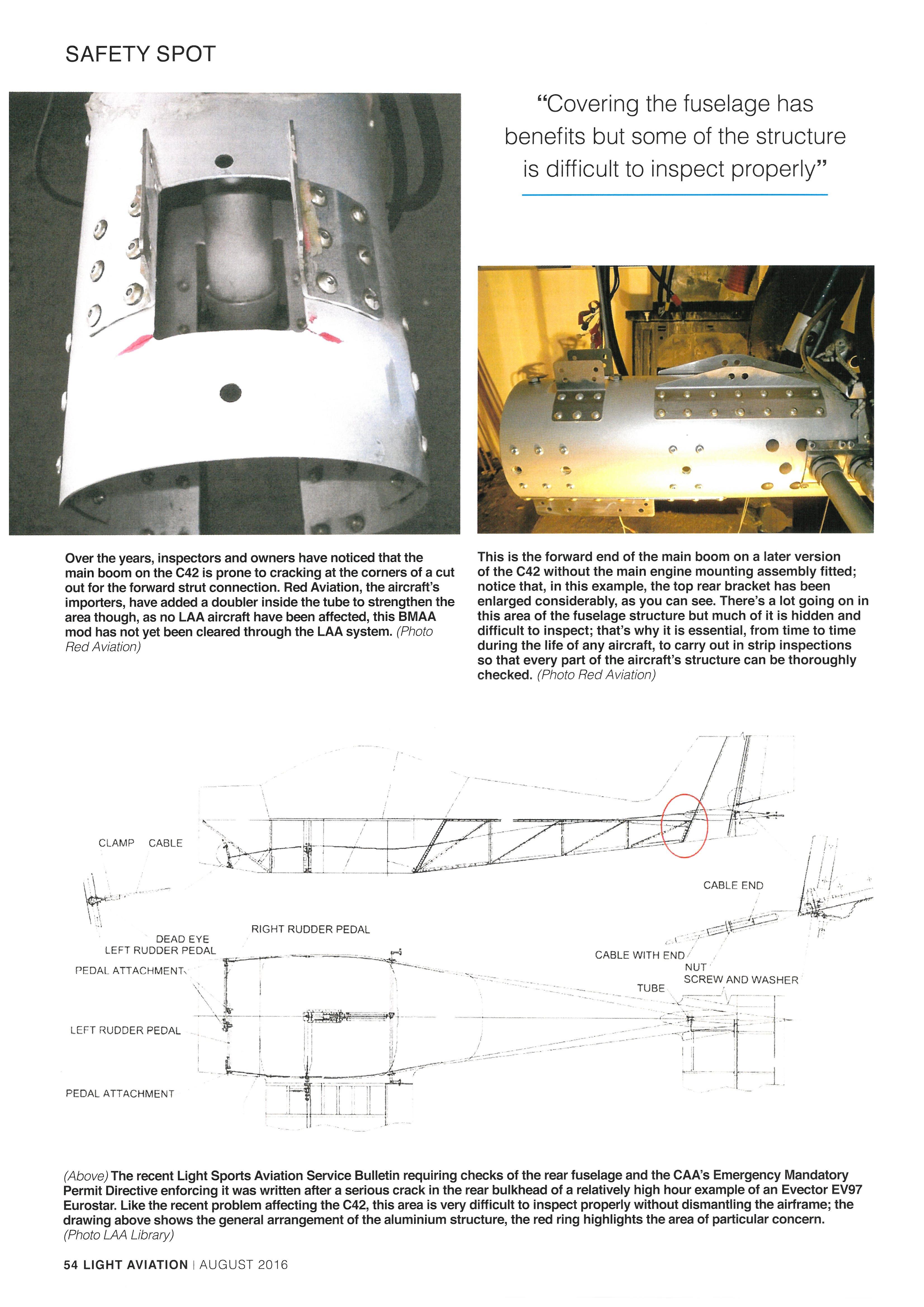
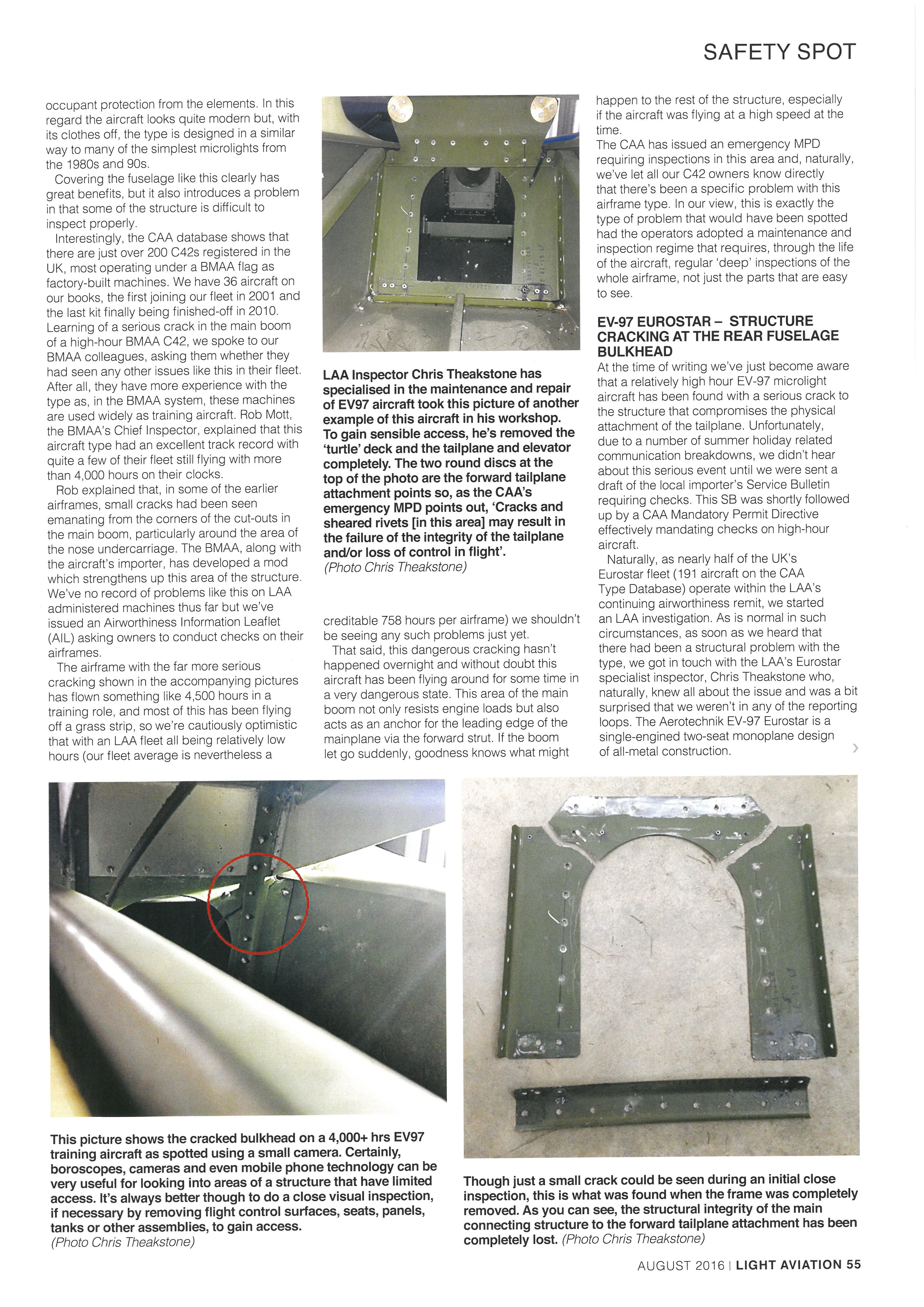
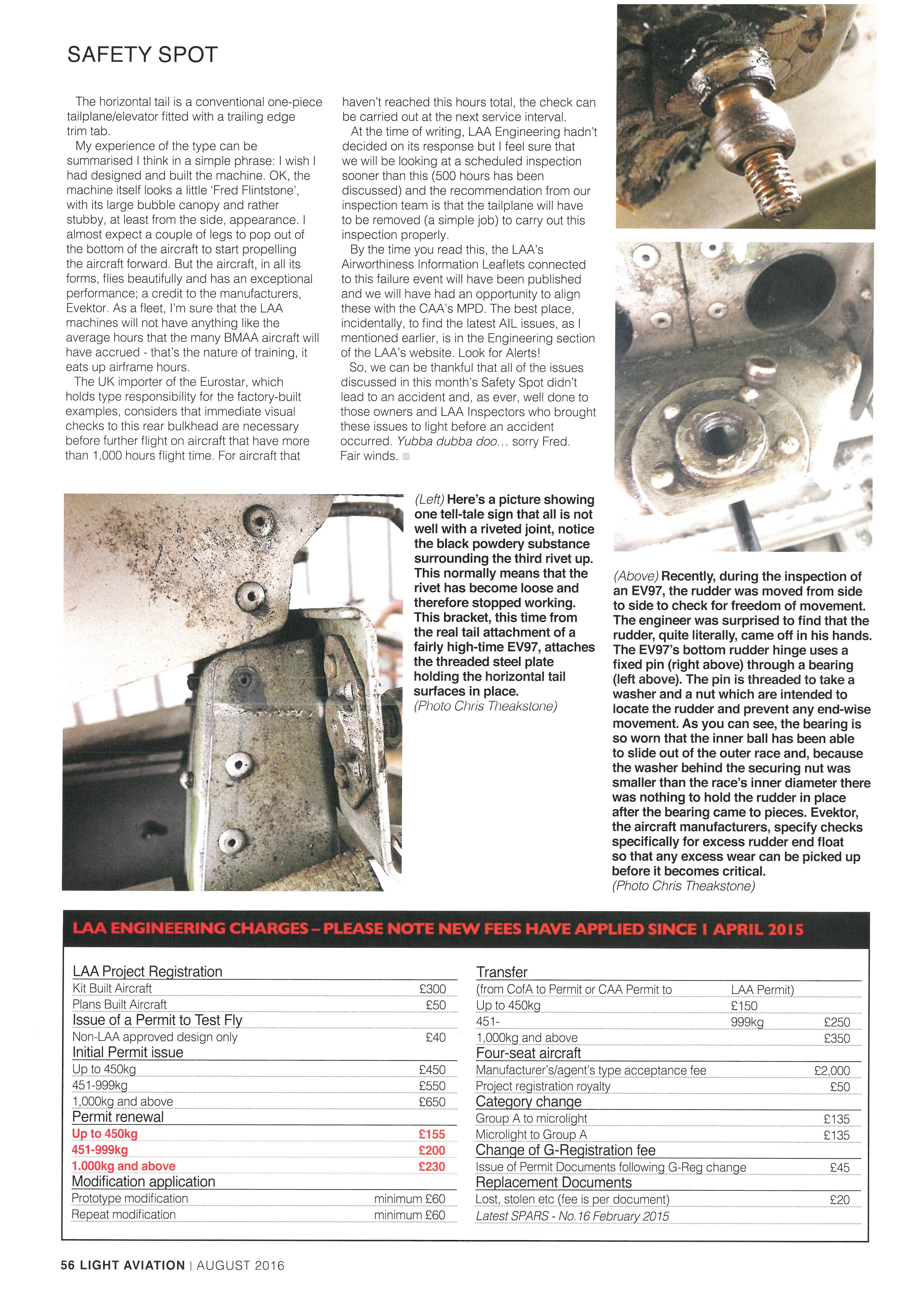
arrived for most of us and | guess ATC units around the country will be holding their breath and mopping troubled brows as the number of infringements inevitably rises. | say inevitably but that really shouldn’t be the case. With the technology we have available to us today you have to ask yourself why more than 1,000 pilots will bust controlled airspace during 2016. More to the point, will you be one of them?
I’m of an age where | learned to fly long before GPS was invented, and | navigated myself around Europe with a Chart, a stopwatchandacompass. | fullyunderstand the sense of achievement you get when navigating yourself hundreds of miles and finding your destination on the nose and on time.
using a GPS, and that’s just nuts.
Please, even if you think you’re the best navigator since Christopher Columbus, use a GPS.| agree they aren’t the panacea, but clearly there are a lot of Columbuses out there who could use a bit of back-up.
And if you have a transponder, even a Mode A/C, turn it ON! Forget the paranoid rubbish that ‘theyare out to get you’. Nothing could be further from the truth. They NATS and the CAA need us to help them keep our skies safe and will forgive us our transgressions provided we are honest and helpful should we err.
The appalling infringement statistics are a blot on GA’s character and it is incumbent on us allto do what we can to radically improve the situation.
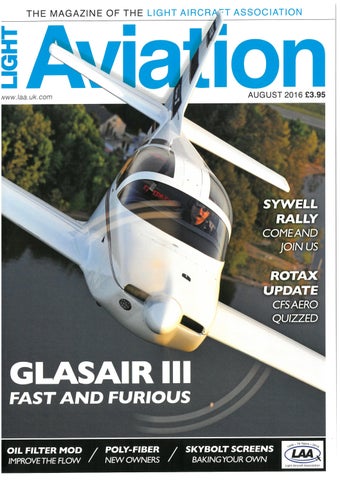
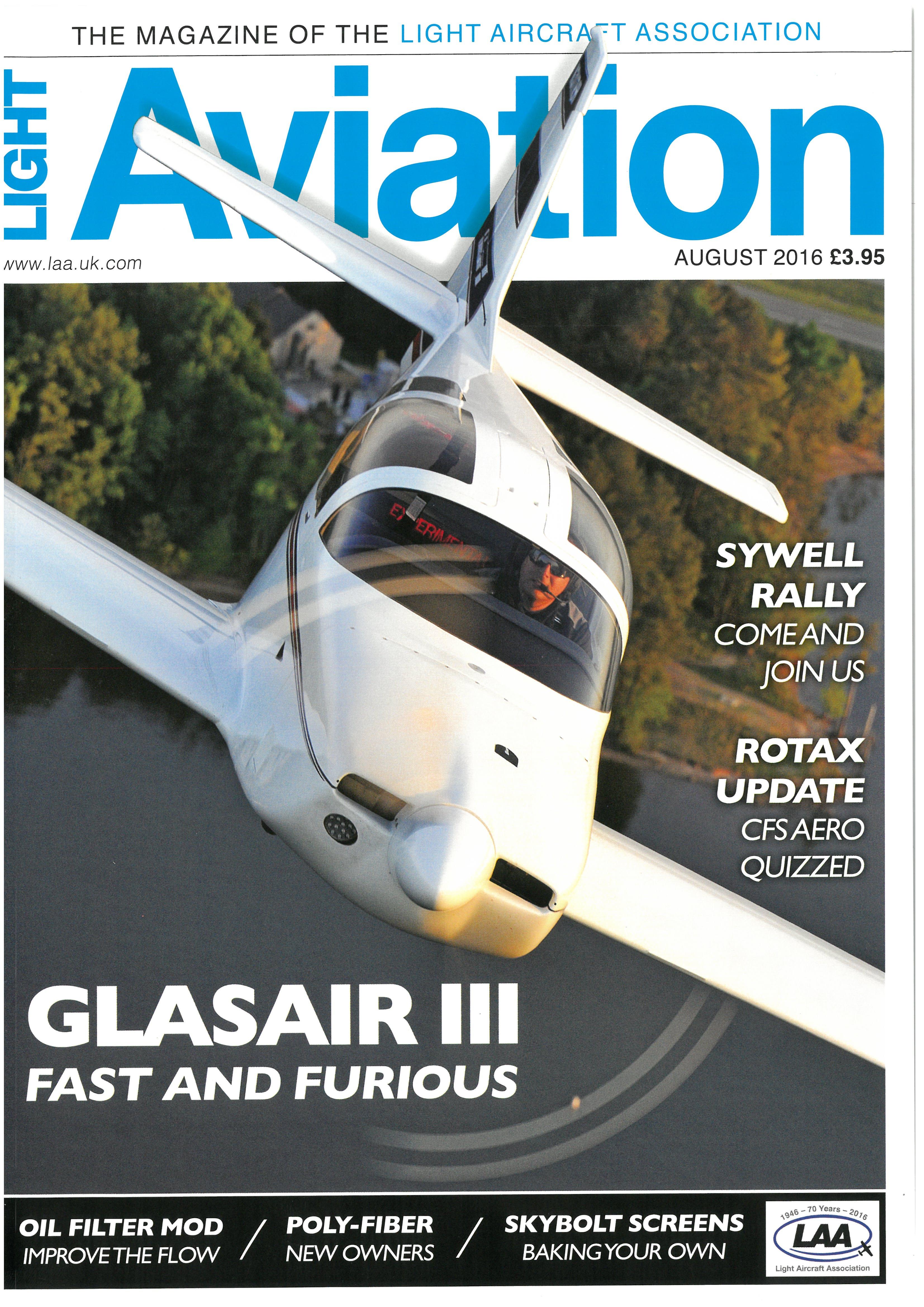
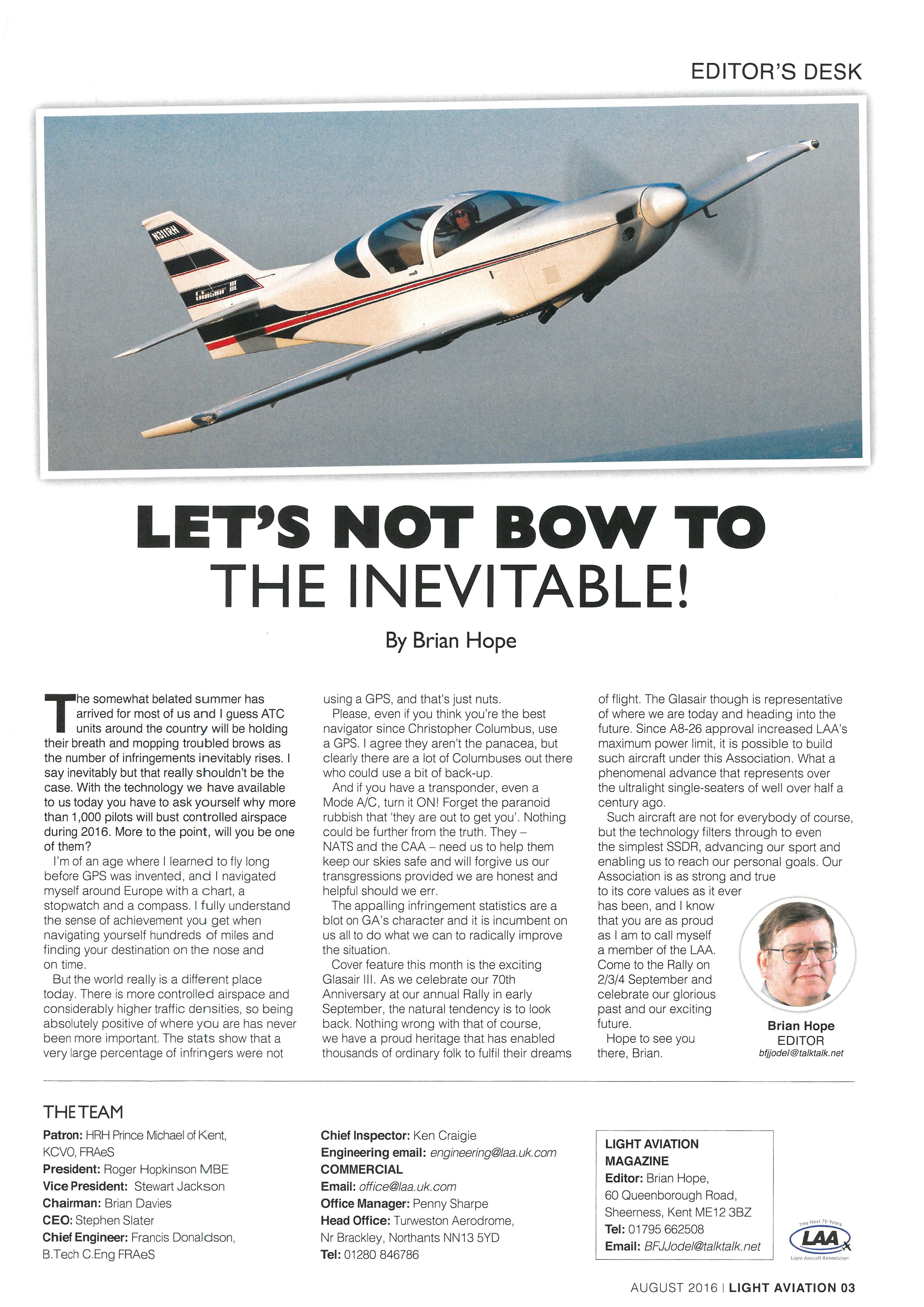
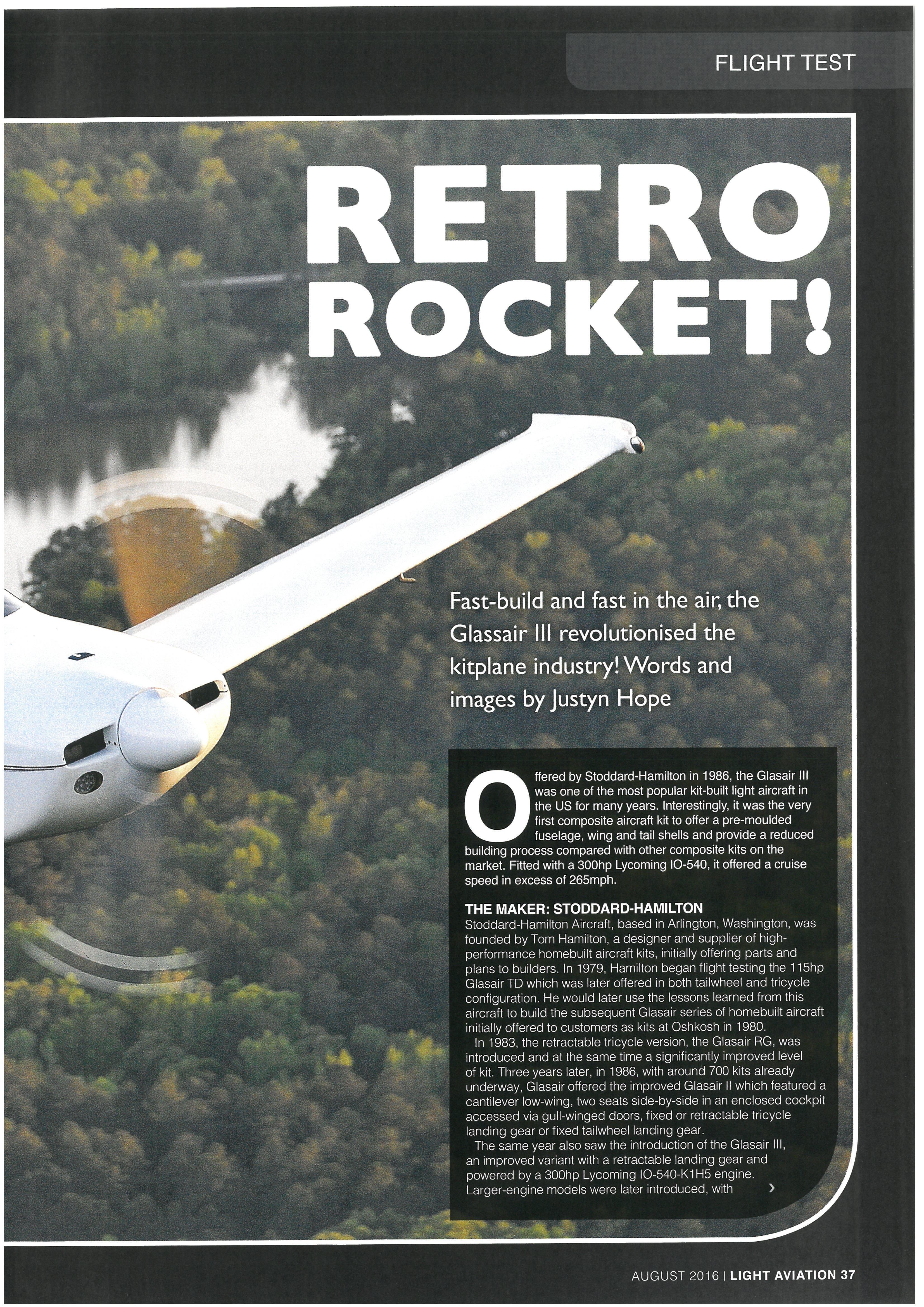
Cover feature this month is the exciting
of flight. The Glasair though is representative of where we are today and heading into the future. Since A8-26 approval increased LAA’s maximum power limit, it is possible to build such aircraft under this Association. What a phenomenal advance that represents over the ultralight single-seaters of well over half a century ago.
Such aircraft are not for everybody of course, but the technology filters through to even the simplest SSDR,advancing our sport and enabling us to reach our personal goals. Our Association is as strong and true to its core values as it ever has been, and | know that you are as proud as | am to call myself a member of the LAA.
Come to the Rally on
5 :
<
Butthe world really is a different place GlasairIll. As we celebrate our 70th 2/3/4 September and ( today.Thereismorecontrolledairspaceand AnniversaryatourannualRallyinearly celebrateourglorious ~~ ,id considerably higher traffic densities, so being September, the natural tendency is to look past and our exciting ae absolutelypositiveofwhereyou arehasnever back.Nothingwrongwiththatofcourse, future.
Brian Hope been more important. The stats show that a we have a proud heritage that has enabled Hope to see you EDITOR verylargepercentageofinfringerswerenot thousandsofordinaryfolktofulfiltheirdreams there,Brian. bfjodel@talktalk. net
THETEAM
Patron:HRHPrinceMichaelofKent,
KCVO,FRAeS
President: Roger Hopkinson MBE
Vice President: Stewart Jackson
Chairman: Brian Davies
CEO: Stephen Slater
Chief Engineer: Francis Donaldson, B.TechC.Eng FRAeS
aie Spee:onCraigie LIGHTAVIATION
Engineering email: engineering@laa.uk.com
COMMERCIAL
Email: office@laa.uk.com
Office Manager: Penny Sharpe
Head Office: Turweston Aerodrome, Nr Brackley, Northants NN13 5YD
Tel: 01280 846786
Editor: Brian Hope, 60 Queenborough Road, Sheerness, Kent ME12 3BZ
Justa monthto go tothe biggestevent of the LAA year
18YOUTH PAGE
Itworks!FirstenginetestforTheSpirit of GooleBuild-a-Planeproject
20 INFRINGEMENTS...
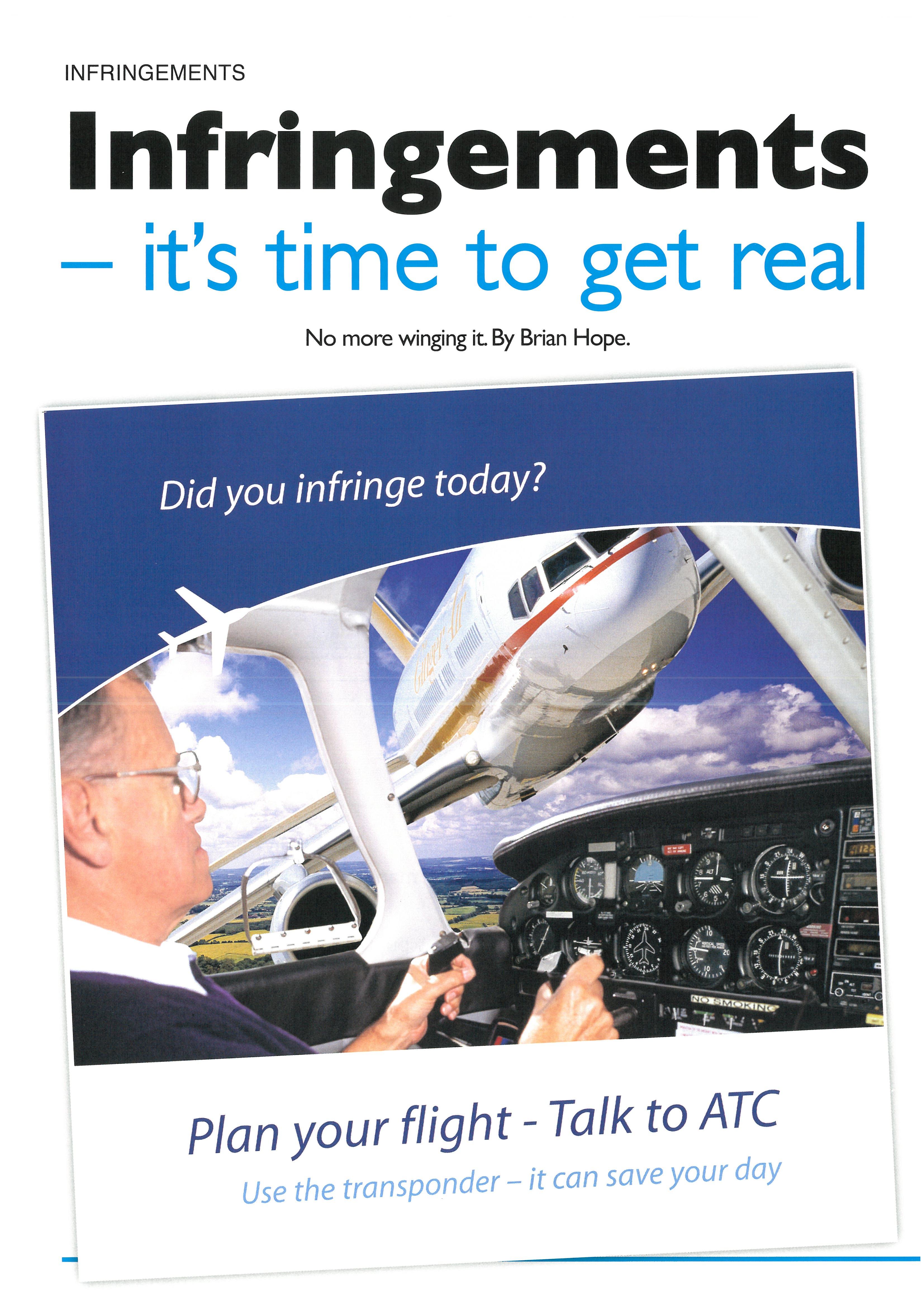
it’s timeto get real.BrianHope reportsfrom a crisismeetingbetween the CAA, NATS and GA
24 STEEN SKYBOLT
Gary Reid describes baking, yes baking, the windscreens for his open cockpit Skybolt project
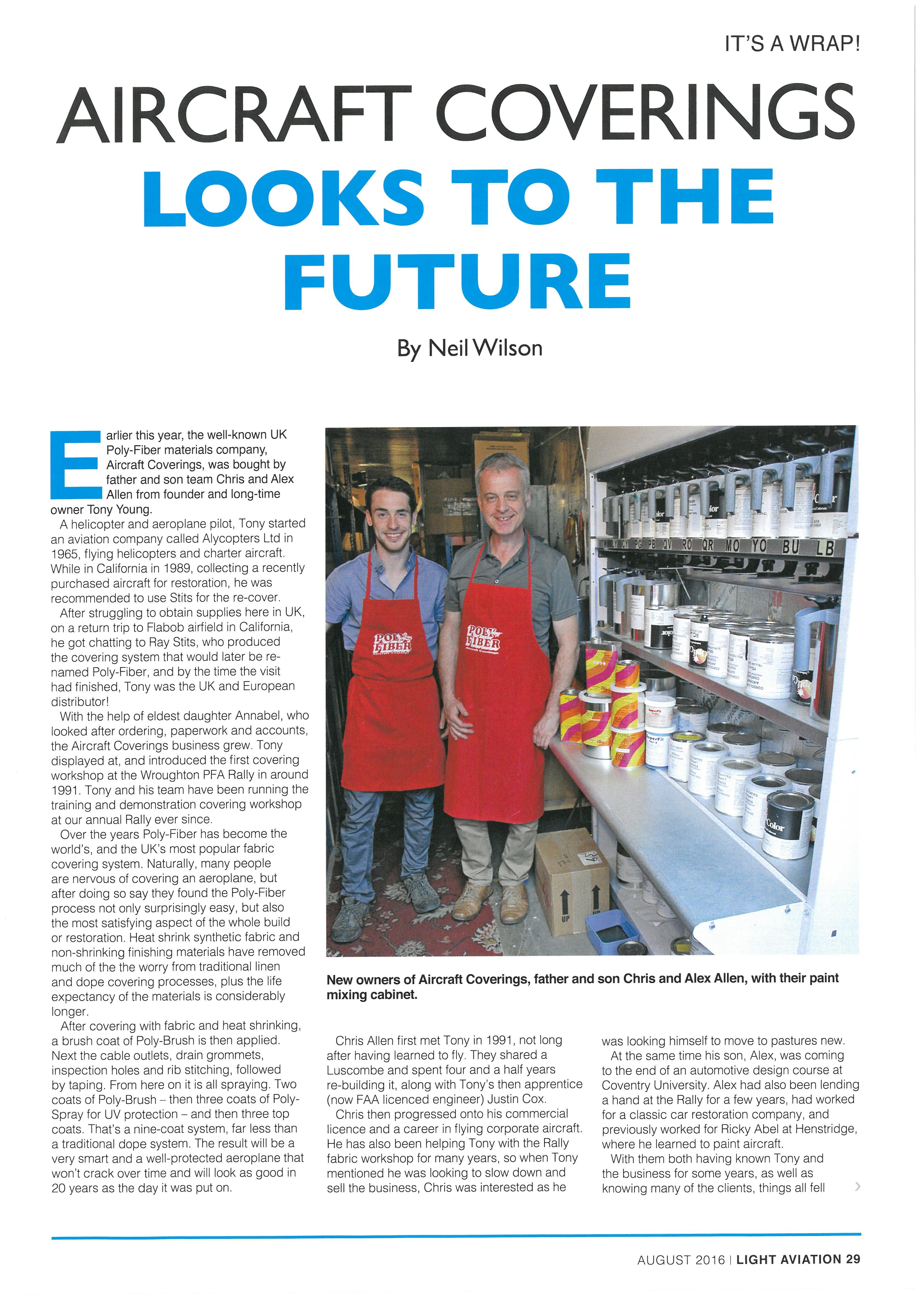
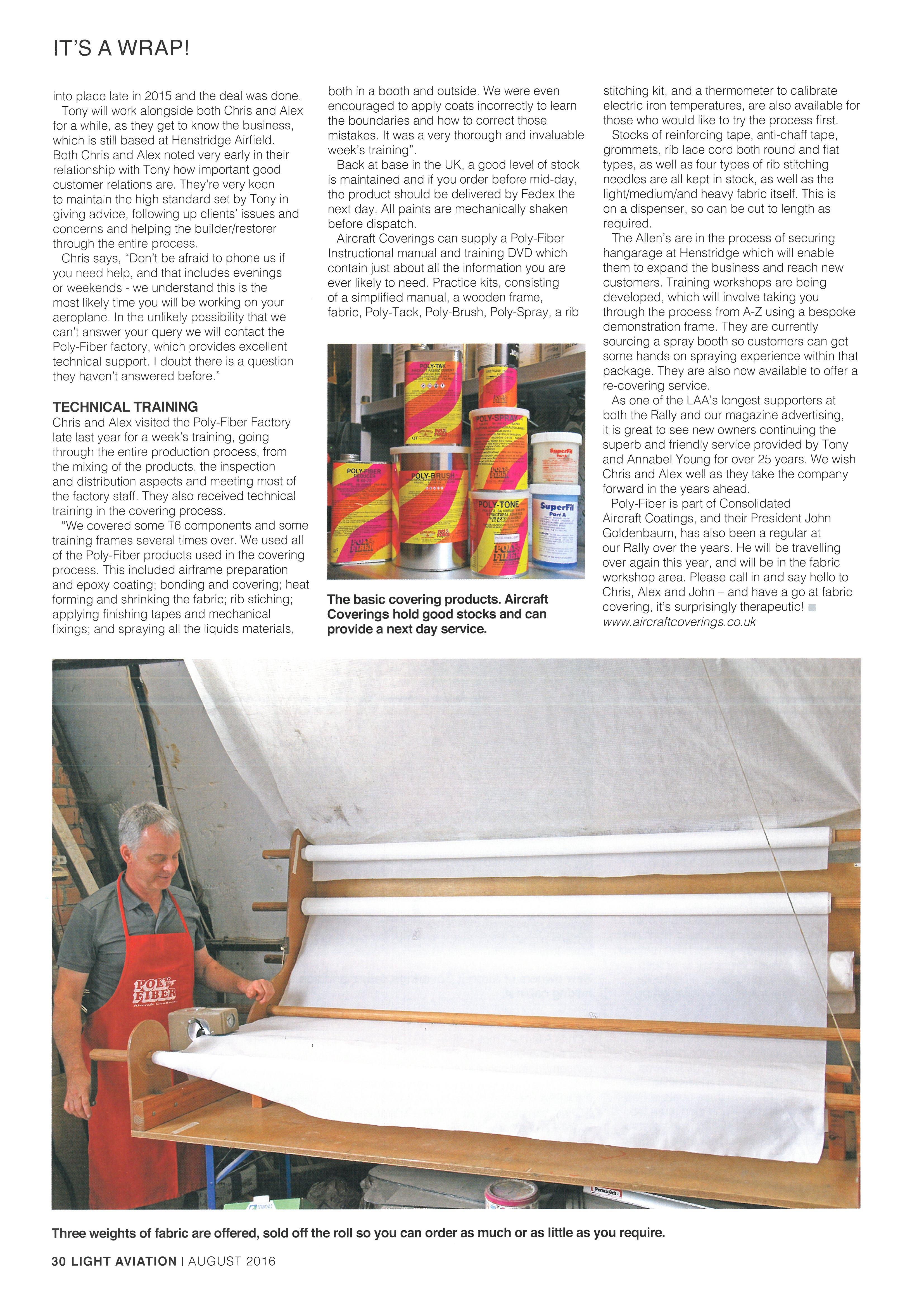
29 AIRCRAFT COVERINGS
The Poly-Fiberspecialistcompany has changed hands...but don'tfret,the new owners know their stuff!
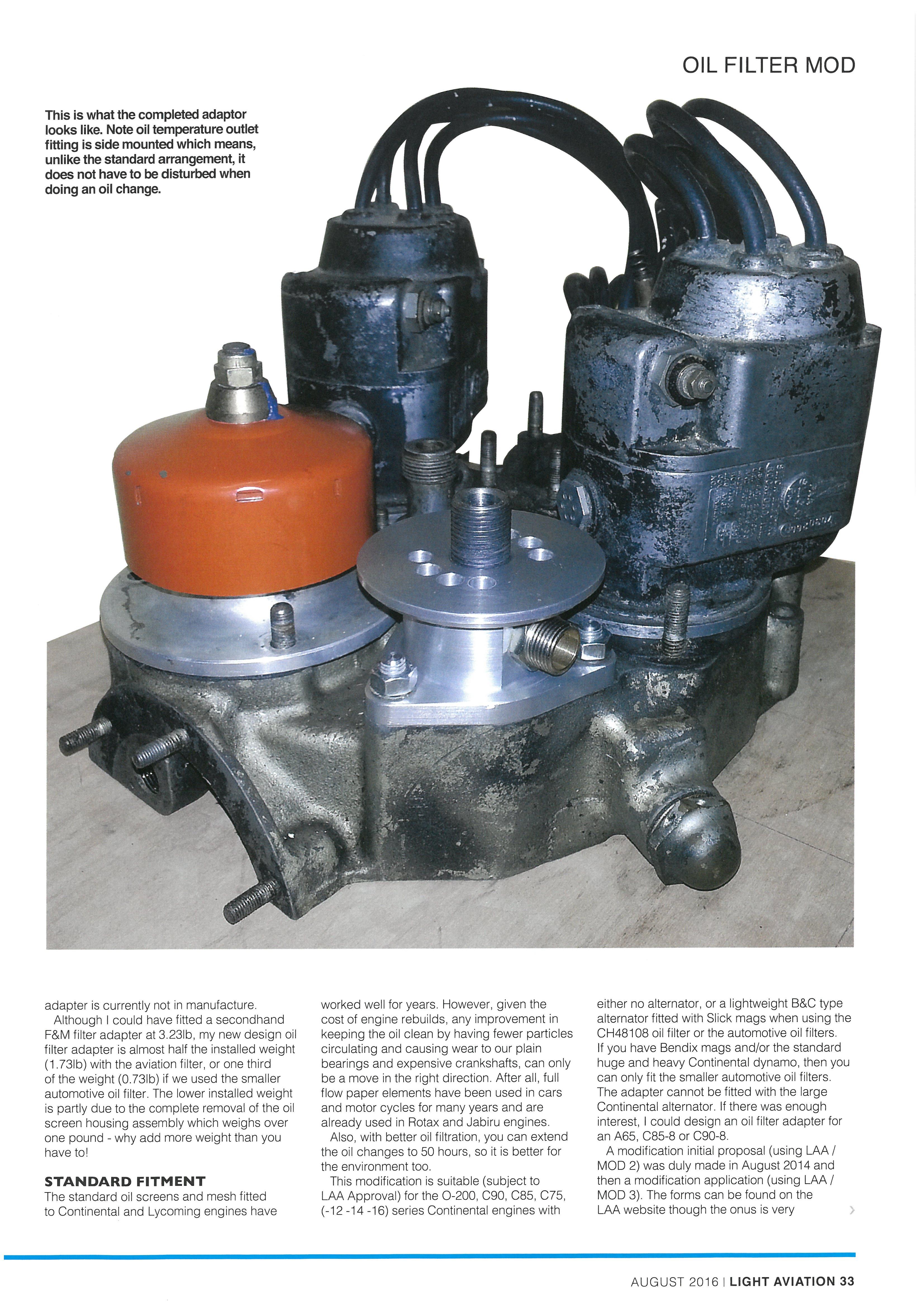
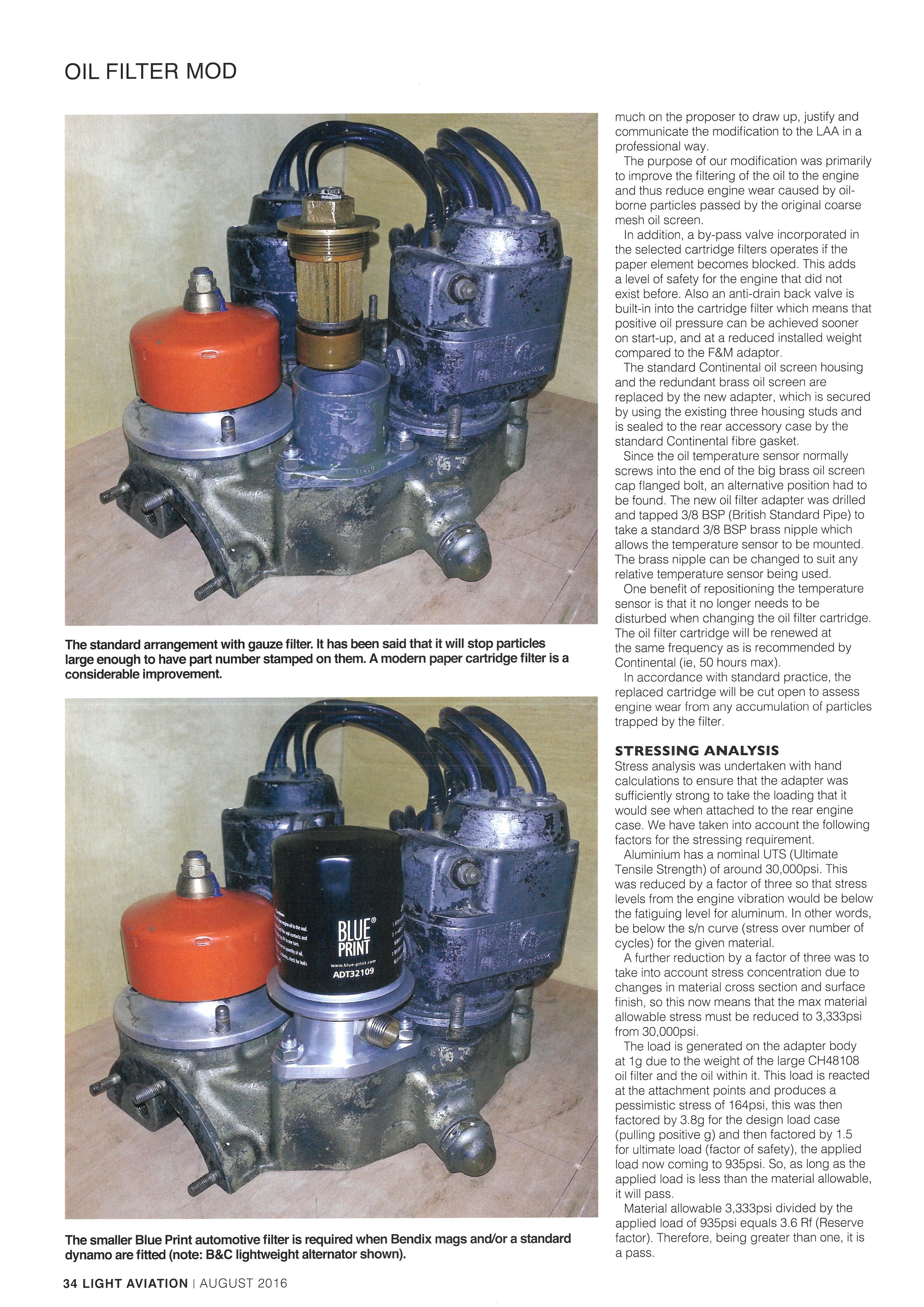
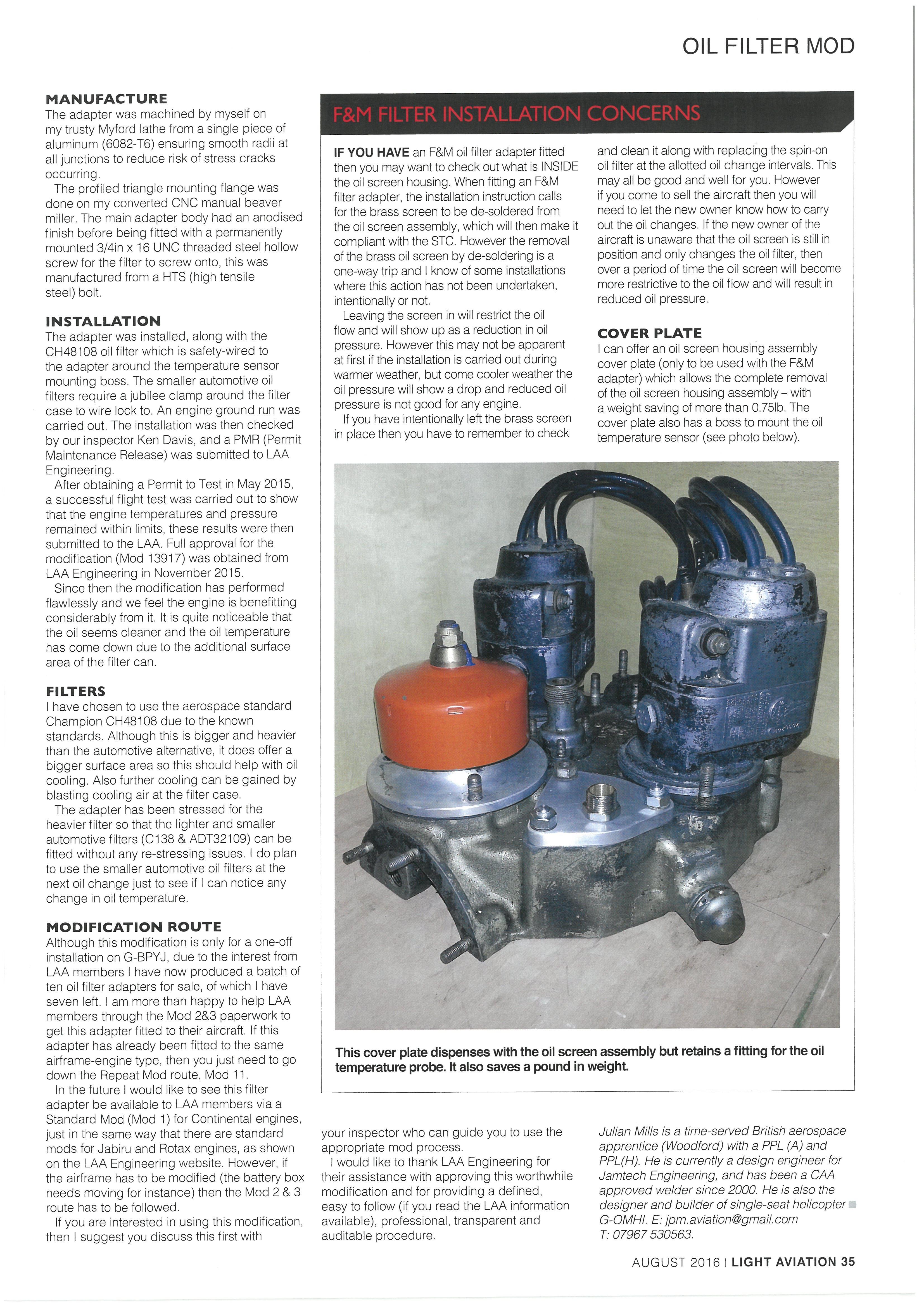
32 OIL FILTER MOD
Better filtering of engine oil and easier to change filters, this is a worthwhile mod for O-200s
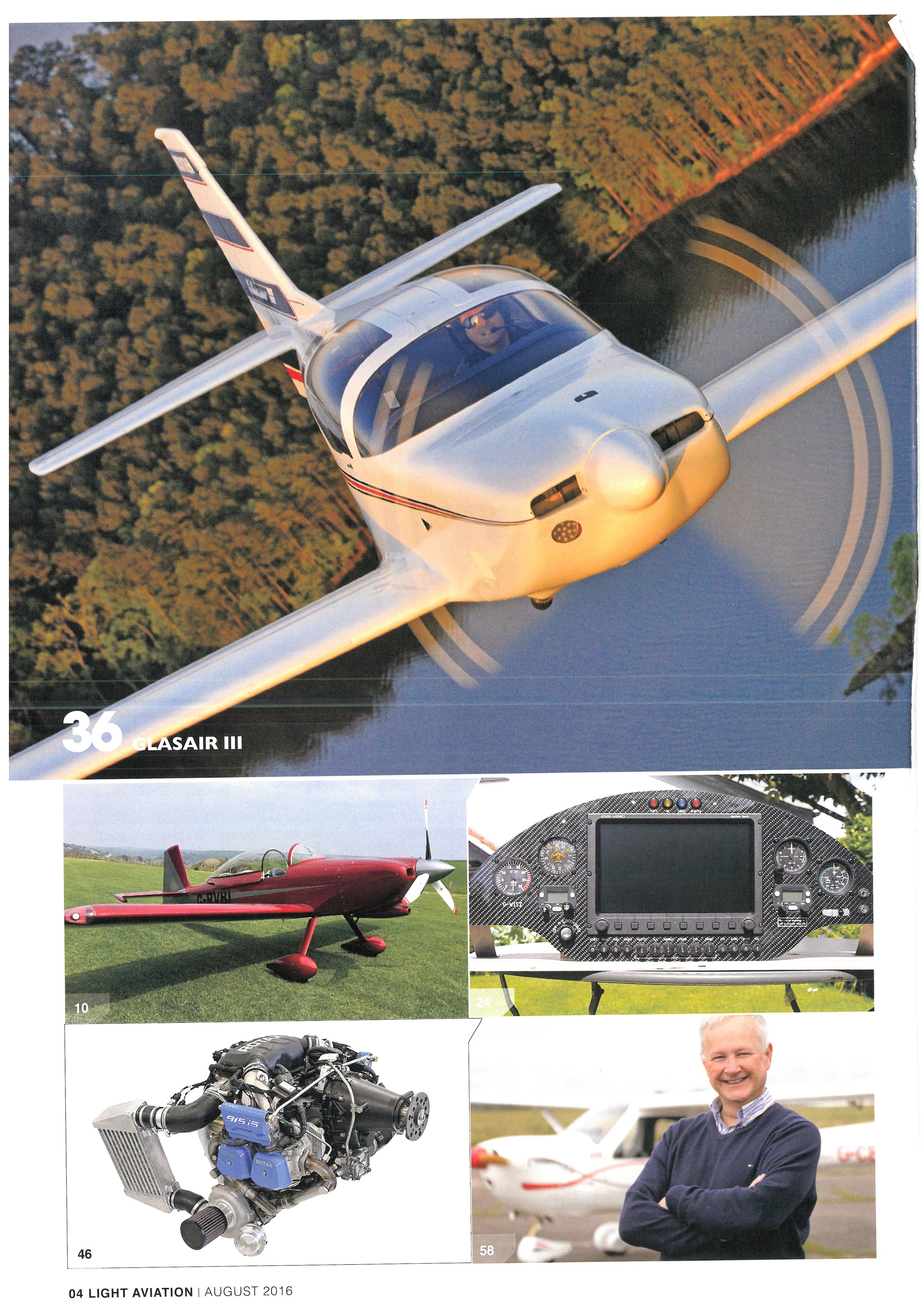
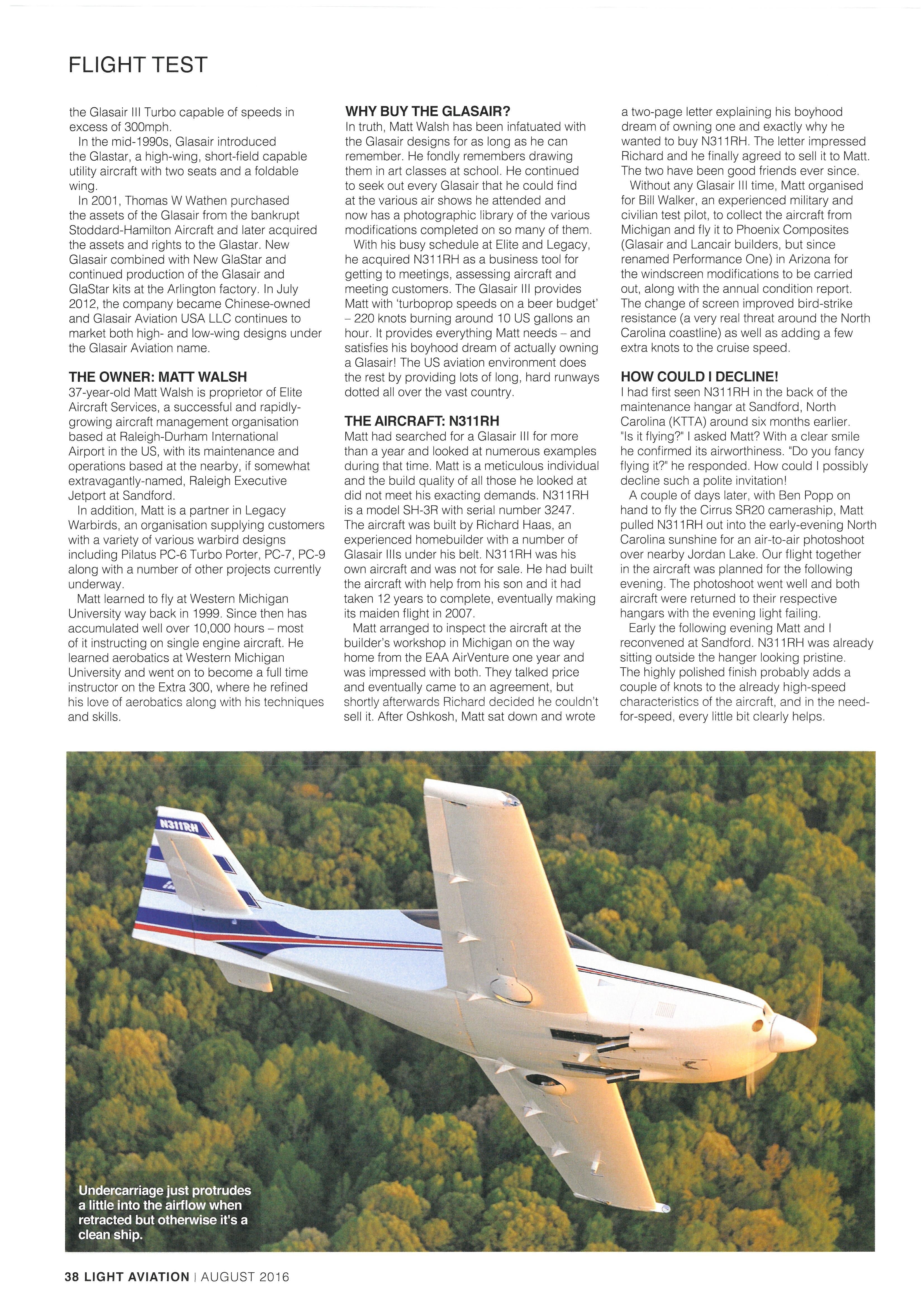
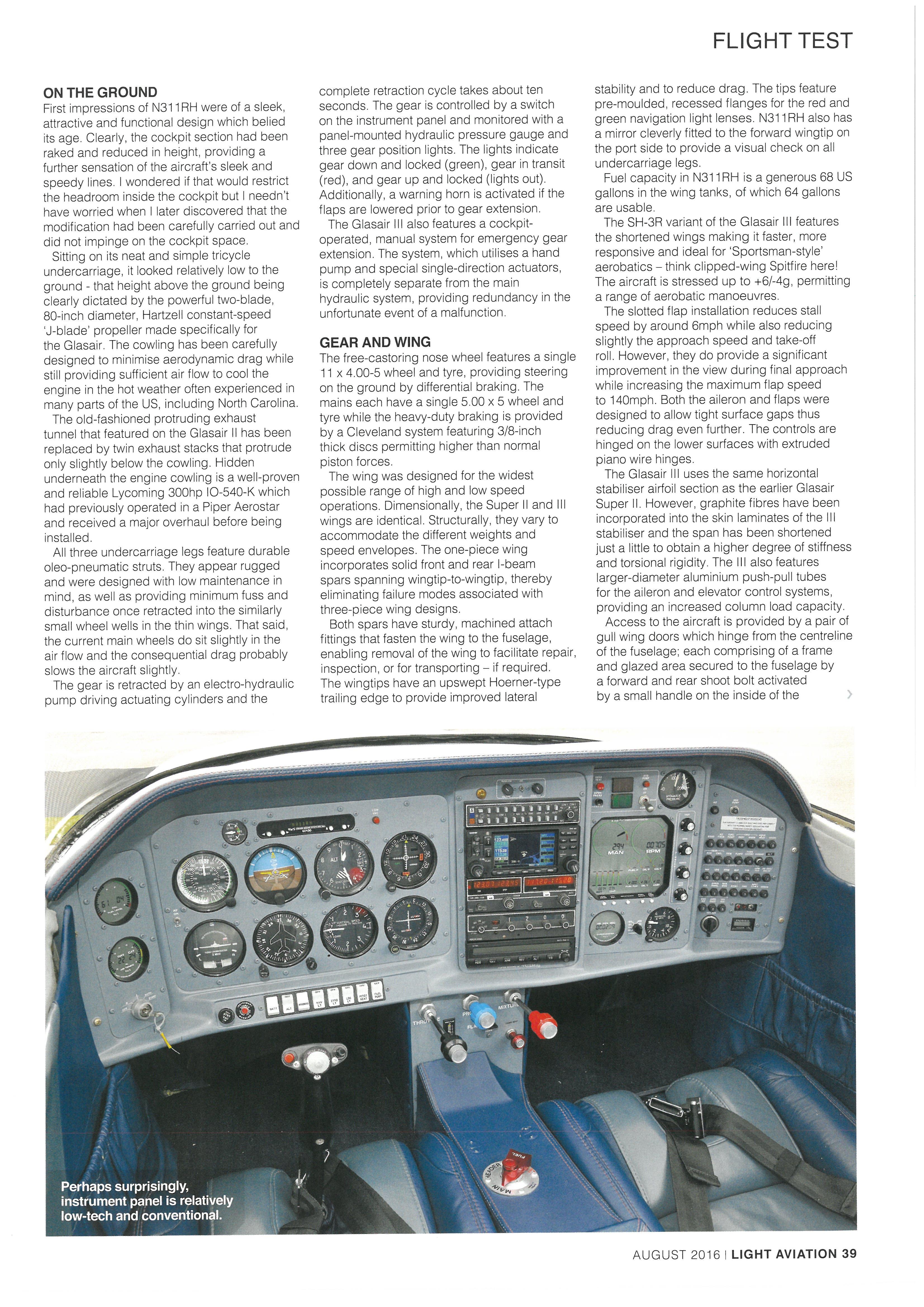
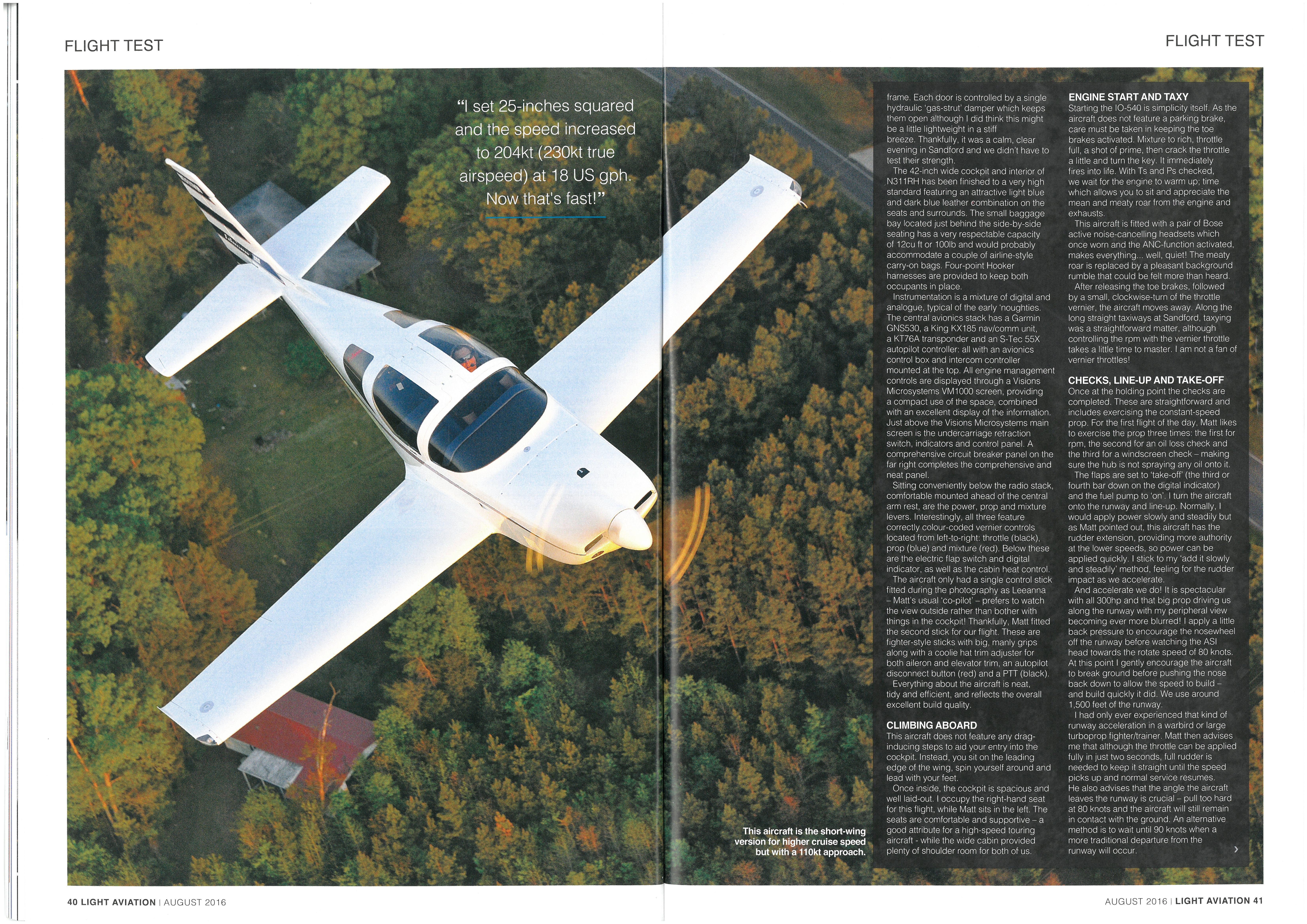
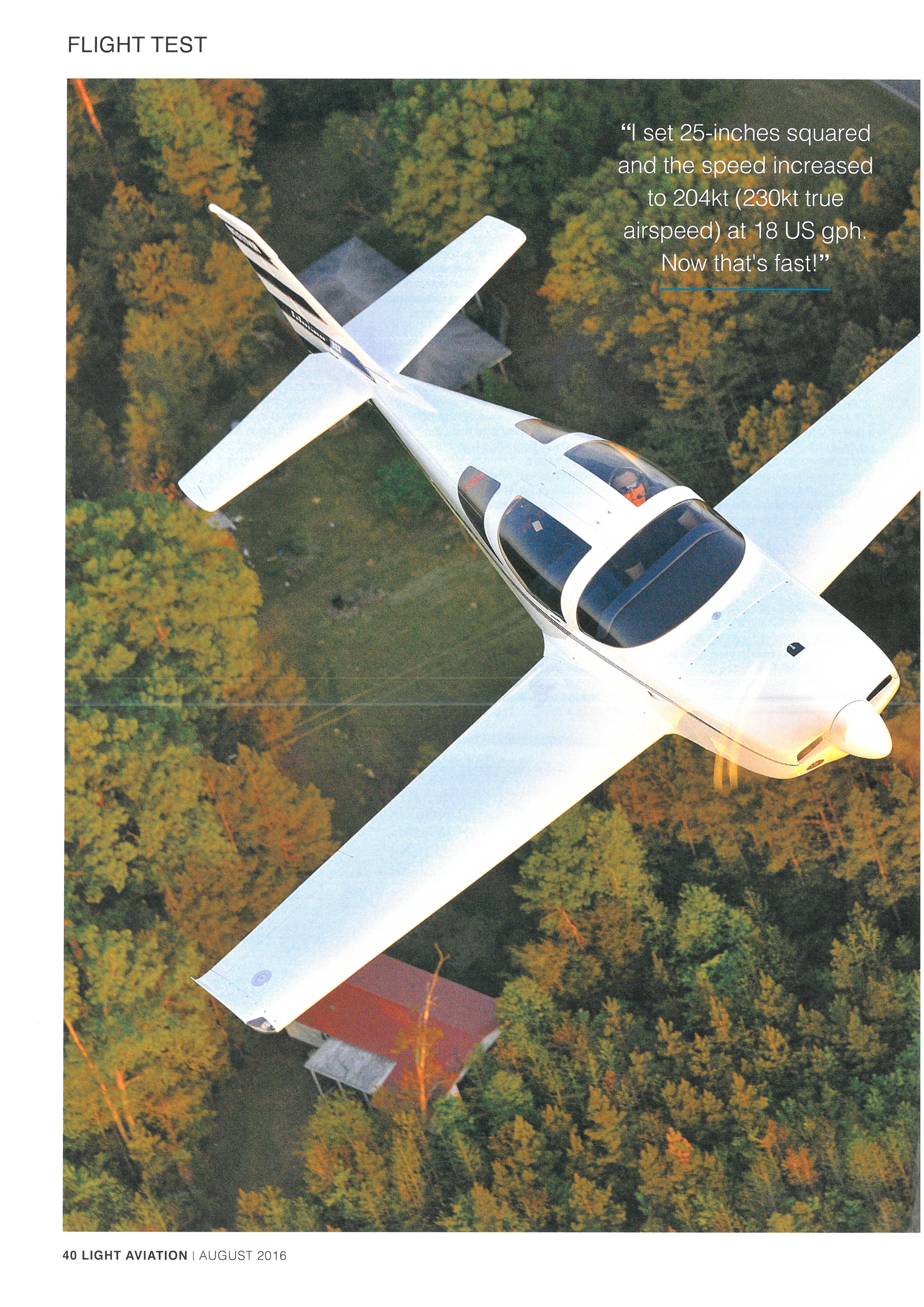
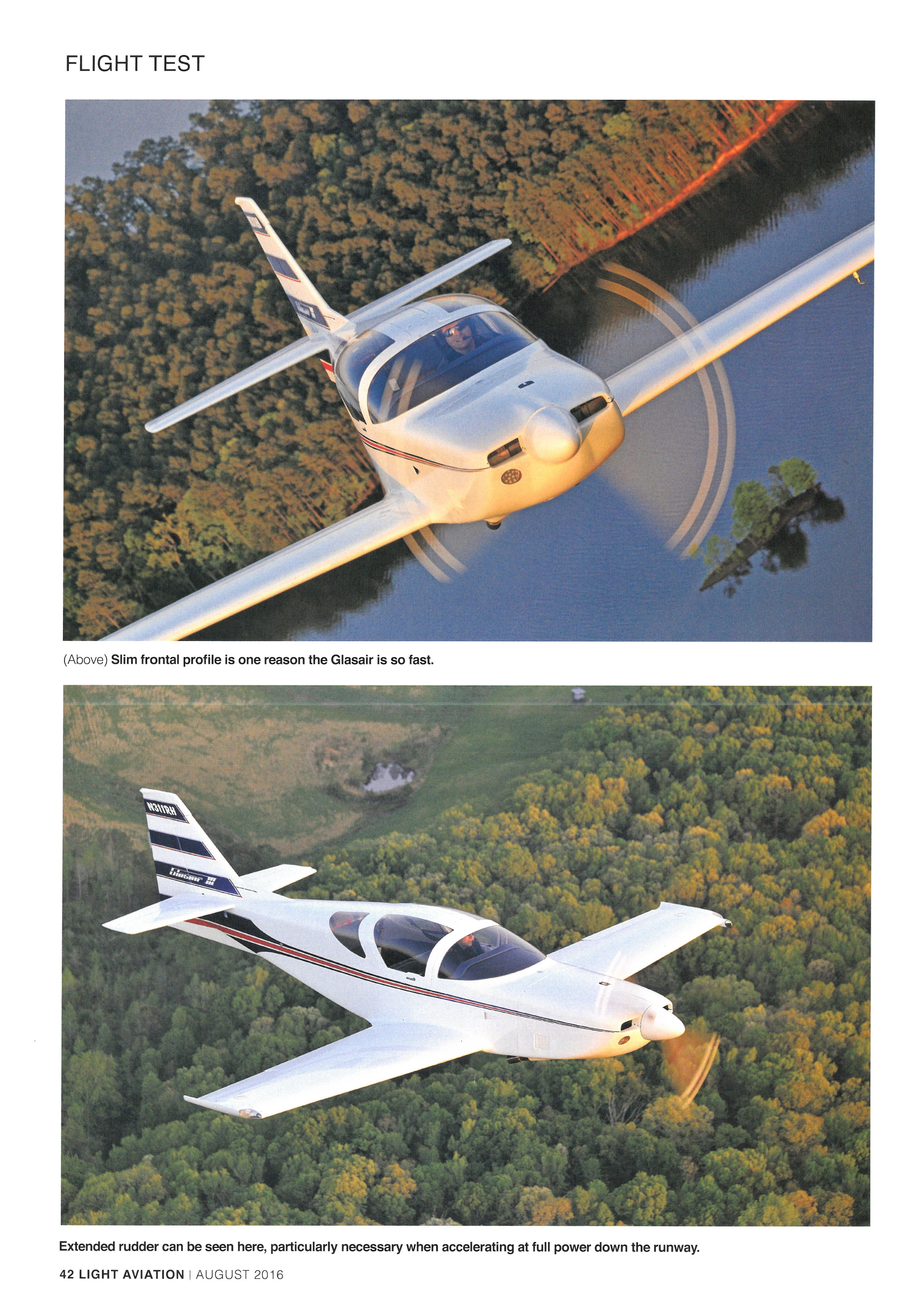
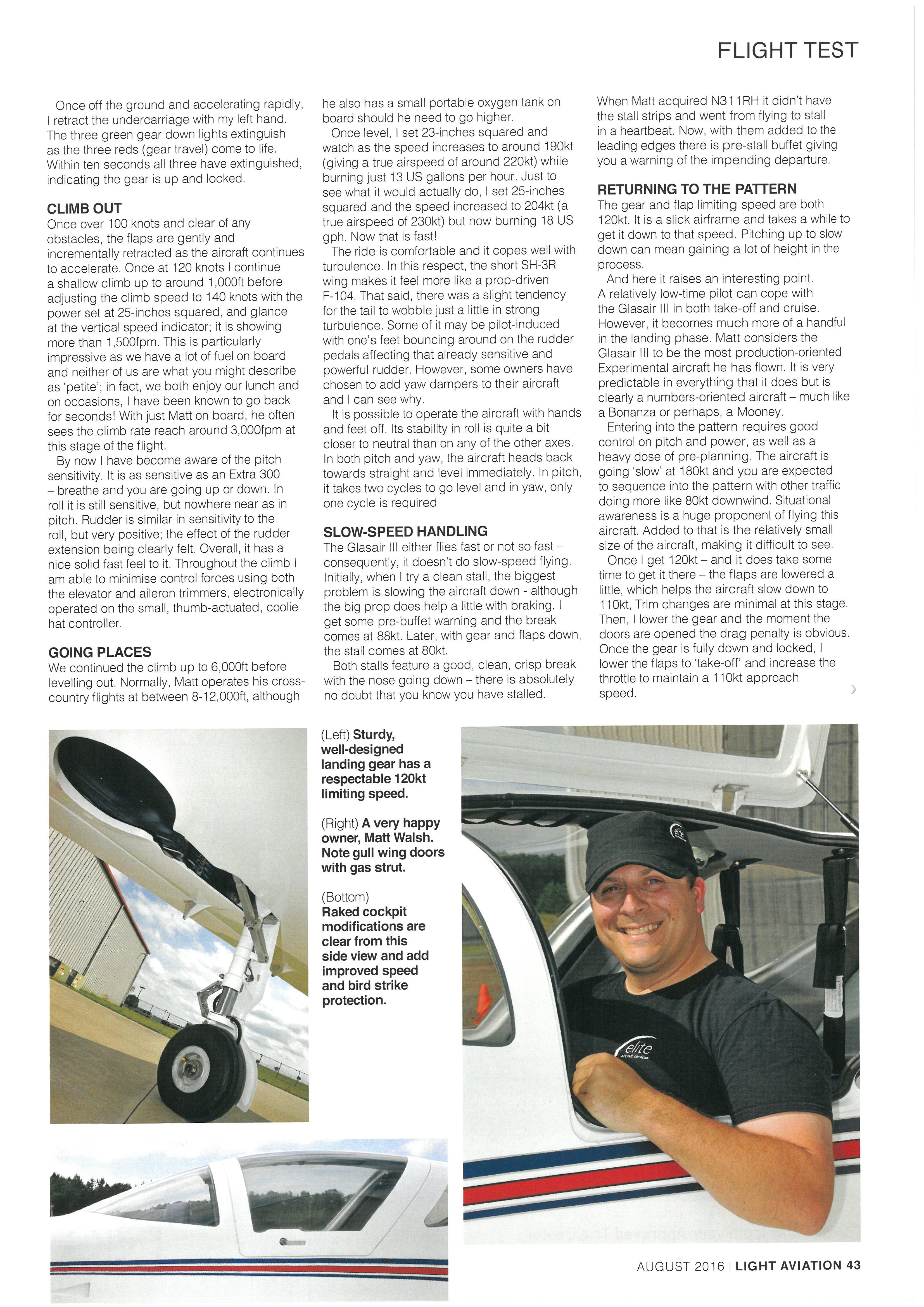
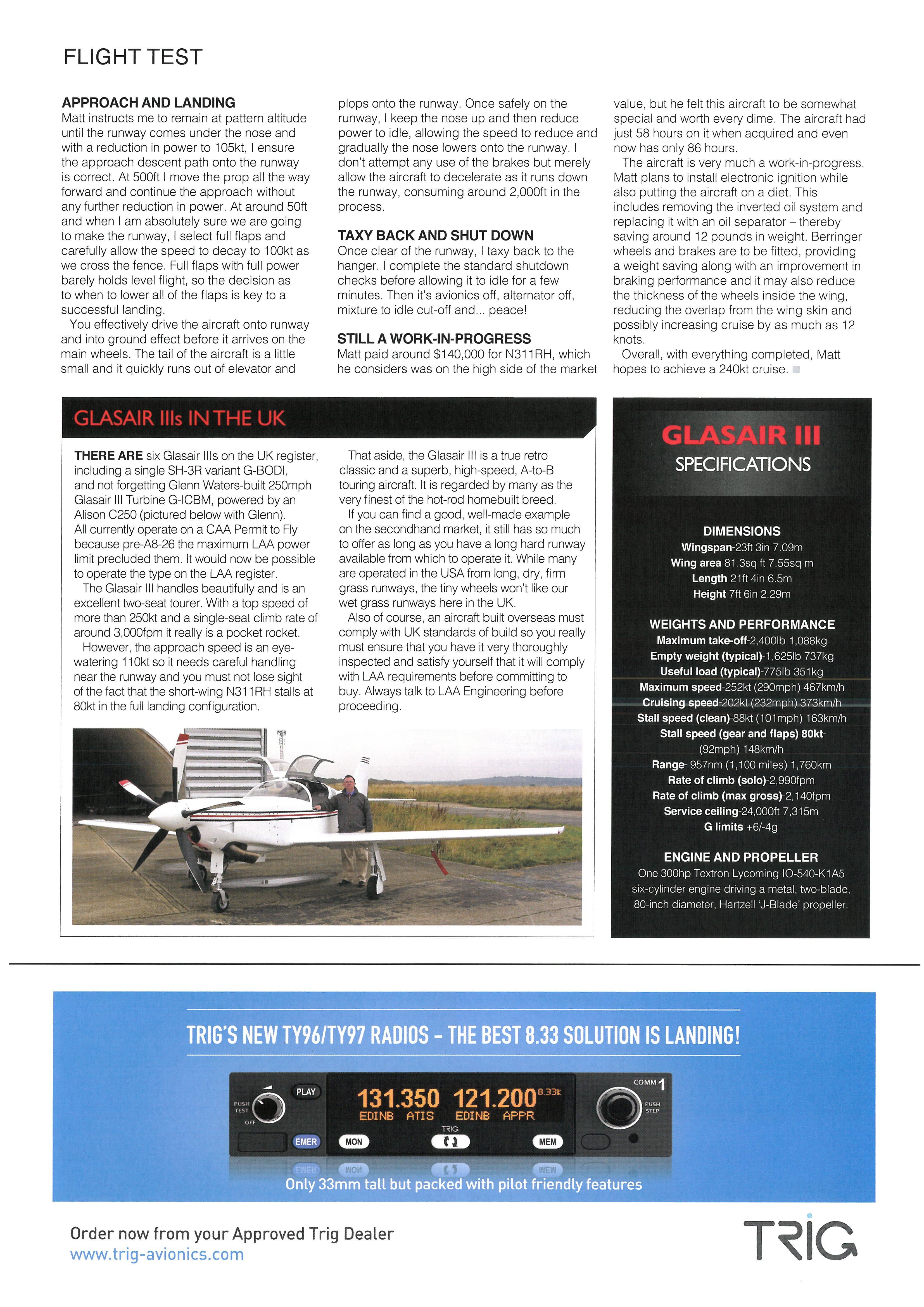
34FLIGHTTEST:GLASAIR Iil
A veryniceexampleofthefastto build and fastto fly kitolane.300hpaircraft likethiscan now be operatedonan LAA Permit
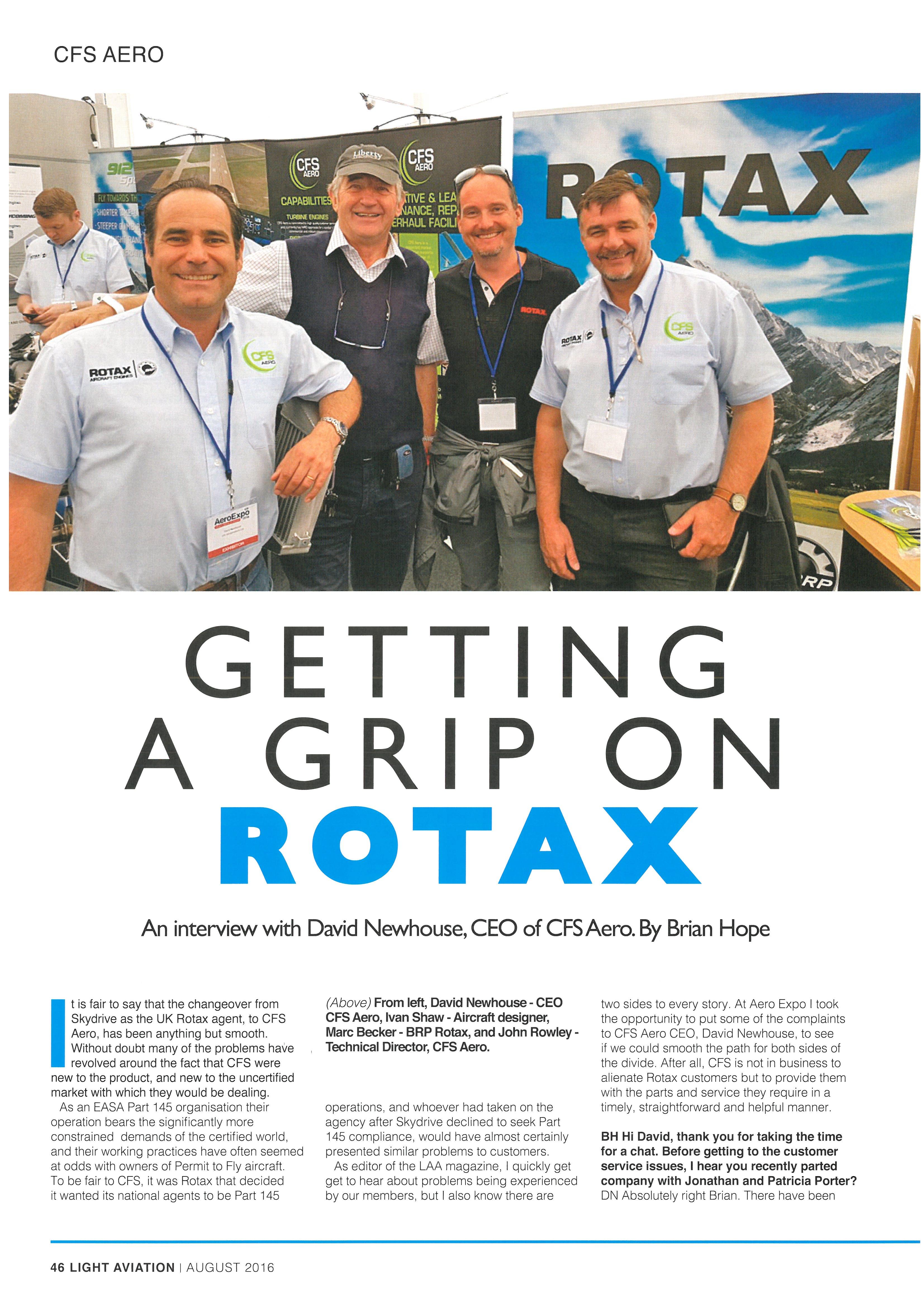
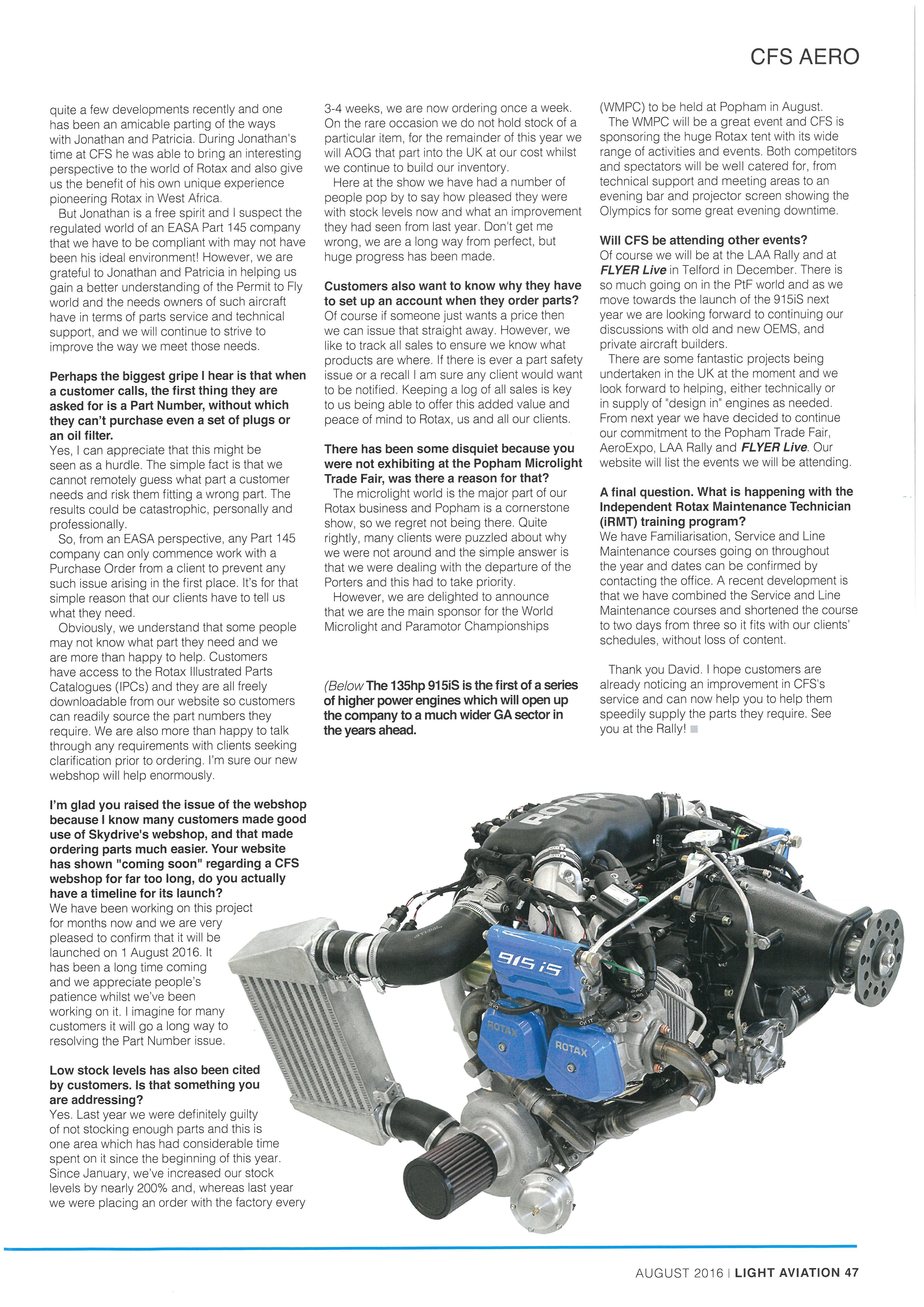
46 CFS ONTHE SPOT
The boss of CFSAero, agent for Rotax engines,answersCriticismsand promises “to do better”
48 FREE LANDINGS
Three airfields offer free or reduced landings for LAA members, plus a half-price off on entry to the Boscombe Down Museum
48 SAFETY SPOT
Malcolm McBride discusses the latest set of problems and solutionsfor aircraft in the LAA Permit fleet
58MEETTHEMEMBERS
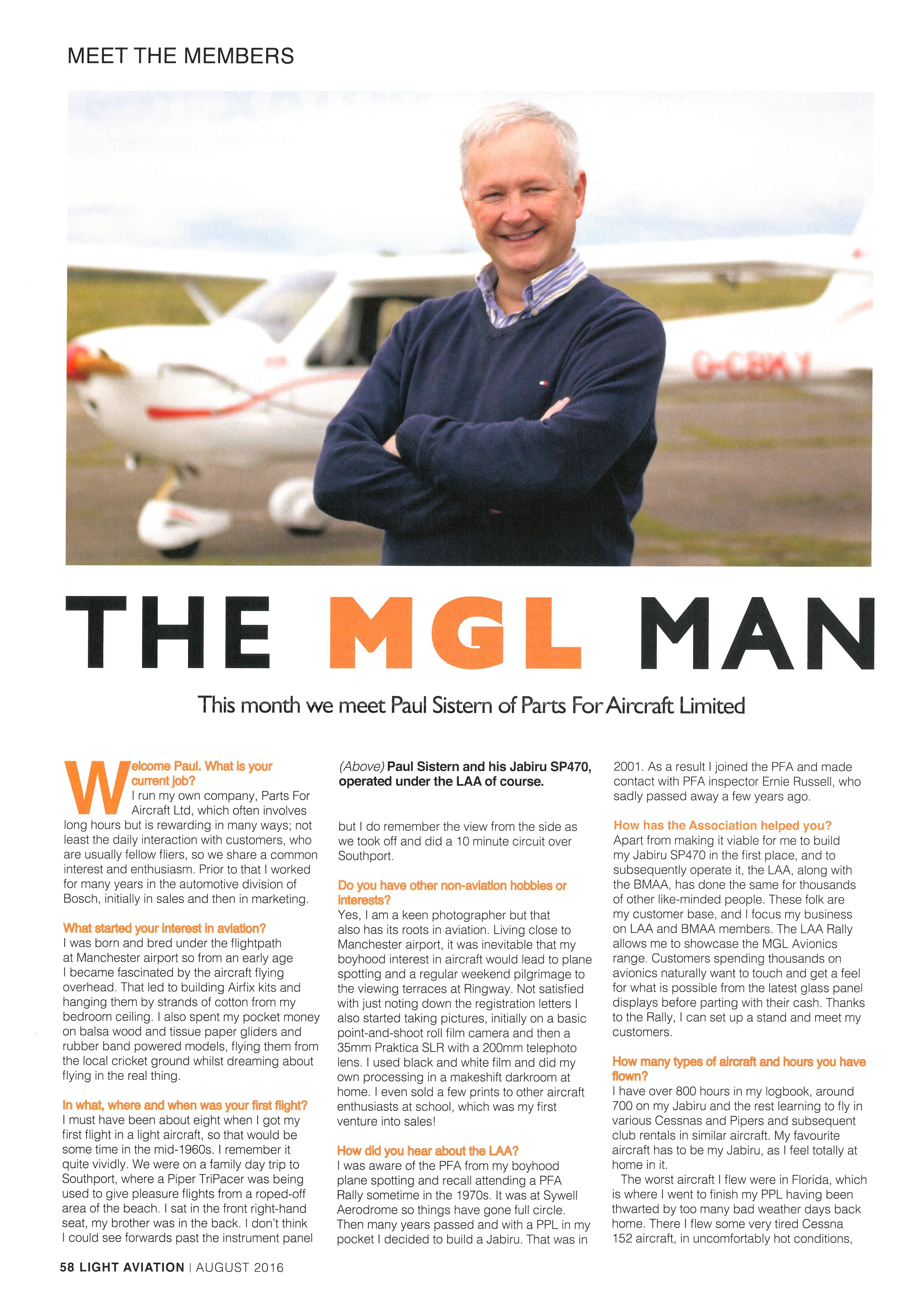
Paul Sistern is Mr MGL Avionics in the UK and he’s also a very keen LAAer with his own homebuilt Jabiru SP470
60 CEO CHAT
Why airspace infringementsneedto be takenmoreseriously
62 LAA CLASSIFIEDS Aircraft, parts and services
LIFE AFTER
e have been through some pretty
magazine and | hesitate to add to the blizzard of opinion and emotion that the Brexit vote has created. Suffice to say that | made a poor landing yesterday and | am sure that would not have happened if we had not voted to leave the EU!
On amore serious note what impact will the vote have on the future of the LAA? The simple answer is that we do not know. The CEO of the CAA has put out a brief statement saying it will be “business as usual” so he probably does not know either.
At the moment GA is largely regulated by EASA, which is the EU aviation safety agency, but it does already have non-EU members such as Switzerland. From a commercial aviation perspective it makes a lot of sense (in my opinion) for the UK to continue being a member of EASA, or to operate in accordance with their rules.
At our end of the aviation spectrum we operate in accordance with Annex 11 of the EU/EASA Basic Regulation and the simple definition of Annex 11 is “outside the Basic Regulation”. There is a lovely bit of convoluted EU legal wording behind that!
The practical impact is that our world is largely regulated by the UK CAA (outside the Basic Regulation) and they have approved the LAA to oversee the airworthiness of our fleet of aircraft. So, for the LAA, it really is largely business as usual.
Some say that leaving the EU but staying within
EASA rules is the worst of both worlds because we will still be subjected to EU (EASA) rule-making but will have no say in the process. | disagree. We will still be a member of EFLEVA (the European Federation of Light, Experimental and Vintage Aircraft) and, therefore, still have an input to Europe Airsports, which is the body recognised by EASA as representing our sector of aviation.
Whatever the final arrangements, you can rest assured that we will continue to represent the interests of our members as vigorously as we have in the past.
Enough of that how does the future look for the next few months?
Preparation for our 7Othanniversary Rally at Sywell Aerodrome on 2-4 September is now at an advanced stage and it really does look like being a fantastic event. From building a kit aircraft in seven days, to a ‘Speakers’ Corner’ and many new aircraft designs being launched, all adding to the sight of hundreds of LAA aircraft and international visitors flying in, it is an opportunity to come together to share our common passion.
If you have not attended the Rally in the past and are not sure if it is for you, this is the year to give it a try. Please come along and share in this spectacular event and join fellow enthusiasts, be tempted by lots of new goodies and drool over superbly restored ‘oldies’ brought together to celebrate our 70th year together.
See you at the Rally!
Brian Davies
celebration UK LAA Relay and Tour. You can do the whole tour, or various days or legs.
All overnight stops will have the local LAA Strut on hand to greet, entertain and help us. They will have contacts should your aeroplane need TLC and can help with transport. The Tour Itinerary: 27 August Duxford to Sherburn. PPRand fly in to Duxford and tell Control Tower you are part of the LAA Bonus weekend and/or Tour. Relay and Tour flyers meet at the bottom of the control tower from 10.00am onwards. Neil should to be there (flying in) from 10.30 am. Look around museum if you wish and head to Sherburn via Fenland or North Coates (free landing) if you wish. An evening meal and breakfast will be available.
28th Sherburn to Perth via Eshott or Fishburn for the second night stop.
29th Perth to Barton. If weather is good, some of you may wish to head up towards Inverness and turn down the Great Glen to Oban. Alternatively head off via Carlisle (free landing + Solway Museum 50% off) - for a lunch stop and on to night stop at Barton (free landing).
30th Barton to Henstridge via Carnarfon and/or Shobdon.
31st Henstridge to Dunkeswell via Bodmin and Land’s End.
1 Sept Dunkeswell to Rochester via Old Sarum (free landing + 50% off voucher to the Boscombe Down Museum) and Goodwood or Sandown for lunch.
2nd Rochester to LAA Sywell Rally. Please book a landing slot time in good time for Sywell.
lf you wish to take part there’s still time and space please email neil.wilson@laa.uk.com
SOLENT/SOUTHAMPTON
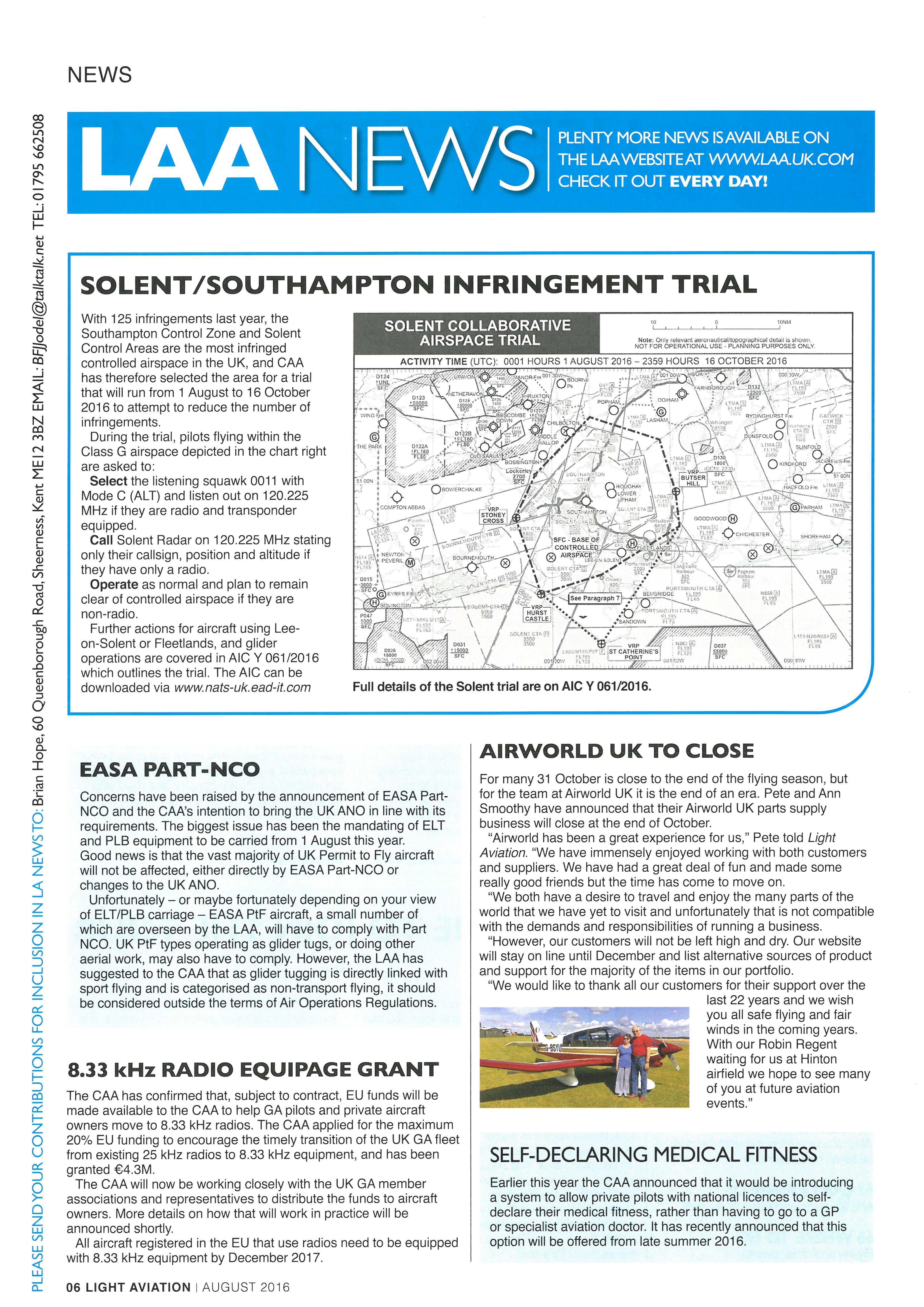
With125infringementslastyear,the SouthamptonControlZoneandSolent ControlAreasarethemostinfringed controlledairspaceintheUK,andCAAhasthereforeselectedtheareafora trial thatwillrunfrom1Augustto16October 2016toattempttoreducethenumber of infringements.
During the trial, pilots flying within the Class G airspace depicted in the chart right are asked to:
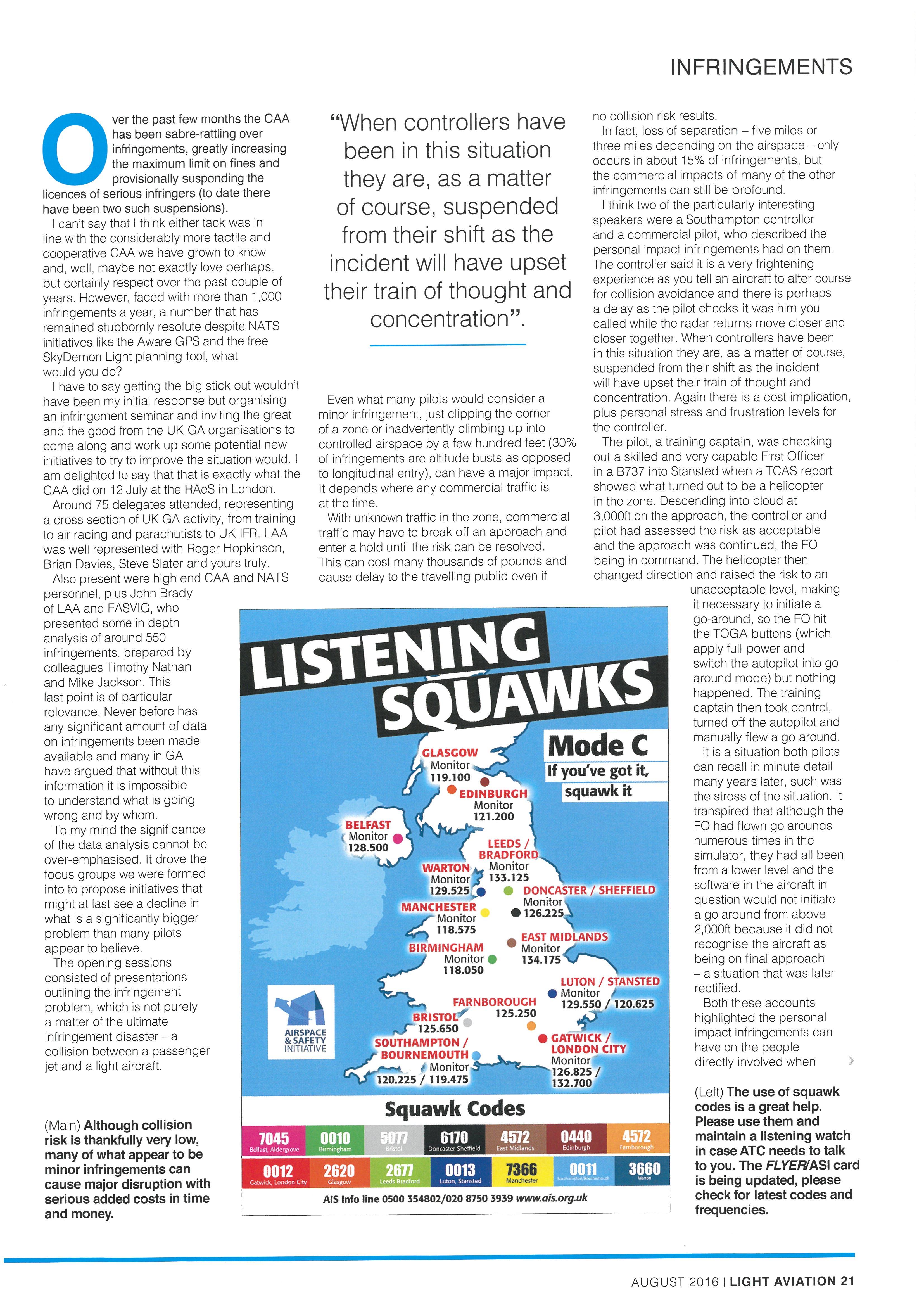
Select the listening squawk 0011 with Mode C (ALT) and listen out on 120.225 MHz if they are radio and transponder equipped.
Call Solent Radar on 120.225 MHz stating only their callsign, position and altitude if they have only a radio.
Operate as normal and plan to remain clear of controlled airspace if they are non-radio.
Further actions for aircraft using Leeon-Solent or Fleetlands, and glider operations are covered in AIC Y 061/2016 which outlines the trial. The AIC can be downloaded via www.nats-uk.ead-it.com
EASA PART-NCO
Full details of the Solent trial are on AIC Y 061/2016.
AIRWORLD UK TO CLOSE
Concerns have been raised by the announcement of EASA PartNCO and the CAA’s intention to bring the UKANO in line with its requirements. The biggest issue has been the mandating of ELT and PLB equipment to be carried from 1August this year. Good news is that the vast majority of UK Permit to Fly aircraft will not be affected, either directly by EASA Part-NCO or changes to the UK ANO.
Unfortunately or maybe fortunately depending on your view of ELT/PLB carriage EASA PF aircraft, a small number of which are overseen by the LAA, will have to comply with Part NCO. UK PtF types operating as glider tugs, or doing other aerial work, may also have to comply. However, the LAA has suggested to the CAA that as glider tugging is directly linked with sport flying and is categorised as non-transport flying, it should be considered outside the terms of Air Operations Regulations.
8.33 kHz RADIO EQUIPAGE GRANT
The CAA has confirmed that, subject to contract, EU funds will be made available to the CAA to help GA pilots and private aircraft owners move to 8.33 kHz radios. The CAA applied for the maximum 20% EU funding to encourage the timely transition of the UK GA fleet from existing 25 kHz radios to 8.33 kHz equipment, and has been granted €4.3M.
The CAA will now be working closely with the UK GA member associations and representatives to distribute the funds to aircraft owners. More details on how that will work in practice will be announced shortly.
All aircraft registered in the EU that use radios need to be equipped with 8.33 kHz equipment by December 2017.
For many 31 October is close to the end of the flying season, but for the team at Airworld UK it is the end of an era. Pete and Ann Smoothy have announced that their Airworld UK parts supply business will close at the end of October.
“Airworld has been a great experience for us,” Pete told Light Aviation. “We have immensely enjoyed working with both customers and suppliers. We have had a great deal of fun and made some really good friends but the time has come to move on.
“We both have a desire to travel and enjoy the many parts of the world that we have yet to visit and unfortunately that is not compatible with the demands and responsibilities of running a business.
“However, our customers will not be left high and dry. Our website will stay on line until December and list alternative sources of product and support for the majority of the items in our portfolio.
“We would like to thank all our customers for their support over the last 22 years and we wish you all safe flying and fair winds in the coming years. With our Robin Regent waiting for us at Hinton airfield we hope to see many of you at future aviation events.”
SELF-DECLARING MEDICAL FITNESS
Earlier this year the CAA announced that it would be introducing a system to allow private pilots with national licences to selfdeclare their medical fitness, rather than having to go to a GP or specialist aviation doctor. It has recently announced that this option will be offered from late summer 2016.
LET’SMAKESYWELLTHEBESTRALLYYET
DAVID FAULKNER BRYANT
Former Chairman David Faulkner-Bryant (1972-89) says:
“Let's make Sywell 16 the best Rally ever!”
How time flies, especially when you are enjoying yourself. It is now 70 years since my first flight in an aeroplane, an Auster at Shoreham, 30 bobs’ worth of excitement, inspiration and noise. That was in 1946, the year our founder conceived the ULAA. My most recent flight, earlier this year, was in a Tiger Moth to celebrate my 21st real birthday (29 Feb 1932). Itwas just like yesterday strapping in, the start-up, slipstream, ball and needle perfect, wind in the wires, with the Dorset countryside revolving directly below. The only difference was the price and the passage of time, but inside my head it was still the same.
Whilst 70 summers have come and gone between these two flights, | ask myself what have we been left with after all those years of toil and struggle, what have we achieved? The answer of course is quite a lot, the ULAA was formed and set out ona mission which evolved into the PFA and ultimately became the LAA as we know it today. It’s been quite a journey and it’s not over yet!
Our editor Brian Hope has offered me the opportunity to retell some of the stories and events that occurred during my stewardship, so watch this space in forthcoming issues of our magazine.
However, the main purpose of this message is to encourage the maximum number of members to be at ‘our’ rally on the 2nd, 3rd, 4th September to celebrate the place where, in my opinion, the PFAcame of age!
There were many building blocks that laid the foundation of today’s success story, two of the most important were the formation of the strut system and the PFA International Rally at Sywell, Northamptonshire. It all came together when we took on responsibility for the ever growing and successful series of international rallies. With a very meagre budget, the event was only possible due to the seemingly endless supply of very willing, able and enthusiastic members, who demonstrated just what a real DIY outfit could achieve. The Struts took on specific tasks year on year and committee members and others accepted responsibility for the numerous parts of the organisation.
It was a wonderful period when we attracted large numbers of overseas visitors and links were formed which are still in place today. It was all such fun. The main purpose of those early rallies was to showcase our products to the wider world - to emerge from workshops, sheds and barns once a year to show off beautifully made aeroplanes and of course see them fly, renew friendships and pass on knowledge and enthusiasm.
The date of the rally was always the first weekend in July, so everyoneknewwhento booktheirholiday- andthesunalways shone (with one notable exception).
It became my first and most important task (pre-rally) to take off in my beloved Currie Wot, climb as high as possible and beg our senior member for fine weather; this seemed to work most of the time. (I did actually do this for a bit of fun, which lead to composing the PFA anthem, which some may remember).
| no longer have the Currie Wot, so am no longer able to influence the weather, but | can guarantee that our 70th anniversary Rally will be the best yet, so long as you all turn up, with or without aeroplanes, in large numbers to celebrate the efforts of the past and the course to fly in the future! Let’s make it the largest gathering of LAA members and their guests with their aeroplanes and dreams at Sywell. See you on site.
LAA BONUS WEEKEND AT DUXFORD
An LAA Bonus Weekend Is scheduled for 27-28 August at Duxford. An £8 landing fee gets the pilot and one passenger into the museum for free, now that’s a deal! PPR is essential at Duxford so please call 01223 833376. The Saturday (27th) also sees the start of the LAA 70 Tour, with aircraft departing for the first night stop at Sherburn in Elmet.
STRUTS, CLUBS ANDLIGHT AVIATION MAGAZINE
There was a time when Strutting Around was a regular column in this magazine. | was a somewhat parochial affaire Strut A did this and Strut B did that and in due course faded into obscurity, | suspect missed by nobody. Rightly there has been some comment of late that the magazine should give more support to the Struts, type clubs and various other LAA groups and | am more than happy to eYoroe)aalanrelora\comtara
What | would like to. do is promote the events and meetings etc, that are coming up to encourage non-members of these groups to go along and see what's going on.
Please bear in mind that if you have a meeting in October say, | need to know about it by mid-September to get it in the October magazine. If your event Is early in the month it would probably have been better to promote it in the August magazine the one you are reading now! Forward planning is a must if this is to work. So, give me some feedback if you want to proceed with this opportunity, maybe do something different, or retain the statusquo. HENSTRIDGEWINGS AND WHEELS
Henstridge has a charity Wings & Wheels event on Sat 27 August. Aircraft, vintage cars and food including a hog roast are on offer. Landing is free and PPRis requested but not essential. Like most airfields there are noise abatement procedures so please avoid flying over local villages.
The future of Wellesboure Airfield is looking considerably rosier now that the full council of Stratford-on-Avon District Council has confirmed its Core Strategy planning blueprint safeguarding the airfield. The planning inspector has concluded that the airfield was unsuitable for development due to the lack of capacity on the highways network, the loss of airfield activities and landscape impacts.
Cllr Chris Saint, leader of Stratford-on-Avon District Council said, “Wellesbourne Airfield is an important asset for Wellesbourne and the surrounding areas. The District Council has always valued the airfield and its related business and aviation facilities and has been keen to establish this from the outset. We have always sought to protect this site from development, safeguarding not only the existing activities but the future of the airfield and we have now been able to do so.”
LAA 70 MEMBERS’ DINNER
As well as celebrating our 70th anniversary at the LAA Rally and at Strut events around the country, you are invited to join us for a very special commemorative dinner at one of British aviation’s most prestigious locations, the RAF Club in Piccadilly, London.
The date is set for Monday 24 October, as close as possible to the date of the first meeting of the ULAA 70 years ago (26 October), and it is planned that the dinner will be held in the spectacular main ballroom, in the presence of our Patron, HRH Prince Michael of Kent. Other special guests will include specially invited members and volunteers from the early days of the ULAA and the PFA.
Mike Roberts, managing director of Take Flight Aviation based on the airfield said, “Legal process is now taking place to renew the business leases at the airfield. It is also comforting to know that the council have not ruled out compulsory purchase should the owners think they can make some back door planning application by attempting to close the airfield or change its use.”
members’ tickets will be sponsored to keep the price for the three-course meal, including wines and a pre-dinner reception, at a very reasonable £50.
Guests and partners are invited too, but non-members will pay the unsubsidised rate of £70. As the event is limited to 140 guests, places will be settled by ballot. Ifyou are interested injoining this memorable event, pleasedropusaline atoffice@laa.uk.com or call us at 01280 846786.
RANS ANNOUNCE NEW S-21 OUTBOUND
This is first and foremost a dinner for the membership. We have therefore agreed that
Do you know someone who has, through voluntary service, made a major contribution to the Association? Some invitations will be especially reserved for those who fall into that category and for them, of course, dinner will beonus!
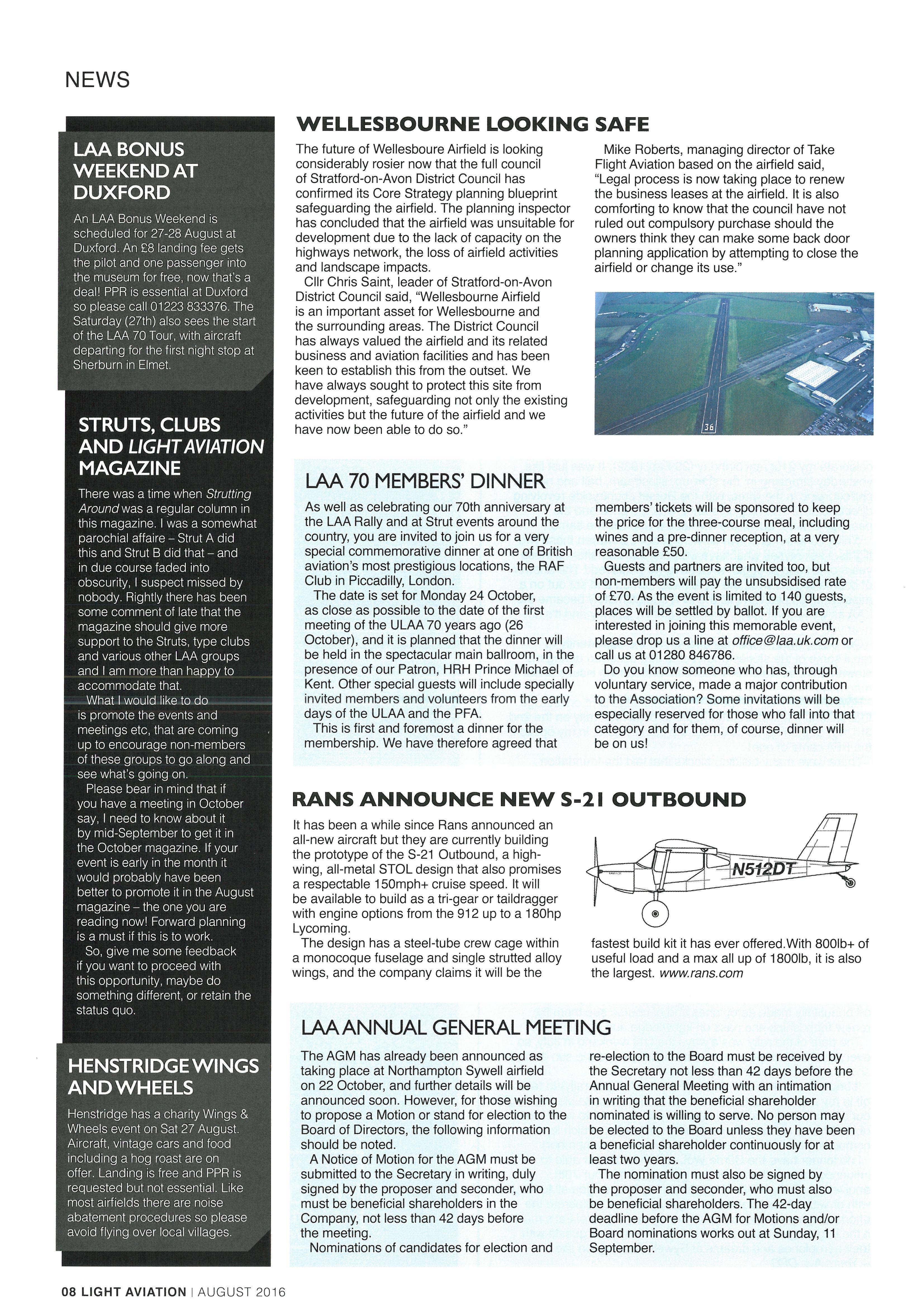
It has been a while since Rans announced an all-new aircraft but they are currently building the prototype of the S-21 Outbound, a highwing, all-metal STOL design that also promises a respectable 150mph+ cruise speed. It will be available to build as a tri-gear or taildragger with engine options from the 912 up to a 180hp Lycoming.
The design has a steel-tube crew cage within a monocoque fuselage and single strutted alloy wings, and the company claims it will be the fastest build kit it has ever offered.With 800Ib+ of useful load and a max all up of 1800Ib, it is also
The AGM has already been announced as taking place at Northampton Sywell airfield on 22 October, and further details will be announced soon. However, for those wishing to propose a Motion or stand for election to the Board of Directors, the following information should be noted.
A Notice of Motion for the AGM must be submitted to the Secretary in writing, duly signed by the proposer and seconder, who must be beneficial shareholders in the Company, not less than 42 days before the meeting.
Nominations of candidates for
re-election to the Board must be received by the Secretary not less than 42 days before the Annual General Meeting with an intimation in writing that the beneficial shareholder nominated is willing to serve. No person may be elected to the Board unless they have been a beneficial shareholder continuously for at least two years.
The nomination must also be signed by the proposer and seconder, who must also be beneficial shareholders. The 42-day deadline before the AGM for Motions and/or Board nominations works out at Sunday, 11 September.
POLY-FIBER inc. and AIRCRAFT COVERINGS Ltd will be sponsoring the LAA workshop again this year. The demonstrators from the ‘Sun and Fun’and ‘Oshkosh’ workshops will be on hand to help and advise. Ifyour interest is in fabric covering the experts will teach you the fundamentals, including cementing, correct shrinking, rib lacing and taping.
Designed and Made in the UK
Factory Built Fast Build or Kit Build Options
Tailwheel and Nosewheel options
Microlight or Group A (SEP)
D Motor LF26 Rotax 912UL/ULS Jabiru 2200
2 Minute wing fold for hangarage or trailer
STOL performance
The Light Aircraft Company Ltd Tel01328 878809 email sales@g-tlac.com
VIRBCamera XE
mongst the new projects this month is a Brandli BX-2 Cherry,I’dneverheardofonebefore.Looksalittle likea Eurostar in profile, wooden, retractable and only two on the UK register. Worth a Google!
Keith Wingate’s RV-8continues the theme of passed on projects, he only collected it last Christmas and it’s flying already. He is very fortunate to have a good size workshop attached to his house and manages near 20 hours a week in build time.
Another interesting project that has not been finished by the person whostarteditisRodPalmer’sEuropa
a Europa in this column for some time yet they were once so numerous.
| initially imagined with G-ARMG that we were witnessing another migration of a de Havilland aircraft from CofA to ‘= Permit to Fly, but this is a true restoration and a mission against the clock to celebrate the Chipmunk’s 70th birthday. nm LindsayIrvinerelatesthetale.
TogetintouchwithProjectNews,andtellyourstory,report a milestone or just to send a picture, email me at: projectnews@laa-archive.org.uk. Please share your story, we alll reallydowanttohearabout it!
BYKEITHWINGATE
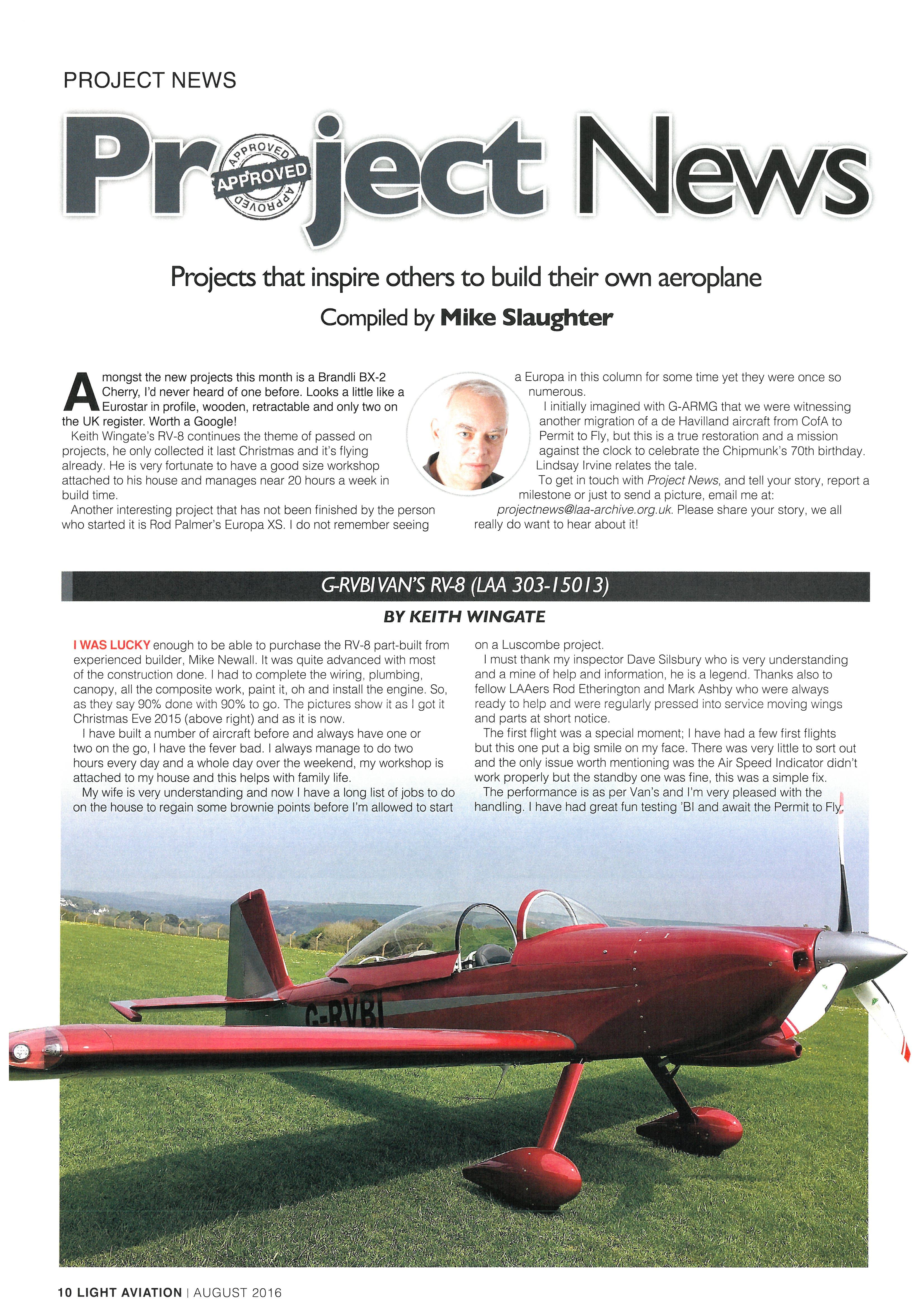
enough to be able to purchase the RV-8 part-built from experienced builder, Mike Newall. It was quite advanced with most of the construction done. | had to complete the wiring, plumbing, canopy, all the composite work, paint it, oh and install the engine. So, as they say 90% done with 90% to go. The pictures show it as | got it Christmas Eve2015 (above right) and as it is now.
| have built anumber of aircraft before and always have one or two on the go, | have the fever bad. | always manage to do two hours every day and a whole day over the weekend, my workshop is attached to my house and this helps with family life.
My wife is very understanding and now | have a long list of jobs to do on the house to regain some brownie points before I’m allowed to start
on a Luscombe project.
| must thank my inspector Dave Silsbury who is very understanding and a mine of help and information, he is a legend. Thanks also to fellow LAAers Rod Etherington and Mark Ashby who were always ready to help and were regularly pressed into service moving wings and parts at short notice.
Thefirstflightwasaspecialmoment;|havehada fewfirstflights but this one put a big smile on my face. There was very little to sort out and the only issue worth mentioning was the Air Speed Indicator didn't work properly but the standby one was fine, this was a simple fix.
The performance is as per Van's and |’m very pleased with the handling. | have had great fun testing ’BI and await the Permit to Fly.
(Above)As the project arrivedon Christmas Eve2015.Mostof the airframework hadbeencompleted.(Photo:KeithWingate) (Below left)Looking fantastic in the sun and ready to go. Only minor glitch on first flight was a non-working airspeed indicator.
G-ILLSEUROPAXS(PFA247-13550)
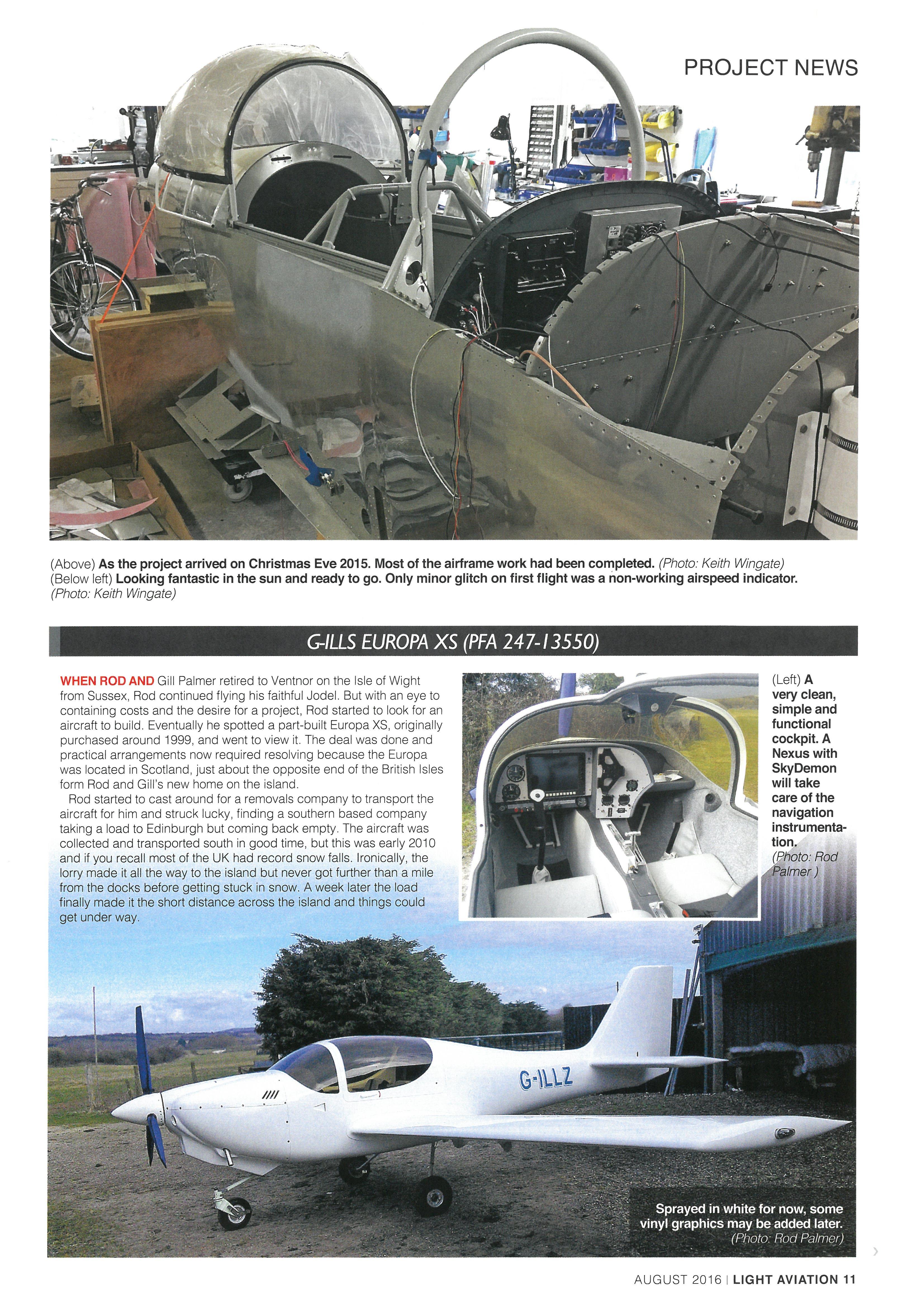
Gill Palmerretiredto Ventnoron the Isleof Wight
(Left)A from Sussex, Rod continued flying his faithful Jodel. But with an eye to very clean, containing costs and the desire for a project, Rod started to look for an simple and aircraft to build. Eventually he spotted a part-built Europa XS, originally functional purchased around 1999, and went to view it.The deal was done and cockpit. A practical arrangements now required resolving because the Europa Nexus with was located inScotland,just about the opposite end of the BritishIsles SkyDemon form Rod and Gill’s new home on the island. will take Rod started to cast around for a removals company to transport the care of the aircraft for him and struck lucky, finding a southern based company navigation taking a load to Edinburgh but coming back empty. The aircraft was instrumentacollected and transported south in good time, but this was early 2010 tion. and if you recall most of the UK had record snow falls. Ironically,the
lorry made it all the way to the island but never got further than a mile fromthedockspecsgeting.stuck|insnow.Awestlatertheload
(Photo:Keith Wingate)
(Photo: Rod’
PROJECT NEWS
One of the attractions of the Europa was the removable wings and the possibility of taking the aircraft home, either frequently or seasonally to save fixed cost. As we all know, hangarage can be just about the biggest recurring cost of flying. To this end Rod located and purchased a second-hand hangar trailer.
The only fly in the ointment was that Rod and Gill had specifically chosen a house with a nice unobstructed sea view... on a slope... and it had no driveway or workshop. To remedy this, before the project arrived, a driveway and space for a workshop was excavated, requiring the removal of 400 tons of soil from the site.
Rod continued enjoying flying the Jodel but realised the Europa was just not progressing so, with reluctance, the Jodel had to go and was sold in 2013. A reasonable amount of the
Europa’s fuselage work had been completed with the fuel tank and cockpit module installed, fuselage halves joined and the whole ensemble sitting upon its tricycle undercarriage. Whilst the XS wings were supplied looking like wings, they were largely untouched and needed all the controls, flaps and ailerons installing. Then the upper wing skin was bonded on and Rod reports this is where the workbecame a littleonerous.Therewasfilling, rubbing down, dusting with paint, more filling, rubbing down and so on. Hundreds of hours were spent in this finishing process. Rod said he knows where the slight imperfections may remain but doubts anyone else will ever be able to see them. Unlike car body filler where you might slap it on, go and have a cup of tea and then start rubbing down, hefound it might
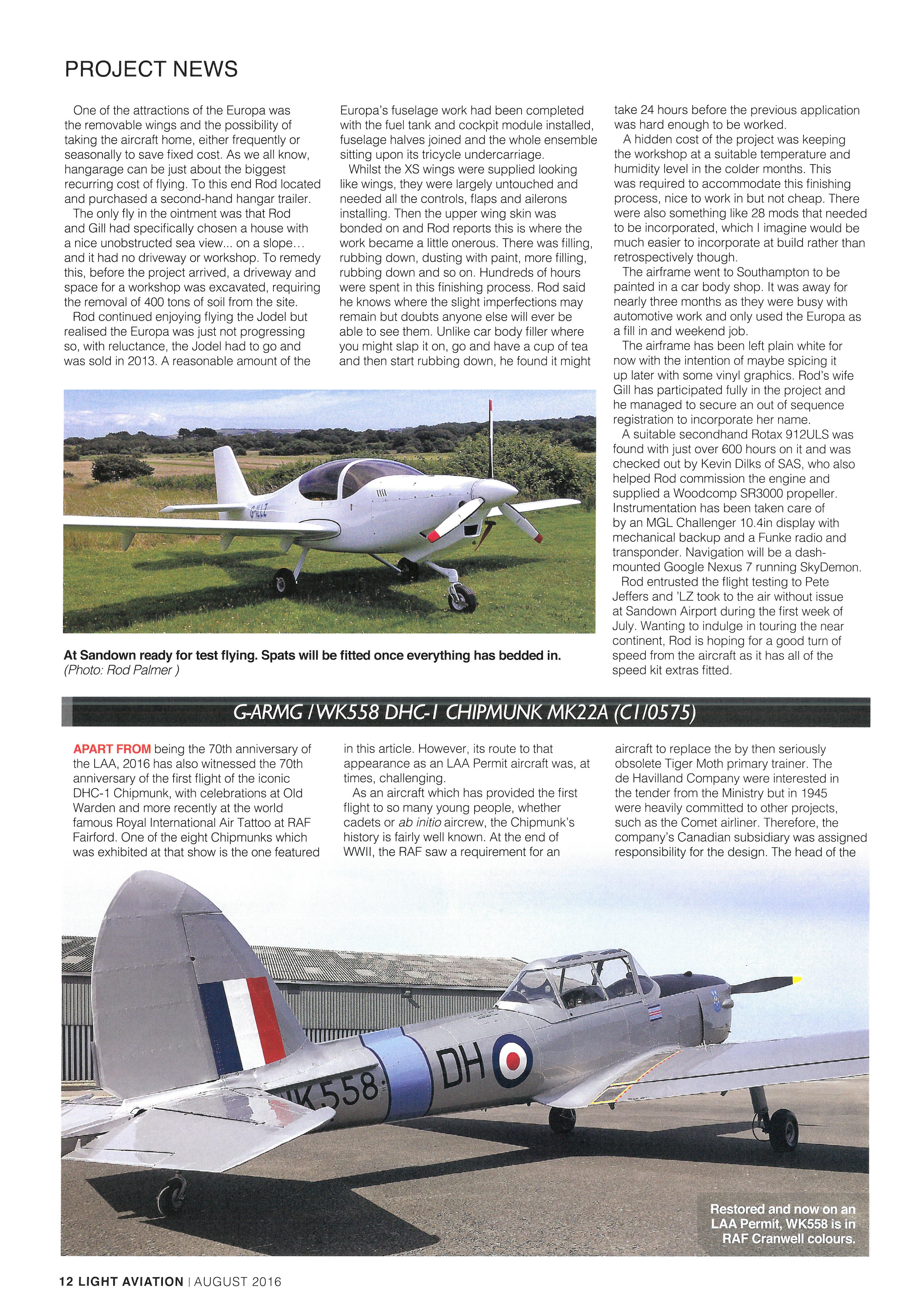
once everything has bedded in.
APART FROM being the 70th anniversary of the LAA, 2016 has also witnessed the 70th anniversary of the first flight of the iconic DHC-1 Chipmunk, with celebrations at Old Warden and more recently at the world famous Royal International Air Tattoo at RAF Fairford. One of the eight Chipmunks which was exhibited at that show is the one featured
in this article. However, its route to that appearance as an LAA Permit aircraft was, at times, Challenging.
As an aircraft which has provided the first flight to so many young people, whether cadets or ab initio aircrew, the Chipmunk’s history is fairly well known. At the end of WWII,theRAFsawarequirement foran AS
take 24 hours before the previous application was hard enough to be worked.
A hidden cost of the project was keeping the workshop at a suitable temperature and humidity level in the colder months. This was required to accommodate this finishing process, nice to work in but not cheap. There were also something like 28 mods that needed to be incorporated, which | imagine would be much easier to incorporate at build rather than retrospectively though.
The airframe went to Southampton to be painted in a car body shop. It was away for nearly three months as they were busy with automotive work and only used the Europa as a fill in and weekend job.
The airframe has been left plain white for now with the intention of maybe spicing it up later with some vinyl graphics. Rod’s wife Gill has participated fully in the project and he managed to secure an out of sequence registration to incorporate her name.
A suitable secondhand Rotax 912ULS was found with just over 600 hours on it and was checked out by Kevin Dilks of SAS, who also helped Rod commission the engine and supplied a Woodcomp SR3000 propeller. Instrumentation has been taken care of by an MGL Challenger 10.4in display with mechanical backup and a Funke radio and transponder. Navigation will be a dashmounted Google Nexus 7 running SkyDemon.
Rod entrusted the flight testing to Pete Jeffers and ’LZ took to the air without issue at Sandown Airport during the first week of July. Wanting to indulge in touring the near continent, Rod is hoping for a good turn of speed from the aircraft as it has all of the speedkitextrasfitted.
aircraft to replace the by then seriously obsolete Tiger Moth primary trainer. The de Havilland Company were interested in the tender from the Ministry but in 1945 were heavily committed to other projects, such as the Comet airliner. Therefore, the company’s Canadian subsidiary was assigned responsibilityforthedesign.Theheadofthe Sarsleo MalastaVMVenaem|AyeetoteMENee RAFCranwellcolours.
At Sandown ready for test flying. Spats will be fitted
(Photo: Rod Palmer)
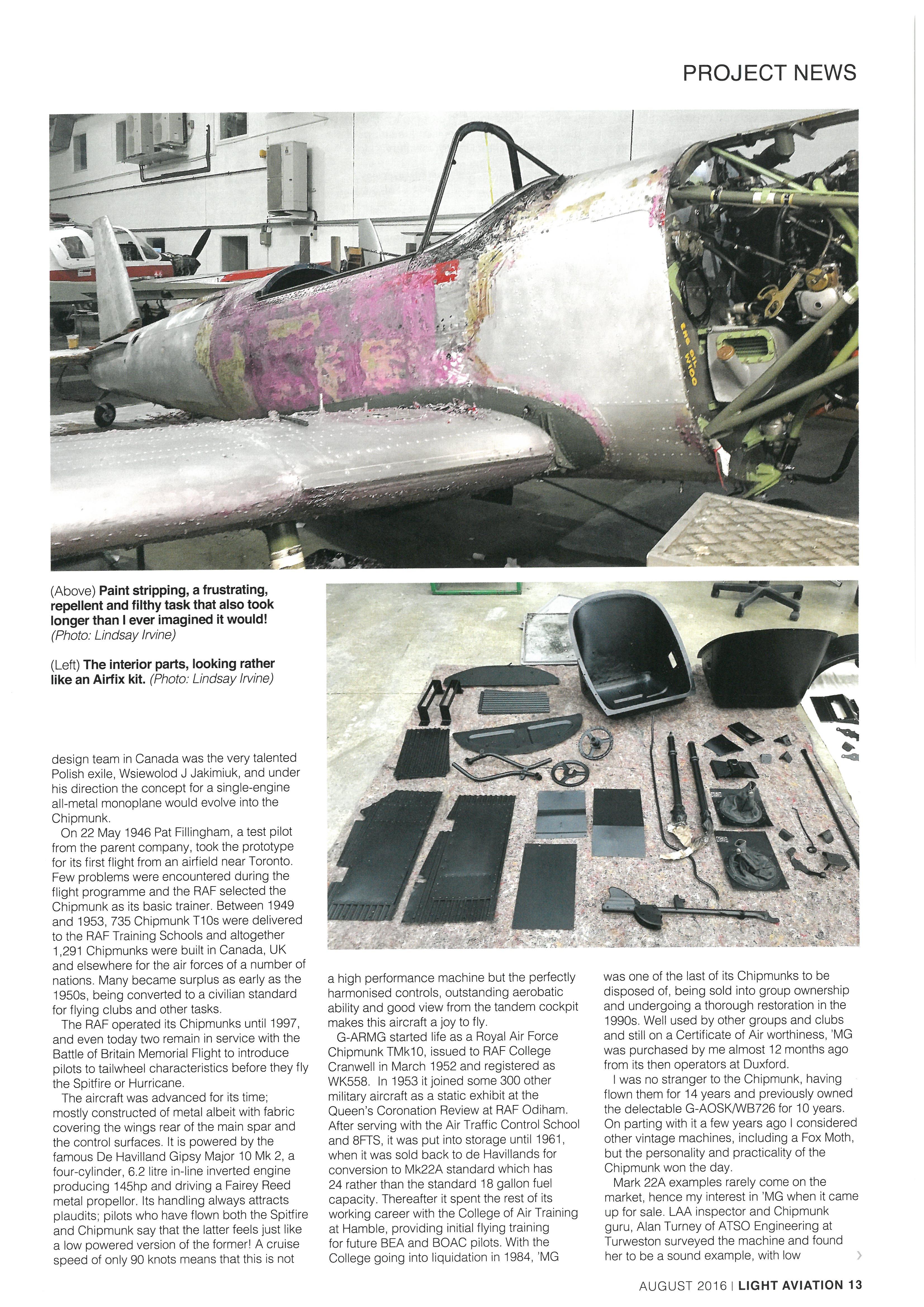
(Above) Paint stripping, a frustrating, repellent and filthy task that also took longer than | ever imagined it would!
(Left) The interior parts, looking rather like an Airfix kit. (Photo: Lindsay Irvine)
design team in Canada was the very talented Polish exile, Wsiewolod J Jakimiuk, and under his direction the concept for a single-engine all-metal monoplane would evolve into the Chipmunk.
On 22 May 1946 Pat Fillingham, a test pilot from the parent company, took the prototype for its first flight from an airfield near Toronto. Few problems were encountered during the flight programme and the RAFselected the Chipmunk as its basic trainer. Between 1949 and 1953, 735 Chipmunk T10s were delivered to the RAFTraining Schools and altogether 1,291 Chipmunks were built in Canada, UK and elsewhere for the air forces of a number of nations. Many became surplus as early as the 1950s,beingconvertedtoa civilianstandard for flying clubs and other tasks.
The RAFoperated its Chipmunks until 1997, and even today two remain in service with the Battle of Britain Memorial Flight to introduce pilots to tailwheel characteristics before they fly the Spitfire or Hurricane.
The aircraft was advanced for its time; mostly constructed of metal albeit with fabric covering the wings rear of the main spar and the control surfaces. It is powered by the famous De Havilland Gipsy Major 10 Mk 2, a four-cylinder, 6.2 litre in-line inverted engine producing 145hp and driving a Fairey Reed metal propellor. Its handling always attracts plaudits; pilots who have flown both the Spitfire and Chipmunk say that the latter feels just like a low powered version of the former! A cruise speed of only 90 knots means that this is not
a high performance machine but the perfectly harmonised controls, outstanding aerobatic ability and good view from the tandem cockpit makes this aircraft a joy to fly.
G-ARMG started life as a Royal Air Force Chipmunk TMk10, issued to RAFCollege Cranwell in March 1952 and registered as WK558. In 1953 it joined some 300 other military aircraft as a static exhibit at the Queen’s Coronation Review at RAF Odiham. After serving with the Air Traffic Control School and 8FTS, it was put into storage until 1961, when it was sold back to de Havillands for conversion to Mk22A standard which has 24 rather than the standard 18 gallon fuel capacity. Thereafter it spent the rest of its working career with the College of Air Training at Hamble, providing initial flying training for future BEA and BOAC pilots. With the
was one of the last of its Chipmunks to be disposed of, being sold into group ownership and undergoing a thorough restoration inthe 1990s. Well used by other groups and clubs and still on a Certificate of Air worthiness, MG was purchased by me almost 12 months ago from its then operators at Duxford. | was no stranger to the Chipmunk, having flown them for 14 years and previously owned the delectable G-AOSK/WB726 for 10 years. On parting with it a few years ago | considered other vintage machines, including a Fox Moth, but the personality and practicality of the Chipmunk won the day.
Mark 22A examples rarely come on the market, hence my interest in ’MG when it came up for sale. LAA inspector and Chipmunk guru, Alan Turney of ATSO Engineering at Turweston surveyed the machine and found her to be a sound example, with low
(Photo: Lindsay Irvine)
PROJECT NEWS
engine hours on a Vintech overhauled Gipsy Major. It was somewhat “tired” and scruffy inside and out and required propeller, fabric and body work before any fuller refurbishment and CofA renewal. My initial desire was to keep the aircraft on the CofA, not because of any intention to hire it out, but because | was familiar with that process and at that time Charity flights could not be conducted in Permit aircraft. With a change in the CAA rules virtually coinciding with taking delivery of the aircraft, and Alan being an excellent advocate and having his premises right next door to LAA HQ, | took the decision to take the leap. | then had to give consideration to refurbishment beyond mere repair.
As indicated earlier, MG had a distinguished career with the College of Air Training at Hamble and the orange enhanced colour scheme was familiar and popular with generations of airline pilots. With the help of the hugely knowledgeable Chipmunk historian, Rod Brown, its RAF history was revealed and as a graduate of the RAFCollege, | was attracted to that era in the aircraft's life. One of around 40 Chipmunks used by the College introduced in two batches with code letters DA to DX and JA to JW, WK558 was coded rather felicitously “DH”. Black and white photos were supplied by Rod showing the markings and College Crest but the only colour representations were in a contemporary Pathé film about Cranwell, TheSky is Ours, available on YouTube.
A distinguishing feature of Cranwell Chipmunks is the lack of the usual yellow training bands and the substitution of a “Cranwell” fuselage band in contrasting blues. With the College celebrating 100 years of military training there during 2016, the decision was made. Having decided to return it to its original identity, the question then was to what standard of finish. Sitting accusingly in the Turweston hangar was my previous mount, the immaculate G-AOSK; so the instructions to Alan and Simon were clear make MG like that one but perhaps even better inside and out.
Given that | possess no engineering skills, Turweston is fortunately blessed with excellent people and facilities. There are also helpful airfield personnel and good flying clubs and also the best aircraft paint and finishing shop, run by Mick Allen and his two sons. The downside is that everyone else knows this and
the waiting list is long! In order to try and speed up the process, ATSO took on the stripping process which | recklessly volunteered to assist with.
No more frustrating, repellent and filthy a process have | ever come across, which also took much longer than | expected certainly much longer than it took Alan to complete the engineering and fabric tasks and start on the Permit application paperwork. Where | could help was in the repainting and detailing of some of the cockpit, including the trim wheels, engine controls and magneto labels. A vintage car trim specialist near where | live, Paul Nahoulakian, made some perfectly fitting new seats and fashioned new coaming crash pads. Plus | received invaluable assistance from the Heritage and Media Service sections at RAF Cranwell who ensured the cowling badges were the correct colour and detailing for the era. Accuracy of military colour schemes is a vital component of procuring an exemption from the CAA for a UK civil registered aircraft from wearing civil markings, as the relevant Service has to approve them. Steve Atkin of Warbird Colour Services lent his customary expertise to accurate stencilling.
From an airworthiness perspective, the Chipmunk is obviously more complex than many homebuilts on the LAA register; on the other hand, it is built to known standards and has a considerable and well documented history, with its past technical history and continued health overseen by DHSL at Duxford. The LAA requirement is that either the LAMs schedule is followed or the LAA’s generic one suitably tailored to the Chipmunk. | have to say that whilst the refurbishment process took longer than expected (the only thing to be expected in the aviation world!) the transfer to a Permit whilst exacting and thorough (as evidenced by Alan Turney) was very smooth and user friendly. With the aircraft provisionally booked for an appearance at RIAT 2016, Francis Donaldson could not have been more helpful in turning round first of all permission to flight test and then the Permit recommendation to the CAA, who in turn were very helpful in the speed with which they completed their part. With assistance from Paul Shenton on the flying front, | had a fresh permit in time for the 7 July with Fairford the first public outing for the new colour scheme, which is a credit to Mick Allen and his team.
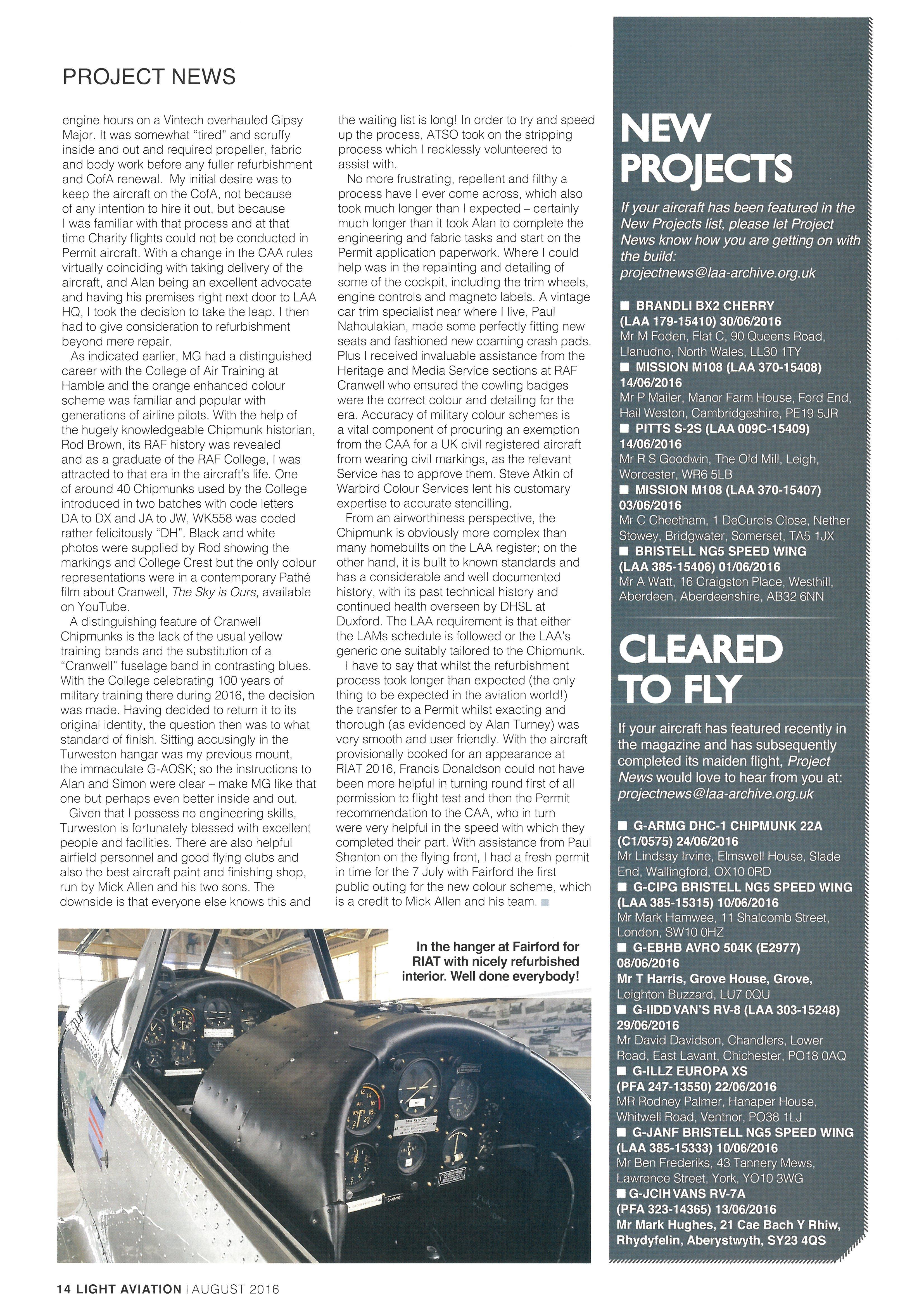
In the hanger at Fairford for RIAT with nicely refurbished interior. Well done everybody!
Ns PROJECTS
lfyour aircraft has been featured in the New Projects list, please let Project News know how you are getting on with the build: projectnews@laa-archive.org.uk
@ BRANDLI BX2 CHERRY (LAA 179-15410) 30/06/2016
Mr M Foden, Flat C, 90 Queens Road, Llanudno, North Wales, LL30 1TY @ MISSION M108 (LAA 370-15408) 14/06/2016
Mr P Mailer, Manor Farm House, Ford End, Hail Weston, Cambridgeshire, PE195JR @ PITTS S-2S (LAA 009C-15409) 14/06/2016
Mr R S Goodwin, The Old Mill, Leigh, Worcester, WR6 5LB @ MISSION M108 (LAA 370-15407) 03/06/2016
Mr C Cheetham, 1 DeCurcis Close, Nether Stowey, Bridgwater, Somerset, TAS 1JX
Mr Ben Frederiks, 43 Tannery Mews, Lawrence Street, York, YO10 3WG
@ G-JCIHVANS RV-7A (PFA 323-14365) 13/06/2016
Mr Mark Hughes, 21 Cae Bach Y Rhiw, Rhydyfelin, Aberystwyth, SY23 4QS
eventy years is a long time, a lifetime in fact, and for our Association to reach that milestone in as rude a health as it has ever been is a magnificent achievement.
We will rightly celebrate that fact over the first weekend of September when we come together at Sywellfor our Annual Rally.As befits such a celebration, this year we have added a number of features we hope will make it even more entertaining but at heart it will remain an opportunity for the camaraderie, friendship and passion that have long been the hallmarks of our Association.
EXHIBITION
The Exhibition area will be packed with everything to do with sport and recreational aircraft, from nuts and bolts to complete aircraft and from SSDRsto hi-tech, high speed tourers. To date there will be at least six new designs making their UK or world debuts, and at least one new engine will be on display. |’m not going to say more than that, you will have to come along and see for yourself but | promise they will make exciting additions to the LAA fleet as we move forward into our next decade.
Electronics play a major part in aviation and Garmin has recently announced a number of products which | expect potential purchasers will be delighted to see, touch and hear about.
Parts For Aircraft will also have their impressive new Talus Avionics EFISthat sells for just £559 including vat.
SkyDemon too will be showing their latest software, and they are currently endeavouring to add circuit patterns and noise abatement areas to their maps and airfield data. Gathering this data for smaller airfields which are not in the AIP is tricky, so SkyDemon is inviting airfield owners visiting the Rally to talk see Louise (the team member responsible for UK airfields) who will be dedicating time to digitise their airfield data so it’s available to SkyDemon users. Ifyou fly from a small airfield and the owner wants to help but is unable to attend the Rally, please ask them to give you permission to speak to SkyDemon on their behalf.
We are delighted that Exhibitor response has held up well and at time of writing, there are
only a handful spaces in the marquees and on the outside park. If you are a trader looking to book then contact penny.sharpe@laa.uk.com (Tel: 01280 846786) as soon as possible to avoid disappointment.
Knowing how tiring it can be wandering around all day in the hot sunshine of course it is going to be sunny we have tables and chairs available in the exhibition areas so you can rest awhile and chat with friends. Plenty of food and beverage units will also be available to service your appetite.
LAA 70 MARQUEE
With a selection of milestone aircraft, plus some interesting period motorcycles, the LAA 70 Marquee is a new addition for this year. The marquee, and part of the area around it, will house a number of aircraft that have been significant in the Association’s history.
The first type built was the Luton Minor for example, and the first approved two-seater was the DruineTurbi. And although not intrinsically linked to the LAA, the pre-war Mignet Flying Flea is rightly considered the aeroplane that signalled the re-birth of European homebuilding from which the post-war desire to form ULAA came. Amongst the aeroplanes will be a sprinkling, nice word, of period motorbikes that will no doubt remind many of us of our misspent youth.
SPEAKERS’ CORNER
Speakers’ Corner occupies one end of the LAA 70 Marquee and has been generously sponsored by Adams Aviation and Garmin. Throughout the weekend, keynote speakers will discuss a range of topics, from electric and hybrid aircraft to flying or riding a motorbike to Cape Town and back. Useful talks on looking after your Rotax 912 and selecting avionics equipment will also be included.
Please keep an eye on display notices around the site for the Speakers’ Corner schedules and of course the Rally Programme, which will be available at the event.
LAS HOMEBUILDER CENTRE
Our gratitude goes to Light Aero Spares for once again sponsoring the Homebuilder
Centre, plus our thanks to Dudley Pattison and his team for gathering yet another interesting array of interesting parts-built projects and parts.
FLEAMARKET
Don't forget that the Flea Market too forms part of the Homebuilder Centre so please bring along all those unwanted parts, tools, books, plans or whatever that have been cluttering up your house and workshop. For a very reasonable fee you can sell them on to a new home. One man’s clutter and all that...
SLING BUILD CHALLENGE
The Rally certainly sees a UK first with the challengetobuildandflya flat-pack,four-seat aircraft kit in seven days. The Airplane Factory haveshippeda Sling4kittotheUKandateam of factory personnel and inexperienced UK volunteers will start building it on the Saturday prior to the start of the Rally. From the start of the Rally, attendees will be able to watch the build progress until on Sunday, if all goes to plan, the aircraft will make its maiden flight.
HOTELS AND CAMPING
With a well serviced campsite (hot showers and regularly cleaned WCs), a café, food stalls in the exhibition area and the Aviator Motel restaurant, plus plenty of local hotels, personal requirements are well looked after.
Campers can save £10 by pre-booking their plot online via the LAA Shop. Camping costs £20 in advance, £30 at the gate and covers a single unit (tent, caravan or motorhome) for the period Thursday 1 September to Monday 5 September or any part thereof. The last date pre-booking is available is Friday 26 August as the office has to mail out your campsite pass. A list of hotels can be found on the LAA website under the Rally 2016 tab. Bear in mind that MotoGP is taking place at Silverstone on the same weekend so hotel accommodation may be problematic at this late stage.
EVENING ENTERTAINMENT
For those staying over, and | really do recommend that you do, there is ample to keep you entertained during the evening. Hangar
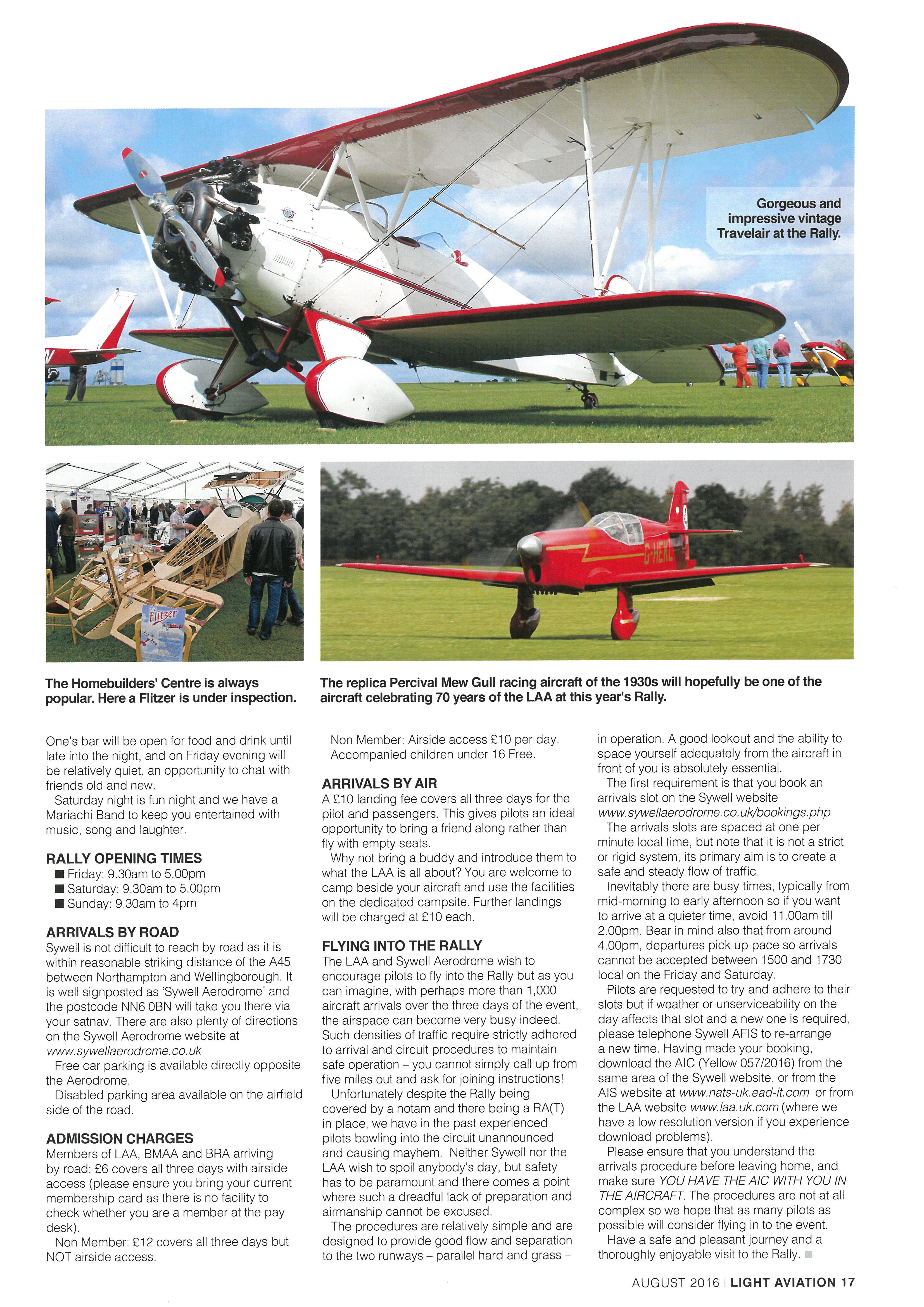
The Homebuilders' Centre is always popular. Here a Flitzer is under inspection.
One’s bar will be open for food and drink until late into the night, and on Friday evening will be relatively quiet, an opportunity to chat with friends old and new.
Saturday night is fun night and we have a Mariachi Band to keep you entertained with music, song and laughter.
RALLY OPENING TIMES
@Friday: 9.30am to 5.00pm
@Saturday: 9.30am to 5.00pm
@Sunday: 9.30am to 49m
ARRIVALS BY ROAD
Sywell is not difficult to reach by road as it is within reasonable striking distance of the A45 between Northampton and Wellingborough. It is well signposted as ‘Sywell Aerodrome’ and the postcode NN6 OBNwill take you there via your satnav. There are also plenty of directions on the Sywell Aerodrome website at www.sywellaerodrome.co.uk
Free car parking is available directly opposite the Aerodrome.
Disabled parking area available on the airfield side of the road.
ADMISSION CHARGES
Members of LAA, BMAA and BRA arriving by road: £6 covers all three days with airside access (please ensure you bring your current membership card as there is no facility to check whether you are a member at the pay desk).
Non Member: £12 covers all three days but
Non Member: Airside access £10 per day. Accompanied children under 16 Free.
ARRIVALS BY AIR
A £10 landing fee covers all three days for the pilot and passengers. This gives pilots an ideal opportunity to bring a friend along rather than fly with empty seats.
Why not bring a buddy and introduce them to what the LAA is all about? You are welcome to camp beside your aircraft and use the facilities on the dedicated campsite. Further landings will be charged at £10 each.
FLYING INTO THE RALLY
The LAA and Sywell Aerodrome wish to encourage pilots to fly into the Rally but as you can imagine, with perhaps more than 1,000 aircraft arrivals over the three days of the event, the airspace can become very busy indeed. Such densities of traffic require strictly adhered to arrival and circuit procedures to maintain safe operation you cannot simply call up from five miles out and ask for joining instructions! Unfortunately despite the Rally being covered by a notam and there being a RA(T) in place, we have in the past experienced pilots bowling into the circuit unannounced and causing mayhem. Neither Sywell nor the LAA wish to spoil anybody’s day, but safety has to be paramount and there comes a point where such a dreadful lack of preparation and airmanship cannot be excused.
The procedures are relatively simple and are designed to provide good flow and separation to the two runways parallel hard and grass
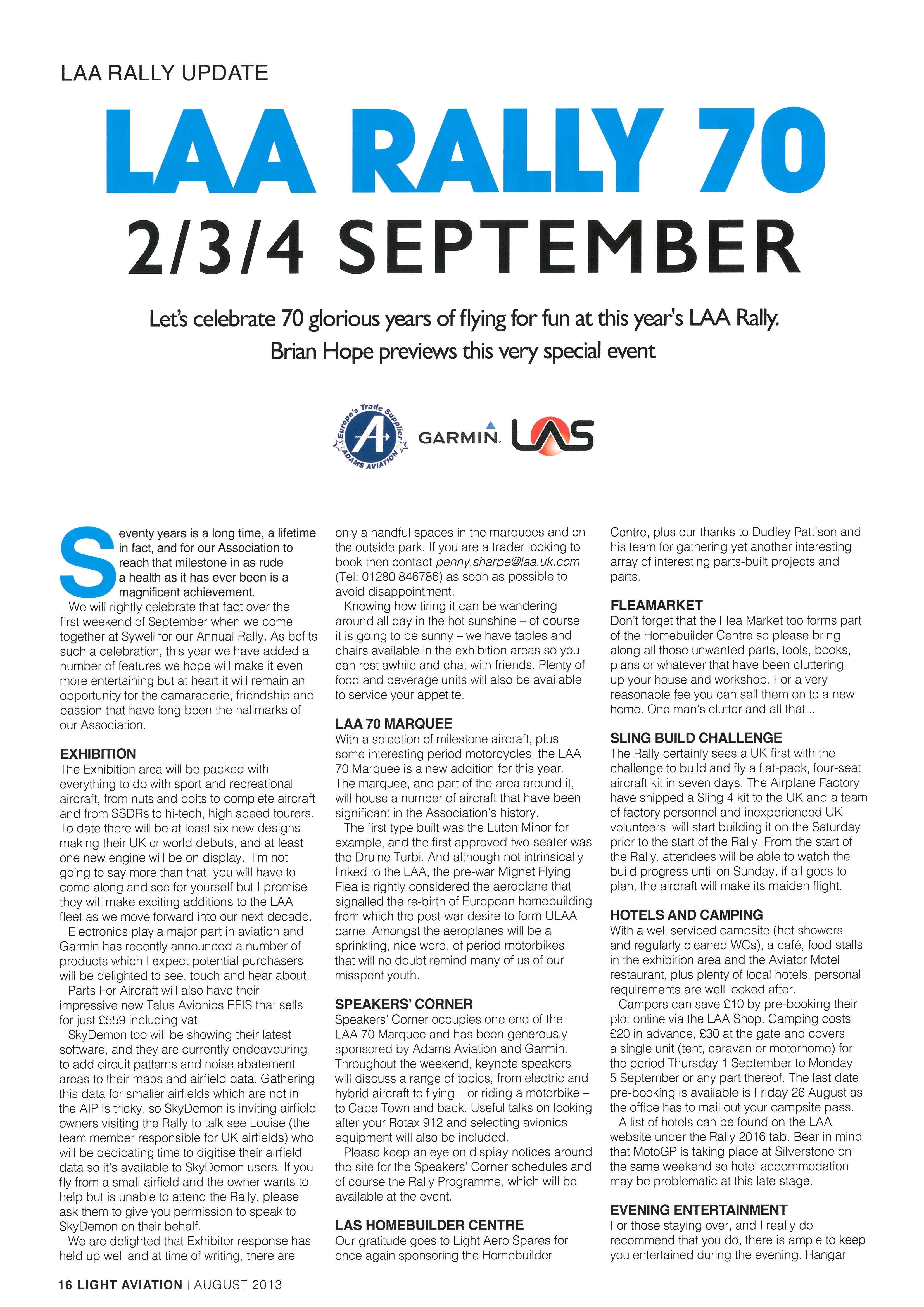
Gorgeous and impressive vintage Travelair at the Rally.
in operation. A good lookout and the ability to space yourself adequately from the aircraft in front of you is absolutely essential.
The first requirement is that you book an arrivals slot on the Sywellwebsite www.sywellaerodrome.co.uk/bookings.php
The arrivals slots are spaced at one per minute local time, but note that it is not a strict or rigid system, its primary aim is to create a safe and steady flow of traffic.
Inevitably there are busy times, typically from mid-morning to early afternoon so if you want to arrive at a quieter time, avoid 11.00am till 2.00pm. Bear in mind also that from around 4.00pm, departures pick up pace so arrivals cannot be accepted between 1500 and 1730 local on the Friday and Saturday.
Pilots are requested to try and adhere to their slots but if weather or unserviceability on the day affects that slot and a new one is required, please telephone Sywell AFIS to re-arrange a new time. Having made your booking, download the AIC (Yellow 057/2016) from the same area of the Sywell website, or from the AlS website at www.nats-uk.eaa-it.com or from the LAA website www.laa.uk.com (where we have a low resolution version if you experience download problems).
Please ensure that you understand the arrivals procedure before leaving home, and make sure YOU HAVE THE AIC WITH YOU IN THEAIRCRAFT. The procedures are not at all complex so we hope that as many pilots as possible will consider flying in to the event.
Have a safe and pleasant journey and a thoroughly enjoyable visit to the Rally.
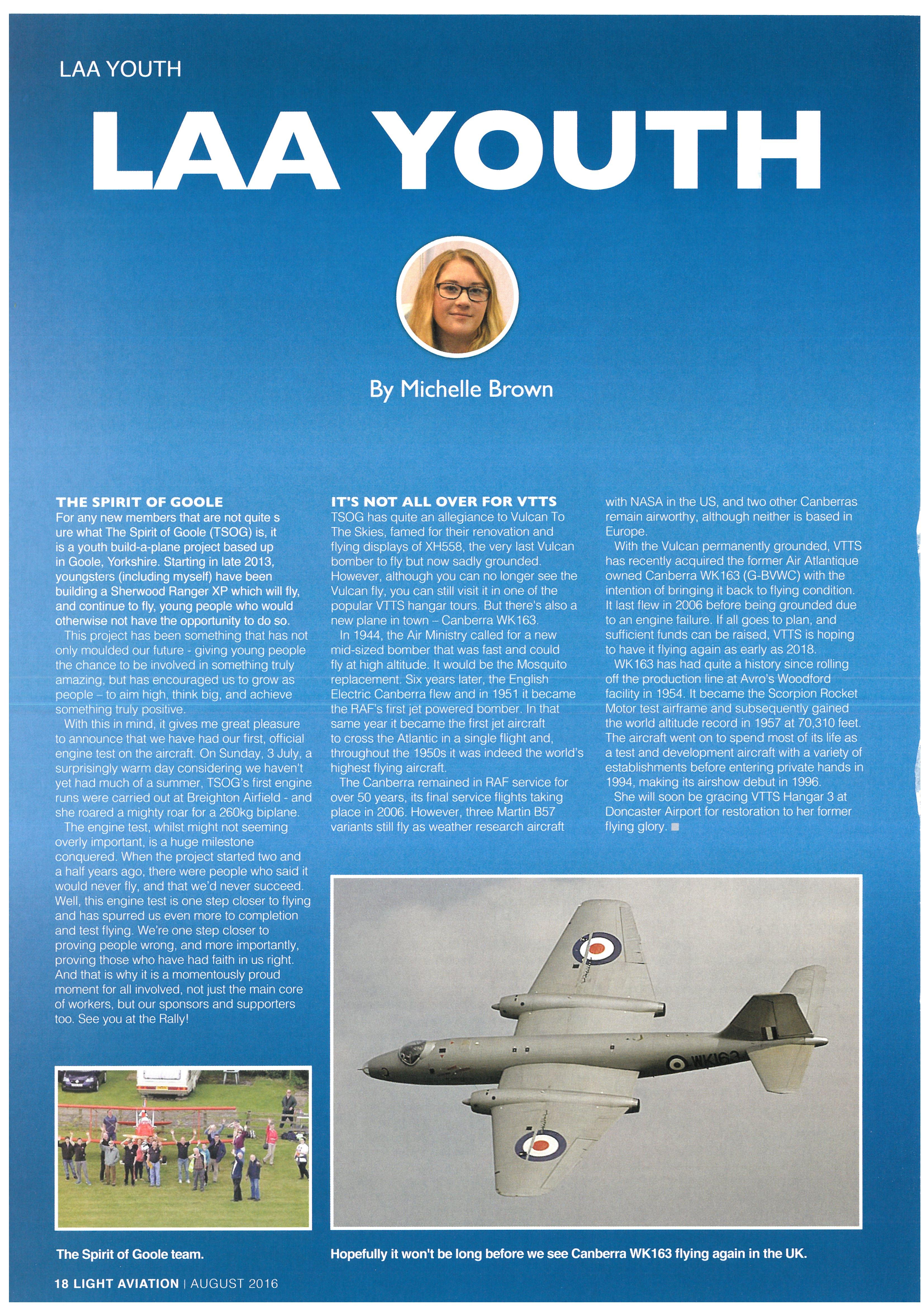
The replica Percival Mew Gull racing aircraft of the 1930s will hopefully be one of the
aircraft celebrating 70 years of the LAAat this year's Rally.
ByMichelleBrown
THE SPIRIT OF GOOLE
For any new members that are not quite s urewhatThe Spiritof Goole (TSOG)is,it is a youth build-a-planeproject based up in Goole, Yorkshire.Starting in late 2013, youngsters (includingmyself) have been building a Sherwood Ranger XP which will fly, and continue to fly, young people who would otherwise not have the opportunity to do so.
This project has been something that has not only moulded our future - giving young people the chance to be involved in something truly ~amazing, but has encouraged us to grow as peopletoaimhigh,thinkolehandcle
Withthisin mind, it gives me great pleasure to announce that we have had our first, official engine test on the aircraft. On Sunday, 3 July, a surprisingly warm day considering we haven't yet had much of a summer, TSOG’sfirst engine runs were carried out at Breighton Airfield - and she roared a mighty roarfor a 260kg biplane.
The engine test, whilst might not seeming overlyimportant,isa hugemilestone conquered. When the project started two and a half years ago, there were people who said it would never fly, and that we'd never succeed. Well, this engine test is one step closer to flying and has spurred us even more to completion and test flying. We're one step closer to proving people wrong, and more importantly, proving those who have had faith in us right. And that is why it is a momentously proud moment for all involved, not just the main core of workers, but our sponsors and supporters too. See you at the Rally!
IT'S NOT ALL OVER FOR VTTS
TSOG has quite an allegiance to Vulcan To The Skies, famed for their renovation and flying displays of XH558,the very last Vulcan bomber to fly but now sadly grounded. However, although you can no longer see the Vulcan fly, you can still visit it in one of the popular VITS hangar tours. But there's also a new plane in town Canberra WK163.
In 1944,the Air Ministrycalled for a new mid-sized bomber that was fast and could fly at high altitude. It would be the Mosquito replacement. Six years later, the English Electric Canberra flew and in 1951 it became _theRAF’s first jet powered bomber. In that
same year it became the first jet aircraft to cross the Atlantic in a single flight and, throughout the 1950s it was indeed the world’s highest flying aircraft.
with NASA in the US, and two other Canberras remain airworthy, although neither is based in Europe.
With the Vulcan permanently grounded, VTTS has recently acquired the former Air Atlantique owned Canberra WK163 (G-BVWC) with the intention of bringing it back to flying condition. It last flew in 2006 before being grounded due to an engine failure. If all goes to plan, and sufficient funds can be raised, VTTSis hoping to have itflying again as early as 2018.
WK163 has had quite a history since rolling off the production line at Avro’s Woodford Motorfacilityin1954.ItbecametheScorpionRocket testairframeandsubsequentlygained=
The Canberra remained in RAF service for over 50 years, its final service flights taking place in 2006. However, three Martin B57 variants still fly as weather research aircraft
the world altitude record in 1957 at 70,310 feet. The aircraft went on to spend most of its life as a test and development aircraft with a variety of establishments before entering private hands in 1994, making its airshow debut in 1996.
She will soon be gracing VTTSHangar 3 at Doncaster Airport for restoration to her former flying glory. @ Hopefully it won't be long before we see Canberra WK163 flying again in the UK.
The Spirit of Goole team.
Propellers designed and optimised for ALL TYPESof aircraft, from Edwardian pioneers to state-of-the art air racers and everything in between.Withover500propellersinuse,talkto theexpertsoraboutyourownhighperformancedesign reproductionof aclassic-whateveryoufly. Alsofull refurbishmentandbalancingservice for allmakesofwoodenpropellers with afastturn-around.
+44 (0)1453 885853
www.hercprops.com = Made in the UK : Flown
the fun flying machine manoeuvrable, agile and exciting, for around £15 per hour.
put the thrill back into your flying coming soon to a grass strip near you
+44 (0) 1954 268 189 www.e-go.me
e-Go aeroplanes, e-Go Centre, Main Hall Farm, Conington, Cambridge, CB23 4LR
“ _..there’s something very special about flying in a single-seater.” Keith Dennison - Chief
ver the past few months the CAA has been sabre-rattling over infringements, greatly increasing the maximum limit on fines and provisionally suspending the licences of serious infringers (to date there have beentwo such suspensions).
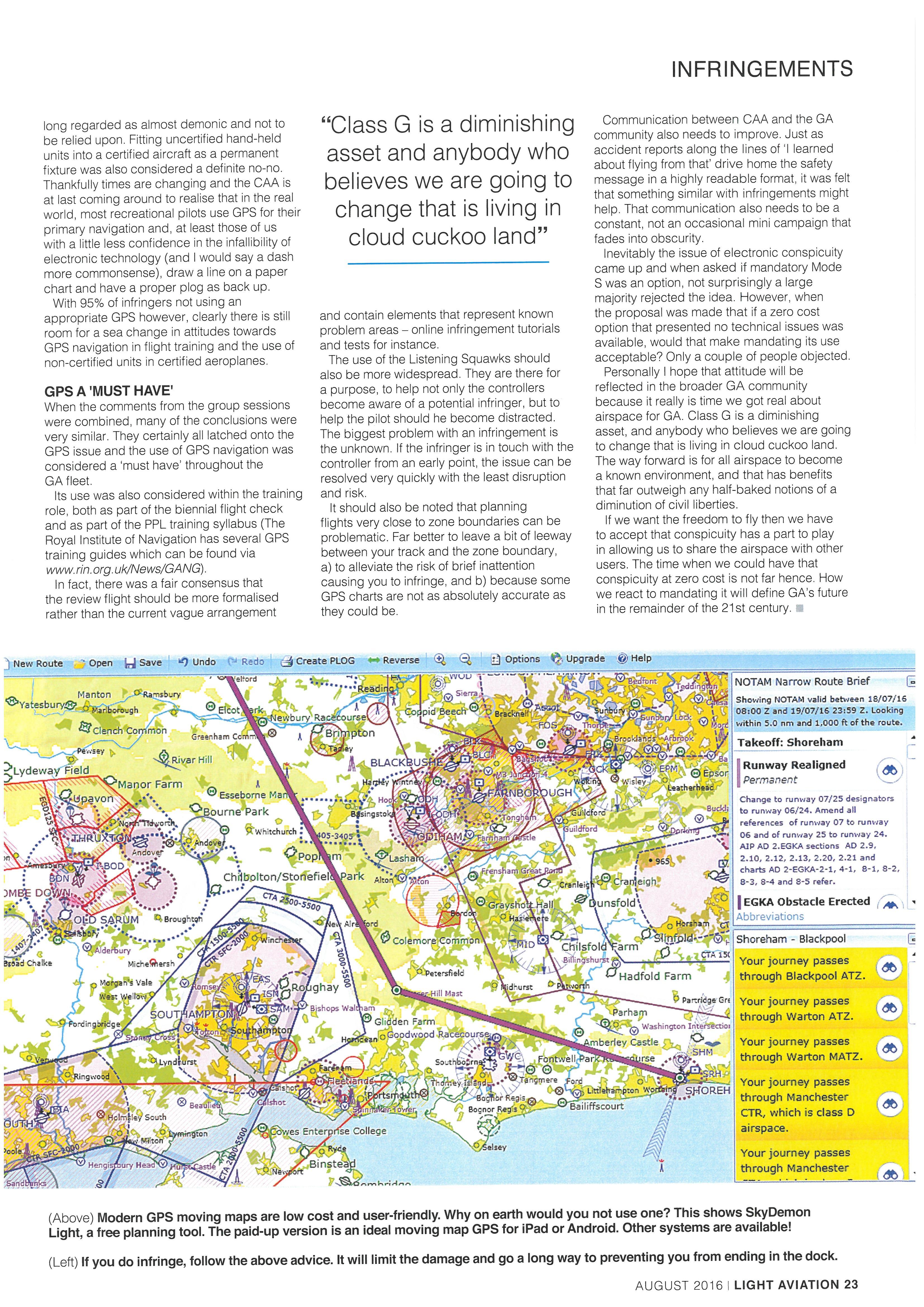
| can’t say that | think either tack was in line with the considerably more tactile and cooperative CAA we have grown to know and, well, maybe not exactly love perhaps, but certainly respect over the past couple of years. However, faced with more than 1,000 infringements a year, a number that has remained stubbornly resolute despite NATS initiatives like the Aware GPS and the free SkyDemon Light planning tool, what would you do?
| have to say getting the big stick out wouldn't have been my initial response but organising an infringement seminar and inviting the great and the good from the UK GA organisations to come along and work up some potential new initiatives to try to improve the situation would. | am delighted to saythat that is exactly what the CAA did on 12July at the RAeS in London.
Around 75 delegates attended, representing a cross section of UK GA activity, from training to air racing and parachutists to UK IFR.LAA was well represented with Roger Hopkinson, Brian Davies, Steve Slater and yours truly.
Also present were high end CAA and NATS personnel, plus John Brady of LAA and FASVIG, who presented some in depth analysis of around 550 infringements, prepared by colleagues Timothy Nathan and Mike Jackson. This last point is of particular relevance. Never before has any significant amount of data on infringements been made available and many in GA have argued that without this informationit is impossible to understand what is going wrong and by whom.
To my mind the significance of the data analysis cannot be over-emphasised. It drove the focus groups we were formed into to propose initiatives that might at last see a decline in what is a significantly bigger problem than many pilots appear to believe.
“When controllers have been in this situation they are, as a matter of course, Suspended from their shift as the incident will have upset their train of thought and concentration”.
Even what many pilots would consider a minor infringement, just clipping the corner of a zone or inadvertently climbing up into controlled airspace by a few hundred feet (30% of infringements are altitude busts as opposed to longitudinal entry), can have a major impact. It depends where any commercial traffic is at the time.
With unknown traffic in the zone, commercial traffic may have to break off an approach and enter a hold until the risk can be resolved. This can cost many thousands of pounds and cause delay to the travelling public even if
no collision risk results.
In fact, loss of separation five miles or three miles depending on the airspace only occurs in about 15% of infringements, but the commercial impacts of many of the other infringements can still be profound.
| think two of the particularly interesting speakers were a Southampton controller and a commercial pilot, who described the personal impact infringements had on them. The controller said it is a very frightening experience as you tell an aircraft to alter course for collision avoidance and there is perhaps a delay as the pilot checks it was him you called while the radar returns move closer and closer together. When controllers have been in this situation they are, as a matter of course, suspended from their shift as the incident will have upset their train of thought and concentration. Again there is a cost implication, plus personal stress and frustration levels for the controller.
The pilot, a training captain, was checking out a skilled and very capable First Officer in a B737 into Stansted when a TCAS report showed what turned out to be a helicopter in the zone. Descending into cloud at 3,000ft on the approach, the controller and pilot had assessed the risk as acceptable and the approach was continued, the FO being in command. The helicopter then changed direction and raised the risk to an unacceptable level, making it necessary to initiate a go-around, so the FO hit the TOGA buttons (which apply full power and switch the autopilot into go around mode) but nothing happened. The training captain then took control, turned off the autopilot and manually flew a go around.
It is a situation both pilots can recall in minute detail many years later, such was the stress of the situation. It transpired that although the FO had flown go arounds numerous times in the simulator, they had all been from a lower level and the software in the aircraft in question would not initiate a go around from above 2,000ft because it did not recognise the aircraft as being on final approach —a situation that was later rectified.
seriousaddedcosts
The opening sessions consisted of presentations outlining the infringement problem, which is not purely a matter of the ultimate infringement disaster a collision between a passenger jetanda lightaircraft.
(Main)Although collision risk is thankfully very low, PE many of what appear to be eee minor infringements can 0012 cause major disruption with ula
and money.
Both these accounts highlighted the personal impact infringements can have on the people directly involved when
(Left)The use of squawk codes is a great help. Please use them and maintain a listening watch in case ATC needs to talk to you. The FLYER/ASI card is being updated, please check for latest codes and frequencies.
Farnborough rine
INFRINGEMENTS
you or | accidentally infringe controlled airspace. Compare it to the candid explanation given by an experienced private pilot who left Duxford ironically having attended an infringement seminar and allowed his attention to stray as he gave Henlow a wide berth and infringed Luton. The concerns of him and his three passengers, all pilots, were that hey had got away with it, a natural response most of us would no doubt have, but he freely admitted that he felt no great shame or remorse hat it had happened.
Clearly there is a cultural issue at play here, pilots do not understand the severity of the impact an infringement can have on he individuals involved, or the financial implications for the commercial operators. Maybe they have some understanding of the safety risk, but clearly do not understand that many of the implications can be extant even with what they consider a very minor incursion into the zone.
Until or unless there is a cultural change where peer pressure makes it socially unacceptable to infringe, just as happened with drink driving for instance, there will be those who simply do not give due care and attention to keeping clear of controlled airspace unless they have permission to enter it.
EYE-OPENING
DETAIL
As | mentioned earlier, the FASVIG data assessment was something of an eye-opener. | won't go into great detail of how the sample
was made up but it was considered that the sample was large enough to provide a pretty accurate picture of the general situation. Interestingly, 60% of infringers had no connection with any flying organisation or association, and 35% had more than 1,000 hours experience.
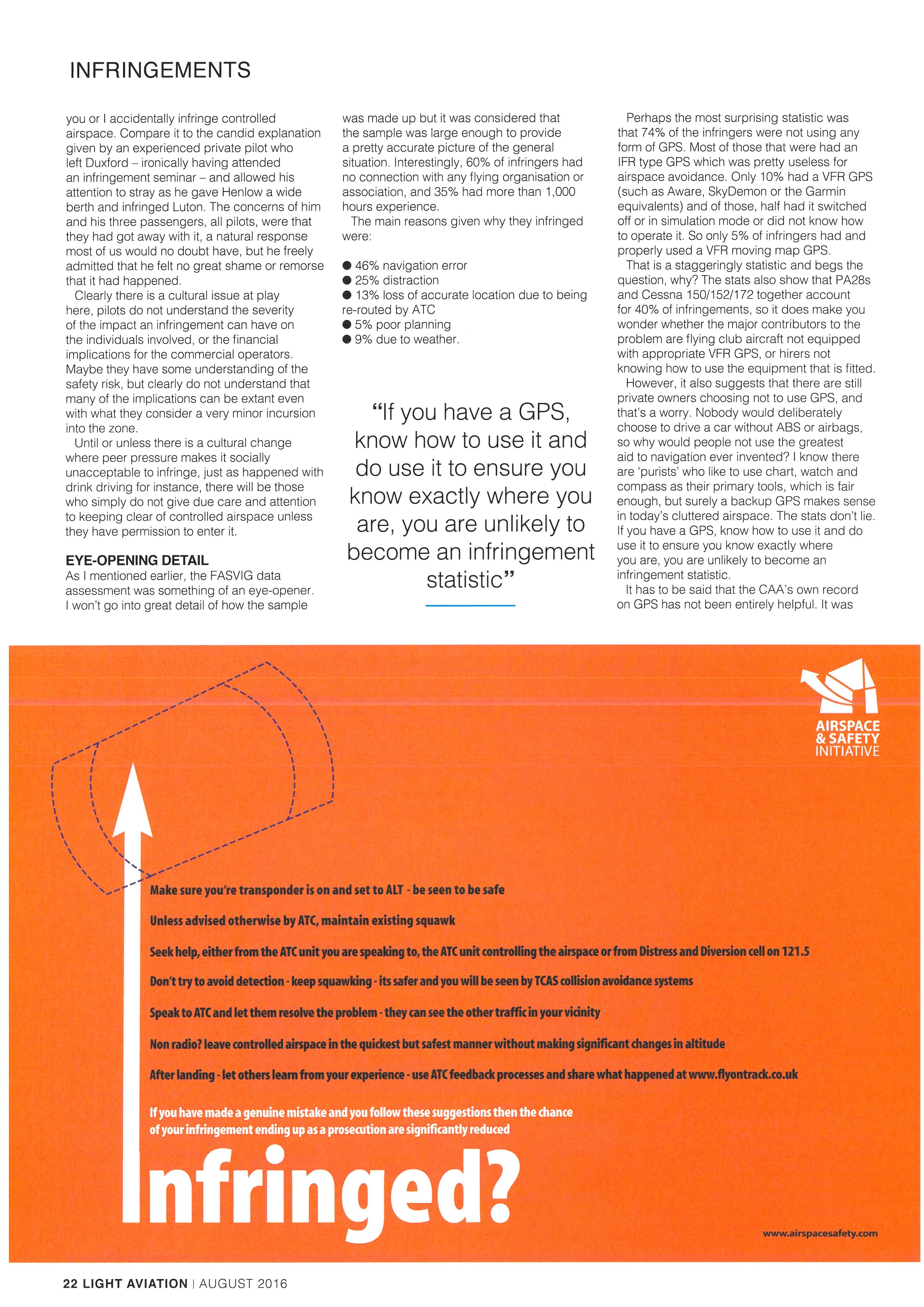
The main reasons given why they infringed were:
@46% navigation error
@ 25% distraction
@13% loss of accurate location due to being re-routed by ATC
@5% poor planning
@ 9% due to weather.
“If you have a GPS, know how to use It and do use it to ensure you know exactly where you are, you are unlikely to become an infringement Statistic”
Perhaps the most surprising statistic was that 74% of the infringers were not using any form of GPS. Most of those that were had an IFR type GPS which was pretty useless for airspace avoidance. Only 10% had a VFR GPS (such as Aware, SkyDemon or the Garmin equivalents) and of those, half had it switched off or in simulation mode or did not know how to operate it. So only 5% of infringers had and properly used a VFRmoving map GPS.
That is a staggeringly statistic and begs the question, why? The stats also show that PA28s and Cessna 150/152/172 together account for 40% of infringements, so it does make you wonder whether the major contributors to the problem are flying club aircraft not equipped with appropriate VFR GPS, or hirers not knowing how to use the equipment that is fitted. However, it also suggests that there are still private owners choosing not to use GPS, and that’s a worry. Nobody would deliberately choose to drive a car without ABS or airbags, so why would people not use the greatest aid to navigation ever invented? | know there are ‘purists’ who like to use chart, watch and compass as their primary tools, which is fair enough, but surely a backup GPS makes sense in today’s cluttered airspace. The stats don't lie. If you have a GPS, know how to use it and do use it to ensure you know exactly where you are, you are unlikely to become an infringement statistic.
It has to be said that the CAA’s own record onGPShasnotbeenentirelyhelpful.Itwas
long regarded as almost demonic and not to be relied upon. Fitting uncertified hand-held units into a certified aircraft as a permanent fixture was also considered a definite no-no. Thankfully times are changing and the CAA is at last coming around to realise that in the real world, most recreational pilots use GPSfor their primary navigation and, at leastthose of us withalittle lessconfidenceintheinfallibilityof electronic technology (and |would say a dash more commonsense), draw a line on a paper chart and have a proper plog as back up. With 95% of infringers not using an appropriate GPS however, clearly there is still room for a sea change in attitudes towards GPS navigation in flight training and the use of non-certified units in certified aeroplanes.
GPS A 'MUST HAVE'
When the comments from the group sessions were combined, many of the conclusions were very similar. They certainly all latched onto the GPS issue and the use of GPS navigation was considered a ‘must have’ throughout the GA fleet.
Its use was also considered within the training role, both as part of the biennial flight check and as part of the PPLtraining syllabus (The Royal Institute of Navigation has several GPS training guides which can be found via www.rin.org.uk/News/GANG).
In fact, there was a fair consensus that the review flight should be more formalised rather than the current vague arrangement
“Class G is a diminishing asset and anybody who believes we are going to change that is living in cloud cuckoo land”
and contain elements that represent known problem areas online infringement tutorials and tests for instance.
The use of the Listening Squawks should also be more widespread. They are there for a purpose, to help not only the controllers become aware of a potential infringer, but to help the pilot should he become distracted. The biggest problem with an infringement is the unknown. If the infringer is in touch with the controller from an early point, the issue can be resolved very quickly with the least disruption and risk.
It should also be noted that planning flights very close to zone boundaries can be problematic. Far better to leave a bit of leeway between your track and the zone boundary, a) to alleviate the risk of brief inattention causing you to infringe, and b) because some GPS charts are not as absolutely accurate as they could be.
Communication between CAA and the GA community also needs to improve. Just as accident reports along the lines of ‘| learned about flying from that’ drive home the safety message in a highly readable format, it was felt that something similar with infringements might help. That communication also needs to be a constant, not an occasional mini campaign that fades into obscurity.
Inevitably the issue of electronic conspicuity came up and when asked if mandatory Mode Swas an option, not surprisingly a large majority rejected the idea. However, when the proposal was made that if a zero cost option that presented no technical issues was available, would that make mandating its use acceptable? Only a couple of people objected.
Personally | hope that attitude will be reflected in the broader GA community because it really is time we got real about airspace for GA. Class G is a diminishing asset, and anybody who believes we are going to change that is living in cloud cuckoo land. The way forward is for all airspace to become a known environment, and that has benefits that far outweigh any half-baked notions of a diminution of civil liberties.
lf we want the freedom to fly then we have to accept that conspicuity has a part to play in allowing us to share the airspace with other users. The time when we could have that conspicuity at zero cost is not far hence. How we react to mandating it will define GA’s future in the remainder of the 21st century. ®
Abbreviations
‘ astmonth|describedhow,although|haveworkedpretty well
continuously on my Skybolt project for 13 years now, there still remains some way to go until completion. Named Trio by my wife Sarah because it seems everything has been made three times, it has beena truelabouroflove.|think|mustbethearchetypalLAAaircraft builderwhoenjoysthebuildingasmuchas|hope | willenjoytheflying!
Here | am going to discuss making the windscreens, the carbon floor panels and the instrument panels, all components that | could probably have chosen a simpler route for but my desire to do it my own way led me down a more convoluted, but ultimately more satisfying path.
THE WINDSCREENS
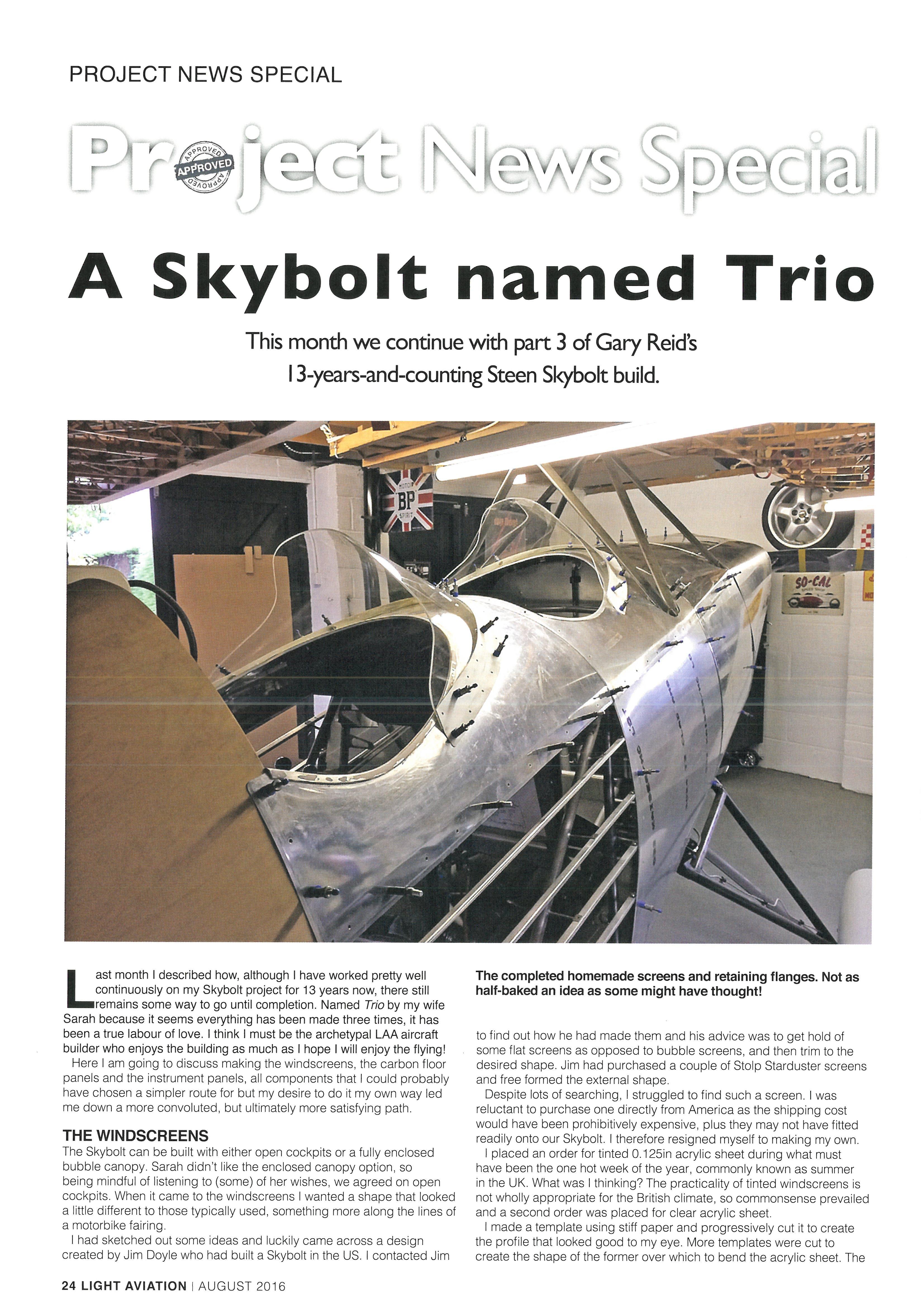
The Skybolt can be built with either open cockpits or a fully enclosed bubble canopy. Sarah didn’t like the enclosed canopy option, so being mindful of listening to (some) of her wishes, we agreed on open cockpits. When it came to the windscreens | wanted a shape that looked a little different to those typically used, something more along the lines of a motorbike fairing.
| had sketched out some ideas and luckily came across a design created by Jim Doyle who had built a Skybolt in the US. | contacted Jim
The completed homemade screens and retaining flanges. Not as half-baked an idea as some might have thought!
to find out how he had made them and his advice was to get hold of some flat screens as opposed to bubble screens, and then trim to the desired shape. Jim had purchased a couple of Stolp Starduster screens and free formed the external shape.
Despite lots of searching, | struggled to find such a screen. | was reluctant to purchase one directly from America as the shipping cost would have been prohibitively expensive, plus they may not have fitted readily onto our Skybolt. | therefore resigned myself to making my own.
| placed an order for tinted 0.125in acrylic sheet during what must have been the one hot week of the year, commonly known as summer in the UK. What was | thinking? The practicality of tinted windscreens is not wholly appropriate for the British climate, so commonsense prevailed and a second order was placed for clear acrylic sheet.
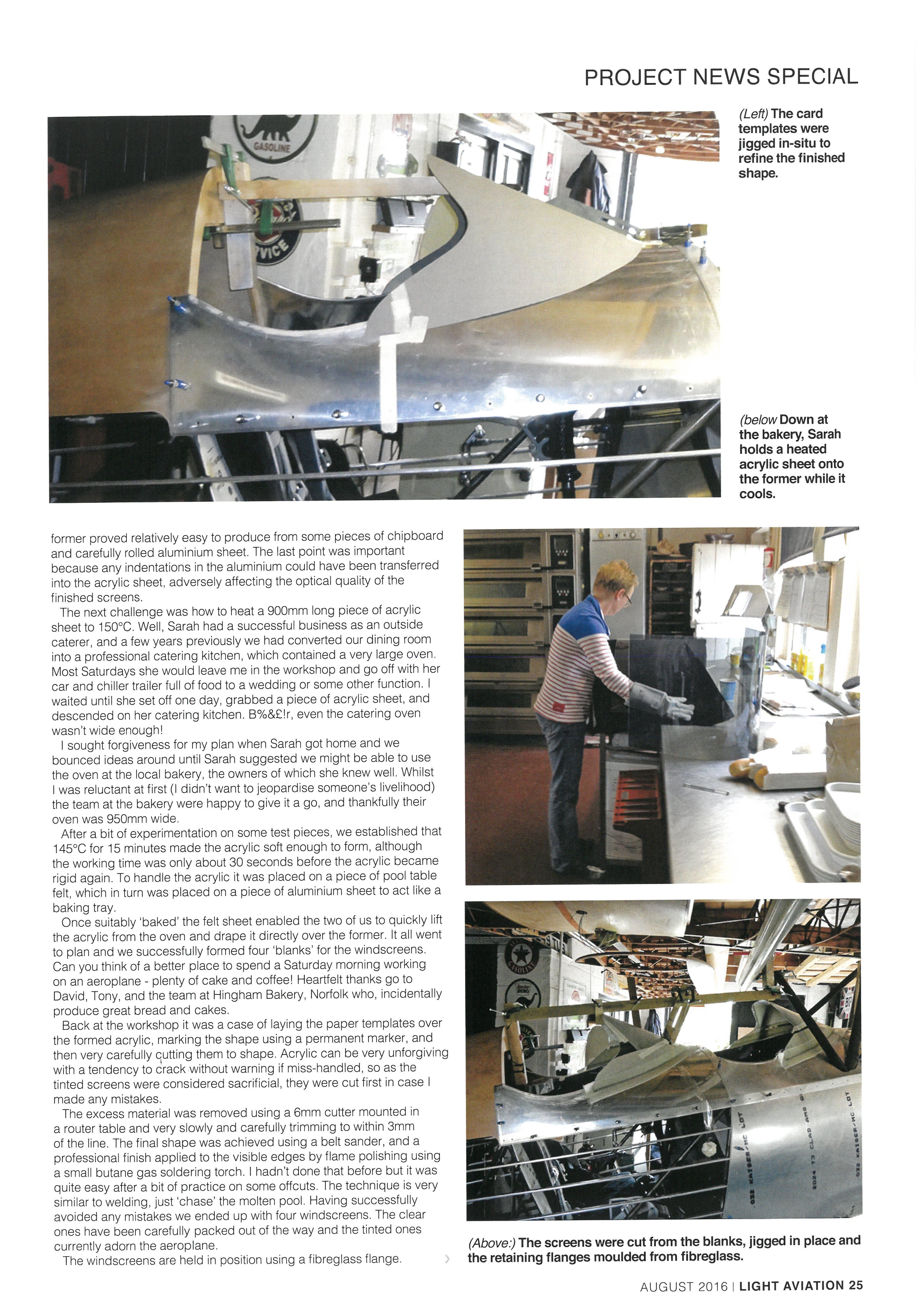
| made a template using stiff paper and progressively cut it to create the profile that looked good to my eye. More templates were cut to create the shape of the former over which to bend the acrylic sheet. The
former proved relatively easy to produce from some pieces of chipboard and carefully rolled aluminium sheet. The last point was important because any indentations in the aluminium could have been transferred into the acrylic sheet, adversely affecting the optical quality of the finished screens.
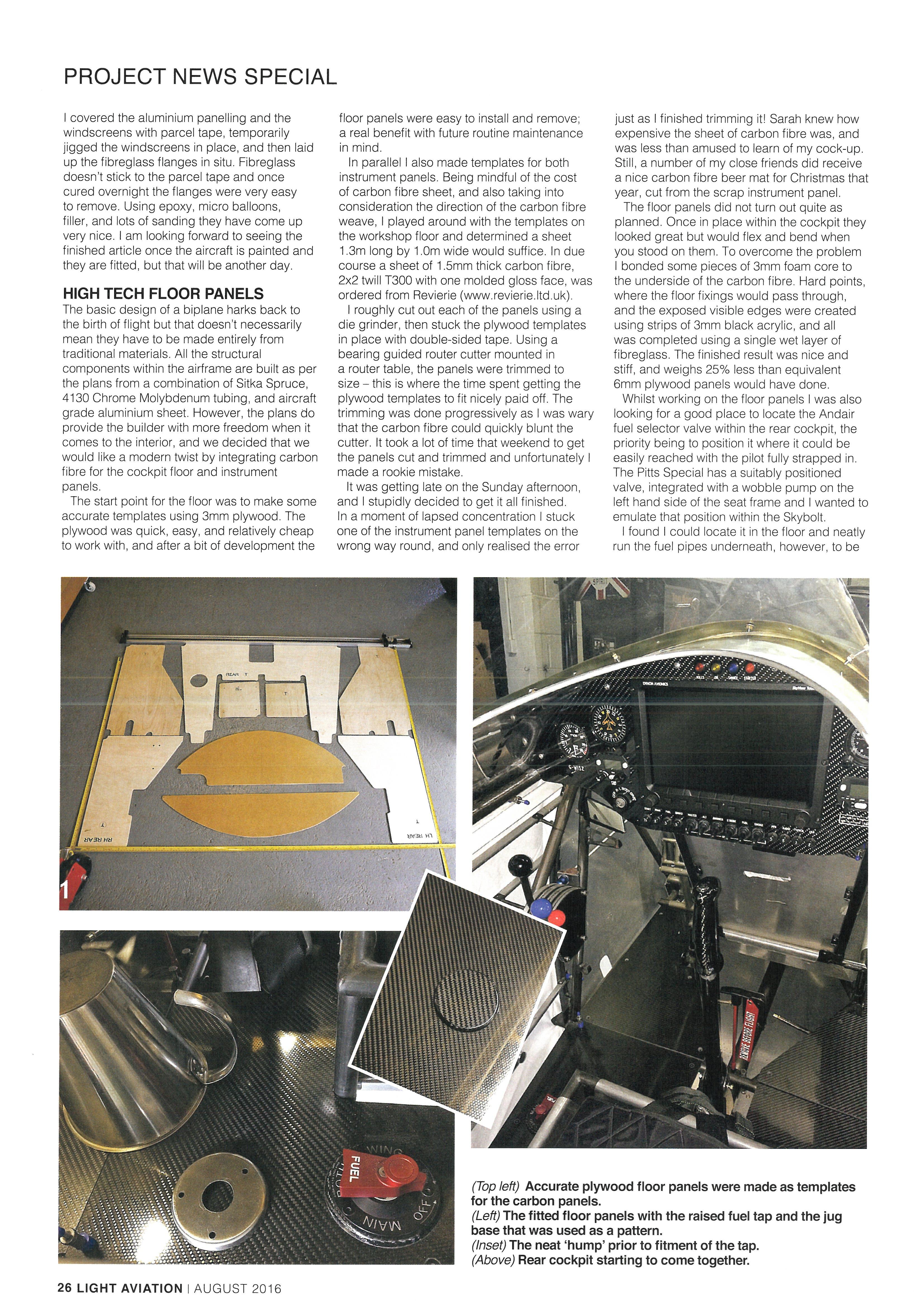
The next challenge was how to heat a 900mm long piece of acrylic sheet to 150°C. Well, Sarah had a successful business as an outside caterer, and a few years previously we had converted our dining room into a professional catering kitchen, which contained a very large oven. Most Saturdays she would leave me in the workshop and go off with her car and chiller trailer full of food to a wedding or some other function. | waited until she set off one day, grabbed a piece of acrylic sheet, and descended on her catering kitchen. B%&£!r, even the catering oven wasn't wide enough!
| sought forgiveness for my plan when Sarah got home and we bounced ideas around until Sarah suggested we might be able to use the oven at the local bakery, the owners of which she knew well. Whilst | was reluctant at first (| didn’t want to jeopardise someone's livelihood) the team at the bakery were happy to give it a go, and thankfully their oven was 950mm wide.
After a bit of experimentation on some test pieces, we established that 145°C for 15 minutes made the acrylic soft enough to form, although he working time was only about 30 seconds before the acrylic became rigidagain.Tohandletheacrylicitwasplacedona pieceofpooltable elt,whichinturnwasplacedona pieceofaluminiumsheettoactlikea baking tray.
Once suitably ‘baked’ the felt sheet enabled the two of us to quickly lift he acrylic from the oven and drape it directly over the former. It all went o plan and we successfully formed four ‘blanks’ for the windscreens. Can you think of a better place to spend a Saturday morning working on an aeroplane - plenty of cake and coffee! Heartfelt thanks go to David, Tony, and the team at Hingham Bakery, Norfolk who, incidentally produce great bread and cakes.
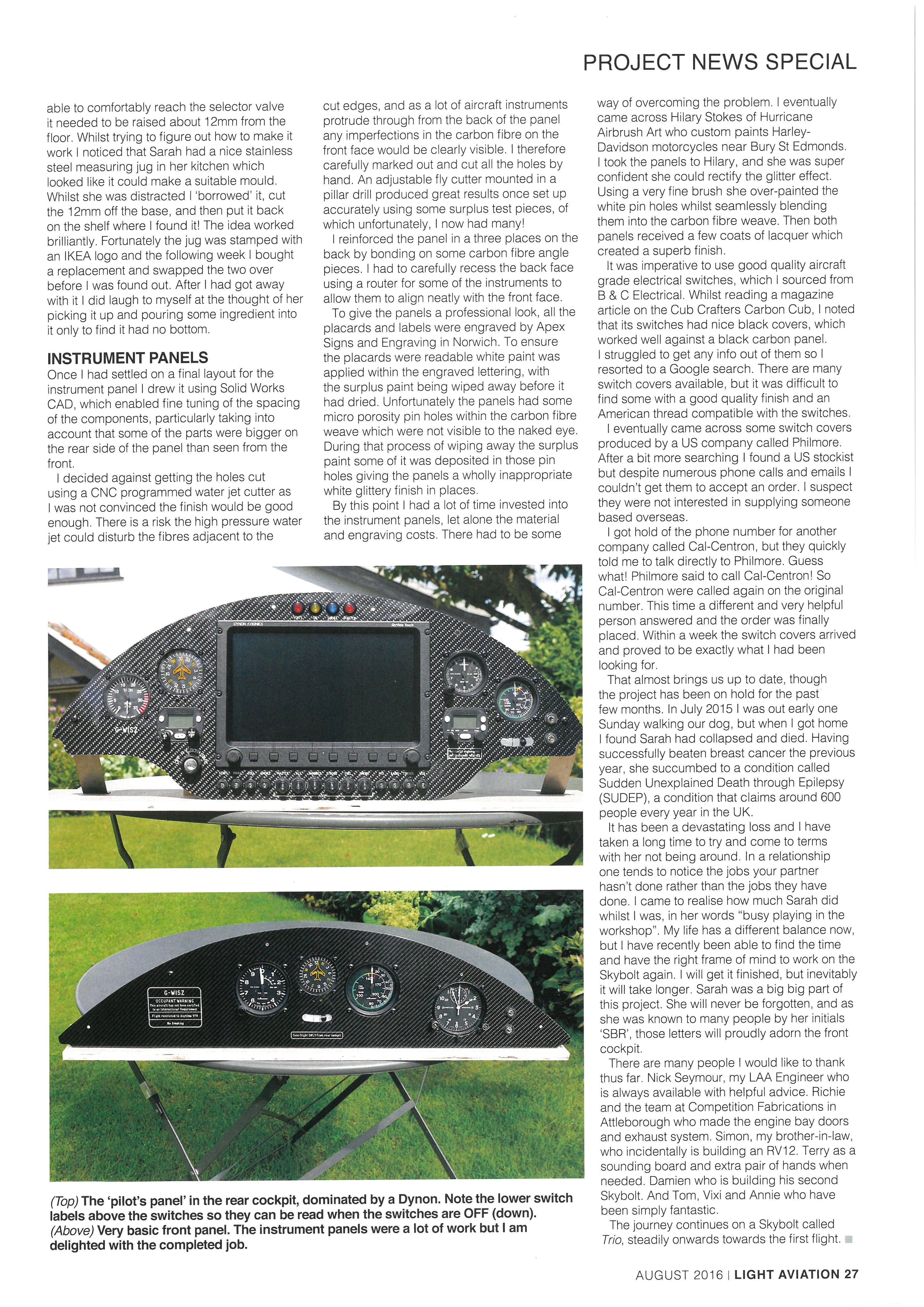
Back at the workshop it was a case of laying the paper templates over he formed acrylic, marking the shape using a permanent marker, and henverycarefullycuttingthemtoshape.Acryliccanbeveryunforgiving withatendencytocrackwithoutwarningifmiss-handled,soasthe inted screens were considered sacrificial, they were cut first in case | made any mistakes.
The excess material was removed using a 6mm cutter mounted in a router table and very slowly and carefully trimming to within 3mm of the line. The final shape was achieved using a belt sander, and a professional finish applied to the visible edges by flame polishing using a small butane gas soldering torch. | hadn’t done that before but it was quite easy after a bit of practice on some offcuts. The technique is very similar to welding, just ‘chase’ the molten pool. Having successfully avoided any mistakes we ended up with four windscreens. The clear ones have been carefully packed out of the way and the tinted ones currently adorn the aeroplane.
The windscreens are held in position using a fibreglass flange.
PROJECT NEWS SPECIAL
(Left)The card templates were jigged in-situ to refine the finished shape.
(belowDown at the bakery, Sarah holds a heated acrylic sheet onto the former while it cools.
PROJECT NEWS SPECIAL
| covered the aluminium panelling and the windscreens with parcel tape, temporarily jigged the windscreens in place, and then laid up the fibreglass flanges in situ. Fibreglass doesn’t stick to the parcel tape and once cured overnight the flanges were very easy to remove. Using epoxy, micro balloons, filler, and lots of sanding they have come up very nice. | am looking forward to seeing the finished article once the aircraft is painted and they are fitted, but that will be another day.
HIGH TECH FLOOR PANELS
The basic design of a biplane harks back to the birth of flight but that doesn’t necessarily mean they have to be made entirely from traditional materials. All the structural components within the airframe are built as per the plans from a combination of Sitka Spruce, 4130 Chrome Molybdenum tubing, and aircraft grade aluminium sheet. However, the plans do provide the builder with more freedom when it comes to the interior, and we decided that we would like a modern twist by integrating carbon fibre for the cockpit floor and instrument panels.
The start point for the floor was to make some accurate templates using 3mm plywood. The plywood was quick, easy, and relatively cheap to work with, and after a bit of development the 26 LIGHT AVIATION | AUGUST 2016
floor panels were easy to install and remove; a real benefit with future routine maintenance in mind.
In parallel | also made templates for both instrument panels. Being mindful of the cost of carbon fibre sheet, and also taking into consideration the direction of the carbon fibre weave, | played around with the templates on the workshop floor and determined a sheet 1.3m long by 1.0m wide would suffice. In due course a sheet of 1.5mm thick carbon fibre, 2x2 twill T300 with one molded gloss face, was orderedfromRevierie(www.revierie.td.uk).
| roughly cut out each of the panels using a die grinder, then stuck the plywood templates in place with double-sided tape. Using a bearing guided router cutter mounted in a router table, the panels were trimmed to size this is where the time spent getting the plywood templates to fit nicely paid off. The trimming was done progressively as | was wary that the carbon fibre could quickly blunt the cutter. It took a lot of time that weekend to get the panels cut and trimmed and unfortunately | made a rookie mistake.
It was getting late on the Sunday afternoon, and | stupidly decided to get it all finished. In amoment of lapsed concentration | stuck one of the instrument panel templates on the wrong way round, and only realised the error
just as | finished trimming it! Sarah knew how expensive the sheet of carbon fibre was, and was less than amused to learn of my cock-up. Still, a number of my close friends did receive a nice carbon fibre beer mat for Christmas that year, cut from the scrap instrument panel.
The floor panels did not turn out quite as planned. Once in place within the cockpit they looked great but would flex and bend when you stood on them. To overcome the problem | bonded some pieces of 3mm foam core to the underside of the carbon fibre. Hard points, where the floor fixings would pass through, and the exposed visible edges were created using strips of 3mm black acrylic, and all was completed using a single wet layer of fibreglass. The finished result was nice and stiff, and weighs 25% less than equivalent 6mm plywocd panels would have done.
Whilst working on the floor panels | was also looking for a good place to locate the Andair fuel selector valve within the rear cockpit, the priority being to position it where it could be easily reached with the pilot fully strapped in.
The Pitts Special has a suitably positioned valve, integrated with a wobble pump on the left hand side of the seat frame and | wanted to emulate that position within the Skybolt. | found | could locate it in the floor and neatly run the fuel pipes underneath, however, to be
able to comfortably reach the selector valve it needed to be raised about 12mm from the floor. Whilst trying to figure out how to make it work | noticed that Sarah had a nice stainless steel measuring jug in her kitchen which looked like it could make a suitable mould. Whilst she was distracted | ‘borrowed’ it, cut the 12mm off the base, and then put it back on the shelf where | found it! The idea worked brilliantly. Fortunately the jug was stamped with an IKEA logo and the following week | bought a replacement and swapped the two over before | was found out. After | had got away with it | did laugh to myself at the thought of her picking it up and pouring some ingredient into it only to find it had no bottom.
INSTRUMENT PANELS
Once|hadsettledonafinal layoutforthe instrument panel | drew it using Solid Works CAD, which enabled fine tuning of the spacing of the components, particularly taking into account that some of the parts were bigger on the rear side of the panel than seen from the front.
| decided against getting the holes cut using a CNC programmed water jet cutter as | was not convinced the finish would be good enough. There is a risk the high pressure water jet could disturb the fibres adjacent to the
cutedges,andasalot ofaircraftinstruments protrude through from the back of the panel any imperfections in the carbon fibre on the front face would be clearly visible. | therefore carefully marked out and cut all the holes by hand. An adjustable fly cutter mounted in a pillar drill produced great results once set up accurately using some surplus test pieces, of which unfortunately, | now had many! | reinforced the panel in a three places on the back by bonding on some carbon fibre angle pieces. | had to carefully recess the back face using a router for some of the instruments to allow them to align neatly with the front face.
To give the panels a professional look, all the placards and labels were engraved by Apex Signs and Engraving in Norwich. To ensure the placards were readable white paint was applied within the engraved lettering, with the surplus paint being wiped away before it had dried. Unfortunately the panels had some micro porosity pin holes within the carbon fibre weave which were not visible to the naked eye. During that process of wiping away the surplus paint some of it was deposited in those pin holes giving the panels a wholly inappropriate white glittery finish in places.
Bythispoint|hadalot oftimeinvestedinto the instrument panels, let alone the material and engraving costs. There had to be some
way of overcoming the problem. | eventually came across Hilary Stokes of Hurricane Airbrush Art who custom paints HarleyDavidson motorcycles near Bury St Edmonds. | took the panels to Hilary, and she was super confident she could rectify the glitter effect. Using a very fine brush she over-painted the white pin holes whilst seamlessly blending them into the carbon fibre weave. Then both panels received a few coats of lacquer which created a superb finish.
Itwas imperative to use good quality aircraft grade electrical switches, which | sourced from B &C Electrical. Whilst reading a magazine article on the Cub Crafters Carbon Cub, | noted that its switches had nice black covers, which worked well against a black carbon panel. | struggled to get any info out of them so | resorted to a Google search. There are many switch covers available, but it was difficult to find some with a good quality finish and an American thread compatible with the switches. | eventually came across some switch covers produced by a US company called Philmore. After a bit more searching | found a US stockist butdespitenumerousphonecallsandemails | couldn't get them to accept an order. | suspect they were not interested in supplying someone based overseas.
| got hold of the phone number for another company called Cal-Centron, but they quickly told me to talk directly to Philmore. Guess what! Philmore said to call Cal-Centron! So Cal-Centron were called again on the original number. This time a different and very helpful person answered and the order was finally placed. Within a week the switch covers arrived and proved to be exactly what | had been looking for.
That almost brings us up to date, though the project has been on hold for the past few months. In July 2015 | was out early one Sunday walking our dog, but when | got home | found Sarah had collapsed and died. Having successfully beaten breast cancer the previous year, she succumbed to a condition called Sudden Unexplained Death through Epilepsy (SUDEP),a condition that claims around 600 people every year in the UK.
It has been a devastating loss and | have taken a long time to try and come to terms with her not being around. In a relationship one tends to notice the jobs your partner hasn't done rather than the jobs they have done. | came to realise how much Sarah did whilst | was, in her words “busy playing in the workshop”. My life has a different balance now, but | have recently been able to find the time and have the right frame of mind to work on the Skybolt again. | will get it finished, but inevitably it will take longer. Sarah was a big big part of this project. She will never be forgotten, and as she was known to many people by her initials ‘SBR’, those letters will proudly adorn the front cockpit.
There are many people | would like to thank thus far. Nick Seymour, my LAA Engineer who is always available with helpful advice. Richie and the team at Competition Fabrications in Attleborough who made the engine bay doors and exhaust system. Simon, my brother-in-law, who incidentally is building an RV12.Terry as a sounding board and extra pair of hands when needed. Damien who is building his second Skybolt. And Tom, Vixi and Annie who have been simply fantastic.
The journey continues on a Skybolt called Trio,steadily onwards towards the first flight.
arlier this year, the well-known UK Poly-Fiber materials company, Aircraft Coverings, was bought by father and son team Chris and Alex Allen from founder and long-time owner Tony Young.
A helicopter and aeroplane pilot, Tony started an aviation company called Alycopters Ltd in 1965,flying helicopters and charter aircraft. While in California in 1989, collecting a recently purchased aircraft for restoration, he was recommended to use Stits for the re-cover.
After struggling to obtain supplies here in UK, on a return trip to Flabob airfield in California, he got chatting to Ray Stits, who produced the covering system that would later be renamed Poly-Fiber, and by the time the visit had finished, Tony was the UK and European distributor!
With the help of eldest daughter Annabel, who looked after ordering, paperwork and accounts, the Aircraft Coverings business grew. Tony displayed at, and introduced the first covering workshop at the Wroughton PFARally in around 1991. Tony and his team have been running the training and demonstration covering workshop at our annual Rally ever since.
Over the years Poly-Fiber has become the world’s, and the UK’s most popular fabric covering system. Naturally, many people are nervous of covering an aeroplane, but after doing so say they found the Poly-Fiber process not only surprisingly easy, but also the most satisfying aspect of the whole build or restoration. Heat shrink synthetic fabric and non-shrinking finishing materials have removed much of the the worry from traditional linen and dope covering processes, plus the life expectancy of the materials is considerably longer.
After covering with fabric and heat shrinking, a brush coat of Poly-Brush is then applied. Next the cable outlets, drain grommets, inspection holes and rib stitching, followed by taping. From here on it is all spraying. Two coats of Poly-Brush then three coats of PolySpray for UV protection and then three top coats. That’s a nine-coat system, far less than a traditional dope system. The result will be a very smart and a well-protected aeroplane that won't crack over time and will look as good in 20 years as the day it was put on.
ByNeil Wilson
Chris Allen first met Tony in 1991, not long after having learned to fly. They shared a Luscombe and spent four and a half years re-building it, along with Tony’s then apprentice (now FAA licenced engineer) Justin Cox. Chris then progressed onto his commercial licence and a career in flying corporate aircraft. He has also been helping Tony with the Rally fabric workshop for many years, so when Tony mentioned he was looking to slow down and sell the business, Chris was interested as he
was looking himself to move to pastures new. At the same time his son, Alex, was coming to the end of an automotive design course at Coventry University. Alex had also been lending a hand at the Rally for a few years, had worked for a classic car restoration company, and previously worked for Ricky Abel at Henstridge, where he learned to paint aircraft.
With them both having known Tony and the business for some years, as well as knowing many of the clients, things all fell
eeeeeeee eee
mixing cabinet.
IT’S A WRAP!
into place late in 2015 and the deal was done.
Tony will work alongside both Chris and Alex for a while, as theyget to know the business, which is still based at Henstridge Airfield. Both Chris and Alex noted very early in their relationship with Tony how important good customer relations are. They're very keen to maintain the high standard set by Tony in giving advice, following up clients’ issues and concerns and helping the builder/restorer through the entire process.
Chris says, “Don’t be afraid to phone us if you need help, and that includes evenings or weekends - we understand this is the most likely time you will be working on your aeroplane. In the unlikely possibility that we can’t answer your query we will contact the Poly-Fiber factory, which provides excellent technical support. | doubt there is a question they haven't answered before.”
TECHNICAL TRAINING
Chris and Alex visited the Poly-Fiber Factory late last year for a week's training, going through the entire production process, from the mixing of the products, the inspection and distribution aspects and meeting most of the factory staff. They also received technical training in the covering process.
“We covered some T6 components and some training frames several times over. We used all of the Poly-Fiber products used in the covering process. This included airframe preparation and epoxy coating; bonding and covering; heat forming and shrinking the fabric; rib stiching; applying finishing tapes and mechanical fixings; and spraying all the liquids materials,
both in a booth and outside. We were even encouraged to apply coats incorrectly to learn the boundaries and how to correct those mistakes. It was a very thorough and invaluable week's training”.
Back at base in the UK, a good level of stock is maintained and if you order before mid-day, the product should be delivered by Fedex the next day. All paints are mechanically shaken before dispatch.
Aircraft Coverings can supply a Poly-Fiber Instructional manual and training DVD which contain just about all the information you are ever likely to need. Practice kits, consisting of a simplified manual, a wooden frame, fabric, Poly-Tack, Poly-Brush, Poly-Spray, a rib
stitching kit, and a thermometer to calibrate electric iron temperatures, are also available for those who would like to try the process first. Stocks of reinforcing tape, anti-chaff tape, grommets, rib lace cord both round and flat types, as well as four types of rib stitching needles are all kept in stock, as well as the light/medium/and heavy fabric itself. This is on a dispenser, so can be cut to length as required.
The Allen’s are in the process of securing hangarage at Henstridge which will enable them to expand the business and reach new customers. Training workshops are being developed, which will involve taking you through the process from A-Z using a bespoke demonstration frame. They are currently sourcing a spray booth so customers can get some hands on spraying experience within that package. They are also now available to offer a re-covering service.
As one of the LAA’s longest supporters at both the Rally and our magazine advertising, itis great to see new owners continuing the superb and friendly service provided by Tony and Annabel Young for over 25 years. We wish Chris and Alex well as they take the company forward in the years ahead.
The basic covering products. Aircraft Coverings hold good stocks and can provide a next day service.
Poly-Fiber is part of Consolidated Aircraft Coatings, and their President John Goldenbaum, has also been a regular at our Rally over the years. He will be travelling over again this year, and will be in the fabric workshop area. Please call in and say hello to Chris, Alex and John and have a go at fabric covering, it’s surprisingly therapeutic! www.aircraficoverings.co.uk
IKARUS
OIL FILTER MOD
his article describes a specific modification fitted to the Continental O-200 engine in our Wittman Tailwind G-BPY4J,and the process of getting it authorised by LAA Engineering to enable installation. However, the modification would be suitable for other LAA members to use. This is a further development based on PFA MOD 11144 back in August 2005 by Steve Brown and Mike Roper on their Vari-Eze G-VEZE. Their mod has an adapter that screws into the existing Continental oil screen housing, whereas | have designed and manufactured a spin-on oil filter adapter that is a direct bolt-on replacement for the complete Continental oil
(Above) This is what the oil filter conversion looks likewhen installed. As Slick magnetos are fitted, there is room for the full-size aircraft oil filter to be used.
screen housing assembly.
This new adapter has the provision to mount the oil temperature sensor and use the tried and tested Champion CH48108 aviation oil filter or, where installation space is on the tight side, either the automotive Champion C138 or the Blue print ADT32109 oil filter, both of which are LAA approved. It is worth noting that the
C138 is getting hard to come by, however both of these automotive filters have the same fit, form and function and when either is used the total length of the filter and adapter assembly protrudes rearwards less than the adjacent Slick magnetos.
Currently the most popular spin-on oil filter adapter is made by F&M Enterprises. LAA members have been fitting these to their Continental engines via LAA/MOD 13 as it is already covered by an STC (Supplemental Type Certificate). This adapter is attached to the oil cooler mounting pad on the rear lefthand side of the Continental O-200 and like engines. However, the F&M Enterprise filter
This is what the completed adaptor looks like. Note oil temperature outlet fitting is side mounted which means, unlikethe standard arrangement, it does not have to be disturbed when doing an oil change.
adapter is currently not in manufacture. Although | could have fitted a secondhand F&M filter adapter at 3.23lb, my new design oil filter adapter is almost half the installed weight (1.73lb) with the aviation filter, or one third of the weight (0.73lb) if we used the smaller automotive oil filter. The lower installed weight is partly due to the complete removal of the oil screen housing assembly which weighs over one pound - why add more weight than you have to!
STANDARD FITMENT
worked well for years. However, given the cost of engine rebuilds, any improvement in keeping the oil clean by having fewer particles circulating and causing wear to our plain bearings and expensive crankshafts, can only be a move in the right direction. After all, full flow paper elements have been used in cars and motor cycles for many years and are already used in Rotax and Jabiru engines. Also, with better oil filtration, you can extend the oil changes to 50 hours, so it is better for the environment too.
either no alternator, or a lightweight B&C type alternator fitted with Slick mags when using the CH48108 oil filter or the automotive oil filters. If you have Bendix mags and/or the standard huge and heavy Continental dynamo, then you can only fit the smaller automotive oil filters. The adapter cannot be fitted with the large Continental alternator. Ifthere was enough interest, | could design an oil filter adapter for an A65, C85-8 or C90-8.
The standard oil screens and mesh fitted to Continental and Lycoming engines have
This modification is suitable (subject to LAA Approval) for the O-200, C90, C85, C75, (-12 -14 -16) series Continental engines with
Amodificationinitialproposal(usingLAA/ MOD 2) was duly made in August 2014 and thenamodificationapplication(usingLAA / MOD 3). The forms can be found on the LAA website though the onus is very
cn emerae a a TEaE a ND EBAROREEDBESESE FI SEE
The standard arrangement with gauze filter. It has been said that itwill stop particles large enough to have part number stamped on them. A modern paper cartridge filter is a considerable improvement.
much on the proposer to draw up, justify and communicate the modification to the LAA ina professional way.
The purpose of our modification was primarily to improve the filtering of the oil to the engine and thus reduce engine wear caused by oilborne particles passed by the original coarse mesh oil screen.
In addition, a by-pass valve incorporated in the selected cartridge filters operates if the paper element becomes blocked. This adds a level of safety for the engine that did not exist before. Also an anti-drain back valve is built-in into the cartridge filter which means that positive oil pressure can be achieved sooner on start-up, and at a reduced installed weight compared to the F&M adaptor.
The standard Continental oil screen housing and the redundant brass oil screen are replaced by the new adapter, which is secured by using the existing three housing studs and is sealed to the rear accessory case by the standard Continental fibre gasket.
Since the oil temperature sensor normally screws into the end of the big brass oil screen cap flanged bolt, an alternative position had to be found. The new oil filter adapter was drilled and tapped 3/8 BSP (British Standard Pipe) to take a standard 3/8 BSP brass nipple which allows the temperature sensor to be mounted. The brass nipple can be changed to suit any relative temperature sensor being used.
One benefit of repositioning the temperature sensor is that it no longer needs to be disturbed when changing the oil filter cartridge. The oil filter cartridge will be renewed at the same frequency as is recommended by Continental (ie, 50 hours max).
In accordance with standard practice, the replaced cartridge will be cut open to assess engine wear from any accumulation of particles trapped by the filter.
STRESSING ANALYSIS
Stress analysis was undertaken with hand calculations to ensure that the adapter was sufficiently strong to take the loading that it would see when attached to the rear engine case. We have taken into account the following factors for the stressing requirement.
Aluminium has a nominal UTS (Ultimate Tensile Strength) of around 30,000psi. This wasreducedbya factorofthreesothatstress levels from the engine vibration would be below the fatiguing level for aluminum. In other words, be below the s/n curve (stress over number of cycles) for the given material.
A further reduction by a factor of three was to take into account stress concentration due to changes in material cross section and surface finish, so this now means that the max material allowable stress must be reduced to 3,333psi from 30,000psi.
The load is generated on the adapter body at 1g due to the weight of the large CH48108 oil filter and the oil within it. This load is reacted at the attachment points and produces a pessimistic stress of 164psi, this was then factored by 3.8g for the design load case (pulling positive g) and then factored by 1.5 for ultimate load (factor of safety), the applied load now coming to 935psi. So, as long as the applied load is less than the material allowable, it will pass.
Material allowable 3,333psi divided by the applied load of 935psi equals 3.6 Rf (Reserve factor). Therefore, being greater than one, it is a pass.
MANUFACTURE
The adapter was machined by myself on my trusty Myford lathe from a single piece of aluminum (6082-T6) ensuring smooth radii at all junctions to reduce risk of stress cracks occurring.
The profiled triangle mounting flange was done on my converted CNC manual beaver miller. The main adapter body had an anodised finish before being fitted with a permanently mounted 3/4in x 16 UNC threaded steel hollow screw for the filter to screw onto, this was manufactured from a HTS(high tensile steel) bolt.
INSTALLATION
The adapter was installed, along with the CH48108 oil filter which is safety-wired to the adapter around the temperature sensor mounting boss. The smaller automotive oil filters require a jubilee clamp around the filter case to wire lock to. An engine ground run was carried out. The installation was then checked by our inspector Ken Davis, and a PMR (Permit Maintenance Release) was submitted to LAA Engineering.
After obtaining a Permit to Test in May 2015, a successful flight test was carried out to show that the engine temperatures and pressure remained within limits, these results were then submitted to the LAA. Full approval for the modification (Mod 13917) was obtained from LAA Engineering in November 2015. Since then the modification has performed flawlessly and we feel the engine is benefitting considerably from it. It is quite noticeable that the oil seems cleaner and the oil temperature has come down due to the additional surface area of the filter can.
FILTERS
| have chosen to use the aerospace standard Champion CH48108 due to the known standards. Although this is bigger and heavier than the automotive alternative, it does offer a bigger surface area so this should help with oil cooling. Also further cooling can be gained by blasting cooling air at the filter case.
The adapter has been stressed for the heavier filter so that the lighter and smaller automotive filters (C138 & ADT32109) can be fitted without any re-stressing issues. | do plan to use the smaller automotive oil filters at the next oil change just to see if | can notice any change in oil temperature.
MODIFICATION ROUTE
Although this modification is only for a one-off installation on G-BPYJ, due to the interest from LAAmembers|havenowproduced a batchof ten oil filter adapters for sale, of which | have seven left. | am more than happy to help LAA members through the Mod 2&3 paperwork to get this adapter fitted to their aircraft. If this adapter has already been fitted to the same airframe-engine type, then you just need to go down the Repeat Mod route, Mod 11. In the future | would like to see this filter adapter be available to LAA members via a Standard Mod (Mod 1)for Continental engines, just in the same way that there are standard mods for Jabiru and Rotax engines, as shown on the LAA Engineering website. However, if the airframe has to be modified (the battery box needs moving for instance) then the Mod 2&3 route has to be followed.
lf you are interested in using this modification, then | suggest you discuss this first with
IF YOU HAVE an F&M oil filter adapter fitted then you may want to check out what is INSIDE the oil screen housing. When fitting an F&M filter adapter, the installation instruction calls for the brass screen to be de-soldered from the oil screen assembly, which will then make it compliant with the STC. However the removal of the brass oil screen by de-soldering isa one-way trip and | know of some installations where this action has not been undertaken, intentionally or not.
Leaving the screen inwill restrictthe oil flow and will show up as a reduction in oil pressure. However this may not be apparent at first ifthe installationis carried out during warmer weather, but come cooler weather the oil pressure will show a drop and reduced oil pressure is not good for any engine.
Ifyou have intentionally left the brass screen in place then you have to remember to check
and clean it along with replacing the spin-on oil filter atthe allotted oil change intervals.This may all be good and well for you. However if you come to sell the aircraft then you will need to let the new owner know how to carry out the oil changes. Ifthe new owner of the aircraft is unaware that the oil screen is still in position and only changes the oilfilter, then over a period of time the oil screenwill become more restrictive to the oil flow and will result in reduced oil pressure.
COVER PLATE
| can offer an oil screen housing assembly cover plate (only to be used with the F&M adapter) which allows the complete removal of the oil screen housing assembly with a weight saving of more than 0.75lb.The cover plate also has a boss to mountthe oll temperature sensor (see photo below).
your inspector who can guide you to use the appropriate mod process. | would like to thank LAA Engineering for their assistance with approving this worthwhile modification and for providing a defined, easy to follow (if you read the LAA information available), professional, transparent and auditable procedure.
Julian Mills is a time-served British aerospace apprentice (Woodford) with a PPL (A) and PPL(H). He is currently a design engineer for Jamtech Engineering, and has been a CAA approved welder since 2000. He is also the designer and builder of single-seat helicopter G-OMHI. E:jpm.aviation@gmail.com T: 07967 530563.
Fast-build and fast in the air, the GlassairIIlrevolutionisedthe ~ kitplaneindustry!Wordsand imagesbyJustynHope
ffered by Stoddard-Hamilton in 1986, the Glasair III was one of the most popular kit-built light aircraft in the US for many years. Interestingly,it was the very first composite aircraft kit to offer a pre-moulded fuselage, wing and tail shells and provide a reduced building process compared with other composite kits on the market. Fitted with a 300hp Lycoming IO-540, it offered a cruise speed in excess of 265mph.
THE MAKER: STODDARD-HAMILTON
Stoddard-Hamilton Aircraft, based in Arlington, Washington, was founded by Tom Hamilton, a designer and supplier of highperformance homebuilt aircraft kits, initially offering parts and plans to builders. In 1979, Hamilton began flight testing the 115hp Glasair TD which was later offered in both tailwheel and tricycle configuration. He would later use the lessons learned from this aircraft to build the subsequent Glasair series of homebuilt aircraft initially offered to customers as kits at Oshkosh in 1980.
In 1983, the retractable tricycle version, the Glasair RG, was introduced and at the same time a significantly improved level of kit. Three years later, in 1986, with around 700 kits already underway, Glasair offered the improved Glasair II which featured a cantilever low-wing, two seats side-by-side in an enclosed cockpit accessed via gull-winged doors, fixed or retractable tricycle landing gear or fixed tailwheel landing gear.
The same year also saw the introduction of the Glasair III, an improved variant with a retractable landing gear and powered by a 300hp Lycoming IO-540-K1H5 engine. Larger-engine models were later introduced, with D2
FLIGHT TEST
the Glasair Ill Turbo capable of speeds in excess of 8300mph.
In the mid-1990s, Glasair introduced the Glastar, a high-wing, short-field capable utility aircraft with two seats and a foldable Wing.
In 2001, Thomas W Wathen purchased the assets of the Glasair from the bankrupt Stoddard-Hamilton Aircraft and later acquired the assets and rights to the Glastar. New Glasair combined with New GlaStar and continued production of the Glasair and GlaStar kits at the Arlington factory. In July 2012, the company became Chinese-owned and Glasair Aviation USA LLC continues to market both high- and low-wing designs under the Glasair Aviation name.
THE OWNER: MATT WALSH
37-year-old Matt Walsh is proprietor of Elite Aircraft Services, a successful and rapidlygrowing aircraft management organisation based at Raleigh-Durham International Airport in the US, with its maintenance and operations based at the nearby, if somewhat extravagantly-named, Raleigh Executive Jetport at Sandford.
In addition, Matt is a partner in Legacy Warbirds, an organisation supplying customers with a variety of various warbird designs including Pilatus PC-6 Turbo Porter, PC-7, PC-9 along with a number of other projects currently underway.
Matt learned to fly at Western Michigan University way back in 1999. Since then has accumulated well over 10,000 hours most of it instructing on single engine aircraft. He learned aerobatics at Western Michigan Universityandwentontobecomeafull time instructor on the Extra 300, where he refined his love of aerobatics along with his techniques and skills. Undercarriage just protrudes a little into the airflow when retracted but otherwise it's a clean ship.
WHY BUY THE GLASAIR?
In truth, Matt Walsh has been infatuated with the Glasair designs for as long as he can remember. He fondly remembers drawing them in art classes at school. He continued to seek out every Glasair that he could find at the various air shows he attended and now has a photographic library of the various modifications completed on so many of them.
With his busy schedule at Elite and Legacy, he acquired N311RH as a business tool for getting to meetings, assessing aircraft and meeting customers. The Glasair III provides Matt with ‘turboprop speeds on a beer budget’ 220 knots burning around 10 US gallons an hour. It provides everything Matt needs and satisfies his boyhood dream of actually owning a Glasair! The US aviation environment does the rest by providing lots of long, hard runways dotted all over the vast country.
THE AIRCRAFT: N311RH
Matt had searched for a Glasair III for more than a year and looked at numerous examples during that time. Matt is a meticulous individual and the build quality of all those he looked at did not meet his exacting demands. N311RH is a model SH-3R with serial number 3247. The aircraft was built by Richard Haas, an experienced homebuilder with a number of Glasair Ills under his belt. N311RH was his own aircraft and was not for sale. He had built the aircraft with help from his son and it had taken 12years to complete, eventually making its maiden flight in 2007.
Matt arranged to inspect the aircraft at the builder's workshop in Michigan on the way home from the EAA AirVenture one year and was impressed with both. They talked price and eventually came to an agreement, but shortly afterwards Richard decided he couldn't sell it. After Oshkosh, Matt sat down and wrote
a two-page letter explaining his boyhood dream of owning one and exactly why he wanted to buy N311RH. The letter impressed Richard and he finally agreed to sell it to Matt. The two have been good friends ever since. Without any Glasair IIItime, Matt organised for Bill Walker, an experienced military and civilian test pilot, to collect the aircraft from Michigan and fly it to Phoenix Composites (Glasair and Lancair builders, but since renamed Performance One) in Arizona for the windscreen modifications to be carried out, along with the annual condition report. The change of screen improved bird-strike resistance (a very real threat around the North Carolina coastline) as well as adding a few extra knots to the cruise speed.
HOW COULD | DECLINE!
| had first seen N311RH in the back of the maintenance hangar at Sandford, North Carolina (KTTA) around six months earlier. "Is it flying?" | asked Matt? With a clear smile he confirmed its airworthiness. "Do you fancy flying it?”he responded. How could | possibly declinesucha politeinvitation!
A couple of days later, with Ben Popp on hand to fly the Cirrus SR20 cameraship, Matt pulled N311RH out into the early-evening North Carolina sunshine for an air-to-air photoshoot over nearby Jordan Lake. Our flight together in the aircraft was planned for the following evening. The photoshoot went well and both aircraft were returned to their respective hangars with the evening light failing.
Early the following evening Matt and | reconvened at Sandford. N311RH was already sitting outside the hanger looking pristine. The highly polished finish probably adds a couple of knots to the already high-speed characteristics of the aircraft, and in the needfor-speed, every little bit clearly helps.
ON THE GROUND
First impressions of N311RH were of a sleek, attractive and functional design which belied its age. Clearly, the cockpit section had been raked and reduced in height, providing a further sensation of the aircraft’s sleek and speedy lines. | wondered ifthat would restrict the headroom inside the cockpit but | needn't have worried when | later discovered that the modification had been carefully carried out and did not impinge on the cockpit space.
Sitting on its neat and simple tricycle undercarriage, it looked relatively low to the ground - that height above the ground being clearly dictated by the powerful two-blade, 80-inch diameter, Hartzell constant-speed ‘J-blade’ propeller made specifically for the Glasair. The cowling has been carefully designed to minimise aerodynamic drag while still providing sufficient air flow to cool the engine in the hot weather often experienced in many parts of the US, including North Carolina.
The old-fashioned protruding exhaust tunnel that featured on the Glasair Il has been replaced by twin exhaust stacks that protrude only slightly below the cowling. Hidden underneath the engine cowling is a well-proven and reliable Lycoming 300hp IO-540-K which had previously operated in a Piper Aerostar and received a major overhaul before being installed.
All three undercarriage legs feature durable oleo-pneumatic struts. They appear rugged and were designed with low maintenance in mind, as well as providing minimum fuss and disturbance once retracted into the similarly small wheel wells in the thin wings. That said, the current main wheels do sit slightly in the air flow and the consequential drag probably slows the aircraft slightly.
The gear is retracted by an electro-hydraulic pumpPerhapsdrivingactuatingcylindersandthe instrumentsurprisingly, panel is relatively low-tech and conventional.
complete retraction cycle takes about ten seconds. The gear is controlled by a switch on the instrument panel and monitored with a panel-mounted hydraulic pressure gauge and three gear position lights. The lights indicate gear down and locked (green), gear in transit (red), and gear up and locked (lights out). Additionally, a warning horn is activated if the flaps are lowered prior to gear extension.
The Glasair III also features a cockpitoperated, manual system for emergency gear extension. The system, which utilises a hand pump and special single-direction actuators, is completely separate from the main hydraulic system, providing redundancy in the unfortunate event of a malfunction.
GEAR AND WING
The free-castoring nose wheel features a single 11 x 4.00-5 wheel and tyre, providing steering on the ground by differential braking. The mainseachhave a single5.00x5wheeland tyre while the heavy-duty braking is provided by a Cleveland system featuring 3/8-inch thick discs permitting higher than normal piston forces.
The wing was designed for the widest possible range of high and low speed operations. Dimensionally, the Super II and III wings are identical. Structurally, they vary to accommodate the different weights and speed envelopes. The one-piece wing incorporates solid front and rear |-beam spars spanning wingtip-to-wingtip, thereby eliminating failure modes associated with three-piece wing designs.
Both spars have sturdy, machined attach fittings that fasten the wing to the fuselage, enabling removal of the wing to facilitate repair, inspection, or for transporting if required. The wingtips have an upswept Hoerner-type trailing edge to provide improved lateral
stability and to reduce drag. The tips feature pre-moulded, recessed flanges for the red and green navigation light lenses. N311RH also has a mirror cleverly fitted to the forward wingtip on the port side to provide a visual check on all undercarriage legs.
Fuel capacity in N311RH is a generous 68 US gallons in the wing tanks, of which 64 gallons are usable.
The SH-3R variant of the Glasair III features the shortened wings making it faster, more responsive and ideal for ‘Sportsman-style’ aerobatics think clipped-wing Spitfire here! The aircraft is stressed up to +6/-4g, permitting a range of aerobatic manoeuvres.
The slotted flap installation reduces stall speed by around 6mph while also reducing slightly the approach speed and take-off roll. However, they do provide a significant improvement in the view during final approach while increasing the maximum flap speed to 140mph. Both the aileron and flaps were designed to allow tight surface gaps thus reducing drag even further. The controls are hinged on the lower surfaces with extruded piano wire hinges.
The Glasair II] uses the same horizontal stabiliser airfoil section as the earlier Glasair Super II. However, graphite fibres have been incorporated into the skin laminates of the III stabiliser and the span has been shortened justa littletoobtainahigherdegreeofstiffness and torsional rigidity. The II! also features larger-diameter aluminium push-pull tubes for the aileron and elevator control systems, providing an increased column load capacity.
Access to the aircraft is provided by a pair of gull wing doors which hinge from the centreline of the fuselage; each comprising of a frame and glazed area secured to the fuselage by a forward and rear shoot bolt activated by a small handle on the inside of the
i
40LIGHTAVIATION|AUGUST2016
“| set 25-inches Squared and the speed increased to 204kt (230kt true airspeed) at 18 US.gph; Now that's fast!”
This aircraft is the short-wing version for higher cruise speed but with a 110kt approach.
frame. Each door is controlled by a single hydraulic ‘gas-strut’ damper which keeps them open although | did think this might be alittle lightweight in a stiff breeze. Thankfully, it was a calm, clear evening in Sandford and we didn't have to test their strength.
The 42-inch wide cockpit and interior of N311RH has been finished to a very high standard featuring an attractive light blue and dark blue leather combination on the seats and surrounds. The small baggage bay located just behind the side-by-side seating has a very respectable capacity of 12cu ft or 100lb and would probably accommodate a couple of airline-style carry-on bags. Four-point Hooker harnesses are provided to keep both occupants in place.
Instrumentation is a mixture of digital and analogue, typical of the early ‘noughties. The central avionics stack has a Garmin GNS530, a King KX185 nav/comm unit, a KT76A transponder and an S-Tec 55X autopilot controller: all with an avionics control box and intercom controller mounted at the top. All engine management controls are displayed through a Visions Microsystems VM1000 screen, providing a compact use of the space, combined with an excellent display of the information. Just above the Visions Microsystems main screen is the undercarriage retraction switch, indicators and control panel. A comprehensive circuit breaker panel on the far right completes the comprehensive and neat panel.
Sitting conveniently below the radio stack, comfortable mounted ahead of the central arm rest, are the power, prop and mixture levers. Interestingly, all three feature correctly colour-coded vernier controls located from left-to-right: throttle (black), prop (blue) and mixture (red). Below these are the electric flap switch and digital indicator, as well as the cabin heat control.
The aircraft only had a single control stick fitted during the photography as Leeanna Matt’s usual ‘co-pilot’ prefers to watch the view outside rather than bother with things in the cockpit! Thankfully, Matt fitted the second stick for our flight. These are fighter-style sticks with big, manly grips along with a coolie hat trim adjuster for both aileron and elevator trim, an autopilot disconnect button (red) and a PTT(black).
Everything about the aircraft is neat, tidy and efficient, and reflects the overall excellent build quality.
CLIMBING ABOARD
This aircraft does not feature any draginducing steps to aid your entry into the cockpit. Instead, you sit on the leading edge of the wing, spin yourself around and lead with your feet.
Once inside, the cockpit is spacious and well laid-out. | occupy the right-hand seat for this flight, while Matt sits in the left. The seats are comfortable and supportive —a good attribute for a high-speed touring aircraft - while the wide cabin provided
ENGINE START AND TAXY
Starting the 10-540 is simplicity itself. As the aircraft does not feature a parking brake, care must be taken in keeping the toe brakes activated. Mixture to rich, throttle full, a shot of prime, then crack the throttle a little and turn the key. It immediately fires into life. With Ts and Ps checked, we wait for the engine to warm up; time which allows you to sit and appreciate the mean and meaty roar from the engine and exhausts.
This aircraft is fitted with a pair of Bose active noise-cancelling headsets which once worn and the ANC-function activated, makes everything... well, quiet! The meaty roar is replaced by a pleasant background rumble that could be felt more than heard.
After releasing the toe brakes, followed by a small, clockwise-turn of the throttle vernier, the aircraft moves away. Along the long straight taxiways at Sandford, taxying was a straightforward matter, although controlling the rom with the vernier throttle takesalittletimetomaster.|amnotafanof vernier throttles!
CHECKS, LINE-UP AND TAKE-OFF
Once at the holding point the checks are completed. These are straightforward and includes exercising the constant-speed orop. For the first flight of the day, Matt likes to exercise the prop three times: the first for rom, the second for an oil loss check and the third for a windscreen check making sure the hub is not spraying any oil onto it.
The flaps are set to ‘take-off’ (the third or fourth bar down on the digital indicator) and the fuel pump to ‘on’. | turn the aircraft ontotherunwayandline-up.Normally, | would apply power slowly and steadily but as Matt pointed out, this aircraft has the rudder extension, providing more authority at the lower speeds, SOpower can be applied quickly. | stick to my ‘add it slowly and steadily’ method, feeling for the rudder impact as we accelerate. And accelerate we do! It is spectacular with all 300hp and that big prop driving us along the runway with my peripheral view becoming ever more blurred! | apply a little back pressure to encourage the nosewheel off the runway before watching the ASI head towards the rotate speed of 80 knots. At this point | gently encourage the aircraft to break ground before pushing the nose back down to allow the speed to build and build quickly it did. We use around 1,500 feet of the runway.
| had only ever experienced that kind of runway acceleration in a warbird or large turboprop fighter/trainer. Matt then advises me that although the throttle can be applied fully in just two seconds, full rudder is needed to keep it straight until the speed picks up and normal service resumes.
He also advises that the angle the aircraft leaves the runway is crucial pull too hard at 80 knots and the aircraft will still remain in contact with the ground. An alternative method is to wait until 90 Knots when a more traditional departure from the runway will occur.
Pes
(Above) Slim frontal profile is one reason the Glasair is so fast.
Once off the ground and accelerating rapidly, | retract the undercarriage with my left hand. The three green gear down lights extinguish asthethreereds(geartravel)cometo life. Within ten seconds all three have extinguished, indicating the gear is up and locked.
CLIMB OUT
Once over 100 knots and clear of any obstacles, the flaps are gently and incrementally retracted as the aircraft continues to accelerate. Once at 120 knots | continue a shallow climb up to around 1,000ft before adjusting the climb speed to 140 knots with the power set at 25-inches squared, and glance at the vertical soeed indicator; it is showing more than 1,500foem.This is particularly impressiveaswehavealotoffuelonboard and neither of us are what you might describe as ‘petite’; in fact, we both enjoy our lunch and on occasions, | have been known to go back for seconds! With just Matt on board, he often sees the climb rate reach around 3,000fpm at this stage of the flight.
By now | have become aware of the pitch sensitivity. It is as sensitive as an Extra 300 breathe and you are going up or down. In roll it is still sensitive, but nowhere near as in pitch. Rudder is similar in sensitivity to the roll, but very positive; the effect of the rudder extension being clearly felt. Overall, it has a nice solid fast feel to it. Throughout the climb | am able to minimise control forces using both the elevator and aileron trimmers, electronically operated on the small, thumb-actuated, coolie hat GOINGcontroller.PLACES We continued the climb up to 6,000ft before levelling out. Normally, Matt operates his cross- country flights at between 8-12,000ft, although
he also has a small portable oxygen tank on board should he need to go higher.
Once level, | set 23-inches squared and watch as the speed increases to around 190kt (giving a true airspeed of around 220kt) while burning just 13 US gallons per hour. Just to see what it would actually do, | set 25-inches squared and the speed increased to 204kt (a true airspeed of 230kt) but now burning 18 US gph. Now that is fast!
The ride is comfortable and it copes well with turbulence. In this respect, the short SH-3R wing makes it feel more like a prop-driven F-104. That said, there was a slight tendency forthetailtowobblejustalittle instrong turbulence. Some of it may be pilot-induced with one’s feet bouncing around on the rudder pedals affecting that already sensitive and powerful rudder. However, some owners have chosen to add yaw dampers to their aircraft and | can see why.
It is possible to operate the aircraft with hands and feet off. Its stability in roll is quite a bit closer to neutral than on any of the other axes. In both pitch and yaw, the aircraft heads back towards straight and level immediately. In pitch, it takes two cycles to go level and in yaw, only one cycle is required
SLOW-SPEED HANDLING
The Glasair III either flies fast or not so fast consequently, it doesn’t do slow-speed flying. Initially, when | try a clean stall, the biggest problem is slowing the aircraft down - although thebigpropdoeshelpalittle withbraking. | get some pre-buffet warning and the break comes at 88kt. Later, with gear and flaps down, the stall comes at 80kt.
Both stalls feature a good, clean, crisp break withthenosegoingdown-there isabsolutely no doubt that you know you have stalled.
(Left)Sturdy, well-designed landing gear has a respectable 120kt limiting speed. oeseas
(Right)A very happy owner, Matt Walsh. Note gull wing doors with gas strut.
(Bottom) Raked cockpit modifications are clear from this side view and add improved speed and bird strike protection.
When Matt acquired N311RH it didn’t have the stall strips and went from flying to stall in a heartbeat. Now, with them added to the leading edges there is pre-stall buffet giving you a warning of the impending departure.
RETURNING TO THE PATTERN
The gear and flap limiting speed are both 120kt. It is a slick airframe and takes a while to get it down to that speed. Pitching up to slow downcanmeangainingalot ofheightinthe process.
And here it raises an interesting point.
A relatively low-time pilot can cope with the Glasair III in both take-off and cruise. However, it becomes much more of a handful in the landing phase. Matt considers the Glasair IIIto be the most production-oriented Experimental aircraft he has flown. It is very predictable in everything that it does but is clearly a numbers-oriented aircraft much like a Bonanza or perhaps, a Mooney.
Entering into the pattern requires good control on pitch and power, as well as a heavy dose of pre-planning. The aircraft is going ‘slow’ at 180kt and you are expected to sequence into the pattern with other traffic doing more like 80kt downwind. Situational awareness is a huge proponent of flying this aircraft. Added to that is the relatively small size of the aircraft, making it difficult to see. Once | get 120kt - and it does take some time to get it there the flaps are lowered a little, which helps the aircraft slow down to 110kt, Trim changes are minimal at this stage. Then, | lower the gear and the moment the doors are opened the drag penalty is obvious. Once the gear is fully down and locked, | lower the flaps to ‘take-off’ and increase the throttle to maintain a 110kt approach speed.
FLIGHT TEST
APPROACH AND LANDING
Matt instructs me to remain at pattern altitude until the runway comes under the nose and with a reduction in power to 105kt, | ensure the approach descent path onto the runway is correct. At 500ft | move the prop all the way forward and continue the approach without any further reduction in power. At around 5O0ft and when | am absolutely sure we are going to make the runway, | select full flaos and carefully allow the speed to decay to 100kt as we cross the fence. Full flaps with full power barely holds level flight, so the decision as to when to lower all of the flaps is key toa successful landing.
You effectively drive the aircraft onto runway and into ground effect before it arrives on the mainwheels.Thetailoftheaircraftisa little small and it quickly runs out of elevator and
plops onto the runway. Once safely on the runway, | Keep the nose up and then reduce power to idle, allowing the speed to reduce and graduallythenoselowersontotherunway. | don’t attempt any use of the brakes but merely allow the aircraft to decelerate as it runs down the runway, consuming around 2,000ft in the process.
TAXY BACK AND SHUT DOWN
Once clear of the runway, | taxy back to the hanger. | complete the standard shutdown checks before allowing it to idle for a few minutes. Then it’s avionics off, alternator off, mixture to idle cut-off and... peace!
STILL A WORK-IN-PROGRESS
Matt paid around $140,000 for N311RH, which he considers was on the high side of the market
value, but he felt this aircraft to be somewhat special and worth every dime. The aircraft had just 58 hours on it when acquired and even now has only 86 hours.
The aircraft is very much a work-in-progress. Matt plans to install electronic ignition while also putting the aircraft on a diet. This includes removing the inverted oil system and replacing it with an oil separator thereby saving around 12 pounds in weight. Berringer wheels and brakes are to be fitted, providing a weight saving along with an improvement in braking performance and it may also reduce the thickness of the wheels inside the wing, reducing the overlap from the wing skin and possibly increasing cruise by as much as 12 knots.
Overall, with everything completed, Matt hopes to achieve a 240kt cruise.
THERE ARE six Glasair Ills on the UK register, including a single SH-3R variant G-BODI, and notforgetting Glenn Waters-built 250mph Glasair II]Turbine G-ICBM, powered by an Alison C250 (pictured below with Glenn). All currently operate on a CAA Permitto Fly because pre-A8-26 the maximum LAA power limitprecluded them. Itwould now be possible to operate the type on the LAA register. The Glasair Ill handles beautifully and is an excellent two-seat tourer. With a top speed of morethan 250ktand a single-seat climb rate of around 3,000fpm itreally is a pocket rocket. However, the approach speed is an eyewatering 110ktso it needs careful handling near the runway and you must not lose sight of the fact that the short-wing N311RH stallsat 80kt inthe full landing configuration.
That aside, the Glasair Ill is a true retro classic and a superb, high-speed, A-to-B touring aircraft. It is regarded by many as the very finest of the hot-rod homebuilt breed.
Ifyou can find a good, well-made example on the secondhand market, it still has so much to offer as long as you have a long hard runway available from which to operate it. While many are operated inthe USAfrom long, dry, firm grass runways, the tiny wheels won't like our wet grass runways here in the UK.
Also of course, an aircraft built overseas must comply with UK standards of build so you really must ensurethat you have itvery thoroughly inspected and satisfyyourselfthat itwill comply with LAA requirements before committing to buy. Always talk to LAA Engineering before proceeding.
WEIGHTS AND PERFORMANCE
Maximum take-off-2,400lb 1,088kg
Empty weight (typical)-1,625lb 737kg
Useful load (typical)-775lb 351kg
Maximum speed-252kt (290mph) 467km/h
Cruising speed-202kt (232mph).373km/h
Stall speed (clean)-88kt (101mph) 163km/h
Stall speed (gear and flaps) 80kt(92mph) 148km/h
Range- 957nm (1,100 miles) 1,760km
Rate of climb (solo)-2,990fom
Rateofclimb(maxgross)-2,140fom
Service ceiling-24,000ft 7,315m G limits +6/-4g
ENGINE AND PROPELLER One 300hp Textron Lycoming !0-540-K1A5 six-cylinder engine driving a metal, two-blade, 80-inchdiameter,Hartzell‘J-Blade’propeller.
t isfair to say that the changeover from (Above) From left, David Newhouse - CEO two sides to every story.At Aero Expo |took SkydriveastheUKRotaxagent,toCFS CFSAero,IvanShaw-Aircraft designer, theopportunitytoputsomeofthecomplaints Aero,hasbeenanythingbutsmooth. MarcBecker-BRPRotax,andJohnRowley- toCFSAeroCEO,DavidNewhouse,tosee Without doubt many of the problems have , Technical Director, CFS Aero. if we could smooth the path for both sides of revolved around the fact that CFS were the divide. After all, CFS is not in business to new to the product, and new to the uncertified alienate Rotax customers but to provide them market with which they would be dealing. with the parts and service they require in a
As an EASA Part 145 organisation their operations, and whoever had taken on the timely, straightforward and helpful manner. operation bears the significantly more agency after Skydrive declined to seek Part constrained demands of the certified world, 145 compliance, would have almost certainly BH Hi David, thank you for taking the time andtheirworkingpracticeshaveoftenseemed__ presentedsimilarproblemstocustomers. for achat.Beforegettingto thecustomer at odds with owners of Permit to Fly aircraft. As editor of the LAA magazine, | quickly get service issues, | hear you recently parted To be fair to CFS, it was Rotax that decided get to hear about problems being experienced company with Jonathan and Patricia Porter? it wanted its national agents to be Part 145 by our members, but | also know there are DN Absolutely right Brian. There have been
quite a few developments recently and one has been an amicable parting of the ways with Jonathan and Patricia. During Jonathan's time at CFS he was able to bring an interesting perspective to the world of Rotaxand also give us the benefit of his own unique experience pioneering Rotax in West Africa.
But Jonathan is a free spirit and | suspect the regulated world of an EASAPart 145company that we have to be compliant with may not have been his ideal environment! However, we are grateful to Jonathan and Patricia in helping us gain a better understanding of the Permit to Fly world and the needs owners of such aircraft have in terms of parts service and technical support, and we will continue to strive to improve the way we meet those needs.
Perhaps the biggest gripe | hear is that when a customer calls, the first thing they are asked for is a Part Number, without which they can’t purchase even a set of plugs or an oil filter.
Yes, | can appreciate that this might be seen as a hurdle. The simple fact is that we cannot remotely guess what part a customer needs and risk them fitting a wrong part. The results could be catastrophic, personally and professionally.
So, from an EASA perspective, any Part 145 company can only commence work with a Purchase Order from a client to prevent any such issue arising inthe first place. It’s for that simple reason that our clients have to tell us what they need.
Obviously, we understand that some people may not know what part they need and we are more than happy to help. Customers have access to the Rotax Illustrated Parts Catalogues (IPCs) and they are all freely downloadable from our website so customers can readily source the part numbers they require. We are also more than happy to talk through any requirements with clients seeking clarification prior to ordering. I’m sure our new webshop will help enormously.
I’m glad you raised the issue of the webshop because | know many customers made good use of Skydrive's webshop, and that made ordering parts much easier. Your website has shown "coming soon" regarding a CFS webshop for far too long, do you actually have a timeline for its launch?
We have been working on this project for months now and we are very pleased to confirm that it will be launched on 1 August 2016. It has been a long time coming and we appreciate people's patience whilst we've been working on it. | imagine for many customers it will go a long way to resolving the Part Number issue.
Low stock levels has also been cited by customers. Is that something you are addressing?
Yes. Last year we were definitely guilty of not stocking enough parts and this is one area which has had considerable time spent on it since the beginning of this year. Since January, we've increased our stock levels by nearly 200% and, whereas last year we were placing an order with the factory every
3-4 weeks, we are now ordering once a week. On the rare occasion we do not hold stock of a particular item, for the remainder of this year we will AOG that part into the UK at our cost whilst we continue to build our inventory.
Here at the show we have had a number of people pop by to say how pleased they were with stock levels now and what an improvement they had seen from last year. Don't get me wrong, we are a long way from perfect, but huge progress has been made.
Customers also want to know why they have to set up an account when they order parts? Of course if someone just wants a price then we can issue that straight away. However, we like to track all sales to ensure we know what products are where. Ifthere is ever a part safety issue or a recall | am sure any client would want to be notified. Keeping a log of all sales is key to us being able to offer this added value and peace of mind to Rotax, us and all our clients.
There has been some disquiet because you were not exhibiting at the Popham Microlight Trade Fair, was there a reason for that?
The microlight world is the major part of our Rotax business and Popham is a cornerstone show, so we regret not being there. Quite rightly, many clients were puzzled about why we were not around and the simple answer is that we were dealing with the departure of the Porters and this had to take priority.
However, we are delighted to announce that we are the main sponsor for the World Microlight and Paramotor Championships
(Below The 135hp 915iS isthe first of a series of higher power engines which will open up the company to a much wider GA sector in the years ahead.
(WMPC) to be held at Popham in August.
The WMPC will be a great event and CFS is sponsoring the huge Rotax tent with its wide range of activities and events. Both competitors and spectators will be well catered for, from technical support and meeting areas to an evening bar and projector screen showing the Olympics for some great evening downtime.
Will CFS be attending other events?
Of course we will be at the LAA Rally and at FLYER Live in Telford in December. There is so much going on in the PtF world and as we move towards the launch of the 915iS next year we are looking forward to continuing our discussions with old and new OEMS, and private aircraft builders.
There are some fantastic projects being undertaken in the UK at the moment and we look forward to helping, either technically or in supply of "design in" engines as needed. From next year we have decided to continue our commitment to the Popham Trade Fair, AeroExpo, LAA Rally and FLYER Live. Our website will list the events we will be attending.
A final question. What is happening with the Independent Rotax Maintenance Technician (iRMT) training program?
We have Familiarisation, Service and Line Maintenance courses going on throughout the year and dates can be confirmed by contacting the office. A recent development is that we have combined the Service and Line Maintenance courses and shortened the course to two days from three so it fits with our clients’ schedules, without loss of content. Thank you David. | hope customers are already noticing an improvement in CFS's service and can now help you to help them speedily supply the parts they require. See you at the Rally!
TheEngineMonitoringSystemforROTAXengines Save,share and analyze your engine data
Monitoryourengineparametersduringtheflight,exporttheenginedatawiththe | EngiBOXAppandanalyzeyourengineperformanceontheEngiBOXPortal. :| SharetheenginedatawithyourRotaxServiceCenterforanoptimalsupportservice. bel engibox.avmap.it Thefirst integrated engine managementsystem with Appand web Portal.
WithMalcolmMcBride
IS ITTIME TO CONSIDER AirworthinessEngineerAV‘DEEP INSPECTION’?
ello, and welcome to this, ‘I can’t believe that it’sAugust already,’ Safety Spot. Where is this year going? | know, as I’m sure you do, to the same place as all the rest, into our memories! Anyway, what about today? Well, I’ve got a particularly full desk at the moment as you would expect for this time of year. Thank goodness, by the way, that the weather has at last settled down into a more flyable mood although, and I’m a bit reluctant to say this in case the weather gods are listening, it’s been a little too hot for the northerner in me.
Inthis Safety Spot, as in all Safety Spots, | will be sharing with you some of the safety issues that we come across in HQ engineering. In some respects, the stories of the events that find their way into the mag choose themselves. However, we do try to think about a general theme for the overall ‘Spot’ in the hope that, even if you don’t actually own an aircraft in the ‘feature’ list, the tale itself will give you something to think about which, in turn, should make you a safer pilot or engineer.
Zenair CH 601 XL flyer, Jeff Ellwood was flying with his partner Rosie recently over Pilling Sands, the well-known microlight destination in Lancashire; | asked Jeff whether Rosiewasa flyerherselfwhenhementionedthatshewasflyingtheaircraft,Jeff explained that Rosie had just retired from the captain’s seat of a 747, which rather putmeinmyplace!Duringtheflighttheybecameawareofa kiteflyingnearbyand, naturally, took avoiding action. After they landed they were surprised to find that the wing had been damaged as it had flown through Kevlar kite string. Jeff was surprised at this as they were flying, at the time of the impact, at a little over 700 feet above the ground. They both shot off to Pilling Sands by car but the kite flyers had scarpered. As you can see from Jeff’s picture, the string acted like a cheese-cutter but itfortunately broke before doing any catastrophic damage.
| checked with the Kite Society of Great Britain and they explained that in their rule book that the ANO states that ‘a Kite shall not be flown more than 60 metres above ground level’ and this reduces to 30 metres within an Aerodrome Traffic Zone. | suppose the lesson here is ‘always expect the unexpected’! (PhotoJeff Ellwood)
| personally believe that the best overall improvement in aviation safety, surely something we all seek, comes about by reinforcing a good safety culture. The power source for these ‘reinforcements’ comes, naturally, from actual events and, sadly sometimes, accidents that befall some of our members.
So, what’s the theme this month? Well, first we have a short tale about an instrument failure that, because the chaps involved did everything right, didn’t even rank as an event... though a good lesson, one | hadn't learnt, was flagged-up. More about this in a minute.
Another item, again in a way instrument related, concerns engine temperature measurement on the Rotax 912 and 914 series engines. Don’t get too beguiled into thinking that this episode is just about instruments... they’re just ‘bit players’. We have bigger fish to fry.
Later, we'll continue our ongoing theme about the importance of managing a sensible inspection schedule, a schedule appropriate to your particular flight operation. To do this I'll use, aSan example, two aircraft types where worrying cracks have recently been found in their primary structure. In both cases, the structure has clearly been failing for some time, yet the first signs weren't spotted during routine inspections. Regular readers, and all LAA Inspectors, will Know that the type of schedule we recommend as best suited for our Permit to Fly aircraft is the Tailored Maintenance Schedule and, pleasingly, many owners are adopting this as the primary maintenance ‘task-driver’ for their aircraft.
One reason for the LAA adopting this approach is that the kind of maintenance approach taken on a particular machine will inevitably change as the aircraft ages. Of course, up to a point, this is obvious and we’re hearing rumblings from some manufacturers suggesting that, at some point, their aircraft may need to be completely stripped down so that a very deep inspection of the structure can be made. The great problem faced by us all is when should these big inspections be carried out? Some suggest hours, others years, it’s an ongoing dilemma and, perhaps especially in our enormously varied fleet, we're aware that one size very definitely isn’t going to fit all.
In the commercial world, this inspection, often completed by the manufacturers themselves, has a number of names but the one | remember from my short time in the airline sector, is the ‘major’ inspection. If you haven't ever seen an airliner undergoing one of these inspections | think that you would be surprised at just how detailed they are. Of course airline bosses know that they cannot take any chances with the structural integrity of their aircraft. These days many operators use this point in the aircraft's long- term maintenance schedule to update and refurbish the whole aeroplane; in effect, giving the aircraft a second life.
Before we get started with the instrument related story, I'd just like to offer another little nudge towards our goal, almost achieved, of having a seamless Permit Renewal process. Regulars will remember that a couple of Safety Spots ago | asked that when you apply to renew your Certificate of Validity that you please ensure (by checking the latest edition of this mag, normally at the end of Safety Spot) that you are paying the correct fee and, most importantly to avoid delays, put the right value
postage stamp on the envelope.
If an envelope is what the Post Office call ‘underpaid’, perhaps because it is too big, too thick or even too heavy, it can take over a week before it arrives here at HQ and, to rub in some salt, we have to pay a fine! Anyway, the number of errors like these two have dropped to an all-time low, so very well done and thank you. Please keep it up!
Related to this, in last month’s Spot | coughed up to not being perfect; thanks, incidentally for your kind comments about this. If you don’t remember the confession it concerned me getting out of the habit of checking an applicant’s weight and balance date. We all slip into bad habits now and again and, as habits go, this one wasn’t too catastrophic.
Well, | have to report that | am now, at least in this respect, a reformed character and | check this section of the form with more diligence now. | mention this to you because | now notice that some, actually just a few, are not filling in the full date, preferring instead to put just the year.
As | say, just a nudge, but this date is important because it demonstrates that there is a weight and balance report in force. This is an ANO requirement, it also shows that the inspector signing-out the aircraft for the following year has seen the schedule with his or her own eyes. Now I've pulled my socks up... well, you get the message | hope.
“THREE EUROPAS TO GIBRALTAR’
OR, THANK GOODNESS FOR CHARTS
| received a timely email from LAA Europa flyer Bob Hitchcock. | say timely because | had literally only just left a meeting where the issues surrounding the presentation of data to the pilot was being looked at and discussed. Two NATS airspace experts were discussing, with the LAA’s safety team, the pros and cons of the various ADS-B devices around on the market these days. | was really happy when | heard them explain that in their view a good look-out was by far the best way of avoiding a nearmiss or worse still an in-flight collision.
Anyway, Bob explained that he had just returned from an adventure where three Europas, one of them his, had flown to Gibraltar and back. The other pilots involved were LAA’ers, Alistair Milne and David Park, both experienced flyers. Bob, incidentally, has written-up the full story of their trip for Light Aviation and |’m sure it will feature in a uture edition.
The trip, overall, was very successful, though he wanted to let me know about a safety issue hat cropped up during a sector across Spain which could easily have caught out the group. t concerns the danger of using uncertified GPS equipment as the primary navigational ool during a day/VFR flight, without having a back-up plan. | asked Bob to put a few words down on paper for Safety Spot and here’s Bob’s cautionary tale:
DEAR MALCOLM,
|hope this is what you were looking for. | am Justan ordinary pilot, sharing an experience. | do notpurport to be an expert in the field but ! do think there should be more discussion of the topic.
| am aware, anecdotally, that there are pilots who ao not have access to alternate Garmin GPS equipment as we did. And worse still, do not do properpre-flightplanning, carry paper maps and “look out of the window”, preferring
instead to rely totally on electronic plotters, often hand-held devices based around mobile telephone technology.
In a recent formation flight of Europas from the UK to Gibraltar, unexpected shut-down problems were experienced with iPads and iPhones operating SkyDemon software. After the shutdown the flight continued safely by using the primarynavigation tool known as the Mk.1 eyeball, plus paper maps.
After we landed at our destination we began some research into why our portable devices had failed; though we didn’t know this beforehand we learnt that these types of device change their operating behavior when the ambient temperature exceeds about 35°C. Itdoes this to protectits circuitry from the effects of very high temperature.
During our flight we were flying in temperatures of about 40°C and, shortly after encountering these unusually high temperatures, our navigators sequentially switched themselves off.
Since returning from our trip I’ve found out that this is a known issue with these portable devices, though | had never heard of this happening before. Can you share this lesson with other LAA flyers?
Before flying, Bob and his pals sat down and created a proper pre-flight plan. They carried marked-up, up-to-date charts and did a few sums before they left. He mentions in his letter the pilot's number one safety tool, the Mk1. eyeball but, for this to be of much use it needs to know what it’s looking out for during atrip. This requires pre-flight planning and, to do it properly, a bit of mental rehearsal.
There's a bit of a debate going around the flying community at the moment which I’m just rubbing along the outside of. One side of the argument goes, that because over 80% of a recently reported batch of airspace infringements were apparently committed by pilots not using a GPS unit, the number of infringements could be reduced if more people carried a GPS. | do get this and there’s some power behind the argument. Certainly, as an aid to the sports pilot you can’t beat these devices but, and it’s a big but, | think that if many private pilots are relying solely on their GPSas the primary navigation tool, we're in danger of completely de-skilling pilots in basic navigational techniques.
Who's to say that the trusted accuracy of these GPS navigators hasn’t meant that pilots are taking too many risks and getting themselves too close to busy airspace. I’ve flown recently with a chap who felt that it was alright to fly with the little aircraft on the screen just skirting the airspace boundary line on the electronic map. | wondered whether he’d have done this if he was following a heading or a line feature and using a stop watch. After alll, this close to the dark side it would only take amoments distraction and pop, there’d be another edge infringement.
No doubt this debate will go on and I’m looking forward to hearing all the points raised. Certainly, I’ve got a GPSsystem in my boat, though | don’t turn it on often. As an invention it has to be one of the cleverest things to come out of this century. However much a purist he or she might be, | cannot see any reason why a modern pilot wouldn't carry a GPS unit as a back-up. Once a pilot has mastered the basics of flying the aircraft, learning how to navigate has to be one of the best things a person can do, why on earth would anybody want
(Aboveand right)This drawing and picture show the positions of the temperature sender units on later (post 2013) Rotax 912 and 914 cylinder heads. These units extend into the water jacket and are therefore measuring the coolant temperature (CT) at this point in the circuit; as you can see, the units face upwards.
(Photo BRP-Powertrain/Malcolm McBride)
(Above and right) In this drawing and picturethe older type of 912 and 914 cylinder head (roughly pre 2013) is shown; these units, facing down, are screwed into the aluminium head itself and are therefore measuring cylinder head temperature (CHT) (Photo BRP Powertrain/Malcolm McBride)
(Above and right) It is essential that a pilot is presented with appropriate and accurate information about the engines performance and, most importantly, its temperature relative to its operating maximums. We’ve come across examples in our fleet where a sender is measuring water temperature but the gauge fitted was
marked-up as a CHT gauge.
(PhotoBRP-Powertrain/Malcolm McBride)
(Left) EASA has issued an Airworthiness Directive requiring owners and operators of 912 and 914 engines to check that their engine temperature gauges are marked-up correctly. The AD requires that, 9999999) iftheengineisfittedwiththenewertypesofcylinderhead,thenan01markmustbeaddedtothe engines designator. This, in some cases, would mean that the engine would need to be removed to get : 3wid ==) accesstotheplate.TheUKCAAis,atthetimeofwriting,justabouttoissueanMPDrequiringsimilar checks; however, the LAA and the BMAA have negotiated that the plate mark-up, when needed, can be deferred until the engine needs to come out for other reasons. (PhotoBRP-PowertrainMcBride)
their mobile phone to take charge?
Inthis instance, because of proper pre-flight planning, there wasn't really even an event after the equipment failure, so well done to Bob and his pals. I’m glad that their trip was successful and that they had a great time. In aviation, a lesson learnt should be a lesson shared. | hope that you are looking for that chinagraph pencil!
ROTAX 912 AND 914 (SERIES) ENGINES ENGINE TEMPERATURE MEASUREMENT
This is one of those stories that seem to have been going on forever, but I’ve looked at my file on the subject and have found that, for me at least, the story started in December 2014 whilst reading through the list of ‘running’ modifications for the 912 and 914 engine series.
Since then there’s been a whole raft of paperwork from manufacturers and the various authorities. The issue itself is very straightforward and relates to engine temperature measurement. Stimulated by EASA issuing an Airworthiness Directive on the subject, the CAA is putting together a Mandatory Permit Directive requiring owners and operators of aircraft fitted with a Rotax 912 or 914 engine to check that their engine temperature measuring system is fit for purpose. We’ve issue an Airworthiness Information Leaflet (AIL) on the subject which
is available to download from an Airworthiness Alert on the LAA website.
Basically, a design change in the cylinder heads of Rotax 912 engines was introduced in March 2013 which meant that the measurement of engine cylinder temperature changed from the measurement of the temperature of aluminium head itself (CHT), to the measurement of the temperature of the coolant (a water-glycol mix) in the water jacket. Though, in most respects, the temperature gauges and the sensors themselves are very similar, there is a difference in the permissible maximum indicated temperature.
Of course, it is essential that a pilot is presented with appropriate and accurate information about the engine’s performance and, most importantly, its operating temperature relative to the maximum allowable operating temperature. BRP Rotax has issued a Service Bulletin, also available from the Airworthiness Alert, listing the serial numbers of engines that have been affected by this change (SB-912-066 and SB-914), though it’s possible, if a cylinder has been changed for any reason, that and affected engine could fall outside the serial number range published. To be honest, | did think that all this was rather theoretical but, in the course of checking a nearly brand new aircraft recently, | noted that the aircraft’s gauge was incorrectly marked. Naturally | informed the owner of the machine who was, quite rightly, somewhat
shocked. Our AIL requires all 912 and 914 owners to check their systems, it isn’t rocket science and the pictures attached pretty much say it all. Just in case a cylinder is changed ona machineafterthishasbeenchecked, which may introduce an error, we've asked that this check be carried out at each annual inspection. If, when you check your installation, you do find anything amiss, may | ask that you let us Know about it, this type of feedback is often very useful.
IKARUS C42 SERIOUS CRACKING FOUND IN THE MAIN FUSELAGE STRUCTURE
The Ikarus C42 is a lightweight high-wing, strut-braced microlight aircraft seating two side-by-side in an enclosed cockpit. The wings are of ‘ladder’ type consisting of two tubular aluminiumsparsbracedbya trussformed of tubular aluminium compression struts and stranded steel drag and anti-drag wires. The wings are covered by a pre-stitched reinforced polyester envelope.
The tail surfaces are of simple aluminium tube construction, strut braced and covered by pre-stitched reinforced polyester envelopes. The fuselage consists of a large diameter central tubular aluminium boo and an aluminiumtubular frame forming a cockpit cage, the whole structure being enclosed within a non-structural fibreglass shell which provides the external shape and
This picture shows an early example of the very popular Ikarus C42 side-by-side two seater microlight. The example shown is a 2002 kit built aircraft, although most machines are factory built and so fall within the BMAA’s bailiwick. With a first look you wouldn't be criticised for thinking that the fuselage was a onepiece fibreglass construction like so many of the more modern types flying today but if you look deeper you will see that under the non-structural skin, the construction method is more similar to the very early microlights... aluminium alloy tube.
(Photo LAA Library)
Here’s a pictureof the C42 during its build and before being fitted out with its full wardrobe; as you can see, the fuselage structure is centred around a beefy fore and aft. main boom. It looks like fun to fly just as it is! The area where cracking has been discovered on one high-hour BMAA training machine is the connection between the main fuselage boom and the leading edge wing strut. You can see that a complete failure of the connection at this point would lead to a sudden increase in angle of attack which could precipitate a total in-flight structure failure.
(Photo LAA Library)
(LeftThis worrying crack wasn’t spotted during the aircraft’s regular maintenance checks because at this point the boom is covered with a glued-on insulating foam covering. This area of the fuselage structure is working hard because it has to resist the loads from the nose undercarriage and thrust forces from the engine. Picture: (Photo RedAviation)
Over the years, inspectors and owners have noticed that the main boom on the C42 is prone to cracking at the corners of a cut out for the forward strut connection. Red Aviation, the aircraft’s importers, have added a doubler inside the tube to strengthen the area though, as no LAAaircraft have been affected, this BMAA mod has not yet been cleared through the LAA system. (Photo Red Aviation)
Thisistheforwardendofthemainboomonalater version of the C42 without the main engine mounting assembly fitted; notice that, in this example, the top rear bracket has been enlarged considerably, as you can see. There’s a lot going on in this area of the fuselage structure but much of it is hidden and difficult to inspect; that’s why it is essential, from time to time during the life of any aircraft, to carry out in strip inspections so that every part of the aircraft’s structure can be thoroughly checked. (Photo RedAviation)
CLAMP CABLE DEAD EYE LEFTRUDDERPEDAL as
PEDAL ATTACHMENT,
LEFT RUDDER PEDAL
PEDAL ATTACHMENT
{ Oe Ie CABLEWITHEND’—. NUT: SCREW AND WASHERieee TUBE ks,
(Photo LAA Library)
occupant protection from the elements. Inthis regard the aircraft looks quite modern but, with its clothes off, the type is designed in a similar way to many of the simplest microlights from the 1980s and 90s.
Covering the fuselage like this clearly has great benefits, but it also introduces a problem in that some of the structure is difficult to inspect properly.
Interestingly, the CAA database shows that here are just over 200 C42s registered in the UK, most operating under a BMAA flag as actory-built machines. We have 36 aircraft on our books, the first joining our fleet in 2001 and he last kit finally being finished-off in 2010. Learning of a serious crack in the main boom of a high-hour BMAA C42, we spoke to our BMAA colleagues, asking them whether they had seen any other issues like this in their fleet. After all, they have more experience with the type as, in the BMAA system, these machines are used widely as training aircraft. Rob Mott, the BMAA’s Chief Inspector, explained that this aircraft type had an excellent track record with quite a few of their fleet still flying with more than 4,000 hours on their clocks.
Rob explained that, in some of the earlier airframes, small cracks had been seen emanating from the corners of the cut-outs in the main boom, particularly around the area of the nose undercarriage. The BMAA, along with the aircraft’s importer, has developed a mod which strengthens up this area of the structure. We've no record of problems like this on LAA administered machines thus far but we’ve issued an Airworthiness Information Leaflet (AIL) asking owners to conduct checks on their airframes.
The airframe with the far more serious cracking shown in the accompanying pictures has flown something like 4,500 hours in a training role, and most of this has been flying off a grass strip, so we're cautiously optimistic that with an LAA fleet all being relatively low hours (our fleet average is nevertheless a
LAA Inspector Chris Theakstone has specialised in the maintenance and repair of EV97 aircraft took this picture of another example of this aircraft in his workshop. To gain sensible access, he’s removed the ‘turtle’deck and the tailplane and elevator completely. The two round discs at the top of the photo are the forward tailplane attachment points so, as the CAA’s emergency MPD points out, ‘Cracks and sheared rivets [in this area] may result in the failure of the integrity of the tailplane and/or loss of control in flight’.
(Photo Chris Theakstone)
creditable 758 hours per airframe) we shouldn't be seeing any such problems just yet.
That said, this dangerous cracking hasn't happened overnight and without doubt this aircraft has been flying around for some time in a very dangerous state. This area of the main boom not only resists engine loads but also acts as an anchor for the leading edge of the mainplane via the forward strut. If the boom letgo suddenly, goodness knowswhat might boroscopes, cameras and even mobile phonetechnology can be very useful for looking into areas of a structure that have limited access. It’s always better though to do a close visual inspection, if necessary by removing flight control surfaces, seats, panels, tanks or other assemblies, to gain access.
(Photo Chris Theakstone)
happen to the rest of the structure, especially if the aircraft was flying at a high speed at the time.
The CAA has issued an emergency MPD requiring inspections in this area and, naturally, we've let all our C42 owners know directly that there’s been a specific problem with this airframe type. In our view, this is exactly the type of problem that would have been spotted had the operators adopted a maintenance and inspection regime that requires, through the life of the aircraft, regular ‘deep’ inspections of the whole airframe, not just the parts that are easy to see.
EV-97 EUROSTAR STRUCTURE CRACKING AT THE REAR FUSELAGE BULKHEAD
At the time of writing we've just become aware that a relatively high hour EV-97 microlight aircraft has been found with a serious crack to the structure that compromises the physical attachment of the tailplane. Unfortunately, due to a number of summer holiday related communication breakdowns, we didn't hear about this serious event until we were sent a draft of the local importer’s Service Bulletin requiring checks. This SB was shortly followed up by a CAA Mandatory Permit Directive effectively mandating checks on high-hour aircraft.
Naturally, as nearly half of the UK’s Eurostar fleet (191 aircraft on the CAA Type Database) operate within the LAA’s continuing airworthiness remit, we started an LAA investigation. As is normal in such circumstances, as soon as we heard that therehadbeen a structuralproblemwiththe type, we got in touch with the LAA’s Eurostar specialist inspector, Chris Theakstone who, naturally,knewallabouttheissueandwasabit surprised that we weren't in any of the reporting loops. The Aerotechnik EV-97 Eurostar is a single-engined two-seat monoplane design of all-metal construction.
SAFETY SPOT
The horizontal tail is a conventional one-piece tailplane/elevator fitted with a trailing edge trim tab.
My experience of the type can be summarised |think in a simple phrase: | wish | had designed and built the machine. OK, the machineitselflooksalittle ‘FredFlintstone’, with its large bubble canopy and rather stubby, at least from the side, appearance. | almost expect a couple of legs to pop out of the bottom of the aircraft to start propelling the aircraft forward. But the aircraft, in all its forms, flies beautifully and has an exceptional performance; a credit to the manufacturers, Evektor. As a fleet, I’m sure that the LAA machines will not have anything like the average hours that the many BMAA aircraft will haveaccrued-that’s thenatureoftraining,it eats up airframe hours.
The UK importer of the Eurostar, which holds type responsibility for the factory-built examples, considers that immediate visual checks to this rear bulkhead are necessary before further flight on aircraft that have more than 1,000 hours flight time. For aircraft that
haven't reached this hours total, the check can be carried out at the next service interval.
At the time of writing, LAA Engineering hadn't decided on its response but | feel sure that we will be looking at a scheduled inspection sooner than this (500 hours has been discussed) and the recommendation from our inspection team is that the tailplane will have to be removed (a simple job) to carry out this inspection properly.
By the time you read this, the LAA’s Airworthiness Information Leaflets connected to this failure event will have been published and we will have had an opportunity to align these with the CAA’s MPD. The best place, incidentally, to find the latest AIL issues, as | mentioned earlier, is in the Engineering section of the LAA’s website. Look for Alerts!
So, we can be thankful that all of the issues discussed in this month’s Safety Spot didn’t lead to an accident and, as ever, well done to those owners and LAA Inspectors who brought these issues to light before an accident occurred. Yubba dubba doo... sorry Fred. Fair winds.
(Left) Here’s a picture showing one tell-tale sign that all is not well with a riveted joint, notice the black powdery substance surrounding the third rivet up. This normally means that the rivet has become loose and therefore stopped working. This bracket, this time from the real tail attachment of a fairly high-time EV97,attaches the threaded steel plate holding the horizontal tail surfaces in place.
(Photo Chris Theakstone)
(Above) Recently, during the inspection of an EV97, the rudder was moved from side to side to check for freedom of movement. The engineer was surprised to find that the rudder, quite literally, came off in his hands. The EV97’s bottom rudder hinge uses a fixed pin (right above) through a bearing (left above). The pin is threaded to take a washer and a nut which are intended to locate the rudder and prevent any end-wise movement. As you can see, the bearing is so worn that the inner ball has been able to slide out of the outer race and, because the washer behind the securing nut was smaller than the race’s inner diameter there was nothing to hold the rudder in place after the bearing came to pieces. Evektor, the aircraft manufacturers, specify checks specifically for excess rudder end float so that any excess wear can be picked up before it becomes critical.
(Photo Chris Theakstone)
approved design
Permit issue Permit renewal
Transfer
elcome Paul. What is your currentjob?
| run my own company, Parts For Aircraft Ltd, which often involves long hours but is rewarding in many ways; not least the daily interaction with customers, who are usually fellow fliers, so we share a common interest and enthusiasm. Prior to that | worked for many years in the automotive division of Bosch, initially in sales and then in marketing.
What started your interest in aviation?
| was born and bred under the flightpath at Manchester airport so from an early age | became fascinated by the aircraft flying overhead. That led to building Airfix kits and hanging them by strands of cotton from my bedroom ceiling. | also spent my pocket money on balsa wood and tissue paper gliders and rubber band powered models, flying them from the local cricket ground whilst dreaming about flying in the real thing.
Inwhat,whereandwhenwasyourfirst flight?
| must have been about eight when | got my first flight in a light aircraft, so that would be some time in the mid-1960s. | remember it quite vividly. We were on a family day trip to Southport, where a Piper TriPacer was being used to give pleasure flights from a roped-off areaofthebeach. | satinthefrontright-hand seat, my brother was in the back. | don’t think | could see forwards past the instrument panel
(Above) Paul Sistern and his Jabiru SP470, operated under the LAA of course.
but | do remember the view from the side as we took off and did a 10 minute circuit over Southport.
Do you have other non-aviation hobbies or interests?
Yes, |am a keen photographer but that also has its roots in aviation. Living close to Manchester airport, it was inevitable that my boyhood interest in aircraft would lead to plane spotting and a regular weekend pilgrimage to the viewing terraces at Ringway. Not satisfied with just noting down the registration letters | also started taking pictures, initially on a basic point-and-shoot roll film camera and then a 35mm Praktica SLR with a 200mm telephoto lens. | used black and white film and did my own processing in a makeshift darkroom at home. | even sold a few prints to other aircraft enthusiasts at school, which was my first venture into sales!
How did you hear about the LAA?
| was aware of the PFA from my boyhood plane spotting and recall attending a PFA Rally sometime in the 1970s. It was at Sywell Aerodrome so things have gone full circle. Then many years passed and with a PPL in my pocket | decided to build a Jabiru. That was in
2001. As a result | joined the PFA and made contact with PFA inspector Ernie Russell, who sadly passed away a few years ago.
How has the Association helped you? Apart from making it viable for me to build my Jabiru SP470 in the first place, and to subsequently operate it, the LAA, along with the BMAA, has done the same for thousands of other like-minded people. These folk are my customer base, and | focus my business on LAA and BMAA members. The LAA Rally allows me to showcase the MGL Avionics range. Customers spending thousands on avionics naturally want to touch and get a feel for what is possible from the latest glass panel displays before parting with their cash. Thanks to the Rally, | can set up a stand and meet my customers.
How many types of aircraft and hours you have flown?
| have over 800 hours in my logbook, around 700 on my Jabiru and the rest learning to fly in various Cessnas and Pipers and subsequent club rentals in similar aircraft. My favourite aircraft has to be my Jabiru, as | feel totally at home in it.
The worst aircraft | flew were in Florida, which is where | went to finish my PPL having been thwarted by too many bad weather days back home. There | flew some very tired Cessna 152 aircraft, in uncomfortably hot conditions,
whilst listening to air traffic controllers deliver instructions at a machine gun pace. | was there for a week. | only needed to do a few more hours and a qualifying cross country flight, and then | was ready to take the test.
Doyouhave a favouriteaviationmoment?
| don’t live near Manchester anymore. My wife is from Northern Ireland and we eventually settled there. All my most memorable flying has been within 100 miles of home. The scenery is fantastic, from the Mourne Mountains in the east to the rugged terrain of County Donegal in the west, and the spectacular approach into Carrikfinn Airport with the Atlantic on one side, Slemish mountain on the other.
But my most memorable flight, a few years back, was during the warm evening after a hot July day. The thermals had died down, the air was clear and | took off and coasted out owards the Inner Hebrides, the closest island of the chain being Islay just 40nm north.
As | descended towards Islay | could see arge white buildings on the coast, and as | got closer the word LAPHROAIG could clearly be seen in big black letters painted on the sea-facing side of one of the buildings. | then spotted another big white building a few miles urther up the east coast, and it had the word LAGAVULIN, also in big black letters. They were whisky distilleries, clearly identified for the merchants of yesteryear who would call by sea o load barrels. That evening | spotted another wo distilleries along the coastline of Islay.
| routed north past Islay, and round the very mountainous island of Jura, before returning home down the west coast of Islay, coasting in at the Giant’s Causeway on Northern Ireland’s north coast. A very special two-hour flight that | have yet to better.
Any aviation heroes, and if so who and why?
All the crews, technicians and boffins who were involved in Operation Black Buck during the 1982 Falklands war. Seven missions were planned against occupied Port Stanley airfield using Vulcan bombers and Victor tankers. The aircraft flew the raids from Ascension Island with a round trip distance of 6,800nm andaflight timeof16hours.WithnoGPSin those days, navigation was conducted using an inertial system borrowed from the VC10 airliner. How they managed to rendezvous with the tankers, drop bombs on Port Stanley, and return unharmed is simply amazing.
Any ‘hairy’aviation moments? if so, any lessons leamt?
| have been very lucky really. The worst thing thathaseverhappenedtomewasaflat tyre. | was landing at the City of Derry airport and suddenly found | could not keep the aircraft straight. Fortunately the runway at Londonderry is very wide and | managed to keep it on the paved surface. A call to the tower explaining my predicament resulted in two massive fire engines thundering towards me. Despite their size, they did not have a tyre pump. Lesson learnt: Carry the means of inflating a tyre to at least be able to taxi clear.
Whatdoes PartsForAircraftsupply?
First and foremost we are dealers and distributors for MGL Avionics, in fact we are one of their biggest dealers worldwide and | am incredibly passionate about the product range. | also sell a wide range of electrical items and hardware for people building or maintaining their own Permit aircraft. | have over 1,000 lines in stock. When | built my aircraft, some of these bits were hard to find,
so | Sawan opportunity.
We are also dealers for Aircraft Spruce in the USA, and | usually bring in a consignment from them on a weekly basis. This is usually a mixture of stock for me and specific items ordered by customers | am happy to quote for items from the Aircraft Spruce website.
We have recently been appointed as UK dealers for Talos Avionics, which complements but does not compete with the MGL product range. It is anew Greek R&D based company which has developed a fantastic bit of kit that connects via Wi-Fi to tablets and smartphones, turning them into a full blown EFIS,and all for a remarkable £579 including vat. Talos Avionics is also working on some other clever ideas, so watch this space.
How long has P4Abeen in business?
| started the business 10 years ago, so 2016 is a bit of a milestone. | was made redundant and decided that my passion for aviation, if channelled correctly, could generate a good income. My strategy has been to heavily specialise in MGL Avionics and not to sell any competitive or similar products. Effectively my company is MGL Avionics UK and | work very closely with the manufacturer.
Willyou be attendingthe LAA Rally?
Most definitely. In 2009 we had the LAA Revival Rally, a small event at the current venue, Sywell. It was the first LAA Rally since | had started the business so | took a stand in the one and only marquee. It was successful and | have exhibited every year since.
Any advicefor fellow pilots?
Yes. Call me and “go glass”, you know it makes sense! Visicover is a unique service that lets you buy and manage your aeroplane or helicopter insurance online whenever it suits you.
hat would happen if something came along that threatened our freedom to fly?
Bluntly, there is one scenario which could genuinely trigger that. What happens if one of us winds up in a collision with a commercial airliner, with the resultant loss of life? Heaven forbid that such an event should come to pass.
Aside from the immediate tragedy, just imagine the effect on sport flying. It is likely to make the levels of scrutiny and legislation which have stemmed from the Shoreham air show tragedy pale into insignificance.
That's why you will see, both in this issue of LightAviationandotheraviationmedia,an awtul lot of comment on Airspace Infringements and the best means of avoiding them. The prevention of infringements is by far the single most effective way of preventing the doomsday scenario | mention above.
The CAA and NATS are sufficiently concerned about the scenario that they invested considerable time and effort into creating a summit meeting in London on 12July, to discuss infringements, the possible reasons behind them and why over a decade of effort doesn’t seem to have reduced the number of incidents. After a day of presentations, focus groups and some excellent statistical analysis by FASVIG, one clear message emerged. We need to change our attitude to infringements.
Some of us | am sure are old enough to remember when drink-driving and ‘one for the road’ was almost thought legitimate. If anyone was caught it was a case of ‘bad luck old boy’. Today, and quite rightly, such thoughts are taboo and drink driving is seen as one of the most antisocial of driving offences.
A recurrent theme at the meeting was the need to change the culture of our response to infringements in a similar manner. From something akin to the sympathy for ‘parking on a double yellow line’, to realising that such pilot errors are as socially unacceptable as drinkdriving and should attract similar opprobrium.
BySteveSlater
“Some of us | am sure are old enough to remember when drinkdriving and ‘one for the road’ was almost thought legitimate”
Aside from the obvious risk of tragedy, the meeting also highlighted some areas of stress and cost that | had never previously considered. As you'll read in Brian Hope’s report from the conference, there was a frankly scary first-hand account from a controller on the stresses of seeing an unknown radar trace steadily closing on an airliner on climbout.
Not surprisingly perhaps, the standard operating practice in such a case of a conflict is that the controller is immediately stood down, at the very least for the remainder of the shift. Just imagine the effect on your workplace if a colleague suddenly disappears from their desk or job at a busy time of day, then translate that back into the high-pressure environment of a busy air traffic control centre.
Even the seemingly innocuous "Ijust put a wingtip into the corner of the zone" has similar repercussions. Again, standard operating practice usually requires that the controller responsible for the area in question to be taken away from their workstation as soon as possible, in order to file an up-to-date mandatory occurrence report. At best, that socalled minor infringement has just led to more disruption.
So, other than raising our game in terms of basic airmanship, what can we do to reduce the risk? Some positive guidance was
given by the results of the FASVIG survey of questionnaires completed by those who had infringed controlled airspace between 2013 and 2015. It is noteworthy 74% of infringing aircraft were not carrying GPS equipment. Of the remainder, half were carried, but not being used.
If you haven't already done so, there is a clear message there. Consider investing in a GPS. Failing that, what sort of chart are you using? The research also showed that the vast majority of infringers were using a 1:500,000 chart. Now they’re great for compactness in he cockpit, but their smaller scale means that a lot of detail, including zone boundaries, can get lost in the clutter. Time perhaps to invest in he larger scale ‘quarter-million’ charts in areas of considerable control zones such as much of the south of England? (Available of course, rom the LAA shop!)
| hope meanwhile that the July weather has relented to allow a few more of us to get flying. must admit to having left the office early on one evening this week for a perfect hour of Piper Cub flying. Better still, the sortie was dedicated to getting a fellow flyer back up to airspeed after a lengthy lay-off following eye surgery. What a privilege to share the delight of one who once worried he'd not fly again. Made me realise just how lucky we are to be able to slip the surly bonds.
Looking ahead, plans are coming together nicely for the LAA Rally. Our LAA 70 Marquee is going to feature some wonderful aircraft from the early ULAA and PFA days of our Association. We are lining up some excellent speakers for the Adams Aviation and Garmin sponsored Speakers Corner. And at the last count, we have perhaps as many as half a dozen exciting new designs making their debuts at the Rally. One which has particularly caught my attention is the Archon SSDR microlight from Greece. While a Rotax-powered pusher, it looks to all intents and purposes like a miniature F-22 Raptor jet fighter! Watch out for it and other innovative new designs at Sywell in September!
Light Aircraft Association
For all display or commercial advertising enquiries please contact Neil Wilson: 07512 773532 neil.wilson@laa.uk.com
You can email your classified advertisement direct to the LAA at the following address: sheila.hadden@laa.uk.com
Deadline for booking and copy: 22 August
If you would like to place an aircraft for sale advert please see details below:
Up to 30 words: £22; 31-50 words: £44
Up to 50 words with a coloured photo: £60
For all classified advertising, please send using the form downloadable from the LAA website (www.laa. uk.com), together with cheques and photographs if applicable, to: LAA Classifieds Turweston Aerodrome,
LAA Engineering advice to buyers: AIRCRAFT APPROVED? Members and readers should note that the inclusion of all advertisements in the commercial or classified sections of this magazine does not necessarily mean that the product or service is approved by the LAA. In particular,aircraft types, or examples of types advertised, may not, for a variety of reasons, be of a type or standardthat is eligible for the issue of a LAA Permit to Fly.You should not assume that an aircraft type not currently on the LAA accepted type list will eventually be accepted.
IMPORTED AIRCRAFT? Due to unfavourable experiences, the purchase and import of completed homebuilt aircraft from abroad is especially discouraged.
TIME TO BUILD? When evaluating kits/designs, it should borne in mind that technical details, performance figures and handling characteristics are often quoted for a factory-produced aircraft flying under ideal conditions. It is wise, therefore, to seek the opinion of existing builders and owners of the type. You should also take your own skill and circumstances into consideration when calculating build times. The manufacturer’s build time should be taken as a guide only.
AMATEUR BUILDING All LAA aircraft builders and potential builders are reminded that in order to qualify for a LAA Permit to Fly, homebuilt aircraft must be genuinely amateur built. For these purposes the CAA provide a definition of amateur built in their publication CAP 659, available from LAA. An extract from CAP 659 reads “The building and operation of the aircraft will be solely for the education and recreation of the amateur builder. This means that he would not be permitted to commission someone else to build his aircraft”. An aircraft built outside the CAA's definition could result in an expensive garden ornament.
BIG REDUCTION in price for our Beautiful Kitfox MK Ill Rotax 912 80HP 2009. Engine 446, airframe 205 hours at 1st July 2016. To be sold with New Permit. ‘Optima’ special wings, ‘Grove’ undercarriage, Matco brakes. Two wing lockers. Two 50 litre wing fuel tanks. Radio, Mini iPad option for SkyDemon. Two USB sockets. Very economic. Call Hugh 01753 653125 or jfc.1 @outlook.com £17,650 ono.
FOR SALE CZAW Sportcruiser. Excellent condition. First Registered in 2010. Total time since new only 160hrs! LAA permit valid till March 2017. All Mods up to date. Hangared and based at Welshpool. Bargain price £47,500. Please call for full details on 07979 222083.
VAN’S RV-9A. 120hp WAM diesel uses 15 litres per hour JET A1 currently 70p per litre at 110 KIAS. Built 2010, engine hours 90. MT21 VP prop. Skymap GPS. Leather seats. Hangared Bidford-on-Avon. New permit being issued. £55K. Sale due to Medical issues. lesclark40@gmail.com 01326 250390, 07799 160879.
SONEX TRI-GEAR all aluminium§twoseater. Jabiru 3300 six cylinder 120hp engine, Sensenich wooden propeller. MGL Enigma EFIS plus conventional altimeter, ASI and compass. Flightcom intercom and headsets. Icom 8.33 radio. Total time airframe and engine 76 hours. Full covers, always hangered. West Midlands. Call Duncan 07713 503206.
LUSCOMBE' SILVAIRE 8A. G-regd, all metal. A65-8F 128hrs STOH. Metal prop. Cambrai cover, spats. Basic panel. LAA Permit 2017. NDH, ADs. All Logs. Numerous spares/manuals. Hangared Midlands. £18,500. Tel: 07805 357913. ARV WITH 912S. G-BMWF. 200hrs A/F & Eng. 100 hp gives great performance. 120mph cruise - 18 L/h. 1000ft/m two up. Easy to fly Tri gear. Outstanding visibility from mid wing layout. All metal. New permit. Microair radio. Garmin GPS. Transponder. £20K. Contact Gerry 01252 794 840 or Martinmgd@tesco.net
JABIRU J400 four-seater. 127HP brand new Camit engine (86hrs). Airframe 400 hours. 118Kt cruise for 25 Ltr avgas per hour. Always Hangered. Murray Flint paint. Sensenich prop. Dual caliper brakes. Vortex generators. Fuel computer. Funkwerk radio and transponder. Built 2006. £49,000 ono. Phone Tony 07715 477043.
aeroplane. Garmin 250XL_ nav/com, Mode C. Five hour range. Based North Cotswolds. Full set outside covers plus light weight cockpit cover, however it is always hangared. Airframe stripdown/ rebuild in Bernay before coming to UK in about 2000. £49K. John 07801 268960.
VAN’S RV-12 2011. First in the country, glowing test flight review by Francis Donaldson at _https:// d|.dropboxusercontent.com/u/19438089/ RV12.pdf 250 hours airframe and engine, annual just completed. Dynon D180 glass screen, Garmin avionics. Standard options include full interior trim, glareshield, spats, lights. £58,000. Call Keith 07785 244 146.
SLINGSBY VENTURE with T hangar, based Hinton Airfield. ARC till March 2016. Recent engine overhaul. £8000. Contact 01280 706272.
EUROSTAR. Group ‘A’ based Compton Abbas. Group of three or four max so 2 x shares £8640 or 3 x £5760 available. Very low running costs. Phill: 07941 308177. RV6 % SHARE. White Waltham. 160hp low hours engine. Mode S 8.33 kHz radio. Friendly group. Online booking. £12,000, £70 hr. wet, £150/month. Contact Adrian Mardlin 07920 102401 or adrian@mardlin. org.uk
GLOUCESTER BASED RV-4. 1/8 share in a well-equipped and tidy aircraft, always hangared. Fixed costs £56 per month; £70 per hour wet. Share price and full details from Brian 01453 844840 bryn@brianoke. plus.com=or_Harry.hopkins@talktalk.net Tel: 01242 260242.
QUARTER SHARE Tecnam Echo based Central Scotland. Hangared. Good availability. Monthly direct debit covers fixed costs, own fuel and landings. £9K. Contact Dave 07539 408986.
(PropellerSeller..com
FREE GA Classifieds
RANS SE6 microlight for sale. Built 2000. 253 hors TTAF. Always hangered. Permit until July 2017. Sensible offers. Phone Mike on 07546 048249.
JABIRU SPL 450 (Group A) G-BZST. Built in 2001 with full height rudder. Always hangered. Airframe total time 786 hrs, engine and prop 49 hours. ICOM radio, mode C transponder, C3 GPS, artificial horizon, turn and slip. £16,500 ono. Exeter based. New permit issued on sale. Spares available. Phone Dave 01626 833015 or 07941 877443. Email david@g-bolt.eclipse. co.uk GROUP FLYING
LOOKING for one to four others interested in jointly purchasing a Jabiru J430 aircraft. This is an economical flour seater that can cruise at 130mph so it is a go anywhere machine. Looking to hangar at Halfpenny Green Wolverhampton. Serious enquiries please phone Alan on 07879 417907. RV6 1/3 SHARE. Excellent condition and well maintained. Hangared at Popham, 160hp Lycoming with wooden prop. 200 hrs TT airframe and engine. Mode S, GPS etc. £150 monthly and £15/Hr dry. £17,500. Small friendly group, Please Text Phil Turneron07771646969or philturner1@ btinternet.com PROJECTS
WAR FW190 project. G-JABO. Complete fuselage, fitted undercarriage, complete with cowling, fuel tank, wheels, brakes. Canopy requires finishing. Covering at advanced stage but lots to so. 07711 132247. VAN’S RV9 empennage complete and signed off. Wings ready for tanks and skins on castoring wing trolley (included). £9,950 or reasonable offer. Contact Matt: 07867 992714 or 01709 877590.
STEPHENSAKROLaser Z200.Restoration Project. One Owner. Flying from 1998 until 2014. 325hrs on airframe. Stripped for inspection and recovering. No accident damage or competition abuse. Complete wing/fuselage. Most instruments and panels to complete. No engine or propeller. Located near Milton Keynes. Call Peter 07983 316 196 for detail. £16,000.
WES)
WANTED. Cassutt or Midget Mustang wanted, anything considered. Genuine buyer with cash waiting. Contact John, 07881 541172 or 02380 693207.
WANTED: VW 1600 or 1834cc. Twin ignition, mags or electronic. Ideally ready to fit with carb, manifolds etc. E-mailss@ kingpinmedia.co.uk or call 07967 381884.
WANTED front nose bowl for Walter 4 engine. Tony 01757 288344 anthonybrier@ live.co.uk
WANTED Turbulent D31 undercarriage in good condition. Stan 01992 462120.
1/2 OR 1/3 SHARE/SS available in new TL Sting S4 (G-OMCB). Based Devon. First permit Jan 16so only 25 hoursTT.912 ULS, in flight adjustable propeller. Only 15 Itr/hr fuel burn. Whole plane parachute. Analogue instruments, Skydemon navigation. Trig radio and transponder. Extremely cheap modern flying 1mikebayley@gmail.com Tel: 07761 108 807.
CHIPMUNK SHARE £3500. Established group. Hangared at Old Warden. Mode S Tpdx, 8.33kHz radio. £120 per hour and £65 per calendar month. Contact Dave Fradley 01480 462495.
AA5 GROUP Gamsion. Only 1/6 shares so great availability in four-seat tourer. A/F 2100 hours, Lycoming O-320 150hp with only 300 hours since TBO. Now for the first time non equity shares £50 p/h and £120 p/month. 25 hours up front = £1250 to fly off over 12 months. Details: www.gbcpn.co.uk Tel: 07976 802107.
WANTED Rallye Club MS880. Max £15K for right aircraft. Contact Stuart Email howes. stuart@gmail.comorMobile07949478635. WANTED. Vale of York Strut requires a damaged, unfinished or unloved aircraft to rebuild within the LAA Educational Scheme. Two-seat preferred. Please help! Dave Allan 07973 765552.
Tel.. 01981 510330 Email.. allenhaseldine@msn.com
iD \ OldCollegeHouse Se Craswall. Herefordshire. 9 HR2OPN e 019%"ManufacturerofWoodenPropeliers.
WANTED, a person to assist with the tooling and manufacture of a new carbon fibre composite light aircraft design. Would be an ideal opportunity for an engineering student to gain practical hands on experience in all aspects of aircraft design, tooling and manufacture or a more mature person who wanted to broaden their aviation knowledge and experience. Based in North Yorkshire, initially for a 12 month period. Call Ivan Shaw on 01751 417 492 to discuss.
AIRCRAFT CARRIER for sale. Professionally made, self-loading to allow high wing Aeronca to be pushed tip first into narrow gangar. £300 ono. Contact Richard 07850 570231.
SKY FLASH strobe box, £20. Original Piper Service Manual for Cherokee, Twin Comanche Parts Manual and O-320 Operators Manual, £50. Contact Richard 07850 570231.
HERCULES PROPELLER and spinner for Tipsy Nipper. Unused and in perfect condition. Designed specifically for Acro engined Nipper but not fitted as aircraft sold.
assurance
CallRoySears : 01543 482063 or 07976 602110
AIRCRAFT PLANS for Sale. Luton LA.4a Minor. Easy-build all-wood single-seater with a choice of engines 30 - 60 hp. Latest 2016 model is presented on a fresh, newlydrawn set of 12 clear plans direct from the originaldesignerofthefirstamateurdesign to gain PFA design approval for homeconstruction after the war. Many examples built world-wide in the past half-century. Realopen-cockpitfuntofly-andunlikekitplanes, you control the cost of your project and only buy materials as you need them! Details from Arthur W. J. G. Ord-Hume. aeromusic@archive1.demon.co.uk
WELDING SERVICES (mobile), CAA approved for 4130 steel airframes manufacture and repair. Custom exhaust systems and= aluminium fuel tanks undertaken. Manchester based. Contact Julian Mills on 07976 530563 or email jom. aviation@gmail.com
D NY packedcalendarbutonedatestandsout:2/3/4SeptemberandtheLAARally!Itreallyisgoingtobeabumperevent so pleasedocomealongandenjoytheshow.|havementionedeventswheretheRedArrowsarescheduled to appear—anditisabusytimeofyearwithairshowsaroundtheUK ~butdopleasechecknotambeforeyouflyandplancarefully. At
Radom (SP) FAIWorld Advanced Aerobatic Ch’ships
Overboelare (OO) Tailwheel Fly-in [Pre-register]
Siegerland (D) European Glasair Fly-in
Conington BAeA Aerobatics Standard & Intermediate British Ch’ships
Old Hay, Kent Aviation Boogie [PPR]
Goodwood Vintage Piper Club US Classics Fly-in [PPR] 01243-755061
Newcastle, NI Sea Front Festival of Flight [inc Red Arrows & Tornado & BBMF]
East Kirkby Lincs Museum Air Show [inc BBMF]
Swanage Carnival Air Show
Compton Abbas Vintage Fly-in Bruntingthorpe On Your Marks
Charity Event
Deanland Breakfast Fly-in [PPRno visitors by road] 07923-582433
Woodchurch Steam Rally [inc BBMF]
Sherburn Elmet RRRA Handicap Air Race
Damyns Hall Military & Flying Machines Show [PPR] 01708-558388
New Brighton Wirral Sea Front Air Show [inc Red Arrows 7]
28-29 Uffington White Horse Country Show [inc BBMF 29]
29 Isles of Scilly Maritime Gathering [inc Red Arrows]
SaaS
2-4
Sywell LAA National Rally & Exhibition [PPR-slots] 01280 846786
2-4 Silverstone Motor Cycle British Grand Prix
at this year’sveryspecialLAArally.Tocelebrate70yearsof the LAA,we haveteamedupwith Garminto createa mustvisit display, demonstratingthe verylatest G3Xglassflight displaysystem, alongwith the hugelyanticipatedGarminG5EFISandthe very latestAviation portable range.
Toprovidethe completeavionicspackagethe oneandonly ManuelQueiroz,ourhero of harnesses,will beaccompanyingus,giving talks andansweringyourquestionson all thingsinstall...andmorewe'resure...Wewill alsobegiving presentationsin speakerscorner,sokeepaneyeout for whento comeandseeus!