Lauren Godwin lauren.phillips@trianglemediapartners.com Lucinda Poole lucinda.poole@trianglemediapartners.com
Corporate
FOUNDER/CHAIRMAN
Dan Shannon
PRESIDENT, TRIANGLE MEDIA PARTNERS Ellen Shannon
PRESIDENT, TRIANGLE DIGITAL PARTNERS Rory Kelly Gillis
VICE PRESIDENT & PUBLISHER Chris Elkins chris.elkins@trianglemediapartners.com
VICE PRESIDENT, FINANCE & ADMINISTRATION Amy Bell
ACCOUNTING ASSISTANT AND ADMINISTRATION MANAGER Cassady Orsini
PUBLISHER, HEART OF NC WEDDINGS Jenna Parks
CHIEF OPERATIONS OFFICER, TRIANGLE DIGITAL PARTNERS Sally Scruggs
DIGITAL OPERATIONS MANAGER Brian McIndoo
DIGITAL CONTENT DIRECTOR
Morgan Cartier Weston
DIGITAL CONTENT SPECIALIST
Renee Ambroso
DISTRIBUTION Matt Bair
Durham Magazine is published six times a year by Triangle Media Partners Subscriptions, $38 for two years, are available at durhammag.com To purchase copies, call 919.933.1551.
october/november 2024 contents
DOWNTOWN
28 Growth Mindset
Mayor Leonardo Williams discusses his strategies for managing progress while preserving our cityʼs unique character
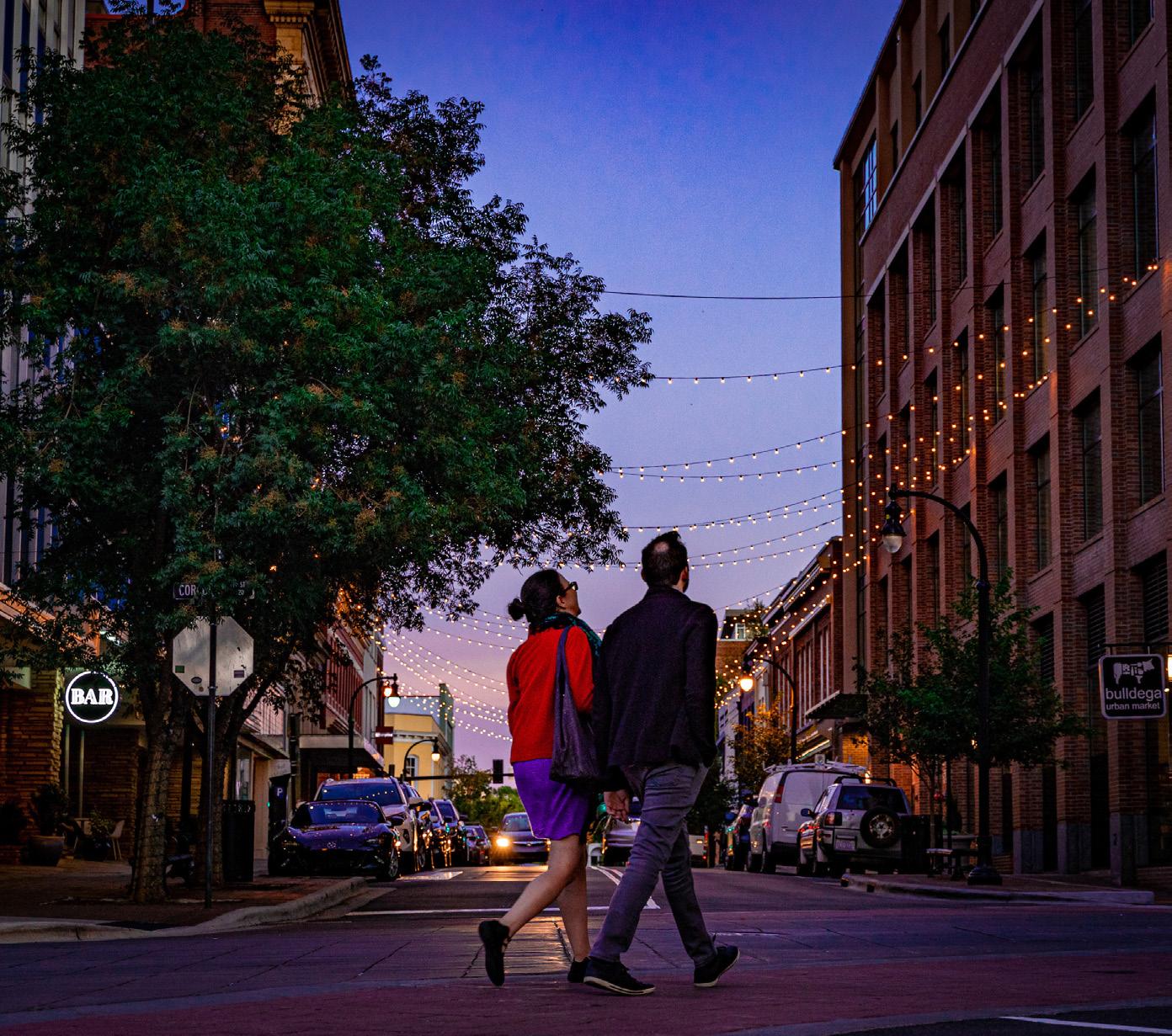
32 Sip & Stroll
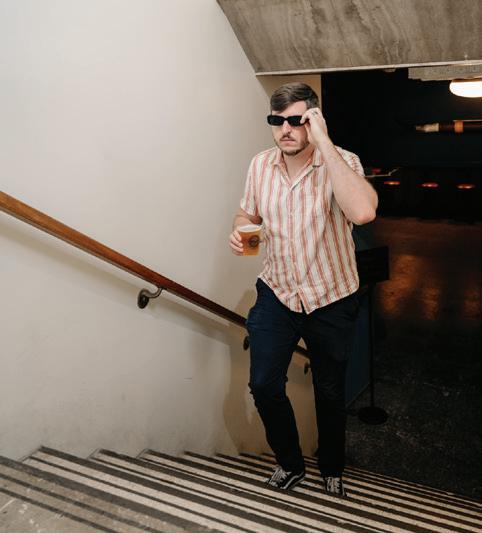
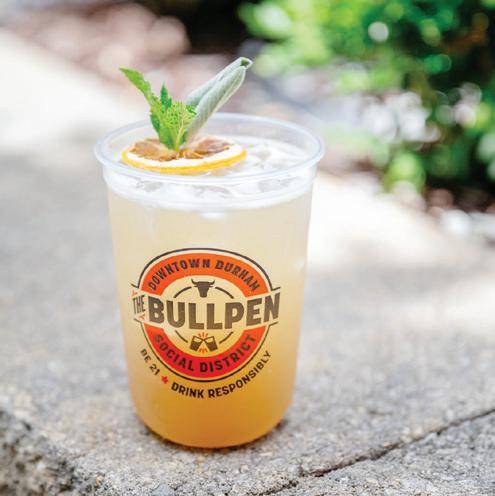
It’s all good vibes while you imbibe in downtown’s social district
34 Raise the Bar
Enjoy a front-row seat to flavor at these top dinner spots
36 Park It
A brief how-to on navigating parking options
38 Staycation, All I Ever Wanted Your ultimate guide to a downtown getaway
46 Here We Grow Again
The latest downtown development news
SCHOOLS & EDUCATION
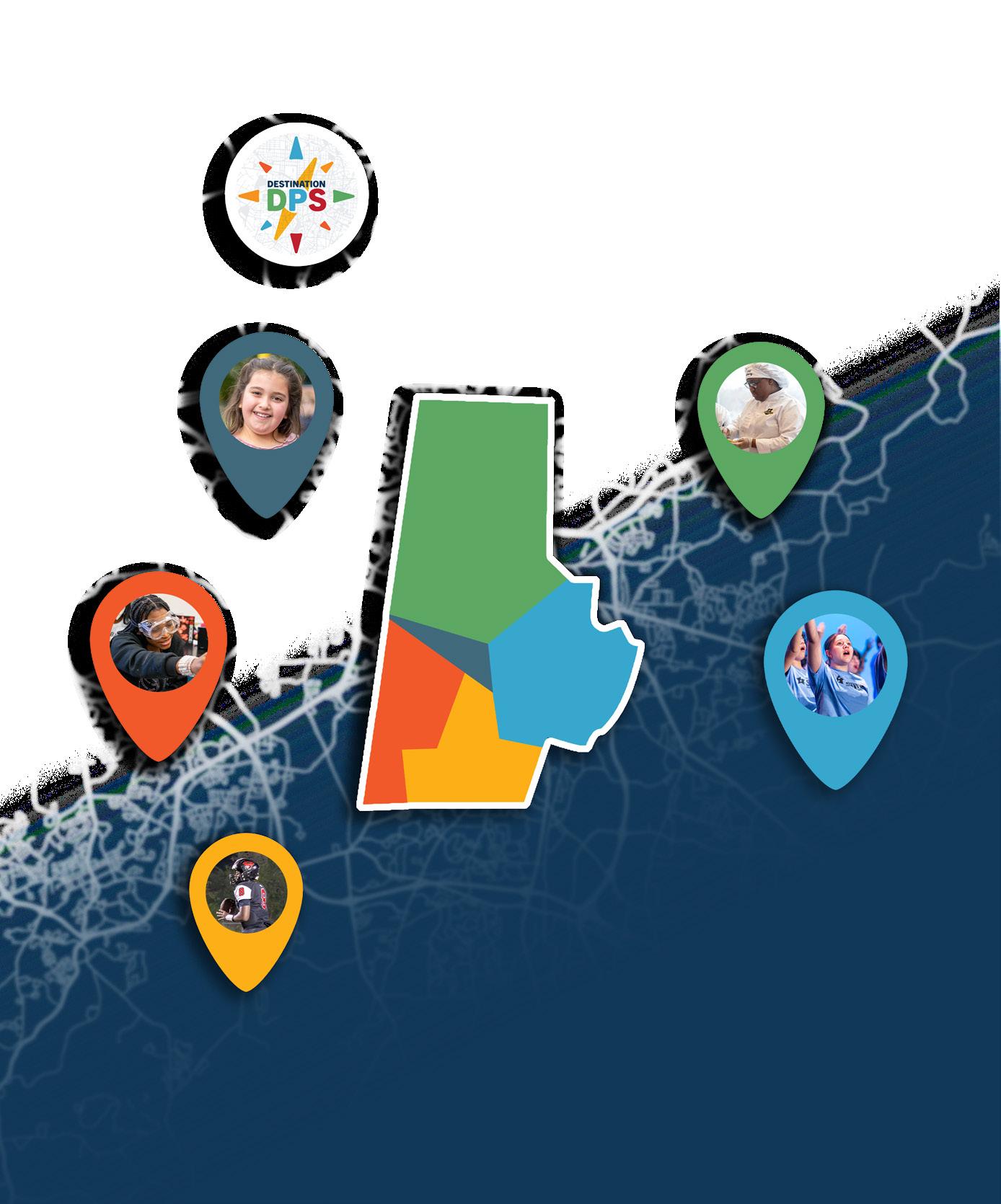
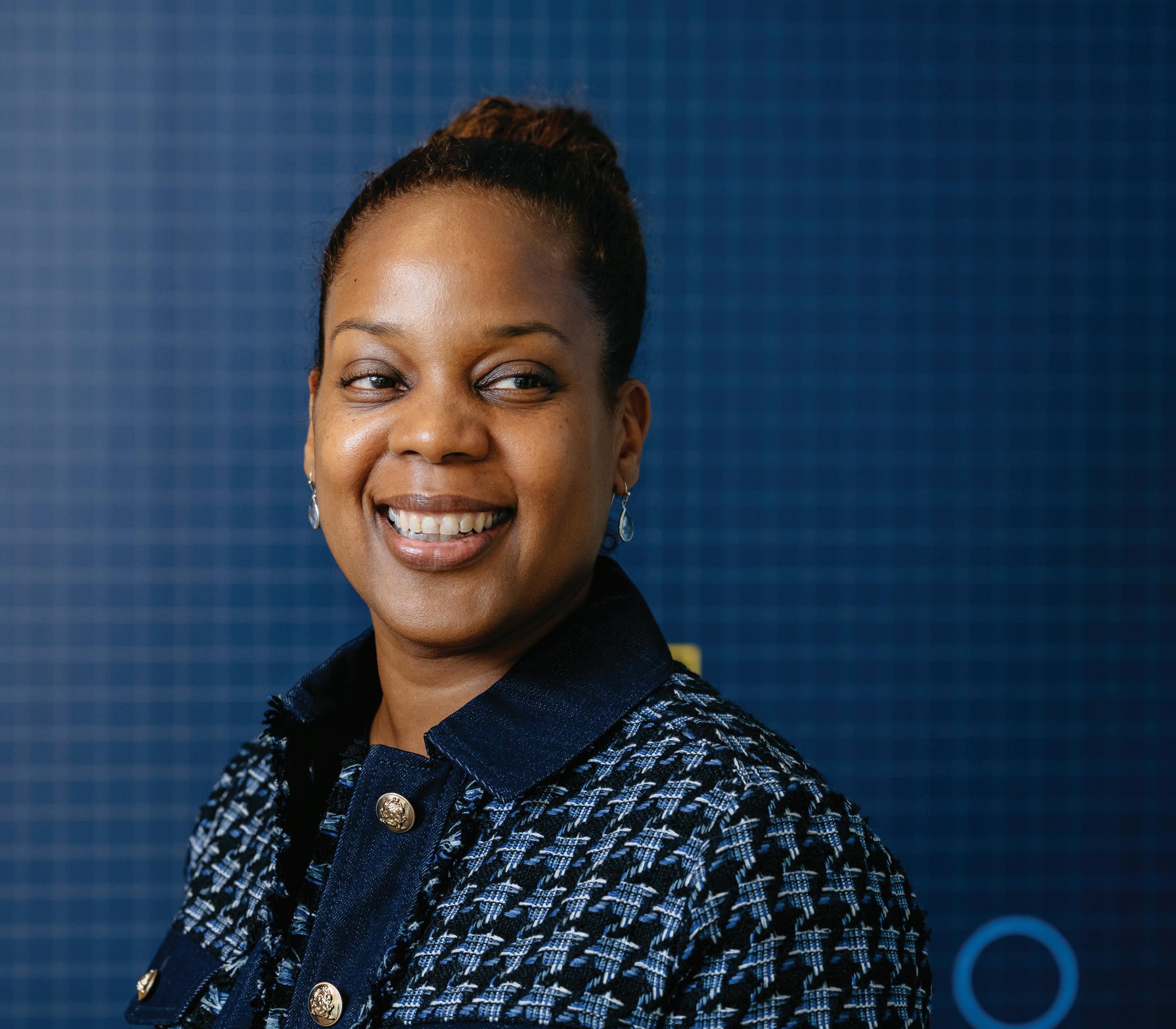
64 Charting a New Course
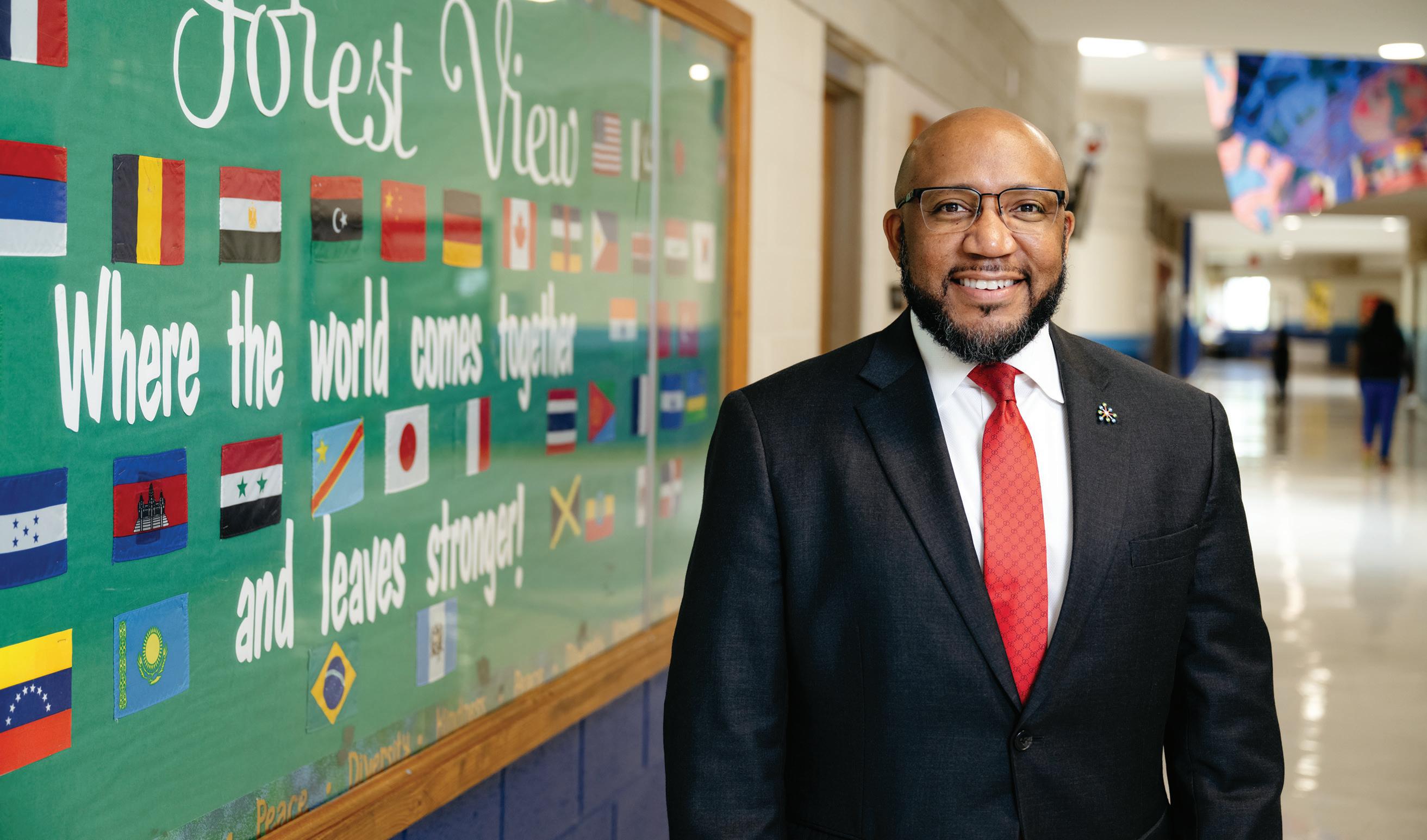
New Durham Public Schools
Superintendent Anthony S. Lewis is on a mission to build trust and break barriers as he guides DPS toward success, one student at a time
66 Leading by Example Three class acts share their education journey
74 Directory of Independent, Regional Boarding, Charter and Application Program Schools
FEATURES
52 Right From the Start
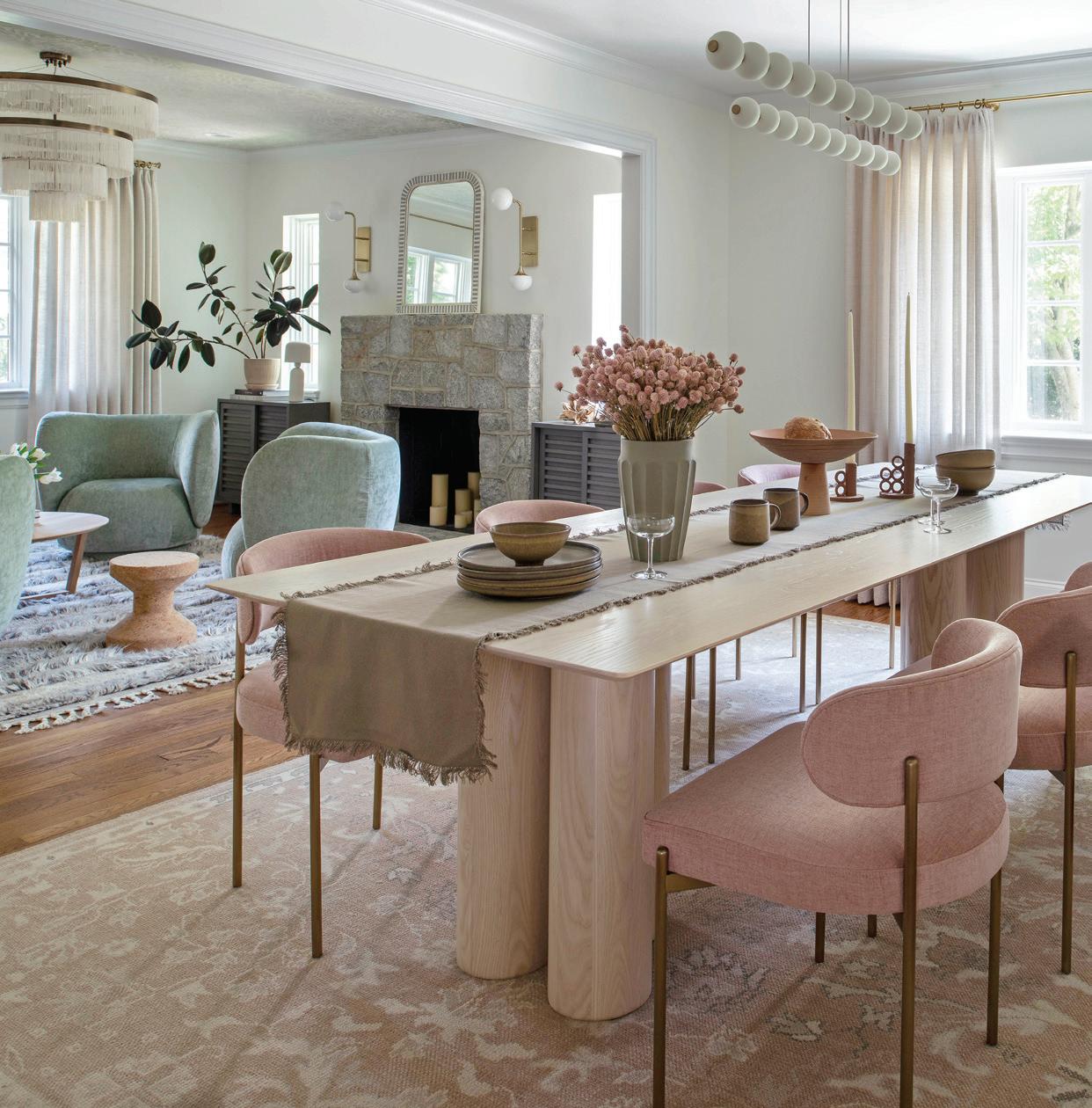
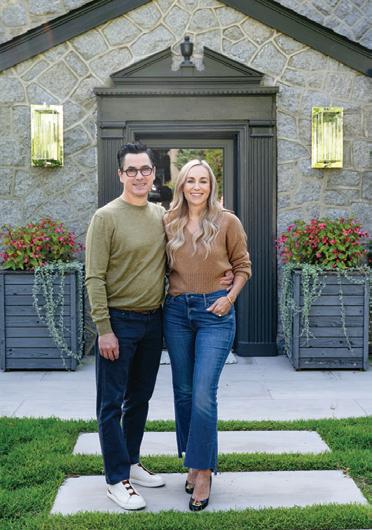
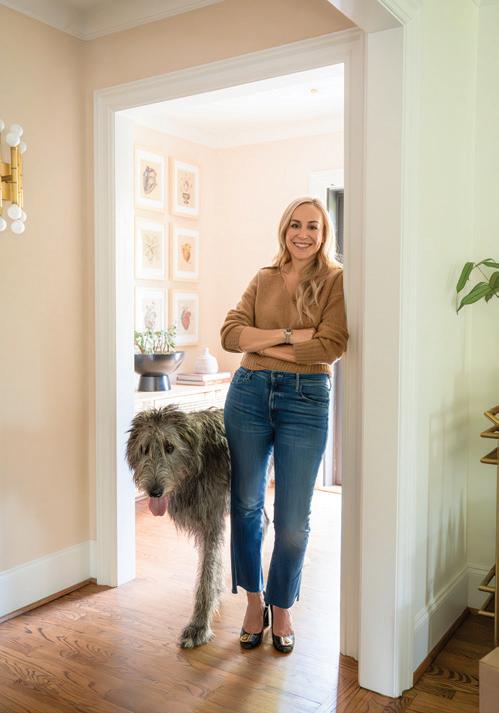
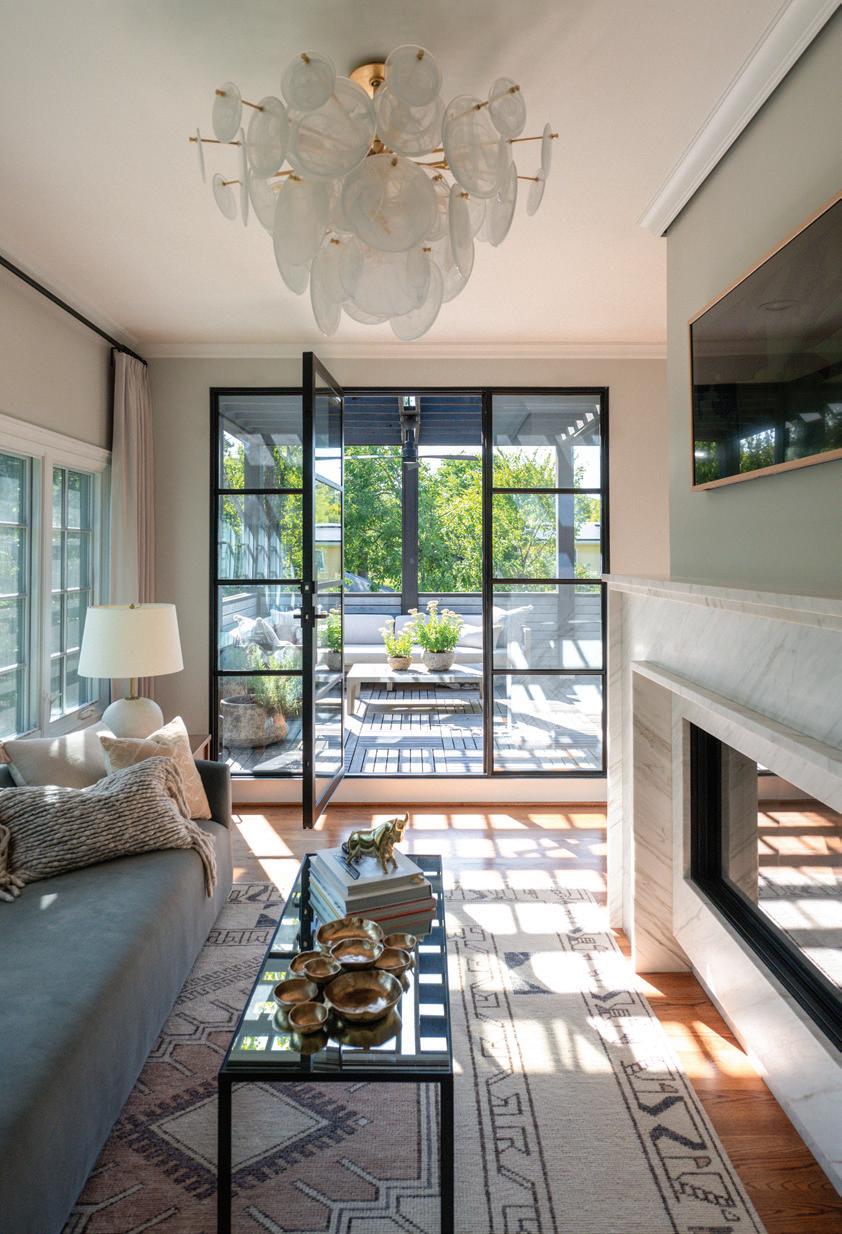
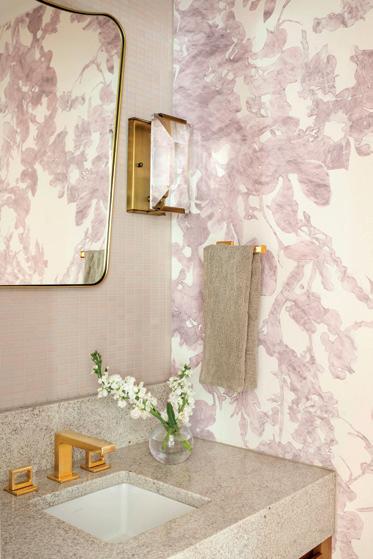
The Schroder family fills their historic residence with charm, warmth and timeless style
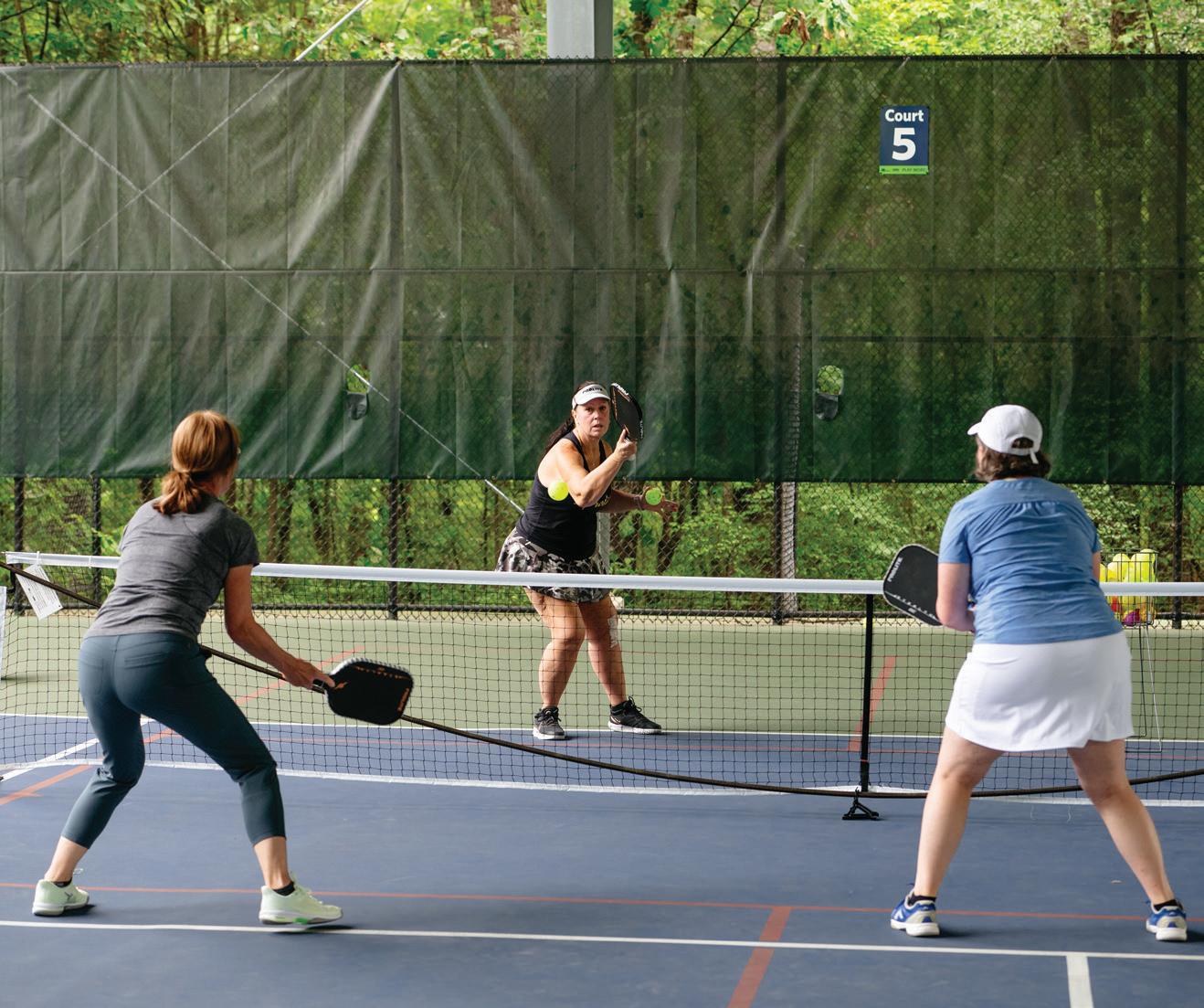
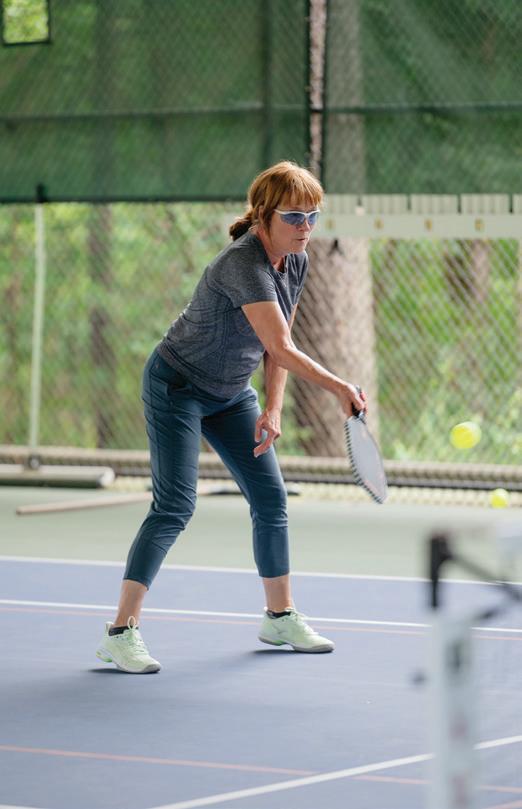
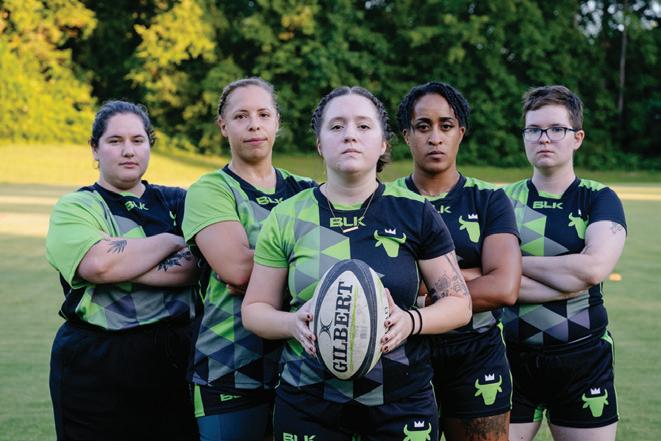
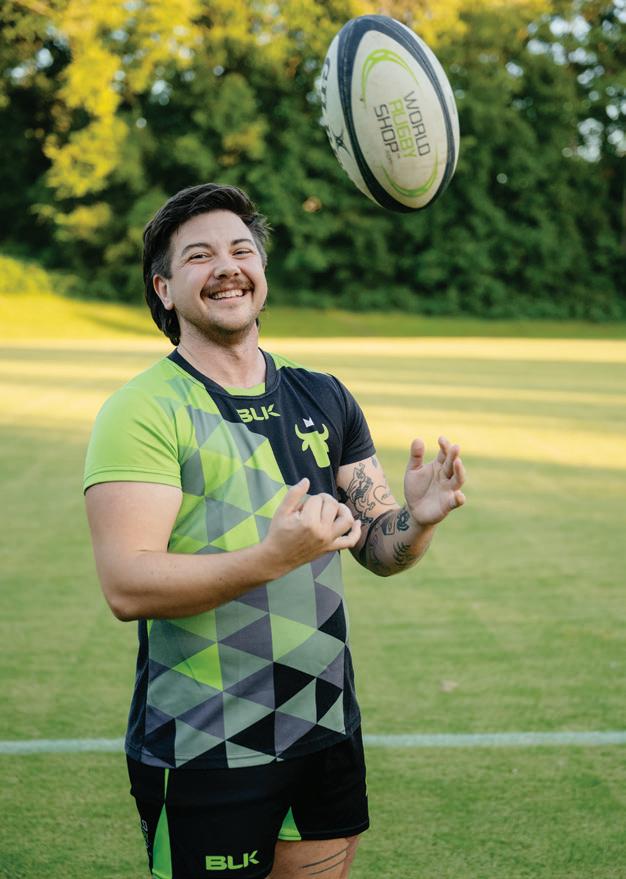
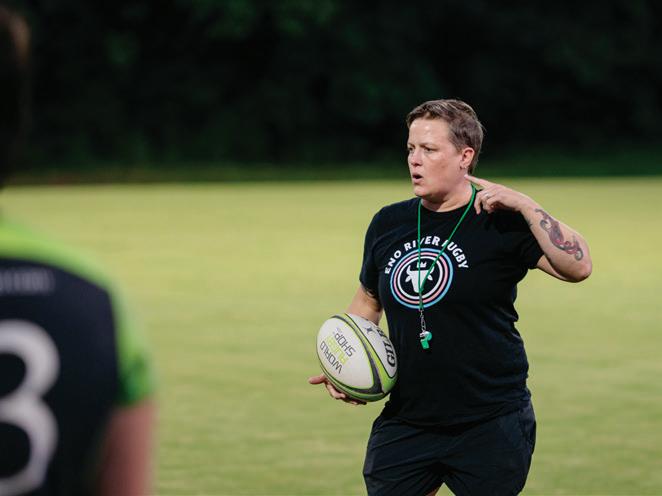
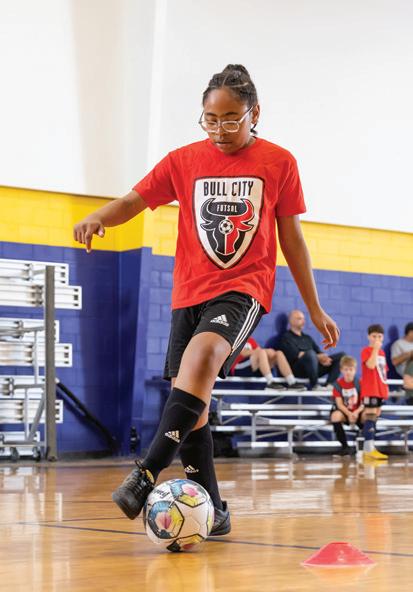
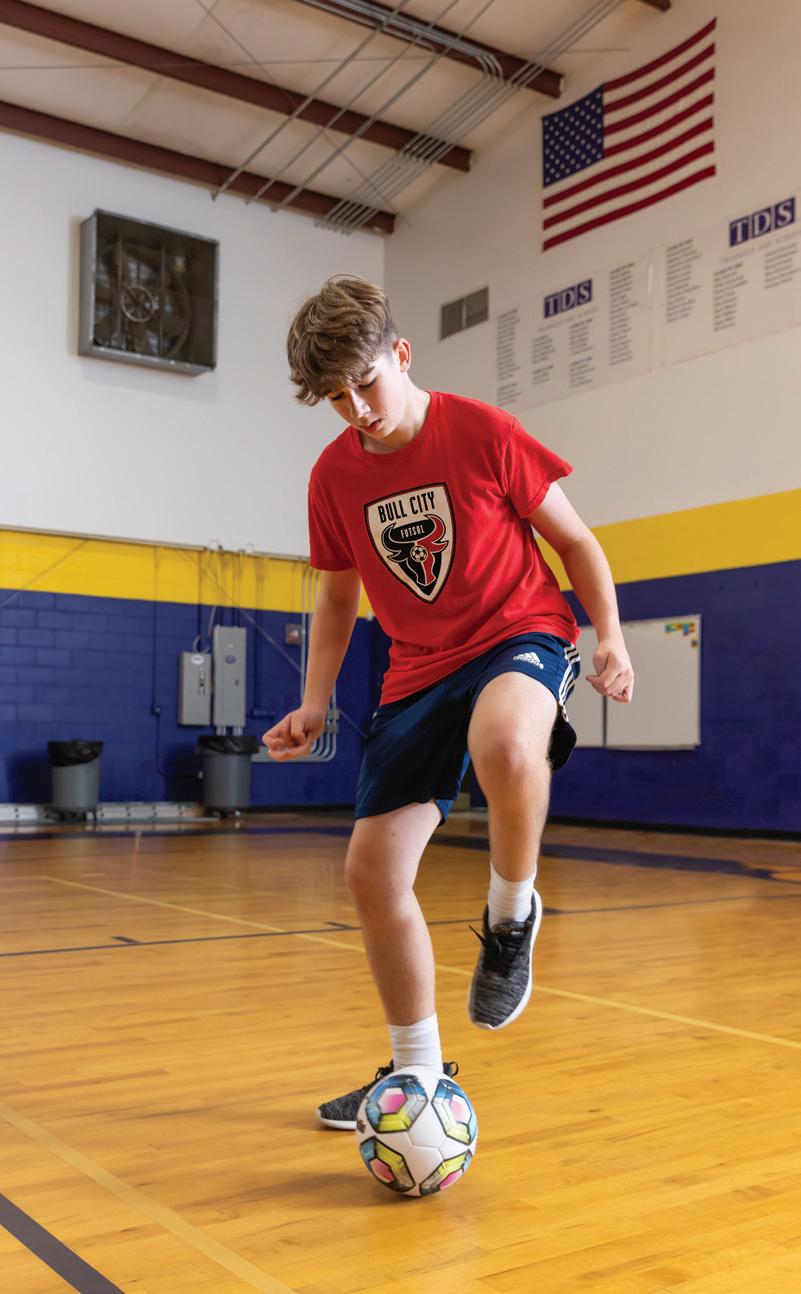
90 Have a Ball Sports clubs create community and strengthen bonds through action-packed fun
DURHAM INC.
96 Hot Shot
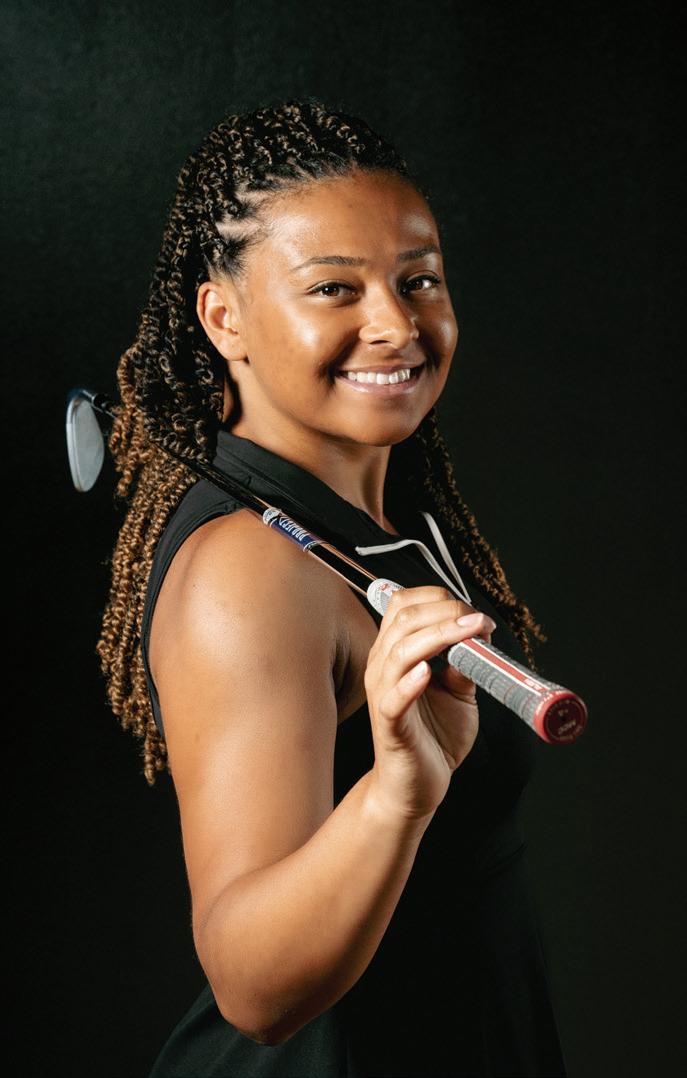
We chat with Natasha Ainsley-Thomas of GolfHer, a community-building organization designed to empower women through golf
98 Access for All
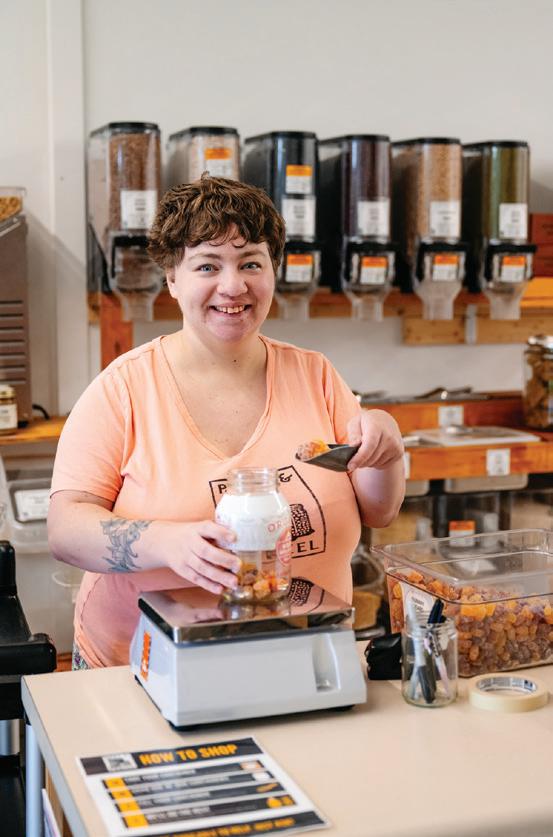
A closer look into how Durham companies create inclusive workplaces 102 Biz Briefs
Letter from the Editor
Go.See.Do. Chill out with these fun fall events
Noted. What we’ve heard around our city …
Wedding Tying the knot, Bull City-style
& PLACES
Durham Magazine’s
of Durham Party
Duke Energy’s Day of Champions
CONTENT
Downtown Durham Explore retail, dining, arts and more …
Health Care Meet local dentists and providers
PHOTO BY ERIC WATERS
PHOTO BY JOHN MICHAEL SIMPSON
The Joy of Rediscovery
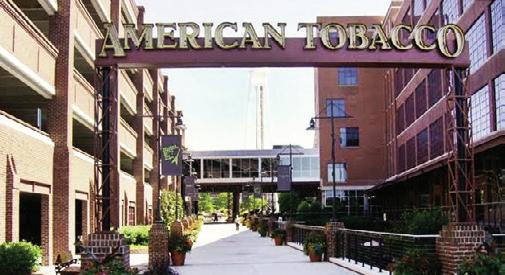
As I’ve chronicled before, I’m a (not terribly talented) Wednesday Bull City Run Club participant alongside my Chapel Hill Magazine counterpart, Jessica Stringer, who graciously slows her pace so we can jog and catch up on non-work-related life. We nearly always make a beverage and food stop afterward, rotating among the varied options near Bull City Running Co.’s shop in City Place Parts & Labor is a fave, as is The Glass Jug Beer Lab, where we’re treated to Batalá Durham’s drum practices at Durham Central Park. But we’ve been known to hit up Boxcar for pizza and games, Corpse Reviver for a masterful cocktail special, Liberty & Plenty Distillery for $7 Wine & Whiskey Wednesday (and some complimentary Sour Patch Kids and Goldfish), Surf Club, Hutchins Garage, Dssolvr, Durham Food Hall, Atomic Clock, Flying Bull … trust me, we make the rounds! We venture farther into downtown, too – Queeny’s, Alley Twenty Six and Thai at Main Street are all regular haunts that don’t mind (much, I hope) to receive postrun club members – and on a recent Wednesday night, I was invited to the Duke Arts Presents series at American Tobacco Campus. It was a perfect evening to see live music underneath the Lucky Strike Tower. Buckwheat Zydeco Jr. and the Grammy Award-winning Ils Sont Partis Band were winding down their set, but the atmosphere was electric. Folks were dancing with their spouses, their friends, their babies – everyone was clapping along from lawn chairs and picnic blankets. The performance ended to much fanfare, and I headed on my way, still buzzing from the energy.
I passed The Waiting Room, realizing it’d been awhile since I’d visited. I felt underdressed, but after editing our story on The Bullpen social district (page 32) and the lingering feel-good vibes, I figured this was the perfect opportunity to grab one of their excellent cocktails to-go. Unbeknownst to me, I’d walked into a jazz night with Candice Smith – better known as Miss Candice, who was, at the risk of sounding hyperbolic, phenomenal. I ordered a Oaxaca Mule and had the pleasure of catching up with Waiting Room owner Nick Singh and Brad Weddington of NanaSteak and Seraphine while my drink was prepared.
It’s these nights that inspire stories like our downtown staycation piece (page 38). They remind me that Durham, as ever, is full of new and exciting surprises that make you love living here.
amanda.maclaren@durhammag.com
AHEAD OF THE CLASS Find the right school for your child with our online guide to education choices in the Triangle.
BABY, JUST SAY, ‘YES’ We’re getting close to engagement season! If you live in Durham or are from here and want to share your love story in the magazine, let us know.
COVER
Photo by John Michael Simpson
MEMORIES THAT LAST A LIFETIME Did your kid have the best summer camp experience? Tell us about it, and your response could appear in our February/ March issue!
THE
YOU’VE SPENT 30 YEARS BUILDING YOUR NEST EGG. NOW COMES THE HARD PART:
MAKING IT LAST ANOTHER 30.
The challenges facing today’s retirees are unique. Higher inflation, sky-rocketing healthcare costs, longer life expectancies, and complex Social Security rules all make much of the conventional retirement wisdom of the past obsolete. In this new era, it’s crucial that you take a fresh look at the challenges ahead and create a comprehensive plan to address them.
For 30 years, we’ve been working with people like you to address the challenges of the transition from accumulating their nest egg to using it to support their retirement lifestyle. Get in touch today to schedule a complimentary consultation.
2828 Pickett Road, Suite 170
2024 ELECTRIC SUBARU SOLTERRA
Blacktoberfest
OCT. 12
Proximity Brewing Company hosts its fifth annual celebration of beer, food, art and entertainment at Garland Court in Old East Durham. The festival is designed to unite Black-owned and BIPOC establishments to highlight Black culture within the Bull City’s craft beer community. Enjoy offerings from 30 breweries, six Black-owned wine and spirits brands, food trucks and live performances.
Barktoberfest
OCT. 26
Durham Parks and Recreation partners with Beyond Fences, an organization that provides free pet services and supplies to neighbors in need, to host an afternoon of howling good times for furry friends and their owners at Durham Central Park. Compete in costume contests, take a photo booth picture with your pups, go on a fun walk through the park, enjoy local brews and eats, visit the pet market and learn about local foster and adoption organizations while The Terry Wiley Band performs. Don’t forget to bring canned dog food to contribute to the food drive.
do see go
Bird-Watching: Pik Kei Wong
OCT. 25-26
Bull City Race Fest and Food Truck Rodeo
OCT. 20
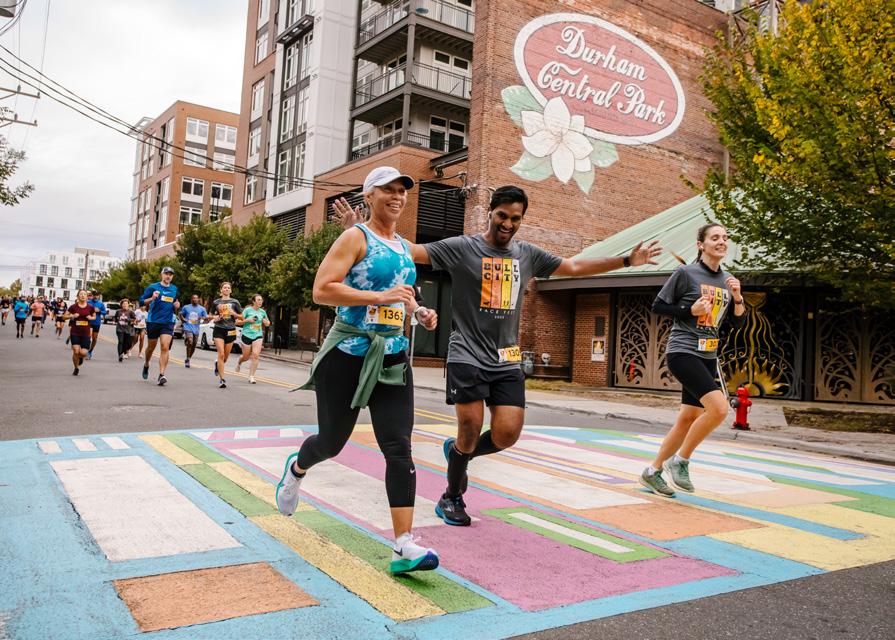
The 12th annual race, which begins and ends at the American Tobacco Campus, winds through Trinity Park, Duke University’s East Campus and surrounding downtown areas. Choose the half-marathon or the 5-mile run, and refuel with a snack from one of several food trucks at the postrace festival – which also features a beer garden – at Diamond View Park
CHILL OUT WITH THESE FUN FALL EVENTS
Complied by Tara Thurman
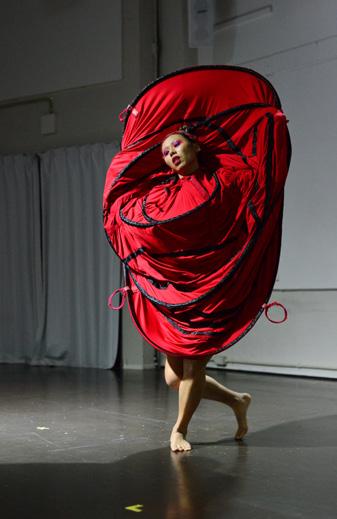
Duke Arts Presents hosts a mesmerizing performance by acclaimed Scotland-based choreographer Pik Kei Wong at the Rubenstein Arts Center’s von der Heyden Studio Theater Originally from Hong Kong, the artist delves into themes of gender, bodily autonomy and women’s desires, challenging Eastern and Western censorship of the female form through this striking work, which makes its U.S. debut at Duke.
Durham County Pottery Tour
NOV. 9-10
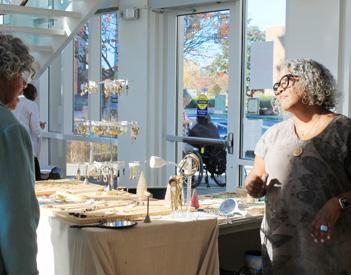
The 11th annual celebration of our local pottery scene and its craftspeople returns with an open studio tour that showcases sculpture, jewelry, and functional and decorative wares crafted from a range of materials and methods. Expect to see a wide variety of styles from potters like Gillian Parke, Dalton Hughes, Gaines Bailey (pictured) and Anna Schroeder. Visitors can explore 27 studios across the county, and meet the artists to learn more about their craft. Pottery will be available to purchase at all tour locations.
Hadestown
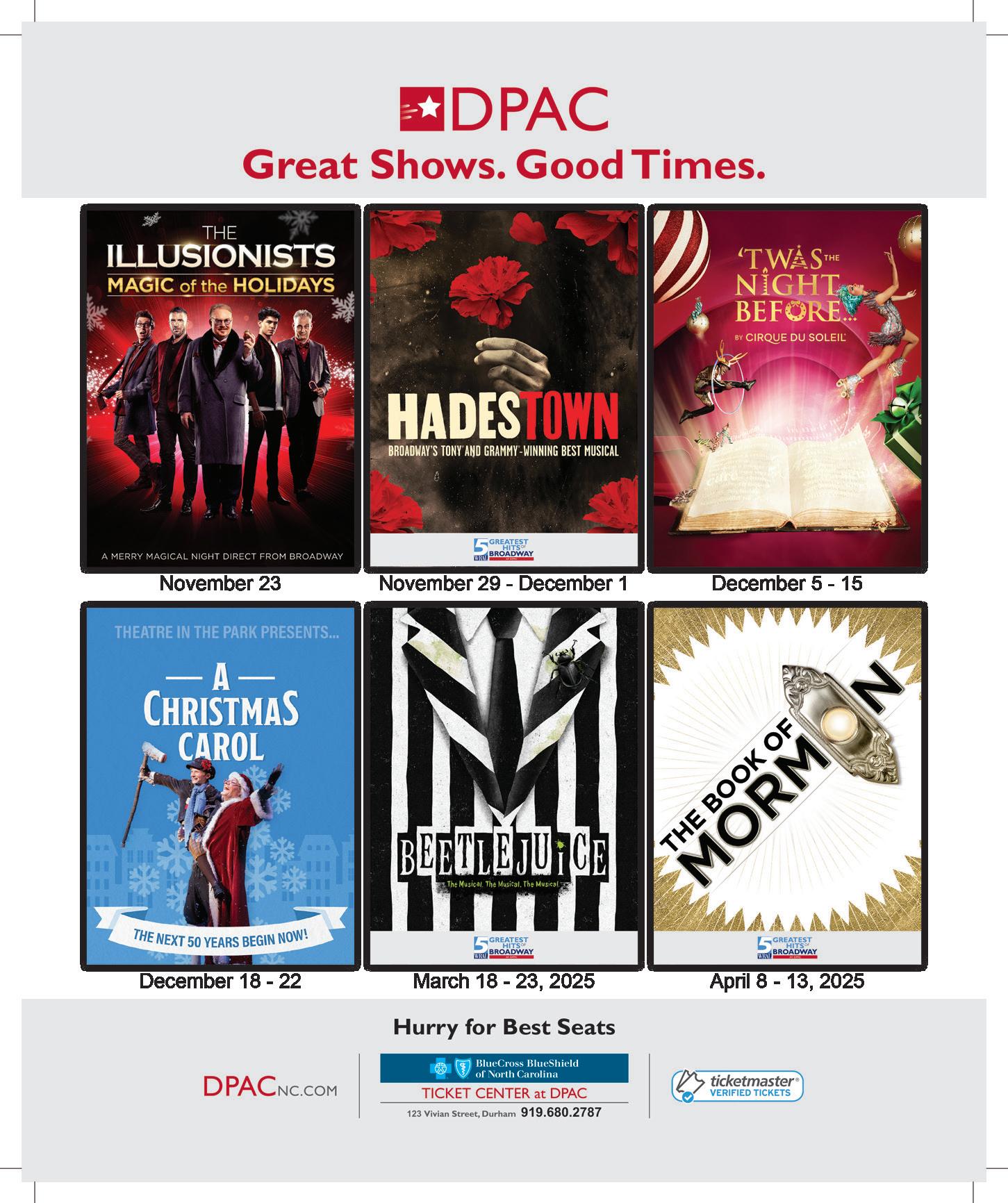
NOV. 29 – DEC. 1
SistaStrings
NOV. 14
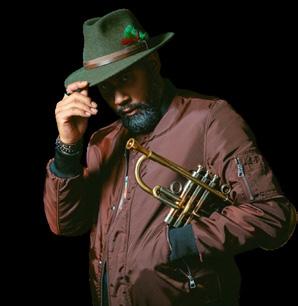
The dynamic sister duo Chauntee Ross and Monique Ross blend their classical training with soulful melodies and contemporary sounds at the Carolina Theatre’s Fletcher Hall. Their concerts, which feature Chauntee on violin and Monique on cello, have captivated audiences, and they’ve performed alongside artists including Brandi Carlile and Joni Mitchell. The event is part of the theater’s Wavemakers Series, an innovative lineup curated by Grammy-nominated singer-songwriter Rissi Palmer that celebrates diverse voices and emerging talents.
Iron Pour
NOV. 16
Join more than 3,000 attendees who gather every year at Durham Central Park to witness teams of artists construct furnaces that heat iron to unbelievably high temperatures. Liberty Arts’ eighth annual public event features performances, local food trucks, craft beer, art vendors and opportunities to learn from and engage with the art form. Watch as thousands of pounds of molten iron are poured into molds in an exciting, fiery display throughout the night, creating iron tiles designed by the public and sculptures crafted by North Carolina artists.
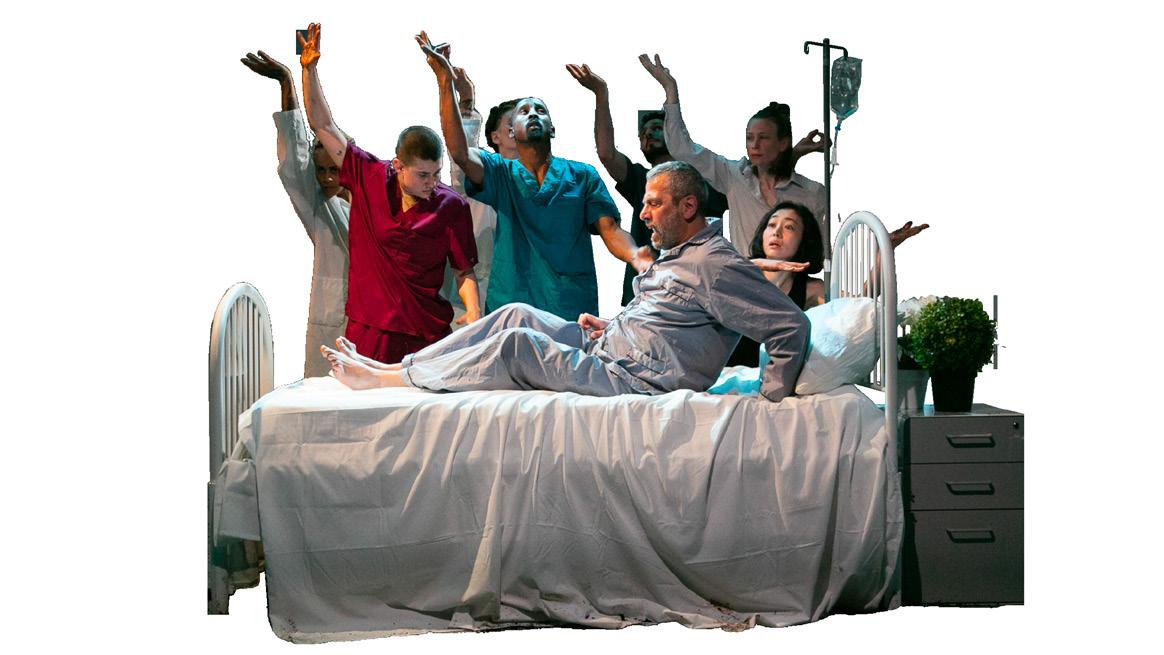
The Durham Performing Arts Center presents this spellbinding Broadway musical that invites audiences into a world of myth and music. The captivating Tony- and Grammy Award-winning show known for its hauntingly beautiful score and vibrant choreography reimagines the ancient Greek tale of Orpheus and Eurydice, blending modern rhythms with timeless themes of love, loss and hope against the backdrop of a post-apocalyptic, Depression-era setting that captures the tension between the living world and the underworld.
Tails at Twilight
NOV. 23
Durham Art Walk Holiday Market
NOV. 16-17
Kick off the holiday season with the Durham Arts Council during this annual weekendlong shopping experience in the heart of the City Center District. The market allows patrons to stroll through and shop from dozens of local artists and craft vendors, enjoy live music and dine at downtown restaurants.
The Animal Protection Society of Durham hosts its annual gala at the Washington Duke Inn & Golf Club. This oneof-a-kind fundraiser supports the thousands of homeless animals served by APS every year and includes a silent and live auction of unique items and experiences interspersed with fun and heartwarming tales. Tickets include dinner and drinks, and a virtual option is available for those who wish to participate from home.
(Image credits, clockwise from top left) Page 10 Blacktoberfest photo courtesy of Black Brew Culture; Race Fest photo courtesy of Bull City Race Fest; Pik Kei Wong photo by William Muirhead; Barktoberfest photo courtesy of Durham Parks and Recreation Page 12 Pottery Tour photo by Gaines Bailey; Iron Pour photo by Ken Huth; Art Walk photo by Beth Lowery; Tails at Twilight photo by Assorted Poppies Photo; 'Hadestown' photo courtesy of 'Hadestown' Original West End cast
people &places
Best Party Ever
PHOTOGRAPHY BY
JOHN MICHAEL SIMPSON
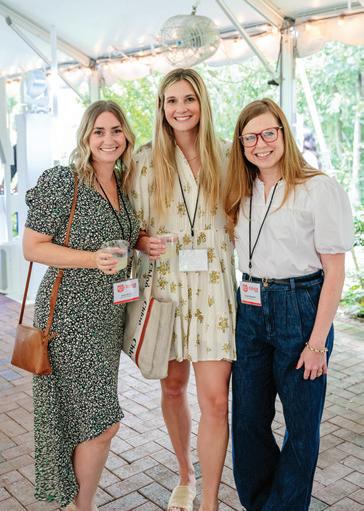
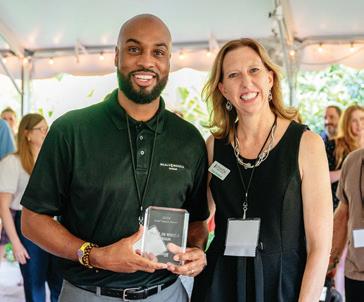
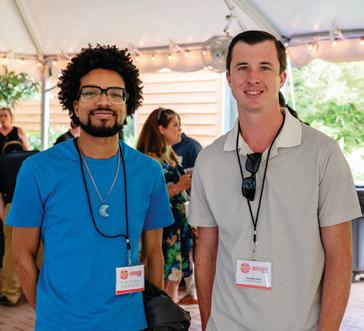
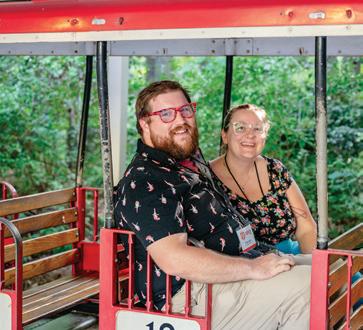
Winners of Durham Magazine’s 14th annual Best of Durham poll gathered for a celebration held in their honor on June 20 at the Museum of Life and Science, sponsored in part by Durham County Library. Representatives from our readers’ favorite businesses and organizations mingled with one another while relishing in this milestone achievement. Guests had the chance to experience the museum’s Magic Wings Butterfly House and Insectarium and ride the train along the Ellerbe Creek Railway while they savored bites from Southern Harvest Hospitality Group and sipped on liquid nitrogen margaritas and
2
3
Executive
Tina
1 Stephanie Snow, Emily Fitzgerald, Sam Terry and Bennett Kirkpatrick of Insight Counseling Center PLLC.
James Compton and Kim Compton of Byrd’s BBQ.
Guests had the opportunity to encounter several of the museum’s animals at the party. 4 Katie McKee, Alexis MacNaught and Suzanne Bowker of 12th State Design Co. 5 Meals on Wheels Durham
Director Jason Peace and Coastal Credit Union’s Vice President of Community Impact
Clossick. 6 Payton Harshaw and TK King of United Thai Boxing & MMA.
Best Party Ever
Durham Coca-Cola Bottling Company products. Readers’ favorite bank and event sponsor Coastal Credit Union’s Vice President of Community Impact Tina Clossick presented Durham Magazine’s second annual Social Impact Award to Meals on Wheels Durham Executive Director Jason Peace before partygoers danced the night away to tunes supplied by Stylus SE and popped on headphones to groove during the silent disco. Best videographer honoree Mark Maya of Mark Maya Films + Photography strolled among guests, capturing scenes of the evening, and ZimZoom Photo Booth was also on-site for photo ops. Two Roosters served up its award-winning ice cream for dessert.
7 Unique B. James and Stephen Hall of Chapel Hill Tire. 8 Honeygirl Meadery’s Robby Battle and Mar Hester.
9 Guests cooled off with scoops of Two Roosters Ice Cream.
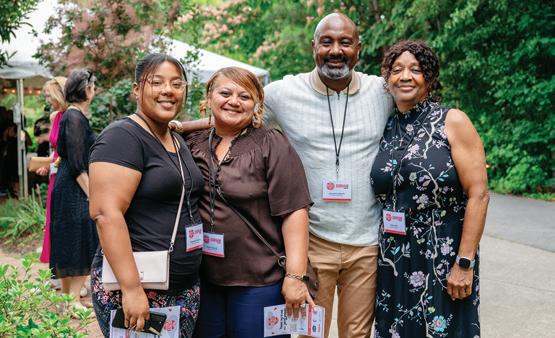
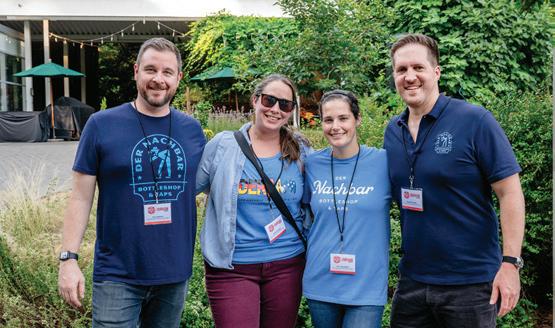
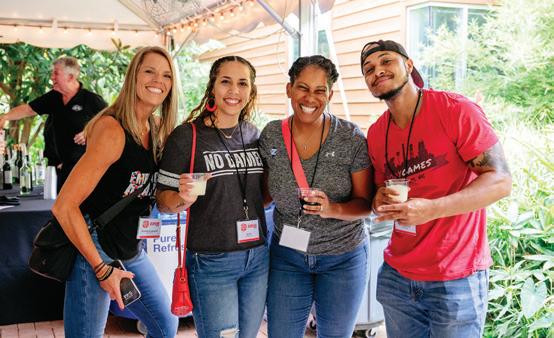
10 Eric Cannon, Laura Cannon, Erin Blüschke and Gert Blüschke of Der Nachbar Bottleshop & Taps. 11 Shanequa Cearnel, Sharon Marsh, Jermaine Marsh and Diane Hill of Marsh’s Rentals. 12 BodyGames’ Michelle Pendergraft and Dominique Coe with Caroline Johnson of Blu Emerald Media Services and DJ Coe of BodyGames. 13 Chapel Hill Tire Director of Marketing Kim Florek takes a photo in the Magic Wings Butterfly House. 14 Alison Matney, Chelsea Polson and HK McKinney of Durham Vintage Collective.
Gear Up for Success
PHOTOGRAPHY COURTESY OF DUKE ENERGY
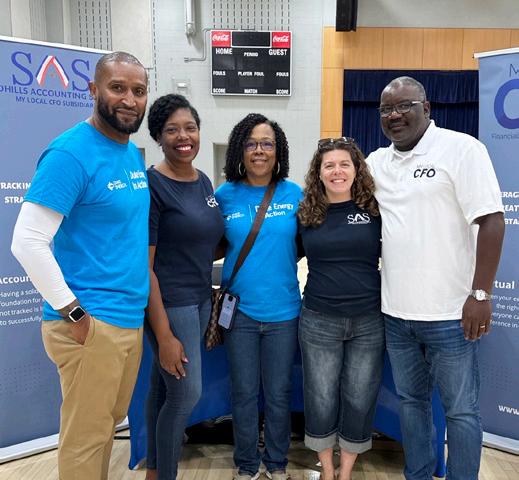
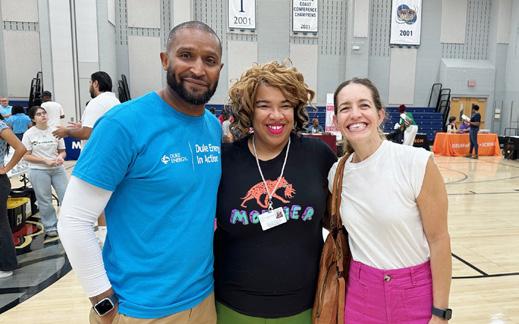
Duke Energy hosted its seventh annual Day of Champions in partnership with community organizations and local businesses Aug. 17 at the Emily Krzyzewski Center. The event provided more than 250 middle school students – some of whom registered in advance through nonprofit partners such as Durham Children’s Initiative, Durham YMCA and El Centro Hispano – with backpacks and school supplies. Students had the opportunity to take pictures with North Carolina Central University and Duke University athletes, and explore education and career choices with professionals at information tables set up by sponsors such as Durham Technical Community College, Durham Chamber of Commerce, Google and M&F Bank. WNCU 90.7, N.C. Central’s radio station, provided music; students took photo booth pictures with Photo Booth Therapy; and lunch was catered by Mellow Mushroom and Moe’s Southwest Grill
1 Duke Energy Government & Community Relations District Manager Ray Trapp, My Local CFO Profit Strategist Cherelle James, Duke Energy Government & Community Relations Vice President Indira Everett, Sandhills Accounting Service’s Megan Lunas and My Local CFO co-founder Derrick James. 2 Duke Energy’s Ray Trapp with Durham Public Schools’ Board Chair Millicent Rogers and Vice Chair Jessica Carda-Auten.
noted.
GIVING BACK
Experts highlighted ways solar is becoming more affordable and how community members can benefit from installing solar energy at their homes or offices during a “Go Green With Solar for All” event hosted by Climate Action NC, Environment NC and Climate Power at The Glass Jug Beer Lab –RTP. North Carolina received more than $156 million for the Solar for All program from the BidenHarris administration’s clean energy plan.
Lonerider Spirits announced the success of its collaboration with North Carolina Ducks Unlimited, which raised more than $69,000 for wetland conservation. The nonprofit raffled off 150 bottles of Lonerider’s Field of Drams wheated bourbon at county events across the state over the past year. The funds directly impacted the conservation of 276 acres of North Carolina wetlands.
North Carolina
GlaxoSmithKline Foundation awarded a $244,000 grant Museum of Life and to create, implement and support biotechnology lab programming in the museum’s new lab space,
which is slated to open in summer 2025. The grant will fund a dedicated lab coordinator, guest scientists, and materials and supplies to support hands-on lab activities.
The U.S. Tennis Association, including USTA Southern and USTA North Carolina, awarded the City of Durham a total of $58,750 in grant funds to improve the eight Southern Boundaries Park tennis courts.
ON THE MOVE
The Pauli Murray Center for History and Social Justice, which honors the legacy of civil rights activist, lawyer and educator the Rev. Pauli Murray, held a grand opening in September. Those in attendance enjoyed meditation, music, poetry and more, and were among the first to step inside Pauli’s childhood home and explore engaging exhibits that connect history to contemporary human rights issues.
G. Dixon was named the 13th chancellor of North Carolina Central University, succeeding Chancellor Johnson O. Akinleye, who retired June 30 after eight years leading the university. Karrie previously served as chancellor of Elizabeth City State University, a role she’d held since 2018. “Being a part of this incredible community of scholars, innovators and leaders on the sloping hills and verdant green is a dream come true,” Karrie shared in a press release. “NCCU embodies grit, innovation, leadership, purpose and legacy, and I am committed to building on our rich traditions and ensuring that our students, faculty, staff and alumni have the tools and opportunities necessary to succeed.” Karrie began her term July 1.
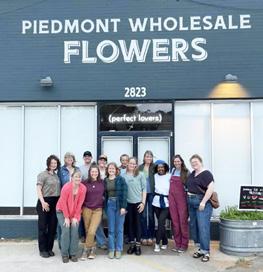
Piedmont Wholesale Flowers, a cooperative venture of 14 women-owned sustainable flower farms, is now open to the public on Fridays. Visitors to the market location at 2823 N. Roxboro St. can browse
inventory of locally grown flowers mid-March through November while also enjoying coffee service offered by Perfect Lovers
Radical Movement, a Black, queer, women-owned fitness studio, opened at its new location at 621 William Vickers Ave. Formerly known as 2FitSistas, the business is owned and operated by sisters Camelle Johnson and
Karrie
NEWS BITES
• The Streets at Southpoint launched its Common Area Entertainment Zone in August, allowing patrons 21 and older to enjoy alcoholic beverages inside and outside the shopping center, in common areas like the AstroTurf lawn near the stage where Duke Arts Presents’ concert series, Music on Main, continues every Saturday through Oct. 12. Participating on-site restaurants California Pizza Kitchen, Firebirds, Co and Uncle Julio’s will provide beverages in designated cups.
• The N.C. Lodging & Restaurant Association announced the winners of its eighth annual Chef Showdown. The competition began in March, featuring 84 contestants who competed in 11 preliminary and semifinal rounds across the state. The grand finale at Bay 7 showcased the top 20 chefs, five pastry chefs and six bartender and distillery teams, who offered tasting-sized portions of their finest creations to the more than 500 attendees. Theresa Norris of M Pocha won the award for best use of dairy products in a savory dish with her blackened North Carolina shrimp, pimento cheese, milk bread pudding, corn shrimp velouté and chowchow. Zig Payton of Kingfisher won for best use of a Pepsi product in a mocktail.
Whit Johnson, who offer highintensity interval training, slam ball workouts and more.
Durham Parks and Recreation welcomed Anthony Giudice as its new public information and communications analyst; he will handle media inquiries and oversee various communications duties for the department.
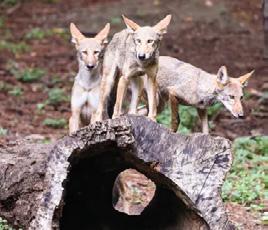
Center in South Salem, New York, in October. The decision comes following the Red Wolf SAFE program’s determination that Adeyha and Oak are a genetically valuable pair and should breed again in 2025. “While it is bittersweet to see them move on, there is excitement that the family will remain together,” says Senior Director of Animal Care Sherry Samuels. The museum will soon welcome a new mated pair, Oka and Martha, in exchange.
ARTS & CULTURE
“Singles” series, in which each piece tells a complex story about a single song, combining popular culture and fandom with music criticism and scholarly research.
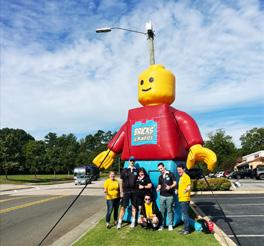
Lego resale store Bricks & Minifigs – a toy store specializing in aftermarket Lego needs, including buying and selling individual minifigures, bulk bricks, components and accessories – celebrated the grand opening of its newest location with a ribboncutting ceremony Sept. 7 at 3823 Guess Road, Ste. R.
The Museum of Life and Science will transfer its family of seven endangered red wolves – mom Oak and dad Adeyha, plus pups Juniper, Cedar, Sassafras, Maple and Tupelo – to the Wolf Conservation
Duke University professor and Pulitzer Prize winner Bill Adair takes readers behind the scenes to uncover the motivations and tactics of the nation’s political liars – relying on candid interviews with politicians, political operatives and experts in misinformation – in his new book, “Beyond the Big Lie,” on sale Oct. 15.
New York Times bestselling author Adrienne Maree Brown’s newest book, “Loving Corrections” – a guide for navigating belonging in a society fractured by greed, racism and war – came out in August. Adrienne celebrated the launch during a joint event with Alexis Pauline Gumbs for her novel, “Survival Is a Promise,” at Hayti Heritage Center.
Max Brzezinski delves into the political, cultural and socioeconomic forces behind David Bowie and Queen’s 1981 hit song in his book, “Under Pressure,” which is set to release in February 2025. The book is the newest in Duke University Press’
Singer-songwriter Matty Frank recently released his first album, “Dooda,” which weaves a love of nature and storytelling into a wider folk-pop sonic universe. The self-taught musician seamlessly blends pop and R&B vocal styles with introspective indie folk rock, delivering personal yet widely relatable lyrics.
Electronic duo Tescon Pol released their new album, “The Longer Morrow,” in September. The work examines time both lyrically and thematically, and will have a limited run of 150 CDs in addition to its digital release.
IN OUR SCHOOLS
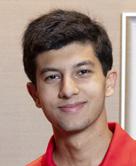
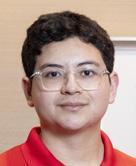
Durham Academy senior Aayaz Husain (above) and N.C. School of Science and Mathematics student Diego Sanchez Tirado (below) were named 2024 Bank of America Triangle Student Leaders. As part of the program, they participated in an eight-week paid summer internship with the YMCA of the Triangle to gain practical work and leadership experience. The students also traveled to Washington, D.C., for a weeklong national leadership summit to learn how nonprofits, governments and businesses collaborate to meet local needs.
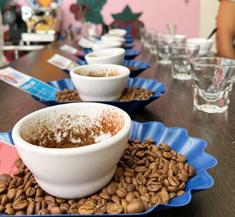
• Little Waves Coffee Roasters is featured in the seventh episode of the Apple TV eight-part docuseries “Omnivore,” which examines how different food items influence the world. The episode follows coffee from Rwanda as it arrives in Durham. “We’re excited to be part of such a reputable and beautifully produced series,” says Little Waves Coffee co-owner Leon Grodski Barrera “[T]he creators created beautiful visuals that make watching worth it alone. They asked questions that matter and show the way that we, and similar roasters, connect our cross-border relationships.”
• Tsaōcaa Nanxiang Express, Durham’s newest destination for traditional Shanghainese cuisine, is now open on the first floor of The Blue Light Living student apartments at 1605 Erwin Rd., Ste. 50. This fast-casual spot offers a variety of boba teas, soup dumplings, baos, noodle bowls and dim sum favorites.
• Fonda Lupita owners Salvador Alvarez and Biridiana Frausto established Jalmex Hospitality Group in 2023 and currently operate six restaurant concepts at more than 11 locations. Tacos No. Juan, a fast-casual concept from the hospitality group, replaced a former Wendy’s at 910 Martin Luther King Jr Pkwy., in August, and a Durham location of La Buena Vida is expected to open in December.
• LocoPops plans to open a new location, LocoShop – which will carry popsicles, ice cream, pies, prepared meals, knick-knacks and more – at 600 Foster St. in early October.
• Research Triangle Park’s new mixed-use development Horseshoe at Hub RTP announced renowned Indian restaurant Cheeni as its first retail tenant, with construction slated to begin this fall. The new 3,000-plus-square-foot restaurant, led by two-time James Beard Best Chef Southeast semifinalist Preeti Waas, is expected to open in 2025.
• Food Lion revealed a $365 million investment to upgrade 167 Raleigh and Durham area stores with a more modernized design, expanded product selection and a variety of affordable deli, bakery and home meal solutions during a preview event at its 4711 Hope Valley Rd. grocery.
• Southern-inspired eatery Nosh reopened in a new location at 717 Broad St. in early August. The business, owned by Wendy Woods and Piper Lunsford, has operated in the area for more than 20 years.
• Ponysaurus Brewing Co. launched its new beer, Tell the Truth: A Fact-Checked Kölsch, to benefit journalism in North Carolina. A portion of the proceeds from the beer will be donated to The Assembly, a digital-first magazine and reporting network, to fund additional reporting positions across the state. “Informational, factual local news is critical for our communities, and it’s important to us to uplift and support the people who are digging deeper and investigating further so we can all be more informed,” says Ponysaurus owner Nick HawthorneJohnson. “Partnering with The Assembly will help create more paid, equitable opportunities in the field.”
• Meal delivery and catering company Redstart Foods opened a cafe and retail shop, Redstart Takeaway, adjacent to its current location on North Roxboro Street. Grab a coffee and pastry; order from the lunch and dinner menus; or swing by and grab ingredients to make a tasty meal at home, seven days a week.
• Fullsteam announced it would close its taproom at 726 Rigsbee Ave. Oct. 31, honoring its many years in the DIY District with a Halloween party and trivia. The brewery also shared it would reopen its taproom in a 9,000-square-foot space at American Tobacco Campus, which will boast a restaurant on one side and a casual bar on the other, creating both indoor and outdoor spaces for gathering, as well as a pilot brewing system, a small stage for live performances and a private party area.
• M Tempura Chef de Cuisine and Durham native Savannah Miller starred in Season 21 of Bravo’s reality cooking show “Top Chef,” reaching the competition’s finals in June and walking away with $38,000. The chef’s dishes on the show featured her North Carolina background as well her experience with Japanese and Korean cuisine.
• Tataco, a new Mexican eatery by two-time James Beard-nominated chef and Little Bull owner Oscar Diaz, is slated to open on the ground floor of Geerhouse Apartments at 620 Foster St.
noted
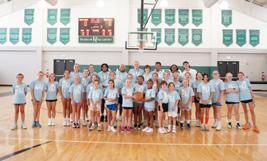
UNC women’s basketball guard Alyssa Ustby hosted her third annual basketball camp at Durham Academy, which taught 60 young athletes ages 9-17 the fundamentals of basketball, emphasizing teamwork and the importance of dedication.
centers to earn the honor, which is given to clients’ top-rated venues in the meetings market.
The Durham Performing Arts Center welcomed 626,071 guests across 260 performances from July 2023 to June 2024, marking its 15th anniversary year as its biggest season yet.
WHAT AN HONOR
The City Council appointed Chris Vitiello as Durham’s new Poet Laureate in September. Chris’ experience as a writer, performer, critic, teacher and Durham’s beloved Poetry Fox will aid him in his position as he champions the art of poetry and spoken word. Chris will serve a threeyear term through June 2027 – he plans to teach free writing workshops, start a public reading series and launch a program that will feature poems in public spaces.
Hill Learning Center promoted Bryan Brander to executive director and head of school in August. Bryan – a dedicated educator who’s worked at Hill for 18 years, first as a teacher before he became head of school in 2014 – takes over the role from Beth Anderson, who served as executive director for the past decade and will continue with the school as a strategic advisor.
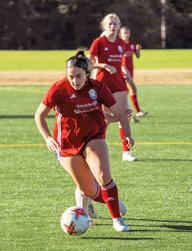
The North Carolina Football Club Youth 06 Elite Girls team – including Lily Palumbo, a Jordan High School graduate and first-year student at UNC – won the United States Youth Soccer National Championship with a double overtime 5-4 win.
The Durham Convention Center received a Facilities and Destinations Magazine Prime Site Award, one of 24 Southeastern convention
IN OTHER NEWS
Durham Parks and Recreation, in partnership with Breastfeed Durham and Black Breastfeeding Coalition, launched a new initiative to enhance inclusivity and support for breastfeeding families in public spaces. L Jámal Walton, an artist, father and vocal advocate for reproductive justice and inclusion, designed 17 “Breastfeeding Welcome” signs, which are now installed in several city parks.
The City of Durham launched an educational web page, durhamNC. gov/bonds, for the $200 million bond referendum that will be on the ballot in November. The site lays out proposed projects and frequently asked questions among other details regarding the bond’s expected uses. If approved by voters, the bond would be allocated to repave streets, repair and build new sidewalks, and improve parks within the city. Remaining funds would be used to construct a new aquatic center at Merrick-Moore Park
MARK YOUR CALENDAR
Duke University, the City of Durham, Durham Arts Council and Hayti Heritage Center partner to host the second annual Griot & Grey Owl Black Southern Writers Conference Nov. 1-3 to celebrate and uplift Black Southern writers and poets. The weekend, centered on the theme of “Home and Heritage,” presents inspirational performances, workshops and community events.
Duke University men’s basketball champions Jon Scheyer and Bobby Hurley face off as rival head coaches when Arizona State University plays Duke at Cameron Indoor Stadium during the Brotherhood Run charity exhibition game on Oct. 27. Proceeds from the game will benefit Duke Children’s Hospital.
Growth mindset
LMayor Leonardo Williams discusses his strategies for managing progress while preserving our cityʼs unique character
eonardo “Leo” Williams, a force in our city’s culinary and political scenes, was elected mayor in 2023. He and his wife, Zweli Williams, co-founded Zimbabwean restaurant Zweli’s Kitchen & Restaurant in 2018 and launched Zweli’s Ekhaya, a tapas restaurant inspired by Bantu flavors, in the heart of the American Tobacco Campus in 2023. Before stepping into the mayor’s office, Leo served on the Durham City Council for Ward 3, where he was an advocate for local businesses and community growth. We sat down with him to discuss the challenges and opportunities facing downtown businesses and how community engagement can help maintain Durham’s vibrant spirit.*
How do you plan to balance the significant expansion in Durham while still maintaining our city’s distinctive features? Durham is a midsize, major-status city with a unique character in that most of our businesses downtown are locally owned. You’ll find that in small towns but not cities our size. We’ve only got [a few] chain restaurants downtown, and I want to keep it that way. We lost about 15 businesses total this year, but we’ve gained about 23 or 25 in restaurants or retail storefronts. What we don’t want is empty storefronts, because then developers will start looking at more regional and then national chains. Chains like Cheesecake Factory
can be great economic anchors, but downtown, I’d personally rather have local spots.
The key to maintaining our local character is intentionality. I need residents to get out and support local businesses – shop and eat locally. We can come up with all types of reasons why we think businesses are struggling, but at the end of the day, we need people spending money here. Please choose Durham over Amazon, and dine out rather than using UberEats or DoorDash. These services promote convenience, but what they’re also doing is creating distance between you and your neighbors. We need to reconnect as a community. Regarding plans, we are desperately in need of more hotels. We’re desperately in need of a larger convention center. We need a sports facility, too. I’m currently working with a few landowners downtown to reimagine existing infrastructure, including aerospace. We saw with the Carolina Theatre and DPAC being closed [for building renovations] this summer, businesses really suffered without that foot traffic. It also showed me, in regards to economic data, how sales were down significantly. We can’t rely on a city to thrive solely on local residents. You’ve got to have visitors as well. And we need more reasons for visitors to come to Durham.
How are you addressing the concerns of downtown business owners and residents who are impacted by construction and development? I’ve initiated a parking analysis to reduce parking rates, which I believe are too high. I think it’s a policy decision that we can correct. We [in the city government] need to show we’re listening. However, parking isn’t the only reason businesses are struggling.
As a restaurateur, I communicate with my peers who are small-business owners that we must always be sensitive to the evolving times and pivot as needed. A prime example is that we’ve started marketing [Zweli’s at Brightleaf Square] as a big event space – I personally officiated a wedding yesterday because the courts were closed – and that’s our pivot, because we needed to do it; you cannot just stay doing one thing.
Another policy I implemented requires that all downtown construction projects have a notification period for all affected small businesses – no more surprises.
You’ve alluded to increases in rent and the increases in living downtown generally. How is your office ensuring that affordable housing remains a priority within the downtown area? That’s why I’m getting gray hairs – because “affordable housing” is often misunderstood. We’re not just building cheap housing; we’re responding to a high-demand market. This area is attractive, and affordability is tied to market conditions. So, I focus on affordable living, which means ensuring access to transportation, food and quality amenities, not just providing a low-cost structure. For example, downtown should have a grocery store as a community anchor – everyone should be able to walk to one.
my fear, riGht now, is that we’re seeinG the deterioration of community because of a L ack of enGaGement. w e have to Get peopLe back out and about. … Go out, and be intentionaL about where you eat, be intentionaL about where you spend.
When we only focus on affordable structures, we risk creating outdated public housing models. Public housing isn’t inherently a bad thing – look at Singapore, where it’s some of the most luxurious housing. But we also want to grow, and it’s a careful balance of mitigating this growth. If a city isn’t growing, it’s dying. Cities, municipalities, have one way to bring in revenue, and that’s through taxes. We don’t sell lemonade, we don’t sell chicken. We collect taxes. So the more people who are here, the more taxes we have collectively, the more things we can do. That’s why we need to increase housing supply. We can’t say, “Oh, we’re building too many houses too fast.” No, we’re not building fast enough.
Let’s move on to the $200 million bond referendum that’s on the ballot this year. Can you explain why the city decided to pursue this? What are the most critical improvements that these bonds aim to address, and why were these particular projects prioritized? Durhamites deserve streets that won’t bust your tires, sidewalks that don’t trip you and wheelchair-accessible paths so everyone can get around smoothly. Our kids deserve safe, open parks to play in, yet many of our parks are currently closed or condemned, which is just unacceptable. These are
communal spaces that people use daily, and they need to be accessible. Look at Cary’s downtown – they built a beautiful multimillion-dollar park, and while some questioned the cost, it has led to an economic boom. We want to see similar improvements in Durham, which is why this bond is so critical.
If you had even more funding to put toward the betterment of Durham, what would you do with it? I’d start by revitalizing Durham’s historic neighborhoods – restoring them while preserving their rich history, so people can drive through and understand why they’re so important. I’d also build a state-of-the-art convention and innovation center downtown. It wouldn’t just be a convention center that sits empty when not in use – it would have meeting and exhibition spaces, plus a fitness center, retail and a 500-bed hotel. I’d also create a freeway cap with an amphitheater that can hold 30,000 people and build a sports complex to host multiple conferences. To do all that, I’d need at least a billion dollars!
You were selected for the Bloomberg Harvard Leadership Initiative. What does that opportunity mean to you personally and for the city of Durham? It’s huge. My goal is to make Durham a model city, whether through Bloomberg-style programs like the painted crosswalks, restoring licenses through the Durham Expunction and Restoration Program or turning unused public land into parks or housing. Personally, it’s a fantastic opportunity to connect with 40 other mayors and leaders from around the world – we talk on a daily basis. I was just speaking with the governor of Nairobi. It shows that leadership has no borders, and we’re all connected. Professionally, it’s been an incredible growth experience. I’ve been to Mexico City for an innovation lab, and the access to resources and ideas that I can bring back to Durham is amazing. They really invest in us.
Do you have more long-term goals for Durham? I imagine you’ll want to see some of these plans through. I definitely [want to] do one more term. I think this position needs to be four years for one term, but unfortunately it’s two, so I’ll do one more term, because it takes so long to get things moving. There are some things I do want to see through.
Are there any other areas in which you really want to focus on improvements in Durham as a whole? I really want to connect people again. Right now, we have communication without real connection. I need to get people more engaged and help them realize they have agency – they can improve their own lives and their community. It’s OK to communicate directly with one another; you don’t always need to tweet or DM. You can just walk up and talk to someone – that’s appropriate and acceptable here in Durham. I want to build community again, I want to make “community” an action word. – as told to Amanda MacLaren
*Responses have been edited for length and clarity.
A LIFE IN SCIENCE:
the dreams and drive of Durham’s young residents as they establish new careers in the life sciences.
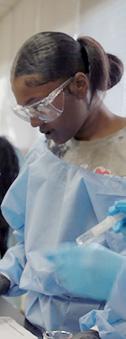
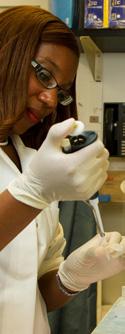
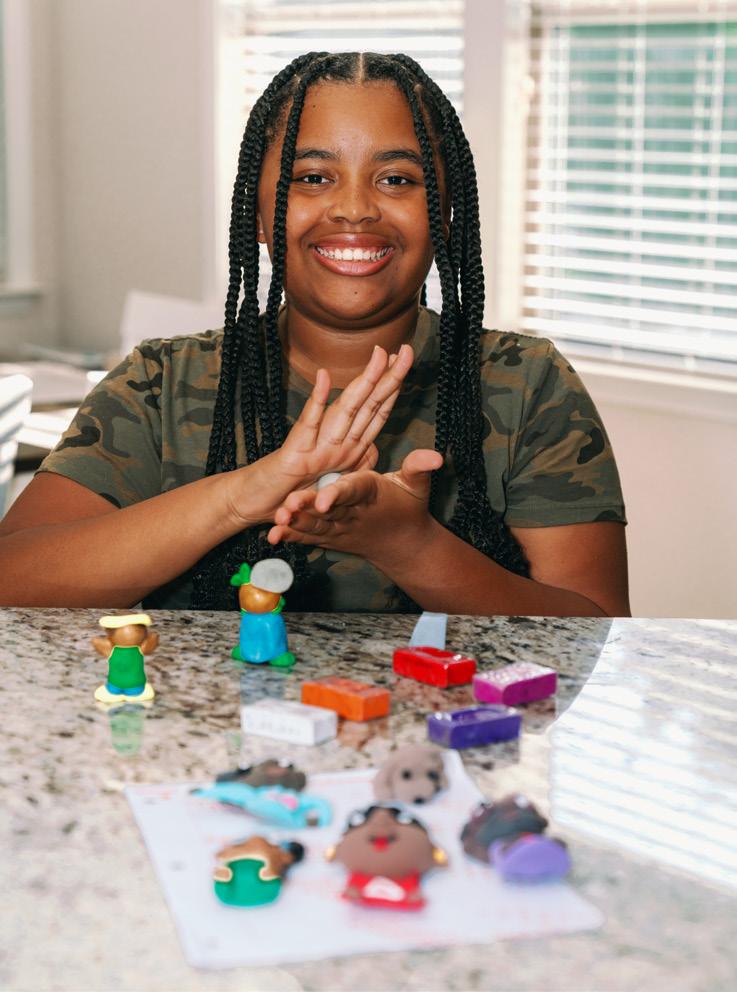
The BULLS Life Sciences Academy creates new pathways to prosperity for Durham’s young residents through community partnerships.
magine a hometown and county where multiple pathways to prosperity exist for all residents, a robust pipeline of talent exists for businesses, and our whole community thrives. at's the vision driving Made in Durham's work to create local partnerships among educators, businesses, government, and nonprofits for aligning resources build career, life, and business
Nearly a decade ago, a group of intrepid residents came together to survey Durham's Education-to-Career system. Born of this localized data and insights, Made in Durham came into being through the support of Durham County to address the gaps and needs identified in this initial study. A systems-based approach was employed to reduce obstacles and increase opportunities for residents and businesses. Engaging both ends of the employment cycle produces stable, prosperous pathways for all, and in particular younger, traditionally under-represented populations in our city.
Developing a Life in Science requires vision, dedication, and attention to detail. Despite their dreams, young people in Durham have not always had access to career pathways and prosperity in the life sciences.
Designing a curriculum to align talent with careers was a crucial early step in establishing BULLS to prepare young people for employment in the life sciences. As a result, Durham’s residents now apply their dreams, talent, and commitment to graduating from the BULLS Life Sciences Academy and achieving economic mobility for themselves and their families.
In a novel collaboration, the North Carolina Biotechnology Center assisted Made in Durham by translating an industry-specific curriculum for local use in the life sciences field, specifically in biomanufacturing.
“Lorem ipsum dolor sit amet, cons ectetuer adipiscing elit Lorem
they studied and attended instruction. BULLS o ers educational support toward industry-specific certifications in the Life Sciences industry, but it also paves a clear roadmap toward successful employment and career
Through a partnership with Durham Technical Community College, rigorous standards have been implemented and are continuously refined toward a singular goal: securing high-wage, high-growth jobs in the life sciences for Durham’s young people. Support from Durham County helped create the initiative and ensured scalable effectiveness and growth.
Damon Saunders, BULLS Graduate (Cohort 6)
“A Life in Science” highlights the journeys of local young people who have discovered and embarked on new paths. While their lives and stories vary, science has been their avenue to new careers and opportunities, with the BULLS Life Sciences Academy serving as a
what does that look like? In the case of the BULLS Life Sciences Academy, Made in Durham created a comprehensive approach with our partners that guides students through essential milestones to attain industry-specific BioWork certifications. ese credentials make Durham's young residents eligible for living wage opportunities in the biomanufcturing and Life Sciences industry.
BULLS focuses on providing access to industry-specific certifications in the life sciences. It also supports students in pursuing economic mobility through careers in this field.
Kyle Rhoden II was hesitant to join BULLS due to the course load, but the welcoming atmosphere and informative orientation changed his mind. He ended up attending every BULLS study session and career
e BULLS experience is about more than curriculum. From the moment prospective cohorts are introduced to Made in Durham and BULLS, they are exposed to opportunities in Life Sciences by our community engagement teams and local partners. ey begin learning about Life Sciences before they receive an application through a host of information sessions and community events.
In doing so, BULLS helps shape the talent landscape in Durham's Life Sciences sector. e systems-based work is pointed toward a vision where employment opportunities for all residents and a productive workforce for local businesses.
BULLS graduates have access to additional support and enrichment. Assistance comes directly from personal development and indirectly from industry partnerships designed to continually optimize the initiative and create direct connections between employers and graduates. In some cases, BULLS graduates continue their education before pursuing their professional life in science.
“I might have blocked my blessing if I hadn’t stuck with it, but now I know I can do hard things and succeed. I can do anything I put my
— Kyle Rhoden II, BULLS Cohort 7 Graduate, BULLS
Once enrolled, youth engagement teams comprised of success coaches and resource specialists prepare cohort students for interviews and professional environments. Additional partnerships create wraparound support including childcare. Life stipends are a critical component that help create the space for students to excel their work and preparation for a life-changing career.
And it's working. e efficacy of the initiative continues to grow, as evidenced by our most recent and sixth cohort. As momentum builds, opportunities expand. e current BULLS class has increased to thirty students and ongoing progress toward a new
Mock interviews, lab work, and coaching prepared Kyle and his classmates for their first day on the job. Now more confident, Kyle has enrolled in the BioAg PRO program to advance his education in the
While graduation and certification are pivotal milestones, that's not the end of students' journeys. BULLS alumni and corporate engagement includes post-graduation counseling and support targeted at job opportunities, employment, and career advancement. e teams work on behalf of students and alongside corporate partners to align their skills to fit the needs of BioWork employers. By offering life stipends, wraparound support, optimized curriculum, and academic support, the BULLS initiative equips Durham's young residents with the necessary experience, knowledge, and skills to succeed in the competititve Life Sciences field. Ultimately, they're prepared for a career and a more prosperous life in science.
It is said that success takes care of itself when everything moves together. At the BULLS Life Sciences Academy, extraordinary local partnerships have laid a strong foundation for new pathways to personal fulfillment and economic mobility. Educators, administrators, coaches, support staff, and students carry the BULLS mantle every day with passion and a commitment to excellence. As these pieces work together, dreams of a Life in Science are being realized daily.
The percentage of BULLS students who graduated from the most recent cohort, making them eligible for employment in the Life Sciences industry.
Learn more at: madeindurham.org
Learn more at: madeindurham.org
BULLS graduates who have gained employment in the life sciences fields
PHOTO BY
sip & stroll
tIt’s all good vibes while you imbibe in downtown’s social district
BY LEAH BERRY
PHOTOGRAPHY BY JOHN MICHAEL SIMPSON
he Bullpen launched nearly two years ago in December 2022, establishing a vibrant, walkable downtown zone that’s abuzz with bevvies and social activity. “The initial vision of The Bullpen was to give downtown’s small business owners an economic boost coming out of the pandemic,” Downtown Durham Inc. Director of Business Engagement Tiffany Bashore says. “The goal was to encourage folks to come … and enjoy a beverage as they walked from place to place, or just to sit outside and enjoy the weather and community.” In an early 2024 survey, 60% of downtown businesses reported a boost in sales since the program launched, she says.
The Bullpen operates daily from 11 a.m. to 10 p.m. with participating businesses marked by signature window clings, making it easy for visitors to know where they can grab a drink to-go. Tiffany hopes the district continues to enhance the downtown experience as more community members utilize it to connect and enjoy exploring the city at a relaxed pace.
We visited five of the nearly 90 Bullpen business owners to check in and, naturally, grab a drink:
1 New to the social district is High Dive, which opened in mid-August on West Main Street. The spot serves as a laid-back alternative to Annexe and Bar Virgile – its sister establishments across the street – offering up draft and bottled beer, mini beer buckets, cheese nachos, popcorn and more, plus a touch of nostalgia with its jukebox and retro games like pinball, foosball and darts. All three businesses participate in The Bullpen, and co-owner Nellie Vail says, “it’s proven to be an especially nice connector for patrons who want to eat and imbibe at Durham’s quality establishments and carry their beverages to their entertainment destinations, like Durham Performing Arts Center, the Durham Bulls Athletic Park and the Carolina Theatre.”
2 Weldon Mills Distillery, with its back-door entrance tucked away on the South Roxboro Street side of the East Main Street business, brought its speakeasy vibes to the Bull City in 2023 after first opening in its namesake North Carolina town in 2019. The bar crafts its own spirits and offers a mix of tempting bites, live music, bourbon tastings and inventive cocktails. General Manager Darryl Russell is a fan of the district’s ability to draw more patrons,
saying it’s a win-win for both businesses and guests. “It has also allowed us expanded use of our patio,” Darryl says, noting that “some people would even love to see The Bullpen hours extended to bring more of a nightlife to Durham.” Darryl hopes more businesses join The Bullpen and wants more awareness around it. “The more people who know, the more people are willing to utilize The Bullpen,” he says. He also urges visitors to broaden the scope of their social district adventures. “Don’t forget the east side of Main Street exists!” Darryl says. While you’re there, order a Herby Derby – a refreshing concoction of its 3 Hamlets raspberry rose gin, elderflower liqueur, mint, sage, pineapple, lemon, turbinado and soda.
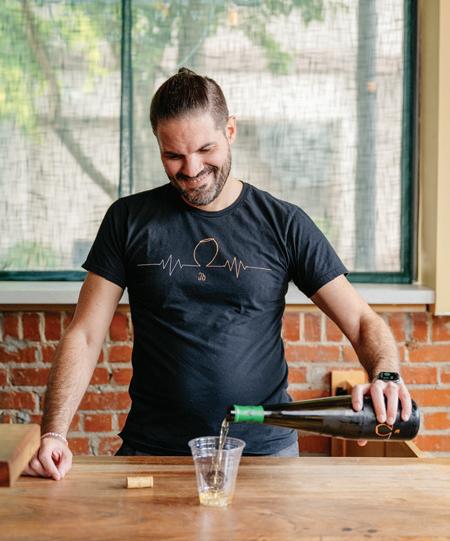
3 Many will remember Brunello Wine Bar’s first iteration as Bar Brunello on East Main Street. The new location – founded by owner, sommelier, oenologist and Buenos Aires native Esteban Brunello in October 2022 – is a casually elegant space where guests can explore both Old World wines and lesser-known varietals. Esteban says people are often excited to learn that they can take a glass of wine to-go. “People really enjoy it,” he says. “I think it’s fun for them, being able to taste what different establishments have to offer while walking around the town.” Visit during one of the bar’s Durham Wine Tasting Series – the next is Halloween themed on Oct. 31 – or stop in soon to sip, swirl and savor devilishly delicious wines like the 2023 Rosha Winery “EB,” a blend of 70% Rkatsiteli and 30% Mtsvane grape varieties sourced from the rich soils of the Kakheti region in the Republic of Georgia, that Esteban is pouring here.
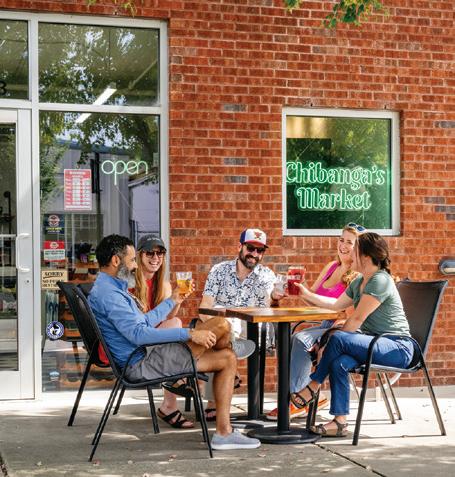
4 Drop by Chibanga’s Neighborhood Market for a cold beer, a quick snack, fresh produce, household essentials, tomorrow’s dinner and so much more. Take a seat outside and stay awhile, or grab your goods and go. Owner Javon Gaters says the convenience store, which opened in July 2023, has a little bit of everything and that The Bullpen has helped to amplify his business. “We get a lot of people headed down to DPAC or down to a ball game, and
they’ll pop in and get a drink to-go,” Javon says. “We do mimosas here in the mornings, so we’ll get a lot of people who are cruising around downtown, and come in and get a mimosa to-go.
“It’s been great for us, and I think people are kind of catching on to what’s going on, so we’re really starting to see it grow.” Javon says it inspires him to come up with creative ideas for beverage offerings that can be sold to-go, and he hopes to soon present different mocktails and slushies. In the meantime, take inspiration from Marcus Trotter, Holland Sink, Will Sink, Tess Filipowicz and Clara Penati, and opt for a couple drinks (they went with hard seltzers, strawberry mimosas and NoDa Brewing’s Big Slurp IPA) among friends.
5
LouElla Wine, Beer & Beverage is your one-stop bottle shop, bar and event space that offers curated wine and craft beer – and has been doing so since it opened on Geer Street in 2019 under the leadership of owner/ manager Campbell Davis. “People enjoy the freedom to grab a drink while they are walking around,” Campbell says of his customers’ experience in the district. Beer and wine drinkers alike can find autumnal options like the Weihenstephaner Pilsner, Bodega Verde Cariñena Blanco white and the Dupre “1942” Village red.
raise the bar
DEnjoy a front-row seat to flavor at these top dinner spots
BY LEAH BERRY PHOTOGRAPHY BY JOHN MICHAEL SIMPSON
owntown’s dining scene is hotter than ever, which can make landing a reservation tricky – especially on evenings that coincide with shows, festivals and concerts. Fortunately, many restaurants offer walk-up bar service, which oftentimes are the best seats in the house. These spots offer an up-close view of the action, personalized service and a chance to chat with the pros behind the counter – making it an ideal setting for a spontaneous date, a quick solo bite, or sipping and savoring before a night out on the town.
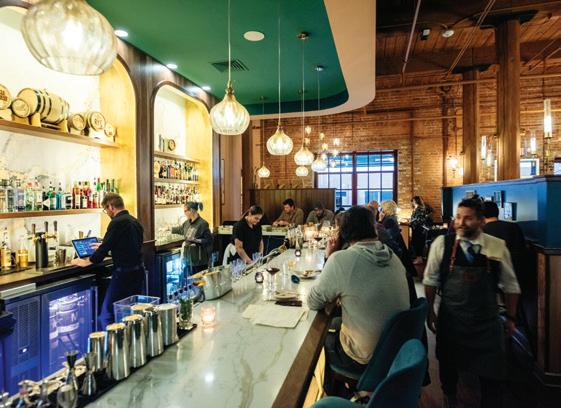
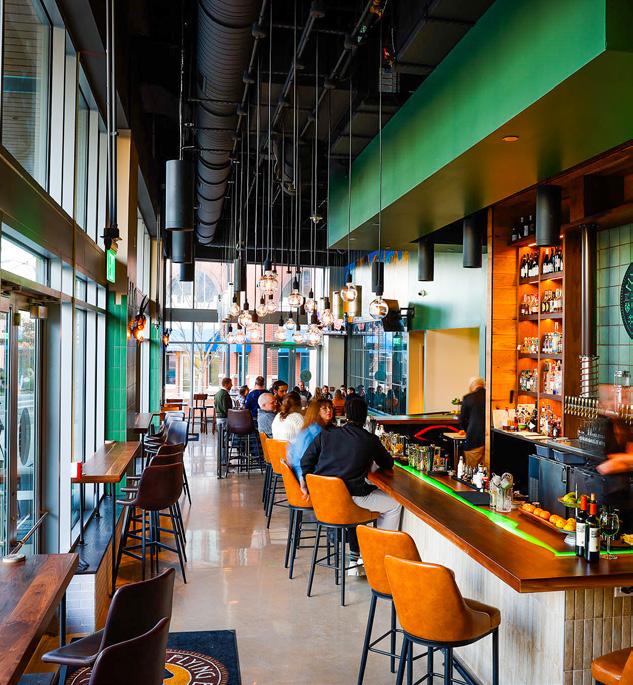
NanaSteak and Seraphine are beloved Bull City favorites known for their diverse offerings, elegant atmospheres and top-notch bar service. The bar and lounge at NanaSteak features 11 dining tables, along with the bar rail itself, which are surrounded by floor-to-ceiling windows that cast afternoon light on the restaurant’s extensive bourbon selection. “Guests receive the same attentive fine dining table service, in a slightly more casual atmosphere,” NanaSteak and Seraphine Operations Manager Megan Weddington says. “We do offer our fabulous housemade smashburger in the [NanaSteak] bar only, so we find that some folks will request the bar dining
areas just to enjoy that.” The bartenders at both restaurants are “artisans [who] are excited to create relationships with guests and help guide them through their dining experience,” Megan says. Menus change seasonally, with chefs and beverage directors designing daily off-menu specials. Megan advises stopping in at 5 p.m. sharp (4 p.m. on Sundays) to ensure a bar seat, especially on DPAC show nights.
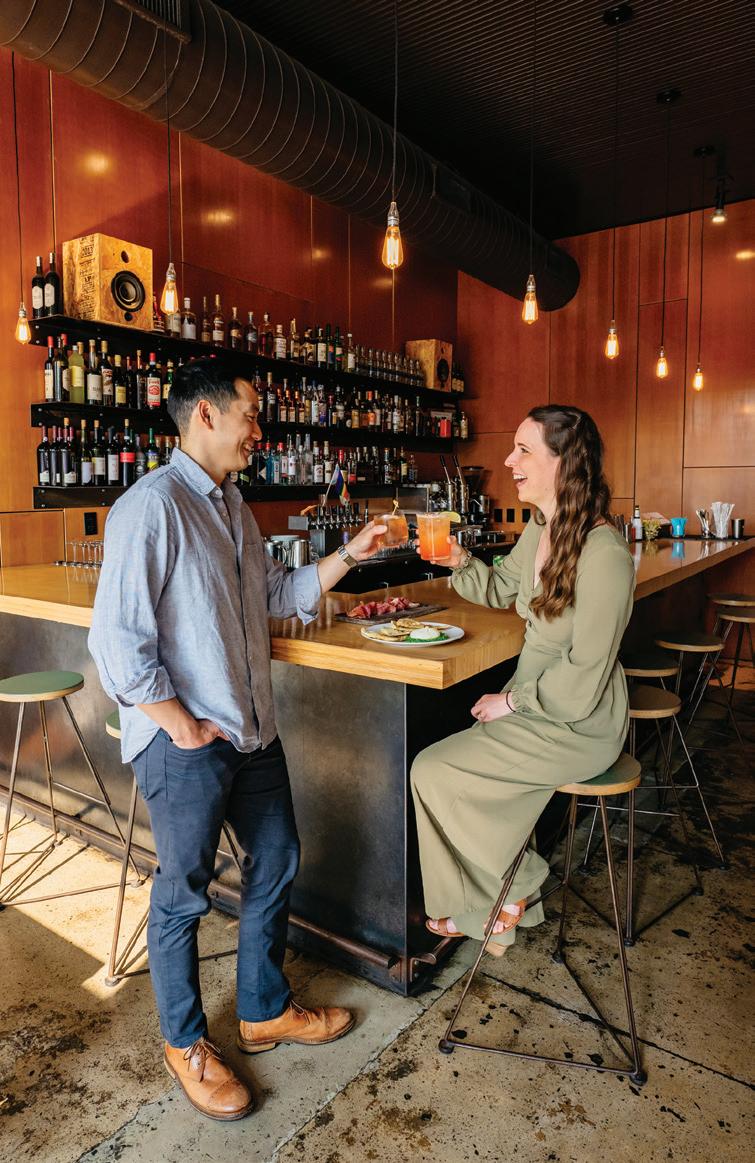
Pizzeria Toro doesn’t take reservations, but if you’re able to squeeze your way inside the bustling hot spot, take a seat at the bar for a casual yet intimate experience.
Owner Gray Brooks describes it as “dinner and a show.”
“We understand that you lose the ability to watch our chef and cooks make pizza in our oven, so our bartenders make up for it with their sparkling personalities,” Gray says. Popular dishes include the ricotta dumplings (look out for a butternut squash version alongside pumpkin caponata and delicata squash pizza this fall!), burrata and Tuscan kale salad.
Darker beers, bigger wines and bolder cocktails are on the roster – an in-house favorite is the CynarTown, which combines gin, sweet vermouth and the bitter Italian artichoke liqueur Cynar for a fun take on the classic Negroni. Plan your visit during a weekend lunch for a more laid-back
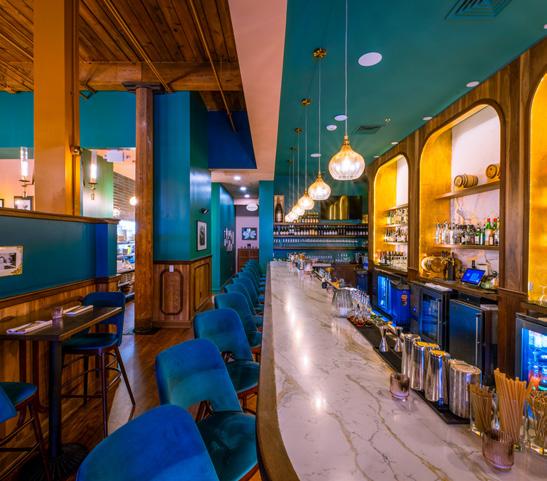
Seraphine’s cozy bar, with its striking black walnut arches and gold leaf accents, is a lively and effervescent atmosphere perfect for sharing a large tray of roasted oysters.
Rachel’s enjoying an Aperol margarita.
experience. But if you want to see the pros handle fire firsthand, Friday through Sunday nights are the way to go. “We’re a great place to grab a quick meal before a DPAC or Carolina Theatre show,” Gray says. “We specialize in getting you in and out quickly.”
Any time is the right time to enjoy the authentic Greek cuisine at Nikos in Brightleaf Square, but stop by from 5-6 p.m. to treat yourself to Opa! Hour with daily meze specials alongside cocktails that are only available at the bar. The restaurant also offers a rotating selection of bar-exclusive cocktails, which contain either hard-to-source ingredients or have lengthy prep processes, “but cocktail enthusiasts will really love them,” Manager
Hannah DeNuzzi says. Hannah’s personal favorite is the “Ou Me Fizz,” which features Reposado tequila, ouzo, blood orange juice, rose and orange bitters, egg white and club soda. “This recipe calls for a two-minute dry shake to achieve the proper fizz and frothiness, and it’s delicious,” Hannah says.
seat Yourself
• 19Fifty-One
• Alley Twenty Six
• Bull Mccabes Irish Pub**
• Cheeni
• Convivio*
• Counting House
• Cucciolo Osteria*
• Dashi
• Emmy Squared*
• Flying Bull Restaurant and Brewery
• Goorsha
• It’s a Southern Thing*
• La Mala
• Little Bull
• Littler
• Luna Rotisserie and Empanadas
• Mateo*
• Mezcalito**
• Mothers & Sons
• NanaSteak
• Nikos
• Pizzeria Toro**
• Queeny’s**
• The Roof at The Durham
• Seraphine
• Taberna Tapas
• Viceroy
• Zweli’s Ekhaya
• Zweli’s Kitchen
*offers walk-up bar seating, but also accepts reservations for the bar **doesn’t take reservations
Mothers & Sons Trattoria is best known for its handmade pasta and variety of regional Italian specialty dishes. Opt for the small, six-seat bar in the main dining area or the additional eight-seat Alimentari bar in the second dining room, which is only available on Friday and Saturday nights and provides a quieter, more intimate vibe. “Getting a few smaller courses to share with a friend or two seems to be a popular way to eat here at the main bar,” says General Manager Kevin Bullick, adding that the Alimentari bar is better for a full meal. Bar seating is first come, first served, and Kevin advises guests make a point to swing by this fall for bevvies made with housemade amaretto and limoncello. “If you’re trying to get a quick bite before a show, I suggest getting here right at 5 p.m. when we open,” Kevin says. Looking for something more leisurely? Stroll in after 8 p.m. when it’s easier to grab a seat.
21c Museum Hotel’s Counting House showcases inventive American fare in a chic setting. The bar area offers comfortable sofa seating and low tables set against expansive windows in addition to the high-top tables and the bar itself.
Marketing Manager Katie Blevins recommends a drink and shareables like the chargrilled oysters and smoked trout dip. Counting House’s Underground Cocktail Series returns in October, showcasing new, experimental and thematic cocktails in a setting that embraces the building’s art deco ambiance and historic charm. Stop by for breakfast, lunch or dinner. “That said,” Katie adds, “sometimes there’s nothing better than dessert and an espresso martini at the bar to end your night.”
At Mateo, Spanish small plates infused with a Southern twist are expertly paired with an extensive selection of Spanish wines – including one of the East Coast’s largest sherry menus. “For those who love a sherry, specifically, you’ll receive a more indepth, knowledgeable experience at the bar,” says General Manager Amber Griffor. The Mateo bar burger – a smash-style burger made with Tetilla cheese, Mateo sauce and crispy onions on a Ninth Street Bakery bun – is a must-try, available exclusively at the bar in limited quantities each night. “Every spot at our bar is unique and offers a great view,” Amber says, “from our open kitchen to our extensive beverage options and Trabanco cider pouring arm (which is one of only two in the United States).” Expect warm fall flavors of cranberry, baking spices and squash on Mateo’s new seasonal dinner menu, ideal for a quick bite pre- or post-DPAC or Carolina Theatre showings. “It’s also a lot of fun to grab a dessert and some sherry at the end of your evening!” Amber says.
Peter Lyu and Rachel Lyu belly up to the bar at Pizzeria Toro, a tried-and-true go-to for wood-fired pies and a wide assortment of Italian wines, not to mention its stellar cocktails –Peter’s got an antiquato, and
park it
A brief how-to on navigating parking options
BY OLIVIA PAUL
PHOTO BY JOHN MICHAEL SIMPSON
t he Do’s
• Park in one of the 4,000 off-street spaces in parking decks and lots.
• Plan to park once in one of the decks, then walk or take a scooter to visit the abundance of shops, restaurants and cultural offerings in downtown.
• Visit downtown in the evenings and on the weekends, as parking in the decks and plenty of on-street spots are free of charge after 7 p.m. on weeknights and on Saturdays, Sundays and city holidays.
• Save time while parking in a deck by using the pay stations by the elevators as you return to your vehicle.
• Press the call button at the gate for customer service 24/7 if you have a problem.
t he Don’ts
• Waste time and gas by circling around and looking for a spot on the street when spaces are available in parking decks.
• Double park or block fire hydrants or intersections, even if it’s for a few minutes, as this can result in harmful accidents and hinders emergency response for those in need.
• Risk getting a ticket to avoid a few dollars for parking when you could easily pay by phone or at a nearby pay station.
• Leave your vehicle unlocked or valuables in view.
• Drink and drive – take a ride-hailing service, taxi or bus, and come back the next day to pick up your vehicle.
t he More You k now
A new platform to update mobile payment technologies will be in place by the end of the year, making it easier for downtown visitors to pay for parking by phone and in advance. The city offers anyone working in the area a $70 per month discounted monthly parking permit for customers at or below 60% of the area median income. There’s also an evening parking permit for $80 per month for customers who arrive after 3 p.m.
STAY c AT ion, A ll i ever wA n T ed
Your ultimate guide to a downtown getaway
The beauty of a staycation is how easy it is to transform an ordinary Tuesday into an adventure. Ditch dinner plans at home and dive into the downtown scene –savor a dish at a beloved restaurant, discover art at a gallery opening, or spend an hour or two shopping locally. If an evening doesn’t cut it, carve out a few days to indulge in favorite pastimes while mixing in new-toyou activities. A true staycation means clearing your calendar, booking a room and exploring the best of what the heart of our city has to offer. Balance is key to a backyard excursion, so schedule some relaxation, physical activity, a cultural experience or two, and plenty of great meals. By the end, you’ll see downtown through a whole new lens.
STAY
It might feel silly to book a place only a few miles from your home, but for it to truly feel like the getaway you need, it’s important to pack a bag and escape your regular life, bed and housework. 21c Museum Hotel offers a slice of culture alongside its modern amenities; open 24/7 with no admission fee, the art museum is currently showcasing the exhibition “Refuge: Needing, Seeking, Creating Shelter.” Take part in one of the free weekly guided tours, with additional tours available during the Third Friday Durham Art Walk & Gallery Crawl. Guests can also relax at the hotel’s on-site spa, with appointments available individually or through a Pampered Penguin spa package for an enhanced staycation experience. Embrace mid-century modern vibes at The Durham Hotel while taking advantage of specials like its “Dinner Before the Show” prix fixe menu from 5-6:30 p.m. – perfect for anyone heading to a DPAC or Carolina Theatre performance (or simply looking for an early dinner) – and its
varied events. A few to mark on your calendar: renowned cookbook author Anne Byrn celebrates the launch of her latest book, “Baking in the American South,” Oct. 14; a Halloween-themed evening, “Witches Night Out on The Roof,” is tentatively scheduled for Oct. 17; stargaze with educators from Morehead Planetarium and Science Center and music from DJ Mic Check Oct. 21; and bring your costumed kids to a Halloween Storytime with the Durham County Library Oct. 30.
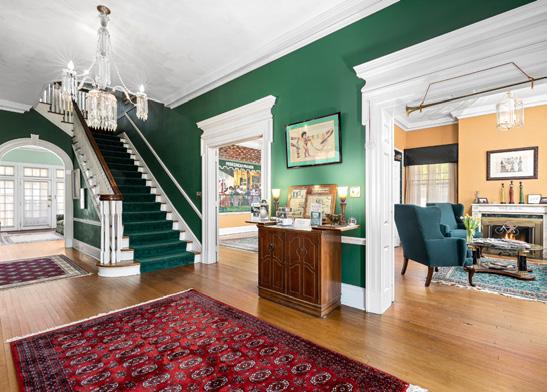
Across the train tracks, both the charmingly appointed Morehead Manor Bed & Breakfast as well as the Aloft are convenient for walking all over downtown. (Not to mention, the latter has a second-story heated outdoor pool overlooking the American Tobacco Campus.)
SH o P
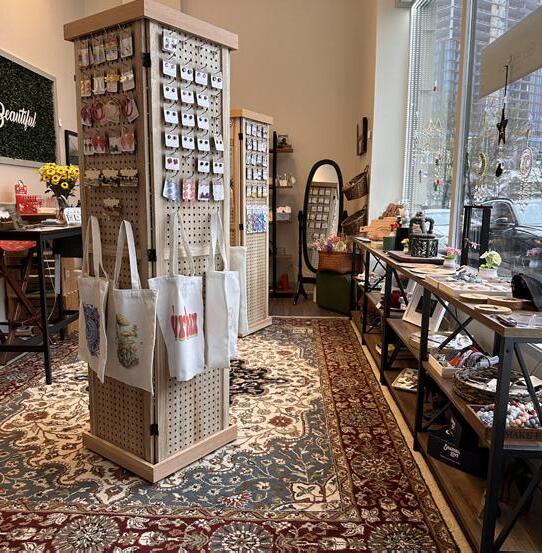
No downtown adventure is complete without a little retail therapy. Durham’s eclectic mix of shops offers everything from vintage treasures to modern finds. Start by exploring the chic, contemporary styles at Vert & Vogue and Rose & Lee Collective, or dive into retro fashion at Dolly’s Vintage and the Durham Vintage Collective. Looking for something
PHOTOGRAPHY BY JOHN MICHAEL SIMPSON
one-of-a-kind? Browse handcrafted items at Sh*t Diana Makes and lush plants alongside thoughtful gifts at The Zen Succulent, or craft your own cozy candle at Paddywax Candle Bar Music lovers can dig for vinyl gems at Bull City Records and Carolina Soul, while bibliophiles peruse the latest titles alongside an impressive assortment of used books at Letters Community Bookshop. Interior design enthusiasts will love exploring the curated selection of stylish home goods at Area Modern Home and EUtopia.design Exotique brings global flair to the heart of Durham with its array of African-inspired fashion and home decor. For jewelry lovers, Hamilton Hill Jewelry offers stunning, handcrafted pieces, and fashionistas can find designer styles at Mode Consignment Boutique. Complete your shopping spree with home decor and thoughtful gifts at Indio, Parker & Otis, Parker Paper Company, Mill & Meadow or outfit your next adventure at Yonderlust. rel AX
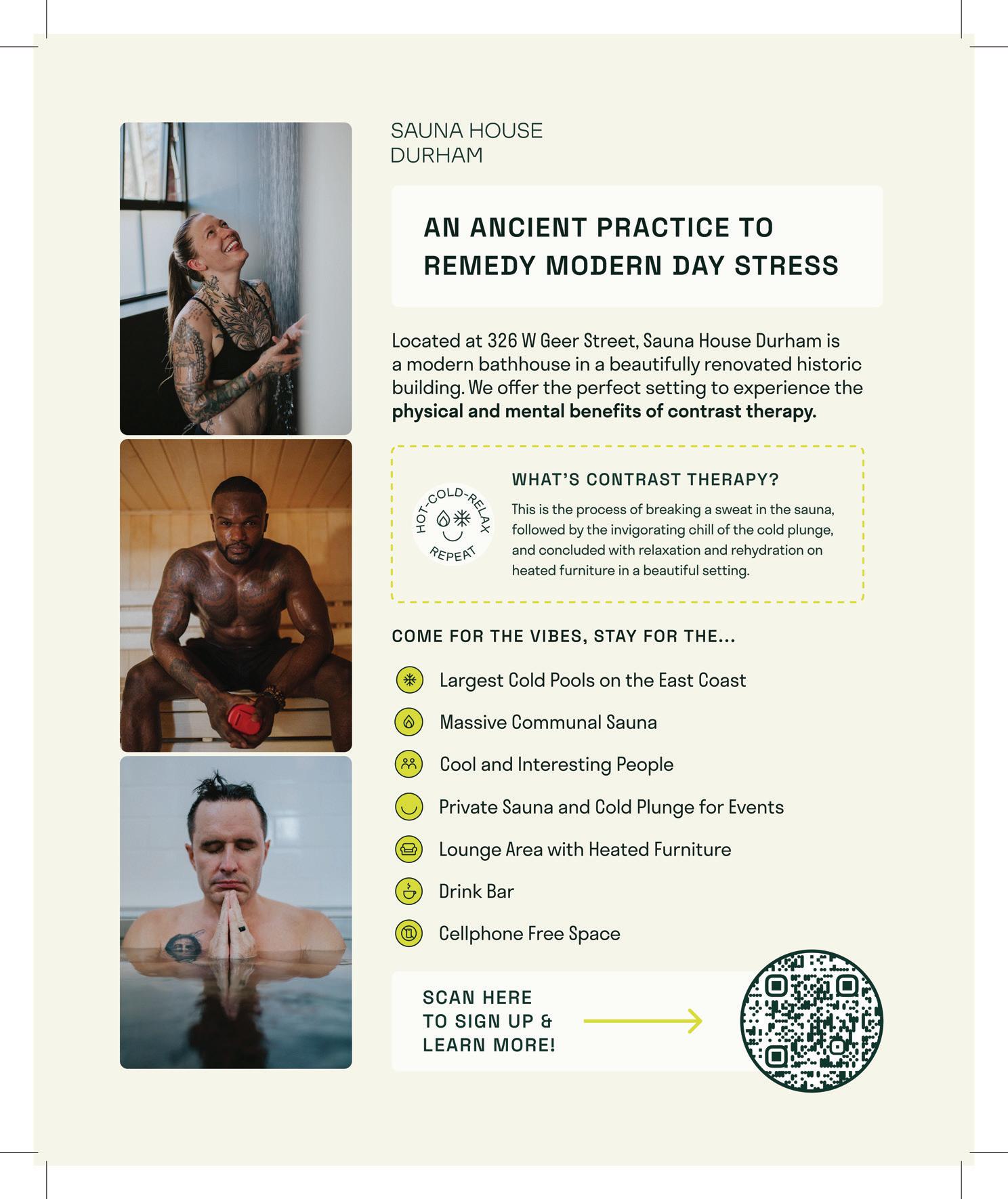
There’s something so relaxing about the slow rhythm of baseball during the Durham Bulls season of April through September, but here are a few other ideas until they return to the Durham Bulls Athletic Park in the spring: Stroll through the Durham Farmers Market on a Saturday morning (it still starts at 8 a.m. through November!) to get some vegan pastries from Bklyn Bakery, handcrafted ravioli from Melina’s Fresh Pasta and The Spicy Hermit kimchi. Treat yourself to a massage at Bella Trio Studio or drop in for an infrared light therapy session at Beem Light Sauna (and keep an eye out for the opening of Sauna House on Geer Street!). Get your hair colored and styled at Culture Hair Studio, Posh the Salon or Temple Studio. Try a yoga class at Virge Yoga. Try infused THC and CBD drinks, espresso, baked goods and more at cafes and shops like Redhead Hemp, Sherlocks Glass Art & Dispensary or Heal Tree CBD. Pair a honey chai Aperol spritz with a hash brown waffle during a leisurely brunch at Press Coffee, Crepes & Cocktails. Buy tickets to an afternoon movie at the Carolina Theatre. Head back to your hotel for an afternoon nap. You’re paying for that room. Use it!
TAK e in A li TT le c U lTU re
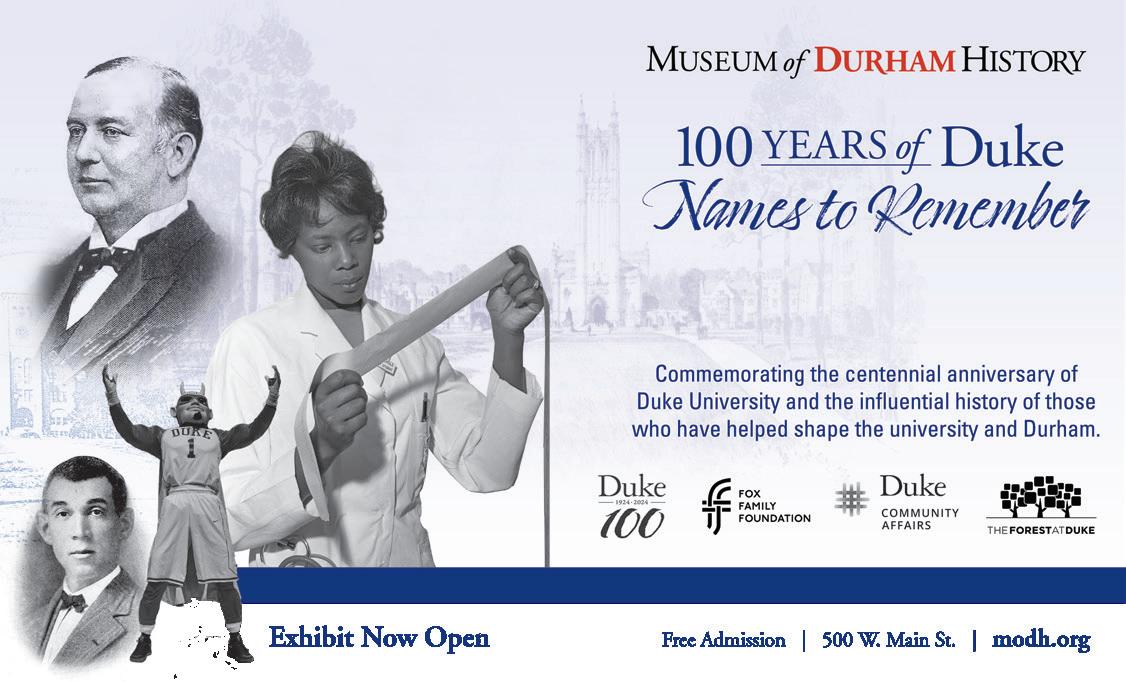
Speaking of the Carolina Theatre, attend a show there, at DPAC, or at The Pinhook, Motorco Music Hall or The Blue Note Grill. Check out the Museum of Durham History’s new exhibit, “100 Years of Duke: Names to Remember,” which runs through spring 2025
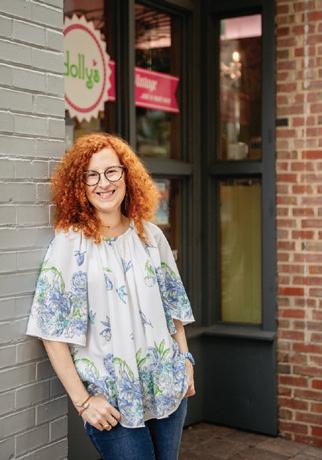
ABOVE Isabel Docal sips a Ruby Spritzer mocktail and takes in skyline views on The Roof at The Durham Hotel. Plan your own visit when soul singer Ally J performs Oct. 9. LEFT Dolly’s Vintage owner Larisa Harrison curates a vast collection of fun and funky vintage clothing, cute gifts, trinkets and Durham swag.
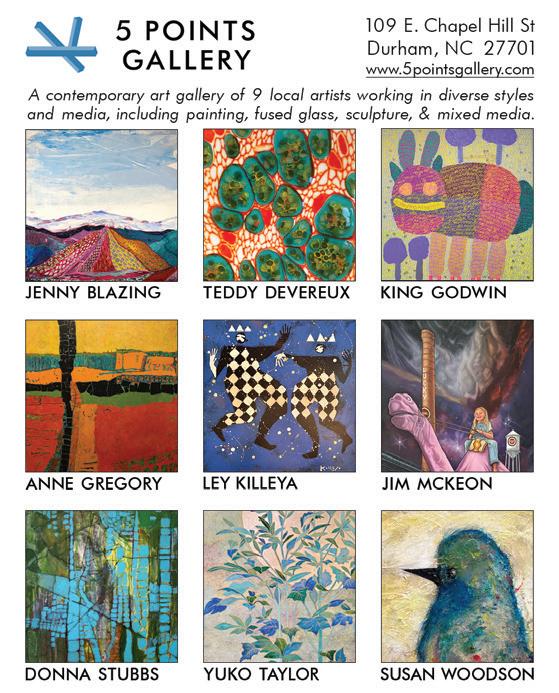
and commemorates Duke University evolution from its origins as a small schoolhouse in Randolph County to its establishment as a world-renowned institution in 1924. Get a selfie in front of each of Durham’s murals. Join Preservation Durham for its Cocktails & Cornices Walking Tour Oct. 9 to see examples of art deco, neoclassical and Italianate architecture in the historic downtown district. Take in the art at Points Gallery, or sip a cocktail and listen to jazz at Missy Lane’s Assembly Room And it’s always fun to see what’s new at Durham Arts Council and various Art Guild galleries.
wor K UP A S we AT
Start with Upside Yoga on The Roof at The Durham Hotel every Saturday and Sunday – a refreshing way to begin the day with a stunning view of the city. Grab a smoothie or the Paddle Bowl made with mango, coconut and granola at Nautical Bowls. Or pick up a new pair of running shoes at Bull City Running Co. and gently break them in with a stroll around the historic Durham Athletic Park or along the American Tobacco Trail Take a cycling class at CycleBar Durham when it opens soon.
Pl AY
Test your aim and channel your inner lumberjack while enjoying a fun, competitive environment at Urban Axes. Just next door, Boxcar Bar + Arcade offers a nostalgic experience with its extensive collection of classic arcade games, SkeeBall and outdoor pingpong tables. The recently opened High Dive bar features pool, a jukebox and foosball, and nearby State of Golf is also new to the scene –try out full-swing golf and other sports simulators and cocktails. Wednesdays at Parts & Labor are for board or card games, so grab a bite, a pint and get playing! There are plenty of trivia nights all around downtown from Sundays at Durty Bull Brewing Company and Mondays at Ponysaurus Brewing Co. to Tuesdays at Dssolvr Durham and Wednesdays at Bull McCabes Irish Pub
ind U l G e
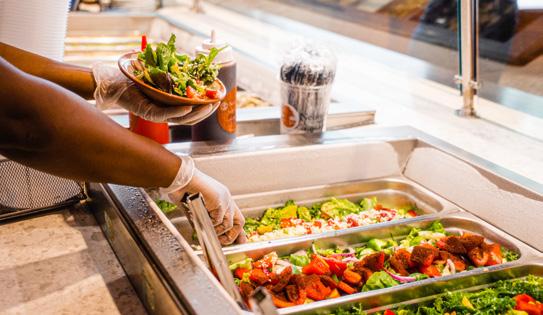
old. It’s so hard to keep up!) That might lead to stops at Emmy Fonda Lupita or Cheeni. If you want to hit up one of your go-to restaurants, consider doing so during a different time of day. (For example, M Sushi has an incredible lunch menu, but many think of this as a dinner destination!) When planning, pick one huge meal per day. Or choose one expensive meal a day and combine that with two more affordable options. (Example: Rise for breakfast, QueenBurger for lunch and Mateo for dinner!) Or maybe your group is craving wildly different things. Try the Durham Food where some can get smoked salmon and scallion cream cheese Everything Bagels while others can order a hamburger from . (There’s also authentic Indian fare, seafood, Mexican food, a bakery and pizza to please every palate!) For something on the sweet side, head to Sweets by Shayda for an assortment of macarons Jeni’s Splendid Ice Cream to try its new fall flavors, which include bay leaf cheesecake, sweet potato marshmallow praline, pumpkin seed and rye cookie (left) and miso butterscotch brownie.
i MB i B e
Here’s where your staycation to-do list will get super long, super fast. Start by thinking of the culinary gems you’ve never experienced. The ones that make you feel ridiculous. “How come you haven’t been there?” your friends tease. Maybe it’s Rose’s, NanaSteak, Toast or King’s Sandwich Shop. Or perhaps it’s Mothers & Sons, Hutchins Garage and Cucciolo Osteria. Then, make a list of newer places you haven’t gotten around to checking out. (One thing you’ll learn when you plan a staycation is that “new” to you might mean a year
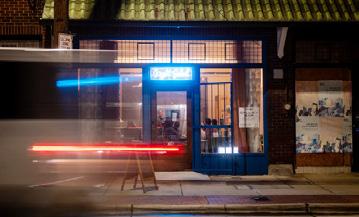
Don’t forget the drinks! Grab a coffee or tea at Foster Street Coffee, Cocoa Cinnamon, The Oak House, Gojo by Goorsha or The Can Opener to kick off your day. Maybe you’ve still not been to Pour Taproom, The Waiting Room or The Velvet Hippo. Maybe you’re in the mood for some wine – there’s The Wine Feed, Bar Brunello, West End Wine Bar, Killer Queen and LouElla Wine, Beer & Beverage. Make your way from The Daily Beer Bar to 106 Main to Bar Virgile. Or take yourself brewery hopping from Atomic Clock Brewing Co. to The Glass Jug Beer Lab to Durty Bull Brewing Company to Bull City Ciderworks. Sign up to participate in the final two classes of Alley Twenty Six’s Cocktails 101 series led by owner Shannon Healy at Night School Bar: “The Golden Age” will explore Manhattans, dry martinis and sidecars Nov. 12; and “Travel Plans” on Dec. 3 covers cocktails like boulevardiers, negronis, margaritas and daiquiris. Both events run from 7-9 p.m. in-person ($95 per ticket) or online ($35). If you want something a little more intimate, head downstairs to Kingfisher’s cozy lounge, or take your drink out to its lush patio on mild fall evenings, or visit Corpse Reviver Cocktail Bar and Lounge where you can take part in music bingo on Wednesdays, enjoy jazz on Thursdays or simply sip on a cocktail crafted with the Durham Distillery gin it produces above the basement bar. In October, it’ll feature a Halloween cocktail menu, taking inspiration from its history as a former coffin shop, and transform into a festive holiday bar Nov. 20 – Dec. 31.
ABOVE Learn how to craft your own cocktails from Alley Twenty Six’s Shannon Healy at Night School Bar. LEFT Or let the pros behind the stylish bar at Kingfisher whip up a seasonal drink for you.
PHOTO BY FORREST MASON
PHOTO BY KATE MEDLEY
HERE w E GRO w A G A I N
1 YONDERLUST
109 N. Gregson St.
• Durham-based Linton Architects and Linton Holdings LLC transformed the nearly century-old building into a two-story retail and residential development
• A cafe and retail store occupy the 3,750-square-foot first floor, which opened in 2023
• Four one-bedroom apartments on the 2,780-square-foot second floor, all occupied
2 BRIGHTLEAF DISTRICT
Includes historic Brightleaf Square at 905 W. Main St., 910-914 W. Main St., 815 W. Morgan St., 810 W. Peabody St. and 112 S. Duke St. In total, the neighborhood aggregation is approx. 225,000 square feet of mixed-use space.
• Charlotte-based Asana Partners purchased the property in late 2019. Tenants that have opened in Brightleaf Square in the past year include Emmy Squared Pizza, Fonda Lupita, Zweli’s Kitchen and Paddywax Candle Bar Forthcoming tenants slated to open later this year are Afters Dessert Bar and Raleigh-based Pilates and cardio fitness studio FlowCorps.
3 THE GREGSON
204 S. Gregson St.
• Developer is Baltimore-based real estate company Wexford Science & Technology, which also developed The Chesterfield building
• Nine levels with 218,000 square feet of state-of-the-art lab and office space
• On-site multi-level parking garage
• Currently in predevelopment, expected delivery TBD
4 FORMER DURHAM POLICE DEPARTMENT HEADQUARTERS
505 W. Chapel Hill St.
• 4-acre parcel owned by the City of Durham
• Originally built in the 1950s as offices for Home Security Life Insurance Company and most recently occupied by DPD, the building became vacant in late 2019
• City Council selected Florida-headquartered The Peebles Corp in late August for a nearly $300 million redevelopment of the building, which is slated to include: 354 residential rental units (92 permanently affordable at 60% of the area median income and below) and 26 condos for sale; 250,000 square feet of labs and retail space, including a grocery anchor tenant; 791 parking spots; a centrally located plaza among the three buildings, which will be connected by walkways and feature public art.
• It’s yet to be determined if the historic building will be preserved and renovated into a 100-room hotel or replaced with a cultural center and museum.
• Three distinctive floor plans crafted for downtown living, with rooftop terraces, 1-2 car garages, and 10-foot ceilings in the main living space, plus home offices and/or flex spaces in every home as well as features like quartz countertops, modern cabinetry with a stylish range hood, premium KitchenAid appliances, floating bathroom vanities and LVP flooring throughout
• Features first urban pedestrian malls in the state
• Starting in the low $500,000s; homes available for move-in now through 2025
6 C ITY PORT II
505 Yancey St.
• Adjacent to first phase of City Port (600 S. Duke St.)
• Joint venture of Center Studio Architecture and White Oak Properties
• Focus is on offering smaller condominiums at a lower price with parking for most units and rooftop deck overlooking the city
• 55 units ranging from 347-869 square feet, $240,000s to $560,000s
• Six floors (first floor is secure basement parking, additional five floors of condos) with rooftop decks
• Construction estimated to commence early 2025
• Taking contracts now
7 J.J. HENDERSON SENIOR APARTMENTS
807 S. Duke St.
• 177 units; $31.2 million project; rehabilitation of the existing apartments built in 1979
• Durham Housing Authority co-developed the property with its instrumentality, Development Ventures Inc., as well as California Commercial Investment Group and Florian Companies
• Affordable senior (62 and older) community with features including 24/7 emergency maintenance; water, sewer and trash included; stove, refrigerator plus vinyl flooring throughout unit; emergency alert system; on-site laundry facility; community room; and an off-street parking lot
• Completed February 2023
8
THE JOYCE
487 Morehead Ave.
• $18.6 million project
• 80 units
• Durham Housing Authority co-developed the property with its instrumentality, Development Ventures Inc., as well as Laurel Street Residential
• Grand opening was held April 2023
9 T HE TERRACES AT MOREHEAD HILL
783 Willard St.
• 25 townhomes featuring 3 bedrooms, 3.5 baths, 2-car garage and a private rooftop terrace, each surrounded by greenspace and Durham skyline views
• Urban development led by The Florian Companies; California Commercial Investment Companies is a development partner
• Phase 1 and 2 are sold out; Phase 3, the final phase, is available now and features 11 townhomes including: six move-in ready, Parade of Homes-winning, Promenade-style floor plans on Willard Street with designated office space on the third floor; and five larger, terrace-style floor plans on Manor Way, each with a full-size elevator and a first-floor bedroom
• All Phase 3 townhomes include a 2-car garage, an elevator or elevator-ready (prewired and shafted), and unique design selections among the units
• Willard Street is a newly constructed city street with brick borders, streetlights, benches and a new public footbridge at the end of the street that crosses over a creek and connects to the Miracle League of the Triangle field, American Tobacco Campus, Durham Bulls Athletic Park and beyond within minutes.
10 MARKET DISTRICT AT AMERICAN TOBACCO CAMPUS PHASE 1
• Former site of University Ford
601 Willard St.
• Development by Capitol Broadcasting Company and Hines in partnership with USAA Real Estate
• 700,000-square-foot mixed-use project on 8 acres bordering the west side of American Tobacco Campus
• 8 acres that includes 350,000 square feet of leasable space in two Hines T3 (Timber, Transit and Technology) creative office buildings; 350 multifamily units in a 14-story, high-rise residential building; and 100,000 square feet of experiential retail, like a theater/draft house, prepared foods grocer, shops and restaurants
• Activated central plaza and intimate pedestrian alleyways programmed with events and experiences
• No definitive construction start date at this time
11 ASHTON PLACE
310 Jackson St.
• Adjacent to the Willard Street Apartments, this 51-unit, 52,000-square-foot affordable housing project is for adults age 55 and older
• Studio, one- and two-bedroom units
• Community gathering areas, bike storage, fitness facilities, tenant storage and a business center
• The project is a partnership between DHIC and SelfHelp Ventures Fund and was developed on cityowned land with a 9% low-income housing tax credit and a commitment of funds from the city
• Construction started in Q2 2023; finished in Q3 2024
• First residents moved in August 2024
12 THE NOVUS
400 W. Main St.
• Close to 2 acres of land
• Existing South Bank building was demolished and construction is underway
• Austin Lawrence Partners project that will be constructed in two phases: Phase 1 will encompass a mixed-use 27-story high-rise with a residential portion to include 54 condominiums with layouts of up to five bedrooms; 188 apartments; 450 parking spaces
• Amenities include an outdoor movie theater, resort-style pool with accompanying spa pools, golf simulators, coworking space and expansive indoor and outdoor entertaining spaces plus city views through floor-to-ceiling glass, spacious private balconies, chefappointed kitchens and modern bathrooms.
• Construction of Phase 1 slated for completion in early 2025. Preleasing of apartments will begin toward the end of 2024.
• Phase 2 is currently in concept design
13 THE JAMES
320 W. Morgan St.
• 312 mixed-use apartment units, 32-story tower
• 13,000 square feet of retail space
• Craig Davis Properties project
14 YMCA REDEVELOPMENT
218 W. Morgan St.
• 295 mixed-use apartment units
• 120,000 square feet of office space
• New 50,000-square-foot YMCA
• Project delayed; no definitive start or completion date, but project is expected to move ahead in near future
15 THE VEGA
214 Hunt St.
• Lambert Development project
• Seven stories consisting of 57 one-, two- and threebedroom condos ranging from approximately 900–2,300 square feet; each home has Durham Central Park or city views via a 10-foot folding glass door
• Amenities include a resident club room with a terrace overlooking DCP, fitness center, personal storage unit for each home, secure refrigerated storage for grocery or other delivery, private parking with assigned spaces and optional car charge spaces. Air filtration system provides a healthy living environment for residents via extensive collaboration with NORESCO. All common areas will substantially exceed code and conventional standards for indoor air quality, and hospital-grade filters will be utilized in the amenity and fitness rooms.
• $500,000 to $1 million+
• Commercial space on lower levels
• MHAworks led design; Resolute Building Company led construction, which began July 2021
• Complex is sold out
16 DURHAM INNOVATION DISTRICT
Total area: 1.8 million square feet, 27 acres, bordered by Duke Street, Morgan Street, West Corporation Street and Roney Street
• 200 Morris – Duke Clinical Research Institute leases entire building; Google is a subtenant in the building; Virge Yoga will open in early 2025; 2,780 square feet of retail space is available.
• 300 Morris – 907 square feet of move-in-ready lab space on the ground floor will complete construction end of 2024; Flying Bull Restaurant and Brewery is also located on the ground floor
• Morris Green Park – at the corner of Morris Street & Fernway Avenue; offers public green space where you can take regular outdoor fitness classes by Virge Yoga and enjoy music hosted by Flying Bull on Third Fridays; food trucks are programmed on the Third Thursday during lunch and open to the public
• Future phases will include more than180,000 square feet of lab & office space
• Public parking garage on Roney Street
• Courtyard between 200 & 300 Morris buildings includes seating, signature lighting, Wi-Fi, water features and lawn games. Public art includes Raleigh artist Matt McConnell’s 100-foot sculpture and Charlotte artist Sharon Dowell’s two-part series along Morris Street. Raleigh artist Anna Payne Rogers Previtte’s mural is showcased in the 300 Morris lobby.
17 BECKON 311 Liggett
St.
• Six-story building with 263 apartments and around 6,000 square feet of retail space; 2,884 square feet was leased to Crank Arm Brewing, expected to open in early fall 2024
• Studio, one-, two- and three-bedrooms
• More than 10,000 square feet of amenity space, including a sky lounge, coworking spaces, resort-style pool, indoor/outdoor resident lounges, 2,000-squarefoot fitness center with yoga studio, hammock garden, dog spa, dog park, bike storage and resident parking garage with car-charging stations
• Smart community with keyless entry, smart thermostats and lighting controls, community-wide Wi-Fi, secured package room and cold storage area for at-home grocery delivery
• Architect is JDavis Architects, Level Five Designs is the designer and Stewart is the civil engineer and landscape architect
• 8,000 square feet of retail space in new construction; approximately 18,500 square feet in existing historic garage building, which is being upgraded
• Delivery expected spring 2025.
19 DURHAM RAIL TRAIL
Abandoned Norfolk and Southern rail bed
• 1.8 mile multi-use trail that reclaims a portion of unused railroad tracks for walking and biking from north Durham to downtown.
• City staff continue to strategize on engaging historically under-represented communities in alignment with the city’s Equitable Community Engagement Blueprint
• Construction estimated to begin in spring 2026; trail expected to open fall 2027
• An alignment for the basic trail has been set, which includes generous path widths and materials, neighborhood connections and end points, and specific elements for roadway crossings.
• Trail will have proximity to the American Tobacco Trail as well as major transportation nodes, such as the Amtrak Station and Durham Station
20 THE GEORGE 512 W. Geer St.
• Raleigh-based Beacon Street Development, on pause for now; originally slated as a seven-story, 40-residence boutique condominium with five residential floors offering one-, two- and three-bedroom penthouse residences over two levels of gate-secured parking
• “This project is of immense importance to us, and we are keen to restart it at the earliest opportunity.” – Justin Hime, sales and marketing director at Beacon Street
Photo:
21 wASHINGTON STREET TO w NHOMES
802 Washington St.
• Three 3,000-square-foot townhomes (three bedrooms, four baths) with private decks and a sky room
• $1.75 million
• Durham Performing Arts Center architect Phil Szostak of Szostak Design
• Breaking ground by end of 2024
22 GEERHOUSE
620 Foster St.
• 2.2-acre site near Durham Central Park
• Phase 1 to include 220 new multifamily rental units, averaging 785 square feet (range from 566 to 1,310 square feet) with a unit mix of 20% studio units, 50% one-bedroom units and 30% two-bedroom units
• Amenities include: Landscaped courtyard with water feature, major amenity rooms with west-facing terrace overlooking the historic Durham Athletic Park, ample garage parking and linear park through the site connecting Foster Street to Rigsbee Avenue
• Project includes an expanded Motorco Music Hall, plus 13,000 square feet of new retail space; Tataco, a Mexican eatery by James Beard Award-nominated chef Oscar Diaz, will occupy a portion of the first floor
• First units currently being delivered
23 THE LINCOLN ON GEER 406 W. Geer St.
• 8,605-square-foot wedding and event venue that includes catering kitchen, three private lounges and a state-of-the-art sound system
24 710 RIGSBEE AVE.
• 51 apartments, 2,000-square-foot restaurant with 700-square-foot patio
• Elmwood Development project; architect is Architecture Firm; engineer is Coulter Jewell Thames; interior designer is Murphy Waldron Interiors
• As of press time, anticipated to open in September
25 318 w. CORPORATION ST.
• 82 apartment units; studio, 1-, 2- and 3-bedrooms
• 2,000 square feet of commercial space; four- and five-story brick building
• Elmwood Development project with ArchitectureFirm, Coulter Jewell Thames and Murphy Waldron Interiors
• Opened October 2023 and now leasing
26 311 w. CORPORATION ST.
• Four-story building with 45 apartments
• Brick and metal facade
• Construction started September 2023, anticipated opening in February 2025
• Elmwood Development project with ArchitectureFirm, Coulter Jewell Thames and general contractor HITT Contracting
27
ATLAS
DURHAM
614 Rigsbee Ave.
• 171 apartment units; studio, one- and two-bedroom floor plans to fit a variety of budgets
• Apartments feature modern finishes,10-foot ceilings, Google fiber, valet trash service, Ori Living home organization and direct-to-door Fetch package delivery
• Private terraces and 22 amenities including a Sky Lounge, pool, coworking and large communal spaces, study pods, fitness center, game room, bike storage rooms, ample garage parking and bark park
• 6,300 square feet of street-level retail, including DSSOLVR Durham and Nautical Bowls, with more announcements to come
• Located in the heart of the Central Park District with a quick walk to Dame’s Chicken & Waffles, Motorco, Durham Food Hall and the Durham Farmers Market
• Developed in 2022 by Southern Urban and Center Studio Architecture and acquired by multifamily real estate firm Collett Capital
28 NORTH & BROAD wAY 120
Broadway St.
• A Lock7 Development of 24 18- and 20-foot-wide townhomes
• Builder is Concept 8; sales and marketing is handled by Chappell [Powered by Compass]
• Construction started Q2 2023; last delivery expected Q4 2024
• 50% sold (12 of 24 units closed)
• Features include roof terraces in all units; one- and twocar garages in all units; large windows (store-front glass on some units); multiple flex spaces in some units; and skyline views in some units
29 707 N. MANGUM ST.
• Building is for sale
30 106 BROAD wAY
• Joint venture of Center Studio Architecture, White Oak Properties and Chris McGee
• 14 modern two-bedroom, 1,028-square-foot townhomes starting at $499,000; construction slated to begin fall 2024
• Private outdoor balconies off top floor living rooms with soaring ceilings + a one-car garage with flex room
• Taking contracts now
• Sold by Urban Durham Realty
31 608 MANGUM
608 N. Mangum St.
• Six townhome units
• Project completed
32
ARRAY DURHAM
521 N. Mangum St.
• 18 studio and one-bedroom condos in a walk-up
• 500- to 700-square-foot designs
• Only two units left, in the $420,000s
• Joint venture of Center Studio Architecture and White Oak Properties, sold by Urban Durham Realty
33 AURA 509
509 N. Mangum St.
• Developer is Trinsic Residential Group – Carolinas
• Purchased a $3.2 million, 1.3-acre site
• 264,000-square-foot project
• 182 units averaging less than 800 square feet each
• Eight-story, podium-style construction (concrete parking deck with five levels of wood-frame construction) with approximately 200 parking spaces across three levels of parking
• General contractor is John Moriarty & Associates, architect Cline Design Associates and civil engineer is Coulter Jewell Thames
• Construction began fall 2021; first units delivered Q1 2023; completed June 1, 2023; currently 93% leased
34 501 N. MANGUM ST.
• Developer is Trinsic Residential Group – Carolinas
• 232 unit, 18-story high-rise
• Project is currently on hold
35
102 w. MORGAN ST.
• Developer is Trinsic Residential Group – Carolinas
• 219 units
• Started Q1 2025
• Project is currently on hold
36 THE w ILLO w
DURHAM
601 N. Roxboro St.
• Two five-story buildings, constructed in two phases
• Ground-floor garage and service areas totaling 7,000 square feet per building
• Seven condominiums per building; plans include twoand three-bedroom units of 1,855, 2,410 and 3,320 square feet; all include a flex room
• Amenities: two to three balconies per unit, dedicated laundry room in each condo, modern mail room with refrigerated delivery, guaranteed parking space per unit; dedicated first-story storage for each unit
• Started in the $900,000s; remaining units start at $1.1M
• Four of the seven Phase 1 condominiums are sold; two of the seven in Phase 2 are sold
• Completion of first building (Phase 1) slated Q4 2024; second building (Phase 2) scheduled Q4 2025.
• Developed by Lorient Homes and sold by Urban Durham Realty
37 ELLIOT SQUARE
601 N. Queen St.
• Developer is Elliott Square Partners (James Bradford and Mark Galifianakis); builder is Concept 8; sales and marketing is Chappell [Powered by Compass]
• 37 16- and 18-foot wide modern townhomes; 1,600-1,900 square feet
• Features include roof terraces and two-car dedicated parking for all units and skyline views for some units
• Construction complete
• More than 97% sold (36 homes have closed)
38 KRESS CONDOMINIUMS
162 W. Ramseur St.
• Corner of West Ramseur and South Mangum streets, current site of a 0.15-acre parking lot next to the historic Kress building
• Development by Raleigh-based real estate firms White Oak Properties and CityPlat
• Six-story building with 26 residential units, including rooftop units, all with balconies
• 2,000 square feet of ground-level retail
• Plans to install CityLift Parking, which will park cars and bring them to residents using an automated lift system, taking up less space than a traditional parking deck
• No definitive construction start date at this time
39 300 & 500 E. MAIN ST. APARTMENTS
• Mixed-use buildings with total of 305 affordable residential apartments, 248 market-rate apartments, 16,500 square feet of commercial space and more than 1,600 parking spaces
300 E. Main St.
• Includes a roughly 753-space parking deck with 110 affordable housing units serving 30%-80% AMI with a mix of studio, one-, two- and three-bedroom units
• 3,900 square feet of commercial space that will target nonprofit and/or socially responsible organizations and a 9,141-square-foot child care location with two pre-K classrooms, allowing Durham County to serve children from birth to 5 years old
• Queen Street side of the building includes a structural public art installation that also serves as a screen wall for the parking deck
• Construction of the parking deck is complete and currently operational
• Anticipated affordable housing completion estimated for Q1 2025
• Estimated overall completion in Q1 2025
500 E. Main St.
• Redevelopment will include a parking garage with approximately 847 spaces along with 195 affordable housing units serving 30%-80% AMI with a mix of studio, one-, two- and three-bedroom units along Ramseur Street
• Includes Maizon Durham, 248 market-rate apartments along Main Street handled by Florida-based developer ZOM Living, which has an office in Raleigh, with a mix of studio, one-, two- and three-bedroom apartments (ranging in size from 555 to 1,450 square feet) and 13,000 square feet of street-level retail space that includes plans for an anchor tenant and a cafe
• A linear park between the two buildings will provide a landscaped pedestrian walkway connecting South Dillard Street and South Elizabeth Street
• Construction began August 2022
• Parking deck opening anticipated in October 2024
• Market-rate housing units slated for completion in Q4 2024
• Affordable housing units to be complete in Q2 2026
40 VENABLE CENTER CAMPUS 464 Pettigrew St.
• Joint mixed-use venture of Trinity Capital, SLI Capital and Kane Realty: a 202,000-square-foot, eight-floor office space in The Roxboro office building, with 221 apartments in another building, in addition to the already existing Venable Center Campus
• Duda | Paine Architects completed design for The Roxboro, which includes ground-floor retail space, in February 2021; construction is now complete
• Multifamily portion is stabilized, but available to new residents.
41 CAMDEN DURHAM 441 S. Dillard St.
• 420 apartments; average unit size around 900 square feet; most units (about 75%) will be either studios or one-bedrooms, with the remainder two-bedrooms
• A budgeted cost of $145 million
• Construction began 2021, slated to complete this year
• 6,000 square feet of retail space
42 HERITAGE SQUARE
606 Fayetteville St.; 401 E. Lakewood Ave.
• Joint venture among national development firms Sterling Bay, Acram Group and Harrison Street to create Multistory Class A office, purpose-built laboratory space and residential units on a 10-acre site located in the Hayti District
43 THE RAMSEY 510 E. Pettigrew St.
• New York-based Park Grove Realty and DiMarco Group built a 385,158-square-foot, 241-unit apartment complex of studios, 1-, 2- and 3-bedrooms on 2.5 acres
• Amenities: pool, fitness center, interactive fitness and yoga room, grill area, gathering spaces, private meeting rooms, individual work spaces, fire pits, dog wash station, dog park, enclosed structured parking,
bike storage, bulk storage, community market, private wine tasting room and wine lockers
• Project completed 2022, units now available for rent
44 BORDEN
BRICK
704-706 Ramseur St.
• Approx. 12,000 square feet of retail and adaptive reuse, with 10,000-plus square feet of outdoor space
• Four tenants: Lonerider Spirits and Mezcalito are now open; a bakery and coffee shop, and a Tulum-inspired speakeasy/tapas and cocktail bar, are set to open soon
• Alliance Architecture project completed Q4 2022
45 BORDEN BRICK II
618 Ramseur St.
• Four tenants, which will include Peace and Saint, an upscale dessert and hookah/cocktail bar, and Fizzwerks, a craft seltzer brewery opening in Q3 2024
• Working with a few other hospitality concepts for the one 1,554-square-foot space still available
46 HOLLO wAY STUDIOS
218 N. Dillard St.
• 19 co-living townhomes; each about 2,000 square feet with five individual owner suites, each with a private bath and closet, and shared laundry and kitchen.
• Community Café offers prepared foods, coffee and tea and is open to the public.
• Currently under construction and available for rent
• Anticipated occupancy to start in November 2024
47 ELIZABETH STREET APARTMENTS
544 Liberty St.
• 72 unit, $23.9 million project; first phase of Liberty Street/519 E. Main St. redevelopment
• Durham Housing Authority co-developing the property with its instrumentality, Development Ventures Inc., as well as Laurel Street Residential
• Construction began in May 2023
• Substantial completion estimated for Q1 2025
48 COMMERCE STREET APARTMENTS
115 Commerce St.
• Public-private partnership of Laurel Street and the Durham Housing Authority broke ground August 2024
• Mixed-income housing community offers 172 apartment homes in two four-story buildings; 88 of the units will be reserved for older adults (62+), while 84 will be available to individuals and families of all ages.
• 71 of the apartments will be public housing replacement units, while another 58 will serve households with incomes below 60% of area median income; 9 units will be designated for persons with disabilities or experiencing homelessness and ten units will be reserved for those with mobility impairments
• Walking distance from a senior center, Edgemont Park, a police station, convenience store and an elementary school.
49 GOLDEN BELT CAMPUS
800 Taylor St., 807 E. Main St.
• Mixed-use: adaptive re-use renovation
• 320,000 square feet of rentable space
• LRC Properties and Alliance Architecture renovated Mill No. 1 and have welcomed occupants including, but not limited to: 25 artist studios, Mettlesome, Durham Art Guild, Hi-Wire Brewing, Strata Clean Energy, WillowTree, Two Roosters Ice Cream, Cugino Forno, MetaMetrics, Urban Tails Veterinary Hospital, MHAworks, 19Fifty-One and Empower Dance (coming soon). The Mill Stage features free music programming during the summer in conjunction with Third Friday Art Walk each month.
• A trellis walkway connects Mill No. 1 to the Golden Belt side of campus, which includes 37 residential lofts, office and lab space, and retail tenants such as Moshi Moshi Salon, The Cotton Room/Belt Line Station, Dogstar Tattoo Company and Yaya Tea
home
Vibrant pops of color from the plush pastel seating in the open dining and living area complement the layers of natural materials, including hardwood floors, wood furniture, wool rugs and a stone fireplace surround.
Right FROM The Start
The Schroder family fills their historic residence with charm, warmth and timeless style
BY ANNA-RHESA VERSOLA PHOTOGRAPHY BY JOHN MICHAEL SIMPSON
Vanessa Schroder and Jacob Schroder knew this house was where they belonged long before it became their home.
“We were looking for a place that made us feel a certain way,” Vanessa says. “The house felt like ours from the beginning.”
PHOTO BY LISSA GOTWALS
“
We love the location. We love that we can walk downtown and that we’re in a historic neighborhood.
– Vanessa Schroder
ABOVE A main feature of the primary suite is the double-sided, marble-wrapped fireplace.
RIGHT The entire family enjoys the spacious, semi-covered patio throughout the year. The outdoor dining table, which was handmade by Durham-based craftsman Elijah Leed, seats up to 10.
BELOW The wallcovering in the primary suite is by Phillip Jeffries; the peach and blue clouds echo the soft colors used downstairs, and add to the sense of calm in the retreat-like space.
PHOTO BY LISSA GOTWALS
PHOTO BY LISSA GOTWALS
Vanessa, who is a general and critical care surgeon at Duke University Hospital, recalls the times she would drive the long way home from work just so she could cruise along Vickers Avenue to admire the historic Morehead Hill neighborhood, especially when the seasons would change.
“I think it’s one of the prettiest streets in Durham in the spring, and it just feels good to drive down,” she says. “It feels really calming.”
Vanessa and Jacob are both from the Midwest. She left Canfield, Ohio, in the late ’90s to go to UNC before attending Duke University School of Medicine. “At every major deciding point in life, when we could have made a choice to move somewhere else for another opportunity, we just kept choosing to stay,” Vanessa says. “I really love the area. My husband moved down here in the early 2000s to start his surgical training, and that was how we met.”
The couple quickly outgrew their first home together on Hope Valley Road, and their family of six plus two large dogs started to outstrip the capacity of a second home in Woodcroft. Then in 2014, while they were out of state visiting family, Vanessa received an alert about a home that had just become available. It was a two-story colonial revival style home built in the 1940s with a stately exterior of Belgian block granite, stone chimneys and gabled dormers.
“We called our Realtor and said, ‘Listen, we will make an offer on this house without seeing it,’” Vanessa recalls. “‘It is exactly what we are looking for. We can tell. We can just feel it.’”
But the listing agent refused to accept the offer over the phone. There was an open house scheduled that would end at 5 p.m. on the day they returned from the trip. “So we came straight from the airport,
running in at the tail end,” Vanessa says. They were toting two of their four kids, the youngest only 6 months old. Jacob, who is a heart transplant surgeon at Duke, maintained a dry sense of humor throughout the process. “As we left, my husband said to the agent, ‘You need to tell all these people to get out of my house,’” Vanessa says.
Since then, Vanessa and Jacob have focused on modernizing the home to better suit their family’s changing needs as their children – Aggie Schroder, 10, Hazel Schroder, 12, Marion Schroder, 21, a senior at Temple University, and Niall Schroder, 25, a Duke alum who visits from New York City – get older. Every home improvement project enhances the feeling of comfort and connection they experience in the space. They most recently expanded the home’s livable footprint from 4,500 to 5,415 square feet with the help and guidance of Carrie Moore Interior Design. The updates include a spacious outdoor living, dining and kitchen addition designed by architect Todd Addison, plus a new owner’s suite and renovations to the indoor living, dining and powder rooms.
YOUR DESIGN
BUILD PARTNER
Specializing in kitchen and bathroom remodeling as well as extensive renovation, we help clients all over the Triangle improve their homes with the kind of caring attention that makes us feel like family.
Visit cqchome.com or call 919-971-5119 to schedule your personalized consultation today.
Inside the front foyer is an array of framed hearts drawn or painted on typeset paper as an homage to Jacob’s work as a heart transplant surgeon at Duke.
CURB APPEAL
Guests visiting Vanessa and Jacob park along the street and enter the yard through a gate between two granite pillars. Tall dahlia blossoms nod a welcome from the flower beds that line the black, metal fence. Oversized limestone pavers define the paths across the lawn to the front door and around the house to the outdoor living room, covered dining area and full kitchen. At night, strategically placed lights illuminate the path and wide steps descending the sloped yard. A bench in one corner at the top of the hill waits for visitors beneath the hardwood tree canopy. A terraced wall at the opposite end overlooks a bank of hydrangeas that edge a wide stretch of grass leading to a playground.
Vanessa says her parents maintained a beautiful yard in Ohio. “I definitely grew up with landscaping as a priority, not as an afterthought,” she says of the inspiration for their family’s own setting. “I just love the grounds. I think, if you ask Jacob and me, I would probably say the outside [of the home] is maybe our favorite.”
She credits landscape architect Preston Montague and Old North State Landscape Development for the design. Old North State also built the outdoor kitchen, living and dining spaces and maintains the outdoor aesthetic.
LEFT The home’s original stone facade gives way to a modern addition.
BELOW Vanessa and Caoimhe in the entrance to the foyer. “We do design with the dogs in mind,” Vanessa says. “They are cherished members of the family.”
A FEAST FOR THE EYES
Vanessa envisioned an outdoor area where she and Jacob could host family and friends, rain or shine.
“The layout of the outdoor kitchen came out of my brain,” she says. “We’ve been out there in near torrential downpours, and everyone’s dry.”
The family often uses the outdoor pizza oven and grill. There’s also a sink, dishwasher and small refrigerator for convenience. Heat lamps installed in the ceiling make dining outdoors comfortable, even in the coldest months.
Carrie describes the style of the home as “warm modern,” a blend of clean lines with natural elements like stone and wood combined with the use of soft textures. The indoor living room fireplace – one of five in the home – was updated with a new stone surround that matches the original exterior, while the home’s original wood floors remain intact.
“[Carrie] creates spaces that feel very cozy and welcoming,” Vanessa says, pointing to the cork side table, wool rug and stone fireplace. “All those natural materials make you feel good.”
Carrie also incorporated touches of brass and glass, knowing Vanessa’s appreciation for a bit of sparkle. The palette is neutral, “but there’s a fair amount of color,” Vanessa says, adding that her favorite color is green. “I didn’t hesitate for a
of mind.
second,” she says of choosing a patterned, leafy green wallpaper for the living room ceiling. “It brings the outside in,” she says. “I think part of it was inspired by the garden.”
The dining room, once a separate space, is now part of an open, light-filled layout that flows seamlessly between the kitchen and living room. Inside the powder room, a soft pastel pink ceiling complements the large-print floral wallpaper and intricate micro tiles, adding a creative and sophisticated touch.
SUITE DREAMS
Another dramatic transformation this past year was the creation of a luxurious suite on the second floor. The original primary bedroom is now a fitness room complete with a built-in sauna. The new main bedroom is a spacious retreat featuring a double-sided, marble-clad gas fireplace that separates the bedroom and living room; a cozy, private balcony overlooking the backyard; and a vast, well-appointed bathroom with a walk-in closet.
“This is one of my favorite places to be,” Vanessa says of the outdoor haven. “I love to sit out here.”
Another beloved feature for both Vanessa and Jacob is a built-in custom coffee bar, located just steps from their bed. Custom walnut double doors conceal an espresso machine, drawer dishwasher and beverage fridge that ease the transition from sleep to early morning work hours.
BY
ABOVE Modern glass doors provide access to a private outdoor space off the primary suite.
RIGHT The powder room walls feature a combination of pale pink tiles and clay-coated wallpaper; shiny brass accents, which are also found throughout the rest of the home, infuse a sense of glamour. Fellow interior designer Krista Lamprey assisted Carrie on the portion of the project as well as on the entry, front parlor and dining spaces.
PHOTO
LISSA GOTWALS
WHITEHALL ANTIQUES
The double doors, which serve as a focal point when closed and recess into the wall when the coffee bar is in use, were made by Raleigh-based Eidolon to match the walnut vanity in the primary bathroom where the family dogs often cool themselves on the geometric porcelain tiles. Maggie, the golden retriever, is named for Princess Margaret of the British royal family. The Greater Swiss mountain dog is Greta, and the Irish wolfhound is Caoimhe, a Gaelic name that means “beautiful.”
THE NEXT CHAPTER
Vanessa and Jacob still have more plans for updates to their downtown-adjacent home.
“We’re really looking forward to the next phase,” Vanessa says. “We’re going to grow a bathroom in the basement that’s accessible from outside. We’re going to also finish a portion of our garage.” Her ultimate goal is to create a way to walk from the indoor kitchen that’s upstairs to the outdoor kitchen without having to go through the garage or step outside. The main kitchen will also undergo renovation along with a casual dining area, and the playroom will be converted into a home office and homework station.
“Everything has been very intentionally done,” Vanessa says of their remodels over the past decade. “We’ve really taken our time, even though it feels like madness that we’re always doing something.
“When people come here, they know us better after leaving, after seeing the space. It feels like a family home. I love the way that I feel when I am here, and I really like sharing it with other people.”
Elizabeth Lindquist, President-Owner & her father, David Lindquist
ABOVE LEFT Jacob and Vanessa often fire up the pizza oven in their outdoor kitchen, turning meal prep into quality time together.
ABOVE RIGHT The hidden coffee bar in the primary suite gives the busy parents a peaceful start to their day.
charting a new course
New Durham Public Schools Superintendent Anthony S. Lewis is on a mission to build trust and break barriers as he guides DPS toward success, one student at a time
BY ANNA-RHESA VERSOLA PHOTOGRAPHY BY JOHN MICHAEL SIMPSON
nthony S. Lewis and his wife, Tiffany Lewis, have settled into their East Durham home after moving from Kansas, where Anthony had served as superintendent of Lawrence Public Schools since 2018. He began his four-year term as Durham Public Schools superintendent on Aug. 12, just in time for the start of the traditional school year and to begin the process of meeting his new extended family members of 31,906 students and 5,118 teachers and staff.
Anthony and Tiffany have two of their own children, Kaylee Lewis, 13, and Braxton Lewis, 11, enrolled at Neal Magnet Middle School. Their blended family includes four adult children: Jasmine Frank, Akirah Lewis, Anthony Lewis II and Sierra Johnson.
Who inspired you to pursue a career in education? Growing up, I was surrounded by educators who, for the most part, were working with students with disabilities. My mother, Diann Lewis-Turner, was a kindergarten teacher for a couple of years, and then she began work at the Alabama Institute for the Deaf and Blind in Talladega, Alabama. My grandmother, Vicie Lewis, was a cafeteria manager for about 40 years at the Helen Keller School. I also had two aunts who worked there, and one of the aunts was a special education teacher. That really sparked my interest in pursuing a career in special education.
Anthony earned his doctorate in education leadership and policy analysis from the University of Missouri-Columbia and started his career as a public school principal in Montgomery, Alabama. He’s consistently led schools and districts to success over his 22 years as an educator. “Putting systems in place for developing those plans is something that’s definitely needed here in Durham,” he says.
What drew you to this position at this time, and what made you decide to come to Durham? I’m a huge family person. I preach to our administrators that family always comes first. It was about time for me to heed those words. All of my family is in Alabama. … [North Carolina] is closer to home [than] the 15-hour drive from Kansas.
What are some of the strengths you bring to this position? I’ve taken on some very difficult and complex assignments that have prepared me for what I’m learning and continuing to find in Durham Public Schools. I’ve had successes in all types of suburban and urban districts that were unaccredited [and turned them into] high performers. I certainly understand the importance of data-driven decisions.
I think my other strengths are my abilities to listen and respond not only to the needs of our scholars and staff, but also to the needs of the community. During my time in Alabama, Missouri and Kansas, my success came from putting systems in place that increased student achievement in all subject areas. The district I just left had the highest graduation rate in 16 years last year.
Forest View Elementary third grader Kylyn Lilly, 8, and Superintendent Lewis work together on an assignment.
“Schools can’t do this work alone, so it’s critical for me to build relationships with our community partners [and] our governmental entities to ensure they are also wrapping their arms around our students,” Superintendent Lewis says. “I’m excited to be here in Durham, excited for the work that lies ahead and excited to address the challenges head on."
You have said before that “progress moves at the speed of trust.” What steps will you take to build trust between the school system and its employees, as well as the families it serves? There’s a tremendous amount of opportunity for me to get out into the community and in the school system, meet a lot of people and listen to really understand the full picture. Obviously, there’s data out there. We all know what the school system has gone through over the past few years. I have thoughts as it relates to a path [forward]; however, I want to really listen to the staff who’s closest to the work and also to our community.
The most effective leaders build trust from the inside out. It’s difficult for a community to trust the school system if its employees don’t trust its leaders. It’s critical that I work on establishing and maintaining trust from the inside first and then work on trust from the outside as well. Once that’s established, we can continue to move forward.
What do you value most from your teachers and your staff? Teachers and staff are here because they want to be here, and a lot of them have been here for quite some time. I value their commitment to the students in this school system. I met a gentleman, Freddie Rogers, who’s beginning his 64th year as a school bus driver. He’s 80-something years old, and is a testament to the staff we have in this school system. Every single staff member in this district is hugely important and vital to [its] success and mission, from our school bus drivers to our safety bus aides, cafeteria staff, custodians and, obviously, our teachers.
The No. 1 decisive factor in improving student outcomes is the classroom teacher. Second to the teacher is the principal – this is based on research. We have to really think about the support we’re providing our teachers, because
[they] are the ones who make the magic happen in the classrooms. I’m trying to be brief, but I get passionate about this. Here’s what I want: for our community to value our educators.
When you were doing research on DPS, was there anything that stood out or surprised you? Immediately what stood out to me [was] the fiscal health of the district. It’s something we definitely need to tackle. The loss of trust, particularly from classified staff, and wanting to rebuild that trust. What surprised me was the lack of systems and standard operating procedures, so that’s something that we will address.
What would you like to be the top priority? What do you need to set the tone for your administration? During these first 100 days, the goal is, again, to listen and learn. I will not be shy about making decisions that are in the best interest of students. I will not be shy about removing barriers impeding the work of our educators, our staff or any barriers to student learning. The top priority is to understand the full picture from inside Durham Public Schools, our community partners, our [Durham] Chamber [of Commerce] and our university partners. … There will be challenges, absolutely. There will be individuals in the community and in the district who are upset about a decision, absolutely. However, please know that every decision I make is in the best interest of our students.
How would you like members of the community to engage with you? Stop me, ask questions, engage with me, get to know the human side of this superintendent, and then, obviously, people can follow me on social media*.
On X as @draslewis, Anthony Lewis on Facebook, and @dr.anthonylewis on Instagram.
Three class acts share their education journeys
leading by example
BY EMMA UNGER PHOTOGRAPHY BY JOHN MICHAEL SIMPSON
shroom to grow
he student quite literally becomes the teacher at Carolina Friends School, where Upper School scholars are invited to explore leadership roles by instructing a class of their own design. “We believe everyone has a voice and deserves to be heard, regardless of who you are, where you’re from and what you do,” says Erin Reitz Adams, digital media associate for CFS. “We develop our students to find their voice and learn to use it with confidence.”
To teach a class, Erin explains, students must first take a rigorous course called “Teaching Methods,” in which students dive into the art and science of teaching and develop their own teaching philosophy. Students research and organize knowledge around a topic of their choice and propose to teach a class. “When approved, it is amazing to see how our students rise to the occasion and educate their peers,” Erin says.
Senior Leo Rose-Levin, 17, is one of those student teachers who will lead his own class during CFS’ third trimester, turning a passion project into an unforgettable experience for his schoolmates. Leo, who has attended CFS since sixth grade, first became interested in teaching a class around the beginning of his junior year. At the time, the idea
Leo Rose-Levin teaches fellow classmates Livy Roberts, 16, Leo Rainey, 17, Harper Kendall, 17, Dryden Chenoweth Ewing, 14, and Ash Belyea, 17, about various types of fungi.
of earning college credit for it caught his attention.
“There aren’t a lot of students coming into college with that kind of experience,” he says. But soon after, he realized the unique opportunity it presented.
“What better way to share my interests than having people sit in front of me and teaching them about it?” Leo says. Under the guidance of his teacher and adviser Matt Arnold, Leo chose to craft lessons around mycology, the study of fungi.
“Mycology is something that changed my life and my way of thinking,” Leo says. His fascination with the topic began in his sophomore year, when he found himself drawn to the concept of fungi’s underground networks; the idea that everything in nature is connected brought him a level of comfort, and now, he looks forward to sharing it with others.
In Leo’s class, Mycology Mastery, students will explore why fungal life is crucial to ecosystems, and they’ll get their hands dirty with labs and fieldwork, which takes place outdoors on the 126-acre campus. Leo prepared by taking the Teaching Methods class, taught by Holly Jordan, his junior year. He and his fellow students examined their own experiences in school – what they liked, what didn’t work – and began to craft their own teaching philosophies.
Holly says she saw Leo’s drive from the start. “He came in viewing student-taught classes as a place to build a unique community at CFS,” Holly says, noting that Leo had the added benefit of being a pupil in another student-led course.
Developing his course and leadership style while in Teaching Methods was a thrill, Leo says. “It was like, ‘Wow, I get to craft my dream class,’” he says. Now, as the start date approaches, Leo says the reality of teaching is sinking in. “Teaching Methods was kind of intangible, but now it feels more real,” he says. “It’s definitely nerve-racking, but also really exciting.”
He says his biggest goal is to create a good classroom environment and meaningful learning experience for the students who sign up. “They’re all here, hopefully, because they just want to learn,” Leo says, and he wants to make it worth their time.
Beyond teaching, Leo has a full schedule ahead, and he’s looking forward to all that his final high school year will bring, from the senior pranks to the special end-of-year activities that make CFS unique. Last year, those school-supported ventures took Leo to California for two weeks as part of an extended field trip program that offers real-world experiences. He’s eager to see what this year’s adventure will be.
Leo plans to head to college after graduation, where he’ll pursue a biology major with a premedicine focus. He says he feels ready for the next step and credits his supportive teachers at CFS for preparing him to take it. “It’s a great experience to be a student and feel like not only your peers, but also your teachers, want to know you and see you succeed,” he says.
Holly believes Leo is a perfect example of what CFS strives to instill in its students: leadership and initiative. “Teachers are not the only experts,” Holly says. “Students are experts, too. I think Leo really embodies that.”
Ash holds up one of the fruits of the students' forage, though identifying it accurately will likely require some level of microscopy.
artistic ambition
Nicole Swiner and Ric Swiner follow their daughter’s lead when it comes to exploring her passions. “Whatever she’s interested in, we encourage that as much as she wants,” Nicole says. Blake Swiner, 11, says she’s embraced artistic endeavors as an integral part of her life for as long as she can remember.
Nicole says that Blake’s creative journey truly began to shine in 2019 when she attended a summer camp led by artist Candy Carver. The camp proved to be an imaginative wonderland for Blake, where she and other children learned to draw, paint and immerse themselves in the Bull City’s vibrant arts scene by taking trips to museums like 21c Museum Hotel
“That was around the time that I started to see her create her own things at home a lot,” Nicole says. Since then, Blake has filled much of her free time with drawing and painting, experimenting with new ideas. But her love for self-expression doesn’t stop there; Blake is also fond of showcasing her admiration for her hometown of Durham. She says she enjoys family outings to Unscripted Hotel and dining adventures at local hot spots like Boricua Soul When asked what she loves most about growing up in Durham, Blake hesitates. It’s a hard question, she says, “because there are so many reasons. Can’t get too specific on that one – just a lot of things.”
Play More
So when Nicole learned about Durham Parks and Recreation’s Play More Guide cover art contest, she knew it was the perfect opportunity for Blake and encouraged her daughter to enter a piece of artwork. Blake decided on a drawing that showcases one of her favorite Durham spots – CCB Plaza, home to the iconic Major the Bull statue. The bustling energy of the plaza inspired her to capture the spirit of downtown in her piece, which also wishes DPR a happy 100th anniversary year. It was chosen to grace the June-August 2024 guide, and when Blake found out she won the contest, she says she was “super excited.”
“I knew I had some competition, because there was a broad number of things you could do,” she says.
Blake’s artistic ambitions don’t end with this recent success. Her parents have watched her talents evolve, from cooking up inventive dishes in the kitchen to learning the drums to sculpting detailed figurines, just to name a few.
Blake Swiner’s artistic abilities range from sculpting to painting to making music. “I like to create a lot of things with my hands,” she says.
PHOTO BY SARAH MARTIN, FANCY THIS PHOTOGRAPHY
Schools & Education
When Blake began sculpting about two years ago, her family was impressed by the figurines she created. “She did one of her dad, who DJs on the side, and it had music signs,” Nicole says. “It was a spitting image.” Soon, Blake was taking requests from other family members to have their likeness set in clay by the budding artist.
These days, Blake’s sculpting projects include everything from the Durham city flag to a serene pond complete with wading ducks – her favorite animal. Her proud parents enjoy sharing her work with family and friends to celebrate her growing skills and encourage her talent.
Blake says it’s hard to pinpoint exactly why she loves to create. “It just pulled me in,” she says simply, with the confidence of someone who knows she’s found a calling. The sixth grader says she wants to be a cartoonist and a chef when she grows up.
As Blake continues to explore her passions, her parents are excited to see where her inspiration will lead. “If this becomes something lifelong or even a career, that’s fantastic,” Nicole says. “But right now, we just want to support her in expressing herself however she wants.”
ABOVE English and language arts are Blake’s favorite subjects in school, but her love for reading extends beyond the classroom.
BELOW Nicole Swiner, Blake, Price Swiner, 13, and Ric Swiner enjoy their own activities, but their favorite moments are the ones they spend together, whether at home or exploring Durham together as a family.
PHOTOGRAPHY BY SARAH MARTIN, FANCY THIS PHOTOGRAPHY
passing the torch
aula Borden believes there are no losers when it comes to education. “When [the student] wins, we all win,” she says. Paula is dedicated to creating these success stories; she does so as co-director of the Carolina Higher Education Opportunity Programs Office at UNC as well as in her role on the Hill Learning Center’s board of directors.
Paula’s own scholastic journey started early; her parents, who both have master’s degrees, imparted the importance of education onto Paula from a young age. When they recognized that she had learning differences, Paula says her parents committed to supporting her in any way possible.
Paula has dyslexia, which made certain aspects of learning, like spelling and writing, more challenging. Her parents were determined to find the right support, and after researching their options, they enrolled her at Hill, which she attended from early elementary through 12th grade, graduating in 1994.
For Paula, Hill wasn’t just a school; it was a lifeline. The center, which offers individualized instruction for students with learning differences from kindergarten through 12th grade, provided the tailored support she needed. “I never felt like a number,” she says. “I felt like an individual. I felt like someone who was seen, someone who was heard and someone who they wanted to see succeed.”
That sense of belonging fueled her drive, and today, Paula is paying it forward. As a board member at Hill, she’s now the one
“I believe in grit, I believe in persistence, and I believe that if you give your very best, you’ll see the fruit of your labor come back in full service.
– Paula Borden
Hill Learning Center significantly boosted Paula Borden's confidence, helping her develop study strategies and learning skills that continued to benefit her in college and beyond.
ensuring students receive the same level of care and attention that transformed her own experience. In her role, Paula is committed to ensuring that all students have the opportunity to benefit from the programs at Hill, whether it’s through monitoring enrollment, communicating with teachers and families, or helping with financial planning; one of the board’s primary focuses is on financial accessibility for students.
Returning to Hill as a board member was a full-circle moment for Paula. “To be able to give back in this capacity is very exciting to me,” she says. After seven years on the board, she enjoys seeing the inner workings of the school that once guided her educational path.
Her time at Hill and support from her parents played a pivotal role in helping Paula learn her strengths and see her learning differences as part of her unique identity. “I didn’t see that as a negative,” she says, “it was just something that was different.”
Now, Paula’s mission is to pass on that same sense of support and encouragement to students, so they can discover their own strengths and embrace what makes them different. “I’ll always want to give to others based on what was given to me,” she says. Her message to the children she works with is clear: “You can do it,” she says. “You’re amazing. I look forward to seeing your future and success and to celebrating the amazing young individuals you’re evolving into.”
Schools & Education
directory of independent, regional boarding, charter & application program schools
independent schools
BETHESDA CHRISTIAN ACADEMY
1914 S. Miami Blvd., Durham 919-598-0190; bcacrusaders.org
Focus Partners with Christian families to help equip students academically, socially, physically and spiritually.
Focus Empowering children from infancy to become confident, successful learners and secure, caring people. Growing young readers, scientists, artists and explorers who are engaged and curious. Programs invite children to approach academics with skills, confidence and a drive for excellence.
Grades Infants-pre-K
Total Enrollment Varies by location.
Student/Faculty Ratio Varies by location. Yearly Tuition Varies by location.
CAMELOT ACADEMY
809 Proctor St., Durham (main campus, with an additional farm campus in north Durham) 919-688-3040; camelotacademy.org
Focus Features individualized instruction, mastery-based learning and parental involvement.
Grades Pre-K-12
Total Enrollment 150
Student/Faculty Ratio 11:1
Yearly Tuition Half-day Nature Start PreK: $8,400; KinderMAPP & Nature Start (Full Day): $14,600; Junior & Senior MAPP (grades 1-4): $17,450; Middle (grades 5-7): $19,930; Upper School (grades 8-12): $20,950. Awards and merit scholarships available. Tuition rates increase slightly in January 2025. Students registered by Dec. 31, 2024 will receive current tuition rate.
Special Requirements Reading and math assessments, writing sample (fifth grade and older) and two-day student visit; $50 application fee.
Focus A college preparatory school of the Roman Catholic Diocese of Raleigh that aims to form men and women of faith, service and leadership in church and community.
Grades 9-12
Total Enrollment Approximately 1,600 Student/Faculty Ratio 15:1
Yearly Tuition $13,550- $18,235
Special Requirements Previous school records, testing, application, recommendation and student visit.
CAROLINA FRIENDS SCHOOL
4809 Friends School Rd., Durham 919-383-6602; cfsnc.org
Focus A learning community working to amplify students’ curiosity, courage and creative thinking. Rooted in Quaker values and informed by research-based best practices in progressive education, its teachers empower students to question the world around them, discover their passions, think deeply and use their voices in service of the greater good.
Grades Pre-K-12
Total Enrollment 500
Student/Faculty Ratio 6:1 in Early School; 9:1 in Lower, Middle and Upper
Yearly Tuition See website for tuition ranges by unit; adjusted tuition available.
Special Requirements Varies by student age; includes online application, in-person or virtual visit, transcripts and teacher recommendations.
CARY ACADEMY
1500 N. Harrison Ave., Cary 919-677-3873; caryacademy.org
Focus A learning community dedicated to discovery, innovation, collaboration and excellence.
Grades 6-12
Total Enrollment 794
Student/Faculty Ratio 16:1
Yearly Tuition $31,450; $3,000 new student fee
Special Requirements Entrance exam, student visit/ interview, transcripts and teacher recommendations
CHAPEL HILL COOPERATIVE PRESCHOOL
108 Mt. Carmel Church Rd., Chapel Hill 919-942-3955; chapelhillcoop.com
Focus Partners with families to respect and honor childhood, celebrate independence and support kids as they learn and grow through play. NAEYC Accredited with a Five Star licensure.
Grades Pre-K
Total Enrollment 110
Student/Faculty Ratio Infant, 4:1; Toddler, 5:1; Age 2, 6:1; Age 3-5, 9:1
Yearly Tuition Varies by age and enrollment status; three-quarter or full-day options. Part-time options also available Mon., Wed., Fri./Tues., Thurs.
Special Requirements Assessment or entrance exam (varies by grade level). Interview required for grades 9-12.
DURHAM NATIVITY SCHOOL
1004 N. Mangum St., Durham 919-680-3790; durhamnativity.org
Focus Offers an education for boys who have the drive to succeed but not the resources for a quality independent school education. DNS forms boys’ character and intellect, preparing them to continue their education at top prep schools and to serve the community as leaders.
Grades 5-8
Total Enrollment 50 Student/Faculty Ratio 10:1
Yearly Tuition Each student receives a full scholarship. Special Requirements Demonstration of financial need; family commitment.
EMERSON WALDORF SCHOOL
6211 New Jericho Rd., Chapel Hill 919-967-1858; emersonwaldorf.org
Focus Provides an education that inspires students to become independent and creative thinkers who are collaborative leaders in social and environmental justice.
Grades Pre-K-12
Total Enrollment 300
Student/Faculty Ratio* Early Childhood: 6:1; Grades 1-5: 20:1; Middle: 20:1; High School: 15:1 (*assistant support in grades 1-12 not included) Yearly Tuition $14,100-$24,535
Special Requirements Tour (in-person or virtually), parent-teacher consultation and new student assessment.
Focus A Black-led micro school that offers an authentic Montessori experience and learner-driven community where children: cherish freedom; take responsibility for
Schools & Education
their learning; discover gifts, passions and purpose; are active in the design and execution of their education; and find joy in hard work and diving into subjects through hands-on and collaborative challenges. Each child begins a journey to learn how they can serve others and change the world. By uncovering, reclaiming and reconnecting with their truths, learners will better understand who they were, who they are and who they must be. The school aims to provide a world-class, high-quality educational experience with a focus on character development, and socio-emotional and lifelong learning.
Grades K-5
Total Enrollment 25
Student/Teacher Ratio 10:1
Yearly Tuition $9,405, $250 annual registration fee. Special Requirements Visit, trial day and interview.
FIRST PRESBYTERIAN DAY SCHOOL
305 E. Main St., Durham 919-688-8685; fpdayschool.org
Focus A nonprofit, nonreligious, Five Star and nationally accredited program. FPDS offers continuity of care –when infants and toddlers join its program, they stay with the same friends and teachers until they enter its pre-K class. Teachers are “brain builders” and promote a safe, nurturing place for children no matter their racial, ethnic, religious and socioeconomic backgrounds – all learn, play and grow together.
Grades Infant-Pre-K
Total Enrollment 64
Student/Faculty Ratio Infants, 4:1; Toddlers 5:1; Age 2, 8:1; Age 3, 9:1; Age 4-5, 12:1
Yearly Tuition
$14,220-$18,120
Special Requirements Teacher/family orientation, tour and two transition days before beginning full time.
GORMAN CHRISTIAN ACADEMY
3311 E. Geer St., Durham 919-688-2567; gormanchristian.org
Focus Partners with parents to provide an excellent education with a biblical worldview while developing strong Christian character and values.
Grades K-8
Total Enrollment 115
Student/Faculty Ratio 12:1
Yearly Tuition
$7,625
Special Requirements Administrator meets parents and child.
Focus Transforms students with learning differences into confident, independent learners through a half-day school, summer program and year-round tutoring offerings.
Grades 1-12; Summer (1-8); Tutoring (K-12)
Total Enrollment 175
Student/Faculty Ratio 4:1
Yearly Tuition
$9,150-$24,990 (1-2 hour options also available for grades 9-12)
Special Requirements Application and interview.
HOLLY HOUSE PRESCHOOL
75 Cedar Run, Pittsboro 201-638-0913; hollyhousepreschool.com; hollyhouseconsulting@gmail.com
Focus Half-day preschool program that focuses on the whole child; social, emotional and academic growth are all supported.
Ages 3.5-5
Student/Faculty Ratio Limited to 12 students per class, no more than 6:1
Special Requirements In-person tours by appointment; visit website for a virtual tour.
Focus For more than a century, Immaculata has educated a diverse student body with a focus on character development, faith formation and academic excellence.
Grades Pre-K-8
Total Enrollment 510
Student/Faculty Ratio 10:1
Yearly Tuition $8,897-$11,813
Special Requirements Entry test, copy of student’s school records and current teacher recommendations. Application fee is $100.
INTERNATIONAL MONTESSORI SCHOOL
Early Childhood Campus (toddlers & kindergarten): 3001 Academy Rd., Bldg. 300, Durham; 919-401-4343 ext.
Focus Combines the Montessori approach with language immersion in Mandarin Chinese, French and Spanish to provide a global education
Grades Age 18 months-Grade 6
Total Enrollment 180
Student/Faculty Ratio Varies by level.
Yearly Tuition See website for tuition rates; need-based financial assistance available
Special Requirements Children entering elementary classes must be proficient in the classroom language. Visit website for application requirements and deadlines.
Special Requirements The director offers in-person or virtual tours and admissions conversations for families on weekday mornings or afternoons.
LEGACY ACADEMY
515 E. Winmore Ave., Chapel Hill 919-929-7060; lachapelhill.com
Focus Students are actively involved in multisensory activities, including art, music, language, math, science, brain power and physical activities. Classrooms, gardens, a water park and playgrounds are designed to be fun and nurturing. An after-school program and summer camp for children up to 12 years old are also offered. Five Star licensure, NAEYC Accredited and NC Pre-K Program site. Ages 6 weeks-10 years
Total Enrollment 115, reduced during COVID-19 but rebuilding as staffing permits
Student/Faculty Ratio Maximums when at full capacity: Infants, 5:1; Ages 13-24 months, 6:1; Ages 25-36 months, 9:1; Ages 37-48 months, 10:1; Ages 4-5, 13:1; NC Pre-K Program, 9:1; Ages 6-12, 14:1
Yearly Tuition Varies by age, program and partner discounts. Partnerships: Duke, UNC, UNC Health. Special Requirements Registration fee of $150. Child care vouchers and scholarships accepted.
THE LERNER JEWISH COMMUNITY DAY SCHOOL AND EARLY CHILDHOOD LEARNING CENTER
1935 W. Cornwallis Rd., Durham 919-286-5517; lernerschool.org
Focus A learning community dedicated to educating mensches, one child at a time. An integrated curriculum incorporates exceptional academics, Jewish culture, values and traditions.
Grades Age 6 weeks-Grade 5
Total Enrollment 180
Student/Faculty Ratio 9:1 (for elementary school)
Yearly Tuition $15,000-$22,500. See website for ranges by unit, flexible tuition availability and new student fees. Special Requirements Application, parent virtual visit, student assessment and teacher recommendations.
Focus Students will acquire knowledge and wisdom with a biblical worldview as demonstrated through service and leadership in worship, missions, care and growth. The core values of truth, intellectual development, potential in Christ, Christian personnel and operational integrity are woven in with worship.
Grades Pre-K-12
Total Enrollment 305
Student/Faculty Ratio 22:1
Yearly Tuition $7,580
Special Requirements Entry test and interview.
MONTESSORI COMMUNITY SCHOOL
4512 Pope Rd., Durham; 919-493-8541; mcsdurham.org
Focus Students learn in a vibrant, nature-rich Montessori community where they are guided toward self-discovery and realizing their unique contributions to the world.
Grades Age 18 months-Grade 8
Total Enrollment 230
Student/Faculty Ratio Age 18 months-3, 6:1; Ages 3-6, 12:1; Grades 1-3, 12:1; Grades 4-6, 12:1; Grades 7-8, 8:1
Special Requirements Application, family meeting and student visit.
MONTESSORI DAY SCHOOL
1702 Legion Rd., Chapel Hill 919-929-3339; mdsch.org
Focus A faculty-operated school, a well-equipped learning environment and an enriched Montessori curriculum to meet the needs of children with a wide range of abilities. On-site aftercare available.
Grades Toddler-Grade 4
Total Enrollment 70
Student/Faculty Ratio 10:1
Yearly Tuition $9,875-$11,850
Special Requirements Interview process includes general evaluation and meeting with parents.
Focus Authentic Montessori education embracing the joy of learning and educating the whole child.
Grades Age 6 months-Grade 6
Total Enrollment 175
Student/Faculty Ratio Varies by child’s level. Yearly Tuition Varies by child’s schedule and financial aid award.
Special Requirements Campus tour.
THE MONTESSORI SCHOOL OF RALEIGH
Middle and Upper School (Grades 7-12), 408 Andrews Chapel Rd., Durham; Early Learning and Elementary (Infant-Grade 6), 7005 Lead Mine Rd., Raleigh 919-848-1545; msr.org
Focus Independent Montessori school and International Baccalaureate World School offering hands-on, real-life learning experiences through a rigorous academic curriculum designed to build key competencies, confidence and independence. Accredited and authorized by the American Montessori Society, Cognia and International Baccalaureate Organization.
Grades Infant-Grade 12
Total Enrollment 420
Student/Faculty Ratio Infant, 4:1; Toddler, 6:1; Age 3-Grade 12, 12:1
Focus Authentic Montessori education in which children develop a love of learning within a safe, peaceful setting. The school believes in the dignity and ability of children and in their inherent right to respect, assist and guide in fulfilling their potential. It is committed to the Montessori philosophy and a child-focused approach to education. It strives to partner with families in their efforts to raise capable, joyful children in a relationship-based, affordable environment. It is dedicated to the well-being and integrity of the larger Montessori community and of the local communities.
Ages 18 months-Grade 6 (12 years old)
Total Enrollment 143
Student/Faculty Ratio Toddler, 12:2 (teacher and assistant); preschool, 20:2; lower elementary, 20:2; upper elementary, 25:2
Yearly Tuition $9,652-$13,129, depending on program Special Requirements Contact admissions@ pinewoodsmontessori.com for more information on admissions.
PRIMROSE SCHOOL OF CHAPEL HILL AT BRIAR CHAPEL
81 Falling Springs Dr., Chapel Hill 919-441-0441; primrosechapelhill.com
Focus A Cognia-accredited preschool delivering an exclusive learning approach that balances purposeful play with nurturing guidance from teachers to encourage curiosity, creativity, confidence and compassion.
Grades Infant to private K, with aftercare option
Total Enrollment 185
Student/Faculty Ratio Infant, 4:1; toddler, 6:1; early preschool, 8:1; preschool, 10:1; pre-K, 12:1; private K, 15:1
Yearly Tuition $1,480-$1,800 per month for full-time enrollment, birth to Pre-K; $945 for private kindergarten. Special Requirements $150 pre-registration fee for birth to Pre-K; $250 pre-registration for private kindergarten.
Focus Prepares students to become ethical, well-rounded and self-sufficient citizens by providing a world-class education in a nurturing Christian environment.
Grades K-6
Total Enrollment About 60
Student/Faculty Ratio 10:1
Yearly Tuition $6,500
Special Requirements Application, tour, meeting with administrator and student testing.
ST. THOMAS MORE CATHOLIC SCHOOL
920 Carmichael St., Chapel Hill 919-942-6242; stmcsnc.org
Focus Provides an education for each child in a Godcentered environment.
Grades PreK-3 to Grade 8
Total Enrollment 380
Student/Faculty Ratio PreK-3, 10:2 (teacher and assistant); PreK-4, 15:2; Grades K-5, 25:2; Grades 6-8, 25:1
As you age, wisdom teeth removal can become more complex, and the recovery process can be longer. To ensure the most straightforward procedure and recovery, we recommend removing wisdom teeth as early as possible; ideally when the roots are to developed. This typically coincides with an age range of 15-18 years of age.
“Imagination
does not become great until human beings, given the courage and strength, use it to create.”
-Maria Montessori
Montessori School of Durham welcomes a diverse, inclusive community and celebrates the uniqueness of all of its members as part of our hope for a peaceful world. Montessori School of Durham is an accredited independent Montessori school bringing authentic Montessori education to families in Durham and the surrounding areas for almost 50 years. Now accepting 2025-26 school year applications online for children Infant through 6th grade.
Schools & Education
THALES ACADEMY
Locations in: Apex, Cary, Clayton, Holly Springs, Knightdale, Pittsboro, Raleigh, Rolesville and Wake Forest Visit thalesacademy.org for school-specific info.
Focus To provide an excellent and affordable education for students through the use of direct instruction and a classical curriculum that provides a rigorous academic environment fostering ethical behavior, critical thinking, virtuous leadership, lifelong learning and truth-seeking with a firm foundation in cognitive, noncognitive and technical skills. Students are well-prepared to succeed in higher education, career and life while positively impacting the world around them.
Special Requirements Admissions are made on a rolling basis, and decisions are made after a full review of the application, checklist items and a student interview.
Priority consideration for 2025-2026 given to application checklists completed by Nov. 1, 2024.
TRIANGLE DAY SCHOOL
4911 Neal Rd., Durham
919-383-8800; triangledayschool.org
Focus A welcoming community devoted to academic excellence that ignites intellectual curiosity, fosters compassion and integrity, and nurtures creativity, inspiring confidence in students to lead a life of purpose.
Grades Transitional K-8
Total Enrollment 332
Student/Faculty Ratio 9:1
Yearly Tuition $16,300-$19,950
Special Requirements Application and interview required.
Focus To educate students within the framework of Christian faith and conviction; teaching the classical tools of learning; providing a rich, yet unhurried, education; and communicating truth, goodness and beauty. Trinity staff and teachers partner with parents to educate students with bright minds and open hearts. The school was founded in 1995, and the campus is nestled on 22 acres between Durham and Chapel Hill.
Special Requirements Visit website for details including steps to apply, registration for campus tour and information sessions, and financial aid information.
WILLOW OAK MONTESSORI CHILDREN’S HOUSE 1476 Andrews Store Rd., Pittsboro 919-240-7787; willowoakmontessori.org
Focus Multi-age classrooms with self-directed learning in a stimulating, authentic Montessori environment. Newly built school with a variety of outdoor spaces for learning and play.
Ages 3-5
Total Enrollment 45
Student/Faculty Ratio 13:1
Yearly Tuition Full day, $12,000; Half-day, $9,000
Special Requirements $75 application fee, one-time joining fee, toilet-trained. Limited financial aid available.
regional boarding schools
ASHEVILLE SCHOOL
360 Asheville School Rd., Asheville 828-254-6345; admission@ashevilleschool.org; ashevilleschool.org
Focus Academic excellence, a tight-knit community, strong values and a breathtaking location converge to create an unparalleled educational experience. The school’s blend of tradition and innovation prepares students not just for college, but also for a lifetime of success and fulfillment. Its diverse student body represents 19 states and 17 countries.
Grades 9-12
Total Enrollment 308
Student/Faculty Ratio 6:1
Yearly Tuition $74,450, boarding; $44,660, day students. Special Requirements Full application, student essay, parent statement, graded writing sample and recommendations from an English and math teacher.
Focus To educate academically talented students to become state, national and global leaders in science, technology, engineering and mathematics; advance public education; and inspire innovation for the betterment of humankind through challenging residential (both in Durham and Morganton), online, summer and virtual learning driven by instructional excellence and the excitement of discovery.
Grades 11-12
Total Enrollment 680 residential students in Durham; 300 in Morganton; and about 500 in NCSSM Online Student/Faculty Ratio 8.5:1
Yearly Tuition NCSSM is a public school. There are no fees associated with applying or attending. Special Requirements See ncssm.edu/apply
Focus An independent, college preparatory, boarding and day school dedicated to academic excellence and personal achievement. Girls are: accepted and empowered in their learning to grow spiritually and socially; recognized for their unique passions and interests, including those yet to be discovered through the development of critical thinking, cross-cultural intelligence and new media literacy. 21 AP courses, innovative electives, junior internships, unique seminar program, college counseling, arts program and 12 sports.
Grades 9-12
Total Enrollment 307
Student/Faculty Ratio 9:1
Yearly Tuition
$64,250, boarding; $33,000 for day students. Need- and merit-based financial aid available. Special Requirements Application, recommendation from school administrator, student statement, a transcript from the applicant’s current school, standardized testing scores and an interview.
SALEM ACADEMY
601 S. Church St., Winston-Salem 336-721-2643; salemacademy.com
Focus Fosters the intellectual, spiritual, social and physical growth of young women. Offers a STEAM-based curriculum, competition in five sports, a comprehensive fine arts program and technology, advising and cocurricular programs. Offers dual-enrollment college courses at Salem College in lieu of AP program.
Grades 9-12
Total Enrollment 80
Student/Faculty Ratio 6:1
Yearly Tuition
$53,500; $28,300 for day students; $44,750 five-day boarding option.
Special Requirements Interview, essay and transcripts, as well as optional teacher recommendations and optional testing.
durham charter schools
(Admission by lottery. Check with school for key dates.)
Focus To create a community where all children thrive and students’ joy for learning is empowered through equity practices in project-based learning, arts integration and outdoor learning. Students learn to be confident, creative and courageous changemakers through the school’s high expectations in academics, social-emotional learning and social justice teaching and learning. Grades K-8
Total Enrollment 616
Student/Faculty Ratio Elementary, 16:1; middle, 20:1
Special Requirements Tours are strongly encouraged and are offered October-March. Lottery in March; applications accepted November-February. Waitlist is roughly 300 for kindergarten.
COMMUNITY SCHOOL OF DIGITAL AND VISUAL ARTS
1955 W. Cornwallis Rd.; 919-797-2340; communitydva.org
Focus Growing students academically, socially and emotionally.
Focus Science, technology, engineering, arts and math Grades 6-11
Total Enrollment 475
Student/Faculty Ratio 20:1
Special Requirements Open enrollment JanuaryFebruary; attending a tour during this time is strongly encouraged.
DURHAM CHARTER SCHOOL
807 W. Chapel Hill St.; 919-956-5599; durhammcharter. org
Focus Prepare students for success in college or career. Grades K-11
Total Enrollment 1,000 Student/Faculty Ratio 18:1
Special Requirements Application and lottery for admission. School uniforms.
EXCELSIOR CLASSICAL ACADEMY
4100 N. Roxboro St. 919-213-8585; excelsior.cfacademy.school
Focus Excelsior means “higher” in Latin, and each student is encouraged to reach higher through the school’s rigorous curriculum in an environment that promotes responsibility, integrity, diligence and excellence as well as equity in education. Through its classical curriculum with a college-preparatory, liberal arts focus, the school develops a foundation of knowledge, a practice of reason, a quality of eloquence and a habit of virtue to prepare each student for a lifetime of learning and citizenship. The school follows the Core Knowledge Sequence in K-8, a Singapore math curriculum in K-5 and state math standards in 6-12. Middle school students receive high school credits for Math 1 and possibly Math 2, and also for Latin I and Latin II. Excelsior also offers AP and Honors courses in high school. Juniors and seniors have the opportunity to participate in a dual-enrollment program with Durham Technical Community College, allowing them to earn both high school and college credits. It is possible for students to obtain an associate degree in arts or science in teacher preparation, engineering, fine arts in visual arts or nursing by the time they graduate high school. Excelsior aims to provide an inclusive educational environment accessible to all students in Durham and the surrounding area. The school actively pursues diversity among its board, staff and student population. It offers busing services, and provides lunch and uniform assistance to families who qualify. Also offers before- and after-school programs.
Grades K-12
Total Enrollment 1,060
Student/Faculty Ratio 15:1
Special Requirements Open application and enrollment. If the number of applications exceeds available spots for a particular grade, the state requires a random lottery be conducted to determine admission. Open enrollment begins in January and February, with lottery in early March.
KESTREL HEIGHTS CHARTER SCHOOL
Elementary and Middle: 4700 S. Alston Ave. 919-484-1300; kestrelheights.org
Focus A small, diverse and inclusive learning community that empowers its scholars to sharpen academic knowledge, demonstrate creative expression and expand leadership abilities to prepare for success in high school, college and beyond.
Grades K-8
Total Enrollment 505
Student/Faculty Ratio 19:1
Schools & Education
KIPP DURHAM COLLEGE PREPARATORY
1107 Holloway St.; 919-973-0285; kippnc.org
Focus A dynamic and beloved school community where excellence in all aspects is the standard. The school joyfully educates its students with the academic, social and character skills necessary to take their chosen place in the world and leave it better than they found it. Along with families and staff, students are part of a positive and collaborative learning and social environment that fosters preparedness, resilience, integrity, discipline and excellence.
Grades K-3; 6-8
Total Enrollment 391
Student/Faculty Ratio Varies by grade level.
MAUREEN JOY CHARTER SCHOOL
107 S. Driver St.; 919-908-1600; joycharter.org
Focus To develop the whole child through high-quality instruction, school-community partnerships and the promotion of a positive self-identity.
Grades K-8
Total Enrollment 643
Student/Faculty Ratio K, 16:1; Grades 1-3, 22:1; Grades 4-8, 24:1
Special Requirements Application released in December; lottery in March.
RESEARCH TRIANGLE CHARTER ACADEMY
2418 Ellis Rd.
919-957-7108; researchtrianglecharteracademy.org
Focus Delivering a strong academic foundation while fostering character development and community involvement. The school emphasizes a balanced approach to education, combining rigorous academics with extracurricular opportunities to support the holistic development of its students.
Grades K-8
Total Enrollment 729
Student/Faculty Ratio K, 20:1; Grades 1-8, 25:1
Special Requirements Lottery.
RESEARCH TRIANGLE HIGH SCHOOL
3106 E. NC Hwy. 54
Focus Provides globally competitive STEM education by pioneering models of teaching and learning while also having a strong arts department to support all students and their passions.
Grades 9-12
Total Enrollment 573
Student/Faculty Ratio 14:1
Special Requirements Lottery.
VOYAGER ACADEMY
Elementary: 4210 Ben Franklin Blvd.; Middle: 101 Hock Parc Ln.; High: 4302 Ben Franklin Blvd. 919-433-3301; voyageracademy.net
Focus Project-based learning.
Grades K-12
Total Enrollment 1,355
Student/Faculty Ratio 18:1
Special Requirements Applications accepted online Jan. 1-Feb. 28; lottery held in March.
orange/chatham county charter schools
(Admission by lottery. Check with school for key dates.)
Focus Utilizes a STEAM curriculum to build upon a 20year tradition of academic and artistic excellence. Grades K-12
Total Enrollment 829
Student/Faculty Ratio 20:1
Special Requirements Initial enrollment based on lottery in February; students waitlisted once slots are filled.
durham public schools
511 Cleveland St., Durham 919-560-2000; dpsnc.net
FAST FACTS
• Graduation rate: 83.3%
• DPS class of 2024 earned $77 million in scholarships
• Data from the N.C. Department of Public Instruction shows that 80.8% of all Durham Public Schools met or exceeded growth during the 20232024 school year.
• Five schools in the district are ranked among the top schools in overall growth in the state. J.D. Clement Early College was ranked No. 7 among the state’s 2,593 schools for academic growth, and four schools
– Merrick-Moore Elementary, City of Medicine Academy, Sherwood Githens Middle and Carrington Middle – were ranked in the top 100. Also, 17 DPS schools rank among the top 20% in academic growth.
• DPS has a One-to-One Device Initiative, ensuring that all students have a Chromebook assigned to them and access to digital tools that enhance learning
2024-2025 SCHOOL YEAR DATA
Total students
31,906
Average School Enrollment* MIDDLE
Student/Faculty Ratio Grades K-4, 20:1; Grades 5-8, 22:1. Resource/other non-classroom staff not included in ratio.
Special Requirements Lottery application cut off in Feb.
WILLOW OAK MONTESSORI CHARTER SCHOOL
1476 Andrews Store Rd., Pittsboro 919-240-7787; willowoakmontessori.org
Focus Multi-age classrooms with self-directed learning in a stimulating Montessori environment. Newly built school with various outdoor spaces. Assists children in achieving their potential as responsible global citizens by nurturing self-confidence and independent decision making.
Grades K-8
Total Enrollment 285
Student/Faculty Ratio 15:1
Special Requirements Lottery in March.
WOODS CHARTER SCHOOL 160 Woodland Grove Ln., Chapel Hill 919-960-8353; woodscharter.org
Focus Empowers students to achieve their full potential and develops young citizens equipped with a solid academic foundation, a passion for learning and exemplary character.
Grades K-12
Total Enrollment 512
Student/Faculty Ratio Elementary, 16:1; middle and high school, 20:1
Special Requirements Applications open through Oct. 15; February lottery.
durham public schools' application programs
Students who wish to attend a DPS application program must apply during the application period, which opens in January each year for the following school year. Parents and students interested in learning more about the programs offered can visit magnet.dpsnc.net or attend the “Showcase of Schools,” which is held in November.
elementary application programs
YEAR-ROUND CALENDAR
550 HIGH 826 ELEMENTARY
446
Average Class Size* 3RD-8TH 18.18 K-2ND
15.1
*based on individual student grade levels in the 2023-2024 school year
Learn more about individual schools.
SUPERINTENDENT
Durham Public Schools Board of Education appointed Anthony S. Lewis to a four-year term as the new superintendent of Durham Public Schools, which began Aug. 12, 2024. Learn more about him and his goals for the school system on page 64.
Focus Embraces the natural curiosity of children and empowers them to become innovative problem solvers and community builders, and to provide excellent education through an experiential, project-based, STEMfocused curriculum.
Grades K-8
Total Enrollment 360
These schools operate on a calendar with three-week breaks between each nine-week instructional period and a five-week break during summer. This structure provides consistency throughout the year and more frequent breaks for students to maintain a school/life balance, explore their own interests or receive extra academic support. Schools: Easley (Total Enrollment 484), Eastway (Total Enrollment 324), Hope Valley (Total Enrollment 544), Holt (Also offers Pre-K; Total Enrollment 576), Oak Grove (Total Enrollment 391), Pearsontown (Total Enrollment 787), W.G. Pearson (Also offers Pre-K; Total Enrollment 325)
DUAL-LANGUAGE IMMERSION PROGRAMS
Uses two languages for literacy and content instruction for all students while providing the same academic content and addressing the same state standards as traditional, one-language-only educational programs. Elementary DLI programs provide instruction in the two languages from kindergarten through fifth grade. Instruction is in the DLI program language at least 50% of the time. There is a considerable body of research that outlines the benefits of DLI programs for students, including higher academic performance, greater cognitive development and mental flexibility, increased creativity and divergent thinking, high levels of proficiency in the program language and in English, positive cross-cultural attitudes and behaviors, and enhanced career opportunities.
All classroom teachers are trained by certified Montessori instructors. Montessori education consists of multi-age, interdisciplinary, child-centered learning environments; its curriculum is constructivist in approach and designed to foster independent and self-directed learning based on student interest. Peer-reviewed research suggests the Montessori approach effectively accelerates academic and social development.
Schools & Education
Schools: Morehead Montessori (Also offers Pre-K; Total Enrollment 280), George Watts (Also offers Pre-K; Total Enrollment 357), Little River (Total Enrollment 329)
INTERNATIONAL BACCALAUREATE
The goals of the International Baccalaureate Primary Years Programme are to help students develop into adults who are confident, critical and independent thinkers with a global perspective. IB seeks to be a transformational form of education focused on individual learner profiles and centers learning on problem solving and real world, global challenges. Students develop world language and intercultural communication skills. Peer-reviewed research suggests that students who attend IB programs have more developed critical thinking skills, global awareness and are more likely to successfully attend college. Schools: Burton (Total Enrollment 292), E.K. Powe (Total Enrollment 445)
secondary application programs
CITY OF MEDICINE ACADEMY
301 Crutchfield St.; 919-560-2001; cma.dpsnc.net
Focus Rigorous health and life sciences courses of study prepare students for post-secondary learning in the field. Through a partnership with Durham Technical Community College, students can earn college credit and/or professional certifications in health care fields while in high school. Students have access to internships, clinical experiences, shadowing opportunities, mentoring and instruction by licensed health care professionals.
Grades 9-12
Total Enrollment 331
the power of possibilities
DPS’ new student assignment plan takes effect in the 2024-25 school year for elementary students only. In July 2024, the school district was divided into five regions, ensuring that students in each region have access to schools that are equitable, close to home and supported by short school bus routes.
Every child will be able to attend their boundary school or access a year-round school, an International Baccalaureate program, a Montessori school or a duallanguage immersion program that is just down the road from their home. All boundary schools will also provide STEM, arts and global language learning.
You can find maps, details and updates at dpsnc.net/possibilities
Focus Rigorous IT and computer science courses of study prepare students for post-secondary learning in the field. Through a partnership with Durham Technical Community College, students can earn college credit and/or professional certifications in IT and computer science fields while in high school. Students have access to internships, shadowing opportunities, mentoring and instruction by industry professionals.
Grades 9-12
Total Enrollment 219
DURHAM SCHOOL OF THE ARTS
400 N. Duke St.; 919-560-3926; dsa.dpsnc.net
Focus Academic rigor and excellence in traditional visual and performing arts disciplines. Students may concentrate in chorus, band, orchestra, piano or guitar; dance; acting or technical theater; painting, drawing, clay, sculpture or photography; writing through literature, newspaper or yearbook; and game design, digital media or film.
Grades 6-12
Total Enrollment 1,766
HILLSIDE HIGH (IB PROGRAMME)
3727 Fayetteville St. 919-560-3925; hillside.dpsnc.net
Focus The goals of the International Baccalaureate’s Middle Years Programme (MYP) and Diploma Programme (MP) are to develop students into adults who are confident, critical and independent thinkers with a global perspective. At the high school level, students engage in classical studies, world languages, philosophical inquiry, artist experiences, extended research and community service hours as part of a rigorous academic course of study. Peer-reviewed research suggests that students who attend IB programs have more developed critical thinking skills, global awareness and are more likely to successfully attend college. IB diplomas and course credits are accepted at more than 5,000 universities in more than 100 countries. Students must enter the magnet lottery for the IB Programme.
Grades 9-12
Total Enrollment 1,435
IGNITE! ONLINE ACADEMY 511 Cleveland St. 919-886-4737; ignite.dpsnc.net
Focus Transforms the learning experience through culturally responsive, personalized online learning. The school serves K-12 students who are ready to own their learning and prepare to become leaders.
Grades K-12
Total Enrollment 467
JAMES E. SHEPARD MAGNET MIDDLE
2401 Dakota St. 919-560-3938; shepard.dpsnc.net
Focus The goals of the International Baccalaureate’s Middle Years Programme (MYP) are to develop students into adults who are confident, critical and independent thinkers with a global perspective. IB is a transformational form of education focused on individual learner profiles and centers learning on problem solving and real world, global challenges. Students develop world language and intercultural communication skills. Peer-reviewed research suggests that students who attend IB programs have more developed critical thinking skills, global awareness and are more likely to successfully attend college.
Grades 6-8
Total Enrollment 361
J.D. CLEMENT EARLY COLLEGE HIGH 1801 Fayetteville St. 919-560-2696; echs.dpsnc.net
Focus A Cooperative Innovative high school located on the campus of North Carolina Central University. In this academically rigorous program, students take both honors/AP-level high school courses and college courses. Students can earn up to two years of university credit with all course and material expenses covered. Middle College is best suited for students who can demonstrate a high degree of responsibility, independence and intrinsic motivation.
Grades 9-12
Total Enrollment 390
LAKEWOOD MONTESSORI MIDDLE 2119 Chapel Hill Rd. 919-560-2894; montessorimiddle.dpsnc.net
Focus All classroom teachers are taught by certified Montessori trainers. Montessori education consists of multi-age, interdisciplinary, child-centered learning environments. Montessori curriculum is constructivist in approach and designed to foster self-directed learning based on student interest. Large uninterrupted blocks of work time allow for independent, small-group and large-group learning. Strong emphasis on community building in the classroom. Students participate in service learning as a part of their classroom experiences. Peer-reviewed research suggests the Montessori approach effectively accelerates academic and social development.
Grades 6-8
Total Enrollment 429
LOWE’S GROVE MAGNET MIDDLE 4418 S. Alston Ave. 919-560-3946; lowesgrove.dpsnc.net
Focus The STEM (science, technology, engineering and math) curriculum focuses on the infusion of multiple technology tools and experiences. Students have two potential strands of courses to choose from: biotechnology and agriculture or business and entrepreneurship. Instruction utilizes collaborative learning and community partnerships.
Grades 6-8
Total Enrollment 590
MIDDLE COLLEGE HIGH AT DURHAM TECH 1616 Cooper St. 919-536-7203; mchs.dpsnc.net
Focus Cooperative Innovative high school located on the campus of Durham Technical Community College. In this
academically rigorous program, students take both honors/AP-level high school courses and college courses. Students can earn a year or more of university credit and have the potential to graduate with both a high school diploma and an associate degree with all course and material expenses covered. Middle College is best suited for students who can demonstrate a high degree of responsibility, independence and intrinsic motivation. Middle College is also open to students who reside in Orange County.
Grades 11-12
Total Enrollment 164
NEAL MAGNET MIDDLE
201 Baptist Rd.
919-560-3955; neal.dpsnc.net
Focus The STEM curriculum focuses on engineering and design. Students engage in coursework from the Project Lead the Way curriculum in technology, green architecture, design and modeling, automation and robotics, and medical detectives. The curriculum focuses on problem-solving strategies and design thinking utilizing community partners such as Lenovo, Cisco and Duke University
Grades 6-8
Total Enrollment 728
ROGERS-HERR MIDDLE
911 W. Cornwallis Rd. 919-560-3970; rogersherr.dpsnc.net
Focus Operates on a year-round calendar with three-week breaks between each nine-week instructional period and a five-week break during summer. The year-round calendar provides consistency throughout the year and more frequent breaks for students to maintain a school/ life balance, explore their own interests or receive extra academic support.
Grades 6-8
Total Enrollment 664
THE SCHOOL FOR CREATIVE STUDIES
5001 Red Mill Rd.
919-560-3535; scs.dpsnc.net
Focus The four “C’s”: creativity, communication, collaboration and community. The school uses the Habits of Mind framework to develop creative and collaborative problem-solving skills using the approach of design thinking. Students can take courses in digital music and audio production; digital media and design; computer science and coding; architecture, engineering and 3D design; theater arts; video production; and creative entrepreneurship. Operates on a year-round calendar.
Grades 6-12
Total Enrollment 358
SOUTHERN SCHOOL OF ENERGY AND SUSTAINABILITY
800 Clayton Rd. 919-560-3968; southern.dpsnc.net
Focus Consists of four small school programs: School of Biomedical Technology, School of Business Management and Sustainability, School of Technology and Engineering, and School of Architecture and Construction. These courses of study prepare students for post- secondary learning and/or immediate employment in relevant careers. Students can earn industry certifications in many fields, including occupational safety, computer-aided design, carpentry, construction, computer networking and computer software.
Grades 9-12
Total Enrollment 1,403
HEALTH care
3917 University Dr. Suite 150, Durham, NC beyonddentaldurham.com • 919-439-8999
At Beyond Dental, Drs. Lei and Sue combine cuttingedge dental research and technology to help patients maintain healthy, beautiful smiles. After beginning his career in genetic research, Dr. Lei discovered his passion for direct patient care and transitioned to dentistry. Dr. Sue, who grew up as an acrylic and oil painter, views dentistry as a blend of art and science, where knowledge guides care and an artistic eye enhances smiles. Both dentists are dedicated to lifelong learning and prioritizing patient-centered, evidence-based treatment. Along with their Beyond Dental team, Drs. Lei and Sue look forward to helping patients achieve confident smiles.
North Durham Orthodontics
4301 Ben Franklin Boulevard, Suite 201 Durham, NC 27704 919-797-2300 • DurhamBraces.com
Brier Creek Orthodontics
9650 Brier Creek Parkway, Suite 101 Raleigh, NC 27617 919-544-9700 • BrierCreekOrtho.com
Dr. Gina Lee and her teams at Brier Creek and North Durham Orthodontics provide compassionate, personalized care in a warm, family-friendly office. Dr. Lee appreciates that every patient has unique orthodontic needs, so she spends time learning about their goals and how to help them achieve the smiles that they deserve.
Taking advantage of the most advanced, cutting-edge orthodontic techniques, Dr. Lee ensures optimal results while offering a comfortable experience in the least amount of time possible. Treatment options include traditional metal braces or Invisalign® clear aligners. Dr. Lee is delighted to offer patients the highestquality orthodontic care, provided with a mother’s touch.
At Smith & Heymann Orthodontics, we believe a beautiful smile has the power to change your life. During your initial visit to one of our state-of-the-art offices, our team will ensure your time is informative and comfortable, utilizing the latest technology. You’ll leave with a detailed, custom-designed treatment plan in hand, ready to choose which treatment is right for you.
Our team is proud to serve our community as Invisalign Diamond Plus providers. That means we are among the top 1% of Invisalign providers in the nation. We have the expertise to help you achieve the smile of your dreams without the use of metal braces and wires. Call us today for your complimentary consultation with Dr. Dempsey Smith, Dr. Gavin Heymann, or Dr. Katya Skillestad.
Our team realizes the importance of your dental health and strives to provide all your endodontic needs in a clean, comfortable and stress-free environment. We utilize state-of-theart technology to ensure you are receiving the specialized care you deserve.
Using the most advanced knowledge and techniques available today, we can perform many different endodontic treatments with ultimate precision and comfort.
2711 N. Duke St., Durham, NC 27704 919-220-1416 • dukestreetsmiles.com
Dr. Martha Ann Keels has been practicing in Durham for more than 30 years. In 1990, she started the first pediatric dental clinic at Duke University Hospital and provided pediatric dental care at Lenox Baker Children’s Hospital. In 2001, Dr. Keels relocated to Duke Street Pediatric Dentistry’s current location. She provides evidencebased care and helps families develop effective strategies to maintain their children’s oral health.
While earning her M.S. in pediatric dentistry at UNC-Chapel Hill, Dr. Erica Brecher completed her master’s thesis with Dr. Keels. Their research was nationally recognized by the American
Academy of Pediatric Dentistry. Dr. Brecher is deeply committed to the connection between oral health and overall health and values developing long-lasting relationships with her patients.
Dr. Gentry Byrd joined the team in 2022. She earned her Doctorate of Dental Surgery and completed her residency in pediatric dentistry at UNC-Chapel Hill, along with a Master of Public Health from UNC Gillings School of Global Public Health. Dr. Byrd brings a strong research background in nutrition, in addition to her excellent clinical skills.
The entire team looks forward to providing the best oral healthcare for your children in a fun and caring environment.
For more than 45 years, Croasdaile Dental Arts has provided the highest quality dental care to the Durham community. Drs. William Turner, Jason Butler and Eric T. Cole stay educated on the newest technologies and procedures to best address patients’ unique needs. Their team prioritizes building long-lasting relationships with patients
in a comfortable and fun environment. They understand the importance of open communication during all stages of the treatment process, starting with preventative care through the maintenance optimal oral health. Drs. Turner, Butler and Cole have perfected the art of cosmetic dentistry, helping patients achieve beautiful, healthy smiles.
A BALL HAVE
Sports clubs create community and strengthen bonds through action-packed fun
BY ANNA-RHESA VERSOLA PHOTOGRAPHY BY JOHN MICHAEL SIMPSON
ngaging in recreational activities isn’t just about staying fit – it’s about forging connections, embracing new challenges and enriching lives. Local sports leagues and clubs –from pickleball’s fast-paced fun to rugby’s spirited camaraderie and futsal’s dynamic play – add vibrancy and transform our community, one game at a time.
SERVE A PURPOSE
Tracey Taylor needed to find a new form of exercise following her gastric bypass surgery in 2017. Pickleball, with its fast pace, small court size and highly social community, was the perfect fit.
“I knew exercise was my key to keeping the weight off, and I have done that,” Tracey says. “I lost almost 140 pounds. [The sport] definitely changed everything in my life. Who knew?”
WHAT’S THE DILL WITH THE NAME?
The nation’s fastest-growing racquet sport came into being in the summer of 1965 when a teenage son, Frank Pritchard, complained to his father, Joel Pritchard, that there was nothing to do at their seaside cabin on Bainbridge Island, Washington. Joel gathered together various pieces of equipment left over from other sports – a badminton net, table tennis paddles and a Wiffle ball – to devise a game to combat his son’s boredom. Frank’s mother, Joan Pritchard, was a rowing fan and noted that additional rowers would often crew a “pickle boat” in fun competitions. So, she proposed calling the game “pickle ball” because it was derived from surplus sporting goods, according to USA Pickleball. Three years later, the family named their cockapoo puppy Pickles after the sport.
Tracey, a nurse, is a certified coach with Durham Area Pickleball Players – a nonprofit formed in 2020 to promote the sport – and a USA Pickleball ambassador who teaches the fundamentals of the game at Walltown Park for Durham Parks and Recreation. She coaches at various locations, including Hollow Rock Racquet & Swim Club.
Tracey says this year’s inaugural Piney Wood Bull City Open in March raised nearly $11,000 for DAPP and the Durham Parks Foundation, a nonprofit that supports Durham Parks and Recreation, which opened its first dedicated pickleball courts – eight public and four league-only – last year at Piney Wood Park. The DAPP continues to expand and spread the joy of the game; its Facebook page already has roughly 2,600 followers and counting. Interested players are encouraged to join the group at durhampickleball.org, where they can volunteer to serve on committees and at events and tournaments.
Lauren Rice, regional director of development at Duke University and
a DAPP board member, began regularly playing pickleball two years ago. “I’m very competitive,”
Lauren, a former Duke women’s basketball player who graduated in 2000, says. “It was a new challenge, and then I very quickly realized it was about the relationships: I’ve met so many interesting people who I never would have in my day job. That’s what’s kept me in it – all the amazing people; it’s been fabulous.”
Lauren says she values how the sport brings people of all ages and backgrounds together. “I play with teenagers or 20-somethings, and with folks in their 70s and 80s,” she says. “People from all over the place and from all different professions. It’s just a friendly way to get people together and be outside. … This is really a fun new challenge for me. I just played this morning.”
LEFT Jackie MacLeod volleys with Tracey Taylor as Jennifer Liner stands ready for her chance to engage.
ABOVE Jackie returns another shot over the net to Tracey at Bethesda Park.
STRENGTH IN NUMBERS
Brigid Burns, a 5-foot-2-inch youth librarian, enjoys the physicality as a captain for Eno River Rugby
“I’m originally from Buffalo, [New York], and rugby wasn’t a huge thing; it still isn’t, but it’s gaining momentum,” Brigid says. “I started playing in 2009 in ninth grade, and I haven’t looked back.”
Brigid says rugby provides a supportive and generous community, noting how it was a top priority for her to find a team when she moved to the area in 2018. “Everybody on every team that I’ve ever been on has been super welcoming, extremely nice and willing to teach people,” she says. “Anybody
can play rugby. It can be daunting, but we teach you how to pass the ball, how to tackle, how to play the sport safely and how to grow as a player and as a person. I have developed my leadership skills as a person through rugby, too; working as a team and being able to direct and be calm in tense situations has really helped me in life.”
Eno River Rugby, North Carolina’s oldest women’s rugby club, was founded in 1991 and reincorporated as a nonprofit in 2006. The club is deeply connected to the community, collaborating with other organizations like the LGBTQ Center of Durham and the League of Upper Extremity Wrestling Women of Durham.
Club President Jesse Franklin has played the sport on and off for about 10 years and relishes the adrenaline rush of a game and the strong bonds formed with teammates.
“Nothing beats running down the field and making a clean tackle,” Jesse says. They keep returning to the sport due in large part to the friendships among the 30 to 50 members, who often meet at Kotuku Surf Club on Rigsbee Avenue after Thursday practices or home games.
Jesse expects to see club membership grow since the USA Women’s Rugby Sevens team defeated Australia in the Paris Olympics bronze medal final, winning America’s first medal in rugby sevens.
Coach Sarah Deane, a senior project manager at engineering firm Tetra Tech, first discovered rugby as a student at The University of Tennessee, Knoxville. She joined the Eno team in 2012.
“Rugby in the South is all about grassroots community,” Sarah says, noting that some club players continue into their 50s and 60s while others come off the field to become coaches, referees, board members or spectators. “You see players who still want to be involved – that’s the rugby community; it never ends. The rugby I know and love
ABOVE Eno River Rugby team members Ash Davison, Re’Anna Browne, Brigid Burns, Jasmine Griffin and Ginnie Keister prepare for practice at Campus Hills Park.
LEFT Club president Jesse Franklin enjoys the social nature of rugby both on and off the pitch, as the team often meets up after games and practices.
touches all aspects of my life. It’s not just the sport; it’s the friendships that you build. You have a ready-made community and family when you show up.”
Inclusivity among participants is as important as safe play on the pitch, Sarah says. “As a coach, it means a lot to see the success that my players have in their lives,” Sarah says about members who have graduated or found a new job. “They are really just living their best life because they have this outlet in a sport that I love. Our joke is we may not have won the game, but we’re gonna show up, and we’re gonna have a good time no matter what. You don’t have to be the best at everything, but as long as you work hard, you’ll get better. It’s more than just a sport for Eno, and to have that spirit endure for as long as it has, I think, is absolutely amazing.”
ABOVE Ash Davison, Jesse Franklin, LeeAnn Hyman, KJ Fox and AK Kelly (on ground) push for control of the ball.
LEFT Coach Sarah Deane began playing the sport as an undergrad at the University of Tennessee in Knoxville.
FOLLOW YOUR FEET
José Santibañez’s passion for soccer took on new meaning after the birth of his son in 2017. Faced with a desire to create a positive impact in the city where he himself was raised, José founded Bull City Futsal in October 2017. He established the nonprofit Bull City Futsal Academy a year later in September 2018 with the aim of making soccer more accessible to Black and brown youth by addressing barriers such as transportation and affordability of team sports.
José started out by emailing every nearby public school, offering to provide free soccer programs either through physical education classes or after school in Durham Public Schools, Chapel Hill-Carrboro City Schools and the Wake County Public School System. Five schools immediately accepted – Eastway Elementary, Lakewood Elementary, Merrick-Moore Elementary, Neal Magnet Middle and Kipp Durham College Prep Middle. By the end of the first year, Bull City Futsal programs were in 10 schools, reaching 1,200 students – a number José says has been consistent year after year.
Futsal is a faster version of soccer that uses a heavier ball, fewer players and a smaller area of play. The game forces players to rely on greater ball control and agility in tight spaces. José says today’s greatest footballers,
PHOTOGRAPHY BY ERIC WATERS
ABOVE Ayo Santibañez, 7, practices kicking to the goal.
BELOW Bull City Futsal coach and founder José Santibañez trains Elizabeth Johnson, 11, on ball movement while Marcus Suzuki, 14, and other students practice in the background.
like Andrés Iniesta and Lionel Messi, developed their intricate footwork by first playing futsal. Through the nonprofit academy, José offers K-12 students free programs in public schools across Durham, Chapel Hill-Carrboro and Wake County, where staff serve as guest instructors during physical education classes or after-school skill clinics. Students can also sign up for free summer programs to develop specific skills over the course of eight sessions.
Outside of schools, José also runs a separate, competitive program for youth aged 9-14. Families pay what they can afford on a sliding fee scale, which helps support the nonprofit academy. Players in this program try out teams in their age group and compete in La Liga de Toros, which translates to “The League of Bulls.”
Drawing from his own experiences as an immigrant and a father, José is dedicated to not only soccer training, but also connecting families with essential resources and opportunities. Bull City Futsal Academy partners with local organizations like Duke Primary Care, El Futuro and El Centro Hispano, among others, to offer kids free services at an end-of-year celebration tournament.
“A goal of mine is to serve all of DPS in some capacity,” José says. “I had a great coach who held me accountable to high standards, working hard in practice and being good people. He also cared about us outside the game, which is a big part of why I think I fell in love with coaching as well. I want to make sure we have that be part of our program.”
ABOVE Londyn Dudley, 10, maneuvers the ball around a practice cone.
RIGHT Henry Mott, 14, focuses on the speed and footwork required to handle the heavier ball used in futsal.
HOT SHOT
WE CHAT WITH NATASHA AINSLEY-THOMAS OF GOLFHER, A COMMUNITY-BUILDING ORGANIZATION DESIGNED TO EMPOWER WOMEN THROUGH GOLF
PHOTO BY JOHN MICHAEL SIMPSON
Natasha AinsleyThomas came to the United States on a golf scholarship, a sport that had been a lifelong passion and a meaningful way to spend time with family when she was growing up in England. After a challenging first year at the University of Central Arkansas, she transferred to McKendree University in Illinois to complete her undergraduate studies – earning a bachelor’s in exercise science and sport performance, with a minor in sports psychology – but still felt unfulfilled in her athletic journey. The onset of COVID-19 presented an unexpected opportunity: “I got my extra year of eligibility and did my master’s at NCCU [in 2021],” she said. At North Carolina Central University, under the guidance of Head Coach Kendra Greene, AinsleyThomas found her place in the school’s new golf program. “It was one of the best decisions I ever made,” Ainsley-Thomas said. “Even though I was only at NCCU for a year, that’s the school that I associate with the most. It was such a great experience.”
Ainsley-Thomas graduated with her master’s in kinesiology and athletic administration in 2022, and saw an opportunity to empower more women to
embrace the game of golf. Today, as the co-founder and CEO of GolfHer, she leads efforts to promote inclusivity and create spaces where women, especially those from underrepresented backgrounds, can learn and thrive in the sport.
Can you dive further into the inspiration behind GolfHer and its goals? How does the program work? Growing up as a woman of color, I never really played with other girls who looked like me or were in my age group. This is a very individual sport as it is, but it doesn’t have to be. It can be such a sociable sport. And seeing what men get out of the game – a chance to socialize and stay active while providing networking opportunities that can enhance career growth –women might not benefit from the same experience due to not knowing the game, which is a huge reason that women don’t even try. It can be incredibly intimidating to step into this space. That was a big part of it for me, just creating a space and trying to make people feel more comfortable in this [sport] and also educating people that it’s OK to be bad at it … like with everything, you walk before you run. You’re going to hit the ball in the water a bunch of times before you clear that pond. Those are lessons that everyone can learn, but I wanted
“I wouldn’t be here today without my mom, [Judi Thomas],” said Natasha Ainsley-Thomas, seen here at State of Golf in American Tobacco Campus. “Golf was something for us to do together and bond as mother and daughter. … My mom is so resilient and is a big part of why I want to support other women.”
to target women because that’s something I’m passionate about. Whenever you hit a ball and it’s going off course or not where you want it, you yell “fore!” really loud … and I always used to feel very uncomfortable on the golf course shouting fore. It took a long time for me to step up and be loud and take up space on the golf course, so that’s one of the lessons that I love to talk about in golf: Don’t let it get to a point where your ball is heading
toward people before you speak up and make yourself known on the course. It’s OK to take up space in every situation in your life if you’re confident and respectful. I think that lesson especially speaks to women, because we often shy away and don’t make much noise, and it’s OK for us to, especially in sports. GolfHer started in November 2023, and we’ve done events, [promoted] online [blogs, resources and guides], [hosted]
virtual speakers … trying to get a feel for what women want. Now we’re circling back to the inperson events [where], typically, attendees can do a 10-minute one-on-one session with me – as many women as I can fit in – for two hours. Any women who don’t want to try yet, but just want to watch and listen, are welcome … a lot of women just come to hang out and be in the golf space.
Tell me a bit about how you got to where you are now after graduating from N.C. Central. Some opportunities arose from [my time at N.C. Central] … the Durham Chamber of Commerce was [hosting] the Women Take No Bull – On the Green event, and I got asked to go and participate in a golf demonstration at Duke University Golf Course. I got to know ladies from the Durham community and work with them; it was eye-opening to me that people didn’t even know what a putter was, or the basic terms of golf. I realized there’s a massive gap between people who grew up playing golf and adults who never had the opportunity to learn, for whatever reason.
When I graduated [from NCCU], I got my job at SwingPals [a youth golf program that supports children facing adversity by offering them first-rate golf coaching, mindfulness, emotional regulation and self-awareness coaching; tours of local universities; and resources to assist with college access] as a golf and mindfulness coach, and that was such an empowering experience. I’ve always known that golf and life skills go hand in hand, but it wasn’t until I was in that space, working with kids who were from underserved
communities and teaching them the lessons of golf and how they can use it in their everyday life … that [the role] spoke to me, and I could see, “OK, golf has given me some amazing opportunities, but what else can it actually do?” Both of those connections were where the idea for GolfHer came about. …
[We’ve since] reached out to some indoor facilities across the Triangle just to see whether we can come in and bring women into this space, and every single facility has been like, “Absolutely, yes.” For the Bull City, specifically, State of Golf is really interested in hosting some events.
What was the response like following the launch event for GolfHer last year, and how has the momentum from that event influenced your plans moving forward? We did a couple pre-launch events, and then for International Women’s Day [on March 8, 2024], Drive Shack actually reached out to us and asked if we would do an event for them, so we used that as our true launch event. Tickets sold out within a day, and it was just awesome. We ended up with a waitlist, and from that, we [now] have members all across the area. We currently have more than 300 women waiting for us to do our next event. We’ve only really done one event a month since then. The want and the need and the passion is so there, and everyone we talk to is like, “Yes, sign me up. I’m excited.”
How many people are on the GolfHer team? It’s just me who runs the events, since I have the golf background, and then we have a couple people helping with the marketing and the overall business direction [like co-founder Holly Hayes].
What has been the biggest business challenge for GolfHer thus far? The biggest challenge has probably been navigating how we can help women, because we know women are time-poor. So, keeping
it affordable, changing the stereotypes attached to it, but also being able to cater to women who have kids and who maybe don’t have that much time on the weekends to spend four hours on the golf course. So, what else can we do for them in the golf space?
A big part of that is providing an online community and resources … we’re actually going to be launching some new and exciting initiatives over the next couple of months to make it easier and more accessible for them to learn the basics, and then I’ll be running some more in-person events so that they can learn on their own time and ask all the questions they want.
Tell me more about these upcoming events and initiatives. Are there any that you’re particularly excited about?
Oh, my gosh, I have so many. I’m looking at the mind map on my wall right now of all the things that I want to do. I want to enter into the college golf space – I think there’s some really cool opportunities for women there. And I want to do a lot of “Mommy and Me” events … getting parents and kids involved, because that was such a huge part of how I got into it. And then bringing technology into this somehow and making it more accessible through apps or AI … there’s a ton of really exciting things that I’m looking forward to doing.
What does the future of golf look like to you, and how does GolfHer fit into that vision?
Golf is seen as quite an expensive sport … it’s exclusive. … It’s starting to relax, and a lot more people are getting interested in it, but I think we’ve got to break down those stereotypes. I never wanted to be an icon or a face of anything … I honestly didn’t even want to run a business. I just love sports, and sports have done so many amazing things for me, and I love to coach and give that experience to other people.
That’s what GolfHer is to me. But what I’ve found is that … a lot of women of color have seen me in the golf space and thought, “Oh, I can do that, too,” or, “Oh, I want to be coached by you because you look like me,” so encouraging women of all backgrounds – no matter where you’re from – you should have an opportunity to try golf. I think that in itself will change the face of golf. I also think a lot of facilities with golf clubs need to adapt to modern day society, because the whole point of these clubs was to be exclusive and pay to be a part of it, but that’s not really the point of the sport anymore. … We’re way past that. Just make golf accessible to all and break down those stereotypes so people feel like they can actually be a part of it.
What advice would you give to young women –especially those who are underrepresented in sports – who are interested in taking up golf or pursuing leadership roles? I would say, honestly, to try. Just try playing. You might actually hate it, you might absolutely love it, but at least you can say you did it. I think that, for me, if I grew up in America, I don’t know that I would’ve played golf, because there’s so many opportunities, and it’s not something you do in school – that’s another initiative, I want golf to be part of the curriculum in schools – but there’s so many benefits to this sport that you can continue with throughout your life. Whether it’s being able to communicate with other people in the office or at business meetings … whether it’s physical benefits from walking and getting fresh air – and mentally, too, it makes you so resilient. I think if I hadn’t grown up playing golf or sports at all, I probably wouldn’t be this resilient or doing this at all. It’s given me the drive to do something and make a change. I would say, try it; you never know what you’re going to get out of it. – as told to Leah Berry
ACCESS FOR ALL
A CLOSER LOOK INTO HOW DURHAM COMPANIES CREATE INCLUSIVE WORKPLACES
BY ANNA-RHESA VERSOLA | PHOTOGRAPHY BY NOAH PRIESTAF
More than 50 years have passed since Congress approved the Rehabilitation Act of 1973, the first major federal protection for people with disabilities. This became the model for the Americans with Disabilities Act of 1990. Numerous barriers to accessing employment remain, particularly for someone with a sensory, mobility or cognitive disability.
Still, people with disabilities are finding and keeping part-time or full-time jobs. Last year, the U.S. Bureau of Labor Statistics reported that 22.5% of people with a disability were employed nationwide. This is the highest recorded rate since comparable data was first collected in 2008.
In North Carolina, more than 2.7 million adults have a cognitive, physical or sensory disability, according to the Centers for Disease Control and Prevention. Furthermore, data from the U.S. Census Bureau’s 2023 American Community Survey reports that approximately one out of every nine working-age (18-64) adults
in the state has a disability, ranging from cognitive to physical impairments.
“I guarantee there are people in your organization who have a disability,” said John Samuel, co-founder and CEO of Ablr, a nonprofit subdivision of LC Industries. “They may not feel comfortable disclosing, so you need to build that trust with your employees.”
In honor of National Disability Employment Awareness Month in October, we spoke with leaders and employees at companies that strive to create an inclusive and accessible workplace, including RTI International, LC Industries, Ablr, Part & Parcel and Candor, to understand just some of the physical, digital and cultural barriers that people with disabilities face daily. We also learned what these organizations and businesses are doing to overcome those hurdles, improve the lives of individuals and, in turn, raise the overall quality of life in our communities.
GETTING THERE
“One of the biggest barriers to blind employment is transportation,” said DuWayne Gilbertson, LCI’s chief revenue officer. He was born with ocular albinism, nystagmus and severe astigmatism. “I’m like the luckiest
person in the world for visual impairment – I drive,” he said.
Gilbertson uses assistive technology in the form of a bioptic telescopic lens he wears when he gets behind the wheel. He said his condition is stable and will not continue to worsen over time.
Ablr CEO Samuel was born fully sighted and grew up in Cary. He was a college freshman when he learned the cause of his clumsiness on campus.
“I was bumping into park benches and fire hydrants, and my shins were always cut up and bloody,” he said about life before his diagnosis of a genetic, degenerative eye condition called retinitis pigmentosa. It was only a matter of time before he would become totally blind. Until then, he was determined to develop a meaningful vocation.
“I left North Carolina in 2006 because I didn’t think anyone with a disability could actually
Shelly Layton helps manufacture mattresses at the LC Industries, one of the nation’s largest employers of blind and visually impaired workers.
live here or have a prosperous career,” he said. “There was no public transportation.”
LCI saw an opportunity to address that issue in 2000 when the company moved to its current location on Emperor Boulevard. LCI leased its adjacent property to GoTriangle, allowing about 50 blind and visually impaired employees to commute safely to and from its Durham headquarters, and it pays a monthly stipend for their transportation costs. LCI operates three distribution centers, three e-commerce websites, six manufacturing facilities and 59 retail stores on military bases across the country as well as in Japan. The company employs approximately 260 blind and visually impaired workers, making it one of the nation’s largest employers of this group, said Kristen Parker, director of communications and administration at LCI.
LEVELING THE DIGITAL PLAYING FIELD
There are often also digital barriers, like software that is not compatible with assistive technology, in addition to physical obstacles in the workplace. Jon Herstein, vice president of global human resources business partnering at RTI, said the company saw a dramatic increase in the size of its virtual workforce as more staff chose to work remotely after the pandemic.
“This has shed light on accessibility issues that have not been widely considered in the past, including neurodivergence, vision impairment, hearing impairment and others,” Herstein said. “This has led us to go beyond addressing issues of physical workplace access and to consider the larger work environment. Creating norms like the use of captioning during video conferences or ensuring our staff have the maximum possible flexibility in managing their work hours has helped create a more inclusive work experience.”
ABOVE Julius Artis, who uses a guide dog, pauses his work covering metal mattress springs to chat with Kristen Parker, LCI’s director of communications and administration. BELOW Arnold Schmidt uses his sense of touch to help assemble laminated brass locks for the U.S. government.
This year, RTI was once again recognized by the Disability Equality Index as one of the nation’s best places to work for disability inclusion.
Ablr – which has more than 160 clients globally, including Lenovo, RTI, Red Hat and the Carolina Hurricanes – is bridging the digital divide between employees who are disabled and those who are not by working to ensure websites and digital content are both accessible and usable.
“What that means is, you may hit all the guidelines and compliance requirements, but if it takes me 10 tabs on my keyboard to get to something to activate, then that’s not necessarily usable,” Samuel said.
ATTITUDINAL BARRIERS
– WHERE THERE IS A LACK OF AWARENESS OR UNDERSTANDING ABOUT THE NEEDS OF DIFFERENT EMPLOYEES – CAN ALSO BE SIGNIFICANT. OVERCOMING THESE REQUIRES A CULTURAL SHIFT WITHIN THE ORGANIZATION AS WELL AS ADDRESSING PHYSICAL BARRIERS.
– JON HERSTEIN, RTI INTERNATIONAL
“We’re not just looking at visual impairments. We’re looking at all disabilities. Designers and developers aren’t [intentionally] trying to create a product that’s only for 74% of the people; they’re trying to create a product that’s great for everyone. They just didn’t have that exposure to other people to understand their needs, and when they see it, they get it, and they want to make that change.”
Samuel said accessibility can mean transcripts are available, screen contrast levels are higher or that typography is appropriate, including fonts, because some people with different cognitive disabilities may not be able to comprehend text in certain scripts.
“We often say that accessibility is required for a few but useful for all,” Samuel said.
Ablr provides training for organizations that want to become more inclusive and create upward mobility for blind or visually impaired individuals. Ulta Beauty is one countrywide business using Ablr’s disability inclusion training module for senior leadership, hiring managers and recruiters.
“They’re going to get it out to all 56,000 associates [nationally],” Samuel said. “We start to change the mindsets of people and organizations. It’s really exciting, and we’re seeing
a lot more companies taking this course and bringing it into their internal systems to have their staff go through it. We want to see that more people [with disabilities] are getting hired, or even getting a chance, because that’s what people want – a chance.”
BUILDING INCLUSIVE CULTURE
Posted on a wall in the back room of Part & Parcel, a small, eco-conscious grocery store on Chapel Hill Road near Lakewood Shopping Center, is a visual board that workers use to indicate how they feel as they check in for a work shift. The color-coded system allows a manager to quickly scan the mood and energy of the staff, who are people with disabilities.
“It ensures that there’s enough care and interdependent ability to work together on the floor in the event that someone’s coming in on a red day and we’re able to toggle and redistribute whatever needs to happen,” said T Land, founder and strategic design and vision team lead of Part & Parcel and Candor, a nonprofit advocacy group that helps people with disabilities gain access to jobs, transportation, housing, mental health services and food security.
“We do so much work around culture,” Land said. “Through conversations, you learn what people need, and then you put that in place, and that’s how accessibility happens. Regardless of race, ethnicity or socioeconomic status, disability is almost a quarter of our population and growing. So, the work of disability justice touches all other justice movements. It’s all intertwined.”
Part & Parcel is a packagefree, bulk goods store that began during the pandemic shutdown on Land’s front porch. Land surveyed the community and found that people were interested in a sustainable model for buying some of their groceries without all the packaging.
ABOVE “Part & Parcel has been really accepting and understanding of disabilities,” said Jonah Sanville, who’s worked at the ecoconscious grocery since it first opened. BELOW Part & Parcel offers a wide selection of bulk products from vendors including Lindley Mills, Ninth Street Bakery, Little Waves Coffee Roasters and many more.
PHOTOGRAPHY BY JOHN MICHAEL SIMPSON
Land was born with a degenerative neuromuscular disorder and has worked as a special education teacher since 1997. Land was diagnosed with autism in 2020.
“Part of the reason I couldn’t see my own autistic identity was because of internalized ableism, to be honest,” they said. “It’s the way we’re taught about disability, autism [and] neurodivergence in school. That was not something that I saw in myself. But the autistic identity is so variable and has so many different profiles, and it took a lot of exploration, and it was something that I denied for a while. I didn’t feel like it could be true. I was afraid of claiming that identity. Given the [advocacy] work that I was doing, I didn’t want assumptions to be made about me. Ultimately, I’ve come to feel that that identity is very true for me, and that knowledge has been really helpful in personal and impersonal ways.”
Land said some of the customers at Part & Parcel may not even realize the staff includes people with disabilities. “We have a lot of folks who honestly could care less about disability,” Land said. “They’re here for the ecoconscious nature of the store,” which is exactly what Land and staff want.
“We do not want to be a pity purchase, and we are not here to inspire anyone,” Land said. “[The package-free store] was a community need; we created it, and it happens to be run by a group of disabled people. … A lot of people who come here don’t even know our underlying mission. That’s part of what makes it beautiful. A lot of people do know our mission, and they want to support that, too.”
The store is financially self-sustaining and does not rely on donations, Land said, proving that it’s possible to combine financial success with a commitment to caring for people. “We’re really not doing much that’s special here,” Land said. “We’re just listening to one another.”
BIZ BRIEFS
Compiled by Emma Moon
MOVEMENT & DEVELOPMENT
Representatives from the Durham Housing Authority, CVS Health, Laurel Street and Red Stone Equity Partners joined community members at a groundbreaking for the mixedincome housing community Commerce Street Apartments, which will offer 172 units in two four-story buildings: 88 of the units will be reserved for adults aged 62 and older, and 84 will be available to individuals and families of all ages; 71 apartments will be public housing replacement units, while another 58 will serve households with incomes below 60% of the area median income; nine units will be designated for persons with disabilities or experiencing homelessness; and 10 units will be reserved for those with mobility impairments. Commerce Street Apartments is the second phase of a four-phase downtown redevelopment initiative known as Durham Choice, a partnership between the DHA and the City of Durham that aims to redevelop two aging public housing developments; provide DHA residents with comprehensive health services as well as educational and employment training opportunities; and invest in the surrounding neighborhood.
Zips Car Wash unveiled its newly remodeled location at 1031 Martin Luther King Jr. Pkwy. in September, showcasing its bright yellow, red and checkered sign as well as its vibrant red exterior that frames the drive-thru car wash. Attendees to the ribbon cutting and grand reopening held alongside the Durham Chamber of Commerce enjoyed complimentary air fresheners, Zips microfiber towels, free wash cards and refreshments.
RECOGNITIONS & ACHIEVEMENTS
Forbes published its annual America’s Best Employers by State list, which includes nearly 1,300 companies across the country, in August. It surveyed more than 160,000 U.S. employees from companies with 500-plus workers. Employees were asked how likely they would recommend their company, to evaluate companies they’ve worked for in the past two years and to assess other organizations in their industry. Three Durhamheadquartered businesses made up the top 25 companies to work for in North Carolina: Blue Cross Blue Shield of North Carolina, Duke University and Duke University Health System
Research Triangle Park-based MCNC – a nonprofit that provides broadband infrastructure and technology services to North Carolina’s community anchor institutions like schools and health care facilities – held a groundbreaking ceremony at Central Carolina Community College to commemorate the start of the High-Speed Economies for Rural Opportunity project. The service provider received $11.2 million from the National Telecommunications and Information Administration to fund HERO, which aims to create improvements for internet access and affordability in central and southeastern North Carolina, in June 2023. The project will cost around $19 million in total to further advance high-speed internet and technology in the region. “Investing in broadband is investing in our future, and our HERO project is a generational advancement to support equitable access and opportunity throughout North Carolina,” said Tracy Doaks, MCNC president and CEO.
MakeMyMove ranked Durham the No. 4 best under-the-radar college community for remote workers, giving the Bull City top marks for its warmer climate and slower pace, thriving tech scene, vibrant cultural landscape and strong commitment to innovation as part of the Research Triangle in addition to the city’s diverse population, historic sites and proximity to North Carolina’s beaches and mountains.
U.S. News & World Report
Senior Real Estate Economist Patrick S. Duffey named the Durham-Chapel Hill metropolitan statistical area No. 2 on the list of housing markets to watch out for, behind DenverAurora-Lakewood, Colorado. Durham-Chapel Hill’s housing market index was one of the most improved, increasing by 9.9 points from December 2023 to June 2024. Duffey’s analysis pulls from the U.S. News Housing Market Index, which incorporates data points from June 2024 covering demand, supply and financial factors.
CommercialCafe ranked Durham as the No. 8 best mid-sized U.S. city (a population between 250,000 and 400,000) for Gen Z based on several Gen Z-friendly factors, such as internet cost, green commuting,
employment for new graduates, affordability and places for recreation. Durham came out first in terms of jobs for graduates, with jobs suitable for recently graduated young professionals making up 30.3% of the local job market. The study also found that 9.2% of Durham’s residents are Gen Zers aged 20-24, representing the seventh largest share of this cohort among the top 20 cities compared for this ranking. The city also ranked No. 9 on the list for the school enrollment metric, with an adult Gen Z educational enrollment rate of 50.6%.
Discover Durham announced that domestic and international visitors to Durham County spent $1.125 billion in 2023, a 10.5% increase from 2022, according to an annual study completed by VisitNC. Visitors also contributed more than $78 million in state and local tax revenue during the same year. Last fiscal year, Discover Durham had 503 million media impressions from various PR efforts – over 17.5 million social media impressions and more than 52.2 million impressions from advertising campaigns. The program is in the midst of developing its 20-year plan for Durham’s advancement, named Destination Master Plan.
Raleigh-Durham International Airport set new passenger records in June, July and August, and welcomed a historic number of travelers during the Fourth of July holiday. Traffic hit a monthly high in June with more than 1.4 million passengers, and then broke that record in July with nearly 1.5 million passengers. Nearly 329,000 passengers flew between July 1 and 7, an increase of 9.5% compared to the same week last year. The final month of the summer travel season also saw more than 1.4 million travelers fly through RDU, a new record for August.
CoworkingCafe ranked Durham the No. 11 best mid-sized city for economic development based on metrics such as population growth, gross domestic product, employment rates, trade activity and other economic indicators. The city’s median earnings have grown by 29%, the number of housing units has grown by 11%, the GDP has grown by 29%, and the unemployment rate has decreased by 1% in the Bull City from 2018-2022. In all of these areas, Durham ranks among the top 15 among similar-sized cities.
CoworkingCafe released a report ranking Durham No. 15 among top U.S. cities where coworking is cheaper than traditional office space, noting that coworking subscriptions are $27,584 more affordable than an office lease.
American Express identified Durham as one of five U.S. markets that have experienced the fastest growth in business travel spending, based on a comparison of commercial customer transactions at hotels between April 2023 and March 2024 and the same period the previous year. The Bull City is second to Princeton, New Jersey, and was followed by Southwest Michigan; Sacramento, California; and Honolulu, Hawaii. The area’s success is due in part to RDU, which was named the fastestgrowing U.S. airport in 2023, according to the Department of Transportation.
ON THE MOVE
The Durham Housing Authority announced new executive leadership in July: Ashanti Brown was promoted to chief operations officer after previously serving as director
of strategic management; Sean Buchanan joined the DHA as the deputy operations officer, overseeing the housing portfolio, information technology and strategic management; and Tonya Crawley was named the director of the Housing Choice Voucher Program.
Durham Parks and Recreation appointed Rukea Womack as assistant director, overseeing the Community Recreation Services Division. Womack brings 24 years of experience in public service through parks and recreation to this role, where she will lead and develop team members to serve the community through recreational programming, services and facilities.
FUNDING
Duke University secured a $30 million award from The Duke Endowment to increase research in artificial intelligence, computing and machine learning through a faculty hiring initiative. The Elevating Duke Computing program will fund the hiring costs for senior, mid-career and luminary faculty members over the next five years as part of the
Duke Science and Technology initiative, a large-scale effort that works to accelerate innovation and expand science and technology education and research at the university.
UPCOMING EVENT
Minority- and women-owned business leaders will learn how to secure more opportunities for their organizations during Durham County and the City of Durham’s 2024 Minority Enterprise Development Week Oct. 14-17. MED Week celebrates the successes of minority businesses and the corporations that support them while providing free development training. Throughout the week, entrepreneurs will advance their businesses through a lineup of workshops and networking events – including a business fair, a keynote luncheon and more.
wedding
Pearce Godwin & Lauren Phillips
BY SHEA MCINTYRE PHOTOGRAPHY BY GAVIN HOWARTH PHOTOGRAPHY, GAVINHOWARTH.COM
Wedding Date June 9, 2024
Occupations Lauren is an account executive at Triangle Media Partners; Pearce is founder and CEO of the Listen First Project. Crossed Paths Connecticut native Lauren moved to the Bull City in 2021, founding a local bike club the same year. Duke University alum Pearce Godwin and his best friend, Adam Luchkowec, showed up to a ride in August, and Lauren hung back with the newcomers; the three hit it off and went to dinner at Alley Twenty Six afterward. Pearce and Lauren didn’t officially start dating until October when they went to the N.C. State Fair together, where Pearce – “rather brazenly,” according to Lauren – invited her to attend a family event with him in Florida in two weeks’ time. The couple knew they were meant for each other when they weren’t finished chatting even after a 17-hour car ride.
and hot dogs, as well as sparkly inner tubes for splashing around in the water. “It felt like the best summer camp we’d ever been to,” Lauren says. “We continued the afterparty in the hotel suite, dancing to our small Bose speaker until both we and it ran out of battery.” The jubilant weekend ended with a lazy beach recovery day with their remaining guests followed by an extended honeymoon in Bermuda before the newlyweds returned to Durham, where they live downtown in Van Alen.
The Proposal Pearce popped the question on March 26, 2023, after an arduous hike through snow to the top of a mountain in Colorado. Lauren, who was oxygen deprived from the altitude, had a hunch the proposal was coming, though in Pearce’s mind, it was a romantic surprise. “It was a perfect engagement,” Lauren says.
The Big Day Lauren and Pearce held a four-day celebration in Bermuda. The Sunday ceremony at Cambridge Beaches Resort & Spa overlooked the ocean and boasted coral-colored florals to contrast the teal water. “The big day itself was pure magic,” Lauren says. “Our goal was to make it bright and fun.” Friends and family enjoyed lunch at the resort before they were invited to change into their swimsuits and join the reception aboard a 77-foot catamaran, The Zara, which featured toasts, first dances, burgers
Do you live in Durham or are from here and want your wedding or engagement featured in our magazine? Scan this code to send us your info.