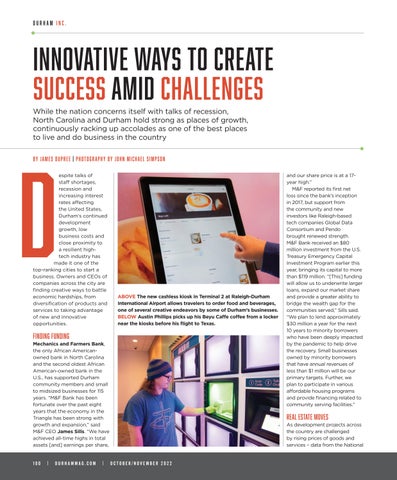
OCTOBER/NOVEMBER 2022 DURHAMMAG.COM
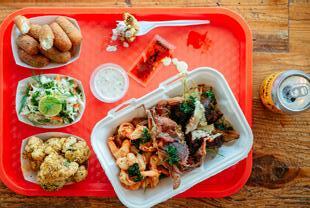
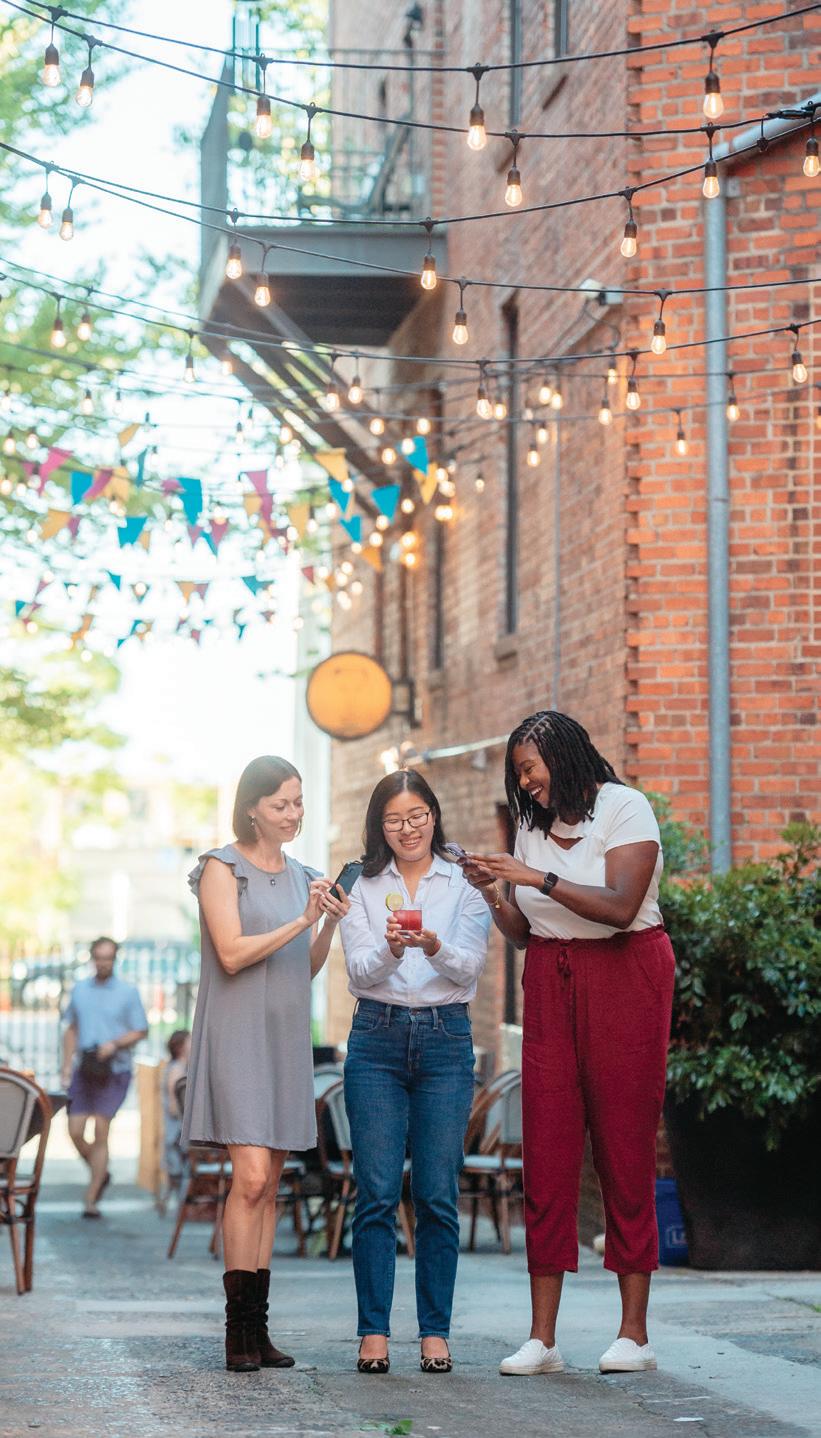
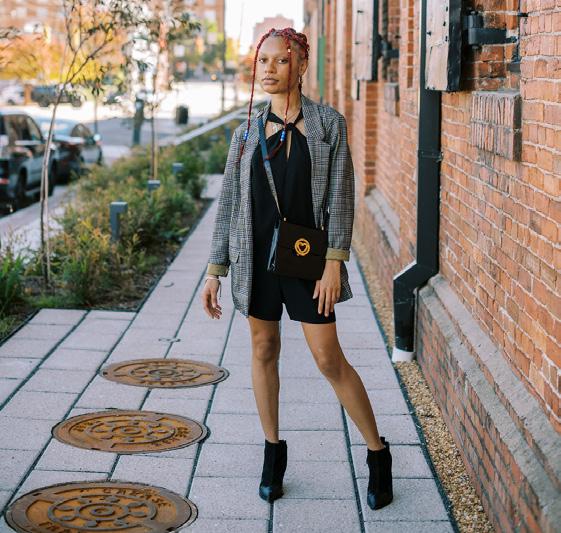
A PICTURE IS WORTH Juyoung Shin and Joy Caracciolo share dining experiences –like a Small Plates Crawl –with their online followers.
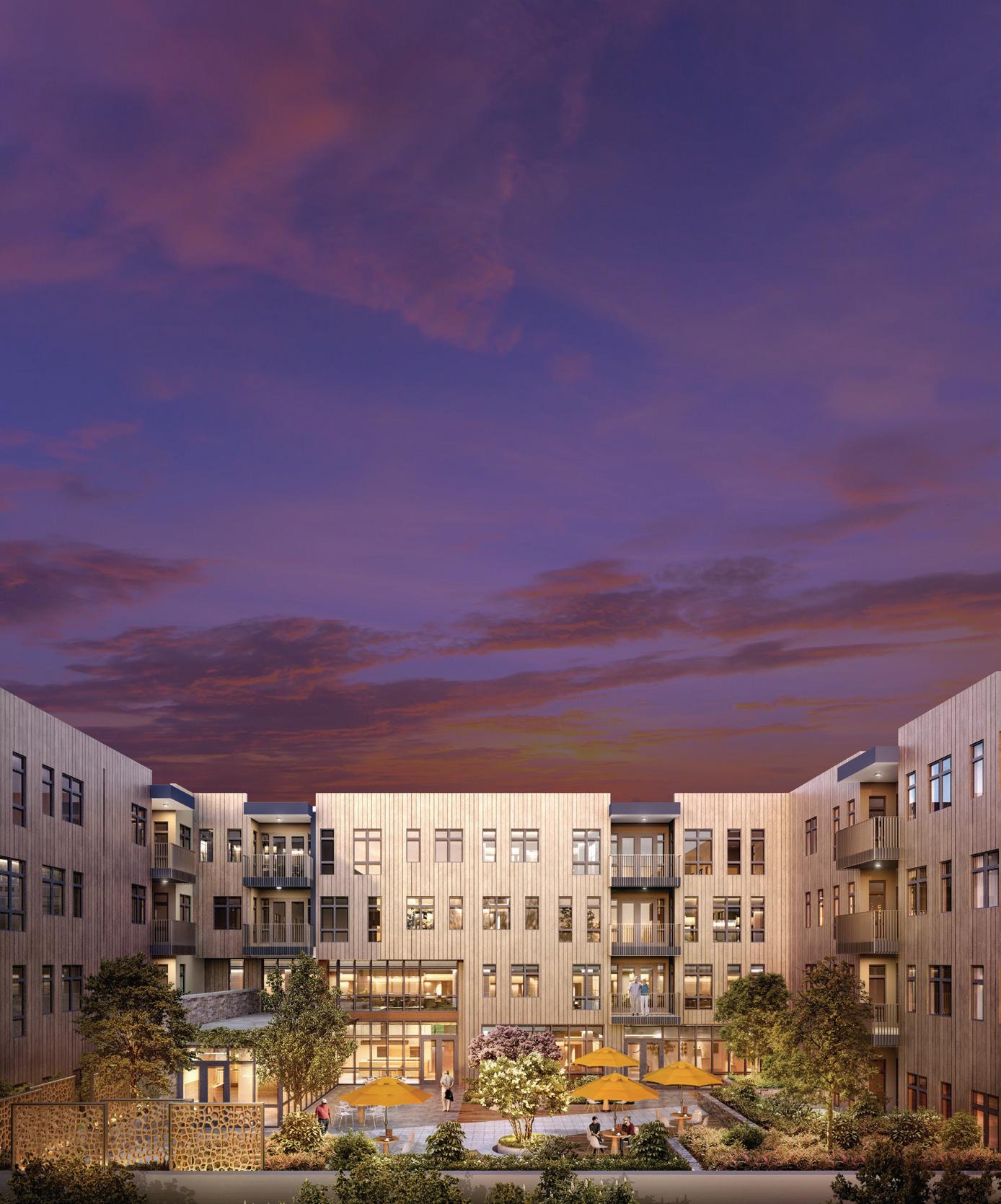

Vibrant living. Continuing care. In the heart of Durham. 800-278-9729 / forestduke.org/TheTerraces KEEP GROWING SM New contemporary apartment homes for retirement. Learn more at forestduke.org/TheTerraces. HURRY — PRESALES HAPPENING NOW! TERRACESThe Redefine retirement. BECOME A CHARTER MEMBER TODAY!

2022
EDITORIAL
ART
CREATIVE DIRECTOR
Brown
GRAPHIC DESIGNER/PRODUCTION COORDINATOR




Scott
GRAPHIC DESIGNER Khadijah Weekes-Nolan
PHOTOGRAPHER
Michael Simpson
Advertising
For advertising inquiries, email advertising@durhammag.com
Melissa Crane melissa.crane@trianglemediapartners.com


Lauren Phillips lauren.phillips@trianglemediapartners.com
Kem Johnson kem.johnson@trianglemediapartners.com
Lucinda Poole lucinda.poole@trianglemediapartners.com
Statkun dana.statkun@trianglemediapartners.com
OF
OPERATIONS
Corporate FOUNDER/CHAIRMAN
MEDIA PARTNERS
DIGITAL PARTNERS
at
919.933.1551.
2 | durhammag.com | october/november 2022 December 9th-11th Duke Energy Center Raleigh 1-800-982-2787 or ticketmaster.com On Sale October 16 December 14th-18th DPAC 919-680-2787 or dpacnc.com On Sale Now! Exp e rience the Magic! StarringIraDavidWood OCTOBER/NOVEMBER 2022 VOL 15 NO 5 durhammag.com EXECUTIVE MANAGING EDITOR Amanda MacLaren amanda.maclaren@durhammag.com
EDITOR, CHAPEL HILL MAGAZINE & EXECUTIVE EDITOR, CHATHAM MAGAZINE Jessica Stringer EDITORIAL ASSISTANTS Renee Ambroso renee.ambroso@trianglemediapartners.com Brooke Spach brooke.spach@trianglemediapartners.com MANAGING EDITOR, CHATHAM MAGAZINE Anna-Rhesa Versola EDITORIAL INTERNS Kate Brownstein, Cailey Cetani, Valeria Cloës, Sam Edge, Teresa Fang, Sinclair Holian, Abigail Keller, Katie MacKinnon, Isabella Reilly, Hamsini Sivakumar, Megan Tillotson and Caitlyn Yaede CONTRIBUTORS Joy Caracciolo, Cole del Charco, James Dupree, Juyoung Shin, Amber Watson and Morgan Cartier Weston
Kevin
Lindsay
John
Dana
DIRECTOR
CREATIVE
Ashlin Acheson
Dan Shannon PRESIDENT, TRIANGLE
Ellen Shannon PRESIDENT, TRIANGLE
Rory Kelly Gillis VICE PRESIDENT, FINANCE & ADMINISTRATION Amy Bell VICE PRESIDENT/ PUBLISHER, CHATHAM MAGAZINE Chris Elkins chris.elkins@trianglemediapartners.com PUBLISHER, HEART OF NC WEDDINGS Jenna Parks CREATIVE DIRECTOR, TRIANGLE DIGITAL PARTNERS Sally Scruggs DIGITAL OPERATIONS MANAGER Lizzie Jones DIGITAL CUSTOMER SERVICE SPECIALIST Brian McIndoo DIGITAL EDITOR Kevin Delgado OFFICE ADMINISTRATION AND ACCOUNTING ASSISTANT Cassady Orsini DISTRIBUTION Matt Bair Durham Magazine is published by Triangle Media Partners Subscriptions, $38 for two years, are available
durhammag.com. To purchase copies, call
magazine











































































































A new perspective on EV. 966 Southpoint Autopark Blvd. Durham, NC | 919-595-4500 JohnsonVolvoCarsDurham.com JOHNSON VOLVO CARS DURHAM
letter



Time of the Season
Iknow I’m not the only one who feels like time is moving infinitely faster with each passing year. Somehow, I blinked, and summer is gone.

The warmer months are always my favorite – it’s when I travel, see friends, act spontaneously and fling myself into adventure. But in the fall, I tend to stay close to home and settle into routines. I’m a sucker for organization, even if the state of my work desk screams otherwise.
Autumn is when I reset and revisit all the reasons that I love to call Durham home: Walking underneath the vibrant tree canopies at West Point on the Eno, taking in the quiet peace of the Eno River as leaves fall gracefully to the forest floor. Spending a late night downtown, strolling under the glow of the Edison bulb lights on Parrish Street after seeing a show at the Durham Performing Arts Center or The Carolina Theatre or The Pinhook Maybe I’ll head to Queeny’s for a late-night snack, or grab a hot dog or Frito pie at Accordion Club. (Or even combine the two – thanks for the tip, Carrie!) I’ll wake up early the next morning in order to maximize my hours of sunlight, then grab a steaming hot vanilla latte from Cocoa Cinnamon, Liturgy or The Oak House Durham and head to the Durham Farmers Market where I’ll refill my Homebucha growler, load up my bag with goat cheese from Elodie Farms and peruse my dry skin-saving options from Lo & Behold Natural Body Care during my multiple circuits around Durham Central Park
For more downtown adventure ideas, turn to page 28 where some of our well-known Bull City bloggers discuss their faves. Or learn about one of our newest artist and vendor markets, The Makrs Society, on page 38. Hear from our city’s first poet laureate, D.J. Rogers, on page 44, and discover the perks of condo living and starting your own urban garden (fall is the best time to prepare!) on pages 54 and 64, respectively.



So grab a mug (or pint glass!) of your favorite beverage – I’d go with a hot toddy from West End Wine Bar myself – get to reading, and savor every moment of the magic that is fall in Durham.
4 | durhammag.com | october/november 2022
THE COVER Photo by John Michael Simpson






919-489-8362 5634DurhamChapelHillBlvd,Durham,NC persiancarpet.com OpenMonday-Friday 10amto6pm ClosedSaturday & Sunday 10%Off WithThisCoupon The46thAnnualClearanceSale OCTOBER31ST TODECEMBER2ND 2022 30% -75% OFF
contents
DOWNTOWN
28 Influencer Insights
Follow the advice of three content creators as they share the best ways to explore our downtown
38 Market Power
Downtown pop-up series gains momentum, sets sights on bigger events
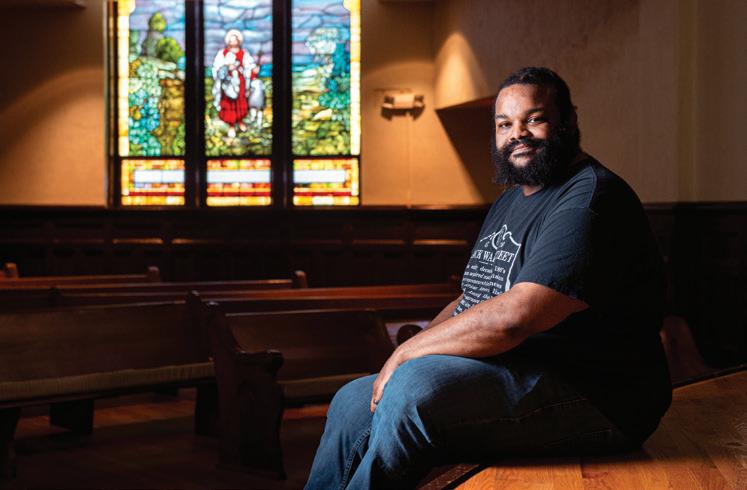
44 3 Burning Questions …
City of Durham’s inaugural poet laureate D.J. Rogers shares his vision for the job and the role that poetry plays in city life
46 What’s Up, Downtown
The latest development news
54 Room With a View
Dr. Moira Artigues finds her happy place in the downtown of a city she’s loved for nearly 30 years
64 Diggin’ Downtown
A visit to Zoë Shear’s East Durham garden proves fruitful in both produce and knowledge SCHOOLS & EDUCATION
72 Making the Grade
Meet Durham Public Schools’ Teacher of the Year
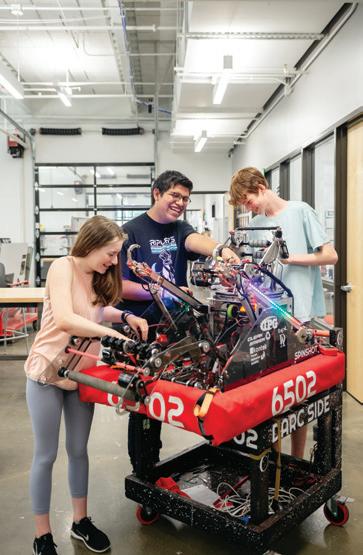
76 Machine Learning
A spotlight on three robotics clubs that prove their mettle by earning medals
82 Oh, the Places You’ll Go
The future looks bright for Durham’s community college
86 Back to Class
The latest news from our local schools
88 Directory of Independent, Regional Boarding, Charter and Choice Program Schools
DEPARTMENTS & COLUMNS
4 Letter from the Editor
8 Go.See.Do.
Chill out with these fun fall events
16 Noted
What we’ve heard around our city …
Engagement & Wedding
Tying the knot, Bull City-style
DURHAM INC.
100 Innovative Ways to Create Success Amid Challenges
While the nation concerns itself with talks of recession, North Carolina and Durham hold strong as places of growth, continuously racking up accolades as one of the best places to live and do business in the country
108 Biz Briefs
PEOPLE & PLACES
12 Book Harvest’s Summer Block Party
14 Nasher Museum of Art at Duke University’s exhibit opening for Roy Lichtenstein: History in the Making, 1948–1960
SPONSORED CONTENT
22 HEALTH CARE
Meet local dentists and providers
34 DOWNTOWN DURHAM
Explore living, dining, arts and more …
63 ADOPT A PET
Take home one of these pets from the Animal Protection Society of Durham today!
october/november 2022
PHOTOGRAPHY BY JOHN MICHAEL SIMPSON
111
Marie Baker has launched a new wealth management and financial planning practice that truly reflects the spirit of the Durham community she has served for years.
Baker Wealth Advisors, a new office aligned with Raymond James Financial Services, represents the next step in Baker’s career as a financial professional, combining the resources and modern experience of a national financial institution with boutique, holistic advice tailored to each of her clients and free of bias or outside influence.
“Durham is a city that feels like a small town of hard working individuals committed to maintaining our uniqueness, and this next career step weaves me directly into the synergy here,” Baker said. “I have already seen how fiduciary advice creates a positive impact. I hope to see that impact ripple throughout the broader Durham and Triangle communities.”
Baker, a CERTIFIED FINANCIAL PLANNER™ (CFP®) professional and Accredited Asset Management SpecialistSM (AAMS®), now has complete autonomy to cultivate the client experience she wants, and freedom to choose investment strategies and recommend financial plans to help her clients meet their goals.
“Financial advice has changed a lot as a profession,” Baker said. “People come to advisors now because they have tough choices with no easy answers. My clients want to understand the broader impact of their financial decisions, take care of their parents, build legacies for their children and community, and prepare for life’s twists and turns. I started my own business to provide deep value and real guidance with a modern client experience to this community that means so much to my family and me.”
from a familiar face REAL FINANCIAL ADVICE Marie E. Baker, CFP®, AAMS® President, Baker Wealth Advisors Wealth Manager, RJFS www.bakerwa.com 919.321.1213 Securities offered through Raymond James Financial Services, Inc., member FINRA/SIPC. Investment advisory services are offered through Raymond James Financial Services Advisors, Inc. Baker Wealth Advisors is not a registered broker/dealer and is independent of Raymond James Financial Services. Certified Financial Planner Board of Standards Inc. owns the certification marks CFP®, CERTIFIED FINANCIAL PLANNER™, CFP® (with plaque design) and CFP® (with flame design) in the U.S., which it awards to individuals who successfully complete CFP Board's initial and ongoing certification requirements.
Pumpkin Patch Express
SATURDAYS AND SUNDAYS IN OCTOBER
The Museum of Life and Science hosts its annual festive fall train ride aboard the Ellerbe Creek Railway to visit its pumpkin patch. Pick out the perfect pumpkin to decorate, and enjoy other activities including a hay maze, mini golf, nature bingo and take-home crafts before climbing on the train for a ride back to the station.

Bull City Race Fest and Food Truck Rodeo
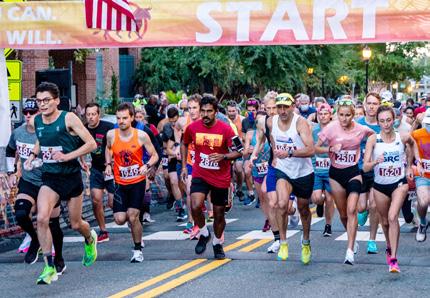
OCT. 16
The 10th annual race, which begins and ends at the American Tobacco Campus, winds through Trinity Park, Duke University’s East Campus and surrounding downtown areas. Choose the half-marathon, 5-mile run or family-friendly 1-mile run, and refuel with a snack from one of several food trucks at the post-race festival – which also features a beer garden, kids’ zone and live entertainment – at Diamond View Park
do see go
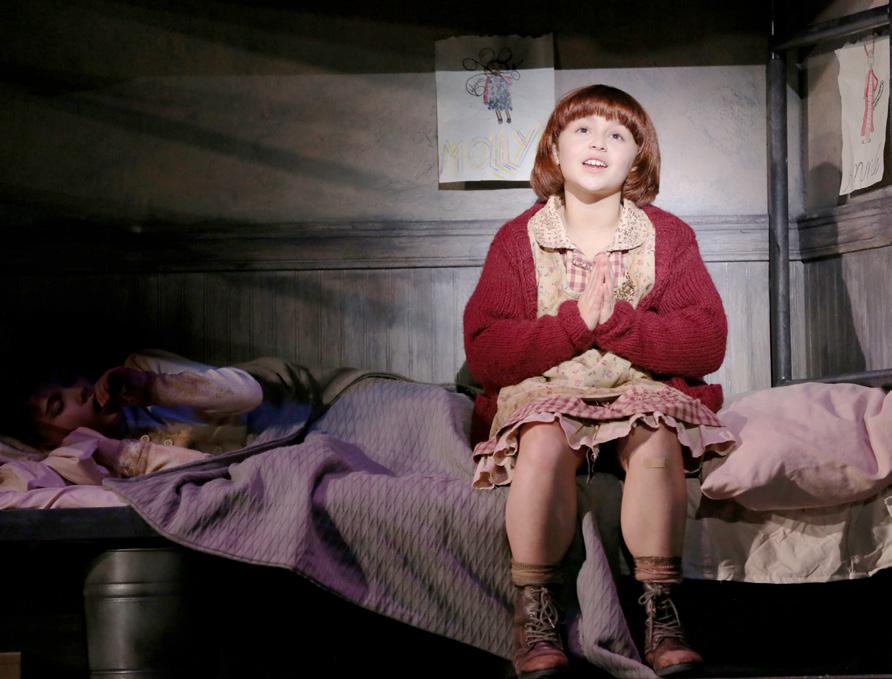
Annie
OCT. 18-23
The Durham Performing Arts Center presents this fan-favorite Broadway musical, which offers a window into orphan Annie’s “hard-knock life,” and her strong spirit. Directed by Jenn Thompson, this performance features the classic score by Tony Award-winners Thomas Meehan; composer Charles Strouse; and lyricist, writer and director Martin Charnin. Theatergoers are sure to enjoy this new production that celebrates family, optimism and resilience.
CHILL OUT WITH THESE FUN FALL EVENTS
EVENTS ARE SUBJECT TO CHANGE; CHECK WITH ORGANIZERS PRIOR TO ATTENDING Compiled by Teresa Fang
Joe Satriani: Earth Tour

OCT. 19
The renowned guitarist performs songs from his 19th studio album, “The Elephants of Mars,” inside Fletcher Hall at The Carolina Theatre. The work embodies themes of personal challenge and strife while exploring a redefinition of creative, instrumental guitar.
8 | durhammag.com | october/november 2022
Visit the World’s Largest Natural Habitat Zoo!




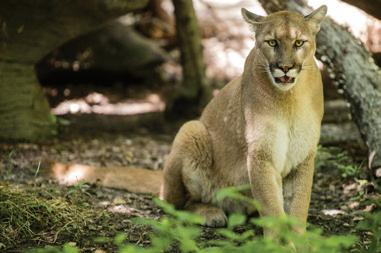

The North Carolina Zoo is nestled on 2,600 wooded acres centrally located in the heart of North Carolina, just south of Asheboro in Randolph County. With 500 developed acres, it is the world's largest natural habitat zoo and is just over an hour away. Spend a day here and help support our mission to protect wildlife and wild places around the world.

Halloween Phantasmagoria
OCT. 28
Visit Duke Homestead State Historic Site to wander the grounds while learning about spiritualism and 19th century history – and encounter a few spooky surprises along the way. Remember to bring your own flashlight for a Halloween experience unlike any other!
Moonchild: A Celebration of the Life and Music of Yusuf Salim
OCT. 28 & 29
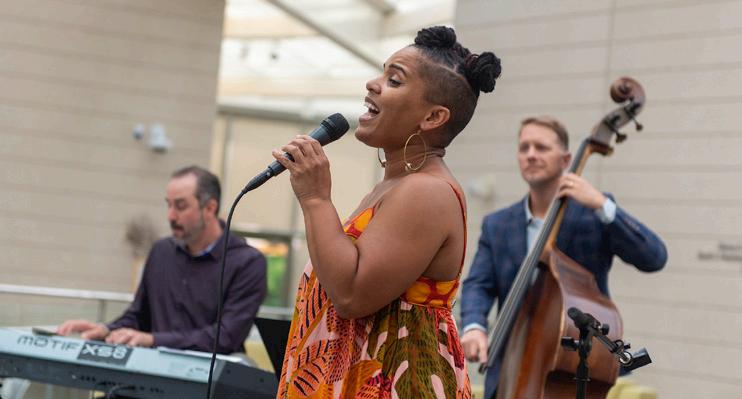
Duke Performances presents a celebration of the late jazz pianist and composer who spent the last three decades of his life establishing a thriving, nationally visible jazz scene in Durham. North Carolina Central University jazz studies director Brian Horton kicks off the special event at Hayti Heritage Center with an electrifying big band – including saxophonist Gary Bartz and Grammy-nominated vocalist Nnenna Freelon (pictured right) –performing new arrangements of Yusuf’s compositions. A smaller ensemble featuring Nnenna, Frankie Alexander, Eve Cornelious, Lois Deloatch and Adia Ledbetter spotlights the intimate lyrical explorations of Yusuf’s music the following day. There will also be a free public panel discussion and an introduction to “Moonchild,” a documentary by Kenny Dalsheimer currently in production that covers Yusuf’s life.
Durham County Pottery Tour NOV. 12-13


The ninth annual celebration of our local pottery scene and its craftspeople returns to an in-person format following two years of virtual events and showcases sculpture, jewelry, and functional and decorative wares crafted from a range of materials and methods. Expect to see a variety of surface decoration and glaze application techniques from potters including Delores Farmer, Katie King and the students at Claymakers, among dozens of others.
Durham Art Walk Holiday Market
NOV. 19-20
Kick off the holiday season with the Durham Arts Council during this annual weekendlong shopping experience in the heart of the City Center. The market allows patrons to stroll through and shop from dozens of local artists and craft vendors, enjoy live music and dine at downtown restaurants.
Barktoberfest
OCT. 29
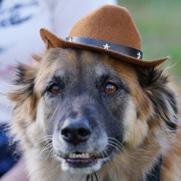
Durham Parks and Recreation partners with Beyond Fences, an organization that provides free pet services and supplies to neighbors in need, to host an afternoon of howling good times for furry friends and their owners at Durham Central Park. Compete in costume contests, take a photo with your pups at the photo booths, go on a fun walk through the park, enjoy local brews and eats, visit the pet market and learn about local foster and adoption organizations while The Mighty Messengers of Soul perform. Don’t forget to bring canned canine food to contribute to the food drive.
Tails at Twilight: The Ballroom and Beyond NOV. 19

The Animal Protection Society of Durham hosts its 51st annual gala, which returns to an in-person format at the Washington Duke Inn & Golf Club. This one-of-a-kind fundraiser supports the thousands of homeless animals served by APS every year and includes a silent and live auction of unique items and experiences interspersed with fun and heartwarming tales. Tickets include dinner and drinks, and a virtual option is available for those who wish to participate from home.

10 | durhammag.com | october/november 2022 Go See Do
(Clockwise from top right) Page 8: "Annie" photo by Joan Marcus; Joe Satriani photo courtesy of The Carolina Theatre; Bull City Race Fest photo by My EP Events; Pumpkin Patch Express photo courtesy of Museum of Life and Science; Page 10: Barktoberfest photo courtesy of Durham Parks and Recreation; Tails at Twilight photo courtesy of Alycat Photo & Video Services; Pottery Tour photo and pottery by David Roswell; Nnenna Freelon photo by Chris Charles; Halloween Phantasmagoria photo courtesy of Duke Homestead State Historic Site
Coming Unwrapped

Last year, it was the fi re pit. The year before that, the town dock. This year, Mom and Dad may have had a few eggnogs when they decided the water’s edge would be jolly fun. Well, that it was. And more.

Discover seasonal offers on vacation rentals & more at CrystalCoastNC.org

CHAPTER 21
people &places
Read All About It
BY SAM EDGE | PHOTOGRAPHY BY LEITH RANKINE
Book Harvest, a nonprofit dedicated to fostering childhood literacy, hosted its annual summer block party at the Durham Bulls Athletic Park concourse on July 16 at the end of National Summer Learning Week. More than 2,500 attendees joined 75 volunteers and 26 community partners for storytimes, games, a performance by Batalá Durham and a jump rope show by Bouncing Bulldogs, among other activities. A total of 3,601 culturally inclusive children’s books were sent home with attendees, adding to Book Harvest’s total of 132,699 books harvested by kids for summer reading, far exceeding the organization’s goal of 100,000. Book Harvest also celebrated the grand opening of its Family Space, a room full of toys, puppets and free books to facilitate family reading and learning inside Book Harvest’s offices, on July 19. As of press time, the transformed 1,300-square-foot space had already hosted 428 visitors.


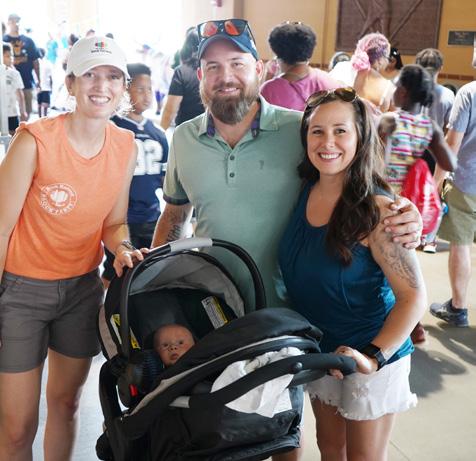
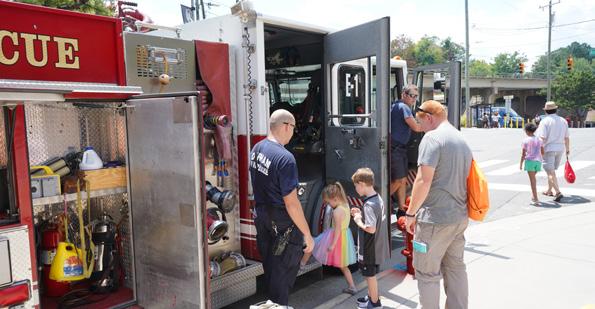
1 Grammy-nominated musician Pierce Freelon reads from “Daddy-Daughter Day,” the picture book he authored. 2 Book Harvest Communications Manager Benay Hicks with Braden Wilkerson, Kayla Wilkerson and baby James Wilkerson. 3 Children had the chance to explore a fire truck thanks to the City of Durham Fire Department.
4 Ava N. Simmons shows off her activity and coloring book, “Acid-Base Experiment Fun with Ava the S.T.E.M. Princess.” 5 Gianna holds her new book.

12 | durhammag.com | october/november 2022
1 2 3 4 5
SUBLIME







You know every inch of the Eno like the back of your hand. But what about nature sites beyond the Triangle? Join PBS North Carolina as we explore the best of what our state has to offer, from parks and trails to museums and restaurants. Whether you’re a birder or biker, foodie or culture vulture, we’ve got you covered. Follow your curiosity pbsnc.org


NC Weekend
BOUNDLESS PEACEFUL P B S
At Last
 PHOTOGRAPHY BY J CALDWELL
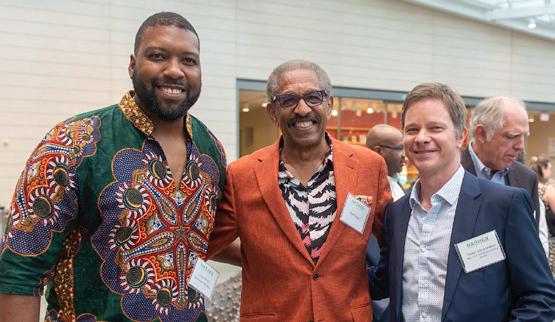
The Nasher Museum of Art at Duke University celebrated its new exhibition, Roy Lichtenstein: History in the Making, 1948–1960, with preview and opening events on Aug. 24 and 25, respectively. The exhibition, the first of its kind to take a deep dive into the celebrated artist’s early works, is a collaboration between co-curators at the Nasher Museum and the Colby College Museum of Art in Waterville, Maine, that’s more than five years in the making. Museum members, donors, friends and visitors – alongside guests from the Colby and the Roy Lichtenstein Foundation and Roy Lichtenstein Estate in New York – came to experience this original, traveling exhibition that features about 90 works on loan from both museum and private collections. The Nasher Museum is the final venue of the national tour, and the exhibit closes Jan. 8, 2023.

14 | durhammag.com | october/november 2022
1 2 3
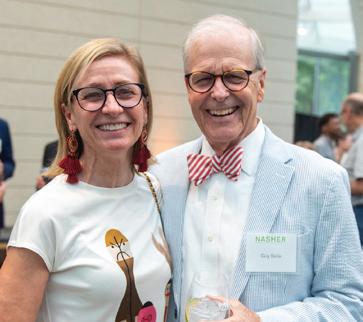
1 Shana Tucker performs at the Director’s Preview. 2 The Empower Circle CEO and founder Nicole Oxendine and Black on Black Project founder Michael S. Williams. 3 Longtime museum friends and supporters Mindy Solie and Guy Solie enjoy the Director’s Preview.

4 Nasher Museum Chief Curator Marshall N. Price, his wife, Martha Clippinger, and their daughter, Iona Price, peruse the Lichtenstein exhibition. 5 Maury Smith and Crystal Smith.

6 Durham City Councilman Leonardo Williams with Duke professor Ben D. Reese Jr. and Nasher Museum Director Trevor Schoonmaker.
More than just a house - it's home
Going through cancer treatment is already hard enough. At Caring House, we offer respite for patients experiencing one of the most difficult times in their lives.
Caring House provides patients at Duke Cancer Institute with peace of mind by providing affordable housing, a healing environment, and a positive and supportive community.

Support a guest's stay with a donation! To donate, visit: caringhouse.org/donate
Scan the QR code above to support a cancer patient's stay
october/november 2022 | Durhammag.com | 15 People & Places
5 6 4
noted.
OPENINGS
Little Homestead Farm held a grand opening on Sept. 10 at its new storefront on Angier Avenue
The family-owned shop sells handmade soaps made from sustainably harvested ingredients.
WHAT WE’VE HEARD AROUND OUR CITY …
Send us your news!
From births to awards to new biz and more –Email editorial@durhammag.comCompiled by Katie MacKinnon
Lawrence Barbecue and Lagoon Bar owner
Jake Wood announced his third concept, Leroy’s Tacos n Beer, is slated to open at Boxyard RTP in early 2023. Leroy’s will offer Lawrence’s fan-favorite brisket birria tacos, among other tacos and sides, as well as canned beer and Micheladas. Chef Kevin Fry will transition from Lawrence to head the new kitchen. Leroy’s will host pop-ups leading up to its opening, the first of which takes place at Trophy Brewing & Taproom in Raleigh Oct. 9.
Boutique candle company

Bright Black is set to launch a new store with a retail component, a makers’ area and a community convening space, expanding into the space that adjoins its current location at 2020 Chapel Hill Rd., Ste. 24, in Lakewood Shopping Center. A soft opening will be marked by a ribbon-cutting on Oct. 28, with an open house on Oct. 29.
Boxyard RTP announced that Hummingbird Candle Co., Secondhand Concession Stand, PerSONALIty Designs and The Tatted Potter all received PopBox vendor residencies. The program supports women- and BIPOCowned businesses by providing retail space, micro-grants and small business counseling. The businesses will set up shop in the PopBox space at Boxyard for four months each, with a monthlong break between each vendor.
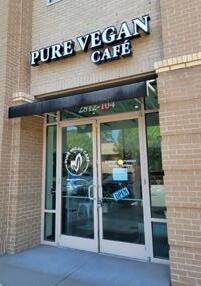
Pure Vegan Cafe opened a new location at 2812 Erwin Rd. on July 25. The femaleowned vegan restaurant operates two other locations in Raleigh and Cary, and features a menu of plantbased versions of burgers, chicken sandwiches and various breakfast items.
Roman Gabriel, founder and owner of Romanz Tea, opened the brand’s first brick-and-mortar shop, The Sweet Tea Café, at the corner of Mt. Moriah and Erwin roads in June. The smallbatch tea has been available at the Durham Farmers Market since 2016. The cafe is open every Saturday and Sunday from noon-6 p.m.
Giorgios Hospitality & Lifestyle Group, owned by restaurateur Giorgios Bakatsias, announced that a reinvisioned concept of one of its former restaurants, Taverna Nikos, is slated to open at Brightleaf Square in early 2023. Niko will serve food inspired by Greece and surrounding Eastern Mediterranean countries and will include outdoor dining, a mezze bar and a private chef’s table.
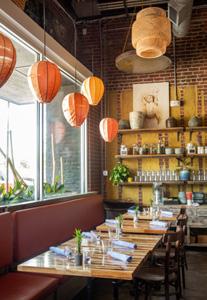
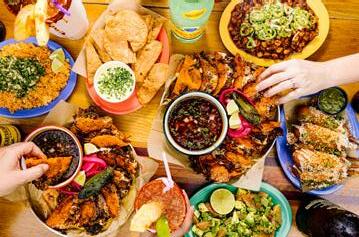
Giorgios Group also opened Krill, a Southeast Asianinspired restaurant, in late July at 506 Ramseur St. Krill serves classic Asian dishes with a twist plus inventive cocktails, beer, sake and wine.
QueenBurger’s fast-casual “smash burger” joint opened at 359 Blackwell St. in Diamond View III at American Tobacco Campus on Sept. 15. The signature double-patty burgers (along with vegan and vegetarian alternatives) are complemented by shoestring fries, artisan ice-cream sandwiches from Rose’s Noodles, Dumplings & Sweets, and fresh cocktails, wine and draft beer.

CLOSINGS
Mexican restaurant Dos Perros closed its doors on Aug. 14 after operating for nearly 13 years at 200 N. Mangum St. Founder and restaurateur Charlie Deal shared on social media that the occasion was “not a sad day, and
16 | durhammag.com | October/november 2022
PHOTO BY FORREST MASON


HENDRICK SUBARU SOUTHPOINT 200 KENTINGTON DRIVE, DURHAM, NC 27713 833.650.1408 SUBARUSOUTHPOINT.COM HENDRICK SUBARU SOUTHPOINT LARGE INVENTORY OF USED & NEW ASCENTS! 2022 SUBARU ASCENT THE BIGGEST SUBARU SUV EVER! SPACIOUS SEATING UP TO 8 PASSENGERS! EYESIGHT DRIVER ASSIST TECHNOLOGY! SUBARU STARLINK MULTIMEDIA! 5,000-POUND TOWING CAPACITY! SYMMETRICAL ALL-WHEEL DRIVE!
noted
I’m willingly making plans for the next chapter of my life. Quite simply, our lease is up, and it’s time to make way for someone else.”
Chef and restaurateur Matthew Kelly’s oyster bar and seafood restaurant Saint James Seafood, which opened near Brightleaf Square in 2017, will close in October following the termination of its lease by landlord Asana Partners. The restaurant is currently seeking a new location and may be active in the form of pop-ups and other special events, according to an Instagram post from its account.
TRANSITIONS
Park’s Food St. closed, and the space at 3219 Old Chapel Hill Rd. was sold to Succotash, which operates a food truck that serves Southern and Louisiana-style cuisine. Succotash opened Sept. 20.
Floral design and specialty gift shop
Bowerbird Flowers & Apothecary, which is operated by mother-daughter team Diane Joyal and Lily Joyal, vacated the Durham Food Hall in June to move to a retail space at University Hill, next to Apéritif. The new location opened on July 26 and includes a botanical drink bar in addition to a floral design studio and gift shop.
NEW RELEASES
announced the launch of its third flagship , which builds upon the modern distillation techniques first introduced by the distillery in 2015. Leveraging the art of traditional vapor distillation and modern cold distillation, the purple-hued Conniption Kinship is an all-natural infusion of butterfly pea flowers, juniper, licorice root and citrus. The 46% alcohol-by-volume gin retails for $34.95 for a 750ml bottle.

Alley
Twenty Six owner Shannon Healy are now available online nationwide. Shannon first

developed tonic syrup recipes as a bartender at Crook’s Corner in Chapel Hill and has sold the syrups to local bars, restaurants and retail stores – as well as to loyal customers –since 2015. As a pandemic pivot, he added a line of cocktail syrups; most recently, the passion fruit cocktail syrup was named Grand Champion in the 2022 N.C. Specialty Foods Awards Competition from among more than 150 entries. The online shop currently offers four products: the tonic syrup and strawberry, raspberry and blood orange cocktail syrups made from locally sourced ingredients. To order, go to alleytwentysixsyrups.com
ON THE MOVE
Catherine Coleman Flowers was appointed practitioner-in-residence at Duke University for the next three years. She holds shared appointments at the university’s Nicholas School of the Environment, Trinity College of Arts & Sciences and John Hope Franklin Humanities Institute. Catherine is the founding director of the Center for Rural Enterprise and Environmental Justice in Madison, Alabama, where she works to combat water equity issues nationwide, particularly in poor, rural areas and communities of color. In this appointment, she will share her expertise by teaching and coaching students and faculty.
Anna Wilcox is the new events and communications manager at the Animal Protection Society of Durham. In this role, which she began in August, Anna is responsible for presenting the nonprofit’s public message to the
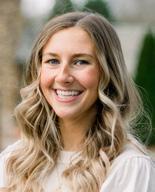
community, coordinating community outreach and fundraising events, and maintaining relationships with donors and businesses.
Meals on Wheels Durham announced its 2022-23 board of directors. As of July 1, Egnyte Campaigns Manager Pashara Black assumed the role of president, April Dudash, communications manager at Duke Regional Hospital, became vice president, and entrepreneur David Rousso was named treasurer. Meals on Wheels also added eight new members to its board of trustees: Alice Sharpe, Asyia Mitchell, Justin Clayton, Libby Towell, Nate Jones, Navdeep Grewal, Rachel Dewees and Tiffany Bashore.
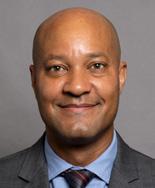
North Carolina Central University alum Louis Perkins began his new role as the university’s athletic director on June 1. Louis has more than 20 years of experience in higher education, including positions as athletic director at three NCAA Division 1 schools.
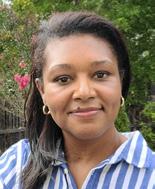
Michelle Needham brings experience in curriculum development and education to her new role as the director of education programs and exhibits at the Museum of Durham History, which she assumed in July.
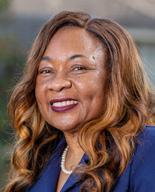
Durham native Thea Bloch-Neal relocated her bridal accessory company, Hushed Commotion, from Brooklyn, New York, to a redesigned house with spaces for production and appointments on North Duke Street in March.

18 | durhammag.com | october/november 2022
PHOTO BY FORREST MASON
PHOTO BY BAXTER MILLER
PHOTO COURTESY OF KARL BATES
PHOTO COURTESY OF KYLE SERBA
The Emily K Center promoted two members of its leadership team. Adam Eigenrauch (above left), formerly the organization’s executive director, was appointed chief executive officer. Former Chief Program Valerie Anderson (left) was promoted to the newly created role of chief impact officer.
GIVING BACK
Nonprofit Ron N Shoot Sports concluded “Project 300” on Aug. 21. President Sherard A. Johnson led the three-year initiative, during which 300 brand new pairs of shoes were collected and donated to children in the Durham community.
The Chapel Hill-Durham chapter of 100 Women Who Give a Hoot, Diaper Bank of North Carolina, Meals on Wheels Durham and The Mustard Seed Project are among 19 organizations that received a $5,000 Coastal Credit Union Foundation Volunteer Voice grant. The awards aim to amplify the impact of Coastal Credit Union employees, as each recipient is a nonprofit where an employee logged volunteer hours in 2021.
MILESTONE MOMENTS

A group of young dancers from Empower Dance Studio attended a summer dance intensive hosted by dancer, choreographer and actress Debbie Allen in Los Angeles. While
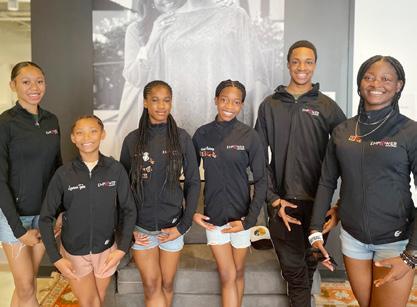
Debbie was visiting Duke University in May to address students graduating from the Fuqua School of Business, the dancers, coached by Nicole Oxendine, surprised her with a performance, and she awarded each of them a scholarship to attend her program. Community
members also helped to raise more than $40,000 to fund the dancers’ travel to LA.
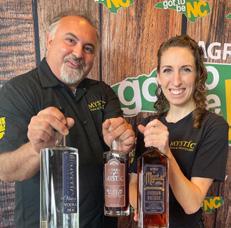
The North Carolina Restaurant & Lodging Association hosted the sixth Chef Showdown in August. Competitors were judged by industry experts on presentation, taste and use of local ingredients on each plate. Mystic Farm and Distillery, represented by mixologist Jessie Rossabi, won first runner-up for mixologist and distillery of the year.
With decades of fine dining restaurant and hospitality experience, Chef Ricky Moore believes that ordinary, simple food can be extraordinary when executed at the highest level. In 2022, Chef Ricky Moore was awarded

Chef: Southeast by the James Beard Foundation 2637 DURHAM-CHAPEL HILL BLVD 919-237-3499


SEASONAL SEAFOOD.
THAT’S THE HOOK!FRESHLY COOKED. GOOD FISH.

october/november 2022 | Durhammag.com | 19
Best
SALTBOXSEAFOODJOINT.COM
PHOTO
BY FORREST MASON
PHOTO COURTESY OF NICOLE OXENDINE
PHOTO BY HEIDI BILLOTTO OF NCRLA
noted
Bull City Fair Trade, a nonprofit and gift store that sells assorted gifts crafted in countries across the globe, celebrated its 30th anniversary on Oct. 1. Last year, the Ninth Street shop logged more than 300 volunteer hours and a 60% sales increase over 2020.
BOOKIN’ IT
Duke University geologist Orrin H. Pilkey and a team of scientists and environmental activists will release a new book, “Vanishing Sands: Losing Beaches to Mining,” in December. The authors track the environmental, social and economic impact of legal and illegal sand mining over the past two decades in areas across Africa, Asia and the Caribbean to South America and the eastern United States.
Durham author Mark Pinsky was interviewed for a new crime series, “Blood & Money,” from Dick Wolf Entertainment, the creators of “Law & Order.” The interview was based on murder suspect James Newman Hood, who Mark wrote about in the early 1990s for the Los Angeles Times. Mark was also interviewed for CNN’s true crime series, “Forensic Files,” about another murder case he covered for the LA Times. He is currently promoting two true crime books, “Drifting into Darkness: Murder, Madness, Suicide and a Death ‘Under Suspicious Circumstances’” and an updated, paperback edition of his 2013 book, “Met Her on the Mountain: The Murder of Nancy Morgan.”
Nonprofit Book Harvest was recently highlighted in the Journal of Early Childhood Literacy. Co-authored by Book Harvest Director of Early Literacy Meytal Barak and Cristina Gillanders, the research conducted during the organization’s Book Babies programming suggests that parents play a critical role in their children’s development and supports the impact of the program’s literacy coaches who work with parents in culturally responsive ways.
Book Harvest opened its new Family Space on July 19 inside the Book Harvest offices at 2501 University Dr. The room is designed for preschool-aged children and families to play and read together. Books in the space, which are free for families to take home, are culturally inclusive and written in both Spanish and English. The space is open Tuesday through Sunday from 9 a.m. to 5 p.m.
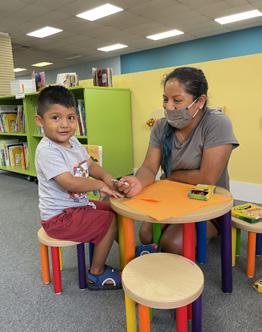
Durham County Library was recognized among six other branches of Durham County’s government with a National Association of Counties award for its Innovation League program, which provides learning experiences for lowincome youth that empower participants to collaborate, think critically and solve problems through hands-on learning. Other awards included recognition of Durham County’s Administrative Assistant Chatbot, Durham County Social Services’ Emergency Rental Assistance Program and LowIncome Homeowners Relief Program, the Mobile Integrated Health Care/ Community Paramedic Program, the Board of Elections’ Ballot Tracking Application and the Transit Plan.
DCL received a State Library of North Carolina Bright Ideas Grant to support upgrades to its reminiscence therapy kits for its Older Adult and Shut-In Service program. The kits provide interactive resources like audiovisual materials, music, activity supplies and reading materials to adults living with dementia. One of the library’s most popular programs, OASIS serves approximately 1,800 individuals from more than 40 nursing homes, rehabilitation facilities, senior centers and retirement communities.
DCL also received a State Library of North Carolina Library Services and Technology Act Project Grant of nearly $80,000 that will
support the renovation of its Tech Mobile and add a new staff person dedicated to the mobile unit. The Tech Mobile aims to provide access to projects like video editing, 3D printing and virtual reality.
MARK YOUR CALENDAR
The 2022 Triangle Parade of Homes will be held Oct. 1-2, 7-9 and 14-16 from noon to 5 p.m each day. The parade consists of selfguided tours of 144 new homes in Wake, Durham, Orange and Chatham counties, allowing prospective buyers to view houses from assorted price ranges featuring a variety of floor plans.
Kingfisher and Queeny’s will host a joint “Deep Creeps”-themed Halloween costume party on Oct. 31 for those 21 and older, with decor inspired by the deep sea and the underground. Kingfisher will serve Halloween-themed cocktails, and Queeny’s will host a DJ-driven dance party. Attendees with the best original costumes will win prizes, with an opportunity to visit Queeny’s and craft your own mask during the week leading up to the event.
Ghanaian musician, songwriter and dancer Okaidja Afroso ends a weeklong residency with Duke Performances on Nov. 6 with a performance at Page Auditorium. His new project, titled “Jaku Mumor – Ancestral Spirit,” is a contemporary work incorporating African oral tradition, percussion, dance and native language vocals. The project is rooted in Okaidja’s culture and collaborates with indigenous GaDangme fishermen to share the artistry of their a cappella singing and chants.
Join the LGBTQ Center of Durham and 21c Museum Hotel with the return of The Muse Masquerade – a night to honor the legacy of The Carrack complete with arts, entertainment and dancing to raise funds for the LGBTQ Center of Durham’s work – on Oct. 28 from 8 p.m. to 2 a.m.
20 | durhammag.com | october/november 2022
PHOTO COURTESY OF BENAY HICKS
reels on wheels
Saturday, December 3 5:30 p.m. and 8:30 p.m.
Durham Parks and Recreation (DPR) will bring free movies to the big screen this holiday season! Enjoy a family-friendly movie from the comfort of inside or outside of your vehicle. Feel free to bring your own chairs.

registration required
Opens Monday, November 21 at 9 a.m.
Food Drive
Bring non-perishable
those
need.
HOLIDAY Parade
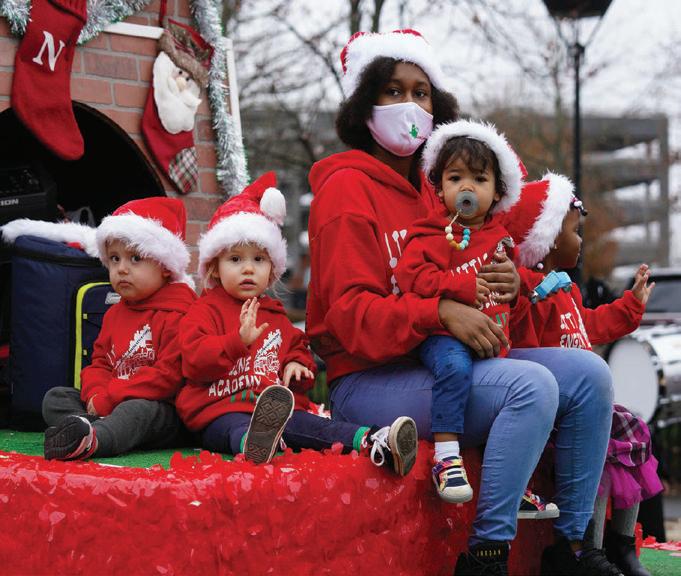
Saturday, December 17 - 10 am


Main Street

PARADE ROUTE
Downtown Durham -
Spectators are encouraged to bring their own chairs and blankets. Seating will not be provided.
Start: Health Department - Main & Dillard Streets End: Duke University East Campus - Main Street and Buchanan Boulevard PARADE PERFORMANCE AREAS • Mangum & Main Streets • Chapel Hill & Main Streets • Duke & Main Streets G et in vo lved ! Participants, Vendors, Sponsors: dprplaymore.org Volunteers: dprvolunteers.ivolunteer.com DPRPLAYMORE.ORG | 919-560-4355@DPRPLAYMORE thank you to our Media S nsors
food items to donate to
in
FLOATS • BANDS • MASCOTS • COMMUN IT Y GROUPS drive-in event • Holiday themed movie FREE! Rain or Shine BULL CITY HOLIDAYZ
The Durham Bulls’ 2023 season will begin with a night game on March 31 against the Norfolk Tides. The season will include 150 games, 75 of which take place at the Durham Bulls Athletic Park – including those on Memorial Day, Father’s Day, Independence Day and Labor Day weekend.
RedBird Theater Company’s producers, cast and production team launched its inaugural season during a fundraiser on Sept. 29. The event included live music from The Drowning Lovers, and food and drinks from Mezcalito Grill & Tequila Bar. Performances of “A Doll’s House, Part 2” take place Nov. 11-19 at the Durham Bottling Co.
storytelling with cellist Shana Tucker, acrobatic fables from StoryUp! Aerial Theatre and more. The educational programs take place one Saturday per month through May 2023.
IN OTHER NEWS
U.S. Navy Petty Officer
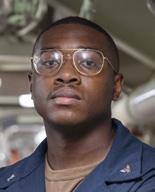
3rd Class Cholee Brown, a Durham native, took part in the world’s largest international maritime warfare exercise, Rim of the Pacific, in August. Cholee is a sonar technician aboard USS William P. Lawrence, responsible for tracking and monitoring underwater threats.
and get a response with links to information and the next steps for submitting a service request. Residents are encouraged to submit an online request or call if they have a more complicated issue. Over time, the service will build on its knowledge base to respond to more needs. The system received more than 1,000 texts in the two weeks following its launch.
HEALTH care
A new Family Saturday Series season begins at The Carolina Theatre on Oct. 15 and will feature performances from Grammynominated songwriter Pierce Freelon, musical 5720 Fayetteville Rd., Ste. 101, Durham, NC 919-361-0104 • insideoutbodytherapies.com
Durham One Call launched a new service that enables residents to text 919-813-6315 with a keyword, such as “water service” or “pothole,”
The Durham Community Safety Department launched its Co-Response Teams in September, the fourth crisis response pilot the city has implemented as part of the new Holistic Empathetic Assistance Response Teams crisis response program, which aims to connect residents who are experiencing nonviolent mental health crises and qualityof-life concerns with the care they need. The Co-Response pilot pairs clinicians with law enforcement officers who respond to behavioral health calls that pose a greater risk.
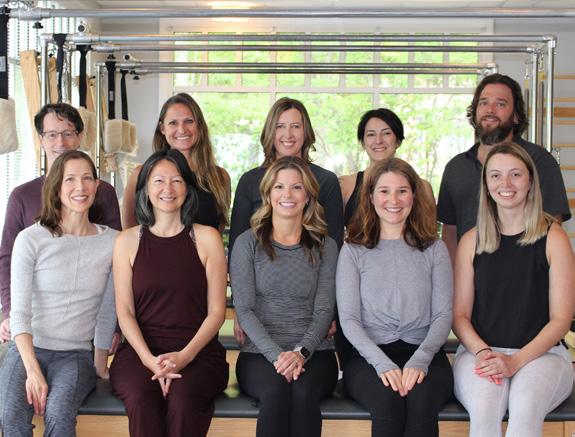
When you enter InsideOut Body Therapies, you are guided as an individual to learn how to move through space with more strength and less pain to live your best life. Our premier community of practitioners, including experts in Pilates, Physical Therapy, Rolfing® Structural Integration, and Acupuncture is informed by the highest quality of training and professionalism to address each client’s wellness goals. Within a friendly and non-competitive environment, you
are surrounded by a diverse community of people at all stages of the healing process. IOBT has been voted Best Of in Indy Week since 2011 and Best Pilates Studio by Durham Magazine readers in 2019 and 2022. They also offer teacher training certification programs in Yoga and Pilates.
noted
SPONSORED CONTENT
PHOTO COURTESY OF BRYAN NIEGEL
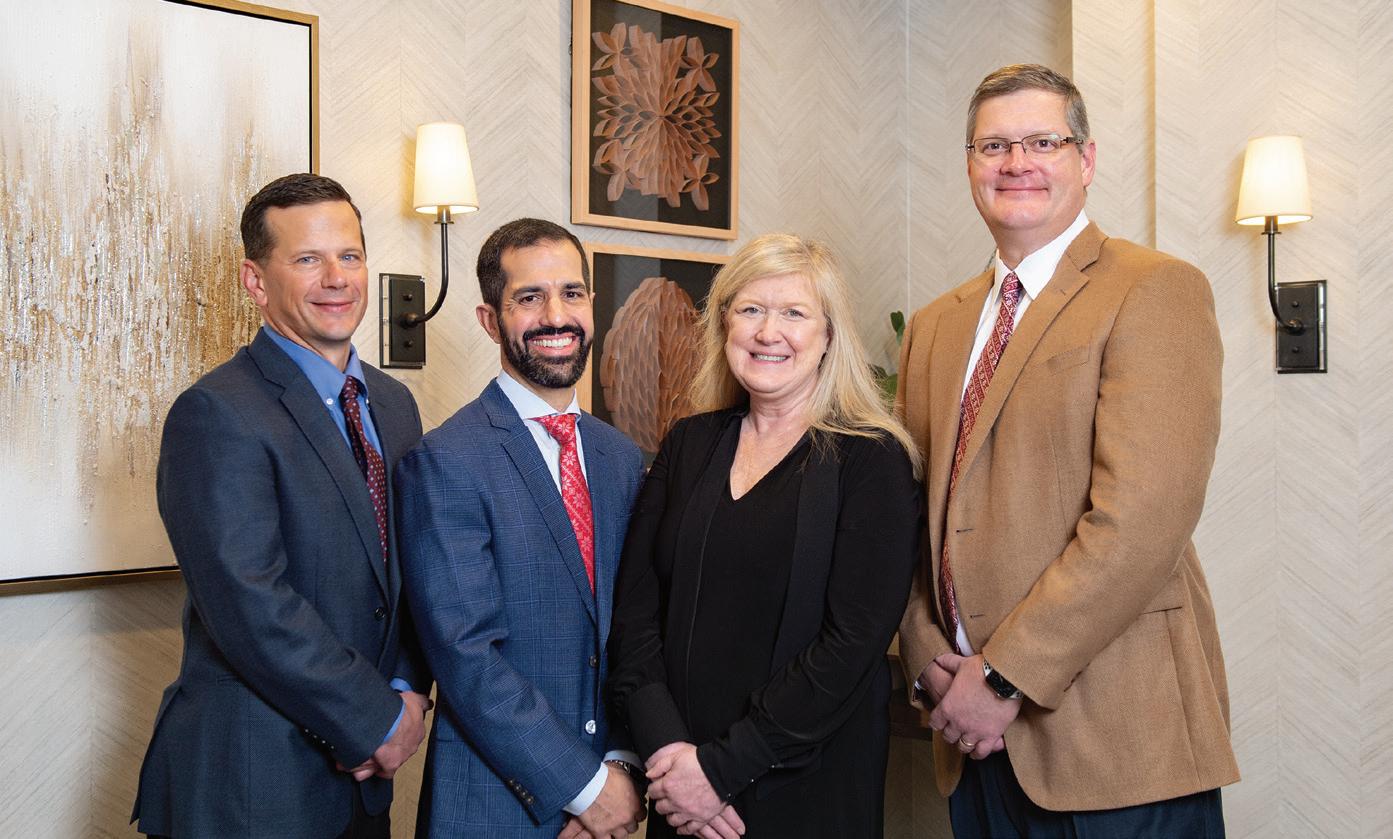
FOR MORE THAN 50 YEARS, the practice of Oral and Maxillofacial Surgery Associates has been trusted to provide specialized care in the Chapel Hill, Durham, and Sanford communities. Our four board certified oral and maxillofacial surgeons provide the highest quality of patient care with the latest diagnostic and treatment tools available to assure patient safety and comfort.

Drs. Sacco, Vandersea, Ruvo and Serlo practice a full scope of oral and maxillofacial surgery with expertise ranging from corrective jaw surgery to wisdom tooth removal.

DENTAL IMPLANTS • BONE GRAFTING • WISDOM TEETH • FACIAL TRAUMA • CORRECTIVE JAW SURGERY • PRE-PROSTHETIC SURGERY • ORAL PATHOLOGY • SLEEP APNEA OMSANC.COM DEBRA M. SACCO DMD, MD BRIAN VANDERSEA DDS ANDREW T. RUVO DMD, MD ADAM D. SERLO DMD, MD CHAPEL HILL 501 Eastowne Drive, Suite 110 Chapel Hill 27514 919.929.2196 DURHAM 2823 North Duke Street Durham 27704 919.479.0707 SANFORD 109 Dennis Drive Sanford 27330 919.775.1615
OFFICIAL
PARTNERS OF DUKE ATHLETICS
A. K. BOBBY MALLIK D.M.D.
5324 Mcfarland Dr., Ste. 120, Durham, NC, 27707 919-493-5332 • durhamendo.com
Our team realizes the importance of your dental health and strives to provide all your endodontic needs in a clean, comfortable and stress-free environment. We utilize state-of-theart technology to ensure you are receiving the specialized care you deserve.
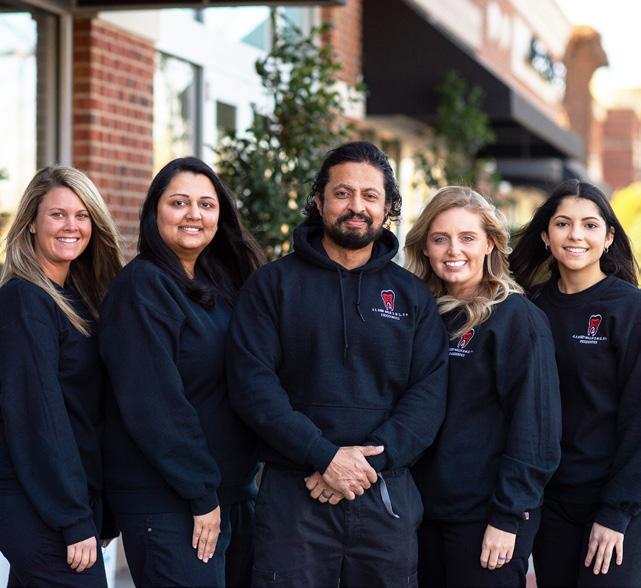
Using the most advanced knowledge and techniques available today, we can perform many different endodontic treatments with ultimate precision and comfort.
2711 N. Duke St., Durham, NC 27704 919-220-1416 • dukestreetsmiles.com
Dr. Martha Ann Keels has been in practice in Durham for more than 25 years. In 1990, she started the first pediatric dental clinical at Duke Hospital and provided dental care for children at Lenox Baker’s Children Hospital. In 2001, Dr. Keels relocated the pediatric dental clinic to 2711 N. Duke St. Her goal is to provide the best evidence-based care for her patients and help families develop successful strategies to keep their children’s teeth healthy.
While receiving her MS in pediatric dentistry at UNC –Chapel Hill, Dr. Erica Brecher completed her master’s thesis with Dr. Keels. Their research on emergency dental care was
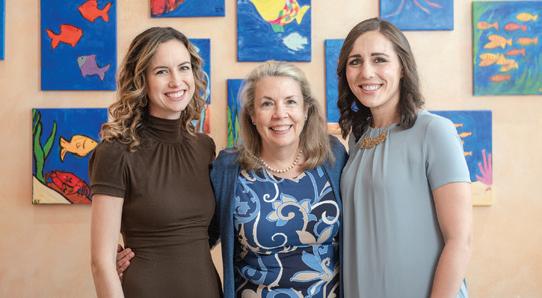
nationally recognized by the American Academy of Pediatric Dentistry. Dr. Brecher cares deeply about the connection between oral health and overall health, and the importance of developing long-lasting relationships with her patients.
After practicing for three years in the Triangle, Dr. Gentry Byrd joined the team in July. Dr. Byrd received her Doctorate of Dental Surgery and completed her residency in pediatric dentistry under Dr. Keels. As a Master’s of Public Health, Dr. Byrd brings to Duke Street a strong scientific and research background in addition to excellent clinical skills.
The entire team looks forward to providing the best oral healthcare for your children in a fun environment.

HEALTH care
DIPLOMATE, AMERICAN BOARD OF ENDODONTICS
SPONSORED CONTENT
121 W. Woodcroft Parkway, Durham, NC 27713 919-489-1543 • durhampdo.com

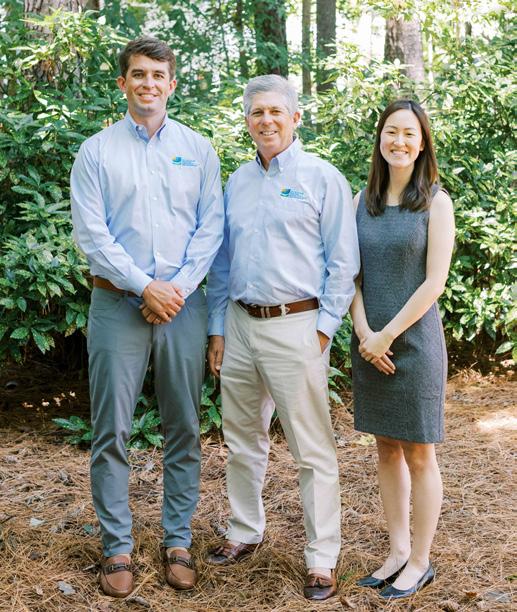
Dr. John Christensen, Dr. Rob Christensen and Dr. Jamie Molina are board-certified pediatric dentists, uniquely trained to meet the needs of infants, children, teens and patients with special needs. Their team provides the most up-to-date and comprehensive dental care in a warm, welcoming environment. They practice compassionate, patient-centered care by providing individualized treatment plans while treating each patient with kindness and respect. Dr. John, Dr. Rob, and Dr. Jamie work alongside families to develop a customized treatment plan to meet each child’s distinct set of needs and desires.
The team at Durham Pediatric Dentistry & Orthodontics is excited to welcome new patients to their practice.
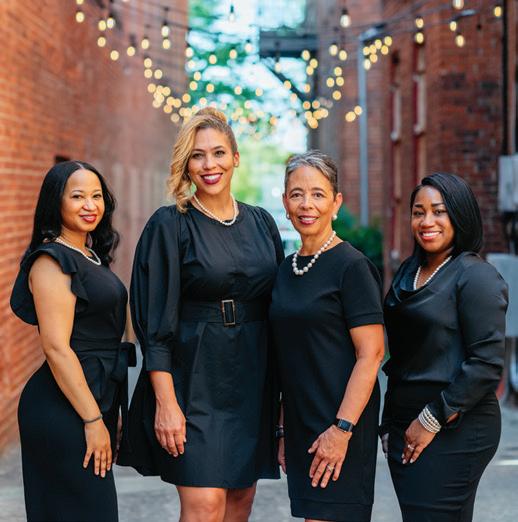
For more than 35 years the practice of Desiree T. Palmer, DMD, PA and Associates’ mission has been to provide dental care above and beyond expectations, while bringing our patients to optimal oral health.

Drs. Audrey Kemp, Brittanie Harris, Canai Calmore and Desiree Palmer practice a full scope of cosmetic and family dentistry including: Veneers, Crowns, Bridges, Restoration of Implants, Partials, Dentures, Whitening, and Invisalign. Schedule an appointment today at our “state of the art” practices on Newsom Street or our downtown location, Bull City Dental on historic Parrish Street.
TOP DENTISTS

SPONSORED CONTENT HEALTH care
Chapel Hill Rd., Ste. 300, Durham, NC 27707 919-518-9963
generaldentistdurham.com

With more than 30 years of experience, Dr. Brent Blaylock is one of Durham’s most trusted dentists, known for taking a complete care approach to dentistry.


Patients receive thorough initial examinations so that Dr. Blaylock can customize treatment plans based on their needs and desired results.
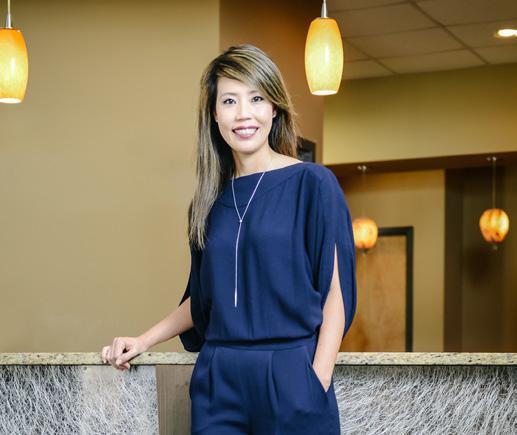
For patients who suffer from pain in their jaw joints, teeth or gums, this personalized aspect of treatment is especially beneficial.
Dr. Blaylock is also a member and former president of the Southwest Durham Rotary Club, where he and other dentist members provide dental care for Urban Ministries and TROSA residents several times a year.
Ben Franklin Boulevard, Suite 201 Durham, NC 27704 919-797-2300
DurhamBraces.com
Brier
Brier Creek Parkway, Suite 101 Raleigh, NC 27617 919-544-9700
BrierCreekOrtho.com
Dr. Gina Lee and her teams at Brier Creek and North Durham Orthodontics provide compassionate, personalized care in a warm, family-friendly office. Dr. Lee appreciates that every patient has unique orthodontic needs, so she spends time learning about their goals and how to help them achieve the smiles that they deserve. Taking advantage of the most advanced,
cutting-edge orthodontic techniques, Dr. Lee ensures optimal results while offering a comfortable experience in the least amount of time possible. Treatment options include traditional metal braces, Damon® Clear brackets, lingual Incognito™ or Invisalign® clear aligners. Dr. Lee is delighted to offer patients the highest-quality orthodontic care, provided with a mother’s touch.
3206
•
North Durham Orthodontics 4301
•
Creek Orthodontics 9650
•
HEALTH care SPONSORED CONTENT
Colony Rd., Durham,
E. Franklin St., Ste. 304, Chapel Hill,
Smith & Heymann Orthodontics,
believe a beautiful smile has the power to change your life.During your initial visit to one of our state-of-the-art offices, our team will ensure your time is informative and comfortable, utilizing the latest technology. You’ll leave with a detailed, custom-designed treatment plan in hand, ready to choose which treatment is right for you.
S. 5th St., Ste. #200, Mebane, NC
Blvd., Ste. A, Roxboro,
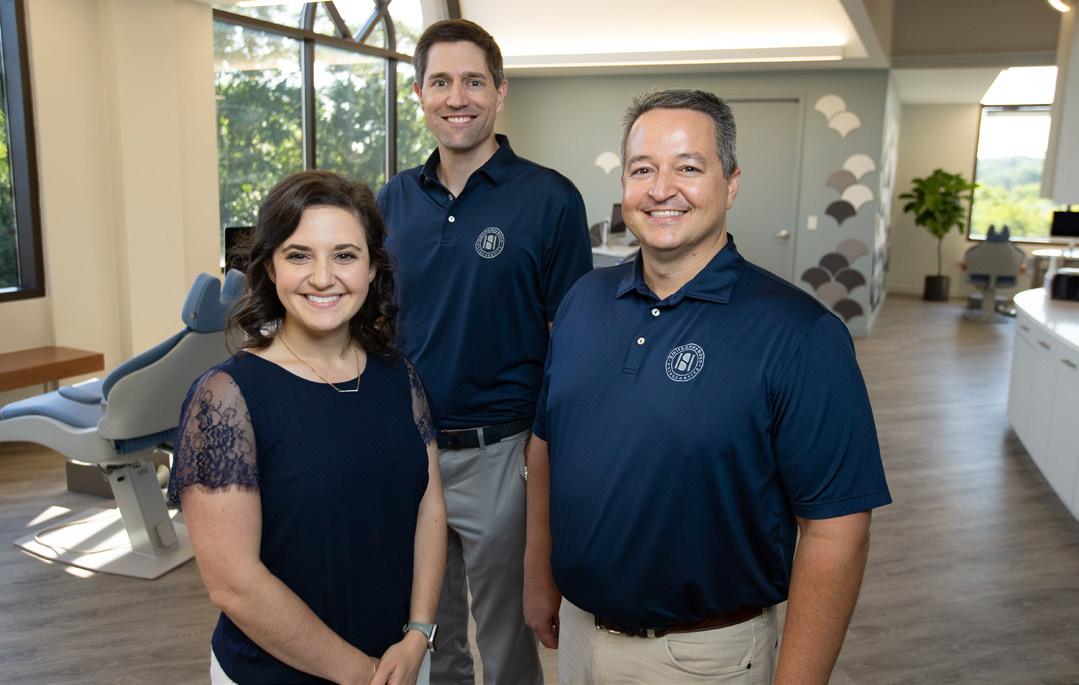
Our team is proud to serve our community as Invisalign Diamond providers. That means we are among the top 1% of Invisalign providers in the nation. We have the expertise to help you achieve the smile of your dreams without the use of metal braces and wires. Call us today for your complimentary consultation with Dr. Dempsey Smith, Dr. Gavin Heymann, or Dr. Katya Skillestad.
SPONSORED CONTENT 1506
NC 27514 424 N. Madison
NC 27573 2919
NC 27705 1107
27302
At
we
919-493-4911 • smithandheymann.com
INFLUENCER INSIGHTS
Follow the advice of three content creators as they share the best ways to explore our downtown
BY ISABELLA REILLY AND AMANDA MACLAREN PHOTOGRAPHY BY JOHN MICHAEL SIMPSON
Take a gastronomic excursion through the broad variety of cuisines offered at downtown restaurants and bars by embarking on a Small Plates Crawl on Thursday evenings. This dining initiative, created in partnership among nearly a dozen participating establishments, allows visitors to enjoy special small plates, drink pairings and/or discounts. COPA co-owner Elizabeth Turnbull, who helped start the event, says she has noticed an uptick in Thursday night business since the program launched in February. “Overall, there has been enthusiasm and interest from the community, and excitement to do something a little bit different,” Elizabeth says.
Current participants include Mateo Bar de Tapas, Alley Twenty Six, Taberna Tapas, Viceroy, COPA, Luna Rotisserie & Empanadas, The Patio at Unscripted Hotel, Dashi, Queeny’s and M Pocha Alley Twenty Six owner Shannon Healy says the Small Plates Crawl allowed him and chef Carrie Schleiffer to lean into
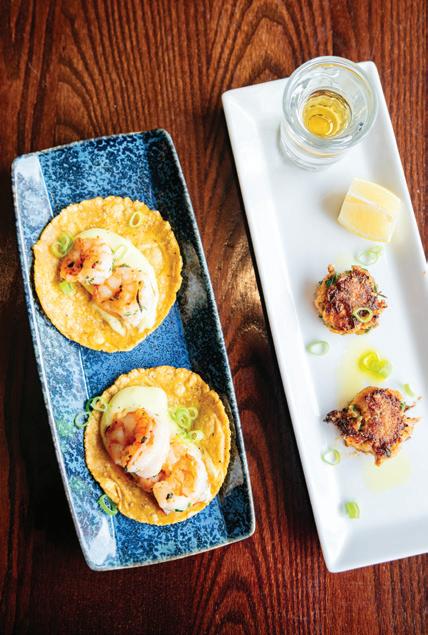
Small plates from COPA: North Carolina shrimp tacos served on nixtamal corn tortillas with housemade aioli and North Carolina crabcakes paired with Muddy River Distillery’s Coconut Carolina Rum.
their shared passion of food and drink pairings, and they offer a new combo each week.
“We’ve had a really strong response,” Shannon says. “A lot of our guests come in and get offered something they normally wouldn’t.” The dining initiative inspired the cocktail bar and restaurant to adopt more regular small plate and drink pairing options in the future, Shannon says, adding that Alley plans to continue to participate in the crawl.
Don’t sleep on Alley’s Jazz Brunch Sundays with Grammy-nominated jazz trumpeter, composer and recording artist Al Strong, either. Al brings a rotating lineup of musicians to perform during Sunday brunch, which is served from 10:30 a.m-2 p.m. with music from noon-2 p.m.
28 | durhammag.com | october/november 2022 DOWN TOWN
I haven’t had a bad meal or drink at Alley Twenty Six yet and would recommend anything on its menus. Snack on burrata or coconut shrimp with some of the most gorgeous and delicious cocktails (one time I got a drink that came with a flamingo floatie, and it brought me so much joy)! If you’re feeling hungry, the Alley Burger lives up to the hype. The black truffle cheddar, bourbon-bacon jam and chipotle aioli makes for a beautiful combination. I was immediately converted on the first bite.
Mateo Bar de Tapas was the first tapas place I’d ever been to (thanks to my Spanish boss at my first job out of college in a research lab at UNC), and their queso frito is one of those dishes that simply changed my life for the better. I was skeptical and confused when my boss ordered a fried egg at a nice restaurant, but trust me, this is nothing like any fried egg you’ve had before. It’s a simple dish, of course, but the manchego, romesco and maitake mushrooms transform an everyday ingredient into something exceptional. Whether you’re with a group or friends or on a date, tapas at Mateo are a perfect idea. I’d say throw in one of its famous paellas, too! Being a seafood lover, I’m partial to the Seafarer paella, which comes with shrimp, squid and mussels. You can even add scallops, octopus, and/or clams to it!
Juyoung Shin began documenting adventures around the Triangle with her sisters in 2018 as the Three Shinsters. The blog has evolved into Better with Ju (betterwithju.com) where she hopes to spread little joys in her life with her community by sharing a bit of everything – a local restaurant she’s loving, a recent trip she’s taken, books she’s reading and more.

october/november 2022 | Durhammag.com | 29
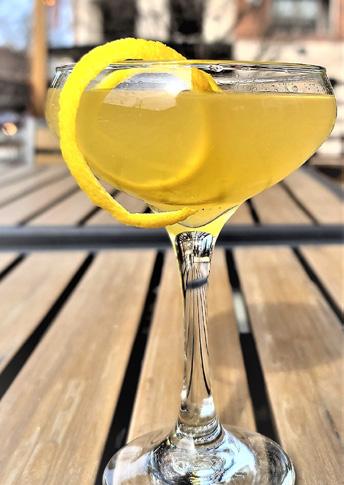
Amber Watson, Juyoung Shin and Joy Caracciolo take turns snapping the best photo of Alley Twenty Six’s Mexican Herbalist cocktail with jalapeño-hibiscus-infused tequila, ginger, honey and lime during a Thursday evening Small Plates Crawl.
I’m Korean, and M Pocha feels right as the last destination of the night (“pocha” is short for “pojangmacha,” a tented street food stall). It has a great kimchi stew that hits the spot. The dish used to come with housemade Spam, but now they make it with pork shoulder and tofu, which is more of a classic take. I appreciate that you can get a side of additional steamed rice, which is sometimes exactly what you need to finish your stew (or any meal!).
I love sitting by its window, especially on a weekend night; you can really appreciate the liveliness and energy of downtown.
HIDDEN GEMS

Little Barb’s Bakery is definitely a hidden gem that I hope people discover now that it’s located in the Durham Food Hall. This bakery has only been open and taking orders for about a year now and just recently got its own space inside the food hall. I tried the cake pops from there, and honestly can say that it was the best (and prettiest) cake pop I’ve ever had. It definitely deserves more shine on the blogs and in the media.
If I had to choose, my ideal Small Plates Crawl would be to Alley Twenty Six, COPA and then Queeny’s, but you honestly can’t go wrong with any of the participating restaurants. I would start at Alley Twenty Six because I love its cocktails. If the weather is still warm, I’d order a frozen blackberry tequila frozé with poké nachos. During the cooler seasons, I’d go with a tequila-based cocktail with hanger steak. Then, I’d head to COPA to get the fried pork belly and Cuban meatballs. My last stop would be Queeny’s for one of their amazing burgers, if there is any space left in my stomach. If I’m feeling really crazy, I’d finish the night with a glass of sauvignon blanc.
Joy Caracciolo is a food blogger eating and drinking her way through the Triangle and beyond as Joy Eats World (joyeatsworld. com). She enjoys exploring local and minorityowned food spots, coffee shops and everything in between with her friends and family –especially her son, Julius – and uses her platform to encourage others to explore and experience the diverse businesses that the area has to offer, hopefully helping those small businesses thrive in the process.
Another one of my favorite hidden gems is Gojo, Goorsha’s Ethiopian coffee shop. Many people only know Goorsha for its traditional Ethiopian lunch and dinner dishes. Its patio is a great place to work remotely, because it’s quiet, shady, and you can get a good cup of coffee with an amazing Ethiopian breakfast sandwich. And I feel like people are sleeping on one of my favorite coffee shops – EverLou Coffee Co. They are dog-friendly, have great service and there’s always exciting special drink menus that have unique, delicious flavors. – Joy
One of my favorite places to bring visitors and guests is 21c Museum Hotel – you can’t beat a free, 24/7 modern art museum. Take pictures and explore the original bank vault in the lower level, and get brunch or dinner from the sleek in-house restaurant and bar, Counting House
Mix It Up
The Mix at Durham Station features tunes by Patricia Murray, aka “DJ Piddipat,” at the transit center every Third Friday. The event started in 2019 through a partnership between GoDurham and Downtown Durham Inc. and was envisioned as a way to kick off the Third Friday Art Walk & Gallery Crawl
“During the season, DJ Piddipat greets pedestrians and visitors to the transit station with upbeat music,” says DDI President and CEO Nicole Thompson. “We invariably have a few people dancing and a number of people stopping to sit and listen awhile.”
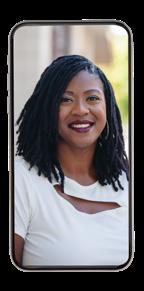
Patricia says she looks forward to playing at The Mix each month and interacting with the Durham community. “It’s fun to watch people plop down wearily, start patting their feet, and then jump up and dance,” Patricia says. “I love cheering people up, especially those who have had a tough workweek.” She takes song requests, but she says she most enjoys slipping in some global melodies into her playlist, like R&B tunes from Indonesia, Mexico, Kenya, Egypt and South Korea.
The Mix will resume for its fourth season next spring, running from April to October 2023.
The Durham Arts Council is another great building to wander through and look at the cool art displays. The Museum of Durham History, just across the street, is an easy spot that offers interesting exhibits for every age. Downtown’s Third Friday Art Walk & Gallery Crawl (more on that, above right) is a fantastic time to explore all these buildings and little galleries tucked in around the city.
Everyone knows about the American Tobacco Campus, but not everyone spends time exploring its interior. Along with the grassy lawn in front of the Lucky Strike Tower, there are cool nooks scattered around with hammocks, a fire pit and life-size chess set. Up by Burt’s Bees’ office, there is a light-changing waterfall fountain and a beehive viewing window on the outside of the building. – Amber
30 | durhammag.com | october/november 2022 DOWN TOWN
WE’RE GOING SHOPPING
Downtown Durham Inc. offers several resources and activities to highlight the Bull City’s downtown establishments. “DDI works behind the scenes creating promotions and providing resources to help businesses attract customers and to highlight the merchants that make downtown Durham such a cool and vibrant place,” says DDI President and CEO Nicole Thompson
The organization launched a downtown merchant map this year, which Nicole says helps visitors and residents quickly find their current favorites and easily discover new spots. The mobile-friendly map allows users to filter their search by specific cuisines, retailers, services, hotels and performance venues. Many downtown merchants also have scannable QR codes in their shop windows for easy access to the map.
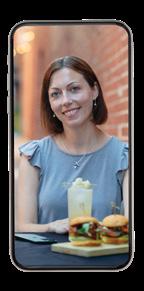
As a 6-foot-1-inch, plus-sized woman, it’s honestly hard for me to find clothing at a lot of boutiques, but I love buying Durham-themed T-shirts from Hometown Apparel on Ninth Street for myself and others. Another one of my favorite places to browse and shop is Bulldega Urban Market. The Blend of Soul pressed juices – specifically the berry bombshell and lemon crush – are some of my favorite products to buy there. I’m also a huge fan of purchasing items from our local coffee shops, like bags of Little Waves Coffee Roasters’ beans from Cocoa Cinnamon or pretty coffee accessories from EverLou Coffee Co. My absolute favorite place to shop for books for myself and my son is Rofhiwa Book Café. I recently purchased “Felix Ever After” by Kacen Callender, and it was such a great read. There is a wide variety of books to choose from, but if they don’t have what you’re looking for, they often offer to order it for you. It’s been empowering to not only have access to so many books written by Black and brown authors, but also have a Black-owned place to enjoy these books. – Joy
One of my favorite shops to spend time in when visiting other cities are bookstores – they’re quiet, calming and full of new worlds to discover. My love for bookstores rings true when I’m in my own city as well – Letters Bookshop moved into a brand-new, charming space downtown last year, and it’s the perfect place to get lost looking for your next good read.

I’ve always been an office supply/ paper nerd, and Parker Paper Company’s small-yet-packed storefront near the Durham Bulls Athletic Park is the cutest and brightest little shop, full of colorful
While I’m an avid fan of all M Restaurants, M Pocha is the perfect start to a Small Plates Crawl because its Asian street food fusion menu is totally unique and perfect for mixing and matching appetizers with a partner or friends. At this lively little bar, I’d start off with the shrimp toast: Japanese milk bread and North Carolina white shrimp with wasabi sweet chili sauce.
I love heading up to The Patio rooftop bar at Unscripted Hotel for views of downtown, casual poolside vibes and a menu with many delicious appetizers and entrees. Off the current menu, I’d put in an order for the large crabcakes and fried green tomato sliders.
Bites of Bull City was created eight years ago by Amber Watson, who moved to Durham in 2012. Her blog and website (bitesofbullcity.com) and associated social media accounts (@bitesofbullcity) began as a way to combine Amber’s background in writing and publishing with her passion for discovering and promoting local restaurants, and has since grown into a recognized and reputable food news outlet.
Just a short walk downstairs at Jack Tar and the Colonel’s Daughter, I’d cozy up in a booth or take a table on the front plaza and order its tequila-steamed clams (sometimes it’s steamed mussels) with Firsthand Foods chorizo and garlic bread, as well as an order of the crispy duck wings.
When it comes to ending the night on something sweet, I’d head over to The Parlour for a scoop of one of its seasonal icecream flavors and enjoy it out on the plaza, or if it’s still early enough, I’d walk down to Rose’s Noodles, Dumplings & Sweets for a homemade ice-cream sandwich.
october/november 2022 | Durhammag.com | 31
Zoe Finiasz and Emily Armbruster skim through new reads at Letters Bookshop.
pens and pencils, erasers, notepads, cards and puzzles. The child in me finds everything about it charming.
That inner kid also loves the fun and funky nature of Dolly’s Vintage. A huge portion of the store is devoted to vintage clothing (and gloves, jewelry, purses, etc.) along with cute gifts and trinkets to browse, including some local Durham swag. There’s so much to look at every time you go, and it’s great for older kids/ teens, too, because it’s fun to try on new outfits with retro flair.
Lastly, Bulldega isn’t just a good place to go for bread and milk, it’s also great to shop for small local gifts. I often take guests who are in town and looking for a bit of Durham to bring back – they can stock up on edible treats like Durham Toffee and Counter Culture Coffee, plus Bull City Candles, lotions, dish towels and mugs with Bull City charm. – Amber
Planning Ahead



Downtown Durham Inc. kicks off the holidays with the Durham Arts Council’s Art Walk Holiday Market on Nov. 19 and 20 followed by Small Shop Saturday, complete with a tree lighting at CCB Plaza, on Nov. 26. Visit the American Tobacco Campus on Nov. 30 for the annual tower lighting. Durhamites can expect many downtown festivities this holiday season, DDI’s Nicole Thompson says, and lucky winners will be awarded digital SpendaBull gift cards which can be used at more than 50 downtown businesses. DDI also plans to provide a map so visitors can easily find all their favorite downtown light displays.

32 | durhammag.com | october/november 2022 DOWN TOWN 3622 Lyckan Parkway, Suite 1001 Durham, NC 27707 YOU’VE SPENT 30 YEARS BUILDING YOUR NEST EGG. NOW COMES THE HARD PART: MAKING IT LAST ANOTHER 30. 3622 Lyckan Parkway, Suite 1001 Durham, NC 27707 Mark Kuhn President & Founder Scott Ranby, CFP Financial Advisor CALL 919-493-3233 TO LEARN MORE
Violet Bai and Jason Jia browse the retro clothes at Dolly’s Vintage.
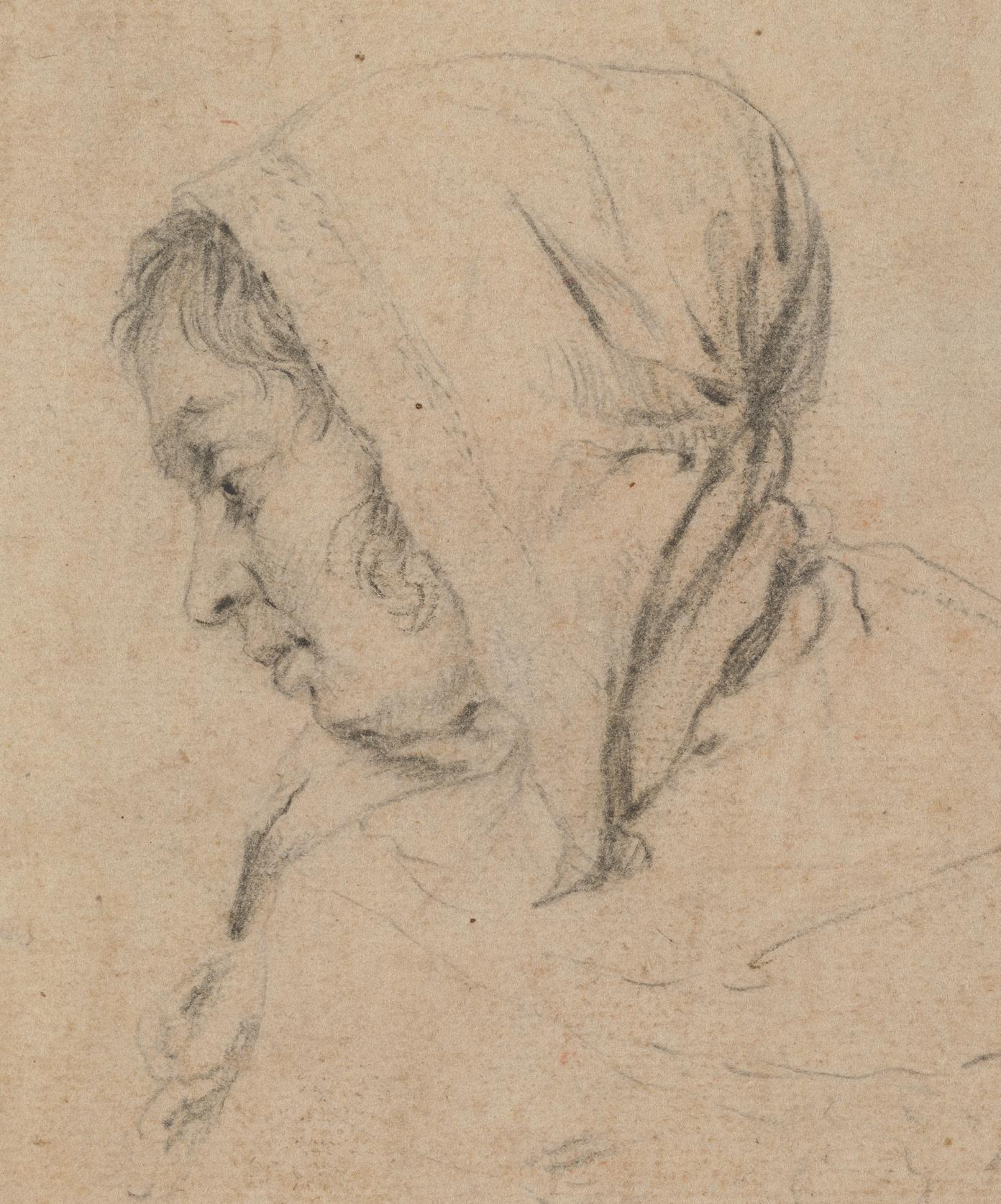
Frans van Mieris, Dutch, 1635-1681, Head of a Woman Looking Downward (detail), c. 1660-65, black chalk on paper, 4 5/8 × 4 3/4 in. (11.7 × 12.1 cm). Ackland Art Museum, University of North Carolina at Chapel Hill. Peck Collection, 2017.1.53. The University of North Carolina at Chapel Hill 101 S. Columbia St. at Franklin St. Chapel Hill, NC 27514 919-966-5736 | ackland.org September 23 - December 31, 2022 Drawn to Life MASTER DRAWINGS FROM THE AGE OF REMBRANDT IN THE PECK COLLECTION AT THE ACKLAND ART MUSEUM
HERE WE ARE NOW, ENTERTAIN US
Ihave grown to love the quarterly food truck rodeos at Durham Central Park – I am always on the lookout for my favorite food trucks, like Bulkogi, Chirba Chirba Dumpling and Royal Cheesecake & Varieties, to name a few. They always have some of the best food trucks in the Triangle, bounce houses for the kids, and upbeat music playing – just great vibes all around. I also enjoy spending time at the American Tobacco Campus on Sunday afternoons when it’s warm, because Boricua Soul hosts a weekly event called Patio Jazz with local musicians in front of the restaurant. It’s always a really dope experience, especially when you go with family and friends. – Joy
Motorco Music Hall is one of my favorite places downtown. In addition to being a concert venue, it plays host to a lot of community events, like Duke University vs. UNC basketball games, the Great Durham Pun Championship, a recent Taylor Swift festival and more. I’ve even gone to a Tinkering and Drinkering event hosted by the Museum of Life and Science a few years back! I feel so lucky we have places like Motorco in Durham that add so much richness to our community. Of course, I love its restaurant, Parts & Labor; the hipster poutine, with its grilled bulgogi beef, spicy kimchi, sharp yellow cheddar cheese, Sriracha aioli, green onion and cilantro, has been my go-to for years! – Juyoung

DOWN TOWN
THE HEART OF DURHAM







THE HEART OF DURHAM Your oasis, located in the heart of downtown. 701 W Main Street, Suite 123, Durham, NC 27701 We’re hiring for full and part time in both locations!Email info@modeconsignment.com orstop by fordetails. 1000 W. Main St. Downtown Durham (Across from Brightleaf) 919 806 3434 Mon-Sat10am-7pm Sundays 1-5pm Raleigh’s Village District 510 Daniels St. 919 803 5414 Mon-Sat10am-7pm Sundays 12-6pm Accepting seasonal consignment year-roundno appointmentneeded MODE Consignment Boutique modeconsignment Open 7 days a week. modeconsignment.com Gift cards available Visit our new location! Consignment Boutique info@modeconsignment.com







THE HEART OF DURHAM @WestEndDurham | 601 W Main St. Durham, NC 27701 THE ROXBORO AT VENABLE DURHAM, NC 333 Liggett Street, Durham | 919.688.5133 | dudapaine.com










THE HEART OF DURHAM FIND YOUR Y Achieve your goals and become a stronger, better you. Membership includes access to multiple Durham locations: • YMCA at American Tobacco | 410 Blackwell Street • Lakewood YMCA | 2119 Chapel Hill Road • Hope Valley Farms YMCA | 418 S. Roxboro Street • Downtown Durham YMCA | 218 W. Morgan Street > Learn more about the Heart of Durham downtown redevelopment! YMCATriangle.org Online tutoring for all learners. FREE with your library card. Get homework H Now DurhamCountyLibrary.org
MARKET POWER
Downtown pop-up series gains momentum, sets sights on bigger events
 BY BROOKE SPACH PHOTOGRAPHY BY JOHN MICHAEL SIMPSON
Max Rivera is all about supporting local. He says he personally enjoys being a part of the fabric of a community, and he took that passion to the next level at the height of the pandemic when he set out to uplift and highlight small businesses in the area with a pop-up market in Raleigh in November 2020. It was the first of what would become many monthly
DOWN TOWN
Cullen Walsh asks Radish Toast Handmades owner Jenny Foster about her products at The Makrs Society’s Golden Belt pop-up market.
38 | durhammag.com | october/november 2022

october/november 2022 | Durhammag.com | 39
markets of The Makrs Society, which today hosts pop-ups in Durham, Carrboro, Raleigh and Charlotte. You can visit the Durham markets March through November at Golden Belt and at Durham Central Park every first Saturday and every fourth Sunday of each month, respectively.
As one of the founders of Triangle Pop-Up who then branched out on his own, Max understands that popup markets have become somewhat ubiquitous. In order to set The Makrs Society apart, he and his five staff members create different themes for each month’s market – June was Minority Business Month, and September’s Pup-Up Markets featured booths from multiple adoption agencies and petoriented businesses. “We came together and brainstormed, put all of our ideas out there and picked the ones we thought the community would be interested in,” Max says.
The locations of Durham’s two markets are intentional, too, to ensure that vendors are easily accessible to the community. “A lot of the population in Durham is downtown,” Max says. “Durham Central Park is just a great area for walking foot traffic [and is] right next to the Durham Food Hall. Golden Belt, too, is just a really cool area. I feel like that’s an up-andcoming area, kind of similar to the [American] Tobacco Campus, but on a smaller scale. We checked out the location
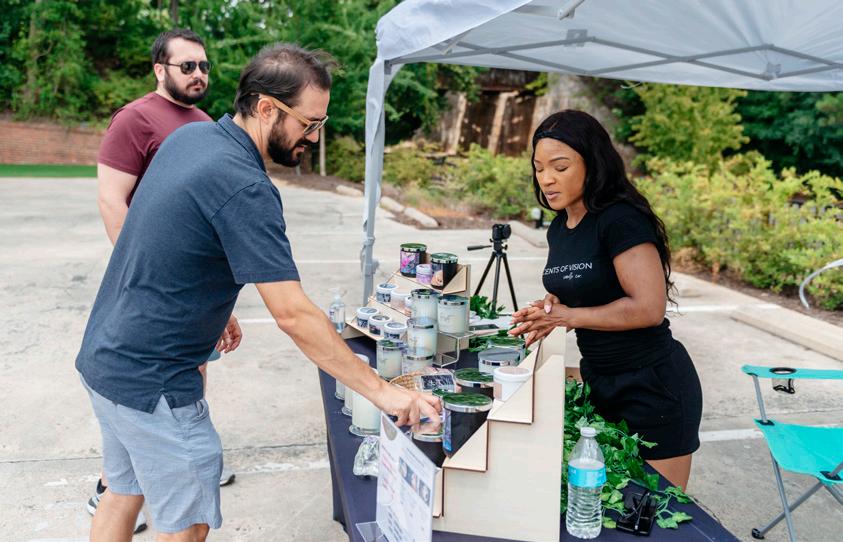
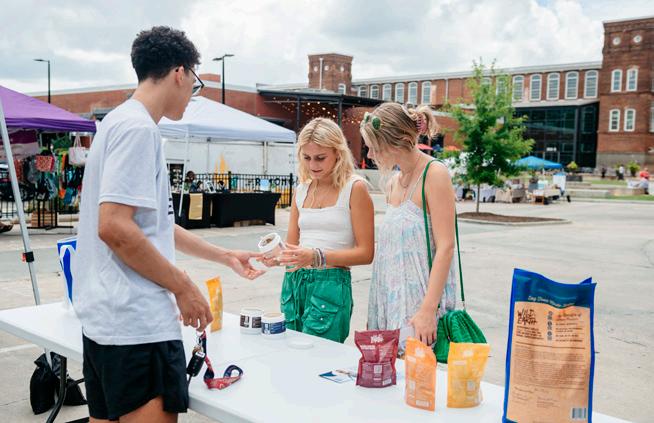
Jacob Sawyer speaks with Scents of Vision owner Talisha Brown about her scented candles. Talisha started her candle business after losing her job at the beginning of the pandemic.

and thought it would be a great fit.” DCP played host to its first Makrs Society market in March 2021, and the team expanded to Golden Belt earlier this year.
The monthly pop-ups draw between 500 and 2,000 attendees, with the largest crowds visiting Durham Central Park and Raleigh’s North Hills. Close to 200 Durhambased vendors regularly rotate among the markets, and each month’s event typically features about 50 vendor booths at Durham Central Park and 20 to 30 at Golden Belt. Vendors are subject to a rigorous application process to ensure the markets showcase high-quality products and customer service. Max says The Makrs

40 | durhammag.com | october/november 2022 DOWN TOWN








Society has received more than 700 vendor applications this year.
“We’re looking for businesses that are really trying to expand and grow,” he says, adding that the team pays attention to how the vendors present themselves both online and in person at their booths. “It’s very important for community engagement.”
Although Makrs Society got its start at the height of the pandemic, Max says that the nature of pop-up markets – outdoors, on a small scale and with the ability to space vendors apart – allowed them to continue facilitating relationships among customers and small businesses in an especially challenging time. Now that more people are comfortable gathering in larger crowds, the goal is to shift The Makrs Society into primarily a large event planning company.
“We’ve pivoted and transitioned,” Max says. “We’re still running our monthly markets, but we’re also getting into larger festivals and ticketed events.” Its Bull City Boos Fest at Durham Central Park on Oct. 22, for instance, will feature 40-plus local artists and vendors, brews from The Glass Jug Beer Lab, Bull City Burger and Brewery, Clouds Brewing, Barrel Culture and Bull City Ciderworks, among others; live music and DJ sets; food trucks; a kids zone; and other fun activities like tarot card readings and a 360-degree photo booth. “We’re expecting anywhere from 3,000 to 6,000 people,” during that event, Max says.
“We want to create an all-inclusive, positive space for people to come together,” Max goes on to say. “If you come to our events, you’ll see that there’s just a very diverse group of people.”
NOV.
A BENEFIT FOR ANIMAL
Our in-person event will be held at the Washington Duke Inn and includes a hosted cocktail hour with passed appetizers, a threecourse meal with wine, and a live auction
Now collecting amazing items
tickets visit














































































42 | durhammag.com | october/november 2022 DOWN TOWN For more information, call (919) 560-0640 extension 235 2022Tails twilight imagine a w ld
PROTECTION SOCIETY OF DURHAM SATURDAY,
19 FOR THEM
.
and experiences for our silent and live auctions. Also offering several sponsorship levels with wonderful benefits. IN-PERSON OR VIRTUALLY ONLINE for
www.APSofDurham.org/tails-at-twilight Aps_1/2page_GalaAd.indd 4 8/31/22 4:31 PM
Thomas Higgins talks about Wild Earth dog products with Allie Ryan and Kylie Hodges, who just adopted a new pup.
Tickets Going Fast







Nov 26 Nov 29 - Dec 4 Dec 14 - 18 Dec 19 Jan 3 - 8 Jan 18 - 22
3 BURNING QUESTIONS ...
 PHOTO BY JOHN MICHAEL SIMPSON
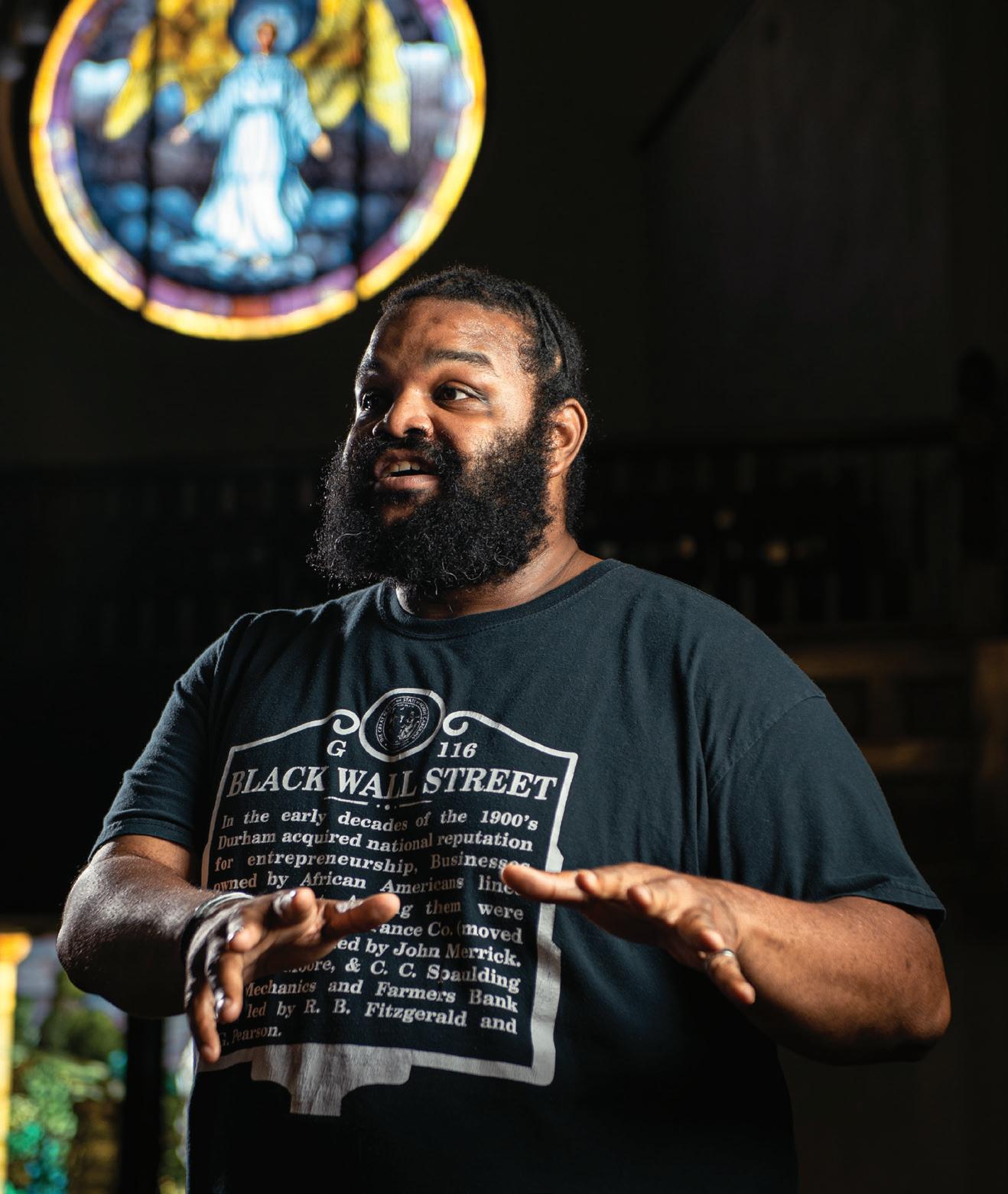
D.J. Rogers is a poet, spoken word artist, editorialist, essayist and educator at KIPP Durham College Preparatory and Art of Problem Solving Academy in Morrisville. He’s also the City of Durham’s inaugural Poet Laureate, a one-year term he began on July 1. Below, he shares his vision for the job, and the role that poetry plays in city life.
What are you hopeful to accomplish as Durham’s first poet laureate?
[I want to] really expand the definition of the city and a citizen of Durham and what that looks like. What I mean by that is: Durham is a city that is historically founded by and thrives on the power of marginalized people. … And so my big, tangible project to that end is an urban art project that’s going to take place within our housing communities like McDougald Terrace and several of the other housing projects in the city.
I want to go in there and do workshops with the kids and adults who live there … to revitalize and highlight those communities, but through the voices and the lens of the people who actually live there, and not somebody who is trying to gussy it up to sell it, essentially.
What does it mean for Durham to choose to have a poet laureate?
What it shows me is an appreciation for, and a respect for, art, which I think is awesome.
One of the big things that showed [the importance of art] was how many aspects of our society were laid bare in the wake of the pandemic. When we didn’t have our businesses, our social gatherings, our ability to go out in places like coffee shops – what did we have left? We had community, and we had art. Seeing that has really illustrated exactly how indispensable art is. Trying to highlight that, I think, is what led to the creation of this position. And it’s really humbling to be the first one.
What do you hope that future Durham poet laureates will be able to accomplish? This is a pilot year, but there is full intention to continue [the program]. In addition to helping execute programming, I’ll help create kind of an outline or curriculum that other poet laureates might follow.
I hope [future laureates will] not only celebrate Durham through art, but also expand Durham to other places and expand art to other places through the position. To have collaboration with poet laureates and artists from other cities, other states, and to really come together and help show who and what Durham is through the art. [By] doing that, what they also accomplish is continuing to build the community of Durham from within as well. – as told to Cole del Charco
You can learn more about events with Poet Laureate Rogers through the City of Durham’s website, durhamnc.gov/4724/durham-poet-laureatepilot-program, and on D.J.’s social media pages – @DJ_Rogers on Twitter and @DJRogers88 on Instagram.
DOWN TOWN 44 | durhammag.com | october/november 2022
D.J. Rogers, pictured here at the Hayti Heritage Center, grew up in Raleigh, went to college at UNC-Chapel Hill and has lived in Durham for more than 10 years.
october/november 2022 | Durhammag.com | 45
W GEER ST 147 W GEER STWASHINGTON ST MORRIS ST N DUKE ST S DUKE ST S DUKE ST W CHAPEL HILL ST N GREGSON ST S GREGSON ST NMANGUMST N MANGUM ST S MANGUM ST JACKIEROBINSONDR HOLLOWAYSTWPETTIGREWST NROXBOROST N ROXBORO ST FAYETTEVILLEST ELIZABETH ST WMAINST WMAINST WMAINST 147 46 | durhammag.com | october/november 2022 WHAT’S UP, D THE LATEST DEVELOPMENT NEWS 1 2 3 4 5 6 7 8 9 10 E CHAPEL HILL ST 11 12 13 14 15 16 17 18 19 20 21 22 23 24 25 26 27 28 29 30 3132 33 34 35 36 37 38 39 40 41 42 43
DOWNTOWN
1 YONDERLUST 109 N. Gregson St.
• Linton Holdings LLC filed plans in June 2021 to transform the nearly century-old building beside Maverick’s Smokehouse & Taproom into a two-story retail and residential development
• Room for a cafe and retail stores on the first floor; will include an outdoor gear shop
• Four one-bedroom apartments on the second floor
• The main floor is approximately 3,750 square feet, and the upper floor is 2,780 square feet
• Durham-based Linton Architects
• Estimated opening in fall 2022
2 BRIGHTLEAF DISTRICT
• Includes Brightleaf Square at 905 W. Main St., 910-914 W. Main St., 815 W. Morgan St., 810 W. Peabody St. and 112 S. Duke St. In total, includes nearly 215,000 square feet of mixed-use space.
• Charlotte-based Asana Partners purchased the historic property in late 2019. Several tenants opened or expand last year: One Medical, a primary care practice, opened in Brightleaf Square; BioLabs North Carolina occupies more than 32,000 square feet at 810 W. Peabody St.; Oerth Bio, an early-stage agriculture biotech company headquartered at 112 S. Duke St., doubled its space to almost 15,000 square feet; and Jeni’s Splendid Ice Creams opened across from Brightleaf Square this summer. Tenants slated to open in Brightleaf Square in late 2022 or early 2023 include Emmy Squared Pizza and recently announced Niko, a new concept from Durham restaurateur Giorgios Bakatsias
• Renovations will take place to update Brightleaf Square’s tree-lined, brick courtyard, including extensive landscaping, additional seating, and lighting and facade improvements to create an active environment for customers and office users.
3 THE GREGSON 204 S. Gregson St.
• Developer is Baltimore-based real estate company Wexford Science & Technology, which also developed The Chesterfield building. Nine levels with 218,000 square feet of state-of-the-art lab and office space
• On-site multi-level parking garage
• Expected delivery: 2025
4 FORMER DURHAM POLICE DEPARTMENT HEADQUARTERS
505 W. Chapel Hill St.
• 4-acre parcel owned by the City of Durham; originally built in the 1950s as the offices of the Home Security Life Insurance Company and most recently occupied by the DPD, the building became vacant in late 2019
• During its Aug. 1 meeting, the City Council rejected two request for proposal responses for its disposition and redevelopment. The development teams were asked to include five defined priorities for the site: providing 80 units of on-site affordable housing; generating significant revenue for the city from the sale of the land and future tax revenues from on-site development; delivering a mixed-use project; preserving the existing Milton Small Building; and delivering an activated street-level experience.
• While both teams submitted development programs aligned with these priorities, City Council identified market conditions resulting from COVID-19 including elevated construction costs and a transitioning commercial office market resulting in financial offers that did not satisfy expectations. City Council members reiterated that affordable housing was a priority for the site. Based on these factors, Council members decided to hold the site and reissue another solicitation for proposals at a later date.
5 THE GROVE
512 Gordon St.
• 62 townhomes, 1,310-2,675 square feet
• Three- and four-story units, contemporary design with 16-foot ceilings, most with rooftop terraces facing downtown. Multiple options for home offices.
• Features first urban pedestrian malls in the state
• High $500,000s–$1million+
• Broke ground in early 2020
• Homes in the first phase are complete and occupied as of October 2021
• Pre-sales are underway for the remaining units in the neighborhood
6 CITY PORT
600 S. Duke St.
• 43 studio, one-, two- and three-bedroom condominiums
• 5 condos remain for sale
• 400-square-foot studios to 1,200-square-foot units, priced from the low- to mid-$400s
• One block from the American Tobacco Campus expansion
• Construction completed in September 2021
• Joint venture of Center Studio Architecture, White Oak Properties and CityPlat
CITY PORT PHASE II
505 Yancey St.
• Adjacent to the first phase of City Port
• Site plan was submitted in fall 2021
• Focus on offering affordable condominiums with enjoyable outdoor space and parking for each unit
• Estimated delivery in 2023
7 J.J. HENDERSON SENIOR APARTMENTS
807 S. Duke St.
• $31.2 million project; rehabilitation of the existing apartments built in 1979
• Durham Housing Authority is co-developing the property with its instrumentality, Development Ventures Incorporated, as well as California Commercial Investment Group and Florian Companies
• Construction began in May 2021 and is estimated to continue for 20 months
• Expected to be substantially complete in fall 2022
8 THE TERRACES AT MOREHEAD HILL 411 Cobb St. (713 Willard St. – model unit)
• 25 townhomes
• Phase 1, which consisted of seven luxury townhomes – five with Promenade-style floor plans located on Willard Street and two larger, duplex-style townhomes, called The Verandas, on Manor Way – is sold out.
• Construction for Phase 2 (identical to Phase 1) is underway and pre-selling. Delivery is expected January 2023.
• Phase 3 includes 11 townhomes: six Promenades and five terrace-style townhomes. Delivery is estimated late spring 2023.
• All units feature private rooftop terraces and a two-car garage. Elevator-ready, with views of the Durham skyline. Along a newly constructed street with brick borders and benches. Minutes from the Durham Bulls Athletic Park, the American Tobacco Trail and the American Tobacco Campus.
9 AMERICAN TOBACCO CAMPUS EXPANSION – PHASE I 601 Willard St.
• Former site of University Ford
• Development by Capitol Broadcasting Company and Hines in partnership with USAA Real Estate
• 700,000-square-foot mixed-use project on 8 acres bordering the west side of American Tobacco Campus
• Phase 1: 8 acres that includes 350,000 square feet of leasable space in two Hines T3 (Timber, Transit and Technology) creative office buildings; 350 multifamily units in a 14-story, high-rise residential building; and 100,000 square feet of experiential retail, like a theater/draft house, prepared foods grocer, shops and restaurants
• Activated central plaza and intimate pedestrian alleyways that will be programmed with events and experiences
• Construction is expected to begin in 2022
10 ASHTON PLACE 310 Jackson St.
• Adjacent to the Willard Street Apartments, this 51-unit, 52,000-square-foot affordable housing project is for adults age 55 and older
• Studio, one- and two-bedroom units
• Community gathering areas, bike storage, fitness facilities, tenant storage and a business center
• The project is a partnership between DHIC and Self-Help Ventures Fund and is being developed on city-owned land with a 9% low-income housing tax credit and a commitment of funds from the city
• Construction slated to begin fall 2022
october/november 2022 | Durhammag.com
| 47
COMPILED BY MEGAN TILLOTSON AND ISABELLA REILLY | MAP BY KEITH WARTHER, JEAN CARLOS ROSARIO-MONTALVO AND KEVIN BROWN
11 THE NOVUS
400 W. Main St.
• Close to 2 acres of land
• Austin Lawrence Partners project that will be constructed in two phases
• Existing South Bank building was demolished and construction is underway
• Phase 1 will encompass a mixed-use high rise
• Residential portion to include 54 condominiums and 188 apartments; 450 parking spaces
• Ground-floor retail space totaling nearly 23,000 square feet
• Construction of new building slated for completion in Q3 2024
12 THE JAMES 320 W. Morgan St.
• 312 mixed-use apartment units, 32-story tower
• 13,000 square feet of retail space
• Craig Davis Properties project
13 YMCA REDEVELOPMENT
218 W. Morgan St.
• 295 mixed-use apartment units
• 120,000 square feet of office space
• New 50,000-square-foot YMCA
• Construction slated to start in spring 2023
• Expected delivery: 2025
14 THE VEGA 214 Hunt St.
• Lambert Development project at the prior site of Vega Metals
• Seven stories consisting of 57 one-, twoand three-bedroom condos ranging from approximately 900–2,300 square feet; each home has Durham Central Park or city views via a 10-foot folding glass door
• Amenities include a resident club room with terrace overlooking DCP, fitness center, personal storage unit for each home, secure refrigerated storage for grocery or other delivery, private parking with assigned spaces and optional car charge spaces. Air filtration system will provide a healthy living environment for residents, via extensive collaboration with NORESCO. All common areas will substantially exceed code and conventional standards for indoor air quality, and hospital-grade filters will be utilized in the amenity and fitness rooms.
• $500,000 to $1 million+
• Commercial space on lower levels
• MHAworks leads design; Resolute Building Company leads construction, which began in July 2021
• Occupancy is planned for spring 2023
15 DURHAM ID
• Total area: 1.8 million square feet, 27 acres, bordered by Duke Street, Morgan Street, West Corporation Street and Roney Street
• Existing space: 595,000 square feet of existing office space; 325,000 square feet of existing lab space; 15,000 square feet of existing retail
• Future space: 780,000 square feet for lab and office; 35,000 square feet for retail; 300 residential units
• Tenants now include Duke University, Duke Clinical Research Institute, Google, ThermoFisher, Spreedly, Cherry Bekaert, Tune Therapeutics, Life Edit Therapeutics, Kimley-Horn and Associates Inc., Longfellow Real Estate Partners, 321 Coffee, The 360 Approach, Duda|Paine Architects, Beer Durham, Measurement Incorporated, Bull City Veterinary Hospital and Edward Jones
SOUTHERN GATEWAY
• 200 Morris – Duke Clinical Research Institute leases the entire building; Google is a subtenant in the building. 5,729 square feet of retail available on first floor
• 300 Morris – 28,737 square feet of Class A, state-of-the-art lab space ranging in size from 6,000 square feet to 70,000 square feet. 6,618 square feet of retail available on the first floor; LEED Gold Building
• 518 W. Morgan St. – 189,585 square feet available as the next lab/office building to be developed in the district, will break ground later this year
• Morris Green Park – parklet along Morris Street programmed by Elevate, Longfellow Real Estate Partners’ proprietary tenant services and hospitality offering. Includes public art featuring Raleigh artist Sarahlaine Calva’s work, fitness classes, weekly food trucks, seating and power connectivity
• Public parking garage on Roney Street
• Courtyard between 200 & 300 Morris buildings includes seating, signature lighting, Wi-Fi, water features and lawn games. Public art includes Raleigh artist Matt McConnell’s 100-foot sculpture and Charlotte artist Sharon Dowell’s two-part series along Morris Street. Raleigh artist Anna Payne Rogers Previtte’s mural is showcased in the 300 Morris lobby.
16 BECKON
311 Liggett St.
• Six-story building with 263 apartments and around 6,000 square feet of retail space
• Studio, one-, two- and three-bedrooms
• More than 10,000 square feet of amenity space, including a sky lounge, coworking spaces, resortstyle pool, indoor/outdoor resident lounges, 2,000-square-foot fitness center with yoga studio, hammock garden, dog spa, dog park, bike storage and resident parking garage with car-charging stations
• Smart community with keyless entry, smart thermostats and lighting controls, communitywide Wi-Fi, secured package room and cold storage area for at-home grocery delivery
• JDavis Architects is the architect, Vignette Interior Design is the designer and Stewart is the civil engineer and landscape architect
• Broke ground in January 2021
• Estimated completion in early spring 2023
17 WASHINGTON STREET MIXED-USE 501 Washington St.
• 311 mixed-use apartment units; 492 parking spaces
• 8,000 square feet in retail space
18 THE PULLMAN BUILDING 703 W. Trinity Ave.
• Four condominium units
19 DURHAM RAIL TRAIL
Abandoned Norfolk and Southern rail bed
• 1.76-mile-long, multi-use trail from north Durham to the Ellerbee Creek Trail network and downtown, as well as through residential neighborhoods northeast of downtown, ending at Avondale Drive
• City staff continue to strategize on engaging historically under-represented communities in alignment with the city’s Equitable Community Engagement Blueprint
• Construction completion is estimated for 2024
20 THE GEORGE
512 West Geer St.
• Raleigh-based Beacon Street Development seven-story building; five residential floors over two levels of gate-secured parking, 40-residence boutique condominium
• Will offer one-, two-, and three-bedroom penthouse residences
• Amenities: Street-level lounge; a creative workspace, including a private conference room; fitness studio with a full set of cardio and strength offerings; indoor/outdoor penthouse lounge on the seventh floor overlooking Historic Durham Athletic Park; gate-secured parking; bike storage; and small pocket park.
• Scheduled to break ground Q1 2023
• Residences anticipated Q3 2024
21 WASHINGTON STREET TOWNHOMES
802 Washington St.
• Three 3,000-square-foot townhomes (three bedrooms, four baths) with private decks, sky room
• $1.75 million
• Durham Performing Arts Center architect Phil Szostak of Szostak Design
• Breaking ground fall 2022
22 GEERHOUSE 620 Foster St.
• 2.2-acre site near Durham Central Park
• Phase 1 to include 220 new multifamily rental units, averaging 785 square feet with a unit mix of 20% studio units, 50% one-bedroom units and 30% two-bedroom units
• Unit sizes ranging on average from 566 to 1,144 square feet
• Phase 2 to include an expanded Motorco Music Hall, plus 13,000 square feet of new retail space
• Amenities include: Landscaped courtyard with water feature, major amenity rooms with westfacing terrace, ample garage parking and linear park through the site connecting Foster Street to Rigsbee Avenue
• Delivery expected December 2023
23
710 RIGSBEE AVE.
• 51 apartments, 2,000-square-foot restaurant with 700-square-foot patio
• Elmwood Development project; architect is Richmond-based ArchitectureFirm; engineer is Coulter Jewell Thames; interior designer is Murphy Waldron Interiors
• Opening anticipated Q3 2023
24
318 W. CORPORATION ST.
• 82 apartment units; studio, one-, twoand three-bedroom apartments
• 2,000 square feet of commercial space; four- and five-story brick building
• Construction began in September 2021; opening anticipated in early 2023
• Elmwood Development project; architect is Richmond-based ArchitectureFirm; engineer is Coulter Jewell Thames; interior designer is Murphy Waldron Interiors
48 | durhammag.com | october/november 2022
DOWN TOWN
25 ATLAS DURHAM
614 Rigsbee Ave.
• 171 modern range of apartment units
• Studio, one- and two-bedroom floorplans to fit a variety of budgets, leasing now
• Apartments feature 10-foot ceilings, valet trash service, Ori home organization and Fetch package delivery
• 6,300 square feet of street-level retail
• Quick walk to Dame’s Chicken & Waffles, Fullsteam Brewery, Motorco, Durham Food Hall and the Durham Farmers Market
• Private terraces, 22 different amenities including open social spaces, study pods and a bark park
• Purchased by multifamily real estate firm Collett Capital in 2022 from local joint venture of Paul Smith of Southern Urban and Scott Harmon of Center Studio Architecture
26 120 BROADWAY ST.
• A Lock7 Development 24-townhome community project

• Contemporary-style two- and threebedroom units, each with a terrace and one- to two-car garage
• 12 of the homes will have the option for retail use on the ground floor, ideal for someone who works from home
• Slated to break ground late summer 2022
• Delivery in spring/summer 2023
27 106-108 BROADWAY Broadway & North streets
• Former Leyland Post property purchased by Center Studio Architecture
• 27 studio and one-bedroom condominium units
• Plans are to begin construction in mid-2023
• Expected delivery: mid-2024
28 608 MANGUM 608 N. Mangum St.
• Six townhome units
29 ARRAY DURHAM 521 N. Mangum St.
• 18 studio and one-bedroom condos
• Four units still available, remaining units start in the low $300s
• 500- to 700-square-foot designs
• Expected delivery: Q1 2023
• Joint venture of Center Studio Architecture, White Oak Properties and Urban Durham Realty
30 AURA 509 509 N. Mangum St.
• Developer is Dallas-based Trinsic Residential Group – Carolinas
• Purchased a $3.2 million, 1.3-acre site
• $60 million+, 264,000-square-foot project
• 182 units averaging less than 800 square feet each
• Eight-story, podium-style construction (concrete parking deck with five levels of wood-frame construction) with approximately 200 parking spaces across three levels of parking
• Construction began in September 2021
• Delivery of first units: Q1 2023
• General contractor is John Moriarty & Associates, architect Cline Design Associates and civil engineer is Coulter Jewell Thames
31 501 N. MANGUM ST.
• Developer is Dallas-based Trinsic Residential Group – Carolinas
• 205 unit, 18-story high-rise
• Breaking ground summer 2024
• Estimated opening fall 2026
32 102 W. MORGAN ST.
• Developer is Dallas-based Trinsic Residential Group – Carolinas
• 228 units
• Breaking ground Q1 2023
• First units estimated to be available Q2 2025
october/november 2022 | Durhammag.com
| 49
33 THE WILLOW DURHAM
500 E. MAIN ST.
601 N. Roxboro St.
• Two five-story buildings
• Ground-floor garage and services areas totaling 7,000 square feet per building
• Seven condominiums per building
• Plans include units of 1,855 square feet, 2,410 square feet and 3,320 square feet
home
• Two- and three-bedroom units, all include a flex room
• Amenities: a pocket park, three balconies per unit, dedicated laundry room, modern mail room with refrigerated delivery, guaranteed parking space per unit as well as dedicated first-story storage for each unit
• Starting in the $900,000s
• Four of the seven Phase 1 condominiums have been sold
• Completion of the first building slated for Q4 2023; second building scheduled for Q2 2024
34 ELLIOT SQUARE
601 N. Queen St.
• Developer is Raleigh-based real estate company Chappell
• 37 townhomes
• 18 delivered, remaining 19 expected to deliver between November 2022 and February 2023
35 KRESS CONDOMINIUMS
162 W. Ramseur St.
• On the corner of West Ramseur and South Mangum streets, current site of a 0.15-acre parking lot next to the historic Kress building
• Development by Raleigh-based real estate firms White Oak Properties and CityPlat
• Six-story building with 26 residential units, including rooftop units, all with balconies
• 2,000 square feet of ground-level retail
• Plans to install CityLift Parking, which will park cars and bring them to residents using an automated lift system taking up less space than a traditional parking deck
36 300 & 500 E. MAIN ST. APARTMENTS
• Mixed-use buildings with total of 305 affordable residential apartments, 248 market-rate apartments, 41,340 square feet of commercial space and more than 1,600 parking spaces
300 E. MAIN ST.
• Includes a roughly 753-space parking deck with 110 affordable housing units serving 30%-80% AMI with a mix of studio, one-, two- and three-bedroom units
• 3,900 square feet of commercial space that will target nonprofit and/or socially responsible organizations and a 10,243-square-foot child care location with two pre-K classrooms, allowing Durham County to serve children from birth to 5 years old
• Queen Street side of the building will include a structural public art installation that will also serve as a screen wall for the parking deck
• Construction of the parking deck is underway as of September 2021, completion estimated in November 2022
• Anticipated affordable housing completion estimated for spring 2024
• Estimated overall completion at the end of 2024
• Redevelopment will include a parking garage with approximately 847 spaces along with 195 affordable housing units serving 30%-80% AMI with a mix of studio, one-, two- and threebedroom units along Ramseur Street
• 248 market-rate units along Main Street will be handled by developer ZOM Living, which has an office in Raleigh, with a mix of studio, one-, two- and three-bedroom apartments (ranging in size from 555 to 1,450 square feet) and 13,000 square feet of street-level retail space that includes plans for a grocery store
• A linear park between the two buildings will provide a landscaped pedestrian walkway connecting South Dillard Street and South Elizabeth Street
• Construction began in August 2022
• Parking deck opening anticipated in February 2024
• Market-rate housing units slated for completion in Q3 2024
• Affordable housing units to be complete in Q2 2025
37 VENABLE CENTER CAMPUS 464 Pettigrew St.
• Joint-venture partnership of Trinity Capital, SLI Capital and Kane Realty
• Mixed-use: 202,000-square-foot, eight-floor office space in The Roxboro office building with 221 apartments in another building, in addition to the already existing Venable Center Campus
• Duda|Paine Architects completed design for The Roxboro office building, which includes ground-floor retail space, in February 2021; construction is now complete
• The multi-family portion has been delivered and is currently leasing
38 CAMDEN DURHAM 425 S. Roxboro St.
• 420 apartment homes
• A budgeted cost of $145 million
• Construction began in early 2021, slated for completion by mid-2024
• First units are scheduled for delivery in spring and summer of 2023
• Average unit size will be around 900 square feet, and most units (about 75%) will be either studios or one-bedrooms, with the remainder two-bedrooms
• 6,000 square feet of retail space
39 HERITAGE SQUARE 606 Fayetteville St.; 401 E. Lakewood Ave.
• 10-acre site located in the Hayti District
• Multistory Class A office, purpose-built laboratory space and residential units
• Joint venture between Chicago-based developers Sterling Bay and Harrison Street
40 THE RAMSEY 510 Pettigrew St.
• New York-based Park Grove Realty and DiMarco Group built a 385,158-square-foot, 241-unit apartment complex on 2.5 acres
• Studios, one-, two- and three-bedroom apartments
• Amenities: pool, fitness center, interactive fitness and yoga room, grill area, gathering spaces, private meeting rooms, individual work spaces, fire pits, dog wash station, dog park, enclosed structured parking, bike storage, bulk storage, community market, private wine tasting room and wine lockers
• Broke ground in July 2020, project completed in June 2022
• Units now available for rent, and leasing staff is available on-site for tours
41 BORDEN BRICK 704-706 Ramseur St.
• Approximately 12,000 square feet of retail and adaptive re-use, with more than 10,000 square feet of outdoor space
• Four tenants, which will include Lonerider Spirits, with tentative plans for a Tex-Mex restaurant, cocktail bar and more
• Alliance Architecture project
• Completion estimated for Q4 2022
42 ELIZABETH STREET APARTMENTS 544 Liberty St.
• Land owned by Durham Housing Authority with a 99-year ground lease
• Development partner is Charlotte-based developer Laurel Street Residential
• New construction of 72 units
• 35 one-, 28 two- and 9 three-bedroom apartments with unit sizes ranging from 700 to 1,500 square feet
• 9% Low-Income Housing Tax Credit project
• Available to households earning up to 80% of area median income
• Construction slated to start in 2022; completion anticipated by mid 2024
43 GOLDEN BELT CAMPUS 800 Taylor St., 807 E. Main St.
• Mixed-Use: adaptive re-use renovation
• 320,000 square feet of rentable space
• LRC Properties and Alliance Architecture renovated Mill No. 1 and have welcomed occupants including, but not limited to: 25 artist studios, Durham Art Guild, Hi-Wire Brewing, J. Lights Market & Café, Strata Clean Energy, Camargo Pharmaceutical Services, Kalisher, WillowTree, Two Roosters, Cugino Forno, MetaMetrics and Urban Tails Veterinary Hospital
• A trellis walkway now connects Mill No. 1 to the Golden Belt side of campus, which includes 37 residential lofts, office and lab space, and retail tenants such as Moshi Moshi Salon, Dogstar Tattoo Company, The Cotton Room/Belt Line Station and Yaya Tea
• The Mill Stage features free music programming during the summer in conjunction with Third Friday Art Walk each month
DOWN TOWN
50 | durhammag.com | october/november 2022
re-envisioned durham
Bullseye View
Durham is located in the heart of one of the most highly-educated regions in the country, but you don’t need a PhD to know that the Bull City is growing – a lot. As Vice President of Economic Development at the Greater Durham Chamber of Commerce, I have a front row seat to this growth story. The Durham community is in the midst of a rather unprecedented influx of new jobs and new investment. Since 2020, the Durham Chamber has assisted with 18 economic development projects involving a new company relocation to Durham or the expansion of an existing company. These projects collectively represent over 7,600 new announced jobs for our community and over $2.1B in new announced capital investment.
Unsurprisingly, our community’s longstanding strength in the life sciences industry has led to many of those recent announcements, as companies like Eli Lilly, GRAIL, and others invest in a big way in the Research Triangle Park. The tech industry is an increasingly prominent part of our economic development story in Durham as well. Google’s announcement last year that they will be bringing a 1,000-employee cloud computing hub to downtown Durham is one of the most impactful economic development announcements our community has ever had. We were also happy to welcome the latest cleantech company to Durham when Smart Wires - who specializes in electric grid optimization
by Ryan Regan
Vice President of Economic Development, The Greater Durham Chamber of Commerce

technologies - announced plans to bring their HQ to Durham last year.
The economic development projects that have landed in Durham in recent years are bringing significant benefits to our community. Some of these benefits are rather obvious, like the highwage job opportunities that can help elevate standards of living for Durham County families, but there are many other benefits as well.
The significant capital investment associated with these projects will bring in hundreds of millions of dollars of tax revenue to city and county coffers. This new revenue helps to pay for improvements in critical infrastructure like roads, sidewalks, and water/sewer lines that will all be necessary as we grow as a community. Not to mention the most important investment of all – our children. The increase in property tax revenues will help improve the quality of education that Durham Public Schools (DPS) is able to provide to young people in our County. The influx of new property tax revenue from the private sector also helps to reduce the property tax burden borne by us residents.

SPONSORED CONTENT
As a part of local government incentive agreements, many economic development projects in Durham also come with binding commitments from the company that incentivize them to 1) diversify their supply chain by sourcing more of their goods/services from minority and woman-owned Durham businesses, 2) make environmental sustainability commitments that reduce their carbon footprints, and 3) connect with local workforce development partners to encourage local hiring.
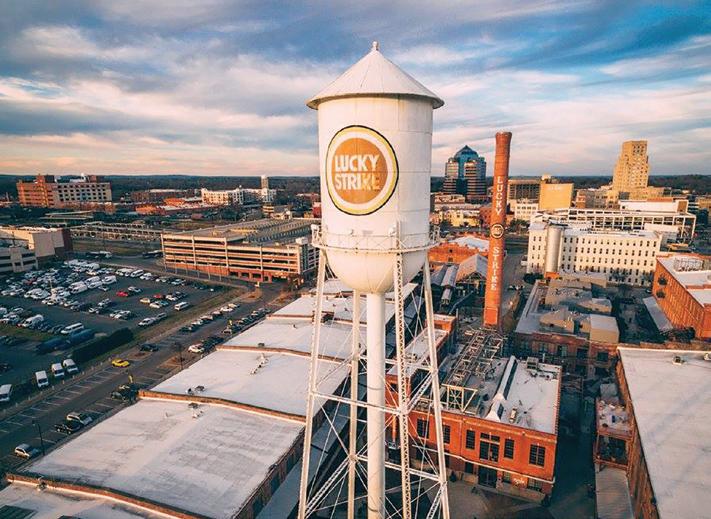
It is that last priority that is especially important in our current moment. Many of the major new company announcements that you read about in the press are from companies who are establishing partnerships with Durham Tech Community College, NC Central University, DPS, the Durham Workforce Development Board, and other workforce partners to get local Durham students and residents connected to new job opportunities.
One such public-private workforce development partnership that is especially promising is the Building Up Local Life Sciences (BULLS) initiative. BULLS is an equity-centered workforce development initiative that seeks to recruit underrepresented students between the ages of 18 and 24

to promising employment opportunities at life sciences companies in Durham. The program provides scholarships and financial assistance to program participants, allowing them to achieve key life sciences industry-focused training and academic credentials at Durham Tech. BULLS is a collaboration between Durham Tech, the NC Biotech Center, Durham County, Made in Durham, the City of Durham, and the Durham Chamber.
As evidenced by initiatives like BULLS, many local partners are working to ensure there are avenues for all Durham residents to engage in our community’s growth. At our Mid-Year Economic Outlook event held earlier this year, we unpacked the connections between global conditions, capital investments, and workforce development in supporting our local economy directly and indirectly. As more of these opportunities present themselves, stay in the conversation with the Chamber and our many public and private partners by attending events like our upcoming Leadership Forum & Holiday Reception. Finally, consider how you can orient your own workplace to our local trajectory, and in your personal time, support a non-profit in this space or even apply for a City or County Board or Commission to share in this work with us.
The economic development projects that have landed in Durham in recent years are bringing significant benefits to our community.
SPONSORED CONTENT
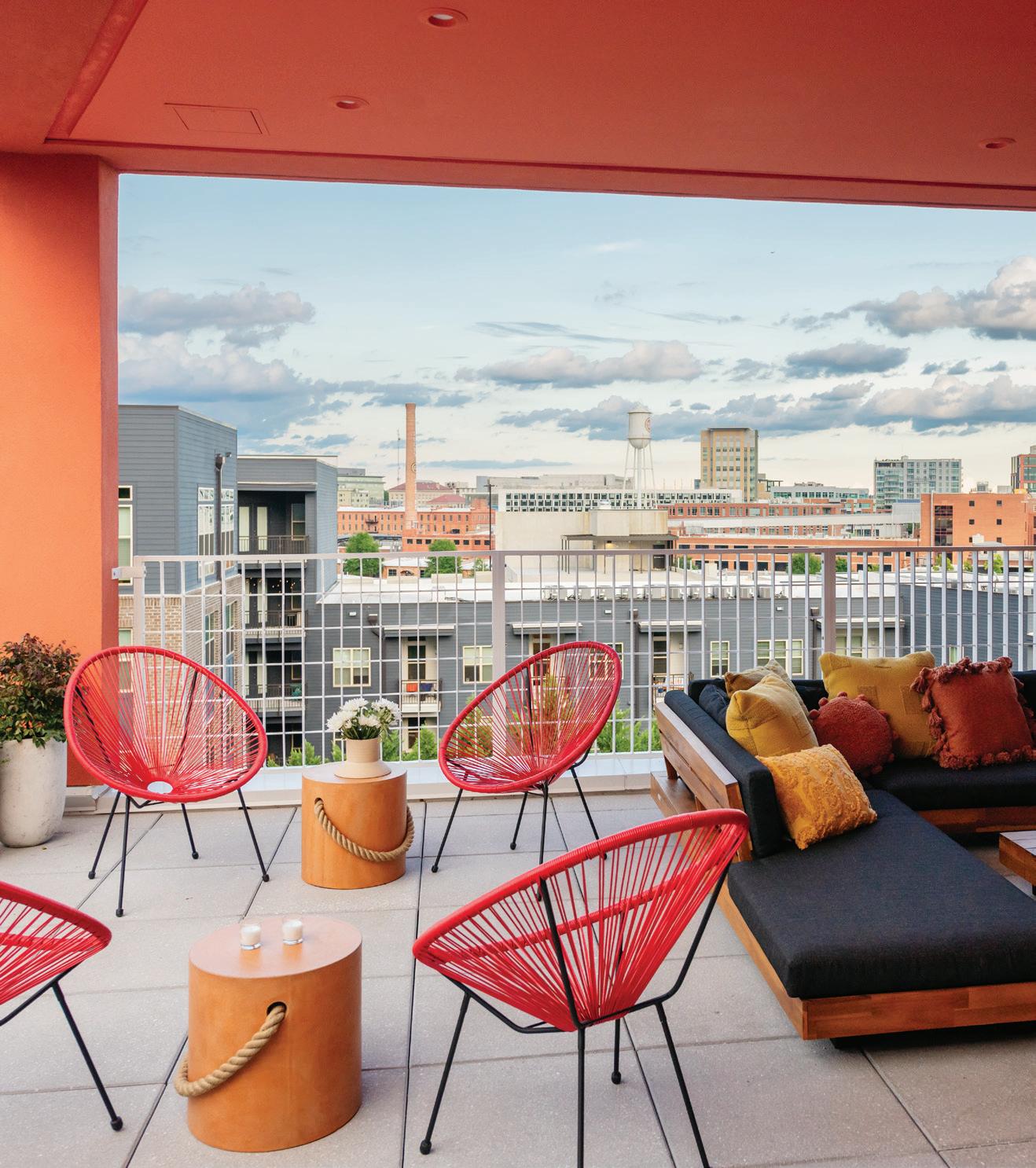
DOWN TOWN 54 | durhammag.com | october/november 2022
AT RIGHT Minna Ng, Tara Clayton, Dr. Moira Artigues, Susan Herst and Jed Gammon raise a glass on City Port’s rooftop patio.

HOME & GARDEN
ROOMS WITH A VIEW
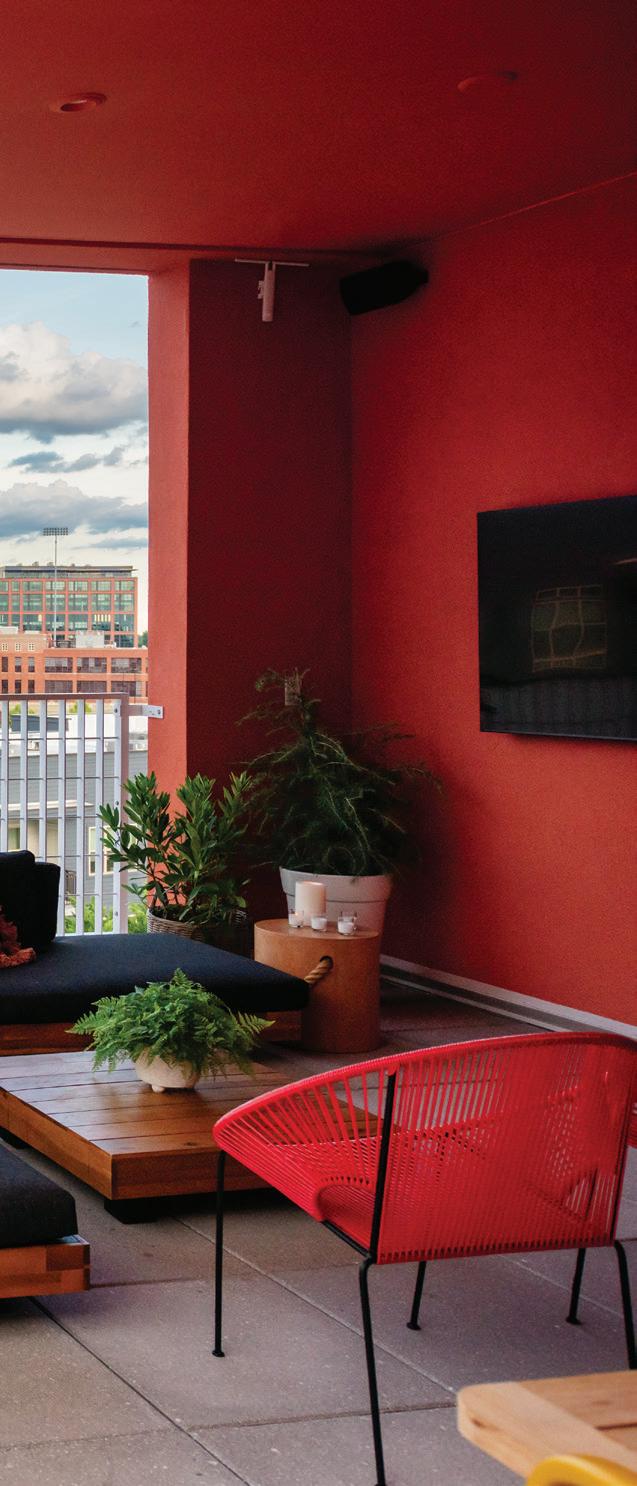
Dr. Moira Artigues finds her happy place in the downtown of a city she’s loved for nearly 30 years
BY MORGAN CARTIER WESTON PHOTOGRAPHY BY JOHN MICHAEL SIMPSON
Dr. Moira Artigues graduated from medical school in 1995 and moved to the Bull City that same year. “I interviewed for my residency at Vanderbilt, Yale, the University of Virginia, lots of wonderful places,” the Charleston, South Carolina, native says. “But when I came to Duke University,
october/november 2022 | Durhammag.com | 55
I just fell in love.” She says she’s never lived somewhere as diverse, welcoming and unique as Durham. “I have always felt at home here among the rainbow of faces and experiences our community shares.”
In the nearly three decades since, she raised two children, established a business in Cary as a forensic psychiatrist, and eventually began a new chapter as a single woman. “My former husband and I lived in a house in north Durham, but I never loved it. It was a convenient location and a good place to raise our sons, Harry [Artigues] and Will [Artigues],” Moira explains. “But once my sons moved out and began lives of their own, I realized that, like so many other women, most of my decisions in life had been fueled by what was best for other people.”
Moira’s move to City Port earlier this year was a big step in putting herself first. “I have a demanding job and work frequently on the weekends, so a walkable, downtown condo was exactly the kind of low-maintenance lifestyle I was looking for,” she says. She describes the condo building as a friendly, cool, “Durham-y” space. “There is nothing not to like from my perspective,” she says.
LEFT A shell chandelier and textural wood dining table bring a coastal vibe to the kitchen. ABOVE The smaller green works are by Olivia Fields. A TV is mounted above the credenza – it’s motion sensitive and displays an artwork when someone walks into the room.
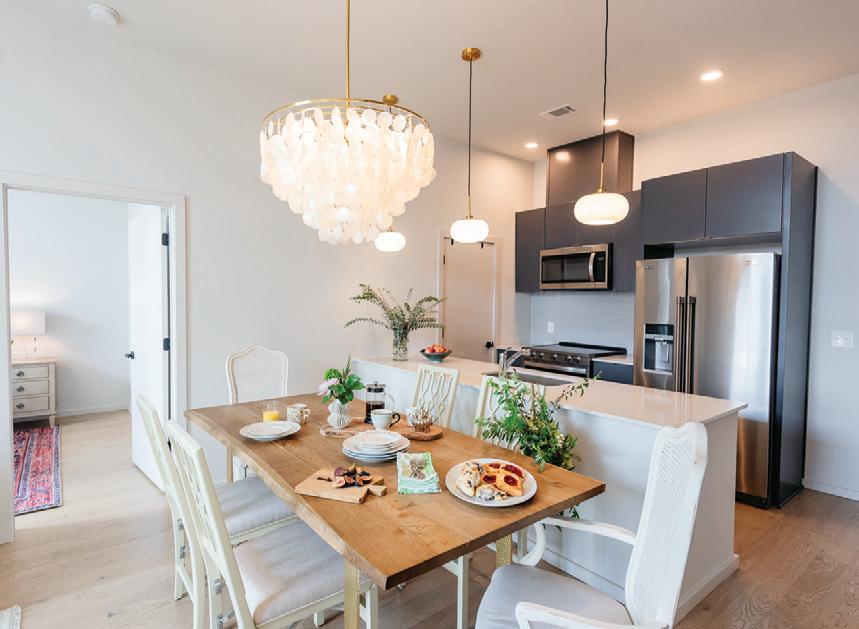

56 | durhammag.com | october/november 2022 DOWN TOWN
She worked with Realtor Alan Trammel to select a top-floor, twobedroom, 915-square-foot unit that offers views of the night sky (“I study the stars and like to look up what planets are overhead,” Moira says). She officially made the move in February 2022, eager to begin making the space her own.
“In the notes from my first meeting with Moira, I have written down that she wanted a fun, colorful and not-too-serious condo,”
says designer Tara Clayton of Cobblestone Lane Gallery. “This home was to be her space to unwind from a fulfilling, yet taxing, job, and the primary focus was to design a place where she could recharge with friends and family.”
“I’ve always liked spaces with a sense of humor and don’t like things that are too serious or stuffy,” Moira says. “My sons and I like to travel, and wanted to bring the colors of some of our favorite

october/november 2022 | Durhammag.com | 57
places, like Miami and the Bahamas, into my home so I always have those memories around me.”
She shared these ideas and colors with Tara, who challenged Moira to narrow down what she wanted most for her new home. “I loved that she tasked me with identifying my priorities, because I might not have necessarily given it that much thought, but by the end, Tara really seemed to get me,” Moira says. “We went back and forth a little, but she really nailed it.”
The result of Moira and Tara’s collaboration is a relaxed, yet sophisticated, home that fits right in at City Port, a colorful,
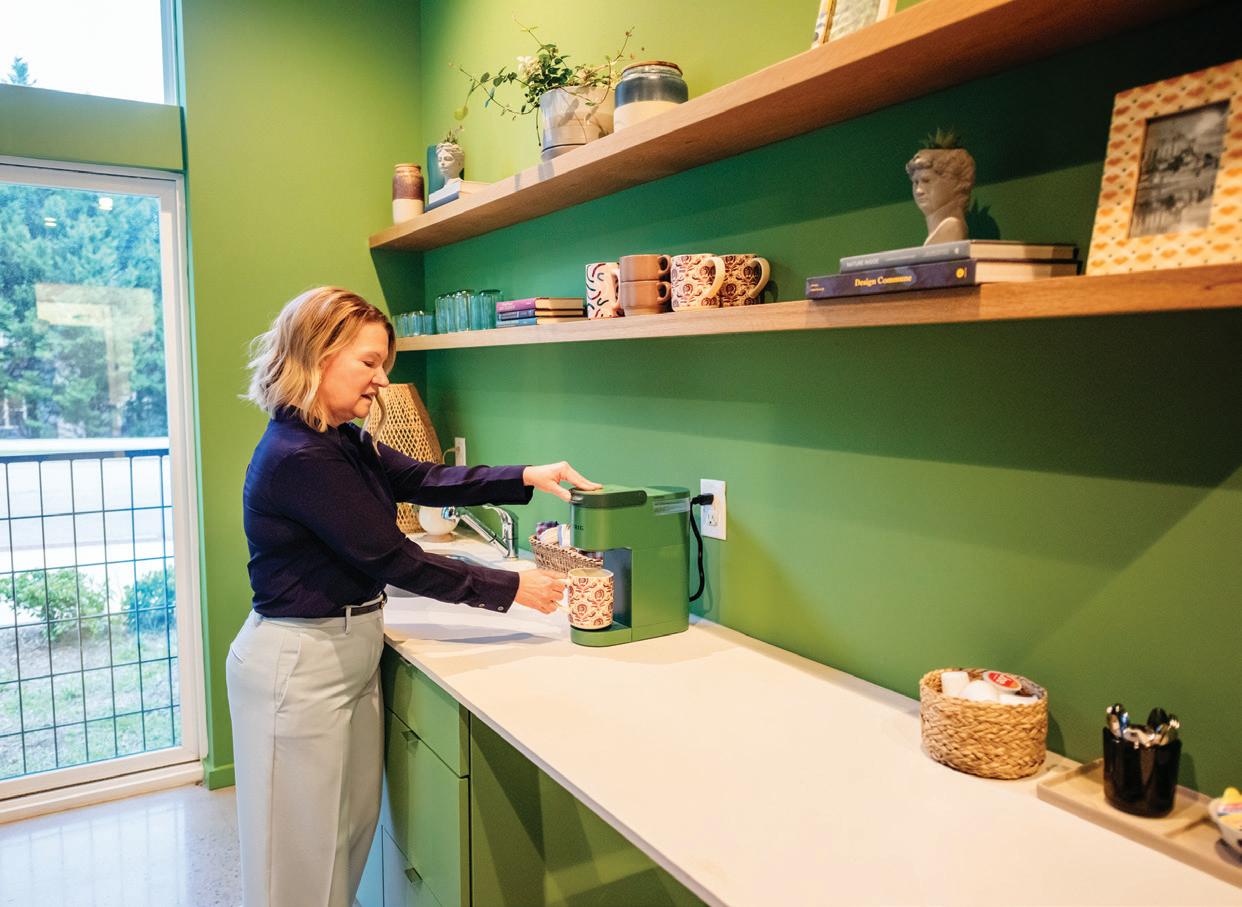
no-frills building just off the Duke Street exit from Highway 147, where residents can take a brief pause from Durham’s burgeoning city landscape before heading out for dinner and drinks. The color scheme evokes Moira’s love of the Caribbean, and thoughtful touches ensure that she and her guests are never far from what they need. “There’s lots of natural light, which is a great feature,” Moira says. “I especially love the big window in my bedroom, where I can look out over the city.”
“I think our combined love for eclectic design is rooted in a belief that, beyond aesthetics, design is about building friendships
58 | durhammag.com | october/november 2022 DOWN TOWN
Moira makes a cup of coffee in the building’s well-appointed lobby.
ABOVE LEFT Moira’s unit is down the hall from the rooftop deck; its spectacular downtown views feel like an extension of her home. ABOVE RIGHT Moira shows Minna her piece by Golden Belt artist Kerry Burch.
and community; it’s about inviting people to connect with you and feeling social warmth emanate throughout the space that you create,” Tara says. “I am thrilled for Moira to have that kind of atmosphere in her condo, one which will undoubtedly be magnified by the building’s amazing roof deck that overlooks the cityscape and the ballpark. The location offers abundant opportunities for connection through the immediate and surrounding communities.”
City Port itself was a true Bull City collaboration; developer White Oak Properties engaged Center Studio Architecture and their development company, ReVamp Durham, to research and design the 43-unit building. The inviting common areas and rooftop deck were designed by Carrie Moore Interior Design, and custom mosaic artwork by Jeannette Brossart welcomes tenants and visitors into the building’s vibrant lobby.
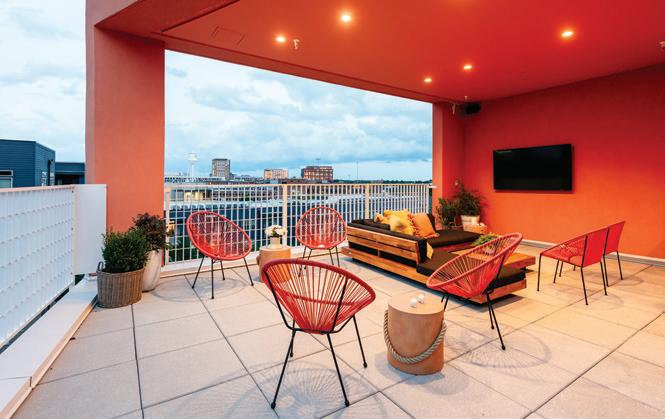
“The name was intentional,” says Susan Herst, a broker and partner with Urban Durham Realty, which represents City Port. “Just as it sounds, this is meant to be your portal to all parts of the city – in fact, it is
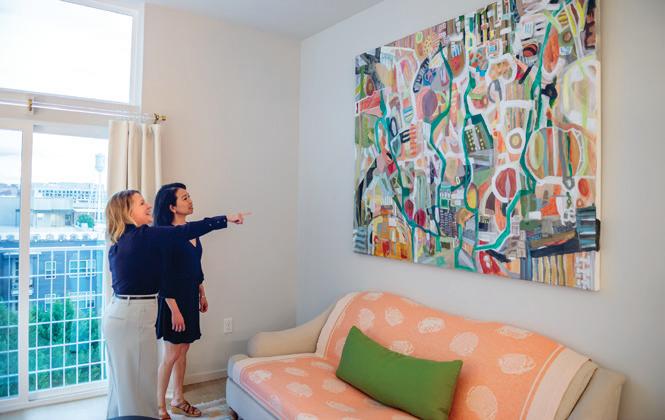
YOUR DESIGN BUILD PARTNER
Specializing in kitchen and bathroom remodeling as well as extensive renovation, we help clients all over the Triangle improve their homes with the kind of caring attention that makes us feel like family.
Visit cqchome.com or call 919-971-5119 to schedule your personalized consultation today.

october/november 2022 | Durhammag.com | 59
2022
equidistant to downtown and Ninth Street, so you can be at DPAC or Duke in minutes without having to cross any major roads.” The location, combined with the building’s ample amount of sunlight, are among Susan’s favorite features. “It’s not a fussy building, yet still has everything you need,” Susan adds.


“For those looking to own a home within walking distance of American Tobacco Campus, this is a great option,” says Jed Gammon of Raleigh-based White Oak Properties. “We included a multitude of unit styles to fit different budgets, from studios to three-bedrooms, to provide downtown living for a range of income levels and lifestyles.”



The building offers the best of both worlds: It is slightly off the beaten path, which offers privacy, but close enough to downtown to provide views of Durham’s growing skyline (and accompanying gorgeous sunsets) from its rooftop deck. It also offers views of the Durham Bulls Athletic Park. “I love baseball, and I can walk to the Durham Bulls,” Moira says. “I’ve easily been to 10 games since I moved here; it’s fantastic. I love to host friends here for
LEFT Moira and designer Tara Clayton of Cobblestone Lane Gallery sourced many furnishings from Vintage Home South. RIGHT Moira enjoys entertaining friends in her condo.


60 | durhammag.com | october/november 2022 DOWN TOWN
Durham, Chapel Hill, & Chatham Weekenders weekly updates on local people, places and events Home & Garden monthly look at some local renovations and latest trends Eat & Drink monthly local foodie news, events and recipes Durham Inc. monthly run down of the local business pulse in Durham Weekly Wedding Planner wedding planning tips, inspiration and local events Special Offers & Promotions events, offers and deals from our local partners GO HERE TO SIGN UP: durhammag.com/join chapelhillmagazine.com/join chathammagazinenc.com/join STAY CONNECTED Editor’s Picks: What to do this weekend! PLAN YOUR WEEKEND What We’re Eating: News from our restaurant community HOME &garden Delivered monthly by Durham Magazine Chapel Hill Magazine and Chatham Magazine Local renovations Professional advice Latest trends Durham Magazine • Chapel Hill Magazine • Chatham Magazine • Heart of NC Weddings • Triangle Digital Partners

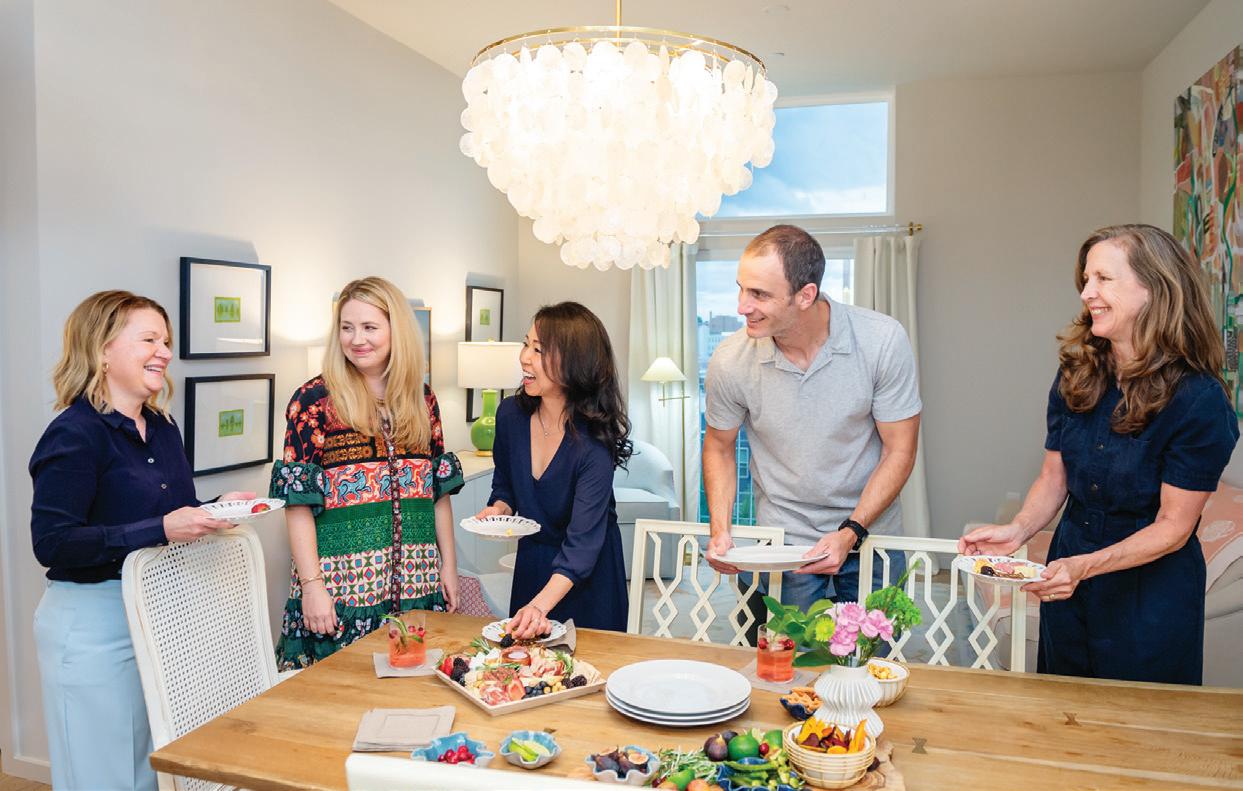
october/november 2022 | Durhammag.com | 61
drinks, and then head out to dinner and a game together.” Her standby restaurants include Mateo Bar de Tapas, Luna Rotisserie & Empanadas and Rue Cler, and she especially enjoys grabbing pizza at Mellow Mushroom on her way to the ballpark.
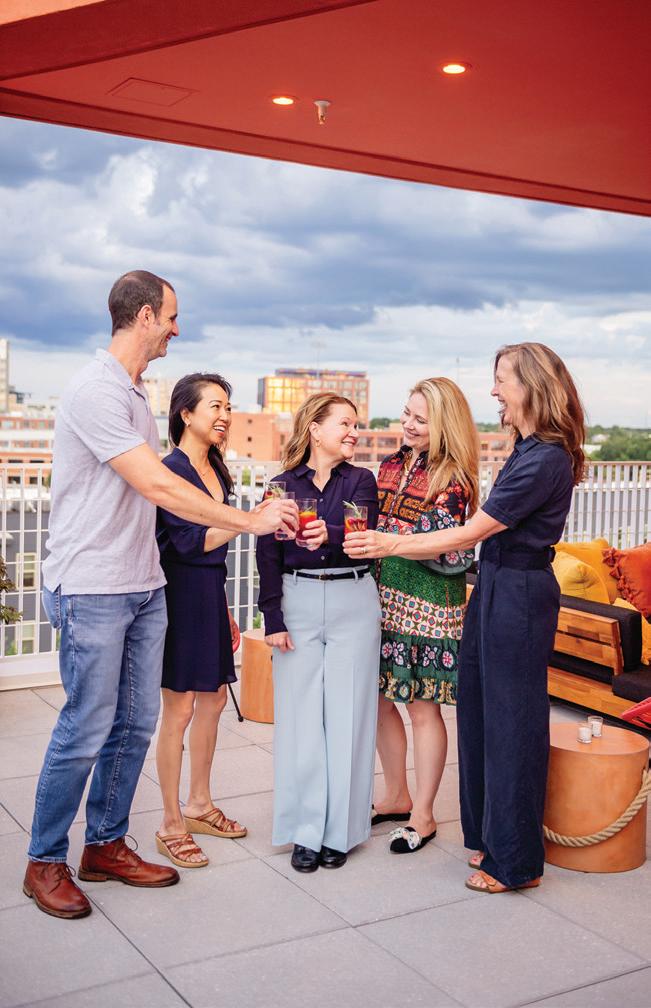
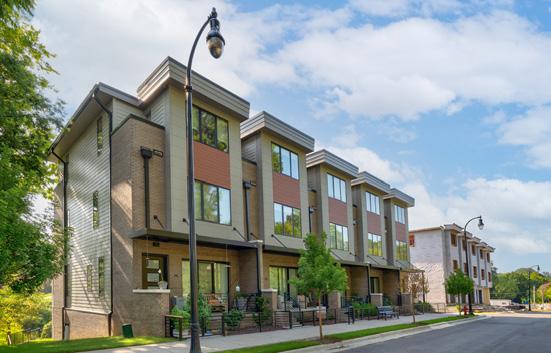
In addition to her love of baseball and food, Moira has a passion for local art, which she and Tara embraced to personalize her home. The piece above her sofa is by Golden Belt artist Kerry Burch, and she recently began frequenting downtown art galleries to see what’s new that she might want to add to her collection.
The group toasts
Moira’s
with
summer and welcome to fall.
62 | durhammag.com | october/november 2022 DOWN TOWN Only a few Minutes walk to the Durham Bulls Athletic Park, the American Tobacco Trail, American Tobacco District & DPAC Willard Street; a newly constructed downtown Durham street with brick borders, street lights and benches 2 CAR GARAGE | ELEVATOR READY | PRIVATE ROOFTOP TERRACE 411 COBB STREET, DURHAM, NC 919.213.0520 | theterracesdurham.com TRUE TO YOU • TRUE TO YOUR HOME 919.627.7157 • TrueDesignNC.com Renovation Design Specialist Durham | Chapel Hill | Surrounding Areas 2022
to
new abode
a cranberry-lime margarita, a perfect cocktail to bid adieu to
Tara, who has past experience working in art museums, also commissioned works from Atlanta-based textile artist Olivia Fields to punch up the color in the living space.
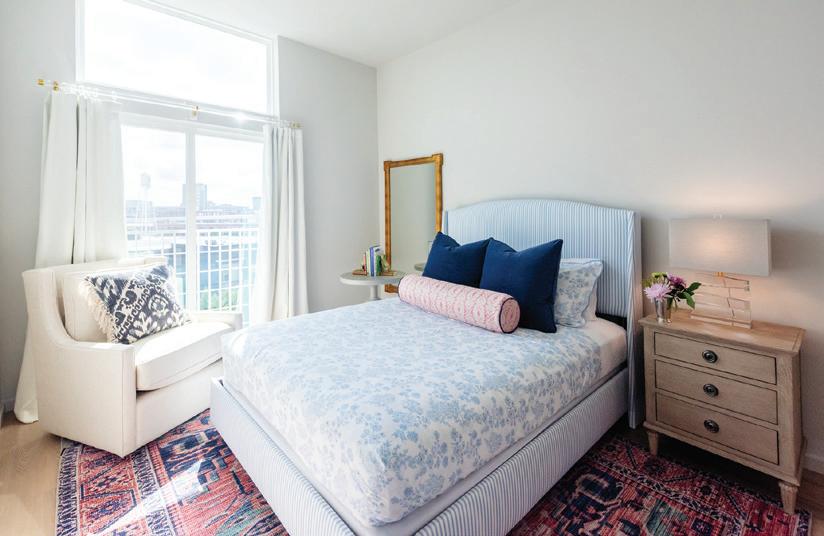
“I love the wonderful arts and music scene, both downtown and at Duke,” Moira says. “There are always wonderful new restaurants, venues [and things to do], but I also just enjoy walking around and [taking in] the funkiness of Durham. It’s a perfectly sized, walkable city – though I did recently buy a bicycle, and I’m looking forward to exploring that way.”
But the feature nearest and dearest to Moira’s heart remains the same reason she chose to move here in the first place: the people. “I have made such an eclectic mix of friends, all with different interests and jobs, ages and backgrounds, all friendly and welcoming,” she says. “In fact, I can’t think of a better word than ‘eclectic’ to describe Durham, and that is what makes it so special.”
Moira’s bedroom is both a colorful ode to her favorite vacation spots and a calming respite from her busy life.
AD PT A PET
Boop
This 50-pound girl is super smart and will show off how well she knows her “sit,” “shake,” “beg,” “down” and “stay” commands. With lots of brain work and exercise, she will thrive. Boop has been at the shelter since May and is dreaming of the day she can be someone’s loyal companion.

Koi
Koi is a kitten with a true zest for life. Once he’s comfortable, Koi can be very playful and lovable. Koi is capable of living a full, healthy life even though he tested positive for Feline Leukemia Virus. FeLV-positive cats should live with other cats who have tested positive for FeLV. Koi’s adoption fee has been waived.
Adoption fees for cats are $95 and $50 for the second cat when adopting two together. Adoption fees for dogs and puppies typically range from $125-$175. Fees for other animals vary. Same-day adoptions are now available in the shelter, located at 2117 E. Club Blvd. Send an email to adopt@apsofdurham.org if you are interested in adopting any of the animals in foster care. For more information, visit apsofdurham.org.


october/november 2022 | Durhammag.com | 63
SPONSORED CONTENT
TAKE HOME ONE OF THESE WONDERFUL PETS FROM THE ANIMAL PROTECTION SOCIETY OF DURHAM TODAY!
PHOTO BY ASSORTED POPPIES PHOTO
PHOTO BY CATHI BODINE
DIGGIN’ DOWNTOWN
A visit to Zoë Shear’s Old East Durham garden proves fruitful in both produce and knowledge
BY AMANDA MACLAREN PHOTOGRAPHY BY JOHN MICHAEL SIMPSON
Ahomemade wood trellis lined with rows of twine stands as a stark skeleton against the wilting remnants of summer in Zoë Shear’s backyard. She mimics how she utilized a technique called the Florida Weave to string up her nearly 30 tomato plants tightly and economically with biodegradable twine.
Yet even now, ghosts of the bounty that she created bring forth new life. The straw bales that once held dozens of tomato varieties this past summer are now home to edible mushroom starts. “After I harvest the mushrooms from the straw, my expectation is that the bales will be fully rendered into rich, black, beautiful compost that I can use to top off my beds come spring!” Zoë says.
The multi-uses she derives from the straw bales are but one of the many methods that Zoë employs to maximize the utility of her quarter-acre lot in Old East Durham. It’s an idea that she discovered – along with the framework for her trellis – in a book on straw bale gardening by the self-described “NC Tomato Man,” Craig LeHoullier.
“One of my big considerations when gardening is, ‘What can I do for cheap?’” Zoë says. “It gets really expensive, really fast.”
She previously grew her tomatoes in five-gallon grow bags, but soon realized that wasn’t a sustainable method when it came to the need to fertilize regularly and within the confines of a small space. “Right now, for what I call the ‘bougie’ dirt, I’m spending, like, $20 a bag, and it’s only 1½ cubic feet,” she says. “That stinks. So if you want to garden on
this scale, you have to be able to make your own dirt. [Going with straw bales] seemed like a no contest in terms of having less disease, more control. It gave me everything that I wanted from the bags, but also the biodegradability aspect and the ability to use it year over year.”
She also makes her own “sweet, sweet ‘bougie’ dirt” by composting other plant material that’s not blighted by disease. “I would really like to get into vermiculture,” she says, “but right now I use – as if I hired them, ha! – black soldier fly larvae. They are extremely fast composters. I took a video of them the other day, just nibbling away.”
PASSION PROJECT
Zoë’s abundant enthusiasm for gardening stems from the neighbors who lived next door to her childhood home in Silver Spring, Maryland, before her family moved to Durham about 15 years ago. “We had a brick retaining wall next to our driveway,” she explains, “and they used the entire strip next to it to garden. Everything was beautiful and pristine, every single year. Some of my earliest memories were admiring that garden, pestering them while they were working in that
64 | durhammag.com | october/november 2022 DOWN TOWN HOME & GARDEN
garden and sitting on that brick retaining wall, deadheading flowers –specifically marigolds. That was one of the first places where the love of gardening was instilled in me.”
The first-generation gardener bought the home that she currently shares with her husband, Josh Baker, and tabby cat, Winston, in 2018. “We bought it because of the yard,” Zoë says. “Our previous abode was in total shade, and my early attempts at gardening were complete failures.” She admits that, even after they moved into this house, she still had a lot to learn. “We moved in the dead of winter,” she says. “So none of these trees had leaves,” and nothing would grow where she initially put her garden. Luckily, she designed it so it could be easily moved.
“That’s one of my tips for beginners – start with something portable,” Zoë says. “If you haven’t lived in your house a full year, if you haven’t had the opportunity to map the trajectory of the sun over your house, or even determine where is South, a good thing to do is to start
portable. I ultimately wound up dragging my garden – anything that I could move – from that location, and it exploded.”
The neighborhood itself also played a part in their decision to move in. “When we came by and looked at this house, there was a grandpa and his grandson out [across the street] raking leaves,” Zoë says. “It reminded me of my childhood where people were outside and doing things. … I give away a ton of stuff out of the garden to anybody who’s walking by.
There are literally times where we will sit out on the front porch and just chat with people and ask, ‘Do you like tomatoes? Do you like hot peppers?’ Whatever I have, I just bring it out.”
HISTORIC ROOTS
It’s a long-established tradition in the former mill neighborhood. “The unique urban landscape of Durham lends itself perfectly to [gardening],”
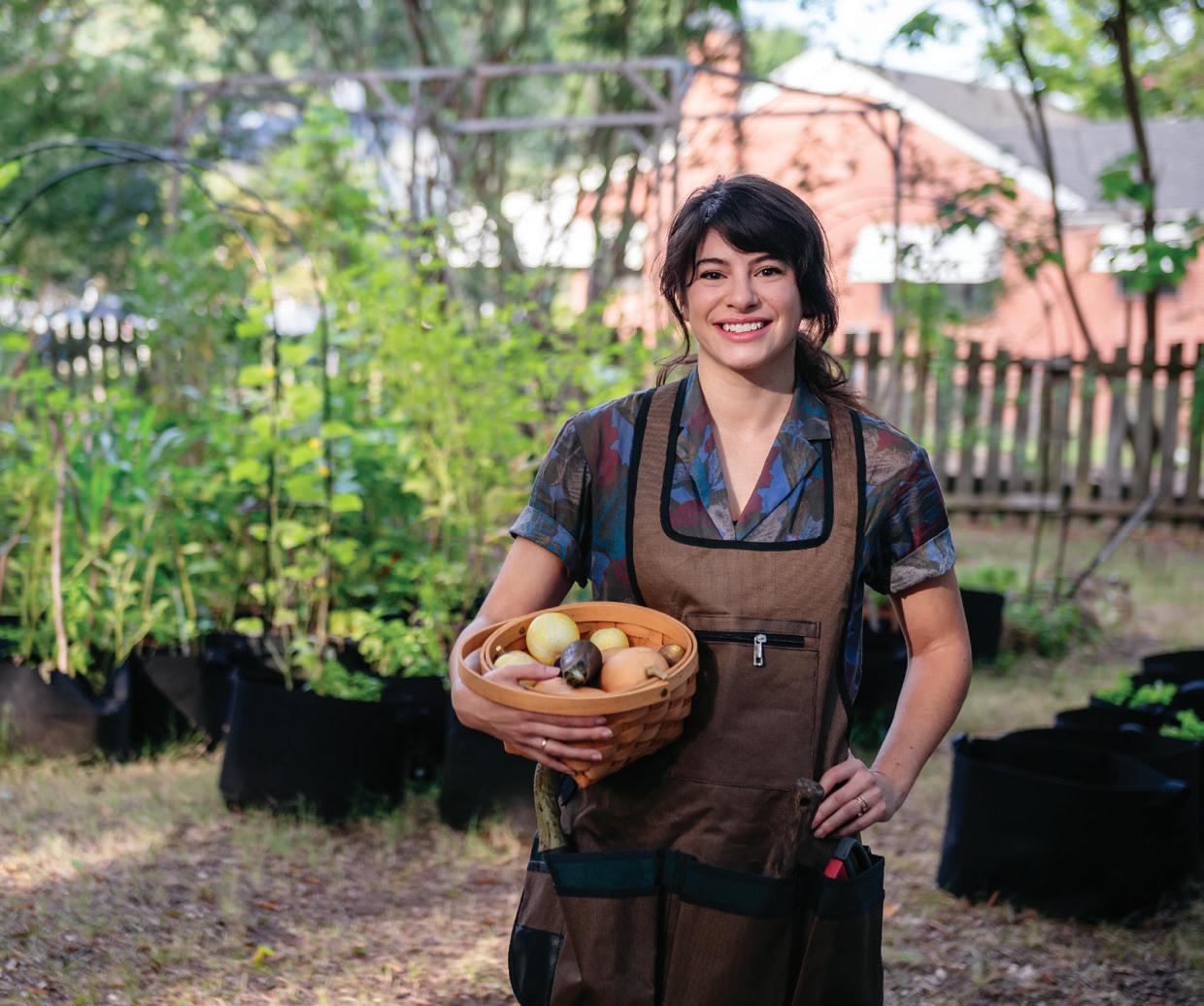
october/november 2022 | Durhammag.com | 65
“I really only established this design for my garden last year,” Zoë Shear says. “This is by far the best iteration of it, but it’s still gonna continue to change.”
SHEAR’S GARDEN TIMELINE
OCTOBER–NOVEMBER DECEMBER
Plant your garlic for a late-spring harvest! Continue to care for and harvest your fall crops. First frost in North Carolina typically doesn’t come until late October, so you can continue to plant kales, which will only get sweeter when frost-kissed.
Hibernate! Dream of spring and summer. Make your planting diagrams, organize seed swaps with your friends and fellow gardeners, and order any supplies you will need. Seed starting will begin soon …
JANUARY
Start your first round of spring seeds indoors! Choose easy-totransplant varieties like broccoli, cabbage, cauliflower, collards and spring onions. For the costconscious, you can use virtually anything that will hold soil – from yogurt cups to egg cartons in a kitchen window.
You can also buy kits with peat pots and a dome set up, as well as a grow light. The downside here is the potential for mold, lack of nutrients in the peat and the unwillingness of the peat-pot to break down in the garden. Plastic trays and
domes for these kits aren’t very sturdy and may only last a season or two. In a perfect world, I would recommend starting with a kit from Bootstrap Farmer (bootstrapfarmer.com) with AeroGarden’s LED grow light. I love these because they are sturdy and are designed for years of reuse. Fill them with your own soil – I highly recommend FoxFarm Soil & Fertilizer Co. products and have had great success with both Happy Frog and Ocean Forest potting mix. They also make a seed-starting mix.
SEPTEMBER
Prepare your beds for the upcoming fall. There are a few ways to prep, but here are some of my favorites:
Choose a cover crop to help maintain the living ecology of your soil during the winter months and suppress spring weeds. You can till it under in the summer, treating that cover crop as a green manure for the next season. Some good cover crops include vetch, winter peas, crimson clover and winter grains such as wheat and rye.
Mulch your beds heavily to help maintain the soil over the winter and prevent spring weeds. Ideal mulches include dead leaves (they help prevent water from splashing off the soil and hitting the leaves of your plants, which is a surefire way to spread disease) and spent straw.
this basically consists of layering logs, sticks, leaves, soil and compost so that the plants will grow through the layers and ultimately break down the items into rich fertile soil. I also add leaves to my compost pile, as they provide protection to the organisms hard at work and reduce smell.
FEBRUARY–MARCH
As soon as the soil can be worked, start planting your transplants. You will want to stay aware of any frosts or freezes so you can mulch accordingly. You can also “cloche” your plants by cutting a 2-liter bottle in half and placing the domes (add ventilation) over your plants outside so they can develop roots in your garden but have a little protection from the colder temps.
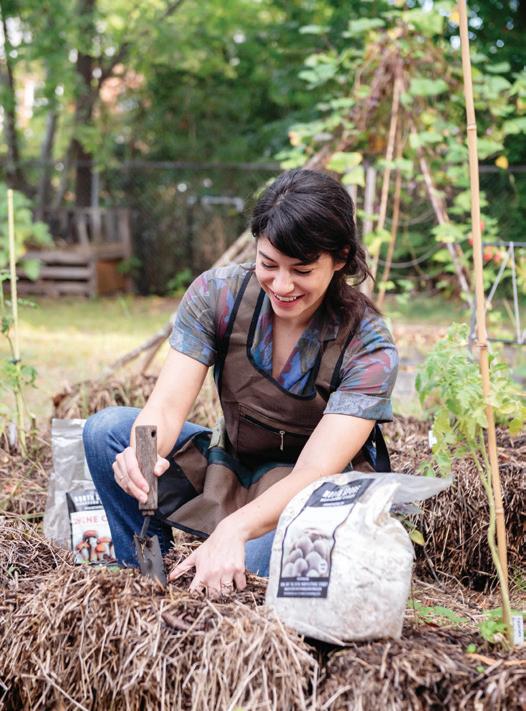
AUGUST
Preserve and plant. This includes your harvest – I am preserving through pickling, sauce making, freezing and drying – as well as any seeds you want to save for the future. I plant quick-growing, late-summer goodies such as beans, and early fall favorites including peas, radishes, carrots, Asian greens, kales and collards. It’s brassica season, baby!
I am a strong proponent of leaving leaves because they break down into rich organic matter. I use them as bottom filler in my grow bags. Soil is so expensive, especially quality soil … filling the bottom half of my grow-bag with leaves helps take up space, and I can fill the top half with great soil. I also build hugelkulturs as a permaculturederived, cost-saving method –
The biggest thing to remember with gardening is that if we don’t return organic matter to the soil, each season just draws nutrients out. The decomposition of leaves is a good, inexpensive way to reintroduce organic matter without leaving actual crop plants behind to do the same job. (Spent crops after a garden season are better burned to prevent spread of disease and pests. That burned plant matter can be added back to your compost pile. The salts will leach out as it rains, leaving behind the valuable biochar in your compost.)
Experiment! This year, I’m trying to grow edible mushrooms that prefer cooler temperatures as a way to recycle the straw bales I used for my tomatoes over the summer into quality compost for next spring!
Zoë embarks on a mushroom harvest and mulching experiment. “There’s nothing worse than going to a store and spending $300 on dirt,” she says. “It’s literally not dirt cheap.”
DOWN TOWN
66 | durhammag.com | october/november 2022





october/november 2022 | Durhammag.com | 67 Let Us Exceed Your Expectations Where We Shine. 90+ 5-Star Google Reviews Real Estate Sales: Guiding Home Buyers Positioning Homes for Sales High Performance Homes Property Management: Protecting Your Investment Thorough Tenant Screening Online Systems 24/7 Repair Response Superior Communication Bill Matthes Jodi Bakst Broker, Owner, Property Mgt Broker, Owner 919.928.5131 | info@realestatexperts.net 501 Eastowne Dr, Ste 140, Chapel Hill, NC 27514 R eal E state E xperts.net Are you ready for the Fall? Call us to protect and clean your gutters laborpanes.com Call for a Free Quote! 919.694.8415 HOUSE WASHING • WINDOW CLEANING • GUTTER CLEANING AND GUTTER GUARDS
she says. “It was originally designed to support homesteading, with ¼-acre plots divided for use by workers at local plants.”
As far as what each family would produce for their own food and supplements, Zoë believes it was likely similar or identical to what is seen today. “You’ll see evidence of peach trees,” she says. “Different fig trees are almost everywhere in East Durham, specifically. They probably planted in-ground, as opposed to raised beds, but still –beans, corn, tomatoes.”
A new gardening trend that Zoë sees cropping up today in East Durham is a focus on monocultures, or just one crop. “There’s a house
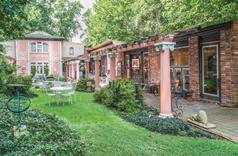
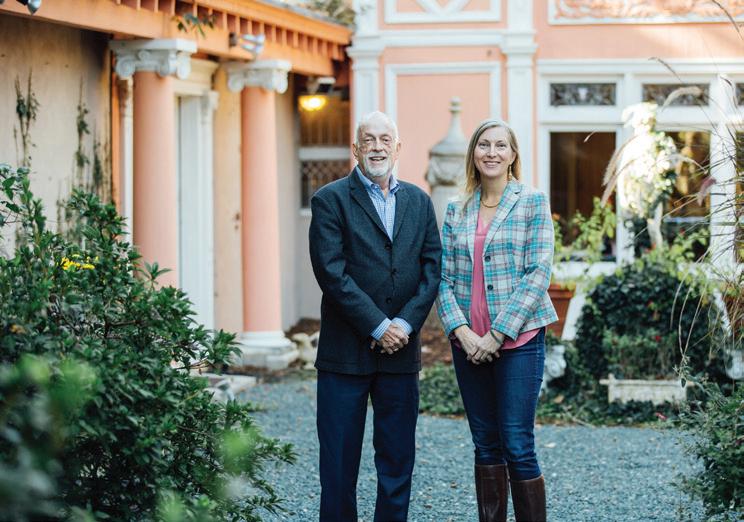
not so far from here that their entire front yard is full of watermelon,” she says. “Another was full of corn. I’m sure they did that because corn is promiscuous and really cross pollinates – they probably preserved that, and it provided months worth of supply.”
Zoë says she tried to do the same with her tomatoes this season, to some extent, “but of course I gave them all away instead of actually preserving them. I love sharing the literal fruit of my labor. … My friends call me the ‘Tomato Lady’ of Durham [but] personally I like to think of myself as ‘Durham’s Tomama.’”
WHITEHALL ANTIQUES
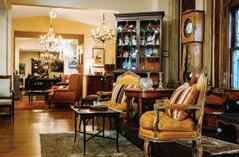
She primarily grew heirloom cherries and slicers this year to share, but plans to freeze some whole tomatoes in order to make small batches of sauce through the winter. She also dries and preserves herbs, and pickles mostly green beans and green tomatoes. “I planted my cucumbers later than usual, but I still hope to make some cucumber pickles!” she says. “I love making hot sauces and pesto – this year, we made classic basil pesto as well as carrot top pesto to try to maximize our carrot harvest.”
SAVE YOUR SEEDS!
Yet another way that Zoë maintains such a bountiful garden is by saving seeds from open-pollinated (meaning the seed will resemble the parent plant) varieties of tomatoes, peppers, ground cherries, eggplants, basil, lettuce, beans, corn, peas and several flowers.
“Seed saving is important for a variety of reasons – plants do ‘encode’ their DNA based on growing climate, and saving seeds locally can help you obtain more robust plants in the future,” she says. “Seeds are also a huge cost-saver, as you can continue to grow your favorites without a year-to-year investment (and it’s much cheaper than buying starts).”
The best seeds to save are those with a low risk of cross-pollination and easy-tosave options such as beans, lettuce, peas, etc. (plants that dry out and produce a seed pod). “Learn from trial, error and research,” Zoë suggests.
She also recommends online seed swaps like The Great American Seed Swap Project on Facebook, where you can post a list of seeds you have, as well as a list of seeds you
68 | durhammag.com | october/november 2022 DOWN TOWN
A Tuscan villa filled with over 7,500 sq. ft. of fine antiques a treasure trove of unique items for your home or collection A family business proudly celebrating OVER 90 YEARS of providing fine antiques to the triangle!
Father-Daughter Team David & Elizabeth Lindquist
From Rococo to Mid Century ModernWhitehall Antiques has provided the Ultimate in Green Solutions for Interior Design to the Triangle since 1930 1213 E. Franklin St., Chapel Hill 919.942.3179 whchnc@aol.com Mon-Sat: 11am - 6pm WHITEHALLANTIQUES.COM
want, and organize swaps with gardeners across the country for the cost of postage. “It’s like Pokemon for adults,” she says. “You start to learn which seeds are coveted and get you better trades.


“You will also be surprised by how generous people are,” she continues. “When I first started to swap, I only had marigold seeds, which I thought were not going to get me very far. Boy, was I wrong. So many people jumped to swap, and today, my collection contains more than 100 varieties of tomato alone!”
And it’s that kindness and benevolence among gardeners – from novices to seasoned seed swappers – that Zoë hopes to continue. “It’s why I love and want to share gardening with people,” she says, “because it’s an iterative process that you can take with you forever.
“I love the feeling of community that we get in this area,” says Zoë, here with her husband, Josh Baker.
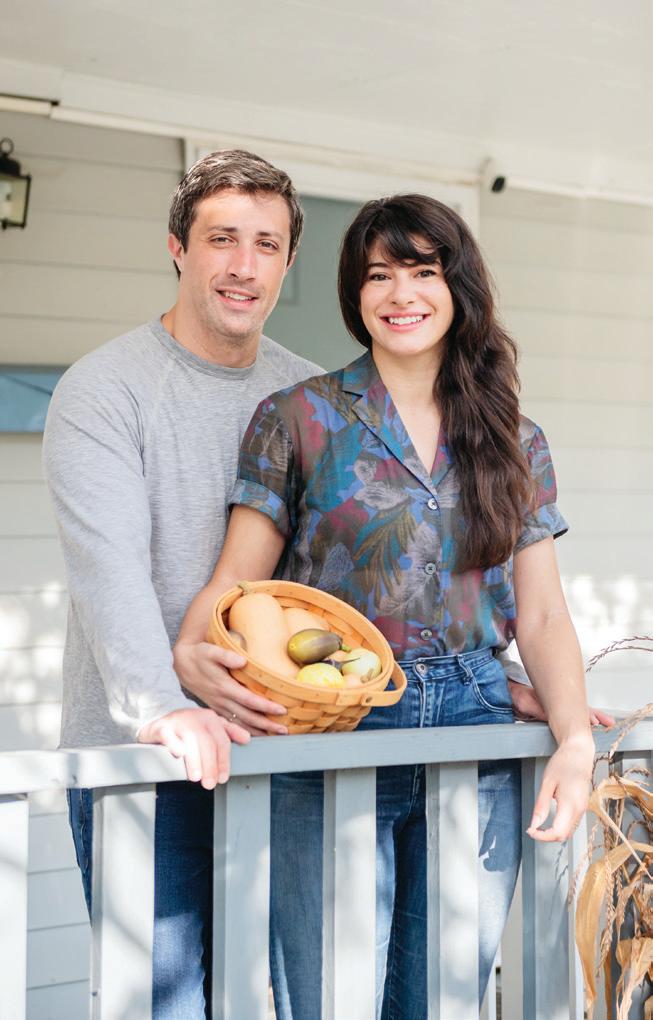
For advertising information, call 919.933.1551 or email advertising@durhammag.com REAL ESTATE & HOME SERVICES GALLERY Homes • Condos • Apartments • Commercial magazine Showcasing Realtors, Home Service Providers, Builders & Leasing Agents
REAL ESTATE & HOME SERVICES GALLERY
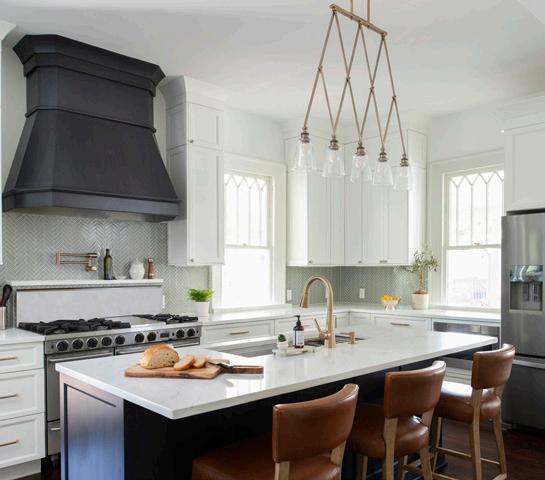
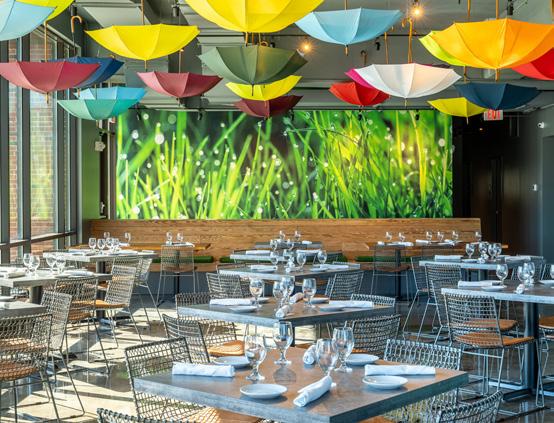
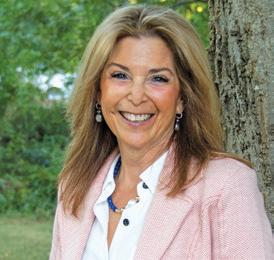
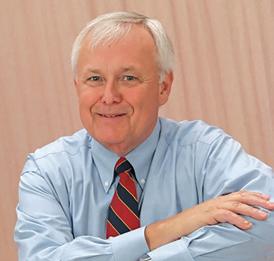


home & REALgardenESTATE & HOME SERVICES GALLERY COMMERCIAL • HOMES • CONDOS • APARTMENTS YOUR PARTNER IN RENOVATION Schedule a Personalized Consultation Today! cqchome.com | 919 - 971 - 5119 Award-Winning Design + Build Raleigh, Durham, Chapel Hill & Cary 2022 2022 Commercial General Contracting Services | Pre-Construction Planning | Construction Management 919-797-2527 GATEWAYBUILDCO.COM GATEWAY_BUILDING_COMPANY 618 RAMSEUR ST. | SUITE 102 DURHAM, NC 27701 Jodi Bakst Broker, Owner Bill Matthes Broker, Owner, Property Mgt 919.928.5131 | info@realestatexperts.net 501 Eastowne Dr, Ste 140, Chapel Hill, NC 27514 R eal E state E xperts.net Let Us Exceed Your Expectations Where We Shine. 90+ 5-Star Google Reviews 2020 NATIONAL GREEN BUILDING PARTNER OF EXCELLENCE Each location is independently owned and operated. | NCUC 2369 | U.S.DOT No. 1274561/2340295 WE’RE STILL HAVING FUN AFTER 20 YEARS 919.309.9582 TWOMEN.COM | Being our best and having fun along with integrity, giving back to the community, and The Grandma Rule®, are some of our core values. Thank you, Durham and Chapel Hill, for the privilege of serving you. We’re looking forward to the next 20 years!

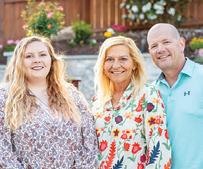





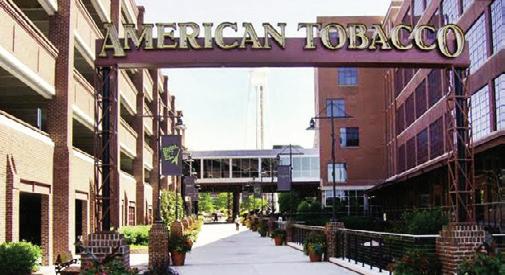
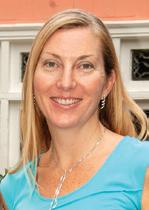
COMMERCIAL • HOMES • CONDOS • APARTMENTS REAL ESTATE & HOME SERVICES GALLERY 919.698.9838 carolinagardencompany.com CONTACT US TODAY ! Commercial & Residential Landscaping Hardscapes Greenhouse Plants Installation Mockups Outdoor Structures Drainage Solutions And More! 202 1 2022 laborpanes.com • 919.694.8415 Call for a Free Quote Today! WINDOW CLEANING • PRESSURE WASHING GUTTER CLEANING AND GUTTER GUARDS An Eye for Excellence, Design, Marketing & Negotiating I’m a native Chapel Hill business owner and a Durham resident. Put my experience and expertise to work for you! ELindquist@cbadvantage.com 919-656-3325 ELindquist.CBAdvantage.com Coldwell Banker Advantage 1130 Weaver Dairy Rd., Chapel Hill ALWAYS WORKING FOR YOU Elizabeth Lindquist, Realtor
William Hill was recognized as the 2022 Durham Public Schools’ Teacher of the Year for his dedication, impact and success as an educator over the past six years.
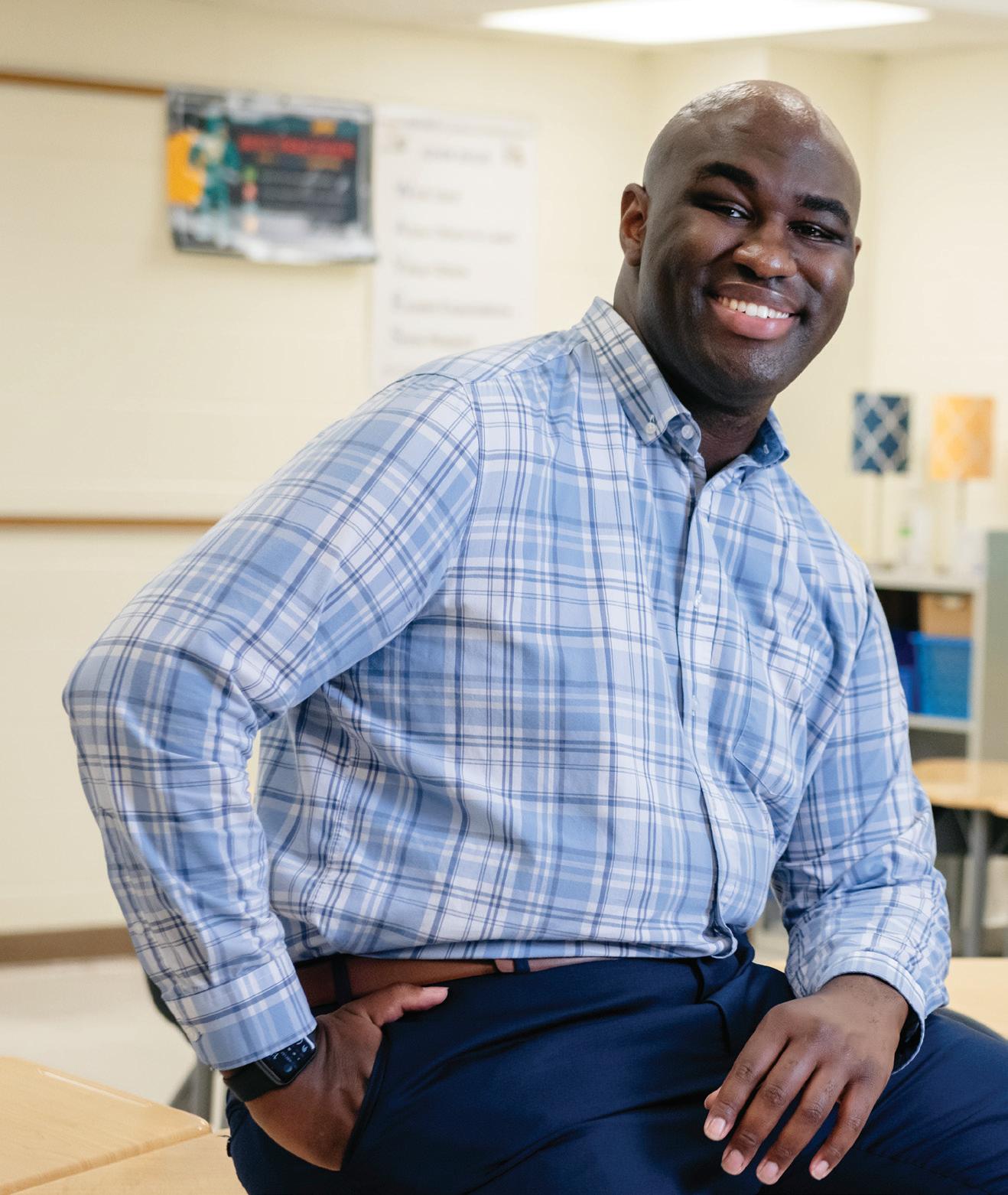
72 | durhammag.com | october/november 2022
SCHOOLS & EDUCATION
MAKING GRADEthe
Meet Durham Public Schools’ Teacher of the Year
BY VALERIA CLOËS | PHOTO BY JOHN MICHAEL SIMPSON
The words “Read. Write. Think.” in multicolored letters stand out above William Hill’s whiteboard at Little River K-8 School, greeting students as they walk into his classroom.
The English language arts and social studies teacher, who was recently named Durham Public Schools’ Teacher of the Year, says his decision to become a middle grades teacher was largely

october/november 2022 | Durhammag.com | 73
influenced by his own experiences as a student. The Durham native grew up in the Gorman area and attended Y.E. Smith Elementary Museum School, Morehead Montessori Magnet Elementary School, Durham School of the Arts and Josephine Dobbs Clement Early College High School. All were formative experiences for him, but he cites two of his middle school teachers at DSA and one of his high school teachers as particularly instrumental to his growth.
“[My sixth grade math teacher, Jennifer Tuttle], took an interest in me,” William says, adding that she went above and beyond by taking time to read his creative writing outside of class. “That showed me that there was more to the teacher-student relationship than just the delivery and receipt of content – [there’s] also that personal connection.”
His eighth grade English language arts teacher, Marisa Barbaza, continued to encourage William’s love of composition by having her students explore free writing and poetry.
“[My ninth grade Advancement via Individual Determination teacher] David Becker was another great model for that teacherstudent relationship,” William adds. He says David would also take the time to show his students’ support even after the final bell rang. “I always felt that that was something that I wanted to imitate as well in my own teaching practice,” William says.
fact, out of his graduating class at N.C. Central, he was one of only three students who intentionally pursued middle years education.
But thanks to those aforementioned teachers he had during his own public school experience, he says that choosing a career in middle grades was a “no-brainer” for him. “I wanted to share that same love of learning,” he says. “Same passion for my subject, but also be a person who is there for students during what is a pretty rough time.”
One of William’s biggest goals is to build a positive classroom environment. As a licensed academically/intellectually gifted teacher through Duke University’s Program in Education (where he earned a Teacher Advocacy in Gifted Education Award in August 2019), he starts with creating a “homey” feel to learning spaces to help put his students at ease – he utilizes soft lamp lighting instead of harsh overheads, an essential oil diffuser, decorations and flexible seating options.
“Equity begins with equity of voice,” William says. “I want to hear from all my students. I want them to feel comfortable sharing their ideas. I want to hear their perspectives. I want to hear their stories.”
William says he learns just as much from his students as they learn from him. “I’m learning about [their] language, their religious backgrounds, their ethnic backgrounds, cultural differences,” he says. “And I try to learn something from every single one of them, because it does help to prepare me to better engage with them and their own families throughout that school year, as well as with future students who come my way.”
To that end, William also finds ways to champion his students’ interests beyond academics, like attending their school athletic games.
Mason Russell, 12, now a seventh grade student at Discovery Charter School, had class with William in sixth grade at Little River. His mom, Jamie Stroud, says that every time she would go to her son’s soccer games, William would be right there in the crowd, cheering his pupils on.
“It really boosted my happiness of being there and confidence of actually playing, because he would sit there and cheer for me the whole game,” Mason says.
William also credits his experience at North Carolina Central University’s School of Education, where he graduated cum laude with a bachelor’s degree in 2016, for the teacher he is today, saying it “was the biggest part of my journey in preparing to be an educator.” He says he learned in his college courses that very few teachers enter into the profession at the middle grade levels. In
He’s also taken four years of Spanish to better communicate with children whose primary language isn’t English. “Oftentimes, I find that there is a word that they may not necessarily recognize or understand in English, but if I know the word and its equivalent in Spanish or its equivalent in another language, that helps them to make that connection,” he says. “Anytime that I can make a linguistic connection or a cultural connection that helps them to better understand the concept [or a reading] that we’re discussing, I think that’s a great learning tool.”
“[William is] one of those teachers that makes school enjoyable for students and helps every kid to feel included and excited about learning,” Jamie says. Mason echoes the sentiment, saying that William boosted his confidence in reading. “He’s a great teacher,” he says. “I think the way he always comes to a classroom, it doesn’t really matter if he’s sad or tired – he always tries to cheer up the students if they’re feeling down.”
Students and parents would agree that William is well on his way to – like his own teachers before him – becoming one of those educators who students reflect on and appreciate for years to come.
“[The students will] look back and say, … ‘He always believed in me and helped me to be the best that I could be,’” Jamie says.
74 | durhammag.com | october/november 2022 SCHOOLS & EDUCATION
“Equity begins with equity of voice,” William says. “I want to hear from all my students. I want them to feel comfortable sharing their ideas.”



october/november 2022 | Durhammag.com | 75 Jump in on the Fun BOUNCING BULLDOGS FUN + FOCUS + FRIENDS For more information and to register, go to: bouncingbulldogs.org | 919.493.7992 Jump rope classes & camps for all ages
A spotlight on three robotics clubs that prove their mettle by earning medals
 BY AMBER WATSON PHOTOGRAPHY BY JOHN MICHAEL SIMPSON
MACHINE LEARNING
any Durham schools are known for their STEM classes and clubs, and the accomplishments of several highly ranked competitive high school robotics teams are proof of their success.
TerrorBytes Robotics of Research Triangle High School, DARC SIDE of Durham Academy and the Zebracorns, which was founded and is hosted at the North Carolina School of Science and Mathematics, have all grown in popularity and accomplishments over the years. Team mentors and
students proudly share the awards they’ve earned, skills they’ve acquired and team-building experiences that make robotics so much more than a simple engineering club.
Meet the Makers
This year marks the 10-year anniversary of the TerrorBytes, and to commemorate the milestone, they plan on working up some new logos and team-bonding exercises. Students who’ve learned how to program with LEDs, for instance, may come up with something involving programmable LED strips or matrices, while others may want to put a stylishly designed sticker representing of one of their other hobbies or clubs on some out-of-the-way part of the robot.
Veteran volunteer team mentor Brian O’Sullivan remembers when the TerrorBytes started with just 11 students and four mentors
76 | durhammag.com | october/november 2022 SCHOOLS & EDUCATION
M
DARC SIDE team captains
Bryan Cornejo, 17, Ella Simmons, 17, and Chris Morris, 17, launch an oversized tennis ball from their robot, Spinshot, which was used at last year’s competition.
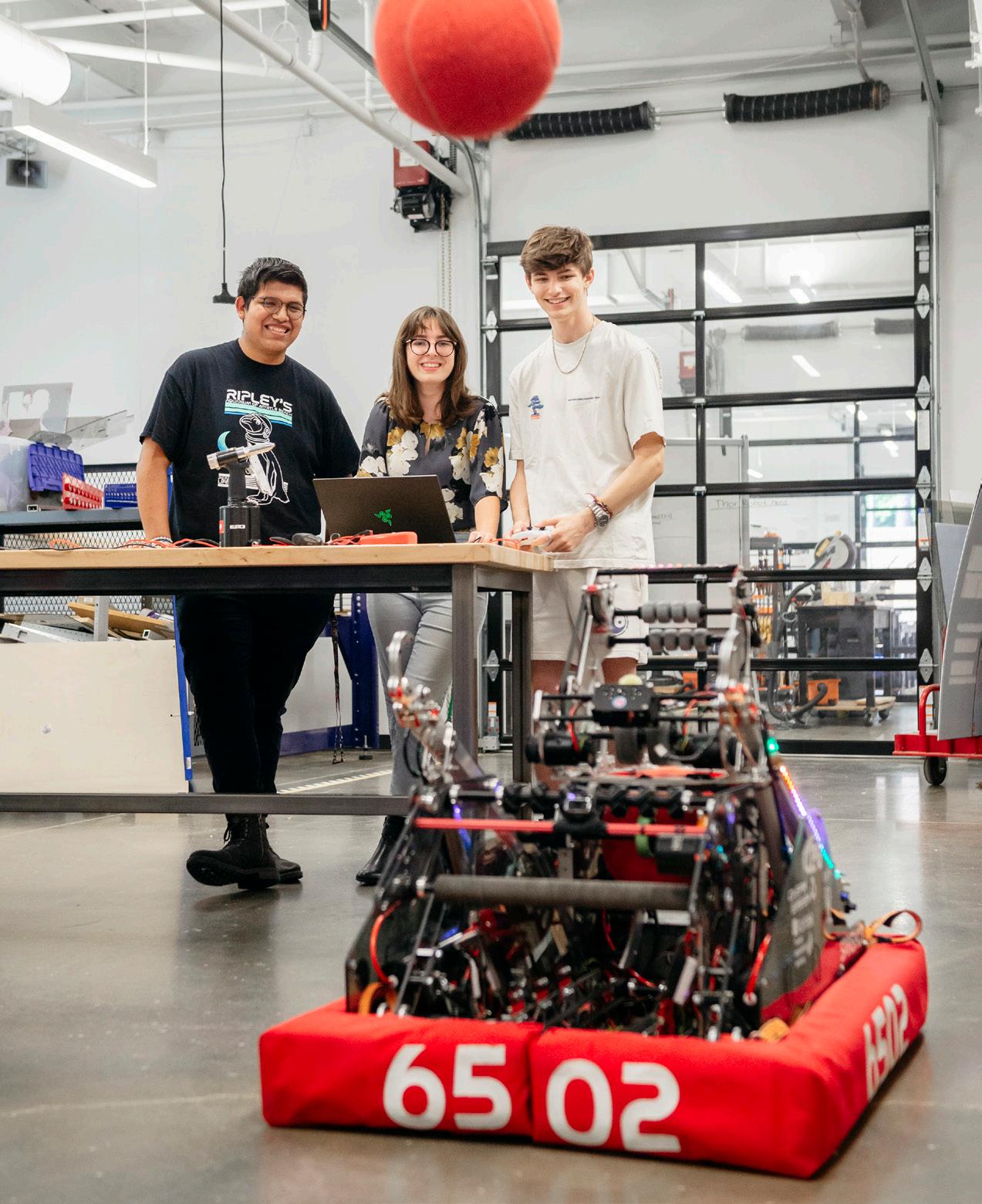
october/november 2022 | Durhammag.com | 77 LEARNING
working out of a small storage closet at the school. Since then, the TerrorBytes have grown to 30 to 40 students from all grade levels who join the group every year. The team has developed relationships with various companies, such as ADR Hydrocut in Morrisville, who lend expertise in engineering and business as well as partner with students in the construction of their robots. In 2018, the Research Triangle Foundation of North Carolina also generously offered use of one of their properties in Research Triangle Park. “Access to that huge space enabled us to build a replica [practice] field and give our students an opportunity to test their robots in the same conditions they will compete in, a huge advantage in our competition,” Brian notes. The team vacated the building in 2020 to make way for demolition crews to clear the site for Hub RTP and hope to find a new space to call home for practices in 2023 and beyond.
Similarly, Durham Academy’s DARC SIDE started with just 13 students at its inception in 2016 and were limited to a small classroom with few tools. They now have a dedicated fabrication lab where students – around 30 ninth through 12th graders are participating this school year – can custom-make parts and prototypes. Their outreach efforts have evolved over the years as well – they now work closely with the Museum of Life and Science and Wonder Connection at UNC Hospital School to share their passion for engineering, robotics and teamwork. “When these organizations host community events, we bring hands-on engineering activities like ‘Candy Catapult,’ where
participants learn about the engineering design process and then have to engineer a catapult that can launch candy at a target,” says Leyf Starling, a co-coach and a Durham Academy upper school faculty member for physics, engineering and robotics. “We also bring one of our robots [along] and provide demonstrations while engaging in conversations and discussions about the design process and what our team does. Additionally, we have worked with Wonder Connection to demo and develop activities they can take into the hospital to engage students with engineering opportunities.”
The Zebracorns, meanwhile, are a longstanding club of volunteer mentors, school faculty advisors and students founded in 2002 with the goal of introducing its members to engineering principles through practical application. The team adopted its now iconic zebrastriped look in 2005. Around 2010, the team opened membership eligibility to include students from Durham Public Schools, charter and private schools, as well as homeschooled youth. Today, it openly recruits eighth through 12th grade students from all over the area and routinely includes 50 or so members each year.
“Over the almost 22 seasons we’ve [done] this, it’s fair to say we have represented all of North Carolina, and we typically have a huge swath of the Triangle represented,” says Marshall Massengill, lead mentor of the Zebracorns. “Our aim is to represent the whole state and to bring in a diversity of students and mentors to create a truly unique experience and act as a melting pot for ideas and culture.”
In It to Win It
There is no “national championship” in robotics, so U.S. teams go straight from their state’s district to the world stage. The Blue Alliance is a tool robotics teams use to research and track tier rank relative to other teams in the FIRST Robotics Competition. FIRST stands for “For Inspiration and Recognition in Science and Technology,” an organization created by engineer and businessman Dean Kamen to engage students in robotics and engineering.
In district-level FIRST Robotics Competitions, there are qualifying rounds where three robots compete against three other robots to complete certain tasks to win points. In each round, a team is put on an “alliance” with two other teams, making up an
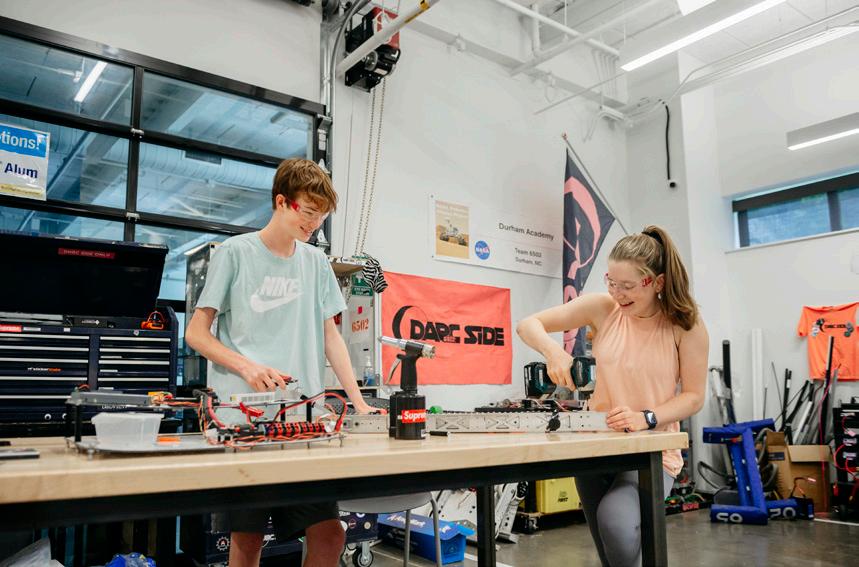
78 | durhammag.com | october/november 2022 SCHOOLS & EDUCATION
DARC SIDE team members Everett Wilber, 16, and Emily Simmons, 14, deconstruct an arm from a robot used in a past competition.
alliance of the three robots. During qualifying rounds, the alliances are randomly selected and matched, and the total points per team is calculated. At the end of the qualifying rounds, the top eight teams become “Alliance Captains” and choose which two other teams they want on their alliance for the playoff rounds in the competition.
DARC SIDE participated in three of these FIRST Robotics Competitions this past season. During the district qualifier at UNCAsheville, the team was on the final alliance that finished second in the playoff round, earning the Excellence in Engineering award. DARC SIDE was again a member of the second place alliance at the end of the second competition in Guilford County, where it was given the Team Spirit Award. Based on the performances in the first two competitions, DARC SIDE advanced to the FIRST North Carolina District Championship, finishing up at No. 15 in the state overall and earning the Innovation in Control Award.
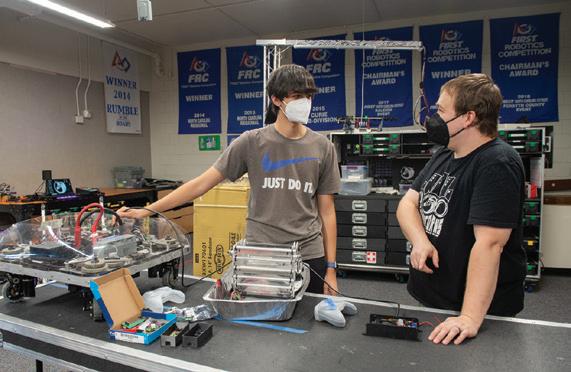
DARC SIDE has long been recognized for its innovative and inclusive approach. In fact, during its rookie year, the team earned a Judges Award at the FIRST Robotics Competition World Championship in Houston. This award recognized the group’s efforts toward making the FRC experience more inclusive through the development and dissemination of a game manual that is more accessible to students with learning differences and ADHD, which they create and publish each year.
The TerrorBytes, meanwhile, were seeded No. 9 entering into the qualification rounds at this past year’s FIRST North Carolina District
State Championship. After the elimination rounds, the team advanced to the semifinals, and by the end of the competition, the team ranked No. 6 overall in the state. All of the teams that advanced past the state championship did extremely well, but the TerrorBytes ranked higher in their division than any other North Carolina team at the FIRST Championship.
“The FIRST Championship has six divisions, each named after a famous scientist,” shares team mentor Thomas Burke. “We were in the Carver division and ended the competition ranked No. 16 in Carver.”
The TerrorBytes were also awarded an Engineering Inspiration award, which celebrates outstanding success in advancing respect and appreciation for engineering within a team’s school and community, at the district qualifier event at East Carolina University and then again at the NC District competitions.
The Zebracorns, which were ranked No. 12 out of the 66 teams in the North Carolina district for the 2022 season, didn’t end up advancing to compete at the world championship event, but did take home awards at each district event including: the Creativity Award and District Event finalist at the UNC-Asheville event for the climbing mechanism on its robot; the Gracious Professionalism Award at the UNC-Pembroke competition for being helpful to other teams at the event; and the Quality Award at the North Carolina District State Championship for the consistency and reliability of its climbing mechanism. They were also a district event finalist at the UNC-Asheville event, along with their friends from DARC SIDE.
october/november
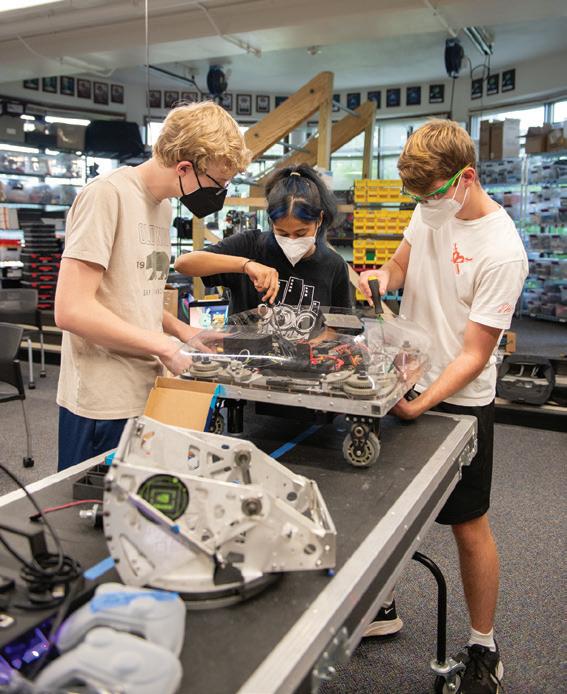
2022 | Durhammag.com | 79
ABOVE Zebracorns Christopher Holley, 15, Diya Nerurkar, 16, and Chadwick Hobgood, 17.
BELOW Sahil Bhatia, 16, and Marshall Massengill, lead mentor of the Zebracorns.
(While it’s still a competition, friendships and ties among teams is common. In fact, DARC SIDE was started by a couple of mentors who spent the year prior shadowing the Zebracorns, and they continue to work with them. “We even went over to their space with our robot to hang out and just talk shop at the end of last school year,” Marshall says.)
To date, the Zebracorns are the only FRC team in the world running a full software stack based on the Robot Operating System. “Along with our namesake, we think this makes us pretty unique and provides an opportunity for our students to learn real professional skills that are directly applicable to internships and future careers,” Marshall notes. “There are other teams using ROS on their robots now, and I think it’s fair to say we’ve inspired a lot of that, but to date, we are the only team who is not reliant on any sort of translation mechanism, using ROS as our primary means of control.”
Lessons Learned
These teams see a wide range of skills and capabilities with the students who join each year – some come in with prior robotics experience and others enter with no previous knowledge. Working as a team and learning as you go is all part of the process.
“Experience is not the most important factor that’s considered for joining the TerrorBytes – passion is,” Thomas says. “Regardless of a student’s level of experience, the one constant I see is the confidence that grows over time. It’s rewarding to teach a student how to do something and later notice them working independently with little need for supervision, or even better, teaching others how to do it. This steady growth has to be one of the most encouraging things I see as a mentor.”
The greatest takeaway he noticed in his students this past year was not taking “no” for an answer, and instead learning to stretch their capabilities to achieve their goals. “The students insisted on adding machine vision to the robot despite guidance to the contrary from experienced mentors (such as myself),” Thomas says. “We insisted this was unrealistic and gave them a pretty firm ‘no,’ but one student approached me to complain, so I opened the door a little and said, ‘Prove us wrong,’ and they did!”
TerrorBytes team members agree. Research Triangle High senior Justin Merrill says he’s most proud of their robot’s automatic targeting system: “It uses a bright green light and a tuned camera to pick up the reflective tape around the target and turn the robot

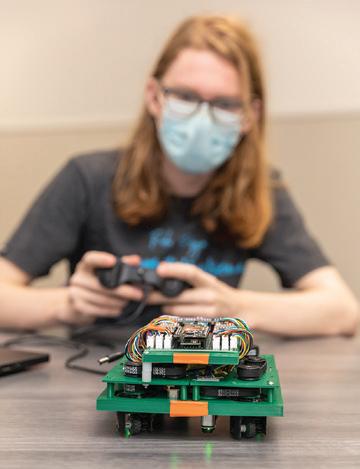
ABOVE TerrorBytes team member Justin Merrill, 17, makes the robot spin with the controller and his computer.
LEFT TerrorBytes team member Alek Frederick, 17, with a small-scale mock-up of this year’s robot.
toward it,” he says. “This system also uses complex trigonometry to find the distance to the target and adjust mechanical features accordingly. I really like the idea of building a complex machine with my mechanical and tool skills to solve problems, and then using electrical and software skills to make the dead piece of material into a functioning machine. Seeing our robot compete on the playing field is the most enjoyable experience.”
His fellow teammate, junior Jackson Doyle, says some of the greatest lessons he’s learned came from collaborating with his peers. “While I’ve worked in groups before, spending hours working on the same project with other people has really taught me a lot about what it means to be part of a team,” he says. “I’m most proud of our journey to the World Championships – we were able to go from being a group where only half of us had ever done robotics before, to a talented, hardworking group who can understand and solve any problem thrown at them.”
80 | durhammag.com | october/november 2022 SCHOOLS & EDUCATION
PHOTOGRAPHY BY ERIC WATERS
DARC SIDE’s mentor Leyf notes that each student builds confidence in themselves and as teammates through the process of collaborating, making design decisions and in actually building a robot. “Not only do they gain technical skills in the lab, but they further grow their leadership skills and ability to recognize strengths in others,” she says. “They learn to trust one another and to overcome failure in order to succeed. They invest their time in becoming experts at CAD, grant writing, outreach and marketing, and investing in the FIRST community to share their ideas and learn more.”
“The robotics program over these past three years has helped me grow as a person, an engineer, a leader and a teammate,” the group’s senior captain, Ella Simmons, shares. “I’ve gained confidence, technical skills and leadership practice; and, most importantly, I’ve found a community that has been the keystone of my high school experience. When I entered high school [before joining the team], all I knew was that I wanted to pursue engineering in some capacity. Coming into my first real robotics season during my junior year, I was more focused on experimental physics. However, as the season progressed, I saw what it truly meant to be on an engineering team, and this sparked the realization that engineering work was perfect for me. While physics is definitely still an interest and a passion, it’s engineering that I love. I’m applying as a mechanical engineer to colleges, and I aim to continue with mechanical engineering in the real world.”
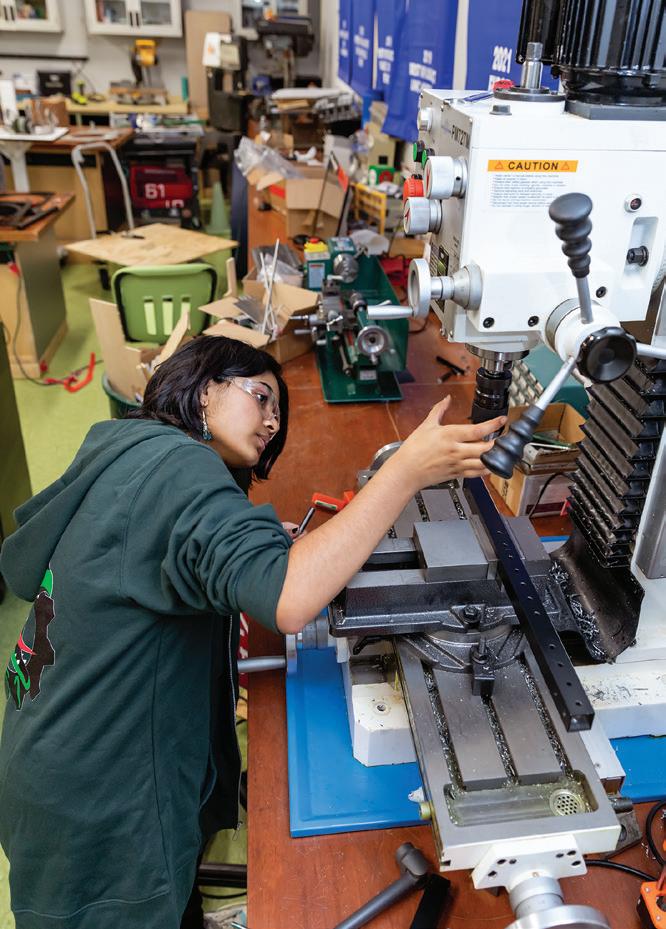
After his own eye-opening experience at NCSSM (class of 2005), Marshall found his way back to the team where he was once a student. “We are using far more advanced tools these days, and the level of software sophistication that our students have developed is unreal to me when I think back to my time as a student,” the Zebracorns mentor says.
One of the most fulfilling aspects of his role is seeing his students go from wide-eyed novices to focused and assertive leaders. “I also love seeing what our alumni go on to do – some are at places like NASA, Google, Apple, Amazon, Microsoft and IBM, and they email us occasionally for advice or just to tell us that we changed their life –that’s the mentoring good stuff.”
Zebracorn Chadwick Hobgood, a senior at NCSSM, says the skills he’s learned from his involvement with the team have already impacted his future. “I have been able to put [those lessons] into use in the professional world,” Chad says. “This summer, I worked at [Camp Sea Gull,] a sailing summer camp in North Carolina and was promoted
to work in the boat shop where my mechanical skills – specifically my ability to read mechanical drawings, work with 3D computer models and power tools, taught by the robotics team – earned me the role of shop chief. This work experience, in addition to my work in robotics, has pushed me to apply for advanced engineering scholarships at colleges both close to home and across the country.”
For many, 2022 was a year of recovery and rebuilding – robotics teams all over the world experienced disruption due to the pandemic, including canceled events, seasons cut short, remote competitions, Zoom meetings and reduced lab time. But these local students and mentors proved that not only can they withstand challenges thrown their way, they can bounce back stronger than ever.

october/november 2022 | Durhammag.com | 81
TerrorBytes team member Siri Pillutla, 15, uses a drill press to make precise holes in some of the parts for this year’s robot body.
PHOTO BY ERIC WATERS
OH, PLACES YOU’LL GO the
The future looks bright for Durham’s community college
BY RENEE AMBROSO | PHOTOGRAPHY BY JOHN MICHAEL SIMPSON
ore than 18,000 students – from high schoolers taking early college courses to older adults earning certifications – will attend Durham Technical Community College’s in-person and online classes this school year. More than 100 associate degrees and certificates are now offered at the school, which began in the mid-1940s under the umbrella of Durham Public Schools’ Vocational and Adult Education Department.
Durham Tech President J.B. Buxton has worked within the state’s education system for decades – as coordinator of special programs for the North Carolina Teaching Fellows program, as senior education advisor to former Gov. Michael Easley and as deputy state superintendent for the North Carolina Department of Public Instruction, among other roles.
President Buxton took the reins from Durham Tech’s fourth president, William G. Ingram, in summer 2020. The Durham Tech Board of Trustees voted unanimously in early September to extend President Buxton’s contract for an additional four years, through August 2026.
President Buxton describes the far-reaching impact that community colleges can have as one of the reasons he pursued the job. “I came to the conclusion that the indispensable education institution in North
82 | durhammag.com | october/november 2022 SCHOOLS & EDUCATION
Durham Technical Community College President J.B. Buxton.

october/november 2022 | Durhammag.com | 83
Carolina is the community college system,” he says. “It works with not just universities, [but also] with K-12, the workforce, child care [and] every facet of our social and economic improvement agendas.”
Getting Back to Work
Durham Tech Board of Trustees Chair John Burness says that, when evaluating the school’s strengths and weaknesses before President Buxton’s appointment, it was clear that students were successfully moving on to finish degrees at four-year universities, but there was a lack of emphasis on training that would enable people to enter the workforce rapidly. Durham Tech has since sharpened its focus on short-term and certificate programs while partnering with major employers like those in Research Triangle Park in order to address pressing workforce needs. “We’re [also] the only community college in North Carolina that serves two tertiary-level hospitals,” President Buxton says, referring to Duke University Hospital and UNC Health.
Two such pathways in orthopedic technology were announced in partnership with UNC Health in July. The diploma program and condensed certificate program will be available for enrollment during the 2022-23 academic year. That same month, the first cohort of graduates completed emergency dispatcher training through the new 911 Academy, a 130-hour program that addresses the critical need for operators in Durham and Orange counties.
In May, Congressman David Price announced $1.2 million in Community Project Funding that he helped secure through the federal government’s 2022 fiscal year appropriations omnibus in order to support RTP Bio, a partnership between Durham Tech and Wake Technical Community College. The program offers short-term and customized workforce training in biotechnology, biomanufacturing and biopharmaceutical fields – leveraging the talent and resources of each college to address the employment demands of RTP. A federal grant in the amount of $1.38 million was announced in September and will further provide a strong pipeline by supporting the Building Up Local Labor Systems (BULLS) scholarship, a partnership between the Durham Tech Biotechnology Biomanufacturing Program and Made in Durham that provides $10,000 in stipends over an 18-week biotechnology training course. It’s through pathways such as these that the community college strives to align training directly with jobs that provide livable wages.
“[Durham Tech] graduates are moving into careers that give them the chance to support themselves and their families and build generational wealth,” says Durham County Board of Commissioners Chair Brenda Howerton.
Steering Toward Success
President Buxton says that Durham Tech also “made a big bet” on putting success coaches in place who provide personalized career counseling and goal setting “to complement the traditional academic advising or financial aid counseling that we already provide.”
Success coaches build on long-standing efforts to support holistic student well-being outside of the classroom, filling gaps for those struggling with child care, food insecurity and other basic needs. Groups like the Men of Color Scholars Institute, which was founded by 11 Durham Tech staff and faculty in spring 2021, bolster students through mentorship plus professional and academic opportunities. Be Well at Durham Tech launched this past spring and allows students to access 24/7 behavioral and mental health services in person and via telehealth appointments at no cost.
The focus on comprehensive support helps address data which indicated that men of color were not succeeding or represented proportional to Durham’s population among faculty and staff, says Board of Trustees member Gracie Johnson-Lopez.
“We’ve systematically put [these initiatives] in place so that we can continue on this trend of increased representation and understanding ways we can [help] men of color succeed,” Gracie says. The measures tie into the equity piece of Durham Tech’s 2021-26 College Strategic Plan.

“We’ve embedded equity and a focus on equitable outcomes across everything we do, whether that’s in services and support to students, or that our faculty, staff and administration [and student body] reflect our community,” President Buxton says.
Durham Tech will also embark on a project to address housing needs after a 2019 survey of 700 students revealed that more than half had experienced housing insecurity within the year. A proposal for five buildings on Briggs Avenue with 24 units each would be 25%-30% occupied by students and the remaining by community members. President Buxton says the project, which aims to start construction in late 2023, demonstrates Durham Tech’s commitment to what he calls a “critical” need.
84 | durhammag.com | october/november 2022 SCHOOLS & EDUCATION
Isaiah Bryant, who studies industrial systems technology, serves as Durham Tech’s 2022-23 Student Government Association president and the student trustee on its Board of Trustees.
Breaking Ground
Building expansions are also planned for several of Durham Tech’s seven campuses. The Orange County Board of Commissioners approved its 2022-23 budget, which includes $11 million to support a 13,000- to 18,000-square-foot addition to Durham Tech’s 20-acre Orange County campus in Hillsborough and provide for continued scholarship and program funding.
The Durham County Board of Commissioners passed its 202223 fiscal year budget, which provides $9,743,434 for the college – an increase of $789,268 from the previous year’s budget – and includes continued scholarship funding for the BULLS Life Sciences initiative, Durham Tech Promise and Back to Work, as well as three more years of funding for the 911 Academy, among other operational expenses.

The Durham County general obligation bond referendum, if approved this November, would provide $112.7 million for the construction of new facilities to train those in the life sciences and health care pathways, with $3.5 million allocated for the purchase of land to expand the Main Campus

“We’ve been limited to how many people we can train because we haven’t had the facilities,” John says. The funding could provide
for two new buildings on East Lawson Street “that will enable us to significantly expand our training capability in areas that are high growth in our community,” he says.
“[Currently health care training is] spread across three campuses,” Durham Tech Dean of Health and Wellness Melissa Ockert says. “We have programs at our Orange County campus and our Duke Street North campus [and at] other buildings.” Melissa adds that a new building would house modernized equipment and hospital simulations to provide optimal learning environments while consolidating health care track programs together under one roof. Students “need to be able to see what they’re going to be seeing in the hospitals so that they’re prepared,” she says.
These new facilities could help Durham Tech enable homegrown talent to fill the best job openings in the area. Moving forward, John says that Durham Tech will continue to look for innovative ways to partner with local companies to “understand what they need in their workforce, and how we can help them get their people trained – both existing [employees] and new.”
President Buxton says that he and his fellow administrators strive to “orient all of [our] work to make sure that our students succeed when they come to us, so they can take advantage of what is an incredible span of opportunity in this region.”
october/november 2022 | Durhammag.com | 85 An independent school in Durham serving students from Transitional Kindergarten through 8th grade Now accepting applications for 2023-24 school year 919-383-8800 triangledayschool.org Be who you are... Discover who you can be.
BACK CLASSto
The latest news from our local schools
COMPILED BY KATIE MACKINNON
The Durham Public Schools Board of Education 2022-23 board members were sworn in in early July. Bettina Umstead was unanimously elected to continue serving as board chair, with Matt Sears serving as vicechair. New board members Emily Chávez and Millicent Rogers were sworn in alongside returning member Natalie Beyer. The new board’s first action was to approve campus maintenance to address the exterior appearance of all public school sites.
The final beam at the new Northern High School at 4266 N. Roxboro Rd. was put in place on July 27. Durham Public Schools plans to welcome students to the building – which replaces the campus at 117 Tom Wilkinson Rd. – in fall 2023. “The Northern High School community[’s] … support of the bond and patience in finding the right location cannot be appreciated enough,” says Northern High School Principal Danny Gilfort.

The Brent Clark Arts and Engineering Building, which was completed earlier this year, offers Trinity School of Durham and Chapel Hill students a space to create and collaborate. The building includes a STEM lab and new visual and performing arts spaces for music, theater, sculpting and visual arts. Pictured above are Renna Clark, Ben Clark, Cindy Clark, Head of School Chip Denton, David Spence and Director of Advancement Niesha Campbell.
The DPS Board of Education also unanimously voted to adopt new elementary school boundaries to support the district’s Growing Together Plan, which prioritizes supporting vulnerable students, equitable access to programs and school boundary adjustments in response to a growing community. The accepted recommendations include five areas of Durham County with equitable academic programs, transportation efficiency, yearround schools, dual-language immersion programs and International Baccalaureate programs, with all elementary schools
in the district offering arts, music and global languages at least once a week, with enhanced STEM education daily.
The Durham Public Schools BOE approved three new leaders on July 8. Albert Royster
was named executive director of research and accountability. Karen Thompson is the new interim director of early education following the departure of Suzanne Cotterman, and Kendell L. Dorsey will serve as the interim principal of W.G. Pearson Elementary School following the departure of Caroline Linker
Hill Learning Center’s library received a major upgrade this summer. Faculty members Audrey Tancini (below left) and Addie Healy (below right) organized more than 1,100 books, made the libraries more culturally relevant and implemented a digital check-out system.
Montessori School of Durham will offer an infant program beginning in the 2023-24 school year that encompasses all-day, yearround care for children ages 3-15 months old.
Durham Academy began another phase in the renovation of its middle school campus on Academy Road with its 48,000-square-foot Gateway Center. The new building, estimated for completion in 2023, will house a STEMthemed learning environment with 14 state-ofthe-art classrooms and labs, a makerspace, and a variety of collaboration spaces. Future plans include a regulation-size gym and renovated extended day center, expected in 2025.
86 | durhammag.com | october/november 2022 SCHOOLS & EDUCATION
PHOTO COURTESY OF TONY CUNNINGHAM
Additionally, DA is partnering with The Cloud Institute for Sustainability Education to help foster agency among parents, teachers and students and motivate action toward long-term sustainability goals.
James Hopkins (pictured far right), principal of the new Lyons Farm Elementary School, met about 15 “dads, men, mentors and father figures” during a leisurely bike ride on the American Tobacco Trail in July that ended with a discussion about how to foster a culture of connection in their school community. James says another
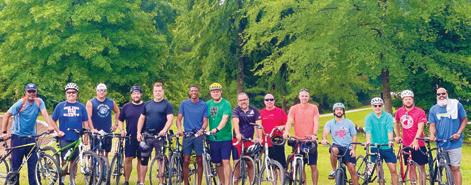
University wrestling head coach Glen Lanham, who is collaborating with the school to develop a wrestling program this year. DNS, which educates middle school boys who have the drive to succeed but not the resources for a quality, independent school education, welcomed its class of 2026 this fall (pictured).
event is planned for late October or early November and will surround brainstorming for the school’s first big fundraiser. James greeted students on Aug. 29, the first day at the new school that’s named after the Lyons family, a Black family who owned the land where the school is now located. The Lyons’ contribution to the economic growth of Durham is honored with a photo of the family in each classroom.
Durham Nativity School marked its 20th anniversary with its first-ever leadership summit this spring. The week featured Triangle leaders in STEM, the arts, medicine, universities and the marketplace, and concluded with inspiring words from Duke
Duke School celebrates its 75th anniversary this year with the return of in-person, allschool gatherings and a formal celebration in the spring. Some notable alumni include the Duffer Brothers (creators of “Stranger Things”), the creative director at French cookware company Staub, the head of the Google Creative Lab, one of the founders of Black August in the Park and the Black Farmers Market, multiple Fulbright Scholars and many more. After two nationwide searches, the school welcomed Kimberly Shaw from The Putney School in Vermont as its next director of equity, justice and belonging, and Bob Robinson, who has been a middle school teacher at Duke School since 1995, as its middle school director.
Noted author Traci Baxley, who wrote “Social Justice Parenting” – the summer read for the Duke School community that anchors the school’s work to become a model for equity – will take part in three on-campus speaking sessions.
Duke School’s Educators Institute offers professional development opportunities to teachers across the world so that other schools and teachers can implement its project-based curriculum, which pulls from “The Project Approach.” More groups will be on campus this year to see project-work – from preschool students all the way through eighth graders’ final capstone projects – in action.
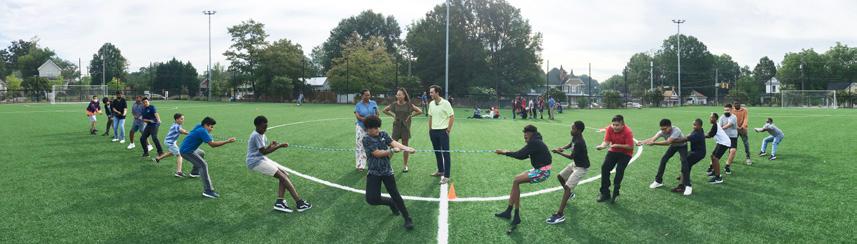
A Sept. 1 report released by the North Carolina State Board of Education shows 86.5% of DPS schools meet or exceed year-toyear academic growth expectations, the highest number the district has achieved in eight years. This rebound from the toll of the pandemic shows a 10.2 percentage point increase in overall academic proficiency, compared to an average of an almost 1% increase each year from 2014 to 2019. Of the 52 DPS schools that the state calculated academic growth for, 33 of them demonstrated better than a year’s academic growth in 2021-22 from where their students started to where they finished. Another 12 schools met state expectations.
The North Carolina Department of Public Instruction announced academic growth rankings that put 23 DPS schools in the top 20% of the state’s 2,532 schools; 18 ranked in the top 20% to 50%. The report shows that Durham School of the Arts (No. 5), James E. Shepard International Baccalaureate Magnet Middle School (No. 15) and Rogers-Herr Middle School (No. 19) ranked in the top 20 schools in the state. Pearsontown Elementary School (No. 34) and Carrington Middle School (No. 40) ranked in the top 50 of all schools in the state.
Voyager Academy earned accreditation from Cognia – a nonprofit that provides quality assurance for schools, school districts and education service providers – after implementing a continuous process of improvement and submitting to an internal and external review.
Voyager also earned approval from the School Nutrition Division of the NC Department of Public Instruction to become a national school lunch provider, which helps ensure equity and accessibility by providing a hot meal for all students.
october/november
Durhammag.com
2022 |
| 87
PHOTO COURTESY OF CRYSTAL ROBERTS
Directory of Independent, Regional Boarding, Charter and choice program Schools
Independent Schools
BETHESDA CHRISTIAN ACADEMY
1914 S. Miami Blvd., Durham
919-598-0190; bcacrusaders.org
Focus Partners with Christian families to help equip students academically, socially, physically and spiritually.
Grades K-10
Total Enrollment 210
Student/Faculty Ratio 13:1
Yearly Tuition Elem., $7,419; Middle, $8,181
Special Requirements Student testing and parent interview.
BRIGHT HORIZONS CHILDREN’S CENTER
2352 So-Hi Dr., Durham; 4205 Capitol St., Durham; 4 UNC-TV Dr., Research Triangle Park; 2500 Highstone Rd., Cary; 800 Weston Pkwy., Cary; 800 Corporate Center Dr., Raleigh; 8516 Old Lead Mine Rd., Raleigh; 2051 Shepherd’s Vineyard Dr., Apex; brighthorizons.com
Focus Empowers children from infancy to become confident, successful learners and secure, caring people.
Growing young readers, scientists, artists and explorers who are engaged and curious. Programs invite children to approach academics with skills, confidence and a drive for excellence.
Grades Infants-pre-K
Total Enrollment Varies by location.
Student/Faculty Ratio Varies by location.
Yearly Tuition Varies by location.
CAMELOT ACADEMY
809 Proctor St., Durham (main campus, with an additional farm campus in north Durham) 919-688-3040; camelotacademy.org
Focus Features individualized instruction, mastery-based learning and parental involvement.
Grades Pre-K-12
Total Enrollment 150
Student/Faculty Ratio 11:1
Yearly Tuition PreK-K, $11,900; Grades 1-4, $14,950; Grades 5-7, $17,350; Grades 8-12, $18,350
Award and merit scholarships available.
Special Requirements Reading and math assessments, writing sample (fifth grade and older), and two-day student visit; $50 application fee.
CARDINAL GIBBONS HIGH SCHOOL
1401 Edwards Mill Rd., Raleigh 919-834-1625; cghsnc.org
Focus A college preparatory school of the Roman Catholic Diocese of Raleigh that aims to form men and women of faith, service and leadership in church and community.
Grades 9-12
Total Enrollment Approximately 1,600
Student/Faculty Ratio 14:1
Yearly Tuition $12,290 – $16,700
Special Requirements Previous school records, testing, application, recommendation, student visit and an essay.
CAROLINA FRIENDS SCHOOL
4809 Friends School Rd., Durham 919-383-6602; cfsnc.org
Focus A learning community working to amplify student’s curiosity, courage and creative thinking. Rooted in Quaker values and informed by researchbased best practices in progressive education, its teachers empower students to question the world around them, discover their passions, think deeply and use their voices in service of the greater good.
Grades Pre-K-12
Total Enrollment 500
Student/Faculty Ratio 6:1 in Early School; 9:1 in Lower, Middle and Upper
Yearly Tuition See website for tuition ranges by unit; adjusted tuition available.
Special Requirements Varies by student age; includes online application, in-person or virtual visit, transcripts, teacher recommendations.
CARY ACADEMY
1500 N. Harrison Ave., Cary 919-677-3873; caryacademy.org
Focus A learning community dedicated to discovery, innovation, collaboration and excellence.
Grades 6-12
Total Enrollment 785
Student/Faculty Ratio 15:1
Yearly Tuition $28,495; $2,625 new student fee
Special Requirements Entrance exam, student visit/ interview, transcripts, teacher recommendations.
CHAPEL HILL COOPERATIVE PRESCHOOL 108 Mt. Carmel Church Rd., Chapel Hill 919-942-3955; chapelhillcoop.com
Focus Partners with families of children from diverse backgrounds to respect and honor childhood, celebrate independence and support kids as they learn and grow through play. NAEYC Accredited with a Five Star licensure.
Grades Pre-K
Total Enrollment 110
Student/Faculty Ratio Infant, 3:1; Toddler, 4:1; Age 2, 6:1; Age 3-5, 9:1
Yearly Tuition Varies by age and enrollment status; three-quarter or full-day options. Part-time options also available Mon., Wed., Fri./Tues., Thurs.
CRESSET CHRISTIAN ACADEMY 3707 Garrett Rd., Durham 919-354-8000; cressetchristian.org
Focus Cultivates the heart of each student to educate, nurture and help shape their character in a Christcentered environment.
Grades Infant-Grade 12
Total Enrollment 210
Student/Faculty Ratio Preschool, 5:1; Lower School, 16:1; Upper School, 18-20:1
Yearly Tuition $8,620 – $10,950 (does not include preschool tuition: $11,140 – $13,440)
Special Requirements Student and parent interview, previous records, visit and application.
CRISTO REY RESEARCH TRIANGLE
HIGH SCHOOL
334 Blackwell St., Ste. 100, Durham 919-897-5680; cristoreyrt.org
Focus College preparatory, career-focused, transformational Catholic high school.
Grades 9-10
Total Enrollment 200
Student/Faculty Ratio 10:1
Yearly Tuition Average $70 per month per family (for single or multiple children)
Special Requirements Not required to be Catholic to attend.
DUKE SCHOOL
3716 Erwin Rd., Durham 919-416-9420; dukeschool.org
Focus Project-based school inspiring learners to shape their future boldly and creatively since 1947.
Grades Age 3-Grade 8
Total Enrollment 503
Student/Faculty Ratio 7:1
Yearly Tuition For 2022-23: Preschool, $4,255$21,274; K-4, $4,615 - $23,076; Grades 5-8, $5,017 - $25,085
Special Requirements Admissions application, student assessment, candidate profile.
DURHAM ACADEMY
Preschool and Lower School, 3501 Ridge Rd., Durham; Middle School, 3116 Academy Rd., Durham; Upper School, 3601 Ridge Rd., Durham 919-493-5787; da.org
Focus Strives to provide an education that will enable students to live moral, happy and productive lives.
Grades Pre-K-12
Total Enrollment 1,240
Student/Faculty Ratio 10:1
Yearly Tuition $17,370 – $30,655 (including activity fees)
Special Requirements Assessment or entrance exam, which varies by grade level. Interview required for grades 9-12.
DURHAM NATIVITY SCHOOL
1004 N. Mangum St., Durham 919-680-3790; durhamnativity.org
Focus Provides a learning environment for young men with high financial need, supporting them in their personal, social, moral and intellectual development, and positioning them to be successful at an independent college prep high school.
Grades 5-8
Total Enrollment 60
Student/Faculty Ratio 15:1
Yearly Tuition $22,000, with scholarship-driven tuition awarded to low-income students
Special Requirements Open house attendance.
88 | durhammag.com | october/november 2022 SCHOOLS & EDUCATION
Montessori School

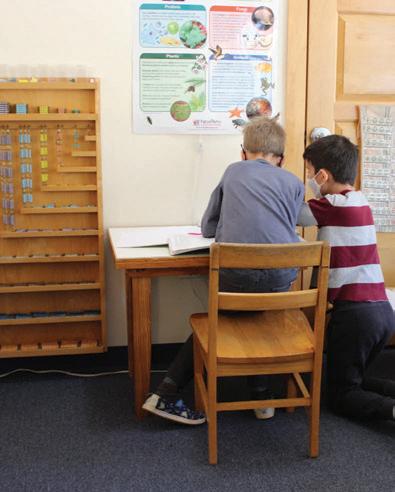

www.msdurham.org 2800 Pickett Rd. Durham, NC 27705 919-489-9045
“Education is indispensable not to foster material progress but to save humanity.”
-Maria Montessori
of Durham welcomes a diverse, inclusive community and celebrates the uniqueness of all of its members as part of our hope for a peaceful world. Montessori School of Durham is an accredited independent Montessori school bringing authentic Montessori education to families in Durham and the surrounding areas for over 40 years. Now accepting 2023-24 school year applications online for children ages 3 months through 6th grade.
EMERSON WALDORF SCHOOL
6211 New Jericho Rd., Chapel Hill
919-967-1858; emersonwaldorf.org
Focus Encourages and promotes independent thinking, social responsibility, and academic and artistic excellence.
Grades Pre-K-12
Total Enrollment 264
Student/Faculty Ratio Early Childhood: 7:1; Grades 1-5: 20:1; Middle School: 19:1; HS: 14:1
Yearly Tuition $12,403 – $21,480
Special Requirements Tour (in-person or virtually), parent-teacher consultation, new student assessment.
EMPOWERED MINDS ACADEMY
311 Oakwood Ave., Durham
919-925-3083; empoweredmindsacademy.com
Focus An authentic Montessori experience and a learnerdriven community where children: cherish freedom; take responsibility for their learning; discover gifts, passions and purpose; are active in the design and execution of their education; and find joy in hard work and diving into subjects through hands-on and collaborative challenges. Each child begins a journey to learn how they can serve others and change the world. By uncovering, reclaiming and reconnecting with their truths, students will better understand who they were, who they are and who they must be. The school aims to provide a world-class, highquality educational experience with a focus on character development and socio-emotional and lifelong learning.
Grades K-6
Total Enrollment 25
Student/Teacher Ratio 10:1
Yearly Tuition $9,405; $250 annual registration fee.
Special Requirements School visit, trial day, interview.
FIRST PRESBYTERIAN DAY SCHOOL
305 E. Main St., Durham
919-688-8685; fpdayschool.org
Focus A nonprofit, non-religious program, FPDS has been in the heart of downtown Durham since 1970. It offers continuity of care – when infants and toddlers join its program, they stay with the same friends and teachers until they enter its pre-K class. Teachers are “brain builders” and promote a safe, nurturing place for children no matter their racial, ethnic, religious and socioeconomic backgrounds – all learn, play and grow together.
Grades Infant-Pre-K
Total Enrollment 64
Student/Faculty Ratio Infants, 4;1; Toddlers 5:1; Age 2, 8:1; Age 3, 9:1; Age 4/5, 12:1
Yearly Tuition $12,840 – $16,260
Special Requirement Teacher/family orientation, tour, two transition days before beginning full time.
GORMAN CHRISTIAN ACADEMY
3311 E. Geer St., Durham
919-688-2567; gormanchristian.org
Focus Partners with parents to provide an excellent education with a biblical worldview while developing strong Christian character and values.
Grades K-8
Total Enrollment 95
Student/Faculty Ratio 12:1
Yearly Tuition $6,900
Special Requirements Administrator meets parents and child.
HAW RIVER CHRISTIAN ACADEMY
2428 Silk Hope Gum Springs Rd., Pittsboro 919-533-4139; hawriverchristian.org
Focus A nonprofit, interdenominational private school providing an excellent Christian and classical education.
Grades Junior K-12
Total Enrollment 165
Student/Faculty Ratio 12:1
Yearly Tuition Junior Kindergarten three-day/five-day, $3,770/$5,380; K half-day, $5,380; Grammar (grades 1-6), $6,460; Logic School (grades 7-9), $6,995; Rhetoric (grades 10-12), $6,995
Special Requirements Four-part admissions process includes tour.
HILL LEARNING CENTER 3200 Pickett Rd., Durham 919-489-7464; hillcenter.org
Focus Transforms students with learning differences into confident, independent learners through a half-day school, tutoring and summer programs.
Grades 1-12; Summer (1-8); Tutoring (K-12)
Total Enrollment 175
Student/Faculty Ratio 4:1
Yearly Tuition $21,060 (1-2 hour options also available for grades 9-12)
Special Requirements Application and interview.
HOLLY HOUSE PRESCHOOL
75 Cedar Run, Pittsboro 201-638-0915; hollyhousepreschool.com; hollyhouseconsulting@gmail.com
Focus Half-day preschool program that focuses on the whole child; social, emotional and academic growth are all supported.
Ages 3.5-5
Student/Faculty Ratio Limited to 12 students per class, no more than 6:1
Special Requirements In-person tours by appointment. Visit website for a virtual tour.
HOPE CREEK ACADEMY 4723 Erwin Rd., Durham 919-932-0360; hopecreekacademy.org
Focus Provides structure without rigidity for special needs students who struggle in a traditional environment.
Grades K-12
Total Enrollment 60
Student/Faculty Ratio 3:1
Yearly Tuition $25,800 and $500 materials fee. Limited financial aid available.
Special Requirements School visit.
IMMACULATA CATHOLIC SCHOOL
721 Burch Ave., Durham 919-682-5847; immaculataschool.org
Focus For more than a century, Immaculata has educated a diverse student body with a focus on character development, faith formation and academic excellence.
Grades Pre-K-8
Total Enrollment 535
Student/Faculty Ratio 10:1
Yearly Tuition $7,770 – $8,270 for parishioners, otherwise $8,670 – $10,316, plus $200 annual enrollment fee
Special Requirements Entry test, copy of student’s school records and current teacher recommendations.
Application fee is $100.
INTERNATIONAL MONTESSORI SCHOOL 3001 Academy Rd., Bldg. 300, Durham; 5510 Barbee Chapel Rd., Chapel Hill 919-401-4343 (office); imsnc.org
Focus Combines an authentic Montessori education with language immersion in Mandarin, French and Spanish to provide a truly global education for children. This diverse community of teachers and families from many cultures, languages and backgrounds come together as a supportive and engaged learning community.
Grades Age 18 months-Grade 6
Total Enrollment 150
Student/Faculty Ratio 9:1
Yearly Tuition $11,145 – $16,060; Extended day options available for an additional fee. Need-based financial aid available.
Special Requirements No Chinese, French or Spanish experience required for new students entering as toddlers through first graders. New students joining at second through fourth grade from dual-language or immersion programs are also welcome to apply.
JORDAN LAKE SCHOOL OF THE ARTS 1434 Farrington Rd., Ste. 100, Apex 919-387-9440; jordanlakesa.com
Focus High school/college preparatory, inclusive special education.
Grades K-12+
Total Enrollment 40
Student/Faculty Ratio 7:1
Yearly Tuition K-8, $16,900; Grades 9-12, $18,450
Special Requirements Application, interview and two-day tryout.
LAKEWOOD AVENUE CHILDREN’S SCHOOL 1701 Lakewood Ave., Durham 919-493-5882; lakewoodavenue.com
Focus Provides a high-quality early childhood program with a stable, well-educated teaching staff ensuring consistent care and education.
Ages 1-5
Total Enrollment 33
Student/Faculty Ratio Ages 1-3, 4:1; Ages 3-5, 8:1
Tuition Toddlers, $1,820/month; Preschool, $1,720/month
Special Requirements The director offers virtual tours and admissions conversations for families on weekday afternoons.
LEGACY ACADEMY 515 E. Winmore Ave., Chapel Hill 919-929-7060; lachapelhill.com
Focus Students are actively involved in multisensory activities, including art, music, language, math, science, brain power and physical activities. Classrooms, gardens, a water park and playgrounds are designed to be both fun and nurturing. Kindergarten, after-school program and summer camp for children up to 12 years old are also offered. Five Star licensure, NAEYC Accredited and NC Pre-K Program site.
Ages 6 weeks-10 years
Total Enrollment 115, reduced during COVID-19
Student/Faculty Ratio Maximums when at full capacity. Infants, 5:1; Ages 13-24 months, 6:1; Ages 25-36 months, 9:1; Ages 37-48 months, 10:1; Ages 4-5, 13:1; NC Pre-K Program, 9:1; Ages 6-12, 14:1
Yearly Tuition Varies by age, program and partner discounts. Partnerships: Duke, UNC, UNCHC.
Special Requirements Registration fee of $150. Need-based scholarships available.
THE LERNER JEWISH COMMUNITY DAY SCHOOL
1935 W. Cornwallis Rd., Durham 919-286-5517; lernerschool.org
Focus A learning community dedicated to educating mensches … one child at a time. An integrated curriculum incorporates exceptional academics, Jewish culture, values and traditions.
Grades Age 2-Grade 5
Total Enrollment 150 Student/Faculty Ratio 9:1
Yearly Tuition $5,000 – $21,000. See website for tuition ranges by unit, flexible tuition availability and new student fees.
Special Requirements Admissions application, parent virtual visit, student assessment and teacher recommendations.
LIBERTY CHRISTIAN SCHOOL 3864 Guess Rd., Durham 919-471-5522; lcsdurham.org
Focus Students will acquire knowledge and wisdom with a biblical worldview as demonstrated through service and leadership in worship, missions, care and growth. The core values of truth, intellectual development, potential in Christ, Christian personnel and operational integrity are woven in with worship.
Grades Pre-K-12
Total Enrollment 290
Student/Faculty Ratio 20:1
Yearly Tuition $4,900
Special Requirements Entry test and interview.
90 | durhammag.com | october/november 2022 SCHOOLS & EDUCATION
DESTINATION DPS


THE DESTINATION TO SUCCESS IS DPS!
Durham Public Schools is the perfect place for your child to grow, thrive and learn. From grades K-12, DPS o ers every student a quality education with an emphasis on social-emotional growth.


for what lies beyond the walls of our
goal is simple, to prepare
and to ignite their limitless
for a brighter



with


Your





























Our
students
schools
potential.
destination
future starts
DPS. ENROLL TODAY! Start your journey at WELCOME.DPSNC.NET!
MONTESSORI COMMUNITY SCHOOL
4512 Pope Rd., Durham
919-493-8541; mcsdurham.org
Focus Students learn in a vibrant Montessori community where they are guided toward self-discovery and the realization of their unique contributions to the world.
Grades Age 18 months-Grade 8
Total Enrollment 220
Student/Faculty Ratio 18 months-age 3, 6:1; Ages 3-6, 12:1; Grades 1-3, 12:1; Grades 4-6, 12:1; Grades 7-8, 8:1
Yearly Tuition 18 months-age 3: half day, $14,000, full day, $18,500; Ages 3-4: half day, $13,250; Ages 3-Kindergarten, full day, $17,500; Grades 1-3, $17,750; Grades 4-6, $17,750; Grades 7-8, $21,500
Special Requirements Application, family meeting and student visit.
MONTESSORI DAY SCHOOL
1702 Legion Rd., Chapel Hill
919-929-3339; mdsch.org
Focus A faculty-operated school, a well-equipped learning environment and an enriched Montessori curriculum to meet the needs of children with a wide range of abilities. On-site aftercare available.
Grades Toddler-Grade 6
Total Enrollment 70
Student/Faculty Ratio 10:1
Yearly Tuition $9,875 – $11,550
Special Requirements Interview process includes general evaluation and meeting with parents.
Three-day visit for elementary.
MONTESSORI FARM SCHOOL
2400 Broad St., Durham
919-732-5026; montessorifarmschool.com
Focus Montessori education with special emphasis on nature study and activities including gardening and animal care.
Grades Pre-K-K
Total Enrollment Up to 24 Student/Faculty Ratio 8:1
Yearly Tuition Pre-K, $9,525; K, $12,350
Special Requirements Contact the school and set up an appointment to visit.
MONTESSORI SCHOOL OF DURHAM 2800 Pickett Rd., Durham 919-489-9045; msdurham.org
Focus Curriculum based on Montessori approach to education.
Grades 15 months-Grade 6
Total Enrollment 155
Student/Faculty Ratio Varies by child’s level.
Yearly Tuition Toddlers, $4,430 – $23,620; Early childhood-Grade 6, $6,660 – $20,550 (Varies by child’s schedule and financial aid award.)
Special Requirements Parent meeting.
THE MONTESSORI SCHOOL OF RALEIGH Middle and Upper School, 408 Andrews Chapel Rd., Durham; Early Learning and Elementary, 7005 Lead Mine Rd., Raleigh 919-848-1545; msr.org
Focus Independent Montessori school offering hands-on, real-life learning experiences through a mindful academic curriculum designed to build key competencies, confidence and independence.
IB Diploma Programme offered for grades 11-12. Dually accredited by the American Montessori Society and International Baccalaureate.
Grades Infant-Grade 12
Total Enrollment 385
Student/Faculty Ratio Infant, 4:1; Toddler, 6:1; pre-K-Grade 12, 12:1
Yearly Tuition $13,225 – $24,945
Special Requirements Assessment or entrance exam, by grade level; interview.
PINEWOODS MONTESSORI SCHOOL
109 Millstone Dr., Hillsborough 919-644-2090; info@pinewoodsmontessori.com; pinewoodsmontessori.com
Focus Authentic Montessori education in which children develop a love of learning within a safe, peaceful setting. The school believes in the dignity and ability of children and in their inherent right to respect, assist and guide in fulfilling their potential. It is committed to the Montessori philosophy and a child-focused approach to education. It strives to partner with families in their efforts to raise capable, joyful, confident children in a relationshipbased, affordable environment. It is dedicated to the well-being, integrity and development of the larger Montessori community and of the local communities. Ages 18 months-12 years
Total Enrollment 150
Student/Faculty Ratio Toddler, 6:1; Preschool, 11:1; Elementary, 12:1
Yearly Tuition $7,840 – $10,360, depending on program
PRIMROSE SCHOOL OF CHAPEL HILL AT BRIAR CHAPEL
81 Falling Springs Dr., Chapel Hill 919-441-0441; primrosechapelhill.com
Focus An accredited private preschool delivering an exclusive learning approach that balances purposeful play with nurturing guidance from teachers to encourage curiosity, creativity, confidence and compassion.
Grades Infant-kindergarten
Total Enrollment 185
Student/Faculty Ratio Infant, 4:1; toddler, 6:1; early preschool, 8:1; preschool, 10:1; Pre-K, 12:1; private K, 12:1
Yearly Tuition Varies by age level.
$1,340 – $1,650 per month, full-time enrollment; $800 – $1,170 per month, part-time enrollment
Special Requirements $150 pre-registration fee.
QUALITY EDUCATION INSTITUTE
800 Elmira Ave., Bldg. B, Durham 919-680-6544; qeidurhamnc.org
Focus A student-centered learning community with a rigorous curriculum and clearly defined standards of performance and high expectations.
Grades Pre-K-5
Total Enrollment 40
Student/Faculty Ratio 10:1
Yearly Tuition $8,500
SOUTHPOINT ACADEMY
7415 Fayetteville Rd., Durham 919-544-5652; southpointacademy.org
Focus Prepares students to become ethical, well-rounded and self-sufficient citizens by providing a world-class education in a nurturing Christian environment.
Grades K-6
Total Enrollment About 60
Student/Faculty Ratio 10:1
Yearly Tuition $6,500
Special Requirements Tour, application, meeting with administrator and student testing.
ST. THOMAS MORE CATHOLIC SCHOOL
920 Carmichael St., Chapel Hill 919-942-6242; stmcsnc.org
Focus Provides an education for each child in a God-centered environment.
Grades PreK-3 to Grade 8
Total Enrollment 400
Student/Faculty Ratio PreK-3, 10:2; PreK-4, 15:2; Grades K-5, 25:2 (teacher and assistant);
Grades 6-8, 25:1
Yearly Tuition Pre-K, call to inquire; K-8, $9,120 – $11,860
THE STUDIO SCHOOL OF DURHAM 1201 Woodcroft Pkwy., Durham 919-967-2700, ext. 2; studioschooldurham.org
Focus A research-based, project-focused independent school for children. Believes in a 21st century education, and equips children with a spirit of discovery, mastery and adventure that will empower them to fulfill their greatest potential across their school years and beyond.
Grades K-8
Total Enrollment 44
Student/Faculty Ratio 8:1 for lower elementary (ages 5-7), and 18:1 for upper elementary (ages 7-10)
Yearly Tuition $12,900
THALES ACADEMY PITTSBORO 200 Vine Pkwy., Pittsboro 919-726-2416; thalesacademy.org
Focus An excellent, affordable education through the use of direct instruction and a classical curriculum that embodies traditional American values.
Grades Pre-K-6
Total Enrollment 198+
Student/Faculty Ratio Pre-K, 18:2 (full-time teacher assistant in Pre-K); K, 24:2 (full-time teacher assistant in K), Grades 1 and 2, 24:1; Grades 3-5, 26:1; and Grade 6, 28:1
Yearly Tuition Pre-K: $4,800, K-5: $5,300, 6: $5,500
Special Requirements Admissions are made on a rolling basis, and decisions are made after a full review of the application, checklist items and a student interview.
TRIANGLE DAY SCHOOL 4911 Neal Rd., Durham 919-383-8800; triangledayschool.org
Focus A welcoming community devoted to academic excellence that ignites intellectual curiosity, fosters compassion and integrity, and nurtures creativity, inspiring confidence in students to lead a life of purpose.
Grades Transitional K-8
Total Enrollment 310
Student/Faculty Ratio 9:1
Yearly Tuition $14,515 – $17,990
Special Requirements Application and interview required.
TRINITY SCHOOL OF DURHAM AND CHAPEL HILL 4011 Pickett Rd., Durham 919-402-8262; trinityschoolnc.org
Focus To educate students within the framework of Christian faith and conviction; teaching the classical tools of learning; providing a rich, yet unhurried, education; and communicating truth, goodness and beauty. Trinity staff and teachers partner with parents to educate students with bright minds and open hearts. The school was founded in 1995, and the campus is nestled on 22 acres between Durham and Chapel Hill. Grades Transitional K-12
Total Enrollment 565
Student/Faculty Ratio Lower School, 7:1; Middle School, 8:1; Upper School, 8:1
Yearly Tuition $4,800 – $25,590
Special Requirements Check website for complete details, application information, and tour and information dates.
WILLOW OAK MONTESSORI CHILDREN’S HOUSE
1476 Andrews Store Rd., Pittsboro 919-240-7787; willowoakmontessori.org
Focus Multi-age classrooms with self-directed learning in a stimulating, authentic Montessori environment. Newly built school with a variety of outdoor spaces for learning and play.
Ages 3-5
Total Enrollment 45
Student/Faculty Ratio 13:1
Yearly Tuition Full day, $10,200; Half-day, $7,140
Special Requirements $75 application fee, toilettrained. Limited financial aid available.
92 | durhammag.com | october/november 2022 SCHOOLS & EDUCATION
Regional Boarding Schools
ASHEVILLE SCHOOL
360 Asheville School Rd., Asheville 828-254-6345; admission@ashevilleschool.org; ashevilleschool.org
Focus Students live in a nurturing community and genuinely know faculty. The school offers a rigorous college preparatory program for students who represent 25 states and 24 countries.
Grades 9-12
Total Enrollment 295 Student/Faculty Ratio 5:1
Yearly Tuition $66,250 for boarding; $39,150 for day students.
Special Requirements Separate interviews for parents and child, full application, math and English recommendations and transcript required.
NORTH CAROLINA SCHOOL OF SCIENCE AND MATHEMATICS

1219 Broad St., Durham; 901 Burkemont Ave., Morganton 919-416-2600; 828-347-9100; ncssm.edu
Focus To educate academically talented students to become state, national and global leaders in science, technology, engineering and mathematics; advance public education; and inspire innovation for the betterment of humankind through challenging residential (both in Durham and Morganton), online, summer and virtual learning driven by instructional excellence and the excitement of discovery. As of press time, recruitment for the 2023-24 school year is underway.
Grades 11-12
Total Enrollment 680 residential students in Durham; 300 in Morganton; and about 500 in NCSSM-Online Student/Faculty Ratio 8.5:1
Yearly Tuition NCSSM is a public school. There are no fees associated with applying or attending.
Special Requirements See ncssm.edu/apply
SAINT MARY’S SCHOOL
900 Hillsborough St., Raleigh 919-424-4000; admission@sms.edu; sms.edu
Focus An independent, college-preparatory, boarding and day school where girls are challenged academically to be bold, inspired and prepared to be extraordinary. Girls are accepted and empowered in their learning to grow spiritually and socially. They are recognized for their unique talents, passions and interests – and those yet to be discovered through the development of critical thinking, collaboration, cross-cultural intelligence and new media literacy. AP courses, innovative electives, junior internships, a unique seminar program, college counseling, rich arts program, 11 sports and a safe campus in a thriving urban location.
Grades 9-12
Total Enrollment 310 Student/Faculty Ratio 8:1
Yearly Tuition $62,850; $31,600 for day students. Need- and merit-based financial aid available.
Special Requirements Application, three written recommendations, a transcript from the applicant’s current school, SSAT scores and an on-campus interview.
SALEM ACADEMY
601 S. Church St., Winston-Salem 336-721-2643; salemacademy.com
Focus Fosters the intellectual, spiritual, social and physical growth of young women. Offers 10 AP courses, competition in seven sports, a comprehensive fine arts program and technology, advising and co-curricular programs. Offers dual-enrollment college courses at Salem College to supplement AP curriculum.
Grades 9-12
Total Enrollment 75
Student/Faculty Ratio 6:1
Yearly Tuition $50,500; $26,500 for day students
Special Requirements Application process includes an interview, essay and transcripts, as well as optional teacher recommendations and optional testing.
Orange/Chatham Charter Schools (Admission by lottery.)
ENO RIVER ACADEMY
1212 NC Hwy. 57 N., Hillsborough 919-644-6272; enoriveracademy.org
Focus Utilizes a Science, Technology, Engineering, Arts and Math (STEAM) curriculum to build upon a 20year tradition of academic and artistic excellence. Grades K-12
Total Enrollment 820
Student/Faculty Ratio 20:1
Special Requirements Initial enrollment based on lottery in February; students waitlisted once slots are filled.
THE EXPEDITION SCHOOL
437 Dimmocks Mill Rd., Ste. 33, Hillsborough; 919-245-8432; theexpeditionschool.com
Focus Embraces the natural curiosity of children and empowers them to become innovative problem solvers and community builders, and to provide excellent education through an experiential, projectbased, STEM-focused curriculum.
Grades K-8
Total Enrollment 360
Student/Faculty Ratio Grades K-4, 20:1; Grades 5-8, 22:1. Resource/other non-classroom staff not included in ratio.
Special Requirements Cut-off for lottery application in February.
october/november 2022
| Durhammag.com | 93
WILLOW OAK MONTESSORI CHARTER SCHOOL 1476 Andrews Store Rd., Pittsboro 919-240-7787; willowoakmontessori.org
Focus Multi-age classrooms with self-directed learning in a stimulating, authentic Montessori environment. Newly built school with various outdoor spaces. Strives to assist children in achieving their unique potential as responsible global citizens by nurturing selfconfidence and independent decision making.
Grades K-8
Total Enrollment 285
Student/Faculty Ratio 15:1
WOODS CHARTER SCHOOL
160 Woodland Grove Ln., Chapel Hill 919-960-8353; woodscharter.org
Focus Emphasizes academic excellence and parent and family involvement in the academic environment.
Grades K-12
Total Enrollment 512
Student/Faculty Ratio Elementary, 16:1; Middle school and high school, 20:1
Special Requirements Applications open Oct. 15–Jan. 15; February lottery.

Durham Charter Schools
(Admission by lottery. Check with school for key dates.)
CENTRAL PARK SCHOOL FOR CHILDREN Elementary: 724 Foster St.; Middle: 121 Hunt St. 919-682-1200; cpscnc.org
Focus To create a community where all children thrive and students’ joy for learning is empowered through equity practices in project-based learning, arts integration and outdoor learning. Students learn to be confident, creative and courageous changemakers through the school’s high expectations in academics, social-emotional learning and social justice teaching and learning.
Grades K-8
Total Enrollment 616
Student/Faculty Ratio Elementary, 16:1; Middle, 20:1
Special Requirements Tours are strongly encouraged and are offered October-March. Lottery in March, applications accepted November-February. Waitlist closes after the 20th day of the school year. Waitlist is roughly 300 for kindergarten.
COMMUNITY SCHOOL OF DIGITAL & VISUAL ARTS 1955 W. Cornwallis Rd. 919-797-2340; communitydva.org
Focus Growing students academically, socially and emotionally every day.
Grades K-8
Total Enrollment 250
Student/Faculty Ratio 15:1
DISCOVERY CHARTER SCHOOL 501 Orange Factory Rd., Bahama 984-888-5504; discoverycharterdurham.org
Focus Science, technology, engineering, arts and mathematics.
Grades 6-9
Total Enrollment 400
Student/Faculty Ratio 20:1
Special Requirements Students must reside in N.C.
DURHAM CHARTER SCHOOL 807 W. Chapel Hill St. 919-956-5599; healthystartacademy.org
Focus Strives to help students grow, especially in math and reading. Encourages parent involvement. Promotes a child-centered curriculum with a safe, structured environment.
Grades K-9
Total Enrollment 600+ Student/Faculty Ratio 18:1
Special Requirements Application and lottery for admission.
EXCELSIOR CLASSICAL ACADEMY 4100 N. Roxboro St. 919-213-8585; excelsior.teamcfa.school
Focus Excelsior means “higher” in Latin, and students at the school strive for continuous improvement in academics and character. With a college-preparatory, liberal arts focus, staff encourage each student to reach higher by providing a rigorous, rich curriculum in an environment that promotes responsibility, integrity, diligence and excellence as well as equity in education by developing a foundation of knowledge, a practice of reason, a quality of eloquence and a habit of virtue to prepare each student for a lifetime of learning and citizenship. An educational option accessible to all students in the Durham area, the school intentionally pursues diversity in its board, staff and student population. The school offers busing; provides free or reduced-price lunch to those who qualify; provides assistance with uniforms to those who qualify; and offers a before- and after-school program.
Grades K-11 in 2022-23. The school will have its first graduating class in 2024.
Total Enrollment 1,030
Student/Faculty Ratio 15:1
Special Requirements Open application and enrollment. If more applications are received than the allotted number of spots for each grade, a random lottery will be held for vacant spots. Open enrollment takes place in January and February, and the lottery occurs in early March.
Camp
TRADITIONAL CAMP Roaring Gap, NC
Located in the heart of the Blue Ridge Mountains, just a 2.5 hour drive from Chapel Hill and the Triangle Area
Overnight camp for kids entering into 2nd Grade to rising 10th Graders Over 35 activities, evening programs, and out-of-camp adventures!

CHEERIO ON THE NEW RIVER Mouth of Wilson, VA
Nestled on 150 acres in the Mouth of Wilson, VA surrounded by over a mile of riverfront
Overnight one week coed sessions for rising 5th through 10th Graders
Riverfront activities, tree climbing, backpacking/hiking and more!

94 | durhammag.com | october/november 2022 SCHOOLS & EDUCATION YMCA
campcheerio.org | 336.869.0195
KESTREL HEIGHTS CHARTER SCHOOL Elementary: 4900 Prospectus Dr.; Middle: 4700 S. Alston Ave. 919-484-1300; kestrelheights.org
Focus A blended learning school utilizing Mind Brain Education techniques to teach scholars in small groups to sharpen academics, demonstrate creative expression and expand leadership skills.
Grades K-8
Total Enrollment 505
Student/Faculty Ratio 19:1
KIPP DURHAM COLLEGE PREPARATORY 1107 Holloway St. 919-973-0285; kippnc.org
Focus A dynamic and beloved school community where excellence in all aspects is the standard. The school joyfully educates its students with the academic, social and character skills necessary to take their chosen place in the world and leave it better than they found it. Along with families and staff, students are part of a positive and collaborative learning and social environment that fosters preparedness, resilience, integrity, discipline and excellence. Students strive to seek the highest ideals for themselves and live up to them – climbing the mountain to college, career and beyond, and lifting their pride as they climb.
Grades 6-8
Total Enrollment 350
Student/Faculty Ratio Varies by grade level.

MAUREEN JOY CHARTER SCHOOL 107 S. Driver St. 919-493-6056; joycharter.org
Focus To develop the whole child through high-quality instruction, schoolcommunity partnerships and the promotion of a positive self-identity.
Grades K-8
Total Enrollment 640
Student/Faculty Ratio Kindergarten, 16:1; Grades 1-3, 22:1; Grades 4-8, 24:1
Special Requirements Application released in December; lottery in March.


RESEARCH TRIANGLE CHARTER ACADEMY 2418 Ellis Rd.
919-957-7108; researchtrianglecharteracademy.org
Focus Curriculum is built around a strong emphasis on math, reading, science and social studies. Its Moral Focus program helps students learn the importance of making good decisions and doing the right thing in life.
Grades K-8
Total Enrollment 735
Student/Faculty Ratio Kindergarten, 22:1; Grades 1-8, 27:1
Special Requirements Lottery.
VOYAGER ACADEMY
Elementary: 4210 Ben Franklin Blvd.; Middle: 101 Hock Parc Ln.; High: 4302 Ben Franklin Blvd. 919-433-3301; voyageracademy.net
Focus Project-based learning. Grades K-12
Total Enrollment 1,368
Student/Faculty Ratio 18:1
Special Requirements Applications accepted online Jan. 1–Feb. 28. Lottery in March.
Durham Public Schools Choice Programs
Students who wish to attend a DPS choice school must apply during the application period, which is open in January each year for the following school year. Parents and students interested in learning more about the programs offered can visit magnet. dpsnc.net or attend the “Destination DPS Showcase of Schools,” which is held in November. Families will be able talk to school staff, parents and students at the Showcase of Schools in order to help them decide which schools they’d like to tour.
BURTON ELEMENTARY
1500 Mathison St.
919-560-3908; burton.dpsnc.net
Focus The goals of the school’s International Baccalaureate Primary Years Programme (IB-PYP) are to develop students into adults who are confident, critical and independent thinkers with a global perspective. IB seeks to be a transformational form of education focused on individual learner profiles and centers learning on problem solving and real world, global challenges.
Students develop world language and intercultural communication skills. Peer-reviewed research suggests that students who attend IB programs have more developed critical thinking skills, global awareness and are more likely to successfully attend college.
Grades K-5
Total Enrollment 291
Focused on your child’s academic, social, and developmental growth

Full immersion, multi-age classrooms led by Montesorritrained native and near-native speaking teachers
october/november 2022 | Durhammag.com | 95 For the Smile Of a Lifetime... We welcome new patients. 919.489.1543 DurhamPDO.com 121 W. Woodcroft Pkwy|Durham, NC 27713
Dr.
John R. Christensen Orthodontics & Pediatric Dentistry
Dr. Robert
T. Christensen
Pediatric
Dentistry
Dr.
Jamie L. Molina Pediatric Dentistry
Serving children 18 months old to 6th grade in your choice of French, Spanish, or Mandarin Chinese immersion tracks Give your child the gift of bilingualism while building curiosity, confidence, and independence in a diverse learning community. 919.401.4343 • WWW.IMSNC.ORG 3001 ACADEMY RD., BLDG. 300, DURHAM, NC 27707
CITY OF MEDICINE ACADEMY 301 Crutchfield St. 919-560-2001; cma.dpsnc.net
Focus Rigorous health and life sciences courses of study prepare students for post-secondary learning in the field. Through a partnership with Durham Technical Community College, students can earn college credit and/or professional certifications in health care fields while in high school. Students have access to internships, clinical experiences, shadowing opportunities, mentoring and instruction by licensed health care professionals.
Grades 9-12
Total Enrollment 352
CLUB BOULEVARD ELEMENTARY 400 W. Club Blvd. 919-560-3918; clubblvd.dpsnc.net
Focus A place where students all grow as human beings. Teachers engage students in learning through the integration of arts and culture, as well as community interaction and service. Core curriculum is complemented by specialized art, dance, music and cultural studies classes for all students. Students are involved in service projects, performances and other enrichment opportunities. School will transition to include a dual-language immersion program starting in 2024-25.
Grades K-5 Total Enrollment 390

EST. 1984
DURHAM SCHOOL OF THE ARTS 400 N. Duke St. 919-560-3926; dsa.dpsnc.net
Focus Academic rigor and excellence in traditional visual and performing arts disciplines. Students may concentrate in chorus, band, orchestra, piano or guitar; dance; acting or technical theater; painting, drawing, clay, sculpture or photography; writing through literature, newspaper or yearbook; and game design, digital media or film.
Grades 6-12
Total Enrollment 1,763
DURHAM SCHOOL OF TECHNOLOGY 3727 Fayetteville St. 919-560-9183; newtech.dpsnc.net
Focus Rigorous IT and computer science courses of study prepare students for post-secondary learning in the field. Through a partnership with Durham Technical Community College, students can earn college credit and/or professional certifications in IT and computer science fields while in high school. Students have access to internships, shadowing opportunities, mentoring and instruction by industry professionals.
Grades 9-12
Total Enrollment 292
EASLEY ELEMENTARY 302 Lebanon Circle 919-560-3913; easley.dpsnc.net
Focus Operates on a year-round calendar with threeweek breaks between each nine-week instructional period and a five-week break during summer. The yearround calendar provides consistency throughout the year and more frequent breaks for students to maintain a school/life balance, explore their own interests or receive extra academic support.
Grades K-5
Total Enrollment 461
GEORGE WATTS MONTESSORI 700 Watts St. 919-560-3947; watts.dpsnc.net
Focus All classroom teachers are trained by certified Montessori trainers. Montessori education consists of multi-age, interdisciplinary, child-centered learning environments. Montessori curriculum is constructivist in approach and designed to foster independent and self-directed learning based on student interest. Peer-reviewed research suggests the Montessori approach effectively accelerates academic and social development.

Grades Pre-K-5

Total Enrollment 281
HILLSIDE HIGH (IB PROGRAMME)
3727 Fayetteville St. 919-560-3925; hillside.dpsnc.net
Focus The goals of the International Baccalaureate’s (IB) Middle Years Programme (MYP) and Diploma Programme (MP) are to develop students into adults who are confident, critical and independent thinkers with a global perspective. At the high school level, students engage in classical studies, world languages, philosophical inquiry, artist experiences, extended research and community service hours as part of a rigorous academic course of study. Peer-reviewed research suggests that students who attend IB programs have more developed critical thinking skills, global awareness and are more likely to successfully attend college. IB diplomas and course credits are accepted at more than 5,000 universities in more than 100 countries. Students must enter the magnet lottery for the IB Programme.
Grades 9-12
Total Enrollment 1,475

96 | durhammag.com | october/november 2022 SCHOOLS & EDUCATION Waldorf education balances academic excellence
with
artistic
discernment,
ecological thinking, and practical skills. Enrolling HIGH SCHOOL - GRADE SCHOOL 919-967-1858 emersonwaldorf.org/tours & EARLY CHILDHOOD
HOLT ELEMENTARY LANGUAGE ACADEMY 4019 Holt School Rd. 919-560-3928; holt.dpsnc.net
Focus All students study an additional language (Spanish or Mandarin Chinese) beginning in kindergarten with the opportunity to become conversational in that language by the end of fifth grade. Global cultures integrated into core curriculum for greater understandings of the world and its people. Operates on a year-round calendar with three-week intersessions between each nine-week instructional period and a five-week break during summer. School will transition to traditional calendar and the duallanguage immersion model in 2024-25.
Grades Pre-K-5
Total Enrollment 624
IGNITE! ONLINE ACADEMY 2107 Hillandale Rd. 919-886-4737; ignite.dpsnc.net
Focus Ignite! Online Academy is transforming the learning experience through culturally responsive, personalized online learning. The school serves K-12 students who are ready to own their learning and prepare to become leaders.

Grades K-12
Total Enrollment 715
JAMES E. SHEPARD MAGNET MIDDLE 2401 Dakota St. 919-560-3938; shepard.dpsnc.net
Focus The goals of the International Baccalaureate’s (IB) Middle Years Programme (MYP) are to develop students into adults who are confident, critical and independent thinkers with a global perspective. IB seeks to be a transformational form of education focused on individual learner profiles and centers learning on problem solving and real world, global challenges. Students develop world language and intercultural communication skills.
Peer-reviewed research suggests that students who attend IB programs have more developed critical thinking skills, global awareness and are more likely to successfully attend college.
Grades 6-8
Total Enrollment 409
J.D. CLEMENT EARLY COLLEGE HIGH 1801 Fayetteville St. 919-560-2696; echs.dpsnc.net
Focus A Cooperative Innovative high school located on the campus of North Carolina Central University.
In this academically rigorous program, students take both honors/AP-level high school courses and college courses. Students can earn up to two years of university credit with all course and material expenses covered. Middle College is best suited for students who can demonstrate a high degree of responsibility, independence and intrinsic motivation.


Grades 9-12
Total Enrollment 395
LAKEWOOD MONTESSORI MIDDLE 2119 Chapel Hill Rd. 919-560-2894; montessorimiddle.dpsnc.net
Focus All classroom teachers are trained by certified Montessori trainers. Montessori education consists of multi-age, interdisciplinary, child-centered learning environments. Montessori curriculum is constructivist in approach and designed to foster self-directed learning based on student interest. Large uninterrupted blocks of work time allow for independent, small-group and large-group learning. Strong emphasis on community building in the classroom. Students participate in service learning as a part of their classroom experiences. Peer-reviewed research suggests the Montessori approach effectively accelerates academic and social development.
Grades 6-8
Total Enrollment 296
LOWE’S GROVE MAGNET MIDDLE 4418 S. Alston Ave.
919-560-3946; lowesgrove.dpsnc.net

Focus The STEM (science, technology, engineering and math) curriculum focuses on the infusion of multiple technology tools and experiences. Students have two potential strands of courses to choose from: biotechnology and agriculture or business and entrepreneurship. Instruction utilizes collaborative learning and community partnerships.
Grades 6-8
Total Enrollment 665
october/november 2022 | Durhammag.com

| 97
MIDDLE COLLEGE HIGH 1616 Cooper St. 919-536-7203; mchs.dpsnc.net
Focus Cooperative Innovative high school located on the campus of Durham Technical Community College. In this academically rigorous program, students take both honors/AP-level high school courses and college courses. Students can earn a year or more of university credit and have the potential to graduate with both a high school diploma and an associate degree with all course and material expenses covered. Middle College is best suited for students who can demonstrate a high degree of responsibility, independence and intrinsic motivation. Middle College is also open to students who reside in Orange County.
Grades 11-12
Total Enrollment 124
MOREHEAD MONTESSORI ELEMENTARY 909 Cobb St. 919-560-3954; morehead.dpsnc.net
Focus All classroom teachers trained by certified Montessori trainers. Montessori education consists of multi-age, interdisciplinary, child-centered learning environments. Montessori curriculum is constructivist in approach and designed to foster independent and self-directed learning based on student interest. Peerreviewed research suggests the Montessori approach effectively accelerates academic and social development.
Grades Pre-K-5
Total Enrollment 197
NEAL MAGNET MIDDLE 201 Baptist Rd. 919-560-3955; neal.dpsnc.net
Focus The STEM (science, technology, engineering and math) curriculum focuses on engineering and design. Students engage in coursework from the Project Lead the Way (PLTW) curriculum in technology, green architecture, design and modeling, automation and robotics, and medical detectives. The curriculum focuses on problem-solving strategies and design thinking utilizing community partners such as Lenovo, Cisco and Duke University.
Grades 6-8
Total Enrollment 820
PEARSONTOWN YEAR-ROUND ELEMENTARY 4915 Barbee Rd.
919-560-3964; pearsontown.dpsnc.net
Focus Operates on a year-round calendar with threeweek breaks between each nine-week instructional period and a five-week break during summer. The year-round calendar provides consistency throughout the year and more frequent breaks for students to maintain a school/life balance, explore their own interests or receive extra academic support.
Grades K-5
Total Enrollment 705
R.N. HARRIS INTEGRATED ARTS/CORE KNOWLEDGE ELEMENTARY
1520 Cooper St.
919-560-3967; harris.dpsnc.net
Focus Offers a program that is based on the belief that students learn best when they create, have opportunities to explore a variety of topics in different settings and are presented with content that sparks imagination. Uses the A+ Schools model to integrate arts into all core learning. Student arts learning experience includes Suzuki violin, dance, African drumming and chorus. This school will transition to a neighborhood school with an attendance boundary in 2024-25.
Grades Pre-K-5
Total Enrollment 264
durham public schools
511 Cleveland St., Durham 919-560-2000; dpsnc.net
FAST FACTS
• Graduation rate: 87%
• DPS has a One-to-One Device Initiative, ensuring that all students have a Chromebook assigned to them and access to digital tools that enhance learning.
• Two DPS high schools – J.D. Clement Early College High School and Middle College High School –achieved a 100% graduation rate.
• Nine DPS magnet programs have been honored as a Magnet School of Excellence or a Magnet School of Distinction by Magnet Schools of America.
2021-2022 SCHOOL YEAR DATA Total students
ROGERS-HERR YEAR-ROUND MIDDLE 911 W. Cornwallis Rd. 919-560-3970; rogersherr.dpsnc.net
Focus Operates on a year-round calendar with threeweek breaks between each nine-week instructional period and a five-week break during summer. The year-round calendar provides consistency throughout the year and more frequent breaks for students to maintain a school/life balance, explore their own interests or receive extra academic support.
Grades 6-8
Total Enrollment 642
SANDY RIDGE ELEMENTARY
1417 Old Oxford Hwy.
919-560-2695; sandyridge.dpsnc.net
Focus Provides integrated visual and performing arts throughout the core curriculum, including work with visiting artists. Students engage with visual and performing arts events within the community. Students receive instruction in music, visual art, dance and theater. The school will transition to a neighborhood school with an attendance boundary in 2024-25.
Grades K-5
Total Enrollment 464
THE SCHOOL FOR CREATIVE STUDIES 5001 Red Mill Rd. 919-560-3535; scs.dpsnc.net
Average School Enrollment* MIDDLE
ELEMENTARY
HIGH
Focus The four “C’s”: creativity, communication, collaboration and community. The school uses the Habits of Mind framework to develop creative and collaborative problem-solving skills using the approach of design thinking. Students can take courses in digital music and audio production; digital media and design; computer science and coding; architecture, engineering and 3D design; theater arts; video production; and creative entrepreneurship.
Grades 6-12
Total Enrollment 565
Average Class Size 3RD-8TH
K-2ND
*based on individual student grade levels
SUPERINTENDENT Dr. Pascal Mubenga was appointed superintendent in November 2017.
He was previously superintendent of Franklin County Schools. Prior to that position, Dr. Mubenga served as a district transformation coach, school transformation team leader and school transformation coach with the North Carolina Department of Public Instruction. He has also served as a principal, assistant principal and classroom teacher in other North Carolina districts, including three years as a math teacher in Durham. Dr. Mubenga was named Superintendent of the Year by the Central Carolina Regional Education Alliance in 2020-21. He earned his Ph.D. from Capella University in 2007 and also holds a master’s in secondary education from Liberty University and a bachelor of science in mathematics from Shaw University.
SOUTHERN SCHOOL OF ENERGY AND SUSTAINABILITY 800 Clayton Rd. 919-560-3968; southern.dpsnc.net
Focus Consists of four small school programs: School of Biomedical Technology, School of Business Management and Sustainability, School of Technology and Engineering, and School of Architecture and Construction. These courses of study prepare students for post-secondary learning and/or immediate employment in relevant careers. Students can earn industry certifications in many fields, including occupational safety, computer-aided design, carpentry, construction, computer networking and computer software.
Grades 9-12
Total Enrollment 1,263
W.G. PEARSON ELEMENTARY 3501 Fayetteville St.
919-560-3988; pearson.dpsnc.net
Focus At this STEAM (science, technology, engineering, arts and math) school, students engage in active, hands-on learning experiences in those areas using problem-based instructional strategies. All K-2 students have dance, music and art. School will transition to a year-round calendar in 2024-25.
Grades Pre-K-5
Total Enrollment 340
98 | durhammag.com | october/november 2022 SCHOOLS & EDUCATION
31,360
649
864
464
218.47
15.8
LEARN WITH PURPOSE
LIVE WITH PURPOSE
Carolina Friends School is a progressive preK-grade 12 co-ed day school inspired by Quaker values, committed to excellence in all we do.
Every day, we empower our students to question the world around them, discover their passions, think deeply, and use their voices in service of the greater good. 919.383.6602 www.cfsnc.org 4809 Friends School Rd. Durham, NC 27705

october/november 2022 | Durhammag.com | 99
.
.
INNOVATIVE WAYS TO CREATE SUCCESS AMID CHALLENGES
While the nation concerns itself with talks of recession, North Carolina and Durham hold strong as places of growth, continuously racking up accolades as one of the best places to live and do business in the country
BY JAMES DUPREE | PHOTOGRAPHY BY JOHN MICHAEL SIMPSON
espite talks of staff shortages, recession and increasing interest rates affecting the United States, Durham’s continued development growth, low business costs and close proximity to a resilient hightech industry has made it one of the top-ranking cities to start a business. Owners and CEOs of companies across the city are finding creative ways to battle economic hardships, from diversification of products and services to taking advantage of new and innovative opportunities.
FINDING FUNDING
Mechanics and Farmers Bank, the only African Americanowned bank in North Carolina and the second oldest African American-owned bank in the U.S., has supported Durham community members and small to midsized businesses for 115 years. “M&F Bank has been fortunate over the past eight years that the economy in the Triangle has been strong with growth and expansion,” said M&F CEO James Sills. “We have achieved all-time highs in total assets [and] earnings per share,
and our share price is at a 17year high.”
M&F reported its first net loss since the bank’s inception in 2017, but support from the community and new investors like Raleigh-based tech companies Global Data Consortium and Pendo brought renewed strength. M&F Bank received an $80 million investment from the U.S. Treasury Emergency Capital Investment Program earlier this year, bringing its capital to more than $119 million. “[This] funding will allow us to underwrite larger loans, expand our market share and provide a greater ability to bridge the wealth gap for the communities served,” Sills said.
“We plan to lend approximately $30 million a year for the next 10 years to minority borrowers who have been deeply impacted by the pandemic to help drive the recovery. Small businesses owned by minority borrowers that have annual revenues of less than $1 million will be our primary targets. Further, we plan to participate in various affordable housing programs and provide financing related to community serving facilities.”
REAL ESTATE MOVES
As development projects across the country are challenged by rising prices of goods and services – data from the National
durham inc. 100 | durhammag.com | october/november 2022
ABOVE The new cashless kiosk in Terminal 2 at Raleigh-Durham International Airport allows travelers to order food and beverages, one of several creative endeavors by some of Durham’s businesses. BELOW Austin Phillips picks up his Beyu Caffe coffee from a locker near the kiosks before his flight to Texas.
Association of Home Builders shows an overall increase of 40.4% since January 2020 –supply chain issues and long shipping delays, growth in Durham isn’t slowing down. While some effects of those nationwide problems can be felt, Durham – and the Triangle at large – is a hot spot for commercial real estate. The relocation and expansion of pharmaceutical, life science and technology companies have kept the local market active.
“Some of the highest demand that we’re seeing in commercial real estate is with industrial, warehouse or flex space,” said Emilee Collins, a broker with Pickett Sprouse Commercial Real Estate. “We are receiving calls weekly from companies that are outgrowing their current spaces or would like to have an additional location. The questions center around square footage, ceiling heights, loading dock access and proximity to major interstates. The average
need is 8,000 to 10,000 square feet, 18-foot ceiling heights and at least one loading dock.”
While the need for multifamily dwellings is driving demand for land, regional and national developers have built vertically on smaller sites downtown. Developer Trinsic Residential Group has continued construction on its two current Durham-based apartment complexes: Aura 509, an eight-story, 182-unit complex on North Mangum Street; and Aura Farrington 54, a four-story, 250-unit complex on Farrington Road in southwest Durham. Aura 509 is set to open next spring, while Farrington 54 is estimated to open in September 2023.
“Every sector has its own limitations. PVC pipe (polyvinyl chloride), or anything plastic or rubber, has raw good input constraints that are creating issues,” said Ryan Stewart, a Durham native and managing director for Trinsic’s Carolinas office. “A day we lose at the
Customers at RDU use kiosks or the getREEF phone app to order food and drinks. A QR code is then sent to customers to open a locker near the kiosks and take their meal when it’s ready.
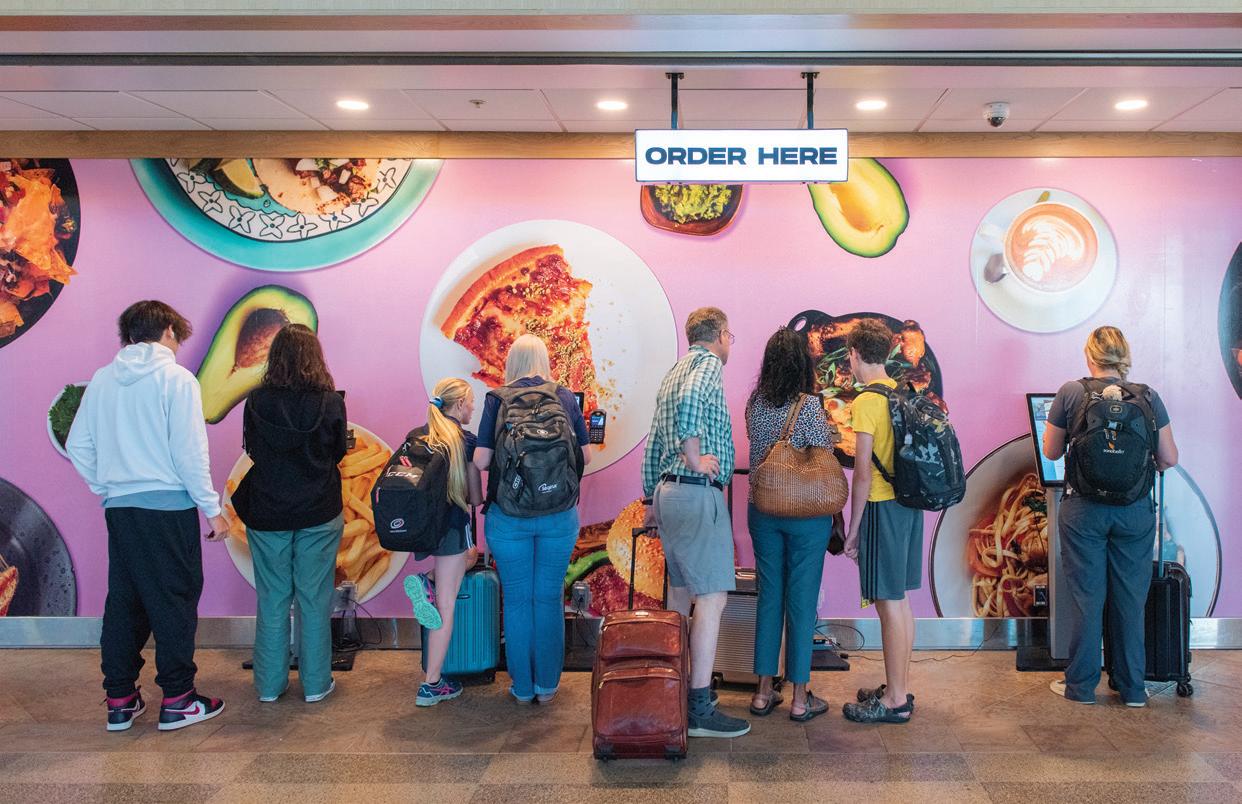
beginning of the project is not nearly as bad as a day at the end of the project. We’ve mitigated [that risk] by having a professional staff that focuses on early procurement of goods. We have not signed a lease yet, but we’re looking at a 60,000-square-foot warehouse to store goods in a threeyear lease term,” he said. The warehouse would allow the storage of important appliances, including refrigerators, washers, dryers and even windows, for the nearly 1,500 units currently under construction or in development, thus tempering the possibility of supply shortage or shipping issues in the future.
This past spring, the Durham residential market was in a frenzy, with homes going under contract within one to two days and selling substantially
over listing price. “There is no doubt that the housing market is experiencing a reset, but we don’t look at this as a bad thing,” said West & Woodall Real Estate co-owner Kirk West. “ … Now we’re coming back to reality. While higher interest rates are proving to be a barrier for some would-be buyers, and supply still isn’t keeping up with demand, buyers are regaining some of their power. This is evident in the fact that we’re back to talking about days on the market for homes as opposed to hours; appropriately priced homes are still getting asking for the most part, but it’s not way over as we were seeing; and due diligence fees are lower.”
Even with the market slowing down due to increased interest rates (the Federal Reserve raised its key interest rate in July for
october/november 2022 | Durhammag.com | 101
Human. Urban. Built for the Future.
Research Triangle Park’s downtown coming soon.


Featuring retail, food and beverage, a hotel, 20+ miles of connected outdoor trails, 16 acres of greenspace, programming at the event lawn, a community splashpad and so much more!
 FOLLOW
STORY @HUBRTP
FOLLOW
STORY @HUBRTP
THE
HUBRTP.COM
durham inc.
the fourth time this year as a means to fight inflation. This decision marked the second time in a row the Fed has raised rates by three-quarters of a percentage point.) and supply struggling to keep up with demand, residential real estate seems to be in no danger. According to Stacy Slone, a Realtor with West & Woodall Real Estate, “Because we’re in a thriving area with top universities and a high number of medical and research jobs, I’ve seen from experience that the real estate market here in Durham isn’t as reactive to economic pressures as many other parts of the country.”
The real estate boom has kept moving companies busy, too, but staff shortages and inflated operating costs can spell trouble. Elevated gas prices eat up profits, especially for long-distance moves. “Though it feels at times all we can do is grin and bear it, we have made an effort to negotiate expenses where we can to shift dollars from other ‘buckets’ in an effort to adjust margins,” said Brooke Wilson, franchise owner of Two Men and a Truck’s Chapel Hill and Durham locations. “Offering customers more cost-effective, long-distance move solutions, like our new ‘less than truckload’ (or LTL) Interstate Moving option, helps.” The company adopted this service earlier this year, partnering with freight shippers to expedite small container loads out of town for their customers. This offered a more affordable option for long-distance moving and kept valued front-line teams in town to service more customers.
With staff shortages plaguing small businesses nationwide,
Wilson has made employee retention her goal. “We have always invested in our employees, and I think it’s the only thing that’s kept our growth steady,” she said. “We’ve created dedicated space for teams to hang out with locker rooms and showers. We provide snacks and breakfasts. Flexibility in work schedules and genuine care for work-life balance is important. Happy employees create happy customers.” When hiring new employees, Wilson said she sets clear expectations and communicates regularly. “In 2022, we have become more amenable to recruiting from out of the Triangle area, offering relocation packages when it makes sense,” she said. “It’s most important for us to make the right investment up front, to ensure long-term retention.”
DINING OPTIONS
While the pandemic and the current economic climate forced many restaurants and eateries across the country to shut down or left them struggling, Durham’s celebrated food scene found creative and innovative ways to drive success.
On West Main Street, Ethiopian restaurant Goorsha expanded its demographic by utilizing a back building on its
current lot to introduce a new coffee shop and lounge, Gojo by Goorsha. Cozy, and in keeping with Goorsha’s Ethiopian influence, the shop serves locally roasted coffee beans, teas and local pastries along with a filling lunch menu.
Next door, Maverick’s Smokehouse and Taproom maximized space and diversified its offerings by including a porchfront ice cream shop called Scoop Local The shop provides fresh French Pot-style ice cream mixed inhouse. Its menu sports classic flavors like chocolate and vanilla, as well as sundaes, sorbets and mochi.
Elsewhere downtown, local businesses and organizations are collaborating to strengthen and support its vibrant ecosystem. Every Thursday evening since February, restaurants within the Downtown Loop, including COPA, Queeny’s and M Pocha, host a Small
Plates Crawl
Appetizer portions of food and drinks are prepared for customers to try, and they are encouraged to hop from one establishment to the next on a culinary adventure of sorts.
In August, artists, musical performers, food trucks and more came together and took part in the Foster Street Block Party, hosted in part by Durham Central Park, Cecy’s Gallery, The Glass Jug Beer Lab and Durham Food Hall

“Small, local businesses make our downtown the lively, cool place that it is,” said Nicole J. Thompson, president and CEO of Downtown Durham Inc. “They create the culture and buzz that draw the major employers,

104 | durhammag.com | october/november 2022
ABOVE Aqiis Horton and James Brown play pingpong before a shift at Two Men and a Truck. BELOW Jeremiah Neville and Mike Hairston fill a moving truck with boxes.
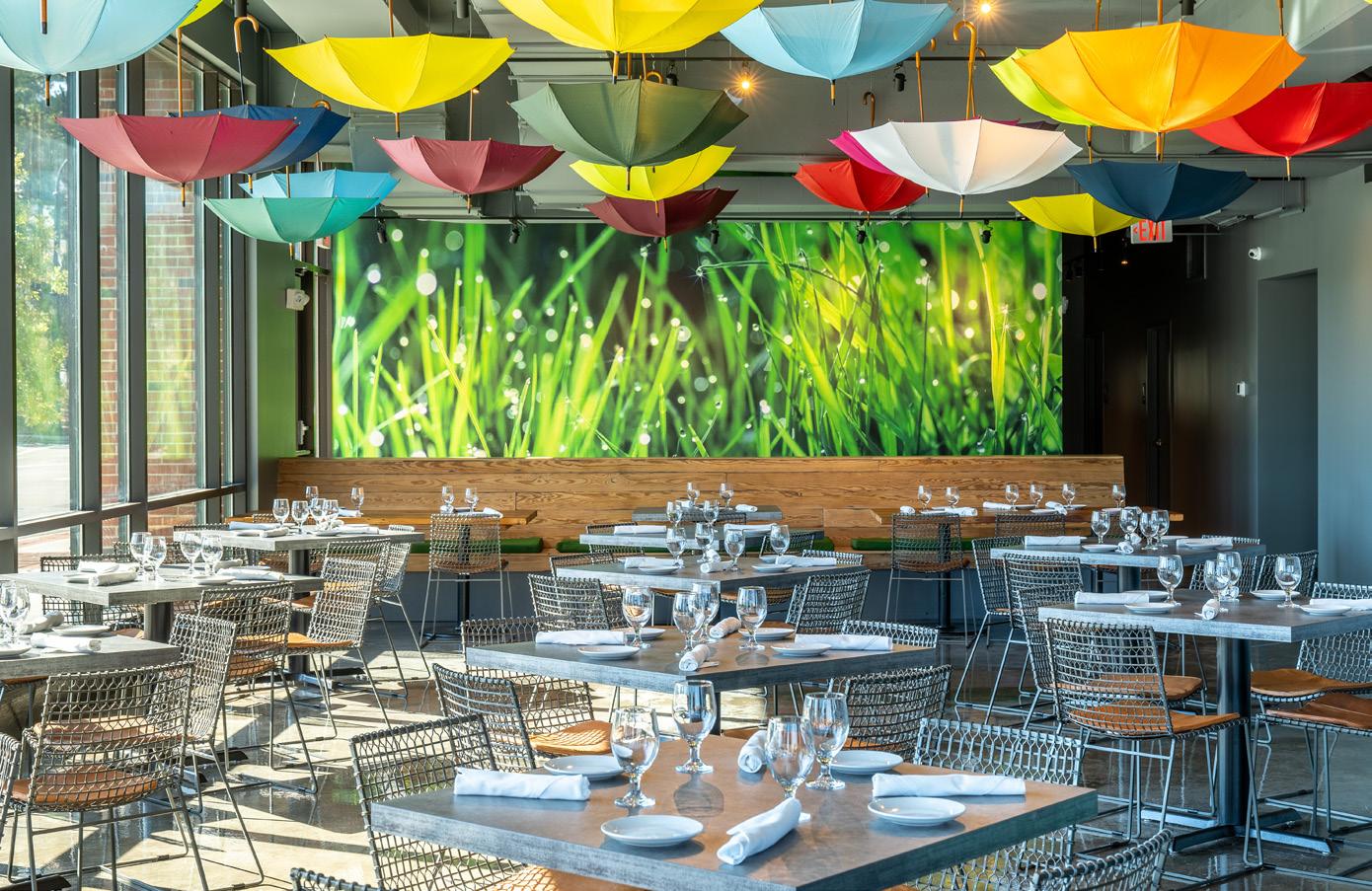
2022 We're here for your commercial construction needs. We believe supporting our community is essential for sustainable growth and future generations. 919-797-2527 GATEWAYBUILDCO.COM 618 RAMSEUR ST. | SUITE 102 DURHAM, NC 27701 Commercial General Contracting Services | Pre-Construction Planning | Construction Management GATEWAY_BUILDING_COMPANY Thank you Durham for voting us Best Commercial Builder! We are honored!
residential developments and visitors that bring critical jobs and revenue to our entire region. … Customers need to shop their values and buy local. They need to visit restaurants for lunch and during the week so that those restaurants can be confident in hiring the staff they need to open their doors for longer hours. As consumers, we should all continue to support the places we love with our dollars, our presence and our patience as businesses staff up and as we come out of the pandemic.”
Meanwhile over at RaleighDurham International Airport, a recent partnership between REEF Technology and HUBB Kitchens called getREEF has changed the game with a virtual kitchen. The “ghost kitchen,” which allows customers to order and pick up their food all without interacting with another human being, was installed in July in RDU’s Terminal 2 behind a wall in Concourse C. Customers use kiosks or the getREEF phone app to order. A QR code is then sent to customers to open a locker near the kiosks and take their meal when it’s ready.
The kitchen staff are taught to prepare a streamlined menu consisting of food and beverages from nine different brands, including Pei Wei and Rebel Wings, as well as local brands Beyu Caffe and American Meltdown. If one brand doesn’t sell well, the menu can easily be updated with substitutions rather than endure the long process of replacing an entire restaurant.
“This has been an enjoyable partnership with REEF Technology and HUBB Kitchens,” said Beyu Caffe owner Dorian Bolden. “Currently, we focus on providing our coffee beans and specialty coffee beverages [but are looking] at pastries or breakfast sandwiches in the near future.”
Always adapting to the economic climate, Bolden also launched an online service through Beyu’s website in 2020 to accommodate pickup and delivery orders, expanded into providing Beyu’s signature coffees for wholesale and retail sales in 2021, and has recently introduced a new breakfast program featuring in-house baked pastries and breakfast sandwiches. To help frontline and essential workers, Bolden partnered with Durham County during the pandemic to launch the Beyu Food Project (formerly EATNC), a meal delivery program. In less than a year, the project supplied almost 300,000 meals. Today, it’s focused on giving support to older adults and food-insecure families in Durham.
Bolden additionally raised the wages and salaries of his employees to stay competitive and to lessen financial pressures on his workers, but he recognizes that there is more that can be done. “We still have over 650,000 jobs unfulfilled in the restaurant industry,” he said.

Bolden elaborated his views on an episode of Caffeinate Your Career, a YouTube series produced by Frontier RTP. “The goal is to develop a workforce development program that [follows Beyu Food Project],” he said. “That’s the stuff I’m
really excited about. It’s creating a foundation and a business model that we can then [use] to really help tackle food insecurity. Tackling food insecurity is tackling poverty. … We want to figure out another path where we collaborate with our local community colleges to provide training and education, and then we can provide the workforce development piece to go with it.”
A COMMON THREAD
Bolden isn’t the only one shifting focus to these types of programs. “All the focus is on [the] workforce,” said Ryan Regan, vice president of economic development for the Greater Durham Chamber of Commerce. “We see great appetite from local employers to forge new public-private partnerships with local institutions of higher education that can help companies meet ever-evolving talent needs.
The Building Up Local Life Sciences (BULLS) initiative is an example of a promising local public-private workforce development partnership.”
The BULLS program aims to create a system of equitable pathways to promising employment opportunities in local life sciences companies
for underrepresented Durham students and workers between the ages of 18 and 24. The long-term goal is “to harness [Durham’s] dominant industry to create access for the city’s communities of color to the high-earning jobs that are the foundation for sustained wealth creation.”
The Chamber has routinely worked with workforce development partners like Durham Technical Community College, North Carolina Central University and the Durham Workforce Development Board to ensure an alignment among the needs of local employers, job training services and local workforce development partners. “Since 2020, the Chamber has assisted with 18 economic development projects involving a new company relocation to Durham or the expansion of an existing company,” Regan said. “These projects collectively represent over 7,600 new announced jobs for our community and over $2.1 billion in newly announced capital investment.” Indeed, Durham’s economic future looks bright, thanks in no small part to the creative and spirited efforts of these organizations that call the Bull City home.
durham inc. 106 | durhammag.com | october/november 2022
Neville and Hairston practice loading a moving truck.


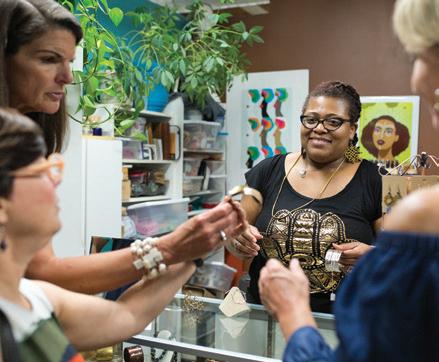
Handy, one-tap You-Are-Here feature Search by cuisine or shop specialty Mobile-friendly → → → downtowndurham.com/map Downtown Durham Merchant Map with the Shop • Dine • Drink • Experience
BIZ BRIEFS
ON THE MOVE
Wolfspeed announced in September that it will begin construction on a $1.3 billion silicon carbide wafer manufacturing plant in Chatham County, with plans to occupy 1 million square feet at the 445acre site. Wolfspeed will hire nearly 1,800 employees in the next eight years.
After five years as the member relations director for the Greater Durham Chamber of Commerce,
Tiffany Bashore joined Downtown Durham Inc. as the director of business engagement in August. In this role, Bashore serves as the primary contact for retail, restaurant and service businesses in the downtown area.
Alexandra Benson also joined Downtown Durham Inc. in August as its new placekeeping and events manager, a role in which she works to strengthen the connection between public spaces and people and manage public activations and event strategies. Benson previously worked for the City of Durham’s Cultural and Public Art Program
J’Ingrid Mathis was named executive director and associate director for management of the National Institute of Environmental Health Sciences
facility in Research Triangle Park
In this role, Mathis oversees approximately 1,600 federal employees, trainees and contractors, as well as funding that benefits more than 839 NIEHS research grants.
Mathis has served as the chief of operations of the inhouse laboratories at NIEHS since 2015.
Henry McKoy, the North Carolina Central University School of Business director of entrepreneurship; professor of practice in strategy and entrepreneurship at UNC; and affiliated faculty member at Duke University’s Samuel DuBois Cook Center on Social Equity, accepted a presidential appointment to serve as the inaugural director of the Office of State and Community Energy Programs. McKoy also serves as director emeritus of Hayti Reborn, a revitalization project for the African American community in Durham.
AWARDS & HONORS
Smartest Dollar released a study in June that ranked the DurhamChapel Hill area No. 7 among midsize U.S. metropolitan areas with the most innovative workers, based on data from the Bureau of Labor Statistics that shows the number of people in creative jobs such as arts and STEM fields.
Several Durham-based startups made the “Tweener List,” a comprehensive annual list of growth-stage startups in the Triangle created by Triangle Tweener Fund CEO Scot Wingo. Among the minorityand women-led startups in Durham that made the list are: Bee Downtown, WorkDove, BrightView Technologies, Stashpad, DaVinci Education, InHerSight, Written Word Media, Zaloni and LoanWell
Two Durham employers were named among the 2022 best employers in North Carolina by Business North Carolina. Talent booking company All American Entertainment was named one of the best medium-sized (25-50 employees) employers, and United Way of the Greater Triangle was named a top small (1-25 employees) employer.
North Carolina Biotechnology Center board member Karen LeVert won the 2022 Women in Agribusiness
Demeter Award of Excellence in August during the Women in Agribusiness Summit in Dallas. This honor is bestowed on women who have a minimum of 10 years of experience in agribusiness and have excelled or demonstrated outstanding contributions to the industry while helping create opportunities for others. LeVert is a venture partner of Pappas Capital, which invests in life sciences, and cofounder of agricultural innovation lab Ag TechInventures.
DEVELOPMENT
NightHawk Biosciences, which innovates immune system therapies, announced a plan to construct an advanced biosafety level 2 laboratory that will add biodefense and infectious disease research capabilities to its existing RTP facility, following NightHawk’s acquisition of Elusys Therapeutics earlier this year.
FUNDING
Biotech startup Xilis raised an additional $19 million to fund the development of precision cancer therapies after raising an initial $70 million in 2021. Founded in 2019 by Dr. Hans Clevers and Duke University professors Dr. David Hsu and Xiling Shen, Xilis aims to improve patient outcomes by focusing on drug discovery and development, and creating personalized cancer treatments.
FlexGen, a software platform providing energy storage solutions, announced $100 million in Series C investment anchored by energy trading company Vitol and existing investors. This latest round of funding will allow the company to grow cost-effective and reduced-carbon energy storage grids.
Keen Decision Systems announced $11 million in Series B investment in July from growth equity investor Ballast Point Ventures. The funding will support Keen’s decision optimization engine, which uses predictive analytics to improve brand performance for clients. This innovation is the first and only of its kind in the industry.
durham inc. 108 | durhammag.com | october/november 2022
Compiled by Caitlyn Yaede
Shop Small Saturday | Holiday Tree Lighting Downtown Durham November 26

DowntownDurham.com
Startup Built Story, a digital marketplace for self-guided tours, was selected as a recipient of $100,000 in support from the Google for Startups Latino Founders Fund. Co-founders Alexina Alonso (pictured right) and Brian Alonso (pictured left) launched Built Story in 2020, and will also benefit from Google mentorship and a community of fellow Latino founders.
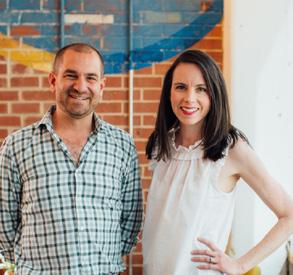
Duke’s Office for Research & Innovation awarded funding to eight startup projects, chosen from among 61 proposal finalists, as part of the inaugural Duke Science and Technology Launch Seed Grants. Recipients include a platform called FINNEAS which implements a cloudbased tool to analyze infant MRIs; the Duke Registry for Equitable Access to Medicine which assess structural inequities faced by transgender and nonbinary people seeking health care; an electronic drugdelivery device to treat Type 2 diabetes; a team working to optimize plant growth in higher temperatures; a study analyzing the use of wearables to monitor patients after surgery; a study testing samples from the Ellerbe Creek Watershed to measure watershed ecotoxicology; a proposal to use artificial intelligence to measure human behavior; and a proposal for the use of solar energy to enhance chemical reactions.
Crisis response software startup NeedsList received a $1 million grant from Google on World Refugee Day in June. This funding, alongside the work of pro bono software engineers, will help NeedsList expand its services worldwide, including extending aid to those affected by the crisis in Ukraine.
Vestaron, a producer of peptidebased crop protection solutions based in RTP, was awarded $10 million in Series C funding from Grosvenor. This funding brings Vestaron’s total investments to $92 million and will be used to streamline production processes.
PARTNERSHIPS & ACQUISITIONS
Worldwide Clinical Trials announced a collaboration with Invitae, a biotech company specializing in medical genetics, to facilitate clinical trials in rare disease research. Worldwide gains access to Invitae’s Explorer tool, making it the first contract research organization to use the platform of aggregated genetic testing data. The demographic data acquired by Worldwide will help to identify patients eligible for research and potentially to discover life-saving treatments.
NCCU was selected as an education partner in Amazon’s Career Choice program, making it the first historically Black university in the state to participate. The program offers prepaid college tuition, industry certifications and more for Amazon’s hourly employees. Twenty-five students are expected to enroll in the first cohort of the program.
New York-based CommerceHub announced in September that it would acquire commerce solution company ChannelAdvisor for $23.10 per share. This decision was made with unanimous approval by the boards of directors of both companies, which will jointly expand opportunities for retailers.
Capitol Broadcasting Company, which owns American Tobacco Campus and the Durham Bulls, announced in September the intention to acquire the Coastal
Plain League. CPL is a premier summer collegiate baseball league that consists of 13 franchises across four states. Since 2017, CBC has owned and operated the Holly Springs Salamanders, a member of the league’s east division.
IN OTHER NEWS
A Duke Health research team identified a way to use the gene-editing tool CRISPR to treat and prevent COVID-19. The findings, authored by Duke University Department of Pathology professor Qianben Wang, showed promise after animal testing illustrated that the technology could block infections. This research paves the way for the development of a self-administrable inhalant therapy, which could potentially keep patients from contracting COVID-19 after close contact with the virus.
The Engineering Research Center for Precision Microbiome Engineering was established at Duke University with funding from a $26 million grant from the National Science Foundation, to be distributed over five years. The project seeks to better understand the microbial communities of indoor spaces called “built communities.” The center is home to more than 40 researchers, almost half of whom are women and 20% of which are members of historically marginalized groups in STEM. The project is in collaboration with NC A&T State University, UNC, UNC-Charlotte and NC State University.
Audio-visual design and installation company Kontek Systems, which was founded in 1988, announced the creation of an employee stock ownership plan in October. The company employs more than 37 full-time staff at its Durham offices. The goal of the plan is to empower employees to build equity, maintain an employee-centric
culture and foster continued growth while providing liquidity for shareholders.
Innovate Durham selected five companies to take part in the 2022 Innovate Durham Program; ZROverse Inc., Lavni Inc., Resolved Analytics, SmartBridge Inc. and Durham Success Summit. The 16-week partnership with the City of Durham and Durham County aims to test new technologies, build innovation capacities, support local businesses and provide direct support to organizational challenges within the city and county. Out of the companies selected, 60% are Black-owned and half are women-owned.
As part of its community outreach and education efforts, Strata Clean Energy launched the NC Clean Energy PreApprenticeship – the first solar apprenticeship program in the state. Designed for rising high school juniors and seniors, the program includes a 176-hour work-based learning course with compensation of $10 per hour. In July, participants at Halifax Community College received 40 hours of on-the-job training necessary to enter the workforce.
Zero waste company
Fillaree, which produces household cleaners and body care products, announced in July that its Soap & Suds hand and body wash passed antimicrobial effectiveness testing through thirdparty evaluator Microchem Laboratory. This independent testing proves the product’s effectiveness against microorganisms, such as E. coli.

110 | durhammag.com | october/november 2022
PHOTO COURTESY OF AMAZON CAREER CHOICE PROGRAM
engagement
Yannick Lloyd & May Wahdan
BY SINCLAIR HOLIAN PHOTO BY LAING YOUNG
Wedding Date Sept. 4, 2022














Occupations May is a project manager for Kitchen & Bath Galleries in Cary and the founder and principal consultant of Maybert Home. Yannick is a Durham-based real estate agent and property developer with eXp Realty.

Crossed Paths May and Yannick grew up in Durham and attended Riverside High School and Jordan High School, respectively. Both joined the dating app Bumble after college, and May connected with Yannick in person at West End Wine Bar in November 2017. Their relationship blossomed over the next 4 ½ years. The Proposal After enjoying dinner at Stoney River Steakhouse and Grill in Chapel Hill this past
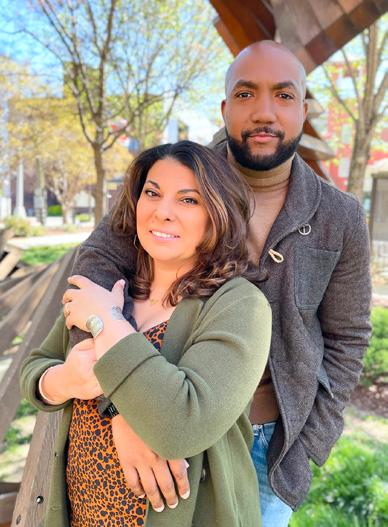
Valentine’s Day, the pair returned home to lit candles, music and Champagne on ice, coordinated by Yannick and his best friend, Toia Harris. Thinking the evening’s surprises were over, May changed into pajamas to enjoy a glass of bubbly. She spilled some of the drink while opening the bottle and was so busy cleaning up that she didn’t notice Yannick on one knee. “Don’t get any of that on what I have in my hand!” he said, holding a custom Boudov diamond engagement ring. May, shocked, screamed, “Yes!”
Finally, “I Do” Brianna Church of Raleigh’s Pink Planner Events organized the ceremony and reception at The Cookery. The groomsmen wore tuxes from Bernard’s Formalwear, and Posh The Salon styled May’s hair. Guests enjoyed Mediterranean fare from Bleu Olive Bistro while Samantha Everette Photography captured special moments on the big day.
Come to Look. Leave Inspired.
2022
OF


























WILL BE — October 1-2, 7-9, 14-16 For more information on this event and to schedule your tour, visit www.TriangleParade.com









Triangle Parade of Homes





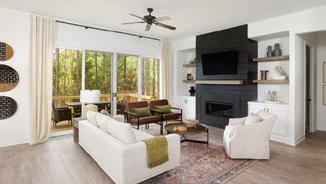


october/november 2022 | Durhammag.com | 111 THE
TRIANGLE PARADE
HOMES
#TriangleParade |
wedding

Elizabeth Renee Connor & James William Ryan Pope
BY CAILEY CETANI
PHOTO BY PHOTOS BY CLAY, PHOTOSBYCLAY.COM
Date Nov. 6, 2021
Occupations Ryan works as a project manager for Duke Energy at the Harris Nuclear Plant, and Renee, a hairstylist, owns Salon Elysian by Renee.
Crossed Paths Renee and Ryan met on a dating app and had their first date on June 28, 2018. The two immediately bonded over shared interests in travel, fine dining, music and art, plus their family and life goals. Renee says that they had so much in common it made her head spin. She was drawn to Ryan’s charm and says he was a “total gentleman.”
The Proposal After a few months of dating, Renee and Ryan visited Bailey’s Fine Jewelry to window-shop for engagement rings. Ryan proposed nine months later at a scenic overlook of the Blue Ridge Mountains on vacation in Asheville, their favorite mountain getaway.
The Big Day The couple hosted a rehearsal dinner at Mothers & Sons Trattoria before their eclectic ceremony and reception at 21c Museum Hotel, which embodied a moody theme inspired by “A Midsummer Night’s Dream,” but reimagined in deep fall shades. Ryan wore a swanky all-black suit from Ticknors Men’s Clothier,
while Renee’s elegant gown came from Lucy’s Bridal in Vass, North Carolina. Abundant candles decorated the museum and former bank vault. Guests enjoyed a catered meal from Counting House and cake from Cary’s Once in a Blue Moon Bakery & Cafe, while performers from Down to Earth Aerials poured Champagne as they hung from silk fabrics.
Favorite Moments Renee says that she felt emotional “seeing everything set up for the reception and knowing all my hard work and planning had paid off.” Ryan says that he cherishes memories of the first look they shared and posing with the wedding party in the bank vault.

Do you live in Durham and want your wedding or engagement featured in our magazine?
Email amanda.maclaren@durhammag.com.
112 | durhammag.com | october/november 2022


Live a healthy, active, fulfilling life. Duke Lifestyle & Weight Management Center provides a one-stop-shop for those seeking weight loss services, and features a lifestyle-based approach that incorporates every aspect of your life. Services Available: § Medical weight loss services § Nutrition consultations § Behavioral health § Low-calorie, meal replacement program - Optifast® § Body composition measurement with Bod Pod® Call for an appointment 1-800-235-3853 Duke Lifestyle & Weight Management Center 501 Douglas St. Durham, NC 27705 DukeHealth.org/DLWMC