CELEBRATE GOOD TIMES

September/October 2022 vol. 6, no. 2 Best ofIssue Readers share their favorites Page 42 38 Fall Arts Guide 114 Flower Fields Forever 122 Local Pet Perks & Resources Our5th annual
The Plant – named
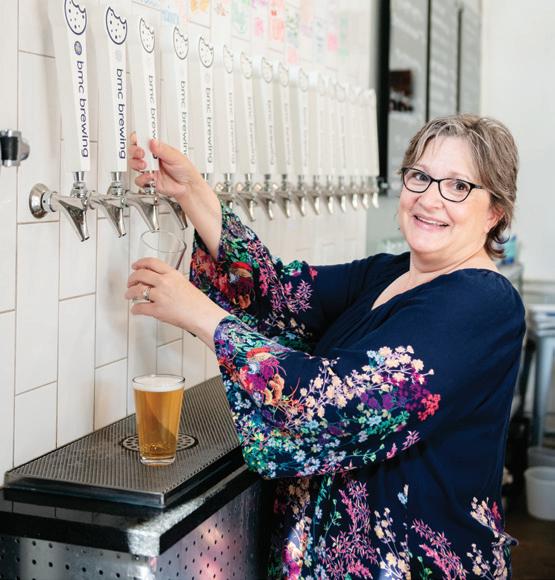
of our best event venues –is also home to readers’ favorites like the Chatham Beverage District, Copeland Springs Farm and Kitchen, Fair Game Beverage Co. and BMC Brewing.
one











2022
SEPTEMBER/OCTOBER 2022 CHATHAMMAGAZINENC.COM
PUBLISHER/VICE PRESIDENT Chris Elkins chris.elkins@trianglemediapartners.com
EXECUTIVE MANAGING EDITOR Amanda MacLaren editorial@chathammagazinenc.com
EDITOR, CHAPEL HILL MAGAZINE
EXECUTIVE EDITOR, CHATHAM MAGAZINE Jessica Stringer
MANAGING EDITOR, CHATHAM MAGAZINE Anna-Rhesa Versola rhesa@chathammagazinenc.com
EDITORIAL ASSISTANTS
Renee Ambroso and Brooke Spach
EDITORIAL INTERNS
Kate Brownstein, Cailey Cetani, Valeria Cloës, Ben Crosbie, Sam Edge, Catherine Esrey, Teresa Fang, Sinclair Holian, Natalie Huschle, Abigail Keller, Katie MacKinnon, Isabella Reilly, Caleb Sigmon, Megan Tillotson and Caitlyn Yaede
CONTRIBUTORS
Lori D. Roberts Wiggins and Amber Watson
CREATIVE DIRECTOR
Kevin Brown
PHOTOGRAPHER
John Michael Simpson
GRAPHIC DESIGNER/PRODUCTION COORDINATOR Lindsay Scott
GRAPHIC DESIGNER
Khadijah Weekes Nolan
ADVERTISING
For information, contact advertising@chathammagazinenc.com Melissa Crane melissa.crane@trianglemediapartners.com
Kem Johnson kem.johnson@trianglemediapartners.com Lucinda Poole lucinda.poole@trianglemediapartners.com Dana Statkun dana.statkun@trianglemediapartners.com
PRODUCTION MANAGER Ashlin Acheson
2 CHATHAM MAGAZINE SEPTEMBER / OCTOBER 2022
FOUNDER/CHAIRMAN Dan Shannon PRESIDENT, TRIANGLE MEDIA PARTNERS Ellen Shannon PRESIDENT, TRIANGLE DIGITAL PARTNERS Rory Kelly Gillis VICE PRESIDENT OF FINANCE & ADMINISTRATION Amy Bell PUBLISHER, HEART OF NC WEDDINGS Jenna Parks
TRIANGLE DIGITAL PARTNERS Sally Scruggs DIGITAL OPERATIONS MANAGER Lizzie Jones DIGITAL CUSTOMER SERVICE SPECIALIST Brian McIndoo DISTRIBUTION Matt Bair ACCOUNTING & ADMINISTRATION INTERN Cassady Orsini Chatham Magazine is published by Triangle Media Partners 1777 Fordham Blvd., Ste. 105, Chapel Hill, NC 27514 919–933–1551 Subscriptions are $24 for 2 years –subscribe at chathammagazinenc.com 10441 US 15-501 N Chapel Hill, NC 27517 919.942.2922 dlcofchapelhill.com
There
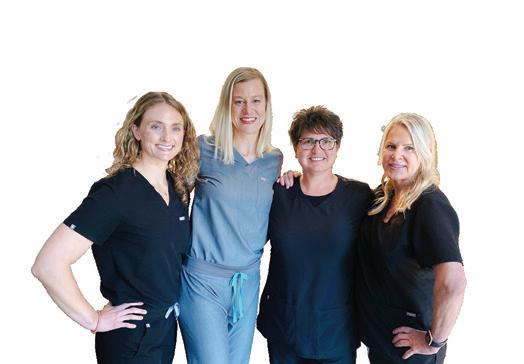
Chris G. Adigun, MD, FAAD Karlee Wagoner, ANP-BC Diana
PA-C Jenny
LME Feels Like Family 2021 2022 202 2 Voted Best Of Chatham 2019-2022 Voted Best Of Chapel Hill 2017-2022 New location less than 1 mile away!
CREATIVE DIRECTOR,
Chris G. Adigun, MD is a board certified dermatologist and a recognized leader in dermatology. She is known for her expertise in laser and aesthetic dermatology as well as her warm, compassionate and down-to-earth personality. Dr. Adigun’s team is comprised of top notch, dermatology-trained professionals, offering the latest technology and treatments.
is a reason DLC has been voted Best of Chapel Hill and Best of Chatham every year since we opened the doors. It’s simple, DLC treats everyone like family!
Walker,
Jahoo,







At Your Best
Iwas reading an online article recently and was struck by the phrase, “perfection is an illusion.”
It was a much-needed reminder to adjust my thinking to strive for progress, not perfection, and that doing your best may not be perfect, but it is good – great, even.
It was apt timing, as we recently asked our readers to vote for their favorite businesses – from restaurants and art galleries to services and retail shops – for the fifth year in a row. Thousands of Chathamites weighed in, sharing their beloved breweries, nonprofits, sports clubs and more with us. (Find the full list of winners starting on page 82.) But there’s always room for improvement, especially as our county grows. If you have suggestions for a new category or two you’d like to see in 2023, I invite you to email me.
You’ll also find a series of stories featuring more than a dozen Best of Chatham winners, starting on page 44. The first of these introduces Paul F. Gagne as the new executive chef at The Fearrington House Restaurant, where excellence has been a constant for the past 40 years. According to staff, the secret ingredient for their success is teamwork. On page 56, there is another team of sorts at The Plant, where the businesses have created their own unique community to support one another and succeed together.

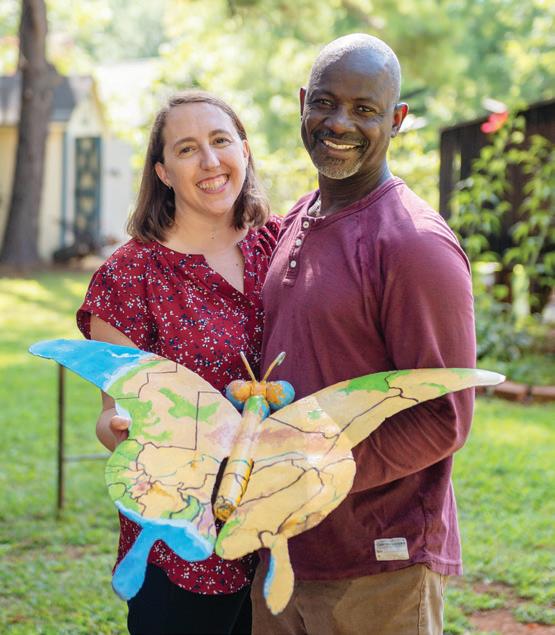
Elsewhere in this issue, you’ll read about artists like Emma Skurnick, whose hand-illustrated essays capture the soul of Bynum, the old mill town along the banks of the Haw River (page 30). Read on to meet Hamidou Sissoko, who left his home in Mali to be with the woman he loves in Pittsboro and discovered his talent for metal sculpture (page 34).
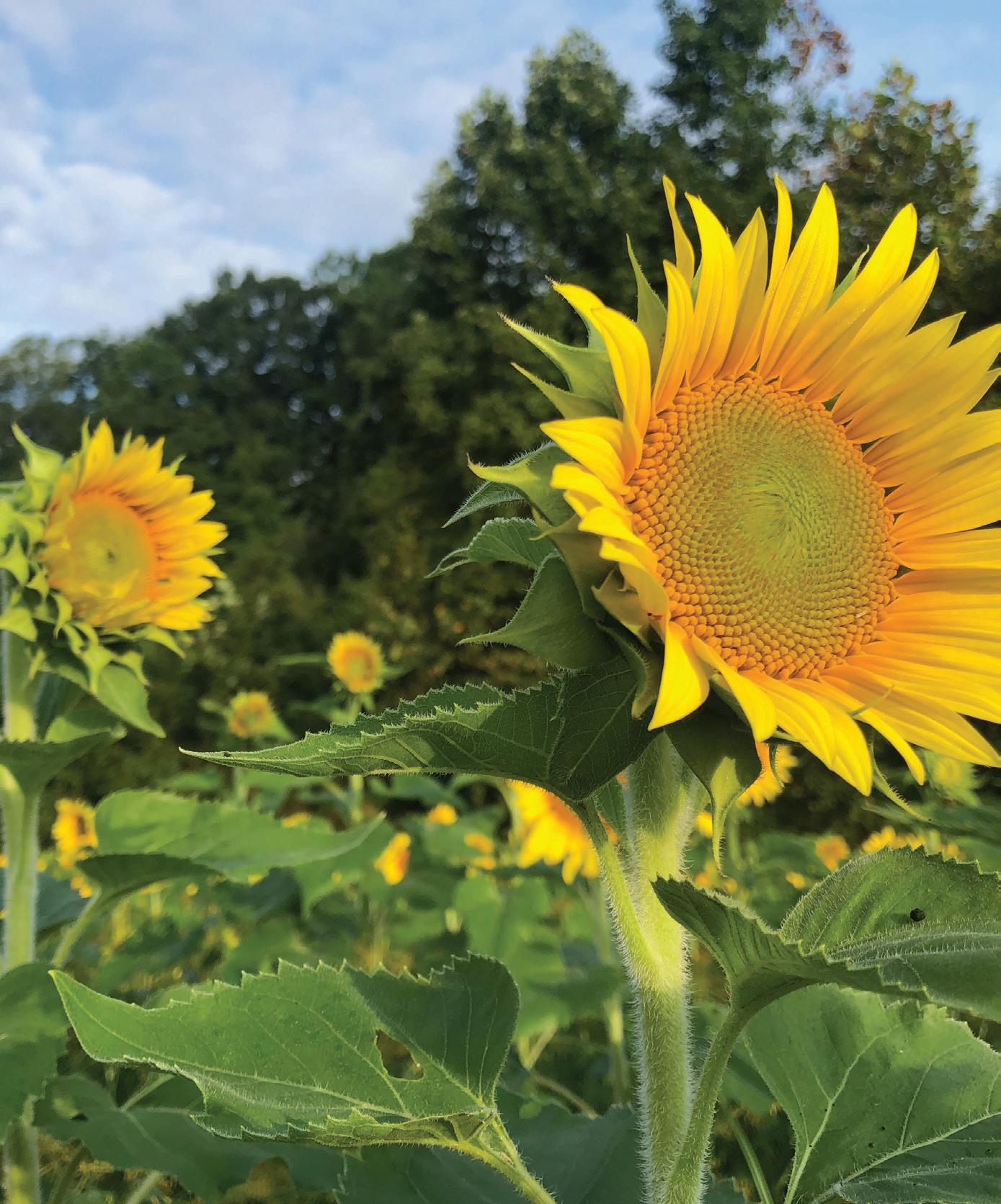
One of my favorite stories in this issue is about a reluctant flower farmer in Silk Hope. Turn to page 114 to learn about Emily Fuller’s mission to brighten lives with her beautiful blooms. “When you give somebody flowers,” Emily says, “you’re giving them a gift they probably wouldn’t buy for themselves, which is the best gift you can give somebody.” CM

4 CHATHAM MAGAZINE SEPTEMBER / OCTOBER 2022
LETTER FROM THE MANAGING EDITOR
THE COVER
Photo by John Michael Simpson
Katye Cairns, Lauren Earnhardt, Jake Pickens, Lindsay Earnhardt and Farid Lazaro walk the promenade at The Plant with Tucker, the Earnhardt family dog.
Anna-Rhesa Versola
rhesa@chathammagazinenc.com


Vibrant living. Continuing care. In the heart of Durham. 800-278-9729 / forestduke.org/TheTerraces KEEP GROWING SM New contemporary apartment homes for retirement. Learn more at forestduke.org/TheTerraces. HURRY — PRESALES HAPPENING NOW! TERRACES The Redefine retirement. BECOME A CHARTER MEMBER TODAY!
BEST OF CHATHAM
& COLUMNS
PEOPLE & PLACES
FEATURES
CONTENTS SEPTEMBER / OCTOBER 2022
44 The
The
50 The
Meet
56 Whimsically
and
An
businesses
62 A
One
sustainability
beer
68 The
How
72 At Your Service This automotive shop runs on dependability 76 Culture Club Children learn and play in Spanish at this Pittsboro
82 The Best of
2022 Winners
30 Tall Tales from a Small Town A Bynum artist preserves community history through illustrated essays 34 Heavy Metal A stay-at-home dad redefines himself through sculpture 38 Fall Arts Calendar Can’t
concerts, events and shows
Changing of the Chef
Fearrington House Restaurant’s kitchen sees new leadership
Stuff of Dreams
the family behind some of Chatham’s best frozen treats
Weird
Wonderful
eclectic community of local
create a niche for success
Brewer’s Dozen
taproom offers a study in
through cookies made with
byproducts
Family Biz
a few of our readers’ fave companies benefit from working with relatives
preschool
Chatham
FALL ARTS
miss
22 Hit
Venture
96 Less
Less How
downsized
114 Flower
Meet
122
Pet-focused
125 Pet Resources A guide
4 Letter
the Managing
8 Five Events You won’t want to miss 10 Noted What we’ve
around our
… 26 Who’s
in Town
Susannah
works to improve soil
water
through conservation 126
Commercial
128 Wedding Barrett
the Road
outside Chatham for a day (or two!), and explore all that North Carolina has to offer
is More, More or
a couple in the Hamptons
without giving up space
Power
a Silk Hope farmer who shares much more than produce with her community
Pawsitive Growth
businesses see national industry trends on a local scale
to area vets, animal hospitals, groomers, boarders and pet sitters DEPARTMENTS
from
Editor
heard
towns
Who
& County Government
Goldston
and
quality
Here We Grow Again
development updates, plus a look at upcoming projects
& Parks
14 Women
16 Tomato
18 Bynum
19 Pittsboro
20 Mosaic
of Achievement luncheon
Fest at the Pittsboro Farmers Market
Front Porch concert
Gallery of Arts reception
at Chatham Park concert
34 62
PHOTOGRAPHY BY JOHN MICHAEL SIMPSON

































•
•
•
Scan this QR Code for more travel inspiration! Explore Kersey Valley Attractions’ Corn Maize Adventure, Sunflower Extravaganza, & Pumpkin Patch in Archdale, NC Pick apples at Millstone Creek Orchards and find your perfect pumpkin in Ramseur, NC Shop Seagrove and find a unique pottery pumpkin or gourd at the Potters’ Pumpkin Patch in Seagrove, NC Our background photo features
Valley Attractions’ Sunflower Extravaganza
ARCHDALE • ASHEBORO • FRANKLINVILLE • LIBERTY • RAMSEUR • RANDLEMAN
SEAGROVE
STALEY
TRINITY
Kersey
Flatwoods Festival
SEPT. 9-10
The Tri-County Ruritan Club hosts its 24th annual celebration on Chatham Street in downtown Bennett starting with a Friday night auction at the local fire department. On Saturday, join fellow onlookers and line the street to watch a parade of antique cars, trucks, tractors and horses. Enjoy food and craft vendors, live music and inflatable bounce houses. tricountyruritan.com
PepperFest
SEPT. 18, 3-7 p.m.
The 15th annual event at The Plant puts peppers grown by local farmers front and center. Piedmont-based eateries offer up samples of pepper-themed culinary creations and beverages. Festivities include a performance from The RT’s, a
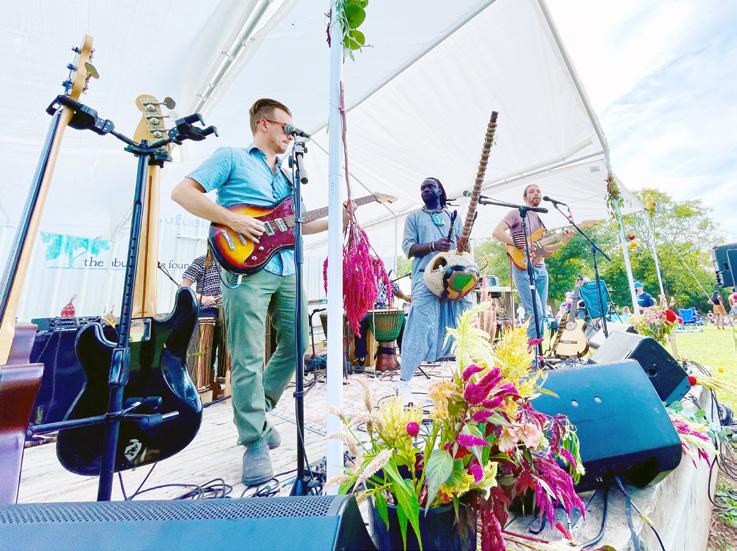
Bring family and friends out to a pepper-centric celebration of the agriculture industry at The Plant.
high-energy jazz and blues band, plus acrobatic displays by Imagine Circus. The Circle City Supper Club will offer cooking classes as well as pepper arts and crafts. The evening wraps up with dancing to Latin fusion music by ¡Tumbao! abundancenc.org
Huckleberry Trail Farm Fall Festival
WEEKENDS, SEPT. 24 – OCT. 30 & MONDAY, OCT. 31
Visitors can pick pumpkins, jump on a hayride and race through a corn maze at the farm located off Highway 64 between Siler City and Pittsboro. There will be refreshments and fall produce for purchase. The host’s mission is to bring all kids back outdoors and make the farm activities both wheelchair accessible and autism friendly. huckleberrytrailfarm.com
Goldston Old Fashion Day
OCT. 8, 9 a.m.-4 p.m. The 35th annual street festival in the Goldston historic district features local arts and crafts, pottery and jewelry along with a classic car show, tractor display and live music. Multiple food vendors will offer traditional fair food and drinks, such as funnel cakes, lemonade, hot dogs and ice cream. visitpittsboro.com/events
Fall-O-Ween Trunk R’ Treat
OCT. 28, 5:30-8 p.m.
EVENTS ARE SUBJECT TO CHANGE; CHECK WITH ORGANIZERS PRIOR TO ATTENDING.
Siler City Parks and Recreation hosts its sixth annual drive-thru Halloween event at Bray Park Sports Complex with free admission to all. Local businesses, civic organizations and governmental departments will participate in this event where families visit car trunks to receive candy instead of ringing doorbells. Kids can enjoy inflatable bounce houses, obstacle courses and slides, plus an outdoor screening of the Disney movie “Encanto.” silercity.org CM
8 CHATHAM MAGAZINE SEPTEMBER / OCTOBER 2022
YOU WON’T WANT TO
FIVE EVENTS
MISS
Compiled by Cailey Cetani
PHOTO BY ANNA-RHESA VERSOLA
STRENGTH BEAUTY PASSION S B P





The desire to be moved—to seek knowledge, insight and experiences that take you to new places and shed light on the world around you—find it with PBS North Carolina. From across the pond to across our state, discover personal stories and inspiring programming that will stir your emotions and keep you engaged. Follow your curiosity pbsnc.org

Sanditon on Masterpiece
WHAT WE’VE HEARD AROUND OUR TOWNS ...
.
ON THE MOVE
Jennifer D. Scott, one of 27 lawyers in the state to have specialty designations in residential, business, commercial and industrial transactions, was named in-house general counsel for Windjam Companies, a Raleigh-based land developer.

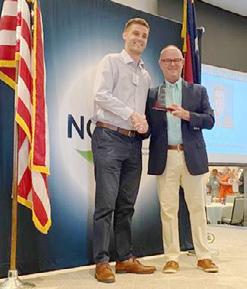
Chatham Economic Development Corporation’s former senior project manager Sam Rauf was named Emerging Leader of the Year at the annual meeting of the North Carolina Economic Development Association, recognizing his exemplary leadership in the state’s economic development efforts.


Bold Construction hired Tim Dowds as its new operations manager. Tim has more than 35 years of experience in the residential construction industry, including home building, plan design, remodeling and renovations.

WHAT AN HONOR

G. William Powell accepted the Asheim Scholarship for graduate study in the School of Information and Library Science at UNC.
Heidi Schouten is one of two Central Carolina Community College alums this year to be chosen for the Goodnight Transfers Scholars Program at NC State. The scholarship is valued at $22,000 per year for up to three years. She plans to major in crop and soil sciences.
Bailey Jones (above right) and Victoria Smith (below right), NC State students from Pittsboro, were awarded the John Henry Tripp Scholarship from the Chatham County Livestock Association. Bailey, a junior, hopes to pursue a career in veterinary medicine, while Victoria, a freshman, will study animal science.
The Northwood High School Lady Chargers basketball team won the N.C. High

School Athletic Association’s 3A State Championship on March 12, marking Northwood’s first-ever state championship in any sport. The Pittsboro Board of Commissioners issued a proclamation celebrating the achievement, and the town is awaiting Department of Transportation approval to place a commemorative sign on roads entering Pittsboro.
Freelance writer and teacher Dolly R. Sickles was awarded the 2022 Randall Kenan Prize from the North Carolina Literary Review for her interview essay, “Examining ‘Otherness’ on the Page and in the Classroom with Michele Tracy Berger.” The prize, sponsored by UNC’s Creative Writing Program, recognizes the year’s best essay about or interview with a new North Carolina writer. Dolly will receive a $250 honorarium, and her essay will be featured in NCLR’s 2022 issue.
The Louise L. Tuller School of Nursing at CCCC held a pinning and candle ceremony for its associate degree in nursing program’s class of 2022, which includes Brittney Hart of Bear Creek and Katelyn Taylor of Moncure. The school also held a ceremony
10 CHATHAM MAGAZINE SEPTEMBER / OCTOBER 2022
LET US KNOW WHAT YOU'VE HEARD! EMAIL NOTED@CHATHAMMAGAZINENC.COM NOTED
Compiled by Ben Crosbie
for its practical nursing program, which includes Camia Woods of Siler City.
CCCC’s Dental Assisting program also held a pinning ceremony for its class of 2022, which includes Avery Headen of Siler City, Cassidi Maness of Bennett and Ashley Stanley of Bear Creek.
This year’s CCCC Academic Excellence Award recipients who are from Chatham are: Allyson Dinius; Drew Cox; Annika Lowe; Katie McGowan; Elmer Mateo-Estrada; Moses Matthews; Avery Headen; Sarah Lawter; Brandon Dickens; Jordan Phillips; Latoyia Williams; Leslie Wiseman; Sara Stewart; Patricia Aguilar Teutle; Scott Busenlehner; Moises Peraza; Cameron Stevenson; Tasha Grasty; Brandon McKoy; Deontae Jordan Glover; Samantha Andrews; Daniel Mitchell; Erica Francisco-Vargas; Sarah Lawter; Juana Gomez Soriano; Soren Kappelman; Lorelei Byrd; Lindsay Seitz; Richard Joiner and Heather Taylor Noah Civiletti won the Cary C. Todd Award in mathematics, and Deontae Jordan Glover received the excellence in academic assistance award.
Galloway Ridge was certified as a Great Place to Work for the second year by the Great Place to Work Institute. The certification process involves surveying employees and evaluating more than 60 elements of team members’ experiences.
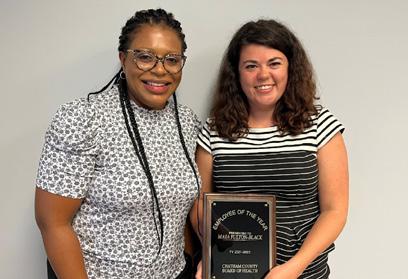
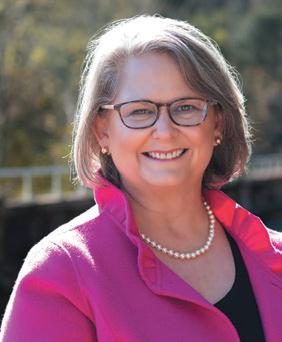
The Chatham County Board of Health chairperson Karen Barbee, pictured left, recognized Maia Fulton-Black, pictured right, as the department’s 2022 Employee of the Year. Maia is a health data scientist who uses data analysis to provide insight and guidance to the board.
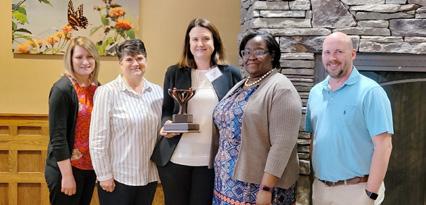
Sharon Dickens, a north Chatham financial advisor at Edward Jones Advisors, earned the Jack Phelan Award for her exceptional achievement in building client relationships. Chatham County Department of Social Services Director Jennie Kristiansen, pictured center, was named the 2022 N.C. Association of County Directors of Social Services’ Director of the Year. Jennie has served in the department for 15 years and has been its director since 2014.
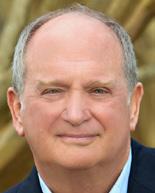
Preston Development Company Vice President of Planning
Chuck Smith was elected to the Council of Fellows by the American Society of Landscape Architects. This is one of the highest honors awarded by the ASLA and recognizes successful work, leadership, management, knowledge and service. Chuck currently leads the planning and development of Chatham Park.
Three United Way of Chatham County residential campaigns earned a 2021-22 Spirit of North Carolina Award from the United Way of North Carolina, which recognizes campaign excellence and honors groups whose United Way campaigns exemplify the spirit of their community. The winning campaigns were Governors Club, Carolina Meadows and Encore at Briar Chapel. The Governors Club campaign raised the most money by any North Carolina neighborhood in United Way’s history.
Friends of Lower Haw River State Natural Area Co-Founder and President Gretchen Smith received the he N.C. Wildlife Federation’s 2022 Public Lands Conservationist of the
Year award for her work to help protect public lands and her conservation efforts in the Haw River corridor. NCWF will honor Gretchen and other award recipients at a Sept. 10 banquet in Cary.
NEWS BITES
Ta Contento food truck co-owners Hans Vargas and Nora Anaya opened a brick-andmortar at the Eagles gas station near Cole Park Plaza. The menu features Mexican dishes with vegan options.
The newest location of Aye! Toro, which serves traditional Mexican recipes with fresh ingredients and handcrafted margaritas and cocktails, will open in Pittsboro at the intersection of Old Rock Springs Cemetery Road and Hillsboro Street near Powell Place this fall.
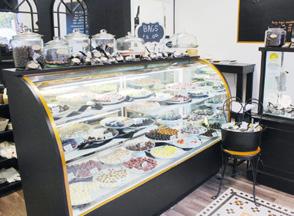
Sanford’s The Chocolate Cellar founders Laura Phelps and her daughter, Carol Wiley, opened a second shop, The Chocolate Cellar Deux, in downtown Pittsboro at 119 Hillsboro St. They offer handmade truffles, chocolate-covered caramels and more.
IN OTHER NEWS Governors Club raised more than $180,000 for nonprofits at two events in April and May. The Governors Club Wine Society’s biannual Pop the Cork raised $80,000 for the Chatham Education Foundation and The Learning Trail, both of which provide education services and resources to students in need, while annual breast cancer fundraiser All for the Pink, hosted by the Governors Club Women’s Golf Association, raised $100,000 for the Pretty in Pink Foundation to provide uninsured breast cancer patients with financial assistance for medical treatment.
SEPTEMBER / OCTOBER 2022 CHATHAM MAGAZINE 11
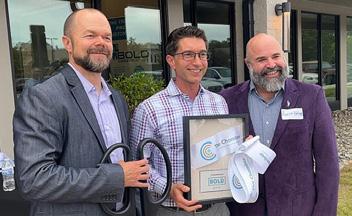
Bold Construction held a ribbon-cutting ceremony in May for its new office in Governors Village. Though completed two years ago, the ribbon cutting was postponed due to the pandemic.
A $164.9 million county budget was approved for the 2022-23 fiscal year by the Chatham County Board of Commissioners,
with major priorities focusing on expanding and enhancing services to meet the needs of our growing population and providing support for public education.
The Wren Memorial Library in Siler City announced new events and programs, including semimonthly game nights for all ages and a book club, which will meet
every other week. Visitors can also “book a librarian” for informational sessions about searching for jobs, conducting research and other technological help.
Here to help you retire.
I’m not just here for insurance. I can also help you look at your retirement goals and build a plan for tomorrow. Let’s start today.
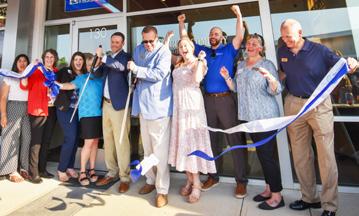
Harris & Company Insurance, an 87-yearold company specializing in auto, home, business and life insurance, celebrated its office opening on May 19 in Mosaic at Chatham Park
SAVE THE DATE
The Community Remembrance Coalition –Chatham and the Equal Justice Initiative will memorialize six victims of racist lynchings that took place in Chatham between 1885 and 1921 – Jerry Finch, Harriet Finch, John Pattishall, Lee Tyson, Henry Jones and Eugene Daniel – with a historical marker that will be installed on the south side of the County Government Annex in Pittsboro. A public unveiling ceremony will be held at 9 a.m. on Sept. 24.
Sara Donaldson, President www.insurewithsara.com Pittsboro, NC 27312 Toll Free: 833-415-0283 Se habla Español
This year’s Triangle Parade of Homes will be held from noon-5 p.m. on Oct. 1-2, 7-9 and 14-16. This free, self-guided tour showcases new home construction with innovative designs, products and technology. Preview the featured homes in Wake, Durham, Orange and Chatham counties at triangleparade.com.
North Carolina author Jason Mott, whose novel “Hell of a Book” won the 2021 National Book Award for Fiction, will speak at the Fall for Literacy Luncheon hosted by Chatham Literacy on Nov. 5 at the Chatham County Agricultural and Conference Center in Pittsboro. A book signing will follow the event. CM
12 CHATHAM MAGAZINE SEPTEMBER / OCTOBER 2022 NOTED
1708167.1
State Farm Bloomington, IL
Sara Donaldson Ins Agcy Inc





LIVE ARTS EXPERIENCES From new works and partnerships to returning crowd-pleasers and collaborators, our fall season features music, dance and drama to drive vital conversations and revive our shared sense of place. Join us as we rediscover, together, the joy and connection that only live arts experiences can offer. SEPTEMBER THE SOUL REBELS WITH SPECIAL GUEST BIG FREEDIA A celebration of Southern style OCTOBER WHY NOT THEATRE PRINCE HAMLET A modern take on Shakespeare’s classic story AFRICA FEST 2022: MEKLIT Africa Fest 2022 headliner BILL T. JONES / ARNIE ZANE COMPANY WHAT PROBLEM? Dance in pursuit of the elusive “we” NOVEMBER BOBBI JENE SMITH BROKEN THEATER An immersive dance, theater and cinematic experience DAVID NEUMANN AND MARCELLA MURRAY FOR ADVANCED BEGINNER GROUP DISTANCES SMALLER THAN THIS ARE NOT CONFIRMED An intimate dialogue about race, scale and time DECEMBER JAZZ AT LINCOLN CENTER ORCHESTRA FEATURING DIANNE REEVES BIG BAND HOLIDAYS Holiday spirit, style and swing EMANUEL GAT DANCE LOVETRAIN2020 A colorful, choreographic ode to the 80s 9/23 10/7 10/15 10/28-29 11/11-12 11/18-19 12/2 12/7 CAROLINAPERFORMINGARTS.ORG
REDISCOVER
Honoring Women
BY BROOKE SPACH | PHOTOGRAPHY BY JOHN MICHAEL SIMPSON
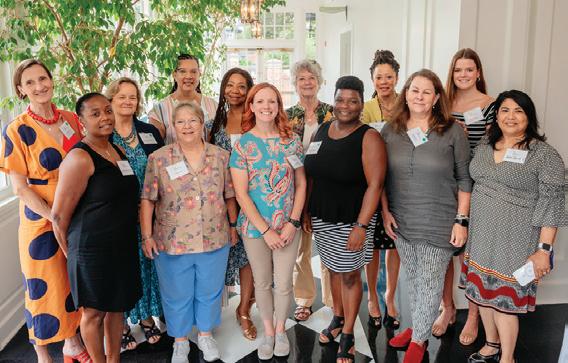
Chatham Magazine, Durham Magazine and Chapel Hill Magazine hosted the annual Women of Achievement Luncheon at The Carolina Inn on June 9. The event celebrates the women recognized in our publications as outstanding leaders in our communities. Attendees enjoyed networking and mimosas, followed by lunch and desserts by Crossroads Chapel Hill. Rory Gillis, president of Triangle Digital Partners, and Chris Elkins, vice president of Triangle Media Partners and Chatham Magazine’s publisher, recognized the 2022 honorees and announced Triangle Media Partners’ new mentoring program in partnership with Durham Public Schools, which aims to provide high school girls access to myriad careers. At press time, there were hopes to expand the program to Orange and Chatham counties in the future. CM
1 Chatham Magazine’s 2022 Women of Achievement with Managing Editor Anna-Rhesa Versola.
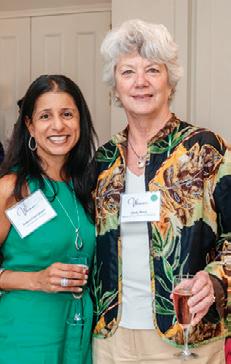
2 Reena Patel Bland and Pittsboro Mayor Cindy Perry, a 2022 honoree.
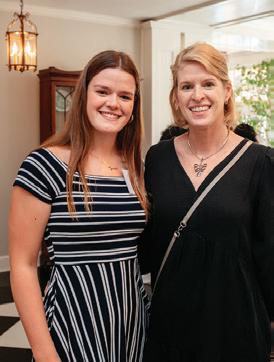
3 2022 honoree and Northwood High School grad Gwen Høeg and her mother, Erin Høeg.
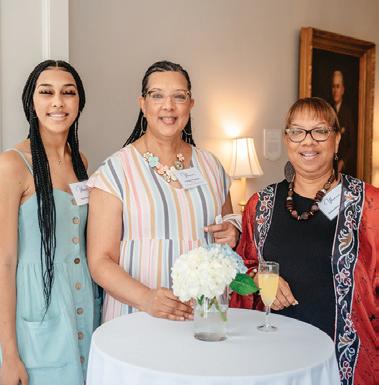
4 Faith Paschal, Chatham County Elections Director Pandora Paschal, a 2022 honoree, and Gwendolyn Thompson.
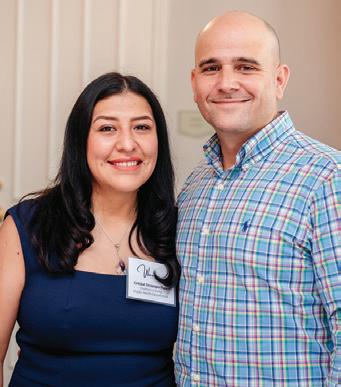
5 2022 honoree Cristal Ocampo Ruiz of the Chatham County Public Health Department and her husband, Pedro Ruiz.
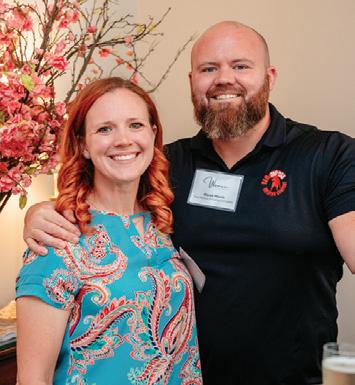
6 2022 honoree Brandi Morris and Derek Morris, co-owners of Red Moose Brewing Company.
14 CHATHAM MAGAZINE SEPTEMBER / OCTOBER 2022 PEOPLE & PLACES
1
2
3
4
5
6
Cambridge Hills Assisted Living is committed to being the area’s premier senior living community, as shown by 12 consecutive years of 4-Star Ratings! We strive to enhance each resident’s quality of life with award winning activities programs and quality of care. 140 Brookstone Lane, Pittsboro NC 919 545 9573


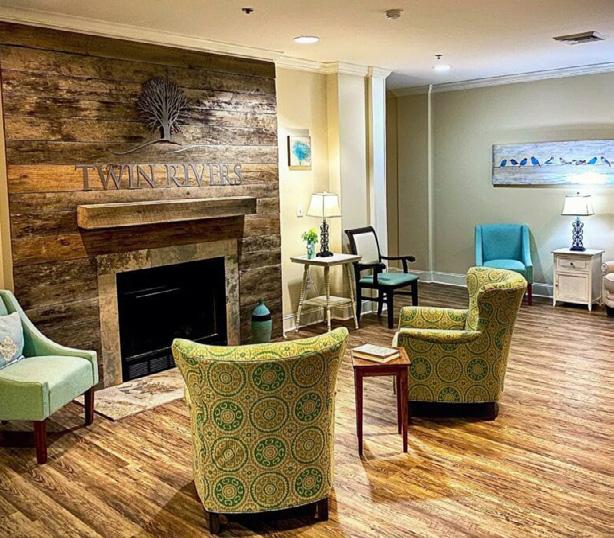
Twin Rivers Independent Senior Living is a cozy, 31 unit community that feels like home. Residents lead an independent lifestyle, in their own residences, while enjoying the social activities offered by our caring staff.
We pride ourselves in having a hometown feel and caring staff who become like family. Both communities are locally, veteran owned. silver-thread.com
INDEPENDENT LIVING
25
celebrating 16
OF EXCELLENCE IN SENIOR LIVING, IN CHATHAM COUNTY
S. Rectory Street, Pittsboro NC 919 545 0149
YEARS
Easy as Tomato Pie
BY ISABELLA REILLY
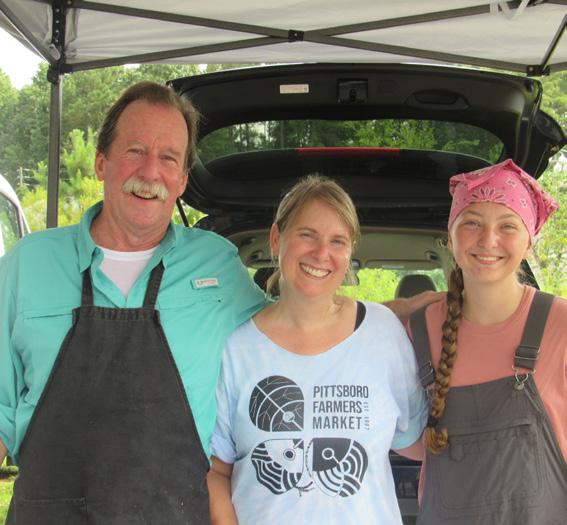
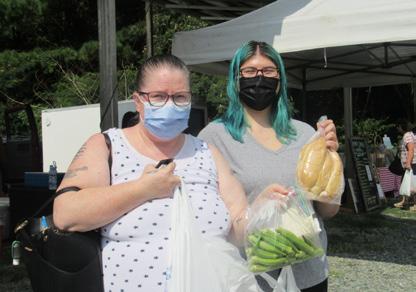
The Pittsboro Farmers Market held its second annual Tomato Fest at its new location at The Plant on July 21. The summer fruit-themed event included a tomato pie contest, where attendees were invited to sample and vote on a winner. Of eight pie entries, Justin Stiles won the Top Tomato award. The judges were Sera Cuni, owner and chef at Cafe Root Cellar; Tami Schwerin, co-owner of The Plant; and Debbie Roos and Tara Gregory, both of the North Carolina Cooperative Extension’s Chatham County Center Clarissa Griner was awarded the people’s choice award based on attendees’ votes, with Cheryl Harris winning first runner-up for the people’s choice.
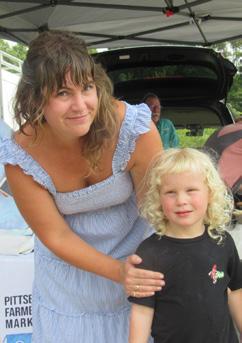
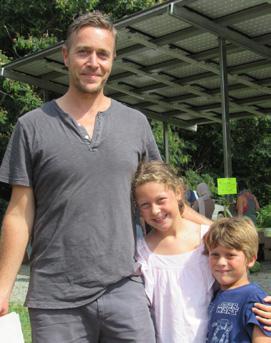
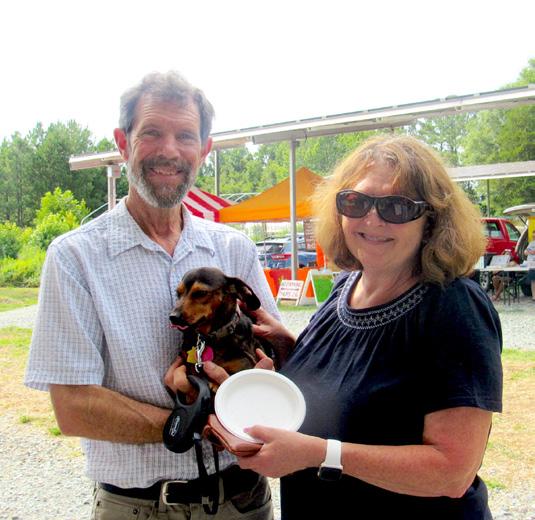
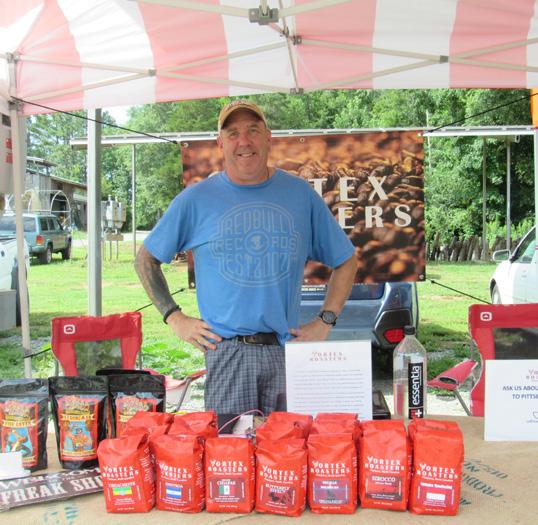
Celebrity Dairy kept visitors cool in the summer heat with chilled selections of goat milk items like spreadable cheeses, yogurts and gelato. Heart Song Farm, The Plant Factory and In Good Heart Farm offered guests a variety of tomatoes and other seasonal produce. Granite Springs Farm featured samples and recipe cards of Aunt Patty’s tomato spread, and Lilly Den Farm offered meat plus treats for four-legged friends. Rocky River Hemp sold Chatham County-grown hemp oil, and Vortex Roasters stocked its ethically sourced coffee blends.
Vendors at the year-round market can only sell items they grow or produce within a 50-mile radius to ensure fresh local offerings. It’s open every Thursday from 3-6 p.m., rain or shine. CM
16 CHATHAM MAGAZINE SEPTEMBER / OCTOBER 2022 PEOPLE & PLACES
5 3 1 2
4
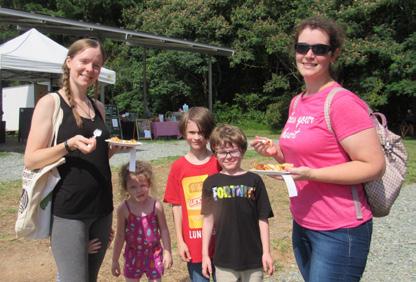
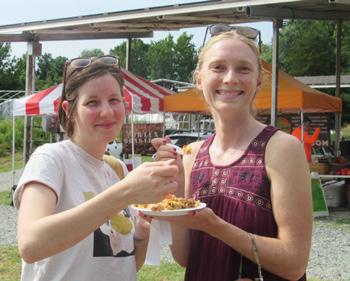
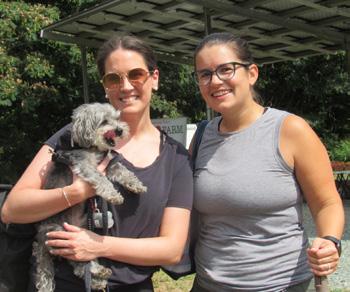
1 Jim Cameron, Pittsboro Farmers Market Manager Elizabeth Thomas and Mikaela Uptmor.
2 Mark Stover of Vortex Roasters.
3 Katie Fanfani and Bowie Bunyea, 4.
4 Alexander Kast, Amelia Kast, 9, and Ulrich Kast, 5.
5 Pete Crawford, holding Zoe, and Katherine Smart.
6 Tammy Cerdena and Mia Cerdena.

7 Caitlin Lowe, holding Rooney, and Tori Hinde.
8 Syler Blankenship, 2, hides behind Amanda Davidson alongside Lydia Griner, 4, Evan Griner, 9, Isaac Griner, 7, and Clarissa Griner.
9 Tamsen Hall and Hannah Sykes.
SEPTEMBER / OCTOBER 2022 CHATHAM MAGAZINE 17 PEOPLE & PLACES If you want to help children, invest in adult literacy. The single greatest indicator of children’s success is the literacy level of their parents. 43% of adults with low
in
36 million adults
Break the cycle of poverty: Reach a child in need – Teach an adult to read. VOLUNTEER • SUPPORT • DONATE ChathamLifeHalfH.indd 1 7/23/21 4:35 PM If you want to help children, invest in adult literacy. The single greatest indicator of children’s success is the literacy level of their parents. Reach a child in need – Teach an adult to read. VOLUNTEER • SUPPORT • DONATE (919)
chathamliteracy.org chathamliteracy 36 million adults
have low literacy skills. 43% of adults
literacy skills live
poverty.
in the U.S. have low literacy skills. www.chathamliteracy.org facebook.com/chathamliteracy 919-742-0578
742-0578
in the U.S.
with low literacy skills live in poverty.
6 8 9 7
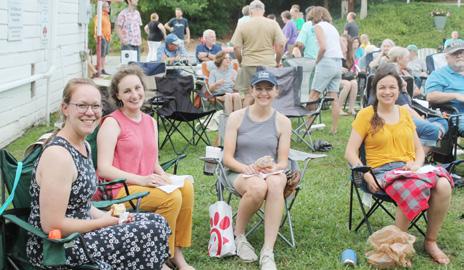
1 Chris Johnston and Rebekah Ginter.
2 Nancy Lovas, Diane Tyndall, Courtney White and Amanda Windes.
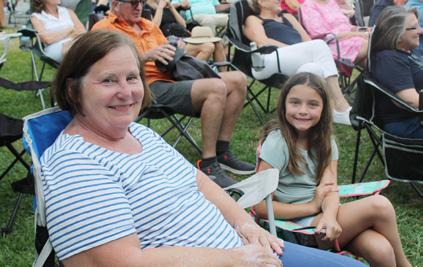
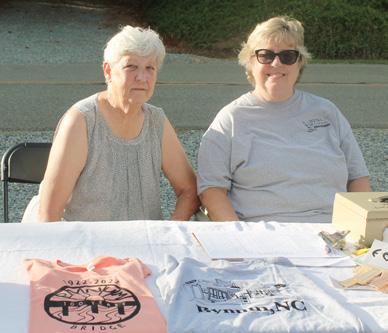
3 Martha Collins and Susan Johnson.
Jammin’ Out
BY RENEE AMBROSO
Chapel Hill’s indie-folk group Honey Magpie performed July 1 as part of the Bynum Front Porch Friday night concerts next to the Bynum General Store. Singer and guitarist Rachael Hurwitz, pianist Mandy Mears and cellist Pippa Hoover – all co-songwriters – shared bluegrass and pop-inspired tunes from their latest album, “Midnight Morning,” plus covers of popular folk songs. This season of the quintessential summer music series included performances by more than a dozen local bands. It wraps up Sept. 9 with a performance from John Howie Jr. and the Rosewood Bluff. CM
18 CHATHAM MAGAZINE SEPTEMBER / OCTOBER 2022 PEOPLE & PLACES
1 2
Sign up as an individual, a twosome, threesome, or as a team! There will be 3 flights: Foursome, Couples, and Ladies. SAVE THE DATE! Saturday, October 8th, 2022 Afternoon Shotgun Start 4 Person Scramble $125 per person For more information contact: 919-542-1932 kpsutphin@centurylink.net Chapel Ridge Champions 11th Charitable Golf Tournament at The Golf Club at Chapel Ridge Proceeds to benefit the UNC Lineberger Comprehensive Cancer Center Proudly sponsored by the Chapel Ridge Champions Team 18 holes of Golf, Food, and Prizes!
3
A Reception to Remember
 BY CAITLYN YAEDE
It’s never too late to throw a party. Nearly two years after the Pittsboro Gallery of Arts opened its doors, artists and supporters of the arts community celebrated with a grand reception on June 17. The transformed space at 44-A Hillsboro St. is now an artist-owned and -operated cooperative featuring art forms in various mediums, including painting, photography, fiber art, mosaics and more.
“We were able to bring in art lovers from far and near,” says Pittsboro Gallery of Arts President Beth Bale. “It was truly a spectacular evening. The crowd was amazing; the old acquaintances renewed were touching. And all of the new acquaintances we made will continue to enhance our lives and our community.”
Member artist Trudy Thomson describes the gallery as a destination showcase of regional fine arts and crafts for visitors curious about life and culture in a small town like Pittsboro. She says member artists have even traveled across state lines since November 2020 to regularly attend meetings and activities on-site. CM
1
2 Ellie Fishbein with her mother, artist Sarah Fishbein.
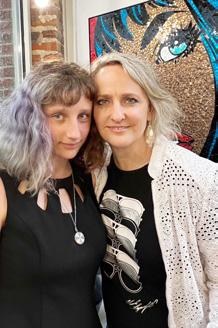
3 Rob Hill, Theresa Arico, Alina Cochran and Andy Cochran.
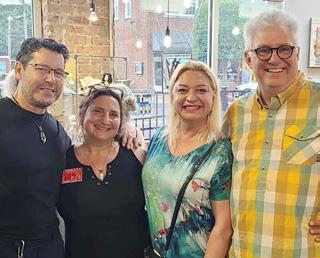
SEPTEMBER / OCTOBER 2022 CHATHAM MAGAZINE 19 PEOPLE & PLACES
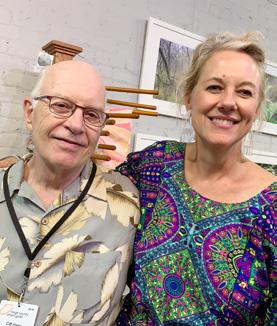
Artists Cliff Haac and Dawn Hummer.
1 2 3
Center Stage
BY ANNA-RHESA VERSOLA
On June 2, local developer Kirk Bradley presented a plaque to Liquid Pleasure lead vocalist Anthony Springs and band leader Kenny Mann, acknowledging them as the first band to perform on the stage at Mosaic at Chatham Park, located near 367 Freedom Pkwy. That first performance was held on Oct. 1, 2021, and the band returned in June to kick off Mosaic’s series of free live performances, which take place every other Friday until Oct. 21. Attendees at the June concert enjoyed offerings from food trucks like Ta Contento plus beer from BMC Brewing and Red Moose Brewing Company. CM


1 Liquid Pleasure plays on the Tommy Edwards stage at Mosaic at Chatham Park.
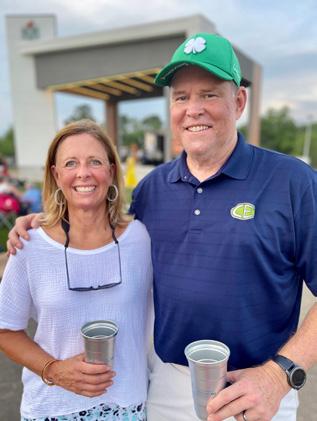
2 Margaret Ashness and Mark Ashness.
3 Scott Cabe and Courtney Cabe.

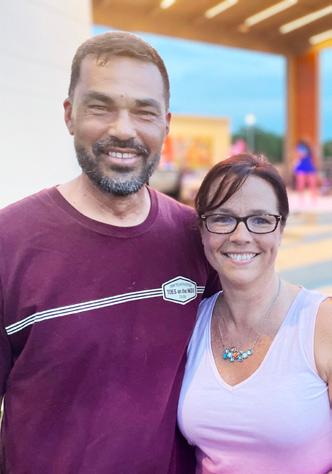


4 Anthony Springs, Kirk Bradley and Kenny Mann.
5 Singer Tonya Williamson with Beth Coulter.
6 Linda Holloway and Charles White.
7 Marcus Van Hagen and Jasmine Van Hagen.
20 CHATHAM MAGAZINE SEPTEMBER / OCTOBER 2022 PEOPLE & PLACES
1 4
2 5 3 6 7
At The Village at Brookwood, you’ll find an intimate community nestled among parks and walking paths, with opportunities to stay active, both physically and mentally. Centrally located in Burlington, NC, you’ll find all the options you need to build the life you’ve planned.




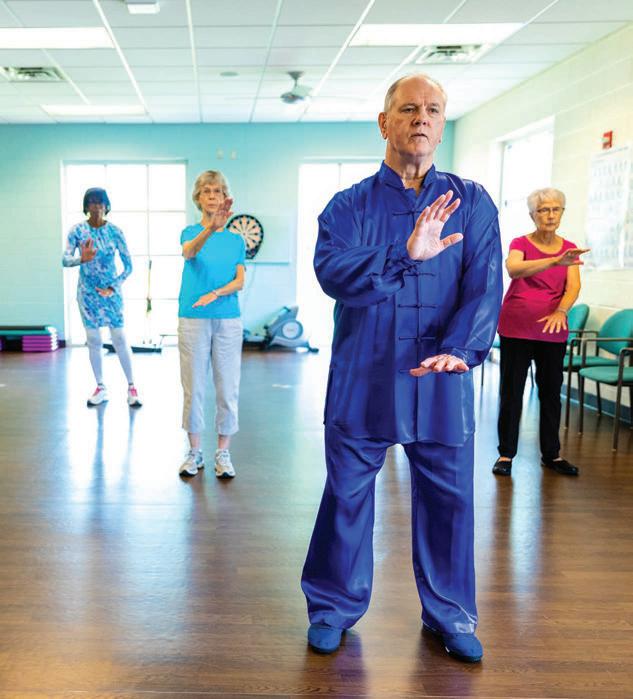

Call to schedule a visit today! 336-570-8400 1860 BROOKWOOD AVE, BURLINGTON, NC VILLAGEATBROOKWOOD.ORG
Energize Your Spirit Best FIND THE OF ALL WORLDS YOU CAN HAVE IT ALL WITHOUT THE WORRY AT Cultivate Your Soul
HIT THE ROAD
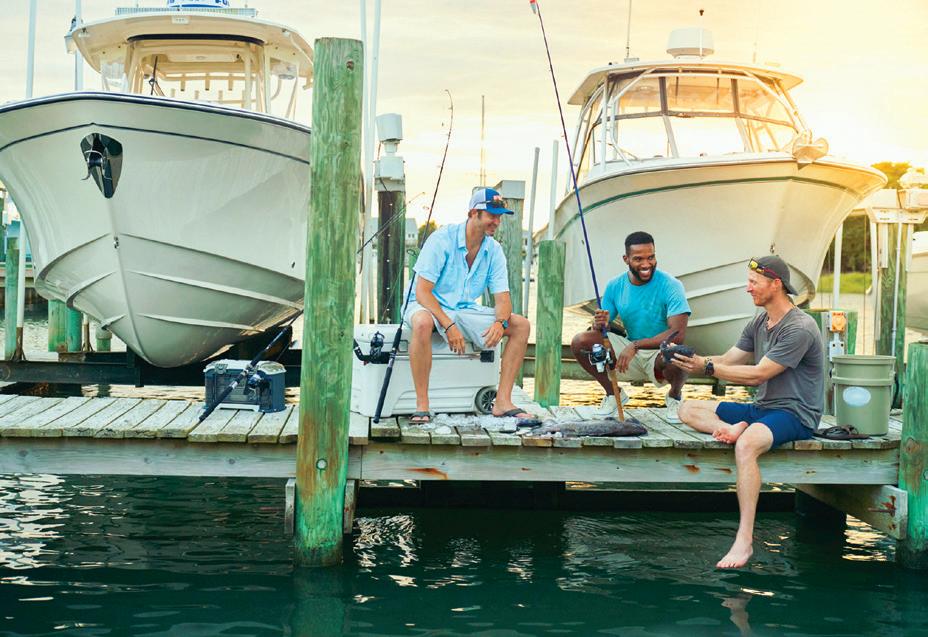
The Crystal Coast is an exceptional shoreline for fishing because of the shipwrecks and rock piles that provide habitats for offshore fish, and it draws thousands of anglers throughout the year.
VENTURE OUTSIDE CHATHAM FOR A DAY (OR TWO!), AND EXPLORE ALL THAT NORTH CAROLINA HAS TO OFFER
BY BROOKE SPACH
Experience the night sky like never before on the Island Express Ferry Starlight Cruise on Aug. 27. The ferry also offers daytime boat rides past or to Shackleford Banks, where you might be able to spot wild horses roaming the island.
In Atlantic Beach, visit the restored Civil War and World War II fort at Fort Macon State Park before checking out the nearly century-old boardwalk, which will receive a $2 million upgrade over the coming months.
CRYSTAL COAST
Also known as the Southern Outer Banks, this 85-mile stretch of beaches comprises 11 coastal communities, including Atlantic Beach, Beaufort, Emerald Isle and Cape Lookout. Although you may have just stored away your swimsuits, there is plenty to do at North Carolina’s beaches in the late summer and early fall.
The Cape Lookout National Seashore is one of the last natural barrier island systems in the world, and in 2021, was certified as an International Dark Sky Park.
The Crystal Coast offers many festivals this time of year: the Emerald Isle Fishing Tournament (Sept. 17), Beaufort Pirate Invasion (Sept. 23-25), the Emerald Isle Beach Music Festival (Sept. 24) and more. Seafood lovers should definitely plan their trip for Sept. 30-Oct. 2 in order to attend the 36th annual North Carolina Seafood Festival on the Morehead City waterfront.
JOHNSTON COUNTY J
ust south of Raleigh is Johnston County, or “JoCo,” an ideal daytrip destination for North Carolina history lovers. Bentonville is rich with Civil War history; visit Bentonville Battlefield, the state’s largest, during a walking or driving tour. Another stop on the tour is Cole Plantation, a site where music legends such as the late Thelonious Monk and Nat
22 CHATHAM MAGAZINE SEPTEMBER / OCTOBER 2022
PHOTO COURTESY OF THE CRYSTAL COAST TOURISM AUTHORITY
King Cole traced their heritage to enslaved family members.
Step back in time to learn about the state’s agricultural history at the Tobacco Farm Life Museum in Kenly. History comes alive on Saturdays at the museum, as experts are on hand to provide more insight about the lives of North Carolina tobacco farmers.
Be sure to also stop by the Ava Gardner Museum in downtown Smithfield in honor of the movie star who was born and raised just a few miles away. The recently completed Ava Gardner Mural and Rose Garden on the side of the museum includes yellow rose bushes – Ava’s favorite flower – installed by Durham’s own Witherspoon Rose Culture. And if you happen to be in town Oct. 7-9, don’t miss the celebration of her 100th birthday at the Ava Gardner Festival. For more fall fun, head to the pumpkin patch and corn maze at Clayton Fear Farm during the day or take a spooky hayride and visit its haunted house at night.

JoCo isn’t just for history buffs, but food and drink lovers, too – in Benson, you can head out on the Beer, Wine and Shine Trail, which features eight destinations where
you can sample craft beers, tour vineyards and learn about five generations of moonshiners. Meanwhile, red hot dog fans can determine their very favorite red hot dog by visiting the Red Hot Dog Trail’s 23 stops throughout the county to try franks from local producers like Smithfield’s own Carolina Packers and Stevens Sausage Company. You can also find a variety of sample itineraries for your visit to Johnston County at johnstoncountync.org.
PENDER COUNTY

Even if you don’t know of Pender County, you’ve probably heard of its two most-visited towns: Topsail Beach and Surf City. The county encompasses Topsail Island, Burgaw and Hampstead, North Carolina, and is one of the fastestgrowing counties in the state.
On the island, check out the Intracoastal Waterway, take the family to the Karen Beasley Sea Turtle Rescue & Rehabilitation Center
ABOVE Ava Gardner was an Oscarnominated actor who starred in films such as “The Killers” and “Mogambo.”
BELOW Surf City lives up to its moniker at sunrise.
SEPTEMBER / OCTOBER 2022 CHATHAM MAGAZINE 23
PHOTO BY MARK BUTLER
or visit the Missiles and More Museum, which housed Operation Bumblebee, the U.S. Navy’s secret guided missile testing program, in the 1940s. The results of these efforts helped make NASA’s space program possible. The museum also plays host to Autumn With Topsail, an arts and crafts festival with live music, kids’ inflatables and tons of food and drinks – catch the 33rd annual event Oct. 14-16. Thanks to cooler temperatures, migration patterns and waning beach crowds, fall is a great time for fishing on the island. Pro tip: It’s pronounced ‘Tops’l,’ not ‘Top-sail ’!
Pender County has even more to offer across the bridge on the mainland. It’s one of the largest growing locations for blueberries – try them fresh off the bush along the Pender County Blueberry Trail, which will lead you from the coast to Burgaw. Nicknamed both “Blueberry Town” and “The Town Hollywood Loves,” Burgaw is also known for serving as a backdrop to many movies and TV shows, such as “I Know What You Did Last Summer” and “One Tree Hill.” After a visit to the Moores Creek National Battlefield and a walk through Burgaw’s historic downtown on
ABOVE Wrong Way River Lodge & Cabins offers camping in comfort right by Asheville’s River Arts District.
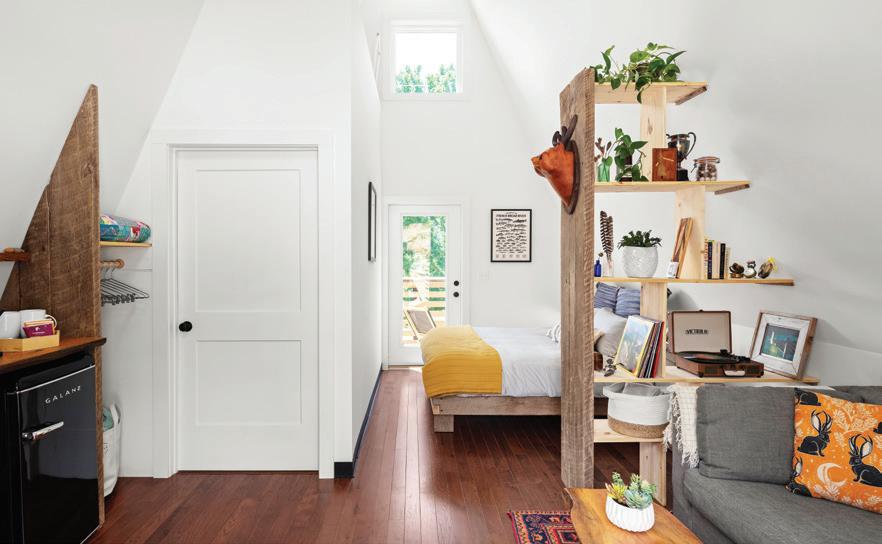
BELOW Visitors on the Blue Ridge Parkway can start to see colorful foliage by late September.

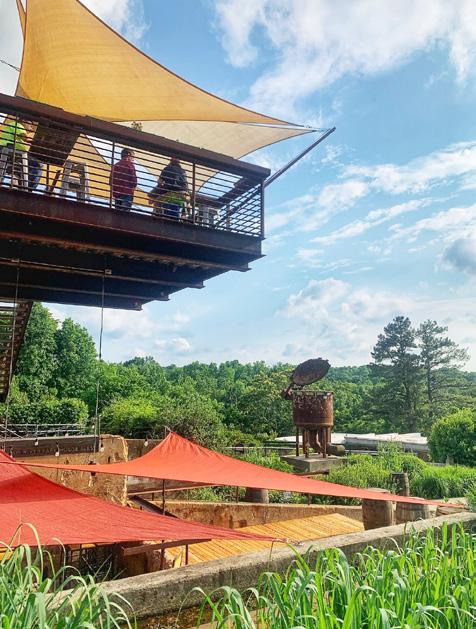
RIGHT Enjoy lunch at The Eddy Pub overlooking the Haw River in Saxapahaw.
the Hometown Hollywood Film Tour, be sure to grab a piece of blueberry pie from Olde Carolina Eatery.
ASHEVILLE
Another great place to spend a fall day is, of course, the mountains. Asheville has a mild climate and elevations that allow for one of the country’s longest seasons of vibrant leaf peeping. Take in the colorful scenery by journeying along a portion of the 469-mile Blue Ridge Parkway, which travels through Asheville.
Thousands of Monarch butterflies can be seen migrating to Mexico along the Blue Ridge Mountains’ ridges from midSeptember through October.
Proudly known as “Foodtopia,” Asheville is home to James Beard Awardwinning restaurants Chai Pani and Cúrate along with hundreds of other restaurants and breweries that help the city live up to its moniker. Be sure to visit Biltmore Estate for an all-encompassing culinary, historical and luxury accommodation experience. Completed in 1895 by George Vanderbilt, the castle was home to his family until the 1950s and remains the largest house in the nation. Another option for an overnight stay is Wrong Way River Lodge & Cabins, which as of
24 CHATHAM MAGAZINE SEPTEMBER / OCTOBER 2022
PHOTO BY STEVEN FREEDMAN
PHOTO COURTESY OF EXPLOREASHEVILLE.COM
press time was slated to open Sept. 1. The lodge offers a unique camping experience done the “wrong way:” in stilted A-frame cabins complete with private bathrooms, air conditioning, Wi-Fi and more. Take advantage of the lodge’s curated outdoor adventures, like paddle boarding on the French Broad River or zip lining through Pisgah National Forest, during your stay.

ALAMANCE COUNTY
You don’t have to travel far to explore new areas on a perfect autumn day. Just a few miles down N.C. 54 is Alamance County, home to Burlington, Elon, Graham, Saxapahaw, Mebane and the Haw River. Start your day with a cool morning hike on a section of the Haw River Trail, then grab lunch in Saxapahaw at The Eddy Pub or the Saxapahaw General Store. Take your food to go for a picnic at Cedarock Park and


Historical Farm, and feed the horses and goats along a guided or independent tour of the grounds. Make a reservation in advance to view the farm on horseback. Cedarock also hosts the Alcovets Balloon Festival on Sept. 9-11.
The textile industry put Alamance County on the map in the early 1900s. Learn more about its impact on the area and see the first commercially produced colored fabric in the South, Alamance Plaid, at the Textile Heritage Museum in Burlington, also home to the state’s first co-op brewery, Burlington Beer Works. Mebane’s Iron Gate Vineyards & Winery, the first female-owned winery in the state, is another good spot for historic beverage fun. Browse the shops downtown before rounding out your day with dinner from 2 Twelve Seasonal Kitchen + Bar or Bright Penny Brewing. CM

SEPTEMBER / OCTOBER 2022 CHATHAM MAGAZINE 25 TRAVEL
PHOTO BY HEATHER LAGARDE
& COUNTY GOVERNMENT
WHO’S WHO IN TOWN
SUSANNAH GOLDSTON WORKS TO IMPROVE SOIL AND WATER QUALITY THROUGH CONSERVATION
 BY MEGAN TILLOTSON PHOTO BY JOHN MICHAEL SIMPSON
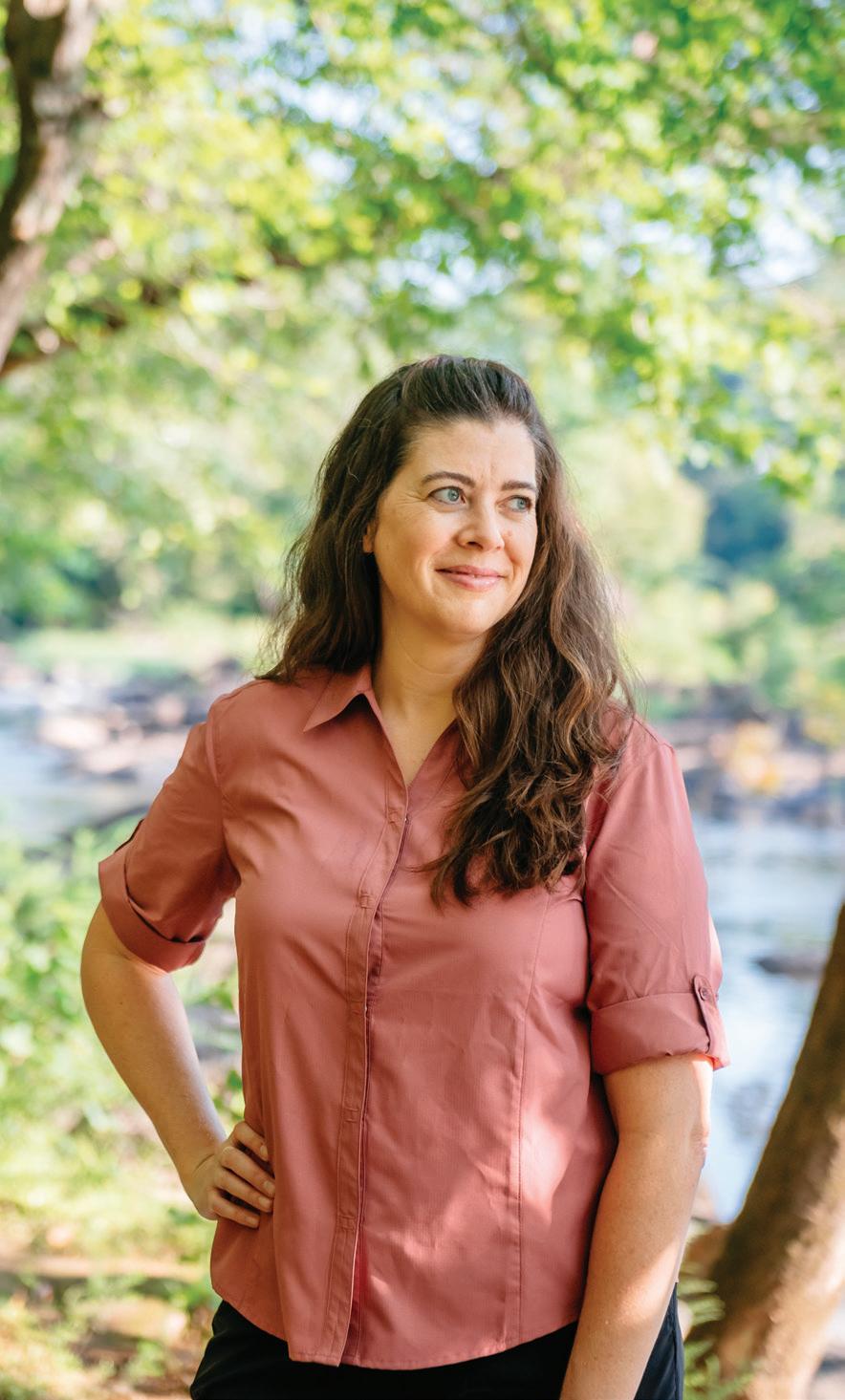
Susannah Goldston’s roots in Chatham County run eight generations deep. She grew up on her grandfather’s small dairy farm in Goldston. (The town was named after an ancestor.) In 2002, Susannah graduated from North Carolina State University with a bachelor’s in geology. She worked for engineering and consulting firms in Sydney, Australia, and Oakland, California, before returning to Chatham in 2010. Susannah is an environmental specialist and director of Chatham Soil & Water Conservation District. She lives in her hometown with her many houseplants.
How did you become interested in soil and water issues?
Growing up on a farm, I spent a lot of time outside. I guess making mud pies, skipping rocks and damming up creeks is how it all started. I’m just fascinated by the natural environment.
What kind of work did you do before you became district director? I would work on environmental site assessments and remediation projects for clients with contaminated soil and
groundwater. Some projects were gas stations with underground tanks that had leaked, and some projects were industrial plants with bigger chemical spills. I would oversee the testing of soil and groundwater and the subsequent cleanup. After 10 years, I was a little homesick for green, rural North Carolina and less interested in contaminated industrial sites.
What is the typical workday for you?
There really is no typical day in this job. We’re a small office of three people – [Brandy Oldham and Joseph Trimnal are my colleagues] – and we have over a dozen programs and services we provide within our mission of “ensuring the wise use of our natural resources by providing technical and educational services.” One service we provide is conservation planning for farms. We work directly with farmers, and based on their objectives, we assess resource concerns and recommend best management practices to address those concerns.
26 CHATHAM MAGAZINE SEPTEMBER / OCTOBER 2022
What conservation practices do you feel are most important in Chatham County?
Local soil and water conservation districts were formed in the 1930s to address agricultural soil erosion, most notoriously, from the Dust Bowl out West. Local districts here were just as important because farmers used tillage intensely to produce cash crops of cotton, tobacco and corn. These farming methods led to large gullies and muddy rivers. The topsoil was depleted, and the fields wouldn’t yield a good crop. Now that much of the agricultural acreage in Chatham is used to raise livestock instead of growing annual crops, there are different conservation needs. Livestock produces waste that can and should be recycled as nutrients. We help farmers manage these nutrients by planning how much, when and where to apply this waste so that it is a resource and not a pollutant.
What are the current conservation priorities for Chatham?
The highest conservation priorities for Chatham are those projects that make the most improvement to water quality – projects that are designed to reduce nitrogen, phosphorus and sediment that reaches surface water. Other priorities include promoting management that improves soil health that will decrease soil compaction, reduce erosion, increase rainfall infiltration and storage, increase organic matter and diversity of soilforming organisms.
SEPTEMBER / OCTOBER 2022 CHATHAM MAGAZINE 27
What civic needs concern you the most?



It’s concerning that agriculture as a career is not very accessible to new or diverse farmers. Farming is very long hours, hard work and financially risky. Land prices are so high that most beginning farmers can’t afford to start from scratch. There are resources for new and beginning farmers like college courses, incubator farms, farming associations, farmer networks and workshops through the [North Carolina] cooperative extension service. There are also programs and loans through the U.S. Department of Agriculture that may help new and beginning farmers, but all these resources are hard to navigate. We try to help new farmers understand what programs and connections they may
Growing up on a farm, I spent a lot of time outside. I guess making mud pies, skipping rocks and damming up creeks is how it all started. I’m just fascinated by the natural environment.
want to explore as well as advise them on specific conservation-related topics such as how many head of cattle to raise on their acreage, where to plan pastures, where to lay out crop fields based on soil types and how much water they may need to operate.
What kind of projects are you working on right now?
Currently, there are several farms that I am providing [free] technical assistance [to]. One farmer requested a conservation plan for their property and future farm. The conservation plan will include the farmer’s objectives and will recommend practices related to their operation to protect and conserve natural resources. I’m also assisting a dairy farm with nutrient management planning. I’m working with another farm to design
Congratulations to Chatham Forest!
In the mid ’90s, our family hiked these wooded hills. We worked with local contactors to plan and build one of Pittsboro’s first modern downtown neighborhoods. Then we chose to live here too. We’re proud that Chatham Forest has been home to families for 25 years and yet still improves as others discover Chatham. Thanks to the voters who know a special place when they see it.
28 CHATHAM MAGAZINE SEPTEMBER / OCTOBER 2022 www.VRCLimited.com 919-949-1274 697 Hillsboro Street, Ste 350-A, Pittsboro, NC 27312-5727
Daniel Ridge • Chatham Forest • The Woods at Wilkinson Creek …and more coming soon
2022 COUNTY GOVERNMENT
Randolph Voller, President VRC
a livestock exclusion system that will reduce the impact the cattle have on the stream located on the property.
What are Chatham’s biggest challenges, in terms of conservation? The biggest challenge in conservation right now is the rapid development pressure we are seeing. Large tracts of timberland, agricultural land and natural areas are being divided, cleared and graded to convert into other land uses. The increase in impervious surface from new roads and building sites in our watersheds means more water runoff, less infiltration and groundwater recharge, flashier floods with more damage downstream as well as hotter soil temperatures. [The term, ‘flashier,’ refers to higher water levels in shorter time, leading to more dangerous and destructive floods.] Breaking up larger, more natural tracts of
To learn more about free soil and water conservation or farmland preservation planning assistance, visit chathamcountync .gov/swcd
land will fragment wildlife habitats and decrease diversity in vegetative cover. The long-term effects of this may be irreversible or at least very expensive to restore.
What projects are you most excited about in the coming year?
In the next year, Chatham County will be updating our Farmland Preservation Plan, which was first adopted in 2010. The county is seeing population growth that will alter our local agricultural economy as well as the rural character that so many residents value. I am excited to see the plan’s recommendations and hope to help implement new and impactful programs to preserve our working lands. Protecting working agricultural lands has so many benefits to the community, including accessibility to local food, preservation of open space and climate resilience. CM
Modern Dentistry Backed by Old Fashioned Values


SEPTEMBER / OCTOBER 2022 CHATHAM MAGAZINE 29 (919) 542-4911 • chathamdentalarts.com Cleanings & Prevention • Exams & Cleanings • Dental X-Rays • Home Care • Tooth Whitening Restorations • Tooth Colored Fillings • Crowns (Caps) • Dentures & Partials • Extractions • Fixed Bridges Gum Disease • Diagnosis • Treatment • Maintenance A boutique dental practice located in a serene, natural setting in Pittsboro, NC, just minutes from historic downtown Pittsboro, Chatham Park, Briar Chapel & Fearrington Village. We offer treatment to patients of all ages. Call us today! (Hablamos Espanol)
• Root Canal Therapy • Implants • Snore Appliances • Night guards COUNTY GOVERNMENT
30 CHATHAM MAGAZINE SEPTEMBER / OCTOBER 2022
FALL ARTS
Jan,
A BYNUM ARTIST PRESERVES COMMUNITY HISTORY THROUGH ILLUSTRATED ESSAYS
 BY BROOKE SPACH | PHOTOGRAPHY BY JOHN MICHAEL SIMPSON
TALL TALES FROM A SMALL TOWN N

ew York native Emma Skurnick first visited Bynum General Store in 1997. As she approached the historical building, she overheard several locals gathered on the storefront porch, swapping outlandish stories.
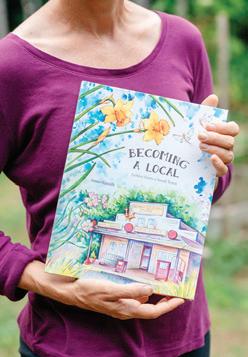
“Did you ever hear the one about the time I almost beat the [youknow-what] out of Santa Claus?” The late Roy Hatley’s story stopped her in her tracks. That story became the first of many colorful accounts Emma, a professional illustrator, brings to life in her book, “Becoming A Local – Letters from a Small Town.”
Other handwritten essays inside the book chronicle conversations and images Emma
has noted from her experiences in the mill town since moving from San Francisco 25 years ago. She self-published the 121-page book last year, and it serves as a time capsule of sorts for a town’s “transition from one population, the old-timers, to the newcomers.”
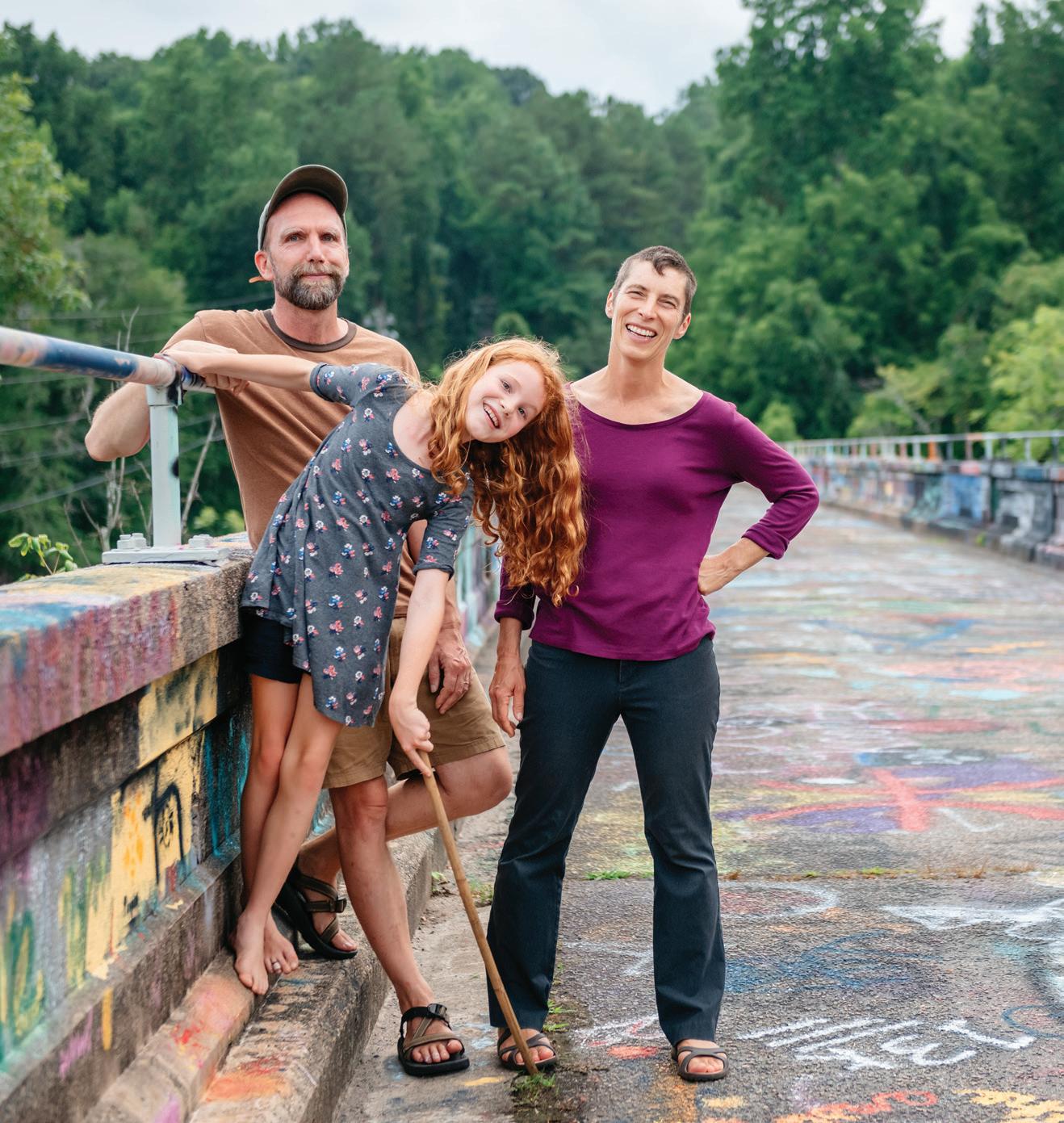
Emma works out of her in-home studio in Bynum, where she lives along the Haw River with her husband, Jan Burger, co-founder of Paperhand Puppet Intervention, and daughter, Niko Skurnick, 8. Over time, Emma would hear stories from older neighbors when stopping to check the mailbox or walking along the narrow streets down to the river. “There was this definite feeling of preemptive nostalgia on my part,” she says. “I knew they weren’t going to be around forever. And [I had] this real longing to spend time with them
SEPTEMBER / OCTOBER 2022 CHATHAM MAGAZINE 31
Niko and Emma at the graffitied Bynum Bridge, a popular spot for wildlife watching, fishing and catching up with the locals.
CHAPEL HILL
Opening Night
Pictures at an Exhibition
THUR, SEPT 22 | 7:30PM
Carlos Miguel Prieto, conductor
Jennifer Higdon: Fanfare Ritmico

Debussy: Iberia from Images
Ravel: Rhapsodie espagnole
Mussorgsky/Ravel: Pictures at an Exhibition
Concert Sponsor: The Forest at Duke
Beethoven Eroica
TUES, OCT 18 | 7:30PM
Michelle Di Russo, conductor
Beethoven: Egmont Overture
Kodály: Dances of Galánta
Tchaikovsky

Symphony No. 5
SUN, JAN 29 | 7:30PM
Michelle Di Russo, conductor
Coleridge-Taylor: Ballade in A Minor
Mozart: Symphony No. 38 “Prague”
Tchaikovsky: Symphony No. 5
Take the ultimate trip through the galaxy!
Holst The Planets
THUR, APR 13 | 7:30PM
Thomas Wilkins, conductor
Gerald Clayton, piano
James Lee III: Sukkot Through Orion’s Nebula
Ellington: New World A-Comin’
and just be a part of this community while it was in this phase.
“Having come from New York, I hate to say it, but [I had] these stereotypes and really feared they would have stereotypes about me. But [the community] completely defied my expectations by welcoming me in with such humor and love and ridiculousness. They made it very easy for me to write this book.”
Holst: The Planets



Beethoven: Symphony No. 3 “Eroica” ncsymphony.org 919.733.2750

Emma says she was inspired to start compiling these stories by books that were popular at the time like “Under the Tuscan Sun” and “A Year in Provence.” “I loved those books,” she says. “I would get every one of them that came out. I was also so incredibly annoyed by those authors because there was this assumption that you had to go away to someplace in Europe or Mexico or Morocco to find a community like that.”

At first, Emma says the letters were a way to keep her long-distance friends up to date on her life and the happenings of her new hometown. Emma eventually expanded the project into an email subscription list of readers throughout the country with the thought of, “If you think Provence is amazing, wait till you see Bynum.” She even got some letters back.
“People would often say, ‘I grew up in a town just like Bynum, but I lived in Ohio, or I lived in Kentucky,’” she says. “It was always really great to get that confirmation that yes, these wonderful places are everywhere.”
On their property in Bynum, Emma built another studio and has been
There’s a real parallel between what artists do and what scientists do, which is that we look very, very carefully at the world. I think that was always the attraction for me, that really close attention to what’s in front of me. Both art and science allow me to fulfill that drive.
– Emma Skurnick
32 CHATHAM MAGAZINE SEPTEMBER / OCTOBER 2022 Introducing our new CHAPEL HILL SCHOOL OF MUSICAL ARTS 919-960-6898 www.chsma.com Specialized training in singing, acting and auditioning paired with all the information you need to succeed in this competitive search. Enrolling now for Fall Subscribe today and save big!
4-concert series starts at just $34 per concert!
MEMORIAL
HALL, CHAPEL HILL
CARLOS MIGUEL PRIETO, Music Director Designate HOLST THE PLANETS
holding art classes there for 15 years. The classes, called Open Studio, are suited for artists of all skill levels and tend to have six to eight students working on individual projects.



In her professional “day job,” Emma works with biologists to create scientific illustrations for educational materials. She says she’d always had an equal interest in art and science growing up.
“There’s a real parallel between what artists do and what scientists do, which is that we look very, very carefully at the world,” she says. “I think that was always the attraction for me, that really close attention to what’s in front of me. Both art and science allow me to fulfill that drive.”

Inside her book, Emma says her favorite letter is titled “Stitches.” “It’s a summation of what I was trying

QUALITY, HOLISTIC, MENTAL HEALTH SERVICES
to do in the book, which talks about how when you live in a little town, there’s not one dramatic action that brings people together,” she says. “It’s this day in and day out, tiny gestures of affection or even tolerance between one neighbor and the next.”
Emma says just getting the mail with Niko often turns into an hourlong adventure with neighbors stopping to say hello and chat about life.
After 25 years living in Bynum, she fondly recalls that initial conversation with her husband, who had been there to work at the Haw River Festival. Jan told her, “I know a perfect place for us to move. It’s a tiny town in the middle of North Carolina, and it would be perfect for us.”
“You’ve got to be kidding,” Emma remembers saying. “But Jan insisted, ‘Just come take a look.’ … He was right; I haven’t even thought of being anywhere other than here since then.” CM
SEPTEMBER / OCTOBER 2022 CHATHAM MAGAZINE 33 FALL ARTS
Dr.
of
provide high-quality mental health services in a welcoming environment with tailored approaches to meet you and your loved one’s needs. WE PROVIDE: • Individual & Group Therapy • Couples & Family Therapy • Child/Adolescent Therapy • School-Based Therapy
Karen Barbee and her team
therapists
•
•
KAREN BARBEE, EDD, LCMHCS, LCAS, NCC 919-704-8449 • RWELLNESSSERVICES.COM
PITTSBORO
SILER CITY
CHAPEL HILL
HEAVY METAL
A STAY-AT-HOME DAD REDEFINES HIMSELF THROUGH SCULPTURE
BY LORI D. ROBERTS WIGGINS | PHOTOGRAPHY BY JOHN MICHAEL SIMPSON
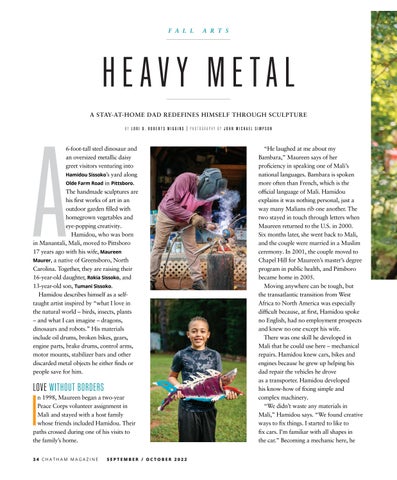
A6-foot-tall steel dinosaur and an oversized metallic daisy greet visitors venturing into Hamidou Sissoko’s yard along Olde Farm Road in Pittsboro
The handmade sculptures are his first works of art in an outdoor garden filled with homegrown vegetables and eye-popping creativity.
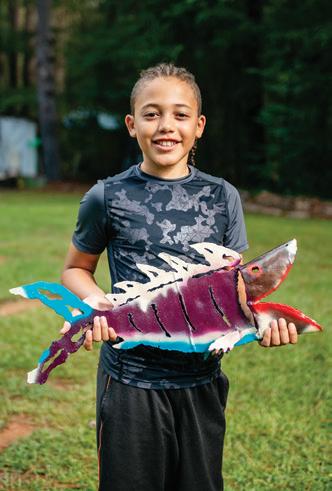
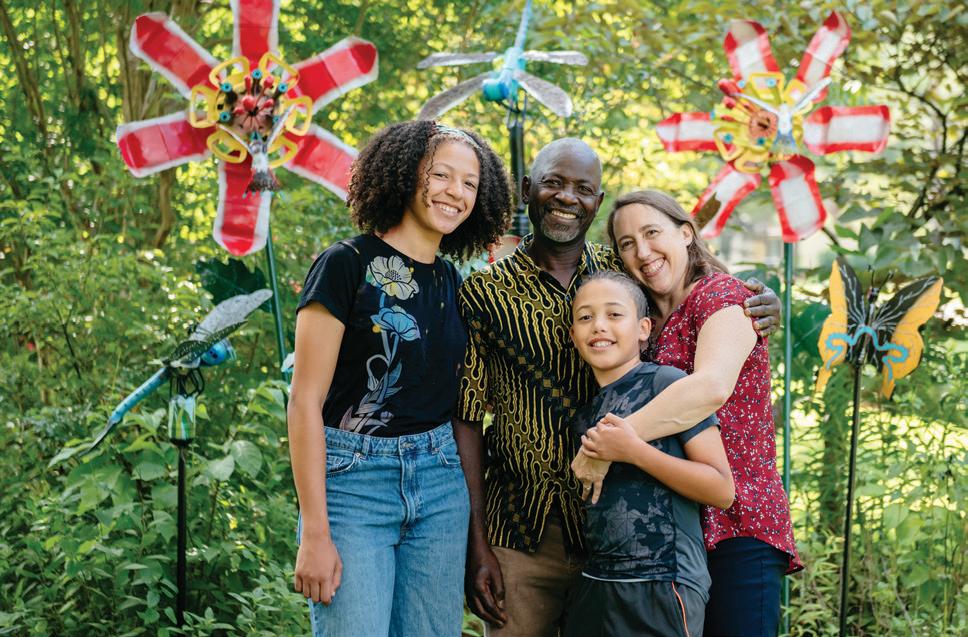
Hamidou, who was born in Manantali, Mali, moved to Pittsboro 17 years ago with his wife, Maureen Maurer, a native of Greensboro, North Carolina. Together, they are raising their 16-year-old daughter, Rokia Sissoko, and 13-year-old son, Tumani Sissoko.
Hamidou describes himself as a selftaught artist inspired by “what I love in the natural world – birds, insects, plants – and what I can imagine – dragons, dinosaurs and robots.” His materials include oil drums, broken bikes, gears, engine parts, brake drums, control arms, motor mounts, stabilizer bars and other discarded metal objects he either finds or people save for him.
LOVE WITHOUT BORDERS
In 1998, Maureen began a two-year Peace Corps volunteer assignment in Mali and stayed with a host family whose friends included Hamidou. Their paths crossed during one of his visits to the family’s home.
“He laughed at me about my Bambara,” Maureen says of her proficiency in speaking one of Mali’s national languages. Bambara is spoken more often than French, which is the official language of Mali. Hamidou explains it was nothing personal, just a way many Malians rib one another. The two stayed in touch through letters when Maureen returned to the U.S. in 2000. Six months later, she went back to Mali, and the couple were married in a Muslim ceremony. In 2001, the couple moved to Chapel Hill for Maureen’s master’s degree program in public health, and Pittsboro became home in 2005.
Moving anywhere can be tough, but the transatlantic transition from West Africa to North America was especially difficult because, at first, Hamidou spoke no English, had no employment prospects and knew no one except his wife.
There was one skill he developed in Mali that he could use here – mechanical repairs. Hamidou knew cars, bikes and engines because he grew up helping his dad repair the vehicles he drove as a transporter. Hamidou developed his know-how of fixing simple and complex machinery.
“We didn’t waste any materials in Mali,” Hamidou says. “We found creative ways to fix things. I started to like to fix cars. I’m familiar with all shapes in the car.” Becoming a mechanic here, he
34 CHATHAM MAGAZINE SEPTEMBER / OCTOBER 2022
FALL
ARTS
ABOVE LEFT
Hamidou
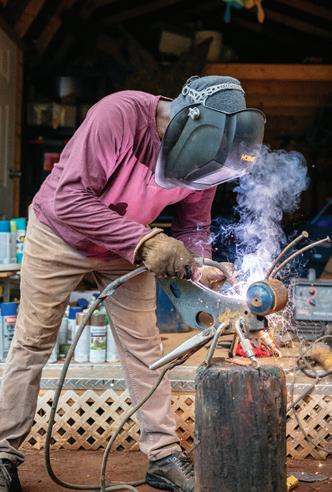
Sissoko uses an arc welder to create a metal insect.
BELOW LEFT Tumani Sissoko, 13, shows off a big fish his father created.
THIS PAGE Hamidou attaches a finished bee he built out of discarded gear parts to its metal post in his yard.
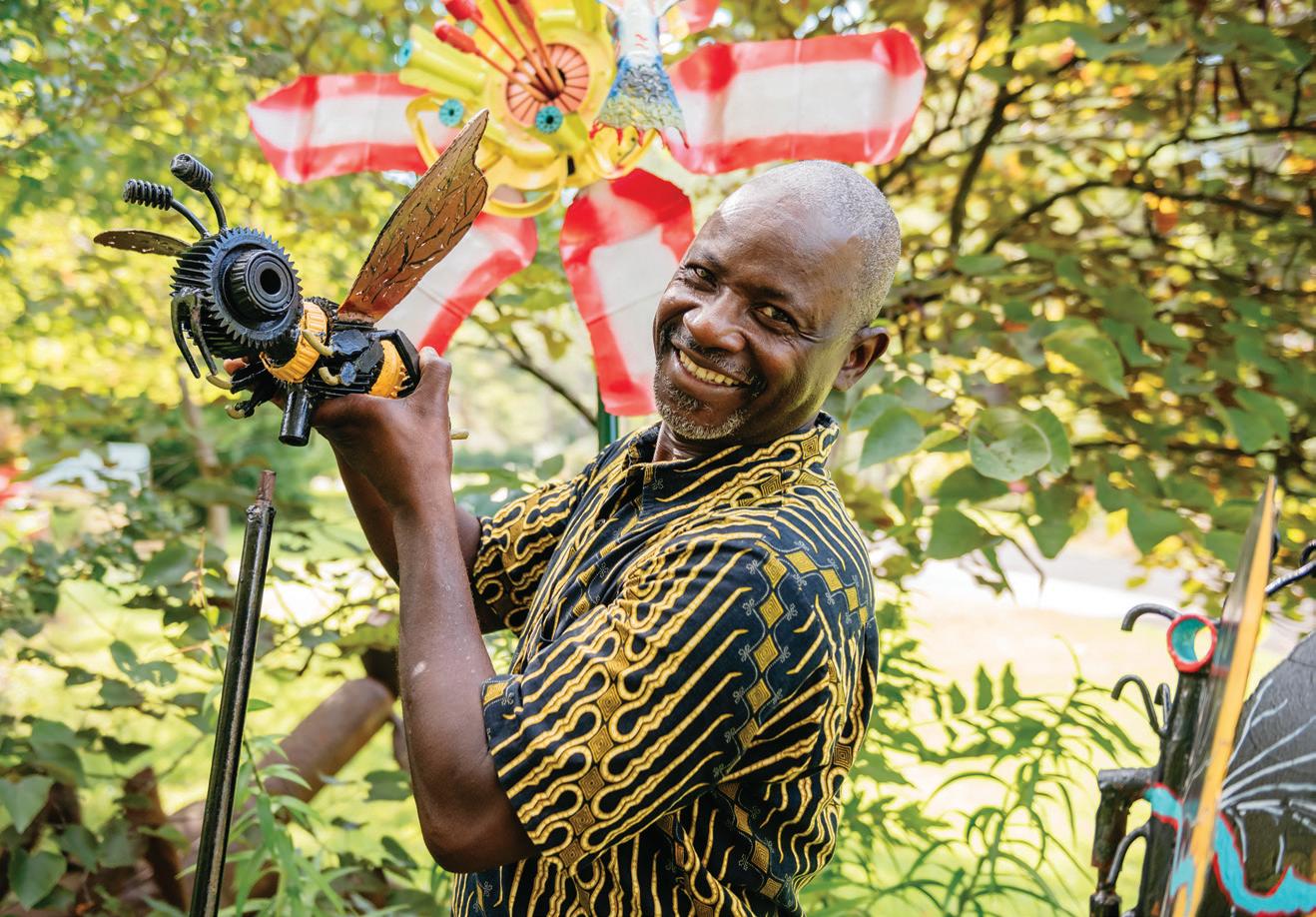
learned to weld and became a master of the intricacies of automotive parts, functions, uses and aesthetics.
When the couple welcomed children, Hamidou saw an opportunity. “We could spend a lot of money on day care, or I could spend time with my children and know them,” he says. So, he became a stay-at-home dad, spending a lot of time with his kids outside in the garden observing plants, trees, flowers, insects and animals. It was a visit to the North Carolina Museum of Natural Sciences in Raleigh, where his son was awed by a dinosaur sculpture, that inspired Hamidou to make his own sculpture.
“I think I can make a dinosaur,” Hamidou whispered to his wife, who
chuckled. Using scrap metal in their backyard, he selected an oil drum and chains to create his own version. “It took a long time to make it,” he says, guessing it took at least six weeks to design and cut metal by hand. It was followed by a larger-than-life daisy, a request from his daughter, who wanted a sculpture, too.
BECOMING AN ARTIST
At first, Hamidou didn’t set out to sell his art. He certainly didn’t believe anybody would pay money for it.
“What I see is not good enough to take it to one place and sell it,” he recalls thinking. But Maureen thought differently and convinced him to show at the annual
SEPTEMBER / OCTOBER 2022 CHATHAM MAGAZINE 35
Rokia Sissoko, 16, Hamidou, Tumani and Maureen Maurer stand in their yard among a few of Hamidou’s nature-inspired sculptures.
“I sold everything,” Hamidou says, the sheer joy still audible in his voice. Some pieces were sold before the show started. “I was very shocked,” he says. “… I now know I have work to do. Ninety percent of my customers don’t stop laughing or smiling.”
Friend and fellow artist Ken Vrana has watched Hamidou’s creative evolution over the past decade. “I love it,” Ken says. “It’s exciting to watch. His pieces are very childlike and emotional. I’ve watched his stuff evolve. You can tell he has a vision for the future.”
These days, Hamidou’s work can be found at businesses around town, like the offices of Hobbs Architects, and at shows featuring self-taught artists. His creations also are part of the North Carolina Botanical Garden’s annual exhibit, Sculpture in the Garden. In 2020, “State of Balance” was Hamidou’s first abstract sculpture featured in the show.
“I was interested in the puzzle of combining different metals and exploring balance and symmetry,” he says in his description for the installation. Old
This year’s 34th annual Sculpture in the Garden runs from Sept. 18 until Dec. 4. The preview party is Sept. 17 from 4:306:30 p.m. Most sculptures can be purchased, but all artwork will remain on site until the show ends.
As of press time, Hamidou was finalizing two pieces he plans to submit for the show: “The Pollinator Garden,” a colorful depiction of the circle of life – all in metal; and a bold, yet-to-benamed structure that features a bell and gears.
oxygen tanks become bells that balance the centerpiece made up of a combination of gears from car transmissions, flat metal pieces cut into shapes and parts from car brakes.
For another sculpture, “Dragonfly with Bell,” Hamidou says he used recycled and welded scrap metal. A compressor tank became the bell/flower, a pipe created the stand, and an old motor mount and shovel molded the dragonfly. It sold for $1,200.
Last year’s sculpture exhibit featured Hamidou’s newer “Crane,” the longlegged bird he remembers seeing growing up in Mali. Made of the recycled scrap metal of a bicycle frame, a rake, a car water pump and stabilizer bar, pliers, shovels and other pieces, it sold for $800. In the same year, Hamidou received an honorable mention for “Venus’ Flytrap,” his rendition of a carnivorous plant that grows naturally along the North Carolina coast. To create it, Hamidou used recycled rakes and an old plow for the flowers, car brackets to make the flies, and a car intake manifold for the top portion.
Back in Hamidou’s garden, he grows a variety of plants: sorghum, tomatoes, bell peppers, kale, cucumbers, lettuce, lemon grass, okra and Malian eggplant. His outdoor canvas is filled with butterflies, dragonflies, hummingbirds, crickets, ladybugs and other wildlife that come out to play. “I spend most of my time outside,” he says. “Even if it’s cold, I’m outside.” Nature continues to inspire him to create whimsical pieces – the garden is where Hamidou’s imagination grows. CM
36 CHATHAM MAGAZINE SEPTEMBER / OCTOBER 2022
Fearrington Folk Art Show, where art that is raw and rustic is on display.


Chatham’s GO TO for Custom Framing
Weaver Dairy Rd.
Village
201 S Estes Dr., Suite 400C
University Place
Custom Framing • Giclee Art Printing • Art Restoration & Installation Just Minutes Away! Fine Custom Framing for Chatham and Chapel Hill for almost 50 years! 2022
1129
Chapel Hill, NC 27514 Timberlyne
919-942-3291 framemakersinc.com
Chapel Hill, NC 27514
919-942-7306 frameshopchapelhill.com
FALL ARTS CALENDAR

Check out a new exhibit called “Corrientes Latinas” on display at the Smelt Art Gallery that showcases Latin American artists like Pepe Caudillo and Peter Marin as part of Hispanic Heritage Month. Sept. 1-Oct. 29; theplantnc.com/smeltartgallery
Every Saturday at 2 p.m. in September, there will be a free reception during the Come Out and Play sculpture show at 150 Wild Horse Run in Pittsboro with live music, food and art. What began as a show to honor those affected by 9/11 has continued to promote kindness and the arts in the community for 21 consecutive years. Sept. 3, 10, 17 and 24; comeoutandplay.info
CAN’T MISS CONCERTS, EVENTS AND MORE
COMPILED BY CAITLYN YAEDE
The Red Truck Bakery owner Brian Noyes will speak with culinary author Sheri Castle at McIntyre’s Books about the comfort food traditions of the Blue Ridge Mountains and his bakery in Marshall, Virginia. Learn about corn crabcakes, Virginia peanut pie and other recipes in his new book, “The Red Truck Bakery Farmhouse Cookbook.” Sept. 10; mcintyresbooks.com
Mystery lovers won’t want to miss author Craig Johnson, who will discuss “Hell and Back,” the newest installment of his New York Times bestselling “Longmire” series, in an afternoon event at McIntyre’s Books. Learn about the newest adventures of Walt Longmire in this western fiction that serves as the inspiration for the Netflix original series, “Longmire.” Sept. 11; mcintyresbooks.com
Save the date for a weekend of music, dancing and camping at the Hoppin’ John Fiddlers’ Convention. This three-day event at Shakori Hills Community Arts Center showcases the best local talents on the fiddle, banjo and more. Try out clogging or a new instrument at one of the many workshops and enjoy concerts, dances, old-fashioned family activities, craft vendors and more. Sept. 15-17; hoppinjohn.org
The Hispanic Liaison hosts the ninth Hispanic Heritage Fiesta in Siler City for Hispanic Heritage Month. This free, outdoor celebration on North Chatham Avenue will have folklore dance performances, games and activities, a parade of traditional Latin American and quinceanera outfits and more.
Jump in on the Fun
BOUNCING BULLDOGS


Jump rope classes & camps for all ages

38 CHATHAM MAGAZINE SEPTEMBER / OCTOBER 2022
For more information and to register, go to: bouncingbulldogs.org | 919.493.7992
FUN + FOCUS + FRIENDS

DUKEPERFORMANCES.ORG
Photo: ©Julia Gat; Emanuel Gat Dance, performing December 7, 2022
2022 /23
Afterward, Saludos Compay will perform in the September installment of the Downtown Siler City Music Series. Enjoy the Latin Americanand Caribbean-inspired music as part of an all-day event hosted by the NC Arts Incubator in partnership with The Hispanic Liaison. Sept. 17; hispanicliaison.org
The work of Raleigh-based artist Leticia Alvarez will be on display at NC Arts Incubator. Her art celebrates her Mexican roots and pictures motifs of religious and cultural importance. Leticia has collaborated in the past with the North Carolina Museum of Art, Artspace and the City of Raleigh Museum. Sept. 17-Oct. 15; ncartsincubator.com
Starrlight Mead presents its annual mead celebration at The Plant Enjoy a Renaissance-themed family event from noon to 5 p.m. where costumes are encouraged and local food trucks will be on-site. Sample mead, watch mead-making demonstrations and browse the craft vendors, offering everything from jewelry to woodworking and more. Sept. 24; starrlightmead.com
Historian and New York Times bestselling author Rinker Buck comes to McIntyre’s Books to share his latest book, “Life on the Mississippi: An Epic American Adventure.” This work chronicles Rinker’s adventures down the Mississippi River on a handmade wooden flatboat with an eccentric crew. Sept. 24; mcintyresbooks.com
Chatham County Agriculture and Conference Center welcomes back “A Tribute to Elvis,” honoring the late rock ‘n’ roll star. The show will feature tribute artist Stephen Freeman as Elvis, alongside Echos of A Legend Show Band. Doors open at 6 p.m. for dinner followed by a 7 p.m. show. The performance will benefit Bynum Front Porch, a nonprofit that celebrates Chatham County’s history through familyfriendly community events. Oct. 1; bynumfrontporch.org
Take part in the 18th annual Shakori Hills Grassroots Festival of Music and Dance. The festival begins with an opening ceremony by Batalá Durham followed by four days of performances, craft vendors and camping. Learn from local beekeepers, compete in the poetry slam and bring noisemakers to participate in the happiness parade. Oct. 6-9; shakorihillsgrassroots.org
Head down to Mosaic at Chatham Park for two fall concerts. First up is The Legacy Motown Revue on Oct. 7 at 6 p.m. The fun and music continue with Trial By Fire and She Bop on Oct. 21. Enjoy food and drinks from vendors like Ta Contento, BMC Brewing, Red Moose Brewing Company, Smokehouse Bandits, Waves Shave Ice, Cousins Maine Lobster, Crave Hot Dogs & BBQ, and Maple View Ice Cream. Oct. 7, 21; mosaicatchathampark.com
Pittsboro Gallery of Arts will host a night of fine arts and crafts at its “Bal Masqué: Art Unmasked” reception at 5:30 p.m. Check out regional art in a variety of mediums, meet artists like Vince Pitelka, Gina Harrison and Beth Bale and enjoy food and drinks. Oct. 14; pittsboroarts.org
The Town of Pittsboro and the Pittsboro Rotary Club host the Pittsboro Street Fair, a free, all-day event beginning at 10 a.m. with kids activities, information booths, visual and performing arts, and a variety of food and drink vendors. Oct. 29; pittsboronc.gov
Abundance NC presents Death Faire, an all-day event for processing grief and exploring alternate art therapy. The event kicks off at 10 a.m. at The Plant with meditation and sound healing. Then, participate in art workshops, sharing circles and movement therapy by the Living Arts Collective, plus poetry, a parade, food and more. Nov. 5, abundancenc.org/death-faire
Dance and groove at The Plant during a bohemian concert benefiting Abundance NC. Throw down to live music by The Fritz and Upper Cases, as well as electronic music by DJ phløem, starting at 7 p.m. Nov. 5, theplantnc.com
Chatham Artists Guild will hold two opening receptions with preview exhibits ahead of its annual Studio Tour. The first will be held at The ArtsCenter gallery in Carrboro on Nov. 4 while the second will take place at the Smelt Gallery at The Plant. The exhibits will feature a single item from each of its 55 members, like Gina Harrison, Vince Pitelka and Beth Bale, who will be participating in the tour during the first two weekends in December. The tour includes 39 artists’ studios that will be open to the public on Saturdays and from noon to 5 p.m. on Sundays. Nov. 27; theplantnc.com/smeltartgallery Dec. 3, 4, 10 and 11; chathamartistsguild.org CM

FALL ARTS
40 CHATHAM MAGAZINE SEPTEMBER / OCTOBER 2022









SEPTEMBER / OCTOBER 2022 CHATHAM MAGAZINE 41 Securities offered through Raymond James Financial Services, Inc., member FlNRA/SIPC. Phoenix Wealth Advisors is not a registered broker/dealer and is independent of Raymond James Financial Services. Investment advisory services offered through Phoenix Wealth Advisors, ©2018 Raymond James Financial Services, Inc., member FINRA/SIPC. 18-BR83A-0017 AW 11/18 The Financial Times FT 300 Registered Investment Advisors 2019 award had about 40.5% of the 740 advisor applicants being recognized as a Registered Investment Advisor. The FT used the database of RIAs who are registered with the U.S. Securities and Exchange Commission (SEC), and selected those practices reporting to the SEC that had $300 million or more in assets under management, and no more than 75% of the AUM with institutional clients. Additionally, the firm must be independent (not the RIA arm of a broker dealer for example). Qualifying RIA firms filled out an online application and questionnaire that gave more information about their practices. That information was augmented with their own research on the candidates, including data from regulatory filings. The FT generated an internal score for each applicant based on six broad factors: advisor assets under management, AUM growth rate, the firm's years in operation, advisors' industry certifications (CFA, etc.), compliance record, and online accessibility. AUM and asset growth comprise roughly 80 percent to 90 percent of each RIA's score. Additionally, to provide a diversity of advisors, the FT placed a cap on the number of RIA's from any one state that's roughly correlated to the distribution of millionaires across the U.S. The ranking may not be representative of any one client's experience, is not an endorsement, and is not indicative of an advisor's future performance. Neither Raymond James nor any of its Financial Advisors or RIA firms pay a fee in exchange for this award/rating. The FT is not affiliated with Raymond James. Over 25 years of service to the community and providing family wealth management. 100 Europa Drive, Suite 390 Chapel Hill, North Carolina 27517 919.929.4448 ∙ pfinx.com RAYMOND JAMES ® HAIRCUTS • COLOR • BALAYAGE • SMOOTHING TREATMENTS • FACIALS & SKIN CARE 919.929.2209 • EAST 54 • 3110 ENVIRON WAY CITRINESALONNC.COM BEST SALON & BEST PLACE FOR BEAUTY PRODUCTS Thank you Chapel Hill for your continuous support! VOTED BEST OF CHAPEL HILL BY READERS OF CHAPEL HILL MAGAZINE 2010-2022 TOP 100 SALONS IN U.S. 2011+2012+2013+2014
42 CHATHAM MAGAZINE SEPTEMBER / OCTOBER 2022 BestJewelry Store BestofChatham % : : The 5th annual Awards Photography by John Michael Simpson Full list of results begins on page 82 Thousands of votes were cast, and these are our victors $ $ Best Seafood Best Clothing Store Bestinterior designer Best spa Best Place for Yoga/Pilates Best Hair Salon Best art gallery Best Nonprofit Best desserts/pastries Best veterinarian Best Place to Get Coffee Best real estate agent Best B&B Best Dance Studio Best MusicLiveVenue Bestlandscaper Best Upscale Restaurant BestSteak Best Chef Best mexican/ latin american food Best Place a Beer Best new biz BestPizza Best Day Care for






SEPTEMBER / OCTOBER 2022 CHATHAM MAGAZINE 43 919.726.2001 • STEELROOTSHD.COM 9515 US HIGHWAY 15-501 NORTH • CHAPEL HILL • NORTH CAROLINA 202 2 2022 INDOOR & OUTDOOR FURNITURE • HOME DECOR • LIGHTING • RUGS WINDOW TREATMENTS • WALLPAPER • GIFTS & MORE Thank you for voting us Best Interior Decorator Receive 30% OFF Custom Furniture and 40% OFF Outdoor CHAPEL HILL’S Premier Furniture Store MEET OUR TEAM
CHRISTY GRACE
THE CHANGING OF THE CHEF
THE FEARRINGTON HOUSE RESTAURANT’S KITCHEN SEES NEW LEADERSHIP
BY AMBER WATSON
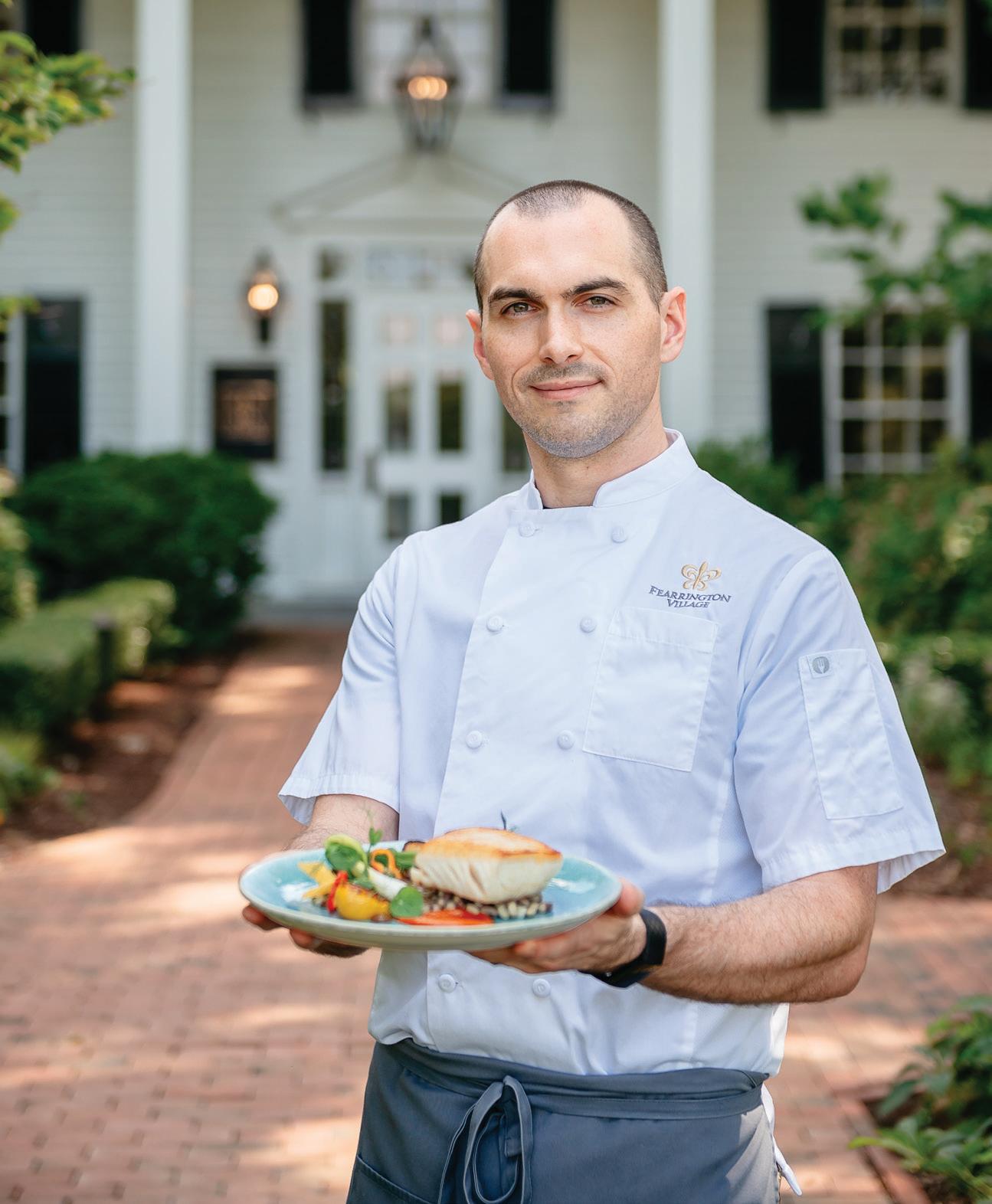
RIGHT New Fearrington House Restaurant executive chef
Paul F. Gagne presents a plate of seared halibut on a bed of field peas with local yellow squash, tabbouleh and red pepper.
The Fearrington House Restaurant was named a readers’ favorite in several Best of Chatham categories, including: overall restaurant; place for a date night; seafood; steak and upscale restaurant.
This year marks two major milestones for Fearrington Village, the quaint residential community in northeastern Chatham County surrounded by fields dotted with Belted Galloway cows. The Fearrington House Restaurant celebrates its 40th anniversary this fall and welcomes a new executive chef, Paul F. Gagne, who succeeded Colin Bedford in May. Colin spent 16 years at Fearrington and built a rare reputation for collaboration among his whole team. Paul, who worked closely with Colin as his sous-chef for the past five years, confidently steps into his new role. As for the rest of the team, Fahrad Matthews moves into the role of sous-chef; Jose Rios takes the junior sous spot, and Olivia Walsh is in the pastry sous position. Other staff members include Chad Hardin, who leads The Belted Goat’s casual dining for breakfast and lunch, and John Tate, who is in charge of the event menus.
CAREER PATH
Paul’s culinary journey began when he was a high school student working as a line cook at a landmark eatery called Violi’s Restaurant in his hometown of Massena, New York. The establishment had been open for more than 60 years and was owned by a prominent family in his small town.
Paul grew up in a family of fantastic cooks. “I think it’s a combination of their impact and the experiences I had growing up in a large family that influenced my cooking overall,” he says. In 2008, Paul moved to be closer to family in Greensboro, North Carolina,
I learned humility and grace under pressure and to never be complacent...
–
Paul
F. Gagne
44 CHATHAM MAGAZINE SEPTEMBER / OCTOBER 2022
The % : :
BestofChatham
SEPTEMBER / OCTOBER 2022 CHATHAM MAGAZINE 45
where he became a sous-chef at Sweet Basil’s under chef Tad Engstrom. After about three years working with other kitchens in the area such as Green Valley Grill and Proximity Hotel, he decided to attend New England Culinary Institute in Montpelier, Vermont. In 2012, he entered into his first paid internship at Fearrington, where he first worked with Colin over the course of five months.
“I realized I had a lot to learn,” Paul says. “It was very motivating.” He returned to NECI to complete an associate degree. He then began work at The Ballantyne Hotel in Charlotte, North Carolina, under chef Michael Rayfield, whom Paul credits as “instrumental in teaching good leadership qualities” and had a profound impact on how he handled himself in the kitchen. “Chef Rayfield was a fiery guy but would fight tooth and nail for his employees,” Paul
says. “It was impactful to see someone willing to go above and beyond for people that worked for him. It made you want to work hard, knowing he had your back.”
Paul, who lives in Morrisville, worked in North Hills before joining the Fearrington team in 2016. He officially took the reins on May 28 – a plan that had been in the works for a while.


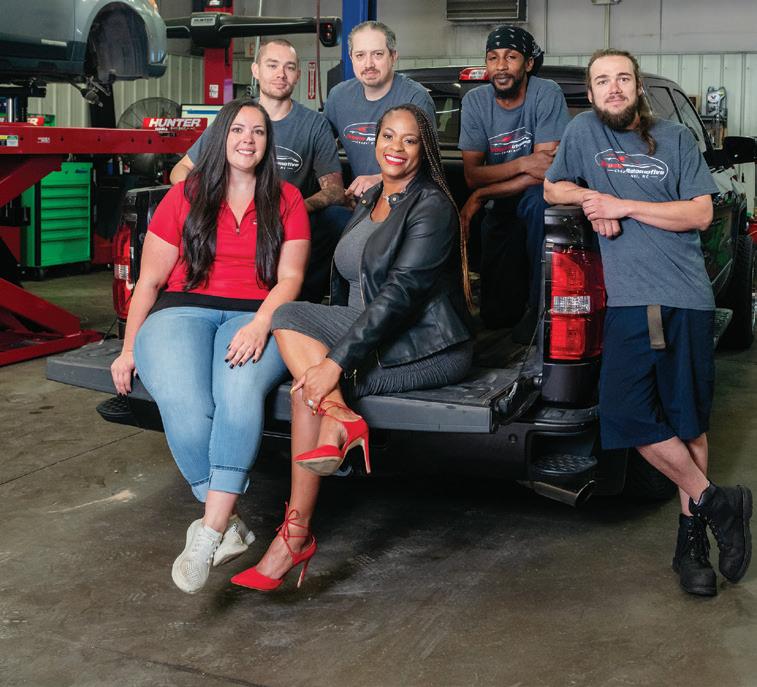

THE NEXT CHAPTER
Fearrington’s General Manager Theresa Chiettini believes Paul’s long-standing role at the restaurant, along with his creativity and drive, makes him uniquely qualified to take over for Colin.
“We have always believed in looking within our team for any opportunities that arise, and when chef Bedford let us know he was leaving, he felt it was a good opportunity for Paul to take the helm and for others in the kitchen to step into new
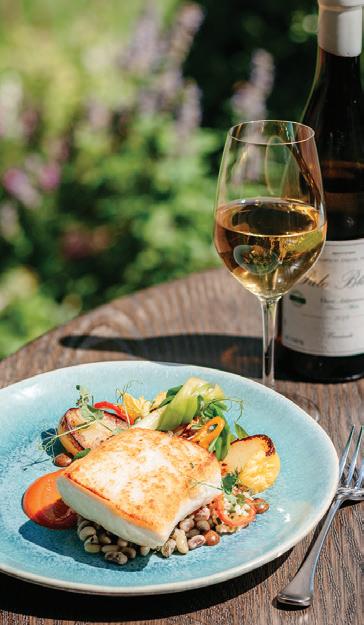
46 CHATHAM MAGAZINE SEPTEMBER / OCTOBER 2022 BEST OF CHATHAM
11744-B US Hwy 15 501 N | Chapel Hill 919-942-1023 browns-automotive.com family owned & operated since 1980! TIRES • BRAKES • INSPECTIONS SERVICE We’re the auto repair shop that you’ve been looking for in the Chapel Hill area. We’re a team of fun, friendly, and experienced technicians at Brown’s Automotive. We get your repairs finished faster, and we maintain the highest full-service repair standards. Give us a call today at 919-942-1023 to schedule your service appointment. 202 2 Thank you for voting us Best Auto Service!
roles as well,” Theresa says. “Paul has always been very dedicated – [he is] always one of the first people to arrive and get the team going for the day. He has always brought ideas to the table and collaborated with chef [Colin] Bedford on the menu.”

Paul is ready to take the lessons he’s learned from his mentors as he takes over. “Working with chef Bedford has been the most fun I’ve had in a kitchen to date,” he says. “We always had interesting projects in the works, and this was constantly pushing me to learn and grow. If chef Rayfield taught me leadership, then chef Bedford honed it to a fine point. I learned humility and grace under pressure and to never be complacent – always fine-tuning recipes, techniques, knowledge and leadership. I wouldn’t be here
The Fearrington House Inn – named by Travel + Leisure’s “World’s Best Awards” as one of the “15 Best Resorts in the South” – will mark the restaurant’s four decades with a series of events. Here are some highlights:










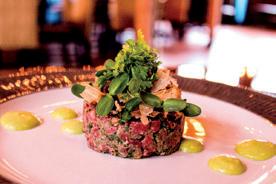






40th Anniversary Luncheon Honoring Jenny Fitch’s “The Fearrington House Cookbook” Sept. 25, 11:30 a.m.


Attendees will get handwritten menus, just as they were originally offered at The Fearrington House Restaurant, thanks to the book illustrator, as well as flower arrangements from Fearrington gardens. With purchase of a ticket, each guest will receive a copy of Jenny’s historical cookbook – recently introduced with a new cover.
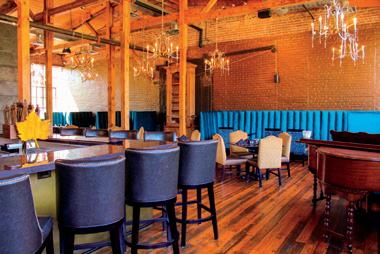
Valrhona Chocolate Soufflé Class
Oct. 16 and Nov. 13, 11:30 a.m.

Learn to make this decadent, classic chocolate soufflé – introduced to Fearrington by Edna Lewis during her tenure as one of Fearrington’s early chefs. Pastry chef Lydia Arnold will demonstrate this recipe, and participants will indulge in the soufflé.
40th Anniversary Tasting Menu
Beginning September 25 through the month of November, Chef Paul Gagne will offer a seven-course elevated wine- and Champagne-paired tasting menu, which will include the decadent chocolate soufflé.
without chef Bedford’s hand guiding me. I truly believe that.”
Paul says Fearrington offers a rare opportunity for chefs. “It’s an amazing place to work because it’s such a supportive work environment – the team and every person who is a part of the inner workings of the restaurant are truly valued by everyone involved,” he says, “and I can say from experience, that is somewhat uncommon in the restaurant industry.”
Having creative freedom with the menu is also a draw. “In both our main dining room and our bar, we intentionally evolve our menus with the seasons,” Paul shares. “We want to keep it fresh, new and interesting for guests who visit regularly. And we’re always excited to share new dishes we’ve been working on.” CM
SEPTEMBER / OCTOBER 2022 CHATHAM MAGAZINE 47 BEST OF CHATHAM Best Upscale Restaurant Best Place for a Cocktail Best Place for a Date Night Best Steak & Best Chef Thank you for voting us: Unique Cuts. Seasonal Plates. Fresh, Local Flavors. 480 Hillsboro St, Suite 500, Pittsboro. TheSycamoreAtChathamMills.com 919 704 8731 @TheSycamoreNC Restaurant, Bar, and Lounge














years! THANK YOU FOR 919.545.2133 DukeFitnessFearrington.com CARING EMPOWERING INTEGRITY COMMITMENT 17 Join during the month of September and enjoy Our Core Values guide us in serving our community with Care and Integrity. We are Committed to Empowering you to live a healthy lifestyle. enrollment! free Connect with us: 100 Clynelish Close, Pittsboro, NC DukeFitnessFearrington.com 919.545.2133 Celebrating 17 years of health and wellness at Duke Center for Living.



















2021 Saltwater Filtration Heated Pool / Hot Tub Group Exercise Classes Indoor Suspended Cushioned Track Therapeutic Massage Pilates Reformer Training Wellness Seminars Please call for our most up to date hours.Mon-Fri: 6 a.m. - 7 p.m. Sat: 8 a.m. - 4 p.m. Sun: CLOSED FREE enrollment DUKE C E N T ER FORLIVING OFFER ENDS SEPTE M B E R 30 , 2022 202 2
BestofChatham
THE STUFF OF
DREAMS
MEET THE FAMILY BEHIND SOME OF CHATHAM’S BEST FROZEN TREATS
 BY BROOKE SPACH
Creative Creamery takes milkshakes to new heights –literally. Behold: A mason jar is packed with three scoops of Hershey’s ice cream, drizzled with syrup and stacked with anything from cookies or fruit to whole cinnamon buns or cheesecake slices. It’s then piled high with whipped cream and icing or Nutella and, finally, a scattering of sprinkles. These “stuffed shakes” lure ice-cream lovers from across Chatham County and beyond. The Siler City business started as most do – just a daydream. It’s something
50 CHATHAM MAGAZINE SEPTEMBER / OCTOBER 2022
The
:
%
:
Ann Nie of readers’ favorite 1ST Nails & Spa, the artist behind these nails, says colorful French tips rather than traditional white tips are on trend this fall. This shade is “At Midnight” by iGel Beauty.
Jeff Edmisten and Lisa Edmisten would talk about when visiting Meyer’s Ice Cream Parlor, their favorite sweet spot in Surfside Beach, South Carolina. The couple missed having a local place for frozen treats since PC’s Cool Place closed down a couple of years ago. Motivation took hold. Jeff, who owns computer repair company Creative Computers, dismantled and rebuilt a trailer that became their mobile store in 2019, completing the project in just four months.
Creative Creamery sold its first scoops that year when the ice-cream truck made its public debut at the town’s Spring Chicken Festival in May. In those early months, they served ice cream, shakes and a few sundaes. The Edmistens closed up shop in November and made an announcement in January 2020 via their Instagram account, @creativecreamery, that they would open a brick-and-mortar off U.S. Hwy 64.
Their daughter, Katelyn Edmisten, 26, is the marketing engine behind the business’s social media pages. She shared the news of the storefront’s grand opening, which took place March 14, just as businesses were first shut down due to COVID-19. The creamery stayed open several weeks for takeout only and reopened its dining room with reduced capacity that May.
Despite the pandemic, Creative Creamery has grown its fan base and number of flavors – first 24, then 36 and now 48. Jeff notes that during the summer they sell nearly 300 gallons of ice cream and an estimated 650 waffle cones per week.
“We can’t have any more [flavors] unless we knock down a wall,” Jeff says. Their success earned them Hershey’s Golden Scoop Award for “outstanding performance in the sale and promotion of Hershey’s premium ice-cream products” for the past two years.

SEPTEMBER / OCTOBER 2022 CHATHAM MAGAZINE 51
Creative Creamery’s stuffed shakes really took off in 2021, “and the rest was history, as they say,” Jeff shares. The family opened a second location in Asheboro in May 2021.
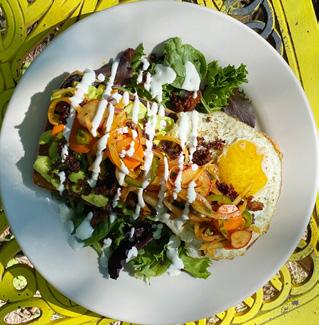

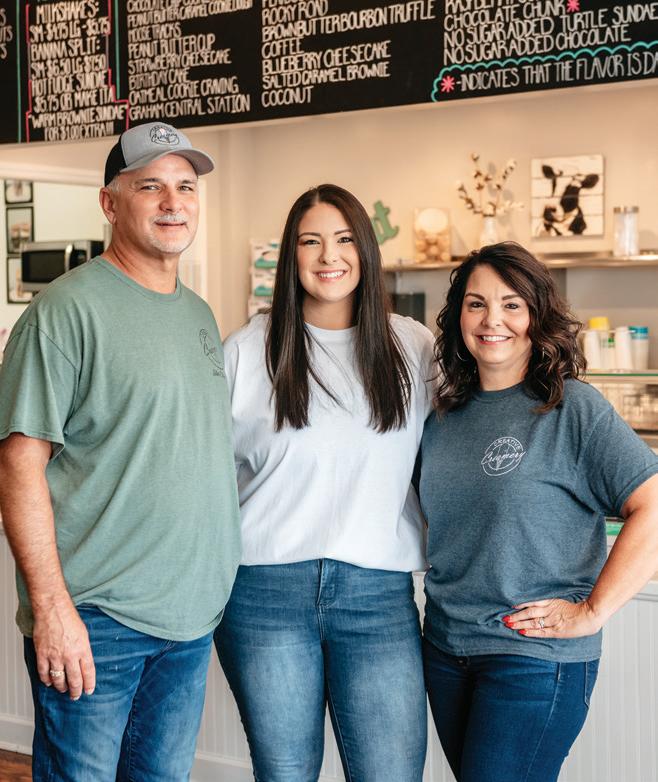
“I’ve lived here all my life,” Jeff says. “I was born in the Chatham hospital that used to be downtown. [In Siler City], we don’t have a theater. We don’t have a bowling alley. We don’t have putt-putt courses. So a lot of people use this place to come and just hang out and enjoy their family.”
The Edmisten family – Jeff, Katelyn and Lisa – at their Siler City icecream shop.
52 CHATHAM MAGAZINE SEPTEMBER / OCTOBER 2022 LIVE LARGE, EAT SMALL THANKS! WE U 2 CHATHAM! SMALLCAFEBANDB.COM | 919-228-8817 | INFO@SMALLCAFEBANDB.COM | BEST PLACE FOR BREAKFAST/BRUNCH BEST CHEF BEST B&B BEST OVERALL RESTAURANT BEST OUTDOOR DINING BEST PLACE FOR VEGETARIANS BEST KID-FRIENDLY RESTAURANT BEST COMFORT FOOD/ SOUTHERN FOOD • HET LANDHUIS IS HONORED TO BE VOTED BEST EVENT VENUE | HETLANDHUIS.COM 202 2 BEST OF CHATHAM
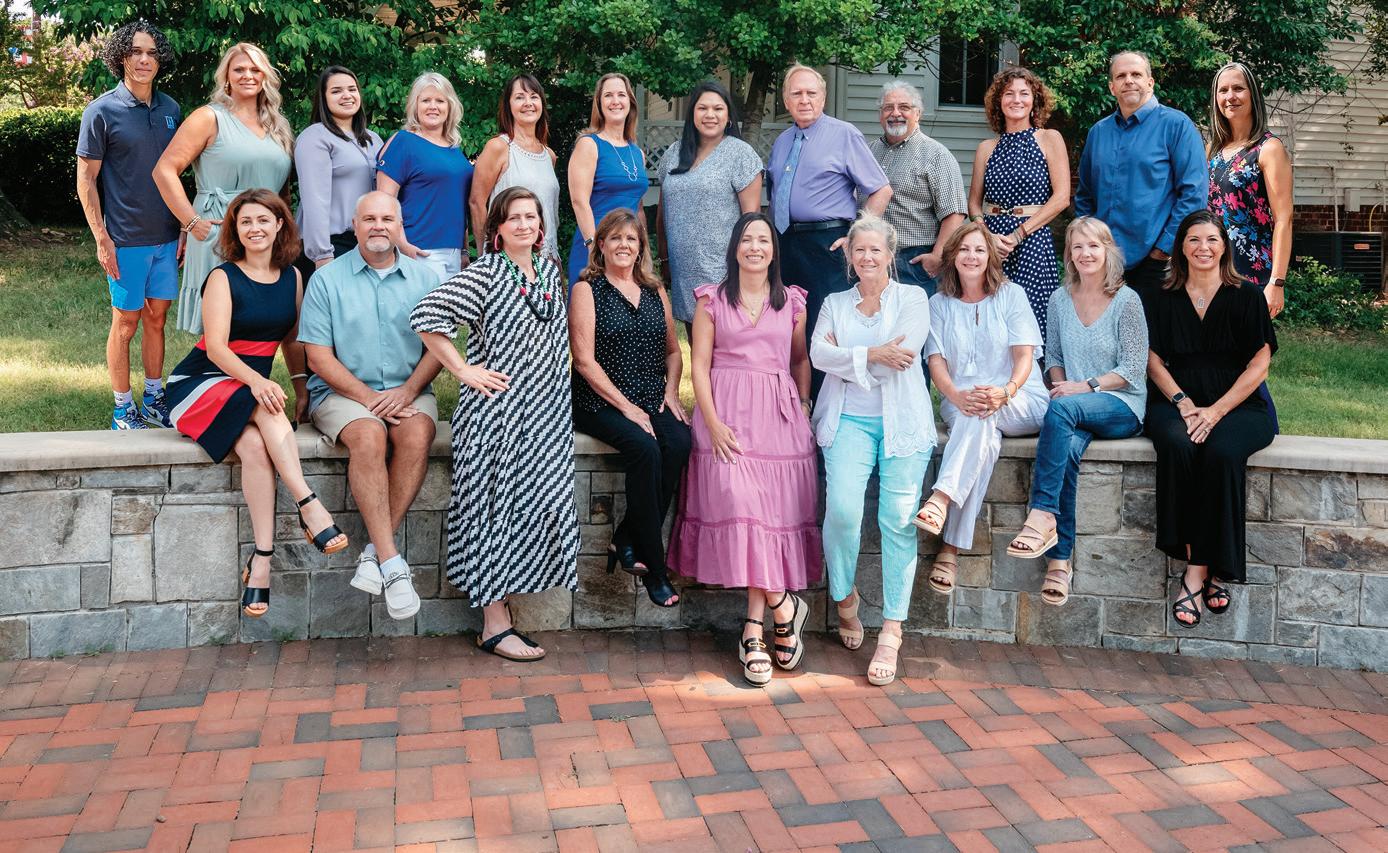



Thank you for voting us Best Real Estate Agency! YOUR HOMETOWN CHOICE Results That Move You chathamhomesrealty.com infochathamhomesrealty@gmail.com 202 2
Date nights, family outings, after-school snacks – it’s hard not to bond over a delicious sweet treat. “We wanted somewhere for people to go and have a good time,” Lisa adds. “Somewhere for the community to be able to come together,” Katelyn chimes in. The Edmistens would like to eventually host movie nights on an inflatable projector in the Siler City shop’s parking lot.
“It takes a village, and we have some great employees,” Lisa says. Each location has around 8 to10 workers, many of them high school or college students. Customers will often
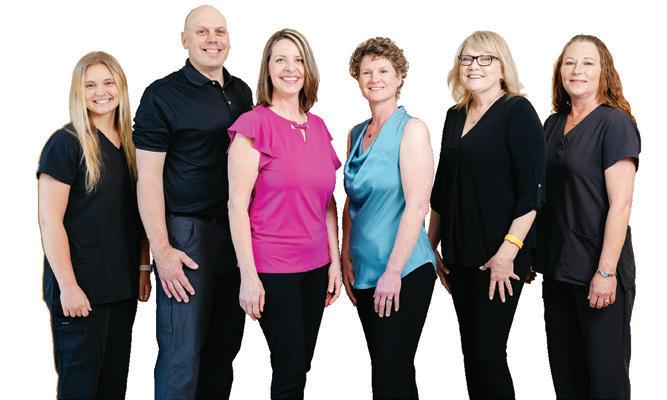

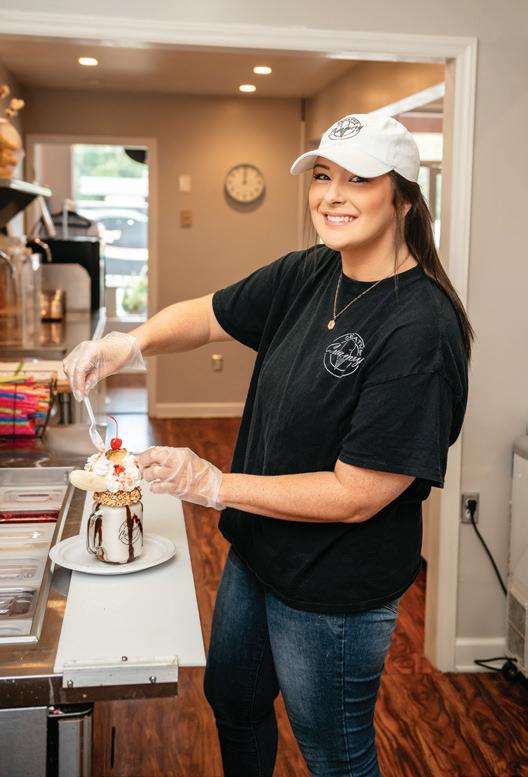
approach Lisa or Katelyn just to compliment them on their helpful and friendly staff.
The Creative Creamery welcomes ideas and seasonal themes for stuffed shakes from friends, employees and icecream fans. “We are only here because of our customers,” Katelyn says. “When I do social media, like [on National IceCream Day in July], I could’ve hyped up our ice cream and said all kinds of things about our shakes, but I pretty much said, ‘Happy National IceCream Day; we’re here because of you guys, so come celebrate with us.’” CM
54 CHATHAM MAGAZINE SEPTEMBER / OCTOBER 2022 BEST OF CHATHAM 919-726-6100 C AROLINA S PINE S PECIALISTS.COM PLATINUM COMMONS 1016 Thompson St., Ste. J PITTSBORO GOVERNORS VILLAGE 40100 Moring CHAPEL HILL CHATHAM DOWNS 141 Chatham Downs Dr., Ste. 204 CHAPEL HILL SERVICES • Spinal Decompression Non-surgical treatment of disc Injuries • MyACT Shockwave Therapy Advanced therapy for chronic conditions • Class IV Laser Therapy Photobiomodulation for acute soft tissue conditions • Chiropractic Adjustments Providing non-surgical treatment of spine & joint conditions using advanced therapies. THANK YOU FOR SELECTING CAROLINA SPINE SPECIALISTS BEST CHIROPRACTOR WE TREAT • Sciatica • Disc Herniation • Migraines • Plantar Fasciitis • TMJ Dysfunction • Arthritis • Tennis Elbow & Frozen Shoulder Jenni Sherwood, DC
202 2
Carolina
Spine Specialists
is excited to announce the opening of
our
third location at Chatham Downs and the addition of Doctors Mindy Bradshaw & Sean McCauley to the practice.
TANYA PAPANDREA
“Tanya is truly one of the best Real Estate Agents we have ever had. She is a real go getter and gets the job done! She does not waste any time and is always available to the client. We put our house on the market and within less than 24-48 hours we had four offers well above asking price and we excepted a very generous offer with little negotiation. She seems to love what she does and it shows.” - Michael H., Pittsboro

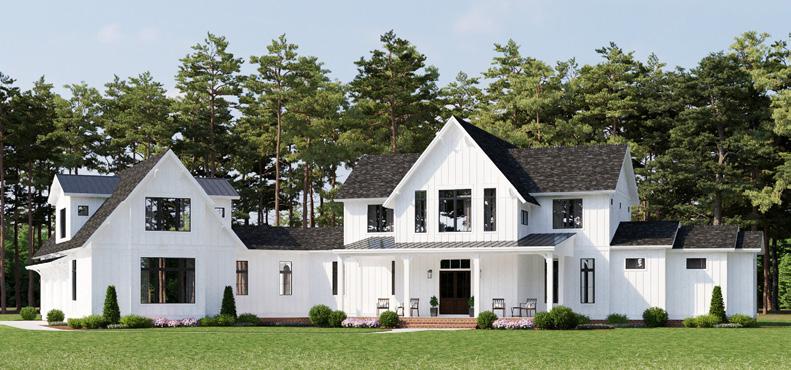

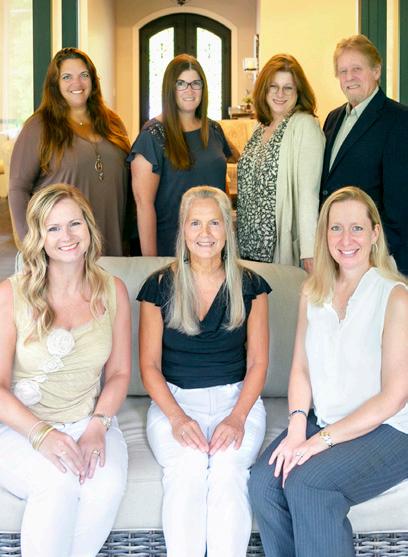
919.929.1057 | AbsoluteHomeBuilders.com Visit our Parade of Homes entry at 235 Jaspers Point! Use 336 Famlet Forest for GPS directions. October 1-2, 7-9, & 14-16 from 12-5pm Nelu Skumpija Multi-Year Parade of Homes Award-Winning C ustom Home Builder serving Chatham County & surrounding areas Favorite Construction/Builder 919.929.1057 | AbsoluteRealtyNC.com Relation Regular Bebas Neue Rounded Regular 871U cmyk=K=70
Brokers: Tanya Papandrea, REALTOR® Cindy Cooke, REALTOR® Melanie Thompson, REALTOR® Kathy Morrison, REALTOR® & Dale Cooke, REALTOR® Chatham County-based brokerage firm with 50+ years of combined experience Favorite Real Estate Agent Favorite Real Estate Company Broker Owner: Lisa Skumpija, REALTOR ® Broker-in-Charge: Yvonne Beal, REALTOR® THANK YOU FOR VOTING US BEST OF 2022, CHATHAM! 202 2
BestofChatham
ABOVE Carlos Sanchez serves beers to Darlene Earnhardt and her husband, Allison Earnhardt, inside Fair Game Beverage Company.
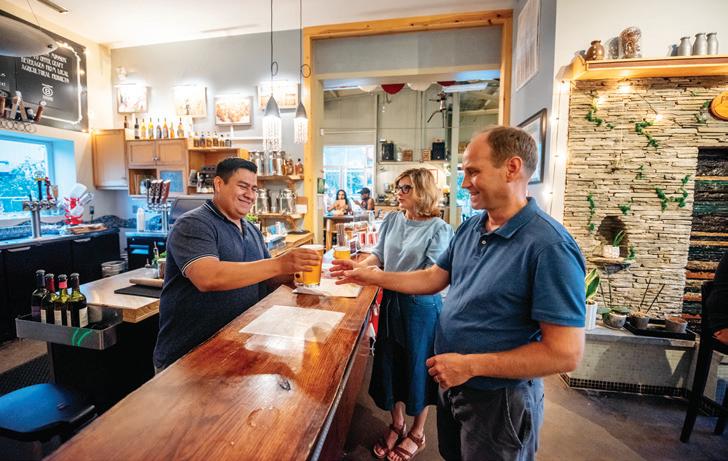
RIGHT
The Earnhardts stroll through the Chatham Beverage District at The Plant with Farid Lazaro, their daughter Lindsay Earnhardt and family pup, Tucker.
are family run, which makes me happy to see the next generation learning from their parents,” says Tami Schwerin, who co-founded The Plant with Lyle Estill and Lyle’s late brother, Mark Estill, in 2004. Tami and Lyle’s son, Arlo Estill, helps manage operations on-site and has his own business, Hempsmith Clothing Co.
Of the 18 businesses at The Plant, BMC Brewing, Fair Game Beverage Company and Copeland Springs Farm & Kitchen’s chef and owner Kristin Bulpitt were named favorites by readers of Chatham Magazine. The Plant itself was voted one of the best event spaces, and the Chatham Beverage District was named a best live music venue.
WHIMSICALLY
WEIRD
AND WONDERFUL
AN ECLECTIC COMMUNITY OF LOCAL BUSINESSES CREATE A NICHE FOR SUCCESS
“There are a lot of different businesses here, and we each specialize in our own thing,” Kristin says. “There is a living, breathing, passionate human behind each business here, and I think it shows. I think success will come from never getting comfortable and assuming ‘we made it’ just because customers are here today. We should always be working to improve and impress and to keep our customers coming back, because we are a great place to visit!”
The Plant is also home to Carolina Hemp Tours, Chatham Axes, Metal Brixx Cafe and Pittsboro eBikes, all owned by Kalim Hasan. Other businesses and organizations include Abundance NC, Cataleya Jewelry Studio, EcoBlend, Oak City Hemp, Smelt Art Gallery, TickWarriors, Vita Mielie and Webb Squared
BY ANNA-RHESA VERSOLA
Dr. Seuss once asked rhetorically, “Why fit in when you were born to stand out?” Drive down Lorax Lane in Pittsboro and discover a world where the founders of The Plant developed a winning formula for businesses.
“Local is our big focus, and many of the businesses
A BRIEF HISTORY
In 1946, about two dozen acres north of Robeson Creek were tilled to grow 25-by500-foot rows of chrysanthemums for Sunshine Gardens, one of the country’s most prolific floriculture operations in the mid-20th century, according to author Roy A. Larson. At its peak, the farm would have produced more than 212 tons of bronze, yellow, white and pink flowers, according to field supervisor Horace Clegg in an undated newspaper interview with News & Observer columnist Jack Aulis.
56 CHATHAM MAGAZINE SEPTEMBER / OCTOBER 2022
The
: :
%
Then in 1986, a manufacturing plant was built to produce metal alloys for military and aerospace industries. By 1993, that plant closed. The facility sat silent, and its barbed wire fences were overtaken by vines and weeds. In 2004, Tami and the Estill brothers saw the property’s potential as a sustainable industrial plant. They had a plan to turn waste oil into fuel, so they invested in converting the property into a biodiesel manufacturing facility. But they couldn’t keep up.
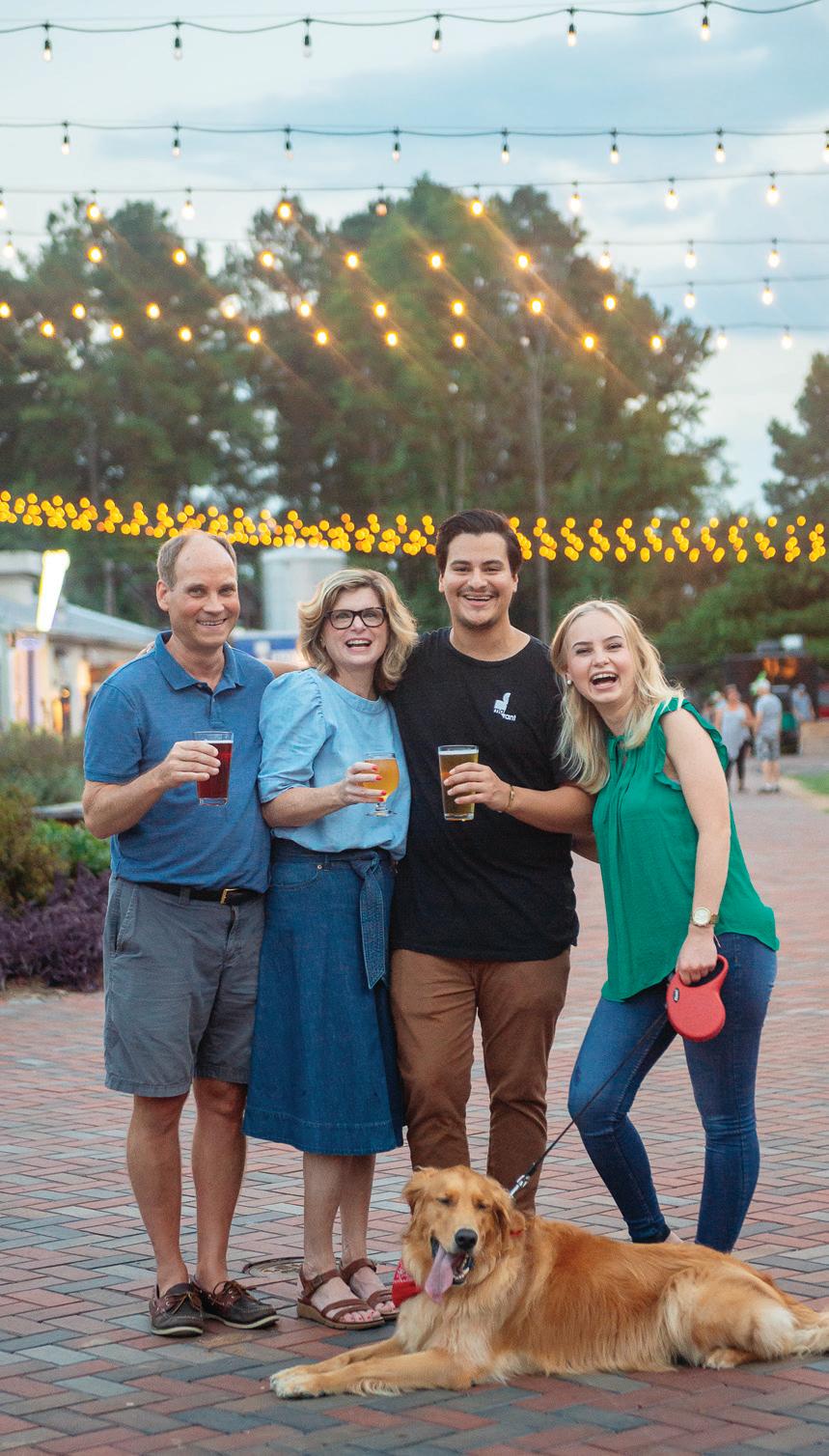
“Our biodiesel plant had a milliongallon-per-year capacity,” Lyle says. “It felt big to us. The Plant used to rumble and hum with big trucks, 300 gallons-perminute pumps, etc., but we were too small. Most of the biodiesel plants that survived were [pumping] 100 million gallons per year – 100 times our size. Piedmont Biofuels didn’t survive. We lost our shirts making fuel.”
In 2012, the eco-industrial business park began another metamorphosis.
SEUSSICAL CONNECTION
“W
hen we purchased the property in 2004, it was a scary, deserted, overgrown set of buildings with a terrible mosquito problem,” Tami explains. “No color, no wildlife, just empty, strange concrete buildings. It had been a Cold War aluminum smelting plant. We wanted to bring back the birds, bees and butterflies.”
Tami credits two people – Debbie Roos and Scott Every – for restoring the balance of nature to the property. Debbie is a county agriculture extension agent who reintroduced native plant species and trees. “And Scott, who looks a little like the Lorax, [the eponymous character from the classic Dr. Seuss book], was adamant about saving trees,” Tami says. “We agreed Lorax Lane would be the name of our road. It is even more important today than it was 18 years ago to save our trees and wildlife in this county.”
SEPTEMBER / OCTOBER 2022 CHATHAM MAGAZINE 57
OH, THE PLACES YOU’LL GO
“W

e have become a place for local craft food and beverage, and specialty retail, and we will continue developing space along these lines,” Lyle says. “We didn’t know we were in the real estate business. We were trying to make fuel. We didn’t understand property management. When we bought The Plant, it was poison ivy and possums. Had we known what we were doing, we would have developed the destination sooner.”
Tami says there is no secret to success except time, creativity, problem-solving and perspective. “We look at problems with the question, ‘How is this working for me?’” Tami says. “We do consider who is at The Plant and if their values align with ours. I have to say, we are at a place where the people all work together and have sustainability in their business plan.”
– Kristin Bulpitt

Today, The Plant includes the Chatham Beverage District, which is comprised of BMC Brewing, Chatham Cider Works, Fair Game Beverage Company and Starrlight Mead. Nonalcoholic drinks are available as well. There are times when the air is filled with the invigorating fragrance of roasting coffee from Vortex Roasters
On any given night, visitors drop in to shop at a pop-up market or learn to dance salsa or just hang out with friends. Every Thursday, rain or shine, the Pittsboro Farmers Market offers locally grown vegetables, flowers, meats, cheeses and eggs. Annual events like PepperFest in September and Death Faire in October will draw hundreds of visitors down Lorax Lane.
There is a pétanque court where players can toss steel balls at a target, an oversized chess set and a playground for kids.
58 CHATHAM MAGAZINE SEPTEMBER / OCTOBER 2022 BEST OF CHATHAM Best Neighborhood celebrating 25 years of calling chatham home chatham
202 2 proudly managed by chathamforest.com located in the heart of downtown pittsboro
forest
There is a living, breathing, passionate human behind each business here, and I think it shows.
•
•


SEPTEMBER / OCTOBER 2022 CHATHAM MAGAZINE 59 COLORPROOF. BAMBOO. MOROCCAN OIL, BRAZILIAN BLOW OUT. REDKIN. HANDBAGS & ACCESSORIES 919.542.5110 | 76 HILLSBORO STREET LOCATED IN THE HEART OF HISTORIC DOWNTOWN PITTSBORO. Thank you, Chatham, for your support and for voting us Best Hair Salon! 202 2 SALON & BOUTIQUE Thank you Chatham County! Chiropractic • Functional Medicine • IV Therapy 90 Launis St.Pittsboro, NC 27312 • 919.542.0325 • integrativefunctionalmedicine.com • Chronic Illnesses
Autoimmune Disease
Adrenal Disorders
Lyme Disease
Hormonal Imbalances
Weight Loss Support
Digestive Issues
Environmental and Food Allergies
Thyroid Issues
Adjunct therapy to Cancer Treatment
•
•
•
•
•
•
•
•
•
Neurological and Cognitive Disorders
Stress and Fatigue
Diabetes
Chronic Pain “F unctional Medicine philosophy is rooted in the idea that the body has an innate intelligence. Our goal is to assist the body back to health through working
person rather than the symptom. Our approach includes chiropractic care, bio-resonance testing, IV therapies, high-quality supplements, nutritional support, ozone therapy, and essential oils, to
few. We are thankful for over 15 years of serving our patients. Come as you are, we are here to help you” - Dr. Roxanne Hollander To name a few, some of the conditions we treat are: Follow us at: integrativefunctionalmed & Integrativefunctionalmedicine 202 2
•
•
with the whole
name a
Unique sculptures dot the landscape.
The Pittsboro Farm and Forest Trail was installed in 2016, so anyone can walk the ¾-mile nature path. There are plans to open a tree museum and an art walk.

“I want The Plant to be known as a unique, quirky, otherworldly, delicious, fun, relaxing place to spend a day or have
Katye Cairns, Jake Pickens, Lindsay, Farid, Darlene, Allison and the Earnhardts’ other daughter, Lauren Earnhardt, all raise a glass at The Plant.
your celebration,” Tami says. “People tend to be at home here, and they get to commune with nature while catching up with friends and letting their children play. … I love seeing the diversity of folks at The Plant. [The] farmers market is an especially fun day on Thursday afternoons. People go buy their local food and then settle into a picnic table and grab dinner, a beer, chat and slow down!”
Lilly Den Farm co-owners Mackenzie Withington and her husband, Tucker Withington, currently operate a mobile unit at The Plant. As of press time, the couple plans to open a permanent deli and retail store on-site by summer’s end.
Mackenzie says The Plant’s unique vibe makes it different from other area business communities. “It is the perfect, eclectic mesh of sustainability, hyper local, environmentally conscious, fun, tasty, laid-back and absolutely beautiful,” she says. CM
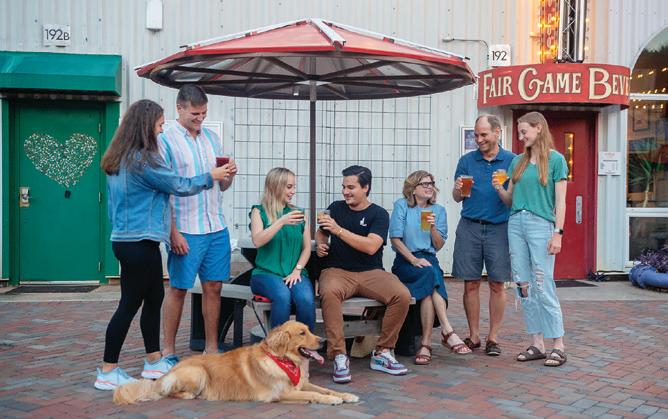
60 CHATHAM MAGAZINE SEPTEMBER / OCTOBER 2022 BEST OF CHATHAM Thank you for this honor! 919-623-4797 tedivailrealtor.com tsvail@earthlink.net Exceptional Service Before, During and After the Sale. Providing the Results You Expect. TEDI VAIL Broker/Realtor/e-PRO 202 2 TRUSTED RESPECTED
RECOMMENDED

Board Certified Specialists in Family Law Litigation, Mediation & Arbitration Services Collaborative Divorce Alternatives Thank you Chatham! Small Town Values. Big Reputation. We offer honest guidance in a place of uncertainty. Chatham | P.O. Box 728 | Pittsboro, NC 27312 | 919.679.9400 Durham | P.O. Box 603 | Durham, NC 27702 | 919.688.9400 ellisfamilylaw.com 202 2
A BREWER’S DOZEN
ONE TAPROOM OFFERS A STUDY IN SUSTAINABILITY THROUGH COOKIES MADE WITH BEER BYPRODUCTS
 BY NATALIE HUSCHLE
Two biochemists walk into a bar. One orders an oatmeal stout. The other orders an oatmeal cookie. While there’s no punchline, that scenario has played out every day since John Rice and Carmen Rice opened BMC Brewing last year at The Plant in Pittsboro
The two have been in the pharmaceutical industry for more than 30 years – John is retired, while Carmen still works – after earning degrees from the University of WisconsinLa Crosse and Case Western Reserve University, respectively. The pair has used their knowledge of fermentation to create delicious homebrews for decades. In 2018, they considered opening a brewery.
“We’ve been around beer a long time; we’ve studied beer a long time,” John says. “It isn’t just a, ‘Hey, let’s open a microbrewery cause we can.’ We’ve put a
John Rice and Carmen Rice feature nearly 20 different brews on tap – such as Fancy Pants India pale ale and Waddle of Penguins amber ale – at BMC Brewing, which was named a readers’ favorite new business, craft beverage producer and place for a beer in our Best of Chatham poll.
62 CHATHAM MAGAZINE SEPTEMBER / OCTOBER 2022
BestofChatham The % : :
SEPTEMBER / OCTOBER 2022 CHATHAM MAGAZINE 63
lot of time into becoming knowledgeable and working smartly in the industry.”


Though BMC has roots in homebrewing, all beers are crafted and served with technical expertise. John participated in a three-month brewing course at Siebel Institute of Technology in Chicago. Every staff member is a Cicerone-certified beer server, including the couple’s 27-year-old daughter, Maddie Laethem, BMC’s official brewer who also participated in the same training course in Chicago as her dad.





John and Carmen always knew they wanted to incorporate sustainable practices into their business. The edible byproducts of the brewing process gave them an opportunity to do so. “We knew that we wanted to do something with the grain besides just feed it to cows and pigs, which we do for the bulk of our grain,” John says. “Both Carmen and I come from families who bake, and we
Most BMC brews are ales, which require a shorter fermentation period than lagers – three to four weeks compared to around four months.

64 CHATHAM MAGAZINE SEPTEMBER / OCTOBER 2022 BEST OF CHATHAM
UTILITARIAN. ASTONISHING. BEAUTIFUL. MARK HEWITT POTTERY Award-winning handcrafted pottery that celebrates the quiet heroism of domesticity and is meant to be used and enjoyed. HEWITTPOTTERY.COM 2022 FIND KILN OPENING DATES, SHOP ONLINE & MORE AT 291 Meadow View Drive, Moncure, NC 27559 (919) 274-2497 • luckybarfarm.com Enjoy a guest-centric experience & gracious Southern hospitality! ê ê ê ê ê Impeccable 5-Star reputation on Google and Trip Advisor BED & BREAKFAST 2022
have always enjoyed cookies. We played around with spent grain on our own and came up with these recipes, and they were really good, so we thought we’d try them in the business.” Some cookie offerings so far include chocolate chip, pumpkin, cranberry oatmeal and macarons with lavender buttercream. (Those items were the inspiration for the name of the brewery, BMC, which stands for “bite my cookies.”)
Another environmentally friendly practice at BMC is to use as much solar power as possible to run the brewery and taproom. The pair also source their ingredients locally whenever they can, like hops from Bee Hoppy Farms in Pittsboro.
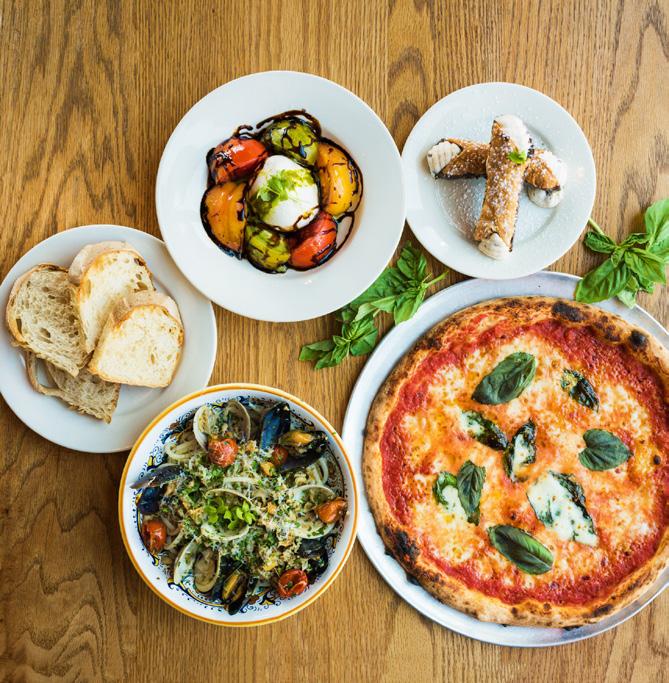


“Taking grain that could be used as a food stock and turning it into alcohol that people drink for pleasure is really a privilege that we can afford to do in this country,” John says. “So, we always wanted to make sure we were as responsible as we could be.”
BMC Brewing has nearly 20 different brews on tap, such as Washington’s Revenge sour cherry ale and Baby’s oatmeal stout. Most of their brews are ales, which require a shorter fermentation period than lagers – three to four weeks compared to around four months. Even so, John says BMC’s lagers are well worth the wait.
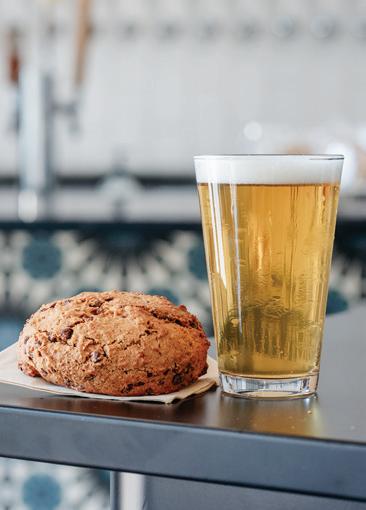
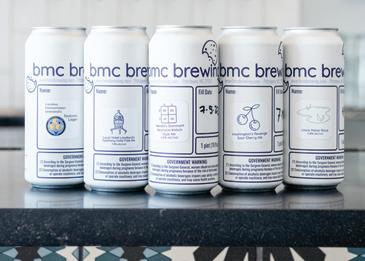
“The one right now that’s my favorite to drink is our Crooked Fence imperial Pilsner,” he says. “We just did a smallbatch imperial Pilsner over the winter. [We] did a long lager on it and gave it time to mature, and it came out really nice – really complex and malty.”
As Pittsboro grows, John aspires to cultivate a space where people can enjoy a homemade cookie and expand their taste in beer. “One of my favorite things is when a person comes in and asks to try a beer,” he says, “and they take a little sip of it and get this almost look of surprise on their face and say, ‘That’s really good!’” CM
SEPTEMBER / OCTOBER 2022 CHATHAM MAGAZINE 65 BEST OF CHATHAM Home-Made Pastas | Salads | Sandwiches Artisan Wood-Fired Pizzas Local, Farm-Fresh Ingredients Veranda at Briar Chapel 79 Falling Springs Drive, Chapel Hill 919.240.4104 | CAPPSPIZZERIA.COM 202 2


















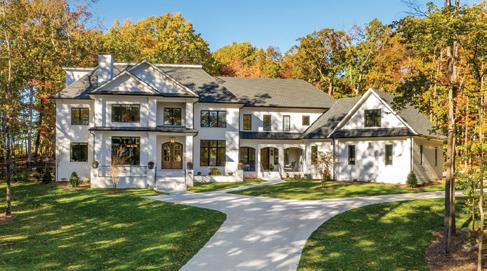


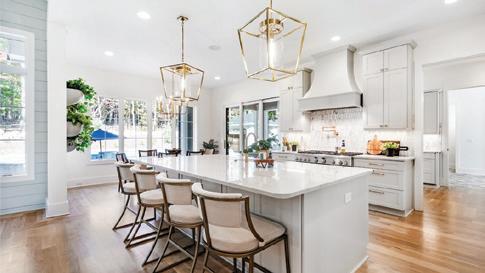
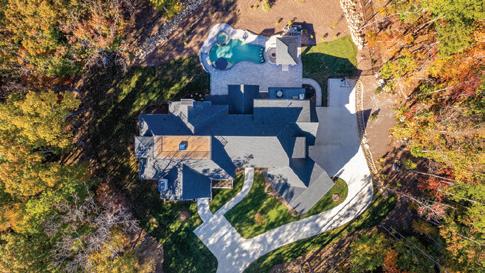





Discover beautiful homes on private wooded lots only minutes from Chatham Park and 20 minutes from UNC. Sign up to see the new models before anyone else at CorbettLanding.com CUSTOM HOME BUILDERS AND DEVELOPERS EXQUISITE. BESPOKE. AWARD WINNING. rexfordcustomhomes.com (919) 336-1531 AND INTRODUCING THIS NEW NEIGHBORHOOD IN PITTSBORO FROM Sales proudly with Starting this Fall in Chatham County
THE FAMILY BIZ
HOW A FEW OF OUR READERS’ FAVE COMPANIES BENEFIT FROM WORKING WITH RELATIVES
BY BROOKE SPACH
HOBBS ARCHITECTS
Taylor Hobbs and Grimsley Hobbs understand the business advantage of a shared trust. When Grimsley’s first firm in Goldsboro closed in 2005, he knew his son, Taylor, was the only person with whom he would want to start a new business. And so they did, that very same year. Hobbs Architects, located just two blocks from downtown Pittsboro, mainly focuses on public-use projects. Taylor says that within their seven-person staff, a core group has been with the firm for more than 10 years.
Hobbs Architects is located in the historical Lewis Freeman House, which, for the most part, has been left in its original form – a prime example of Hobbs’ motto of “preserving the past and designing the future.” A community-oriented firm, Hobbs has completed several projects for the county and towns of Pittsboro and Siler City, including restoring the Chatham County Courthouse after a fire in 2010 and designing Central Carolina Community College’s Chatham Health Sciences Center and the Siler City Center, the latter of which
is Chatham’s first LEED-certified building. LEED, or Leadership in Energy and Environmental Design, is a designation by the U.S. Green Building Council.
“Architects often get a reputation of having big egos,” Taylor says. “‘Our way or the highway’ type thing. [At Hobbs Architects], we’re listeners. We try to design to the client’s needs with simple, practical solutions that are well designed, but it’s not our vision. It’s the client’s vision.”
Grimsley and Taylor attribute much of their success to loyal, working relationships with the people of Chatham County and its towns. They say receiving the recognition as one of Chatham’s best architects means that their thoughtful, dependable approach shines through their work. “It means a lot,” Taylor says. “One of our missions [is] to be a community architect for Chatham County. If we could work solely in Chatham County, we would.”
When it comes to working together as a team, Taylor says he and his father “know each other’s strengths and can combine the two to cover more ground than [either] one of us can do individually. When it’s based on trust, it just makes things easier. That attitude and what people see when we’re working together – I think they pick up on the fact that we are a trustworthy business that’s reliable.”
Grimsley echoes these sentiments. “Taylor has picked it up and taken it so much further than I was ever able to, so that has been very rewarding to me,” he says. “ I’ve never had a more satisfying professional relationship.”
BOLD REAL ESTATE, BOLD CONSTRUCTION, BOLD FOUNDATION
Chris Ehrenfeld founded Bold Construction in 1990 and was motivated in 1997 to obtain his real estate license in order to access real estate transaction information. He and his mother, Jill Ehrenfeld, subsequently

One of our missions [is] to be a community architect for Chatham County
– Taylor Hobbs
68 CHATHAM MAGAZINE SEPTEMBER / OCTOBER 2022
The % : :
BestofChatham
started Bold Real Estate in 2005 back when it was the only real estate brokerage in north Chatham. Their businesses have since grown to include nearly 40 employees between them.
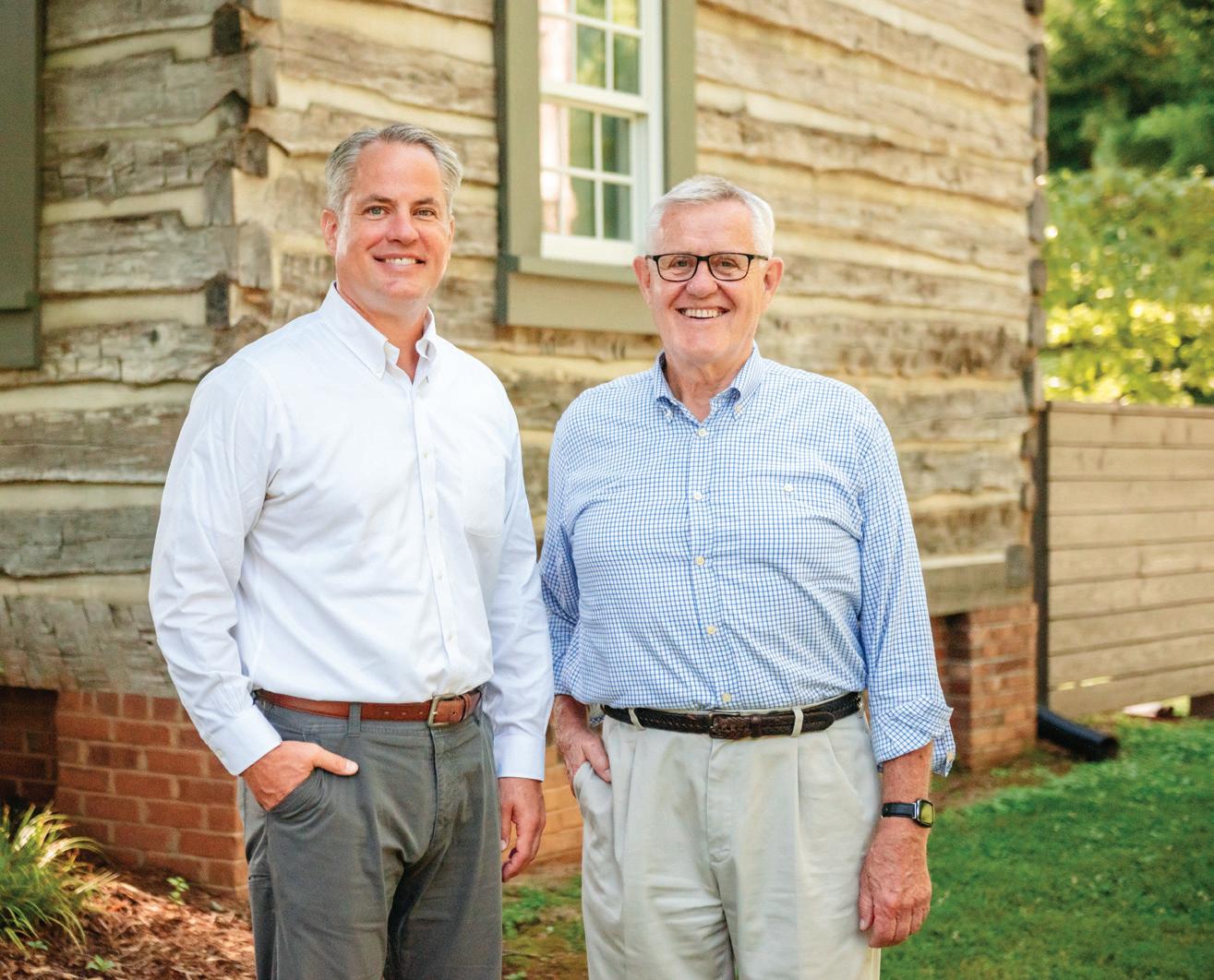
“We could tell a lot of people were going to be moving to Chatham County in the years ahead, and we thought we [could get] ahead of the curve of identifying a great place to live,” Chris says. “We wanted to get in early and establish ourselves and our reputation, as the community was clearly going to grow.”
Around that time, Jill was looking to semiretire from a successful sales career. She says she thought real estate “would be such a fun hobby.” More than 15 years later, Jill was recognized by the Triangle Business Journal as the No. 3 top-selling residential real estate agent in the area in 2021, with nearly $55 million in sales.
As a result of their success, Chris and his family were able to start the Bold Foundation, a nonprofit that supports underserved students in Chatham and Orange counties, in 2016. Chris’ wife,
SEPTEMBER / OCTOBER 2022 CHATHAM MAGAZINE 69
Taylor Hobbs and Grimsley Hobbs outside their office located in the historical Lewis Freeman House.
Jana Ehrenfeld, was the driving force in establishing the foundation after seeing the need when their twin boys, Max and Mason, started preschool.
“I love that we’re doing real things that impact real people,” Jill says of the family’s many endeavors. Our readers tend to agree, having named all three one of the best construction businesses, best real estate companies and best nonprofits in the county.
As mother and son, Jill and Chris have a deep mutual understanding, and say that their generational gap gives them unique perspectives to provide the best services to their clients.
“She trusts me immensely, and I trust her immensely,” Chris says. “As a business partner, you don’t ever have a thought or worry of distrust in your partner. You have the stability of working with somebody [who] has the same
outlook on life and the world. That certainly benefits us to help us make better decisions and work well together.”
B & T HVAC


B& T HVAC co-owner Aaron Horton says that he feels his service to the Chatham community would make his father proud. Barry Horton started the business in 1988 and named it for himself and his wife, Terri Horton. After his father lost his battle with cancer in 2007, Aaron and his wife, Heather Horton, took over the company. Today, it’s grown to include 17 employees in addition to the Hortons who assist clients throughout Chatham and Orange counties.
“My pops was very to the point,” Aaron says. “It was one way, and it was the right way, all the time. It doesn’t cost a lot more money to do it right
70 CHATHAM MAGAZINE SEPTEMBER / OCTOBER 2022 BEST OF CHATHAM 919.942.5051 Free estimates available! Voted Favorite Landscap er by Chatham Magazine Readers 202 2 Aeration, Seeding, & Fertilization Season Has Arrived! September to mid-October is the best time to schedule fall aeration/overseeding to rejuvenate your Fescue lawn. Call us to schedule your service today !
versus cutting corners. At the end of the day, I know a lot of folks. When I go out in town [with] my wife and my kids, I don’t want anybody to ever say that I didn’t do the best job.”
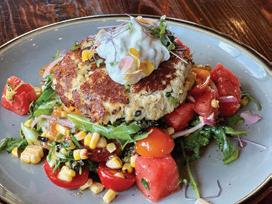

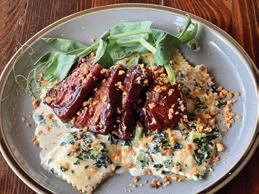
Aaron says his commitment to his customers is the same commitment he has to being a great husband, brother, father to his two daughters, Lily, 11, and Mia, 8, and business owner. The fact that our readers named his company one of the best for home maintenance and repairs means he’s living up to the values his father instilled in him.
“I think we are a better business because Heather and I truly care,” he says. “It’s a legacy and our names that drive us to provide the best services this industry offers. We understand that the service we provide impacts [our customers’] day-today lives. If we treat them as we would want to be treated, our customers will be happy. That’s what makes family-owned businesses special.” CM
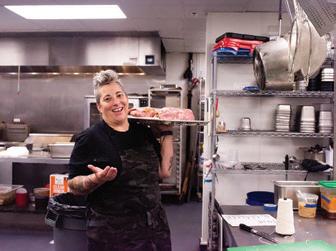
Aaron Horton and Heather Horton. “I am most proud that Heather and I have been able to live up to the standards my father set,” Aaron says. ”Our staff deserve so much of the credit for buying into what B & T was built on. Without them, B & T HVAC would not be the great company it is.”
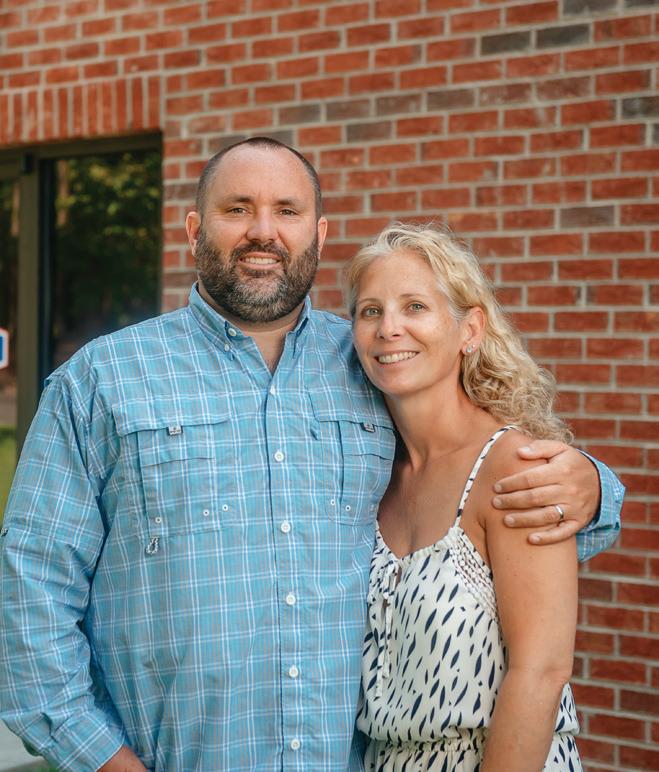
SEPTEMBER / OCTOBER 2022 CHATHAM MAGAZINE 71
AT YOUR
SERVICE
THIS AUTOMOTIVE SHOP RUNS ON DEPENDABILITY
BY ABIGAIL KELLER
When cousins Chris Sanders and Mark Sanders were ready to open their own automotive repair shop in 2014, they sought advice from a trusted neighbor who ran the Eubanks Esso Service Center off Highway 15-501 near Bynum
“We stopped in to visit with [Charles] Whitaker, who had been running the shop for about 30 years,” Chris says. “He told us he was looking to retire and that he would sell the business to
us. It was a great location on a busy highway – only about two miles from my house and five miles from Mark’s. We both loved the old-school look from the ’50s.”
Chris says he and Mark worked for about six months before they hired their first employee. Eight years and about a dozen employees later, Sanders Automotive Service outgrew the original
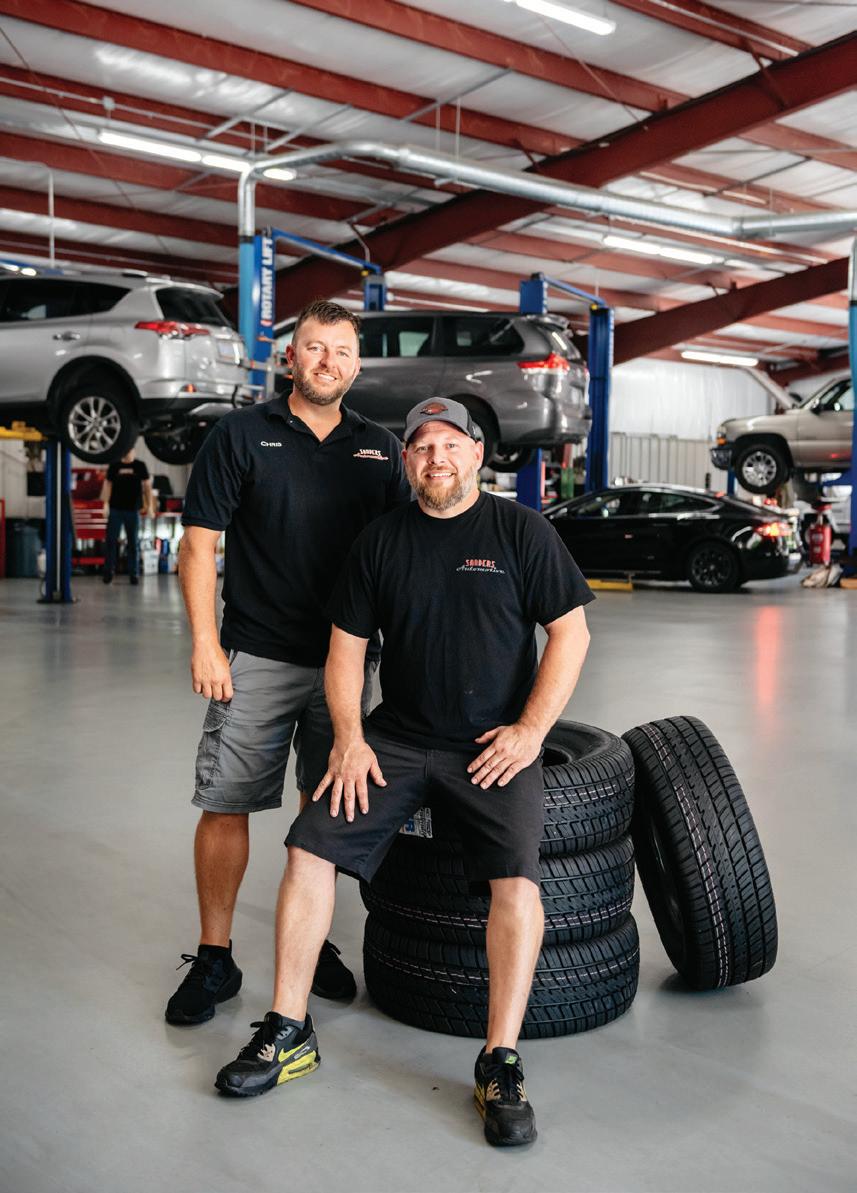
72 CHATHAM MAGAZINE SEPTEMBER / OCTOBER 2022
The % : :
Cousins Chris Sanders and Mark Sanders teamed up to start their own car service business, named one of the county’s best automotive services/repair shops.
BestofChatham
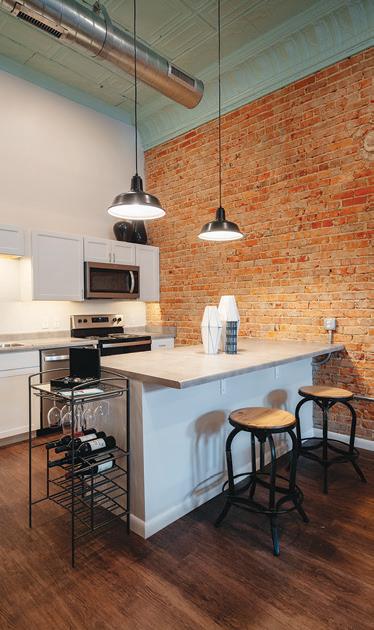


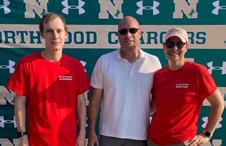


SEPTEMBER / OCTOBER 2022 CHATHAM MAGAZINE 73 Thursday - Friday 11am - 5pm Saturday 11am - 4pm — Or — Contact us to arrange a private shopping experience! Thank you for voting us Best Home Furnishings, Accessories and Decor! Casually Collected Furnishings, Accessories and Art for Your Home. FRAGMENTS 210 N. Chatham Ave. Siler City, NC FRAGMENTS, Too 143 N. Chatham Ave. Siler City, NC 202 2 Right price. Right here in town. Here’s the deal. The right insurance should help you feel confident and comfortable. I’m the right good neighbor for that. Call me today. Like a good neighbor, State Farm is there.® Right coverage. Right price. Right here in town. Here’s the deal. The right insurance should help you feel confident and comfortable. I’m the right good neighbor for that. Call me today. Like a good neighbor, State Farm is there.® Connie
NC Located in Coles Park Place beside Town and Country Hardware Everything we do is to support our community. Let us support you and your family. Call us for a free quote or insurance check-up today! 919-265-0702 Home Auto Life Business Supporting the local community The Connie Fenner Way!
Fenner connie@theconniefennerway.com theconniefennerway.com 11470 Highway 15N, Ste 105 Chapel Hill,
3,000-square-foot space, which now houses the year-round car wash and detailing service for the business. In January 2020, the cousins broke ground on a 10,000-square-foot facility across the highway. The new building has 10 bays with ceilings high enough to accommodate box trucks, RVs and small dump trucks.
“Then COVID-19 hit,” Chris recalls. “We didn’t know what was going to happen. Our work slowed down to almost nothing for a few weeks, and we didn’t know if construction would be stopped or shut down. All the while, [we were] still paying for the new loan.” Chris and Mark attribute their perseverance and success to loyal customers and having “the best crew in the business.”
“Our guys work hard to fix vehicles properly and efficiently,” Chris says. “They are all dependable and worked every day during the pandemic.”
Both cousins reflect on their experiences as mechanics with Hendrick Automotive Group at the now-defunct Chevy dealership in Chapel Hill. “It was hard to leave a steady job after 14 years with benefits, insurance [and] vacation pay to start over from scratch,” Chris says.
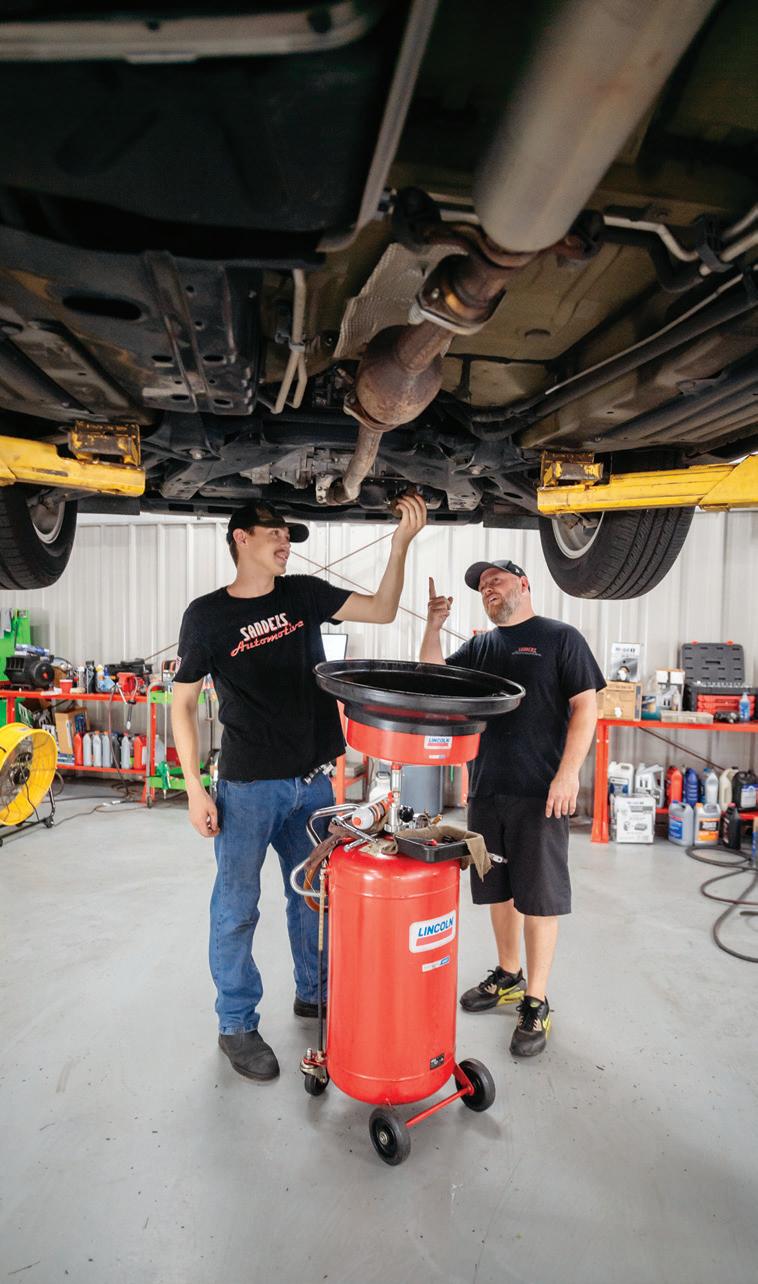
74 CHATHAM MAGAZINE SEPTEMBER / OCTOBER 2022 BEST OF CHATHAM
Cody McDaniel reviews his work with Mark Sanders in the new 10-bay facility across the street from the original service center.
Starting any business has risks, he says, “[but] I guess the only choice was to succeed or be homeless.”
The cousins are considering plans to sell classic cars, hot rods and muscle cars at the old Esso station to fit the nostalgic look of the vintage building. “We are also looking for some original Esso signs to put on the building to give it that old look again,” Mark says.
The Chatham County natives and Northwood High School alums look for new ways to help those around them and pay homage to the station’s roots. Their business supports local organizations like Bynum Front Porch, East Chatham Little League, Woods Charter School, Northwood High School Boosters Friends & Alumni Association,













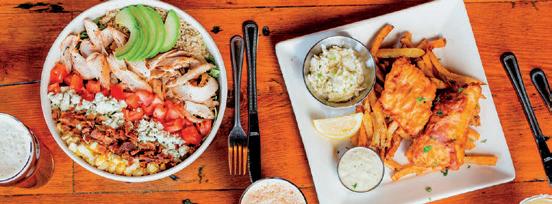
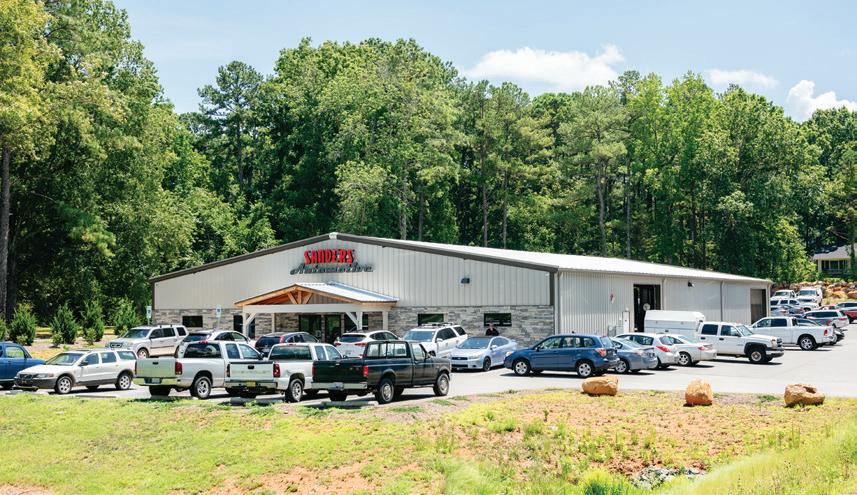





– Mark Sanders
the Pittsboro Street Fair and an annual Veterans Day cookout.
“We’re a small-town family business, and our name is on the building, so we really take pride in our work and treating people right,” Mark says. “We see a lot of our customers around town. We like to treat our customers the same as we would like to be treated.” CM
SEPTEMBER / OCTOBER 2022 CHATHAM MAGAZINE 75
... we really take pride in our work and treating people right.
Joy of Movement is generously supported by contributions from the community, which are welcomed throughout the year, and are tax-deductible through our fiscal sponsorship by Abundance NC (abundancenc.org), a 501(c)3 charitable non-profit. Find your joy, enhance your well-being and create meaningful connections through music, meditation, and movement: dance, yoga, Nia, Tai Chi 919-200-2129 TheJoyOfMovementCM.com 2021 2022 480 Hillsboro St. | Suite 410 Pittsboro, NC | 27312
CULTURE CLUB
CHILDREN PLAY AND LEARN IN SPANISH AT THIS PITTSBORO PRESCHOOL
BY BEN CROSBIE
Adriana Espinosa gets an early start on lessons at Pittsboro preschool Pasitos Felices, which means “happy little steps” in Spanish.
Adriana Espinosa says her work as the director of a Spanish-immersion preschool is all about love for the children, for the job and, underpinning it all, for her Latino culture. That love inspired her to open the Pittsboro-based Pasitos Felices, where children from 5 weeks

76 CHATHAM MAGAZINE SEPTEMBER / OCTOBER 2022
The % : :
BestofChatham


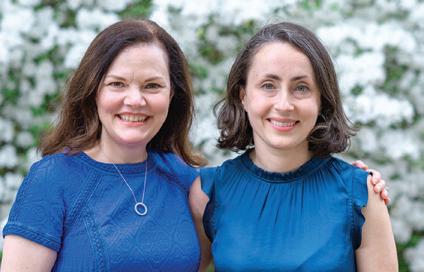




SEPTEMBER / OCTOBER 2022 CHATHAM MAGAZINE 77 Tammy R. Severt, DDS, MS (L) Laura Jacox, DMD, PhD (R) Drs. Tammy Severt and Laura Jacox provide orthodontic treatment in a personalized and caring enviornment. • Highly trained staff and the most up-to-date technology • Offering Damon Braces and Invisalign • Invisalign Platinum Provider for children, teens, and adults • Virtual consults available to fit your schedule CELEBRATING 22 YEARS SERVING PITTSBORO! 202 2 919.858.2864 SEVERTSMILES.COM THANK YOU CHATHAM FOR VOTING US BEST ORTHODONTIST! Contact Us Today to Get Started on Your Journey to a Beautiful Smile! 35 Thompson Street, Suite #103, Pittsboro, NC 101 Conner Dr., Suite #401, Chapel Hill, NC TOP DENTISTS every donation every purchase helps build homes Donate. Shop. Volunteer. 467 West Street, Pittsboro chathamahabitat.org | 919-548-6910 Schedule a free donation pick up today! 202 1
to 5 years old spend their days playing and participating in activities in a fully Spanish-speaking environment.

Enrollment began in July 2008 with only a handful of kids. Today, about 60 students fill the classrooms and play spaces in the building off Highway 902 The preschool’s primary purpose is to help English-speaking kids become bilingual and for Spanish-speaking kids to maintain a strong connection to their linguistic and cultural heritage.
“It’s very important to me that Hispanic children don’t lose their connection to their countries and their families,” says Adriana, who immigrated from Colombia with her husband in 2001. She spent several years preparing to open the preschool while working at a different school and raising her own three children. She says a major value in exposing kids to different languages and customs is to teach them to accept all types of people as they grow up in a country with its large and growing population of immigrants.
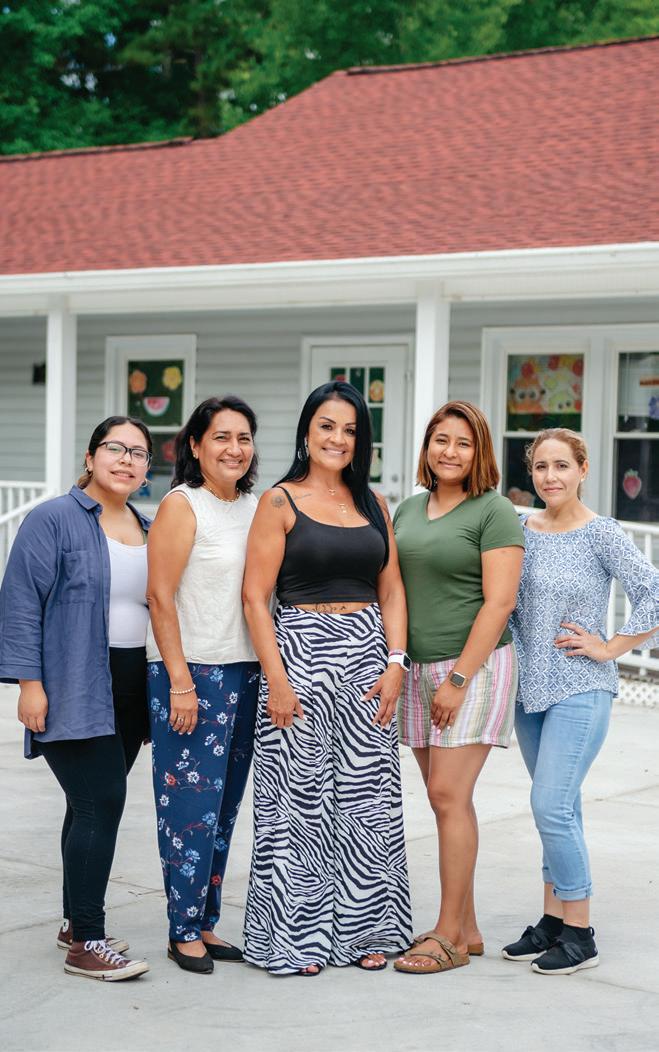
In addition to language skills, the preschoolers receive cultural exposure through learning about and celebrating holidays like Mexico’s Dia de los Muertos as well as traditional music and dancing like the Colombian genre of cumbia,
BELOW
78 CHATHAM MAGAZINE SEPTEMBER / OCTOBER 2022 BEST OF CHATHAM
LEFT Teachers Melany Escalante, Carmen Ortiz, Adriana, Alfonsina Alvarado and Maria Garcia.
Two students draw pictures for one of their assignments.
arolina Tiger Rescue would like to send its thanks to the Chatham County community for voting the Sanctuary as the “Best Nonprofit” and the “Best Place for a Family Outing.” The sanctuary has been a part of the Pittsboro community for nearly 50 years and gives visitors the opportunity to learn about and make a difference in the lives of animals in need. With more than 200 volunteers, countless monthly sustainers, and more than 20,000 visitors each year, opportunities to get involved are endless!
Carolina Tiger Rescue believes the ideal home for wildlife is in the wild.



202 2
Unfortunately, thousands of wild cats across the U.S. are bred and sold into private homes, the entertainment industry, and to roadside zoos for the sole purpose of exploitation. In addition to advocating against their exploitation, Carolina Tiger Rescue gives wild cats that have survived these circumstances a second chance at life, providing safe and comfortable homes where they can live in peace.
SEPTEMBER / OCTOBER 2022 CHATHAM MAGAZINE 79 202 2 INTERIOR & OUTDOOR CUSTOM KITCHENS 30 W. Salisbury Street, Pittsboro, NC 27312 919.618.4190 | freshairdesignsnc.com For more information, visit: CarolinaTigerRescue.org
you for voting us Best Nonprofit
a Family Outing!
Thank
and Best Place for
C
which was highlighted during their graduation ceremony in June.
Adriana spent time teaching children to read and write while she was in high school in Colombia, which she says is when she knew that working with kids was her destiny. Among the many things she loves about children is that they “teach you many things” in unexpected ways and without judgment.
“They take you out of your routine, and they put you in that little world that they have of happiness and innocence,” Adriana says. “I always tell the teachers, and I tell myself, ‘This is a labor of love. If you don’t come with your heart full of love for these children, this doesn’t work.’”
In a feat now regarded with pride, Pasitos Felices never closed its doors during the pandemic, and all four instructors continued to come in every day, even when they were down to only four kids showing up. Adriana notes that the use of face masks presented a challenge for the children, who rely heavily on facial cues in order to interpret the feelings and tones of other people, as well as to develop skills of interaction and socialization. And though she describes her job as primarily fun and exciting, Adriana remains keenly aware of the intense responsibilities that come with presiding over 60 young lives every day.
“It’s a very big responsibility to have these little minds that are absorbing everything we teach them and to know that we have to guide them so that they eventually will be good men and good women, and they get ahead,” she says. “I think that the [parents are] very pleased because their children are happy, they’re well cared for, and they’re in a safe place with good people, with people who hug them and love them.” CM
This is a labor of love. If you don’t come with your heart full of love for these children, this doesn’t work.
– Adriana Espinosa

80 CHATHAM MAGAZINE SEPTEMBER / OCTOBER 2022 2022 2022 2021 2021 BEST OF CHATHAM
"YOU ARE ABSOLUTELY THE MOST PROFESSIONAL AND COMPASSIONATE GROUP I HAVE EVER BEEN ASSOCIATED WITH."
- CONNIE S.
ALWAYS HIT IT OUT OF THE PARK! SO PROFESSIONAL AND EXACTING BUT SO CARING AND SO FRIENDLY. WE FEEL LIKE YOU ARE FAMILY AS WELL. THANK YOU SO VERY MUCH.”
- DAVID D. “THANK YOU FOR TAKING TIME TO LISTEN TO CONCERNS AND EXPLAIN INFORMATION AND FOR BEING SO KIND AND PATIENT WITH MY BABY!”
- ASHLEY A.
“ALWAYS AN EXTRAORDINARY EXPERIENCE. I AM SO GRATEFUL THAT YOU WORK TIRELESSLY TO MAKE SURE MY PUP GETS THE RIGHT CARE FOR THEIR NEEDS. SPECIAL NEEDS DOGS ARE HARD, AND YOU ALWAYS FIND A PATH.


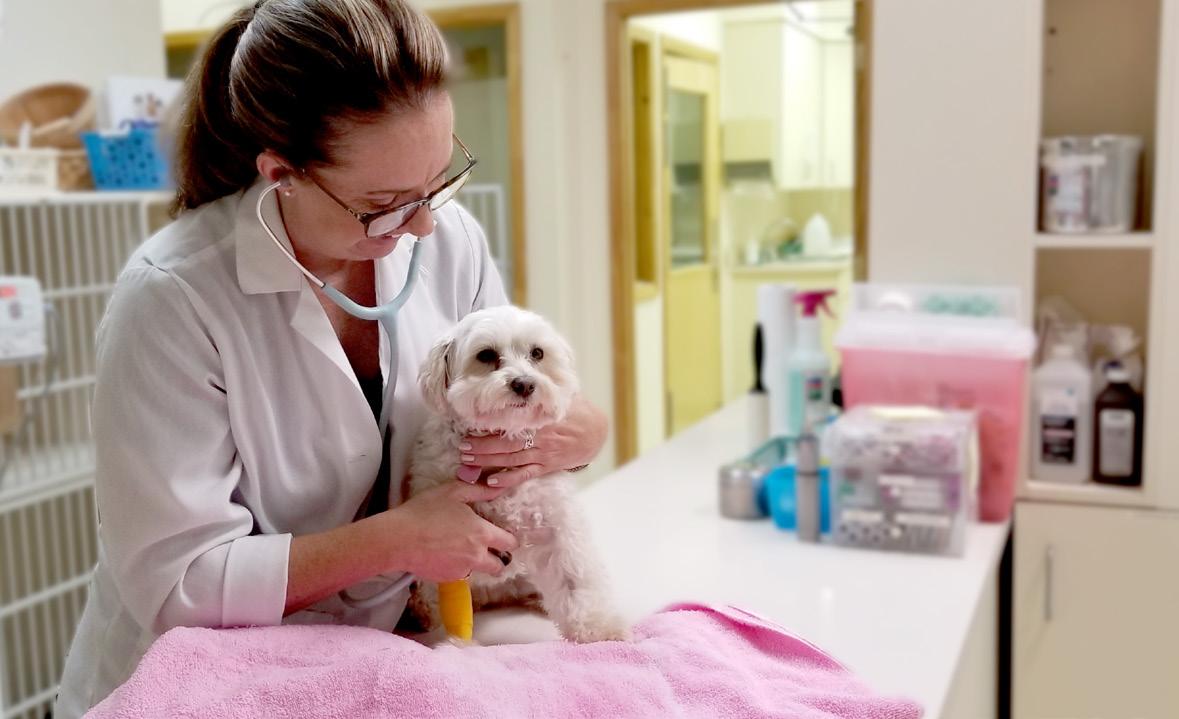
- AMY P.
Download the Hill Creek Veterinary Hospital app today! PREVENTATIVE CARE DENTISTRY LASER THERAPY ACUPUNCTURE ELDER PET CARE/PAIN MANAGEMENT IMMUNIZATIONS & WELLNESS EXAMS SURGERY RADIOLOGY GROOMING CHINESE HERB THERAPIES ULTRASOUND HOSPICE & EUTHANASIA QUALITY COMPASSIONATE CARE 919.542.1141 HILLCREEKVET.COM 75 OLD GRAHAM ROAD, PITTSBORO INFO@HILLCREEKVET.COM
“ YOU
202 1 202 2
BestofChatham
Deep River Mercantile coowner Hannah Brown stocks the shelves at her shop, named one of the best gift and jewelry stores in Chatham.
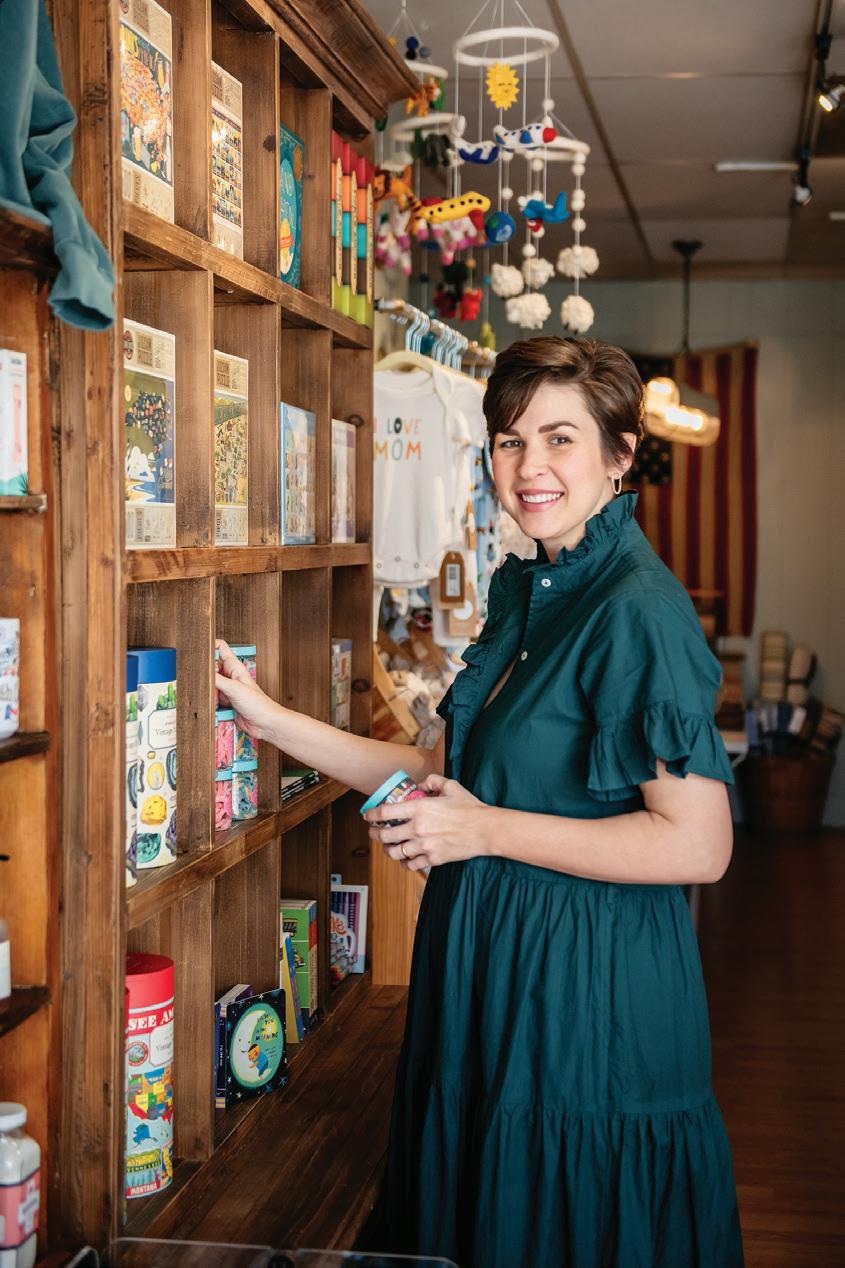
THE BEST OF CHATHAM 2022 WINNERS
*All results listed in alphabetical order
**The presence of five winners is the result of a tie
Dining
:
Asian Food China Inn Restaurant (Pittsboro) Moon Asian Bistro New Japan Panda Garden
Barbecue Allen & Son Bar-B-Que The Broken Spit Smithfield’s Chicken ‘N Bar-B-Q
Burger and Fries
Carolina Brewery Gov’s Burger & Tap S&T’s Soda Shoppe Town Hall Burger & Beer
Catering 39 West Catering Angelina’s Kitchen Cafe Root Cellar The Old Place Catering and Events
Chef R.L. Boyd, Small Cafe B and B Kristin Bulpitt, Copeland Springs Farm & Kitchen
Sera Cuni, Cafe Root Cellar Benjamin Guaman, Governors Club Chuck Jones and Greg Lewis, The Sycamore at Chatham Mills
Comfort Food/Southern Food
Allen & Son Bar-B-Que
S&T’s Soda Shoppe
Small Cafe B and B Virlie’s Grill
Craft Beverage Producer
BMC Brewing Carolina Brewery Red Moose Brewing Company Thirsty Skull Brewing
82 CHATHAM MAGAZINE SEPTEMBER / OCTOBER 2022
The
: :
%





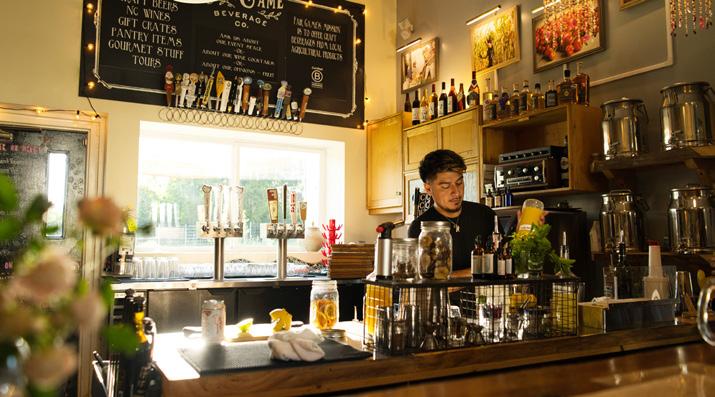

SEPTEMBER / OCTOBER 2022 CHATHAM MAGAZINE 83 SANFORD DERMATOLOGY 2021 2022 John Cheesborough, MD Dawn E. Kleinman, MD Mary Candace Seagle, PA-C Brittany Atkinson, PA-C Candace L. Marin, APRN Proudly serving Chatham County over 30 Years! Conveniently located in Platinum Commons - 959 East Street, Suite B - Pittsboro Accepting New Patients Any Age Self-Pay & Insurance Dysport, Botox & Filters Medical & Cosmetic Dermatology 919-775-7926 | www.sanforddermatology.com 192 Lorax Ln, Pittsboro NC | 919.548.6884 | fairgamebeverage.com Spirits • Wine • Craft Beers • Cider • Cocktails • Kombucha Visit us at The Beverage District/The Plant at 192 Lorax Ln located just a mile and a half East of the Courthouse, right on Industrial Drive! Check out our NC specialty food pantry! Feel free to roam our seventeen acre campus while you enjoy your libations. 202 2
*All results listed in alphabetical order




**The presence of five winners is the result of a tie
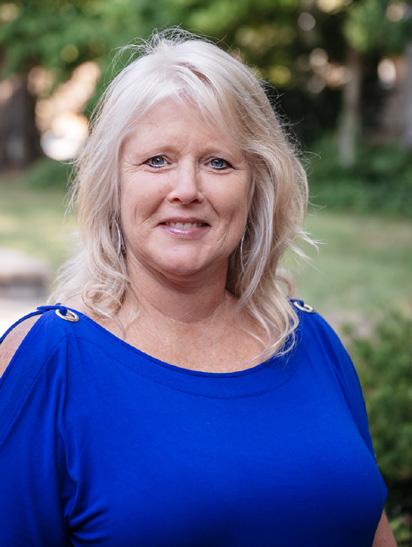
Desserts/Pastries
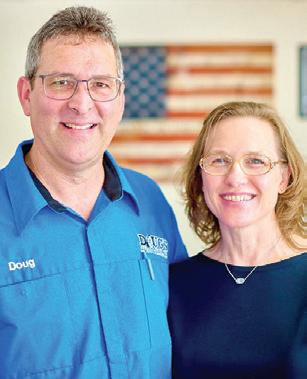
Carolina Cravings Co.
The Phoenix Bakery
Willy’s Cinnamon Rolls, Etc.
Frozen Treats
501 Pharmacy
Creative Creamery

Hwy 55 Burgers, Shakes & Fries
S&T’s Soda Shoppe
Italian Food Capp’s Pizzeria & Trattoria
Elizabeth’s Pizza (Pittsboro)
John’s Pizza Restaurant
Tarantini Italian Restaurant
Kid-Friendly Restaurant
Cafe Root Cellar
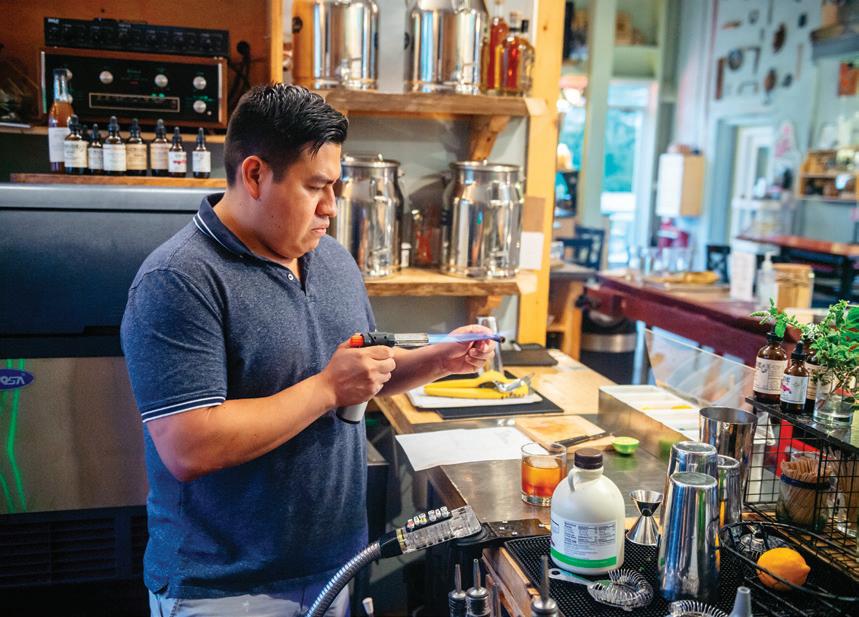
Carolina Brewery
S&T’s Soda Shoppe
Small Cafe B and B
84 CHATHAM MAGAZINE SEPTEMBER / OCTOBER 2022 BEST OF CHATHAM
HONESTY. QUALITY. SAFETY. SATISFACTION Family-Owned Complete Car Care Center since 1994 CALL US TODAY 919-542-5996 863 SANFORD ROAD, PITTSBORO 2022 Christie D. Brown Realtor® 919.842.0067 christieyourrealtor.com THANK YOU FOR VOTING ME AS best real estate agent 2022
Game
Co.’s Carlos Sanchez whips up a drink at one of our readers’ favorite cocktail bars and wine, beer and spirits shop.
Fair
Beverage
Chris G. Adigun, MD is a board certified dermatologist and a recognized leader in dermatology. She is known for her expertise in laser and aesthetic dermatology as well as her warm, compassionate and down-toearth personality. Dr. Adigun’s team is comprised of top notch, dermatology-trained professionals, offering the latest technology and treatments.
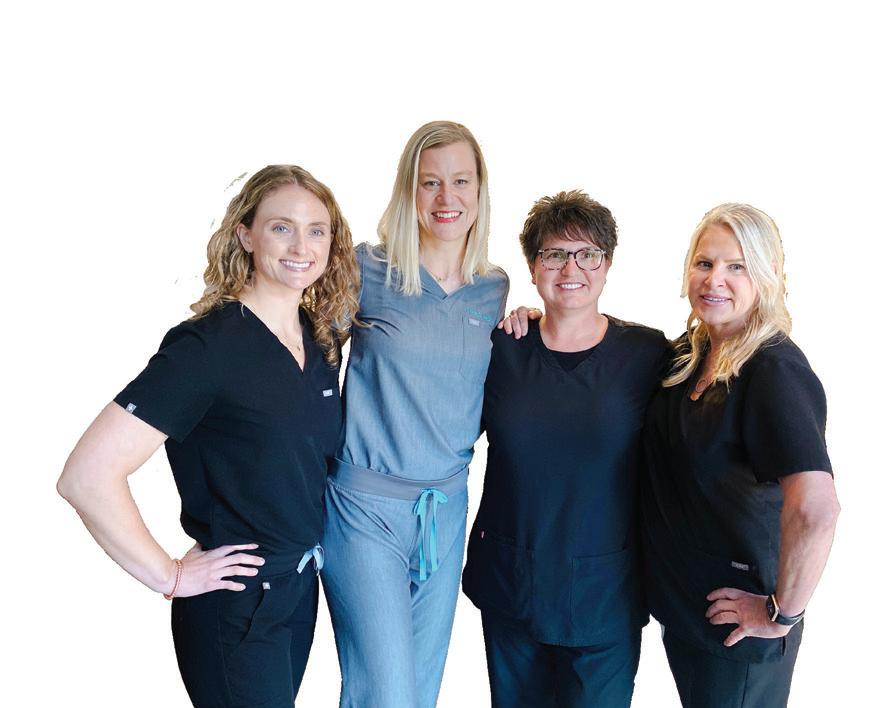
There is a reason DLC has been voted Best of Chapel Hill and Best of Chatham every year since we opened the doors. It’s simple, DLC treats everyone like family!
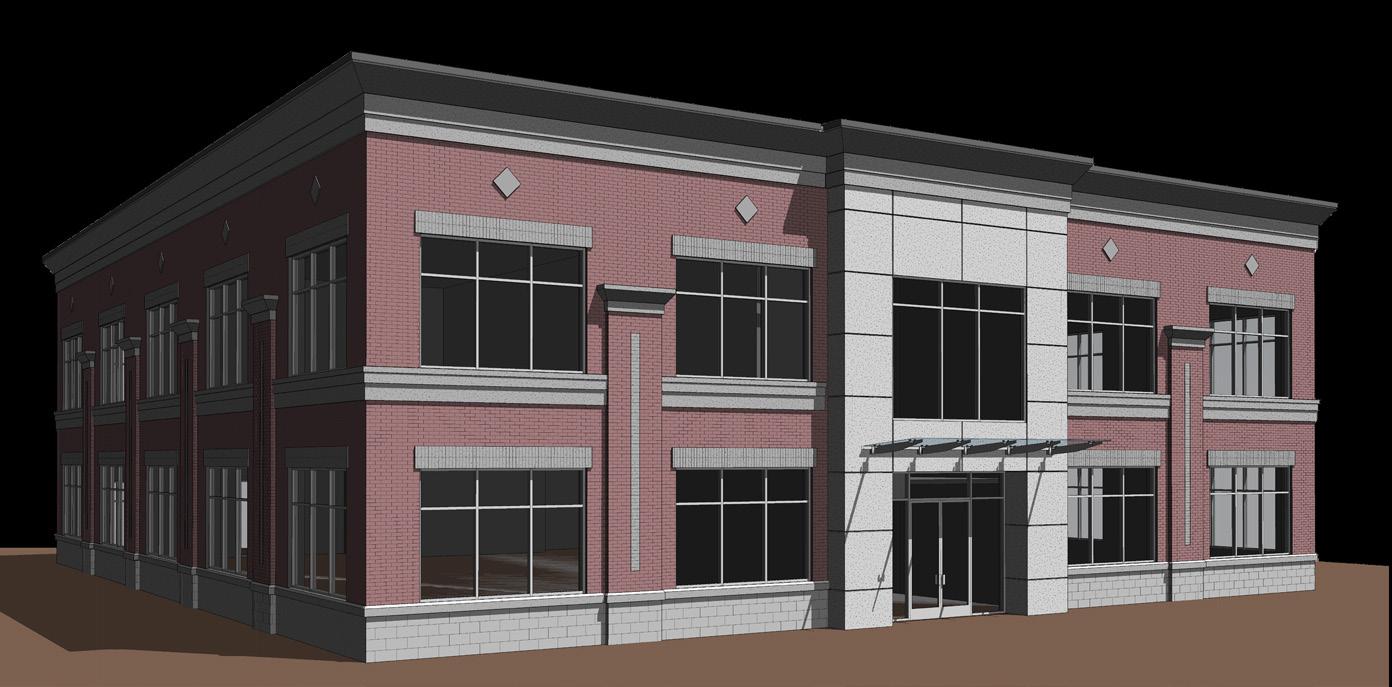
10441 US 15-501N Less than one mile north of our previous location New Location! 2022 2021 2021 2022
919.942.2922 dlcofchapelhill.com Feels Like Family
Chris G. Adigun, MD, FAAD Karlee Wagoner, ANP-BC Diana Walker, PA-C Jennifer Jahoo, LME
A fresh manicure by readers’ favorite nail salon 1ST Nails & Spa pairs quite nicely with a strawberry cheesecake stuffed shake at Creative Creamery, one of the best spots in Chatham for frozen treats.



86 CHATHAM MAGAZINE SEPTEMBER / OCTOBER 2022
sure
to start? cleanmychapelhillhouse.com 919-967-7592 HOUSE CLEANING DONE RIGHT SINCE 1991 HOUSE CLEANING DONE RIGHT SINCE 1991
Mi Cancun O’YA Cantina
and B
order
of a tie 3151 US 15-501 N, Pittsboro, NC 27312 919-542-5438 • poultryvilla.com Poultry Villa Landscaping and Supplies Call us for your landscaping and hardscaping projects! We specialize in organic mushroom compost and organic topsoil mixes. We use hardwood and pine mulches and specialize in patios, retaining walls, drainage work, plants and trees! We deliver and install. YOUR LOCAL DEALER FOR BREEO SMOKELESS FIRE PITS 2022
Not
where
Mexican/Latin American Food Compadres Tequila Lounge (Pittsboro) Guanajuato Mexican Restaurant
Outdoor Dining Cafe Root Cellar Carolina Brewery The Mod Small Cafe B
Overall Restaurant Cafe Root Cellar The Fearrington House Restaurant Postal Fish Company Small Cafe B and B Pizza Capp’s Pizzeria & Trattoria Elizabeth’s Pizza (Pittsboro) The Mod Village Pizza and Pasta
*All results listed in alphabetical
**The presence of five winners is the result
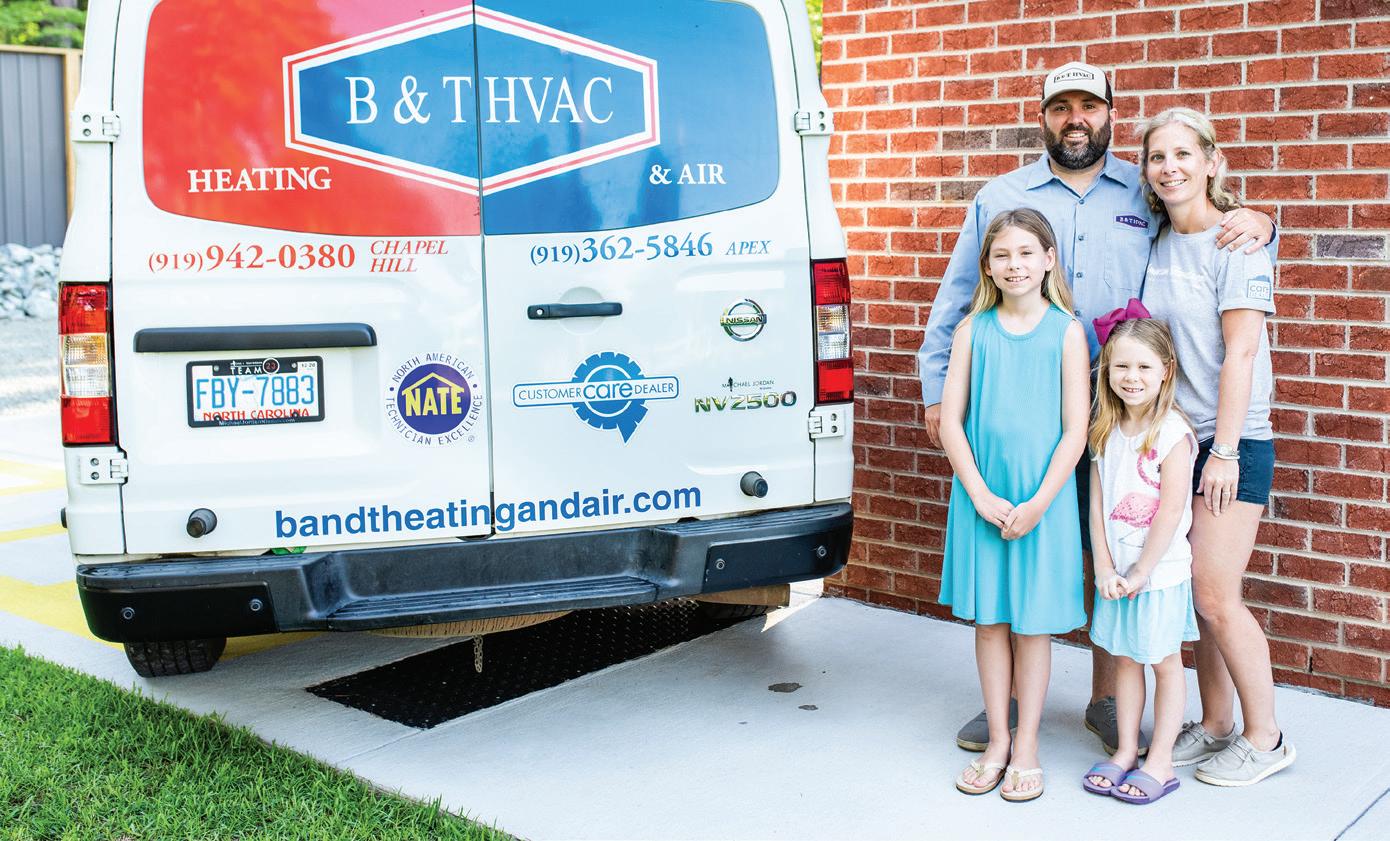


Heating and Air Service You Can Trust Family Owned and Operated 18 Certified and Highly-Trained employees Apex & pittsboro Office (919) 362-5846 Chapel Hill Office (919) 942-0380 GET A FREE QUOTE TODAY! Financing Available! bandtheatingandair.com Our Core Values As a second-generation company, we are committed to continuing the tradition of providing our community with top quality, affordability and dependable services that we’ve always been known for, which Barry Horton worked so hard to establish since opening the doors in 1988. Awarded NC Customer Care Dealer of the Year! AIR CONDITIONING ENJOY QUIET COMFORT AND REDUCED ENERGY COST WHEN YOU UPGRADE TO A NEW HIGHLY EFFICIENT AIR CONDITIONING SYSTEM FROM B & T HEATING LOOKING TO REPLACE YOUR FURNACE WITH AN ENERGY-EFFICIENT COMBINED HEATING AND COOLING SOLUTION? MAINTENANCE WITH REGULAR MAINTENANCE, YOUR AIR CONDITIONER AND HEATING SYSTEMS WILL RUN EFFICIENTLY FOR YEARS INDOOR AIR QUALITY DID YOU KNOW THAT AIR QUALITY IN YOUR HOME CAN ACTUALLY BE WORSE THAN SMOG-FILLED CITY AIR? 24/7 service with after hours (919) 818-8826 2021 202 2
Place for a Beer
BMC Brewing The City Tap House of Hops Red Moose Brewing Company
Place for a Cocktail
The Beagle Fair Game Beverage Co. The Mod The Sycamore at Chatham Mills
Place for a Date Night
The Beagle
The Fearrington House Restaurant Postal Fish Company The Sycamore at Chatham Mills
Place for a Sandwich Breakaway Cafe Cafe Root Cellar The City Tap The Mod
Place for Vegetarians Cafe Root Cellar Copeland Springs Farm & Kitchen Greek Kouzina Small Cafe B and B
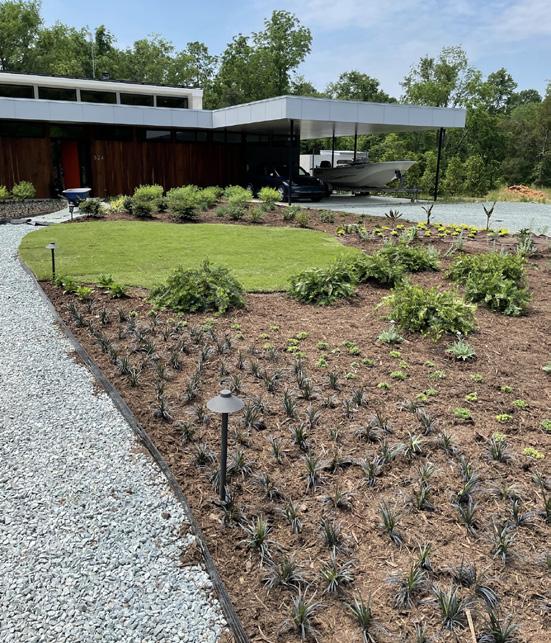
Place for Breakfast/Brunch Breakaway Cafe Cafe Root Cellar Small Cafe B and B Virlie’s Grill
Place to Get Coffee
Aromatic Roasters Breakaway Cafe The Chatham Rabbit Davenport’s Café Diem
Place to Watch the Game Carolina Brewery House of Hops The Mod Red Moose Brewing Company
Seafood
Capt. John’s Dockside Dry Dock Seafood
The Fearrington House Restaurant Postal Fish Company
Steak
The Fearrington House Restaurant Hayley Bales Steakhouse The Sycamore at Chatham Mills Virlie’s Grill
Upscale Restaurant
The Fearrington House Restaurant Postal Fish Company The Sycamore at Chatham Mills Tarantini Italian Restaurant
Wine, Beer and/ or Spirits Shop
580 Craft Beer
Fair Game Beverage Co. House of Hops Vino!! Wine Shop
Retail
*All results listed in alphabetical order **The presence of five winners is the result of a tie :
Clothing Store
M2 Graphics
New Horizons Downtown New Horizons West Second Bloom Thrift Shop Southern Threads
Gift Store
Deep River Mercantile McIntyre’s Books
New Horizons Downtown Southern Supreme Fruitcake & More
Home Furnishings, Accessories and Decor Fragments
Holt’s Interiors Inc. Reclamation Home Furnishings Steel Roots Home Decor

88 CHATHAM MAGAZINE SEPTEMBER / OCTOBER 2022 BEST OF CHATHAM 2022 2022 Design Consultations Landscape Design Installation & Project Management Firepits & Fireplaces Sod Pergolas & Lighting Patios, Walkways & Walls in Brick, Paver & Stone Outdoor Kitchens 919-590-0868 amystrunkdesigns.com hello@amystrunkdesigns.com
Jewelry Store
Deep River Mercantile JG McLaurin, Goldsmith
Liquidambar Gallery and Gifts
New Horizons Downtown
Home & Garden
Architect
Hobbs Architects
Paces and Roehm Architecture Steven Clipp Architecture
Construction Business/ Builder Absolute Construction and Development
Bold Construction
Mid-South Builders Inc. The Rexford Group
Interior Designer
Ashlie Campbell, An Acquired Style
Hannah Brown, Deep River Mercantile Mary Kate Bedell, Fresh Air Designs
Christy Lynch O’Hara, Steel Roots Home Decor
Home Maintenance & Repair
A-1 Heating & Cooling Inc. B & T HVAC Bud Matthews Services Chimneys Plus
Landscaper Amy Strunk Designs Arbor Enterprises

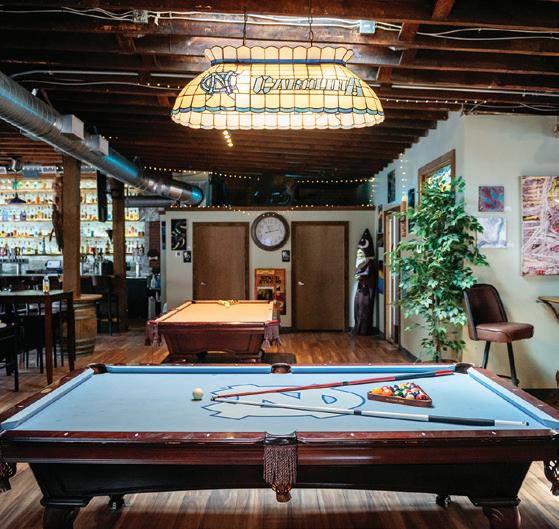

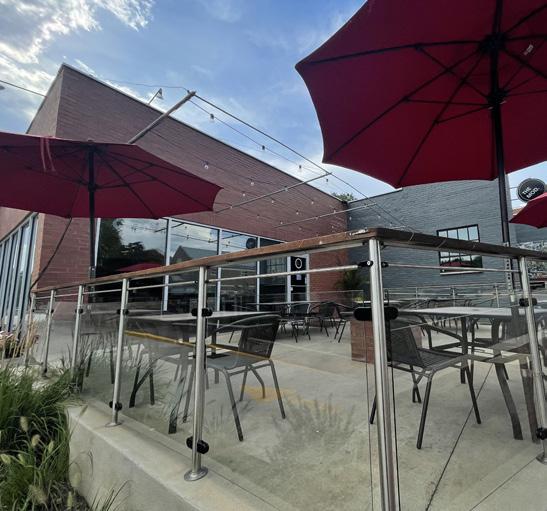
O’Mara Landscaping & Lawn Care Inc. Poultry Villa Landscaping and Supplies
Interior Decorator
SEPTEMBER / OCTOBER 2022 CHATHAM MAGAZINE 89 BEST OF CHATHAM
919 533 6883 . THEMODERNLIFEDELI.COM . THEMODERNLIFEPBORO . THEMODLIFE 46 SANFORD ROAD, PITTSBORO, NC SALADS WOOD-FIRED PIZZA BURGERS SANDWICHES 41 BEERS ON TAP OUTDOOR PATIO LIVE MUSIC THE MOD. 202 2 THE OTHER SIDE. : 202 2 Chatham’s Best Hair Salon for Men
Landscaping & Garden Supply Store
B & L Supply
Chatham Central Greenhouses and Nursery Country Farm & Home Supply Pittsboro Feed
Neighborhood
Briar Chapel
Chatham Forest Fearrington Village Governors Club Powell Place
Services
Automotive Services/Repairs
Brown’s Automotive
Chapel Hill Tire
Performance Automotive & Tire Sanders Automotive
B&B
The Fearrington House Inn
The Inn at Celebrity Dairy Lucky Bar Farm Small Cafe B and B Bank
Fidelity Bank First Citizens Bank State Employees’ Credit Union Truist
Chiropractor
Dr. Mindy Bradshaw, Back Solutions
Dr. Roxanne Hollander, Integrative Functional Medicine
Dr. Jennifer Sherwood, Carolina Spine Specialists
Dr. A. Lynn Williams, Circle City Chiro
Day Care
Learning Lemon Drops Child Care Center Pasitos Felices
Primrose School of Chapel Hill at Briar Chapel Robyn’s Nest Creative Learning Center Inc.
Dentist/Dental Care
Dr. Sidharth Bansal, Pittsboro Dental Associates
Enchanting Smiles Family Dentistry
Dr. Blake Jones, Royal Oak Dental Group of Siler City Dr. William P. Mitchum, DDS
Dermatologist/Skin Care Clinic

Dr. Chris Adigun, Dermatology & Laser Center of Chapel Hill Dr. John Cheesborough, Sanford Dermatology Dr. Dawn Kleinman, Sanford Dermatology
Hair Salon
Edge Aveda Men
Eric Michaels Salon Salon Breeze This Is IT! Cuts+
Lawyer/Law Firm
Ellis Family Law PLLC Paul S. Messick Jr., Gunn & Messick PLLC Kathie L. Russell, Russell & Associates Moody, Williams, Roper & Lee LLP
90 CHATHAM MAGAZINE SEPTEMBER / OCTOBER 2022 BEST OF CHATHAM
*All results listed in alphabetical order **The presence of five winners is the result of a tie : 202 2 1ST Nails & Spa Thank you for voting us Best Nail Salon! (919) 542-5880 1st-nail-spa.business.site 90 Lowes Drive | Suite 103 Pittsboro, NC 27312
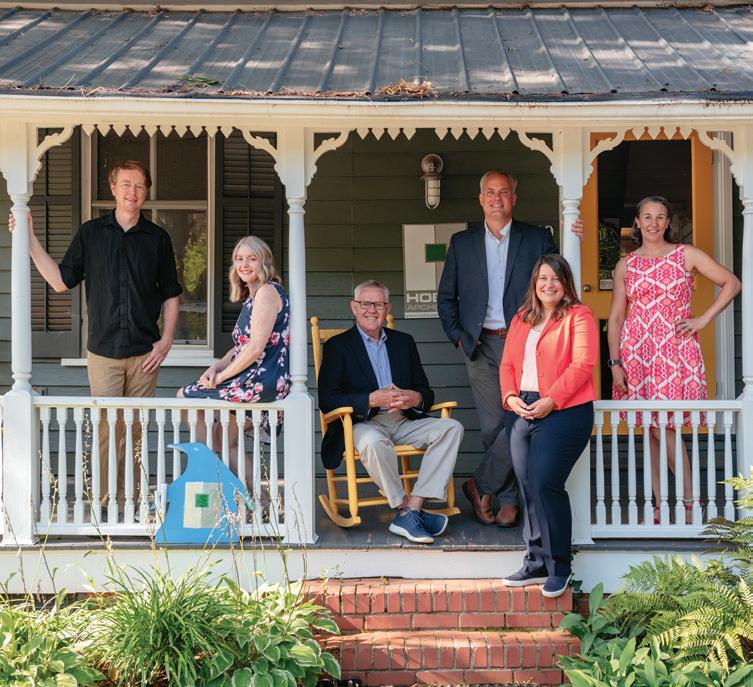


SEPTEMBER / OCTOBER 2022 CHATHAM MAGAZINE 91 159 W. SALISBURY STREET PITTSBORO NC 919.545.2004 IN THE HEART OF HISTORIC PITTSBORO PRESERVING THE PAST. DESIGNING THE FUTURE. Thank you for voting us as your Favorite Architect! 202 2 919.542.8166 115 Hillsboro St. Pittsboro, NC 27312 deeprivermerc.com hello@deeprivermerc.com 202 2
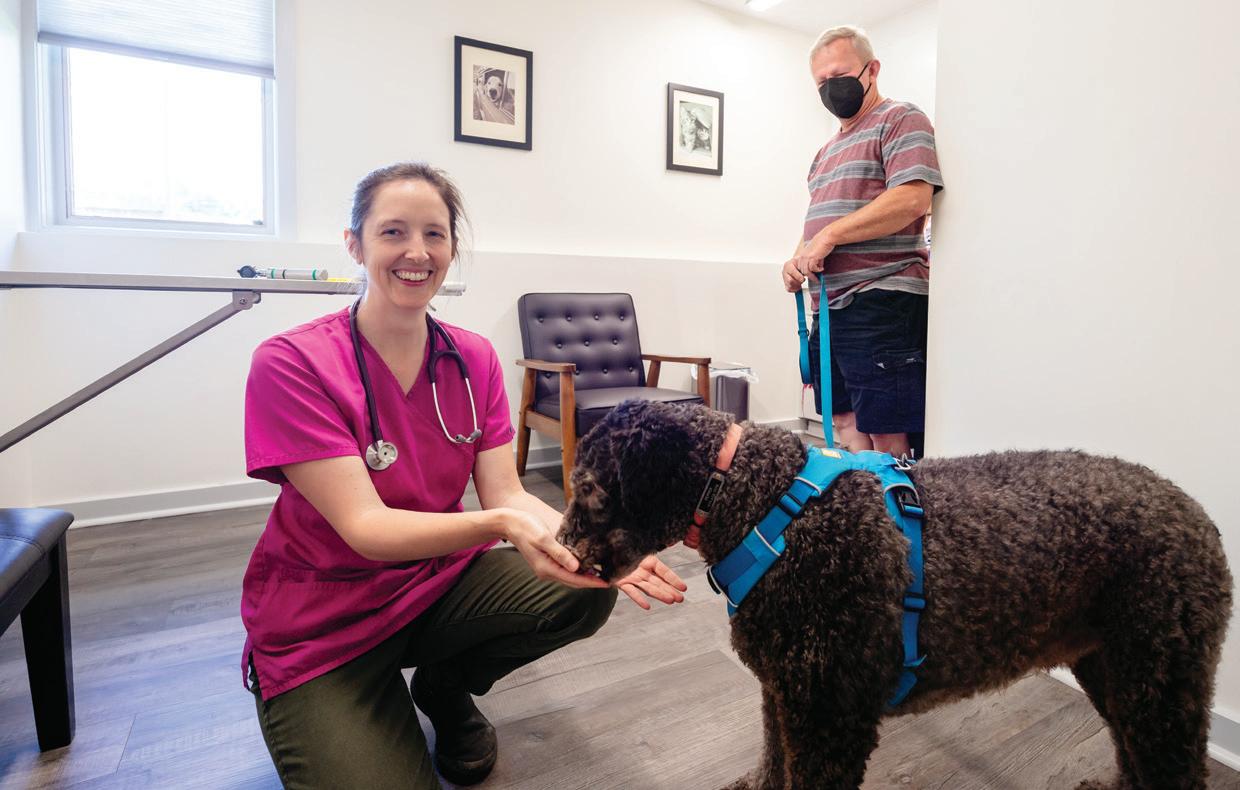




92 CHATHAM MAGAZINE SEPTEMBER / OCTOBER 2022 2022 NEW STOREFRONT! DELICIOUS FRESH AUTHENTIC MEXICAN FOOD 919-914-6011 ta-contento.com @tacontentoch 11620 US Hwy. 15-501 Chapel Hill, NC 27517 NOW OPEN FOR BREAKFAST, LUNCH, AND DINNER
*All results listed in alphabetical order
Nail Salon
501 Nail Spa
1ST Nails & Spa Spa Rituals

New Business
The Beagle BMC Brewing

Red Moose Brewing Company

Thirsty Skull Brewing
**The presence of five winners is the result of a tie Pepper the poodle’s owner George Devinney brought his pup in to be seen by Dr. Lydia Scheidler at Hill Creek Veterinary Hospital – one of Chatham’s best veterinary clinics.
Nonprofit
Bold Foundation
Carolina Tiger Rescue Chatham Arts Council CORA Food Pantry
Pediatrician/Family Medicine
Avance Care South Chapel Hill Dr. Woodward “Woody” D. Burgert, UNC Family Medicine at Pittsboro
Dr. Kimberly Kylstra, North Chatham Pediatrics & Internal Medicine UNC Primary Care at Chatham
Pet Boarding
Cole Park Veterinary Hospital Companion Camp Dogwood Veterinary Hospital & Pet Resort
Tysor Veterinary Clinic
Place for Yoga/Pilates
Chatham YMCA Duke Center for Living at Fearrington Joy of Movement Yoga Garden PBO
Optometrist/Eye Clinic
Dr. Ray Hager, Siler Crossing Vision Center New View Eyecare Triangle Visions Optometry
Orthodontist
Dr. Jasenna Johnson, Chatham Orthodontics
Dr. Ashley Morgenstern, Morgenstern Orthodontics
Dr. Tammy R. Severt, DDS, PA
SEPTEMBER / OCTOBER 2022 CHATHAM MAGAZINE 93 2022 111 Knox Way, Chapel Hill • Polk’s Village behind UNC Pediatrics moonasianbistroch.com (919)
or (919)
Specializing in Chinese, Thai and Japanese, including Hibachi, Teriyaki and Sushi Grubhub Delivery Options Available 2022
869 7894
869 7819 Asian Fusion Restaurant
Real Estate Agent
Christie Brown, Chatham Homes Realty

Chanel Hart D’Aprix, Hart & Olive Real Estate Group
Tanya Papandrea, Absolute Realty Company Tedi Vail, Tedi Vail Realty
Real Estate Company
Absolute Realty Company
Bold Real Estate
Chatham Homes Realty Hart & Olive Real Estate Group
Spa
The Pampered Touch Spa at Bell House The Spa at Fearrington Spa Rituals

Sports Club/Fitness Facility
Chatham YMCA
Duke Center for Living at Fearrington Ladies’ Fitness Center of Pittsboro Seven Star Kung Fu Academy
Veterinarian
Cole Park Veterinary Hospital

Hill Creek Veterinary Hospital
Hope Crossing Animal Hospital Pittsboro Animal Hospital
Arts & Entertainment
Art Gallery
Liquidambar Gallery and Gifts NC Arts Incubator Pittsboro Gallery of Arts
Artist’s Studio or Workshop
Chatham Clay Studio The Creative Goat Mark Hewitt Pottery
Dance Studio
7 Dance Centre Chatham Dance Connection Joy of Movement Renner Dance Company
Event Venue
Fearrington Village Governors Club Het Landhuis The Plant
Live Music Venue Bynum Front Porch Chatham Beverage District The City Tap Shakori Hills
Place for a Family Outing

Carolina Tiger Rescue The Farm at Piper Hill Jordan Lake State Recreation Area

Place to Host
a Children’s Birthday Party
The Creative Goat Old Mill Farm
Mary Hayes Barber Holmes Park S&T’s Soda Shoppe CM
94 CHATHAM MAGAZINE SEPTEMBER / OCTOBER 2022 BEST OF CHATHAM 2021 anks for another vote of con dence!
–
you.
safety,
Heating & Air • Plumbing • Appliance Repair • Design/Build • Renovations BudMa hews.com 919.929.0203 HVAC. PLUMBING. APPLIANCE REPAIR.
We
2022
As a family-owned business – for over 40 years
we know how important your home is to
It’s a place of rest,
and comfort. It’s where your loved ones gather. at’s why we believe in treating our clients like family. Our focus is on building lasting relationships built on mutual trust and respect.
We don’t just improveyour home.
offer peace of mind.
*All results listed in alphabetical order **The presence of five winners is the result of a tie
:
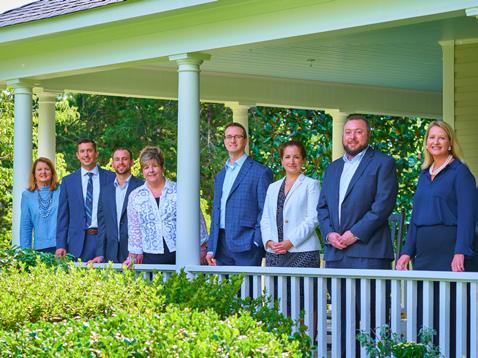









SEPTEMBER / OCTOBER 2022 CHATHAM MAGAZINE 95 EDWARDJONES.COM member SIPC Because every moment is for living. Chapel Hill Jessica Villagrana 180 Providence Rd. Suite 1C 984-219-6635 Pittsboro Lee Shanklin, AAMS® 120 Lowes Dr. Suite 107 919-545-0125 Pittsboro Kevin Maley 984 Thompson St. Suite E2 919-444-2961 Fearrington Kathy Brommage, CFP® 190 Chatham Downs Dr. Suite 103 919-960-6119 Penguin Place Eric Williams, AAMS® 114 Russet Run Suite 120 919-542-3020 Governors Club Sharon Dickens, AAMS® 50101 Governors Dr. Suite 118 919-967-9968 Siler City Laura Clapp, AAMS®, CFP® 310 East Raleigh St. 919-663-1051 Pittsboro Chad Virgil, CFP®, ChFC®, CLU® 630 East St. Suite 2 919-545-5669 Let’s partner through all of it. Chatham County FINANCIAL ADVISORS ARCHITECTURE Paces & Roehm PACESANDROEHM.COM 10100 Governors Drive, Chapel Hill, NC 27517 202 2 2022 THANK YOU FOR VOTING US Best Architect
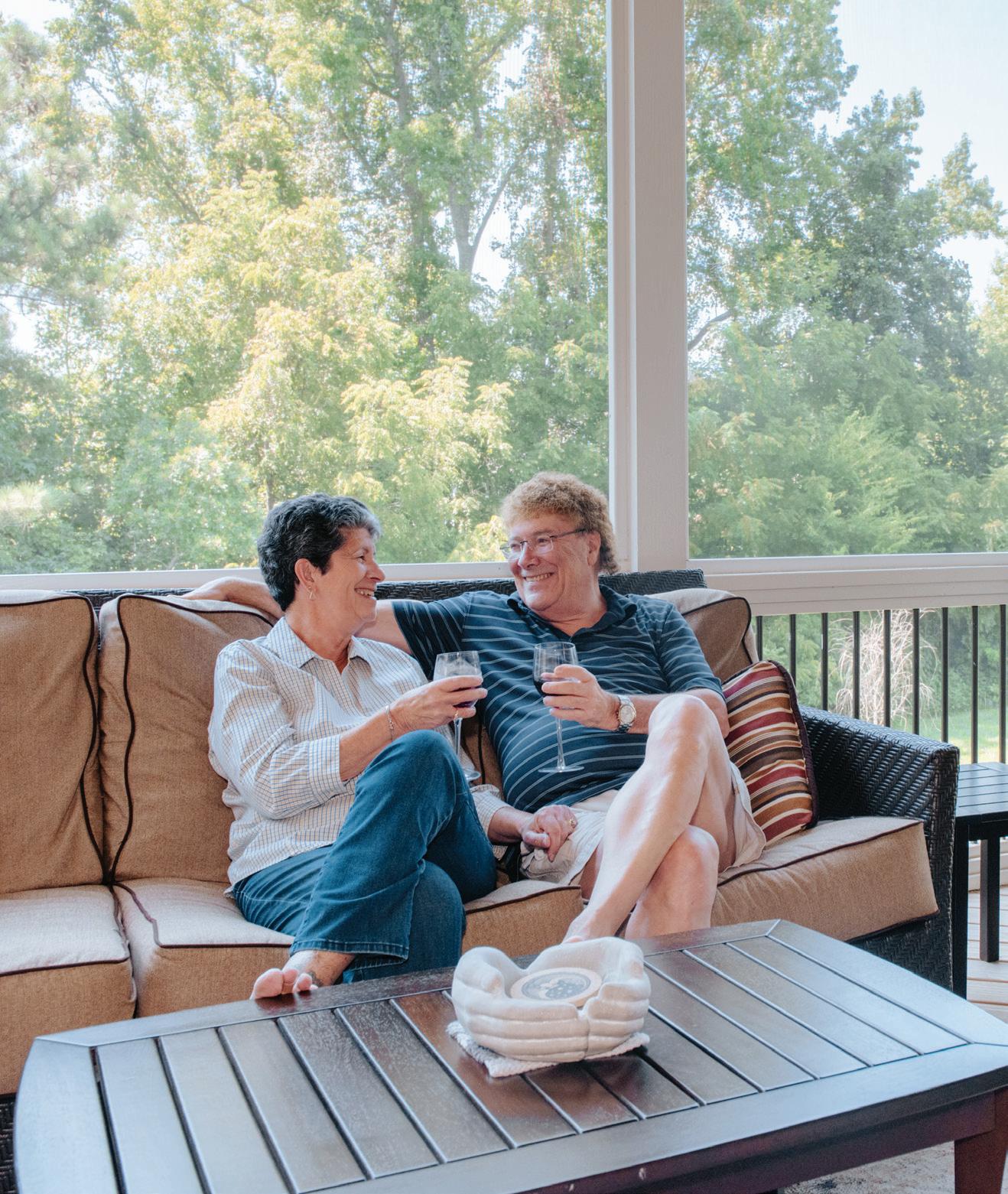
96 CHATHAM MAGAZINE SEPTEMBER / OCTOBER 2022
Mary Hooper and Steve Hooper relax out on the screened-in porch, where they can enjoy a pleasant day without biting insects.

LESS IS MORE, MORE OR LESS
HOW A COUPLE IN THE HAMPTONS DOWNSIZED WITHOUT GIVING UP SPACE
BY ANNA-RHESA VERSOLA PHOTOGRAPHY BY JOHN MICHAEL SIMPSON
Mary Hooper and Steve Hooper were ready to sign a yearlong rental agreement when they could not find the right home. Then, at the last minute, real estate agent
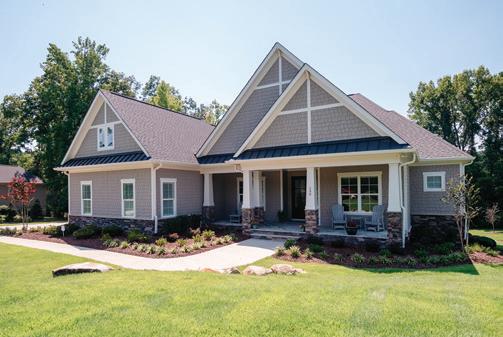
Gretchen Castorina showed them one more house.
“We had no idea that [the development] existed, to be perfectly honest with you,” Mary says about the
HOME & GARDEN
SEPTEMBER / OCTOBER 2022 CHATHAM MAGAZINE 97
home in The Hamptons neighborhood off Mount Gilead Church Road.
The Arthur Rutenberg-designed home was built in 2019 to specifications of a different couple. However, due to unexpected circumstances, the home sat unoccupied through the pandemic lockdown until early 2021.
ATTENTION TO DETAILS
Steve and Mary felt as if the 3,000-square-foot house was waiting for them. “What I wanted was first-floor living,” Mary says. “That’s what I wanted, and that’s what this is.” They appreciated thoughtful details throughout the home, like the light switch plates installed lower than in
Steve, Mary and their daughters Maddie Hooper (left), Lindsay Hooper (center) and Brandon Congleton, Maddie’s fiance, enjoy wine and cheese at the oversized kitchen island.
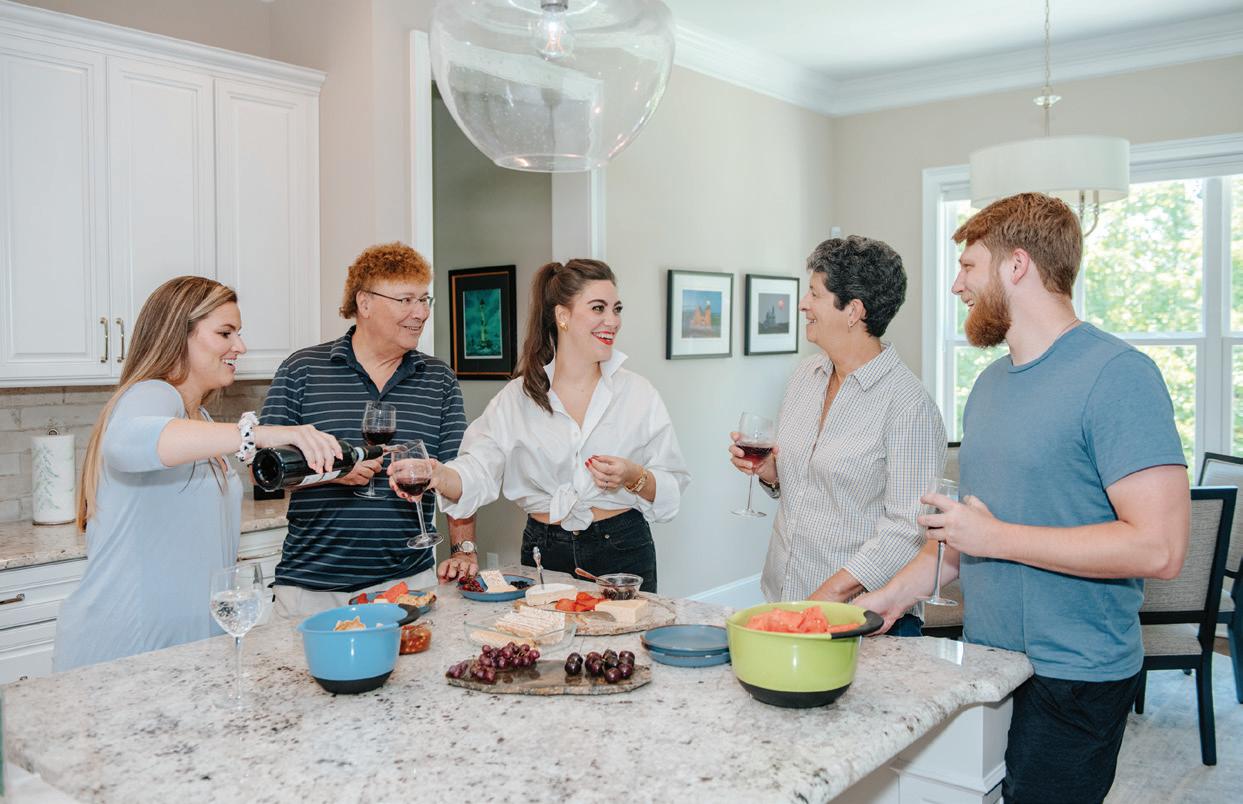
standard homes, wider doorways, pocket doors and the main suite bathroom with a no-step shower entry. The laundry room has a wall-mounted ironing board opposite a wide counter and sink. The whole house was wired for a backup generator, and there was wiring ready for the installation of a smart panel.
“And, I actually love the fact that this stairway is back here [by the laundry room] and not in the front of the house,” Mary says. Upstairs, there was an additional 500 square feet in an unfinished bonus room.
On the main floor, Mary was immediately drawn to the kitchen with its upgraded appliances and
98 CHATHAM MAGAZINE SEPTEMBER / OCTOBER 2022 HOME & GARDEN
quiet morning run. Five more minutes on the swings. A home you love. Long sunsets and lingering conversations. If you want to live in a place that supports health, wellness and the simple things, come see what’s taking root at Vineyards at Chatham Park.




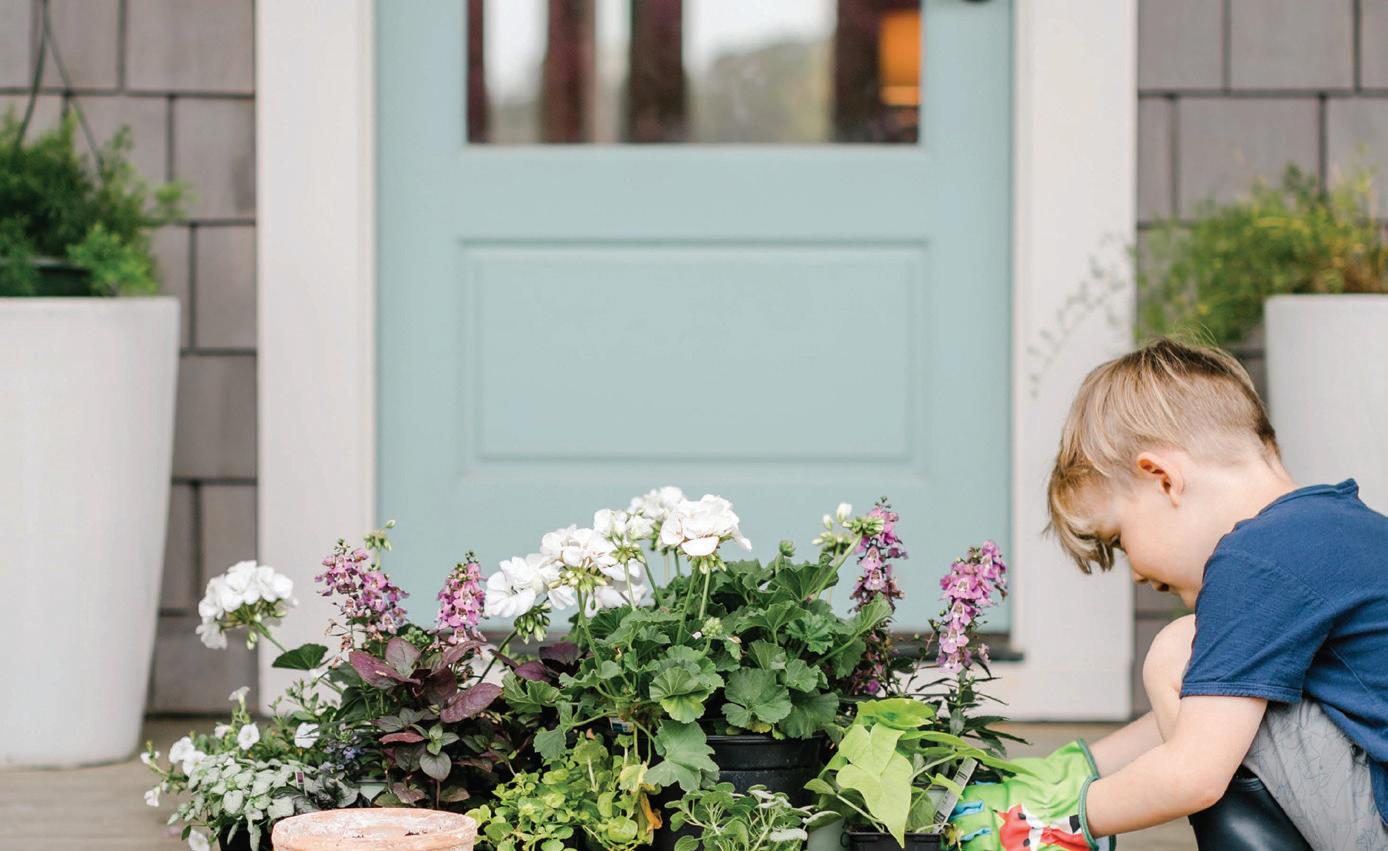

Things
• Miles of Trails • Paddles Pool & Pickleball • 10-Acre Park • Close to Jordan Lake • Walkable to Downtown Pittsboro HOMES FROM THE $400S | TOWNHOMES FROM THE $300S | NEW BUILDERS NOW SELLING PLANT YOUR ROOTS CHATHAMPARK.COM Prices and amenities subject to change without notice. © 2022 Chatham Park Investors. 500 VINE PARKWAY, PITTSBORO NC 27312 | 919-278-7687
Good
Grow Here A
The finished upstairs bonus room is a gathering space where family and friends can help themselves to drinks and snacks while playing pool or watching TV.
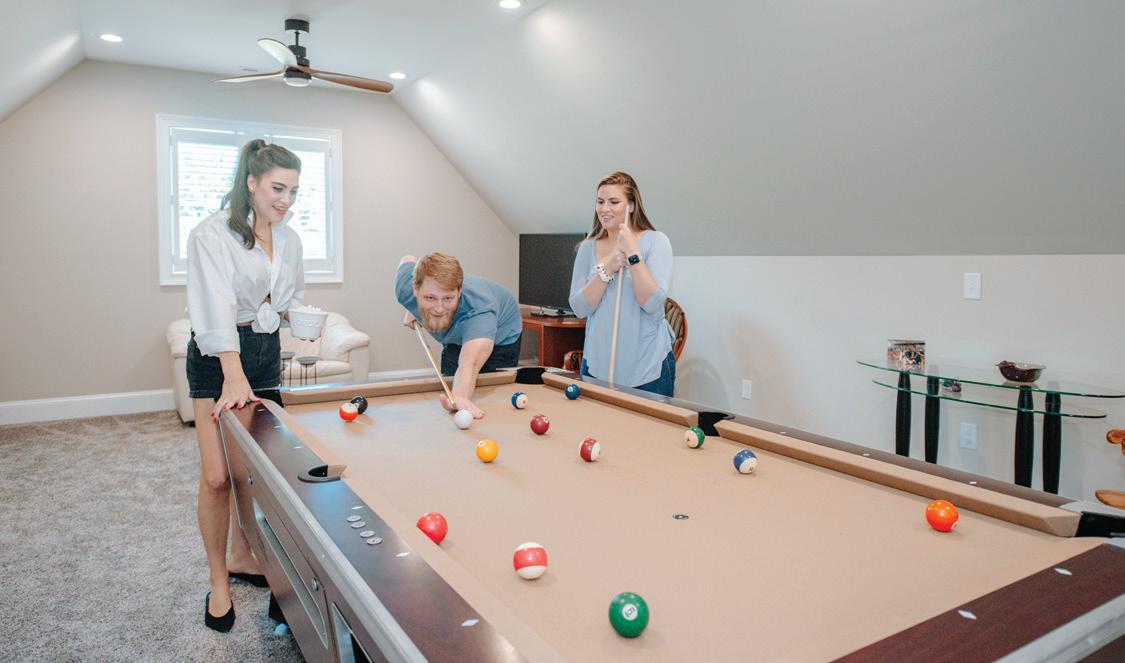
ABOVE Brandon lines up a shot on the vintage billiards table while Maddie waits her turn and Lindsay enjoys some popcorn.
ample storage. “If one could love inanimate objects, I would be in love,” she says, embracing the massive granite kitchen island “so huge we call it a small country.”
Her excitement is hard to contain. “I love, love, love the kitchen in this house,” Mary says. “When we came over here, we were saying, ‘What would it take for us not to move forward with building? How correct would a house have to be?’ My husband for quite a while has wanted every bedroom to have its own bathroom. [Now], we have three bedrooms on the first floor, and each bedroom has its own bathroom here. For me, it’s the kitchen. The pantry here is gigantic. There were just so many things for us that struck chords.”
MOVING ON S
teve and Mary lived in Durham for 26 years and raised their two daughters in a 3,500-square-foot home in Fairfield. Steve admits the adjustment took time, especially since moving into a new home was an opportunity to “downsize” their possessions.
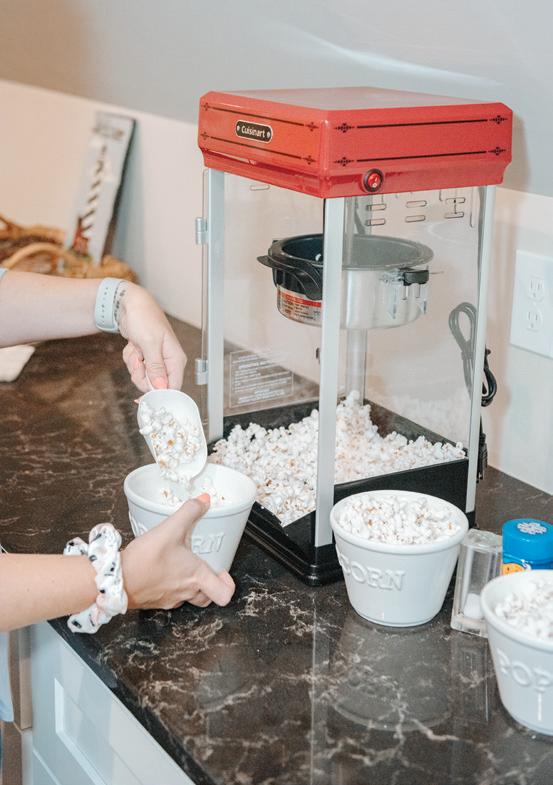
100 CHATHAM MAGAZINE SEPTEMBER / OCTOBER 2022 HOME & GARDEN






SEPTEMBER / OCTOBER 2022 CHATHAM MAGAZINE 101 MARKET KNOWLEDGE… HARD WORK… DEDICATION… EXCELLENT INTERPERSONAL SKILLS Sharon Clarke Broker/Owner/Realtor® These traits are what make Sharon Clarke stand out among other realtors in the area. A boutique real estate firm specializing in Chapel Hill, Pittsboro, including Orange and Chatham Counties. Partnering with Accord Properties and Accord Homes in new construction and renovations. Accord Homes, Inc Accord Properties, LLC Specializing in custom building and renovations Call or text me! 919.265.8522 sharon.clarkeproperties@gmail.com www.accordrealty.group SHARON CLARKE 104 N. Elliott Rd., Ste. C, Chapel Hill, NC 27514 919-942-7163 • StudioGDentist.com A t Studio G Aesthetic & Family Dentistry, Mandy Ghaffarpour, DDS, Alexandra Yarborough, DDS, FACP, and Thomas J. Dakermanji, DMD provide comprehensive, restorative dentistry. By focusing on each individual and involving patients in their treatment plans, their team places patient care at the core of their practice. Following The Pankey Institute’s advanced dental techniques, their team takes full advantage of the latest, state of the art dental technology. By helping patients in Chapel Hill achieve their healthiest smiles, Studio G strives to improve their quality of life through excellent dental care both now and for years to come. Where art, science & technology meet Studio G is a Pankey Phylosophy Practice 2010-2022
ABOVE Steve spends much of his time in his home office as he continues to work remotely as the associate dean and chair of UNC’s health sciences department.
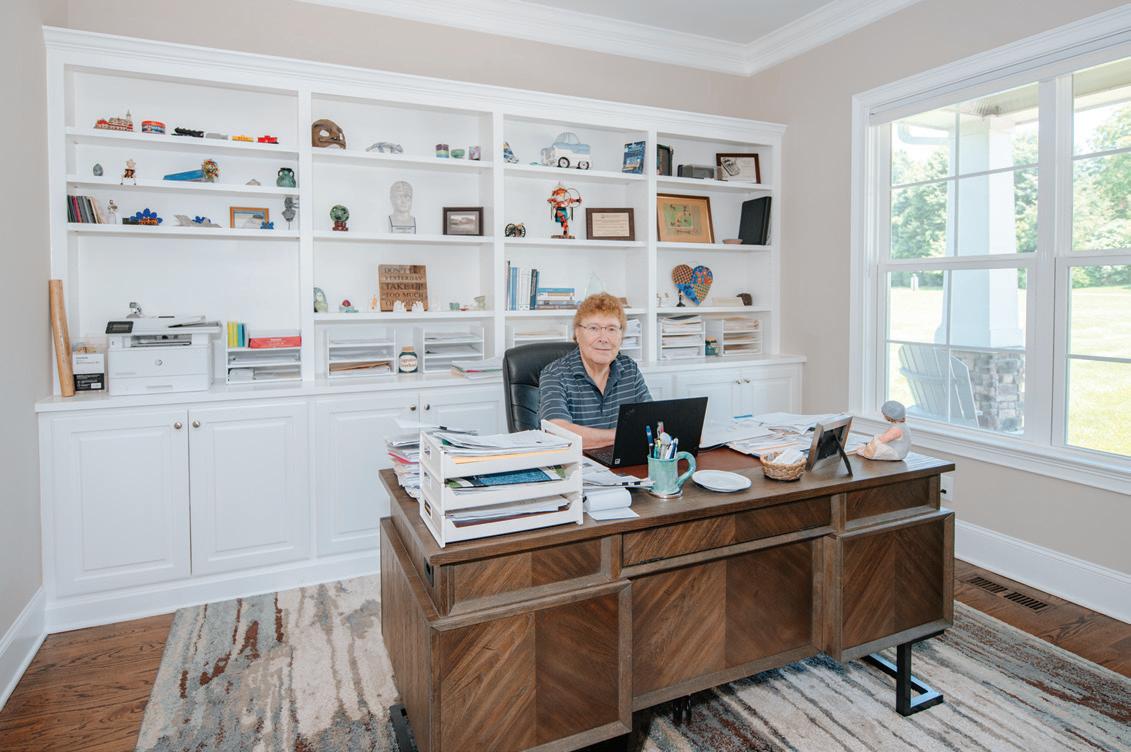
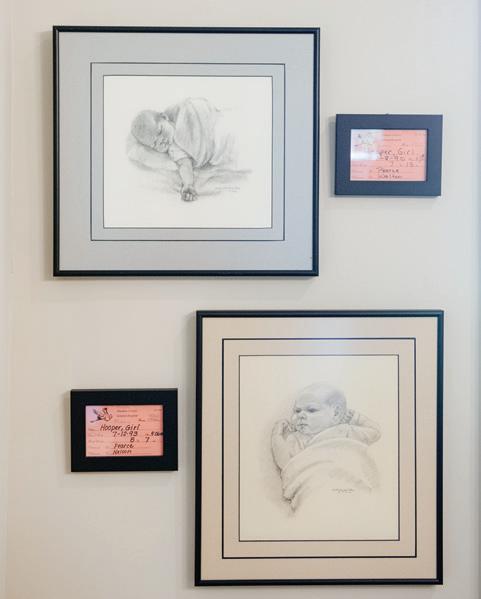
RIGHT A wall in the dining room displays hand-drawn illustrations of Lindsay and Maddie as newborns.
“We’ve been talking about it for a while,” Mary says. “You know, the only way we can – or I can – handle a move is if I have all of my attention and time available. And so everything just kind of came together.”
Mary retired January 1, 2021, as executive director of the nonprofit i2i Center for Integrative Health (formerly known as NC Council of Community Programs) that focuses on public policy and advocacy for behavioral health services. She received the state’s highest honor, the Order of The Long Leaf Pine, in recognition of her service.
Steve, who has been in North Carolina since 1987, is associate dean and chair of the department of health sciences at UNC. He is also associate director of the Carolina Institute for Developmental Disabilities.
102 CHATHAM MAGAZINE SEPTEMBER / OCTOBER 2022 HOME & GARDEN
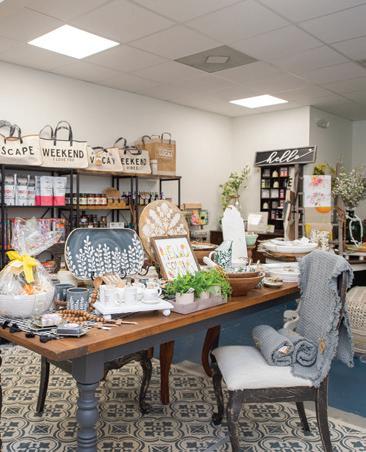
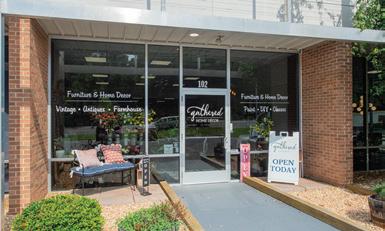
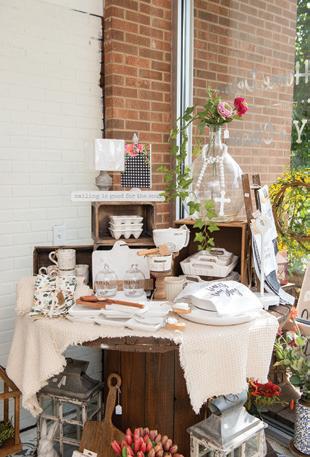
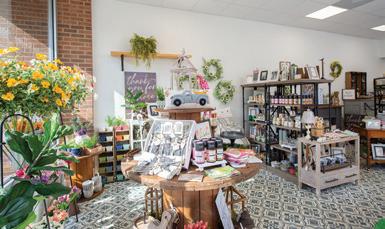

SEPTEMBER / OCTOBER 2022 CHATHAM MAGAZINE 103 FURNITURE & HOME DÉCOR TUESDAY-SATURDAY • 10AM-5PM 697 HILLSBORO ST PITTSBORO, NC 919.533.6357 THOUGHTFULLY CURATED LIVING HOME DECOR • LIFESTYLE • GIFTS Cell: 919.337.8331 Office: 919.533.6300 lori.chapelridge@gmail.com Lori Golden REALTOR® BROKER/OWNER RESIDENTIAL ∙ COMMERCIAL ∙ FINE HOMES & ESTATES KNOWLEDGE YOU CAN TRUST 697 HILLSBORO ST, STE. 103, PITTSBORO, NC 27312 | CENTURY21.COM Whether you are looking for land, neighborhoods, new construction, golf communities, or building your forever home, our team can help you achieve your dream. For any real estate questions or needs please reach out and we will be happy to assist you!
To cull items for their move, Steve and Mary agreed on some ground rules for sorting through three decades of accumulated belongings. “We just started working on getting it out of the house,” Steve says. “Probably the only criterion we had was that if we said yes, then we [would] have a purpose for it. If it was something we both wanted, we’d say, ‘OK, this could go in the living room, or this could go upstairs’ And it worked pretty well. We were able to clear things out in about six or seven months.”
SETTLING IN
It’s been more than a year since Steve and Mary moved to northeastern Chatham County. They continue to make changes that reflect their own


Steve, Mary and Maddie’s goldendoodle, Archie, enjoy one another’s company while sitting at the corner fireplace, another feature that the couple added to the home, out in the screened-in porch.
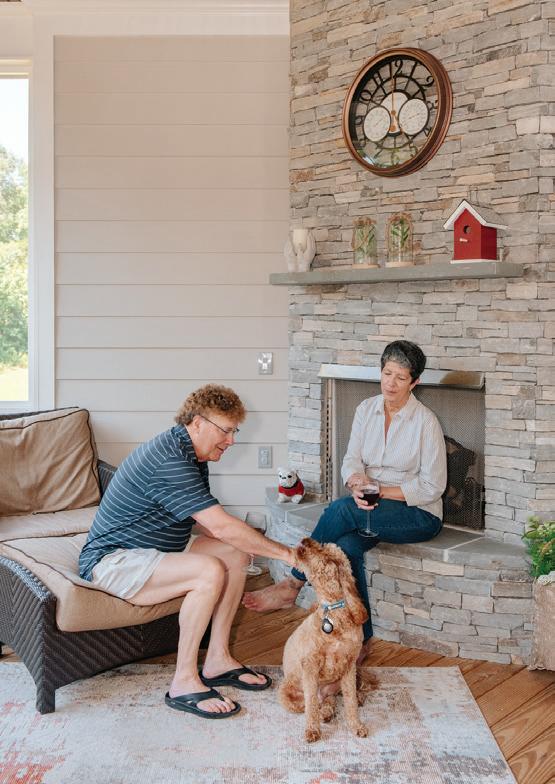
104 CHATHAM MAGAZINE SEPTEMBER / OCTOBER 2022 HOME & GARDEN Let Us Exceed Your Expectations Where We Shine. 89+ 5-Star Google Reviews Real Estate Sales: Guiding Home Buyers Positioning Homes for Sales High Performance Homes Property Management: Protecting Your Investment Thorough Tenant Screening Online Systems 24/7 Repair Response Superior Communication Bill Matthes Jodi Bakst Broker, Owner, Property Mgt Broker, Owner 919.928.5131 | info@realestatexperts.net 501 Eastowne Dr, Ste 140, Chapel Hill, NC 27514 R eal E state E xperts.net
BOARD OF DIRECTORS 2022 – 2023
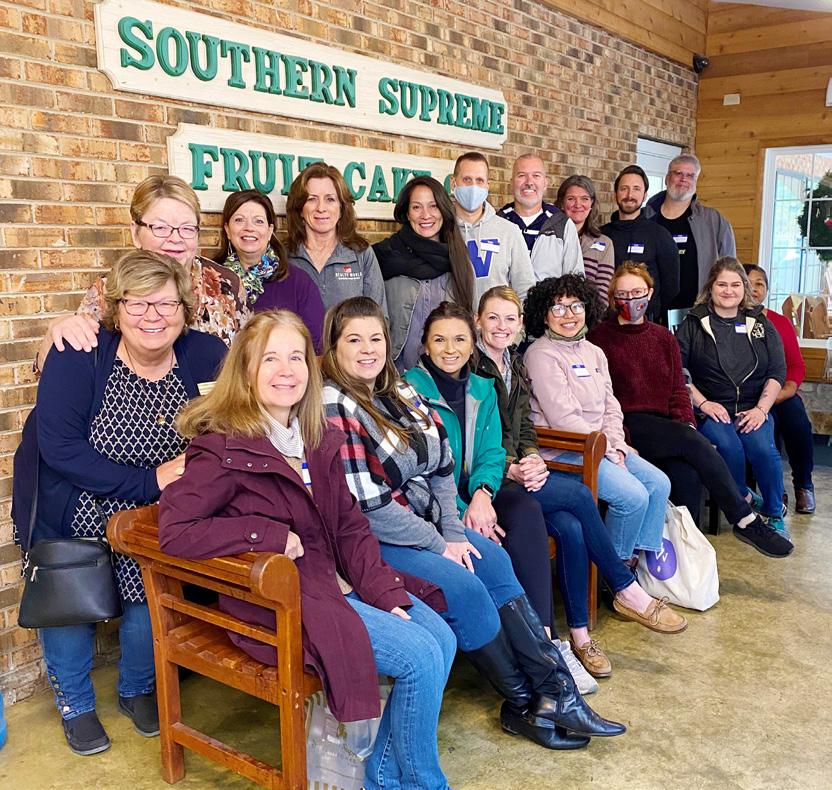
Sharon Dickens, Edward Jones Past Board Chair
Chris Elkins, Chatham Magazine, Triangle Media Partners, Board Chair Elect
Debbie Andleton, Chatham Park
Dr. Karen Barbee, Renaissance Wellness Services, LLC
Glenn Brooks, Truist
Curtis Brown, Commissioner Town of Siler City, Ex-Officio
Nkosi Campbell, Mountaire Farms
Billie Goodman, Quantum Fiber
Jonathan Hensley, Mayor Town of Goldston, Ex-Officio
Jason Hoyle, East Coast Firewood, LLC
Dan LaMontagne, County Manager Chatham County, Ex-Officio
Travis Patterson, Self-Enhancing Education and Development Services, LLC
Cindy Poindexter, Chatham Chamber of Commerce, Ex-Officio

Michael Smith, Chatham Economic Development Corporation, Ex-Officio
Kathy Simmers, So Worth It
Jeffery Strickler, Chatham HospitalUNC Health Care
Stephanie Terry, WEBB Squared - Wealth Through Entrepreneurship for Black Businesses
Katie Walker, Fidelity Bank Cecil Wilson, True Community Church Nancy Wykle, Chatham County Schools
CHAMBER AMBASSADORS
Erica Sanders, Carolina Home Mortgage Ambassador Chair
McKenzie Allgood, Chatham Park
Courtney Cabe, State Employees Credit Union
Timir Cox, Blazer Raven Services, LLC

Sara Donaldson, State Farm
Ashleigh Glover, Chatham Counseling & Wellness
Audrea Leach, Choice Residential Real Estate
Malinda Marsh, NCWorks Career Center
Chatham, Capital Workforce Development Board
Dr. Timothy Mounce, Dr. Mounce
Kevin O’Dell, Summit Design and Engineering Svcs.
Ronda Stubbs, Cambridge Hills Assisted Living
Connolly Walker, Harris & Company Insurance Eric Williams, Edward Jones
CHAMBER STAFF
Mary Bowman, Administrative Assistant Cindy Poindexter, President / CEO
Leadership Chatham – Class of 2022 UPCOMING EVENTS Accepting Applications through September 09 Leadership Chatham September 26 Golf Tournament at Governors Club
12, 8:00am – 10:30am State of the Community Report at Chatham County Agriculture & Conference Center The State of the Community Report is an event featuring a comprehensive presentation with the latest data on the well-being of Chatham County across social, economic, and environmental indicators.
17, 11:00am – 1:15pm Chatham Chamber Annual Meeting at
County Agriculture &
Center Various annual awards are presented to County business leaders and community members. 919-742-3333 | 984-265-9172 | | MaryB@ccucc.net | CindyP@ccucc.net | ccucc.net Contact the Chatham Chamber of Commerce for more event-related information.
October
November
Chatham
Conference
style. They installed built-in bookshelves that flank the living room gas fireplace, and they added a corner fireplace on the screened-in back porch.
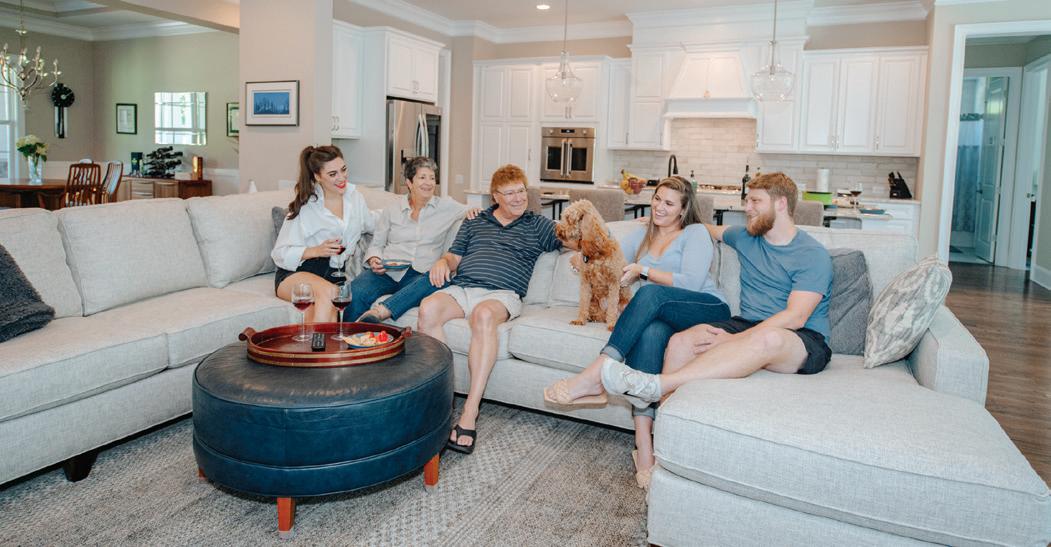
Instead of curtains, there are retractable privacy screens and plantation blinds. The oversized sliding
doors that separate the living room from the back porch also have retractable screens to shield the interior from bright sunlight at different times of the year.
Upstairs above the garage, the onceunfinished bonus room is now finished with a wine fridge and a refurbished bar
WE KNOW CHATHAM COUNTY!




Locally, we are known as The Specialists on our community’s houses, neighborhoods, schools and cultural activities.
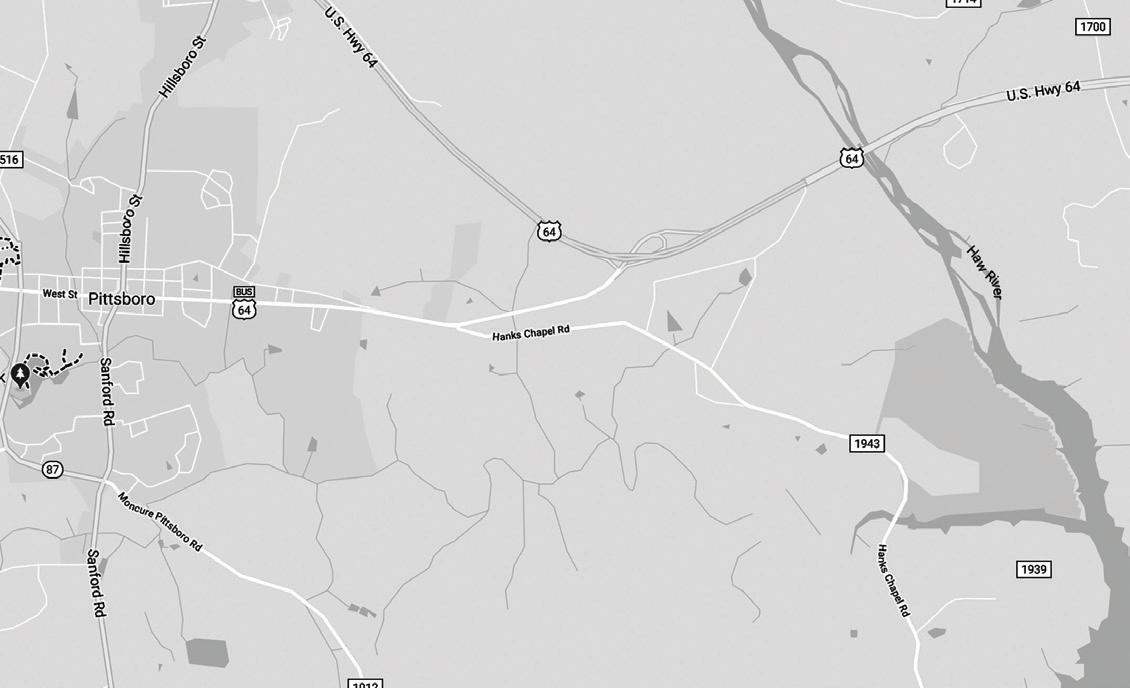
106 CHATHAM MAGAZINE SEPTEMBER / OCTOBER 2022 IF YOU ARE LOOKING FOR A HOME, call or drop by our office for the most varied newcomer packet and an interesting introduction to the Chatham County Area. Residential Real Estate • 901 Willow Drive, Suite 3, Chapel Hill, NC 27514 919.933.8500 • 800.382.0673 • tha@tonyhallassociates.com • www.tonyhallassociates.com
Wendy Thompson
Chris Culbreth
Tony Hall
The open living room is another favorite spot to spend time together when Lindsay and Maddie come
visit.
FOR MORE THAN 50 YEARS, the practice of Oral and Maxillofacial Surgery Associates has been trusted to provide specialized care in the Chapel Hill, Durham, and Sanford communities. Our four board certified oral and maxillofacial surgeons provide the highest quality of patient care with the latest diagnostic and treatment tools available to assure patient safety and comfort.
Drs. Sacco, Vandersea, Ruvo and Serlo practice a full scope of oral and maxillofacial surgery with expertise ranging from corrective jaw surgery to wisdom tooth removal.
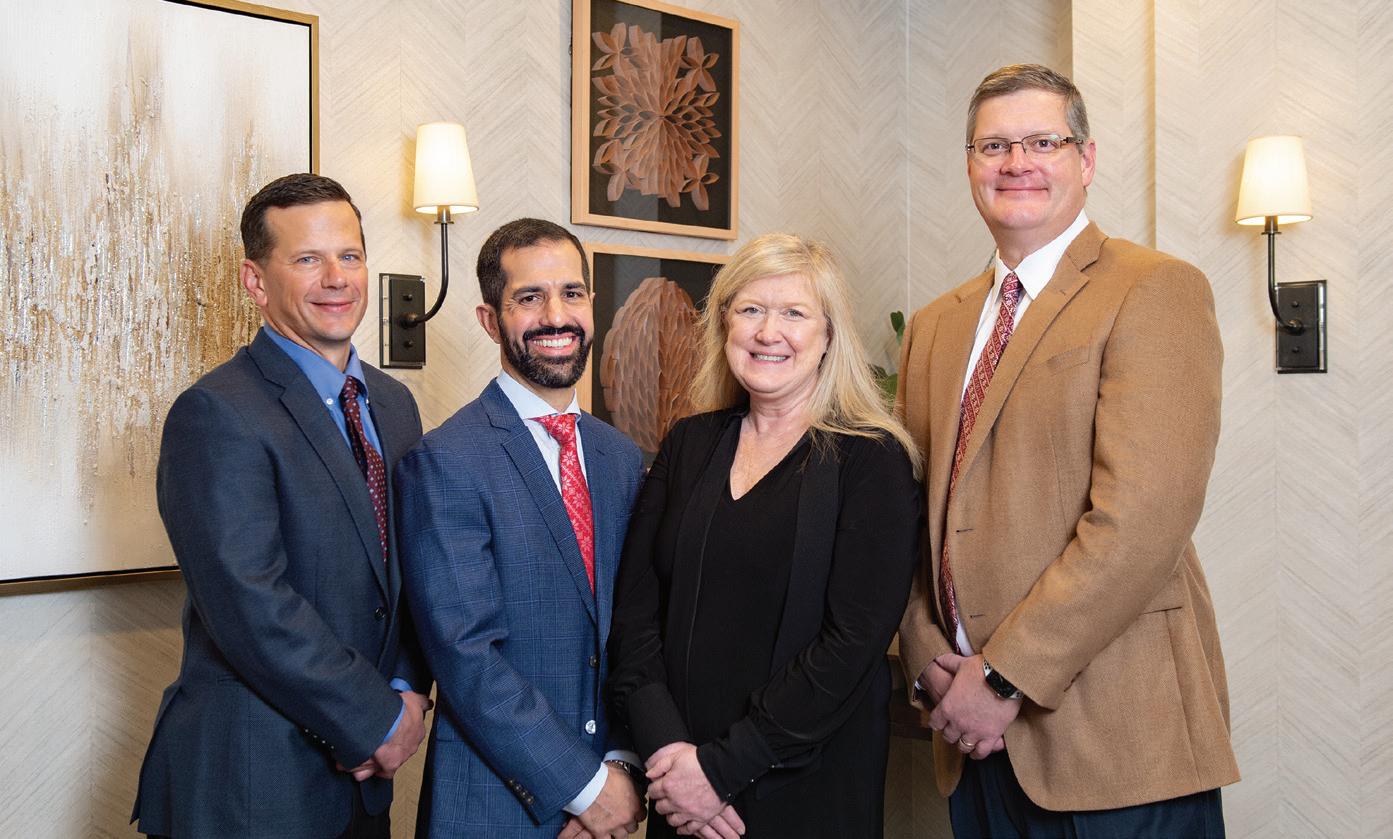

DEBRA M. SACCO DMD, MD
BRIAN VANDERSEA DDS
ANDREW T. RUVO DMD, MD
ADAM D. SERLO DMD, MD
CHAPEL HILL
501 Eastowne Drive, Suite 110 Chapel Hill 27514 919.929.2196
DURHAM 2823 North Duke Street Durham 27704 919.479.0707
SANFORD 109 Dennis Drive Sanford 27330 919.775.1615
• BONE
•
•
•
•
•
•
OMSANC.COM
DENTAL IMPLANTS
GRAFTING
WISDOM TEETH
FACIAL TRAUMA
CORRECTIVE JAW SURGERY
PRE-PROSTHETIC SURGERY
ORAL PATHOLOGY
SLEEP APNEA


108 CHATHAM MAGAZINE SEPTEMBER / OCTOBER 2022 The house is set back along a quiet street, which makes Mary and Steve’s front porch an ideal spot for morning coffee. We offer a full line of bookkeeping service for solopreneurs, small businesses and individuals. We have a referral program and will offer a special discount to readers who mention this ad. Relax! Bookkeeping is our passion! 919.564.9933 tothepointbookkeeping.com faith@tothepointbookkeeping.com Relax, Bookkeeping is our passion! Faith Nager Pay Bills | Reconcile Accounts | Invoice Clients PROUD MEMBER “ The membership that works for you!” 20 2 1 20 2 2 BRUCE’S CARPETS & FLOORING Your Brand Headquarters and Total Flooring Resource MON-FRI 8 AM–5 PM • SAT 8 AM–12 PM • CLOSED SUNDAY 11455 US HWY 15-501 N, Chapel Hill • 919.967.0208 brucescarpets.com







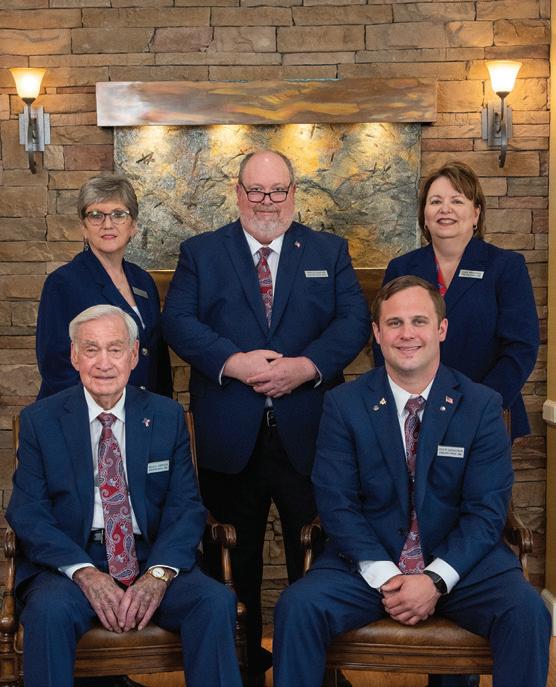

SEPTEMBER / OCTOBER 2022 CHATHAM MAGAZINE 109 OFFERING COLLISION REPAIR EXCELLENCE TO THE CHAPEL HILL COMMUNITY FOR OVER 30 YEARS 919.942.2070 4117 OLD GREENSBORO RD, CHAPEL HILL ELITEAUTOBODY.NET MON-FRI 8AM-5:30PM A FAMILY OWNED AND OPERATED BUSINESS COMMITTED TO PROVIDING QUALITY REPAIR AND EXCEPTIONAL CUSTOMER SERVICE. WE GUIDE YOU THROUGH THE REPAIR PROCESS WITH A STRESS-FREE FRIENDLY ATMOSPHERE, EDUCATIONAL APPROACH, WORK WITH ALL INSURANCE COMPANIES, OFFER A NATIONWIDE LIFETIME WARRANTY AND COMPLIMENTARY LOANER CARS UPON AVAILABILITY. CALL ELITE AUTO BODY TO SCHEDULE YOUR FREE ESTIMATE. IT WILL BE THE MOST RELAXED EXPERIENCE YOU WILL EVER HAVE GETTING YOUR CAR REPAIRED. DONALDSONFUNERALS.COM 919.542.3057 | 396 WEST STREET PITTSBORO, NC 27312 We offer a range of personalized services to suit your family’s wishes. You can count on us to help you plan a personal, lasting tribute to your loved one. The caring and experienced professionals at Donaldson Funeral Home & Crematory have a crematory on-site. We invite you to schedule an appointment to tour our facility and crematory to learn more. Patt Sturdivant Licensed Funeral Director Mitch Jenkins Funeral Service Licensee Lisa Wooten Advanced Planning Director, Licensed Funeral Director Bill Griffin Funeral Service Licensee Lyle W. Donaldson President, Owner, Funeral Service Licensee
LIVE
NEW MINIMALISM
S
Mary says she moved to North Carolina the day after the couple married in 1989. In the owner’s suite, the Scandinavian furniture is prominent.

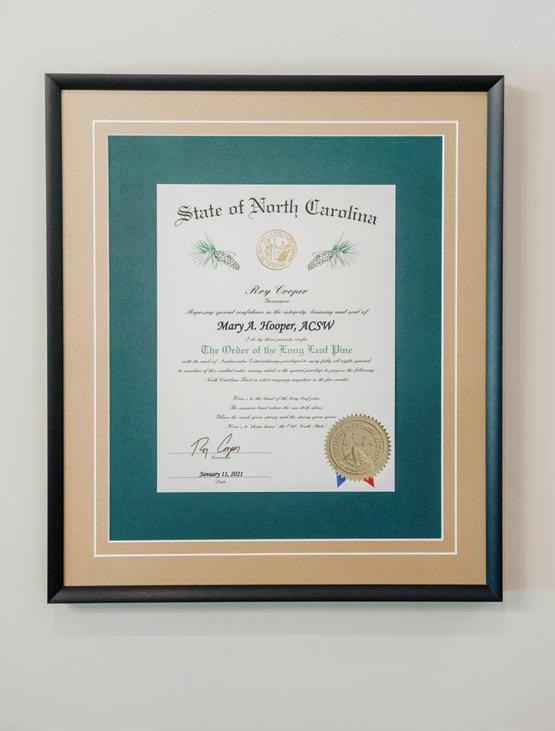

MORE FLAVORS.
—Karl
offers the EQUITY ADVANTAGETM

110 CHATHAM MAGAZINE SEPTEMBER / OCTOBER 2022
Can you actually savor your next move?
Retirement living that offers more remains the guiding principle behind Carolina Meadows. Six well-appointed venues offer dining that ranges from casual to gourmet, all serving delectable, healthy and locally-sourced goodness. Each offers an environment calculated to nourish the body and stimulate the spirit. MORE
“We have so many choices for dining, a marvelous chef and a superb staff that serves and orchestrates it all.”
HOME & GARDEN
1-800-458-6756 www.carolinameadows.org Carolina Meadows
A CONTINUING CARE RETIREMENT COMMUNITY
pool table. Behind the house, Steve says he wants to install a 10-by-40-foot lap pool for Mary but is checking first with the Chatham County planning department. Their house sits on three acres but stream buffers may limit their options.
ABOVE The dining room will soon feature a framed souvenir print from Spain where Steve and Mary spent their 33rd wedding anniversary.
LEFT Mary’s Order of the Long Leaf Pine recognition for her lifelong public service also hangs in the dining room.


“This is the only thing that we bought when we got married,” Mary says about the bedroom set.
“We never had a honeymoon,” Mary says. “We’d go do something like Disney World with the kids when they were little. And he goes, ‘So, is this our honeymoon?’ [I’d say,] ‘No, no, no, no, no. This is not a honeymoon.’”
In June and July, Steve and Mary celebrated their 33rd wedding anniversary with a three-week trip to Croatia and Spain. And staying true to their renewed philosophy of minimalism, they brought back a single souvenir from their summer trip: a large print from Barcelona, Spain, of ‘La Sagrada Familia’ that they will hang in the dining room as a daily reminder of their long-awaited “honeymoon.” CM
HOME & GARDEN REAL ESTATE & HOME SERVICES GALLERY Whether you are looking for land, neighborhoods, new construction, golf communities, or building your forever home, I can help you achieve your dream. For any real estate questions or needs please reach out and I’ll be happy to assist you! Southern Lifestyles With over 17 years of real estate experience in Chatham County, I am a seasoned professional and a true lifestyle advisor who knows the ins and outs of the area. Cell: 919.337.8331 Office: 919.533.6300 lori.chapelridge@gmail.com 697 Hillsboro St, Ste. 103, Pittsboro, NC 27312 Lori Golden REALTOR® BROKER/OWNER Sharon Clarke Broker/Owner/Realtor® These traits are what make Sharon Clarke stand out among other realtors in the area. Accord Homes, Inc Accord Properties, LLC Specializing in custom building and renovations 919.265.8522 sharon.clarkeproperties@gmail.com www.accordrealty.group MARKET KNOWLEDGE… HARD WORK… DEDICATION… EXCELLENT INTERPERSONAL SKILLS




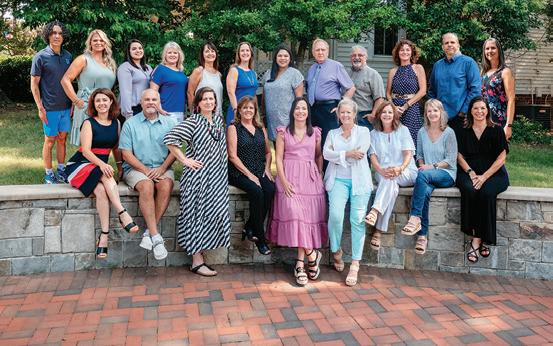




112 SEPTEMBER / OCTOBER 2022 HOME & GARDEN REAL ESTATE & HOME SERVICES GALLERY COMMERCIAL • HOMES • CONDOS • APARTMENTS Helping You Build a Be er Home BudMa hews.com 919.929.0203 2021 2022 DESIGN. BUILD. REMODEL. Design/Build • Renovations HVAC • Plumbing • Appliance Repair chathamhomesrealty.com infochathamhomesrealty@gmail.com YOUR HOMETOWN CHOICE Results That Move You 2022 chathamhomesrealty.com infochathamhomesrealty@gmail.com
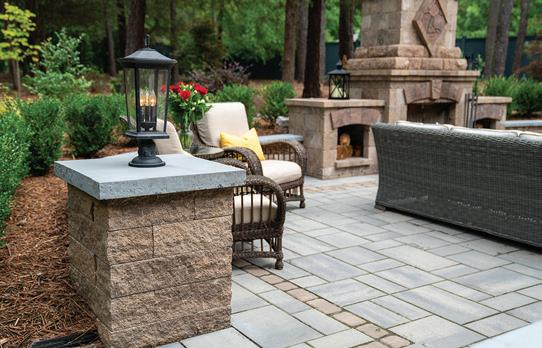










SEPTEMBER / OCTOBER 2022 CHATHAM MAGAZINE 113 HOME & GARDEN REAL ESTATE & HOME SERVICES GALLERY COMMERCIAL • HOMES • CONDOS • APARTMENTS 919.942.5051 | Free estimates, Call today! Voted Favorite Landscaper by Chatham Magazine Readers 2022 O’Mara Landscaping & Lawn Care, Inc. 919.942.5051|omaralandscaping.com James & Kate Voted Favorite Landscaper by Chapel Hill Magazine Readers 2020 James & Kate Jodi Bakst Broker, Owner Bill Matthes Broker, Owner, Property Mgt 919.928.5131 | info@realestatexperts.net 501 Eastowne Dr, Ste 140, Chapel Hill, NC 27514 R eal E state E xperts.net Let Us Exceed Your Expectations Where We Shine. 89+ 5-Star Google Reviews 2020 NATIONAL GREEN BUILDING PARTNER OF EXCELLENCE 919.698.9838 carolinagardencompany.com CONTACT US TODAY ! Commercial & Residential Landscaping Hardscapes Greenhouse Plants Installation Mockups Outdoor Structures Drainage Solutions And More! 202 1 2022 Your Local Real Estate Specialist RESIDENTIAL REAL ESTATE 901 Willow Drive, Suite 3 • Chapel Hill, NC 27514 919.933.8500 • 800.382.0673 • tonyhall@tonyhallassociates.com www.tonyhallassociates.com Tony Hall
FLOWER POWER
BY ANNA-RHESA VERSOLA PHOTOGRAPHY BY JOHN MICHAEL SIMPSON
Emily Fuller stands over a row of blooming annuals at Heart Song Farm in Silk Hope, tucks her hands into the pockets of her overalls and squints in the morning sun. The scent of cloves rises with the heat.


“Do you smell that?” she asks with a proud smile. “You’re growing sunshine and happiness. It’s pretty cool.”
She and her husband, Jeff Fuller, bought nearly 13 acres of land off Bowers Store Road in 2018. Emily initially planned to
HOME & GARDEN
MEET A SILK HOPE FARMER WHO SHARES MUCH MORE THAN PRODUCE WITH HER COMMUNITY
114 CHATHAM MAGAZINE SEPTEMBER / OCTOBER 2022
Jeff Fuller and Emily Fuller in their flower field at Heart Song Farm. Many of the fresh flowers are also dried to make for longer-lasting bouquets.
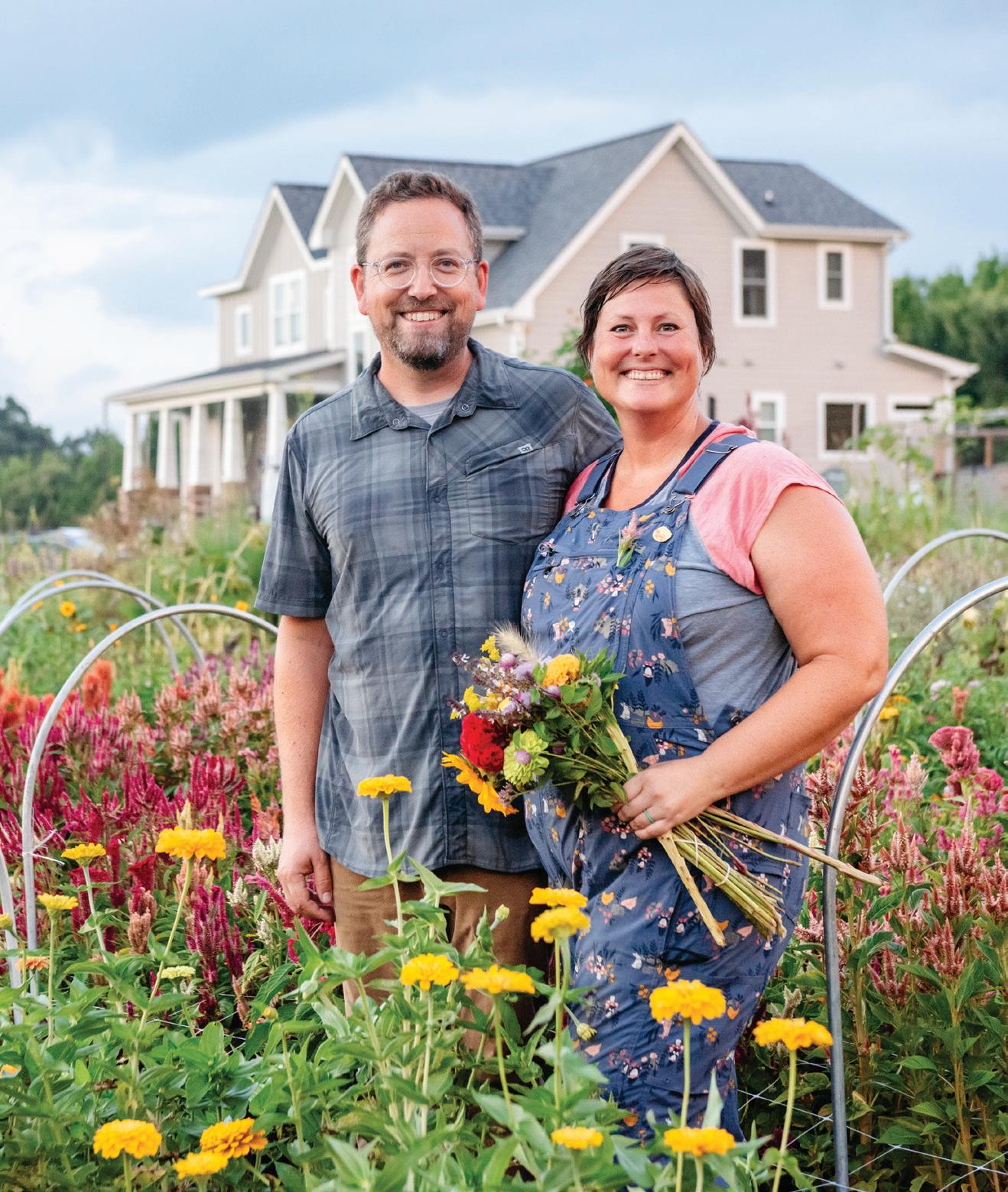
SEPTEMBER / OCTOBER 2022 CHATHAM MAGAZINE 115
grow mainly vegetables to help feed her family and the community. But every year since, flowers fill more rows. Two acres yield vegetables, including 92 pepper varieties and 34 different kinds of tomatoes, yet over 60% of what Emily harvests is assembled into floral bouquets. She sells them alongside produce at the Pittsboro Farmers Market on Thursday afternoons at The Plant.
“I had said I’d never be a flower farmer because flowers don’t feed my community,” Emily explains. “And all of a sudden, it was really clear that they do feed my community, but it’s through floral wellness. You’re feeding them through their hearts. When you give somebody flowers, you’re giving them a gift they probably wouldn’t buy for themselves, which is the best gift you can give somebody.”
Hazel Fuller, 10, and Gracey Fuller, 8, gather eggs from the chicken coop in their yard.

STARTING SMALL
About five years ago, Emily and Jeff traded their 3,000-square-foot, fourbedroom suburban home in Chapel Hill for 18 months of cramped living in Chatham County. Their two young daughters, Hazel Fuller, 10, and Gracey Fuller, 8, plus two dogs and a cat, squeezed into a 600-square-foot cottage until their current 2,500-square-foot home was fully built on the property. The girls occupied the only bedroom while Jeff slept on an uncomfortable pullout sofa bed, and Emily eventually settled on an inflatable mattress. They all shared a bathroom – and a dream to build a new way of life.
“Hard work is contagious,” Jeff says about his wife’s endless passion for farming. “I think Emily surprised herself with how hard she could work toward
116 CHATHAM MAGAZINE SEPTEMBER / OCTOBER 2022
Br inging Communities of Support to Students

OUTPATIENT THERAPY AT CHATHAM



SEPTEMBER / OCTOBER 2022 CHATHAM MAGAZINE 117
The
of
offers short-term care and outpatient rehabilitation services that include physical, occupational and speech therapy provided in our
renovated state-of-the-art therapy gym. Our
will
your
to increase
new condition or
Our
to
confidence and quality of life
laurelsofchatham.com « 72 Chatham Business Park Drive, Pittsboro, NC 27312 « 919 542 6677 The Laurels of Chatham employs our own in-house therapy team that provides the following services: Orthopedic Pre/Post-Surgical Programs • Return to Work/Return to Sports Programs Bone, Joint and Muscle Disorders • Neurological Conditions • Pain Management Pulmonary Program • Low Vision Program • Arthritis Management Dementia or Cognitive Deficits • Debilitation • Cognitive Testing and Intervention 7 Day a Week Therapy for Short-Term Care Inpatient Guests
Laurels
Chatham
newly
licensed staff therapist
work with
physician
your overall wellness and quickly advance your recovery for a
the progression of an existing disease.
Outpatient Program is customized for each guest
improve their function,
while maintaining their normal routine at home.
At Communities In Schools of Chatham County, we are working to ensure students have everything they need to engage in learning. With you on our side, we will be there for them, all day every day, providing emotional support and resources like school supplies, meals, and access to technology and learning materials. Now
we’re being called on to reimagine public education and find new pathways to equitable learning conditions. Learn how we go all in for kids in schools, in communities, and beyond at C
.org © 2022 Communities In Schools, Inc.
more than ever,
ISChatham
ABOVE Emily is an enthusiastic propagator and grows nearly all her plants from seeds.
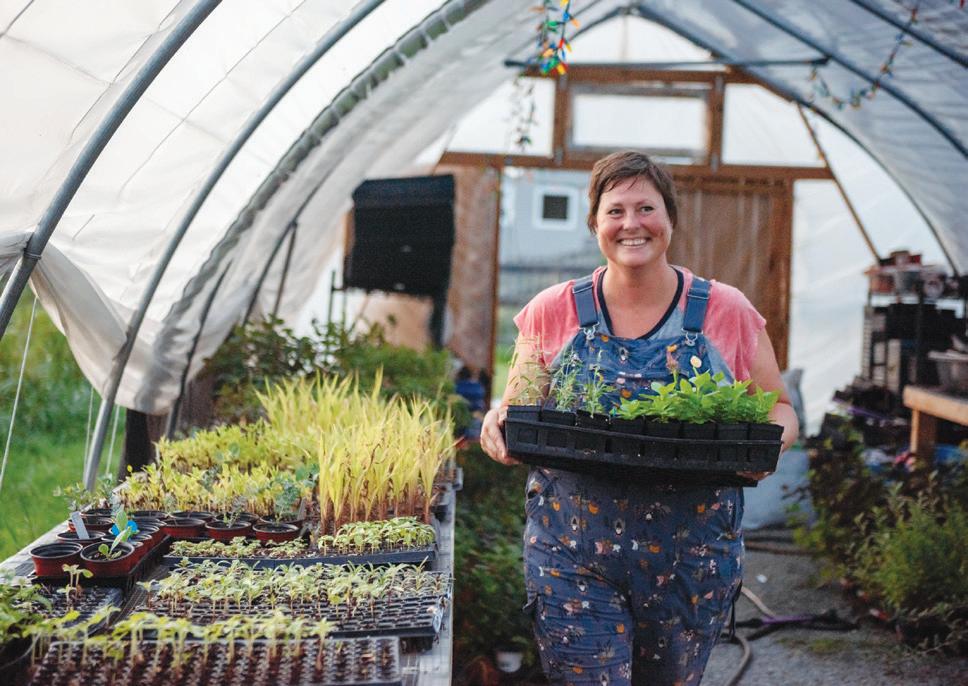
RIGHT Jeff and Gracey check on one of the ducks that roams their yard. Jeff, who works full time off the farm, helps out by building fences and other structures.
the goal. And, it’s contagious because I’ll do the same.”
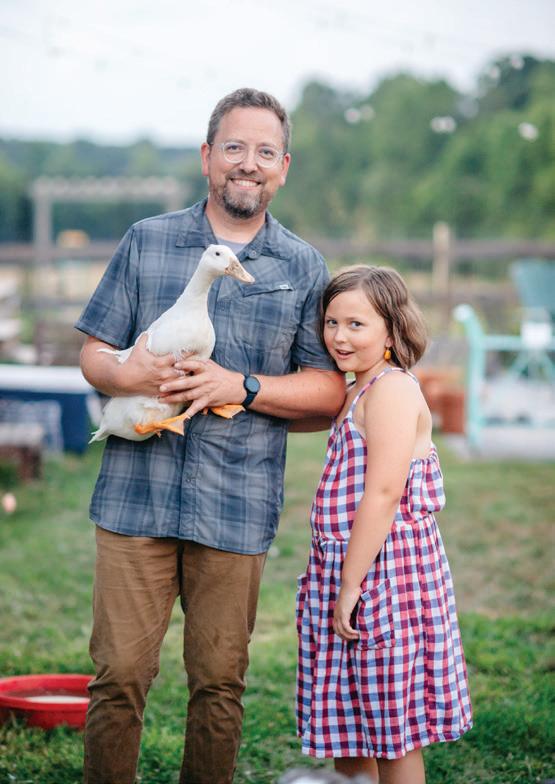
A native of Nashville, Tennessee, Emily moved to Charlotte, North Carolina at age 10. She returned to Nashville for college, earning a bachelor’s in graphic design at Lipscomb University. Emily discovered her true calling only after having children – Hazel, who has celiac disease, and Gracey, who was born with dairy and soy protein intolerances. Growing their own fruits and vegetables reduces the family’s exposure to processed foods, so the backyard gardener became a full-time farmer.
PERENNIAL PLANNER
“M
y first year, I grew a few flowers just for fun,” Emily says, adding that her friend, Angelina KoulizakisBattiste of Angelina’s Kitchen in Pittsboro, encouraged her to do more. Emily continues, “I realized that the flowers brought crazy amounts of joy.”
Emily credits her additional classes at Central Carolina Community College with helping her develop a formal business plan for sustainable farming and agritourism. In the next five years, she hopes to finish a curated rose garden, build a floral workshop, expand growing zones and establish a stand-alone, commercial-grade kitchen with a community gathering hall.
“I’m definitely a big dreamer,” Emily says. “I don’t think I’ve ever dreamt this big though. To me, this is pretty wild and crazy. And, that everything keeps coming back together is nuts.”
So this year, Emily, along with her full-time farm assistant, Emma Stapleton, will add two new sections for annuals and perennials. “Just knowing that long term, one day, it’s gonna be hard for me to
118 CHATHAM MAGAZINE SEPTEMBER / OCTOBER 2022






SEPTEMBER / OCTOBER 2022 CHATHAM MAGAZINE 119 105 W MAIN ST, CARRBORO 919 408 9596 / KRAVEKAVA Exotic Root Beverages & Teas OPEN 7 DAYS A WEEK 12PM-12AM • 12PM-1AM FRI/SAT
plant or harvest annuals, but I’ll have these gorgeous big perennials that I can cut on, do work and be an old woman,” Emily says, laughing. “You’re taught in school that as much as you have an entrance plan, you [need] an exit plan.”
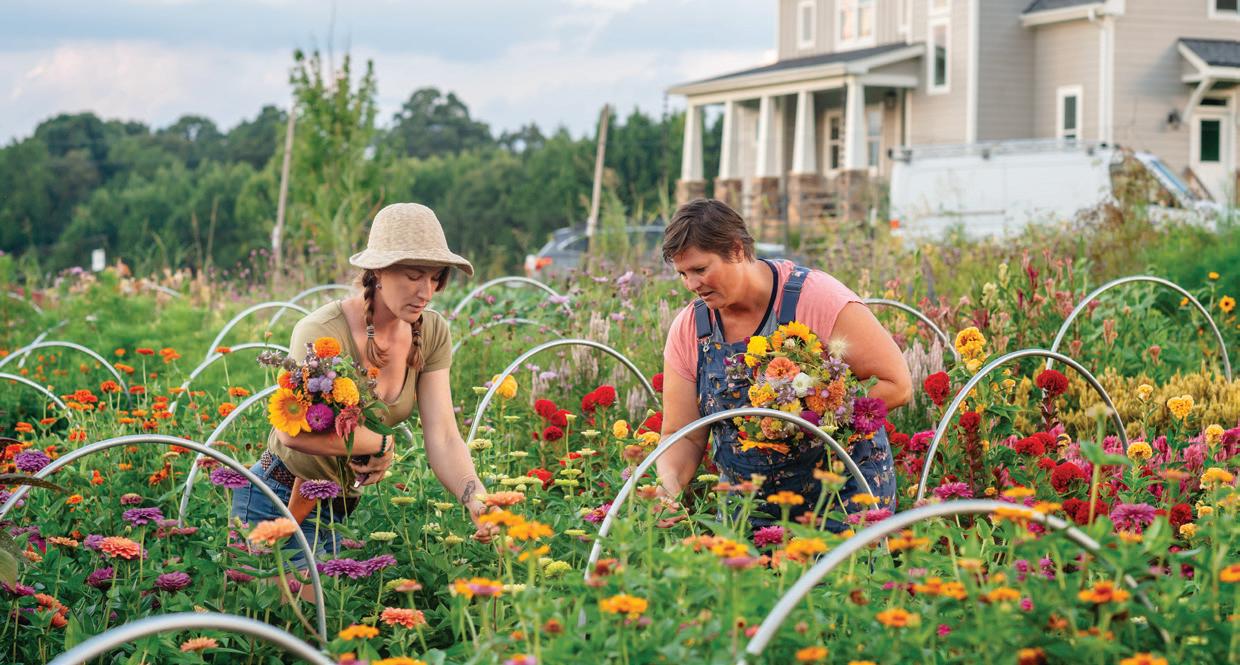
That long-range planning includes Jeff, who works remotely as vice president of analytics solutions at New York-based CipherHealth. He spends his after-work hours helping build or repair what’s needed, like a gazebo in the center of the rose garden.
NOTHING WASTED
Emily strives to use resources as efficiently as possible on the farm. To save water, she employs methods like intercropping plants to hold soil in place and prevent erosion during heavy rain storms. She builds berms to direct the flow of water toward the catchment pond. “It’s easier said than done,” she says. “I know some people will roll their eyes at global warming or climate change … but we’re seeing repercussions now. We see a lot of things like no rain, and then a huge downpour wipes [out] all your crops.”
Emily donates surplus and “ugly” vegetables to Robin Hood’s Kitchen. She also serves on the board of the nonprofit organization that cooks and provides meals to help curb food insecurity. Additionally, Emily donates vegetables and flowers to CORA, another local nonprofit that offers groceries and meals for those in need. These organizations require all food for meals to be prepared in a commercial-grade kitchen, so Emily wants to build such a place on her farm.
WORK. LIFE. PURPOSE.
There are some professions that are so tough that, “You’ve got to really, really love what you do. … Farming is for sure one because it’s just so damn hard,” Emily says. “You’ve got to be knowledgeable on engines and plants and the weather and irrigation. There’s too many things that you have to be proactive. So you’ve got to want to be here.”
Farming is at the core of who she is and how she sees herself in the world. “It’s really hard,” Emily says. “My daughters would tell you that they don’t always love me being a farmer. And, definitely in the
120 CHATHAM MAGAZINE SEPTEMBER / OCTOBER 2022
Farm assistant Emma Stapleton helps Emily harvest zinnias for bouquets to be sold at the Pittsboro Farmers Market on Thursday afternoons at The Plant.
THE GIFT OF GIVING
Emily is a seed geek and collects their origin stories. She learned that one of her local tomato customers knows the genesis of the pumpkin variety growing in her fields. The customer is a direct descendant of local, early settlers who exchanged goods with Native American tribes. One of those goods was a pumpkin.
“In the spirit the pumpkin was given [by the American Indians], I felt like the pumpkin should never be sold, only ever gifted,” Emily says. “Of course, my first thought was, ‘What am I going to do with all these pumpkins I was planning on selling at the farmers market?’”
Instead, Emily harvested her crop and baked a lot of pumpkin pies. She also gave away pumpkins to friends and family. Emily says the largest pumpkin that year went into a soup distributed by CORA.
“I pass out seeds to whoever is interested in growing this delicious pumpkin. It’s such a gift to share,” she says. “I wish I knew the tribe that gifted the seeds, I think it should be named after them. I call it the ‘Chatham County pumpkin’ since I know it’s been growing here for [more than] 100 years. It sure does love our red clay soil and is more at home here than any of us will ever be.”
Below is a recipe Emily developed to honor the offering from local Native Americans.
Emily says an alternate way to prepare this recipe is to use cupcake tins lined with a gingersnap cookie as the crust because “hand-held desserts are fun for all ages.”
8 oz. cream cheese, room temperature ½ cup brown sugar
2 cups roasted pumpkin puree
2 Tbsp. sour cream
1 tsp. vanilla
1 tsp. ground cinnamon
½ to 1 tsp. ground ginger (I like to go for 1 tsp!)
½ tsp. ground nutmeg
½ tsp. salt
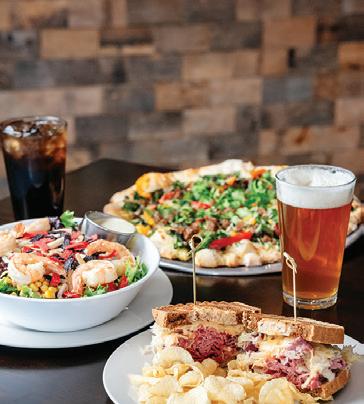
2 eggs, beaten
2 Mi-Del gluten-free graham cracker crusts

Preheat the oven to 400 F. In a large bowl with an electric mixer or a counter mixer, beat the cream cheese and sugar until blended. Then, add the rest of the ingredients, except the eggs, and blend until fully mixed. Add the eggs one at a time. Don’t overmix the eggs, or it will make the pie too fluffy. Pour mixture into two pie shells and bake for 40 minutes. You’ll know it’s done when you can stick a knife in the pie and it comes out clean.
first couple years, they said, ‘We liked it much better when you were not a farmer because we got to hang out with you more.’ [That] was hard [to hear] because you want to be the coolest, bestest mommy ever and do all the things and be all the things for your kids. At the same time, I’m a really awesome person, and I’m allowed to do things that make me happy. I can be a great mom and be a great farmer. And be an OK friend. And a pretty good wife.” Emily gleefully describes a favorite date night with Jeff. “In the summer, we go out at night with Solo Cups and look for the hornworms on the tomatoes,” she says.
“You get a black light because [the worms] glow, and I look forward to it every year. We wait forever because the sun won’t go down. And, we … look for tomato hornworms, and then you drown them in the end. That’s not very romantic, but you get your kicks however you can, right? It’s
just fun, walking in the dark on the farm with Jeff, going down the rows, looking. It’s weirdly fun.”
For Jeff, he knows the lifestyle of raising their family on a small farm in Chatham is different and special. “It’s safe to say when the kids were born, life took on a whole new meaning,” he says. “It was all about them. And then, it kind of transformed into all about family. … It just felt like this is what we gotta do. There’s no question about it.”
As perennials spread across the farm, Emily hopes visitors will stop to smell the flowers and learn about modern sustainable farming. She is eager to share her knowledge with anyone who will listen. “It’s ultimately about education,” she says, “and getting a chance to hug every community member that we possibly can. Everybody needs hugs. I would totally give everybody hugs.” CM
SEPTEMBER / OCTOBER 2022 CHATHAM MAGAZINE 121 FARMS 2022 LOCAL FRESH FAMILY OWNED AND OPERATED SALADS • WOOD-FIRED PIZZA OLD SCHOOL DELI & SANDWICHES BURGERS • FULL BAR • 41 BEERS ON TAP OUTDOOR PATIO • MUSIC • EVENT SPACE THEMODERNLIFEDELI.COM 919-533-6883 JOIN US. 46 SANFORD RD PITTSBORO, NC 2022
His other pup, Nova, is a 1-year-old blue heeler. “They love the life of being shop dogs!” he says.
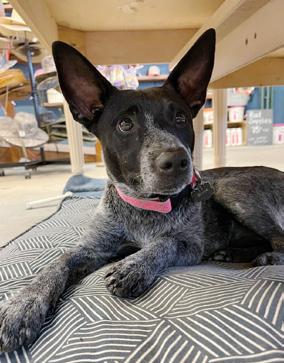
PAWSITIVE GROWTH
PET-FOCUSED BUSINESSES SEE NATIONAL INDUSTRY TRENDS ON A LOCAL SCALE
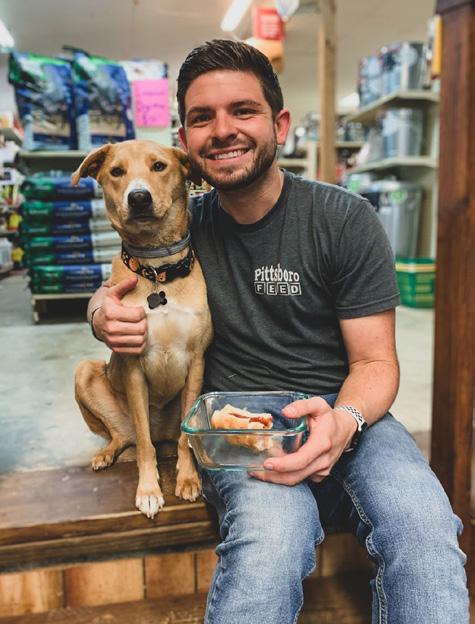 BY CALEB SIGMON & AMANDA MACLAREN PHOTOGRAPHY BY JOHN MICHAEL SIMPSON
Chances are good that you or someone you know has adopted an animal within the past couple of years.
“I believe pets proved to be good therapy for people during the isolation of COVID quarantine,” says Stephanie Clark, a registered veterinary technician and practice manager at Hill Creek Veterinary Hospital in Pittsboro. “Many newer clients are people who finally had time during quarantine to go out and acquire a pet for the first time. [They’ve since] recognized the stress relief and benefits of having a pet companion and are doing more to maintain that bond.”
Morgan Cartier Weston and her husband, James Weston, adopted their pit bull-beagleChihuahua mix, Casper, in 2020. “We were home more than ever and knew we had the time and love to give a puppy, so it was the perfect time to bring him home,” Morgan says. “We have loved walking the trails in Fearrington Village and at the Haw River with Casper and his ‘big’ brother, Chico,” she adds of the couple’s other dog, a dachshund-Chihuahua mix, who they adopted two years prior.
A nationally representative survey of 5,020 respondents by the American Society for the Prevention of Cruelty to Animals showed that close to one in five households adopted a cat or dog from March 2020 to May 2021.
Some of the biggest pet-related trends nationwide – a rise in pet owners purchasing animal health insurance, more consumer demand for high-quality pet food, more veterinary care options and increases in online shopping – are expected to grow in Chatham County as more families move into the area over the next decade. Fifty-two percent of dog and cat owners surveyed by OnePoll in partnership with MetLife Pet Insurance in 2021 reported that they spend more money on their pets every year than they do on themselves.
A few of our own veterinarians and pet-focused businesses weigh in on what they’re seeing locally:
PEACE OF MIND
Stephanie says that many pet owners were home more during the height of COVID-19 and either noticed health issues in their pets for the first time, or finally had the time to address health issues and get their pet seen by a veterinarian. Pet parents are also purchasing health insurance for their four-legged dependents to safeguard against accidents and help offset some of the veterinary costs to diagnose, treat and manage a pet’s illness or injury.
The pandemic lockdown helped drive up the number of insured pets, which more than doubled over the past four years. The industry is valued at $2.83 billion, according to the North American Pet Health Insurance Association. Eightyfour percent of the pet insurance industry is covered by Nationwide, Trupanion, Petplan and the ASPCA.
122 CHATHAM MAGAZINE SEPTEMBER / OCTOBER 2022
Pittsboro Pet Supply Manager Josh Miller with Stella, his 7-year-old Labrador-cattle dog mix who he adopted from Farm Friends Rescue.
PHOTOS COURTESY OF JOSH MILLER
Dr. David Webster, a veterinarian at Hope Crossing Animal Hospital in Pittsboro, says the practice is busier than ever, and they never slowed down when COVID-19 hit. “When you look at pets with insurance, owners are able to do more and provide more for their pets than those not having insurance,” he says. “When they need it, they are very happy they bought it.”
As more workers return to the office and folks start to regularly travel again, they often need a reliable place to board their animals. Availability among pet day cares is hard to come by at the moment, according to Green Beagle Lodge owner Tammy Purner. The company, which already has a location in Chapel Hill, is slated to open another facility at 120 Lodge Ln. in Pittsboro in September to help keep up with increasing demand. “We will feature large outdoor play areas with splash pads and an in-ground swimming pool for the larger dogs,” Tammy says. “We will have five indoor/outdoor enclosures and four rooms for dogs with special needs. Our lobby has large windows that look out into the front play yards. We also have rooms for afterhours drop-off or pickup.”
ADVANCED OR ALTERNATIVE CARE
Some pet owners pursue more modern or holistic options such as blood labs, acupuncture or laser surgery as a result of increasing demand for new pet care technology.
“Veterinary medicine has made a lot of progress in the last decade,” says Dr. Laurie Weiser, a veterinarian at Pittsboro Animal Hospital. “More and more owners are seeking advanced diagnostics [such as] CT scans, MRIs [and] ultrasounds.”
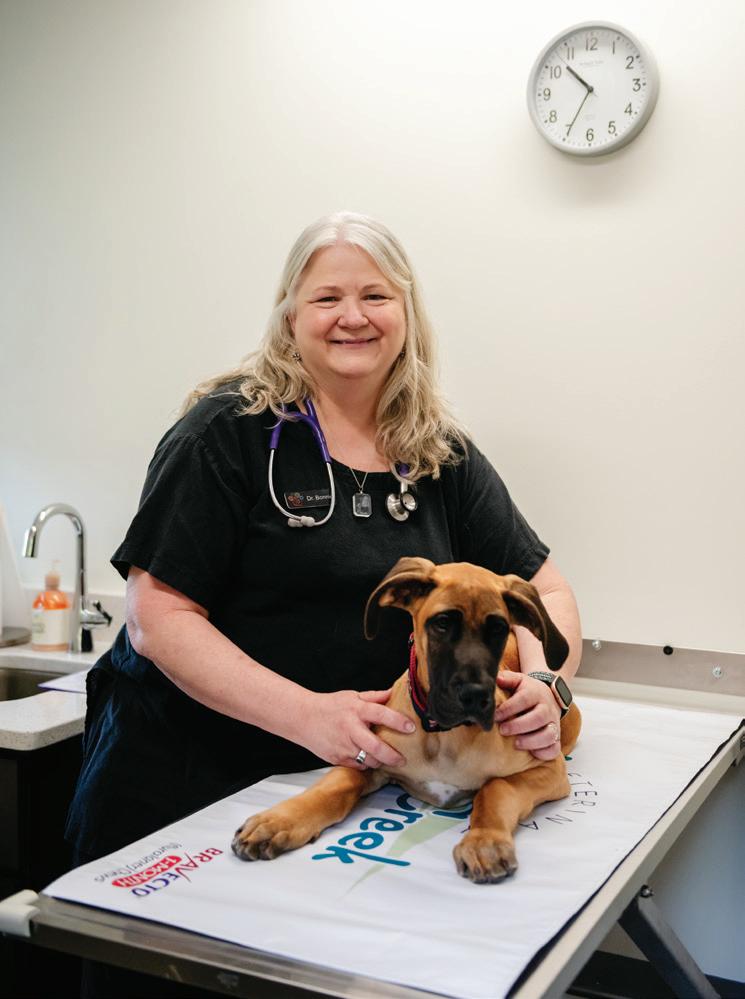
Acupuncture continues to gain popularity in veterinary medicine, Stephanie says. “I believe it will become more and more common as people witness the many ways acupuncture can improve their pet’s quality of life,” she
says. “Acupuncture is a highly successful, noninvasive alternative therapy for many of the disease processes seen in veterinary medicine. Many people have experienced the benefit of acupuncture in their own lives and are excited to be able to provide those same benefits to their pets.”
Pet owners also purchase products like CBD oil to treat their pets. However, they are unlikely to find this product at a vet clinic in Chatham since the North Carolina Veterinary Medical Board advises against the administration of CBD on pets. Laurie cautions owners who seek to use CBD for their furry friends because there is no regulation on these types of items for animals.
SEPTEMBER / OCTOBER 2022 CHATHAM MAGAZINE 123
Hill Creek Veterinary Hospital’s Dr. Bonnie Ammerman with Hagrid, a Great Dane puppy.
“We have no idea about proper dosing and side effects as no real doubleblinded scientific studies have been published,” Laurie says.
QUALITY CONTROL
Pittsboro Pet Supply manager
Josh Miller says today’s pet owners want to give their animals food made in human-grade facilities with highquality ingredients.
“They are concerned about finding a food that is sustainably sourced and made in the U.S.,” he says. “We find companies that are family-owned and -operated just like ours.”
The market for organic pet food is valued at about $5 billion and is estimated to nearly double in the next six years, according to investment firm The Insight Partners.
“Since moving to Chatham County in 2020, we’ve really appreciated having Pittsboro Pet Supply nearby,” Morgan says. “It is a great resource with friendly staff and a loyalty program for pet food. It carries all the big brands as well as specialty items. Our dogs have sensitive stomachs, and we’ve been able to find grain-free products for them. It has also recently started carrying reptile food, which is great for our corn snake, Pepper.”
But purchasing top-of-the-line food products is not the only way pet owners go the extra mile.
ADD TO YOUR VIRTUAL CART
Thirty-five percent of pet retail sales happen online now, as opposed to only 8% in 2015, according to market researchers at Packaged Facts.
“With the busyness of life and the pandemic, it’s just one way to streamline their lives,” Josh says of customers’ recent habits at Pittsboro Pet Supply. He says his store was able to adapt despite
the growth of online pet retail giants like Chewy, Petco, PetSmart or Amazon.
“We have been blessed that we started our online ordering system in 2017 and are able to compete with the online retailers,” Josh says, “because we do offer a frequent buyer card on most pet foods and can have their order [delivered] to them on the same day.”
ALL IN ALL
The pet industry is gigantic – valued at $123 billion in 2021, according to Packaged Facts – and shows no signs of slowing down in growth. As of April 2022, inflation-adjusted spending on pets and related products was 28% higher than it was in January 2019. To put in perspective, there was a mere 9.6% growth for regular groceries over that same period – meaning consumers are quicker to buy more for their pet than for themselves.
The majority of households that welcomed a furry companion amid the pandemic say they’re keeping the pet for good. So this market growth – much like the pets that were brought home – is likely here to stay. CM
Hill Creek Veterinary Hospital, Pittsboro Animal Hospital and Hope Crossing Animal Hospital were all named best vets in Chatham in our readers’ favorites poll.
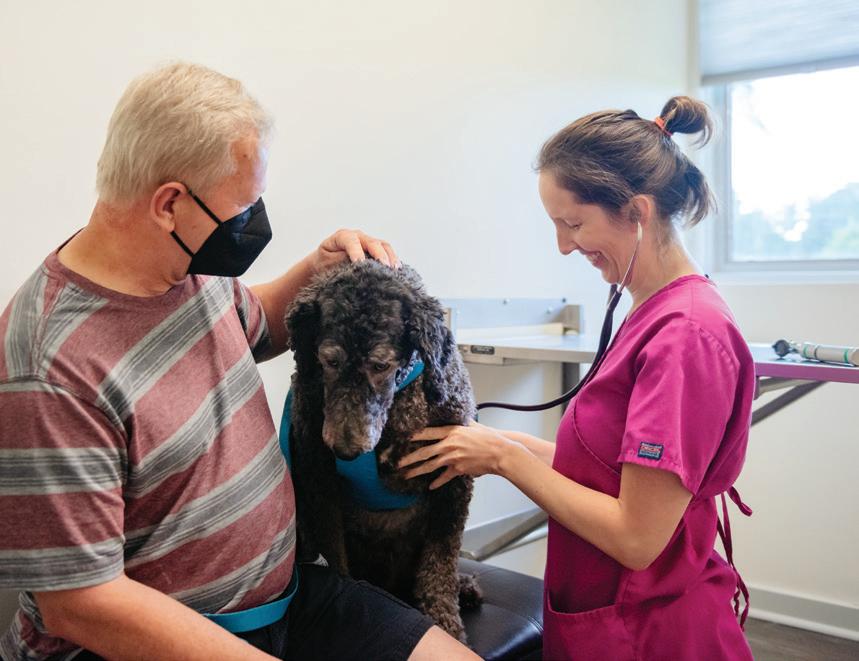
124 CHATHAM MAGAZINE SEPTEMBER / OCTOBER 2022 PETS
George Devinney’s standard poodle, Pepper, gets a checkup from Dr. Lydia Scheidler at Hill Creek Veterinary Hospital.
PET RESOURCES
A GUIDE TO AREA VETS, ANIMAL HOSPITALS, GROOMERS, BOARDERS AND PET SITTERS
BY ISABELLA REILLY
VETERINARY SERVICES
CHATHAM ANIMAL HOSPITAL 105 Oceana Pl., Cary
Contact 919-469-8114; chathamanimal.com
Special services Dental care, laser therapy and wellness care.
CHATHAM COUNTY MOBILE VETERINARY SERVICES
Contact 919-239-9362; chathamcountymobilevet.com
Special services Equine and farm animal care.
CHATHAM VETERINARY SERVICE 1114 Greensboro Ave., Siler City Contact 919-742-4441; chathamveterinaryservice.com
Special services In-clinic diagnostics and digital radiography.
COLE PARK VETERINARY HOSPITAL 55 Woodbridge Dr., Chapel Hill Contact 919-929-3352; coleparkvet.com
Special services Dental care, laser therapy, boarding, grooming, acupuncture and day care.
DOGWOOD VETERINARY HOSPITAL & PET RESORT 51 Vickers Rd., Chapel Hill
Contact 919-942-6330; dogwoodvethospital.com
Special services Dental care, laser therapy, boarding, day care and grooming.
DR. ADRIANO BETTON MOBILE VETERINARY CARE Serves Chatham and Orange counties. Contact 919-602-4291; drbetton.com
Special services Dental care.
FRIENDSHIP MOBILE VETERINARY SERVICES
Serves eastern Chatham & western Wake Contact 919-267-3572; friendshipmobilevet.com Special services At-home euthanasia.
HILL CREEK VETERINARY HOSPITAL
75 Old Graham Rd., Pittsboro Contact 919-542-1141; hillcreekvet.com
Special services Dentistry, laser therapy, ultrasound, acupuncture, Chinese herbal medicine and grooming.
HOPE CROSSING ANIMAL HOSPITAL 58 E. Cotton Rd., Pittsboro Contact 919-542-1975; hopecrossing.com Special services Laser therapy.
JORDAN LAKE ANIMAL HOSPITAL 50-B Chatham Corners Dr., Pittsboro Contact 919-542-5424; jordanlakeanimalhospital.vetstreet.com Special services Dental care, boarding and bathing.
PITTSBORO ANIMAL HOSPITAL 1065 East St., Pittsboro Contact 919-542-5712; pittsboroanimalhospital.com Special services Acupuncture, house calls/athome euthanasia, grooming, day boarding for dogs and overnight boarding for cats.
POLARIS EQUINE MOBILE VETERINARY CLINIC Serves multiple counties within one-hour radius of Pittsboro Contact 919-429-9492; polarisequine.com Special services Equine & other farm animal care.
THIRD STREET VETERINARY CLINIC 312 E. Third St., Siler City Contact 919-742-4909; facebook.com/thirdstreetvet
TYSOR VETERINARY CLINIC 1401 N. Second Ave., Siler City Contact 919-742-3646; tysorvet.net Special services Dental care, cold laser therapy, grooming, boarding, retail shop and adoption program.
VILLAGE VETERINARY HOSPITAL 50150 Governors Dr., Chapel Hill Contact 919-967-4779; falconbridgeanimal.com Special services Dental care.
BOARDING
COMPANION CAMP 3408 Castle Rock Farm Rd., Pittsboro Contact 919-545-2267; companioncamp.net Boarding for dogs and cats.
GREEN BEAGLE LODGE 6805 Millhouse Rd., Chapel Hill, and 120 Lodge Ln., Pittsboro Contact 919-929-7387; greenbeaglelodge.com
Dog and cat boarding, grooming, dog training and day care.
PETTSBORO GROOM AND ROOM 117 Elf Way, Pittsboro Contact 919-542-6214; facebook.com/pettsboro.groomnroom Dog boarding, grooming, training and day care.
GROOMING
AWBREYS ARK MOBILE PET SPA Serves the Chapel Hill-Carrboro area Contact 919-292-7397; awbreysark.com Full-service mobile grooming.
HAIR OF THE DOG GROOMING STUDIO 11312 U.S. Hwy. 15-501 N., Chapel Hill Contact 919-968-6000; hairofthedognc.com Full-service grooming for dogs, including teeth brush if requested, as well as a self-wash station.
PET SITTERS
HICKORY HOUNDS Serves Carrboro and the surrounding area Contact 919-240-7148; hickoryhounds.com Dog behavior rehabilitation, pack walks and training sessions.
LAUGHING DOG PET CARE Serves Chapel Hill, Carrboro & Briar Chapel area Contact 919-909-7632; laughingdognc.com Dog training and pet care.
PET SITTING BY MEGAN Contact 919-630-4690; petsittingbymegan.weebly.com Dog walking, daily visits and farm care.
WALK & WAG Serves the Chapel Hill-Carrboro area Contact 919-619-4456; walkandwagchapelhill.com Dog walks, cat care, pet sitting, overnight stays and pet transportation.
DOG PARK
THE PARK AT BRIAR CHAPEL 1015 Andrews Store Rd., Pittsboro; chathamcountync.gov CM
SEPTEMBER / OCTOBER 2022 CHATHAM MAGAZINE 125
HERE WE GROW AGAIN
COMMERCIAL DEVELOPMENT UPDATES, PLUS A LOOK AT UPCOMING PROJECTS
COMPILED BY BEN CROSBIE
The impact of plans to build a Vietnamese car manufacturing plant in Moncure is still rippling through the county.
VinFast has begun preparing part of the 1,765 acres for construction of its new $4 billion facility at Triangle Innovation Point.
The interior of VinFast’s manufacturing facility, which will be built at the Triangle Innovation Point in Chatham, will look similar to its production plant in Vietnam.

The company received an incentive package worth $1.2 billion from the state of North Carolina, which includes a $316 million job development investment grant over 32 years and $450 million for site preparations such as road improvements.
VinFast also received $400 million in incentives from Chatham County. The
Golden Leaf Foundation voted to award $50 million to the city of Sanford to build public water and sewer infrastructure to support the megasite tenants.
VinFast is on track to break ground this year with an ambitious preliminary goal to start production in July 2024. The aim is to produce 200,000 vehicles per year.
There will be two main areas of production – one for ancillary industries for suppliers and the other for the production and assembly of electric vehicles. The project has the potential to economically vault Chatham County onto the global stage and have similar benefits for the local economy as BMW has done in Spartanburg, South Carolina. CM
OTHER UPDATES
In western Chatham, Tim Booras, owner of the 1,802acre Chatham-Siler City Advanced Manufacturing Site, is working on a project to develop a 184-acre residential and retail area in Siler City along Highway 64. The concept for Fox Haven Village is currently in the predevelopment stage with the Siler City planning department.
Despite public opposition from residents of the North Woods neighborhood in Pittsboro, the North Chatham Park Way is scheduled to be built after Chatham Park Investors offered $9 million to the North Carolina Department of Transportation for the road project.
Mosaic at Chatham Park, a 44-acre mixed-use project that features apartments, condos, restaurants and entertainment venues, is also slated to host a 24,000-square foot medical office building after a lot sold for nearly $2.52 million. Triangle Family Dentistry has already committed as a tenant and plans to occupy about half the building.
The Chatham County Board of Commissioners has requested funds from the North Carolina Department of Commerce, through its Building Reuse Program, to be used for the Arauco Building Reuse project. The board declared in a resolution on June 21 that the county has a need for the expansion of an existing building, and that it needs a portion of the funds authorized by the North Carolina General Assembly to stimulate economic development and job creation in distressed areas.
126 CHATHAM MAGAZINE SEPTEMBER / OCTOBER 2022
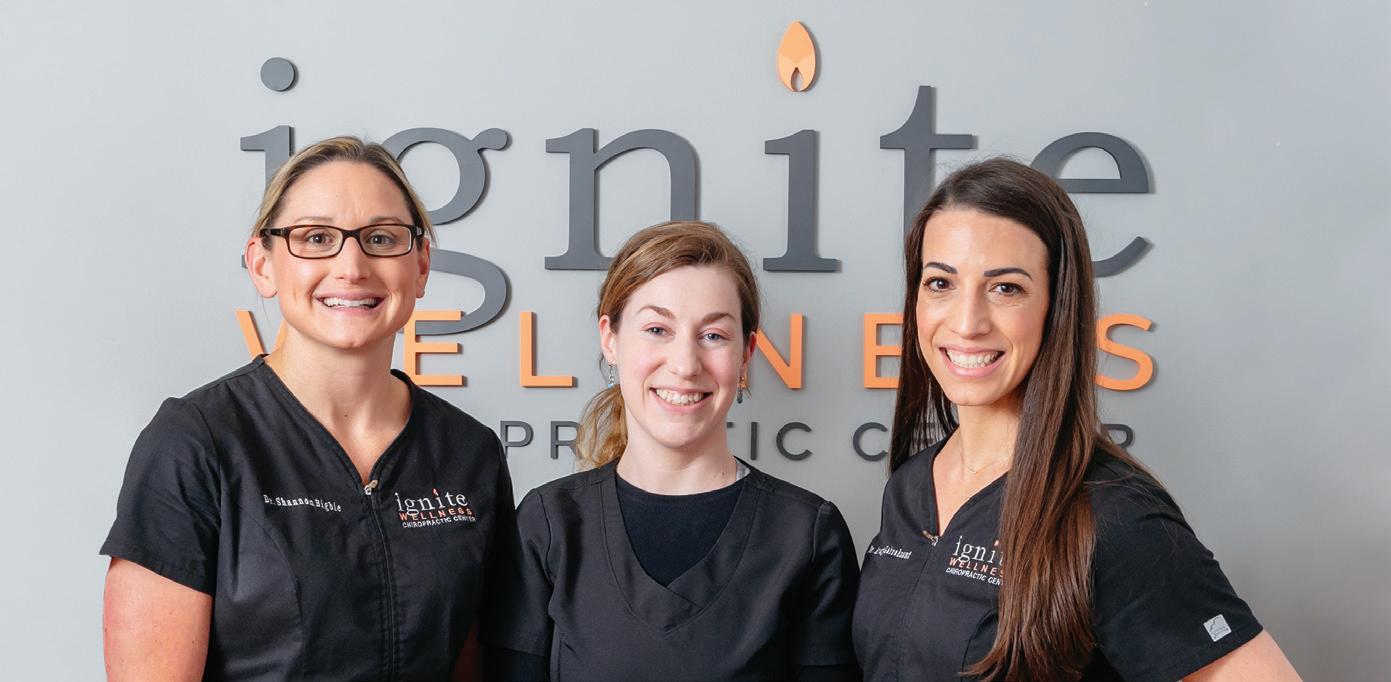
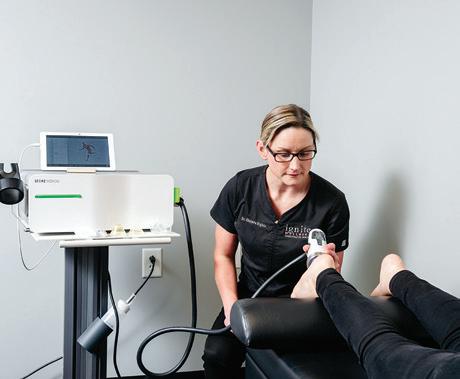
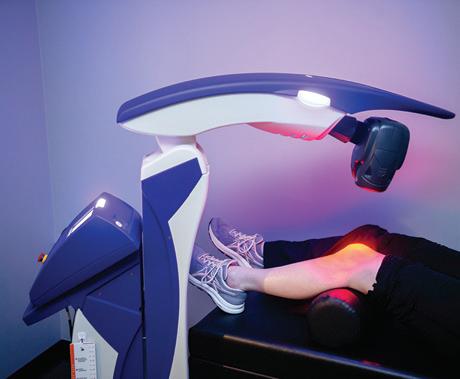
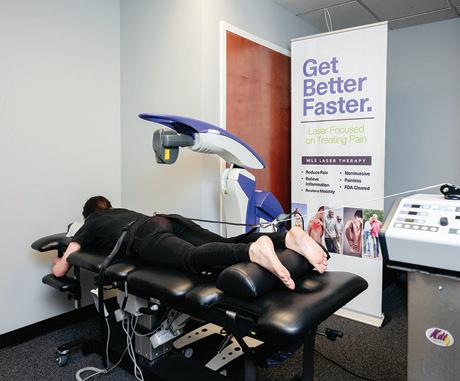
END YOUR PAIN WITHOUT DRUGS OR SURGERY TODAY 5821 Farrington Rd, Ste 202, Chapel Hill, NC 27517 919-307-6688 ignitechapelhill.com @ignitechapelhill THANK YOU CHAPEL HILL! VOTED BEST CHIROPRACTIC OFFICE! BACK AND NECK PAIN // HEADACHES // SCIATICA // NEUROPATHY // KNEE PAIN // PLANTAR FASCIITIS COLD LASER THERAPY // NON-SURGICAL SPINAL DECOMPRESSION // SHOCKWAVE THERAPY 2022 LimitedTimeOffer Any$49ConsultExam, NecessaryX-raysUsualvalue$197 Federal and Medicare restrictionsmayapply.
Barrett & Parks
BY VALERIA CLOËS PHOTOGRAPHY BY KATIE ADCOX, PHOTOGRAPHYBYKT.PIXIESET.COM
Sean Barrett and Silk Hope native Molly Parks first met in San Juan del Sur, Nicaragua, in May 2016 in what could have been a movie scene.
Sean, an oil rig worker from Revelstoke, British Columbia, met Molly, a Philadelphia-based flight attendant, on the beach. Molly said it was love at first sight. “We spent the first weekend falling in love over street tacos, surfing, piña coladas and fishing trips with friends,” she says.
Their long-distance relationship changed in March 2021 when Sean surprised Molly on the Twin Lakes Golf Course in Chapel Hill. She discovered an engagement ring on the ball in the tee box on the third hole.
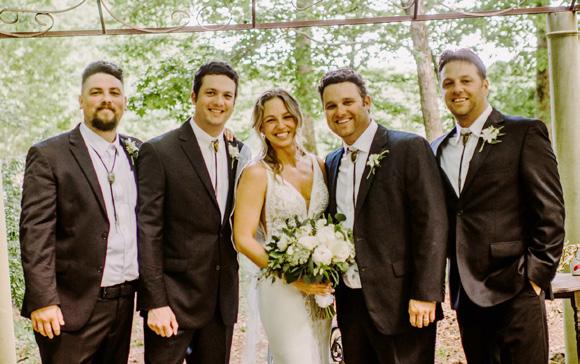

The wedding ceremony was held on May 14, 2022, at Het Landhuis, where 175 friends and family members, including 60 Canadian guests, gathered. Molly’s mom, Robin “Birdie” Gerringer Stevens, worked with Christina Verwoerdt-Solanto from A Classical Memoir to make the couple’s dream day come true. Each of Molly’s four brothers – Rick Parks, Preston Parks, Garrett Parks and Russell Parks – took turns walking her down the aisle in honor of their late father, Tommy Parks.
Guests enjoyed dinner beneath a pecan tree and danced by the pond. Sean’s favorite moment was riding away with Molly in Tommy’s 1970 Chevy Malibu.
Sean and Molly, an alumna of JordanMatthews High School and Meredith College, reside in Revelstoke with their dog, Daisy, a rooster and 25 hens. CM
128 CHATHAM MAGAZINE SEPTEMBER / OCTOBER 2022 WEDDING




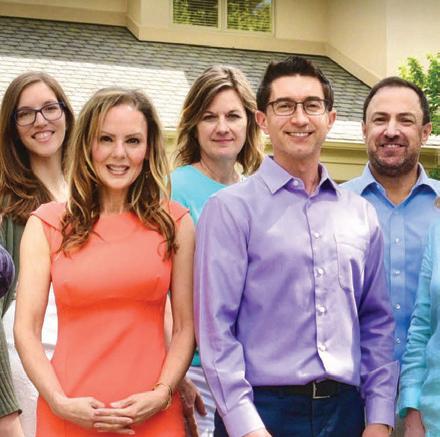
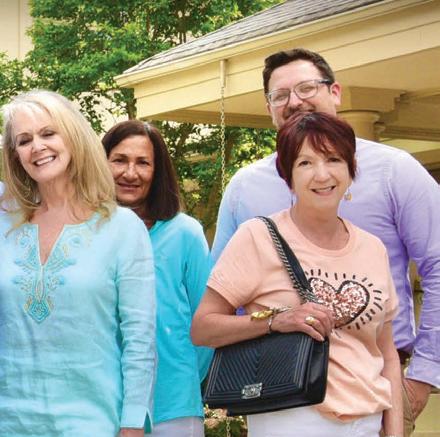






Expert


care
you
Health
and Specialty Care o ers
the
UNC
your
providing personalized
our community and perform several
surgical procedures in our state-of-the-art facilities. Specialties include: • Cardiology • Ear, Nose and Throat • General Surgery • Gynecology • Ophthalmology • Orthopaedics • Pain Management chathamhospital.org/expertcare
close to
UNC
Chatham
direct access to
expertise of
Health, right in
backyard. We are dedicated to
care for
various