Volume LX Number 3 • Summer 2019 • $8.00
TO TOUR OR NOT TO TOUR Life on the Road and Open Seas
DARE TO DREAM
Advice from Distinguished Designers
OUTDOOR THEATRE Weathering Change
LEARN BY DOING! Full-Time Conservatory Evening Conservatory Summer Intensive Spring Comprehensive Part-Time Classes Summer Teen Ensemble BFA Through NYU Tisch School of the Arts
APPLY NOW!
Website atlanticactingschool.org Email admissions@atlantictheater.org Call 212-691-5919
76 Ninth Avenue, Suite 537, New York, NY 10011
NOW AVAILABLE FOR LICENSING! A brand-new collection of one-act musicals based on your favorite Disney Channel Original Movies
THESE THESE SHOWS SHOWS ARE ARE FUN FUN AND AND EASY EASY TO TO PRODUCE! PRODUCE! Flat-rate licensing is available for schools and qualifying groups and includes: •
25 Libretto/Vocal Books
•
1 Piano/Vocal Score
•
Downloadable accompaniment tracks & reference recording
•
The ability to perform the show as many times as you like in a calendar year!
All materials are yours to keep – no returning rented scripts and scores.
GET STARTED TODAY. CONTACT MTI FOR LICENSING.
©Disney
(212) 541-4684 • MTISHOWS.COM
BASED ON THE
Contents
Volume LX Number 3 l Summer 2019 l Southern Theatre – Quarterly Magazine of the Southeastern Theatre Conference
Features 8 To Tour or Not to Tour Is Life on the Road or Open Seas for You?
Departments 4 Hot off the Press Plays By, For and About Women by Zackary Ross
6 Outside the Box: Design/Tech Solutions Mirror, Mirror on the Set: Which Is the Fairest Alternative to Standard Shrink Mirror Products? by F. Randy deCelle
by Stefanie Maiya Lehmann
16 Dare to Dream as a Designer Advice from SETC’s 2019 Distinguished Designers by Jonathon Taylor
24 Outdoor Theatre Historical Dramas, Shakespeare Festivals Weather a Changing Climate by Tom DeTitta
Cover Lila Coogan (Anya) and company are shown in a scene from the national tour of Anastasia, with costume design by Linda Cho, one of the distinguished guest designers at the 2019 SETC Convention. See story, Page 16, with advice from Cho and the other designers. Learn the ins and outs of working on a tour, Page 8. (Photo by Evan Zimmerman, MurphyMade; cover design by Deanna Thompson)
Summer 2019 x Southern Theatre x 3
Plays By, For and About Women by Zackary Ross
I
began writing this column during Women’s History Month, and I found myself thinking about both my favorite female playwrights and the common struggle I encounter as we begin planning our next theatrical season. My theatre program, like many across the country,
has many more women than men in the casting pool, and we often struggle to find material that addresses this disparity. While modern plays tend to be more equitable in their gender representation than their historical peers, I too often find myself struggling to find texts that not only feature enough roles for women but also present these characters in interesting, nuanced ways and offer a story told from a female perspective. What follows is a collection of newly-published plays from major play publishers that address these points. Following each description, you’ll find information about the cast breakdown and a referral to the publisher who holds the rights. Hardball, by Victoria Stewart
coming to terms with their own biases and
ones. To her surprise, she is met with
Set in early 2005 just after George W.
the roles they are expected to play, offering
guardedness and hostility due to her
Bush won his second term in office,
a fresh perspective on teen angst, the
absence and the havoc that comes from
this play tracks the transformation of
feeling of rootlessness often tied to being
reawakening the past.
budding journalist Virginia Eames, who
a 30-something, and the sense of having
Cast breakdown: 4 females; 3 males
was recently fired from her newspaper
lost something as we slide into middle age.
Publisher: Broadway Play Publishing Inc.
job, into a celebrity pundit known for her
Cast breakdown: 3 females; 3 males
www.broadwayplaypub.com
provocative political views. Timely and
Publisher: Dramatists Play Service, Inc.
thought-provoking, Hardball examines the
www.dramatists.com
Scissoring, by Christina Quintana Hired by a conservative Catholic school,
sacrifices that follow when those entrusted to report the news turn their politics into a
Napoli, Brooklyn, by Meghan Kennedy
Abigail Bauer feels forced to hide her
vehicle for attaining stardom.
In Brooklyn in 1960, three Italian-American
sexuality, creating an intense conflict with
Cast breakdown: 4 females; 2 males
daughters of immigrant parents struggle
her longtime partner Josie. Throughout
Publisher: Broadway Play Publishing Inc.
against the patriarchal family structure.
the play, Abigail struggles to reconcile her
www.broadwayplaypub.com
When the unthinkable happens in the form
personal and public lives and ultimately is
of the infamous 1960 Park Slope plane
confronted with a series of hallucinations
Somebody’s Daughter,
crash, the secrets of the family bubble to the
that challenge her choices, including one
by Chisa Hutchinson
surface, some relationships form and some
featuring one of history’s most famous
Alex is a 15-year-old Asian American
crumble, and the women of the Muscolino
closeted pairings, Eleanor Roosevelt and
girl, model student and constant
family find their voice in the wreckage of
Lorena Hickok.
disappointment to her parents, who
what was once their lives.
Cast breakdown: 6 females; 1 male; 1 n/s
wanted a boy. Kate is a 30-something
Cast breakdown: 6 females; 2 males
Publisher: Dramatists Play Service, Inc.
Asian American guidance counselor whose
Publisher: Dramatists Play Service, Inc.
www.dramatists.com
frustration with her family’s judgment of
www.dramatists.com
her is now threatening the relationship she has built with her African American
Local Story, by Kristen Palmer
boyfriend Reggie. Structured around Alex
After walking away from her life several
and Kate’s college counseling sessions, the
years ago, D’Lady returns to her hometown
play depicts three generations of women
and tries to reconnect with her loved
4 x Southern Theatre x Summer 2019
Zackary Ross, an assistant professor of theatre at Bellarmine University in Louisville, KY, also works regularly as a director and a dramaturg.
Theatre s o u t h e r n
From the SETC President
EDITOR
Deanna Thompson
SETC EXECUTIVE DIRECTOR
Susie Prueter SETC EXECUTIVE DIRECTOR EMERITUS
Betsey Horth ADVERTISING
Clay Thornton, clay@setc.org BUSINESS & ADVERTISING OFFICE
Southeastern Theatre Conference 1175 Revolution Mill Drive, Studio 14 Greensboro, NC 27405 336-272-3645 PUBLICATIONS COMMITTEE
J.K. Curry, Chair, Wake Forest University (NC) Becky Becker, Clemson University (SC) Gaye Jeffers, University of Tennessee at Chattanooga Laura King, Gordon State College (GA) EDITORIAL BOARD
Tom Alsip, Oklahoma State University Lamont Clegg, Osceola County School for the Arts (FL) Larry Cook, University of North Georgia Amy Cuomo, University of West Georgia F. Randy deCelle, University of Alabama Kristopher Geddie, Venice Theatre (FL) Bill Gelber, Texas Tech University Scott Hayes, Liberty University (VA) Edward Journey, Alabama A&M University Stefanie Maiya Lehmann, Lincoln Center (NY) Brooke Morgan, University of Montevallo (AL) Tiffany Dupont Novak, Lexington Children's Theatre (KY) Richard St. Peter, Northwestern State University (LA) Jonathon Taylor, East Tennessee State University PROOFREADERS
Kim Doty, SETC Communications Specialist Denise Halbach, Independent Theatre Artist (MS) Philip G. Hill, Furman University (SC) PRINTING
P
Pursuing dreams is the focus of this year’s summer issue. Whether you are thinking ahead to future career possibilities or reimagining your current work, this edition of Southern Theatre provides opportunities for inspiration.
To many, touring seems like a dream job. Maybe you’re one of those who have
wondered what it would be like to perform on a cruise ship or to go on tour with a Broadway musical or a Shakespeare play? Performers, crew members and the people who hire them take you inside the touring life and offer tips for making the most of life on the road in a story by Stefanie Maiya Lehmann. The distinguished guest designers at this year’s SETC Convention shared many nuggets of advice in a Thursday night presentation, but one theme resonated across all of their keynotes: Dare to dream. For those who missed this year’s event, and for those who would just like to experience the designers’ collective wisdom again, we share highlights in a story by Jonathon Taylor.
For more than eight decades, outdoor historical dramas have celebrated the
dreamers among us – from adventurers who set off to settle distant lands, to Native Americans who struggled to hold on to the land they loved, to artists who saw music in the passage of everyday life. But today, outdoor historical dramas, as well as outdoor Shakespeare festivals, are facing dwindling audiences. Tom DeTitta shares some of the ways outdoor theatres are working to bring audiences back. Returning to the design-tech side of theatre, Randy deCelle shares a costeffective alternative to standard shrink mirror products in this issue’s “Outside
Clinton Press, Greensboro, NC
the Box” column.
NOTE ON SUBMISSIONS
Finally, more and more theatres are making a point of including plays by
Southern Theatre welcomes submissions of articles pertaining to all aspects of theatre. Preference will be given to subject matter linked to theatre activity in the Southeastern United States. Articles are evaluated by the editor and members of the Editorial Board. Criteria for evaluation include: suitability, clarity, significance, depth of treatment and accuracy. Please query the editor via email before sending articles. Stories should not exceed 3,000 words. Color photos (300 dpi in jpeg or tiff format) and a brief identification of the author should accompany all articles. Send queries and stories to: deanna@setc.org. Southern Theatre (ISSNL: 0584-4738) is published quarterly by the Southeastern Theatre Conference, Inc., a nonprofit organization, for its membership and others interested in theatre. Copyright © 2019 by Southeastern Theatre Conference, Inc., 1175 Revolution Mill Drive, Studio 14, Greensboro, NC 27405. All rights reserved. Reproduction in whole or part without permission is prohibited. Subscription rates: $24.50 per year, U.S.; $30.50 per year, Canada; $47 per year, International. Single copies: $8, plus shipping.
women in their seasons. If your theatre is one of them (or if your theatre is just looking for a great new play), you’ll want to check out Zackary Ross’ list of notable and newly available scripts by, for and about women in our new plays column, “Hot off the Press.”
Now, sit back, relax and enjoy this collection of timely stories that just might
inspire you to “dream a little dream” of your own.
Jeff Gibson, SETC President
Summer 2019 x Southern Theatre x 5
outside
the box DESIGN/ TECH SOLUTIONS
Mirror, Mirror on the Set Which Is the Fairest Alternative to Standard Shrink Mirror Products?
b y F. R a n d y d e C e l l e
W
hen attempting to stage beloved Broadway favorites, producing
entities often face challenges because they lack the resources needed to recreate the iconic looks that audience members relish, such as the dance mirrors in A Chorus Line. For a 2017 production at the University of Alabama, our goal was to restage the original Broadway production, using periaktoi (three-sided rotating scenic flat units arranged in a line) to perform the majority of the work for supporting the play scenically.
This was not the Department of Theatre
and Dance’s first time producing A Chorus Line in its traditional form. Our 2004 production also used periaktoi. For that production, we created the mirrored sides of the three-sided units from Broadwaystyle flats, which we covered with the standard shrink mirror material found at theatrical production suppliers. These flats performed well and are still in our stock, Photos by Porfirio Solorzano
seeing use in a variety of shows. However, for our 2017 production, the design of the periaktoi was changing slightly, as the show had to tour and we felt our existing flats were a little worn. With the opportunity to create new mirror flats, I set out to find a different material for the mirror that would require less labor and be lower in cost than the traditional shrink mirror products. The process of creating them not only can be time-consuming, but also requires patience and a steady hand, especially for the 14-foot tall mirrors we needed. After
The mirrors in the 2017 (top) and 2004 (bottom) productions of A Chorus Line at the University of Alabama had very similar reflectivity and overall effectiveness onstage, despite the use of a less expensive material for the most recent production. Challenges to Address
1
form a 14-foot-tall by 26-foot wide mirror
Your mirror shouldn’t be too perfect.
wall, unless you want the audience to
One thing that many people do not
be watching itself throughout the show.
understand is that, when using mirrors
Mirrors also can be problematic for lighting
products, which are a form of polyester
onstage for scenery, you don’t want perfect
and scenery, because those parts of the
film.
mirrors, especially when collectively they
audience that look up at the mirrors may
researching alternatives, I focused on Mylar
6 x Southern Theatre x Summer 2019
COST OF PRODUCTS TESTED MFG PRODUCT WIDTH (in) COST PER COST/FT Earth Start
Mylar Film, 2 sides, 2 mil
48
$23.90
100 ft.
$0.239
Hydrofarm
Mylar Film, 1 mil
48
$19.80
50 ft.
$0.396
Space Paper
Mylar Film, 2 mil
48
$42.99
100 ft.
$0.430
HTG Supply
Mylar with white poly back, 4 mil
48
$22.95
25 ft.
$0.918
HTG Supply
Mylar with black poly back, 6.7 mil
48
$31.95
25 ft.
$1.278
see lighting fixtures or into the backstage
off. At approximately $5.08 per foot, the
at the audience’s distance, which keeps
of the theatre.
entertainment-based shrink mirror product
the mirrors from being too distracting and
Size matters. Perhaps the biggest
is about 21 times more expensive than the
helps with lighting and scenic issues.
challenge with affordable polyester
least expensive Mylar film option.
Putting the Mirrors into Action
products is the more narrow product
While the film products looked very
Once we chose the mirror surface, the
width. Rolls of mirror products made for
similar at first pass, we soon discovered
next step was creating the base frame. We
the entertainment industry tend to be 50-60
distinct differences. The HTG Supply prod-
chose an open-frame, Broadway-style flat
inches wide, while the Mylar products tend
ucts with the polyvinyl backing seemed
that was a bit under four feet wide. We
to be in the 36-inch-wide range, with some
ideal due to their enhanced strength, until
stretched the material across the flat face,
around 48 inches wide.
we discovered that the mirror side of the
stapling it on the structure face, within ¾" of
Flammability is an issue. A significant
material was pitted. While it was reflec-
the edge of the flat frame. We then applied
consideration when using polyester
tive, it was not aesthetically appropriate.
black gaff tape along the edges, covering
film is the flammability of the product.
The Hydrofarm and Space Paper products
the staples, and wrapped it around the edge
The rolled mirror products made for the
seemed much too flimsy to be practical for
of the flat frame. This provided a clean edge
entertainment industry are listed by the
scenic use, especially for tour, and the mir-
to the mirror flats. By using this method
manufacturers as self-extinguishing. To
ror surface on both was not consistent.
instead of the traditional shrink mirror, we
protect general-purpose polyester film,
The Winning Choice
saved enough time and money to make a
however, you need to add a flame retardant
We chose the Earth Start Mylar. The
spare mirror flat, in case there was any
made for it, which is available through
consistency of the mirror surface was much
damage on the tour.
online suppliers.
better than the others and the material is
The final result was a mirror product
Our Product Tests
mirrored on both sides, adding thickness
that was much more economical and far
I identified five Mylar film products
and more strength, compared to the others.
easier to install than the traditional shrink
to test in comparison to the shrink mirror
It also helped that it was available in 100-
mirror. I was able to pull archive photos
product most often used. We fabricated test
foot rolls and was the cheapest product we
of our original 2004 A Chorus Line mirrors
flats using the products chosen, mounting
found in the minimum width we needed.
and compare the results with our 2017
the materials in a variety of ways. For
We compared the entertainment-based
production. While the staging and images
the traditional shrink mirror product, we
shrink mirror and the Earth Start Mylar
captured are different, the mirrors appear to
created a wooden flat frame according to
version, and the look achieved was very
be extremely similar in quality, reflectivity
the manufacturer’s recommendations. For
similar. The mirror surface created with
and overall effectiveness. n
the Mylar film products, we used standard
the Earth Start Mylar was not a perfectly
Broadway flats that were open-frame
reflective surface, which is what is desired.
or hard-covered. Most of the flats were
When performers are close to the surface,
Broadway-style, 2-foot-by-4-foot frames
there is a good deal of reflectivity that
that we use for our scenic art class.
more than adequately mimics a dance
mirror. However, the reflection is blurry
2
3
The five Mylar film products we chose
F. Randy deCelle is an associate professor and head of design and technical production at the University of Alabama. A member of the Southern Theatre Editorial Board, he is editor of the Outside the Box column.
met three main criteria: their width was the largest available, they came in a practical roll length for covering 14-foot flats, and their costs were reasonable. The table at the top of this page shows the costs of the final contestants in the Mylar shoot-
Do you have a design/tech solution that would make a great Outside the Box column?
Send a brief summary of your idea to Outside the Box Editor F. Randy deCelle at rdecelle@ua.edu. Summer 2019 x Southern Theatre x 7
TO TOUR OR NOT TO TOUR Is Life on the Road or Open Seas for You? by Stefanie Maiya Lehmann
E
Every year, thousands of theatre professionals pack up their suitcases and leave their homes behind to begin life on the road. For these professionals, the tour life can sometimes feel like a world filled with dichotomies. It is glamorous but grueling, repetitive yet constantly changing. For some young professionals, joining a touring production or cruise can be quite the boon to their financial situations. Some only tour while they’re young or will only take a tour when they need a reset to their city life, while others have thrived in this segment of the industry, becoming old “road dogs” or “road warriors.” Either way, cruise line, regional, national and international touring productions are a vital part of the theatre industry, filled with opportunities for young professionals to make a sustainable living.
“Touring isn’t for everybody, but it is such a great
opportunity for actors to really test their skills out on various audiences with wide arrays of experiences and opinions,” said Jason Styres, CSA, casting director for numerous touring productions, including A
Yael Reich LATEST ROLE:
Gentleman’s Guide to Love & Murder, The Lion King,
Eva Perón, Evita,
Fiddler on the Roof, Rogers + Hammerstein’s Cinderella
U.S. Tour, January-March 2019
and The King and I. “You can learn so much about how
PREVIOUS TOURS:
to be an adaptable, engaging artist simply by being
Mamma Mia!, Mamma Mia! Farewell
in these ever-shifting environments.”
Tour, Rent 20th Anniversary Tour
According to The Broadway League, the 700-plus
member national trade association for the Broadway industry, in the 2017-2018 season, the attendance for touring Equity Broadway productions alone reached
Opposite page: Yael Reich portrays Eva Perón in the 2019 U.S. tour of Evita. Photo courtesy of Plan-B Entertainment.
DEGREE: Bachelor of Fine Arts, Musical Theatre, University of Florida, 2015
17 million people. These tours grossed about $1.4 PRO SKILLS I HAVE DEVELOPED:
Add to that the numerous non-Equity, cruise ship,
I think I’ve really mastered cooking delicious meals on the road.
children’s company, and smaller regional company
You’d be surprised how creative one can get with a collapsible tea
tours, and the amount of work in the U.S. for those
kettle, a mini crock pot, and the hotel ice bucket! The one thing I
willing to live out of a suitcase is impressive.
have learned is that self-care is a must. Whether it’s hitting the gym
NATIONAL TOURS
every day, bringing along a yoga mat or an instrument, creating fa-
miliarity – in the midst of a lifestyle filled with variables ranging from
For many, snagging a spot on a national tour can
feel like a once-in-a-lifetime opportunity. Where else can you combine the pay of a touring contract, the cost savings of living on the road, and the opportunity to travel to major cities and perform for enthusiastic new audiences each night? Yael Reich, who played Eva Perón in the 2019 U.S. tour of Evita, found the opportunity to join the national tour irresistible. “When that happens ever so rarely in someone’s career, it’s pretty much a no-brainer!” she said.
Like others who have been on national tours, Reich
said it’s a rewarding experience unlike any other.
“There is something truly magical about walking
out on a different stage in each city and sharing an exchange of energy with a new group of human beings every single night. It is truly intoxicating and
Tips from the Road
billion and visited 200 cities across the United States.
the weather to how each theatre is laid out – is key. BIGGEST CHALLENGES: There were times we’d roll into a new city, and I’d realize I’m superallergic to something unique to that city. Getting accustomed to rolling with the variables is something I am still learning after four tours. I NEVER FORGET TO PACK: I always have my yoga mat, my journal, my MyPurMist, my giant bag of vitamins, and one of my coffee mugs from home. Being an avid coffee drinker, I find so much joy in sipping my coffee from a familiar vessel. I also love having my essential oil diffuser and some of my crystals with me. Really, anything that gives me a sense of familiarity and grounding amidst the ever-shifting, yet overwhelmingly humbling and rewarding lifestyle that is touring! Summer 2019 x Southern Theatre x 9
so rewarding to see the expressions on the audience’s
and there were two little girls waiting for us, greeting
faces change and shift as the show progresses. I
every member of the cast. They ran to me and started
remember there was one night I was on for Maureen
singing all of ‘Take Me or Leave Me.’ It was incredible!
on the Rent tour and I walked out of the stage door
We later received a video of that same girl doing the entirety of ‘Over the Moon.’ Moments like this,
Kersten Gavin CURRENT JOB: Crew Swing for Wardrobe/Hair and Make-up Departments,
knowing we’ve reached the heart and soul of another human being, are so sacred and rewarding.”
Performers aren’t the only ones drawn to touring.
Kersten Gavin, currently working as crew swing for the Wardrobe/Hair and Make-up Departments for The Lion King North American Tour, relishes the opportunity tours provide to travel the world and meet new people. “Those experiences are priceless. I get to see the world in ways that most people only dream about,” Gavin said. “You get to see the world
The Lion King North American Tour
and give them your gift.”
PREVIOUS TOURS:
every minute of the day, Gavin cautions. “Touring is a
A Bronx Tale – The Musical Finding Neverland – The Musical
However, national tours are not a dream come true
complete lifestyle change,” she said. “It’s not a typical 9-to-5 job. You are constantly moving. The hours are
DEGREES:
sometimes very strenuous, especially during load-ins.
Bachelor of Fine Arts, Costume Design & Technology,
Life on the road is hard. It’s not easy.”
University of North Georgia, 2015
Those who are interested in touring need to
Master of Fine Arts, Wig and Makeup Design,
understand the challenges they will face, Gavin said.
Cincinnati Conservatory of Music, in progress
“I wish someone had warned me more about the hardships of this kind of life,” she said. “The sacrifices
Tips from the Road
you end up making. The challenge of being away from PRO SKILLS I HAVE DEVELOPED:
your support system. Being utterly alone sometimes.
I wouldn’t say that I am a pro at touring yet. I’m still trying to
I wish people hadn’t sugar-coated this job for me. I
figure out how to balance my life out here. I am amazing at
would have wanted to have known the good and the
packing my suitcases, never going over the weight limit. Going
bad parts.”
through airport security is such a breeze now. I can say I am a
better listener because of touring. Observing those around you
Theatre Caravan, which annually produces a national
and being self-aware are two pro skills that I have developed.
tour of A Christmas Carol that has performed in over
Working with new people in every city, having the job of training
600 cities in 49 states and four Canadian provinces,
them in how to run my show – that is a skill I have developed, but
also emphasizes the adjustments required of cast and
am still trying to not mess up every day.
crew members who are new to touring.
Kate Whitecotton, company manager for Nebraska
“Going from a controlled environment to perform-
BIGGEST CHALLENGES:
ing a six-week tour with stops all over the United
I live out of suitcases. I live in hotels. I travel by bus or plane
States always provides challenges to new company
every few weeks, or weekly or sometimes every few days. That is
members,” Whitecotton said. “Each venue is differ-
my biggest challenge.
ent, each city is different, and each day presents new
I NEVER FORGET TO PACK: My Roku Stick – got to watch that Netflix. My hand luggage scale – never want to be over my weight limit. My box of letters to write – I sit down and write letters to my family and friends as much as I can. Pack things that will make your life easier and bring you a little extra joy on the road.
10 x Southern Theatre x Summer 2019
experiences that are unique only to a touring show.” Casting notices for national tours can be found through the typical online casting notice boards such as Playbill, Backstage, Broadway World and the Actors’ Equity Casting Call website for union members. In addition, some companies cast at the SETC Professional Auditions. The large national tours often cast out of New York City. The casting and
callback process can be quick and condensed into a
These tours are often mission-driven, aiming to
short period of time.
reach out to underserved communities or schools.
Many of the major blockbuster tours are produced
Because of this, these kinds of tours often require
by the same companies that produced the original
actors and technicians to possess skills beyond pure
Broadway productions. However, there are some
talent. Dylan Wright, the tour communications
other major names you’ll see producing touring
associate for Missoula Children’s Theatre, the largest
productions such as NETworks Presentations,
international touring children’s theatre in the nation,
TROIKA Entertainment, Big League Theatricals,
notes that his theatre hires a particular type of person:
Work Light Productions and Phoenix Productions.
“We are looking for high-energy performers that are
These major names often manage several touring
strong singers but, most importantly, kind and patient
productions at the same time. Each contract is
individuals that want to make a difference and enjoy
different, depending on the individual production
working with children.”
and unique factors, such as the tour schedule,
These companies are especially reliant on their
locations, overall length of tour and type of travel.
touring members to maintain the production quality
REGIONAL AND EDUCATIONAL TOURS
and the theatre’s public image, Wright said. “Because
Major national tours aren’t the only way to take
we are not on the road with them, we put a lot of
your show on the road. There are numerous smaller
faith in our actor/directors to create high-quality
regional touring companies and educational tours
productions while upholding the values of the
that send out productions annually. The structure and
company,” he said. “Each team is essentially its own
contracting process for these tours can vary widely,
production company while out on the road. Because
depending on the company. Many productions travel
of this, candidates must be thoroughly vetted before
only within a state or limited region. Some may use
being offered any touring contract.”
vans instead of buses, traveling out to a venue for a
Cordell Cole, currently appearing as Witch/
performance before returning to a “home base.”
Macduff in Macbeth for the Utah Shakespeare Festival
CELEBRATING 91 YEARS OF EXCELLENCE IN ACTOR TRAINING
APPLY NOW at NEIGHBORHOODPLAYHOUSE.ORG or Call 212-688-3770
Summer 2019 x Southern Theatre x 11
Shakespeare-in-the-Schools Tour, appreciates the
Vegas, view rock formations the likes of which I’ve
opportunity tours provide for him to see places he
never witnessed, hike down trails occupied by the
might not visit otherwise. “This year alone, I’ve been
ruins of Native American shelters, and stand amongst
able to see the Grand Canyon, walk the streets of
four states at one time, just for starters,” Cole said. “That’s all thanks to tour.”
Cordell Cole
He also enjoys the opportunity that his touring work provides for him to connect the audience to major works. “One of my favorite parts of this job has been and remains that the work truly is bigger than us,” Cole said. “I feel so lucky every time I’m allowed to tell these stories.”
Sometimes, as the only African American on his
CURRENT ROLE:
tour, it “can feel lonely, but I know my purpose is
Witch/Macduff, Macbeth
for a greater cause,” he said. “After a show one day,
Utah Shakespeare Festival
during a talk-back, I kept catching eyes with a black
Shakespeare-in-the-Schools Tour
student, probably between 16 and 18. Every single
PREVIOUS TOURS: Two year-long tours with American Shakespeare Center
time, he smiled, like, ‘I see you brother.’ I wish I could more eloquently explain it. It wasn’t like any audience post-show interaction I’d ever had. He just wanted to be present with me for a moment. Eventually, he
DEGREES:
got up, sending me the ‘Wakanda forever’ sign. I
Bachelor of Fine Arts, Acting
obliged him, sending it back. Then he went on his way.
Brenau University, expected 2019
Another young black man once said he saw himself when seeing me.”
Tips from the Road
CRUISIN’ FOR A LIVING
PRO SKILLS I HAVE DEVELOPED:
Perhaps, instead of traveling cross-country on
I think the art of discernment is crucial. Arriving at every venue,
airplanes or buses, you prefer a life on the open seas.
there are always a ton of questions and answers that will
The cruise industry is continually growing, with new
either need to be confirmed, asked or worked out. It’s in those
ships continuously on order and shipyards that cannot
moments that this skill is especially necessary. I hope I’ve
keep up with the demands for new or upgraded
gotten very good at asking myself those three classic questions:
vessels, according to the Cruise Lines International
Does what I have to say need to be said? Does it need to be
Association, an industry trade association. These
said right now? Does it need to be said right now, by me? I find
ships fill with thousands of passengers eager to
myself most successful, discernment-wise, when asking those,
enjoy their vacations and pass the sailing hours being
especially in load-ins and load-outs.
entertained. The cruise ship performing industry has evolved from the cheesy talent shows and solo
BIGGEST CHALLENGES:
performers of yesteryear to major Broadway-level
On this tour, life is fluid. One day, our call may be 5 o’clock in the
musicals and Vegas-style reviews, opening up a world
morning. The next day, perhaps it’s 11 in the morning. That can
of job opportunities to actors and technicians willing
take just a bit to get used to.
to test out their sea legs.
I NEVER FORGET TO PACK: Phone charger, hair brush, toothbrush and toothpaste, and so many pairs of undergarments/socks for when laundry seems impossible to do. I also keep souvenir stickers from every memorable place I’ve been. Someday I’ll find a place to put them all. It’s amazing how much being able to bring along those little things that make the road feel like home will help. Having the option to pack a bag for comics, pictures and as many pairs of shoes or socks as I want feels good for the soul.
12 x Southern Theatre x Summer 2019
Nicole Pietrangelo, who recently completed a six-month tour as a vocalist with Norwegian Cruise Line, said one of the highlights of touring for her was the lasting connections she made with her fellow performers. “I was lucky enough to meet some incredible people from all over the world who quickly became my support system during those six months on board,” she said. “I seriously would not have made it to the other side without them, and I know these
people will be friends for life. Befriending these
and employee experiences. Although some principal
people was without a doubt the most rewarding
performers may only be expected to perform, other
aspect for me.”
members of the production team may be required to
Like those who tour on land, Pietrangelo also
handle minor additional ship duties, such as cleaning
relished the opportunity her cruise job opened for
the theatre, teaching workshops or running passenger
her to see new places.
safety drills.
“The highlight for me was exploring Havana,
CASTING DIRECTORS SHARE ADVICE
Cuba,” she said. “It truly is so beautiful there, the
people are lovely, and the food is fantastic.”
show in a theatre. You will be with the same small
Many cruise ship productions rehearse in Florida,
group of players, traveling for long stretches of time,
as opposed to touring productions that start in New
away from your typical comforts, and often under
York City. The major cruise lines are Norwegian,
pressure and in very close quarters. Because of those
Carnival, Royal Caribbean, Disney, Princess and
challenges, casting directors pay particular attention
Holland America. Standard contracts run from four to
to how well their auditionees “play” with others.
nine months. Upcoming opportunities can be found
through each company’s website or postings on the
people,” said Katie Proctor, a casting director at
Playbill or Backstage online job boards. Auditions and
RWS Entertainment Group, whose clients include
interviews are held at various locations year-round,
major cruise lines and theme parks. Because these
including the SETC Professional Auditions and the
individuals must not only work together but also in
SETC Theatre Job Fair.
close quarters, “If someone comes across as difficult
Touring is very different from performing a
“We are not just casting performers, we are casting
When looking for work on a cruise ship, be sure
to work with [in the casting room], it’s tough for me
to familiarize yourself with the individual cruise
to give a callback, no matter how talented they are.”
line, paying particular attention to its history, hiring
requirements (e.g., age), typical room and board,
Rep on Tour, Virginia Repertory Theatre’s touring
Similarly, Gordon Bass, tour manager for Virginia
SETC 2019 Fall Professional Unified
Auditions
> When: August 25-26, 2019 > Where: Sheraton Charlotte Hotel, in Uptown Charlotte, NC > Registration is Now Open! setc.org/auditions/fall-professional SETC Professional Unified Auditions by the Numbers from Aug. 2018 Participating companies were looking to fill 2,103 roles 36 casting reps from 23 theatre companies participated 231 actors, singers and dancers auditioned Theatres represented: repertory, regional and stock companies, single show venues, cruise lines, dinner theatres, entertainment agencies, seasonal shows and more! Summer 2019 x Southern Theatre x 13
company for young audiences which
friendly folk” and “no-divas … no B.S.”
presents more than 2,000 performances
Some of the biggest frustrations for tour
of children’s classics each year, said his
performers, Bass said, are simple things
company looks for “honest, true, kind,
such as getting along in the confines of long
Nicole Pietrangelo RECENT CRUISE JOB: Vocalist, Rock You Tonight and Showdown, Norwegian Cruise Line, 6-month tour, 2018 OTHER CRUISE JOBS: None. Has worked in regional theatre and OffBroadway productions. DEGREES: Bachelor of Music in Vocal Performance, University of Alabama, 2014 2-Year Professional Musical Theatre Training Program, CAP21, 2016
PRO SKILLS I HAVE DEVELOPED: Learn the value of a proper warm-up! And I’ve figured out what specific exercises work best for me. On the ship, we were belting our faces off every single day, and it would undoubtedly get tiring after a while. I definitely would not have made it through without a good warm-up to get me on the right track every day. I wish someone had told me to make sure I was pacing myself throughout the course of the contract. There are times when it is okay to mark [spare the voice during rehearsal] and not tire yourself out. Be smart about when those times are. You don’t have to feel like you constantly have to prove yourself. In the end, the most
Tips from the Sea
important thing is to do what’s best for you and your health.
14 x Southern Theatre x Summer 2019
BIGGEST CHALLENGES: The biggest challenge is maintaining contact with your family, friends and significant other. On a cruise ship, there is no such thing as consistent Wi-Fi. Sometimes you have it, and sometimes you don’t. You really do feel disconnected to the outside world at times, which is why it’s so important to find your “ship family.” I NEVER FORGET TO PACK: Makeup wipes. Nonperishable snacks. A Polaroid camera for decorations. I hung up countless pictures, bought blankets and pillows to make my bed more comfy, hung twinkle lights, etc. You have to make your space cozy, or it’ll never feel like home. Sunscreen, especially with my Caribbean itinerary. We were in the sun constantly, and we weren’t allowed to have any visible tan lines in our shows.
Theatre & Dance within the Liberal Arts
Katie Proctor Casting Director, RWS Entertainment Group
Gordon Bass Tour Manager, Virginia Rep on Tour
Dylan Wright Kate Whitecotton Tour Communications Company Manager, Associate, Nebraska Theatre Missoula Children’s Caravan Theatre
van rides and reaching agreement on places
long way in keeping up your performances
to eat on the road.
every day and will help you to enjoy your
life on the road (or sea)!”
Nebraska Theatre Caravan finds that it
helps to prepare their casts and crews for
the challenges of tour life before they set
professionals can take, Styres said, is to
off. “We take time to train the company to
focus on enjoying the act of touring. “From
work longer than usual hours and [let them
my perspective, most of my tour casts have
know that] they have the most pressure
a really great sense of understanding that
to put on their best performance after
this is also a great opportunity to see places
sitting through long bus rides, early calls,
they may never have visited, getting to
media appearances in each city, and hectic
meet new people along the way. It is easy
schedules,” Whitecotton said.
to get lost in homesickness if you aren’t
Performers in touring and cruise ship
appreciating your current surroundings.”
productions also face personal challenges.
If you are interested in entering
“You have to find ways of keeping a show
the world of touring and cruise ship
and character fresh, not to mention keeping
productions, consider all details before
your own mind-set clear and focused and
signing a contract, recommends Styres:
happy,” Styres said.
“Look at the dates. Look at the itinerary.
Proctor notes that mental self-care is
Look at who you are auditioning for. Know
critical for touring artists: “The performers
the parameters of what you’re getting into.”
who are most successful living on the road
BOTTOM LINE
are those who can find their own inner calm
as well as finding something to work on
invest in a new suitcase, make sure touring
while traveling – a hobby, craft, personal
is a good fit for you as a person and a
goal, etc.”
performer.
In addition to dealing with mental
“Have an honest talk with yourself
wellness, those travelling the road or
before heading in that direction,” Proctor
the sea also need to pay extra attention
said. “Personally, I think there is nothing
to their health and physical care to cope
better than working and living on the
with changing climates, high-bacteria
road or sea, but it’s certainly not for
travel centers, different food options, new
everyone.” n
time zones and general exhaustion. Being prepared is critical, Proctor said. “Don’t forget to get enough sleep,” advises Proctor. “Find a way to get in a workout. Treat yourself to some really good food. Taking care of yourself will go a
Highly Competitive Academically Rigorous Nationally Ranked
One of the most important steps touring
Before you sublet your apartment and
Stefanie Maiya Lehmann is business manager of Lincoln Center Concert Halls and Production in New York City and a member of the Southern Theatre Editorial Board.
10 Reasons to study Theatre & Dance at Wake Forest! 1. Small, individualized classes, integrated with production and performance 2. Beginning to advanced study in all aspects of theatre 3. Opportunities to double major/minor 4. 4 major productions and 2 dance concerts yearly 5. Two well-equipped spaces: proscenium and thrust 6. Faculty and student directed productions; multiple student producing groups 7. Talent-based scholarships for performance and production 8. Both merit and need based financial aid 9. Funding opportunities for student projects, summer study and travel 10. Over 400 approved study abroad programs in 70 countries
For information contact: Department of Theatre and Dance P.O. Box 7264, Reynolda Station Winston-Salem, NC 27109 336-758-5294 ◆ theatre@wfu.edu college.wfu.edu/theatre Summer 2019 x Southern Theatre x 15
Dare to Dream Advice from SETC’s 2019 by J o n a t h o n Tay l o r
The guest designers who adjudicate entries each year in SETC’s annual Design Competition also provide important career insights and advice during a Thursday night keynote. On the pages that follow, we share highlights of the wisdom imparted by the 2019 distinguished designers: scenic designer Riccardo Hernández, costume designer Linda Cho, lighting designer
as a Designer Distinguished Designers
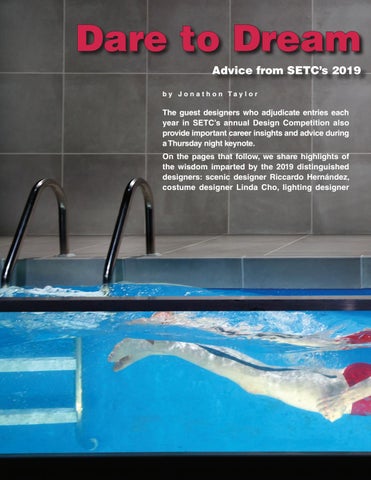
Jonathan Spencer and sound designer Victoria Deiorio. We also present examples of their design work, starting with Hernández’s set (featuring an onstage 4-foot-deep swimming pool) for Red Speedo, Lucas Hnath’s play about a swimmer facing an ethical dilemma, presented at the New York Theatre Workshop.
RICCARDO HERNÁNDEZ on Scenic Design Let your imagination soar. Riccardo Hernández has designed more than 250 productions at leading theatres and operas in the U.S. and around the world. His numerous awards include the 2017 OBIE Award for Sustained Excellence in Scenic Design, the 2015 Henry Hewes Design Award, the Princess Grace Statue Award, the Tony Award and multiple Drama Desk Awards. This summer, his set design is being seen on Broadway in Frankie and Johnny at the Claire de Lune. Born in Cuba and raised
Caitie McMekin
in Buenos Aires, Hernández was introduced to the arts by his father, an opera singer. At age 7, “I saw my very first opera, Lucia di Lammermoor, with the great Beverly Sills and the legendary Spanish tenor Alfredo Kraus,” Hernández told his keynote audience. The production, he said, was designed by Ming Cho Lee, who would become his teacher 17 years later when Riccardo Hernández studies an entry in the Design Competition at the 2019 SETC Convention. Pages 16-17: Hernández, whose design credo includes using “real” materials, created an actual swimming pool for the play Red Speedo, with plexiglass at the front providing a window to the action. Photo by Joan Marcus.
Hernández earned his MFA at the Yale School of Drama.
In his keynote, Hernández shared highlights from his long career and urged his audience to view theatre
as a means of and space for exploration, growth and understanding.
1
Develop strong relationships with fellow artists to fuel your development.
From his first professional job on Suzan Lori Parks’ The Death of the Last Black Man in the Whole Entire
World at the Yale Repertory Theater, Hernández moved on to work at American Repertory Theater and The Public Theater in New York, theatres where he says he developed the first of many “life-changing working relationships” over the years with directors, playwrights and others in theatre.
“All these great theatre artists made me see stage design and theatre as something completely different from
what I envisaged as a young man,” he said. “They taught me about theatrical spaces that are not descriptive or plainly two-dimensional but spaces that invite our imagination to soar.” “In the same way an actor is real, the materials I began to use have to be real: wood, steel, aluminum, plywood, glass, plexiglass, dirt, rocks, leaves, water. All were used in their natural beauty so that truthfulness was achieved, a truthfulness was achieved in the service of a play, opera or musical. Granted, all of these require more funding, but I learned to fight for the materials because I knew this was crucial and critical for the poetic reality we were all in search of.”
Ten years ago, Hernández said, he made a commitment to teach as well as to design – a move that “made
me rethink so much how to approach not just scene design, but theatre as a whole.” Noting “these sad times we live in today have deeply affected our youth,” Hernández said he finds students “have so much to say, so, so much, and we need to listen more than ever.”
He also noted that he has come to recognize how “our individual journeys are interconnected, all of us,
including teachers and students, how all the great artists we grow with are all part of an amazing life tapestry.” Every interaction, every relationship, has the potential to spur growth and development, and each one is an opportunity for strengthening one another’s voices.
“I encourage you to seek out the new, the unknown, and sometimes uncomfortable discussions and
discoveries that help us to capture and present, for a brief moment, the very essence of humanity,” he said.
2
Support the contributions of other artists, past and present.
Addressing artists and educators, Hernández strongly emphasized that “we must continue to build
upon the foundations of artists like George C. Wolfe [playwright, director and former Public Theater artistic 18 x Southern Theatre x Summer 2019
director] and Diane Paulus [American Repertory Theater artistic director] and a new wave of artistic directors” in American theatre. Specifically, Hernández pointed to Stephanie Ybarra at Baltimore Center Stage in Maryland, Jacob Padron at the Long Wharf Theatre in Connecticut, Pam MacKinnon at American Conservatory Theater in San Francisco, and Melia Bensussen at Hartford Stage in Connecticut. He urged the audience to know these artists and understand their impact on theatre: “Let us celebrate this diverse leadership as they embark on nurturing a more inclusive and dynamic stage like we have never seen before.”
3
Dare to dream and seek out the improbable.
In an impassioned dénouement to his keynote address, Mr. Hernández continued his call for daring
and for a new and diverse future for American theatre. “Be a dreamer,” he said. “Go against all that seems probable.” Later, he continued, “Flow with the flux of change and chance … Discipline yourself in the liberal
MORE INFO: setc.org/riccardohernandez
arts so that you can learn from literature and poetry, history, philosophy, music, film, and from all the great theatre makers, past and present, from Antonin Artaud to Ingmar Bergman, from Angelica Liddell to Romeo Castellucci, from María Irene Fornés to Suzan-Lori Parks.”
4
Broaden your sense of what theatre is and what it can do.
During the Q&A session following the keynotes, the designers were asked about burnout and methods
for keeping their work fresh and as original as possible. Hernández went a different direction from the others on the panel of designers, suggesting that burnout can be addressed by opening our eyes to innovations in theatre elsewhere. “You should look at what’s happening in the rest of the globe, and I don’t mean just Europe,” he said. “I’m talking about the rest of the globe. It’s just different … The minute you see what others are daring to do out there, it’s deeply inspiring.”
LINDA CHO on Costume Design Find your community. Linda Cho won a Tony Award for costume design in 2014 for A Gentleman’s Guide to Love & Murder, which also earned her the Henry Hewes Design Award. Nominated in 2017 for the Tony Award, the Outer Critic’s Circle and Drama Desk Awards for Best Costume Design of a Musical for Anastasia, she also designed the costumes for Anastasia’s U.S. tour (pictured on the magazine cover and on Page 20). In 2018, she was a member of Broadway’s first all-female and raised in Canada, Cho told her audience that she grew up with “tiger parents” who initially pushed her toward a career in the sciences. She loved a theatre class she took while earning an undergraduate degree in psychology and, as she struggled with what to do
Caitie McMekin
creative team for The Lifespan of a Fact. Born in Korea
after graduation, her mother finally said, “Why don’t you do this theatre thing? You seem to love it.” She went on to earn her MFA in design from the Yale School of Drama.
In addition to discussing her career in costume design, Cho shared her experience as a working theatre
artist, a mom and a woman of color working in theatre.
1
Linda Cho examines a costume that was part of an entry in the Design Competition at the 2019 SETC Convention.
Nurture creative partnerships with your peers.
She urged early-career designers and technicians working in regional theatre to be alert for co-workers
who are at a similar experience level. Those individuals, she said, will join with them to create a ready-made community of artists who know each other’s work and strengths, which can be invaluable in landing jobs going Summer 2019 x Southern Theatre x 19
forward. “It’s not the famous director who’s going to hire the unknown,” she said.
Cho said she discovered her ready-made group as
a happy accident, but their bond became something she and her peers nurtured. One collaborator she mentioned in particular is director Darko Tresnjak, “who I’ve now done 56 shows with.” They met early in their careers at the Williamstown Theatre Festival.
“You meet the people that are your level, and
you’re going to grow with them and you’re going
Evan Zimmerman, MurphyMade
to run into them throughout your career,” she said.
Cho, who received multiple Best Costume Award nominations for Broadway’s Anastasia, which closed in March, also designed the costumes for the musical’s current U.S. tour (anastasiathemusical. com/tour), pictured on the cover of this magazine and above. In the photo on this page, Victoria Bingham is Little Anastasia and Joy Franz is Dowager Empress in the national tour of Anastasia.
“Those are the people that will support you and develop with you.”
2
Be true to yourself through the work you do.
Since the election of President Donald Trump, Cho
said, “I’ve been asked more often about what it means to be a woman and a woman of color in this business.” In reflecting on that question, she harkened back to a conversation she had with well-known designer Ming Cho Lee, one of her teachers at Yale School of
Drama. “I asked him, ‘Why aren’t we doing more plays by women? ... What about Asian plays? What about characters that are Asian?’ and ‘Don’t we need to represent who we are?’ ”
His advice, Cho said, was: “You doing great work as an individual will promote your culture – who you
are – and open the door for others.”
That advice, she said, factored into her decision to come to the SETC Convention to share her story as a
woman of color. Her decision “to be here and talk to you and to represent” was rooted in an understanding that “this is how doors open. This is how minds open,” she said. She encouraged young designers and technicians of color to represent in similar ways – to take advantage of opportunities to do good work and help pave the way for future artists and stories.
3
Make decisions about graduate study that are rooted in your personal experiences.
During the Q&A session, the designers were asked for advice on when to pursue graduate study.
Essentially, should a student go straight from undergraduate school to graduate school, or is it preferable to take time between the two experiences?
Cho noted that the best timing for graduate school isn’t the same for everyone. “For me, it was important to
go to grad school right away because I didn’t know anything [about costume design] and I needed somewhere to begin,” she said.
MORE INFO: lindacho.com
The student who asked the question – a recent theatre graduate still finding a career path in design-tech
– might benefit from a different route, she said. That person might want to “go and work for a little bit and see whether it’s the more technical stream you want to go in or design, because they’re two very different concentrated disciplines and you want to make sure that you know which path you want to go on.”
4
Having a family can impact the creative process positively.
Cho, who had her two children after she was well into her career, recommends the experience highly.
“I think it’s important to have work and personal balance,” she said. “I think the children give me that. They
put things into perspective.”
She also credits them with helping her grow and retain her equilibrium as an artist. “I’m often told in design
situations, ‘You’re so calm,’ ” she said. “And in my own mind, it’s like, ‘This is nothing compared to ... my children getting a head injury tobogganing.’ ”
Cho continued this thought later: “There’s nothing like the love and the extreme emotions that you get to
experience with children. So, if you’re thinking about it, I highly recommend it. It’s a wonderful life.” 20 x Southern Theatre x Summer 2019
JONATHAN SPENCER on Lighting Design Believe in yourself as a designer. Jonathan Spencer is a lighting and scenic designer who works principally on touring productions, in regional theatre and on Off-Broadway productions. He is the lighting designer for the 20th anniversary tour of the musical Rent. In addition to creating his own designs, he is an associate to Broadway designers such as Peggy Eisenhauer, Ken Posner and Ken Billington. A professor of lighting design at the University of Colorado Boulder and Southern Oregon University’s summer master of theatre studies York City. He described sharing the stage with the other keynote speakers as a humbling experience. Calling their contributions to the field of design “profound,”
Caitie McMekin
program, Spencer is based in Colorado and New
he used his feelings of humility and gratefulness as a Jonathan Spencer prepares to adjudicate an entry in the Design Competition at the 2019 SETC Convention.
springboard for his advice to young designers.
1
Confront your feelings of being less than others and work through them.
Spencer noted that, like many people, he had a sense when he was starting his career that he was less prepared, less sophisticated and less educated than
Left: Spencer is the lighting designer for the 20th anniversary tour of Rent, now playing across the U.S. (rentontour.net) Shown at left (front) are Kaleb Wells as Roger and Skyler Volpe as Mimi.
other people. He had “this disproportionate belief that I am not enough,” Spencer told his keynote audience. “And I’m sharing it with you today because I can go into stage doors on Broadway and it seems normal.” Spencer urged young designers to vigorously fight against any sense of inadequacy they may feel – to “go forward in spite of it.”
2
Don’t fail yourself.
Spencer related a story about one of his first
professional jobs in theatre after finishing graduate school. He suspected that his position was in jeopardy because he was not learning the job fast enough and
MORE INFO: jspencerdesign.com
his suspicions were correct.) At the time, he was determined to work as hard as was necessary to meet the challenge. Even though he felt like he was out of his depth, he told himself, “If I was going to get fired, they were going to have to fire me. If it was going to
Carol Rosegg
wasn’t meeting expectations. (Years later, he learned
be determined that I failed, they would have to be the ones to fail me.”
In the end, despite his doubts, he finished the job and, in the process, created “a lifelong relationship with
half the people in that room, and I ended up doing that very production in three different cities around the world.” Spencer finished the story by emphasizing, “Don’t fail yourself. Just do your best. Ask questions… and try hard to be a human.” Summer 2019 x Southern Theatre x 21
3
Make it personal.
Technical mastery is essential for lighting, but bringing personal experience and nuance to the work
can help designers more effectively convey specific design ideas and images, Spencer believes. “I have to go into my own experience, my own life, and I need to mine my own experiences and memories in order to bring them generously to the collaborators with whom I’m doing a play,” he said.
Understand that there’s no one right answer to many design questions, Spencer said. He used the example
of a young lighting designer who asks another lighting designer about a particular color choice, such as the color he uses for sunrise. When a designer doesn’t provide an answer, it isn’t that the designer doesn’t want to share the answer to the question. “They just don’t know what the answer is for you,” Spencer said. “They don’t know what your 7 a.m. on the day that you’re about to fall in love looks like. They don’t know what the first time you ever danced with a girl in the seventh grade felt like for you. They don’t know what it’s like to be in your skin and watch the world.”
When he came to understand the importance of making it personal, design changed for Spencer: “The answer
was in me. The answer didn’t lie in some mysterious other, some thing I wasn’t good enough to make.”
4
Know who to ask for help when you are new.
Responding to a question during the Q&A session about career mistakes, Spencer said “one of the
apparently largest mistakes I ever made” was to ask a senior member of the production staff to help him find toner cartridges for the printer. Spencer said it quickly became clear that he was asking the wrong person for help “at the wrong time on the wrong day.” As a newcomer with questions, “I should have asked the other assistants first,” he said. Echoing advice offered by Cho, Spencer suggested that early-career artists seek out their peers when they need help. “Ask around on your level, and then people will help you find the friendly avenues up the chain,” he said.
VICTORIA DEIORIO on Sound Design The goal is to unite, not divide. Victoria Deiorio is an acclaimed composer and sound designer. She is the chair of the Design/ Tech Department of the Theatre School at DePaul University and was co-chair of the Theatrical Sound Designers and Composers Association (TSDCA) for four years. She has won seven Jeff Awards and two After Dark Awards for her work in the Chicago area. Her book, The Art of Theatrical Sound Design: A Practical Guide, was published in September 2018 by Methuen Drama. Deiorio began her keynote by discussing Caitie McMekin
her background and trajectory, “because,” she said, “context is everything, especially in sound design and in theatre.” She noted that she is the “daughter of an immigrant, so therefore I am an overachiever.” In addition to working as a sound designer, she has worked as a dancer, a singer and an actor, directed Victoria Deiorio listens to a sound design entry in SETC’s 2019 Design Competition.
and produced theatre – and left theatre for a while to perform in a rock band. “If you ever have the chance to do that, I highly recommend it,” she said. “It was probably the most fun I’ve ever had in my life.”
In her keynote, Deiorio discussed topics from the current focus on identity to the importance of theatre in
uniting people and the value of compassion in dealing with your fellow artists.
1
22 x Southern Theatre x Summer 2019
Defend your place in the process and the business.
When the Tony Awards decided to eliminate the award for sound design in 2014, Deiorio says those in
the sound design community “realized that sound designers were all having the same struggles” with issues such as contract negotiations, but also in the realm of “identity and advocacy.” Her response – in concert with her fellow sound designers – was to create an organization, TSDCA, to advocate for sound design and unite designers in this area of theatrical production.
She also discussed being a female sound designer
in “a time when identity is at the forefront.” Although a woman was the co-designer on the first recorded sound design job in 1959, she said, many people today think it’s a newer field for women. Identity was not a focus when she started in the industry, Deiorio said. “And I have to say, in my career now, 30 years later, I’m not offended by it, but I’m always surprised and though I’m new.” She and other women in the sound design field now are trying to change the narrative, she said, making it clear “that we’ve actually been here for a while.”
2
Marisa KM
kind of taken aback when somebody looks at me as
Embrace diversity and inclusion.
Theatre, Deiorio said, brings together a collection of diverse people from diverse backgrounds in what
often feels like a divided world.
“I really hope that, as the next generation of theatre artists, you keep this in mind: that the goal is not to
divide but to unite, to tell your story to someone who’s never heard it before, to open the minds of audiences, to think and talk about what is important as human beings interacting with each other, no matter what culture you live within,” she said.
3
Don’t think competitively.
Like Cho, Deiorio emphasized the importance of creating collaborative working relationships that last
beyond a single production, as well as having respect and patience for fellow artists as they make their careers.
In a passionate and poetic declaration, Deiorio pointed to the interconnectedness of our worlds. “The actions
that I’m bringing forth right now are not isolated from the infrastructure of this place, ... of this city, of this nation, this world, of all of its structures, the history of it, and the narratives ... most importantly, the narratives, the
Victoria Deiorio created the sound design for Lizzie, presented in 2017 by Firebrand Theatre, a feminist musical theatre in Chicago. Cast members shown above (clockwise from left) are Camille Robinson, Leah Davis, Jacquelyne Jones and Liz Chidester.
stories. All of it is a dynamic state of relativeness, a living set of relations. So, thus, we are actually responsible for our own actions, but we’re also responsible for each other. And this is only possible with care, trust and safety.” Later, she continued, “Everyone has high points and low points in their career, and this ebb and flow comes at completely different times.” In dealing with others, she said, “I think what’s most important is to have compassion.”
4
Highlights from a designer’s list of how to act in the theatre.
MORE INFO: victoria-sounddesign.com
Tweaking a list of duties and responsibilities originally created as chef’s rules for the kitchen, Deiorio
closed her keynote with a roster of quick rules for theatre artists. Some of the highlights:
“Show respect for your collaborators on how things are done at each venue.”
“Admit when you’re wrong, and never point out when others are wrong.”
“Expect to have to work your way out of really difficult situations.”
“Show up early.”
“Be coachable at every age.”
“Know about theatre, but be eager to learn more.” n
Jonathon Taylor is an assistant professor at East Tennessee State University, where he teaches scenic and costume design, stage management, and theatre design basics. He is a member of the Southern Theatre Editorial Board.
Summer 2019 x Southern Theatre x 23
OUTDOOR THEATRE Historical Dramas, Shakespeare Festivals Weather a Changing Climate by To m D e T i tt a
A
As you travel due east from Chapel Hill, NC, along the coastal plain, the land increasingly gives way to the sky above as it approaches the Outer Banks, where one final gasp of terra firma spills out into the ocean. With the sound on one side and the Atlantic Ocean on the other, the sky above reigns supreme. It was in this area in 1937 that the tradition of putting theatre under the stars began with the first production of Pulitzer Prize winner Paul Green’s play The Lost Colony, which has been performed in Manteo, NC, every summer since, except for a brief period during World War II. The play, about the first colony of English settlers on Roanoke Island who mysteriously disappeared, began a national historical drama movement. As historical dramas opened on outdoor stages across the country, Shakespeare festivals also multiplied in parks and under tents. Religious pageants, such as the Hill Cumorah Pageant in upstate New York and Shepherd of the Hills in the Ozark Mountains, also presented their stories outdoors where the heavens seemed most present. Other organizations also embraced the draw of nature, presenting musicals and other shows outdoors. While their missions and audiences differed, all shared a common experience. “There’s always that part of outdoor drama when you’re standing in the rain, you don’t know if you need to cancel, you’re wet, and you think ‘Why am I doing this?’ ” said Melissa Nicholson, a former cast member of The Lost Colony who went on to co-found Shakespeare in the Park, now part of Gamut Theatre Group, in Harrisburg, PA. “Then, you have those perfect nights under the stars with perfect weather, and it’s magic. When those good nights happen, it’s unlike anything else, and all the actors who have ever done outdoor theatre will tell you that, too.” But today, some of the footlights that fought
Atlanta. Serenbe Playhouse is winning acclaim for
back against the dark of night have begun to dim.
its outdoor productions that engage audiences with
Historical dramas and religious pageants, once as
a degree of spectacle that is impossible to achieve in
prolific along the Southeastern American landscape
an indoor theatre and with its immersive experiences
as Waffle House and Winn-Dixie, are struggling to
that put audiences squarely in the play’s environment.
keep afloat or closing shop altogether.
Its success is just one of many factors giving hope
“Among the historical dramas, there has been, over
to traditional outdoor theatres that, with innovation
the past 20 years, a significant decline in attendance
front and center, the power of live theatre under the
of the older productions, and a number of them have
stars can draw crowds once again, overcoming the
closed,” said Michael Hardy, former director of the
magnetic pull of television, computer and phone
Institute of Outdoor Theatre, an umbrella group
screens.
serving organizations that present shows outdoors,
which became part of SETC in 2017.
said Marina Hunley-Graham, artistic director at Unto
Michael Hardy, Former Director, Institute of Outdoor Theatre
Marina Hunley-Graham, Artistic Director, Unto These Hills
“We’re at a time when we all have to be creative,”
While not experiencing the same steep attendance
These Hills, the outdoor drama that tells the story of
decreases as the outdoor historical dramas, the
the Cherokee in North Carolina before and after the
Shakespeare festivals that report their attendance to
Trail of Tears. “The more unique we can make things,
SETC’s outdoor theatre division also saw an overall
the better.”
15 percent downturn last year.
Bitten by technology and bugs
But even as the traditional forms of outdoor drama
Melissa Nicholson, Co-founder, Shakespeare in the Park, Harrisburg, PA
Opposite page: Unto These Hills in Cherokee, NC, which recounts the story of the Cherokee in the Eastern region, was first performed in 1950.
Why did audiences and artists once happy to be
have faced audience declines, a site-specific outdoor
exposed to the elements begin running for cover?
theatre is drawing crowds to a rural area outside
What led to the changing outdoor theatre landscape? Summer 2019 x Southern Theatre x 25
Another issue for the outdoor historical dramas has been stagnation. From the 1980s to the early 2000s, more than 60 communities in the U.S. explored the prospect of creating a historical drama with the Institute of Outdoor Theatre – but less than a handful of shows resulted, and those that opened didn’t last long. The lack of new initiatives can be traced in part to a belief that communities who wanted to start an outdoor historical play needed to do what had been done successfully at shows like The Lost Colony. This included following certain guidelines and coming up with millions of dollars upfront to build an amphitheatre, like those found at the outdoor productions which had been operating for years. Shakespeare festivals, on the other hand, often started in a park with lawn chairs and portable toilets. “Unfortunately, the notion was that there was a formula for creating an outdoor [historical] drama that was very specific, and if you followed that The Lost Colony, which has been presented since 1937 in Manteo, NC, has boosted its revenue by partnering with a winery that shares the name of one of the show’s characters, Virginia Dare.
formula – down to very specific theatre design mandates, even – you could have a successful outdoor drama,” said Hardy. “That turned out not to be the case.”
Bill Coleman, CEO, The Lost Colony
Because that formula limited the development of
“We are being challenged by a number of things,”
new works, the genre of outdoor historical theatre
said Johnny Warren, the managing artistic director of
also missed the wave of new ideas that was sweeping
The Stephen Foster Story, a Paul Green play that has
historical drama – such as the Broadway musical
been staged for 61 seasons outside of Bardstown, KY,
Hamilton, the hip-hop production about the founding
celebrating the life and songs of the famed American
fathers, and the Oregon Shakespeare Festival’s All
composer. “There were changes in tourism behavior,
the Way about Lyndon Johnson’s efforts to pass Civil
changes in the motor coach industry [and] more and
Rights reform.
more entertainment opportunities from technology,
[in addition to an increasing] societal addiction to air
impression of historical dramas as an old and
conditioning.
outdated form of artistic expression that, according
to Hunley-Graham at Unto These Hills, was no longer
“Public school calendars grew shorter during the
This lack of innovation contributed to the overall
summer, which cut into our seasons by as many as
cool.
four weeks,” Warren continued. “There seems to be
an increasing fear of bugs, as well as a fear of being
“But by the 2000s, we had become kind of passé.”
outdoors in the summer, which is driven by the way
local weather stations talk about heat indexes, when
theatres are fighting back by adopting a variety of
the truth is, at 8 p.m., with a cool drink in hand, you’re
new perks and new philosophies designed to attract
perfectly comfortable outdoors pretty much anytime
audiences.
during the summer.”
Chasing new revenue streams
Bill Coleman, CEO at The Lost Colony, which draws
One of the key strategies that has helped
most of its audience from weekly beach rentals along
the surviving historical outdoor dramas is the
the Outer Banks, notes the many new features these
development of new income sources.
homes are now outfitted with, from surround-sound
televisions to rooftop hot tubs.
including VIP passes, backstage tours, dinners and
rain insurance. In addition, many have expanded
“It’s become a whole lot easier to just stay home,”
he said. 26 x Southern Theatre x Summer 2019
“We were super cool in the ‘50s and ‘60s,” she said. What is being done to reverse the trend? Outdoor
Theatres have added to the value of the ticket by
their budgets by adding educational programs
throughout the year based on the main production. Some, too, have added other year-round revenue sources, such as online gift stores.
Alcohol sales also have helped generate additional
income at some venues. A staple at the Shakespeare festivals and other theatrical events geared more toward an adult theatre-going audience, beer, wine and mixed drink sales have slid in under the radar at the family-oriented historical dramas and made up for some of the lost ticket revenue.
“We’re right here in the midst of a bourbon tourism
state, so we follow suit in our own way,” Warren said. Story is faith-based, so we’re not as in your face about promoting liquor [at its performances] as we are at the concerts and musicals we also present.”
The Lost Colony has gone so far as to partner with
the Virginia Dare Winery, a Francis Ford Coppola establishment in California that shares the name of a character in the show and markets wines with names such as The Lost Colony and Manteo. Coleman realized he had the perfect location for the winery
Andy Henderson
“A big part of our audience for The Stephen Foster
The Stephen Foster Story in Bardstown, KY, touches on the injustices of slavery, featuring songs such as “My Old Kentucky Home,” inspired by the abolitionist book Uncle Tom’s Cabin.
to hold a wine festival – a realization that netted his company $75,000 in one day from ticket and sponsor revenue. The event, which featured wine tastings, a
Montford Park Players in Asheville, NC, noted an
Vintner’s Dinner and a live auction, was so successful
increase in younger audiences, particularly parents,
it will return for a third year in September 2019.
after adding a children’s show, Peter Pan, in 2017.
Expanding the season
Outdoor Shakespeare festivals and outdoor
in 2018, and that nearly doubled our attendance,” said
historical dramas also have expanded their repertoires
John Russell, executive director of the Montford Park
in search of new audiences. The Shakespeare festivals
Players.
have several opportunities that historical dramas
While most Shakespeare festivals attract
lack. First, Shakespeare festivals are not committed
predominantly local audiences, (exceptions being
to the same plays year in and year out, so they
larger operations like the Oregon Shakespeare
can vary their core offerings. In fact, many are not
Festival in Ashland or the Stratford Festival in
even fully committed to Shakespeare. Patrick Flick,
Ontario, Canada), the majority of the audience for
executive director of the 125-member Shakespeare
historical dramas is tourists drawn from outside the
Theatre Association, which includes both outdoor
area. During their heyday, it was a common adage
festivals and indoor companies, notes that many
in the industry that 80 percent of a show’s audience
of its members present non-Shakespeare shows
came from beyond a 60-mile radius of the show,
as well as plays by the Bard. The imprimatur of
as people from other places were attracted to see a
Shakespeare offers a form of legitimacy for whatever
production that could only happen authentically in
they do.
the place where it is performed. As such, outdoor
historical dramas often brought people to small, rural
“Shakespeare is the most produced playwright in
“We added Robin Hood and James and the Giant Peach
the world and has a certain reputation for quality,”
towns they otherwise would never have visited.
Flick said. “Having his name associated with their
work suggests that the other shows these companies
increase their local audiences by offering other shows
do will also have quality.”
in addition to their original production. At The Stephen
Some Shakespeare festivals have created spikes
Foster Story, Warren has added musicals and concerts
in attendance by adding new types of performances.
throughout the year.
Johnny Warren, Managing Artistic Director, The Stephen Foster Story
Now, some of the historical dramas are trying to
Summer 2019 x Southern Theatre x 27
the new events at his outdoor theatre are intended to complement, not compete with or replace, productions of their main show.
“We have not reduced our regular schedule with
Tecumseh!,” he said. “We have added other offerings including a bluegrass concert series, which has been very effective, a yearly Shakespeare performance, a Halloween event that runs the month of October, a St. Patrick’s Day fundraiser and other events from time to time. But this company was founded – and continues to exist – to create and foster economic development in our region through the arts, and to tell the story of Tecumseh and promote the important role that our area played in the development of the United States. We cannot do one while ignoring the other. The story is our master. Without it, the company doesn’t need to be here.”
Snow Camp Outdoor Theatre in rural Alamance
County, NC, is an example of a historical drama that closed after trying to increase revenue through the addition of shows and events not directly tied to its Christopher McAlister
mission. Elijah Chester, who grew up within earshot
Tecumseh!, which tells the story of the legendary Shawnee leader during the late 1700s, remains the theatre’s core show even as other events have been added to bring in additional audiences.
of the theatre and is now its general manager/ executive artistic director, says the addition of a Broadway musical, a children’s musical and a drama camp “diluted our mission and our focus on telling our stories well.” “If you start doing whatever you can to bring people into the seats to make money, then the organization’s vision becomes: Do whatever we have to do to make money,” he said.
Chester, an internationally noted actor and singer
who made his debut at the Metropolitan Opera at 23, now is helping Snow Camp resurrect the outdoor
Brandon Smith, CEO, Tecumseh!
“Stephen Foster appeals to tourists while the
drama Pathway to Freedom, which tells the story of
concerts and the Broadway musicals appeal to the
the Underground Railroad and the role that Quakers
locals,” he said. “We don’t market the Broadway
played in helping slaves to freedom. For decades,
musicals to an outside audience.”
Snow Camp also produced a second outdoor drama,
Similarly, Tecumseh!, produced in Chillicothe, OH,
The Sword of Peace, about local Quakers during the
by the Scioto Society, has added additional shows
Revolutionary War.
designed to attract new and repeat local patrons.
Retaining their identity
round programming, but believes it is important to
One of the key challenges for historical dramas
present just one of the historical dramas, Pathway to
as they add new works is to ensure that their other
Freedom, “and let the entire campus reflect it,” he said.
offerings, usually designed for local audiences,
With that singular focus, he believes Snow Camp
don’t encroach on their tourist market or dilute their
can become a tourist destination for those interested
mission. Historical dramas rely on a clear and easy
in African American history and specifically in the
association in the tourist’s mind: If I am in Cherokee
Underground Railroad. He expects to begin restaging
and it is summertime, I can see Unto These Hills.
the production in 2023, the 50th anniversary of Snow
Brandon Smith, CEO of Tecumseh!, notes that
Camp Outdoor Theatre’s founding.
28 x Southern Theatre x Summer 2019
Going forward, Chester plans to offer some year-
A stage takes precedence over a theatre
The historical dramas that have survived continue
to rethink their productions with a modern eye, cutting running times for a more restless audience, adding technology and special effects, and even, in one case, inviting the audience onstage for a square dance at intermission. In addition, they are examining their productions in much the same way as Shakespeare companies, which are continually trying to revitalize the work of even older plays by an even older playwright to suit modern sensibilities. specialized in directing to take very old words and strive for ways to make them relevant to today’s audience,” Hardy said. “We don’t always see that as much as we should in some of the traditional outdoor dramas that are struggling.” As outdoor theatres look for ways to resonate with today’s audiences, they may find some ideas in the experience of Serenbe Playhouse outside of Atlanta. Founder and executive/artistic director Brian
Sebastian Michaels
“The Shakespeare festivals are using people
In addition to presenting Shakespeare plays such as Troilus and Cressida (above), Montford Park Players has added children’s shows, which have attracted younger audiences to the Ashevillle, NC, theatre.
Clowdus has received national recognition for taking popular plays traditionally performed indoors and presenting them outside in unexpected ways. When
goers, and this is how art survives – by bringing in
staging Miss Saigon, Serenbe created a temporary
new audiences.”
stage and a theatre in a field that was large enough
A decade after starting Serenbe Playhouse,
to land a helicopter. When staging Titanic, Clowdus
Clowdus now has launched a company called Brian
placed four stories of scaffolding over a lake, thus
Clowdus Experiences to take his site-specific theatre
allowing actors to plunge into the water when fleeing
concept to other areas of the country. In September
the sinking ship.
2019, his company will present a production of
But it isn’t just the increased spectacle that makes
The Sound of Music in the hills surrounding the
these productions interesting. Clowdus’ experience
Wintergreen Resort in West Virginia, with guests
also demonstrates that an expensive theatre is
riding chairlifts to their seats in a remote location on
not an essential ingredient of outdoor drama.
the resort grounds.
Serenbe doesn’t have an outdoor amphitheatre,
or even a space where the company repeatedly
one adopted by those attempting to revolutionize
performs its plays. Rather, Clowdus chooses spots
historical theatre: “I love standard theatre, but more
on the sprawling campus to build a temporary
and more the average person does not, and so we
stage that best realizes the spectacle he hopes to
have to acknowledge that and find ways that theatre
achieve. With a generator to power lights and sound,
can be more exciting than Netflix,” Clowdus said.
Clowdus develops a makeshift theatre around
that stage, complete with risers, plastic seats,
also stages environmental pieces, such as The Legend
portable toilets and newly constructed concession
of Sleepy Hollow, that engage the audience on a
stands.
variety of fronts by surrounding them with actors
“When I make an outdoor location the actual set, I
and musicians as they walk through the woods from
can do shows for a fraction of what they would cost in
makeshift stage to makeshift stage. This production
a standard theatrical setting, and who the hell wants
– reprised at SETC’s 2017 National Conference on
to sit in a dark theatre when you can be on your feet
Outdoor Theatre, which was hosted by Serenbe –
experiencing theatre and looking up at the stars?”
inspired Hunley-Graham to rethink how Unto These
Clowdus said. “This work is attracting non-theatre-
Hills presents its show.
John Russell, Executive Director, Montford Park Players
His credo for reinventing theatre is similar to the
In addition to its spectacle-driven plays, Serenbe
Patrick Flick, Executive Director, Shakespeare Theatre Association
Summer 2019 x Southern Theatre x 29
BreeAnne Clowdus
Sell tickets & classes, manage marketing & members, and everything in between.
Above: Titanic, presented in 2018 by Serenbe Playhouse, was set on an actual lake, with four stories of scaffolding representing the ship. Actors jumped into the water and into lifeboats to escape the sinking ship as the audience watched from the shore. Serenbe has achieved critical and audience acclaim with its site-specific shows presented in varying outdoor locations in the Serenbe community near Atlanta – demonstrating that an expensive theatre is not an essential ingredient of outdoor drama. Left: Brian Clowdus, Founder and Executive/Artistic Director, Serenbe Playhouse
30 x Southern Theatre x Summer 2019
The artistic staff at Unto These Hills is
dollar amphitheatre in a location tied to the
looking for ways to make audiences feel
show’s story. The minimalist theatres of the
a part of that play, such as piping music
Serenbe model demonstrate a way to make
from the show along the walk to it, and
the connection between audience and loca-
instructing front-of-house staff that they
tion more cost-effective – and potentially
are as important as the actors in creating
more immediate and intimate.
the environment for the audience.
“People can’t just watch a show for
financial risk because they don’t have to put
three hours and go home,” Hunley-Graham
concrete in the ground,” said Hardy. “It’s
said. “People are looking to be part of an
cheaper, but it requires more imagination.
experience. The more we can do that, the
I think if people can do it and do it with
more successful we can be.”
the imagination required for the audience
to have a successful theatrical experience,
One of the revelations that the Serenbe
“It presumably doesn’t entail as much
experience has provided to organizations
that’s great.”
presenting outdoor theatre is that the audi-
The future
ence will forgive – and perhaps even see as
Although some outdoor historical
part of the outdoor adventure – temporary
dramas have disappeared and attendance
and minimalist infrastructure if what is
at others has dropped over the last two
onstage is sufficiently captivating. This is
decades, a significant number are still being
an important lesson for people interested in
performed throughout the country – telling
creating new historical dramas but lacking
basically the same story, week in and week
the money needed to build a multi-million-
out, throughout the summer months, year
after year. It may be that the biggest story of these shows is less that they are struggling and more that they still exist. Then, the question becomes why? “We tell powerful stories, and it’s a history lesson at the same time,” said Christopher Hornaday
Hunley-Graham. Hunley-Graham’s Unto These Hills keeps alive the plight of the nation’s first inhabitants, while The Lost Colony reminds us of the precarious steps taken by those who crossed an ocean to call America home. The Stephen Foster Story touches on
Left: A scene from Pathway to Freedom. Above: Elijah Chester, Artistic Director, Snow Camp Outdoor Theatre
the injustices of slavery, with songs such as My Old Kentucky Home, inspired by the
have lessons to learn from it.”
are poised to see increased interest in their
abolitionist book Uncle Tom’s Cabin.
Elsewhere, outdoor historical dramas
productions as people grow increasingly
“Stephen Foster is the celebrity, but the
recount tales of heroic pioneer settlers,
screen-weary.
heroes of the story are the people he wrote
histories of states and communities,
music about – the relationship between
and legends that have been passed on,
real people acting, breathing and sweating
music and enslaved people in the U.S.,”
reminding us of who we are and from
in front of you,” Warren said. “It is now
Warren said. “The conversation of how
where we came.
especially exciting to see real people, to be
we tell that story is as relevant as it was
Because they dramatize compelling
in touch with the trees, the stars and the
60 years ago. Our story still matters. We
stories in a way that is up-close and personal,
relevant and important drama unfolding
still need to tell it, replay it, because we still
Warren believes outdoor historical dramas
before your very eyes. I think we’re primed
“There is no screen big enough to replace
2019 National Conference on Outdoor Theatre Where Theatre Leaders Share Their Experience and Explore New Concepts
Oct. 1-3, 2019 | Santa Fe Opera | New Mexico Registration opens July 8 outdoor-theatre.org/conference setc.org/iot
Summer 2019 x Southern Theatre x 31
right now to sell how really different we are
With the right steps, Hunley-Graham
from your Netflix or iPad.”
said, “We can be cool again.” n
Still, outdoor theatres realize they
Tom DeTitta is the author of 11 historical and human rights plays seen by more than a quarter of a million people. He also is the director of World Communities Theater: www. worldcommunities.org.
must continue taking steps to make their shows resonate with today’s audiences. As Chester told his board at Snow Camp: “We need to radically rethink everything we did and have a rebirth.”
Opera Under the Stars Attracts Crowds in Santa Fe While many outdoor theatres are struggling, an outdoor opera in Santa Fe, NM, is in its 63rd season, drawing Kate Russell
audiences of 85,000 annually. The Santa Fe Opera presents a summer season of opera in a setting complemented by mountain vistas and desert Audiences can see mountains and the sky behind sunsets. The open-air theatre the set for Don Giovanni at the Santa Fe Opera. has a roof over all seating areas, with a capacity of 2,126 nightly for its shows.
The Santa Fe Opera will host SETC’s National Conference on Outdoor Theatre Oct. 1-3, 2019, providing attendees with an opportunity to tour the theatre and learn about its operations. The conference is open to all, not just those involved in outdoor theatre. For more information, visit outdoor-theatre.org/conference.
Thanks to our Advertisers ADVERTISER
WEBSITE
PAGE
Arts People
www.arts-people.com
Atlantic Acting School
atlanticactingschool.org
Disney Theatrical Group
mtishows.com
Maine State Music Theatre Costumes
www.msmtcostumes.org
14
Neighborhood Playhouse
neighborhoodplayhouse.org
11
Point Park University
PointPark.edu/Theatre
32
SETC
setc.org/auditions/fall-professional
13
SETC
outdoor-theatre.org/conference
31
University of Mississippi
theatreandfilm.olemiss.edu
University of West Georgia
westga.edu/theatre
Wake Forest University
college.wfu.edu/theatre
West Virginia University
theatre.wvu.edu
30 IFC 2
IBC BC 15 1
Advertising Info: clay@setc.org; 336-272-3645 Follow us on Facebook, Twitter and Instagram 32 x Southern Theatre x Summer 2019
Southeastern Theatre Conference 1175 Revolution Mill Drive, Studio 14 Greensboro, NC 27405 www.setc.org
Non-Profit Org. US Postage Paid Auto Greensboro, NC Permit No. 744
UNIVERSITY OF WEST GEORGIA
Theatre Company
2018 2019 SEASON
DARING, DYNAMIC, DEFIANT: your world is our stage.
P L AY
NAST Accredited Bachelor of Arts Degree in Theatre
FOR MORE INFORMATION 678-839-4700 or theatre@westga.edu
westga.edu/theatre Theatre College of Arts and Humanities School of the Arts
W E S T
• Access to professional theatre artists
• Access to industry standard software in theatrical sound, lighting, costume, and scenic design • Performance and design opportunities starting in freshman year • Design lab, lighting lab, sound recording studio, large scene shop, and new costume shop • Internship programs (local, national, international) • Practical experience in all facets of theatrical production • Student scripts from playwriting course are produced in regular season • Student-directed and designed theatre productions • Conference participation and travel opportunities • Strong alumni contacts