Health Outcomes
Enhancing Care Through Early Detection of Low Oxygen Levels Home oxygen therapy forms a key component of the treatment of respiratory conditions, including chronic obstructive pulmonary disorder (COPD) and interstitial lung diseases (ILD), particularly in patients who experience low blood oxygen saturation levels. Oxygen therapy involves breathing air containing higher than normal levels of oxygen, either through a mask or a nasal cannula.1 Oxygen is usually provided by way of an oxygen cylinder or, more commonly, is generated using a machine called an oxygen concentrator.1 The amount of oxygen delivered (i.e. flow rate) will differ depending on the individual’s needs. Home oxygen therapy can increase blood oxygen levels, helping to improve sleep, concentration and reduce disease symptoms.2 According to current estimates, around 85,000 patients in England alone are receiving home oxygen therapy.3 Despite the obvious benefits, home oxygen therapy can be burdensome and restrictive for patients and can contribute to an increased risk of falls. The continuous use of home oxygen therapy is also associated with side effects, such as a dry nose and mouth, as well as nosebleeds and morning headaches.4 If blood oxygen levels are too high, it can also lead to oxygen toxicity, causing damage to the brain, heart and lungs and can even be fatal.1 Additionally, oxygen concentrators are expensive to run, as they require electricity, the costs of which are usually met by healthcare systems. The costs to the UK NHS in providing home oxygen therapy are currently estimated at £110 million a year.3 Regular monitoring is important to ensure patients are coping with the treatment and that they are receiving the correct level of oxygen.4 When commencing home oxygen therapy, patients are initially reviewed after six weeks, and then every six months.4 The monitoring of blood oxygen saturation levels is usually carried out using a blood test or a pulse oximeter, a sensor attached to either your finger or your earlobe.1 The early detection of suboptimal oxygen levels could help guide oxygen therapy and enhance the www.international-pharma.com
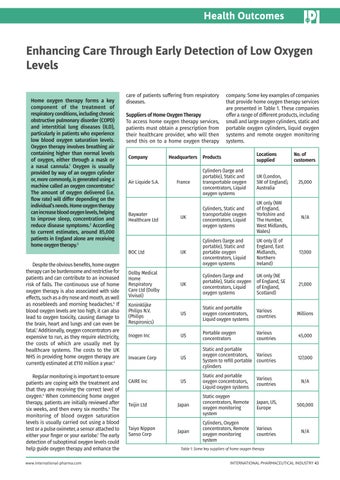
care of patients suffering from respiratory diseases. Suppliers of Home Oxygen Therapy To access home oxygen therapy services, patients must obtain a prescription from their healthcare provider, who will then send this on to a home oxygen therapy
company. Some key examples of companies that provide home oxygen therapy services are presented in Table 1. These companies offer a range of different products, including small and large oxygen cylinders, static and portable oxygen cylinders, liquid oxygen systems and remote oxygen monitoring systems.
Products
Locations supplied
France
Cylinders (large and portable), Static and transportable oxygen concentrators, Liquid oxygen systems
UK (London, SW of England), Australia
25,000
UK
Cylinders, Static and transportable oxygen concentrators, Liquid oxygen systems
UK only (NW of England, Yorkshire and The Humber, West Midlands, Wales)
N/A
UK
Cylinders (large and portable), Static and portable oxygen concentrators, Liquid oxygen systems
UK only (E of England, East Midlands, Northern Ireland)
17,000
Dolby Medical Home Respiratory Care Ltd (Dolby Vivisol)
UK
Cylinders (large and portable), Static oxygen concentrators, Liquid oxygen systems
UK only (NE of England, SE of England, Scotland)
21,000
Koninklijke Philips N.V. (Philips Respironics)
US
Static and portable oxygen concentrators, Liquid oxygen systems
Various countries
Millions
Inogen Inc
US
Portable oxygen concentrators
Various countries
45,000
Invacare Corp
US
Static and portable oxygen concentrators, Various System to refill portable countries cylinders
127,000
CAIRE Inc
US
Static and portable oxygen concentrators, Liquid oxygen systems
Various countries
N/A
Japan
Static oxygen concentrators, Remote oxygen monitoring system
Japan, US, Europe
500,000
Japan
Cylinders, Oxygen concentrators, Remote oxygen monitoring system
Various countries
N/A
Company
Air Liquide S.A.
Baywater Healthcare Ltd
BOC Ltd
Teijin Ltd
Taiyo Nippon Sanso Corp
Headquarters
No. of customers
Table 1: Some key suppliers of home oxygen therapy INTERNATIONAL PHARMACEUTICAL INDUSTRY 43