Volume 9 Issue 3
Peer Reviewed
Rethinking Antimicrobial Discovery: Through Omics Blood-Based mRNA Testing: For the Diagnosis of Schizophrenia and Bipolar Disorder Turning Oncology Data: Into Better Development Decisions From Cell Culture: To Human-relevant Models Sponsor Company:
Neurodegenerative Diseases page 32 Oncology page 44 Cell and gene therapy page 56
www.international-biopharma.com
In pursuit of answers, our focus gives you clarity
Delivering predictive translational science to accelerate oncology drug discovery and development Crown Bioscience is a global CRO supporting biotech and pharmaceutical programs through integrated translational science platforms and U.S.-based laboratories, from discovery to the clinic. Our capabilities generate actionable data that accelerate decisions and reduce risk across preclinical development, delivering integrated solutions that advance drug candidates with confidence.
Preclinical and Translational Solutions
PDX Models
Biomarkers
3D Organoids
Complex Modalities
Access the world’s largest PDX collection, including drug-resistant and pre-treated models supporting predictive translational oncology research.
Integrated biomarker solutions including immune monitoring, NGS, DMPK-T, and tissue analysis to decode data and inform strategy.
Integrated in vitro, ex vivo, and in vivo capabilities, including 3D organoids, delivering clinically relevant insights into tumor biology and therapeutic response.
Specialized expertise supporting radiopharmaceuticals, ADCs, and emerging modalities to evaluate efficacy and advance innovative oncology therapies.
Scan to find out more II INTERNATIONAL BIOPHARMACEUTICAL INDUSTRY
US: +1 858 622 2900 UK: +44 (0)1530 234871
www.crownbio.com busdev@crownbio.com Autumn 2026 Volume 9 Issue 3
Contents 04 Foreword RESEARCH / INNOVATION / DEVELOPMENT 06 Rethinking Antimicrobial Discovery Through Omics
DIRECTOR: Mark A. Barker
A promising antimicrobial hit is only the start. Dr. Shi-qi An of Novogene explains how to build enough evidence to decide what should stop, what needs to be redesigned and which candidates are strong enough to progress with confidence.
INTERNATIONAL MEDIA DIRECTOR: Anthony Stewart anthony@senglobalcoms.com
10 As New Rules Take Hold, What Does ‘Good AI Practice’ Look Like in Drug Development?
MANAGING EDITOR: Alice Phillips alice@senglobalcoms.com
In 2026, setting clear AI expectations is the priority. Pratyusha Pallavi and Crystal Allard of Veeva examine what will enable organisations to turn AI investment into operational advantage.
EDITOR: Carla Devine carla@senglobalcoms.com
12 Vendor-agnostic Data Management Helps Shorten Drug Candidate Identification Time
DESIGN DIRECTOR: Jana Sukenikova www.fanahshapeless.com FINANCE DEPARTMENT: Akash Sharma accounts@senglobal.co.uk COVER IMAGE: iStockphoto © PUBLISHED BY: Senglobal Ltd., 20–30 Whitechapel Rd, London United Kingdom, E1 1EW
Dr. Ansgar Korf of mzio argues that choosing an analytical data foundation that treats compliance and AI governance as design principles from the outset is rapidly becoming a board-level, strategic decision. MANUFACTURING AND PROCESSING 16 Engineering Affordability: The Role of Continuous Bioprocessing in the Next Era of Biosimilars Abijar Bhori of Enzene examines how the future of biosimilars could depend not only on better molecules or sharper pricing, but on better manufacturing processes. 22 The Critical Role of Fill-Finish in Large Molecule Manufacturing
Tel: +44 (0) 203 3420130 Email: info@senglobalcoms.com www.international-biopharma.com
The biologics sector has moved from a specialist segment to one of the most dynamic areas in pharmaceutical manufacturing. Megan Owen of PCI examines what CDMOs must do to stay on top.
All rights reserved. No part of this publication may be reproduced, duplicated, stored in any retrieval system or transmitted in any form by any means without prior written permission of the Publishers.
24 Streamlining Biologics Technology Transfer Through Integrated Operational Models
The next issue of IBI will be published in Winter 2026. ISSN No.International Biopharmaceutical Industry ISSN 1755-4578. The opinions and views expressed by the authors in this journal are not necessarily those of the Editor or the Publisher. Please note that although care is taken in the preparation of this publication, the Editor and the Publisher are not responsible for opinions, views, and inaccuracies in the articles. Great care is taken concerning artwork supplied, but the Publisher cannot be held responsible for any loss or damage incurred. This publication is protected by copyright.
Structured risk management and predictive analytics improve the control of scale-dependent behaviour. Lalit Saxena of Samsung Biologics evaluates how integrated analytical transfers ensure that readiness aligns with manufacturing execution. NEURODEGENERATIVE DISEASES SUBSECTION 32 From Depression to Deep-Learning – Leveraging iPSC and AI Platforms for Evidence-Based Depression Treatment Depression touches a staggering portion of the U.S. population. Dr. Daphna Laifenfeld, Talia Cohen Solal and Moria Ben Yishay of Neurokaire argue that the shift from inference to evidence is the most important change in psychiatric medicine in a generation.
2026 Senglobal ltd. Volume 9 Issue 3 – Autumn 2026
www.international-biopharma.com
INTERNATIONAL BIOPHARMACEUTICAL INDUSTRY 1
Contents 36 Blood-Based mRNA Testing for the Diagnosis of Schizophrenia and Bipolar Disorder Mental health diagnostics have been in crisis for some time now. Richard G. Morris of Laguna Diagnostics evaluates how methods being developed have the potential to change how psychiatry is practised. 40 Counting Stars: Why an Astrocentric Perspective Matters for CNS Drug Discovery Standard of care treatments for neurological disorders like Parkinson’s still rely on therapeutic principles established over 50 years ago. Dr. Nat Hastings of Cellestial Health argues that expanding the biological framework underpinning target discovery may be warranted. ONCOLOGY SUBSECTION 44 Essential DMPK Approaches for IND Success Despite major advances in target biology, medicinal chemistry and therapeutic innovation, clinical attrition rates remain high. Rajendra Kumari PhD and Dr. Xiaolong Tu of Crown Bioscience highlight that DMPK is a core translational discipline that directly shapes the probability of clinical success. 48
From Signal to Standard: The Rising Structural Role of Biomarkers in Oncology Trials
Dr. Tatiana Hernández Guerrero of START explains that the structural integration of biomarkers into oncology trials will be the foundation on which more precise, more effective and more equitable cancer care will be built. 52
Turning Oncology Data into Better Development Decisions
Tammer Farid of Champions Oncology examines how the future of oncology development will be defined by how effectively that data can be turned into confident, defensible decisions. CELL AND GENE THERAPY SUBSECTION 56 When the Gene Editing Guide is the Drug The rapid evolution of gene therapies and gene editing modalities is challenging how personalised medicines are developed and
evaluated. Simon Reed of Broken String Biosciences explains that technologies capable of generating accurate assessments of editing outcomes in biologically relevant cells are likely to become increasingly important. 62
From Cell Culture to Human-relevant Models
Daisy Jane Toting and Payar Radfar of Smart MCs put forward that the future of mammalian cell culture is being shaped by the need for laboratory models that better predict human biology. APPLICATION NOTE 18
Genes to GMP: How Biocatalysis Accelerates the Development of New Medicines
Prof. Tom Moody and Dr. Stegan Mix of Almac Sciences argue that biocatalysis is poised to play a defining role in the next generation of drug manufacturing. 27
Audit Trail via Fieldbus – Pharma 4.0 All the Way Down to the Field Level
The audit trail has long been established in FDA- and GMP-regulated pharmaceutical and biotech facilities. Dr. Knut Georgy of Knick evaluates that the value of an audit trail lies not only in recording events, but also in making relevant information available for review in a timely and controlled manner. 60
Defined Raw Materials – Robust Biomanufacturing
João Monteiro and Chantale Julien of Novo Nordisk argue that across modalities, well-characterised and high-quality raw materials are moving from an operational preference to a strategic musthave. 68
Peptide-to-Small-Molecule Scaffold Exploration with Amino Acid Mapping
Shino Ohira, Issei Doi, Jun Nakabayashi, Hiroaki Tanaka, Yuki Sonoda, Youssef Ben Ammar, Masahiro Kochi, Tadashi Tanaka and Kyosuke Tsumura of FUJI explain how they can support scaffold exploration across different peptide-to-small-molecule challenges.
Ad Index Page 43 Page 3 Page 9 BC Page 15 IBC Page 73 IFC Page 33 Page 35 Page 59 Page 51 Page 67 Page 5 Page 49 Page 39 Page 55
2DR A&M Stabtest GmbH Almac Group Bachem Inc. Biopharma Group CPC CPHI Milan Crown Bioscience GenXPro GmbH Micron View Novo Nordisk PCI Pharma Services Polypure Richter Biologics GmbH & Co. Kg Shimadzu Europa GmbH TCS Biosciences Whitehorse Scientific
2 INTERNATIONAL BIOPHARMACEUTICAL INDUSTRY
Autumn 2026 Volume 9 Issue 3
LABORATORY FOR ANALYSIS AND STABILITY TESTING
GMP analytics for oligonucleotides
30+ years of GMP experience
One analytical partner from development to routine testing
Contact us: www.am-labor.de steven.watt@am-labor.de Bergheim, Germany
Foreword This issue features two topics that are particularly dear to me. During my diploma studies, I worked in a group investigating the emergence and spread of antibiotic resistance within bacterial communities, including those found in wastewater treatment plants. It was fascinating and at the same time unsettling to see how rapidly resistance genes could spread and accumulate within complex microbial populations. Even then, it was clear that antimicrobial resistance was not simply a microbiological curiosity, but a growing medical and societal challenge.
technology and artificial intelligence to move depression treatment from inference towards evidence. “Blood-Based mRNA Testing for the Diagnosis of Schizophrenia and Bipolar Disorder” by Richard G. Morris of Laguna Diagnostics examines the potential of molecular diagnostics to change how psychiatry is practised. Finally, “Counting Stars: Why an Astrocentric Perspective Matters for CNS Drug Discovery” by Dr. Nat Hastings of Cellestial Health challenges us to broaden the biological framework of CNS drug discovery by considering the role of astrocytes alongside neurons. Together, these contributions demonstrate how better models, biomarkers and biological understanding may ultimately lead to better therapeutic decisions.
Any work that helps identify new antimicrobial agents, reduce the cost and risk of their development or rethink the incentive structures required to foster innovation therefore deserves a spotlight. In this issue, “Rethinking Antimicrobial Discovery Through Omics” by Dr. Shi-qi An of Novogene explores how to build sufficient evidence to decide what should stop, what needs to be redesigned and which candidates are strong enough to progress with confidence. In a field where development remains challenging, making better decisions earlier may be just as important as finding more initial hits.
This theme of better evidence leading to better decisions extends throughout the issue. In oncology, articles explore the importance of DMPK, biomarkers and intelligent use of data in reducing clinical attrition and improving the probability of success. The Cell and Gene Therapy section considers the analytical challenges created when the gene-editing guide itself becomes the drug, the changing international landscape for early clinical studies and the development of increasingly human-relevant cell models.
The second topic is equally personal. My wife is a clinical psychiatrist working with elderly patients and is confronted daily with the devastating consequences of neurological and psychiatric disease. Neurodegenerative disorders can gradually change a person’s behaviour and personality, leaving families with the painful feeling of “losing” a loved one long before life itself comes to an end. Depression can add another layer of suffering for patients and their families. Developing more effective medicines is clearly essential. But, as my wife regularly reminds me, improved diagnostics and biomarkers that help physicians understand which treatment may be most appropriate for an individual patient can be just as important. I am therefore particularly pleased to see the strong Neurodegenerative Diseases focus in this issue. “From Depression to Deep-Learning – Leveraging iPSC and AI Platforms for Evidence-Based Depression Treatment” by Dr. Daphna Laifenfeld, Talia Cohen Solal and Moria Ben Yishay of NeuroKaire explores the combination of iPSC And Finally… Welcome to the autumn edition of IBI. We are excited to be bringing you a packed journal thanks to our brilliant contributors. As well as our usual sections, we have three subsections for you to get stuck into. On page 36, Richard G. Morris of Laguna Diagnostics writes an excellent piece titled ‘Blood-Based mRNA Testing for the Diagnosis of Schizophrenia and Bipolar Disorder’, which evaluates how developing methods have the potential to change how psychiatry is being practised. This features in our neurodegenerative diseases subsection, which kicks off on page
Manufacturing is evolving just as rapidly. Continuous bioprocessing offers opportunities to improve the affordability of biosimilars, while integrated technology transfer, robust fill-finish strategies and well-characterised raw materials are becoming increasingly important as biologics grow more complex. Biocatalysis demonstrates how biological tools can also transform the manufacture of new medicines. Finally, AI and modern data infrastructures continue to permeate drug development. From AI governance to vendor-agnostic analytical data management, digital technologies are moving from interesting additions to integral components of pharmaceutical R&D.Taken together, the articles in this issue remind us that progress in biopharma rarely comes from a single breakthrough. It comes from better biology, better models, better data and, perhaps most importantly, better decisions. Dr. Steven A. Watt, CBDO Chief Business Development Officer) at A&M STABTEST GmbH 32. We have an oncology subsection, starting on page 44, which includes three brilliant articles covering DMPK approaches, the role of biomarkers in oncology and how to use data to inform better decisions. Finally, our cell and gene therapy subsection gets underway on page 56, with Simon Reed of Broken String Biosciences’ article titled ‘Why the Gene Editing Guide is the Drug.’ This is always a busy time of year for us, with plenty of conferences coming up where we will be distributing this edition of IBI. I’m looking forward to hopefully meeting some of you at these events! Carla Devine, Editor
IBI – Editorial Advisory Board •
Alistair Michel (MRSB) – Senior Scientist, Reading Scientific Services Ltd
•
Lorna. M. Graham, BSc Hons, MSc, Director, Project Management, Worldwide Clinical Trials
•
Cellia K. Habita, President & CEO, Arianne Corporation
•
Rafael Antunes, Vice President Business Development, Aurisco Pharmaceutical Europe
•
Deborah A. Komlos, Senior Medical & Regulatory Writer, Clarivate Analytics
•
Stanley Tam, General Manager, Eurofins MEDINET (Singapore, Shanghai)
•
Francis Crawley, Executive Director of the Good Clinical Practice Alliance – Europe (GCPA) and a World Health Organisation (WHO) Expert in Ethics
•
Stefan Astrom, Founder and CEO of Astrom Research International HB
•
Hermann Schulz, MD, Founder, PresseKontext
•
Steven A. Watt, CBDO (Chief Business Development Officer) at A&M STABTEST GmbH
4 INTERNATIONAL BIOPHARMACEUTICAL INDUSTRY
Autumn 2026 Volume 9 Issue 3
PROCESS DEVELOPMENT
ANALYTICS
BEST IN CLASS BIOLOGICS CDMO FOR OVER 35 YEARS!
PRODUCTION
QUALITY
Meet Us NLSDays Stockholm Sep 8 - 9, Booth #I07 CPhI Milan Oct 6 - 8, Booth #12F65
YOUR PRODUCT – OUR COMPETENCE AND DEDICATION Richter Biologics is your professional and experienced partner offering CDMO solutions from gene to product all from one source. Richter Biologics: your expert for late stage and commercial production.
Ready to discuss your manufacturing timeline? Contact our team for a custom quote. www.international-biopharma.com
BusinessDevelopment@richterbiologics.eu
INTERNATIONAL BIOPHARMACEUTICAL INDUSTRY 5
Research / Innovation / Development
PEER REVIEWED
Rethinking Antimicrobial Discovery Through Omics
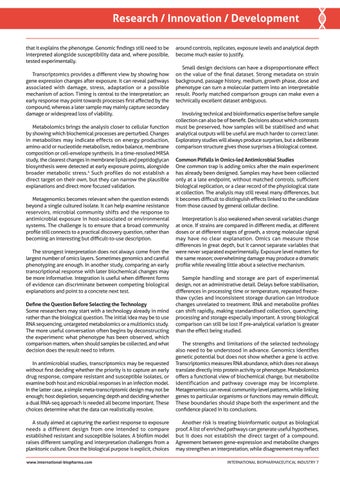
A promising antimicrobial hit is only the start. The harder questions are whether activity holds across strains and conditions, what biology underlies the response and how readily microorganisms may adapt. Used with a clear purpose, genomics, transcriptomics, metabolomics and metagenomics can connect activity with genotype, regulation, metabolism and community context. Their value lies not in generating data for its own sake, but in reducing uncertainty around a candidate and guiding the next experiment, validation step or development decision.
Antimicrobial Discovery Needs More Than New Hits The search for new antimicrobials is becoming broader and more technically ambitious, with genome and metagenome mining, AI-assisted design and non-traditional approaches now sitting alongside conventional screening. One recent study predicted nearly one million antimicrobial peptides from microbial sequences across the global microbiome, a measure of how fast the searchable biological space is expanding.1 Metagenomics is helping drive that expansion by opening access to uncultivated microbial diversity and revealing biosynthetic gene clusters, antimicrobial peptides and resistance mechanisms beyond conventional culture-based approaches.
Work in bacterial signalling, pathogenesis and biofilm biology shows how strongly microbial behaviour can change with environment and physiological state. Research in microbial gene regulation and development likewise demonstrates how rapidly populations can reorganise their response to stress. A hit observed in one strain, medium or growth phase is therefore only a snapshot of a dynamic biological system. The potential for adaptation must also be considered early. Resistance, tolerance and persistence describe different ways in which microorganisms can survive exposure, and none is revealed by a single activity value. Experimental evolution in E. coli has shown that the pace, fitness costs and collateral effects of resistance can vary between conventional antibiotics and antimicrobial peptides.3 The result cannot be generalised to every candidate, but it illustrates why the evolutionary response needs to be investigated rather than assumed. Together, these questions define what evidence is needed next. For one candidate, the priority may be confirming activity across strains. For another, it may be distinguishing a selective cellular effect from general stress, identifying early adaptation or explaining why activity is lost in a more relevant model. Figure 1 summarises this transition from an initial hit to the questions that determine progression.
Yet, a larger search space does not necessarily produce a stronger development pipeline. The World Health Organization identified 90 antibacterial candidates in clinical development in 2025, but only 15 met its criteria for innovation.2 This gap between the growing ability to find activity and the continuing scarcity of differentiated candidates remains a critical challenge. An initial hit shows that something happened under a defined set of conditions. It does not yet establish whether the effect is reproducible, biologically meaningful or robust enough to justify further investment. That is where discovery shifts from finding activity to understanding it. Key Questions Arise Once Activity Is Observed Once activity has been detected, the questions become more demanding. Does the effect hold across genetically diverse strains or is it limited to the isolate used in the original screen? Does the compound kill the organism, temporarily inhibit growth or trigger a response from which the population can recover? Does its apparent potency remain consistent when the medium, nutrient availability, oxygen level or growth state changes? These are not minor technical details. A candidate that performs well against rapidly growing planktonic cells may behave very differently against biofilms, slow-growing populations or microorganisms interacting with host cells. The most convenient model may not reflect the setting in which the antimicrobial would need to work. 6 INTERNATIONAL BIOPHARMACEUTICAL INDUSTRY
Figure 1. A positive screen opens a series of biological and developmental questions. Follow-up work should identify which uncertainty must be resolved before a candidate progresses.
Omics Can Help When the Question Is Clear In our experience, the most useful omics projects begin with a specific uncertainty. Why do two strains respond differently to the same compound? Is the organism mounting a targeted response or simply showing signs of severe cellular damage? Which pathway should be tested next? Identifying the uncertainty first makes it easier to determine what molecular evidence is genuinely needed. Genomics can place activity within the genetic background of the organism by identifying resistance determinants, target-site variants, mobile elements or other differences between strains. However, the presence of a gene or mutation does not prove Autumn 2026 Volume 9 Issue 3
Research / Innovation / Development that it explains the phenotype. Genomic findings still need to be interpreted alongside susceptibility data and, where possible, tested experimentally. Transcriptomics provides a different view by showing how gene expression changes after exposure. It can reveal pathways associated with damage, stress, adaptation or a possible mechanism of action. Timing is central to the interpretation; an early response may point towards processes first affected by the compound, whereas a later sample may mainly capture secondary damage or widespread loss of viability. Metabolomics brings the analysis closer to cellular function by showing which biochemical processes are perturbed. Changes in metabolites may indicate effects on energy production, amino-acid or nucleotide metabolism, redox balance, membrane composition or cell-envelope synthesis. In a time-resolved MRSA study, the clearest changes in membrane lipids and peptidoglycan biosynthesis were detected at early exposure points, alongside broader metabolic stress.4 Such profiles do not establish a direct target on their own, but they can narrow the plausible explanations and direct more focused validation. Metagenomics becomes relevant when the question extends beyond a single cultured isolate. It can help examine resistance reservoirs, microbial community shifts and the response to antimicrobial exposure in host-associated or environmental systems. The challenge is to ensure that a broad community profile still connects to a practical discovery question, rather than becoming an interesting but difficult-to-use description. The strongest interpretation does not always come from the largest number of omics layers. Sometimes genomics and careful phenotyping are enough. In another study, comparing an early transcriptional response with later biochemical changes may be more informative. Integration is useful when different forms of evidence can discriminate between competing biological explanations and point to a concrete next test. Define the Question Before Selecting the Technology Some researchers may start with a technology already in mind rather than the biological question. The initial idea may be to use RNA sequencing, untargeted metabolomics or a multiomics study. The more useful conversation often begins by deconstructing the experiment: what phenotype has been observed, which comparison matters, when should samples be collected, and what decision does the result need to inform.
around controls, replicates, exposure levels and analytical depth become much easier to justify. Small design decisions can have a disproportionate effect on the value of the final dataset. Strong metadata on strain background, passage history, medium, growth phase, dose and phenotype can turn a molecular pattern into an interpretable result. Poorly matched comparison groups can make even a technically excellent dataset ambiguous. Involving technical and bioinformatics expertise before sample collection can also be of benefit. Decisions about which contrasts must be preserved, how samples will be stabilised and what analytical outputs will be useful are much harder to correct later. Exploratory studies will always produce surprises, but a deliberate comparison structure gives those surprises a biological context. Common Pitfalls in Omics-led Antimicrobial Studies One common trap is adding omics after the main experiment has already been designed. Samples may have been collected only at a late endpoint, without matched controls, sufficient biological replication, or a clear record of the physiological state at collection. The analysis may still reveal many differences, but it becomes difficult to distinguish effects linked to the candidate from those caused by general cellular decline. Interpretation is also weakened when several variables change at once. If strains are compared in different media, at different doses or at different stages of growth, a strong molecular signal may have no clear explanation. Omics can measure those differences in great depth, but it cannot separate variables that were never separated experimentally. Exposure level matters for the same reason; overwhelming damage may produce a dramatic profile while revealing little about a selective mechanism. Sample handling and storage are part of experimental design, not an administrative detail. Delays before stabilisation, differences in processing time or temperature, repeated freezethaw cycles and inconsistent storage duration can introduce changes unrelated to treatment. RNA and metabolite profiles can shift rapidly, making standardised collection, quenching, processing and storage especially important. A strong biological comparison can still be lost if pre-analytical variation is greater than the effect being studied.
In antimicrobial studies, transcriptomics may be requested without first deciding whether the priority is to capture an early drug response, compare resistant and susceptible isolates, or examine both host and microbial responses in an infection model. In the latter case, a simple meta-transcriptomic design may not be enough; host depletion, sequencing depth and deciding whether a dual RNA-seq approach is needed all become important. These choices determine what the data can realistically resolve.
The strengths and limitations of the selected technology also need to be understood in advance. Genomics identifies genetic potential but does not show whether a gene is active. Transcriptomics measures RNA abundance, which does not always translate directly into protein activity or phenotype. Metabolomics offers a functional view of biochemical change, but metabolite identification and pathway coverage may be incomplete. Metagenomics can reveal community-level patterns, while linking genes to particular organisms or functions may remain difficult. These boundaries should shape both the experiment and the confidence placed in its conclusions.
A study aimed at capturing the earliest response to exposure needs a different design from one intended to compare established resistant and susceptible isolates. A biofilm model raises different sampling and interpretation challenges from a planktonic culture. Once the biological purpose is explicit, choices
Another risk is treating bioinformatic output as biological proof. A list of enriched pathways can generate useful hypotheses, but it does not establish the direct target of a compound. Agreement between gene-expression and metabolite changes may strengthen an interpretation, while disagreement may reflect
www.international-biopharma.com
INTERNATIONAL BIOPHARMACEUTICAL INDUSTRY 7
Research / Innovation / Development regulation, feedback or different response times rather than a failed experiment. The final weakness is often the absence of a validation plan. Candidate genes, pathways or metabolites should lead to practical follow-up: testing additional strains, perturbing a gene, measuring a metabolite directly, assessing a combination or repeating the experiment in a more relevant model. Without that bridge, an omics study may remain descriptive even when the data quality is high. Towards More Evidence-led Antimicrobial Pipelines Strong phenotypic evidence remains the foundation, with omics added only where it can reduce a specific uncertainty, whether the priority is confirming robust activity, explaining strainspecific behaviour, investigating a possible mechanism, assessing adaptation risk or deciding whether a candidate should enter a more complex model. Addressing that uncertainty does not always require a large multiomics programme. A genomic comparison may be sufficient to investigate strain-specific differences. A short, carefully designed transcriptomic or metabolomic time course may be more informative than a broad endpoint study. Additional layers become valuable when they can connect genetic potential, regulatory response and biochemical consequence in a way that influences the next decision.
Figure 2. A decision-led workflow for using omics in antimicrobial discovery. Molecular analysis is selected to reduce a defined uncertainty and must connect to validation and prioritisation.
the one with the largest number of significant features, but the one that influences the next experiment or decision. Classical microbiology establishes the phenotype. Medicinal chemistry develops the candidate. Omics adds biological context and validation tests whether the emerging explanation is robust. No single layer removes the complexity of antimicrobial biology, but the right evidence can make uncertainty more visible and manageable. In a field where time, samples and development resources are limited, that clarity matters. The goal is not to surround every hit with more data, but to build enough evidence to decide what should stop, what needs to be redesigned and which candidates are strong enough to progress with confidence.
The analytical plan should be considered before samples are collected. Sample numbers, collection points, storage conditions, expected data quality and the limitations of the selected technology all influence what can realistically be concluded. Early discussion between microbiologists, analytical scientists and bioinformaticians helps align these choices and reduces the risk of generating data that are technically sound but difficult to interpret.
REFERENCES
External sequencing and multiomics partners can add value beyond access to individual platforms. Experience across sample types, technologies and study designs can help researchers select an appropriate approach, standardise workflows and anticipate technical limitations. Operational scale may also support consistent processing, quality control and integration across larger or multi-site studies. The real value is not simply outsourcing data generation, but using broader technical and analytical experience to strengthen the study from the outset.
4.
Most importantly, the results should lead to a defined next step. A candidate mechanism may need genetic or biochemical testing; a strain-specific response may justify a wider isolate panel; a metabolic signature may suggest targeted measurement, combination studies or a change of model. Equally, the evidence may show that a hit is too condition-dependent or biologically weak to progress. Stopping or redirecting a project can be as valuable as advancing it. This decision-led sequence is summarised in Figure 2. Omics as Decision Support, Not Decoration Omics is not valuable simply because it makes antimicrobial discovery more technologically advanced; its value lies in helping researchers understand what an initial result means and what should happen next. The most useful dataset is not necessarily 8 INTERNATIONAL BIOPHARMACEUTICAL INDUSTRY
1.
2. 3.
Santos-Júnior, C.D., Torres, M.D.T, Duan, Y., et al. Discovery of antimicrobial peptides in the global microbiome with machine learning. Cell.187(14):3761–3778.e16 (2024). https://www.who.int/publications/i/item/9789240113091, visited on 23 Jul 2026. Yu, F., Wang, D., Zhang, H., Wang, Z. & Liu, Y. Evolutionary trajectory of bacterial resistance to antibiotics and antimicrobial peptides in Escherichia coli. mSystems.10(3):e01700-24 (2025). Hussein, M., Mahboob, M.B.H., Tait, J.R., et al. Providing insight into the mechanism of action of cationic lipidated oligomers using metabolomics. mSystems. 9(5):e00093-24 (2024).
Dr. Shi-qi An Shi-qi An is a molecular microbiologist with a PhD in life sciences and more than a decade of experience spanning antimicrobial research, microbial genomics and multiomics. Her background crosses academic and industry settings, combining experimental biology with omics-led study design, biological interpretation and scientific communication to support Novogene Europe’s multiomics research services. Email: info@novogene-europe.com
Dr. Paula Yagüe Paula Yagüe is Application & Specialist Scientist at Novogene Europe and a PhD-trained molecular biologist with experience across microbiology, omics, gene regulation and microbial development, supporting sequencing and multiomics project design.
Autumn 2026 Volume 9 Issue 3
www.international-biopharma.com
INTERNATIONAL BIOPHARMACEUTICAL INDUSTRY 9
Research / Innovation / Development
As New Rules Take Hold, What Does ‘Good AI Practice’ Look Like in Drug Development? In 2026, setting clear AI expectations is the priority. On January 14, 2026, EMA and FDA marked a step towards regulatory alignment by publishing joint guiding principles for good AI practice. These shared expectations establish a common standard on what ‘good’ looks like. The principles inform how AI should support evidence across the lifecycle, including clinical trials and safety monitoring. Rather than adding new requirements, the principles act as a reference point for how AI should be applied within regulated processes. They remain technology-neutral while being operationally specific, calling for clear definition of context of use, implementation of risk-based controls, governance of data and documentation, and lifecycle management to ensure oversight remains intact. The focus is no longer just on whether AI can be used, but whether it can be run reliably, transparently and with accountability. The Focus Shifts from What AI Can Do, to How It's Controlled Over the past 18 to 24 months, many life sciences organisations have explored AI in “text-heavy” and assistive use cases, summarising long documents, classifying content, extracting data points and drafting internal or external text. That is a logical starting point because it is fast to pilot and easy to demonstrate value. The harder step is what comes next. As soon as AI output starts to influence regulated evidence, decisions or actions, “it appears to work” is no longer the standard. The standard is now evolving to become repeatable with oversight, consistent use in context, clear accountability with a human in the loop and a record that holds up to audit scrutiny over time. That is what the EMA–FDA principles bring into sharper focus. Context of Use Sets the Standard for AI Risk and Control The most consequential phrase in the regulators’ framing is “context of use.” AI is not evaluated in the abstract. It is evaluated in the context of what it is intended to do, what it influences and what risk it introduces. A drafting assistant used to summarise internal notes is one thing. AI that uses the same summarisation method to prioritise safety case review, flag potential signals or initiate steps in trial operations is another. The same underlying technique can move from low impact to high impact simply by where it sits in the process and how its output is used. That difference matters because it changes what “good practice” requires in the real world. When the context of use is higher risk, the surrounding expectations shift with it: clearer 10 INTERNATIONAL BIOPHARMACEUTICAL INDUSTRY
controls, stronger documentation, explicit human oversight and more disciplined management change. The practical implication is that AI programmes will increasingly need an inventory of use cases mapped to risk, with defined boundaries and a shared understanding of accountability. Trust in AI Is Determined by Workflow and Record The guiding principles are technology-neutral, but they are not neutral about execution. In practice, that broadens attention beyond the model itself to the surrounding controls and documentation: data provenance, versioning, how outputs are reviewed and used, and what changed over time. This is where a strategic design choice becomes critical: whether AI sits outside the regulated workflow as a separate tool or whether it is embedded inside the systems where regulated work actually happens. When AI is embedded in a regulated workflow, it can inherit what regulated environments already require: role-based permissions, standardised steps, controlled handoffs and audit trails by design. When AI sits outside, teams often end up reconstructing context and controls after the fact, copying information across tools, reconciling versions and rebuilding the “story of the record” during reviews and inspections. That is manageable in a pilot. It is fragile at scale. Autumn 2026 Volume 9 Issue 3
Research / Innovation / Development This “embedded” direction is also where industry product strategy is heading. Embedding AI deep inside the operational systems of record is structurally better aligned with governed data, auditability and repeatable oversight than treating AI as a separate overlay. Lifecycle Management Becomes Essential as AI Enters Regulated Workflows Lifecycle management can sound abstract until you map it to how AI behaves in production. Newer foundational models are released. Prompts derived from agent objectives and instructions evolve. Knowledge sources and transactional data change. Any of those changes can subtly alter AI outputs in ways that matter in a regulated context. The regulators’ emphasis on risk-based performance assessment and lifecycle management is, in practice, a reminder that “set it and forget it” is not an option once AI influences regulated work.
The operational bar is rising in a way that rewards organisations that make oversight practical, repeatable and scalable. The Next Steps for Leaders Today The practical response is not to slow down AI adoption. It is to operationalise it, so each new use case does not trigger a fresh governance debate. For most organisations, the near-term opportunity is to use the EMA–FDA principles as a design requirement for the AI operating environment, even while product capabilities across clinical, regulatory and safety continue to mature across the market. That means doing the foundational work to move from isolated AI applications to a governed capability in a regulated execution environment. This involves defining contexts of use, mapping them to risk, standardising what “essential information” looks like for oversight and putting lifecycle controls around what changes and when.
What does “lifecycle management” mean in operational terms? •
Version control that is audit-relevant: not only for code and models, but also for prompts, agent instructions, templates and reference material that influences outputs.
•
Defined monitoring and drift triggers: what you monitor, how often and what constitutes meaningful change.
•
Change control proportional to risk: when a change requires documentation, review, re-qualification or rollback.
•
Clear accountability when AI output is accepted, overridden or escalated: so responsibility does not evaporate into “the algorithm said so.”
These are operating model disciplines. They are not optional add-ons delegated to a data science team. They sit at the intersection of quality, business process ownership and technology, which is exactly where regulated execution already lives. Regulation Advances Alongside a Rising Operational Bar The EMA–FDA principles arrive as part of a wider regulatory pattern that reinforces the same underlying message: trustworthy technology depends on trustworthy execution. The European Commission’s timeline for the EU AI Act makes governance expectations increasingly concrete, with the Act fully applicable from 2 August 2026, alongside earlier milestones for prohibited practices and AI literacy (from 2 February 2025) and general-purpose AI obligations (from 2 August 2025). In the U.S., the FDA’s October 2024 guidance on electronic systems, electronic records and electronic signatures in clinical investigations clarifies what it means for electronic records and systems to be trustworthy and reliable. It is not AI guidance, but it becomes directly relevant when AI output is part of evidence generation. If AI influences evidence and decisions, the integrity of the electronic record and the system that produced it becomes more central, not less. None of this suggests regulators want to slow innovation. The joint principles are explicitly framed to enable responsible use. www.international-biopharma.com
This is also the moment to push vendors for specificity. Not “does it do AI,” but where is AI in the workflow, what record does it produce, what is versioned, what is auditable, what is monitored and what changes under change control? The more AI is embedded in the systems that already manage roles, permissions, workflows and audit trails, the easier it becomes to scale responsibly over time, without rebuilding evidence and oversight from scratch. Implementing AI for GxP Environments The EMA-FDA principles shift AI from a standalone tool to a core part of the regulated foundation for evidence generation and monitoring. Success will depend less on the number of pilots and more on embedding AI into controlled workflows, where decisions are reviewable and traceable, and change is managed with clear oversight. This is what will enable organisations to turn AI investment into operational advantage.
Pratyusha Pallavi Pratyusha Pallavi leads strategy for Veeva AI for Regulatory. In this role, she is accountable for long term product direction, market growth, execution and customer success of Veeva AI in the regulatory space. Pratyusha has over 20 years of experience in software product strategy, enterprise customer sales engagements, product management and engineering in life sciences and healthcare industries.
Crystal Allard Crystal Allard is Senior Director, Government Strategy at Veeva. With 15 years of experience at the FDA, she works with regulators and industry to shape the future of the submissions ecosystem and increase speed to market. Allard also contributes to Veeva's product strategy and public policy leadership in health data and regulatory standards. Prior to joining Veeva, Allard held senior leadership roles at the FDA, including Director in the Office of Data, Analytics and Research (ODAR) and Director of Regulatory Science Informatics.
INTERNATIONAL BIOPHARMACEUTICAL INDUSTRY 11
Research / Innovation / Development
Vendor-agnostic Data Management Helps Shorten Drug Candidate Identification Time Bringing candidate drugs to market quickly and costeffectively and pinpointing and eliminating failures from drug development pathways early helps to reduce costs and maintain a competitive edge. A typical research lab will have a range of analytical instruments with bespoke workflows, and the consequent fragmentation of vendorspecific data analysis tools prevents an enterprise from realising full value from the data generated. Organisations are seeking to unify their instrumentation infrastructure into a cohesive analytical engine that accelerates drug discovery and development, reduces processing bottlenecks and better uses skilled scientific resources. This is only possible when data from diverse modalities are connected and processed in a streamlined, vendor-agnostic software platform. The mass spectrometry (MS) data systems market reached USD $413M in 2023 with projected growth to USD $560M by 2028.1 This expansion is driven primarily by the rapid growth of the pharmaceutical and biopharmaceutical industries, growing government investment, public and environmental health concerns, and the integration of artificial intelligence (AI).2 The complex structures of advanced pharmaceutical products, such as biologics and biosimilars, are increasing the demand for advanced testing using MS technologies and their derivative analytical modalities, such as ion mobility, matrix-assisted laser desorption/ionisation (MALDI) and MS imaging, to identify and quantify thousands of small molecules, metabolites and biomolecules with high accuracy and sensitivity. MS analysis provides the deep structural insights and critical quality attributes (CQAs) that improve drug candidate evaluation and shorten time-to-insight in the research and development (R&D) process for pharma and biopharma companies.3
Advances in the speed and sensitivity of MS instrumentation are generating vast amounts of data, and researchers are turning to specialist, multi-modal software platforms to manage a modern data workflow that unlocks deeper insights. The integration of AI is also gaining pace to improve efficiencies and automate outcomes for better informed decision-making. This article examines some of the key considerations for pharma and biopharma companies looking to extract full value from the analytical laboratory and discusses how a companywide data processing platform can add new value across the organisation. The Vendor-agnostic Advantage Integrating all lab instruments and modalities in a vendoragnostic platform removes the need for manual integration and inconsistent workflows, streamlining the analytical process to allow researchers to process tens of thousands of samples per day rather than hundreds. By consolidating workflows into a single interface, organisations will not only accelerate research timelines but also generate richer, more complete datasets that strengthen regulatory submissions and deepen scientific insight. From an operational point of view, this consolidation creates a long-term scalable system, removes the need for multi-vendor instrument licences, service agreements, information technology systems and user training programmes, and can significantly improve return on investment in capital equipment, as summarised in Table 1 below.
Bench-level Benefits
Business Benefits
Realise, integrate and combine the full value of multiple modalities
More complete information and deeper understanding of candidate compounds
Removes manual data integration to focus on higher-value work
Better use of scientific expertise means faster drug discovery, productivity gain and cost savings
Analyse and process tens of thousands of samples in a day
More data supports regulatory compliance and submissions
One software to learn and use minimises user training and downtime
Organisations can train staff on one tool that unifies all workflows, increasing versatility
Consolidation of multi-vendor software into one interface
Improved return on investment (ROI)
Flexible annual subscription model to scale with company needs
Cost of ownership can be predicted into yearly budgets and scalable pricing aligns with company growth
Table 1: Benefits of a single, vendor-agnostic data management software platform 12 INTERNATIONAL BIOPHARMACEUTICAL INDUSTRY
Autumn 2026 Volume 9 Issue 3
Research / Innovation / Development
Connecting Data Reduces Margin for Error An enterprise-wide analytical foundation that integrates data from all major vendors and modalities allows departments to work within a unified platform with a consistent interface for all data. Ensuring that new workflows feel familiar reduces the cost and time required for training, and introducing a standard approach in the visualisation of results lowers the margin for error. This centralisation of data repositories from all major vendors and unification of different file formats introduces new levels of enterprise-level collaboration across global laboratories and research groups. By bringing data together under one platform, pharma and biopharma organisations can establish enterprisewide standard operating procedures (SOPs), reduce operational complexity and maximise the reuse and amplification of scientific knowledge across the business. Removing Barriers to Innovation in Study Design Breaking the software siloes and removing reliance on manual intervention in pharma and biopharma research and development supports larger and more complex study design. A sharp focus on productivity enables cutting-edge scientific methods to be quickly and securely integrated to stay ahead of development timelines. A single, scalable platform that provides a complete view of the data landscape supports both productivity and creativity, www.international-biopharma.com
allowing researchers to unlock the potential of bigger, more complex studies. With analytical labs subject to stringent regulations, software as a service (SAAS) platforms that store data in the cloud must comply with audit trail demonstration and validation. As an alternative, platforms that implement high-performance processing entirely on-site enable a company to maintain control of their data security while benefiting from continuous deployment of new scientific advances into the software. The combination of scalability, security and innovation enables new, larger-scale study designs with greater clinical cohorts, more confident decision-making and stronger data packages for regulatory submission. As data volumes increase and analytical complexity grows, pharma and biopharma companies rely on platforms that safeguard intellectual property, protect patient data and maintain regulatory compliance without limiting research productivity. A locally deployed software solution eliminates the risks associated with cloud-based transfers and external processing. The Growing Importance of Data Integrity The centralisation of data repositories and a more harmonised regulatory landscape have shifted data integrity in the pharmaceutical and biopharmaceutical industry from a compliance tick-box to a board-level concern. INTERNATIONAL BIOPHARMACEUTICAL INDUSTRY 13
Research / Innovation / Development The established ALCOA framework underpins every data integrity framework. ALCOA requires that data should be attributable, legible, contemporaneous, original and accurate and has expanded more recently to ALCOA+ and now ALCOA++, adding enduring, available and accessible, complete, consistent, credible and corroborated to the list of requirements.4 Since ALCOA was established by the US Food and Drug Administration (FDA) in the 1990s, it has been adopted by virtually every major regulatory body worldwide, including the European Medicines Agency (EMA), the Medicines and Healthcare products Regulatory Agency (MHRA), the World Health Organization (WHO) and the Pharmaceutical Inspection Co-operation Scheme (PIC/S). It is referenced in FDA 21 CFR Part 11, EU Annex 11 and GAMP 5 guidance documents. ALCOA sets out to provide a single harmonised standard, particularly important in global organisations, rather than allowing for regional interpretation and the potential for violation. The stakes of getting data integrity wrong, however, are high. Failure to comply continues to be cited in the majority of FDA warning letters issued to drug manufacturers, with recurring findings including shared login credentials, backdated entries, unexplained data reprocessing and incomplete or missing audit trails, all symptomatic of multiple-vendor data management systems. A single environment that captures data and applies the same harmonised standards to its processing regardless of which instrument was used in its generation removes many of the manual handoffs that can cause data integrity gaps.
and AI governance as design principles from the outset is rapidly becoming a board-level, strategic decision. Research data is the key critical asset in pharma and biopharma organisations. As analytical complexity grows and the volume of data continues to increase, many companies are looking to implement a future-proof, compliant and vendoragnostic platform that maximises the value of this data across all scientific and operational teams. This approach transforms fragmented analytical workflows into an integrated, enterprisewide engine for scientific research innovation and business value. Pharma and biopharma organisations rely on predictable, reproducible and scalable workflows that can evolve with company growth, all while minimising operational risk and maintaining consistent performance across global sites. A modern solution for many businesses involves a flexible licensing model that supports organisational scaling, combined with expert guidance from an experienced support team that provides the foundation for smooth onboarding and rapid user confidence. REFERENCES 1.
2.
3.
Data Management in an AI Landscape Artificial intelligence (AI) brings a new level of complexity, which means that regulators must keep pace. In January 2025, the FDA proposed a seven-step "credibility assessment framework" for AI to support regulatory decisions, requiring users to define an AI model's context of use, provide a risk assessment and give evidence of performance. A year later, the FDA and EMA jointly published ten "Guiding Principles of Good AI Practice in Drug Development",5,6 covering the entire drug development lifecycle from drug discovery and manufacturing to post-marketing surveillance. Although the FDA/EMA joint principles are non-binding, they set clear objectives: AI systems should be human-centric by design, governed by a documented, risk-based approach and accompanied by information about how a model works, as well as its limitations. This has practical implications for the analytical laboratory. As AI-assisted annotation, spectral matching, deconvolution and compound identification become routine in laboratory workflows, the same principles apply. Automated data management processes must be traceable, auditable and reproducible on demand. Vendor-agnostic platforms that consolidate a data log across every instrument and modality, rather than take a fragmented approach across separate vendor tools, are poised to demonstrate AI governance. A Future-proof Solution to Data Management Choosing an analytical data foundation that treats compliance 14 INTERNATIONAL BIOPHARMACEUTICAL INDUSTRY
4.
5.
6.
Top-Down Analytics: Laboratory Data Management Software Market: LIMS, ELN/LES, SDMS, CDS & MS – Market Forecast 2023-2028, December 2023. Accessed 17 June 2026. MarkNtel Advisors: Global Mass Spectrometry Market Overview, Trends, Size and Forecast: 2025-2030, August 2025. Accessed 17 June 2026. https://www.marknteladvisors.com/research-library/ mass-spectrometry-market.html Markets & Markets: Mass spectrometry market, June 2026. Accessed 17 June 2026. https://www.marketsandmarkets.com/MarketReports/mass-spectrometry-market-437.html Rattan AK, Data Integrity: History, Issues, and Remediation of Issues. PDA J Pharm Sci Technol. 2018 Mar-Apr;72(2):105-116. doi: 10.5731/pdajpst.2017.007765. PMID: 29158286. Accessed 16 July 2026. https://pubmed.ncbi.nlm.nih.gov/29158286/ European Medicines Agency, Guiding principles of good AI practice in drug development, January 2026. Accessed 16 July 2026. https:// www.ema.europa.eu/en/documents/other/guiding-principles-goodai-practice-drug-development_en.pdf Food and Drug Administration, Guiding principles of good AI practice in drug development, 14 January 2026. Accessed 16 July 2026. https://www.fda.gov/about-fda/artificial-intelligencedrug-development/guiding-principles-good-ai-practice-drugdevelopment
Dr. Ansgar Korf Dr. Ansgar Korf is a scientist and technology leader specialising in analytical chemistry, mass spectrometry and scientific software development. Before mzio, he held senior positions at Bruker Daltonics, including Senior Manager Software Research & Development as well as global product manager for the timsTOF MS platform, combining scientific expertise with product strategy and cross-functional leadership. His academic background includes a PhD in Analytical Chemistry, with research focused on mass spectrometry data mining and computational methods for compound identification.
Autumn 2026 Volume 9 Issue 3
www.international-biopharma.com
INTERNATIONAL BIOPHARMACEUTICAL INDUSTRY 15
Manufacturing & Processing
Engineering Affordability: The Role of Continuous Bioprocessing in the Next Era of Biosimilars Biosimilars were expected to widen access to biologic medicines by introducing competition into some of the most expensive areas of therapy. In many parts of the world, they have done exactly that, but for others the deeper access problem remains unresolved. A biosimilar can clear regulatory review and reach the market but still fail to expand access meaningfully if the cost of manufacturing keeps prices persistently high. The gap between availability and real affordability is especially pronounced in emerging markets, where a high burden of disease combined with constrained healthcare spending leaves many patients unable to access treatment. To counter this, the next phase of biosimilars must incorporate different ways of manufacturing facility design as well as product development. For biologics to reach more patients, affordability must be built into the production system itself.
The Limitations of Fed-Batch Processing Biologics manufacturing has long relied on fed-batch processing, a model that has enabled many important therapies but remains constrained by scale, time, labour intensity and the inefficiencies of moving through separate upstream and downstream stages. Even where process optimisation has improved yields, the underlying process remains resource intensive. As demand for complex biologics rises, this model limits the ability to operate cost efficiently, therefore preventing biosimilars from achieving their full public health promise. A core limitation of fed-batch processing is that it is inherently stop-start in its nature. Production unfolds as a sequence of separate unit operations, creating downtime between stages, requiring holding stages in between unit operations and increasing the need for manual oversight. These pauses also add operational complexity, increase the risk of variability and make it more difficult to maintain an efficient, uninterrupted flow from cell culture through purification. There is also an economic impact of this model. Fed batch systems typically depend on much larger equipment and more expansive infrastructure to meet commercial production demands, driving up both spatial and utility requirements. As productivity is tied to fixed campaign and facility structures rather than a more intensified operating mode, manufacturers may need to commit substantial infrastructure and labour to generate comparatively modest output. Also, with advances in cell line engineering and improvements in titre in the cell culture process, the previously designed facilities for the fed-batch process (both upstream and downstream) may pose a challenge to handle the increased protein load on the downstream side. This can keep cost of goods high, particularly for biologics that already demand expensive raw materials and specialised analytics. 16 INTERNATIONAL BIOPHARMACEUTICAL INDUSTRY
The limitations of fed-batch systems are particularly pronounced for biosimilars. Their promise is not only scientific equivalence, but broader patient access. If manufacturing remains expensive, the ability of biosimilars to expand treatment access is constrained from the outset. Continuous Bioprocessing for Cost Advantage An alternative approach is to change production economics earlier in the process development and facility design (with more flexibility and a modular approach) rather than trying to address affordability later through pricing pressure alone. Continuous bioprocessing, particularly fully connected continuous manufacturing, offers that possibility. In this model, upstream cultivation, harvest, purification and process monitoring are designed as an integrated process flow rather than a series of isolated steps. Intensified perfusion can sustain high cell densities and productivity, while technologies such as alternate tangential flow support stable cell retention and media exchange. On a seamlessly connected downstream side, automated multi-column chromatography can maintain a continuous purification rhythm better aligned with upstream output. When these elements are properly connected, the process is both faster and more cost-efficient. Fully connected continuous manufacturing platforms have shown the potential to reduce processing costs by roughly 40-50%1 relative to conventional fed-batch systems, depending on molecule and process design. With fewer interruptions and less manual handling, production can flow more seamlessly from upstream to downstream. This reduces waste and resources, ensuring a more cost-efficient process than that of conventional batch-based systems. Fully connected continuous manufacturing platforms build affordability into the system itself. This is especially important for biosimilars because their access mission is inseparable from manufacturing efficiency. Biosimilars do not create value only by entering a therapeutic class; they create value by helping health systems and patients sustain treatment. If cost of goods remains too high, there is limited potential to expand access. Continuous bioprocessing, however, makes lower-cost supply more achievable without requiring lower standards of quality. It is also important to distinguish truly integrated continuous manufacturing from more limited versions of "continuous" production. In practice, some operations may use perfusion upstream while retaining batch-wise or manual handoffs in clarification, purification, viral inactivation or quality oversight. These hybrid systems can deliver improvements, but they often preserve the bottlenecks that constrain overall performance. Instead, fully connected continuous manufacturing links the major operations into a coordinated, synchronised, end-toend process with real-time monitoring and tighter control over variability. It is this integration which provides access to the larger economic and operational benefits. Autumn 2026 Volume 9 Issue 3
Manufacturing & Processing flexibly to accommodate advances in technologies expected over time and how manufacturing consistency must be demonstrated over time. As novel biologics become more complex, developers increasingly need partners who understand how to build robust processes under regulatory scrutiny, not just how to execute a tech transfer. Experience with biosimilars can therefore translate directly into stronger development pathways for innovative biologics. An organisation that has experience managing facility design, scalability, comparability, characterisation and global filing expectations is often better prepared to anticipate the risks and controls required for new molecules. The value lies not simply in operating equipment, but in knowing how to develop a manufacturable product that can stand up to the highest quality and regulatory standards. This helps explain why relatively few organisations can credibly combine advanced continuous manufacturing with deep biosimilars experience. Much of the global contract manufacturing sector is still built around legacy stainless-steel fed-batch infrastructure and operating models optimised for that environment. Moving to continuous systems involves far more than replacing equipment; organisations are required to rethink how the process is designed, controlled, sustained and supported within a regulated manufacturing environment.
Improving Global Access Beyond cost reduction, this model opens a strategic possibility that has implications for global access and smaller manufacturing footprints. If biologics can be produced in compact, scalable facilities with lower infrastructure demands, manufacturing can become more geographically distributed. That could support regional supply resilience, reduce dependence on a small number of centralised mega-sites and give governments, institutions and biopharmaceutical companies greater autonomy in how essential therapies are supplied. For countries seeking to strengthen local manufacturing capacity without replicating the capital intensity of legacy biologics plants (which are usually bigger and capex cost intensive), this may prove especially important. The Biosimilar Proving Ground The organisations most capable of applying continuous bioprocessing effectively are often those formed by biosimilar development. Working on biosimilars compels a deeper command of complex biologics and creates an organisational discipline that becomes stronger with each programme completed. Every molecule teaches something, for example, how subtle glycan variation affects comparability strategy, how purification choices influence product quality attributes, how scale-up can introduce new risks, how analytical packages must be constructed for regulators, how facilities must be built more www.international-biopharma.com
Conclusion The biologics affordability challenge should no longer be framed only as a market-access problem. It is a manufacturing problem, as well as a development problem. Biosimilars showed that scientific replication and regulatory approval are achievable at scale. The next task is to ensure that the way these medicines are produced is aligned with the access goals they were meant to serve. Fully connected continuous manufacturing offers one of the clearest routes toward that future, offering lower cost of goods and stronger process consistency. If that model continues to mature, its impact could extend well beyond any single market. The future of biosimilars may therefore depend not only on better molecules or sharper pricing, but on better manufacturing processes. REFERENCES 1.
Enzene Biosciences. “Fully-Connected Continuous Manufacturing (EnzeneX).” Enzene. Accessed August 14, 2026. https://www.enzene. com/cdmo-solutions/manufacturing/fully-connected-continuousmanufacturing-enzenex
Abijar Bhori Abijar Bhori is Associate Vice President at Enzene Biosciences Limited, Pune. He heads the Process Development Team and Peptide & Automation Team. He has over 23 years of experience in biosimilar and biologics development with a focus on downstream processing and drug product development. At Enzene, he has been part of the team that has developed Enzene's patented continuous manufacturing process platform FCCM™ and launched multiple 8 biosimilar products in the Indian market.
INTERNATIONAL BIOPHARMACEUTICAL INDUSTRY 17
Application Note
Genes to GMP: How Biocatalysis Accelerates the Development of New Medicines Biocatalysis has emerged as a transformative technology in Active Pharmaceutical Ingredient (API) development, reshaping how pharmaceutical molecules are developed and manufactured. By enabling shorter synthetic routes, improved chemo-, regio- and stereoselectivity, and more sustainable manufacturing processes, enzymes are increasingly outperforming traditional chemical catalysts. Over the past two decades, advances in enzyme discovery, screening and engineering have dramatically reduced the cost and time required to access new biocatalytic activities, making enzymes increasingly attractive alternatives to traditional chemical catalysts. The growing adoption of biocatalysis within pharmaceutical development has been driven not only by advances in enzyme technology, but also by the emergence of integrated development models that combine enzyme discovery, engineering and AI, process development/optimisation and manufacturing. Access to diverse enzyme libraries and effective screening platforms remains critical, particularly when development timelines are compressed. At the same time, the ability to rapidly scale successful biocatalytic transformations from laboratory evaluation to GMP manufacture has become an increasingly important differentiator. Within this environment, organisations that combine biological and chemical process expertise are well positioned to accelerate the development of efficient and commercially viable manufacturing routes. At Almac, these capabilities are integrated within a single development and manufacturing framework, allowing biocatalytic solutions to be efficiently advanced from early-stage development through to commercial production. Initially, API development focuses on speed and selectivity, typically using commercially available enzymes and batch processing to quickly identify viable biotransformations to deliver material fast. As the API progresses through its lifecycle and the API process matures, the emphasis shifts towards yield and productivity, driven by the introduction of engineered enzymes and process optimisation. This progression enables robust, scalable and economically competitive manufacturing processes suitable for commercial API production and is summarised in Figure 1.1 Almac established its dedicated biocatalysis capability in 2005 with the creation of an in-house molecular biology team focused on recombinant enzyme production. This capability removed reliance on third-party enzyme suppliers and enabled direct integration of biocatalysis into chemical process development and GMP manufacturing. Since then, Almac has built an extensive portfolio of proprietary enzyme libraries designed to operate under industrially relevant process conditions and support a broad range of pharmaceutical transformations. Importantly, these capabilities are closely linked to chemical 18 INTERNATIONAL BIOPHARMACEUTICAL INDUSTRY
process development and scale-up expertise, allowing successful biocatalytic reactions to progress seamlessly from enzyme identification and proof-of-concept studies to GMP production campaigns conducted at scales from 20 L to 8,000 L. This strong track record in the successful scale-up and commercialisation of biocatalytic processes across all six major enzyme families has enabled Almac to deliver robust manufacturing solutions from early development through to commercial GMP production. The breadth of experience in the last 8-10 years, encompassing over 100 route scouting, GMP manufacturing and enzyme supply programmes, demonstrates Almac's capability to identify, develop and industrialise biocatalytic transformations that enhance process efficiency, product quality, sustainability and overall manufacturing economics.2 Carbonyl reductases represent the most widely deployed enzyme class, with >55 manufacturing projects and enzyme supply programmes, reflecting the growing demand for highly selective ketone reductions in pharmaceutical synthesis. Significant activity has also been delivered using lipases and esterases (>20), supporting esterification, hydrolysis and kinetic resolution chemistries. Other frequently applied enzyme platforms include amino acid dehydrogenases, imine reductases, transaminases and Baeyer-Villiger monooxygenases (BVMOs), enabling the efficient synthesis of chiral intermediates and complex APIs. Beyond these established enzyme classes, Almac has successfully implemented more specialised biocatalysts, including lipoxygenases and P450 hydroxylases, demonstrating the capability to develop and scale challenging oxidation and functionalisation reactions, including development of the chemical engineering aspects of these programmes. The introduction of structure-guided enzyme engineering has revolutionised how enzymes are engineered quickly and cheaply. Rather than relying on large-scale random
Figure 1: The speed vs cost paradigm shift during drug development Autumn 2026 Volume 9 Issue 3
Application Note
Figure 2: Example process to α-alkylated amino acids
mutagenesis campaigns, Almac has developed a rational design strategy that combines computational modelling with focused experimental screening. This approach delivers a much higher proportion of beneficial variants and enables the tailoring of enzymes to improve activity, selectivity, stability and manufacturing economics. Of the many problems solved via rational mutagenesis, two recent examples concern the large scale biocatalytic synthesis of (R)-2-Methoxymandelic acid, a pharmaceutical intermediate, and the development of a low cost bioreduction route to essential medicines Etonogestrel and Norgestrel on behalf of the Gates Foundation as published in peer-reviewed journals.3
complexity increase. Small inefficiencies at each coupling step accumulate throughout the synthesis, leading to reduced overall yields and increased impurity profiles. The resulting purification burden can become one of the most significant contributors to manufacturing cost, particularly for longer RNA sequences.
Biocatalysis should be considered as a component within a broader technology platform. For example, in many cases it is deployed hand in hand with flow chemistry, physical sciences and radiolabelling capabilities. The integration of these disciplines enables the development of efficient end-to-end manufacturing solutions.
One promising approach is the use of RNA ligase enzymes to assemble oligonucleotides from shorter pre-prepared fragments, often referred to as blockmers. Rather than building the molecule one nucleotide at a time, larger sections of the oligonucleotide are joined together through enzymatic ligation. By exploiting complementary strand templation, RNA ligases can selectively couple the correct blockmers while rejecting many sequencerelated impurities, resulting in improved product quality and reduced purification requirements.4 At Almac, we deploy the 3:2:3 approach as shown in Figure 3. This figure illustrates a 3:2:3 iterative assembly strategy for the synthesis of complex oligonucleotides. In each cycle, three blocks are initially present, annealing through base-pair recognition (Step 1). An enzymatic ligation reaction then joins the two annealed blocks, generating a new, larger fragment, reducing the reactor contents from three blocks to two. An in-process control (IPC) is performed to confirm complete conversion of the starting materials. Once conversion is
One recent example within the Almac portfolio of projects included development of a platform technology for α-substituted amino acids, important building blocks for next-generation peptide therapeutics. Biocatalytic desymmetrisation, continuous flow processing and crystallisation science are used to deliver scalable routes to these high-value intermediates while maintaining control of product quality and manufacturability. Figure 2 shows an example manufacturing process to one of the simplest amino acids, D-isovaline. Biocatalytic Assembly of Oligonucleotides One of the most exciting areas for biocatalysis is the rapidly growing oligonucleotide therapeutics sector. Oligonucleotides, including siRNA, antisense oligonucleotides and other RNA-based medicines, are becoming increasingly important treatment modalities for a wide range of diseases. As the complexity and demand for these molecules continue to increase, so too does the need for more efficient and scalable manufacturing approaches. For decades, oligonucleotides have been produced primarily through solid-phase synthesis (SPS), a process involving successive cycles of deprotection and coupling reactions to assemble an oligonucleotide one nucleotide at a time. While highly effective for many applications, the approach becomes increasingly challenging as sequence length and structural www.international-biopharma.com
To address these challenges, significant research activity across the industry is now focused on enzymatic and hybrid manufacturing approaches. Biocatalytic methods offer the potential to leverage the inherent sequence recognition capabilities of enzymes to improve selectivity, reduce impurity formation and simplify downstream processing.
Figure 3: How shorter blockmers are assembled. INTERNATIONAL BIOPHARMACEUTICAL INDUSTRY 19
Application Note verified, a new building block is charged to the reactor, returning the system to three blocks and initiating the next assembly cycle. This sequence of annealing, ligation, IPC verification and block addition is repeated until the full-length oligonucleotide API has been assembled, providing a controlled, modular and highly efficient manufacturing process. Development of RNA ligase technology has demonstrated the potential of this approach for manufacture of both singlestranded and double-stranded RNA targets right through to GMP materials use in human clinical trials. Continued advances in enzyme discovery and rational protein engineering have improved enzyme stability, activity and tolerance towards modified nucleotides, helping to expand the range of oligonucleotide structures that can be manufactured using enzymatic assembly strategies. While solid-phase synthesis is expected to remain an important manufacturing technology for many years, enzymatic ligation approaches represent a promising complementary platform. As enzyme performance continues to improve, biocatalytic assembly has the potential to support more efficient and sustainable manufacture of increasingly complex oligonucleotide therapeutics, helping the industry address future demands for scale, quality and cost-effective production. As biocatalysis continues to expand beyond laboratory-scale applications, the development of robust enzyme manufacturing processes has become increasingly important. For many pharmaceutical applications, enzymes must not only deliver the required catalytic performance, but also meet stringent quality and regulatory requirements. This is particularly relevant for oligonucleotide therapeutics, which are administered parenterally and therefore require tight control of impurities such as endotoxins, host cell proteins (HCPs) and residual nucleic acids. One example is the purification of RNA ligase (RNAL) enzymes used in enzymatic oligonucleotide assembly. While recombinant expression in E. coli remains the most practical manufacturing route for many enzymes, downstream purification is essential to reduce endotoxin levels and remove process-related impurities. Building on experience gained through enzyme development and protein processing programmes, Almac has developed scalable purification processes capable of supporting the production of increasingly large quantities of highly purified enzymes for both internal manufacturing programmes and external clients. Another important area is enzyme immobilisation, a technology that offers significant advantages for industrial manufacturing. Immobilised enzymes can often be recovered and reused across multiple batches, enabling higher productivity while simplifying catalyst separation through straightforward filtration steps. They can also facilitate process intensification by allowing higher catalyst loadings and reduced cycle times.5 As biocatalysis continues to evolve, the ability to manufacture, purify and formulate enzymes at scale is becoming an increasingly important component of translating innovative enzyme technologies into commercially viable products and processes. 20 INTERNATIONAL BIOPHARMACEUTICAL INDUSTRY
Expanding the Biooxidation Toolbox While reductases and lipases remain the most widely used biocatalysts in pharmaceutical manufacturing due to their robustness, predictability and proven track record at scale, increasing attention is now being given to oxidative enzymes capable of performing more complex transformations. Selective oxidation reactions have traditionally represented some of the most challenging steps in synthetic chemistry, often requiring multiple reaction steps, aggressive reagents or extensive process optimisation to achieve the desired level of chemo-, regio- or stereoselectivity. Recent advances in enzyme discovery and engineering are helping to overcome these challenges. One notable example is the growing application of Baeyer-Villiger monooxygenases (BVMOs), which have demonstrated utility in the selective synthesis of chiral intermediates, including sulfoxides of pharmaceutical interest. As non-heme enzymes, BVMOs can offer advantages in stability, solvent tolerance and catalyst efficiency compared with some traditional oxygenase systems, making them increasingly attractive for industrial applications. Looking ahead, the range of available biooxidation reactions is expected to expand further as new enzyme classes are identified and engineered for process-scale use. In particular, α-ketoglutarate-dependent oxygenases are attracting considerable interest due to their ability to perform highly selective oxidation reactions that are often difficult to achieve using conventional chemistry. As understanding of these enzymes continues to grow, they have the potential to significantly broaden the biocatalytic toolbox available to pharmaceutical process chemists, opening new routes to complex molecular architectures and further extending the reach of enzyme-enabled synthesis. The Future of Biocatalysis Biocatalysis has evolved from a specialist technology used for a limited number of transformations into a mainstream component of pharmaceutical process development. Advances in enzyme discovery, protein engineering and process intensification have expanded the range of reactions that can be performed biocatalytically and accelerated the adoption of enzymes across both clinical and commercial manufacturing. Looking ahead, the continued growth of biologics is expected to create new opportunities for biocatalytic manufacturing. Peptides, oligonucleotides and antibody-drug conjugates (ADCs) are becoming increasingly important components of the pharmaceutical pipeline, bringing new synthetic challenges that are well suited to enzymatic solutions. At the same time, demand for small molecule medicines remains strong, ensuring that established biocatalytic transformations, particularly those involving reductases and hydrolases, will continue to play a central role in pharmaceutical manufacture for years to come. The next phase of growth is likely to be driven by increasingly sophisticated enzyme technologies. As enzyme engineering capabilities continue to improve, biocatalysts are being developed with enhanced stability, productivity and substrate scope, enabling their use in more demanding manufacturing environments. Emerging areas such as enzymatic oligonucleotide assembly, solution-phase peptide ligation and selective Autumn 2026 Volume 9 Issue 3
Application Note biooxidation are demonstrating how enzymes can address challenges that are often difficult to solve using conventional chemistry alone. The transformation of biocatalysis from a niche routeoptimisation tool into a cornerstone manufacturing technology has been nothing short of remarkable, and the journey is far from over. Advances in enzyme discovery, engineering and process design are continually expanding the boundaries of what is possible, enabling chemistries once considered inaccessible to become routine at industrial scale. As the pharmaceutical industry pursues ever greater efficiency, selectivity and sustainability, biocatalysis is poised to play a defining role in the next generation of drug manufacturing, bridging cutting-edge science with the practical realities of global medicine supply. The future of biocatalysis is exceptionally bright and we look forward with great excitement to the innovations and opportunities that lie ahead. REFERENCES 1. 2.
3.
4.
5.
David J. Pollard, John M. Woodley, 2007, TRENDS Biotechnol. 25, 66 [2] 37. Moody, Thomas S; Research Features Magazine – 139 (2022); Efficient, low-energy chemical synthesis using enzymes for biocatalysis; DOI 10.26904/RF-139-2182664233 (a) Mark E. Scott II; Xiaotian Wang; Luke D. Humphreys * ; Michael J. Geier; Balamurali Kannan; Johann Chan I; Gareth Brown; Daniel F. A. R. Dourado; Darren Gray; Stefan Mix; Aliaksei Pukin; Org. Process Res. Dev. 2021, 26 (3): 849. (b)Andrew S. Rowan; Sergej Maciuk; Gareth Brown; Darren Gray; Jenny Spratt; Alexandra T. P. Carvalho; Dražen Pavlović; Fernando Tur; Jill Caswell; Derek J. Quinn; Thomas S. Moody; Stefan Mix; Faraday Discussions 2025; DOI 10.1039/D4FD00011K Stephanie Paul; Darren Gray; Jill Caswell; Joshua Brooks; Wenjie Ye; Thomas S. Moody, Roumen Radinov; Lubomir Nechev; 2023, Chem. Biol., 18(10);2183 Hans-Jürgen Federsel, Thomas S Moody, Steve JC Taylor. Recent Trends in Enzyme Immobilization-Concepts for Expanding the Biocatalysis Toolbox. In: Saeed Tarighi, editor. Prime Archives in Molecular Sciences: 3 rd Edition. Hyderabad, India: Vide Leaf. 2022.
Tom Moody Prof. Tom Moody is Vice President of Technology Development and Commercialisation for Almac Sciences and Arran Chemical Company. He holds a BSc in Chemistry and a PhD in Physical Organic Chemistry from Queen's University Belfast, along with a master’s degree in business. He has authored more than 50 publications and patents and leads multidisciplinary teams advancing chemistry and biocatalysis solutions for pharmaceutical development worldwide.
Dr. Stefan Mix Dr. Stefan Mix is Associate Director, Biocatalysis for Almac Sciences. He holds a Diploma in Chemistry and a doctorate from the Technical University of Berlin, where he specialised in stereoselective synthetic methodology and olefin metathesis. Since joining Almac in 2005, he has developed expertise in biocatalysis, protein engineering and process development, helping to build Almac's manufacturing network and technical capabilities.
www.international-biopharma.com
INTERNATIONAL BIOPHARMACEUTICAL INDUSTRY 21
Manufacturing & Processing
The Critical Role of Fill-Finish in Large-Molecule Manufacturing The biologics sector has moved from a specialist segment to one of the most dynamic areas in pharmaceutical manufacturing. Recent market estimates place the biologics sterile fill-finish services market at USD 5.57 billion in 2026, with growth to USD 8.35 billion by 2030 at a CAGR of 10.7%, 1 underscoring the scale of investment now flowing into this stage of production. As biologics, monoclonal antibodies and other complex modalities take a larger share of pharmaceutical pipelines, fill-finish is becoming a critical control point for these fragile, high value therapies rather than a routine downstream step. For CDMOs and drug developers alike, the challenge is no longer simply how to fill a vial or syringe efficiently, but how to preserve product quality, yield and commercial viability. Protecting the Molecule Large molecules behave differently from conventional small-molecule drugs because their activity depends on preserving delicate higher-order structure, making them vulnerable to stress during transfer, filtration, mixing and filling. Even relatively minor physical or chemical stresses encountered during drug product manufacture can trigger irreversible conformational changes, aggregation or degradation that compromise product quality, efficacy and patient safety. This sensitivity has practical consequences across the sterile manufacturing chain. Bulk drug substance must be received, stored and transferred under tightly controlled conditions, with cold-chain infrastructure in place to maintain the appropriate temperature range. For many products, that means tightly monitored storage at 2-8 °C, -20 °C or -80 °C, plus qualified intermediate holding capacity during extended manufacturing campaigns. Cold Chain is Quality Control Temperature management remains one of the most significant challenges in biologic manufacturing. With most therapeutic proteins exhibiting optimal stability only within relatively narrow temperature ranges, carefully controlled cold-chain infrastructure from receipt of bulk drug substance through to distribution of the finished product is required. In sterile fill-finish, cold chain is therefore not a logistics issue alone; it is a quality system. If product is held too long, warmed inadvertently or exposed to repeated excursions, the damage can be irreversible. In an industry where a batch may represent millions of dollars in product value and months of development effort, the cost of failure is obvious. Modern sterile fill -finish operations, for this reason, rely on traceability, environmental monitoring and risk-based controls 22 INTERNATIONAL BIOPHARMACEUTICAL INDUSTRY
from the moment bulk material enters the facility. The best systems do not merely preserve temperature; they support regulatory compliance whilst maintaining confidence in quality assurance and significant commercial protection. Pump Choice Shapes Product Fate Although temperature receives considerable attention, mechanical stress represents an equally important factor influencing protein stability during fill-finish. Every movement of the drug product through tubing, pumps, filters and filling needles exposes proteins to forces capable of inducing structural changes. The selection of filling technology can therefore be decisive. Rotary piston pumps are well established and known for being robust, reliable and highly accurate; however, their internal moving parts can create additional cleaning burden and expose sensitive biologics to more mechanical stress. For a product that is already vulnerable to shear, that is a meaningful disadvantage. Due to the handling challenges presented by large molecules, peristaltic systems are often better suited as the product remains isolated within the tubing while the pump mechanism acts externally. This lowers contamination risk, supports faster changeover and reduces the need for cleaning validation in multiproduct facilities. Accuracy can be managed through correct tubing selection, careful line design and control of fill parameters, but the broader advantage is gentle, low-pressure handling for these sensitive molecules. Why Isolators Matter Aseptic processing has entered a more demanding era, and isolators are now at the centre of that shift. With revised Annex 1 regulations reinforcing the importance of barrier technology, manufacturers are increasingly turning to closed, highly controlled filling environments to reduce contamination risk and operator intervention. For biologics, that change is especially significant because the product, the process and the economics all favour stronger containment. The move toward isolator-based systems is also tied to automation. Robotics, integrated decontamination and closed transfer systems are helping manufacturers build more reproducible processes with fewer manual touchpoints. In fill-finish, less human handling usually means less variability, fewer contamination opportunities and better process control. Inspection Still Demands Judgment Even after filling, the manufacturing process is not finished. Visual inspection remains a critical safeguard, particularly for vials and prefilled syringes, but it is not always straightforward with high-concentration biologics. Some visible features may be intrinsic to the product itself, while others are genuine particulate defects. Autumn 2026 Volume 9 Issue 3
Manufacturing & Processing
That distinction matters, which is why skilled inspection operators remain essential. Training must be product-specific, because inspectors need to understand what normal looks like before they can reliably identify what is not. As automation expands and becomes vital for larger batch sizes, the value of human judgment does not disappear; it becomes more focused. CDMOs Must Adapt The biopharmaceutical industry has traditionally focused on developing blockbuster drugs. However, over the past several years, a new era of drug development has unfolded, giving way to a more fragmented landscape shaped by orphan drugs, personalised medicine and smaller, more specialised programmes. That shift is changing what sponsor companies need from CDMOs. Capacity alone is no longer enough; facilities must also be agile, economical and capable of handling low-volume, high-value products without excessive waste. This is where hold-up volume, fill-set design, filter selection and dose-verification strategy become commercially important. A technically capable line may still be inefficient if too much product is lost to dead space or an overengineered setup. For development partners, the best CDMO must do more than move liquid into containers. It must preserve molecular structure, control contamination risk, maintain the cold chain, support accurate filling and generate inspectable, quality-assured, releasable product under increasingly tight economic constraints. www.international-biopharma.com
REFERENCES 1.
https://www.researchandmarkets.com/reports/6231443/biologicssterile-fill-finish-services-market
Megan Owen Megan Owen is a pharmaceutical manufacturing professional with extensive experience in sterile fill-finish, aseptic processing and GMP-compliant drug product manufacturing. At PCI Pharma Services, she brings her technical and operational expertise to the manufacture of complex sterile drug products, including biologics and other large-molecule therapies. Megan has particular experience across vial, prefilled syringe and cartridge filling technologies, supporting products from development through clinical and commercial manufacturing. Her experience spans formulation, filling technology, manufacturing scale-up and the implementation of advanced manufacturing capabilities for complex injectable products. Megan holds a degree from San Diego State University and brings a practical, manufacturing-focused perspective to the technical challenges of delivering robust, scalable and compliant sterile fill-finish solutions for complex biologics.
INTERNATIONAL BIOPHARMACEUTICAL INDUSTRY 23
Manufacturing & Processing
Streamlining Biologics Technology Transfer Through Integrated Operational Models To consistently reproduce high-quality biologics across operations, technology transfer in new environments requires disciplined coordination across development, analytics and manufacturing. However, each transfer introduces variability risks, since equipment design, material inputs, scale-dependent effects and analytical interpretations directly influence the process. Conventional transfer models follow sequential handoffs across process development, analytical readiness and quality oversight, which can limit responsiveness and delay resolution. Integrated operational models address this limitation by aligning technical functions within a single execution framework and driving concurrent, data-driven decisions. Operational Integration and Co-location Integrated models align process development, analytical laboratories, manufacturing science teams and production operations within a shared environment. Physical proximity leads to direct observations, rapid feedback and immediate experimentation. Engineers can monitor manufacturing behaviours without delay and readily replicate small-scale conditions. Analytical scientists can evaluate samples while process conditions remain unchanged. Manufacturing teams can adjust parameters with full visibility into the development intent and analytical response. Bioprocesses demand this immediacy. Upstream performance depends on shear exposure, gas transfer efficiency, nutrient availability and metabolic byproduct accumulation. Downstream recovery depends on residence time distribution, column packing, resin compression and impurity load. These factors interact dynamically. When teams operate in isolation, evaluations occur retrospectively, often after processes move on. Co-location allows operators to investigate while processes are running, which reduces uncertainty and prevents compounding errors. Operational integration also enables parallel execution of transfer activities. Facility fit assessments, raw material qualifications and validation studies proceed alongside late-stage process refinement. Teams evaluate filtration capacity, resin lifetimes and chemical hold times while scale-up continues. Project schedules adjust dynamically based on technical findings rather than predefined stage gates. This concurrency shortens overall transfer timelines without compromising technical oversight. Maintaining Process Knowledge Continuity Successful technology transfers depend on preserving the rationale behind process designs. Development scientists define operating ranges based on experimental observations, interaction effects and known failure modes. These decisions 24 INTERNATIONAL BIOPHARMACEUTICAL INDUSTRY
carry implicit assumptions about sensitivity and robustness. When such context is transferred solely through documentation, important nuances may be lost. Manufacturing teams can receive parameter values without full understanding of why those values matter. Integrated operational models preserve knowledge continuity by maintaining direct involvement of development and manufacturing science teams throughout execution. Individuals who establish process controls remain engaged during scale-up and qualification. Manufacturing decisions reflect the experimental rationale rather than an inferred interpretation. Analytical teams continuously provide characterisation data that confirm whether the scale-dependent behaviour aligns with development expectations. This continuity reduces misinterpretation and accelerates troubleshooting. When unexpected behaviours appear during engineering runs, teams assess whether the observation reflects scale-dependent physics, material variability or analytical artefacts. Decisions rely on shared technical understanding rather than escalation through formal review layers. This approach improves reproducibility and reduces rework. Concurrent Development and Manufacturing Readiness Accelerated programs expose the limitations of sequential transfer models. When development data remains incomplete and timelines compress, staged execution can create bottlenecks. Integrated operational models allow for development, scale-up and manufacturing preparations to proceed simultaneously. Process development teams refine parameters at a small scale while manufacturing science teams evaluate large-scale execution. Analytical laboratories adapt and qualify methods in parallel. Manufacturing operations prepare the equipment, materials and documentation with direct access to evolving process knowledge. GMP readiness aligns with, rather than follows, technical maturity. This approach requires disciplined co-ordination. Integrated project governance ensures that concurrent activities remain aligned and traceable. Technical decisions are documented as they occur. Risk ownership remains clear. The benefit lies not only in speed but also in predictability under constrained timelines. Continuous Client Engagement Technology transfer assigns shared responsibility between the sending organisation and the receiving manufacturer. The sending organisation retains ownership of product-specific knowledge. The receiving site controls execution within its facility and quality systems. Effective transfer requires continuous technical engagement rather than periodic information exchange. Early engagement begins during the feasibility assessment stage. Complete process descriptions inform equipment Autumn 2026 Volume 9 Issue 3
Manufacturing & Processing
compatibility and facility fit evaluations. Raw-material specifications are aligned before procurement. Differences in bills of materials are identified early. Capital modifications proceed based on verified technical needs rather than assumptions. During execution, continuous engagement drives rapid decision-making. When teams identify a risk, both parties evaluate mitigation strategies using the same data. Responsibility for corrective actions is defined. Decisions occur during execution rather than after a deviation. This shared approach reduces ambiguity and prevents delays caused by incomplete information. Structured Risk Management Across Transfer Stages Risk management in biologics technology transfer follows a structured progression from laboratory evaluations to commercial-scale execution. Early-stage experiments assess process robustness under controlled variations. These studies identify sensitivity to key parameters and inform control strategy designs. Engineering runs evaluate scale-dependent behaviours under representative operating conditions. Process performance qualifications confirm reproducibility during routine operations. Scale introduces distinct risks. Mixing efficiency changes with the vessel geometry and impeller configuration. Gas transfer responds to the sparger design and agitation speed. Heat removal also behaves differently across volumes. Downstream recovery responds to the column diameter, flow distribution and resin compression. Integrated teams address these risks through targeted verifications rather than broad re-qualifications. Verification runs play a central role. Teams execute client processes at scale to confirm that mitigation strategies control identified risks. Analytical monitoring provides empirical confirmation that quality attributes remain within the defined www.international-biopharma.com
limits. This approach ensures that deviations are addressed before they propagate to commercial production. Predictive Modelling and Data-driven Decision-making Predictive tools strengthen the risk management framework. Historical process data informs models that simulate scale behaviours and identify the parameters that contribute most to variability. These models do not replace experimentation. They guide experimental focus. Teams use predictive outputs to prioritise scale-down studies and engineering run conditions. Findings are validated experimentally and confirmed during execution. This combination reduces redundancies in testing while preserving confidence in the control strategy design. Predictive modelling also supports scenario evaluations, allowing teams to assess process sensitivity before implementing changes on the manufacturing floor. Analytical Technology Transfer as an Integrated Activity Analytical readiness directly affects batch disposition and release timelines. Delays in analytical transfer often become the critical path during process qualification. Integrated operational models treat analytical and process transfer as interdependent activities. Teams assess analytical risks early in the transfer. Equipment configuration differences, reagent sourcing, method sensitivity and operator variability are evaluated before validation begins. Co-validation allows receiving laboratories to implement methods while validation is ongoing at the sending site. This concurrency aligns analytical readiness with process qualification milestones. Verification samples provide an additional readiness check. Laboratories analyse the samples generated during engineering runs prior to GMP manufacturing. This step identifies variability INTERNATIONAL BIOPHARMACEUTICAL INDUSTRY 25
Manufacturing & Processing
early and allows for corrective actions before a batch release. Standardised protocols and shared data systems ensure traceability and regulatory compliance. Operational Performance Monitoring Integrated transfers rely on continuous performance measurements. Manufacturing science teams track the comparability of the yield, titre and critical quality attributes across verification, engineering and qualification runs. Quality systems monitor deviation frequencies and corrective action timelines. Project management teams track adherence to execution schedules and batch release commitments. Early phases focus on achieving comparable quality and stable execution. Later phases emphasise consistency, reduced deviations and optimised cycle times. Teams review performance data after each campaign and incorporate findings into subsequent transfers. This feedback loop strengthens execution across programmes. Digital systems enable this visibility. Centralised data platforms capture development reports, analytical results and batch records in a controlled environment. All functions access the same data set. This alignment improves technical discussions and simplifies regulatory documentation by maintaining a consistent data trail. Digital Integration and Process Transparency Digitalisation supports integrated transfer execution by enabling real-time monitoring and analysis. Process analytical technologies detect shifts during execution. Multivariate data analysis platforms identify correlations between process parameters and quality outcomes. Simulation tools allow teams to test scenarios before implementation. These capabilities reduce reliance on post-run analyses and increase confidence in control strategy execution. Digital continuity also improves traceability by integrating development data, analytical results and manufacturing records within a single system. Regulatory documentation benefits from consistent and auditable data flows. Shift Towards Integrated, Data-centric Technology Transfers Integrated operational models reflect a broader shift towards 26 INTERNATIONAL BIOPHARMACEUTICAL INDUSTRY
data-centric biomanufacturing. Co-location enables real-time technical exchange. Continuous client engagement aligns ownership and decision-making. Structured risk management and predictive analytics improve the control of scale-dependent behaviour. Integrated analytical transfers ensure that readiness aligns with manufacturing execution. These elements embed oversight into daily operations rather than layering it on afterwards. Technology transfer becomes an active technical process rather than a documentationdriven exercise. As biologics modalities diversify and process complexity increases, successful transfer will depend on the depth of integration across scientific, operational and analytical functions. REFERENCES 1.
U.S. Food and Drug Administration. Guidance for Industry: Process Validation – General Principles and Practices. 2011. https://www. fda.gov/media/71021/download International Council for Harmonisation. ICH Q10 Pharmaceutical Quality System. 2008. https://www.ich.org/page/quality-guidelines European Medicines Agency. Technology Transfer of Analytical Methods: Q&A Document. 2021. https://www.ema.europa.eu/en Rathore, A.S. and Winkle, H. Quality by Design for Biopharmaceuticals. Nature Biotechnology, 2009. https://www.nature.com/articles/ nbt.1502 Parenteral Drug Association. PDA Technical Report No. 65: Technology Transfer. 2014. https://www.pda.org/bookstore/ product-detail/65
2. 3. 4.
5.
Lalit Saxena Lalit Saxena, Senior Director of MSAT at Samsung Biologics
Co-authors • •
Jihyeon Oh, Director of MSAT at Samsung Biologics. Seounwook Hwang, Lead Scientist of Downstream Processing at Samsung Biologics
Autumn 2026 Volume 9 Issue 3
Application Note
Audit Trail via Fieldbus – Pharma 4.0 All the Way Down to the Field Level Audit trails have long been established in pharmaceutical manufacturing. Control systems, databases, and manufacturing execution systems routinely document operator actions, parameter changes, and process events to support compliance with FDA 21 CFR Part 11 and EU GMP Annex 11. However, a significant gap often remains at the field level. Quality-relevant activities such as calibrations, sensor replacements, maintenance interventions, parameter changes, or access events are frequently documented through local device records or manual procedures. While this information is available, it is often not automatically integrated into centralised review, archiving, and data management processes. Such activities can directly influence measurement quality and process decisions and may therefore be relevant for investigations, deviation management, and batch review. Manual retrieval and transfer of this information increase effort and can affect data availability and traceability. Pharma 4.0 initiatives aim to improve the integration of operational and quality-related data across manufacturing environments. A fieldbus-based audit trail concept addresses this challenge by making audit-relevant events at the measuring point available directly to higher-level automation systems. The Protos II 4400(X) from Knick demonstrates this approach by providing audit trail records and calibration logs via fieldbus communication.
Why the Audit Trail Must Not End at the Field Level Quality assurance, validation, automation and production teams understand that relevant interventions on computerised systems must be documented in a traceable manner. In practice, the vulnerability often lies elsewhere these days. Many audit-relevant events do not occur in the control or database system, but directly at the measuring point: • • • • • •
critical to quality in biopharmaceutical processes. They not only provide measured values but also generate a history of device and operating data that can be important for deviation analysis, batch evaluation, maintenance planning and audit preparation. What Implementations Have Been Common So Far and What Are Their Weaknesses 1. Local Device Log in the Transmitter Many transmitters store events locally. These may include calibrations, malfunctions, parameter changes, diagnostics or user actions. The key limitation is availability. As long as audit trail data remains stored only in the transmitter, it is not automatically included in centralised review and archiving processes. While manageable for a small number of measuring points, this approach can become increasingly resource-intensive in larger facilities. In some cases, specialised manufacturer-specific software must be used to read out the data via a PC connected to the field device. This has further drawbacks and is not future-proof. 2. Storage on a Card or Local Storage Medium
A pH sensor is being calibrated A threshold value is adjusted An operator logs in locally A diagnostic message appears A sensor is being replaced or changed A parameter is being changed
Such events may be relevant to process operation, investigations and subsequent batch review. Nevertheless, in many facilities, they are not automatically available where QA, production, maintenance and validation need them. This point is particularly crucial in process analytics. Measuring points for pH, ORP, conductivity or dissolved oxygen are often www.international-biopharma.com
Protos 3400 transmitter with a data card for audit trail recording INTERNATIONAL BIOPHARMACEUTICAL INDUSTRY 27
Application Note Another approach is to store data on a card, as was previously done in Knick transmitters, or on another local storage medium. In this process, audit trail data is collected in the device and read out manually at a later time. Retrieving audit trail data from removable storage typically involves multiple manual steps, including access to the transmitter, data extraction, transfer to another system and subsequent reintegration of the storage medium. While each step is straightforward, the overall process is time-consuming and introduces several opportunities for handling errors. These manual transfer steps represent the primary vulnerability of the approach. Risks include loss or damage of the storage medium, incorrect file assignment and delayed availability of audit trail information. In addition, data remains outside centralised review processes until the transfer has been completed. From a data integrity perspective, this is particularly important because an audit trail should not only be in place but must also be incorporated into the regulated data flow in a timely, complete and controlled manner. A memory card can be a practical storage medium, but it is not a comprehensive integration mechanism. In addition, audit trail records stored on removable media or exported as files may be more susceptible to alteration, creating additional data integrity risks. 3. Exporting Files to a PC or Server Another common approach is to export local device data to a PC, a network drive or a document management system. This reduces paper-based processes but does not necessarily eliminate media breaks. The challenges shift from data collection to data governance: is the exported file complete, correctly assigned and adequately protected against unauthorised modification? Furthermore, audit trail information should remain readily accessible and traceable throughout its lifecycle. File storage can be part of a controlled process. However, it remains heavily dependent on naming conventions, filing discipline, manual attention to details and regular reviews. This often makes it better than paper-based documentation alone, but it is not yet true centralised audit trail integration. 4. Manual Records and Paper Forms In some facilities, events at measuring points are also documented manually or as an alternative: calibration forms, maintenance records, shift notes, logbooks or nonconformance reports. Paper-based documentation can be managed in compliance with regulations, but it comes with typical drawbacks. For some users, these manual records are also carried out by two people in order to implement a dual-control system. Typical challenges include legibility, completeness, timely documentation and the effort required to reconcile paper records with electronic process data. As the number of measuring points increases, the associated review and archiving effort can become significant. 28 INTERNATIONAL BIOPHARMACEUTICAL INDUSTRY
The distinction between the reality of the process and the reality of the documentation is particularly critical. The event takes place at the field station. The process is running in the control system. The note is written on paper. The review will come later. The more these levels diverge, the more difficult it becomes to maintain a consistent event history. Why These Methods Reach Their Limits in Pharma 4.0 Environments Pharma 4.0 concepts focus on interconnected data, transparency, standardised information flows and improved analysis of process events. If quality-related data from the shop floor still has to be collected manually, a significant portion of the production reality remains outside this digital architecture. This creates several practical challenges: • Audit trail information is often not available for centralised review in a timely manner. • Manual transfer steps introduce risks to data availability, traceability and integrity. • Review activities become increasingly resource-intensive as the number of quality-critical measuring points grows Fieldbus Integration as a Technological Step Forward The transmitter generates audit trail records and makes them available directly to the PLC, control system, or database for automated retrieval and archiving. Only in the event of a communication interruption are the records temporarily stored in an internal buffer until fieldbus communication is restored and automatic transfer resumes. This makes the event at the measuring point part of an automated data flow. The difference from traditional transmitter communication is significant. Until now, the focus has often been on the transmission of measured values, status signals and diagnostic data. With an extended audit trail integration, event information relevant to documentation is included. These include, for example: • Sequential record IDs enable completeness verification and gap detection • Time stamp, synchronised with the process control system • Log in and log out • Parameter changes • Calibrations • Adjustments • Sensor replacement • Maintenance events • Diagnostic messages • Communication events • Changes to user or access settings • Reasons for access, must be entered by the operator What matters is not just the event itself, but its context. These include time stamps, measurement point identifiers, user or role references, event types, sequence information, comments, reasons for access and, if applicable, additional details regarding the parameter in question. Fieldbus transmission transforms a local event into centrally accessible information that can be incorporated into review, archiving and data analysis processes. This enables a more Autumn 2026 Volume 9 Issue 3
Application Note is restored and the records can be transferred automatically. In contrast, local storage solutions depend on timely manual retrieval and available storage capacity; if these limits are reached, data availability may be compromised.
Protos II 4400 as an Example of an Audit Trail via Fieldbus
integrated view of process, equipment and audit trail data. This goes a long way towards ensuring a comprehensive, complete and digital batch record, which is stored in the control system and is independent of the manufacturer of the measuring equipment. Thus, fieldbus integration does not eliminate all regulatory tasks. However, it changes the starting point; instead of having to manage manual media breaks, the operator can specify, test and validate a digital data stream. A concrete example of this concept is the Protos II 4400(X) from Knick. To the author's knowledge, the Protos II 4400(X) is currently the only industrial transmitter that provides audit trail records and calibration logs directly via fieldbus to higher-level automation systems. The information is provided in plain text and can be retrieved by higher-level systems and transferred directly into the automation data flow. The measuring point is thus no longer merely an isolated storage location but becomes a data node within the regulated system architecture.
The difference is also evident in access control, which in older local systems is often handled directly at the measuring point based on the user, role and passcode. Changes must then be updated at each measuring point. Modern access control via fieldbus with two-factor authentication can be directly integrated with central user management systems and remote login mechanisms. If, in addition, a reason for access is recorded during login and can be associated with the audit trail record, this provides better context for later reviews. Central availability of audit trail records can also facilitate periodic review activities as part of data integrity governance and lifecycle management processes. While calibration records are distinct from audit trail records, they document quality-critical activities at analytical measuring points and are therefore highly relevant for review, investigation and lifecycle management processes. Manual creation, transfer or storage of calibration data can introduce risks related to transcription errors, incomplete records or incorrect assignments. Direct transmission from the transmitter to the control system via fieldbus helps to reduce these risks and makes calibration data available centrally in a timely and traceable manner. In short, the concept is designed for automated retrieval for central processing, not for manual collection of events. In this approach, audit trail functionality is integrated into the digital automation architecture rather than remaining confined to the field device, extending fieldbus-based traceability down to the process analytical measuring point.
Even if fieldbus communication is disrupted, audit trail data remains buffered in the transmitter until communication
Communication between the process control system and the measuring point (Illustration showing the optional sensor maintenance system) www.international-biopharma.com
Protos II 4400(X): Modularity and sensor flexibility INTERNATIONAL BIOPHARMACEUTICAL INDUSTRY 29
Application Note Protos II 4400(X) – A Modular Transmitter for Pharmaceutical Process Analytics The Protos II 4400(X) is designed to address the diverse requirements of pharmaceutical process analytics. Its modular architecture, hygienic stainless steel housing and certification for use in hazardous areas enable deployment across a wide range of applications, from fermentation and cell culture processes to CIP/SIP systems and utilities. A key advantage is its configuration flexibility. The transmitter supports Memosens sensors as well as a broad range of digital and analogue sensors for pH, ORP, conductivity and dissolved oxygen measurements. This allows operators to continue using established and validated sensor technologies while standardising on a single transmitter architecture. The modular concept also extends to measurement parameters and communication interfaces. Depending on the application, users can configure the system for different analytical tasks and integrate it into automation environments using technologies such as PROFINET, PROFIBUS, Ethernet-APL or HART. In addition to measured values, the transmitter can provide extended diagnostic
information, including NAMUR Open Architecture (NOA) data for predictive maintenance strategies. An additional differentiator is that audit trail functionality is implemented as a software feature within the transmitter firmware. This simplifies upgrades in validated installations because existing hardware configurations can remain unchanged; the functionality can be enabled through licensing and integrated into the existing system architecture. Audit trail entries, calibration records, user actions, maintenance events and access-related activities can therefore be transmitted directly via fieldbus and incorporated into centralised review and archiving processes. The transmitter is also integrated into the cCare system for automated sensor cleaning and calibration. By standardising maintenance procedures and reducing operator-dependent variability, cCare supports reproducible calibration workflows for pH measuring points. Cleaning and calibration sequences can be initiated, monitored and documented directly from the control system via fieldbus communication. As a result, maintenance activities and the associated audit-relevant events become part of the centralised data flow.
cCare pHarma: Automated, standardised cleaning and calibration of pH sensors for reliable measurements at all times. Audit trail transmission via fieldbus is available independently of cCare. When cCare is used, additional maintenance and calibration activities can be incorporated into the same digital information flow. 30 INTERNATIONAL BIOPHARMACEUTICAL INDUSTRY
Autumn 2026 Volume 9 Issue 3
Application Note
Source: SANOFI
Regulatory Context Data integrity is a core principle of regulated manufacturing. Relevant data should be complete, traceable, legible, recorded in a timely manner, correctly categorised and have permanent availability. The well-known ALCOA and ALCOA+ principles summarise this expectation. 21 CFR Part 11 and EU GMP Annex 11 also address electronic records, access controls, audit trails and the traceability of relevant changes. A transmitter, a fieldbus function, or a single software option does not automatically make a system FDA- or GMP-compliant. Compliance results from the interplay of appropriate technology, validated implementation, documented processes, access policies, SOPs, training and technical review. However, technology can significantly support these requirements by reducing manual vulnerabilities and transferring audit-relevant information in a structured manner into central data flows. Conclusion: Progress Lies in Automatic Availability The value of an audit trail lies not only in recording events, but also in making relevant information available for review in a timely and controlled manner. Extending audit trail www.international-biopharma.com
functionality to the field level supports the integration of process analytical data into centralised review and archiving workflows while reducing manual handling steps. The Protos II 4400(X) illustrates this concept by enabling the transmission of audit trail records directly via fieldbus, thereby closing a long-standing gap between field devices and higher-level automation systems. As pharmaceutical manufacturing moves toward increasingly connected and data-driven operations, such capabilities can play an important role in supporting data integrity and Pharma 4.0 initiatives.
Dr. Knut Georgy Dr. Knut Georgy has a PhD in Food Chemistry from the University of Münster, with a focus on the analysis and characterisation of polysaccharides and food technology. His career began in the sales of industrial gases for food, beverage and pharmaceutical applications. He later worked at Hamilton Bonaduz AG in the process analytics division as a market segment manager and product manager before moving to Knick Elektronische Messgeräte GmbH. Here, he brings his wide-ranging experience to his role as Global Market Manager.
INTERNATIONAL BIOPHARMACEUTICAL INDUSTRY 31
Subsection: Neurodegenerative Diseases From Depression to Deep-Learning – Leveraging iPSC and AI Platforms for Evidence-Based Depression Treatment Psychiatry has spent a century trying to treat what it could not see. Patient-derived neurons are about to change that. Depression touches a staggering portion of the U.S. population. According to Gallup’s 2026 polling,1 19.1% of American adults, roughly 51 million people, are currently being treated for depression, and 29.5% report having been diagnosed in their lifetime. Among adults under the age of 30, the rate has more than doubled in less than a decade, climbing from 13% in 2017 to 28% in 2026. The disease accounts for billions of dollars in lost productivity and is consistently ranked as one of the most commonly diagnosed disabilities globally. Yet, for how common it is, and despite a large market of FDA-approved antidepressants, psychology still hasn’t found a reliable way to treat patients quickly. Two-thirds of patients don’t respond to their first antidepressant2 and even after a few different medication switches, a third of patients still only experience partial relief. Each failed attempt to find the right medication prolongs patients' suffering. A typical antidepressant takes six to twelve weeks to confirm whether it is working, and a patient may cycle through four to six different medications before something fits. With such a long journey towards effective treatment, many patients give up when the extended trial and error and constant side effects don’t seem to be letting up. This leads to a substantial share of patients never finding an effective treatment. Another issue that we encounter more frequently is treatment resistant depression (TRD), defined as an insufficient response to two or more antidepressant medications within a depressive episode or period of sustained depression symptoms. The framing, however, is misleading. These patients are not necessarily resistant to all medications. In many cases, their underlying biology was simply never matched to the right medication type to begin with. Psychiatry’s Missing Biopsy For decades, every other major branch of medicine has moved decisively toward biology-based decision-making, while psychiatry has been left behind. In oncology, biopsy is the first standard of care. A tumour sample is removed, sequenced, profiled and tested against candidate therapies before treatment begins. Rheumatologists track inflammatory markers. Cardiologists rely on lipid panels, troponin levels and high-resolution imaging. Endocrinologists measure circulating hormones. Across fields, the path from diagnosis to treatment runs through direct biological evidence. In psychiatry, the prescribing decision has rested almost entirely on indirect inference. A clinician interviews the patient, scores symptoms against a checklist and chooses a medication based on population averages, family history and clinical judgment. The brain itself, the actual organ being treated, has 32 INTERNATIONAL BIOPHARMACEUTICAL INDUSTRY
remained a black box. Even research-grade imaging modalities like fMRI, while increasingly informative at the population level, are not granular enough to predict an individual’s response to a drug. The fundamental obstacle has been simple: you can’t easily biopsy a living human brain. The tissue is inaccessible and removing neurons in order to test medications against them would do far more harm than the disease itself. This is true not only for depression but for nearly every major psychiatric and neurological condition. Schizophrenia, bipolar disorder, Alzheimer’s and Parkinson’s all live in tissue that, until recently, has been impossible to study at the cellular level in individual patients. Psychiatrists have been calibrating against external symptoms or looking at reactions from other organs like the liver, while the underlying biology stayed hidden. It is a gap the field has lived with for so long that, unfortunately, trial-anderror is the standard of care. What Depression Actually Looks Like in the Brain The American Psychiatric Association’s book, the Diagnostic and Statistical Manual of Mental Disorders, 5th Edition (DSM-5), lists nine diagnostic criteria for major depressive disorder, and a patient needs only five of them to qualify. Two patients can therefore carry the same diagnosis with almost no overlap in their symptoms. Beneath that high-level criteria, however, things get much more complex. In depression, there's generally a reduction in motivation and reward volition, which manifests in the brain as reduced synaptic connectivity or neuronal communication. However, there isn’t one sole reason for a change in those network structures. Scientists have found by layering together different types of biological data (genes, how those genes get switched on or off, what they produce and signs of inflammation) that there are four subtypes of depression, each tied to different brain chemicals and their influence on neuronal connectivity. Some are mainly driven by serotonin dysregulation, others by GABA (the brain's primary inhibitory neurotransmitter or "calming" chemical) and others by dopamine and noradrenaline (involved in motivation and reward). Teen depression looks especially varied. In some teenagers, the brain isn't properly trimming back unused connections between neurons, the way it normally should during adolescence. In others, the inhibitory GABA system isn't doing its job of keeping brain activity in check. What this means in practice is that depression treatment cannot be a one-size-fits-all. One patient may be facing a serotonin-transport problem while another may have a neuronal plasticity problem. The treatments that can address each of these mechanisms already exist in our pharmacopoeia. The challenge has never been a shortage of drugs. It has been the inability to match a specific patient’s biology to the molecule designed to act on it. Autumn 2026 Volume 9 Issue 3
STOP SEQUENCING. START DISCOVERING. Mastering RNA Complexity with the GXP BioInfonomics Suite
In the race for the next breakthrough, data noise is your greatest enemy. Extract the biological truth with GenXPro’s definitive analytical engine for mRNA, small RNA, and epigenetic data.
THE PROFESSIONAL EDGE
• Scientific Partnership:
Direct, PhD-level bioinformatics support – no automated “Black Box” reports.
• Data Sovereignty:
100% GDPR-compliant, Germanbased infrastructure for sensitive R&D assets.
• De Novo Excellence:
Specialized tools for assembly and annotation of non-model species.
THE BIOINFORMATICS CORE
• Interactive Discovery: Move beyond static PDFs. Use our Suite for real-time Pathway Mapping (GSEA, GO), Volcano Plots, and Heatmaps.
• Minimized Bias – High Accuracy: Our patented
TrueQuant (TQ) technology eliminates PCR artifacts, providing the high-fidelity input required for AI-driven Drug Discovery.
• TQ pan RNA-Seq Integration: Simultaneously resolve the coding and non-coding landscape (mRNA, lncRNA, small RNA) in one unified pipeline.
EXPLORE THE SUITE Scan to Test-Drive our Engine: Experience the BioInfonomics Suite instantly. Username: TUser Password: testtest
• Cross-Domain Mastery: Expertly engineered
pipelines for Human Oncology, Plant Science, and Non-Model Organisms – handling complexity where others fail. www.international-biopharma.com
www.genxpro.de
INTERNATIONAL BIOPHARMACEUTICAL INDUSTRY 33
Subsection: Neurodegenerative Diseases To treat depression effectively, clinicians need to understand exactly which neuronal systems are dysregulated in the individual patient. Then they need to be able to check which drugs most effectively engage those systems, changing connectivity and circuit complexity. However, historically, neither of these things could be done without first administering the medication to the patient and waiting. The iPSC Inflexion Point Luckily, new advances in technology and science are changing this. Induced pluripotent stem cell (iPSC) technology, recognised with the Nobel Prize in Physiology or Medicine in 2012,3 has finally matured to the point where it can be applied clinically. The process starts with a simple blood draw. Those blood cells are then reprogrammed into iPSCs (cells that hold the ability to differentiate into any cell type in the body). From there, those iPSCs are differentiated into frontal cortex neurons. These cells are a very simplified model of the patient`s brain, often referred to as a “brain in a dish”. They carry the same risk variants, the same expression patterns and the same vulnerabilities that their counterparts in the brain do. This means, for the first time, psychiatry has access to a living, patient-specific sample of the tissue it has been trying to treat. The implications go well beyond diagnostics. Patient-derived neurons can be exposed to a panel of antidepressants, including SSRIs, SNRIs, atypicals and, increasingly, novel mechanisms such as psychedelic compounds. The cellular response can then be measured directly. The biomarkers that researchers have validated include synaptic connectivity, neuroplasticity, dendritic morphology and gene-expression shifts that distinguish patients who responded to a medication from patients who did not respond. These measurements have been replicated across multiple independent laboratories and are increasingly being treated as legitimate clinical readouts rather than basic science. The same model is also reshaping psychedelic medicine by using patient-derived neurons from depressed patients to study how drugs like psilocybin restructure synapses in the depressed brain. This is the kind of mechanistic question the field could not previously ask in a controlled environment in research labs. The result is an emerging picture of which patients are most likely to benefit from a psychedelic intervention, which from a traditional SSRI and which may require something else entirely. Following the April 2026 federal executive order accelerating psychedelic research in the United States, work of this kind is moving from the periphery of the field into its centre. A New Standard of Care Taking Shape The shift from inference to evidence is the most important change in psychiatric medicine in a generation. Patient-derived neuron platforms will give clinicians an inside look at their patients' brain biology, something previously inaccessible. With this information, they can ground prescription decisions and other judgments in science. Just as oncologists no longer treat breast cancer as a single disease but as a constellation of molecularly defined subtypes, psychiatrists will increasingly treat depression and, in time, schizophrenia, Alzheimer’s, bipolar disorder and other psychiatric disorders as cellular phenotypes with predictable drug responses. The infrastructure is being built now. The Centers for Medicare and Medicaid Services have begun granting clinical 34 INTERNATIONAL BIOPHARMACEUTICAL INDUSTRY
coverage for the first iPSC-derived antidepressant selection tests, a signal that patient-derived neuron diagnostics have moved from a research tool to a reimbursable medicine. Beyond physicians, pharmaceutical developers are also beginning to use these technologies and platforms to stratify trial populations, addressing one of the longest-standing problems in CNS drug development, in which broad patient cohorts have washed out promising compounds for decades. Depression is one of the most consequential conditions in medicine, and for too long the field has accepted that the path from diagnosis to effective treatment must run through months of guesswork. These new innovations are proving that it doesn’t have to. The science has advanced to ground antidepressant selection in a patient’s own biology, and both regulatory and reimbursement frameworks are catching up. The clinical evidence is now beginning to follow too. For patients who have struggled for years, this shift in practice could be the catalyst that finally offers relief by addressing the root cause rather than managing symptoms. REFERENCES 1. 2. 3.
https://news.gallup.com/poll/708221/depression-rate-remainselevated.aspx https://pmc.ncbi.nlm.nih.gov/articles/PMC8161596/ https://www.nobelprize.org/prizes/medicine/2012/press-release/
Dr. Daphna Laifenfeld Daphna Laifenfeld is an executive, neuroscientist and entrepreneur. Co-founder and Chief Strategy Officer of Neurokaire and developer of BrightKaire, a blood test matching antidepressants to each patient, Daphna previously served in management positions in start-ups and global corporations, securing significant funding and driving multi-million dollar activities within the pipeline of top-10 pharma and fortune-500 companies.
Talia Cohen Solal Talia Cohen Solal, PhD, is CEO and Co-Founder of NeuroKaire. She studied at Oxford, completed her PhD at UCL and her postdoctoral research at Columbia University. Her scientific work has focused on developing patient-derived neural models of disease and novel platforms for drug discovery and precision medicine. She previously served as Principal Scientist at Pairnomix, a precision medicine company.
Moria Ben Yishay Moria Ben Yishay is a neuroscientist and stem cell researcher specialising in cellular reprogramming and neuronal differentiation. As Lead Scientist at NeuroKaire, she leads advanced disease-modelling workflows in the field of personalised psychiatry and precision medicine. Moria has completed a PhD, where her research focused on neurodegenerative diseases, combining translational neuroscience with advanced cellular modelling approaches.
Autumn 2026 Volume 9 Issue 3
MicronView BAMS BioAerosol Monitoring System
Real-time, continuous viable particle monitoring through advanced biofluorescent detection delivers instant alerts for proactive contamination control.
Portable BAMS
Battery-powered portability
Compact lightweight design
Instant sample results
Designed for isolators
24/7 continuous monitoring
Remote BAMS
Downstream ID with gelatin filter
www.micronview.com www.international-biopharma.com
INTERNATIONAL BIOPHARMACEUTICAL INDUSTRY 35
Subsection: Neurodegenerative Diseases
Blood-Based mRNA Testing for the Diagnosis of Schizophrenia and Bipolar Disorder Mental health diagnostics have been in crisis for some time now due to increasing patient loads, lack of definitive diagnostics and adverse societal impact. This has created a huge burden on healthcare systems along with uncertainty for individuals, particularly young people who begin to exhibit symptoms in their early teens, causing anguish for families, often for many years. Recent advances in mRNA analytics and automation, along with scalable solutions, have led to improved tests that detect and differentiate schizophrenia from bipolar disorder with higher accuracy than traditional psychiatric methods. Results are reported in days, not months or years, from a simple blood test. Recently, the US FDA assigned “Breakthrough Device Designation” to a methodology in this area in recognition of its potential to change the way these two diseases are diagnosed. The methods being developed have the potential to change how psychiatry is practiced more in the next ten years than it has been practised in the past 100 years. Schizophrenia (SZ) and bipolar disorder (BD) are severe psychiatric disorders associated with functional impairment, substantial morbidity and reduced life expectancy. SZ is characterised by psychiatric symptoms such as delusions, hallucinations and cognitive deficits that manifest as people seemingly lose touch with reality. It is usually first diagnosed between the ages of 16 and 30 following an initial psychotic episode. SZ affects millions of people with a global prevalence of 0.33%–0.75%. BD is a chronic mood disorder characterised by episodes of mania alternating with depressive episodes.1 BD affects more than 1% of the world’s population and ranks second in terms of its most significant impact for lost workdays. The clinical presentation of these disorders frequently overlaps during acute episodes. Psychosis is present in 20% to 50% of patients with acute bipolar mania and depressive symptoms occur in both conditions2 First-episode psychosis patients may present with overlapping symptoms making initial differentiation particularly challenging.3 This overlap is especially pronounced in young adults with first presenting episodes, where distinguishing features may not yet fully show. Despite advances in understanding disease biology, diagnosis and differentiation of SZ and BD remain based almost exclusively on clinical and symptom-based criteria rather than objective biological measurements. The lack of quantitative tools to aid in early detection and differentiation between SZ and BD represents a significant unmet need for the mental health community. Misdiagnosis or delayed diagnosis can result in inappropriate treatments, including exposure to medications that may be ineffective or cause adverse effects, as well as delay of appropriate therapies. Accurate differentiation between SZ and BD is essential, as treatment selection, dosing strategies and risk–benefit profiles 36 INTERNATIONAL BIOPHARMACEUTICAL INDUSTRY
differ substantially. Misdiagnosis can lead to delayed or inappropriate therapy and increased hospitalisation, leading to poorer long-term outcomes. One USA-based organisation has developed (and patented) blood-based mRNA biomarker tests with a biological rationale for identifying mental illnesses. The hypothesis is that SZ and BD have distinct, globally differentially expressed mRNA genes in blood for each disorder; these are trait-stable biomarkers over time. This hypothesis is based, in part, on the concept that circulating blood reflects the body's changing health, i.e., the “Sentinel Principle.”4 As blood circulates, it communicates with cells in various tissues. Changes in these cells, due to injury or disease, trigger detectable alterations in gene expression. These changes can be profiled to generate molecular biomarkers that reflect disease activity. As blood circulates through the brain, communication occurs between blood cells and the brain. Following a brain injury or disorder, circulating white blood cells alter their mRNA gene expression profiles.5 This allows for the identification of disease-specific gene expression signatures. This means that different diseases, including brain disorders, can be detected and monitored through these molecular biomarkers. From a molecular biology perspective, gene expression reflects the dynamic activity of biological pathways. While DNA encodes genetic potential, mRNA represents the transcriptional output of genes that are actively expressed at a given point in time. mRNA expression therefore provides a functional measure of cellular state, reflecting ongoing physiological and pathological processes rather than static genetic risk. This distinction underpins the use of RNA-based biomarkers in diagnostics, as mRNA levels capture disease-associated biological activity that may not be detectable solely through DNA sequence analysis. The mRNA gene biomarker test measures mRNA gene expression across 18 genes in whole blood that were selected from whole-transcriptome discovery studies. These genes represent pathways involved in immune signalling, cellular stress response, metabolic regulation and other biological processes implicated in severe psychiatric disorders.6 Although the assay does not directly measure brain tissue, the selected transcripts reflect biological states influenced by central neuroimmune and neuroendocrine activity. By evaluating expression levels of these 18 genes and applying a computational model, the assay generates a molecular signature that detects and differentiates SZ and BD based on underlying biology, rather than solely on subjective symptom assessment. Furthermore, it is hypothesised that these gene signatures and the predictive accuracy of white blood cells remain robust and independent of medication status and disease progression and that the algorithm may support prediction of disease development in young people at clinically high risk.7 Autumn 2026 Volume 9 Issue 3
Subsection: Neurodegenerative Diseases Clinical Performance Demonstrating a More Effective Diagnostic Approach The mRNA gene biomarker test reported a more effective, faster and more accurate diagnostic approach than the current standardof-care by evaluating disease-specific mRNA biomarkers from a standard whole-blood sample. The test delivers objective results within days, enabling earlier and more informed clinical decisionmaking. In contrast, current standard-of-care diagnostic pathways frequently require months to years of clinical observation before diagnostic clarity is achieved. Across a pivotal 90 subject clinical trial (30 SZ, 30 BD, 30 NC controls) with 4 visits over 90 days and blood samples collected at visits 2, 3 and 4, with analysis of blood samples at visits 2 and 4 over 60 days, the 18-gene mRNA biomarker assay demonstrated diagnostic performance using prespecified logistic regression models applied to whole-blood RNA expression levels. Using a four-step classifier, the assay achieved a combined overall accuracy of 86% and 92% retest accuracy across visits 2 and 4, supported by class-specific metrics: bipolar disorder sensitivity 95%, schizophrenia sensitivity 90% and control specificity 72% when evaluated against clinician-assigned diagnoses using the Diagnostic and Statistical Manual of Mental Disorders (DSM-IVTR). Visit 2 Actual
Visit 4 Actual
BD
SZ
NC
BD
SZ
NC
BD
SZ
NC
BD
28
1
4
29
1
2
57
2
6
SZ
1
26
5
0
28
6
1
54
11
NC
1
3
21
1
1
22
2
4
43
Predicted
Both Actual
Accuracy
83%
88%
86%
Sensitivity (SZ)
87%
93%
90%
Sensitivity (BD)
93%
97%
95%
Specificity (NC)
70%
73%
72%
Overall Diagnostic Classification Performance Across Visits Collectively, these clinical data demonstrate that the 18-gene mRNA biomarker assay delivers a rapid, reliable, objective and biologically grounded diagnostic readout capable of distinguishing SZ, BD and NC with high accuracy, near-perfect Receiver Operating Characteristic (ROC) performance with stability over time. These performance metrics highlight the test’s potential to provide clinicians with a reliable, objective diagnostic tool, substantially reducing the uncertainty associated with symptom-based diagnosis. Risks and Harms of the Current Standard-of-Care for These Life-Threatening and Irreversibly Debilitating Psychiatric Diseases Under the current standard-of-care, diagnosis of SZ and BD relies almost exclusively on a clinician’s subjective assessment of patient-reported symptoms and observed behaviours during clinical encounters, guided by symptom-based diagnostic criteria. At initial presentation, clinicians typically form a provisional diagnosis based on cross-sectional clinical impressions which may evolve over time as symptoms change or additional episodes occur. This symptom-driven pathway introduces significant www.international-biopharma.com
clinical risks, including diagnostic uncertainty, misclassification and delayed treatment, particularly early in the disease course. Current diagnostic pathways depend heavily on patient recall, longitudinal observation and future symptom emergence. They often require years of follow-up before achieving diagnostic certainty. Early differentiation and diagnosis are especially challenging since SZ and BD share overlapping clinical features including psychosis, mood disturbances and cognitive impairment. Early SZ symptoms are frequently misattributed to mood disorders, substance use or developmental issues, while BD is commonly misdiagnosed as major depressive disorder or schizophrenia due to symptom overlap. As a result, diagnostic delays are common and clinically significant. The average diagnostic delay for BD is estimated at 5–10 years and the duration of untreated psychosis in SZ averages 1–3 years, with longer delays strongly associated with poorer clinical and functional outcomes. Initial incorrect diagnosis rates remain high, with up to 50% of individuals with SZ and approximately 70% of individuals with BD receiving inaccurate diagnoses. These challenges are compounded by the early age of onset of serious mental illness. Approximately 35% of lifetime mental illnesses begin by age 14, 48% by age 18 and 63% by age 25. During this vulnerable developmental period, delays in accurate diagnosis and appropriate treatment can result in irreversible functional impairment leading to further stress and anxiety for patients and their loved ones. SZ and BD carry a high risk of suicide, particularly when left untreated or misdiagnosed, with suicide being the second leading cause of death among youths aged 10–14. Suicide accounts for approximately 15% of deaths in individuals with BD and around 10% of deaths in those with SZ. Meta-analytic evidence from early psychosis studies suggests that structured early intervention programmes can reduce suicide risk by one-third. This underscores that earlier diagnosis, combined with appropriate psychiatric care and timely initiation of treatment, could significantly reduce suicide rates. Patients with BD have a reduced life expectancy of up to 20 years, with cardiovascular disease accounting for 35–40% of deaths alongside the high suicide rate. SZ is associated with a 10–20-year reduction in life expectancy compared with the general population. In addition, the average potential years of life lost (YPLL) in US individuals with schizophrenia is estimated at 28.5 years. SZ is frequently accompanied by comorbidities such as cardiovascular disease, metabolic syndrome and substance use disorders, contributing further to mortality and functional impairment. The rapid blood-based mRNA gene biomarker test is being evaluated as an approach for the diagnosis of severe mental illnesses. The objective of the test is to return objective results to the ordering physician within days, rather than longer clinical observation periods, to support earlier clinical decision-making. The assay has demonstrated an accuracy of 86% and a retest accuracy of 92% for these severe psychiatric disorders. REFERENCES 1.
Krasa, Holly B., et. al., National and State Societal Costs of Schizophrenia in the US in 2024, JAMA Psychiatry, Published Online: January 28, 2026, doi: 10.1001/jamapsychiatry.2025.4383 INTERNATIONAL BIOPHARMACEUTICAL INDUSTRY 37
Subsection: Neurodegenerative Diseases
2.
3.
4.
5.
6.
Keck PE Jr, McElroy SL, Havens JR, Altshuler LL, Nolen WA, Frye MA, Suppes T, Denicoff KD, Kupka R, Leverich GS, Rush AJ, Post RM. Psychosis in bipolar disorder: phenomenology and impact on morbidity and course of illness. Compr Psychiatry. 2003 Jul-Aug;44(4):263-9. doi: 10.1016/S0010-440X(03)00089-0. PMID: 12923703. Fusar-Poli P, Bonoldi I, Yung AR, et al. Predicting Psychosis: Meta-analysis of Transition Outcomes in Individuals at High Clinical Risk. Arch Gen Psychiatry. 2012;69(3):220–229. doi:10.1001/ archgenpsychiatry.2011.1472 Liew CC, Ma J, Tang HC, Zheng R, Dempsey AA. The peripheral blood transcriptome dynamically reflects system-wide biology: a potential diagnostic tool. J Lab Clin Med. 2006 Mar;147(3):126-32. doi: 10.1016/j.lab.2005.10.005. PMID: 16503242. Downes CE, Crack PJ. Neural injury following stroke: are Toll-like receptors the link between the immune system and the CNS? Br J Pharmacol. 2010 Aug;160(8):1872-88. doi: 10.1111/j.14765381.2010.00864.x. PMID: 20649586; PMCID: PMC2958633. Vawter MP, Philibert R, Rollins B, Ruppel PL, Osborn TW. Exon Array Biomarkers for the Differential Diagnosis of Schizophrenia and Bipolar Disorder. Mol Neuropsychiatry. 2018 May;3(4):197-213. doi: 10.1159/000485800. Epub 2018 Apr 10. PMID: 29888231; PMCID:
38 INTERNATIONAL BIOPHARMACEUTICAL INDUSTRY
7.
PMC5981774. Osborn TW, Vawter M P, inventors; Laguna Diagnostics, LLC, assignee. Biomarkers for bipolar disorder and schizophrenia. United States patent US11713486B2. 2023, and United States patent US12,404,553 B2. 2025.
Richard G. Morris Richard G. Morris, PhD. Richard is the Vice President of Corporate Development at Laguna Diagnostics, LLC. He received his BS and PhD degrees, both in biochemistry, from Cornell University and the University of California, Riverside, respectively. He has held senior management positions at Dionex Cp., Molecular Dynamics, Sigma-Aldrich Cp., CambridgeSoft and PharmaSeq, Inc. and has consulted for other companies in biotechnology.
Autumn 2026 Volume 9 Issue 3
ADVANCE YOUR CELL CULTURE Premium Cell Culture Products For Life Science Research
About TCS TCS Biosciences delivers premium cell culture products trusted by researchers worldwide. Our solutions are designed to support optimal cell growth, viability, and reproducibility across all major cell culture applications.
Botolph Claydon, Buckingham, MK18 2LR +44 (0) 1296 714222 sales@tcsgroup.co.uk
ww w.tcsbiosciences.co.uk www.international-biopharma.com
Our Product Range Microcarrier, Hydrogels and µFluidic Solutions Fully defined hydrogels Customisable Microcarriers Microfludics
Animal Serum and Plasma Reliable animal serum and plasma, supporting consistent results across research and laboratory applications.
Animal Free Recombinant Proteins
Animal-free recombinant proteins designed to deliver consistent, high-performance results for advanced cell culture and life science research.
INTERNATIONAL BIOPHARMACEUTICAL INDUSTRY 39
Subsection: Neurodegenerative Diseases
Counting Stars: Why an Astrocentric Perspective Matters for CNS Drug Discovery Standard of care treatments for neurological disorders like Parkinson’s still rely on therapeutic principles established over 50 years ago,1,2 and these treatments are largely not curative. This calls for examination of the paradigms in which drug discovery operates. We cannot answer questions that have not been asked in the first place, and drug discovery cannot identify targets that its biological paradigm does not recognise. The limited emergence of disease-modifying neurological therapies despite decades of intensive research and ever more advanced technology suggests that expanding the biological framework underpinning target discovery may be warranted. Translational Bottleneck in Neurology Every year, the pharmaceutical industry invests billions of dollars in discovering and developing treatments for disorders of the central nervous system (CNS).3 Yet, unlike oncology or cardiometabolic medicine, where new biological paradigms have repeatedly translated into first-in-class therapies, the neurodegenerative field has delivered remarkably few diseasemodifying medicines. Only two novel disease-modifying treatments for Alzheimer's disease have received traditional FDA approval in recent years, and both offer modest slowing of disease progression rather than truly halting or reversing the disease.4,5 This suggests that the amyloid theory may not be wrong, but it may not be sufficient. The question therefore is not simply why drug candidates fail, but whether the biological frameworks used to identify therapeutic targets have become unnecessarily constrained. Neurological drug discovery continually focuses on a limited number of targets. Take Parkinson’s for example, drug discovery in this indication has largely revolved around a relatively limited set of biological pathways, with successive programmes often refining rather than fundamentally expanding the therapeutic target landscape.6 While hundreds of compounds have entered development, many have converged on a comparatively small number of mechanistic hypotheses. Paradoxically, an over-reliance on established, albeit not necessarily most effective, biological pathways may increase rather than reduce risk across the field. As drug discovery efforts converge on a relatively narrow set of mechanisms, the failure of even a small number of these approaches can leave therapeutic pipelines with few fundamentally different alternatives. Questions Unasked: Paradigms Shape Drug Discovery Multiple explanations have been offered for the lack of drug translatability in Parkinson’s, which certainly have merit:7 lack of patient-representative in vitro and in vivo models, difficulty of drug delivery into the correct brain sites, scarcity of biomarkers, multiple co-pathologies and different underlying aetiologies converging on seemingly the same set of diagnostic symptoms like tremor. Nevertheless, there is another, implicitly 40 INTERNATIONAL BIOPHARMACEUTICAL INDUSTRY
accepted (as implied by the name) peculiarity of the CNS field: it is fundamentally neuron-centric. Neurones are brain cells and everything else in the brain is there to support them; this is what we learn from medical textbooks and carry with us into professional careers as we become decision-makers. Naturally, the research hypotheses we form stem from what we believe to be true; it is less of a conscious choice and more of the water we swim in. If it is a neurodegenerative disease, the first question we naturally ask focuses on how to protect neurones. However, for over a century we also knew that the brain is not equivalent to a collection of neurones and their connections called synapses. Depending on a brain region, neurones represent around ¼ to ½ of the brain cells.8 Is there a sufficient scientific rationale to assume that the rest of the brain exists solely to support them and that the brain function equals that of neurones? In most other organ systems, cellular variety is considered by default; no nephrologist would attempt to preserve kidney function by considering podocytes in isolation, nor would a hepatologist focus exclusively on hepatocytes while disregarding stellate cells. The CNS remains unusual in that therapeutic discovery has historically centred predominantly on one principal cell type. The tendency to equate neuronal health with brain function likely stems from the abundance of tools to measure and manipulate, and therefore study and drug, their signalling given their prominent electrical action potentials. As new tools to study normal and diseased function of other brain cells, such as astrocytes, which are roughly comparable in abundance to neurones in the human cortex,9 emerge, the field starts to noticeably shift to more cell type-inclusive research questions.10 Nevertheless, the bottleneck is arguably beyond just that of tools; it is also conceptual. In the neuro-centric worldview, targeting astrocytes makes sense mainly from the perspective of their neuro-protective or neuro-toxic functions. Asking if we should protect astrocytes for the sake of protecting astrocytic function makes little sense. For example, in Parkinson’s, a recently proposed biological classification based on the presence of pathological α-synuclein describes the condition as Neuronal α-Synuclein Disease.11 This is certainly a great step for the field compared to symptom-only diagnostic criteria, but the terminology nevertheless foregrounds neurones, despite evidence that astrocytic α-synuclein pathology can be comparable to, and even more widely distributed than, neuronal Lewy pathology in the Parkinson’s brain.12,13,14 Whilst an argument exists that neurones are the likely source of the majority of pathological synuclein in the brain, there is accumulating evidence that the α-synuclein pathology affects more than one type of cell in various ways, yet there is a risk of conceptually singling neurones out as the only culprits. Call Me By My True Name: Beyond Semantics The term for “every cell in the brain that is not a neurone”, glia, Autumn 2026 Volume 9 Issue 3
Subsection: Neurodegenerative Diseases
Figure 1: Astrocytic and neuronal networks complementing each other. The brain comprises interacting cellular networks. An astrocentric perspective considers preservation of astrocytic network function as a therapeutic objective in its own right, alongside neuronal function. The graphics (including shapes and colours of astrocytes and neurons as represented) are owned by Cellestial Health Ltd (original concept design by Dr N. Hastings, digital versions produced in collaboration with NS Communications, https://www. nscommunicationsltd.com/); reproduced with permission.
sweeps under the same umbrella cells of different developmental origin and biological role. For instance, transcriptomically astrocytes may in some respects lie closer to neurones than to microglia, the resident immune cells of the brain.15 “Glia” is a historical term based on a negative definition of what these cells are not, instead of a description of what they are or what they do. Whilst theoretically engaging, the real question remains: why does this matter for drug discovery? Is it not just an argument about word play and a harmless historical convention? Whilst more experienced and sophisticated researchers will surely agree that the science is nuanced and a single word does not define the whole theory, real-world evidence clearly suggests that an average person, and even an average scientist, is still heavily biased towards “brain = neurones”. I still meet educated and well-meaning business people, investors, journalists or people with Parkinson’s experience who know what a neurone is but have never heard the word “astrocyte” in their lives. Scientific terminology does not merely describe reality; it defines the conceptual framework through which reality is investigated. The classic lesson from “The Structure of Scientific Revolutions”16 is that a paradigm shift in science does not necessarily happen because the new hypothesis is “right” and the old one was “wrong”; it is in fact much more likely that both are incomplete approximations of reality. However, people must rely on models and descriptions to make useful predictions about the world around them and make sense of and communicate about the observed phenomena. As long as a conceptual model www.international-biopharma.com
remains useful in solving practical problems, it will remain in place. In fact, the simpler the model, the easier it is to explain it and adopt it, so reductionistic models are often quite successful and have a strong rationale to exist. Nevertheless, as every model is incomplete, anomalies will accumulate and what we consider “normal science” will have no choice but to search for new paradigms, those that offer new practical questions to ask and answer. Annual spending of tens of billions of dollars with remarkably few disease-modifying drugs to show for it might just be the anomaly that will prompt neurology to re-imagine itself as a more inclusive brain science. Let us imagine the scenario where an astrocentric hypothesis is widely accepted and re-examine the data which already exist. We know that, for instance, diseased neurones in Parkinson’s models can induce profound changes in co-cultured astrocytes,17 which makes it plausible to state that Parkinson's neurones may exert astro-toxic effects. This offers a new set of hypotheses to consider. Can we devise ways to stop neurones from sending signals that are toxic to astrocytes? Is there a therapeutic benefit to protecting astrocyte-to-astrocyte signalling? Should we make sure that preclinical models of Parkinson’s recapitulate and incorporate astrocyte-specific pathology when we test drugs? These previously neglected mechanisms are not necessarily more “true”, but they may offer a truly innovative perspective that the field urgently needs. For clarity, I am not advocating for dismissal of neurones or the enormously valuable body of knowledge accumulated in the CNS field. Rather, I am suggesting INTERNATIONAL BIOPHARMACEUTICAL INDUSTRY 41
Subsection: Neurodegenerative Diseases a deliberate intellectual challenge to a roadblock which has repeatedly failed to be overcome by asking the same questions with increasingly more sophisticated tools. Additionally, I am not dismissing the incredible body of literature on astrocyte biology to date. The argument is not that astrocytes have been ignored per se, but that they are predominantly investigated because of what they do to neurones, rather than because preserving astrocytic function is itself seen as a therapeutic objective. Finally, I am not overlooking other brain cells such as oligodendrocytes and microglia, but for clarity of the present argument I am choosing astrocytes as an example closest to my area of expertise. Another example of a smaller-scale paradigm shift in the CNS field is provided by recent advances in neuro-immunology. As researchers shifted from viewing multiple sclerosis primarily as a disease of myelin degeneration to recognising it as an immunemediated disease, new treatment strategies emerged, including those targeting interferon-β, glatiramer acetate, anti-CD20, S1P modulators, natalizumab and others.18 If one day we shift our perspective on Parkinson’s from “it is a disease of dopamine and synuclein” to “it is also a disease of astrocytes”, we may still not find a cure, but the therapeutic landscape for disease modification will undoubtedly be broadened. Given the complexity of Parkinson’s, it is possible that by combining several disease-modifying treatments with different mechanisms of action, a more impactful treatment strategy can be devised. Furthermore, should the anti-synuclein trials or other ongoing trials not return the much-hoped results, the drug pipelines are likely to remain slightly more de-risked. Conclusions CNS drug discovery, especially in Parkinson’s disease, has faced many difficulties and failed trials despite promising preclinical data. This calls for a re-evaluation of not only the tools but the fundamental paradigms of how we model the disease and where we look for therapeutic targets. So far, the field has homed in on a relatively small number of therapeutic targets based on a neuro-centric vision (i.e. the goal is mainly to protect neurones). Nevertheless, we know that there are many other cell types in the brain which are indispensable for healthy brain function and which suffer in disease, including astrocytes. A broader consideration of an astrocentric perspective can offer new places to search for therapeutic targets. Importantly, neuro- vs astro-centric perspectives are not in competition; they complement each other (Figure 1) and can open opportunities for a combination therapy approach to complex incurable CNS diseases. Names determine categories, categories determine hypotheses and hypotheses define which experiments, and ultimately which drug discovery programmes, are funded and pursued. From the portfolio-management point of view, excessively concentrating investment around similar biological hypotheses creates systemic innovation risk. Whilst seemingly minor, consciously challenging the bias with which we determine what scientific questions are worth asking can result in practical benefits.
2.
3.
4. 5.
6. 7.
8.
9.
10.
11.
12.
13.
14.
15.
16. 17.
18.
Reichmann H. Why dopamine replacement therapy will stay as a cornerstone in the treatment of Parkinson disease: a personal opinion. J Neural Transm. 2026; IQVIA Institute for Human Data Science. Global Trends in R&D 2026: Activity, Productivity, and Enablers [Internet]. Parsippany, NJ, USA; 2026. Available from: https://www.iqvia.com/insights/the-iqviainstitute/reports-and-publications/reports/global-r-and-d-trends-2026 van Dyck CH, Swanson CJ, Aisen P, Bateman RJ, Chen C, Gee M, et al. Lecanemab in Early Alzheimer’s Disease. N Engl J Med. 2023;388:9–21. Sims JR, Zimmer JA, Evans CD, Lu M, Ardayfio P, Sparks J, et al. Donanemab in Early Symptomatic Alzheimer Disease: The TRAILBLAZER-ALZ 2 Randomized Clinical Trial. JAMA. 2023;330(6):512– 27. Espay AJ, McFarthing K. Alpha-synuclein and the Parkinson’s disease drug pipeline. Parkinsonism Relat Disord. 2023;111:105432. Sturchio A, Rocha EM, Kauffman MA, Marsili L, Mahajan A, Saraf AA, et al. Recalibrating the Why and Whom of Animal Models in Parkinson Disease: A Clinician’s Perspective. Brain Sci. 2024;14(2):151. von Bartheld CS, Bahney J, Herculano-houzel S. The Search for True Numbers of Neurons and Glial Cells in the Human Brain: A Review of 150 Years of Cell Counting. J Comp Neurol. 2017;524(18):3865–3895. Hannon E, Dempster EL, Davies JP, Chioza B, Blake GET, Burrage J, et al. Quantifying the proportion of different cell types in the human cortex using DNA methylation profiles. BMC Biol. 2024;22:17. Shigetomi E, Saito K, Sano F, Koizumi SC. Aberrant calcium signals in reactive astrocytes: A key process in neurological disorders. Int J Mol Sci. 2019; Simuni T, Chahine LM, Poston K, Brumm M, Buracchio T, Campbell M, et al. A biological definition of neuronal α-synuclein disease: towards an integrated staging system for research. Lancet Neurol. 2024;23(2):178– 90. Song YJC, Halliday GM, Holton JL, Lashley T, O’Sullivan SS, McCann H, et al. Degeneration in Different Parkinsonian Syndromes Relates to Astrocyte Type and Astrocyte Protein Expression. J Neuropathol Exp Neurol. 2009;68(10):1073–83. Sorrentino ZA, Giasson BI, Chakrabarty P. α-Synuclein and astrocytes: tracing the pathways from homeostasis to neurodegeneration in Lewy body disease. Acta Neuropathol. 2019;138(1):1–21. Altay MF, Liu AKL, Holton JL, Parkkinen L, Lashuel HA. Prominent astrocytic alpha-synuclein pathology with unique post-translational modification signatures unveiled across Lewy body disorders. Acta Neuropathol Commun. 2022;10(1):163. Zhang Y, Sloan SA, Clarke LE, Caneda C, Plaza CA, Bulmenthal PD, et al. Purification and characterization of progenitor and mature human astrocytes reveals transcriptional and functional differences with mouse. Neuron. 2015;89(1):37–53. Kuhn TS. The Structure of Scientific Revolutions. 4th ed. Chicago: University of Chicago Press; 2012. Lee HJ, Suk JE, Patrick C, Bae EJ, Cho JH, Rho S, et al. Direct transfer of α-synuclein from neuron to astroglia causes inflammatory responses in synucleinopathies. J Biol Chem. 2010;285(12):9262–72. Tintore M, Vidal-Jordana A, Sastre-Garriga J. Treatment of multiple sclerosis – success from bench to bedside. Nat Rev Neurol. 2019;15:53–8.
Dr. Nat Hastings
REFERENCES
Dr. Nat Hastings trained in Clinical Neurosciences at the University of Cambridge and led a number of translational and basic bioengineering projects. She founded Cellestial Health to advance innovative pharmacological treatments for Parkinson’s through protection of brain cells called astrocytes. Her personal research thesis focuses on conceptual as well as technical innovation and practical, patient-focused approaches.
1.
Email: nataly.hastings@cellestialhealth.com
Fahn S. The history of dopamine and levodopa in the treatment of Parkinson’s disease. Mov Disord. 2008;23(S3):S497–508.
42 INTERNATIONAL BIOPHARMACEUTICAL INDUSTRY
Autumn 2026 Volume 9 Issue 3
|
www.international-biopharma.com
INTERNATIONAL BIOPHARMACEUTICAL INDUSTRY 43
Subsection: Oncology
PEER REVIEWED
Essential DMPK Strategies for IND Success
Ninety per cent of drug candidates that enter clinical trials never reach patients. Developing a single new medicine now costs more than a billion dollars. Too often, the culprit is a molecule whose absorption, clearance, drug–drug interactions or translation from animals to humans was never fully understood. The reality is that many of these liabilities can be identified, managed and potentially prevented when modality-based drug metabolism and pharmacokinetics (DMPK) are integrated into discovery from the outset.
The market reflects this growing need. Bioanalysis and DMPK studies continue to be one of the fastest growing segments of the preclinical contract research organisation (CRO) landscape, driven by the increasing complexity of modern therapeutic modalities and growth in biologics, antibody–drug conjugates (ADCs), oligonucleotides and gene therapies. Yet for many drug discovery researchers, particularly smaller biotechnology companies without dedicated DMPK expertise, the practical challenge is not simply accessing individual assays. It is determining which studies are needed, when they should be performed, how they should be integrated and how the resulting data should inform development decisions. DMPK is no longer a downstream box to check, nor is it confined to supporting medicinal chemistry. The real challenge today is the increasing diversity of therapeutic modalities and the complexity of next generation agents such as ADCs, multi-specific biologics, T-cell engagers, protein degraders, molecular glues, gene therapies, peptides and oligonucleotides. Each presents distinct challenges in absorption, distribution, metabolism, clearance, bioanalysis and translation. Effective DMPK strategies therefore need to be integrated from the earliest stages of discovery, using mechanistic data to guide design, identify liabilities, establish exposure–response relationships and determine whether a promising molecule can become a viable therapeutic candidate.
Why DMPK Must Function as a Cohesive System Many DMPK failures stem from relying on outdated assumptions or focusing too narrowly on potency. Compounds that perform well in vitro may fail in vivo due to poor permeability, rapid clearance or unexpected metabolites. Other common issues include missing early DDI risks, relying on animal models that do not reflect human metabolism or assuming plasma PK will predict tissue exposure, leading to weak translational confidence. The challenge becomes even greater with complex modalities like ADCs, degraders, peptides and oligonucleotides. Standard small molecule DMPK cascades simply don’t capture their unique distribution, clearance or biotransformation pathways. When PK, PD and biomarker strategies aren’t tightly integrated, teams struggle to link exposure to biological effect or to select rational doses. Together, these failure modes highlight the need for modality appropriate assays, earlier mechanistic insight and a more holistic approach to DMPK across discovery and development. Modern DMPK is centred on understanding exposure– response relationships and building translational PK/PD models that can reliably anticipate human outcomes. Effective DMPK today depends on generating the right mechanistic data early enough to support quantitative modelling, confident dose selection and a clear line of sight from preclinical studies to clinical performance. Rather than functioning as a checklist of isolated experiments, DMPK should be organised as a sequence of connected decision gates that actively guide progression from early discovery through the Investigational New Drug (IND) filing. Each stage is designed to answer a specific, development‑critical question, enabling teams to identify risks early, prioritise leads and make informed go/no‑go decisions before costs escalate. Figure 1 below outlines these stages and highlights how targeted DMPK studies support decision‑making at each point in the development lifecycle.
Figure 1. Stages of DMPK from Early Drug Discovery to FDA Filing 44 INTERNATIONAL BIOPHARMACEUTICAL INDUSTRY
Autumn 2026 Volume 9 Issue 3
Subsection: Oncology
Figure courtesy of Crown Bioscience Crucially, these stages are not independent, but interconnected. Data generated during lead optimisation, such as metabolite identification, should directly inform DDI strategies at candidate selection. Likewise, physiologically based pharmacokinetic (PBPK) models developed ahead of IND submission should provide a foundation for Phase I dose selection. Fragmented execution, where studies are conducted in isolation, by different vendors and without an integrated interpretive framework, can create gaps in understanding and delay critical decisions. Early DMPK integration transforms raw data into a clear roadmap, thereby reducing programme risk and accelerating the transition from bench to clinic.1 Modality Specific DMPK Considerations A stage based DMPK framework remains important, but the most informative studies differ substantially by therapeutic modality. Taking a modality specific view helps clarify how DMPK priorities shift across classes of molecules. For small molecules, early work typically centres on core in vitro ADME assays (such as solubility, lipophilicity, metabolic stability, permeability and protein binding) followed by IV and PO PK studies to understand clearance, half life, exposure and bioavailability. As programmes advance, tumour-bearing mouse PK/PD, tissue distribution, metabolite identification, transporter assessments and IVIVE/PBPK modelling help strengthen translational confidence. For PROTACs and other targeted protein degraders, early solubility, lipophilicity, stability and permeability assays remain useful, though classical permeability and clearance models are often less predictive. Early in vivo PK and tissue exposure studies are especially important to determine whether adequate systemic or target site exposure is achievable. Later translational work may include target degradation studies, PK/PD, efficacy models, tissue distribution and tailored modelling approaches. ADCs require early bioanalytical method development, measurement of key analytes (total antibody, conjugated antibody and free payload) and stability assessments across matrices www.international-biopharma.com
to characterise linker stability, drug-to-antibody ratio (DAR), payload release, tissue distribution and species differences in target binding and disposition, all of which require consideration. For next-generation ADCs, including bispecific and dual-payload formats, DMPK becomes even more complex because different targets, payloads and release mechanisms may contribute independently to exposure, efficacy and toxicity. Humanised mouse models can clarify PK when species differences matter, and tissue distribution, efficacy studies and monkey PK/toxicology support later stage translation. For bispecific antibodies and T-cell engagers, DMPK must account for target-mediated drug disposition, receptor occupancy, immune-cell interactions and nonlinear PK. Plasma exposure alone may be insufficient to predict pharmacological activity. Integrated PK/PD studies incorporating target occupancy, T-cell activation, cytokine release, tumour exposure and immune biomarkers can provide a more meaningful translational framework. Human-relevant immune models and mechanistic modelling may be particularly important where species differences limit conventional animal studies. For oligonucleotides and siRNA therapeutics, stability, fit for purpose bioanalysis and tissue distribution are central, with PK/ PD relationships, persistence and target tissue exposure guiding development. Repeat dose behaviour and higher species studies often become necessary as programmes mature. Peptides and cyclic peptides typically require early plasma and enzymatic stability assessments, route specific PK evaluation and consideration of formulation or half life extension strategies to achieve viable exposure profiles. Gene therapy products demand a focus on biodistribution, vector analytics and transgene expression, with shedding and persistence informing safety and translational interpretation; immunogenicity and higher species toxicology become increasingly important later in development. Taken together, a modality specific lens enhances the traditional stage based DMPK framework by helping teams INTERNATIONAL BIOPHARMACEUTICAL INDUSTRY 45
Subsection: Oncology prioritise the studies that most effectively improve translational confidence and support sound development decisions. Bridging Preclinical to Clinical: PBPK, IVIVE and Biomarkers For decades, DMPK science was optimised primarily around small molecules. Lipinski’s Rule of Five served as a practical framework for oral drug likeness; hepatic CYP450 metabolism dominated clearance pathways, as well as a well established toolkit of microsomal stability assays, Caco 2 permeability studies and rodent PK could reliably characterise most development candidates. That entire framework has now fundamentally evolved for the increasingly diverse therapeutic landscape. ADCs, PROTACs, oligonucleotides, siRNA and cyclic peptides occupy a rapidly growing share of modern pipelines and each challenges at least one foundational assumption of classical DMPK. As a result, modality specific DMPK strategies have become essential rather than optional. PBPK provides a mechanistic framework for integrating physicochemical properties, in vitro ADME data, tissue physiology and species-specific parameters to predict human exposure. Regulatory agencies now actively encourage PBPK submissions and, in some cases, accept PBPK analyses in lieu of certain clinical pharmacology studies, underscoring their growing role in de risking early development. IVIVE provides a simpler but complementary path, scaling hepatocyte or microsomal intrinsic clearance to predict in vivo hepatic clearance. However, its well documented tendency to underestimate clearance for low turnover compounds (<10 mL/min/kg) highlights the need for enhanced methodologies such as hepatocyte relay assays and long term co culture systems. Recent work on heterobifunctional degraders reinforces this point. PROTACs, which sit far outside traditional rule of five space, challenge standard permeability and clearance assays.2 Caco 2 assays lack predictive value for absorption, and conventional IVIVE systematically underpredicts clearance unless experimentally determined fraction of unbound drug fu inc values are used. Computational DMPK approaches are also increasingly valuable for prioritising compounds and identifying liabilities earlier in discovery. However, predictions of pKa, LogD, solubility, permeability, metabolic stability and protein binding remain highly dependent on chemical space and model quality. In silico approaches are therefore most powerful when used to prioritise experiments rather than replace high-quality experimental data.3 The need for robust translational frameworks extends beyond small molecules. Gene therapy programmes face their own DMPK challenges, including biodistribution, shedding, immunogenicity and dose projection. For example, recombinant adeno-associated virus (rAAV) modalities require specialised bioanalytical platforms and PK/PD thinking that accounts for vector biology rather than classical clearance pathways.4 These considerations are now central to FIH dose selection and risk mitigation in an increasingly crowded gene therapy landscape. Across modalities, translational biomarkers provide an essential link between exposure and pharmacology. Establishing a preclinical link between drug exposure and a measurable biomarker response can enable the same pharmacodynamic endpoint to be monitored during early clinical development, 46 INTERNATIONAL BIOPHARMACEUTICAL INDUSTRY
helping to confirm target engagement and pharmacological activity at predicted exposure levels. This reduces the risk of entering Phase II with an incorrect dose or an unvalidated mechanism, complementing PBPK, IVIVE and modality-specific DMPK strategies to create a more resilient path from discovery to clinic. Regulatory Expectations of an IND Package Regulatory expectations for DMPK and clinical pharmacology are defined by the therapeutic modality, development stage and specific characteristics of the candidate. For a standard IND, the core DMPK package requires metabolic stability and clearance data, metabolite identification and reactive metabolite assessment, P450 phenotyping, CYP inhibition and induction screening, transporter interaction studies (P-gp, BCRP, OATP1B1/1B3, OAT1/3, OCT2), plasma protein binding and blood-to-plasma ratio, and in vivo PK in two species. DDI liability deserves particular attention. If a compound is a strong CYP3A4 inhibitor, a time-dependent inhibitor, or heavily dependent on a single elimination pathway, a clinical development plan will be materially constrained by DDI risk. The FDA guidance recommends a tiered approach: in vitro screens, then static mechanistic modelling, then PBPK-based clinical prediction. Characterising this risk at candidate selection, not during IND-enabling studies, offers time to modify the scaffold or design the clinical programme intelligently. The appropriate DMPK package depends on the molecule, modality, indication, route of administration, intended duration of treatment and known pharmacological and toxicological risks. Early regulatory interaction can therefore be valuable when novel modalities or unconventional DMPK strategies are being developed. Choosing a DMPK CRO In practice, few principles are more useful than broad service descriptions. For novel modalities, depth of experience in the specific modality is more important than the breadth of a CRO’s offerings. Evaluation should focus on study director qualifications, publication history and client references rather than service lists. The quality of scientific engagement also differentiates providers. Some CROs primarily execute predefined studies, while others contribute to protocol design, highlight unexpected findings and participate in interpretation across assays. The latter approach tends to add more value during development. Continuity of partnership can further improve outcomes, as knowledge accumulated on a compound is not easily transferred between vendors. Desirable DMPK support includes in vivo pharmacokinetic studies across species and dosing routes; bioanalytical measurement of parent compounds and metabolites using methods such as LC–MS/MS, HPLC and immunoassays and supporting activities like method development and validation, dosing formulation analysis, tissue distribution, excretion studies and maximum tolerated dose determination. Conclusion Despite major advances in target biology, medicinal chemistry and therapeutic innovation, clinical attrition rates remain high. Autumn 2026 Volume 9 Issue 3
Subsection: Oncology requirement. When integrated early and used strategically, it becomes a powerful translational framework for identifying risk, optimising candidates, guiding clinical dose selection and ultimately increasing the probability that promising therapies reach patients REFERENCES 1.
2.
3.
4.
In many cases, failure is not driven solely by inadequate biology, but by insufficient understanding of exposure, clearance, distribution, metabolism or the relationship between drug exposure and pharmacological activity. DMPK therefore plays a far more consequential role than simply supporting regulatory submission; it is a core translational discipline that directly shapes the probability of clinical success. As therapeutic modalities become increasingly diverse, spanning small molecules, ADCs, PROTACs, oligonucleotides, gene therapies and cell-based approaches, traditional DMPK paradigms cannot be applied uniformly. The most effective strategies are increasingly modality-specific, mechanistic and translational, incorporating tissue and intracellular exposure, bioanalysis, biomarkers, PK/PD modelling, IVIVE, PBPK and human-relevant models where appropriate. The capabilities to improve outcomes already exist and are accessible to both small and large organisations. The key shift is therefore from asking “What DMPK studies are required?” to asking “What development decision must the DMPK programme enable us to make?” Early in discovery, that may mean identifying a chemical series with acceptable developability. During lead optimisation, it may mean balancing exposure against potency and toxicity. At candidate selection, it means demonstrating a credible human PK and safety profile. Before IND submission, it means integrating the available evidence into a defensible translational and clinical strategy. For biotechnology companies in particular, access to the right expertise and capabilities can be as important as access to individual assays. Selecting partners with demonstrated modality-specific experience, strong bioanalytical capabilities and the ability to integrate DMPK with pharmacology, biomarkers and modelling can reduce uncertainty and accelerate critical development decisions. In an increasingly complex drug development landscape, DMPK should no longer be viewed as a downstream regulatory www.international-biopharma.com
5.
Crown Bioscience. Beyond exposure: Integrating PK/PD for translational predictive power [Webinar]. Available from: https://www.crownbio.com/ webinar-beyond-exposure-integrating-pk-pd-for-translational-predictivepower Maurer CK, Fang Z, Schindler C, Pohl G, Machrouhi-Porcher F, Lecomte M, Petersson C, Duevel HM. In vitro and in vivo ADME of heterobifunctional degraders: a tailored approach to optimize DMPK properties of PROTACs©. RSC Med Chem. 2025 Feb 21;16(4):1746-1757. doi: 10.1039/ d4md00854e. PMID: 39990161; PMCID: PMC11843253. Handa K, Hirano M, Kageyama M, Bender A. Computational approaches to DMPK: A realistic assessment of current methods and their practical impact. Part I: Physicochemical and in vitro properties. Drug Discov Today. 2025 Aug;30(8):104422. doi: 10.1016/j.drudis.2025.104422. Epub 2025 Jun 30. PMID: 40602659. Chen N, Sun K, Chemuturi NV, Cho H, Xia CQ. The Perspective of DMPK on Recombinant Adeno-Associated Virus-Based Gene Therapy: Past Learning, Current Support, and Future Contribution. AAPS J. 2022 Jan 31;24(1):31. doi: 10.1208/s12248-021-00678-7. PMID: 35102450; PMCID: PMC8817103. Martins V, Fazal L, Oganesian A, Shah A, Stow J, Walton H, Wilsher N. A commentary on the use of pharmacoenhancers in the pharmaceutical industry and the implication for DMPK drug discovery strategies. Xenobiotica. 2022 Aug;52(8):786-796. doi: 10.1080/00498254.2022.2130838. PMID: 36537234.
Rajendra Kumari As Executive Director of Integrated Solutions, Rajendra leads the focus of cross-disciplinary solutions for drug discovery and development. She has over 20 years of oncology research experience with a PhD in Molecular Pharmacology from the University of Leicester. Before joining Crown Bioscience, Rajendra held an Assistant Professor position in the Division of Preclinical Oncology within the Medical School, University of Nottingham and co-founded PRECOS Ltd., serving as COO and then, following the merger with Crown Bioscience, as CSO and General Manager for Crown Bioscience UK. Rajendra then became the Global Head of Scientific Communications for all platforms at Crown Bioscience Inc., working closely with R&D, multiple divisions and global departments to support the commercialisation of R&D activity and capabilities.
Dr. Xiaolong Tu Dr. Xiaolong Tu earned his PhD from Nanjing University School of Life Sciences in 2016. He now leads the DMPK Tox Platform at Crown Bioscience, overseeing integrated DMPK and bioanalytical services. With over a decade of experience in preclinical oncology drug development, he has managed a wide range of programmes including ADCs, biologics and novel modalities. His expertise encompasses nonclinical PK/ PD, toxicology and translational oncology. Dr Tu is dedicated to delivering high quality, regulatory ready data that bridge discovery and clinical development.
INTERNATIONAL BIOPHARMACEUTICAL INDUSTRY 47
Subsection: Oncology
From Signal to Standard: The Rising Structural Role of Biomarkers in Oncology Trials From Afterthought to Design Driver Over the past decade, biomarkers have moved from the margins of oncology clinical trials into their structural core. Where they were once treated as exploratory endpoints or optional correlative work, they now shape who is eligible for a study, how early activity is interpreted and which dose ultimately reaches clinical practice. In the era of precision oncology, trials increasingly ask whether a drug works in a biologically defined subgroup, using biomarkers as the organising framework for design and analysis.
From the perspective of an early-phase oncologist, the most important shift is not simply that biomarkers are used more often, but that they are integrated earlier and more deliberately into development. When a biomarker and a drug are conceived and developed together, sometimes even biomarker first, compound second, the odds of selecting the right patients, demonstrating proof of mechanism and identifying a biologically appropriate dose are significantly better. Biomarkers at the Gate – Patient Selection In modern oncology, virtually every targeted agent is developed against a specific gene, protein, or pathway, making biomarkerbased patient selection the most visible and consequential use of biomarkers in early-phase trials. Enrichment strategies improve signal detection in small cohorts, but they carry trade-offs; narrow eligibility criteria can hamper recruitment and may exclude patients who might benefit. In practice, broad molecular profiling panels assessing multiple alterations from a single biopsy or blood draw can open several potential trial pathways for each patient while addressing the underlying biological heterogeneity of cancer. Beyond Inclusion – Biomarkers as Proof of Mechanism Once a patient is enrolled, biomarkers take on a second critical role: confirming that the drug is doing what it is supposed to do. In early-phase trials, where traditional efficacy endpoints are immature, pharmacodynamic biomarkers are the primary evidence that a compound is engaging its target, modifying relevant pathways and producing measurable biological effects. This proof-of-mechanism work demands repeated blood sampling, extended pharmacokinetics visits and serial biopsies, a significant burden on patients and sites but one that is essential for sound go/no-go decisions. That burden still requires a clear justification for every sample. Each biopsy, blood draw or additional timepoint should answer a defined development question that cannot be addressed through a less invasive approach. Protocol teams must balance the value of richer biological data against procedure-related risk, travel, time in clinic and cumulative fatigue, particularly for patients who are already heavily treated. The value of this approach is well illustrated by the development of pembrolizumab; retrospective analysis of PD-L1 expression in a Phase 1 cohort drove adaptive 48 INTERNATIONAL BIOPHARMACEUTICAL INDUSTRY
redesign of the study and PD-L1 ultimately became a standard first-line treatment biomarker in non-small cell lung cancer, demonstrating how mechanistic evidence generated in early trials can reshape an entire therapeutic class. Tissue, Liquid Biopsy and the Expanding Biomarker Toolbox The tools available for biomarker assessment in oncology trials have expanded considerably over the past decade and early-phase studies are at the forefront of integrating them. Histological assessment of tissue biopsies remains the gold standard for proof of mechanism; regulators expect tissuebased evidence of target engagement in the early-phase setting and this is unlikely to change. Blood-based approaches including circulating tumour DNA, cell-free DNA and whole exome sequencing complement tissue assessment by enabling dynamic monitoring across treatment cycles, capturing resistance mechanisms and tumour heterogeneity that a single biopsy may miss. Complementing tissue-level data with liquid biopsy is now standard practice in many Phase 1 studies. Looking ahead, multi-omics integration, spanning genomics, transcriptomics, proteomics and immune profiling, will create more complete biological portraits of individual tumours. However, realising that potential requires standardised data collection and regulatory frameworks that can keep pace. Co-Development of Drugs and Diagnostics Perhaps the most important conceptual shift in modern oncology drug development is the recognition that a drug and biomarker cannot be developed independently. When a biomarker is identified retrospectively, after a compound has already moved through early- and mid-stage development, the result is often a validation gap that delays or undermines the ability to use it at scale. Companion diagnostic platforms, assay cutoffs and validation plans should be defined during Phase 1 design, not after. Yet early assays and cutoffs often need refinement as dose-escalation data reveal which biological signals matter. Waiting for complete validation can make early use impractical, while postponing validation until expansion may leave a promising drug without a dependable way to select patients. Parallel development allows analytical validation, cutoff refinement and regulatory discussion to progress alongside dose escalation. Equally important is practicality: a biomarker that works in a specialist centre but is unaffordable or unavailable in routine practice is of limited value to the field. Regulators, particularly in Europe, need frameworks that support parallel validation during dose escalation so that by the time expansion cohorts open, the tools to identify patients are already fit for purpose. Project Optimus and Dose Optimisation One of the most consequential regulatory shifts in recent years is the move away from the assumption that the highest tolerated dose is the best dose. Project Optimus, the US Food and Drug Administration's initiative to reform dose selection in Autumn 2026 Volume 9 Issue 3
Higher Peaks – Clearly Experience newfound clarity with the Nexera XS inert UHPLC. Offering reliable, robust performance, the Nexera XS inert represents a new peak in the analysis of biopolymers. It features a metal-free sample flow path prepared from corrosion-resistant materials, so that results will be clear and unaffected by sample adsorption or surface corrosion. Together with a new range of consumables, Shimadzu now offers the complete solution for bioanalysis.
Ultra High Performance Liquid Chromatograph
Nexera XS inert
Unconstrained recovery and sensitivity Bioinert flow path prevents sample loss due to adsorption. Clear resolution without restrictions UHPLC performance for high efficiency bioanalysis. Assured reliability and reproducibility Corrosion-resistant material ensures long-term stability and reliable data acquisition.
49 INTERNATIONAL BIOPHARMACEUTICAL INDUSTRY
www.shimadzu.eu/higher-peaks
Autumn 2026 Volume 9 Issue 3
Learn more!
Subsection: Oncology oncology, requires sponsors of targeted therapies to conduct structured dose-optimisation work and justify dose based on a broader evidence base than tolerability alone. Biomarkers are central to this. When two doses appear similarly safe clinically, pharmacodynamic and molecular readouts can reveal whether higher exposure adds meaningful biological activity or whether a lower dose already achieves full target engagement. Nearly every early-phase protocol now includes a formal dose-optimisation cohort following escalation, with biomarker endpoints built in to support the comparison. This approach has significant patient benefit, reducing toxicity levels and improving quality of life without sacrificing efficacy. Operational Realities of Biomarker Inclusion Making biomarkers structural to trial design increases operational complexity across screening, testing, logistics and site coordination. Experienced multidisciplinary teams bringing together investigators, pathologists, molecular laboratory staff and sponsors are essential to interpreting biomarker data within clinical context and translating findings into real-time decisions. The challenge intensifies when a target attracts broad simultaneous interest. When multiple sponsors pursue the same biomarker, each may impose different assay platforms, cutoffs or central testing requirements, creating a fragmented landscape for sites trying to screen patients across trials. Trials targeting MTAP are a current example; choosing between expensive central next-generation sequencing and more affordable local immunohistochemistry reflects both scientific and practical pressures. When each sponsor accepts a different method, sites may repeat testing on the same limited tissue, extend turnaround times and increase screening costs. Shared performance standards and broader acceptance of validated local results could reduce duplication while preserving assay quality. MTAP therefore illustrates a wider need to harmonise testing for biomarkers pursued across several competing programmes. The answer lies in collaboration. In an integrated early-phase network, a toxicity signal or biomarker finding at one centre informs and can alter trial management across the network to the benefit of both patients and sponsors. For biomarkers that are clinically important and widely pursued, treating assay development and usage optimisation as a collective priority would benefit all stakeholders considerably. Toward More Precise, Equitable, Biomarker-Driven Clinical Trials The number of actionable molecular targets in oncology is growing rapidly and so is the pressure to be precise about which biomarkers and drugs are truly worth pursuing. Artificial intelligence is beginning to contribute to target identification, compound prioritisation and complex data analysis; its near-term impact is strongest in basic research and trial design, though its use across all aspects of trial execution is not too far in the future. Multi-omics integration, combining genomic, transcriptomic, proteomic and immune profiling data, is creating richer pictures of tumour biology and drug response. However, its systematic adoption in early-phase trials requires further standardisation and regulatory clarity. Antibody-drug conjugates add another important test case. As these agents expand across tumour types and into earlier treatment settings, development will need to define not only the target but also the relevant expression threshold, tumour context and changes under treatment. Target expression alone does not consistently predict benefit, 50 INTERNATIONAL BIOPHARMACEUTICAL INDUSTRY
so biomarker strategies must also account for heterogeneity and resistance rather than assume a simple drug-to-target match. The ultimate goal is to use these advances to benefit patients, an outcome that will require sustained commitment to validation, standardisation and equitable access to testing. The structural integration of biomarkers into oncology trials will be the foundation on which more precise, more effective and more equitable cancer care will be built. REFERENCES 1. 2. 3. 4.
5. 6. 7.
8.
9.
Tu Y, et al. Latest developments in adaptive enrichment clinical trial designs in oncology. Semin Oncol. 2024. PMID: 39271644. Duan XP, et al. New clinical trial design in precision medicine. Signal Transduct Target Ther. 2024;9(1) :57. Incorvaia L, et al. PD-L1 as a predictive biomarker for pembrolizumab. Front Oncol. 2019;9:1044. US Food and Drug Administration. Project Optimus. FDA Oncology Center of Excellence. 2024. https://www.fda.gov/about-fda/ oncology-center-excellence/project-optimus Kang SL, et al. Institutional comparison of FDA, EMA, and MFDS review of companion diagnostics. Front Oncol. 2023. PMC10474566. ctDNA as a biomarker for oncology drug development in phase I clinical trials. Expert Rev Mol Diagn. 2025. PMID: 40622305. The Future of Multi-Omics in Cancer Clinical Trials. ACRP. 2024. https://acrpnet.org/2024/08/15/the-future-of-multi-omics-incancer-clinical-trials Biomarker-Driven Oncology Trial Design and Subgroup Analysis. JCO Precision Oncology. 2024. https://ascopubs.org/doi/10.1200/ PO.24.00116 Nicolò E, et al. Biomarkers for antibody-drug conjugates in solid tumors. Cancer Discov. 2024;14(3):442–456. PMID: 38363729.
Dr. Tatiana Hernández Guerrero Tatiana Hernández Guerrero, MD, PhD, is Director of Clinical Research at START Barcelona, part of The START Center for Cancer Research’s global network of early-phase oncology clinical trial sites. Dr Hernández’s clinical focus is on DNA-repair targeted therapies and immunotherapy, and she has served as Investigator on more than 60 clinical trials. She received her MD from Carabobo State University in Venezuela and a PhD in Medicine and a master’s degree in healthcare management from ESADE in Spain.
Autumn 2026 Volume 9 Issue 3
www.international-biopharma.com
INTERNATIONAL BIOPHARMACEUTICAL INDUSTRY 51
Subsection: Oncology
Turning Oncology Data into Better Development Decisions Oncology remains one of the highest-attrition areas in drug development, with only a small minority of candidates entering clinical testing going on to reach approval. The reasons are familiar, including lack of efficacy, unexpected toxicity or insufficient differentiation, but the deeper cause is often a persistent disconnect between what is measured in the laboratory and what ultimately matters in patients.
The recent discontinuation of Roche's tiragolumab programme, an anti-TIGIT antibody, is instructive. An encouraging randomised Phase II signal supported development across several tumour types and thousands of patients. The results proved inconsistent. The pivotal NSCLC study missed its overall survival endpoint, while a parallel study in oesophageal squamous cell carcinoma met both of its primary endpoints. TIGIT is a well-characterised inhibitory receptor and the rationale for blocking it was biologically coherent. What the programme lacked was a way to anticipate where that rationale would hold. Trials enriched for PD-L1 expression, but no marker specific to TIGIT biology distinguished the settings in which the combination helped from those in which it did not. Failures of this kind are rarely failures of data volume. The mechanistic evidence existed and the trials were large. What was absent was a chain connecting laboratory measurement to the decision it was meant to inform, so that the biology could be tested in the population where it applied. As data generation accelerates and computational methods mature, the central challenge is therefore no longer access to data. It is whether that data is captured, connected and interpreted well enough to guide confident decisions at every stage of a programme. The contrast with genotype-directed development is stark. In the recent pivotal trial of daraxonrasib in previously treated metastatic pancreatic cancer, the primary endpoints were specified in patients carrying RAS G12 mutations and the trial reported a median overall survival of 13.2 months against 6.7 months with chemotherapy. The selecting biomarker was the target itself: measurable at baseline, causally implicated in the disease and defined before the trial began rather than sought afterwards. In this article, we will explore four connected shifts reshaping how the field uses data: linking preclinical and clinical evidence, the rise of real-world and multimodal datasets, faster biomarker discovery and patient stratification and the opportunities and challenges of using data to de-risk oncology pipelines. Connecting Preclinical and Clinical Data to Improve Decision Making For decades, preclinical and clinical research have operated as largely separate worlds, each with its own datasets, endpoints and assumptions. Early-stage oncology is rich in hypothesis52 INTERNATIONAL BIOPHARMACEUTICAL INDUSTRY
driven experimentation but comparatively weak at building holistic, predictive views of tumour biology that anticipate downstream clinical questions. Individual data layers, including genomics, transcriptomics, proteomics and phenotypic readouts, are frequently analysed in isolation, producing conclusions that hold within a narrow experimental context, but fail to generalise to patients. Closing this gap requires treating preclinical work not as a standalone proof-of-concept exercise but as the first step in a continuous translational chain. A recurring example is the assumption that high transcript abundance implies durable protein expression or functional relevance. The assumption persists in part because transcript is the data layer preclinical programmes most readily generate, while the question it is used to answer, whether a patient carries a target a therapy can engage, belongs to the clinic. Transcript and protein abundance correlate only moderately, and for targetdirected modalities the discrepancy matters most at the cell surface, where the relevant question is not whether a gene is expressed but whether the protein is present, correctly localised and accessible to a binding agent. Surface and membrane proteomics remain among the least routinely generated layers in preclinical characterisation, despite being the layer that determines whether an antibody, a conjugate or a cell-based therapy has anything to engage. The practical value of connecting these worlds is that early experiments become more decision-relevant. When preclinical study design is aligned with prospective patient stratification strategies, teams can interrogate the questions that will define clinical success, namely who responds, why resistance emerges and how a candidate compares to the standard of care, before committing significant investment. That last comparison is most informative when the reference arm is generated concurrently and in the same models, rather than inferred from historical or vehicle-controlled data, since a candidate's value is defined by its differentiation from the current standard rather than by activity in isolation. Three design choices do most of the work and each addresses a specific failure mode. Human-relevant systems reduce the risk that a result reflects the model rather than the disease, longitudinal sampling captures what changes under treatment rather than what is true at a single endpoint and functional validation tests whether a molecular association actually drives response or merely accompanies it. “Human-relevant” covers a range of systems and the useful question is which one answers the question being asked. Patient-derived organoids retain much of the genomic and phenotypic character of the source tumour and can be screened at a scale that supports systematic hypothesis generation, which suits them to early target and combination triage. Patient-derived xenografts preserve tumour architecture and heterogeneity within a living host, which allows pharmacology, dosing and response to be studied in vivo and sampled repeatedly across the course of treatment. Where the Autumn 2026 Volume 9 Issue 3
Subsection: Oncology
observed process is immune-mediated, systems carrying a human immune compartment are required. Used together, organoids and xenografts address different halves of the same problem, the first generating candidates at scale and the second testing whether those candidates survive the conditions of actual treatment. The choice of system also determines what can be asked later. Much of the value in translational data lies in the ability to go back to the same models and ask the next question, testing a hypothesis by perturbation rather than reanalysis. A static archive can only be interrogated statistically. A system that can be experimentally re-entered allows an association to be tested as a mechanism, which is the step that converts a correlation into something a development team can act on. Planned together, these choices produce a translational narrative that can be followed forward rather than reconstructed retrospectively from disconnected studies. The Growing Role of Real-World and Multimodal Datasets The digitalisation of healthcare has produced an unprecedented explosion of data types for each patient, spanning clinical records, multi-omics at bulk, single-cell and spatial resolution, medical imaging and, increasingly, wearable and sensor data. Real-world data, drawn from electronic health records, claims databases and patient registries, adds a further dimension by capturing how disease and treatment behave outside the controlled confines of a clinical trial. Used well, real-world evidence can confirm existing knowledge, generate new hypotheses about tumour biology and de-risk future studies by informing trial design and eligibility. The strategic shift underway is away from single-modality analysis and toward integrated approaches that combine these diverse layers into a coherent view. The reason integration matters is fundamental: while single-layer datasets reveal association, combining molecular www.international-biopharma.com
profiling with functional readouts of a deliberately perturbed system enables mechanistic conclusions. Bringing molecular, functional, imaging and clinical information together allows researchers to interrogate biology in context. Fragmentation is the practical obstacle to this, as high-quality data is often siloed across institutions, platforms and formats, generated under different assumptions and rarely harmonised. Realising the value of multimodal data therefore depends on several enabling conditions: •
Matched design: generating functional response and molecular profiling on the same models rather than associating them across separate cohorts, so that observed relationships can be interpreted together rather than inferred statistically from other models.
•
Interoperability: harmonising structured, semi-structured and unstructured data so modalities can be analysed together rather than in isolation.
•
Provenance and quality: ensuring datasets are clinically annotated, well documented and fit for the question being asked.
•
Clinical relevance: prioritising data that reflects contemporary, pre-treated patient populations rather than idealised or historical cohorts.
•
Analytical capability: deploying methods capable of reasoning across modalities without losing biological interpretability.
•
Governance: managing privacy, consent and security, increasingly through federated and privacy-enhancing INTERNATIONAL BIOPHARMACEUTICAL INDUSTRY 53
Subsection: Oncology approaches that allow learning without centralising sensitive data. Accelerating Biomarker Discovery and Patient Stratification Biomarkers sit at the heart of modern oncology, yet a stubborn gap persists between preclinical promise and clinical utility. Many candidate biomarkers fail to cross the divide because they were identified in systems that poorly reflect human biology, advanced without demonstrating reproducibility across cohorts or tested against uniform preclinical populations that mask real-world heterogeneity. Multi-omics profiling, integrating genomics, transcriptomics, proteomics and metabolomics, has expanded the search space considerably, enabling the identification of context-specific, clinically actionable markers that a single data layer would miss. The most durable strategies pair this molecular depth with functional and longitudinal validation, capturing how biomarkers behave dynamically under therapeutic pressure rather than at a single static timepoint. Resistance biomarkers place a further demand on study design, since the informative signal appears between baseline and progression rather than at either end. Longitudinal sampling through treatment and into relapse can shift an observation of response to an explanation of why response was lost. Patient stratification is where this work delivers tangible value. By linking molecular features to response and resistance, stratification strategies allow developers to define responder and non-responder populations, design rational combinations and select indications and expansion cohorts with greater precision. Computational methods, particularly machine learning, are increasingly used to support this process, as fragmented genomic, clinical and real-world evidence is unified into a single analytical layer, though the scale of their effect on discovery speed is still being established. The key discipline is preserving interpretability. A stratification hypothesis is only useful to a development team, a regulator or a clinician if the biology behind it can be understood and defended. As the field matures, the emphasis is shifting from generating ever more data toward generating stratification insight that changes trial design. Opportunities and Challenges in Leveraging Data to De-risk Oncology Programmes The overarching promise of these trends is de-risking, meaning better and earlier go/no-go decisions before costs escalate. When biology, function and clinical reality are connected, teams can pressure-test a hypothesis, anticipate resistance, refine dose rationale and strengthen competitive positioning long before a candidate reaches a pivotal trial. Data-rich approaches also support a more proactive development philosophy, one focused on sustaining response and pre-empting failure rather than reacting to it. For sponsors and investors alike, translationally grounded evidence increasingly serves as a differentiator in a competitive funding environment, offering a more objective basis for portfolio decisions. The most valuable outputs are those that carry a next step, showing not simply that resistance emerged, but through which mechanism, and therefore whether the rational response is a combination, a different modality directed at a newly exposed target or a decision to stop. The opportunity, in short, is to convert data from a descriptive record into a predictive asset. 54 INTERNATIONAL BIOPHARMACEUTICAL INDUSTRY
The challenges, however, are real and should not be understated. Fragmentation, inconsistent data quality and limited interoperability continue to constrain even well-resourced organisations and the value of any model is ultimately bounded by the relevance of the data used to build it. The binding constraint is often not data volume but trustworthy, translatable ground truth, meaning measurements made in systems that behave enough like patients that a conclusion drawn from them survives contact with the clinic. That is a far scarcer commodity than data, and it does not become less scarce as data accumulates. Several tensions warrant particular attention as the field advances: •
Data relevance over data volume: large datasets built on treatment-naive or non-representative samples can mislead as easily as they inform. Models and cohorts carrying documented prior treatment and response history are considerably more informative for contemporary questions, where many patients have already progressed on at least one line of therapy.
•
Reproducibility and standards: without shared validation frameworks, promising signals may not survive replication across cohorts.
•
Interpretability versus performance: black-box models can undermine regulatory confidence and clinical trust if their outputs cannot be explained.
•
Privacy and governance: integrating real-world and patient-level data demands rigorous consent, security and increasingly federated architectures.
•
Organisational readiness: extracting value requires cross-disciplinary expertise that bridges biology, data science and clinical strategy.
Navigating these tensions is now a core competency rather than a peripheral concern. The organisations best positioned to benefit are those that invest not only in generating data, but in connecting, curating and interpreting it with clinical relevance in mind. Ultimately, the future of oncology development will be defined less by how much data a programme can accumulate and more by how effectively that data can be turned into confident, defensible decisions, marking the difference between measuring biology and genuinely understanding it.
Tammer Farid Tammer Farid, PhD. is General Manager, Data at Champions Oncology. With 15 years at the intersection of data, technology, health care and life sciences, he has led strategy, advisory and operational roles. These have focused on portfolio development, commercial growth and translational services for precision medicine, including large-scale data, analytics and companion diagnostics. He was previously a Partner at Boston Consulting Group's Healthcare practice. Tammer holds a PhD from the University of Pennsylvania and resides in San Diego.
Autumn 2026 Volume 9 Issue 3
LOGICALL ENVIRONMENTAL MONITORING Clinical & Sample Storage
Lab Environments
ULT Freezers (-80°C, -150°C) LN₂ Storage Blood Bank Refrigerators Vaccine & Pharmacy Storage Laboratory Refrigerators & Freezers
CO₂ Incubators Environmental Chambers Cold Rooms Cleanrooms Vaccine & Pharmacy Storage
Estates & Facilities Air Quality (CO₂ & VOC) Occupancy & Footfall Legionella Prevention Light Monitoring (Lux) Leak Detection Energy Monitoring
WHY LABORATORIES CHOOSE LOGICALL 24/7 Real-Time Monitoring
Audit-ready Reporting
Continous visitbility of critical environments.
Automated logs and reprots for inspections.
Instant SMS & Email Alerts
Remote Access Anywhere
Be notified the moment an issue occurs.
Secure cloud dashboard from any device.
UKAS Calibrated Sensors Fully traceable to ISO 17025 standards.
Prevent Sample Loss Early detection helps you avoid costly failures.
TRUSTED ACROSS
BOOK A MONITORING ASSESMENT Speak to our team about your compliance and montoring requirements.
www.whitehorsescientific.co.uk PHARMACUITICAL
NHS
UNIVERSITIES
RESEARCH LABORATOREIS
BIOTECH
LIFE SCIENCE
FOOD SAFETY
sales@whitehorsescientific.co.uk 01672 564299
www.international-biopharma.com
INTERNATIONAL BIOPHARMACEUTICAL INDUSTRY 55
Subsection: Cell and gene therapy
PEER REVIEWED
When the Gene Editing Guide is the Drug
The rapid evolution of gene therapies and gene editing modalities in particular is challenging how personalised medicines are developed and evaluated. Many rare genetic disorders consist of numerous disease-causing variants, each of which requires a distinct therapeutic intervention. While advances in gene editing are making such treatments increasingly feasible, conventional development pathways are difficult to apply when patient populations are extremely small and individual mutations may be encountered only rarely. Requiring a complete development package, toxicology programme and clinical evidence package for every variant-specific therapy would make novel treatments impractical to develop.
In recognition of this challenge, the US Food & Drug Administration (FDA) issued a draft guidance in February 2026 describing a plausible mechanism framework for individualised therapies targeting specific genetic conditions with known biological cause (docket: FDA-2026-D-1256).1 Rather than treating every variant-specific therapy as an entirely new product, the framework explores how evidence may be generated and leveraged across therapies that share a common biological cause. The framework relies on several components: identification of a known causal genetic or molecular lesion; an understanding of untreated disease progression; evidence that the therapy engages with its intended target; and finally, demonstration that clinical outcomes reflect correction of the underlying genetic defect. With this approach, the FDA framework acknowledges that personalised therapies may be developed in settings where the first-in-human study also contributes pivotal evidence supporting effectiveness.
56 INTERNATIONAL BIOPHARMACEUTICAL INDUSTRY
From Named Diseases to Causal Lesions Gene editing is particularly well suited to the FDA's plausible mechanism framework because modern editing systems are increasingly modular. In this case, the therapy is comprised of a shared editor and delivery chassis plus a patient-specific guide. As such, much of what defines the therapy remains unchanged as the genomic target changes. Under these circumstances, the drug is no longer a unique molecular entity for each genotype. The drug is a platform, while the guide is the variable. This created the opportunity for the first economically coherent route to ultra-rare gene editing, with guide on- and off-target activity (OTA) being the key parameters requiring further investigation. Rare Diseases as Case Studies The practical value of this approach is most evident in rare genetic diseases, where hundreds of pathogenic variants may exist across relatively small patient populations. Generating a complete development package for every variant-specific therapy would often be economically and scientifically impractical. The treatment of an infant with a metabolic disorder caused by severe CPS1 (carbamoyl-phosphate synthetase 1) deficiency using a customised lipid-nanoparticle base editing therapy in 2025 demonstrated the promise of highly personalised genome editing and the limitations of existing development models.2 Repeating a full Investigational New Drug (IND) package for the next private allele would have been scientifically redundant and economically fatal. The guidance converts that one-off into policy. A useful study showcasing how the FDA’s framework might operate in practice took place at the University of Pennsylvania and Children’s Hospital of Philadelphia programme developing therapies for seven infantile-onset urea-cycle disorders (UCDs).3 These conditions are well suited to the plausible mechanism
Autumn 2026 Volume 9 Issue 3
Subsection: Cell and gene therapy framework; the molecular causes are well known, disease progression is well characterised and treatment outcomes can be assessed via measurable biochemical endpoints, i.e., ammonia, glutamine and urea. Rather than developing a standalone therapy for each disease variant, the researchers proposed a customisable prime-editing platform using a common development strategy to help achieve a therapeutic effect across all seven UCDs.
ready site, validated assays, stability on every individualised lot and a potency method that can be adapted to the next spacer. Research groups cannot meet that bar alone. According to the authors of the UCD study, an abbreviated path to approval “appears to be dependent on a sponsor’s ability to apply the strict requirements ordinarily reserved for late-stage clinical trials to an early-stage clinical trial.”3
As an initial proof of concept, the team focused on the ASS1 c.1168G>A (p.Gly390Arg) mutation, a recurrent cause of citrullinemia type 1. The proposed product was a two-component prime-editing platform: an AAV8 vector that expresses a patientspecific prime-editing guide RNA (pegRNA) and nicking guide RNA, plus a lipid nanoparticle (LNP) carrying mRNA for a compact prime editor. In this case, transient editor expression limits the off-target window while persistent guide expression allows for repeat LNP dosing. Candidate pegRNAs were first prioritised using the OptiPrime machine-learning platform and subsequently screened experimentally to identify an optimal editing configuration.
The most consequential sentence in the framework is the one that allows a mutation never studied in patients to be added to a BLA based on in vitro activity plus an off-target assessment. The intellectual integrity of “plausible mechanism” now depends entirely on what that assessment is.
In humanised mouse models carrying the variant, the platform achieved efficient correction of the pathogenic allele, with whole-liver editing levels reaching approximately 30–40%, well above the threshold predicted to provide therapeutic benefit (i.e., 5–10%). This programme provided an experimental basis for pre-IND discussions with the FDA. The proposal focused on an “umbrellaof-umbrellas” clinical trial model under which a shared prime-editing platform, supported by common biodistribution and toxicology data, could be expanded through the addition of new variants for all seven UCDs via IND amendments.3 Framework Strengths and the Gaps That Will Decide the Field Even though the framework is still a draft and pre-IND advice is nonbinding, its strengths are real. It keeps the statutory effectiveness standard and changes only the permitted form of the evidence. It separates platform risk (biodistribution, immunogenicity, vector toxicity and manufacturing) from sequence risk. It also welcomes cell-based and in silico New Approach Methodologies (NAMs) which are defined by the FDA as “innovative testing methods and strategies used to assess the safety, efficacy and quality of FDA-regulated products”. While the FDA framework provides opportunities to leverage platform-level evidence across multiple therapies, it does not eliminate the need for variant-specific data. Using the UCD study as an example, each guide RNA entered by IND amendment would still require variant-specific optimisation and safety assessment via the characterisation of any unintended insertions or deletions (indels) at both the on-target and off-target sites in the genome. In the framework, off-target method recommendations are explicitly deferred. FDA “intends to provide additional recommendations on nonclinical studies using NGS-based methods… in the near future.” Until then, sponsors are interpolating between this draft and the January 2024 genome-editing guidance, which already asked for two orthogonal nomination methods, one of them unbiased and genome-wide.1,4 Additionally, if IND Phase 1/2 data are to support a biologics license application (BLA), chemistry, manufacturing and controls must look like a commercial product: locked process, inspectionwww.international-biopharma.com
The Bottleneck is the Challenge of Off-target Assessment Legacy approaches to off-target analysis were largely developed during a period when genome editing was dominated by nuclease-based systems designed to induce double-stranded DNA (DSB) breaks. For example, biochemical methods, such as CHANGE-seq, have proven valuable for identifying candidate off-target sites and informing risk assessment. However, many of these approaches operate outside the cellular environment in which therapies ultimately function and may not fully capture the influence of chromatin structure, epigenetic state or cell-specific DNA repair processes on editing behaviour. These challenges are also relevant to more complex gene editing modalities including base and prime editors, which introduce alternative off-target mechanisms that legacy approaches were not designed to address, including off-target DNA nicking and bystander DNA deamination.5 Moving Toward Effective Off-target Assessment for Novel Therapeutic Modalities Addressing these challenges will require approaches that move beyond indirect measurements and cell-free assays towards the direct, genome-wide characterisation of DNA break formation in biologically relevant cells. As gene therapy programmes become increasingly customisable, the demands on the quality and quantity of off-target data grow. The future of screening must deliver what legacy methods cannot and will be determined by whether it can generate sufficiently comprehensive and quantitative datasets to support guide-specific safety decisions. While in silico approaches remain important for guide design and risk prioritisation, they are inherently limited to sites predicted by existing algorithms. As a result, there is growing emphasis on unbiased, genome-wide methods capable of identifying editing activity irrespective of its genomic location.6 Equally valuable is the cellular context in which those measurements are made. Assays that directly detect editing events in intact cells can provide a more representative picture of therapeutic activity than methods based solely on cell-free DNA substrates, capturing the influence of chromatin accessibility, epigenetic state and DNA repair processes on editing outcomes. The quality of off-target data also depends on the ability to quantify editing events accurately. PCR-dependent workflows can introduce amplification bias that distorts the apparent frequency of editing events, particularly when rare outcomes must be measured against a large background of unedited INTERNATIONAL BIOPHARMACEUTICAL INDUSTRY 57
Subsection: Cell and gene therapy
molecules. Methods that eliminate amplification bias therefore offer advantages when quantitative comparisons are required across candidate guides or editing platforms. There is also an increased value in workflows being capable of assessing both on-target and off-target activity simultaneously, which provides a more complete picture of editing behaviour and simplifies interpretation of candidate performance. Finally, off-target assessment needs to inform programme decisions during guide selection and lead optimisation, rather than just as part of an IND package. Approaches that can be implemented in-house and generate actionable results within days are becoming more valuable as developers evaluate larger numbers of candidate guides while maintaining control of proprietary data and development timelines. Methods that address these requirements, such as INDUCE-seq, can provide the genomewide, cell-based evidence needed to support guide-specific safety assessments under the FDA's plausible mechanism framework.6 They do not replace the need for orthogonal nomination methods, integration analyses, toxicology studies or long-term follow-up, but rather complement the broader body of evidence required to support clinical development. Make the Pathway Executable The FDA’s plausible mechanism framework is the first regulatory document that treats modular genome editing as modular, offering a potential route to bringing personalised therapies to patients whose needs would often be neglected by conventional development programmes. That is its strength. Its weakness is that it still needs evidence equal to the claim it is making. The UCDs study demonstrates that platform-level knowledge may be leveraged across programmes, but confidence in guide-specific safety remains essential. As personalised gene therapies expand, technologies capable of generating accurate, genome-wide assessments of editing outcomes in biologically relevant cells are likely to become increasingly important. A PCR-free, cell-based map of DSBs, paired with a nick-adapted readout of base-editor engagement, is the natural contents of that file. 58 INTERNATIONAL BIOPHARMACEUTICAL INDUSTRY
Combined with computational approaches that help prioritise candidates, such methods could provide the evidence needed to support efficient therapeutic development that makes the plausible mechanism framework executable. REFERENCES 1.
2.
3.
4.
5.
6.
U.S. Food and Drug Administration. Considerations for the Use of the Plausible Mechanism Framework to Develop Individualized Therapies that Target Specific Genetic Conditions with Known Biological Cause: Draft Guidance for Industry. FDA, (2026). Musunuru K, Grandinette SA, Wang X et al. Patient-specific in vivo gene editing to treat a rare genetic disease. New England Journal of Medicine, 392(22), 2235-2243 (2025). Feierman ER, Whittaker MN, Quigley A et al. Implications of the FDA’s new plausible mechanism framework for the development of a personalized in vivo prime editing platform. The American Journal of Human Genetics, 113(5), 891-899 (2026). U.S. Food and Drug Administration. Human Gene Therapy Products Incorporating Human Genome Editing: Guidance for Industry. FDA, (2024). Fiumara M, Ferrari S, Omer-Javed A et al. Genotoxic effects of base and prime editing in human hematopoietic stem cells. Nature Biotechnology, 42(6), 877-891 (2024). Dobbs FM, van Eijk P, Fellows MD et al. Precision digital mapping of endogenous and induced genomic DNA breaks by INDUCE-seq. Nature Communications, 13, 3989 (2022).
Simon Reed Simon Reed is co-founder and chief scientific officer of Broken String Biosciences. He is an honorary professor and former co-director of the Division of Cancer and Genetics at the School of Medicine at Cardiff University. With more than 25 years’ experience in the field, Simon is a leading expert in genome stability and has developed genomic tools used widely by industry partners. He was a Fulbright Scholar at the Southwestern Medical Centre in Dallas, Texas and a former chair of the UK Genome Stability Network.
Autumn 2026 Volume 9 Issue 3
Improve your efficiency and reproducibility with recombinant, animal-origin-free raw materials Advance your upstream biomanufacturing processes with our fully characterized reagents. Recombinant Insulin and TrypsiNNex® deliver pure, 100% animal-free quality for consistent, high-yield biomanufacturing. TrypsiNNex® maximizes cell dissociation efficiency with unmatched trypsin purity, while Recombinant Insulin boosts protein and viral titers in culture media. Backed by 30+ years of cGMP compliance and secure supply chains, Novo Nordisk Pharmatech is trusted by top-30 biopharma leaders making our raw materials the optimal choice for robust, scalable bioprocesses.
Scan to find out more
enabling better www.international-biopharma.com
INTERNATIONAL BIOPHARMACEUTICAL INDUSTRY 59
Application Note
Defined Raw Materials – Robust Biomanufacturing A recombinant and animal-origin-free raw material strategy for antibody, vaccine and cell & gene therapy manufacturing. The Manufacturing Imperative Biomanufacturing is converging on a common requirement: greater productivity with more control. In monoclonal-antibody and cell-culture vaccine processes, that means intensified, serum-free platforms that boost yield and ensure supply chain security. In cell and gene therapy, it means retaining phenotype, vector quality and process consistency as technologies under development are being scaled and transferred. Across modalities, well-characterised and high-quality raw materials are moving from an operational preference to a strategic must-have. The Regulatory Landcape This evolution aligns with convergent global expectations. FDA's 2024 draft CGT guidance highlights adventitious-agent risk, lot-tolot consistency, identity and material qualification; it advises manufacturers to consider materials free of human- or animalderived proteins, such as recombinant proteins. EMA states that, when applicable, animal reagents should be avoided and replaced with non-animal-derived reagents of defined composition. ICH Q5A(R2) likewise advises avoiding human- and animal-derived raw materials, including serum and porcine trypsin, whenever possible. In Japan, PMDA expects qualification and specifications for media, additives and reagents and advises avoiding heterogeneous serum wherever possible. In China, NMPA has made ICH Q5D derivation and characterisation of cell substrates, applicable to relevant studies. Overall, the pattern is global, and the aim is for GMP manufacturers to have risk-based CMC strategies for their processes through defined composition, lot-to-lot consistency, traceability, regulatory-aligned documentation and supply chain security.
Designed for the Transition Novo Nordisk Pharmatech supports this transition with two animal-origin-free recombinant products: Recombinant Insulin (Insulin Human AF), produced by recombinant microbial expression in yeast, serves as a serum-free growthfactor supplement in CHO, HEK293 and Sf9 cultures to boost productivity of monoclonal antibodies (mAbs), vaccines, induced pluripotent stem cells (iPSCs) for cell & gene therapy and viral vectors. TrypsiNNex® is a recombinant porcine-sequence trypsin expressed in E. coli for controlled cell dissociation, cell-culturebased virus production and biopharma diagnostics. Its high purity and beta-trypsin content paired with extensive GMP documentation make enzyme performance and qualification more predictable. APPLICATION EVIDENCE ACROSS THE FIELD Recombinant Insulin Monoclonal antibodies production: This defined, animal-originfree raw material can be tailored as a growth factor supplement in cell culture media across different biomanufacturing platforms. In CHO-S cultures, supplementation of three chemically defined media improved Trastuzumab productivity in every medium, with the greatest increase – 1.7-fold – at 1 mg/L of insulin in the best-performing condition. In CHO-K1 fed-batch culture, 2 mg/L of insulin in basal medium increased maximum cell density 1.2-fold and IgG production 1.5-fold; adding insulin to the feed likewise improved IgG productivity 1.5-fold without a discernible change in cell proliferation (Figure 1, A). Vaccine manufacturing: In HEK293SF-3F6 cells cultured in chemically defined medium and infected with influenza H1N1, recombinant insulin added at infection increased hemagglutinin
Figure 1: (A) Studies overview of enhanced monoclonal antibodies, viral vaccine and VLPs production by supplementation of recombinant insulin to the cell culture media. (B) Recombinant insulin batch-to-batch consistency ensures reliable production of mAbs 60 INTERNATIONAL BIOPHARMACEUTICAL INDUSTRY
Autumn 2026 Volume 9 Issue 3
Application Note (HA) concentration at 46 hours post-infection, reaching up to 1.7-fold at 25-100 mg/L, without significantly changing cell density. The higher output was associated with further Akt phosphorylation during infection. In an Sf9/baculovirus model in chemically defined medium producing HIV-1 Gag VLPs, 1 mg/L insulin increased viable cell density and VLP output by 1.2-fold, reaching 5.6 × 10¹⁰ VLP/mL; particle size remained within the expected 100-200 nm range (Figure 1, A). These model-specific results illustrate how a recombinant insulin input can support transparent formulation design and adjustable process control for vaccine-relevant production, while product-specific process development, qualification and validation remain essential. Overall, the highlighted results strengthen the value proposition of supplementation of the cell culture media with recombinant insulin: an animal-origin-free, chemically defined raw material produced under GMP standards to match the needs of biomanufacturers for predictable, reliable and consistent processes (Figure 1, B). TrypsiNNex® Across several studies, TrypsiNNex® shows how a high-purity, animal-origin-free recombinant trypsin can bring control to upstream steps that strongly influence manufacturing consistency, cell passaging and cell culture-based virus production.
Together, these findings illustrate the value of a high-purity recombinant enzyme: predictable, tunable dissociation and viral-maturation performance without animal-origin input. With fully defined specifications and high batch-to-batch consistency, it can strengthen raw-material control and reproducibility in tightly regulated processes (Figure 2, B). Key Message Defined, animal-origin-free inputs allow biopharma manufacturers to tune media and enzymatic conditions individually, preserving flexibility while supporting a more transparent and scalable path from research to GMP-ready manufacture. Novo Nordisk Novo Nordisk Pharmatech A/S is a Danish life-science company headquartered in Koege, Denmark and is 100% owned by Novo Nordisk A/S. Its core activity is the development and supply of high-quality ingredients and active pharmaceutical ingredients (APIs). Founded in 1949 as FeF Chemicals, the company has more than 75 years of manufacturing and process expertise. Its portfolio includes Recombinant Insulin, Benzalkonium Chloride (BKC) and enzymes such as TrypsiNNex®, with its broader technology strategy covering expression, modification, purification and formulation. NNPR operates across the value chain and enables pharmaceutical and biopharmaceutical manufacturers globally.
Figure 2: (A) TrypsiNNex® benchmarked in MDCK-produced influenza virus against alternative trypsin products. Virus yields based on viral RNA copies/mL (physical titer; pink bars) are similar. Functional titre (TCID50/mL; blue bars) indicates that the viral particles had higher infectivity with TrypsiNNex®. (B) All manufactured batches of TrypsiNNex® contain a consistently high amount of beta-trypsin, supporting process efficiency and predictability.
Cell dissociation: In a study spanning HEK293, MDCK, MRC5, BM-MSC, UC-MSC and AD-MSC cultures, it performed comparably to commonly used animal-derived trypsin and trypsin-like enzymes, while maintaining high post-dissociation viability. For example, HEK293 cells were efficiently detached with 200 U/mL after five minutes, with more than 90% viability. The study also defined cell-line-specific concentration and incubation windows for 2D and 3D cultures, supporting a more systematic transfer of passaging protocols across cell-therapy and production platforms. TrypsiNNex® supports effective dissociation without the presence of EDTA, also in Vero cells (Figure 2, A). Viral vaccine manufacturing: In MDCK-SIAT1 influenza production, DOE work established distinct conditions for H1N1 and H3N2. At optimised strain-specific settings, TrypsiNNex® matched physical titers observed with animal-derived trypsin and delivered the highest functional, infectious titer in the tested comparison. www.international-biopharma.com
João Monteiro With a PhD in Infection Immunology, João has supported customers from preclinical development through to GMP manufacturing. His experience includes roles as a Field Application Scientist and Clinical Account Manager, combining scientific expertise with customer-focused engagement.
Chantale Julien With over 20 years of experience in the pharmaceutical industry, Chantale's role as a Senior Global Product Manager encompasses managing several product portfolios, providing technical and scientific support, strategic market positioning and adherence to GXP requirements.
INTERNATIONAL BIOPHARMACEUTICAL INDUSTRY 61
Subsection: Cell and gene therapy
PEER REVIEWED
From Cell Culture to Human-relevant Models
Every generation of mammalian cell culture has solved one biological challenge while revealing the next. The earliest researchers sought to keep living cells alive outside the body, opening a new window into biology and medicine. As these techniques matured, demand grew for scalable culture systems capable of producing cells for vaccines, biologics and regenerative medicine. Yet increasing cell numbers was only part of the challenge, as attention also turned towards recreating the physical, biochemical and mechanical cues that shape cellular behaviour within human tissues. This pursuit drove the development of microcarriers for scalable cell expansion, hydrogels for recreating the cellular microenvironment and microfluidic systems for introducing dynamic culture conditions, laying the foundation for more human-relevant in vitro models with the potential to reduce reliance on animal models.
The Beginning: Learning to Culture Living Cells Modern biotechnology owes much of its success to the ability to maintain mammalian cells outside the body. Before reliable culture techniques were established, biological processes were studied mainly in whole organisms or fixed tissue samples. This limited the ability to examine cellular behaviour under controlled conditions. Mammalian cell culture changed that by allowing living cells to be observed and manipulated directly. It soon became a foundational tool across the life sciences. The transition was not straightforward. Early work was constrained by sterility, media formulation and the difficulty of
maintaining cells over extended periods. Improvements in sterile technique, specialised culture media, incubator technology and cell line development transformed cell culture from a specialised method into a routine laboratory tool.1 This progress accelerated discoveries in developmental biology, immunology, cancer research and molecular medicine. Cultured cells also became increasingly important for biotechnology. By the late twentieth century, mammalian cell culture had become indispensable across academia and industry. It became central to vaccine production, recombinant protein expression, monoclonal antibody manufacturing and, more recently, cell and gene therapies.2 As these applications expanded, so did the demand for larger quantities of cells. Conventional culture methods, however, struggled to keep pace with production requirements. The next challenge was scale: how could hundreds of millions, or even billions of cells be produced using tools designed for small laboratory experiments? Cell Culture Moves Beyond the Laboratory As mammalian cell culture became central to biotechnology, the need for larger-scale cell production grew. Emerging fields such as regenerative medicine, cell therapy and cellular agriculture required production platforms capable of generating more cells than conventional laboratory methods could support. However, many adherent cells continued to be cultured using tissue culture flasks and multilayer vessels. While effective for planar culture, scaling these systems by increasing vessel numbers became labour-intensive, space-consuming and difficult to standardise as production increased. Reproducibility between batches also became more difficult to maintain as cultures scaled.
Figure 1. Conceptual overview of the evolution of mammalian cell culture, highlighting its progression from observation and experimental control to biological discovery and biomanufacturing. 62 INTERNATIONAL BIOPHARMACEUTICAL INDUSTRY
Autumn 2026 Volume 9 Issue 3
Subsection: Cell and gene therapy
Figure 2. Microcarriers enable scalable expansion of adherent cells in stirred bioreactors, while dissolvable microcarriers can simplify cell harvest. Representative images show dissolvable microcarriers (top) and recovered cells following harvest (bottom).
These limitations marked a turning point in the evolution of mammalian cell culture. Rather than simply asking how cells could be grown, attention shifted towards how they could be expanded at scale. This brought together expertise from cell biology, biomaterials and bioprocess engineering to develop technologies designed specifically for cell expansion. Among the most influential solutions to emerge from this convergence was the microcarrier. Microcarriers remain widely used for scaling adherent cell culture in research and biomanufacturing. Solving the Scale Problem: Microcarriers Microcarriers were developed to address the challenge of scaling adherent mammalian cell culture. Unlike suspension cells, which grow freely in liquid media, adherent cells require a surface on which they can attach, spread and proliferate. Traditional tissue culture plastic provided this surface, but adding more flasks to scale production quickly became impractical. As cell-based manufacturing expanded, laboratories needed a way to generate greater numbers of cells without substantially increasing space, labour or infrastructure. Microcarriers provided a practical solution to this challenge. The concept was remarkably simple. Instead of growing cells on large flat surfaces, scientists introduced microscopic particles that remained suspended in stirred bioreactors while providing surfaces for cell attachment. Millions of these particles could generate a large culture area within a small volume. This transformed adherent cell culture from a labour-intensive laboratory technique into a scalable bioprocess. Microcarriers became a cornerstone of large-scale cell manufacturing. www.international-biopharma.com
Conventional microcarriers, however, often require additional separation steps during cell harvest, increasing process complexity and potentially reducing cell recovery.3 This limitation has driven the development of biodegradable and dissolvable microcarrier technologies that simplify downstream processing. Microcarrier properties such as stiffness, surface charge and particle size can influence cell attachment and expansion performance.35 These findings highlight the growing importance of material design in cell manufacturing. But even if cells could now be expanded efficiently at scale, were they behaving as they would within the human body? Recreating the Cellular Environment: Hydrogels Expanding cells at scale did not necessarily create better biological models. While conventional culture systems enabled efficient cell expansion, they still lacked many of the biological and mechanical cues found within living tissues. It became clear that recreating the cellular environment was as important as expanding the cells themselves. Attention therefore shifted towards the microenvironment surrounding each cell. The search for greater biological relevance ultimately led to the extracellular matrix. Inside the body, cells exist within the extracellular matrix (ECM), a dynamic environment that regulates cellular behaviour through biochemical signals, mechanical properties and cell– matrix interactions. The ECM therefore became a key focus for recreating tissue-specific conditions in culture. Hydrogels emerged as a promising solution because their highly hydrated, three-dimensional polymer networks can be engineered to better resemble native tissues.6 Hydrogels are now used across INTERNATIONAL BIOPHARMACEUTICAL INDUSTRY 63
Subsection: Cell and gene therapy Biomimetic Hydrogels Recreate the Cellular Microenvironment
o
e
f) Biomimetic Hydrogel
Conventional 2D Cell Culture
Representative Images
Key Hydrogel Properties Mechanical stiffness Hydration
Rigid tissue culture plastic
Cell adhesion
Flattened adherent cells : • Rigid substrate Limited ECM cues . . : • Static environment ,'
I•
Hydrogel scaffold (soft, porous network)
�
Controlled degradation
Cells embedded throughout the matrix
i !
i
I
HUVEC Culture in GelMA
' ------------------------------------- •
Cell Behaviour hBMSC Culture in GelMA Proliferation
(Q'\
�
✓ Three-dimensional culture
W
�
Migration
Tissue organisation
Differentiation
w
Hydrogels enable ✓Tunable mechanics
� ✓Biomimetic microenvironment
(;f;\
�
✓ Physiologically relevant models
Figure 3. Biomimetic hydrogels support physiologically relevant cell–matrix interactions and tissue engineering applications. Representative images show a photocrosslinked GelMA hydrogel (top), human umbilical vein endothelial cells (HUVECs) cultured within GelMA-G90 (middle), and human bone marrow-derived mesenchymal stromal cells (hBMSCs) cultured on GelMA-G90 (bottom).
tissue engineering, regenerative medicine, organoid culture and three-dimensional bioprinting. Their tunability makes them valuable for creating more physiologically relevant in vitro models. Importantly, hydrogels can do more than provide structural support. Their physical and biochemical properties can be tuned to influence cellular behaviour. This allows key features of the cellular microenvironment to be studied under controlled conditions. However, hydrogels alone do not inherently reproduce the dynamic flow and transport conditions found within living tissues. Recreating these features required a way to introduce controlled movement and flow. Introducing Dynamic Culture: Microfluidics If hydrogels helped recreate the structure of living tissues, microfluidics introduced another defining feature: flow. In the body, cells are continually exposed to moving nutrients, signalling molecules and mechanical forces that shape their behaviour. Microfluidic systems reproduce aspects of these conditions by directing small volumes of fluid through precisely defined channels. Flow rate, shear stress and chemical gradients can therefore be controlled in ways that are difficult to achieve in static culture. This makes microfluidics particularly useful for studying how cells respond to dynamic environments. Microfluidic technologies can be applied across very different biological scales. At the single-cell level, they have been used to isolate, retrieve and characterise rare cells, including circulating tumour cells.7,8 At the tissue-model level, organ-on-chip systems use controlled fluid flow to recreate selected features of organ-specific environments. One lung-on-a-chip model, for example, maintained airway epithelial cells at an air–liquid 64 INTERNATIONAL BIOPHARMACEUTICAL INDUSTRY
interface and reproduced important functional characteristics, supporting its use in toxicological testing and pulmonary drug delivery studies.9 Together, these examples highlight the versatility of microfluidics, from handling individual cells to creating more physiologically relevant tissue models under precisely controlled conditions. Microfluidics also creates a natural bridge between the technologies discussed earlier. Biomaterials can provide structure and biochemical cues, while controlled flow introduces transport and mechanical forces that are central to living tissues. These elements can be combined within a single culture system rather than studied separately. This allows cell behaviour to be examined under conditions that capture several features of the tissue environment at once. At this point, the story of cell culture becomes less about individual technologies and more about how they work together. Bringing Everything Together Looking back over the evolution of mammalian cell culture, a clear pattern emerges. What began as an effort to keep cells alive outside the body gradually expanded into a broader effort to recreate the conditions in which they naturally function. Microcarriers addressed the challenge of scale, hydrogels helped recreate aspects of the extracellular matrix and microfluidics introduced dynamic culture conditions. Together, these technologies have transformed what can be achieved in the laboratory. Each has contributed a different piece of the puzzle required to build more representative biological models. Perhaps the most important lesson is that no single technology can faithfully reproduce human biology. Scalable cell expansion, Autumn 2026 Volume 9 Issue 3
Subsection: Cell and gene therapy
Figure 4. Integration of biomaterials and microfluidics to create dynamic and physiologically relevant in vitro models.
biomaterials and dynamic culture systems each address different aspects of the cellular environment. Increasingly, these complementary approaches are being combined to support applications ranging from organoids and organ-on-chip systems to regenerative medicine and drug discovery.9 This convergence is helping create more representative and predictive experimental models. Ultimately, the future of mammalian cell culture will depend on how effectively these technologies can work together. Looking Ahead The future of mammalian cell culture is being shaped by the need for laboratory models that better predict human biology. Across pharmaceutical development, regenerative medicine and biotechnology, cell biology, biomaterials, engineering and computational approaches are being brought together to create more physiologically relevant and reproducible in vitro
www.international-biopharma.com
systems. Organoids, organ-on-chip technologies and engineered biomaterials are taking these platforms beyond proof-ofconcept towards practical applications in drug discovery, disease modelling and personalised medicine. This reflects a broader change in how biological models are designed and applied. Rather than relying on a single technology, the field is combining complementary approaches to capture more of the complexity of human tissues. The history of mammalian cell culture is a story of continuous refinement. What began as an effort to keep cells alive outside the body has evolved into a multidisciplinary field that combines biology, engineering and materials science to recreate increasingly representative models of human tissues. Each generation of technology has built upon the last, steadily narrowing the gap between conventional laboratory culture and the complexity of living systems. Yet the underlying goal remains
INTERNATIONAL BIOPHARMACEUTICAL INDUSTRY 65
Subsection: Cell and gene therapy
• High surface area for efficient expansion • Supports high-density adherent cell culture • Consistent, scalable and reproducible
Microcarriers
• Tunable matrices to mimic the extracellular matrix • Support 2D, 3D, organoid and bioprinting applications • Customisable stiffness, composition and porosity
Hydrogels
• Controlled flow and gradients • Precise delivery of nutrients and cues • Real-time, dynamic and physiologically relevant culture
Microfluidics
HUMAN-RELEVANT IN VITRO MODELS
Together, these technologies enable physiologically relevant in vitro models that more closely reflect human biology, helping bridge the gap between preclinical research and clinical translation.
Figure 5. Conceptual framework illustrating the convergence of complementary cell culture technologies towards more physiologically relevant and translationally meaningful in vitro systems.
remarkably similar to that of the earliest cell culture pioneers: to understand how cells function within their native environment. As that gap continues to narrow, it raises an intriguing question: what will the next generation of human-relevant models look like? REFERENCES 1.
2. 3.
4.
5.
6.
7.
8.
Capes-Davis, A. & Freshney, R. I. Freshney's Culture of Animal Cells: A Manual of Basic Technique and Specialized Applications. 8th ed. Wiley-Blackwell (2021). Walsh, G. & Walsh, E. Biopharmaceutical benchmarks 2022. Nat. Biotechnol. 40, 1722–1760 (2022). Oh, S., Radfar, P., Ding, L., Lam, A. & Ebrahimi Warkiani, M. Advance bioprocessing with customised microcarriers: Enhancing anchorage dependent cell yields. Cytotherapy 26, S57 (2024). Cox, T. R., Lesmana, D., O'Keeffe, C. J., Lam, A., Zou, W., Lin, Z., Lin, X., Roberts, T. H., Lim, K. S., Oh, S. K. W., Radfar, P., Ebrahimi Warkiani, M. & Ding, L. Maximising adherent cell production via customisable and dissolvable bio-polymer microcarriers. Biomed. Mater. 20, 055002 (2025). Radfar, P., Toting, J., Ghobadi, S., Lovell, S., Tushar, P., Ebrahimi Warkiani, M., Oh, S. & Ding, L. Tunable dissolvable P2 microcarriers enable cell-type dependent scaling of exosome production in L929 and C2C12 cultures. Cytotherapy 28, 102349 (2026). Yue, K., Trujillo-de Santiago, G., Alvarez, M. M. et al. Synthesis, properties, and biomedical applications of gelatin methacryloyl (GelMA) hydrogels. Biomaterials 73, 254–271 (2015). Ding, L., Radfar, P., Rezaei, M. & Ebrahimi Warkiani, M. An easy-tooperate method for single-cell isolation and retrieval using a microfluidic static droplet array. Microchim. Acta 188, 242 (2021). Radfar, P., Ding, L., Aboulkheyr Es, H. & Ebrahimi Warkiani, M. A microfluidic approach for enrichment and single-cell characterization of circulating tumor cells from peripheral blood. Methods Mol. Biol. 2679, 141–150 (2023).
66 INTERNATIONAL BIOPHARMACEUTICAL INDUSTRY
9.
Shrestha, J., Ghadiri, M., Shanmugavel, M., Razavi Bazaz, S., Vasilescu, S., Ding, L. & Ebrahimi Warkiani, M. A rapidly prototyped lung-on-a-chip model using 3D-printed molds. Organs-on-a-Chip 1, 100001 (2019).
Daisy Jane Toting Jane Toting is the Scientific Lead at Smart MCs Pty Ltd., where she supports the company’s scientific activities. With a background in agricultural science, she has a strong interest in cell biology and large-scale cell biomanufacturing. She is passionate about continuing her career in the biotechnology sector, with particular interests in cell culture, bioprocessing and biomanufacturing. Email: jane@smartmcs.com.au
Payar Radfar Dr. Payar Radfar is a biomedical engineer and Co-Founder and CEO of Smart MCs, an Australian biomaterials company specialising in microcarriers and hydrogels for cell-based biomanufacturing and tissue engineering. He holds a PhD in Biomedical Engineering, has authored over 20 publications and holds two patents. Under his leadership, Smart MCs has grown from an early-stage technology into a global company serving over 100 customers worldwide with a network of distributors. Email: payar@smartmcs.com.au
Autumn 2026 Volume 9 Issue 3
Unlock your PEGformance Monodisperse PEG2kDa for PEGylated LNPs & Lipid formulations
www.international-biopharma.com
www.polypure.com
INTERNATIONAL BIOPHARMACEUTICAL INDUSTRY 67
Application Note
Peptide-to-Small-Molecule Scaffold Exploration with Amino Acid Mapping Peptides and macrocycles can bind targets beyond the reach of many conventional smaller molecules. Converting that binding insight into a smaller scaffold with room for further development remains a substantial medicinal chemistry challenge. Conventional analogue design usually remains close to the structure that produced the original activity. That is useful for optimisation within a series, but less useful when the series itself has become the constraint.
drug2drugs AI-AAM® (Amino Acid Mapping) begins from a different premise. It maps amino-acid interaction features around an active reference ligand and uses those features to guide exploration of alternative molecular frameworks. The objective is to identify structurally differentiated molecules that may retain selected elements of the reference interaction profile. A case study on peptide-to-small-molecule conversion using drug2drugs AI-AAM® is presented in this application note. In this published study on PD-L1, a 1,796 Da macrocyclic peptide was translated into a 482 Da small molecule with measurable activity, improved binding efficiency per molecular weight, and substantially greater membrane permeability; structurebased chemical modification then improved potency more than six-fold. The Scaffold Limitation Problem in Lead Discovery Analogue design can refine a known chemical series, but it rarely changes the central framework that defines the series' chemical, developability and intellectual-property constraints. This becomes a problem when the scaffold itself contributes to metabolic instability, poor solubility, excessive lipophilicity, difficult synthesis or overlaps with existing patents.
The challenge is greater for cyclic peptides and macrocycles. These ligands can bind difficult protein surfaces with high affinity, yet their size and polarity can restrict membrane permeability and complicate oral delivery. Conventional fingerprint and pharmacophore methods often favour structures that remain close to the starting ligand. Peptide-to-small-molecule conversion requires a search criterion that can retain selected bindingrelevant features while allowing the framework to change. drug2drugs AI-AAM®: In Silico Spatial Feature Mapping drug2drugs AI-AAM® is a ligand-based computational service for scaffold exploration and molecule prioritisation from one active reference structure (Figure 1). The platform maps amino-acid interaction features around the reference ligand, then uses those features to guide generation or selection of alternative molecular frameworks. It delivers computationally prioritised molecules for synthesis and biological testing; experimental validation remains downstream. AAM is the core descriptor. It records the spatial distribution of interaction features associated with each of the 20 natural amino-acid probe types around a ligand. The resulting four-dimensional map combines amino-acid identity with three-dimensional position. It provides a ligand-side representation of binding-relevant features, rather than a reconstruction of the complete protein binding site. The atom-based generator designs molecules through sequential atom addition, deletion and bond formation while assessing the evolving structure against the reference AAM profile. Learned adjacent-atom patterns suppress chemically unreasonable local structures. AAM similarity, diversity selection and project-defined computational filters then refine the generated pool into a focused molecule set.
Figure 1. drug2drugs AI-AAM® converts an active reference compound into an AAM interaction profile, then uses that profile to support both library screening and atom-based de novo molecule design 68 INTERNATIONAL BIOPHARMACEUTICAL INDUSTRY
Autumn 2026 Volume 9 Issue 3
Application Note AAM similarity can be evaluated during molecular generation because the comparison operates on ligandside interaction maps rather than full protein calculations. A complete generation campaign can still require substantial resources: in the PD-L1 study, one run used multiple GPUs over approximately one month. The final output is typically a prioritised set of approximately 100 structures for further review and validation. During the computation phase, the generator also applies learned adjacent-atom patterns to suppress chemically unreasonable local structures, including implausible bond patterns and inappropriate connectivity. Computational indicators related to synthetic accessibility and stability can further refine the set of molecular structures. The workflow expands the search beyond close analogues of the reference scaffold (Figure 2). AAM similarity compares amino-acid-specific spatial maps after relative alignment. Conventional fingerprint similarity rewards shared molecular connectivity; AAM similarity can rank molecules with unrelated cores when they present related interaction features in similar regions of space. The score is used to prioritise molecules within a defined system. It is not a direct measure of biological activity or a universal predictor of potency (Figure 3). For larger ligands, the calculation can focus on selected regions rather than the complete molecule. This selected residue strategy is important for peptide-to-small-molecule
work because it directs the generator towards localised interaction motifs that may be represented within a lower-molecular-weight scaffold. Peer-Reviewed Case Study: Macrocyclic Peptide to Small Molecule Conversion To rigorously evaluate the platform, a proof-of-concept study was conducted and published in Bioorganic and Medicinal Chemistry Letters in 2026 (https://doi.org/10.1016/j.bmcl.2026.130655). The study investigated whether the AI-AAM platform could transform a high-molecular-weight macrocyclic peptide targeting the programmed death ligand-1 (PD-L1) interaction surface into an active, membrane-permeable small molecule. The starting reference molecule was Peptide-71, a macrocyclic peptide inhibitor of the PD-L1 interaction possessing a molecular weight of 1796.12 g/mol and a measured inhibition constant Ki of 0.004 µM (4 nM, PDB ID: 5O45). The Binding Efficiency Index (BEI), defined as -log10(Ki) / (MW/1000), was calculated at 4.7. To identify the critical interaction domain, FMO-based energy decomposition was applied to the PD-L1/Peptide-71 complex model. The total calculated FMO interaction-energy score for Peptide-71 was -90 kcal/mol. Energy decomposition revealed that binding energy was unevenly distributed across the peptide backbone. Four spatially localised residues, namely 1Phe, 7NMePhe, 10Trp and 11Tyr, accounted for -61 kcal/mol, representing approximately
Figure 2. Atom-based generation modifies molecular structures iteratively while assessing similarity to the reference AAM profile
Figure 3. (a) The AAM descriptor maps the spatial interaction profile of each amino-acid residue type around a reference compound. Together, these amino-acid-specific 3D maps form a four-dimensional interaction descriptor. (b) A simplified heatmap view shows the relative interaction profile by amino-acid type www.international-biopharma.com
INTERNATIONAL BIOPHARMACEUTICAL INDUSTRY 69
Application Note
Figure 4. (a) Peptide-71 in the PD-L1 binding site. (b) FMO-derived residue interaction-energy contributions. (c) Selected-residue AAM descriptor derived from the localised peptide region chosen for small-molecule translation
68 per cent of the total interaction energy score. These four residues form a consolidated hydrophobic binding motif within a localised pocket on PD-L1. Other high-contribution residues, such as 12Leu and 13Scc, contacted exposed hydrophilic surface regions and were excluded from feature mapping to enable maximum molecular weight compression (Figure 4). A selected-residue oriented AAM descriptor was generated specifically for the region encompassing 1Phe, 7NMePhe, 10Trp and 11Tyr. The atom-based generative engine then sampled potential small-molecule space, producing 78,765 unique molecules. The resulting AAM similarity scores had a median value of 0.54, with 95th and 99th percentile thresholds of 0.64 and 0.67, respectively. FF-ATC-001 had the highest AAM similarity in the generation run, with a score of 0.73 and a molecular weight of 481.51 Da. It inhibited PD-L1 with a reported Ki of 39 μM, compared with 0.004 μM for Peptide-71. The approximately four-log reduction in potency illustrates the difficulty of compressing the peptide's interaction pattern into a 482 Da scaffold. FF-ATC001 nevertheless retained measurable activity, achieved a BEI of 9.2 versus 4.7 for Peptide-71, and provided a structurally differentiated starting point for optimisation (Table 1). Complex modelling of FF-ATC-001 aligned within the PD-L1 pocket yielded a calculated FMO interaction-energy score of -50 kcal/mol, closely matching the -61 kcal/mol baseline of the four targeted peptide residues. The compound also avoided the biphenyl-centred chemotype common among reported PD-L1 inhibitors, providing a distinct starting point for further optimisation. When benchmarked against the known small-molecule PD-L1 inhibitor BMS-202 (MW = 419.52 g/mol, BEI = 17.8), FF-ATC-001 (MW=481.51 g/mol) represents a structurally distinct, non-biphenyl starting point derived directly from peptide feature translation. Crucially, in assay models measuring passive diffusion, FF-ATC-001 70 INTERNATIONAL BIOPHARMACEUTICAL INDUSTRY
demonstrated an approximate 100-fold increase in cell membrane permeability compared to Peptide-71. Where protein structural information is available, AI-AAMgenerated structures can provide starting points for subsequent structure-based optimisation. Because FF-ATC-001 was generated to reproduce the three-dimensional feature fields of Peptide-71, a complex model of FF-ATC-001 bound to PD-L1 was constructed by aligning the small molecule directly onto the spatial coordinates of the template peptide in PDB 5O45 without requiring docking calculations. A model of FF-ATC-001 in the PD-L1 binding site identified Gln66 as an opportunity for an additional interaction. The researchers designed three analogues, FF-ATC-2a, -2b, and -2c, to engage this region. Their reported Ki values were 20, 11 and 5.7 μM, respectively (Figure 5). FF-ATC-2c improved potency by more than six-fold relative to FF-ATC-001. FMO-derived interaction-energy scores for the analogues were approximately -60 to -61 kcal/mol, compared with -50 kcal/mol for FF-ATC-001. In this series, the experimental result was directionally consistent with the structure-based prioritisation hypothesis. Drug2drugs AI-AAM®: Strategic Discovery Applications For biopharma drug design teams and medicinal chemists, Fujifilm’s drug2drugs AI-AAM® service supports programmes in which a known active compound provides a useful interaction reference but its scaffold limits further exploration. Typical uses include alternative scaffold generation from an active lead, backup-series exploration, peptide-to-small-molecule design and expansion of a narrow medicinal-chemistry series. The service begins with an active reference structure and project-defined objectives. It generates or screens structurally Autumn 2026 Volume 9 Issue 3
Application Note
Table 1. Scaffold compression reduced molecular weight and increased the reported binding-efficiency index and membrane permeability of FF-ATC-001 relative to Peptide-71 and BMS-202
differentiated molecules, ranks them using AAM similarity and complementary computational criteria, and delivers a focused set for customer-led synthesis and testing. Where a protein structure is available, it can support optional structure-based analysis, as demonstrated in the PD-L1 study. Scope of the Method Peptide-to-small-molecule exploration is most tractable when key interaction features are spatially localised and can be represented within a compact scaffold. Systems with widely dispersed epitopes, highly polar or solvent-exposed contacts, extensive backbone hydrogen-bonding networks or flexible binding conformations may be more difficult to translate. A project begins with an active reference structure and defined objectives. Drug2drugs AI-AAM® calculates the AAM profile, generates or screens alternative structures, applies ranking and diversity criteria, and delivers a prioritised set of approximately 100 molecules for customer-led synthesis, docking or biological testing.
Conclusion The example shown in this Application Note demonstrate how Drug2drugs AI-AAM® can support scaffold exploration for a peptide-to-small-molecule challenge. In the case study, selected peptide interactions were translated into a smaller active scaffold, then improved through structure-based optimisation. We are continuing to develop our technology for the conversion of peptides into small molecules using Drug2drugs AI-AAM® and are identifying metrics to guide this process. These findings will be reported in due course. Drug2drugs AI-AAM® gives discovery teams a route to examine alternative chemical frameworks from a known active compound before committing to a conventional analogue campaign. The output is a prioritised set of structurally differentiated molecules for synthesis, testing and further structure-activity relationship (SAR) study. Discuss a known active small molecule, peptide, macrocycle, natural product or constrained lead series with Fujifilm.
Figure 5. The model of FF-ATC-001 identified Gln66 as an opportunity for an additional PD-L1 interaction www.international-biopharma.com
INTERNATIONAL BIOPHARMACEUTICAL INDUSTRY 71
Application Note
Drug2drugs AI-AAM® can assess whether its AAM interaction profile is suitable for scaffold exploration and define a new scaffold-generation strategy around the objectives and constraints of the programme. Consider drug2drugs AI-AAM® if your programme needs to: • • • • •
Explore structurally differentiated backup series Translate selected peptide or macrocycle interactions into smaller scaffolds Expand beyond a narrow analogue series Investigate alternative chemical matter around an active reference compound Generate a prioritised set of molecules for synthesis and biological testing
REFERENCES 1.
Ohira, S., Doi, I., Nakabayashi, J., Tanaka, H., Sonoda, Y., Ben Ammar, Y., Kochi, M., Tanaka, T., and Tsumura, K. (2026). AI-assisted
72 INTERNATIONAL BIOPHARMACEUTICAL INDUSTRY
transformation of PD-L1 inhibitory peptides into small molecules using amino acid mapping descriptor and activity improvement through structure-based drug design. Bioorganic and Medicinal Chemistry Letters, 137, 130655.
Kyosuke Tsumura Kyosuke Tsumura is a principal research scientist at FUJIFILM Corporation, specialising in theoretical physics, computational chemistry and computational biology for drug discovery. Since joining FUJIFILM in 2006, he has applied his theoretical physics background to chemical and biological systems to accelerate product development. This work led to AI and simulation technologies, including AI-AAM. His current focus is converting PPI interfaces and their peptide or protein ligands into small-molecule starting points for drug discovery.
Autumn 2026 Volume 9 Issue 3
Where pharma comes together 6-8 OCTOBER 2026. MILAN, ITALY.
Discover new ideas Meet new partners Create new opportunities
www.cphi.com/europe www.international-biopharma.com
INTERNATIONAL BIOPHARMACEUTICAL INDUSTRY 73
Events
CPHI Milan 2026 Showcases Collaboration and Transformation Industry leaders and ambitious innovators across the pharmaceutical supply chain will benefit from three days of talks and networking opportunities at CPHI Milan in October 2026.
Taking place at Fiera Milano from 6–8 October, this year’s conference looks to build on the success of CPHI Frankfurt 2025, which attracted delegates from over 166 countries, with more than 2,900 exhibiting companies and 250 speakers. The 2026 event has expanded to meet the demands of today’s pharmaceutical landscape, introducing four new exhibition zones and a dedicated Sustainability Summit. Insights From Pharma Leaders Delegates will gather for three days of talks from leading pharmaceutical experts on themes ranging from biomanufacturing to investment, manufacturing, R&D and regulation. The agenda features a variety of keynotes and panels addressing some of the most important issues determining the pharma industry’s future, including: •
• • •
The manufacturing evolution of GLP-1 production and how companies can respond to fast-growing global demand for these therapeutics. The need to restore resilience in Europe’s antibiotic manufacturing and supply chains. How reforms in the EU and UK are transforming biosimilar development. Market shifts and the future of global active pharmaceutical ingredient manufacturing.
Delegates will hear from Edgardo Hernandez, Executive Vice President and President of Manufacturing Operations at Eli Lilly and Company, on “Manufacturing for the Medicines of Tomorrow.” This keynote will discuss how manufacturers are strengthening their supply networks to meet the demand for more complex medicines, as well as to address regulatory, geopolitical and market developments. CPHI will also feature talks from industry leaders such as Medichem SA CEO Elisabeth Stampa, United States Pharmacopeia (USP) CEO Ronald T Piervincenzi and Steffen Saltofte, CEO of Zentiva and President of Medicines for Europe. CPHI Unveils New Sustainability Summit This year also marks the first year of the CPHI Sustainability Summit, a two-day event offering a forum for discussion and solution-sharing. Sustainability is now a core consideration for pharmaceutical companies globally, as teams adapt to new regulatory requirements and adopt more environmentally friendly processes. Attendees will explore how sustainability can be successfully integrated into operations throughout the supply chain. More than 20 roundtables, working groups and interactive 74 INTERNATIONAL BIOPHARMACEUTICAL INDUSTRY
discussions will address issues such as absorbing green costs across the value chain, embedding sustainability into process design and implementing sustainability at scale. Expanded Exhibition Space Increases Opportunities for Partnerships One of the key strengths of CPHI is that it offers a platform for industry leaders, suppliers and ambitious startups to meet, discuss opportunities and build lasting partnerships. This year’s conference offers four new exhibition spaces, each reflecting an important new facet of pharmaceutical operations. These new zones include: • Contamination control: New international legislation such as EU GMP Annex 1 has increased the importance of contamination control systems in pharmaceutical development. This zone will showcase suppliers offering modular cleanrooms, environmental monitoring systems, air-filtration technologies, isolators and other solutions. • Cold chain and logistics: Companies working with highly temperature-sensitive therapies such as biologics and vaccines will be able to meet with suppliers who specialise in fields such as transportation, warehousing, digital monitoring, risk management and specialist packaging. • Labelling: The industry continues to explore the advantages of serialisation and track-and-trace technologies. This area will feature suppliers helping to ensure regulatory compliance and more effective anti-counterfeiting measures. • AI and tech: AI promises several benefits in fields such as commercial intelligence, regulatory compliance, data integrity, smarter manufacturing and predictive maintenance. Delegates will be able to explore how these solutions could improve efficiency in their operations. Tara Dougal, Event Director at Informa Markets, said: “Pharma is highly innovative, but also tightly regulated, so the challenge is to integrate AI responsibly into the systems on which the industry depends. The new AI and tech zone will give technology providers and pharmaceutical leaders a dedicated space to explore practical applications, build confidence and form the partnerships needed to scale these technologies.” Excellence Recognised at CPHI Pharma Awards The conference will also feature the CPHI Pharma Awards, which celebrate innovation and excellence in the pharmaceutical industry.These awards are presented to individuals and companies who have helped to advance drug development, re-shape manufacturing processes and encourage teams to adopt more sustainable measures. The categories for 2026 include individual awards for Future Leader and CEO of the Year, as well as awards for manufacturing excellence, sustainability, device innovation and start-up achievement. CPHI Milan takes place at Fiera Milano, Italy, from 6–8 October 2026. The CPHI Sustainability Summit runs from 6–7 October 2026. Autumn 2026 Volume 9 Issue 3
www.international-biopharma.com
INTERNATIONAL BIOPHARMACEUTICAL INDUSTRY 75
Leading partner in TIDES
Bachem is a leading, innovation-driven company specializing in the development and manufacture of peptides and oligonucleotides. The company, which has over 50 years of experience and expertise, provides products for research, clinical development, and commercial applications to pharmaceutical and biotechnology companies worldwide and offers a comprehensive range of services. Bachem operates internationally with its headquarters in Switzerland and production sites in Europe and the US. The company is listed on the SIX Swiss Exchange. 76 INTERNATIONAL BIOPHARMACEUTICAL INDUSTRY
Scan to visit the Bachem homepage
Autumn 2026 Volume 9 Issue 3