THE ART, LITERATURE, ADVENTURE, LORE & LEARNING OF THE SEA








$4.95 SPRING 2023 No. 182 NATIONAL MARITIME HISTORICAL SOCIETY
14k 18k


A - Fish Float Sphere with Aqua Chalcedony Pendant (U.S. Patent D678,110)-----------n/a -------------$2100.
B - Flemish Coil Pendant (matching earrings available) ----------------------------------------------$1650. ------------$2100.
C - Compass Rose with working compass Pendant -----------------------------------------------$2100. ------------$2900.
D - Correa/Chart Metalworks 3/4" Sailboat Pendant (additional designs available) -- $1850. ------------$2500.
E - Bowline Knot Earrings (please specify dangle or stud) ------------------------------------------$1100. ------------$1500.
F - Deck Prism Anchor Chain Dangle Earrings (matching pendant available) --------------n/a -------------$2300.

G - Monkey's Fist Stud Earrings (matching pendants available)---------------------------------$1400. ------------$1900.
H - Original Working Shackle Earrings ------------------------------------------------------------------------$950. ------------$1300.
I - Two Strand Turk's Head Ring with sleeve (additional designs available) -------------$2300. ------------$2900.
J - Two Strand Turk's Head Bracelet --------------------------------------------------------------------------$4400. ------------$5900.
K - Port & Starboard Hand Enameled Dangle Earrings ------------------------------------------------n/a -------------$2250.
•18"
C A G B D J E H F K ® A.G.A. CORREA
SON JEWELRY DESIGN I PO Box 1 • 11 River Wind Lane, Edgecomb, Maine 04556 USA • M-F 10-5 ET customer.service@agacorrea.com • Please request our 52 page book of designs • 800.341.0788 • agacorrea.com Over 1000 more nautical jewelry designs at agacorrea.com ©All designs copyright A.G.A. Correa & Son 1969-2023 and handmade in the USA Jewelry shown actual size | Free shipping and insurance ©All designs copyright A.G.A. Correa & Son 1969-2023 and handmade in the USA
Rope Pendant Chain-------------------------------------------------------------------------------------------$750.
&
On The Trail Of










COLUMBIA AND SNAKE RIVERS


Follow Lewis and Clark’s epic 19th-century expedition along the Columbia and Snake Rivers aboard the newest riverboats in the region. Enjoy unique shore excursions, scenic landscapes, and talented onboard experts who bring the region to life.







Cruise Close To Home ®



Columbia River Snake River Pacific Ocean Kalama Hells Canyon Columbia River Gorge Astoria Multnomah Falls The Dalles Umatilla Richland Spokane Clarkston Lewiston Portland Hayden Island Stevenson Hood River OREGON OREGON WASHINGTON Mt. Hood Pendleton Mount St. Helens Experience the Grandeur of Multnomah Falls AmericanCruiseLines.com Call 866-229-3807 to request a FREE Cruise Guide
LEWIS & CLARK
Explore the decks of the last Destroyer Escort afloat in America.


518-431-1943 ussslater.org

A TROPHY OF WAR DISCOVERED!

Climb the tower at the St. Augustine Lighthouse & Maritime Museum for panoramic views and explore history through underwater archaeology, a shipwreck exhibit, conservation lab, traditional boatbuilding, children’s activities, and more!
Discover the maritime heritage of St. Augustine, including our latest discovery – a pewter button from a 1782 British shipwreck with the letters “U.S.A.” distinctly revealed on its front side. Learn how it may have been a trophy of war.


15% Save Online Use code: SH15


Or present this code for 10% off on general admission


staugustinelighthouse.org
St.
904-829-0745
100 Red Cox Drive,
Augustine, FL 32080
J.P.URANKERWOODCARVER WWW.JPUWOODCARVER.COM THETRADITION OFHANDCARVED EAGLES CONTINUES TODAY (508) 939-1447 ★ ★ ★ ★
•
CONTENTS
10 National Maritime Awards Dinner and NMHS Invitational Art Gallery
In May, NMHS will celebrate three driving forces of the maritime community and their outstanding contributions at the 12th National Maritime Awards Dinner in Washington, DC. A showcase of contemporary marine art will be for sale, with proceeds bene ting NMHS.
16 Historic Ships on a Lee Shore: Schooners on the Move by Deirdre O’Regan
After many years in various stages of rebuild, the 1885 Coronet and 1894 Ernestina-Morrissey are back in the water, while in December the 1921 shing schooner L. A. Dunton was hauled out for a multi-year restoration at Mystic Seaport Museum.

22 All Hands on Deck: Storms, Turmoil, and a Rompin’ Good Sail Aboard the Tall Ship Rose by Will Sofrin
You might think that sailing a square-rigged ship from the North Atlantic to California in the dead of winter would be asking for trouble. And you’d be right. In an excerpt from his new book, Will Sofrin takes us onboard the tall ship Rose in what proved to be an epic voyage.
28 Curator’s Corner—Historic Photos from the Archives by Je rey Smith
Columbia River Maritime Museum curator Je rey Smith shares a photo from 1938 showing a motor yacht about to be launched in Astoria, Oregon. is same vessel was recently donated to the museum; she arrived under her own power for a grand homecoming last August.
30 S.E.A. and the History of Ocean Plastic Research by Chloe Beittel, Ava De Leon, and Isabelle Stewart
Sea Education Association has been studying the prevalence of microplastics in the oceans for 50 years. Recent interns share how a research project in the Sargasso Sea inadvertently started it all, and how S.E.A.’s curriculum has evolved to help confront today’s environmental crises.
36 A Ship, Youth, and the Sea— Black Pearl’s Role in American Sail Training
 by Nicolas Hardisty
Tall Ships America’s historian Nic Hardisty traces the colorful history of the little brigantine that played a pivotal role in the founding of the sail training movement in the United States.


46 Beyond the Light: Identity and Place in 19th-Century Danish Art by Freyda Spira, Stephanie Schrader, and omas Lederballe
A new exhibition at New York’s Metropolitan Museum of Art takes an intimate look at the masters of the Danish Golden Age and how they interpreted the turbulent time after the Napoleonic Wars when Denmark was adapting to its changing cultural identity, much of it tied to the sea.
Cover: View from the Citadel Ramparts in Copenhagen by Moonlight , 1839, by Martinus Rørbye. Courtesy of the Metropolitan Museum of Art. (See pp. 46–48.)
Sea History and the National Maritime Historical Society
Sea History e-mail: seahistory@gmail.com
Website: www.seahistory.org
• NMHS e-mail: nmhs@seahistory.org
• Ph: 914 737-7878; 800 221-NMHS
MEMBERSHIP is invited. Afterguard $10,000; Benefactor $5,000; Plankowner $2,500; Sponsor $1,000; Donor $500; Patron $250; Friend $100; Regular $45. All members outside the USA please add $20 for postage. Sea History is sent to all members. Individual copies cost $4.95.
SEA HISTORY (issn 0146-9312) is published quarterly by the National Maritime Historical Society, 1000 North Division St., #4, Peekskill NY 10566 USA. Periodicals postage paid at Peekskill NY 10566 and add’l mailing o ces.
COPYRIGHT © 2023 by the National Maritime Historical Society. Tel: 914 737-7878.
POSTMASTER: Send address changes to Sea History, 1000 North Division St., #4, Peekskill NY 10566.
DEPARTMENTS SEA
No. 182 SPRING 2023 4 Deck L og & L etters 8 NMHS: A C ause in Motion 40 Sea History for K ids 50 Ship Notes, Seaport & Museum News 58 R eviews 64 Patrons NATIONAL MARITIME HISTORICAL SOCIETY
HISTORY
30 sea education association
36
22
16
tall ships america
photo by scott hamann
mystic seaport museum
DECK LOG
Looking at Maritime History in Our 60th Year and Beyond
It’s 2023, the National Maritime Historical Society’s 60th year, and what an interesting time we live in for maritime history—a eld that is continuously progressing, advancing technologically, becoming more inclusive, and focusing globally in an e ort to protect the oceans and waterways that connect us all.
From sailing ships and lighthouses to shipwrecks and naval heroes, there’s something about the history of the sea that continues to draw us in. Beyond the stories of ships and sailors, our maritime heritage encompasses commerce, naval warfare, shipbuilding, and environmental science. Studying the history of seafaring can lead to a better understanding of geography and economics, and learning about shipbuilding facilitates scholarship in engineering, physics, and technology. Studying maritime history provides insight into the development of societies and the interactions of people and cultures across the oceans, the impact of globalization, and the role of the sea in shaping how we live today.
Advancing technologies help us discover (or rediscover) our history in ways our predecessors couldn’t have imagined and enables us to better preserve our historic sites and artifacts, big and small. From the early compass to the sextant, the transition from sail to steam to diesel, from wood to iron and steel, and modern developments in radar, global positioning systems, and the autonomous ships of the future, maritime pursuits have always been shaped by technology. Today we use 3D scanning and printing to create accurate replicas of historic ships, while virtual and augmented reality technology helps bring history to life in new and interactive ways. DNA analysis is helping us identify and study shipwreck cargoes and sites. Digital archives and databases allow us to preserve and share historical documents and artifacts, and the use of online platforms connects maritime heritage professionals with new audiences.
Historians have tremendous power to shape historical narratives, and with this power comes the responsibility to expand our understanding of maritime history with narratives that re ect all human experience. A growing focus on diversity and inclusivity in the maritime history eld creates space to share the underreported stories and contributions of women, Indigenous communities, people of color, and others, and helps us make connections between historical events and current-day contexts. Now more than ever, museums, historical societies, and publications like Sea History are working to expand their stories, collections, and programs to re ect the diversity of human experience—giving us all a richer understanding of our past and present.
Advances in marine and environmental science remind us that we are a blue planet and that maritime heritage organizations should play an important role in efforts to protect and preserve our marine ecosystems. e history of our oceans may be the most important maritime history subject of all time, encompassing not just humankind’s impact on climate change, rising seawater temperatures, ocean acidi cation, damage to marine habitats, pollution from plastics and other waste, over shing, and rising sea levels that threaten waterfront communities and maritime museums— but also e orts to counteract these impacts and protect our oceans and waterways.
In the inspiring words of Native Hawaiian navigator Nainoa ompson, “We can’t care for something we don’t understand. is is the purpose of why we explore and why we voyage.” From our coverage of marine protection e orts in Sea History to National Marine Sanctuaries presentations at our Annual Meeting in April (see page 8), to our inaugural Marine Conservation Award at the National Maritime Awards Dinner in May (see pp. 10–13), we hope you will support us as we renew and reinvigorate our vision for our 60th year and beyond. How do you think we can better support the maritime heritage eld and have a positive impact on the maritime world around us? How can we help realize the impact you want to see? We look forward to learning more about your vision as we shape ours.
—Jessica MacFarlane, NMHS Executive Director
NATIONAL MARITIME HISTORICAL SOCIETY
LEADERSHIP CIRCLE: Peter Aron, Guy
E. C. Maitland, Ronald L. Oswald, William
H. White
OFFICERS & TRUSTEES: Chairman, James
A. Noone; Vice Chairman, Richardo R. Lopes; Vice Presidents: Jessica MacFarlane; Deirdre
E. O’Regan, Wendy Paggiotta; Treasurer, William H. White; Secretary, Capt. Je rey McAllister; Trustees: Charles B. Anderson; Walter R. Brown; CAPT Patrick Burns, USN (Ret.); CAPT Sally McElwreath Callo, USN (Ret.); William S. Dudley; David Fowler; Karen Helmerson; VADM Al Konetzni, USN (Ret.); K. Denise Rucker Krepp; Guy E. C. Maitland; Salvatore Mercogliano; Michael Morrow; Richard Patrick O’Leary; Ronald L. Oswald; Timothy J. Runyan; Richard Scarano; Capt. Cesare Sorio; Jean Wort
CHAIRMEN EMERITI: Walter R. Brown, Alan G. Choate, Guy E. C. Maitland, Ronald L. Oswald; Howard Slotnick (1930–2020)
FOUNDER: Karl Kortum (1917–1996)
PRESIDENTS EMERITI: Burchenal Green, Peter Stanford (1927–2016)
OVERSEERS: Chairman, RADM David C. Brown, USMS (Ret.); RADM Joseph F. Callo, USN (Ret.); Christopher J. Culver; Richard du Moulin; Alan D. Hutchison; Gary Jobson; Sir Robin Knox-Johnston; John Lehman; Capt. James J. McNamara; Philip J. Shapiro; H. C. Bowen Smith; John Stobart; Philip J. Webster; Roberta Weisbrod
NMHS ADVISORS: John Ewald, Steven A. Hyman, J. Russell Jinishian, Gunnar Lundeberg, Conrad Milster, William G. Muller, Nancy H. Richardson
SEA HISTORY EDITORIAL ADVISORY
BOARD: Chairman, Timothy Runyan; Norman Brouwer, Robert Browning, William Dudley, Lisa Egeli, Daniel Finamore, Kevin Foster, Cathy Green, John O. Jensen, Frederick Leiner, Joseph Meany, Salvatore Mercogliano, Carla Rahn Phillips, Walter Rybka, Quentin Snediker, William H. White
NMHS STAFF: Executive Director, Jessica MacFarlane; Vice President of Operations, Wendy Paggiotta; Director of Special Projects, Nicholas Raposo; Senior Sta Writer, Shelley Reid; Business Manager, Andrea Ryan; Manager of Educational Programs, Heather Purvis; Membership Coordinator, Marianne Pagliaro
SEA HISTORY: Editor, Deirdre E. O’Regan; Advertising Director, Wendy Paggiotta
Sea History is printed by e Lane Press, South Burlington, Vermont, USA.
4 SEA HISTORY 182, SPRING 2023
Louise Arner Boyd’s Arctic Sea Voyages ank you for running Joanna Kafarowski’s article on Louise Arner Boyd and her East Greenland expeditions on board the Norwegian sealer Veslekari. Ms. Boyd is a well-known local hero here in San Rafael, California, and her successes in leading Arctic expeditions in the 1930s are well deserving of this wider recognition. Such success was largely due to her egalitarian manner of interacting with the Norwegian captain and crew on board, which was in many ways reciprocated.
Her next expedition was not to be so harmonious. By late 1940, it had become clear that the United States would not avoid becoming embroiled in World War II, which was already raging in Europe. e US government privately contacted Ms. Boyd to conduct a survey expedition northwards through Ba n Bay, for which she chartered Captain Bob Bartlett’s E e M. Morrissey (now schooner Ernestina-Morrissey). Boyd and Bartlett both kept daily logs of their own experiences during this expedition, each account rife with derisive comments about the skills and personal attributes of the other. ere was constant con ict as to who was “leader” of the expedition—the captain, or the charterer who had already led four Arctic expeditions of her own.
In 2021, I edited and published these journals covering August and September 1941 in a side-by-side, day-by-day format in e Socialite and the Sea Captain: Louise Arner Boyd and Captain Bob Bartlett at Sea, 1941 from Terra Nova Press. e informal handwritten journal entries also reveal much about the writers themselves—surprising hints of poetry and tenderness amid the rough-and-tumble world of polar exploration.
David H irzel San Rafael, California
Wisconsin’s Photographer Captain
Your “Curator’s Corner” photo selection in the recent issue of Sea History (181) was shot in 1890 by Captain Edward Carus, a wellknown master mariner and avid photographer from Manitowoc, Wisconsin, whose photographs document more than 50 years of Great Lakes maritime activity. Your readers may be interested to learn that the museum recently received a $25,000 grant

from West Foundation Directors’ Circle to begin work on the Maritime Heritage Plaza and Park. is project will create a new public park and educational space in downtown Manitowoc on the campus of the museum’s o -site storage facility, which, coincidentally, is also the site of Captain and Mrs. Carus’s former residence. Plans for the park include a public archaeological excavation of the Carus family home
site, as well as a large mural on the storage facility featuring his photographs.
One can imagine Captain Carus would be pleased that the view from his former front porch will now be punctuated with maritime artifacts recovered from local historic sites, including a massive anchor, a ship’s wheel, and the sail of a Manitowoc-built submarine. Meanwhile, a collection of more than 3,000 of his photographs can be viewed on the museum’s website (www.wisconsinmaritime.org).
C athy Green, E xecutive Director Wisconsin Maritime Museum
Erratum: First Vessels of the Continental Army (not Navy)
In the previous issue’s article examining the beginnings of marine insurance in the United States, the caption that accompanies a reproduction of the painting of the Continental Schooner Hannah by John F.

Join Us for a Voyage into History
Our seafaring heritage comes alive in the pages of Sea History, from the ancient mariners of Greece to Portuguese navigators opening up the ocean world to the heroic efforts of sailors in modern-day conficts. Each issue brings new insights and discoveries. If you love the sea, rivers, lakes, and
bays—if you appreciate the legacy of those who sail in deep water and their workaday craft, then you belong with us.

Join Today !
Mail in the form below, phone 1 800 221-NMHS (6647), or visit us at: www.seahistory.org
(e-mail: nmhs@seahistory.org)
Yes, I want to join the Society and receive Sea History quarterly. My contribution is enclosed. ($22.50 is for Sea History; any amount above that is tax deductible.) Sign me up as:
$45 Regular Member $100 Friend
$250 Patron $500 Donor Mr./Ms.
SEA HISTORY 182, SPRING 2023 5
_________________________________________________________ZIP_______________ Return to: National Maritime Historical Society, 1000 North Division St., #4, Peekskill, NY 10566 182
____________________________________________________________________
Welcome Your Feedback! Please email correspondence to seahistory@gmail.com.
We
LETTERS
wisconsin maritime museum
Captain Edward Carus standing inside a ventilator on deck of the car ferry Pere Marquette 19, circa 1903–04.
us navy , nhhc
Schooner Hannah
Leavitt misidenti es the vessel as “for the use of the Continental Navy during the American Revolutionary War.” e 78-ton schooner Hannah was commissioned 24 August 1775 under the authority of the Continental Army. Hannah was never connected in any way to the Continental Navy, which was formed much later. For further discussion, see Sea History 179, Summer 2022, page 6. Also, e Army’s Navy Series, Volume I, Marine Transportation in War, e US Army Experience, 1775–1860 by Charles Dana Gibson with E. Kay Gibson.
E. K ay Gibson Hutchinson Island, Florida
1/8 page AD

THE FLEET IS IN.
Sit in the wardroom of a mighty battleship, touch a powerful torpedo on a submarine, or walk the deck of an aircraft carrier and stand where naval aviators have flown off into history. It’s all waiting for you when you visit one of the 175 ships of the Historic Naval Ships Association fleet.


www.HNSA.org

For information on all our ships and museums, see the HNSA website or visit us on Facebook.


6 SEA HISTORY 182, SPRING 2023
THE HISTORIC NAVAL SHIPS ASSOCIATION
2.25x4.5_HNSA_FleetCOL#1085.pdf 6/5/12 10:47:40 CHESAPEAKE BAY MARITIME MUSEUM Your Chesapeake adventure begins here! 213 N. Talbot St., St. Michaels, MD | 410-745-2916 | cbmm.org
FIDDL ER’S GREEN
William N. Still Jr. (1932–2023)
Dr. William N. Still Jr. died on 8 January following a brief illness, and his loss is keenly felt, not only by friends and family but by the hundreds of colleagues and former students (many of whom became colleagues) he mentored. Bill was a giant in the maritime history world, a proli c author, enthusiastic educator, dedicated mentor, loving family man, and a generous soul with a wry sense of humor. Between his books and scholarship and the students he taught, encouraged, and guided, his legacy is secure and wide-reaching.

Bill Still was born and raised in Mississippi. He earned his bachelor’s degree at Mississippi College, completed his doctorate at the University of Alabama, and spent two years serving in the US Navy aboard the carrier USS Lake Champlain. His teaching career began in 1959 at Mississippi State College for Women, and in 1968 he joined the faculty of the history department of East Carolina University in Greenville, North Carolina. In 1981 Bill co-founded (with Gordon P. Watts Jr.) and served as the rst director of the Maritime History and Underwater Research Program (now the Program in Maritime Studies) at ECU, a position he held until his retirement in 1994. After he retired, he and his wife, Mildred, relocated to Kona, Hawaii, where he served as adjunct faculty for the University of Hawaii. e Stills split their time between Hawaii and North Carolina, and he continued to serve at ECU as professor emeritus.
Dr. Still’s reputation as a scholar in the eld of American maritime and naval history is unparalleled. In addition to his university teaching positions, in the fall of 1989 he was appointed as the Secretary of the Navy’s Research Chair in Naval History at the Naval Historical Center, and served as a member of the Secretary of the Navy’s Subcommittee on Naval History. Dr. Still authored and co-authored dozens of books and publications focused on maritime and naval history from the Civil War through World War II. Up until a few weeks prior to his death, he was actively researching and writing the last installation of his series for the Secretary of the Navy, which began with Crisis at Sea and Victory Without Peace, focused on the US naval force’s
withdrawal following World War I. roughout his professional career, Dr. Still received numerous awards including the Je erson Davis Award and the Bell Wiley Award for the best book in Civil War History, the President Harry Truman Award for Outstanding Research in American History, the Christopher Crittenden Memorial Award for contributions to North Carolina history, the K. Jack Bauer Special Award for contributions to maritime history, and, in 2021, the John Lyman Book Award—along with his co-author, Richard Stephenson—for their book Shipbuilding in North Carolina, 1688–1918 . He was particularly proud to be recognized by the Naval Historical Foundation with the Commodore Dudley W. Knox Medal for Lifetime Achievement in Naval History (2013). A regular presenter at conferences and symposia, he served on the boards of numerous museums.
e graduate maritime studies program that he cofounded and directed has graduated more than 300 students who have gone on to lead the maritime heritage eld . Upon learning of his death, tributes from former students and colleagues came pouring in, remembering his cunning, humor, and maneuvering when it involved cajoling students and colleagues to think outside the box in their approach to furthering the eld of maritime scholarship. He is described as one whose career had a “profound impact,” on the eld and the professionals in it. He was “unwavering,” “good counsel,” “a pioneer,” and “gifted”—even described a ectionately as “curmudgeonly,” a “ball of re,” and a “schemer” with “encyclopedic interests.”
Fair Winds Bill. You are missed, but your legacy continues.
By Deirdre O’Regan, editor, Sea History with contributions from Dr. Still’s family; NMHS trustees William S. Dudley, PhD, retired head of the Naval Historical Center, and Timothy J. Runyan, PhD, professor emeritus and former director of the East Carolina Univer -
sity Program in Maritime Studies; plus numerous former students and colleagues from Hawaii to Europe.
SEA HISTORY 182, SPRING 2023 7
courtesy the still family
Dr. Bill Still in his o ce at East Carolina University, examining the site plan for USS Arizona.
60th Annual Meeting You’re invited to the...
14-16 April 2023
The Mariners’ Museum and Park • Newport News, VA

is year the National Maritime Historical Society will celebrate its 60th anniversary, and we invite all members to join us for this Annual Meeting milestone the weekend of 14–16 April 2023 at e Mariners’ Museum and Park in Newport News, Virginia. We look forward to gathering to share ideas and reexamine what it means today to preserve maritime history and promote the maritime heritage community. How can we build on this mission and expand our impact? We hope you will help us answer these questions as we share a weekend adventure and chart the Society’s course ahead.
We are thrilled that our host this year is e Mariners’ Museum and Park. ere’s something here for every age and maritime interest —naval heritage and Civil War history, shipwrecks and sunken relics, artifact conservation and ship preservation, underwater archaeology and marine sanctuaries, nature walks around Mariners’ Lake, and even a 60,000-pound propeller that once powered the world’s fastest ocean liner, SS United States, constructed at nearby Newport News Shipbuilding.
On Saturday morning, 15 April, we’ll enjoy a continental breakfast followed by the annual business meeting and presentations from leaders in the maritime and naval heritage community, including Howard H. Hoege, president and CEO of e Mariners’ Museum, Tāne Casserley, a maritime archaeologist with NOAA’s Monitor and Mallows Bay — Potomac River National Marine Sanctuaries, Will Ho man, director of conservation of the USS Monitor Center, Sabrina Jones, director of strategic partnerships at e Mariners’ Museum, and Nate Sandel, director of education and community engagement at Nauticus maritime discovery center. After lunch, we will take guided tours of the museum and the USS Monitor Center which, in partnership with NOAA, is the caretaker of more than 200 tons of artifacts recovered from the wreck of famed Civil War ironclad USS Monitor. Registration for the Saturday annual meeting is $70 per person and includes breakfast, the business meeting, presentations, lunch, and tours.
We invite you to join us a day early in Norfolk on Friday, 14 April, aboard the Victory Rover for lunch and a two-hour cruise on the Elizabeth River and Hampton Roads Harbor. Departing from
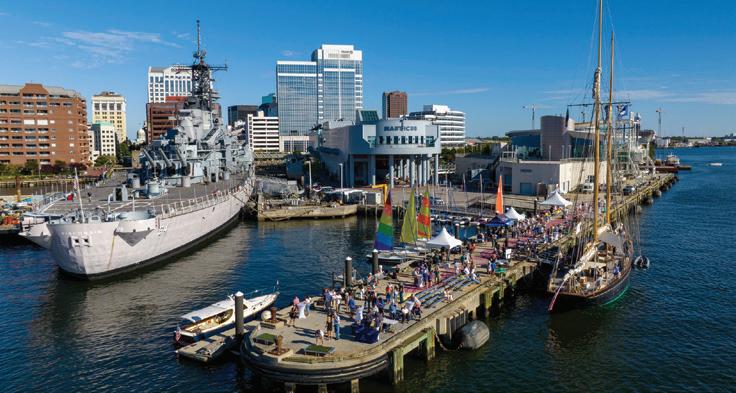

Nauticus, home of the battleship USS Wisconsin, we’ll enjoy a front-row seat to the Norfolk Naval Base eet of destroyers, aircraft carriers, submarines, and other vessels while taking in the sights of the harbor. After the cruise, enjoy self-guided tours of USS Wisconsin, one of the largest and last battleships ever built by the US Navy, the Nauticus science and technology center, and Norfolk’s beautiful downtown waterfront. Registration for Friday’s cruise, lunch and visit to the museum and battleship is $60.
On Sunday morning, 16 April, join us for a USS Monitor Center lab tour in the Batten Conservation Complex, one of the most advanced conservation labs of any maritime museum in the world, where you’ll learn about current projects the sta is working on and see conservation in action. Weather permitting, add some outdoor adventure to your day with a self-guided short stroll or long hike around all or part of the award-winning Noland Trail that surrounds Mariners’ Lake. e cost for the Sunday Monitor Center lab tour is $15; the Mariners’ Park and Noland Trail is free and open to the public daily from 6 am to 7 pm


NMHS Chair CAPT James A. Noone, USN (Ret.), and Program Chair Walter R. Brown encourage all NMHS members to join us. For more information and to register, please see the magazine wrapper, visit us at www.seahistory.org/annualmeeting2023, or contact Heather Purvis via email at administrator@seahistory.org or by phone at (914) 737-7878 Ext. 0. Single and full dayregistration options are available, as are sponsorship opportunities. If you can join us as a Donor, Sponsor or Underwriter, we would be most grateful.
NMHS has taken a block of rooms from 13–15 April at the Newport News Marriott at City Center at 740 Town Center Drive for $179/night, plus taxes, including complimentary parking. To make your hotel reservation, call (866) 329-1758 and use the group code “National Maritime Historical Society.” e rate is available until 19 March, or until the reserved block is full.
8 SEA HISTORY 182, SPRING 2023
(l–r) Nauticus and battleship USS Wisconsin; a team of researchers raises the turret of USS Monitor out of the ocean on 5 August 2002. e turret is currently undergoing conservation at e Mariners’ Museum.
noaa nauticus
Help keep history alive!
Since our founding in 1963, the National Maritime Historical Society has striven to tell the stories, great and small, near and far, that make up the broad panorama of our maritime history. Over the last six decades, hundreds of thousands of readers have discovered in the pages of Sea History magazine a treasure-trove of stories that captivate, connect and enlighten us all about the vital role of our seas, rivers, lakes and bays.
Ensure our maritime history is not lost.

It is more important than ever to bring the lessons of our maritime heritage to young people tomorrow’s maritime leaders. Now you can create a legacy for the next generation of sea service men and women, underwater archaeologists and ocean conservationists, maritime librarians and museum curators, shipwrights and preservationists, marine artists and musicians, ocean racers and tugboat captains, history teachers and writers. Making a legacy gift to the Society is a deeply personal and transformative way to support our lifelong work, helping us to prepare for the future while bolstering the work we do now for our maritime heritage.
Including the National Maritime Historical Society in your will or living trust is one of the most effective ways to provide for the Society’s future while retaining assets during your lifetime. No matter the size of your gift, you’ll be playing an important role in preserving our shared maritime heritage and inspiring future generations. Please email plannedgiving@seahistory.org, or call us at (914) 737-7878 Ext. 0 for more information.
Have you already made a legacy gift?
We hope you will notify us when you have included us in your future planning so that we may thank you and welcome you as a new member of our NMHS Legacy Society.
SEA HISTORY 182, SPRING 2023 9
Each one of us can make a difference. Together, we make change.
— Senator Barbara Mikulski, 2015 NMHS Distinguished Service Award recipient
Conning Tower, USS Dorado by Georges Schreiber, from the Naval History and Heritage Command collection.
NMHS Legacy Society
YOU’RE INVITED
2023 National Maritime Awards Dinner
e National Press Club • 9 May • Washington, DC
NMHS will ll the National Press Club this spring with its spirited gathering for the 12th National Maritime Awards Dinner taking place on 9 May 2023.
Dinner Chair Samuel F. Byers, along with Founding Dinner Chair Philip J. Webster and NMHS Chair CAPT James A Noone, USN (Ret ), invites you to join us for our annual gala in Washington, DC, as we celebrate three driving forces in the maritime community and their outstanding contributions to our maritime heritage.
Gary Jobson, America’s ambassador of sailing, is the evening’s emcee. An introductory lm by Richardo Lopes, award-winning documentarian and NMHS Vice Chair, will impart the stories of our distinguished honorees. e US Coast Guard Academy Chorale will perform, and the Combined Sea Services Color Guard will present.
In addition, the NMHS Washington Invitational Art Gallery, hosted by acclaimed marine artist Patrick O’Brien, will feature a selection of marine art for sale (preview on pages 16–19). We look forward to welcoming you to this special evening as we pay tribute to our outstanding honorees and meet with members of our exceptional community while we salute our country’s maritime heritage.

Join us! Please contact us to reserve your place. Seating is limited. Visit our website at www.seahistory.org/ washington2023 for more information or to make your reservations. Or call 914 737-7878, extension 0.
Tickets start at $400. Attire is business/cocktail.
Hotel Block: NMHS has reserved a block of rooms at the Hilton Garden Inn at 815 14th Street NW, two blocks from the National Press Club, from 8–10 May at $309 per night (plus applicable taxes). is rate is available until April 17th or until sold out. Visit www.seahistory.org/ washington2023 to make your hotel reservation.
10 SEA HISTORY 182, SPRING 2023
On the Waterfront: Washington DC in 1899, by Patrick O’Brien.
Congressman Joseph D. Courtney

e Honorable Joseph D. Courtney will receive the Society’s 2023 NMHS Distinguished Service Award in recognition of his continued success and longtime support of the US Navy and the US Coast Guard, securing crucial investments in some of our greatest sources of national strength: service members, innovation and technology, and our allies and partners. We recognize Representative Courtney’s steadfast e orts to deliver funding for US Navy submarine procurement, most recently as part of the National Defense Authorization Act of 2023 and the FY 2023 Consolidated Appropriations Act. As Chairman of the House Seapower and Projection Forces Subcommittee, he championed funding for the production of two Virginia-class attack submarines per year with the Electric Boat division of General Dynamics, as well as Columbia-class ballistic missile submarines. In reversing years of decline at the shipyard, he earned the nickname “Two Sub Joe” for the Virginiaclass subs or, as Mohegan tribal leaders have dubbed him, “Two Iron Fish.” We also salute Congressman Courtney’s work with the Connecticut congressional delegation in obtaining funding for the future National Coast Guard Museum, where Americans will have the opportunity to immerse themselves in Coast Guard life and history through interactive exhibits and galleries designed to celebrate, engage, and inspire.
Oyster Recovery Partnership

Oyster Recovery Partnership (ORP) will receive the 2023 NMHS Marine Conservation Award in recognition of its commitment to the health of the Chesapeake Bay through the successful restoration of oyster populations. A single adult oyster can lter more than 50 gallons of water a day, and over the past 29 years, ORP has planted a staggering 10 billion oysters. e newly established NMHS Marine Conservation Award acknowledges the exemplary work of those who act as stewards of the oceans, seas, and waterways, including e orts to protect, enhance, and restore ecosystems, promote the sustainable management of marine resources, safeguard and improve the well-being of the communities that depend on these resources, and increase public awareness about the importance of protecting marine environments. ORP, with its broad coalition of partners, works to improve the health of the Bay through aquaculture, shell recycling, community awareness, and support of oyster farming and commercial sheries to improve the environment and expand economic opportunities in the Chesapeake region. ORP joins previous NMHS maritime environmentalist award winners David Rockefeller Jr. and Sailors for the Sea, Chesapeake Bay Foundation, Conservation International, and the National Geographic Society.
USS Constitution Museum

e USS Constitution Museum will receive the 2023 Walter Cronkite Award for Excellence in Maritime Education, presented in recognition of outstanding educational programs that foster greater awareness of our maritime heritage. is year the museum embarks on its 51st year as the educational voice of USS Constitution, the oldest commissioned warship a oat. In honoring the museum and recognizing its president, Anne Grimes Rand, who has expertly guided the organization for over three decades, the Society also celebrates the 225th anniversary of Constitution’ s maiden voyage in 1798 and applauds her newest captain and rst female commanding o cer, CDR Billie J. Farrell, USN. Since 1972 the USS Constitution Museum has interpreted the ship’s remarkable history, collecting, preserving, and curating the artifacts that tell the history of this storied frigate—America’s o cial Ship of State. NMHS recognizes the museum’s contributions to scholarship, its innovative work appealing to a global audience, and its presentation of the stories of our maritime heritage.

SEA HISTORY 182, SPRING 2023 11
US HOUSE OFFICE OF PHOTOGRAPHY
Joseph David Courtney has been instrumental to the sea services community as the US representative for Connecticut’s 2nd congressional district since 2007.
In 2022, Oyster Recovery Partnership planted 950 million oysters and passed the milestone of planting 10 billion oysters over its threedecade history.
OYSTER RECOVERY PARTNERSHIP US NAVY
USS Constitution, the oldest commissioned ship in the United States Navy, sets sail in Boston Harbor in 2014. She is berthed at the Charlestown Navy Yard, across the pier from the USS Constitution Museum.
NMHS Presents the 2023 Maritime Art Gallery
John Paul
at
Head by Patrick O’Brien, 24 x 36 inches, oil on canvas $16,000 John Paul Jones was a complicated man. Hard-charging and brave to the point of recklessness, he was also argumentative and known for his quick temper. When he wasn’t at sea fghting epic battles, he was ashore fghting for his reputation. During the American Revolution, Jones brought the fght to the enemy’s shores. The British considered him a pirate, but to the French, he was a dashing heartthrob. To Americans, he was a hero of liberty. Cruising off the coast of England in the French-built frigate Bonhomme Richard, Jones encountered the British ship Serapis off Flamborough Head. In a long and intense battle, his ship was so damaged that the French captain called to Jones to ask him if he wanted to surrender. It was during this engagement that Jones is said to have shouted his response that would live evermore in US naval lore—“I have not yet begun to fght!” He did go on to win the battle, although his ship was so badly damaged that he had to abandon it and transfer to the British ship. After the war, Jones found himself a warrior without a war. He signed up with Russia and became an admiral in their fght with the Turks. During this period he became entangled in a sex scandal, and a few years later he died suddenly of a kidney problem in a hotel room in Paris. He was 45 years old. PO’B
The National Maritime Historical Society is excited to host the 2023 Maritime Art Gallery at the National Maritime Awards Dinner at the National Press Club in Washington, DC, on 9 May 2023. Under the leadership of acclaimed marine artist Patrick O’Brien and in conjunction with the American Society of Marine Artists, a select group of today’s top marine artists has been invited to participate. New works by Patrick O’Brien, Lana Ballot, Marc Castelli, Laura Cooper, Roger Dale Brown, William R. Davis, Donald Demers, Lisa Egeli, Bill Farnsworth, Nicolas Fox, Palden Hamilton, Kathleen Hudson, Neal Hughes, Michael Karas, Russ Kramer, Richard Loud, Leonard Mizerek, Ed Parker, Sergio Roffo, and William P. Stork are featured in this year’s exhibition.

We hope you will join us at the National Press Club on 9 May for the Society’s gala, where you will have an opportunity to meet some of the artists and view their works; however, you need not attend to participate. Paintings purchased in advance will be displayed as “Sold” at the event. Contact Wendy Paggiotta via email at vicepresident@seahistory.org, or call 914-737-7878, ext. 557 to complete your purchase.
Through the generosity of the artists, 25% of all proceeds will beneft NMHS and is tax-deductible to the buyer. Shipping is included. After the event, the exhibition will continue through the end of May at the Annapolis Marine Art Gallery. (110 Dock Street, Annapolis, MD; www.annapolismarineart.com)
12 SEA HISTORY 182, SPRING 2023
Jones
the Battle of Flamborough
all images courtesy of the artists
Pictured is a downwind leg from one of the races during the Kennedy Cup Regatta held on the waters of the Chesapeake in October. I was a guest on a coach’s boat to follow the races. Each one of the Navy 44s is crewed by a team from a different college. Doing so equips each team with exactly the same sail inventory, the same hull, and the same rigging. — MC

Seeing a schooner foating by in the soft warm evening light creates such a majestic moment. The scene exudes a sense of calm as the schooner silently catches the breeze along the coast. I was inspired to capture this tranquil moment when the effects of atmospheric light refect on the sails and play on the water and sky. —LM

SEA HISTORY 182, SPRING 2023 13
Bringing the Wind/USNA Kennedy Cup 2016 by Marc Castelli, 22 x 30 inches, watercolor on paper, $6,850
courtesy of the carla massoni gallery, chestertown , maryland
Twilight Return by Leonard Mizerek, 12 x 24 inches, oil on linen panel, $3,200
USS United States on Patrol by Patrick O’Brien, 16 x 20 inches, oil on panel, $4,000
USS United States was launched in Philadelphia in 1797, one of the original six frigates commissioned by the new Congress to create a new navy for the fedgling United States. She carried 44 guns with a complement of more than 400 men. During the War of 1812, the United States won an important duel with the British frigate Macedonian, thus demonstrating that the upstart American Navy could stand up to the greatest naval power in the world. —PO’B
To view these and additional paintings for sale in this year’s gallery, visit www.seahistory.org/artgallery2023/.

Merlin, 1892, Goelet Cup, Newport, Rhode Island, by Laura Cooper, 15 x 23 inches, oil on canvas, $7,800

Merlin was a schooner yacht built in 1889. Owned by W. H. Forbes and homeported in Boston, she won the Goelet Cup in 1892, which was a competition between the New York Yacht Club and the Eastern Yacht Club. —LC
Light Show, by Bill Farnsworth, 14 x 18 inches, oil on linen, $3,600
This painting was done from a plein air study while I was in New Hope, Alabama. Painting boats tied to a dock can be a challenge due to pilings and adjacent boats often obscuring the subject. Fortunately, my boat’s neighbor was gone, so I had a chance to get the entire boat with wonderful light. —BF

14 SEA HISTORY 182, SPRING 2023
Celebratingover40yearsof America'sfnestcontemporary marineart.
Joinusforthepremiereofour 19th NationalExhibitionandthe 4th NationalMarineArt Conferencethiscoming SeptemberinAlbany,NY

THE AMERICAN SOCIETYOF
MARINEARTISTS
Painting:WilliamG.Muller, A.J.McAllisterRescuingThyraTorm,1961,oil,24x38(detail) AmericanSocietyofMarineArtists.com
H ISTORIC SHIPS ON A L EE SHORE: Schooners on the Move
“Oh! How she scoons!”
Or something like that. So goes the legend around the coining of the term “schooner,” which was rst built and identi ed as such in Gloucester, Massachusetts, in 1713, although there are plenty of works of art from Europe from earlier eras that depict fore-and-aft two-masted vessels. In this installment of Historic Ships on a Lee Shore, we take a look at three historic ships and, happily, we can report that all of them are OFF a lee shore!
In less than a four-month period this fall, three schooners built in 1885, 1894, and 1921, respectively, were on the move after many years of on-again-o -again e orts to restore them. First was the re-launching of the 1894 schooner Ernestina-Morrissey from Bristol Marine Shipyard in Boothbay, Maine. It then took a couple of months to get her rigged and her sea trials completed, and prep for her triumphant return to New Bedford, Massachusetts, (by way of Massachusetts Maritime Academy) in late November. e o cial vessel of the Commonwealth of Massachusetts, ErnestinaMorrissey had not been in home waters since she was towed to Maine in 2015 for a total rebuild. Next came the launch of the 1885 schooner yacht Coronet, which had not been in the water since she was hauled and enclosed in a shed along the Newport, Rhode Island, waterfront, at the International Yacht Restoration School (IYRS). at was in 2004! Finally, in December, the 1921 Essexbuilt shing schooner L. A. Dunton, part of the eet of historic ships at Mystic Seaport Museum, was hauled out for a long-awaited full restoration right next to her berth at the museum.


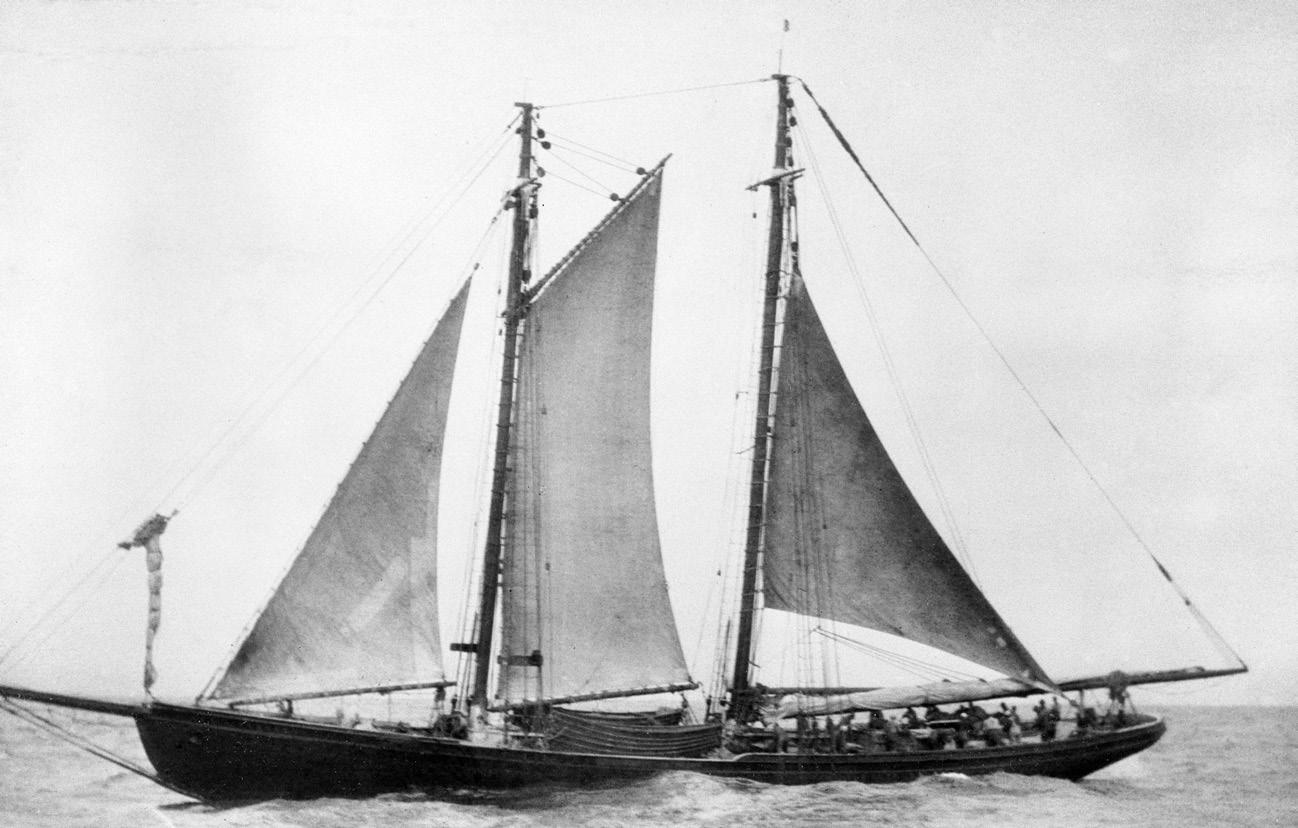
ese three vessels represent the wide range of uses for a well-built schooner: from a Gilded Age exquisite yacht built to sail across the world’s oceans, to the tough life of a Grand Banks shing schooner, to a vessel adapted to explore the Arctic and later carry emigrants across the Atlantic to New England. We are thrilled to report that they are having new life breathed into them. In the not-too-distant future, the crews of Coronet and Ernestina-Morrissey will be setting sails and getting underway for distant ports. Will the Dunton sail again? “Mystic Seaport has a long tradition of restoring vessels and then taking them to sea,” says Shannon McKenzie, the museum’s vice president of museum operations.
Let’s take a look at each vessel’s current status.
16 SEA HISTORY 182, SPRING 2023
L. A. Dunton, 1921
Coronet, 1885
schooner ernestina morrissey association
Ernestina-Morrissey, 1894
by Deirdre O’Regan
nathaniel l stebbins collection , historic new england mystic seaport museum
Schooner Yacht Coronet
Arthur Curtiss James was a phenomenally wealthy yachtsman, who by 1898 had logged in more than 45,000 miles at sea in Coronet sailing from Newport, Rhode Island, to Japan and back—all before the opening of the Panama Canal. James sailed not as a mere passenger, but as a self-described Corinthian sailor; he commanded his own vessels and sailed them across the world’s oceans. Coronet was considered the nest and fastest oceangoing yacht at that time.
Coronet was launched in 1885 in Brooklyn, New York, for oil tycoon Rufus T. Bush. e 131-foot schooner was designed for speed, style, and comfort. She could set 8,000 square feet of canvas aloft; down below she was tted with mahogany-paneled staterooms, a marble staircase, stained-glass doors, a cloisonné chandelier, a tiled stove for heat, and a piano in her main saloon. After her rst transAtlantic, Bush o ered $10,000 to any competitor who could beat his new schooner across the Atlantic. Caldwell Colt, owner of the 1866 schooner Dauntless and a fellow New York Yacht Club member, stepped up, and in March 1887 the two schooners left Sandy Hook Light astern and headed out into the Atlantic, bound for Queenstown (now Cobh), Ireland. Coronet beat Dauntless by 30 hours, making the run in 14 days, 19 hours, 3 minutes, and 14 seconds. e race got a lot of press at the time, even making the front page of the New York Times. Bush would next take Coronet around the world.
Coronet would go on to greater fame after Arthur Curtiss James became the owner. James wrote in his foreword to the book Corona and Coronet by Mabel
Loomis Todd:
Yachtsmen have been criticized, and in some cases justly, for using their magni cent eet of vessels as mere toys. What an assistance they might be in advancing our knowledge of geography, if their pleasure trips could be turned to some practical account! ... I cannot refrain from urging yachtsmen in general, and those taking ocean trips in particular, to cooperate with the Hydrographic O ce in adding to our knowledge of ocean currents, winds, and other phenomena of the sea.
To this point, he was quite dedicated, and one of his rst major voyages in Coronet was to sail from Newport to Japan in 1896, hosting and funding the Amherst [College] Eclipse Expedition that sought to observe a total solar eclipse.
Coronet would go on to have several owners over her long sailing career, but her long-distance voyages came to a close around World War I. In the 1980s the late marine artist John Mecray stumbled upon her, laid up in Gloucester, Massachusetts; despite the degraded appearance of her hull from outboard, her interior décor was in good condition. Mecray later co-founded the International Yacht Restoration School (IYRS) along with Elizabeth Meyer, and with her encouragement and support, Coronet was eventually brought to Newport to become the de ning project of the school, which welcomed its rst class in 1995.


SEA HISTORY 182, SPRING 2023 17
Coronet on the day of her re-launch, waiting for the barge crane to get into position.
Stern view of Coronet not long after her arrival at IYRS in 1995.
photo by daniel forster
photo by stephen lirakis
e vessel’s interior furniture, paneling, and xtures were removed and fully documented before going into storage. In 2004, IYRS hauled the hull and placed her in a cradle on the waterfront right outside the school, and the work has progressed in ts and starts since then. In 2006, ownership of Coronet transferred to Coronet Restoration Partners (a partnership between Je rey Rutherford of Rutherford Boat Works and venture capitalist and classic-boat restorer Robert McNeil). e pair had already successfully restored the classic steam yacht Cangarda and understood what they were getting into. Coronet stayed at IYRS and work continued on the hull, done by a combination of IYRS students, alumni, volunteers, and Rutherford and McNeil. In recent years, Coronet was given less and less attention, and when McNeil died from cancer in 2021, IYRS began looking for new owners for the yacht, who could nish the restoration properly.

Mystic Seaport Museum, with an active shipyard well-versed in restoring historic vessels, was one of their rst calls. Mystic’s leadership could not take on ownership of a project of this magnitude in addition to work on their own eet of historic vessels, but referred IYRS to brothers Alex and Miles Pincus, who have restored two other historic schooners at the museum shipyard to convert into restaurant venues in New York City. e team at the museum shipyard holds the Pincuses in high regard, as they have the interest, experience, and means to do the job. e decision was not an easy one, nor one made in haste, but the Pincuses are on board. Once the papers were signed, the Pincuses began working with Mystic Seaport’s team, led by Chris Gasiorek, the museum’s vice president for Watercraft Preservation and Programs, to orchestrate getting the hull from the dock outside IYRS in downtown Newport to the museum campus. Luckily, the hull’s restoration was at the stage where she could be oated and towed to Mystic, a distance of about 35 nautical miles.
After 18 years out of the water,

18 SEA HISTORY 182, SPRING 2023
(above)
Coronet is airborne as a huge barge crane lifts her from her cradle outside IYRS.
(below) Coronet comes in view of the museum as she is towed past the Mystic River Bascule Bridge on 5 December 2022.
photo by deirdre o ’regan mystic seaport museum
On a cold afternoon on 2 December, a crowd had gathered along the Newport waterfront to watch a 1,000-ton barge crane slowly lift Coronet o her cradle and place her in the water. A few days later, after her hull planking had swelled enough for the trip to Mystic, she was towed by Charlie Mitchell in his tug Jaguar to the museum campus, arriving to further fanfare.
From here, the shipyard crew, in collaboration with the Pincus brothers, will complete Coronet’ s restoration over the next couple of years. e big question many people are asking is if the Pincuses will turn Coronet into a restaurant, like the other vessels they have restored. e brothers assure us that Coronet will be returned to her former glory and operated as a sailing yacht. e
long-term plan? “ e plan is to make a plan,” said Alex Pincus. eir rst goal is to re-create the 1887 transAtlantic race and take some time to enjoy the schooner the way she was meant to be— as a sailing yacht. In the meantime, while Coronet is at Mystic Seaport, the work in the shipyard will take place in full view of museum visitors, as it did for other big ship restoration projects, such as the Charles W. Morgan and May ower II.
(To learn more about Alex and Miles Pincus and their maritime projects and restaurants, visit www.crewny.com. International Yacht Restoration School of Technology and Trades: www.iyrs.edu . Mystic Seaport Museum: www.mysticseaport.org.)
Schooner Ernestina-Morrissey
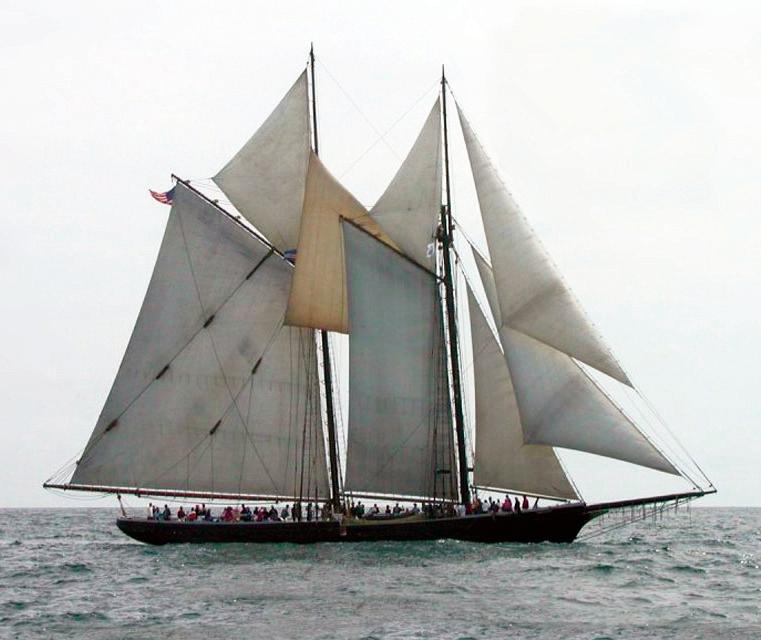
Launched in 1894 as the E e M. Morrissey and later renamed Ernestina, today the Essex-built schooner goes by ErnestinaMorrissey, and in her 129th year, she isn’t done yet.

She’s been called the “Cape Verdean May ower.” Arctic explorer Captain Bob Bartlett used to call the 156-foot schooner his “little Morrissey.” She’s shed the Grand Banks, sailed to the Arctic from both the Atlantic and the Paci c, conducted survey work for the US Navy in World War II, carried cargo and immigrants to the US from the Cape Verde islands, and taken
hundreds of people to sea on sail training voyages. Today, she is back at her homeport in New Bedford, Massachusetts, after a seven-year absence, during which time her hull has been completely rebuilt in a Maine shipyard. is wasn’t her rst restoration—she’s had several over the course of her long life. She’s been sailed hard and pushed her way through ice oes, run aground, been dismasted, caught on re and scuttled, been raised and repaired. But a wooden ship is never “done,” and in the early 2000s, she fell into disrepair;
SEA HISTORY 182, SPRING 2023 19
photo by aidan andrews inset photo nps gov habs / haer / hals
(inset) Schooner Ernestina (now Ernestina-Morrissey) under full sail before her recent rebuild. (above) Under power in the Cape Cod Canal, heading for her berth at Massachusetts Maritime Academy in Buzzards Bay, Massachusetts, on 18 November 2022.
budget cuts prevented the necessary maintenance. In 2005, Coast Guard inspectors identi ed serious degradation of her stem, stern, and transom and pulled the ship’s Certi cate of Inspection (COI). Without it, the vessel could not take people o the dock and thus could generate no income. A crisis was at hand. It took some years, during which time the Commonwealth commissioned surveys, consulted experts, and sought out philanthropists to help with funding. With a lot of e ort and a little luck, a public-private partnership came together with substantial contributions from two gentlemen who learned about the schooner’s story and agreed she had to be saved. Robert Hildreth and the late Gerry Lenfest stepped up, to the tune of several million dollars. e Massachusetts government rea rmed its role as owner and steward, and the ship was sent to Maine for a total restoration. While she was there, a new management plan was conceived and put in place by which the ship will be managed and operated by Massachusetts Maritime Academy (MMA) to train its cadets, with the agreement that she will also spend 25% of her time in New Bedford, her decades-long homeport, where she has a dedicated following. In addition to training MMA cadets, future programming will involve youth programs and public daysails. Plans are still coming together.
Ernestina-Morrissey’s captain, Ti any Krihwan, hosts Prime Minister José Ulisses Correia e Silva, Republic of Cabo Verde, onboard the schooner on 17 December 2022. Correia e Silva traveled to New Bedford to participate in the o cial homecoming event.

and politicians of every stripe participating to applaud the achievement and pledge their support.
e schooner Ernestina-Morrissey was nally relaunched on 30 August 2022 and returned to New Bedford under her own power (but no sails yet) with a new captain in command and a full crew of professional mariners. On 17 December, a grand homecoming event took place in New Bedford, with dignitaries
What’s next?
e schooner is currently at her berth in New Bedford over the winter months. She still has to pass her Coast Guard inspection and other work needs to be completed. In March, she will get underway (with just crew until she has her COI in hand) and head to the Gulf Coast to participate in the Tall Ships Challenge series, organized by Tall Ships America. After that she will return to New England waters in June and July. Check the MMA website for updates: www.maritime.edu/ eet/ernestina. Tall Ships Challenge information is at: www.tallshipsamerica. org/tall-ships-challenge/.
Schooner L. A. Dunton
On20 December 2022, the schooner L. A. Dunton, a National Historic Landmark, was hauled by crane (similar setup to Coronet’s launch) at her home at Mystic Seaport Museum to undergo a full, multi-year restoration. Like her older sister ErnestinaMorrissey, the 101-year-old L. A. Dunton was built in Essex, the tiny Massachusetts hamlet that built and launched more than 4,000 schooners in its heyday. e Dunton shed the Grand Banks for cod at a time when dory shing from sailing vessels was on the way out. Her builders were not unaware of this trend, however, and although she was originally built to operate under sail power alone, she was constructed with a shaft log and engine bed to accommodate the addition of a diesel engine later.
e 123-foot wooden schooner was designed by omas F. McManus, a sh merchant turned naval architect, who designed
L. A. Dunton with all sail set, ca. 1920s.

20 SEA HISTORY 182, SPRING 2023
massachusetts maritime academy
nps gov
500 schooners with an eye for performance and safety, a characteristic Grand Banks schooners were not especially known for. Speed, yes; safety—not so much. She was named for a well-known Boothbay sailmaker, and in her rst year of shing she landed 197,000 pounds of fresh halibut, 68,000 pounds of salt cod, and 3,000 pounds of fresh cod. A 100HP Fairbanks, Morse and Co. C-O engine was installed in 1923, among other modi cations.
e Dunton’s shing career lasted until 1960, when new owners started using her to haul cargo, mainly between ports in Nova Scotia and Newfoundland. In 1963 she was sold to the Marine Historical Association of Mystic, which would become Mystic Seaport Museum. e museum did not then have its own shipyard, so the 42-year-old schooner was sent to a commercial shipyard in nearby New London, Connecticut, where her stern was rebuilt
and the whaleback house that had been added during her shing career was removed. ose who restore historic vessels have to make hard choices as to what era in a vessel’s history and con guration it should be returned to. In the Dunton’ s case, the team at Mystic Seaport chose the years 1922–23, the period in the ship’s history before she was equipped with an engine.
Mystic Seaport established the Henry B. duPont Preservation Shipyard in 1972 and the Dunton was hauled at the museum campus for the rst time in 1975. Since she became a museum ship, her engine has been removed, her stern has been restored to the correct appearance, her deck beams, deck planking, and frames have been replaced, and the topsides have been replanked, but the vessel has never undergone a full restoration until now. With the shipyard crowded with vessels from the museum eet and visiting ships there for repairs and restoration work, the museum built a new concrete pad upon which to place the schooner for this restoration period on the north end of the shipyard. Today, visitors can view the ship out of the water while work is being done. ose interested in helping fund the restoration are encouraged to contact the museum advancement department at advancement@mysticseaport.org. (www.mystic seaport.org)
her upcoming restoration work at Mystic Seaport’s Henry B. duPont Preservation Shipyard.


SEA HISTORY 182, SPRING 2023 21
photo by charley seavey
L. A. Dunton being hauled by crane to be placed on the wharf for
mystic seaport museum
All Hands on Deck: Storms, Turmoil, and a Rompin’ Good Sail Aboard the Tall Ship Rose
Iwas blindsided when Tony o ered me a paid crew spot aboard the lofty square rigger, as I had only just met him ten minutes before. I was there because I was broke. Casey, my former captain, told me to go down to the ship at her berth in Newport to ask for some day work. I thought I’d spend my morning cleaning bilges or chipping rust; instead I was presented with an opportunity to sail to California to make a Hollywood movie. Tony was the chief mate of the tall ship Rose, a modern re-creation of an 18th-century British warship. e ship had been purchased earlier that year by 20th Century Fox to star in a new lm directed by the acclaimed Academy Award-winning director Peter Weir, based on the bestselling books by Patrick O’Brian. e movie would be called Master and Commander: Far Side of the World and star Hollywood A-listers Russell Crowe as Jack Aubrey and Paul Bettany as Stephen Maturin. Rose was in Newport, Rhode Island, and our job was to get the ship to San Diego in time to be transformed into “HMS Surprise ” for the lm production, which was set to begin in the summer of 2002.
by Will Sofrin
Truthfully, despite the Hollywood allure, I was not thrilled about the idea of working aboard a tall ship. I had a preconceived plan for becoming a professional sailor that was limited to only working on classic sailing yachts cruising from one luxurious destination to the next. I had just returned from a summer in the Mediterranean, where I worked onboard the 12-meter yacht Onawa for the America’s Cup Jubilee, followed by the Prada Classic Yacht Challenge. A recent graduate of the International Yacht Restoration School (now IYRS School of Technology and Trades), I had convinced myself that my newly acquired skills, along with my experience aboard Onawa, would be a guaranteed ticket to success. Reality set in when I got back from the Med, and it only took a few days for me to realize that landing a crew position on a yacht headed for the Caribbean in late October was going to be next to impossible, as all those jobs had been lled earlier in the fall and those vessels had already left for the winter.
I didn’t know much about squareriggers, other than having attended a few tall ship festivals as a kid. Rose was a full-
rigged ship, built in 1969 by Smith & Rhuland Shipyard in Lunenburg, Nova Scotia, commissioned by John Millar for the 1776 Bicentennial celebration for $300,000 (roughly $2.4 million in 2022). Millar hired naval architect Philip Bolger to develop a set of plans for a modern recreation of the 1757 HMS Rose but designed to meet nancing and modern safety requirements. e 20th-century version of Rose was 179 feet long (LOA), with a 30.5foot beam, and the top of her tallest mast towering 130 feet above the water.
Millar’s vision for the ship was never fully realized, and after the Bicentennial celebrations concluded, Rose fell into disrepair because the cost of maintaining her outweighed her ability to generate revenue. In 1984, Kaye Williams purchased Rose and relocated her to Bridgeport, Connecticut, where he owned and operated a marina and tourist venue. Williams put together a team that included sailing ship master Captain Richard Bailey to repair the ship and restore her to seagoing condition. Following an extensive re t, Rose was inspected and certi ed by the US Coast Guard, becoming the only Class-A Sailing School Vessel in the United States. Rose went on to serve as an educational platform o ering a variety of sail training programs to the public, until being acquired by 20th Century Fox in the spring of 2001.
I began working as one of the ship’s carpenters at the start of November. To prepare for our voyage from Atlantic to Paci c, Rose was hauled out at a Newport shipyard, where twin Caterpillar 3406 diesel engines were installed in her engine room and the hull was re-caulked below the waterline. We replaced several hull planks and added a section of copper sheathing below the waterline up near the bow. My work was focused on rebuilding

22 SEA HISTORY 182, SPRING 2023
Best-selling author Patrick O’Brian (center) with Rose’s captain, Richard Bailey, onboard the replica ship in New York City in 1995 for a press event to promote e Commodore, the 17th installment of his hugely popular Aubrey-Maturin series.
courtesy the williams family
the mast partners for the foremast and applying the copper plating. We were working long days, hoping to be ready to depart at the beginning of January. As our crew numbers grew, so did the to-do lists. e workdays got longer and the air got colder, but the hard, grimy work helped us learn how to work together as a team. We were a melting pot of personalities, and not everyone got along, but we were all there for a greater cause, which outweighed our di erences. It was universally understood that order had to come rst on our ship if we were to succeed in getting the ship ready for sea and then sailing her on a long-distance voyage in winter.
We departed on ursday, 10 January 2002, with a crew of thirty. We hadn’t had an opportunity to have a shakedown sail, let alone any sail training before we got underway. We would have to learn by doing, but at least half the ship’s company had considerable experience sailing Rose, or other similar traditionally rigged vessels.


SEA HISTORY 182, SPRING 2023 23
tsuneo nakamura / volvox inc / alamy
e replica of the 1757 HMS Rose was purchased in 1984 by Kaye Williams, owner of Captain’s Cove in Bridgeport, Connecticut. He did an extensive rebuild of the ship and was able to secure her Coast Guard certi cation as a sailing school vessel. (below) Rose ying along on a downwind leg.
courtesy the williams family
e ship’s company was broken up into three watches; I was on A-Watch, led by Tony, the mate. As we left Narragansett Bay astern and peeked out into the North Atlantic, we set staysails and conducted safety drills. Afterwards, those not on watch went below to get some rest and get warm.


at rst night was bitter cold, but we tolerated it well enough, knowing that we would be crossing the Gulf Stream and into milder temperatures in about two days. e following day, we set the square sails for the rst time and secured the engines. Despite the promise of warmer weather, we soon found ourselves sailing through a gale. I loved every second of it. Rose powered through the frothy sea under sail like a freight train charging across the tundra.
e next day, the weather had eased but the ship’s engines would not start, as they were hydrolocked. Hydrostatic lock, also known as hydrolock, is when a uid has entered the engine and prevents the pistons from reaching the top of their stroke. As a result, the engine cannot complete its cycle. Our engineer worked feverishly to get the engines back online while the rest of the crew crawled around the ship in rough seas, preparing for another spell of foul weather we were approaching. e day was tense. By the afternoon the engines were running again, but that didn’t seem to ease the mood. I was naïve and not wor-
ried about the approaching front because of how easily we had weathered the gale the day before. Boy was I wrong!
I was assigned to boat-check at 1000. Waves were breaking over the foredeck, so it was deemed too dangerous for anyone to stand anywhere forward of the mainmast on the weather deck. Still, boat-check had to go up to the bow and climb down into the forepeak to make sure the pumps were working. Getting to the forepeak required a strategically timed assault to absorb the occasional waves breaking over the deck. Once on the bow, I lifted the hatch carefully so neither waves nor wind could possibly catch it, either ripping it o or shattering it. A loss of the hatch would create an opportunity for water to ood the interior of the ship from the deck, potentially overwhelming the pumps and sinking the ship. I waited for the perfect moment, lifted the hatch, scurried into the small thirty-by-thirty-inch opening, and closed the hatch behind me.
Now I had a front-row seat to all the violence our ve-hundred-ton ship was charging through. ere was no electricity; the only source of light was my trusty Maglite. e darkness, mixed with the slamming motion of the ship, was compounded by the deafening blows of the
bow hitting never-ending walls of water. Moving as fast as possible, I climbed down the rst ladder, holding on tight because every impact felt like a grenade going o . I waited for the right moment, jumped o the ladder, lifted the small, grated hatch beneath me, and climbed down into the lowest section of the forepeak. is is where things got truly terrifying. I was in the bow of a ship, which was shaped like a bathtub. e rounded bow acted more like a spoon pushing against the force of the water instead of a knife cutting through it. e original HMS Rose would have had canted frames, meaning that the frames were oriented perpendicular to the planking of the hull. e frames in the new Rose, however, were oriented perpendicular to the keel, the centerline of the ship. is orientation put them at an acute angle relative to the planking of the hull. is orientation destabilized the hull up forward, which caused the bow to ex tremendously. As I crouched there in the forepeak, the exing was happening so much that I could see daylight coming through the seams of the planks. Seeing it in person was terrifying; you should never see light through plank seams.
Gallons and gallons of water rushed into the forepeak through the opening seams every time the bow buried into a wave; it was like standing in a car wash. e pumps were running, but this volume of water was almost more than they could handle. If the pumps went down, we went down.
By this point, we were near the outer limits of a region known as the “Graveyard of the Atlantic.” We were more than three hundred miles o shore, beyond reach of any US Coast Guard land-based air rescue, which likely would have been the USCG MH-60 Jayhawk medium-range recovery helicopter. Even if the Jayhawk could have reached us, they would have been able to rescue only six people at a time. Had this approach been feasible and resources available, it would have required multiple helicopters and rescues over an extended period. Situationally dependent, the Search and Rescue (SAR) controller would have sought additional air resources from the Department of Defense (DOD), in-air refueling capabilities, and helicopters that
24 SEA HISTORY 182, SPRING 2023
photo by k blythe daly
Captain Richard Bailey (left) with the author at the helm, enjoying a brief moment of calm seas and warm temperatures in the Gulf Stream.
may have been able to support a scenario that included thirty people. Again, situationally dependent, the Coast Guard also would try to seek assistance from large merchant or military vessels using the Automated Mutual-Assistance Vessel Rescue System (AMVER). Rescue by any smallcraft pleasure vessels would have been ruled out because of the size of our crew.
ere is a long history of boats sinking near the Graveyard of the Atlantic due to the erce weather that can develop. An estimated ve thousand ships have gone down in that region in the past ve hundred years. I personally know of two vessels lost there in the years after my passage on Rose
e rst, in 2007, was a fty-four-foot sailboat named Flying Colours, which was lost at sea. Her last known position was within two hundred miles of where we entered the storm. e captain, Trey Topping, was my friend. He was also Casey’s nephew, and he was a good sailor. He and the other three
souls on board all disappeared. Nobody knows what happened to them. e search and rescue area was 5,440 square miles.
en, in 2012, a similar ship to Rose, the replica of HMS Bounty, sank in Hurricane Sandy. Her last known position was around one hundred miles west of where we entered the storm. Fourteen crew survived after being rescued by the Coast Guard. Deckhand Claudene Christian was recovered but declared dead on arrival, and the ship’s captain, Robin Walbridge, was lost at sea.

Abandoning ship is the very last thing anyone should ever do. Even if the ship starts to sink, you need to stay on board for as long as possible. e ship is your island, and you do everything you can to keep it oating. Nevertheless, we counted and prepared survival suits, lights, life jackets, and life rafts.
Around 1030, the starboard side of the fores’l started to come loose. It didn’t take
more than a few seconds for the sail to begin ailing around like a bedsheet on a clothesline in a tornado. It was evident that if left alone, the sail would shred itself to pieces and possibly cause a dismasting. e wind had eased a bit and was hovering between thirty- ve and fty knots and gusting past sixty knots. We were in between squall lines, which o ered us a brief opportunity to contain the sail before the wind picked back up. e only option was to climb aloft and shimmy out to the end of the yard to wrestle the sail into obedience. For some reason, Tony grabbed me and told me to go aloft with him.
I followed Tony forward to the base of the foremast shrouds. e sail was fty feet up in the air. e waves we were climbing were still topping out at twenty to thirty feet. Falling from where we needed to get to could end up being a drop of seventy to eighty feet. I read somewhere that window cleaners know falling from a
SEA HISTORY 182, SPRING 2023 25
Rose’s blu -shaped bow was ideal in a downwind leg but made things di cult pounding in head seas, putting excessive stress on the hull planking up forward during the height of the storm.
photo by scott hamann
height above ve stories, or fty feet, is fatal. As far as I knew, only one person had ever fallen from the rig of Rose, and it happened at the dock in New York Harbor.
e chief mate, who was on deck, saw it happen and broke her fall by body-checking her into the water before she could hit the deck. She fell from a height of fty feet and cracked some ribs and a wrist but lived.

Before sailing on Rose, any work I performed aloft was always done from a bosun’s chair, which is generally how people go up a mast today. A bosun’s chair is a seat-like harness that is usually suspended from a halyard for the purpose of doing work aloft in the rig. Modern sailors don’t climb aloft to set or strike sail; in fact, most modern boats don’t have any means to climb the rig. at is because free-climbing up a mast in the middle of the ocean in the middle of a storm is a horrible idea....
We began our ascent by climbing out and around to the windward side of the foremast shrouds. I was now outside of the boat, standing over the water on the ratlines. I knew time was precious and moving slowly would only worsen the situation. Using the foremast as a line of sight, I started climbing while keeping my eyes locked forward on the mast to prevent me
from looking down at the frothy waves below. We were not wearing lifejackets, and the likelihood of successfully being rescued from the water after falling from the rig was almost nonexistent.
e thrashing of the ship was causing the shrouds to tighten and slack quickly and randomly. I carefully put one hand over the other as I climbed, making sure to wrap my arms hard around the shrouds when the ship buried itself into a wave.
ose moments made the rig shudder like we were slamming into a brick wall. en the next wave would pick us back up, and we would surge ahead again until we were thrown back into another trough. We were being absolutely pounded.
Experiencing the violence of the storm from the deck was rough, but it was nothing compared to what it was like up in the rigging. e intensity of the wind grew, as did its roar, sounding like an express subway train rushing past a station. I could feel the stinging pellets of rain through my foulweather gear, hitting me harder and harder the higher I climbed. I felt like a target at an air ri e shooting range. On deck, the ship was rolling from one side to the other. From aloft, we were being thrown sixty to eighty feet across the sky from side to side,
every four to ve seconds. e random rolling of the ship was like riding a ftyfoot-tall metronome that couldn’t keep a rhythm.
Climbing up the shrouds was the easy part. Getting out to the sail was dodgier because I needed to take a small leap of faith o the rigging to get onto the yard and then out to the sail. Waiting for the right moment, I lunged onto the footrope while grabbing hold of the yard and began shimmying out toward the end. I was rst out on the yard, a situation I had never been in. Walking along a footrope was like using a long jump rope as a bridge. I held on for dear life, balancing my weight so my movements would be in sync with Tony’s when he climbed on behind me. We were standing on the same footrope, and any movement I made was felt by him. Laying on a yard in this kind of weather was the very de nition of insanity.
We reached the ogging sail, and I tried to grasp the task before me. Seeing the sail ghting to be released up close was far di erent from seeing it from the deck. ere was no time to get comfortable. e wet sail was lling with rapid bursts of air and thrashing ferociously. It terri ed me. My plan was to jump onto the sail as if I
26 SEA HISTORY 182, SPRING 2023
courtesy andrew emmons
Will Sofrin making his way back from the bow after inspecting the forepeak in the height of the storm.
was trying to take control of an angry bull at a rodeo. If I did it wrong, I could fall, taking Tony with me. e jerk felt by Tony from my lanyard trying to stop my fall to the deck would make it near impossible for him to maintain his footing. We had our safety harnesses clipped to the back rope with the lanyard, but our harnesses were called “backbreakers” for a reason.
I looked over my left shoulder to see Tony just a few feet inboard of my position. I shouted at the top of my lungs, “How should I do this?”
Tony shouted back, “You need to punch it while jumping on it and wrapping yourself around it!” en, with a second thought, he added, “Let’s go back in and switch so I can jump and you can follow!” We shu ed back toward the mast and switched places.
Tony headed back out as the lead, and I followed. In a blink, he got that violent and disobedient sail into his arms. I came to take the rear, punching the sail with all my might to knock the wind out of it, and helped him gather and secure the sail, all the while shimmying farther out on the yard. Suddenly we were in control, and it felt great. With no time to celebrate, I started securing the sail so nobody would
have to come back up until we were through this storm. I worked quickly, and Tony told me to get back down to the deck. He didn’t need to tell me twice; the rolling and rocking had gotten worse. I took my time on the descent, bracing myself whenever the bow buried itself into a wave. Tony stayed up a bit longer, making sure everything was good....
We were on only day four of our passage, had traveled only one-tenth of the distance to our destination, and I had already seen more than I could have imagined or planned for. ere was no o switch, no time-out, no opportunity to stop and take a break. at moment forever changed my understanding of how to handle adversity. e only way out was through.
Epilogue: After the storm, we discovered a structural failure in the bow that caused the bowsprit to lose its footing, thus compromising the tension of the rig. In Puerto Rico, we constructed temporary shoring that allowed the rig to be re-tuned. En route to Panama, we su ered a catastrophic rig failure when we were dismasted under full sail in the middle of the Caribbean Sea. anks to the outstanding leadership on

board, we were able to stabilize the rig underway and make it to Panama without further incident. In Panama, we had to break down much of the rig to prepare Rose for the Paci c leg of our journey. One might think it got easier by that point, but challenges continued to plague our voyage as we dodged modern-day pirates and multiple waterspouts on the high seas.
Excerpt from the new book All Hands on Deck: A Modern-Day High Seas Adventure to the Far Side of the World by Will Sofrin published by Abrams Press ©2023. For more about the author and to view a trailer for the book, visit www.willsofrin.com.

SEA HISTORY 182, SPRING 2023 27
O shore sailing, even in adverse conditions, can be glorious—at least from the deck!
photo by rick hicks
C URATOR’S C ORNER : H ISTORIC P HOTOS FROM T H E A RCHIVES
During a tour of the Chesapeake Bay Maritime Museum last spring, Chief Curator Pete Lesher showed us some compelling photos in the museum’s collections storage area. While available to researchers upon request, these photos don’t often see the light of day, so we decided to create a series in Sea History in which curators pick a particularly interesting, revealing, or representative photo from their archives and tell us about it. In this issue we are invited into the archives of the Columbia River Maritime Museum. Enjoy!
Homecoming is exquisite 45-foot motor yacht was built in 1938 at Astoria Marine Construction Company (AMCCo) in Astoria, Oregon. Here she is on the ways at AMCCo, ready for her christening and launch as Marymack (later renamed Merrimac). After 83 years of cruising in the Paci c Northwest under the loving care of several owners, Merrimac had a homecoming back in Astoria in August 2022 (see inset photo).
is ne example of the boatbuilder’s craft started out as a kit boat from Bay City Boat in Michigan, a 2200 Series HeavyDuty Round Bottom Cruiser. When the kit arrived by train to Portland, Oregon, the purchaser, Walter McCrea, asked Joe Dyer of AMCCo to build it. Dyer agreed but stipulated that he be allowed to make whatever changes he saw t. McCrea insisted that he use as much of the kit as possible, acknowledging Dyer’s skill as a designer and boatbuilder. Dyer replaced much of the wood from the kit with locally sourced pressure-treated wood and made changes to the cabin arrangement.
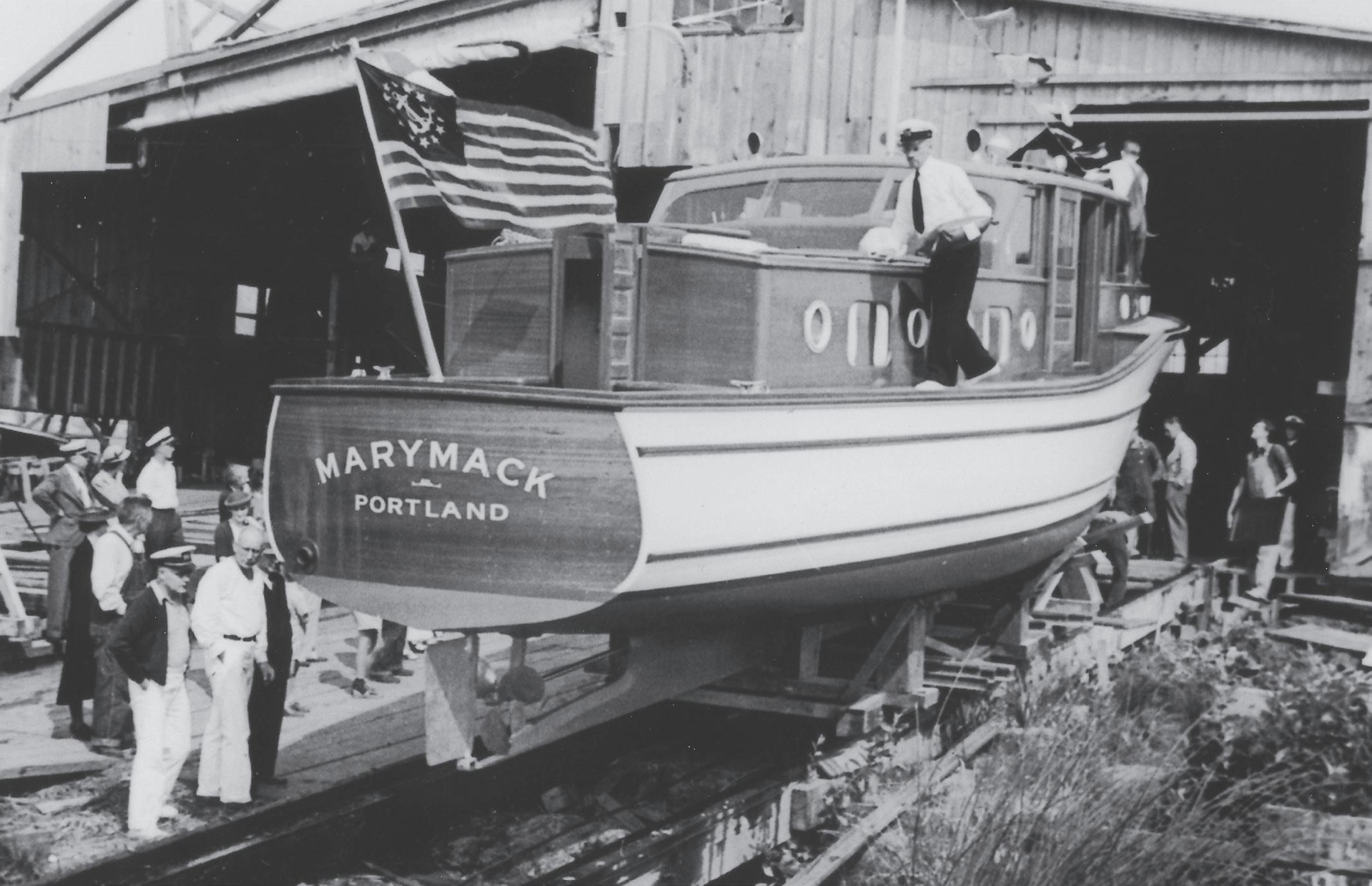
Just four years after its launch, Marymack was pressed into war duty, patrolling o the Oregon coast sporting gray paint and equipped with a 50-caliber machine gun. After World War II, the boat was sold and the new owner removed the gray paint and restored the brightwork to its pre-war beauty. e boat changed

owners (and names) a couple more times, eventually becoming Joe Dyer’s personal yacht in 1953. Dyer added his trademark brow over the recon gured windshield and a ybridge for better visibility and comfortable fair-weather cruising. He also added ironbark all around the bilges to protect the hull from oating debris and ice. Dyer swapped out the original Chrysler Royal Crown engine with a Buda diesel. Changing her name back to Merrimac, he enjoyed cruising local waters for nineteen years. In 1971 another Astorian, Jim Stacy, purchased the boat from Dyer. He owned Merrimac for 23 years, having the boat hauled annually at AMCCo for maintenance. During this time the engine was again replaced, this time with its current power plant—a 450 Cummins V-8.
Merrimac/Marymack had a few more owners in the years since then, each meticulously maintaining and restoring the original richness and luster of the xtures and ttings on the boat, inside and out. Merrimac’ s last owners, John and Karen Fettig of Portland, Oregon, decided it was time to bring the boat back home again and donated the classic yacht to the Columbia River Maritime Museum in Astoria. Merrimac stands as one of the nest examples of Joe Dyer’s craftsmanship and AMCCo’s legacy. e museum is making plans for the display of this ne craft.
Je rey Smith, Curator, Columbia River Maritime Museum (www.crmm.org)
SEA HISTORY 182, SPRING 2023 28
columbia
river maritime museum
Beaufort Naval Armorers
Beaufort Naval Armorers
TRADITIONAL WOODEN SHIP'S WHEELS

Handmade in the U.S.A. by Third Generation Master Craftsman Bob Fuller.
SOUTH SHORE BOATWORKS
SOUTH SHORE BOATWORKS
HALIFAX, MA • 781-248-6446

HANSON, MA • 781-248-6446
www.southshoreboatworks.com
WWW.SOUTHSHOREBOATWORKS.COM

2.25”x
CANNONS
CANNONS

Finely Crafted Marine Grade Working Replicas
Finely Crafted Marine Grade Working Replicas
Morehead City, NC USA 252-726-5470
Morehead City, NC USA 252-726-5470

www.bircherinc.com
www.bircherinc.com

SEA HISTORY 182, SPRING 2023 29
2” South Shore Boatworks #SH149 Revised
S.E.A. and the History of Ocean Plastic Research
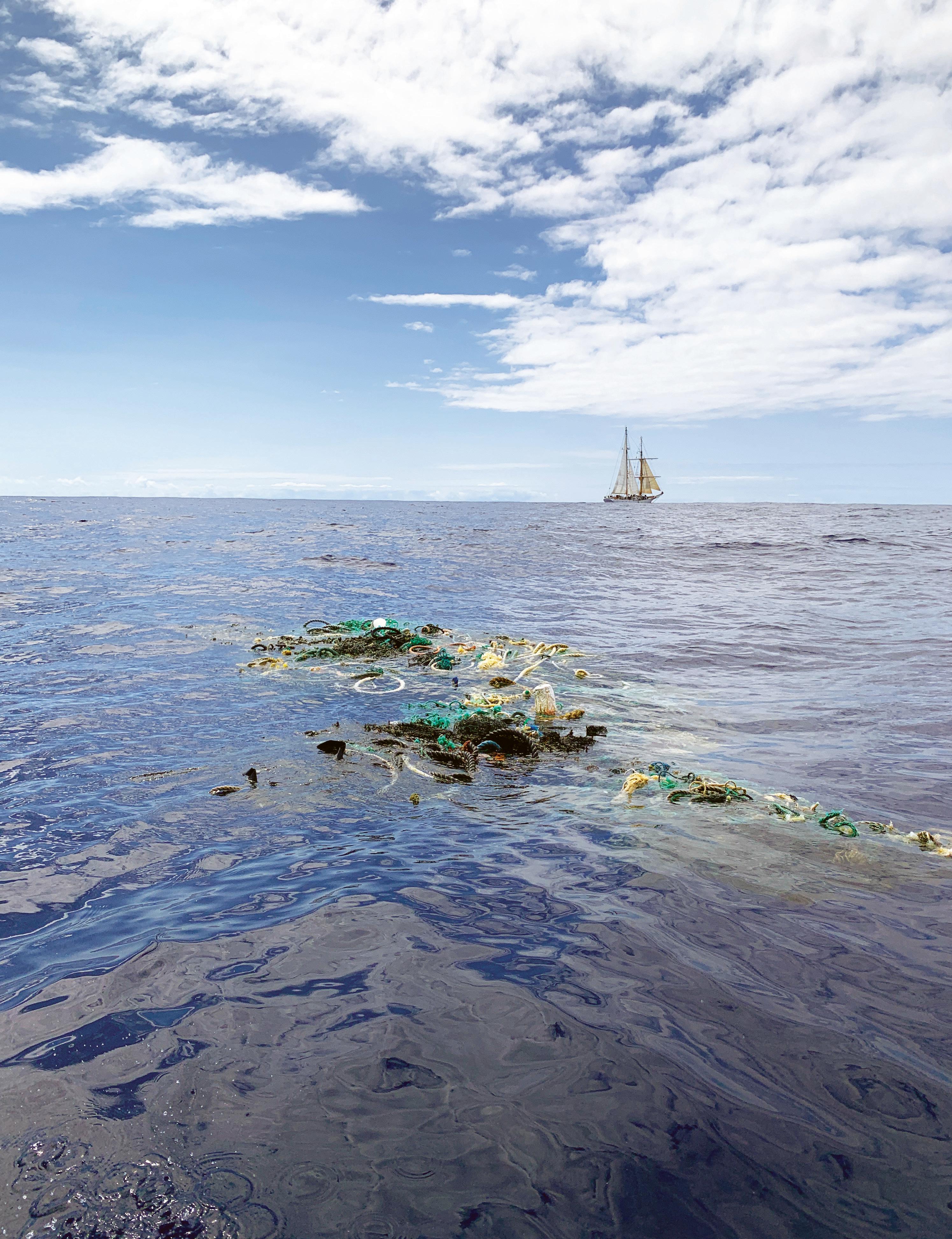 by Chloe Beittel, Ava De Leon, and Isabelle Stewart
courtesy sea education association
With buckets full of biological samples sloshing in the sink and students peering through microscopes while steadying themselves against the rolling waves, the shipboard lab was a busy place. It was the fall semester of 1984, and the sailing research vessel Westward was outward bound for the Sargasso Sea to study the oating Sargassum algae. In the wake of a recent hurricane, the ship and her crew of professional mariners, scientists, and students was o to a rocky start—both literally and guratively.
e expedition team included Tom Batt, an undergraduate history major at Cornell University, who had applied to study at Sea Education Association (SEA) to ful ll a romantic fantasy he had of sailing the open ocean. He characterized him-
self at the time as dreamy and absent-minded, but curious about science. His student project was not going to plan and his frustrations were mounting. Underway, the expedition’s chief scientist, Dr. Jude Wilber, met with Batt in Westward’ s shipboard science lab and suggested he switch gears and study the plastics they kept pulling up in the plankton nets. “We were 2,000 miles out and we were getting plastic in every tow. We were getting more plastic than Sargassum,” Wilber said when looking back on that day.
Under Wilber’s supervision, Batt and his watch group deployed a neuston net and started keeping track of the plastic particles it collected, such as tiny chips of plastic that might have once been part of a ve-gallon bucket or the cap from a plas-
tic bottle. e neuston net samples anything in the ocean’s surface layer, from eel and spiny lobster larvae to Halobates, oceanic water striders, and lots of plastic depending on where the ship is in the ocean. Using nets for ocean plankton sampling has been in common use since the late 1800s, with the rst net speci cally designed to sample the neuston layer of the ocean introduced around 1960.1 Still in use today, the neuston net is a rectangular net with a ne mesh designed to sample organisms and debris larger than ⅓ of a millimeter in size in the upper 25 centimeters of the water column. While RV Westward was moving at a speed of two knots, Batt towed the net at the air-sea interface for 30 minutes, which remains the standard sampling method today, yielding a sample distance of about one nautical mile through the water.
Unbeknownst to him, Batt’s small project was the initial spark that set o the now decades of plastic research at SEA. is semester-long project led to the development of SEA’s standard plastic collection methods, which are still in use today, with a few adaptations. His project found the majority of plastic debris to be plastic lms, small fragments, and shing lines. His early project ndings on ocean plastic found high concentrations of plastic in the northern Sargasso Sea, which remain consistent with the updated research ndings of now more than 35 years of plastic research at SEA.
Sea Education Association and Early Plastic Research

Sea Education Association, based in Woods Hole, Massachusetts, is a seagoing educational institution with a community
(left, top) e neuston net is designed to collect micro-organisms living at the surface and can be towed alongside. Its ne mesh catches whatever is in its path, including micro-plastics. Ocean scientists have been using nets to sample plankton and other organisms in the ocean since 1816. Charles Darwin used one to study plankton in 1832 from the deck of HMS Beagle .

SEA HISTORY 182, SPRING 2023 31
photo by bruce moravchik , noaa courtesy usm and noaa marine debris program
(left) Scientists pick through plastic and debris in Sargassum.
of students, scientists, and professional mariners all dedicated to the exploration, understanding, and stewardship of marine and maritime environments. It was founded in 1971 by Corwith “Cory” Cramer Jr. and Edward “Sandy” MacArthur, teaching their students oceanography, maritime studies, nautical science, and leadership skills aboard the tall ship research vessel Westward, a program following in the wake of the voyages of Irving and Exy Johnson and begun during the wave of environmental conservation that gained momentum
after the rst Earth Day in 1970. Today SEA owns and operates two sailing ships, SSV Corwith Cramer in the Atlantic Ocean and SSV Robert C. Seamans in the Paci c, both of which host high school, college, and gap-year programs.
Seventy years before SEA’s founding, the rst synthetic plastic polymer was invented in the early 1900s by Leo Baekeland. Plastic was originally heralded as a great material alternative to natural sources, such as whale baleen and turtle shell. Man-made plastics had several advantages, too, includ-
ing their light weight, durability, strength, and chemical resistance. Widespread commercial use of plastic didn’t begin, however, until the 1940s when World War II spurred further industrialization and plastic products came into vogue for their ease of use and low cost. ings that were once considered expensive, kitchen utensils and food storage containers, for example, were now cheap and oftentimes disposable, being thrown away without a thought.
As plastic production skyrocketed, the amount of plastic waste being generated grew almost in parallel. Ethylene and propylene, some of the most common monomers used to make plastics, are created from fossil hydrocarbons; they do not biodegrade. Instead, after we toss our garbage, plastics accumulate either in land lls or in the natural environment, where they contaminate terrestrial, freshwater, and marine habitats.2
Early research on ocean plastic pollution began in the 1960s with the publication of the rst scienti c report to nd that seabirds had ingested plastic debris, like bottle caps and miscellaneous pieces. In 1971, the same year SEA was established, scientists from the neighboring Woods Hole Oceanographic Institution (WHOI) found plastic pellets and fragments in samples collected in surface plankton net tows in the western North Atlantic Ocean. Soon after, SEA faculty, shipboard crew, and students began anecdotally reporting small, oating pieces of plastic in the catch of their twice-daily neuston net tows in similar waters.
In 1987, a couple of years after Batt’s project, Dr. Wilber published a paper compiling SEA’s ndings on plastic from over 420 tows and 150 beach surveys between 1984 and 1987. His study found a four-fold increase in the total number of plastics in the Sargasso Sea, compared to early reports fteen years prior from scientists at WHOI. When SEA scientists and students rst started tracking ocean plastics, plastic pellets—the raw industrial material used to form other plastic items—were frequently collected in the neuston net. Additionally,
Life magazine ran a cover article in 1955 celebrating the advantages of single-use plastic products to “cut down household chores.”


32 SEA HISTORY 182, SPRING 2023
photo by peter stackpole , the life picture collection , via shutterstock
tar pollution from oil disposal and spills and tanker accidents at sea was revealing itself to be a critical issue in the ocean environment.

Both tar and plastic accumulate at sea in similar ways due to the circulation of surface ocean currents, and the students and scientists onboard often found them oating in the same places. us, tiny tarballs were also nding their way into the SEA samples along with the plastic particles and debris. Wilber even described frequently nding tar and plastic washed up on the windward side of Caribbean islands sometimes into ‘plasto-tarballs’ that have plastic debris embedded within a core of tar.

Spurred by the increasing frequency of oil spills and growing concerns over ocean pollution, the International Convention for the Prevention of Pollution from Ships (MARPOL) was introduced in
1973. It is the largest international agreement to prevent pollution from ships. It later became the only internationally recognized agreement to address plastic pollution when MARPOL Annex V was introduced in 1988; this prohibits the dumping of any plastic waste anywhere
in the marine environment. Tar is now much less common to nd at sea, largely attributed to the MARPOL 73/78 Annex 1 legislation and the Oil Pollution Act of 1990, both created to respond to multiple tanker accidents, oil spills, and deliberate dumping.
SEA HISTORY 182, SPRING 2023 33
Plastic pieces found in a single neuston tow through the North Paci c Subtropical Gyre from SEA’s research vessel Robert C. Seamans . Identi able sections of rope and large plastic pieces are heavily outnumbered by smaller microplastics less than 5 millimeters in size.
courtesy sea education association photo courtesy david lawrence sea education association
Microplastic pieces are routinely found in a sh’s digestive tract and even within its tissue.
Plastic pollution, however, continues to be an ongoing problem in the oceans. Scientists at SEA categorize microplastics collected in neuston nets as fragments, lines, lms, or foam. Fragments are rm, thick, and irregularly shaped particles; lines are string-like sections likely from shing line or plastic rope; lms are thin exible pieces of plastic such as those used for single-use food wrappers; and foam are oating bits of expanded polystyrene or similar substances. Without major systemic changes to reduce its use and to improve plastic recycling, global plastic production will continue to increase and the resulting problems from plastic pollution in the oceans will be exacerbated. If current production and waste management trends continue as they are, a 2017 study predicted that there will be about 12,000 million tons of plastic waste in land lls or the natural environment by 2050.3
e Rise of Plastics Research at SEA
After Wilber left SEA, the next generation of chief scientists expanded on his and Batt’s legacy. Scientists at sea continued to lead in the twice-daily plankton tows as standard protocol, while numerous scientists on shore at SEA headquarters in Woods Hole dove into the extensive data analysis work necessary to understand the problem of ocean plastic pollution. Dr. Kara Lavender Law arrived at SEA in 2003, and she is currently a research professor of oceanography focusing her work on plastic marine debris. She is a strong advocate for the work being done at SEA, as the plankton tows done each day on every student cruise detect changes and patterns in plastic marine debris over time and across locations. Dr. Law’s work has led to multiple voyages dedicated to sampling plastics, papers published in major scienti c journals, and greater awareness of the threats of marine
plastic debris. Soon after her arrival, a neighboring scientist at WHOI, Dr. Chris Reddy, approached Dr. Law to collaborate and secure funding from the National Science Foundation to publish SEA’s then 22-year data set on plastic accumulation in the Atlantic Ocean.
Most recently, in the summer of 2022, a research team (authoring this article) worked with Dr. Law and SEA scientists Jessica Donohue and Dr. Ben Harden to create a website for the SEA Plastics Lab to broaden its reach to a larger audience beyond the scienti c community. e website includes a quiz to test your plastics knowledge, a compilation of research ndings, and local resources. Another feature, which was still under construction at the time of publication, is the publicly accessible and downloadable data portal. is portal will allow anyone to access and download SEA’s unique ocean plastics database for research purposes, individual exploration, or in classrooms with guided lessons for middle school to university students.
Still Sailing for More Data
During that same summer, as the plastics team was working on its website back on campus in Woods Hole, students aboard SSV Robert C. Seamans were sailing through the Great Paci c Garbage Patch—an extensive region of ocean in the North Paci c Subtropical Gyre where microplastics accumulate. Despite what is sometimes reported, the Great Paci c Garbage Patch isn’t a giant oating island of trash. Its waters are just as blue as the rest of the Paci c, and you would hardly know you were sailing through some of the highest concentrations of plastics in the ocean. Yet the students were astonished by their ndings with a single neuston tow in the middle of the gyre that accumulated more than 700 pieces of microplastic.
Marine plastic debris remains a crucial and high-pro le issue for environmentalists and the general public alike. An advanced
Working in the shipboard lab aboard SEA’s sailing research vessel Robert C. Seamans, student Marilou Maglione picks plastic particles out of a sieve from a neuston net, carefully counting each piece.

34 SEA HISTORY 182, SPRING 2023
courtesy sea education association
degree in the eld of marine science is not necessary to recognize the issue of ocean plastic pollution. Photos of seals entangled in plastic shing nets and seabirds with stomachs full of plastic bottle caps are compelling stories on their own.
Like any complex problem, there’s no easy answer to solve the issue of ocean plastic pollution. Yet, reducing the amount of plastic produced and managing waste so that it does not reach the oceans is a good place to start. Already, over 1,200 marine species have been found to have ingested plastic4 and plastic has been found 10,898 meters deep in the Mariana Trench, the world’s deepest ocean trench5
Dr. Tom Batt, now a professor of humanities and composition at Maine Maritime Academy, nds that his life is still entangled with plastics. Many of his students have concerns about plastics in the ocean, and he urges them to take a leadership role in their respective careers and to discourage environmentally unethical practices.
e work being done on plastic pollution at SEA is far from nished. As you read this article, it’s likely that there are students somewhere on the high seas of the Atlantic and Paci c oceans picking plastic particles from their most recent neuston tow. We each have our role to play in protecting the ocean from the perils of plastic pollution. e shipboard labs aboard SEA’s sailing research vessels today are better equipped and have greater technological capacities than the one Tom Batt worked in, but the problems of plastics polluting the ocean have increased as well. As the scienti c community and others seek solutions to this global crisis, SEA students are doing their part by continuing to study and to address their concerns about the in uence plastic could have on the well-being of our oceans. At SEA, it all started with a botched student research project—conducted by a history major.
Chloe Beittel, Ava De Leon, and Isabelle Stewart are undergraduate students who made up SEA’s Ocean Plastic Pollution Intern team in the summer of 2022. You can access the SEA Plastics Lab website at https:// sea.edu/academics-and-research/sea-plasticslab/.
Launched in 1961 as a private yacht, Westward was re tted to serve as SEA’s rst sailing research vessel in 1971. e schooner was reclassi ed as a Sailing School Vessel in 1986 when the Coast Guard SSV classi cation was rati ed by Congress, due in part to stringent lobbying e orts by the faculty and sta at SEA.

NOTES
1 P. Wiebe, M. Ben eld, J. H. Steele, S. A. orpe, and K. K. Turekian, (2009). “Zooplankton sampling with nets and trawls,” Measurement Techniques, Sensors and Platforms (Elsevier, 2009), 70–86.
2 R. Geyer, J. R. Jambeck, and K. L. Law, “Production, use, and fate of all plastics ever made,” Science Advances 3(7):e1700782, https://doi.org/10.1126/sciadv.1700782, 2017.
3 Geyer et al. 2017.
4 R. G. Santos, G. E. Machovsky-Capuska, and R. Andrades, “Plastic ingestion as an evolutionary trap: Toward a holistic understanding,” Science, 373 (6550), 2021, 56–60. https:// doi.org/10.1126/science.abh0945.
5 S. Chiba, H. Saito, R. Fletcher, T. Yogi, M. Kayo, S. Miyagi, M. Ogido, and K. Fujikura, 2018. “Human footprint in the abyss: 30 Year records of deep-sea plastic debris,” Marine Policy, 96 , 204–212. https://doi.org/10.1016/j. marpol.2018.03.022.
SEA HISTORY 182, SPRING 2023 35
courtesy sea education association
A SHIP, YOUTH, A ND THE SE A Black Pearl’s Role in American Sail Training
 by Nicolas Hardisty
ships america
courtesy tall
Tall ship sailors are known to “collect” sailing ships, seeking out opportunities aboard the vessels that have built a strong history, have a majestic appearance, or have a program and itinerary that draws them in. ere is no shortage of these vessels in the United States, but Black Pearl is a vessel that sailors eagerly rush to claim, noting when and where they sailed aboard her, and who their shipmates were, with a clarity that demonstrates the impact she had on those mariners lucky enough to man her deck and haul on her lines. Particularly from experiences in the late 1950s through the late 1970s, Black Pearl alumni readily recount the welcome they felt from her captain, often uttering “he was like a father to me.” Black Pearl herself became synonymous with the modern American sail training movement, both from her role in the American Sail Training Association’s creation, and her appearance at countless sail training and maritime events in her 71 years.
Black Pearl was designed by Edson Irwin Schock for shipyard owner C. Lincoln Vaughn. Vaughn planned to build the ship at his Perkins & Vaughn shipyard in Wickford, Rhode Island, and sail her around the world, but the outbreak of World War II put this dream on hold. Perkins & Vaughn transitioned from building and servicing yachts to constructing wooden submarine chasers for the American Navy’s Splinter Fleet, many of which were designed by Edson’s father, Edson Burr Schock.
e war’s end left Vaughn with a surplus of lumber, and he soon began building the yacht he long desired. Perkins & Vaughn laid her keel in 1946, and within two years had completed her hull, laying yellow pine over a white oak frame. By 1950, Vaughn had installed Black Pearl’ s Hercules diesel engine and nished her sailing rig. Accounting of her measurements varied, depending on the source, but she is between 51 feet and 54.5 feet on deck, and 79 feet overall, with a 15-foot beam and an 8-foot draft. Schock designed Black Pearl as a hermaphrodite brigantine
in an homage to 18th- and 19th-century trading vessels. Her rig was designed to be sailed by two people—perfect for a retirement cruise around the globe.
Launched on 18 April 1951, Black Pearl was an eye-catching sight on Narragansett Bay, in an era when the region’s iconic lofty sailing ships and Herresho yachts had been rapidly replaced by 12 meter-racing yachts and modern berglass pleasure craft. e brigantine was frequently seen cutting through Narragansett Bay over the following years, and even in the waters o Maine and Long Island. Vaughn’s circumnavigation plans fell apart, however, in 1958, when he had a heart attack, which sent him looking for another steward for his dream vessel. Vaughn found that candidate in Barclay Warburton III.

Warburton could be considered the epitome of high society in the Northeast.
e Warburtons were prominent Philadelphia newspaper magnates, who increased their fortune through banking, trading, politics, and marrying individuals from other prominent families. ey also had an adventurous streak that manifested in auto racing, aviation, yachting, and active military service. e Warburton women did not sit idle; they spearheaded charities that supported natural disaster relief, immigrants, poverty-stricken Philadelphians, and women’s su rage. A testament to the family’s social standing can be seen in Barclay’s mother’s marriage to William Kissam Vanderbilt II in 1927, when Barclay was
just ve years old. Despite his life of privilege, Barclay was equally comfortable dining at Vanderbilt mansions, at home running his Massachusetts dairy farm, or handling sails on long ocean voyages.
Black Pearl was the ideal vessel for Warburton; her clipper bow and square sails recalled the 18th-century ships he was fond of, and her solid construction and ability to safely navigate heavy seas ensured she could voyage to any destination he desired. Warburton’s early years at Black Pearl’ s helm were spent navigating the Atlantic coast from Nova Scotia to the Bahamas. Like Vaughn, he also considered a circumnavigation, but after sailing as far south as Panama, Warburton abandoned those plans and shifted Black Pearl’ s operations towards a new purpose—a sail training vessel.
With the advent of the steam, diesel, and gasoline engines, traditional sailing seamanship was becoming a lost art in the United States by the early 20th century. Generations of seafarers, who spent their lives on the ocean and whose character was often deeply changed by time spent on the water, saw the opportunities for young people to experience sailing aboard windships dwindling and sought to change that. Perhaps the most notable drivers in the early resurgence of American sail training were Irving and Electa “Exy’’ Johnson and Alan Villiers (Villiers was not American, but worked closely with his American colleagues). Like the Johnson duo and Villiers,
37 SEA HISTORY 182, SPRING 2023 courtesy tall
ships america
Barclay Warburton III aboard Black Pearl in yachting attire. Warburton was comfortable in both high society and the at-times gritty world of sail training.
Warburton viewed tall ship sailing experiences as important tools for cultivating critical skills in young people, including self-esteem, self-e cacy, leadership, and teamwork. He also argued that these experiences helped build respect for both American and maritime history and would open the door to the ever-growing maritime workforce.
Black Pearl’ s debut as a formal sail training vessel was with Anthony Drexel Duke’s Boy’s Harbor camp in East Hampton, New York, in 1962. is marked the start of a short stretch during which Black Pearl served in three roles: as a sail training vessel, as an ambassador ship at tall ship and maritime events, and as Barclay Warburton’s private yacht. Her sail training destinations in the early 1960s certainly re ected Warburton’s favorite vacation spots: Nassau in the winter, Nova Scotia in the summers, and New York and Narragansett Bay in the spring and fall.
In 1964, Black Pearl participated in the inaugural Operation Sail (OpSail), an event that refocused Warburton’s attention almost exclusively on sail training. OpSail ’64 was a collaborative e ort, spearheaded largely by Frank Braynard and Nils Hansell, but enthusiastically supported by New York governor, Nelson Rockefeller, and President John F. Kennedy. e event ran alongside the 1964 World’s Fair and proved to be quite a draw for spectators and dignitaries. Warburton immersed himself fully in the experience. As he stood at Black Pearl’ s helm, steering her up the Hudson River alongside the other tall ships, his friend and fellow outdoor education enthusiast— none other than Burl Ives—regaled the crew and passengers with sea shanties. Warburton’s son Barclay IV (known to nearly all as “Tim”) identi ed this event as the moment his father fully committed to sail training and marked Black Pearl’ s transition from a personal yacht to a sail training vessel.
e little brigantine still served as a home to Warburton as needed, and he regularly wintered aboard her in the Caribbean; she can be seen under sail o the Bahamian coast on a clear day in the 1965 lm underball, and Warburton used her to entertain celebrity friends like Sean Connery, Admiral Louis Mountbatten, Gary Moore, and historian Rear Admiral Sam-
uel Eliot Morison, and various members of the Kennedy family. In spring, summer, and autumn, Black Pearl typically sailed in northern waters, working with adolescents from programs like Boy’s Harbor in New York and the Junior Naval Cadets of America in Newport.
Perhaps the most de ning moment in Black Pearl’ s history came in 1972, when Warburton took her across the Atlantic to participate in the International Sail Training Races and join in the parade of sail in Kiel, Germany, during the 1972 Summer Olympics. It was a trip that almost did not happen, as Barclay was contemplating selling his beloved vessel. Instead, he breathed new life into Black Pearl with a major re t in 1971–72, with an eye towards preparing her for ocean voyaging and future sail training endeavors. In July 1972 she departed Nova Scotia with re-caulked decks, weatherproofed hatches, new portlights and ventilator cowls, and a new double-cabin. She also had a major systems overhaul, adding a Chrysler-Nissan 160 HP diesel engine, 4 black iron fuel tanks, new piping throughout, and all new wiring and electronics.
With Barclay III as master, his son Tim as sailing master, two additional ofcers and eight trainees (including Warburton’s younger son, Peter), and a dog named Willie, Black Pearl made the trans-
Atlantic passage in good time and arrived in Cowes alongside USCG Barque Eagle as the only sail training vessels representing the United States. Black Pearl’ s route took her through Cowes, Skagen Odde, Malmö, Travemü nde, Rotterdam, Amsterdam, and Kiel, giving her crew valuable experiences at sea and immersing them in di erent cultures. Importantly, it gave the elder Warburton the opportunity to view the widespread enthusiasm in Europe for maritime training aboard traditionally rigged sailing ships. When the events of that summer concluded, Warburton returned to the United States to establish the American Sail Training Association (referred to as ASTA, now Tall Ships America), leaving Black Pearl in France for the winter, under his son’s care.
In July 1973, Tim Warburton sailed Black Pearl out of Vigo, Spain, on a unique journey to retrace Christopher Columbus’s 1492 transAtlantic crossing, using historian and family friend Samuel Eliot Morison’s Admiral of the Ocean Sea as a guide. Black Pearl was roughly the size of Columbus’ ships, and Tim noted that they rst spotted birds in the same area the famed navigator had recorded and that the gray Atlantic waters transitioned into a vibrant Caribbean blue at the same leg of his voyage that it had for Columbus.
e rst international race of the world’s remaining sail training ships took place in 1956 between the UK and Portugal. e event proved so popular that the organizers formed the Sail Training Association (now Sail Training International) and began running it as a biennial event. Barclay Warburton sailed

38 SEA HISTORY 182, SPRING 2023
Black Pearl to the 1972 races, during which he came up with the idea of organizing a sail training organization back in the US.
courtesy sail training international
By the time Black Pearl arrived back in Newport, the elder Warburton and his colleagues had established ASTA and had hosted the organization’s rst race series in the waters of southern New England. Black Pearl soon became the uno cial agship for the American sail training eet, and throughout the 1970s she could be seen at the various sail training races and gatherings, maritime history and preservation events, and leading the annual Sea Day parades of sail in New York. Black Pearl was occasionally made available for charter in order to nancially support her sail training work.
Shortly before Warburton’s death in 1983, he arranged to donate the ship that de ned the last quarter-century of his life to ASTA, the organization to which he had been devoted since 1972. ASTA was illequipped to manage Black Pearl , as she needed a major re t, so the organization quickly sold her. Within months, the brigantine embarked on a signi cant overhaul by volunteer shipwrights under the expert eye of Jakob Isbrandtsen, whose Ship Trust of New York later operated her out of New York City. Black Pearl was still a mainstay at maritime events throughout the 1980s, including OpSail ’86, New York’s 1986 Liberty Weekend, Harbor Awareness Days, and cultural and maritime festivals.
In 1993, Black Pearl was sold to the Aquaculture Foundation out of Bridgeport, Connecticut, to bolster the foundation’s maritime-themed educational o erings to high school students. e school’s restructured programming now used Black Pearl for marine science, maritime history, and ecology studies, with sail training at its core. Aquaculture Foundation sailed her out of Bridgeport when school was in session (and weather allowed) and spent some summers in Block Island, but still graced major events like Maritimes ’95: Four Centuries of Sail, America’s Sail, and the Special Olympics.
By 1996, Aquaculture was looking to raise $1.5 million for another restoration; Black Pearl appears to have quickly fallen into disrepair. e foundation was able to keep her operational in the coming years but could never quite catch up with her repairs. Facing a $400,000 repair estimate in 2005, the foundation put her up for sale.
e Aquaculture Foundation noted that
Brigantine Black Pearl
during their tenure, more than 2,400 students sailed onboard Black Pearl, learning about marine sciences and maritime heritage, sail training, and developing critical skills such as leadership, self-con dence, and teambuilding.
e brigantine’s history gets murky in her post-Aquaculture years, but in 2006 she was on the hard in Essex, Connecticut, riddled with rot and rust. Her future was indeed looking grim, but in 2009 Captains Amanda and Nicholas Alexander purchased her and began tackling her repairs with the intention of sailing her to a new homeport in Lake Ontario. e Alexanders recruited their friends and spent their weekends over the next ten months getting Black Pearl seaworthy. Black Pearl then followed a meandering route to her Great Lakes home in Lewiston, New York, by way of the Hudson, Mohawk, Oneida, and Oswego Rivers. e Alexanders continued to work on the brigantine in New York State, where the ship survived a 2010 arson attempt that cost her a few sails and some minor onboard equipment.
Black Pearl spent a few years as a charter vessel doing daysails in Lake Ontario. She was certainly an eye-catching sight gliding across the lake’s southern shoreline. For some years now, she has been on the hard in Oak Orchard, New York, with no programming planned and with minimal maintenance work going on.
Black Pearl is often remembered as one of the most recognizable of American sail training ships, despite her stints as a charter vessel and a private yacht, which is surprising in a way, as her modest size signi cantly limited her capacity to take trainees on the water. is perception of her place among other 20th-century American sailing ships can likely be attributed to Black Pearl having had a presence that captivated those who sailed aboard or in sight of her; however, she cemented her legacy as an icon in the American sail training eet with her strong lines and sharp look under sail, her decades-long attendance at major maritime events in North America and Europe, and the engaging personalities of the elder and younger Barclay Warburtons, who welcomed friends and trainees onboard with open arms. e elder Warburton wrote: “Youth and the sea and the ship—a trinity which has brought us so far, which may yet unite us all,” and Black Pearl certainly performed admirably in her part of that trinity.
Nicolas Hardisty is a historian specializing in African American and colonial maritime histories. e program manager and historian at Tall Ships America, he is working on building a digital archive of TSA/ASTA’s 50-year history. Tall Ships America organizes an annual race series: Tall Ships Challenge™. (www.tall shipsamerica.org)

39 SEA HISTORY 182, SPRING 2023
courtesy tall ships america
Maritime Careers
Marine Geochemist Renee Takesue
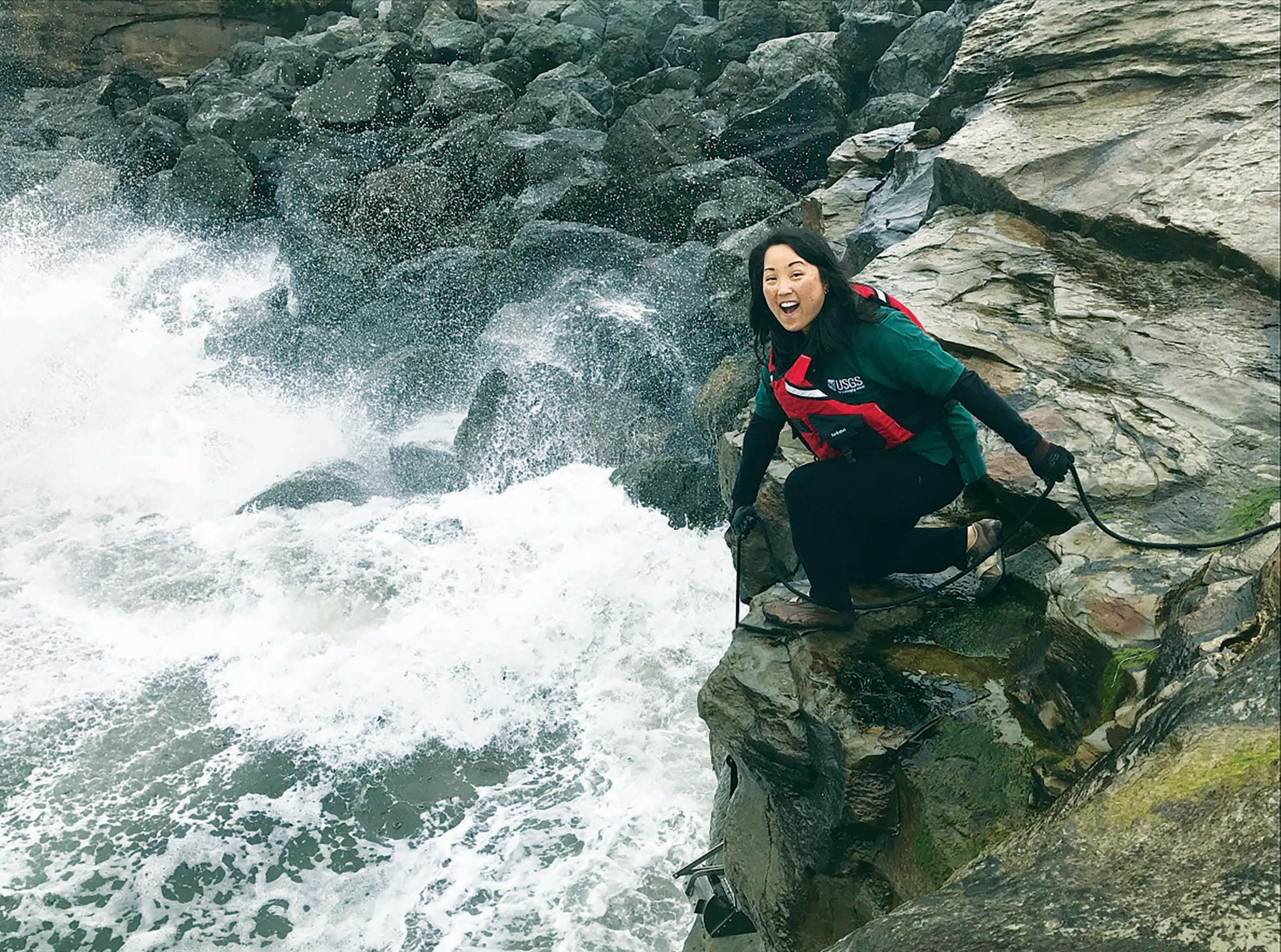
Renee
Takesue is a marine geochemist for the Pacific Coastal and Marine Science Center of the US Geological Survey (USGS). “Geochemistry is a field that combines chemistry and geology. The chemistry of earth materials—such as rocks, soil, and water—can tell us a lot about the environments in which they were formed, or about natural processes and human activities that affect them. Geochemistry also includes chemicals that are added to the environment by humans and can harm ecosystems (contaminants).”
Renee has had a fascination with the ocean since she was very little. She grew up in California near the coast, and she remembers having fun on the weekends exploring tidepools. Summer vacations to visit family in Hawaii furthered her curiosity about the ocean and what lives in it. “We harvested limpets and seaweed and used a throw-net to catch reef fish, which we cooked and ate right on the beach.” After taking a harbor cruise as part of a class in school, she was hooked. The teachers had the kids make plank-
ton nets from pantyhose and baby-food jars and dredge up sea creatures and samples of the bottom. “I had the time of my life and knew then that I wanted to be a marine scientist.”
With this career in mind as she was applying to colleges, Renee selected a university that offered majors in oceanography and geology. In college, she took advantage of every opportunity to get hands-on experience and learn new skills by working in labs or on research projects. This sort of experience was equivalent to an internship in other disciplines and proved especially valuable when she was applying to graduate schools.
Renee explained that to get a job as a researcher in oceanography and other marine science fields, most people need a doctorate (PhD). Advanced studies in marine science “teach you how to identify complex scientific issues and carry out strategies to investigate them.” Renee continued in school until she earned a PhD in chemical oceanography. For those who are interested in the subject, but who might
40
SEA HISTORY for kids
photo by kelly sewell, dept of the interior
Dr. Renee Takesue conducting sediment research for USGS.
not be able to pursue a PhD, she says there are plenty of technical careers in marine geochemistry that only require a bachelor’s or master’s degree. A lot of those jobs involve studying, monitoring, and regulating water quality and other environmental concerns.

Most of her research for the USGS focuses on coastal areas and their watersheds, which is where the majority of

the population on the West Coast lives and where contaminants originate. “Geochemistry is a versatile field. I work in a wide range of environments, from glacier-carved beaches where urban pollutants threaten salmon and orca, to tropical coral reefs where coastal development leads to harmful runoff, to marshes being restored for wildlife but whose below-ground sediment contains potentially toxic metals from historic gold mining. Recently, environmental quality after the California wildfires has become a concern for both wildlife and humans. I characterize contaminants in wildfire materials and potential health risks for coastal communities.”
Renee feels lucky to have a job that is both so interesting to her and so important to the world at large. “I get to work on issues that are national priorities and directly benefit society. The ocean is critical to our well-being, so keeping it clean and allowing natural, self-sustaining flows of sediment and water will benefit society for generations.
This photo is from 2012, where Renee and a colleague are preparing to collect sediment from the seafloor in San Francisco Bay using a clamshell-style bottom sediment sampler. Today, she spends less of her time in the field. “As a mid-career researcher, I spend most of my time in the office planning projects and budgets, analyzing data, writing scientific publications, developing partnerships, and managing USGS staff and labs. Less than 10% of my time is spent collecting new data in the field and doing analyses in the lab. This is very different from early in my career when I spent the majority of my time outside in the field followed up by work in a lab. Now my technicians get to do these fun tasks.”—Renee Takesue, USGS
To learn more about careers with the USGS, visit www.usgs.gov and search for “careers.”
41 images courtesy usgs
Black carbon from wildfires on a beach in Monterey Bay National Marine Sanctuary after the “first flush,” the first big storm of 2021 that washed material out to the coastal ocean.
Animals in Sea History

he French sailor Bernard Moitessier is perhaps best known for sailing alone a full one-anda-half times around the world, nonstop, in the Golden Globe Race of 1968–69. He later published The Long Way, a book about his experience. It is one of the finest sea stories ever composed, a masterpiece in nature writing in which he describes a spellbinding experience with dolphins.

Aboard his boat Joshua (named after the first solo circumnavigator Joshua Slocum), Moitessier was sailing a route that had taken him from England around the Cape of Good Hope, across the Indian Ocean, south of Australia, and was about to enter the South Pacific just below Aotearoa

New Zealand. Among the books that he read underway was Robert Merle’s The Day of the Dolphin (1967), a science fiction novel about marine mammal intelligence and a biologist, based on the real-life figure of John Lily, a researcher who studied water immersion, hallucinogens, and dolphinhuman communication.
As Moitessier and Joshua were nearing Rakiura (Stewart Island), he knew that submerged rocky shoals, called “South Trap,” extended far out beyond the island. Though it was mostly overcast, he managed a sun sight with his sextant and was able to fix his position with some confidence. He continued sailing along with a steady favorable breeze, making sure to give the shoals a
by Richard J. King
wide berth. Once he got past the shoals, he would be eastbound in the Pacific, free from worrying about any more land for thousands of miles.

42
The sky overhead filled in with clouds, but the sea remained relatively calm. The wind held as he sped along, eager to pass this last hazard, when he noticed a rush of more than 100 dolphins approaching, then schooling around his boat. He could hear clearly their “familiar whistlings.” These were likely dusky dolphins (Lagenorhynchus obscurus), who have small snouts, black backs, and white bellies. Dusky dolphins are smaller ocean dolphins, known around Aoteaora as being especially gregarious, vocal with their squeaking and whistling, and they seem to enjoy interacting with boats and people along the coast. Describing these animals near Kaikioura, local whale watch expert
Barbara Todd wrote that “even ‘hardened’ whale watchers…end up being totally captivated by the Duskies.”
But this dolphin behavior was something Moitessier had never seen before in any dolphin anywhere. He wrote: “A tight line of 25 dolphins swimming abreast goes from stern to stem on the starboard side, in three breaths, then the whole group veers right and rushes off at right angles, all the fins cutting the water together and in the same breath taken on the fly.”

Moitessier watched the dusky dolphins repeat this right-turning behavior over and over. He sensed that they seemed agitated, even “nervous.” Normal dolphin behavior would be to swim on both sides of his boat or plunge in his bow wake, especially since he was sailing along so swiftly. In this sighting, among the huge school, a smaller group swam alongside his boat and continued to sharply turn right, to starboard, over and over again. The dolphins repeated this group turn about ten times.
Disoriented by the calm seas and uniform gray sky, Moitessier hadn’t noticed until he checked his compass heading that his boat had turned with the shifting winds by 90 degrees and was steering directly for the rocky reef of South Trap! He quickly altered course, following the dolphins, after which the school stopped


43
,
/ nmfs / ost / amd
Dusky Dolphins leaping off the coast of New Zealand, near Kaikioura. dr mridula srinivasan
noaa
turning but continued to swim alongside. The entire school stuck around, mostly on the starboard side of his boat. Then one of them leaped out of the water three times, spinning in the air—a behavior common to dusky dolphins and a few other species. Moitessier could not help but interpret this to mean that the dolphin was celebrating his understanding of their warning to alter course to starboard, away from the reef. Al-
though he was tempted to steer back toward the shoals to see what would happen, he wrote that he was afraid to ask for too much, to probe his fairy tale too hard: “I can’t risk spoiling what they have already given me.” The dusky dolphins, it seems, had saved him from an impending shipwreck.
The dolphins continued traveling beside him, at times looking up at him, and kept playing around Joshua for


about two hours—longer than he had ever been surrounded by dolphins in all his years at sea. Even when the main group left, two dolphins stayed with him, one on each side of the bow. “Two fairies in the waning light,” they swam alongside for another three or so hours, until after he had cleared the South Trap and entered the safety of the wide open South Pacific.

“Sea History for Kids” is sponsored by the Henry L. & Grace Doherty Charitable Foundation 44
For more Animals in Sea History see www.seahistory.org or educators.mysticseaport.org. If you enjoy this feature, be sure to look out this May for the release of Ocean Bestiary: Meeting Marine Life from Abalone to Orca to Zooplankton, a revised collection of over fifteen years of this column!
ppl media ltd
Bernard Moitessier sailing in his boat Joshua during the 1968–69 Golden Globe Race.
Sail Training Aboard the U.S. Brig Niagara


Join us for a two-week voyage through the history of the Great Lakes onboard the U.S. Brig Niagara. High school, college, and adult programs are available May through September, 2023, for ages 14 and up. Come aboard and make lifelong friends while cultivating an experience, skill set, and resumé people will be sure to notice.

Call, email, or visit our website today for more information on how you can sign up. Space is limited, and allocated on a frst-come, frstserved basis. $2,000 tuition includes lodging and all meals onboard Niagara, instruction, program materials, and admissions. College credit is available through partnering institutions on some programs. These programs are presented by the Flagship Niagara League on behalf of the Erie Maritime Museum, one of 23 historic sites and museums administered by the Pennsylvania Historical & Museum Commission.
Flagship Niagara League

150 East Front St. Suite 100 • Erie, PA 16507 • 833-FNL-SAIL ext 3 • marineops@sailfnl.org • www.SailFNL.org
The
is a 501 (C) 3, non-proft
to facilitate citizen
Flagship Niagara League
educational associate organization of the Pennsylvania Historical & Museum Commission (PHMC), chartered
participation and operation of the U.S. Brig Niagara and its homeport, Erie Maritime Museum.
Embark and Disembark in Erie, PA
Beyond the Light Identity and Place in 19th-Century Danish Art
 by Freyda Spira, Stephanie Schrader, and omas Lederballe
Geographer
by Freyda Spira, Stephanie Schrader, and omas Lederballe
Geographer
Danes’ relationship with the sea is, and always has been, part of their national identity. Artists from what has been called the Danish Golden Age in the early 19th century created works of art that evoked pride in the nation’s history and in its physical beauty— much of it tied to the sea and the coast. At the turn of the century, however, the Napoleonic Wars hit Denmark hard and shifted not only its borders but how its citizens identi ed as a nation. e bombardment of Copenhagen (1801 and 1807), bankruptcy, and mounting antagonism
with Germany were just some of devastating blows su ered by Denmark during these con icts. e sociopolitical and economic tumult gave rise to a vibrant cultural and philosophical environment for contemporary Danish artists, who forged a close-knit community during this time. Amidst the turbulence of war and its aftermath, they produced works of art that tell a story of changing attitudes and cultural identity, and feelings of belonging and displacement—all themes that resonate in many parts of the world today. Beyond the Light: Identity and Place in NineteenthCentury Danish Art, an exhibition on now
at the Metropolitan Museum of Art in New York (through 16 April and then at the Getty Museum in Los Angeles, 2 May–20 August) o ers a nuanced, personal history of this challenging time through drawings, paintings, and oil sketches by Danish artists working at home and abroad. e exhibition features approximately 100 works and highlights such artists as Christo er Wilhelm Eckersberg, Christen Købke, Constantin Hansen, Martinus Rørbye, and Vilhelm Hammershøi, as well as lesser-known gures like Anton Melbye, Johan omas Lundbye, Peter Christian Skovgaard, and Heinrich Gustav Ferdinand Holm, among others. Many within this group were mentored by Eckersberg, a highly in uential academician and, later, director of the Royal Danish Academy of Fine Arts. Eckersberg was particularly interested in naval architecture. In his diary, he noted that he borrowed ship plans from the shipbuilders at the naval dockyard in Copenhagen in order to reproduce ships more accurately in his sketches and paintings, resulting in a vast number of marine paintings and drawings that celebrate the industriousness of Danish shipbuilders, the heroics of the Danish Navy, and more broadly, the sea as a place of adventure.
One of Eckersberg’s most notable protégés was Martinus Rørbye, who would become a central gure in the Danish Golden Age. His paintings evoke the sea and coastline as sites of national security
46 SEA HISTORY 182, SPRING 2023
“It is the sea that makes our native land what it is … from almost any high point [one] can view the sea, and it therefore belongs to a Danish landscape.”
—
Edvard Erslev (1824–92)
Anchors in a Copenhagen Square, (1838) by Christo er Wilhelm Eckersberg (1783–1853).
eckersberg drawings courtesy statens museum for kunst , copenhagen ( kks417 )
Graphite, pen and black ink, brush and gray wash, framed with brush and blue watercolor, 7 15⁄ 16 x 7 7⁄ 8 inches.
13 7⁄ 16 x 15 1⁄ 8 inches.
(below) View from the Citadel Ramparts in Copenhagen by Moonlight , (1839)
Oil on canvas, 11 3⁄ 8 x 9 5⁄ 8 inches.
Poised atop Europe between the North and Baltic Seas, Denmark is identi ed as a place where the sun never sets, where the atmospheric conditions produce unique e ects of light. “ e ‘blue hour’ at twilight on a midsummer evening, when the sun barely sets below the horizon, pervades the Nordic sky like a gentle mist.”
and pride, and its mariners and their ships as carriers of history, exploration, and a means of past and future prosperity. In his painting View from the Citadel Ramparts in Copenhagen by Moonlight, he captures a moment of calm at the formidable but battered citadel amid a time of national upheaval. Perched on the edge of the ramparts to Copenhagen’s storied citadel, known as the Kastellet, are two sailors and a soldier. All three men are silhouetted by moonlight, which also illuminates the gentle waves of the harbor that is the focus of the composition. In the water are several kinds of ships: at right, a small local trade boat partly blocked from view by the standing soldier; at left, perhaps a shing boat with its sails out; and in the distance a large naval vessel that may be headed to the Baltic Sea through the Øresund, the narrow strait that separates Denmark from Sweden.

Rørbye’s impulse to train his eye on the sea is not surprising given Denmark’s proximity to water and the key role that water has played in its long history. e modern nation of Denmark is an archipelago comprising hundreds of islands whose straits, ords, bays, and myriad inland waterways de ne the landscape and help foster a sense of national identity.

SEA HISTORY 182, SPRING 2023 47
by Martinus Rørbye (1803–1848).
—Nordic scholar Neil Kent1
(left) Corvette Being Built at Nyholm Naval Base with Spanteloftsbygningen in the Background, (1828) by Christo er Wilhelm Eckersberg. Graphite, pen and black ink, brush and brown wash,
metropolitan
1 Freyda Spira, Stephanie Schrader, omas Lederballe, ed., Beyond the Light: Identity and Place in Nineteenth-Century Danish Art (New York, Metropolitan Museum of Art, 2023), 28.
museum
of
art ,
new
york , gift of eugene v thaw, 2007
smk photo / jakob skouhansen
Johan Christian Dahl approached his art from the same concept of the sea and coast as integral to Danes’ identity. Born in Bergen, Norway (then part of Denmark), in 1788, Dahl studied in Copenhagen at

the Royal Academy beginning in 1811 and remained in Denmark, even after Norway was ceded to Sweden. “A landscape,” noted Dahl, “must not only show a particular country or region, it must have the charac-
The Trippe Gallery
teristic of the country and its nature, it must speak to the sensitive beholder in a poetic way—It must, so to speak, tell about the country’s nature.”
During this period, Denmark went from being one of the oldest absolute monarchies with a thousand-year history to a constitutional democracy. E orts to restore the nation’s psyche led to a rise in nationalism and, with it, an increased interest in Danish history, customs, culture, and language. is exhibition explores the art of this period as Danish artists navigated a rapidly changing world.
Beyond the Light is organized by guest curator Freyda Spira (former associate curator in the Department of Drawings and Prints at e MET and current Robert L. Solley Curator of Prints and Drawings at Yale University Art Gallery), in collaboration with Stephanie Schrader (Curator of Drawings, J. Paul Getty Museum), and omas Lederballe (Chief Curator, SMK – e National Gallery of Denmark). More details about the exhibition are at www.metmuseum.org.
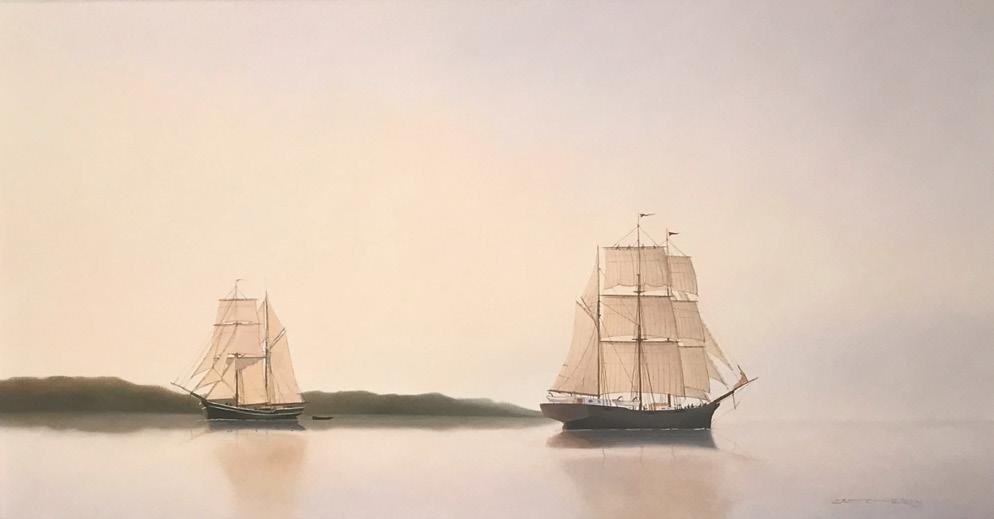
48 SEA HISTORY 182, SPRING 2023
Photographs ~ Paintings ~ Sculpture 23 N Harrison Street ~ Easton, Maryland 410-310-8727 tripphilder@icloud.com
metropolitan museum of art new york gift of christen sveas in celebration of the museum ’ s 150th anniversary 2019
Copenhagen Harbor by Moonlight, 1846 by Johan Christian Dahl (1788–1857). Oil on canvas, 37 3⁄ 4 x 60 5⁄ 8 inches.


SEA HISTORY 182, SPRING 2023 49
e Maine lake steamer Katahdin will be undergoing the rst major restoration project in 25 years. Begun in November, the project will include replacing the boat’s decking and green rail and repairing the hull, sea chest, and propeller. After precise laser measurements are taken, the upper decking will be constructed o -site and installed in the spring. e restoration work, expected to take 2 to 3 years, will take place in the o seasons at the shipyard in Boothbay Harbor. Katahdin —hull No. 63—was built at Bath Iron Works in 1914. She was transported in sections by train and then hauled overland by oxen for assembly in Greenville, Maine; she went into service the following year. e “Kate” is 102 feet long with a beam of 28 feet and a draft of 3 feet 9 inches. She carried passengers and freight on Moosehead Lake until automobiles edged out commercial boat transportation. Her nal run as a passenger steamer was on 11 September 1938, a special farewell excursion carrying 300 people. She was sold in 1940 to the Hollingsworth and Whitney Paper Company (later sold to Scott Paper) and converted to a towboat for hauling pulpwood booms; her promenade area coverings were removed and her power was converted from steam to diesel. Katahdin served in this capacity until 1976. By this point she had deteriorated signi cantly. A local group formed a non-pro t organization with the intention of pulling her from the water and establishing her as a static exhibit. ey were per-
Maine’s Lake Steamer Katahdin


suaded to keep her in the water, however, and she returned to cruising as an excursion vessel in 1986, stewarded by the newly formed Moosehead Marine Museum. Said to be the oldest Bath Iron Works-built boat still in use, the Katahdin was placed on the National Register of Historic Places in 1979. In addition to excursion trips, the Katahdin is used as a oating classroom for science- and history-based cruises each fall. More than 250 students from throughout Piscataquis County participate in classes
to learn about the heritage of their community, watersheds, invasive lake species, and marine ecosystems. (Katahdin Cruises and Moosehead Marine Museum, 12 Lily Bay Road, Greenville, ME; www.katahdincruises.com) … Record-low water levels in Utah’s Great Salt Lake have revealed the remains of a ship believed to be the W. E. Marsh No. 4 . Named for a Southern Paci c construction engineer, the Marsh was introduced to the lake in 1902 to assist in building the Lucin Cuto , a railroad line that would incorporate a twelve-mile trestle bridge across the lake. As part of the Southern Paci c Railroad eet, the 40-foot-long wooden gas-powered launch carried workers to and from the site during the construction period and later conducted maintenance. In 1935 she was chartered to carry out dredging on the lake in search of the wreckage of a downed small passenger plane. She was subsequently donated to the Sea Scouts for youth programming on the water and was referred to as the “Bonneville.” Later her name was changed o cially to Bonnie Mooseheart. According to Great Salt Lake State Park & Marina manager David Shearer, the last

50 SEA HISTORY 182, SPRING 2023
Remains of what is believed to be the wreck of W. E. Marsh No. 4 in Great Salt Lake.
katahdin cruises and moosehead marine museum
great salt lake state park and marina
documentation that the park has found of the vessel is a report on her participation in a search and rescue e ort in 1950. e wreck site was rst discovered by a state park crew using side-scan sonar to search for a sailboat’s lost keel in 2014. e Utah Division of State Parks notes that the site of the 40-foot vessel is now a popular stop on guided hikes with park rangers: “ is is just one of the interesting items that brings visitors to the Great Salt Lake, and Great Salt Lake State Park. It is a great conversation starter with visitors to get them interested in the history of the lake and its continued importance in our lives,” reports GSLP program manager Devan Chavez. (www.stateparks.utah.gov/parks/ great-salt-lake/discover/) … In December, the historic ocean liner Queen Mary was opened to the public for the rst time since March 2020. A limited series of free guided tours was o ered to the public, beginning on 15 December. e reservation-only guided tours included the


SEA HISTORY 182, SPRING 2023 51
Queen Mary in Long Beach, California.
photo by don ramey logan , courtesy port of long beach
Promenade Deck and Promenade Shops, Observation Bar, Queen Salon, and Royal Salon, as well as a video highlighting the work recently performed on the ship. “ e Queen Mary has been an icon of our Long Beach shoreline for 55 years,” said First District Councilwoman Mary Zendejas. “We remain dedicated in our e orts to preserve the ship’s history and structural safety. I look forward to welcoming the community back on board!” Over the past year, critical repairs to the ship have been carried out, including the removal of 20 deteriorated lifeboats that were exerting stress on the ship’s side shell, improvements to the bulkheads to ensure internal structural stability, and the initial stages of installation of an automated bilge pump system. Still in the works are the installation of an emergency generator and new boilers and heat exchangers. While the structural and critical repairs are being carried out, other projects such as painting, lighting upgrades, and ooring and railing refurbishments will be carried out. “ ese preservation e orts showcase the signi cant
progress we’ve made to ensure the Queen Mary remains a community staple and renowned international attraction for generations to come,” said Department of Economic Development Director Bo Martinez. e veteran Cunard liner was built
Sail Aboard the Liberty Ship John W. B ro W n


Check our Website for 2023 Cruise Dates
On a cruise you can tour museum spaces, bridge, crew quarters, & much more. Visit the engine room to view the 140-ton triple-expansion steam engine as it powers the ship though the water.
Reservations: 410-558-0164, or www.ssjohnwbrown.org
Last day to order tickets is 14 days before the cruise; conditions and penalties apply to cancellations.
in 1934 at the Clydebank John Brown & Co. shipyard; she served as a troop transport during World War II. Retired in 1967, she has been a hospitality venue and Long Beach xture. (www.queenmary.com) …
e United Indians of All Tribes Foundation (UIATF) held a ceremony on 6 January to bless the construction of the Canoe Carving House on the shore of Seattle’s Lake Union. e 1,200-squarefoot Canoe Carving House will accommodate the carving, storage, and launching of traditional canoes, as well as visitor education about the local Native traditions related to the craft. For thousands of years, the Coast Salish people were stewards of the land and water, with the waterways the highways that connected them. is led to a vibrant and extensive canoe culture for the rst peoples of this land. e Coast Salish-speaking peoples have lived in what is present-day western Washington and southwestern British Columbia for more than 10,000 years. eir geographic territory includes the lands bordering the Salish Sea—Puget Sound, the San Juan Islands, Gulf Islands, the Strait of Juan de Fuca, the Strait of Georgia—as well as the Paci c coast of Washington and northern Oregon. e UIATF is currently raising funds for Phase II of the project to build a Welcome House adjacent to the Carving House, with a kitchen and event space and educational displays. Construction on the Canoe Carving House is expected to begin

52 SEA HISTORY 182, SPRING 2023
Project Liberty Ship is a Baltimore-based, all volunteer, nonproft organization. SS JOHN W. BROWN is maintained in her WWII confguration. Visitors must be able to climb steps to board.
jones & jones , stephanie bower , architectural illustration
Rendering of the planned Canoe Carving House and park on Lake Union, in Seattle.
later this year and to last into fall of 2024. Founded in 1970, UIATF is a non-pro t organization providing culturally responsive services and programming to the urban Native community of Seattle and King County. (www.unitedindians.org) … e Calvert Marine Museum in Maryland was gifted the historic sailing yacht Witchcraft by its most recent owner, David S. Butler Jr. “Witchcraft represents the beginning of an exciting new chapter
OSWEGO — “oldest US freshwater port” Open daily
Offering dockside tours of vessels May thru October West 1st Street Pier, Oswego, NY www.hlwmm.org 315-342-0480


in our oating watercraft collection,” commented Mark Wilkins, curator of maritime history & CMM boatwright. “She represents the zenith of the traditional yachtbuilders art and was designed to race—so she is fast, stable, and sea-kindly.” e yacht Witchcraft II was built at Boston’s Lawley & Son Boatyard in 1903. She was designed by B. B. Crowninshield, designer of the America’s Cup contender Independence, for his nephew, William Bowditch Rogers, to race on the waters of Lake Champlain. She was originally christened Witchcraft II, most likely named for a clipper ship owned by his grandfather in the previous century. She changed hands several times; in the 1940s new owners Ken and Dorothy Sa er moved her to Baltimore, and she has remained in the Chesapeake Bay area since then. Falling into disrepair, she was rescued by Paul Itzel, who purchased her in 1970 for a bargain price of $1,200 and devoted the next two decades to her restoration. It was Itzel who had the “II” dropped from her o cial name. In 2008 he sold the yacht to David S. Butler Jr., whose father owned the boat in the 1950s and who had fond childhood memories of the watercraft. Under Butler’s ownership, Itzel agreed to take care of and sail Witchcraft ; he died in 2015.

SEA HISTORY 182, SPRING 2023 53
1–5
pm
MARITIME MUSEUM AT OSWEGO H. LEE WHITE
calvert marine museum
(Calvert Marine Museum, 14200 Solomons Island Road, Solomons, Maryland; www. calvertmarinemuseum.com) … e SS United States Conservancy has announced a new digital exhibition to debut in June 2023 and a busy year of special events. e SS United States Conservancy is dedicated to saving, celebrating, and advancing the redevelopment of America’s Flagship and hopes the new e orts will help to ensure that the enduring symbol of American innovation continues to inspire. “Food

Tastes Better at Sea: Dining
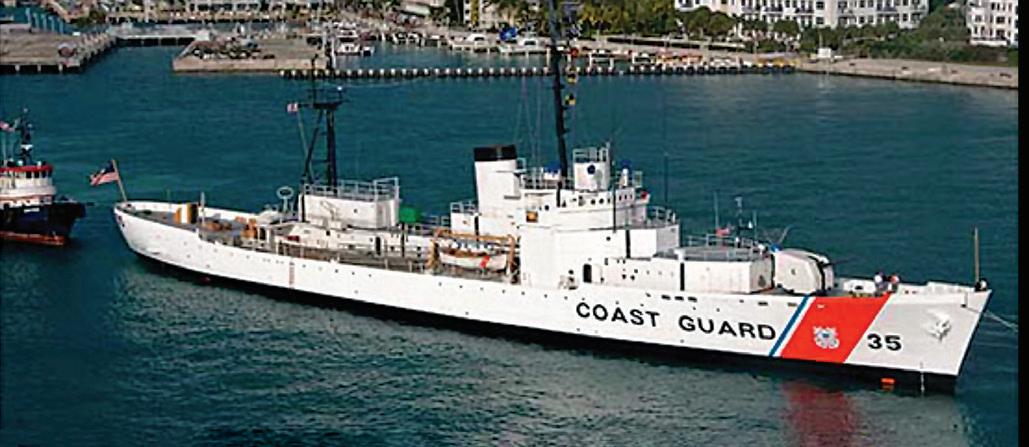
Aboard the SS United States,” a digital exhibition, and related events will draw on the organization’s extensive curatorial collection to highlight aspects of food culture, history, and technology—including di erences in cuisine among the classes. e exhibition will also show how food was part of the growing competition with the airline industry and how SS United States utilized new technologies to store and prepare food at sea. e Conservancy continues to work closely with its redevelopment partner, RXR Realty, and a wide range of technical experts to advance the vessel’s

revitalization. e Conservancy is also working on a plan to create a high-quality shipboard museum and visitor experience that will complement a dynamic mixed-use program for the vessel. e “Big U” could be making a big move this year as well. A
dispute with the vessel’s current landlord and the planned redevelopment of the ship’s berth at Pier 82, along with several others along the Philadelphia waterfront, are making it increasingly likely that historic ocean liner will need to relocate for the rst time

54 SEA HISTORY 182, SPRING 2023 ... • • •
P.O. Box 74 Leonia, NJ 07605 201-461-5729 www.modelshipsbyrayguinta.com e-mail: raymondguinta@aol.com Experienced ship model maker who has been commissioned by the National Maritime Historical Society and the USS Intrepid Museum in NYC.
Model Ships by Ray Guinta
SS United States at her berth in Philadelphia .
ss united states conservancy
in over 25 years. As 2023 progresses, the Conservancy will continue exploring alternate locations for the vessel, conducting engineering studies, hiring specialists, and coordinating with government agencies as they pursue all available options to keep SS United States safely a oat. While these concerns are being addressed, the Conservancy is also planning a second creative writing contest; winners will be given a special tour of the ship, which is closed to the general public. A small series of tours of the ship in Philadelphia will be conducted this spring for former passengers and crewmembers. Dates will be announced this spring. Conservancy members at certain donor tiers are also o ered special opportunities to visit the vessel. (Visit the Conservancy’s website, www.ssusc.org , to subscribe to their e-updates and learn more.) … e Graveyard of the Atlantic Museum closed to visitors in December to undergo a complete remodel. anks to a $4.1 million grant from the NC Dept. of Natural and Cultural Resources, $500,000 from Dare County & the Outer Banks Visitors Bureau, and an additional $400,000 from the state of North Carolina, the renovations will enable it to exhibit more artifacts from its collection and feature new exhibits. When the facility reopens in 2023, the new layout will allow the museum to rotate exhibits and displays, refreshing the museum experience for regular visitors and providing for items in its collection to be cycled out of storage and put on display. e Hatteras museum is one of the three museums comprising the North Carolina Maritime Museums— the other two are located in Beaufort and Southport. (59200 Museum Drive, Hatteras, NC; www.graveyardoftheatlantic. com) … Gloucester, Massachusetts, is celebrating its 400th anniversary this year, with programs and events throughout 2023 to highlight the city’s rich history that encompass its ethnic diversities, art and culture, remarkable industrial achievements, natural resources, and, of course, its maritime heritage. Part of the Gloucester400 celebrations includes a stories project. Organizers are seeking a variety of true stories about anyone who lives in Gloucester now or who once lived there, has worked or summered in Gloucester.
Become Part of Maritime History




SEA HISTORY 182, SPRING 2023 55
year, historic lighthouses are offered by the General Services Administration through the National Historic Lighthouse Preservation Act, a federal historic preservation program in
with the US Coast Guard and the National Park Service. For more information on the available 2023 lights: https://disposal.gsa.gov/s/lighthouseprogram Or call at (617) 565-5700 for more information. USS KIDD Open daily on the Mississippi River in Downtown Baton Rouge www.usskidd.com • 225 342 1942 • info@usskidd.com The quarterly magazine devoted to traditional sailing vessels, sailors, and sail training! One year $29 * Two years $48 To subscribe, visit our website, call (978) 594-6510, or send a check to MARLINSPIKE 98 Washington Square #1, Salem MA 01970
Each
cooperation
e story can be about someone else, or about you. Modern-day stories and historical pieces are both welcome. (More information on the stories project and about the 2023 events are online at www.gloucesterma400.org.) … An early winter storm revealed a shipwreck site on Nantucket’s Miacomet Beach that has garnered quite a bit of attention. David Robinson, direc-
tor and chief archaeologist from the Massachusetts Board of Underwater Archeological Resources (BUAR), and BUAR board member Graham McKay were among a group of local maritime experts who gathered on 8 December to assess the site and begin the process of documenting the remains. Identifying which ship it is can be a challenge. According to Robinson,
CLASSIFIED ADS
TUGBOATS AND SHIPYARDS: THE RUSSELLS OF NEW YORK HARBOR, 1844-1962 winner of the Steamship Historical Society’s 2020 C. Bradford Mitchell Award. Hilary Russell recounts the full lives and remarkable accomplishments of the three generations of watermen and the often beautiful, sometimes original, evolving forms of the craft that objecti ed the family’s work. $31—order through AbeBooks, PayPal, or mail a check to: Berkshire Boat Building School, PO Box 578, She eld, MA 01257.
FOR SALE – SIX ORIGINAL STATION BILLS FROM SS UNITED STATES, Signed by Captains L. J. Alexanderson & J. Anderson. Station Bills for every department and crewmember: Fire & Emergency Signal Bells, Man overboard, Abandon Ship, etc. Each document framed in red, matted in white with blue trim, protected by museum conservation glass. Framed size 30.5” x 29”. $12,000 for collection. Call 917 287-8339 or email chrysedawn@gmail.com.
THE AUTHORITY TO SAIL by Commodore Robert Stanley Bates. e fully illustrated authoritative history of US Merchant Marine licenses and documents issued since 1852. Co ee-table size book, 12” x 14.” Order direct: e Parcel Centre, Ph. 860 739-2492; www.theauthoritytosail.com.
PIRATE PLAYING CARDS by Signature ASMA Artist, Don Maitz, National Geographic contributor and originator of the Captain Morgan Spiced Rum character. Full-color playing cards have di erent watercolor images on each face. Prints present searover adventurers. Order from: www.paravia.com/DonMaitz.
OUT-OF-PRINT NAUTICAL BOOKS SEA FEVER BOOKS
ousands of titles. E-mail: seafeverbooks@aol.com; Ph. 860663-1888 (EST); www.seafeverbookstore.com.
KEEPING THE TRADITION ALIVE by Capt. Ray Williamson. e remarkable story of Maine Windjammer Cruises,TM founder of the windjammer industry. 172 page, 11 x 14 hardcover book with over 100 full-page images from the days of cargo to the present. Price–$48. Call 800 736-7981; email sail@mainewindjammercruises.com.
trying to gure this out “was a bit like pulling a thread on a sweater. e more interesting information I looked at, the more that I found.” At this time, the ship remains are thought to be a section of the bow of the Warren Sawyer, a 19th-century coasting schooner that wrecked at that location on 22 December 1884. According to records at the Nantucket Historical
WWII-ERA US NAVY SHIPS’ SOLID BRASS 10 -INCH BEARING CIRCLE IN ITS ORIGINAL WOODEN CASE
Own a piece of authentic American Naval history and support America’s Military & First Responders Museum with your purchase of a brand new bearing circle. Manufactured in 1941, 1942, & 1943, the bearing circle was placed on top of a magnetic compass or gyro repeater and was used to measure compass bearings of terrestrial objects. $150 each—includes shipping in the USA. To order call 614 205-0357 or email davehindsusmc@yahoo.com.
FINE ART PRINTS OF SEA ROVERS & BUCCANEERS by award-winning ASMA Signature artist Don Maitz. Visit: www.paravia.com/DonMaitz.
CUSTOM SHIP MODELS, HALF HULLS. Free Catalog. Spencer White, 4223 Chestnut Dr., Center Valley, PA 18034.
BOMBSHELL by T. F. McGraw. e little-known Civil War tale of a humble New York canal boat, rushed to conversion at New Berne in 1863, into a multi-purpose steam gunboat. Operating on the coastal rivers of North Carolina, Bombshell delivered Army raiders and provided them artillery cover, evacuated Freedmen, and performed many other missions. Succumbing to battle damage in late 1864, Bombshell was stricken from the rolls under her original name, the Oscar F. Burns, e ectively condemning the plucky little ship to obscurity—until now. Paperback, 204 pages, illustrated. $20.00, including shipping and applicable taxes, directly from Indian Creek, PO Box 14663, New Bern, NC 28561.
THE LOST HERO OF CAPE COD by Vincent Miles. e story of an elite mariner, Captain Asa Eldridge, and the nineteenth-century battle for commercial supremacy on the Atlantic. Reviews, availability, at www.vjmiles.com/lost-hero and Amazon.com.
NATIONAL PARKS PLAYING CARDS. Many of America’s National Parks are represented on these cards with interesting facts and images. www.ArcturusLLC.net.
PRESIDENTS PLAYING CARDS. All 46 US presidents are represented on these playing cards with interesting facts and quotes. www.presidentsplayingcards.com.
at advertising@seahistory.org
56 SEA HISTORY 182, SPRING 2023
Sea History magazine classi eds ads: $1.60 per word Contact Wendy Paggiotta
Association, the Warren Sawyer’ s captain and crew were rescued by the crew of the Surfside Lifesaving Station. Islanders salvaged what they could at the time, including the cargo, equipment, and spars before the wreck broke up in the surf. Evan


Since MARAD’s Small Shipyard Grant Program was rst funded in 2008, it has awarded 323 grants totaling approximately $282 million. Grants are available to US shipyards with fewer than 1,200 production employees and are capped at 75 percent of the proposed project’s estimated cost. In July 2022, DOT announced $19.6 million in grant awards to 24 small shipyards in 19 states. Maritime administrator Ann Phillips said, “ ese shipyards are an economic pillar, strengthening our maritime industry and the communities along
and near our nation’s ports and waterways, and employing thousands of Americans, who ensure the nation maintains expertise and skills critical to our economic and national security.” Historically, the program has selected roughly 15 to 30 applications in a given year to receive funding; the average grant amount has been approximately $1 million. (More information on the grant program is online at www.maritime. dot.gov/grants- nances/small-shipyardgrants.)
Schwanfelder of Nantucket’s Egan Maritime Institute is exploring options to collaborate with BUAR on how to create a local version of a shipwreck tagging and archaeological management program (STAMP) to help tag and study the movement of shipwreck components on Nantucket’s beaches. “It’s about nding a process to report these and catalog them as quickly as we can,” Schwanfelder said. Shipwrecks can reveal themselves after heavy weather and can disappear just as quickly, so time is of the essence in documenting them before the next storm covers them up, and the goal is to provide the means for reporting and documenting wreck sites in a timely way. (www.eganmaritime.org; BUAR: www.mass.gov/orgs/ board-of-underwater-archaeological-resources; Nantucket Historical Association: www.nha.org) ... In January, the US Department of Transportation’s Maritime Administration (MARAD) announced the availability of nearly $20 million in federal scal year 2023 funding to help modernize small American shipyards. e grant program is designed to support small shipyard projects that make capital and related improvements or provide training for workers in shipbuilding, ship repair, and associated industries. Supporting these types of projects drives e ciency, competitive operations, and quality ship construction, repair, and recon guration across the industry.
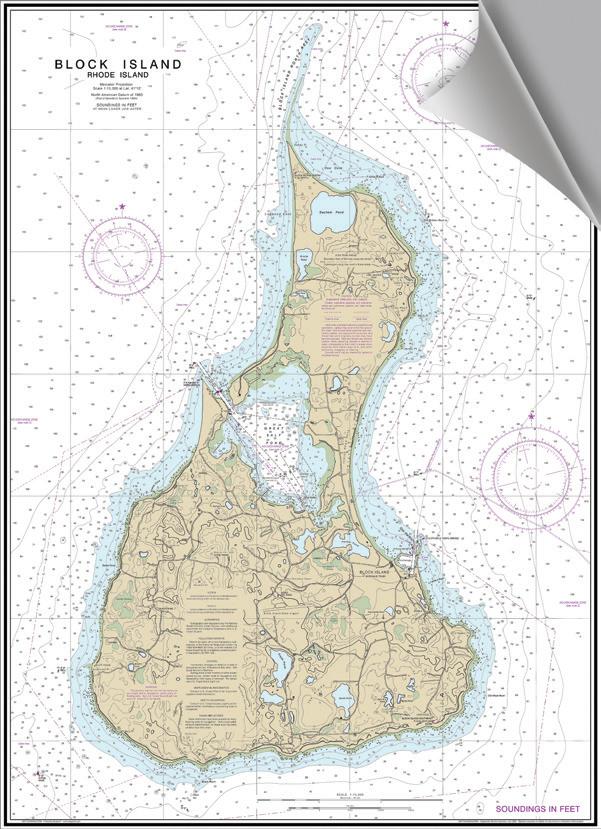

SEA HISTORY 182, SPRING 2023 57 • PEEL & STICK technology • No frame necessary • Printed on self-adhesive matte fabric • Easy to peel off and reapply – does not leave a sticky residue behind • Can be attached to almost all smooth surfaces including walls and windows • Popular harbors, islands and bays • 24 x 34 inches Decorative Nautical Charts offer a unique way to define your space by displaying your favorite boating destination. Just peel the backing off and apply no frame needed! These charts are not intended for navigation and are for decorative purposes only. Low-tack adhesive leaves no residue behind. A great addition to your home or office decor. 888-839-5551 • sales @ maptech.com • www.maptech.com Visit www.maptech.com to see the extensive collection online.
Destinations Available Nautical Charts D ec ative Makesa GREAT GIFT! Sea_History_Magazine_Jan_2023.indd 1 1/5/2023 10:39:43 AM
Popular
Ship remains uncovered on a Nantucket Beach in early December 2022.
courtesy david robinson , buar
by Kurt D. Voss
All proceeds from this pictorial history benefit the ELISSA preservation fund.
Published by Arcadia Publishing and Galveston Historical Foundation


$21.99. 128 pages, 200 photographs
Autographed copies available at (409) 763-1877, or online at:
ww w .t sm - e li ssa . o r g
Wood, Wind and Water
A Story of the Opera House Cup
Race of Nantucket


Photographs by Anne T. Converse

Text by Carolyn M. Ford
Live vicariously through the pictures and tales of classic wooden yacht owners who lovingly restore and race these gems of the sea.
“An outstanding presentation deserves ongoing recommendation for both art and nautical collections.”
10”x12” Hardbound book; 132 pages, 85 full page color photographs; Price $45.00
For more information contact: Anne T. Converse Phone: 508-728-6210
anne@annetconverse.com
www.annetconverse.com

58 SEA HISTORY 182, SPRING 2023
“...An absolutely splendid read.”
Craig L. Symonds, Professor Emeritus of History, U.S. Naval Academy
“What a story, and how well told!”
Available
at
Eric C. Rust, Professor of History, Baylor University
on Amazon.com and
www.hellgatepress.com
“…Real, relevant, and deeply meaningful to anyone who has set sail and headed into harm’s way.”
— James Stavridis, Ph.D., Admiral, US Navy (Retired)
Anne T. Converse Photography
Neith, 1996, Cover photograph
Reading the Glass: A Captain’s View of Weather, Water, and Life on Ships by Captain Elliot Rappaport (Penguin Random House, New York, 2023, 336pp, illus, isbn 978-0-59318-505-6; $30hc)

Captain Rappaport’s book Reading the Glass got me from the start. To be fair, Elliot and I are old friends, shipmates, and colleagues, so you may be forgiven for suspecting some bias here. Yet that context made me nervous when he asked me to preview a chapter of this book he was working on. What if his writing just didn’t cut it?
Initially, it was my understanding that he was writing a meteorology textbook. I was teaching that subject at the time at Maine Maritime Academy, and frankly, neither of us are meteorologists. I accepted the request with some anxiety, and within a couple of pages was hooked. I read the chapter, made a few nit-picking suggestions, and asked for another. And another. In short order I had read all of them and was marveling at the writer I had just met, having known him for thirty years.

Reading the Glass is not a textbook. Nor is it a series of sea stories nor a slow read. It is an immensely engaging story of a life at sea, through the eyes of a wonderfully observant and very curious mariner, whose life and career have largely been controlled by the weather. It is a book about weather and meteorology as seen from the inside of many a storm at sea, and from many routes—in fair weather and foul in the Atlantic and Paci c, and northern and southern hemispheres—that had to be planned using all available forecast information.
Elliot tells a story, then gets to wondering about the science behind the storm he’s in, or the trade winds he’s enjoying, or the super-computer he’s admiring in New Zealand’s National Institute of Water and Atmospheric Research. Under sail, he takes you from the US East Coast to Greenland, then to New Zealand, to Ireland and to Hawai’i, to Spain and Mexico, and Tonga and Tahiti with wonderful prose, unforced wry humor, and straightforward, digestible explanations of the uid dynamics of weather and climate with a touch of oceanography and marine biology thrown in.
Captain Rappaport’s seagoing bona des come from a long career at sea, primarily in sailing vessels of the big, slow type, brigantines and schooners principally. He spent ten years as captain of the Arctic schooner Bowdoin, and eighteen years as captain with the Sea Education Association, sailing their two big brigantines, Corwith Cramer and Robert C. Seamans
I don’t typically read a book twice. I am thoroughly enjoying this one for the second time, and it will be there on my shelf for another go-around someday.
C
aptain
still come to grief—sometimes for reasons unknown. Imagine what that factor, the Unknown, has meant to sailors over the course of human history.
ere are many of us still sailing today who remember putting to sea guided only by dead reckoning and sextant altitudes (aided perhaps by radar). We can more easily sympathize with those who sought to hedge bets by putting thumbs on the scale of good fortune, seeking luck, if you will, by honoring traditional habits. Confronted by the potential of overwhelming natural forces, sailors through time have relied on their ships, their shipmates, and then themselves, much more so than mariners do today. With so much beyond understanding, belief in things one could control and ways to court success grew into a vast repertoire of myth, speculation, and advice gained through experience.
Do we as mariners in this day and age rely solely on modern nautical science as we cast o for sea? Do we even consider the seagoing wisdom/folklore accumulated through the ages? Would we purposely
G. A ndy Chase Castine, Maine
Never Say P*g: e Book of Sailor’s Superstitions by R. Bruce MacDonald (Harbour Publishing, Madeira Park, BC, 2022, 176pp, illus, isbn 978-1-55017-979-8; $18.95hc)
It is likely that waterborne superstitious belief has been around since mankind rst set out paddling a log downstream. Over the ages, as voyages grew longer and watercraft more complex, these beliefs evolved in the attempt to explain what was not understood, and to conjure favorable outcome. Even in today’s world, there remains a degree of mystery regarding they who go down to the sea in ships, that do business in great waters. Despite modern systems of navigation, communication, and weather forecasting, ships and sailors can
SEA HISTORY 182, SPRING 2023 59 Reviews G THE GLENCANNON PRESS MaritimePBooks NEW! Black Knight The Life and Times of Capt. Hugh Mulzac The complete life story of the frst black man to have and sail on an American master’s license and the frst to command a Liberty Ship throughout World War II. More than 300 pages, 14 in full color. FREE Catalog Tel. 1-510-455-9027
The Glencannon Press 4 col. inches (2.25 x 4.5 inches) Prefer right hand page, bottom right.
begin a voyage on a Friday, if given a choice? Would we turn a hatch cover down-side up? Would we pop open an umbrella (especially a black one) at sea in a drizzle? Would today’s mariner even know of traditional sailing superstitions? In many cases, quite likely not.

As a lifelong professional mariner and a stickler for history and tradition, I, for one, will never state that I’m de nitively going to a particular destination, only that I’m bound in that direction. I do not permit whistling on board my vessels, nor the wearing of brand new shoes. And the list goes on. Is it just me being a fuddy-duddy, or might there be something to these a ectations? Is it worth the gamble that there is not?
Here then, for the uninitiated and old salt alike, comes a collection of sailors’ superstitions in a new book, Never Say P*G, by R. Bruce MacDonald. It is a book for any fo’c’sle, be it in a bulk oil carrier or a mom-and-pop cruiser, sail or motor. In 155 pages MacDonald lays out a large number of sayings, customs, and superstitions described and discussed. As in any compilation of this sort, one can quibble about omissions, or the accuracy of some explanations. For example, I take exception with the title superstition in Never Say P*G. While it is true that I never use the “pig” word on board, substituting it instead with “swine” or “hog,” I have to argue with MacDonald’s statement that hogs never had a place aboard ship. Live pigs often put to
sea to be used later as fresh meat to feed the crew—refrigeration being non-existent. How about not including a personal favorite: never wearing new shoes on board? Whenever I spot someone sporting previously unworn shoes, I have them take a turn ashore before stepping onboard. Why? Tradition, of course, and the more practical fact that in olden times shoes had leather soles, which were slippery on a wet deck— less so, however, after they became scratched with use.
Okay. Enough nit picking. Never Say P*G merits signing aboard with anyone’s library, be they pollywog or shellback. It will inform as well as entertain on dark and stormy nights or in the noon-day sun, at sea or ashore.
C aptain Jonathan Bacon Smith Nobleboro, Maine
Transatlantic Train: e Untold Story of the Boston Merchant Who Launched Donald McKay to Fame by Vincent J. Miles (Dorchester Historical Society, Dorchester, MA, 2022, 211pp, illus, appen, index, isbn 978-8-98731-430-2; $20pb)
EVENTS INCLUDE:


Lighthouse Boat Tours Museum Tours


Presentations & Special Programs
Lighthouse Recognition Weekend including the Annual Light Keeper’s Gala Lighthouse Point Fest featuring the Keeper’s Soup Contest K-12 Maritime Education Programs Home of the Great SI Lighthouse Hunt


THE NAUTICAL RESEARCH GUILD


"ADVANCING SHIP MODELING THROUGH RESEARCH"

Annual membership includes our world-renowned quarterly magazine, Nautical Research Journal, which features photographs and articles on ship model building, naval architecture, merchant and naval ship construction, maritime trade, nautical and maritime history, nautical archaeology and maritime art.
Other benefits include discounts on annual conferences, ship modeling seminars, NRG products and juried model competitions which are offered exclusively to Guild members. We hope you will consider joining our ongoing celebration of model ships and maritime history.


“ e American clipper ships built in the 1850s are widely regarded as the greatest sailing ships ever to grace the ocean.” Vincent Miles’s opening line in the prologue of his latest book is not disputed in any circles. Staghound, Great Republic, Sovereign of the Seas, Flying Cloud —these are the record-shattering clipper ships that wowed the maritime world during this period, names that are familiar to anyone who reads or studies this era in American maritime history. ey, along with dozens of other clippers built for the transAtlantic packet trade and later for the lucrative run to California in the Gold Rush, were all built by Donald McKay. A Nova Scotian naval architect and shipbuilder, McKay came to Boston in 1845 at the invitation of a local merchant to establish his own shipyard. Many consider McKay to be the greatest sailing-ship builder in history. is book is not about Donald McKay.
In Transatlantic Train, Miles brings to life the compelling story of the man who brought McKay to Boston to build him a ship. And then another, and another. Enoch Train would be McKay’s chief patron, commissioning more ships from the master
60 SEA HISTORY 182, SPRING 2023 200 e Promenade at Lighthouse Point, Staten Island, NY 10301 718-390-0040 • www.lighthousemuseum.org
To preserve and educate on the maritime heritage of lighthouses, lightships and the stories of their keepers for generations to come...
Contact the Museum to learn more about the Campaign for Illuminating Future Generations. We are seeking lighthouse and lightship artifacts to enhance our collections!
more informaton contact us at: www.thenrg.org or call 585 968 8111
For
builder than anyone else. Train became a prominent gure in Boston in his lifetime, but today his name is barely recognized. His is, in a way, the great American success story. He was orphaned as a youth and came to Boston in his late teens to apprentice under his cousin, a shoemaker who started an import/export business in hides and leather as well. From there, Enoch Train’s career in shipping took o
His entrepreneurial skills proved hugely successful, and he established Boston’s only viable transAtlantic packet line to compete with New York, and later to California and beyond. His line operated for years almost exclusively in McKay-built clippers of various tonnages, and the two men’s lives and businesses were wholly dependent on each other for years. Train’s packet line found quick success in part because of the rst Great Famine in Ireland that sent emigrants by the tens of thousands across the Atlantic aboard his ships. Miles puts Train’s business successes, challenges, and failures in the context of that exceptional time in our history, when steamships were starting to compete with windships

for commercial tra c, when Boston merchant shipowners struggled to nd cargoes to export but were over owing with goods and people sailing westward from Europe, and when our nation experienced the impacts of the Gold Rush, and more.


Vincent Miles has done a ne job of restoring Enoch Train’s place in American history in a book well researched and a story well told.
Deirdre O’R egan Monument Beach, Massachusetts
Two Centuries of Maine Shipbuilding: A Visual History by Nathan R. Lipfert (Down East Books, Lanham, MD; and Maine Maritime Museum, Bath, 2021, 530pp, illus, notes, gloss, appen, biblio, index, isbn 978-1-60893-681-6; $60hc)
Among the American states, Maine’s shipbuilding history is second to none. For thousands of years, Maine’s rich forests, internal waterways, natural harbors, and living marine resources nourished the development of Indigenous boatbuilding traditions and maritime cultures that survive to this day. e 17th century brought
Atlantic ships, mariners, and shipbuilders to the Maine coast with ambitions that included building and using larger vessels, which could carry more cargo and embark on long, deep-water voyages. According to Nathan R. Lipfert, author of Two Centuries of Maine Shipbuilding: A Visual History, from the 17th century through 2018, Maine’s shipbuilders produced “something on the order of 20,000 documented vessels.” At least 2,700 ships were built there before Maine achieved independence from Massachusetts and statehood in 1820. e book focuses primarily on the more than 17,000 ships and shipbuilding after statehood.
Nathan Lipfert is Curator Emeritus at the Maine Maritime Museum in Bath and Two Centuries of Maine Shipbuilding: A Visual History captures his ve decades of experience interpreting maritime Maine’s material and visual record. Two Centuries of Maine Shipbuilding consists of eleven chronologically organized chapters. Chapter One provides a broad overview of shipbuilding up to 1819, with subsequent chapters covering twenty-year blocks ending in 2020. Two appendices with statistical tables


–AuthorRobertL.Caleo
Orderfrom Xlibris: 1-877-444-6879
SEA HISTORY 182, SPRING 2023 61
Withtwoheroicfathers,DavidGlasgowFarragut wasearlypreparedforthedangersheconfrontedin theCivilWar
is triple-expansion epic is set in 1913 Shanghai, where four cultures are about to collide: China, Korea, Japan, and the US. e point of collision is three tons of Japanese gold ingots meant to undermine an already collapsing China.
“ e Abalone Ukulele is a masterclass in historical ction. With painstaking research and a gift for story spinning, Crossland brings to brilliant life a sprawling epic of greed, gold, and redemption.”

INDIVIDUAL

U.S. LIFE-SAVING SERVICE HERITAGE ASSOCIATION
Preserving
USLSSHAMembership
plus
ww w.uslife-savingservice.or g


uslssha @ gmail.com
summarizing Lipfert’s decades researching Maine-built ships are valuable to maritime historians and archaeologists. Beyond his lifetime of knowledge as a museum curator, Lipfert’s analysis incorporates a wide range of manuscript sources and scholarship on Maine ships and shipbuilding admirably laid out in the bibliography.

e book’s large format comprises roughly 300 images of ships, shipyards, and working shipbuilders, capturing more than two centuries of coastal Maine’s evolving maritime cultural landscape. Lipfert’s informed interpretation of the images gives the book a lasting quality that future scholars will appreciate and draw on. Historical descriptions in classic books such as William Hutchinson Rowe’s e Maritime History of Maine: ree Centuries of Shipbuilding & Seafaring (1948) and William A. Baker’s A Maritime History of Bath, Maine, and the Kennebec River Region (1973) take material form in Lipfert’s carefully selected visual records. e book also complements Ralph Snow and Douglas Lee’s A Shipyard in Maine: Percy & Small and the Great Schooners (1999) and Lincoln Paine’s Down East: An Illustrated History of Maritime Maine (2018).
Design, layout, and editing are critical features, particularly with illustration-heavy books. Unfortunately, the designers and editors did not rise to the challenges and genuine opportunities the project presented e images at the heart of the book lack captions other than source credits. Instead, Lipfert’s skillful narrative descriptions are set o from the main text using a di erent font, sometimes with and sometimes without a gray box background. Di erentiating the contents of the Maine historical narrative from the illustration descriptions is di cult and make following the text a challenge. In the nal analysis, however, the book is a notable career achievement for the long-time curator; Nathan Lipfert has made a highly substantive contribution to Maine shipbuilding history. Two Centuries of Maine Shipbuilding: A Visual History ’s many virtues make its reading well worth the e ort for anyone interested in Maine’s maritime history, shipbuilding, and coastal maritime cultural landscapes.
John Odin Jensen Pensacola, Florida
62 SEA HISTORY 182, SPRING 2023
history, artifacts, and architecture of the Life-Saving Service and the U.S. Coast Guard
includes quarterly issues of Wreck & Rescue Journal
an invitation to our annual meeting and conference, held in a different, historical area of the U.S. each year.
ORDERS : www.dreadnaughts-bluejackets.com FOR BULK ORDERS: orders@newacademiapublishing.com
—Joseph A. Williams, author of Seventeen Fathoms Deep and e Sunken Gold
Death by Fire and Ice: e Steamboat
Lexington Calamity by Brian E. O’Connor (Naval Institute Press, Annapolis, Maryland, 2022, 232pp, illus, notes, biblio, index, isbn 978-1-68247-804-2; $29.95hc)
In his new book, Death by Fire and Ice: e Steamboat Lexington Calamity, Brian O’Connor details a maritime disaster that took the lives of all but four of a complement of 147 and places it in the context of the times, leaving little to the imagination in either case. ree years after passage of the federal Steamboat Act of 1838. the Lexington disaster in New York’s East River on 13 January 1840 revealed in graphic detail the de ciencies in that legislation. Steamboat boiler explosions caught the attention of the public and those charged with regulating commercial steamboat safety, but the Lexington boiler did not explode. It was likely, however, to have caused or abetted the destruction of the vessel and its passengers and cargo.
Most of O’Connor’s narrative relates events before and after the cataclysm, but his description of the event itself is graphic. He tells the reader a great deal about the passengers and crew that were headed for disaster and death. Henry James Finn was the father of twelve; Robert Blake, the president of the Wrentham Bank, was the father of six; Mary Russell “had celebrated her wedding the day before” she embarked on the Lexington. Henry Wadsworth Longfellow escaped the disaster by missing the boat because a meeting with the publisher of his recent poem, “ e Wreck of the Hesperus,” ran late. e men, women and children lost that night to re and freezing water were human beings, not statistics, and O’Connor’s rendering emphasizes that reality.


Fire began either in the stowed bales of cotton or the wood of the boat’s hull. When the alert was sounded, the bales were a ame. One of the survivors, the navigator, testi ed that the re was not large and he thought it would be brought under control quickly, but the fty re buckets aboard were not at hand and the re- ghting pump would not function with the boat moving under power. Captain George Child did not stop the vessel, probably with the hope of getting it to shore. e untrained and
poorly led crew were unable to suppress the ames, and the re spread out of control.
e loss of three lifeboats due to mismanaged deployment left the passengers to choose between searing heat that would kill them or freezing water that would likewise do the same. Four men survived, three by oating atop bales of cotton.
O’Connor’s exegesis is comprehensive. He lays the groundwork for the disaster with essays on the history of the steam engine, from omas Savery’s atmospheric water pump through the advances of omas Newcomen and James Watt to Robert Fulton’s Clermont and the emergence of steam-powered water travel in the United States. He explains the economic, political, and social milieu in which passenger and freight-carrying boats operated
before setting out the dangers involved in the operation of primitive steam equipment and how they applied to the Lexington. e ndings of the coroner’s inquest and the harsh verdict of the jury added to the clamor for remedial legislation. Political con ict and ambiguous decisions by the Supreme Court delayed Congressional response until passage of the Steamboat Acts of 1852 and 1871. In the interim, thousands were killed and maimed in steam-powered boat calamities. Death by Fire and Ice, well written and documented, is a laudable addition to the annals of transportation, maritime disasters, technology, and human interest.
David O. Whitten Sullivan’s Island, South Carolina
etimewasOctober1991. e shipwas AnneKristine,theoldest continuouslysailingvesselinthe world.Whatawaitedthemwas HurricaneGrace,thesouthernend ofwhatcametobeknownas“ e PerfectStorm.”
“NelsonSimon’smemoir…isthe kindofcharacter-driven,stormbattered,seafaringyarnJoseph Conradwouldhaveloved.Or written.”
– AliceMcDermott,winnerofthe NationalBookAward
Availablefrommostonlinebooksellers ordirectlyfromIndependentPublishers Groupat ipgbook.com
SEA HISTORY 182, SPRING 2023 63
has only authentic marine collectibles rescued from scrapped ships: navigation lamps, sextants, clocks, bells, barometers, charts, flags, binnacles, telegraphs, portholes, US Navy dinnerware and flatware, and more.




MAINE WINDJAMMER CRUISES ® SELECT YOUR A DVENTURE ! Choose from 4 TradiTional sailing Vessels SWIFT Luxury Windjammer Sailing M ay – October Weekend 7-Day Cruises $755 and up Free 16-page Brochure 1-800-736-7981 NEW! Visit online at SSJEREMIAHOBRIEN.ORG Help us preserve history for future generations Join us this year for a cruise around San Francisco Bay, or a dockside tour aboard one of the last surviving Liberty ships from World War II.
Tired of nautical reproductions? MARTIFACTS, INC. P O BOX 350190 JACKSONVILLE, FL 32235-0190 PHONE/ FAX: (904) 645-0150 www martifacts com email: martifacts@aol com
Martifacts

CENTERFOR AMERICAN MARINEART DoyouknowwhereallofRobert Salmon’spaintingsare? Neitherdowe. Supportourresearchcenterat AmericanMarineArt.com BosttonHarbor,RobertSalmon,1843,oilonwood16.5”x24.25”, CorcoranCollectionattheNationalGalleryofArt,Washington,DC WWW . AMERICANMARINEART . COM
