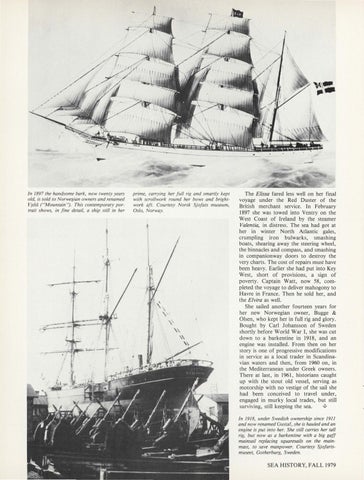
In 1897 the handsome bark, now twenty yews old, is sold to Norwegian owners and renamed Fjeld ("Mountain'1. This contemporary portrait shows, in fine detail, a ship still in her
prime, carrying her full rig and smartly kept with scrollwork round her bows and brightwork aft. Courtesy Norsk Sjofats museum, Oslo, Norway.
j
. t
I
-~~I
\' '\ \\ \\
The Elissa fared less well on her final voyage under the Red Duster of the British merchant service. In February 1897 she was towed into Ventry on the West Coast of Ireland by the steamer Valentia, in distress. The sea had got at her in winter North Atlantic gales, crumpling iron bulwarks, smashing boats, shearing away the steering wheel, the binnacles and compass, and smashing in companionway doors to destroy the very charts. The cost of repairs must have been heavy. Earlier she had put into Key West, short of provisions, a sign of poverty. Captain Watt, now 58, completed the voyage to deliver mahogony to Havre in France. Then he sold her, and the Elvira as well. She sailed another fourteen years for her new Norwegian owner, Bugge & Olsen, who kept her in full rig and glory. Bought by Carl Johansson of Sweden shortly before World War I, she was cut down to a barkentine in 1918, and an engine was installed. From then on her story is one of progressive modifications in service as a local trader in Scandinavian waters and then, from 1960 on, in the Mediterranean under Greek owners. There at last, in 1961, historians caught up with the stout old vessel, serving as motorship with no vestige of the sail she had been conceived to travel under, engaged in murky local trades, but still w surviving, still keeping the sea. In 1918, under Swedish ownership since 1911 and now renamed Gustaf, she is hauled and an engine is put into her. She still carries her tall rig, but now as a barkentine with a big gaff mainsail replacing squaresails on the mainmast, to save manpower. Courtesy Sjofartsmuseet, Gotherburg, Sweden.
SEA HISTORY, FALL 1979