





Credits

© 2021
Authors
Delmis del C. Alicea Segarra, EdD, Jorge Casillas Maldonado, MS
Co-Authors
Ivonne Bejarano Rodríguez, PhD, Diana M. Beltrán Rodríguez, MS, Brenda M. Soler Figueroa, MS
Science Edi ng
Yasmín Detrés Cardona, PhD, Ariel E. Lugo, PhD, Lesbia L. Montero Acevedo, BS
Science Advisor
Juan G. González Lagoa, PhD
Edi ng
Ruperto Chaparro Serrano, MA, Delmis del C. Alicea Segarra, EdD, Cris na D. Olán Mar nez, MA
Readers
Álida Or z Sotomayor, PhD, María M. Montalvo Ortega, EdD, Neysa Rosario García, MA
Brenda L. Estévez Moreno, BS
Contributors
Carlos J. Carrero Morales, MPA, Carmen Zayas San ago, MS
English Transla on and Edi ng
Wilmarie Cruz Franceschi, MA
Graphic Design and Layout
Delmis del C. Alicea Segarra, EdD, Oliver Bencosme Palmer, BA
Photography
Oliver Bencosme Palmer, BA, Ruperto Chaparro Serrano, MA, Guillermo Damiani Ríos, Efraín Figueroa Ramírez, BS, Juan G. González Lagoa, PhD , Mydalis M. Lugo Marrero, MA, Julia S. Mignucci Sánchez, PhD, Janne e Ramos García, BS
Footage for the “El manglar” video
Efraín Figueroa Ramírez, BS, Rául Omar Or z Arroyo, MAG
Theme guide
Alessandra Otero Ramos, MIS
Prin ng
Raúl Omar Or z Arroyo, MAG, Delmis del C. Alicea Segarra, EdD
Publica on number UPRSG-E-307
ISBN: 978-1-881719-88-5











The University of Puerto Rico Sea Grant Program understands the need to have an educa onal tool to aid instructors during the teaching-learning process regarding the marine and coastal resources of the Puerto Rican archipelago. With this goal in mind, we have taken it upon ourselves to produce this Educa onal Guide about mangrove forests which includes a CD, this student handbook, a story book and an ac vity book. We hope this manual will prove useful when teaching about our marine and coastal resources and likewise foster in our young people a deeper apprecia on for this ecosystem and mo vate them to promote its conserva on and protec on.
An ecosystem is a community of organisms which interact amongst themselves and with their environment, including non-living elements. Each one of these ecosystem’s components influences the others, and all are vitally important for the preserva on of their way of life. Puerto Rico has a territorial expanse of 3,587 square miles (including its more than one hundred islands and cays), and within this area, one may find eight main ecosystems: tropical rainforest, subtropical dry forest, sand beaches, rocky shores, coral reefs, seagrass meadows, mangroves, and lagoons.
Out of the aforemen oned ecosystems, five are marine ecosystems, and we can find them across the island’s 700 miles of shoreline. With the Atlan c Ocean to the north and the Caribbean Sea to the south, the difference in distribu on in these ecosystems is very notable. This can be observed in the variable presence of mangroves throughout Puerto Rico’s shores. The diversity showcased by the marine ecosystems culminates in an interes ng and enriching educa onal adventure.
For decades, Puerto Rico has a ributed li le ecologic and economic value to mangroves, forests composed of trees especially adapted to thrive in coastal areas, because of their appearance and occasional odor of decaying organic ma er smell. This percep on could not be more mistaken – mangroves are cri cally important for the healthy development of both terrestrial and marine ecosystems. Without mangroves, the seagrass meadows and coral reef ecosystems would not exist as we know them. The biological diversity and the health of these two ecosystems directly depend on the mangrove’s health. Addi onally, mangrove forests protects our coasts from erosion, strong winds and storm surges, and serve as habitat for many species during their juvenile life stage. Any person who has visited a mangrove forest, whether walking a trail, kayaking, or visi ng the bioluminescent bays, knows that this is a priceless experience. These are just a few reasons why our children should become familiar with this valuable ecosystem.

Once we begin to comprehend how important these resources are, we can strive to use them in a wise manner. As Puerto Ricans, we need to have a sense of stewardship towards out marine ecosystems. For this to happen, we need to know and understand the most common ecosystems in our archipelago, such as the mangroves. It is precisely this limited knowledge regarding the func on and importance of our ecosystems which leads to uncontrolled and poorly planned development in these areas. By integra ng concepts about our coastal ecosystems into school curricula, students will gain awareness and apprecia on for the benefits of caring for mangroves, conserving them and protect them for future genera ons. We will also rediscover our true geographical iden ty as Caribbean islanders.


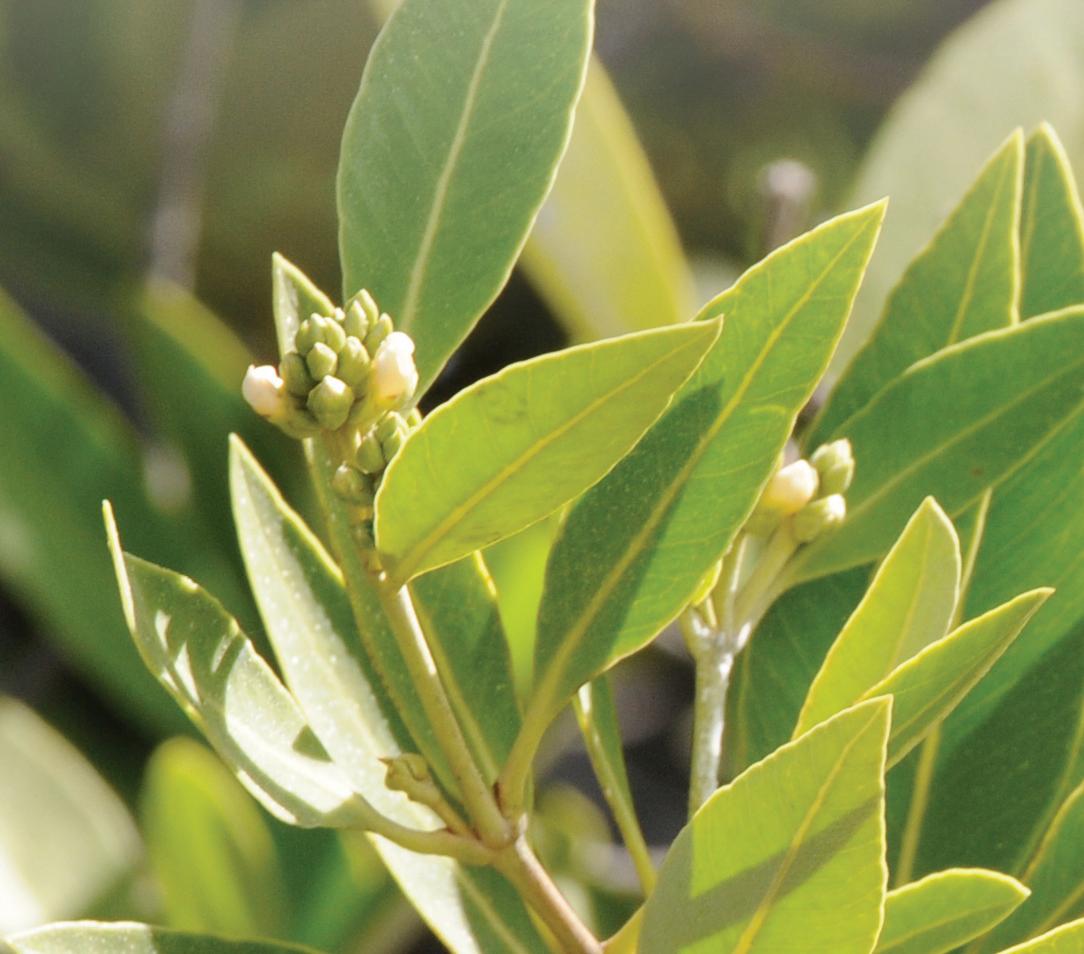


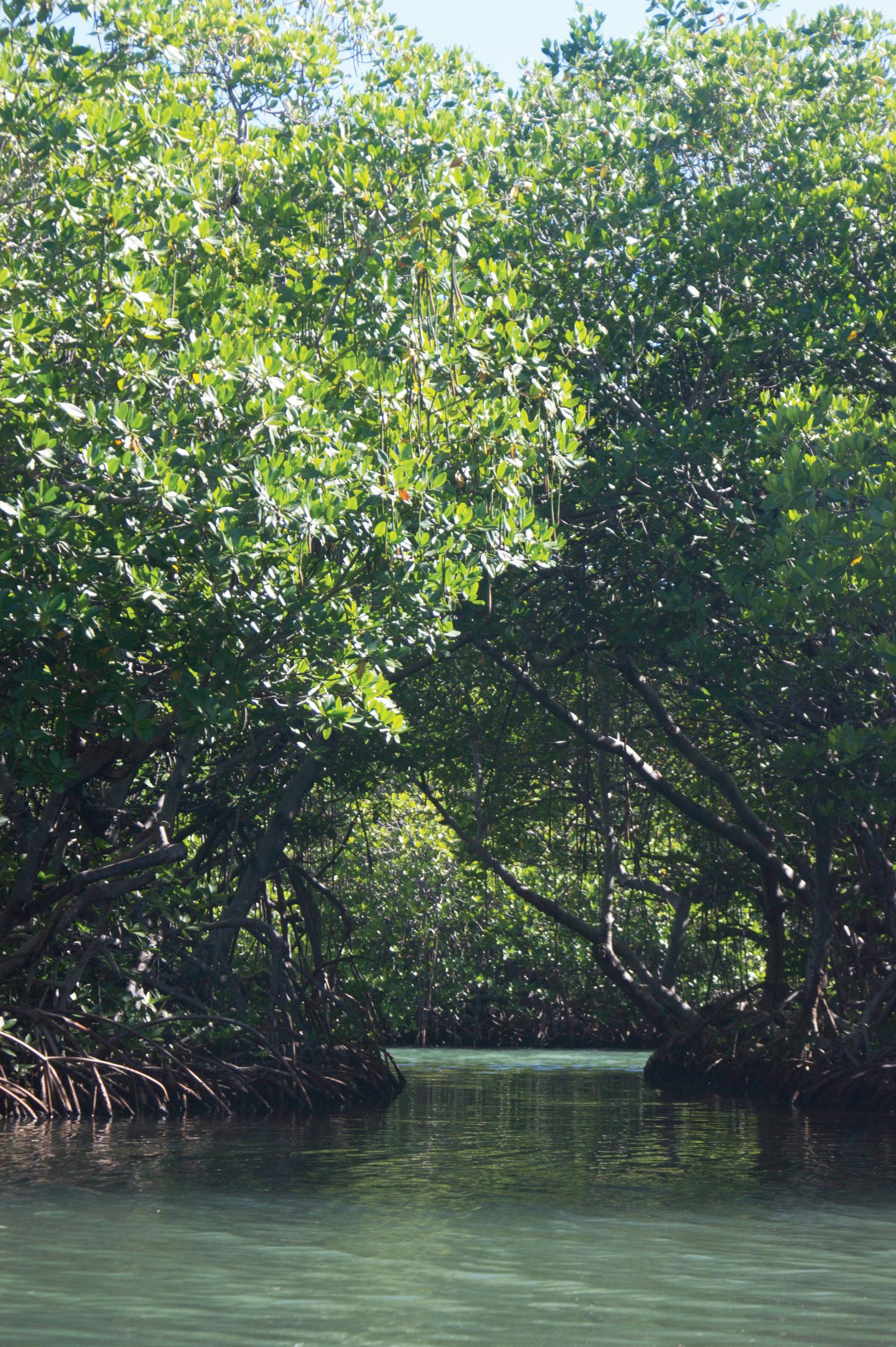


A mangrove forest is a habitat mainly comprised of a group of mangrove trees, growing on the coastline between the sea and the land. Mangroves are commonly found in wetlands or estuaries, where seawater meets and mixes with freshwater from rivers, intermi ent streams, rain runoff or subterranean sources.

A mangrove tree is a tree or shrub that features special physiological and anatomical adapta ons which allow it to thrive in the extreme condi ons typical to the li oral zone between land and sea (Figure 2). The low-lying lands in this area are known for the frequent water intrusions, high salinity, and poor aera on.
Mean high water mark
Mean low water mark
Generally speaking, a mangrove forest develops in places that gather the following five condi ons
1. Mangrove trees need warm temperatures. These should be between 60-86 oF (15-30 oC). The temperature is a determining factor for mangrove distribu on throughout the world (Figure 1), limi ng their development to the tropical and subtropical regions between 30 degrees N and 30 degrees S.
2. Areas with low exposure to waves and surges, with small chance of erosion, are ideal in aiding seeds and young plants se lement.
3. Mangrove development is also greater in zones offering alluvial substrates, rich in organic material (such as silt).
Alluvial substrate - deposit of watertransported sediments

Estuary – habitat in which seawater becomes diluted as it mixes with freshwater draining from the mainland.
Li oral zone (inter dal zone) - coastal area under the direct influence of the rising or subsiding des.
Mangrove - tree or shrub with special adapta ons which allow it to thrive in high salinity and poorly oxygenated condi ons.
Mangrove forest – habitat chiefly comprised of mangrove trees.
Propagule - the mangrove’s viviparous seed, it is a plant in the early stages of development.
Wetland - areas influenced by aqua c systems and terrestrial systems which are frequently flooded.
4. Mangroves occupy land tracts in which strictly terrestrial plants could not survive, such as areas frequently flooded by seawater

5. Coastal regions with low slopes have a wider li oral zone and therefore provide a more expansive area for mangrove establishment.
Mangrove trees can grow up to a height of approximately 148-164 feet (45-50 m) when situated in op mal condi ons. This may be observed near the equator, where there is a good availability of nutrients, wide expanses of inter dal zones, and rela vely constant, high temperatures. In places with more strenuous condi ons (non-op mal temperatures, very arid soil or extremely high salinity), a mangrove tree only grows as a 3-6 feet (1-2 m) tall shrub.

1. Mangrove thickets are connected to the seagrass meadows and coral reefs. They help retain and stabilize the sediments coming from the mainland, and help control substrate erosion. These trees absorb nutrients and pollutants from the water and are therefore key to clear, clean waters. Mangrove thickets also help reduce freshwater influx into the sea, and are highly produc ve systems. Many fish and crustacean larvae grow and develop in the mangrove thicket habitats before migra ng to other marine ecosystems.
2. Mangroves, like any other plant, use solar energy for photosynthesis, producing oxygen in the process. Photosynthesis allows the mangrove tree to transform solar energy into organic material such as leaves, wood or flowers. Organisms capable of this are known as primary producers.
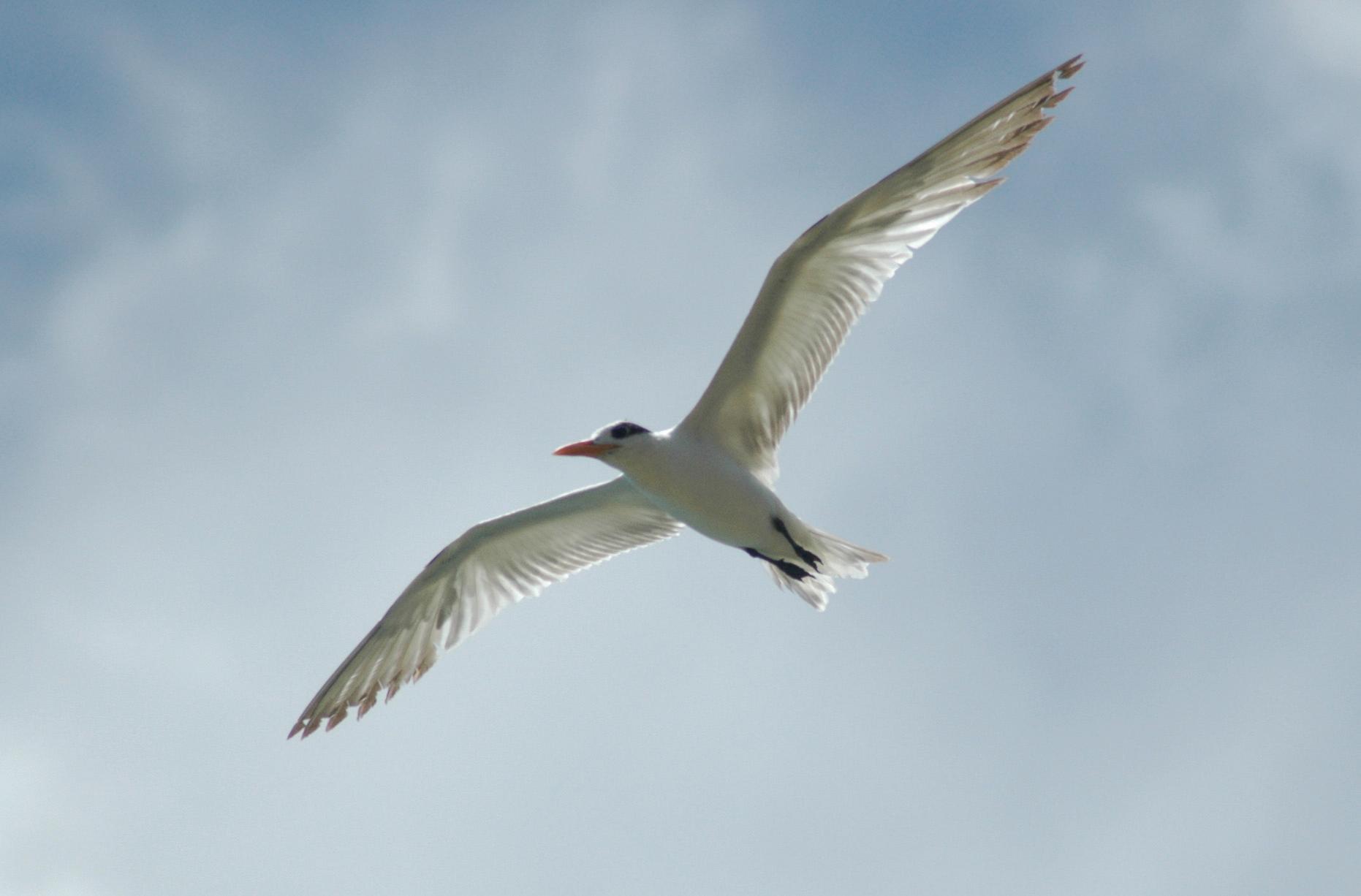
3. Many other species such as crabs, shrimps and bu erflies feed on the leaves, flowers and other organic material produced by the mangroves. These organisms are known as primary consumers. The organisms which feed on the primary consumers, such as seagulls and fish, are known as secondary consumers. In this manner, mangrove forests fulfill a vital role as the base of the food chain, and are highly produc ve ecosystems.

4. Mangrove thickets are important habitats providing food and shelter for many marine species, including mammals, amphibians, birds, rep les, plants, fish, and invertebrates.
5. They serve as nursery zones (offer shelter to species in their juvenile stages), refuge and feeding grounds for many commercially important species such as snapper, lobster and conch.
6. Mangrove thickets offer a nes ng and res ng area for several migratory bird species like the prairie warbler, endemic species like the yellow-shouldered blackbird, or resident species like the American yellow warbler.
7. Mangrove roots stabilize and retain sediments along the shore, protec ng the coast from erosion driven by wind and wave ac on. This is par cularly important during strong surf events like hurricanes, tsunamis or storms.

Primary consumers – Organisms which feed on primary producers.

Primary producers – Organisms which can transform solar energy into ma er through photosynthesis.
Secondary consumers - Organisms which feed on primary consumers.
8. Mangrove forests offer recrea onal opportuni es and benefits to both residents and visitors alike.
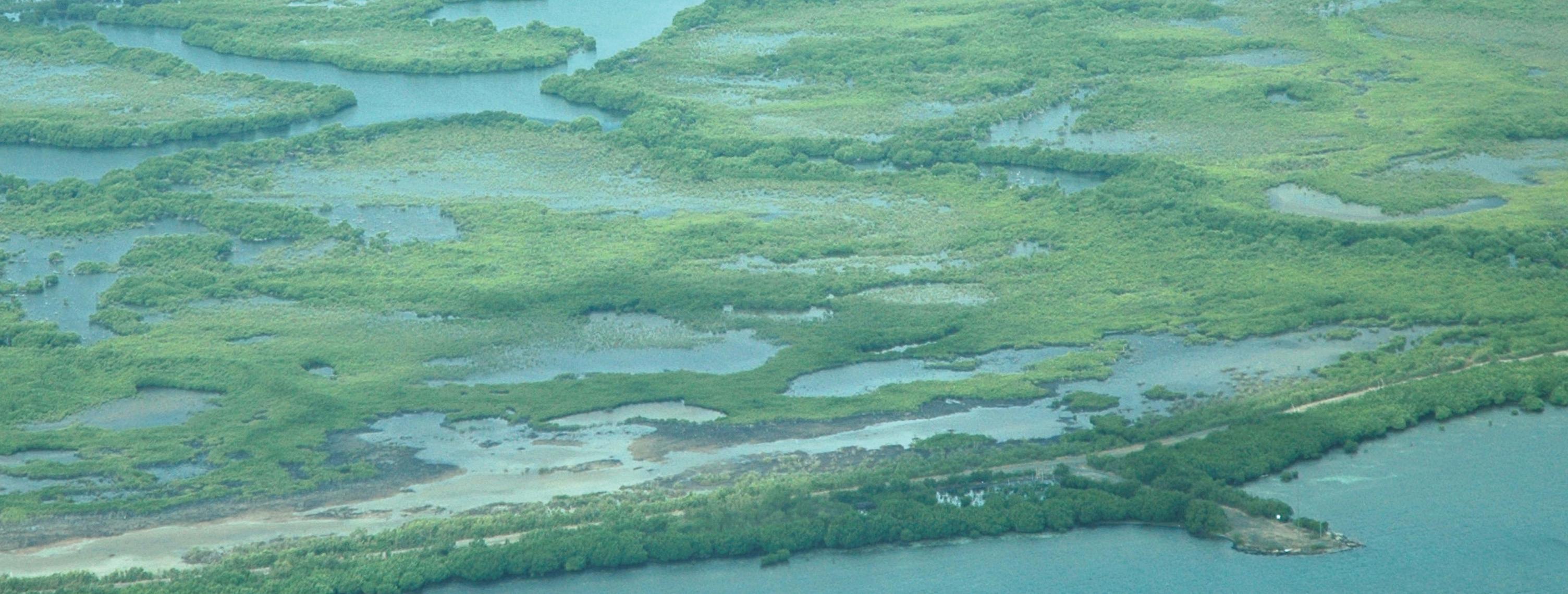
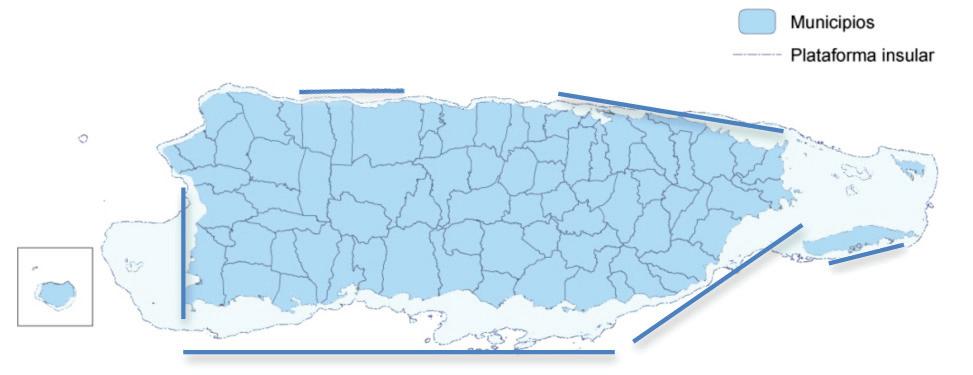
The largest mangrove forest in Puerto Rico can be found in the northeast coast (Figure 5), in the Piñones area in Loíza. The north coast mangrove forests are associated with the freshwater influx from rivers and lagoons (basin and riparian mangroves), and from runoff (bank mangroves). Because the Atlan c Ocean features such heavy surf condi ons, mangrove forests on the north coast develop only in loca ons protected from these condi ons. Throughout the southern coast, on the other hand, mangrove forests present a thick border on the coasts (border mangroves) and the cays (cay mangroves). The submerged land shelf in this zone is wider and fla er than the one on the north coast, and the surf and wave condi ons presented by the Caribbean Sea are much calmer than that of the Atlan c Ocean.
There are around 54 mangrove species worldwide. Of these, about ten can be found within the Caribbean region, and only four within Puerto Rico:
a. Red mangrove (Rhizophora mangle)
b. Black mangrove (Avicennia germinans)
c. White mangrove (Laguncularia racemosa)
d. Bu onwood (Conocarpus erectus)
The four mangrove species found in Puerto Rico can be easily iden fied by their main dis nc ve characteris cs: leaf shape, flower and fruit shape, presence of aerial prop roots and presence of pneumatophores; as well as their localiza on inside the mangrove forest. The trees tend to be
distributed in a sequence perpendicular to the coast, from the sea to the mainland. This distribu on is known as zona on (Figure 6). Zona on is characterized by the adapta ons each mangrove species has to the terrain’s extreme condi ons, such as:
• Tolerance to salinity. The species which are be er adapted to high salinity are on the soil furthest from the li oral zone. During the low de, this soil is exposed to the wind and the sun; some of the water evaporates and some filters down through the sediment, leaving behind salt crystals. In the zones closer to the sea, on the other hand, the salts are dissolved in water and are therefore less salty.
• Adapta ons to life in poorly-aerated soils. Mangrove forests are highly produc ve habitats with very high levels of organic decomposi on (for instance, leaves, wood and flower). Some of the bacteria in charge of decomposing this organic material draw their energy from oxygen. However, oxygen content in these soils is low, due in part to the soils being flooded and being composed mainly of fine sediments, which limit aera on. Therefore, a good amount of the organic decomposi on taking place in mangrove forests is performed by anaerobic bacteria which can survive and work in the absence of oxygen.
• Capacity to become established in unstable substrates (waterlogged and muddy soils). Soils in direct contact with the sea tend to be more saturated with water, are usually more unstable and unconsolidated, whereas those soils which are further from the sea tend to be firmer.
Aerial prop root - root growing outwards from the main tree trunk in a s lt shape.
Pneumatophore - type of root which grows upwards from the soil. They are a feature of both the black and white mangrove trees.
Zona on - mangrove species distribu on perpendicular to the coast.
 Figure 6. Mangrove tree zona on on a gradient, from the sea towards the mainland. The bo om of the image shows a blue gradient star ng at the sea, which becomes red in representa on of the increasing salinity. Then, it turns blue again, symbolizing that the soil condi ons in that area are prac cally the same as further inland (low salinity, good oxygena on).
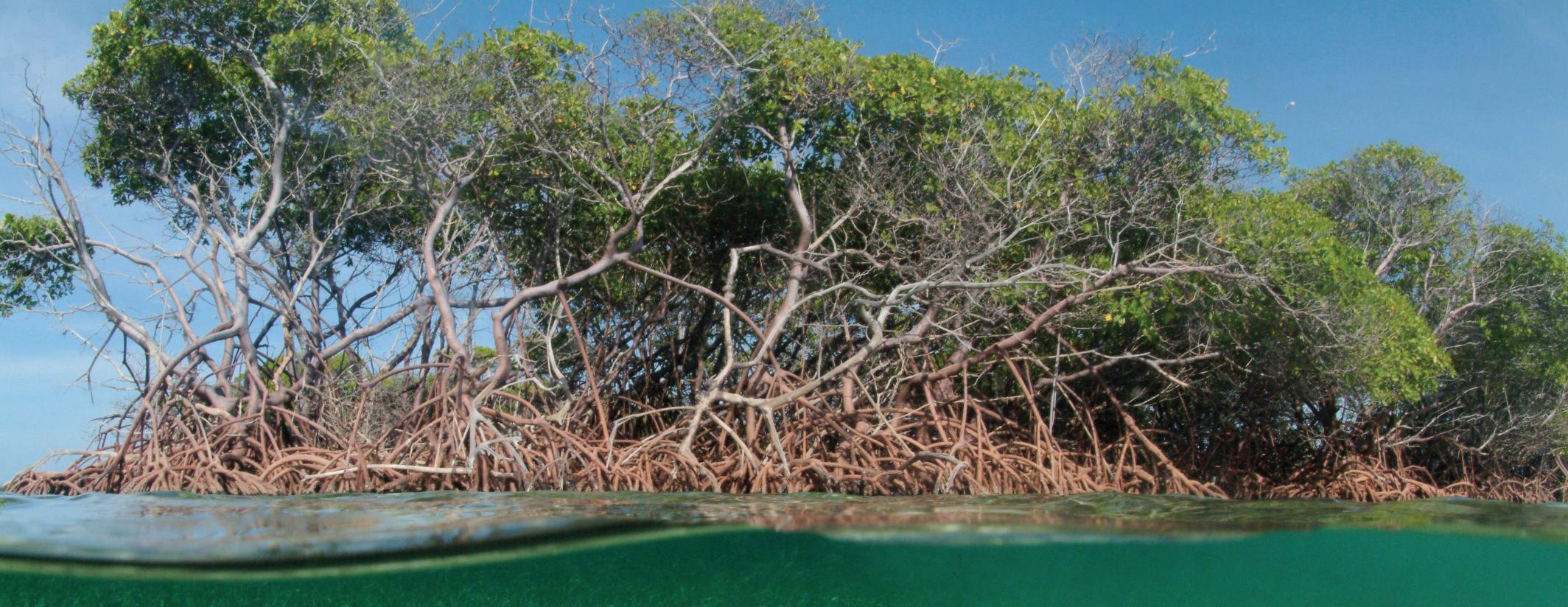
The most common species of mangrove in Puerto Rico is the red mangrove. It is usually found in direct contact with the sea, thus becoming the first mangrove species encountered on the coastline, going from the sea towards the land (Figure 6).





Leaves: Red mangrove leaves are large (8-10 cm in length, 4-5 cm in width), thick and with a waxy texture, which prevents water loss and slows decomposi on. The leaves are simple, opposite (Figure 8) and are usually grouped at the ps of the branches.

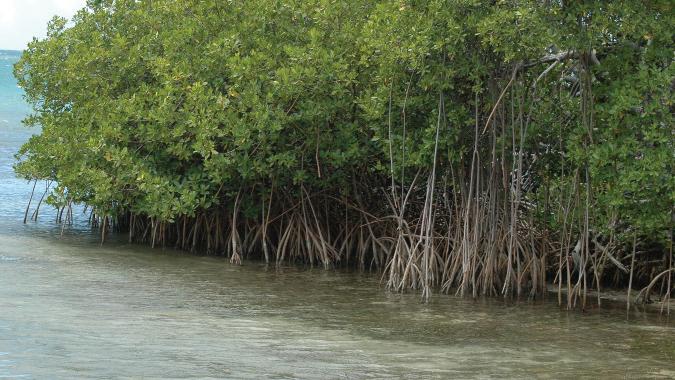
Roots: The red mangrove is the only mangrove presen ng aerial prop roots, which branch out of the trunk or from the lateral branches and droop towards the ground like s lts (Figures 7 and 9). These roots provide the tree with more stability, allowing it to become established in finelysedimented, poorly consolidated soils. Furthermore, the aerial roots fulfill vital func ons such as nutri on, aera on and salt filtra on. The roots filter the salt through osmosis so that the tree can absorb the water necessary to survive. If the mangrove absorbed salt, it would dehydrate.
Bark: The bark covering this mangrove’s roots (Figure 10) contains tannins, organic substances which protect it against bacterial decomposi on and give it a characteris c reddish coloring (tannins are also present in red wine). Also, the bark on the roots and trunk feature pore-like structures called len cels (Figure 11), which aid in the mangrove’s gas exchange (breathing). This is an adap ve response, since the trees grow in poorly-oxygenated or anoxic soils. Red mangrove bark is complete and uniform, differing from other mangrove species.
 Figure 7. Red mangrove ecosystem, Puerto Rico.
Figure 8. Red mangrove leaves.
Figure 9. Red mangrove aerial prop roots.
Figure 10. Bark on the red mangrove roots.
Figure 7. Red mangrove ecosystem, Puerto Rico.
Figure 8. Red mangrove leaves.
Figure 9. Red mangrove aerial prop roots.
Figure 10. Bark on the red mangrove roots.
Flowers: Red mangrove flowers are small, approximately 2.5 cm in diameter, with four thick, lanceolate sepals (Figure 12). The flowers have four white petals which turn dark and fuzzy inside, along with eight stamen. Flowers are o en present year-round.







The red mangrove’s fruit germinates while s ll a ached to the tree (Figure 13a). It matures in about two to three months, and develops into an embryo, known as a propagule (Figure 13b). The propagule grows while a ached to the tree for 11 or 12 months, and by the me it detaches, it is already a small plant, with two leaves at the top ready to photosynthesize and establish itself as a new red mangrove tree (Figure 14).



The propagules growing among the established mangrove roots tend to develop as small shrubs of about 1.5 meters in height due to the limited amount of sunlight they receive. These young, small trees are called the dormant forest, and serve as a reserve popula on. When a full-grown mangrove tree dies, a space opens up and allows sunlight to reach the substrate. The small, dormant trees, usually living in the shadow of their larger counterparts, readily take advantage of these new and favorable sunlight and space condi ons and quickly grow to their full size. Thus, the dormant forest eventually replaces the main one through a cyclical process. This is a crucially important process to mangrove forest survival, especially a er suffering the effects of strong weather events like hurricanes or tsunamis. On the other hand, if the propagule falls into the water, it floats to the surface and is transported by currents, since its small trunk is corklike. Ini ally, it floats horizontally, but as it absorbs water, its bo om part becomes heavier and sinks, orien ng the propagule ver cally. Upon reaching a flat surface, the propagule has the chance of establishing itself as a new mangrove tree. This reproduc ve mechanism allows red mangroves to disperse and colonize areas distant from the usual coastal mangrove zones (such as cays).
 lenticels
peduncle sepals
Figure 11. Len cels on the red mangrove tree roots.
Figure 12. Red mangrove flower, with some of their parts. (petals, sepals, peduncle, stamen)
Figure 13b. Red mangrove propagule.
Figure 13a. Red mangrove fruit.
stamen
lenticels
peduncle sepals
Figure 11. Len cels on the red mangrove tree roots.
Figure 12. Red mangrove flower, with some of their parts. (petals, sepals, peduncle, stamen)
Figure 13b. Red mangrove propagule.
Figure 13a. Red mangrove fruit.
stamen
Dormant forest - group of small mangrove trees inhabi ng the shadows from the main forest.

Len cels - projec ons from the tree’s trunk and root surfaces, having a pore to aid in gas exchange.
Osmosis - movement of water molecules through a semipermeable membrane, from an area of higher water concentra on to one with less water concentra on.
Sepals - each of the harder, greenish leaves which form the flower’s calyx.
Stamen - the flower’s male reproduc ve organ, containing pollen.
Tannins - organic substances present in the red mangrove’s vegetal ssue and which provide its characteris c reddish hue; tannins also offer protec on against bacterial decomposi on.

 Figure 14. Propagule established in so substrate.
Figure 16. Dormant forest near ground level.
Figure 15. The tannins featured by the red mangrove may give the surrounding water a reddish appearance.
Figure 14. Propagule established in so substrate.
Figure 16. Dormant forest near ground level.
Figure 15. The tannins featured by the red mangrove may give the surrounding water a reddish appearance.
The black mangrove (Figure 17) tends to be located behind the red mangrove, in sal er and less aerated soils. This species tolerates more strenuous climate condi ons and is associated with poor soils or soils with high salinity.


Main characteris cs:
Leaves: The black mangrove’s leaves are smaller than the red mangrove’s, and are lanceolate, with a sharp point at the apex (Figure 18). The dorsal surface (the top side of the leaf) is green, while the ventral surface (the bo om side of the leaf) is yellowish green and opaque (Figure 19). Black mangrove leaves are opposite (begin at the same point on the branch, but in opposite direc ons) and serve as the tree’s salt excretory organs (Figure 18). The salt crystals are deposited on the dorsal surface through stoma. This process ensures that the tree maintains the necessary water it needs for its survival. Older leaves tend to accumulate higher concentra ons of salt before falling off and showing burn spots due to the “magnifying glass” effect created when sunlight is filtered through the salt crystals.

Roots: The black mangrove features a system of super cial roots around the trunk. This system has several long projec ons which protrude from the substrate upwards. These projec ons are known as pneumatophores (Figure 20). The pneumatophores are long and slender (reaching a height of up to 20 cm), and their func on is to allow the mangrove to perform aera on (breathing) in poorly oxygenated soils. Because of their appearance and func on, they are o en referred to as “snorkel roots.”
Bark: The black mangrove tree’s bark has a smooth bark while in the juvenile stage, before becoming fissured. It has a black or dark gray color, with a yellowish interior (Figure 23).


Flowers: Black mangrove flowers are small (0.2 - 0.5 cm in diameter, 0.5 cm in height), with white petals. They bloom in dense clusters (Figure 21).

Fruit: The black mangrove’s fruit is shaped like a small, fla ened, oval capsule (Figure 22). The embryo develops while s ll a ached to the parent tree, and fixes itself onto the substrate upon falling. If it falls into the water, the embryo can float for several weeks, sustaining itself on the cotyledons, un l it reaches an appropriate place on which to se le.

Apex - the outer end of a leaf or branch.
Cotyledons - the shape in which the first leaf of a seed-bearing plant embryo appears.
Dorsal surface - the top side of a plant’s leaf.
Stoma - small pore-like orifices located on a leaf’s surface; they are in charge of regula ng gas Exchange and minimizing water loss.
Ventral surface - bo om or inferior surface on a plant’s leaf.
Figure 23. Black mangrove bark. Figure 20. Black mangrove pneumatophores. Figure 21. Black mangrove flowers. Figure 22. Black mangrove fruit.


White mangroves (Figure 24) are typically located behind the black mangroves, towards the mainland and in salty, poorly-aerated soils. This mangrove, however, can also grow in low-salinity environments. It develops op mally in sandy substrates.



Main characteris cs:
Leaves: White mangrove leaves are thick, oblong (oval) shaped, with a rounded apex. They are opposite, simple, and have a leathery texture. The dorsal surface is grayish green, while the ventral surface is lighter colored (Figure 25a). These leaves feature two glands at the pe ole base, which are in charge of excre ng excess salt from the mangrove in order to maintain a healthy hydra
Roots: Like the black mangrove, white mangroves have a super trunk, with long projec ons growing upwards from the substrate, known as pneumatophores have special ssue at the pneumatophores are shorter and fla er than those on the black mangroves (Figure 26a).
Figure 24. White mangrove ecosystem, Puerto Rico.Bark: Unlike other mangrove species, white mangrove bark is fissured along the length of the trunk (Figure 26b).


Flowers: White mangrove flowers are small (0.2 to 0.3 cm) and plen ful, and their external parts fused to form a tube with five triangular lobes or teeth. At the end of the tube, it grows five ny, rounded petals, about 0.1 cm long. The flowers grow in clusters, forming inflorescences (groups of flowers on the branches) that can measure 3 to 7 cm in length (Figure 27).

Fruit: White mangrove fruits are small, with lengthwise ridges. When immature, they are green. They turn brown as they ripen (Figure 28). The seed usually begins to germinate while the fruit is s ll a ached to the tree. Generally, the embryo develops just before falling off the tree. If it falls into the water, the seeds float and are dispersed by the currents.


Bu onwood (Figure 29) can be found in the inter dal zone furthest from the sea, in low-salinity, elevated, sandy soils, where it mixes with terrestrial vegeta on. Because of this, some field experts do not consider it a true mangrove.
Bu onwood usually grows as a shrub, although in some cases, provided it receives op mal condi ons, it may grow as a fairly large tree, between 15-23 feet (5-7 m) tall. In Puerto Rico, it usually forms small forests along rocky shores. It may also be found bordering very low-salinity lagoons that are distant from the shore.
Main characteris cs:

Leaves: The bu onwood’s leaves are ellip cal and small (4-9 cm long and 2-3 cm wide). It is the only mangrove tree species with alterna ng leaves. The leaf pe ole is small and, like the white mangrove, has two small salt-excre ng organs on each side (Figure 30a). Like all the other mangrove species men oned, it needs to eliminate salt to maintain proper hydra on.

Flowers: Bu onwood flowers are ny (0.2 cm wide), green and fragrant, and grow in large numbers to form round inflorescences measuring 0.6 -12.5 cm in diameter (Figure 30b).

Fruit: Bu onwood gets its name from the shape of its fruit. The round inflorescences become a brown, round, aggregated fruit, similar to a ny pinecone or bu on. (Figure 30c). Each fruit contains a large number of seeds.


Main disturbances affec ng the mangroves in Puerto Rico

Natural
Sea level rise - In the best case scenario, it would reduce the inter dal zone which mangroves can colonize; in the worst case scenario, it could submerge and exterminate exis ng mangrove forests.
Hurricanes and tsunamis - They create strong winds, rainfall events and storm surges which could poten ally tear mangroves from the substrate.
Coastal urban development - The increase in human popula on in coastal zones has increased wood clearing (including cu ng down mangrove forests), which increases soil erosion and sediment discharge reaching the sea.
Mangrove forest clearing - Usually, mangrove forests are cut so that urban development may occur. Their wood is also harvested and used as construc on material for building fish traps, because of the wood’s resilience to water.
Increased boat traffic on shallow waters - This removes sediments on the bo om (which are usually anoxic; that is to say, without oxygen), and resurfaces the contaminants and toxic substances in the water, to the detriment of water quality and mangrove health, as well as risking the wellbeing of mangrove forest inhabitants.
Increased presence of nutrients, fer lizers and other contaminants - Discharge from rivers or runoff nega vely affects water quality, hurts mangrove health, and risks the wellbeing of mangrove forest inhabitants.
Trash - The des bring in trash which gravely affects the many species inhabi ng the mangrove forest.
Changes in water flow - Altera ons and/or construc on on the coast cause changes in water flow. This changes the water’s characteris cs, such as its temperature or salinity, and can cause widespread ex nc on in the mangrove forest.
In order to preserve these valuable ecosystems, several key issues must be addressed, such as:
coastal development;

effec ve management of runoff, used waters and garbage;
waste reduc on through the use of the three R’s: Reducing the use of disposable materials, Reusing objects as much as possible, and Recycling.
The Department of Natural and Environmental Resources of Puerto Rico (DRNA, by its Spanish acronym) has developed a plan for mangrove protec on and conserva on in Puerto Rico. This plan responds to the public policy established by Law #23, the DRNA Organic Law from June 20, 1972.
There are also a series of federal laws protec ng Puerto Rico’s wetlands. The United States Environmental Protec on Agency (EPA) has a website where any ci zen may anonymously report viola ons to the laws:
h p://www.epa.gov/region02/water/wetlands/viola ons.html

Aerial prop root - root growing outwards from the main tree trunk in a s lt shape.
Alluvial substrate - deposit of water-transported sediments
Apex - the outer end of a leaf or branch.
Bank mangrove - a type of mangrove that develops in zones adjacent to rivers and lagoons, which have li le water flow and which receive li le influence from the des.
Border mangrove - a type of mangrove which grows along the coast, usually in bays and open lagoons, and exposed to low to moderate waves. This type of mangrove is not associated to freshwater influx.
Cay mangrove - mangroves that develop into islands close to the shore. These mangroves are exposed to low to moderate waves.
Cotyledons - the shape in which the first leaf of a seed-bearing plant embryo appears.
Dormant forest - group of small mangrove trees inhabi ng the shaded undergrowth areas of the main forest, among its roots. They grow quickly when sunlight and spa al condi ons become op mal, such as when older trees die off because of strong winds or hurricanes.
Dorsal surface - top or superior surface of a plant’s leaf.
Estuary - habitat in which seawater becomes diluted as it mixes with freshwater draining from the mainland.
Inflorescence - array or group of flowers at the end of a plant’s stalk or a tree’s branch.
Len cels - projec ons from the tree’s trunk and root surfaces, having a pore to aid in gas exchange.
Li oral zone (inter dal zone) - coastal area under the direct influence of the rising or subsiding des.
Mangrove - tree or shrub with special adapta ons which allow it to thrive in high salinity and poorly oxygenated condi ons.
Mangrove forest - habitat chiefly comprised of mangrove trees; they grow in the inter dal zone, in the space between the sea and the land.
Osmosis - movement of water molecules through a semipermeable membrane, from an area of higher water concentra on to one with less water concentra on.
Pe ole - the leaf’s peduncle, or the stem through which it is a ached to the plant stalk.
Pneumatophore - type of root which grows upwards from the soil. They are a feature of both the black and white mangrove trees.
Primary consumers - Organisms which feed on primary producers (the ones that perform photosynthesis).
Primary producers - Organisms which can transform solar energy into ma er through photosynthesis.
Propagule - the mangrove’s viviparous seed, it is a plant in the early stages of development.
Riparian mangrove - it is a type of mangrove which develops in zones under the influence of rivers and water runoff, and are influenced by the des.
Secondary consumers - Organisms which feed on primary consumers.
Sepals - each of the harder, greenish leaves which form the flower’s calyx.
Stamen - the flower’s male reproduc ve organ, containing pollen.
Stoma - small pore-like orifices located on a leaf’s surface; they are in charge of regula ng gas exchange and minimizing water loss.
Tannins - organic substances present in the red mangrove’s vegetal ssue and which provide its characteris c reddish hue; tannins also offer protec on against bacterial decomposi on.
Ventral surface - bo om or inferior surface on a plant’s leaf.
Wetland - area influenced by aqua c systems and terrestrial systems which are frequently flooded or saturated with superficial or subterraneous water for a period of me.
Zona on - mangrove species distribu on perpendicular to the coast.
References:
CONABIO-CONANP. (2009). Mangle blanco (Laguncularia racemosa). Fichas de especies mexicanas. Comisión Nacional para el Conocimiento y Uso de la Biodiversidad y Comisión Nacional de Áreas Naturales Protegidas, México, D.F.
Ecología. Estuarios. Consulted on November 3, 2012. h p://memo.com.co/ecologia/estuario.html
Environmental Protec on Agency (EPA). Wetlands Viola on - Ini al Complaint Form. Consulted on November 3, 2012. h p://epa.gov/region02/water/wetlands/viola ons.html
Feller, I.C. y Sitnik, M. (1996). Mangrove Ecology: A manual for a Field Course. Smithsonian Ins tu on. Washington, DC.
González Lagoa, J.G. y González Toro, C. (2010). Encuentro con el mar. Puerto Rico: Programa Sea Grant.
Li le, E. y Wadsworth, F.H. (1995). Common Trees of Puerto Rico and the Virgin Islands. U.S. Department of Agriculture - Forest Service.
Mcleod, E. & Salm, R. V. (2006). Managing mangroves for resilience to climate change. Gland, Switzerland: The World Conserva on Union (IUCN).
Muñoz-Hincapié, M. (2007). Manual del Botero y Charlas Ecológicas. Puerto Rico: Departamento de Ciencias Marinas. Universidad de Puerto Rico, Recinto universitarios de Mayagüez.
Ramírez Mella, J. Los manglares: ¿Existe un plan de manejo para los manglares? Consulted on November 3, 2012. h p://cremc.ponce.inter.edu/manglares/manejo.htm
Universidad Pública de Navarra. Iden ficación de plántulas con claves dicotómicas. Consulted on November 3, 2012. h p://www.unavarra.es/servicio/herbario/htm/plantula_BAMH_01.htm


ISBN 9781881719885