M & P S p e c i a l t y I n s u r a n c e p r o v i d e s
i n s u r a n c e a n d r i s k m a n a g e m e n t
s e r v i c e s f o r h e a v y l i f t i n
i n d u s t r i e s .
I N D U S T R Y
I N D U S T RY
S P E C A LT I E S :
E E L E C T O R S
H E AV Y H A U L E R S
R A N E R E N TA L R I I N G
F A B R I C AT O R S
S P E C I A L T I E S : THE M&P DIFFERENCE IF YOU LIFT, ERECT,
S T R U C T U R A L M OV E R S
L i c e n s e d n a t i o n w i d e , M & P S p e c i a l t y I n s u r a n c e o f f e r s c o m p r
w e e n i
s u r a n c e p r o d u c t s , c o n t r a c t u a l d e t a i l , a n d r i s k m a n a g e m e n t p r a c t i c e s
By Austin Reiner
By Jenny Cohen
Michael Rubin
Steel Erection Solutions
HEATING
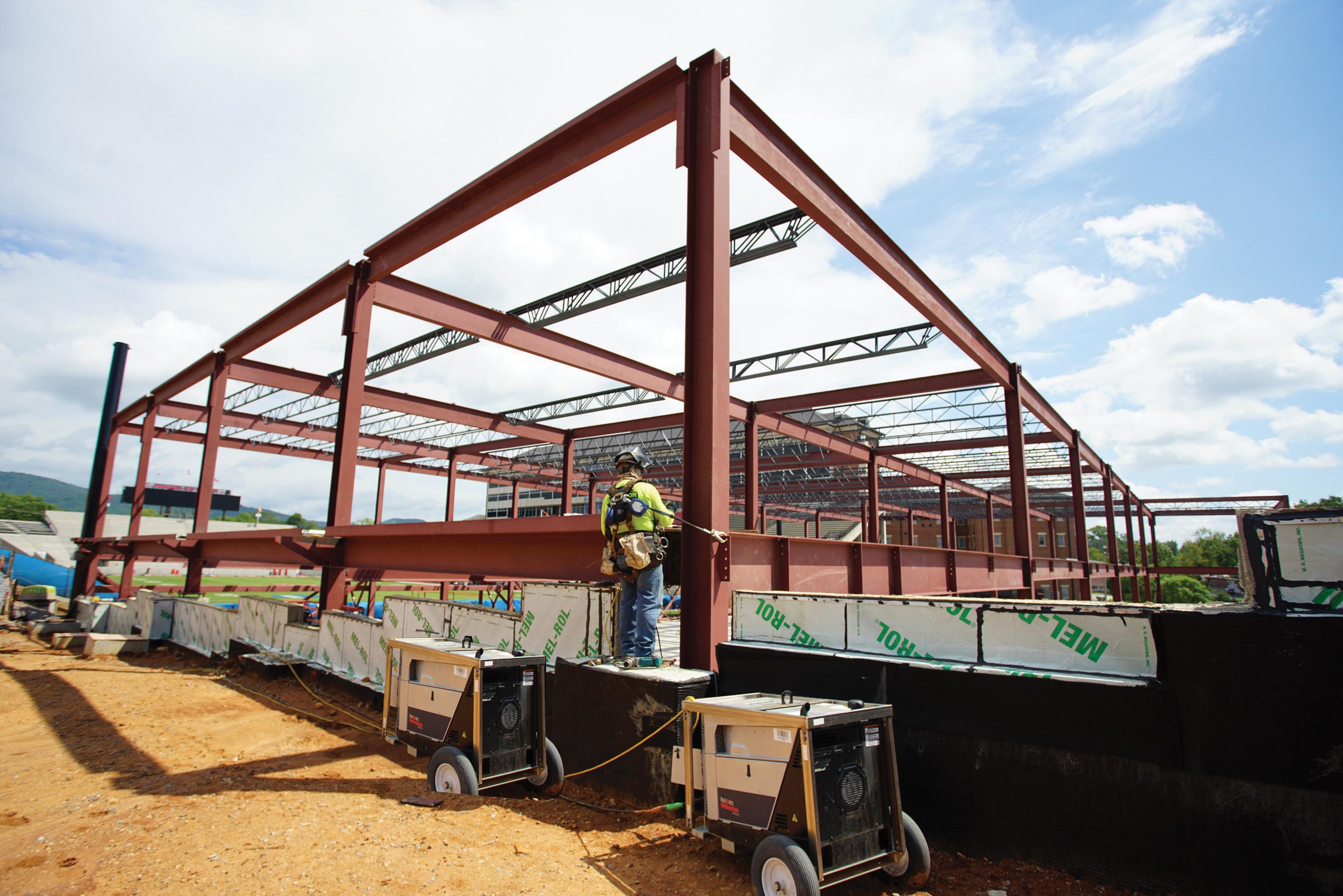
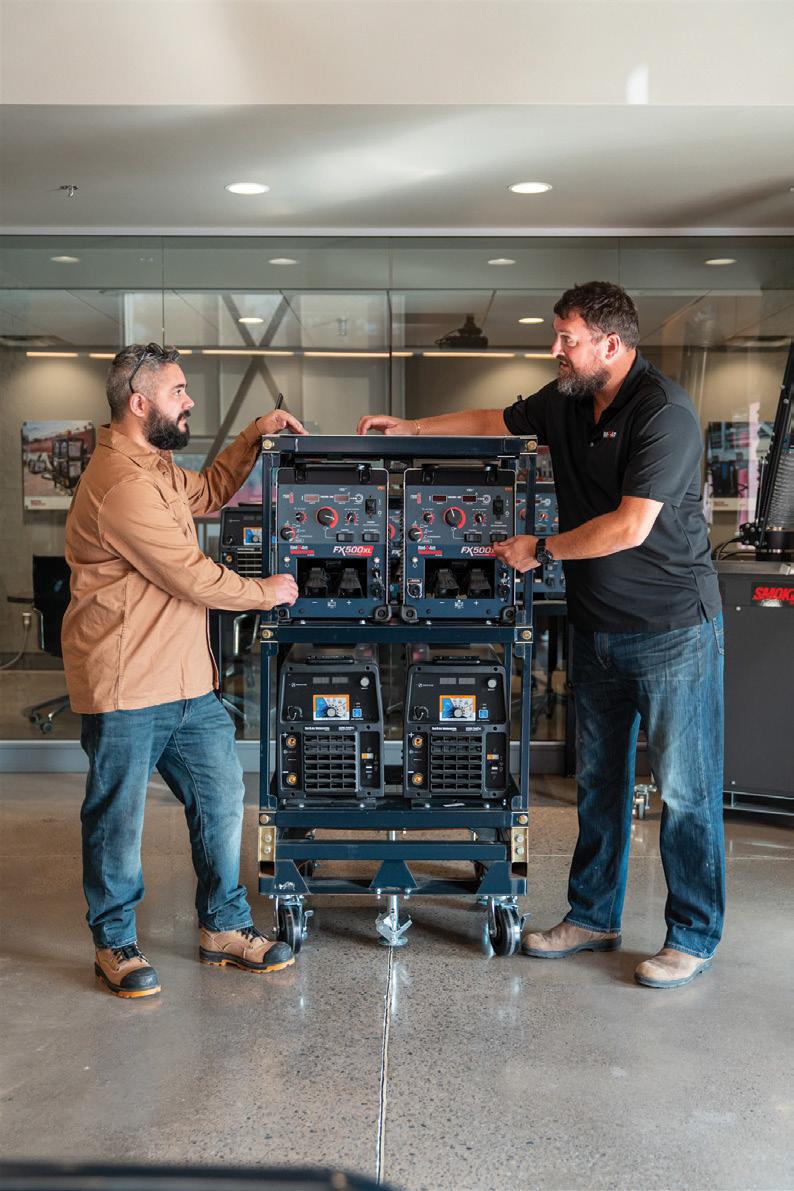
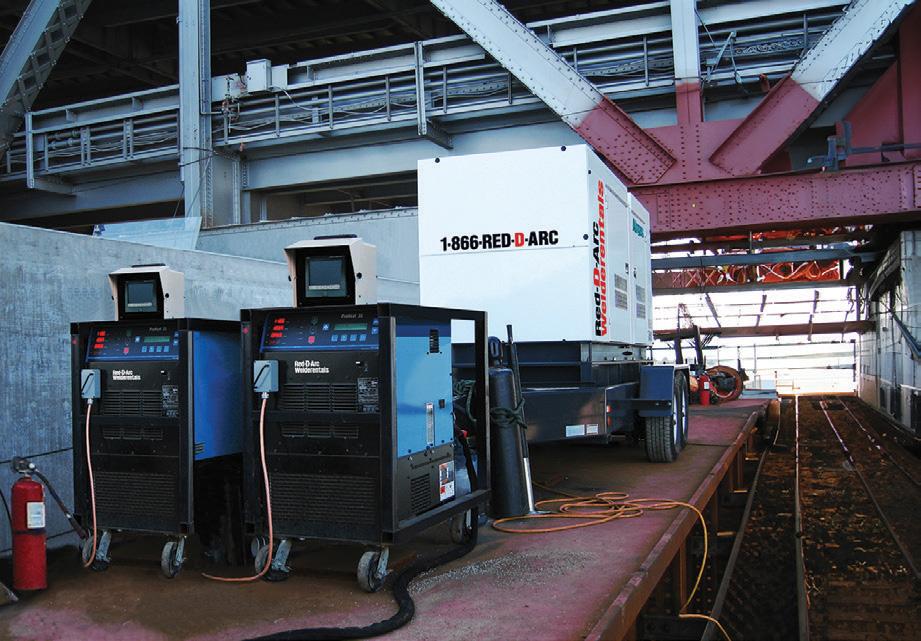
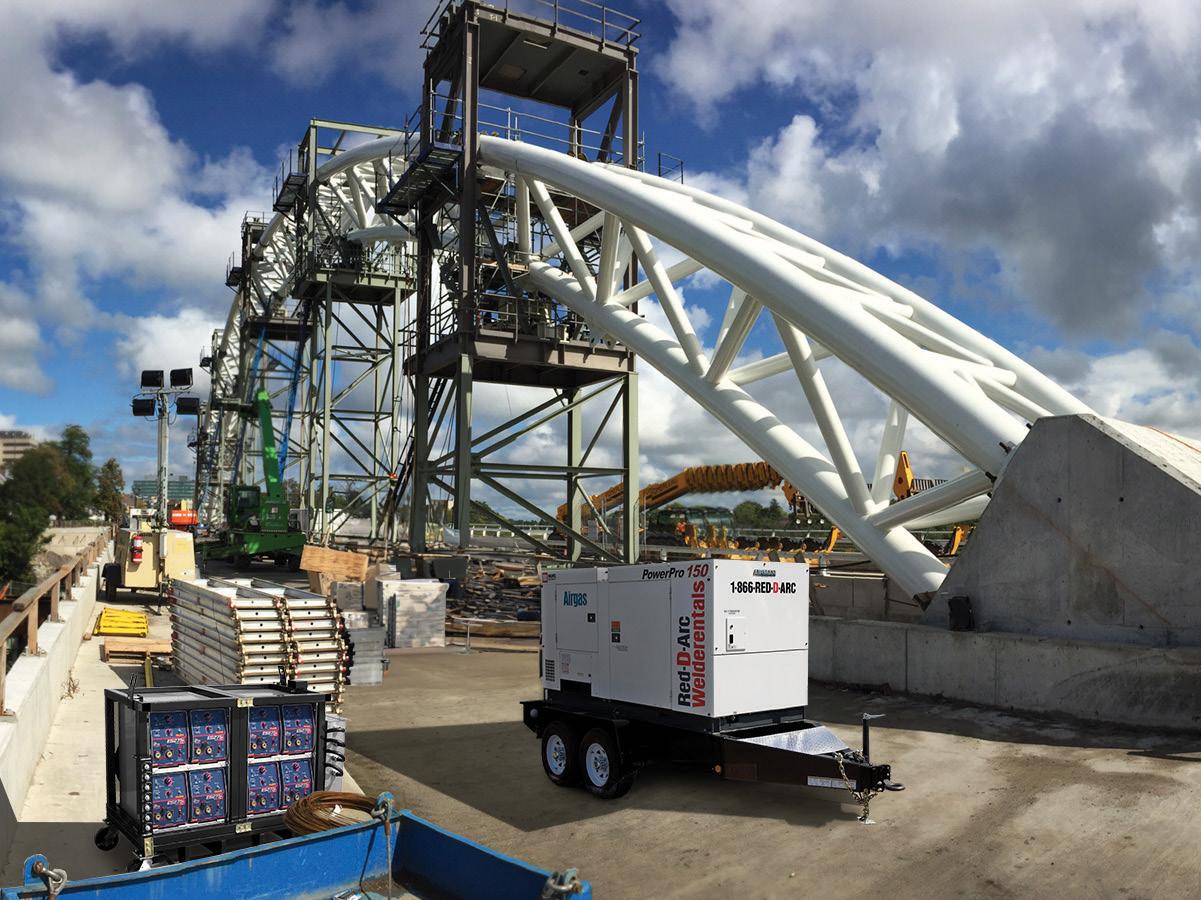
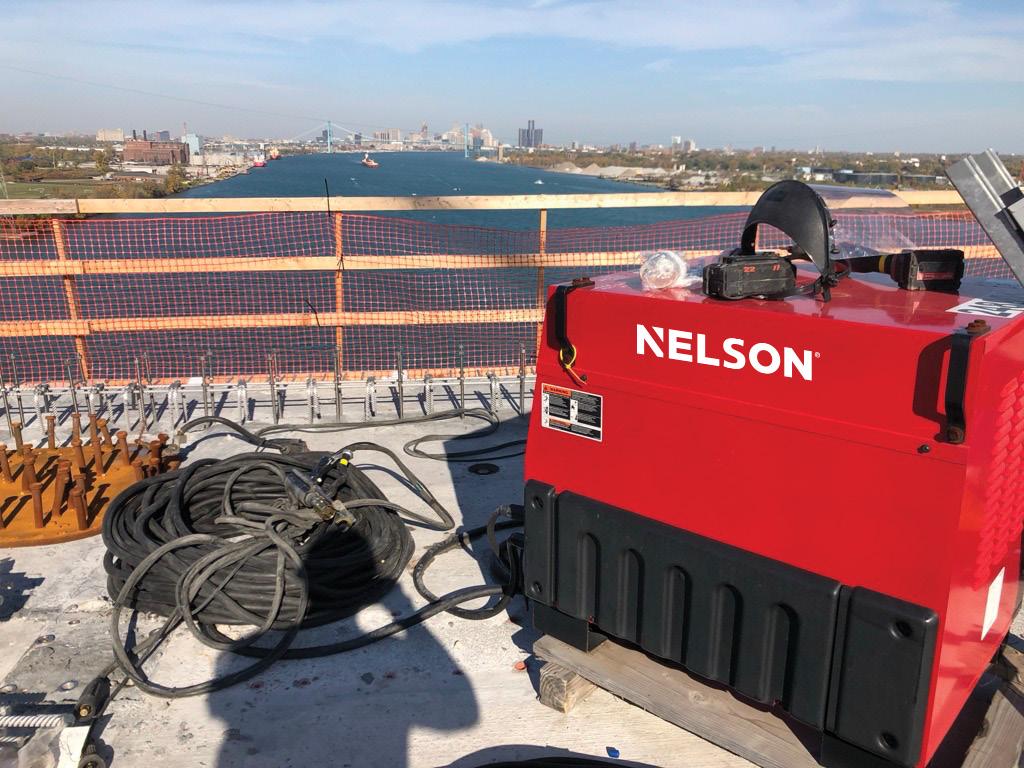
Experience dependable, uninterrupted power supply with generators and portable power distribution panels. Accompanied by our portfolio of creative power solutions. and lease options o ered by Red-D-Arc enable steel erectors to access specialized welding equipment without the need for large upfront investments, streamlining operations and increasing productivity.
POWER GENERATORS
$2,400 per year
Job Board and Applicant Tracking System
$10,000 per member
Ironworker Craft Training & Assessments Program
$10,000 per member
SteelPros Training Portal
>$2,000 per year
Workers Comp Insurance Program provides Immediate 10% discount on Premium
$1,000+ per year
Workers Comp Program provides opportunity to earn 5% return based on injury performance
$2,500 in first year & $1,250 each subsequent year
BBSI reimburses companies for achieving and maintaining AISC certification
$1,000 per member
SEAA Erector Members receive 50% discount on AISC Membership
THE OFFICIAL MAGAZINE OF THE STEEL ERECTORS ASSOCIATION OF AMERICA
SEAA is the only national trade association representing the interests of steel erectors, fabricators, and related service providers. Connector reaches both small and large contractors working in union and open labor markets.
Steel Erectors Association of America
353 Jonestown Rd, Suite 207 Winston-Salem, NC 27104
336-294-8880 www.seaa.net
OFFICERS & EXECUTIVE STAFF
Jack Nix, President
Chris Legnon, President Elect
Glen Pisani, Industry Member Vice President
Carrie Gulajan, Associate Member Vice President
Bryan McClure, Secretary
Jason McElrath, Treasurer
R. Pete Gum, Executive Directorr
PUBLISHING PARTNER
Chris Harrison, Publisher connectorsales@seaa.net Phone 660-287-7660
Roger Ridpath, Art Director roger@ridpathcreative.com 816-792-9669
ADVISORY COMMITTEE
Chris Legnon, Chairman, Cooper Steel
Nick Caratelli, Vice Chairman, Nelson Stud Welding Nathan Block, SDS2
Tammy Dean, Gardner-Watson Decking
Oliver Gleize, OTH Rigging
John Hughes, Industrial Training International
Todd Macintosh, JPW Erectors
Michael Waltman, Group Steel Erectors
Katy Williams, Williams industries
Connector™ is published quarterly by the Steel Erectors Association of America 353 Jonestown Rd, Suite 207 Winston-Salem, NC 27104
Copyright 2025 by the Steel Erectors Association of America. No material may be reprinted without permission from the Executive Director. While the information and recommendations contained in this publication have been compiled from sources believed to be reliable, the Steel Erectors Association of America, its affiliates, employees, contributors, writers, editors, designers, photographers, and media advisory committee, makes no guarantee as to, and assumes no responsibility for, the correctness, sufficiency or completeness of such information or recommendations and cannot be held responsible for the outcome of any action or decision based on the information contained in this publication or
Forging Connections, Building Success
SEAA and the industry lost a visionary leader and friend earlier this year with the passing of Eddie Williams at the age of 90. A founding member, Eddie was elected as the organization’s first President in 1972, giving a voice to small steel erectors during a time of significant regulatory changes.
As SEAA prepared to celebrate its 50th anniversary three years ago, Bob Beckner (President 1999-2000), now retired from Peterson Beckner Industries, reflected on Eddie’s impact: Eddie Williams opened the door for what SEAA has become. In the 1970s, safety wasn’t the priority it is today. His vision, and the example set by the founding companies, established the tone and goal of the organization from that day forward…Competitors could come together for a common cause.”
Eddie’s influence extended far beyond business. As noted in his obituary, “Eddie’s commercial business impact on the steel industry is only exceeded by the amount of friends he made along the way.” To learn more about the contributions Eddie Williams made to the steel erection industry, we encourage you to view the SEAA Thru the Years presentation from our 50th Anniversary Celebration.
Shaping the Future of Steel Construction
Guided by the foundational principles established by Eddie Williams, SEAA continues to invest in its members and the industry, focusing on increasing our footprint in the Midwest and West.
Since I joined SEAA as Executive Director four years ago, our membership has grown by more than 65% and cash reserves have increased by more than 50%. This issue of Connector includes our annual membership directory, showcasing diverse representation in 49 U.S. States, two Canadian Provinces, Puerto Rico and the Dominican Republic.
We’ve successfully hosted the Dave Schulz Memorial Golf Tournament in Denver, Colorado, twice, and last year’s Convention and Trade Show in Glendale, Arizona was a financial success.
An advocate for training, I am told that Eddie often argued that “a rising tide, raises all ships,” encouraging erectors to invest in their workforce even when some feared losing trained ironworkers to competitors.
Today, SEAA’s ironworker training and apprenticeship programs are a testament to his vision. To further enhance them SEAA has developed a Learning Management System with 94 Ironworker Training Videos, now
In Memory of Eddie Williams (1934-2025)
• President (1972-1973, 1980, 2003-2004)
• William Davis Service Award Recipient (2005)
• Person of the Year (2016)
The SEAA Board of Directors voted on January 17, to name the annual Person of the Year award after Eddie Williams. “We would not be the organization we are today without his guiding influence. We chose to rebrand the award as ‘The Eddie’ as an acknowledgement of the devotion Eddie Williams had to this association for the purpose of improving the ironworking profession,” said David Deem, Deem Structural Services, and member of SEAA’s Executive Committee.
being translated to Spanish.
We have also invested in our own webinar platform, and this year we’ll be hosting quarterly roundtable discussions on topics such as production tracking, rigging, and mental health.
Our fourth Career Fair, where members demonstrated skills needed in this industry to more than 500 students, was our largest yet. More than 1,200 students have now learned about various career paths, the different types of equipment and processes used on jobs, the role of safety and training through these events.
Eddie Williams’ influence on SEAA and the broader construction industry is immeasurable. From his foundational principles of safety and collaboration to his unwavering commitment to training, his legacy continues to shape our direction. Renaming the Person of the Year award to “The Eddie” is a fitting tribute to his enduring contributions. As SEAA continues to expand its reach and invest in training, technology, and talent development, we carry the torch lit by Eddie and the 11 founding member companies, striving to achieve a stronger, safer, and more unified steel construction community for generations to come. • Pete Gum is Executive Director of SEAA.
EVENTS & ACTIVITIES
Steel Connections
June 5, 2025
Cooper Steel Office
Nashville, Tennessee
– Peer Group
Virtual Roundtable
June 19, 2025
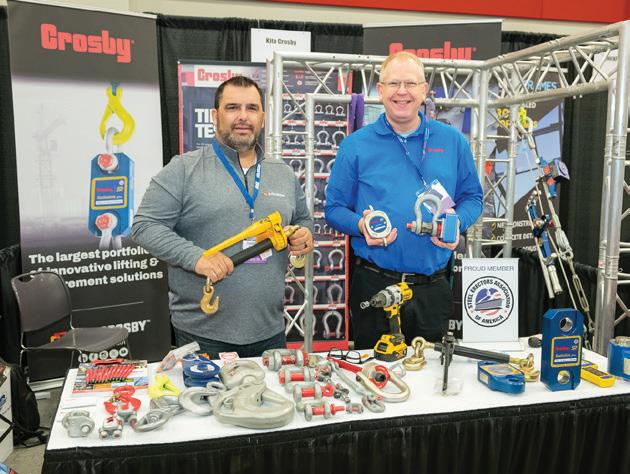
How wireless quickrelease lifting hooks revolutionize lifting and rigging in steel erection.
Online Registration
Steel Connections
July 24, 2025
Omni Providence Hotel
Providence, Rhode
Island
– Board Meeting
– Peer Group
– Meet & Greet
ASSOCIATION NEWS
■ SEAA Honors 17 Women in Construction, Recognizing Legacy Builders and Industry Leaders
In support of the 2025 Women in Construction Week that took place March 2-8, 2025, the association recognized 17 women who were nominated by colleagues. Of the 17 nominees, seven were selected as “Legacy Builders,” who were featured in social media campaigns the first week of March.
Candidates were evaluated on their professional achievements, contributions to the team, leadership or mentorship, community involvement, and personal qualities. “Each woman nominated is exceptional in her own right,” said John Hughes, Director of Business Development for Industrial Training International, and member of the SEAA Marketing Committee. “Their stories of perseverance and accomplishments are inspiring.”
THE OWNERS
“Don’t be afraid to get out of your comfort zone.”
— Kelly Ketring
* Sarah Long , Principal, Essential Perimeter Safety Systems
* Kelly Ketring , President, Premier Steel, Inc.
• Patti Davis, President, Ropac, Inc., has led the company since 1985. She prioritizes a workplace culture that values diversity, safety, and continuous learning, which has directly led to high employee satisfaction, low turnover, and improved jobsite productivity.
• Jennifer Nix , Shelby Erectors, Inc., founded Shelby Erectors after being laid off from a high school teaching position in 1997. Supporting breast cancer prevention is one of the company’s philanthropic missions. Each October, employees proudly wear pink to champion the cause.
THE EXECUTIVES
“Come with integrity, a strong work ethic, and a desire to continuously improve.” — Amanda Long
• Gina Hardison, VP of Purchasing, Cooper Steel, has dedicated over 40 years to the company. She started as a receptionist in 1983 and is now the Vice President of Purchasing. Under her leadership, her department has purchased nearly 100,000 tons of steel this year alone.
• Marta Amador, Hodges Erectors, Inc. has established the company’s social media presence in order to highlight their teams’ accomplishments. She guides team members with patience and confidence, creating a culture of collaboration and continuous improvement.
* Amanda Long , SVP, Industrial, Industrial Training International
• Nicki Cole, Vice President & CFO, Piedmont Steel Company, LLC, is a natural leader and mentor who inspires her team through encouragement and collaboration. She has helped the company achieve a milestone of 1,000,000 hours without accident or injury.
See Legacy Builders* videos on SEAA’s YouTube channel.
THE MANAGERS
“Make your voice heard. Sit at the front of the table and make well-informed decisions with confidence.”
— Kate Franquet
• Abby Stinson, Business Unit Manager-Projects, Cooper Steel, approaches every project with an innovative mindset, leveraging her experience to drive success. Her commitment to project excellence and employee development makes her invaluable.
• Teri Harmon, Executive Assistant, Deem Structural Services, is the unsung hero of the company, and is a key player on each and every team. Her involvement in projects is critical to its success, always executing at the highest quality.
• Aly Hardy, Project Manager, Gardner-Watson Decking, Inc., has managed over 100 projects in the last year, with 60 of them totaling over $4 million. Her attention to detail and perfection is what makes her stand out. Her drive cannot go unnoticed.
• Beverly Dolin, Regional Sales Manager, Western US, Nelson Stud Welding, Inc., after starting as a receptionist and putting herself through college, she came the first women to be a Nelson Stud Welding Outside Field Sales Representative.
“Not being taken seriously is an issue with no simple fix.”
— Johnna O’Gassian
* Ada Booras, Structural Ironworker, Welding Trainer, and Structural Steel Officer Engineering Intern, MAS Building & Bridge, Inc.
* Johnna O’Gassian, Ironworker/Foreman, MAS Building & Bridge, Inc.
* Audrey Terwilliger, Certified Welder, Pioneer Construction
• Maria Soldano, Ironworker/Crew Leader, Shelby Erectors, Inc., worked her way from a laborer to Forman in her 10 years working for the company, and is one of the few women working in the reinforcing steel industry. She is and always will be the backbone of her crew.
■ 2025 Fall Stand Down
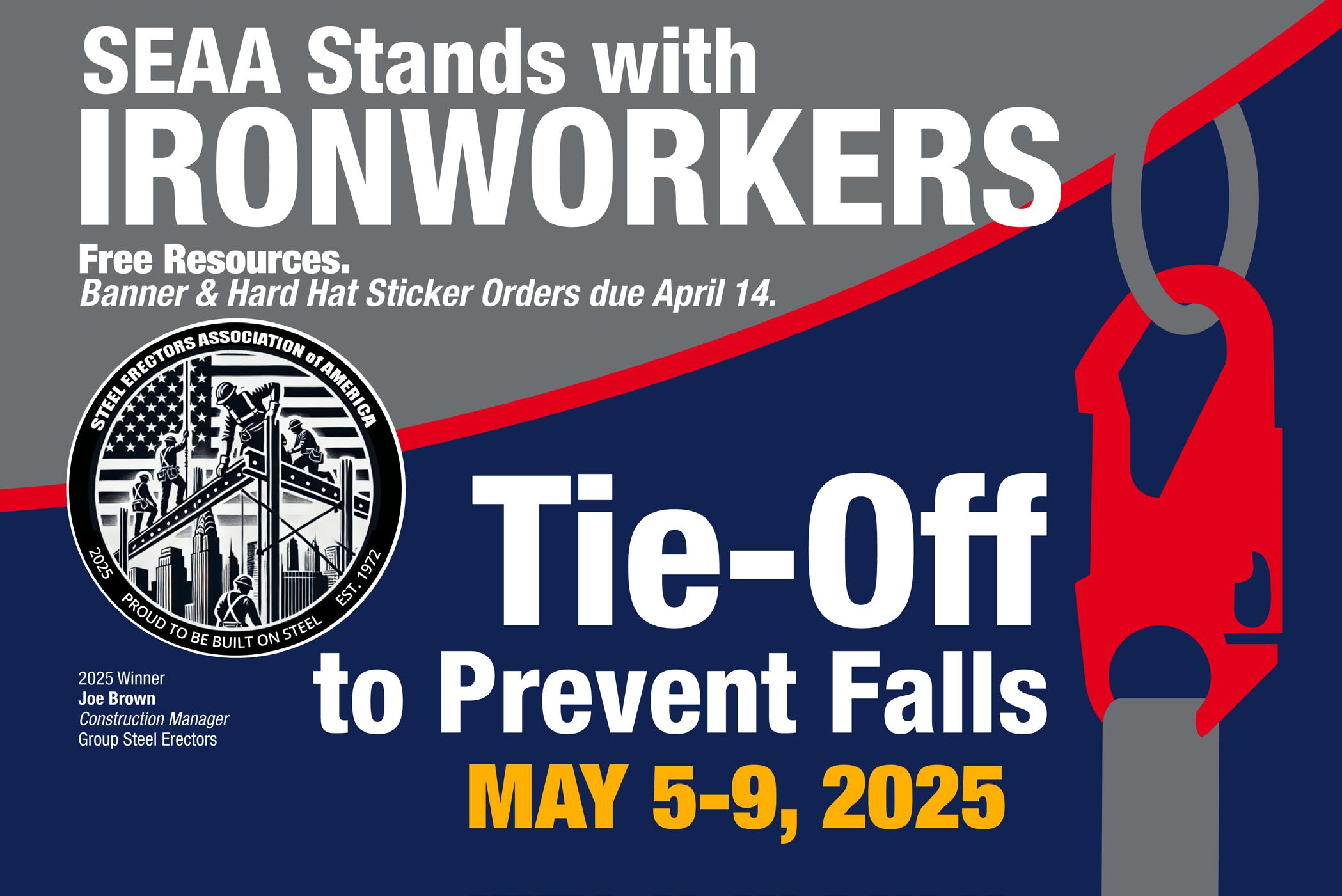
The winning hard hat sticker from the annual contest is now available for SEAA members to purchase. The design was submitted by Joe Brown, Construction Manager for Group Steel Erectors, Inc., based in Dickson, Tennessee. His submission, which followed the theme “Proud to Be an Ironworker,” captures the essence of the trade.
This year’s Fall Prevention Stand Down poster, “Don’t Fall for False Security. Tie Off Right at Any Height!” addresses one of the most underestimated risks in construction—falls from 25 feet or less. Thanks to sponsorships from SEAA’s Safety and Education Committee and Trivent Safety Consulting, the poster was polybagged with this issue of Connector
■ EZARC Building Solutions Becomes Training Unit
EZARC Building Solutions, based in Lindon, Utah, has joined SEAA’s network of Ironworker Training Units and Assessment Sites. Specializing in the semiconductor industry, EZARC Building Solutions upholds an exceptional commitment to safety, with an impressive EMR of 0.67 and a TRIR of 0.35. In addition, the company is AISC Certified and woman owned.
“Joining SEAA’s training network allows us to align our workforce development goals with industry-leading standards,” said Matt Godsey, Vice President of EZARC Building Solutions. “Becoming a certified NCCER Training Facility strengthens our ability to foster a highly skilled workforce while maintaining our unwavering focus on safety and quality.”
■ SEAA Endorses NISD Certifications
SEAA’s Board of Directors voted in January to endorse a series of certification programs offered by the National Institute of Steel Detailing. The programs include: Individual Detailer Certification, Quality Procedures Program, and CD-BIM Certification. Learn more at https://www.nisd.org/.
“Detailers are the first to translate a structure’s design into precise, buildable plans. When detailers understand OSHA requirements and erector best practices, many potential hazards are eliminated right from the start,” said David Deem, President of Deem Structural Services and SEAA board member. •
Congratulations 2025 Award Winners
Project of the Year
Miscellaneous Metals, Class I
Central Texas Steel Erectors
Miscellaneous Metals, Class II
ORBIT Industrial Service and Maintenance
Structural, Class I
Hodges Erectors, Inc.
Structural Class II
All Things Metal, LLC
Structural, Class III
GMF Steel Group
Structural, Class IV
Alliance Riggers & Constructors, Ltd.
Training Excellence
World Class, Category 1
GMF Steel Group
World Class, Category 1
Derr & Gruenewald Construction, LLC
World Class, Category 2
Shelby Erectors, Inc.
Safety Excellence
World Class
Cooper Steel
Derr & Gruenewald Construction, LLC
GMF Steel Group
High Plains Steel Services, LLC
MAS Building & Bridge, Inc.
Premier
Flex-Erect
Gardner Watson Decking
Group Steel Erectors, Inc.
JPW Erectors, Inc.
L.R. Willson & Sons, Inc.
Piedmont Steel Company, LLC
S&R Enterprises, LLC
Gold
Cubas Welding Construction, Inc.
Shelby Erectors, Inc.
Download poster
PRODUCT FOCUS
■ LevelRight Outrigger Pad for Crane Setup
DICA has expanded its LevelRight Outrigger Pad product line, now offering four sizes—12-inch, 24-inch, 30-inch, and 35-inch—to accommodate a wider range of crane operations. Originally introduced in 2024, LevelRight has quickly become an essential tool for achieving a safe and level setup on uneven terrain.
Designed to adjust angles up to 10 degrees in multiple planes, the pads support rated capacities from 350,000 to 450,000 lbs., reducing the risk of tipping and increasing operational efficiency. “An out-of-level setup can compromise safety and accelerate equipment wear. The expanded LevelRight lineup provides a fast, reliable solution without the need for digging, wedging, or shoveling,” said Kris Koberg, CEO of DICA.
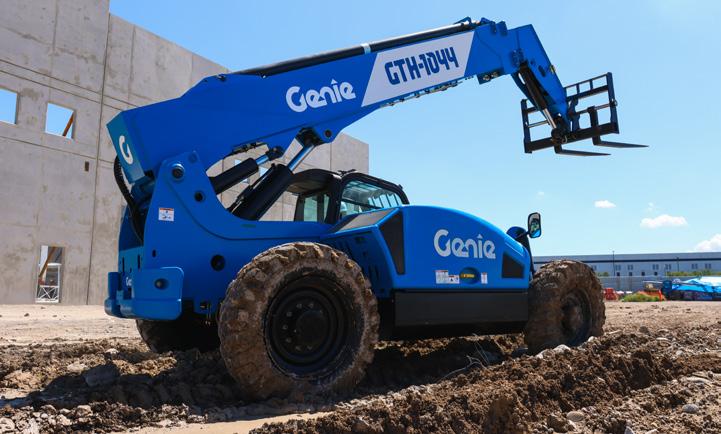
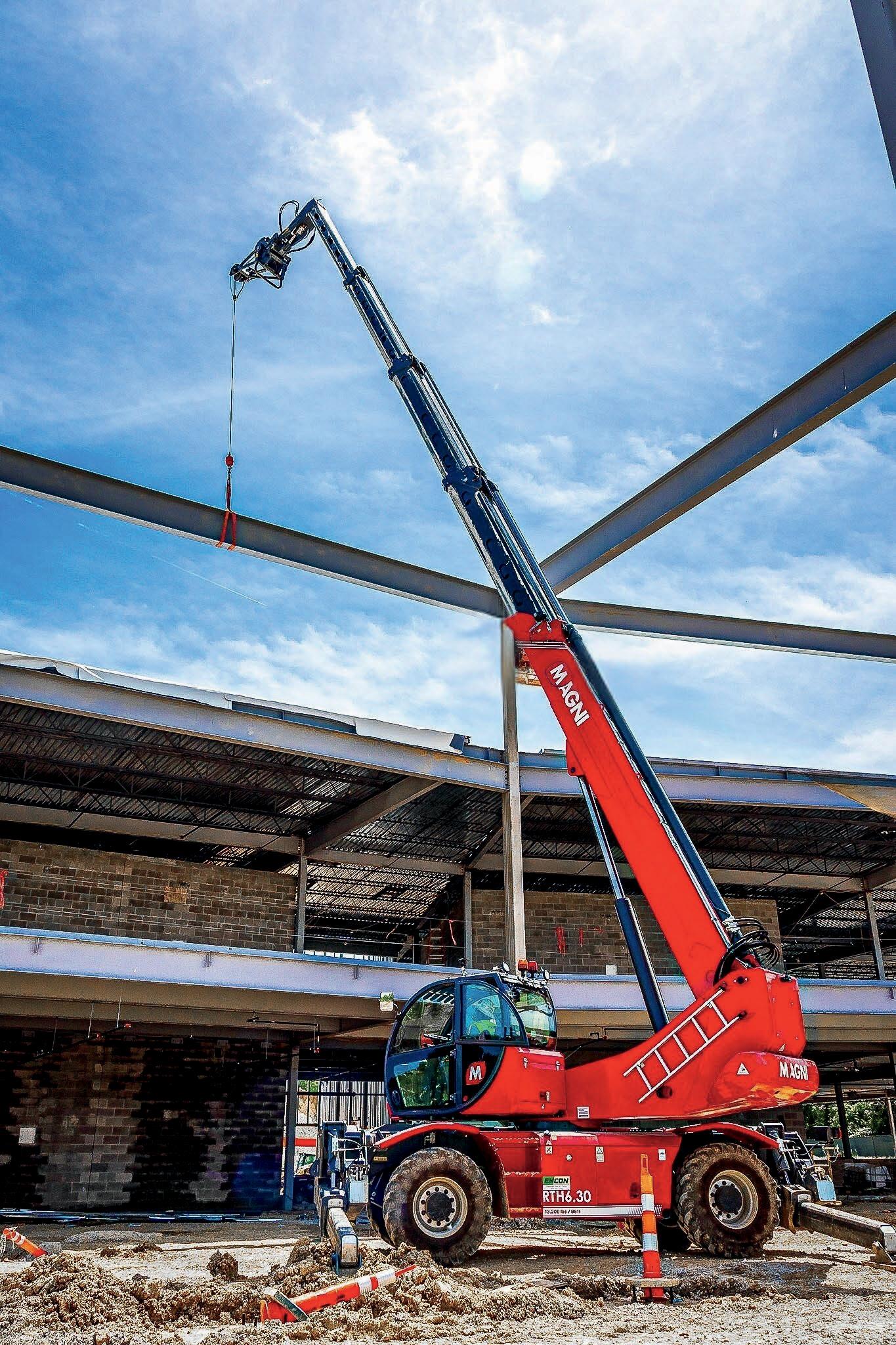
Genie has expanded its telehandler lineup with the GTH-1244 and GTH-1044, engineered for high-capacity, lower-reach pick-and-carry applications. Designed to help rental companies differentiate their fleets and maximize return on investment, these models offer best-in-class load charts, eliminating the need for stabilizers while maintaining exceptional stability and visibility. Ideal for steel erection, industrial maintenance, energy, and construction, these telehandlers efficiently handle heavy loads with shorter cycle times. The 74 hp DEF-free engine eliminates service costs related to emissions components, while limited-slip differentials improve traction on rough terrain.
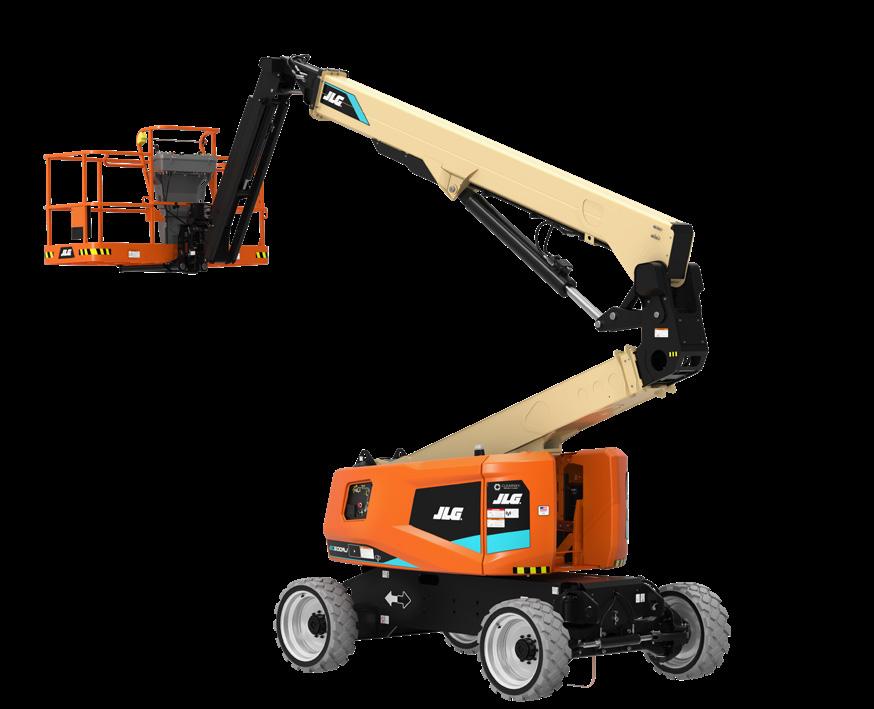
■ JLG Unveils Electric Boom Lift
JLG Industries has announced the new 60-ft EC600AJ articulating boom lift, expanding JLG’s electric construction portfolio. The EC600AJ offers 550-lbs. unrestricted and 750-lbs. restricted platform capacities with a 27’1” up-and-over height, 130-degree jib articulation, and 400-degree non-continuous swing for precise positioning. Powered by two 10.7kWh lithium-ion batteries with 4WD AC drive motors, it provides 40 percent gradeability with a 5-degree tilt cut-out, providing the power to tackle challenging terrain while complying with industry safety standards.
■ Airgas Launches Women’s PPE for Welders
Airgas, a leading supplier of industrial gases and safety products, has introduced RADNOR, a line of Personal Protective Equipment (PPE) designed specifically for women who weld. The collection includes gloves and welding jackets tailored for women, with a focus on fit, function, and style.
Airgas collaborated with leading manufacturers to source materials and designs that prioritize both safety and comfort, addressing the unique needs of women in the welding industry.
■ Cocoon Netting Contains Jobsite Debris
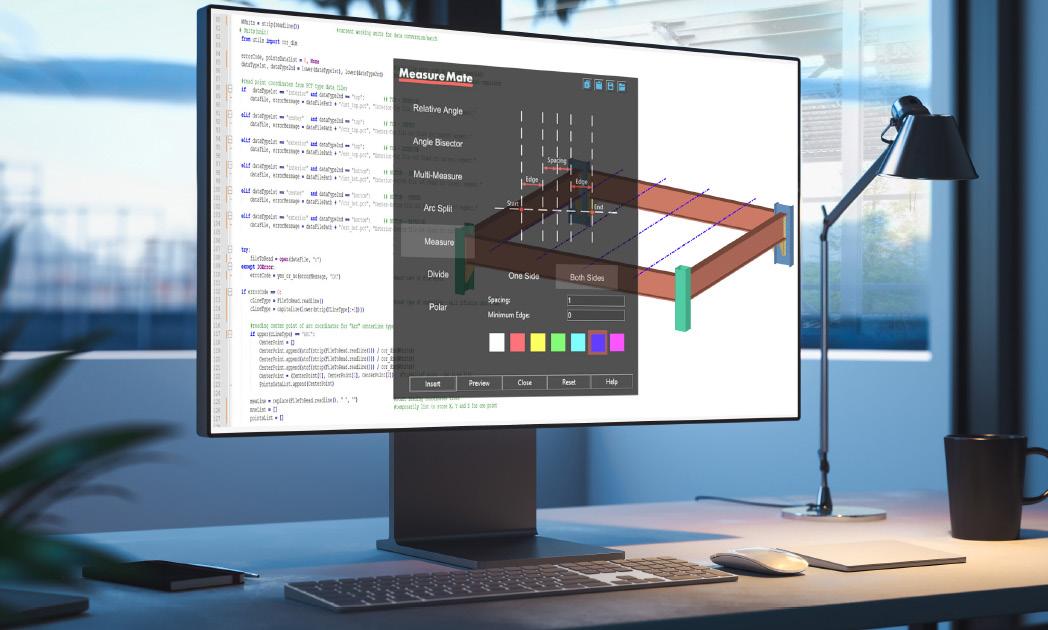
■ Canam Launches MeasureMate Plugin for SDS2
Canam has released MeasureMate, a new modeling extension for SDS2, now available in the SDS2 online store. Designed to streamline measurement and modeling management, this plugin enhances efficiency and productivity by allowing users to preview models before applying them, reducing errors and saving time. It provides multiple functions for accelerated modeling, including division, measurement, linear and polar network creation, and angle bisector calculations. Compatible with SDS2 v2017 and newer, the plugin integrates seamlessly through the search function and dedicated menu buttons.
EPS Systems’ cocoon netting is a patented vertical netting system designed to contain debris during steel erection, precast, and rehabilitation projects. Engineered to improve jobsite safety, the system prevents falling objects, protecting both workers and pedestrians while meeting OSHA safety standards. EPS netting integrates with the existing steel structure, and outriggers are pre-attached in the laydown yard, allowing for fast, efficient installation with minimal impact on crane operations. The nets can be lowered or removed as needed, ensuring seamless workflow and site access. Each system is customized to fit project-specific needs, with optional attachments for fire protection, spark containment, and concrete slurry control.
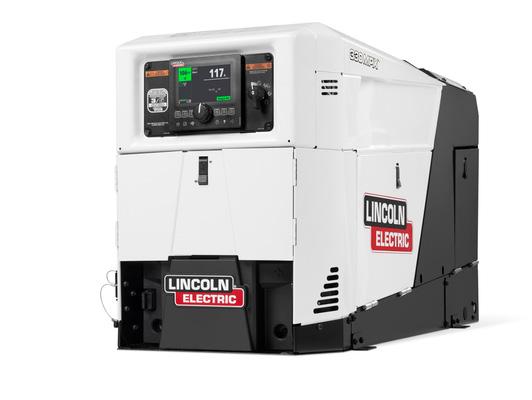
■ Lincoln Electric Debuts Ranger Air 330MPX Engine Drive
The new Ranger Air 330MPX from Lincoln Electric is a versatile, high-performance engine drive designed for welding professionals who need efficiency and reliability in the field. Combining five essential functions—air compressor, generator, battery jump assist, battery charge, and multi-process welder— this unit maximizes productivity while reducing costs. Featuring variable engine speed and auto stop/start technology, the 330MPX minimizes fuel consumption, while maintenance alerts prevent downtime. A Vanair® rotary screw air compressor delivers 30 percent more air power than competitors, and a 10KW AC generator supports sensitive electronics and 12V/24V battery jump-starting. •
How steel erectors are building stronger teams through communication and mentors Culture Catalyst MANAGEMENT
By Jenny Cohen
Arobust company culture isn’t just about getting projects done.
It’s also about building a team where employees feel connected to the company and to each other, resulting in positive impacts on productivity, retention, and safety.
“Any company can erect steel, but you need to make a cohesive unit and bring people together to make a team,” said Glen Pisani, steel division manager for MAS Building & Bridge, Inc., Norfolk, Massachusetts. He emphasizes that building this cohesion requires time and a willingness to invest in programs that are meaningful to employees.
Creating a strong company culture involves balancing communication, mentoring and career development,
while also addressing employees’ practical needs.
“It starts with your mission statement and defined core values,” said Todd Macintosh, vice president at JPW Erectors Inc., Syracuse, New York. “These two things can’t take a back seat to other challenges a business might be facing, otherwise your message and your culture will suffer, and consistency is lost.”
Culture: A cornerstone of safety
Good communication, mentoring, and other programs indirectly enhance safety by reducing risk, which is fundamental to a positive company culture.
“Safety should be embraced as a core cultural value, reflecting genuine respect for workers rather than being viewed as mere compliance,” said Stephanie Reitz, MBA-HRM, SHRM-SCP, a client services director at myHR Partner, an HR outsourcing company. “Actively involving field staff in safety committees and
initiatives fosters a sense of ownership and accountability, allowing them to contribute valuable feedback and firsthand insights.”
JPW Erectors exemplifies this with its
“See Something, Say Something,” process, empowering workers to escalate potential issues directly to the owner if needed. The company also utilizes a peer committee that distributes quarterly safety awards, reinforcing a culture of safety at all levels of the company.
“We empower every employee to be engaged in the company’s safety culture,” Macintosh reiterates.
Safety impacts the bottom line. Yes, safety is about protecting workers on jobsites—but it also contributes to reducing costs and winning bids on new projects. “Financially, the better safety record we have, the better work we're able to get. That opens up opportunities for our employees,” said Pisani, who suggests tying a bonus to a safety metric might be one way of reinforcing this.
Jenny Cohen is a freelance writer based in Michigan with more than 25 years of writing and editing experience. Her recent work includes covering the heavy machinery and construction industries.
For MAS Building & Bridge, Inc., mentorship starts out with a base task list that new employees work through with foremen.
Two-way communication
Communication is paramount in building a strong company culture, particularly in an industry where workers are dispersed across various job sites.
“Effective communication is key. Regular updates regarding organizational objectives, project status, and industry challenges create alignment and shared purpose,” Reitz said.
Establishing feedback mechanisms is equally crucial, ensuring field personnel can contribute to organizational decision-making. Reitz suggests daily toolbox talks and mobile apps as effective tools for fostering communication continuity with teams across job sites.
Shelby Erectors in Florida has successfully implemented an internal social media platform, enabling all employees to interact and engage with each other. This platform also serves as a tool for management to push out relevant communications and recognize employees for both personal (birthdays and new babies) and professional (safety or training) achievements.
“It allows our employers to be connected [to each other] and give them the ability to reach out to management on an open platform without fear or obstacles,” said Jackson Nix, vice president of business administration for Shelby Erectors.
These platforms also provide management with tools for addressing sensitive topics such as suicide prevention by offering mental health resources. (See sidebar, below.)
Other companies have found success with regular all-hands meetings before workers head out to jobsites supporting personal connections in a field where consistent in-person interaction can be
Prioritizing Mental Health
A screenshot of Shelby Erector’s internal social media platform shows how teams stay connected.
challenging. Leadership should also prioritize site visits to review work and engage with employees, contributing to a positive communication environment.
For example, Pisani noted that ownership and management of MAS Building & Bridge, Inc. regularly visit worksites—not just to get updates on projects—but to also talk to the workers on site.
Reitz emphasizes the importance of on-site visibility, stating, “Field leadership plays a pivotal role with foremen and supervisors serving as cultural ambassadors who shape daily site dynamics,” she said. “Regular executive presence through site visits reinforces organizational values while demonstrating a tangible commitment to field operations and appreciation for front-line teams.”
The construction industry faces higher rates of substance abuse rates and suicide rates than other industries, noted Denise Dahl, president, founder, and owner of Epiphany Planning & Development. They are difficult issues to address but necessary for companies working on building a positive company culture.
“Conversations among leaders must include balancing people and profit and fully recognizing the costs,” she said. “It’s going to require modeling behavior you want to instill, such as being supportive of mental health, safety, and other issues,” Dahl said.
“Firms that deal with these problems, for instance by providing scheduling tools or wellness programs, seem to be succeeding and claiming industry leadership,” says Mike Szczesny, owner and vice president of EDCO Awards & Specialties.
Mentoring, retention, and career paths
Attracting and retaining the right employees who align with the company culture and envision a long-term future can be challenging, but mentoring is a valuable investment.
Strong mentorship programs enhance team spirit and effectiveness, according to Mike Szczesny, owner and vice president of EDCO Awards & Specialties. But he notes that mentoring in trade industries means finding good hands-on approaches with workers who are regularly on remote job sites where collaboration and quick decision-making is vital compared to a typical mentorship approach in an office setting.
Mentorship benefits both the mentee and the mentor. Veteran employees often find satisfaction in training others. “The quicker you mentor someone under you, the easier your job becomes,” Nix said about how mentoring helps workers at different levels at Shelby Erectors, Reddick, Florida.
Mentoring also helps employees envision a future within the company, no matter what their current role. Clear career paths eliminate the perception of mentoring as a burden. MAS Building & Bridge has cultivated a culture where mentoring is integral to advancement.
Pisani explains that mentors at MAS Building & Bridge understand they are training their replacements, enabling their own progression. This fosters a cycle of
At MAS Building & Bridge, a strong co-op program with local high schools opens doors for students. Ada Booras (left) is one of the students that has found a career path here. The 19-year-old is such a proficient welder (certified in SMAW and FCAW) that she helps train other employees in the company’s steel erection, heavy civil, and marine divisions.
success, allowing mentors to impart critical knowledge while advancing their own careers. “We work on our replacements and let people know that this is what your future can be,” he said.
For MAS Building & Bridge, Inc., mentorship starts out with a base task list that new employees work through with foremen. The system helps new employees learn vital tasks, builds communication among workers, and gives mentors the chance to work on management skills that are also important as they move up in the company and build a long-term career.
High Plains Steel Services, LLC, Windsor, Colorado employs a voluntary program that pairs employees with managers for monthly check-ins, focusing on improvement. “The meetings cover three main questions: What can you improve? What can your department or team do better? What can the company do better?” says Kris McLean, President & Project Executive.
He notes that providing employees with opportunities to voice concerns and the resources to implement improvements has
increased engagement.
It is important to focus on retention, because high turnover and reliance on temporary or contract workers disrupt efforts to establish lasting cultural norms,” Reitz said, noting that frequent personnel changes can hinder the development of shared values for a company.
Building a lasting foundation
“You need to be consistent and create a place that you want to work at every day,” Pisani stated. “We want people that see a future and not just a paycheck.”
Nix echoes this sentiment, emphasizing that a culture prioritizing communication and mentorship fosters retention. He believes that when employees feel they are in a good place, they see that they can make a career at the company.
“We know where we want to be at the end of each day, each project and each year, as a company, but it is your company’s culture that will get you there with success for all involved,” said JPW’s Macintosh. •
IN THE FIELD
By Michael Rubin
OSHA Enforcement Trends
How contractors can survive new era of aggressive inspections
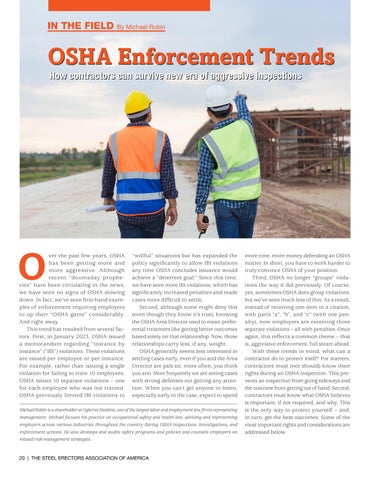
Over the past few years, OSHA has been getting more and more aggressive. Although recent “doomsday prophecies” have been circulating in the news, we have seen no signs of OSHA slowing down. In fact, we’ve seen first-hand examples of enforcement requiring employers to up their “OSHA game” considerably. And right away.
This trend has resulted from several factors. First, in January 2023, OSHA issued a memorandum regarding “instance by instance” (“IBI”) violations. These violations are issued per employee or per instance. For example, rather than issuing a single violation for failing to train 10 employees, OSHA issues 10 separate violations – one for each employee who was not trained. OSHA previously limited IBI violations to
Michael Rubin is a shareholder at
“willful” situations but has expanded the policy significantly to allow IBI violations any time OSHA concludes issuance would achieve a “deterrent goal.” Since this time, we have seen more IBI violations, which has significantly increased penalties and made cases more difficult to settle.
Second, although some might deny this (even though they know it’s true), knowing the OSHA Area Director used to mean preferential treatment like getting better outcomes based solely on that relationship. Now, those relationships carry less, if any, weight.
OSHA generally seems less interested in settling cases early, even if you and the Area Director are pals (or, more often, you think you are). More frequently we are seeing cases with strong defenses not getting any attention. When you can’t get anyone to listen, especially early in the case, expect to spend
one of the largest labor and employment law firms representing management. Michael focuses his practice on occupational safety and health law, advising and representing employers across various industries throughout the country during OSHA inspections, investigations, and enforcement actions. He also develops and audits safety programs and policies and counsels employers on related risk-management strategies.
more time, more money defending an OSHA matter. In short, you have to work harder to truly convince OSHA of your position.
Third, OSHA no longer “groups” violations the way it did previously. Of course, yes, sometimes OSHA does group violations, but we’ve seen much less of this. As a result, instead of receiving one item in a citation, with parts “a”, “b”, and “c” (with one penalty), now employers are receiving three separate violations – all with penalties. Once again, this reflects a common theme – that is, aggressive enforcement, full steam ahead.
With these trends in mind, what can a contractor do to protect itself? For starters, contractors must (not should) know their rights during an OSHA inspection. This prevents an inspection from going sideways and the outcome from getting out of hand. Second, contractors must know what OSHA believes is important, if not required, and why. This is the only way to protect yourself – and, in turn, get the best outcomes. Some of the most important rights and considerations are addressed below.
Ogletree Deakins,
The
Fourth Amendment
Employers are entitled to Fourth Amendment protection against unreasonable searches and seizures; accordingly, an OSHA inspector needs one of two things to proceed with an inspection: a warrant or your consent. Inspectors, formally known as Compliance Safety and Health Officers (“CSHO”), almost never show up with a warrant. So, they need your consent to proceed. Interestingly, a CSHO may never ask, “Do you consent to this inspection?” Instead, more likely, the CSHO will describe what he or she plans to do and then ask if you have any questions. When you answer, “No, that’s fine,” you’ve effectively just consented. This is implied consent.
Since a CSHO will invariably need your consent for the inspection to proceed, this provides an opportunity (prior to consenting) to negotiate a reasonable scope and reasonable conditions for the inspection. For example, you might tell the inspector, “We are inclined to consent to this inspection, but before we do, we want to ensure that we have a clear understanding of what the inspection will entail – essentially what we are consenting to – and also, the protocol for the inspection activities.” This should facilitate a productive discussion with the CSHO.
Even if you consent to the inspection, you can still request that the inspection be delayed for up to one hour pending a critical management representative (including outside legal counsel) appearing at the site. Keep in mind, if a CSHO is unwilling to negotiate a reasonable scope for the inspection, you believe there’s no probable cause for the inspection, and/or you need additional time (for example, someone on your team can’t get to the site in time), you might insist that the CSHO obtain a warrant. “We deny consent.” You can actually say that.
The opening conference is critical
The first stage of an OSHA inspection is the opening conference. The CSHO is required to explain why the employer is being inspected, including whether it is a programmed or unprogrammed inspection. We always ask about this. If the inspection is due to an employee complaint, the CSHO is obligated to provide the employer with a copy of any written complaint (with the name of the employee redacted). We always ask for a copy and, invariably, get it.
Section 8 of the OSH Act of 1970 states that inspections must be conducted in a “reasonable manner.” You have the right to insist that a reasonable scope and protocol be established for the inspection. If you feel the CSHO is overstepping the proper boundaries, you can always reference this basic OSH Act requirement. Ensuring a proper scope of the inspection is critical. For example, if the probable cause for the inspection is an employee complaint regarding equipment used and located in only one part of the site, the inspection should be limited to that part of the site.
Document requests
Documents, documents, documents. Have you heard that said before? Documents are critically important. Why? You need them! Contractors must know that certain documents are literally indispensable to certain OSHA defenses. For example, you must have disciplinary records if you want to defend a matter, arguing that the employee engaged in misconduct. Also, you need evidence that you have conducted jobsite inspections and/or audits and/or walks. This is the third element of the unpreventable employee misconduct
Lonnie Poole Golf Course at NC State
University
Raleigh, North Carolina
Friday, October 17, 2025
defense. Furthermore, the OSHA multi-employer citation policy requires that “controlling employers” (oftentimes, general contractors, but also frequently, simply higher tier contractors who subcontract with lower tiers) exercise reasonable care to detect and prevent violations. You need records of these efforts.
More fundamentally, at the start of an inspection, the CSHO will undoubtedly request that you provide certain records, including injury and illness logs (OSHA
forms 300, 301, and 300A). These records must be produced within only four hours if requested. As a result, you should always have your 300 logs in acceptable form and ready to be produced, quickly.
For any additional document requests, employers should ask that all requests be made in writing and directed to a single company representative—such as legal counsel. Also, any sensitive documents should be reviewed for confidential business information
and/or trade secrets. Any privileged documents – those protected by the attorney-client privilege should not be produced.
The walkaround
During this phase of an inspection, the CSHO will walk the site, gather evidence, and seek to identify potential safety and/ or health hazards in the workplace. The CSHO is authorized during this phase to take photographs, videos, and measurements. Importantly, an employer representative (including legal counsel) has the right to accompany the CSHO at all times and take the same photographs as the CSHO (“side-byside photographs”), videos, measurements, and samples. If the CSHO points out any areas of concern during the walkaround, you should correct any obvious issues but not admit to any violations. You gain nothing by admitting to a violation, and, more importantly, how would you even know if you are correct? After all, OSHA needs to prove four elements to establish any one violation. It is essential that you know all four elements:
• The standard applies,
• The employer failed to comply,
• Employees were exposed, and
• The employer knew or should have known.
Interviews with employees
Although the CSHO is entitled to conduct interviews, a notable distinction exists between hourly employees and those in management. Although the CSHO may interview hourly employees privately, an employer representative, including outside legal counsel, has a right to participate in all management interviews, in part because any admissions made by management may be attributed to, and used against, the employer.
In addition, hourly, non-supervisory employees do have the right to request that a personal attorney or union representative be present during their interview. If honored by the CSHO, this would negate any private interview of the hourly employee.
Understanding the inspection process and limits of OSHA’s inspection authority will enable employers to obtain positive outcomes in the inspection process. This, in turn, may translate to less – or even no –violations being issued against the employer. Please consider implementing these OSHA inspection best practices now, before you receive the proverbial “knock on the door.” •
By Austin Reiner
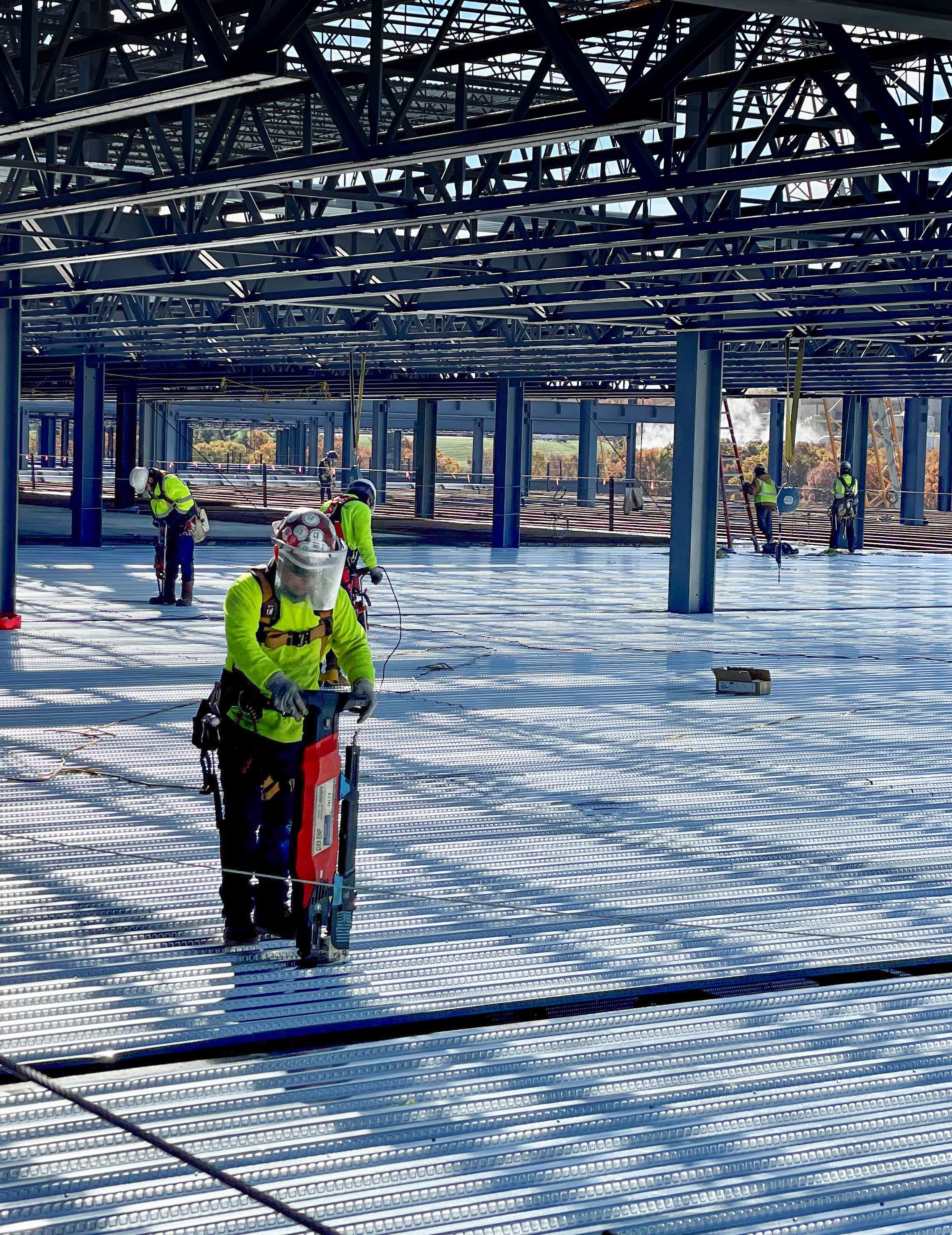
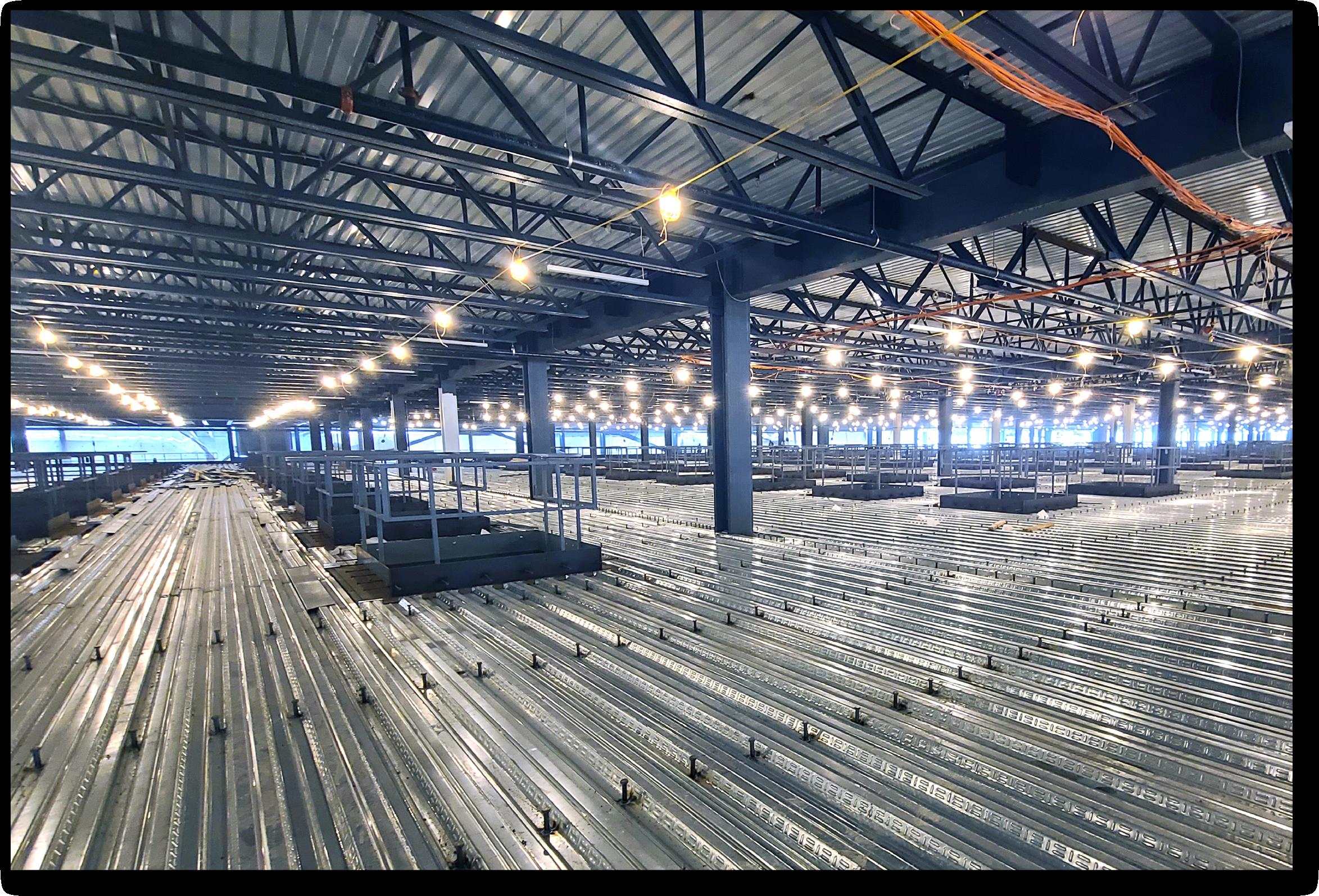
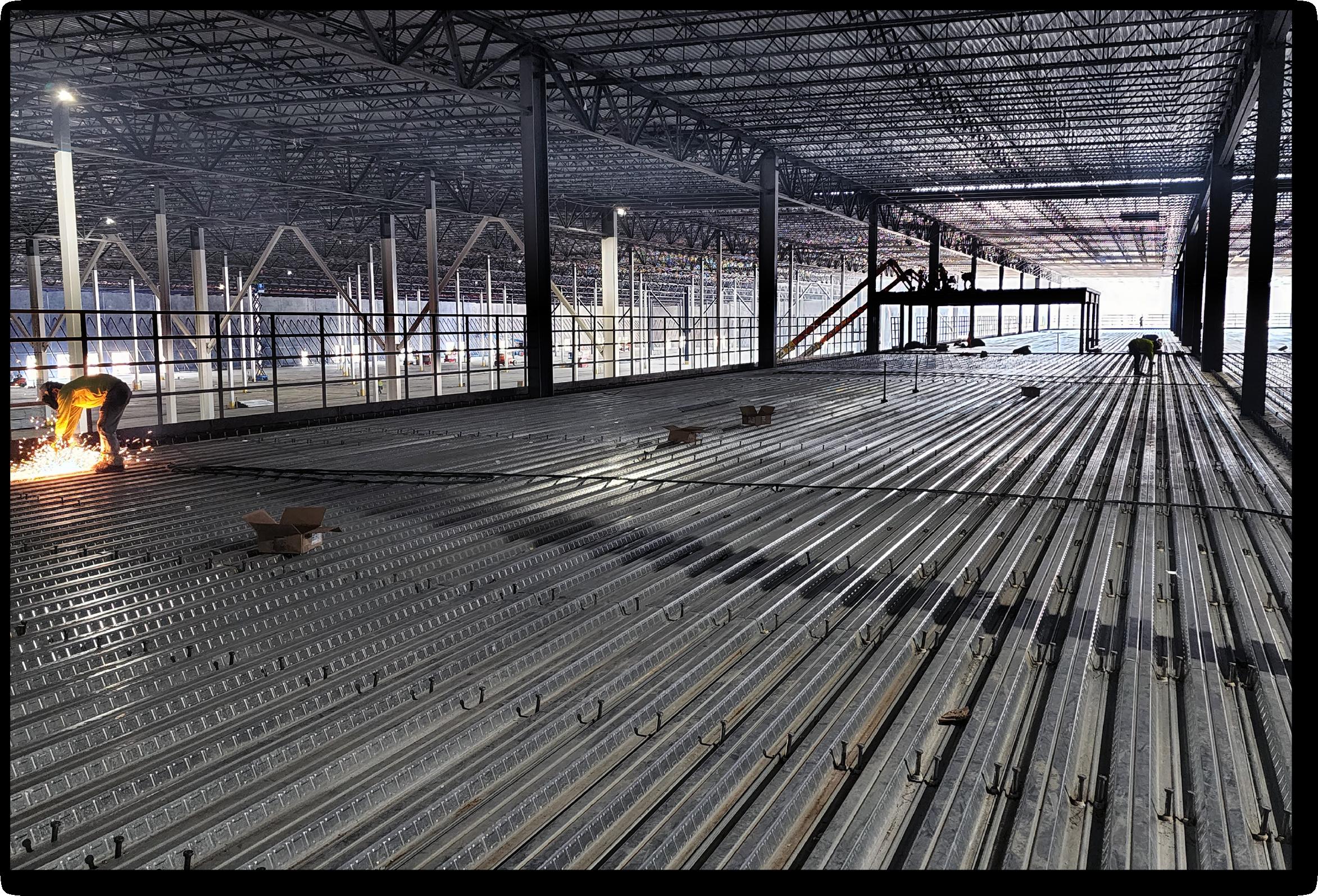
On this joint Gardner-Watson Decking and Gardner-Watson Studs project in Phoenix, Arizona, the companies placed 1.2 million sq ft of decking and 59,500 shear studs, along with some deformed bar anchors shot on bent plate. This photo, taken by Duke Perry, Vice President of Sales and Operations for Gardner-Watson Studs, was the winner of SEAA’s Summer Photo Contest. Perry’s photo captures the spirit of teamwork and dedication that defines the steel erection industry. He said: “This project was done in partnership with our customer was delivered safely, precisely, and on time!”
DECKING SAFETY ESSENTIALS
Navigating OSHA Regulations and Best Practices for Fall Protection and Anchoring Methods
Installation of metal decking during steel erection activities comes with inherent risks that must not be underestimated. This crucial process provides structural support but can pose a range of hazards if not executed properly. Training and safety of workers is paramount during decking operations. Despite existing OSHA regulations [1926.754(e) and1926.757(e)(4] related to sheet metal installation, there is little guidance on correct fall protection procedures for this type of work. Derr and Gruenewald Construction conducted drop testing on a training tower
Austin Reiner, CHST, is the Safety Manager for Derr & Gruenewald Construction.
in order to establish best tie off practices when throwing decking, which are shared below. But first, let’s explore other key safety requirements.
Shaking out deck
It is a common misconception that the metal banding wrapped around deck bundles can be used for lifting the bundle. While it may seem like a convenient place to hook onto, the band will likely break. When the band snaps it can cause significant injury. Instead, always use properly rated wire rope slings in choker hitches. Before hoisting the decking bundle, don’t forget to check for hitch hikers— dunnage, flashing, or other materials
that are loose on the bundle. If those materials are being hoisted with the deck bundle they must be secured. Don’t forget hand protection. Cut resistant gloves are recommended for workers handling metal deck sheets, which have sharp edges.
Use qualified riggers
The rigger responsible for unloading, moving, or hoisting deck bundles MUST be qualified and competent. Riggers must know the weights of each bundle, and the capacity of the rigging and hoisting equipment. Rigging should also be inspected prior to use. When hoisting decking, make sure the small eyes of both chokers are on
Watch Drop Test Demo
Video of two drop test scenarios using different fall protection systems provides clarity for leading edge fall protection best practices.
the same side of the decking bundle. This ensures a good bite on the bundle, avoids load twisting, and makes the likelihood of the bundle shifting lessened.
The rigger should go through these steps prior to each pick. To put it bluntly, it’s a life-or-death choice every time if proper procedures are not followed.
Landing deck bundles
Before landing deck bundles upon the structure, verify that the framing members are able to support the bundle without
the possibility of being dislodged when unbanded. Before landing bundles on steel joists, all joist bridging must be installed and anchored, and all joist ends must be attached unless the following conditions are met.
• The employer has first determined from a qualified person and documented in a site-specific erection plan that the structure or portion of the structure is capable of supporting the load.
• The bundle of decking is placed on a minimum of three steel joists.
• The joists supporting the bundle of decking are attached at both ends.
• At least one row of bridging is installed and anchored.
• The total weight of the bundle of decking does not exceed 4,000 pounds (1816 kg).
• The edge of the construction load shall be placed within 1 foot (.30 m) of the bearing surface of the joist end.
Fall protection best practices
There are some gray areas when it comes to OSHA requirements for fall protection when throwing decking. That’s why Derr and Gruenewald did some testing using common tie off procedures.
Ironworkers are often tied off to a long
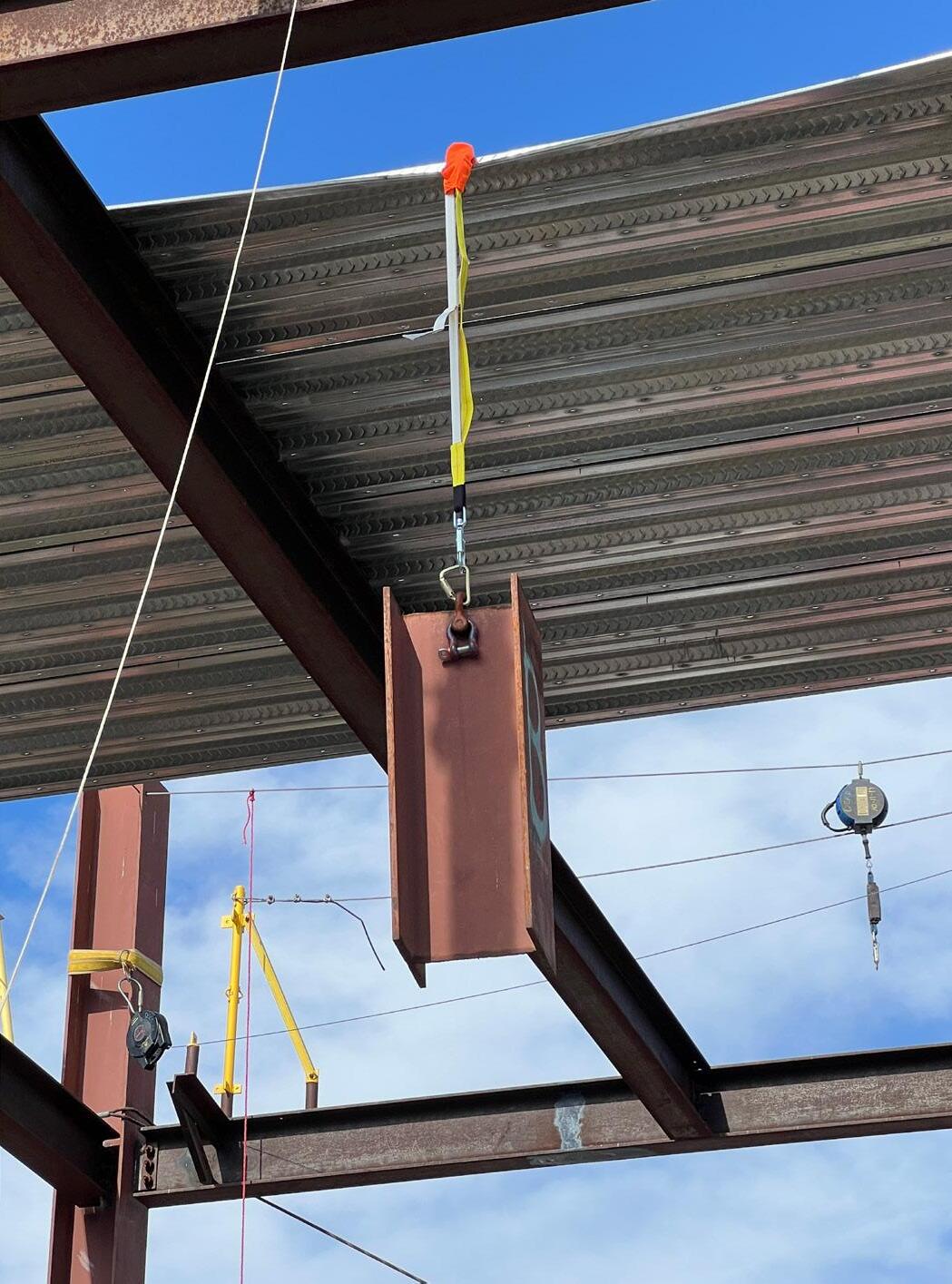
SRL anchored to an elevated HLL. We wanted to determine what would happen in this scenario if a worker fell over the deck edge of an unsecured decking sheet. The objectives of this test were 1) to evaluate the structural integrity and performance of the steel deck under impact conditions and 2) compare the results utilizing different fall protection scenarios.
First drop test: Elevated SRL
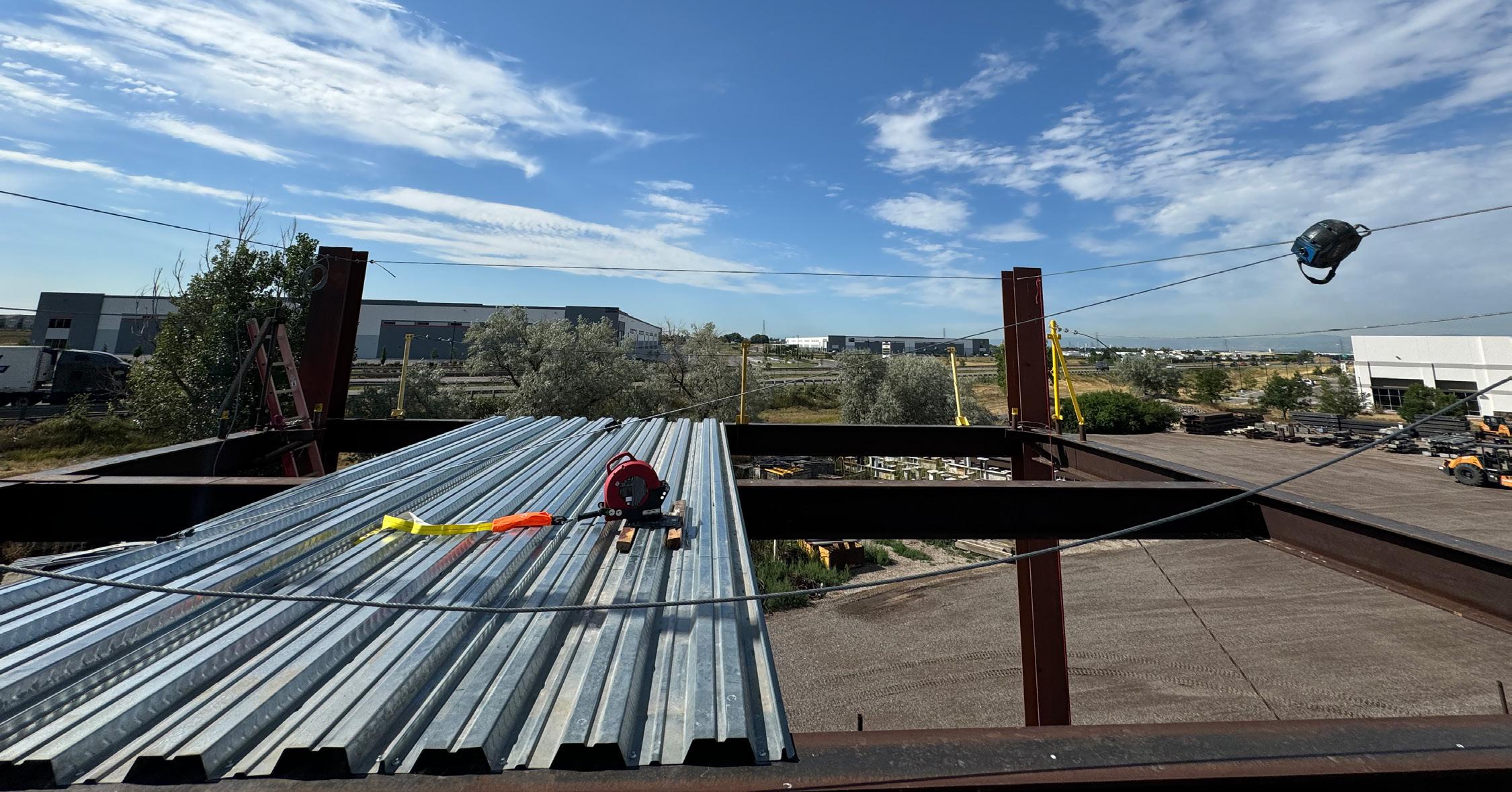
In the initial test, a 315 lb test weight was suspended 5 feet above the walking/working surface of the deck sheet. The test weight was connected to a 50 ft leading edge self-retracting lifeline (SRL), which was anchored to a horizontal lifeline (HLL) and elevated 6 ft above the deck. The SRL was extended 25 feet from its anchor point to the test weight located at the deck edge, where the sheet was unsecured.
Upon release, the test weight dropped 5 feet before the SRL cable began to bear the weight on the unsecured decking sheet. This action caused the non-working side of the deck sheet to lift slightly and be forced 3 feet back toward the anchor point. The unsecured deck sheet stopped when its high and low hats settled into the deck sheet that was secured behind it. The total fall distance was 14 feet.
This setup shows two different anchor points: a deck sheet anchor and a 6 ft HLL anchor.
Simple to specify and design, steel floor joists with flush-frame connections provide performance equal to wide-flange beams—using up to 35% less steel. Lower material and installation costs while gaining impressive advantages. Way better, weigh
High-performance floor joist systems with flush-frame connections. 10 big reasons why
floor joist systems with flush-frame connections. 10 big reasons why
Simple to specify and design, steel floor joists with flush-frame connections provide performance equal to wide-flange beams using up to 35% less steel. Lower material and installation costs while gaining impressive advantages.
Second drop test: SRL to swivel deck anchor
For the second test, the same 315 lb weight was suspended 5 feet above the leading edge of the unsecured deck sheet. This time, the weight was connected to a 50 ft leading edge SRL connected to a swivel deckmounted anchor secured into the deck. The anchor point was mounted 12 feet away from the test weight.
When test weight was released over the deck edge, the unsecured sheet remained in place. Although the SRL’s shock- absorbing pack deployed against the deck edge, it did not sustain any cuts or other indications of damage at the impact site. The total fall distance was 9 feet.
Key findings
The second test highlights why it’s critical to not use dorsal D-ring extensions with leading-edge applications. Doing so would prevent the shock-absorbing pack from deploying properly, leading to higher impact forces on the worker and connecting devices. It’s always best practice to anchor workers directly overhead.
While some believe that anchoring an SRL to a 6-foot HLL will ensure safety during decking operations, the first test demonstrates the risks. If a worker falls and another employee is standing behind an unsecured deck sheet, that loose deck could shift, potentially causing injury to the worker at the non-working end. In contrast, the second test showed that using a deckmounted anchor point at foot level led to a safer outcome, with the unsecured sheet remaining stable and a reduced fall distance, minimizing the risk of injury to others.
The installation of metal decking during steel erection activities is a critical process that requires stringent safety measures. Despite existing OSHA regulations, there are still gray areas that need to be addressed to ensure the safety of workers. Derr & Gruenewald Construction's drop tests highlight the importance of using proper fall protection systems and anchoring methods. By continuously exploring new tools and PPE, and adhering to best practices, we can create a safer work environment and foster a culture of accountability on the jobsite •
second test highlights why
The
it’s critical to not use dorsal D-ring extensions with leading-edge applications.
BUSINESS OPERATIONS
By Denise M. Motta, Esq and Corey J. Taylor, Esq
Legal Protections Related to Project Delays and Acceleration
Many legal issues face subcontractors on construction projects, and subcontractors in the steel construction industry are some of the hardest hit. Often their scope of work is a large portion of the project budget and steel erectors are one of the first trades on the critical path.
Current legal disputes trends affecting erection subcontractors include delay and acceleration of project schedules, supply chain issues, force majeure, and the new hot button item: tariffs.
Delay claims in the construction industry occur when the work on a construction project has not proceeded pursuant to the project’s work schedule. These delays often arise from circumstances that were unanticipated by the parties when they entered into their contracts and often result in the construction work being extended or, alternatively, accelerated in order to get the project schedule back on track. As a result, delays often add an additional layer of difficulty and frustration for parties involved in the modern, complex construction industry.
All construction delays can be categorized as either excusable or non-excusable. Generally, excusable delays are those that are: (1) beyond the control of the subcontractor; and (2) unforeseeable to the subcontractor. For a subcontractor to have a right to be compensated for delays, the subcontractor cannot be responsible for the delays.
Generally, the remedy for excusable delays is the granting of a time extension. Specific examples of excusable delays are often enumerated in contract documents, such as owner changes or force majeure.
Delays are considered non-excusable when they occur due to actions or negligence by the subcontractor, its sub-subcontractors, or suppliers at any level, or arise from risks assumed by the subcontractor under
Denise M. Motta is a partner in the Louisville office of GRSM50. In addition to representing steel subcontractors nationwide, Denise is a Panel Member for the American Arbitration Association, serving as a mediator and arbitrator for construction and commercial disputes. She has 30 years of experience and regularly advises clients on contract negotiation, change order disputes, and delay and acceleration claims.
Subcontractors should carefully review contract terms to allow for a time extension and compensation for compensable delays.
the contract. Because these delays may be caused by negligence or poor performance, they are considered controllable.
Non-excusable delays are usually rooted in at least some of the following causes: improper scheduling, ineffective site management, incorrect methods of construction, delayed performance in overall activities, and poor monitoring and control.
When delays are compensable
A subcontractor is entitled to an extension of time and additional money as compensation for a compensable delay. In general terms, a delay is compensable to a subcontractor only if the delay is caused by someone upstream and the subcontractor has not waived its right to compensation in the contract. For example, if a subcontractor is delayed by unusually severe rain showers, it would be a non-compensable, excusable delay, leaving the contractor with a time extension, but no compensation. However, if the owner failed to provide a contractually required cover that would have allowed the work to proceed despite the weather conditions, then the delay becomes compensable because the owner had control over the potential delay.
A subcontractor can waive its right to compensation
Corey J. Taylor is an associate in the Louisville office of GRSM50. His practice focuses on representing steel companies across the United States in mediation, arbitration, and litigation in a variety of disputes. Corey also assists clients in reviewing and revising contracts to reduce and avoid risk should a dispute arise during a project.
for owner-caused delay in a “no damages for delay” clause, agreement that the only remedy for delay is a time extension, or waiver of consequential damages.
Subcontractors should carefully review contract terms to allow for a time extension and compensation for compensable delays.
Compensation for acceleration
When a subcontractor is required to meet new or shortened deadlines, they are accelerated. To avoid lost overhead and profit, subcontractors can protect their interest by including contract provisions that contemplate acceleration and provide additional compensation. One key aspect of an acceleration claim is to request a time extension. When the duration in the schedule is shortened or sequencing changes, the subcontractor should immediately provide notice to the contractor and request a time extension. This will set up a constructive acceleration claim, which is compensable.
If acceleration is directed by the contractor (or the schedule is changed), the subcontractor should work with the contractor to get an agreement upfront on the equitable adjustment for the directed acceleration. On the other hand, if the subcontractor voluntarily accelerates its work, the subcontractor is not entitled to compensation.
Subcontractors should watch for contract clauses that allow the contractor to change sequencing or the project schedule without compensation and try to negotiate language that allows the contractor to seek a change order in those circumstances.
Mitigating supply chain woes
The COVID-19 Pandemic brought to light the potential severe impacts arising from supply chain delays. The potential for supply chain issues remains in our current environment due to volatility surrounding the effect tariffs may have on the supply chain. Most contracts do not accommodate time extensions due to supply chain impacts.
To address this gap in contract terms, subcontractors can include language such as: “lack of or failure of or other inability to obtain necessary transportation, fuel, power, materials, machinery, equipment or facilities, delays caused by other contractors, subcontractors or their subcontractors of any tier, or any materialmen or suppliers” as part of the defined force majeure events under the contract.
Steel erectors should be cognizant of potential supply chain issues and make sure that the contractor is aware that it will be impacted by supply chain issues.
Tariffs, the supply chain, and schedules
New and increased tariffs on imported goods into the United States have made an immediate impact on the steel industry, as
Steel erectors should be cognizant of potential supply chain issues and make sure that the contractor is aware that it will be impacted by supply chain issues.
Subcontractors should watch for contract clauses that allow the contractor to change sequencing or the project schedule without compensation and try to negotiate language that allows the contractor to seek a change order in those circumstances.
about 25% of steel is brought in from around the globe. Talks of additional increases in tariff amounts along with which nations will be taxed have fueled uncertainty in the marketplace and most of all, increased prices for materials. While tariffs may not directly increase erection costs, supply chain issues associated with tariffs could delay the erection schedule and increase costs.
It is recommended that subcontractors have ongoing communications about any potential issues arising from tariffs that may delay the erection process. As an upfront protection, subcontractors should consider limiting the time that proposals are open (30 days or less) or establish a sunset date to allow for adjustments. If asked to extend the time a bid is open, reconfirm prices before agreeing.
Also, an erector can reduce risk by making it clear that the bid is based on performing the work during the designated timeframe and pursuant to the erection window set forth in the current project schedule only, as well as including terms in the contract that allow the erector to seek a change order for any of these impacts.
Force Majeure
A force majeure event is defined as an unforeseeable circumstance that prevents someone from fulfilling a contract. A Force Majeure provision will provide protection for unforeseen events. Look for a clause like this:
Any failure or omission by Owner or Contractor in performance of its obligation shall not be deemed a breach or create any liability for damages or other relief (other than additional time) if it arises from any cause beyond the reasonable control of such party, including, without limitation, acts of God, floods, fire, explosions, storms, earthquakes, acts of public enemy, war, terrorism, rebellion, insurrection, riot, sabotage, invasion, epidemic, quarantine, strikes, lockouts, labor disputes or other industrial disturbances, or any order or action by any governmental agency, or causes of similar nature.
In most circumstances, upstream contracts will have a Force Majeure provision, which will flow down to the subcontractor. However, inclusion of a clause in the subcontract will ensure protection in the event of an unforeseen event.
Project delays and acceleration continue to be legal issues that subcontractors face on construction projects. Supply chain, tariffs, and force majeure events all play into the potential for delays and acceleration and may culminate in additional costs and time. It is best to address these risks at the outset by including clear contract terms. If there are impacts, it is essential that subcontractors provide immediate notice and request an equitable adjustment of both time and money. •
ABBREVIATION & ICON KEY
AISC Certifications
BU: Building Fabricator
SBR: Bridge Fabricator - Simple
IBR: Bridge Fabricator - Intermediate
ABR: Bridge Fabricator - Advanced
CPT: Highway Component Manufacturer
HYD: Hydraulic Fabricator
HYDA: Hydraulic Fabricator - Advanced
CSE: Erector AISC Optional Endorsements
CCE-1: Complex Coating Endorsement 1 - Enclosed
CCE-2: Complex Coating Endorsement 2 - Covered
CCE-3: Complex Coating Endorsement 3 - Exposed
FCE: Fracture Control Endorsement
FCEB: Fracture Control Endorsement - Bridge
BEE: Bridge Endorsement
SEE: Seismic Endorsement
MEE: Metal Deck Endorsement
SEAA BOARD OF DIRECTORS EXECUTIVE COMMITTEE
Jack Nix, President
Shelby Erectors, Inc.
Reddick, Florida
jacknix@shelbyerectors.com
Committees: Nominating, Finance
Jack Nix has been a member of SEAA since 2008 and has served on the Board since 2011. He served his first term as President in 2024. In 2018, Jack was the recipient of the SEAA Person of the Year award. He is COO for Shelby Erectors, Inc., a highway and transportation subcontractor performing bridge rebar and SIP metal deck installation in Florida and the Southeast. He also leads Workforce Development for the FRP Institute, a trade group promoting the use of fiber-based polymer reinforcement in concrete infrastructure. A highlight of his career was being featured on a 2022 episode of Dirty Jobs with Mike Rowe. Jack started his career as an ironworker in 1985.
Chris Legnon, President-Elect
Cooper Steel Fabricators, Inc. Shelbyville, Tennessee clegnon@coopersteel.com Committees: Marketing (Chair)
Chris Legnon joined the Board in 2015. Since then, he has served as Marketing Committee Chair and as a member of the Executive Committee. In 2024 he was named SEAA’s Person of the Year. He has been with Cooper Steel more than 20 years, where he is currently Vice President of Technology. Cooper Steel is an AISC Certified Fabricator and Erector providing nationwide services from its locations in Tennessee, Kentucky, Virginia, and Alabama.
Glen has been active in SEAA for more than 25 years, serving on the Board since 2017. Glen spent several years serving on the Marketing Committee and now leads Strategic Planning. He has more than 30 years of experience in the industry—20 as an owner and 14 years as Steel Division Manager for MAS Building in Bridge. Glen is a leading advocate for the steel erection industry in New England.
Carrie Gulajan, Vice President, Associate Member
Construction Insurance Agency, Inc. Manassas, Virginia carrieg@const-ins.com Committees: Events (Chair), Strategic Planning, Finance
Carrie Gulajan joined the Board in 2011. She has served as Events Committee Chair, overseeing and volunteering at Convention and Golf Tournaments for many years, and previously served on the Finance Committee. In 2015, she became the first woman to receive SEAA’s person of the Year award. Construction Insurance Agency provides property and casualty insurance for specialty and artisan contractors, builders risk, bonds, and risk management consulting.
COMMITTEES
Jason McElrath, Treasurer
MP Specialty Insurance
West Columbia, South Carolina Committees: Finance (Chair), Membership (Chair)
Jason McElrath has been a member of SEAA since 1995 and has served on the Board of Directors since 2022. He has served on various SEAA committees over the past 30 years. Jason’s insurance career started in 1989, and he currently is the President of M&P Specialty Insurance. The agency was founded in 1998 and exclusively serves the heavy lift and heavy transport industries in all 50 states.
Bryan McClure is a second-generation Ironworker, who was introduced to a strong work ethic and the trades by his father. During a 30+ year career, he has worn many hats: Foreman, Crane Operator, Superintendent, Craft Instructor and Training Manager. In 2018, he started Trivent Safety Consulting with two partners. Trivent has offices in Florida, Texas, Wyoming, and Colorado, which features an indoor structural steel training tower. Bryan has been on the SEAA Board since 2017 and in 2023 was named Person of the Year.
David Deem served on the Board from 1998 to 2004, and again since 2016. He has been active in SEAA since 1995. In 2024 he received the William Davis Service award and was named Person of the Year in 2019. He is president of Deem Structural Services, LLC, an AISC Advanced Certified Steel Erector, founded in 2013. He has advocated for the advancement of industry quality and safety standards via education of personnel, and the promotion of organizations such as SEAA, AISC, and NISD, of which he serves on the Board. He helped to write Detailing Steel for Value and Safety and Detailing Guide for the Enhancement of Erection Safety.
AWARDS
Drew Heron (Chair), Deem Structural Services
Uriel Marquez, Stubbs Engineering, Inc.
Jerry Morganelli, MAS Building & Bridge
Damon Smith, Cooper Steel
Stephanie Trainor, Construction Insurance Agency
EVENTS
Carrie Gulajan (Chair), Construction Insurance Agency
Tracy Bennett (Vice Chair), Mighty Mo Media Partners
Todd Alwood, AISC
Joel Hall, Porter Steel
Brian Hart, Lincoln Electric
Steve Hebert, MAS Building & Bridge
Drew Heron, Deem Structural Services
Michael Hooper, General Equipment & Supply
Jamie Hopkins, United Rentals
Bill King, Red-D-Arc Welderentals
Joe Leinwol, Magni Telescopic Handlers
Duke Perry, Gardner-Watson Studs
Stephanie Trainor, Construction Insurance Agency
FINANCE
Jason McElrath (Chair), MP Specialty Insurance
Geoff Kress (Vice Chair), Gardner-Watson Decking
Carrie Gulajan, Construction Insurance Agency
Jack Nix, Shelby Erectors
Duke Perry, Gardner-Watson Studs
MARKETING
Chris Legnon (Chair), Cooper Steel
Nick Caratelli (Vice Chair), Nelson Stud Welding
Nathan Bloch, SDS2 by ALLPLAN
Tammy Dean, Gardner-Watson Decking
Oliver Gleize, OTH Pioneer Rigging
John Hughes, Industrial Training International
Todd Macintosh, JPW Erectors
Kris McLean, High Plains Steel Services
Jackson Nix, Shelby Erectors
Michael Waltman, Group Steel Erectors
Katy Williams, Williams Industries
Drew Heron, Director
Deem Structural Services
Houston, Texas dheron@deemstructural.com
Committees: Awards (Chair), Events
Drew Heron joined the Board in 2020. He serves on Executive and Events Committees, and is Chairman of the Awards Committee. His career spans 19 years, beginning as an ironworker and welder. He has worked as Field Superintendent, QC Manager, and Project Manager, and is currently VP Field Operations for Deem Structural Services. His hobbies include fishing, competitive softball, and rodeo.
Salisbury, North Carolina rbostick@ piedmontstructural.com
Since joining the board in 2007, Geoff Kress served as President (2020-2022), and served on the Finance Committee for many years. He was awarded Person of Year in 2011 and William Davis Service Award in 2023.Other service work includes SDI-QA/QC standard for installation of steel deck. He is President of Gardner-Watson Decking, Inc., and GardnerWatson Studs. The companies provide turnkey service for decking and studs throughout the United States. He enjoys skiing, playing hockey, and boating in his free time.
Scott Brooks 2705 FM 718 Aurora, TX 76078 817-306-0962
scott@midcitieserectors.com midcitieserectors.com
New Beginnings Steel & Crane Service LLC
Frank Brooks 8551 FM 35 Royse City Texas 75189 Royse City, TX 75189 903-466-9520
fbrooks@nbsteelandcrane.com nbsteelandcrane.com
AISC Certifications: CSE
Peterson Beckner Industries, Inc.
Austin Beckner
10700 North Freeway, Suite 950 Houston, TX 77037
281-872-7722
abeckner@pbisteel.com petersonbeckner.com
AISC Certifications: CSE, MEE
Provide NCCER Credentials to Ironworkers
90+ Ironworker Training Videos
Exclusively for SEAA members
Coming Soon! Spanish Versions
Third Party Content on Rigging and Load Handling
Paid On-Demand and Instructor-Led Content from ITI
Use DOL-approved Standards to Register for Apprenticeship
Program Benefits for SEAA Members Only SEAA provides on-site training and personnel certifications, implementation support, and a dedicated liaison. This service is an estimated savings of more than $12,000 per company.
NCCER Accredited
Nationally Recognized Credentials
Become accredited as Training Unit and Assessment Sites using SEAA’s Sponsorship
Get Admin and Implementation Support
Training Curriculum Options
NCCER Ironworker Levels 1-2-3
NCCER Reinforcement Ironworker Levels 1-2
Crane Operator, Rigger, Signalperson
Craft Assessment Certification
Written & Performance Assessments
NCCER/SEAA Programs Meet OSHA
Certification Requirements
Mobile Crane Operator
Rigger
Signal Person
SEAA MEMBERSHIP DIRECTORY
Phoenix Steel Erectors, Inc.
Paul Kollman 13280 University Blvd Gainesville, VA 20155
Nick DeRusha PO Box 738 Pima, AZ 85543 928-651-1694 nickd@independencesteelfab.com
INFRACERO SRL
Wilfredo Castellanos
Calle Emil Boyrie de Moya #18 Local #3 Santo Domingo, Outside US/Canada 10147 829-401-3012 wilfredo.castellanos@infracero.com infracero.com
Intermountain Erectors, Inc.
Mark Shell 1546 North 25th East Idaho Falls, ID 83401 208-528-7544 mark.shell@ieisteel.com ieisteel.com Also provides fabrication AISC Certifications: CSE, MEE, SEE
J & H Erectors Inc
Wayne Jacobson 601 Soo Lane Ste 101 Buffalo, MN 55313 763-684-1962 jandherectors@yahoo.com
Jack Foster Co. Erectors, Inc.
Karen Litzner 1119 South Santa Fe St Wichita, KS 67211 316-263-2901 karen_jackfosterco@sbcglobal.net
Wendy Powers 23934 CR 10 Hudson, CO 80642 303-536-9335 wendy@powersbuilt.com
AISC Certifications: CSE, MEE
Pro Steel, Inc.
Harvey Freeman 38805 Myers Rd Yoder, CO 80864 719-644-9040 freeman@coloradoprosteel.com coloradoprosteel.com Also provides fabrication
Pro-Weld
Jordan Campbell 525 Blue Sky Pkwy Lexington, KY 40509 859-797-5341 jordan@proweldky.com proweldky.com Also provides fabrication
Quinlan Enterprises
John Quinlan P.O. Box 32 Claxton, GA 30417 912-739-1555
johnhquinlan@yahoo.com AISC Certifications: CSE, MEE
R.C. Fabricators, Inc.
Bill Sheehan 824 Locust St Wilmington, DE 19801 302-573-8989 bsheehan@rcfabricators.com rcfabricators.com Also provides fabrication AISC Certifications: CSE, MEE
Ram Steel LLC
Jose Ramirez Po Box 70024 Bakersfield CA 93387 Bakersfield, CA 93307 661-342-5208 jose@ramsteelllc.com Ramsteelllc.com
Raulli & Sons, Inc.
Linn White 213 Teall Ave Syracuse, NY 13210 315-479-6693 lwhite@raulliandsons.com raulliandsons.com Also provides fabrication AISC Certifications: CSE, BU, CPT
RedIron Construction
Ranea White 7515 Jefferson Highway #304 Baton Rouge, LA 70806 225-454-8550 ranea@redironconstruction.com redironconstruction.com
Regional Erectors, Inc
Frank Terrell PO Box 157 Semmes, AL 36575 251-645-6776
Nat Killpatrick 645 East Renfro St Burleson, TX 76028 817-710-2859 nat@basdensteel.com basdensteel.com AISC Certifications: BU
Building Envelope Systems
Fermin Goitia 20 High St Plainville, MA 02762 508-381-0429 fermin@teambes.com teambes.com
Canam Group
Elio Perrazzino 270 Ch. du Tremblay Boucherville, QC J4B 5X 9 514-605-0177 elio.perrazzino@canamgroupinc.com construction.com Also provides erection
Capone Iron Corporation
Stephen Capone 20 Turcotte Memorial Dr Rowley, MA 01969 978-948-8000 s.capone@caponeiron.com caponeiron.com Also provides erection AISC Certifications: BU, SBR, CPT
Brandice Johnson 220 West Main St Louisville, KY 40202 704-334-4565 bnjohnson@fisherphillips.com fisherphillips.com
Gsource Technologies LLC
McKinsey Duquette 450 N Park Rd Suite 300A Hollywood, FL 33021 888-322-9925 mckinsey@gsourcedata.com gsourcedata.com
Kollman & Saucier, PA
Frank L. Kollman 1823 York Rd Timonium, MD 21093 410-727-4300 fkollman@kollmanlaw.com kollmanlaw.com
Mighty Mo Media Partners, LLC
Tracy Bennett 7804 NW Rosewood Circle Parkville, MO 64152 816-536-7903 tbennett@mightymomedia.com mightymomedia.com
MP Specialty Insurance
Jason McElrath P. O. Box 4119 West Columbia, SC 29171 803-936-1601
jason@mpspecialty.com mpspecialty.com
PCF Insurance Services
Zac Beane
350 N Cox St Unit 3
Asheboro, NC 27203
336-964-5327
zac@iatriad.com
pcfins.com
Raken
Raken Team
703 Palomar Airport Rd Carlsbad, CA 92011
858-290-4477
hello@rakenapp.com rakenapp.com
Safety Plus
Bobby Gagnet
3725 Airport Blvd, Ste 208-B Mobile, AL 36608
251-654-6507
bobby.gagnet@safetyplus.io safetyplus.io
Safran Law Offices
Stephen Safran 120 South Boylan Ave Raleigh, NC 27603 919-828-1396
stephen@safranlaw.com safranlaw.com
Siteline
Charlotte Bohnett 2443 Fillmore St, #380-8562 San Francisco, CA 94115 419-215-6096
charlotte@siteline.com siteline.com
Stubbs Engineering, Inc.
Lindsey Hoffman 277 E. Amador Ave, Ste 200 Las Cruces, NM 88001 575-993-5228
lhoffman@stubbseng.com stubbseng.com
A Trivent Safety Consulting
Bryan McClure 1499 W 120th Ave #110 Westminster, CO 80234 720-388-0609
bryanm@triventsc.com triventsc.com
SEAA Training and/or Assessment Site
Wallace Welch & Willingham
Clay Crum 300 First Ave South, Fifth Floor St Petersburg, FL 33701 727-522-7777 ext.282
ccrum@w3ins.com w3ins.com
SPECIALTY SERVICES
Advanced Construction Robotics
Danielle Proctor 3812 William Flinn Highway, Building 1 Suite 400 Allison Park, PA 15101 412-848-8622 dproctor@constructionrobots.com constructionrobots.com
Bay Crane AJ Crandall 8200 FISCHER RD STE 100 Baltimore, MD 21222 410-285-6363 acrandall@baycrane.com ma.com
Buckner Heavylift Cranes, LLC
Bridget Brown 4732 NC Hwy 54 East Graham, NC 27253 336-214-8096 bridget@bucknerheavylift.com bucknercompanies.com
1075 Big Shanty Rd NW, Suite 175 Kennesaw, GA 30144 770-426-5105 don.grigg@trimble.com tekla.com/us
United Rentals
Jamie Hopkins 10524 Old Nations Ford Rd Charlotte, NC 28273 800-704-2829 jamhopkins@ur.com unitedrentals.com
Van Beest North America
Chris Keffer 5615 W. Fuqua St, Building B #101 Houston, TX 77085 713-674-5753 c.keffer@vanbeest.com greenpin.com
Weld Wire Company, Inc. (Duramax)
Stephen Saul 103 Queens Dr King of Prussia, PA 19406 610-265-3555 stephen@weldwire.net weldwire.net
Wrought Washer Mfg., Inc.
Jeff Liter 2100 S.Bay St Milwaukee, Wisconsin 53207 812-756-2169 jeffl@wroughtwasher.com wroughtwasher.com
CONTINUING EDUCATION
A Adaptive Construction Solutions, Inc.
Ramon Contreras 10120 Houston Oaks Dr Houston, TX 77064 832-619-1175 ramon.contreras@acstexas.com goapprenticeship.com SEAA Training and/or Assessment Site
A Wake Technical Community College
Michael Moore 3200 Bush St, Room 151A Raleigh, NC 27609 919-980-1371 memoore1@waketech.edu waketech.edu SEAA Training and/or Assessment Site
TRADE ASSOCIATION
AISC
Charles Carter One East Wacker Dr, Suite 700 Chicago, IL 60601 312-670-2400 carter@aisc.org aisc.org
NISD - National Institute of Steel Detailing
Kerri Olsen
2600 Kitty Hawk Rd, Suite 117 Livermore, CA 94551 925-294-9626 kerriolsen@steeladvice.com nisd.org
Steel Joist Institute
Ken Charles 101 Kuker St Florence, SC 29501 843-407-4091 kcharles@steeljoist.org steeljoist.org
ERECTORS WHO PROVIDE FABRICATION
These companies are primarily listed as an erection company with SEAA, however they also have a fabrication division and may be able to bid on such projects. Find their full listing under their primary category.
Apex Steel Corp
Erector: $5-10 Million
Canal City Industrial, LLC Erector: $3-5 Million
Conewago MFG LLC
Erector: $5-10 Million
Cooper Steel
Erector: $10 Million & Up
CSE, Inc
Erector: $10 Million & Up
Eastern Metal Works Inc
Erector: $0-3 Million
Greco Steel Products, Inc
Erector: $3-5 Million
High Plains Steel Services, LLC
Erector: $3-5 Million
Intermountain Erectors, Inc.
Erector: $0-3 Million
Leiser Construction, LLC
Erector: $3-5 Million
Lexicon, Inc.
Erector: $10 Million & Up
Oasis Welding LLC
Erector: $0-3 Million
Peak Steel
Erector: $0-3 Million
Pro Steel, Inc.
Erector: $0-3 Million
Pro-Weld
Erector: $0-3 Million
R.C. Fabricators, Inc.
Erector: $0-3 Million
Raulli & Sons, Inc.
Erector: $0-3 Million
Schulz Iron Works, Inc.
Erector: $0-3 Million
SGA Management Inc
Erector: $5-10 Million
Shaw Welding Company, Inc.
Erector: $0-3 Million
SSW Engineering & Construction, LLC
Erector: $5-10 Million
Tuscarora Rigging, Inc.
Erector: $0-3 Million
United Steel Inc.
Erector: $10 Million & Up
FABRICATORS WHO PROVIDE ERECTION
These companies are primarily listed as a fabricator company with SEAA, however they also have an erection division and may be able to bid on such projects. Find their full listing under their primary category.
Canam Group Fabricator
Capone Iron Corporation Fabricator
D-Sol Welding Services Fabricator
Integrated Structures Corp. Fabricator
MSD Building Corp. Fabricator
Committees are open to any employee of member companies. Meetings take place via video conferencing once per month or less often, depending on the committee.
For more info, email keri@seaa.net.
“Managers don’t discuss career paths with women as they do with men, leaving us guessing while our male counterparts are being prepared for the next role.”
– From Building Better: Rethinking Leadership in Construction report from NCCER and Ambition Theory.
Reasons for Wanting to Leave a Company
The Building Better: Rethinking Leadership in Construction report, produced by NCCER and Ambition Theory, examines leadership challenges in the industry, particularly regarding attracting, retaining, and advancing women. As stated in the report, poor leadership remains a major issue, with 68 percent of women surveyed citing it as their key reason for dissatisfaction and their primary desire for wanting to leave the industry.
Without intentional investment in leadership pathways that foster transformational leadership, companies risk more than losing talent—they risk reinforcing outdated leadership models that stifle growth and innovation. These barriers don’t just hold individuals back; they hold the entire industry back. To continue moving forward, companies must embrace leadership strategies that prioritize adaptability and collaboration, creating stronger teams and more resilient organizations, stated the report.
Download Report Graphics Credit: Tara Andrews, NCCER and Ambition Theory
RECRUIT THE BEST
SEAA + CareerPlug Helps Members with Hiring
Program benefits for SEAA members only.
Experienced program managers can help you get started.
CareerPlug is an applicant tracking system that makes hiring easy, cost effective, and efficient for companies of all sizes.
If you have not set up your SEAA-exclusive account yet, you are missing out!
Q Every SEAA member receives a FREE CareerPlug account
Q Create a job post in minutes with pre-built templates
Q CareerPlug files applications for you and keeps them in one place
Q Schedule interviews using text messages
Q Hire the right candidate for the job
Q Upgrade to PREMIUM for only $79 per month
“As a business owner, the hiring process can be dreadful, but CareerPlug does the legwork for me. I only have to create one job post, and the platform pushes it out to all of the job boards.
It filters through the best applicants for the job, making it easy and efficient. When I did the hiring myself, I would get 2-4 applications. With CareerPlug, I have 402 applications.”
– Victor Garcia, President,
Flawless Steel Welding
Keri Goldstein, Director of Membership & Business Development
Hierarchy of Controls to Reduce Crane Hazards
The NCCCO Foundation and the National Safety Council have created a free online tool to help companies mitigate the most hazardous situations in crane operations. With the tool, individuals can select from a variety of common safety hazards such as fatigue, fall from height, contact with overhead powerlines, equipment overturn/tipping, and more, to produce a variety of control options to help mitigate or eliminate them on the jobsite.
Meet New Members
Check out the Member Directory at SEAA.net
Advantage Steel & Construction, LLC, Saxonburg, Pennsylvania, specializes in steel construction and fabrication, including complex bridge erection, customized temporary support and jacking operations, and bridge rehabilitation.
Referred by Jack Nix, Shelby Erectors
C&A Erectors, West Monroe, Louisiana, specializes in Metals, Concrete, Equipment, and Structural Steel.
CSE, Inc., Williston, Vermont, specializes in structural and miscellaneous steel erection. We also erect precast concrete and pre-engineered metal buildings, and offer a wide range of rigging and crane services.
CompScience, San Francisco, California, is a safety technology vendor that prevents injuries with real time alerts and daily summaries about construction risks.
Referred by Jack Nix, Shelby Erectors
D-Sol Welding Services, Alvarado, Texas, is a skilled steel fabricator and erector providing high quality service.
Referred by Mike Mulsow, FM Steel Construction
Dial's Metal Works, Lacrosse, Florida, provides quality welding, fabrication & steel erection you can trust.
Engine, Denver, Colorado, is a free platform that simplifies work travel by connecting your team to 750,000 hotels, dozens of airlines, and over 40 car rental companies.
Referred by Jack Nix, Shelby Erectors
Essential Perimeter Safety Systems, Inc., Littleton, Massachusetts, The EPS netting systems are designed to stop construction debris from falling away from the building during the erection and detailing phases.
Referred by Tracy Bennett, Mighty Mo Media Partners
Gardner-Watson Safety & Supplies, Oldsmar, Florida, is a distributor of screws, fasteners, and safety equipment and supplies. The company is also a Certified Repair Center for FallTech.
Referred by: Geoff Kress, Gardner-Watson
Intsel Steel, New Castle, Delaware, a leading steel deck manufacturer and comprehensive steel service center offering nationwide project solutions and quality service.
J&W Steel Inc, Charlotte, North Carolina, specializes in structural steel erection, misc. metals, welding, and steel decking and studs, with more than 20 years of industry experience.
Referred by Kalvin Peeler, Nelson Stud Welding
MK Steelbuilt, Desert Hot Springs, California, works with Pre-Engineered Metal Buildings (PEMB), Insulated Metal Panels (IMPs), to provide innovative, cost-effective, and sustainable solutions tailored for commercial and industrial projects.
Referred by Tucker Smith, BBSI
P Decking Steel Inc, Charlotte, North Carolina, provides full installation of metal/sheet deck and roofing for commercial and industrial buildings.
Referred by Kalvin Peeler, Nelson Stud Welding
Puri-T Welding and Fabrication, Richland, Washington, offers services from small misc. steel repairs and projects to larger commercial structural projects.
Ray's Metal Works, Gainesville, Florida, services include commercial and industrial HVAC ductwork, commercial and Industrial exhaust systems, custom fabrication, maintenance contracts for manufacturing facilities, and misc. steel fabrication.
Referred by Jack Nix, Shelby Erectors
Regional Erectors, Inc., Semmes, Alabama, is a custom commercial and industrial steel fabricator specializing in structural steel, steel erections, and miscellaneous metals.
Safety Plus, Mobile, Alabama, the leading provider of safety management, contractor management, and compliance software and services.
Referred by Jack Nix, Shelby Erectors.
SGA Management Inc, Doral, Florida, is a contractor specializing in Project Management and Coordination, General Construction Management, Structural Steel.
Summitt Industrial, Houston, Texas, focuses on engineering, design-assist and turnkey, direct hire construction services.
Sunbelt Rentals, Fort Mill, South Carolina, is a leader in the equipment rental industry with a vast network of locations across North America.
Referred by Steve Hebert, MAS Building & Bridge
Wings Enterprises, Inc., Washington D.C., is a small woman-owned business specializing in rebar placement, post-tension installation, and tower crane erection serving the Greater DC Metropolitan Area.
Referred by Nick Caratelli, Nelson Stud Welding
Summer Edition: July 2025
Ad Deadline: June 20
Chris.Harrison@seaa.net 660-287-7660
BUILDING TODAY FOR
TOMORROW’S NEEDS.
New construction architecture requires special consideration for the inevitability of future upgrades. That is one of many reasons why modern construction projects need hanging solutions that are robust, versatile, and highly adaptable to future expansions or renovations.
To help meet that challenge, Vulcraft-Verco has developed the PinTail® Anchor, an innovative hanging solution that works exclusively with our Next Generation Dovetail Floor Deck, and are specifically designed to futureproof today’s construction projects for tomorrow’s renovations.
PINTAIL® ANCHORS
› Newly developed PinTail® Anchors and the unique geometry of re-engineered Dovetail Deck allows your floor to become part of the solution rather than a future obstacle.
› Install with one hand for easy installation, easy removal, and easy relocation
› No noise, no silica dust, and no vibration during installation or relocation
› Easy visual verification of secure installation, no complex tools required
› The market’s only Dovetail anchor that can handle lateral loads and work as a seismic anchor