M & P S p e c i a l t y I n s u r a n c e p r o v i d e s
i n s u r a n c e a n d r i s k m a n a g e m e n t
s e r v i c e s f o r h e a v y l i f t i n
i n d u s t r i e s .
I N D U S T R Y
I N D U S T RY
S P E C A LT I E S :
E E L E C T O R S
H E AV Y H A U L E R S
R A N E R E N TA L R I I N G
F A B R I C AT O R S
S P E C I A L T I E S : THE M&P DIFFERENCE IF YOU LIFT, ERECT,
S T R U C T U R A L M OV E R S
L i c e n s e d n a t i o n w i d e , M & P S p e c i a l t y I n s u r a n c e o f f e r s c o m p r
w e e n i
s u r a n c e p r o d u c t s , c o n t r a c t u a l d e t a i l , a n d r i s k m a n a g e m e n t p r a c t i c e s
By Tracy Bennett and Julie Devine
By Jason Kulvinskas
By Julia Kunlo and Emily Thomas
THE OFFICIAL MAGAZINE OF THE STEEL ERECTORS ASSOCIATION OF AMERICA
SEAA is the only national trade association representing the interests of steel erectors, fabricators, and related service providers. Connector reaches both small and large contractors working in union and open labor markets.
Steel Erectors Association of America
353 Jonestown Rd, Suite 207 Winston-Salem, NC 27104
Roger Ridpath, Art Director roger@ridpathcreative.com 816-792-9669
ADVISORY COMMITTEE
Chris Legnon, Chairman, Cooper Steel Nathan Bloch, SDS2
Nick Caratelli, Nelson Stud Welding
Oliver Gleize, OTH Rigging
John Hughes, Industrial Training International
Kris McLean, High Plains Steel Services
Jackson Nix, Shelby Erectors
Michael Waltman, Group Steel Erector
Allie Sylvester, U-Vest Financial
John Hegarty, Bowman Steel
Todd Macintosh, JPW Erectors
Connector™ is published quarterly by the Steel Erectors Association of America 353 Jonestown Rd, Suite 207 Winston-Salem, NC 27104
Copyright 2024 by the Steel Erectors Association of America. No material may be reprinted without permission from the Executive Director. While the information and recommendations contained in this publication have been compiled from sources believed
Join our Community and Unlock Resources for Success
The majority of SEAA’s erector members are contractors earning under $5 million in annual revenues, which is why many of our benefits are designed to help small business owners. Over the last two years we have made strategic decisions to invest in new services that help contractor members with insurance, hiring, and training.
A priority for the next two years, set by the new board of directors, is to focus on increasing usage of the services being offered. One of those that is off to a fantastic start is SteelPros, our online learning management system. The training tool houses more than 80 training videos for ironworkers. Nearly 20% of our erector members have created their free account and logged in to access the content. The four most viewed courses are:
• Demonstration of the Proper Use of a Fall Protection System
• Properly Inspect, Don, and Store a Safety Harness
• Position and Use an Aerial Platform
• Demonstrate the Safe and Effective Use of Available Ironworking Power Tools
Every member receives one free account, but for a minimal fee, contractors can add learners or upgrade to paid content. Since January of this year, half of SteelPros users have added new learners and 72% of the registered learners have completed content modules.
New Discounts
A new resource on our website is the Member-to-Member discounts page at seaa.net/memberdiscounts. There you will find a variety of discounts vendor members are offering our contractor members.
In trade associations with corporate memberships, sometimes, the right person in your organization may not realize about a resource that could benefit them in their job. If you are the primary contact for your company, I encourage you to point your key managers from HR, operations, and safety to our website. Not sure how to begin? Give our staff a call.
Pete Gum is Executive Director of SEAA.
Investing in Yourself
At SEAA we often focus on the benefits of networking for the purposes of advancing the goals of your company, but I recently read a couple of articles that shared a common theme. Getting involved with association activities is also great for individual professional development.
Coming to events and serving on committees are chances for personal networking. By the way SEAA has several committees with vacancies.
Your next job will likely be in the same industry. According to Forbes: “Whether you’re happy in a present job or itching to make a move, everyone benefits by establishing a network of like-minded individuals. Building a robust professional network can be one of a professional’s most valuable assets, at any career stage.”
We all tend to get in our lane, busy with our dayto-day job responsibilities. But I’ve found that building relationships with people who do the same thing you do is a chance to see other ways to solve the same problem. Forbes said: “Without that repository of knowledge, a worker can easily become isolated from, and unprepared for, new innovations and ways of working that can quickly become must-haves.”
And according to software provider Fionta, this is a chance for “finding your tribe…feeling a sense of community, and being part of something bigger.”
Join Now to Save
Building connections within our industry is essential for staying informed, innovative, and prepared for the future. If you’re not already a member, now is the perfect time to join and start reaping the benefits of being part of a community that is dedicated to your success. Don’t miss out on the chance to invest in your business and yourself—join SEAA today!
When you join in October, your first three months of membership are free. This is a great time for current members to recruit others. Be sure to use the online Trailblazer Referral Form. •
EVENTS & ACTIVITIES
4th Quarter Board of Directors Meeting
September 12, 2024
Broomfield, Colorado
Steel Connections
Peer Group and Meet & Greet
September 12, 2024
Broomfield, Colorado
Dave Schulz Memorial Golf Tournament
September 13, 2024
Broomfield, Colorado
Q1 2025 Board of Directors Meeting
January 17, 2025
Nashville, Tennessee
Steel Connections
Peer Group and Meet & Greet
January 17, 2025
Nashville, Tennessee
2025 Convention & Trade Show
May 6-9, 2025
Pittsburgh, Pennsylvania
ASSOCIATION NEWS
■ Making Steel Connections
The association would like to thank Member Company Nelson Stud Welding for hosting its Members and Board of Directors at its Innovation Forum, held from July 23-25 in Ohio.
The agenda included a tour of the Rock and Roll Hall of Fame and an evening at a Cleveland Guardians baseball game. The Forum and SEAA’s Steel Connections Peer Group and Meet & Greet brought industry professionals together for networking, learning, and hands-on experiences.
About 100 people participated in the Nelson and SEAA events over the course of the week.
"SEAA is committed to moving quarterly meetings to new regions around the country as we seek to bring resources to the industry," said Pete Gum, Executive Director.
■ SEAA Announces Liaisons to Industry Associations
SEAA has appointed several of its Board of Directors to act as liaisons to key industry associations which have similar interests to SEAA. These representatives will play a crucial role in maintaining strong connections and ensuring that SEAA remains informed about relevant activities within these organizations. These volunteers will make quarterly reports to the SEAA board of directors.
• American Institute of Steel Construction (AISC): Drew Heron, Vice President Field Operations, Deem Structural Services
■ SEAA Invites Members to Join Committees
• National Institute of Steel Detailing (NISD) : Jack Metcalfe, Retired
• Steel Joist Institute (SJI): David Deem, President and Founder of Deem Structural Services
• Steel Decking Institute, (SDI): Jason Kulvinskas, Vice President, Gardner Watson Decking
• National Center for Construction Education and Research (NCCER): Jason Zyla, Safety Manager, Shelby Erectors and Tim Eldridge, President Education Services Unlimited and SEAA Craft Training and Assessment Director
SEAA is currently seeking dedicated members to join committees with open positions. This is a valuable opportunity for those looking to make an impact within the industry while contributing to the organization’s growth and success. Committees are made up of employees of member companies. Each committee is led by a chairperson. Members serve for three-year terms.
STEEL CITY! PITTSBURGH
If you’re interested in joining one of these committees or learning more, please contact Krista Whittemore.
Awards Committee: Help recognize and honor outstanding achievements within our industry.
Events Committee: Planning and execution of peer groups, Meet & Greets, Golf Tournament and Convention.
Marketing Committee: Assist in promoting our brand and developing content and resources for members.
Membership Committee: Contribute to enhancing member engagement and recruitment strategies.
Strategic Planning Committee: Participate in long-term planning to guide the future direction of SEAA.
■ 2025 Awards Programs Now Open
SEAA has opened the submission forms for 2025 Project of the Year, Safety Excellence, and Craft Training Excellence awards. Awards programs are for members only.
Project of the Year
The Project of the Year Award is for projects that topped out in 2023 or 2024. Categories include structural and miscellaneous metals. Structural steel projects will compete in one of four classes, determined by the dollar value of the erection contract. Miscellaneous metals projects will compete in one of two classes, based on contract value amount. Submissions are evaluated by an independent panel of judges based solely on information presented with each submission.
Safety & Training Excellence
The Safety Excellence Award is for contractors that go above and beyond in the effort to provide ironworkers a safe place to work, while the Craft Training Excellence Award is for companies that are playing a critical role in the development of skilled ironworkers Winners are selected in blind presentation by SEAA’s Safety &
■ New Leaders Named to Association’s Board of Directors
SEAA’s Board of Directors named officers elected for a one-year term beginning July 2024. In addition, association members have confirmed a new slate of directors. The incoming SEAA President is Jack Nix, Chief Operations Officer for Shelby Erectors, Inc. He is supported by David Deem of Deem Structural Services as Immediate Past President and Chris Legnon of
The other new officers include:
The other new officers include:
Glen Pisani of MAS Building & Bridge, Inc., VP, Industry Member
Carrie Gulajan of Construction Insurance Agency, Inc., VP Associate Member Jason McElrath of MP Specialty Insur-
Bryan McClure of Trivent Safety Con-
Four incumbents were re-elected to new
Richard Bostick, Piedmont Structural
Steve Burkholder, S&R Enterprises, LLC
Marc Cox, Gardner-Watson Decking, Inc. Duke Perry, Gardner-Watson Studs, LLC
In addition, two individuals were appointed to vacated positions. Jamie Hopkins of United Rentals was appointed by the Executive Committee to fill the remaining term of Dave Brown. “Big Dave” Brown passed away on May 31, 2024. Geoff Kress, Gardner-Watson Decking, was appointed by the Executive Committee to fill the remaining term of Tom Schlickbernd, who
Project of the Year
PRODUCT FOCUS
■ Ergonomic Metal Fastening
The ST 2000-22 Cordless Metal Screwdriver and Stand-up Handle SDT 9 from Hilti offers an advanced solution for metal fastening. The ST 2000-22 delivers up to 2000 RPMs, powered by brushless motor technology for consistent speed and superior performance across light to thick metal applications. A lighter in-line grip reduces fatigue during extended use. Paired with the SDT 9, users benefit from an upright working position, ideal for repetitive tasks. The tool’s design allows easy access to deep, narrow profiles, ensuring precision in demanding environments like insulated roof installations.
■ Teks 5.0 Screw for Structural Steel or Bar Joists
ITW Buildex introduces Teks® 5.0 screws for fast drilling without sacrificing performance. It is for attaching metal decks, clips, liner panels, and accessories to structural steel or bar joists. The patented drill point ensures superior performance in steel up to 1/2" thick, while the Climaseal finish offers corrosion resistance and reduced tapping torque. The screws combine speed, efficiency, and durability for attaching up to .450" of material.
■ Telecrawler Places Roof Panels
Smith Erectors of Markle, Indiana, is utilizing the reach and versatility of a Link-Belt TCC-2500 telecrawler to place roof panels on a 700,000-square-foot manufacturing and distribution facility in Rushville, Indiana. Smith Erectors fitted the TCC-2500 with one or both 25-foot lattice fly extensions (depending on the radius requirement). This enabled the TCC-2500 to place panels up to a 260-foot radius by traveling up and down the 600-foot length of the building. Smith Erectors broke the roof schedule into three sections, giving the TCC-2500 three locations to work from: both 600-foot lengths of the building and the middle of the building. “We left a hole in the middle of the building for the TCC-2500 to travel inside on the finished concrete and place panels roughly 160 feet in either direction. We’re obviously obstructed with our boom angle, but that allowed us do the whole building with the TCC-2500,” said Jason Moore, crane operator at Smith Erectors.
■ Extended Cab Telehandlers
Magni Telescopic Han dlers has released new Extended Cab (EC) mod els to the U.S. The elevating cab can be raised to 4 feet and tilted up to 16 degrees. The cab’s forward position with more windows and streamlined steering column further improves operator visibility of the work area. Three models are available with the Extended Cab: RTH 6.22, RTH 6.26, and RTH 6.31 with lifting heights of 72’2”, 84’7”, and 101’, respectively. All three have max imum capacities of 13,200 lbs.
The RTH EC line is compatible with a wide range of attachments, including forks, jibs, winches, and platforms.
■ Telehandler Truss Boom
A new truss boom attachment for Genie’s latest generation of GTH telehandlers adds lifting versatility with the option to swap forks for truss boom. The attachment is available on GTH-636, GTH-844, GTH-1056, and GTH-1256 models. The 10 ft truss boom has a lifting capacity of 4,000 lbs., can be rigged from three different points, and has variable reach up to 13 ft.
■ Lightweight Composite Rebar
GatorBar has expanded production of GatorBar Grip to include #5 sized composite rebar. Engineered for strength and durability, the #5 GatorBar Grip is ICC structurally approved and silver free. It is a lightweight alternative to traditional steel rebar, which reduces transportation and labor costs. Its superior corrosion resistance ensures long-lasting performance, even in harsh environments. The Grip #5’s unique surface texture enhances bonding with concrete, improving structural integrity. Ideal for various construction applications, from foundations to precast elements, this rebar is easy to handle and install, providing contractors with a cost-effective, high-performance solution.
■ Mid-Rail Deck Accessory
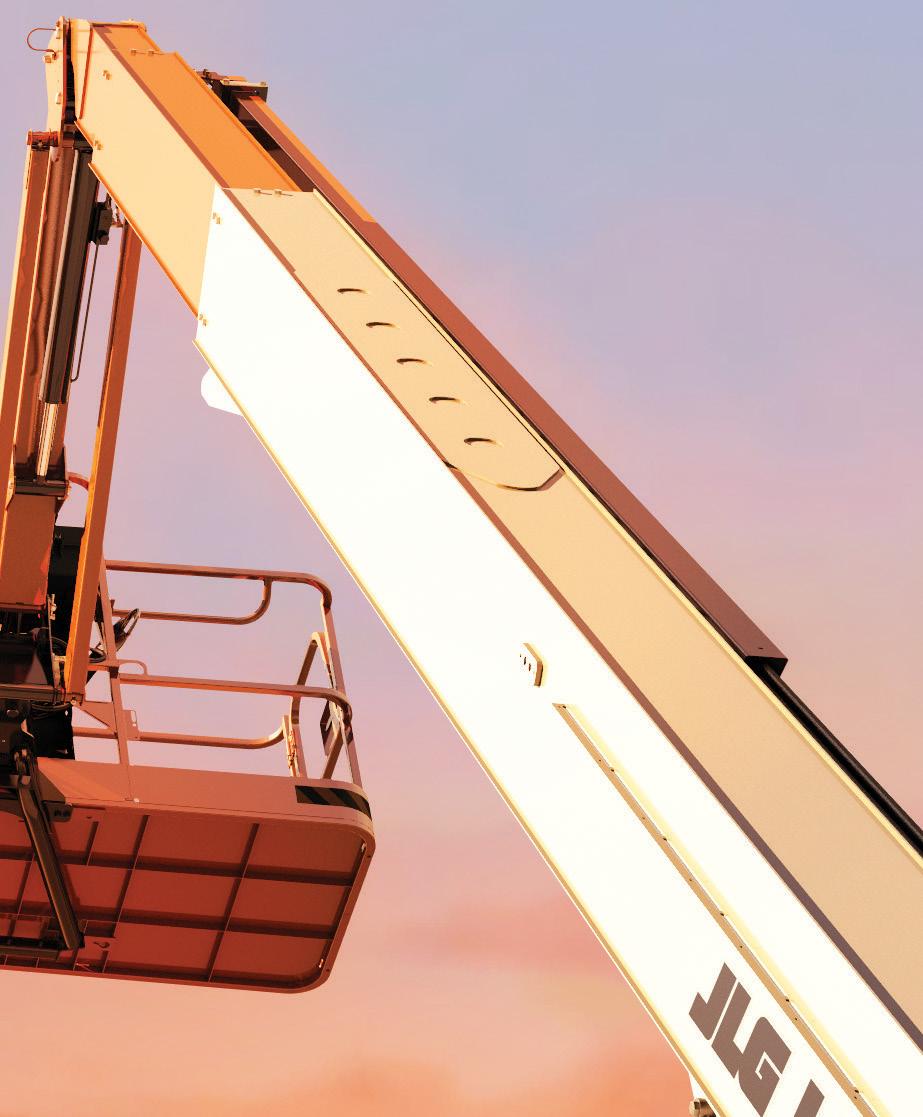
JLG’s Mid-Rail Deck for boom lifts is ideal for projects requiring access to tight overhead spaces. This accessory attaches to the inside of the platform mid-rail to give operators
19.5-in of additional access
height for positioning between overhead obstacles. It includes a collapsible handrail for storage and machine transportation and can be installed/removed without tools. It has a 300-lb capacity on its 32-in wide x 15-in deep standing area. It is currently only available for JLG 36-in x 96-in boom lift platforms.
■ Welder-Ready Package for Boom Lifts
LGMG NA announces a welder-ready package for T65J-H and T85J-H high-capacity telescopic boom lifts. The T65J-H offers a 7.5kW generator, while the T85J-H is available with both a 7.5kW and a 12kW generator option. Both generators are UL-approved and provide voltage output in three-phase (208VAC) and single-phase (120VAC), ensuring compatibility with a wide range of welding equipment. The hydraulic generator will also provide continuous voltage to ensure no electrical spikes, producing clean, efficient welds. •
MANAGEMENT By Jason Kulvinskas
Mastering Metal Deck Estimates
Warning signs that can slow production and increase labor or material costs
Metal decking installation is the most labor-intensive aspect of a steel erector’s scope, and numerous factors can directly impact labor costs. This makes an accurate installation estimate crucial for a successful steel erection bid.
The process begins with take-offs, where I quickly review the complete set of structural drawings. This provides an overview of the building’s shape, size, and complexity. I assess if the project has multiple buildings or multi-stories. We rely on Bluebeam Software to do take-offs, which has been an invaluable tool for our company.
After initial review, I identify critical details such as deck type, deck gage, attachment methods and patterns, elevations, and joist or beam spans. Below are some key considerations to take into account in order to make an accurate estimate.
Deck Specifications
There are several considerations with metal decking that influence labor costs. The deck type, gage, attachment methods and patterns are examples of factors that help develop your estimate. Specialty deck and heavier gages typically require more labor, which should be factored into your bid.
Deck Type: Most roof decks are 1.5” B Deck or 3” N Deck, while floor decks are typically 1.5”, 2” or 3” composite deck. Pricing standard deck is straightforward. However, specialty decks, especially those that are exposed and require uniform spacing, take more time to install.
Examples of specialty decks include Epic Super Wideck with a 9” Depth or Verco 3.5” Dovetail Deck. These often need to be installed one sheet at a time, sometimes requiring a crane to lift them in place due to their weight. Production rates on these non-standard decks can be 50-85% lower than for standard decks.
Deck Gage: Deck gage also affects production. While 18, 20, and 22 gage is common, 18 gage deck is heavier, and it can slow production. Less common 16 gage deck is very heavy making it difficult to break bundles, as the sheets tend to stick together due to their weight. This requires additional manpower to avoid overworking the crew and production reduction is significant.
Account for Attachment
Understanding the specified attachment methods and patterns is essential for accurate estimating. These details can significantly impact both material costs and labor requirements. Non-standard methods or patterns may increase project time and expense, but there is often room for negotiation with the Engineer of Record (EOR) to implement more efficient alternatives.
Attachment Method: Most plans specify puddle welds, with sidelaps secured by #10 Tek screws. Recently, there's a trend for large warehouses to require Hilti pins for attachment. While more expensive, they reduce labor costs due to faster installation, making them a recommended choice for such projects.
When #12 Tek 5 screws are specified, we often request a spec change with the EOR. Attaching with screws is more time-consuming to install than puddle welds or Hiti pins. If the deck is attached to purlins or thin joists, screws
are the better option, but for other cases, switching to an alternative can save money and expedite the schedule. For sidelaps, button punching or using the Verco Punchlok II tool doesn't typically increase labor. However, when welding sidelaps is required, labor costs rise significantly. Seam welds are more difficult and time consuming than putting in screws. If possible, we negotiate to switch from seam welds to sidelap screws. Occasionally, the EOR will allow the same quantity of sidelap attachments that was originally spec’d for welds to be used for screws. However, due to higher shear values derived from seam welds we usually put in several more screws to equal the original patterns. For instance, instead of three seam welds per span you may need 18 screws per span. In our experience, welding sidelaps on
Jason Kulvinskas is Vice President of GardnerWatson Decking, Oldsmar, Florida, where he has worked for more than 16 years.
heavier deck, such as 18 gage, is a better application than on lighter gage decks (20/22 gage) as the welds tend to burn through the deck.
Attachment Patterns: Denser patterns require more material and labor. Standard patterns for floor decks include a 36/4 pattern with three to four sidelaps. Roof decks typically follow a 36/4 or 36/7 pattern for B-Deck, or a 24/4 or 32/5 pattern for 3” N Deck, with 4 to 9 sidelaps. However, we’ve encountered extreme patterns like 36/14 pattern with screws at 3” On Center. High pattern designs, often due to seismic requirements or over-engineering, can dramatically increase costs.
Design Differences
Estimating labor costs involves looking beyond square footage to consider the complexity of the building structure. Factors like
beam spacing, building shape, elevation, roof pitch, and obstructions can all add time and costs to a project. Understanding these nuances not only aids accurate project planning but also ensures the safety and efficiency of the workforce.
Spans: The distance between joist/beams is important for several reasons. Closer spans require more attachments, while wider spans, such as those over 20 feet, raise safety concerns. Specialty decks with long spans pose risks, so ensuring at least two spans for safety is vital.
Building Shape: Square buildings require less cutting of deck and less labor, but when dealing with round or angled shapes, cutting and sorting the deck takes more time.
Elevations: Most buildings are between 30 to 65 feet tall. Boom lift rental cost for typical elevations up to 65’ are reasonable and the time for our crews to get to the work
❶ Skylights, dunnage posts, screen-wall posts, safety davits, and threaded rods are examples of features that dramatically slow production. ❷ Boom lifts are essential for getting crews to the work area, but rental costs can escalate on buildings over 65 feet high. ❸ Specialty deck and heavier gages typically require more labor. ❹ Consider the complexity of the building, including beam spacing, shape, elevation, roof pitch, and obstructions. ❺ Deck spans that run perpendicular (North-South) from the bottom of the roof edge on extreme pitches are difficult to lay. ❻ Know specified attachment methods and patterns for accurate estimating. This is an example of a 36/14 pattern using Hilti Pins.
area is not too long. Taller buildings, however, increase rental costs for larger boom lifts. In addition, production is impacted, as it takes longer for our workers to get to the work level. Higher elevations also tend to experience higher wind speeds, causing potential work delays.
Obstructions: Skylights, dunnage posts, screen-wall posts, safety davits, and threaded rods are all examples of roof design features that can dramatically slow production. Cutting around these obstacles takes extra time, so added labor should be factored into the estimate.
Drop-Downs: Certain buildings, like hospitals, may have multiple drop downs on the floors, typically for showers. This requires detailed work that can significantly impact margins if overlooked in the estimate.
Years ago, on a hospital project, I learned this one the hard way. I could not understand
what was taking my crew so long to complete each floor. After a site visit, I saw first-hand that the added detail work for the drop downs was something I should have accounted for in my estimate. Overlooking this detail really hurt our margins.
Pitched Roofs: Pitched roofs are more challenging than flat roofs, and the steeper the pitch, the more time you should expect deck installation to take. A pitch of 3:12 or less is only slightly more time consuming than a flat surface, but as the pitch increases to 4:12 or more, the difficulty—and therefore the labor time—rises significantly. I consider 6:12 or steeper a difficult decking job. If a 5-person crew can complete 15,000 to 20,000 sq ft per day on a flat roof, that same crew may only be able to deck 300 to 600 sq ft per day on a 9:12 pitch roof. Another hard lesson learned—not knowing which direction the deck will be attached on pitched roofs. It is easier if the deck is laid horizontally at the bottom of the roof edge (east/west), so crews can work their way up the slope of the roof. It is far more difficult if the deck spans perpendicular from the bottom of the roof edge to the top
ridge (north/south). This can be difficult to tell on structural drawings. In addition, very steep pitched roofs will require additional safety equipment for workers.
Small areas and separate buildings: Jobs often include smaller isolated areas, like guard houses or a penthouse, ranging from only 300 to 1,500 sq ft. These areas require higher square footage pricing due to the time required to set up and move equipment, which can take twice as long as it does to complete the actual deck installation.
Communication and Scheduling
Accurate estimating also requires considering the bigger picture, including the job’s location and timing. Environmental conditions—such as Arizona’s summer heat or low temps and snowfall in Maine during the winter—will likely mean production delays. The general contractor’s schedule expectations also impact workforce requirements and how much overtime will be needed to complete the job on time.
Location and schedule further influence hotel and equipment rental costs. For example, hotels in Florida during the winter can
be exorbitant, and equipment rental rates often rise during peak seasons.
Finally, knowing the building owner and structure’s intended purpose is vital. Facilities like data centers, aerospace manufacturing, or nuclear facilities come with unique safety requirements. Misjudging these can lead to costly mistakes, as I learned on a nuclear facility. Even though the building was not a difficult decking job, the unique work environment resulted in decreased margins. Initially, some costs were due to getting compliant on short notice, but others were beyond our control. The job frequently shut down for minor safety incidents experienced by other trades. It’s important to plan ahead for these delays in the same way you would for weather delays.
Ultimately, it’s better to lose a project by bidding correctly than to win a job that results in financial loss due overlooked details. By carefully considering the details of the project, you can ensure a more efficient and cost-effective project execution, potentially saving your client time and money while maintaining high-quality standards. •
IN THE FIELD
By Julia Kunlo and Emily Thomas
Equipping Ironworkers with Life-Saving Skills
Rescue training for falls, heat, and mental health crises
As the old saying goes, an ounce of prevention is worth a pound of cure. But incidents can happen even when preventative measures are taken.
When it comes to rescue training for ironworkers, the first thing that usually comes to mind is rescuing personnel from falls. However, there are many other safety awareness topics that warrant rescue training —including response to heat illness and mental health crises. Time is of the essence, whether you are talking about retrieving a worker from a fall, treating someone suffering from heat illness, or responding to indications that someone is having a mental health emergency. Providing workers with training on how to respond to these situations can contribute to better outcomes to injured and vulnerable workers.
Julia Kunlo is a Certified Safety Professional (CSP) with a Master’s Degree in Occupational Safety and Health. She is an authorized OSHA Outreach Trainer in Construction and General Industry. As the President of Evolution Safety Resources, she leads a team of more than 40 safety professionals nationwide.
Response to a Fall
Falling is one of – if not the most crucial – hazard associated with steel erection. Working at height is a high risk activity; the chance of falls are constant and almost imminent. While prevention and proper PPE usage is the priority, steel safety professionals understand that a rescue plan is a mandatory component of all safety programs. Rescue training equips workers with the knowledge necessary to respond effectively and gives them the skills necessary to respond promptly and properly after a fall.
For any emergency rescue situation on the jobsite, knowledge of basic first aid can be critical. Before providing first aid or CPR to an injured person, assess the situation to make sure the area is safe and that the person requires assistance. Call 911 and stay
Emily Thomas has a Master’s Degree in Linguistics, specializing in producing Occupational Safety and Health content. As a technical author, she creates safety manuals, standard operating procedures, and training materials. She is an active participant in the National Association of Women in Construction (NAWIC).
with the person until help arrives. Check for any visible injuries, like bleeding, loss of consciousness, burns, or broken bones. Check that the person is breathing and ensure that their airway is open. Begin CPR if necessary and if you are trained to do so. If the person is injured due to a fall from height, ensure that they do not move until a medical professional arrives.
In the event of a fall, the first step should be to calmly assess the situation to determine the appropriate rescue method. If the worker is able, they should initiate self-rescue techniques, like deploying trauma straps to prevent suspension trauma. If possible, they should locate a nearby structure (such as a ladder, scaffold, or platform) that they can reach safely, and use their fall protection lanyard or rope to pull themselves towards it and climb to a secure position.
When self-rescue isn’t an option, the supervisor in charge of the jobsite should determine the best rescue method, assessing hazards present and equipment available to assist in rescue procedures. Equipment used for fall rescues can include ladders,
Providing workers with training on how to respond to an emergency can contribute to better outcomes to injured workers.
mobile elevated work platforms (MEWPs), ropes, and rescue kits with retrieval systems.
It is important to maintain communications with the fallen worker to keep them calm and to monitor their condition. Whether raising or lowering the worker to safety, these workers are advised to use slow, steady movements to prevent further injury. Anyone who falls should be given prompt medical attention. Suspension trauma can have delayed effects, so it’s important to have a medical professional examine the person for any possible injuries. Even those who survive the “immediate” risks of a fall are still at risk for longer term health hazards such as cardiac arrest, blood clots, heat stress and mental health concerns.
New Focus on Heat Exposure
The number of people who have died from heat-related illnesses has increased steadily over the years; according to the Department of Health and Human Services, 2,302 people died from heat-related causes in 2023, up from 1,722 deaths in 2022 and 1,602 deaths in 2021. Earlier this year, OSHA released a proposed rule on Heat Injury and Illness Prevention in Outdoor and Indoor Work Settings. If implemented, the standard would apply to all employers and be triggered when employees are exposed to temps of 80 degrees F for more than 15 minutes in a one-hour period.
When preventative measures fail, knowledge of heat illness rescue procedures can save a life. The first step is to recognize and identify the symptoms of heat illness and heat exhaustion before they progress into heat stroke. The symptoms of heat exhaustion
Helpful Tip:
At the first sign of heat exhaustion, the victim should be moved to a cool area and given cool water to drink. If heat exhaustion symptoms don’t improve, or the victim shows signs of heat stroke, contact emergency services immediately. While waiting for help to arrive, place the worker in a cool, shaded area and fan or mist them with cool water. Loosen any heavy or tight clothing and provide fluids (preferably cool water) as soon as possible.
include sweating, cold and clammy skin, fast and weak pulse, nausea or vomiting, dizziness, and headaches. The symptoms of heat stroke include body temperatures above 103° F, red, dry or damp skin, a rapid and strong pulse, confusion, nausea, headaches, and loss of consciousness. These conditions are even more likely to exist when workers are exposed to intense factors of stress, increasing heart rate and perspiration in situations when dehydration may already be present.
Nominations
National Awards Program Accepting Award
2025
NEW! Earlier Deadlines
Open to Member Companies of All Sizes
Q Industry-Wide Publicity
Q Profiles in Connector magazine
Q Presentations at SEAA & AISC Conventions
SUBMISSIONS DUE DECEMBER 31, 2024
Q 4 Contract Class Categories for Structural Steel
Q 2 Contract Class Categories for Miscellaneous Metals
Q 24 month Topping Out Period from 1/1/23 to 12/31/24
CRAFT TRAINING Excellence
SUBMISSIONS DUE JANUARY 31, 2023
Q 3 Categories based on Number of Ironworkers employed
Q World Class, Premier, and Gold Level Recognitions
Q $1500 in Craft Training Grants awarded to each World Class winner
SAFETY Excellence
SUBMISSIONS DUE JANUARY 31, 2023
Q World Class, Premier, and Gold Level Recognitions
Q Based on Safety Metrics for the previous year
Helpful Tip:
If you notice the signs of crisis in a coworker, it is recommended that you talk about your concerns in a one-on-one conversation. Describe the specific behaviors you have noticed, and tell the person that you are concerned about them. Acknowledge the difficulties that the person is facing and ask them how they’re feeling.
Share ideas for how to get help. Resources include Employee Assistance Programs (EAPs), calling 988 (the suicide hotline), local counseling services, and various organizations like The Partnership for Workplace Mental Health and Working Minds.
Mental Health Matters
Another frequently neglected form of rescue training is mental health crisis response. Mental health crises can be varied, and can include self-harm, suicide, and harm to others. According to the CDC, construction workers are four times more likely to commit suicide than workers in other industries.
There are a wide variety of factors that can contribute to mental health crises for construction workers, including high-stress work environments, high rates of on-the-job injuries, physically demanding work, and lack of resources for support. The stress caused by a fall, combined with the stress created during the period awaiting rescue, is likely to trigger mental health concerns in those involved and those who are previously disposed to mental health instability.
This year, Construction Suicide Prevention Week is September 9-13. Using this week to create awareness, provide training on identifying signs of crisis, and how to respond is a good first step. Warning signs can be verbal, emotional, or behavioral. Visit constructionsuicideprevention.com for tool box talk topics.
Act Decisively
Whether the crisis is a fall, heat illness, or mental health crisis, a prompt response can be the difference between life and death. Supervisors should be prepared to respond by calling 911 (or 988 for mental health help) and providing basic first aid until help arrives. Regular training for emergency response can keep workers calm in the face of an emergency, and knowledge of basic first aid can help keep a victim stay alive while waiting for emergency services to arrive.
When workers are properly trained in rescue techniques, they can act swiftly and confidently in emergency situations. Rescue training ensures that everyone on the jobsite understands their role during an emergency, reducing confusion and panic when quick, decisive action is required. •
Think you know how to ins tall this?
There’s risk in being wrong. When a steel joist seat has slots, it must be addressed in either one of two ways. Failure to act could lead to dangerous uplift issues. Get the installation details:
COVER STORY
By Tracy Bennett and Julie Devine
Journey to the Unknown Erectors exhibit integrity and flexibility
Sometimes erecting steel requires venturing into the unknown and solving problems that aren’t faced on typical projects. Two of the five winning Projects of the Year, presented by SEAA in April 2024, required extreme patience, integrity, and fortitude to bring them to fruition. In both cases, these projects maxed out labor supply.
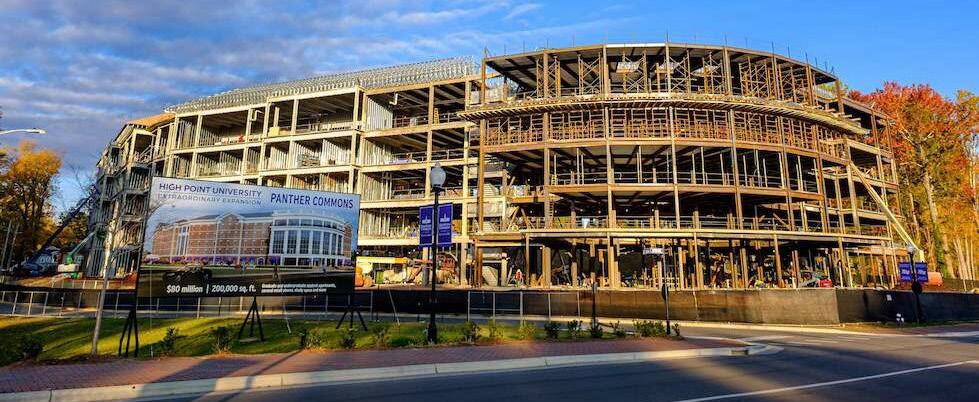
On the campus of High Point University in North Carolina, D.S. Duggins Welding, Inc., Winston-Salem, faced the usual challenges of a tight job site and even tighter delivery schedule. But the real conundrum was solving problems with columns pulling out of tolerance after being set.
Although the columns were within AISC tolerance before turning the section over, they later moved out of tolerance when concrete was poured. No root cause was determined, but the Duggins Welding team did what they had to make the building right—spending many hours and six figures in labor and equipment to resolve the problem. The new five-story Panther Commons now serves as residence hall, retail, dining, and study space for students.
Pete Gum, SEAA Executive Director, commended the company for their work. “Not all jobs stay on budget, as was the case for Duggins Welding, but
Introduction by Tracy Bennett, Managing
Editor of Connector and President of Mighty Mo Media Partners.
Project summaries by
Julie Devine, Director of Editorial with Associated Construction Publications.
a commitment to doing the right thing demonstrates this first-time Project of the Year award winner’s values.”
Cape Canaveral Space Force Base, Launch Complex 36 is home to Blue Origin’s new Glenn rocket, which marks a pivotal milestone for U.S. space exploration. This is the first new construction there in more than 50 years.
Harrisburg, Pennsylvania-based S&R Enterprises is no rookie when it comes to government projects. The project included two 633 ft tall towers and assembly of a massive hydraulic pit. In all, 14 modules were constructed and stacked on top of each other. One module was lifted more than 600 feet high. The heaviest module, weighing 1 million pounds, had to be crawled about 100 feet into position using a unique crane configuration.
“This is the fourth time S&R Enterprises has won a Project of the Year award,” said Gum. “The company is known for taking on the complex, big jobs and delivering as promised.”
The scale of this project required crew coordination and modular construction so that all trades were used as efficiently as possible to meet strict launch deadlines.
SEAA’s Project of the Year award is open to members performing Miscellaneous Metals or Structural Steel work. Projects are judged against others of similar steel erection contract value. (See Part One in the Summer 2024 issue.) Submissions for the 2025 Project of the Year Award are due December 31, 2024.
High Point University Panther Commons, High Point, North Carolina
Structural Class III
($1 Million to $2.5 Million)
Erector: D.S Duggins Welding, Inc.
Fabricator: SteelFab
Architect: Mercer Architecture, Inc.
Structural Engineer: Morrison Engineering
GC: Samet Corp.
Contract Value: $1,330,000
Tons of Steel: 1,150
Topped Out: November 2022
Blue Origin Launch Complex 36, Cape Canaveral Space Force Base, Florida
Structural Class IV (Over $2.5 Million)
Erector: S&R Enterprises, LLC
Fabricator: Cives Steel, Steel Fab Inc.
Detailer: Patriot Detailing
Architect: BRPH
Structural Engineer: BRPH
GC: Turner Construction Company
Contract Value: $46,227,373
Tons of Steel: 9,450
Topped Out: November 2023
During a panel discussion at SEAA's 2024 Convention, both Duggins Welding's Zach Burick (left) and Stephen Burkholder of S&R Enterprises (right) spoke about how trust and putting relationships ahead of profits are keys to success.
Credit: Blue Origin
Guided by Core Values
A tight job site and delivery schedule were the least of the challenges D.S. Duggins Welding, Inc., faced on the campus of North Carolina’s High Point University (HPU). Between labor, equipment rentals, and purchases, the company spent six figures on extra work when columns moved outside of allowed AISC tolerance after being turned over.
“While I will never feel like it was anything we did to cause the issue, we stuck to our core values and did what we had to do to make the building right, all while maintaining our relationships with our customers,” said Zach Burick, President/Owner of Duggins Welding. HPU’s Panther Commons ultimately finished on time.
Precise Sequencing
Built in the heart of campus, “This job site was tight from the word go, so as we went vertical, it only became tighter — not to mention the limited space once other trades mobilized,” Burick said.
Crews used a 150-ton Link-Belt LS-238 Crawler Crane rented from W.O. Grubb in Greensboro, North Carolina.
“That was the biggest piece of equipment we had onsite, but we also used three or four boom lifts and at least one telehandler,” Burick said. “When space got tighter at the end of the job, we had to move our office trailer and minimize all the equipment we could.”
Space wasn’t the only constraint. Because of the project’s tight schedule, “We exhausted all our resources as far as equipment and the crews we had available in-house, so we subcontracted parts of the project such as decking and studs to finish in a safe, timely manner,” Burick said.
A precise sequencing plan and delivery schedule for the steel was necessary. The company divided the project into three areas, and later had to split one of those areas in two, so that all work was in reach of the crane. Burick noted that the fabricator, SteelFab, was flexible in accommodating that change.”
Making it Right
Once Duggins Welding finished the steel work, they made sure everything was within tolerances. But then, “They started to pour the concrete and some columns started to come in; some of them went out,” Burick said. “We couldn’t adjust the columns at that point because the concrete locked everything in place.”
Meetings with the design team, GC, and fabricator over several weeks revealed no cause. To solve the problem, the engineering team provided their input, the fabricator sent more material, and Burick’s crews mobilized again.
“All the additional work was on the perimeter steel,” he explained. “The bent plate that catches the concrete pour on the back side of that was a relief angle for the brick to lay on. Because the columns moved, it was either too far in or too far out. If it was too far in, we had to add bottom plate to extend it to where it needed to be for the masons. If it was too far out, we had to pop a stringline and cut it so it was where it needed to be on the face.”
This required buying a plasma cutter and renting a 110-ft boom lift, expenses not accounted for in the original bid. Finishing the extra work took over four weeks. “It hurt our margins, but we showed good faith and put in the effort to make it right,” Burick said. Although
they were on site longer than planned, this did not affect the critical path to project completion.
Lessons Learned
Since that project, Duggins Welding implemented new forms they now use on every project. When they finish their work, they walk the job with the general contractor, who then signs the form to acknowledge that everything is within tolerance.
Going forward, those forms will help prevent the company from being on the hook for something they didn’t cause. But no matter what, “Building and nurturing relationships is very important to me,” Burick said.
This article was originally published by Construction magazine at constructionmagazine.news.
A precise sequencing plan and delivery schedule for the steel was necessary. The company divided the project into areas that limited repositioning of the crane.
Built in the heart of campus, this job site was tight from the word go, with even more limited space once other trades mobilized.
Precision Modular Construction
At Florida’s new Launch Complex 36, S&R Enterprises LLC used modules to speed construction and allow mechanical installation while close to the ground, with a unique crane configuration for the heaviest lifts.
Located at Cape Canaveral Space Force Base, Launch Complex 36 is home to Blue Origin’s reusable New Glenn rocket. Standing more than 320 feet tall, the rocket is named after John Glenn, the first American to orbit earth. Blue Origin’s website says the advanced heavy-lift vehicle will support customer missions and Blue Origin programs, including a return to the moon as part of NASA’s Artemis program.
S&R Enterprises, based in Harrisburg, Pennsylvania, handled erection of 9,450 tons of steel, with Cives Steel, headquartered in Alpharetta, Georgia, as their steel fabricator. The erector started work in September 2019 and topped out in November 2023.
Accelerated Access
“We had worked for over a year with the contractor during the budget phases of the project — before being awarded the job — to identify the best way to erect the towers,” said Stephen Burkholder, President/COO of S&R Enterprises.
With modular construction, “It enabled the MEP [mechanical, electrical, and plumbing] trades to start installing at an earlier date,” said Patrick Macisso, Engineering Manager for S&R Enterprises. “They didn’t need to wait for us to be topped out and then build scaffolding from the ground up. It alleviated a lot of the long lead times waiting for them to get in there.”
Crews built the modules on site next to the towers and hydraulic pit before cranes lifted them into place.
The square Vehicle Access Tower (VAT), outfitted with stairs and an elevator shaft to provide crews access to the rocket, included seven core blocks. The triangular Lightning Protection Tower (LPT) with ladder access to the top will help protect the rocket from lightning strikes. The LPT consisted of five core blocks.
After crews stacked those modules one
at a time, both towers were topped off with a 100-foot-tall, fiberglass candlestick. One module was lifted more than 600 feet high.
“The modular construction of this project required precise layout and multiple checks at every connection prior to stacking to ensure proper fit,” Macisso said.
Choreographed Production
Between the two towers, S&R Enterprises built the steel launch platform that will divert rocket exhaust and house critical MEP launch components. The platform will lift and support the rocket during launch, from horizontal assembly position to the vertical launch position.
Although the towers were specified as modular construction in the bid documents, modularization of the launch platform came after bidding.
“It was all to be stick-built, but as the design intensified it was clear the precursor work would have prevented the piping contractors the time they needed to install piping before the post installation occurred,” Burkholder explained. “We suggested modularization as an option because we already had the larger crawler crane on site.”
S&R Enterprises stick-built the base, starting 50 feet below ground. The upper section with 36 columns was built in a module then lifted and placed in its final position.
“That not only enabled the mechanical
❶ Both towers were topped off with a 100-foot-tall, fiberglass candlestick. One module was lifted more than 600 feet high. ❷ Crews built the modules on site next to the towers and hydraulic pit before cranes lifted them into place. The upper module required a complex rigging design. ❸ The project included two 633 ft tall towers and assembly of a massive hydraulic pit. ❹ The modular construction of this project required precise layout and multiple checks at every connection prior to stacking to ensure proper fit.
contractors to get in sooner, but they could work from scissor lifts to install the miles of piping safely from an easy access position,” Macisso said.
The upper module required a complex rigging design, provided by Reeb Rigging of Baton Rouge, Louisiana. To ensure correct weight and center of gravity for the lift, each leg of the rigging was fitted with a loadcell featuring a radio link that gave engineers real-time load dynamics of the lift procedure.
At a weight of 1 million pounds, the upper module had to be crawled over 100 feet with a Liebherr LR 11350 Crane to place it on top of 36 fixed column ends that were precisely aligned prior to making the connections.
“It was a well-choreographed event,” Macisso said. “We had our Lift Engineer Jacob Cole and Erection Engineer Adam Friedman watching the lift from an elevated point with the 24 load cells attached to the rigging so they could monitor the load and advise of any adjustments needed. I was set up with a total station, monitoring the columns the module would sit down on. Chris Welch was our Erection Foreman and led the crew of riggers that ensured a smooth lift off the ground jig. Another crew helped guide the module down and connected it to the structure. It was a large production that took all day, but everyone knew their part and we got it done in a 10-hour shift.”
Mega Size Crane
Throughout the project, S&R Enterprises utilized Liebherr crawler cranes — two LR 11350 cranes and two LR 1300 SX cranes with tip heights over 650 feet tall. Three of the cranes were provided by Buckner HeavyLift and one of the cranes was provided by Beyel Bros.
To lift the heaviest steel modules into position, the team selected Buckner HeavyLift’s Liebherr LR11350, a crane rated at more than 1,200 tons, and configured with the PowerBoom (P-boom) system. P-boom increases load capacity by up to 50 percent and provides more stability in the direction of the load and to the side.
“It’s extremely rare for us to need a crane with the mega capacity of the LR 11350,” said Stephen Burkholder. “We had a full-time engineer on the job working closely with Buckner HeavyLift, which provided all of the lift plans for the project,” he said. “I also want to give a shout out to Reeb Rigging, which provided the engineered heavy lift rigging.”
Complex Coordination
The scale and complexity of the project required constant coordination of multiple crews, cranes, and tasks to keep the work moving safely and efficiently.
With the first launch of the New Glenn rocket scheduled for later this year, “Blue Origin had critical dates we needed to make,” Macisso said. “We worked days and nights, along with many weekends, to reach our goal and keep the customer happy and on schedule.”
Burkholder credited the teamwork among all the stakeholders. “The project was a huge success because all team members — the owner, general contractor, fabricator, and S&R — worked together as a team,” he said. “Money was tabled, then discussed after the best plans were identified, and the risk was shared by all.” •
This article was originally published by Dixie Contractor magazine at www.dxc.news.
By Michael Stromberg
Know the Pros and Cons of Construction Software Pricing Plans
When it comes time to choose a construction management software or accounting tool for your business, besides comparing features, you will also need to understanding pricing structures.
Different construction software products offer different pricing models, and each pricing model has different factors that will impact the total cost to your business. Some software products are subscription based, while others offer a perpetual license. There are also free versions of some construction software programs (usually with more limited features), as well as open-source options. To complicate things more, exact pricing information can sometimes be difficult to find on vendor websites.
Option #1: Perpetual License
A perpetual software license is a type of software pricing model that allows you to purchase the program once and use it forever. While the software itself can be used indefinitely, any upgrades, updates, or support usually must be purchased separately.
Perpetual licenses are commonly found in on-premise deployments (or installations) where the customer pays for a license to use the software on their local servers or desktop computers. Before the advent of cloud-based software, this was the most common type of software pricing model. Today, however, perpetual licenses for construction software are increasingly rare, as most construction software companies have moved toward subscription-based pricing models.
Factors Affecting the Licensing Price
When paying a one-time fee for a perpetual license, the primary factor affecting cost will be which software features are included with the license. A given software provider will likely have multiple license tiers or modules available for purchase. Lower-level tiers will provide
Michael Stromberg is a lead data analyst and the head of software for Construction Coverage. His background is in software engineering and mechanical engineering. Construction Coverage specializes in researching construction software, insurance, and related services. Learn more at www.constructioncoverage.com.
basic features, while upper-level tiers will provide more advanced features in addition to the basic features offered through lower-level licenses.
With construction project management software, for example, the lowest level license might offer basic project management features or project tracking features only; whereas, the highest level license would also provide advanced features covering preconstruction, accounting, and analytics.
The other factor affecting cost is how many licenses are needed. For example, a customer may have the option to purchase additional licenses for use by employees or contractors in their organization. The exact cost of these additional licenses will depend on the software vendor and the specific licensing terms associated with their product. In some cases, an unlimited number of users may be able to access the product under a single license. In other cases, each user may need their own individual license.
Additional & Hidden Costs of Perpetual Licenses
It is also essential that customers understand the hardware requirements and any ongoing support or renewal fees associated with their perpetual license agreement.
One of the largest costs associated with a one-time software license (outside of the license itself) is supplying and maintaining the necessary hardware to support the software. If the customer is responsible for maintaining the hardware—as opposed to a cloud-based solution where the vendor maintains it—they will need to account for any hardware purchases, upgrades, or repairs that may be necessary to existing systems. This could mean purchasing new computers for employees, upgrading servers and other existing infrastructure, or setting up a new system from scratch. Businesses that go this route will need to set aside an appropriate amount of IT budget for these tasks.
Outside of the hardware costs, some vendors will also require customers to pay annual maintenance fees to receive updates, technical support, and other services related to their purchased software package. This
Pros & Cons of Software Pricing Plans
Type Pros Cons
Perpetual
Subscription
■ Cost-effective in the long term, as recurring costs can be lower.
■ The user has access to the software indefinitely.
■ Users can continue using the software even if the vendor goes out of business.
■ Often requires a lower upfront payment compared to perpetual licenses.
■ Allows users to pay for only the number of users or features needed at a given time.
■ The cost of the software can increase or decrease as the user’s needs change.
■ Updated regularly, providing access to the latest features and capabilities.
is especially important for products like estimating software where the cost of building materials can change dramatically over time. Additionally, if your firm needs to customize the software in any way or integrate it with other systems, this will also cost more.
Customers need to factor these fees into their overall software budget when attempting to calculate a realistic estimate of the total cost of using a particular construction software product over time.
A perpetual software license for construction software can be a cost-effective option for companies that use the software frequently, need it for an extended period, and don’t need ongoing updates. While the upfront costs associated with a perpetual software license are usually high, in the long run, they can be a more economical solution when
■ The upfront cost may be high.
■ Users may not have access to the latest updates or features unless they pay for them separately.
■ Users may not be able to get maintenance and support services after a certain period of time.
■ May not be flexible for companies with changing needs.
■ Recurring costs, which can be a significant amount over time.
■ Users do not own the software, they are only renting it.
■ If the user stops paying the monthly subscription fee, they lose access to the software.
■ If the user stops paying the monthly subscription fee, they lose access to the software.
■ May not have strong level of commercial support.
■ May require ongoing maintenance and updates.
■ Limitations to features, access, volume of projects or number of users.
compared to subscription-based options in certain scenarios.
Option #2: Subscription License
While historically, on-premise deployments with perpetual software licenses were the norm, software-as-a-service (SaaS) subscription models have become increasingly popular in the construction industry. This shift has allowed companies to access higher quality and more feature-rich products, while also providing a predictable monthly cost that can be budgeted for more easily over time. While construction professionals will still be able to find some products on the market delivered via a perpetual license, most new software vendors have fully embraced the subscription model.
A subscription pricing model for
construction software means that you pay an annual or monthly subscription fee to use the software. You need to keep paying the fee in order to keep using the software, but in exchange, you have immediate access to updates and many new features as they are released. You also don’t need to maintain the hardware that the software is hosted on. Instead, subscription software is typically accessed via a web browser or through an app on mobile devices.
This pricing model is more flexible and often more affordable than a comparable perpetual license that also has access to regular feature updates and support. It also allows users to only pay for the features they need and scale up or down as needed more conveniently. For these reasons, subscription models are especially popular among
Open Source ■ Typically free.
Free ■ Free.
construction professionals in small and medium businesses who would have trouble affording the upfront costs associated with a perpetual license and whose business needs are likely to change more significantly over time.
Factors Affecting Subscription Price
The main factors affecting the price of a subscription license are similar to those mentioned above for a perpetual license—namely, the number of software features included, the number of users who will regularly access the software, and the level of support services provided.
Similar to software providers that offer a perpetual license, those that offer a software subscription will usually have various tiers, modules, or integrations that can be purchased. Lower-level subscriptions will provide more limited features while upper-level ones will come with more advanced functionalities. The same is true for integrations: entry-level subscriptions might offer fewer integrations than the more expensive subscription options. Whereas with a perpetual license, the software vendor may allow you to only purchase
a single license for your entire team to use, with subscriptions you will typically have to pay more based on how many people on your team have access to the software. Another variation on this is commonly seen in construction project management software pricing models where they will charge based on the volume of business run through the software. For example, Procore, which offers one of the most popular construction management tools on the market, will charge construction companies based on a percentage of their revenue.
Additional & Hidden Costs of Subscriptions
When compared to perpetual licenses, subscription software as a service tends to come with fewer hidden costs. For example, there are no additional costs associated with upgrading the software or dealing with hardware maintenance.
However, some subscription services may require users to purchase additional modules or integrations to access certain features that are released at a later date. Additionally, many vendors will have limits on how much
(SaaS) subscription models have become increasingly popular in the construction industry. This shift has allowed companies to access higher quality and more feature-rich products, while also providing a predictable monthly cost that can be budgeted for more easily over time.
data you can store or process without paying an extra fee. As a result, it’s important for companies considering a subscription-based construction software package to familiarize themselves with the details of their particular contract before signing up and make sure that they understand all of the potential hidden costs that come along with using the service.
Option 3: Open-Source Software
With open-source software, you get access to free tools and programs that can be modified to meet your specific needs. Two examples of open-source construction software are FreeCAD (3D modeling software) and OpenProject (construction management software). When it comes to using open-source software in the construction industry, there are both advantages and disadvantages to consider. On one hand, open-source software is typically free to use and distribute, which can save construction companies money. Additionally, open-source software can be modified to suit a company’s specific needs and requirements and has a transparent development process that allows users to see the source code and understand how the software works. However, open-source software may not have the same level of commercial support, features, and capabilities as proprietary software. Furthermore, open-source software may require ongoing maintenance and updates which can be time-consuming and costly. Additionally, integrating open-source software with other systems or software may incur additional costs, and customization may require additional investment as well. •
Syracuse, NY
TOPPING OUT
The American Institute of Steel Construction (AISC), in partnership with the University of Massachusetts Amherst and the American Iron and Steel Institute (AISI), has been selected to receive a $6.4 million grant. The purpose of the grant is for research into automation of the development of steel product environmental product declarations (EPDs). The grant is part of a nearly $160 million U.S. Environmental Protection Agency program to reduce climate pollution from the manufacturing of construction materials and products.
“American structural steel is already the most transparent, sustainable material on the market today–and thanks to a grant from the U.S. Environmental Protection Agency, specifiers and the public will have even more accurate data available to help them choose structural materials that protect the planet both today and tomorrow.”
– Brian Raff, AISC’s VP of Sustainability and Government Affairs
Engaged Company Leaders Reduces Incident Rates
A new report from Associated Builders and Contractors (ABC) provides empirical evidence that companies using leading indicators have significantly safer worksites, resulting in fewer accidents and disruptions, regardless of company size. One finding in the 2024 Safety Performance Report showed that employer involvement at the highest level of management significantly impacts safety outcomes.
When top management is engaged, there was a 54 percent reduction in Total Recordable Incident Rates (TRIR) and a 52 percent reduction in Days Away, Restricted, or Transferred (DART) rates. In top-performing ABC STEP member firms, the owner or CEO actively participates in the safety program, promotes accountability, regularly reviews safety goals, seeks feedback for continuous improvement, commits necessary resources, and integrates safety into performance appraisals and overall operations.
Meet New Members
Check out the Member Directory at SEAA.net
Battle Born Steel, Las Vegas, Nevada, an AISC certified structural steel fabricator and installer working on single and multistory commercial and residential projects across the country.
D.T. Read Steel Co., Inc., Camden, North Carolina, specializes in installing reinforcing steel, Stay-in-Place metal decking, bridge shear studs, and post-tension cable. Referred by: Nick Caratelli, Nelson Stud Welding and Jack Nix, Shelby Erectors
HTX Steel Constructors, Houston, Texas, a newly formed company specializing in the erection of heavy and complex structural steel projects. Referred by: Geoff Kress, Gardner-Watson Decking
KASK America, Inc. Charlotte, North Carolina, and based in Italy, specializes in developing, designing, and manufacturing safety helmets. Referred by: OES Products Group
MGX Equipment Services LLC, Milwaukee, Wisconsin, is one of the largest Manitowoc and Grove crane dealers in the U.S., providing crane rentals, aftermarket parts, service, crane certification training, and more. Referred by: Richard Bostick, Piedmont Structural Company
Nationwide Erectors LLC, Henderson, Nevada, is a steel erector serving the Las Vegas, Nevada, area.
R/A Hoerr Inc., Edwards, Illinois, is a logistical and commercial partner of manufacturers taking high performance, extreme environment, and safety related products from the automotive racing industry to new channels, transcending their market potential. Referred by: Veronica Ventimiglia, QuickFrames
Structural Steel Technologies, Nazareth, Pennsylvania, offers crane technology solutions that decreases cycle times for crane operators by providing precision GPS equipment. Referred by: Nick Caratelli, Nelson Stud Welding
Universal Welding Services LLC, Corpus Christi, Texas, provides steel fabrication and erection services for South Texas and Southwest Louisiana.
Villabona Iron Works, Kinston, North Carolina. Referred by Kevin Dempsey, Turner Construction Company
Worcester County Welding Corp, Rochdale, Massachusetts, is a family-owned company with over 30 years of experience in structural steel fabrication, steel erection and miscellaneous metals. Referred by: Glen Pisani, MAS Building & Bridge
Credit: Associated Builders and Contractors 2024 Safety Performance Report
POWERFUL PARTNERSHIPS. POWERFUL
At Vulcraft and Verco, we believe in the transformative power of partnerships. When you collaborate with our experts, you’re gaining a strategic team dedicated to your project’s success at every phase. Our innovative steel construction solutions are engineered to save you time and money. We can turn your vision into reality, faster and more efficiently than ever before. Let’s build something extraordinary, together