
FALL EDITION 2022 16 Making the Cut 22 Safe Loading and Unloading of Trailers 26 Special Focus: Convention Preview THE OFFICIAL MAGAZINE OF THE STEEL ERECTORS ASSOCIATION OF AMERICA Erectors make their mark on iconic structures for church, state, military, and higher education A NATION Ties that Bind


OUR SERVICES ERECTING DETAILING ESTIMATING FABRICATING DESIGN BUILD PROJECT MANAGEMENT BUILD HELPING YOU A FUTURE STRONGER WWW.COOPERSTEEL.COM NASHVILLE, TN SHELBYVILLE, TN FLORENCE, KY (931) 684 - 7962


336-294-8880 • info@seaa.net MARCH 28-31, 2023 World Golf Village Renaissance Resort • St. Augustine, FL 2023 CONVENTION & TRADE SHOW Golf, Fishing & Excursions Panel Discussions Education Sessions on Business, Technical Field Practices, & Safety Trade Show and Live Demos Networking at Receptions & President’s Dinner Connecting Leaders, Creating Community Steel Strong in St. Augustine
By Tracy Bennett

 By Macie Murie




 By Tina Cauller
seaa.net ONLINE HIGHLIGHTS Q Best Practices for Creating a Fall Protection Plan Q Protecting the Public from Risk Q 2022 Lifetime Achievement and Person of the Year Q 2022 Safety and Craft Training Excellence Recipients The Steel Erectors Association of America (SEAA) is dedicated to advancing the common interests and needs of all engaged in building with steel. The Association’s objectives in achieving this goal include the promotion of safety, education and training programs for steel erector trades, development and promotion of standards and cooperation with others in activities which impact the commercial construction business. Cover Story Ties that Bind a Nation Erectors make their mark on iconic structures for church, state, military, and higher education
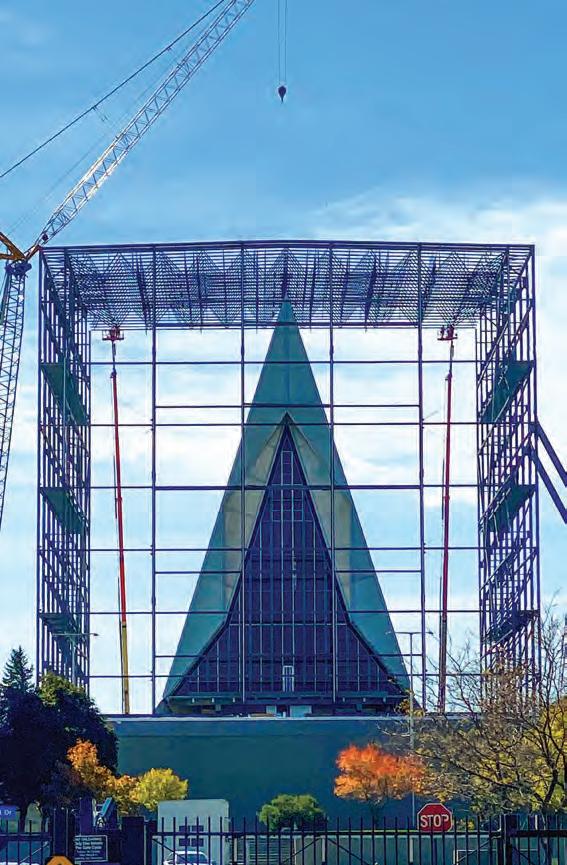
Shown Here: Deem Structural Services erected a temporary building enclosure to facilitate renovation of the iconic Cadet Chapel at the United States Air Force Academy. 28 Check out our latest social media feeds. OPT-IN for our e-Newsletters web.seaa.net/publications/subscribe.aspx c•ntents FALL EDITION September 2022 FEATURES Management Making the Cut The role of reputation, relationships, and self-promo tion in winning government contracts. Plus, tips for connecting with decision makers.
In the Field Safe Loading and Unloading of Trailers A reminder about fall prevention and other hazards, in cluding loading, material handling, and site conditions.
Special Focus Convention Preview: Steel Strong in St. Augustine SEAA is Blazing a Trail to Best Practices 22 16 4 | THE STEEL ERECTORS ASSOCIATION OF AMERICA DEPARTMENTS 8 Perspective 10 Association News 12 Product Focus 36 Business Operations 38 Topping Out On the Cover: Williams Steel Erection Co., Inc., provided its expertise on the erection of Atlantic Union Bank Center. The building consisted of a 10,000-seat indoor arena bowl structure with two-deck seating covered by a roof structure. 26


INDUSTRY SPECIALTIES: THE M&P DIFFERENCE IF YOU LIFT, ERECT, HAUL, OR RIG IT: WE INSURE IT. M&P Specialty Insurance provides insurance and risk management services for heavy lifting and moving industries. MPSPECIALTY.COM STEEL ERECTORS HEAVY HAULERS CRANE RENTAL RIGGING FABRICATORS STRUCTUAL MOVERS CONTACT JASON MCELRATH TODAY 1179 Sunset Blvd. West Columbia, SC 29169 | 803 -936-1601 | Jason@MPSpecialty.com Licensed nationwide, M&P Specialty Insurance offers comprehensive coverage, excellent customer service, and competitive premiums. Underwritten by A+ rated carriers, our team emphasizes the importance of alignment between insurance products, contractual detail, and risk management practices.
THE OFFICIAL MAGAZINE OF THE STEEL ERECTORS ASSOCIATION OF AMERICA
SEAA is the only national trade association representing the interests of steel erectors, fabricators, and related service providers. Connector reaches both small and large contractors working in union and open labor markets.
Steel Erectors Association of America
353 Jonestown Rd, Suite 207 Winston-Salem, NC 27104 336-294-8880 www.seaa.net
OFFICERS & EXECUTIVE STAFF
David Deem, President
Jack Nix, President Elect
Chris Legnon, Industry Member Vice President
Carrie Gulajan, Associate Member Vice President
Bryan McClure, Secretary
Greg Phillips, Treasurer
R. Pete Gum, Executive Director
PUBLISHING PARTNER
Chris Harrison, Publisher connectorsales@seaa.net Phone 660-287-7660
Tracy Bennett, Managing Editor editor@seaa.net Phone 816-536-7903
Macie Murie, Assistant Editor macie@mightymomedia.com
Eileen Kwiatkowski, Art Director eileen@ekaygraphics.com
ADVISORY COMMITTEE
Chris Legnon, Chairman, Cooper Steel
Glen Pisani, Vice Chairman, MAS Building & Bridge Nathan Bloch, SDS2
Nick Caratelli, Nelson Stud Welding
Oliver Gleize, OTH Rigging
John Hughes, Industrial Training International
Jackson Nix, Shelby Erectors
Brian Schleicher, Superior Cranes
Jim Simonson, Steel Service
Michael Waltman, Group Steel Erectors
Connector™ is published quarterly by the Steel Erectors Association of America 353 Jonestown Rd, Suite 207 Winston-Salem, NC 27104
Copyright 2022 by the Steel Erectors Association of America. No material may be reprinted without permission from the Executive Director. While the information and recommendations contained in this publication have been compiled from sources believed to be reliable, the Steel Erectors Association of America, its affiliates, employees, contributors, writers, editors, designers, photographers, and media advisory committee, makes no guarantee as to, and assumes no responsibility for, the correctness, sufficiency or
6 | THE STEEL ERECTORS ASSOCIATION OF AMERICA
completeness of such information or recommendations and cannot be held responsible for the outcome of any action or decision based on the information contained in this publication or claims made by advertisers. No part of this publication may be reproduced in any form without prior written permission of the Publisher. Permission is only deemed valid if approval is in writing. NEED HELP WITH... HIGH VALUE MEMBERSHIP for Companies of All Sizes HIRING? Workforce Solutions Q Free Job Board & Low Cost Applicant Tracking Q Free Webinars on Recruiting & Hiring Q DOL Approved Ironworker Apprenticeship TRAINING? Safety & Training Resources Q Erector, Reinforcing Ironworker, Fabricator Curriculum Q Free Training Videos Q Get Help Implementing NCCER Curriculum Q Rigger, Signalperson, & Crane Operator Certifications Q Resources for OSHA’s Fall Prevention Stand Down NETWORKING? Industry Connections Q Partnerships with AISC, NISD, SDI, SJI, & Others for Discounts & Additional Resources Q Trade Show & Demos of Latest Tech & Products Q Peer Groups & Committees Open Doors to Business Relationships SEAA IS FOR YOU. Structural & Reinforcing Erectors • Decking Installers • Steel Fabricators • Specialty & General Contractors JOIN TODAY AT SEAA.NET GROWING YOUR BUSINESS? Marketing Tools Q National Awards Programs Q Free, Customizable Online Directory Listing

Investing in the Future of Steel Construction
SEAA is Steel Strong! That’s our organization’s rally cry and it’s more than just a slogan. In 2021, the association gained more new members in a given year than in any of the previous 10 years. In addition, our retention rate at the conclusion of 2021 remained at about 90%. As of July 2022, SEAA’s members hail from 43 states, three Canadian Provinces, and Puerto Rico.
According to the 2022 Membership Marketing Benchmarking Report produced by Marketing General Inc., 2021 was a big year for associations on the rebound following the pandemic. Across 25 different industries, 38% of survey respondents reported increasing member numbers at the start of 2022. Our renewals on average are better than the median, noted in the report to be 84%.
As of SEAA’s July Board Meeting, 2022 membership levels were only three less than where we ended 2021—with five months more to go. More than 70% of our members identify as erectors, with smaller companies making up more than a third of that group. However, association leaders see value in bringing in more companies that are in reinforcing steel or steel fabrication, which will be a new emphasis going into 2023.
Expanding services
What’s important about these numbers is that as we grow, we are able to offer more services to members of all sizes and in all categories. Here are a few important accomplishments that put SEAA on the path to mean ingful investment in our industry.
SEAA held its annual convention in person in October 2021, with record registrations, then turned around to host convention again just six months later in April of this year. This is significant, as only 17% of associations surveyed in the Benchmarking Report held in person events last year. According to the report, this decision was closely tied to organizations achieving renewal rates greater than 80%. This year, we have continued to add services and quarterly networking options for our members.
In partnership with CareerPlug, SEAA offers member companies hiring tools. Members can post jobs for free to
Pete Gum is the Executive Director of The Steel Erectors Association of America.Contact him at pete@seaa.net.

our online Job Board. But even more valuable is the ability to upgrade to CareerPlug’s full-service applicant tracking system at a deeply discounted price. If you want more information about how to put this tool to work for your company, please email me or check out the resources on our website.
SEAA’s Safety & Education Committee has been hard at work leading the development of 60+ training videos. Professionally produced, the videos are free for members to use. As the videos were being completed, we turned our attention to providing the best platform available for ease of use by members. That led us to another partnership, this one with Industrial Training International (ITI).
ITI, a highly reputable rigging and crane training pro vider, now offers an online Learning Hub for access to on-demand training. Using their expertise, SEAA will launch our own Learning Management System (LMS) by the end of the year, so that members can access our exclusive content, as well as much more free and discounted content through ITI. Each member company will receive one free license to the SEAA LMS.
In addition, to date we’ve held three webinars in conjunction with key member suppliers on a variety of topics. Archives are housed on the SEAA website. If you are interested in partnering with us to host a webinar, please let me know.
And finally, although not as exciting on the surface as these other projects, a nine-person task force with the assistance of an attorney, drafted all new bylaws for the association. This was an essential task, as the previous bylaws, last amended in 2016, had been revised multiple times over the years. They were no longer in alignment with current North Carolina law and had incorporated contradictory language, or did not reflect actual policy and procedures. The bylaws were distributed to membership for review and were approved in August.
Innovation is a vital driver in membership growth, as evidenced by the previously mentioned Benchmarking Report. Of the nine types of new initiatives reported by the associations responding to the survey, SEAA checked four of the boxes! I couldn’t be more pleased to be part of this association. As I start my second year as your Executive Director, I’m confident that SEAA is blazing a trail to help our companies now and in the future. •
8 | THE STEEL ERECTORS ASSOCIATION OF AMERICA PERSPECTIVE By R.
Pete Gum

EVENTS & ACTIVITIES
Fall Meet & Greet
Broomfield, Colo.
September 15, 2022
Dave Schulz Memorial Golf Tournament
Broomfield, Colo.
September 16, 2022
ASSOCIATION NEWS
■ SEAA Updates Apprenticeship Standard to include Reinforcing Ironworkers
SEAA has received U.S. Department of Labor approval of its revised National Guidelines for Apprenticeship Standards. The revision was written to include the occupation Reinforcing Ironworker Concrete in addition to the existing occupation of Structural Steel Ironworker.
“This apprenticeship standard provides members with a model for creating and registering formal training programs that meet both State and Federal government requirements for local apprenticeships,” said Pete Gum, Executive Director.
“SEAA members work on both structural and reinforcing steel projects, however, the tasks and training needed to be a reinforcing ironworker are different from those for a structural ironworker. This apprenticeship standard more accurately reflects the knowledge and skills required for both types of ironworkers,” said Jack Nix, Chairman of the Membership Committee.
As an NCCER Accredited Training Sponsor, SEAA already provides a robust structural steel ironworker training curriculum available for members to use. “To support the reinforcing ironworker apprenticeship standard, Tim Eldridge, President of Education Services Unlimited and SEAA’s Craft Training and Assessment Administrator, and member company Shelby Erectors, worked closely with NCCER to develop a complementary reinforcing ironwork curriculum,” said Gum. The custom curriculum can be purchased through the association.
For more information, contact Tim Eldridge at 980-722-9373 or t_eldridge@bellsouth.net
■ Don’t Miss New Deadlines for SEAA Awards Programs
2023 Convention & Trade Show
St. Augustine, Fla.
March 28-31, 2023
SEAA has opened submission forms for 2023 Project of the Year, Safety Excellence, and Craft Training Excel lence awards. Industry-wide publicity and peer recognition are just two of the benefits of participation. But don’t delay your submission process. Deadlines for 2023 awardsare earlier than in the past. “Because our annual conference
is earlier than usual next year, there will be no deadline extensions,” said Drew Heron, Awards Committee Chairman.
Project of the Year Submissions Due Dec. 31, 2022
The POY Award is for members that have topped out a structural steel construction or miscellaneous metals project in 2021 or 2022.
Structural Construction
• Class I: Erection Contract of up to $500K
• Class II: Erection Contract of $500,000 to $1 Mil
• Class III: Erection Contract of $1 Mil to $2.5 Mil
• Class IV: Erection Contract of $2.5 Mil and above
Miscellaneous Metals
• Class I: up to $500,000
• Class II: Over $500K
Award-winning companies will have the chance to participate in panel discussions at future AISC Steel Conference events and at SEAA’s 2023 Convention in St. Augustine, Fla. They will also receive national exposure through Connector magazine and a press release distributed to trade media publications. Awards can be submitted online or via email to awards@seaa.net.
Safety Excellence Submissions Due Jan. 31, 2023
For steel erection companies that go above and beyond in the effort to provide their ironworkers a safe place to work. These companies are proactive in their safety mindset, and when compared to their steel erection peers, excel at protecting their employees.
Craft Training Excellence Submissions Due Jan. 31, 2023
These companies are playing critical roles in the development of ironworkers at a time when skilled craft professionals are at an all-time high. SEAA Craft Training Awards will be presented during the annual convention.
World Class recipients of both Safety and Craft Training Excellence Awards are featured in a future issue of Connector and are invited to participate in a panel discussion at Convention. Submissions for both awards are due January 31, 2023. •

10 | THE STEEL ERECTORS
OF
ASSOCIATION
AMERICA
Hodges Erectors received Honorable Mention for its work on a condo project in Miami, Fla.

■ Simpson Strong-Tie System provides alternative to Field Welded Bent Plate
Simpson Strong-Tie, Pleasanton, Calif., has introduced the Edge-Tie system designed to replace field-welded bent plate pour stops with a high-strength, straight-edge, channeled steel beam. This system accepts bolted connections to facilitate easy cladding installations without the need for welding. As construction demand continues, welders are in short supply. This is an alternative solution that eliminates the need for welding. The Edge-Tie system replaces traditional bent plates with an extruded steel beam of higher strength that is more dimensionally reliable, while enabling a bolted cladding connection. Long lengths can be cut to fit.
■
Hilti On!Track Unite Enables Integration of Data from Other Sources


Hilti North America, Plano, Texas, has launched ON!Track Unite, a new open Application Programming Interface (API) for open software integration. The ON!Track Unite provides a single hub for construction data coming from multiple sources. This increases data quality, provide users with better insights, improves efficiencies, and reduces costs for construction businesses.
■
OSHA + NIOSH Heat Safety Tool App Calculates Heat Index
OSHA and NIOSH have released a free app, OSHA-NIOSH Heat Safety Tool, that calculates a worksite’s heat index and shows the associated risk levels. OSHA reminds companies that working in full sunlight can increase heat index values by 15 degrees Fahrenheit and additional precautions may be needed to protect workers.

■ JLG Augmented Reality App Gets Upgrade

Heat Safety Tool App
Users will see precautionary rec ommendations specific to heat index risk levels to help protect employ ees from heat-related illness. The Heat Tool is available in English and Spanish for Android and iPhone devices.
JLG Industries, Inc., McConnells burg, Pa., has updated its Augmented Reality (AR) app with a new interface, additional content, and expanded func tions for machine inspections. More than 60 JLG models are now available in the app. Also new is a “Fleet” feature, which helps JLG customers optimize their fleet management right from the app. Users can now add and store multiple assets for easy tracking by serial number/asset ID. And, users can save data on machines and access it instantly, regardless of connectivity.
12 | THE STEEL ERECTORS ASSOCIATION OF AMERICA
PRODUCT FOCUS
ON!Track Unite Application Programming Interface (API)
Simpson Strong-Tie Edge-Tie System
OSHA-NIOSH
JLG Augmented Reality App


300 Scarlet Blvd. Oldsmar, FL 34677 Phone: 813.891.9849 Fax: 813.891.4105 Duke Perry, VP of Sales/Operations 404-808-0504 Duke.p@gwstuds.com SAFE. PRECISE. ON TIME. gwstuds.com
■ All-wheel Steering Grove Truck Crane


Manitowoc has expanded its Grove truck crane offering with the new four-axle TTS9000-2. The 115 USt capacity truck crane features an automated steering system that helps operators navigate challenging driving conditions, whether on congested urban jobsites or small backcountry roads.
Each of the all-wheel steering modes can be activated by the operator at the click of a button on the right-hand console. With the crab steering option, all tires point in the same direction when the steering wheel is turned, allowing the crane to travel diagonally. Coordinated mode allows the driver to turn the front wheels in the direction of travel and the rear wheels turn in the opposite direction. This reduces the truck crane’s turning radius and makes tight turns much easier.
■ New Tabletop Welding Simulator Delivers Cost-Effective Training
Lincoln Electric, Cleveland, Ohio, has released a tabletop version of its welding simulator, the VRTEX® 360 Compact Virtual Reality Trainer. This new addition to the VRTEX virtual reality welding simulator family reduces the footprint needed for train ing while offering the same software and benefits as other VRTEX training models. The VRTEX 360 Compact trainer assists welding students by building confidence and proficiency as they safely train in a variety of virtual situations and orienta tions. They can practice repetitive welding without taking time to tack plates and toss scrap for GMAW, GTAW, FCAW and SMAW.


■ OSHA Compliant Truck and Trailer Fall Protection Systems

Truck Fall Prevention, Taylor MI., manufactures truck and trailer fall protection systems. The OSHA-compliant NoFall Flatbed Truck Fall Protection System protects workers from falling off a flatbed trailer truck. The system can be installed permanently or stored in the truck when not in use. This helps prevent slip and falls while walking on the trailer sur face. Six securement straps boast a workload limit of 1,467 lbs and break strength of up to 4,400 pounds.•

14 | THE STEEL ERECTORS ASSOCIATION OF AMERICA
360 Compact
VRTEX®
Virtual Reality Trainer
NoFall Flatbed Fall Protection System
• 2-3/8" Diameter x 3" Depth • Hidden Motor Cord • 3 Speed - 250 / 450 / 700 RPM • Use HSS or Carbide Cutters • 100% Hougen Reliability • Available Accessories • Two Year Warranty Pat. Pending Drill All Day, Every Day HMD920 Mag Drill 800-426-7818 SERVICE • INTEGRITY • RELIABILITY HOUGEN.COM Hou-757-SEAA-third.indd 1 2/23/22 8:37 AM
Grove Truck Crane TTS9000-2

300 Scarlet Blvd. Oldsmar, FL 34677 Phone: 813.891.9849 Fax: 813.891.4105 Estimating: Geoff Kress: 727.463.3074 Jason Kulvinskas: 727.463.3078 FL CGC1514810 SAFE. PRECISE. ON TIME .
Making the Cut
When the U.S. Congress passed the Infrastructure Investment and Jobs Act in 2021, it com mitted to an investment in the nation’s infrastructure that will fuel future work for contractors—reportedly adding 1.5 million jobs per year over the next 10 years. For subcontractors like steel erectors, good relationships with GCs are key to getting hired for government contract work. But it is also important to maintain visibility on government committees and lobby groups.

“Generally, inside the materials office of a DOT is its tactical arm in the sense that all specifications that revolve around projects come specifically from that office. Getting ahead of the curve by having positive relation ships with people working in those offices is very valuable because it helps you stand out from being just another contractor,” said Rich ard Krolewski, Founder, Regulatory Resources LLC, in an article published by the Association of Equipment Manufacturers.
While this strategy is specifically geared for companies that would be bidding as primary contractors, it can also be true for subcontractors, explains Jack Nix, Chief

contracts
“I regularly attend the Structures Com mittee meetings held by the FDOT,” said Nix. “Even though the government entity won’t directly contract with me, this puts me in the same room as the GCs and the DOT-decision makers. When something comes up in our specialty area, we are aware and can participate in the discussion,” he said.
Likewise, Jennifer Nix, President of Shelby Erectors, is active in the Florida Transportation Builders Association. She sits on the Small Business and Disadvantaged Business Enterprise committees. “This enables us to hear what other small busi nesses are dealing with and gives us visibility in our industry,” she said.
“Most bids are still price driven, but there’s also consideration for quality, technique, and safety records,” said Nix. He explained that on Design-Build projects in Florida, technical pro posals are scored before any cost proposals are reviewed. The price pro posal is opened only if technical proposal is
above the minimum technical score.
Glen Pisani, Steel Division Manager for MAS Building and Bridge believes contrac tors that are involved in advocacy ultimately see greater success in winning bids. “The owner of our company has been active in Construction Industries of Massachusetts (CIM), which promotes allocation of funds for infrastructure projects in our state,” he said. These lobby groups also open doors to spe cific state and federal committees, like those Jack and Jennifer Nix attend. “Even if you are not able to be on the committee, it’s good to attend meetings and listen in,” said Jack Nix.
16 | THE STEEL ERECTORS ASSOCIATION OF AMERICA MANAGEMENT
By Tracy Bennett
Operations Officer for Shelby Erectors, Inc., a Florida-based rebar contractor.
Tracy Bennett is Managing Editor of Connector and Principal Partner of Mighty Mo Media Partners, a marketing consulting firm. Her technical expertise is in construction, lifting equipment, and workforce development.
The role of reputation, relationships, and self-promotion in winning government
Michael Socci, president of MAS Building & Bridge and former president of Construction Industries of Massachusetts, at a CIM meeting. Involvement in lobby groups opens doors for subcontractors.

Get on the list
From the GC’s perspective, quality is an important factor in establishing relationships with project owners, and that trickles down to the subcontractors and suppliers. “You want to be known in the industry as a qual ity producer or supplier who works with quality vendors. And then you need to be able to back that up with first-class service,” said Krolewski.
MAS Building and Bridge, Inc., has the

unique perspective of being both a GC and Subcontractor. Its Heavy Civil Division is a general contractor, and directly pursues Fed eral, DOT, or Municipal contracts. “Our steel construction division, as a subcontractor, is primarily engaged in government contracts through other Small Business General Contractors that act as construction managers,” said Gaelen Magee, Heavy Civil Estimating Manager. Although not a large part of the company’s portfolio, the contracts they do
get this way are either because the company has a good relationship with the GC or they were the low bid from a national solicitor seeking local subcontractors, she explained.
Pisani gave an example of a project they did at the Newport Naval Shipyard. “We have a good reputation for safety on the base,” he said. “We are affiliated with the American Institute of Constructors, which validates construction excellence through individual certifications. We employ full-time safety professionals, and we have adopted more stringent 6 ft fall protection requirements,” he said.
Just as government agencies have approved lists of suppliers/vendors they use for various projects, so do General Contractors. “Past performance is critical – most federal agencies have a post-project evaluation process that is formal and tracked,” said Magee. Otherwise, we focus on relationships with Contractors that are part of a Multiple Award Construc tion Contract (MACC) for different agencies,” said Magee.

The major general contractors in their region maintain databases of subcontractors. Magee advises: “Make sure your company info and safety data stays up-to-date on the differ ent vendor portals. This has ensured that our company continues to get invitations to bid.”
Connecting with Decision Makers
The Florida Department of Transportation Structures Committee deals with specifica tions, processes, and improvements. Two years ago, Shelby Erectors started exploring the use of a new rebar tying robot called TyBOT, which self-locates, self-positions, and ties up to 1,100 intersections per hour. The technology has delivered significant sav ings in costs and time. But two years ago, the FDOT specs were written in a way that
18 | THE STEEL ERECTORS ASSOCIATION OF AMERICA
Gaelen Magee, Heavy Civil Estimating Manager for MAS Building and Bridge advises contractors to keep their company and safety data current on vendor portals.
A faster cladding connection is finally here.
Install cladding and curtain-wall connections with the new Edge-Tie™ system from Simpson Strong-Tie. This innovative solution utilizes bolts that allow installers to easily position and adjust anchors along a continuous slot. A reusable guardrail also can be bolted to the beam while it’s still on the ground. By eliminating field welding, the Edge-Tie system saves time and labor costs while increasing safety at the jobsite. It’s simply a smarter, faster way to get the job done. Put all of our structural steel solutions to work on your next project. To learn more, visit go.strongtie.com/edgetiesystem or call (800) 999-5099


©2022 Simpson Strong-Tie Company Inc. ETS22-F
would have excluded Shelby Erectors from using the technology.
“The spec required that double strand wires be tied every third intersection. TyBOT can only tie single wire,” explained Jack Nix. He proposed that using this technology to tie rods every other intersection instead of every third would be just as effective. Because of his involvement on the Structures Committee, he was able to work with the FDOT to develop new language which opened the door to using TyBOt on future projects.
The second challenge was in selling the concept to general contractors. In an article published on ForConstructionPros.com in July, Nix explained that TyBOT requires cer tain steps in the project to be re-ordered. “Tie bot runs on the screed rail. The general has to have that up prior to doing rebar installa tion—and this changes the schedule and how

the work flows. It does not change the project cost, just the sequencing.” It’s in these kinds of situations where relationships and self-promo tion can really make the difference when it comes to bidding. The Association of Equipment Manufacturers (AEM) offers these additional best practices.
1. Speak at conferences. People at DOTs and other agencies attend conferences and trade shows to gain a greater understanding of top ics that affect infrastructure. By presenting at a conference, you demonstrate your company employs experts and that you want to share that knowledge.
2. Get involved, particularly with organi zations and trade associations that support specification development, product approval, and product demonstration.
“It’s critical to be in the know in terms of what are the upcoming technologies and what is the latest and greatest,” says Richard Krolewski. “For example, DOTs are moving in the direction of replacing traditional materials
like steel reinforcement with non-corrosive materials, such as fiber-reinforced polymers. Getting ahead of that curve will help you stand out.”


3. Your website should communicate with words, pictures, and video your company’s experience, expertise, values, and commit ments to safety and quality. “You don’t have the opportunity to develop interpersonal relationships the way you could have 5-10 years ago, so having a sophisticated website with a clear message is critical because more business is being done electronically than ever before,” says Krolewski.
4. While a website gives decision makers a snapshot of your company, social media has become the greatest means for regularly connecting with people.
No matter the size of business, winning government contracts can be essential for long-term success. While these are not easy to secure, particularly in the beginning, build ing relationships is the best way to get a foot in the door. •
20 | THE STEEL ERECTORS ASSOCIATION OF AMERICA 1-866-733-3272
By being proactive, Shelby Erectors was able to work with FDOT Structures Committee to revise specs that allowed the use of robotic rod tying technology on projects, including the award-winning Wekiva 6 project in Central Florida. (Read more in the Summer 2022 edition of Connector.)


Modulift’s versatile and cost-effective Modular Spreader Beams along with pewag’s state-of-the-art quality lifting chain and components provide the ideal solution to simplify your lift! 800.526.3924 sales@pewagchain.com pewagchain.com
By Macie Murie
Safe Loading and Unloading of Trailers
A reminder about fall prevention and other hazards
Note: Information for this article was excerpted with permission from the British Constructional Steelwork Association’s 2007 report, BCSA Guide to Work at Height during the Loading and Unloading of Steelwork Contact steelconstruction.org to request the full document.
Many steel erectors are very aware of fall prevention requirements for ironworkers, however there is need for greater awareness of fall prevention from lower heights, such as trailers. While working from height should be avoided whenever possible, it can be difficult to achieve during the process of loading and unloading steel. Falling from vehicles is a significant cause of workplace transport injuries.
Bryan McClure of Trivent Safety Consult ing, and the Chairman of the SEAA Safety & Education Committee says: “Be mindful of trigger heights for fall protection require ments when loading and unloading trailers. General Industry is 4 feet, Construction

industry is 6 feet and Steel Erection is 15 feet.”
While there are no specific OSHA requirements that cover working from height while loading and unloading of steel on a trailer, if a standard trailer prior to filling the airbags is 4 feet tall, then there is a need for fall protection when loading steel at fabrication shops, [1910 Subpart D 1910.28(b)(1)(i)]. OSHA rec ommends guardrail systems, safety nets, or fall protection systems.
The principal safety objectives when load ing and unloading steel are:
• Stability of the load at all stages,
• Safe handling, lifting and placing of steel components, and
• Safe access and working positions.
Accidents that occur during the loading and unloading process are typically caused by falls from height, either from a working position or while gaining access to them. Other serious accidents can occur because of instability of the load while handling, lifting and placing components, and also during subsequent transporting activity. Failure to
establish safe procedures and implement them through effective management can create unnecessary hazards which leads to workers taking risks, causing accidents.
“Erectors and fabricators should have open communication regarding transportation of materials. It is a good idea for startup meet ings to take place early during planning about how trucks are loaded and unloaded to mitigate risk,” recommends Austin Reiner, Safety Manager, Derr & Gruenewald Construction Company.
The single most important step that con tributes to safe practices is to ensure that a competent person is overseeing and performing the task at hand, [29 CFR 1926.32(f)]. In terms of unloading at a construction site, identifying the competent person, who is employed by the erector, is necessary to ensure that the following preconditions are met. Best practices outlined in the BCSA’s include:
• Ensure that the scope of work is within competence of the firm.
22 | THE STEEL ERECTORS ASSOCIATION OF AMERICA
THE FIELD
IN
Macie Murie is the Associate Editor of Connector. She can be reached at macie@mightymomedia.com
There is need for greater awareness of fall prevention from lower heights, such as trailers. Shown here is the XSERIES Mobile Grabber from Malta Dynamics, which is one solution for providing an overhead anchor point for fall protection when working from trailers.

www.StudWeldFast.com • (800) 936-1948 1032 Tennessee Blvd. Lebanon, TN 37087 THE STUD WELD FAST COMPANIES OUR WORD IS AS STRONG AS OUR WELD!
• Develop a suitable method for the work at hand.
• Provide appropriate supervision to manage the worksite.
• Provide necessary resources and equipment for workers
• Agree on exclusion zones to keep oth ers away from hazards during unloading operations.
Those in charge of loading and unloading operations and those undertaking the work need to be aware of the main hazards associated with the work. Early identification of traffic management, a safe system of loading and unloading, and identification of storage facilities needs to be established and then adopted for the duration of the contract work.
The use of a “competent person” is para mount for loading and unloading of trailers, and operators must be assessed for their abil ity to load and unload materials from trailers. Briefing during a safety meeting must highlight that the trained personnel are the only ones to carry out such work. In addition to training on working at height and fall prevention, other topics that should be covered include principles of rigging and mechanical lifting, manual lifting and handling, and the ability to do risk assessments.
All training should be recorded and reg ularly updated with refresher training when changes take place to practices, procedures or following incidents or accidents that expose a potential problem.
Another Solution
Among recommended practices suggested by BCSA is to avoid the situation altogether.
Their document suggests as an alternative option, to loading and unloading steel using forklifts for handling palletized materials. This can greatly reduce the risk of injury to personnel as there is limited or no access onto the trailer. Larger loads should be stacked on dunnage in order for a forklift to access the load without having to carry out additional lifts of separate materials before removing it from the trailer.
Loads can also be made up using independent lifting frames that stay with the load for the duration of the lift and are reused for the next load. This means that the lifting frame can be loaded at ground level before being lifted onto the trailer. At the jobsite, the whole load is removed from the trailer before individual items are removed from the frame.

Avoid Overloading
“Most of the time, fabrication shops rent trailers for transporting steel. It’s import ant to inspect the trailer before accepting it and loading for transport. Trailers that are in poor condition can cause additional haz ards,” reminds Jason Zyla, Operations/Safety Manager, Shelby Erectors. Fabrication shops should also be aware of the trailer’s capacity when planning how to load it.

The overall load on the trailer must not exceed its rated capacity. Ideally the weight of each item loaded onto a trailer should be known and the total load calculated to ensure the trailer is not overloaded. The load calculation needs to consider lifting frames, containers, and packing materials if the load is close to the operational load of the trailer.
All loads should be placed or removed in a sequence that does not cause the trailer
to become unstable. This should also be a consideration for transporters that will be off-loading at a variety of different locations.
Site Condition Matters
As loading and unloading of trailers takes place in a wide variety of locations it will not always be possible to be in a fully con trolled environment. The risk assessment for the work needs to consider any adverse weather conditions that may affect the work. Inadequate lighting, wind, rain, snow, or ice all increase risks for slips and trips. If these conditions can’t be rectified, then loading/unloading activities may need to be postponed. Most importantly, the ground conditions must be suitable for the trailers and for loading/unloading operations from ironworkers positioning themselves in a boom lift platform between each joist to release rigging—an activity that can take place as much as 100 times per day. It also speeds up production by eliminating open hooks from becoming entangled in bridging and joist members, and it satisfies the general contractors who are looking to eliminate open hooks on job sites. •
Before materials arrive on site, be sure to identify and mark the storage area.
24 | THE STEEL ERECTORS ASSOCIATION OF AMERICA
Fabrication shops should be aware of the trailer’s capacity when planning how to load it. Making sure the load is stable on the trailer is key to protecting workers when it comes time to unload.


Connector | FALL EDITION September 2022 | 25 RECRUIT THE BEST CareerPlug is an applicant tracking system that makes hiring easy, cost effective, and efficient for companies of all sizes. If you have not set up your SEAA-exclusive account yet, you are missing out! Q Every SEAA member receives a FREE CareerPlug account Q Create a job post in minutes with pre-built templates Q Automatically promote job openings across multiple platforms – LinkedIn, Indeed, ZipRecruiter & More! Q CareerPlug files applications for you and keeps them in one place Q Schedule interviews using text messages Q Hire the right candidate for the job Q Upgrade to a PRO account for only $595/year Program benefits for SEAA members only. Experienced program managers can help you get started. “As a business owner, the hiring process can be dreadful, but CareerPlug does the legwork for me. I only have to create one job post, and the platform pushes it out to all of the job boards. It filters through the best applicants for the job, making it easy and efficient. When I did the hiring myself, I would get 2-4 applications. With CareerPlug, I have 402 applications.” – Victor Garcia, President, Flawless Steel Welding SEAA.net/about-career-plug.html Q info@seaa.net 336-294-8880 Q SEAA + CareerPlug Helps Members with Hiring +
FOCUS: Convention Preview SEAA is Blazing a Trail to Best Practices

Steel Strong in St. Augustine
SEAA announces the agenda and speaker lineup for the 2023 Convention & Trade Show, to be held March 28 -31 in St. Augustine, Fla. “We heard you when you asked for increased focus on education. To accommodate, the convention schedule starts a day ear lier than in the past with the George R. Pocock Golf Tournament, Fishing Tournament, and excursions,” said Carrie Gulajan, Events Committee Chairperson. The rest of the week blends multiple networking opportunities, the trade show, and high value education for business owners and managers.
Member Benefits Overview
For the past 18 months, SEAA has been investing in new mem ber benefits to assist members with hiring, training and retaining employees. We will feature information about our exclusive applicant tracking system and job board, how we support members with DOL Apprenticeship Standards and custom craft training, and how to access a soon-to-launch Learning Management System (LMS) with free steel erection training videos and loads of other content.
Whether you are a member or not, this session is a must attend to find out just how SEAA can go be a resource for you.
Project of the Year Panel Discussion
A brief overview of the winning projects of the year precedes a discussion of how your colleagues overcame challenges on these projects. We also will dive into issues such as project communica tion, equipment planning, use of technology, and risk mitigation.
Safety & Training Panel Discussion
Winners of the Safety & Training Excellence awards are invited to share best practices for recruiting and vetting workers, implementing training programs, and solving the safety challenges all erectors face every day. We will also take a look at bigger issues such as creating a strong safety culture.
Becoming a Leader that Builds other Leaders
Zach Burick, President of D.S. Duggins Welding Inc., Winston-Sa lem, N.C. will discuss how building a company culture around your core values and mission sets company leaders up for building rapport with your team, and nurturing future leaders in your company.
Assuring the Successful Succession of Your Company
Terry Resnick and Lee Resnick, brothers and partners at Resnick Succession Group, will address the challenges business owners face in successfully protecting and ultimately transitioning their companies. Two key points include a discussion of business valuation method ologies that can save a substantial amount of taxes and identifying liquidity concerns that often blindside business owners. Resnick Success Group, with offices in Philadelphia, Pa., and Kansas City, Mo., provides business succession, estate planning, life insurance, and executive and key person planning.
Changes to RCSC Bolt Code
Larry Martof, Director of Quality Management Company, LLC, Chicago, will review recent changes to the RCSC bolt code, focusing on sections 7-9. Quality Management Company, LLC provides inde pendent, quality audits for AISC’s certification programs and a wide range of related services.
26 | THE STEEL ERECTORS ASSOCIATION OF AMERICA
SPECIAL
Structural Fastening Trends and Challenges Panel Discussion
Moderated by QMC’s Larry Martof, this panel discussion features representatives from several fastening suppliers. Panelists include representatives from Applied Bolting Technology, LeJeune Bolt Company, Nelson Stud Weld ing, St. Louis Screw & Bolt, and Wurth Construction. The conversation will help fabricators and erectors understand how to apply changes in standards to selection of fastening solutions, and will include important field “Dos and Don’ts” for most successful outcomes.
Proven Construction Risk Management Principles for Crane Operations in Steel Erection
Kevin Cunningham, a veteran of risk management-based insurance plan ning, will present risk mitigation solutions for managers of crane operations. Drawing on forensics and analytics expertise of International Crane & Construction Safety, LLC, this session will take a look at crane accidents in steel erection activities and suggest post incident litigation containment techniques.
Fall Rescue Planning & Execution
Nathan Sizemore, National Sales Director at Columbia Safety & Supply, will provide an overview of conducting site analysis and hazard recognition related to falls. Using this information, he will explain how to develop a rescue plan, provide training, and how to select jobsite specific rescue equipment. Sizemore will also review various rescue methods.
Common OSHA Citations & How to Avoid Them
Julia Kunlo, President of Evolution Safety Resources based in Raleigh, N.C., will review the stats and penalties associated with OSHA’s Top 10 Citations. She will also present solutions for ensuring compliance, and provide attendees with tips for navigating the OSHA website. •
Tuesday, March 28
8 am to 5 pm Golf and Fishing Tournaments, Excursions
8 am to 5 pm Exhibitor Setup
8 pm Reception
Wednesday, March 29
8 am to 11 am Board of Directors Meeting
8 am to 4 pm Exhibitor Setup
1 pm Member Benefits Overview
2:05 pm Keynote Speaker, To Be Announced
3:35 pm Project of the Year Panel Discussion
5:30 pm First Timer/New Member Reception
6:45 pm Welcome Reception & Trade Show

Thursday, March 30
8:30 am Business Meeting
9 am to 12:30 pm Trade Show
12:45 pm Boom Lift Ball Drop
1 pm Demos, weather permitting
2:15 pm Safety & Training Panel Discussion
3:15 pm Becoming a Leader that Builds other Leaders
3:45 pm Assuring the Successful Succession of Your Company
6:30 pm to 9:30 pm Reception, followed by President’s Dinner and Awards Presentations
Friday, March 31
8:45 am Changes to RCSC Bolt Code
9:05 am
Structural Fastening Trends & Challenges Panel Discussion
10:15 am Proven Construction Risk Management Prin ciples with Crane Operations in Steel Erection
11:20 am Fall Rescue Planning & Execution
12:25 pm
Common OSHA Citations & How to Avoid Them
12:45 pm Closing Session
Connector | FALL EDITION September 2022 | 27
Structural Steel Class III ($1 millon to $2.5 million)
Erector: Williams Steel Erection Co., Inc.
Fabricator: Banker Steel Company, LLC
Architect: Populous, Moseley Architects
Structural Engineer: Walter P. Moore, Moseley Architects
GC: S. B. Ballard Construction Company
Contract Value: $2.4 million
Tons of Steel: 2650
Topped Out: January 2020

A NATION Ties that Bind
Structural Steel Class III Honorable Mention
Erector & Fabricator: Flawless Steel Welding, LLC
Architect: Shears Adkins Rockmore
Structural Engineer: JVA, Inc.
GC: SLC Commercial Construction, LLC

Contract Value: $1.7 million
Tons of Steel: 342
Topped Out: December 2020
The final truss pick made by the Williams Steel Erection crew was made using the two 200-ton cranes. The Link-Belt HC-248H truck crane was able to narrowly fit into the opening next to the truss.
Common challenges faced by the 2022 Project of the Year award winners included tight working conditions, wind restrictions, the need for significant bracing, and tandem crane picks. Three projects in Class III ($1 million to $2.5 million) and Class IV (over $2.5 mil lion) additionally required working adjacent to historic buildings. What’s more, those same three projects also dealt with working during the Covid-19 Pandemic.
The 2023 Project of the Year competition is open now. Members can submit for erection contracts that top out in 2021 or 2022. Submissions are due December 31, 2022. Look for more information at SEAA.net
United States Air Force Academy Cadet Chapel, Colorado Springs, Colo.
Structural Steel Class IV ($2.5 million and up)
Erector: Deem Structural Services, LLC
Fabricator: Basden Steel Corporation
Architect & Structural Engineer: Bob D. Campbell & Co.
GC: JE Dunn Construction Group
Contract Value: $3.2 million
Tons of Steel: 750
Topped Out: December 2020
■ Structural Class III Winner: Expertise from the Get-Go
The project management team at Williams Steel Erection Co., Inc., provided its expertise on the erection of Atlantic Union Bank Center even before the steel fabricator or erector was selected. The company provided a proposed method of erection and sequencing, which assured the general contractor that the erection plan for the arena at James Madison University was feasible.
tight bowl area alongside cast-in-place concrete retaining wall shoring and precast concrete seating riser erection. Compounding this, the main roof truss erection was completed from both ends of the building working towards the center. The middle truss had to be set last because limited access made it impossible to set the end truss last. Stability concerns were a result of setting the truss in the middle last.
Virginia General Assembly Building, Richmond, Va.
Structural Steel Class IV Honorable Mention
Erector: Mid Atlantic Steel Erectors, Inc.
Fabricator: SteelFab of Virginia, Inc.
Architect: Robert A.M. Stern Architects, LLP, Glave & Holmes Architecture

Structural Engineer: Silman Engineering
GC: Gilbane Building Company
Contract Value: $3 million
Topped Out: January 2021
The building consisted of a 10,000-seat indoor arena bowl structure with two-deck seating covered by a roof structure. The structure is supported by eight trusses weighing up to 55 tons each with a maximum length of 230 feet. The structure was built into a steep hill and extends to the perimeter of the site on three sides.

A year of detailed planning was required. Steel erection activity had to be coordinated inside the

“We bid the job based on the plan to exit out one end of the arena,” noted Art Williams. “Early on, the reality meant that we needed an alternative bracing plan. Our experience and knowledge of this type of project really helped. Our operations manager worked together with the engineer of record on an erection plan that was feasible given the challenges.”
Small space for laydown and cranes
Sequence plans were carefully designed to ensure structural stability while maintain ing laydown space for as long as possible. The lower superstructure and auxiliary wings were erected first, followed by the first roof trusses.
AMERICA
Erectors make their mark on iconic structures for church, state, military, and higher education
COVER
STORY By Tina Cauller
28 | THE STEEL ERECTORS
ASSOCIATION OF
Tina Cauller is a graphic designer and freelance writer with 30 years of experience reporting for trade and technical publications in building construction and real estate markets. She can be reached at tinacauller@gmail.com
Atlantic Union Bank Center at James Madison University, Harrisonburg, Va.
Uptown Pearl, Denver, Colo.
There was only a narrow 30-ft opening into the bowl of Atlantic Union Bank Center arena to accommodate three cranes — a 100-ton Link-Belt truck crane, 200-ton LinkBelt truck crane, and 200-ton Link-Belt crawler crane — as well as the 230 x 20-ft truss.
crawler and HC-248H to position themselves less than two feet from each other to accom modate the final lift. It was determined that the crawler crane had to move to allow for the swing radius of the other crane. Extensive prelift communication with the rigging manager, the operations manager, and the superintendent ensured that the booms didn’t collide.
By the time the last center truss was erected, all remaining superstructure steel was in place except for a narrow 30-ft bay, which was left out to provide laydown area for the final truss. To accommodate this, the 20-ft-deep truss was assembled vertically, requiring careful planning and engineering analysis. Once the final truss was set, the cranes were disassembled in the arena bowl and the remaining infill bay was completed from the exterior of the building.
All trusses were assembled on the ground, and then raised into place with two cranes. Due to the retaining walls that ran through the site, these first trusses required crawling the cranes forward while the suspended truss was positioned.
Since the trusses were supported by the outer perimeter columns, the perimeter had to be almost completely erected before the final trusses could be erected. There was only a narrow 30-ft opening into the bowl to accommodate three cranes—a 100-ton Link-Belt truck crane, 200-ton Link-Belt truck crane, and 200-ton Link-Belt crawler crane— as well as the 230 x 20-ft truss.
The permanent bracing configuration could not be counted on to fully support the structure until it was complete, so a complex bracing and guying plan was created and strictly followed. During erection of the first trusses, the cranes had relatively free room to swing, but the available space narrowed with each added truss. As each truss was erected, significant temporary bracing had to be installed to stabilize the structure.
The final truss
The final truss pick was made using the two 200-ton cranes. The Link-Belt HC-248H truck crane was able to narrowly fit into the

opening next to the truss. The third crane, a Link-Belt HTC-86100 truck crane was staged in the bowl to assist with truss stabilization. During the lift, the Williams crews carefully guided the booms of the three cranes along with the truss itself into the 30-ft space between this truss and the next. The tight working path required both the LS-248H II
■ Structural Class III Honorable Mention: Saving the Day
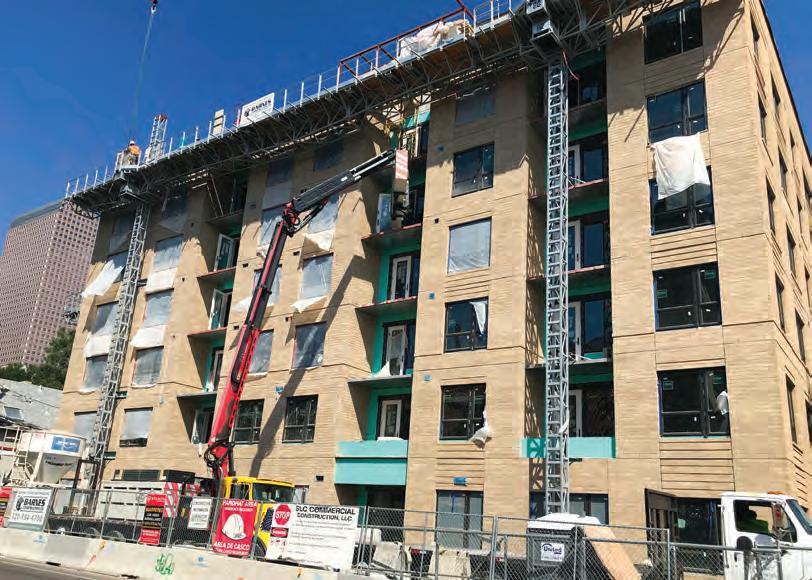
The Uptown Pearl is a sophisticated multi-family living and retail development in Denver’s vibrant Uptown neighborhood. This community features 316 luxury apartments and 12,000 square feet of retail space in a prime location near the city’s commercial business district.
Connector | FALL EDITION September 2022 | 29
Flawless Steel Welding was brought into the 10-story mixed-used apartment project to provide a turnkey solution when the previous subcontractor abandoned the jobsite.
Flawless Steel Welding was brought into the 10-story mixed-used apartment project to provide a turnkey solution when the previous subcontrac tor abandoned the jobsite. The project was behind schedule, but that didn’t worry Victor Garcia, Pres ident of Flawless Steel Welding. This is not the first time his company has saved the day. The company won a SEAA Project of the Year award in 2019 for a similar situation on a parking garage project in Overland Park, Kan.
“People sometimes fall into the trap of taking the low bid and then the project runs into trouble. I’ve built my business by finding opportunities in those situations. We aren’t always the lowest price but we offer expertise and value,” said Garcia.
The initial project included more than 400 balcony rails, each of which were field-verified, and more than 6,800 linear feet of brick relief angle, trellises, storefront frames, canopies, and five stairways. The Flawless team also completed the elevator divider steel, parapet steel, and davit posts.

Second Act
After impressive efforts to re-detail all connections of landing for post installation and account for previous inaccurate concrete embeds and anchor bolts, the company was
awarded an additional scope to fabricate and erect the new Pearl Tavern. Developers, preservation groups, and planners wanted to retain the historic identity of the neighborhood and preserve the Tavern, an iconic feature of the 17th Avenue block. Flawless Steel Welding was tasked with erecting the building while leaving the original 50-year-old façade intact.
Once again, Flawless Steel Welding, created a plan to erect a structure accounting for existing conditions. Challenges were everywhere, but once the remaining structure was braced for the installation of the interior structural steel, the company got to work solving those challenges and gaining time on the schedule.
“Turning this job around gave us a chance to show off and make the client happy, which led to us being awarded three other projects,” said Garcia.
■ Structural Class IV: A Temporary Home for an Iconic Structure
Deem Structural Services erected a temporary building enclo sure to facilitate renovation of the iconic Cadet Chapel at the United States Air Force Academy. The chapel, originally built in 1962 and designated a National Historic Landmark, is undergoing extensive rehabilitation. All aluminum exterior cladding will be removed down to the basic structural steel and replaced. To protect the site from the weather, the chapel was enclosed in a temporary structure, which also supports the dynamic load of four overhead cranes being used to remove and replace the aluminum panels. The project demanded careful crew coordination and risk mitigation.
The enclosure has 40,000 sq ft of clear-span area with vertical truss columns that rise to a height of 173 ft. Deem proposed a vertical truss instead of joists, which made the job more erectable.


The final challenge involved erection of the west side pipe buttresses,constructed of 36-inch diameter pipe sections, designedprimarily for axial load at a specific angle. Installation of the buttresses required a rigging plan that ensured connections were not overload when the buttresses were lifted in horizontal position then transitioned to placement at an angle.

30 | THE STEEL ERECTORS ASSOCIATION OF AMERICA
Flawless Steel was awarded additional scope to fabricate and erect the new Pearl Tavern, which required leaving the original 50-year-old façade intact.
A Spydercrane 295 mini crawler crane was used on the roof of the Uptown Pearl Tavern for lifting support.


TRAIN & RETAIN THE BEST NCCER Accredited Q Nationally Recognized Credentials Q SEAA is an Accredited Training Sponsor & Assessment Center Q Get Admin & Implementation Support Training Curriculum Q All Core Modules Q All NCCER Ironworker Levels 1-2-3 Q Rigger Q Signal Person Q PLUS SEAA’s Custom Curriculum Craft Assessment Certification Q Written & Performance Assessments NCCER Certifications Help You Meet OSHA Requirements Q Mobile Crane Operator Q Rigger Q Signal Person Become an NCCER Training Unit or Assessment Site for Ironworkers SEAA.net/craft-training Q crafttraining@seaa.net 980-722-9373 Q Program benefits for SEAA members only. Experienced program managers can help you get started.
Complex bracing
The enclosure was designed to be self-sup porting only when the structural system and roof diaphragm were complete. However, permanent bracing could not be complete until the next to the last transverse frame was erected. During most of construction, the temporary bracing system carried the horizontal loadings and provided stability for the incomplete structure. The temporary bracing acts as back-up for the permanent bracing system since the enclosure will be

dismantled after the restoration is complete. As the construction process is reversed, the temporary bracing will again become the primary stability mechanism.
The design challenge of the temporary bracing system was that the load distribution of the forces changed as erection proceeded. The erection engineering design had to con sider the loading forces at specific points in time during the erection process. In fact, some of the bracing in the first phase of the structure received more load as the second
and third phases were constructed. Since the capacity of temporary bracing has practical limits, this resulted in the addition of other, seemingly redundant bracing.
In addition, the project’s location on the Front Range of the Rocky Mountains com monly experiences wind gusts of 60 - 70 mph. “We reviewed the weather history in this zone to predict the winds forces we might encounter. When the project was pushed back to later in the winter, we recalculated for snow loads. This info contributed to the temporary bracing planning,” said David Deem, President of Deem Structural Services.
Two crews in tandem
Coordinating two erection crews working in tandem—each working on opposite sides of the structure—necessitated a defined schedule, and daily communication to make sure each phase was completed in unison. Deem also implemented a rigorous inspection protocol to ensure uniform erection of the shell.
Crews also had to be careful to protect the chapel during construction. No field welding was permitted to reduce risk of welding sparks catching the historic landmark on fire. But mechanical fastening comes with drop risk, so Deem Structural crews used tool lanyards. “In addition, we limited the quantity of bolts in the skip buckets that went up with ironworkers. Drop prevention was a daily reminder during site meetings,” said Deem.
What was most unusual was the need to use bolts to fasten the long span bridging. “We used Angel Wing baskets during that process to put ironworkers in the best position for the work,” he said. The good news, says Deem, is that when comes time to dismantle the structure, the exterior portion is outside the perimeter of the chapel.
Overhead crane erected from below
Adding to the project’s challenges, 50 ft runway beams for the overhead cranes could not be erected from underneath. “We had to remove part of the shell to fly run way beams in, install some decking to add additional bracing and roof diaphragm, then hang another runway. Decking had to be care fully coordinated and installed to the greatest extent possible to make sure everything was braced adequately. Finally, we cantilevered the last crane to bring it in through an opening in the roof, and then set it on the beams to finish the installation,” said Deem.
32 | THE STEEL ERECTORS ASSOCIATION OF AMERICA
Deem Structural Services erected a temporary building enclosure to facilitate renovation of the iconic Cadet Chapel at the United States Air Force Academy. The enclosure has 40,000 sq ft of clearspan area with vertical truss columns that rise to a height of 173 ft.
The final challenge involved erection of the west side pipe buttresses, constructed of 36-inch diameter pipe sections, designed primarily for axial load at a specific angle. This required a rigging scheme that allowed the buttress to lift at a slightly greater angle with the horizontal while ensuring that the buttress and its internal connections were not overloaded during the lifting transition from a horizontal position to the final placement angle. The buttress and the rigging were analyzed at numerous points during the lift to ensure that there would be no failure of the member or its connections and that the buttress would remain stable during the lift.
David Deem noted: “Everything about this job was unique. The bracing is still there and will remain until it’s time to take down the temporary structure. It is helping with stability of the structure even now.”
Construction of the General Assembly Building required a 300-ft concrete shear tower in the core that tied into all four sides, as well as building the frame out for the building’s multiple elevators.
■ Structural Class IV Honorable Mention: Pandemic Perseverance

Mid Atlantic Steel Erectors (MASE) overcame numerous obsta cles—not all of which were construction related—in the erection of the 15-story, 420,000-sq ft General Assembly Building. The project incorporated the original 1912 façade of Virginia government building.
Limited working hours and weather-related delays were some of the more usual of the challenges. The company also navigated working during the height of the Covid-19 pandemic when masks and temperature scans were required, and workers were sent home for weeks to recover from illness. What’s more, at one point, riots led to police shutting down street access.
Limited laydown, low ground pressure
This job required a 300-ft concrete shear tower in the core that tied into all four sides, as well as building the frame out for the building’s multiple elevators. Situated on a single block in downtown on a

Connector | FALL EDITION September 2022 | 33 2023 National Awards Program Accepting Award Nominations SUBMISSIONS DUE JANUARY 31, 2023 Q 3 Categories based on Number of Ironworkers employed Q World Class, Premier, and Gold Level Recognitions Q NEW! $1500 in Craft Training Grants awarded to each World Class winner CRAFT TRAINING Excellence SUBMISSIONS DUE DECEMBER 31, 2022 Q 4 Contract Class Categories for Structural Steel Q NEW! 2 Contract Class Categories for Miscellaneous Metals Q 24 month Topping Out Period from Jan. 1, 2021 to Dec. 31, 2022 NEW! Earlier Deadlines Open to Member Companies of All Sizes Submit at SEAA.net/awards Q Industry-Wide Publicity Q Profiles in Connector magazine Q Presentations at SEAA & AISC Conventions Sponsored by SUBMISSIONS DUE JANUARY 31, 2023 Q World Class, Premier, and Gold Level Recognitions Q Based on Safety Metrics for the previous year SAFETY Excellence
Situated on a single block in downtown on a main thoroughfare, the site constraints were significant. MASE only had access to a small strip of space for a laydown yard on the same side of the building as the 110-year-old façade.
main thoroughfare, the site constraints were significant. The laydown yard was a small strip on the same side of the building as the 110-year-old façade. MASE retrofitted window supports and placed reinforcing steel into façade, which was custom built on site. While

tying the first six floors into the backside of the façade, MASE had to be careful flying steel around the stone part of the structure.
Low ground pressure require ments meant that MASE had to supply the smallest possible crane that could still reach the 9th floor. A 200-ton Liebherr LR 1160 crawler crane with luffing boom set the steel, while a second 550-ton Grove GMK-7550 truck crane was set up in the main thoroughfare to place a complex truss system and 140,000-lb girder beam. MASE fabricated and placed a three-story truss that support upper floors as it spanned the full basement and meeting rooms. For these phases, work was limited to weekends to meet the city’s requirements for street shutdown.
The Liebherr 630 EC-H tower crane was used for construction of the west half of the building and everything above the 10th floor. The project faced more delays when winds in excess of 25 mph shut down the tower crane for periods of time.
Despite both usual and extraordinary circumstances, Mid Atlantic Steel Erectors sustained progress, completing the project without incident.•


34 | THE STEEL ERECTORS ASSOCIATION OF AMERICA
The project incorporated the original 1912 façade of the Virginia government building.
OSHA’s Subpart CC requires signal person qualification by a third-party qualifier.


While an OSHA letter of interpretation recognizes apprenticeship programs that train and assess riggers and signal persons as third-party qualified evaluators, many contractors, states and municipalities require a Qualified Rigger and Signal Person Certification.

WHAT IS IT?
Iron Workers International Certification Board’s (I.I.C.B.) Rigging & Signalperson Certification Program is accredited by the National Commission for Certifying Agencies (NCCA), the accrediting body of the Institute for Credentialing Excellence. The I.I.C.B. joins an elite group of more than 130 organizations representing over 315 programs that have obtained NCCA accreditation.
Third party training and certification comes with a hefty price tag without input on testing from subject matter experts, ironworkers and their contractors. Recertification can cost up to $500.


Connector | FALL EDITION September 2022 | 35
WHY IS IT IMPORTANT?
3-PART EXAM MEET DEMAND
The National Commission for Certifying Agencies (NCCA), the accrediting body of the Institute for Credentialing Excellence, has accredited the Iron Workers International Certification Board’s (I.I.C.B.) Rigging & Signalperson Certification Program
Ensuring
IRON WORKERS INTERNATIONAL SETS THE STANDARD HIGH WITH ACCREDITED RIGGER & SIGNAL PERSON CERTIFICATION TESTING & RECERTIFICATION EVERY 5 YEARS IRON WORKERS RIGGING & CRANE COURSE 6,000 HOURS OF HANDS ON EXPERIENCE HOW IS IT DONE? WHY IS IT IMPORTANT? MEET REQUIREMENTS REDUCE COST IMPROVE SAFETY www.ironworkers.org
that only trained, skilled and competent ironworkers complete rigging and signaling tasks, elevates workplace safety standards and reduces risk.
Increased Minimum Wage for Federal Contractors: Impact on Steel Erectors
President Biden’s Executive Order 14026 (EO 14026), executed on April 27, 2021, increased the minimum hourly wage that federal contractors must pay certain workers on federal construction projects from $10.50 to $15, an action the president explained was aimed at promoting the government’s procurement interests in economy and efficiency by contracting with sources that “adequately” compensate their workers. On November 24, 2021, the Department of Labor (DOL) published a final rule implementing EO 14026, which went into effect on January 30, 2022. Unsurprisingly, the benefit to workers will result in taxpayers paying almost 50% more for certain types of services and will increase the cost of labor for the construction companies, including steel erectors, engaged as prime or subcontractors on federal construction projects.
Contracts Covered by the EO
even if it is (1) an extension of an existing contract, (2) a renewal of an existing contract, or (3) an exercised option on an existing contract. The regulations call for additional wage increases starting January 1, 2023, and annually thereafter.
Covered contracts under the EO 14026 include the following types of agreements:
• Procurement contracts for construction covered by the Davis-Bacon Act (DBA).

• Service contracts under the Service Contract Act (SCA).
• Concession contracts with the federal government.
• Contracts related to federal land and offering of ser vices to the general public, federal employees, and their dependents.
14026
Importantly, this new minimum wage requirement only applies to work under certain types of federal contacts, and then only to “new” contracts entered into on or after January 30, 2022. A contract is considered “new”
Richard Arnholt is a member at Bass, Berry & Sims in Washington, D.C. He advises companies on the complex rules applicable to contracting with federal and state governments. He focuses on risk mitigation through implementation and upgrades to ethics and compliance programs as well as response to government allegations of procurement fraud or misconduct. He can be reached at rarnholt@bassberry.com
The final rule also expressly excludes the following types of federal agreements from the application of the new minimum wage requirements:
• Contracts that result from a solicitation issued prior to January 30, 2022, that are entered into on or between January 30, 2022 and March 30, 2022.
• Grants.
• Contracts with and grants to Indian Tribes.
• Contracts for construction and services (except for those expressly covered by EO 14026) that are excluded from DBA or SCA coverage.
Contracts for the manufacturing or furnishing of materials, supplies, articles, or equipment to the federal government (i.e., furnishing steel is likely excluded from
36 | THE STEEL ERECTORS ASSOCIATION OF AMERICA
BUSINESS
OPERATIONS
By Richard Arnholt
coverage; however, contracts to erect steel structures are most likely subject to the minimum wage requirement).
EO 14026 and Mixed Funded Projects
Construction projects often receive funding from multiple sources – sometimes a mix of state, federal and private dol lars. With regard to the new $15 hourly minimum wage rule, it is important to note that it only applies to the specific contract types listed above. That means that only work performed on fed eral contracts and subcontracts where the contractual provisions are required will be subject to the new minimum wage. In short, determining whether an organization is bound by the provisions of EO 14026 is a question of con tract, not funding source.
Workers Covered by the EO 14026
In addition, EO 14026 applies to any employee performing work “on or in connection with” the covered contract. DOL defines a worker performing “on” a con tract as “a worker [that] directly performs the specific services called for by the contract” and the work is “in connection with” a contract when “the worker’s activities are necessary to the contract.”

This means that if a federal contract mandates that a company pay employees at the new minimum wage rate, EO 14026 generally applies to the following categories of employees working on or in connection with that covered contract:
• Employees entitled to the Fair Labor Standards Act minimum wage (but not any employee who would be considered an exempt executive, administrative or professional employee).
• Service employees entitled to prevailing wages under the SCA.
• Laborers and mechanics entitled to prevailing wages under the DBA.
It also means that the EO applies to employees working on both the prime contracts and subcontracts. There are no exemptions based on size or contract value for subcontractors.
Note that, at least for the time being, state minimum wage laws are irrelevant to the EO 14026’s implementation. Currently, no state has an effective hourly minimum wage law higher than the $15 threshold. Accordingly, for workers on covered federal construction contracts
to whom the minimum wage requirement applies, the EO supplants those existing state laws and raises the wages of contractors per forming on federal contracts in those states to $15 per hour.
Going Forward
Pursuant to EO 14026, the minimum wage became $15 per hour beginning on January 30, 2022 for all applicable employees working on covered contracts. Thereafter, each year beginning on January 1, 2023, the min imum wage will be adjusted by the Secretary of Labor using the annual percentage increase in the Consumer Price Index for Urban Wage Earners and Clerical Workers (CPI-W) and rounded in increments of $0.05. For exam ple, if the CPI-W shows an increase of 10%, which is not out of the realm of possibility in the current inflationary environment, the minimum wage would become $16.50 at the beginning of 2023.
Important Tips for Federal Contractors
Several lawsuits have already been filed challenging the EO 14026’s implementa tion. In one suit the Attorneys General from Arizona, Idaho and Nebraska have taken the position that the EO is improper given Congress’s previous rejection of the same wage hike in a COVID-19 relief bill. Another suit filed by Attorneys General of Louisiana, Mississippi and Texas alleges the action is arbitrary and capricious, an unconstitutional delegation of legislative power, an usurpation of congressional spending power, and mis interprets authority delegated by the Federal Property and Administrative Services Act, 40 U.S.C. § 101 et seq. (the Property Act). Both cases are pending.
In fact, earlier this year the United States District Court for the District of Colorado issued a limited injunction of the minimum wage requirement, prohibiting its application to contracts entered into for seasonal recreation services for the public on federal lands. While the injunction issued in Bradford v. U.S. Dep’t of Labor, which was filed by several outdoor recreation companies, is narrow, the decision reflects a broader trend challenging Executive authority to administer an “economical and efficient system” under the Property Act. The injunction is pending appeal.
Until these and any subsequent legal challenges are fully resolved, to avoid any potential penalties contractors must comply to the extent that they are subject to this new contractual minimum wage requirement. But because the minimum wage obligation does not automatically apply to construction projects simply because they are funded at least in part by the federal government, contractors should carefully review their prime and subcontracts to determine whether they are subject to this new minimum wage requirement. •
Connector | FALL EDITION September 2022 | 37
Several lawsuits have already been filed challenging the EO 14026’s implementation. Until these and any subsequent legal challenges are fully resolved, to avoid any potential penalties contactors must comply to the extent that they are subject to this new contractual minimum wage requirement.
“Without a digital transformation strategy, the same overspend and scope creep will crop up time and again because learnings are not always being shared. This not only creates inefficiencies, but affects confidence in the sector while increasing risk.
Owners are driving standardization and are increasingly more explicit about their project expectations, sometimes right down to the software used.
If a contractor wants to respond to an RFP, they have little choice but to go along with it.”
 — Catie Williams, Vice President of Product Development, InEight

On Time and On Budget?
The InEight Global Capital Projects Outlook Report, released in July 2022, states that the percentage of projects contractors complete on or ahead of original schedule has fallen from 51 percent in 2021 to 35 percent in 2022. Similarly, the ability to complete on or under the approved budget dropped from 51 percent in 2021 to 38 percent this year.
Source: Ineight Global Capital Projects Outlook, July 2022, Second Edition. Download the full report at ineight.com.
Average Final Cost of Construction-Related
that Go Over Budget
Of the projects that go over budget, only about one-quarter of them are in excess of 21% over budget. Respondents with turnover in excess of $5 billion report being most acutely affected by over spending and scope creep.
Most Common Factors Affecting On Time/On Budget Completion
• Unmanaged or unexpected risk
• Poor stakeholder communication
• Inefficient processes
• Increased rework or quality issues
• Inability to see current project status
SEAA Remembers Billy DeWitt
Billy DeWitt (William Howard DeWitt Jr.), of Florence, S.C., died on May 10, 2022 at the age of 83. DeWitt was the retired CEO of Florence Steel Erectors, Inc., where he worked for 30 years. In 1986, he served as President of the Steel Erectors Association of Virginia and the Carolinas (now the Steel Erectors Association of America.)

“The early members of the organization that preceded SEAA set a foundation for sharing best practices. As we celebrate our 50th year this year, we recognize and appreciate the contribu tions of people like Billy DeWitt,” said Geoff Kress, President of Gardner-Watson Decking and past president of SEAA (2020-2021).
Projects
5-10% over budget 11-15% over budget 16-20% over budget 21-25% over budget 26-50% over budget 51-75% over budget 76-100% over budget
Meet New Members
Check out the Member Directory at SEAA.net
CANAM Buildings, Boucherville, Quebec, Canada, is a fabricator that operates eight plants in Canada and the United States.
Skyhook Erecting, Humansville, Mo., Erector $0-3 million
TGR Erectors, LLC, Leonard, Texas, provides pre-construc tion and steel erection services to the Dallas-Fort Worth Area.
Exceed Safety, LLC, Henderson, N.C., is a safety consulting firm.
Flex-Erect, Houston, Texas, is a structural steel, miscella neous metals, and ornamental/architectural iron erector.
WINTER EDITION: December 2022
Ad Deadline: November 18, 2022
ConnectorSales@seaa.net
38 | THE STEEL ERECTORS ASSOCIATION OF AMERICA
NEXT
of World Class Training & Safety Award Winners Insurance Rigger & Signalperson
Worker
UP
Profiles
Training
Retention Strategies
TOPPING OUT
24% 26%25% 15% 8% 1%1%
Vulcraft’s flush frame connections are modernizing steel joist floor systems.


Designed to reduce floor-to-floor heights, simplify MEP installation, and accelerate deck installation, studies have shown that our flush frame connections also significantly mitigate floor vibration.*
Long recognized as a leader in innovation, versatility, and cost efficiency, Vulcraft’s steel joist floor systems provide more options and less vibration.
*As

measured by finite element analysis and manual calculation methods.
VULCRAFT FLUSH FRAME CONNECTIONS
OPTIONS. LESS VIBRATION. VISIT VULCRAFT.COM/FLUSHFRAME TO LEARN MORE POWERFUL PARTNERSHIPS. POWERFUL RESULTS.
MORE

