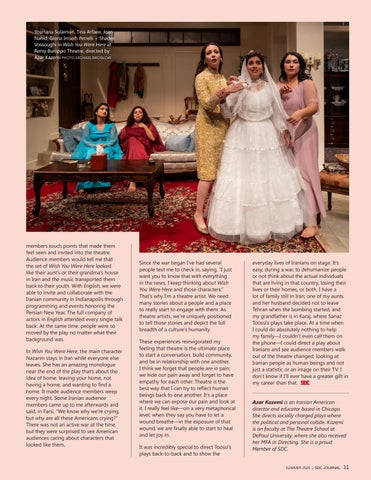
Yourtana Sulaiman, Tina Arfaee, Joan Nahid, Gloria Imseih Petrelli + Shadee Vossoughi in Wish You Were Here at Remy Bumppo Theatre, directed by Azar Kazemi PHOTO MICHAEL BROSILOW
members touch points that made them feel seen and invited into the theatre. Audience members would tell me that the set of Wish You Were Here looked like their aunt’s or their grandma’s house in Iran and the music transported them back to their youth. With English, we were able to invite and collaborate with the Iranian community in Indianapolis through programming and events honoring the Persian New Year. The full company of actors in English attended every single talk back. At the same time, people were so moved by the play no matter what their background was. In Wish You Were Here, the main character Nazanin stays in Iran while everyone else leaves. She has an amazing monologue near the end of the play that’s about the idea of home: leaving your home, not having a home, and wanting to find a home. It made audience members weep every night. Some Iranian audience members came up to me afterwards and said, in Farsi, “We know why we’re crying, but why are all these Americans crying?” There was not an active war at the time, but they were surprised to see American audiences caring about characters that looked like them.
Since the war began I’ve had several people text me to check in, saying, “I just want you to know that with everything in the news, I keep thinking about Wish You Were Here and those characters.” That’s why I’m a theatre artist. We need many stories about a people and a place to really start to engage with them. As theatre artists, we’re uniquely positioned to tell those stories and depict the full breadth of a culture’s humanity. These experiences reinvigorated my feeling that theatre is the ultimate place to start a conversation, build community, and be in relationship with one another. I think we forget that people are in pain; we hide our pain away and forget to have empathy for each other. Theatre is the best way that I can try to reflect human beings back to one another. It’s a place where we can expose our pain and look at it. I really feel like—on a very metaphorical level, when they say you have to let a wound breathe—in the exposure of that wound, we are finally able to start to heal and let joy in. It was incredibly special to direct Toossi’s plays back-to-back and to show the
everyday lives of Iranians on stage. It’s easy, during a war, to dehumanize people or not think about the actual individuals that are living in that country, losing their lives or their homes, or both. I have a lot of family still in Iran; one of my aunts and her husband decided not to leave Tehran when the bombing started, and my grandfather is in Karaj, where Sanaz Toossi’s plays take place. At a time when I could do absolutely nothing to help my family—I couldn’t even call them on the phone—I could direct a play about Iranians and see audience members walk out of the theatre changed, looking at Iranian people as human beings and not just a statistic or an image on their TV. I don’t know if I’ll ever have a greater gift in my career than that. Azar Kazemi is an Iranian American director and educator based in Chicago. She directs socially charged plays where the political and personal collide. Kazemi is on faculty at The Theatre School at DePaul University, where she also received her MFA in Directing. She is a proud Member of SDC.
SUMMER 2026 | SDC JOURNAL
11