The Peer-Reviewed Section of SDC Journal is edited by an independent Editorial Board and the articles contained therein solely represent the opinions of the authors and do not reflect the view or positions of the Stage Directors and Choreographers Society (SDC).
LETTERS TO THE EDITOR
Letters to the editor may be sent to SDCJournal@SDCweb.org
POSTMASTER
Send address changes to SDC JOURNAL, SDC, 321 W. 44th Street, Suite 804, New York, NY 10036.
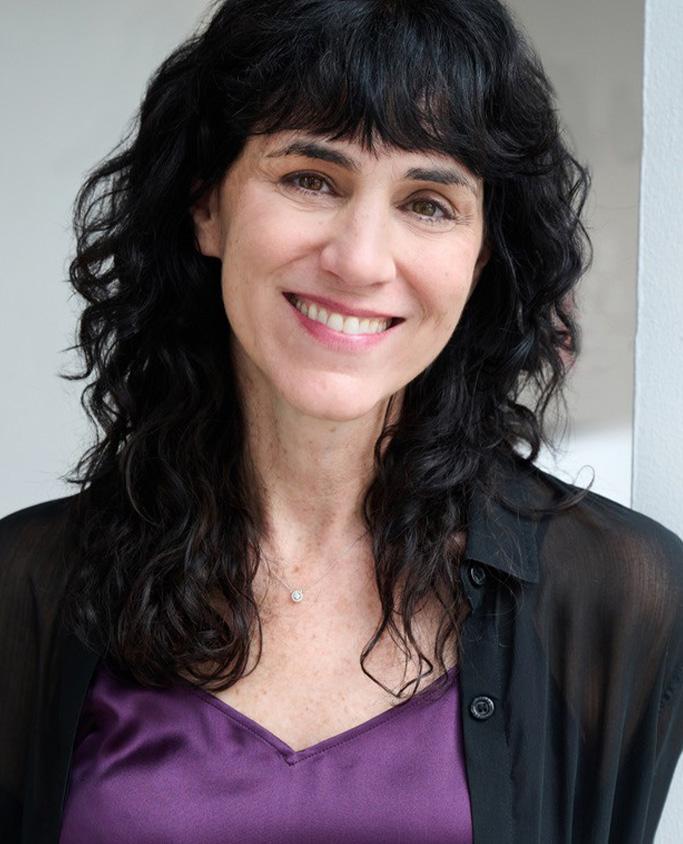
Leigh Silverman
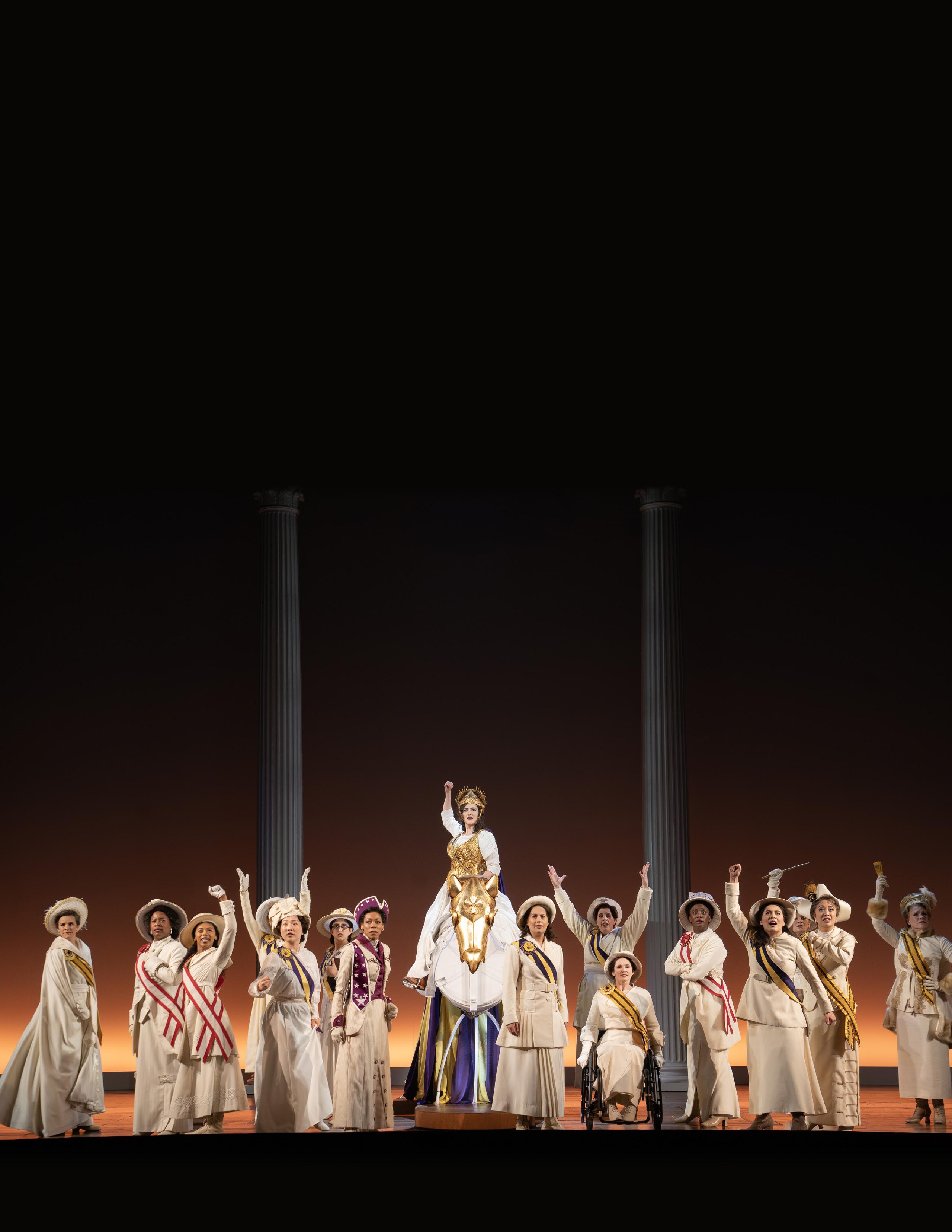
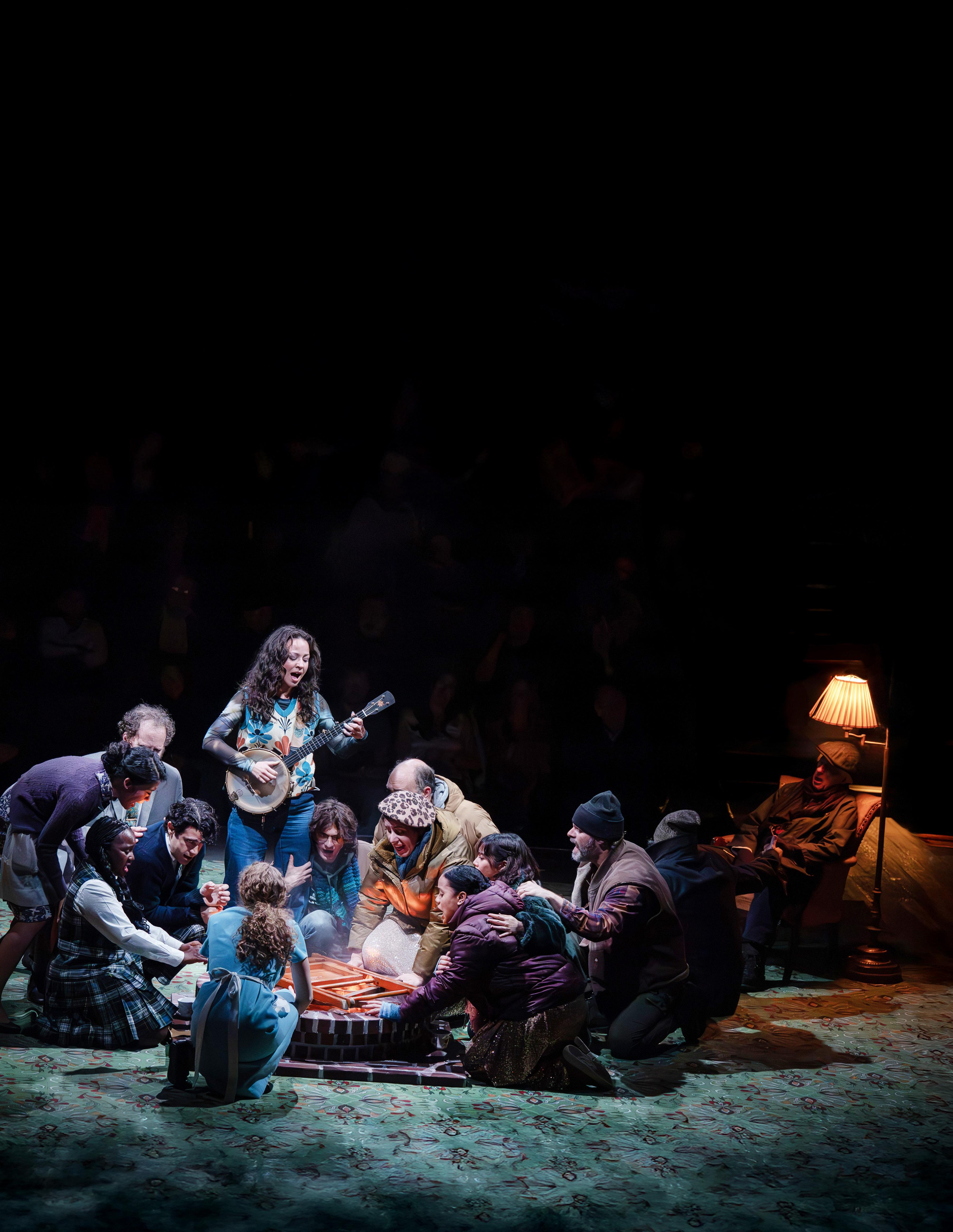
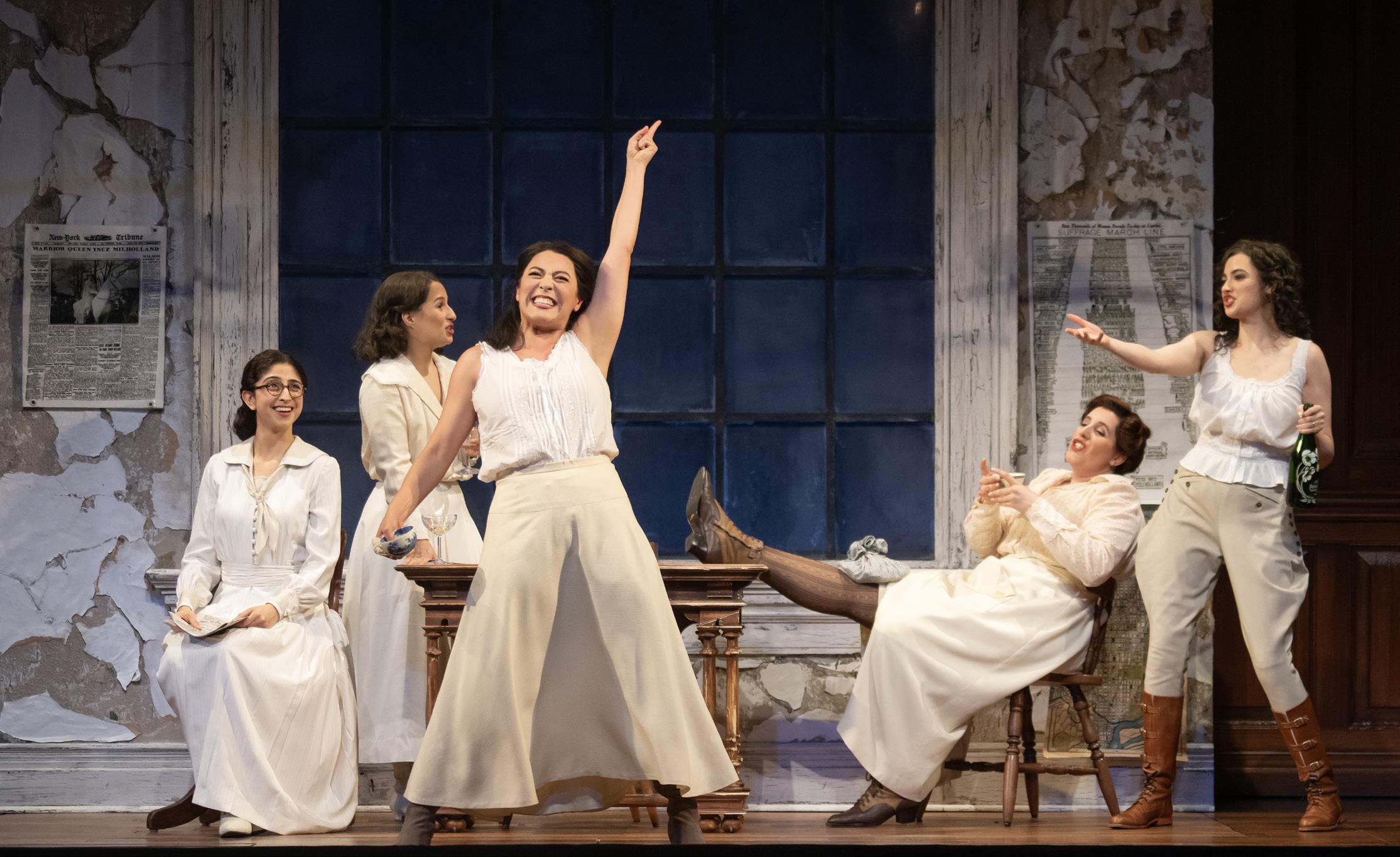
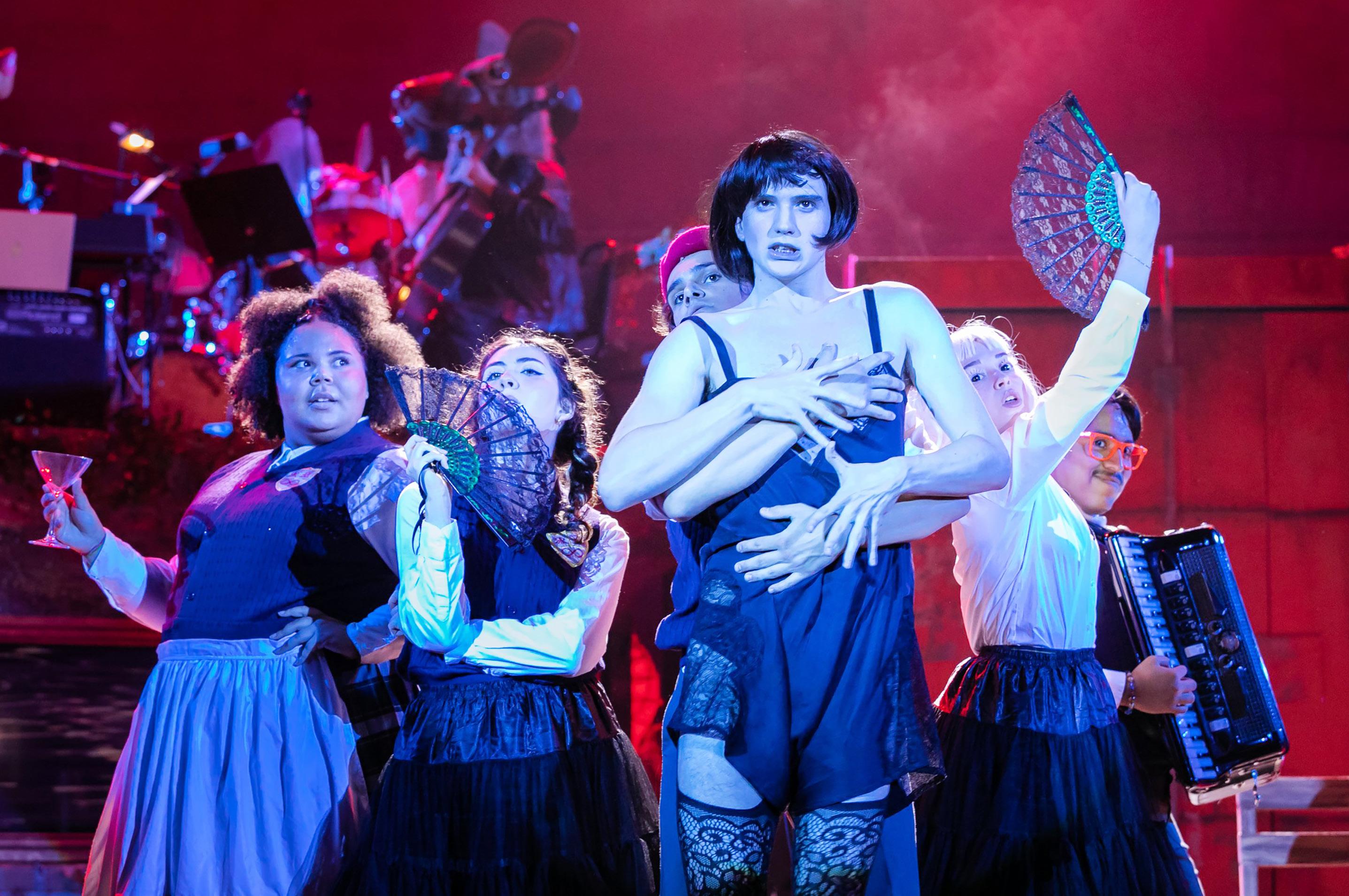
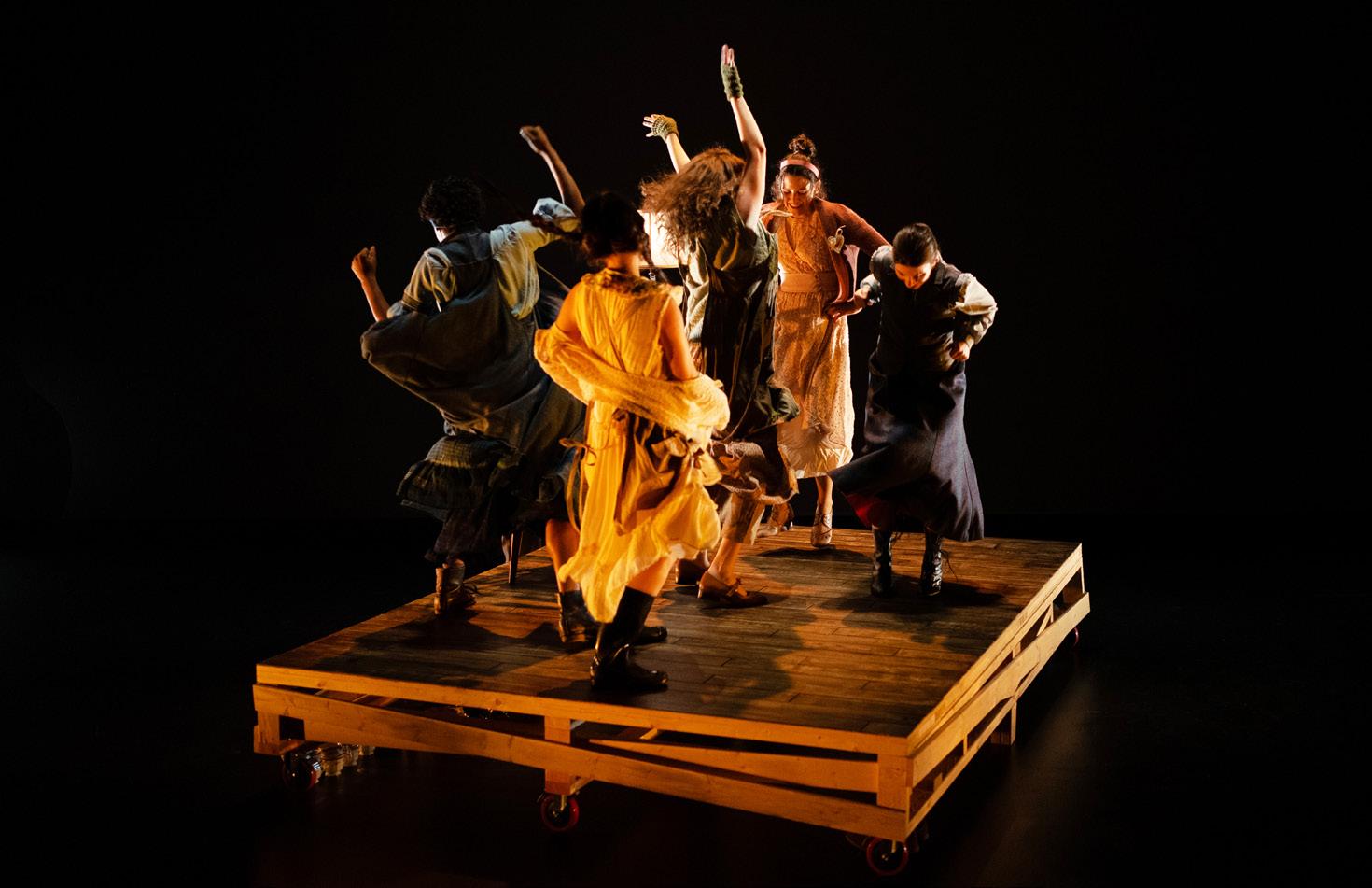
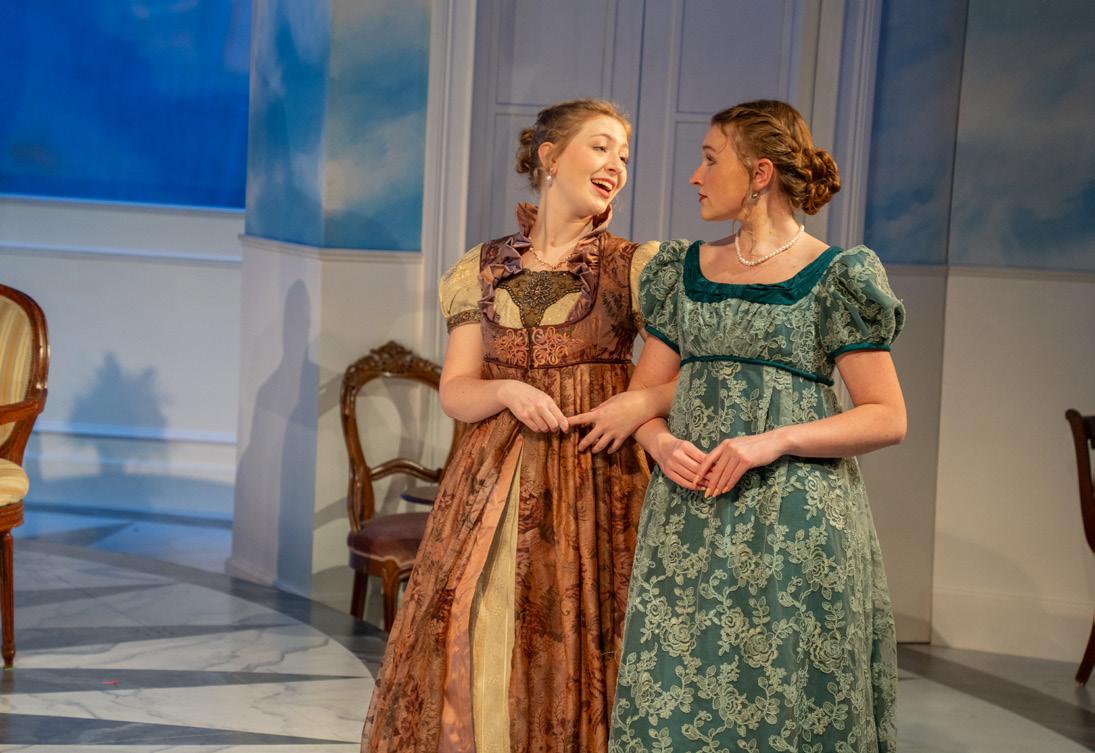
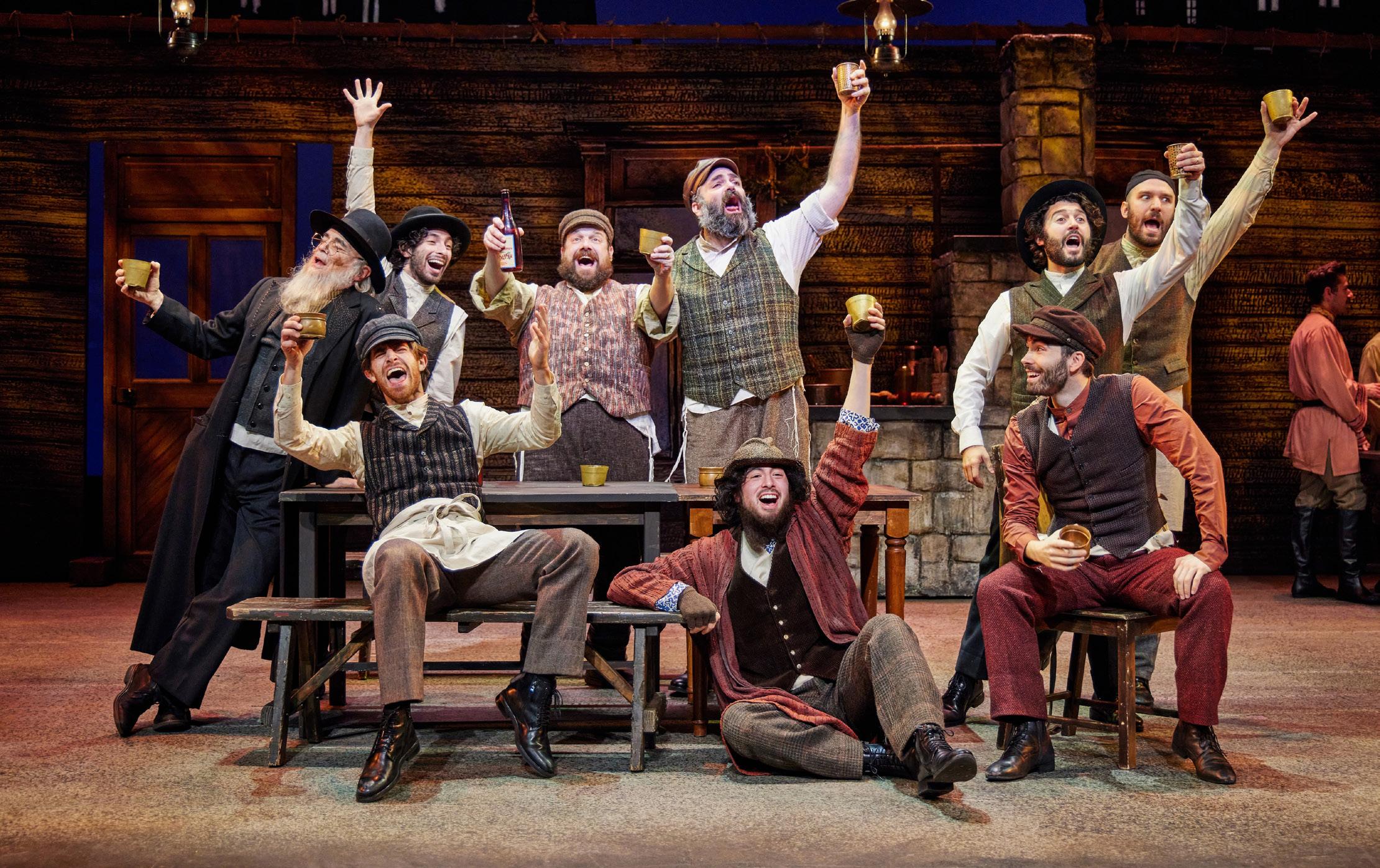
Hannah Cruz + company in Suffs on Broadway, directed by Leigh Silverman
PHOTO JOAN MARCUS
A LETTER FROM PAST PRESIDENT EVAN YIONOULIS
As I write my last Journal letter, I am filled with gratitude for the opportunity I’ve had to serve our extraordinary Membership. To work alongside fierce and committed Executive Board members for the common good. To witness firsthand the dedication and expertise of SDC’s small but mighty staff. To partner with Laura Penn, our Union’s incomparable and tenacious Executive Director, from whom I have learned so much about strategic thinking and forward looking.
At this juncture, I’ve been reflecting not only on my presidency, but also on the work of the Union during my time with SDC. Laura recently reminded me that when I took the helm six years ago from my esteemed predecessor, Pam MacKinnon, I spoke of my belief in continuing the vital work of the Union: Incrementally. Patiently. Bravely.
At that time, November of 2019, SDC was strong and ready to move forward into a new decade with purpose. Of course, 2020 would bring unprecedented challenges for all of us, as individuals—artists, citizens, humans—and as a labor union. Patience and Bravery and the belief in Incremental Progress would be lifelines during the difficult years that followed. But I didn’t choose those words because I knew what we were about to face—I chose them because of what my previous work with the Union had taught me.
My time on the Board began six years before my presidency—and my Membership in SDC, back in the last century. In the years before I was on the Board, I had served on LORT, Off-Broadway, and ANTC negotiating committees. To see what we can accomplish together, incrementally, with braveness and patience, it’s necessary only to look at the evolution of our contracts over the last few decades: SDC’s achievements in getting directors and choreographers covered for their work in new play development, starting in LORT and now across all jurisdictions large and small; the strides we’ve made in protections for electronic capture; and the hard-fought recognition of associate/ resident directors and choreographers on Broadway, to name an important few areas. I had the privilege of being on the phone calls where we discussed the needs of our Members, the caucuses where we debated and strategized our approach, the negotiations where we, as a collective of artist laborers, argued our cases, took bold first steps—or stepped back to fight stronger another day.
One of the reasons that the Union has had such success in deploying its patience and bravery toward incremental success is that we’ve been steadfast in holding to our core principles: Unite. Empower. Protect. As an At-large Member, I served on the Education Committee in the final stages of the drafting of our Rights and Responsibilities. That a union should want to articulate its Members’ Rights wasn’t such a unique thought, but that we, as directors and choreographers, were equally committed to articulating and following through on our Responsibilities was really a radical idea. Over the years those responsibilities have guided our path forward as we’ve worked to lead the field in the effort to rid our industry of sexual harassment and of discrimination on the basis of protected identity; now we have enhanced non-discrimination and anti-harassment provisions in every agreement.
Unite. Empower. Protect. It’s certainly what guided us during the pandemic. In those days and weeks and months when our Members were out of work, the survival not only of our livelihoods but also our Union were at stake. Thanks to the presence of financial reserves, along with the careful stewardship of our resources and difficult decisions around staffing, SDC was able to continue to offer services, including working with AGMA and a handful of epidemiologists to develop strategies to get our Members back to work safely. We dedicated resources from SDC’s strike fund to set up an emergency fund at the Foundation to help Members in need. It was moving and humbling to see so many Members augment those monies with donations of their own. A vital form of solidarity.
Today and in the coming years, when the artistic community and the labor movement face an onslaught of livelihood-threatening political and economic forces, sticking to our guiding principles will be more important than ever. I have no doubt that the Executive Board, under the extremely capable leadership of our new President, Michael John Garcés, will continue to bring their full dedication and passionate conviction to Uniting, Empowering, and Protecting SDC’s Membership. I wish them the patience and bravery to continue to harness the power of incremental change to advance the lives of directors and choreographers long into the future.
It was a privilege to serve on the Board of our great Union these past 12 years, and I’m grateful to remain part of this powerful, inspiring community we all share.
In Solidarity,
Evan Yionoulis Past Executive Board President
A CONVERSATION WITH NEWLY ELECTED PRESIDENT MICHAEL JOHN GARCÉS
Michael John Garcés was elected President of the SDC Executive Board in November 2025. He spoke with the Membership at an SDC Meeting in Los Angeles in December.
You became an SDC Member in 2001, when you were living in New York City, and an Executive Board member in 2006, which is the year you moved to Los Angeles, where you now live. Tell us about what that transition meant for you as a Member and a Board member.
While I was living in New York, I was working a lot both regionally and Off-Broadway. I moved to LA to become Artistic Director of Cornerstone Theater Company. The big difference for me in Los Angeles was actually a greater sense of needing the Union. Not being in New York, which up to that point in my life felt like the center of things, made me aware of my vulnerability when working as a freelancer, which I continued to do. To be able to call the Union, to be tethered to something foundational—in terms of when I had a problem with producers, when I had an issue and was unsure of how to proceed, when I was unclear what the terms of a given contract might be—was more significant for me after I moved to LA.
Also, at the time when I moved, there was a greater consciousness of the Board becoming a national Board. We had several LA Board members by that time, but we had relatively few Board members anywhere else; the majority were based in NYC. Being in LA gave me a better sense of the importance of our Union having a national scope. Board representation of Chicago Members, Seattle Members, Atlanta Members—directors and choreographers from across the country— only really became the norm in the last couple of decades. That, for me, has made us a much stronger and more interesting and more vibrant Union.
What were some of your earliest experiences with SDC?
I joined after I had gotten a couple of regional contracts. The Union called me and said, “You need to join.” I said, “Great.” Then they asked me to be on a LORT Negotiating Committee, and that changed my whole world. After a long week of negotiations that ended at 4:00 in the morning on Friday (actually, Saturday!), my visceral response to what they did not want to give us, what they wouldn’t even contemplate, really activated me as a Union Member. I was like, “Oh no, this is absolutely not ok.” I got pretty fired up by being on that Negotiating Committee. We ended up getting a lot in that particular negotiation. I was very proud of it, and it galvanized me.
As I became active in the Union, I was approached to run for the Board. Julie Arenal and Tom Moore were really mentors to me on the Board my first couple of years. It was a really different Board at the time. It was definitely “SSDC,” the Society of Stage Directors and Choreographers. We have become more conscious of ourselves as a union and less of an old boys’ network. I have been a Board member during what I think of as a “hinge” moment for the Union, a time of real evolution and change. There have been some interesting and sometimes fraught conversations over the years: I believe it has been a very positive and deeply productive era for the Union in terms of diversifying the Board, professionalizing our practice, strengthening our commitment to our values, and addressing our processes in many, many ways.
You served as First Vice President under Pam MacKinnon, and then Executive Vice President to Evan Yionoulis. Pam was elected and then Donald Trump was elected and then Harvey Weinstein hit; she just got pummeled in those first
weeks. And Evan had three months to get her sea legs before Covid. What did you experience with Evan and Pam that you might call on now as you are coming into the Presidency?
We were very lucky to have Evan and Pam as presidents during those times. They were both extraordinary and exemplary leaders. They are two of the smartest people I’ve ever met, and each possesses a real intellectual rigor and seriousness of focus balanced with deep compassion. I was impressed with their processes for making decisions. As a Union, we move efficiently, I will say. Both of them were efficient and rigorous thinkers, but they are also people who gather and synthesize information and opinions from the people around them as they make up their minds. I think that their careful deliberation—which was not hesitation!—and refusal to be reactive in the moment, taking the time to make the right choice in spite of a lot of internal and external pressure to rush to a conclusion, was often crucial.
We’ve come through a series of historic crises remarkably intact because of their leadership, in partnership with Laura [Penn] and in partnership with staff, and other Board members. Their leadership was extraordinary. I’ve learned a lot from both Pam and Evan in terms of how to stay the course and bring generosity of spirit without sacrificing rigor.
2016–2017 was a critical moment for this Union. Our profession was called into question in a very real way. I’m still mad about the American Theatre magazine cover with the spotlight on an empty director’s chair, which pointed to directors as the problem the #MeToo movement was addressing. Yet every single example in that article was of someone abusing the power
of being a producer, not a director; that distinction was never made. It furthered the narrative that directors in particular were the problem. I worked a lot with Pam in terms of actually changing the conversation and positioning directors as a necessary and crucial part of the solution to what was wrong in the field.
We also looked at our Membership, and that’s when we developed the notion of our Members not only having rights, but also responsibilities—responsibilities to each other, to the Union, to the field. We’ve been a model, I think, for other entertainment unions in that. In our governance documents, you have your Rights and your Responsibilities. Most unions just have rights. Other unions have been interested in this as a model. I think this shift helped us stay the course in 2016 and 2017, because we had a rigorous process internally and externally about how to address that moment. Pam’s leadership throughout was vital. And then I had just become Executive Vice President when we got punched in the face by the pandemic and had the benefit of Evan’s remarkably steady leadership as we navigated the COVID-19 shutdown and the call for systemic change following the uprising of 2020. I tend to be somewhat on the more combative side, I would say. I learned a lot from them, each in their own very particular way, about how to step into— up to—leadership and show strength and resolve in a different way.
Let’s talk for a little bit about your activism. Your work is about seeking justice and equity in the world. How is the Board going to manage through the current environment?
Part of what I’ve learned over my time at the Union, and in the last 10, 15 years in
particular, is that unions have a specific mandate. They are fundamentally important in the movement toward greater equity in the world. Unions are founded on principles of social justice secured through collective action to achieve fairness, equity, and safety in the workplace. And although they can be aligned with political organizations and can be effective in achieving political change, they are not political or activist organizations.
“I don’t know what the call’s goingto be, but I knowit’s coming.We are a Union of leaders in the field, and sowe do have greaterresponsibility.”
A union is there to do specific things in terms of empowering and protecting its members, ensuring employment protections, et cetera. I try to keep that purpose front and center in all conversations. I focus on that as we’re making some of the harder decisions we have to make and considering what we’re doing and why, and ensuring that we’re keeping our mission as a union central to what we do.
Unions don’t exist to burn things down. Unions exist to negotiate better, fairer deals for their members. Producers control the means of production, and we are the workers providing that product. We have to have a healthy relationship with them and, in fact, work with them so that those producers are able to continue to provide work for our
Members. I keep that front and center in my thinking as we’re seeking to solve problems as they arise or achieve our long-term goals. If I want to throw a rock through a window, which I definitely do sometimes, I’ll do that when I’m working in a different context.
What are your priorities for the Union for the next two or three years?
I’m excited about the potential for expansion. Growth will make our Union healthier and better able to survive volatile economic times. Aligning ourselves with other unions and understanding our place in the union movement is really important, perhaps more important than ever before. We’re a Union that punches above its weight. We have many influential people in the Union, incredibly smart people, and we’re part of a labor movement that’s under serious attack right now. We are under attack as artists in terms of our First Amendment rights. We’re under attack as a field as this administration seeks to leverage arts and culture as propaganda. The National Labor Relations Board has been crippled. It’s a time of challenge. We have to align ourselves within the movement because unity is power. And we have to be more strategic in how we protect ourselves. That’s a big area of focus for me.
What do you need? Given the agenda, the vision, the needs, the challenges, the opportunities, what do you need from the Membership?
Being active, paying attention to what’s happening with the Union, being responsive, coming to Membership Meetings, galvanizing fellow directors and choreographers to stay strong—it’s hugely important. Because, again, it is a critical time. Right now, there’s a lot of capitulation, and capitulation and appeasement and pressure to grant are short-term concessions that have the potential to do great long-term harm to the union sector. We need to have a robust response from and dialogue with Members as we establish priorities, gauge risks, make bold choices—as we navigate the future. It’s make or break. I’m worried about crisis fatigue.
AUDIENCE MEMBER | So, Michael John, what is it that we can do for you?
I think over the next couple of years we are going to be moving into action. Respond to the call when it comes. Because it will. Maybe more than once. I don’t know what the call’s going to be, but I know it’s coming. We are a Union of leaders in the field, and so we do have greater responsibility. Being responsive to the call is going to be huge.
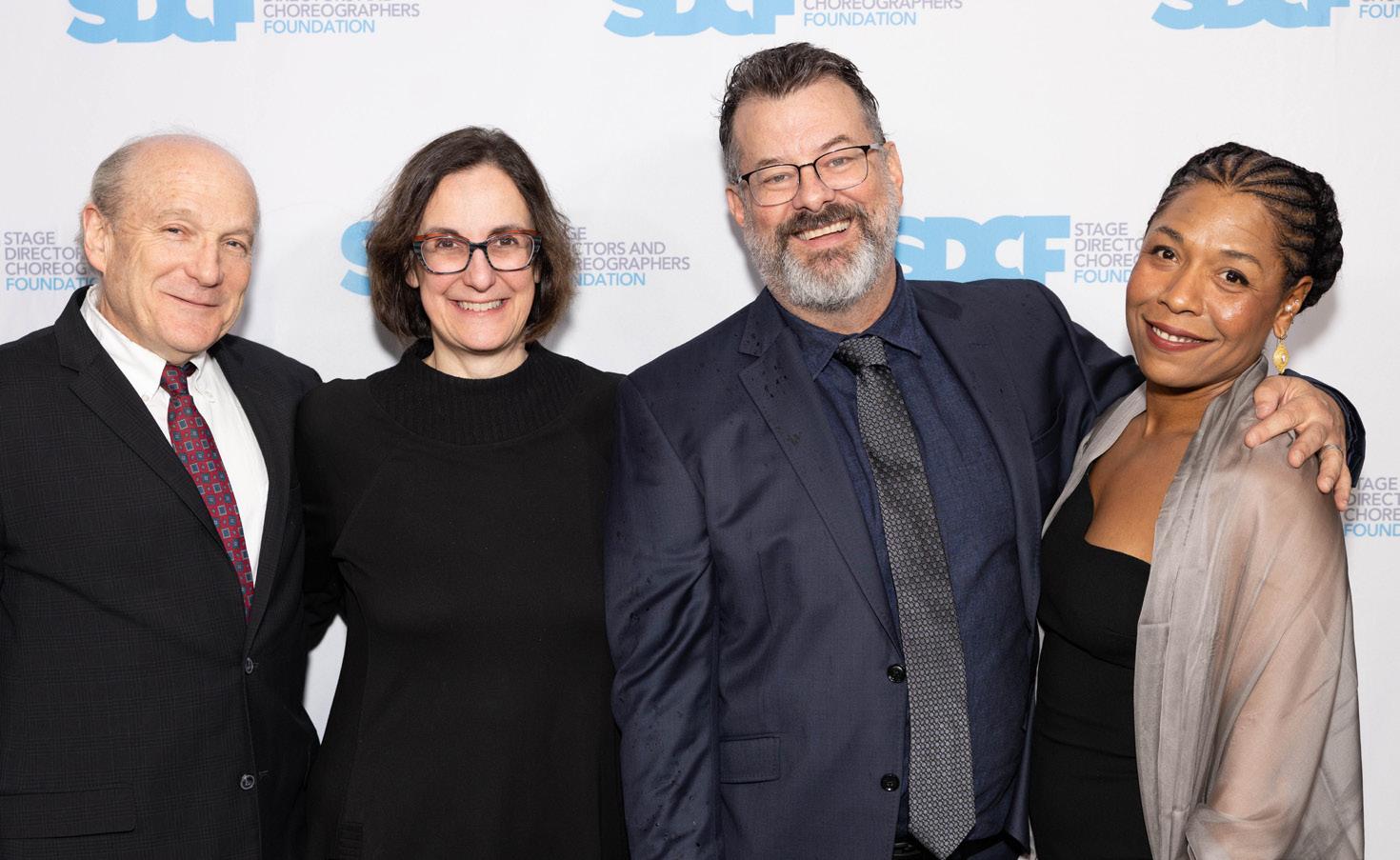
Donald Holder, Evan Yionoulis, Michael John Garcés + Erica Garcés at the 2025 SDCF “Mr. Abbott” Award gala PHOTO MICHAEL HULL
FROM THE EXECUTIVE DIRECTOR
Even as our country comes undone, as the very foundation seems to be unraveling, as any semblance of agreements—the kind we grew up with, that bind a civil society together—appears quaint, a thing of the past, as we no longer live in a country governed by laws, I ask myself what matters, and I still find myself saying, “The Theatre.”
I have been playing with an idea about the theatre, our connection to one another, the “live” and person-to-person act of writing a letter, and democracy.
Recently, I attended a meeting with a cross-section of activists, policy makers, and cultural leaders. We were talking about what government for all—really for all—might look like, and there was a sense that nothing works for all. There are always some who are left out. A speaker offered up to skeptics in the room that there is something that works for all. It is the post office. I was compelled to delve deeper into why the post office has always mattered to me.
I have two kids; one lives in Ohio and one lives in Manchester, England. I write them letters. (Occasionally, they write me back.)
I write things down on a piece of paper. I address the envelope. There’s something about the act of writing—when the hand takes the pen and presses it against the paper—that deepens the connection between the parietal and frontal lobes of the brain, improving conceptual understanding and memory, among other things.
I love mail.
The post office operates without regard to location: there are 41,552 zip codes and more than 169 million addresses in the United States. No matter where you live, you can get a letter. The post office in a small town might be housed at the drugstore or a general store or a bodega. Post offices are gathering places, where people come together in community. For the cost of a first-class stamp, anyone can send a letter across town or to the Aleutian Islands.
On July 26, 1775, Benjamin Franklin became our first Postmaster General. Legislation passed by the Second Continental Congress explicitly noted the facilitation of the freedom of the press, the privacy of personal correspondence, and an infrastructure to support the growth and prosperity of a nation.
The formal U.S. Post Office Department was made permanent by George Washington in 1792 with the signing of the Postal Service Act. This Act built on 1775 and at its heart was drafted to prevent The Crown from censoring or suppressing political opponents. As such, the post office was considered foundational to democracy, connecting citizens, supporting privacy and free speech for all with services to all, promoting equity—a first-class stamp costs the same no matter who you are—and building an informed citizenry.
In 1970, after 187 years of delivering the mail, the most sweeping changes to the Postal Act were initiated by President Nixon through the Postal Reorganization Act. Since then, out of the line of vision of many, the postal service has increasingly become politicized, threatening its core tenets.
On December 24, 2025, under the current Postmaster General, David Steiner, former CEO of Waste Management and Board member of FedEx, the United States Postal Service (USPS) published revisions to the Domestic Mail Manual (DMM). The newly adopted Section 608.11 of the DMM sets about to clarify that the date displayed on a postmark represents the “date of the first automated processing operation,” rather than the date when the mail was dropped off.
The impact of this clarification has sweeping consequences for everything from year-end charitable giving to mail-in voting and absentee ballots. At the risk of oversimplifying, after nearly 200 years of practice, the assigning of a postmark will no longer have a direct relationship to when you dropped your mail in the post office box or in person at the post office.
In 16 states and the District of Columbia, mailed ballots can be counted if they are received by a deadline set after Election Day— but only if they are postmarked on or before Election Day. One in three Americans in the 2024 elections voted by mail.
I believe we are meant to be informed as citizens. As humans, we are responsible to others, those with us now and those who will follow. A responsibility that can only be fulfilled if we are informed.
The theatre, when available to all, when central to our lives, tells us stories that open us up, deepen our understanding of each other, our empathy for one another. Traveling through stories we are informed. We become better neighbors and friends, better strangers.
Our theatres sit side by side with spaces and places where people gather in pursuit of meaning, purpose, for joy, for fun. Theatre is inextricably bound to our most sacred spaces, to places of inquiry and of learning: libraries, museums, symphonies, schools, parks, public spaces…and post offices.
Shouldn’t we go to the post office?
Shouldn’t we go to the theatre?
Shouldn’t we build an informed citizenry?
In Solidarity,
Laura Penn Executive Director
PHOTO HERVÉ HÔTE
WHAT (AND HOW) I LEARNED
BY Yo -EL CASSELL
When I discovered the expression of movement as a youth, I felt like I could hear for the first time.
As an individual with a severe diagnosis of nerve deafness, expressing through movement became my lifeline. I discovered the value of relying on other senses—touch, taste, sight, and smell—to actually move me. I discovered when something gets in the way, let it show us the way. The “disability” of my hearing impairment actually led to a “this-ability” approach to tap into the inner rhythms of my body like an instrument. When we move, we reveal—movement has the ability to express our inner landscapes: our thoughts, our sensations, our imagination, and our authenticity. There is a line in Andrew Hinderaker’s play, Colossal, that the “body is a vehicle for language.” I couldn’t agree more.
I believe we are born twice—born when we come into the world and again when something inspires us so deeply, it invites us to follow that invigorated, renaissancelike path. I was born when I came into the world and then I was born again when I found movement as a channel to express my deepest curiosity and my widest, expansive dreams. Before this discovery, I was an engaged child, curious and optimistic, but at times I found it difficult to “connect.” I still feel this occurs at times. But when I dance, when I move, when I create through and with movement, it feels like everything makes sense. My feet
feel more grounded, my thoughts feel more connected, and my curiosity feels creatively and imaginatively alive.
What I discovered, developed, and continuously embody was a J.O.Y. mindset. A mindset that became integral to my personal and artistic identity via performance, creation, education, and the movement of life. The mindset is not so much speaking to the feeling of joy but more so about treating the word JOY like an acronym for Journey of Youth. This is a mindset I have practiced with great commitment and incorporated into my process as a creative artist and educator. In the J.O.Y. Technique, accessibility via performance, creation, and education initiates from a practical mindset approach. What would it be like to move through the world with a Journey of Youth mindset?
The key here is not so much about traveling back to our childhood, which can invite different non-progressive feelings for some, but rather to embrace the extraordinary mindscape of a child— the curious mindset which unlocks our creativity and imagination. Much like a child curiously committed to play, what
would it be like to be curiously committed to action? This mindset does not have to be in the trunk of an automobile as we grow older. It can be in the backseat or better yet, in the front seat—or better still, in the driver’s seat of our livelihood.
I believe it was Carroll Bryant who once remarked that “growing old is mandatory but growing up is optional.” I couldn’t agree more.
One day I was watching my son, Keaton (named after Buster Keaton), play with LEGOs and he remarked, “Dada, I wonder, what if, let’s try.” I think about what he said there quite often. What would it be like to partner with the world we live in with this sense of wonder? I say partner only in that moving through the world can invite unnecessary tension, but the idea of partnering with allows the movement of life to be a viable collaborative experience. When we partner with curiosity, we are moving together, learning from each other. As a human or as an artist, it can be quite daunting when someone urges us “to be creative.” On the other hand, we can always be curious—even when we hit walls of blockage within our imagination. I believe that all artists are elevated
PHOTO KIM KENNEDY
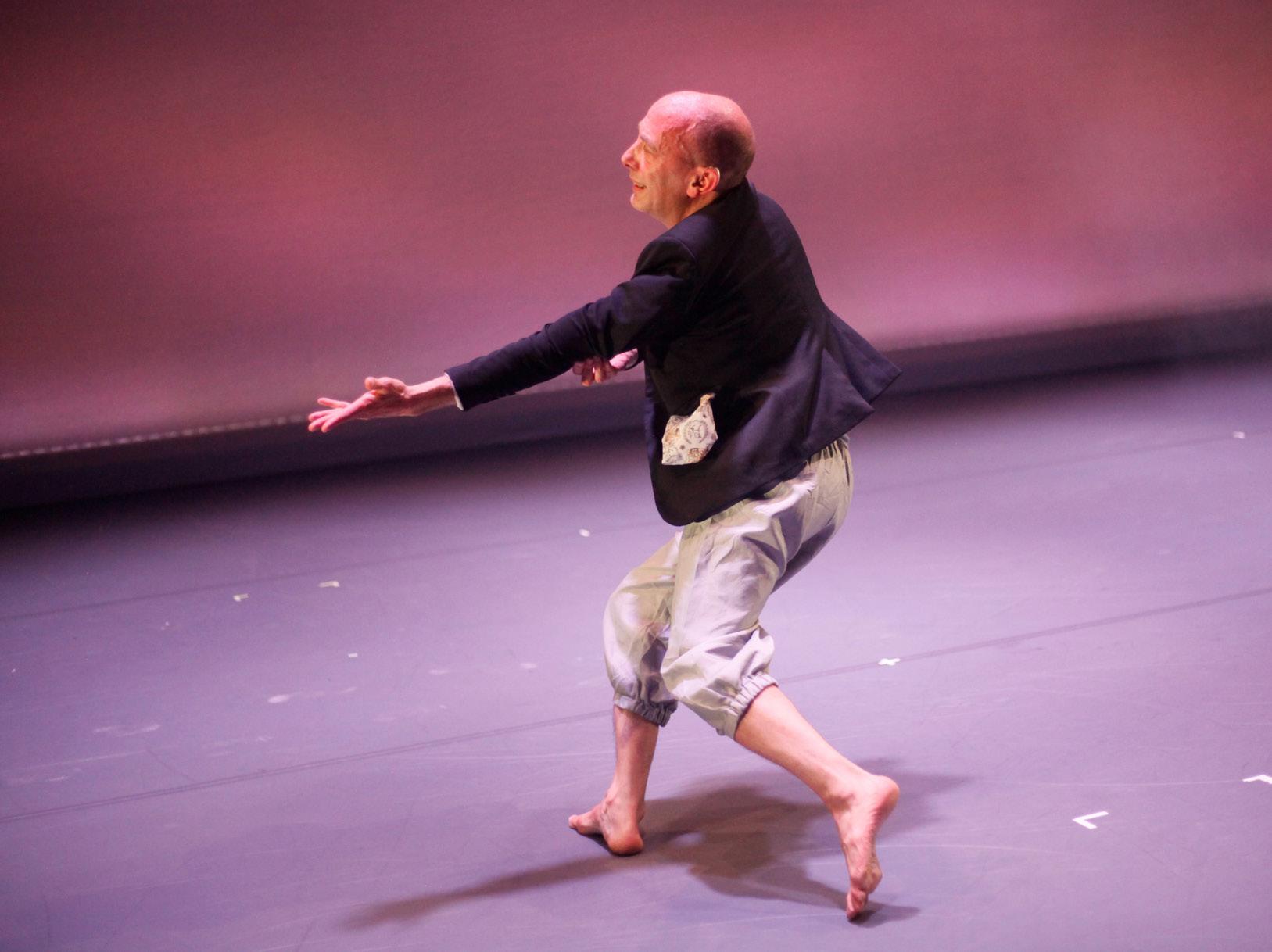
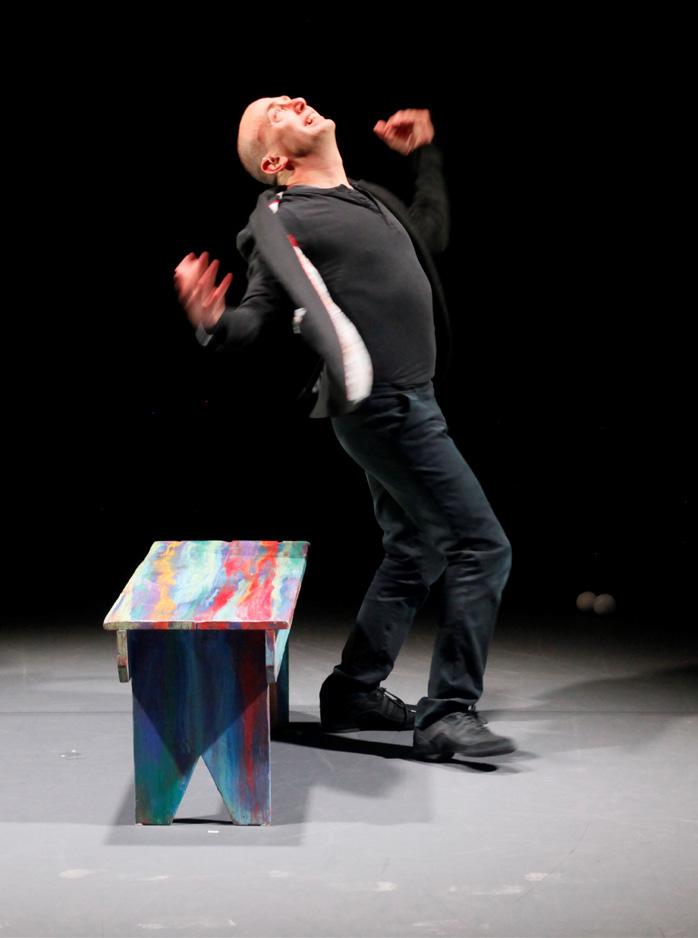
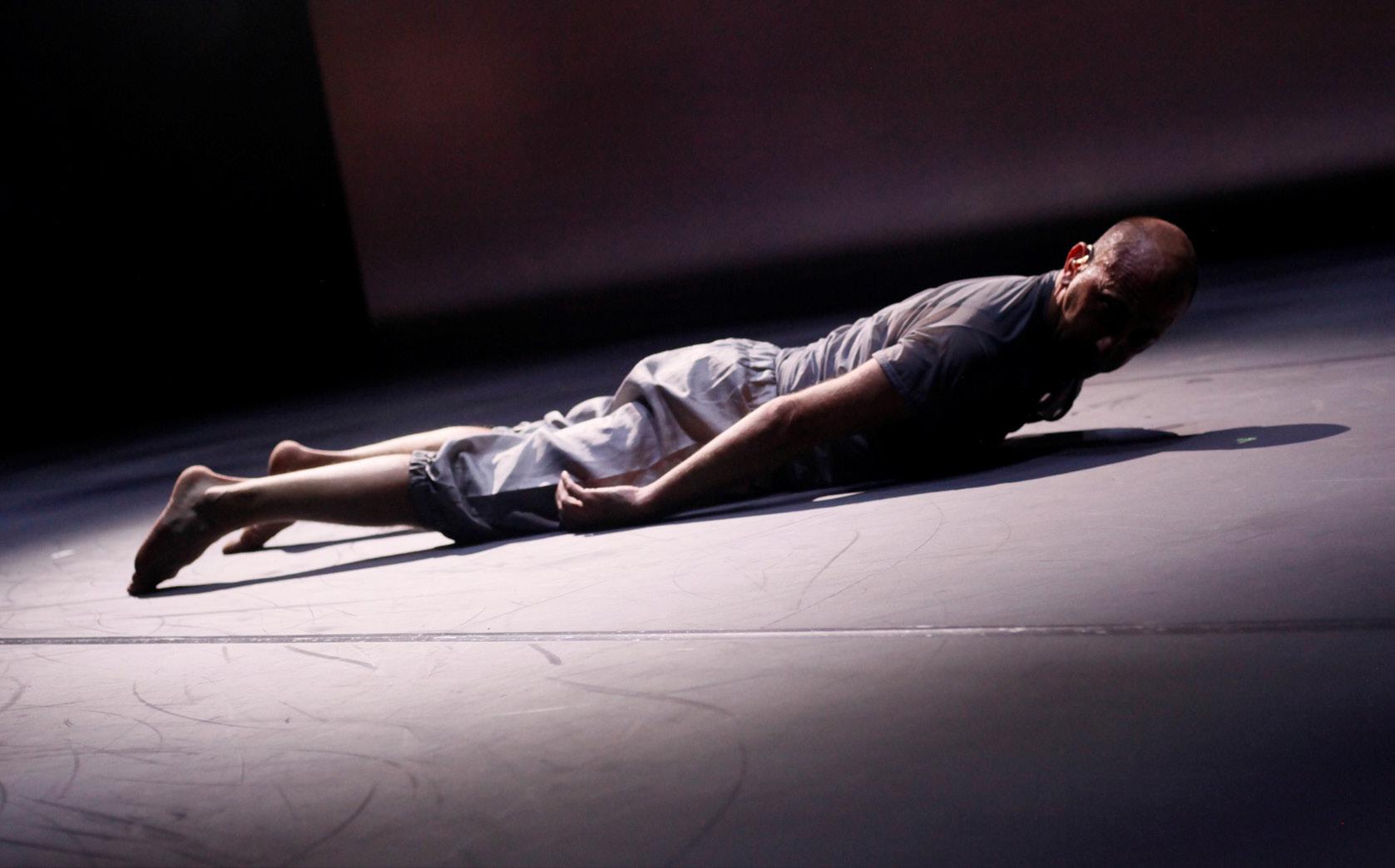
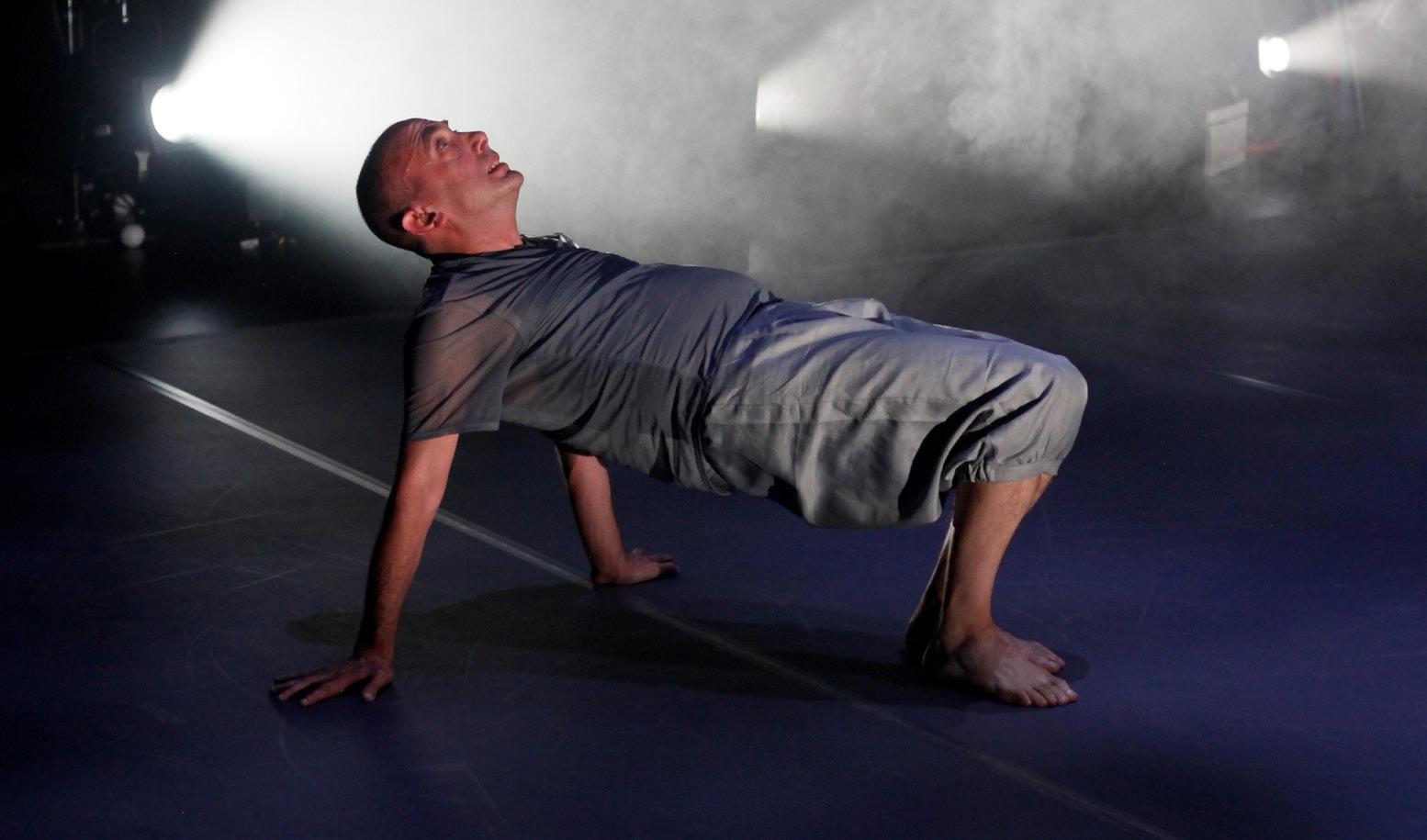
Yo-EL Cassell in his solo work, humanINmotion
PHOTOS MAIREAD O’NEILL
children. We are consistently curious with great commitment to what inspires us, and we dedicate our livelihoods to making that visible. Thrilling.
Personally, this mindset has unlocked entry points in more ways than one. There are moments when I am creating, when I reach that blank wall in my mindset, and curiosity feels like a pebble that I can pick up to create an eventual pathway.
Recently, when co-creating the solo physical theatre piece humanINmotion,
in collaboration with the magnificent lighting designer Mark Stanley, this approach became my lifeline. Just before Mark and I started the process of creative development, my beloved and dearly influential father passed away. There was so much grief shivering inside of me, I worried the piece would be too sentimental, too close, too singular to only me. But then one day, working in the studio, I became curious and tried not to judge it. When we replace judgment with curiosity, we can go deeper inside via exploration of what makes that person move the way they move. Once again, when we move, we reveal.
I focused on committing to the curiosity of being. I went back to what I often share when teaching—is it truth or is it a tour? Are you truly impressing the intention or are you creating material that will feel like you are giving us a visual tour to impress the audience? I remember at that moment in the studio actively not thinking about being a child of my father but rather embracing the mindset of a child—letting curiosity be the entry point. I remember getting on the floor, laying my body on my belly, and imagining like a child, via play, that I had no arms so my curiosity could replace them like wings moving
forward. I was not commenting on being a child but rather committing to the action of being. I was a newborn child opening my eyes for the first time and then I was committed to following my impulse to just see the world. When we soften our gaze, our eyes, we can see the world. When I embodied this, I just let my body follow where I was looking, searching—leading me through different dynamic, spatial levels, and expressive colors. By the end of the two-hour rehearsal, the piece was sketched out.
I realized at the end of the searching, it led me back to my father—not in actuality, naturally, but rather, his spirit, his energy, his love for living fully and generously. A colleague who saw a rehearsal of this moment in the piece told me that he felt like he could see not my father but his mother who had recently passed. I learned that this moment was not singular to me but translatable to everyone
With the process of this piece, I discovered—we can be healed.
Yo-EL Cassell is a dancer, physical theatre performer, choreographer, movement director, movement coach, administrator, artistic director, and educator. He serves as Head of Movement at Boston University College of Fine Arts School of Theatre and is currently a performer with the American Physical Theater. He was formerly Resident Choreographer of Commonwealth Shakespeare Company.
MUSES & MUSINGS
WITH JESCA PRUDENCIO
Who or what inspired your pursuit of theatre?
Growing up, everything in my family was a “production.” Whether it was the Filipino Sunday potluck, my violin recital, or my parents “reveal” of our next vacation, I was raised where life was a series of events. Despite my parents being doctors who emigrated from the Philippines, they valued the arts and took us to theatre regularly. When I was very young, I said to myself, “If someone is doing this as their job, then I can do this as my job.”
I’m grateful to have parents who were fully supportive of my goals in every way possible.
Where do you get your inspiration? Is it books, movies, visual art?
Museums are my happy place. To go, wander, think, reflect, dream, and stare endlessly until something hits. This is where I go to find inspiration and take my plays on “dates.” I’ll go with a specific project that needs to be cracked open, and go to a museum where we can get to know each other and find our spark together!
You recently did a production of Our Town at the Hungarian Theatre of Cluj, in Romania. What most inspired you when thinking about how to direct this quintessentially American play for a Romanian audience?
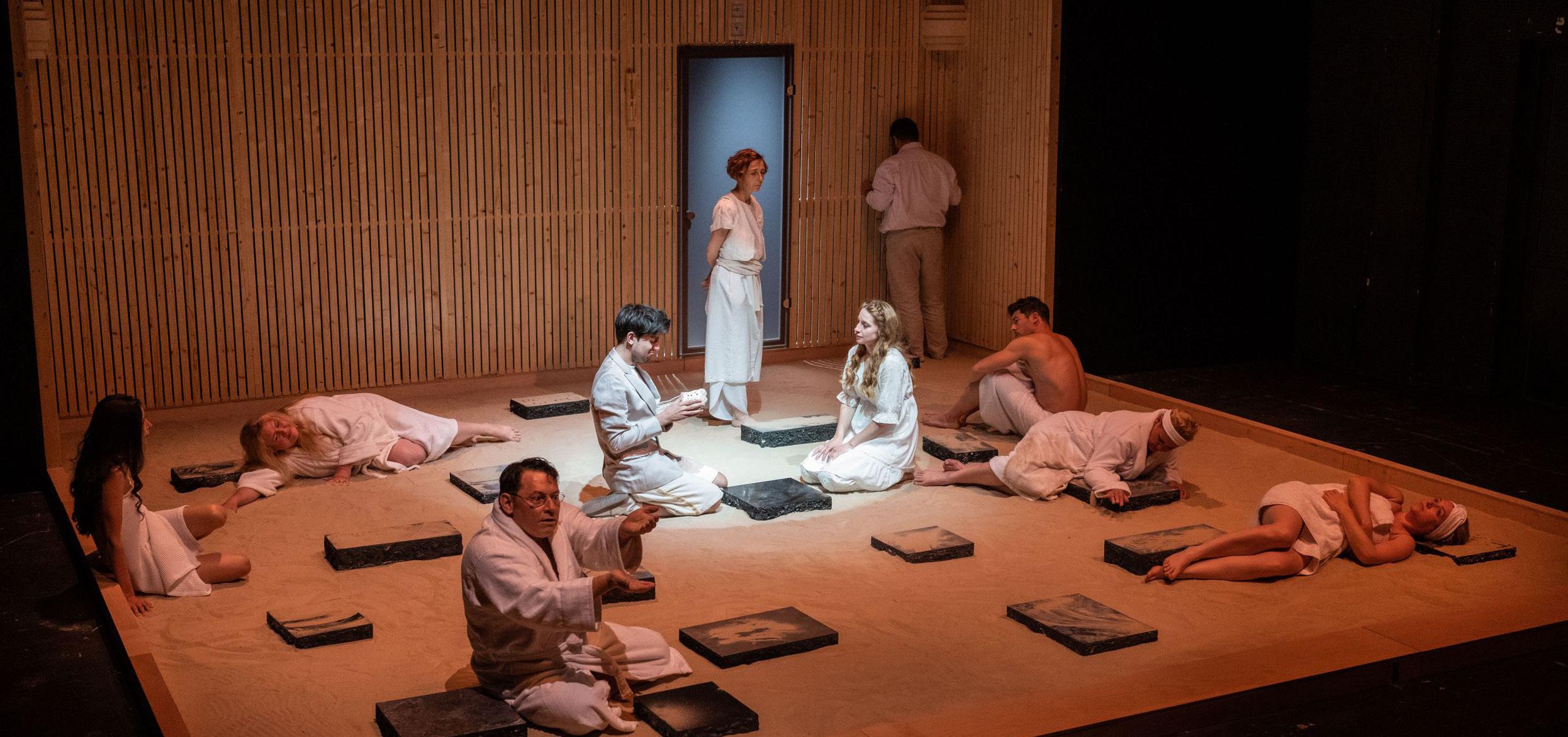
I believe that the personal is universal, so the more specific it is, the more it will connect with all. Life’s stresses—where everything is overly important—are something that the Romanian audience related to! I set the entire production in a spa, because I believe death is the ultimate state of relaxation, and the characters needed to live out the memories one more time to be able to let go. This concept was fascinating for our company and continues to resonate for Eastern European audiences as it runs in
rep. I approached Our Town as a new play, discovering something new about it and myself every step of the way.
What fills your cup when you’re not in rehearsal?
If I’m not making theatre, I’m making dinner. I need to be creating constantly, so I love spending days making my family’s lumpia recipe or baking special treats for my dogs.
What’s a great play, musical, or performance that you love that people don’t talk about much, or may not have heard of?
Complicité’s production of Shun-kin continues to shake me to my core. Directed by Simon McBurney in collaboration with the Setagaya Public Theatre in Japan, this multidisciplinary production used dance, puppetry, movement, and text in a way that broke all boundaries. I don’t think I blinked once in the production, fearing I would miss a moment. I strive for this kind of surprise, innovation, heart, and intercultural collaboration in everything I do.
Jesca Prudencio is a director and choreographer dedicated to creating highly physical interdisciplinary works that uplift humanity. She focuses on new plays, musicals, and immersive experiences in theatre and entertainment nationally and internationally. She is the inaugural recipient of the Julie Taymor World Theater Fellowship and Head of Directing at San Diego State University.
PHOTO MURPHYMADE.COM
Our Town at the Hungarian Theatre of Cluj, Romania, directed by Jesca Prudencio
PHOTO C/O HUNGARIAN THEATRE OF CLUJ
HOW WE MET THAT CHALLENGE
BY SETH GORDON
In the summer of 2025, a Facebook post by director Graham Schmidt began circulating among theatremakers. It listed more than two dozen MFA drama programs that were suspended or permanently closed
over the past five years. At the University of Oklahoma, meanwhile, a process had begun to revive an MFA program that had closed more than a decade earlier. Seth Gordon describes the challenge, and what they hope to achieve.
In December 2011, I was in the midst of a long tenure as Associate Artistic Director of the Repertory Theatre of St. Louis. I was curating a new play festival, directing plays, helping to run a large and thriving LORT theatre, and certainly had no thought of pivoting my career over to academia. That came later. At that moment, I was not aware that the University of Oklahoma had announced that their robust MFA program in Directing and Design would be suspended.
The University of Oklahoma’s Helmerich School of Drama did have, and continues to offer, a BFA program with actors, designers, stage managers, and dramaturgs who are talented, hungry, and
curious. I joined them in 2019 to teach directing and theatre management, and to direct plays. It had occurred to me that, after years of love and devotion to a field that has given me so much joy in return, my next chapter should be one in which I share that love and devotion with the next generation of theatre artists. Perhaps they would receive a measure of joy like mine.
One of my first questions when I joined the University was: Why was there no MFA program? Apparently, having both MFA and BFA programs in the same disciplines forced students to compete for faculty and resources. A decision had been made to allow the BFA program to thrive alone.
But then in 2023, I was asked to revive the school’s MFA program by creating a directing option, with the understanding that other options would be coming down the pike, and that they would not replicate any of our BFA majors. Countering the national trend of program closures, our directing option will welcome its first cohort in the fall of 2026.
BFA students in A Christmas Carol at the University of Oklahoma, directed by Seth Gordon PHOTO JONATHAN D. KYNCL
Why create an MFA in Directing, with other tracks to follow, when so many other programs are sunsetting? Mainly, we believe that a thriving MFA program enriches the entire school, broadening the experience of the undergraduate body, challenging the faculty in whole new ways, creating advantages in both recruiting and alumni relations, and burnishing the prestige of the larger institution. And, most particularly, it prepares the next generation of directors for the professional field. That’s the program’s fundamental objective.
I also hope the program will be turning out the next generation of leaders. Having just completed work on my first book, Crossroads in the American Theatre (Smith and Kraus, 2025), I heard many artistic directors interviewed for the book observe how no one trains people for the leadership positions they occupy. It’s certainly not my memory that the MFA program I went to at Carnegie Mellon—although very strong in training in many ways—prepared me for a leadership position in the field, just the rehearsal room. It’s not my understanding that other MFA programs introduce students to a path toward institutional leadership. Perhaps we could start to do that, and, in that way, share that possibility with other programs.
They would teach and TA for the regular faculty, so that they would leave here with teaching experience at the college level. Most of the time, however, will be spent honing their craft, finding their way as a director, and getting their career as a director and theatre leader off the ground.
I am not of the belief that directing can be taught, though the experience of a young director finding their own creative path can be facilitated. That’s what we hope to do.
A director in our MFA program will spend much of their time here directing. Each year, they’ll direct a play and assist a professional director on a play, either here at school, at one of the professional theatres in the Norman/Oklahoma City area, or perhaps somewhere around the United States. Each semester they’ll have two directing classes, one called Directing Techniques, and the other called Directing Seminar, and then they’ll take an elective. The elective could be related to production, pedagogy, dramaturgy, intimacy direction, or other topics that are theatre-related. They might also be able to pursue something offered at the graduate level throughout the University of Oklahoma, which is one of the major research universities in the country.
This very practical approach to training on your feet, rather than in a classroom, sounded good to the University and its Graduate College, which needed to approve our curriculum. OU is considered an R1, meaning it is part of a relatively select group of universities around the country who devote major resources to linking their teaching with real research. They understand how any field is advanced and learning truly takes place in the lab, not out of a textbook. Theatre is no different.
In contrast to the sobering news we’ve all heard about MFA theatre programs throughout the country, cost justification was not a challenge. At an R1, for a program as professional and prestigious as the School of Drama to not offer a terminal degree in fact made us an outlier on campus.
The bureaucracy associated with gaining the university approvals necessary to create this program was as Byzantine as anyone who has been associated with a large university might imagine. I now often joke that I will never have to direct a production of The Government Inspector. But I do understand its necessity.
I appreciate the requirement to show the university that we know how to do this well. Before I let a doctor poke me, inject me with something, and tell me what’s wrong with me, I would like to know that someone of authority certified that they know what they’re doing. I imagine our students will appreciate the same thing.
I certainly appreciate that the hard part was convincing the university we’re taking the right approach to training, that we’re training people for a field that has jobs, and that we’re doing something that is of service to our field and our students. That is, in fact, how it will be of service to OU.
I’m looking forward to the fall, when classes start for our first cohort. We’ll have two students, and then two more students in each of the next two years in a threeyear program, for an ultimate total of six directors at a time. That’s when the fun will really begin: That first directing class, that first production, that first look on a young director’s face that says: I’m ready for my journey.
Seth Gordon is a Professor of Directing & Theatre Management at the University of Oklahoma Helmerich School of Drama. His book Crossroads in the American Theatre: New Leaders in a New Age was published by Smith and Kraus in 2025.
BFA students in Waiting for Lefty at the University of Oklahoma, directed by Seth Gordon PHOTO TRAVIS C. CAPERTON
SOLVING PROBLEMS IN A ROOM
A CONVERSATION WITH LEIGH SILVERMAN
BY SAM PINKLETON
PHOTO AUSTIN RUFFER
GOOD FRIENDS, PROPER COLLEAGUES, AND CLOSE COLLABORATORS.
That’s how Sam Pinkleton described his relationship with Leigh Silverman when they met over Zoom for this conversation last November. Silverman—a two-time Tony Award nominee and two-time Obie winner who has directed more than 60 world-premiere new plays and musicals—had recently opened Ethan Lipton’s new musical The Seat of Our Pants at The Public Theater; Pinkleton was in London with his Tony-winning production of Cole Escola’s Oh, Mary!, which is currently running in both the West End and on Broadway.
SAM PINKLETON | Well before I knew you and was your friend and collaborator, I thought of you as a working director. Like capital W, capital D. You are a visionary artist and a great leader, but you are also just a theatre worker, which I really admire.
You knew you wanted to be a director very early and went to school with that in mind. I’m curious when the moment was that you said, “Oh, directing is my job. It’s my profession,” and how that happened.
LEIGH SILVERMAN | It’s still happening, every day.
SAM | Yes. As I was asking it, I was like, “Is directing my job?”
LEIGH | It’s one of the things about being a freelance worker, I would say, and having the great privilege of making your living doing what you love. Sometimes it really feels like a job, and sometimes it feels like a hobby, because you’re not being paid. Then sometimes you have the experience of disbelief that this is your job, and you get to do this for your life. I cycle through some version of those three things multiple times a day.
It’s still an evolving relationship. I moved to New York in the summer of 1996, when I was an intern at New York Theatre Workshop. I moved the day I graduated from Carnegie Mellon and started my internship the next day. So, I’m basically a native New Yorker at this point, even though I grew up in DC. And I still can’t believe that it’s really happening, in some ways.
SAM | I feel the same way. Do you feel like the ratio of, “This is just a job / This is just a hobby / Oh my God, I can’t believe I get to
do this,” has changed over time? Or do you feel like you’re always holding those truths?
LEIGH | I guess earlier in my career it felt more like hobby, and then at some point when I started getting paid, I was so amazed. I never cashed the first check that I ever got for directing.
SAM | What was it?
LEIGH | I directed something for the Pennsylvania New Play Festival when I was at CMU. It was for $25. I have it framed sitting in my office now. I’ve had a few of those moments. The first time I saw my name on a Broadway marquee, which was for Lisa Kron’s play Well in 2006. The first time that I worked as a full Member of SDC. These are important watermarks, but it doesn’t feel like arrival. The watermarks continue. It never feels to me like, “Oh, I got to the top of the thing.”
SAM | Yes, completely.
LEIGH | I definitely can’t imagine ever turning around and being like, “Well, we’re at the top.”
SAM | No, I have no sense of it. It is constantly going back and forth, between the feelings.
LEIGH | You didn’t feel that after winning the Tony this year?
SAM | It was an amazing thing, and it was a disorienting thing, because I won the Tony for Oh, Mary!, a thing that I did completely for fun, initially. A day after winning the Tony, I started rehearsal for a one-person show in a 90-seat theatre downtown, which is something that I was doing 10 years ago. Happily. Happily.
LEIGH | Right. Isn’t that the craziest thing about what we do? I’m sure you had the experience, too, of people coming to you and wondering, now that you’ve had this moment, now what? Like they are picturing you just get held aloft and moved from theatre to theatre? That’s not what happens.
SAM | The only thing that made me feel not crazy about winning a Tony was the idea that I could go back to work. And I was like, “I actually just want to go back to work, and I want to do the thing that I actually like doing,” which is solving problems in a room.
When you were an intern at New York Theatre Workshop, what were the things that you were doing to be a director?
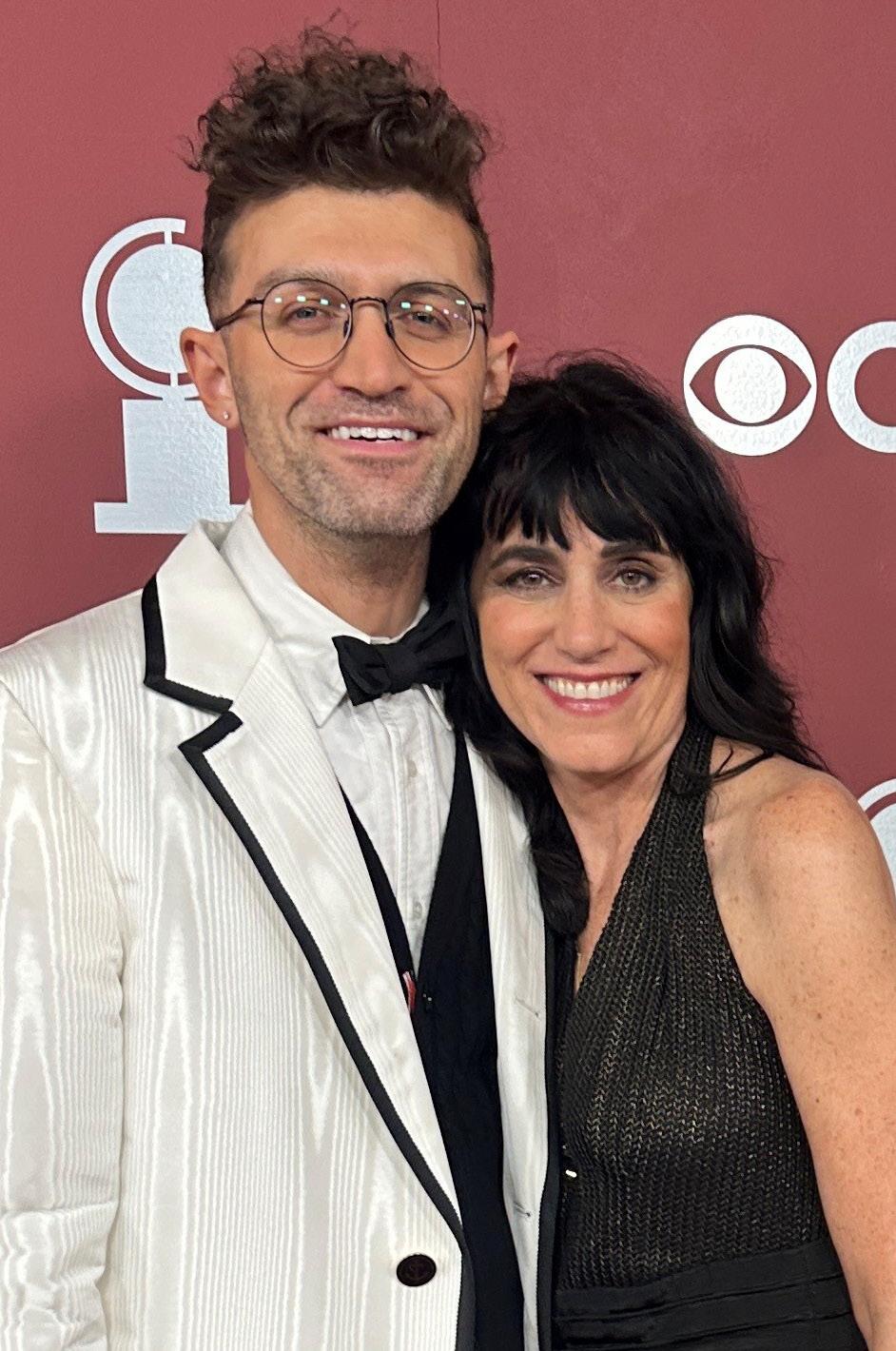
Sam Pinkleton + Leigh Silverman at the 2025 Tony Awards PHOTO C/O LEIGH SILVERMAN
LEIGH | First, I want to tell you what I did as an intern, which was answer the phone— the landlines—at the front desk. I was Linda Chapman’s intern, which meant that I booked the tickets for people to participate in the Summer Residencies. [Since 1991, NYTW has hosted developmental residencies outside of New York City, overseen for many years by former Associate Artistic Director Linda S. Chapman.]
Because it was before the era of doing things online, and pre-cell phone, what that meant was I had to get the actual train tickets—the actual paper tickets—and then stand at the gate where the train was boarding and hand them to the people who were going on the residency. It was the most incredible experience. I handed Paula Vogel a paper ticket, and thought I would fucking die, right there in Penn Station. I also handed a paper ticket to André Gregory, and he asked me to get him a bagel, and I did. And then he asked me if I was looking for personal assistant work, and I became his personal assistant for a couple of months when he came back from that residency, which was completely amazing. I met Lisa Kron and handed her a ticket. I truly thought my life might not get any better than that, standing
in Penn Station handing theatre legends their train tickets.
SAM | Just to recap, you met Lisa Kron, a writer who has become, I think it’s fair to say, one of the defining collaborators of your career, as an intern at New York Theatre Workshop.
LEIGH | Yes, yes. Crazily, so many people that I met that summer became part of my theatrical orbit. For the first 10 years of my career, that’s where my theatrical life was centered, and not because I was directing on the mainstage there. I was definitely not. But Jim Nicola, Linda Chapman, Jerry Manning, they believed in me. It is the place where I built all my foundational early relationships and met my tribe.
SAM | I always say that all my jobs can be traced back to one or two people, or one very specific moment in time. Do you feel like your career all comes from New York Theatre Workshop?
LEIGH | I would say for the first two-thirds of my career, my first 15 years in New York, absolutely yes. Where was yours?
SAM | I mean, mine’s pretty specific, actually. Honestly, every job that I have can
be traced back to Michael Friedman and Steve Cosson; they are responsible for me having a career.
I want to talk a little bit about nitty-gritty process stuff. When something new comes your way—be it, “Hey, Leigh, read this script,” or “Hey Leigh, I’m your treasured collaborator, and I have an idea”—what are your first steps? What do you actually do, when you’re looking at something for the first time?
LEIGH | I actually read it. When people send me things to read, if I’m not directing it in my head almost instantly—
SAM | I completely agree.
LEIGH | If it doesn’t light the pilot light in my brain immediately, then it’s usually not for me. My more regular collaborators sometimes send me scenes or scraps of ideas. David Cale recently sent me the first eight pages of his new play, The Unknown, before he had finished it. David Henry Hwang will pitch me an idea before he writes.
I will say, something very unusual happened with The Seat of Our Pants with Ethan Lipton, who I’ve worked with five times. When he
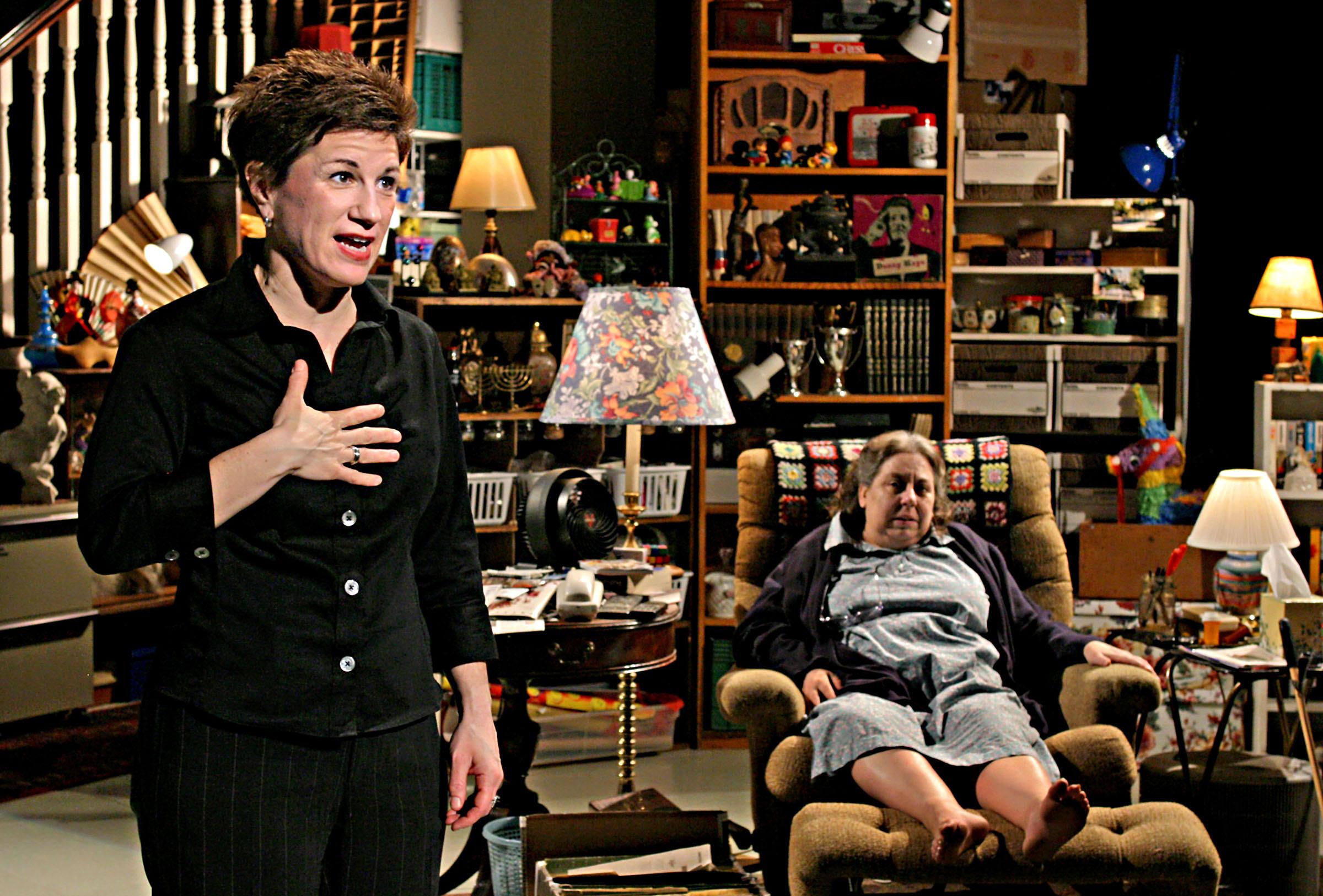
Lisa Kron + Jayne Houdyshell in Well at The Public Theater, directed by Leigh Silverman
PHOTO MICHAL DANIEL
told me he was working on an adaptation of The Skin of Our Teeth, I literally said to him, “Good luck.”
SAM | No, really?
LEIGH | Skin of Our Teeth was a play that I didn’t understand and hated. It always felt like it was “eat your spinach” theatre. I read it in high school and was really against it. I was deeply against it. And so, when Ethan told me he was doing a musical adaptation, I was like, “I look forward to never seeing that.” Like, really was not interested, at all.
SAM | What changed for you?
LEIGH | He said to me, after he had started to work on it and had done a workshop with somebody else, “I think that this is going to be your jam. Will you just listen to these three songs that I wrote?” He played them for me, and three lines into the first song I was like, “Oh, yeah. I’m going to direct this.”
SAM | Wow.
LEIGH | It was clear to me he had a profound understanding about how this play could function, not only as a musical, but also as a mirror to ourselves and our humanity. Skin of Our Teeth, to me, always
felt like it was about those people, and Ethan’s interpretation was that it was meant to be about us, in a deep way. He has such a witty, sly, dry sense of humor, and he understands the absurd, right up against the most intimate, small, human elements of us. He understands what [Thornton] Wilder was doing and, more importantly, how Wilder wanted us to feel
But aside from that, generally when people reach out to me, I can tell almost instantly. I’m so glad you feel the same.
SAM | I feel the same. I don’t know about you, but I’ve gotten in trouble for not listening to that; I’ve gone down a road and been like, “You didn’t see yourself in this at the first moment. Why did you think you would find it?”
I want to go back to a thing that you said about Seat of Our Pants. On the list of reasons why I admire you so much as a director is that, in seeing your work, and frankly being lucky enough to watch you make work, I feel like you always listen to the thing and do what it’s asking. You are constantly shifting how you work, and what your work looks like, and what your work feels like, according to what the show is. That to me is what’s fun about being a director,
but it’s not true for every director; some directors who are amazing are like, “This is the stamp.” I’m just curious, when Ethan Lipton says, “This is going to be your jam,” what is your jam?
LEIGH | I like stylistically ambitious, tonally adventurous, deeply character-based, funny, human stories. I like comedy. I do a lot of comedy. I love an unexpected form, and even better when that form changes over the course of any one show.
SAM | It seems like everything you’ve ever done. I’m hard-pressed to think of you ever repeating yourself in that way.
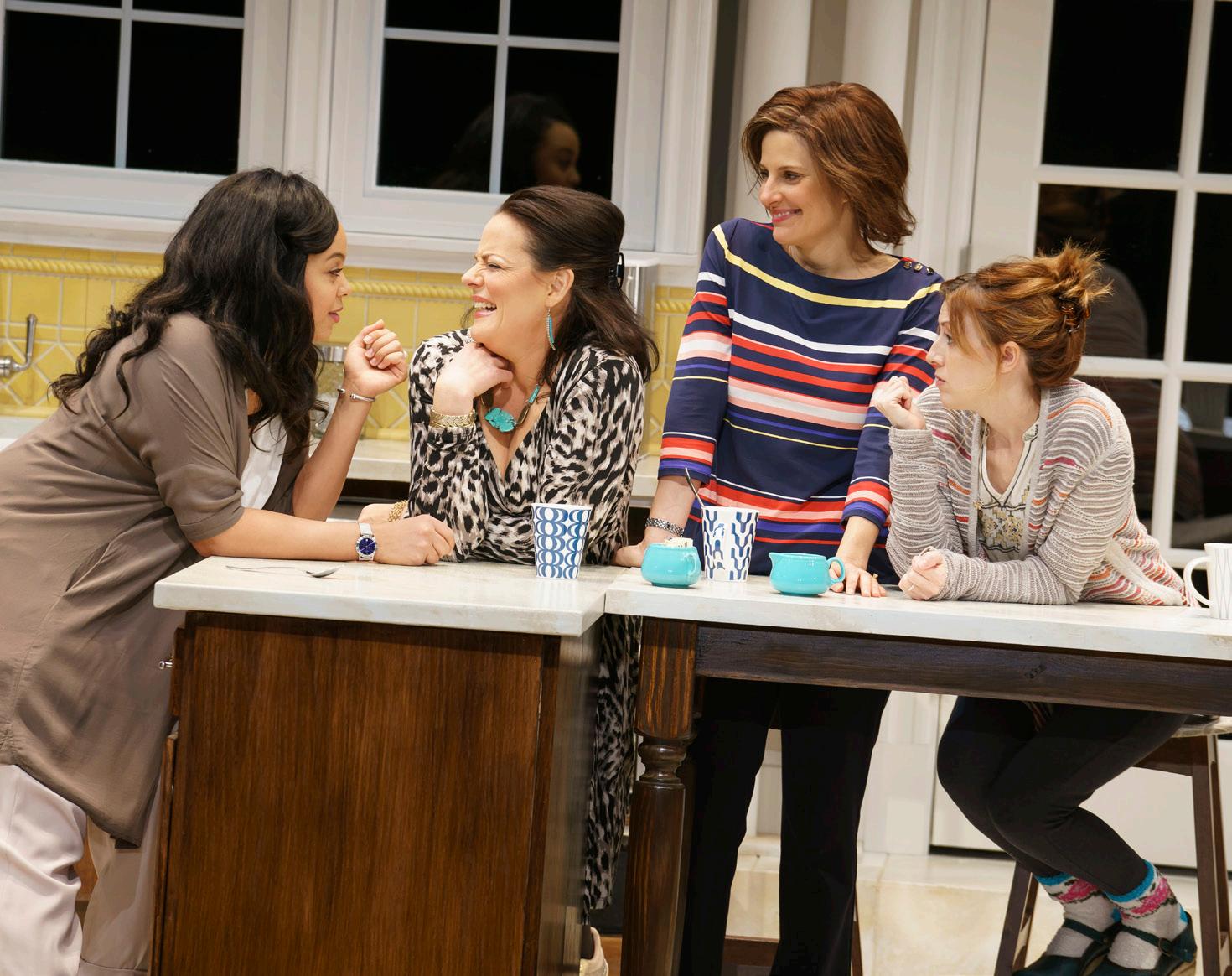
LEIGH | I did an interview for the Suffs tour, and this guy was asking me the same kind of question. And I said something like, “People just don’t come to me if it’s a play with a couch in it.” Even the most “naturalistic plays,” even something like Hurricane Diane, Madeleine George’s play, had a very realistic HGTV kitchen but even then the whole thing cracked open, and it ended with a lesbian bacchanal
SAM | When I think about things that you’ve done that may kind of seem on the surface more straightforward—I think of a show that was a deeply formative theatre
The Seat of Our Pants at The Public Theater, directed by Leigh Silverman PHOTO JOAN MARCUS
experience for me, which is Lisa Kron’s In the Wake, at The Public, which I still remember. I remember the position of my hands on my legs when I saw that show. I remember thinking I was seeing one thing, and then the design transforming in a way that really blew my mind. Like really, really blew my mind.
Once you’ve said, “I’ll do it, this will be my jam, Ethan Lipton,” how do you start conversations with designers? What do you like for those early days with designers to look like? I’m talking about before the terror of time and money have entered the chat.
LEIGH | I really like to talk to designers as much as possible. Having designers participate in the early dramaturgy and involved in any workshops and readings. I remember when I was a young director I would have designers read the play out loud. If you can’t have them come to workshops, that’s one way to have everyone hear the play at the same time.
The best design experiences I’ve had come from designers who give me the design that they think I want and then say, “Also…here’s another option.” I almost always go with that other option.
SAM | Yes, yes. Totally, totally.
LEIGH | That is what good collaboration is. It’s not my idea, not your idea, but it’s this other thing that happens when we are loosely dancing with what we think is right while looking and listening to others. It’s true of writing, it can be true of acting. What I’m always looking for, in those early days with designers, is what visual ideas will help me understand the play better? What’s going to eventually help an audience understand the play better—metaphorically, poetically, or literally?
Early in the design process for Seat of Our Pants, I spoke to [scenic designer] Lee Jellinek about Lipton’s and my desire to have an intimate experience with this material. He had the brilliant idea of transforming the Newman Theater into an alley, because at the end of Act One, the entire company is around the fire, trying to resist the Ice Age. The thing I wanted to feel was that we were all around that fire. We are all the refugees in the Antrobus’s house, around that fire. And Jellinek took that impulse and both gave me exactly what I wanted, and something I never could have imagined in terms of how that space then transforms, and transforms, and transforms over the next two acts.
SAM | I’m curious, as you talk about working with designers and collaborators. We’re director buddies and SDC buddies, but we worked together in a
director-choreographer collaboration on Soft Power, which I personally think of very fondly.
LEIGH | Mm-hmm Very.
SAM | I always think of a choreographer as a designer, and I thought of myself as part of the design team. The thing that I would say about you is that Leigh knows how to get the best out of her collaborators. Working with you as a choreographer allowed me to do the work that I am probably the most proud of as a choreographer. I have heard many of your collaborators—designers, choreographers, actors— talk about the room you build. I’m talking about design meetings, I’m talking about rehearsal, I’m talking about getting notes from an artistic director.
know me. I rely on the new energy to keep the endeavor honest.
And I’m curious about how conscious the building of those spaces is for you. What kind of work do you do to run rooms the way that you do? Maybe this is a two-pronged thing, because running rehearsal is one thing, but facilitating a designer conversation or an artistic director conversation is another thing. I feel like I’ve stolen so much from you, just regarding how you lead both of those spaces, and I want everyone to steal from you, because it’s so good.
LEIGH | We spent years developing Soft Power, as well as working together at Encores! You and I had so much time, beautiful time, together. You set a very high bar for me, in terms of the way that a director and a choreographer can collaborate. I hadn’t had that experience before, so that was really, for me, pretty formative.
SAM | Maybe that’s also part of it. Maybe part of the secret is deep relationships often make really great work. The fact that you have a show with Ethan that is such an opus is a really big deal, and it matters that you’ve done so many shows previously.
LEIGH | I do love repeat collaborations. But I also love to mix it up with people I’ve never worked with. I always try and mix my nepotism with curiosity and always always have new collaborators in the room. I never want a room full of people who all really
SAM | I have been a part of processes where I’m like, “Oh, the reason this didn’t go well is because everyone was just nodding along.” That’s not it.
LEIGH | Exactly. It can be hard to work with new people, but it’s also important. It’s why I enjoy working with writers that I haven’t worked with before, because I work with so many writers that I’ve worked with a number of times. I love working with them over and over again, but I do also feel like that shorthand can easily become a repeated pattern or echo chamber.
SAM | You have told me, unsolicited on multiple occasions, “I am working with blank for the first time, and they’re amazing. You have to work with them.” I now really think, “I don’t want to put a design team together unless there’s at least one or two people I’ve never worked with.”
LEIGH | Other people don’t feel that way, and I have to say I respect it. But for me personally, it makes the project somehow cave in a little bit.
SAM | Who are the directors that you look up to, and what have they taught you about how to work?
LEIGH | I’ll tell you my favorite story about one of my most favorite directors, George C. Wolfe. George was running The
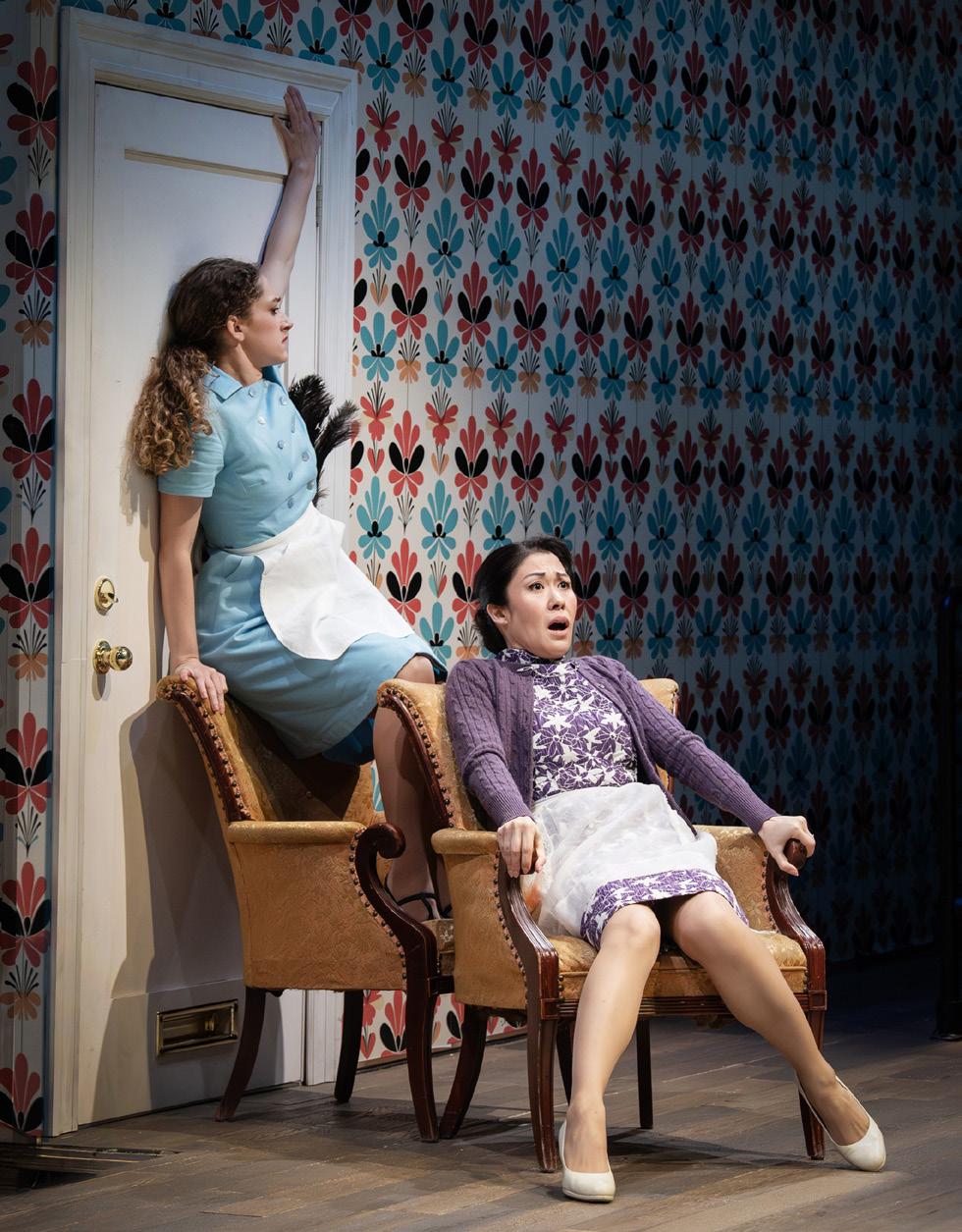
Micaela Diamond + Ruthie Ann Miles in The Seat of Our Pants at The Public Theater, directed by Leigh Silverman
Public Theater when Lisa Kron and I were developing her play Well. They used to have a new play reading festival called New Work Now!, and we did, like, 37 of them. We finally got to the place in 2004 where George said he was going to produce the play. I had never directed Off-Broadway, so this was a huge break for me. Lisa and I said, “That’s great. We really want to be in the LuEsther, because it’s a really small and intimate mother-daughter play.”
And he literally was like, “Fuck that. This is a big, muscular comedy. It deserves to be on one of our bigger stages. And you should stop trying to make yourself small.” Lisa and I staggered out of that room. Staggered. I mean, he changed everything.
SAM | And he was right.
LEIGH | He knew that we had been, as women and as lesbians, socialized to feel like we should take up less space. We definitely came in there thinking, “Oh, we are just lucky to have this play happen.” He was like, “Fuck all of that narrative, and do your play in the biggest way possible, and I’m giving you your choice.” That rocked my world. He of course doesn’t remember that story happening, but he changed the trajectory of that play. And therefore, of my life, Lisa’s life, and the great Jayne Houdyshell’s life.
SAM | I’ve been thinking a lot lately about the moments when I feel like, “Oh, I do know what I’m doing.” George Wolfe was like, “Stop trying to make yourself small. You fucking have this”—and you did, the proof was in the pudding on that particular play, another formative experience of my theatrical life.
When you’re making a new show, how do you balance the tsunami of variables— things going wrong, people being upset, or something not looking the way that you wanted and needing to change on a dime— with the thing in your gut that’s like, “I know what this is.” Because I feel like that’s hard sometimes, as a nice, generous collaborator.
LEIGH | It’s really hard. Directing is just, as you say, problem solving. It’s nothing but problems. You have your ideas about how you want to make a thing, and sometimes there are really happy accidents where the things that you planned actually work! But most of the time, it’s not like that. And the reasons why can be related to writing,
directing, design, or it can be related to performance, or the shortage of time or resources or the producing, or what’s happening in the world or the zeitgeist, or any number of things.
But sometimes the surprises help make it more perfect. Sometimes, those surprises can be built into the process. For example, there’s a kind of special chaos inside of Oh, Mary! that makes the play feel more perfect every time you revisit it. The main thing, I believe, people love to experience when they go to Oh, Mary! is that it is vibrantly alive. That’s why people see it thousands of times, because it’s totally the same and completely different every time. That’s an example of one way in which that kind of energy might be a huge detriment in another production. But it’s part of what makes Oh, Mary! the kind of juggernaut success that it is. That and all your other brilliant direction.
SAM | First of all, the fact that you managed to answer a question that was entirely about your own directing process with a compliment for my work really speaks to the spirit and magic of Leigh Silverman. But also, what Oh, Mary! is now is not at all what we thought it was at the beginning. I’m not talking about the success of it; I’m actually talking about the craft of it. If we had made the thing I thought we were making at the beginning, it would be bad. The strong hunches I had about what it was at the beginning are not what it became, and that’s just trial and error, and shit going wrong, and having to do something else.
LEIGH | Sometimes the pivot choice you make can be what makes it a success. When people ask me, “How much do you prepare?” my answer is, “I prepare just enough to get to the next right idea.”
SAM | That is such a great way to say that.
LEIGH | Yeah, I can’t drill down too far the first time, because I have to get to the second time, and the third time. I think some excellent directors hatch an elaborate plan and then they execute that exact plan. I’m not like that. I restage everything (minimally) four times. Top to bottom. When you stage it for the first time, you’re just doing it to get through it. You have to see it to really know what you’re doing. Another way to say it is that I have to get to the fourth time, which means you have to burn through the first couple of times very quickly, so that you can really see it and then know what you have. I’m sure there are different ways that are less humiliating, but that’s my way.
SAM | But I feel like you come about that humiliation quite honestly. And if I am to decode it as a friend and collaborator, that is
Michelle Beck, Danielle Skraastad, Mia Barron + Kate Wetherhead in Hurricane Diane, presented by NYTW + WP Theater, directed by Leigh Silverman PHOTO JOAN MARCUS
a vulnerable thing to lead with that enables your collaborators to also take risks. You’re not coming in being like, “I mapped this out, as an expert, and now your job is to just execute my vision.” It’s like, “Okay, I have a blindfold on. Let’s try this, and then let’s learn from it to take the next right indicated action.” To me, that is how the best, deepest work gets made. And it’s embarrassing in the process.
LEIGH | It’s so embarrassing. But also, I can’t help but be vulnerable. I don’t think it’s very cool, but it’s the only way to be honest with what the experience feels like for me. And I have felt that if I can move through the room with that spirit, then other people will too, and then ultimately we can journey together out of the land of embarrassment and arrive somewhere just as honest but way, way more pleasurable.
SAM | That is like a flame to keep your hand around. How do you hold onto that when you’re working in spaces with commercial pressures, or time pressures, or producers breathing down your neck who sometimes look at the show very differently than you?
LEIGH | There’s never not time pressure. There’s never not producers or artistic directors. There’s never not playwrights, impatient playwrights, who want it to be word perfect and just how they hear it in their head. All of those pressures can lead to a kind of paralysis and a dial tone in my brain and freezing from anxiety. And so, I guess I try to put myself into some kind of fantasy state that will keep me as flexible as possible for as long as possible.
SAM | I’m curious how you balance multiple projects at once and, to take that a step further, how you balance collaborators who are also balancing multiple projects at once.
LEIGH | I now say to designers, “If you can’t come by the room and see a run through, then you shouldn’t do the show.” I went through a period where the designers were too busy to come to the rehearsal room, and the first time I’d see them all together was at tech, and it was not successful. I was unable to pull a show together in a cohesive way. So, it’s now a question I actively ask.
SAM | Same. My spring show is the first time ever where I’ve said to the designers, “If you’re doing another show, please do not do this. No harm.” Has saying upfront, “I need you around” improved things?
LEIGH | It has. Well, because then people say no. Or when they say to me, “I’m only going to be able to stay for one preview,” I
say, “I don’t think that that’s going to work out, because this is a brand-new musical,” or whatever the situation is.
Again, everybody feels differently, and I’m sure this is related also to who’s in the room, and the people you’ve worked with before, and all of those things. But I think, particularly on new work, it just requires more active participation from designers.
SAM | We share this. You want to be standing there looking at the thing together. I don’t want to direct via email.
LEIGH | No. How many production meetings only happen over Zoom now? You have to be in the room. That’s very important to me. I’ve had to go through some pretty bad experiences to get there. Just rough, and not the way that it should get done, or I need it to get done. I’ll put it that way.
SAM | I would always rather have a good hour with everyone than a week of terrible calls and emails.
Can you tell me what in your head makes a great associate director?
LEIGH | It depends on what part of the process. An associate, at different points, does different things. Just like directors do different things at different times in the process. It’s really important for the associate to understand the vision of the show. It’s really important that they are on board with the vision of the show, and are confident
in their understanding of the vision of the show.
I think that they should feel empowered, as an associate, to talk about the vision of the show to anybody at any time. I have had the great good fortune of working with associates who feel passionately about the show, who feel passionately about the process, who can stand inside of it with me or without me. Someone who I know could be alone with a producer in the back of the house, and represent the work that was done that day.
SAM | This is so specific. Go ahead.
LEIGH | I’m trying to be really specific. Being an associate also requires a sense of all the work that all of the parts are doing at any one time, so that you can turn to them during a preview rehearsal day and say, “Why am I running this? Why did I want to work on that?” And they can tell you. Also, to be clear enough to be able to, when I turn to them and say, “Is this any better?” for them to say, “Not really.”
Also, to be able to say, “I have an idea, are you receiving?” and be able to withstand a no but also a yes. Because sometimes actually telling me an idea takes fortitude, as well as being able to handle me being like, “I’m not receiving right now.”
SAM | “I can’t right now.” This answer really cut to my core.
LEIGH | Tell me what makes a good associate for you.
Soft Power at The Public Theater, directed by Leigh Silverman + choreographed by Sam Pinkleton PHOTO JOAN MARCUS
SAM | Truly, everything you said. It is the standing and the vision of the production, with or without me. Being one step ahead of the process. We both really value, and I think frankly, we both kind of excel in the human part of this, which is a hard part. It’s a part that can’t be taught, but there is a huge part of directing that is alchemical, person to person, vibe-y social stuff. I need an associate who can pick that up, and who can read a room, and who can say, “Is this the moment to say this, or is it not?” or “Is this the moment to give this note, or is it not?” or “Does this matter, or does it not?” You might watch 10 previews with something that’s driving you crazy, but you know you can’t say anything about it until preview 11.
LEIGH | That’s right. I just had an experience on the show, I know you’ll appreciate it, where I did not change something that I knew needed to be changed until the last day of rehearsal.
Sam Pinkleton asked three of Leigh’s most treasured associates the same two questions; here are their responses.
What makes a Leigh Silverman rehearsal room a Leigh Silverman rehearsal room?
NIKKI DILORETO | A Leigh Silverman rehearsal room is defined by its clarity of purpose. Leigh is an unrelenting advocate for the story, above all else. That’s why so many great writers count her as a regular collaborator. They trust her to excavate the core of what they’ve written and give it the clarity and rigor it deserves. Leigh is unafraid to dig until the truth emerges. Writers trust her instincts implicitly because she always centers their voice and pushes the work toward its sharpest, most honest version. She’s also one of the best casting minds I’ve ever witnessed.
MIRANDA HAYMON | Everything that makes a good Sagittarius, as Leigh is the queen Sagittarian in my life. A Leigh Silverman rehearsal room has mystery, intrigue, curiosity, passion, fire, determination, focus.
LORI PARQUET | When I began matriculating at the Leigh Silverman University School of Directing six years
ago, you can imagine my surprise when founder Leigh Silverman said she was a “slut for story” at an early workshop for Suffs However, I quickly came to understand what she meant as I watched her seek out the story from every line Shaina Taub wrote, from every choice every actor made, from every decision every designer made. I watched her ensure that what was being built across all departments was in service of the story being told. There was no moment too small that wasn’t drenched in story. It is now what I call in my own practice, “not story for story’s sake, but story for the story’s stakes.”
As a director, what’s something you’ve stolen or would like to steal from Leigh for your own practice?
NIKKI | Leigh casts brilliance, always— but she also casts generosity, intellect, humor, and heart. From the actors, to stage management, to designers, she assembles rooms full of people who elevate each other, who make the process feel expansive. The ensemble she builds becomes an engine for the magic that new plays and musicals require.
MIRANDA | Leigh really taught me to not be afraid of my own process in the room. Leigh demonstrates that it’s okay and significant to figure out something live. It’s okay to ask the room to collaborate on the question at hand. It’s okay to say, “Who has the best idea in the room?” and to go forth from there. That’s definitely something I’ve stolen from Leigh.
LORI | I learned from Leigh that when you require writers, actors, designers (and even stage managers, producers, and marketing/ PR teams) to wring out every drop of story from a piece, what you’re left with is a world that is so rich, so dynamic, so intentional, so full of stakes that an audience has no choice but to be fully invested from the moment the lights come up. This is true whether it’s large, ambitious shows like Suffs, Wild Goose Dreams, and The Seat of Our Pants, or small, no-less-ambitious one-handers like Harry Clarke and Sandra Because Leigh takes such great care of story, she in turn takes great care of her collaborators as the creators of the story, and the audiences who receive the story. No matter where you intersect with a Leigh Silverman production, you will be made better by it. I certainly have been.
Daniel Dae Kim + Ryan Eggold in Yellow Face on Broadway, directed by Leigh Silverman PHOTO JOAN MARCUS
SAM | Oh, that’s fun.
LEIGH | Somebody said to me, “Why did you wait? You’ve been talking about it for days.” And I was like, “Because I knew I’d be able to do it quickly with no pushback only today.”
SAM | That is so skillful.
LEIGH | I think about you and I, in what we called “the crying stairs” of The Public during our Soft Power days.
SAM | Which we should annotate for the sake of this interview, those are the stairs that you go to in The Public Theater when you need to cry about whatever’s happening with your show.
LEIGH | That’s it. One of the things that was so powerful about that preview process was our obsessive, constant state of despair and engagement with the work.
SAM | Yes. But isn’t that the thing that is addictive about it, unfortunately? That feeling of being in previews, and being exhausted and overwhelmed and full of despair—and also the excitement of actually making the show better. The feeling of crying in the stairs of The Public Theater with a creative team is unfortunately the thing that continues to make me want to make theatre.
LEIGH | Do you think other people cry?
SAM | Not everyone.
LEIGH | Do you think that should be the name of this article?
SAM | “Two People Who Cry.”
LEIGH | Yes.
SAM | You just became President of SDC Foundation, and the Foundation is amazing for so many reasons, the biggest of which for me is that it gives me hope for the future of directors and choreographers. There are so many things to feel deep, dark despair about right now. What excites you about the future of our form?
LEIGH | The young directors and choreographers, and directorchoreographers that I have met, give me hope. They’re like, “Let me at the world.” They’re hungry and energetic. They’re all hyphenates, which I love. I came into the business being like, “Please define me,” because I was so afraid of never working. Then once I got the definition, I was like, “Okay, I’m going to just stick with this newwork thing,” because that was my lane. I love it, and it was definitely the lane that I chose, but I just came into it differently. So that gives me a lot of hope.
I’m so honored to be the new President of the Foundation. I have cared so much about the work of the Foundation, the ways in which it helps young directors and young choreographers. I think of it as the kind of social hub of our Union. And because our dear friend, Mark Brokaw, was the President from 2022 to 2024, this is a way to honor his legacy. His passing was so unfathomable and difficult for both of us.
SAM | Mark was also a worker. Mark took very seriously the part of our job that’s like, “Figure it out. It’s not glamorous. We love it, and we’re working really hard. And if we’re lucky, it pays the bills.” I saw that in practice up close at a very young age, from Mark, who was a farm boy from Illinois. It gave me such a grounded entry to what it means to be a director. It’s a thing that I admire so much about you, and I think probably all of our favorite directors.
LEIGH | I know that Mark cared a lot about his career and his work, but he cared even more about mentorship and about the future. It’s his giant shoes that I stand in, just to stay close to him, and to keep having the opportunity to say his name.
Circling back to your first question, our work is everything. As directors, as artists, as people who have devoted ourselves to this— it’s our job. It’s our hobby, it’s our passion, it’s our family.
Nadia Dandashi, Shaina Taub, Kim Blanck, Ally Bonino + Hannah Cruz in Suffs on Broadway, directed by Leigh Silverman
PHOTO JOAN MARCUS
LEADING, GUIDING, ALWAYS LEARNING
MANDY MOORE
IN CONVERSATION WITH AL BLACKSTONE
PHOTO AUSTIN WINSBERG
Mandy Moore and Al Blackstone share a professional history, a close friendship, an abiding commitment to dance education, and a natural ebullience. Acclaimed for their work as choreographers for the reality television dance competition So You Think You Can Dance, they both have won Emmy Awards for their dances, Moore in 2018 (the second of her three Emmys) and Blackstone in 2020. Their expansive resumés showcase their approaches to innovative storytelling through dance.
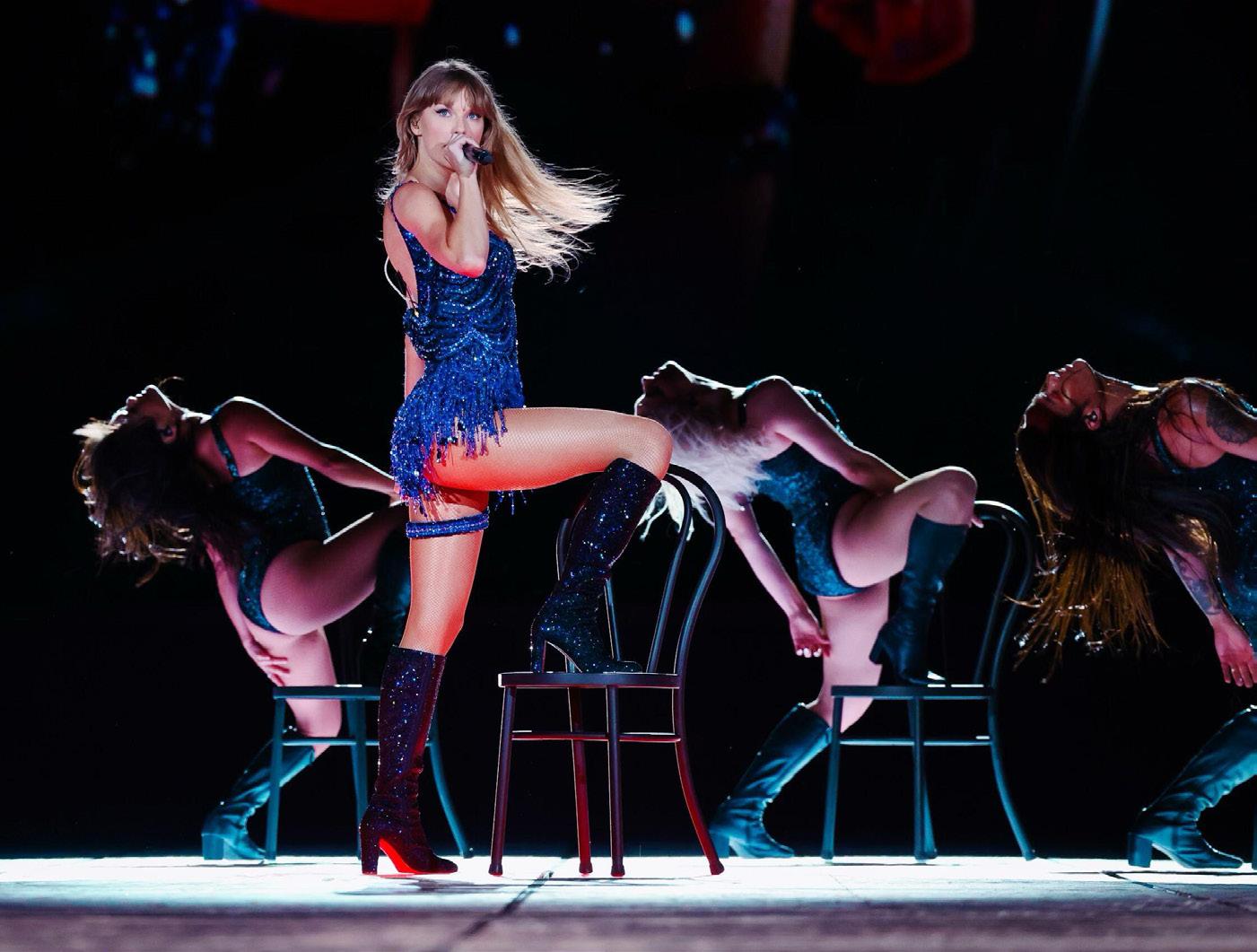
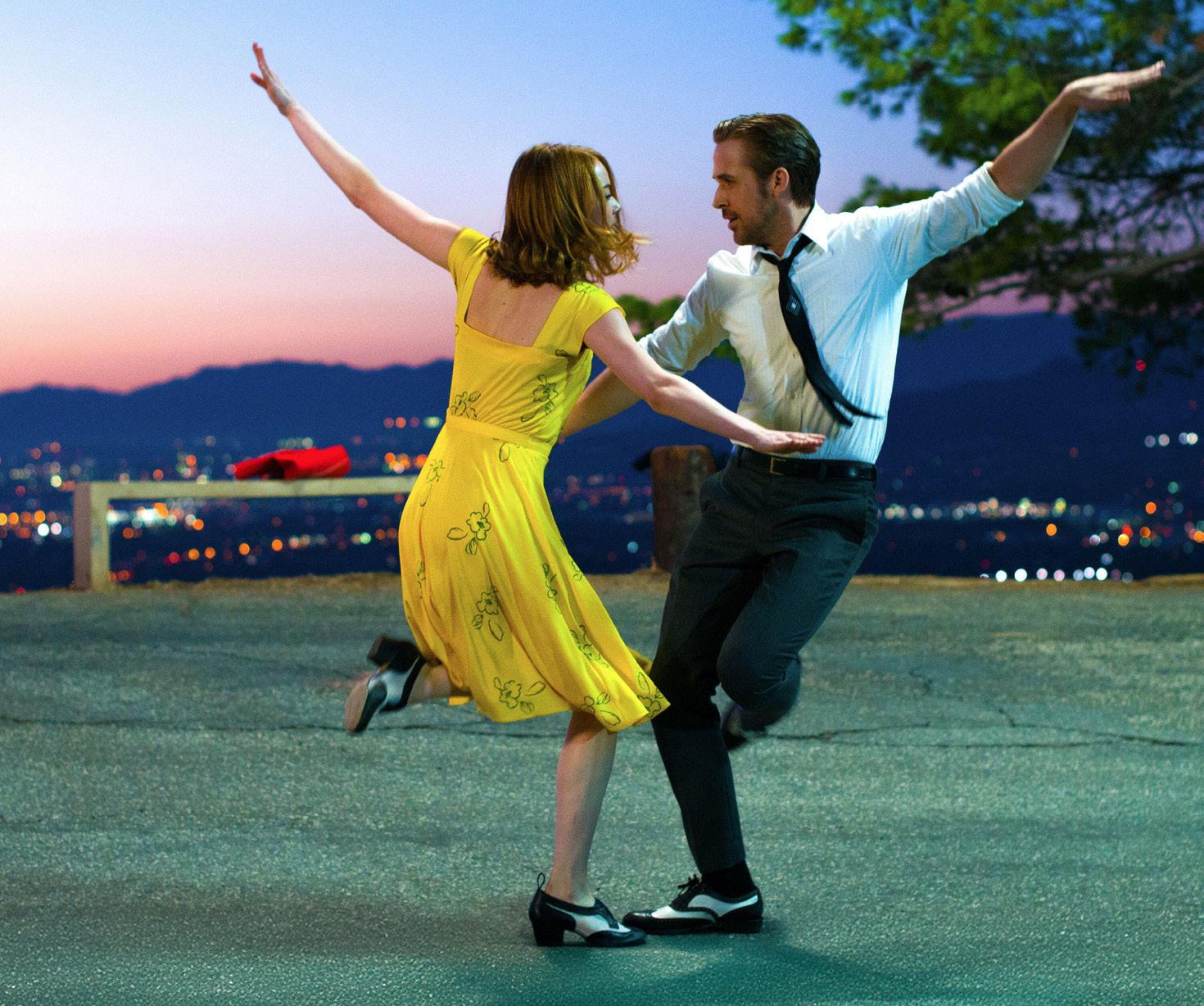
Moore made history in 2017 as the first choreographer to work on the Golden Globe Awards, Academy Awards, Grammy Awards, and Emmy Awards in the same year. She joined So You Think You Can Dance as a choreographer in the show’s third season and began serving as a creative producer in Season 14. Her other television credits include Dancing with the Stars and Zoey’s Extraordinary Playlist, winning Emmy Awards for both shows. Moore’s big-screen credits include Silver Linings Playbook, the live-action animated film IF (for which Blackstone served as associate choreographer), and La La Land; one of the stars of that movie, Emma Stone, recommended her to Taylor Swift, for whom Moore choreographed The Eras Tour in 2023–2024 and the “Fate of Ophelia” video. Her stage work includes choreographing, most recently, DOLLY: A True Original Musical in Nashville and The Heart at La Jolla Playhouse. For the Metropolitan Opera, she choreographed the world premiere of The Amazing Adventures of Kavalier & Clay in the company’s current season.
Blackstone’s New York dance classes have been a fixture for professional dancers for more than a decade. His recent theatre credits include directing and choreographing Guys and Dolls at Ogunquit Playhouse/ Malz Jupiter Theatre and An American in Paris for Cape Playhouse. He has created new and original dance narratives for numerous companies, serves as Resident Choreographer for the jazz dance company Giordano Dance Chicago and, with his husband Abraham Lule, created Momen, an intensive dance experience for adults. In 2019, he debuted an original dance piece commissioned by Stage Directors and Choreographers Foundation to honor Agnes de Mille at the “Mr. Abbott” Awards in New York City.
Last fall, SDC Journal brought Moore and Blackstone together for an incisive conversation about craft, communication, and the future.
AL BLACKSTONE | I have this image of myself as a little kid in dance class, so my first question for you is, when you think about your youngest dance self, what do you see?
MANDY MOORE | I see a kid who is really into dance, but also very serious. I was not the kid who was in the corner doing whatever they wanted. I was really trying to do it right. I was fascinated by this thing that just took over my brain and my heart and my body. I was so enamored by dance, and anything that I learned, I was just like, this is the coolest thing I’ve ever learned in my entire life.
AL | How old was that person?
MANDY | I was eight when I started dancing, which is kind of old compared to a lot of people. Kids come now, they’re like, “I was in ballet at two.”
AL | So much of what you do has a joyous spirit to it, but there’s always been such a seriousness, as well. It’s kind of beautiful that your first memory of yourself as a dancer includes both of those things. You were enamored and excited to play, but you were really serious about it.
MANDY | It was because I wanted to be great. I wanted to do that. “What is a flap? What’s a frappé? How do I do it? Why can’t my body do it?”
AL | How much of that person is still in you when you’re in a room with dance?
MANDY | I would say one hundred percent. What is hard, I think, as we get into our more successful time as creators, is to remember this is fun and it is play, but it’s also—it’s work, and I’m paid to be here, and I don’t want to waste people’s time. So that calls on that serious side where I’m like, we’re not
going to mess around. We’re going to figure it out and do it.
AL | The first time I was in a room with you in person was at the EDGE [Performing Arts Center] in Los Angeles, taking your class when you were teaching there, which was a while ago.
MANDY | A long time ago.
AL | I remember you at that time as being a fierce dancer—an absolutely incredible, incredible dancer. And I remember something that I think is so present even still, that you were this force of nature who was able to take care of the room, control the room, guide the room, and also laugh and be totally spontaneous. I know from experience that that is still how you are in a room. A big question that I have never really asked you is, did you become that person? Obviously, it develops over time, but was it
something that you were trying to craft or was it a surprise to you?
MANDY | My mom was a teacher and a director. I remember very vividly as a young person, she was the drama teacher at the high school, so she directed all the musicals and the plays. My mother and father also had a theatre that they ran.
AL | So, there was a craftsmanship to this—
MANDY | A seriousness to the craft. I specifically remember being a little kid watching my mom teach or lead a room. I still have memories of this, of looking around and seeing the way that her students looked at her; she’d say something funny and they’d laugh, or she’d be stern with them and they’d be like…I probably couldn’t put into words what that was, but I felt it. I felt leadership. I understood that there was this guide of some sort.
I learned so much from my first dance teacher, Kim [DelGrosso, at the Summit School of Dance in Colorado], too. When I was, I think, 10, I basically started assisting her. I would go into her classes and be the teacher’s assistant and I grew very quickly in the studio. I would spend a lot of time with her, seeing the way she was able, in the palm of her hand, to take these children on a ride in a classroom. It was another, “Oh wow, look at that guide or that coach
or that nurturer who’s going to take these people on this ride.” I started teaching very early; I used to teach little kids tap when I was 14. You emulate what you learn. I was fortunate to have very good teachers at a young age, so the teaching part of it, I kind of just emulated what my teachers did. That became how I taught.
AL | And probably informed the kind of student you were also. You’re practicing being a student while learning how to be a teacher at the same time.
MANDY | Yes, which is amazing. When you really start teaching, you’re like, “Oh, I become more of a student the more I teach.”
I was very lucky to be under some of what I consider the best teachers of that time. Carol Connors and Bill Prudich and Rhonda Miller and Jackie Sleight—people that, again, I was in the room and watching them take 400 children and literally put them in the palm of their hand and make their eyes sparkle for 45 minutes. There’s real art to that. It’s not manipulation, but I feel a huge responsibility to guide when I’m teaching. It is a very fragile place. I know you feel very similar, because I know how you teach your class. We have a responsibility as leaders, as teachers, as choreographers, creators, to create a great space and to guide these people.
AL | Do you feel like that desire to guide and teach ever gets in the way of executing a job that you have to do, because you’re more concerned with taking care of everyone than you are with making great work?
MANDY | One thousand percent. I think I will always be a teacher first, a creator second, an artist third. I care about people, I care about the room, and I care about how people leave the room after being with me. If it sacrifices my work, if I wasn’t able to get my perfect move out, to me, at the end of the day, it’s better for somebody to leave having felt great in my presence, than me feel great with some piece of work.
AL | I don’t think all directors or choreographers are necessarily great teachers, but I think all great teachers are directing or guiding in some way. Whatever it is that you are part of, you’re leading it. You’re sending it somewhere, you’re guiding it. You do so many different kinds of things—movies, huge tours, theatre— you touch every aspect of show business, but choreographers get hired and aren’t “in charge” necessarily. Is it difficult to put yourself in a position where you don’t know what the leadership is going to be with your collaborator?
MANDY | It is. You can’t un-know what you know, and I think the more we all get better
Jane Levy + cast in Zoey’s Extraordinary Playlist (NBC), choreographed by Mandy Moore
PHOTO LIONSGATE TV ALBUM/ALAMY
at our craft, at what we do, we bring all that experience into the room. I go into every job hoping and praying it’s going to be the perfect combo of synergistic collaboration and common ideas about how you run the room, how you schedule things, how you make. Nine times out of 10, it’s not and it’s hard.
AL | What does it look like, the perfect situation? If you are collaborating with a team, what does that feel like? What does that look like to you?
MANDY | I think communication, where roles and expectations are able to be talked about prior to what we’re doing or as we’re doing it. There are so many different things we as choreographers do, and so to understand what hat I need to put on for this process is important, because I’ve got 55 in my bag and I’m happy to put them all on, none of them, find a new hat, I’m down.
AL | You’ll adapt.
MANDY | I think many choreographers do—not all, but many. I do think that’s why I am successful, because I’m able to have a lot of hats. I can be a passenger, I can be a driver, I can be in the back seat. I can just wash the car if that’s what you need me to do. But for me, I wish there was more communication between departments, between directors and choreographers and producers, about what we’re all getting into. An almost cerebral chat. That’s probably Pollyanna of me to think, but I wish we could talk about dance and creation before we all get in there as dancemakers and pour blood out of ourselves to make things happen, because it’s hard to make dance and I still feel like people don’t understand how we make it. They think we just think about it, and it happens. And it’s so hard to make.
AL | I think a lot about one story you told me. Someone was trying to give you a dance note, but they had absolutely no background in dance. I don’t remember the project, but your response to this was something along the lines of, “This is my language, please don’t.” That was one of the greatest lessons I’ve learned from you, owning the sort of, “I’ve been doing this my entire life, or for most of my life, every day, and this is a language that I speak fluently, and this is what I’m here to do.”
MANDY | I was very lucky to work on Zoey’s Extraordinary Playlist, which was a scripted musical show, with Austin Winsberg, who was the showrunner. I learned so much about this very thing with him. I felt like it was a perfect combo; I really taught him a lot about choreography and how to talk about it, and he taught me a lot about
choreography for non-dancers and how to talk about it. In the early stages, he would give me a note or he’d say, “Oh, can you change that step?” Because he’s a friend, I was able in that moment to say, “I’m going to talk about why that’s really tough for me. I don’t go into your scripts and ask you to change a word. I worked hard and I want to do that step. I’m not just willy-nilly putting a step in. I thought about what I wanted to do there, so I have painted with that color.”
I am the expert. You hired me because I have been doing this since I was eight years old. I live, sleep, eat, breathe dance and choreography and creation, and I know what I’m talking about. Doesn’t mean that you can’t have an idea or an opinion or a note, but if you have something to talk about, I prefer that you say, “I’m not understanding the feeling here,” or “In the script, I wanted to say this, and it feels like when I watch that it’s saying something else.” I credit him and that time, because I really did figure out, oh, this is how I can talk about dance with people that don’t know dance.
AL | Does it change anything in your process to go from the size of an arena audience for The Eras Tour to a regional house where you’ve got, let’s say 500 or 800 people in an audience? Is there a different way to think about the dance for this many people versus that many people?
MANDY | It doesn’t matter if there’s 90,000 people watching it or 500. I’ve learned over the years that certain things look better in different mediums. I’m not going to be doing some huge arm wave movement
in a small theatre, whereas that might be really effective in a stadium. I think there are probably choices I make subconsciously at this point, just from experience. Or things that look great on camera versus things that look great in proscenium theatre. Half the time you think something’s going to look good on camera and you’re like, wow, it’s terrible. And then as soon as you make it the simpler 2D version, it looks great.
AL | Is part of your process visualization? How much are you thinking about what it’s going to look like to the person that’s receiving it?
MANDY | A lot of it, I think. I definitely see shapes. I see ideas, I see colors, I see feels. For me it’s really the breaking down of the song and understanding structurally what’s happening, and then trying to match if I saw something or felt something in a particular part of the song, how do I get myself to that?
AL | You’re also amazing at responding to what happens in the room in the moment as well. You come in with a plan, but when you see something in front of you, you’re so present with it, and you’re able to respond in the moment.
One of my favorite things about your process, at least on the things that I’ve worked with you on, is we sit down, and we write down a bunch of stuff. Take me through a little bit of that.
MANDY | It’s been the same process, honestly, since I was 10. I somehow learned
Taylor Swift in The Eras Tour, choreographed by Mandy Moore PHOTO
CAPITAL PICTURES/ALAMY
how to bar out songs at a very young age, and funny enough, when I worked with Rhonda Miller when I was 18, she also barred out songs, Carrie Ann Inaba barred out songs. It’s very particular, maybe, to film and television, but for me it really works also in the theatre space and for tours. I usually start with literally a blank page. I write the title of the song at the top and I go from the top and I put a dash for every A count, and if the song starts to change, I change where I am or I put a little dot, dot, dot, or I put a lyric down or I say, oh, this is chorus one that’s at 30 seconds. It helps me organize in my head, it’s like a map, because I’ve never been the choreographer who just puts on the song and starts from the top and sees where it goes.
AL | What about after charting? We also wrote down any questions that we had.
MANDY | Yes. I love questions. Who’s singing this? Why are they singing it? What does this lyric mean? Those questions activate my brain for creation, in a way, at this point in my life. I think it’s changed. When I was in my 20s, I would just make moves, because you feel the cool music.
AL | It’s all instinct.
MANDY | “Ooh, I like that move,” or “I look cool doing this move.” At this point in my life I’ve found I can’t make anything unless I answer some questions. It’s like my body resists making anything unless I know an idea or a direction we’re going toward. “Oh, okay, we’re dancing about this,” or “this is what we’re trying to convey in this moment.” Because if not, it’s a bunch of dumb dance moves.
AL | Is there such a thing as having too much time to work on something? I ask that because the pace of TV, especially— talk about rapid! Then obviously with film, there’s very, very rarely as much rehearsal as you want there to be. And then moving into theatre, it’s fast, but there are also these moments that really slow down.
MANDY | It’s funny you say that, because I’ve always been told there’s so much time in theatre. That has not been my experience at all. I’m like, thank God I did live TV and that I can move quickly and put a number up in three hours. Then, when you’re in tech for 12 days and I’m like, why is this taking six hours to lower this curtain and get a light on it? That’s crazy to me, but who knows? That’s when everything else is coming together.
AL | At this moment, what’s the best part of it all? I know that changes, but right now, what’s the best part?
ABOVE Mandy Moore’s choreography chart for “Keep Up,” a song featured in The Heart at La Jolla Playhouse
Kenita Miller + cast performing “Keep Up” in The Heart at La Jolla Playhouse, choreographed by Mandy Moore PHOTO RICH SOUBLET II
MANDY | I think the best part is that I’m learning so much. Again, I love being a student of a craft that I feel I’m never going to fully crack. You’re always learning. Even in tough projects, I’m very thankful for the learning and I’m thankful for the sharing. I’m not sure I’ve been able to get to the point lately of, I’m thankful for the “what has come out of me” moment. I would like to get there again, because I think at some point in my creative process, I was able to really allow my life experiences to come out in my work.
AL | For me, as someone who also grew up in dance and loves dance so much, I feel like myself the most when I’m with dancers. Oftentimes in theatre and musicals, dance is a tool to make the show, but it’s not the most important thing. Do you think that on projects where the value of the importance of dance is higher, you’re able to express yourself more?
MANDY | One thousand percent. You’re exactly right. Yes, because it is my language. I’m a dancer first. I am not a mover first. I’m not a singer first. I’m not a writer first.
AL | You’re not an actor who’s hired to play a musical instrument while also doing the twist.
MANDY | Yes, totally. I’m a dancer, so I think you’re right, and if you’ve got fancier tools to make the thing you’re making, then it’s probably easier to let that be closer to your own experience, because that’s who you are.
AL | I think dancers trust you, get you, can understand what you’re after. No matter how much you plan, it is collaborative, because it’s their bodies. I’ve seen you in a room with people that you get, and they get you. If you’re surrounded by those people, then you can really feel like whatever that force is that’s in you, is able to flow. Those moments were possible on So You Think You Can Dance because with those dancers, there was a communication between you that allowed you to express yourself fully.
MANDY | It’s interesting that you say that. I keep thinking it’s like that flow state that people talk about—creating truly from your heart. I think a lot of creation in my last years of making has really been more head creation and experience creation.
AL | Or problem solving, would you say?
MANDY | Yes, problem solving, which is part of it, and it still comes from my heart. But it’s not, “This is what I feel in this moment and I’m going to put this out on your bodies and we’re going to do it.” It’s more calculated, in a way.
AL | I think a lot of times a choreographer’s job is to be a problem solver, a creative problem solver, and you are a master of creative problem solving, so I don’t mean to sound like you’re not able to do that. But it’s also, if you’re good at that, people want you to do that, and that can sometimes be frustrating too, because you’re like, I will solve these problems for you and I will make this all happen. I will make this impossible thing possible, but there’s also the part of me that wants to be able to feel free.
MANDY | Just dance.
AL | When was the last time you felt that way?
MANDY | I don’t know if you feel this way, but it’s like we all become victims of our own success, right? It was a lot easier to be in that state pre-La La Land or pre-So You Think You Can Dance, or pre-anything where anyone perked up and said, “Oh, I guess Mandy knows what she’s doing.” It might be something I put on myself, but I understand that I walk into a room now and I’m not walking in like some kid that nobody knows. I understand that I have made things that people presume are a certain thing or come from me in a certain way. And it’s hard. I care about my work, just like you do, and I want to do a good job. It was different when my biggest worry was what combo I was going to make on Tuesday, Thursday from 11:30
to 1:00 at EDGE, what I was going to try to convey to my students who were showing up every Tuesday, Thursday. It’s a different place of creation.
AL | Is the pressure self-imposed? Do you think you put that on yourself, or do you think the world puts that on you? Are you afraid of disappointing, or—
MANDY | One thousand percent.
AL | Who?
MANDY | Well, probably myself, number one, because I’m hardest on myself. But then it’s this odd thing when you’re being paid to make this thing. Even on So You Think, one of my first routines out of the gate, “Sweet Dreams,” I was nominated for an Emmy. Literally it was the second or third routine I’d ever done. I was in a complete free flow state at that moment. Then all of a sudden it became this thing and then everybody wanted me to just make that for the next 10 years.
Making isn’t like that. There’s no formula. I’ve never figured out how to go two plus two equals four, and that’s a Mandy number. Because when I do that, it always falls flat and that doesn’t feel right, because I’m not in the moment with the people that are in front of me and in my own skin, in the present moment.
Robert Roldan + Mariah Russell on So You Think You Can Dance, choreographed by Mandy Moore PHOTO ADAM ROSE
“There’s no formula. I’ve never figured out how to go two plus two equals four, and that’s a Mandy number.”
AL | Do you think that part of why you say yes to a given project is because you’re hoping that maybe a moment like that is possible within that project?
MANDY | I think it’s probably even simpler than that. We all try to be a part of something where you say, I hope I make something awesome this time. But there’s no guarantee; sometimes it’s just as simple as, this is how I make my living.
AL | Well, you’re running a business. First you’re a student, then you become a teacher, then a choreographer, and then suddenly you realize, wait a minute, I have to run a business too! If I don’t run this business well, no one is going to take care of me.
MANDY | Yes. And where along the way did this thing, which was just a thing that I love to do, become my business? That is crazy too, when you start thinking, it’s fun to be on So You Think, but it also pays my mortgage. It’s very fulfilling as an artist and I get to be in this thing that’s amazing, but it’s also like, then I’m not going to teach my classes this summer, because I’m doing this. There is this weird kind of right brain/left brain disconnect that happens.
AL | This is a perfect segue, because you’re now running Pace University’s Commercial Dance LA semester. [Part of the Pace BFA Commercial Dance Program, the Commercial Dance LA semester brings 35 students to Los Angeles in the spring semester of their junior year to learn from industry professionals.] Tell me a little bit about what that entails.
MANDY | I love this program. I started working at Pace with Rhonda [Miller] about 10 years ago; then last year Rhonda stepped away, and they asked me if I would be the Director and take it on. I’m basically in charge of these kids coming to LA for the semester and hiring the faculty that works with them and curating a semester of what is LA and commercial dance. I love it. We do a big performance at the end. It’s really great.
AL | I think a lot of people of our generation are very critical of young people, but you light up so much when you talk about them. Tell me what you enjoy about this generation. Do you feel hope when you’re around them?
MANDY | Yes. I look at them and I’m like, they’re the ones who are going to be taking my job and I have a responsibility to try to help them, because no one is teaching us as choreographers how to navigate this business.
AL | If someone wants to be a choreographer, what do you say to them?
MANDY | Well, first of all, you have to start making, that’s the big thing. So many people are like, “I want to be a choreographer,” but
Joe Carroll + Katie Rose Clarke in Dolly: A True Original Musical at the Fisher Center for the Performing Arts in Nashville, choreographed by Mandy Moore
PHOTO MATTHEW MURPHY
The Amazing Adventures of Kavalier & Clay at the Metropolitan Opera, choreographed by Mandy Moore
PHOTO EVAN ZIMMERMAN
never make anything. You have to go make and you have to make on six-year-olds at a dance studio, and then you have to go teach a salsa class at the senior citizen center and learn how to be in situations of leadership and creation.
AL | Such good advice.
MANDY | That’s so much of it. But also learn about it, watch other choreographers. Be in a room as a dancer, assist if you can. Read books about it. You have to learn how to lead. That’s what we do when we’re choreographers.
AL | I think also there’s this thing that we’ve talked about, which is they love dance. They love the way dance makes them feel. They want to live a life in dance, but then there’s this strange shift that has to happen where there’s a seriousness and a craftsmanship that’s really hard to put your finger on. Most people just see the finished product. They have no concept of the moment you’re sitting down and asking all the questions and writing them down. Even if you tell them, or even if they’re in the room watching it happen, until they’ve done that, until they’ve been through that, it’s just like, do you really want to do this? Because it takes so much work to keep that joy alive and to keep that childlike—
MANDY | Wonder about creation. I guess that’s also why I feel a responsibility to Pace. If I can help these kids come into the business—or realize through this process, “I don’t like choreography” or “I don’t want to be a professional dancer”—I feel at least I’ve done some service to this.
AL | One of my favorite things about working with you is, the amount of respect that you demand for yourself and what you
do, you give to every department. You treat everyone like professionals, but you also expect them to be as prepared as you are. I think it brings out the best in everyone around you, because your expectations are that they will have done the work. But it’s also that you’re so in tune with all the roles that go into theatre, into film and TV, into touring. You’re also really good at teaching dancers about all these other ways that you can be involved in performing arts without necessarily having to be the person making up the steps.
MANDY | Yes, we need more dancers, I think, in production roles—being producers, being editors, being writers. Because I do think there’s something special about dancers, the really good ones, the ones that get it. Not everyone’s going to make it in the business, but if that brain or that heart of a dancer can infiltrate into these other parts of production in the industry, it’s just going to make for a better industry.
AL | Really what you’re trying to do is lead people to the best version of themselves, and not necessarily the thing that’s going to get them the most attention. Because also, going back to what you said earlier, sometimes the attention is actually the worst part of it; there’s something really difficult about feeling like everyone’s watching you.
MANDY | So much of the Pace stuff is taking these kids through the nuts and bolts, the peas and carrots of being a choreographer, of being a dancer—talking
to them about casting, about heading your department, about budgets, about breaking down the song, about what happens when the director decides to shoot it on the side, but you made it from the front. How do you change it? How do you do it when you get a note from the producer and you’re 10 minutes to going to live? What do you do? How would they ever know? I didn’t know. I’ve crashed and burned so many times. That’s the only reason I have the information to be like, okay, this might happen.
AL | If you close your eyes and visualize the next five years—I’m not asking what kind of job, but what does it look like? Where do you feel like you’d like to be professionally?
MANDY | I have a hard time saying out loud what I’m going to say, but I’m going to say it out loud. I’m going to use this moment to say it. I want to direct and produce and develop. I feel like I have a lot to give in that space, and it’s scary to say, but I’m ready. That’s what I want to do. I think I’ll always be a choreographer; I love choreography, I love dance. But I am also very aware that it would be okay to step away from that or to have that be only one part of my job. I think that means for me that I need to move into more producing and directing. I want to make things with people that I know and love and share ideas with about culture and the world.
AL | Put it in print. I’m really happy to hear you say it, and I admire you so much, and I really appreciate being able to be here with you right now.
Emma Stone + Ryan Gosling in La La Land, choreographed by Mandy Moore PHOTO FLIXPIX/ALAMY
Al Blackstone + Mandy Moore PHOTO C/O PRESS PLAY DANCE CONVENTION
“UN-AMERICAN”
THEATRE ARTISTS vs. THE 1950s BLACKLIST
BY MARY B. ROBINSON
Long before the phrase “witch-hunting” became a president’s attempt to tarnish investigations into his own acts, it was the title of a chapter of director Margaret Webster’s autobiography Don’t Put Your Daughter on the Stage. Webster was a victim of the 1950s blacklist, the systematic destruction of people’s livelihoods brought on by the federal government’s pursuit of alleged Communists in the United States. It caused irreparable harm to the professional and personal lives of many Americans, including a number of directors and choreographers, as well as other theatre artists.
HUAC lead investigator H.A. Smith (standing, right) swears in Rep. J. Parnell Thomas, a HUAC chairman who worked to expose Communists in the film industry. Freshman Congressman Richard Nixon sits next to Smith. PHOTO EVERETT COLLECTION HISTORICAL/ALAMY
Twenty years later, Webster wrote that what happened in the 1950s “now seems so utterly incredible,” but she was convinced that “we need to be reminded that, incredible or no, it could happen again.” She foresaw that cruel and dangerous government overreach could again be tolerated by much of the public “under the same pressures of insecurity, ambition, hatred, and above all––fear; always, and on both sides, fear.”
More than 50 years after she wrote those words of warning, it feels important in our own time to re-examine these past events from the perspective of our theatrical predecessors: directors, choreographers, and other theatre artists of the mid-twentieth century. What did they do when they were confronted with statesanctioned persecution? What compromises of their own values were some of them willing to make, while others refused to comply––and why? And how can this dangerous era in our nation’s history illuminate what we might do in our own time––one that has echoes of the 1950s but is unquestionably much worse?
AFRAID OF THINKING PEOPLE
The public’s fear of Communists that certain politicians exploited in the late 1940s and early 1950s was fueled by the existential terrors of the atomic bomb and the Soviet Union’s acquisition of it. The Communist Party USA, which had been the hope of many progressives during the unemployment and deprivation of the Great Depression, had, for much of the country, acquired a much more sinister cast because of the arms race. The Soviet Union was now our Cold War enemy with the capacity to wipe us out, rather than the World War II ally it had been a decade earlier. And in much the same way that certain fears of the public are exploited today, ambitious politicians manipulated people’s fear of Communists for their own self-interest. Congressman Richard Nixon’s career took off with his dogged pursuit of supposed Soviet spies in the late 1940s, while Senator Joseph McCarthy grabbed the limelight in 1950 when he claimed there were hundreds of Communists working in the State Department.
But in truth, certain members of the federal government who hated Roosevelt’s New Deal (with its “socialist” programs like Social Security) had always seen Communism as a threat––or at least as a tool that could be used to stir the American public’s anxieties and further their own ambitions. The House Committee on Un-American Activities, or HUAC, was first proposed in 1934 to investigate the dissemination of Nazi propaganda in the U.S., but it wasn’t
until Communism was added as another “un-American” element whose proponents should be investigated that HUAC came into being in 1938. Even at the time, it was recognized that the term was vague and subjective: as one liberal congressman put it, “un-American is simply something that somebody else does not agree to.” Other organizations such as the Ku Klux Klan were suggested as additional targets for HUAC’s investigations, but that idea was dismissed by a Southern congressman who stated that the Klan was a thoroughly American institution.
HUAC’s first chairman, Congressman Martin Dies of Texas, was a racist, anti-immigrant, anti-labor politician who decided that his committee’s first target would be the Federal Theatre Project, which had been created by Roosevelt’s Works Progress Administration
in 1935 to put theatremakers back to work during the Depression. Directed by Vassar theatre professor Hallie Flanagan, the Federal Theatre Project employed between 8,000 and 12,000 people at any given time and went far beyond its mandate of combating unemployment. It created the first network of regional theatres across the country, attracted an audience of 30 million people (two-thirds of whom had never seen a play before), and charged no admission for most of its productions.
The work of the Federal Theatre Project spoke to those audiences with immediacy and urgency about matters that affected their own lives. It commissioned new plays such as It Can’t Happen Here, a cautionary tale about the rise of American Fascism adapted from the Sinclair Lewis novel; staged classics in ways that highlighted their relevance to contemporary issues;
LEFT Congressman Martin Dies, HUAC’s first chairman PHOTO EVERETT COLLECTION
and created a brand-new theatrical form in the Living Newspaper, an early kind of docudrama that explored current events. It bucked the norms of segregation in the South when it integrated both casts and audiences, and it created many Black theatre units in large and small cities around the country.
There is no doubt that some of the thousands of theatremakers who worked for the Federal Theatre Project were members of the Communist Party. (So were several members of the Group Theatre, the other notable American theatre experiment in the 1930s, including playwright Clifford Odets, the success of whose plays Waiting for Lefty, Awake and Sing!, and Golden Boy gradually propelled him and a number of Group Theatre actors toward the more lucrative film industry.) But the Communist Party was not illegal in the U.S. in the 1930s, and it was for many the only political party that was squarely on the right side of many important issues, including racial justice.
Hallie Flanagan was not charged with being a member of the Communist Party herself, but with letting Communists infiltrate the Federal Theatre Project and producing radical plays. Called before HUAC in December 1938, she caught her accusers off guard with her opening statement that the Federal Theatre was in the business of “combating un-American inactivity”––i.e., unemployment among theatre professionals––and her use of the term “Marlowesque,” which elicited this memorable exchange:
Congressman Starnes: You are quoting from this Marlowe. Is he a Communist?
Flanagan: I was quoting from Christopher Marlowe.
Starnes: Tell us who Marlowe is, so we can get the proper reference, because that is all that we want to do.
When Flanagan clarified that she was speaking about an Elizabethan playwright, an embarrassed Starnes stated that all drama, going back to the Greeks, was about social conflict and therefore inherently Communist. “Mr. Euripides was guilty of teaching class consciousness,” he declared.
But though Hallie Flanagan may have had the upper hand during her congressional hearing, the mere charge of Communist infiltration was enough to turn public opinion against the Federal Theatre Project, and Congress voted to stop its funding and end its existence in June 1939.
In an op-ed for the New York Times after its demise, Flanagan wrote that her congressional adversaries “were afraid of the Federal Theatre because it was educating the people to know more about government and politics and such vital issues of the day as housing, power, agriculture and labor… They are afraid, and rightly so, of thinking people.” And a further reason HUAC wanted to get rid of the Federal Theatre, she maintained, was because “it gave Negro actors as well as white actors a chance [for employment].”
After four years of astounding productivity, the Federal Theatre Project was dead, never to be revived––and at least 8,000 theatremakers were immediately put out of work. But Flanagan believed that its brief existence had made the creation of some kind of national theatre inevitable. “Not even an act of Congress can kill an idea,” she stated.
ARTIST-HATING BRUTALITY
HUAC’s crusade against Communism was briefly suspended during the World War II alliance between the Soviet Union and the United States, but it picked up again with a vengeance when the Cold War began. FBI Director J. Edgar Hoover appeared before the Committee in early 1947 and declared that the Communist Party in the U.S. “is far better organized than were the Nazis in occupied countries prior to their capitulation. They are seeking to weaken America just as they did in the era of obstruction when they were aligned with Nazis. Their goal is the overthrow of our government.”
“With the tiniest Communist Party in the world,” playwright Arthur Miller countered in his memoir Timebends, “the United States was behaving as though on the verge of bloody revolution.” And once again, HUAC went after the performing arts with the full force of what Miller termed its “artist-hating brutality.”
In October 1947, more than 40 people in the film industry received subpoenas to appear before HUAC. Eight writers and two directors refused to testify when they showed up at their hearings; instead, they used their committee appearances to publicly denounce HUAC, with some comparing its methods to those used in Nazi Germany. The “Hollywood Ten” were each fined $1,000 for contempt of Congress and sentenced to a year in prison. Three years later, when they had exhausted all possible legal appeals after the Supreme Court refused to hear their case, they began to serve their time.
While in prison, director Edward Dmytryk changed his mind and agreed to cooperate with HUAC, not only admitting to having been a member of the Communist Party himself, but also identifying a number of people he knew as Communists (or former ones) and thereby becoming one of the first people to rescue himself by naming others. Dmytryk was released from prison and resumed his work in the film industry; the other nine people in the Hollywood Ten served the remainder of their terms and were blacklisted once they regained their freedom. “Naming names” became a purity test that the federal government set for people as the only way to get off the blacklist. HUAC didn’t need the names––they already had them––but to prove their loyalty to the U.S., people were made to practice a “ritual speech intoning names of fellow sinners and recanting former beliefs,” wrote Arthur Miller, who went on to dramatize this process in The Crucible, his play about the 1692 Salem witch trials.
Meanwhile, another, more insidious form of blacklisting had begun. In 1947, President Truman instituted the Federal Employee Loyalty Program, in which membership and donor lists of organizations with supposed ties to Fascism, Communism, totalitarianism, or “subversive views” were obtained and checked for the names of people in the federal government as well as those applying for jobs in it. At first, these lists were for internal use only, but Truman later allowed them to be released to the public. The implication that the government had branded these American
citizens disloyal to their country because they supported “subversive” organizations such as the Negro Cultural Committee and the American Protection of the Foreign Born was soon taken up and exploited by vigilante blacklisters.
In 1950, the weekly right-wing newsletter Counterattack published a pamphlet entitled Red Channels: The Report of Communist Influence in Radio and Television, accusing 151 people in the entertainment industry of having ties to “Communist front” organizations. This 50-cent pamphlet was bought by thousands of people who wrote letters saying they would boycott the products of the radio and television shows’ sponsors if the actors, directors, choreographers, writers, and composers listed in Red Channels were hired.
Included in this first edition of the pamphlet were many prominent theatre artists who also relied on income earned in radio and the new medium of television. Actors Uta Hagen, José Ferrer, Ruth Gordon, Zero Mostel, Jack Gilford, Lee J. Cobb, J. Edward Bromberg, and John Garfield were listed, as were composers Leonard Bernstein and Aaron Copland and folk singer Pete Seeger. Playwrights Clifford Odets, Lillian Hellman, and Arthur Miller were named, as well as playwright/directors Garson Kanin, Marc Connelly, and Arthur Laurents, and directors Martin Ritt, Abe Burrows, and Joseph Losey.
Under each person’s name there was a list of the organizations that called their loyalty to the United States into question. Anything remotely left-wing was fair
game, including participation in an annual May Day parade celebrating workers, or supporting members of the Hollywood Ten. Choreographer Helen Tamiris, the director of the Federal Dance Project in the 1930s and a 1950 Tony Award winner, was accused among other things of being a sponsor of the End Jim Crow in Baseball Committee. Director Margaret Webster was targeted for 14 progressive causes she supported, among them having signed a letter urging the abolition of HUAC. Underneath the name of poet and playwright Langston Hughes were 40 organizations, along with the accusation that his ironic poem “Goodbye Christ” was “a typical example of vicious and blasphemous propaganda Communists use against religion.” And many theatre artists were targeted for having sent telegrams of congratulations to the Moscow Art Theatre on its 50th anniversary.
At the end of the pamphlet, the organizations themselves were listed and their supposed subversiveness identified. The Congress of American Women, part of an international organization that worked to improve child welfare and women’s rights, was cited as “one of the most potentially dangerous of the many active Communist fronts.” The League of Women Shoppers, a consumer advocacy group that promoted social justice and fought racial discrimination, was described as an organization “whose chief purpose was to create feminine support in labor disputes.”
The anti-labor vehemence of these guiltby-association lists begs the question: what were unions doing to support their members
OPPOSITE Hallie Flanagan (left) and the Federal Theatre Project’s 1936 cautionary play
LEFT Film director Edward Dmytryk testifying before HUAC, 1951
during this ordeal? The answer is that the film, radio, and television unions were doing nothing––or worse. The Screen Writers Guild and the Directors Guild of America refused to support their members during the prosecution and imprisonment of the Hollywood Ten. The American Federation of Television and Radio Artists (AFTRA) adopted a new rule: members who pleaded the Fifth Amendment at HUAC’s hearings so as not to incriminate themselves––refusing to answer whether they were, or had ever been, in the Communist Party––were assumed to be Communists and suspended or expelled from the union. The board of the Screen Actors Guild (SAG) published a statement saying that members of the Communist Party “should be exposed for what they are––enemies of our country and our form of government. It is not the province of the Guild Board to decide what is the best method for carrying out this aim.”
At first, Actors’ Equity Association followed SAG’s lead and even used some of the same “enemies of our country” language in its own published statement. But in 1951, after Variety announced that HUAC was “getting ready to switch its emphasis from Hollywood to Broadway,” some Equity members resolved to take a different stand. The membership at the October quarterly meeting in New York passed a strongly worded resolution saying that the “blacklisting of one actor in any area of the Entertainment Industry threatens the security of all actors and, indeed, jeopardizes the very existence of our Association.”
Equity’s Council was required by its By-laws to consider this resolution, and though it was hotly debated in a Council meeting two
weeks later, it was eventually passed. The final resolution was considerably watered down from the membership meeting draft, but it did state that Actors’ Equity “condemns the practice of ‘blacklisting’ in all its forms,” and promised to aid members in getting a fair and impartial hearing if they faced charges. The following year, Equity succeeded in getting this language into its contracts with the Broadway League and other producers, and its members also formed an anti-blacklist committee––thereby becoming the only performing artists’ union to take a stand against the anti-democratic behavior of the federal government and the vigilante blacklisters. (SDC was not founded until 1959.)
Theatre was mostly exempt from the insidious Red Channels-type blacklisting that so affected film, television, and radio because its audiences didn’t care about the political affiliations of the actors, directors, and playwrights whose work they wanted to experience. At least one vigilante blacklister found this intolerable, writing an article that spewed out names while asking in frustration, “When will the theatre-going public get wise to the con game being operated in New York’s Great Red Way?”
If the theatre-going public never “got wise” to Broadway turning “Red,” a few nervous producers did. At least one director, Joseph Losey, was not hired for a job (directing Arthur Miller’s The Crucible) because of his suspected Communist membership. And even Equity took a step back from its stand against blacklisting when its membership felt it necessary to vote to expel any member who’d been proven––by due process––to be a current member of the Communist Party.
CAPITULATION
HUAC’s new focus on Broadway was preceded by several years of FBI investigations of well-known theatre artists who also worked in film. In 1950, choreographer Jerome Robbins , whose celebrated work on Broadway and with the New York City Ballet was beginning to lead to film offers, was informed by television host Ed Sullivan that his suspected Communist membership in the 1940s made it necessary to rescind an invitation to appear on his show. Sullivan told Robbins that his past affiliations could harm his career and urged him to “confess” to local FBI agents; he may also have suggested that he would divulge his homosexuality if he didn’t comply.
Robbins met twice with the FBI in New York, confirming his brief Communist membership and agreeing to appear before HUAC if called. He even said he would be willing to identify others who were in the Party with him but he expressed reservations about “smearing people whose activities I had no knowledge of for the past three to six years.” He then left on a European tour with the New York City Ballet, and when Sullivan published a story in the Philadelphia Inquirer entitled “Tip to Red Probers: Subpena [sic] Jerome Robbins,” he stayed overseas for some months afterwards on the advice of his lawyer. His letters from that time even suggest that he considered becoming an ex-patriate to avoid having to testify before HUAC.
LEFT Jerome Robbins appearing before HUAC PHOTO PHOTOFEST
report on Elia Kazan’s HUAC testimony, 1952
RIGHT Elia Kazan (right) with Vivien Leigh + Tennessee Williams on the set of , 1951 PHOTO MASHETER MOVIE ARCHIVE/ALAMY OPPOSITE Elia Kazan’s New York Times ad, 1952
In early 1952, stage and film director Elia Kazan was called before the Committee in a private session. He too was candid about his own brief membership in the Communist Party in the 1930s when he was an actor with the Group Theatre, but he was not required to name names. But his contract with Twentieth Century Fox was up for renewal, and he was told by one of its producers that unless he identified other former Communist Party members to the Committee he would never work as a film director again. Kazan began to experience chest pains, hand tremors, and sleepless nights as he agonized over what to do, eventually turning his agitation against the Communist Party, which he had left in 1936 over his refusal to try to persuade the Group Theatre to produce plays with overt Communist propaganda. He felt he had been humiliated at a Party meeting and had remained bitter ever since.
“I was against them all,” he wrote many decades later. “I began to measure the weight and worth of what I was giving up, my career in films, which I was surrendering for a cause I didn’t believe in.” (Of course, the “cause” he’d be giving up his film career for would not have been Communism, but the ability of his friends and colleagues to make a living.) Kazan directed all the blame for his situation at the Communist Party and none at HUAC, apparently rationalizing (as many did at the time) that if a democratic government behaved in an anti-democratic way, it was within its rights to do so But others deplored HUAC’s “contempt for basic human rights,” in the words of Arthur Miller, and laid the blame for the blacklist squarely at the feet of the federal government.
Kazan returned to HUAC in April 1952 and gave the Committee eight names. (For good measure, he went on to talk about all the plays and films he’d directed, describing how––as he said of one musical––they were “non-political but full of American tradition and spirit.”) He then tried to hold off the inevitable recriminations from the theatre community by taking out an explanatory ad in the New York Times––a defense that was poorly received and seen as self-serving. His secretary at the Actors Studio quit in protest, people he knew crossed the street to avoid him, and he received many letters, some of them anonymous, condemning what he had done. One such letter concluded, “I cannot sign my name because you hold an economic whip over those of us who are only actors.”
Elia Kazan resumed his successful career in both theatre and film but was disturbed by his own actions for the rest of his life. He speculated in his 1988 memoir that as the child of Greek immigrants, he might have been consumed by the need to prove his own patriotism. “What I’d done was correct but was it right?” he wrote. “No one who did what I did, whatever his reasons, came out of it undamaged. I did not. Here I am thirty-five years later, worrying over it.”
Kazan’s testimony cost him his working and personal relationship with Arthur Miller, whose early plays All My Sons and Death of a Salesman he had directed: Miller collaborated with other directors on his 1950s plays The Crucible and A View from the Bridge, both of which explore the human costs of informing on others. But Miller never explicitly condemned Kazan, and he always kept his anger directed at the perpetrators––HUAC and the vigilante blacklisters––rather than at their victims. Decades later, in his memoir, Miller lamented the futility of Kazan’s capitulation to HUAC. “Who or what was now safer because this man in his human weakness had been forced to humiliate himself?” he asked. “What truth had been enhanced by all this anguish?”
Writing from Israel in the spring of 1952, Jerome Robbins asked in a letter, “What is the news––& what have been the repercussions of Kazan’s statement?” When he himself was finally called before HUAC in May 1953, he talked about his reasons for joining the Communist Party––because of its stance against “minority prejudice” and anti-Semitism––and why he left it several years later over its treatment of artists as “puppets” expected to insert Communist propaganda into their work. Then, with very little prompting, he went on to name seven of his colleagues from that time as having been members of the Party as well.
His demeanor when testifying “was so compliant that his appearance had about it the aura of social blackmail” (according to Naming Names, Victor Navasky’s definitive account of the blacklist era), leading to speculation in the theatre and dance community that he might have cooperated so fully with HUAC for fear of being outed. At the hearing, when Representative Clyde Doyle asked him to explain his motives, observing that “some other people, who claim to be artists or authors or musicians, would put you down as a stool pigeon,” this exchange ensued:
Robbins: I’ve examined myself. I think I made a great mistake in entering the Communist Party, and I feel I am doing the right thing as an American.
Doyle: Well, so do I… You are in a wonderful place, through your art, your music, your talent…to perhaps be very vigorous and positive in promoting Americanism in contrast to Communism. Let me suggest that you use that great talent which God has blessed you with to put into ballet in some way, to put into music in some way, that interpretation.
Robbins: Sir, all my works have been acclaimed for its [sic] American quality particularly.
Doyle: I realize that but let me urge you to even put more of that in it, where you can appropriately.
Jerome Robbins’s career continued unabated in theatre and he began to work in film as well. But like Kazan, he found that many of his colleagues and friends were outraged by his compliance with HUAC’s request for names. Even his family was appalled: his father told his sister that rather than become an informer, Robbins should have given up his prospects in film, television, and even theatre. “He could always open a dancing school,” he said.
Robbins was haunted by what he had done for the rest of his life. Years later, in his notes for an autobiographical play, he wrote that he had capitulated to HUAC not so much because he was afraid of his sexual identity becoming known, but because of his lifelong insecurity about being the son of Jewish immigrants. He had always experienced “terrible pangs of terror when I feel that my career, work, veneer of accomplishments, would be taken away.” In front of HUAC, he believed, “I panicked and crumbled and returned to that primitive state of terror––the façade of Jerry Robbins would be cracked open, and behind everyone would see Jerome Wilson Rabinowitz.”
A BITTERNESS WITH THE COUNTRY
Actor Madeline Lee, one of the seven people Robbins named, described her experience of the day he testified: “Someone called and said, ’Put on your radio––Jerome Robbins is naming you.’ And our phone didn’t ring for three months after that. That’s how scared people were of being in touch with you, probably figuring the FBI had my phone tapped.”
It was a “killingly frightening” time, said actor Phoebe Brand, who had worked with Elia Kazan and her husband Morris Carnovsky for 10 years when they were all in the Group Theatre together. Kazan identified both Brand and Carnovsky as members of the Communist Party, as did several others who named names. The Carnovskys had a 10-year-old son at the time, and Madeline Lee and her husband Jack Gilford had small children as well. These four actors––along with hundreds of other theatre artists—did not work in film, radio, or television for many years.
The blacklist was taking its toll on its victims’ personal lives as well as their professional ones––sometimes fatally. Mady Christians, who had created leading roles in plays such as Watch on the Rhine and I Remember Mama and starred in the film of All My Sons, died of a cerebral hemorrhage brought on (her friends believed) by the stress of having been listed in Red Channels and denied work as a result. J. Edward Bromberg and John Garfield, stalwarts of the Group Theatre who had gone
on to success in Hollywood in the 1940s, both died of heart attacks after being listed by Red Channels and targeted by HUAC––Bromberg at the age of 47 and Garfield at 39. (Both had chronic heart problems that “got a lot worse with all the tensions and anxiety,” says Bromberg’s son Conrad. “I don’t say the blacklist killed my father, but it contributed.”) And Philip Loeb, an actor and director who had flourished on Broadway for many decades, died by suicide when General Foods insisted that he be dismissed from his leading role on a long-running television show.
In May 1952, playwrights Clifford Odets and Lillian Hellman––both of whom made a considerable portion of their income in film work––were called before HUAC in the same week. Odets defended his own and others’ membership in the Communist Party of the 1930s, invoking the grim realities of the Depression and stating that they had joined “in the honest and real belief that this was some way out of the dilemma in which we found ourselves.” But he also complied when the Committee asked for the names of the other Communist members in the Group Theatre. Because he had not denounced Communism, he was not considered a “friendly” witness by HUAC––but because he had named names, he was reviled by many in the theatre community. Odets felt that he had shown the Committee “the face of a radical,” and was distressed that all anyone seemed to care about was the names. He lived uneasily with that for the rest of his life, dying a decade later at 57.
Lillian Hellman told her lawyer that she was prepared to talk freely about her own Communist past, but she would not name names. Her lawyer informed her that this was a legal impossibility: if a person opted not to take the Fifth Amendment (which allowed
them to not incriminate themselves), they waived their right to not name others. After much strategizing with her team of lawyers, Hellman sent a letter to HUAC several days before her hearing requesting permission to be candid about herself but silent about other people. If the Committee refused, she said, she would be forced to plead the Fifth, since “I am not willing, now or in the future, to bring bad trouble to people who, in my past association with them, were completely innocent of any talk or any action that was disloyal or subversive.” She summed up her beliefs by declaring, “I cannot and will not cut my conscience to fit this year’s fashions.”
HUAC denied her request, saying that it was not up to her to set the terms of her hearing, so she invoked the Fifth. But in the course of her time before the Committee, she asked repeatedly to have her letter read aloud, knowing that was the way to make it public. Eventually the HUAC counsel did so while her lawyer passed out copies of it to members of the press in the back of the room. The moral outrage of the letter and the clear way it differentiated between the ethics of talking about oneself versus naming others made Hellman something of a heroine in the New York City theatre world and beyond. In her later years, she kept a book of press clippings about her HUAC testimony on a table near her front door, and wrote a memoir called Scoundrel Time detailing her experience of the blacklist and castigating those who had named names––causing Elia Kazan to remark that she “spent her last fifteen years canonizing herself.”
In the spring of 1953, Margaret Webster was “plunged into fear” when she received a telegram from Senator Joseph McCarthy ordering her to appear at a private hearing of the Senate’s Permanent Subcommittee on
LEFT Clifford Odets PHOTO ZUMA PRESS INC./ALAMY
Hellman
Investigations, a longstanding committee that McCarthy had begun using to investigate alleged Communists. Webster had had very little work since 1950, when she had first been listed in Red Channels, and for a time she had been denied renewal of her passport, though she had successfully appealed that decision.
“Your friends began to divide into two groups,” she later wrote, “those who grasped your hand warmly and seemed a little over solicitous, and those who were polite but a trifle evasive and had that ‘no-smoke-withoutfire’ look in their eyes.” While preparing to sublet her apartment, she was advised to go through her books and get rid of Ten Days
That Shook the World, John Reed’s firsthand account of the Russian Revolution, and others like it; and “my letters to my mother from Russia in 1935 had best, my friends told me, be burned,” she wrote. “Yes, really.”
Though Webster did not plead the Fifth at her hearing, believing that “if the law empowered congressional committees to ask you these questions, it also told you to answer them,” she hoped to be able to avoid talking about others––such as longtime Soviet admirer Paul Robeson, whom Webster had directed in Othello in 1943. In fact, McCarthy’s real target was the recently established Fulbright Program and Webster had been called as a witness because she had served as a juror for the applications of theatre artists. The hearing itself was anti-climactic but the months leading up to it had taken their toll. A week later, she left for an extended stay in Europe on a ship called the USS Constitution. “I have never, ever, been so relieved as I was to see the last of the Statue of Liberty,” she wrote 20 years later. Though she directed plays and operas sporadically in the U.S. in the 1950s and ’60s, her professional and personal life kept her mostly in the UK from then on, and her feelings of love and pride for the United
States were forever changed because of the actions of its federal government.
In June of 1956, Arthur Miller was finally called in to testify before HUAC––something he had been expecting for six years since he was first listed in Red Channels. During that time, he had written The Crucible, a play whose lukewarm reception he attributed to its audience’s discomfort with its witchhunting subject matter, and he too had been refused renewal of his passport. The night before his hearing, a representative of the Committee’s chairman reached out to Miller’s lawyer suggesting that the hearing could be cancelled if Miller’s fiancée Marilyn Monroe agreed to be photographed shaking hands with the chairman. Miller refused.
He did not plead the Fifth at his hearing, at which one congressman accused him of having gotten a good review for The Crucible in the Communist newspaper the Daily Worker and with “criticizing” Elia Kazan’s appearance before HUAC––not by anything Miller had said but because he had chosen to work with other directors on his last two plays. When he was asked who was present at a meeting of Communist writers he’d attended in the late 1940s, Miller refused to answer, saying “the life of a writer…is pretty tough. I wouldn’t make it tougher for anybody. I ask you not to ask me that question. I will tell you anything about myself.”
He was warned that his “moral scruples” were not a legal reason to stay silent about others and that he was placing himself in contempt of Congress. Pressed about two specific people, he repeated, “I have given you my answer.” Eventually he was dismissed and cited for contempt, receiving a 30-day suspended sentence and a $500 fine––and experiencing “a bitterness with the country that I had never even imagined before,” as he
wrote in Timebends, “a hatred of its stupidity and its throwing away of its freedom.”
But though many of the blacklist’s victims experienced fear, bitterness, and grief over what their country had become, the African American actor and singer Paul Robeson did not––he hadn’t believed in the United States as a beacon of freedom in the first place. Robeson was a huge star both nationally and internationally in the 1930s and ’40s, as well as a very vocal admirer of the Soviet Union, where he had first been received with open arms in 1934 after experiencing racist threats while traveling through Hitler’s Berlin.
Though he was never a member of the Communist Party, a speech that Robeson made in Paris after the Second World War, in which he suggested that African Americans should refuse to fight in a potential war against Russia, caused the government to revoke his passport in 1949. When baseball legend Jackie Robinson, folksinger Joshua Daniel White, and other Black celebrities were called before HUAC in the early 1950s, they were not asked to name names––instead, they were required to denounce Paul Robeson and his remarks about Black people owing no allegiance to the U.S.
When he himself was called before the Committee in the spring of 1956, Robeson took the Fifth and then used the opportunity to attack HUAC forcefully and directly in a way rarely seen since the Hollywood Ten. With nothing to lose and no belief in the Committee’s right to question him, he turned his anger fully on the men in front of him.
“I stand here struggling for the rights of my people to be full citizens in this country. And they are not,” he declared. “They are not in Mississippi. And they are not in Montgomery, Alabama. And they are not in Washington.
“And that is why I am here today. You want to shut up every Negro who has the courage to stand up and fight for the rights of his people, for the rights of workers.”
Asked about his trips to the Soviet Union, he told the Committee that “in Russia I felt for the first time like a full human being.” When asked why he didn’t just stay there, he answered, “Because my father was a slave, and my people died to build this country, and I am going to stay here, and have a part of it, just like you. And no Fascist-minded people will drive me from it. Is that clear?”
The Committee tried to put further questions to him, but he laughed them off, saying, “This is really ridiculous,” and “Oh, please.” Eventually the chairman was forced to adjourn the hearing, at which point Robeson declared, “You are the non-patriots, you are the un-Americans, and you ought to be ashamed of yourselves.”
When the chairman repeated that the meeting was adjourned, Robeson shot back, “You should adjourn this forever, that is what I would say.”
By the time Paul Robeson spoke those words in 1956, the process of “adjourning” the Communist hunters’ work had already begun. A number of performing artists determined to fight back sued the newsletter Counterattack, which discontinued Red Channels in the mid-1950s and paid damages for years afterwards. (Its publishers stated, “We never said the ‘facts’ in Red Channels were correct or incorrect. We’ve just reported the public record.”) Joseph McCarthy’s larger-than-life personality and bullying tactics, which kept the radio and television public riveted for several
years, began to make him increasingly unpopular. He was censured by the Senate in 1954 and died in 1957. And HUAC kept up its investigations in a desultory way in the late 1950s and beyond but with much less publicity and success, finally disbanding in 1975.
But while HUAC and “McCarthyism” are gone, some of the seeds they planted have gone on to new life. McCarthy’s chief counsel, the unscrupulous lawyer Roy Cohn (known to many as a character in Tony Kushner’s Angels in America) was a mentor in the 1970s and ’80s to the young businessman Donald Trump, to whom Cohn imparted his belief that when in trouble, the best course of action was to “deny everything and fight.”
AFTERMATH
The lives of the theatre artists who faced the blacklist in the 1950s were profoundly altered as a consequence of their ordeal. Paul Robeson may have gotten the last word in his stand against HUAC, but his years in the wilderness had taken their toll. After his passport was restored in 1958, he resumed his performing career but went through periods of deep depression and made several suicide attempts. He was institutionalized and given electroshock therapy––a common treatment at the time––and was nearly catatonic in the last years of his life. He died in 1976 at the age of 78. A friend of his said some years later that “the conspiracy of the government to make him a non-person was very successful.”
Some blacklisted theatre artists left the United States and became lifelong expatriates. Bertolt Brecht, who emigrated to the U.S. in the 1930s to escape Hitler’s Germany, fled to Switzerland the day after his 1947 HUAC hearing and then to Communist East Berlin in 1949. Joseph Losey, who had directed a number of productions for the Federal Theatre Project as well as the U.S. premiere of Brecht’s Galileo, moved to Europe in 1952 and became a noted film director there. Sam Wanamaker, who’d been performing in England when he found out he’d been blacklisted, simply stayed there––acting, directing, and eventually becoming the leading force behind the creation of the Globe Theatre on the South Bank in London.
Some who had been blacklisted in film and television went on to do their best theatre work. Uta Hagen gave the performance of a lifetime when she created the role of Martha in Who’s Afraid of Virginia Woolf? in 1962, and she also became a revered acting teacher at the HB Studio and author of the seminal book Respect for Acting. “McCarthy kept me pure,” she said about the fact that she was forced by the blacklist to stay in theatre instead of doing films when her career began to take off in the early 1950s. Morris Carnovsky became a celebrated actor in the plays of Shakespeare in his later years, and called the blacklist a “Shakespearean experience” because “it took in all the extremes of human character.” Zero Mostel won Tony Awards for his performances in A Funny Thing Happened on the Way to the Forum and Fiddler on the Roof. He also appeared in the 1976 film The Front as an actor who dies by suicide because he is denied the means of earning his living––a character based on Mostel’s good friend
ABOVE, LEFT Paul Robeson singing the “The Star-Spangled Banner” in solidarity with shipyard workers PHOTO SCIENCE HISTORY IMAGES/ALAMY
MIDDLE Paul Robeson refuses to tell the Senate Judiciary Commitee whether or not he belongs to the Communist Party, 1948 PHOTO EVERETT COLLECTION INC/ALAMY RIGHT Roy Cohn + Senator Joseph McCarthy PHOTO EVERETT COLLECTION HISTORICAL/ALAMY
OPPOSITE, LEFT Uta Hagen in Who’s Afraid of Virginia Woolf? PHOTO PHOTOFEST | MIDDLE Zero Mostel + Jack Gilford in the film of A Funny Thing Happened on the Way to the Forum PHOTO PICTURELUX/THE HOLLYWOOD ARCHIVE/ALAMY | RIGHT Shepard Traube, founder of SDC PHOTO
VICTORIA TRAUBE
Philip Loeb. The Front’s director Martin Ritt, its screenwriter Walter Bernstein, and several other actors in it had also all been blacklisted.
The rift in the theatre community that had been created by the naming of names was never completely healed. Although people on both sides of the divide still worked together, there was lingering guilt on one side and resentment on the other. In 1963, Jerome Robbins hired three formerly blacklisted actors for his Broadway production of Brecht’s Mother Courage, and cast Conrad Bromberg, the son of J. Edward Bromberg, as Courage’s son Eilif. “Every so often we’d go off in a corner and ask each other, ‘Why do you think we’re here?’” Bromberg says about himself and his fellow actors. They concluded, “Because Jerry felt bad.”
Zero Mostel took to greeting anyone who had named names as “Looselips”––but he also worked on both his hit musicals with Jerome Robbins, who was brought in when Forum was in trouble out of town and who directed and choreographed Fiddler. When Mostel was asked whether he would agree to work with Robbins on Forum, he answered, “We on the left don’t blacklist.” His friend Jack Gilford almost quit the production in protest of Robbins being hired, but his wife Madeline Lee Gilford (one of Robbins’s victims) persuaded him to move on from what they’d all suffered and stay with the show. “You’re not going to blacklist yourself,” she told him.
Besides damaging the lives of so many theatre artists, did the blacklist change American theatre itself in any way? In 1972, around 100 theatre artists who had been HUAC witnesses––some who had refused to comply and some who had named names––were asked this question in a survey. One playwright spoke for many when he stated his belief that the blacklist ushered in a “general sense of fear” in the
theatre: “fear to attack the status quo, fear to assert revolutionary solutions to social ills”––even, he went on to say, fear “to assert that social ills were a proper subject for dramatic treatment.” There were exceptions, and another respondent pointed out that several plays such as The Crucible were written in response to the blacklist. But Arthur Miller was a known and celebrated playwright by then; overall, many believed that a certain self-censorship in the theatre had started in the 1950s and lasted for some time afterward. “What happened to most of us,” wrote director Harold Clurman, “was that we came to desire nothing more than to be inconspicuous citizens, with no other thought than to ‘get on.’”
There was another long-term––though indirect––result of the blacklist: the creation of SDC. Director Shepard Traube, who worked on Broadway in the 1930s and then went to Los Angeles to direct and produce films in the ’40s, saw the writing on the wall and moved his family back to New York in 1948 to resume working in the more hospitable world of theatre. He was listed in the 1951 edition of Red Channels and called before HUAC in the spring of ’52; he pleaded the Fifth and refused to name names. His daughter Victoria, who was a child at the time, says that she never heard him speak about any of this except for when the Traubes’ nanny expressed her opinion that McCarthy was “a great man.” Traube fired her and explained why to his small daughters.
Like many other directors and producers, Traube went out of his way to hire blacklisted actors. In 1955, he began to work on a project he’d first conceived of 15 years earlier: creating a union for stage directors and choreographers. Among the early supporters of this idea who brought their knowledge and experience to SDC’s 1959 founding were Margaret Webster, Helen Tamiris, and others whose professional lives had been damaged by the blacklist. Some who had named names were also central to
this effort: Elia Kazan (in whom Traube had confided his wish to start a directors’ union many years earlier) provided important support, and Jerome Robbins served on SDC’s first interim Board. Out of a broken community, Traube and his colleagues created a new one that nearly 70 years later gives us a collective strength and voice to face the overwhelming challenges of our own time, as theatre artists and American citizens.
“In its clumsy way,” said one respondent in answer to the question about whether the blacklist had changed the theatre itself, the federal government’s persecution of “un-American” theatre artists had served a useful purpose: it “brought home to American theatre people that ‘It Can Happen Here.’”
Author’s Note: Sources consulted in the writing of this article include biographies and memoirs of the theatre artists discussed, plus three indispensable books: Naming Names by Victor Navasky, a comprehensive narrative published in 1980; Broadway and the Blacklist by K. Kevyne Baar, which details the actions of Actors’ Equity and other unions; and The Playbook: A Story of Theater, Democracy, and the Making of a Culture War by James Shapiro, a 2024 book about HUAC’s targeting of the Federal Theatre Project.
Mary B. Robinson is a director, teacher, and writer who has directed more than 70 productions around the country and in New York City, taught directing at NYU and Brooklyn College, and written the books To Repair the World: Zelda Fichandler and the Transformation of American Theater and Directing Plays, Directing People: A Collaborative Art. She served for 15 years on the Executive Board of SDC.
SHIFTING PRACTICES IN EVOLVING LANDSCAPES
A ROUNDTABLE DISCUSSION WITH EMERGING DIRECTORS
MODERATED BY JACLYNN JUTTING
In the fall of 2025, SDC Journal brought together a diverse, national pool of talented early-career directors who trained in MFA directing programs during the COVID pandemic to share their experiences of graduate school and their thoughts about the challenges and possibilities of the landscape for the profession into which they emerged.
Mocha Dick at La Mona Ilustre, directed by Miguel Ángel Bregante García PHOTO
ABOUT THE PARTICIPANTS
JACLYNN JUTTING
(Moderator) is an awardwinning freelance director and teaching artist, dedicated to the intersection of social justice and the arts. She most recently directed the new musical A Vote of Her Own by Candace Corrigan and Janne Henshaw in Nashville, TN. She is an Assistant Professor of Theatre, teaching directing and performance at Northern Arizona University. She previously was the director of the Directing program at Belmont University. She is writing a book on 21st century American stage direction, under contract with Taylor & Francis, and is a proud graduate of Northwestern University. Her portfolio can be found at jaclynnjutting.com.
PETER G. ANDERSEN
is the Artistic Director of Oak Park Festival Theatre. He is a graduate of Carnegie Mellon University’s MFA Directing Program. He has worked as a director for Catskill Mountain Shakespeare, Northern Illinois University, University of Chicago, Roosevelt University, Montana Shakespeare in the Parks, Oak Park Festival Theatre, The Gift Theatre, and others. He has also worked for the Royal Shakespeare Company, Chicago Shakespeare, TimeLine Theatre, Huntington Theatre Company, Oregon Shakespeare Festival, Yale Repertory Theatre, Writers Theatre, and American Players Theatre as an assistant and associate director. As an actor he has performed in Boston, Chicago, and New York.
MIGUEL ÁNGEL BREGANTE GARCÍA
, a Spanish-Chilean director, is a proud immigrant and proud NYTW 2050 Artistic Fellow. His journey ranges from delving into mathematics and physics during his studies in telecommunications engineering across Spain, Austria, and France, to an MFA in Theatre Directing at Columbia University. This path includes directing the acclaimed, nearly wordless Chilean company La Mona Ilustre. Recent associate directing includes working with Anne Bogart at La MaMa, Saheem Ali at The Public and on Broadway, and Carl Cofield with the Classical Theatre of Harlem.
JENNY LAVERY
is a director who champions stories that foster connection. Jenny serves as the Interim Executive Artistic Director at Merrimack Repertory Theatre. She was previously Zach Theater’s Casting Associate, a Professor at UT Austin, and the Founding Producing Artistic Director of Theatre en Bloc from 2011 to 2023. For her work in Austin, she is a fourtime Austin Critics Table and B. Iden Payne winner for Best Direction. Jenny received her MFA in Directing from UT Austin, a Masters in Education from UMass Boston, a BFA in Directing/Acting from NYU, and a Certificate in Executive Arts and Cultural Strategy from UPenn. jennylavery.com
LUNA IZPISUA RODRIGUEZ
is a Romani-Spanish-American theatre director based in Los Angeles. Her art practice spans performance, sculpture, video, and text. She holds an MFA in Fine Art and Theater Directing (Cal Arts), an ME in Industrial Engineering (UC Berkeley), and a BS in Chemistry (UC Berkeley). Her work has been awarded by the Princess Grace Foundation, the Fung Fellowship, and The Reef, where she is currently a resident artist.
REBECCA WILLINGHAM
is a Chicago-based director. Recent credits include Pro-Am (First Floor Theater; Jeff Award for Directing), Seagulls (Oak Park Festival Theatre), Indecent, Much Ado About Nothing, and Do You Feel Anger? (DePaul University). Rebecca co-founded The Sound with playwright Beth Hyland and directed many new works with the company. She is a company member with First Floor Theater and received her MFA in Directing from The Theatre School at DePaul University. Rebecca is an alumna of Emerson College, the National Theatre Institute, and the Lincoln Center Directors Lab. rebeccawillingham.com
ALEXIS KULANI WOODARD
is a Princess Grace Award winner, Directing Fellow at Rattlestick Theater, and the Associate Artistic Director of Compagnia de’ Colombari. As a Spelman Leadership Fellow at the Alliance Theatre, Alexis served as the Co-Artistic Director of the Alliance’s inaugural Digital Season. Her work on Hands Up earned the production six Suzi Bass Award nominations, including Best Direction, and a win for Outstanding Social Justice Production. Lungs played at “I.L. Caragiale Bucharest” and other venues around Romania. MFA: David Geffen School of Drama at Yale. alexiskwoodard.squarespace.com
JACLYNN JUTTING | Thank you all for being here. I’m grateful to be in the Zoom room with you. SDC is interested in the collective experiences of your graduate school training that dovetailed with a global pandemic. We’re curious about how the pandemic impacted your training and artistic process in the past, present, and— excitingly—for the future. The first question is an icebreaker: What was your biggest takeaway from graduate school?
ALEXIS KULANI WOODARD | The biggest takeaway of my time in grad school was codifying a practice for myself in approaching work. It doesn’t matter what the material is, I have a way that I know I can get inside of it. And developing a trust, a deep sense of surety in my own voice and instincts.
MIGUEL ÁNGEL BREGANTE GARCÍA | As I was self-trained before graduate school, what I got from my time is raw, concrete tools to direct.
PETER G. ANDERSEN | Similar to what Alexis said, it was, for me, also a trust in a practice. I came from a different background before directing, so having the space to experiment and see what worked and didn’t work, and knowing what can work in a room, was what I took away.
LUNA IZPISUA RODRIGUEZ | I took away how important it was to use the resources there—the theatres, the peers, the mentors. Having that many resources at my disposal was so important for experimenting and failing. It’s harder to experiment outside of school, since you become responsible for people’s time and pay.
REBECCA WILLINGHAM | My biggest takeaway was similar also to the second half of what you were saying, Alexis. Be open, but also trust your instincts and know when to take in input and know when to look inward.
JENNY LAVERY | I went to UT Austin after directing for about 20 years. Being later in my development, grad school was a great chance for me to go back to basics and question why I do what I do, and what changes I could make to my process. It offered a really wonderful moment in a trajectory where I could stop, reflect, and take in new information. Another thing that was so important for me was being in an intergenerational space and being amid undergraduate students who are of a different generation than I am—and learning how to communicate clearly and understand the values that a younger generation holds.
JACLYNN | In most training programs, that first year is about learning foundational skills. What has that meant to you as an artist—then and now?
JENNY | I think that directing is maybe one of the most gate-kept parts of the industry, in that it’s a practice that happens behind closed doors and we don’t often get to observe each other at work. That ability to watch other directors at work, watch the professors at work, and mentors—I think it is a real gift to peer into someone else’s process and question, “How might that fit into my style? Can I try that on for a moment? Is that additive in some way to my process?” Having that gate wide open and getting to be a fly on the wall to other people’s processes was super helpful for me.
PETER | Getting to watch my peers in the room was such a joy. Because, as you said, Jenny, we don’t get to see that very often. This feels like a boring answer, but honestly, that first year was also just figuring out the mechanics and the bureaucracy of the school—learning the groundwork and learning how to talk to different folks in different departments and moving the needle forward. Even after a few years in Chicago, I find I’m using those—this is such a wrong word for it—negotiation skills to advocate for the show in a different institution to make it its most successful.
JACLYNN | That personally resonates for me, and I’m seeing a lot of heads nodding.
ALEXIS | Part of that first year for me was the beginning of finding my own practice, going back to those basics. When I started directing, I was just going off of vibes. Very much like what you were saying, Jenny. There’s no rulebook out there. In my undergraduate program we didn’t have a directing track. When I started directing as an undergrad, I was just kind of moseying around what I thought directors might do. Graduate school was really helpful in solidifying that there’s no one way to do it. Having those basic foundational skills of how to enter the play was really useful in having a landing place, I think, for every project that I look at.
LUNA | I loved hearing Jenny talk about gatekeeping, because it’s so true. So many practices are closed—and I get it. There are intimate things happening in the room, and you want to protect that.
My background isn’t in theatre directing. My undergrad was in chemistry, and I found my way here through performance art. So, when I started grad school, I was desperate to know what other people were doing in their rooms. At CalArts most rehearsals were closed, and I was constantly asking, “What the hell is going on in there?” Because in my room it gets pretty woo-woo.
One of the teachers finally said, “You’re just going to have to figure it out yourself and trust that.” It was a huge lesson in trusting myself and the work. And now, having had to invent my own process, I love seeing other people’s processes because I can appreciate the singular environment each director brings to a rehearsal room.
JACLYNN | Miguel, I know you come from a different background than theatre. Do you have thoughts on how foundational skills in graduate school have been helpful to your work?
Merrily We Roll Along at the Public Theater of San Antonio, directed by Jenny Lavery
PHOTO COURTNEY SANTOS
MIGUEL | I come from engineering, but I was working in Chile for many years in theatre directing. What was great is that Columbia provided like a gym of directing, directing, directing and exercising the brain and skills and techniques. So, I think I generated a lot of questions, tried to learn, and found some of my own methodology. Most of my questions landed in the gym like, “Oh, that’s a possible answer. I’m going to try it.” It felt like really a lot of food for the brain all the time. And that’s something I appreciate because often you don’t get to direct so often in such different environments. The learning is slower, let’s say. That was fast learning, doing a lot of stuff all the time.
REBECCA | For me, learning how to talk clearly and concisely about work was really helpful at the beginning. A lot of that came through really rigorous text analysis exercises. We were sort of bombarded with, “Here’s 50 different text analysis things you can do, pick the ones that work best for this project,” and then you can pick and choose as you go. Getting that sort of clarity on the work then helped me be able to talk about the work a lot more clearly. DePaul spent a lot of time on pitching, as well; the interplay between the text analysis you were doing before and how you’re going to talk about the play later was really informative and helpful.
JACLYNN | We’ve already started to talk about this next question a bit— most directing programs also focus on collaboration. As someone who went to Northwestern, I studied alongside designers who were training. In other programs, it’s MFA actors or playwrights. I’m curious if you could share a practice-changing moment in graduate school where it felt like you understood something new about collaboration.
LUNA | For my thesis project I did an adaptation of a 700-year-old liturgical drama. In the original, there were around 300 people in the church and it took place over three days. At CalArts, I did it with a cast of 50 people. It was a really big production. I’m not sure how it works at your schools, but the actors at CalArts get to choose which productions they want to be in, but they have to be in a production—so some people were there because they got assigned to be in it. And when you have that many people, some are really interested, some not, some are just getting the credits and leaving.
My project was a devised process, even though it was an adaptation. We didn’t have a script; we were starting really just with a
Metamorphoses at David Geffen School of Drama at Yale, directed by Alexis Kulani Woodard PHOTO DOAA OUF
El Misterio at Cal Arts, translated, adapted + directed by Luna Izpisua Rodriguez
PHOTO C/O LUNA IZPISUA RODRIGUEZ
A Midsummer Night’s Dream at Oak Park Festival Theatre, directed by Peter G. Andersen PHOTO JOSH DARR
simple idea. There’s so much creating that’s happening in the room that I think it can be hard to trust or to follow if you don’t know what the next day is going to look like. A lot of the time it was a struggle to get across why I was experimenting in the way that I was. Something that one of my teachers helped me through—she’s in performance art like I am, and also a woman—was that it’s easier to rely on the fact that—especially, I think, in feminist practices—other people have done this before. If you do a lot of reading and say, “Well, it’s not just me doing this willy-nilly thing today, I’m using this process that Martha Graham used, or Anna Halprin,” then you’re signifying that you’re relying on the work of many people before you, it’s not just something made up that day. And I think that it helps to build trust in a new process like that.
ALEXIS | Yale’s program is unique in that we have an MFA for literally every job in the theatre. Similar to what you were talking about, Luna, it functions almost like a repertory company. We don’t hire from outside of the school, so everyone is assigned to projects within the school, but you don’t get to choose your collaborations. There are some projects that are directorproposed or playwright-proposed, but the collaborations are assigned based on what the faculty thinks is pedagogically most exciting for that student. So that results in some situations where some people are very excited about the work of the project and
other people are maybe hoping that they would get put on something else.
I started to think about my job as a leader in the collaboration, as someone whose responsibility it was to get everyone really excited about the vision. It’s like we get everybody super excited about the art, from the stage manager to the TD to the producer. I feel like that really galvanized a lot of energy around making the thing happen. Even when you would come up against creative conflicts, that kept the problem as almost like a third party. It’s like we’re all excited about trying to figure out how to do this thing. From that, I think some of my most successful collaborations at the school were great ideas that came from unexpected sources. I was lucky to have a lot of those moments. I took away from that and now into my practice, the idea of getting everybody who touches it as excited about the artistic idea as you are, treating everybody as artists, no matter what their position on the show is.
PETER | My second year I did three plays by Adrienne Kennedy. We were assigned our plays a year before they are produced, so I had a year to work on them. I had never worked on plays like these before. They’re really tough, really abstract. Tough in terms of structure, tough in terms of content as well. At Carnegie, there are both MFA and BFA designers, so you have that sort of intergenerational design team. And from the jump, everyone—and it was mostly a team of POC designers too, so we all felt like
this is really a unique opportunity—we just felt like we really had to knock it out of the park. About halfway through the process, one of the undergrad designers got a little overwhelmed by the intensity and speed with which we were moving. We just kept having conversations about it and, even though we felt the stakes were high, kept trying to bring the stakes back down to, “This should be exciting, this should be fun. Our lives are not dependent on this, but at the same time we want to bring our best.”
I think the takeaway was this: It was not just me leading, but it was the whole team coming together when someone on the team was starting to feel a little like, “Oh my gosh, this is too much.” And finding that horizontal support that can help one another throughout a show to kind of crack what the play is. Ultimately, I think we were all really proud of the work at the end of it. But I still sit with, how did we fully get there?
JACLYNN | That was similar for me. I remember my second year of graduate school, a long time ago. As directors, we spend so much time working on how to take care of actors in the room. I remember sitting in tech and realizing, “I have to take care of this designer because they’re losing it right now. That’s part of our job too.” And I feel like they don’t talk about it as much, but it is, right? For me, that was an “aha” moment.
JENNY | I’ll piggyback off of what you and Peter are both talking about. One thing
Pro-Am at First Floor Theater, directed by Rebecca Willingham PHOTO MICHAEL BROSILOW
that I really wanted to focus on while I was at grad school, and I think this is in light of 2020 and the pandemic, was how do we take care of one another. What are our care practices? And also, what are my boundaries as a woman around that—especially when I’m in a leadership position? I was thinking about that and about being really transparent around the values I’m bringing into a collaborative space. So I was stewing and thinking about all of these things when we were moving into production on Ride the Cyclone. I really value, and I feel like I do this a lot with actors, bringing a lot of vulnerability into the room as a leader to model being vulnerable, to allow that space. I was thinking about how to bring that into the design collaboration and my work with designers months ahead of time. Can I bring that same level of vulnerability, and what does that do to the collaborative experience?
If you don’t know the show, it deals with untimely death and with grief and people’s lives being cut short before they can realize who they are. My sister-in-law passed months before that, and then we lost one of our MFA scenic designers in a tragic way leading into this production. So the design
team, we all came together, and I opened up a conversation about my sister-in-law, which then also allowed the space for us to talk about our fellow collaborator. That communal sharing and communal gathering around our personal connections that we had to the story, before we ever talked about a design idea, created this bond between all of us and this real feeling of why we’re telling the story and why it mattered. I had never brought that vulnerability into the collaborative process with designers and it felt like it really gave us such a strong why. And then the design flowed so well and authentically out of everybody at that point. That was one of the game-changing moments that really resonates with me.
JACLYNN | Thank you so much for sharing that reminder of why we do what we do and how valuable it is.
I’m curious how many of you, when you were working on projects during graduate school, got to choose what you were working on?
ALEXIS | There were two director-proposed projects—a Shakespeare adaptation and your thesis—and we also did new plays that the playwrights proposed; we were assigned to those.
LUNA | I always found this interesting. The directors got to choose whatever they worked on. But the designers, actors, producers, everybody else was assigned. I think that dynamic could cause tension because there’s one person in the room that had that choice and the rest...I think Alexis made a really good point earlier. It was about galvanizing them to get behind the same vision as you, because they didn’t necessarily propose it.
ALEXIS | I think Jenny said really beautifully part of what I was trying to say there, too, which is, it’s all about the “why,” when you can really clearly articulate why out of the thousand projects that maybe someone else would’ve wanted you to choose, you chose this one. A lot of those “whys” can feel really universal and immediate to lots of people, and so that’s always helpful.
JACLYNN | Given that your directing training occurred during the pandemic, do you feel like remote learning or a virtual experience has impacted how you make art moving forward?
MIGUEL | I’m going to say yes. I did theatre for many reasons, one of them being gathering and being around people. After
Ride the Cyclone at UT Austin, directed by Jenny Lavery PHOTO THOMAS ALLISON
pandemic learning, pandemic living, I want that even more badly. Let’s get together as much as possible. This meeting now is happening on Zoom and it’s good and it’s great. We probably all had classes that were okay being on Zoom, but others weren’t. And it’s like you wanted to get rid of the Zoom and just come back to the room and discuss and put a hand on the shoulder, be around your colleagues.
JENNY | I would echo the same thing. To get into grad school I had to direct a scene over Zoom, without knowing if the actors were going to be in the same room. It was just a moment that I was like, “Oh, I’m now thinking about camera angles. Do I want to be thinking about camera angles in relation to theatre?” My brain was scrambled when that first proposition was made. But I’m sure it had some sort of influence. UT has a big live design area, led by the amazing Kate Freer, and so there is a big component of UT that most if not all the projects have media designs in them. In some way, I think that starting on Zoom and having to consider a medium that I really hadn’t considered opened my brain to something that I didn’t know that I was necessarily pursuing.
REBECCA | Pandemic theatre-making made me think a lot about attention span and what we’re asking of our audiences, and how do we make theatre an event that is both worthy and holds an audience’s attention. If we’re asking people to get off their couches, we have to give them something that feels like they couldn’t get on their couch. I started at DePaul in fall 2019, so I was two weeks into rehearsal for my first show in March 2020. They basically were like, “You have to pivot and make work remotely because it’s a production credit, so if you’re still in school, you have to keep making something.”
I took my play, which was Lemons Lemons Lemons Lemons Lemons Lemons by Sam Steiner, and put it on Instagram because I thought, “Okay, this is digestible for right now. All of the scenes are really short. People are already on their phone all the time. That seems like the format that people can handle right now.” Audiences engaged in the comments quite bit. Thinking about what our audience is up for while still making work that is artistically exciting and challenging, and how you meet your audience where they are, is something I think about a lot now.
ALEXIS | I do think that theatres streaming performances, figuring out how to do that well, is super important for accessibility of art across the country and across the world. And for our own visibility of our work because it’s ephemeral and temporary and you can only see it if you’re there. So it is kind of amazing
when there’s an opportunity to be able to see another director’s work that you typically wouldn’t be able to.
LUNA | That just made me think, and what Jenny said as well, about accessibility, sharing your work, and also angles. I hadn’t realized this until this conversation, but so much of what I do now as part of my process is to record every rehearsal and then watch later, and now I have this second task of curating the moments from rehearsal that looks good. The virtual is allowing me to let people into my process, in a very curated way, though.
JACLYNN | How do you feel like your training prepared you for our 2025, 2026 reality?
MIGUEL | First of all, I think knowing what you’re doing and having tools in hand always helps. Whenever you have the opportunity to be in a room, you can help people, you can take care of people and the room because of what you’re learning. This is all new for me; there was no directing training at all in Chile, not even dramaturgy or stage management. All this structure is new for me. I think I not only learned directing, but I also learned about North American theatre and its structures. I guess all these structures prepared me to be in a room which is structured this way in 2025, 2026.
PETER | I’m just so grateful that I had an amazing cohort. There are two directors per year, so there were six of us total in any given year, and most of our classes, especially that first year on Zoom, just ended up being us talking about politics. I had a really savvy cohort of people, so I don’t know if it prepared me for how to get a job at a theatre in 2025, but I feel like that particular
cohort, which was just very queer and very left and very radical, whetted my appetite to be paying attention in a way that I don’t think I quite was prior to grad school. And I think through osmosis, that is finding its way into my work pretty consistently.
JACLYNN | In graduate school we learn from our professors, but we spend the most time with our fellow colleagues. What we learn from them is hugely impactful.
LUNA | I came into grad school right after most things were fully virtual; it was right at the end of Trump’s first presidency. There was a lot of anger still because of the pandemic, because of the presidency, the murder of George Floyd. And it was also maybe peak cancel culture. A lot of grad school was navigating complex situations, complex conversations—but, at the same time, everyone had just come out of a period of isolation, so it felt like everyone was a little rusty in terms of navigating these difficult conversations. Often, the mode when something got too sticky would be either to shut down the production or shut down the conversation, pivot, reassign people. Learning how to move through the stickiness and the difficult conversation is probably something that has stayed with me the most since grad school because I feel like we’re all a little more—at least I feel a little more— used to terrible news than at the beginning of the pandemic.
JACLYNN | I think what you’re saying really resonates. It’s a tricky time in that we want our industry to be sustainable. So we have to figure out how to work through sticky conversations and keep making the art, because it’s needed now more than ever.
Open House at REDCAT, written + directed by Luna Izpisua Rodriguez PHOTO ANGEL ORIGGI
JENNY | It is needed more now than ever. There were opportunities at UT to work on the big season shows that are fully supported by the department, and then there was an expectation also to work in much smaller capacities—to work on studio projects and different things. I feel like that ability to work to make something on $25 and the ability to make something on $80,000 was really helpful and something that is really useful right now, particularly the $25.
As an industry we’re in a moment of contraction, coming out of the pandemic, where a lot of theatres’ budgets are tighter than they were pre-pandemic. So, the aftereffects are still being felt financially. That has changed the landscape in terms of what is being programmed. Being able to be scrappy and work with limited resources, I’ve found that to be a really useful skillset that we often practiced during my grad school time.
JACLYNN | Let’s jump to the current American theatre landscape. I’m curious about what you see as some of the biggest challenges and opportunities right now.
ALEXIS | I want to answer both halves of your question. I’m sure you all have noticed, over the past several years, even before the
pandemic, but especially now, lots of fellowship and residency opportunities for directors, particularly those that also include productions, tend to be fading away. That is unfortunate for a lot of reasons. It’s unfortunate that we’re losing funding for those opportunities.
Finding an opportunity for someone to take a chance and give you a production if you haven’t had the opportunity—that’s something that grad school is really helpful for. You have, like Rebecca was saying, multiple opportunities to showcase your work and build a portfolio where people can come see a kind of proof of concept for you. But I think especially for directors who don’t have the opportunity to go to grad school, to not have the opportunity to be in a fellowship or residency program where their work is then showcased, it’s hard to then move out of assistant/associate directing and into a place where you’re able to create your own work and to be hired for that. So that is an obstacle. Now I’m trying to think of a possibility, but I haven’t gotten there yet. Someone take over.
PETER | I’ll jump off that. I’m Chicagofocused and I feel like the parallel here to fellowships is small storefront theatres, which is what Chicago really is known for. But so many of those—the Chicago Tribune
did a piece on this—have disappeared. And many of them were even Equity theatres for a 90-seat house. Those smaller theatres were an opportunity for younger—and older directors, honestly—to just be generating work constantly, and now they’re gone. I’m starting to get a sense that maybe new ones are popping up, but really it’s a money problem. There’s no money. There’s just less funding and the cost of living is higher. Those two things together make it very difficult for these smaller theatres to sustain themselves or even get a foothold.
There’s a big award ceremony here in Chicago [the Jeff Awards] and they were honoring five theatres that turned 50 this year or 100 years old. And I was like, “This is crazy. All these theatres across the country are turning 50 years old. What happened 50 years ago?” The NEA has a list of what it used to give out every single year and, based on inflation in 1975, I think they were giving out 600 million, some huge sum of money that is now shrunk or essentially gone. I think the lack of funding has cut off opportunities for directors to just be generating work post-school or even get started to build a portfolio to get into school. That’s what I see as the obstacle.
I think the hope or the possibility is, at least here in Chicago, people are tuned into that.
La Niña de Canterville at La Mona Ilustre, directed by Miguel Ángel Bregante García
PHOTO GABRIELA LARRAÍN
Measure for Measure at David Geffen School of Drama at Yale, directed by Alexis Kulani Woodard PHOTO MAZA REY
People are aware that that’s the core issue. And I think there’s starting to be a little bit of momentum here of, how do we start pressuring the city? How do we pressure the state to open the faucet? I find those conversations that are popping up to be really exciting.
ALEXIS | I want to add one more thing on that. Something that I am learning is that sometimes it’s hard for people to actually pinpoint what directors do. I think you see a lot more funding for playwrights because there’s a really concrete understanding in the general public of, “Okay, a playwright writes a play.” But I think that it’s harder to see a real push for funding for directors and developing directors, because I think that we are often seen as attached to a playwright rather than as generative artists in our own right.
REBECCA | This is echoing what both Peter and Alexis were saying. It just feels like everything has shrunk, everything is smaller, seasons are smaller, shows are smaller. It feels like everyone is doing as many two-person or one-person shows as possible. They’re afraid, and with good reason, to take a risk. And that also comes with hiring somebody that they haven’t worked with before. Figuring out how to position yourself as a risk worth taking is an interesting challenge right now.
LUNA | There’s also more asking favors now. I’m getting used to receiving a small stipend from a theatre and then having to split that to pay actors and designers an even smaller one—or just relying on the fact that we’re all doing this because we love it. But how deep can you go? How hard can you push when no one can actually sustain that financially? There ends up being a lot more compromise.
In LA, the visual art world and film usually dominate. And I don’t know if you guys feel this where you are, but LA is definitely having a resurgence of performance and experimental theatre. Art galleries and alternative spaces are picking up more live work, but often they don’t quite have the working models in place yet. So there’s this exciting energy, but also a lot of compromise baked into it.
MIGUEL | The opportunities in Chile were mostly self-produced or you can apply for some government programs, but it’s reduced. I have to say, not knowing a lot about the landscape here, I found that there are a lot of exciting opportunities. When I’m not working, I can always apply for things and that is helpful for my soul. I feel, “Oh, maybe there is a future.”
JACLYNN | What do you wish you had more training in?
ALEXIS | Something that I want to know more about is fundraising. We’re talking about how there’s no money, figuring out how to get some money. And that is something that I am interested in knowing more about and being better at. But I don’t know that it’s something that I would say that I wish I got more training in because it’s not the thing that I went to school for. I feel like I learned the thing that I wanted to go to school for.
MIGUEL | You think, “I’m going to direct, I’m learning about directing,” and that’s what you do and that’s what you want to do. And I agree with Alexis. But then you come out and then you have to assist, you have to work as an associate, and nobody tells you about that. I think we don’t get into the less-sexy conversations in school sometimes, and this is less sexy, but I think it would be great to know more about all these jobs a little bit. I get it, you want sexiness. It’s part of a dream and it’s good, too. The same with fundraising. It’s not sexy but is useful.
PETER | My answer is so silly, but I want to know more. I want to do a clown show. I know very little about clowning. I would’ve loved to have gotten more of that.
ALEXIS | I amend my answer. I agree with Peter. There was a clown class that the actors would take, that we could take if we were available. The problem is we were never available. I tried to take it every year. And that is the one thing that, yes, I wish we had the time to do.
JACLYNN | Last question: what excites you about making theatre now?
Dancing at Lughnasa at Columbia University School of the Arts, directed by Miguel Ángel Bregante García
PHOTO YIYUAN LI
Twelfth Night at Oak Park Festival Theatre, directed by Peter G. Andersen PHOTO JOSH DARR
LUNA | I have to jump on this question because it feels like a good opportunity to bring in the personal. The week after I graduated from grad school, I found out I was pregnant. And so now I have a little eight-month-old, Pablo. Leaving grad school, I always say I was an artist for a week because it was like I had all this ambition to make work, and now there’s just all these life shifts on my body, on my time, on my mind that I don’t even know where it is right now.
What I’m excited about is this new form of theatre that Pablo’s taught me to make, where I think before, I had a lot of desire to sort of be a girl boss and to make my ambition look a certain way. And because of the reality of having a baby, I’m settling into...I don’t want to say this, but I’m going to say it, a less ambitious theatre. And I’m happy to say, a more exploratory one, maybe one with less of an end goal, maybe one that might be less impressive, but is definitely shooting from the hip more, more instinctual, more present.
JENNY | The thing that excites me now is working on pieces that absolutely can’t be film or TV or done in any other medium, and that really demand the presence of everybody in the room. So, highly theatrical pieces and immersive pieces. That’s what I’m really drawn to. I’m also excited by work that offers questions to the current moment and really tries very intentionally to invite acrossthe-aisle conversations—conversations that we don’t have in polite cocktail conversation with strangers. In this current moment, in this political landscape, that’s what I keep coming back to as sort of a North Star.
ALEXIS | I think a lot about theatre in the sense of the root Greek word of theatre, which means “the seeing place.” I think of theatre as a place where we can see one another, which is something that, to say we are not doing right now is a complete understatement. Often as a society we are trying not to see the things and the people that we don’t like or that we don’t agree with. I think that, at its best, theatre shows you the humanity in the person that you thought was your enemy. And that really excites me now, making bold, weird, exciting, complicated art with people that I really respect and admire, that can help us see each other better.
PETER | I got my job right out of grad school, and so now I have one show a year that’s part of the theatre I run. It has kind of shifted how I think about directing. Whereas before, freelancing, I’m like, “I’ve got to hit a home run. I need the best actors. I need the best designer.” Now I get to think differently. My relationship to time is a little different. I get to keep bringing people back who are affecting the space I’m in. It’s less about, “I need to work with some of the best,” and more, “I want to work with some of the kindest, hardworking people,” because that’s going to change not just the show, but the culture of the theatre as a whole. That’s become central. It’s been very rewarding to be in this spot and see other artists that I invite in shift with our culture and the way that we do things. It’s less about the country and what’s going on, but just my practice has shifted with the job and that’s been very, very exciting.
MIGUEL | I think that theatre can invite people from outside to tell stories that are not only different, but that have different foundations and structures. I mean storytelling structures, but also production structures. Maybe questioning why a dancer on Broadway is dancing eight times a week and really hurting his knees or his back. Or in a long process, like two-and-a-half months, maybe six days a week of rehearsal is less healthy. I think talking about healthiness, talking about taking care, will make us better artists, healthier artists, better people. And I think there’s room for that, for this conversation.
I also think that this might change the game, change the way we think about it and change maybe some textures or some patterns of what theatre, commercial theatre, looks like. I think there is room to change the game even if it’s only, “Oh, we’re not performing on Tuesdays,” or something.
REBECCA | I think for me what’s interesting and exciting about theatre now is the world feels so bad most of the time, and I’m interested in making theatre that defies that idea. That doesn’t mean it has a bow on it at the end, or that everybody ends up happy, but that I’m interested in work where everyone in the world of the play is trying. I think I’ve seen a lot of plays recently, I don’t know if you all have experienced this, that feel like, “In this play, we’re showing that everything is evil and everyone is bad, and we should all just embrace that.” And I find that so upsetting. Again, it doesn’t mean I want a Pollyanna play, but I’m interested in work that’s challenging that perception of our reality.
JACLYNN | Thank you. It’s a privilege to be in this room. I’m hearing a common thread in terms of why we’ve dedicated our lives to doing what it is we do: it’s about taking care of each other and the world around us. Each one of you is here because you’re incredibly successful at that.
Seagulls at Oak Park Festival Theatre, directed by Rebecca Willingham PHOTO JOSH DARR
Changing Landscapes in Directing and Choreography in Higher Education:
Reflections on a Decade of the Peer-Reviewed Section and New Paths Forward
BY ANN M. SHANAHAN + EMILY A. ROLLIE, CO-EDITORS
Introduction: Looking Back and Forward
As the SDC Journal Peer-Reviewed Section (PRS) recently marked its tenth year in print, we as co-editors look back on a decade of growth and change—within the PRS itself, within our own professional trajectories, and across the wider landscape of directing and choreography in higher education. When we and other members of the Directing Focus Group at ATHE launched the PRS with Laura Penn and other SDC leaders in 2014, printing our first section in the Journal in Summer 2015, we did so to fill a need that persists today: to create a space where directors and choreographers could share work that travels across practice and scholarship, stage and classroom, higher education and the profession, and the many potent spaces in between.
Along with other editors and members of the PRS Board, over these ten years our careers have evolved through new institutions, new areas of expertise in the fields, new administrative and leadership roles, retirements, and deepening scholarly and artistic commitments. These shifts have given us vantage points from which to observe how much the fields of directing, choreography, theatre pedagogy, and scholarship have been changing—and how the PRS might change alongside them to best fill our mission.
This editorial essay surveys the terrain of those changes. We reflect on the converging pressures and opportunities that have shaped directing and choreography in academia over the last decade: the COVID-19 pandemic and its lasting effect on health and safety protocols in practice; the rise and institutionalization of intimacy direction; shifting casting practices; new attention to labor ethics and student well-being; and the ethical demands brought to the forefront by movements for racial justice and #MeToo. Along with these larger cultural and political issues that have informed the work of the SDC Journal PRS is a raised consciousness of the ethics of labor in publication, the shifting nature of the academic tenure economy, and an increase in non-tenure track positions with heavy teaching loads and less emphasis on research or creative activity for scholar-artists employed in these positions in the academy.
In these new economies, we ask how we can meet our still urgent, more complicated mission. Alongside the call for submissions for the Peer-Reviewed Section, we offer a survey requesting feedback about how the PRS can better serve SDC Members as readers and as contributors. As a possible new format, we share processes and case studies from our own productions directed across a range
of institutions and roles in theatre in higher education (director, intimacy director, artistic director, department chair, and producer) and processes. In these examples, we lift up the intersections between theory, practice, and pedagogy to illuminate how these aforementioned intersections materialize in the rehearsal room, classroom, and on stage.
As the PRS celebrates 10 years in print and looks ahead to the future, we also outline an expanded and forward-looking call for submissions to the PRS, including new lenses and formats to help shape the next decade of the section. Our goal is to draw from our broadening perspectives and to continue building a publication that supports Members working in the fertile intersetions between higher education and the profession.
Ten Years of the PRS: Mission, Maturation, and Changing Contexts
When the PRS was conceived, its mission was clear: to publish peer-reviewed work by directors and choreographers that blended scholarly frameworks with the lived, embodied realities of our crafts and the training for them. The section’s distinctiveness lies in this dual commitment. Essays are academically rigorous, with references to theory, yet rooted in practice and training; they speak to professional artists who teach, teachers who direct, scholars who choreograph, and students of these and related practices.
Additionally, each essay was accompanied by a book review— amplifying research and publication in the field and serving as yet another avenue for publication for directors and choreographers in the academy. Book reviews have been faithfully edited by Kathleen M. McGeever for eight of these 10 years, along with Associate Book Review Editor Ruth Pe Palileo.
With this content, we aimed to serve the many Members working in higher education, including Associate Members, a category of affiliation with SDC that emerged early in the history of the PRS and adjacent to its efforts to reach directors and choreographers who worked in the profession and in educational contexts. Over 10 years, this mission has remained steady, but its applications have widened. Where early submissions often foregrounded production case studies or theoretical analyses of directorial approaches, more recent submissions reflect a field grappling with ethical and structural change: antiracist practices, intimacy choreography, trauma-
conscious pedagogies, digital performance, and the evolving labor landscape of academic theatre. In these ways, the PRS has become not only a repository for the scholarship of artistic practice, but also a barometer of timely questions in the academy and profession.
In practice, the PRS’s trajectory has been shaped as much by constraint as by growth. Unlike some publication venues that see steady pipelines of academic submissions, we find that directors and choreographers—especially those balancing teaching, production schedules, and professional work—frequently lack the time to write for peer-reviewed outlets. Many of our strongest potential contributors are brilliant practitioners who do not identify as scholarly writers. As a result, submission numbers have been modest since the pandemic. This reality continues to shape editorial priorities: we hope to lower barriers to submission by accepting shorter, practice-based pieces and collaborative formats, to provide clear guidance and support for first-time authors, and to steward a reviewer pool that can offer constructive feedback attuned to practice-led research. The PRS remains committed to widening the range of voices we publish, but we do so while recognizing the unique time pressures and professional identities of our constituency.
The most significant evolution for the PRS stems from changes in the broader field. Directors and choreographers in higher education today work within different conditions, some significantly different than they did a decade ago. While complex, these changes also offer potent areas for dialogue and sharing in the PRS and in SDC. What follows is a map of that shifting landscape, illustrated by short representative case studies from our own creative scholarship, pedagogy, and practice.
Directing and Choreography in the Academy: A Decade of Transformation
Health, Safety, and the Pandemic’s Long Arc
The COVID-19 pandemic was not merely a disruption; it permanently altered the ecology of rehearsal, performance, and theatre pedagogy. Departments developed protocols around masking, airflow, and room density as well as more lasting outcomes, including:
• A recalibration of rehearsal pacing and break schedules
• Increased attention to vocal health, stamina, and fatigue
• Heightened sensitivity to illness stigma and attendance policies
• The adoption of virtual and hybrid rehearsal tools
• A new culture of transparency about health, access needs, and boundaries.
During Ann’s production of Mother Courage at Purdue University in spring of 2021 (Fig. 1), these protocols shaped everything from the blocking of the wagon to how actors spaced themselves during scene transitions. While we rehearsed in person, our only performances were live streamed to remote audiences. The Brechtian impulse for visible machinery met the pandemic-era need for visible care.
As one of the first schools to return to live, in-person production, Purdue’s Theatre Department employed a variety of directorial strategies and safety protocols. In 2020–21, Purdue produced Suzan-Lori Parks’s In the Blood with undergraduate actors, first as a Zoom-only course in the fall led by Tasia A. Jones, and later in a fully embodied production directed by Sonita L. Surratt, engaging Emily as intimacy director (Fig. 2). Although the face shields pictured
were used throughout, Emily and Sonita collaborated on ways to engage the emotional and visceral storytelling of the play and scripted moments of intimacy through stylized moments of contact as well as shadow and silhouette effects. In some ways, the creative challenges presented by COVID safety protocols offered more inventive and creative storytelling than might have been in more typical collaborative scenarios. In Mother Courage and Her Children, cast with graduate and undergraduate actors, the cast opted for cloth
Fig. 1. Mother Courage and Her Children, Purdue University.
PHOTO MELODIE YVONNE
Fig. 2. In the Blood, Purdue University. PHOTO MELODIE YVONNE
Fig. 3. Mother Courage and Her Children, Purdue University. PHOTO MELODIE YVONNE
face masks as opposed to the shields, playing in a larger theatre to only live-streamed audiences (Fig. 3).
Undeniably, the COVID-19 pandemic forced directors and choreographers to consider health and safety precautions and planning more keenly than we had in the past. It ushered in an increased reliance on Zoom rehearsals and self-tapes for auditions— practices which, perhaps a consequence of the moment, also positively increased accessibility for more artists to be considered in our audition and rehearsal processes. The long-lasting impacts of the pandemic on our processes also included an increased awareness of the need for the historically undervalued work of understudies and swings—an awareness that inspired training programs to consider how to effectively and ethically incorporate understudy work into
curricula. COVID testing, masks, and updated safety and attendance protocols are a lasting impact of the pandemic.
COVID-19 changes have since expanded into broader health and safety reforms, further supported by developments in traumaconscious pedagogies, inspired in part by the #NotInOurHouse, #MeToo, and Black Lives Matter movements, and recognizing the need for equity of labor practices. Many departments now use formal risk assessments, standardized fight and intimacy protocols, consistent understudy casting and training, and policies on instructional touch that articulate clear expectations about consent and ethical, inclusive collaboration. These practices, once reserved for specialized professional environments, have become integral to undergraduate and graduate training and overall safety production protocols.
In Emily’s department, for instance, each production features a weekly “cluster class” meeting during which the full cast, crew, and faculty mentors meet together as a way to build ensemble across the production and collectively share information about the creative process. One of those weekly class sessions has long focused on safety protocols, and for the past six years, we also include in that session an offering and review of the consent tools utilized across the department. Through these sessions, student artists in all production areas learn that not only do they have agency over their instruments and bodies but they also have tools to better communicate and engage in collaborative, consent-based, and more inclusive creative conversations, especially as we navigate greater awareness of health, safety, and access needs for the entire ensemble.
At UW-Madison, we carried over the safety protocols with ensemblebased projects including Sarah Ruhl’s adaptation of Virginia Woolf’s
Fig. 4. Pride and Prejudice, UW-Madison. PHOTO BEAU MEYER
Fig. 5. Orlando, UW-Madison. PHOTO BEAU MEYER
Orlando in 2023 and an original adaptation of Pride and Prejudice in 2024 with a cast of 27, who formed a diverse corps of storytellers that collectively narrated the action. The group of actors directly shaped the adaptation, with a chorus supporting and sharing the narrative voice (Fig.4).
For Orlando, Ruhl writes in the style of story theatre, drawing from Vietnamese Ceo traditions: “In the Russian tradition of Stanislavsky, the actor says, ‘I will tell you a story about me.’ In the German tradition of Brecht the actor says, ‘I will tell you a story about them.’ In the Vietnamese tradition, the actor says, ‘You and I will tell each other a story about all of us’” (Le Hung qtd. in Jenkins). In Ruhl’s play, these creative collaborators (‘you, I, and us’) manifest in a combined collective made up of the actors on stage (who play Orlando’s loves as they move through the centuries) and the live audience in the theatre. The novel and the play end with Orlando and their collaborators ariving in “the present moment,” on the cusp of understanding the answers to questions of life and love they have pursued through the centuries (Fig. 5). As Ann shared in an editorial forum for the PRS about a previous staging of the play in 2018, “Ruhl’s play is a love letter to collective creativity. Together in the theatre, perhaps, we are about to understand…” (39).
Intimacy Direction and the Choreography of Consent
Ten years ago, intimacy direction was only beginning to be recognized as a viable production area, and fields and protocols related to consent and staging of intimate moments were not widely institutionalized. Today, intimacy choreography and consent-based practices are foundational. Departments hire or train intimacy directors, incorporate baseline protocols for physical touch and intimacy into syllabi, embed consent conversations and teach boundary practice tools in acting and other courses, and treat intimacy choreography as essential to craft—not an addon. Organizations such as Theatrical Intimacy Education, Intimacy Directors and Coordinators, Intimacy Coordinators of Color, and others have provided tools and training that have profoundly influenced both pedagogy and production.
In Nora, directed by Ann, intimacy-informed practice was indispensable (Fig. 6). The emotional intensity of the play—domestic conflict, marital tension, moments of vulnerability—required structures that protected students’ psychological and physical safety. In this context, Emily served as guest artist and intimacy director, offering an initial overview of tools the ensemble could utilize throughout the rehearsal process and later working with Ann and the actors to stage and choreograph moments of intimacy that both told the story and supported the actors’ boundaries. Working with an intimacy director allowed us to translate emotional beats into repeatable, consensual movement vocabularies and to establish rehearsal culture anchored in choice-making, agency, and care. As often happens, the ethical framework sharpened the artistry.
For Emily, as a director and intimacy choreographer, consent tools and awareness of how artists and teachers use them to facilitate space for brave collaboration and to build communities of care are a standard part of her practice and pedagogy. These are also tools that have been weaving their way into directing training curricula—a topic she wrote about for the Winter 2024 issue of the SDC Journal Peer-Reviewed Section.
As Emily posited in that essay, teaching and embedding consentforward tools into directing and other theatre curricula not only supports the work of intimacy choreography but also helps students become stronger collaborators overall (Rollie 43). As consentforward collaborators, we develop a greater awareness that each
artist naturally has different boundaries and that those boundaries can inform and expand our understanding of the intimate work of embodied storytelling on stage—an understanding that goes beyond simply staging kisses to considerations of content and other elements of vulnerability and intimacy. When Emily directed Central Washington University’s production of Branden Jacobs-Jenkins’s Everybody, in which five actors were randomly assigned their roles by lottery on stage in front of the audience each night, these tools and specific intimacy choreography helped our ensemble determine how to set and adjust the staging to suit the different boundaries of all five actors who might step into the titular role. At the climactic moment of the play, the character Love prompts Everybody to take their clothes off and run around the space, in a moment of literal and
Fig. 7. Everybody, Central Washington University. PHOTO DAVID DICK
Fig. 8. Orlando, UW-Madison. PHOTO BEAU MEYER
symbolic vulnerability and ultimate acceptance. To honor the diverse boundaries of each of the five actors who might play Everybody on a given night, as well as the boundaries of the actor playing Love, we worked in collaboration with the costume department and with the acting ensemble to delineate choreography for taking off layers of clothing which included a specific gesture that indicated to the actor playing Love that the actor playing Everybody had reached their final moment of undress. Without the tools of consent, boundaries, and intimacy practice, this brave storytelling that supported everyone in the ensemble would not have been possible or as profound (Fig. 7).
Evolving, More Inclusive Casting Practices: Race, Gender, Ethnicity, Ability
In the past 10 years and more, casting considerations and best practices related to casting also have evolved. Greater awareness of trauma-conscious and trauma-informed pedagogies, as well as recognition of the fluidity and inclusivity of gender and abilities and ethics concerning race, ethnicity, and identity, have prompted professional and educational fields to better support authentic, diverse, brave, and ethical creative work. Best practices in the fields reject the myth that “color-blind casting” is possible and achieves equity. Instead, departments and theatres now adopt:
• Casting notices with clear and transparent casting parameters on race, gender, and ability
• Opt-ins for roles, intimacy, and violence and moves away from ‘as-cast’ policies
• Public casting statements and content disclosures
• Student-inclusive casting conversations
• Color- and culturally conscious casting
• Transparent rationales connected to pedagogy
• Casting processes aligned with anti-bias training and trauma informed pedagogy
• In both professional and educational environments, casting is an important consideration, offering not only artistic opportunities but also pedagogical and political implications.
In Ann’s staging of Orlando at UW–Madison, casting bodies across gender, race, and identity became part of the dramaturgy, making visible the play’s inquiries into transformation and embodiment. We cast the roles mid-process from an ensemble; students experienced casting as an embodied, collective, discursive process. Cast members commented in post-closing reflections that they had never felt more connected to the material or to each other as an ensemble of artists (Fig. 8).
Daniel Banks and Claire Syler write in Casting a Movement: The Welcome Table Initiative that casting is a way to invite more people to the proverbial table of artistic work, to better reflect the diversity of artists and audiences. As such, it is also inherently political, prompting audiences to think about whose stories have been and are privileged. Banks urges that it is our “unique opportunity and responsibility” to ask questions and reconsider our language around casting as it also offers us opportunity to “address persistent inequalities and challenges in representation” in the professions and higher education (27).
These approaches are often tied to casting choices but also are embedded in the work itself, such as in Jaclyn Backhaus’s Men on Boats, the script for which notes that the cast “should be made up entirely of people who are not [cisgender white males]” (5). In no uncertain terms, Backhaus states, “I’m talking about racially diverse actors who are female-identifying, trans-identifying, genderfluid, and/or gender non-conforming.” With the script’s casting requirements as a guide, as Emily worked with the ensemble in the room, we also actively interrogated how to most effectively
Fig. 9. Men on Boats, University of Nebraska – Omaha.
PHOTO ADAM RUTHERFORD
Fig. 11. Ms. Holmes and Ms. Watson, UW-Madison.
PHOTO BEAU MEYER
Fig. 10. John Proctor Is the Villain, Central Washington University. PHOTO BRANDON MATTESICH
tell the story of the Grand Canyon’s early (white, male) explorers authentically rather than superficially, which required us to consider our own and surrounding cultural assumptions about gender, ability, and race (Fig. 9).
Season Selection as Curricular Design
In keeping with greater awareness of ethics, inclusivity, diversity, and consent-based casting practices, season planning has become increasingly transparent and pedagogically intentional. Departments treat seasons as:
• Curricular sequences
• Public statements of values
• Opportunities to center BIPOC, women, trans, and nonbinary artists and students
• Opportunities to disrupt and diversify the canon
• Means of building student skill sets holistically
• Invitations for greater community engagement.
A well-constructed season develops textual, physical, ensemble, and collaborative skills as well as supports important voices in the field, exposing students and audiences to new and more historical pieces, often through alternative or forward-thinking lenses.
Each year, Emily’s department curates a list of pedagogical needs upon which to build the production season, as it is a direct curricular tie—a “laboratory” in which we experiment with our artistic learning. As we prepared for 2024–2025, the faculty noticed a groundswell in our student body, asking to see themselves and their stories
featured prominently in the artistic material. Thus, in Fall 2024, we programmed and produced Kimberly Belflower’s John Proctor Is the Villain, directed by Emily (Fig. 10). The production offered rich avenues for collective research and collaborative dramaturgy as the ensemble delved into 2018, the varying perspectives around the #MeToo movement of the time, and Arthur Miller’s canonical play The Crucible, which Belflower cleverly utilizes as a lens to address the importance of interpretation and honoring young voices, particularly young women’s voices which so often are diminished or ignored in broader social, cultural, and political contexts. The power these student actors felt in the production and creative process was palpable and necessary, especially as part of our rehearsal process overlapped with the 2024 presidential election, which marked the first time that many of the ensemble were able to vote on a national level toward their hope for, as the play says, the “new world we were promised” (Belflower 143).
Only weeks after our production closed, the Broadway production of John Proctor Is the Villain, featuring Sadie Sink, was announced, and audience response to that production further fueled the legitimacy and need to foreground young voices on both educational and professional stages, while also reconsidering the legacy of canonical pieces like The Crucible.
In the 10 years covered, many universities foregrounded women and nonbinary playwrights’ voices, some featuring entire seasons of plays by women, and many more making sure they specifically foregrounded opportunities for artists and students who are femme, trans, and nonbinary. In 2023, Emily directed Kate Hamill’s Ms. Holmes and Ms. Watson as a guest artist at UW-Madison, and part of a
Fig. 13. Little Women, the Broadway Musical, UW-Madison. PHOTO ANN SHANAHAN
Fig. 14. Little Women, the Broadway Musical, UW-Madison. PHOTO ANN SHANAHAN
Fig. 15. Pride and Prejudice, UW-Madison. PHOTO BEAU MEYER
Fig. 12. Blithe Spirit, Central Washington University. PHOTO BRANDON MATTESICH.
season (including Ruhl’s Orlando and Alice Childress’s Wine in the Wilderness) intentionally foregrounding women playwrights (Fig. 11).
In setting season goals for the last several years at Purdue and UW-Madison, season selection committees took care to not only include but also increase the number of students on the committees to a near equal number of students to faculty, staff, and campus partners, representing diverse areas and programs of study. At Purdue, the process started with disciplinary areas identifying key and necessary curricular goals as a base. At both institutions, interest in the following priorities sustained over years 2018–2025: providing student opportunities across design, tech, performance, and dramaturgy; climate change and sustainability; attention to equity, diversity, and inclusion, centering BIPOC voices; accessibility; opportunities for community engagement and outreach education; interdisciplinarity; and, especially in recent years, joy.
Within the immediate moment, of course, we are charged with larger, complicated considerations around how we structure our seasons and utilize artistic work to teach and reflect increasingly diverse student populations and interests. Thus, many departments have sought a balance between newer and/or more radical pieces and plays that might convey a less overtly political, but still powerful message of shared humanity.
In fall 2025, in response to a student-led desire to use our art to find levity and humor amid challenging times, Emily’s department produced Noël Coward’s Blithe Spirit (Fig. 12). While ostensibly a fluffy period comedy about a struggling novelist, an eccentric medium, a seance gone awry, and the unexpected ghostly return of the novelist’s dead wife, our work in the rehearsal room also delved into the historical events surrounding Coward’s writing of the play. It was not lost on us that Coward penned this lighthearted play about the thin veil between the living and the dead in 1941, during some of the darkest moments of World War II and surrounded by the height of Germany’s Blitz on London. One of our ensemble’s touchstones became the character Charles’s words, “It is discouraging to think how many people are shocked by honesty and how few by deceit” (Coward 15), and we used the play to explore the power of humor to make a statement through laughter.
Likewise, with Little Women, the Broadway Musical at UW-Madison, students, faculty, staff, and guest artists focused on the joy and hope of the story, the celebration of sisterhood, family, and community, while
also exploring the rich and potent creativity during periods of political turmoil, and exploring the character of Jo through a nonbinary lens supported by the dramaturgy and scholarly readings of the character and inspiration, author Louisa May Alcott, in collaboration with the lived experience of student artists (Figs. 13 and 14).
Labor Ethics and the Professional Pipeline
In light of all these changing landscapes, students also now enter the profession with far greater awareness of:
• Fair pay practices
• Workplace culture
• Union structures
• Reporting mechanisms
• Equity in hiring and promotion.
Departments respond with guidelines and training that teach not only directorial craft but also how directors and choreographers might steward people, processes, and institutional resources ethically. This attention to labor culture helps dismantle harmful “the show must go on” norms and prepares emerging directors and choreographers to advocate for healthier professional ecosystems.
While we were proud of the artistic and many pedagogical results of more attention to fair labor practices in the field, in a paper delivered at the ATHE 2022 Conference online, Ann reflected on Mother Courage and the lessons learned, the cost of going “back to business” amid the challenges of the pandemic (Fig. 16). The lessons of the last five years have come from intersectional stimulus, growth, and awareness of health and safety, ethics, equity, and inclusion, converging toward releases of the past and new models.
It is within this milieu that we, as editors of the PRS, also recognize the increasing challenges of labor in regard to scholarship and publication. The scholarly publication model, which does not substantially pay contributors, has recently been increasingly recognized as exploitative, and while connected to the tenure and promotion system, that relationship is also changing. As more and more colleges and universities feel the pinch of surrounding economic structures and how those limits both inform and challenge enrollment, retention, and faculty labor, it is increasingly difficult for directors and choreographers working in higher education to carve
Fig. 16. Mother Courage and Her Children, Purdue University.
PHOTO MELODIE YVONNE
out additional time for publication; meanwhile, professional artists working within the pressures of the theatrical-industrial complex may also find themselves challenged to add the creation of scholarly essays to their plates.
Looking Ahead: Expanding the PRS with New Formats
As the PRS enters its second decade and considers all that has and continues to inform the work of directors, choreographers, and teachers, we see a need to broaden both the call for submissions and the formats we publish. In addition to the ongoing inclusion of book reviews and need for book reviewers, we are especially interested in work that:
• Bridges scholarship and practice through case studies
• Documents innovative pedagogies
• Engages with new technologies (digital theatre, AI, VR)
• Explores labor ethics, governance, and policy
• Examines rehearsal methodologies
• Interrogates casting, consent, and representation
• Centers BIPOC, queer, and global performance practices
• Examines professional/academic partnerships
• Offers collaborative or co-authored perspectives.
To support this expanded vision, we invite a special set of shortform essays (approximately 1,500 words) focusing on case studies that integrate theory, craft, and pedagogy. Submissions should include images where appropriate and articulate how the work situates itself in contemporary directorial or choreographic discourse.
We also will circulate a brief reader survey to gather feedback on future directions for the PRS. We invite you to share thoughts on the section’s mission, accessibility, format, and possibilities.
Conclusion: Toward a Humane and Rigorous Directorial Pedagogy
Ten years ago, the SDC Journal Peer-Reviewed Section opened as a bridge. A decade later, that bridge supports and connects a community of directors and choreographers navigating a field marked by profound change—ethical, aesthetic, social, and structural. Of the many things we learned, a chief lesson of the last decade is that directing and choreography in higher education require both rigor and care. They demand fluency in embodiment and in ethics, in risk and in consent, in creative experimentation and in structural accountability.
Our task, moving forward, is to teach students to make art that is powerful and art that keeps people whole. We must cultivate artists who are both visionary and humane, who understand their work as part of larger social, historical, and institutional contexts. And we must continue to create spaces—like the PRS—where this work can be documented, interrogated, shared, and celebrated.
We invite you to join us in shaping the future of the PRS: through submissions, through feedback, through dialogue, and through the collective commitment to excellence and ethical artistry that defines the SDC community. The bridge we began building ten years ago is now a wider road and a more traveled path. Let us see where it leads next.
UPDATED CALL FOR SUBMISSIONS
For our tenth anniversary, the PRS invites essays, practicebased research, and collaborative reports that examine transformations in directing and choreography education and practice over the past decade. Submissions may address (but are not limited to):
• Casting practices and equity
• Intimacy direction and consent pedagogy
• Health, safety, and risk management
• Movement, choreography, and other directorial techniques informed by social justice lenses
• Season curation as curricular design
• Labor ethics, professional pipelines, and equitable workplace culture
• Digital and hybrid rehearsal models
• Professional/academic partnerships
• Innovations in collaboration, devising, and ensemble practice.
We welcome traditional articles as well as case studies, dramaturgical packets, annotated rehearsal processes, and evidence-based pedagogical approaches. Production photos and rehearsal documentation are encouraged.
YOUR INPUT, PLEASE.
Scan for a brief survey on the Peer-Reviewed Section.
WORKS CITED
We welcome your feedback on future directions for the PRS and invite you to share thoughts on the section’s mission, accessibility, format, and possibilities.
Backhaus, Jaclyn. Men on Boats. Dramatists Play Service, 2017.
Belflower, Kimberly. John Proctor Is the Villain. Dramatists Play Service, 2024. Coward, Noël. Blithe Spirit. Samuel French, 1968.
Jenkins, Ron. “Vietnam, Telling Stories About ‘All of Us.’” New York Times, August 11, 2002.
Rollie, Emily. “Consent In/As Collaboration: Teaching Consent and Intimacy Practices in the Directing Classroom.” SDC Journal, vol. 12, no. 1, Winter 2024, pp. 42-47. Ruhl, Sarah. “‘On Narration’: Notes on Orlando” in Chekhov’s Three Sisters and Woolf’s Orlando: Two Renderings for the Stage, Theatre Communications Group, 2013, p. 137.
Shanahan, Ann M. and Rollie, Emily. “Looking Back, Looking Forward: The History and Future of the SDC Journal Peer-Reviewed Section.” SDC Journal, vol. 10, no. 1, Fall 2022, pp. 124-131.
Shanahan, Ann M. “‘I am about to understand’: Staging the Gender Politics of Spectacle in Sarah Ruhl’s Stage Directions.” “Editorial Forum: SDC Support for Directors and Choreographers in Higher Education.” Ann M. Shanahan and David Callaghan, eds. SDC Journal, vol. 6, no. 2, Winter 2018. pp. 37-39.
Shanahan, Ann M. “‘Back to Business’—Directing Brecht’s Mother Courage and Her Children at a Large Research 1 institution in a Year of COVID-19.” (Paper) Association for Theatre in Higher Education Conference (ATHE), Austin, TX, 2021.
Shanahan, Ann M. “The Gift of Desperation—Race, Revolution, and Recovery in a Summer of Covid-19.” SDC Journal, vol. 8, no. 3, Fall 2020, pp. 43-45.
Syler, Claire and Daniel Banks. Casting a Movement: The Welcome Table Initiative Routledge, 2019.
Laura Peete was appointed Director of SDC Foundation in September 2025. Prior to joining the Foundation, she led the development of programs, productions, and fellowships that have supported, mentored, and celebrated hundreds of emerging and established artists across disciplines. For this issue of SDC Journal, Laura spoke with director-choreographer William Carlos Angulo about the critical importance of mentorship, the state of the industry, and her ambitions for SDCF.
SDC FOUNDATION
A MESSAGE FROM SDC FOUNDATION PRESIDENT LEIGH SILVERMAN
It is an extraordinary honor to be elected President of SDC Foundation. I have experienced firsthand the incredible impact the Foundation has on our Membership and the field through programming that amplifies, advocates, and supports directors and choreographers. I look forward to continuing the powerful work of our past presidents, including my dear friend, the late Mark Brokaw. Mark’s incredible legacy includes an unwavering commitment to mentorship, and I hope to honor his memory with my Foundation service. And I look forward to working with our new Foundation director, Laura Peete, and my fellow Trustees to continue to develop meaningful programs and opportunities for artists at all stages of their careers, celebrate achievements, and remain responsive to the ever-changing needs inside our industry.
Leigh Silverman President, SDC Foundation
AN INTERVIEW WITH SDC FOUNDATION DIRECTOR LAURA PEETE
BY WILLIAM CARLOS ANGULO
WILLIAM CARLOS ANGULO | You’ve sat in a lot of seats at the table—I know you as a casting director, an arts educator, an artistic producer, a manager, and director. When you’re looking back at the journey that you’ve had thus far, how do you feel being in all those positions has prepared you to step into this new position with SDCF?
LAURA PEETE | In my experience as a creative and supporting directors and choreographers for the past decade, I can say in full confidence that my heart is never more full than when I share space with people who live the craft of artmaking. The core of my “why” has been to invest in, celebrate, and connect these artists. That is my purpose—whether that’s been line-producing productions, educational or professional development programming, or even doing a research study on how arts and wellness change lives—my resumé has always been connected by investing in artists and creative spaces. I’m so honored to be here helping steward the work of the Foundation. We’re approaching the end of celebrating 60 years of the Foundation’s work, which is a huge legacy, and I’m excited to be a part of its future.
I see SDC Foundation as a home base; it’s like the pulse check for creatives. And what are the reasons you go home? You go home
because you had the world’s worst day and need some comfort. Or you need some words of encouragement. Or sometimes you go home for help as you tackle the challenges of this crazy industry that is so fluid and so unpredictable.
My job in this role is to remind all of you to come home; when you are seeking support, seeking connection with peers, needing to learn a new skill in this ever-evolving industry, or to be reminded that you are seen.
WILLIAM | The word mentorship comes up when I’m thinking about your different roles. What does mentorship mean to you and why is it so important?
LAURA | Growing up, I lived in Crystal Lake, Illinois, where I had a great education, but I was the only Black girl in a school of 2,000 students. Where I found myself was through the performing arts, musical theatre especially, but I didn’t see myself. My voice wasn’t an Effie; it was more like a Belle or a Cinderella. At the time, I didn’t see any Belles or Cinderellas that looked like me at all, so I didn’t know how I could fit in. I did not have a person to help me—not necessarily to provide all the answers, but someone who I could look to and be encouraged that if this is something you love, you’re going to work really hard to get it. In my developing years I did not have a mentor. I wish that I had
Laura Peete
PHOTO CAREY SHEFFIELD
been able to have that access—to someone, something, an opportunity, a place—that could have helped my journey. It was not until my adult years that I gained mentors, Dan Knechtges and Dana Brazil, who I could lean on and who really saw and believed in me. That has been my huge drive in my entire career, whether it’s in education or on artistic teams or in arts leadership. It doesn’t matter what my official job is; mentorship will always be part of what I do. I feel like I’m not truly living in my purpose if I’m not engaging in mentorship.
I love that the Foundation has intentional mentorship programs, because every time that I’m thinking about how we expand our reach, I’m remembering the little Black girl from Crystal Lake, Illinois, and I know that I am changing that trajectory for somebody else.
WILLIAM | How would you describe the state of the industry right now? What are directors and choreographers up against?
LAURA | The inconsistency of the highs and the lows of this field are really, really challenging, and I think that’s on the minds of directors and choreographers constantly. The struggle with emerging creatives is not knowing how to get through that door. Midcareer directors and choreographers have a similar challenge; they want to continue to advance and gain connections that can propel them further in their career aspirations but there still are doors they can’t access. Artists are constantly battling the feeling of, “Am I doing enough? Have I done enough? What’s the next thing? How do I get to the next thing?” Even an experienced director or choreographer has a mountain to climb, and the question of “how do I get up that
next mountain?” is just a big, never-ending challenge for directors and choreographers. The Foundation’s job is to try to help you. To have programs, resources, or support in place that might help you.
WILLIAM | You are not only speaking to how badly we need professional connections and financial resources, but also that we need spaces to be in community with each other. When you’re thinking about those needs, what does the first year at SDCF look like for you?
LAURA | A lot of listening, a lot of learning. This year is about meeting people, having conversations, connecting with the community, and trying to strategize what the next five, 10, 60 years of the Foundation can look like, should look like, and how we strengthen the Foundation’s presence on a national platform.
The Foundation’s work reaches everyone from Seattle to Sarasota. There are so many people out there, directors and choreographers, young and developing artists, that are trying to figure out how to make their way in this industry. I’m excited to look at programming that feeds and propels the mission of the Foundation forward. We are looking at where there is opportunity—opportunity to connect and engage the communities in which we are called to serve.
WILLIAM | Why does this work matter? Not just for directors and choreographers and theatre artists, but why might a layperson want to invest in SDCF?
LAURA | The Foundation is dedicated to investing in and supporting directors and choreographers, and we’re the only organization that exclusively is focused on directors and choreographers. I’ve had to
ask that question—how can I help all people understand that this is important? I think we all can identify with a time in our lives where we enjoyed an artistic experience. Maybe it gave you joy. Maybe it saddened you or made you angry. Maybe it changed your life. Art fills you as a human and allows you freedom to feel even when your own words can’t formulate emotion. I feel it’s important to remind everyone that the impact you felt started with a leader who was able to take text in written form and create an impactful, artistic experience for you.
None of these artistic experiences would happen if you didn’t have the visionary who knew how to pull, rally, connect, and mold that whole experience that literally does change lives. Theatre changed the whole trajectory of my life. For others it might be a stress reliever, bond your family together, or spark a conversation at the dinner table. All those things greatly matter and start with directors and choreographers.
The crafts of directing and choreography, and being an artist, can feel like a risky life to live. It is not a convenient structure with easy backup plans and pivots. And I fear for a world that forgets where the artmaking begins. It begins in a room, with actors, playwrights, designers, musicians, crew all looking to the visionary leaders—the director and choreographer—to bring it to life with beauty, care, intention, and artistry. If we forget this and lack the investment in these artists to sustain the craft—the transformative live theatrical experiences that bring us joy, will fade. To the theatre mom, the educator, the accountant with season tickets, our city commissioners, and to our entire community, we must understand that directors and choreographers shape the magic that not only feeds our economy, but feeds our souls.
An SDCF networking event PHOTO POOJA PATEL
A FAREWELL TO THE CHARLES ABBOTT FELLOWSHIP A NOTE FROM CHARLES (CHUCK) ABBOTT
Charles Abbott served as Artistic Director of Maine State Music Theatre from 1991 to 2010. Through the generosity of the SDCF Charles Abbott Fellowship (launched in 2011 by a wide group of Abbott’s friends and colleagues to honor him upon his retirement), early-career directors and director-choreographers were awarded opportunities to assist on an American musical in a regional theatre of national recognition. The Fellowship, now closed, provided a unique education in the skills necessary to direct a musical, the workings of regional theatre, and the leadership of those artists shaping the regional cultural landscape.
The Charles Abbott Fellowship had a great run. Created by ex-Presidents and members of Maine State Music Theatre’s Board in 2010 and supported by theatre artists who were working with me as I headed into artistic director retirement (is there such a thing?), the Fellowship had very specific parameters. Its mission was to give a financial award to a director or director-choreographer as they assisted the artistic director of a leading regional theatre in the direction of an American musical theatre classic. Sometimes we had to fudge those lines, but the results were always worth it.
Fifteen years ago, SDC Foundation had little more than a handful of fellowships, most with larger pockets than this one had, so we set a goal of 12 productions. Then the
pandemic hit. Fewer regional theatres could produce the large productions these musical plays required. And then, last year, we aimed for a production that was going to be produced at the Kennedy Center. What can I say? Our involvement wasn’t to be. We’d made it to 11.
None of this would have happened without the support of the host theatres and their illustrious artistic directors: Ted Pappas at Pittsburgh Public, Molly Smith at Arena Stage, Eric Schaeffer of Signature (the show played at Ford’s Theatre), Karen Azenberg at Pioneer Theatre Company, Darko Tresjnak at Hartford Stage, Bernard Havard at Walnut Street (though I directed my 30th production there, dear friend Bernard counseled my assistant and even invited
him to sit in on a Board meeting), Curt Columbus at Trinity Rep, Joseph Haj at the Guthrie Theater, Barbara Gaines at Chicago Shakespeare, Diane Paulus at American Repertory (in a pre-Broadway run), and Mark Hoebee at Paper Mill Playhouse.
I do hear about some of the CA Fellows and hope they’re all doing well. But I must specifically toast my Maine Sugars (five women who gleefully christened themselves this title so don’t call me out on it), my husband, and, near the end of our run, the KRN Mosaic Foundation for their financial support. It has certainly been an honor. Perhaps this article will inspire the creation of other fellowships honoring other SDC artists as we continue to learn from one another.
For the final Charles Abbott Fellowship, Emma Cavage assisted Mark S. Hoebee on Fiddler on the Roof at Paper Mill Playhouse
PHOTO JEREMY DANIEL
2024–2025 SDC FOUNDATION SUPPORT
$25,000+
Lynnette Barkley
John Gore Organization
James & Deborah Burrows Foundation
Marleen & Kenny Alhadeff
The Araca Group
Maggie Burrows & Zach Frechette Kiss The Cod
$5,000–$9,999
Marc Bruni
Sue Frost
The Oki Foundation
David Hyde Pierce
Paula Reynolds
Susan Stroman
Temple University
Evan Yionoulis & Donald Holder
$2,500–$4,999
Alchemy Productions Group
Christopher Ashley
Rachel Chavkin
IATSE
Rondel Marshal
Sharon Ott
Jonathan Parker
Roundabout Theatre Company
Guiliana Russo
Steven Thomas Schlapp
Ellenore Scott
Slevin & Hart, P.C.
Victoria Traube
Hank Unger
Michael Van Sertima
Kenneth & Rosemary Willman
$1,000–$2,499
Actors’ Equity Association
Eve Alvord
Caplin Foundation
Barbara Davis
André De Shields
Liz Diamond
Joe DiPietro
Robyn Goodman
Joseph Haj
David Hein & Irene Sankoff
Patrick Herold
Brian Kite
Ed Lefferson
Pam MacKinnon
Michael Mayer
Charles & Eleanor Nolan
Laura Penn
Sam Pinkleton
Eva Price
Paige Price
Segal Consulting
Segal Marco
Spivak Lipton LLP
Theatre Development Fund
United Scenic Artists Local 829
Kumiko Yoshii
Junkyard Dog Productions
The Charles & Lucille King Family Foundation
New York City Department of Cultural Affairs
$15,000 – $24,999
Miranda Family Fund
$10,000 – $14,999
La Jolla Playhouse
Frank Marshall & Kathleen Kennedy
Jerry Mitchell
$500–$999
Karen Azenberg
Melia Bensussen
Clint Bond, Jr.
Jo Bonney
Sidney Braverman
Debby Buchholz
Steven DiPaola
Gregg Edelman
Justin Emeka
Sheldon Epps & Lesley Brander-Epps
Leah C. Gardiner
Amy Gilfenbaum
Linda Hartzell
Annie Kauffman
Moisés Kaufman
Dan Knechtges
Make-up Artists and Hair Stylists Local 798
William D. Marmer
Michael Moore
Jack O’Brien
Bob Osmond
Carl Pasbjerg
Proskauer Rose LLP
Scott Schwartz
Seret O. Scott
Bernard Telsey
Theatrical Wardrobe Union Local 764
Frank Ventura
Deborah Wilson
Fatima Wilson
Michael Wilson
Douglas G. Wright & David Clement
$250–$499
Barbara Aliza
Mark Brokaw
Desdemona Chiang
Ida Cole
Rebecca Grady
Susan Hilferty
Suzanne Hittman
Kevin J. Kearins
Paul Lazarus
Jay David Lesenger
Irene Lewis
Emily Mann
Kate Mitchell
Tom Moore
Hope Pordy
Norman &
Sandy Reisman
Sanford Robbins
Steve Scott
John Tartaglia
Up to $249
Helen & Paul Anbinder
Rick Anderson
Peter Askin
Daniel Banks
Bryon S. Barlow
Jesse Berger
Pamela Berlin
Susan Bernfield
George Boyd
Judy Braha
Stephen Burdman
Bill Castellino
Mark Clements
Alan Cohn
Els Collins
Karen Case Cook
Karin Coonrod
Kristy & Tim Cummings
New York State Council on the Arts
Stage Directors and Choreographers Society (SDC)
The Purple Plume Foundation
National Endowment for the Arts (NEA)
Julie Taymor
Barbara Whitman
Beth Williams
John Everson
Ernest Figueroa
Dann Fink
Renana Fox
Adam Garth
Denise Gillman
Marcia Ginsberg
Diane Gleave
Lynnie Godfrey
Daniel Goldstein
Susan R. Golub
Michael Griffo
Marcus Harvey
John W. Haworth
Brent Hazelton
Ashley Hellberg
Caitlin Higgins
Alex Horwitz
Keith Hurd
Edward A. Jacoby
Brenda Kamen
Dance Lab/New York
Rick Davis
Benita de Wit
Matthew Diamond
Susan Einhorn
John Eisner
Shelly Elliott
Robyn & David Epstein
David Esbjornson
Susan E. Evans
LEGACY FUNDS
Steve Karp
John Kiffel
Deborah Kondelik
Sybil Kramer
Jessica Kubzansky
Irving Levine
Lloyd / Karrel
Joe Malone
Kenneth Marini
Susan Medak & Greg Murphy
Sergio Mejia
D. Lynn Meyers
Ron Nakahara
Parker Nolan
Jim O’Connor
Evren Odcikin
Jules Odenbahl-James
Ryah Parker
Ron OJ Parson
Anthony Powell
Ethan Pullinsi
Lisa Rafferty
Bill Rauch & Christopher Moore
Krista M. Schwarting
Loukas N. Skipitaris
Molly Smith
Kevin Sockwell
Robert Spencer
Casey Stangl
Betsy S. Stone
Jenny Sullivan
Phylicia Rashad
Allison Rodgers
Phil Romello
Andrew Russell
Richard Jay Wagman
James Warwick
Worz Printing Cooperative
Annie Yee
James Zuckerman
The Joe A. Callaway Fund, The Reginald H.F. Denham Fellowship Fund, The Mike Ockrent Fellowship Fund
This list reflects gifts made to SDCF’s annual fund between July 1, 2024 and June 30, 2025. We apologize for any errors and request that you contact Hannah Kutten at hkutten@sdcfoundation.org so that a prompt correction can be made.
SDC LEGACY
CARMEN DE LAVALLADE
1931–2025
Choreographer and dancer Carmen de Lavallade’s career in dance spanned nearly 80 years. Her understanding of movement as drama was shaped by formative years as a teenager dancing with modern dance pioneer Lester Horton in Los Angeles. There, she introduced Horton to her high school classmate and lifelong friend Alvin Ailey, who was also mentored by Horton. In 1954, she and Ailey made their Broadway debuts in House of Flowers, where she met her husband and frequent collaborator, Geoffrey Holder. De Lavallade and Ailey eventually formed their own partnership; when she toured with the Alvin Ailey American Dance Theater in Asia in 1962, the company was billed as the de LavalladeAiley American Dance Company. Between 1969 and 1977, de Lavallade taught movement to drama students at the Yale School of Drama. At Yale, she became immersed in the theatre world, choreographing work such as Alvin Epstein’s production of A Midsummer Night’s Dream, in which she played Titania. For nearly a decade she choreographed works directed by Epstein, Robert Brustein, and Andrzej Wajda; later, she choreographed at the Metropolitan Opera, Ailey, Dance Theatre of Harlem, and internationally. She continued to work throughout her life; in 2014, she premiered her solo show As I Remember It, a meditation on her history in dance through performance, film, and storytelling.
GIP HOPPE
1956–2025
Gip Hoppe helped bring challenging theatre to Cape Cod as a co-founder of the Wellfleet Harbor Actors Theater (WHAT); the company launched in 1985 with productions of Rhinoceros and American Buffalo. In nearly four decades with the company, he served as Co-Artistic Director (with Jeff Zinn) and as an actor, director, and playwright. Hoppe was the author of 15 plays that were performed Off-Broadway and in London’s West End, Germany, and regional theatres across the U.S. In 1997, his play Jackie: An American Life, had a brief run on Broadway under his direction. Hoppe also adapted and directed children’s shows. He directed two national tours of Blues Clues Live! and two national tours and one international tour of Dora the Explorer Live! and Go, Diego, Go Live!, all of which also played Radio City Music Hall in New York. He directed SpongeBob SquarePants—The Sponge Who Could Fly: A New Musical, which opened in Singapore in May of 2007 before embarking on an international tour.
Gip Hoppe in Bug at WHAT, directed by Jeffrey Zinn PHOTO JEFFREY ZINN
PHOTO BETTI FRANCHESCHI
SDC LEGACY
LAVINA JADHWANI
1983–2025
Lavina Jadhwani was a theatre director, writer, and advocate based in Chicago. Acclaimed for her work remaking classics from the Eastern and Western canons, she served for six years as Artistic Director of Rasaka Theatre Company, the Midwest’s first professional South Asian American ensemble. She was also an Artistic Associate with Oak Park Festival Theatre and Silk Road Rising, an Artistic Engagement Associate with Steppenwolf, and a member of the National New Play Network’s Affiliated Artists Council. Jadhwani’s credits include work at Actors Theatre of Louisville, American Conservatory Theater, Asolo Repertory Theatre, Guthrie Theater, Mixed Blood Theatre, Oak Park Festival Theatre, Oregon Shakespeare Festival, Phoenix Theatre (Indianapolis), Remy Bumppo Theatre Company, Teatro Vista, and Writers Theatre. Her awards include the 2021 3Arts Make a Wave Award; Phil Killian Directing Fellowship (OSF); National Directors Fellowship (National New Play Network/Eugene O’Neill Theater Center); Classical Directing Fellowship (The Drama League/Shakespeare & Company). She was named Time Out Chicago’s Best Next Generation Stage Director in 2013.
ROBERT WILSON
1941–2025
Renowned for his signature use of light and the originality of his vision, Robert Wilson was a theatre director and visual artist of extraordinary impact and influence. The New York Times described him as “a towering figure in the world of experimental theater and an explorer in the uses of time and space on stage.” Drawing on his early interest in architecture and design, Wilson’s body of work for theatre and opera integrated dance, movement, lighting, sculpture, music, and text. His major works— created with an array of internationally acclaimed artists, writers, and musicians—include Deafman Glance (Le Regard du Sourd) , a silent opera created in collaboration with Raymond Andrews that premiered in 1971; the landmark work Einstein on the Beach , created with composer Philip Glass, which was presented at the Festival d’Avignon and the Metropolitan Opera House in 1976 and has been revived in three world tours; and the multinational epic the CIVIL warS: a tree is best measured when it is down , which was originally planned to be the centerpiece of the 1984 Olympic Arts Festival and has been produced in individual parts in the U.S., Europe, and Japan. He directed innovative adaptations of works by writers including Virginia Woolf, Shakespeare, Ibsen, Gertrude Stein, Beckett, and many others. In the mid-1960s, Wilson founded the performance collective The Byrd Hoffman School of Byrds in lower Manhattan. His legacy includes The Watermill Center, a laboratory for performance and the arts in Water Mill, New York, which he founded in 1992.
Robert Wilson at The Watermill Center PHOTO BRONWEN SHARP
SDC MEMBERS + ASSOCIATES continued... Anna D Shapiro
Noam J Shapiro • Robin Share • Hana Sharif
Kim T Sharp • Daniel Sharron • Nathaniel Shaw
Michele Shay • Ryan C Shealy • Nelson D Sheeley
Bijan Sheibani • Kenny Shepard • Luke Sheppard
Bartlett Sher • John Sheridan • Keelie Sheridan
Makiko Shibuya • Jimmy Shields • Lauren Shields
Misha Shields • Sarah Shin • Stephanie Shine
Sandy Shinner • Avital Shira • Brian Shnipper
Kelly Shook • Warner Shook • Christopher N Shorr
Josh Short • Lauren L Shouse • Lisa Shriver • Gary L Shull
Karen Sieber • Dave Sikula • Jonathan D Silver
Leigh Silverman • Jonathan Silverstein • Ahmad Simmons
Dawn Simmons • Zacharee T Simms • Nancy Simon
Ed Simone • Eric Robert Simonson • Tony Simotes
John Simpkins • Matt Simpkins • Robbie Simpson
Kira Simring • Shannon Sindelar • Elyse Singer
Elyse Singer • Matthew A Singletary • Gary Sinise
John Sipes • Stefan Sittig • Anna Skidis Vargas
Stephen Skiles • Randy Skinner • Lucas Skjaret • Seth Sklar-Heyn • Maridee R Slater • Gary Slavin • Parker J Slaybaugh • Michaeljon Slinger • Randy Slovacek
Alexandra Smith • Chuck Smith • Daniel Leeman Smith • Gayle S Smith • Kevin Taylor Smith • Lennon B Smith • M. Graham Smith • Molly Smith • Niegel Smith
Peter Smith • Robin Lynn Smith • Scott Alan Smith • Brett A Smock • Fallon Smyl • Nikki Snelson • Lin Snider • Aubrey L Snowden • Emerie Snyder
Patricia DiBenedetto Snyder • Will Snyder • Josh Sobel • Francis J Soeder • Eugene Solfanelli • John Chase Soliday • Dana Solimando • Alison Solomon • Dave Solomon
Shana Solomon • Valeria Solomonoff • Alyson E Soma • John W Somers • Olivia A Songer • Rebecca Sonia • Victoria R Sook • Rick Sordelet • Larry Sousa
Pamela M Sousa • Alan Souza • Trent S Soyster • Joyah Spangler • Aaron F Sparks • Jason A Sparks • Rick L Sparks • Tony Speciale • Jason Spelbring • Katie Spelman
Robert Spencer • John F Spiegel • Ann Giselle N Spiegler • Tony Spinosa • Terrence A Spivey • Stephen Sposito • Billy Sprague Jr • Brendan J Stackhouse
Richard Stafford • David Staller • Vanessa Stalling • Kurt Stamm • Malkia Stampley • Paul Stancato • Laura Standley • Michael Stanek • Casey Stangl • Tiara A Staples
Tommy J Statler • John Steber • Liam Steel • Zack Steele • Matthew Steffens • Amy L Steiger • Illana Stein • Meridee Stein • Paul Stein • Ben Steinfeld • Zev Steinrock Gabriel Stelian-Shanks • Thia Stephan • Alexander Yannis Stephano • Don Stephenson • Slava Stepnov • Fred Sternfeld • Miles Sternfeld • David Sterrit • Byam Stevens Lisa Stevens • Marcus Stevens • Jacques Stewart • Miranda E Stewart • Josh Sticklin • James Still • Kenneth Stilson • Felicity Stiverson • Jennifer Sherron Stock Sandi Stock • Nicole Stodard • Jacqueline Stone • Jessica Stone • Stephen Stout • Count Stovall • Reva Stover • Kate St-Pierre • Joanna C Strange • John Strasberg Jonathan Strayer • David Strickland • Shain R Stroff • Guy Stroman • Susan Stroman • Stephanie L Stroud • Susan Stroupe • Danika Sudik • Seema Sueko • Caitlin Sullivan
Daniel J Sullivan • David E Sullivan • J R Sullivan • Jase Sullivan • Jenny Sullivan • Leonard E Sullivan • Shea A Sullivan • Lee Summers • Courtney Surmanek Sonita Surratt • Michael Susko • Scott Susong • Mark Sutch • Melanie Sutherland • Erica C Sutherlin • Charles R Sutton • Leslie Swackhamer • Tiffani M Swalley David P Swan • Judy LE Swanson • Michael Swanson • Nick Sweet • Cheryl L Swift • Ted Swindley • Mel Swope • Janos Szasz • Katy Tabb • Tony Taccone Rebecca Taichman • Ani Taj Niemann • Paul Takacs • Hisa Takakuwa • Anthony V Talauega • Richmond B Talauega • Daniel Talbott • Linda Talcott Lee • Shani Talmor Tony Tambasco • Peggy Taphorn • Dana Tarantino • Yakut R Tarman • John Tartaglia • Chris Tashima • Nadia Tass • Ash K. Tata • Burak Tatar • Jason Paul Tate
Michelle Tattenbaum • Richard Tatum • Sonya Tayeh • Danya Taymor • Julie Taymor • John T Tedeschi • Blayze M Teicher • Teller • Paul James Tenaglia • Rusty N Tennant Sanaz Tennent • Susan Tenney • Mei Ann Teo • Laura Tesman • Jonathan Tessero • Henri L Tetreault III • Neeta Thadani • Twyla Tharp • Ginger Thatcher
Ashley R Thaxton-Stevenson • Eric Thibodeaux-Thompson • Missy Thibodeaux-Thompson • Cat J Thomas • KT E Thomas • Laurie Thomas • Nathan Thomas Tony L Thomas • Tyler Thomas • David Thome • Jenn Thompson • Kent Thompson • Scott Thompson • Lynn M Thomson • Steven E Thornburg • Joan Vail Thorne Stephen Thorne • Annette Thornton • Ryder Thornton • Tim Threlfall • Michael S Tick • John Tiffany • Jana Tift • John Tillinger • Alex Timbers • Awoye Timpo • Eric Ting Annie Tippe • Jason C Tipsword • Alex Tobey • Lawrence Tobias • Kelly Todd • Tom Todoroff • Julie Tomaino • Liesl Tommy • Susan Toni • Jamie A Torcellini Matthew Kaylor Toronto • Abigail Torres • Bibiana S Torres • Edward Torres • Maria Mercedes Torres • Jacob Toth • Claude “Rion” Towery • Randee Trabitz • Jon D Tracy David Trainer • Sebastian Trainor • Sal Trapani • Joseph Travers • Michele Travis • Chloe Treat • Darko Tresnjak • Rickey Tripp • Annette Trossbach • Zac Trotter
Timothy X Troy • Dmitry Troyanovsky • Matt Trucano • Sergio Trujillo • Evan Tsitsias • Shaun Patrick Tubbs • Stanley Tucci • Eric Tucker • Niki A Tulk • Marc Tumminelli Tommy Tune • Jennifer Turey • Amiee Turner • Jake Turner • Joshua Turner • Kathleen Turner • Trace M Turner • Delicia Turner Sonnenberg • Andrew Turteltaub John Turturro • Psalmayene 24 • Holly Twyford • Mason Tyer • Breton S Tyner-Bryan • Kathy A Tyree • Steve Umberger • Jane Unger • Michael Unger Gaye Taylor Upchurch • Christopher Utley • Elaine Vaan Hogue • Kara Lynn Vaeni • Austin C Vahle • Dax Valdes • David J. Valdez • Kinan Valdez • Mark Valdez Ansley Valentine • Julie Valentine • Shane D Valenzi • Jose L Valenzuela • Kate E Vallee • Tara Jeanne Vallee • James Valletti • Austene Van • Eric van Baars Elizabeth van den Berg • Samantha Van Der Merwe • Elizabeth Van Dyke • Diana Van Fossen • Bill Van Horn • Ivo Van Hove • Anthony V Van Laast • Kathryn Van Meter Margaret Van Sant • Candace Vance • Jena VanElslander • Gerald vanHeerden • Erica Vannon • Elena Vannoni • Gabriel I Vanover • Ovi Vargas • Daniela Varon Doug Varone • James Vasquez • Patrick Vassel • David F M Vaughn • Dona D Vaughn • Kimberly Vaughn • Logan Vaughn • Elena T Velasco • Frank Ventura Lorna Ventura • Georgette B Verdin • James Vesce • Birgitta Victorson • Richard Vida • Benjamin Viertel • Scott Viets • Natalie Villamonte Zito • Ludovica Villar-Hauser Takonkiet Viravan • William A Virchis • Eddie Vitcavage • Jerome Vivona • Heidi Winters Vogel • Moritz von Stuelpnagel • Dina Vovsi • John Vreeke • Alan Wade Stephen Wadsworth • Leslie Waggoner • Nela Wagman • Rebecca Wahls • Alexandria Wailes • Jessica M Walck • Josh Walden • Jen Waldman • Mark L Waldrop Travis R Waldschmidt • Adin Walker • M. Burke Walker • Matt Walker • Mia Walker • MzFlo WalkerHarris • Stevie Walker-Webb • Carl N Wallnau • Robert Walsh Rachel T Walshe • James Walski • Yibin Wang • Matthew Warchus • Kirby Ward • Tracy A Ward • Claire Warden • Kendra Ware • Katharine J Warner • Sturgis Warner Mimi Warnick • Bruce Warren • David Warren • Dr. Brian J Warren • Ryan P Warren • Thom Warren • James Warwick • Ajene D Washington • Donya K Washington Tamiko Washington • vickie washington • Bryna Wasserman • Robert Waterhouse • Les Waters • Joshua Waterstone • Brad Watkins • Matthew D Watkins Cameron Watson • Maria Watson • Nicole A Watson • Sophia M Watt • Adrian Wattenmaker • Susan H Watts • Sammie Wayne • Rebecca Wear • Alyssa Weathersby Jim Weaver • Dianne K Webb • Peter Webb • Jennifer Weber • Jonathan Weber • Samuel Weber • Max Webster • Tommy Wedge • Catherine Weidner • Mark Weiland Kim Weild • Ed. Weinberger • Deanna J Weiner • Scott Weinstein • Tara Weintraub • Sam Weisman • Gabriel Vega Weissman • Ashley Wells • Emily N Wells Emma Rosa Went • Jennifer Werner Cannizzaro • Donald C Wesley • Jessica Phelps West • Kyle C West • Matt West • Ron West • Dawn A Westbrook • Megan Westhoff Robert Westley • Christopher Wheeldon • Gemma Whelan • Nik Whitcomb • Ashley E White • Ashley H. H White • Blake Ezra White • Cynthia White • DeLisa White Harrison White • Jason White • Lillian W White • Randy White • Reggie D White • Richard E T White • Sullivan C White • Whitney White • Chryssie Whitehead Robert Whiteman • Debra Whitfield • Jeff Whiting • Kate Whoriskey • Patrick Wickham • Matthew Wiener • Patricia Wilcox • Alec Wild • Billie Wildrick • Ed Wilhelms Lewis Wilkenfeld • Lee A Wilkins • Martin Damien Wilkins • W David Wilkins • Katherine W Wilkinson • Talvin Wilks • Mo C Willems • Bob Willenbrink
Adrienne D Williams • Angela R Williams • Bart P Williams • Cezar Williams • Dathan B Williams • Dawn Monique Williams • DeRon S Williams • Hannah Williams Jaye Austin Williams • Jennifer Williams • Kip Williams • Michael T Williams • Schele Williams • Sidney Williams • Tony M Williams • Cliff Williams III Elizabeth Williamson • Steven Williford • Susan Willis • Dustin H Wills • Michael MacKenzie Wills • Misti B Wills • Amile Clark Wilson • Conner Wilson • Michael R Wilson Susanna L Wilson • Christopher Windom • Jen Wineman • Daniel Winerman • Mark Wing-Davey • Grechen Lynne Wingerter • Val Winkelman • Nathan Winkelstein Victor Wisehart • Jill Wisoff • Robin Witt • Scott Wittman • Stan Wojewodski, Jr. • David Wolber • Thomas Woldt • Hannah Wolf • Marissa Wolf • Erick Wolfe
George C Wolfe • Matt Wolfe • Becca Wolff • Tova Wolff • Susanna Wolk • Curt Wollan • Eric Woodall • Lori Woodall-Schaufler • Tamilla Woodard • Jeffrey Woodbridge Robert Woodruff • Jay Woods • Chris Woodworth • Laurie Woolery • Brandon Woolley • David B Woolley • Henry Woronicz • Jenna Worsham • Stephen Wrentmore Doug Wright • Meredith R Wright • Michael C Wright • R Hamilton Wright • Sidney Erik Wright • Diana Wyenn • Samantha Wyer Bello • Lauren Yalango-Grant...