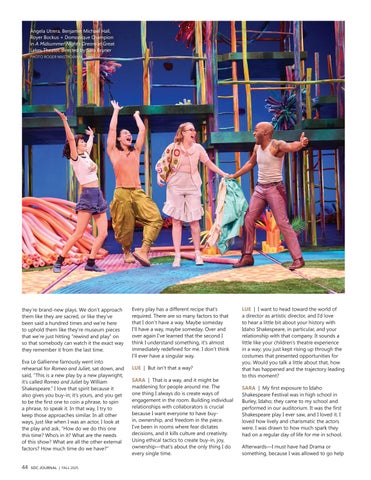
Ángela Utrera, Benjamin Michael Hall, Royer Bockus + Domonique Champion in A Midsummer Night’s Dream at Great Lakes Theater, directed by Sara Bruner PHOTO ROGER MASTROIANNI
they’re brand-new plays. We don’t approach them like they are sacred, or like they’ve been said a hundred times and we’re here to uphold them like they’re museum pieces that we’re just hitting “rewind and play” on so that somebody can watch it the exact way they remember it from the last time. Eva Le Gallienne famously went into rehearsal for Romeo and Juliet, sat down, and said, “This is a new play by a new playwright, it’s called Romeo and Juliet by William Shakespeare.” I love that spirit because it also gives you buy-in; it’s yours, and you get to be the first one to coin a phrase, to spin a phrase, to speak it. In that way, I try to keep those approaches similar. In all other ways, just like when I was an actor, I look at the play and ask, “How do we do this one this time? Who’s in it? What are the needs of this show? What are all the other external factors? How much time do we have?”
44 SDC JOURNAL | FALL 2025
Every play has a different recipe that’s required. There are so many factors to that that I don’t have a way. Maybe someday I’ll have a way, maybe someday. Over and over again I’ve learned that the second I think I understand something, it’s almost immediately redefined for me. I don’t think I’ll ever have a singular way. LUE | But isn’t that a way? SARA | That is a way, and it might be maddening for people around me. The one thing I always do is create ways of engagement in the room. Building individual relationships with collaborators is crucial because I want everyone to have buyin, ownership, and freedom in the piece. I’ve been in rooms where fear dictates decisions, and it kills culture and creativity. Using ethical tactics to create buy-in, joy, ownership—that’s about the only thing I do every single time.
LUE | I want to head toward the world of a director as artistic director, and I’d love to hear a little bit about your history with Idaho Shakespeare, in particular, and your relationship with that company. It sounds a little like your children’s theatre experience in a way; you just kept rising up through the costumes that presented opportunities for you. Would you talk a little about that, how that has happened and the trajectory leading to this moment? SARA | My first exposure to Idaho Shakespeare Festival was in high school in Burley, Idaho; they came to my school and performed in our auditorium. It was the first Shakespeare play I ever saw, and I loved it. I loved how lively and charismatic the actors were. I was drawn to how much spark they had on a regular day of life for me in school. Afterwards—I must have had Drama or something, because I was allowed to go help