On page 7 of the Spring/Summer 2024 Issue, Joel Grey was incorrectly identified in the “Muses & Musings” column as the original performer of the one-man musical Herringbone. The original star was David Rounds. Rounds appeared in the musical’s premiere at Chicago’s St. Nicholas Theater in 1981 and in New York City at Playwrights Horizons in 1982. Grey subsequently revived the musical in 1993.
Letters to the editor may be sent to SDCJournal@SDCweb.org
POSTMASTER
Send address changes to SDC JOURNAL, SDC, 321 W. 44th Street, Suite 804, New York, NY 10036.
COVER Ruben Santiago-Hudson PHOTO MICHAEL HULL
August Wilson’s Two Trains Running at Two River Theater, directed by Ruben Santiago-Hudson
FROM THE PRESIDENT
As I mentioned in SDC Journal’s Spring/Summer Issue, in honor of SDC’s 65th anniversary, last April the Union surveyed Members, asking each of us to identify directors and choreographers whose work has inspired us and transformed the American theatre. More than 500 directors and choreographers were nominated. The list was rigorously discussed by a cross-section of SDC Members, and 65 artists—“65 for the 65th”—were selected to be honored on social media and in a book that we will publish in 2025.
The first honoree, featured in June, was director, Founding Member of SDC, and former SDC President Lloyd Richards, whom I had the opportunity to assist when I was a student at Yale School of Drama. Lloyd’s first of five Tony nominations for Best Director—he won in 1987 for August Wilson’s Fences—was for the premiere of Lorraine Hansberry’s A Raisin in the Sun in 1959, the same year the Society of Stage Directors and Choreographers, as it was then known, was established as a national independent labor union by the presiding justice of the New York State Supreme Court.
Looking at the full list of Member-nominated directors and choreographers, I saw that those who had been impactful for me as a director just starting out and those whose work continues to inspire me today had also been important to others. The list also included people whom I had somehow failed to mention on my survey, but whose influence I clearly recognized.
Although not all of us have the opportunity to spend time in the room with other directors or choreographers, through seeing their work, or reading about their productions or creative processes, or hearing them speak at an SDC Foundation or other event, we learn from those artists who came before us. And we learn from our contemporaries.
This issue of SDC Journal contains articles about and interviews with directors and choreographers written and conducted by other directors and choreographers who were fortunate enough to spend time in their rehearsal rooms. From Awoye Timpo’s interview with Ruben SantiagoHudson, to Kate Pitt’s article about Joe Haj’s recent direction of Shakespeare’s Richard II, Henry IV, and Henry V in rep at the Guthrie, to Camden Gonzales’s conversation with Sonya Tayeh, its content provides inspiring insights into the creative processes and artistic paths of these extraordinary directors and choreographers. The issue also includes the stirring words of George C. Wolfe and Jack O’Brien, 2024 Tony Award winners for Lifetime Achievement, and acceptance remarks from the recipients of SDC Foundation’s Gordon Davidson and Zelda Fichandler Awards, Anne Bogart and Raymond O. Caldwell, respectively, who acknowledge the legacy of their awards’ namesakes as they accept an honor which confirms their own impact on the field. Zelda’s far-reaching influence is also highlighted in Lucy Gram’s consideration of two recently published books about her life in this centennial year of her birth.
As each of us moves through our artistic lives, it’s important and revitalizing to take time to recognize and celebrate those who have contributed to the art form, the field, and our own trajectories, either through their unique creative gifts or through their personal generosity as mentors. It’s also valuable to acknowledge with humility our own place in the theatrical lineage and our responsibility to pay it all forward to the next generation in this ephemeral art we practice.
In Solidarity,
Evan Yionoulis Executive Board President
FROM THE EXECUTIVE DIRECTOR
I write this letter as I am headed back to NYC from Washington, DC. I have had the privilege of working with colleagues on advocacy through the President’s Committee on the Arts and the Humanities, and last night I had the unique pleasure of taking a guided tour through the National Portrait Gallery. I’m a bit embarrassed to say I had never been—perhaps you will excuse me, knowing that I am often in one of the many theatres in DC.
While there is so much to take in and consider, there is a particular moment I can’t shake, a point in the tour I’d like to share.
It was a nighttime visit, and the tour began with early photographs, Picturing the Presidents: Daguerreotypes and Ambrotypes from the National Portrait Gallery’s Collection. These portraits date back to 1843, with daguerreotype portraits of former U.S. President John Quincy Adams being the first, and George Washington represented in the exhibit with an 1852 daguerreotype of his iconic portrait from 1796. I suppose it’s still a daguerreotype even if President Washington didn’t have to sit still for it.
Later, we visited the exhibition America’s Presidents with many well-recognized portraits. Once a very traditional form, by the mid-20th century, Presidents began to break with tradition. First there is Franklin Delano Roosevelt and then Kennedy, Clinton, and Obama. The ritual of capturing our President continues, but the art form seems to be evolving, and portraits are less predictable. There is a separate gallery that has portraits and photos of the First Ladies but, of note, in the America’s Presidents wing, there are two First Ladies on the walls. Only Jackie Onassis, who appears in a photo with President Kennedy, and Eleanor Roosevelt, who is given her own portrait. I’d love to talk with the curator about those choices.
By far the most breathtaking moment for me came in the middle of this tour, as I turned toward the exhibition of Recent Acquisitions. One image: Carmen de Lavallade. The impact of this image on me was apparently not lost on my colleagues. They come from around the country. Scholars, artists, musicians, filmmakers, producers. Having been brought together with the singular goal of promoting the arts, the humanities, and national cultural policy, we are in constant conversation with each other. I learn every time I am in their presence and in community with the federal agencies that so carefully support us with the limited resources granted them.
I attempted to give words to what I have experienced when Carmen walks in a room. Grace and strength, at times humor, every possible kind of beauty emanating from her, and light filling the room and all those in it. I was asked what it is like to work so closely with so many directors and choreographers. I am often asked this question, and it is one of my favorite questions, in any setting.
I said that I believe you sit at the intersection of the arts and the humanities. You are artists, you are historians, you are poets in your own right— choreographers, as with Carmen, whose poetry comes to us as movement—you are educators, and you are teachers. The work of directors and choreographers is often in each of these fields, but I think what is least known about you is that to do your work, you are engaging all these parts of you. Your work in preproduction and in the rehearsal hall is cross-disciplinary. It’s also true that when you leave the rehearsal hall you go to universities or community colleges or studios. You mentor formally and informally. You are civic leaders; you go to school board meetings. You publish nonfiction and fiction, textbooks, and biographies. You are visual artists yourselves, or intimately involved in these forms as your visions take shape. You work in film and TV. You do work that is immersive, traditional, devised, and experiential.
My mind bent toward SDC Journal and our commitment to having this publication capture all that and more about you. To introduce you to one another, to share your artistry, your curiosity, and your never-ending reach for something all but unattainable. SDC Journal has brought some of you together in collaborations or over cups of coffee, or maybe even inspired you to see work you might not otherwise have been drawn to.
Just as I was drawn to Carmen, I hope that you continue to be drawn to one another in these pages. The Union celebrates its 65th anniversary this year. There are many stories that have been told—parts of our past we know something about—and many stories of what is to come still to be told.
As many have likely heard, former SDC Executive Director Barbara Hauptman passed away in August. Barbara’s contributions to the Union and SDC Foundation were extraordinary. A fearless leader and exceptional manager, she guided the Union through innumerable challenges and celebrations. Over her tenure she built a foundation that made it possible for SDC to set its sights high as we fully entered the 21st century. She will be missed. We send our sympathy to her family, her friends, and her community.
In Solidarity,
Laura Penn Executive Director
PHOTO HERVÉ HÔTE
MUSES & MUSINGS
WITH MADELINE SAYET
Who or what inspired your pursuit of theatre?
My mother’s family were Mohegan culture bearers, teachers, medicine people, and leaders, and my father’s family were attorneys. Words had power and stories
did something. Whether at ceremony or at court, words could save or destroy a life. I learned words must be used carefully.
I committed to a life in theatre while performing in a production of Pippin in eighth grade, inspired by the idea that we had “magic to do.” I loved escaping my own reality and treasured the opportunity to take audiences on adventures with me. No one around me understood theatre as a profession, but Mohegan Chief Ralph Sturges encouraged me, saying “it required great latitude of mind.” Only later did I realize he meant that theatre is not just a tool to escape the world but to transform it into something people do not need to escape.
Where do you get your inspiration?
Ecosystems. Stories and inspiration are everywhere. I could watch an ant for hours and there would be a saga there. Just as there is in a kindergarten classroom, or inside a single painting or line of poetry, or a handful of soil. The world and art are entwined. Making theatre means synthesizing the bigness of it all into questions with which I can grapple.
that every story we put into this world has the power to do real world harm or healing. What are the stories that have helped heal you?
In 2013, I watched Colm Tóibín’s The Testament of Mary, thinking, “Don’t they know we aren’t allowed to talk about this?” Hearing Mary say, as mother of her son, “I can tell you now, when you say that he redeemed the world, I will say that it was not worth it. It was not worth it.” Those words broke down a societal wall for me regarding what we are allowed to talk about. That phrase “It was not worth it” still echoes in my mind.
In 2019, I directed Cathy Tagnak Rexford’s beautiful play Whale Song, about an Inupiaq girl who transforms into a bowhead whale and marries the whale leader to maintain the ancient alliance between their nations. There’s this exchange between the young leaders under unsurmountable pressures: “Let me ask you this. An impossible decision is before you. Two choices, both equally life altering. Both equally tragic and magnificent...What do you do?” “You do the best you can.” “Yes, but...” “That’s really all you can do.” These two young leaders navigating the stakes of the world, the truth, and the release of pressure in that answer: this still heals me.
You’ve talked about the idea of “Story Medicine,” the belief
Lastly, in summer 2023, I served as a dramaturg on Ellen McDougall’s production of As You Like It at Shakespeare’s Globe. I love this play and have worked on it many times, but in this production, Rosalind didn’t change back
PHOTO BRET HARTMAN
Evan Rothfeld + Erin Tripp in Whale Song at Perseverance Theatre, directed by Madeline Sayet
PHOTO BRIAN WALLANCEA
into female-identifying attire at the end; they got to stay the person they became in the Forest of Arden. Witnessing that felt like breathing for the first time.
You’re directing Beth Piatote’s Antíkoni later this year. What is inspiring you as you prepare to work on that piece?
For millennia, Antigone has emphasized the importance of burying the dead. Beth wrote this adaptation wondering, “Don’t they listen to their own stories?” Why keep our Native ancestors in their museums? I’m inspired by thinking about how we carry the audience with us on this perspective shift. Beth’s adaptation is a merging of both the Antigone story and traditional Nez Perce stories, so they reflect and refract and make new meanings. What does it mean to tell a Greek story in the Nez Perce tradition?
A Nez Perce story in the Greek tradition? What would Greek masks for Nez Perce stories look like? How do we immerse non-Natives in what a museum experience is to us? Working with inspiring Native actors on this fresh, poetic text, written for this moment by a Native woman, each word can carry many meanings at once.
What’s a great play, musical, or performance that you love that people don’t talk about much, or may not have heard of?
Here are just a few Native plays that I’m obsessed with: Dillon Chitto’s Pueblo Revolt and Pigeon; Vera Starbard’s Native Pride (and Prejudice), Fog Woman, and A Tlingit Christmas Carol; Ty Defoe and Tidtaya Sinutoke’s Hart Island Requiem and Clouds Are Pillows for the Moon; Tomas Endter’s Built on Bones and Hostile;
Joy Harjo’s Wings of Night Sky, Wings of Morning Light; Rhiana Yazzie’s The Nut, the Hermit, the Crow and the Monk; Mary Kathryn Nagle’s Miss Lead; Lee Cataluna’s Sons of Maui; Marisa Carr’s Sturgeon Play; Tara Moses’s Arbeka; and Frank Katasse’s The Spirit of the Valley
But also, I still spend time thinking about the David Greig adaptation of The Lorax and how all theatre should be intergenerationally accountable in that way.
Madeline Sayet is a Mohegan director who serves as Executive Director of the Yale Indigenous Performing Arts Program (YIPAP) and clinical associate professor at Arizona State University. She is a resident artist at Center Theatre Group, member of Long Wharf Theatre’s artistic ensemble, and recently completed the national tour of her solo play, Where We Belong
Kenny Ramos in The Neverland at the Krannert Center for the Performing Arts, written + directed by Madeline Sayet PHOTO DARRYL HOEMANN
INNOVATIONS
BY KRISTJAN THOR
The word “immersive” often confuses me. It’s hard to define. It’s very buzzy right now and although I hear it being bandied about, I often wonder how many of us
have a clear definition of what immersive really means—especially as it relates to theatre, right now. I don’t say that to be mysterious or edgy; I say it because the fact that is it difficult to pin down is exactly the reason I am drawn to it.
My first experience directing something (intentionally) immersive was a modern “horror” adaptation of Maeterlinck’s The Blind in which I put audience members in the hull of a boat on the Hudson, in March, where ice flows scraped the outside of the boat. It was freezing, and we gave audience members parkas and blankets. The actors wore blinding contacts and memorized their blocking by feeling the rivets on the steel floor through their many layers of socks. After the performance ended, we served the audience a meal consisting of only off-white risottos—all different in flavor but not in look. They were served in communal bowls. Thousands of clean spoons sat at the ready so audience members would take one bite and then retire their spoons, which meant everyone was eating together
in a glorious primitive ritual. We drank cheap champagne, and everyone talked about the show—with the actors, with the designers, and most importantly, with each other.
Needless to say, after that experience I was hooked. Directing and producing The Blind (with my longtime creative partner, Josh Randall) became a totem for gauging what excites me, theatrically. The goal became to create affecting events in which the audience’s experience began the moment they pre-ordered the ticket. At one point, we went so far as to use an automated call/text/email service, the kind that is used by pollsters and consumer reporting services, to send cryptic messages teasing the experience. Direct and bold audience engagement became my new mantra.
Over the last 20 years, I’ve directed plays, feature films, commercials, and events, as well as co-created Blackout, a longrunning extreme-fear experience. Many of these gigs have been quite “classical” in their conception: from fourth wall sitdowns to activations at Comic Con. Many
Small Acts of Daring Invention at HERE, directed by Kristjan Thor PHOTO JUSTIN SWADER
less so: from deeply intimate plays in a basement for micro audiences to filling a brownstone with conceptual art and tens of thousands of discarded toy dolls. There is, however, always a desire to give the work a feeling of being allencompassing, regardless of the genre.
When I study up on the theatremakers of the past hundred years, I immediately see that immersive has long been with us, it just wasn’t articulated as such. One thing that has changed is what working “immersively” means in today’s media landscape. The live experience continues to become more rarefied and scarce as screens and augmented reality move to the front of our daily lives. I don’t bemoan this change; in fact, I see many creators capitalizing on it and doing wonderful things with this new technology.
I do, however, hope that it will make the personal and intimate ability that is inherent in immersive theatre stand out as necessary in the world. Simple and personal gestures will begin to mean so much more in a theatrical
experience: sitting alone with an artist intimately whispering their story to me, drifting into the suspended belief that we are the only two people in the world at that moment; being surprised when an actor’s hand is laid gently on my shoulder, both comforted and challenged by its presence; standing in a room that collapses into perfect and total darkness, left only with my thoughts, both terrified and exhilarated.
These are examples of some of the microcosmic moments that have stood out to me as simple, elegant examples of what immersive events can afford our audience. It’s not rocket science, but working with actors and designers to make these experiences present and necessary is what allows the aforementioned moments to stand out.
One thing I’ve come to understand is that performing in an intimate immersive piece requires a whole different set of skills than being on stage. Often actors who have worked with me “experientially” say it can be
hard to go back to the stage because the feedback from the audience is not immediate, as it often is in immersive events. Sometimes actors can quite literally feel the audience react. That type of interactivity can be intoxicating.
With AI set to supercharge the output of consumable media, I think these live, human-driven experiences I’ve been describing will become more and more valuable. It is precisely because these types of events are not scalable that they resonate with audiences. Immersive theatre may also be an ideal foil to our relationship to our “personal devices,” ironically, because it is just that: personal.
Kristjan Thor is a critically acclaimed director of film, theatre, and immersive experiences based in New York. Over the course of a 22-year career, he has directed and produced two feature films and many theatre, short film, and video projects that have been recognized internationally.
Daniel Kublick, David Samuel, Tracy Weller + James Foster, Jr. in Hart Island at the Gym at Judson, directed by Kristjan Thor
PHOTO MARIA BARANOVA
THEATRICAL PASSPORTS
BY MICHAEL JOHN GARCÉS
In July of this year, a Moscow court sentenced director Zhenya Berkovich and playwright Svetlana Petriychuk to six years in prison after a trial behind closed
doors for “justifying terrorism” through their award-winning play Finist the Brave Falcon In truth, their production is a powerful denunciation of terrorism as well as a rigorous critique of institutionalized misogyny by two artists who dared to raise their voices against authoritarianism.
I first encountered this play in early 2021, in the midst of the pandemic shutdown, when I was invited by Philip Arnoult and Howard Shalwitz to attend, virtually, Moscow’s annual “Golden Mask Festival” and, along with directors Yury Urnov and Blanka Zizka, participate in a panel on HowlRound, sharing our responses to the productions we had experienced. We were asked to see a minimum number of productions over the course of a week, of which I viewed nine.
The panel was, ironically, subtitled “Russian Theatre Lives!” I remember being amused by the hopeful and assertive exclamation point. I think the idea was that the stagecraft, vision, and sheer range in terms of style and content
would demonstrate to those of us from other countries that the theatre field in Russia was flourishing. And so it did, at least for me, being very impressed by productions such as Andrey Moguchy’s A Tale of the Last Angel, Kirill Serebrennikov’s The Man With No Name, and Yury Kvyatkovsky’s Spin
But Finist the Brave Falcon is the production that most impressed me at the time and has stayed most vivid in my memory. Produced by SOSO Daughters, an independent theatre project founded by Berkovich, it was one of the only productions at the festival I am aware of that was independent of government support—and, theoretically, oversight. It was completely created, produced, and staffed by women.
It is very much an ensemble play, masterfully directed by Berkovich. It tells the stories of Russian women who are groomed and recruited online by ISIS and other like organizations to leave Russia as brides for—take your pick—jihadists or terrorists in combat zones in Syria and various other fronts in the theatre of war where ISIS actively engages in combat. What they experience is nothing like they had imagined. These women, brutalized by their treatment and by the war, either manage to find a way to return or are captured and deported to Russia, where they are questioned, arrested, put on trial as terrorists themselves, almost always found guilty, and incarcerated.
The production uses various strategies to theatricalize the trials and experiences of these women. The play is warm, precisely staged, makes lovely use of music in ways both witty and moving, and is often very funny. And is deadly serious at the core. The cast was charismatic, talented, and deeply committed. The play examines these women’s dilemmas with nuance and ambiguity, deftly drawing complex portraits of various
Finist the Brave Falcon, directed by Zhenya Berkovich PHOTO ALEXANDER ANDRIEVICH
characters who share the same name, Maryushka, but are nonetheless distinct and individualized.
The production is a fiercely feminist work that clearly stakes out a stringently anti-terrorist position while at the same time offering an uncompromising critique of institutionalized misogyny in Russia as well as the unbearable violence and mistreatment experienced by these women in Syria. It is complex and critical in the way of the best political art, and embraces the moral and ethical ambiguity of their impossible choices. It felt important. It felt urgent. It felt necessary. It was beautiful, as aesthetically exciting as anything I saw at the festival that week, but it was a visceral and disruptive beauty that was engaging and activating.
And, of course, the subtitle of our panel, as it turns out, was indeed ironic. Bluntly ironic. What happened in the play happened to the creators. It is a case study in how Russian theatre—and theatre anywhere—might actually die.
The injustice of the arrest and imprisonment of Zhenya Berkovich and Svetlana Petriychuk should worry any director or writer anywhere. It should trouble anyone who works in or cares about theatre or the arts. It should frighten any citizen who cares about freedom of speech and expression. In a time when schools and libraries across our country are banning books, when theatres and other arts organizations are being forced to program ever more conservatively, when election denialism is rampant, and when women’s rights and trans rights are under dire attack, it doesn’t take much to imagine a similar scenario here in the United States. The attack on their freedom of expression is an attack on ours.
Finist the Brave Falcon, in its vivid lyrical beauty and grievous dramatic depth, is one of the most memorable and effective productions I’ve experienced in the last few years. But even if it had not been, the terrible tragedy of the creators’ persecution would be hugely important,
with the potential for devastating effects throughout the world. Politicians inclined toward the repression of free speech and expression take their cues from what is happening in other countries and what the response is. We cannot forget what is happening to these artists. We have to use our platforms, our theatres, our votes, our online presence, to keep them in mind and heart. And keep theatre alive.
Finist the Brave Falcon may be viewed on demand at stagerussia.com/finist.
Michael John Garcés has served on the SDC Executive Board since 2006 and is currently Executive Vice President. He is a freelance director and playwright based in Los Angeles and a Professor of Practice in the English Department at Arizona State University.
Finist the Brave Falcon, directed by Zhenya Berkovich PHOTO ALEXANDER ANDRIEVICH
YOUR ART IS YOUR SONG OF IMMORTALITY
AN INTERVIEW WITH
BY AWOYE TIMPO
On September 14, 2021, Ruben Santiago-Hudson helped re-open Broadway after the Covid-19 shutdown with the first performance of Lackawanna Blues at Manhattan Theatre Club’s Samuel J. Friedman Theatre. (The play was originally produced in April 2001 at The Public Theater.) The one-man play—the season’s first Broadway show produced by a nonprofit theatre company—was written, directed, and performed by Santiago-Hudson. Accompanied by blues guitarist Junior Mack (performing original music by the late Bill Sims Jr.), Santiago-Hudson played more than 20 roles in this theatrical remembrance of the woman who raised him in Lackawanna, New York, in the 1950s. Miss Rachel—or “Nanny”—ran a boarding house at 32 Wasson Avenue, caring for all who came through her doors; in 2021, her love and strength became a balm for audiences emerging from the pandemic.
As both actor and director, Santiago-Hudson is recognized as one of the preeminent interpreters of the works of August Wilson. He earned a Best Featured Actor Tony Award for his performance as Canewell in the 1996 Broadway production of Seven Guitars. As director, his productions of Wilson’s plays capture the dazzling musicality of Wilson’s words. His 2017 production of Jitney—the play’s belated Broadway debut, at MTC’s Friedman Theatre—was honored with Tony, Outer Critics Circle, Drama Desk, New York Drama Critics Circle, and Drama League Awards.
Santiago-Hudson was interviewed by Awoye Timpo, who worked with him on many productions as his associate director and directs Off-Broadway and regionally. She won an Obie Award for Direction for her production of Alice Childress’s Wedding Band and is the Founding Producer of CLASSIX, a company dedicated to exploding the classical canon through an exploration of Black performance history and dramatic works by Black writers.
AWOYE TIMPO | When did you first start directing? Was it when you were at Wayne State?
RUBEN SANTIAGO-HUDSON | It was before that. They needed somebody to direct when we were doing our shows at the Friendship House Community Center in Lackawanna, New York. Willie James usually directed, but sometimes when he was not directing then I’d direct. But it wasn’t deep. We didn’t have too many lights. We didn’t have much set. We just had talent. That was where I thought, “I really like doing this.”
AWOYE | How old were you?
RUBEN | 15 or 16.
AWOYE | Did you know then that you wanted to be an actor?
RUBEN | I knew I loved acting. I didn’t know I was going to be an actor. I knew I loved it. I thought I could be a basketball player, but you need more talent than I had to be a basketball player. But I found out that on stage—I found this out in college, at Binghamton University in New York—that my artistic talent could carry me and put me in a competitive spot. They would have guest artists come to Binghamton and I’d be acting or working with them, and they’d be looking at me like, “Yo, you going
pro?” And I’m like, “Am I?” It kind of reveals itself to you.
AWOYE | What did you go to Binghamton to study?
RUBEN | I just went because my mama wouldn’t let me take a job in the steel plant. I wanted to take a job in the steel plant. That’s where everybody was making money in Lackawanna. But my mother wouldn’t let me. She said, “You’ve got a good brain, you’re going to college.”
Loften Mitchell, the great writer, was my advisor at Binghamton. He had written Star of the Morning already. Bubbling Brown Sugar is what he was working on at this time.
AWOYE | Did you know who Loften Mitchell was when you got to Binghamton?
RUBEN | No. He imposed himself on me. He heard about this little Black kid running around thinking he’s good. He knew I needed some protection. Being Black and really good at something, being better than other people, you become a threat.
AWOYE | Was Binghamton the first time you started to acknowledge and recognize that?
Lackawanna Blues at Manhattan Theatre Club, written, performed + directed by Ruben Santiago-Hudson
PHOTO MARC J. FRANKLIN
OPPOSITE Ruben Santiago-Hudson
PHOTO MICHAEL HULL
RUBEN | No, the world let me know early on who I was, what the world looked at me as. When teachers would tell me I’m not college material and I shouldn’t even go to college. Or when people would drive by and call me expletives or tell me that I couldn’t get in the swimming pool. My father, who was Puerto Rican, and the kindest person you ever met, that I ever met, would just pile us in his car—us being 11- and 12-year-olds, not even teenagers. He would take us to the pool in Cazenovia Park and tell everybody, “Get in, get in. Take a swim. Everybody’s swimming.” And the white people would just get out. So they let me know early on that I wasn’t welcome in a lot of places.
AWOYE | How did you navigate that at Binghamton? Because you’re doing a thing that you’re great at—
RUBEN | I don’t know about great; I was good at it. I’m still trying to get to be great.
AWOYE | And you have this mentor, this legendary person at the program. How did you navigate those four years? How did you uncover your artistic voice?
RUBEN | I started creating my own. I started doing things during Black History Month—I would do programs at the social
room, and I would put together poetry and monologues with a couple other Black people who weren’t in the theatre department but wanted to be actors. Or I’d get my conga player and we would just run some revolutionary poetry, and I’d have a couple dancers with me. I was putting together shows.
I would audition, I would get little roles or character roles in Binghamton playing old men with cotton in the side of my mouth and a lot of makeup on. Never playing who I was. And then I was cast in Sizwe Banzi Is Dead [by Athol Fugard, John Kani, and Winston Ntshona]. The director was in grad school, but he really wasn’t a director. He wanted to be a writer or a dramaturg. But they thrust this upon him, to direct the Black play, and he basically fell apart in rehearsal, and I said, “Don’t worry, I’ll direct it.” He said, “If I don’t direct it, I won’t get my master’s.” I said, “Don’t worry. Your name will be on it as the director.” It took the campus by storm. Everybody had to see Sizwe Banzi Is Dead And no one knew that I directed it.
AWOYE | What do you think you brought to that production as a director?
RUBEN | Authenticity of the struggle. Authenticity of the people who feel they
are below, trying to rise up. I brought that to it. The other part, the cultural part, I had to really, really do research. At one time I was talking to this South African brother, and I was wanting him to tell me about South Africa. Now we are talking about the ’70s. And he would not talk to me about it. He was at this prestigious United States university. He said, “There are things I should not talk about.”
One day at the pub, he said, “I’m going to give you something, but you cannot share it. You have to give it back. Give it back to me tomorrow.” It was a tape, a VHS tape of police shooting school kids who were protesting. Shooting them, killing them. If it came out that he gave me this information, he would be deported. But I started really realizing the depth of the turmoil, the depth of the atrocities, and it gave me a deeper, more profound direction of what I needed to say and what this play meant.
AWOYE | That story helped to ground the play in an experience that you wouldn’t know otherwise.
RUBEN | That opened it up, and then he opened up to me and started talking to me about what it was like, about the mine workers and the trains that came by that
Chuck Cooper, Jason Dirden, Brandon J. Dirden + Roslyn Ruff in August Wilson’s
The Piano Lesson at Signature Theatre, directed by Ruben Santiago-Hudson
PHOTO JOAN MARCUS
picked up African workers from different villages. Sometimes they had to jump on the train, and they would take them to the diamond mines, and they would be working 14 hours.
These were things I did not know. I was in college. I read, I had access to information— but not this information, not firsthand, not to this guy sitting here with his eyes turning red and tears just dripping down his face.
game, coach.” I can’t do that, motivate, if I can’t lead you properly. Any good leader should be properly prepared for whatever the battle is. I don’t believe in stalemates. Mediocrity is nothing that I want any part of.
AWOYE | You’re in it to win, as it were, to make it great and successful.
RUBEN | That’s the goal. To get up every morning, excited to be better and know
Contentment is your enemy. RUBEN SANTIAGO-HUDSON
AWOYE | How do you think about what your responsibility is to research and to learn and understand everything about the world of a piece as you’re preparing for a project?
RUBEN | My style is to fill myself up to bursting with information and allow it to reveal itself in the process. Sometimes I’ll come up and do a 20-minute lecture before we start rehearsal. Sometimes it’s historical information, sometimes it’s motivation. But I want everybody to be like, “Put me in the
more and do better. Contentment is your enemy. That’s one of my mottoes. I teach it all the time. Contentment is your enemy. Just when you’re satisfied, somebody is going to pass you. That’s the way I was as a so-called athlete, and that’s the way I am as a director.
AWOYE | What’s your balance for taking care of people and also really pushing them?
RUBEN | You know how it is when you’re a director. You become the therapist.
Sometimes you’re leading, sometimes you’re following, sometimes you’re listening, sometimes you’re talking. Sometimes you have to have a real sober, bold conversation.
AWOYE | You have high expectations for everybody who walks into the room; you’re taking care of them, but also setting a standard for how the room is going to work and function. How did you come to find that balance or understanding of what your responsibility is to the room?
RUBEN | Well, I am the director. Since I invited everybody to the party, it’s my job to be a good host. Every individual has different needs. You just got to know how to read it. Sometime if I’m working with Brandon [J. Dirden] and he does something, I may say, “You know better than that.” I might have to go to another actor and say, “Now what did that mean when you did this?” I have to make them explain it to me so it can be clear. I say, “Well, does that serve the moment? Does that serve the play? Or can we serve it better? Is there a better option?” That might be the tact for that person.
Or I can just call out to a person like Harvy Blanks, “Harvy, you are doing three things
Michael Potts, John Douglas Thompson, Anthony Chisholm, Keith Randolph Smith + André Holland in August Wilson’s Jitney at Manhattan Theatre Club, directed by Ruben Santiago-Hudson PHOTO JOAN MARCUS
when you walk into the room. You’re mugging this, joking that, dancing this. You get to do two of them. Drop one right now. You pick.” “Which one should I drop?” “You pick, I’m going to give you two. You get the ‘hey’ and then you get the punch. That’s it.” I could talk to him that way. Every actor, you can’t talk them that way. That’s my people.
Even when I’m casting, people wonder why I spend 15 minutes, 20 minutes with an actor when they come in. Because I want to see how they react to my energy, the needs that I feel the play has, the needs that I have, the needs that their character has. Can you serve them?
AWOYE | What are you looking for in the audition room?
RUBEN | I like people who are striving, who understand their responsibility, so they’re striving to please the ancestors. They want the ancestors to be pleased at what we presented to the world. And it gets a little deep and ethereal.
But I think it’s very important because we, as people of color, we don’t get as many opportunities. So those we get—don’t squander them. Don’t do some play about, “Whoa, the paint was drying, but it didn’t dry that well.” Other people can write plays about that.
AWOYE | Let’s circle back. So you finished at Binghamton. What did you do after that?
RUBEN | Went to grad school. I was going to come to New York. I had an offer to do a play in New York, just a little role, but it was in New York. I had never lived in New York. I lived in upstate New York, 520 miles away. I didn’t have a place to live, and one of my professors, Don Boros, suggested that I go to grad school.
At the time, I was doing Equus, playing a horse in a regional theatre [in Binghamton]. So I got on the bus after the show and did an URTA audition at 8 am in the morning at the Roosevelt Hotel. Afterword, you wait in the lobby, and they come around at 1 pm and they call your name and hand you an envelope. I opened up my envelope and I had a list of offers from 13 universities.
So I was contemplating it; I wanted to do classical theatre. Professor Boros said, “Why do you want to do classical theatre so much?” I said, “Because Professor so-and-so told me I wouldn’t be able to do classical theatre because my lips were too big. So I’m going to show him that these lips I’ve been using my whole life are good for classical theatre.” So I took the scholarship to Wayne State. They gave me a full scholarship and per diem and made me a teacher’s assistant. I got a check every two weeks so I could get my housing and keep gas in my car, and learn classical theatre—I thought.
AWOYE | Can you tell me about who the people were that you met at Wayne State that really helped to shape you as an artist, as a director?
RUBEN | My first good buddy, Dr. Von Washington, was working on his doctorate. I would wear him out because my hunger and thirst for knowledge were insatiable. I would constantly knock on his office door and say, “Look, have you read Big Man by Randolph Edmonds?” He’d be like, “Rube, I ain’t got time.” “No, let me read it to you.” And I’d read some of it. “Man, come back tomorrow and read the rest.” As soon as I finished it, I would come back in. “Have you read Goin’ a Buffalo by Ed Bullins?” “Rube, I ain’t got time.” “It’s a long play but give me three days. I’ll read the whole thing.” So I just read everything in Black Theatre USA and Black Fire, and he would direct me in plays.
It started because I didn’t get one lead role at the Hilberry Classic Theatre, zero. [Wayne State University’s graduate repertory theatre company, Hilberry Classic Theatre, was founded in association with the university’s Graduate Performing Training Center in 1963.] So I did something radical on my fourth play. I walked off the stage in the middle of being the rug bearer and left the rug on. I was just not carrying another rug. I just had had it. The first play, Pygmalion, I was bystander number two. Wild Oats, I was ruffian three. Antony and Cleopatra, I was the fan boy and rug bearer. I got to the fourth play, I said, “I can’t take it.”
AWOYE | You’d had enough. Did you have a kind of a breakdown?
RUBEN | I wouldn’t call it a breakdown. It was a defiant act. I was like, “I’m out.” They didn’t want to kick me out because I was the only Black guy in that company. They were like, “Are you okay? What’s wrong? Do you need...” And I said, “I’m just sick of it. I can’t take it no more.” They told Von to talk to me because that was my buddy. And he said, “Hold on, hold on. You don’t want to lose this. Who else got a master’s in Lackawanna?”
I said, “I don’t know anybody got a master’s.” “Well, get your master’s. Don’t leave. Let’s figure this out.” I said, “Von, I’m sick of it.” He said, “Let me go talk to the white people, because you don’t know how to talk to them.” So we go to talk to Leonard Leone, who started and ran the Hilberry Classic Theatre. Von appeals for me; they love Von. Von is the charming-est. So I step outside, and they talk for a little while. Von comes out, he says, “Okay, okay, okay. What do you want to do? Because they’re going to loan you to me for the Black Theatre Program.” I’m in grad school. This was an undergrad Black theatre touring company that Von was the director of. “What do you want to do?” I said, “Native Son. I want to play Bigger.” He
goes back in the office, closes the door. I’m still sitting there.
He comes out, he says, “Good news and bad news.” I said, “What’s the good news?” “You are going to do Native Son, and I’m going to direct you in it.” I said, “Great. Give me the bad news.” He said, “It’s at the Bonstelle Theatre [a theatre and former synagogue owned by Wayne State], which has been closed for two years. We got to open it up and clean it up.”
AWOYE | That’s incredible.
RUBEN | This is a story that makes me cry when I think about it. My other buddy was the custodian. Bill’s his name. I call him Still Bill because he always moved real slow. He used to be a boxer from Alabama. He took us to the Bonstelle Theatre, me and Von, when the day came that we had to go look at it. We got to the parking lot, the weeds were high—three, four feet high—in the parking lot. It was all boarded up, the windows. It’s a domed building, a gorgeous, historical theatre. So Bill said, “I’m going to go to this door.” I run in behind him in the dark. I walk onto the stage, and I look up. There’s a double mezzanine and there’s this big dome. I looked up to the top and I said, “Ma, I made it.”
We cleaned up that theatre and we did Native Son, and we broke attendance records. The last time Native Son was done there in 1943, Canada Lee did it. Canada Lee did it, and then I did it. After that, my name’s still ringing in Detroit. That’s why I go to Detroit. Ruben’s in town. It’d be in the paper. Ruben coming.
I stayed a year with the theatre, directing and acting. After graduation, Von said, “Why don’t we form our own theatre company?” So we formed the Afro-American Studio Theatre. We made all our money during Black History Month. We toured all our
plays—we did a lot of schools. We did rehab centers. We did jails.
AWOYE | What kind of work were you doing?
RUBEN | Wine in the Wilderness, Home. We actually did a big musical at the music hall, Purlie, in which I played Purlie. We did some new work. When we didn’t have our whole company together because we couldn’t afford to pay them all, then Von and I would just go. We would read words of Malcolm and Martin, or poetry, just to keep money in my pocket. The thing was, keep money in Rube’s pocket so he doesn’t go to New York.
AWOYE | Who are some of the directors you have learned the most from or looked up to the most?
RUBEN | Lloyd Richards, George Wolfe, and Douglas Turner Ward. Completely different styles, completely different men, but all extraordinary in their own way, and all gave me a lot to think about to incorporate into my process.
AWOYE | What did you learn from each of them?
RUBEN | Patience from Lloyd. George, never being satisfied, always going deeper, and being bold. Doug was more about not overdoing things. Avoiding excess. You are enough. Those strategies work very well for most people, but not for everybody.
AWOYE | These are three amazing men, amazing artists—
RUBEN | I have to add one woman, [actor and theatre director] Billie Allen. She taught me a lot more about myself than directing. She always made you fabulous. No matter when you felt your lowest, her squinting her eyes and looking at you and saying, “You are fabulous”—you just felt it. Okay, I can walk through a wall. So that lady, that woman,
LEFT Awoye Timpo + Ruben SantiagoHudson in rehearsal for August Wilson’s Jitney at Manhattan Theatre Club
PHOTOS LIA CHANG
that beautiful woman, she taught me a lot as well.
AWOYE | When you think about Lloyd as a director, do you remember a moment, a note he gave to you that revealed something new to you, or something that he did as a director where you were like, “Oh, that’s how you do it?”
RUBEN | Too many, too many things. He never would give you the answer. He would ask a question and he demanded you supply the answer. If you didn’t supply the answer, he would ask the question again a different way, or sometimes the same way. So he would let you know that you’re not answering the question or you didn’t do what he wanted. One day he said to me— I was in the middle of rehearsing a scene [in August Wilson’s Seven Guitars] that I’m really not active in, and it made me kind of uncomfortable because just being there was really uncomfortable. So I moved off a little bit and sat down on the steps and just watched the two actors who were principals in that scene.
So he said to me, he said, “Canewell?” I said, “Yes, sir, Mr. Richards?” He says, “Where did you go when Floyd and Vera were hugging?” I said, “I went over and sat down on the steps and just watched.” He said, “Okay. We’re going to do it again after a break.” That was it. So when we came back and they started hugging, and because I love Vera just like Floyd loves her, they start hugging and I didn’t move. I stood there on one side of Floyd while he’s hugging Vera. I didn’t look at him. I didn’t move. I just stood there. Lloyd never said another word.
AWOYE | How about George? He’s such a master at catching the audience, but I’m wondering also about things you learned from him as a director.
RUBEN | George had a way of emboldening you, making you bigger than life or feel that way, and building you up. Billie Allen did that in a different way. George did it in more of a way that empowered you, not only physically, but intellectually; you felt that you were in the smart set by being with George and him spending time with you.
George had a way of passing on that acceptance of your brilliance and your boldness through the rehearsal process. He would say, “You know what I mean? Know
what I mean?” Whether you know what he meant or not, you’re nodding your head, “Yeah, I know what you mean.” So this is a gift of that too, because actors get caught so many times in doubt and George just won’t allow it.
AWOYE | I’m trying to think of the thing that encapsulates Douglas Turner Ward’s energy and spirit as a director.
RUBEN | He would take off the adornments that you had. You would come on with all these things that you wanted to project to the audience and Doug would make you drop them. The way he gave notes, people needed an interpreter. I understood him because I had been around people that talked like him my entire life, because I was raised in that rooming house. Doug is a boy from a farm in Louisiana who walked to the University of Michigan. The kinds of people that would hitchhike and walk and jump a train were the people that taught me the life
they want to compete with you. And they should compete with you, but later. They don’t apprentice enough in my opinion. I may get in trouble for saying it. Somebody offers a play to a younger director, and they get a decent review and that’s it. Where’s the growth? Where does the continued growth come from other than just the process of continuing to do work? Who are you listening to? Where’s your Lloyd? Where’s your George? Where’s your Doug? Where’s your Billie Allen? Are you interested in being next to them? No, you want to compete. What we don’t understand is that there’s still learning to be done.
AWOYE | When you are thinking about ideal opportunities and pathways for directors— new generations of directors, early- or midcareer directors—are there things that you think should be taken advantage of?
RUBEN | The best knowledge that I’ve accumulated has been being an actor and
The first thing you have to tryto build is trust. Trust in the fact that we are all in this together. RUBEN SANTIAGO-HUDSON
lessons in that rooming house, 32 Wasson Avenue with Nanny. I could interpret it, so I would have to interpret it to other people who weren’t country.
Doug would just, in his own way, make you stop the posing and profiling, stop being aware of yourself, and he would say it his own way. “It won’t interpret well when you come... no, no, no, don’t come in talking about… Boom, bam, that’s all.” That’s Doug.
AWOYE | That’s wild.
RUBEN | “Boom, bam. That’s all.” That means say your line, he’ll say his line, and it’ll be there. It’ll be there what’s supposed to be there.
AWOYE | I think a lot about the ways that directors get cultivated and have space to do their work, experiment, and try things out. I’m wondering what your thoughts are about what needs to crack open for directors, especially young directors, to allow them to find their way and stay true to their artistic voice when there’s not really that much space for that in the industry.
RUBEN | Well, it’s a different time now. The younger directors, and I could be wrong, but the way it seems to me is they don’t want to apprentice. They don’t want to stand next to you and be your associate;
being in all these rooms, doing over 100 plays and being with all kinds of directors. There are other directors I’ve worked with that were very good directors, very good directors, and I had a good time with them. But most important is to make me say I need what they just did in my toolbox, I need to take note of how that was handled, how that was done. What people don’t understand about direction is that it’s not just direction, it’s leadership.
AWOYE | There’s a conversation happening these days about the idea of leadership and the idea of hierarchy. I wonder how you’ve been thinking about that. As directors, as you say, so much of the work and the role is about being a leader. I wonder if you’ve been thinking about the tension between leadership and hierarchy at all.
RUBEN | Well, everybody looks at leadership in a different way. I don’t lead in a vacuum; I lead being surrounded by people I can collaborate with, who help inform me of how a decision should be made. I don’t make any unilateral decisions. I need information from everybody in the room and then I need trust that I’ll make the decision that’s best for us, our vehicle, for what we are all a part of. I try very hard to earn that trust. But there are some people that don’t want to hear nothing from nobody. I’m sitting in the room with a director once and he said,
“When I say something, don’t question it. I know everything about this play. Just do it and you’re going to be all right. If you start questioning, it’s going to be a train wreck.”
I want to be accepted in my weakest and most vulnerable, in my most powerful, in my most silly, in my most angry interpretation, so that who I am is going to find its way into this play. And then we just have to refine it. But if I can’t do none of that, if I’m just waiting for your instruction, I don’t need to be here.
I didn’t get kicked out of that one and we ended up finding a way to coexist.
AWOYE | How do you start your rehearsal process?
RUBEN | Well, I think after the regular process things—introductions and the artistic qualities of the play, the lights and the style and the costumes—then it is trying to begin to build this family around this purpose. We get around the table and figure out what this play is, even though we all think we know. But I want to make sure that any question that anyone might have gets asked; no question is a silly question. If we don’t have an answer, we should say, “We going to find that out in the process.” But everything should have a moment.
We’ll sit at the table until we don’t want to sit at the table no more, until everybody’s, “Let us up, coach,” and they can’t sit in the chairs anymore and they start walking around reading the script. That still doesn’t mean you’ve got to let them up. Let the lions and the tigers keep running to the edge of this cage and bump into it and then finally open up the door and then they just know right where they want to go. Then you start refining it and honing it, but always have a plan. But the first thing you have to try to build is trust. Trust in the fact that we are all in this together. Trust in the fact that we all have a common conversation and idea of what this play is about.
AWOYE | Do you have bucket-list plays?
RUBEN | They keep stealing the ones I want to do. That’s why I’m doing all new stuff. But it’s got to be a mix of our classic plays that we define and our new plays. It’s got to be a mix because they’re related. They’re kin. We can’t leave that behind. Some of our stuff is dated and a lot of it is straight to the day. No Place to Be Somebody. They wanted me to do that on Broadway for a long time. I just didn’t want my first play on Broadway to be about pimps.
AWOYE | Right. It’s such a good play, but it’s a hard play to do.
RUBEN | I might consider it now. I’d love to do Big White Fog. I’d love to do that. I want to do some more Shakespeare. I’d like to act in a really good play. I like a great role for myself. Because people forget that I can do that.
They saw Lackawanna Blues, but act like, “Oh, that was easy, he just walked out the bed and fell into that.” Like I didn’t have to really do that work. And no one has mentioned publicly that I’m the only person in the history of Broadway to write, direct, and star in a play.
AWOYE | That’s amazing.
RUBEN | No one’s ever said it anywhere. It didn’t bother me because I didn’t know until Jeannie, my wife said, “You might be the only person that ever did that.” We called the American Theatre Wing, and they were like, “No. We did the research. No one’s ever done that.”
AWOYE | We think so much about all these amazing artists who preceded us. When you think about even what you’re just telling me now, how do we make sure that we’re keeping these stories alive?
RUBEN | We have to acknowledge our successes. The other thing that I’m very
aware of is that none of my success is possible without all the people that fortified this journey I’m on and continue to do so. From when I was a small child to today, people have continued to offer me their grace and generosity.
Jim Houghton got me. He understood me. George, I would push, knock his door down, sit on his doorstep handing him scripts. “You’ve got to read this.” Gregory Hines was one of the most instrumental people in my entire career. He wanted me to be Ruben. He would always say, “I love you in all your Ruben ways.” He directed two movies; I was in both of them. He would come up to me after I did a take and he would say, “Do that Ruben thing.” That’s it. Just do the Ruben, be Ruben.
When I look up and I don’t have him, and I don’t have Bill Sims and I don’t have Harvy [Blanks] or Chiz [Anthony Chisholm]… that’s my team.
AWOYE | That’s the family.
RUBEN | Look at Chiz, one of the finest character actors I’ve ever seen in my life. Precise. People just thought it was him being him. I mean, precise when he folds his coat or when he gives a look, or how he unscrews the bottle, the effort it takes, it’s all acting.
How, when he walks out a door, he does not grab the doorknob, he reaches back and grabs the door frame to pull it closed. Who does that? I would point it out to Trey and Lily, my kids, and say, “Watch it. Watch it.” I said, “I guarantee you he going to reach back and grab the door frame.” Just excellent.
No one fully appreciates or acknowledges the brilliance in our community. We will applaud mediocrity. We just, as a community, have to not allow that. I don’t know what we need to do to not allow it. One of the things I want to be said, Awoye, is this: until our community, those that have the greatest impact and power in our community— financial or political influence—until theatre is important to them, we’ll never build our own or have our own. All of us just marching the march and out there on the battlefield. We got nothing. We can’t build it. We ain’t got the money. Those that do have the wherewithal think acting in theatre is just cute to have around. And it has to be important because it is seen as who we will be for the rest of the civilization in history.
AWOYE | How do you educate and bring people in to an understanding of the importance of art at all, Black art in particular, to galvanize those resources?
August Wilson’s Ma Rainey’s Black Bottom at Two River Theater, directed by Ruben SantiagoHudson
PHOTO T. CHARLES ERICKSON
RUBEN | It’s got to be important to them. I have a lot of energy and a lot of passion. But I get weary too. Sometimes I feel I’m just on the top of the mountain or on the bottom of a well, and it ain’t going anywhere. So I get tired and then I just start thinking, you know? “Shit, I’ve been working for 48 years professionally. I got five pensions looking at me. That don’t make me a rich man.” I’ll never be a rich man in that respect, but I’m rich in a lot of other ways.
I don’t need this. But I love it. So I get up every morning and want to do it. I can’t imagine a world without it, but it’d be much easier for me to fold my tent up, get my tools and put them in my toolbox, take my little history. I’d have made history; I’d have made my mark. And then I wake up the next day and I laugh about it and say, “Nah, nah.” Who is going to say charge if I don’t say charge? It gets on a lot of people’s nerves that I say “Charge!”
AWOYE | When did you first realize that theatre can have an impact on people?
Because I feel like you’ve always very much been about making the work, but also very much been thinking about the audience and who the work is serving. When did you first get an understanding about what that relationship is between the work and the audience?
RUBEN | It was progressive. It kind of grew. People kept putting microphones in my mouth and sitting down with tape recorders and wanting to hear what I had to say. It dawned on me that a lot of what I was saying was about empowering my community. And then some people would say, “You need to stop saying that.” “Well, I can’t reverse it now because I’ve been talking about empowering the community for a long time. So if I reverse it, they’ll know I was a charlatan so they wouldn’t even buy it. They’ll laugh.”
As I said earlier on, we don’t have opportunities to squander. At the Lortel Awards, when I went up to do my speech, all I knew was that what I wanted to say had to do with the value. The value in our
community of acknowledging the power in our community. It’s some currency in us knowing who we are. And it also is a threat in us knowing who we are. “Don’t squander your opportunities with your art. Your art is your song of immortality. You will live forever when you’re great as an artist.” They’re still talking about Honi Coles. They’re still talking about Romare Bearden. They’re still talking about Alvin Ailey. Greatness lives forever. So what do you want your greatness to be defined as? That you represented your people in the highest standard of integrity.
AWOYE | So you’ve always had good boundaries so that people can’t just pull you in whatever direction they want to go.
RUBEN | How do I feel in the morning when I look in the mirror? How do I feel when I look at my kids and my kids see this work I’ve done? They don’t like a lot of characters I played; they get scared of them. They be like, “Dad, you were so believable as that.” But because some part of me has to get magnified in that performance. There
Destiny of Desire at the Old Globe, directed by Ruben Santiago-Hudson PHOTO JIM COX
are parts of me that have to be magnified even more so when I’m directing, because I want everybody to know who their leader is and what that leader expects from everybody there. But your leader also has to be accountable. If stuff is continually going wrong in your room, did you look at yourself? Even if I don’t want to, if I’ve had a bad experience with someone, or am having a bad experience, I have to look at myself, and say to them, “I’m going to be better. I got to do better for the process, for you. I want to be better.” But you know what that means, though. It’s got to be reciprocated. Particularly speaking truth to power.
I couldn’t do what I do without all the people fortifying the journey. They keep me strong, they keep me fierce and they keep me fearless, and they keep me knowing that “it’s all right, we’re with you.”
I’ve had people walk up to me that you would not believe. Maya Angelou sat me down. We were at an event, she called for me. She said “Keep doing what you’re doing. We’re not going to let them hurt you.” I don’t know what that meant, but why she felt compelled to say that to me made me feel like, “Okay.” Ossie Davis, Ruby Dee, the same thing. Harry Belafonte. Why do they say this to me? Because they recognized that I’m out there.
AWOYE | I feel like your North Star is the integrity of the work. Are there things that you are working on as a director?
RUBEN | Some really exciting stuff. First up is John Leguizamo’s The Other Americans, which is his first real full-length drama, a six-character drama. It is an amazing, deep American tragedy. [The Other Americans is
being produced this fall by Arena Stage, in association with The Public Theater.]
Next year I am directing John Kani’s twohander, which is a brilliant South African play called Kunene and the King. [Kunene and the King will be produced by the Shakespeare Theatre Company in February–March, 2025.]
AWOYE | Is it new?
RUBEN | He did it in South Africa and he did it in London. This is the American premiere, which is set to tour the country eventually.
I am also working on three other incredible projects that I can’t name yet, but they are all dynamite in their own ways.
AWOYE | My last question is, what does it mean for you to be a storyteller?
RUBEN | I’m born to it. I’m born and bred and raised in storytelling. All I’ve ever known was people telling me stories. Anything these old Black illiterate men would tell me, or women would tell me—the women sometimes had a little high school education, some would have what they call a little piece of college. Like a year or semester in college. But most of the men were illiterate or didn’t have a lot of formal education, and the only way they could communicate was either physical or in the story.
So I learned by mimicking them. So in paying respect to them and then paying more respect into who I am, it’s being true. I’m a storyteller. And it’s very important that we create the narrative and then we direct the narrative. Because things that are important to us as a people, no one is privy to, unless they’re in the room with us in these times.
And most of the people, a lot of people directing plays about us ain’t in the room. So they don’t know how we behave when they’re not in the room.
Their narrative does not have to change so much sometimes. Ours does. We feel we have to go into a room in an environment to make white people comfortable. If we make them uncomfortable, it’s not a good thing for us. So a lot of times we can’t be who we are. That’s why I loved August’s plays and fell in love with him. He said things and did things, and he didn’t care if white people said, “What does he mean by that?” “My feet ain’t on backwards.” “I ain’t studying you.” You got to be Black and colored to know how that is. And if you want to know how to be colored, listen to the blues. They never stop, blues men don’t ever stop being colored. They just colored. The way they tell their stories with cultural specificity— Langston Hughes, Zora Neale Hurston, James Weldon Johnson—you know? That culture has to be preserved and who else to preserve it? Who else has the responsibility but the storytellers with the same hue we have, the same melanin we have. Or it’s going to get lost. Like a lot of other things born from us, it’s going to get taken.
Awoye Timpo is a Brooklyn-based director and producer. She will direct the American premiere of The Swamp Dwellers by Wole Soyinka at Theatre for a New Audience in spring 2025.
Anthony Chisholm in August Wilson’s Jitney at Manhattan Theatre Club
PHOTO JOAN MARCUS
Brandon J. Dirden + Harvy Blanks in August Wilson’s Ma Rainey’s Black Bottom at Two River Theater, directed by Ruben Santiago-Hudson PHOTO T. CHARLES ERICKSON
the MUSCLE the CLARITY the DETAIL
JOSEPH HAJ & DIRECTING SHAKESPEARE’S HISTORY PLAYS AT THE GUTHRIE
BY KATE PITT
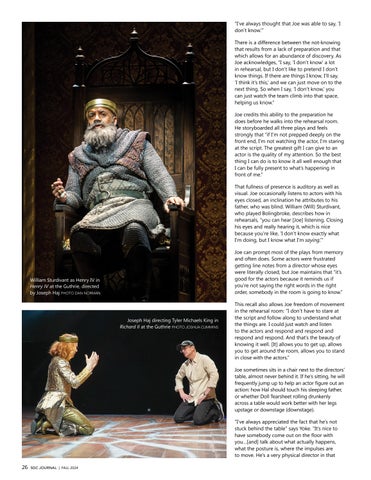
Tyler Michaels King, Melissa Maxwell, Daniel José Molina, Jimmy Kieffer + Stephanie Anne Bertumen in Henry V at the Guthrie, directed by Joseph Haj PHOTO DAN NORMAN
Earlier this year, Kate Pitt served as part of a team of associate and assistant directors who worked with Joseph Haj on his marathon staging of Shakespeare’s History Plays: Richard II, Henry IV, and Henry V at the Guthrie Theater. In an expansive essay, she takes readers inside the rehearsal room.
“I wanted to make those plays since I got to the Guthrie nine years ago.” When Joseph Haj was announced as the Guthrie Theater’s eighth Artistic Director in 2015, he was already thinking about directing Shakespeare’s Richard II, Henry IV, and Henry V. “It wasn’t that he wanted to do them right away,” remembers casting director Jennifer Liestman, “but he told us, ‘This is something I’d like for the Guthrie to tackle again.’”
The Guthrie previously staged the plays that make up Shakespeare’s second tetralogy— Richard II, Henry IV Part I and Part II conflated into a single play, and Henry V—in 1990. Then, the Guthrie still had a resident company of actors and Artistic Director Garland Wright wanted to test them with the “ultimate challenge.” Actor Stephen Yoakam (known to everyone as Yoke) played Bolingbroke in that marathon staging, which was co-directed by Wright and Charles Newell. “That first day of rehearsal,” he remembers Garland saying, “‘We’re not ready to do this, but fasten your seat belts, because we’re going.’ I don’t think he thought at that point that the company was experienced enough, but he knew they were aggressive and hungry enough to be able to tackle a project that size.”
Anyone preparing to take on the plays collectively and colloquially known as “the Histories” will be hit by their scale: more than 150 characters and 13,000 lines of
text describing 22 years of English history between 1398 and 1420. Some of the most famous characters in English literature (Falstaff) and history (Henry V) as well as lines well-known enough to be cliché: “Uneasy lies the head that wears a crown,” “We few, we happy few, we band of brothers.” Since 1990, SDC Members have filed 23 contracts for full productions of Richard II, 48 for Henry IV, and 51 for Henry V. But no directors—other than Wright and Newell, and now Haj—have made all three plays at once, in rep.
Simply staying upright seems like a win, but Wright and Newell had a more expansive goal. “The purpose of the show was to create company,” remembers Tree O’Halloran, a long-time Guthrie stage manager who worked at the theatre in 1990 and stagemanaged the Histories in 2024. Garland wanted the company to “work together, for a long period of time, on a canvas that was enormous,” recalls Yoke. “You were called all the time to do something. If you weren’t working on Henry V, you were working on Richard II in a different space. You’d pass somebody in the hallway, and he’d say, ‘What are guys doing today?’ ‘We’re doing Henry V.’ ‘Which part of it are you doing? Because I’m in that next scene.’ It was always mixing and matching and sprinting to catch up.”
Joe Haj was one of the runners then. After performing in JoAnne Akalaitis’s production of The Screens in 1989, he returned the
following year to play Bagot, John of Lancaster, and Bedford in the Histories and Henry Antrobus in Robert Woodruff’s production of The Skin of Our Teeth. Joe was 26 and, Yoke says, “obviously from the get-go really, really amazing at handling language. He also had a physical presence because he was an athlete…a talented, physically gifted young actor.” Many members of the company were ex-jocks and played basketball together on Fridays. Their enthusiastic athleticism was transfixing on stage.
Yoke remembers how in Henry V, the actor playing the king stabbed a knife into the stage floor at each performance and Joe’s job as Bedford was to clear it at the end of the scene. One night, the actor “stabbed it so far into the deck that Joe couldn’t get it out. He was sitting there going like this [pulling] as the scene was changing, and he was completely exposed and completely embarrassed. I think he finally just yanked it out, but [the transition] bled into the next [scene].”
No knives were embedded in floors when Joe directed the Histories in 2024. Originally scheduled for the 2020–2021 season but delayed by the COVID-19 pandemic, the plays still felt important to produce after four years. “I think you could have produced them any time in the last 400 years, and you would never be mistimed,” Joe says.
Joseph Haj (LEFT) addressing cast and crew of Richard II at the Guthrie PHOTO JOSHUA CUMMINS
“Their themes center on leadership, and the cost of leadership. Themes about our overweening ambitions and what trouble our pesky egos can get us into. These are things that are always true, always relevant, always conditions of being human. Ambition at what price? Ambition at what cost, to myself or to others? What is one willing to sacrifice to become a person who, for whatever reason, wants to wear that crown?”
Although the 1990 History Plays were codirected (and Joe had previously co-directed Henry IV and Henry V with Mike Donahue at PlayMakers Rep, where Joe served as Producing Artistic Director), he decided to lead the 2024 Histories solo with a team of associate and assistant directors.
Joe developed his strong opinions through long experience. His first directing job was Henry V with inmates in a maximum-security prison. The 2024 Guthrie Histories would
be his third Richard II, third Henry IV, and sixth Henry V as an actor or director That familiarity armed him with “an accumulated knowledge of where the cul-de-sacs are. Where it’s like, ‘Wow, we spun out in that thing, and I had the actors in that space for three weeks before I realized there’s no there there and had to bring them back.’” With only eight weeks of rehearsal before tech, there simply wasn’t time to get lost.
“If I hadn’t worked with Joe before, I wouldn’t think we could do it,” says Tree, who first worked with Joe at the Guthrie on King Lear in 2017. She initially built his schedules the way she had for all other directors she’d worked with in her 30+ year career: Joe would tell her that he needed an hour of rehearsal time, and she would allow for slightly more because “most directors end up using more time.”
But Joe kept strictly to schedule, and Richard II, Henry IV, and Henry V were each staged in a week.
Joe found actors who could work that quickly “by bringing in the people he knows and loves, and really vetting people who he didn’t know,” says Tree. Almost everyone in the Histories cast had either previously worked with Joe or in classical rotating repertory.
The actors who were in the room understood the assignment. “Joe did not ask for 80 percent of the actors showing up off book
on day one, but it happened,” says Tyler Michaels King, who played Richard II. “It set a standard for, ‘We’re here to get this massive amount of work done.’ Because we know we don’t have enough time.”
According to Tyler, “It was implicitly said that, ‘We are going to do this work in the room, and it is not going to be enough time to make it a great show, so you have to work on this outside of the room.’” Voice and text coach Sara Becker, as well as the one associate and two assistant directors were available to the actors for that work. “I felt that Joe trusted me to go and do that work with other people and hold the central conceit of what he’s shooting for…and then bring it back and get more heightened and more specific because I had more fully understood it,” Tyler says. “Joe allowing the permission for that to happen is a huge success…If he had been more grippy on the whole thing, I don’t think we would have gotten as rich of an experience.”
Because so many in the company arrived with their lines memorized, line notes were emailed out starting the first week of rehearsals and continued through previews. Not everyone was a fan of such a long period of notes. One actor called the stage manager down to their dressing room before a preview “to express their displeasure with the idea that they’re getting notes about lines at this point in the game, when they know they got the line wrong.”
Joe’s credo, as Tyler interprets it, is: “The words are the words, and we present these words as beautifully as possible.” In his rehearsals, “you can walk around and kind of do anything you want to on stage. But if the language is unclear, he’s gonna check you on it.”
Joe’s insistence on textual fidelity and clarity starts during table work. The eight weeks of rehearsal for the Histories began with a week of table work on all three plays that “really set the expectations of what world we’re trying to build together…because it was about the language, it was about the character relationships, it was about the dramaturgy of the language on the page, and how we must clearly express that,” says Tyler.
Histories and Guthrie dramaturg Carla Steen agrees: “One of the things that I think Joe is very, very good at is understanding the text and presenting it as clearly as possible.” Clarity was particularly important for the three-play marathon of the Histories. Richard II starts mid-argument with gauntlets and accusations flying. “If we don’t get this thing, the central argument into the room,
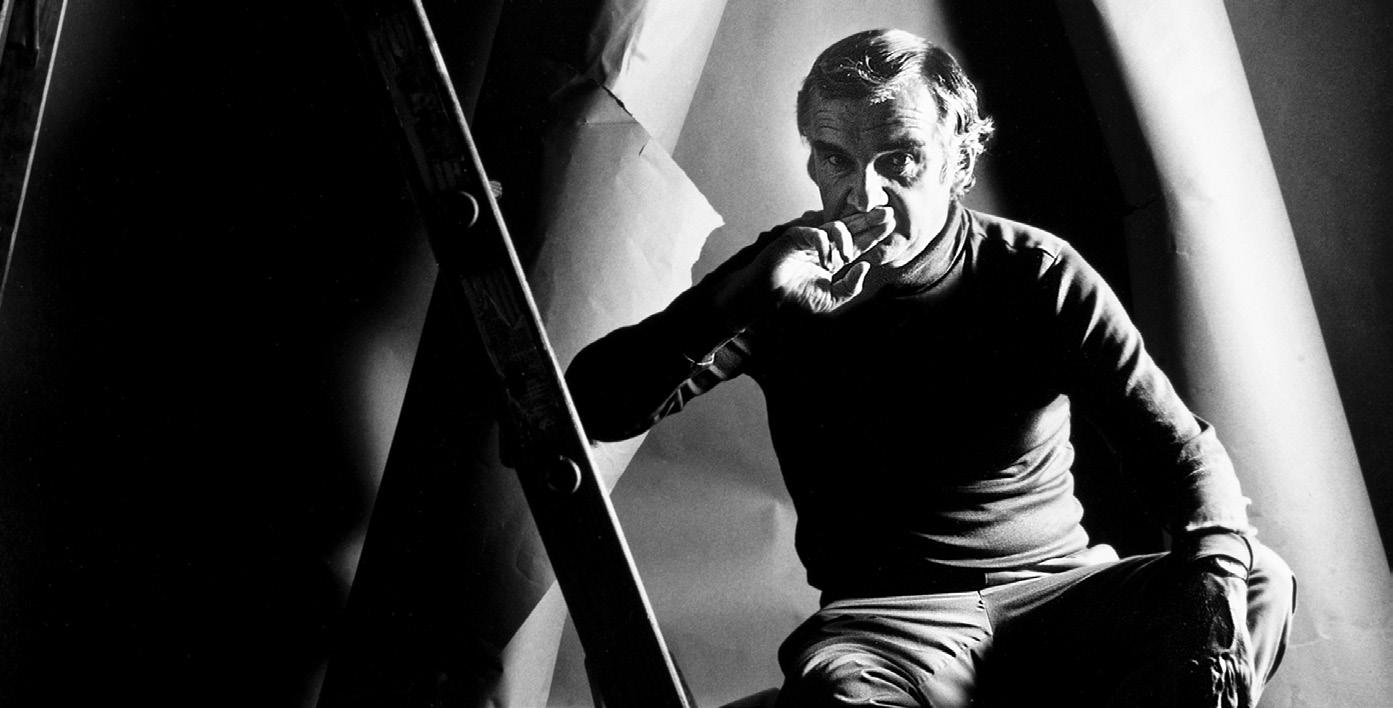
Charles Newell + Garland Wright, co-directors of Shakespeare’s History Plays at the Guthrie in 1990 PHOTO MICHAL DANIEL
Joseph Haj in the History Plays at the Guthrie in 1990 PHOTO MICHAL DANIEL
we’re dead. We’re dead for the whole night,” Joe asserts. And, since Henry IV and Henry V build on the events in Richard II, audiences planning to see all the plays needed to be able to follow the story across multiple evenings or the all-day opening.
Richard II was the first Shakespeare play that Joe read cover to cover. He was in grad school and not a Shakespeare fan. Those opening scenes— “Who is the Duke of Gloucester?” “Why do we care who killed him?” “What did the king have to do with it?”—were, he thought, impossible to follow. Joe asked his grad school roommate, Michael Cumpsty (for many years one of the country’s leading Shakespeare actors) for help, and Michael explained the story and essentially table-worked the play in their apartment. Joe’s opinion on Shakespeare shifted: “Who on earth writes like this? It’s impossible. It’s impossible. It struck me so deeply.”
For Joe, the emotional impact of Shakespeare depends on the clarity and specificity of language that he discovered in grad school. “I don’t know what it is about Shakespeare, but it’ll nudge even very good actors sometimes to their worst impulses…I’ve seen really wonderful actors get into Shakespeare and you just feel the generality. It’s like, ‘I think I’m vaguely angry for these 10 lines, and I think I’m a little sad for these six lines.’” Joe believes in staying at the table “long enough that people aren’t out on stage moving their mouths with words they have actually no specific understanding of.”
That week of table work felt like a classroom. “There wasn’t really a whole lot of fooling around,” remarks Dr. Penelope Geng, an associate professor of English at Macalester College who observed several rehearsals. “I was really struck by the workshop’s seminar-style-like vibe…I really admired the way that [Joe] would ask a simple question and step back and allow people to fill in the void.”
It is important, Joe believes, to answer as many questions around the table as possible so that “the information lands more deeply, it’s understood more completely” before actors get up on their feet. Questions always will come up during the rehearsal process; Joe would prefer to answer them earlier rather than later. “It feels less hard, less expensive to actors to be wrestling with those questions when we’re sitting at a table staring at a script. If we don’t get it answered around the table, they’re going to have the same question when on their feet, and it’s harder for actors to grapple with textual questions while also trying to understand their bodies in space.”
Joe is open to those questions and doesn’t always feel the need to answer them. “You can ask a question, you can ask any question…You may not always get the answer you want, or you may not get an answer at all,” says Yoke, who returned to the Histories in 2024 to play Northumberland.
Stephen Yoakam as Northumberland + Tracey Maloney as Lady Percy in Henry IV at the Guthrie in 2024, directed by Joseph Haj PHOTO DAN NORMAN
Stephen Yoakam as Henry IV at the Guthrie in 1990, co-directed by Charles Newell + Garland Wright PHOTO MICHAL DANIEL
“I’ve always thought that Joe was able to say, ‘I don’t know.’”
There is a difference between the not-knowing that results from a lack of preparation and that which allows for an abundance of discovery. As Joe acknowledges, “I say, ‘I don’t know’ a lot in rehearsal, but I don’t like to pretend I don’t know things. If there are things I know, I’ll say, ‘I think it’s this,’ and we can just move on to the next thing. So when I say, ‘I don’t know,’ you can just watch the team climb into that space, helping us know.”
Joe credits this ability to the preparation he does before he walks into the rehearsal room. He storyboarded all three plays and feels strongly that “if I’m not prepped deeply on the front end, I’m not watching the actor, I’m staring at the script. The greatest gift I can give to an actor is the quality of my attention. So the best thing I can do is to know it all well enough that I can be fully present to what’s happening in front of me.”
That fullness of presence is auditory as well as visual. Joe occasionally listens to actors with his eyes closed, an inclination he attributes to his father, who was blind. William (Will) Sturdivant, who played Bolingbroke, describes how in rehearsals, “you can hear [Joe] listening. Closing his eyes and really hearing it, which is nice because you’re like, ‘I don’t know exactly what I’m doing, but I know what I’m saying.’”
Joe can prompt most of the plays from memory and often does. Some actors were frustrated getting line notes from a director whose eyes were literally closed, but Joe maintains that “it’s good for the actors because it reminds us if you’re not saying the right words in the right order, somebody in the room is going to know.”
This recall also allows Joe freedom of movement in the rehearsal room: “I don’t have to stare at the script and follow along to understand what the things are. I could just watch and listen to the actors and respond and respond and respond and respond. And that’s the beauty of knowing it well. [It] allows you to get up, allows you to get around the room, allows you to stand in close with the actors.”
Joe sometimes sits in a chair next to the directors’ table, almost never behind it. If he’s sitting, he will frequently jump up to help an actor figure out an action: how Hal should touch his sleeping father, or whether Doll Tearsheet rolling drunkenly across a table would work better with her legs upstage or downstage (downstage).
“I’ve always appreciated the fact that he’s not stuck behind the table” says Yoke. “It’s nice to have somebody come out on the floor with you…[and] talk about what actually happens, what the posture is, where the impulses are to move. He’s a very physical director in that
William Sturdivant as Henry IV in Henry IV at the Guthrie, directed by Joseph Haj PHOTO DAN NORMAN
Joseph Haj directing Tyler Michaels King in Richard II at the Guthrie PHOTO JOSHUA CUMMINS
aspect.” Tyler attributes Joe’s movements in the rehearsal room to his performance experience: “He gets the muscularity of being an actor. He’s embodied that himself…he was so clear on what it takes to speak language fully in that space.”
The Wurtele Thrust Stage at the Guthrie, where the Histories performed in 2024, is a 1,100-seat theatre. “There’s a kind of performance that I adore, the quiet, reactive performance,” Joe says. “Those things vanish on the Guthrie thrust.” Joe’s experience performing on previous Guthrie thrusts taught him that they require “a muscularity in the playing. You’ve got to get on the front foot. That room responds to enormous appetite. The chase. ‘What do you want?’
‘What are you after?’ The Acting 101 things, but what’s required in that space is simply not the same thing that is required if we were making the very same productions in a different physical environment.”
In order to develop the required muscularity, Joe made sure the Histories company knew that rehearsing and performing the Histories would be an athletic feat. “He’s a coach, when it comes to actors,” says Tree. He told the company that he “was going to push real hard early [so] that they build the muscle, they build the expectation. Days are going to be long; they’re going to be really demanding.” Joe made it clear that the actors couldn’t be “strolling around and making jokes 30 seconds before the stage
manager calls places and think you’re going to hit this thing in the right way. You’re not going to, you are not going to—none of us are that good. This stuff is hard. We need the confidence of knowing we’ve rehearsed well and are making something strong, combined with the humility of knowing that these are works of uncommon demand. And the only way to build the muscle, the clarity, the detail, the specificity, the concentration, and the stamina is to build it.”
On the first day of rehearsals in January 2024, Joe quoted former Guthrie Artistic Director Liviu Ciulei: “We don’t have very much time, so we must work very slowly.” However, the eight weeks of rehearsals proceeded quickly. After the initial week of table work on all three plays, each play was staged and stumbled in the next three weeks, then revisited and run the three weeks after that. The final week before tech was used for notes, cuts, and spacing on all three plays. The month that followed was divided into a week of tech and two previews for each show. In the final week, each show was revisited and had a third preview before the marathon opening.
Rehearsals never ran over and occasionally even ended early. Joe credits the staff with this accomplishment: “It’s a tremendous testament to the directing team and the stage management team that we did not have one day in two months that we did not make our day.” And they credit him: “I can
schedule all I want,” says stage manager Tree, but “we don’t make the day unless Joe does the work.”
At the end of the day, Joe says, “You can’t ask anybody to work any harder than you’re willing to work. You can’t lead anybody any further than you can go. You can’t. So part of making our day every day for two months of rehearsal and one month of tech was a way to signal to the company, we’re ready, we’re prepared, we have a plan, you are well taken care of. Every single actor always knows 100 percent of the time when a director is not ready. I know that because I was an actor for a really long time. And most of us as actors are far too polite to go, ‘Well, we’re playing this silly theatre game for 30 minutes so that you can buy time to figure out what the fuck you want to do with that scene.’”
“There’s not a lot of mucking about” in Joe’s rehearsal style, says Tyler, who played Bedford in addition to Richard II. “There’s a lot of artistic intention and moving forward and getting to the end goal that we both see, and there is a kind of joy and expression in that but it’s very linear. It’s not…‘Well, let’s try it this way, or this way, or this way. And, yeah, here’s an acting block, let’s see what happens.’ It’s much more direct.” Will remembers that during Henry IV rehearsals, “We had one day when we did [my] death scene four or five times in a row. That martini was incredible afterwards, but that was all we touched it, really. We didn’t really do too
Richard II at the Guthrie, directed by Joseph Haj PHOTO DAN NORMAN
much more on that heavy, emotional thing, but we got it in our bones well enough to keep it there.”
Certain expectations in the rehearsal room were clear, but unspoken. “I don’t know if Joe said this directly, but I felt like him calling us to be front-footed the whole time we were on stage,” remembers Tyler. “There wasn’t a moment where we could kick back. Even if we were just standing there listening…we are there to help communicate the story.”
When Tyler thinks of working with Joe, he thinks of “really working with the dude. I know that I’m going to get in the room, and I’m going to prepare a shit ton beforehand…I’m going to come in with some strong ideas. And then we’re going to do the work kind of fast, and we’re going to do it efficiently.”
So much ofthe art, ofthe artform, isthe abilityto concentrateforvery long periods oftime.That’s astruefordirectors...as it isforactors.
JOSEPH HAJ
Tracey Maloney as Lady Percy + John Catron as Henry Percy (FOREGROUND) in Henry IV at the Guthrie, directed by Joseph Haj PHOTO DAN NORMAN
Joseph Haj + scenic designer Jan Chambers during the 2023 design workshop for the Histories at the Guthrie PHOTO JOSHUA CUMMINS
Every director develops their own vocabulary. Their version of “yes,” “no,” and “faster.” Joe’s “yeses” are: “Let’s take that for a ride,” “That’s what it wants,” and “I’ll take some version of…” His “nos” sound like: “I think you need to anchor still more strongly…,” “I don’t think there’s anything meaningful to collect from that,” and “Don’t make too much of a meal.” “Fasters” are: “Drive through,” and “Push for home” with the caveat, “Don’t go faster than you can image.” Will remembers Joe telling him, “‘Speak at the rate of your thought and let us just hear that and see what that does.’”
Joe believes the personal pronoun is almost never emphasized in Shakespeare and every run is an opportunity to learn something new. These mantras were expressed as, “Get Off the Pronoun,” and “Don’t Waste the Rep.” During previews, Joe “would always say, ‘the likelihood that everything goes right tonight is exactly zero,’ remembers Tyler, ‘so don’t go in the tank when something goes wrong.’ I don’t know what ‘the tank’ is, but I get it.”
Joe deliberately cast actors “who create—if joy is not the exact word—a profound satisfaction by digging in so deeply, concentrating so deeply, building stamina. We knew from the jump that we were going to have performance days that are 13 hours long. You can’t just roll into the theatre and think you can do that. You need to build that muscle. So much of the art, of the art form, is the ability to concentrate for very long periods of time. That’s as true for directors, frankly, in my view as it is for actors.”
One way that Joe builds the ability to concentrate in actors is by allowing a potential distraction into the room: outside observers. Allowing them to attend rehearsals is part of Joe’s practice as a director because of his experiences on stage. “I remember so clearly as an actor you rehearse and rehearse, you’re in your closed system with all of the accustomed people who are in the room. And then you get to that designer run or the artistic director comes to have a look at a run through…and chemically for the actor, things change. And sometimes for the good and sometimes not for the good. Sometimes you just watch folks getting in their head. [I’m] like, ‘Why don’t we get that shit out of the way early?’ So we’re not wrestling with that when we’re in previews.”
In introducing the observers when they first arrived, Joe quoted Mary Zimmerman: “The rehearsal process is sacred, but it is not fragile.” Yoke agrees that having observers in the room made all the actors “sit up a little bit higher.” They bring “a slightly different, sharper focus…It’s a funny chemistry that happens.”
Joe often starts a note by speaking to the room while walking towards an actor and then quietly continuing the conversation one-on-one. One of the observers, Mark Catron (father of actor John Catron, who played Hotspur) noted this approach with Tracey Maloney, the actor who played Lady Percy.
“The actor had just delivered a hugely, powerfully moving grief- and tear-laden speech, a pouring out of heart and soul. Very, very powerful, just wonderfully done. And at the end of that, Joe stopped the action and they met at center stage. He’s six foot or better, she’s maybe five two. But they had a long eye-to-eye conversation. And then, at the end of that, he asked her to do the whole thing again. And I thought, ‘How could you do that?’ I mean, you know, she’s
just given you everything she has. And then you put her through it all again. But it reveals the hard work and depth of commitment that he expects, and that he gets. Kind of the quiet authority that he has in making sure that everybody shares his vision.”
To an outside observer like Mark, Joe’s direction in that moment felt meticulous but not unkind. Rather, it “seemed like he was trying to support her, trying to lead her, trying to make sure that she felt his support behind her in that very, very vulnerable moment.” Mark, a retired lawyer in the Twin Cities, had attended many of his son’s previous performances at the Guthrie but had never seen him rehearse. He was glad to have the opportunity to see his son work, even if watching him fight and die as Hotspur “wasn’t easy the first time. I
Daniel José Molina + Dustin Bronson in Henry V at the Guthrie, directed by Joseph Haj
PHOTO DAN NORMAN
mean, that was, you know, it’s a hard thing to watch that.”
Building the actors’ concentration is not the only reason that Joe allows observers into the rehearsal room. He also wants staff and board members to see “how fucking hard it is to make anything that is legible, beautiful, smart on stage” and dispel any notions that the work is easy. “I don’t know what it is about our discipline,” he says.
the company that on his first day of tech for Richard II as an actor in 1990, he was deeply frustrated with his elaborate Bagot costume and, after tripping on it for the umpteenth time, shouted his unhappiness into the techdark house. From the back of the room came the voice of costume designer Ann HouldWard: “You have it on backwards.”
In 2024, there were cast shifts, set cuts, and a trap that started its downwards
miles and riding 100 miles is simply a matter of developing your capacity for suffering. How much can you endure?” His direction to them in this difficult moment? “Increase your capacity for suffering.”
It was a radically different rallying cry than the ones the company had been listening to all week. Not, “Once more…” or “We happy few…” but rather, “Again. And again,” plus suffering. During the rehearsal process, the parallels between Joe and Henry V were clear. Joe described his Hal-like transformation from a teenage slacker who skipped class to go to the beach into a highly disciplined artistic leader with a “huge capacity for work.” In his calm before the first designer run, he looked like Henry reassuring his troops before Agincourt, standing by his chair while actors dodged around the packed room to ask last-minute questions. And there was the question that followed the entire Histories project: “What is one willing to sacrifice to become a person who, for whatever reason, wants to wear that crown?”
For a company at the moment of maximum exhaustion, hearing “increase your capacity for suffering” seemed more likely to cause a riot than a return to rehearsal. But the work that Joe had done to create a company that wanted to dig in, that wanted to work hard, that wanted to build a new muscle and use it, paid off. When Tyler heard Joe say “increase your capacity for suffering” he understood [it as]: “I believe in this company to do this, and
I don’t have to make the perfect anything. I don’t have to make the thing nobody’s ever seen. I don’t have to do any ofthose things. I just have to tryto make the thing as beautifully as I know how with these collaborators in this process.
JOSEPH HAJ
“Nobody—literally zero people—would [say], ‘If I had a violin, I could play for the Philharmonic, I don’t see why not.’ But almost everybody thinks that, ‘If I could just learn all the lines, I too could be an actor.’ Which is absurd. These are artists and there’s a profound artistry and craft involved in that. But everybody thinks they can do it. And when somebody comes and watches a rehearsal where we wrestle with a line sequence, we wrestle with it rhythmically, we wrestle for the sense…it’s eye opening for folks to recognize and realize that this is an art form which requires extraordinary artists working really hard.”
That hard work was particularly visible during the Histories tech, an epic process that inevitably included bumps. Joe shared with
trajectory with a lurch that “revived the dead.” The blood in the blood sword didn’t look “bloody” enough, the fake leek didn’t look “leeky” enough, and the breakable mirror broke.
By week 11, after teching and previewing both Richard II and Henry IV, the company was halfway through Henry V—and tired. During notes after one of the previews, Joe returned to his analogy about actors and athletes. He told the company that he was a road biker for many years and described how the endurance required for long rides was similar to that required for the Histories “You think that the differential between riding 75 or 78 miles and riding 100 miles is a matter of fitness, and it’s not,” Joe told the company. “The difference between riding 75 or 78
that hardship will yield great rewards, and we will come out on the other side of this with a rich and rewarding experience.”
“It wasn’t said without generosity. It wasn’t said without compassion,” he remembers, “but it was also said with strength. And with this sort of sense of authority and leadership that we are trying to accomplish something bigger than ourselves. And the capacity to be able to do that is something greater than any one of our bodies can hold at this one point. And yet, we should do it because it’s going to be an incredible thing.”
The Histories marathon was built to be exactly that: a marathon. A moonshot attempted precisely because it was hard. Richard II, Henry IV, and Henry V are epic in their intelligence, scale, and ambition and
Daniel José Molina + company in Henry V at the Guthrie, directed by Joseph Haj
PHOTO DAN NORMAN
the opportunity to make them together comes around once in a generation. In 1989, Garland Wright wrote that directing Shakespeare allows for the possibility that “all of us can release into that thing that’s better than the sum of all of us in our ordinary state in the hopes that maybe we will have participated in the whole continuum of history, in terms of those things that are great about being human.”
When Joe is making work, he thinks about his “mentors, colleagues, friends…I’ll sit in rehearsal sometimes and look at a thing and go, ‘I wonder how JoAnne would look at that? I wonder what Woodruff would think of this?’...Garland’s long, long gone. I think about how Garland would look at a thing. I do, I do.”
Joe remembers Garland telling him, “‘There’s only one reason to be a theatre artist finally and that’s because it makes you a bigger person.’ So I’m interested in a process that feels like growth to all the people who are part of it. That everybody will leave the process feeling bigger than they were when they came into it.”
The program for the Histories included memories from company members who worked on the plays in 1990. Stage manager Jill Rendall described the first marathon day as “the most thrilling day I have ever
spent as a stage manager.” When she called the opening cues for Henry V and the full company walked on stage to deliver the Chorus, “the entire audience leapt to its feet, marveling at this company of actors, technicians, and stage managers launching into their third play of the day. Everything onstage stopped. The moment rendered us all speechless, the headsets silent.”
In 2020 when the Guthrie was closed, Joe recorded a message reminding audiences that, “In the end, we’re going to need a place where we can re-gather, a place where we can celebrate, where we can join in joy and entertainment…At some point in the near future, I will ask you to do this again.”
More than a thousand audience members from 26 states and two Canadian provinces travelled to the Guthrie for the Histories marathon opening day on April 13, 2024. Richard II started at 10:30 am and Henry V came down after 11 pm. Watching them, Joe was reminded of an experience he had on a tour of the theatre archives at the Folger Shakespeare Library when he directed Hamlet there in 2010. “I remember [the librarians] taking these prompt books down and looking in the margins, which are filled, filled, filled with scribbles of…artists just like us, trying to wrestle to the ground the hardest material in the world. Trying to find a path into it, trying to make something that
may be beautiful for people to come and participate in and watch. I realized this play has been around for centuries…we’re just in the river of the long history of this play.”
“We get to go in, splash around a little bit, make our minor contribution to this eons-long contemplation of this play. It was so disburdening…I don’t have to make the perfect anything. I don’t have to make the thing nobody’s ever seen. I don’t have to do any of those things. I just have to try to make the thing as beautifully as I know how with these collaborators in this process, that’s my only responsibility. And I found it really beautiful to feel myself in that moment in this long tradition of makers.”
On opening night, when the entire company of the Histories walked on stage, led by Yoke, for the opening Chorus of Henry V, just as they had 34 years ago, the audience stood and cheered and cheered.
Kate Pitt is a director and dramaturg based in New York City. katepitt.com
Henry V at the Guthrie, directed by Joseph Haj PHOTO DAN NORMAN
I Was Just Going to Do Plays
REFLECTIONS ON ZELDA FICHANDLER
BY LUCY GRAM
In 1950, a 24-year-old graduate student in the drama department of The George Washington University joined forces with her husband and her professor and converted a former burlesque and movie house into a 247-seat theatre-in-the-round. “I didn’t know what I was doing when the theater opened,” she wrote to a colleague many years later. “I was just going to do plays, and not have them in New York—that’s all.”
The graduate student’s name was Zelda Fichandler, and she would go on to turn that theatre into a renowned cultural space: Washington, DC’s Arena Stage. Zelda (as everyone called her) would serve as Arena’s artistic leader for 40 years, and in the process would become a seminal figure in the American regional theatre movement: an artistic director, writer, director, and leader with a unique ability to recognize and articulate the promise and problems of the field.
Arena’s creation was inspired by another early figure in the American regional theatre movement: Margo Jones, whose nonprofit Theatre ’49 was the inspiration for Arena’s in-the-round configuration. Other theatrical pioneers from that period included the Alley Theatre’s Nina Vance and, after Arena’s founding, Gordon Davidson, Tyrone Guthrie, Joseph Papp, and many more. The theatres that these leaders founded, many of which still exist, now provide the foundation for sustainable artistic careers for a wide variety of American theatre artists: actors, designers, and, of course, directors and choreographers.
When we think about the founders of anything, we tend to think of them as fully formed: complete, successful, with a narrative we know. When someone is much beloved, as Zelda was, that narrative can start to feel perfunctory. You can see it in the repeated language people use to describe someone in this category; they are a “titan,” a “visionary,” a “matriarch.” It’s not that those words aren’t often accurate descriptions. It’s that when we use this kind of clichéd vocabulary to describe someone with an impact as important and varied as Zelda’s, we forget—or lose the opportunity to learn— the qualities that earned them that status, that got them there in the first place: how they were forged, what obstacles they overcame, the specific ways they succeeded and failed, and the values that guided them along the way.
“There are form-givers in every new style of art,” Zelda observed in the last public speech she ever gave, when she was a venerated leader in her eighties, a far cry from her graduate student beginnings. “There may seem to be just one in front,” she told her audience, “but, like seeds under the snow, they emerge in small clusters, and if the plants are strong, they become widely absorbed in the culture.” Zelda, along with her fellow founders, was a form-giver. Those of us who did not know her, or whose theatre careers weren’t directly shaped by her as so many were, nonetheless work in a field that owes its foundation—its nonprofit structure, service organizations, relationship to the commercial sector, artistic leaders, and very way of thinking about our art form—to Zelda
Fichandler and her peers. She was the first to admit that she was not the only founder of the American regional theatre movement, but she was for a long time its torchbearer. To many theatre artists, she still is. Her ideas and her accomplishments have become widely absorbed in the culture. They are central to the American theatre as we know it. We could pull out one of those oft-used phrases and say Zelda was a visionary, and it would be true. But it would also be easy— and we learn less from easy.
So it’s a special pleasure that as we celebrate the centennial of Zelda’s birth this fall, we have the opportunity to revisit her life and ideas through two newly published books: Mary B. Robinson’s To Repair the World: Zelda Fichandler and the Transformation of American Theater (Routledge, 2024), an oral history of Zelda’s life and career, and The Long Revolution (Theatre Communications
LEFT Archival photos of Zelda Fichandler + colleagues at Arena Stage through the decades. Here, Arena’s early years in the 1950s.
PHOTOS C/O ARENA STAGE
ABOVE Melissa King + Charles Janasz in Uncle Vanya at Arena Stage, directed by Zelda Fichandler
PHOTO C/O ARENA STAGE
Group, 2024), a collection of Zelda’s writing and speeches edited by Todd London. The books have the same subject but different focuses, and as a result, complement each other well; in fact, it’s hard to imagine a reader who would not benefit from reading both at once.
Robinson’s book is a biography written in oral-history form. It traces Zelda’s life and career through the reflections of her friends and colleagues, interspersed with Robinson’s own writing and excerpts from Zelda’s speeches and letters that give context to others’ memories. London’s book, a collection, has a more straightforward task, although calling it straightforward belies the years of effort it took to bring it to this final form. Zelda began compiling her writing and speeches into a body of work, then
bequeathed the project to London at the end of her life.
Readers get a comprehensive sense of what London calls “the range of Zelda’s thinking and the areas of her concern” from The Long Revolution. The collection gives us the opportunity to dig deep into Zelda’s intellectual life and begin to understand her capacity to inspire both through sheer intellectual heft and the clear-eyed focus she brought to the art and artists at the center of the regional theatre movement. A glance at the table of contents indicates the complexity of the project: Zelda wrote, and spoke, extensively, about topics ranging from how theatre is connected to human evolution, to actor training, racial integration, the institutionalization of the American theatre, and more.
It’s in To Repair the World, however, where the unpacking of her personality and vitality happens. “What was it about Zelda,” Robinson wonders in her introduction, “…that caused so many people to feel transformed by her?” Accompanying the author on her journey to answer that question helps us begin to unyoke Zelda from her “visionary” narrative. So do excerpts from Zelda’s letters, which Robinson often quotes in the introductory setups for each chapter in To Repair the World. The letters allow the reader access to Zelda’s doubts and vulnerability, written in a more personal voice than her formal pieces. Of particular note are Zelda’s letters to subscribers, which include a defense of one of Arena’s productions that could be a description of Robinson and London’s mutual pursuit. “To write is to affirm,” Zelda wrote to the subscriber. “Any creative act is a form of affirmation of life.”
SDC and SDC Foundation have their own affirmation of Zelda’s life through the Zelda Fichandler Award, which was established on the occasion of SDC’s 50th anniversary in 2009 to recognize an outstanding director or choreographer who is making a unique and exceptional contribution through their work in regional theatre. For Zelda, the award represented an acknowledgment of a director or choreographer’s accomplishments to date and future promise, created to be given to an artist in the middle of their creative life who has made a long-term commitment to community.
The Long Revolution includes two speeches given on occasions surrounding the award. The first was delivered at SDC’s 50th anniversary celebration in 2009, when the award was announced, and the second at the 2011 award presentation. That later speech, the last Zelda ever gave publicly, is the one
Alan Schneider, Marianne Elliott + Zelda Fichandler, 1961.
in which she spoke about the founders of American theatre as “form-givers.” The 2009 and 2011 speeches are cut and combined in London’s book, but both, especially the 2011 speech, are worth considering separately as capstones to Zelda’s long career. Like much of Zelda’s writing over the years, they contain both celebrations of her own achievements and the growth of the American regional theatre, and warnings about what could hasten its downfall as an art form. In a time of hardship for regional theatres across the United States, it’s helpful to get a taste of both; it’s a chance to learn who laid the foundation and find out it’s not as stable as we thought it was.
And Zelda did lay the foundation. It began, she says in her 2011 award speech, with “a revolution in our perception,” what she, in a June 1959 document published at the end of London’s book, called a “new recognition of the need to establish… permanent repertory theaters” outside of New York. Zelda and her peers wanted to give communities across the United States the chance to experience theatre as an art form, separate from the New York-centric commercialism of Broadway. That left the founders with a problem, however. They needed a different financial structure for their theatres. They landed on the 501(c) (3) tax code, which allowed theatres to join educational, religious, scientific, and charitable organizations in benefiting from “nonprofit” status. The 501(c)(3) tax code hadn’t previously been used for arts and culture organizations, but it would go on to become an essential piece of the American regional theatre.
“Some of us may take that fact for granted, but we shouldn’t,” Zelda stressed in 2011. The nonprofit structure is “the basic reality of our existence.” In fact, Arena started out
as a for-profit organization and ran that way for seven years, before W. McNeil Lowry, the Ford Foundation’s director of art and humanities, told Zelda that nonprofit status was a requirement for receiving foundation funding. Arena’s stockholders then voted to turn the for-profit company Arena Enterprises Inc. into a nonprofit. It was one of the first theatres to lead the way into a new nonprofit world.
“Once we made the choice to produce our plays not to recoup an investment, but to recoup some corner of the universe for our understanding and engagement,” Zelda later wrote, “we entered into the same world as the library, the museum, the church, and became, like them, an instrument of civilization.” As Robinson notes, this is a powerful enough quote that Zelda used it repeatedly. In the years since Zelda wrote this, American theatremakers have created thousands of nonprofit theatres. More than 2,000 of them remain a vital part of this country’s cultural life.
Other basic realities of the field that even the most invested and interested theatre artists among us might take for granted— the service organizations that support those regional theatres and the collective bargaining agent that represents them— sprang to life in the 20 years after Zelda and her colleagues started Arena Stage. Theatre Communications Group was founded more than 10 years after Arena, in 1961, expressly for the purpose of connecting the leaders of America’s budding regional theatres to one another. The National Endowment for the Arts began its existence four years later, in 1965. On a parallel track, just a year after that, the League of Resident Theatres was founded as the multi-employer bargaining representative for the resident theatres by a group of leaders including Tom Fichandler,
Zelda’s husband, who served as Executive Director of Arena Stage for 36 years. These organizations provided essential support to Arena as it grew and changed, and they continue to bolster nonprofit theatres today. Studying TCG, the NEA, and LORT as part of Arena’s history highlights that these are still relatively young organizations. Their existence, as both Zelda’s story and the NEA’s persistent fight for funding reminds us, is fragile.
While those entities were establishing themselves, Arena found its feet as a successful nonprofit theatre, and the accomplishments Zelda would celebrate in later years began to accrue. The Great White Hope, which Arena produced in 1967 to much acclaim, became the first regional theatre production to transfer to Broadway. The move had far-reaching consequences. Zelda had spent two years developing the play with playwright Howard Sackler, but she received no credit for her work. Arena also suffered. Despite pouring money into the mammoth production, the theatre did not benefit financially from the Broadway transfer. To add insult to injury, it lost its beloved resident acting company and associate producing director Ed Sherin to Broadway.
Motivated by those inequities, Tom Fichlander took action to make sure a situation like this couldn’t happen again. As Molly Smith notes in To Repair the World, the financial implications of the transfer “pushed Tom Fichandler into creating a way for non-profit theatres to enjoy something financial after shows had gone to New York.” This would irrevocably shape the nonprofit theatre sector’s relationship with the commercial sector, sowing the seeds for their current cozy relationship in ways that continue to reverberate today.
OPPOSITE + LEFT Archival photos of Zelda Fichandler + colleagues at Arena Stage through the decades. Here, the 1950s and 1960s.
PHOTOS C/O ARENA STAGE
Despite its long-term implications, The Great White Hope’s success and transfer were a testament to Arena’s ability to create art with impact. The production played on Broadway for 564 performances, and the play went on to win the 1969 Tony Award for Best Play and the Pulitzer Prize for Drama.
Arena also made an impression on the international stage after it was chosen by the State Department to travel two productions to the Soviet Union as part of a cultural exchange program meant to support the détente from the Cold War. Arena’s productions of Our Town, directed by Alan Schneider, and Inherit the Wind, directed by Zelda, were met with standing ovations in Moscow, to her enduring satisfaction and pride.
As foundations shifted their funding focuses in the late 1960s, the nonprofit theatre sector’s struggle to find alternate funding began, as Zelda saw it, to guide their artistic choices. She diagnosed the problem in a set of 1967 remarks published in The Long Revolution: “What we did—to survive!—what we had to do was to acknowledge that the audience was our Master. What we did was plan a season that would please our Masters—no trick, actually, after so many years of experience.”
Zelda began, in those same remarks, to caution about what is lost when regional theatres focus on the financial potential of their programming choices rather than their artistic merit. “We need money, but as much as we need money we need—individually— to find, heighten, and explore the informing
idea of our theatres,” she warned. “Real power resides within the art we make and not in the techniques of manipulation, marketing, and promotion.” Her cautions about this topic would continue to the end of her life.
In her last speech, Zelda returned to her preoccupation with the relationship between nonprofit theatres and the commercial sector. She encouraged artistic leaders to “take our gaze and any preoccupation away, away from Broadway, from which we took our leave many years ago....Broadway must not invade our house and take over our home. Always: he who pays the piper calls the tune.”
Zelda’s impulse to keep nonprofit theatres focused on their artistic impact wasn’t just about mission drift. It was also about theatre artists. Zelda is often spoken about as a great supporter and champion of actors. She believed strongly in a residential company model for regional theatres and worked hard to build and preserve Arena’s. In the second half of her life, she ran the Graduate Acting Program at New York University’s Tisch School of the Arts and so profoundly influenced a generation of American actors— many of whom remain theatre artists—that someone new to Zelda’s story might be forgiven for thinking that her interest in theatre artists was in actors alone. Robinson’s book, however, beautifully emphasizes two potentially less obvious aspects of Zelda’s career: her role as a champion and employer of a generation of directors from around the world, and the way in which her mentorship and her leadership style influenced a generation of American directors.
Robinson cites several theatre artists who marvel at the roster of directors Zelda hired at Arena. “They were absolutely world class,”
James Earl Jones, Jane Alexander + company in The Great White Hope at Arena Stage, directed by Edwin Sherin PHOTO C/O ARENA STAGE
As
much as we need money we need— individually—to find, heighten, and explore the informing idea of our theatres. Real power resides within the art we make.
ZELDA FICHANDLER
ABOVE Inherit The Wind at the Moscow Art Theatre, 1973, directed by Zelda Fichandler
PHOTO C/O ARENA STAGE
LEFT Cast and audience giving each other a standing ovation following a performance of Inherit the Wind at the Moscow Art Theatre, 1973, directed by Zelda Fichandler
PHOTO C/O ARENA STAGE
OPPOSITE + LEFT Archival photos of Zelda Fichandler + colleagues at Arena Stage through the decades. Here, the 1970s and 1980s, including (THIS PAGE, RIGHT) Arena Stage’s 1973 cultural exchange tour to the Soviet Union.
PHOTOS C/O ARENA STAGE
actor Casey Biggs recalls, “Liviu Ciulei, Lucian Pintilie, Doug Wagner, Garland Wright— these incredible directors.” For James C. Nicola, who first came on board at Arena as a directing fellow in a now-defunct NEA program, that was a major attraction of working for Zelda. “The remarkable thing that really drew me to Arena in the first place was the wisdom she had about bringing in directors from other cultural traditions.”
Zelda knew how to let a director have their own space. “When she believed in you as a director, there was another layer of comfort that you knew she would offer. There was always a sense of ‘It’s going to be your production,’” Joe Dowling remembers in Robinson’s book. “The notes she gave were not based on what she would have done with the play, but always based on what she knew I wanted to do with the play.” Dowling,
who is Irish, credits Zelda for his success in the United States. “I’ve spent the last 30 years now more in America than in Ireland. That came because of Zel.”
Zelda’s leadership style, in the rehearsal room and in the halls, made an impact as well. “I completely wanted to model my directing style after her,” John Rando says. “The generosity of spirit, the intelligence, the magnanimous way of creating a very safe and playful environment in the rehearsal hall—all those things really added up for me.” Playwright Cheryl L. West thought of Zelda as tough, demanding, and sartorially sharp. “When you see a woman like that, you think perhaps I could do that too. Or I could have my own sense of strength.”
Zelda was a similar influence on, and was a mentor to, many young directors over the course of her career. She often gave them
small opportunities and took a chance on them if they did well. Joan Vail Thorne worked as Zelda’s assistant until Zelda hired Thorne to direct in the 1954-1955 season. “It was an act of faith,” Joan remembers in To Repair the World. When Douglas C. Wager was Zelda’s assistant stage manager for An Enemy of the People, she gave him the job of staging the transitions. “That was my first official paid directing job,” he recalls. Wager would go on to a successful directing career and eventually become Zelda’s successor as Arena’s Artistic Director.
Zelda kept an eye on the people she hired and recognized their talents. Sometimes this was life changing. When Ted Pappas was hired to choreograph at Arena, she took him aside. “It’s very interesting watching you work,” she told him, “because you speak to [the performers] as a director, not as a choreographer…you don’t talk to them about steps; you talk to them about why they’re doing it. You’re a director.” Pappas agreed, and went on to a career as a directorchoreographer and artistic director.
She also passed on other lessons. What stayed with Nicola “most deeply and profoundly from Zelda was the significance of continuing relationships—artistic collaborative relationships.” Benny Sato Ambush, another mentee, was impressed by Zelda’s artistic identity as “a globalist. I picked that up from her—it started my interest in a universal perspective, in addition to the Black experience.”
As Robinson points out, while Zelda was not always a proactive supporter of female directors (only six women, besides Zelda, directed at Arena in the 35 years she was its artistic leader), she nonetheless had a profound effect on women in the field. Director and writer Emily Mann’s two big
Miriam Silverman, Adam Green + Robert Prosky in Awake and Sing!, Zelda Fichandler’s final production at Arena Stage
PHOTO SCOTT SUCHMAN
influences at the time “were Hallie Flanagan and Zelda Fichandler—[they were] why I felt I could be in the field, I could run a theater, I could write, I could direct.” Irene Lewis felt similarly, she tells Robinson: “Back when I was growing up, you were expected to become a housewife. A theater director was unimaginable.” Zelda, and Nina Vance, changed that for Lewis. “They were the only two women I knew who were directing, and they were only directing because they had their own theaters,” Lewis says.
A director herself, Zelda knew how important it was for her fellow directors to stay in tune with their impulses, particularly if they also
places for artists to work and grow. “We must deepen our commitment to create artistic homes for artists,” so that they “feel that the institution was created for them, to cradle their work, to put them in the center.” Regional theatres, after all, were built both for audiences and for artists. “Where would our writers, directors, and designers be,” Zelda asked, “without these congeries of work places, these sites for experimentation and development?”
We could ask the same question. Where would our community be without Zelda and her many legacies? “American theater has begun to have a tradition,” she wrote in that
Zelda saw it through. Her enduring belief in the power of theatre to change the world propelled her through a career of constantly shifting cultural headwinds. As she told the NYU acting students in 2001, she believed unequivocally in the “terrible and wonderful power” of theatre’s ability to “reach people’s minds through their hearts and—maybe— change them.” It was so total a belief, so consistently referenced in her writing and speaking, that one wonders where it came from. Recall that line: “I was just going to do plays, and not have them all in New York—that’s all.” Zelda continued, “And then, I found out what a theater could do, in the process of doing it. I found out.” But of
Where would our writers, directors, and designers be without these congeries of work places, these sites for experimentation and development?
ZELDA FICHANDLER
took on leadership roles. This is clear in the writing collected in The Long Revolution. “The artist must hear his own voice, at best a highly intricate process. Next to impossible within the cacophony of these institutions of ours,” she wrote in 1970. In the same essay, she cautioned against artistic leaders spending their energy on fundraising and dampening their creative spirit. “The directors, the conductors of the collective creativity, supposedly the fount for the energy and spirit of the Thing, by getting and spending lay waste to their powers,” she warned.
In her 2011 SDC Foundation speech, Zelda reminded her audience that the purpose of regional theatres was, in part, to establish
1970 essay, “a past, a present, a future, a somewhat coherent way to look at itself and to proceed.” It is to Zelda’s credit that we do have that tradition, for she was a form-giver and an eloquent chronicler along the way.
It’s helpful to remember that Zelda Fichandler, giant of the American regional theatre, was once a graduate student, a young citizen-artist unsure if she was up to the task in front of her or if what she was making would survive. Perhaps Zelda was thinking of those beginnings when she wrote in her final speech, “The artist may be lonely or feel unsure of, or inadequate to, what she is making, but she must cling to her integrity—her wholeness—and see it through.”
course. The artists taught her. The audience taught her. The work taught her. And she continues to teach us.
If Margo Jones struck the match, and Nina Vance lit the torch, then Zelda Fichandler held the flame high for everyone to see. With the way illuminated, others walked behind, their own torches kindled with the flames Zelda passed on. Even as some fires flicker, splutter, or burn out, sparks remain. Some flames burn brightly still, and every day, a young theatre artist lights a new fire. We’ve lost some who led the way, but the message is clear. We must be our own torchbearers now.
OPPOSITE + LEFT Archival photos of Zelda Fichandler + colleagues at Arena Stage through the decades. Here, the 1970s through the 1990s, including (OPPOSITE, RIGHT) the construction of the Kreeger Theater in 1971.
PHOTOS C/O ARENA STAGE
SDC Foundation’s podcast series, Choreographers in Conversation, invites choreographers to interview other choreographers whose work excites them as a way to learn more about their craft and preserve their stories. In March 2024, Sonya Tayeh— winner of the 2020 Best Choreography Tony Award for Moulin Rouge!—spoke with Camden Gonzales, who currently works with Sonya as that production’s associate choreographer. The podcast of their conversation, which has been edited for print, is available on the SDC Foundation website, along with a host of other interviews and panel discussions about the working processes and experiences of directors and choreographers over the past four decades.
CAMDEN GONZALES | The first question I want to ask you is about your creative process. When we met the very first time, I asked you how you start and you said, “Without music,” which to me was such a revelation.
SONYA TAYEH | When I first start working, I need to be with the script in a quiet room. I need to be in my own body, with all of my own thoughts. If I’ve heard the music before, it’s very much in my head—but I want to be able to apply what I visualize without the sax inspiring me, or this verse inspiring me, so I can have a free-for-all of ideas just floating around. My thought process is really swift, and my visual ideas are very flashy and fast. To keep up with them, I try to create a calmer, quieter space to be with my thoughts. This way my thoughts and my instincts have the volume first, and then I start to add the other layer of volume, which is music. Once I turn the music on, it’s a fun game for me, where the phrases have freedom. I didn’t beat them down yet with the constraints of story; they have this freedom so I can move them to different songs and then apply the musicality inside this raw movement. Does that make sense?
CAMDEN | It makes a lot of sense. Having experienced some of that with you now, I feel that it’s such an inspiring and openly creative way of functioning.
SONYA | It feels a little freer to me.
CAMDEN | I recently got to see Is It Thursday Yet? [at the Perelman Performing Arts Center in New York], a beautiful show that you made with Jenn Freeman.
SONYA | Jenn is someone I’ve known for many, many years and we’re very close; she has danced in many of my works and has been an associate of mine. She’s an amazing artist. She received an autism diagnosis at 34. When she told me, we were already in the process of building a one-woman—a one-human—show for her. Then, when she received this diagnosis, we kept thinking, “We need to turn and this needs to be the piece that we explore.”
CAMDEN | I was so in love with it; you had said to me earlier that you wanted it to feel like a pop-up book, which I think was achieved in such a beautiful way. But I left the piece wondering, how did they even begin to make this into a piece of theatre?
SONYA | I’m really intrigued by recordings of conversations. When we decided to do this piece, we talked about Jenn recording her sessions with her diagnostician, the person who diagnosed her. She started recording all of her therapy sessions, and we recorded literally all of our conversations. And then, her father was one of those dads back in the ’80s who had a camcorder on his shoulder all his life, all of Jenn’s life, so we had all this material already to explore. Because Jenn received this diagnosis later in life, the videos became a way to go back in her life and almost be able to reference evidence.
Sonya Tayeh
Jeigh Madjus, Tasia Jungbauer, Jacqueline B. Arnold + Sophie CarmenJones in Moulin Rouge! on Broadway, choreographed by Sonya Tayeh PHOTO EVAN
ZIMMERMAN FOR MURPHYMADE
Once I started to watch those videos, I kept saying, “This is a theatrical analysis of a life pre-diagnosis and post-diagnosis. Let’s lean into that and show that on the stage.” If we wanted to explore the difficulties of being in a social setting, we had the example of her being little, at a recital at school, and how overwhelming that was. So we had these physical representations of what it feels like in Jenn’s brain—and the beauty in that, too. Because it was very important for us to remember what she said when I asked her how she felt when she received the diagnosis. She said, “I felt my world expanding. I felt myself opening up to possibility that I’m not wrong in this brain, I just need some tools.”
CAMDEN | Wow.
SONYA | It made me, as a director, think of a pop-up book. And because of all those recordings in her basement, we wanted to create her basement. We rebuilt her basement and then showed her getting this diagnosis, then going home and sifting through her life in these boxes. What all of that brings up is how you reckon with this new awareness of a brain and how to live with it.
CAMDEN | How long did you all work on it before it debuted at La Jolla Playhouse?
SONYA | Three years.
CAMDEN | And how did you find your way into the physicality of the show?
SONYA | Jenn and I co-choreographed it and co-conceived it. Jenn’s such an amazing choreographer and knows her body. Her beautiful brain has a way of creating movement; it’s very analytical and focused. I wanted her need for repetition and order to be shown inside of the movement. All of that is so inspiring for a choreographer. You already have these tools of repetition and alignment and symmetry and focus. We talked a lot about that. And then Jenn would build phrases and I would ask questions and challenge them, and we would create building blocks from there.
CAMDEN | Many people, at least of my generation, were introduced to you with So You Think You Can Dance. I remember seeing some of the first few things you did, as someone who grew up with traditional
I had this desire to fuse all those parts of me together. Why do we say, “commercial dance?” Why do we say, “theatre dance?” What if you just fused them? What would that do?
SONYA TAYEH
Jenn Freeman + Price McGuffey in Is It Thursday Yet? at PAC NYC, directed by Sonya Tayeh and co-created + co-choreographed with Jenn Freeman PHOTO MATTHEW MURPHY
musical theatre, and feeling as though I didn’t know dance could be that—especially on TV. How did that come about; how did that journey happen and how did you arrive there?
SONYA | I was teaching for my friend who had an amazing dance company in San Francisco in my late twenties. I had received my degree from Wayne State in Detroit and came from a really amazing group of female professors who created their own techniques. They taught me so much about individuality and the freedom within that, finding your voice, and really doing the work to study that so you can walk in with the confidence of being able to articulate, through your body and your voice, who you are and how you want to make work. But I also come from the underground dance scene in Detroit. And also at that time, music videos and iPod commercials, all of those things started to build up dance and celebrate dance.
I had this desire to fuse all those parts of me together. Why do we say, “commercial dance?” Why do we say, “theatre dance?” What if you just fused them? What would that do? I said, “I think I need to move to LA to understand how I can do that.” What’s really thriving there is that there are so
many different genres. So I moved there. I made sure I was in a competent place before I moved there—I was 30 or 31—but I had nothing. This was when you would make flyers and put the posters on cars and pass them out at delis and stores in the neighborhood.
I was there for about 10 months, confused about how to make something happen. I decided to have a show, to create a show that consisted of what could be a Gap commercial, or an iPod commercial. I think I made 10 or 12 five- or eight-minute pieces, something that crazy, just to really show the different sides of me. I had a bunch of amazing dancers stay with me and sleep in my living room.
At that time there was a dance showcase called the Carnival in LA; it was a huge dance showcase and being asked to have a piece there was a really big deal. They asked me, and I brought one of the pieces that I really loved there before my own show opened. The agency that I wanted to be signed with happened to be there, and said, “We’re intrigued by your work, how can we see more?” I was like, “I just moved here, but I have a show coming.” I drove to the agency and dropped flyers off and saved seats for
them, had my show, and then the next day I signed with them. Then a month later they sent some of that work to the producer of So You Think You Can Dance, and that’s how I got it.
CAMDEN | What an amazing, courageous string of events.
SONYA | It was really fun. It was, of course, overwhelming, but it was such a raw time of exploration and taking risks and leaning into myself. I met so many incredible artists during that time of my life, on that show. I also learned how to embody myself, because there were some moments where I was the “weird” choreographer or the “strange” choreographer. There are pros and cons to those types of opportunities. And also, anytime there is a moment in your life where people recognize you, they expect you to do that same thing forever. It’s been a fun challenge to break those forces down.
The show changed my life. It made me really trust my instincts because the pace was so fast.
CAMDEN | What was the learning curve like for suddenly being on TV in this fast-paced environment with dancers you’ve never met before?
Aaron Tveit (CENTER) + company in Moulin Rouge! on Broadway, choreographed by Sonya Tayeh PHOTO MATTHEW MURPHY
SONYA | I am very shy, and I have no filter, so you see everything. It was overwhelming because you’re meeting those dancers and you’re, “Hi, nice to meet you. Let’s make this thing that keeps you in the show.” The stakes were high. I think, as I learned to trust myself, the room became about the process and became calmer, and my work felt more fruitful and had more meaning for me. I would say, “Breathe. We’re going to make this thing together, and I’m not going to leave until we find my idea in you.” I came in with a lot of ideas. First, I had to, in order to handle it. But when I knew it was about the process, I would remember that more, and the dancers would remember that more, and it led to some really monumental times.
CAMDEN | It benefits everybody if you’re making it with each other and for each other—to make everyone not just look good but feel good about what they’ve made.
SONYA | You want both. Just because it’s fast doesn’t mean you can’t learn something about yourself. I think that these shows and commercial work get a bad rap. There’s much substance and clarity and harmony and a learned form that changes people’s lives. That time was a rollercoaster, of course, but in the end, I really cherish it. As I said, I
was leaning into my intuition. I really credit that time to my trusting of my intuition now. I’m a body listener, and I would see the dancers either fall into it or retreat. The minute you start feeling that retreat, you turn, and you meet them. I think that’s a very big message about the world, how to meet each other to make the body softer, which makes the voice louder, and then there’s more understanding. Do you know what I mean?
CAMDEN | Yes. I also think of the trust that they had to have in you as very, very young people in this high-stakes environment. Everyone’s stakes are so high and to slow down, cool down the temperature inside of that is such a great lesson for all things.
You mentioned categorizing dance, and I’m curious about the breaking down of the barriers of, “Oh, this person’s a modern dancer” or “This person is that.” You also mentioned in that time it started to feel like people expected one thing of you. How do you approach breaking down those barriers?
SONYA | I think it’s about communicating, demanding, grounding yourself. I didn’t come from a foundation of technical knowledge when it came to dance. I have
more now, but I come from a place of feeling. When I get charged about a project and asked to do it, I trust that I belong in the room and I have something to offer. What comes out based on what I’m asked to do is just what comes out, my instinctual thought process. Modern, contemporary—I would understand it more if it didn’t separate us so much. When things start to separate us, I think something’s wrong, and the systems are confused. Ideas are supposed to bring us together. I’m not saying that those forms aren’t important—they’re so important. But when something is put upon you—“you’re this” and “you never said that”—and they try to boldface it, I just immediately start to erase and say, “I’m for the cause. I’m for the process and the project. What as a collaboration are we trying to achieve in this story?” I try to be respectfully honest and stern in my response regarding people telling me who I am. I don’t think it’s right to do that to anyone.
CAMDEN | What excites you most now moving forward?
SONYA | Well, I have some really exciting projects coming up but I can’t say what they are.
Reclamation Map at New York City Center’s Fall for Dance festival, featuring music by Heather Christian + choreographed by Sonya Tayeh
PHOTO JOSEPH DIGIOVANNA
I’ve been in love with the thriller and horror genres all my life. I come from a family that loves the classics of these dark genres, and I want to lean into that more. When someone asks me what my dreams are, I don’t have dreams per se; I just love making things and love being in the room, collaborating and focusing on challenges. It’s my favorite thing to do. But specifically now, I’m really leaning into, as I grow in age, wanting to celebrate that side of myself more. I think there’s a lot of value in movement when it comes to the thriller genre and the horror genre, whether it be in film or on the stage. I think there’s been this notion that they don’t work on stage. I don’t believe that. A lot of why I’m intrigued by these genres is because they are psychological; I love digging into the brain and the psychological motivation of things and what trauma does, or what resistance does, or what fear does to the body. I’m headed that way with some really exciting things, and I want to really press my foot on the gas more on that side of myself.
CAMDEN | Something that we’ve talked about a lot is the use of dance in theatre or storytelling and how sometimes it can feel
like dance gets pushed to the bottom of the list even though it can be just as valuable as a storytelling tool. I wonder if you would share some of your feelings about that. I know you have many!
SONYA | Indeed, indeed. That I can talk about forever! I get really emotional and frustrated about it.
Many times—which I find very disheartening—it’s, “Okay, then the dancing.” “Okay, now the dancing.” That dance can hold a story is constantly commented on as a surprise; it is constantly questioned that dance can provoke a feeling and drive a narrative. To those people, I say, “Let’s try an exercise. If that’s your belief system, let’s take all of the dancing away. Opening a door is movement, how you sit as an actor is movement. Let’s take everybody that dances or moves in the space or has to feel something in their body away, and let’s see who’s left on the stage.” I’m curious if there will be anybody left.
CAMDEN | Is there anyone left?
SONYA | It keeps me up at night, honestly. You know how serious I am about uplifting an ensemble. I don’t understand it when an ensemble is seen as a lower tier of people when truly, I have witnessed in my work and in other people’s work, people having a profoundly visceral experience watching a dance piece on a stage, just bodies in motion. I don’t think there’s enough trust that that is a real thing and requires a real talent, and these artists work in an Olympian fashion to excel in what they love. They need to be respected, admired, and uplifted in the work that they make, in the worlds they help create. In the theatre, when we are building a world without them it’s a small world, and a world I don’t want to live in. I want to live a big, bright, colorful world.
CAMDEN | I find myself being allergic to the words, “It’s too danced.” What does that even mean?
SONYA | I don’t know what that means. It’s far from your thought process and mine. Instinctually, we understand what dance does. We’ve sat together and have had visceral experiences together.
Ricky Rojas + Sophie Carmen-Jones in Moulin Rouge! on Broadway, choreographed by Sonya Tayeh
PHOTO MATTHEW MURPHY
CAMDEN | Yes, in a rehearsal room, in a space where we made something to see and feel so completely. It’s such an exciting space to be in when that can happen. But I sometimes wonder—to your point that opening a door can be choreography—if the point of view is only dance is dance steps—5, 6, 7, 8—it’s a small view of what can be beautiful.
SONYA | I don’t think people understand exactly what they’re trying to articulate when they say, “It’s too danced,” or, “Too much dancing.” It’s a larger issue, too, of the desire for immediate product and short attention spans and all of that. I always think of product-based energy as trying to make art something that it’s not. And forcing it to be right when you do it the first time. With art, there’s no right. This beautiful whimsical thing that we’re so blessed to do needs time and air and wonder, and a real cradle.
CAMDEN | Soft. Softness is what you often say.
SONYA | And care and respect, and sometimes it’s not respected. I’m trying to shift that by having these conversations and saying it and naming it in the room and fighting for it more. Small, but mighty steps, I would say.
CAMDEN | I’ve been struck by something working with you on Moulin Rouge! We will go see the show somewhere, and it’s like,
“Oh, why isn’t this moment working?” And you talk to the dancers in such a beautiful way, explaining the intention of the moment. The next night, the choreography, the steps, “are the same,” and yet you see something different. Because you’re responding to a physical form, I wonder if that is where one of the places that these disconnects happen. I often feel like we’re all speaking the same language and yet end up in a different category or a different tier.
SONYA | Totally. A different tier. It’s a constant wonder to me. When those moments happen in other parts of life, I always think, we need to study this and break this down. People need to know more about dancing, more behind-the-scenes understanding of what it takes to make something, and how many versions an artist goes through to find the gold that gets the back of your hairs standing up, and makes you feel like you are floating and makes you feel alive. Because that’s what I strive for— did I give these artists something to grow from and learn from? It’s really demoralizing when you don’t feel seen as the leader of the dance part.
CAMDEN | You spoke earlier about your time in Detroit with these beautiful women who made their own techniques, and I’m so curious about that. I’d love to hear more about what that experience was and maybe how you’ve carried that with you. Growing up as a theatre kid, it’s like—you know about
Bob Fosse, you know about Michael Bennett, you know about Jack Cole. I know there are so many more examples. In my mind it feels like a legacy of some kind, but one that you could possibly exist in.
SONYA | It was overwhelming to see and so gratifying to be in spaces with these incredible women. We learned Martha Graham, of course, Lester Horton; all of those epic heroes of mine. But within that, you spent the majority of your day with these incredible artists who had their master’s in dance and dance theory and dance history, and who wanted to move the dial. I was amidst and immersed among these people who were building their building blocks and foundation, which was so overwhelmingly difficult and amazing.
I know that that’s why I have this fury and ability to stand for myself—because I learned that from them. It was important for me to find my voice. I needed to be able to home in on it, and it was such a gift to be able to do that and have them honor and celebrate that with me.
CAMDEN | Were they advocating for you to do that, or was it something that you picked up from them?
SONYA | It was a mixture. I would see them create and rebuild. They would discuss where they’re from and how this echoed in their bodies, and as they were saying it, I would
Sonya Tayeh (CENTER) in rehearsal for the upcoming Broadway production of Romeo + Juliet PHOTO EMILIO MADRID
With art, there’s no right. This beautiful whimsical thing that we’re so blessed to do needs time and air and wonder, and a real cradle.
SONYA TAYEH
say, “Oh my God, that’s how I feel when I go to the underground dance parties in Detroit after this class.” Because the underground raves and house music and techno music were really the foundation of my life growing up in Detroit. When they would say things like that, I would say, “That’s how I feel when I’m standing on top of the speaker and seeing the sea of people, or next to the DJ— that innate hype physicality comes out of my body naturally.” I always thought—because it’s what I was told—that it was weird or “other.” It was “othered” on a constant basis. My teachers at Wayne State said, “Go there. Keep going there. The pitch in your voice changes when you talk about that. Listen to your body.”
Even right now, I feel my heart because I remember that time. And nostalgia is a signal, in my opinion.
CAMDEN | It’s a physical response.
SONYA | That made me then seek that volume—and I, as you know, love volume—and a challenging of the body and momentum. It’s utilizing the bones, literally the bones and the muscles of the body and testing them out and seeing what they can do. There’s endless possibility. The endless possibility is what my teachers made me feel like, is what I took from them. That for me is a gift that I am so grateful for. I really believe anything is possible.
CAMDEN | It’s such a beautiful idea that everything can continue to be explored in any way.
SONYA | I think homing in and leaning into listening to your body and what makes joy exude out of your body, what makes excitement, what makes that dopamine rush that happens—that’s the answer. That’s a beautiful answer, and dance does that.
Camden Gonzales is a performer and choreographer based in New York City. camdengonzales.com
The Lucky Ones at Ars Nova, choreographed by Sonya Tayeh
PHOTO BEN ARONS
2024 Tony Awards for Lifetime Achievement
In 2024, George C. Wolfe and Jack O’Brien were honored with Tony Awards for Lifetime Achievement in the Theatre. Their acceptance speeches, lightly edited for print, follow.
THE WORK THAT WE DO
BY GEORGE C. WOLFE
When I was 15, I came to New York with my mother and we saw a bunch of musicals and plays, including a revival of West Side Story on this very stage. I knew then I was going to move to New York. I’m from Frankfort, Kentucky, so I knew I was going to move to New York. I knew that I was going to work in the theatre. I dreamed, hoped, believed that I would one day win a Tony, but I never imagined this moment; you standing, honoring me and the career that I’ve had, so thank you, thank you very much.
I’d like to thank my parents, who not only told me that I was magical and special, but also told me I had a responsibility to honor the culture that I come from and to join other cultures and connect with them, so that I could learn very early on it needn’t look like you to be about you.
The work we do celebrates and explores the powerful, fragile dynamic that is the human heart.
We are going through an incredibly complicated time in this country, but for all of us here in this room, and people who are watching…at one point the theatre gave all of us a piece of ourselves that we didn’t know that we had. And as we go through this complicated time, it’s very important that we approach the world, not with fear, not with trepidation, but with the knowledge that the work we do celebrates and explores the powerful, fragile dynamic that is the human heart.
So we need to do so with power and command and authority and defiance as we take on the world. And those people who come to see us, come to see the work that we do, will hopefully feel empowered as well.
Thank you very much. I’m very honored and thank you.
George C. Wolfe is a director, playwright, and producer. He won a Tony Award in 1993 for directing Angels in America: Millennium Approaches and another Tony Award in 1996 for his direction of the musical Bring in ’Da Noise, Bring in ’Da Funk. His plays include The Colored Museum; Spunk, adapted for the stage from three short stories by Zora Neale Hurston; Jelly’s Last Jam; and Shuffle Along, all of which he also directed. He served as Producer of The Public Theater from 1993 until 2004. His next production, Gypsy, opens at the Majestic Theatre in December.
George C. Wolfe
PHOTO GETTY IMAGES FOR TONY AWARDS PRODUCTIONS
A FRAGILE WEB OF BELIEF
BY JACK O’BRIEN
That is very sweet. Thank you. I have two contradictory thoughts going on in my head all the time these days. One of them, of course, is this is the most moving experience of my career and I’m having a little trouble absorbing it. And the other one is, oh my God, does this mean it’s over? Are George and I getting the hook tonight? I’m editing my speech.
This is clipping right along tonight, isn’t it? The show? I thought for myself of having time. I saw myself on a couch and maybe a martini, and we could spend some time together. But all I want to say is that after what seems to be an interminable career, you pick up a couple of things and there are things I wanted to remind you of.
I don’t want you to be upset about this, what I’m about to tell you, but did it occur to you no one ever asked us to do this? We didn’t answer an ad in the New York Times that said, “Glittering theatrical types needed to save a moribund industry.” As a matter of fact, I can tell right now that most of the people in this house right here were discouraged from being here tonight by their parents, their teachers, their college, their lovers, their financial advisors. “Don’t do it.” But we couldn’t help it, could we?
There is a fragile web of belief we chase each night in these houses. It’s the only real magic accorded to us, and it doesn’t come on call. So, when it doesn’t work, you get to do it the next night and try to be better. But when it works, it can change lives. It changed mine, and here you are.
It’s not a job. I don’t know what it is. I know that there are people who would like to make it a job, and I think that they should be encouraged to go someplace else and maybe get one. But for us, it’s a privilege. It’s an honor. And I know this is weird, but it’s a calling. And as such, who do I thank for a lifetime like this? Many of the people—Ellis Rabb, John Houseman, Bill Ball, Craig Noel—who helped me, were gracious to me, are gone.
So, it’s you, my peers, my fellow artists. It’s your society that really makes it work. I am deeply honored. It’s what I want for you, a life in the theatre. Who knew? God bless you.
When it doesn’t work, you get to do it the next night and try to be better. But when it works, it can change lives.
Jack O’Brien is a director, producer, writer, and lyricist. His first Broadway credit came with the 1965 Broadway revival of You Can’t Take It With You, as the assistant to the legendary director Ellis Rabb. Between 2003 and 2007, he was honored with Tony Awards for Best Director for his productions of the trilogy The Coast of Utopia, Henry IV, and the musical Hairspray. He served as the Artistic Director of the Old Globe in San Diego from 1982 to 2007. His most recent production, The Roommate, opened at the Booth Theatre in September for a limited run.
Jack O’Brien
PHOTO GETTY IMAGES FOR TONY AWARDS PRODUCTIONS
SDCJ-PRS BOOK REVIEW
To Repair the World: Zelda Fichandler and the Transformation of American Theater
By Mary B. Robinson
With a forward by Jane Alexander Routledge, 2024. 388 pp. $48.95 Paperback.
Mary B. Robinson’s To Repair the World: Zelda Fichandler and the Transformation of American Theater captures a poignant biography about Zelda Fichandler, Arena Stage’s iconic co-founder, director, and artistic director of forty years and chair of the Graduate Acting Department at New York University for twenty-five years. Robinson adroitly weaves together an oral-history narrative composed from archival research and interviews of Zelda’s colleagues, students, friends, and family imitative of an experience sitting or acting “inthe-round” at Arena Stage: intimate, raw, ensemble-focused, and embracing of each audience member’s unique perspective on Zelda’s persona and legacy. Robinson does not shirk objectively presenting both commending and critical testaments to Zelda’s methods, collaborative process, and personal and artistic values. As a result, Robinson paints a holistic picture of Zelda as a female trailblazer of regional theatre development, as an imperfect artist limited in vision at times by her sociocultural and historical context, and as a human being engaged with making sacred art in the spirit of “tikkun olam” by “repairing the world” knowing there is the potential to foster “good or bad in everyone” (3).
Robinson’s “Preface” and “Afterword: Passing the Fire” and Jane Alexander’s “Forward” provide context for how these collaborators personally knew and/or worked with Zelda while also celebrating her significant milestones. In “Prologue: Destined to Be a Pioneer: Boston and Washington, DC, 1924 to 1950,” Robinson builds a foundation to understanding Zelda more intimately by detailing her roots, familial dynamics, early life and college years, marriage to Tom Fichandler, and the early inspirations for beginning Arena Stage with Ed Magnum and Tom Fichandler. Robinson assembles the interior chapters, composed of interviews and transitionary text, to expound on major events thematically, chronologically, and by the “spaces” of Zelda’s legacy: Arena Stage, New York University, the Acting Company, and Zelda’s residence in Washington, DC.
Chapters 1 through 6 capture interviews framing Zelda’s time as the artistic director and production director at Arena Stage between 1950 and 1978. Robinson astutely balances representative interviews which allow readers to simultaneously unravel the developments
of Arena Stage’s iconic milestones and disappointments alongside the cornerstones of Zelda’s character, early directing style, and the milestones and disappointments in her personal life. Robinson features generative highlights of Arena Stage’s spatial evolution from early theatre sites (the Hippodrome and the Old Vat) to its current site since 1961, the construction of each ensuing Arena stage (the Kreeger and the Old Vat Room in 1970), and the towering honor of the Arena Stage Ensemble performing Inherit the Wind and Our Town internationally in Moscow and Leningrad as part of a diplomatic relations trip during the détente between the United States and the Soviet Union in 1973. Bittersweet moments for Arena Stage included the attainment of nonprofit status and the shifting politics of external arts funding by foundations, lessons regarding commissioning rights after Arena Stage’s successful production of The Great White Hope which was scooped up by Broadway along with many founding members, and early missteps in efforts to diversify season selection and casting. Amidst Arena Stage’s difficulties, Zelda’s directing, producing, and managerial aesthetics burgeoned often at the sacrifice of her personal and familial life. During this period, Zelda won a Tony Award and led Arena Stage to trailblaze in new play development, while she engaged in love affairs which ultimately hurt her marriage, lost her mother, and navigated troubled waters of the Arena family’s times of harmony and dysfunction.
Chapter 7 accounts for a transitional phase in Zelda’s life when she took a two-year sabbatical between 1978 and 1980 to renew her energies, focus, and methods for her return at Arena Stage’s 30th anniversary. During this period, Robinson teases out interviews depicting a new side to Zelda as her directing style evolved from a controlling approach to a flexible, open approach with source material nearer and dearer to her heart and expertise during Arena Stage’s 1984 production of The Three Sisters. Zelda’s mentorship of burgeoning actors, directors, and artistic directors seemingly increased two-fold during this period. Finally, Zelda strategically managed to keep ticket sales and board salaries from rising with innovative programming and fundraising schemes during financially challenging times for arts institutions. The chapter ends with Zelda shocked and grieving after the unexpected death of her former mentor, Alan Schneider.
Chapters 8 through 12 encapsulate a period when Zelda juggled her time between Arena Stage, with the help of a team to manage day-to-day activities and on-site associate director duties (Douglas C. Wager, James C. Nicola, Guy Berquist, and Garland Wright), and her position as Chair of the Graduate Acting Department at New York University (NYU), all while battling bouts of physical debilitation through her illness of fibromyalgia. As an actor-centered director and artistic director, the Zelda Robinson captures in Chapter 8 is vibrant, working with actors as a mentor and revolutionizing the academy with her ensemble-focused and humanity-evoking approach to acting instruction. Yet, in Chapters 9, 10, and 12, Robinson foregrounds contradistinctions in Zelda’s persona, mentorship, and aesthetic approaches as she reveals the more disheartening facets of Zelda’s lineage of shortcomings at Arena Stage, such as her lack of mentorship of women artistic directors and directors, her failed attempts to conceptualize and actualize certain diversity initiatives in meaningful and resonant ways, especially for Black actors and actors of color during the rise of culturally conscious casting, and
her aversion to conflict, which prompted her to ignore the abusive methods of guest director Yuri Lyubimov during Arena Stage’s 1986–1987 production of Crime and Punishment. This period marks the end of Zelda’s time as artistic director of Arena Stage. She retired at Arena Stage’s 40th anniversary amid the decline of the actingcompany model utilized by regional theatres and the rise of culture wars enveloping funding initiatives from the National Endowment for the Arts.
Chapters 13 through 17 accentuate Zelda’s initiatives between 1991 and her death in 2016. In Chapter 13, Robinson features Zelda’s brief stint from 1991 to 1994 working as the artistic director of The Acting Company before leaving for visionary and institutional differences of opinion. In Chapter 15, Robinson illuminates changes at Arena Stage after Zelda’s service as artistic director, including the shift in leadership and artistic values from Douglas C. Wager’s tenure to Molly Smith’s tenure. Most significantly, Robinson juxtaposes interviews from multiple perspectives during board-driven attempts to uproot and rebuild Arena Stage in a new location and Zelda’s contentious battle alongside supporters to prevent such changes. Robinson chronicles the highs and lows of Zelda’s final years teaching at NYU between 1991 and 2008, featuring tender reflections of Zelda’s groundedness in the aftermath of 9/11 and her capacity to help a younger generation unaccustomed to national grief to carry on. Robinson’s emphasis on Zelda’s growing bond with her
grandchildren and her desire to connect with her last groups of students harkens to earlier ruminations in the biography of Zelda’s strengths as an educator and mentor. Finally, Robinson constructs an enduringly melancholic image of a frail, yet resilient, Zelda in her final days as she worked on her book, The Long Revolution: Sixty Years on the Frontlines of a New American Theatre, and talked to friends through closed doors to preserve their memory of her from better days.
Robinson’s biography of Zelda holds hidden gems for those intrigued with the development of and challenges facing regional theatres in the United States, Arena Stage’s history, strategies for fostering a pedagogy of humanity in theatrical and academic spaces, oral history narratives capturing harmonious and debilitating collaborations at the heart of prominent theatrical settings, and a personal evolutionary journey filled with opportunities and costs for a life spent dedicated to theatre. Zelda’s chutzpah amidst triumphs and missteps, enigmatic charisma, and brilliant mind as a holistic theatre practitioner, pedagogue, arts advocate, and influential speaker shine through to reveal an iconic engineer of twentieth-century American theatre seeking to repair and leave it better than when she first entered the arena.
EVANGELINE JIMÉNEZ
NORTHERN ARIZONA UNIVERSITY UNION MERCHANDISE NOW AVAILABLE!
CALL FOR SUBMISSIONS
Published by Stage Directors and Choreographers Society (SDC), the Peer-Reviewed Section of SDC JOURNAL serves directors and choreographers working in the profession and in institutions of higher learning. SDC JOURNAL’s mission is to give voice to an empowered collective of directors and choreographers working in all jurisdictions and venues across the country, encourage advocacy, and highlight artistic achievement. The SDC JOURNAL Peer-Reviewed Section seeks essays with clear language that focus on practice and practical application and that exemplify the sorts of fruitful intersections that can occur between the academic/scholarly and the profession/craft. For more information, visit: https://sdcweb.org/sdc-journal/sdc-journal-peer-review/
$5 from every item purchased will be donated to SDC Foundation’s programming.
THE 2024 SDC FOUNDATION AWARDS
On May 6, 2024, SDC Foundation hosted a virtual ceremony honoring the recipients and finalists of the Joe A. Callaway Awards, Zelda Fichandler Award, and Gordon Davidson Award.
Ebullient and moving, the ceremony— warmly hosted by Ellenore Scott, an SDCF Trustee, and directed by Ellie Handel—was an opportunity for the theatre community to celebrate the extraordinary work done by SDC Members and the enduring legacies of some of the field’s visionary leaders, artists from both the past and the present.
“There’s so much brilliant art happening all over our country and the world,” Scott said at the start of the evening. “I’m honored to be with you all tonight shepherding these festivities. Our field and world may be ever-changing, but this year has shown us that theatre and theatremakers persist and continue to make their art with dedication and innovation.”
From there, Scott turned the Zoom screen over to Seema Sueko, then the President of the Foundation, who marveled that members of the viewing audience were tuning in
from “across nations and oceans to honor our peer directors and choreographers and celebrate the rigor and joy of our craft.” In addition to awards, she noted, the Foundation provides Professional Development Programs, networking gatherings, panels and podcasts, a monthly Bulletin, research, special events, and an Emergency Assistance Fund.
To present the first awards of the evening, Sueko introduced Shea Sullivan, the Chair of the Callaway Committee, which also included William Carlos Angulo, Pamela Berlin, Maggie Burrows, Roger Danforth, Richard Hamburger, Dell Howlett, Margarett Perry, Amy Saltz, Danya Taymor, and Chay Yew. First presented in 1989, the Callaway Awards are peer-given awards recognizing excellence in the arts of stage direction and choreography in a given New York City Off-Broadway season—in this case, 2022–2023. “The work we saw,” Sullivan said, “was original, it was inspiring, it was endlessly creative, and it was downright awesome.”
THE JOE A. CALLAWAY AWARDS
Sullivan announced that the Callaway finalists for excellence in directing were Knud Adams for Primary Trust (Roundabout Theatre Company) and Dustin Wills for Wolf Play (MCC Theater) The Callaway finalists for excellence in choreography were Edgar Godineaux for The Harder They Come (The Public Theater) and Steph Paul for Where the Mountain Meets the Sea (Manhattan Theatre Club). Each production was recognized with a short montage.
Bartlett Sher arrived next to introduce Pam MacKinnon, who won the Callaway Award for directing Downstate at Playwrights Horizons, written by Bruce Norris. MacKinnon, Sher noted admiringly, “took one of the great plays written in the last 40 years with a very challenging and complex subject and translated it and interpreted and brought it to the stage brilliantly.”
Accepting the award, MacKinnon, who was Zooming in from San Francisco, thanked SDC Foundation, noting that “I wish we were all together, but this is second best.”
“I want to thank the Callaway Committee,” she told the audience. “Thank you for the peer-to-peer and colleague recognition. You know that plays do not direct themselves. You know that actors can go deeper, can land a laugh, can round out and contribute [to] an ensemble better only with a vigilant director and through a rehearsal process that we as directors set in motion.”
“I love plays that wrestle with the biggest themes,” MacKinnon continued. “In the case of Downstate, justice, the American polity, forgiveness, and how we might move on together or not. And I love plays that ultimately end in that slow creep toward dawn, built by a lighting designer with more than a 100-count cue, but played out in breath all of us, audience now included, spent, but together in it.”
SDCF Awards Host Ellenore Scott
Callaway Award finalists (CLOCKWISE) Knud Adams, Dustin Wills, Steph Paul + Edgar Godineaux
Byron Easley joined next, and with obvious affection introduced Orlando Pabotoy, his longtime friend and winner of the Callaway Award for outstanding choreography for his work on The Half-God of Rainfall at New York Theatre Workshop.
After recognizing Pabotoy’s passion for storytelling through movement and commitment to mentoring the next generation of artists, Easley noted his advocacy for art-based wellness and empowerment through his work with the Campfire Project, through which he does trauma-based work with children in refugee
spaces globally. “Tonight we celebrate not only his artistic achievements, but also his boundless compassion and inspiring legacy.”
In his acceptance remarks, Pabotoy spoke of being “truly humbled” and graciously thanked the Callaway Committee and all his collaborators, ending with director Taibi Magar and the play’s author, Nigerian writer Inua Ellams, “the poet, visual artist whose words inspired us and breathed life into our creation. Thank you Inua for the gift of your story. You have made this little boy from De la Paz, Cortes, feel like he truly belongs among all of you.”
Callaway Award winner Pam MacKinnon
Francis Guinan, Glenn Davis, Susanna Guzmán, Eddie Torres + K. Todd Freeman in Downstate at Playwrights Horizons, directed by Pam MacKinnon
PHOTO JOAN MARCUS
Callaway Award winner Orlando Pabotoy
Jennifer Mogbock + Michael Laurence in The Half-God of Rainfall at New York Theatre Workshop, with movement direction by Orlando Pabotoy
PHOTO JOAN MARCUS
THE ZELDA FICHANDLER
AWARD
Scott returned to the Zoom screen to introduce Mary B. Robinson, who kicked off the Zelda Fichandler Award portion of the evening. Robinson is the author of the newly published book, To Repair the World: Zelda Fichandler and the Transformation of American Theater. [For more on Fichandler and Robinson’s book, see Lucy Gram’s essay on page 32 and Evangeline Jiménez’s book review on page 50.]
The Zelda Fichandler Award, Robinson said, “elevates Zelda’s own great story and keeps it reverberating on into our lives and our work at this very challenging time.” Given annually in recognition of directors and choreographers who have demonstrated great accomplishment to date with singular creativity and deep investment in a particular community or region, the award focuses each year on a different region; all the nominees for this year’s award were directors and choreographers from the Eastern United States.
The Zoom then turned to Vivienne Benesch, the Chair of the 2023 Fichandler Committee, which also included Elena Araoz, Karma Camp, and Christopher Windom. Among an incredible pool of nominated directors and choreographers at the center of their impressive and impactful careers, Benesch said, the Committee ultimately decided to shine light on three artistic leaders for whom this particular award at this particular moment would be not only an endorsement but also a propeller. She then acknowledged the finalists for this year’s award, May Adrales and Tinashe Kajese-Bolden.
“What is clear is that wherever May is working,” Benesch said, “she fosters deep connection and community inside and around the work she’s creating. The stories she tells often illuminate underrepresented perspectives and create dialogue on politically relevant and urgent issues and they often do so through truly innovative design, multimedia, and immersive
storytelling. Best of all, what ties May’s wideranging body of work together is joy.”
Benesch then spoke about Kajese-Bolden, describing her as “all about service, artistic innovation, and collective empowerment. Her long relationship with the Alliance Theatre and the Atlanta community, starting as an actor and educator and then as an inspired director, and now as the Alliance’s co-Artistic Director with Christopher Moses, is proof of her transformational and enduring impact as a citizen-artist.”
Jamil Jude, Artistic Director of True Colors Theatre Company, joined next to welcome and introduce the Zelda Fichandler Award winner, Raymond O. Caldwell, who recently completed his tenure as Producing Artistic Director of Theater Alliance in Washington, DC.
“Raymond Caldwell has meant so much to me,” Jude said. “Our relationship started during our time at Zelda’s playground, Arena Stage, during our fellowship years. From that moment, I found in Raymond a kindred spirit, someone who looked at the world the same way that I did and wanted to attack it with a level of veracity and truth unlike what I had been introduced to. I was fairly novice as a theatremaker and Raymond, even in his little bit of experience that he had at the time, introduced me to a new world and a new way of thinking, and ever since then I’ve followed his career, wanting to impact audiences the way in which I’ve seen him impact audiences.”
Caldwell then came on the Zoom and delivered his acceptance remarks, which appear on page 55.
THE GORDON DAVIDSON AWARD
Next, Neel Keller, representing the Gordon Davidson Award Committee, which also included Sheldon Epps, Michael John Garcés, Tom Moore, Laura Penn, Lisa Peterson, and Warner Shook, spoke about the Davidson Award, which recognizes a director or choreographer for lifetime achievement and distinguished service in the national nonprofit theatre. He also thanked Rachel Davidson, Gordon’s daughter, for serving as an advisor to the committee.
“It’s always a joy to meet with the committee throughout the year and to share Gordon Davidson stories,” Keller said. “We always remember his artistry, his mentorship, his advocacy, and his strong social consciousness.
“This year, we also thought often about the courage behind his convictions, what my
grandmother would’ve called his cussedness. Gordon was willing to stand his ground, to be difficult, and to fight for what he believed was right, and what he believed was right was that theatre is important, that the artists who make it need to be supported, and that the audiences should be welcomed in to see the work and then argue about it passionately. He believed regional theatres had a responsibility to be socially active and politically engaged in their communities. He didn’t believe much in safety or caution.”
Keller concluded, “In this time when our field is being buffeted on so many fronts, Gordon’s fighting spirit seems especially important to remember. This award was created at SDC Foundation to help keep Gordon’s memory fresh in our hearts and to recognize directors and choreographers whose lifetime contributions share Gordon’s powerful commitments and passions.”
Lisa Peterson then took the Zoom stage to introduce the recipient of this year’s Gordon Davidson Award, Anne Bogart
“There are a few people who move through the world with such curiosity that they sweep us along with them,” Peterson began. “When a person like this devotes themself to the art of directing, it could be an electric combination. So it is with the incomparable Anne Bogart.”
Recognizing Bogart’s many accomplishments—including co-founding the SITI Company with Tadashi Suzuki and running the graduate directing program at Columbia University—Peterson paid loving tribute to the artist she called an “icon.”
“Anne leads with curiosity,” she said. “I don’t know another director who loves questions as much as Anne does, who loves learning new things, who loves delving into a subject or a problem and coming out the other end with observations that might even lead to revolutionary answers to those questions.... Anne is a watcher. She is intense. When she looks, she really looks. The art of watching and listening, that’s Anne’s genius. Anne loves collaborators. She loves actors and designers and has modeled a way of working that is democratic at its core.”
Peterson concluded, “Anne’s hunger for beauty, for knowledge, for a better way to express them on a stage continues to inspire so many of us. I couldn’t be happier to introduce to you the recipient of the 2023 Gordon Davidson Award for Lifetime Achievement, Anne Bogart.”
On Zoom, Bogart delivered her acceptance speech, which is printed on page 56.
Fichandler Award finalists
May Adrales + Tinashe Kajese-Bolden
After Bogart’s remarks, the joyful evening came to a close as Scott smiled at the audience at home. “I would like to leave you,” she said, “with a quote from the legendary Zelda Fichandler. She famously said, ‘There is a hunger to see the human presence acted out. As long as that need remains, people will find a way to do theatre.’ Tonight’s
honorees have shown us that they’re leading the charge to make Zelda’s call. The work has not only explored the human experience on stage, but makes us all acknowledge our humanity in a joyful process of making the work.
“Thank you everyone for being here tonight and gathering to support some of the extraordinary SDC Members. Congratulations once again to all of the winners and finalists. Everyone, get home safe, unless you’re already at home. So stay at home safe in your pajamas and we’ll see you next time. Goodnight.”
THE ZELDA FICHANDLER AWARD ACCEPTANCE REMARKS
BY RAYMOND O. CALDWELL
Togetherness is what we need now more than ever.
I’m so honored to be the 2023 Zelda Fichandler Award recipient. I want to thank SDCF for this incredible recognition and take a moment to also recognize the other amazing finalists. It’s an honor to be here today alongside you both.
Receiving this award was such an honor for a number of reasons. Most profoundly because of the namesake of the award. Sixteen years ago, I arrived in Washington, DC, as a Fellow in the Community Engagement Department at Arena Stage. I knew I wanted to be an artistic director, but I had no idea how to make that happen. Guy Bergquist and Stacey Stewart were among my first mentors while on that fellowship, and it so happened that they were also close with Zelda Fichandler. They told her that I aspired to leadership, too, so as luck would have it, I found myself spending all of these unexpected moments with this legend of the American theatre. Her words and ideas washed over me and made this dream I was holding all the more clear.
Looking back, those moments transformed the trajectory of my career. What I learned was at the center of what Zelda built was a deep sense of community, a commitment to the people who called Washington, DC, home, and a responsibility for the cultural sector of this great city-state. I was deeply inspired by the way she spoke about the purpose of theatre and her goals of the
regional theatre movement. So as I and a new generation of theatre leaders confront this moment and ideate over the future of our field, I often find myself going back to those early moments with Zelda, constantly reminding myself of the intentionality of why we tell stories on a stage, why we gather, to sit in a room and think deeply about what our community is confronting in their lived lives. Creating a space for a shared emotional experience, a space together. Togetherness is what we need now more than ever.
Zelda continues to reinforce those lessons within me. I hear her voice at every rehearsal and at every opening and closing night. I thank her for those earliest lessons. I’m also so grateful to be some small part of the Washington, DC, theatre community. Thank you, DC, for giving me a space to grow, learn, make mistakes, make waves, lead, and make some really cutting-edge, dope art. DC is the first city I’ve ever called home. I hope to always make Chocolate City proud.
And finally, a huge thanks to my husband, Eric, siblings, parents, Jen Clements, and my homies spread all over the world. You constantly inspire me to grow my dreams and push the boundaries of my imagination. You’re the reason I keep trying. You’re the reason I make art. I love y’all and will forever be thankful to you, my village.
Raymond O. Caldwell
THE GORDON DAVIDSON AWARD ACCEPTANCE REMARKS
BY ANNE BOGART
First and foremost, I wish to thank those of you who have supported me, believed in me, and chosen me for this award. Since hearing that I was to receive the Gordon Davidson Award, I have felt lifted upwards by friends and colleagues who have reached out to congratulate me. Their encouragement feels profound. And isn’t this the point of what we do in the theatre? We connect with one another to acknowledge our common plight, share warmth and inspiration, and then go forth together. If we can step back from issues of career, projects, and ambitions for just a moment and widen our perspective, it is possible to perceive our profound and meaningful quantum entanglement with others. We do not construct ourselves by ourselves. Our character grows through the influence and interactions with others. We are not an island.
Gordon Davidson is part of the root system of the American theatre and a source of great nourishment for me and for the many people fortunate enough to encounter him. I venture to guess that even for those who never met him, he exerts an influence. I’m both proud and grateful to be chosen to receive the Gordon Davidson Award and in the spirit of his pervasive influence and ongoing impact, I asked several colleagues close to Gordon the following question, “What would Gordon Davidson do or say?” Here, I’ve sampled the portions of their responses that I personally relate to most, things that I, too, learned from him.
Brian Kulick described what he called Gordon’s “Socratic jujitsu” or how he would diffuse difficult or confrontational situations. Brian said, “When an audience member posed a provocative or aggressive question or statement, Gordon would always respond with, ‘What do you mean?’ The person would usually end up restating their provocative or aggressive question or statement in a little less provocative or aggressive way. To which Gordon would say, ‘But what do you mean?’ Which forced the person to search for other words to which Gordon would say, ‘But what does that mean?’ This would go on until the person either found a more nuanced way of speaking to the issue at hand or just gave up.”
Robert Egan, who worked closely with Gordon at the Taper for 22 years, emailed me an immense and heartfelt treatise, which for those who know Robert is not unusual. Here’s the part that I relate to the most personally:
“My meditation about Gordon is about his humility. Many find this surprising since Gordon did have a pretty healthy ego and engaged the world with enthusiasm and confidence. Why is humility my Gordon meditation? Gordon never, ever regaled me or the staff with glorious tales of his past achievements. He never talked about them, never boasted about his Tony Awards or the famous artists with whom he worked and hung out or the multitude of honors. From day one, his vision was always forwardlooking, how do we get better every day, how do we embrace excellence, how do we more deeply connect with our community, how do we address the injustice and inequity of our time? And despite his success, his international status, Gordon showed up to every reading, every preview, every workshop, every tea, every cocktail event, and we had something going on almost every day. He was everywhere. He loved the Taper, the theatre and artists. They were family to him, and he was humble because he always wanted to grow, to be better, to move forward.”
In concert with Robert’s comments, Lisa Peterson wrote, “My primary image of Gordon is really his constant devoted presence at the theatre. He was always hopping up on the Taper stage to talk to the audience, either before the play to greet them, make them feel at home, or sometimes
after to encourage them to stay for his talk back. He was always, always hosting. And then after plays in previews, these long meetings with the writers and director around a table at the restaurant, we would hash it out. He would ask tough questions, and even though these sessions could be grueling, it always felt like he was coaching from passion, not pressing like a producer, you know. He loved the hash out. He’d ask, ‘What do you want to communicate? Do you feel like you’re doing that?’ Always, always interrogating.”
Robert Woodruff emailed from Thailand. “I had done a handful of projects for Gordon at the Taper. After coming up to see Brecht’s Baal at Trinity Rep, Gordon invited me to have dinner with him in New York. Very nice dinner it turns out. Towards the end of the meal, he moved his face close to mine, looked at me deeply in the eyes and said, ‘I love you. I love your work, but I could never hire you again after seeing that production. I couldn’t trust you with my audience again.’ I think I loved him more after that. Never met such an honest and loving producer.”
Here’s Chay Yew: “A seminal thing Gordon said, which I carried with me throughout my theatre life, especially as an artistic director, was that the theatre belongs to the people, and it should be the town square of the community. I’ve always emulated that while leading a theatre and as an artist.”
And finally, Chuck Mee said, “I’ve known him since about 1958 when he was selling Coca-Cola and souvenirs at the [American Shakespeare Festival in] Stratford, Connecticut. He would do whatever he needed to do to survive and work in the theatre.”
The current root system of the American theatre selected me to receive this wonderful award. I’m so honored to be part of its lineage that includes my colleagues and previous award winners, Oskar Eustis, Lisa Peterson, Seret Scott, Emily Mann, and Donald Byrd. In my own interactions with Gordon Davidson, I learned how each one of us builds a culture every time we interact with another person, and it’s impossible to opt out. All we can do is decide what sort of impact and contribution we are each going to make and go forward together.
Thank you.
Anne Bogart
SDCF ANNUAL SUPPORT
A MESSAGE FROM THE SDCF BOARD OF TRUSTEES
The full range of SDCF programs rely on the generous support of individuals, government agencies, foundations, and corporations. We want to thank each and every donor who has already contributed this past season. As our field continues to navigate unprecedented times, SDCF will be of even greater service to our community. We sincerely appreciate and value your loyal support. Every gift makes a difference.
Liz Diamond, SDCF President
SDCF CONTRIBUTORS
$10,000 or More
James & Deborah Burrows Foundation
Jujamcyn Theaters & Ambassador Theatre Group T. Kail
Judi & Douglas Krupp
$5,000 – $9,999
Andrew Ammerman
Rachel Chavkin
Concord Theatricals
The Oki Foundation
Spivak Lipton
Susan Stroman
Seema Sueko
Julie Taymor
Victoria Traube
Evan Yionoulis & Donald Holder
$2,500 – $4,999
IATSE
Sharon Ott
Laura Penn
Ellenore Scott
Allison Thomas
$1,000 – $2,499
Actors’ Equity Association
Mark Brokaw
Maggie Burrows
Caplin Foundation
André De Shields
Liz Diamond
Joseph Haj
Colleen JenningsRoggensack
Junkyard Dog Productions
Anne Kauffman
Brian Kite
James Lapine
Elizabeth Lohr
Pam MacKinnon
Julie McDonald
Charles & Eleanor Nolan
Paige Price
Peter Schneider
Susan Schulman
Seret Scott
Ronald Shechtman
Kara Unterberg
Michael Van Sertima
Beth Williams
Kenneth & Rosemary Willman
$500 – $999
Peter Askin
Marc Bruni
Ted Chapin
Ida Cole
Darrel Cummings & Tim Dang
Sheldon Epps & Lesley Brander-Epps
Bob Evans & Steve Davis
FourthWall Theatricals
Gregory Franklin
Michael John Garcés
Linda Hartzell in honor of John Dillon
Stephen & Ruth Hendel
Edward Howard
David LeShay
Emily Mann
McDonald Selznik Associates Inc.
Sarah F. McMahon
Oz Scott
Theatrical Wardrobe Union, Local 764
Frank Ventura
Tamilla Woodard
$250 – $499
Melia Bensussen
Anne Bogart
Miranda Family Fund
National Endowment for the Arts
The New York City Department of Cultural Affairs New York State Council on the Arts
Jo Bonney
Julianne Boyd
Sammi Rose Cannold
Trip Cullman
Anthony Davis
Marcia Milgrom Dodge
Justin Emeka
Leah C. Gardiner
Andrew Hugos
Kevin J. Kearins
Dan Knechtges
Paul Lazarus
Irene Lewis
Charles Newell
Sanford Robbins
Ruben Santiago-Hudson
Steve Scott
Daniel Sullivan
John Tartaglia
Maria Torres
Liesl Wilke
Michael Wilson
Up to $249
Carol Ahmed
Helen & Paul Anbinder
Rick Anderson
Anonymous
Chad Austin
Michelle Barber
Bryon & Robina Barlow
Elizabeth Rubyline BellHaynes
Jesse Berger
Pamela Berlin
Susan Bernfield
Tim Bond
George Boyd
Judy Braha
Stephen Burdman
Sidney J. Burgoyne
Gavin Cameron-Webb
Kerry Casserly
Bill Castellino
Charles R. Chamblee
Lorene Chesley
Desdemona Chiang
Jay Scott Chipman
Katie Ciszek
Pearl Cleage
Els Collins
Karen Case Cook
Karin Coonrod
Edie Cowan
Kristy & Tim Cummings
Yvonne Curry
Rick Davis
Elina de Santos
Alex Dmitriev
Patrice Donnell
Susan Einhorn
John C. Eisner
Shelley Elliott
Robyn & David Epstein
David Esbjornson
Susan E. Evans
Tom Ferriter
Ernest Figueroa
Dann Fink
Lorraine Fisher
Maureen Fox
Michael Frale
Rick & Carol Froehlich
Shanara Gabrielle
Denise Gillman
Marcia Ginsberg
Lynnie Godfrey
Lucy Gram
Steven Grundman
Karen Yamamoto Hackler
Special Funds
Ostar
The Shubert Organization Stage Directors and Choreographers Society (SDC) Barbara Whitman
Richard Hamburger
Jailyn Sherell Harris
Marcus Harvey
Caitlin Higgins
Amy Hill
Troy Hirsch
JoAnn M. Hunter
William Irwin
Edward A. Jacoby
Lisa Helmi Johanson
Brenda Kamen
Steve Karp
Sybil Kramer
Jessica R. Kubzansky
Maggie Lally
Sue Lawless
Mark Lerman
Michael Lilly
Phyllis Look
Gail & Jim Lopes
Shaynen Low
Kathryn Maes
Kenneth Marini
Marie-Monique Marthol
Keith Martin
Nancy Matsumoto
Max Mayer
Davis McCallum
Dale McCausland
Kathleen McGeever
Dianne McIntyre
Susan Medak & Greg Murphy
D. Lynn Meyers
Bonnie Monte
Tom Moore
Suzen Kukana Murakoshi
Patty Murray
Ronald & Lorena Narimatsu
Rosemary Newcott
Jim O’Connor
Jane Osato
Annie-B Parson
Ron OJ Parson
Lurie H. Pfeffer
Anthony Powell
Karimi Ibarra Wonder
Twin Powers
Lisa Rafferty
Bill Rauch & Christopher Moore
Amy Reichert
Jack Reuler
Charles Richter
Mary B. Robinson
Blake Robison
Steven Robman
Gail Rolf
Ellen C. Rusconi
Darrell Rushton
Andrew Russell
Richard Schultz
Krista Schwarting
Molly Smith
Patricia Snyder
Sheri Ratick Stroud
Jenny Sullivan
Talley Family
Annette Thornton
Jana Tift
John & Katherine Turturro
Kristen van Ginhoven
Daniela Varon
Annie Yee
Gil & Erin Yoshimura
Jerry Zaks
The Charles Abbott Fellowship Fund, The Joe A. Callaway Fund, The Reginald H. F. Denham Fellowship, The Diana King Memorial Fund presented by The Charles and Lucille King Family Foundation, The Mike Ockrent Fellowship Fund, The Kurt Weill Fellowship Fund
This list reflects gifts made to SDCF between July 2023 and June 2024. We apologize for any errors and request that you contact Hannah Kutten at hkutten@sdcfoundation.org so we can make corrections for future acknowledgements.
SDC LEGACY
JOHN DILLON
1945–2024
John Dillon was the Artistic Director of Milwaukee Repertory Theater from 1977 to 1993. There, he championed American writers including Larry Shue and Amlin Gray; commissioned plays about local issues in Wisconsin; and launched a number of innovative exchanges with international theatre companies. During his tenure, plays from Milwaukee Rep traveled to Japan and Russia, and he brought the work of artists from Japan, Chile, England, Russia, France, and Mexico to Milwaukee Rep’s stages. He served as Associate Director of Tokyo’s Institute of Dramatic Arts and his productions twice won Japan’s highest theatre award. Born in Portland, Oregon, after retiring from Milwaukee Rep he moved to Seattle, where he was Founding President of Theatre Puget Sound, a service organization of theatres and theatre workers in the Seattle area. During his career he worked at more than two dozen leading regional theatres, and he served as director of the theatre program at Sarah Lawrence College for six years and as an Artist-in-Residence at the University of North Carolina School of the Arts. He was an Executive Board Member of SDC for 12 years, and in 2006 was the recipient of the Union’s “President’s Award for Extraordinary Service.”
NAGLE JACKSON
1936–2024
Nagle Jackson was a seminal figure in the American regional theatre movement, serving as Resident Director of the American Conservatory Theater (1967–70), Artistic Director of Milwaukee Rep (1971–77), and Artistic Director of the McCarter Theatre Center (1979–90). He made his professional debut as a director at Oregon Shakespeare Festival (where he had been a leading actor earlier in his career) with a 1965 production of Volpone, and returned to direct seven productions there in total, including a 1994 production of The Two Noble Kinsmen that completed the festival’s Shakespeare canon. In 1987, he was the first American director ever invited to direct in the Soviet Union; his production of The Glass Menagerie for the
ARTHUR FARIA
1942–2024
Arthur Faria was indelibly associated with Ain’t Misbehavin’, the jubilant musical revue of songs by Fats Waller. SDC records list more than 20 productions that he directed and/or choreographed at theatres across the country following the musical’s heralded Broadway debut in 1978, for which he received Tony and Drama Desk nominations for his choreography and musical staging. Faria also shared an Obie for the original production at Manhattan Theatre Club, and was Emmy nominated for the televised version of the Broadway show in 1982. In 1988, he recreated his choreography and musical staging for a revival of Ain’t Misbehavin’ at the Ambassador Theatre. His Playbill bio for that production notes some of his additional credits; among them, staging Lena Horne: The Lady and Her Music on Broadway, choreographing for mimes Shields & Yarnell, giving the Village People their bumps and grinds, inventing a sophisticated revue for Bobby Short, and creating a new pas de deux for Bolshoi stars Valentina and Leonid Kozlov.
Bolshoi Drama Theater in Leningrad (now St. Petersburg) remained in that theatre’s repertory for 12 years. As a guest director, he worked across the country, including staging nearly 20 plays as an Associate Artist with Denver Center Theater Company and serving as Principal Director of Shakespeare in Santa Fe from 1997 to 2003. He directed his final production, Jen Silverman’s The Roommate, at Shadowland Stages in New York’s Hudson Valley in 2019. Widely acclaimed for his dual career as a playwright, he was also a translator, educator, and founding member of the Master Directors at The Directors Company, where he was affiliated for 40 years, mentoring emerging talent.
PHOTO PETER C COOK
SDC LEGACY
BARBARA HAUPTMAN
1946–2024
Barbara Hauptman served as SDC’s Executive Director from 1995 to 2007. Barbara was an extraordinary leader whose style endeared her to the Members, Board, and staff, and whose work established much of the infrastructure that helps make the Union successful today.
Over the course of her long theatre career, Barbara managed the Williamstown Theatre Festival under Nikos Psacharopoulos, served as the first Chairman of the Board of Second Stage Theatre, and managed the half-price TKTS booth in Times Square as operations manager for Theatre Development Fund. Her career in the arts also included work with the New York State Council on the Arts under Kitty Carlisle Hart and managing the Twyla Tharp Dance Company and the Alvin Ailey Dance Company.
During her tenure at SDC, she oversaw numerous cycles of contract negotiations as well as grievances and arbitrations, and the Union put renewed focus on issues surrounding property rights and copyright infringement. Also under her leadership, a national expansion initiative to increase Membership activity outside of New York City helped the Membership reach 2,000 nationwide, and SDC became a founding member of the Coalition of Unions and Guilds (COBUG).
“For 12 years Barbara Hauptman was the tiger in our corner. Nothing daunted her—no slippery logic, no negotiation, no thorny point of contract haggling. Funny, whip-smart, and enormously respected, she ruled the roost at 1501 Broadway with great aplomb and a no-nonsense, clear-headed directness. If she said it, she meant it. There was no dissembling. Her door was always open and her opinion forthcoming (whether you wanted it or not). Being the Executive Director wasn’t just a job to her, it was a mission. She tenaciously served as our advocate on all fronts and unfalteringly believed that what we do every day in the rehearsal hall matters and was deserving of honor and protection. During her tenure, our Union truly grew into a national organization, and she built up a worldclass staff to support that growth and achievement. She also expanded the reach of the Foundation’s education arm and put in place valuable systems to help usher in the next generation of directors and choreographers to sit at the table. If I’m ever lost at sea, I want her in my lifeboat. We’ll be a terrifically organized crew and be too busy laughing to take any troubles seriously.”
We reprint the following tribute to Barbara Hauptman’s leadership, written by Mark Brokaw for the Journal on the occasion of SDC’s 50th anniversary.
SDC MEMBERS + ASSOCIATES continued... Eric S Kildow
Paige Kiliany • Chaesong Kim • Seonjae Kim • Youri Kim
Jon Kimbell • Marc Kimelman • Leslie Kincaid Burby
Ashleigh E King • Cameron A King • Jennifer A King
Marie A King • Robert King • Shea N King
Woodie King, Jr. • Terry Kinney • Rod Kinter
AshleySimone M Kirchner • Elizabeth R Kirkland
Kelly Kitchens • Brian Kite • Cassey Kikuchi Kivnick
Jon Kretzu • Portia Krieger • Rebecca Kritzer • Andrea M Kron • Zenon Kruszelnicki • Jessica Kubzansky • Aneesha Kudtarkar • Francis X Kuhn • Matt Kunkel • Peter J Kuo
Jeffrey Kuperman • Rick Kuperman • Richard Kuranda • Lynne Kurdziel Formato • Gabrielle L Kurlander • Marcia Jean Kurtz • Kris Kuss • Daniel M Kutner
Kwame Kwei-Armah • Gary John La Rosa • Lex A Laas • Neil LaBute • Philip Lacey • Tony LaFortezza • Ron Lagomarsino • Tomas Lagunavicius • Flordelino Lagundino
Emma Y Lai • Sheena Laird • Diane Lala • Kiesha Lalama • Maggie Lally • Armina LaManna • Isaac J Lamb • Gelan Lambert • Mark Lamos • Marla Lampert
Vincent M Lancisi • Edgar Landa • Tina Landau • Mahayana Landowne • Amy Lane • Braylon-Maurice Lane • Juel D Lane • Preston Lane • Frank Langella • John P Langs Joseph M Langworth • Jane Lanier • Joe Lanteri • Heather Lanza • James Lapine • Sarna Lapine • Eva Laporte • J Scott Lapp • Annie A Lareau • Tootie Larios Jenny Laroche • Robin Larsen • Kate Lass • Lorin Latarro • Barry J Lather • Miriam A Laube • Diane Laurenson • Jenny Lavery • Kitt Lavoie • Sue Lawless • Peter Lawrence
Yvette Lawrence • Paul Lazar • Paul Lazarus • Sara L Lazarus • Bridget Leak • Dane CT Leasure • Bakari Lebby • Timothy M L’Ecuyer • Traci Ledford • Jimmy LeDuc
Baayork Lee • Darren Lee • David Lee • Jeff Lee • Jerry E Lee • Kris Lee • Margaret Lee • Sondra Lee • Yasmine Lee • Michael Leeds • Ray Leeper • Joshua Legg
Gregory Lehane • Joe Lehman • Lenny Leibowitz • David E Leidholdt • Andrea Leigh • Bruce A Lemon Jr • Jeffrey Lentz • Matt Lenz • Kenny Leon • Joe Leonardo Mark Lerman • Jay Lesenger • Lawrence Lesher • Lori Leshner • Randy T Leslie • Jerry Less • Zoe N Lesser • William F Lett • David Leveaux • Ari Levin • Robin Levine Zhailon Levingston • Bruce A Levitt • Alex Levy • Annie G Levy • Simon Levy • Cole Lewis • Dana Lewis • Irene Lewis • J. Barry Lewis • Kyle Lewis • Roxanna Lewis Shannon Lewis • Tanasia Lewis • William W Lewis • Judi M Lewis Ockler • Michael Licata • Michael Lichtefeld • Dennis Lickteig • Ben Liebert • Regge Life • Spencer Liff Roy Lightner • Padraic J Lillis • Michael H Lilly • Nicole C Limón • Jane Lind • Cathy Fitzpatrick Linder • Rob Lindley • Delroy Lindo • Katie Lindsay • Priscilla Lindsay
Michael Lindsay-Hogg • Bruce Linser • Leo Lion • Heather Lipson Bell • John Lithgow • Beth Litwak • Jeff Liu • Derek C Livingston • Seth Livingston • Rodney Lizcano
Jamie Lloyd • Phyllida Lloyd • Michael Lluberes • Jeffrey Lo • Felicia Lobo • Joe Locarro • Mark Lococo • Jimmy Locust • Mary Jo Lodge • Jason Loewith • Holly Logue Rick Lombardo • Liam Lonegan • Mark R Lonergan • Kevin Long • Nikki Long • Robert Longbottom • Bruce Longworth • Louis Lopardi • Beth Lopes
Jessica D López-Barkl • Marcela Lorca • Jenny Lord • Annie M Loui • Elizabeth Lovelady • David Lowenstein • Domenique Lozano • Sarah Lozoff • Shellen Lubin Lar Lubovitch • Craig Lucas • Jeremy Lucas • Noah Luce • Justin Lucero • Julie K Lucido • Sharrell Luckett • Janice Luise-Lutkus • Karen L Lund • Matthew Lundergan
Katie Lupica • Jennifer Lupp • Larissa Lury • Christopher Luscombe • Sherry Lutken • Brian Lynch • Michele Lynch • Rebecca Lynne • Emily Lyon • Marti Lyons
Penny Ayn Maas • Larry Mabrey • Brian MacDevitt • Gwynn MacDonald • Adam Mace • Kathy Gail MacGowan • John MacInnis • Will Mackenzie • Adrienne Mackey Pam MacKinnon • Pauls Macs • Mark Madama • Corey B Madden • Tammy Mader • Quentin E Madia • Emily D Madigan • Sumie Maeda • Taibi Magar • Ellen Maguire
Rajendra Ramoon Maharaj • William M Maher • Dave Maier • Christopher Maikish • Jimmy Maize • Amber Mak • Paula A Makar • Artur Makaryan • Tuan Malinowski Alex Mallory • Joe Malone • Travis B Malone • Natalie Malotke • Emily Maltby • Richard E Maltby, Jr. • David Mamet • David Grant Mancini • Alan Mandell • Art Manke
Anita Mann • Emily Mann • Mark T Mannette • Adil Mansoor • Joe Mantello • Victor Malana Maog • Patrick Marber • Brian Marcum • Elysa Marden • Jamibeth Margolis
Elizabeth Margolius • Richard Marin • Kenneth P Marini • Vincent Marini • Noelle Marion • Aaron Mark • Kathryn Markey • Jonathan Marks • Ina Marlowe
Michael Marotta • Lauren A Marousek • Sandra Marquez • Robert Marra • L.A. Mars • Frazier Marsh • Jennifer Marshall • Kathleen Marshall • Rob Marshall
Ben S Martin • Claire F Martin • Jim G Martin • Justin Martin • Keith T Martin • Ken-Matt Martin • Alma Martinez • Dallas Martinez • Rebecca Martinez • Lee Martino Mark Martino • Kay Martinovich • David M Maslow • Jan Mason • Marsha Mason • Marshall W Mason • Irvin R Mason Jr. • Marie Masters • Marc Masterson
Michael Mastro • Tony Mata • Sean Mathias • Fiely Matias • Alisa Matlovsky • Tory Matsos • Dakin Matthews • Michael Matthews • Patti Maurer • Gerard F Mawn
Jackie Maxwell • Melissa Maxwell • Elaine May • Heather May • Ron May • Max Mayer • Michael S Mayer • Oliver J Mayes • Marya Mazor • Steve Mazzoccone
Des McAnuff • Jody McAuliffe • Christine McBurney • Simon McBurney • Maha McCain • Davis McCallum • Shamus McCarty • Gilbert McCauley • Dale R McCausland
Saundra McClain • Marina McClure • Patrick McCollum • Liz McConahay Wanfried • Shami J McCormick • Matthew McCray • Chris McCreary • Jonathan H McCrory Jayme McDaniel • Tricia McDermott • Malini Singh McDonald • Dugg McDonough • Meredith McDonough • Brian McEleney • Michael McFadden Kathleen M McGeever • Paul McGill • Bob McGrath • Patricia McGregor • Rory D McGregor • Wayne McGregor • Aileen Wen W McGroddy • Marty McGuire Robert Bruce McIntosh • Dianne R McIntyre • Gerry McIntyre • Kaytlin McIntyre • Adam McKay • David McKenna • Johanna McKenzie Miller • Johanna McKeon Philip Wm. McKinley • Jenny McKnight • Katie Rose McLaughlin • Jess McLeod • Terri McMahon • Robert W McMaster • Nic McMinn • Barry McNabb • Kitty McNamee Anne McNaughton • Todd James McNerney • BT McNicholl • Michael McNulty • Drew I McOnie • Conor McPherson • Amanda McRaven • Debra McWaters Lynne Meadow • Mike Meaney • Jeffrey Meanza • Stephen Mear • Sanhawich Meateanuwat • Wilfredo Medina • Shawna Mefferd Kelty • Danny Mefford Joseph L Megel • Adam Meggido • Frank Megna • Donna Mejia • Sergio Mejia • Kymberly Mellen • Rob Melrose • Stuart Meltzer • Sam A Mendes • David Mendizabal David Mendizabal • Carlos A Mendoza • Jorge B Merced • Brian Mertes • Penny Metropulos • Mike Metzel • D. Lynn Meyers • Jared Mezzocchi • Gulshan Mia Aurelia Michael • Christopher Michaels • Carolyn Michel • Michael Michetti • Kate Middleton • Monique Midgette • Judith Midyett Pender • Wilson Milam • Maria Mileaf Shira Milikowsky • Angela D Miller • Cat Miller • Charles R Miller • Chip Miller • Cristina E Miller • Jaclyn Miller • Janet E Miller • Kimberly Miller • Mary Corinne Miller Rhonda Miller • Tracy Liz Miller • Troy Miller • Rebecca L Miller-Kratzer • Ashley L Miller-Scully • John Miller-Stephany • Beth F Milles • Paul Millet • Stephen Keep Mills Trina Mills • Antonio Miniño • Judy Minor • Trish Minskoff • Joe Minutillo • Melory J Mirashrafi • Jerry Mitchell • Nathan Mittleman • Jodi Moccia • Elaine EE Moe Emily Moler • Armando Molina • Janine Molinari • Pamela Moller Kareman • Karen Molnar • Monet • Julio Monge • Ashley Brooke Monroe • Bernard Monroe
Mary F Monroe • Bonnie J Monte • Michael J Montel • Jenny Montgomery • Jon C Montgomery • Christy Montour-Larson • Sujin Moon • Adrianne Moore
Candace C Moore • Charlotte Moore • Christopher Liam Moore • Jason Moore • Kevin Moore • Kym Moore • Mandy Moore • Mary Francis Moore
Matthew Robert Moore • Tom Moore • Brad Mooy • Angel Morales • Judith Moreland • Charles Morey • Edward A Morgan • Kevin Moriarty • Mari M Moriarty
Mina Morita • Alison Morooney • Vanessa M Morosco • Andrew Morrill • Eileen J Morris • Leora Morris • Michael Morris • Sean T Morrissey • Thomas Morrissey
Amy Morton • Jonathan Moscone • Paul Moser • Tara D Moses • Gregory Mosher • Allison Mosier Sheff • Allie Moss • Jeffrey B Moss • Larry Moss • Lucy Moss
Robert H Moss • Michele I Mossay • Alyce Mott • Macey Mott • Nathan Motta • Darrell Grand Moultrie • Michelle M Mountain • Jeffrey Mousseau • Rusty Mowery
Melissa K Mowry • Paul Mroczka • Kathleen Mucciolo-Kolins • Merete Muenter • Claudia Mulet • Paul Mullins • Brisa Areli Muñoz • Samuel G.C. Muñoz • Alan Muraoka
Mary Murfitt • Michael J Murnin • Emmett Murphy • Nicola C Murphy Dubey • Christopher Murrah • Erin C Murray • Joey Murray • Michael Murray • David Muse
Gloria Muzio • Mark Myars • Susan Myer Silton • Joe Myers • Raelle Myrick-Hodges • Stephen Nachamie • Mira Nair • Robert Najarian • Ron Nakahara
Daniel Nakawatase • Allison Narver • Adam J Natale • Alyssa Natale • Mayte Natalio • James Naughton • Timothy R Near • Noel Neeb • Christine Negherbon
Daniel Allen Nelson • Jessie Nelson • Lucas J Nelson • Richard Nelson • Lila Neugebauer • David Neumann • David New • Brian Newberg • Mara Newbery Greer...