IN THIS ISSUE
INDUSTRY NOW
AI is changing how supply chains compete
INSIGHTS AND PERSPECTIVES
Why 3PLs must redefine value
IN PRACTICE
What leaders are doing to keep operations moving
APRIL 2026


INDUSTRY NOW
AI is changing how supply chains compete
INSIGHTS AND PERSPECTIVES
Why 3PLs must redefine value
IN PRACTICE
What leaders are doing to keep operations moving
APRIL 2026
ASCLA Mag is the official publication of the Australasian Supply Chain and Logistics Association (ASCLA), representing the perspectives, insights, and activity of a growing supply chain and logistics network across Australasia.
Published quarterly, the magazine brings together industry-led content from across Australia and New Zealand, featuring contributions from members, partners, and sector leaders.
This edition focuses on the theme of People. Across the supply chain, it is people who drive performance, solve problems, and adapt in the face of ongoing pressure and change.
ASCLA Mag reflects the industry from within. It shares practical insights, operational challenges, and emerging trends shaping supply chains today, while highlighting the role people play in making it all work.
WE PUT MEMBERS AT THE HEART OF EVERYTHING WE DO
CONTACT US
1300 364 160 secretary@ascla.org ascla.org
BECOME A MEMBER TODAY
ASCLA Members & Partners receive discounts and free member only events. Not yet a member? Explore our Membership Options and join today.
Updates from ASCLA Chair and CEO on the priorities, pressures, and direction shaping the industry right now.
From AI reshaping retail to major supply chain moves, the shifts already impacting how operations run.
Why 3PLs are being forced to rethink value, where systems are falling short, and the thinking challenging the status quo.
Real operations, real outcomes. How businesses are solving visibility, automation, and capacity challenges on the ground.
What came out of International Women’s Day, what’s ahead for the ASCLA Industry Awards, and where the industry is showing
The decisions behind workforce investment, planning, routing, and risk, and where they are breaking down in real operations.
Why leadership is shifting beyond management, and what it takes to build teams that can perform under constant
What’s happening across State Divisions, National Mentoring Program, and how members are getting involved.
Welcoming new partners to those supporting ASCLA and the wider supply chain and logistics sector.
Opportunities with ASCLA


This April Edition of ASCLA Mag centres on a simple but powerful theme, people.
Across every part of the supply chain, it is people who keep things moving, solve problems, and carry the weight when conditions get tough. Behind every system, every disruption, and every delivery are individuals and teams navigating complexity in real time. It is a theme that underpins not just this magazine, but the direction of the industry itself.
In his Chair report, Stephen Lakey reflects on this reality while pointing to the momentum building
within ASCLA. He touches on the organisation’s evolution, its expanding footprint across Australasia, and the growing importance of leadership, capability, and connection in a changing environment. At the same time, he acknowledges the very real pressures facing the industry today, and the role ASCLA plays in supporting its community through them. It is a perspective that balances progress with realism and reinforces the value of coming together as an industry.
Watch the full Chair report to hear his perspective.


2026 is shaping up to be one of the most consequential years our industry has faced in some time. Fuel volatility, the rapid advance of AI, and sustained geopolitical pressure on global supply chains are reshaping the way our members operate. Domestically, inflation and cost pressures are driving real change in how supply chain executives plan, procure and operate — and the pace of that change shows no sign of slowing.
Nowhere is this more visible right now than in fuel. The conflict in the Middle East and the partial closure of the Strait of Hormuz, through which roughly one fifth of the world’s oil passes, have combined with domestic demand pressures to produce conditions our logistics networks have rarely faced. Price spikes of up to 70 cents per litre in regional areas are being felt acutely by transport and logistics operators at precisely the wrong time.
The government’s decision to cut the fuel excise is a welcome step, and we hope it delivers meaningful relief for operators and consumers alike. But the structural vulnerabilities this crisis has exposed will not resolve when the Strait of Hormuz reopens. That is a conversation our industry needs to keep having.
On the technology front, the picture is equally confronting. In March I attended SuiteConnect Melbourne, hosted by Oracle NetSuite, where the keynote delivered a message every supply chain leader needs to hear: AI is no longer a capability being bolted onto the edges of enterprise platforms. It is now embedded at their core. Planning, decision support, operational management — AI is woven into the fabric of how these tools now function. For our members, the implication is direct: you are already operating in an AI-enabled environment, whether your
organisation has made that choice consciously or not. The leaders who come out ahead will not necessarily be those who invest most heavily. They will be the ones who engage deliberately, ask the right questions of their technology partners, and build the organisational capability to use these tools well. The gap between those who do and those who do not is already opening.
Pressure reveals things. It exposes where capability is genuine and where it is assumed. It separates the organisations that have invested in their people, their systems and their networks from those that have not. And what I have seen so far this year, across our membership and our broader community, gives me genuine confidence. This is an industry that knows how to respond. The events, the conversations and the connections that have defined 2026 so far are proof of that.
Six hundred attendees. Representation from more than 250 companies. Events held simultaneously across every ASCLA division. By any measure, our 2026 International Women’s Day program was a significant moment for this community.
Beyond the scale, the program raised more than $10,000 for national charity partner OzHarvest — a contribution that says something real about the character of our membership. To every attendee, sponsor and committee volunteer who made these events possible: thank you. The effort that goes into running a national program of this size does not happen without a lot of people giving a lot of their time, and it showed. Planning for 2027 will begin in the months ahead. If you have feedback on this year’s events or ideas for how we continue to build the program, we want to hear from you.

BALLERINI Chief Executive Officer, ASCLA
Also in March, I had the privilege of attending the 11th Annual Retail Fulfilment Show at the Melbourne Convention and Exhibition Centre as Stream Chair for the Intelligent Inventory and Smart Warehousing sessions. Thanks to our partners at Akolade for the invitation, it is one of Australia’s best retail supply chain forums and it did not disappoint.
Omnichannel execution is getting harder, not easier. The businesses doing it well are those applying genuine discipline — unifying inventory, pricing, promotions and loyalty at scale without adding operational complexity. The lesson is not to chase capability. It is to execute the basics brilliantly.
Last mile is now a competitive weapon. Australian retailers’ proximity advantage is real, but only when paired with delivery intelligence. Local operators can outperform global scale, if they invest in the right tools.
Automation needs a longer investment horizon. The candid conversations about where automation strategies come unstuck were among the most valuable of the event. Timing, integration cost and lifecycle planning are where projects fail. Build for
a decade, not a financial year.
AI adoption is accelerating faster than most organisations are moving. The barriers are falling, the ERP platforms are catching up, and the gap between early movers and laggards is widening faster than people expect.
People are still the hardest part. Bringing teams through digital transformation ranked alongside technology selection as the most cited challenge across the program. Culture and change management are not soft issues, they are execution risks.
A room full of senior retail and logistics leaders all grappling with the same questions our members face every day. Worth the two days.
Daniel Osborne joins ASCLA as Marketing Committee Chair
We are delighted to welcome Daniel Osborne to the role of Marketing Committee Chair. Daniel is an experienced marketing leader in the supply chain sector, with a career spanning senior roles across technology, logistics and professional services. Currently at Manhattan Associates, a global leader in supply chain commerce technology, Daniel brings deep expertise in B2B marketing, brand building and commercial strategy. We are confident his appointment will mark a new chapter in how ASCLA connects with, and
delivers value to, its membership.
Mentoring Program — Registrations are Open!
Registrations for the 2026 National Mentoring Program close on 3 May. We are expecting record numbers this year, and if you have been sitting on the fence about putting your hand up as a mentor or mentee, now is the moment. The program is one of the most direct investments you can make in your own career or in someone else’s. Details are on the ASCLA website.
We’re live in New Zealand! I am pleased to confirm that our New Zealand division is formally constituted and ready to go. Four exceptional industry leaders have taken up inaugural committee roles:
y Adam Peden (Argon & Co) — NZ Division Director
y Jordan McFall (Automate X) — NZ State President
y Patrick Watson (Team Global Express) — NZ Vice President
y Natalie Russell (Argon & Co) — NZ Treasurer
This is a milestone that has been a long time coming, and we could not have asked for a stronger founding committee. To our members and followers across the Tasman, expect to see events, networking opportunities and other exciting initiatives rolling out over the next 12 months.
New Zealand has a strong and growing supply chain community. ASCLA is here to connect it. Our vision of becoming a truly Australasian association is no longer an aspiration, it is a reality.
The ASCLA Industry Awards are going to Brisbane
This year’s industry awards evening will be held in Brisbane for the first time, marking a significant moment for ASCLA as we take our flagship celebration of industry excellence to a new city and a new audience. Details on venue, date and categories are coming soon. Watch your inbox and our LinkedIn channels closely.
Thank You
None of this happens without the people who fund it, support it and show up for it. To our national partners, sponsors and members — your investment in ASCLA is what makes the programs, the events and the advocacy possible. We do not take that for granted.
And to our committee members and volunteers, across every state and territory and now across the Tasman, you are the engine. The work you do is largely invisible to the broader membership, and that is usually how it goes with the people who actually keep things running. It is not lost on us. Thank you.
There is a lot ahead. I look forward to seeing you at an ASCLA event soon.
By Darren O’Connor, Director of Solution Delivery, Infios
Retail visibility used to be driven by brand awareness, marketing investment and physical shelf space. That is changing. As AI becomes the primary interface through which consumers search for and compare products, operational performance is intrinsically linked to consumer discovery and retention. Inventory accuracy, fulfilment speed and delivery reliability now influence whether a retailer appears in an AI-generated result at all. And for Australian retailers already managing long supply chains, rising costs and shifting consumer expectations, the margin for operational error has never been smaller.
Global pressure on Australia’s retail supply chains
Australian retailers are operating in an increasingly complex environment. Global supply chains remain unsettled, with tariff volatility linked to ongoing US–China trade tensions continuing to influence sourcing decisions and manufacturing costs across Asia.
Geopolitical instability is adding another layer of pressure. Over the past year, with disruptions intensifying in recent weeks, tensions in the Middle East have affected major maritime trade routes linking Asia and Europe through the Red Sea and the Suez Canal – corridors that underpin a significant share of global container shipping. While many Australian imports travel directly from Asian manufacturing hubs, these disruptions still ripple through the global freight system. When vessels are diverted around the Cape of Good Hope or capacity tightens across key trade lanes, shipping costs rise, schedules become less predictable and container availability becomes more

constrained. For Australian retailers already managing long supply chains and tight margins, these indirect effects can quickly translate into higher costs and longer lead times.
At the same time, competitive pressure is intensifying. The continued expansion of global marketplace platforms such as Amazon, Temu and Shein has reshaped consumer expectations around price, product availability and delivery speed to levels that would have been difficult to imagine only a few years ago.
Meanwhile, Australian consumers themselves are becoming more cautious with their spending. Nielsen Consumer & Media View research shows almost nine in ten Australians are concerned about grocery prices, while nearly three quarters describe themselves as bargain hunters willing to switch brands if the price is right. Australian Retail Council fig-
ures from January show retail spending has remained resilient – rising 5% year-on-year to $38.63 billion – but the underlying behaviour is clear: consumers are spending carefully and prioritising value.
In this environment, loyalty can be fragile. A delayed delivery, an out-ofstock product or a fulfilment breakdown can quickly send shoppers elsewhere. With AI-powered shopping tools making comparisons easier than ever, alternatives are only seconds away.
What makes the current moment different from previous waves of ecommerce disruption is the speed at which AI is reshaping how consumers search for products.
Research from PayPal Australia in mid-2025 found that 48% of Australians have already used AI assistants to help find products online – rising
to 66% among consumers under 45. A further 78% expect AI-driven shopping tools to become mainstream in the near future.
This represents a structural shift in how products are discovered, compared and purchased.
Historically, retail visibility was driven by brand awareness, marketing investment and physical shelf space. In an AI-mediated marketplace, visibility is increasingly determined by operational performance. Inventory accuracy, fulfilment speed and the ability to reliably deliver on the promise made at the point of purchase now influence whether a retailer’s product appears in an AI-generated shortlist.
AI may be rewriting the rules of product discovery – but the rankings it produces are ultimately shaped by how well retailers execute behind the scenes.
Retailers that cannot consistently meet operational commitments risk becoming increasingly invisible to the customers they are trying to reach.
The execution gap
For many Australian retailers, the challenge is that their operational infrastructure was not designed for this level of real-time responsiveness. Many organisations still operate with disconnected Order Management Systems (OMS), Warehouse Management Systems (WMS) and Transportation Management Systems (TMS). When these platforms operate in silos, visibility across the end-to-end supply chain becomes limited and decision-making slows.
When disruptions occur – whether that’s a port delay, an unexpected spike in demand triggered by a promotion, or a supplier issue linked to shifting trade conditions – teams often fall back on spreadsheets, emails and phone calls to coordinate a response.
By the time decisions are made and communicated, service levels may already be affected.
This gap between operational com-
plexity and the tools used to manage it places considerable pressure on the people working inside retail supply chains. Teams are being asked to manage rising volatility with systems designed for a slower and more predictable era of commerce.
Yet as AI becomes the interface through which consumers increasingly discover products, these operational shortcomings become far more visible. If a retailer cannot reliably fulfil the promise an AI assistant presents to the shopper, it will simply be excluded from the next recommendation.
What AI-powered supply chain execution makes possible
Closing this execution gap requires a different approach to how supply chain systems operate.
Modern supply chain execution platforms increasingly connect Order Management, Warehouse Management and Transportation Manage-
ment systems through a unified orchestration layer. AI provides the intelligence within this layer, analysing operational data in real time and helping coordinate decisions across the fulfilment network.
Rather than systems operating independently, AI-powered supply chain execution enables inventory, fulfilment and transportation activities to operate as part of a single, synchronised process.
This intelligence layer allows organisations to move from reactive coordination to proactive decision-making. By continuously evaluating demand signals, inventory availability and transport capacity, AI can identify emerging disruptions early and recommend the actions needed to maintain service levels and delivery commitments.
Consider what this might look like in practice for an Australian retailer. A product suddenly goes viral on a
Tuesday afternoon, sending demand far beyond forecast levels.
In a traditional environment, operations teams might scramble to check stock across distribution centres, contact logistics partners and manually reprioritise orders.
In an AI-enabled environment, the orchestration layer identifies the demand shift quickly and provides coordinated recommendations across the network. Inventory can be rebalanced between fulfilment locations, orders reprioritised by channel and transportation plans adjusted to support changing demand patterns. Processes that once required hours of manual coordination can occur within minutes.
When disruptions occur – as they inevitably will in any complex supply
chain – AI-driven systems can also surface exceptions, support faster decisions and provide the visibility needed to keep customers informed. Rather than replacing people, AI-powered supply chain execution allows supply chain teams to focus on higher-value work such as supplier collaboration, strategic planning and customer experience.
The window for action
The transformation now underway in retail is happening on two fronts.
On the front end, AI is reshaping how consumers discover and choose products. On the back end, AI-powered supply chain execution is becoming the foundation that determines whether retailers can reliably deliver on those promises.
The ecommerce boom rewarded retailers that could build digital storefronts and manage growing order volumes. The AI era rewards something different – the ability to promise accurately and deliver consistently across every channel.
For Australian retailers, that distinction will increasingly determine competitiveness.
Those that treat AI purely as a customer-facing tool may improve discovery. But the retailers that pair AI-driven shopping experiences with AI-powered supply chain execution will be the ones best positioned to convert those discoveries into successful orders.
Operational excellence, powered by intelligent execution, is what will ultimately decide who wins.
New Infios research shows 79% of supply chain leaders are shifting investment to real-time, intelligent execution over isolated planning tools.
They are ready to close the gap. And the gap is fragmented systems built to record activity, not act on it. Get all the insights by scanning the QR code.
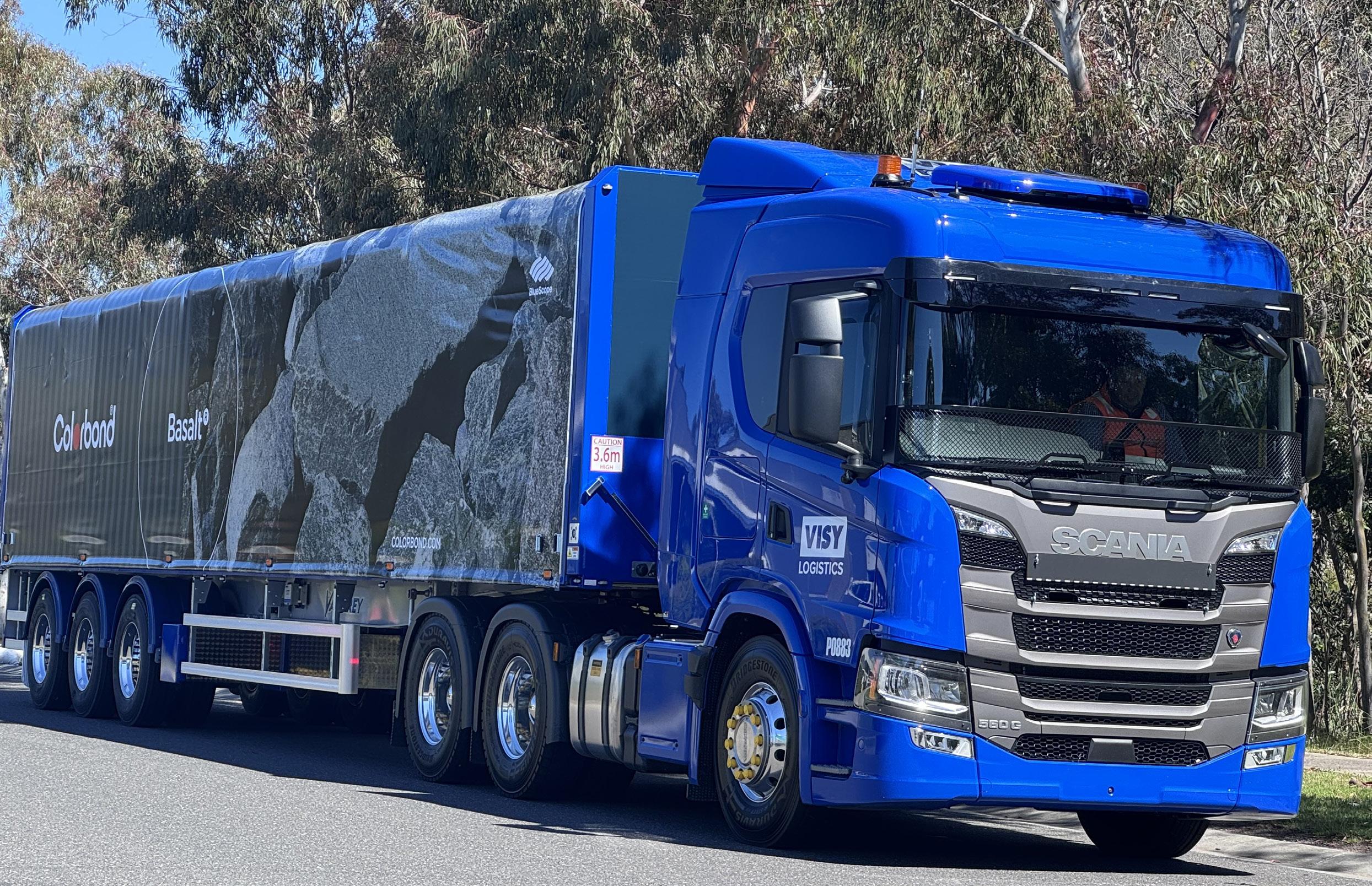
Visy Logistics and BlueScope have entered into a new logistics agreement to further strengthen Western Australia’s steel supply chain and support the region’s growing infrastructure and manufacturing sectors.
Under the new agreement, Visy Logistics will expand its fleet and introduce a suite of purpose-built trailers, including 10 new prairie wagons. They were manufactured in Australia using BlueScope steel to achieve high safety and compliance standards, and freight-handling requirements of BlueScope’s Western Australian operations.
This agreement will generate 21 jobs for Visy Logistics in Perth, supported by a dedicated fleet. For
a customer focused solution, the fleet features:
y Modern trailers to protect product quality from all-weather conditions
y Improved safety through integrated features like roll stability systems and retractable trailer stairs to protect both employees and the wider community
y Improved payload efficiency, optimising cost and environmental performance.
y Tony Egbers, BlueScope Western Region Processing and Logistics Manager said:
y “This agreement reinforces our commitment to safety, reliability, and continuous improvement in supply chain performance.”
Wayne Boxshall, Visy Logistics Coun-
try Manager said:
“This new arrangement reflects the strength and longevity of our partnership with BlueScope. Over many years, we have forged this relationship by consistently delivering on our promise across the Eastern Seaboard.
We are proud to extend that same commitment to BlueScope and their WA partners. Visy Logistics is fully dedicated to supporting BlueScope’s growth.”
This new agreement represents another significant and important milestone for Visy Logistics as the company continues to build momentum and grow its position as a leader in steel transportation and logistics across Australia.
Luke Tomkin, Partner, Argon & Co Australia
The journey begins with understanding why change is needed. Without clearly defined goals and desired outcomes, technology decisions risk falling short of expectations. NEOS by Argon & Co helps organisations clarify these strategic drivers, ensuring that technology investments are made with purpose and aligned to the overarching business strategy. With deep experience across industries such as retail, FMCG, heavy industry and healthcare, NEOS supports clients in identifying technologies requirements that are the best match for their operational context. The goal is simple: let technology serve your business, not constrain it.
Technology alone doesn’t drive change, people and processes do. NEOS emphasises the importance of embedding new systems within the
fabric of day-to-day operations. This holistic approach ensures that solutions are adopted successfully and deliver measurable improvements in productivity, efficiency, and employee engagement.
The technology selection process is filled with risk—ranging from misaligned functionality to poor implementation. NEOS helps organisations avoid these pitfalls by anchoring the process in a clear understanding of business needs, future scalability, and implementation readiness. Through structured evaluation and independent advisory, NEOS ensures that your investment delivers genuine impact and longterm ROI.
The ultimate goal of any technology initiative should be to unlock improved organisational performance. A Best Fit methodology enables
businesses to reduce costs, improve agility, and accelerate return on investment. NEOS’s deep operational expertise ensures that technology isn’t just implemented, it’s optimised to deliver maximum value.
Your technology strategy starts here
Technology selection is a strategic decision that can redefine how your supply chain operates. By applying a Best Fit approach, organisations can ensure that every solution implemented is aligned with their objectives, empowering performance at every level.
NEOS brings the expertise, frameworks, and practical insight to guide organisations through the complexity of technology selection and integration.
If you’re ready to explore how a Best Fit elevate your operations, NEOS is here to support you on your journey to operational excellence. Reach out today.

Microlise, a leading provider of innovative technology solutions, is pleased to announce the appointment of Dean Garvey-North as the company’s new Chief Technology Officer (CTO). He replaces industry figure Duncan McCreadie, who retires after 10 years with Microlise.
Most recently working as a digital, data and technology executive in the utilities sector, and as a management consultant partner, Garvey-North is a governing body member of Gartner’s Chief Information Officer (CIO) community, which is responsible for shaping future UKI digital and data strategies. He is also a contributing member of the Forbes’ CIO Technology Council.
Throughout his career, Garvey-North has been accountable for strategic leadership of transformation functions, data and AI, business performance and insights, innovation and IT, having achieved best-in-sector regulatory scores for cybersecurity strategy and investment, along with industry awards.
His new role as part of Microlise’s senior leadership team will involve leading the company’s technology strategy, driving innovation and ensuring that Microlise’s infrastructure and product development are world-class, aligning initiatives with business goals and fostering a culture of high-performance engineering within the business.
Commenting on his appointment, Dean Garvey-North said: “I am delighted to be joining such a forward-looking organisation that is at the very top of its game.
“Microlise’s products in the logistics sector are extremely exciting as the

DEAN GARVEY-NORTH Chief Technology Officer, Microlise
drive towards more efficient operations intensifies. It’s no small task to be trusted with the development of tools that help achieve this, but it’s one I’m ready for.”
“I’m particularly inspired by Microlise’s role in shaping the future of the industry – setting new standards for innovation, sustainability and performance.”
Microlise CEO, Nadeem Raza, added: “I would like to extend my sincere thanks to Duncan McCreadie for his outstanding leadership and contribution over the past decade as our Chief Technology Officer. His commitment and technical vision have been instrumental in shaping Microlise’s success and establishing
our reputation for innovation and reliability.
At the same time, we are delighted to welcome Dean to Microlise as our new CTO. His wealth of experience and strategic insight will be invaluable as we build on our strong foundations and continue to drive growth. Dean’s appointment reinforces our ambition to remain a trusted and forward-thinking name in transport technology, supporting our customers to operate more efficiently, safely and sustainably.”
To learn more about Dean Garvey-North and what his appointment means for the future of Microlise’s technology roadmap, visit microlise.com/au.
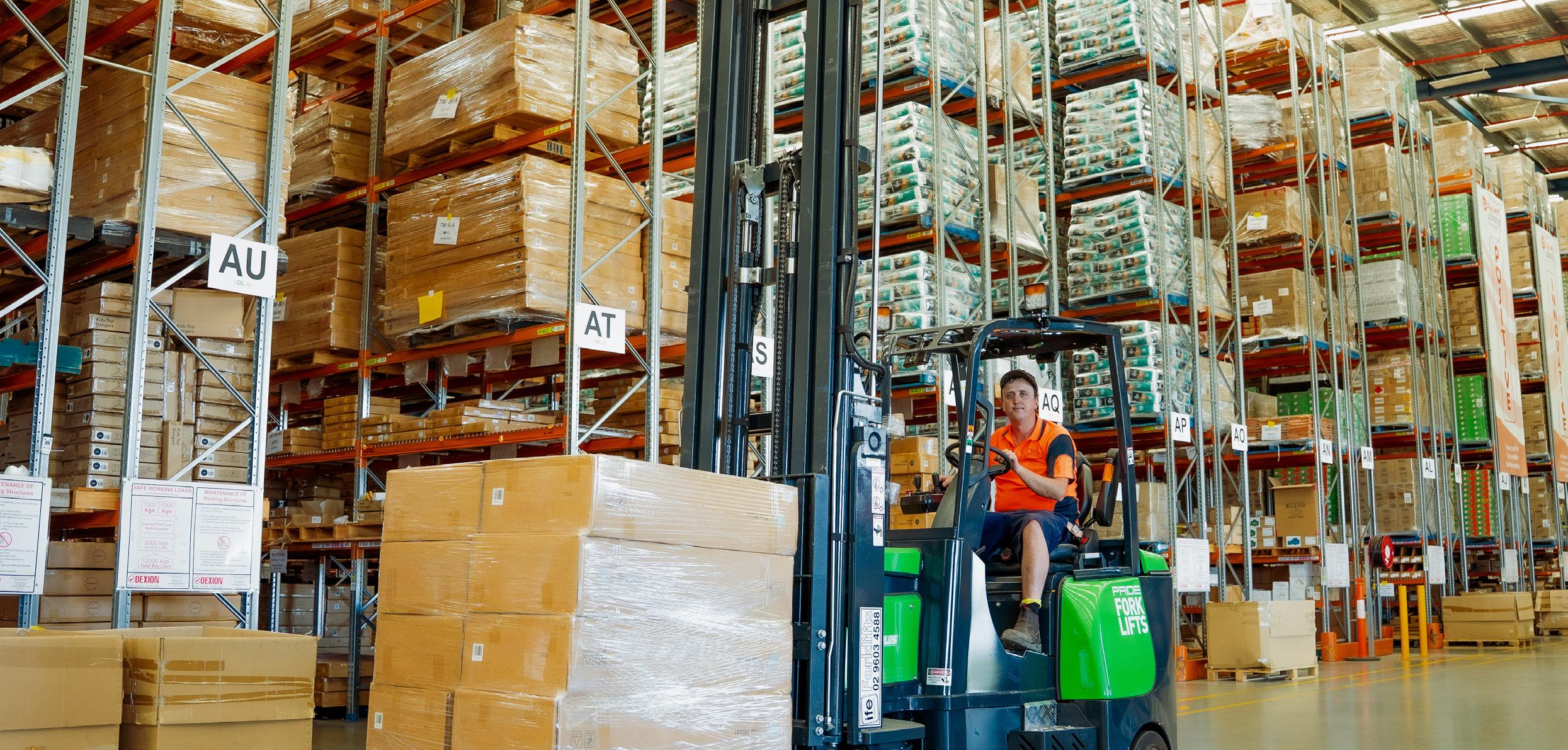
The End of Commodity Logistics: Why 3PLs Must Redefine Value
For too long, logistics has been treated as a commodity, measured in pallet rates, pick fees, and storage costs, with providers competing in a race to the bottom. In that environment, the lowest price often wins. But what is frequently overlooked is the true cost of that decision: inconsistent service, lack of scalability, and ultimately, constrained growth.
The reality is simple, the era of commodity logistics is coming to an end. Today’s supply chains are more dynamic and complex than ever. The rise of eCommerce, increasing customer expectations, and ongoing cost pressures have fundamentally changed what businesses require from their logistics partners. It is no longer enough to provide space and labour. Customers need agility, transparency, and consistent execution at scale.
At B dynamic Logistics, we’ve built our model around this shift, grounded in disciplined execution and a strong, peopleled culture. Rather than competing purely on price, we operate on a “value plus costto-serve” philosophy. This approach ensures that pricing reflects the true effort required to deliver high-quality outcomes, while giving customers clear visibility into what drives their costs. It moves the conversation away from transactional rate negotiations and towards measurable performance.
Because ultimately, that is what mat-
ters are the outcomes. Speed, accuracy, and reliability are no longer differentiators, they are expectations. The real differentiator lies in the ability to scale without disruption. Many businesses discover too late that their logistics provider cannot keep pace with growth or demand volatility. When volumes spike, service levels drop. When complexity increases, errors follow.
Scalability without discipline is not scalability at all. That is why operational execution remains at the core of everything we do. The fundamentals, receiving, inventory placement, picking, packing, and dispatch are where success is determined. We place strong emphasis on frontline leadership and capability, because it is our people who translate strategy into consistent execution, every day. Strategy is important, but in logistics, performance is defined on the warehouse floor.
Technology plays a critical supporting role, but it is not a substitute for operational excellence. There is a growing tendency in the industry to view systems as a cure-all. In reality, technology should enhance well-designed processes, not compensate for poor ones. Our focus is on integrating systems that improve visibility, enable better decision-making, and provide actionable insights both for our team and for our customers. Looking ahead, the next phase of logistics will be defined by specialisation. Generic, one-size-fits-all
solutions are giving way to more complex, higher-value services. At B dynamic Logistics, this shift has led us to focus on more complex, higher value logistics environments, where precision, compliance, and disciplined execution are critical. These are the conditions in which strong operating models matter most, and where we see the greatest opportunity to deliver differentiated value. However, no strategy, system, or process can succeed without the right people. Frontline leadership remains one of the most important and often overlooked drivers of performance in logistics. Investing in leadership capability, engagement, and accountability is essential to sustaining high standards. When frontline teams are aligned and empowered, execution follows.
As an industry, we need to challenge the way we define value. Customers are not just buying storage or labour they are buying reliability, scalability, and peace of mind. The providers that succeed in this next phase will be those that can consistently deliver on these outcomes, not those offering the lowest rates. That consistency is built by organisations that invest in their people as seriously as they invest in systems and infrastructure.
The question is no longer who can do it cheaper. It is who can do it better, consistently, and at scale.
That is the future of logistics, and the end of treating it as a commodity.
Craig Skinner, Head of APAC Neurored TMS & SCMw
In logistics, productivity gains rarely come from software alone. They come from skilled, experienced people across the operation. They come from the ops manager who rebuilt the workflow. The coordinator who cut three steps from every booking.
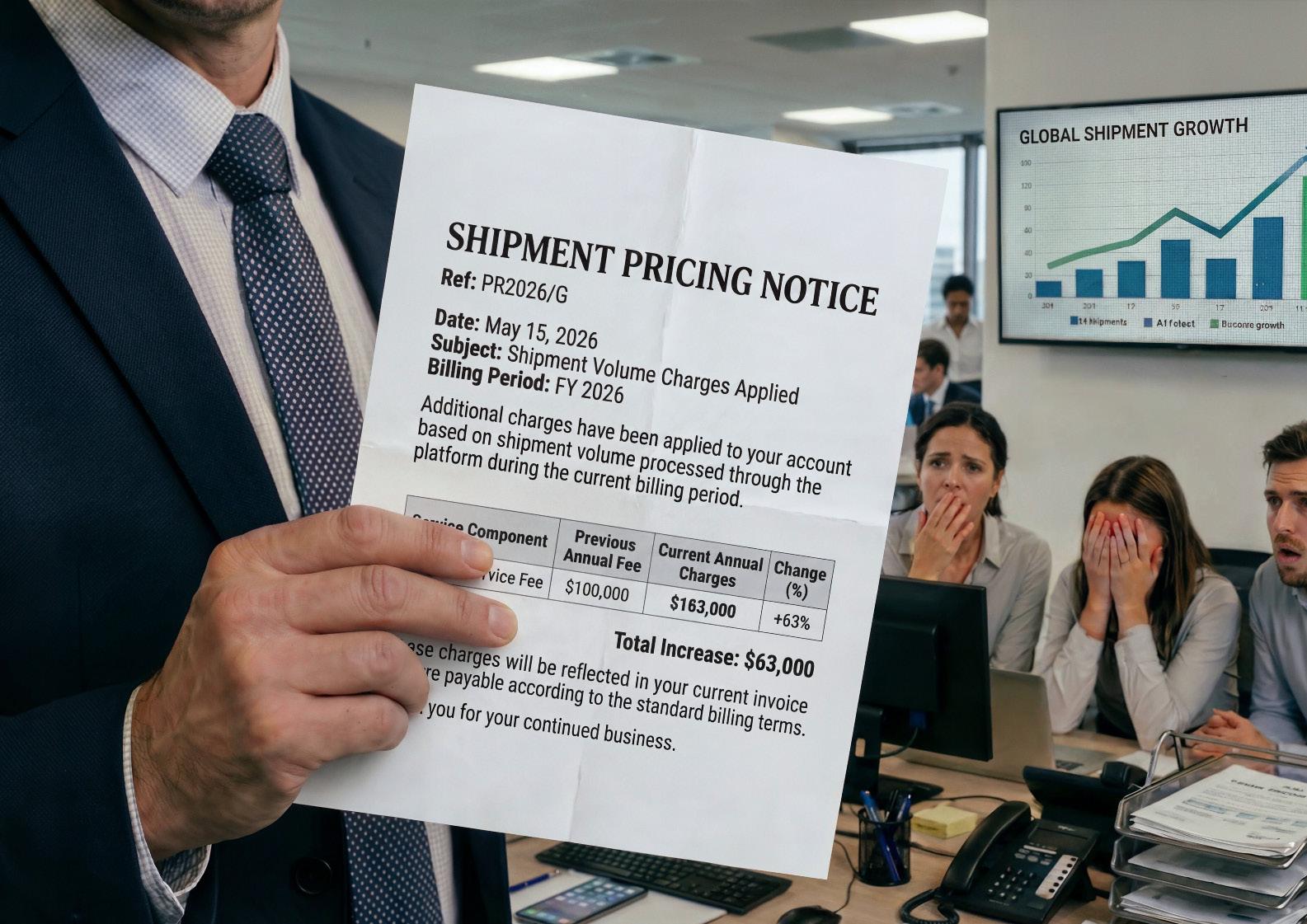
Yet the pricing model many Transportation Management System (TMS) vendors want to use, doesn’t reward the people who created that productivity.
For many organisations using a TMS system, something strange happens when productivity gains show up
in the numbers. As teams process more shipments with the same staff, the TMS bill rises in lockstep with that increased operational output.
This raises a simple question: when teams do better, should the software cost more?
Imagine your landlord calls to say your rent is going up 30% because
your electricity usage rose 30%. You’d laugh. The walls didn’t work harder. The plumbing didn’t strain. Nothing about the property changed.
Yet this is precisely what shipment-based TMS pricing does to you. The core infrastructure doesn’t scale with volume. But every additional shipment still triggers a fee as if it did.
Why
Vendors often suggest adding a tech surcharge to recover costs. It sounds reasonable. In practice, it backfires.
A rate of $2,425 is easy to compare. A rate of $2,318 plus a documentation fee plus a tech fee makes buyers do the math and wonder what they’re really paying for.
Your competitor quoted one number. You quoted three. After the sale, freight audit systems reject charges that aren’t in the contract. And regulators are heading the same way, treating unavoidable surcharges as junk fees.
The pass-through advice doesn’t save you money. It just makes you the one explaining the extra lines.
The entire industry is pushing toward leaner operations and team efficiency. A pricing model that charges more every time that strategy succeeds is working against the people it’s supposed to serve.
Ricardo Medem Founder & CEO
Neurored TMS & SCM
Consider a mid-sized forwarder, with a lean team that grew from handling 50,000 shipments to 100,000 by improving automations, playbooks, and training. The team did this while adding just five people to a 20-person ops team.
Then the invoice arrives and their TMS bill has doubled even though the team only grew by 25%. Their vendor shipped updates along the way, which is expected. But none of those updates doubled their shipment volume.
User-based pricing lets your team keep the gains they create. You pay for seats, not shipments. Take the same forwarder from earlier: the team doubled output and added just five people.
Under user-based pricing the bill goes up 25% instead of 100%. If the peak season brings a 30% volume surge handled by the same staff, the bill stays flat.
Every automation your team builds, every workflow they improve, every hour spent training someone new; the user-based pricing model compounds those efforts in your favour. The people doing the work finally get to keep what they have earned.
Before your next TMS contract renewal, think about this: When your team builds the playbooks, absorbs the peak seasons, and figures out how to do more with the same headcount, who captures that value?
If the answer is your vendor, then the people driving your growth aren’t being recognised by the economics of your own operation. They deserve better than that. So do you.

Tamara Kulesa, Senior Director – Solutions Marketing, Blue Yonder
Artificial intelligence is rapidly reshaping warehouse operations, but not in the way many people might expect. The most effective operations continue to rely on people because humans and intelligent systems work better together. Tasks that once relied entirely on manual effort are now optimised by intelligent systems that can sequence work, balance resources, and respond to real-time signals faster than any individual ever could. In modern supply chains, warehouses have become far more complex than they were even a decade ago. Warehouses are dynamic environments that operate as high-velocity fulfilment hubs balancing unexpected demand shifts, omnichannel retail fulfilment, tight delivery windows – often while dealing with fluctuating availability of labour. Within this environment, operational efficiency often comes down to a deceptively simple question; how do you assign the right person or piece of equipment to the right task at the right time?
Traditionally, this process has relied heavily on manual oversight. Warehouse managers have frequently adjusted schedules and reassigned tasks on the fly in order to deal with disruptions such as equipment failures, worker absences, priority order changes or late deliveries. These adjustments are essential to maintaining productivity, but they also create a constant operational headache. Static scheduling and manual decision-making simply struggle to keep pace with the dynamic nature of modern warehouse operations, especially as supply chain issues continue to bite across the region. At the same time, rising operational costs and increasing customer expectations are making inefficiencies more expensive than ever.
Labour alone typically accounts for between 50 and 70 percent of total warehouse budgets, while travel time within facilities can consume 25 to 40 percent of operational costs.
(Source)
This is where AI is beginning to play a transformative role.
From task management to intelligent orchestration
Rather than focusing on automating individual tasks, the power of AI is increasingly being used to orchestrate warehouse operations in real time.
These intelligent systems continuously analyse and update the entire task queue within a warehouse alongside data about worker skills, access and permissions, equipment availability and throughput rates. Based on this real-time visibility, AI can dynamically recommend the best available resource for each task as conditions change throughout the day.
For warehouse teams, the practical impact is significant.
Instead of spending hours reassigning workers or manually adjusting task lists as in the past, managers can rely on AI-driven recommendations to identify the most efficient way of completing such tasks. If a sudden order surge occurs or equipment becomes unavailable, the system can instantly suggest a new allocation that maintains workflow
continuity and productivity.
Critically, these capabilities are not about removing humans from the process. In many cases, the AI functions as a copilot, providing actionable insights and recommendations that warehouse leaders can review and approve, helping with critical decision making on the fly.
The result is a shift away from reactive task management toward what might be described as ‘intelligent resource orchestration.’
Freeing people to focus on higher-value work
One of the biggest benefits of this approach is that it allows warehouse staff to spend less time managing repetitive coordination tasks and allowing them to move to higher level activities.
Things like task sequencing, travel optimisation and resource allocation, traditionally time-consuming operational chores, can be handled by AI systems capable of analysing thousands of possible combinations in real time – much faster than a human could.
By automating these lower-level decisions, organisations free their people to focus on areas where human judgement remains critical such as problem solving, process improvement, safety oversight and workforce management.
Warehouse managers, for example, can spend more time analysing operational trends, improving workflows or coaching staff rather than constantly reacting to the latest disruption on the floor.
Workers themselves also benefit from more efficient task assignments. When resources are matched intelligently to tasks based on things like proximity, skill sets and availability, it reduces unnecessary travel, minimises idle time and keeps
workflows moving more smoothly throughout the day.
In effect, AI becomes an operational partner, helping humans manage the complexity of modern logistics environments.
Why AI still needs guardrails
However, as AI systems become more capable, another critical factor emerges - governance.
AI can analyse enormous volumes of operational data and generate sophisticated recommendations, but it still requires guardrails to ensure those decisions align with business objectives, safety requirements and operational constraints.
In warehouse environments, these guardrails typically come from the people running the operation.
Many AI-driven systems are deliberately designed with different, adjustable levels of autonomy, allowing
organisations to determine just how much decision-making authority the system should have. Manual triggers, approval processes and policy rules ensure that human operators remain firmly in control of those critical decisions.
This balance is essential, because while AI excels at identifying patterns and optimising workflows, humans remain responsible for understanding the broader context of those actions and decisions – things like workforce wellbeing, customer commitments or safety considerations for example.
Without these guardrails, even the most advanced AI system risks making decisions that optimise for the wrong outcome.
The future is human-centred AI
As warehouse technologies evolve, the most successful implementa-
Warehouses have become complex logistics hubs, but many still rely on outdated planning, driving up costs and creating silos between people and automation. Learn how you can move from hindsight to foresight and optimise every resource.
Warehouses have become complex logistics hubs, but many still rely on outdated planning, driving up costs and creating silos between people and automation. Learn how you can move from hindsight to foresight and optimise every resource.
tions are likely to be those that recognise the complementary strengths of humans and AI.
AI can continuously analyse complex operational environments, recommend optimal task assignments and respond instantly to disruptions. Humans, meanwhile, provide the judgement, oversight and strategic thinking that ensure those systems operate responsibly and effectively. Rather than replacing workers, AI is increasingly becoming the invisible infrastructure that allows warehouse teams to operate at a higher level. In the warehouses of the future, success will not come from choosing between humans or machines. It will come from orchestrating both – that is, combining the speed and analytical power of AI with the experience and judgement of the people who keep supply chains moving.
Elton Brown, Senior Consultant at DMS
In our first webinar with ASCLA, DMS explored a challenge that many supply chain leaders know all too well. Businesses can invest in systems, data platforms, dashboards and planning tools, yet still struggle to make timely, aligned decisions.
That message clearly resonated. What made the session so relevant was that it reflected the daily reality inside many organisations. Teams are not short on effort. They are not always short on data either. But despite that, decisions still get delayed, revisited, escalated too late, or made without the right context. There is a lot of activity, but not always enough flow.
That was the central theme of the webinar. Why do organisations with so much technology still find decision making harder than it should be?
Understanding Planning Friction
The answer, in many cases, is not simply that the software is wrong or that more systems are needed. The real issue is often the friction that builds up between functions, across processes and around decisions.
You see it when demand planning, supply planning, procurement, inventory, sales and finance are all working hard, but not working from the same assumptions. You see it when risks are visible in one part of the business but not understood in another. You see it when teams spend hours preparing for planning meetings, only to walk out without a clear decision or agreed next step.
Most supply chain professionals do not need this explained to them because they deal with it every week.
A planner updates the forecast, but

sales are still operating from a different view. A supply issue is known, but the commercial impact does not become clear until much later. Inventory pressure is building, but no one is quite sure who owns the trade-off. Escalation paths exist on paper, but in practice problems sit too long before action is taken. These are not isolated problems. They are signs of structural friction in the way planning happens. That is why the idea of planning friction is so useful. It gives leaders a practical way to describe what is often felt but not clearly named. It covers duplicated effort, fragmented ownership, poor handoffs, inconsistent signals and critical knowledge
sitting in inboxes, spreadsheets or people’s heads rather than moving cleanly through the business.
When friction is high, even capable teams with decent systems struggle to perform at the level they should.
One of the most valuable parts of the webinar was the discussion this opened up. Once organisations start looking at planning through the lens of friction, the quality of the conversation improves. Instead of jumping straight to tools or features, they start asking better questions. Where do decisions slow down? Where do issues get stuck between functions? Which decisions need
human judgement, and which ones could move faster with better rules, visibility or context? Where are capable people spending too much time gathering information rather than acting on it?
That shift is important because it creates a much more grounded starting point for the next phase of the discussion around AI.
Too much of the market still talks about AI in vague or inflated terms. In practice, the value is much simpler. It is not about replacing planners. It is not about pretending every decision should be automated. It is about helping organisations reduce decision latency and improve the flow of information, insight and action across the supply chain.
That is where the second webinar will go.
We will move from diagnosis into
application. The focus will be on where AI can genuinely help in practical planning environments. That includes cutting through noise so teams can focus on the issues that matter, improving how scenarios are assessed, surfacing risks earlier, and helping decisions move across functions with more clarity and less manual chasing.
That, to me, is where the real opportunity sits.
The organisations getting value from AI are usually not the ones chasing novelty. They are the ones applying it to the mechanics of decision making. They are using it to improve exception handling, speed up comparison of options, strengthen cross functional visibility and support more consistent responses to change.
Of course, none of this works without the right foundations. Data quality matters. Governance matters. Deci-
sion rights matter. If those things are missing, AI will not remove friction. It will simply add another layer of confusion.
But where those foundations exist, even imperfectly, the upside can be significant.
The strongest takeaway from the first webinar was this. Before asking what AI can do, organisations should first look honestly at where planning friction exists today. Where is value being lost through delay, duplication or disconnect? Where are decisions becoming slower than the business can afford? Where are good people spending too much time stitching together context instead of making informed calls?
If that diagnosis is done properly, the path forward becomes much clearer. Because in the end, the goal is not more technology. It is better decisions, made sooner, with more confidence.

Liam Bennett | Melbourne Operations | ERH Refrigerated Transport
The ERH Group (ERH) is a Melbourne-based provider with a footprint throughout the Eastern Seaboard. ERH serves a wide range of clients, from food manufacturers to FMCG retailers. Their core strength lies in our daily local and interstate deliveries, ensuring your time- and temperature-sensitive freight reaches its destination on time, every time. Behind the scenes, a small, highly efficient team of experienced industry professionals keeps the wheels turning smoothly.
Fernhurst Logistics, recently acquired by ERH, is a temperature-controlled distribution centre providing cross-dock services for major FMCG customers as well as long term storage and import/export services. The site operates on a precise daily cycle, receiving inbound freight
each morning and dispatching outbound loads in the afternoon. Its high-throughput, time-critical operation demands accurate scheduling, reliable communication and strong compliance management to maintain flow and service levels.
With compressed timelines and a highly complex customer tendering process, ERH Fernhurst had limited opportunity to plan or coordinate its carrier base—making visibility, timing accuracy and operational consistency critical.
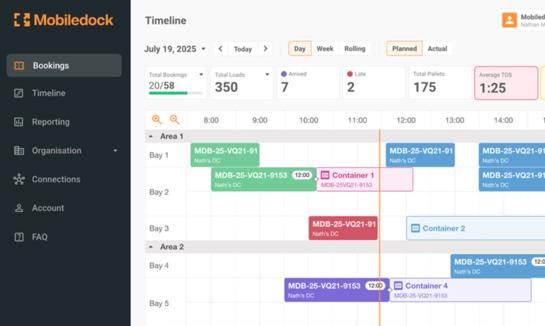
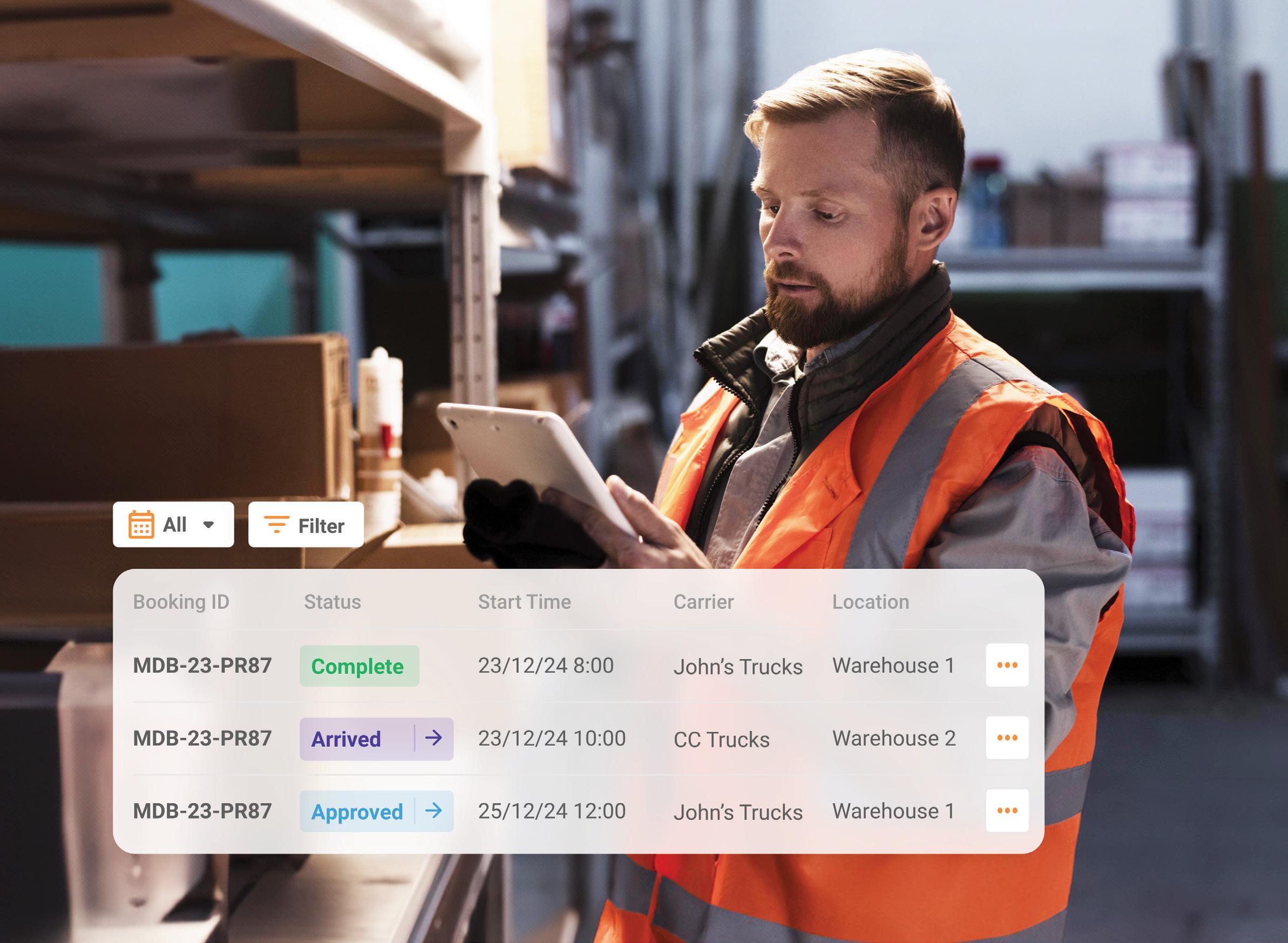
Mobiledock was selected to schedule all inbound and outbound movements, orchestrate dock allocation in real time, smooth vehicle flow across the day, and provide every stakeholder with clear, live communication on booking status and timing.
Challenges
y Short window to assign inbound and outbound loads
y Vehicles arrived simultaneously, causing delays, congestion, and reactive management.
y Limited visibility of expected freight and arrival times made planning difficult.
y Chain of Responsibility (CoR) compliance was captured manually and on paper, increasing administrative workload and risk.
y Communication via email and phone was inefficient and unable to support real-time operational coordination.
The Mobiledock Solution
ERH implemented Mobiledock at it’s Fernhurst Logistics facility to digitise bookings, standardise driver checkin, and provide real-time visibility of planned and actual vehicle statuses. Key features adopted include:
y Digital booking workflow, enabling carriers to receive and confirm PM pickup/AM delivery windows five minutes after the cross dock load data was available.
y Driver QR check-in, capturing arrival times, vehicle details, and all required CoR responses at the driver kiosk.
y Live visibility of all inbound and outbound movements, helping supervisors balance dock capacity across AM and PM peaks.
y Automated notifications, improving carrier communication and reducing manual follow-ups.
y A scalable, repeatable setup, allowing ERH Fernhurst to onboard carriers quickly and maintain consistent control across the site.
Results
After only three months, Fernhurst Logistics has already seen clear op-
erational improvements:
y Significant performance gains, with teams completing tasks more quickly due to smoother flow and tighter operational control.
y More predictable cross-dock operations, with a better balance between morning inbound and afternoon outbound activity.
y Scheduled booking times now sent to carriers at 4:30 pm instead of 6:00 pm, improving planning and lead time.
y Lower admin effort through carrier-edited bookings, automated CoR capture, and digital check-in.
y Stronger communication and improved carrier compliance.
y Better visibility for supervisors and forklift drivers, reducing congestion and unplanned arrivals.
Mobiledock has made a significant difference to our Melbourne cross-dock operation. With around 2,500 pallets moving through the site each day and close to 100 trucks to schedule, it gives us the visibility to coordinate AM inbound deliveries and PM dispatch efficiently.
Bec Marshall
Melbourne Operations
ERH Refrigerated Transport
We needed a dock scheduling solution that worked for our cross-dock operation. Mobiledock partnered with us to design it and delivered quickly. We were impressed by the effort and collaboration from the team to ensure the solution worked for our operation, carriers and our customers.
David Papadopoulos
GM Operations
ERH Refrigerated Transport
Last Friday we had our busiest day ever, and thanks to Mobiledock, the team finished the PM shift three hours earlier than a normal day.
Liam Bennett
Melbourne Operations
ERH Refrigerated Transport
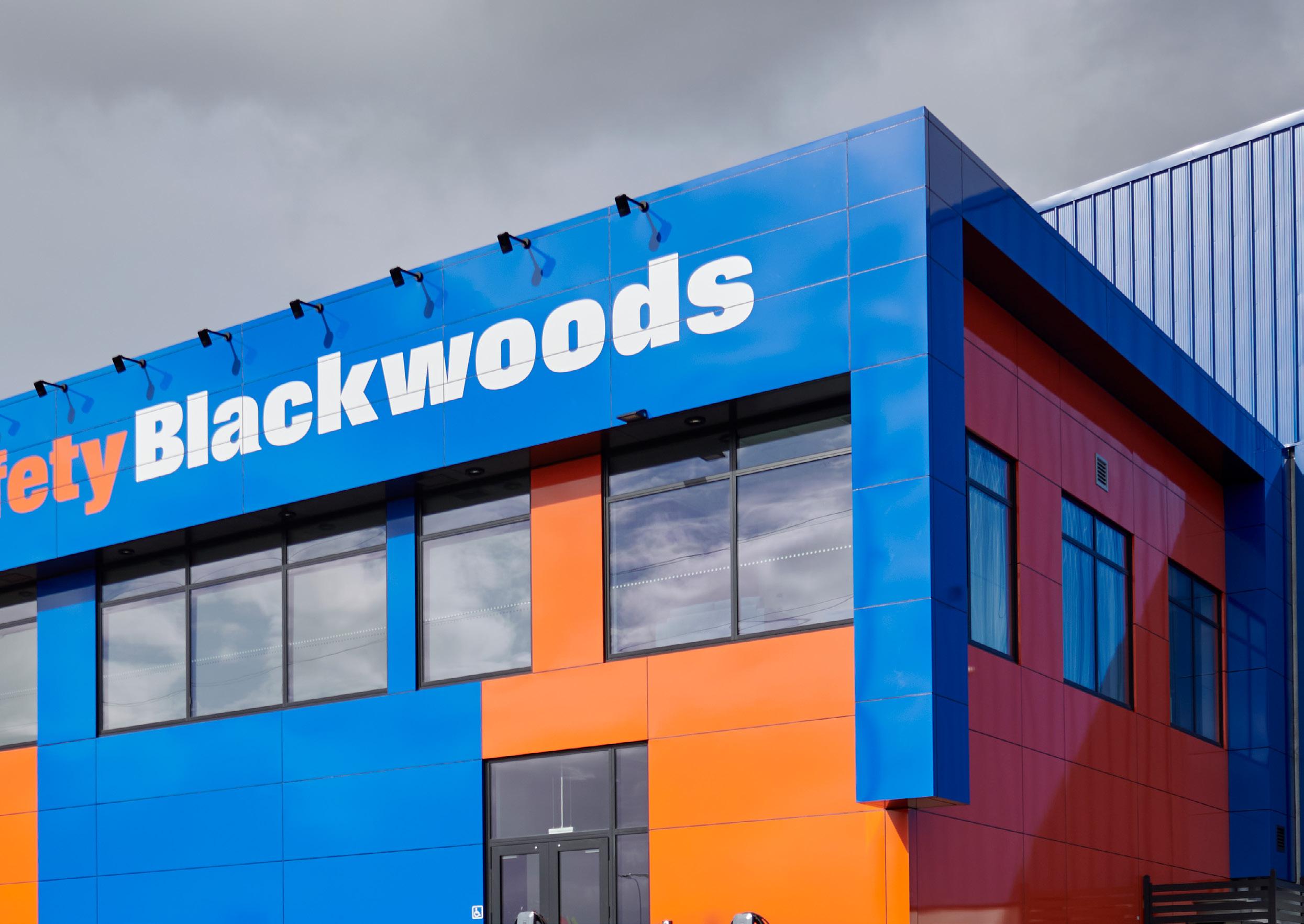
Automation from AutoStore integrator Kardex is speeding up distribution and enhancing order accuracy for NZ Safety Blackwoods, New Zealand’s leading supplier of safety equipment, engineering supplies, power tools, uniforms and packaging.
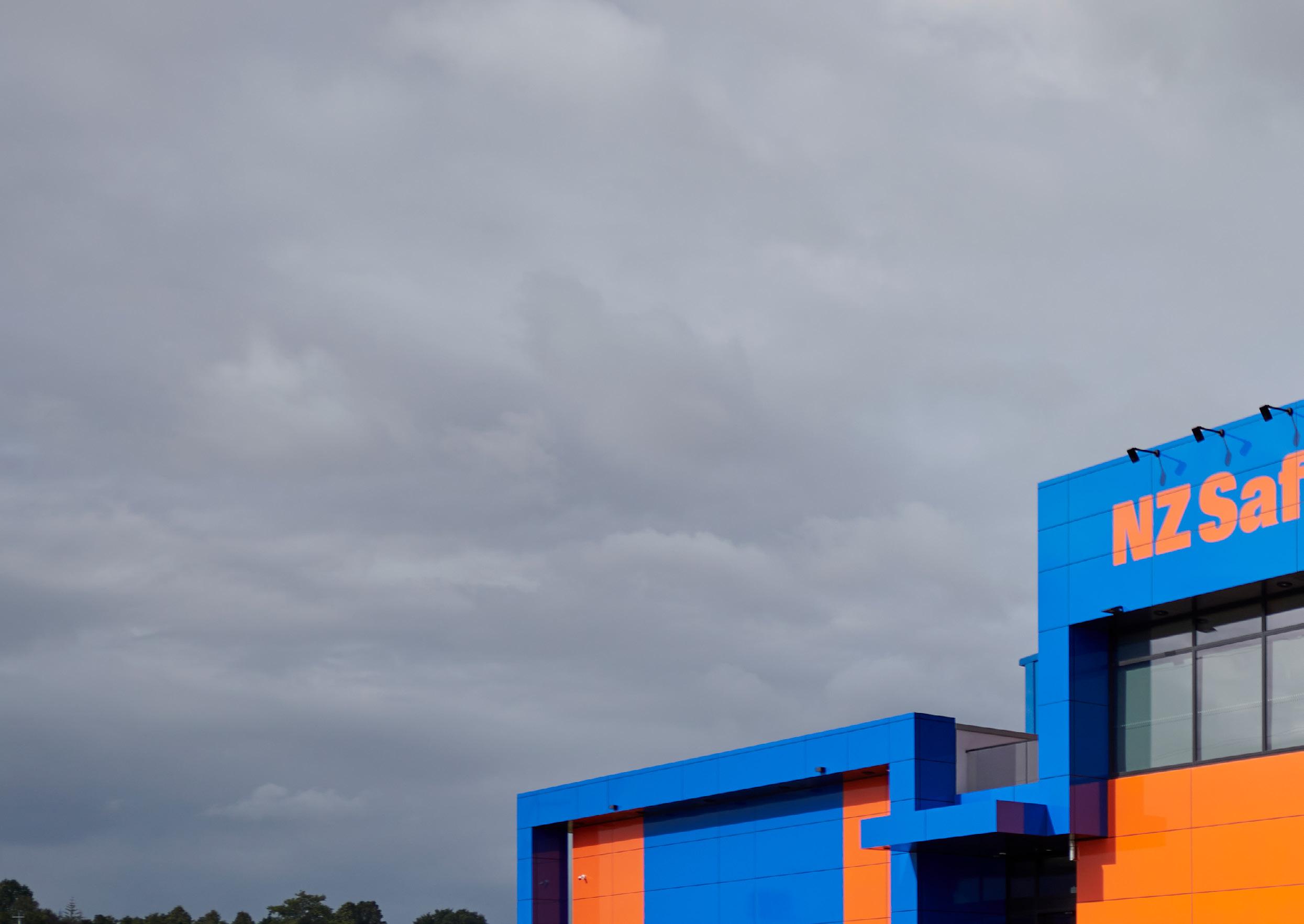
Anew project in South Auckland demonstrates how warehouse automation can transform storage and fulfilment operations. Safety equipment and engineering supplies company NZ Safety Blackwoods has officially opened its new national distribution centre at Drury South. The 18,000-square-metre hub represents a significant, long-term investment in its national supply chain and features a state-ofthe-art AutoStore automated storage and retrieval system (ASRS) supplied by Kardex, the fastest-growing global AutoStore integrator.
Owned by Wesfarmers, NZ Safety Blackwoods supplies essential safety, engineering and workplace products to customers across New Zealand. The new facility brings together advanced automation, sustainable design, high-density storage and streamlined processes to support faster, more accurate and more reliable fulfilment. Kardex’s dedicated expert AutoStore team in New Zealand worked alongside
NZ Safety Blackwoods to optimise storage and fulfilment operations. The project was completed in-budget and ahead of schedule, with a 37,000 bin induction completed in just eight days.
New national distribution hub meets rising demand and expectations
With over 100 years’ experience and expertise, NZ Safety Blackwoods covers all of New Zealand with a range of more than 100,000 products, 35 trade centres and over 550 team members. By consolidating five existing distribution centres into a single, purposebuilt site, the company can fulfil orders from one location, reducing complexity, handling and delivery times. The new facility improves the accuracy, speed, safety and consistency of its fulfilment operations in light of growing customer demand and rising expectations. “Customers rely on us for products that are fundamental to safety and productivity,” explains Chris Mason, Head of Operations for NZ Safety
Blackwoods. “When something is missing or delayed, work can stop. This new distribution centre is about reducing that risk – by moving product through our network faster, more accurately and with far greater reliability.”
Enhancing visibility, accuracy and simplicity through automation
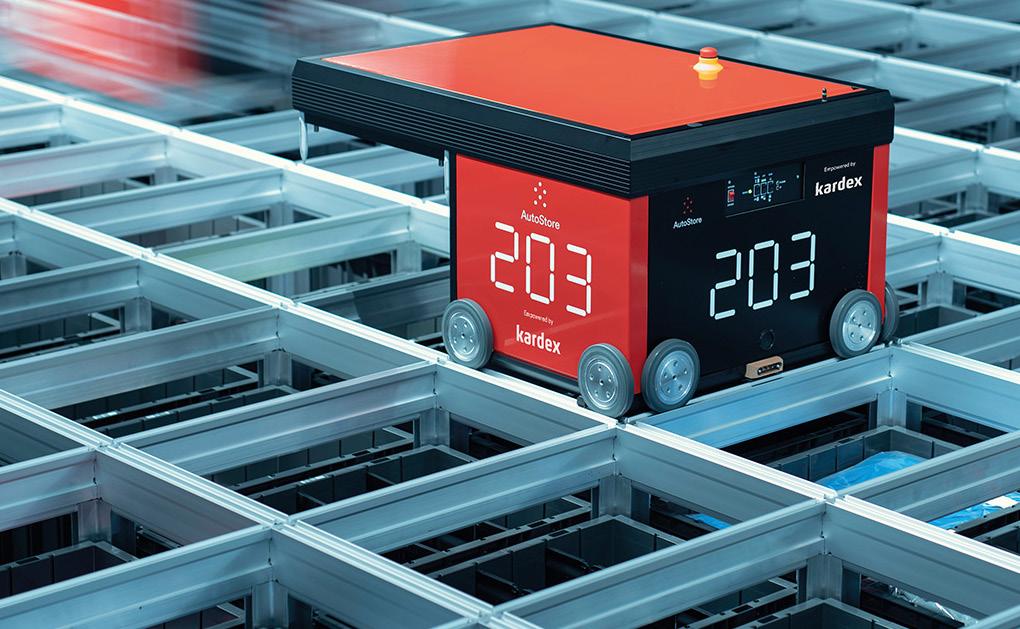
The new facility has been designed to support more than 100,000 products (SKUs) across the NZ Safety Blackwoods range and Kardex played a central role in the project through the implementation of the AutoStore ASRS. The AutoStore grid houses 37,000 totes, each capable of storing up to 32 product lines, within an area as small as 1,000 square metres. Its high-density configuration allows NZ Safety Blackwoods to hold more stock in a compact footprint and respond faster to customer orders. The AutoStore ASRS, powered by Kardex software, improves inventory visibility and order accuracy, while customers also benefit from consolidated invoicing and simpli-
fied administration, reducing time spent managing orders. At full operation, the distribution centre will support close to 4,000 product lines a day.
Installed by Kardex’s dedicated AutoStore team, the system enables a new product to be presented to team members every four seconds during peak periods, facilitating ultra-fast dispatch when essential items are needed by on site quickly by customers. This level of automation drives a tenfold increase in picking efficiency, with a single operator able to pick up to 300 product lines per hour. At full operation, the automated system will help NZ Safety Blackwoods serve close to 4,000 product lines a day to customers nationwide.
The AutoStore system supplied by Kardex comprises:
9 32 x R5 robots
9 26 x chargers
9 37,000 bins
9 6 x Carousel Ports
9 6 x Conveyor Ports
9 6 x Kardex Intuitive Picking Assistants (IPA)
“For more than 100 years, NZ Safety Blackwoods has existed to support New Zealand businesses with the products and expertise they rely on every day,” says Andy Antoci, GM NZ Safety Blackwoods. “Today we serve customers right across the country, from large industrial and infrastructure projects to manufacturers, contractors and essential services. This distribution centre reflects both the scale of our business and our responsibility to keep customers supplied, safe and operating without disruption.”
Automation provides a safe, futureproofed, sustainable solution for NZ Safety Blackwoods
AutoStore is the fastest fulfilment system per square foot on the market and 10 AutoStore robots use the same amount of power as one standard vacuum cleaner. They charge opportunistically and the system is designed to reduce bottlenecks. The AutoStore ASRS can be scaled up as
required to meet peaks in demand, with new robots, ports and storage easily added without any disruption to existing operations.
Beyond speed and efficiency, automation contributes to a safer working environment. The layout reduces the need for repetitive or higher-risk manual tasks and separates people from mobile plant and active machinery zones, supporting the NZ Safety Blackwoods’ focus on safety-by-design and long-term operational stability. The new system also features the ergonomically-designed Kardex Intuitive Picking Assistant (IPA), which guides workers through the picking process by projecting all relevant information to optimise efficiency and accuracy.
“Building a new facility from the ground up gave us the opportunity to design safety into every part of the operation,” says Antoci. “It creates a better working environment for our team and supports longterm operational stability.”
“The technology has been imple-
mented with a clear focus on safety-by-design and people-first operations, reducing higher-risk manual tasks while supporting consistent, repeatable performance at scale.”
The distribution centre reflects NZ Safety Blackwoods’ commitment to more sustainable operations. The building structure has been designed to minimise embodied carbon and has been upgraded, in partnership with national property and construction firm Calder Stewart, to accommodate a 0.5megawatt solar energy system, capable of running critical systems.
“This state of-the-art facility reflects the growing demand for modern, efficient and sustainable warehousing infrastructure across New Zealand,” says Ben Murphy, Calder Stewart’s General Manager Property. “Partnering alongside NZ Safety Blackwoods, our focus was to deliver a purpose-built facility that integrates advanced automation, supports safer operations, and provides the flexibility required for a national distribution network. The result is a future-ready asset designed to support their business and customers for many years to come.”
Taking place on Friday 20 March 2026, the new facility was officially opened by Sir Bill English, former Prime Minister of New Zealand and current member of the Wesfarmers Board, with attendees taking part in
guided tours of the new distribution centre and seeing the AutoStore in action.
“Kardex is proud to have supported the project and to continue enabling customers worldwide with reliable, high-performance AutoStore systems,” Smith concludes. “It demonstrates the power of partnership working, delivering a sustainable, scalable, efficient and safe facility. We are pleased to show how AutoStore and Kardex can transform distribution operations at scale for companies in New Zealand.”
Kardex is a leading global partner for intralogistics solutions in an attractive and growing market. The Group offers premium automated products, standardised systems and lifecycle services that guarantee high availability and low total cost of ownership. Kardex provides an intelligent entry into automation with its dynamic storage and retrieval systems, offers integrated material handling systems, small parts storage systems, and acts as a global AutoStore partner, offering flexible and modular storage and order fulfilment solutions. The Group employs around 2,500 people in over 30 countries.
Kardex Holding AG has been listed on the SIX Swiss Exchange since 1989. For more information, please visit kardex.com.
With over 100 years’ experience and expertise, NZ Safety Blackwoods is a leading supplier to New Zealand businesses of safety equipment, engineering products and services, workwear and uniforms, footwear, office and hygiene products, as well as Worksafe training, signage and packaging solutions.
NZ Safety Blackwoods covers all of New Zealand with 35 trade centres and employs over 550 team members. Customers are supported by user-friendly digital platforms, and award-winning sales and customer service teams offering expert knowledgeable advice.
With a vast range of over 100,000 products and $50 million inventory, NZ Safety Blackwoods ensures customers always have what they need.
Partnering with NZ Safety Blackwoods enables businesses to leverage their scale, knowledge and relationships with preferred suppliers to access the best products at the right price.
NZ Safety Blackwoods is committed to its local communities and is an accredited partner of MATES in Construction.
For more information visit nzsafetyblackwoods.co.nz.

Reduce costs, improve safety, efficiency and compliance






Fleet Telematics
Fleet Safety, Health & Compliance
Journey Management
Planning & Optimisation
Delivery Management
Electronic Work Diary (EWD) & Fatigue Compliance
Powered by Logmaster
2,500+ CUSTOMERS GLOBALLY







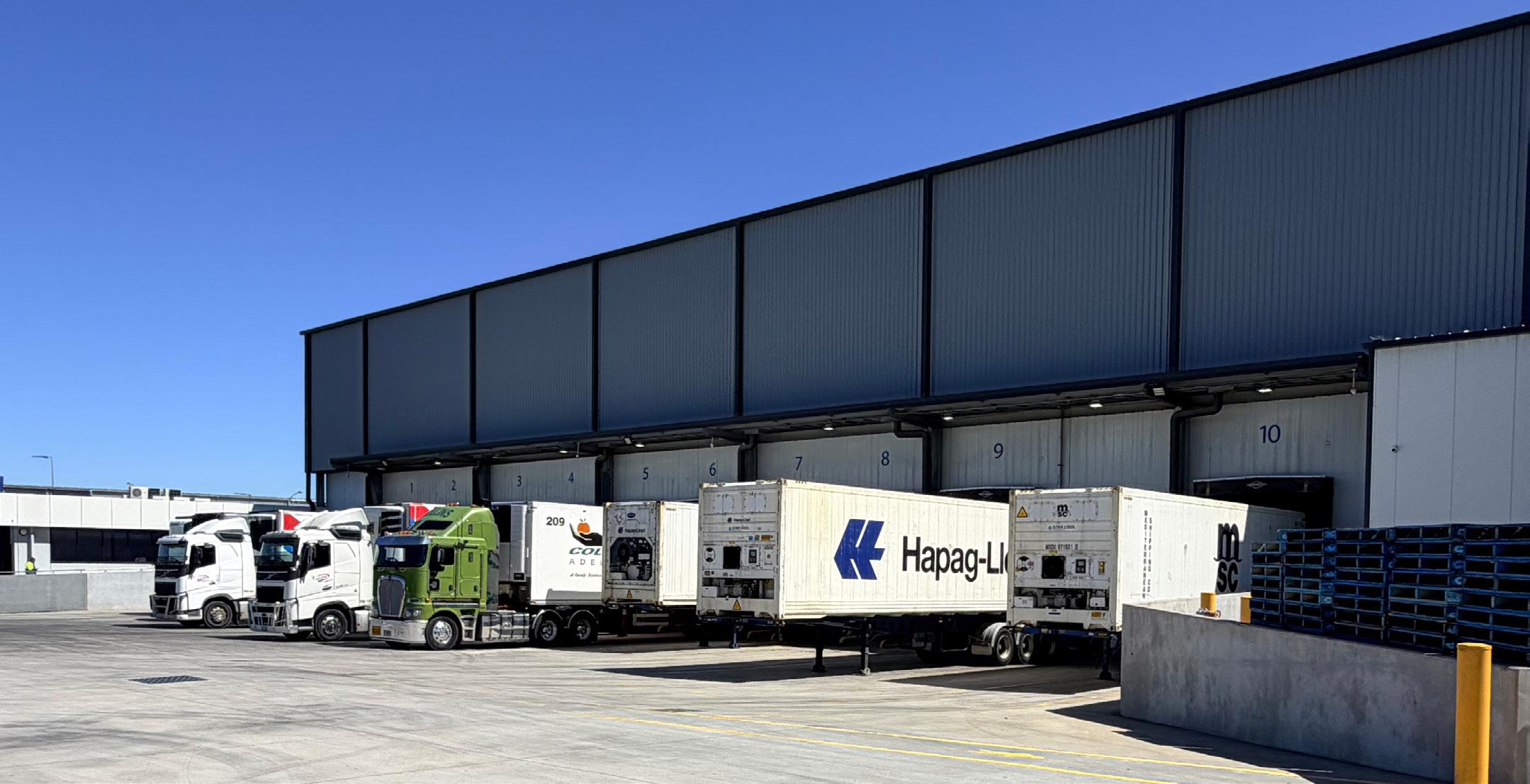
As customer expectations tighten and operational complexity increases, many transport operators are reviewing how container movements into distribution centres and 3PL sites are scheduled, recorded and monitored. Historically, container tracking at site level has often relied on a combination of operational experience, manual records and local processes. These approaches can work effectively in stable conditions. However, as volumes increase or multiple carriers interact across the same DC or 3PL facility, maintaining clear visibility of container arrival, dwell and departure can become more challenging.
A more structured approach supports not only visibility, but planning and control.
Mobiledock’s Asset Management functionality integrates container
tracking directly into the dock booking workflow. Container arrivals are scheduled in advance, movements are time-stamped at entry and exit, and each container is linked to its booking, carrier and site location. Arrival times, dwell duration and container status — whether loaded, empty, damaged or quarantined — are visible in real time.
Driver entry and exit workflows can also capture condition evidence, supporting clearer handovers and reducing the likelihood of disputes.
Operators who introduce structured scheduling and visibility across container movements into DCs and 3PL sites often report:
y Reduced detention and demurrage exposure
y More predictable turnaround times
y Improved utilisation of site capacity
y Clearer compliance documentation
y Less time spent reconciling container activity
The objective is not to replace operational expertise, but to complement it with structured data and scheduled workflows that enhance clarity and accountability.
For many transport businesses, improving visibility and control across container movements into DCs and 3PL sites is less about introducing new systems and more about reinforcing operational discipline in a tightening commercial environment.
For further information: visit mobiledock.com or contact Peter Ristevski, Sales Director - Mobiledock +61 431 383 773 | peter@mobiledock.com
Peter Jones - Managing Director, Prological and Sean Ledbury - Director, Prological
As Australia’s industrial property shortage eases, a new question is emerging in boardrooms and logistics departments: do we actually need more space? According to a new report by Prological, the answer is often no – and the evidence is compelling.
When warehouse managers hear their teams say, “we’re running out of space,” the instinct is to start planning for bigger premises. It’s a familiar pattern across Australian logistics: inventory grows, storage tightens, and the conversation quickly turns to new facilities. But this default response can be one of the most expensive mistakes a business makes.
Prological’s 2026 Pulse Check Report reveals that concerns about lack of available industrial property have halved since last year, dropping as a top concern from approximately 12% of businesses in 2024 to just 6% today. More significantly, 52% of businesses now favour efficiency over cost when making facility decisions, signalling that operational capability has overtaken rental savings as the primary consideration.
With more industrial land and sublease options now available, property availability is no longer the critical constraint it once was. But this breathing room hasn’t triggered a rush to expand. Instead, businesses are taking the time to ask a more fundamental question: what if we can better utilise our current setup?
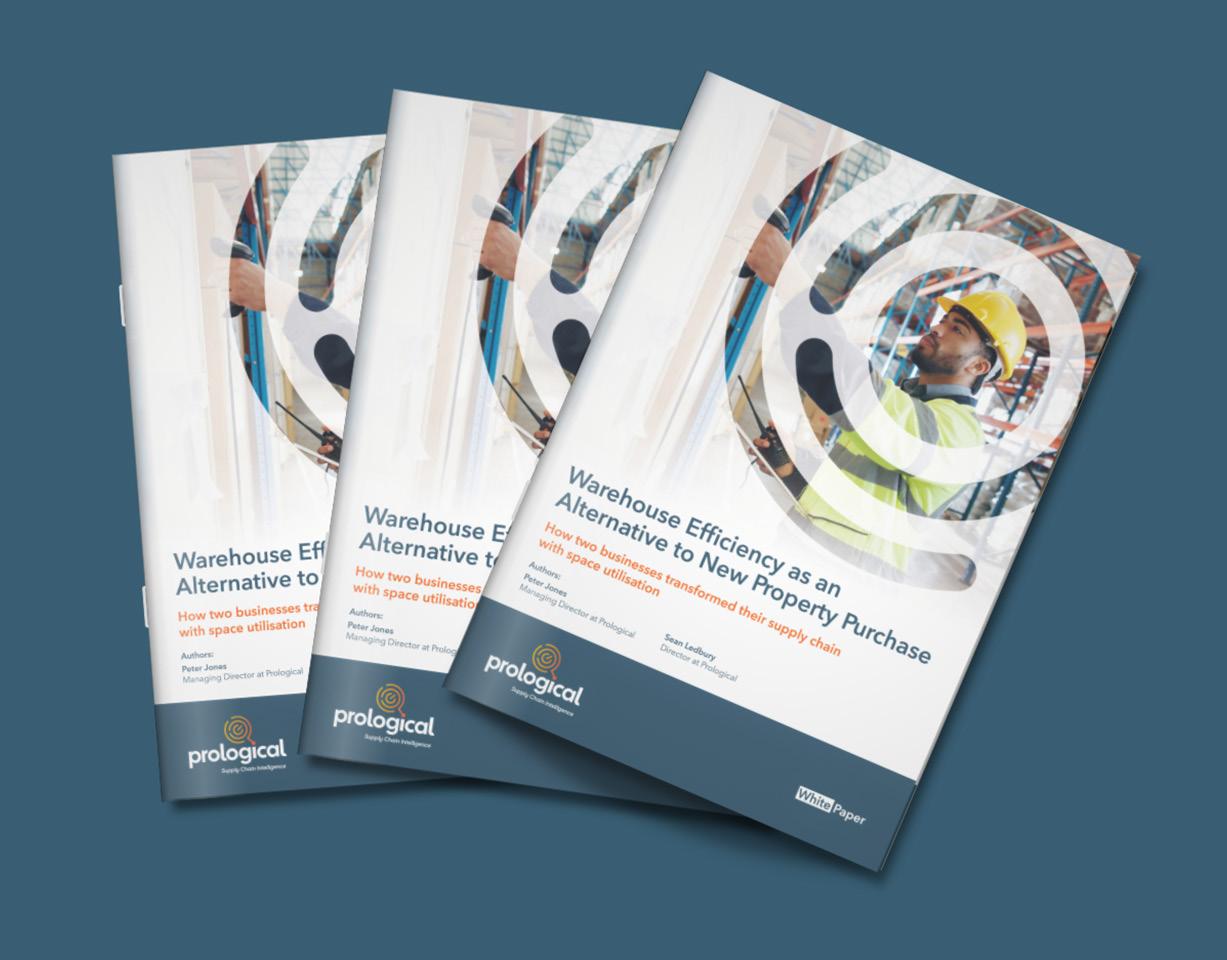
To document how this shift is playing out in practice, Prological has released a new report – Warehouse Efficiency as an Alternative to New Property Purchase – examining how Australian businesses are choosing to transform their supply chains without acquiring new property. The
report profiles two companies that were both advised to secure additional warehouse space, but instead discovered significant hidden capacity within their existing facilities.
“Three years ago, companies were scrambling for any available industrial space. Today, with more options available, they’re taking time to question whether they actually need to move at all.” — Peter Jones, Managing Director, Prological.
The compounding cost of expansion
When businesses evaluate the cost of a new warehouse, they typically focus on acquisition or lease costs. But the true financial impact extends far beyond the property itself. A new facility brings staffing implications for larger footprints, extended timelines from search to operation, and significant disruption costs that risk service and business continuity. Adding a facility also brings the complexity of systems deployment across multiple sites, inventory dispersion that reduces flexibility, and increases in working capital.
On the timeline alone, property expansion typically consumes two years from site identification through negotiations, fit-out, and migration, and that’s before factoring in development approvals and construction in greenfield scenarios. Efficiency implementations, by contrast, can deliver measurable capacity gains within months while operations continue uninterrupted.
“Organisations have learned that chasing lower lease costs at the expense of operational capability is a false economy that compounds over decades,” says Peter Jones, Managing Director at Prological. “Businesses are now taking their time to get property decisions right, recognising these facilities need to serve them well for five-plus years.”
The homewares retailer that stayed put
A case that illustrates this shift in thinking involves a national homewares retailer that came to Prological with a straightforward brief: help us size a new warehouse for our growing operations. After detailed
analysis, Prological identified the warehouse wasn’t being used to its full capacity.
“When we initially engaged with the project, we stepped back and conducted a thorough review of their current warehousing,” recalls Jones. In parallel, the retailer’s CEO was thinking along the same lines, asking Prological’s team: “What if we didn’t go to a new warehouse and we were to stay in here? What could be done?”
The assessment revealed something surprising: through strategic improvements within their existing four walls, the retailer could extend their facility’s useful life by five to seven years. The solution involved layout redesign, process optimisation, and targeted low-level automation, at a cost far below relocation and with no business disruption.
To handle seasonal peaks at Easter and Christmas, the retailer partnered with a third-party logistics provider for overflow capacity. For nine months of the year, everything runs from their existing site. The result: a multi-million dollar property commitment avoided, operational flexibility maintained, and throughput scalability secured for five to seven years, including for their rapidly expanding online sales channel.
Prological’s approach to efficiency assessment centres on five distinct levers, each targeting a different dimension of warehouse performance.
Vertical space utilisation is often the most overlooked opportunity. Most warehouses are designed and operated in floor area and pallet count, treating the building as a two-dimensional asset. Going vertical –through taller racking, mezzanines, or automated storage systems – can dramatically increase capacity without expanding the footprint.
Process flow optimisation addresses the hidden cost of movement. In traditional operations, travel represents approximately 60% of warehouse personnel costs. Redesigning
flow patterns and storage locations based on actual pick data can free up significant space while improving productivity.
Inventory optimisation may be the most confronting lever. In most businesses, between 15% and 25% of warehouse space is occupied by slow-moving and obsolete stock. When a quarter of your warehouse holds inventory that shouldn’t be there, the capacity problem isn’t the building, it’s what’s being stored in it. Automation feasibility changes the space equation fundamentally. Technologies ranging from simple conveyors to goods-to-person systems can increase density while reducing labour requirements – though automation isn’t always the right answer. Layout redesign ranges from resetting storage and picking locations within existing infrastructure to condensing aisles, adding bays, or reconfiguring zones. The most sophisticated approaches integrate multiple technologies in a holistic redesign of the entire operation. From three warehouses to one If the homewares retailer’s story illustrates what’s possible for a single facility, M3 Logistics demonstrates what’s possible at a network level. M3, one of Australia’s largest specialty third-party logistics providers
in the home appliance sector, operated three separate warehouses in Blacktown, New South Wales – two approximately 10,000 square metres each and one 40,000 square metres. As the business grew organically serving major brands including Rheem, Weber, and Bosch, the facilities had evolved without strategic consolidation.
When M3 engaged Prological in September 2022, industrial real estate advisors had already recommended the company secure additional warehouse space to accommodate growth. Prological’s first step was a maturity assessment and what it revealed changed the entire conversation.
M3’s space utilisation sat between 8-9% against a white goods industry best practice of nearly 20%, and a targeted 12-15% given M3’s building constraints. The key breakthrough came from Prological’s three-dimensional approach to warehouse space utilisation – rather than thinking in traditional square metres, the team focused on cubic space. By lifting M3’s utilisation to 12%, the project achieved a 30-40% uplift in effective warehouse capacity.
The consolidation project successfully moved all operations into the largest of the three facilities, eliminat-
ing inter-facility product transfers previously required for dispatch, duplicate supervisory and administrative structures, operational complexity from managing multi-
Vendors know their solution.
Prological knows your options.
Warehousing
Freight
Industrial Property
Network Design
The logical first call before making supply chain decisions that matter.
Cara Skelsey, Marketing Communications Manager APAC
SYDNEY, AUSTRALIA – 10th
March 2026 — Dematic, a global leader in supply chain automation, has announced a strategic partnership with Mobiledock, a specialised provider of loading dock and yard management technology, in Australia and New Zealand. The new partnership will help ANZ businesses optimise logistics operations at one of the most critical points in the supply chain - the loading dock. The partnership brings together Dematic’s strong expertise in endto-end supply chain optimisation with Mobiledock’s automated loading dock appointment scheduling and execution platform, enabling customers to better coordinate vehicle arrivals, site access, and dock operations while improving visibility, utilisation, and security.
Against the backdrop of ongoing rising costs, labour constraints, and growing throughput demands, Dematic and Mobiledock aim to align their capabilities to help customers reduce congestion, improve labour efficiency, and gain operational insights.
“Loading dock operations are com-
plex, involving physical movement, hardware and software systems, and directly impact throughput, employee safety, and customer outcomes,” said Lee Koutsos, Director of Connected Workforce Solutions and Colby Storage Solutions ANZ at Dematic. “Mobiledock’s focus on optimising dock and yard operations aligns strongly with Dematic’s approach to improving supply chain performance using best-of-breed technologies. This partnership supports our continued commitment to innovation and enables us to bring greater value to customers across the ANZ market.”
Both Dematic and Mobiledock have well established footprints across the Australian and New Zealand supply chain landscape, across manufacturing, retail, food and beverage, and logistics. The partnership will open up new opportunities to support customers looking to modernise loading dock operations and increase visibility without disrupting existing enterprise systems.
Mobiledock’s platform is already trusted by companies including Coca-Cola Europacific Partners, Snack
Brands Australia, and Petbarn, where it is used to manage vehicle arrivals, improve loading dock utilisation, and provide a more structured, data-driven approach to logistics.
“Working with Dematic allows us to connect loading dock and yard execution more closely with the broader supply chain,” said David Sanders, CEO at Mobiledock. “Together, we can help customers move beyond manual coordination and fragmented visibility, and instead operate with greater confidence, control, and efficiency at scale.”
The partnership reinforces Dematic’s ongoing investment in supply chain innovation and collaboration, supporting customers as they navigate increasing complexity and demand across warehouse and transport.
For more information about Dematic, visit dematic.com or follow us on LinkedIn, Facebook, and Instagram.
Further information:
Dematic Pty Limited, 24 Narabang Way, Belrose NSW 2085, Australia.
Tel: +61 2 9486 5555
Fax: +61 2 9486 5511
www.dematic.com.au
Scott Gillies, VP and MD Australia and New Zealand
FS has officially completed its acquisition of Softeon, marking a significant milestone for the global supply chain technology market. The move brings together Softeon’s proven warehouse management expertise with the scale and industrial software capabilities of IFS, creating a platform to support modern fulfilment operations and increasingly automated warehouse environments.
For customers, the acquisition represents the next chapter in Softeon’s journey, one that strengthens the company’s ability to support complex fulfilment environments while continuing to innovate in warehouse management and automation orchestration.
A Stronger Foundation for Warehouse Execution
Softeon has spent more than two decades developing a warehouse management system purpose-built for complex distribution operations. The platform is designed to support high-volume fulfilment, advanced automation, and dynamic inventory management while enabling organisations to scale as demand evolves. With the acquisition now complete,
Softeon will now operate as IFS Softeon, maintaining its strong focus on warehouse execution while benefiting from the global reach, resources, and industrial technology expertise of IFS.
The combination enables IFS Softeon to deliver a powerful warehouse management solution that connects execution on the warehouse floor with broader operational visibility across the enterprise. For organisations navigating increasingly complex supply chains, that integration is becoming critical.
At the same time, Softeon’s long-standing commitment to innovation in warehouse management remains unchanged. The platform continues to evolve to support robotics, goods-to-person automation, and other advanced technologies that are reshaping fulfilment operations worldwide.
Alongside this global milestone, IFS Softeon is continuing to build strong momentum in the Australian market, where organisations are increasingly investing in supply chain modernisation.
A recent example is CoolDrive Auto Parts, one of Australia’s leading automotive aftermarket distributors, which has selected Softeon Warehouse Management System to support a major transformation initiative at its new automated distribution facility.
The project represents a significant step forward for CoolDrive as it modernises its supply chain infrastructure to support future growth and improve service for customers across the region.
At the heart of the new distribution centre is a goods-to-person automation strategy designed to maximise efficiency while reducing manual handling and optimising warehouse space. The facility will incorporate an AutoStore automated storage and retrieval system installed by Dematic, tightly integrated with Softeon Warehouse Management System.
Together, these technologies will enable faster fulfilment, improved inventory accuracy, and a scalable operational foundation capable of supporting CoolDrive’s continued expansion.
Intelligent Orchestration for Automated Warehouses
In highly automated environments like the new CoolDrive facility, the warehouse management system plays a critical role in coordinating activity across multiple systems and processes.
Softeon Warehouse Management System will serve as the intelligent execution layer, orchestrating inventory, labour, and automation in real time. This ensures that orders can be prioritised dynamically, inventory flows remain optimised, and warehouse teams can operate with greater efficiency and control.
ment, and optimisation to ensure seamless integration across the entire solution.
The result is a unified supply chain platform designed to deliver speed, accuracy, and operational visibility while remaining flexible enough to adapt as fulfilment requirements evolve.
Scott Gillies, Vice President and Managing Director for Australia and New Zealand at Softeon, emphasised the importance of aligning automation with intelligent software orchestration.
continues to expand its role as a trusted technology partner for organisations modernising their supply chains. Projects such as the CoolDrive deployment demonstrate how advanced warehouse management systems and automation can come together to create highly efficient, future-ready distribution operations.
To learn more about IFS Softeon and its warehouse management solutions, visit www.softeon.com. Organisations interested in exploring how IFS Softeon can support their supply chain transformation can also sched-
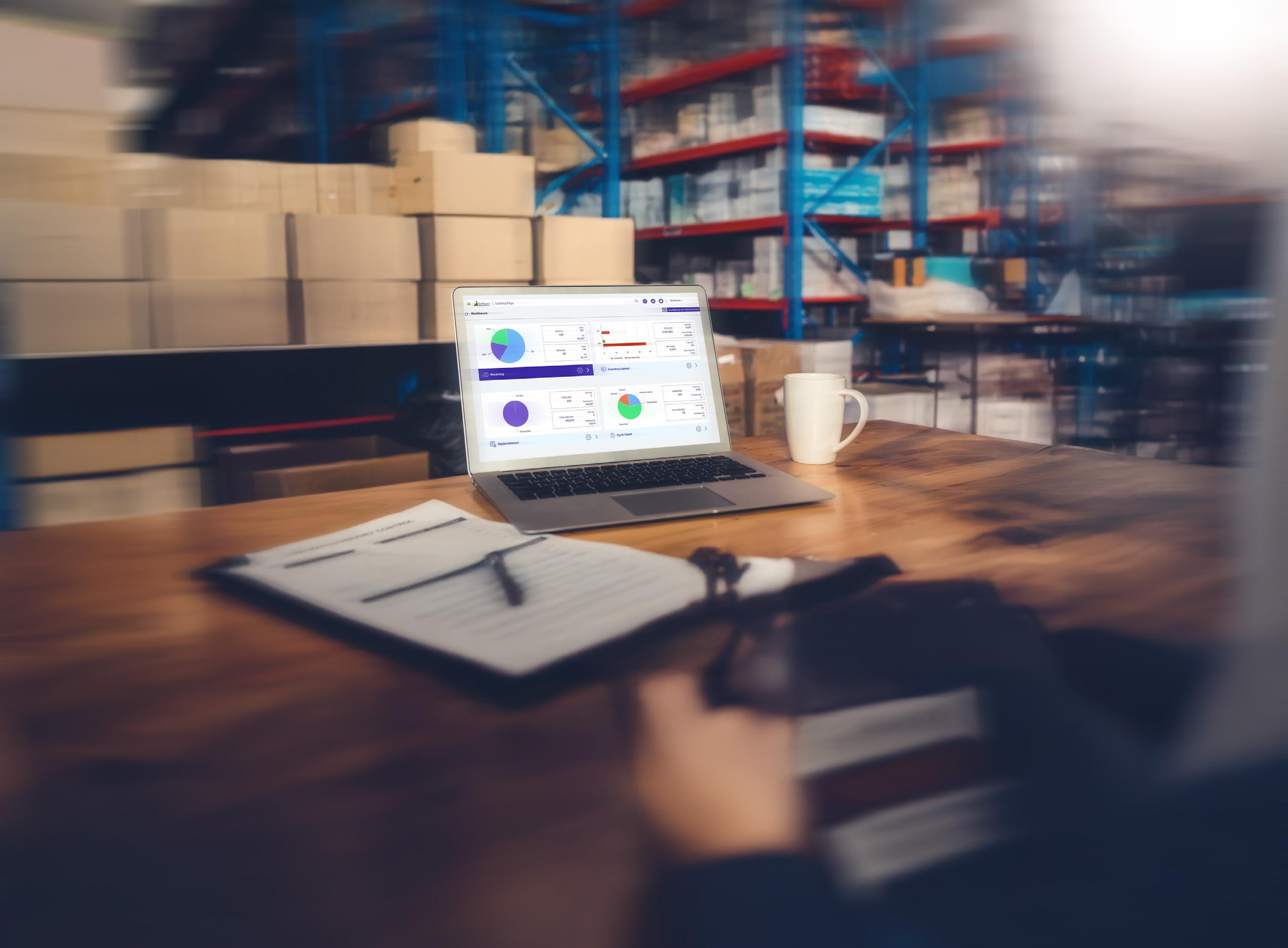
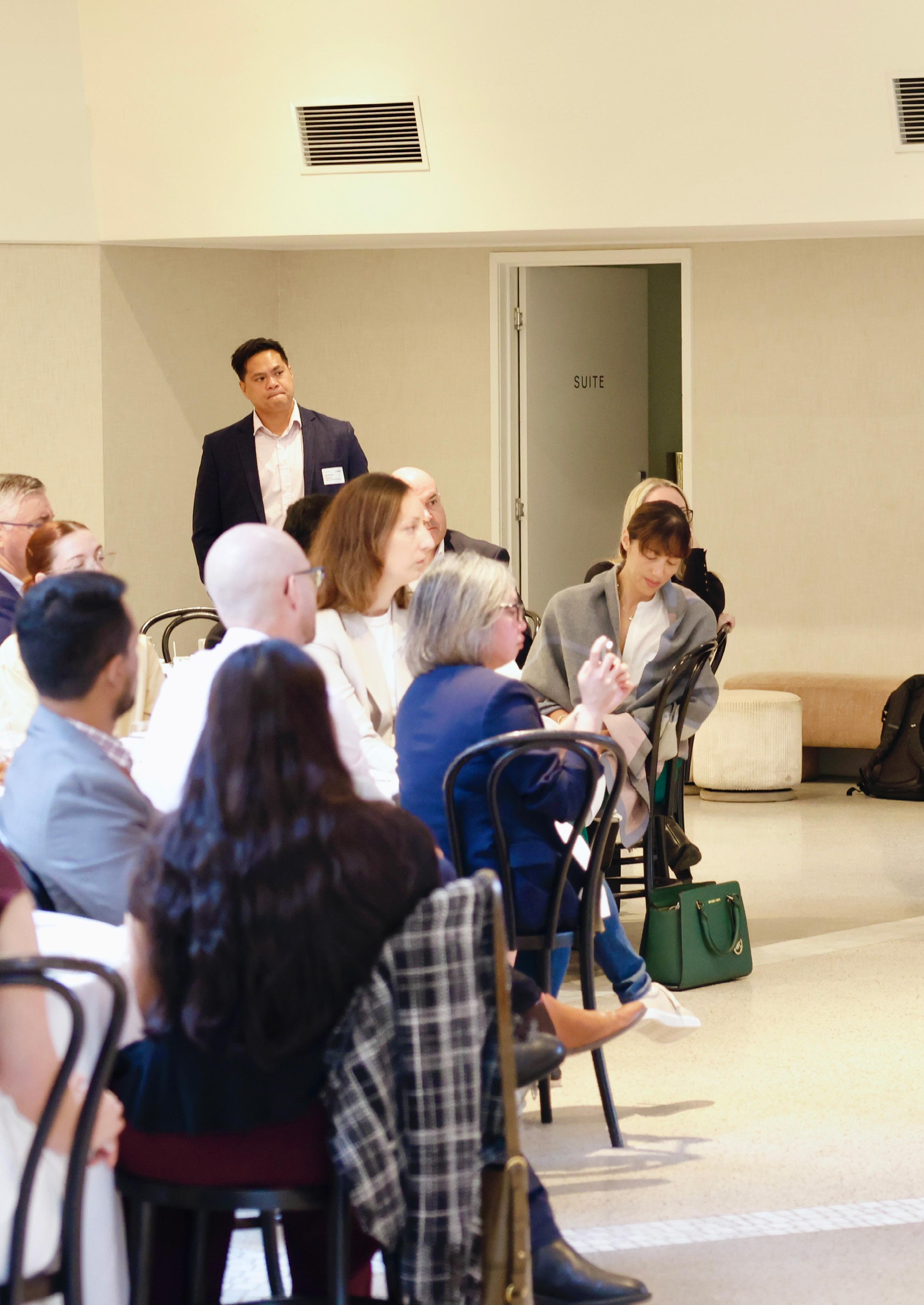
Over 500 supply chain and logistics professionals gathered across five states to celebrate women shaping the industry and explore how lifting others strengthens us all.
International Women’s Day 2026
saw ASCLA host events across New South Wales, Victoria, Queensland, Western Australia, and South Australia, bringing together over 500 supply chain and logistics professionals for a day of celebration, connection, and meaningful conversation.
This year’s theme - Give to Gainexplored how lifting others creates stronger teams, better outcomes, and a more resilient industry. Across all five states, the message remained consistent: opportunity doesn’t always come from big programs or policies. Sometimes it’s encouraging someone to apply for a role, advocating when they’re not in the room, or simply believing in them at the right moment.
NSW - Parliament House, Sydney
Over 250 professionals gathered in the Strangers’ Dining Room for keynote speakers and a panel led by ASCLA NSW President Irene Martinez Gonzalez featuring Kari Banick (Blackwoods), John Kelly (Logic Health), and Nicole Dixon (Ofload). The event launched the inaugural ASCLA NSW International Women’s Day Award, with Renee Emery from TAFE NSW announced as the winner. Through auctions and donations, the event raised almost $10,000 for OzHarvest.
VIC/TAS - Royal Botanic Gardens, Melbourne
Dr Sheila Nguyen delivered a powerful keynote on leadership and sustainability, drawing from her FIFA Women’s World Cup 2023 experience. A panel hosted by Tabitha West featured Deanna Lomas (Lifeblood), Danusha Purcell (Australian Pharmaceutical Industries), Danyely G (Lineage Logistics), and Soumya Ranjan (Mondelez International),
showcasing expertise across pharmaceutical logistics, cold chain operations, and FMCG distribution.
QLD - Brisbane
Queensland’s breakfast event brought together professionals for inspiring speakers, panel discussions, and networking focused on practical insights for building careers and creating pathways for others in the sector.
Opportunity doesn’t always come from big programs. Sometimes it’s encouraging someone to apply, advocating when they’re not in the room, or believing in them at the right moment.
WA - Perth
Speakers Jennifer Dick (Mineral Resources), Jennifer Turner (former Symbion), and Holly Robertson (DHL Global Forwarding), moderated by Sherie Le Brun (Direct Couriers), shared decades of combined experience navigating supply chain careers and creating opportunities for women in the industry.
SA/NT - Adelaide
South Australia and Northern Territory’s breakfast event created space for meaningful conversations about leadership, opportunity, and build-
ing networks that support career progression and industry collaboration.
All events proudly supported OzHarvest, Australia’s leading food rescue organisation. Since 2004, OzHarvest has delivered over 320 million meals to communities in need. Through auctions, raffles, and donations across all five states, ASCLA raised funds to support their mission of nourishing communities and fighting food waste.
These events would not have been possible without sponsors, donors, speakers, panellists, and ASCLA’s state committees and staff.
NSW sponsors: Vanderlande (Platinum), WiseTech Global (Gold), Visy Logistics and Colin Biggers & Paisley (Silver), Freight & Trade Alliance (Association Partner).
Donors: TAFE NSW, Pierre Haddad Hair Management, Jurlique, DMS, Dynamic Logistics, Learning Sphere, Sarino’s Restaurant, Jazzminton Australia, Linde Material Handling, Ivy Opal, Lockerdom, HDL Insurance Brokers, 3PO, FTA, Swift Transport.
Over 500 professionals chose to show up and invest in these conversations. The energy, connection, and commitment to advancing women in supply chain and logistics was evident across every state.
These events demonstrate ASCLA’s belief that our industry is stronger when it reflects the full diversity of talent and leadership our communities offer. The conversations sparked on International Women’s Day - and the connections created - extend well beyond a single event.
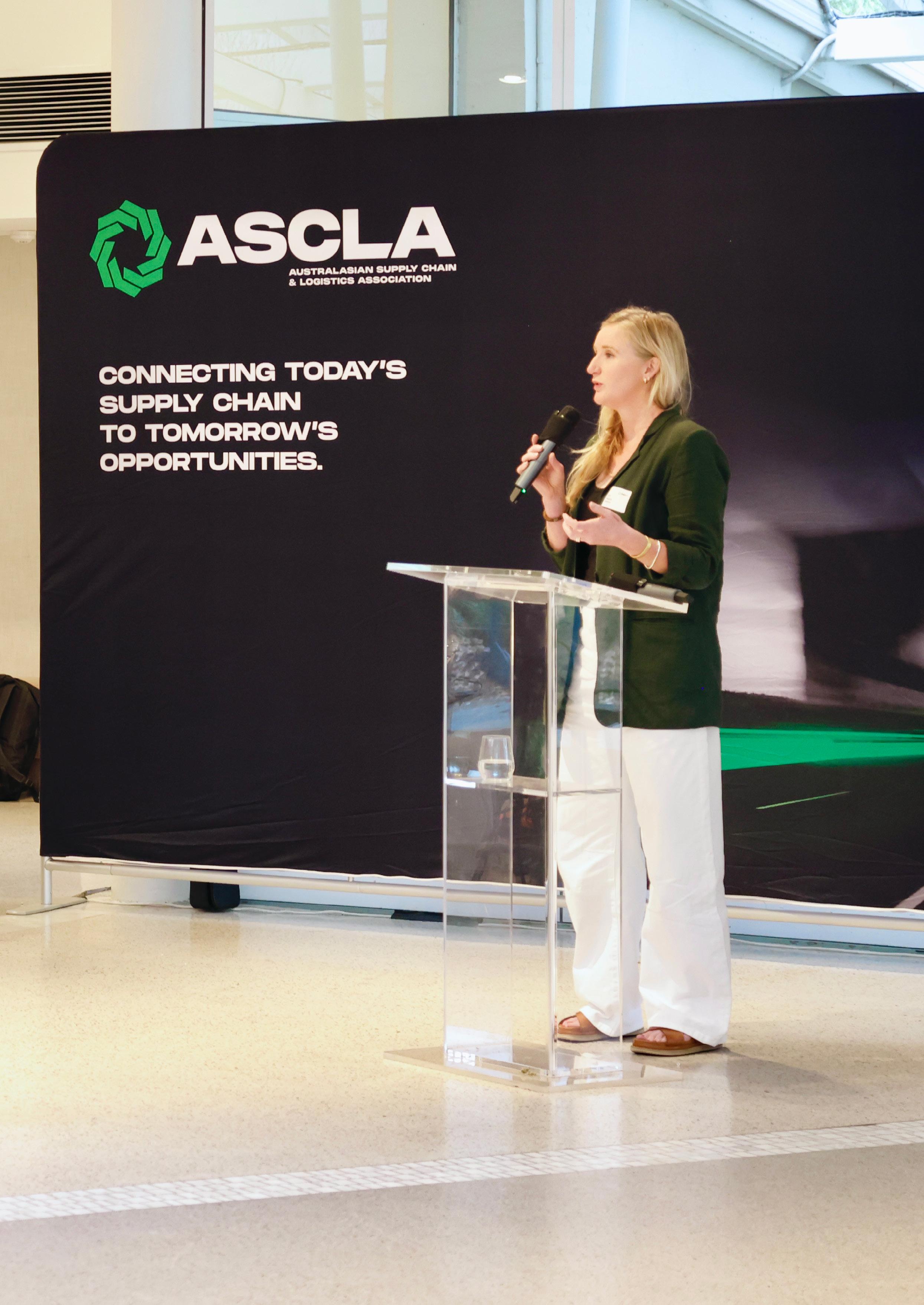
See all the Division’s IWD 2026 Celebrations below:



The ASCLA Industry Awards are the industry’s oldest and most prestigious awards, celebrating 64 years in 2026.
ASCLA is proud to have been hosting these awards for the last 20 years and recognising and cheering on individuals and companies that have contributed to the advancement of the Supply Chain and Logistics industry in Australasia over the last two decades.

2026 AWARDS
ASCLA 2026 EVENT DETAILS
Sponsorship
Open Now
Brisbane QLD Friday 23 October 2026
Award Submissions
Open Now
Sponsorship Open Now
Close 7 August
Early Bird Gala Tickets Releasing April 2026
Award Submissions Open Now Close 7 August
Brisbane QLD Friday 23 October 2026
Early Bird Gala Tickets Releasing April 2026

ASCLA Industry Awards will be held in QLD for the first time in 2026!
ELEVATE YOUR BRAND VISIBILITY
We are inviting companies and organisations to become part of the celebrations of the prestigious ASCLA Industry Awards for 2026.
This is an opportunity to align your brand with excellence, innovation, and leadership. Showcase your organisation, strengthen brand awareness to industry leaders and be an Ambassador of Excellence by recognising the highest achievers in the supply chain and logistics Industry. Solidify your position as a champion of progress and innovation; a partner driving our industry forward.
SPONSOR NOW
PLATINUM SPONSOR [Exclusive]
GOLD SPONSORS
SILVER SPONSORS
BRONZE SPONSORS
INDIVIDUAL AWARD SPONSORS
RECEIVE OVER $44,300 VALUE WITH PLATINUM SPONSORSHIP
ASCLA GALA TICKETS/TABLES 2027 PARTNER MEMBERSHIP
Nominations are now open for the 2026 ASCLA Industry Awards, celebrating the outstanding achievements of businesses and industry leaders across supply chain and logistics.
These awards celebrate excellence and acknowledge the businesses and individuals whose work continues to shape, strengthen and advance the industry through innovation, collaboration and success. They provide an opportunity to recognise those making a genuine impact and setting a strong example for others across the sector.
If there is a business or individual whose contribution deserves to be acknowledged, now is the time to put them forward.
We are inviting companies and organisations to become part of these prestigious 2026 Awards night. Showcase your organisation, strengthen brand awareness to industry leaders and be the Ambassador of Excellence by recognising its highest achievers.


22 APR 2026
NSW: Let’s Taco about Supply Chain! Great Networking Opportunity
24 APR 2026
SA Networking Event with Special Presentation by Iz Baldago
WEBINAR Part 2: Borderless Planning in Practice: How AI Reduces Cycle Time...
WA 22 APR 2026

29 APR 2026
WA: Networking that Actually Leads to Opportunities. 29 April 2026
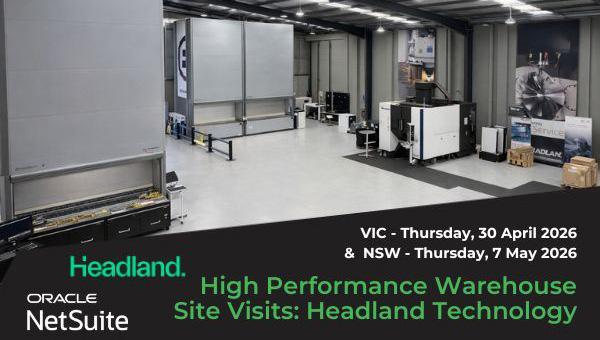
30 APR 2026
VIC: High Performance Warehouse Site Visits –Headland Technology NSW
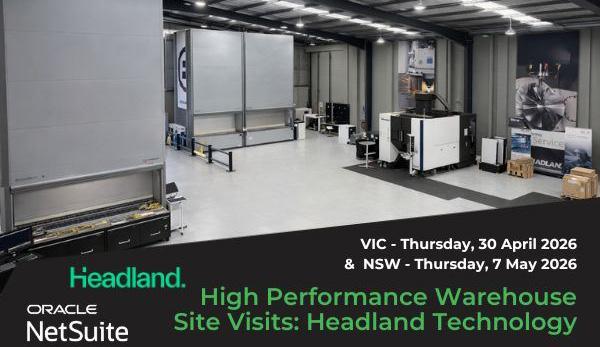
07 MAY 2026
VIC: High Performance Warehouse Site Visits –Headland Technology
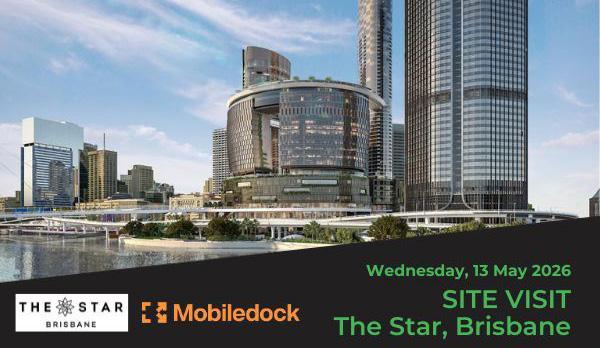
13 MAY 2026
QLD Site Visit – The Star, Queens Wharf, Brisbane
QLD

18 JUN 2026
SCLAA Qld CEO Sleepout 2026: Uniting for Cause

04 AUG 2026
Intelligent Supply Chains: AI for Resilience & Sustainability
NSW

17 JUN 2026
NSW: Sydney Fish Market Site Visit
NATIONAL

04 AUG 2026
ASCLA Training Course: Career-Ready Communications
Emma Jory, Learning Sphere Training Solutions
On 27 March, Emma Jory, General Manager of Learning Sphere Training Solutions, presented as part of the Business Western Sydney, Education Summit to Jason Clare, Federal Minister of Education on the critical training and workforce challenges facing Western Sydney industries. The discussion centred on the rapid growth and transformation occurring across key economic corridors, particularly in Western Sydney and Southwest Sydney. With major infrastructure developments such as the Western Sydney International Airport and the Western Sydney Aerotropolis, the region is poised to become a major hub for freight, logistics, and supply chain operations. However, as highlighted in the discussion, infrastructure alone is not enough.
A Sector Powered by People
Australia’s transport and logistics industry is fundamentally powered by people. From warehouse operators and drivers to coordinators and supply chain specialists, the sector relies on a skilled and adaptable workforce to keep goods moving efficiently. As demand accelerates, so too does the urgency to invest in workforce development programs that are responsive, scalable, and aligned with industry needs. Without this investment, workforce constraints risk limiting the impact of major infrastructure projects and slowing productivity gains across the sector.
Growing Demand, Persistent Challenges
The expansion of logistics hubs in Western Sydney is expected to drive significant job creation. At the same time, the industry continues to face ongoing challenges, including:
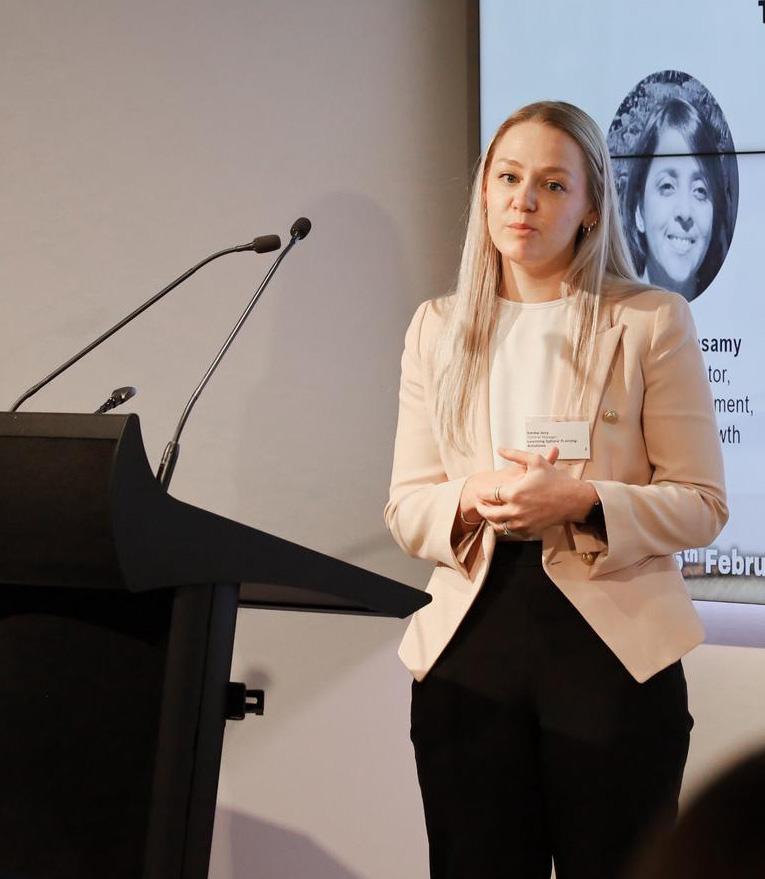
y Labour shortages across entry-level and operational roles
y High turnover in warehousing and transport functions
y Barriers to workforce entry for job seekers in growth regions
y Gaps between training delivery and real workplace requirements
While these issues are longstanding, they are becoming more pronounced as the pace of growth accelerates.
The Role of Technology and AI
A key theme of the discussion was the growing role of artificial intelligence and automation in logistics. While these technologies are improving efficiency, forecasting, and safety, they are not replacing the workforce. Instead, they are reshaping job requirements.
Workers are increasingly expected to engage with digital systems and automated processes as part of their day-to-day roles. This shift is creating demand for employees who are
not only technically capable, but also adaptable and confident in navigating evolving work environments.
The message to government was clear: investment must prioritise people.
To meet the demands of expanding logistics hubs and emerging economic zones, Australia needs a workforce strategy that reflects the realities of the industry. This includes:
y Improving access to training in growth regions
y Reducing barriers to entry for job seekers
y Supporting employment pathways that connect training to real job outcomes
y Ensuring training delivery models are flexible and responsive to employer needs
In regions like Western Sydney, where worksites are dispersed and
demand is growing rapidly, traditional training models do not always align with industry requirements. There is increasing need for approaches that are more accessible, practical, and closely integrated with the workplace.
As emphasised in the discussion, without targeted investment in training and workforce development, the full potential of major projects such as the Western Sydney Aerotropolis cannot be realised.
The challenge is not just about building infrastructure - it is about building capability.
Workforce planning must sit alongside infrastructure development to ensure that industry growth is supported by a pipeline of job-ready workers. This requires stronger collaboration between government, training providers, and industry to
align priorities and deliver practical outcomes.
A strong workforce is supported by balanced, responsive and industry aligned training providers who are agile, able to innovate and move quickly in line within a constantly evolving environment.
The transport and logistics sector is undergoing significant transformation, driven by infrastructure investment, population growth, and technological change.
Ensuring the workforce can keep pace with this transformation will be critical to sustaining growth and maintaining efficiency across supply chains. The discussion with Minister Clare represents an important step in highlighting these challenges and reinforcing the role that workforce development will play in shaping the future of the industry.
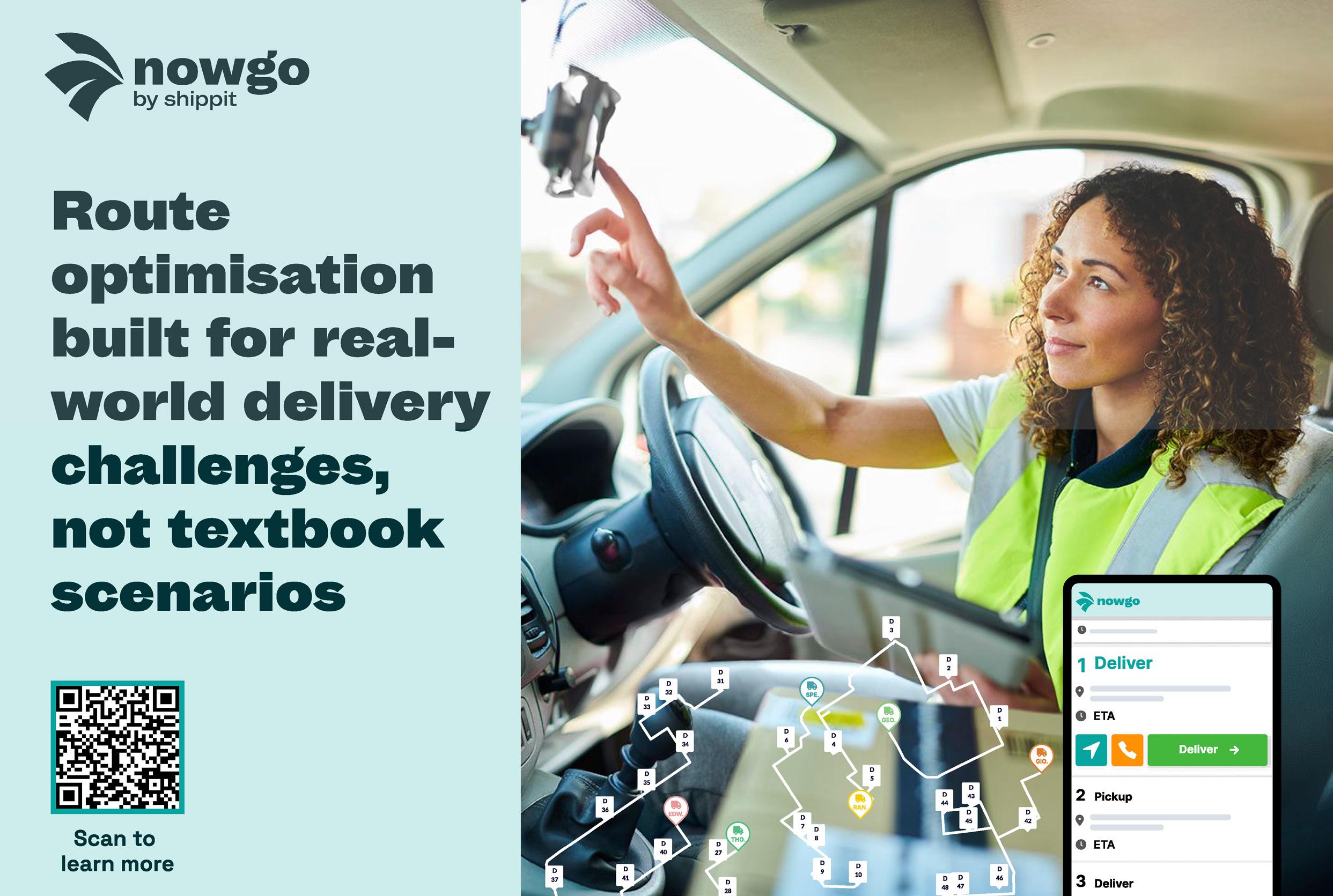
Chithra Eapen, Senior Analyst and Client Relationship Manager
The global maritime industry is currently at a critical junction. As we navigate through the messy start of 2026, the convergence of aging fleets, stringent environmental mandates, and shifting trade dynamics is redefining the economics of shipping. For Australian businesses reliant on these “blue highways,” understanding the physical and regulatory state of the global fleet is no longer just for shipowners—it is a vital component of supply chain risk management.
The State of the Global Shipping Fleet: 2026 Snapshot
The sheer scale of the global merchant fleet is immense, yet it is increasingly divided between modern, efficient vessels and a “backlog” of aging hulls facing obsolescence.
The dry bulk segment remains the largest by vessel count. However, the average age has climbed steadily from 8.5 years in 2018 to over 13 years today. Tankers follow a similar trajectory; while new orders are rising, a significant portion of the fleet consists of 2000s-built units that are becoming increasingly liabilities under new “Green” regimes. Interestingly, while the containership fleet is technically comparable to the average
tanker age (pushed up by thousands of smaller regional feeders), some of the top-tier liner companies have the youngest assets, with more than 1300 ships on order in the coming years.
The Regulatory Squeeze: Why Scrapping is Rising
In 2025, we saw a 33% surge in ship recycling by tonnage versus 2024. While, this figure is lower than the 10-year average, the factors at play are slightly different. Several factors typically influence the demolition decision including freight sentiment, operating costs, the price of scrap steel, and increasingly carbon and GHG regulations such as the Carbon Intensity Indicator (CII) by the International Maritime Organisation (IMO) and other global carbon costs.
Under the rules for the CII, every ship over 5,000 GT is given a carbon rating from A (Major Superior) to E (Inferior).
y The CII Penalty: Under the Carbon Intensity Indicator (CII) regulations, a “D” rating (minor inferior performance) does not trigger immediate financial penalties or trading bans, but it initiates mandatory corrective actions if the
rating persists.
y The GHG “Wall”: The IMO’s goal is a 40% reduction in carbon intensity by 2030. Older vessels—particularly those with older steam turbines or inefficient fuel systems—often aim to meet these targets by “slow steaming” (sailing slower to save fuel).
For many 20+ year-old vessels, the cost of retrofitting energy-saving devices or switching to dual-fuel engines exceeds the vessel’s remaining market value.
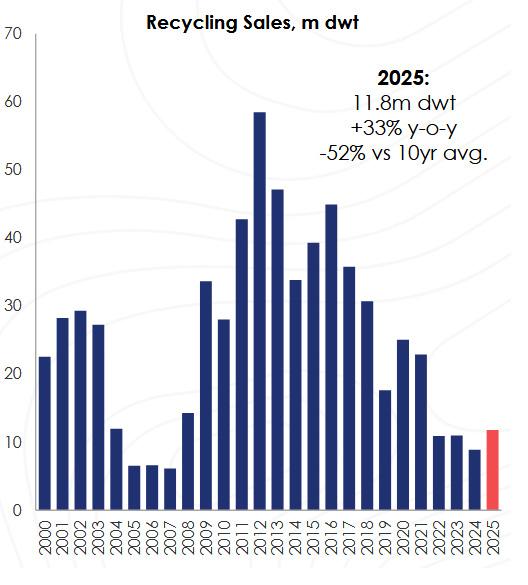
Australia’s geographic isolation makes it a “price taker” in international shipping. Companies here, particularly SMEs face unique vulnerabilities as the global fleet transitions. Some of the key risks are:
y Vessel Exclusion: As Australian ports and charterers tighten ESG
Source: BRS Shipbrokers (March 2026)
(Environmental, Social, and Governance) requirements, older ‘D’ and ‘E’ rated ships may be barred from entry, reducing the pool of available carriers.
y Slower Transit Times: To maintain CII compliance and improve ratings, many lines are adopting “slow steaming,” which can add 3–5 days to a voyage from North Asia to East Coast Australia.
y Port Congestion and Industrial Action: Australian ports remain sensitive to local disruptions which, when combined with a tighter global fleet, can lead to exponential delays.
Mitigation Strategies
y Freight Hedging: The most accessible tool for most Australian SMEs is the Forward Service Contract. Instead of riding the weekly price waves of the Shanghai Containerised Freight Index (SCFI), businesses can negotiate 6- to
12-month fixed rates with carriers or large forwarders. This protects against the sudden “peak season” surcharges (PSS) and General Rate Increases (GRI) expected as older ships are pulled from service. While you may pay slightly more than the spot rate during quiet period, gaining absolute budget certainty is always a plus.
y Bunker Adjustment Factor (BAF) Hedging: With the maritime industry switching to expensive low-sulfur and bio-blended fuels to meet 2026 GHG targets, fuel surcharges (BAF) are becoming a larger percentage of the total invoice. Larger companies can use financial swaps to “lock in” the price of marine fuel. Ensure your contracts have transparent BAF formulas and avoid “all-in” rates that allow carriers to hide arbitrary fuel increases.
y Predictive Logistics and Digital
Freight Management Systems: Using AI-driven tracking to monitor not just where your cargo is, but the CII rating of the vessel carrying it can help reduce the risk of taking on a vessel at risk of a ‘D’ rating that can increasing cause future delays or blank sailings.
As the “scrapping backlog” finally clears and older, inefficient ships are removed from the water, the total available capacity in the Pacific lanes may tighten. Australia, with its high environmental standards and distance, will likely see fewer “vintage” ships willing to make the trek. In this environment of volatile freight rates and tumultuous geopolitics, freight hedging and long-term contract stability may be some of the risk mitigation strategies for Australian importers and exporters to protect margins against a volatile, decarbonising market.
Digitize logistics across Ocean, Air, Land, and Rail
Pre-integrated with niche logistics technologies
Trusted by 10,000+ enterprise users worldwide
Integrates with your ERP, WMS & CRM systems
Connects with 7,000+ leading business apps
Recognized by Gartner, G2, Capterra, GetApp and Software Advice, across multiple categories.
Dr. David Paynter, Industry Academic at Monash University Business School
It’s no secret that there is a race to implement artificial intelligence (AI) to reduce the cost of doing business. But as fast as leaders seek to implement artificial intelligence to replace supply chain planning, signals are quickly emerging that it is finance that are holding back the process, as they continue to use spreadsheets to manage business financials outside the main operating system. The challenge is that operational plans need up to date financials in the system so operational plans can be optimised. The risk of AI implementation is an accelerated change in business performance, based on our-of-date financials held in the operational system.
Supply Chain Asset acquisition, allocation and utilisation occupies leadership focus, time and energy. However, once the network plans are established and implemented many businesses pass the task of deployment to team members experienced in the old ways of doing business. The consequences of managing contemporary technology, solely with experience, means the available benefits from the technology are suboptimal, as users are not trained in the algorithms and statistics embedded in contemporary technologies.
Tracking technologies for Supply Chain Assets, using “Control Towers”, has increasingly enabled supervision and monitoring of movements in the supply chain, as the technology has become cheaper and more readily available. Improvements in the integration of different technologies has now facilitated control towers to go beyond pure tracking to facilitate closed-loop feedback and control and enable decision making on changes to planning changes the entire supply chain.
What is the role of Supply Chain
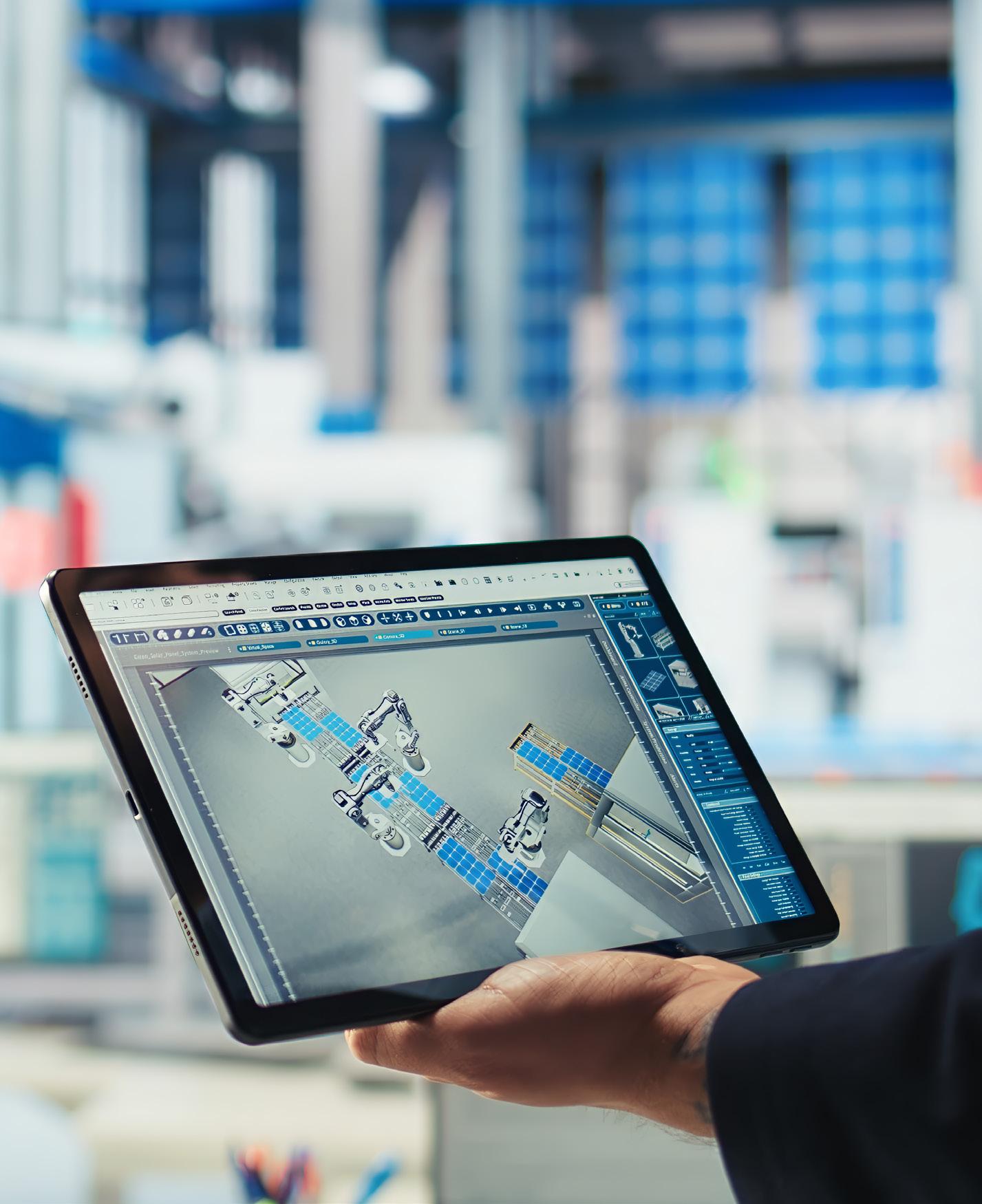
Supply Chain Planning is the forward-looking process of coordinating the flow of goods, services, and information from raw material sourcing to final customer delivery. It balances supply and demand to minimise costs, optimise inventory, and ensure products are available at the right time and place (Google AI). Supply Chain Planning provides the frontline response to Volatility, Uncertainty, Complexity and Ambiguity
(VUCA). As such, Supply Chain Planning is becoming the central focus for real time optimisation of increasingly complex supply chains using advanced technologies, which are increasingly being embedded with artificial intelligence. The addition of artificial intelligence to the existing analytical capabilities (including: optimisation engines, stochastic equations and statistics) used within the supply chain planning technology technologies calls for a complete
change in the way we think about Supply Chain Planning and associated human capital user base.
Supply Chain Planners are the Digital Orchestrators of Business Operations.
Supply Chain Planners need skills in advanced business analytics and strong domain knowledge of supply chain to be able to most effectively leverage the capability of advanced supply chain planning tools and to train the artificial intelligence that will be supporting the decision-making by Supply Chain Planning so that the investment in assets and technologies delivers the best benefit for the business.
Artificial intelligence adoption in the planning technologies of the business has the benefit and risk of accelerated decision-making within the business. Where a business has been implementing advanced technologies underpinned with financial data in the planning system, with
the Supply Chain Planning team, the business will reap the rewards of increased responsiveness from the investment.
The risk in AI implementation is where finance is still running their financial numbers in spreadsheets outside of the core systems, independent of Supply Chain Planning, and the objective of AI adoption is to eliminate the number of Supply Chain planners and schedulers. It is in this context that the business may quickly sub-optimise operations and the supply chain. Depending on how up-to-date or out-of-date the financials are in the core systems, artificial intelligence risks accelerating a decline in profits as the technology makes faster decisions with less or no validation from the experience or bandwidth of the reduced number of supply chain planners.
Supply Chain Planning is the frontline defence to operational errors,
issues and VUCA, and critical to the effective training of Artificial Intelligence, when financials are embedded in the core systems.
SOLUTION : Before starting the journey of testing and using AI to support decision-making:
1. Restructure the analytical people in the business into one team: supply chain planners, business analysts and financial analysts.
2. Embed financial data in enterprise grade planning systems.
3. Upskill the analytical capabilities of supply chain planning team and the supply chain domain knowledge of analysts.
What’s next ?
Good people are hungry for a challenge, so plan for 10-20% turnover in the analytical team and provide ongoing training in analytics and supply chain to facilitate testing and adoption of the latest technology innovations.
Dr Paul Flachskampf, CEO, INFORM ANZ
For small and medium-sized enterprises (SMEs) across Australia and New Zealand, the push to digitise logistics operations comes with a practical challenge: finding technology that genuinely suits the way local businesses operate while still delivering real value. This issue is particularly clear in yard management — an area where the gap between what’s on the market and what operators actually need often forces organisations to choose between doing everything manually or taking on systems that are far too complex.
The Australasian Logistics Landscape
Australia and New Zealand operate within logistics environments unlike anywhere else. According to the Australian Small Business and Family Enterprise Ombudsman, 97.3% of Australian businesses are small businesses, and the Transport, Postal and Warehousing sector makes up 8% of that group — putting it among the largest SME sectors in the country. It’s also one of the fastest-growing.
This growth reflects the increasing pressure on supply chains across our region. With Australia’s long distances between major cities, rising e-commerce volumes, and ongoing driver shortages, operational efficiency becomes critical. For smaller operators — often running lean teams and tight margins — any inefficiency has a noticeable cost.
The Technology Journey — and the Common Blind Spot
SMEs typically invest in technology where the benefits are most obvious.
y A Warehouse Management System (WMS) often comes first.
y Transportation Management Systems (TMS) and ERP integrations generally follow as the business grows.
The yard, however, is where digitisation often stops. Many operators still rely on clipboards, phone calls, spreadsheets, or simply “knowing the yard”.
But the impacts of limited yard visibility are felt everywhere:
y Drivers arriving without notice create last-minute bottlenecks.
y Warehouse teams can’t prepare effectively for incoming loads.
y Trailers become difficult to find, sometimes resulting in detention charges.
In Australia’s competitive labour market, these inefficiencies quickly add up. And for operations that rely heavily on strong carrier relationships — especially when servicing regional and remote areas — reducing driver wait times is vital.
While the yard’s importance is obvious, the available technology hasn’t always been suited to the Australasian market.
Historically, businesses have faced two extremes:
1. Basic systems: They digitise small parts of the process — like check-in — but don’t provide meaningful insight or operational control.
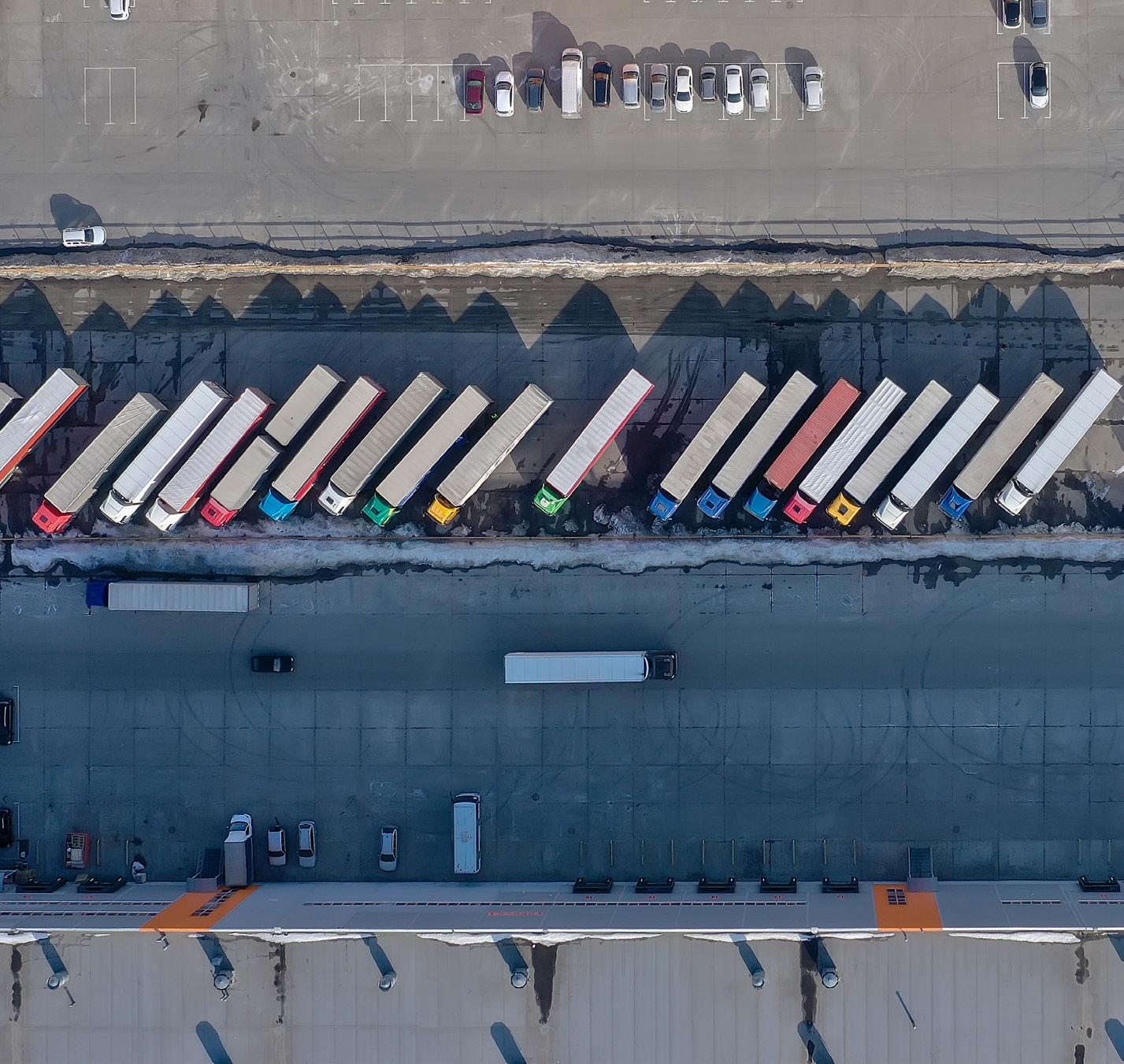
2. Full enterprise YMS solutions: Highly capable, but often too expensive, too complex, and too resource-intensive for an SME.
For Australian and New Zealand SMEs, the answer isn’t a “cut-down” enterprise tool — it’s a solution built with their scale, priorities, and operating environment in mind.
A right-sized solution isn’t defined by site size or dock count alone. It’s about operational realities:
y How the yard is currently managed
y The level of digitalisation across the business
y The volume and variability of truck movements
Whether manual processes are creating avoidable delays or bottlenecks Technology becomes especially
y Truck volumes regularly create congestion
y Poor visibility between transport and warehouse systems affects service levels
The key question becomes: “What does our operation actually need to run smoothly?”
A few principles are especially important for the Australian and New Zealand market:
y Practical functionality: The system should solve real operational problems — driver check-in, scheduling, visibility — without adding unnecessary complexity.
y Fast implementation: SMEs benefit from solutions that are up and running in weeks, not months.
y Scalability: Technology should
y Ease of use: Teams need intuitive tools that don’t require specialist IT knowledge to manage.
y Fit with digital maturity: The solution should meet the business where it is today, while helping build capability for the future.
At INFORM, we design with these realities in mind. Our full Yard Management System (YMS) supports large and complex operations needing advanced optimisation. But recognising that many ANZ organisations need something simpler, we created YMSlite — a streamlined solution built specifically for small to mid-sized operations.
YMSlite delivers essential functions such as digital check-in, dock scheduling, and yard visibility, while keeping implementation fast, the interface intuitive, and ongoing man



Simon Webb, Co-Founder, Tarot Analytics
Most route optimisation software treats traffic as a fixed assumption. Here’s why that breaks down — and what a more rigorous approach actually requires.
Most route optimisation software assumes roads behave the same way all day. They don’t. Peak-hour congestion, industrial traffic cycles, school zones and urban bottlenecks shift continuously. Yet many last-mile fleet systems still optimise using either a static average travel time or a single traffic snapshot applied across an entire run. For short, simple routes this limitation rarely matters. For multi-stop operations spanning several hours — automotive parts distribution, parcel delivery, furniture and appliance delivery, retail replenishment — it is a quiet but significant source of inefficiency. The Snapshot Problem
Consider a common urban delivery scenario. A driver departs the warehouse at 5am, passes through morning peak between 8 and 9am, and completes the run around midday. The system must choose a traffic assumption for the entire sequence — but none of the obvious choices work cleanly.
Apply an early-morning traffic state and the plan looks efficient at departure — but the driver falls increasingly behind as congestion builds. Apply peak-hour conditions across the board and the optimiser may indicate that additional vehicles are required to meet delivery windows, driving up cost-per-stop unnecessarily. Use an average of averages and the system loses the ability to reason strategically: for example, holding city-bound stops until congestion eases and sequencing them later in the run.
The result, in all three cases, is a plan that looks reasonable on screen but doesn’t reflect the road.
Short answer: data size and calculation time.
Consumer navigation apps handle real-time traffic well — but they are solving a fundamentally simpler problem. A navigation app calculates one route at a time. A route optimisation engine must evaluate thousands, sometimes millions, of potential travel times in a single calculation to determine which driver should visit which jobs, and in what sequence.
To understand why, it helps to understand the core data structure every route optimisation algorithm relies on: the travel time matrix.
The travel time matrix
A travel time matrix is simply a table of journey times between every pair of locations in a delivery run. Every row is an origin, every column a
destination, and every cell holds the driving time between them. The optimisation engine consults this table continuously as it evaluates different sequences and allocations — it is the foundation on which the entire calculation sits.
From a 2D matrix to a 3D data problem
A standard travel time matrix holds one value per pair of locations: the journey time under average conditions. Traffic-aware optimisation requires something fundamentally different. Because congestion changes throughout the day, you need a separate travel time for every departure time — not just from A to B, but from A to B at 6:00am, at 6:05am, at 6:10am, and so on across the entire operating day.
If you divide the day into five-minute intervals, that is 288 time slices. Instead of one flat matrix, you now need 288 matrices — one for each slice. The single 2D table becomes a 3D structure: origin, destination, and
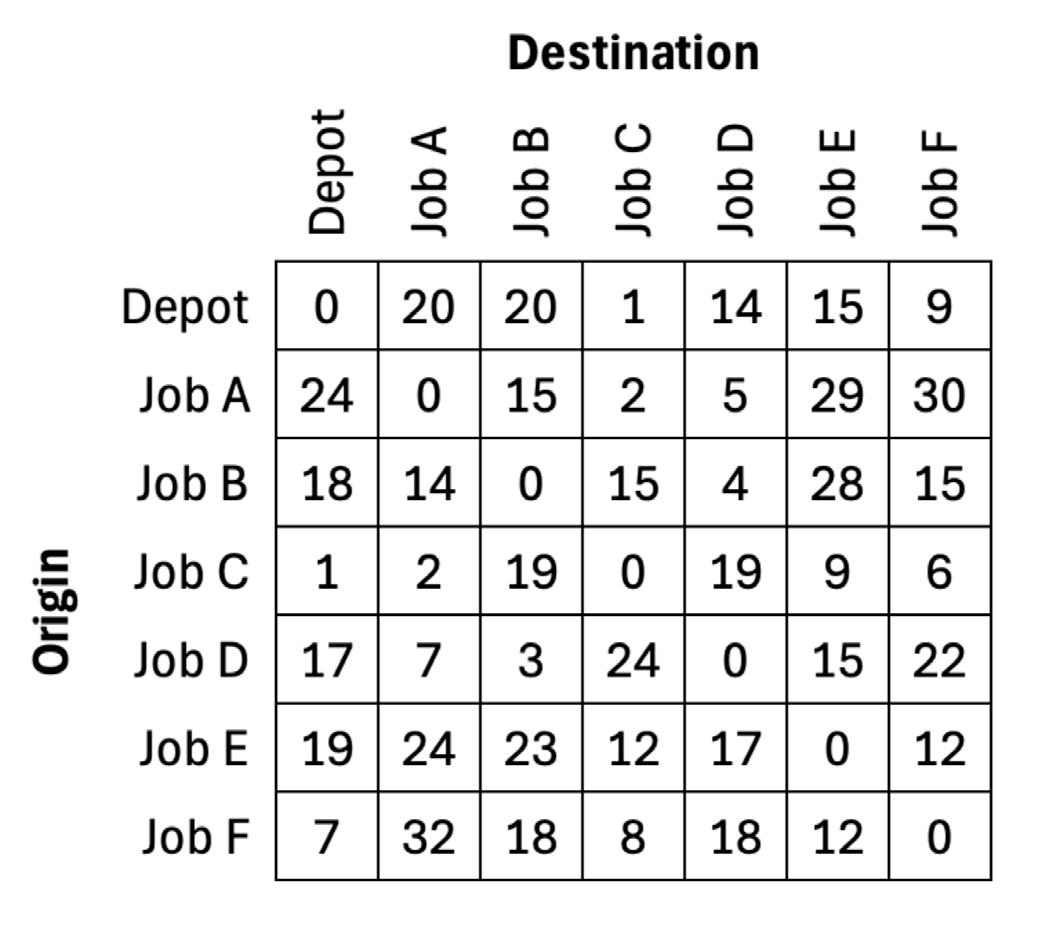
ation, without external API calls or recalculation.
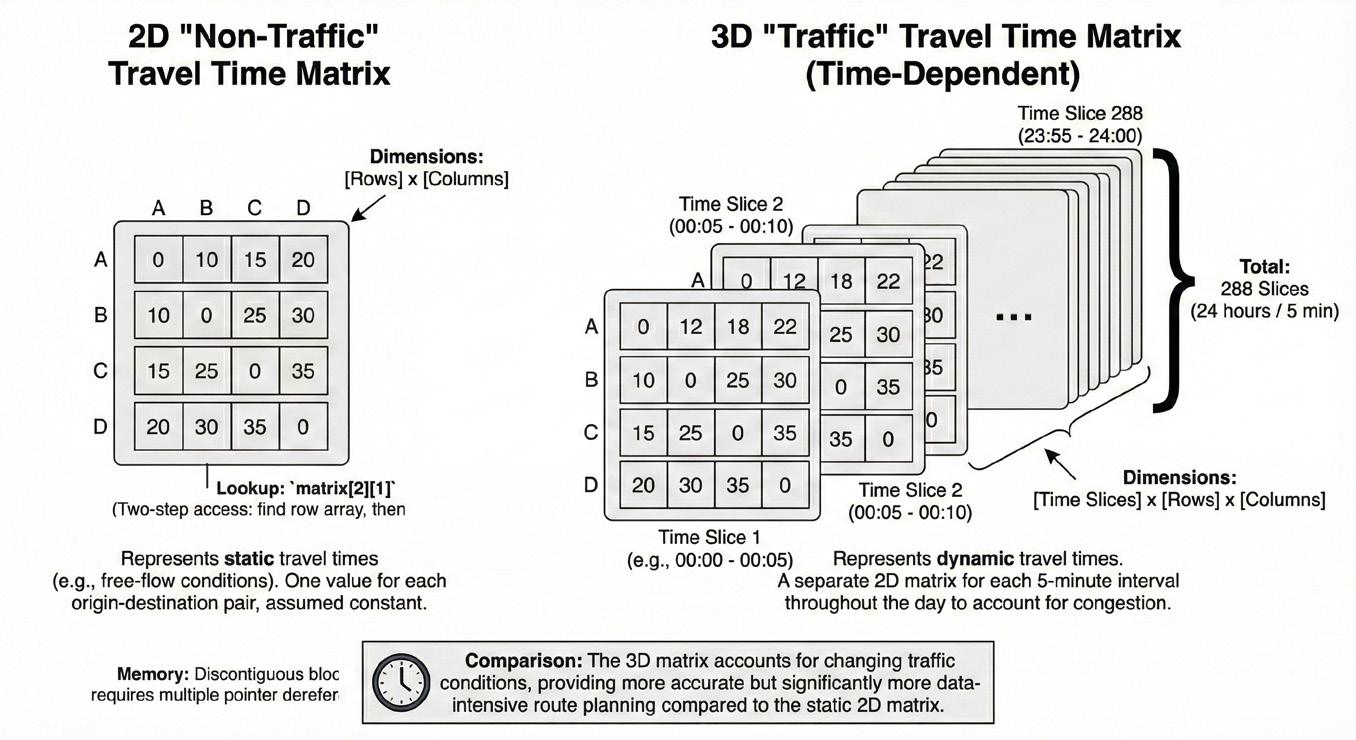
departure time. For the 400-stop scenario, that means 288 x 160,000 values: over 46 million travel times required before the optimisation can begin.
The instinctive answer is to query a mapping provider — Google Maps, Here Maps, or similar. But even with bulk API rate limits, you could be waiting hours for the data to come back before optimisation even begins. That is not useful in a planning environment where a dispatcher wants the routes finalised before they have finished making their morning coffee.
The algorithmic problem compounds the data problem
Even if the data challenge can be solved, a second problem emerges inside the algorithm itself. Route optimisation engines evaluate candidate solutions by calculating cost deltas: the change in total route cost caused by a small modification such as inserting a stop or swapping two jobs. Because most of the route is unchanged, only the affected legs need recalculating — typically three lookups instead of recalculating the entire route from scratch. This shortcut is what allows optimisers to evaluate millions of potential routes in a practical timeframe (while the kettle is boiling).
Time-dependent travel times break this shortcut entirely. When you
move a stop earlier in the sequence, every subsequent stop departs at a different time — which means every subsequent travel time changes. The algorithm can no longer recalculate the affected legs; it must propagate the change forward through the entire tail of the route. On average, this means recalculating roughly half the route for every candidate move evaluated. This recalculation may only take a few milliseconds more, but this additional time adds up quickly over millions of potential routes.
A 400-stop optimisation that runs in two minutes under static assumptions may take 10 to 15 minutes with full time-dependency. In an operation with early-morning planning cut-offs, that additional compute time has direct operational consequences.
Solving this requires rethinking the data pipeline, not just the algorithm. Rather than querying live traffic APIs during optimisation — which would compound the latency problem — a novel approach trains machine learning models on historical regional traffic patterns, pre-computes baseline network travel times, and stores the resulting time-dependent matrices in memory-efficient structures. The algorithm then accesses accurate, traffic-adjusted travel time estimates instantly during optimis-
The practical outcome is an optimisation engine that can reason about congestion the way an experienced planner does: holding city-bound stops back during peak hour, clustering outer-suburban deliveries in the early morning window, and returning routes to the depot ahead of afternoon traffic. The difference is that the system applies this reasoning systematically across every vehicle in the fleet, simultaneously.
For many regional or low-density operations, natural variation in driving conditions absorbs the difference and traffic-aware optimisation offers only marginal gains. The case is strongest where several factors coincide:
y City-adjacent depots with drivers entering central business districts during peak windows
y Multi-wave distribution runs that span several hours of changing conditions
y Operations with tight delivery time windows and high overtime sensitivity
y High stop-density urban routes where small sequence changes compound into meaningful time savings For these operators, traffic-aware route planning can reduce driver-hours materially, improve estimated time of arrival accuracy for customers, and reduce the frequency of late or failed first-attempt deliveries — without adding vehicles to the fleet.
y The technical architecture behind traffic-aware optimisation — including how time-dependent matrices are structured, compressed and accessed during route search — is covered in detail in the Tarot Analytics Route Optimisation with Traffic white paper, available to download at tarotanalytics.com/whitepapers
Sebastien Bouthillette, Managing Director, Chief Technology Officer, 3DLogistiX
Wage pressures and skills shortages are reshaping logistics operations across Australia and New Zealand, but workforce retention may have as much to do with interface design as it does with pay.
The Australasian logistics and warehousing industry has a people problem, and it predates the current skills squeeze. Persistent shortages of skilled warehouse staff have pushed up labour costs, slowed throughput, and left operations managers caught in a cycle of recruiting, onboarding, and losing workers faster than they can be replaced. ASCLA’s own industry outlook for 2026 identifies workforce tightness across warehouse staff and logistics professionals as one of the defining operational pressures of the coming year, with improvement expected to be gradual rather than swift (ASCLA, 2026 Logistics and Supply Chain Industry Outlook, 2025).
The instinct is to treat this as a hiring problem. The data suggests it is at least partly a technology problem.
Operations managers across Australia and New Zealand are familiar with a predictable pattern. Morning shifts begin with strong accuracy. By mid-to-late afternoon, mis-picks and errors climb. The conventional explanation has been physical fatigue or a loss of concentration toward the end of a long shift.
Human factors research points to a more precise cause: cognitive overload, accumulated across an entire day of working with poorly designed systems.
A typical floor worker using a traditional, text-based warehouse man-

agement system is required to decipher small font on a ruggedised screen, memorise alphanumeric bin locations, navigate a large facility, and verify complex SKU codes character by character, repeatedly, for the duration of their shift. This is high-demand analytical work. Performed hundreds of times a day, it depletes mental capacity progressively. By late afternoon, decision fatigue is not a possibility; it is a physiological outcome. The brain takes shortcuts, and that is when the wrong item ends up in the shipping box.
The 4 PM error spike is not a discipline problem. In many cases, it is a design problem.
The cognitive burden of poorly designed software is most acute and most costly during onboarding. According to Jobs and Skills Austra-
lia, median weekly earnings in the Transport, Postal and Warehousing industry sit at $1,608, below the all-industries median of $1,741, meaning the sector is competing for workers at a wage disadvantage while simultaneously asking those workers to master complex, unintuitive systems from day one (Jobs and Skills Australia, Industry Profile: Transport, Postal and Warehousing, 2025).
When the technology itself carries a steep learning curve, the onboarding period extends. Supervisors are pulled off the floor to shadow new hires. Throughput drops. Errors increase while workers find their bearings. The system is, in effect, generating the inefficiency it was implemented to solve.
In a labour market where shortages of skilled warehouse staff have pushed up costs and slowed
throughput, the cost of a slow onboarding process is not a minor inconvenience. It is a direct drag on operational performance at precisely the moment when the business can least absorb it.
Cognitive science has long established that the brain processes visual information significantly faster than written text (Medina, J., Brain Rules, Pear Press, 2008). Despite this, much of the warehouse technology in active use across the region remains built around text-heavy lists, alphanumeric codes, and interfaces that bear no resemblance to the consumer-grade digital tools workers use every day outside of work.
The gap matters. Workers arrive on the floor with strong digital literacy from their personal lives. Handing them a legacy RF scanner with a dated interface creates immediate friction, not because the worker lacks capability, but because the technol-
ogy fails to meet them where their existing skills are.
Next-generation warehouse management systems are responding to this by incorporating image-based product validation, colour-coded visual cues, and hardware-agnostic tablet interfaces that align with the way people already interact with technology. The shift from greenscreen scanners to touchscreen, visually guided workflows is not cosmetic; it is a functional response to the limits of human cognition under sustained operational load.
Spatial mapping is also gaining traction. Rather than requiring new starters to memorise abstract bin coordinates across a large facility, systems that use 3D spatial guidance allow workers to navigate visually from day one. The practical outcome is a measurable reduction in onboarding time and a corresponding improvement in early-stage accuracy, exactly the combination the current labour market demands.
Workforce transformation lag, where adapting to automation and new technologies required significant training investment even as many companies struggled to attract and retain workers, was identified as a defining challenge for the Australasian logistics sector in 2025. That lag is not only a training investment problem. It is, in part, a product of technology that was not designed with the end user in mind.
As competitive pressure on logistics operations across Australia and New Zealand intensifies, mental ergonomics deserves the same attention the industry has long given to its physical counterpart. The operations that will retain their workforce, reduce error rates, and onboard new starters efficiently will not simply be the ones that hire well. They will be the ones that equip their people with tools worthy of the job.
By Archival Garcia VIC/TAS Director
The recent Retail Fulfilment Summit in Melbourne brought together a cross-section of industry leaders, technology providers, and logistics specialists, offering a timely reflection on the evolving demands shaping Australia’s retail supply chain landscape. The event underscored a clear theme: fulfilment is no longer a back-end function—it is now central to customer experience, competitive advantage, and business performance.
From a local supply chain perspective, the shift is both rapid and structural. Retailers and logistics providers across ANZ are grappling with increasingly complex customer expectations—faster delivery windows, greater visibility, flexible fulfilment options, and seamless returns. These demands are being amplified by the acceleration of digital commerce and the normalisation of next-day and same-day delivery models.
One of the most noticeable trends at this year’s summit was the significant expansion of solutions focused on last-mile delivery and third-party logistics (3PL) services. Compared to previous years, the market has become more crowded, with a diverse array of providers offering increasingly specialised and technology-enabled services. This rise in competition reflects both opportunity and pressure. On one hand, retailers have more options than ever to outsource and optimise fulfilment. On the other, logistics providers must differentiate themselves in a market where service expectations are rising as quickly as technological capabilities. This competitive intensity is being driven by a fundamental shift in customer expectations. Consumers now demand not only speed, but also precision, transparency, and convenience. As a result, fulfilment strategies must extend beyond efficiency to encompass adaptability and
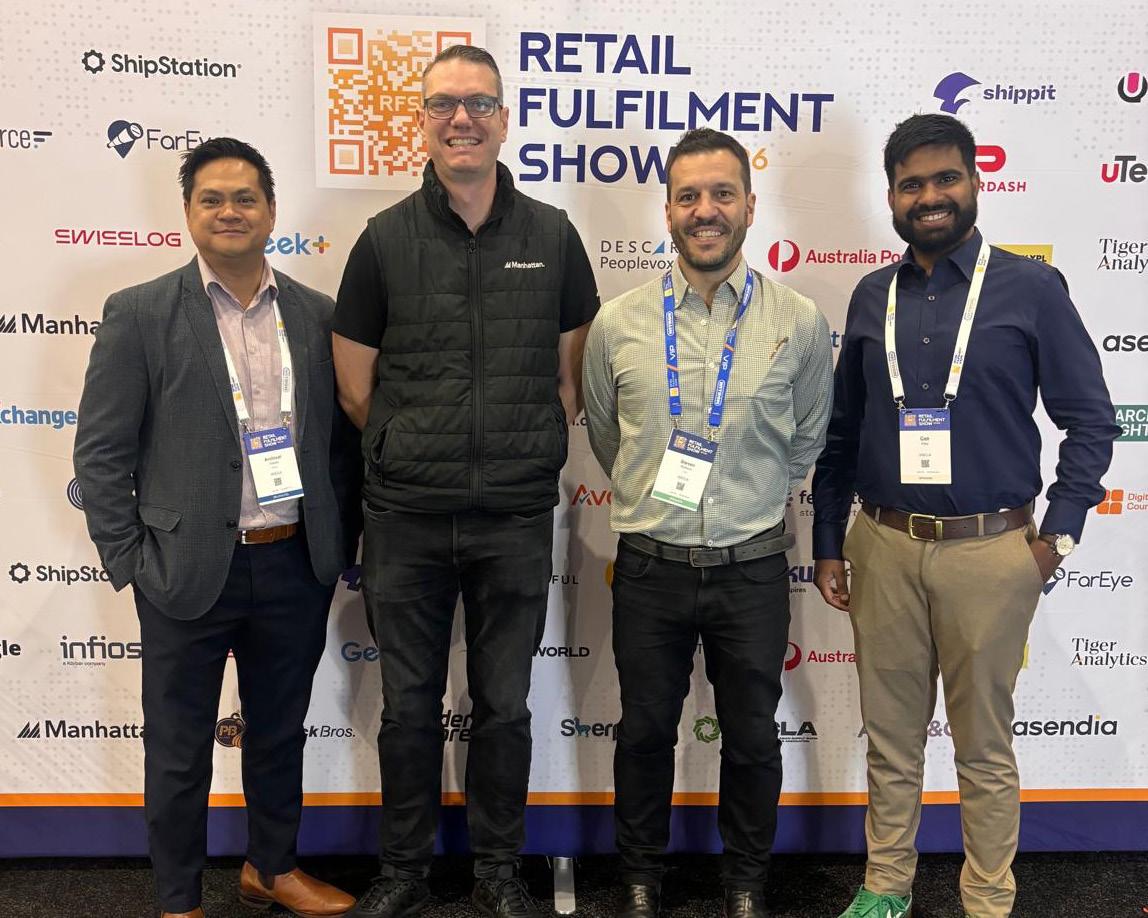
customer-centric design. For many local operators, this means investing in data, automation, and integrated systems that can respond dynamically to fluctuating demand and operational complexity.
A standout session of the summit from my perspective was delivered by Lyle from The Warehouse, who provided a compelling case study on the power of data-driven decision-making in retail fulfilment. The presentation moved beyond theory, demonstrating how structured use of operational and customer data translated into tangible improvements across the business. By leveraging data to refine inventory positioning, optimise delivery networks, and better align supply with demand, The Warehouse was able to achieve measurable gains in service levels, cost efficiency, and customer satisfaction.
Importantly, the session highlighted a broader lesson for the industry: data is no longer a supporting tool —
it is a core capability. Organisations that can effectively harness and operationalise data are better positioned to navigate complexity, anticipate customer needs, and drive continuous improvement.
Overall, the Retail Fulfilment Summit painted a picture of an industry in transition. The convergence of technology, competition, and customer expectation is reshaping how fulfilment is designed and executed. For the ANZ supply chain community, the message is clear: success will depend on the ability to adapt quickly, collaborate effectively, and invest strategically in both capability and innovation.
As the landscape continues to evolve, forums like this summit play a critical role in sharing knowledge, showcasing innovation, and strengthening the connections that underpin our industry.
Well done to the Akolade team for organising such an insightful event.
Brooke Wymer, Industrial Clearance
Rising costs and ongoing supply chain challenges are pushing Australian businesses and the people behind them to rethink how equipment is sourced. From operations managers to small business owners, there is increasing pressure to make smarter, more efficient decisions.
Surplus equipment refers to unused or end-of-line products that are no longer required but remain in excellent condition. From lighting and ventilation systems to storage solu-
tions, these items can offer immediate availability without the delays often associated with traditional procurement. For many businesses, the appeal lies in both speed and cost efficiency, helping teams stay agile while maintaining operational standards.
There is also a growing focus on sustainability across the industry. More organisations are looking for practical ways to reduce waste and operate more responsibly. Reusing surplus equipment helps extend the
lifecycle of existing products while supporting a more circular approach to resource use. At the same time, businesses holding excess stock are recognising the value of freeing up space and recovering capital tied up in unused equipment. Digital platforms such as Industrial Clearance are helping connect businesses and decision-makers, making it easier to match surplus supply with demand and support more efficient operations.
Renée Giarrusso - CEO RG Dynamics & Limitless Leaders
In supply chain and logistics, change is constant. Disruptions, tight deadlines, market changes, war and shifting technology can make leadership feel like a juggling act. The leaders who succeed aren’t those who just manage, they’re the ones who inspire, adapt, and evolve. They see beyond processes and KPIs and focus on the people who make operations possible. Limitless leaders transform challenges into opportunities, setbacks into lessons, and teams into high-performing, resilient units.
For nearly two decades, we’ve supported thousands of leaders and teams across industries globally, helping them navigate complexity, drive results, and create workplaces where people show up ready to give their best. Reflecting on the traits that define high-performing, happy, and resilient leaders, I distilled 12 key behaviours that any leader can adopt to create impact in fast-paced environments like supply chain and logistics.
Remember, leadership is a choice, not a title. Every one of us leads, ourselves, our teams, and the decisions that shape outcomes.
Here’s how to translate this into action with the 12-week Limitless Leaders Challenge, adopting one key behaviour each week:
1. Create and Protect Boundaries: Supply chain roles are high-pressure, requiring urgent problem-solving and multitasking. Clear boundaries protect your energy and priorities, prevent burnout, and allow focus on strategic outcomes. Saying “no” when necessary is a strength, not a weak-
ness. Who or what do you need to say no to?
2. Commit to Personal Growth: Even in operational roles, leaders must expand their thinking daily. Whether learning a new forecasting tool, understanding AI applications, or exploring leadership psychology, growth fuels agility. Encourage your team to do the same. Share podcasts and articles along with books you’ve read or lessons you have learnt that could help progress others forward. Remember, your lessons could be a survival guide for someone else.
3. Challenge the Status Quo: Processes in logistics can become entrenched. Limitless leaders ask: “Why do we do it this way?” “Could this be more efficient?” Unlearn old practices, embrace innovative solutions, and stay ahead in a competitive environment. As I say “Debate with Intent trumps harmony for comfort’s sake. Innovation is a superpower needed if you want to stay future fit.
4. Approach People and Situations with Curiosity: Assumptions are productivity killers. Ask open-ended questions with teams, peers, and suppliers. A curious mindset turns operational challenges into learning opportunities and fosters collaboration across departments. Get curious as a team and the flow on effect is collaboration.
5. Adopt a Gift Mindset: Every challenge, disruption, or success can be reframed as a gift. A delayed shipment, for example, can reveal weaknesses in communication
or supplier management. Share these insights with your team and turn setbacks into lessons. Run “Win Wednesdays” where everyone shares a win and how they achieved it along with a challenge or mistake and what was learnt from it.
6. Show Empathy by Being Present: Leadership in logistics is human. Acknowledge the pressures your team faces on tight deadlines, complex deliveries, and fluctuating volumes. Listening with presence fosters trust and engagement. More than ever, we need to connect at the human level. AI can think, but it can’t feel.
7. Practice Daily Gratitude: A simple “thank you” for someone who solved a bottleneck or a brief reflection on what went well can transform morale. Start meetings asking, “Who or what are you grateful for today?” and watch culture shift. Gratitude helps us focus on what we have, not what is missing. A great tool to use, especially currently with so much going on in the world that is having a direct flow on effect to supply chain and logistics.
8. Lead with Optimism: Supply chain disruptions are inevitable. Optimism fuels resilience and inspires belief in solutions rather than dwelling on problems. When leaders project hope, teams respond with energy and creativity. Optimism is about having hope for now and future, it has longevity opposed to positivity which is usually short term. Dial your energy up, you’ll be surprised how much you can lift yourself and others up.
9. Coach Through Questions: Instead of giving answers, ask questions that unlock thinking. “What options have we considered?” or “What would happen if we tried this approach?” Empowering others cultivates problem-solving skills and ownership. Our job as leaders is to empower others and create future leaders. Coaching does this and helps you get the time back to do what really matters.
10. Know What Lights You and Others Up: Energy is contagious. Identify what drives you and intentionally bring that energy to your role. Learn what motivates your team such as recognition, goal orientation, detail, autonomy and look at growth opportunities and align tasks to these drivers.
11. Communicate with Clarity and
Intention: Supply chain coordination relies on precise, purposeful communication. Speak with intent, listen deeply, and lead conversations that drive action. Miscommunication can cost time, money, and client trust, making clarity essential.
12. Lead Yourself First: Self-leadership is the foundation. Managing your energy, mindset, and priorities effectively allows you to fully support your team and inspire them to perform at their best. Your actions set the tone for culture, resilience, and performance. Limitless leadership is a daily practice, not a destination. In supply chain and logistics, where complexity and change are constants, adopting these behaviours can transform how your team operates, communicates, and adapts. Start small, adopt one behaviour each week, and
watch the impact ripple across your organisation. The choice to lead with intention, energy, and human focus is yours, and the results will be seen in every warehouse, delivery route, and operational decision.
Lead beyond management.
Lead to be limitless.
Renée Giarrusso
Renée Giarrusso, CEO of RG Dynamics and author of Gift Mindset and Limitless leadership is a highly sought after and award-winning communication, mindset, and leadership expert. She is a speaker, trainer, mentor and a professional coach (PCC) and works with leaders, teams and organisations to energise mindset and accelerate leadership and communication to lift performance and create collaborative and connected cultures. Find out more at www.reneegiarrusso.com www.gift-
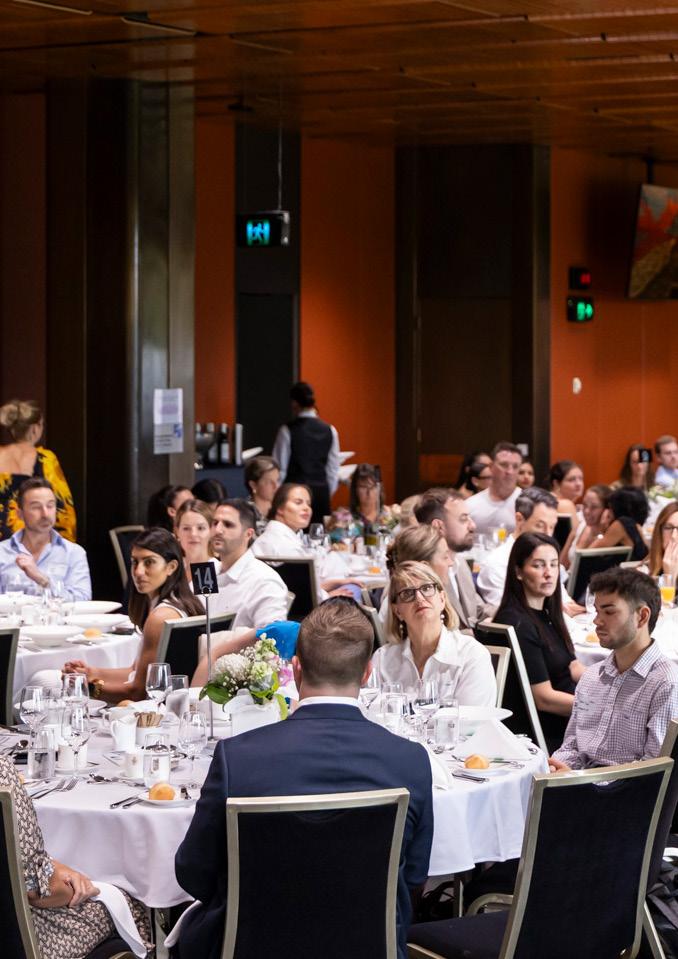
Rae Sue, NSW/ACT Committee
One of the standout engagements this quarter was our exclusive site visit to the Advanced Manufacturing Readiness Facility (AMRF) at Bradfield — a flagship initiative at the forefront of Australia’s advanced manufacturing future.
Members gained a behind-thescenes view of how AMRF helps bridge the gap between concept and commercialisation, providing access to cutting-edge equipment, technical expertise, and collaborative environments. This enables businesses to test ideas, validate processes, and trial new technologies without the burden of significant upfront cost or risk.
The session sparked practical discussions on how these capabilities can be applied within existing operations and how organisations can future-proof their supply chains. We extend our sincere thanks to Azmena Hussain and Mark Helou for hosting, and to Alice Brimicombe CPA, Michael Farragher, and Hans Tobbe for their support in making this event possible.
An Evening of Connection at Mullane’s
Complementing our more technical engagements, our networking evening at Mullane’s offered a different, but equally important, dimension of value — human connection.
Set in a relaxed and welcoming environment, the evening brought together a diverse mix of industry
professionals, from long-standing members to those newly introduced to ASCLA. What stood out was the quality of conversation: open, candid, and grounded in real industry experience.
Events like this reinforce a simple but powerful truth — strong industries are built on strong relationships. Mullane’s was a clear reflection of the collaborative spirit within the ASCLA community, where connections are not only made but meaningfully developed.
International Women’s Day Luncheon: “Give to Gain”
A defining highlight of the quarter was the ASCLA NSW International Women’s Day Luncheon, held on 6th March in the Strangers’ Room at NSW Parliament House. With over 250 industry leaders in attendance, the event underscored the importance of continuing to elevate and support women across the supply chain and logistics sector.
Centered around the theme “Give to Gain”, the luncheon focused on the idea that contribution — whether through mentorship, advocacy, or leadership — creates lasting impact not only for individuals, but for the industry.
The panel discussion, expertly facilitated by Irene Martínez González, was one of the standout segments of the event and received excellent feedback from attendees. Featuring Nicole Dixon, Kari Banick, and John Kelly, the session moved beyond
theory into honest, experience-led conversations on leadership, career growth, and navigating complex professional environments.
Key themes resonated strongly with the audience:
y The importance of building and investing in support networks
y The role of setbacks as a foundation for growth
y The impact of small, intentional actions in creating opportunities for others
The event also marked the introduction of the inaugural ASCLA NSW International Women’s Day Award. Congratulations to Renee Emery from TAFE NSW, recognised for her outstanding leadership and contribution to the industry.
In alignment with the theme of giving back, we were proud to support OzHarvest, raising over to $10,000 to assist their work in reducing food waste and supporting communities in need. Special thanks to Lisa Dainty for facilitating this meaningful partnership.
This event was made possible through the generous support of our sponsors:
y Vanderlande (Platinum)
y WiseTech Global (Gold)
y Visy Logistic and Colin Biggers & Paisley (Silver)
Along with all the prize and auction contributors who helped make the event a success.
Finally, a heartfelt thank you to our
NSW Committee, including Irene, Alice, Rae, Karishma, and the broader NSW Committee, whose dedication behind the scenes made this event possible.
Coming Up & Member Initiatives:
y ASCLA Mentoring Program - Our recently launched mentoring program aims to foster lasting professional relationships, connect
members at different career stages, and support long-term development.
y Webinars covering industry topics Our webinars continue to provide accessible learning opportunities while also creating a platform for members to engage, share insights, and stay connected on key industry topics.
y “Let’s Taco Supply Chain” - Look-

ing ahead, our upcoming “Let’s Taco Supply Chain” event will offer a relaxed and informal setting for the community to come together — reinforcing connections, sparking new conversations, and strengthening the bonds that underpin our industry.
We look forward to continuing this journey with you.
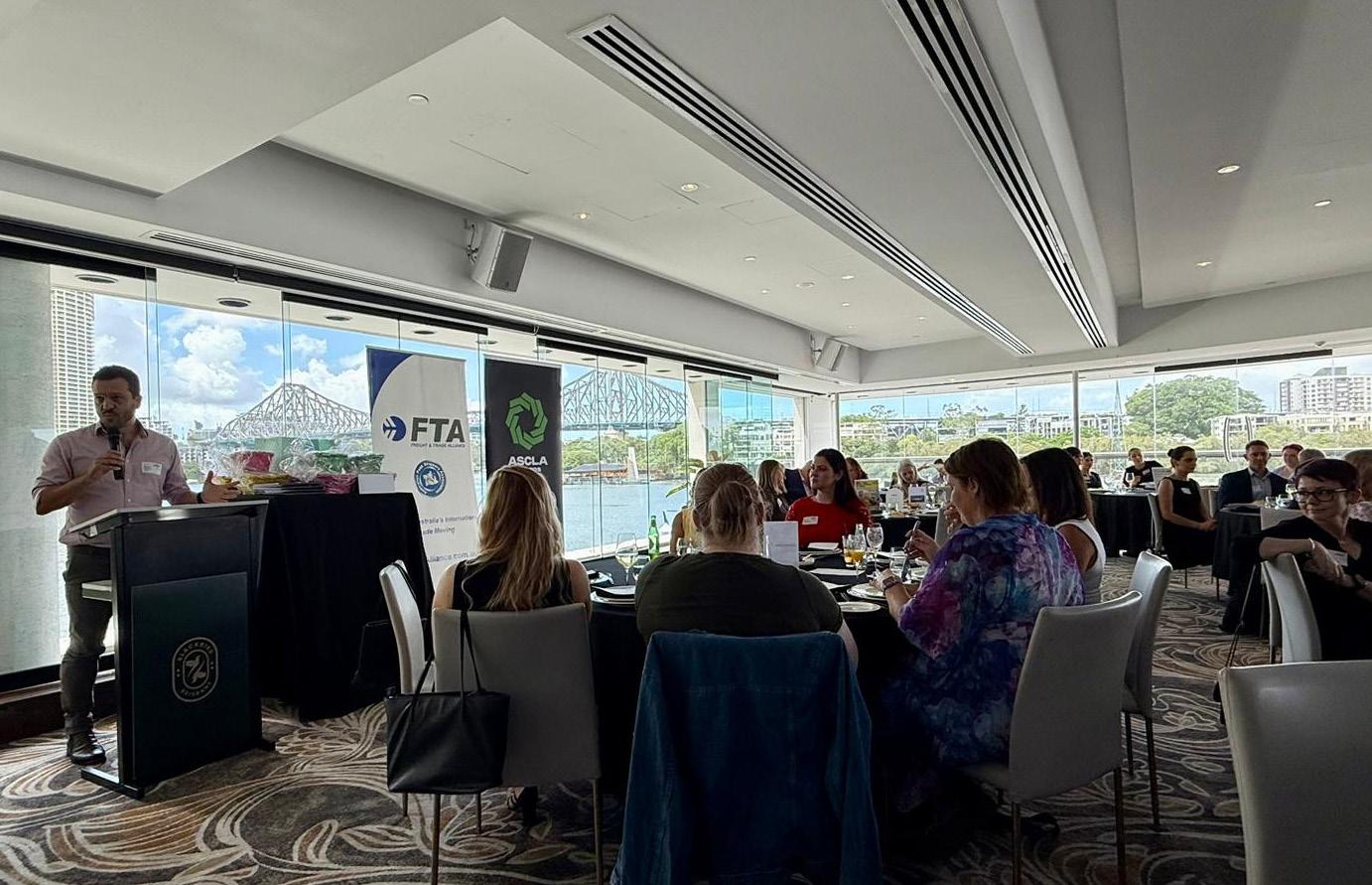
Mark Healing, QLD Committee
Late February saw our first networking event for the year and Mentor Program Wrap up. It was great to see familiar and some new members coming along to socialise. Another mentor program wrap up and looking good for this year’s participation.
The Brisbane River set a stunning backdrop at Blackbird Bar and grill last Friday, but the real energy was inside the room as the QLD Chapter came together to celebrate International Women’s Day on the 6 th of March.
The highlight of the afternoon was the honest and powerful conversation shared by our guest speakers Kim Richards, Magenta Thorley. Their stories reminded us that leadership is not defined by titles, but by the journey. From starting on the factory floor to leading teams, advocating for others and creating opportunities for the next generation.
Events like this are only possible with the support of our sponsors and partners. A sincere thank you to Explorate, Ghanem Group and glamaCo for helping make the event possible.
We were also proud to support our charity partner OzHarvest, represented on the day by their very own Sarah Sigley.
Thanks to the generosity of attendees through raffles and donations, we raised valuable funds to support their mission of nourishing Australia while reducing food waste.
A special thank you to our MCs Natalie Wallace and Chris Josey for guiding the afternoon, our CEO Steven Ballerini | LinkedIn for speaking and to the ASCLA QLD Committee whose work behind the scenes delivered such a fantastic event.
Then on the 12th of March It was great to attend the Brisbane Book Launch of “Leading Enterprise Excellence”. Our hosts and co-authors, Brad Jeavons and Chris Butterworth gave a great background on how they developed the content.
The ongoing quest for more productivity is real, and they had some quite enlightening and thought-provoking challenges for the enthusiastic crowd attending.
We continue to build on the incredi-
ble momentum of the last few years as we solidify our strategies into defined program rollouts across the state. This year, our focus is sharpened on four key pillars that will drive our association forward:
y Membership Growth and Retention
y Student Growth and Pathways
y Regional Growth
y The ASCLA Industry Awards
It is truly humbling to see the amount of work our committee is doing behind the scenes. We are currently rolling out enhanced member communicationv tools and a new Student Ambassador Program, which aligns directly with our Mentor Program and our regional growth strategy which focuses on key supply chain and logistics hubs, These initiatives serve as the foundation for a much larger, ambitious five-year plan.
As President, I could not be prouder or more thankful for the dedicated committee that forms SCLAA QLD. Their hard work allows us to continue delivering value to our industry, and I look forward to bringing you more exciting news, site tours, and networking events throughout 2026.
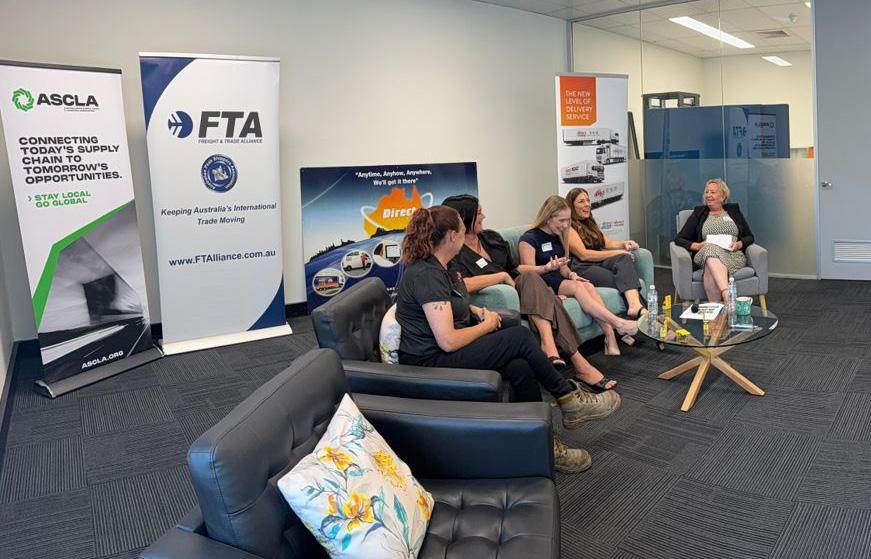
Brian Lynn, WA Director
Nearly fifty of Western Australia’s finest supply chain and logistics professionals gathered at Direct Couriers, Kewdale for International Women’s Day, and for fantastic breakfast panel discussion.
Our five exceptional panellists Adele Mowry - Millar (Freight Tranz Transport), Jana McLaren (Freight Lines Group), Laura Byrnes (MSC), and Josie Lovell (Linfox), (expertly encouraged by Sherie Le Brun from our WA Committee) shared their career journeys with openness and generosity.
Also the representative of ASCLA’s chosen charity for IWD, Jennifer Keen from OzHarvest, outline the important work that her organisation does.
Each IWD panellist recounted her career history, providing practical advice to those present keen to forge a path in the industry.
Key talking points included defining what a good workplace should looks like, and the role that mentors, coaching and strong networks play in helping people grow.
Common conversation threads was that we shouldn’t be afraid to ask questions (curiosity really does open
doors), the importance of finding mentors who are willing to guide us, and for us to be willing to mentor others when we can.
Making time to keep learning and upskilling ourselves was another key point, as was the reminder that building connections often leads to unexpected opportunities.
There was encouragement to go after what we want, not to be afraid of making mistakes, and to remember that it’s not the mistake that defines us, but how we fix it. And above all, accountability matters; we need to own our work and our decisions.
Last but not least, if we’ve been invited into the room, we belong there.
The event was a perfect reminder of how much talent there is in our industry and proof that logistics is just as much about people as it is about freight.
A special thank you to our generous event sponsor Direct Couriers, particularly Director Frank Tringis for making the morning possible, and to everyone who showed up and leaned into the conversation.
Here’s to the women forging a path in our industry, and to the men and
women that have supported them along the way.
Our Next Events and Our Commitee Watch the normal channels for information on upcoming WA events.
If you’d like to get more involved with how ASCLA coordinates its activities, there’s always space for enthusiastic volunteers. Contact ASCLA or the local committee for more details.
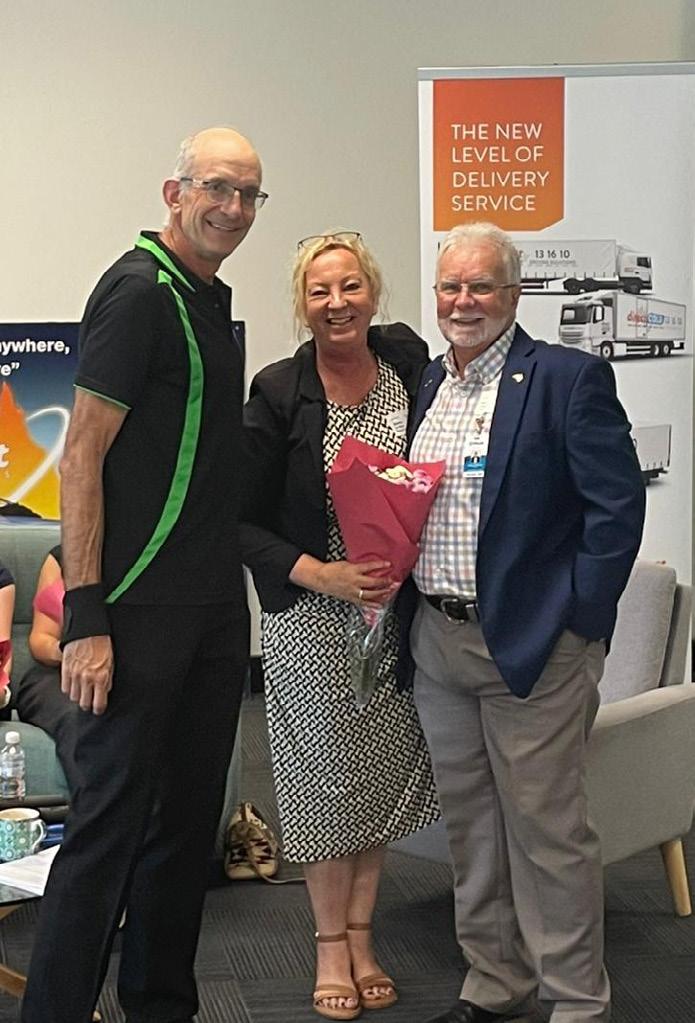
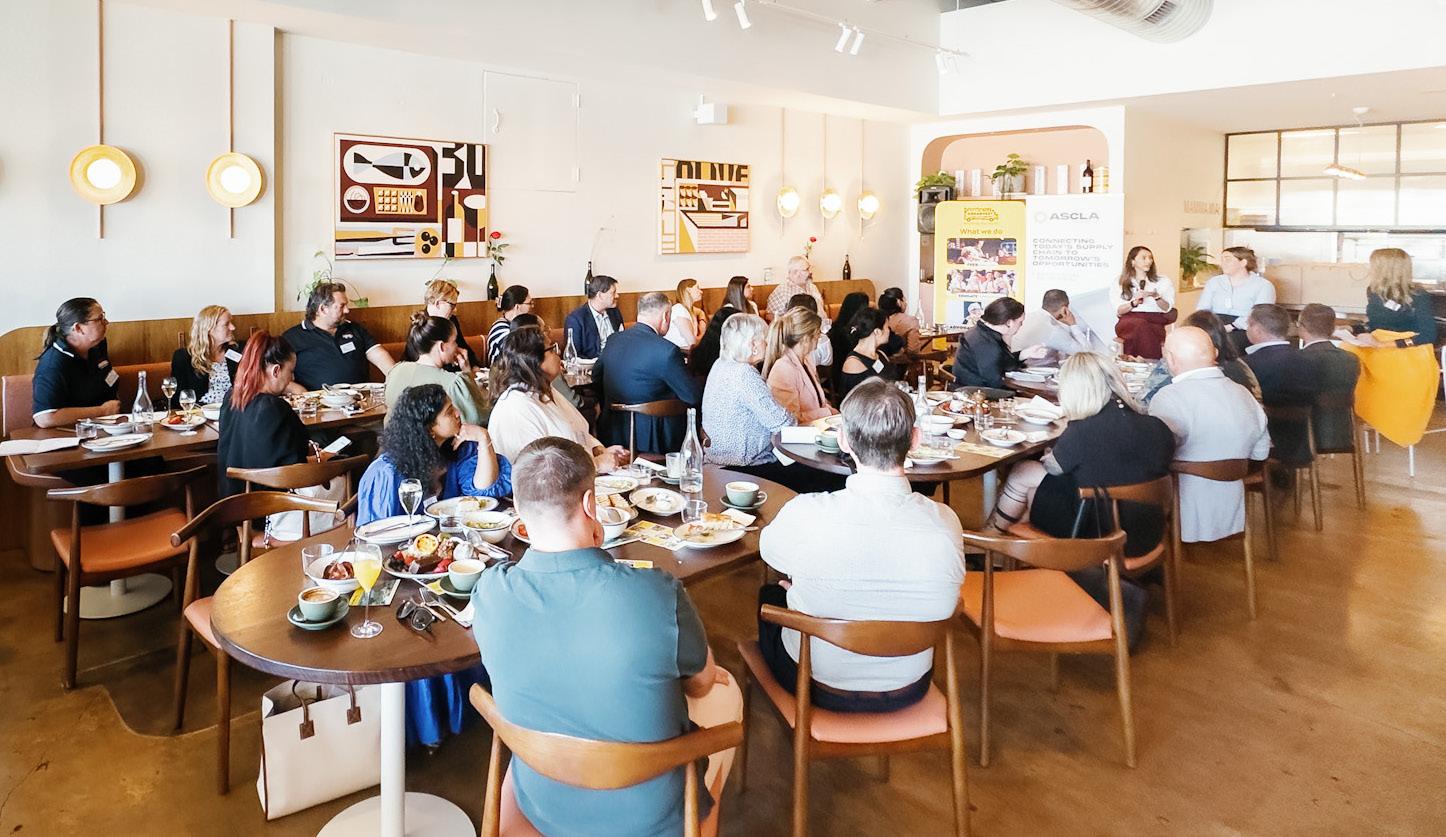
Chris Williams, SA/NT State President
LThe South Australian International Women’s Day event took place at Olivetti in central Glenelg. Things kicked off with Brett McGowen, ASCLA SA/NT Director, talking about supply chain management, and he even used a real chain to show his points. Afterwards, we were joined by special

guests Paula Rojas from Schneider Electric and Kristin Mumme from RM William’s with Rachel Homer as our host. The conversations covered topics like suitability, leadership, and diversity, and really highlighted what International Women’s Day is all about. We talked about how our organisations do their best when ev-
Business Development Executive
Datacom
eryone’s talents and opportunities are supported. Shining a light on women’s achievements helps us create more chances for future female leaders and encourages diversity in every sector the day was incredibly empowering and a sold event with lots of new potential members.
We are excited to welcome Iz Baldago as our new SA member!
Iz is the Business Development Executive and Commercial Enterprise Lead at Datacom. At our upcoming networking event, Iz will share insights into how Datacom can help your teams modernise legacy software, implement field tracking and freight management systems, ensure AI applications run smoothly in production, and support sustainable lifecycle management for both front-of-house and back-of-house workflows.
Alongside this, Iz will also handle photography and videography for all our events, expect to see some great snaps of him too! We’re pleased to have Iz join our community.

Bart Phaosihavong, VIC/TAS State President
The first and one of the biggest events of the year really kicked off. We had an amazing International Women’s Day breakfast at the Terrance, Royal Botanical Gardens, Melbourne. With over 150 attendees, keynote speech delivered by Sheila Nguyen and panellists, Deanna Lomas (Executive Director of Manufacturing & Logistics, Lifeblood), Danusha Purcell – (National Transport Manager, Australian Pharmaceutical Industries), Danyely G. (Regional Director of Operations, Lineage Logistics) and Soumya Ranjan (Operations Manager, Mondelez International) hosted by Tabitha West. Not only was the morning filled with incredible insights exploring how organisations create and cultivate real opportunities for Women in Supply Chain, but our keynote speaker, Sheila really lit up the room with amazing energy engaging the entire audience to participate in a crowd favourite collective “Mexican wave”.Events like IWD really reflect the spirit and values of ASCLA and
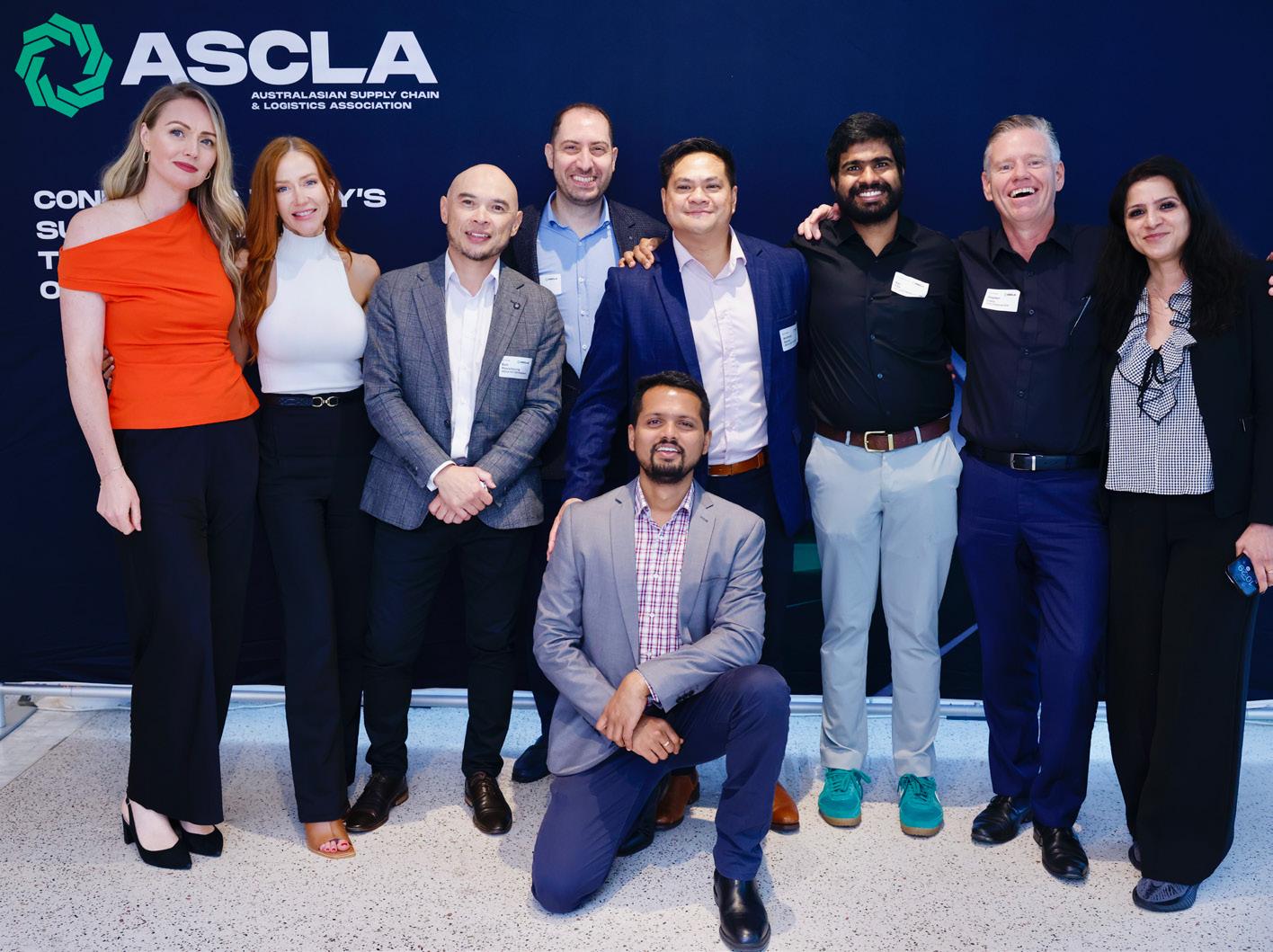
our industry.
Sincerest thank you to the incredible ASCLA committee team, Gan Pilai, Tabitha West, Rakesh Bandipelli, Atharva Bhosale, Saahir Patel, Richa
Vijayraj, Faraz Bider, Lauren Cass, Serena Moreno, Sahithi Ram, Rahul Gowda and Chairman, Stephen Lake – you guys rock! IWD 2026 was an absolute success!

Are you ready to accelerate your career or inspire the next generation of supply chain leaders?
LEARN MORE
MEET THE MENTORS
The 2026 National Mentoring Program is back, running from May to November, bringing together Australia’s brightest supply chain and logistics minds in a powerful journey of growth, connection, and industry excellence.
Whether you’re an experienced professional eager to give back, or an emerging talent looking to fast-track your development, this program is your gateway to real-world insights, career-defining relationships, and personalised guidance from leaders who’ve walked the path before you.
Registrations for Mentors and Mentees are CLOSING SOON. Spaces are limited. This is your chance to engage in a structured, high-impact program designed by supply chain professionals, for supply chain professionals.
$599 Corporate Bundle
Sign 5x Staff up to Mentees - Save $196
Only 10 Bundles Available
Looking to inspire future leaders in supply chain?
“The SCLAA Mentoring Program connected me with someone who truly understood my career aspirations. The guidance I received was invaluable — it’s been a game-changer.” - 2024 Mentee


PARTNERING TOGETHER TO FAST-TRACK YOUR COMPANY GROWTH
ASCLA is proud to announce an exciting new education partnership with WiseTech Academy, an initiative from WiseTech Global - a company whose innovations and global technology enable and empower the world’s supply chains.
WiseTech Academy offers high-quality online learning in supply chain logistics & corporate compliance and has grown rapidly in recent years due to their profound understanding of global supply chain logistics. Offering specialised courses to help develop new skills, advance your career, accelerate productivity, and manage corporate risk, WiseTech Academy is a trusted supplier for practical and innovative online learning programs.
LEARN MORE


This partnership will offer industry-leading online education programs and accreditations in supply chain logistics and corporate compliance to our Corporate Members for an discounted rate. PLUS existing CargoWise users will receive an additional 12.5% off their already reduced course prices.

































The ASCLA welcomes our newest Platinum Partner, Oracle NetSuite. As a not for profit Industry Association, run by members for members, our ability to support the ASCLA infrastructure and to expand is highly dependent on our Partners. We ask all our members to support our valued Partners where they can.
NetSuite’s unified platform helps supply chain companies manage all aspects of their business, including financials, inventory, customers, procurement, staff scheduling, logistics, and point-of-sale operations. With over 25 years of experience and more than 43,000 customers across 219 countries, NetSuite has established itself as the #1 AI-powered cloud ERP solution.
Key Features
NetSuite offers built-in workflows for critical functions across your distribution business including:
y Commerce. Omnichannel engagement brings together all your customers and business activities.
y Inventory. Manage inventory and supplier relations more effectively. Optimise your inventory and your supply chain to speed delivery time, increase sales, improve inventory turn, and deliver the products your customers want when they want them.
y Financials. A best-of-breed financial management application ensures world-class accounting across your organisation.
y Marketing. Real-time metrics and comprehensive data drive en-
gagement with current customers and new market expansion.
y Sales. Unparalleled efficiency and visibility from lead to close, support a sales effort that’s second to none.
y Orders. Omnichannel means accepting orders everywhere (online, offline, EDI, and more) and fast-tracking order-to-cash.
y Sourcing. Ultimate control over procure-to-pay processes, improves supplier relationships, transparency, and forecasting.
y Warehouse. WMS functionality reduces overhead and cycle times while increasing inventory turns and on-time delivery rates.
y Support. Case management, return tracking, and self-service client support enable you to run a truly customer-oriented business.
y Customisation. The groundbreaking SuiteCloud Platform provides infinite extensibility, meeting your unique needs and scaling as you grow.
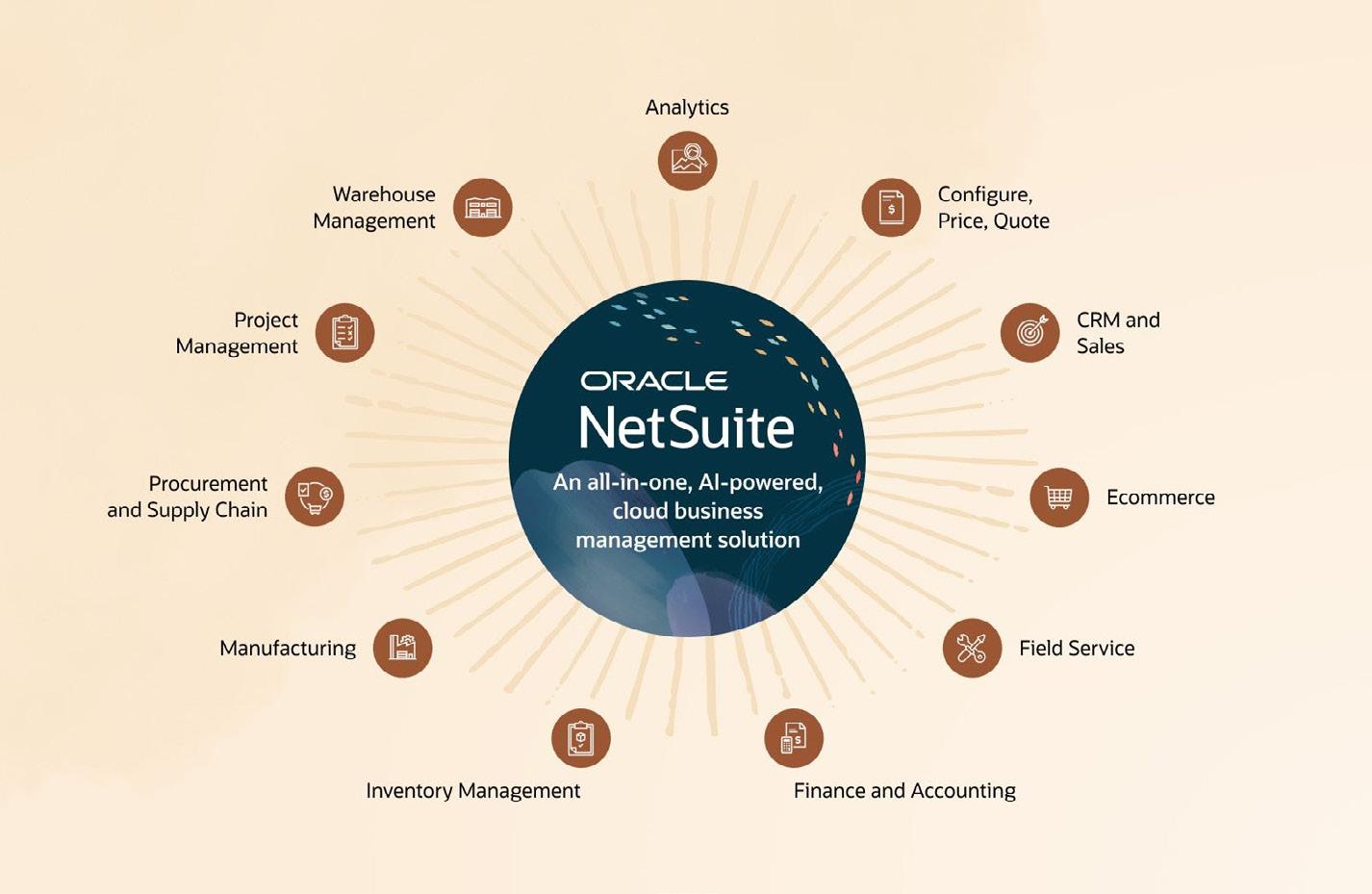

The ASCLA welcomes our newest Partner, Zembl. As a not for profit Industry Association, run by members for members, our ability to support the ASCLA infrastructure and to expand is highly dependent on our Partners. We ask all our members to support our valued Partners where they can.
Zembl: simple, smarter and cost-effective energy for Australian supply chain businesses
Zembl is an Australian energy services company built for one purpose: to help businesses take control of their energy costs with clarity and confidence. Their energy experts work with businesses across industries, from logistics and manufacturing to transport and beyond. The focus is straightforward: helping businesses manage the complexity of their energy, so they can stay focused on what matters most to their operations.
For small businesses, Zembl makes switching to a sharper energy deal fast and stress free. Once a recent energy bill has been shared with Zembl, a Zembl Energy Expert will compare current rates with competitive offers from their trusted panel of local retailers. If a suitable option is identified, they manage the switch for you on the spot. No lock-in contracts. No disruption. Just immediate savings and a smoother path forward.
For large commercial businesses, Zembl manages the full procurement process from end to end. Zembl does the legwork in securing
future competitive rates, working directly with retailers to assess your usage and current rates. From there, they’ll collect your energy preferences and take these to market via their signature commercial tender process. Strong, tailored contract options are negotiated, and once approved, implementation is handled efficiently to secure price stability and long-term certainty.
Zembl also provides energy intelligence and efficiency opportunities that help businesses achieve long term, sustainable energy costs reduction. From a dedicated Commercial Energy Portal, to Bill Validations, Network Tariff reviews, annual energy costs forecasts and proactive efficiency recommendations, Zembl’s ongoing service is designed to re-
duce waste and strengthen operational expense performance.
Zembl is a partner businesses can rely on. With a clear and transparent approach, Zembl helps businesses save time and take control of their energy costs. Their energy experts understand the pressures faced by energy-intensive industries and provide the insight, visibility, and confidence businesses need to know their energy is being actively managed in a volatile market.
To see what Zembl’s energy expertise and signature service can do for your business, simply share your latest energy bill via the button below. An industry energy expert will be in touch to guide you through the next steps.

The Australasian Supply Chain & Logistics Association (ASCLA) combines decades of experience with industry-leading professional development and education programs, networking events, corporate partnerships, and support for its members and partners.
The ASCLA combines decades of experience with industry-leading professional development and education programs, networking events, corporate partnerships, and support
Our strategic purpose is to connect today’s supply chain professionals and partners to tomorrow’s growth opportunites and to support the advancement of our industry by championing collaboration, innovation, and success.
MEMBERS & INDUSTRY CONTACTS
for its members and partners. We are firmly committed to bringing innovation, forward-thinking, connection and advancement to all professionals in our network.

81
CORPORATE MEMBERS & NATIONAL PARTNERS
59K+
SOCIAL MEDIA FOLLOWERS
MEMBERS AND AFFILIATE INSTITUTIONS IN 13 DIFFERENT COUNTRIES

BUSINESSES MEMBERSHIP
PLATINUM PARTNERS PARTNERS CORPORATE BUNDLE
We offer a Tiered National Partner program providing a variety of advertising and event sponsorship occasions to suit your company’s goals.
Industry-leading training, mentoring, education, and professional development programs to accelerate your teams’ career at every level.
Over five decades worth of experience, history and relationships in the supply chain and logistics industry in Australia.
INDIVIDUAL MEMBERSHIP
EXECUTIVE PROFESSIONAL BASIC STUDENT
We embrace supply chain professionals from all sectors to give our members broad reaching industry knowledge and networking opportunities.
We offer industry-leading training, mentoring, education, and professional development programs to accelerate your career at every level.
Gain access to 50 years’ worth of experience and history in supply chain logistics with our library of resources, white papers, and webinars.
Becoming a member today and connect to industry insights, cutting-edge advancements, and a powerful network to accelerate your growth.
Sign up for an Individual Membership
Sign up for a Business Membership