New Schulich Faculty
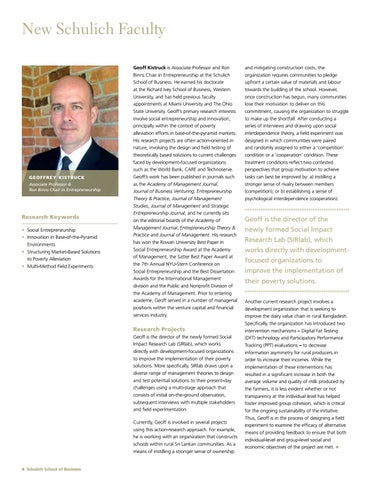
Geoffrey Kistruck Associate Professor & Ron Binns Chair in Entrepreneurship
Research Keywords • Social Entrepreneurship • Innovation in Base-of-the-Pyramid Environments • Structuring Market-Based Solutions to Poverty Alleviation • Multi-Method Field Experiments
Geoff Kistruck is Associate Professor and Ron Binns Chair in Entrepreneurship at the Schulich School of Business. He earned his doctorate at the Richard Ivey School of Business, Western University, and has held previous faculty appointments at Miami University and The Ohio State University. Geoff’s primary research interests involve social entrepreneurship and innovation, principally within the context of poverty alleviation efforts in base-of-the-pyramid markets. His research projects are often action-oriented in nature, involving the design and field testing of theoretically based solutions to current challenges faced by development-focused organizations such as the World Bank, CARE and Technoserve. Geoff’s work has been published in journals such as the Academy of Management Journal, Journal of Business Venturing, Entrepreneurship Theory & Practice, Journal of Management Studies, Journal of Management and Strategic Entrepreneurship Journal, and he currently sits on the editorial boards of the Academy of Management Journal, Entrepreneurship Theory & Practice and Journal of Management. His research has won the Rowan University Best Paper in Social Entrepreneurship Award at the Academy of Management, the Satter Best Paper Award at the 7th Annual NYU-Stern Conference on Social Entrepreneurship and the Best Dissertation Awards for the International Management division and the Public and Nonprofit Division of the Academy of Management. Prior to entering academe, Geoff served in a number of managerial positions within the venture capital and financial services industry.
Research Projects Geoff is the director of the newly formed Social Impact Research Lab (SIRlab), which works directly with development-focused organizations to improve the implementation of their poverty solutions. More specifically, SIRlab draws upon a diverse range of management theories to design and test potential solutions to their present-day challenges using a multi-stage approach that consists of initial on-the-ground observation, subsequent interviews with multiple stakeholders and field experimentation. Currently, Geoff is involved in several projects using this action-research approach. For example, he is working with an organization that constructs schools within rural Sri Lankan communities. As a means of instilling a stronger sense of ownership
4 Schulich School of Business
and mitigating construction costs, the organization requires communities to pledge upfront a certain value of materials and labour towards the building of the school. However, once construction has begun, many communities lose their motivation to deliver on this commitment, causing the organization to struggle to make up the shortfall. After conducting a series of interviews and drawing upon social interdependence theory, a field experiment was designed in which communities were paired and randomly assigned to either a ‘competition’ condition or a ‘cooperation’ condition. These treatment conditions reflect two contested perspectives that group motivation to achieve tasks can best be improved by: a) instilling a stronger sense of rivalry between members (competition); or b) establishing a sense of psychological interdependence (cooperation).
Geoff is the director of the newly formed Social Impact Research Lab (SIRlab), which works directly with developmentfocused organizations to improve the implementation of their poverty solutions. Another current research project involves a development organization that is seeking to improve the dairy value chain in rural Bangladesh. Specifically, the organization has introduced two intervention mechanisms – Digital Fat Testing (DFT) technology and Participatory Performance Tracking (PPT) evaluations – to decrease information asymmetry for rural producers in order to increase their incomes. While the implementation of these interventions has resulted in a significant increase in both the average volume and quality of milk produced by the farmers, it is less evident whether or not transparency at the individual level has helped foster improved group cohesion, which is critical for the ongoing sustainability of the initiative. Thus, Geoff is in the process of designing a field experiment to examine the efficacy of alternative means of providing feedback to ensure that both individual-level and group-level social and economic objectives of the project are met. ◆