ISSUE 1 January 2021
You-wA-H
INDIA’S LARGEST SCHOOL HEALTH NETWORK
A compiled version of the Webinar Series on Youth and Adolescent Health during Pandemic and after | Webinar 1 - 24
This booklet by SHARP NGO is a compilation of the key takeaways from the series of webinars highlighting adolescent health issues and solutions.
ABOUT THE SERIES Coronavirus pandemic has led to significant loss of life and has severely altered how we live and socialize. It poses major challenges to our daily lives, the public health scenario, our dietary patterns, our education and work culture. The subsequent lockdown has added on to our discomfort; it has increased undernourishment among the poorer communities, has led to unemployment and caused social disruption. While some households shifted to work from home, virtual classes, telecommunication to stay connected with family and friends and resorted to OTT platforms for entertainment, other households experienced different challenges such as early marriages, domestic violence, falling of relationships and malnourishment. All these lifestyle changes have serious implications on our physical and mental health. SHARP NGO presents a series of webinars on "Youth & Adolescent Health during Pandemic and after", to discuss how Youth & Adolescents are affected due to the ongoing pandemic situation, challenges to follow & to share relevant information about persisting school health issues to teachers, parents and students so they can further educate the society. It also hopes to create an open platform for them to ask their doubts, and get possible solutions. All views and opinions shared during the webinar belong to our esteemed panel of speakers. Each session was moderated by the SHARP NGO Team and the audience was primarily composed of school and college-going children, parents, teachers, principals, social workers, healthcare professionals as well as some implementation agencies who may find interest in the topic. Patron Dr. Puran Prakash (Founder, SHARP NGO) Ms. Menaka Sharma (Founder, SHARP NGO) Editorial Board Ms. Tvisha Malik Mr. Ritik Singhal Ms. Mahima Mehra Ms. Prerna Singh Designed by Mr. Himanshu Khanna
FROM THE EDITORS “You-wA-H” (/ju:va:/) stands for Youth and Adolescent Health – a digital booklet by SHARP NGO covers all the important concepts that have been discussed under our Webinar series. Our booklet is a compilation of all the problems the youth and adolescents are facing in urban and rural India and the measures they can take to overcome their deteriorating health. Additionally, we are also trying to help everyone understand how they can use this period effectively to set their future goals and start working towards them early. Our booklet also aims to help teachers and parents understand what behavioural changes the adolescent might show and how they can help the young ones cope with this temporary situation. With a hope for better times we also hope this book promotes positive psychology and helps individuals understand the simple and sustainable changes they can introduce in their daily lives to reduce the vexation and fatigue caused by this pandemic. This booklet will allow you to rethink your life, to change for an improved present and prepare for a healthier future. We sincerely thank all the contributors of this booklet and wish for a healthier and safer year ahead!
•
Eye Care Screen Time Effect on Youth and Adolescent
•
Tobacco Consumption and Substance Abuse Among Adolescents Substance Abuse among students: Awareness, Cessation & Management
•
INDEX
•
•
5
Water, Sanitation and Hygiene in Schools Back to School: New Sanitization and Hygiene Challenges for Indian Schools
25
Swachhta Action plan for pre-schools & schools during Covid-19
39
Understanding Hygiene Behavior & Behavior Change: Hand washing and Food Hygiene Perspective
47
Mental Health and Well-being Supporting Students’ Mental Health during COVID-19: The Life After
43
Digital Mental Health of Adolescents during COVID times: A Global Concern
72
Building Mental Health platforms in schools for students, teachers & parents
92
Growth mindset in adolescents: To lead a positive life
98
Physical Health and Well-being Effects of physical inactivity on health of Youth and Adolescent
9
Youth, Non-Communicable Disease, and the COVID-19 Pandemic
61
Support & Accessibility for students with reduced mobility in schools
77
Sleep Pattern of Adolescents •
56
Digital Addiction Amongst Students Digital Addiction during Pandemic
•
87
Safety in Schools Air Pollution & Covid19 : Effects on School Children
•
1
103
Promoting Nutrition in Schools Opportunities for Nutrition, Health and Wellbeing amidst adversity
21
•
•
Investing in opportunity to break cycles of poor Health and Nutrition
29
Investing on Adolescent Girls Nutrition Second Window of opportunity
34
School Health Education National Educational Policy and the Hope for better Adolescent Health
13
New Role of Teachers and Parents as Health Educators during & after pandemic
17
Building Convergence for India’s School Health: Achieving Sustainable Development through Health promotion in Schools
51
School Vaccination challenges and readiness
82
Road Safety
INDEX
Road Safety Behavior during Covid-19: School-age Adolescents Young & Inexperienced Drivers: Safety implications & risk taking behavior
67 108
Webinar 1 How Increased Screen time is aecting the Youth and Adolescent during the COVID-19 Pandemic and what can be the possible Prevention's for same The ďŹ rst webinar addressed the issues related to eyes faced during these times due to the Increase in Screen time and discussed the possible solutions for same. It also gave the audience an opportunity to interact with the eminent and diverse panel which included:
DR. PARUL SHARMA Director, Ophthalmology, Max Hospitals, Gurgaon, Max Healthcare - Delhi
MS. SEEMA JERATH Principal, DLF Public School, Ghaziabad
1
KEY TAKEAWAYS
EYE-CARE PRACTICES •
“Yoga for the tired eyes” does not help in relaxing our eyes. We must take regular and active breaks from screens; moving our shoulders, standing on toes and heels, walking and blinking help in reducing eye fatigue.
•
Consuming carrots does not cure our eyes. It is the biggest myth of all. A good diet for the eye does not cure the compromised vision, it only ensures well-being.
•
Dry-eyes are not a symptom of weak vision but caused by lack of blinking. Additionally, air conditioners and fans evaporate out tear film leading to dry eyes, the best lubricant for it is blinking.
•
Doctors recommend practicing the “10-10 or 20-20 rule”, wherein if you stare at something for 10 minutes you must look at a faraway object or close your eyes for 10 seconds to break the eye strain and rejuvenate our eye muscles.
•
Since the eye is a growing muscle, the prescription of children might change every 6 months, therefore they must get their eyes tested regularly. Diabetic patients must also follow this rule.
SCREEN TIME RELATED ISSUES •
Technology is here to stay and there is no parameter to measure how much screen time is enough screen time. The only way this could be measured is by understanding whether the screen time was productive or not.
2
KEY TAKEAWAYS •
Our eyes are designed with the ability to sit in front of screens and books for as long as 10 hours but with sufficient breaks.
•
The effects on eye on reading from a screen with glasses or from a book are similar. We believe that reading from a book is better than reading from the screen, however, to our brain both the activities are the same.
COMMON SPECTACLES RELATED CONCERNS •
People who want to get rid of their spectacles can get a laser treatment but only after the age of 18 years.
•
Computer glasses are only an experiment that hasn’t been proved scientifically, yet.
3
SURVEY FINDINGS •
75% of the audience about the common eye problems caused due to increased screen time.
•
On an average, 23.9% audience spent 2-5 hours in front of their screens, as many as 46.6% spent 5-10 hours, and 29.5% spent more than 10 hours on television and phone at the start of the lockdown.
•
67% of the survey participants did not or seldom indulged in eye care practices recommended by doctors.
•
Over 60% of the audience was not aware of the WHO guidelines for better eye care prior to the webinar. 72% of the audience left the webinar with adequate knowledge around eye care practices.
4
Webinar 2 The rise of Digital addiction in Youth and Adolescents during the COVID-19 Pandemic: Effects on Mental & Physical health & How to cope up with same A survey posted by the Hindustan Times conducted across 30 Indian cities highlighted that children’s addiction to electronic devices during the lockdown increased up to three times, as they spent between two and five hours a day on their favourite gadgets. The survey revealed that 65% of the children became addicted to electronic devices, while 50% of them couldn’t stay away from their gadgets for even half an hour. A rise of no-mobile phobia has also been observed. This is a situation of grave concern. The second webinar of the series focused on the impact of digital (internet, social media, & gaming) addiction on one’s mental and physical health and informing the audience about the ways out of digital addiction and preventions. It also gave the audience an opportunity to interact with the eminent panel which included:
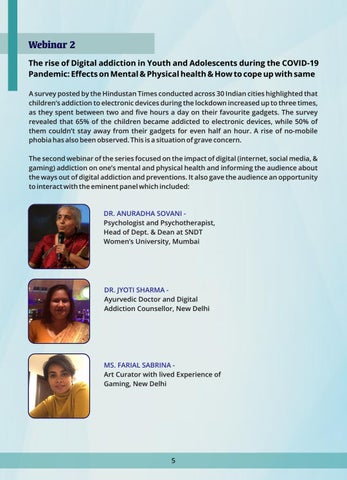
DR. ANURADHA SOVANI Psychologist and Psychotherapist, Head of Dept. & Dean at SNDT Women’s University, Mumbai
DR. JYOTI SHARMA Ayurvedic Doctor and Digital Addiction Counsellor, New Delhi
MS. FARIAL SABRINA Art Curator with lived Experience of Gaming, New Delhi
5
KEY TAKEAWAYS
INTERNET AND GAMING ADDICTION • • •
The overuse of the internet is not the main concern , the misuse of it is. The digital world must be used responsibly to avoid any repercussions. A scholarly research discovered that parents aren’t as worried about Internet consumption as they are about the night outs. The young minds are unable to differentiate between the reel world and the real world.
PHYSICAL AND PSYCHOLOGICAL EFFECTS OF DIGITAL ADDICTION • •
Ayurveda believes that our physical health and psychological health are interrelated. When we over exert ourselves psychologically, our body starts responding physically. Teenagers stop taking care of their physical appearance if they get addicted to the digital world, it is worrisome since teenagers are very particular about the way they look.
ADOLESCENT BEHAVIOUR • •
•
Teenagers miss their social interactions amidst the lockdown; there is a longing for peer interaction which is why they spend most of their hours on social media. A typical adolescent is usually addicted to the internet because he receives three rewards from online platforms, he gets a chemical high from playing well, a social high because the peers appreciate their performance and platforms regularly provide them with rewards to boost their business. The new generation is born in a digital world, for them there is no difference between
6
KEY TAKEAWAYS
•
an online classroom or an offline classroom, it’s the older generation that can differentiate and might face a few challenges in accepting the changes. Our youth is equipped with the risk taking factor; however this trait also makes them indulge in behaviors with negative consequences. And this is why parents need to be watchful of the internet usage of the kids.
DISCUSSING THE POSITIVES OF INTERNET • •
We should productively use our digital space, it is a world that is beyond the physical and has immense potential in helping individuals succeed in their lives. The older generations lack knowledge about the positives of the internet and have developed a phobia of the online world. We should also pay attention to the positives of the internet to get rid of this phobia. It is the main source of communication these days and has become the medium of school education, learning, working, pursuing passions, staying fit.
WAYS OUT OF DIGITAL ADDICTION AND PREVENTION •
• •
•
The mind of the youth needs to be detoxified. Ayurveda suggests that one should indulge in activities that harvest their potential in a manner that a young mind is diverted from the internet. For every hour spent in the digital world, one must relax their body by laying still, doing yoga, star gazing or massaging their foot. We must develop a value system around the internet instead of condemning it. We must learn to distinguish between our gadgets, phones are meant for calls and texting, laptops for online lectures and research, and televisions are meant of watching shows and movies and games can be played on both. The cross-usage of devices results in the overuse of the digital world. We have put labels on certain things; a child sitting in a library for three consecutive days is as unhealthy as a child sitting in front of the television. Labeling activities is incorrect, our focus should be on discipline. One should set goals and move ahead. This artificial division between the online and the offline is completely irrelevant.
7
SURVEY FINDINGS •
76% people feel the need to check their phones every thirty minutes to one hour.
•
65% of the people use digital platforms for only 1 – 5 hours a day.
•
46.5% of the youth mostly uses the internet for academics during the lockdown as opposed to 39% who used it for social media. Only 3.8% of the audience uses the net for online gaming while 10.8% has other major uses of the internet.
•
60% of the population has not put screen time limits on their mobile phones.
•
Approximately 34.9% of the audience feels that their lives are impacted by social media, over 48% feel they are sometimes influenced by social media whereas 17% do not feel their lives are impacted by social media.
8
Webinar 3 Effects of Physical Inactivity during pandemic and how to maintain a good physical health during these times Sedentary lifestyle can increase hypertension, chances of diabetes and have adverse effects on our mental health and nutrition levels. A study posted by the Lancet denoted physical inactivity as the fourth leading cause of death worldwide. Physical Inactivity is very common during the periods of self-isolation – a common scenario during the lockdown. Our third webinar discussed the effects of Physical Inactivity in youth & adolescents. It highlighted the ways of maintaining good physical health during these times. The audience was also given an opportunity to interact with the eminent panel which included:
MS. LAVLEEN KAUR Dietitian, Clinical Nutritionist & Lifestyle Coach, Chandigarh
MS. KUNASHNI PARIKH Sport Psychologist from Mumbai, Ex- Vice Captain and Goalkeeper, India U-16 Football Team
MS. VIBHA KHOSLA Principal, Sri Ram Global School, New Delhi
9
KEY TAKEAWAYS
PHYSICAL EFFECTS OF INACTIVITY • •
•
The lack of physical activities has resulted in obesity, pre-diabetic conditions and hormonal imbalances among adolescents. People from all age groups have been inside and have stopped working on their muscle strength. It has impacted the bone density mass among children. Overall it has affected our immune system, as a cure for which people have consumed a variety of immunity boosting supplements that has resulted in hypertension in some cases. During the lockdown, we have gained weight around our belly because all the visceral fat is stored there, in order to avoid the accumulation of the fat we should aim to complete 4000 steps a day at home.
PSYCHOLOGICAL EFFECTS OF PHYSICAL INACTIVITY •
•
Our physical and mental health are tied together. When we exercise, we increase our muscle movement which improves our brain health, new-young nerve cells are generated that improve our memory, reduce stress, improve our sleep quality and positively affects our mood. According to psychologists, there is no concept of dopamine detox, it is only enhanced by exercising. Additionally, it must be understood that exercises and their results vary from person to person.
DIET •
A good diet includes all the essential micro + macro nutrients in sufficient quantity. Our chewing power also plays an important role; if we build a good connection with our food, we build a good connection with our bodies. 10
KEY TAKEAWAYS •
• •
Students staying in PG should try to limit their intake of the three refined meals, they could take mini meals right before their main meals. These meals could include fruits, nuts, seeds, salad sticks, etc., and plenty of water should be consumed as it reduces hunger and detoxes the body. People tend to consume more comforting foods over healthy foods in tough times. We must try to limit our consumption of the unhealthy comfort foods. We crave sugary foods because sometimes we confuse thirst with hunger, even some mineral deficiencies lead to cravings. We must start our day with fruits instead of coffee or chai, because they are healthier and don’t lead to cravings.
ROLE OF CARETAKERS •
•
• •
Teachers are guiding students to create a routine for themselves and constantly motivate themselves and their peers to complete tasks, rewarding ourselves and others at the completion of a task also keeps us motivated. Parents are advised to talk to their children positively and make them understand the temporary nature of our situation. They must try to divert their minds by discussing activities that could be taken up now or in the future. Parents are the role models for their children, they must ensure that their child is eating the right amount of food at the right time. Schools are taking steps to involve as much physical activity as possible to replace sedentary learning.
MAINTAINING HEALTH AMIDST THE PANDEMIC • •
•
• •
We must maintain a balance in our diet, physical activity and sleep cycles to avoid any health risks. The lockdown has demotivated everybody, which is affecting our lives. To keep ourselves motivated, we should follow a routine, dress up for it, create specific goals and make activities more fun and social in nature. To reduce the impact of inactivity on our health, we must make simple changes in our diet– choosing healthier snacks over junk food and exercising for at least 15-20 minutes a day is effective but not sufficient. Creating a family exercise time will help us get rid of physical inactivity while making it more fun and inclusive. Digital platforms could be effectively used to engage in online exercise routines that suit us.
ADDITIONAL LIFESTYLE TIPS •
Quality sleep is when you wake up feeling fresh, it’s not the number of hours. One sleeps well when one eats well and exercises regularly. This positively affects our mental health. 11
SURVEY FINDINGS •
65% of the population spends less than an hour on physical activities on a daily basis, and only 7% spend close to 10 hours a day on physical activity.
•
Nearly 50% of the students are unable to create a balance between digital learning and healthcare.
•
60% population was unable to find time to exercise and take care of their health. 30% (approx.) of the population lacks the motivation to exercise at home lockdown period.
•
Approximately 30% of the population does not know simple lifestyle changes that could be introduced to mitigate the impact off physical inactivity.
12
Webinar 4 National Educational Policy 2020 & the Hope for better Adolescent Health For years, there has been a lot of discussion on the mental trauma and stress associated with class 10th and 12th exams for adolescents. The process of giving entrance exams – each for different course and college has only salted fresh wounds. The National Education Policy 2020 aims to ensure healthy brain development and growth. It also aims to reduce the mental stress associated with education and make adolescents vocation-ready as soon as they finish education. Additionally, the NEP brings to light the much needed focus on Early Childhood Care & Education which often lays the foundation stone for the years of development to follow. The webinar discussed the impact of NEP 2020 on adolescent health (with a focus on mental health) and the role of schools, teachers, and parents to ensure holistic emotional and brain development. With the convergence of policy advisors, CSR executives and school panel, the webinar also talked about how the curriculum and pedagogy can impact school health.
MR. ROHAN JOSHI Ex Associate Director of Research at Centre for Civil Society (Education and Policy)
MR. ATUL BENGERI Vice President, Director – Acumen Today Pvt. Ltd., an Education Specialist and Enthusiast
13
KEY TAKEAWAYS
ABOUT THE POLICY •
• •
The National Education Policy is forgoing the education system that was based on assessment and is now focusing on learning and empowering the students. It leaves scope for one’s own style of learning and application of what has been learnt. It aims at introducing a learning pattern that develops skills which would help us our entire lives. The most crucial aspect of NEP is its implementation, which must begin at the early stages at home itself. There could be many types of fallout in the implementation of the policy since it introduces many reforms at once, there would be issues of coverage of policy. Support of CSR’s is the key for implementation.
STUDENTS’ GROWTH • •
•
Four Cs define a person’s approach towards complex challenges, these are: Critical thinking/problem solving, Creativity, Communication and Collaboration. The NEP, 2020 is providing students with an opportunity to explore; it has shifted the emphasis from core subjects, allowing students to study what they prefer, and further reducing the stress. We need to develop a system that allows for creative and happy thinking which the examination system does not allow. Good schooling will result in a good future for India.
MENTAL HEALTH •
Mental health is not limited to issues like anxiety and depression among adolescents, it is also about cognitive development and NEP, 2020 has been framed to aim at
14
KEY TAKEAWAYS •
•
•
positive cognitive development. Under the earlier education system, mental burn outs were very frequent that led to teenagers committing suicides and also has an impact on their mental well-being as adults. This especially becomes the most important issue among children who come from troubled family backgrounds. Mental health of teachers is as important as that of the adolescents because they are the once who and enriching the students with knowledge and building a hospitable environment for them in schools. Topics like sexual identity and menstrual health have an impact on the mental health of the adolescents, it is vital we discuss them with adolescents and clarify their doubts.
ROLES OF PARENTS AND TEACHERS •
•
•
•
Moral science is a topic that needs to be taught at the earlier stages of life. The loop holes in the education system have been created because of the shortcomings in parenting system in the country. Schools alone can’t nurture their children; parents too have to take an active part in the same. A value system is needed in schools to teach children basic emotions like empathy towards others and sensitize teachers about mental health conditions, NEP has made school counselors an important part of the school education system. “Children with special needs” has become a very generic term now, each child has different emotional and intellectual capacities and therefore the parameters with each special need keeps changing. The cross pollination of schools; where infrastructure and values could be shared by public and private schools. Pairing of schools would help in overcoming the shortcomings of both kinds of institutions and enhance the value systems as well.
15
SURVEY FINDINGS •
87% of the students mostly feel stressed by their examination system.
•
Nearly 50% of the population believes that NEP, 2020 will have a positive impact on the health of the adolescent, while the other 50% believes it will have an average impact.
•
59% of the population believe implementation is going to be biggest challenge faced by NEP, while the remaining believe there could other reasons such as adaptability of students, backlash from schools, etc.
•
Over 97%of the attendees understood the National Education Policy, 2020 as opposed to 16.5% prior to the webinar.
16
Webinar 5 New Role of Teachers and Parents as Health Educators during & after pandemic The pandemic has forced us to shift from our current roles and become adaptable to the changing demands of the world. Parents have had to become educators, teachers have become digital experts. There is a general understanding that the role of teachers and parents as Health Educators will maximize in the times to come. What will be the major challenges to this? What should these stakeholders be prepared for? Our fifth webinar in the series “Youth & Adolescent Health during Pandemic & After“ answered these questions, and provided the audience an opportunity to interact with the eminent and diverse panel which included:
DR. J.P. KAPOOR Sr. Public Health Specialist(CMO) at Lal Bahadur Shastri Hospital, Ex-Director, Directorate of Family Welfare, Delhi
MS. APRAJITA GAUTAM President - Delhi Parents Association
MS. POOJA BAKSHI JAITLY Counselling Psychologist, School Counselor, Tagore International School, Delhi
17
KEY TAKEAWAYS
EFFECTS OF THE PANDEMIC ON CHILDREN •
A child develops through exposure, coronavirus pandemic and the subsequent nationwide lockdown has stolen the opportunity from children to step out and explore. Further, dietary issues and lack of physical activities has hampered their physical development.
•
The sudden lockdown has led severe to anxiety problems because the children don’t understand the severity of the issue and are having problems adapting to the current situation.
ROLES OF PARENTS •
Parents have started playing multiple and overlapping roles in their lives, which has resulted in inefficiency on their part. Parents have become unavailable for children.
•
Parents need to come forward and discuss the issues with their children otherwise they may act out or act in and have severe mood swings, especially the adolescents.
•
Children read and understand the disturbed family setting and develop characteristics accordingly. Here, parents need to ensure that they manage their stress effectively and don’t let the children observe the negative energy in the household and be open to more social interactions with them.
•
The main underlying factor that has led to increased anxiety and stress among parents are financial conditions. Mind relaxing activities should be taken up by parents to manage their emotions.
•
Parents should understand that their children are missing their peer interactions and they have a need for social approval. Initiating parent-child interactions would relieve stress and anxiety. 18
KEY TAKEAWAYS •
Parents should also not be restrictive and should also support their child in discovering their creative potential that would help them grow and divert their mind.
•
Parents should also use social media as a means to understand the adolescent’s behavior, what and why the adolescent is interested in certain things could reveal a lot of information and help parents guide their children in the right direction.
•
In order to help children develop a better personality, when they are unable to go to school, parents must reinforce a routine that will help them lead organised lives and radiate positive energy, children must be taught techniques to regulate their positive and negative emotions.
•
Parents should not constantly pressurize their child to study or compare their child with other kids. If the child does not feel like studying then they should be motivated to take part in other activities, this helps in developing a healthy parent-child relatiship.
ROLES OF TEACHERS AND SCHOOLS •
The teachers need to be a little more open minded towards technology and students should appreciate their efforts.
•
When teachers impart good behavioural practices in a child, the child takes the lead and explains the same thing to 10 more children; this is how they indulge in peer-topeer knowledge system.
•
There is a need to take up health education in the curriculum for students to take it seriously, as it will help in improving their lifestyle.
•
Schools need to change their rules a little and conduct workshops that help all the three stakeholders.
ADDITIONAL POINTS TO BE CONSIDERED •
The mental health of the stakeholders needs to be looked after as much as that of the child to positively and effectively develop a child’s personality.
•
The parent-teacher relationship must be maintained for healthy child development.
•
Parents and teachers should connect with the child and talk about their diet and hygiene practices.
•
Cyber literacy for parents and teachers must be arranged to ease the shift from physical to digital classrooms.
•
There is also a need to regulate the information taken in by the children because misinformation/sensationalized information only leads to increased anxiety among students.
19
SURVEY FINDINGS •
91.50% participants strongly believed that the role of teachers and parents as health educators has increased during the lockdown.
•
Over 80% of the population did not know about the Rashtriya Bal Swasthya Karyakram (RBSK) Scheme under the Ministry of Health and Family Welfare, Govt. of India.
•
Over 86% of the population tries to keep themselves updated with health related information and 83% of the population would like to receive health related information mailed by us.
•
66% of the population is aware of the precautions needed to be taken when schools reopen and 65% of schools have also conducted health related sessions.
•
Close to 35% of the population reported that health related sessions were not conducted in their schools.
20
Webinar 6 COVID-19 through MOC(Missed Opportunities Cognizant) mindset: Opportunities for Nutrition, Health and Wellbeing amidst adversity With the on-going COVID-19 pandemic, United Nations’ State of Food Security and Nutrition in the World report, forecasts that the coronavirus could push over 132 million more people into chronic hunger by the end of 2020. This figure will be over and above the existing 690 million undernourished people, the study says. Covid-19 pandemic has left much room for discussion on the state of nutrition and public health for India’s children. Under National Nutrition Week 2020, SHARP NGO conducted a panel discussion on “COVID-19 through MOC (Missed Opportunities Cognizant) mindset: Opportunities for Nutrition, Health and Wellbeing amidst adversity.” The webinar aims to discuss: • Effects on Nutrition status during pandemic times • Impact & Management of nutritional intake of Adolescents • Role of Schools and ways to ensure proper nutrition of students for their wellbeing and good health By our eminent panel:
DR. PULKIT MATHUR Asst. Professor, Dept. of food and Nutrition, Lady Irwin College (University of Delhi) & Convenor, Nutrition Society of India – Delhi Chapter
DR. SMRITI PAHWA Author & Senior Consultant with Government of Delhi, ASER (Pratham Education), Evidence Action, Arogya World and World Bank
MS. VINEETA YADAV Principal, Gyan Devi Public School, Gurugam
21
KEY TAKEAWAYS
HEALTH RISKS •
Due to the ongoing pandemic, the risk of diabetes, cardiovascular problems and hypertension have increased among adolescents. The nutrient intake is inadequate, the consumption of junk food has increased and the lack of physical activities has contributed to undernourished growth of adolescents. Every adolescent is found to have at least one micronutrient deficiency.
•
The shift to virtual forms of teaching has added on to the stress and nobody was trained for it. It is affecting our bodies physically and psychologically.
•
Research shows a spike in NCDs and malnutrition while we are focusing on the COVID19 pandemic.
DIETARY HABITS •
Nutritionists request adolescents to know the nutritional information of the food they consume and learn to cook the most minimal food items so that they don’t have to constantly rely on their parents for nutrient rich food.
•
A nutrient rich diet includes 3 main meals, 2 nutritious snacks; where each meal consists of one item from energy giving, body building and protective foods.
•
Iron-folic supplements must be consumed weekly & processed goods with high fat, salt and sugar content must be limited.
•
Staying hydrated is as important as a nutritious diet.
•
It is vital we are cognizant of our urges; if we indulge in unhealthy food today, we must make sure that we avoid it tomorrow.
•
Nutritionists discourage stocking unhealthy food at home under the pretext of it being snacks, since our eating habits are influenced by our home-food environment. If junk food is readily available at home then adolescents will reach out for a packet of chips over a banana. 22
KEY TAKEAWAYS •
Different types of oils should be used for different types of cooking.
LIFESTYLE CHANGES TO BE INTRODUCED •
Lifestyle changes need to be brought about for a better and healthier emotional and cognitive development.
•
While taking classes, students should shut off their webcams and only listen with full concentration to reduce eye fatigue.
•
It is time we do something to bring in a design change. Appointing a child to keep a check on the food consumed in a day by all the family members would engage children, help them learn the importance of balanced diets and would promote the idea of nutrition monitoring.
ROLE OF SCHOOLS TO MANAGE HEALTH AND WELL-BEING OF ADOLESCENTS •
Sufficient breaks must be given between the classes where students can have their meals and stretch. They must always be mindful of their posture.
•
Schools could get rid of the canteen system and allow parents to deliver food to their wards during the lunch break so that they can have a warm and nutritious meal.
•
A nutrition monitor can check the content of lunch boxes and then conduct counseling sessions to share knowledge on the importance of nutritious foods.
•
The school health program has health and wellness coordinators who will be conducting sessions on the importance of health and well-being with students and parents.
•
The teaching process needs to be changed to make students imbibe what they have learnt and adopt it as a lifestyle.
COMMUNITY ACTION AGAINST MALNUTRITION •
Despite the adversity COVID19 has set in the world, the MOC mindset can bring certain opportunities specifically in the field of nutrition and lifestyle management.
•
The Poshan Maah is promoting the concept of Nutri-Gardens, which is growing your own fruits and vegetables. A lot of people lack the space required but a lot of new techniques are coming up to help grow organic fruits and vegetables or a community garden can be accessed to grow fruits and vegetables that could be used by all the neighbors.
•
Unless a need is created among the masses about the importance of healthy living, the introduction of the nutrition module by the government will not be fruitful.
23
SURVEY FINDINGS •
84.5% feel the need for introducing “nutrition cards” just like report cards in schools.
•
Approximately 57% of the population is aware of the Poshan Abhiyaan launched by the Government of India
•
87% of the survey participants agreed that adolescents have missed out on nutrition and well-being opportunities due to Covid-19 imposed lockdown
•
52.6% of the audience believes that not enough media attention was given to the midday meal crisis during the lockdown
•
93% population wishes for schools to conduct sessions to help improve the knowledge of parents and adolescents on nutrition and health related issues.
•
87% of the population think dietary patterns of families have long term impact on nutritional parameters.
24
Webinar 7 Back to School: New Sanitization and Hygiene Challenges for Indian Schools Children spend a signiďŹ cant portion of their day at school where WASH services can impact student learning, health, and dignity, particularly for girls. The inclusion of WASH in schools in the Sustainable Development Goals (targets 4.a, 6.1, 6.2), which emphasizes the need for WASH outside of the home. (UNICEF) Covid-19 pandemic has highlighted the fallacies of WASH practices in schools and elsewhere. Increasing sanitation and hygiene is now more important than ever. With the on-going discussion on re-opening of schools, a discussion on WASH challenges in Indian schools is pertinent. The webinar aims to highlight back to school sanitation practices pre & post COVID-19 and the impact on adolescent health due to mismanagement of WASH practices By our eminent panel which included:
MR. RAM CHANDRA SINGH WASH in School Expert, UNICEF
DR. ARUNDATI MURALIDHARAN Manager (Policy) - WaterAid India
MS. ANJALI MAKHIJA, COO S M Sehgal Foundation
25
DR. SHUNILA JOY CHAUHAN Principal - Thakur International School & Global Goodwill Ambassador Foundation
KEY TAKEAWAYS
SCHOOL HEALTH •
COVID19 has given a different context for the school health programs that will test our preparedness for sanitation in schools.
•
If we are reopening schools we must ensure that the most basic WASH facilities are made available in schools and are effectively being promoted by the teachers.
•
The pandemic has increased the number of hand washing stations and has imposed the application of hygiene standards in schools.
•
Schools must prepare sanitation kits for students, conduct sanitation sessions, and design contactless hand washing stations.
•
While ensuring the safety of the students, the school management also has to take care of the safety of the teachers.
•
UNICEF is building capacity through online platforms, they are making teachers more aware of the COVID situation and certifying them as leaders who can assess the readiness of schools for reopening.
•
Three immediate concerns of schools when they reopen are, first: to convince parents, teachers and students to attend school, secondly, ensure monitor the sanitary levels and lastly, reduce the panic attached to a positive case.
CARE FOR CHILDREN WITH SPECIAL NEEDS •
Going back to school may not be as easy for children with special needs as compared to others.
•
Differently abled friendly washrooms are the need of the hour.
26
KEY TAKEAWAYS WASH AND MHM FACILITIES IN SCHOOLS AND AROUND •
We’ve built toilet facilities in and around cities, however we still lack a lot facilities like sufficient water supply.
•
Due to the coronavirus imposed lockdown, many girls have lost out on the sanitary products that were being provided by the government schools.
•
Separate washrooms for boys and girls must be constructed, clean drinking water should be made available and roof water harvesting facilities should be taken up to ensure adequate and cost effective WASH facilities in schools.
•
To overcome the problem of menstrual hygiene among girls from rural India, we need to change the cultural mindsets, inform them about the menstrual hygiene practices, educate the teachers and get rid of the social stigma. We need to develop a supportive environment for girls by changing attitudes of the community members as well. Adequate knowledge should be provided about the sanitary products. Lastly, the installation of incinerators should be looked after.
CREATING AND ENSURING OPTIMUM RESOURCE UTILISATION •
Community radio can be used as an alternate for online classes for students who do not have access to computer.
•
Role of community and parents should not be ignored.
•
A private-public partnership through CSR and other mediums would upgrade the schools’ WASH program in distinct parameters.
•
Funds need to be raised to take care of the wear and tear of the available facilities.
•
Maintaining a close dialogue with the state government and local civil policy makers is extremely important since they also help in generation of funds for operation and maintenance of school infrastructure.
SOME ADDITIONAL TAKEAWAYS •
We need to get rid of the stigma attached to COVID.
•
We need to figure out new ideas to encourage investments for guidance and awareness sessions, it is one of the areas that receives bare minimum funds and mostly goes unnoticed.
•
Students could be given the responsibilities for spreading awareness and train the parents to ensure a safe and healthy environment.
27
SURVEY FINDINGS •
95% of the audience have an opinion that sanitation and hygiene will be a major challenge in hostels and boarding schools.
•
Approximately 95% of the audience also believe that it would be difficult to follow social distancing norms in schools.
•
Close to 72% have a feeling that schools are not ready with adequate facilities and infrastructure to reopen amidst the coronavirus. Over 63% of the population is not in favour of reopening of schools.
•
71% of the population thinks schools should not charge a COVID fee after reopening.
•
Nearly 50% of the audience believes that adequate information is not available to schools to reassert hygiene and sanitation.
28
Webinar 8 Investing in the age of opportunity to break cycles of poor Health and Nutrition – Adolescence of the Subaltern Covid-19 lockdown has highlighted the most gruesome state of malnutrition and hunger in India. With the subaltern pushed to the margins, the realities of public healthcare are evermore exposed. Implementation agencies and CSR wings have a chance to invest in health and nutrition & change how rural India perceives healthcare. This convergence with the support of schools will ensure no child sleeps on an empty stomach in the country. The following issues were addressed during the webinar: • Novelty of CSR/Govt. Initiatives for investing in adolescent nutrition • Tips for schools to ensure equality of health education • Focus on food safety & hygiene in schools and hostels • How implementing agencies can play a part in changing perspectives of rural India towards healthcare (preventive v/s reactive health) The audience was given an opportunity to interact with the eminent panel which included:
MR. BASANTA KUMAR KAR Recipient of Global Nutrition Leadership Award 2019 [Fondly known as “Nutrition Man”]
MR. DANIEL SINNATHAMBY Country Director Pathfinder International
DR. DAMODAR BACHANI Deputy Project Director John Snow India Private Ltd.
29
DR. SURESH KUMAR RATHI Associate Professor, Indian Institute of Public Health, Hyderabad
MS. NIRUPAMA SHARMA Joint Director & Head, Agriculture, Food Processing & FMCG, ASSOCHAM India
KEY TAKEAWAYS
THE ISSUE OF MALNUTRITION •
Malnutrition increases chances of infectious diseases resulting in the vicious cycle of morbidity and mortality.
•
India has a double burden when it comes to the nutritional status; it suffers from under-nutrition and stunted growth as well as from obesity. Approximately two-third of the death among adolescents happens due to malnutrition.
•
Every child has two windows of opportunities for a nutritious growth and development, the first window is the first 1000 days of life, the second is for adolescent girls.
•
Approximately 16% adolescents have micro and macro nutrient deficiencies, 24% have vitamin D deficiency, 32% have zinc deficiency, 37% of school children have folic deficiency and approximately 10.4% adolescents are pre-diabetic.
•
Children are treated for the illness caused by malnutrition; however no solution is looked for the nutritional conditions of the child.
•
100 million deaths every year that happen due to under-nutrition and 15 million due to over nutrition. 3000 adolescents die every day due to preventable or treatable causes, this also the age that triggers mental health disorder in adulthood.
•
Fruits and vegetables are not consumed in adequate quantities, especially in rural India. The farmers would rather sell their produce than consume it themselves to lead a healthier life.
•
The PDS mainly provides wheat and rice at cheap prices and of poor quality leading to chronic illnesses .
30
KEY TAKEAWAYS •
There are 2 big challenges to nutrition in rural India, first is the infant and young child feeding. 91% of children don’t get appropriate feeding in the early stages of their lives. The second would be the consumption of food with high trans fats, sugar and salt.
IMPACT OF COVID ON MALNUTRITION •
The pathogenic microorganisms of the coronavirus can severally affect the malnutrition status of India.
•
COVID has impacted three major areas; first, the human resource, the capability of humans to cater to such issues and programs, adapting skills and making adjustments to fulfill the needs of the program. The second is the delivery platforms, the CSR and medical campaigns are not happening anymore, and lastly, how do these programs reachtheir target audience.
CHANGES IN DIETARY HABITS •
We need to get rid of the common mindset that a full stomach is equivalent to a healthy diet.
ROLE OF SCHOOLS AND PRIMARY CARETAKERS •
Sexual Health Program needs to be segregated from the main program. In schools we could have male and female nodal members to separately address the genders age wise.
ADOLESCENT ACTION AGAINST MALNUTRITION •
Fulfilling the nutritional requirements of a adolescent also addresses diet related chronic diseases.
•
A self-care and self-controlled model should be followed to prevent NCDs. First is PHD, where P - physical exercise, H – hygiene and D – diet would help us in maintaining a healthy body. Every individual must inculcate the habit of saying “NO” to unhealthy food items.
•
TATT (Tired All Time Time) Syndrome, occurs due to dehydration. Adolescents must take care of their water intake and the color of urine, they affect the body by causing muscle cramps and constipation.
NOVELTY OF GOVERNMENT AND CSR INITIATIVES •
The major challenges that exist are: lack of awareness among teenagers about the
31
KEY TAKEAWAYS dietary changes, they need to be introduced according to their bodily changes, purchasing power, non-availability or lack of awareness of alternatives and inefficient implementation of food security programs. •
The midday meal scheme of the government provides high carbohydrate diets to students instead of nutritional diets.
•
Provisions must be made to deliver dry rations at home when midday meals are not provided and other provisions like nutri gardens, putting girls in the PDS must be checked to build a more inclusive program to improve the nutrition of girls.
•
A paradigm shift needs to be brought about from the concept of beneficiaries to entitled individuals.
•
The approach towards the nutrition for the subaltern is different because of availability and accessibility. There must be an inventory for the nutrition of the marginalized sections under the government programs.
32
SURVEY FINDINGS •
Approximately 84% of the population thinks that the approach to nutrition is different for subaltern India.
•
68% of the population feels that not enough attention is paid to food hygiene in schools and canteens.
•
As many as 93% of the population counts on the implementing agencies to change the situation of food security in India.
•
Close to 80% of the population opines that a change in the justice system could be one way to secure better health for the adolescent of the subaltern.
•
Close to 80% of the population opines that a change in the justice system could be one way to secure better health for the adolescent of the subaltern.
•
63% of the audience thinks that the midday meal crisis in the lockdown received enough reforms
33
Webinar 9 Investing on Adolescent Girls- Second Window of opportunity Adolescence is a window into the future and girls are the forebears of the window. The impacts of intervening during this period can be seen to endure, as adolescents age into their adult lives and for future cohorts of their children. Investing early in positive health behaviour of the mothers of the future generation in has lifetime benefits. This webinar aimed to address the following: • Rapid growth and development - changing nutritional requirements with Covid19 scenario • NCDs caused due of lack of nutrition • Investing in SRH component & access to MH in adolescent age group • Collaboration between schools, CSRs & NGOs to invest on Adolescent Girls The audience was also given an opportunity to interact with the eminent panel which included:
DR. SIDDHARTH WAGHULKAR Dy. Head, Nutrition and School Feeding unit, UN World Food Programme India
DR. SHWETA KHANDELWAL Head of Nutrition Research & Additional Professor at the Public Health Foundation of India (PHFI)
MS. PRIYANKHA BAJAJ Nutrition Expert at IPE Global
34
DR. SEEMA NEGI Principal (Sanjeevani World School, Mumbai) & Global Goodwill Ambassador
KEY TAKEAWAYS
IMPORTANCE OF ADOLESCENT NUTRITIONHEIR •
“Adolescent” is referred to as the second window of opportunity because this phase of life allows a good amount of physical and psychological growth and development.
•
If you feed one mother right, you feed the next three generations – this implies that women are forbearers of the future generations, their nourishment is highly important for the nourishment of the next three generations.
•
4 stars of health and well-being are - right nutrition, quality sleep, regular exercise and stress reduction.
•
A healthy lifestyle is like a tripod stand one leg refers to the policy of the government, second leg is the knowledge about nutrition, and the third leg is the active lifestyle.
SOME STATISTICS •
10% of children and adolescents are pre-diabetic, 10% have high triglycerides, 4% adolescents have high cholesterol and 28% have low HDL (the good cholesterol), 5% are diagnosed with hypertension, 7% of children and adolescents are susceptible to chronic kidney disease and 40% adolescent girls are anemic. 3 out of 4 adolescents in India are inactive, which is causing serious health risks at a young age.
•
90% of adolescents consume aerated and sweet beverages daily.
DIETS OF ADOLESCENTS •
Fast foods and junk foods are not the same. Fast foods refer to those food items that
35
KEY TAKEAWAYS are manufactured and packaged as snacks for ready availability with little or no consideration of the nutrient content. Whereas junk foods refer to food items with high salt, sugar, fats and energy (calories) and contain a small amount of other nutrients. •
The EDSO (endorphin, dopamine, serotonin and oxytocin), have a direct impact on the mood and food of an adolescent.
BEHAVIOURAL CHANGES TOWARDS DIETARY PATTERNS •
Healthy weight loss regimes, under the guidance of an expert must be followed by all.
•
The adolescent of urban India is consuming a lot of junk food and lack knowledge about their ingredients. It is important we teach them how to read the labels on the packaged foods so that they can make an informed choice consume.
•
Food labels now a day come with an “F+” logo, that signifies that the food has been fortified; which means that essential vitamins and minerals have been added to the food item.
•
Consuming the healthier alternatives that are available around us instead of transporting food items, will not only ensure the consumption of healthy food items that are locally produced but will also reduce the cost.
ROLE OF SCHOOLS, TEACHERS AND PARENTS •
We must get rid of data overload and utilize resourceful data. Teachers must cover the gap between knowledge and information.
•
Schools lack behind in parting knowledge on SRH, MHM and other health-related issues because knowledge is not readily available to them.
•
It is important we promote the concept of health and wellness coordinators in schools that look after the nutrition and mental health of students.
MHM AND SRH COMPONENT •
PCOD is on the rise; reasons include: the unhealthy diet patterns and the lack of physical exercise. Additionally, the stress the adolescents face today is also a determining factor.
•
Mental health, nutrition, SRH and MHM are topics that can be covered in schools and must be covered under one heading only. To create a policy around it, schools can implement these practices and create a report; where they note down all the steps they took and the results, these reports can be shared with policymakers to actually implement such practices at a national level.
36
KEY TAKEAWAYS GOVERNMENT AND CSR INITIATIVES •
A majority of the government schemes that focus on the health and nutrition of adolescents focus majorly on girls, however these schemes have a low uptake either because of unawareness of the existing scheme or its usefulness.
OTHER BEHAVIOURAL CHANGES •
The lack of social interactions among adolescents is negatively affecting them, they are connected through social media but this has a direct impact on their sleep cycle, their dietary habits and their physical exercises. The situation is even worse in rural India where social interactions have been entirely due to lack of access to social media platforms.
37
SURVEY FINDINGS •
83% of the audience thinks that the Covid-19 scenario is hindering the nutritional development of adolescent girls.
•
64% of the audience was unaware of the second window of opportunity for growth and development.
•
Over 93% of the survey participants strongly opines that the nutritional status of adolescent girls is a determining factor for gender equality.
•
94% of the audience feels that schools must aim at anemia reduction.
•
Close to 37% schools do not receive SRH (sexual and reproductive health) education in schools.
38
Webinar 10 Swachhta Action plan for pre-schools & schools during Covid-19 With the end of 2020 coming near, India slides into the last decade for meeting her SDGs 2030. With the coronavirus pandemic, bringing change at the grassroots level will be tougher than ever. To support Swachh Bharat Diwas 2020, SHARP NGO organised a webinar on WASH education in pre-schooling and Anganwadis. School Health Curriculum needs to build upon WASH education from an early age to see a healthy adolescent. This webinar cum panel discussion highlighted: • • • • •
WASH in AWC, Pre-school Education WASH in School Health Curriculum Promoting hand washing with soap among school community WASH for vulnerable communities The last decade for India for meeting SDG 2030
The audience will be given an opportunity to interact with the eminent panel which included:
MS. URVASHI PRASAD Public Policy Specialist, NITI AAYOG, Govt. of India
MR. RAM CHANDRA SINGH Consultant, WASH in Institutions, UNICEF India
MS. MEETA JARUHAR Regional Program Manager (East), WASH, Plan India
39
MS. SOVANIKA PAL Principal, Vidya Bharti School, Delhi
KEY TAKEAWAYS
WASH IN SCHOOLS AND AWC •
There are many software aspects of WASH that need to be taken care of at the school level. Adequate training must be carried out for educators, students and parents. E.g: imparting age appropriate knowledge.
•
Preschoolers and young students need to be taught how to wash their hands in a scientific manner.
•
Schools must also stay in touch with health agencies to manage the cases in schools.
•
Basic sanitation processes need to be carried out quickly in the Anganwadi centres.
AVAILABILITY WASH FACILITIES •
Adequate hardware facilities need to be ensured. Local solutions must be sought for the same.
•
Earlier WASH facilities included drinking water, sanitation units such as toilets and urinals, hand washing facilities, solid and liquid waste, food safety and hygiene, operation and maintenance and hygiene and health education. With the spread of the coronavirus there have been additions to the list of essentials; we now, also need masks, have to maintain a physical distance, maintain respiratory hygiene, disinfect and clean our environment and require SOPs for specific case management.
•
It needs to be ensured that the WASH facilities are also differently abled friendly.
•
The focus needs to shift from construction to maintenance and functionality of WASH facilities.
40
KEY TAKEAWAYS INTRODUCING BEHAVIORAL CHANGES TOWARDS WASH •
To inculcate hand washing practices in children, they could be told all the key occasions/activities that require washing hands.
•
The four pillars of behavioural change are: awareness, commitment, reinforcing the practices and such behavioural changes and rewards.
•
Not only the availability of sanitary products but also the behavioural changes towards MHM must be addressed.
•
We do not only need to make sure that adequate water is available for different purposes but also consider water conservation.
•
Segregation of household waste should be brought in light while continuously monitoring the previous achievements and other WASH program.
•
New-environment friendly and user friendly sanitary products need to be manufactured
•
Washing hands with soap and water or using hand sanitiser should be preferred over wearing gloves, as they may lead to surface contamination.
ROLES OF PARENTS •
Parents should inculcate the habit of wearing masks in children so that they get used to wearing mask for long hours.
CSR INTERVENTION •
Ensuring proper WASH facilities requires long term planning and private-public partnerships.
•
WASH hasn’t received enough attention in schools also because it is a vast topic that does not have clear sub-heads or specific programs, these programs can successfully be run through collaborations and convergence schemes.
41
SURVEY FINDINGS •
Approximately 47% of the population feels vulnerable communities did not receive enough focus in media during the sanitation & COVID impact discussion.
•
77.7% people think WASH in Anganwadis and Pre-school has been missed out all these years.
•
Only 35.7 % believes that India has achieved her goals of Clean India Mission.
•
Close to 80% of the population opines that India is on the right path to achieve her SDGs by 2030.
42
Webinar 11 Supporting Students’ Mental Health during COVID-19: The Life After SHARP NGO is celebrated World Mental Health Day 2020 by organising a webinar on “Supporting Students’ Mental Health during COVID-19: The Life After.” After battling with a tornado of emotions all these months, schools and teachers will have to come up with innovative ways to support Students’ Mental Health once offline classes resume. Building emotional resilience with access to the right tools for SBCC (social and behaviour change) will be monumental here. With convergence between psychologists, principals and intervention agencies, this webinar focused on: • Identifying signs of anxiety and depression • Problems with sleep and dietary patterns • Convergence towards improving current practices of mental health in schools & colleges • Building right SBCC tools to support schools • Easing into the "Back to schools" transition for stakeholders Our eminent panel which included: MS. REKHA CHAUHAN Sr. Psychologist & Counselor, President AISUCAP, Working Group Committee Member Manodarpan(MHRD)
DR. KANIKA K. AHUJA Associate Professor & H.O.D Psychology Dept. at Lady Shri Ram College, Delhi
MS. VRISHTI KAPOOR Founder - Decode Your Mind with Vristhti, Psychologist & Mental Health Advocate from Delhi
43
MS. SUKANYA M. Psychological Counselor & Principal at Maharishi Vidya Mandir, Chennai
KEY TAKEAWAYS
IDENTIFYING MENTAL HEALTH CONDITIONS •
We often confuse mental health and well-being with mental illness. Mental health includes our emotional psychological and social well-being; it affects how we think, feel or act and completely governs our perspectives about ourselves.
•
The lockdown has resulted in a drop in love and relationships. People would say that they are enjoying the family that they are spending together but anonymous surveys revealed they were facing family fatigue. It is advised that family share time with one another while also making sure that each and every one is getting time with themselves as well.
IMPACT OF COVID ON MENTAL HEALTH OF ADOLESCENTS •
COVID has impacted the lives of students severely; schools have been closed down which has led to lack of social interactions and has confined them to their homes. Further the developmental activities have also come to a halt; they have been unable to build a sense of identity and social skills.
•
Today, after six months of lock down and living in closed spaces we are all starting to get irritated with each other. Domestic violence, arguments among spouses and siblings have been on a rise.
•
“VIRUS Model” that is stressing everybody. 1.
“V” stands for Vacation from others;.
2.
“I” - Immediate Concerns eg: work life balance
3.
“R” stands for Routine Destruction,
4.
“U”, stands for Uncertainty about the future 44
KEY TAKEAWAYS 5.
“S” – the Systemic stressor, this stands for something that is beyond us.
•
All students constantly feel pressurized because of the pace of the syllabus.
•
Online classes have caused a lot of digital fatigue.
•
To express themselves freely children could use distinct art forms or online platforms for the same, this freedom of expression also opens the path of self discovery.
MENTAL HEALTH AND ROLES OF CARETAKERS •
Good parenting and sharing responsibilities also plays a major role in making students independent and more developed.
•
Digital etiquette needs to be developed, use parental guidance and parental locks control the extent of exposure to information.
•
Charging a nominal fee to provide the facility of a school counselor to communicate stress will benefit the students.
•
The Ministry of Human Resource Development, GOI, has launched an initiative Manodarpan, a free of cost psychosocial support for students, families and teachers. The national helpline number is 8448440632.
•
Adults should also take care that they are not taking out their stress on their child since these violent acts have a long-lasting impact on a child’s development.
BEHAVIORAL CHANGES AND POSITIVE ATTITUDE •
There are silver linings to this pandemic, we must appreciate them, and demonstrate our care for our family members, community and our planet. Practicing positive psychology would be very beneficial here.
•
We are living in a transitory period that has altered our lives significantly. These changes have made us habitual to the current phase of life. Every time we experience a transition we experience a “new normal”.
•
We must look at this pandemic as a period of evolution and not as a traumatic experience.
•
To enter the next stage of our life we must de-stigmatize the infection of the coronavirus, and be self-aware, we must prioritize ourselves and understand that we’re not super-humans.
•
The teaching process has turned into a partnership; where the teachers impart knowledge and the students help them technically.
•
This academic session has turned into one of learning and maintenance rather than assessment and performance.
45
SURVEY FINDINGS •
Over 86.5% of the population feels that mental health problems have risen due to the COVID19 imposed lockdown.
•
34.5% believe that confinement to home is a major cause of stress and anxiety among college students. While another 17% believe the cause to be online classes.
•
Approximately 62% of the population opines that there is more scope for convergence between schools and implementation agencies to promote positive health.
•
Over 63% population feels that mental health did not receive enough attention prior to the lockdown.
•
63% individuals feel that Indian schools do not possess adequate tools and knowledge to impart mental health education.
•
More than 45% of the participants feel that not enough attention has been given to the mental health conditions of students with special need.
46
Webinar 12 Understanding Hygiene Behavior & Behavior Change: Hand washing and Food Hygiene Perspective Coronavirus disease (COVID-19) pandemic has made proper hand hygiene mainstreamed, if not ingrained, into public consciousness. Access to and sustainability of water, sanitation, and hygiene (WASH) services is vital to protect human health. Promoting Hygiene Behaviour will be particularly a challenge amongst children who live in their own frills and fancies. Exploring modern approaches and innovative interventions for hygiene would require greater Convergence between schools, implementation agencies, public health experts and change makers. A platform was created to discuss best practices for hygiene behaviour change and inferring the limitations of schools in regards to Hand washing and Food Hygiene with our esteemed panelists, which included:
DR. VIJAY PAL SINGH Joint Director(SBCD) at Food Safety & Standard Authority of India(FSSAI), Govt of India
DR. APARAJITA SUMAN KM & Communication Specialist in Swachh Bharat Mission(SBM) at Ministry of Jal Shakti
MR. RAVI BHATNAGAR Director, External Aairs & Partnership, Reckitt Benckiser
47
DR. MANISHA SHARMA Principal, Venkateshwar International School, Dwarka
KEY TAKEAWAYS
SOME STATISTICS ON HAND AND FOOD HYGIENE BEHAVIORS •
Children under five years of age have 40% more chance of developing health conditions due to poor dietary habits or unsafe food.
•
With the rise in childhood obesity, children have been put at a higher risk of developing lifestyle diseases. Seven factors out of 10 of an illness are related to food.
GOVERNMENT INITIATIVES TOWARDS HYGIENE •
In order to raise awareness and reduce adulteration, the FSSAI has launched a Magic Box for school children, which helps in conducting tests providing information on the amount of adulteration in the food items.
•
FSSAI tries to reduce toxic residues in food items.
•
FSSAI has launched a guide book for us to understand what we should consume during this pandemic; it is called “Eat Right During COVID”.
•
Eat Right School Program creates awareness around food safety and nutrition and hygiene among school children and the community at large. Additionally health and wellness ambassadors have also been appointed; they ensure good health and wellbeing of community members.
•
Food Safety and Standards Regulation 2019 has been issued by FSSAI; providing that unhealthy food that is high in salt fat and sugar should not be sold in and around the school premises.
•
FSSAI has a program called “Eat Right Campuses”. Under this program campuses and mess register themselves, their hygiene conditions are checked, training sessions are given to certify them as Eat Right Campus.
•
In rural India, finance is one of the key challenges in implementation of a program. A special provision has been made under the finance commissions where in 15% of the budget has been allocated to water and sanitation activities. Panchayats have been involved to make use of the provisions. 48
KEY TAKEAWAYS CHILDREN AS CHANGE MAKERS •
In rural India, children were appointed as “Swachhagrahi”, these children took responsibility for cleanliness around them.
•
In a village in Bihar, children started a campaign “Mujhe Shauchalya Chahiye Hai”, to promote the WASH behaviors.
•
Children initiated a Soap Bank System. Under this system, children started donating soaps on their birthdays to help maintain sanitation and hygiene among those households that could not afford purchasing soaps themselves.
ROLES OF SCHOOLS AND PARENTS •
It is important that the teachers sensitize the students about the harmful effects of violent games on our mental health and how excessive screen time is unhealthy.
•
Toddlers tend to copy the actions of adults; this can be strategically used to teach toddlers. Adults could practice hygiene behaviors in front of the toddlers, which they will ultimately mirror and develop similar behaviour practices.
FOOD HYGIENE AND DIETARY HABITS •
While we eat healthy and eat the right quantity, we must also ensure diversification in our diets.
•
Trans fat must be eliminated from our diets.
•
Consumption of fortified food is highly recommended along with locally and seasonally produced foods.
•
It is essential that we ensure that food is easily available in our surroundings and is hygienically stored.
ADDITIONAL POINTS TO BE CONSIDERED •
Food advertisements also need to take care that they do not promote unhealthy food items among children.
•
This is not the last pandemic that we will be facing; we should not be complacent and follow the rulebook designed by WHO
•
While preparing campaigns one must ensure that the target audience/community is involved in all the activities. The community should not be looked at as a beneficiary, they should be treated as partners.
•
Several programs have been appreciated as behavioural change measures. India has motivated several neighboring countries to achieve the sustainable development goals and has simultaneously adopted various measures to achieve her goals as well. 49
SURVEY FINDINGS •
Over 31% of the audience thinks there are more than 7 steps of handwashing, whereas 54% knows about 4-6 steps and over 14% think there are only 4 steps of handwashing.
•
Close to 83% of the audience knew we must practice hand washing for a minimum of 20 seconds, 11% think 15 seconds is enough, while 6% believe only 10 seconds must be spent on washing hands.
•
95.5% believes that hygiene and immunity are closely related.
•
67.6% of the audience fewls that hand hygiene did not receive enough attention prior to COVID-19.
•
More than 75% of the audience believes they possess adequate knowledge on food safety.
50
Webinar 13 Building Convergence for India’s School Health: Achieving Sustainable Development through Health promotion in Schools Inculcating healthcare in school education is crucial to achieving Sustainable Development Goals 2030. Even at early childhood, the student begins to develop information related mental and emotional health. In a later stage, the student at adolescent gets equipped with sexual and reproductive health and rights, communicable and non-communicable diseases. These students with better nutrition and health awareness will then go onto influence economic growth, livelihood, development, climate change, consumption patterns as leaders of tomorrow. SHARP NGO celebrated “United Nations Day 2020” by focusing on creating a platform to discuss role of the schools in motivating students to work towards achieving SDGs together. With convergence between schools, policy makers, civil societies, teachers and intervention agencies, this moderated discussion was carried by an eminent panel, which included:
MS. URVASHI PRASAD Public Policy Specialist, Niti Aayog
DR. SUDHIR MAKNIKAR Director, Path India
DR. SHREEPORNA BHATACHARYA Program Officer (School Health and Wellness Centers Initiative) at USAID-NISHTHA(JHPIEGO)
51
MR. NIXON JOSEPH President, COO - SBI Foundation
MS. ANJU MEHTA Principal - Angels Valley School, Rajpura
KEY TAKEAWAYS
About Sustainable development goals •
Sustainable development goals are overlapping; if you try to achieve one goal, we witness collateral effects on other goals.
•
It’s not taking anyone, it’s taking everyone for achievement of SDGs. The interdependence between countries can be witnessed in the agreement to achieve all the SDGs together.
•
SDGs help in educating students about the cultural, economic, political and environmental issues. The students are the torch bearers who can take forward the fight of raising awareness and reducing cultural disparities.
CHALLENGES TO ACHIEVING SDGS •
The major challenge as opposed to the common view isn’t the funds, it is the knowhow.
•
Capacity building is also a challenge
•
The next problem is data management, it is not systematically maintained and action is not taken upon the recorded data.
ADOLESCENT WELLBEING AS AN IMPORTANT PARAMETER FOR SDGS •
Healthy children are the foundation of the nation; their developmental status decides the future of the nation.
•
Dietary deficiency caused by intake of junk foods should be talked about with the 52
KEY TAKEAWAYS children. Unhealthy dietary habits impact the mental and physical health of the students. •
Immunity boosters are not recommended for children even if they have been infected with a disease. A balanced diet and adequate physical activities go a long way to develop a child.
SCHOOL HEALTH PROGRAM AND GOVERNMENT INTERVENTIONS •
Under the school health program, the government aims to reach out to around 2 crore students and holistically develop and equip them with life skills through 11 distinct schemes.
•
The school health program has several aspects to make adolescents aware of the critical health issues, physical and mental wellbeing and WASH.
•
New innovation and intervention can increase the number of students, especially girls, in schools ensuring quality education for all. A shift in the approach towards school education from input to output based interventions has resulted in significant difference in the quality of education.
•
The national education policy is a promissory note, it promises to deliver a system that will lead to the sustainable development of the country. Future development will lead to a shift of unskilled work to machines and increase the demand for skilled laborers. Therefore, we need bridge the gap between education and technology.
ROLE OF SCHOOLS IN ACHIEVING SDGS •
There is a need to reimagine schools as a means to achieve SDGs. 60-70 percent activities can be conveniently conducted in schools to achieve SDGs.
•
The midday meal scheme at the school is an approach to fight hunger through schools.
•
Health promotion activities can be conducted in schools to promote WASH and helps preventing diseases.
•
Schools should fight issues relating the menstruation taboos, sexual violence and health risks of early marriages in rural India.
•
Simple and innovative activities like nukar-natak and cooking competitions can be ways to teach students about good diets.
•
Schools can build and promote age appropriate towards achievement of SDGs 2030.
•
Health is a greater priority and therefore schools must not reopen, especially for students with underlying health conditions.
53
activities that engage students
KEY TAKEAWAYS ROLE OF CSRS AND OTHER IMPLEMENTING AGENCIES •
There are several developmental challenges that we face, Public private partnerships and CSR has become mandatory to support the developmental activities.
•
Through activities or sessions with parents and students we can also address genderbased issues and promote mental well-being.
•
An important message that needs to be taught is that well-being is more important than curative health.
•
Adequate and appropriate infrastructure is needed to ensure better health and education for women and children with special needs.
54
SURVEY FINDINGS •
88% of the population thinks the concept of health education has transformed in India in the last 5 years.
•
Over 92% of the audience opines that Sustainable Development Goals are important for schools.
•
38.4% of the participants feel there is appropriate health-based information available in schools for students & parents while 24.9% is unsure. Out of these, 78% people feel there has been a positive change.
•
87% of the participants believe students can contribute to Sustainability in the future.
•
85.4% people have moderate to high knowledge about the Sustainable Development Goals.
55
Webinar 14 Webinar on Air Pollution & Covid19 : Eects on School Children The devastating COVID-19 pandemic has laid the groundwork for a serious discussion on the way we live and on the ways we want to live. Exposing children to environmental pollutants during important times of physiological development can lead to long-lasting health problems, dysfunction, and disease. SDG target 3.9, which calls for a substantial reduction in deaths and illnesses from air pollution. SDG target 7.1. 2, which aims to ensure access to clean energy in homes. SDG target 11.7, which aims to reduce the environmental impact of cities by improving air quality. In the 14th episode of our Adolescent health webinar series, we explored how communitybased air quality monitoring can help improve our understanding of air pollution and identify actions to reduce exposure to unhealthy air. Esteemed Panelists:
MR. ABHISHEK SAXENA Policy Specialist NITI AAYOG, Govt. of India
MR. RAJIV KHURANA CMC, FIMC, Co-Founder Trustee at Lung Care Foundation
DR. SAURABH KHANNA Consultant, Neonatology, Paediatrics, CK Birla Hospital, Gurgaon
56
DR. AJAY SINGH NAGPURE Head, Air Quality & Sustainable Urbanization, World Resources Institute
MS. VIBHA KHOSLA Principal, Shri Ram Global School, New Delhi
KEY TAKEAWAYS
STATISTICS SHARED DURING THE WEBINAR •
In India 57000 children die prematurely due to air pollution.
•
More than 90% of the children worldwide breathe toxic air every day and one out of four children die under the five years of age, the pollutants affect the lung growth causing asthma and bronchitis.
•
The air quality is so poor that each one of us is smoking a minimum of 15 cigarettes a day.
•
We breathe this toxic air 25,000 times a day which is equal into 10,000L.
•
14 out of 20 most polluted cities are Indian cities.
•
Nearly 10 to 11 lakh premature deaths happen in India due to air-pollution.
•
2 to 3 percent of the GDP has also been lost hampering human capital, social capital and economic capital.
•
The biggest factors for air-pollution are vehicles, then comes biomass burning and coal and energy generation.
•
In countries like Amsterdam, 60% of the population roams around on bicycles.
•
The farmers burn the stubble because the harvester of the crop leaves about 30 cm of the crop in the field, removing this manually is costlier than burning. The government has given incentive to use a new harvesting process that leaves only a few centimetres of the stubble that does not need to be harvested from the ground. However the combined harvesting process proposed by the government is not actively used by farmers because it is not as cost friendly for all farmers. 57
KEY TAKEAWAYS •
In Saket, New Delhi a vendor started selling oxygen at Rs. 299 for 15 minutes.
AIR POLLUTION IN HOUSEHOLDS •
Households use bio-mass produced and unhealthy cooking oils, these oils disturb the PM value of the air.
•
Air pollution is one of the leading causes of mortality and comorbidity worldwide.
EFFECTS OF AIR POLLUTION ON OUR PHYSICAL HEALTH •
Air-pollution also leads to cancers and affects our genetic influences - epigenetics that affects all the future generations.
•
Vascular headaches and migraines are more common in highly polluted cities, irritability is a general behaviour.
EFFECTS OF AIR POLLUTION ON GROWTH AND DEVELOPMENT •
Prenatal exposure to air pollution can lead to developmental delay, ADHD, autism spectrum disorder leading to school absenteeism resulting in poor educational growth.
•
Pollution has high impact on cognitive development and mental behavior, especially on pregnant women.
AIR POLLUTION AND COVID19 •
Air pollution ranges from 30 to 200 in the outdoor environment and the indoor environment it ranges from 100 to 800 micro particles.
•
There is a general assumption that the air quality has improved during the lock down but this is only true for households with proper infrastructure and cooking oils and low indoor air pollution.
•
Air pollution helped the spread of Coronavirus. A research based in Italy showed that one unit increase in PM 2.5 point centration is associated with 9% increase in COVID-19 related mortality.
•
Air pollution is a bigger issue, even worse than COVID because COVID might get weak but air-pollution keeps increasing.
•
India has a relatively low mortality rate from COVID because we have gotten used to living in unhealthy environmental conditions.
•
We have been wearing masks for the last 6 to 8 months now, Coronavirus has led to a behavioural change. It is the simplest way to tackle the problems that arise because of
58
KEY TAKEAWAYS air-pollution. POLICIES AND INITIATIVES •
Air pollution as an issue requires sustained effort and coordination.
•
Air pollution is a silent killer, we are waiting for authorities to take action but it is us who needs to step forward and take action against air-pollution.
•
Government argues that issues like stubble burning can be fought against at the local level, but the force has to come from young people.
•
Governments can’t impose a heavy law or a knee-jerk action against air-pollution for example they can’t ask the citizens of the country to completely stop using vehicles. The idea here is to make sustained effort.
•
The government has set up a mechanism where the polluting industries pay cess for the toxic fumes they emit. The funds generated through this cess are used to clean our surroundings.
•
There are other incentives that the government offers to set up solar plants, the cost of electricity from solar units is way less than that of the electricity produced by using thermal units.
•
The government has also rolled out 10,000 cr. to electric vehicles in the name of subsidy which is a direct benefit transfer subsidy.
59
SURVEY FINDINGS •
Almost 50% of the audience was not aware of the recent formation of Commission to clean air by the Indian Government.
•
Over 81% population believes that air pollution affects a child’s mental health.
•
67% of the survey participants feel that enough collective action to control the rise of air pollution is not being taken.
•
More than 60% people believe that Compulsory Checks on Vehicles and Car Pooling, School Health Curriculum and Capacity Building by NGOs can be the possible solution in schools to empower children on air pollution.
•
67% of the audience feels that COVID19 and air pollution are related.
60
Webinar 15 Youth, Non-Communicable Disease, and the COVID-19 Pandemic In 2011, the campaign for the prevention and control of NCDs was introduced as a priority activity by the United Nations. As global health priorities transitioned from the Millennium Development Goals to the Sustainable Development Goals, NCDs emerged as a set of conditions that have direct links to achieving goals and targets of the SDGs. It has taken a highly communicable condition like COVID-19 to highlight the dangers inherent in noncommunicable diseases (NCDs). These are usually bracketed away as previously underlying or pre-existing medical conditions when, in fact, they should be in the foreground. This webinar-cum-panel discussion focused on: 1. Need of increasing awareness in students for NCDs like diabetes & hypertension 2. Best practices for curbing hypertension in adolescents 3. Physical inactivity & chances of diabetes during lockdown 4. Excessive binge eating and unhealthy diet 5. Collaborating with schools to reduce chances of NCDs Our eminent panel which included: DR. ANSHU SHARMA Senior CMO [HAG] and HOD NCD division & Biochemistry divisions at NCDC Delhi
DR. SHWETA KHANDELWAL Head of Nutritional Research and Add. Professor at PHFI
MR. OMAR MOHAMMAD Managing Director & General Manager, Roche Diabetes Care India
61
MS. NITA ARORA Principal, Sri Venkateshwar International School (Winner of National Healthy School Award in 2019)
KEY TAKEAWAYS
DATA AND STATISTICS •
The global goal is to bring down the mortality rate due to NCDs by 1/3rd by 2030, India promised to bring down this figure by 2025.
•
A study that focused on the mortality rate among the youth and adolescents due to NCDs revealed that between 0 to 14 years, deaths due to communicable diseases were 81%, 12% due to NCDs and 7.2% due to injuries. Between 15 to 39 years, 29% deaths occurred due to communicable diseases, 34.4% was the death rate of noncommunicable diseases and due to injuries it was 36.5%.
•
There are over 78 million people with diabetes in our country and by the year 2045 we will be close to 134 million people with diabetes, making India the diabetes capital of the world.
•
Every 3 to 4 minutes, about 10 people lose their lives to diabetes.
•
Out of the 78 million people with diabetes, only 5% people are receiving the desired treatment.
•
There are roughly 96,000 children in our country who have type-1 diabetes. It is important that we educate our kids to live a healthy life and make sure that they do not develop type-2 diabetes.
•
We have also lost a lot of GDP because of NCDs.
•
81% of adolescents do not meet the WHO recommended levels of physical activity. WHO recommends 150 minutes per week of moderate intensity physical activities.
•
5% children under the age of five years and approximately 10% of them are pre62
KEY TAKEAWAYS diabetic and hypertensive. •
Due to the fear of the virus, people have stopped visiting doctors making it difficult to treat the NCDs.
•
People have to go digital, take up online shopping and telemedicine for their safety. The youngsters can help the older generation. Over 50 million people have shifted to telemedicine of which 44% belong to small towns and cities.
•
COVID patients with diabetes are more in number than any other underlying disease and they have faced more difficulty in recovering.
NCDS AMONG YOUTH AND ADOLESCENTS •
Diabetes is a pandemic in slow motion.
•
NCDs share four risk factors: tobacco use, harmful use of alcohol, unhealthy diet and physical inactivity. These factors are developed at an early stage in life and therefore require a life course approach to prevent and control NCDs.
•
Access to HFSS (high fat, sugar, and salt) is much easier and affordable than healthier food options leading to higher health risks.
•
Children who achieve high marks tend to have higher blood pressure is for the feel more stressed about school work. We must work towards reducing this pressure.
•
Asthma, arthritis, vitamin D’s deficiency are also very common among school students. Schools have to take children out for playing so that they receive sufficient amount of vitamin D , 5 to 7 minutes spent in sunlight can provide sufficient amount of vitamin D to a child.
•
There is a very common problem known as psychological diabetes, in this the person may not have physical symptoms of diabetes but because the person is so under so much stress they may test to be diabetic.
INCREASING AWARENESS AROUND NCDS •
Our lifestyle during adolescence severely affects our health as an adult.
•
YOUTH stands for promotion of NCDs prevention. Y - young ones as our ambassadors who can push the authorities to prioritise NCDs O - Optimal resources required on a sustained basis. U - unlearn to relearn. Be mindful of what we eat. T - Training opportunities and capacity building H – harmoniously solving the problem
•
We also need a “MIND” approach to fight NCDs and other wellness issues;
63
KEY TAKEAWAYS M - multi-secrotality, I - investment N - nutrition and health surveillance D - developing local solutions. •
Children must also take part in physical activities and look after their personal hygiene and get annual health exams done.
•
We can follow a 9 to 1 formula that will help us lead a healthy life: 9000 steps a day, 8 hours of sleep 7 glasses of water. 6 minutes of 5 fruits and vegetables a day 4 minutes of break from any activity that you are doing. 3 main males and three small meals. 2 hours before bed without screens. 1 physical activity a day
ROLE OF PRIMARY CARETAKERS AND SCHOOLS •
We must focus on the healthy growth and development of a child, children will automatically start securing better marks in school.
•
School should make sure that the food that is being provided in the canteen is low on fat sugars and salt.
•
Teachers must keep a record of the changes in the weight of the students and advise parents. They should be very vigilant and note every slight change in the behaviour of the child.
•
Children suffer from anxiety because of the differences between their parents. Schools with a good health and lifestyle program help children overcome this anxiety.
•
Children should be empowered to guide their parents against substance use and abuse.
•
If a child comes and shares his or her problems with the teacher, it should be discussed with the school management and relevant program must be designed.
•
No parents or teachers should pressurize the child to secure good marks.
•
Students should be allowed to take part in as many co-curricular activities as they wish to.
•
Relationships among children leads to anxiety, they should be counselled for the
64
KEY TAKEAWAYS same. •
Social media etiquettes also need to be inculcated.
•
Parents should make sure that their child is getting involved with children of his or her own age group, getting involved with the age younger or older impacts the social development of the child.
ADDITIONAL INFORMATION •
Attention should be paid to the neurodevelopment of children for a better future.
•
There have been 7780 paediatric COVID19 positive cases globally. Many of these cases had underlying conditions such as cardiovascular diseases, immunosuppression and respiratory conditions.
•
WHO suggests that children below one year of age should have zero hours of screen time.
•
Research suggests that learning from the screen does not give an advantage to which child over the ones learning from the book. Verbal and childhood interactions help in developing the IQ as well as the language skills of a child.
65
SURVEY FINDINGS •
More than 87% of the survey participants feel that COVID19 has had a direct impact on the availability of resources for NCDs.
•
Close to 50% of the audience knew somebody diagnosed with NCD.
•
Almost ¾ of the people believes that NCD’s have taken a backseat during the lockdown.
•
Over 50% have thus notion that students are not being sensitized enough against the problem of NCD’s.
•
Over 30% audience feels that unhealthy diets are the major cause for NCDs among adolescents, whereas 25% people perceive physical inactivity to be the reason, 10.6% claim tobacco consumption causes NCDs, and 30% feel there many more factors involved.
•
More than 90% of the audience feel that NCD’s directly or indirectly affect mental health of adolescents.
66
Webinar 16 Road Safety Behavior during Covid-19: School-age Adolescents Distracted Driving has been called as the new modern age epidemic, which is exclusive to the information-based, technologically-advanced 21st century. The United Nations has officially promulgated the decade 2011-2020 as The Decade of Action for Road Safety. Its goal is to stabilize and reduce the forecast level of road traffic deaths around the world. It is estimated that 5 million lives could be saved on the world's roads during the decade. The sole statutory bill The Motor Vehicles Act 1988 had been largely ineffective and outdated until the Amendment came to the Bill in 2019. The new Act enhanced the penalties for driving errors and for road regulations. Laws have been strengthened relating to minor’s driving, license, change of address and obstruction of traffic. It is the role of civil societies to bridge the gap between legislative developments and public consciousness. This discussion aimed to do precisely that.
Esteemed Panelists:
MR. RAMA SHANKAR PANDEY Managing Director, Hella India Lighting Ltd. & President CWC, Drive Smart Drive Safe
MS. PRERANA ARORA SINGH CEO, People's Trust India, Consultant - Road Safety & Post Crash Care
MS. KARUNA RAINA Associate Director, Policy Advocacy & Research, SaveLife Foundation
67
MS. PRACHI GROVER Chair Person, Vidya Bharati School, Rohini, Delhi
KEY TAKEAWAYS
FACTS AROUND ROAD ACCIDENTS •
1.2 million people die annually due to road accidents, while 50 million are injured.
•
The most vulnerable road users are children and the most common cause of death is unintentional injury caused by road crashes.
•
40,000 road accidents happen in the vicinity of schools, making it a treacherous situation for school children.
•
Almost 50% people die on road because they don’t receive the emergency care.
•
Only 16% of the population is aware of the Good Samaritan Law.
•
Not even 5% of the individuals follow all the road/traffic rules.
•
Road accidents are the biggest unnatural cause of death.
•
Not all vehicles pass the fitness test, yet these certificates are issued to keep the economy running.
LAWS ON ROAD SAFETY •
The Motor Vehicle Amendment Act, provides the following rights: •
Right to Life; it gives protection to Good Samaritans, to promote helping road accident victims.
•
Right to vulnerable road users; provides protection to cycle users.
•
Right to children to safe commute; it has three important areas - child helmet; only 20% children own a helmet. Here, we must also look after the supply chain of the product.
•
Right to Transparency; through this the government tried to introduce
68
KEY TAKEAWAYS contactless - electronic enforcement. •
Right to Safer Vehicles, this is implied on private and public transport.
•
The Supreme Court took a step to protect children, especially girls, who face sexual harassment on the road on a regular basis.
•
The rules for school buses are included in the legislation; these cover the maintenance, GPRS, the background of the bus drivers etc.
•
The government of India has ties with some insurance companies that help hospitals provide cashless treatment for the first 48 hours with limit on Rs. 50,000.
COVID AND ROAD SAFETY •
To avoid issues of overcrowding, schools are going towards staggered openings where children come at different timings, this will ensure that all students are at safe distance from one another as well as minimise the communal spread.
•
Shared mobility has come down due to COVID resulting in more number of cars on the roads.
RAISING AWARENESS IN THE COMMUNITY •
Just like social distancing has become a normal term, we need to normalise traffic distancing as well.
•
We need to take up community learning to spread the message about traffic rules just like we spread the message around for the coronavirus.
•
Children should be trained and made Traffic Marshalls to change the entire populations’ mindset.
•
Adult behaviour must be monitored and be reinforced positively and negatively depending on the case.
THE ROLE OF SCHOOLS •
It is the sole responsibility of schools to provide road safety education to students, for which the teachers must be certified as road safety educators.
•
Schools should not use second hand vehicles for school transport and should annually have a vehicle fitness test.
•
Schools should raise awareness around the Good Samaritan law by training students in basic trauma life support and first aid.
•
A course on Road Safety and Emergency care can be introduced in the school curriculum, that can be taught over 6 months to a year.
69
KEY TAKEAWAYS ROLE OF STAKEHOLDERS •
Parents must own a child restraining system for their cars and helmets as well.
•
Stakeholders need to request the government to make available resources for the safety of children.
•
We need to make our roads more pedestrian friendly.
•
We also require a good emergency care system, for this, it is essential that the entire population knows how to give first aid properly to the victims.
•
An issue faced by someone who is trying to help a victim is, knowing which helpline to call. All helpline numbers can be accessed on the government website.
•
The corporate sector and NGOs can support the schools and raise awareness around Road Safety
70
SURVEY FINDINGS •
Over 12% population is not aware of the rear seat belts.
•
Over 56% of the audience does not know about the Good Samaritan law.
•
Two third of the population uses their or their parents phone while walking on the street.
•
97% of the audience knew the minimum age for driving
•
Over 17% participants have not read the Rules of the Road Regulations.
•
More than 80% of the audience feels that road accidents have declined since the installation of speed cameras.
•
Close to 70% audience is aware of the green cross code for pedestrians.
71
Webinar 17 Digital Mental Health of Adolescents during COVID times: A Global Concern The COVID-19 pandemic has drastically changed the way we live our daily lives. Many of us now work from home, turn to telemedicine to see a doctor, watch more Netflix to stay entertained, and use online communication tools to talk with friends. This resulted in a significant increase in internet usage in 2020. Due to the drastic shift in online classes and lack of outdoor activity, social media has become a catalyst to fulfil Adolescents’ needs & desires. What are its symptoms and warning signs? What are its repercussions on mental health? How can internet be used safely? This webinar discussed the following:1. Internet : abundant source of knowledge for children 2. What motivates them to enter and stay in the cyber world 3. Cyber bullying and Adolescents' Social Identity 4. Social Media Challenges & Games 5. Safe Use of Internet – tips and tricks Esteemed Panelists: MR. ARUN SONI Director - TCCS, International Author, Cyber Security Expert, Limca Book of Records Holder
MS. HENA AKHTAR Clinical Psychologist & School Counsellor at DPS, Noida
MS. NIRALI BHATIA Cyber Psychologist & Psychotherapist, Director, V4WEB Technologies Pvt. Ltd., TEDx Speaker, Founder Cyber B.A.A.P
72
KEY TAKEAWAYS
THE INTERNET DURING COVID TIMES •
Cybercrime has risen by 500% during the lockdown targeting children, teenagers and women.
•
Soon after the online-classes began, teachers and counselors witnessed cyber bullying, aggression, depression and suicidal ideation.
CAUSES OF CYBERCRIMES •
People feel that they have complete anonymity behind the screens; this is one of the biggest myths around the internet.
•
90% of the times, the perpetrators are people we know in the physical world.
•
The down fall in the mental health of students due to Bullying and cyber bullying during the lockdown was a worrying cause.
•
Cyber bullying is of various kinds: somebody might be sending you messages, or may have created a fake profile of you, morphed your picture and posted on social media.
UNDERSTANDING THE MINDSET OF ADOLESCENTS AND DIGITAL ADDICTION •
The lack of attention during classes is viewed as a sign of deteriorating mental health.
•
The cyber space is not physical and therefore the activities carried out here has impacts on our emotional health, thought process, our behaviour and our perception of the world.
•
The digital world is open to us 24/7 and has no limits to games and challenges making it an addictive space.
73
KEY TAKEAWAYS •
Children must also learn the difference between reaction and response. One of the most common behaviour showcased by children is that they do not want their parents to get involved in situations relating to the cyber world, this behaviour needs to change.
AWARENESS AROUND DIGITAL MENTAL HEALTH & CYBERCRIMES •
Ethical hackers are only hired to test the codes that have been created for vulnerabilities. The profession has been glamorized so much that is attracting the youth.
•
We need to introduce prevention through awareness. Workshops around digital health need to be conducted not only for children but also for teachers, parents and all other care givers.
•
The OTT platforms are designed to be extremely addictive, to de-addict ourselves we need to identify whether we are streaming purely out of boredom, or entertainment or whether there is any other underlying factor.
•
Children should also understand that they are leaving digital footprints that can be accessed by all and can never be deleted.
SAFE USE OF INTERNET •
Parental softwares are freely available, through which the parents can administer and control the phones of a teenager.
•
Antivirus also helps us in controlling and protecting the devices.
•
The webcam must be blocked to avoid hacking.
•
Updating applications immediately helps us avoid vulnerabilities of the system.
•
Self-restriction, discipline and control help a lot in monitoring our behaviour on social media.
•
There is a simple thumb rule for good behaviour on social media which is being polite and always remember that everything we see on social media does not need our reaction.
•
If one is facing any form of cyber bullying, they should try to resolve the matter with that person if this is not possible then they should report it to the cyber cell on www.cybercrime.gov.in.
ROLES OF PARENTS AND EDUCATORS •
Students and teenagers are the biggest users of technology and parents and teachers
74
KEY TAKEAWAYS cannot monitor them due to lack of awareness. •
Symptoms can also be spotted to understand if a child is facing cyber bullying.
•
Students should be made to understand the shift from physical to digital as a learning instead of looking at it as an impact of the COVID imposed lockdown.
•
Parents should not leave everything to schools, they must also look after their child’s internet usage.
•
Schools must create an open channel for communication, especially for young girls. They must send out strong messages condemning sexual harassment
75
SURVEY FINDINGS •
While more than 16% of the audience believes prohibiting internet use among children is the solution for eradicating the evils of cyber world, close to 55% believe it isn’t and nearly 29% are unsure.
•
Close to 87% of the audience feels that the internet/cyber world is beneficial as well as dangerous for a child, 5% thinks it only dangerous while 8% thinks it is beneficial.
•
As many as 90% of the individuals feel that internet use affects the child’s social identity.
•
30.85% of the participants monitor their internet usage daily, 23.42% rarely monitor it, 37.71% monitor it periodically and 8% never monitor their internet usage.
•
16% of the audience admitted to have experienced cyber bullying whereas 13.7% is unsure and 70% has not been a victim of cyber bullying.
•
93.7% of the audience agreed that cyber world can negatively affect the mental health of an adolescent.
76
Webinar 18 Support & Accessibility for students with reduced mobility in schools Some people might be at a higher risk of COVID19 or severe illness because of their underlying medical conditions. This is especially true for people who have limited mobility or who cannot avoid coming into close contact with others who may be infected, such as direct support providers. Children who have trouble understanding information or practicing preventive measures, such as hand washing and social distancing or Children who are heavily dependent on the power of touch to identify places. They inclusive infrastructure and extreme sanitary measures to protect themselves. The webinar highlighted: 1. Situation of children with reduced mobility during COVID19 2. Ways to reduce greater risk of contracting COVID by people with reduced mobility 3. Role of parents and caretakers at home for their support 4. Post COVID expectations & Accessibility to schools 5. Guidelines by GoI for Comprehensive Disability Inclusion Esteemed Panelists: DR. SENTHIL N.S. KUMAR Chief Innovation OďŹƒcer (Clinical & Technical) at The Association of People with Disability (APD), India
MS. S.K. ANANDHALAKSHMI Lecturer in the Department of Clinical Psychology at National Institute for Empowerment of Persons with Multiple Disabilities (NIEPMD), Chennai
MS. HIRAL DHOLAKIA Special Education Need Educator at Riverside School, Ahmedabad
77
KEY TAKEAWAYS
IMPROVING THE SITUATION FOR CHILDREN WITH SPECIAL NEEDS •
We must understand the “E3” philosophy of Association of People with Disability (APD), which stands for enabling, equipping and empowering a person with disabilities.
•
A “Feel-Imagine-Do-Share Approach” to help students with disabilities must be followed to prepare teaching materials for children with disabilities.
•
An initiative called “Fresh Air Fresh Mind” could be practiced wherein schools could try to get about 20-30 children together once a month to allow children with special needs to interact with other students from schools and NGOs.
•
Disability is not an individual issue it’s a social issue. In order to create an impact, we need to bring an attitudinal change and an environmental change.
•
A parent capacity building program is also created to make parents special educators, here; whatever is taught to the students is also taught to the parents.
•
We need to educate parents and siblings primarily because all of us are confined to a space. This will create awareness and contribute to education and therapy needs of the children.
SUPPORTING PARENTS IN THESE TOUGH TIMES •
The mental health of parents is getting affected significantly, it is deteriorating.
•
There is a need to equip parents to be able to handle the modalities of interventions, for this we need to explore what the parents are comfortable with and what resources are available.
•
Professionals, pass their messages through parents. This makes empowering and educating parents essential.
78
KEY TAKEAWAYS UNDERSTANDING THE SITUATION OF PERSONS WITH PHYSICAL DISABILITIES AND SPECIAL NEEDS •
Children who are comfortable with gadget can also have video calls with friends and relatives, here it must be ensured that they do not spend too much time with gadgets.
•
There are two things when we discuss about locomotive disability, we need to think about the individual’s adaptability and the person’s ability. For example, instead of tying a mask or putting over the ears, we try using velcro to make it easier for certain persons with disabilities. We can also provide them with certain devices that can help them wear the maskThus, only two things are possible, either modifying the mask or build an adaptive device.
THE NEP AND RIGHT OF PERSONS WITH DISABILITY ACT •
If the NEP is implemented the way it has been drafted, then it will be simpler for students with disabilities.
•
The NEP 2020 is comprehensive and aligns with the RPwD Act which was announced in 2016.
SENSITIZING THE COMMUNITY MEMBERS •
However, educational reform is not the complete solution; we need to change the mindset of people.
•
Providing experiences to students at an early age is a way to raise awareness among students.
•
At APD, a Disability Immersion Program was started to immerse abled bodies to understand what disability is all about and make them empathetically understand the troubles of these individuals through tasks.
•
Sign language must not only be taught to those who need it to communicate but to all community members.
EFFECTS OF COVID ON THE CHILDREN WITH SPECIAL NEEDS •
There have been a lot of changes in behaviour of children during the lockdown, probably because of lack of routine and goals.
•
Deterioration in the achieved skills of the children has been witnessed because of which the family members are distressed.
•
Online services and modalities have been made available to families. This equipped them to take care of themselves and educate children with disabilities.
79
has
KEY TAKEAWAYS ROLE OF PARENTS AND CARETAKERS •
Schools can cut the duration of the online classes, impart lessons through videos specially made by teachers, seek parental and sibling help to decode the lessons for students and give them ample time to be able to finish their homework.
•
Caretakers must engage them in activities, should teach them the basic social skills which they might have already learnt.
•
Unless schools come up with a policy to create an inclusive learning environment, it won’t be possible to follow the act entirely.
•
Schools must change the curriculum at their own level.
•
Schools and parents can themselves create cost effective materials to impart knowledge to children.
80
SURVEY FINDINGS •
Over 37% schools/offices do not have differently abled friendly facilities.
•
87.4% of the audience said that they are aware of the safety measures that can be taken to minimise the psychological impact the lockdown has had on this population of children.
•
88.1% of the audience agreed that the role of caretakers had increased during the lockdown.
•
66.2% of the audience felt that children with special needs had missed out on their routine checkups during the lockdown.
•
To inculcate the habit of mask wearing, 22.5% people feel that caretakers must educate children with special needs about its importance, while 26.5% feel that the habit must be gradually built and over 50% individuals feel that primary caretakers must lead by example.
•
Close to 14% of the audience believes that lessons should be conducted for all the students in a similar manner, while 63.6% opines the use of visual aids would help increase the attention span of children with special needs during online lessons and 22.5% feel that the presence of a caretaker would be a better solution for it.
81
Webinar 19 School Vaccination challenges and readiness Vaccines save millions of lives each year. They train and prepare the body’s natural defenses (the immune system) to recognize and fight off the viruses and bacteria, preventing illness. Immunization services are a critical component of the GoI’s child survival strategy. Over the past 20 years, there has been a decline in the reported number of cases of VPDs. However, there has been an increase in the number of reported measles, diphtheria and pertussis cases. The world is in the midst of a COVID-19 pandemic. Several countries have come together in the race to find a vaccine, with a number of these in the human trial phase. The following issues were discussed during the webinar: 1. Need for vaccinations for adolescents’ healthy growth 2. Impact on school vaccination programme in times of COVID 3. Preparation & guidelines for immunization in schools during & after Covid 4. Role of NGO's to support School immunization Programme & COVID Vaccination readiness Esteemed Panelists: DR. J.P. KAPOOR DSr. Public Health Specialist(CMO) at Lal Bahadur Shashtri Hospital, Ex-Director, Directorate of Family welfare, Delhi
DR. NAVEEN SETHI M.B.B.S, M.P.H, Chief of Party-Programme Implementation, Plan India
DR ANISH SINHA Associate Professor, Indian Institute of Public Health, Gandhinagar
82
DR. RAAVEE TRIPATHI Principal at Sumitra Modern School, Sitapur, Uttar Pradesh
KEY TAKEAWAYS
NEED FOR VACCINATION AND IMMUNISATION •
Several vaccines and immunisation injections are given to children to reduce infant mortality rate and prevent serious health issues in adulthood. Due to lack of resources and awareness, many children used to miss these immunisation shots.
•
Routine immunisation provides chance for preventive services and health counseling.
•
Children with immunodeficiency, chronic diseases, immunosuppressive or radiation therapy, and other health conditions are at a higher risk and therefore require routine immunisation.
•
We feel that we have lost children to COVID, but in reality we have lost them because of lack of immunisation.
RAISING AWARENESS AROUND VACCINATION •
For polio vaccination, school students themselves participated in polio rallies to raise awareness among the community members and motivate individuals to get their children to polio booths. Students were called the “Polio Sena”.
•
Mission Indradhanush aims at preparing sessions for children who have missed vaccination or have been missed out of the system.
VACCINATION AND IMMUNISATION PROGRAMS •
The government had launched various policies to prevent disease through vaccination
83
KEY TAKEAWAYS and immunisation, we can combine all these programs and policies for better outreach. •
We need build an effective mechanism for vaccine and cover the booster doses.
•
At 11-12 years adolescents need to get: 1. Tdap, HPV, and Annual influenza vaccine shots. HPV vaccine is very important for girls. Adults can also get Annual Infleunza vaccine, especially during COVID times. 2. MMR, Hepatitis B, Typhoid, Varicella and Hepatitis A. 3. Pneumococcal vaccine is also very important, it is for our respiratory system. 4. Meningococcal, JE, Cholera, Rabies and Yellow fever are important vaccines for adolescents.
•
When the COVID vaccine rolls out, relying only on the medical facilities to get vaccinated would not be sufficient for a country like India we schools to come forward as vaccination centers.
ROLE OF CARETAKERS •
Development of trust by families in schools and vaccines is of key importance.
•
Awareness must be raised for all vaccines so that children do not miss out on them and hamper their growth and development.
HOW SCHOOLS CAN EASE THE IMMUNISATION PROCESS •
Schools have been recognised as the most efficacious platform for post infancy immunisation and are also the source of adolescent health education.
•
Integrating immunisation with school health program ensures universal coverage of both the programs.
•
Schools can have a mechanism to find out children who haven’t completed their vaccination and must motivate them during parent-teacher meetings to do so.
•
Few teachers can also be specially trained to provide medical assistance and communicate with parents in case a child is not vaccinated according to his/her own age.
•
Schools must also stay in contact with the local health machinery.
•
Schools can also celebrate a monthly immunisation day where students and parents can closely interact with healthcare professionals.
CHALLENGES •
Not all students go to schools; we also need to cover anganwadi centers.
84
KEY TAKEAWAYS •
There are several demand and supply challenges. Out of these, the supply challenges have been met through rigorous increase in infrastructure and investment. While the demand side challenges still persist due to lack of awareness.
•
Myths and misconceptions, economic barriers, religion etc. act as barriers to health.
•
Better infrastructure like storage refrigerators, trained staff, emergency tray and provision to lay down the students are needed for successful vaccination drives.
85
SURVEY FINDINGS •
58.9% population said their schools conducted vaccination or immunisation programmes, while 27.3% did not and close to 14% were not sure of it.
•
93.3% individuals agreed that vaccination is important for adolescents to prevent diseases in adulthood.
•
67.3% of the audience feels that the government should incentivise immunisation programmes for adolescents.
•
67.4% opines that immunisation cards should be made mandatory for college admissions.
•
Over 41% of the population did not have any information regarding the vaccines given to children and adolescents.
•
Almost 91% of the population opines that integrating vaccination programmes with school-based health interventions would be a good strategy to ensure immunisation.
•
43.1% parents would be comfortable getting their children vaccinated in schools while 23.2% aren’t.
•
More than 90% of the audiences thinks that information about vaccination and immunisation should be a part of school curriculum.
86
Webinar 20 Substance Abuse among students: Awareness, Cessation & Management The epidemic of substance abuse in young generation has assumed alarming dimensions in India. Changing cultural values, increasing economic stress and dwindling supportive bonds are leading to initiation into substance use. According to the World Health Organization (WHO) Substance abuse is persistent or sporadic drug use inconsistent with or unrelated to acceptable medical practice. According to a UN report, one million heroin addicts are registered in India, and unoďŹƒcially there are as many as ďŹ ve million. Cessation of Substance abuse in India needs intervention young and early in the adolescent agegroup. The webinar tried to understand: 1. Prevalence of Substance Misuse among adolescents in India and the risks 2. Schools and community-based prevention programmes 3. Addressing attitudes in adolescents promoting substance abuse 4. Awareness and Implementation of COTPA Act 2019 in schools Esteemed Panelists: DR. ABHISHEK GHOSH MBBS, MD(Psychiatry), Assistant Professor, Drug De-addiction and Treatment Centre at Post graduate Institute of Medical Education & Research (PGIMER)
DR. GAURANG NAZAR M.B.B.S, PhD, Adjunct Research Scientist, Health Promotion Division at Public Health Foundation India
MS. VASU YAJNIK-SETIA Executive Director, Foundation for A Drug-Free World, India
87
MS. ANU BHATIA Principal at St. Edmund's School, Jaipur
KEY TAKEAWAYS
PREVALENCE OF SUBSTANCE MISUSE •
Psychoactive drugs are drugs which are taken for abuse purposes.
•
A meta-analysis shows that 18% high school children consume tobacco.
•
A substance use survey conducted by Ministry of Social Justice and Empowerment revealed that Indian children, between 10 and 17 years, use inhalants or glue and opioid scrub of drugs.
•
The tobacco industry keeps introducing new products in the market, some of them are not even classified as tobacco products for example electronic cigarettes.
•
Studies have revealed that by 9th grade more than half of India’s youth has tried drugs and most of the students who start consuming drugs at an early age do not complete their college education
•
Use of synthetic drugs alters the sleep cycle, eating habits and fatigue levels of an individual and makes them more aggressive and agitated towards their environment. Adolescents might also lock themselves in their rooms. The eyes also tell about the use of drugs.
SIDE EFECTS OF SUBSTANCE MISUSE •
If the young mind is injected with any form of drug at an earlier age, it results in a maturation lag which leads to an impaired decision making process, increase in risk taking behaviour and disinhibit a person.
88
KEY TAKEAWAYS •
Will lead to an impaired decision making process, increase in risk taking behaviour and disinhibit a person.
•
Longitudinal studies reveal that substance use at an early age reduces the IQ by at least 10 points.
•
Depression, psychosis, and similar mental illness are two to three times more common in people who are using drugs and alcohol, affecting their academic life, social life, family life, peer relationships and create a problem of addiction.
•
Tobacco negatively affects all organs of our body in the long run.
ADDRESSING AND UNDERSTANDING THE BEHAVIOUR OF YOUTH •
To be accepted by the peer group, people use drugs and alcohol
•
Adolescents indulge in substance use and abuse because they derive pleasure from it
•
Adolescents have also attached a status symbol and sense of identity with substances
•
Rebel is another leading cause of substance use and abuse.
IMPORTANCE OF ADDRESSING THE SUBSTANCE MISUSE ISSUES •
Majority of the Indian population from the year 2018 to 2055, are going to be at the working age. We need to take care of this population to avoid a demographic disaster.
•
It is important to address the question “Why not do drugs?” for the adolescents.
•
If children know about the issue then there is a higher chance that they will stay away from drug use.
•
People argue for the recreational uses of marijuana or cannabis, however this is a myth
•
The “high” has been glamourized in the songs and movies, we need to de-glamourize it.
•
Youth needs to understand that the high is caused by your body's reaction to get rid of the substances consumed.
SCHOOL AND COMMUNITY BASED PREVENTION PROGRAMS •
There are several windows of opportunity for intervention and prevention of substance use even after the child has initiated substance use.
•
We must aim at parenting skill program, life skill education program, brief interventions and changing the alcohol and tobacco policy at the national level.
•
Awareness sessions for mentors need to be conducted.
•
The best evidence based intervention is known as the brief intervention which can be
89
KEY TAKEAWAYS done by anyone; a counselor, school teachers, medical professional, and psychologists. ROLE OF CARETAKERS •
Recognizing the sequence of substance and use and subsequent abuse is important for taking effective preventive measures at an earlier stage. This is known as the gateway hypothesis.
•
To identify if a child is using substances at an early age, parents can note the signs that start appearing early such as behavioural changes, the residual smell or hiding things
•
Students, teachers/management and parents form a triangle. This triangle helps in coming to the solution for any kind behavioural change.
•
Collaborative learning should be introduced to push the students’ strengths and cover their weaknesses.
90
SURVEY FINDINGS •
48.5% of the survey participants informed that they had seen tobacco vendors within 100 yards radius of educational institutes.
•
Among the factors influencing youth and adolescents’ indulgence in substance use 1. 37.4% responded that they indulge due to their tendency to experiment 2. 27.8% believe peer pressure to be a factor 3. 10% said that their need to be socially accepted influences them 4. 12.8% argued adolescent stressors to be reasons 5. 5.7% felt it is due to rapid growth and development 6. 6.4% believe that high risk-taking behaviour influences them 7. 76.4% of the audience feels that community-based intervention programs could help prevent substance use and abuse.
•
87.2% of the audience opines that subcultures adopted from online/television series influences the behaviour of adolescents towards substance use.
•
Close to 68% schools conduct awareness sessions for youth and adolescents to prevent substance use and abuse.
•
Over 30% schools do not have “no smoking” signage in their premises.
91
Webinar 21 Building Mental Health platforms in schools for students, teachers & parents The holistic development of a human being comprises growth in each sphere, physical, mental, and social. However, it is rarely recognized or cared for by the individual or society. Child and adolescent mental health has only begun to gain attention but is far from recognition at the grass-root level. The World Health Organization claims that schools have an unparalleled opportunity and scope to improve the lives of young people and promote their mental health The webinar aimed to understand: • Social and emotional intelligence in the curriculum for students • Need of Mental health for meeting environmental demands - Role of educators, counselors and primary caretakers • NEP and Emotional Quotient • Role of NGOs in promoting School-based interventions over existing healthcare services Esteemed Panelists: MS. REKHA CHAUHAN Sr. Psychologist & Counselor, President AISUCAP, Working Group Committee Member-Manodarpan(MHRD)
MR. SUSHANT KALRA Founder, Parwarish Institute of Parenting, Renowned Parent Teacher Coach, TEDx Speaker
MS. PRACHI KHANDEPARKAR Psychologist and Project Lead Adolescence Health Promotion Programs at Sangath
92
MS. VISHAKHA GUPTA Principal at Beacon High School, Pune
KEY TAKEAWAYS
UNDERSTANDING MENTAL HEALTH •
We try to push individuals out of certain emotions like crying and anger. We need to understand that anger is as important and as positive as happiness is.
•
Our emotions are not negative, their repercussions are.
•
The biggest road block in the field of mental health is the perception of mental health. People are quick to seek professional help in case of any physical health issues but not when it comes to mental health.
•
Almost 64% of the behavioural issues and sexual and reproductive health problems arise during adolescence.
•
We have knowledge and developed many skills, everything is also available on the internet but the current generation does not know and has neither been taught the ways to cope up with emotional distress.
•
Mental health is a learning enabler.
•
A study found that nearly 80% students do not receive mental health care and over 50% with emotional and behavioural disabilities drop out of schools.
•
All of us need to understand that confusion and worry are natural emotions.
•
All of us only use 4-5 words to express our emotions, while we go through 300 different emotions on a daily basis.
•
The onset of mental health issues happen as early as in grade 6th; however they might not be apparent.
ROLE OF STUDENTS TO TAKE CARE OF THEIR MENTAL HEALTH •
Students must take care of themselves by getting proper sleep, keeping their surroundings clean, and expressing their feelings and emotions in the best possible manner.
93
KEY TAKEAWAYS •
Individuals should not wait for their situation to get worse. If they feel a certain way they should talk about it with their mentors as soon as possible.
SOCIAL AND EMOTIONAL INTELLIGENCE IN SCHOOLS •
Schools are the focal point of interventions into the mental health of children because they spend a significant amount of time in schools.
•
With a lifestyle shift of working parents, the responsibility of development of a child has been passed on to schools.
•
CBSE has launched a handbook on developing 21st century life skills. This booklet is available on the CBSE as well as the Manodarpan website of GoI.
•
We need to realize the importance of the social quotient in children. In today’s world we are all glued to social media and have not developed the appropriate social skills. We can comfortably talk to each other over text messages but are uncomfortable to talk to the same person outside the digital world.
•
Measuring the emotional quotient of a child and assigning a number to it is not recommended.
NEED FOR MENTAL HEALTH TO MEET ENVIRONMENTAL DEMANDS •
The foundation of a child plays an extremely important role in the emotional wellbeing of the child.
•
Everybody is focusing on achievement without recognizing that achievement involves self-reflection and understanding our relationships with those around us.
•
Children must be taught the difference between a good touch and a bad touch to avoid lifelong scars.
•
We need to realize how mental health affects the school life in terms of lower grades, depression, anxiety, absenteeism and dropping out of schools.
•
We need to allow children to learn when they want because humans grow in stages and it is important to learn what one wants in that particular stage.
•
Mental health and the emotional quotient define the arc of one’s career.
NEP AND EMOTIONAL QUOTIENT •
The NEP ensures equitable and inclusive learning for all keeping in mind the importance of mental wellbeing.
•
If a child does not feel secure in certain environments we can’t expect the child to excel in studies, the NEP recognizes this and therefore discusses the importance of inclusion, special educators and early identification and addressal of mental health 94
KEY TAKEAWAYS issues so that the drop rate in education goes down. •
The EQ is as important as IQ for the development of a child.
•
We need to realize the importance of human skills such as empathy, compassion and assertiveness to get the task done.
•
We must follow a step by step process to develop an emotional quotient. First we need to identify our emotions, second, we need to articulate them and then we deal with them. We all have a very poor vocabulary while describing our emotions.
GOVERNMENT, NGOS AND SCHOOL BASED INTERVENTIONS •
Teachers must build better connections with students, parents, and the management to bridge the gaps between all individuals for better mental health of a child.
•
Educators need to ensure high morale of students.
•
School mental health services are essential for creating and sustaining safe schools; they increase accessibility, improve wellbeing, and enhance academic performance and problem solving skills of adolescents.
•
There is a need for integration of mental health into educational institutions.
•
Programs need to work on three levels; the school level, classroom level and individual counseling.
•
The government has launched several handbooks that have been approved by CBSE and NCERT and have been circulated in schools and are available online.
•
The government also has a chat line on their website
THE ROLE OF CARETAKERS •
The word “parenting” is a misnomer, we often associate it with parents, however it is about nurturing children. Parenting involves all the caregivers of a child.
•
The caregivers must allow the child to feel all emotions and coach them to manage these emotions effectively to avoid repercussions.
•
Eating disorders, sleeping disorders, mood changes and withdrawal symptoms vastly impact the adolescents and can be identified by parents and teachers.
•
Parents need to create a space at home where it should be okay share everything with each other for great mental health.
•
Rather than creating a good image, parents and educators must open up about their issues and share their experiences with children. This normalizes mental health issues and makes children more comfortable with sharing their own stresses.
•
Parents must be supportive, build responsibility in the child, be complaint free and
95
KEY TAKEAWAYS respect their child. •
Caretakers must answer all questions immediately and impart age appropriate knowledge to children.
•
Parents can’t develop habits in children as per their desire, they need to build responsibility and develop habits in their children when the child wants it.
•
Parents should try to understand the emotion of the child instead of focusing on the jargon used to express.
•
Teachers must not be over protective of a child with behavioural issues, the difference in their attitude could make the child feel uncomfortable about their condition.
•
If need be, caretakers should try to get the child professional help without having any negative connotation attached to psychological issues.
96
SURVEY FINDINGS •
63.7% individuals feel that not enough mental health platforms have been built in Indian schools where children can express themselves fully.
•
Close to 98% audience opines that it is essential to establish mental health awareness at school level.
•
98% of the audience also opines that family should be the first introductory environment for children regarding mental health.
•
76% principals and teachers conducted mental health awareness sessions during the lockdown.
•
More than 79% of the participants think that changes brought about by the National Education Policy will give Emotional Quotient more coverage.
97
Webinar 22 Growth mindset in adolescents: To lead a positive life Students with a growth mindset believe that ability can change as a result of eort, perseverance, and practice. They see mistakes as ways to learn, embrace challenges, and persist in the face of setbacks. Growth mindset is the single most important factor in establishing young minds as informed adults. With the uncertainty associated with schooling in 2020, it is important to start the new year with positive thinking and embracing realistic challenges. The webinar aimed to understand: 1. Need & Formation of Growth Mindset 2. Role of Parents & educators in Supporting adolescents to develop a growth mindset 3. Dealing with negativity & modern day distractions in daily life 4. Being realistic vs idealistic 5. Identifying Toxic positivity and how to deal with it Esteemed Panelists:
MR. RAAMANN AHUJA Senior Vice President & Head of Corporate Human Resources at CK Birla Corporate Services Limited
MR. ATUL BENGERI Vice President, Director – AcumenToday Pvt. Lt. An Education Specialist and Enthusiast
MS. RABIAH BHATIA Chief Mentor at Sports Academy Association of India, A Changemaker, An Educationist, Motivator & Trainer
98
DR. NEETA BALI Director- Principal and Head of School at G. D. Goenka World School, Noida
KEY TAKEAWAYS
UNDERSTANDING A GROWTH MINDSET AND A FIXED MINDSET •
A growth mindset allows us to be adaptive, we need to learn, unlearn and relearn several things.
•
The pandemic has taught the 4 Cs of life that are important for a growth mindset; these are collaboration, compassion, critical thinking and creativity
•
We also require three Es in our life; enhancement, empathy and empowerment.
•
The fixed mindset is generally reinforced by parents, teachers and by society at large.
•
A positive jargon reinforces a positive mindset.
•
The difference between the fixed mindset and the growth mindset is that the goal of a person with a fixed mindset in school/college would be to look smart while that with a growth mindset would want to grow and learn.
•
A fixed mindset will never value effort whereas a growth mindset will.
•
A person with a fixed mindset will give up when they fail when a person whereas a growth mindset will work harder.
•
A fixed mindset person goes down in terms of success whereas a with a growth mindset the person keeps doings hard work and keeps bouncing back.
•
To address your fixed mindset, you require a lot of mental tuning and rewiring.
•
We must replace the word “failure” with the word “learning”. Failure indicates we need to change our strategy to achieve our desired goals, it doesn’t mean that we can never achieve them.
NEED AND FORMATION OF GROWTH MINDSET •
We need to right frame of mind, thought process, the right attitude, behaviors, and skills for us to have the right mindset to move forward amidst negativity. 99
KEY TAKEAWAYS •
We have a lot of fixations; we need to move away from being fixed to being a little bit mixed.
•
We grow up with some inherent abilities or attitudes, but with due diligence and a growth mindset, these can be changed.
•
Positive reinforcement helps in forming a growth mindset.
•
Parents and teachers impose their happiness on the report card of the student. The parents are not at fault here either, they themselves were raised with a fixed mindset therefore they do not know how to raise their child with a growth mindset.
•
Importance of holistic growth and life skills must be understood for development of an individual.
•
Co-scholastic achievements must be given equal value as academic achievements.
•
Schools and colleges need to create an environment where they reframe the language they use to communicate with students changes. Caregivers need to realize the power of ‘yet’, ‘you're not good at it yet’.
•
Simply questioning your mindset also reflects that you are realising the problem and moving towards the right direction.
UNDERSTANDING THE MINDSET OF ADOLESCENTS •
Theoretical knowledge adds stress on the young minds.
•
Adolescents generally feel frustrated because of studying, hormonal changes, or because they are idle at home.
•
Currently students are frustrated by their situations and have been losing interest in online classes.
•
A lack of routine often contributes to lack of interest in activities.
•
The coping mechanism of the youth needs to be developed. This could be through spirituality, meditation, venting their emotions, or finding value in small things that you do.
•
Adolescents require support and faith of adults to grow.
•
If adolescents are not accepting the mistakes and are not taking the initiative to make changes then they're not ready to take the responsibility of whatever went wrong. This reflects their fixed mindset.
•
Adolescents should spend some “me time” and reflect on themselves to build confidence.
IMPACT OF COVID ON THE MINDSET OF ADOLESCENTS •
Our response towards the pandemic also depends on our mindset. 100
KEY TAKEAWAYS •
The lockdown has lead to emotional dependency, irritability, short attention span, anxiety and depression, and the feeling of burdensomeness.
•
The lack off practical knowledge during the lockdown has led to learning deficiency in school students.
•
A survey revealed that 29% of the adolescents had disrupted sleeping pattern and 26% reported loss of interest in performing tasks. 53% students reported weight gains due to lack of physical activities, also causing mental health issues.
•
The pandemic gave us an opportunity to openly discuss our emotions.
IDENTIFYING POSITIVITY, NEGATIVITY, TOXIC POSITIVITY AND MODERN DAY DISTRACTIONS •
Negativity propagates faster than the positivity.
•
Technology has allowed to keep our minds busy or distracted throughout the lockdown, but this has led to toxic positivity among students.
•
To avoid toxic positivity we need to introduce and promote the concept of Digital Device Distancing among the adolescents.
•
Children tend to skip a year because they want to go out for experiences which also lead to idealism.
•
Adolescents must be realistic wit their expectations.
•
We appreciate the western education systems because they showcase a lot of empathy towards the students.
•
Children should also maintain a routine as this helps us in maintaining the structure even when they are tempted by distractions.
•
To reinforce self-esteem we need to keep a check on our language. Words have a power of their own; whatever words we use has a direct impact on our psychology and our actions.
•
We must also embrace our imperfections; we don’t need approval from everyone around.
101
SURVEY FINDINGS •
Almost 84% of the population opines that If a student is not performing well in a subject, it does not mean that s/he will continue to perform poorly in all subjects.
•
83% of the survey participants feel that a pinch of self-criticism is a healthy ingredient for growth mind-set.
•
46.5% of the population believes that academic performance is genetic.
•
83% of the audience thinks that feedback and risks can lead to a growth mindset.
•
A little over 97% of the respondents opine that abilities such as a skill, talent or capacity can be developed through training.
102
Webinar 23 Sleep Pattern of Adolescents: Link to Health and Academic Performance Experts argue that 8-9 hours of sleep is essential for healthy living, however adolescents follow unruly sleep patterns that often cause sleep deprivation. Following a routine is also necessary for our physical and mental well-being, however the lock down has disrupted our routines. One such disruption has been caused in the sleep cycles of adolescents. This may also impact ones health, academic performance and nutrition. This webinar focused on understanding: 1. Prevalence of Sleep disorders in adolescents 2. Unhealthy Sleep patterns, how to identify and change them 3. Impact on sleep pattern due to changes in the circadian rhythm and brain maturation during adolescence & Maintenance 4. Role of Nutrition in Sleeping Patterns 5. Practicing good sleep hygiene and beneďŹ ts Esteemed Panelists:
DR. RENUKA SHARMA Director- Professor Physiology, Vardhman Mahavir Medical College & Safdarjung Hospital
DR. PULKIT MATHUR Asst Professor, Dept. of Food & Nutrition, Lady Irwin College (University of Delhi) & Convenor, Nutrition Society of India Delhi Chapter DR. APURVAKUMAR PANDYA PhD (HDFS), MA (Clin Psych) Economic Evaluation Specialist Regional Resource Centre for Health Technology Assessment Indian Institute of Public Health Gandhinagar 103
MS. RAMANJIT GHUMAN Principal at Oakridge International School, Mohali
KEY TAKEAWAYS
ATTITUDES TOWARDS SLEEP PATTERNS •
Sleep is essential for life, people die due to lack of sleep but it is very low on our priority list.
•
We cut out on sleep when we have other things to do.
•
Adolescents have Sleep Debt because they don’t get enough sleep every day and they try to cover it during the weekend. Unfortunately this does not help in the long run.
•
They also witness Social Jet Lag, children deliberately delay their sleep while trying to match their peers. This results in Microsleep which is a condition in which we are awake but our mind is asleep.
•
People nap during the day to deal with sleepiness; this is only a short term solution to boost alertness and does not provide all other benefits.
IMPORTANCE OF MAINTAINING A SLEEP HYGIENE •
Sleep is the golden chain that binds our body and brain together.
•
A lot of psychological disorders and sleep disorders arise due to inadequate sleep.
•
Indians have a genetic tendency to develop cardiovascular disorders and diabetes; these two conditions are greatly impacted by our sleep cycle.
•
When we are sleeping our body is on a repair mode, the body functions to restore the tissues, muscles and heart.
•
Sleep helps maintain a healthy balance of hormones.
•
Sleep enables growth and learning in adolescents.
•
Studies have found that late sleep hours affect the gray matter volume that has a major to play in our cognitive and emotional behaviour.
SLEEP DISORDERS IN ADOLESCENTS •
For adolescents it is recommended that they must sleep for 7-8 hours, most of them follow this cycle however they do not sleep at the right time. 104
KEY TAKEAWAYS •
Substance use and abuse also affects our sleep cycle.
•
The increased screen time has negative effects on the sleep cycle.
•
During adolescence the biological clock is reset, this disrupts the Circadian Rhythm
•
Delayed Sleep Phase Syndrome is a very normal condition among growing individuals where children feel sleepy at hours later than normal.
•
Adolescents go through this syndrome because of their excess use of technology, the also consume caffeine, when they return from school/college they go for naps which in actuality continues for hours and this does not let them sleep early at night.
•
Melatonin, a sleep stimulus, is inadequate in adolescents.
IDENTIFYING AND CHANGING SLEEP PATTERNS •
Some of the symptoms that can be identified are; difficulty in falling sleep and difficulty in maintaining sleep, fatigue during daytime, lack of or difficulty in concentrating, repeated errors and urge to nap during daytime.
•
Academic stress is one of the key factors behind sleep disorders among adolescents
•
It is also important to know the causal factors that are uncontrollable such as medication. In such cases one must consult a medical professional.
•
Allergic reactions, chronic pain, cold and fever also lead to sleeping disorders.
•
One must have a sleep routine to deal with these issues, before sleeping taking a warm water bath helps, a light meal should be consumed and at least two hours before bed time screens should be avoided.
•
To increase the melatonin (the sleep hormone) levels in the body, low voltage lights should be used.
•
Calm-soothing music could be played to relax and prepare our body for sleep.
•
We need to introduce Digital Curfew, this means that we stay away from our devices and even while using it, we need to dim our brightness.
•
Adolescence is a stressful stage, there is physical transition, individuals want to spend time with their family and friends and have to make career choices as well. They need to learn time management.
•
Mapping ones thought at the end of the day also helps the brain relax.
THE EFFECTS OF DIFFERENT SLEEP PATTERNS •
A study conducted on students who studied during morning hours and evening hours showed that the academic performance of students who studied during the evening was better because they woke up later and felt more relaxed.
105
KEY TAKEAWAYS •
Children who slept late and completed their sleep cycle tend to show lesser mood disorders.
•
PCOD in girls and hypothyroidism in adolescents are on a rise due to their inadequate sleep patterns.
•
Sleep deficiency changes the way in which our immune system responds.
•
Changing patterns daily confuses the brain further causing chaos and delayed relaxation and sleep.
•
Meditation is like mini sleep, when we are meditating the same restorative powers and healing activities are activated which is derived due to sleep.
ROLE OF NUTRITION IN IMPROVING OUR SLEEPING PATTERNS •
Studies have shown high associations between children who do not sleep on time are tired and do not indulge in physical activity.
•
Adolescents sleep through morning, skipping an entire meal and to compensate for that they start snacking. It is important for adolescents to learn that good nutrition helps in sleeping better.
•
Stimulants, heavy meals and exercises, horror movies and gadgets must be avoided during evening to sleep better.
•
The link between nutrition and sleep is defined by the meal composition, nutritional quality of the food, timing of meal and nutritional status.
•
Eggs, fish, nuts, cereals, rice and fruits like grapes, cherries and strawberries and fermented pulses are foods rich in melatonin.
•
Protein rich foods help in sleeping better.
•
Flavored tea also helps adult sleep better.
•
Fatty and spicy meals cause indigestion, further disrupting our sleep.
•
A common misconception is that alcohol helps in falling asleep, it may “knock you out” but it does not provide a restful sleep.
ROLE OF PARENTS AND SCHOOLS IN IMPROVING THE SLEEP PATTERNS OF ADOLESCENTS •
Adolescents don’t have control over their sleep cycle and parents need to be more flexible regarding this.
•
A study showed that despite having staggered school timing children were unable to perform better in academics because of their long travel hours, emphasising the importance of smaller distances.
106
SURVEY FINDINGS •
Around 65.3 respondents said that they will see a doctor if they feel restless or have difficulty sleeping.
•
An overwhelming 99.4% of the people agreed that good nutritional habits play an important role in a healthy sleep cycle.
•
Only about 53.4% of the respondents were aware of the impacts of changes occurring in the cardiac rhythm and brain maturation during adolescence.
•
Only about 53.4% of the respondents were aware of the impacts of changes occurring in the cardiac rhythm and brain maturation during adolescence.
•
A majority of 67% of people thought that on an average adolescents should get 6-7 hours of sleep every day.
•
Almost 99.4% of the respondents agreed that an unhealthy sleep cycle can affect one’s health and academic performance.
107
Webinar 24 Young & Inexperienced Drivers: Safety implications & risk taking behavior To mark the celebration of Road Safety Month 2021, SHARP hosted a webinar on understanding risky driving and aggressive driving behaviour. As per the World Health Organization, accident related deaths are known to be the eighth leading cause of death and the ďŹ rst largest cause of death among children aged 5-14 and adults in the age 15-29. Road accidents in India kill almost 1.5 lakh people annually. Urgent action on road safety through technological, behavioural and parental action is of utmost importance. Teaching Road Safety to young drivers is integral to be able to self-analyze and criticize themselves for their wrong driving behaviour. This webinar cum panel discussion focuses on: 1. Road accidents among young drivers & possible mediators of risky driving 2. Teaching Road Safety: Guiding Parents & Teachers 3. Safe driving practices & tips for defensive driving 4. Use of technological and behavioral interventions to reduce risky driving Esteemed Panelists:
DR. GEETAM TIWARI MoUD Chair Professor for Transport Planning at the Department of Civil Engineering, IIT Delhi
MR. DIEWAKARR Anupam Mittal Policy Professional at NITI Aayog
DR. SEEMA AHUJA Principal at Suraj School, Gurgaon
108
KEY TAKEAWAYS
ROAD SAFETY FACTS AND FIGURES •
About 1,50,000 people are dying every year.
•
In India, it's the pedestrian, motorized two wheelers and bicyclists who form the majority of road accident victims.
•
For vehicles at 30 kilometers per hour the risk is only 8% when the same pedestrian is at 50 the risk is nearly 90%, and at 100 kilometer per hour the probability of injury is higher with a 60% chance of death of the driver and 100% for the pedestrian.
•
On the roads there exist black spots; these are defined as spots where accidents tend to happen more often.
•
In India jaywalking is a very common concept; people do not use the zebra crossings or the overhead pathway. Once the population starts using them, there will be lesser accidents and fatalities.
ROAD ACCIDENTS AMONG YOUNG DRIVERS •
When very young children (below 8 years) are given traffic education, their involvement in crashes increases. This happens because children do not have the cognitive skills to judge speeds and to make all the right decisions.
•
Adolescents need to be educated that they are equal stakeholders in making the roads safe.
•
Under challenging situations, teen drivers are unable to immediately deal with the problem at hand.
•
Teenagers have shorter attention spans and they are easily distracted whether it's a text message or a negative reaction to social media posts; they are more focused on their phones than on what's going on around them. This reduces their reaction time on roads. 109
KEY TAKEAWAYS •
common reasons that cause accidents with these new drivers could be changing lanes or turning without signaling or ignorance of road rules .
PREVENTIVE MEASURES •
We have to adopt a Safe Systems Approach which mentions that we don't spend too much time in finding out who was the person at fault but we look at the systemic characteristic which leads to injuries.
•
Three most important principles of safe systems approaches are; we have to recognize human frailty, our body cannot withstand impact beyond certain limit, acceptance of human error - despite heavy training and education we are likely to make errors and for that reason it's our responsibility to create a forgiving environment.
•
To tackle the problem of speed, we need to change the road design by introducing speed humps and rumble strips.
•
Wearing helmet even at low speeds is as important as high speed. The helmet reduces the deceleration of the skull and therefore the brain injury is reduced, it spreads the forces of the impact over a greater surface area so they are not concentrated on particular area of the skull and it prevents direct contact between the skull and the impacting object.
•
The human error in road accidents can be and must be dealt with through awareness campaigns.
•
A peer-to-peer education system could also be adopted to spread more road safety awareness
ENSURING ROAD SAFETY AROUND CHILDREN •
Children must be taught about the science behind speed.
•
In urban areas and especially around schools where children are vulnerable and unpredictable, we have to create low speed zones through road designs.
•
Going to a driving school is compulsory for someone to learn how to drive a motor vehicle.
•
Social-behavioural aspects must be instilled in children at a young age.
•
Schools can adopt the concept of traffic calming. This ensures that no vehicle drives over the speed of 10-15 kmph around schools.
•
Barricades can also be introduced to control the traffic when the students are reaching the school in the morning or when they are leaving in the afternoon.
•
There has to be a dedicated lane for the school buses for the safety of kids.
110
KEY TAKEAWAYS •
Adolescents could document their trips; they could mention all their observations on the road. This is how they would register the risks of a road or road behaviours.
•
The youth must drive with an adult even after receiving their driver’s license. This is called the graduated driving scheme.
TECHNOLOGICAL AND BEHAVIOURAL INTERVENTIONS •
At schools there need to be proper training or traffic parks can be built to teach kids about road safety.
•
There have to be more installations of trash barriers to prevent road accidents.
•
Rumble strips can be made on the road or the texture of the road can be changed to lower car speeds.
•
Narrower roads could also be constructed to slow the traffic.
•
Spaces could be redesigned to provide proper walking path to the pedestrians while also ensuring enough space for the buses to move.
•
School authorities can engage students in developing safe roads around schools and then take actions to rectify that with the help of a local PWD or municipality.
111
SURVEY FINDINGS •
68% of the audience feels that increasing the age for solo driving would effectively reduce road crashes.
•
As many as 91% of the audience opines that making the license tests more stringent will impart better road safety knowledge to the youth.
•
Nearly 83.6% of the survey participants feel that car driving games influence the driving style of the youth.
•
95.1% of people think that road safety education in schools can prevent the risky road behaviour among adolescents.
•
Among the several factors that could lead to higher road crashes among young drivers, the survey participants opine:
•
•
42.6% believe it to be due to inexperience
•
26.2% consider age to be a factor
•
Only 0.8% think it depends on the gender
•
17.2% think it depends on the road environment
•
13.1% opine that there are several other factors.
96.7% believe Traffic Training Parks should be introduced for better road safety education in children and adolescents.
112
SHARP NGO B-6 Ext/21, Safdarjung Enclave, New Delhi 110029 Tel: 91-11- 46023588 E-Mail: sharp@schoolindia.org Website: www.schoolindia.org twitter.com/sharpngo instagram.com/sharpngo_ linkedin.com/company/sharp-ngo facebook.com/ngosharpsocial
INDIA’S LARGEST SCHOOL HEALTH NETWORK
© SHARP NGO This document may be reproduced in whole or in part without permission of the School Health Annual Report Programme provided full source citation is given and the reproduction is not for commercial purposes.