Manufacturing www.manufacturing-today.com
BEST PRACTICES FOR INDUSTRY LEADERS
Issue 180 2020
today
Freedom to
breathe
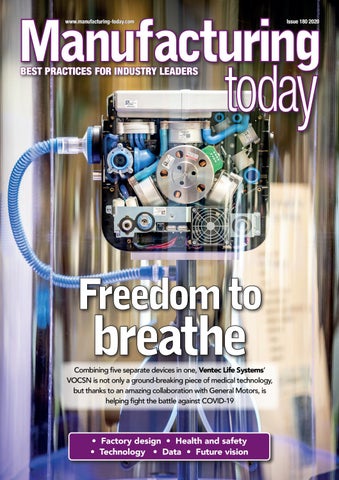
Combining five separate devices in one, Ventec Life Systems’ VOCSN is not only a ground-breaking piece of medical technology, but thanks to an amazing collaboration with General Motors, is helping fight the battle against COVID-19
• Factory design • Health and safety • Technology • Data • Future vision
Chairman Andrew Schofield
Editor
Managing Director Joe Woolsgrove Editor Libbie Hammond Assistant Editor Will Daynes
Manufacturing www.manufacturing-today.com
Staff Writer Alex McDonald
BEST PRACTICES FOR INDUSTRY LEADERS
Production Manager Fleur Daniels Art Editor David Howard Advertising Designer Rebecca Side Operations Director Philip Monument Operations Manager Natalie Griffiths Research Managers Jo-Ann Jeffery Ben Richell Editorial Researchers Mark Cowles Tarj D’Silva Jeff Goldenberg Mark Kafourous Richard Saunders Kieran Shukri Sales Director Alasdair Gamble Advertising Sales Mark Cawston Alex Hartley Dave King Theresa McDonald Sam Surrell Web Sales James Whiteley web@schofieldpublishing.com
Fruitful collaborations
Issue 180 2020
today
Freedom to
breathe
Combining five separate devices in one, Ventec Life Systems’ VOCSN is not only a ground-breaking piece of medical technology, but thanks to an amazing collaboration with General Motors, is helping fight the battle against COVID-19
• Factory design • Health and safety • Technology • Data • Future vision
W
elcome to the September issue of Manufacturing Today. The ninth month of 2020 (although it feels like maybe the 20th?) and Covid-19 is still throwing up daily challenges for us all to deal with. Thankfully there are companies out there who are turning their full energies into fighting this evil disease, ready to think not just out of the box but also to work with par tners and collaborate on some amazing technology. Ventec Life Systems inspirational relationship with General Motors is a prime example of how quickly businesses can react when motivated to do so – furthermore, Ventec’s VOCSN solution is ground-breaking in its own right. The story is very interesting – take a look on page 26. We also hear how one interviewee noted the extremely high usage of disposable gowns while he himself was hospitalized with Coronavirus, and he confirmed that ‘since we began producing our gowns, they have gone on to become one of the most popular products that we make.’ The business, Aargus Plastics, had already had the foresight to enter the gowns market – see the full ar ticle on page 48. The past few weeks I have also been speaking to more featured companies about our added value services, which include the option to turn your ar ticle into hard copy brochures. If this sounds of interest – do get in touch!
Subscriptions i.kidd@schofieldpublishing.com
libbie@schofieldpublishing.com Follow us at:
@MTE_magazine
Manufacturing Today Magazine
Schofield Publishing Ltd Corporate Head Office Cringleford Business Centre, 10 Intwood Road, Cringleford, Norwich, NR4 6AU, U.K. Tel: (312) 854-0123 Tel: 044 (0)1603 274130
www.manufacturing-today.com © 2020 Schofield Publishing Ltd
Have we Tweeted about you yet? Get in touch on Twitter or send some news over to me on email and I will be happy to share it! Please note: The opinions expressed by contributors and adver tisers within this publication do not necessarily coincide with those of the editor and publisher. Every reasonable effor t is made to ensure that the information published is accurate, and correct at time of writing, but no legal responsibility for loss occasioned by the use of such information can be accepted by the publisher. All rights reserved. The contents of the magazine are strictly copyright, the proper ty of Schofield Publishing, and may not be copied, stored in a retrieval system, or reproduced without the prior written permission of the publisher.
www.manufacturing-today.com l 1
www.manufacturing-today.com
Features
Focus on...
4 Health and safety
The EU legislation and regulation surrounding machinery is complicated but ultimately is all designed to keep operators safe
20
36
6 Data Data is integral to every business, so you must protect it – beyond simple business continuity and disaster recover planning
Domsjö Fabriker AB
8 Factory technology
There is no ‘one size fits all’ approach when it comes to legacy technology upgrade projects but there are some essential requirements
52
F
58
10 Manufacturing news Updates and announcements from the manufacturing arena
12 Factory design
Factory design can play a large part in reducing future pandemics while also planning for post Brexit expansion
14 Future factory
The systemic harmonization of human and machine based capabilities is revolutionizing production with help of AI and robotics
SiO2 Materials Science
72
Ac
76
Cover story
26
Bright Green Plastics
88 Ventec Life Systems 2 l www.manufacturing-today.com
International Aerospace Coatings
Electro Mech
92
Sm
Contents 40
Flying W Plastics
48
Spirax Sarco
62
Accrol Papers Ltd
66
Brightwake
80
ro Mechanical Systems
The Marena Group
84
Volt
96
Smith & McLaurin
Aargus Plastics
Clade Engineering Solutions A1 Engineering Solutions Ltd
100
Atlas Packaging Ltd
Oilgear www.manufacturing-today.com l 3
Adhering
to the rules
Paul Taylor takes a look at the health and safety requirements surrounding machinery
B
efore any item of machinery can be legally placed on the market in the EU, it must bear the CE marking. This cannot be applied unless the machine has been proven to meet the requirements of the Machinery Directive and any other applicable directives. The CE marking involves a four-step process: 1) Essential Health & Safety Requirements (EHSRs) 2) Technical Construction File 3) Declaration of Conformity 4) Affix the CE Marking All machines supplied in the European Economic Area (EEA) from 1 January 1995, must comply with the Machinery Directive and be safe. The Essential Health and Safety Requirements (EHSR) lay down the minimum compliance criteria. The preferred way to comply with EHSRs is by Risk Assessment and the application of harmonized EN standards, which are replacing the national standards of member states. The EHSR requirements are wide ranging, taking into account potential dangers to operators and other persons who may be at risk. A typical example of an EHSR is the requirement to provide adequate warning
4 l www.manufacturing-today.com
labels where there are moving parts that might trap parts of the body of personnel using the machine. Another would be the requirement to provide safety guards to machine tools. However, taking into account the state-of-the-art, it may not be possible to meet all the objectives set by EHSRs, as technologies often move more quickly than the standards trying to catch up with them. With this in mind, the machinery must be designed and constructed with the purpose of approaching these objectives. Within the Supply of Machinery (Safety) Regulations, the Essential Health and Safety Requirements are divided into six sections: 1. EHSRs applicable to all machinery 2. EHSRs for certain categories of machinery, including foodstuffs machinery; machinery for cosmetics or pharmaceutical products; hand-held and/or hand-guided machinery; portable fixing and other impact machinery; machinery for working wood and material with similar physical characteristics 3. EHSRs to offset hazards due to the mobility of machinery 4. EHSRs to offset hazards due to a lifting operation 5. EHSRs for machinery intended for underground work 6. EHSRs to offset hazards due to the lifting of moving of persons The Machinery Directive’s more notable EHSRs include:
Health and safety Technical construction file
A technical construction file will prove due diligence and provide the evidence of compliance. It must also conform to the provisions set out in Annex VII of the Machinery Directive and remain available for inspection by a competent national authority for a period of ten years. However, it does not have to include detailed information such as the sub-assemblies of the machine, unless a knowledge of them is essential for verification and compliance with the EHSRs. As the documentation within the technical file must enable enforcement authorities to assess the conformity of the product, it is best to remember that they may not be highly skilled machinery engineers, so plain language must be used and explanations given. They are also entitled to demand the technical file is provided in any official EU language, so be prepared to translate it. The technical file can be a traditional paper file, or stored electronically, with hyperlinks to documents, and it must be updated as the product is adapted.
Declaration of Conformity
• • • • •
EHSR 1.1.7 The operating position must be designed to avoid any risk due to exhaust gases/ lack of oxygen EHSR 1.1.8 work stations that are an integral part of the machine must be designed for the installation of seating EHSR 1.2.2 Manual controls must be clearly visible and identifiable; the use of pictograms is recommended EHSR 1.4.2.1 Fixed guards. Fixing systems must remain attached to the guards when removed EHSR 1.1.2 requires risk assessment to be carried out
When considering EHSRs, risk assessment is a vital step in ensuring compliance and therefore the fundamental starting point for designers of machinery under the Machinery (Safety) Regulations. Some useful references include the standard EN ISO 12100 ‘Safety of Machinery – Risk Assessment’, which defines risk assessment as ‘a series of logical steps to enable, in a systematic way, the analysis and evaluation of the risks associated with machinery.’ EN ISO 12100 goes on; ‘Risk assessment is followed, whenever necessary, by risk reduction. Iteration of this process can be necessary to eliminate hazards as far as practicable and to adequately reduce risks by the implementation of protective measures.’
The Declaration of Conformity must accompany every machine placed on the market. This is the manufacturer’s assurance to the customer that the product complies with the applicable directives. It must carry relevant product information and be signed by a responsible person on behalf of the manufacturer or importer. The alternative to a Declaration of Conformity is a Declaration of Incorporation. This applies to partly completed machinery that is intended to be part of an assembly but cannot itself perform a specific application. This declaration and assembly instructions for the partly completed machinery will then form part of the technical file for the final machinery assembly. The final step to prove compliance of machinery is to affix the CE marking to machines being sold in the European Union and UKCA mark for those being placed on the UK market (post Brexit). Regardless of what happens with the Brexit deal, the actual process for manufacturing compliant machinery for the UK market will have little effect from a legal perspective. As EU Directives are already transposed into National Law, the UK already has a legal system in place that applies. There will of course be text amendments to reflect UK legislative requirements, including the UKCA mark and removal of references to EU directives and the CE marking. While references to ‘harmonized standards’ will change to ‘designated standards’, the actual standards will remain the same as EU harmonized standards, and will be carried across as UK designated standards to maintain a single standards model. As a machinery end-user, before accepting any new machines check that they meet the requirements of the order and also conform to the Machinery Directive. A pre-purchase audit is a useful system that can help machinery buyers ensure that equipment is both safe and correct. v
Paul Taylor Paul Taylor is Head of Industrial Products (UK) at TÜV SÜD, one of the world’s leading experts in product testing and certification, with 150,000 product certificates in circulation globally. Its Product Service division analyses over 20,000 products each year in Europe, Asia-Pacific and the Americas, using its technical expertise to help customers optimize market access. www.tuv-sud.co.uk
www.manufacturing-today.com l 5
Keeping the lights on
With data becoming a more precious resource every day, do you have an IT Disaster Recovery Plan? Philip Bridge takes a look at the issue
E
nhancing data availability is something that is on the minds of many in the manufacturing industry. Today, data is king. Thanks to the digital transformation of the industry, the data mountain continues to get bigger and bigger. In fact, according to IDC, it will reach an incomprehensible 175 zettabytes by 2025. Unlocking this data has never been more critical. However, ensuring your teams have access to this data when the unthinkable happens can be a real challenge. Unfortunately, in the climate we now live, having that data made unavailable is not a question of if but when. Whether caused by an overenthusiastic staff member clicking the wrong button or a state-sponsored, ultra-sophisticated cyberattack, swift recovery from a data disaster can be the difference between extinction and survival. With that in mind, we have put together a template to help manufacturers familiarize themselves with the building blocks of an IT Disaster Recovery Plan (IT DRP). Filling out the plan will also encourage thinking about what it would take to resume normal operations if their data and infrastructure were implicated in a severe IT-incident. It is essential to get ahead of the problem and detail the policies and procedures you need to follow in the event of a disruption to critical IT services or damage to IT equipment or data. These processes will ensure that those assets are recoverable to the right level and within the right timeframe to deliver a return to normal operations, with minimal impact on the business. A good starting point is to undertake a thorough business impact analysis. In this, the first section identifies important IT-services needed for the business and the impact if interrupted. The second section focuses
6 l www.manufacturing-today.com
on the business needs regarding availability, recovery times, backup, data integrity and data confidentiality. Business process/delivery Supporting IT-service
Impact when interrupted, incl time when it becomes unacceptable
Factory production IT-system A
Assembly lines will stop immediately, unacceptable after 4 hours.
Finance IT-system B Will stop invoicing and reporting immediately, unacceptable after 24 hours. HR IT-system C Will mean use of IT-system B prepared manual procedures, unacceptable after 48 hours. All business staff Email system Will impact productivity immediately, unacceptable after 4 hours.
Data Action
Description
Implementation plan
Change the backup solution RTO email system Secure erase of hard disks when replaced
Identify new solution for IT-system A in order to meet the business need of Recovery Point Objective
Analysis done in (date)
Discuss the cost for a shorter Recovery Time Objective with the supplier
Discussion (date)
Discuss a solution with Discussion (date) Ontrack in order to erase all hard disks in a secure way when replaced (for all systems with high or very high confidentially demand
Finally, you need to identify just how you will respond should one of your key systems fail. This part of the business continuity plan covers preparations to handle IT-interruptions efficiently so that you can reduce the impact on the business. Cyberattacks, rogue employees, natural disasters, media damage and human error are just a few ways you can lose access to your data. IT teams in the manufacturing industry are increasingly focusing on resilience as a strategic objective to ensure that the data that is core to their business remains available 24/7. It is a case of keeping the lights on when disaster strikes. It goes beyond simple business continuity and disaster recovery planning, though. It should encompass an entire culture and practices. In the age of digitization, data is integral to every business, so protect what is most dear. v
IT-service
Business need of:
Availability RTO RPO Data
IT-system A
99.7%
4 h
10 min Very high Low
IT-system B
99.5%
24 h
24 h
Very high High
IT-system C
99.5%
48 h
24 h
Very high Very high
4 h
12 h
Very high Medium
Email system 99.9%
Data
integrity confidentiality
The Recovery Time Objective (RTO) is the time frame agreed upon to get the business process/delivery operational again after an IT-interruption. The Recovery Point Objective (RPO) is the acceptable amount of data you can lose in an incident without being able to recover it to a previous ‘point in time’. Data integrity is the demand that information stays intact, and data confidentiality is the demand that ensures that information is not made available to others. When the need for essential IT-resources is identified, you need to do an analysis to ensure you have the right level of robustness to support your business. The best way is to contact the individual responsible for each ITservice in-scope for the planning work and have an extensive discussion about the business need and what is covered in the service today. In the end, it is a business decision on what to have in place, including what risks the business is willing to take.
Philip Bridge Philip Bridge is President of Ontrack. KLDiscovery Ontrack, LLC (doing business as Ontrack) provides technology-enabled services and software to help corporations, state/local/federal government agencies, educational institutions and consumers solve complex data challenges. As a business unit of KLDiscovery, Ontrack provides marketleading data recovery services for any type of media – hard drives, SSD, servers, RAID, virtual, cloud, mobile devices, tape, NAS/SAN/DAS. Additionally, through proprietary technologies and expert services around the globe, Ontrack provides additional solutions for clients with email extraction, tape management, and data destruction. www.ontrack.com/uk.
www.manufacturing-today.com l 7
Get with
the system
UK manufacturers must upgrade, evolve or replace their legacy applications, says Philip Rashleigh
M
anufacturing SMEs often retain outdated equipment, IT hardware and software systems as several generations of more efficient, secure upgrades are introduced. While inertia and an unwillingness to master new systems and processes both play their part in failing to upgrade, cost-savings and risk are the main drivers. However, it is invariably a false economy, with huge financial costs, security compromises, commercial consequences and operational barriers for those who continue to use legacy systems. According to a 2017 study by global professional services company, Avande, they make up an average 31 per cent of any organization’s technology. Meanwhile, UK manufacturing lags far behind global pack leaders in adopting leading edge automation in the workplace. Industry leaders have repeatedly voiced their concerns at their inability to replace legacy applications with new digital initiatives. In 2017, the International Federation of Robotics reported that South Korea boasted 710 industrial robots per 10,000 manufacturing employees, compared to Britain’s 74, underlining how slow we are to adopt leading edge production equipment and systems.
8 l www.manufacturing-today.com
It all means that a huge proportion of IT budgets – some estimates run at 60-80 per cent - are allocated to keeping out-of-date legacy systems running. They hit manufacturers’ growth and productivity targets in many ways. These include compromised security – legacy applications are particularly vulnerable to ransomware cyber security attacks and other hacking – declining customer service; damaged brand reputation; restricted innovation; impaired productivity; dissatisfied and demotivated staff; a lack of agility and business intelligence difficulties. All of these negative impacts are exacerbated by software vendors gradually ceasing to support older tools or APIs. Meanwhile, as senior IT employees retire, younger replacements are unlikely to be familiar enough with older technologies and codebases to be able to continue supporting arcane systems. Transforming and improving or exchanging technology can be expensive, but so is funding outdated and inefficient software systems. The investment in new technology can cost less in the long-term than maintaining old ones – it will also lift productivity and profits; help retain existing customers and attract new ones. Crucially, efficient, intuitive applications will also
Factory technology • Does sufficient support still exist for them? • Can the systems be integrated with newer technology for desired improvements? Approaches to legacy upgrades can vary based on the stage and status of existing frameworks. There are times where it can be faster and more effective to completely replace a system, rather than waiting longer to decide how to integrate the old with the new. However, depending on the state and age of your current systems, it may be that a total rip-out-andreplace isn’t needed. For example, adopting a modular approach allows organizations to rebuild legacy systems in phases. By separating the existing system into modular components, organizations are provided with the ability to review business needs, processes and workflows against each module during a rebuild, with an iterative and incremental upgrade path. This particular approach can also help to remove complexities that come with large-scale systems with convoluted business logic. System extensions can also be a viable alternative to ripping out and replacing legacy systems. By introducing automated workflows over existing systems, organizations can benefit from a richer user interface with additional functionality without having to replace the existing software or databases. While this sort of gradual introduction could well be a lower risk strategy, a complete replacement of legacy systems may be non-negotiable in some cases – for instance, when it is agreed that the old system is too expensive and/or poses too many risks to the business. In these circumstances, replacing the systems completely could be faster and more cost effective. Deciding which solution and approach is right for legacy technology upgrade projects will depend on the expertise within your team, the resources available and your business goals, as well as the complexities, time frames and your budget. There is no ‘one size fits all’ for manufacturing businesses however, when planning for such technology projects, organizations should keep in mind how the solution will support both short and long term scalability plans, tie back to wider business strategies, and provide the ability to react to growing and evolving business needs. v
boost staff happiness, drive top level people to your door and encourage innovation rather than stifle it. The challenge, then, is how to change or replace existing systems with minimal disruption and downtime. Deciding which route is best is not easy. Manufacturers must consider how to keep delivering in the now operating as normal to meet current organizational needs - whilst planning for future requirements, with upgrades, integrations or migrations. There is an array of options to consider, which vary depending on the performance of current systems, the type of software products preferred (i.e. off-the-shelf, bespoke, cloud hosted) and the scale of the business, both today and what’s planned for the future. When deciding what to do with legacy IT, ask the following questions: • What do existing systems currently offer the company and how long will they be valuable? • Do they still provide the responsiveness, outputs and speeds of delivery required? • Are the costs of running and maintaining them sustainable?
Philip Rashleigh Philip Rashleigh is Audacia’s technical director. Audacia is a Leeds and London-based software development company, specializing in the design, development and delivery of scalable and robust, business-critical software systems. Audacia has established a reputation as a critical technology partner with long-standing relationships; helping customers automate their processes by delivering intuitive and reliable technology solutions. www.audacia.co.uk
www.manufacturing-today.com l 9
News in brief Multi-million UK investment Schoeller Allibert, the European market leader in the production of recyclable, reusable and returnable plastic packaging solutions, has confirmed a multi-million investment programme is underway at its Winsford, Cheshire site. Graeme Robinson, Senior Regional Director, North West Europe, said: “This investment sees us deliver additional flexible automation into the facility and supports our commitment to designing and delivering the next generation of transit solutions to drive down waste and cost for our customers, as well as boost their sustainability performance.” Jackie Johnson, Operations Director at Schoeller Allibert, added: “The fantastic part of this investment is that we are freeing up employees from manual roles, upskilling them and developing them within the business. Automation continues our absolute focus upon quality consistency, driving innovation, reducing lead times and achieving excellence in health and safety.”
Meet the requirements SGS, the world’s leading inspection, verification, testing and certification company, has published advice to help manufacturers and suppliers understand US workplace regulations for electrical products. SGS offers a comprehensive range of services to help manufacturers and retailers ensure their products comply with US government requirements, including those of the Occupational Safety and Health Administration (OSHA). The SGS North America Listed Mark is a clear demonstration to retailers and consumers that a wide range of products, including power tools, household appliances, lighting, medical equipment, batteries, IT equipment, and audio-visual equipment, have been tested and certified in accordance with these requirements. OSHA jurisdiction only applies to workplaces and so, when a business owner or manager is buying a product for their workplace, they should always check that it bears an NRTL mark. This provides assurance that the product is certified and therefore meets OSHA requirements.
10 l www.manufacturing-today.com
New $12 million facility Nidec Industrial Solutions (NIS), the industrial platform of Nidec Group, has expanded in the US thanks to the opening of its new facility in Cleveland, OH. This new facility has been able to support essential industries during the Covid-19 crisis and paves the path for future growth in North America. The $12m investment in this new building comprises 67,000 square feet of office and manufacturing space. The facility is a three-tier building and brings together 130 employees previously housed in three separate facilities. The facility was occupied in March and has continued to engineer and manufacture at full-capacity throughout the Covid-19 pandemic. The site is classified as an essential manufacturing facility because NIS manufactures both its leading Nidec Avtron™ Encoders and large-scale controls and automation systems here for renewables and energy storage, oil and gas, steel, PPE production, healthcare equipment, US Defence installations, port and specialty cranes as well as pulp and paper machinery. The brand-new state-of-the-art facility features a purpose-built area for the assembly and testing of large industrial controls and automation systems, Battery Energy Storage Systems and Medium Voltage Drives as well as a cuttingedge production area for Nidec’s Avtron Encoders.
Take off for 3D parts
In what is one of its largest single orders to date, Stratasys has announced that Latvia-based specialist aerospace additive manufacturing service provider, AM Craft, has purchased four large-scale production-grade Stratasys F900 3D Printers to provide certifiable 3D printed parts for a much wider range of aircraft interior applications.This includes aircraft seating, panelling and ducting, as well as making it much more affordable for its aerospace customers to introduce customization within the cabin. “In recent years, we’ve seen an ongoing demand for 3D printed production parts among major aircraft OEMs,” comments Jānis Jātnieks, Co-founder and CEO, of AM Craft. “Although Covid-19 has shocked the industry in the last few months, we are seeing efforts to return to business by remodelling passenger planes for cargo shipments, as well as projects to increase customer safety measures and improve the inflight customer experience. In such cases, additive manufacturing is way ahead of slower and costlier traditional methods. “One of the mainstay pillars that enables us to realize this business case into real-world applications is Stratasys’ highly-repeatable FDM-based 3D printing technology in conjunction with aerospacegrade materials like ULTEM™ 9085 resin. Crucially, this gives us the capability to meet strict rules and regulations around certification that require the highest level of repeatability and traceability with every part manufactured,” he adds. The flame-retardant, high-performance ULTEMTM 9085 resin meets stringent flame, smoke and toxicity (FST) criteria and retains traceability required by the aerospace industry.The material is used by aircraft manufacturers such as Airbus, which has successfully standardized it for the production of thousands of flight parts for its A350 XWB aircraft.
Manufacturing News High tech for classic Eagle, a restorer of the legendary Jaguar E-Type car, has announced a partnership with Graphite Additive Manufacturing Ltd. to use HP’s Jet Fusion 4200 3D printing solution to produce custom parts. Eagle has already seen a huge increase in quality, cost-effectiveness and efficiency since switching to HP’s 3D printing from other 3D printing processes. For the past four years, Eagle has worked closely with Graphite Additive Manufacturing Ltd., a UK-based 3D printing service provider which produces one-off models or production runs of functional parts for businesses and individuals. “Since we began using HP’s 3D printing technology for production, we’ve been impressed by the improvement in how these parts look as well as their durability,” said Paul Brace, director at Eagle. “HP’s 3D platform consistently delivers the desired finish which is very important to our process. Additional benefits we’ve seen include the wider scope for shapes that we can now create using 3D printing, and the weight reduction in materials on offer. This adds value for customers who are keen to keep parts as lightweight as possible.” HP’s 3D printed parts allow Eagle to produce in low volumes with design and economic advantages, as the digital 3D model is easily adjusted and the final part swiftly printed. This means that, if required, every part can be an evolution of the last with no cost implication from the change other than the shipping.
Easy opening Adams Packaging, one of Poland’s leading manufacturers of corrugated cardboard packaging, has selected Essentra Tapes’ Rippatape brand, to help it meet an increase in consumer demand for functional e-commerce packaging. Easy open and easy return boxes have seen significant growth and Adams Packaging was therefore seeking an effective solution to integrate tear tapes within its boxes. Essentra Tapes’ distributor in Poland, Paxton House, immediately helped Adams identify the correct tape solution for its corrugated production lines. As the original marketleading tape-based opening device for board and paper-based packaging, Rippatape was specified, and a 6mm wide, 60-micron tape was delivered quickly and efficiently to Adams for trial. Intuitive to use and easy to implement, Rippatape gives fast, safe and immediate access to the contents of corrugated and fiberboard packaging. Rippatape is also easily applied to new and existing production lines, offering speeds of up to 450 meters a minute at the point of manufacture by using Essentra’s custom build applicators. Available in a range of colors, and also now printed, Rippatape is helping corrugated manufacturers integrate easy opening within their e-commerce packaging solutions, and also keep the integrity of the box for dealing with customer returns. Using Rippatape means knives or other sharp implements are removed from the opening process, thereby minimizing the risk of product damage and possible personal injury. In addition, the tamper-evident nature of Rippatape gives a clear indication if a package has been opened previously, providing customer confidence on the authenticity of the delivery and its contents. Importantly, from a sustainability perspective, Rippatape does not impede on the recycling of the boards that it is applied to, allowing the tape to be recycled through established recycling processes. This is a key benefit of Essentra’s water-based adhesive solution. “As the demand from consumers for e-commerce packaging increases, so we are seeing an increased interest in Rippatape, with its simple and effective integration enabling manufacturers to include easy-opening solutions into their boxes,” said Ian Beresford, Head of Marketing and Development at Essentra Tapes.
www.manufacturing-today.com l 11
The face of the factory
When it comes to factory design, where do we go now in the post-Covid-19 era? Paul McFadyen reports
T
he manufacturing industry in the UK is strong and has spent the last four years preparing for life after Brexit - but no one could have prepared for the devastation that Covid-19 has brought to global societies and industries. As the nation is adjusting to what is often called, ‘the new normal’, many factory workers have not seen much change in their working habits as they maintained their work flow with no ‘work from home’ options available - producers on the frontline have kept the country moving with food production, online retail and distribution, health and medical supplies, utilities - the often overlooked and unsung heroes. This has come at a price as factory workers have been among some of the largest groups affected by the virus; a meat factory in West Yorkshire, garment factories in Leicester, a chicken processing plant in Wales, a cement manufacturer in Bristol, a Leicester potato snack factory, and a
12 l www.manufacturing-today.com
slaughterhouse in Germany where over 1500 workers tested positive for Coronavirus are just some of the manufacturers that have hit the headlines - but why are factory workers among the hardest hit? Some contributing factors include close proximity working on production lines, symptomless positive cases that spread undetected, refrigerated production areas (lower temperatures preserve viruses well), lack of ultraviolet light, slack health and safety protocols, and loud environments that encourage colleagues to stand close together to communicate or to shout which also increases viral particle spread. There are so many contributing factors, many of which were unknown in the early days of the pandemic, so there is little value in playing the blame game - what we need to do is look at how to make changes to future proof the manufacturing industry by taking positive action from this point on. What we can take from the above factors is that factory design can
Factory design
play a large part in reducing the risks during future pandemics while also planning for post Brexit expansion. Factory design needs to look closely at what the factory is, or will be, producing and what its needs are; getting the basics of the flow of goods and personnel is at the heart of the issue to keep factories working to capacity - the ability to react to change is the lifeblood of the manufacturing industry. • Plan layouts that incorporate the potential to expand, adapt, and re purpose; look at foundation and base structure for weight bearing capacity, headspace, bay size to accommodate machinery, and adequate workspace for employees, consider needs now and in the future. • Consider how materials are handled during production to increase worker distance, reduce bottlenecks, reduce material handling costs and factor in where the use of cranes, hoists, and conveyors can streamline processes. • Utilize materials in the factory design that are sustainable, recyclable, or produced from recycled materials. Steel framed buildings offer a cost-effective option that can easily be added to in the future either upwards, or outwards. Solar power may not be offering solutions to run heavy manufacturing facilities, but tap into ecologically sound power options where possible, staff showers heated from solar power or grey water for toilet facilities are a great place to start. • Consider automating elements of your production - this can be especially useful where processes are executed in limited space. This may entail retraining and reskilling staff as part of the changing role of the factory employee; equipping staff with new skills in technology will lead to a more engaged workforce as their role becomes more varied and less mundane - utilize the skills of your workers. • Where automation is not possible due to limited space, limited finance, artisan, or hand finished products, look at how assembly lines can be reconfigured to create safer and more inspiring workstations.
• • •
Look at lighting and ventilation - lighting and air quality have been proven to affect employee productivity and fatigue levels, ensure these are adaptive, fit for purpose, and reactive; make sure you meet the statutory requirements of the Health and Safety at Work Act, but emember to think outside the box and research newer, cleaner, more cost effective ways of doing things. Establish that the concept of all new or reconfigured factory design is right and do not be rushed during the design phase. The productivity curve, profits, and output could be disproportionately affected long term for the sake of a week or so in the planning stages. Be innovative and bold. Factories and manufacturing facilities need to be functional, safe, and maximize productivity potential, but embedding elements of space, light, and clever design detail can create a less boring and more stimulating working environment, which will lead to a more satisfied and productive workforce.
I genuinely believe that to safeguard the UK manufacturing industry, factory design has a huge role to play in future proofing the success of the UK economy. v
Paul McFadyen Paul McFadyen is Managing Director at metals4U. Based in Wetherby, West Yorkshire, metals4U was founded in 2002 as the UK’s first online supplier of metals, plastics, tube clamps and engineering consumables. metals4U is now an industry leader in supply of superior quality grades of steel, copper, bronze, and brass, power and hand tools, PPE, workwear, and engineering products to retail, wholesale, hobbyists, artists, DIY, construction, and industrial sectors. www.metals4u.co.uk
www.manufacturing-today.com l 13
Factory harmony How humans and machines can work together in the factory of the future. By Patricia Torres
E
xports are a key indicator of the economic performance of any industrialized country. With an export volume of $1.49 trillion, Germany ranked third behind the USA ($1.65 trillion) and China ($2.5 trillion) in a global comparison in 20191. Meanwhile, France ranked sixth ($555,000 million) and the UK eleventh ($468,000 million). To ensure that the European and UK economies do not lose out in the long term, new concepts are needed to optimize the efficiency of industrial production. In view of the progress made in automation and artificial intelligence, a well-established and improved interaction between man and machine could help to ensure high economic standards and productivity. A promising model for the new harmony on the factory floor is based on intelligent, integrated and interactive design of tomorrow’s manufacturing processes. Many still believe that man and robots can only work against each other or, if need be, side by side; moreover, there is still a fear that machines will replace human workers. However, the coexistence of human workers
14 l www.manufacturing-today.com
and automated machine solutions and robots has become increasingly commonplace. Furthermore, digitalization provides companies in the manufacturing industry with an enormous inventory of technological options for implementing the factory of the future. Smart networking using artificial intelligence offers the opportunity to convert manufacturing data into strategic information. It also enables the smooth integration of highprecision robotics technologies that work at high speed, supplemented by methodically safe and simple interaction between man and machine.
New era of intelligent, integrated and interactive production
Increase efficiency, reduce costs, strengthen competitiveness - what is necessary to secure your market position in competitive global markets can be implemented with innovative solutions for flexible and efficient production. The potential of a technology that can revolutionize the factory floor of the future while promoting harmony between human and machine
Future factory
can be seen in the recent developments in collaborative robots, such as the Omron™ collaborative robot. The robot offers an innovative solution for the simple automation of applications that have traditionally been carried out by humans and for an area where automation has so far been very difficult. As well as enabling the automation of complex tasks using a 3D camera, it can be seamlessly integrated into an autonomous mobile robot. One example of its capabilities is bin picking: the robot quickly and precisely sorts different articles and deposits them where they are needed. The 3D camera locates the items and sends their coordinates to the robot, while the software, supported by AI algorithms, performs the advanced calculations required for optimized goods picking, e.g. for customized orders. Meanwhile, a mobile robot is responsible for the subsequent transportation of the goods. In this respect, the efficient combination of different production processes forms the basis for particularly flexible and reliable production and material handling. It also gives a foretaste of what will be possible in the future with ‘Factory Harmony’, where integrated, mobile and collaborative robots work in harmony with humans to ensure flexible manufacturing and customization.
Systematically avoiding malfunctions and breakdowns Operational excellence is an important basis for investment security - especially in view of the current changes in industrial production organization. Changing consumer behaviors are forcing manufacturers
to flexibly produce smaller quantities in a larger number of variants, saving as much time as possible. The factory of the future must therefore become more flexible and be able to convert production more quickly and produce smaller runs. The ultimate goal is to be able to deliver personalized products from an agile and networked production line. In an automation model that meets this requirement, all devices, machines and solutions should operate in an integrated manner. Effective quality control is essential in all production and packaging lines. Those who can identify defective products before they leave the factory, or even before they are produced, benefit from considerable time and cost savings and avoid costly product recalls, loss of productions and possible damage to brand reputation. Equally important is the quality control of packaging for products such as food or medicines. An illegible barcode or a wrong expiration date can lead to the need to dispose of faultless products. In addition, there is a trend towards stricter legislation, which gives top priority to unambiguous labeling for all types of products. For example, the EU has introduced new regulations in 2019, requiring production lines to meet even higher quality control standards. As a result of the increasing degree of automation in production lines, the need for automated processes in quality control has also been amplified. Among other things, it pays off if the machines are able to collect data in order to optimize predictive maintenance. The more data is collected and processed, the more ‘intelligent’ the machine can be to help
www.manufacturing-today.com l 15
Future factory
extend production line life, reduce downtime and increase productivity. For example, Omron’s Sysmac AI controller includes a predictive maintenance library based on AI, and collects, analyses and uses data on Edge devices to extend their life, detect anomalies and prevent failures. No internet connection is required, meaning users are no longer dependent on cloud computing and can leverage the AI potential for their business advantage.
Image processing supports error detection
An increasingly important factor in quality control on production lines is smart image processing - technically implemented either as a completely new solution or by partially retrofitting an existing system. Very compact image processing systems monitor production in real time and react immediately to any error. The data transmitted by an image processing system is processed on site and made available centrally via the cloud for detailed analyses so that suitable measures can be taken. In order for an inspection system to make intelligent decisions, data must be captured by a sensor such as a camera for image processing. These cameras can be set up to monitor various aspects of a product, such as detecting defects or checking labels for printing errors or missing information. The data is then analyzed with high computing power to compare the process with the actual and target results. When problems are detected, the system responds according to programmed rules. Sometimes it can automatically correct the errors, but even then the operator is always informed to ensure correct processes and in case additional action is required. Since this system is fully networked, it provides a better link between the machines on a production line, resulting in both more precise quality control and greater efficiency. When an error is detected, the system can often automatically compensate for it and production is not affected. Intelligent automation solutions of the latest generation work fast, offer high computing power, are easy to operate and thus ensure transparent quality control in the factory of tomorrow.
Flexibility is the engine for customer satisfaction and business success
Since customer and business requirements are constantly changing, the factory floor must also be more flexible in the future. Flexibility in the organization and arrangement of production resources is one of the key success factors for efficient production. This includes the mobility of the robots used and their adaptability to concrete requirements in practical use, which is another advantage of an effective quality control and process management system.
16 l www.manufacturing-today.com
By combining image processing, motion, control, functional safety and robotics in a single management system, production lines can be more easily adapted to short production runs and changing market requirements. The line layout can be quickly redesigned and the recognition pattern for quality control easily updated in the software. This ensures that different product variants or even different products are produced and packaged flawlessly. In addition, such a system brings the benefits of future-proof orientation by being adaptable to new regulations. As a result, manufacturers do not have to worry about changing their production lines, but can simply initiate a firmware update for the existing solution if necessary.
Conclusion: ‘Factory Harmony’ determines production of the future
The networking of humans and machines is more than just a trend towards the efficient organization of processes and the distribution of tasks in manufacturing plants. The tangible benefits of tomorrow’s high-performance factory are already showing how the systematic harmonization of human and machine-based capabilities is revolutionizing production with the help of artificial intelligence and robotics, and is breaking new ground for the production methods of the future. v
1 http://www.worldstopexports.com/worlds-top-export-countries/
Patricia Torres Patricia Torres is Industry Marketing Manager Food and Commodities, Omron Europe. As a leading company of automation centered on its proprietary Sensing & Control + Think technologies, OMRON Corporation is engaged in a wide range of businesses, including control equipment, electronic components, social systems, healthcare, and the environment. In the field of industrial automation, OMRON supports manufacturing innovation by providing advanced automation technologies and products, as well as through extensive customer support, in order to help create a better society. www.industrial.omron.eu
20 l www.manufacturing-today.com
Domsjö Fabriker AB
Top of the tree Domsjö Fabriker understands more than most other businesses that we have a responsibility for the world’s natural resources and how they are used, and this is reflected in the way its world-leading biorefinery operates and produces sustainable products
‘‘ Björn Vedin
Our collective mission is to be a responsible, local manufacturer that is responsible for producing and selling sustainable, specialty products that originate from our forests. By having full control over our raw materials, we are safe in the knowledge that our products come from sustainable and traceable forestry
www.manufacturing-today.com l 21
C
haracterized by its steep granite cliffs and rocky offshore islands, The High Coast in the Ångermanland province of north eastern Sweden, has been a UNESCO World Heritage site since 2000. In close proximity to the site, one will be able to find the Domsjö Fabriker biorefinery, which has roots in the area that date back to the early 1900s. It was in 1903, to be exact, that the site on which the biorefinery stands began life as a sulphite mill. It was the brainchild of Frans and Seth Kempe – sons of the founder of Mo & Domsjö, J. C. Kempe – who were the first men in Sweden to carry out tests on a method for producing sulphite pulp. By the 1930s, production levels at Domsjö Fabriker had increased to such a level that the mill began to move into the production of cellulose for manufacturing viscose pulp. By the 1940s, the mill had helped facilitate the birth of the region’s chemical industry, and what followed was almost six decades of continuous growth and technological advances. In 1999, Mo & Domsjö sold Domsjö Fabriker to a private consortium, whose investment helped in the mill’s full transition
22 l www.manufacturing-today.com
into a biorefinery, responsible for refining the renewable raw material from wood into products that boast a strong environmental profile. Then, in 2011, the entire business was sold to the Aditya Birla Group, a leading multinational business with its base in India. “Today, our main product streams are cellulose, lignin and bioethanol,” explains Domsjö Fabriker Chief Executive Officer, Björn Vedin. “Cellulose is our principal offering, with the major field of application being viscose for fashion and textiles. Made out of softwood, cellulose can also be found in a number of other products, such as medical tablets, food, sausage casing, tires and paint. Approximately 50 per cent of our total cellulose output is sold internally into the wider Aditya Birla Group, with the rest making its way into specialty applications elsewhere around the world. “Domsjö Fabriker is also the world’s second largest producer of lignin powder, with our lignin delivered to around 60 destinations worldwide, while our third stream of revenue is derived from the production of bioethanol, which is extracted from the unique cooking process where the sugar from the wood
is gathered and fermented in our ethanol factory. We also produce our own biogas, which we use internally as an energy source.”
Force for good
The company’s unique manufacturing process allows it to produce high quality products adapted to its customers’ high demands within what is the world’s only closed-loop and chlorine-free bleach plant. “We source the raw material – softwood – mainly from sustainable Swedish sustainable forestry, consuming some 1.4 million cubic meters per year,” Björn details. “The wood is debarked and chipped, before being fed with cooking chemicals into our digesters. The bark is burned, and provides energy in the form of steam, which we feedback into our own system to power activities. During the cooking process, hemicellulose and lignin is dissolved, with the form being fermented and distilled into bioethanol. After cooking, the cellulose is washed and then bleached with hydrogen peroxide in our closed-loop bleach plant. Finally, the bleached cellulose is dried, sheeted and packed into bales, with the entire process – from log to finished bale – taking about 40 hours.”
Domsjö Fabriker AB When Domsjö Fabriker began its journey towards becoming a biorefinery, it did so with the goal of making the most out of a tree in order to create sustainable products derived from the forest. This desire to be a force for good in the development towards a sustainable bioeconomy, utilizing forests as a unique resource, continues to sit at the heart of the company’s culture and act as a motivator for its 330-plus employees. “Our collective mission is to be a responsible, local manufacturer that is responsible for producing and selling sustainable, specialty products that originate from our forests,” Björn confirms. “By having full control over our raw materials, we are safe in the knowledge that our products come from sustainable and traceable forestry. Swedish forests are special in that they are harvested at a lesser rate than they are planted, which guarantees future access. This helps to give our products the qualifications necessary to play a major role in what we hope will be a bio-based society, in which fossil fueled energy sources are replaced by sustainable alternatives.”
www.manufacturing-today.com l 23
24 l www.manufacturing-today.com
Domsjö Fabriker AB In December 2019, Domsjö Fabriker made the exciting announcement that it had agreed to co-operate with independent Swedish scale-up company Ecohelix AB to establish a demo scale plant for the production of the hemicellulose copolymers developed and patented by Ecohelix. This news follows a successful partnership between the two players on a pilot scale plant that is located at the Domsjö Fabriker mill, which has been used to verify the raw material, the process, the products, and to produce sample material for potential customers. Results and feedback from this work have been extremely encouraging, resulting in the need for a larger, demo-scale plant. Potential customers will eventually be supplied with sufficient product to do further development and verification work.
Positive actions
Ecohelix’s hemicellulose copolymers boast excellent barrier properties and a low level of viscosity. Typical applications include various pulp and paper chemical and cosmetic processes, where the polymer’s unique properties can be utilized. Said polymers are also highly efficient ingredients in formulations for gas and grease barriers. In many applications, Ecohelix polymers will ultimately be able to replace equivalent, fossil fuel-based products. Under the agreement, Ecohelix is responsible for constructing the plant and erecting it, managing its operations to verify the properties of the raw materials, processes and products at a larger scale, and for gathering data for the next development step, which would be an industrial-scale production unit. For its part, Domsjö Fabriker is tasked with supplying the raw material stream to the plant, providing the necessary space to make activities possible, and with supplying all relevant utilities, services and support functions. “Projects such as that which we have undertaken alongside Ecohelix are of huge interest to us at Domsjö Fabriker, as each one helps us to reach our own goal of making more sustainable use of – and products from – our raw materials,” Björn states. “Other projects we are looking into include those that could facilitate greater and more varied use of the biogas that we produce.” As Björn reflects upon the year to date, he is honest in admitting that 2020 has been an incredibly tough year for the business. With around 50 per cent of its products being sold internally to its Indian parent company – much of which then finding its way to the clothing
industry – the shutdowns imposed by global governments in an effort to suppress the Covid-19 pandemic had an almost immediate impact on a significant part of the company’s revenue stream. While Domsjö Fabriker has been the recipient of Swedish government subsidiaries, it has been its own actions in recent months that have helped it to weather the storm. These have included identifying cost savings, creating great efficiency across the business, and actively pursuing new sales and business opportunities. The above actions have given Björn and the rest of the Domsjö Fabriker team cause for optimism for the future. “Being active in what is a particularly niche market, we believe that
exciting times do lay ahead for the business,” he affirms. “We are looking forward to getting out there and exploring new markets and opportunities, while of course continuing to support our internal consumers, ensuring that they continue to receive the products and services they have come to expect.”
Domsjö Fabriker AB Services: Biorefinery producing cellulose, lignin and bioethanol www.domsjo.adityabirla.com
www.manufacturing-today.com l 25
Freedom to
breathe Motivated by the belief that people are more than their medical conditions and that technology should evolve to make life easier, and through the application of totally groundbreaking engineering, Ventec Life Systems created its life-changing product VOCSN
26 l www.manufacturing-today.com
Ventec Life Systems
www.manufacturing-today.com l 27
28 l www.manufacturing-today.com
Ventec Life Systems
F
ollowing his father’s battle with ALS, founder of Ventec Life Systems Doug DeVries was determined to redefine respiratory care and provide better technology for all ventilator users. With the ambition to improve patient outcomes and reduce caregiver challenges in the hospital and home, Doug and his team dedicated themselves to inventing VOCSN, a single unified respiratory system that seamlessly integrates five separate devices including a ventilator, oxygen concentrator, cough assist, suction, and nebulizer. VOCSN is 70 per cent lighter and smaller than five traditional devices and includes an intuitive touchscreen that makes operating the device simple, providing peace of mind for caregivers in the hospital or home. “People should not have to use five different medical devices to treat any medical condition. And yet, the reality has been very different,” explained Mark SooHoo, VP Marketing and Communications at Ventec Life Systems. “Hospital workers must learn multiple devices and spend valuable time switching circuits to deliver multiple therapies. Patients’ families are overwhelmed as their homes turn into mini
hospital rooms to support all of the different devices.”
Continuous improvement
The Ventec team designed VOCSN from the ground up, but combining five devices into a single unit that is fully functional, energy efficient and dependable required intense reengineering. Following an extensive product development period where over 700 essential components were created from scratch (and eight patents were granted) the Ventec team worked with those requiring treatment, as well as doctors, nurses and health care professionals to understand their pain points and to build an integrated, user-friendly medical device. VOCSN was FDA cleared for use in the US in 2017 and cleared in 2018 in Japan, and patients have been using it across the continuum of care from hospital to home. Home health companies provide VOCSN for patients in the home, Long Term Care Facilities (e.g. Skilled Nursing Facilities) provide VOCSN for patients who cannot go home or are transitioning to the home on a ventilator, and hospital customers use VOCSN in critical care settings. Thanks to VOCSN, patients
become more mobile and caregivers have more time to care for their patients. The brilliance of VOCSN has also been recognized by many awards over the years, with the most recent being the 2020 GeekWire Award for ‘Hardware of the Year’. “VOCSN is not only simple to use, but it is designed to enhance patient care, such as helping to reduce the risk of infection as caregivers no longer need to switch between therapies or take a patient off the ventilation to administer cough, suction, or nebulizer therapies,” added SooHoo.
Bisearch Bisearch is a long-standing partner of Ventec Life Systems and supplies an LCD solution that is integrated into Ventec’s flagship—VOCSN. We take pride in partaking in Ventec’s journey, especially in times like this, in which we can make a difference in the world through our services. It is our mission to continue to offer the highest quality products that are critical to saving lives.
www.manufacturing-today.com l 29
‘‘
We remain dedicated to expanding the benefits of integrated respiratory care. We want to empower patients and caregivers to not only leave the house, but also have oxygen, cough, suction, and nebulizer therapies with them in one device, so they are not intentionally leaving those therapies behind. This allows for greater compliance because they’re easier to use and they’re with the patient at all times
30 l www.manufacturing-today.com
Ventec Life Systems The team’s history of patient-centric design includes decades of work developing respiratory innovations but the team is not done. “In December 2019 we announced Multi-View, which is the first and only comprehensive report for ventilator patients that provides clinicians with insights of not just ventilation but also medication delivery (oxygen and nebulizer) and secretion management (cough and suction),” said SooHoo, illustrating the continuous process of improvement at Ventec. “Multi-View builds on the benefits of integrated care by enabling caregivers to track and monitor all five therapies and understand what is going on holistically with the patient, something that was previously impossible.”
Extraordinary achievements
Having amassed a vast amount of learning and understanding of the intricacies of respiratory care, it is no surprise to learn that Ventec was on the front lines of the COVID-19 pandemic response, educating the media and the country about respiratory care and the need for true critical care ventilators to arm medical professionals battling the pandemic. “During
this pandemic, ventilators are a key resource in the public health safety net to ensure the right ventilator is available at the right time for COVID-19 patients in respiratory distress,” said SooHoo. “We were a rapidly growing company but only producing about 200 VOCSN per month. We knew that ventilator demand in response to COVID-19 would vastly exceed what any ventilator manufacturer was currently producing, so we sought an out-of-the-box solution. We partnered with General Motors (GM) to mass produce critical care ventilators. In just one month, this partnership delivered critical care ventilators to front line medical professionals saving lives. Overnight, we exponentially grew the company’s production and received an order from the U.S. government for 30,000 critical care ventilators to support the Strategic National Stockpile. We completed the large order on time by the end of August. Simply put, the speed and scale of the increase in ventilator production is unprecedented,” SooHoo stated. This amazing partnership between Ventec and GM was celebrated by a visit in April 2020 by US Vice President Mike Pence to GM’s Kokomo
Plant, where GM Chairman and CEO Mary Barra and Ventec CEO Chris Kiple gave a tour of the ventilator production and testing lines. Chris Kiple acknowledged the extraordinary achievements of the partnership, and stated that “nothing is impossible for the combined power of American innovation and American workers.”
Inspirational support
In her own statement, GM CEO Mary Barra recognized the value of team work on the project: “General Motors and Ventec have worked seamlessly as one team with one mission: to make sure more critical care ventilators are available for those who need them. We delivered our first units in just one month because we have had incredible support from our suppliers, the Kokomo community, and state and federal officials. Their passion and commitment is helping turn the tide of the pandemic. We are incredibly grateful to our team and everyone who has supported this lifesaving work and we appreciate the support and encouragement of Vice President Pence, Gov. Holcomb and Secretary Chao,” she said. Having been inspired by the support of the
www.manufacturing-today.com l 31
White House, the team at Ventec and GM were also bolstered by the feedback from the heroes battling the pandemic on the front lines. “We are very grateful to Ventec Life Systems and General Motors for the VOCSN critical care ventilators we received in April,” said Dr. Suzanne Pham, of Weiss Memorial Hospital. “The devices they built in just one month are currently helping patients battling COVID-19, and are valuable tools enabling our medical team to save lives. I’m proud to say we have had many patients beat COVID-19, wean off the ventilator, and safely return home.”
Team response
As the pandemic continues to ravage the US population, the need for critical care ventilators continues beyond the US government’s order and while Ventec hopes that mitigation efforts stop the spread of the virus, it remains committed to maintaining an increased production capacity for as long as it is needed. This requires not only superhuman efforts from its own manufacturing team but also from the entire supply chain: “As GM CEO Mary Barra said, our suppliers have ‘moved mountains’ to provide the vital parts and supplies necessary to build 30,000 critical care ventilators in just over five months,” agreed SooHoo. “Each supplier has their own heroic story of how their team rose to the occasion to meet this extreme need. From the beginning of our partnership with General
32 l www.manufacturing-today.com
Ventec Life Systems Motors, we have worked closely and honestly with our manufacturing partners, which has been key to the success of this partnership.” SooHoo also directed the spotlight for praise onto the Ventec team itself: “We are proud of the dedication, talent, and hard work our entire team has devoted to our response to COVID-19,” he affirmed. “Everything we do is truly a team effort. We are just one small part in the overall response to COVID-19, and ultimately our job is to provide life-saving medical devices to the true heroes - frontline medical professionals including respiratory therapists, doctors, and nurses - who are helping patients and putting themselves in harm’s way every day.” He continued: “When scaling 80x in just five months, trust and teamwork become even more important. The first confirmed COVID-19 case in the US was less than ten miles from our headquarters and manufacturing location. We cannot build critical care ventilators working from home so our offices have remained open from the beginning and we immediately implemented strict health protocols to keep our team members safe. “Beyond that, we stay motivated because we are united behind a common mission together. We are proud to produce critical care ventilators that provide tools for frontline medical professionals to save lives. We know that doctors, respiratory therapists, and nurses are working tirelessly to fight COVID-19, and our team’s mission is to provide them with the tools they need to help their patients.”
by looking at it with fresh eyes and taking a ‘back to the drawing board’ approach. “No other company combines five therapies in one device, and we are proud to be leading the charge for integrated respiratory care,” SooHoo concluded. “From the day it was founded, Ventec Life Systems has always focused on how it can improve and innovate in respiratory care, and bring care-changing innovations to life for patients, medical professionals, and caregivers. “We just don’t have enough time or space to talk about how excited we are about VOCSN, but don’t just take our word for it. Please visit our website at VentecLife.com and explore our patient stories to see real-world examples from patients and caregivers using VOCSN today.”
Ventec Life Systems Products: Created and manufactures integrated solutions for respiratory care www.VentecLife.com
Springs & Things We were proud to help our valued customer, Ventec Life Systems and ramped up production quickly to support the ventilator program. Springs & Things manufactures custom springs, wire forms and ‘shaped things’ for customers across North America. How may we help you? Please send us your samples, drawings and ideas. Our highly creative team can make design suggestions to move faster through the prototyping process. Designed to Perform. Manufactured to Last. Rely on our team for quick, custommade solutions for short and large runs. Springs & Things will look for ways to reduce costs without ‘sacrificing quality.’ ISO 9001:2015
Integrated care
Given the expertise of companies such as Ventec who are dedicating their efforts to fighting COVID-19, there is a post-pandemic future on the horizon where attention will once more be placed on growing the business as a whole. “We remain dedicated to expanding the benefits of integrated respiratory care,” stated SooHoo. “We want to empower patients and caregivers to not only leave the house, but also have oxygen, cough, suction, and nebulizer therapies with them in one device, so they are not intentionally leaving those therapies behind. This allows for greater compliance because they’re easier to use and they’re with the patient at all times. “Our team continues to look for ways to add additional features and functionality, improve data and tracking with Multi-View, and ultimately continue to serve our patients and their caregivers with the tools they need to live better.” It is rare that a company can enter a sector and totally disrupt the existing technology
www.manufacturing-today.com l 33
Working together
Lori Postma unpacks a shipment of VOCSN critical care ventilators at Gary International Airport Saturday, April 18, 2010, in Gary, Indiana.The ventilators are produced at the General Motors manufacturing facility in Kokomo, Indiana. GM and Ventec Life Systems are partnering to produce the ventilators in response to the COVID-19 pandemic. (Photo by Nuccio DiNuzzo for General Motors)
The joint venture between Ventec Life Systems (Ventec) and General Motors (GM) illustrates what great achievements can be made when companies work in collaboration with a special purpose
T
he bringing together of ventilator expert Ventec Life Systems and the manufacturing power of GM began with a phone call on March 17 between GM Chairman and CEO Mary Barra and representatives of StopTheSpread. org, the nation’s co-ordinated private sector response to Covid-19. StopTheSpread.org suggested GM work with Ventec, in order to produce its VOCSN ventilators on a much larger scale. During this pandemic, ventilators are a key resource in the public health safety net to ensure the right ventilator is available at the right time for Covid-19 patients in respiratory distress. Following the calls on March 17-18, a flurry of activity ensued. On March 19, a GM team departed for Ventec’s facility in Bothell, Washington, and on March 20 GM engaged its global supply base and within 72 hours, it had developed plans to source 100 per cent of the necessary parts. March 20 also saw the formal announcement from GM and Ventec, in cooperation with StopTheSpread.org, that they were going to collaborate to enable Ventec to increase production of its respiratory care products to support the growing fight against the pandemic.
34 l www.manufacturing-today.com
Ventec leveraged GM’s logistics, purchasing and manufacturing expertise to build more of its critically important ventilators. As Chris Kiple, Ventec Life Systems CEO stated at the time, this partnership will help save lives. “With GM’s help, Ventec will increase ventilator production. By tapping their expertise, GM is enabling us to get more ventilators to more hospitals much faster,” he said. Mary Barra, GM Chairman and CEO added: “We are working closely with Ventec to rapidly scale up production of their critically important respiratory products to support our country’s fight against the Covid-19 pandemic. We will continue to explore ways to help in this time of crisis.” Within days of these statements, crews began preparing GM’s Kokomo site in Indiana for production, and hiring commenced of more than 1000 team members from the community to join current GM employees to ramp up ventilator production.
Standing proud
On March 27 President Trump signed a Defense Production Act memorandum, and on that same day, GM and Ventec announced that GM would build Ventec’s VOCSN critical care ventilators at GM’s Kokomo manufacturing
facility with FDA-cleared ventilators scheduled to ship as soon as April. The effort was in addition to Ventec taking aggressive steps to ramp up production at its manufacturing facility in Bothell, Washington. The companies added thousands of units of new capacity with a significantly expanded supply chain capable of supporting high volume production. GM contributed its resources at cost. Chris Kiple commented: “The unique partnership combines Ventec’s respiratory care expertise with GM’s manufacturing might to produce sophisticated and high-quality critical care ventilators. This pandemic is unprecedented and so is this response, with incredible support from GM and their suppliers. Healthcare professionals on the front lines deserve the best tools to treat patients and precision critical care ventilators like VOCSN are what is necessary to save lives.” Mary Barra noted that the company was proud to stand with other American companies and its skilled employees to meet the needs of this global pandemic. “This partnership has rallied the GM enterprise and our global supply base to support Ventec, and the teams are working together with incredible passion and commitment. I am proud of this partnership as
Ventec Life Systems and GM
Workers prepare to build ventilators at the GM manufacturing facility in Kokomo, Indiana, Monday, April 6, 2020, where GM and Ventec Life Systems are partnering to produce VOCSN critical care ventilators in response to the COVID-19 pandemic. (Photo by AJ Mast for General Motors)
we work together to address urgent and lifesaving needs,” she said. She added: “GM is in the position to help build more ventilators because of the remarkable performance of GM and Ventec’s global supply base. Our joint teams have moved mountains to find real solutions to save lives and fight the pandemic.” Delivering ventilators on this scale and in this short time frame meant that GM and Ventec had to contend with a raft of challenges, including the implementation of extensive health and safety protocols in the workplace. Indeed, protecting the health of the GM team building Ventec’s critical care ventilators in Kokomo was a top priority and strict protocols were put in place to look after the team on site. Extensive screening, cleaning and other CDCrecommended procedures were instigated when volume production of Ventec’s critical care ventilator began in April.
Exceptional performance
Dr. Jeffrey Hess, GM’s corporate medical doctor, confirmed that a safe workplace was imperative, given that the men and women building these ventilators raised their hands to help save the lives of people suffering from Covid-19. “We will
create a safe workplace using CDC guidelines and scientific data,” he stated. Terry Dittes, vice president, UAW-GM Department also acknowledged the vital role that the team was playing in this effort: “As our nation struggles with the Covid-19 pandemic, volunteer UAW-GM members are doing a tremendous service for our country by volunteering to come to work to make ventilators in Kokomo. For that reason, the UAW has worked with GM to put in place stringent CDC health and safety protocols. Our goal is to make sure that each and every day, people return home to their families and communities safe and healthy. We applaud their courage in volunteering in our nation’s time of need, and we commend GM for working with the UAW to save lives across the country.” It is hard to believe that the team achieved so much in such a short space of time, with another significant milestone reached on April 8, when The U.S. Department of Health and Human Services awarded GM a contract under the Defense Production Act to build 30,000 VOCSN V+Pro critical care ventilators, by the end of August. By April 17, the first VOCSN V+Pro critical care ventilators produced by the joint venture
were delivered by UPS to Franciscan Health Olympia Fields in Olympia Fields, Illinois and Weiss Memorial Hospital in Chicago. A third shipment was delivered by UPS to the Gary/ Chicago International Airport on April 18 for distribution to other locations where the need was greatest. In just one short month, the teams from GM and Ventec went from an introductory phone call to delivering life-saving technology to frontline medical heroes.The partnership between GM and Ventec has now delivered more than 20,000 critical care ventilators to the U.S. Strategic National Stockpile for the U.S. Department of Health and Human Services (HHS).The companies are on track to complete the federal government order for 30,000 critical care ventilators by the end of August (at time of writing). The partnership between Ventec Life Systems and General Motors illustrates what can be achieved when two exceptional companies work together for the greater good. It combines global expertise in manufacturing quality and a joint commitment to safety to give medical professionals and patients access to life-saving technology as rapidly as possible. The entire GM team is rightly proud to support this initiative.
www.manufacturing-today.com l 35
36 l www.manufacturing-today.com
Flying W Plastics
Putting the W in
world-class
‘‘
A manufacturer of polyethylene pipe products since 1984, Flying W Plastics is preparing to double its capabilities with the opening of a brand-new production facility
A
t Flying W Plastics, quality reigns supreme. In the business of manufacturing polyethylene plastic pipes for more than 35 years, reliable high quality has been key to the firm’s longevity. Selecting only prime grades of polyethylene resin from reputable resin manufacturers, all material used in the production of Flying W products passes through the company’s Quality Control laboratory before it is put into use. The lab then tests all finished goods to ensure they comply with applicable manufacturing standards, before being labelled with identity codes to allow for complete traceability through production and delivery. It is a level of detail that permeates all areas of the organization. “Flying W Plastics manufactures its products to comply with, or exceed, the highest industry standards available,” explains company President Doug Morris. “We take pride in our products and make every reasonable effort to ensure that when they arrive in the field, they perform as expected, last as expected, and meet or exceed the expectations of our customers. Further to this, our lab, facility, and
records are inspected by NSF at a minimum of twice per year to ensure our products meet their high standards, as well as our own.” With sizes and specifications to meet diverse project needs, Flying W pipe products cover a range of commercial and industrial applications, including water and sewer, gas collection and gathering, telecommunications, electrical conduit, geothermal, power plants, and landfill. The products are sold through a vast network of distributors, many of which are national and international companies. At present, Flying W’s production capabilities exceed five million pounds of finished goods per month across ten production lines. Sizes manufactured include ½ inch through to 20 inches, but this is all about to change. Following the recent purchase of a 169,000 square foot facility in Jacksonville, Florida, Flying W is preparing for a major expansion to its manufacturing capabilities. “While our business is concentrated in the eastern half of the United States, we ship products to every state in the continental US, to Canada, and several other countries. The new Jacksonville facility adds five production lines to what we already have available to
We did a lot of research and it means we can now look forward to using some of the industry’s best technology in Jacksonville. The new KraussMaffei equipment processes twice the amount of plastic we are used to, so we’ll be taking a huge leap forward in that area. We currently have 11 or 12 lines up here at our existing West Virginia facility, yet the five lines down in Jacksonville will manufacture the same amount of product, and probably more, because the new lines are simply more efficient
us, creating an additional 70 million pounds capacity annually to help serve our wider customer base,” Doug states. “The new JAX facility will also allow us to produce 24-inch pipes, as well as generating 45 to 50 new jobs as we start manufacturing 24 hours a day, seven days a week. The geographical advantages of the new facility mean that we will be able to utilize the Jacksonville port, which will allow us to move into the Caribbean market where inclement weather, such as hurricanes, has led to a growing need for infrastructure to be buried underground, which often requires HDPE plastics.” Among the groundbreaking new equipment on show at the Jacksonville facility when it opens its doors in late September will be KraussMaffei extruder technology. Offering high output and increased efficiency, the extruder will go a long way towards doubling Flying W’s production within just one year.
www.manufacturing-today.com l 37
“We did a lot of research and it means we can now look forward to using some of the industry’s best technology in Jacksonville,” Doug remarks. “The new KraussMaffei equipment processes twice the amount of plastic we are used to, so we’ll be taking a huge leap forward in that area. We currently have 11 or 12 lines up here at our existing West Virginia facility, yet the five lines down in Jacksonville will manufacture the same amount of product, and probably more, because the new lines are simply more efficient.” A forward-thinking company not only in its use of modern technology, but also in its commitment to environmentally friendly practices, Flying W is proud to manufacture sustainable piping solutions for the 21st century. At the center of the company’s positive green credentials is the fact that all Flying W products are manufactured from high density polyethylene (HDPE). “Starting with a leak-free joint for pressure systems, HDPE pipe is the greenest choice for municipal water, sewer, and storm water applications,” Doug asserts. “A lower environmental footprint is the hallmark for HDPE pipe. Starting with its low energy requirements for manufacturing, and continuing
38 l www.manufacturing-today.com
throughout transportation and installation phases, the energy needed to completely install a HDPE pipe system pales in comparison to the economic and environmental cost of pipes from various metals or concrete. HDPE pipe’s resistance to corrosion and abrasion will also create a longer utility life for generations to come. This translates into direct consumer savings and strong enhancement of our environment.”
Strong levels of trust
Deemed to be an ‘essential business’ during the early stages of this year’s Covid-19 pandemic, Flying W has operated without interruption throughout 2020. However, in a year like no other, the business has been forced to make a number of operational changes that are likely to remain in place for the foreseeable future. As far as Doug is concerned, none of these changes have been more important than the procedures put in place to protect the company’s valued employees and clients. “People are our most important asset,” he professes. “We have multiple long tenure employees that have successfully participated in our profit-sharing programs and they continue to bring new innovations to the table and
contribute to many process improvements. “Put simply, we wouldn’t be where we are without them,” Doug adds, “and that’s why we have done so much to protect them at work this year. As a result, not one person has been sick with the virus. Our managers have done a great job getting their teams to adapt to these unprecedented times and, for example, have facilitated a switch over from 18-inch production to 12-inch production, which we can do 30 per cent quicker. “Our whole team has really stepped up to the plate at a time when we’ve needed them most. We benefit from a strong relationship and when they see me worried about something, they put it upon themselves to come up with solutions. I can sleep at night knowing that the team here is always doing their best. I can take my family out and refresh my mind knowing that this business is under control. When you have great people in your organization that you trust, it just makes everything roll.” As well as supporting its close network of wholesalers throughout the pandemic, Flying W has also been looking at the potential for new projects with metal conduit, infrastructure for fiber optics, and golf course irrigation. Though the global downturn brought on by
Flying W Plastics
Coronavirus has impacted some of Flying W’s business activities, the company has used the lull to prepare itself for the future. “Some areas of interest for us were really coming up big in 2019 but there is not really a sector that hasn’t flattened out since the pandemic,” Doug admits. “Consequently, our goal has been to tighten up the ship and be ready for when business comes back. I don’t know any company that has been going gangbusters this year, but we have stayed
committed, we’ve got good people, and we’re on track with the Jacksonville project. We will certainly appreciate the good times whenever they come because it has been a struggle, but we’ve put ourselves in a position to succeed.” As Coronavirus complications continue, and with the US presidential elections on the horizon, Flying W is aware that uncertainty may plague the business world for the rest of 2020, but Doug argues that it’s nothing the firm can’t tackle. “From our base in West Virginia,
we continue to grow and adapt,” he says. “Throughout the pandemic, we’ve been able to jump from one thing to the next, performing maintenance on the plant, cleaning, streamlining, and making the most of slower times so that our efficiencies are in good shape for when everything gets back to normal. “Looking beyond this year, we see brighter times ahead,” Doug declares. “I want companies to want our products. I would love to develop some flexible, specialty products and take them from infancy into production. As a business, we will be comfortable getting to $100 million or $150 million in revenue so that we can take care of our people and they can take care of themselves.”
Flying W Plastics Products: Polyethylene pipe products www.fwplastics.com/products
www.manufacturing-today.com l 39
Full steam ahead Over 130 years of innovation, entrepreneurial spirit, and strategic planning have contributed to Spirax Sarco becoming a leading manufacturer of high-quality products and services for the control and efficient use of steam
40 l www.manufacturing-today.com
Spirax Sarco
www.manufacturing-today.com l 41
‘‘
P
art of multi-national engineering group Spirax-Sarco Engineering plc, Spirax Sarco is a world leader in the management of steam, providing steam systems, products and packages for industrial, commercial and institutional customers the world over. Manufacturing Director of Spirax Sarco Ltd, UK, Greg GodfreyWilliams, explains more: “We are experts in steam and condensate management, heat control and thermal energy management, site surveys, energy audits, digital monitoring solutions and training,” he says. “At any given moment, our experts and specialist products are helping our customers heat hospitals, produce food on an industrial scale, sterilize pharmaceutical equipment, or generate a constant supply of hot water. As steam specialists with over 100 years of experience, we adapt to our customers’ changing needs while offering them solutions based on a legacy of knowledge and expertise.” Whether designing and manufacturing new products, solving customers’ operational challenges, improving industrial efficiency using digital monitoring solutions, or educating customers across nearly 50 training centers
42 l www.manufacturing-today.com
Greg Godfrey-Williams, Manufacturing Director
worldwide, Spirax Sarco is always aiming to deliver value for its customers and shareholders. In terms of the company’s routes to market, over 70 per cent of the company’s revenue is generated directly from sales to end users, contractors and original equipment manufacturers. Greg believes that this direct sales approach is a key differentiator for the business. “Spirax Sarco employs over 1,200 sales and service engineers globally who visit customer sites and use their expert application
Our excellent apprenticeship programmes lead people into skilled jobs within our factory and support other areas of the business such as product development and sales. Apprenticeships are also used to develop our existing staff in a range of areas such as energy management and Lean skills. Our leading international graduate scheme allows university leavers to experience all areas of our business including markets outside the UK. This is combined with our Year in Industry initiative which helps us bring in diverse talent across the group
Spirax Sarco knowledge to design engineered solutions that increase our customers’ operating efficiency, safety, and sustainability,” he remarks. “We operate in both mature and emerging markets and have a direct sales presence in 66 countries, as well as serving customers in a further 64 countries via distributors. Our extensive global infrastructure enables us to rapidly branch into neighbouring markets, giving us a first-to-market advantage. These projects are only possible because of our direct sales approach and are largely self-generated.”
Problem solvers
Highly flexible in its approach, and capable of serving a wide array of markets, Spirax Sarco’s services have been in high demand throughout 2020’s Covid-19 pandemic. In April this year, Spirax Sarco Ltd received an urgent call from a UK hospital in immediate need of a solution to stop oxygen storage tanks from freezing. A video conference call was promptly organized to provide the hospital with expertise from Spirax Sarco engineers in both the UK and Italy. It transpired that hot water was needed in situ to help relieve the problem, so the company
recommended a steam-to-water mixing valve, combining the site’s steam supply with cold water to produce the hot water required. From video call to product delivery – Spirax Sarco solved the problem in a matter of hours. Furthermore, Spirax Sarco Ltd has been working in conjunction with MercedesAMG High Performance Powertrains and University College London to machine a critical component for use in the UCL-Ventura breathing aid, a Continuous Positive Airway Pressure (CPAP) device used to provide lifesaving oxygen to Coronavirus patients. “The part is a specially designed quick-fit connector that helps to safely manage the flow of oxygen, ensuring that as many patients as possible can receive the vital supply they need. In less than a week, we began production of 300 parts every 24 hours before quickly increasing this to 450 parts,” Greg reveals. “We are proud to be able to offer our skills and resources to support the nation’s fight against Covid-19, whilst continuing to supply many of our customers who are also playing a vital role in responding to this virus, from hospitals, to pharmaceutical companies, to food manufacturers.”
Meridian Business Support Meridian Business Support is an awardwinning recruitment agency that operates in multiple specialist markets throughout the UK. It specialises in temporary, permanent and contract recruitment. It has been working with Spirax Sarco, the world leader in steam system management, for ten years supplying them with CNC Machinists, Welders, Technicians, Assembly Operatives, Logistics Operatives and Office and Professional workers amongst many others. Meridian works on-site at Spirax Sarco to supports its workers during their assignments and prides itself on being Spirax Sarco’s recruitment partner.
www.manufacturing-today.com l 43
Spirax Sarco In order to serve so many critical customers throughout the pandemic, Spirax Sarco has relied upon its substantial network of production facilities located across the globe, including a 60,000m² site in the UK, consisting of two extensively equipped machine facilities, an assembly plant and a state-of-the-art engineering Research and Development unit. “We have a number of strategically placed manufacturing facilities around the world in Europe, Asia Pacific and the Americas, but the factory in the UK is the largest,” Greg clarifies. “Our production sites follow a number of lean principles through the flow of production from raw material to finished products and shipping. We continue to invest in new technology, building upon our current capabilities, which include multi-axis machine centres, a press shop, grinding, turning, welding, fabrication, assembly, painting and testing equipment. Furthermore, our modern Research and Development facilities in the UK are testimony to the quality products we manufacture for our customers’ existing and future needs.” Of course, high-tech production facilities are no good without a skilled workforce to
populate them and consequently Spirax Sarco has created an environment where people can thrive, develop, and offer diverse opinions and ideas. At the centre of the company’s commitment to staff development is its focus on encouraging young people to enter into Science, Technology, Engineering, and Mathematics (STEM) disciplines by offering comprehensive apprenticeship and graduate programs.
Diverse talents
“Many of our senior leaders have come through the apprenticeship route and our current focus is on engaging with local communities to provide role models and industry links for local children to help inspire them to pursue a STEM based career,” Greg reports. “As a company, we organize and support many different activities and events like the Cheltenham Science Festival, inspirational school visits, work experience opportunities, and graduate and apprenticeship engagement days. We see developing talent as absolutely critical to our success and it’s something that has become even more important to us over the past few years.” Sean Spencer joined Spirax Sarco in 2016 on the company’s Graduate Programme and is now a Research Engineer for the company in the UK. He has recently had a project funded by EU Horizon and Innovate UK for the
Engineering Technology Group The Engineering Technology Group is proud of its long-standing relationship with key account Spirax-Sarco Engineering plc, having previously delivered several Nakamura-Tome WT150II machines for the production of standard products and medical parts, and two Chiron DZ15W IWW machines for standard bodies, one of which is fitted with an ABB automation cell. Graeme Thomas, ETG’s Business Development Director comments: “The working relationship and communication between the companies are second to none, and the engineering team at SpiraxSarco is experienced and a pleasure to work with. Our contact at Spirax-Sarco is held in high regard by the whole team. Moving forward, I feel we have the right balance of products for their current and future demands.” ETG is the premier machine tool turnkey solution provider in the UK and Ireland. To find out more on how it can improve your production cycle-times and profitability, contact ETG on 01926 818 418 or visit its website engtechgoup.com.
44
l www.manufacturing-today.com
development of Thermodynamic cycles (CPC) to generate electricity from low grade waste heat streams for industry. He recently presented the project alongside an esteemed panel of experts at the IIR Rankine 2020 conference. The CPC energy efficient technology is due to be installed and operational in a UK hospital in late 2020. Sean’s tale is one of many success stories inspired by Spirax Sarco. “Our excellent apprenticeship programs lead people into skilled jobs within our factory and support other areas of the business such as product development and sales,” Greg asserts. “Apprenticeships are also used to develop our existing staff in a range of areas such as energy management and Lean skills. Our leading international graduate scheme allows university leavers to experience all areas of our business including markets outside the UK. This is combined with our Year in Industry initiative which helps us bring in diverse talent across the group.”
Agent of positive change
Despite the challenges posed by Covid-19, Spirax Sarco Ltd was proud to receive a RoSPA (Royal Society for the Prevention of Accidents) Gold Award for the third year running in 2020. One of the most prestigious and widely recognized health and safety award schemes in the world, RoSPA awards recognize businesses that are as risk free and safe as possible.
46
l www.manufacturing-today.com
Spirax Sarco “The health and safety of our people is a priority and one of our core values,” Greg comments. “The RoSPA award process involves our business submitting details of what and how we continue to improve in our health and safety journey. Each year we demonstrate our relentless drive towards zero accidents, whilst improving on previous performances and sharing best practices. The award means a lot to the business as it demonstrates to our customers and employees our commitment to health and safety, whilst being a morale boost in recognition for everyone’s hard work. “We also hold numerous accreditations which we see as really important to both our business and our customers. These accreditations are audited independently and help us to demonstrate that our processes and systems of work are robust, repeatable and compliant to the highest of standards. In addition to pressure equipment directives and compliance to stringent industry standards - our notable accreditations are: • ISO 14001 Certificate – Environmental Management • ISO 18001 Certificate – Health and Safety • ISO 50001 Certificate – Energy Management Systems • ISO 9001 Certificate – Quality Management.” Though the company’s overarching strategy is primarily one of organic growth, Spirax Sarco supplements this growth through the acquisition of businesses that meet stringent strategic and financial criteria. As the firm expands, it is also dedicated to the reduction of CO2 emissions and its wider impact on the environment. As Group Chief Executive Nicholas Anderson suggests, Spirax Sarco, and its parent company Spirax-Sarco Engineering plc, are moving full steam ahead towards a cleaner, brighter future. “I’m very excited by actions we have taken to accelerate the Group sustainability agenda and performance - these include the appointment of a Group Head of Sustainability and making a number of environmental commitments such as achieving net zero greenhouse gas emissions by 2040 or earlier,” Nicholas declares. “As a large and successful engineering company with a legacy of industry leadership and technical innovation, SpiraxSarco Engineering and its subsidiaries are well positioned to take a leading role in the transition towards a more environmentally and socially sustainable economy. I firmly believe that it is our responsibility to be an agent of positive change as we manage and improve our own sustainability and help our customers and suppliers to do the same.”
Spirax Sarco Products and Services: Manufacturer and supplier of steam products and services www.spiraxsarco.com
www.manufacturing-today.com l 47
For the love
of bags Trusted by world class brands, Aargus Plastics has made its name being the best onestop-shop for custom bags, but in 2020 it has found a new purpose in supplying medical gowns for hospitals 48 l www.manufacturing-today.com
I
t was in the early 1970s that Chicago native Jerome Starr first became familiar with what was at the time a small plastic bag making company by the name of Aargus Poly Bag, but would go on to become Aargus Plastics (Aargus). Then representing a firm of Certified Public Accountants (CPA) – of which Aargus Poly Bag was a client – Jerome was not initially the auditor in charge
of this particular account. Nevertheless, it was an unlikely set of circumstances and a love for man’s best friend that set the wheels in motion for a series of events that would see him become the company’s Chief Executive Officer. “My involvement with the company really came about due to the fact that I am a big dog lover,” Jerome explains. “The owner of Aargus at the time used to bring his Great Dane down to
Aargus Plastics
‘‘
Demand for ever-more sustainable products that make use of specialist additives is something that slowed down somewhat with the arrival of Covid-19, but we are now starting to see requests for these picking up again. The strategy for Aargus going forward definitely comes back around to this issue of sustainability, and because of the specialist additives that we have access too, we feel that we are in the best possible position to increase our sales, and in turn further our own growth as a business
Illinois helped set it on a path towards greater things. There, Aargus grew for the next 27 years, before it eventually moved into its existing 125,000-square foot home in Wheeling, Illinois in 2003.
Diversified offering
his plant, and it just so happened that his CPA representative then was deathly afraid of dogs. The head of the CPA firm back then knew of my affection for dogs and subsequently handed me the Aargus account, which is how I got to know what was a small manufacturing plant containing only three bag converting machines, and no printing or extruding capabilities.” Pulling together the money necessary to
acquire the business in 1971, Jerome and a team of associates subsequently set about expanding Aargus’ bag-making capabilities, doubling its converting capacity and adding additional extrusion lines almost immediately. Little more than a year later, an arson-set fire destroyed the company’s premises, yet Jerome was undeterred and a move into a new, larger 20,000-square foot building in Des Plaines,
Today, Aargus considers itself to be a ‘38-extrusion line, flexographic printing force’, and is one of the most multi-dimensional low and high density polyethylene extruders, printers, converters and recyclers in the United States. The company’s recyclable products – a number of which are made from recycled resins themselves – are made to custom specifications and are designed to match the constantlychanging world that Aargus’ customers operate within. “We are a highly-diversified company, with the capabilities necessary to manufacture custom bags for retail businesses – from food companies to department stores – and industrial applications, ranging in size from 2x3 inches up to 90x120 inches,” Jerome states. “This breadth of offering allows Aargus to navigate any downturns in one particular market segment without a detrimental effect to
www.manufacturing-today.com l 49
the business, and – most importantly – act as a one-stop-shop for customers’ needs.” The company’s retail offering – typically carry out bags given to people when leaving stores – previously accounted for around 50 per cent of Aargus’ turnover. It was the arrival
of Chinese competitors to the market, backed by government subsidizing, however that saw it turn its attention to alternative revenue streams. This is when it moved into manufacturing industrial bags such as trash liners, box liners, staple packs, bags on rolls, pallet covers, and
laundry/dry cleaning bags. Its customers in this area tend to be those relying on just-in-time deliveries within a matter of weeks. “Prior to 2020, it was our industrial products – particularly our trash liners that we supply to schools, municipalities, restaurants and packaging applications – that remained the main source of Aargus’ business,” Jerome says. “However, with the onset of the Covid-19 pandemic, the closures of many of these customers resulted in a drop off in activity of approximately 50 per cent in a short space of time. As any responsible business would, we reacted to this by immediately looking at other potential income streams.”
Gown production
Jerome is one of those unfortunate enough to find himself afflicted by the virus this year, but prior to this, he had already been approached by the company’s Vice President of Sales (Jay Tapp) with a design idea for producing gowns for hospital use. “While we weren’t able to manufacture the complete product, we were able to produce the film, and had the contacts needed to outsource the die-cutting and heat treatment elements needed to produce the gowns,” Jerome details. Jerome’s own experiences when being treated in hospital for Covid-19 gave him firsthand evidence of the tremendous demand for the aforementioned gowns. “As I was in hospital, I was counting each time someone would come into my room – whether it be to run blood tests, checks or bring meals – and how when leaving each person would have to discard the gown that they were wearing. Sure enough, since we began producing our gowns, they have gone on to become one of the most popular products that we make.” Aargus’ gowns are also highly unique in that they incorporate a number of technological advances devised by an affiliated startup business by the name of Smart Plastic Technologies (SPT). “SPT is responsible for developing a bio-assimilation additive called Eclipse, which causes plastic to bio-assimilate naturally via total biodegradation after use,” Jerome reveals. “It has also created a unique, anti-microbial additive that is called Gard, as well as an anti-fungal additive, Servo. The former controls pathogens including MRSA, E. coli, Salmonella and other dangerous organisms, while the latter controls bacteria and fungi, and has been shown to be highly successful when used in food packaging, agriculture and medical packaging. We are now putting the likes of Eclipse into our gowns, which is also helping to contribute towards achieving greater
50 l www.manufacturing-today.com
Aargus Plastics
sustainability within this field of the plastics industry.” With demand for its gowns showing no signs of abating, Aargus is actively looking to invest further capital into facilitating continued growth. “For one thing, we are currently looking at purchasing the equipment we need to allow us to carry out the die-cutting and heat treatment tasks that we presently sub-contract out. This will allow us to produce all of our gowns, and control the entire manufacturing process, in-house. We are also hopeful of acquiring an
additional piece of property in which we can expand our fleet of machinery so as to make high volumes of gowns,” Jerome confirms. “While we currently lack the equipment to move into the manufacture of other pieces of medical clothing such as gloves, I am confident that going forward there will be other application demands that our customers come to us for solutions, and I see no reason why we wouldn’t be able to adjust either our equipment or processes to meet some of these.” With cleaning and safety measures
implemented across its premises, Aargus has welcomed back its employees in increasing numbers in the last few months, and Jerome is now also seeing demand for product lines outside of the company’s gowns slowly starting to return. “Demand for ever-more sustainable products that make use of specialist additives is something that slowed down somewhat with the arrival of Covid-19, but we are now starting to see requests for these picking up again. “The strategy for Aargus going forward definitely comes back around to this issue of sustainability, and because of the specialist additives that we have access too, we feel that we are in the best possible position to increase our sales, and in turn further our own growth as a business.”
Aargus Plastics Services: Polyethylene manufacturing www.aargusplastics.com
www.manufacturing-today.com l 51
The science behind success Utilizing advanced, patented materials science, SiO2 develops and manufactures medical grade containers with a glass-like barrier, which meet the most demanding of needs of next generation biological drugs and molecular diagnostics
52 l www.manufacturing-today.com
SiO2 Materials Science
Lawrence Ganti
‘‘
If the last six-months or so have taught us anything, it has been of the importance of being nimble as a business. We have had to pivot SiO2 significantly in this time to ensure that our processes and products are perfectly positioned to support the development of the latest biotech drugs and the new generation of vaccines that will be heading our way in the years to come. This ability is likely to become all the more important in the future
www.manufacturing-today.com l 53
S
iO2 Materials Science (SiO2), is an advanced materials sciences company which has been spun out of a 110-year-old family business focused on flexible, advanced, manufacturing. SiO2 has spent 10 years and $500 million in research & development to invent a breakthrough technology platform, which has a number of industrial applications. Through this platform, the company has invented a new hybrid material that fuses the benefits of glass and plastic without the drawbacks of either. Currently, the company is focused on two segments: Pharmaceuticals and Molecular Diagnostics. The SiO2 technology platform coupled with a 50-year track record of flexible manufacturing, strategically positions the company to capture a majority share of the primary packaging for the growing biological drug and genomic testing markets. The platform uses a modified plasma enhanced chemical vapor deposition (PEVCD) process to apply multiple layers of a barrier coating to any polymer / plastic substrate. The layers combined to be less than 20 nanometers - or 50 times thinner than a human hair
54 l www.manufacturing-today.com
- and provide a highly effective barrier to environmental gases and leachates. Working with a host of large academic research centers, including those located at the Massachusetts Institute of Technology, University of Chicago, Harvard University, the UC Santa Barbara, and Auburn University – close to which sits SiO2’s manufacturing facilities – the company now boasts over 350 patents and more than 8000 patent use claims. “Over the last ten years or so, we have invested upwards of half-a-billion dollars developing the science needed to fuse glass and plastic,” states Lawrence Ganti, SiO2’s President of Customer Operations and Chief Business Officer. “What our efforts have yielded is a technology platform which facilitated the creation of a new material, one which takes an exterior medical grade polymer or plastic shell, and applies a nanolayer of pure silicon dioxide on the inside using PECVD. While this is not a new technology as such, having been used in the microchip industry for a number of years previously, this does mark the first time it has ever been modified for medical purposes. We materialized that technology into two categories, one being
pharmaceuticals and biotech, and the other molecular diagnostics, and SiO2’s technology is now used by host of customers in each of the above segments.”
Innovative products
The secret behind SiO2’s success as a business is clearly rooted in the science behind its technological platform, but also its historical track record of flexible manufacturing. The two have been used to answer specific modern challenges presented by the use today of standard glass or plastic. “For more than a century, people have been using glass as a means of packaging sensitive materials, whether it be drugs, human blood or other specimens. However, in all that time, there has been very little in the way of innovation,” Lawrence explains. “In recent years, however, there have been several big factors that have facilitated the need for new ideas. One has been the advances made in automation, specifically the use of automated manufacturing lines. While this has sped up the process of filling glass containers, it also presents a breakage issue, where having broken vials or jars can result in the shut-
SiO2 Materials Science for DNA means there is a need to avoid any and all impurities that may appear within a particular container. “These factors have resulted in a pressing demand for a material that is not only strong enough to offset the risk of breakage, but is also 100 per cent inert. At first, few thought this to be possible, but with our technology we have been able to create a product that possesses the best qualities of both glass and plastic, without the negatives of either, and this truly sets SiO2 apart from anyone else operating within our field.”
Major funding boost
down of entire lines. Such instances have driven a need for change, particularly when it comes to the durability of vials etc. “The other significant development has been the fact that the properties of the drugs being packaged and the sensitivity levels associated with diagnostics have advanced tremendously.
On the drugs side, we have seen a big increase in the use of complex biological medicines, which tend to be super sensitive to non-inert contaminants, which can come in the form of things like glass particles or oil within in a glass chamber. Diagnostics wise, the use of super sensitive imaging technology to scan bloods
Today, SiO2 finds itself tasked with undoubtedly its most important mission to date, having been selected to form part of the U.S. Government’s Operation Warp Speed program to support the development and supply of Covid-19 vaccines and therapeutics. For its part, the company has received a $143 million contract to accelerate capacity scale-up of its advanced primary packaging platform for storing said future medications. “This investment will be used to scale-up our
www.manufacturing-today.com l 55
manufacturing capacity multiple times over, taking it from around ten million vials per year to approximately 140 million, and all in the space of just a few months,” Lawrence confirms. Prior to said investment, SiO2’s activities centered solely on its 165,000-square foot manufacturing facility in Auburn. In addition to using some of the capital to restructure half of that building to install new clean rooms, the company has also purchased several new units in the surrounding area. These include two 65,000-square foot buildings that will be
56 l www.manufacturing-today.com
refitted with medical grade cleans rooms and additional equipment to support an increase in manufacturing capacity, another 40,000-square foot unit that is currently being green fielded, and a fifth facility that is in the process of being constructed.
Sense of purpose
Having been granted a Defense Priorities & Allocations System (DPAS) rating by the U.S. Government, SiO2 has been given priority status for construction resources, which has allowed it to overcome the challenge of
bringing contractors onboard at relatively short notice to carry out its expansion. The company will also be looking to eventually add as many as 300 new employees to support its growth, and the positive publicity that it has received from being selected to be part of Operation Warp Speed has helped in attracting strong talent into the business. One of Lawrence’s most important tasks in recent months has been to assist both this new talent and the company’s existing staff in embracing a change in culture as it has transitioned from being a strictly R&D
SiO2 Materials Science focused business into one that now also possesses an important commercial element. “Anytime you want to implement change, the best time to do so is when there is a common cause or message that everyone associated with the business can understand and get onboard with,” he says. “At SiO2, that message is clear, and that is that with every new vial we ultimately help to produce, that vial is contributing to saving someone’s life. Collectively, we realize that Covid-19 is a disease that affects everyone on our planet, and the response from our people to the need to up-scale rapidly has been nothing short of incredible. The sense of purpose that exists within the business today is phenomenal, and there is a real sense that nothing is impossible when it comes to what we can do to assist in the fight against Covid-19.”
Nimble business
Prior to the onset of the Covid-19 pandemic, SiO2 had no less than 16 projects ongoing with different companies to develop containers for their respective biological drugs, and this work has continued relatively uninterrupted, which is again testament to its people. Meanwhile, SiO2’s involvement in Operation Warp Speed – and the subsequent investment that this has brought – has not only aided in the scale-up of the business, but also allowed it to bring in additional resources and improved processes, effectively accelerating its businesses plans by some three-to-five years. “If the last six-months or so have taught us anything, it has been of the importance of being nimble as a business,” Lawrence goes on to detail. “We have had to pivot SiO2 significantly in this time to ensure that our processes and products are perfectly positioned to support the development of the latest biotech drugs and the new generation of vaccines that will be heading our way in the years to come. This ability is likely to become all the more important in the future. For example, today our customers are predominantly working with vials for drugs, however it is likely that in the next 12 months there will be a shift towards syringes, and we need to be ready for that if we are to remain relevant to their needs. Building continued flexibility into our processes and manufacturing activities will continue to be key to our success, and will help us to redefine what it means to be nimble. “As for what the future holds, I definitely see SiO2 continuing to grow at a consistent rate and supporting our customers by providing the flexible manufacturing services that they need.
That service – combined with our willingness to take the time to listen to said customers in order to fully understand their needs – is what we really excel at, and is what we believe will go a long way to contributing to both our customers and SiO2 achieving their respective long-term goals.”
SiO2 Materials Science Products: Advanced Primary Packaging Platform www.sio2ms.com
www.manufacturing-today.com l 57
A paper revolution Following a significant turnaround, in which the company implemented multiple new business processes, Accrol Papers is leaner, more automated, and leading the UK tissue conversion market 58 l www.manufacturing-today.com
E
stablishing a tissue paper converting company made perfect business sense to the founders of Accrol. Toilet paper is a commodity used by people every day; it has no expiry date; can only be used once; and isn’t cost effective to import.
On paper, manufacturing tissue products is an ideal business. Consequently, the private family business opened its doors in Lancashire in 1993 and Accrol was born. Success followed, and the firm was floated on the London Stock Exchange’s AIM market in 2016.
‘‘ Graham Cox
Accrol Papers Ltd
We’ve talked about the product, our relationships, and social responsibility, but the beating heart of this business is its people. The team here in Blackburn and Leyland is extremely committed and despite all that has gone on within the business they are passionate about doing the best for the company and its customers and they will always be the cornerstone of Accrol’s success complex I have ever witnessed,” Accrol’s Commercial Director, Graham Cox declares. “The team didn’t leave any aspect of the business untouched. Our priority was safety, and then we focused on simplification and cost reduction, combining these with quality service, innovation and putting the customer first. The Group’s new ‘Brand Killer’ strategy was then added to the mix. Our aim was to offer the best possible value to consumers for the price paid. “It sounds easy but actioning such significant changes across a business simultaneously is hugely challenging. “Following the turnaround, the business is now much leaner. We have overseen a significant reduction in headcount and a substantial increase in operational performance. The business is producing 30 per cent more today, with drastically fewer manufacturing assets than it had previously. A key part of the transformation was the introduction of four new IT systems: a new HR system, a warehouse management system, an ERP, and a manufacturing and planning system. The last of these was successfully installed on July 3rd. We are now up and running with a fully integrated system.”
Strong partnerships
Just over a year after flotation, the company appointed a new CEO, Gareth Jenkins. Gareth conducted an early review of the business, and, just weeks after his appointment, Accrol announced that it was facing a number of challenges which were placing significant
financial pressure on the business. Trading in the company’s shares was suspended, while funds were raised to enable the business to survive. Gareth commenced a major overhaul of the entire business. “The turnaround was one of the most
Some of the most extensive changes at Accrol were implemented in the manufacturing process. Over the last 12 months, large investments have been made in improving existing equipment, and more notably into the introduction of robotic technology and full automation of the company’s operations. “Our approach has always been one of simplification and to try and make sure we are one of the most efficient, lowest cost producers,” Graham states. “Clearly this will reduce the number of people needed within the business, as we plan to automate and robotize every aspect that we possibly can within the tissue production process. Over the last two and a half years, headcount has been reduced from a high of 690 to circa 300 people today, at the same time as we increased Group revenues. “Our focus for the business is best
www.manufacturing-today.com l 59
summarized as Simplify, Strengthen and Grow.” One of the UK’s leading private label tissue producers, Accrol prides itself on maintaining strong partnerships with retailers that have
60 l www.manufacturing-today.com
enabled the firm to achieve double-digit growth in 2020. In terms of the company’s core customers, Accrol supplies its wide range of kitchen towel, toilet tissue, and face tissue to a
variety of retailers, cash and carries, wholesalers, and discounters across the UK and Ireland. These products are divided among three tiers of product – ‘good, better, and best’. Graham explains more: “The first tier - ‘good’ - refers to entry-level or economy products, ‘better’ is our core product in the centerground, and ‘best’ is our quilted, luxury, top-end of the market offering. We can go to our customers and offer toilet, kitchen, and facial tissue products right across this tiering. “The other thing in our favour,” Graham adds, “is our ability to source the best tissue from around the world. This means that when a new machine or technology is laid out, wherever it is globally, we can go out and source the very best materials and bring them together in a combination that will deliver the highest quality products and best value for our customer and the consumer.” Innovation is key at Accrol, and the company’s latest development is a ‘super-soft’ tissue that fits into the
Accrol Papers Ltd firm’s mid-tier ‘better’ category. Launched just before Christmas, the product was produced in partnership with two major retailers, as well as a tissue manufacturer that has worked with the company for the last 12 years. Only available in the UK, the tissue is very close in softness to branded products and has been immensely successful since its release. It marks yet another victory for Accrol’s product innovation department. “Our product development process involves a lot of trial and testing with materials and embossing. How you emboss the tissue has a direct impact on the feel and softness of the product, so it’s all about balance and combination. We work with a company in Germany to get that perfect final product,” Graham reveals. “Recently, we purchased a £50,000 softness tester. A very delicate piece of kit, it allows us to measure our product against our competitors and then actually go to the customer with quantified data, as well as physical samples and say this is product A, this is product B. What is it you are looking for? “True innovation involves education, and so we regularly hold focus groups that help shape our innovation strategy going forward. Do consumers buy toilet roll based on grams, or softness and strength? Our research clearly shows that the answer is softness and strength. They want a good quality, value product, but softness, feel, and consistency are vital too. We have an in-house laboratory to make sure that, when we go to the customer, we’ve got the right product for the right market.”
sustainability, the business plans to source 100 per cent of its energy from renewable sources in the short term. It has also partnered with the Marine Conservation Society (MCS) for the release of ‘Oceans’, a new direct to consumer, plastic-free toilet tissue. “Oceans is a plastic-free toilet tissue for which we will be donating part of our profits to the MCS,” Graham comments. “You can buy the product online, so it’s direct to consumer. It goes straight from manufacture at Accrol to a local distributor, and from there it goes straight into people’s homes reducing road miles by avoiding retailers RDC’s. It is 100 per cent recyclable and there is zero plastic in the product. “We are very conscious about the use of plastics, and we are working towards ensuring all our packaging contains a minimum of 30 per cent recyclables. We are also introducing paper wrapping across some of our range, so removing plastics all together.” Building on a strong and sustainable platform, Accrol aims to take market share from established brands by providing consumers with best value products and customers with exceptional customer service,
whilst remaining one of the sector’s lowest cost operators. Product diversification will also play a role in the company’s mission for growth, but whether that will entail a move into feminine care or other tissue component products has yet to be revealed. As 2020 has made clear, we live in an unpredictable age, but Graham is certain that the company has the ideal workforce to overcome what may. “We’ve talked about the product, our relationships, and social responsibility, but the beating heart of this business is its people,” Graham proclaims. “The team here in Blackburn and Leyland is extremely committed and despite all that has gone on within the business they are passionate about doing the best for the company and its customers and they will always be the cornerstone of Accrol’s success.”
Accrol Papers Ltd Services:
Tissue paper convertor www.accrol.co.uk
Dedicated to sustainability
Earlier in 2020, as the outbreak of Covid-19 led to widespread panic-buying of essential goods across the UK, Accrol experienced a rapid spike in demand for its products. Operating 24 hours a day, seven days a week, the company maintained supply to all of its key customers without incident. “It was a pretty crazy time!” Graham recalls. “The warehouses certainly became a lot emptier than they normally are, but we didn’t stop supplying. We had some very positive feedback from key customers, plus we received a personal letter to Accrol from the CEO of one of the big five retailers for how we supported them through the period. To get that sort of recognition is very difficult, and speaks volumes to the dedication of the Accrol team so we were tremendously pleased with it.” As Accrol strives towards ‘operational excellence’, environmentally friendly working practices are becoming an increasingly central part of the operation. Dedicated to
www.manufacturing-today.com l 61
Bright sparks Stephen Cotton - Managing Director
By combining creativity, imagination and technological expertise, Brightwake is able to deliver original medical solutions – from concept to distribution – which provide long-lasting benefits 62 l www.manufacturing-today.com
E
stablished in 1979, family-owned business Brightwake Limited began life manufacturing technical textiles in Nottingham’s old Lace Market. Moving to its present-day home in Kirkby-inAshfield, Nottinghamshire in the early 1980s, the company would go on to develop its expertise in textiles and textile construction to a world class level. “It was around 20 years ago, that we decided to move into the manufacture
of, what were initially, low-grade medical products and class one medical devices such as bandages, tapes, and tracheal and ostomy products,” explains Brightwake’s Managing Director, Stephen Cotton. “As time went on, we began producing products of a higher classification – up to class three, which are essentially medical devices with auxiliary effects – and today our range includes high-end wound care and
Brightwake businesses across Europe, where we also have our own offices and sales divisions in Germany and the Netherlands. We also sell into countries including Australia, New Zealand, Korea, UAE and the United States through our network of over 100 international distributors,” Stephen adds.
Increased demand
airway management products, as well as blood processing equipment,” Stephen continues. “We produce these products for a host of OEM’s, including many large blue-chip organisations, and have earnt a well-deserved reputation for devising inventive solutions for manufacturing and production related problems for companies serving the medical, aerospace, industrial, cosmetic and retail industries.” Brightwake has also utilized its expertise to
become a respected developer and producer of healthcare products under its own brands; Advancis Medical and Advancis Surgical. The former makes a range of specialized wound dressings, while the latter was created to launch the company’s Hemosep plasma separation device, which is now available for sale in the UK & CE Mark designated territories. “We sell our Advancis Medical products worldwide, supplying goods used by the NHS in the UK, and to
What has set Brightwake apart from other players in its field – according to Stephen – is the fact that it has always been considered to be a highly entrepreneurial business. “We take great pride in being able to read the markets around us, in being ahead of the curve, and having products ready for customers when they are needed,” he affirms. “We have always operated under the philosophy that development needs to remain constant, and that once you stop developing you no longer have a relevant business. “Our reaction time has always been very quick, and our nimbleness, flexibility and commitment towards innovation means that we are often able to turn around a product brief in a matter of months, where others might need several years to deliver it from concept to finished article. We also benefit massively from being an incredibly intellectual property (IP) rich company. We learnt early on the importance of protecting our IP, and this has resulted in a large patent portfolio that we are able to control from a manufacturing, cost and licensing point of view.” As a key supplier to the medical industry, it is understandable that Brightwake has undergone a significant ramp up in production since the emergence of Covid-19 and the ensuing pandemic that has spread across the globe. The capacity that the company has built up over the years while being a major OEM manufacturer has meant that it has been easily able to absorb the increase in demand that has come from the likes of the NHS. “We possess the required scope, breadth and depth when it comes to our manufacturing capabilities, equipment and people to take on large orders as they come in,” Stephen states. “This means that, when the NHS comes to us for two million endo-tracheal holders, we have the confidence to know that this can be delivered and in a timely fashion. “From a product development perspective, Brightwake has also been working on machinery for companies such as Surfaceskins Limited. They have devised an antibacterial system that can be fixed to doors by the way of push pads, and these pads release antibacterial gel when pressed. We have been tasked with designing and building the automated machinery to mass produce this technology, and we are currently in the process of commissioning and installing that at present.” Since March 2020, the company has responded
www.manufacturing-today.com l 63
to the increase in demand for its services by bringing in 60 additional temporary staff. “Being based in what is quite an industrialized area, we were actually able to identify and take on talent from the local area relatively quickly,” Stephen says. These new employees have – in turn – learnt just how important Brightwake values its people.
64 l www.manufacturing-today.com
“We are a family business in every sense of the word with my wife and two sons all working here. As such, we take a great deal of time to ensure that we engage on a daily basis with our staff, listening to and providing them with all that they need to do their jobs safely, productively and happily.” An example of the company’s efforts to keep its people well looked after came in the midst
of the Covid-19 lockdown, when supermarkets across the country experienced spates of panic buying which resulted in a struggle to obtain a number of household essentials. One such product in short supply was washing powder. With Brightwake having to close its staff changing and wash facilities in order to adhere with social distancing guidelines, its staff were faced with
Brightwake working hard to lay solid foundations around the business, making it debt free, profitable and blessing it with a product range and manufacturing capabilities that have contributed greatly to its sales growth. “As a company, we have the brands, technology and IP in place that we believe we need to grow, now it is about getting out there and selling what we have to those that need it most,” he proclaims. “All of the foundations that we feel are needed for things to really take off are now in place, and we are supported by an energetic, enthusiastic workforce who are in it for the long haul. Therefore, with the right distribution network and the right international partners in place, there is no reason why rapid growth cannot be achieved by Brightwake in the years to come.” the challenge of how to wash their workwear at home. The company’s solution was to contact food wholesalers Booker Group, who were good enough to supply it with almost two pallets full of washing powder, which was distributed to its employees. As Stephen correctly points out; “sometimes it is these smaller, less well publicized gestures that can make all the difference”.
Brightwake Products: Medical devices www.brightwake.co.uk
Convertex “Here at Convertex, we pride ourselves in the quality of the finished product, which, in tandem with our solution based manufacturing prowess, provides both adhesive tape die cuts and slit rolls, which always best suits our customer’s demands and needs”. With over 20 years’ experience in adhesive tape converting, we are constantly investing in the latest machine and product technologies, to expand the already extensive range of capabilities that we can offer to our clients. We are proud to have played a part in Brightwake’s impressive continued success and growth over the last six years, maintaining our strong two-way relationship. Convertex are always committed to trying to maintain our highest standards of customer service, and very much look forward to continuing our association with them over the coming years.
Global growth
With the UK now entering the final third of 2020, the country is getting increasingly closer to leaving the European Union in its entirety at the end of the year. While a number of companies are continuing to make preparations for how this will impact upon their operations, Stephen reveals that Brightwake is definitely not one of them. “Our Brexit plans were put into place some months ago now. Virtually all of our products today are distributed from our manufacturing facility and offset warehousing facility in Kirkby-in-Ashfield, but we have also established a warehousing system in the Netherlands. Here we can hold up to three months’ worth of stock at any one time, which is then distributed to our customers across Europe. The Netherlands is also where we have moved our regulatory governing body, which will assist us greatly as well once the UK leaves the EU.” Going forward, the company will in fact be investing even more heavily in the international sales side of its activities. “What we have done is bring in a dedicated business development manager to handle the global growth of our product offering,” Stephen adds. “It is they who will be actively seeking new distribution pipelines to push Brightwake products into as we look to ride the economic curve that is emerging in the wake of Covid-19 lockdowns being lifted.” For the last five years or more, Stephen and the rest of the Brightwake team have been
www.manufacturing-today.com l 65
66 l www.manufacturing-today.com
The Marena Group
The mask crusaders Harnessing its years of experience in the manufacture of medical-grade compression garments, The Marena Group has turned its expertise to the creation of masks and gowns, to assist in the fight against Covid-19 Linda Burhance
Dale Clendon
www.manufacturing-today.com l 67
H
aving commenced operations over a quarter of a century ago and starting from a humble garage,The Marena Group (Marena) now employs over 200 members of staff and serves customers in over 58 countries around the world. Created by the company’s founders Bill and Vera Watkins, the breakthrough product for Marena was a patented fabric, from which they designed and made medical-grade compression garments for use after surgery. Working closely with both leading US textile mills and surgeons, Marena continued to test its new inventions and improve patient comfort and care through innovation, winning a variety of awards along the way, and introducing products such as shapewear and activewear to its product line. In 2015, the company received private equity investment to enable its next level of evolution, and by 2016 it was partnering with NASA to develop compression garments for astronauts, and embarking on new medical and retail partnerships. Already a US Class 1 medical device manufacturer, and no stranger to innovation, Marena was ideally placed to get involved in the response to the coronavirus pandemic. Nevertheless, its first foray into mask manufacture had a somewhat unconventional start at the kitchen table of Linda Burhance, VP of Product Development, as Dale Clendon, President and CEO of the business explained: “Linda’s career has spanned clothing and fabrics as well as medical devices, and she is a rock star in that world,” he began. “Back in March, just as
68 l www.manufacturing-today.com
this was starting to happen, and the wearing of masks came to the fore, Linda realized that the characteristics of our fabric in terms of it being cool, comfortable, wearable and easy to put on made it ideal for masks. So, she developed and designed a mask in her kitchen at home and came to me and said ‘I think we can do this.’ “I believed we needed to sell $100,000 worth of masks to make it at least worthwhile to the business – and no sooner had I said that, people started coming out of the woodwork asking for masks and when we started reaching out to businesses we discovered that the demand was actually huge!”
New opportunities
In fact, requests for its masks escalated to such levels that Marena had to create a new manufacturing facility from an existing warehouse, and form a relationship with a contract manufacturer in Mexico, too. “We thought we were trying to maintain our business and help some people, but it just went kind of crazy!” exclaimed Dale. “We had the credentials with our medical background, which gave us a lot of credibility, and we did spend a lot of time educating the buyers, which really helped us as well. We were supplying to a lot of businesses that were trying to get their people to continue to work during the pandemic, or get them comfortable so they felt able to get back to work, and some of the larger organizations literally had unions saying they weren’t going to work if they didn’t get protection. So, we
have made masks for really large global business companies like General Mills and UPS, some of which we branded for them - we were in the right place at the right time I think!” In just a few short months the company has sold millions of masks and this has now also lead the business into the area of gowns too. “We could transfer our garment manufacture expertise into this segment and because we are already a Class 1 medical device manufacturer we meet all the requirements and the diligence that is required so it has spawned another whole new business for us,” added Dale. Going quickly from zero to over a million in terms of production numbers is not an easy process at the best of times, but add in a global pandemic and traditional processes like materials sourcing bring in a new batch of challenges to overcome. “For the masks, we are using our own unique, patented material, which includes a lot of Lycra and is warp knitted, which meant that we had to locate other warp knitters to create enough raw material, and we had to find other components as well, and this was extremely difficult,” agreed Dale. “As we have gone into the gowns side, we have found the same thing, where we have had to do global searches for materials, both on the reusable and disposable side.” This pursuit for materials revealed some unorthodox suppliers, particularly from the automotive sector. “We have found that a lot of the manufacturers who make fabrics for cars actually create very unique textiles that can meet the requirements for reusable and
The Marena Group disposable gowns, which is highly regulated,” Dale revealed. “Another challenge was that many American companies and hospitals wanted to source their raw materials from America rather than the Far East, so we needed to find these materials close to home as well.” The team at Marena took these challenges in their stride, because as Dale explained, not only were they getting to help people in a dire time, but they were also contributing to the continuing success of the business in what were very difficult circumstances. “I would say that my team here at Marena has been incredibly motivated and excited, and we created a lot of camaraderie and a tremendous amount of enthusiasm as we really felt like we were doing good things for a lot of people,” he stated. “Also, our suppliers were not only looking to help from an altruistic perspective, but they have a lot of employees as well and they need to make a living.” From speaking to Dale and hearing of Marena’s continually expanding plans, the company’s suppliers will be very busy going forward. Mask production continues at pace with new products for children gaining in popularity by the day – for example, the State of Indiana
recently purchased a million masks from Marena for all its children from first grade through to high school. “Our children’s masks come in three different sizes and ours are anti-flammable and they have to be comfortable for kids, too. We believe that is an underserved area and we are looking at doing education programs for that as well, to explain to children why they need to wear a mask – we are looking at developing a mascot and materials for teachers and schools in order to alleviate some of the confusion around mask wearing,” Dale highlighted. “We are also in the midst of launching a material that is treated with an anti-viral and anti-bacterial coating, which kills any viral or bacterial material that comes into contact with it. It was created during the Ebola outbreak and given its ability to kill 99.999 per cent of bacteria and viruses we think in a consumer environment it would make people feel a bit more comfortable, particularly for children. You can rewash it up to 50 times and it still has the potency on the mask. “Another area where we are in discussions with a large university and a defence contractor is on a project where we are using some science to
www.manufacturing-today.com l 69
try and make an N95 mask out of a new material that we believe that could make it into a reusable product.That has never been done for an N95 before, and that has got us heavily involved with a whole lot of new people and areas and is creating a lot of new opportunities for us.”
Environmental impacts
Not content with introducing new innovations into the mask segment, Marena is keeping its focus on the compression garment side too, where it is investigating incorporating therapeutics into recovery products so they would deliver a form of pain medication while being worn. “This wouldn’t be a narcotic, but medication to reduce pain when you come out of procedures,” Dale noted. “That is new horizon and we have got a technology that would allow us to do that, so we will be looking at that in the future and expanding into other areas, as well,” he added. As mask wearing becomes more commonplace and countries such as the UK enforce more rules about wearing these products in shops and public places, the
70 l www.manufacturing-today.com
The Marena Group
environmental impact of disposable masks is becoming an issue that will have to be addressed. To this end, another of Marena’s activities is continuing to highlight the benefits of reusable masks and gowns – the company historically has always manufactured reusables, and while it is venturing into disposables with its gown manufacture, Dale and his team believe that reusable is the way forward. “Globally the gown business before the pandemic was about seven billion dollars a year, and they say it may be as much as ten times that now, so you can only imagine how much landfill that creates,” he said. “With reusables you can use them multiple times at pennies per use, so you reduce your cost and your waste and they are also biodegradable at the end of their life. We just think that is the right way to go and we have never made disposables up until now, so we believe that reusable is the future in the way the world is today.” Having been extremely busy over the past four months, not just meeting many new manufacturing challenges but also checking in with staff working at home, participating in companywide Zoom meetings and making sure employees are rewarded for their hard work under such difficult circumstances, Dale now has his eye on the future, where he sees infection control products as a permanent addition to the Marena portfolio. “We have created an opportunity and I believe a quarter to a third
of our business will be in PPE/infection control kinds of product, which I see as normal business going forward,” he confirmed. “We hope to make some acquisitions both in the US and globally to add technologies to our set-up, so that we can leverage our existing access to 58 global markets, and introduce our products to more people. For a small company our global reach is fairly rare and by continuing to look at acquisitions that can make us a bigger player we can look at our manufacturing and our cost situation and get to customers in markets that we are not in today.” As Dale looked forward to the coming years, Marena’s mask production numbers look set to climb to new heights, especially in the short-term, as with no national policy, it is up to individual US States to decide their approach to masks, and the number of States with a mask mandate is rising quickly. “It is great to be busy, but the circumstances are tragic and while it is good business, it’s not what we want in our hearts,” Dale confided. “We will help while we can and it is good for business, but at some time we hope that we can maintain this business in a normal world. We do think that people’s behaviour will probably change and in the West the propensity to wear masks will become much higher. We believe there is probably a retainable piece of the business, but probably nowhere near what it is now and that is fine with us!”
The Marena Group Products: Medical grade compression garments, masks and gowns www.marena.com www.manufacturing-today.com l 71
Making plastic fantastic Operating from a state-of-theart material recovery facility in West Yorkshire, Bright Green Plastics is a plastic reprocessing firm that recycles over 40,000 tons of household and commercial waste each year 72 l www.manufacturing-today.com
F
ormerly a subsidiary of the LINPAC Group, Bright Green Plastics is a company making a difference to the way plastic is recycled. Benefitting from a team with over 100 years’ combined experience in the recycling industry, Bright Green Plastics turns post-consumer materials into recycled pellets and compounds. These
can be used for a wide range of practical applications, thus helping to reduce the degradation of our planet. “We are a major contributor to the UK’s circular economy as we take waste and scrap plastics and recycle them back into compounds that are then used to manufacture new items,” explains Stephen Spencer, the company’s
Bright Green Plastics
‘‘
We have many employees that have worked here for more than 20 years. I have always been open and honest with the team here and I have had the same in return. It has meant we have been able to respond to challenges quickly, especially since AIAC acquired the business last year as they have fully supported the plan we presented to them from the outset
Managing Director. “The types of plastic we recycle include household items such as yoghurt pots, margarine tubs, shampoo bottles, and bleach bottles, as well as industrial scrap such as food trays, plastic drums, flower pots and storage boxes. We then supply recycled pellets to various industries such as the automotive, horticultural and construction sectors.”
Through use of a compatibilization technology called BrightFusion™, Bright Green Plastics is able to improve the performance of the mixed plastics it recycles. BrightFusion™ guarantees superior mechanical and impact properties for even the most heavily sorted, single-source polymers and allows for the recycling of stubborn materials that would
otherwise not be compatible for processing. “PP and PE are immiscible and incompatible in the melt phase,” Stephen says. “If compounded, the product would have few end uses as the material is inherently weak. The two polymers are often difficult to separate due to their similar densities, presenting a challenge for the recycling industries. That’s where BrightFusion™ comes in. It allows us to recover a higher proportion of plastic waste compared to standard recycling. By working with the latest technologies, we can improve the properties of recycled consumer plastic.” In 2018, BrightFusion™ was employed to produce the world’s first 100 per cent postconsumer resin paint pot. Molded by Emballator in Bradford, the pots were used by Crown for their 2.5L and 5L plastic packs, as well as all 10L packs. The development marked a significant step in the evolution of recycled resin, as typically only around 25 per cent recycled resin is been added to virgin material for paint pots. In an effort to further the firm’s progressive agenda, Bright Green Plastics recently invested £750,000 in a brand-new Material Recovery Facility. The plant, installed at the company’s Castleford site, will enable the firm to take bales
www.manufacturing-today.com l 73
of mixed plastics and 3D materials collected from the curbside and sort them by polymer type, color, and even sift out metals, paper and other residual waste for additional recycling. “Alongside the new Material Recovery Facility, we have two wash lines on site,” Stephen adds. “These lines wash and granulate the sorted wastes ready for them to be melted at the next stage of the process. We also possess seven extrusion lines that melt the waste, mix different wastes together, and occasionally incorporate additives if needed to create a compound ready to be used to manufacture new plastic products.” Earlier this year, in May 2020, Bright Green
Plastics secured £6 million in funding from Bibby Financial Services (BFS). Bolstered by the cash injection, the company is now looking to expand its presence into continental Europe. “Our growth plans are primarily based on us being self-sufficient in relation to investment in new equipment and new technologies, but the funding facility is there if we need it and gives us comfort,” Stephen declares. “We were impressed by the level of flexibility that BFS were able to offer, particularly in the current climate. We’re very happy to partner with the team as we take the business into a new phase of growth. Our next move is to open a small granulating facility in Poland with a view to
installing an extruder or two in the near future. We want to be able to offer our products to the European market, however, with the uncertainty following Brexit and increasing transport costs, we know we need to have a plant centrally located to be able to do this.”
Social responsibility
As an industry leader in plastic recycling, Bright Green Plastics is not only green by name. Due to the nature of its materials processing activities, the company has an inherently positive impact on the environment. Still, that doesn’t mean that Stephen and his team are not working hard to make the firm an even stronger force for good in the industry and the world at large. “As you can imagine, wash lines use a huge amount of water and so we continue to improve our internal water recycling system,” Stephen reports. “We have a whole host of similar social responsibility initiatives, including an electricity usage improvement project and a commitment to reusing consumable parts such as shredder blades by resharpening them internally.” One particularly pressing topic for Bright Green Plastics in 2020 is the need for reform of the plastic recovery notes (PRNs) system. Sold by accredited plastic reprocessing companies, such as Bright Green Plastics itself, PRNs are purchased by packaging producers and act as regulatory evidence notes showing that a business has financed the
MV Recycling UK Ltd Working closely with Bright Green Plastics has enabled us to enhance our UK presence significantly and fulfil our philosophy of not being just an export company with our three overseas reprocessing facilities, but also helping the UK processing where and when we can. Our geographic alliance allows us to optimise resources and share expertise in the circular economy all whilst keeping our presence in the UK active too for domestic trade. We are looking forward to see our relationship strengthen over time, once Bright Green’s investment for their MRF is at full capacity.
74 l www.manufacturing-today.com
Bright Green Plastics
recovery and recycling of packaging materials in proportion to the amount they have placed on the market. However, Stephen and his team are afraid that the system in its current form could ‘jeopardize the future of the recycling industry’, and as a result, in June this year, Bright Green Plastics joined forces with a number of reprocessing firms to urge reform. Alongside various issues the company has with the system, a recent drop in oil prices has caused manufacturers to purchase virgin plastic over more expensive recycled plastics. Stephen addressed the flaws of the PRN system in a recent statement. “Due to the pandemic, UK reprocessors have been operating at a reduced capacity in recent months, and with suppliers and customers on lockdown, levels of material for export and reprocessing have been massively reduced. Yet the data says that PRNs have been produced at a higher rate than this time last year. How is this possible?” he argued.
Industry expertise
Recycling companies have recently asked MPs to discuss the PRN dispute in parliament. To further support the drive, Bright Green Plastics has generated a Change.org petition calling on the Department for Environment, Food and Rural Affairs to urgently review the system. One positive development on the horizon for the firm is the impending introduction of the UK Plastic Packaging Tax that will see any packaging produced in, or imported into,
the UK liable for tax if it does not contain a minimum of 30 per cent recycled material. Due to Bright Green Plastic’s ability to produce products using BrightFusion™ technology to co-join different polymers, Stephen believes the new tax will give the business a competitive edge over its competitors. “We have a robust expansion plan including significant investment in new equipment so we can stay ahead of the demand for our products,” he asserts. “The demand will be driven by the introduction of the plastics tax and we should be encouraging it to be implemented sooner in the UK as manufacturers are currently buying virgin polymers over recycled materials due to the low oil prices caused by Covid-19. Unfortunately, this is jeopardizing the shortterm viability of recyclers in the UK, so we would certainly welcome more government support in this area.” Though there will always be external factors beyond any company’s control, Bright Green Plastics can move forward, safe in the
knowledge that it can rely upon a highly skilled and experienced workforce to lead the firm into the future; a future in which the company hopes to inspire lasting, positive change. “People are extremely important here,” Stephen proclaims. “Their knowledge and experience in this industry is invaluable. We have many employees that have worked here for more than 20 years. I have always been open and honest with the team here and I have had the same in return. It has meant we have been able to respond to challenges quickly, especially since AIAC acquired the business last year as they have fully supported the plan we presented to them from the outset.”
Bright Green Plastics Services: Plastics reprocessing business www.brightgreenplastics.com www.manufacturing-today.com l 75
A driving force in mechatronics
From its state-of-the-art, 40,000-square foot manufacturing facility, Dorset-based Electro Mechanical Systems (EMS) is perfectly placed to manufacture both standard and bespoke drive, gear and actuation systems for a range of industries
C
elebrating its 35th birthday in 2020, it did not take long at all for electrical/electronic manufacturers Electro Mechanical Systems (EMS) to establish itself as a leading supplier of high quality precision DC motors and linear actuators. Initially beginning life as a distribution company working alongside a handful of key business partners, the company is today sole UK distributors of precision micro-drives and
76 l www.manufacturing-today.com
associated components for the FAULHABER Group, MPS and Piezomotor. It also supplies complementary products including iron-core DC motors from KAG, stepper motors and brushed DC motors from Nidec Servo, brushed and brushless gear motors from Nidec Motors & Actuators, as well as linear actuators and telescopic columns from Ewellix and Mingardi. Five years after it was formed, EMS took the important decision to purchase its own
manufacturing facility a company active and manufacturing in Poole, Dorset since 1953. “This move came about when EMS decided to acquire a small business already active in the manufacturing of equipment for the remote handling industry,” explains Managing Director, Stewart Goulding. “We took the decision to acquire a manufacturing hub so as to be able to develop truly bespoke drive systems for our customers.”
Electro Mechanical Systems
EMS offers design engineers a complete service, with its scope of supply stretching from the supply of proprietary motors, gearheads, encoders and actuation systems, through to added value in the way of pinions and wiring looms, to complete drive systems to meet exact application needs. “What we have come to specialize in is solving our customers’ unique problems through our expert design and manufacturing capabilities,” Stewart
continues. “This is something that very few other businesses in our sector can offer, and it helps to differentiate EMS and provides our customers with high quality, unique and long term solutions to challenging and complex drive requirements.”
Diverse offering
One of EMS’ principal objectives is to work with its customers on a long-term collaborative
basis, with many relationships already exceeding 30 years, and counting. The types of customer and markets that the company serves today are diverse to say the least. “Among the many solutions we have developed are components and drive systems for companies making prosthetic hands, customizable systems for syringe drivers, and disability aids for health and home care applications granting greater independence for the user at home,” Stewart
www.manufacturing-today.com l 77
states. “Other examples of our work also include smoke exhaust systems, and devices for opening large windows and venting systems in public buildings. However, the scope of our offering is only limited by the imagination of our customers and our own design engineers.”
New factory
2020 has been a particularly important year to date for the business, as it was in April of this year that EMS announced the opening of a new factory in Dorset. Occupying a private two-acre site, the 40,000-sqaure-foot building provides a modern, open plan manufacturing space in which the company can further expand its services, while also fulfilling its commitments to environmental and social sustainability. EMS were determined to stay local to its roots in Dorset and retain the wealth of established skills as well as supporting the environment with solar panels and electric vehicle charging. The new facility represents a welcome improvement from EMS’ previous facility which – owing to the evolution and success of the business over the years – had ended up being stretched across no fewer than ten separate units.
78 l www.manufacturing-today.com
“As you can probably imagine, manufacturing across ten units presented some operational and logistical challenges as well as duplication or splitting of key resources,” Stewart details. “Now, we have a facility that allows us to have all of our activities and processes under one roof. We approached its layout with an entirely blank piece of paper, and we have carefully considered where to place our equipment in order to optimize our production processes and assembly cells, while new data connections allow for the seamless transfer of information from servers to machine tools. The facility also boasts improved research and development, and in-house testing capabilities, in addition to extended conference facilities. “The design of the facility has also helped us to gain even greater thermal stability within our manufacturing areas, allowing us to maintain precise tolerances needed when producing intricate parts for our drive systems. When you are machining parts within micron tolerances, what you need is consistent thermal stability within that space, which our new facility gives us.” At the time of our conversation with Stewart – mid-August – EMS was experiencing
Electro Mechanical Systems Electro Mechanical Systems Products: High-quality mechatronics www.ems-limited.co.uk
MRT Castings Ltd
a bounce back in business, so to speak, with its customers beginning to step up their respective activities having come out of the Covid-19 imposed lockdown in the UK. “I think we are definitely seeing more and more of our regular customers returning their operations to more of a normality,” he says. “From a bespoke project perspective, we are experiencing a sharp increase in project activity, and we look forward to managing this demand and are very optimistic for the future.” This upturn in work comes at a time during which EMS is bedding into its new surroundings in Holton Heath. “We will have completed the move of all of our equipment, machinery and resources into the new building by the end of August,” Stewart proclaims. “Following that, we will require a period of ‘living in’ the facility, during which we will be able to quickly adapt to the new layout and make any necessary adjustments to improve efficiency and productivity. “Moving forward, we will be looking to develop as much new business as we possibly can, whilst also looking at how we incorporate additional manufacturing techniques and technologies into our skill set. We are in the process of purchasing new machinery that will increase our capacity to deliver highend, technical turning solutions. We have no intention whatsoever of leaving behind some of our more traditional work, conventional gear boxes or drive systems, but we do want to give ourselves the capability – and thus the opportunity – to develop and manufacture smaller, more precision-based technical products, and our latest investments will ensure this is possible.” As the business sets its sights on the future, EMS’ primary goal is to secure its position as the premium supplier of miniature drive
systems in the UK. As Stewart goes on to conclude, however, there is scope for expanding and extending its customer base and reach beyond its home shores, and to offer bespoke drive systems to Europe and the rest of the world. This would be just one of a number of means of growing EMS in the years to come.
MRT Castings Ltd are proud to supply high quality aluminium diecastings to EMS, and we congratulate the team on the opening of their impressive new production facility. MRT also operate from a brand-new plant, located in Andover, Hampshire, and provide single source solutions for the manufacture, machining and assembly of diecast components for a wide range of industries, including medical, aerospace, defence, lighting, electronics, and of course, electric motors.
www.manufacturing-today.com l 79
Electric dreams
80 l www.manufacturing-today.com
Volt Matching high-end looks with the most advanced electric technology, Milton Keynes-based manufacturer Volt is responsible for an awardwinning range of some of the best electric bikes that money can buy
I
n 2010, the electric bicycle (e-bike) – while growing increasingly popular in Europe and other major international markets – was a much rarer sight on the streets of the UK than it is today. While there were examples being manufactured in small quantities at the time, these tended to be viewed as bulky, expensive modes of transport that were often hindered by poor battery life and mileage. Recognising these issues were Buckinghamshirebased brothers James and Lyle Metcalfe, who set about the task of pairing elegant cycle design with boundary-pushing technology to create affordable electric bikes that could boast first-class performance. “Having seen first-hand some of the advances being made internationally with e-bikes, my brother and I believed that there was a massive opportunity for the technology to take off in the UK,” Volt Co-Founder James begins. “As fate would have it, we happened
www.manufacturing-today.com l 81
‘‘
Other innovations that we are always looking at are things like reducing the size of our motors or batteries, while maintaining the power levels and mileage that our customers are used to. We are also taking a closer look at battery integration, and examining the possibility of pushing our batteries further into the frame structure of our bikes
to land at just the right time, when lead acid batteries were being phased out in favor of the better performing lithium-ion variety. Backed by battery technology that could support e-bikes in covering greater distances – some of ours today can take you over 100 miles on a single
charge – we made a commitment to creating an attractive, stylish e-bike that would appeal to as wide an audience as possible.” In the decade since, the Metcalfe brothers have overseen a company that has continuously worked to improve its range of e-bikes, and subsequently has helped to set the pace for what is possible in their design. This has gone so far as to see Volt launch its own sophisticated and reliable e-bike driver system, dubbed SpinTech, in 2017. “As an early stage adopter of modern e-bike technology in the UK, Volt possesses a heritage that evidences how we have used our industry-leading technical knowledge and expertise to develop an intuitive product range that best integrates with the abilities and cycling styles of all kinds of riders,” James continues. “Our passion for this industry is second to none. It shines through in all that we do, and has played a crucial role in making Volt the e-bike manufacturer of choice for our customers.” Since its early days, Volt’s manufacturing activities occurred in Poland, where it shared a facility with a leading Swedish manufacturer.
While this partnership between the two was very fruitful, it had been one of James and Lyle’s long-term aspirations to centralise the company’s manufacturing process entirely within the UK. This goal became a reality in June 2020, when the company opened the doors to a new, purpose-built factory in Milton Keynes. Spanning some 20,000-square feet, it has the capacity to build up to 25,000 e-bikes per year and create at least 30 new jobs in the local area. With the UK’s complete withdrawal from the European Union looming, this move represents a massive investment for the company and positions it for accelerated growth, while reinforcing its commitment to British manufacturing. “In addition to an increased production capacity, this investment provides us with localized control of our entire manufacturing process,” James enthuses. “This, in turn, gives us the ability to greatly improve production efficiencies, to quickly drill down into – and iron out – any issues that arise, and to make refinements quickly. Having such a level of hands-on control was a massive incentive behind the move in the first place.” As positive as the factory move has turned out to be, at the time it was conceived James and Lyle could hardly have predicted that it would ultimately take place in the midst of a global pandemic! “As you can imagine, this posed a major challenge, however we were fortunate in the fact that we had already assembled a solid team whose task was to manage the move in the months prior to the UK going into lockdown,” James reveals. “Despite the fact that – as a cycling business – we were exempt from most of the lockdown restrictions, and that the sheer size of our site allowed for us to easily adopt social distancing practices, we still had to adapt massively to what was an ever-changing environment. This
Sterling Debt Recovery Congratulations to Volt Bikes on their 10th anniversary from Sterling Debt Recovery. Sterling has assisted Volt Bikes since their formation, providing advice and support, managing Volt’s order to cash process, chasing payments under the Volt brand, minimising risk, and collecting ageing debts through debt recovery. Our service has grown along with Volt, both in size and scope, taking on much of the finance function and allowing James and Lyle to focus on growing the business. Sterling provide outsourced credit control and debt collection services to all sizes of company to optimise cash flow whilst protecting customer relationships.
82 l www.manufacturing-today.com
Volt meant doing things like making greater use of telephone and video call technology to liaise with various technicians and experts, yet we still managed to bring to life what is a sizable facility during the midst of a national health emergency, which is quite the achievement.” Away from its factory development, Volt also took the decision in the early days of the Covid-19 outbreak to make a pool of its bikes available to key workers within the NHS free of charge, so as to assist them in getting to and from work without necessarily having to use, what was at the time heavily reduced, public transport networks. It also introduced large purchasing discounts to these same workers to allow them to buy a Volt e-bike should they choose to. With the company now established in its new Milton Keynes home, its efforts to further improve upon its already industry-leading technology have continued at pace. “One of things we are constantly looking to do is make our system ever-more intuitive, but we are also always looking at introducing new touches to our e-bikes to improve the entire rider experience,” James says. “For instance, in 2019, we added an immobilizer to all of our e-bikes. This feature helps to combat instances of theft by rendering the e-bike static once engaged, and is something that very few other manufacturers have incorporated to date. We have also had very positive responses to the addition of a thumb throttle to many of our bikes, which can be used to boost a rider’s speed in the event that they need to power out of any issues. “Other innovations that we are always looking at are things like reducing the size of our motors or batteries, while maintaining the power levels and mileage that our customers are used to. We are also taking a closer look at battery integration, and examining the possibility of pushing our batteries further into the frame structure of our bikes. There are several in-frame battery designs that we are currently evaluating and that look pretty cool, so we will see how these can possibly be integrated in the future.” As 2020 marks the tenth anniversary of Volt’s founding, James and Lyle are able to look back on the company’s rapid rise with pride, whilst also fixing their respective gazes on the next ten years ahead. “Our employees have been fundamental in delivering the success that we have had as a business over the course of the last decade,” James states. “We are blessed in the fact that the vast majority of the people that work for us are just as enthusiastic about cycling as my brother and I, and their passion for the product and understanding of its appeal is invaluable to our success.
“Equally, choosing the right strategic partners and creating strong alliances has been a core focus for our growth strategy. We want to work with and learn from industry leaders aligned in our field and by forming relationships with the likes of Bafang and Shimano we can deliver e-bike technology beyond that of our competitors. As a privately funded business, we also realised early on how critical cash flow is, and we made the decision to outsource our credit control, debt collection and finance functions to a specialist called Sterling – this works very well for us, and allows us to put all our energy into what we know best ‘building and designing great e-bikes’. “Looking ahead, I believe that we have a very strong, natural growth cycle ahead of us, having put in place what we feel are all the elements needed to expand in size and scale in the next
five years. Of course, in order to achieve this, we will need to further increase production volumes, but the way that we have designed our manufacturing model means that we can easily duplicate our work stations and processes within our Milton Keynes facility. As we do this, we will look to create employment opportunities for people to join our team. This is the way we believe that Volt will grow going forward and we look forward to seeing it happen.”
Volt Products: Electric bikes www.voltbikes.co.uk
www.manufacturing-today.com l 83
84 l www.manufacturing-today.com
Clade Engineering Solutions - A1 Engineering Solutions Ltd
Cool thinking In the last decade, A1 Engineering Solutions has successfully added another string to its bow, becoming a trusted manufacturer of refrigeration plant, specializing in the use of natural refrigerants
F
or 35 years and counting, A1 Engineering Solutions (A1) has consistently delivered quality refrigeration and building products and services. A true specialist in all areas of refrigeration, cooling, air conditioning, and building services, A1 offers a broad range of solutions to meet its customers’ needs, whether it be for a commercial, retail or industrial application. With a particularly strong reputation within the convenience and supermarket sectors, A1 has come to be recognized as a partner that is synonymous with quality and value. As MT Magazine discovers when speaking with A1’s Managing Director Dean Frost, it has been in more recent times that the company has embarked on a new journey of engineering and manufacturing. “In the past, A1 has arguably been very typical of what one would define as a regional refrigeration company, carrying out
installation and maintenance tasks for customers,” he begins. “Around seven years ago, the business underwent a step change when myself and a group of colleagues were brought in to grow A1 into a national entity. We set out to achieve this by establishing A1 as an expert manufacturer of refrigeration equipment.”
Rapid growth
Having already solidified a reputation for being a key supplier to the industries that it serves – especially the food retail sector, where its customers include UK majors such as Waitrose, Morrisons, Co-op and more latterly Aldi – A1 set about on the road to becoming a manufacturer of choice by focusing in on natural refrigeration solutions. “At present, industries use a lot of chemical refrigerants in their cooling systems, but there is legislation in place for these to be phased out entirely by 2030,” Dean says. “For that reason,
retailers are now on a shared journey towards replacing their existing systems with more environmentally friendly choices. “For our part, we began by producing a piece of kit that uses hydrocarbons as the refrigerant, which was very successful amongst our food retail customers, particularly Waitrose. Those efforts enabled us to move onto developing refrigeration plant which has become the lynchpin of our natural refrigerant future, and that uses CO2 as the refrigerant. Now, in 2020, the strength of our solutions – coupled with the breadth of customers we are proud to serve – has resulted in A1 becoming one of the largest suppliers of natural refrigeration products in the UK.” Dean is keen to stress at this point that A1 has by no means lost sight of its roots, remaining committed to its pre-existing disciplines of installation and maintenance,
www.manufacturing-today.com l 85
however the addition of manufacturing capabilities has made for a more well-rounded, verticallyintegrated company. As A1 has found in the last few years, manufacturing refrigeration plant is a very labor intensive process. “The cycle really begins with the initial designs for our equipment, and once these have been signed off we can begin the process of manufacturing plant,” Dean details. “We purchase all of the componentry we use – apart from the interconnecting pipework and cables – from suppliers in the UK and Europe, and then commence with the assembly phase using specially designed lines with various designated work stations. What we end up with is a finished product, which then proceeds to a test chamber where it is pressure tested and subject to all the other necessary checks prior to shipping.” While the company currently boasts a 11,000-square foot manufacturing facility in which to produce plant, Dean understands that A1’s rapid growth requires it to turn its attention to acquiring a larger building. “This is something that we are actively looking at, with the intention of having a facility in which we can increase the size of our production lines that we can look to move into during 2021,” he confirms.
Increase in enquiries
In late February 2020, A1 made an important appearance at EuroShop 2020 – the world’s largest retail trade fair – in Dusseldorf, Germany. It was here where the company displayed examples of its solutions, and in process garnered significant interest from attendees for its products, particularly from those based in Europe. Unfortunately, it was only a matter of weeks upon arriving back in the UK that Covid-19 became a serious issue for the country, leading to the lockdown and government-imposed restrictions that followed. Understandably, the pandemic had an immediate impact on A1’s activities, but as Dean goes on to explain, the company has adapted well to the challenges that have arisen. “Immediately, we put things into play so that all non-essential staff were able to work from home, and we placed approximately 15 per cent of our workforce onto the government’s furlough scheme,” he says. “In the meantime, our manufacturing trade was able to continue in order to meet pre-existing orders. We made it our top priority to obtain all of the required PPE and hand sanitizing products to keep our people safe, and the reduction in personnel on site allowed for a greater ability to meet social distancing guidelines. Our actions have not only allowed us to continue operating through the pandemic, but also avoid recording a single case within our factory, which is something we are extremely proud of.” Since the UK’s lockdown restrictions were eased in the early summer, A1 has witnessed a noticeable pick up in the pace of enquiries from its customers
86 l www.manufacturing-today.com
Clade Engineering Solutions - A1 Engineering Solutions Ltd
– those in the food retail sector in particular – giving it a healthy order book that will take it through the end of 2020 and into 2021. “Despite the fact that Covid-19 has prevented us from increasing our sales to prospective customers in Europe in 2020, we are very confident that those opportunities will be reignited as we head into 2021,” Dean enthuses. “Coupled with our strong domestic sales, we foresee our success in manufacturing continuing to grow significantly in the next decade. “As far as future growth is concerned, we can clearly see that it will be based around facilitating our customers’ carbon reduction efforts at the best possible cost. That is why it has to remain our mission to find the most cost effective ways of producing refrigeration plant that makes use of natural refrigerates, but also is able to harness things like recovered heat. During the compression process of any refrigerant, one generates a lot of heat which is typically expelled to atmosphere. What A1 has been doing is capturing said heat, and reintroducing it into stores for use in different heating systems. We are also now making exciting headway in combining refrigeration plant and heat pump technology, which will enable our products to heat stores even more efficiently, whilst still maintaining the refrigeration temperatures that our customers demand to keep their goods safe. We hope to be trialing a number of these new systems in stores and in partnership with some of our food retail customers in the coming months.” As Dean alluded to previously, A1 has absolutely no intention of abandoning any of the other services that it provides, and that have been instrumental in its success through the years. While there is an understandable push towards the manufacturing of more products and solutions going forward, this is very much a case of adding additional value for those customers that call A1 a trusted supplier. It is this spirit that will no doubt power the company through the next ten years and beyond.
Clade Engineering Solutions - A1 Engineering Solutions Ltd Products: Refrigeration and building services www.a1-es.co.uk
www.manufacturing-today.com l 87
Brightening up the skies Operating from eleven sites across the world, International Aerospace Coatings continues to invest in technology and equipment that helps to solidify its place as a globally recognized industry leader
A
specialist in aircraft painting, interiors, and graphics, International Aerospace Coatings (IAC) is the largest aerospace coating company in the world. From its state-of-the-art facilities across Europe and the USA, IAC has capacity for 36 lines of aircraft, and processes more than 1000 paint events each year. Working across all segments of the aviation industry, including OEM, commercial, military, and general aviation, the company is renowned for its utilization of the very latest in modern aircraft painting techniques and equipment. “IAC is one of the leading companies in the world specialized in aircraft painting,” the company’s Group Business Development Manager Angelo Lacorte explains. “We benefit
88 l www.manufacturing-today.com
from a widespread market penetration system which, through a considerable number of facilities, allows the company to satisfy customer requests in terms of slot availability, competitive prices, and high-quality service. Furthermore, our sister company, Eirtech Aviation Services, completes our portfolio by offering a series of ancillary services ranging from livery design to engineering support, ensuring that the final customer can find in IAC a partner, rather than a simple supplier.” As well as US Headquarters in Irvine, California, and European Headquarters in Shannon, Ireland, IAC’s global footprint now boasts eight wide-body hangars that offer a diverse range of capabilities depending upon the job required or vehicle in question. Most
recently, IAC completed the construction of a new hangar at Shannon Airport, which boasts the most modern technological solutions on a technical, structural, and environmental level. The hangar, among the largest in the world, is targeted at aircraft such as the Airbus A380. From single aircraft from small regional airlines to fleet rebrands for major carriers and VIP finishes for business jets, IAC is well-equipped to provide the best solution for the client. “Through collaboration with leading manufacturers of painting products and industryspecific equipment, IAC is regularly updated with the newest technologies and constantly expands its equipment stock to guarantee the use of latest generation products,” Angelo reveals. “Investments are oriented towards
International Aerospace Coatings
‘‘
Over the next few years, the expansion of our network of sites and the acquisition of cutting-edge technological solutions, together with services of higher quality and lower environmental impact, will consolidate our position as a world leader in the aeronautical painting field
new operating technologies and are always analyzed and evaluated in conjunction with the producers of paint, sealant, and stripper materials in order to guarantee a quality product aimed at customer satisfaction. Furthermore, the company invests in certifications and adaptation to the most stringent quality system standards so that even the internal control system can guarantee continuous improvement.” As well as employing technology for the benefit of its customers, IAC frequently looks for technological innovations that help to protect the health of its workers. The focus on employee safeguarding is nothing new to IAC, a firm that has always considered its workforce to be a fundamental resource in the implementation of the company’s services.
“At all levels, IAC staff are part of a larger family without territorial distances,” Angelo says. “Regular meetings, calls, and training sessions allow the dissemination of knowledge across all sites and the exchange of information guarantees customers the same treatment on each site. Our workforce is highly motivated, as is management, and we believe that the achievement of objectives is only possible when an organization operates as a chain in which each link has an important function.”
Highest standards
Due to the nature of the company’s work – applying aircraft coatings and graphics is a highly skilled and manual activity – IAC’s workforce is led through a comprehensive training program
that complies with the latest regulations for the aeronautical field. Not solely limited to the application of products, the training regime extends to a series of behavioral elements and human factors, as well as more technical, aircraft-specific topics. “Obviously, as an integral part of the aeronautical maintenance process, the kind of work IAC performs requires the highest training standards to be respected at all times,” Angelo asserts. “Continuous training is one of the elements that characterizes an activity in which the operator’s manual skills are fundamental. IAC guarantees these standards through our aforementioned commitment to personal development initiatives for our workforce, which act as another element promoting great
www.manufacturing-today.com l 89
professionalism towards the final customer.” Total dedication to clients and their respective requirements is an area in which IAC thrives, and as a result, the firm works in close partnership with all its customers, listening closely to requests, and valuing excellent collaboration. Recently, IAC’s abilities in this department were put to the test when it was contracted to paint the first B787 in Europe at its facility in Fiumicino, Italy. A very particular aircraft built by Boeing entirely of composite materials, IAC worked on the vehicle in close proximity with its owner throughout the landmark painting project. Historically, this partnership approach has not only helped IAC to minimize the possibility of errors and misunderstandings, but also assisted in building strong connections from which future business can flourish. Angelo suggests that IAC has endeavored to uphold these practices throughout 2020’s Coronavirus pandemic,
90 l www.manufacturing-today.com
whilst simultaneously protecting its workforce. “We’ve tried to keep the commitments we’ve always held with our customers, even during the pandemic phase of Covid-19,” he reports. “Still, everything we’ve done has been with the safeguarding of our employees in mind. They are our primary asset and we have tried to continue operating with our staff working in conditions of absolute safety. Where and when possible, the staff have operated as part of a smart working model - a system that had already been applied throughout the company, pre-pandemic, for the departments that could use it - and we have guaranteed continuous monitoring and control systems for all team members. Considering we are a company operating in various different sites and nations, we have always conscientiously implemented local regulations and persuaded other facilities to do the same. Relevant standards are always strictly applied to ensure maximum efficiency
and the same steadfast approach is adopted when tackling any company issues.”
Environmental strategy
Trusted by some of the Aerospace industry’s biggest brands, IAC continues to work with major names like Alaska Airlines, Lufthansa and United Airlines to name a few. Most recently, the firm performed a modernization of United Airlines’ iconic livery, adding a fresh, revitalized look, whilst maintaining the airline’s blue and navy heritage. As part of the project, IAC expertly applied Akzo Nobel’s Aerodur 3001 Basecoat/ Clearcoat coating systems to bring a more ‘modern energy’ to United’s visual identity. As IAC’s Executive Vice President of Sales & Marketing, Dave Patterson, alluded to at the time, the enduring relationship between United Airlines and IAC is an accurate representation of how the coatings firm has achieved such lasting success. “We’ve been partners with United since we were contracted in 2010 to repaint 631 aircraft in the livery we are now changing,” Dave remarked. “We look forward to our continued partnership with United and we are lucky to be a part of the upcoming transformation of more than 1300 aircraft. We are proud to call United not only our partners but our friends.” In the coming years, as well as building upon its existing network of partners, IAC will also be turning its attention to the environment. As it collaborates with global producers of painting products, the company strives to stay abreast of the latest eco-compatible technology. Furthermore, all IAC hangars are equipped with the most efficient air and water purification systems, while an organized maintenance scheme guarantees unfaltering functionality at the plants. Additional double-mandated control systems are also utilized in conjunction with external
International Aerospace Coatings
monitoring and control bodies to improve the company’s performance. Both now and in the future, IAC is not willing to leave anything to chance in its mission to remain the industry’s leading aerospace coating specialist for decades to come. “I have been working with IAC for about five years and I consider the company like a second family,” Angelo states. “Having worked in the industry most of my life, I have accumulated more than 30 years of experience in the aeronautical painting sector and have deep
knowledge of the main companies in the segment. Based on this experience, it is my opinion that IAC is operating at a very high level in terms of proximity to customer needs and the lengths it is willing to travel to secure the satisfaction of its collaborators. Over the next few years, the expansion of our network of sites and the acquisition of cutting-edge technological solutions, together with services of higher quality and lower environmental impact, will consolidate our position as a world leader in the aeronautical painting field.”
International Aerospace Coatings Services: Aerospace coating company www.iac.aero
www.manufacturing-today.com l 91
Positively different A trusted advisor and partner to its many customers, Smith & McLaurin is best known for the supply of digital-ready label stock, environmentally friendly materials, and its growing influence in the wine and spirits market for pressure-sensitive label (PSL) materials
92 l www.manufacturing-today.com
Smith & McLaurin
S
mith & McLaurin (SMCL) is not a new name to the world of manufacturing. Indeed, the company can trace its history back more than 170 years, to 1849. Today, it is a leading player in the selfadhesive labels, tickets and tags industry, with an enviable reputation for innovation and customer service. SMCL’s sector-leading expertise, knowledge and resources combine to ensure
that its reputation is based on its core values of service, trust and innovation. Operating from its offices and manufacturing facility at Kilbarchan, Renfrewshire – from which is serves customers across the UK, Europe and further afield – SMCL has enjoyed 16 years of continuous profitable growth under its current ownership. This has positioned it at the head of its field in terms of product innovation, design
www.manufacturing-today.com l 93
and development, especially in the thermal, digital, drinks and – latterly – the sustainability sectors. “SMCL design, develop and manufacture paper and filmic materials for a range of customers (convertors, printers and packers) that go on to comprise the packaging for some of the world’s best known brands across a multitude of sectors. We work with our suppliers, customers and our customers’ customer to deliver innovative solutions that ensure best-in-class performance and functionality,” explains Sales Director, John Radford. “Our coating capabilities, combined with the flexibility in our range of face materials, adhesives and liners, allows us to source and develop new products that will help our customers to increase their sales revenue with value added solutions. Our wide range of water based acrylic and hotmelt adhesives allows us to specify the correct solution, whilst our thermal coating technology is unique in the industry and allows us to maintain our leading position in offering thermally coated solutions.” One particular area of success for the company has been its supply of digital ready
94 l www.manufacturing-today.com
label stock, which utilizes environmentally friendly materials. “Initially we developed, in conjunction with HP, a range of materials for their Web stream digital presses,” John continues. “These presses use a toner based system with electrostatic inks which needed a primer to ensure their inks adhered to the face material. Through development with HP we were able to apply a coating to ensure any
‘‘
The solutions needed within the packaging and label industry to remove single-use plastic, I am convinced, will lead to new volumes for the industry, which I am confident SMCL will be well positioned to take advantage of
PSL construction would be able to run through these presses. Latterly we have developed a range of inkjet grades for use in any water based inkjet press by again working closely with the various hardware manufacturers and material suppliers. This latest development has given us the market leading position for this type of digital media. We also have the option to combine these constructions with both FSC certified materials.”
Problem solvers
Sustainability, therefore, is clearly an important issue that SMCL takes seriously. “At SMCL, we are driven by all aspects of product sustainability – reuse, recycle and reduction – aiming to offer innovative solutions in partnership with our customers,” John states. “An example of this is the development of our Purity Wash range, which offers a choice of cold and hot water wash off adhesives. With regards to hot water adhesive technology, we are proud to have the first adhesive approved for this process that allows the clean recycling of PET in the bottle return process. We also have approved two cold water adhesives for both paper and film that allow for the clean removal of label stock from any plastic container. This technology can be combined with both FSC certified recycled and PostConsumer Waste face materials. “Alongside our Purity Wash adhesive collection we are also developing a range of paper based materials that will not only replace single use plastics, but will also take plastic coatings out of paper. Packaging is an area we are keenly exploring with our customers and with our developing Eco Pack range we are looking to provide paper based solutions with heatseal and moisture barrier coatings. We are also focused on sustainably sourced materials and recycled content. SMCL can now offer 100 per cent post-consumer waste face stock with wet strength properties for the drinks industry, in combination with any adhesive technology and paper or filmic liner.” As one would expect from a company that can boast of such a long history, SMCL’s production process has been tried and tested over a number of years, with many completely new product development projects becoming the commercial norm. From its laboratory at Kilbarchan, the company’s in-house technical team have, over many years, developed products from new thermal technology and market leading products for toner and inkjet digital markets, to the current unique Purity Wash range of adhesives aimed at improving sustainability. SMCL’s technical team has over 80
Smith & McLaurin years of combined experience within its field, which it is understandably always keen to offer its customers. Meanwhile, it has an extensive schedule of ‘Discovery’ meetings with suppliers to ensure that its product range remains at the leading edge of innovation, while all new products that it sources and develops are made available to key customers to give them a competitive advantage. “Our focus as a business is very much on finding solutions to our customer’s problems,” John opines. “We believe this can be achieved by developing strong partnerships throughout the innovation process working with suppliers, machine manufacturers, brand owners and customers in collaboration. This enables us to fully understand the challenges faced, and develop long-term relationships across our customer base and – as importantly – within our supply chain.”
Innovation partner
The core values of the business – these being service, trust and innovation – remain as true today as ever, enabling it to meet the ever-increasing challenges that today’s market presents. Ensuring that these values shine through in all the work that SMCL undertakes are its employees. “The biggest asset of any business are the people and we are no exception,” John confirms. “We are very fortunate to have a loyal, highly skilled team at Kilbarchan, who combined have a tremendous amount of knowledge of the industry and of our coating processes, which we delight in sharing with our customers. Our culture is one of involvement in all areas of the business, and for all of our teams to encourage engagement with customers and suppliers alike. The fact we have various members of staff who have been with the company in excess of 30-to-40 years is testament to this philosophy.” No greater challenge to face the company – arguably in its entire history – has been the onset and continuation of the global Covid-19 pandemic. Nevertheless, SMCL made sure from the get-go to introduce measures to ensure the safety and wellbeing of its team, while also being able to maintain the full manufacturing, technical and commercial support that its customers require. It was also fortunate in that it did not experience any significant delays within its supply chain, and remained able to offer continuity of supply, and therefore its ability to meet all order requirements in their entirety. Needless to say, the effects of Covid-19 continue to be felt across all industries, and SMCL’s is no different, with further challenges yet to be faced as consumer purchasing habits
continue to evolve. However, as John says, these unprecedented times also present an opportunity to highlight key themes, such as the need to improve the sustainability of packaging as a whole. “The solutions needed within the packaging and label industry to remove single-use plastic, I am convinced, will lead to new volumes for the industry, which I am confident SMCL will be well positioned to take advantage of. “Looking ahead, I see SMCL’s core business remaining within the PSL arena, while we also look at how we can further diversify our offering in the packaging sector. In line with current initiatives, we aim to be a key innovation partner in the development of sustainable label and packaging solutions, whilst reinforcing a strong reputation for specialty products, enabling the business to continue its record of continuous growth,” John concludes.
Smith & McLaurin Products: Self-adhesive label, ticket and tag materials www.smcl.co.uk www.manufacturing-today.com l 95
Charting a course for corrugation Despite the challenges presented by 2020’s Covid-19 pandemic, Atlas Packaging, one of the UK’s largest independent packaging firms, continues to thrive against the odds 96 l www.manufacturing-today.com
J
ust like the Titan from Greek mythology with whom the company shares a name, Atlas Packaging has become famous for its formidable strength and endurance. Established as a small box manufacturer in 1983 by current Chairman Adrian Gamble, the firm has fought its way to the top of a crowded industry and is regarded
today as one of the UK’s largest and most comprehensive packaging businesses. Already benefitting from a state-of-the-art production facility and award-winning, in-house structural graphic design teams, Atlas continues to invest in new equipment, machinery, and site extensions. Among the company’s key investments in recent years has been the
Atlas Packaging Ltd
‘‘
Ultimately, our people have bought in to everything we’ve asked, and as things are beginning to settle down, we are really able to appreciate that. Our workforce had a big part to play and continue to have a big part to play now. We are an independent business and we compete in a marketplace heavily dominated by big multinational, sizable outfits. We can’t always compete commercially, but we differentiate ourselves through clever designs and the good set of people around us, whether it be designers that become personable to our customer base and understand their needs, or the welltrained, close-knit team on our shop floor
purchase of a new warehouse capable of holding up to 4000 pallets dependent on configuration, complete with clean, dry areas to store Atlas’ finished goods. “One of the areas we are focusing on at the moment is technology,” explains the company’s Sales Director Mark Leverton. “Technology is moving all the time, certainly from a print
perspective, and the demands for improvement are ever-changing. Not a week goes by when we’re not working closely with our suppliers on plates, inks, or machinery, to try and get ourselves an extra couple of percentage points. Whether it be new blades to go on the die cutting tool, slight improvements to printing plates, or different elements to our inks, all
these things can improve your offering, so we must keep learning and adapting. “In the last few months, we’ve introduced our own buying site,” Mark adds. “We created some delivery trays, so now people can buy trays from stock and have them delivered next day, whether it be business to business, or business to consumer. We are now looking for more
www.manufacturing-today.com l 97
and more creativity in terms of packaging for horticulture and breweries. Ecommerce is another market where people are looking for clever designs, both from a branding perspective and as part of the assembly and time element that goes into that.”
Modern manufacturer
Offering one of the industry’s broadest product ranges, Atlas’ scalable operation serves small startups, all the way through to major household brands. Consequently, the company’s North Devon headquarters boasts a large design studio staffed by experienced structural and graphical design teams. This advanced design setup is supported by machinery with the flexibility to produce a variety of box sizes, from very small boxes to large format boxes several meters long. “If you are a star tup business, you can come to Atlas with an idea or concept and we can take it from a scribble on a piece of paper - because typically businesses don’t have the resources to involve a design agency or marketing team - and bring the idea or concept to life,” Mark says. “Our history has shown we have supplied and continue to supply large wraps for flat pack furniture along with industrial packaging, using machinery typically of a larger size and format. In recent years, we turned our attention to products such as food and drink. Food and drink lends itself to much smaller format boxes, hence why we’ve got the ability to do small to large. We’re into pharmaceutical products too and all in all, there aren’t really too many markets that we don’t have some sor t of involvement in. “As I mentioned, retail is a big part of our customer base and along with food and
98 l www.manufacturing-today.com
drink, we cover horticulture and a variety of ecommerce areas such as packaging for the delivery of flowers from supermarkets. Ecommerce has been coming through stronger and stronger over recent years and virtual stores that can deliver to someone’s home are growing in demand. We’ve adapted our range accordingly and can offer functional plain brown boxes, as well as more decorative packaging for strong brands who want something to reflect their products.” As a modern corrugated manufacturer, Atlas offers reusable packaging to support worldwide sustainability efforts. The firm has also recently implemented environmental standard ISO14001 within the organization and is conscious of the highly impactful role it can play in supporting the wider green agenda across the coming decade. “It is not only about following best practices, but also about changing culturally, from the top to the bottom, in terms of encouraging people to be more aware of what we use and the wastage that goes with it,” Mark states. “Anything that comes as a waste element within our business is monitored, managed, and if it is not deemed sustainable, we will look to eradicate it. For example, we use water-based flexographic ink, the corrugated board we use is 100 per cent recyclable, and around 80 to 85 per cent of what we produce comes from recycled papers, so it can all be reused. Even our supply chain is becoming more efficient in terms of corrugated board and its manufacture, and any byproducts used throughout the whole process are reused. There are still one or two areas that we are working on, but we are very, very close to having a totally closed loop system.” In a year when companies across the
world have been forced to furlough staff or make employees redundant, Atlas has bucked the dominant trend and increased the size of its workforce. A surge in demand in the ecommerce retail sector during the pandemic outweighed the negative impacts of the virus felt by Atlas and, as a result, the firm continued with recruitment. “We had to respond to the needs of our clients and we worked extremely closely with them to maximize and maintain that demand, including the addition of new members of staff to support that need,” Mark reports. “Rather than just bring people in on short-term contracts or via an agency, we tried to recruit staff we can invest in and develop through the long-term. That is our recruitment strategy; we’d rather bring good people in and develop their knowledge and retain that knowledge.”
Resilient workforce
Though strong communication and strict adherence to government guidance have helped Atlas make it through the majority of 2020 without incident, Mark is keen to highlight the resilience and professionalism of the company’s workforce. “Ultimately, our people have bought in to everything we’ve asked, and as things are beginning to settle down, we are really able to appreciate that,” Mark asserts. “Our workforce had a big part to play and continue to have a big part to play now. We are an independent business and we compete in a marketplace heavily dominated by big multinational, sizable
Atlas Packaging Ltd
outfits. We can’t always compete commercially, but we differentiate ourselves through clever designs and the good set of people around us, whether it be designers that become personable to our customer base and understand their needs, or the well-trained, close-knit team on our shop floor.
marketplace, having a strong brand is more critical than ever and so we’ll be working on creating greater print for brands, whether it be one color or six colors. Also, on the ecommerce side of things, we’ll be looking at new ways to improve our offering because that demand is only going to grow.”
Atlas Packaging Ltd Products: Corrugated cardboard packaging www.atlaspackaging.co.uk
Positive impact
“Our appreciation of, and reliance on, good people extends beyond our own workforce and out to our fantastic group of customers and suppliers. They’ve all been really supportive, willing to embrace our ideas, and change with us. Unless you’ve got a front to back scenario, these are unpredictable times, but we are really fortunate to have people and businesses who appreciate what we do and we will hopefully continue to reward them and reap the mutual benefits.” As summer draws to a close, Mark and his team are feeling positive about the future. With Quarter Four traditionally a busy period in the packaging industry, all signs suggest that Atlas is in a strong position to finish 2020 with a flourish. “We’ve installed a couple of new machines during the pandemic and if we can continue to see a positive impact from our customer base, and in the wider economy, we are confident that Atlas can get back to expanding,” Mark declares. “Of course, the growth will need to be organic and we look forward to working with our existing customers, as well as securing work with new businesses. In this current
www.manufacturing-today.com l 99
Calm under pressure With a century of experience behind it, it is no exaggeration to say that Oilgear makes historically good pumps, valves and engineering systems, and that it has become a one-stop problem-solver
F
or the best part of 100 years, Oilgear’s high-performance fluid power solutions have proven themselves invaluable to the world’s most demanding hydraulic control applications. Founded in 1921, in Milwaukee, Wisconsin, the company continues to set the standard in industries requiring precise, high-performance hydraulic systems, with its products finding their way from depths of Earth’s oceans to the surface of our planet’s Moon. “One of the things that Oilgear is recognized for today is its extensive – yet niche – product range, which is geared towards the sorts of high pressures that go beyond those that standard manufacturers within the hydraulic industry
100 l www.manufacturing-today.com
are used to working with,” states Chris Howie, Oilgear’s Vice President of UK and International Operations. Although it is best known for its robust line of pumps, Oilgear also supplies cartridge valves, subsea pressure control solutions and electrical embedded controllers, and is a global provider of complex fluid power control systems. It also has a strong presence in forging and extrusion press control systems. “Where we really thrive is in the area of 450-to-1000 bar pressures,” Chris continues. “Unlike other suppliers who have a portfolio of ‘off-the-shelf ’ products to choose from, we build our systems from the ground up. This gives us an unmatched level of
understanding and know-how when it comes to the solutions we supply, and that gives our customers a huge amount of confidence that in Oilgear they have a partner that will be able to answer their specific needs.” As a truly international entity, in 2020 Oilgear has global facilities in the United States, the UK, France, Germany, Spain, South Korea, China, Brazil and Mexico, which provide fully integrated manufacturing, service and training. It also has the ability to provide engineering support to customers in more than 50 countries. Oilgear’s UK office can be found in the city of Leeds, where its European Specialist Pump and Valve Centre boasts modern manufacturing
Oilgear
and test capabilities for multi-fluid/high pressure component development. It is in Leeds where Chris began his Oilgear career in 1988, before moving to South Korea in 1995, from where he became involved in the company’s Asia-Pacific dealings. Fast forward to 2018, and Chris was asked to again get involved with the Leeds operation as it made a transition away from being, what until then was, more akin to a cost center focusing on inter-company trading. “In the last couple of years, our Leeds site has taken great strides to move towards being more of a profit center for the wider business,” Chris explains. “This has been achieved by ramping up the development of its product lines, examining
new vertical markets, and driving innovation at ground-level, rather than waiting for this to filter down through our other global offices. “Today, our Leeds center possesses full engineering capabilities – encompassing, mechanical, hydraulic, electrical and software engineering – operated by highly skilled individuals whose actions help to create the potential for our sales teams to go out and win business for Oilgear. Within the facility, we also have extensive, automated testing capabilities, including test stands delivering up to 500KW of power, and multi-fluid testing tools that allow us to carry out work on a full gambit of exotic oils for the chemical industry, power plants, and offshore and subsea mining customers. “One of the exciting things we are looking to do in Leeds going forward is to utilize Cloudbased technology to give our customers a
‘factory-live’ view of the facility so that they can get a birds-eye perspective of their respective product or system being assembled or tested. This will allow our customers to have unrivalled access to the development of their solutions, keeping them fully up-to-date with their progress up to the point of leaving the building.”
Industry 4.0
As Chris goes on to detail, these aren’t the only developments currently taking place within Oilgear’s Leeds site. “Recently, we have been looking closely at the integration of existing products with condition monitoring, so as to enable our existing product line to be industry 4.0 capable. This requires the incorporation of a lot of smart technology into our products, for instance, vibration monitors and casing drain temperature and flow meters. We are also working to introduce electronic traffic light warning systems to our products, which will be used to send messages to a users’ mobile
www.manufacturing-today.com l 101
device in real-time to alert them as to when a product is not being used optimally or may require a health check. These checks will then be able to be carried out either remotely or in person.”
Remote working
The drive towards condition monitoring and remote maintenance – which Oilgear began developing in 2019 – has been given a significant boost in importance this year as a result of the Covid-19 pandemic. “An understandable consequence of the emergence of Covid-19
102 l www.manufacturing-today.com
is that a lot of businesses are limiting face-toface contact, which would usually present a major challenge should one of our customers – for example – face a problem with their equipment,” Chris adds. “We are meeting this issue by wrapping a lot of our work around remote maintenance. “Examples of this work include when we were contracted earlier in 2020 to carry out upgrades and maintenance lifts of Brayden Bridge in Great Yarmouth, which carries the A47 across the River Yare. We were able to maintain a limited presence on site, and through the smart, remote commissioning tools at our disposal, we were able to dial into them to get a live view of the bridge as we lifted and lowered
it from 200 miles away in Leeds.” Equally as impressive, was an instance that Chris recounted whereby a customer in India was experiencing problems with some of the pumps on their particular machine. While the customer was able to order and receive replacement parts from Oilgear, the company was unable to send over a representative to do the repair work itself. Oilgear’s answer to this was to set up a live video call to its customer so that they could watch a Leeds-based engineer with an equivalent pump in hand walk through the disassembly, repair and reassembly process. New product development within Oilgear can also be found taking place across the Atlantic in the United States. There, at its Nebraska facility –
Oilgear
Andrew Fraser Pumps in July 2020, as part of our strategy to target emerging industries such as power generation and advanced renewable technologies, and we look forward to integrating that range into our wider portfolio. In this vein, we will continue to seek out potential acquisitions that will create synergies throughout the business.”
Oilgear Products: High-performance fluid power solutions www.oilgear.com
where it specializes in the manufacture of smaller, more standardized products – the company has a new product range on the market called the XD5 series of pumps. This range offers lightningfast control response on both low-viscosity fluids and standard hydraulic oil, and is designed to handle the most challenging environments. Meanwhile, in Michigan – where subsea and offshore products are created – the company has developed its BARS (Boosting and Regulating System) product. With its unique ability to maximize pressure capacity in accumulators without increased weight or pressure on the existing piping and hydraulic system, BARS is designed to increase the fluid pressure from the surface with its proprietary intensifier pumps to a maximum of 7500psi. Storing additional volume, it then regulates the downstream pressure back to 5000psi. With the company marking its 100th anniversary in 2021, its future strategy involves achieving both organic and external growth. “In terms of organic growth,” Chris continues, “our sales team, led by UK and International Sales Manager, Stephen Raper, will continue to explore vertical market expansion, while also identifying sectors that we can gain greater traction in, whether that be the defence arena, in civil engineering, marine and offshore building, mining or the energy/renewables field. Meanwhile, in terms of our approach to acquisitions, an example of this saw the company re-acquire
www.manufacturing-today.com l 103