FoodChain Issue 154
l
OCt 2019
The business of food and drink
A family affair In the midst of a massive construction and development drive, Malhotra Group continues to expand and improve its home and leisure property portfolio
Product Reviews Mini King Cobra bottles offer premium beer in smaller servings l
Incredible opportunities Why you should consider visiting the White Label World Expo, the leading online retail sourcing show
l
Jeyel’s sauces really celebrate the flavours of South India
l Proper coffee made easy with Dualit’s compostable coffee bags
True potential Food manufacturers need to invest in tools to more effectively use the data created by digital initiatives
FoodChain ISSUE 154 L OCT 2019
THE BUSINESS OF FOOD AND DRINK
Editor’s Welcome
A family affair In the midst of a massive construction and development drive, Malhotra Group continues to expand and improve its home and leisure property portfolio
Product Reviews Incredible opportunities Why you should consider visiting the White Label World Expo, the leading online retail sourcing show
L Mini King Cobra bottles offer premium beer in smaller servings L Jeyel’s
sauces really celebrate the flavours of South India
L Proper
coffee made easy with Dualit’s compostable coffee bags
True potential Food manufacturers need to invest in tools to more effectively use the data created by digital initiatives
Chairman Andrew Schofield Managing Director Joe Woolsgrove
Double the taste
Editor Libbie Hammond Assistant Editor Will Daynes Staff Writer Vladi Nikolov Art Editor Fleur Daniels Advertising Design Fiona Jolliffe Sales Mark Cawston Dave King Theresa McDonald Gary Silk Sam Surrell Web Sales web@schofieldpublishing.co.uk Exclusive Features Darren Jolliffe Operations Director Philip Monument Operations Manager Natalie Griffiths Editorial Researcher Wendy Russell Office Manager Advertising Administrator Tracy Chynoweth Social Media Abigail Blake
T
he team here at FoodChain has been very fortunate over the past few weeks – we have received so many delicious products to sample and review that we ended up with a glut (not something that we considered
a problem!) So, you will notice in this issue that I have upped the number of Taste Follow us at:
Test pages, in order to give coverage to our generous contributors and make sure that if a product is sent to the FoodChain offices, that it gets acknowledged in some way (sometimes we do a Tweet or an Instagram post.)
foodchainmag
The top tipple that we’ve seen remains gin, whose popularity shows no sign of waning. But we’ve also tested some rum and I’ve been told by those in the know
FoodChain Magazine
that rum could be the ‘new gin’. Rum producers – get in touch and we can share your products too!
@FoodChain_mag
Schofield Publishing Cringleford Business Centre, 10 Intwood Road, Cringleford, Norwich, NR4 6AU, U.K.
T: +44 (0)1603 274130 www.foodchainmagazine.com
libbie@schofieldpublishing.co.uk
© 2019 Schofield Publishing Ltd
Please note: The opinions expressed by contributors and advertisers within this publication do not necessarily coincide with those of the editor and publisher. Every reasonable effort is made to ensure that the information published is accurate, and correct at time of writing, but no legal responsibility for loss occasioned by the use of such information can be accepted by the publisher. All rights reserved. The contents of the magazine are strictly copyright, the property of Schofield Publishing, and may not be copied, stored in a retrieval system, or reproduced without the prior written permission of the publisher.
www.foodchainmagazine.com
1
Contents 8
14
4
10
Features Food safety Spice up your life
4
With advances in sealing technology, a new range of packaging options is open to herb and spice suppliers
Some of the emerging market demands that are reshaping the UK food and beverage industry
Industry 4.0 True potential
Exhibition White Label World Expo
8
To unleash the advantages of the fourth industrial revolution, food manufacturers need access to the right smart tools
Exhibition Food Matters Live 2019
10
The most exciting innovations, functional ingredients and nutritious products will be on show at Food Matters Live in November
Fish An ocean of choice
www.foodchainmagazine.com
22
On November 27th and 28th, London’s ExCel will welcome visitors to the leading online retail sourcing show
Taste Test
12/26
The FoodChain team sample a selection of new and innovative foods and drinks
14
Fish can remain on the menu, with the right sustainability strategies in place and a focus on aquaculture
2
18
Food manufacturing Under pressure
40
28
44 56 34 Profiles
Innovations & developments within some of the world’s finest companies
Malhotra Group
28
Westons Cider
52
One of the North East of England’s leading real estate
Westons Cider believes that the ongoing premiumisation of the
developers, Malhotra Group is dedicated to innovation and
industry presents it with a great opportunity to showcase its
creating amazing spaces
uniqueness
Crisp Malt
34
JBT
56
To be ready to capitalise on several ongoing consumer trends,
JBT’s technology plays a critical role in the preparation of a
Crisp Malt has made significant investments into facilities
wide range of food and drink, and the company is continually
upgrades, acquisitions and new staff
creating new solutions
Grenade®
40
DELI LITES
60
The team at sports nutrition goods maestro Grenade® are
Using quality Irish ingredients, DELI LITES draws food inspiration
fanatical about making the best products and using the best
from fashionable trends to create artisan sandwiches, wraps,
ingredients
salads and luxury bakery products
60 Soreen
44
Soreen is working very hard to ensure that UK consumers gain an understanding of the nutritional properties and energy-boosting credentials of its products
www.foodchainmagazine.com
3
Spice up your life
Ensuring quality, safety and security for herbs and spices
P 4 www.foodchainmagazine.com
roducers are looking at glass containers as an alternative to single use plastics. However, when it comes to sealing
glass containers for freshness and security, spices can present specific challenges for companies in the food supply chain.
Food safety
Demand for spices and exotic flavourings is growing. According to the UK’s Confederation of British Industry (CBI), trends such as healthy living,
interest in new tastes, and increasing demand for convenience foods has prompted European imports of spices and herbs to grow at sustained rates
of well over six per cent in recent years. Globally, the market for spices is expected to grow by more than five per cent through to 2021.
www.foodchainmagazine.com 5
‘
However, in order to compete in this growing market strict requirements for quality, freshness, food safety and traceability must be met by supply chain companies. For these reasons, as well as an intense focus on sustainability and environmental friendliness, consumers and manufacturers are increasingly turning to glass rather than single use plastic containers. Although PET (polyethylene terephthalate) is gaining ground as a plastic packaging suitable for food, for many such products glass occupies a premier position and its use in these applications is partly responsible for significant increases in the use of glass products across Europe over recent years. Glass brings with it a perception of quality but also provides better impermeability to oxygen than plastics. This ensures freshness, which is a particularly important quality when it comes to high value and intensely flavourful food products such as herbs and spices. Glass is also easily
6 www.foodchainmagazine.com
A rapid and low-cost process, induction heat sealing of glass jars is used predominantly for dry goods, such as freeze dried coffee. While quick and usually effective, it can be a problematic approach for certain products, such as herbs and spices, where fats or oils may contaminate the neck of the glass container during the filling process recyclable and inert, making it an ideal choice for spice and herb containers which must ensure compatibility with the challenging ingredients that are typically found in spices and herbs. In particular, food products containing volatile organic components such as the exotic oils or fats found in pepper, nutmeg and cloves can present difficulties for
producers when it comes to packaging. In Europe, there are also strict regulatory requirements for food products containing fats or oils that come into contact with plastics.
Securing challenging food products Although glass packaging offers both consumers and manufacturers a range of benefits, it does however present manufacturers with a number of challenges when it comes to sealing the container. This is particularly the case when the contents being sealed has a high oil or fat ratio. Herbs and spices are not generic and represent a huge range of products that all have unique chemistries. Oleoresins and other oils within spices such as cloves contain the essential flavour profile of the spice and each may contain hundreds of different constituent complex molecules. The unique qualities of each product means they can respond differently to sealing. The volatile oils
Food safety and fats found in spices are generally characterised by their ability to penetrate seals, acting as a solvent to break the bonds between the seal and the glass container over time. Without specific mitigation measures, this may eventually cause the seal to fail. In addition, manufacturers also regularly switch between production line fills. For example, a line packaging cardamom in the morning may be on pepper by the afternoon. For the supply chain, gross variations in product chemistries must be readily accommodated, allowing a single cap and sealing system to be applied across the product range. It is also vital that any approach to sealing is sufficiently robust to protect against leaks which can reduce shelf life, increase product returns and production-line downtimes and consequently drive up costs. Oil-rich food products are often packaged in glass jars with a costly metal cap and a rubber gasket to ensure a good seal and no leaks. PET heat shrink seals are also used to seal spices in glass containers, however these can slow down the production process and can be difficult to open. Another common method of sealing spices in glass jars is by using an induction liner. A rapid and low-cost process, induction heat sealing of glass jars is used predominantly for dry goods, such as freeze dried coffee. While quick and usually effective, it can be a problematic approach for certain products, such as herbs and spices, where fats or oils may contaminate the neck of the glass container during the filling process.
The induction heat sealing process Induction seals are available in one- or two-piece designs, which have different bonding capabilities, and must be applied with the correct balance of pressure, heat and duration to create a perfect seal. As a highly engineered laminated product, an induction liner seal includes an aluminium foil that is at the heart of the non-contact sealing process. Using powerful magnets, during the sealing process a current is induced in the foil
which causes it to heat up and melt a separate sealing layer at a relatively low temperature. This in turn bonds to the neck of the glass container. The aluminium foil also creates an additional oxygen and moisture barrier ensuring a truly hermetic seal to deliver the paramount quality of freshness. Furthermore, it delivers on the requirements for product security by introducing a tamper-evident barrier that allows consumers to easily detect any sign that the packaging may have been opened prior to use.
Induction sealing glass containers For glass containers induction heat seals require an appropriate adhesive layer between the cap and the rim of the glass in order to form a secure bond. However, creating that bond can be difficult due to the physical and chemical properties of glass product packing. To stop glass containers scratching during their passage along the production line, a hot treatment is used to protect them.
A second cold end treatment is then used to promote lubricity which allows the containers to be corralled for filling or labelling without sticking together. For the induction sealing process to be effective, the heat sealing layer must be able to bond with the cold end treatment. Where spices or other oil containing products are being supplied, this bonding layer must also be resistant to the solvent qualities of volatile oils. To overcome this, a new proprietary induction heat sealing technology - Selig’s GlassFuzeTM - provides production manufacturers with a system that is highly resistant to the aggressive oils found in spices. As well as ensuring a perfect seal with glass containers and their various cold end treatments, it is also completely compliant with current European food product legislation as it contains none of the paraffinic and microcrystalline waxes that are commonly found in induction liners. As a result, it can be used to seal foods containing oils and fats with induction heat sealing and offers manufacturers the potential to make significant cost and material savings compared with other current approaches to packaging of herbs and spices. This sealing method offers a six-fold improvement in stability in these kinds of applications. With such advances in sealing technology, a whole new world of lowcost, long shelf life packaging options are now open to the suppliers of herbs and spices. D
Selig is a leading worldwide manufacturer of tamper evident cap and closure lining materials for use across a broad range of applications; such as food and beverage, pharmaceutical, agrochemical, cosmetics and healthcare. Selig’s comprehensive range of both one- and two-piece structures means that they can manage even the most challenging applications with one of their customised aluminium foil/heat seal combination products. www.seligsealing.com
www.foodchainmagazine.com 7
True potential Simon Niesler looks at how food companies are taking Industry 4.0 to the next level
Simon Niesler
I
n the same way that food and drink has a shelf life, data must be consumed quickly to be relevant and useful. Yet, food and beverage manufacturers often struggle to process and apply data insights with appropriate urgency. Multiple factors get in the way, with data overload often being the most debilitating. Industry 4.0 has gone some way to addressing this shortfall but there is still some way to go.
A closer look at the challenges Industry 4.0, in conjunction with digitalisation, is transforming the way we work, collaborate, create products, and go-to-market. Data is the driving force behind success, helping to track everything from the identification of plant assets and associated maintenance requirements to traceability and
8 www.foodchainmagazine.com
customer buying trends. But, as more and more organisations roll out their own digital initiatives, there are some common stumbling points. Volume is a key challenge. The very nature of Industry 4.0 and the Internet of Things (IoT) means that they generate mass volumes of data. It’s easy to become bogged down in the never-ceasing flow of data points. Organisations are often ill equipped to aggregate, prioritise, and draw conclusions from the data. Even storage of the volumes of data can be a challenge, forcing companies to turn to cloud computing with elastic flexibility. This is partly because of a lack of expertise. For example, AIdriven analytics that can forecast likely outcomes and prescribe responses are technologies available that typically require IT professionals with data
Industry 4.0
science skills. A shortage of skilled professionals makes recruiting and retaining data scientists very hard especially for plants located outside of technology hubs. Companies have often been forced to turn to third-parties which can become costly. In turn this makes it challenging to scale true Industry 4.0 initiatives as AI-powered analytics often take years to build and deploy. While massive projects offer promising opportunities, they tend to require advanced data science principles and specialised skills, including report-writing expertise. A more practical approach is needed for the every-day decisions that keep operations running effectively.
A better approach A new breed of AI tools puts powerful predictive analytics in the hands of
front-line users, helping them address day-to-day needs with greater insight. It’s no longer necessary to turn to code-writing developers to create use-case-specific applications. Now, with functionality assured through solid back-end code and APIs, users can delve into the data they care about with an unprecedented array of automated analytic tools. The toolset is easy to use on the front-end, and powered by sophisticated technology on the backend, which makes it easy for users to gather, deploy, integrate and consume information at a level scarcely imagined a decade ago. AI can be used for more than automating some simple processes. The true potential of AI technology comes from applying machine leaning and predictive analytics to a variety of practical and personalised use cases, whether it’s the farm that wants to project optimal field yield or the brewery that needs to estimate the amount of barley and hops to procure by month. AI has the potential to provide advice, discover performance patterns, analyse multiple influencing factors, and draw complex conclusions about a specific question — including questions that require a window into the future. The maximum potential is reached when AI can emulate and enhance human performance, offering advice that is reliable and intelligent. This predictive insight helps organisations anticipate, understand and prepare for future trends and outcomes. This is especially important in food manufacturing as manufacturers race to develop new products based on changing customer preferences for non-GMO and additive-free foods. As ‘classic’ products fade into history and new buying habits are established, companies can turn to AI-driven analytics to monitor costs, optimise margins, and refine supply chain decisions.
Putting AI in the hands of every day users Thanks to modern AI tools, the handson user can be highly engaged in defining objectives, assigning priorities, and setting parameters and conditions.
For line-of-business managers and plant operational teams to make good use of AI, the technology has to offer an interface that is highly intuitive, automating decisions about what algorithms to apply and how to incorporate relevant contextual information, like weather variables, crew shifts or time of day. The system should automate the machine-learning process, continually refining the 20 or 30 different factors that might go into the algorithm. Behind the curtain, the AI solution will autonomously analyse data, generating reports that that the business user will be able to apply in daily tasks. The data patterns can be used to spot issues, opportunities or unknowns that simply would never be visible through traditional spreadsheets and reports.
Unleashing the true potential of Industry 4.0 Rather than being overwhelmed by mass amount of data, forward-thinking food manufacturers must invest in tools to help them turn numbers into insights. New AI-driven analytics allow users to consume the data and formulate meaningful, practical applications. This helps business users at all levels in the organisation to gain the benefits of data science - without requiring customer report-writing or help of code-writing IT experts. Democratising data analysis empowers individuals. It leads to a well-thought-out AI strategy that can accelerate the flow of information across the enterprise. To succeed in the modern world, food manufacturers need smart tools to help them make fact-based decisions and unleash the true potential of Industry 4.0. D
Simon Niesler is Senior VP and General Manager, Western Europe at Infor. Infor is a global leader in business cloud software specialised by industry. With 17,300 employees and over 68,000 customers in more than 170 countries, Infor software is designed for progress. www.infor.com
www.foodchainmagazine.com 9
Food Matters Live 2019 From challenger to mainstream – accelerate your business in just 48 hours at Food Matters Live 2019
A
t the heart of Food Matters Live 2019 is a series of unique commercial and networking opportunities for disrupter food and drink producers. From Allied Bakeries, Costco, Harrods, through to M&S, Waitrose, and Selfridges there will be buyers and distributors from some of the UK’s largest organisations, supermarkets, boutique outlets and food service providers ready to do business. And with live attractions, marketing masterclasses, and networking time the two-day event at ExCeL London on 19 and 20 November is unmissable for businesses ready to make their mark.
Innovative ingredients Thousands of buyers come to Food Matters Live to discover the latest innovative healthy, functional and betterfor-you foods. In 2018 nearly half of all visitors to Food Matters Live were brands and manufacturers, and more than 20% worked in NPD, technical and innovation roles. The exhibition is the perfect opportunity to reach out and demonstrate the benefits of your product in front of the right buyer as Natalie Meijers, from FrieslandCampina, experienced last year: “This is an innovation-driven trade show, where ingredients come to life in new concepts and products. We had great interest from buyers, and we met some prospects that we were really new to us.” And if traditional exhibition stands don’t work for your business Food Matters Live also provides Match HubSpots. These are private bases which can be used to arrange meetings as well as showcase your innovative products and ingredients.
Meet the buyers Maximise your time at Food Matters Live and connect with multiple buyers by using the unique ‘Match Meet the Buyer’ service.
10 www.foodchainmagazine.com
These pre-arranged one-to-one meetings are open to both Food Matters Live visitors and exhibitors and are the perfect platform to showcase your product to numerous buyers and distributors. If you’re an ingredients innovator, you can meet NPD and innovation teams from key manufacturers including l Allied Bakeries l Britvic l Danone l Genius Gluten Free l Hovis l Innocent Drinks l Kraft Heinz l PepsiCo l Premier Foods l Quorn. And creative food and drink producers will have access to buyers from retail, foodservice and distribution networks including l AB Hotels l CAMRA l Costco Wholesale l Harrods l Marks & Spencer l Marstons Pubs and Bars l Pizza Hut l Starbucks Coffee Company l Tesco and more. This dedicated networking opportunity can only be pre-booked at: www.foodmatterslive.com/match
Future trends Make time to visit the Food Matters Live theatre attractions, including the new ‘Future of Retail Trends’. Here industry experts will give insights into the plantbased and free-from sector and the growing gut health market. There will also be two unmissable talks by James Read, founder of leading digital
agency Giant Peach, focusing on website conversions and using social media to connect with audiences. After each session, James will also host a bookable workshop for bespoke feedback on your website and social media strategy.
Marketing seminars Entrepreneurs should also not miss the Food Matters Live 2019 educational programme covering six inspirational streams, including Marketing Matters. With inspiring case studies and talks by innovative brands, visitors can learn how to take a new business from innovative disrupter to mainstream success. Expert speakers include:
Jake Laxton, Young Foodies Jimmy Cregan, co-founder, Jimmy’s Iced Coffee l Rebecca Williams, from the Future Brands Team at Sainsbury’s l Sophie Davies, buyer for Planet Organic. l l
Future brands Watch out for the prestigious new UK Future Brands pavilion where an influential buyer panel has been assessing which innovative start-ups could be the brands of the future. If you’ve been inspired by what you’ve seen at Food Matters Live 2019 then next year it could be you.
Food Matters Live takes place at ExCeL London on 19 and 20 November 2019. Register at www.foodmatterslive.com/2019
19-20 November ExCeL, London foodmatterslive.com
One event. Two days. The brightest innovators in food and drink The only annual food and drink event you can’t afford to miss.
Register now at foodmatterslive.com/2019
Don’t miss your chance to ― learn the latest from 250 leading industry speakers ― see the UK’s largest gathering of ingredients companies ― meet forward-thinking food and drink producers in the UK Future Brands and International Pavilions ― book valuable meetings with key buyers in prearranged 1-2-1 Match Meeting
@foodmatterslive foodmatterslive.com/linkedin foodmatterslive.com/facebook foodmatterslive.com/youtube
TasteTest
Super powered powders Australian brand Bioglan Superfoods has created a range of great tasting, easyto-use powders, which can be added to smoothies, cereal, recipes, or even with nut milk or plain water, and which are a simple way to instantly up your nutrition. Flavours include Superberries, which contains an array of colourful berries including Goji, Acai and Pomegranate, with added Vitamin C&K (great for skin, hair and nails) and Folic Acid
with Magnesium (great for women) and Supergreens, made up of amazing superfoods such as Spirulina (which has more protein than 5x steaks - so great for vegans) and Chlorella, an algae that draws toxins from the body and lowers cholesterol and blood sugars, with added vitamins B12, C and E for energy. www.bioglansuperfoods.co.uk
“I tried the Superberries powder, and I found it a versatile, quick
Gin zing Deerness Distillery is Orkney’s first new distillery for over 130 years, and it is here that company founders Stuart and Adelle Brown produce the multi-award winning ‘Sea Glass Gin’, new ‘Scuttled Gin’ and the UK most Northerly distilled vodka, ‘Into the Wild’. Plans are afoot to extend the range of their award-winning spirits with a small batch rum and small batch whisky. If you’re looking for an exclusive premium gin or vodka, Deerness Distillery spirits are a must try. www.deernessdistillery.com
“I tried the Sea Glass Gin and it was honestly the nicest gin I’ve
ever had!” said our tester. “It had a strong, warm taste without being overpowering, and a superb citrus freshness to it perfect with bitter lemon or tonic with lime. It was smooth enough to drink it on its own and in fact, I wouldn’t waste it in a cocktail, as the quality was just so high.”
ONE to look out for Top Beverages, the leading luxury CBD craft distiller creating original small batch spirits, has launched its first CBD Craft Gin – Navy Strength and CBD Craft Spiced Rum – Navy Strength under its brand ONE. Both spirits are carefully crafted and include 10 mg of premium full spectrum CBD. Top Beverages distils all of its spirits on the scenic coast of Scotland, and each distillation creates no more than 500 bottles to ensure that each drop meets its rigorous and exacting standards. They are bottled and labelled by hand in 100ml Italian glass. www.top-beverages.com
12 www.foodchainmagazine.com
The packaging of these products is certainly beautiful and distinctive, and immediately illustrates the quality of the products inside – they are clearly aimed at the luxury end of the market. “The ‘Navy Strength’ translates into a strong high ABV, and coupled with the relaxing nature of CBD, means that the One beverages are quick to make you chill out!” said our tester. “These are a sophisticated take on gin and rum – best sipped and savoured, with the gin zingy with citrus and the rum with a deep warm spice. Very interesting.”
and easy way to include more superfoods in my diet! I added to yogurt and smoothies, and it was lovely and fruity, not powdery and had a natural flavour. I intend to buy the Supergreens next – I definitely feel this is an easy way to improve my diet,” said our tester.
TasteTest
Getting saucy
Beer of kings
Passionate about cooking with his family, founder of Jeyel’s sauces Jeby Samuel noticed that not only were there very few authentic curry sauces in shops from South India, but that many shop bought packets also contained additives, sugar and preservatives. Inspired by generations of family recipes and after being encouraged by friends and family, Jeby started the Jeyel’s curry sauce range to fill this gap in the market. The father-of-four has launched a range of five tailored sauces full of fresh, 100 per cent natural ingredients, which are vegan friendly and dairy free and free from added sugar or
Following the success of multi-awardwinning King Cobra, the world’s first Pilsner style lager double fermented with an ale yeast, Cobra Beer has launched Mini King Cobra – the same beer only packaged in a smaller 375ml offering. Mini King Cobra’s first venture into the on-trade is a partnership with Kama by Vineet, located within the newly renovated Harrods Dining Hall. The restaurant, headed up by Vineet Bhatia, the first Indian chef-proprietor to receive a Michelin star, is the first Indian restaurant to feature in Harrods’ 170-year history. Mini King Cobra has been chosen by Vineet as the perfect premium pairing to the Lobster Chettinad Biryani. Brewed in Belgium’s historic Rodenbach Brewery, Mini King Cobra is created using the finest barley, malt, hops from Bavaria’s Hallatau region, and crucially, rice, before undergoing the primary fermentation process. The liquid is subsequently refermented in the bottle – precisely the same method to that of champagne - to produce a premium, warming and powerful depth of malt flavour coupled with an extra smooth yet frothy mouthfeel. www.cobrabeer.com
starch. Each packet, which is simply added to specific meat or vegetables, is carefully crafted to bring out the flavour of the ingredients. www.jeyels.co.uk
The team absolutely loved the Jeyel’s sauces! We tried all varieties from mild to hot, and every different tester came back with glowing praise. They were extremely easy to use, with each tester reporting how simple it was to make, but that the flavours themselves were complex and interesting. “I wouldn’t hesitate to buy this – my children loved it and I felt that the natural ingredients really gave a great flavour. I could tell this was authentic and that the creator behind it knew what he was doing. It had a really home-made feel even though someone else had done the hard work – win-win!”
Pretty in pink Puerto de Indias, the distiller of Puerto de Indias premium gins, has officially launched its Strawberry Gin in the UK. With a crowd of loyal customers in native Spain, Puerto de Indias’ suggested serve for the Strawberry Gin is with a fresh strawberry to garnish, combined with tonic water in a goblet glass. It is the fourth highest-selling gin in Spain and ranks 9th on a list of top ten gins worldwide. Made with fresh distilled strawberries grown locally in Seville, the product is made with 100 per cent natural ingredients. Margaux Maupate, Brand Manager at Puerto de Indias, says: “We are passionate about our gin and our numbers show that there is a huge market for strawberry gin variants. We have a rich heritage and marry traditional customs of distillation with modern techniques to craft our drinks, and this passion for what we do really shows in the finished product.” https://ginpuertodeindias.com/
“You can smell the delicious sweet strawberries as soon as you pour this gin, and it also has an interesting aniseed tang, too. It’s so pretty in the bottle and the glass that I think that it would make an excellent present, especially as the gin inside the bottle is of such high quality too. With so many new gins around to try, this one stood out for me on the really fruity strawberry aroma – it was really different, and I liked it a lot.”
With the strapline ‘brewed smooth for all food’ the team was confident that the King Cobra was going to be a superlative beer – and they weren’t disappointed. “It is very well balanced, and has a good malty tone, with a citrus fruitiness. I love the champagne-like fizz to it as well, and the packaging is excellent. It is quite a complicated beer, which I liked to savour. I just need to get to Harrods as that Lobster Chettinad Biryani sounds amazing!”
www.foodchainmagazine.com 13
14 www.foodchainmagazine.com
Fish
An ocean of choice Dr Stuart McLanaghan
W
Keeping seafood on the menu - a sustainability journey. By Dr Stuart McLanaghan
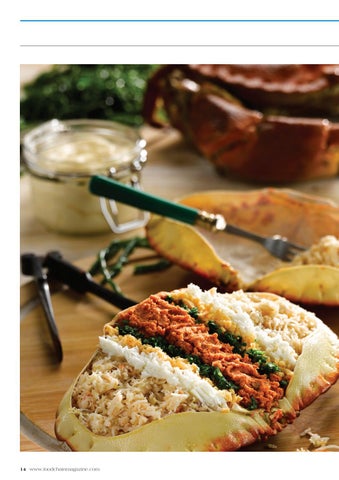
e often see headlines and statistics that raise concerns about the future of fish and shellfish. But, it’s worth remembering that this coverage isn’t always a balanced reflection of the industry today, or its direction of travel. In reality, the UK is a global leader in spearheading responsible and sustainable fisheries management and seafood sourcing, and positive work is underway to ensure that the fish we eat is sourced in a way that protects the supply of this healthy protein source for today’s and future generations. The sustainable sourcing of fish from wild marine stocks is crucial to healthy ecosystems and a vibrant commercial fishing sector, and the importance of a good fisheries management framework to protect fish stocks cannot be overstated. Fish stocks and fishing fleets are highly regulated; there are restrictions on the amount of fish that can be caught, the type of gear used and the areas where fishing can take place. Concern around UK fish stocks was generated recently when advice issued by ICES (International Council for the Exploration of the Sea), the organisation responsible for advising how much fish to catch based on scientific data of fish stocks, recommended a significant reduction for the catch allowance of North Sea cod in 2020. This iconic species remains the ‘poster boy’ for
the public’s concern on declining fish stocks from the North Sea. Whilst there will be less North Sea cod around next year, fortunately for UK consumers there are other sources of the nation’s favourite fish (e.g. Barents Sea), as well as an array of other highly nutritious fish species to choose from. The decision to reduce North Sea cod catches is an example of responsible sustainable fisheries management in practice; where industry is taking concerted management action on the back of the latest scientific advice. Indeed, the Scottish fishing industry is right behind these steps and has already agreed to implement a new Fisheries Improvement Plan for North Sea cod. Irrespective of the prevailing political landscape, the importance of good fisheries management will remain so it will be important that industry, Government and the science community continue to collaborate in a post-Brexit world.
Good practice In addition to highly regulated activities, several voluntary schemes and initiatives also help drive, document and promote ‘sea to plate’ assurance on responsible sourcing and sustainable seafood certification helps consumers make informed choices. For over 20 years, the MSC has provided an international benchmark, by certifying fisheries that operate sustainably. Fisheries which have been MSC certified are recognised
www.foodchainmagazine.com 15
16 www.foodchainmagazine.com
Fish as meeting good practice, helping to manage impacts to the oceans’ fish stocks, habitats and endangered wildlife species. Through Project-UK, an ambitious initiative led by Seafish and MSC, further work is underway to also deliver sustainable fisheries for other key commercial seafood species.
High standards Moving along the supply chain, the Responsible Fishing Scheme (RFS) is a leading voluntary vessel-based initiative. Launched in 2016 it was developed to raise standards and demonstrate commitment to the responsible sourcing of seafood by certifying high standards of crew welfare and responsible catching practices on fishing vessels. RFS now has over 142 certified vessels and already accounts for almost 1/3 of the UK fleet’s landings by weight. Work is currently underway to develop the latest iteration of the Standard which will ensure it meets the evolving demands of the supply chain in the UK and beyond, ahead of international roll-out in 2020. Responsible sourcing doesn’t stop with vessels; the Responsible Fishing Ports Scheme (RFPS) offers an opportunity for UK
ports and harbours to demonstrate their responsible practices through an independently audited, certified programme. Peterhead recently became the first large port to be certified and a standard for small ports is also under development, to ensure the RFPS covers the requirements of all fishing ports and harbours in the UK.
Importance of aquaculture It’s also important to remember that increasing seafood demand cannot be met by wild capture fishing alone; indeed globally catches have remained relatively static since the late 1980s. Aquaculture - fish farming and shellfish cultivation - have been primarily responsible globally for the continued growth in the supply of seafood for human consumption. UK aquaculture is also subject to a comprehensive regulatory framework to protect human health, consumer wellbeing and minimise environmental impacts. Voluntary third-party assurance schemes - for example the Aquaculture Stewardship Council (ASC) - certify and label seafood that has been produced in an environmentally and
socially responsible way. Worldwide aquaculture production (including aquatic plants) recorded an all-time high of 110 million tonnes (live weight) in 2016, with a total estimated first-sale value of $243 billion. The UK aquaculture sector produced over 222,440 tonnes of farmed seafood, valued at over £1.12 billion in 2017; over 85 per cent of which by volume was provided by Scottish farmed Atlantic salmon. Going forward aquaculture will continue to play an important role bridging the gap between seafood supply and demand, whilst reducing pressure on wild fisheries. There’s no denying that how we feed ourselves has impacts on the natural world and that’s something that we all need to work to address globally, regardless of the type of food we eat. And we openly acknowledge that there is more work to be done across the seafood supply chain. However, we can be optimistic that through a combination of regulated fishing activities, sound fisheries management practices and third-party supply chain assurance, fish and shellfish will remain on the sustainable dinner plate of the future. D Footnote: The Responsible Seafood Economy is the theme for this year’s UK Seafood Summit, which will take place on Wednesday 16 and Thursday 17 October. Organised annually by Seafish, the event brings together respected speakers and delegates to discuss and debate the burning issues facing the global seafood industry.
Dr Stuart McLanaghan is Head of Responsible Sourcing at Seafish, the public body that supports the £10bn UK seafood industry. It covers the seafood industry from catch to plate providing facts, stats, research, a range of business and industry support tools and has a big focus on promoting seafood to consumers. www.seafish.org
www.foodchainmagazine.com 17
Under pressure How consumers and Brexit are placing new pressures on food and beverage manufacturers. By Duncan Moir
T
he way we buy, cook, and eat food is constantly evolving. Rising consumer concerns relating to the environmental impact of food production, and an intensified focus on health and wellbeing, have already driven extensive changes in food and
18 www.foodchainmagazine.com
beverage manufacturing. Fast-evolving consumer expectations, combined with a growing customer demand for information and transparency, are all stimulating demand for new products, packaging, and labelling. In addition, changing consumer nutritional preferences
Food Manufacturing
are seeing an increasing amount of recipe variants—from a reduction of salt, sugar, and allergens, to the elimination of meat and dairy. Keeping up with the fast-paced ethical, social, and environmental expectations of consumers is just part of the challenge currently facing
food and drink manufacturers. Vegan brands like Impossible Burger are struggling to keep products on shelves due to unprecedented popularity. Meanwhile, the UK’s imminent departure from the EU is also affecting consumers’ food purchasing habits—increasing
the pressures on manufacturers yet further. Panic food stockpiling, fuelled by scare stories in the press, is already leading to rising product demand and price hikes. Here, we take a look at the other emerging market demands reshaping the UK food and beverage industry.
www.foodchainmagazine.com 19
‘
1. A renewed and growing interest in sustainability and buying local When it comes to sourcing meat and food products, consumers are growing increasingly aware of the impact this is having on the world around us. According to recent research, 15 per cent of gases causing climate change are due to meat and dairy production. The way we produce, distribute, buy, and dispose of food is fast becoming unstainable, and as our population continues to grow, this will become even more of an issue. Buying local foods is just one way that consumers are helping combat this. By opting for locally grown food, instead of buying food shipped from across the world, consumers are not only vastly reducing food miles, and their environmental impact, but also
contributing to the local economy by supporting local farmers and suppliers. A recent report suggested that more than half of UK shoppers now prefer to buy from local brands to help support local and small producers.
20 www.foodchainmagazine.com
With the market changing so rapidly and with there being so much uncertainty about future directions, it is crucial for businesses to have full control of manufacturing processes
2. The rise of vegetarianism, veganism, and ‘flexitarianism’ Meat-free eating is another trend that has skyrocketed in recent years. According to recent research, 34 per cent of consumers are cutting down on, or cutting out, meat, with free-from sales expected to hit £637 million by 2020. Whilst not-for-profit initiatives such as ‘Meat Free Monday‘ have seen a rise of ‘flexitarians’ (those who choose certain days or meals to avoid meat), this
year’s Veganuary had a record-breaking 250,310 participants—47 per cent of which stayed vegan following this. Even those still eating meat are becoming more interested in the provenance of what they are eating. Last year, M&S ran a high-profile campaign promoting the traceability of all its beef back to individual animals thanks to its DNA testing programme. Further research from The Grocer showed that 65 per cent of meat shoppers say traceability is important to them.
3. A desire to minimise waste and plastic packaging ‘The Blue Planet’ effect, as it has become known, is yet another consumer trend that has resulted in significant consequences for the food and beverage industry. Eightyeight per cent of people who viewed the BBC Blue Planet II documentary showing the effects of plastic packaging on the oceans say it has altered their attitudes and buying behaviours as a result.
Food Manufacturing Whilst initiatives to reduce the use of plastic have been present for several years, including the single-use plastic bag charge introduced in 2015, a number of leading supermarket retailers continue to come under fire for the use of excessive and unnecessary product packaging. In fact, a recent Which? study found that almost half of packaging in UK supermarkets cannot be recycled easily. Their findings showed that 52 per cent of packaging met these requirements—including pieces with cardboard, glass and plastic. But 42 per cent of the total supermarket packaging was found to be labelled either incorrectly or not at all.
4. Busy consumer lifestyles are driving an increased demand for frozen food products Thanks to a rise in Internet shopping and the number of ‘food-to-go’ outlets selling high-quality ready meals, frozen and convenience food products are increasingly becoming an integral part of our daily diet. Whilst there is a growing awareness around the health benefits of home-made meals, consumer lifestyles are busier than ever, and as a result, food that can be prepared and consumed quickly is often favoured. Millennial consumers are also driving this trend—as typical lovers of speed, fast casual dining is often preferred to traditional sit-down dining.
5. Increased traceability as a result of developments in blockchain technologies With consumers now more concerned about where their food has come from than ever before, blockchain holds huge potential for the industry. This method of information storing, and sharing will enable manufacturers and suppliers to ensure complete visibility across an entire supply chain. As a result, they will be able to trace the origin of food products from farmers to food prep-companies, end producers, and all the way to the supermarket. This will provide
a more comprehensive traceability solution, affording the ability to track the temperature of the trucks it was delivered on, hauliers, routes and times taken, as well as the ingredients used. All of this leads to more education and information about end users’ food provenance.
What this means for food and beverage manufacturers To counter these myriad and complex challenges, food and beverage manufacturers need integrated systems that deliver improved recipe management and traceability controls, greater forecasting accuracy, and enhanced operational efficiencies. In a world where consumers are becoming increasingly concerned about what they consume—what it contains and where it comes from— real-time data gathered throughout the production process will prove invaluable. By using tools such as barcode scanning—right from goods-in, through the warehouse, and onto on the production line—manufacturers can automatically build up layers of traceability at a touch of a button. With the market changing so rapidly and with there being so much uncertainty about future directions, it is crucial for businesses to have full control of manufacturing processes. They also need data visibility to meet the key challenges of increasing sales, improving profitability, maximising yields, increasing margins, reducing costs, and optimising the supply chain, all whilst assuring quality and compliance. A modern and industryspecific ERP system can help food manufacturers input multiple forecasts and create a production plan based on the most up-to-date data. These are challenging times for food and beverage manufacturers and remaining agile and profitable in the face of disruptive trends will depend on investing in systems and the technologies that will make them responsive. The businesses that address these challenges head on, and make these investments, will be those set to grow and prosper. D
Duncan Moir is senior principal product manager, Epicor Software. Epicor Software Corporation drives business growth. It provides flexible, industry-specific software designed to fit the precise needs of its manufacturing, distribution, retail, and service industry customers. More than 45 years of experience with its customers’ unique business processes and operational requirements are built into every solution―in the cloud or on premises. With this deep understanding of your industry, Epicor solutions dramatically improve performance and profitability while easing complexity so you can focus on growth. www.epicor.com
www.foodchainmagazine.com 21
Why should Manufacturers attend the White Label World Expo? The White Label World Expo is the leading online retail sourcing show, making it the perfect destination for manufacturers to showcase their products to a rapidly growing market. Based in four countries over three continents, it truly is a global event reaching a truly global audience
O
n November 27th and 28th, the White Label World Expo will be held at the ExCeL in London for two days of unmissable action for the white label industry. Thousands of global business leaders, entrepreneurs, online sellers, retailers, and distributors come together for the White Label World Expo in order to meet top representatives from the likes
22 www.foodchainmagazine.com
of Amazon, Ebay, and Shopify to further their business and make long lasting relationships with suppliers that will benefit their business long term. Why should you come to the White Label World Expo? Well, white label products are some of the most popular items on the market at present. As of 2018, the value market share of white label goods in the UK stood at
White Label World Expo
approximately 52 per cent, one of the highest figures in the whole of Europe. This represents a 28 per cent increase from 2014, where the value stood at 41 per cent.
Advantages of White Label Moreover, in a new study by Cadence Consulting Group, 54 per cent of millennials said their choice of retailer is influenced by the private labels offered, and even 60 per cent thought that their chosen retailer’s white label products were better than other alternatives. A further study discovered that approximately 50 per cent of millennials were open to buying private-label products in any
category, with 48 per cent of respondents saying that they expected to buy more in the next 12 months. These figures suggest that the popularity of white label products is increasing. This could prove to be an important factor when you consider that Harvard Business School professor Clayton Christenson claims that over 30,000 new products are introduced every year, and up to 95 per cent of these fail. So, by purchasing white label products, a business is taking advantage of buying from an experienced company whose products are already established on the market. Buying goods to sell through this avenue will also allow a business to avoid the manufacturing process altogether, which will save a significant amount of time and money. The White Label World Expo, however, is not just a trade exhibition. It is an educational event that seeks to offer your business the absolute latest information coming out of the industry. The event possesses a world class line-up of industry experts who are all there to help your business reach their absolute potential. Alan Barratt, Founder and CEO of Grenade, is just one of the impressive keynote speakers at the show this year. There are few people in the industry that have had an entrepreneurial journey quite like Alan’s. He started at the age of 11 when he was nearly expelled from his school for selling cakes in the playground. He managed to resolve the situation by negotiating a deal to sell to the teachers at preferential rates, and it was at this point he realised he wanted to work for himself. Alan’s keynote seminar at the White Label World Expo is titled ‘build a brand, not a business’ and
will discuss the key factors and decisions that led to him building one of the best known and fastest growing businesses in the UK over the past five years. Another keynote speaker, Chloë Thomas, will be sharing the invaluable knowledge she has acquired over the course of her professional life. Chloë’s seminar will be titled ‘Keep Optimising – how to massively increase your traffic and conversions’ and will explain how your company can grow from ten orders per month to 100 or 100 to 1000 (or beyond) means doubling your business multiple times. She will be using the information she has accrued over her long and distinguished career as a best-selling author, International Speaker, and host of the eCommerce MasterPlan Podcast to deliver her informative keynote seminar. Finally, an example of a speaker who specialises in fulfilment, is Martin Bysh, Co-founder of Huboo. Martin cofounded and has been running Huboo, the UK’s fastest growing ecommerce fulfilment specialists for several years. With his co-founder, Paul Dodd, he has revolutionised fulfilment by bringing the same kind of precision, rigour and above all, technical knowhow to bear on an industry that had changed little in 20 years. Martin will draw on his experiences to host his seminar that is titled ‘Get fulfilment right and increase your bottom line (whatever the size of your company)’ and will describe how using 3rd party fulfilment will simplify your business.
Incredible opportunities There will be over 200 speakers over the course of the two days, so you will have to make sure you plan your two days perfectly in order to see the speakers you want to listen to. The White Label World Expo will be one of the best places to source all of the newest products and services on the market. It is an incredible opportunity for your business to come face-to-face with over 300 of the world’s top suppliers and try, touch, and test a multitude of products. You can take advantage of free advice and consultations, helping you to secure the best deals and take your business to the next level. There are a wide range of companies
www.foodchainmagazine.com 23
White Label World Expo to the world’s leading consumer brands. With a GMP certified extraction facility and an extensive network of contracted cultivators, Mile High Labs supplies high-quality, highvolume CBD orders year-round. You can visit Mile High Labs at Stand 930 at the show and discuss how they manage to carry out their manufacturing process on such a large scale. exhibiting from every reach of the white label industry. For example, if you are looking for a manufacturing company who are based abroad, then you should visit XQ Manufacturing at Stand 1332. XQ Manufacturing is a unique manufacturing partner with factories and partnerships in Asia, specifically in China, Cambodia, and India. The company produces custom developed and private label products for their clients in textiles, plastic, metals, woodwork, electronics and more. XQ Manufacturing could be a foot in the door for the Asia market for your business, so make sure you visit them at the White Label World Expo for more information about their manufacturing process. One of the biggest names at the show is Hermes Parcelnet, the UK’s leading consumer delivery specialist. In 2018 alone, Hermes handled more than 330 million parcels, proving that they are one of the best options for a white label business looking to deliver their parcels to their customers around the world. They provide a range of flexible and affordable delivery options to individual homes, work, neighbours, safe places, or ParcelShop suiting the customer’s wants and needs perfectly. Visit them at either one of their Stands, 316 or 860, to see how their services can benefit your business. One last globally recognised business at the event is Mile High Labs, an industrial-scale CBD manufacturer offering reliable delivery of bulk CBD ingredients and private labelling services
24 www.foodchainmagazine.com
Masterclass program
Free tickets Tickets to visit the White Label World Expo at the ExCeL London on the 27th and 28th November are completely free. Make sure you go to www.whitelabelexpo.co.uk for additional information about the event, allowing you to plan out your time at the White Label World Expo entirely.
Exhibiting & Sponsorship Opportunities To receive more information about exhibiting and sponsorship opportunities please contact Nick Woore on 0117 929 6099 or email nick.woore@prysmgroup.co.uk
There is one last feature at the show that you will not want to miss out on. The masterclass program at the White Label World Expo will offer you advice and demonstrations on how to carry out certain activities within the industry. There are up to 50 masterclasses at the White Label World Expo, with Huboo and Virtuous Graphics being just two of the examples of businesses running their own presentations. As Huboo are the UK’s fastest growing eCommerce fulfilment specialists, who have revolutionised the way that fulfilment businesses function, it seems only right to have them to hold their own masterclass. Their class will explain how they have managed to revolutionise the way online fulfilment businesses are run and display what they do will benefit your business moving forwards. After finishing at the Huboo masterclass, you can visit the team at Stand 1260 for any information you may require. Finally, you will have to chance to create long lasting working relationship thanks to the incredible networking area. If you’re a startup looking to meet with more experienced individuals or looking to form strong alliances, this is the place to be for great business opportunities. You will no doubt leave with a plethora of new knowledge and business contacts, that will be sure to help your future. D
27 & 28
NOV
EXCEL LONDON
IN ASSOCIATION WITH
OUR LEADING
KEYNOTE SPEAKERS MARK ADAMS
VICE PRESIDENT & GENERAL MANAGER, EUROPE AT BIGCOMMERCE
ALAN BARRATT
CEO AND CO-FOUNDER OF GRENADE
KATY LEESON
MANAGING DIRECTOR OF SOCIAL CHAIN
THE WORLD’S LARGEST EVENT FOR PROFESSIONAL ONLINE SELLERS TO MEET WHITE LABEL GOODS SUPPLIERS
300 Cutting Edge Suppliers • 200 Exceptional Speakers • Amazon Pro Seller Summit / Online Strategy Summit / Educational Masterclasses Unparalleled Networking Opportunities • 1-2-1 Expert Advice • And Much More! whitelabeluk@prysmgroup.co.uk
FOR FREE TICKETS VISIT THE WEBSITE: WHITELABELEXPO.CO.UK
TasteTest
Super snacks London-based healthy snacks company Abakus Foods has introduced the world’s first Chocolate Coated Red Dates. Made of the superfruit Red Dates (aka jujube fruits), coated with premium dark chocolate, this delicious snack offers balance in both taste and nutrition: dark chocolate is known for its natural anti-oxidant properties and for being a source of iron, while Red Dates contain 18 out of 24 essential amino acids, which help tissue repair and recovery. Also, they are known for their adaptogenic properties, which can help the body adapt to stress, both mentally and physically.
www.abakusfoods.com
“I found these were such a lovely little treat to have at my desk,” said our tester. “The dates have a natural caramel flavour and a chewy texture, while the chocolate coating had a good crunch. The fact they are packed with nutrients was a nice bonus – it felt like I was indulging, but in fact, was improving my wellbeing. This kind of smart product is always something I look out for, as I would much prefer to reach for these than traditional sweets.”
Good for you and the planet To support the launch of its brand-new Orange and Mango flavour, Vieve, a UKbased start-up sport nutrition company, has partnered with The Mango Tree Orphan Support Trust and global business giving initiative, B1G1, and is hoping to assist in replacing devastated forest areas in Kenya that face continued environmental degradation where trees have been cut down and destroyed for profit. It has announced its plan to plant one tree for every pack sold of its revolutionary protein
water, hoping to plant 10,000 trees in areas of Kenya affected by man-made devastation. The new Orange and Mango flavour is added to the existing stable of fruity options, and bottled in the same 100 per cent recyclable material. www.drink-vieve.co.uk
“I found this an interesting change to the usual powdered options and a very easy way to get 20g of protein. It had a good orange and mango flavour, and there wasn’t any taste of ‘protein’ to the drink. It was also a bonus to be dairy free.”
OMG it’s OMG Award winning health and wellbeing drink phenomenon, Captain Kombucha, has launched a new vegan-friendly sparkling fruit drink range - the first of its kind to be listed in one of the top four UK grocers. Handcrafted in western Portugal, the ‘Oh My Gutness’ range is naturally fermented with water kefir grains and includes Original, Atlantic Raspberry, Cola and Ginger Lemon flavours. It is also organic, vegan and gluten free, with no preservatives, artificial colours, flavours or sweeteners. The new water kefir range, which received the NOPE Best New Organic Product award, adds to the brand’s
26 www.foodchainmagazine.com
existing line of kombucha drinks already in the market. Widely considered to have substantial health benefits, water kefir is said to promote better gut health and strengthen the immune system. www.ohmygutness.com
“I was really interested in the water kefir, as I love traditional kefir and all its benefits but don’t always want a thick yogurty drink – a refreshing alternative is a great idea. I tried the Raspberry option and really enjoyed it – very easy to drink, thirst quenching, a good raspberry flavour, nice fizz and not
too sour. It was like a nice fruity soda with health benefits!”
TasteTest The mayo alternative Vegan mayonnaise pioneer Plamil has now launched its vegan mayonnaise in three varieties - Original, Tarragon and Garlic - and an organic version. With a light creamy, smooth texture, the range can be used in exactly the same way as normal mayo – on salads, sandwiches or as a dip. Priding itself on taste and quality, the range is dairy free, cholesterol free, gluten free, high in essential polyunsaturates, with no artificial colours, flavours or preservatives. The organic range uses the finest organic ingredients, grown by organic crop management techniques which benefit the local population and environment. www.plamilfoods.co.uk
“I used this as I would normal mayo, and I was very impressed with it. I
Wine on the go had the garlic option, which had a good hit of garlic without being overpowering and was pretty versatile with salads and in sandwiches, or as a dip – I tried it with breaded mushrooms, and it was delicious! The texture and look were very much true to traditional mayo as well. I would try some of Plamil’s other products based on the quality of the vegan mayo, and I like the innovation that is underway to create foods like this, that help anyone be a bit healthier.”
In the bag New for 2019, iconic British manufacturer, Dualit has released Compostable Coffee Bags. The bags provide all the great taste of indulgent cafetiere or capsule machine coffee with none of the mess or unnecessary plastic usage caused by capsules. They are perfect for those who don’t want to compromise on taste but are short on time less stress and more time spent enjoying the moment. The new Compostable Coffee Bags use great tasting Fairtrade coffee crafted by Kristina, Dualit’s Master Roaster, which is roasted in small batches at the company’s
factory in the heart of West Sussex. Simple to use, all that is required is a mug and a kettle making the Compostable Coffee Bags highly accessible – users can make delicious tasting coffee at home, in the office or before heading out the door with a handy travel mug. www.dualit.com
“There is just something about the smell of properly brewed, fresh coffee before I’ve even tasted it, that makes me happy,” said our tester. “But I can’t be dealing with the mess of a cafetiere at work, or the hassle of a coffee machine – and now I don’t have to! I poured my hot water on this genius little bag, and the aroma was instant and delicious. The coffee was of great quality, making it was amazingly easy, and now I have proper coffee with no faffing about. I had expected Dualit to put their name to something excellent and I wasn’t disappointed. Great work Dualit!”
May saw the launch of Mirabeau en Provence rosé on-the-go slimline cans in Waitrose shops nationwide. Cofounder of Mirabeau and nominee for the prestigious Wine Enthusiast ‘Wine Executive of the Year’ award, Stephen Cronk believes that quality wine in cans is a trend that will continue: “It has become the packaging format with the highest growth in the US for good reason and is driven by solid consumer demand and environmental considerations,” he said. “We wanted to be at the forefront of this exciting development, as we understand that today’s lifestyle demands products that are portable, beautiful and solid in terms of quality and provenance. We aimed for a fashion forward and fresh look, perfect for picnic baskets, beach bags, festivals and parties everywhere. Needless to say, the wine is delicious, a dry and pretty rosé of impeccable quality.” www.mirabeauwine.com
The Mirabeau Pret-a-Porter is blended for aromas of lush red fruit but with good freshness. “I took the can on the train to make a journey a bit more of a celebration, and I loved the convenience, and also the packaging was very attractive. The wine was nice and dry, and a lovely pink hue. It had a good fruitiness too. It paired ideally with my little train ‘picnic’ of salads but I also feel was sophisticated enough to have with a more extensive meal. I think it will become a staple for glampers and adventurous types who like a treat!”
www.foodchainmagazine.com 27
A family affair
28 www.foodchainmagazine.com
Malhotra Group Since 1991, Malhotra Group – led by two generations of the Malhotra family – has grown rapidly across the North East of England, and in 2019 its programme of exciting hotel, restaurant and care home developments is reaching unprecedented heights
I
t was approximately one year ago that FoodChain excitedly showcased the activities of Malhotra Group, one of the North East of England’s leading real estate developers, responsible for an ever-increasing portfolio of hotels, restaurants, bars and care homes. At that time, one of the most significant developments on the company’s slate – amongst countless other examples – was its proposed £35 million programme to transform a number of Grade 2 listed buildings on Newcastle’s Grey Street into a ‘One Stop Shop’ of leisure sites to provide a large hotel, night clubs, bars and restaurants. It is in Grey Street where the company’s existing 49bedroom Grey Street Hotel has recently had a face lift with a £1.2 million refurbishment and development programme, highlighted by the re-design of its bedrooms, the addition of newly created conference facilities, and the opening of a purpose-built urban beauty spa called All About You. Speaking with Malhotra Group’s Operations Director, and second generation member of the Malhotra family, Atul Malhotra in mid-September 2019, we found him only days away from the opening of Grey Street’s
www.foodchainmagazine.com 29
newest must-visit location. “In the coming days, we will be opening our new showpiece bar, restaurant and club, Leila Lily’s,” he reveals. “Located
in the listed building that previously housed The Living Room, and connected to the Grey Street Hotel, it is named after my two-year old daughter
(the club will bear the name ‘2-1-2’) and we intend it to be the group’s food & beverage flagship for the city centre. “With Leila Lily’s, we have created a unique dining experience unlike anything else in Newcastle, somewhere customers can enjoy high end food with a hint of theatre, but at affordable prices. The feedback we have received thus far from our soft launches has been excellent and very humbling, so we are incredibly excited to have created something that we feel will be unrivalled in the city. What it also means is that, across one complex, we now have a first-class hotel, spa, restaurant with live music, bar and a club, which means we can cater for all moods and tastes.”
Multi-million pound project The opening of Leila Lily’s comes after an eventful 12 months for the Malhotra Group. At the end of 2018, for example, the group began the process of redeveloping the hugely popular Three Mile Inn in Gosforth. “The site includes a complete refurbishment of the bar and restaurant, and the addition of a 64-bedded hotel, with conference and event facilities, and reception area,” Atul continues. “The new family-friendly restaurant – dubbed the Pizza Dough Co. – will take inspiration from Americanstyle pizza restaurants, with meals being prepared and cooked in a state-of-theart, £40,000 clay oven with rotating plates. Inside, cooking temperatures
30 www.foodchainmagazine.com
Malhotra Group will reach up to 320°C, with fresh pizza ready in as little as two minutes. “Meanwhile, the hotel, which will be called The Great North Hotel, will almost certainly become a soughtafter destination for all manner of guests. Located just ten minutes from the city centre and close to motorway transport links, it will be a great option for both corporate and leisure guests. Throughout the entire redevelopment process, which represents investment totalling the best part of £9 million, we are also ensuring that the end result
incorporates the traditions and history of The Three Mile Inn, which has been a much-loved destination for more than 30 years, and will continue to be so in the future.”
Exciting developments Another key project occurring within the group’s hotel redevelopment portfolio is the ‘Jesmond Block’ development. Here work is being split into several phases. The first has already begun with the launch of the exciting new tapas restaurant, El Paso in 2018, on the site
Crosbys/Scomac Catering Crosbys has enjoyed a close, long-standing relationship with the Malhotra Group for over 30 years, providing front of house crockery, cutlery and glass, light kitchen equipment, chemical systems, paper and janitorial requirements. Sister company Scomac Catering, which specialises in project work, installed the brand-new kitchens and bars, featuring the kitchen’s centre piece the Mibrasa Charcoal fired oven, coldroom and locally manufactured fabrication. Collectively they have brought expertise and brands to Malhotra who are also committed and behind the group’s expansion programme. Dedicated Crosbys and Scomac champions have worked closely with the Malhotra team, and we feel we have demonstrated a ‘can do’ attitude, both maintaining and developing great relationships. Crosbys and Scomac are happy to support this well run and focused group and wish them every success in the coming years, with a special mention to Grey Street’s new flagship venue – Leila Lily’s. Here’s to a brilliant and successful future.
www.foodchainmagazine.com 31
of the former Scalini’s Jesmond venue, while the second and third involve the addition of a multi-purpose gaming bar, ‘Eat Chill Play’, which will feature a two-lane bowling alley, pool and fuse ball tables, and a gaming corner, and a decadent gin bar, Jesmond Gin House. Last, but by no means least, the adjoining New Northumbria Hotel will enjoy a complete remodelling and refurbishment of the entire rear elevation of the building.
brand new, purpose built 86-bed care home to be called Beech Tree House.” Once complete, this fantastic new care facility will provide nursing and residential care, catering for Young Physically Disabled (YPD), Bariatric and Dementia, as well as general nursing residents. Their new 66 bed care facility in Ryhope, Sunderland is also well underway to open in the early Summer of 2020, and in the New Year they will commence the development of a 83 bed care facility in Whitley Bay.
Brand new care home
Strong values
In addition to the above detailed projects, Malhotra Group’s care home operations continue at pace, with the market town of Alnwick being a site of particular interest. “It is here,” Atul says, “that we added the thirteenth
It is probably clear by now for all to see that Malhotra Group today finds itself in the midst of a massive construction and development drive, and this is expected to continue across its care home and leisure property portfolios over the next five years. With this, inevitably, the group will be looking to bring more people into the business in that time frame, with employee numbers projected to increase from 1200 at present, to around 2000. This topic arose at a convenient time during our conversation, with Atul having just attended the annual Malhotra Group Staff Awards the weekend prior. “For the last three years, we have held our awards event, where we invite around 100
care home to our portfolio in the form of the 50-bed Hillcrest Nursing Home in January this year, and where we are at the advanced stage of building a
Hodgson Sayers Our roots go back four decades and while we look to our past as a point of reference, we are very much focused on the present and the future. Our core expertise is in roofing, building works, metal fabrication and fencing, where we employ best-in-class, specialist tradespeople, whose skills are honed via in house and external personal development programmes and traditional peer-to-peer mentoring. 2015 was an exceptional year for the business, as we were crowned British Chamber of Commerce UK company of the year.
32 www.foodchainmagazine.com
Malhotra Group
Park Electrical Distributors Park Electrical Distributors has proudly supported Malhotra Group for over 20 years on a range of projects and we look forward to our continued partnership well into the future. As the largest wholesaler in the North East of England, with six branches, we operate across a number of specialist divisions: lighting design, building technologies, electrical wholesale, industrial services and energy solutions. We are also a leading independent supplier of KNX components via My KNX Store.
people who have been nominated by one or more of their peers to receive recognition for their efforts, and to enjoy a three-course meal and entertainment in celebration of their achievements,” he details. “More and more each year, I come away from these events impressed with the loyalty, commitment and hard work of all of our people, which I believe are qualities you just can’t buy. “To this day, we remain a loyal family-run business built on strong values, and we know that we would be nothing without our staff. Equally, we understand that if we look after these same people, giving them equal degrees of autonomy and accountability in the process, then they will look after us. It is a simple philosophy that we have, but the results are there for all to see.” D www.malhotragroup.co.uk
www.foodchainmagazine.com 33
34 www.foodchainmagazine.com
Crisp Malt
The
finest malts
Relying on its ability to produce more specialist types of malt, Crisp Malt continues to support local and international brewers and distillers of any size
I
t felt like we had chosen the perfect time to catch up with Adrian Dyter – Managing Director of Crisp Malt – when he told us that mere weeks before our conversation, in August, the leading supplier of high-quality malts had had a record week of deliveries, all in one shift. To a large extent, the capability to act upon such high-volume orders has been acquired by Crisp through a series of investments Adrian told us about three years ago, when the company first appeared in the pages of FoodChain. “We have upgraded our facilities both in England (in Great Ryburgh, Norfolk) and in Scotland (in Alloa) and the last time we spoke, the new equipment in Great Ryburgh was just being installed. It is now running very efficiently, which has enabled us to process customers’ orders more quickly,” Adrian says. “At the moment, we are also completing an investment in Scotland where we are putting packaging facilities in place that will allow us to package malt in 25-kilogramme bags, which we can then stack on pallets and deliver across the UK and overseas.” The decision for the latter investment has been taken as a result of the growing demand by Crisp’s craft brewing and craft distilling customers for Scottish provenance malt. “The new facility will make us the only maltster who can grow barley in Scotland, malt it there, and then package it in the country. In addition, it will enable us to load and package peated malt in a discreet line. It is a product for the distilling industry that should never be mixed with any brewing malt and our ability to pack it in 25-kilogramme or even one-tonne bags and supply it to our customers will help us to expand our range,” Adrian discusses. Following a slight dip in production among Scottish distilleries, the trend is now reversing and it is both large and small companies investing in new or expanding their existing sites. Without a doubt, this is excellent news for Crisp. Adrian comments: “Brands like Glenlivet and Glenfiddich have grown their large-scale distilling plants and that has added to the demand for our malts. At the same time, we are seeing a lot of craft distilleries popping up, with all of them looking for more interesting raw materials, in order to push the boundaries of flavour and style. Notably, these small operators emerge all over the world, so it is by no means just a Scottish phenomenon.
www.foodchainmagazine.com 35
Crisp Malt “There is a similar trend in craft brewing, which, alongside the very noticeable move away from mainstream beers and towards more international beverages, is changing the brewing market significantly. For us to adapt to these changes, we are trying to utilise our production assets in slightly different ways,” he continues, immediately backing his claim with an example. “On the one end of the market, we are working closely with Anheuser-Busch for their Budweiser brand by producing a special malt that suits their needs. On the other end, we provide our craft customers with a wide range of different malts and cooked cereals, so that they can produce the variety of beers that consumers are demanding.”
Unique products To differentiate itself in the market, Crisp willingly shares its technical expertise, particularly with its customers on the craft brewing side, thus assisting them in the creation of more original drinks. “We have four qualified brewers within our team who are helping our clients to harness all the benefits of different malt styles,” Adrian states. “We see a lot of people coming into the sector with lots of energy and exciting ideas, but with little brewing experience, so we want to offer them this extra support, so they can use our malts to the best of their ability. “Another initiative we have recently undertaken is called the ‘Small Batch Series’ which consists of releasing limited edition, unique batches of malt, with specific different features and characteristics to what is currently available to brewers and distillers,” he goes on. “The first batch of the series is the work we have done with a variety called Haná, which is the original Moravian barley that is used in the original Pilsners. We only had 14 tonnes of it and it is already sold out, but the idea is to enable our craft customers to produce something special and different from a short run of production.” As Adrian pointed out earlier, the number of craft brewers and distillers around the world is ever increasing. Owing to this, Crisp has been working actively to enlarge its global network to ensure that its products are available in
more countries. “When craft brewers want to brew an English IPA, they want to use authentic raw materials, so they are expecting us to supply them with
English malts for the English-style beers they want to make,” Adrian observes. Crisp’s intensified activities in the global market have been bolstered by
www.foodchainmagazine.com 37
broadly flat over the past few years. We export approximately 15 per cent of the UK business’ production and the largest markets for us are Japan and the US. Furthermore, we are sending out Pilsnertype malts from our Hamburg maltings to customers all over the world.”
Smart re-branding
the appointment of new distributors and a Distributor Relationship Manager who, at the time of speaking, was at the
Southeast Asia Brew exhibition. “We are certainly looking to increase our overseas sales, even if our exports have been
Together with the Hamburg business, Crisp runs another subsidiary based in the Polish city of Bydgoszcz. “The last three years have seen us integrate the two into our group and we have now come to a point where we have a common management structure across the entire company,” Adrian explains. “We have changed the names of the German and Polish businesses to Crisp Malt and have installed the IT systems that we use in the UK, slightly modifying them to reflect local conditions. This way, we have established a common platform in Western Europe that covers all of our operations in the region.” Renaming Crisp’s overseas companies has been part of a wider rebrand undergone by the maltster, which included the design of a new logo and the change of the business’ own name from Crisp Malting Group to Crisp Malt. Adrian speaks about the need of a new look for the organisation: “We wanted to sharpen ourselves a bit, because, traditionally, malt supplying companies have not worried too much about their branding. We are hoping to become more attractive for our customers and the new logo, featuring the year when we were founded (1870), means that we have retained our connection with the past, whilst modernising our image. I believe that customers demand that they work with a trusted and long-standing provider of raw materials, hence the emphasis on our longevity as a business.” Proudly displaying its enhanced identity, Crisp has a confident outlook for the future and Adrian is hopeful that the company will capitalise on several ongoing consumer trends. “It seems to
38 www.foodchainmagazine.com
Crisp Malt us that people are going to drink less, but more quality beverages, which chimes well with our focus on serving customers that create more specialist products. Then, we are very happy to see that our malt is increasingly going into low or non-alcohol beers. It is a market sector that is resonating more and more with consumers and there is just as much malt in a non-alcohol beer as there is in a full-strength one. “Finally, the food sector, too, is, slowly but surely, providing us with more opportunities. There has been a significant increase in the amount of malted oats that we produce, so we will continue to work around these trends and deliver the raw materials our clients need to succeed. In the long-term, we will try to grow the business further, either organically or by acquisitions, and we feel that we have got really good people and a solid supply base to achieve that.” D http://crispmalt.co
Edwards Engineering Edwards Engineering brings over 50 years of engineering expertise, providing high levels of service and most importantly, effective solutions. Our team has relished the opportunity to apply our skills and experience to Crisp’s operations, gaining a deeper understanding of the challenges facing the industry. We ensure any works undertaken don’t affect production or quality and as a result we can upgrade malthouses with minimal disruption to production schedules. To us, every customer and every project is important. We’re determined to ensure we complete every contract on time, to the agreed specification and within budget.
www.foodchainmagazine.com 39
40 www.foodchainmagazine.com
Grenade®
Having a blast
Alan and Juliet Barratt
Since exploding onto the scene in 2009, Grenade® has shaken the very foundations of the sports nutrition market with its bold, colourful approach to business and its refusal to compromise on ingredients, quality or attention to detail
T
he brainchild of CEO and Founder Alan Barratt and his wife Juliet, the origins of Grenade® stem from Alan’s past dissatisfaction with the quality of sports nutrition goods and the pair’s desire to create products – and subsequently a brand – that people would remember, love, and that would inspire them to get more out of life. Beginning with its first product – the aptly named Thermo Detonator® weight-loss formula capsule – the company today boasts a range of instantly recognisable Carb Killa® protein bars (made up of 12 varieties including Caramel Chaos, Peanut Nutter, Cookies & Cream and Birthday Cake), shakes, spreads and biscuits, Reload® high protein flapjacks, and a comprehensive assortment of sports and gym supplements. “Broadly speaking, by splitting the business in two, you have our sports nutrition side, which is derived from our performance heritage and is typically sold through specialist locations to specific consumer segments such as the military and to elite athletes, and our active nutrition/healthy snacking side made up of bars, shakes and so forth,” Alan explains. “It is in the latter that we are delivering the biggest numbers, recording a share of the confectionary market that now exceeds 40 per cent, and have the top nine best-selling products in grocery according to market research from IRI. I do believe, however, that this has been made possible as a result of our work in performance products, which has helped solidify our reputation for quality.” Alan, Juliet and the rest of the Grenade® team are self-confessed fanatics when it comes to making the best product and using the best ingredients. “We have a welldefined line in the sand when it comes to what is acceptable to us in terms of the products that bear the Grenade® name and we will never cross that,” Alan adds. “While we try not to take ourselves too seriously, we do have a clear mission which is to provide consumers with great tasting, healthy and innovative performance products, and when we create something if we don’t love it, we don’t take it any further. That is the passion we have for what we do, and is the way, in my opinion, that we continue to successful build this brand up.” In less than a decade, Alan has seen “his baby” – as he affectionately calls his business at one point during
www.foodchainmagazine.com 41
our conversation – grow exponentially. It is perhaps inevitable, therefore, that what drives both himself and the company has evolved over the years. “What I would say, firstly, is that one thing we have always strived for is to build a brand that consumers would love and that could be considered to be something akin to the ‘Red Bull of sports nutrition’, but the journey to that point has taken a number of different turns along the way,” he states. “For instance, when we started Grenade® I couldn’t necessarily see us having a protein bar, so if someone was to have told me then that I would be sitting here today and that my sales book for bars would be comparable to Cadbury’s Dairy Milk, I would have found it hard to believe, yet here we are!”
Growth potential So, what is it that motivates Alan in 2019? “I guess one motivation I have now – besides from continuing to build a legacy – is to see how big we can make Grenade®, and if you ask me if we can make this a billion-dollar brand then I believe the answer is yes we can. There are many ways that this can be achieved, beginning of course with making great products, forging strong relationships with suppliers, retailers, investors and so forth, and by placing healthy products in as many locations as possible, even those you wouldn’t normally expect, such as Costa Coffee. From there we need to target further expansion internationally – where we have seen a number of big retail wins in recent times – to continue to hire brilliant people that love what they do, and retain our reputation for having the kinds of amazing, experiential content that no other brand thinks of doing.” Such is the ongoing growth potential of the business that Alan estimates that just by putting its four best-selling protein bars in all locations possible it has the ability to double to size rapidly. As stated above, however, there is much more to Grenade® than just its bars, and the company is constantly looking at breaking into different formats that tick the boxes of its consumers. “In much the same way that we have successfully disrupted the confectionary segment
42 www.foodchainmagazine.com
Grenade® with a functional product, we have designs to do the same later in 2019 in another category with an exciting new product launch in the offering,” Alan reveals. “When it comes to 2020,” Alan adds, “we have three further new product launches planned, however much of our focus will be on taking our marketing and consumer engagement activities to a whole new level. For example, we have recently purchased a Grenade® hot air balloon – in the shape of our grenade logo – and we will be flying this around the UK, Europe and further afield from the start of the year, appearing at various events and races, which we expect to help to create more awareness of the brand, and ultimately drive sales. Our primary aim is to engage with as many consumers as possible, in the hope that they will fall in love with Grenade® the way that so many others
have done. Therefore, 2020 will be our biggest year by far in terms of content and marketing, and we intend to raise
the bar when it comes to getting the Grenade® name out there.” D www.grenade.com
RCS Logistics EU RCS logistics is one of the world’s leading international freight forwarders for air, sea and road movements, specialising in complete cold chain solutions. RCS is the partner of choice for Grenade UK, handling all of its global freight requirements from the UK and Europe. With more than 30 years of experience handling ambient, chilled and frozen food products, RCS can offer unparalleled expertise. RCS boast an extensive global distribution network of owned offices across four continents. RCS rises to the challenges of transporting goods in today’s fast-paced global marketplace and is committed to providing industry leading, best in class service.
www.foodchainmagazine.com 43
Everyday energy With sales across its portfolio of products increasing year-on-year and its name attached to some of the UK’s biggest health initiatives, and sporting events and teams, more and more consumers are discovering the nutritional and energy benefits of Soreen
44 www.foodchainmagazine.com
Soreen
www.foodchainmagazine.com 45
Soreen
W
hile it can rightfully be proud of its 80-plus year history, during which time its much-loved, deliciously squidgy malt loaves, bars and snacks have been baked in its home city of Manchester, it is only in the last three years that Soreen has been actively repositioning itself to also be seen as a nutritional energy snack company. When FoodChain last spoke with Soreen’s Managing Director Mark Simester in the latter half of 2018, this was one of the main topics of conversation. Catching up with Mark a year later, he is keen to extol the fantastic progress the business is making. “We continue to gain excellent momentum in a number of areas, which is reflected in the fact that our sales across the board are very strong – rising by ten per cent this year alone – in a grocery/packaged goods market where things are generally flat at present,” Mark begins. “One of the biggest drivers of that is the fact that more and more consumers are discovering the positive nutritional values of Soreen, and are subsequently attributing it as being a healthier snack choice for people of all ages.” Contributing to this has been the company’s targeted marketing which has successfully linked the brand, and its nutrition and energy credentials, to organisations such as British Cycling and has seen various elite athletes – such as Laura Kenny and Alistair and Jonny Brownlee – brought in as Soreen Brand Ambassadors. “We are also very pleased to be continuing our association with the Tour de Yorkshire and the Tour of Britain, the
‘
latter of which recently culminated in Manchester, where one of our own highlights was the appearance of our ¾ of a mile-long advertising banner – the longest ever produced – that ran along the length of Deansgate. “Meanwhile, since we last spoke, Soreen is now officially used by a
Our individual, 42g loaf bars – including our new Banana loaf bar which is available in Tesco Express and WH Smith Travel stores – have gained some serious traction in terms of both sales and distribution, as have our pre-buttered slice packs, which are finding a good home for themselves in the sandwich aisle as part of retailer’s meal deals
number of professional sports teams, including the Leeds Rhinos Rugby League side, Manchester United Football Club and the Liverpool Football Club Academy, as a means of energising their athletes. We are thrilled to be providing energy to these partners, and we are actively speaking to a number of other organisations with a view of working with them in the future.” In case Soreen needed any further endorsement of its nutritional credentials (which it most certainly does not), the company has also been a partner of the Public Health England (PHE) for four years now, and counting. “Soreen represents a mainstream snack that boasts amazing nutrition, and that can be enjoyed by anyone from 18 months old to 80 years plus. Our partnership with PHE is all about doing our bit to improve the nation’s diet, such as encouraging the cutting down on consuming high-sugar snacks,” Mark states. “Soreen has as much as
www.foodchainmagazine.com 47
50 per cent less sugar than the average cake bar, and it is such facts that PHE helps to publicise when recommending Soreen amongst its list of healthy alternatives that people can try. We are delighted to receive such support, and we work hard to support PHE and its initiatives in kind.” Turning to the company’s previously referenced increase in sales in the past year or so, Mark discusses some of Soreen’s product-based highlights that have driven this success. “Our bars business continues to be the main growth engine for the brand, with our lunchbox loaves format – five x 30g bars – motoring forwards with sales ahead 20 per cent year-on-year for the last two consecutive years,” he reveals. “Targeted initially towards primary and infant school children – whose parents remain among our biggest purchasers – these bars have now gone beyond this one demographic and are now seen as a great snack choice for people with small appetites or those on the move. “At the same time, our impulse products have been doing very well also, with collective sales up by an excellent 48 per cent year-on-year. Our individual, 42g loaf bars – including our new Banana loaf bar which is available in Tesco Express
48 www.foodchainmagazine.com
Soreen and WH Smith Travel stores – have gained some serious traction in terms of both sales and distribution, as have our pre-buttered slice packs, which are finding a good home for themselves in the sandwich aisle as part of retailer’s meal deals. Meanwhile, when it comes to our latest innovative creations, we have recently launched a new premium offering in the form of our Seeds & More large core loaf. Packed full of super ingredients, bursting with cranberries and topped with seeds to create a crunchy yet squidgy texture, it is already performing very well indeed.”
Busy times ahead Now coming off the back of what Mark says has been the company’s biggest ever “back to school” season, its focus almost immediately turns to the Halloween period, which is marked by the limited release of its incredibly popular Chocolate & Blood Orange and Toffee Apple lunchbox loaves packs. “This year, we have secured wider distribution for these products than ever before, and we expect to see them contributing to another amazing sales month in October, which has been a very pleasing pattern in recent years. Then, hot on the heels of Halloween, we begin gearing up for the festive season, and the return of our Winter Spice Festive Fruit Loaf, which continues to do so well for us.” Heading into 2020, January is one of the most important times in the company’s calendar, with it historically being the biggest month for sales, coinciding as it does with consumers’
boosting credentials. In the meantime, we will be working to get our products distributed in more outlets and impulse locations, while also following up on
those opportunities that exist outside of the UK, where we think we can also have a positive impact.” D www.soreen.com
desire to seek out healthier foods. As one would expect, Soreen has been working closely with its retail partners to ensure that its products are positioned in the best possible way to capitalise on this, but as Mark goes on to conclude, January will be just the beginning of another fruitful year for the company. “We anticipate another very successful year of growth for the business,” he says. “As far as strategy is concerned, we will continue to work as hard as possible to make sure that as many people in the UK as we can reach gain an understanding of Soreen’s nutritional properties and energy-
www.foodchainmagazine.com 49
Founded on tradition Westons Cider’s first inroads into the American market have met with considerable success, while the introduction of a new fruit cider in the UK has allowed the company to address one of the leading trends in its domestic market
52 www.foodchainmagazine.com
Westons Cider
F
or the FoodChain team, it is always a pure delight to talk to a Westons Cider representative. Not only do we know that we are guaranteed to be provided with valuable insights on the state of the cider sector, but we also have the immense pleasure to zoom in once again on the well-ordered system of values that guides the company and has been at the heart of its continued success. Our recent interview with Darryl Hinksman, Head of Business Development at the Herefordshire cider maker, made no exception. Having previously featured Westons Cider in the magazine just over 18 months ago, Darryl wastes no time in bringing us up to speed with the latest developments at the organisation. “From a product standpoint, the launch of the Stowford Press Mixed Berries cider last year was the undisputed highlight for the company,” he begins. “It was in the summer of 2018 that we first released it as a draught cider and then, in the autumn, we made it available in 440ml cans. Both variants are doing exceptionally well and we are really happy that we have increased the importance of fruit ciders within our portfolio, because there is a clear trend across the UK of growing consumption of this particular type of cider. As it stands at the moment, we are going to keep our sales and marketing teams focused on developing these products further, as there is still a long way for us to go to take them to the level we want them to be.” Another recently-developed consumer behaviour trait picked up by Darryl, is the tendency to seek premium quality ciders. “If you look at the on-trade side of the industry specifically, you will notice that people are drinking less, but they are drinking cider of a better quality,” Darryl observes. “This is a very good trend for us and one we can definitely take advantage of, because we produce only premium ciders made from locally-grown fruit.” In the last year and a half, Westons Cider has also taken the key first steps to apply its highly-successful model outside of the UK. At the time of our previous conversation, the organisation was just about to make its first shipment to the US. Today, it has already established partnerships with three distributors covering different geographical areas, namely
www.foodchainmagazine.com 53
Pure Sugar expertise for cider makers Ragus is a leading supplier to the brewing and cider making industry. Established in 1928, Ragus is a manufacturer of bulk pure sugars for the food, beverage and pharmaceutical markets. Ragus crystalline sugars, syrups and treacles help create the quality and unqiue taste, texture and appearance of bitters, pale ales, stouts, lagers and ciders.
Ragus, the cider maker’s choice - sales@ragus.co.uk
Visit www.ragus.co.uk/product-finder
For your ideal pure sugar product
Ragus A4 Ad WestonsCider FoodchainOct2019 AW.indd 1
30/09/2019 15:06
Westons Cider Florida, the West Coast, and the East Coast of the country. Darryl shares his impressions of the early days of Westons Cider’s American adventure and the lessons the company has learned: “It has certainly been a very positive experience for us so far. We decided to target the market with our Caple Road craft cider, which can be found in 500ml cans. The product has grown considerably since its launch and we are planning to stick with it as we approach other states, because the American market seems to be enjoying it,” he explains. “It is a very different environment to operate in, though, compared to the British market,” Darryl adds. “The most important lesson we have learned, is that you need to identify the right distributor to work with, who shares your vision of how you want to grow your brands. We are taking our time to make sure that we pick those people that we think have a synergy with the way we want to operate. Going forward, our plan is to discover more areas where we can gain traction, which makes selecting the right distributors even more critical.” Asked about the qualities a good distributor needs to possess, he says: “First and foremost, these businesses need to have people within their teams who possess a sound category knowledge and who are willing to spend the necessary time to learn about our products. We understand that all these distributors have broad portfolios of many different products, but we want to see that they are giving cider the focus it needs to drive growth in the market.”
Impeccable reputation The strive for in-depth knowledge and the attention to detail Westons Cider requires from its distributors reflect the company’s own philosophy. It is with good reason that the business
“Another important element of the picture concerning on-trade, in particular, is that major brewers have their own pubs and, therefore, their own cider, which means that they own the whole route to market. In this situation, we need to have an even stronger proposition, offer very premium products that are different to what other people do, and, generally, stick to our guns about making cider in a traditional way.”
Dedicated traditions
has been around for 140 years and the commitment of each of its teams to making cider the right way is a good explanation for its impeccable reputation in the market. In Darryl’s opinion, this mentality will continue to carry Westons Cider forward in the years to come, helping the company navigate the roadblocks that might be scattered on its way. “One of the biggest issues in both on and off-trade, is the market consolidation we are witnessing,” he discusses. “We can see major customers merging or being bought out, which means that the market is probably going to end up with fewer, bigger players in the near future.
Ragus Established in 1928, Ragus is a manufacturer of bulk pure sugars for the food, beverage and pharmaceutical markets. Its crystalline sugars, syrups and treacles help create the quality and distinctive taste, texture and appearance of bitters, pale ales, stouts, lagers and ciders. As a long-standing Ragus customer, Westons Cider has benefitted from this pure sugar expertise for many years. Ragus’ sugars control fermentabilities, colour development and sweetness in Westons range of ciders, resulting in products that perfectly combine traditional cider making processes with cutting-edge technology.
At a time when the whole business world is holding its breath, monitoring closely how Brexit will pan out, Westons Cider is fairly relaxed about the implications of Britain leaving the EU. “We use only locally-grown fruit, so our production process is more or less Brexit-proof,” Darryl comments. “It is not to say that we are resistant to major changes in the economy, but we are not dependent on any imported concentrates, for example, so no price volatility or shortage of availability will have an impact on our operations.” What the company needs to keep an eye on, however, is potential changes to legislation that could affect the alcohol industry. “This is something everyone in the industry has to be mindful of,” Darryl maintains. “To give you an example, we saw the implementation of a minimum unit pricing legislation in Scotland in 2018 and we need to be aware of the effect it might have, if it was to be introduced in Wales and then in England. In fact, it was due to be launched in Wales in the next 12 months or so, but it seems to have been postponed for now. Nevertheless, I think it is inevitable that it will come and once it is in Wales, England will probably follow shortly after. “In any case, we have a duty to remain true to our 140-year heritage. The ongoing premiumisation of the industry presents Westons Cider with a great opportunity to showcase its uniqueness and we are looking to continuously demonstrate and promote the traditional way of making cider, which has defined us as a company for the last century and a half,” Darryl concludes. D www.westons-cider.co.uk
www.foodchainmagazine.com 55
Filling, closing, sealing Developing customised food processing machinery, JBT is the go-to-partner for many of the most renowned names in the global food industry
56 www.foodchainmagazine.com
JBT
D
eveloping new, marketdriven solutions has been the catalyst for the immense growth JBT Corporation (JBT) has enjoyed over the last five years. As Jan Windey, Plant Director of JBT’s Liquid Foods site in Sint-Niklaas, Belgium, explains, “we have changed our organisation in order to be able to meet the needs of the market on a global scale and develop tailored solutions for our customers, who are some of the biggest players in the food industry.” The two business segments in which JBT is organised, are FoodTech and AeroTech, with Jan’s business belonging in the former. As the name suggests, it is specialised in providing machinery for the processing and
packaging of a wide variety of different foods and beverages. JBT FoodTech supplies both customised industrial and turnkey solutions and services used in the food and beverage industry, as well as sophisticated food processing systems for the preparation of meat, seafood and poultry products, ready-to-eat meals, shelf stable packaged foods, bakery products, juice and dairy products, and fruit and vegetable products. In total, the FoodTech business numbers over 4200 employees who are scattered across 25 factories around the world. Based in Sint-Niklaas, in Belgium, Jan has overseen the 72 per cent organic growth experienced by his site from 2012 to 2017, citing the development of new variants of certain types of equipment as the main reason for the expansion. “We have listened well to our customers, which has allowed us to identify the opportunities to bring solutions to the market that customers are looking for and to design equipment that meets all of their needs,” he claims. “Our fillers and closers have been popular products in the market place for many years, and our Unifiller is known for being best-inclass when it comes to filling accuracy. In addition, our sterilisation solutions are also incredibly sought-after. Our machines are very reliable and sturdy, allowing customers with machines that
‘
have been in operation for 30, 40, and sometimes even 50 years to upgrade with recent developments.” Staying on the sterilisation side, Jan adds: “For some of the products, we first do the filling and closing before moving on to sterilisation to ensure longer shelf life. This is called ‘in container sterilisation.’ However, for other products, we do the sterilisation first and then fill them aseptically, thus offering another option to our customers. Furthermore, we also provide a high-pressure sterilisation option through our Avure Technologies HPP product line where the goods are stabilised with pressures of up to 6000 bars without heating up the product.”
Landmark achievement In line with emerging market requirements, JBT has manufactured a number of new fillers as of late. The rapid growth in demand coming from Asia has sparked a lot of the company’s recent initiatives. Jan details: “We have a lot of customers in the Middle East and the Far East, and we can see that certain products are being heavily embraced in these regions. For example, fruit juices with fruit bits are gaining in popularity and we have developed fillers to strengthen our presence in this particular market. “Another sector where we are strong is baby food, infant formula in powder, for which our powder fillers and can
A landmark achievement for us was the installation of the world’s fastest filling line for sweetened condensed milk (SCM) for another customer in Asia. The high-capacity filling line was designed to run sweetened condensed milk (SCM) cans at 1200 cans per minute and includes an 81-station high-speed JBT Unifiller along with a JBT Seamer 1259 for automatic closing of SCM cans in Ø73 x 83mm cans
www.foodchainmagazine.com 57
seamers have become the standard of this rapidly growing industry, especially in Asia. “A landmark achievement for us was the installation of the world’s fastest filling line for sweetened condensed milk (SCM) for another customer in Asia,” he continues. “The highcapacity filling line was designed to run sweetened condensed milk (SCM) cans at 1200 cans per minute and includes an 81-station high-speed JBT Unifiller along with a JBT Seamer 1259 for automatic closing of SCM cans in Ø73 x 83mm cans. Due to the fact that once SCM has been filled and closed, there is no post-processing, the filling process itself needs to be extremely accurate and clean to avoid any spills. To ensure that, we developed a very smooth electronic synchronisation between the Unifiller and the Seamer, which has been fine-tuned in such a way that the line stays in perfect sync in cases of acceleration, deceleration and even emergency stops. Admittedly, it was a challenging task that took us quite some time, but it has really allowed us to optimise all can transfers, reduce spillage and reach very high levels of filling accuracy.”
Valuable acquisition One distinguished practice adopted by JBT when the company is looking to grow its capabilities and gain ground in the market, is the active acquisition of other businesses. In 2018, the Corporation finalised the purchase of Netherlands-based food equipment and
58 www.foodchainmagazine.com
JBT
solutions provider FTNON, with a view to increase its coverage of the fruit and vegetable market. The Dutch company’s focus on peeling, steaming, de-coring, washing, slicing, and blanching fits ideally with JBT’s concept of getting involved in the supply chain as early as possible and staying in control up until the final stages, as demonstrated by its filling and closing competences. “We have also acquired another business this year – the UKheadquartered Proseal, which is a leading provider of tray sealing technology for the food industry,” Jan reveals. “Proseal’s system has application across a broad spectrum of food products, including fresh produce, ready meals, pet food, meat, seafood and poultry, and others. We have discovered many similarities between the two companies and we are currently in the integration process,” he states further.
such area and perhaps nutraceuticals, too. While still early days, we are also considering a potential entry in other markets such as pharmaceuticals with our sterilisation services. Wherever we choose to go, however, we will rely on the expertise of our employees. We have
had a steady workforce over the years and the experience and know-how that our people have gained in that time, is certainly paying off when we serve our customers,” he praises his staff in conclusion. D https://www.jbtc.com/en/
Further improvements “What we regard as a sound strategy for the next five years, is to drive further improvements to our value proposition in the markets that have traditionally been strong for us, so that we can cement our leadership there,” Jan opens up about the company’s future aspirations. “Fruit and vegetable processing, in-container sterilisation, and filling and closing promise to remain the core focus for us, but at the same time, we will aim at growing in some product categories that are close to our portfolio. Dairy is one
www.foodchainmagazine.com 59
DELIteful experience DELI LITES uses Irish quality ingredients and uncompromising taste in all its products, drawing inspiration from fashionable food trends to create its range of artisan sandwiches, wraps, salads, and luxury artisan bakery products Brian and Jackie Reid
60 www.foodchainmagazine.com
F
rom the port town of Warrenpoint in Northern Ireland DELI LITES supplies the UK and European markets with its world class products, but the story of the on-the-go food producer began some 4000 miles away – in The City That Never Sleeps. Back in the 1990s, Jackie Reid spent an entire summer working in New York. A confirmed foodie, she immersed herself in the local deli scene and on her return decided to transfer her knowledge and skill to Ireland alongside her husband and business partner Brian Reid. Twenty-five years on, the company is enjoying the time of its life, currently being on track to achieve a recordbreaking turnover that’s in the tens of millions. Brian Reid, DELI LITES’ CEO, discusses the reasons for the organisation’s ongoing success. “Our ambition is to bring the best quality Irish food-to-go to the global market by championing chef-led innovation, fostering partnerships with local artisan producers and ensuring company-wide sustainability in everything we do. We have a strong and active culture here at DELI LITES, our people
and our food are what’s most important to us and we’re eager to develop these areas in an environmentally friendly way, from how we package ourselves to how to package our products – it all goes hand in hand. We work with our customers to satisfy their needs and we address any challenges they may encounter. For us, this has been a key foundation to building lasting business partnerships. Owing to our consistency and reliability, we have a reputation that has enabled us to form and maintain relationships with a number of household names such as Costa Coffee, Applegreen, and Debenhams Cafes.” The genesis of DELI LITES has marked the subsequent development of the company in a significant way. Up to this day, Brian, Jackie, and their colleagues from DELI LITES’ innovation team continue to travel far and wide to various trade shows to experience some the most futuristic food trends. “There is no other way of keeping ahead of the curve and staying up-to-date with what is happening in the industry. These events also give us the opportunity to present our innovations and receive feedback from other food specialists,” Brian adds.
DELI LITES Bursting with ideas, DELI LITES has launched several industry-acclaimed products as of late, in line with the dominant global cuisine trends and to cater for the varying needs of its customers. “We are constantly developing artisan products for those with a discerning palate who want to try something a bit different,” Brian expounds the company’s approach. “For example, our range of Vegan bespoke bowls have been met with great success, being awarded two Gold Stars in the 2018 Great Taste Awards. More recently, our Asian bespoke bowl also won an award at this year’s edition of the contest and so did our Turmeric and Orange cake with Yogurt and Pistachio topping. “Other notable recent launches from our range include the Piri Piri Chicken Couscous and Feta wrap, Vegan Sweet Potato Fritter and Spiced Hummus Wrap, Chorizo and Chicken Polar flatbread and a New Yorker on Rye Toastie,” he continues. “In order to meet the growing demand for non-meat options, we are also just about to release a plant based Healthy Donner Kebab using a Turmeric and Chia Flatbread with an in-house produced Seitan on crisp lettuce with vine tomatoes, red onion, garlic and mint yoghurt dressing with spicy sriracha, as well as an ideal on-the-go plant-based breakfast item – Double Espresso and Coconut Moccachino Bircher topped with Toasted Almonds. There is a clear move away from meat and the growth of the plant-based market has propelled us to collaborate with a plant-based company to strengthen our offering.” The ultimate dream of DELI LITES is to see its sandwiches sold in the city where the Eureka moment for the creation of the company occurred. And if establishing a presence in New York can be defined as the final leg of the journey to international expansion, DELI LITES is not rushing its export activities. “It is true that we have introduced some tósta, burritos, and hot boxes to foreign markets and while we are very keen on growing first and foremost in Europe, we are planning to do so gradually,” Brian reveals. “We have just enrolled in a Dutch market programme, and we’re keen to see what our efforts will yield in the next 12 months. In general, we are looking for
markets that are not too mature, where we can bring our Irish products. We have recently placed investments in new technology to maximise our frozen export range, and we also intend on making a number of senior appointments to help us expand internationally.” Making note of another substantial investment DELI LITES has made lately, Brian moves on to analyse the role of the company’s new £250,000 innovation
hub. “It is a place designated to cement the strong partnerships we have with our suppliers. We want to ensure that we grow together through innovation and help each other to be the first to the market with our ideas. To do this, we will leverage our expertise, so that we can design bespoke additions to our products and thus gain advantage over our competitors. Since opening the hub, I can see that our suppliers are more responsive and demonstrating a real keenness to show us their innovations.” Summing up, Brian is confident that DELI LITES will hold its course in the years to come, continuing to do what has proven to work for the business. “We want to show the industry what we can do for them, we feel capable of adding real value across the sector. In the long-term, we would like to have a strong proposition internationally, all the while maintaining fruitful relationships at home.” D www.delilites.com
www.foodchainmagazine.com 61