Issue 204 May | energy-oil-gas.com
Incorporating
One of a kind
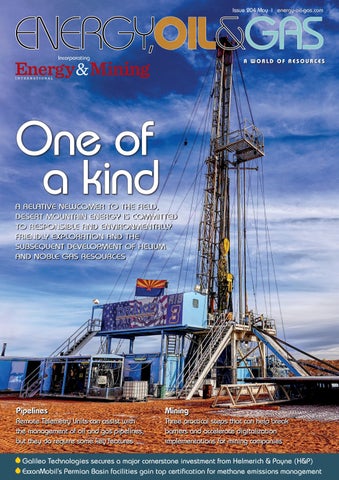
A RELATIVE NEWCOMER TO THE FIELD, DESERT MOUNTAIN ENERGY IS COMMITTED TO RESPONSIBLE AND ENVIRONMENTALLY FRIENDLY EXPLORATION AND THE SUBSEQUENT DEVELOPMENT OF HELIUM AND NOBLE GAS RESOURCES
Pipelines
Mining
Remote Telemetry Units can assist with the management of oil and gas pipelines, but they do require some key features
Three practical steps that can help break barriers and accelerate digitalization implementations for mining companies
Galileo Technologies secures a major cornerstone investment from Helmerich & Payne (H&P) ExxonMobil’s Permian Basin facilities gain top certification for methane emissions management
EDITOR Editors Chairman Andrew Schofield Group COO Joe Woolsgrove Editor - Libbie Hammond libbie@schofieldpublishing.com lhammond@finelight-media.com
In our look at minerals an important point is raised – in our pursuit of a low carbon future, our reliance on key minerals increases. This is good news for mining companies and mineral rich countries, with opportunities for investment on the agenda
Assistant Editor - Will Daynes Staff Writers Daniel Baksi, Alex Caesari, Danielle Champ, Jessica Olley Managing Art Editor - Fleur Daniels Art Editor - David Howard Art Editor - Paul Gillings Sales Director Alasdair Gamble Business Development Director Philip Monument Research Managers Michelle Fontaine, Natalie Griffiths, Jo-Ann Jeffery, Ben Richell, Basil Sharpe
Mine of information
Editorial Researchers Adam Blanch, Victoria Burke, Mark Cowles, Jeff Goldenberg, Dan Harrison, Melanie Joyce, Dana McElroy, James Page, Wendy Russell, Richard Saunders, Kieran Shukri, Gregory Waller
Hello and welcome to the May issue of Energy, Oil & Gas. In this issue we are paying a bit of extra attention to the Mining sector, in recognition of the inclusion of Energy & Mining International within our pages last year. In our look at minerals an important point is raised – in our pursuit of a low carbon future, our reliance on key minerals increases. This is good news for mining companies and mineral rich countries, with opportunities for investment on the agenda. We also look at mining and digital transformations – digital technology is already changing the sector but there are barriers holding back progress. Joseph Galdes, Associate Global Sector Manager for Mining at Shell, discusses three practical steps that can be taken to accelerate digitalization. If you have a mining story or there’s a topic you would like to see covered in the magazine, do let me know. I would love to hear from you! Let me end by highlighting some of our company profiles in this issue – it’s been so interesting to hear from the management team of Canary Biofuels, TJ Paskach of San Joaquin Renewables and Robert Rohlfing of Desert Mountain Energy. Their operations are fascinating and the focus on alternative sources of fuel aside from traditional oil and gas operations is inspiring. Each article makes excellent reading – I hope you find something in our pages that piques your interest.
Advertising Sales Johanna Bailey, Mike Berger, Jessica Eglington, James Fuller, Alex Hartley, Reid Lingle, Sam Surrell, Gregory Waller Head of Media Global Programs Mark Cawston mcawston@schofieldpublishing.com Florida General Manager Ryan Finn Boston General Manager Joy Francesconi Custom Media Sales Dan Bess Digital Sales Mike Psimis
EDITOR LIBBIE HAMMOND
Subscriptions i.kidd@schofieldpublishing.com Administration Rory Gallacher, Ibby Mundhir
© 2022 Schofield Publishing Limited all rights reserved
Schofield Publishing Ltd - Corporate Head Office 10 Cringleford Business Centre Intwood Road, Cringleford, Norwich, NR4 6AU, UK T: (312) 854 0123 | T: +44 (0) 1603 274130
Energy, Oil & Gas Magazine
Finelight Media LLC 2240 West Woolbright Road, Suite 402 Boynton Beach, FL 33426 Tel: (561) 778 2396
@EOG_magazine
PLEASE NOTE: The opinions expressed by contributors and advertisers within this publication do not necessarily coincide with those of the editor and publisher. Every reasonable effort is made to ensure that the information published is accurate, and correct at time of writing, but no legal responsibility for loss occasioned by the use of such information can be accepted by the publisher. All rights reserved. The contents of the magazine are strictly copyright, the property of Schofield Publishing, and may not be copied, stored in a retrieval system, or reproduced without the prior written permission of the publisher.
ENERGY,OIL&GAS
energy-oil-gas.com
1
REGULARS
4
Pipelines
In order to minimize downtime and interruptions, companies must resolve any pipeline issues quickly and effectively — this is where Remote Telemetry Units (RTUs) can play a crucial role
6
20
Digital transformation
Why digital maturity assessments are needed prior to any transformation projects, and the questions that need to be asked – companies must not only focus on the ‘digital iceberg’
6 San Joaquin Renewables LLC
32 10
Minerals
A low-carbon future isn’t possible without significant access to key minerals. This will increase demand and bring new opportunities to mining companies and mineral rich countries
14
Mining
Mining businesses need to accelerate digitalization but many are unsure how to bring the tools together to achieve their vision for the future of mining
36
14
16
News
Some of the recent developments within the oil and gas industry
2
Canary Biofuels
ENERGY,OIL&GAS
energy-oil-gas.com
BKV Corporation
PROFILES
34
26
COVER STORY
Desert Mountain Energy
44
Mega Industry Control Systems
ENERGY,OIL&GAS
energy-oil-gas.com
3
Problem
solvers
MATTHEW HAWKRIDGE EXPLAINS HOW RTUS CAN HELP TO TACKLE THE COMMON ISSUES IN PIPELINES
While pipelines play an essential role in the oil and gas industry, they are not fail-safe. Common issues include structural failures such as cracks, leaks and corrosion. In order to minimize downtime and interruptions, companies must resolve any issues quickly and effectively – this is where Remote Telemetry Units (RTUs) come in. Operators face a wide range of issues when managing oil and gas pipelines. These large networks necessitate the
4
ENERGY,OIL&GAS
energy-oil-gas.com
continuous monitoring of remote fixed assets and data logging, while also managing complex remote automation and control applications without any operators in the field. This is where RTUs play a crucial role, particularly for ensuring critical data from the field is not missed and is available for analysis. Specific issues that RTUs can address include the monitoring of flow, pressure and temperature; natural gas flow measurements; optimization and secondary recovery;
PIPELINES
storage facilities; and pressure monitoring. However, because they are trusted to achieve so much, a number of practical considerations should be made when choosing an RTU system. An RTU must have several key features. First, resilience to the site environment - for instance, can the RTU withstand hazardous conditions or fluctuating temperatures? A unit should operate with minimal drain on local power resources, with enough processing power to perform any local control algorithms autonomously. Your chosen RTU should have extensive diagnostics capabilities. That includes a low Mean Time to Repair (MTTR), which reduces the time technicians spend on site, for improved efficiency and personnel safety. This is especially important for the oil and gas sector right now, as increased needs for efficiency, environmental protection and safety drive the market for data analysis and asset management. RTUs should be equipped to be deployed on a vast range of assets. Once installed, the RTU can perform autonomous control in real time and then report to the SCADA system. Put simply, the real value of an RTU is that it has everything under control - which also benefits human workers.
Better decisions With the right RTU in place, operators at the SCADA interface can supervise operations by setting new key performance indicators (KPI) or updating instructions examples include open/close or start/stop. RTUs can then act upon these commands and manage assets locally. With this accurate, real-time data, management teams can make moreinformed and better decisions. When critical devices run in remote locations, it’s inevitable that communications will fail regularly. However, RTUs can manage this. For instance, the data an RTU collects can be used to support maintenance decisions and to verify that environmental obligations are being adhered to.
Because they do everything locally, RTUs continue to run if communications break down. Historian capabilities mean the device maintains a historical log and reports back on it later. RTUs can support operators, benefit maintenance teams, health and safety initiatives and environmental management. It’s clear that RTUs offer a solution for many of the common issues facing pipeline operators - whether structural failures or pressure monitoring, asset optimization or logging critical data in remote locations. Through a careful choice of RTUs, operators can improve efficiency, environmental protection and personnel safety. If you found this article interesting, take a look at Ovarro’s RTUs in action in one of its oil and gas case studies: https://www.ovarro.com/ en/europe/case-studies/. For a list of the sources used in this article, please contact the editor.
MATTHEW HAWKRIDGE Matthew Hawkridge is chief technology officer at Ovarro. Ovarro is the new name for Servelec Technologies and Primayer. Ovarro’s technology is used throughout the world to monitor, control and manage critical and national infrastructure. Its connected technology is always there, always on. Secure, proven, trusted; integrating seamlessly with clients’ assets. Collecting and communicating data from some of the most remote locations and harshest environments on the planet. Enabling businesses to work smarter and more effectively. Ovarro works with customers across water, oil & gas, broadcast and transportation to help monitor, control and manage their assets. For further information please visit: www.ovarro.com
ENERGY,OIL&GAS
energy-oil-gas.com
5
Undergoing
transformation
DIGITAL MATURITY – THE VALUE OF THE TOOLS FOR TOMORROW. BY JACO VERMEULEN
6
ENERGY,OIL&GAS
energy-oil-gas.com
DIGITAL TRANSFORMATION
There have been some early, awkward attempts at assessing the technological maturity of a business before it undertakes a digital transformation. These have typically focused on the ‘digital assets’ of a company, limited to websites, search rankings etc. This is, however, woefully inadequate for most businesses.
To be of any real use, digital maturity must encompass the impact of digital on how a business operates, both now and in line with future plans. In a modern, integrated, datadriven world, businesses need to become more automated and make extensive use of technology to do so – this is at the core of digital transformation success.
ENERGY,OIL&GAS
energy-oil-gas.com
7
This cannot be understated. There are traditional specialist tasks that are no longer attractive to a younger generation – anything from invoice processing to demand forecasting to route planning to workforce optimisation, insurance claims processing and payouts; invoice validation; or tracking components and stock through production, warehousing, and distribution. These are not tasks that it would be nice to replace by automation, they are tasks that MUST be replaced by automation. But that process cannot begin without an awareness of the current state of the business: hence the need for digital maturity assessments.
What does digital maturity look like? This realization promotes an immediate set of questions: l How connected, integrated, and automated is the business? l How are ways of working tied to data? l How does the business operate from a technological perspective? l Are the tools and systems fit for the current job AND future objectives? l Does the business have the right tools, systems? l Are all technology and services appropriately licensed or contracted? l What is the data or compliance exposure to risk? l Are there security risks? This can be understood as a digital iceberg. Typically, most assessments of digital maturity focus on that which
8
ENERGY,OIL&GAS
energy-oil-gas.com
can be seen above the water, exemplified by online customer interfaces, some business intelligence, analytics, and machine learning. But most of the value of the transformation project lies beneath the water as technology determines operational, supply chain and even HR issues. For example, the implementation of a new ERP system within Total offered the opportunity to revisit processes, operating models and services throughout distribution, sales, stock and replenishment. Technology was leveraged to automate the monitoring of fuel levels across a diverse portfolio of locations, including forecourts, airports and ports. The huge leaps in value were then delivered by developing a predictive supply capability fed by sensorbased, on-site data capture. The project also used IoT for maintenance of the assets, driving further value as proactive and strategic maintenance saves both cost and time of downtime. This example shows that it is critical that businesses explore – at quite some depth – the anticipated state of the business in the coming three to five years, and ensure that technology is there to support those changes. All too often assessments are made without consideration to the deeper issues such as code development, security, and data flow that may develop beyond the first 12-18 month period. This gives a very static picture of the digital maturity of a company at any one point in time, rather than future value of efficiencies and opportunities, or indeed the risks that may arise.
DIGITAL TRANSFORMATION
Applying this to industry: case study Our client is a utility infrastructure asset owner and operator, specializing in gas and electricity networks. They have over half a million connections in the UK across both residential and industrial markets. Amidst some of the most buoyant conditions for housebuilding seen in the past three decades, it became critical for our client to be able to onboard new assets and customers quickly, with minimal friction. However, our client was restricted by manual, inefficient paper-based processes, and systems. Poor data quality was endemic and ageing systems were not integrated, leading to a great deal of duplicated effort. This was particularly acute within the finance function where there were multiple occasions of the same documentation both in paper form and stored in different systems. With no online capabilities and all the systems only accessible at a single office location, our client suffered from huge silos of information and fragmented operations. Off-line, manual processes led to substantial issues with customer experience, seen in high customer attrition and a lack of visibility into the value of any given account. BML Digital installed a technology figurehead and initiated a complete strategic objectives review. This included both an assessment of the operational model and business functions, as well as a ‘current state’ IT review. From this, we proposed a change approach with an investment plan that would deliver defined phases of change with incremental improvements. This plan included the specification of technology solutions, supplier onboarding as well as technology leadership and change coaching with the establishment of a dedicated change team. We then tackled these processes to ensure compliance and governance, throughout both supplier and programme management.
The outcomes from this digital transformation programme have included: n The establishment of a core, foundational cloud native IT capability that enabled uninterrupted business operations during Covid-19 disruptions n A reduced need for headcount n The implementation of a seamlessly integrated Microsoft-based enterprise applications platform for customer, operations, and finance capabilities n The complete integration of necessary legacy systems and third-party services n Better collaboration across the workforce, with faster operations and reporting n A substantial improvement in customer service leading to lower attrition n Far greater visibility into both finance and operational departments Most critically, our client is now able to capitalise on an incredibly active market with consistent, standardised business practices that have formed the basis of growth.
JACO VERMEULEN Jaco Vermeulen is CTO at BML Digital. BML Digital is a consultancy that demystifies digital transformation. It simplifies the technologies most relevant to modern business to deliver focused, powerful, pragmatic, and effective digital strategy and transformation to some of the biggest names in commerce. For further information please visit: http://www.bmldigital.com
ENERGY,OIL&GAS
energy-oil-gas.com
9
Climate Change, Net Zero and Minerals
CHARLES BOND AND NAOMI SANDER LOOK AT THE ROLE OF MINERALS IN THE GLOBAL NET ZERO TRANSITION
Shifting to renewable energy sources plays a major part in global efforts to mitigate climate change. Since the 2015 Paris Agreement, renewable energy consumption has increased at a year-to-year rate of around ten percent. However, to continue to meet on-going targets, investment will be needed in the further wide-scale adoption
10
ENERGY,OIL&GAS
energy-oil-gas.com
of low-carbon energy alternatives, especially in light of the government’s long-awaited transport decarbonization plan that was announced recently. A low-carbon future isn’t possible without significant access to key minerals. Wind, solar and energy storage batteries are particularly reliant upon minerals. However,
MINERALS minerals required for the clean energy shift are more material intensive than traditional fossil-fuel-based alternatives. The 2015 Agreement climate stabilization targets require quadrupling mineral requirements for clean energy technologies by 2040. While new opportunities will arise for mining companies and mineral-rich countries, significant challenges will need to be overcome in mineral price volatility, mineral supply equity and resource sustainability.
The role of minerals in renewable technologies The most commonly used minerals here are aluminum (including its key constituent bauxite), chromium, copper, iron ore, lithium, lead, manganese, molybdenum, silver, steel, zinc and the rare earth metal indium. Below is an overview of the key mineral requirements of the three most important elements of renewable energy technology: wind power, solar power and battery storage technology. Wind Power The wind turbine industry predominantly uses geared turbines with coil-driven generators that require significant amounts of copper. They also require aluminum, chromium, iron, manganese, nickel, steel and zinc. Solar Power The most commonly produced Solar Photovoltaic (PV) cells are crystalline silicon, followed by copper indium gallium selenide (CIGS), cadmium telluride (CdTe) and amorphous silicon/amorphous silicon-germanium. Energy Storage Batteries There are many technologies for energy storage batteries, including the two most popular forms – lead-acid and lithium-ion – and a variety of other battery chemistries, including nickel-metal-hydride and sodium-sulphur.
Increasing global demand for minerals: new opportunities for mining companies and mineral rich-countries The average amount of minerals needed for a new unit of power generation capacity has increased by 50 percent as the share of renewables has risen. As renewable energy technology demand continues to increase, so will demand for the necessary minerals. Under a 2-degree scenario (2DS) the production of graphite, lithium and cobalt will need to increase from 2018 levels by over 450 percent by 2050 to meet demand from energy storage technologies. Experts predict this global 2DC low-carbon switch will require $1.7 trillion of additional investment by mining companies over the next 15 years. The projections do not include the associated infrastructure needed to deploy renewable energy technologies, such as transmission lines and gas pipelines or that needed to support green societies, such as fully electrified public transport. As growth in demand for minerals soars, supply chains will need to keep up. The demand for renewable energy technology is global
but the required mining map of mineral resources required for these technologies is not. India is dominant in iron, steel and titanium. China’s position in mineral resources dwarfs that of other countries, including Canada and the US. In 2015 China was producing 32m metric tons of aluminum smelter. Russia was next with 3.5m metric tons produced. The map of untapped mining reserves is much broader with untapped pockets of the world holding huge amounts of resources. The largest share in 95 percent of world chromium resources, for example, are in Kazakhstan. More than 50 percent of global cobalt reserves are in Congo. The result is significant growth opportunities in supply for both mining companies and the currently under-served and under-producing mineral-rich nations. Latin America is in an excellent position to play a crucial role in global supplies of climate-friendly technology minerals. The continent holds particularly significant reserves of copper, iron, silver, lithium, aluminum, nickel, manganese and zinc. Africa has significant opportunity in supply, with large reserves of platinum, manganese, bauxite and chromium. Guinea alone holds 26 percent of known global reserves of bauxite, but is currently only responsible for 6.5 percent of global production. Developing countries overall hold 94 percent of the world’s bauxite reserves, 100 percent of chromium reserves, 67 percent of cobalt reserves and 46 percent of copper reserves. There is opportunity for investment in mining and mineral production in regions that have historically struggled to capture significant components of global supply chains. Better mapping of minerals in Global South countries will create more opportunities to develop sustainable mining in resource-rich countries, where mapping technology is currently weak compared with resource-rich Global North countries.
Challenges of demand and price volatility For investors, predicting mineral demand will be challenging. Demand patterns will shift with the evolution of our energy systems, market innovations and selected different designs for similar technologies. Part of the challenge of mapping supply and demand patterns will be predicting technology choices. If, for example, amorphous becomes the preferred solar technology, demand in minerals will be slower than if the mineral intensive crystalline silicon solar PV installations were to win the battle for the market in that technology. If hydrogen takes off as expected, the need for platinum, iridium and titanium for electrolysers will intensify. Concentrated minerals such as graphite and cobalt with fewer technological uses may be subject to higher demand uncertainty, particularly if technologies change. For cobalt, demand could increase by up to 30 times depending on the evolution of battery chemistry and climate policies. Minerals with applications across numerous renewable energy technologies, are likely to maintain significant demand. Current investors looking for opportunities see coal production revenues ten times larger than the energy transition materials. However, continued strength in global climate change policies would result in revenues from energy transition material overtaking coal by 2040. The significant
ENERGY,OIL&GAS
energy-oil-gas.com
11
increase in demand for minerals will have a knock-on effect on the affordability of those minerals. Plotting the effect of rising mineral prices on demand will be a key element in predicting mineral investment opportunities in the renewable energy transition.
A super cycle for minerals? The phenomenal rise in demand for minerals is not slowing and predictions for future usage are staggering. The Benchmark Mineral Intelligence (BMI) index of lithium prices climbed 59 percent between April 2020 and May 2021; BMI also forecast lithium demand to more than triple between 2020 and 2025, rising to a million tons and outpacing supply by 200,000 tons. Nickel usage is predicted to grow seven-fold to 240,000 tons in 2023, a compound annual growth rate (CAGR) of 20 percent. Graphite usage has increased 233 percent between 2020 and 2021. All of this growth is a result of recent increases in electric vehicle production alone. Are we heading for a super-cycle? The need for minerals for renewable energy technology and its infrastructure will only become more urgent as we head towards climate change target dates. Although China is beginning to slow, it still outpaces all other nations on infrastructure spend. The US has been lacking in spending on infrastructure for decades, but is changing. President Biden’s $1.2 trillion infrastructure stimulus plan will be the beginning. Total US infrastructure investment needs are estimated to be closer to $3.8 trillion. Yet as this demand soars, supply dwindles. It seems
12
ENERGY,OIL&GAS
energy-oil-gas.com
difficult to conceive of how to avoid a significantly prolonged period of rising prices, supported by phenomenal demand and limited supply. The drivers behind rising mineral requirements require unprecedented levels of long-term supply of minerals that are not mapped and ready to extract. The length of this super-cycle hinges on the ability of government and industry investment, so future supply has a chance of meeting demand.
Mineral supply equity and resource sustainability This increasing demand for minerals for renewable energy technology will pose a challenge for mineral supply equity and resource sustainability, with long-term impacts from supply chains of non-renewable resources and the potential for an increased risk of environmental and human harm resulting from increased intensive mining of minerals. Addressing these challenges will require a correlation of thought and action between the mining-metal industry, climate and environmental groups and clean energy technology actors. Historically the law of natural resources, including minerals, focused on facilitating extraction rather than protection and sustainability. Contemporary governance, however, is more attuned to both efficiency (reducing waste and unintended consequences) and equity (fairness in control and distribution) in mineral mining. Now, organizations such as the Goa Foundation in South India, are fighting for, and winning, legal recognition of rights of intergenerational equity in mineral mining. Now there
MINERALS is global consensus: sustainable development of mineral resources must meet contemporary needs, without compromising the needs of future generations. Respecting this sustainable development whilst riding the wave of increases in mineral demands, will require recognition of the fundamental rights that can be impeded by unsustainable mineral practices. Respect for indigenous land rights, genuine efforts in local community and stakeholder participation and preventing environmental contamination, will be at the top of the sustainability agenda in mineral mining. Significant political instability in areas with significant mineral reserves, instability likely to only increase as mineral demand rises, will also pose a significant challenge. This challenge not only impedes the attractiveness of investments and ease of doing business in certain regions, but also has foundational implications for the human development and well-being of some of the world’s most vulnerable people. Beyond external impact, pressure is also building from government and policy groups, such as the Task Force on Climate Related Financial Disclosures (TCFD), for the decarbonization of mining companies. Long-term mineral supply will require climate change risk adaptation policies that address the sector’s particular challenges, such as assets that are particularly vulnerable to the volatile weather patterns that will arise from changes in global temperatures. One of the biggest current environmental concerns of mineral-intensive renewable energy technologies comes from the recycling of these minerals following the end-of-life of these products. Currently, recycling rates are only positive for iron and steel. Increasing rates of recycling of these metals could improve supply and sustainability but further research and attention is needed here, as recycling rates are currently poor. Reuse of minerals will play a key role in meeting future mineral demand. If, for example, end of life recovery and reuse of aluminum were to increase to 100 percent, there would be a reduction of 25 percent in global production needs. However, reuse rates vary greatly across minerals due to technological and cost issues. This is one area where increased policy measures can incentivize global action and mitigate some concerns. If there is no mitigation of the potentially harmful environmental and social effects of mineral production, clean energy technologies may not continue to have the same level of global support that they have today. Regional innovators in clean technology, such as Green Lithium in the UK, are working with strategic partners to develop clean and low-carbon processing of minerals for regional needs. Alternatives to traditional energy storage technologies, such as liquid energy storage, are developing. Globally, programs like the World Bank Climate Smart Mining Initiative will play a key role in marrying the opportunities and challenges of ensuring a stable and sustainable supply of minerals for renewable energy technologies, whilst limiting the carbon and environmental footprints of the associated increase in mineral production.
Conclusions There is a huge opportunity for valuable and equitable investment in mining and mineral-resource rich countries to support global support for renewable energy technologies. To ensure that this opportunity develops in a manner that is sustainable and equitable will require an open dialogue between the climate, clean energy and extractive industry communities, to allow for effective alignment of the mineral and renewable energy sectors to meet the net zero targets. Corporate, governments and policy leaders will need to take an active role in mitigating mineral investment risk to ensure adequate flow of capital into the sustainable mining needed to support the net zero transition. For a list of the sources and references used in this article, please contact the editor.
CHARLES BOND Charles Bond is a natural resources partner at international law firm, Gowling WLG. With more than 1,400 legal professionals in 19 cities worldwide, Gowling WLG provides clients with in-depth expertise in key global sectors and a suite of legal services at home and abroad. It sees the world through its clients’ eyes, and collaborates across countries, offices, service areas and sectors to help them succeed, no matter how challenging the circumstances. Gowling WLG (UK) LLP is a member of Gowling WLG. For further information please visit: www.gowlingwlg.com
ENERGY,OIL&GAS
energy-oil-gas.com
13
Putting the pieces
together
THREE PRACTICAL STEPS MINING BUSINESSES CAN TAKE TO ACCELERATE DIGITALIZATION. BY JOSEPH GALDES
Digitalization is like completing a jigsaw puzzle. Each piece by itself won’t complete the scene. Only when you start putting the pieces together will the big picture become clear to you. You might already have a vision or a guide for how the completed puzzle should look – an end goal to achieve. But that doesn’t guarantee success. You still need to put in the work to bring it all together. And that’s where the challenge lies for the mining industry. Operators have access to the digital tools that can drive productivity, safety and sustainability. Still, many are unsure how to bring them together to achieve their vision for the future of mining.
The digital canary is already deep in the mine For mining businesses, digital transformation is no longer a case of ‘if’ or ‘when’. ‘How’ is the question on everyone’s minds.
14
ENERGY,OIL&GAS
energy-oil-gas.com
Digital technology is already transforming mining. For instance, tools already in use include sensor networks that enable predictive maintenance to prevent vehicle and equipment failure, real-time GPS systems that track machine utilization to improve efficiency. And you can’t have missed the various stories about operators using drones to map out their sites. It’s not like the options aren’t there. Shell solutions like MachineMax and OREN are already helping operators overcome their major challenges through digital innovation1,2. The desire to adopt these new tools exists as well. Businesses are keen to make progress on their digital transformation journeys. In fact, our latest research highlights how seven out of ten mining leaders see it as an urgent priority3. So, what are the barriers standing in the way of their digital vision?
MINING
Legacy systems are holding back progress A major issue for many is that, while they’re keen to accelerate digitalization, it’s a difficult ask. And it comes down to not knowing how to combine the old with the new. Existing systems pose a challenge, with 94 percent of mining companies saying that legacy infrastructure is a barrier to further digitalisation1. Also, 84 percent are struggling to navigate the complex mix of digital solutions available to them1. To overcome these barriers, operators need practical tools and solutions that meet their specific individual needs and budgets. They also need to understand how to build links between the new solutions they’re adopting and the existing systems they’re often continuing to invest in.
The three next steps your business should take All of this is easier said than done. However, there are three practical steps that mining businesses can take to start piecing their digital jigsaw puzzles together: 1. Create a digital roadmap I know. This might sound like a backwards step to some, but it’s vital. If you jump ahead too quickly, your next steps will be difficult. So, before you start looking at all the exciting digital tools that could transform your operations, you need to answer some vital questions. Firstly, what problems are you trying to solve? What are the use cases for these new tools? How do you need them to interact with your other systems, and what happens if it doesn’t? How will your digital ecosystem enable and accelerate meeting your strategic goals? These aren’t the only elements to think about, but the answers will help you make more informed choices when you select your solutions. 2. Choose solutions that meet evolving needs With a clear understanding of the problems to solve and the digital gaps to fill, you’ll have a much better chance of finding the right solutions for your needs today and tomorrow. Also, you’ll be able to have much clearer conversations with suppliers about the tools you need, reducing the risk of choosing the wrong solution. This means, when exploring the digital marketplace, you can assemble a package of proven and vetted technologies. A package you can be confident will meet your specific requirements and work alongside your existing systems. 3. Integrate solutions intelligently It’s worth remembering that there’s no single solution that can resolve every issue. This means you’ll need a way to bring a range of tools and platforms together. And to do that, you don’t even need to integrate the solutions themselves. Instead, you can integrate the data behind them – simplifying the process by avoiding the need to create
anything new. This makes it easier for you to connect new solutions to your existing systems (because, in some cases, you’ll already have the technology you need). It also means that any time you adopt a new digital tool, you can simply link it to the rest of your set-up through the data.
Accelerating your digital journey with intelligent integration Intelligent integration of solutions is vital to any operator’s digital transformation journey. After all, the conversation doesn’t stop when you’ve implemented one solution. You need the ability to future-proof your business and add extra tools as new challenges arise. Integration via data can help you to do that. And, by making a complex process simpler, it can drastically reduce the time it takes you to link your digital tools. Some customers we’ve worked with on this have seen what would have been four-year programs completed in just three months using intelligent integration4. It can also play a role in helping you to decarbonise your operations. In this area, you need to understand and monitor on-site emissions, so it’s all about being able to gather and analyze data. Link the right tools and you can create the ability to do this in real-time – giving you the insights to inform decision making and drive impactful actions. No doubt you have a vision for what the future of your business could look like. Now you need to put together the pieces of your digitalization jigsaw to make it a reality. 1 https://machinemax.com/pages/customers 2 https://www.orensolutions.com/s/integrations 3 Based on a survey of 300 global industrial business leaders carried out by Shell and Edelman Data Intelligence in June 2021 4 https://www.shell.com/business-customers/lubricants-for-business/ perspectives/mark-hannan.html
JOSEPH GALDES Joseph Galdes is Associate Global Sector Manager for Mining, Shell. Shell Lubricant Solutions works with organizations to deliver more value while maximizing profits and minimizing the negative impact through its end-to-end lubrication and services offering. No matter the industry or challenge, Shell Lubricant Solutions has a complete offering of products, services, and expertise to enable customers to put their potential in motion to get the most from their equipment, people, and processes. Find out more about how digital transformation is driving decision making in mining with our Under Pressure: Leading in Paradox Industries research report: https://shell.com/leadershipreport
ENERGY,OIL&GAS
energy-oil-gas.com
15
NEWS
Teesside project award On behalf of its partners, bp – the operator of the Northern Endurance Partnership (NEP) has awarded Costain the onshore FEED contract for the East Coast Cluster carbon capture, utilization, and storage (CCUS). Costain will design the onshore CO2 gathering pipeline and the new grid connection for the gas power station. The carbon capture and storage (CCS) project will provide the common infrastructure needed to transport CO2 from emitters in the Humber and Teesside to secure offshore storage in the North Sea. This will include H2Teesside, bp’s world-scale hydrogen project that aims to produce 1GW of CCUS-enabled blue hydrogen. The award reinforces Costain as a key player in delivering the UK government’s ten-point plan for a green industrial revolution.
Major investment Galileo Technologies, a company that deploys a unique technology to capture natural gas from any source and convert it into Liquefied Natural Gas (LNG) on-site, has secured a major cornerstone investment from Helmerich & Payne (H&P), North America’s largest land drilling solutions provider. H&P invested $33m into the company in the form of a convertible note. The convertible note bears interest of five percent per annum and is due April 2027. The companies also plan to identify and pursue business development opportunities, which, if successful, have the potential to reduce fuel costs and carbon emissions from power consumption on well sites. Galileo’s technical expertise combined with H&P’s wide network of drilling sites provides significant opportunity for widespread application of the liquefaction technology in North America.
16
ENERGY,OIL&GAS
Solar agreement Centrica Business Solutions has signed a framework agreement with renewable energy developer Push Energy, to build a pipeline of solar farm projects in the UK. It forms part of Centrica Energy Assets’ ambitions to deliver 900MW of solar and battery storage by 2026. “This is an important relationship and a big step towards our aim to develop, build, manage and optimise a 900MW portfolio of Centrica-owned solar and battery projects, that will help provide our customers with clean energy,” commented Bill Rees, Director of Centrica Energy Assets. Push Energy is renowned for its ability to develop, construct and operate high quality renewable energy assets, and has delivered 350MW of energy projects across grid-scale and roof top solar. Centrica Energy Assets, a team established by Centrica Business Solutions to develop large scale, grid-connected solar and battery storage assets in the UK and Europe, will work with Push to take projects from site identification to commercial operation. “Push is committed to helping the UK reach net zero by 2050, by developing and constructing sustainable solar farms that give back to the local community. Working with Centrica is an excellent opportunity which will help us accelerate this process,” said Amit Oza, Chief Commercial officer of Push. In addition, Centrica will use Push as a turnkey engineering, procurement, and construction (EPC) provider to build solar projects that are developed through a framework agreement between Centrica Energy Assets and Push.
Wind partnership OPITO, the leading global safety and skills organization for the energy industry, and the National Offshore Wind Institute (NOWI), based at Bristol Community College in Massachusetts, have signed a Memorandum of Understanding (MoU) under the terms of which OPITO will work with NOWI to optimize workforce development and provide skills and safety training for the emerging New Bedford Port cluster in South Massachusetts and its pipeline of offshore wind projects. Andy Williamson, Head of Energy Transition at OPITO commented: “OPITO also has more than 50 years of experience operating in the UK, which has created the world’s most active offshore wind market and installed the most capacity globally. We look forward to sharing best practices in training and skills development to optimize the US offshore wind market and create employment opportunities now, and in future.” Jennifer Menard, VP Economic & Business Development at NOWI added: “The relationship with OPITO is one of several long-term arrangements we are looking to put in place with key players in the offshore wind sector. It will also complement the longstanding relationship we have with our development partner, Maersk Training, as we look to establish the NOWI as the preeminent offshore wind workforce development center of excellence on the east coast of the US.”
energy-oil-gas.com
World’s largest
Mining deal ABB has won a large order for its highest payload Koepe production hoist, associated infrastructure, and safety systems from Australian mining company OZ Minerals. The contract will help to ensure efficient processing performance and a long service life as part of an on going $400 million expansion at the Prominent Hill mine in South Australia. The hoist, which will be designed and supplied by ABB, has a capacity of 39,400kg and the strongest drivetrain that ABB has ever installed in Australia. ABB specialists will also supervise installation and commissioning. OZ Minerals’ gold, silver and copper mine began operations in 2009 as an open pit mine, but it is now an underground mine producing 4.5 million tons per annum, moving to between 4.5 million and five million tons per annum from 2022 via a trucking operation. The hoisting shaft provides access to mineral resource outside the current trucking mine plan that would have been uneconomical via a trucking operation from around 2033. Installing the Wira shaft will increase the annual underground mining rate, extend the mine life, reduce operating costs, lower emissions intensity, and reduce overall operational risk, according to OZ Minerals.
Top certification ExxonMobil has revealed that approximately 200 million cubic feet per day of natural gas produced from its Permian Basin facilities at Poker Lake, New Mexico have been independently certified and received the top grade for methane emissions management. The certification from MiQ helps the company meet customer demand for energy produced with fewer emissions. ExxonMobil is the first company to achieve certification for natural gas production associated with oil. “This certification further validates the steps we have taken to reduce methane emissions, which is part of our plans to achieve net zero Scope 1 & 2 greenhouse emissions in our Permian Basin unconventional operations by 2030,” said Tom Schuessler, senior vice president of unconventional at ExxonMobil. “Certification gives our customers confidence that we are responsibly producing natural gas with best-in-class emission management programs to help them meet their emissions goals.” MiQ awarded the ‘A’ grade certification because of ExxonMobil’s extensive multi-tiered technology approach to methane monitoring and mitigation at its Poker Lake facilities in New Mexico. These efforts include a combination of fixed monitoring systems, aerial imaging technology, optical gas imaging cameras, proprietary acoustic sensors, and robust leak detection and repair practices. Responsible Energy Solutions performed ExxonMobil’s assessment using the MiQ Standard. ExxonMobil is expanding the certification process to other operating areas, including Appalachia natural gas operations in Pennsylvania and West Virginia.
The world’s largest zero-emission haul truck made its debut on May 6th, powered by creative engineering firm First Mode’s clean energy innovation. The ultra-class haul truck once burned thousands of gallons of diesel fuel per year, but now it’s powered by a hydrogen fuel cell and lithium-ion battery powerplant designed and built by First Mode engineers in Seattle. The two-megawatt hydrogenfueled powerplant was installed in a haul truck at Anglo American’s platinum mine at Mogalakwena, South Africa. This vehicle is the world’s largest zero-emission truck. As tall as a three-story building and weighing 200 tons empty, this truck can carry up to 290 tons of ore. Deploying Anglo American and First Mode’s zero-emission power source keeps 700 cars’ worth of carbon dioxide emissions out of the atmosphere. “At First Mode, we know we are at a ‘fire-everything’ moment. The urgency in front of us requires that we deploy every tool and every technology to battle climate change,” said Chris Voorhees, president and CEO of First Mode. “I’m so proud of the team and our partnership with Anglo American, focused on decarbonization at the source to affect the meaningful, necessary change we all seek. We hope that this zero-emission clean energy breakthrough will inspire others to create significant action in the fight for our planet.”
ENERGY,OIL&GAS
Photo: Anglo American
energy-oil-gas.com
17
From biomass to natural gas
After successfully securing $165m in capital funding, work is now underway at San Joaquin Renewables LLC for the rollout of what is set to be an innovative gasification project
20
ENERGY,OIL&GAS
energy-oil-gas.com
PROFILE
SAN JOAQUIN RENEWABLES LLC
In SJR, we’ll input the feedstocks into our gasification process to produce syngas, which we’ll then upgrade to the quality required to synthesize methane. Because the byproducts of that process include CO2 and water, we then added a carbon sequestration element. In all, that gives us a pretty carbon-negative profile, at about a 200 percent reduction relative to fossil fuels
Tucked away in Kern County, California, a project is underway to revolutionize the world’s relationship with natural gas. Known as San Joaquin Renewables (SJR), the project involves the design, building and operation of a facility for the conversion of agricultural waste
biomass into approximately 30m gasoline-gallon equivalents of fuel per year. Based in the town of McFarland, this facility is the brainchild of Frontline BioEnergy (Frontline). Launched back in 2005, Frontline has a long history in the design of systems and ENERGY,OIL&GAS
energy-oil-gas.com
21
Above: TJ Paskach, President of SJR, and Chief Technology Officer at Frontline BioEnergy
Above: Frontline gasifier at CVEC
22
ENERGY,OIL&GAS
proprietary equipment for biomass gasification. Already with a glittering history of successful project development – notably, its work with the Chippewa Valley Ethanol Company (CVEC) for an ethanol plant boiler in Benson, Minnesota – and a mission to become a global leader within its field, SJR is Frontline’s first venture into a project developed and operated entirely in-house. It was in 2009 that TJ Paskach, now President of SJR, and Chief Technology Officer at Frontline BioEnergy, first joined the company. He did so at a difficult time for Frontline, as the onset of the financial crisis and the success of fracking brought an end to rapidly increasing prices for natural gas. With a market strategy predicated on the production of renewable fuel gas for the ethanol industry, Frontline was forced to pivot towards new outputs. To do so, the company invested heavily in research and development. “We reinvented ourselves,” TJ says. “Gasification can be more than just making boiler gas; if we can create higher-quality syngas, we can produce fuels and chemicals – and so energy-oil-gas.com
Above: Frontline CEO Jerod Smeenk
that’s what we did. Together with Frontline CEO Jerod Smeenk, we co-invented what we now call TarFreeGas®, a unique and scalable technology that nobody else has. We also became more involved in the downstream, first creating an integrated pilot plant for the production of renewable methanol as an input for biodiesel.” With the decision taken to pivot towards renewable natural gas, Frontline quickly revamped its pilot plant from methanol to methane synthesis. “That, ultimately, is the basis of the SJR project: through syngas re-methanation, we’re creating a fungible, transportable biofuel. Right from the start, we were successfully making methane,” TJ reflects. “Technologically, we had no problems. From a business perspective, the yields were exceptionally high, with a conversion efficiency
PROFILE
Above: Frontline filter at CVEC
of about 60 percent. It’s now been about three and a half years since we started developing the project, and we’ve built a lot of momentum. We did an initial private placement memorandum, and last October we announced our equity funding deal, which will provide all the capital cash equity that we need for the project.” In its delivery of SJR, Frontline is supported by investments of $165m from Cresta Fund Management and Silverpeak Energy Partners – a commitment that speaks to the project’s immense potential. “California is the largest market for compressed gas as transportation fuel in the US,” TJ notes. “Natural gas has a carbon intensity of about 68 grams of CO2 equivalent per megajoule as a transportation fuel. If you’re able to come in lower, then you’ll be eligible for carbon credits under the California Low Carbon Fuel Standard. That in turn creates value for the project.” It’s not all about economics, however. The location of the project, within California’s San Joaquin Valley, is of vital importance. “The input for the SJR plant is the agricultural waste found throughout the valley,” TJ indicates. “A lot of the crops grown in the local area, including almonds, pistachios, walnuts, and citrus, have an economic life of somewhere between 20-to-30 years. Once that period expires, the orchards are replaced with more productive trees, creating a large mass of leftover wood. This region, owing to its dry climate, has a longstanding bioenergy industry founded on the incineration of that wood for electricity, although that’s declined with the advance of solar and wind energy. “Several alternatives have been tried, but gasification is perhaps the best,” he continues.
SAN JOAQUIN RENEWABLES LLC
“In SJR, we’ll input the feedstocks into our gasification process to produce syngas, which we’ll then upgrade to the quality required to synthesize methane. Because the byproducts of that process include CO2 and water, we then added a carbon sequestration element. In all, that gives us a pretty carbon-negative profile, at about a 200 percent reduction relative to fossil fuels.” This isn’t the only way in which the SJR project is setting new standards with regard to efficiency. “Another push within our engineering process design is to eliminate the consumption of water,” TJ notes. He then asks, “Is that possible? As it turns out, yes. Because we’re in a desert location, there’s very little water. We’re not going to put up a cooling tower, nor are we going to use a well to evaporate all the water, because it’s needed for agriculture. Instead, the gasification process produces water, as does methanation, as a result of the oxygen and hydrogen components within the biomass. “In terms of what we do with that the water,
ENERGY,OIL&GAS
energy-oil-gas.com
23
PROFILE
SAN JOAQUIN RENEWABLES LLC
San Joaquin Renewables LLC https://sjrgas.com ......................................... Services: Renewable natural gas production
24
ENERGY,OIL&GAS
we could clean it up and sell it, and some does go back into internal consumption,” he goes on. “However, there’s greater value to be had by mixing it with ammonia – another coproduct of gasification – to produce a green fertilizer, which we then sell as a 40 percent aqueous solution. Similarly, water also has application as a de-dusting agent for our biochar coproduct, which is created from the heating of biomass material in limited oxygen at a high temperature. By adding water to that, it helps turn it into a product with uses across soil enrichment and water treatment.” Beyond its work on SJR, Frontline is exploring further avenues for innovation. “We’re involved in a couple projects in western parts of the U.S. and Canada,” TJ confirms. “The objective of one of these projects is to make renewable aviation fuel from forest residues, utilizing our technology on the front end to produce the syngas. Another project that is similar in kind to SJR, albeit at a reduced scale, will produce renewable natural gas from forest and mill residues.”
energy-oil-gas.com
This year is set to be a busy one for Frontline, as project engineering for SJR gets underway. Nevertheless, it’s not the company’s only focus. “We’re replacing our current pilot plant with another at ten times the scale, and we’re currently ironing out the kinks,” TJ reveals. “We’re also licensing our technologies to several other biofuels projects, actively participating in the project engineering work, with the expectation of winning further contracts in the years to come. It’s a wide-open field in terms of biomass, with a lot of the market available to us. “Although our focus remains developing projects in the US, we are open to partnering with a company in Europe to license our technology overseas,” he concludes. “Likewise, we’re interested in expanding into gasification for municipal solid waste. It’s a real challenge technically, but one that we’ve managed to meet. The market is very promising, and it’s been a lot of fun so far. We know that we have something the world needs, and we’re excited to demonstrate that further.”
One of a kind Driven by the expertise of CEO Robert Rohlfing, Desert Mountain Energy is threatening to shake up the US energy sector thanks to its advances in the exploration of helium and clean hydrogen
A relative newcomer to the field, Desert Mountain Energy (DME) began life as recently as 2018. Originally founded ten years prior as African Queen Mines Ltd, the once-mining company approached now-CEO Robert Rohlfing with a proposition to explore
26
ENERGY,OIL&GAS
energy-oil-gas.com
prospective helium, hydrogen, and noble reserves in Arizona’s Holbrook Basin, a large salt basin, situated close to the south margin of the Colorado Plateau in Apache, Navajo, and Coconino Counties. “Going back to 1999, I’d already conducted much of the geology
PROFILE
DESERT MOUNTAIN ENERGY
We’re constantly thinking out of the box, trying to be as close to zero carbon as possible. Our intention is to lead the industry, helping to bring other companies around to a new way of thinking
and base work,” Robert explains. “So, when the offer came in, I accepted, and the project developed from there.” A seasoned oil and gas industry operations executive, Robert boasts a strong geological background and over 26 years’ experience
in formulating, conducting, and managing successful exploration, drilling, development, and production programs for oil, gas, and minerals worldwide. Armed with his expertise, DME quickly set to work acquiring additional leases, before drilling its first two wells in ENERGY,OIL&GAS
energy-oil-gas.com
27
2020. “They came in beautifully,” Robert reflects. “We had a very high percentage of helium, and soon after we moved 75 miles to the west, where we drilled our third well, and made another discovery.” A fourth well at Holbrook soon followed, before DME launched operations at a new location, south of the city of Winslow, Arizona. Known as the McCauley Helium Field, it’s now home to a further three wells, including an exciting discovery: North America’s first clean hydrogen field. “Although the helium content in the McCauley Field isn’t quite as high a percentage as in Holbrook, it contains fewer of the other noble gases, and therefore lends itself to being more easily processed,” Robert notes. “Hydrogen, meanwhile, is typically found in the form of hydrogen sulfide. Stripping the
28
ENERGY,OIL&GAS
energy-oil-gas.com
sulfur from that is extremely energy intensive, and generally not cost effective. “Since 2010, I’ve spent a lot of time rappelling down the canyons, conducting sampling, examining the upper structures, studying the ground, the water wells, to find trace levels of helium and hydrogen, including a very specific area without sulfur,” Robert indicates. “That’s where we’ve decided to explore. We’ve been very blessed and lucky to find clean hydrogen to varying degrees. In the McCauley field, we found a combination of hydrogen, helium, nitrogen, and other components, and we now have the field defined within our leases.” Water-free production of both helium and hydrogen is a key component of long-term operation costs. “In a situation where you find helium and hydrogen together, one of the components you’ll have is water – a precious resource in Arizona, which requires protection,” Robert points out. “To achieve that, we’ve chosen to set multiple strings of casing in the wells to protect what should be, if not now, then in the future, treatable water. We’re taking extra steps to ensure that we remain conscious and aware of the environment.” In November 2021, DME released new details surrounding the construction of the McCauley Finishing Facility for the processing
PROFILE
of helium. The first of its kind, the plant will be powered exclusively by solar and hydrogen power, produced from the pay zone of DME’s wells. With a nearly zero-carbon footprint, it will involve no permanent construction,
DESERT MOUNTAIN ENERGY
ensuring that the site can be easily returned to its natural state upon its end-of-life. “When I first began looking at this area back in 1999, there were very few businesses that needed helium in Arizona,” Robert recalls.
...with exciting plans for new developments, upgrades and refinery expansions on the agenda, the business can be viewed as a leading light for not just Pakistan but for the wider energy industry
ENERGY,OIL&GAS
energy-oil-gas.com
29
“Now, there are 47 of them, 30 of which have launched within the last three years, driven in part, but not exclusively, by the growth of semi-conductors. We recently brought in five ultra-heavy haul trucks to transport our rigs and equipment. There have been a number of logistics and supply chain issues we’ve had to address recently, so we’re trying to stay ahead of the curve. “Working with an engineering firm, the plant itself has been designed to be lowemission, to the point where it falls outside the normal permitted processes,” he continues. “It’s not perfect, but so far, we’re really close to zero-carbon. It’s a project that goes back to 2008, when we began working with the EPA and the Arizona Department of Environmental Quality (ADEQ) to understand the regulations and to establish what was possible.”
30
ENERGY,OIL&GAS
energy-oil-gas.com
Due to come on board this year, the facility is set to be a key focus for DME in the short term. But Robert is already thinking about what might lie beyond. “Our goal is to use hydrogen to generate electricity for a state-of-the-art filling station, including the recharging of electric vehicles via hydrogen fuel cells,” Robert reveals. “We’re looking at dealing with two different companies to implement that between three-to-five years down the road. “We’ve also identified a few other potential areas for exploration that may have a similar hydrogen-helium component with nitrogen,” he continues. “That could fall between 2023 and 2025, and we intend to work with the state to execute that at an increased density, above one well per square-mile. Neon is another resource we’re looking to exploit.
PROFILE
DESERT MOUNTAIN ENERGY
Desert Mountain Energy www.desertmountainenergy. com ............................................ Services: Helium, hydrogen and noble gas exploration and production
In all, our goal is to become a leading independent company in the industry for the satisfaction of our future energy needs.” Once again, Robert is keen to emphasize DME’s commitment to responsible, environmentally friendly exploration. “We want to be an innovator,” he admits. “We’re constantly thinking out of the box, trying to be as close to zero carbon as possible. Our intention is to lead the industry, helping to bring other companies around to a new way of thinking. We’re proving daily that it can be achieved alongside sufficient profit margins.” Reflecting on DME’s success, and particularly its advances in clean hydrogen, Robert is proud of what he, and the company, have been able to achieve. “From a geological perspective, for clean hydrogen to occur requires 17 different conditions,” he says. “We’ve proven that in wells number two, four, five, six, and seven at McCauley. It remains the case that lots of people try to drill for hydrogen, but it always contains a sulfur component, which continues to require huge volumes of energy to strip out. Our goal has been to stay clear of that, and I’m pleased that we’ve been able to pull it off. “For new companies joining the rush for helium and oil, they often don’t give it much thought,” Robert concludes. “I want them to understand that it really is possible to do in a way that’s responsible, so let’s do it.”
...with exciting plans for new developments, upgrades and refinery expansions on the agenda, the business can be viewed as a leading light for not just Pakistan but for the wider energy industry
ENERGY,OIL&GAS
energy-oil-gas.com
31
Starting afresh
Canary Biofuels may be a young business, but it certainly should not be underestimated; with determination, innovation and industry-leading practices, the company is proving itself to be a major player in the Canadian biofuels arena
Based in Calgary, Canary Biofuels (Canary) is one of the leading names in the energy sector taking part in the move towards a cleaner, greener industry through the use of biofuels. Biodiesel’s early growth was careful and deliberate, with a focus on sustainability for the industry. Made from an increasingly diverse mix of resources, such as recycled cooking oil, soybean oil and animal fats, biodiesel is a renewable, clean-burning diesel replacement that can be used in existing diesel engines without modification. Today, upwards of 80 percent of diesel vehicles coming off
32
ENERGY,OIL&GAS
energy-oil-gas.com
production lines are warranty-approved for up to B20 use, including major manufacturers of tractors, farmers, and other farm equipment. Canary was originally conceived in the fall of 2020 during the Covid-19 pandemic, based not only on the theory that demand for biofuels was growing, but that biofuels would serve as a viable and quick method to tackle transport GHG emissions. Combined with the knowledge that a significant amount of poorly built facilities and businesses had been deployed over the last 20 years, the company believed that there was a compelling opportunity to take its existing
PROFILE
expertise and resources in the energy sector and apply the same approach to the renewable energy industry through a brownfield rollup strategy. Thus, Canary was born. The management team at Canary have shared their insights into the company’s successes over the last year, and the plans they have to continue its trajectory to ensure the business’s longevity. “After building out the team in early 2021, Canary raised funds through a private placement and purchased its first facility in Lethbridge, Alberta in March of 2021. With commissioning underway and upgrade concepts proven, Canary is on the path to reaching full state production,” they highlight. The company’s mission is to abate one million tons of CO2 from the transportation sector by producing biofuels that will be blended into traditional fuels. “The use of biodiesel in place of fossil diesel reduces GHG’s emitted at the tailpipe from diesel engines by over 75 percent. Sustainability is achieved by utilizing non-food or waste sources of feedstock, combined with a lower cost production approach that allows Canary to generate profitability. By being profitable, Canary can not only continue to generate low carbon fuels for decades to come, but can expand production to and above our one-million-ton carbon abatement targets.” According to the Canary team, a number of key factors allow the company and its operations to stand out from the competition. Firstly, the low-cost of production through its brownfield
CANARY BIOFUELS
upgrade opportunities. Secondly, the business is continually upgrading its facilities to ensure it produces different grades of bio diesel using different feedstocks. Thirdly, Canary Biofuels optimizes each of its department’s capabilities to get the best value from its co-product generation. Finally, a level of feedstock integration is implemented to reduce costs, secure a portion of feedstock, and generate additional sources of revenue. The discussion then moves towards the technicalities of how the business is able to produce its product. The fuel is made through a chemical process called transesterification in which glycerin is separated from fat or vegetable oil. The process leaves behind two products – methyl esters and glycerin; the former is the chemical name for biodiesel, while the latter is used in a variety of industrial products such as soaps, freeze suppressants and many additional applications. The team then goes on to elaborate on the company’s production facilities, equipment, and technology, particularly the 201 retrofit that was recently added to the Lethbridge plant. “The original Lethbridge plant was designed to process only vegetable oils such as degummed canola using a transesterification, water wash and resin bed process. As part of the upgrades, in addition to additional storage that had already been completed, Canary added an acid esterification process, a glycerin wash process and a methyl ester distillation module. The ENERGY,OIL&GAS
energy-oil-gas.com
33
process can now handle vegetable and animal fats, and oils including feedstocks with color. The end result is a more flexible plant that can handle a wide range of feedstocks to produce a higher quality biodiesel.” The team reveals that its Lethbridge plant is in the process of completing commissioning and getting to full plant run rates of 20 million gallons per year, or approximately 70 million liters per year, or 190,000 liters per day of biodiesel, and about 50,000 pounds per day of crude glycerin production. One might ask, considering that a project of this size took place right before the world was struck by Covid-19, whether the venture fell prey to the consequences of the pandemic. As the team highlights, that this indeed was the case. “Covid-19 did affect the construction timing of completion, but it was only a minor setback in terms of delays,” they say. “However, we are now starting to see the consequences of an eroded supply chain making things more difficult. With regards to operating the plant, we have had a few Covid-19 cases during plant commissioning,
34
ENERGY,OIL&GAS
energy-oil-gas.com
but Canary was prepared for this by having an additional shift built into the work force. As a result, we didn’t have any downtime owing to cases among workers.” The team then moves on to discuss the people side of the business, beginning with relationships with vendors, each of which plays a key role in Canary’s success. “Vendors are highly strategic for us as our plants don’t run without feedstock. We spend a significant amount of time building relationships with them, as well as developing partnerships or offtake agreements, when possible, to ensure that Canary facilities have significant volumes of cost-competitive feedstock. In addition, we do team up with companies that can provide added value to what we already have to offer, usually on the technology side. “Just like any successful business, people are key, whether that be the leaders, the accountants, the engineers and chemists or the truck drivers. Canary’s approach was to start with a highly effective and efficient team of leaders that covered the disciplines of refining chemistry and engineering, logistics, supply chain, fuel
PROFILE
CANARY BIOFUELS
marketing and corporate finance. Start with the right team, create a vision that has purpose, supported by a realistic strategy, and integrate that team into that strategy.” Looking ahead, the company is eager to continue pushing for long-term growth. In order to get there, this year will be spent laying down the foundation that ensures many more years of refined biofuels of the highest quality. “2022 is the year of building the Canary foundation, such that Canary will have a fine-tuned formula that we can use to repeat the process on additional assets. By having the right working formula, Canary will then be in a position to expand, which will allow us to have multiple facilities up and running between three- and five-years’ time, getting us to our one-million turnover target.” IRON CORE WELDING LTD./LIBERTY BOILER SERVICES
Iron Core Welding Ltd & Liberty Boiler Services is a full-service pressure equipment construction company, and a fully certified boiler and vessel manufacturer. We also construct and maintain various process mechanical systems throughout the food, agricultural, and oil & gas industries. We are proud to be one of Canary Biofuels trusted mechanical contractors. Canary Biofuels currently owns and operates a 500 HP Liberty Boiler for which we provide service & maintenance. Iron Core Welding Ltd & Liberty Boiler Services have also implemented, and currently maintain, the water treatment program for the steam and cooling systems at Canary Biofuels Lethbridge.
Canary Biofuels https://canarybiofuels.com/ ............................................ Services: Biofuels
...with exciting plans for new developments, upgrades and refinery expansions on the agenda, the business can be viewed as a leading light for not just Pakistan but for the wider energy industry
ENERGY,OIL&GAS
energy-oil-gas.com
35
Innovating the future
BKV Corporation is passionate about combating climate change. Equipped with state-of-the-art technology and unrivaled innovation, the company is producing leading solutions for the energy industry
When BKV Corporation (BKV) began its journey in 2015, the Founder and CEO, Chris Kalnin, had a clear vision of what he wanted to achieve: a modern energy company geared for the battle against climate change. He has since succeeded in reaching that goal. Recently, the business joined the list of ‘Top 20 Natural Gas Producers in the United States’, and this magazine gains some insight into how low impact, sustainable energy
36
ENERGY,OIL&GAS
energy-oil-gas.com
makes good business, as Chris discusses why BKV’s operation is crucial to the future of the energy industry. “We wanted to build a highly modern E&P company that utilized technology and efficiency to its optimal potential,” he begins. “One of the most significant milestones was our first deal where we bought an asset in Northeast Pennsylvania in 2016. It was an overlooked, high-quality asset, and, although it was yielding
PROFILE
cash flow, it wasn’t being operated because it was located in an area of the basin where people were faced with infrastructure constraints. “However, as a team, we made a bet that those constraints would go away, and that we could manage this asset efficiently, while continuing to make money. Fortunately, everything we predicted happened,” Chris says. The accuracy of the team’s predictions then provided BKV with the license to grow
BKV CORPORATION
the business even further. “We invested an additional $400 million into our expansion. We picked up the portfolios of many operators in the basin and became their operator. So, our second milestone was putting that into place in late 2017. We shifted away from being a non-operator because we realized that to really push our value forward, we needed to be in the driver’s seat of managing our own assets. “We had been successful in consolidating ENERGY,OIL&GAS
energy-oil-gas.com
37
PROFILE
BKV CORPORATION
other people’s assets by optimizing and synergizing them through a process of what I like to call, ‘putting Humpty Dumpty back together again’, and it was a unique system! Many firms would lease out their technology, and then either went bankrupt, experienced financial trouble, or wanted to exit the basin completely. There was no company that was willing to jump in to piece them together effectively to create scale, size, or synergy. Until we came along. “Having proved that we could make a lot of money by doing this, we then repeated this move in the Barnett basin. At the time, there was a company looking to exit Barnett, which, because for them, had matured, and there was lot of upside left, and that’s where we saw potential. So, our next big milestone, which was supported by our bullish approach on gas, was going in and buying that company’s asset,” Chris expresses. Finally, in 2021, the company began pursuing a full energy value-chain strategy through
the purchase of a power plant in Texas, in partnership with Banpu Power Us Corporation The 750-megawatt plant is located in Temple, Texas and is one of six modern combined cycle powerlines in the state. “After closing on the Barnett upstream, the power plant will now give us access to end customers. In Texas, electricity is a deregulated market, which allowed us to sell from a power plant directly to retailers,” Chris shares. According to Chris, Texas has a rapidly growing electricity market, and having access to end customers takes BKV to a new level in its ability to combine quality assets with its ESG portfolio. “That’s where we plan to expand over time. Our strategy is to continue to explore the full energy value chain, while building and scaling our upstream portfolio, and build a net zero businesses around that. If we can stay on course with these three tactics, I believe that will put us in the position, as an energy company, to provide net zero natural gas from the wellhead to the electron,” he explains.
BRIDGEPORT FISHING & RENTAL TOOLS AND KREBS WELL SERVICE
Bridgeport Fishing & Rental Tools, as well as Krebs Well Service, has a very close working relationship with BKV. Bridgeport Fishing alone has an average of 19 years oilfield experience per employee with most employees being part of the Bridgeport Family for over ten years. Bridgeport Fishing is proud to serve BKV in the Barnett Shale with the knowledge and experience the company has gained over the last 40-plus years.
38
ENERGY,OIL&GAS
energy-oil-gas.com
As a leader in the energy industry, the company works tirelessly to innovate its capabilities and ensure optimum efficiency across its technology. So much so that even Amazon has recognized it as one of the leading E&P companies currently operating. “This is because our entire infrastructure, data, and architecture is based in the cloud, and I don’t know of any E&P companies of our size that have done that yet,” says Chris. Why did the company choose this approach for its operations? “Two reasons. It allows us to move and manipulate our infrastructure in a scalable and efficient way from an M&A transaction perspective. “Secondly, it prevents us from being beholden to major ERP software like SAP or Oracle. So instead of using one of the larger platforms, we’ve taken each discipline, like accounting, finance, or geology, and partnered them with best-in-practice applications to ingest all of that data into the cloud, and form it into a data link. This makes us fluid, flexible, and enables us to create this wonderful ‘analytics warehouse’ to analyze and optimize our production. “For example, let’s take another look at what
40
ENERGY,OIL&GAS
energy-oil-gas.com
we’ve done with the wells in the Barnett. We have over 4000 wells that we operate, and many are what we call ‘plunger-lift systems’, which means that to get the gas out of the ground, we have to use a plunger system that basically gets the water out of the pipes, and allows the gas to float. We took a huge number of our wells, and allowed the computers to decide how to measure the parameters of these wells so that they optimize production. This included factors like the timing of the when the plunger goes down and comes up, or the settings on the pressures of what triggers different things; each of these items are run by computers,” Chris explains. Through the efficiency of technically operated systems, BKV has found that this operation improves its performance level by five-to-ten percent, and the company can then expect to lower unit costs over time to match the declines of the production as the wells continue to age. “Keep in mind that the wells we operate in Barnett are some of the oldest horizontal wells that have been fracked in the entire nation, because that area was one of the first to be explored and developed. It is actually the birthplace of the shale revolution. We’re working
PROFILE
to continue perfecting this technology as we feel this really is the best way to go, and it will give us a massive lead in the industry.” But technology is not the only aspect that has brought BKV this level of success; company culture is just as paramount. When Chris began the business, he was determined to establish a business ethos rooted in unity, transparency and personal growth. “I actually met with consultants to design the culture because it was really important to me. We have made a huge investment in our values and how we look after our people. “For example, we are extremely supportive of females in our workforce, and we have a high ratio of women both in senior and critical roles. This came about by intentionally removing
BKV CORPORATION
biases in our interview process, and how we look at talent in general, and we’re really proud of that,” he shares. “In terms of the way in which we take care of our people, we contribute significantly to their healthcare costs. We also have flexible work models and we have an attractive incentive program that rewards a large portion of the workforce, rather than rewarding only the top. One of the things that I was very determined to do was push our long-term incentive program down into the employee population at the expense of over-rewarding the top, starting with myself. This is to guarantee that we avoid treating managerial employees with greater favor than those who work hard out in the field every single day, keeping our business running.
PRECISION COMPRESSION LLC
BKV’s philosophy to bring new technology to their assets has been a great opportunity for Precision Compression. We have been able to use our Precise-Sync Technology across their Barnett asset to ‘right size’ their compression all while optimizing production, increasing runtime, and lowering costs. By better utilizing the horsepower available, we have lowered the emissions by up to 75 percent. Precision looks forward to growing the relationship and applying it to BKV assets in other regions.
ENERGY,OIL&GAS
energy-oil-gas.com
41
42
ENERGY,OIL&GAS
energy-oil-gas.com
PROFILE
“Having said that, we also work in an incredibly demanding culture. We hire the best, we look for productivity and efficiency, and we expect a continuous five-star performance. So, as hard as we work to support, train, provide flexibility, and encourage a great environment for our employees, we do expect an incredibly high standard from those who work with us,” Chris adds. With each of these facets aligned for the company’s prosperity, Chris is optimistic about the future of his business and the positive impact it will have on the industry. His dream is to see BKV’s practices catch fire across the entire energy sector. “I have a vision for us to be the modern E&P company that everyone cheers for; that we’re seen as a force for a good and long-lasting impact in the battle against climate change. Global warming is happening and it’s happening fast, and we have to do something about it. From my experience, I believe that energy companies are the strongest positioned allies of society to combat it. “But we also have to make money because that is what our investors expect from us, so I would love us to hit that sweet spot of being a company that is materially addressing the issue of climate change, while continuing to be profitable at the same time,” he expresses. In bringing our discussion to a close, the big question that Chris is left to tackle is: how does BKV plan to continue to address climate change in a way that is still economically responsible? “We will make material progress by offsetting carbon dioxide to establish carbon negative businesses, while ensuring that our overall operations work synergistically. I’m also confident in the support of our consumers. The change in mindset towards global warming means that many of them are willing to pay
BKV CORPORATION
a premium for the assurance that the energy they use is not having a negative impact on the environment. “We’re a big and profitable company that will continue to grow, and I couldn’t be prouder of the change that we are contributing to this industry,” Chris concludes.
BKV Corporation https://bkvcorp.com/ ......................................... Services: Natural gas producer
ENERGY,OIL&GAS
energy-oil-gas.com
43
Complete control
Equipped with its pioneering Flashtech® terminal automation technology, Ankara-based Mega Industry Control Systems is blazing a trail throughout the oil and gas sector
Established in 1997, Mega Industry Control Systems (MEGA) is a dynamic and fast-growing research and development company, producing state-of-the-art automation solutions for the petroleum industry. MEGA began life as a distributor for loose equipment, before broadening its capabilities over time to the delivery of complete hardware and software systems, including erection, commissioning
44
ENERGY,OIL&GAS
energy-oil-gas.com
and engineering services. Now the undisputed local market leader, with a loyal base of repeat customers, the company’s business is orientated primarily around distribution and downstream. The company operates a number of truck terminals across the oil and gas sector, along with sites in petrochemical, water, food and beverage, and various other industries. “Today, the company, with its team of highly
PROFILE
qualified engineers, backed by technical and support personnel, has expanded beyond its territory,” says Derya Toprak, General Manager at MEGA. “We’ve evolved into an internationally active organization, confident of our ability to compete in the world’s most sophisticated markets. Our technology combines cutting-edge systems and programming with an intimate, first-hand knowledge of the special needs of the
MEGA INDUSTRY CONTROL SYSTEMS
petroleum industry, a challenging environment in which every system is mission-critical, and potential losses are expressed not only in millions of dollars but also in human lives.” MEGA boasts an extensive product and service range, coupled with proven international project management EPC capabilities. “We offer a complete turnkey solution, encompassing consultancy, project ENERGY,OIL&GAS
energy-oil-gas.com
45
PROFILE
MEGA INDUSTRY CONTROL SYSTEMS
management and commissioning,” Derya states. “We supply industry-leading field equipment and instruments in accordance with our clients’ project requirements, and we’ve developed strong relationships in the regulatory environment, ensuring that we’re recognized as an authority in custody transfer systems.” When it comes to terminal automation solutions, there’s a number of factors that set MEGA apart from the competition. “As a singlesource supplier, our wide range of functionalities in terms of custody transfer metering, in conjunction with our powerful SCADA system support, have been key factors in our success,” Derya confirms. “Add to that our first-hand expertise and proficiency in combining the metering and the industrial automation technology into a single user-friendly solution package, plus our exceptional flexibility when it comes to tailor-made design, and you can see why we’re a favorite among end-users.” Based in the Turkish capital of Ankara, MEGA’s factory stretches to an impressive 7500-square-metres, two-thirds of which is indoor. It’s a footprint that allows MEGA to continually deliver on its promise of impeccable
46
ENERGY,OIL&GAS
energy-oil-gas.com
quality. “We manufacture metering and transfer skids for the oil and gas sector according to required standards, such as MID, EN and API,” Derya says. “In addition to our liquid metering and transfer stations, we also build all naturalgas measurement and regulation station types A, B and C.” A cornerstone of MEGA’s efforts to develop and implement end-to-end control systems for the petroleum terminals industries is the company’s in-house Flashtech® automation system. Designed as a complementary solution to terminal equipment, Flashtech® initiated a new era for the oil and gas sector upon its launch in the early years of the new millennium, when it put engineering and software technology development at the center of operation control. “Flashtech® monitors all key terminal functions, linking seamlessly with a customer’s business system to deliver unmatched insight,” Derya reveals. “The technology supports a large set of application programs, including order management and inventory systems, multiple communication interface support such as OPC and Modbus, pipeline pay and check with automatic proving, access control systems,
LPG loading and unloading, and much more besides. As a result, Flashtech® equips our customers with a critical foundation from which they can push their business to the next level.” Not only is the technology renowned for its powerful, state-of-the-art capabilities, it’s also valued for its flexible and user-friendly operation. “In-built automatic start-up and shut-down procedures avoid the need for operator intervention,” Derya notes. “Even the most critical applications are started by doubleclicking the appropriate icon, and can be freely stopped and restarted for any reason during
48
ENERGY,OIL&GAS
energy-oil-gas.com
the course of loading without loss of data. “It’s also fully user-configurable: there isn’t any hard coding of the base configuration tables, meaning that the software is suitable for any future expansion,” she goes on. “The user has the ability to add and maintain all masters without any modifications to the source code. Hence, there’s no additional charge involved for changes in the load rack and base terminal configuration in terms of metering positions, products, additives, injectors, customers, or vehicles. There’s also no theoretical restriction on the number of metering points that the automation supports.”
PROFILE
Ultimately, the technology is intended to help prevent losses and ensure profitable operations. “It’s a proven system, with a remarkable degree of reliability,” Derya remarks. “Among the hundreds of terminals, and the thousands of loading positions that have implemented Flashtech® since its launch more than 20 years ago, we’ve had not a single recorded plant-wide shut down. Database support for ORACLE or SQL is also included as standard, as is native-language functionality for reporting, faceplate displays and messaging. That’s all without mentioning the low cost of installation and ownership.” To maintain its place as an industry leader within the sector, MEGA invests significant capital in innovation, research and development. “Our goal is to produce solutions with the future in mind,” Derya insists. “In view of the technologies that are being developed, our plans are to add some artificial intelligence to our existing automation system wherever possible. One project we’re actively working on within our R&D Center is an Industrial Business Intelligence Dashboard – an information management software, capable of tracking and displaying KPIs, metrics, and other significant data aspects regarding a particular process, department or business. By rendering information visually, we’re able to improve the readability of complex sets of data, thereby facilitating our customers’ decisionmaking abilities. “Another innovation under development is our Customer Support Center Application (ÇMU), which aims to categorize support requests,” she continues. “Problem resolution is a major concern for our customers, and without tracking, they can’t analyze and improve their operations. We’re also exploring the potential for Industry 4.0 performance monitoring and measuring, allowing our customers to monitor their production environment in real-time, and we’re looking closely into Internet of Things (IOT) Agents – an area that holds significant potential when it comes to the collection of data and detection and prediction of possible systems failures.” MEGA is also actively working on a new HFO Loading/Unloading Plant in Iraq. “It’s a complete turnkey installation,” Derya outlines. “The scope of the project includes the design, building and implementation of the complete terminal as per the customer specifications, along with the design of the civil, mechanical, automation, SCADA and fire-fighting projects. We’ll also be implementing our gantry truck
MEGA INDUSTRY CONTROL SYSTEMS
loading weighbridge automation system – another in-house solution package, in which weighbridges are installed at the loading gantries together with the metering skids, significantly increasing terminal throughput by reducing truck loading times.” Underpinning its ability to execute these projects, it goes without saying that MEGA relies on the advanced skills and capabilities of its team – the product of the company’s heavy emphasis on continuous learning. “Since its establishment, MEGA has always put a premium on education,” Derya admits. “We have a nice blend of experience and youth, and we think that’s a key contributor to our success.” The company’s expertise within the field of technology has proved particularly useful in recent years, as the arrival of Covid-19 thrust operations into the digital sphere. “Right from the beginning of the lockdown period, our status as a technology company enabled us to adapt quickly and efficiently,” Derya suggests. “Our business communication platform and infrastructure already offered workspace chat and videoconferencing functions, application integration, cloud file sharing, and synchronization services. As a result, we started to work from home offices immediately, and managed to do so with relative ease.” The company is now looking optimistically towards the years ahead. “Our intention and projection is to maintain our current position as a pioneer within the oil and gas sector,” Derya reflects. “Thanks to our flexibility and willingness to adapt to new technologies, MEGA will continue to be a first choice for its customers when it comes to meeting their most stringent requirements. We plan to continue our research work, further pursuing the ideas and technologies that will shape the future. “Furthermore, we firmly believe that sustainability is set to become one of the foremost of points of discussion within the sector,” Derya concludes. “We plan to develop and expand our product range with new software and systems in green energy, smart cities, and online education. Currently, we view ourselves as one of the unsung heroes of the oil and gas sector, but we believe we’re on the precipice of major success. We’re well-positioned to capitalize on the expected growth in Eurasia, the Middle East and Africa, and we expect to become an active EPC company across those regions. We hope to enjoy the continued expansion of our business worldwide.”
Mega Industry Control Systems www.megaendustri.com.tr ......................................... Services: Petroleum terminals monitoring and automation
ENERGY,OIL&GAS
energy-oil-gas.com
49
Incorporating
Increase your visibility with a Bespoke Exclusive Feature
Prepared by our in-house writing & design teams, the Exclusive Feature will appear in the digital and printed version of the magazine.
Further value can be added through the creation of printed, hard-copy brochures, a digital flip book (provided as a link for you to share) PLUS the Exclusive Feature as both High and Low resolution PDF files and an e-blast to the magazine’s digital subscriber database. Your Exclusive Feature will be automatically included on the magazine’s website, with the option of a top of the screen leader board ad for your company that links directly back to your own site, guiding the readership to your company information.
Solutions for a more sustainable future
You can also create your own ‘As Featured In’ link on your website that connects directly to the story, making it easier for you to share the article online, and reach customers across the globe via online search and advertising opportunities. Bespoke article written for you – PLUS options for online advertising, printed brochures, digital flip book, high/low resolution PDF, and e-blasts to approx. 130,000 digital subscribers. For more information please contact Alasdair Gamble at: agamble@schofieldpublishing.com or call +1 312 625 8723 / +44 (0)1603 274144