
TOP CHRISTMAS GIFTS FROM SWEDEN AND NORWAY SCHOLAR & MODEL DORRIT BØILEREHAUGE ON AGEISM IN FASHION ADVENTURE TRAVEL: HOW THE FAROE ISLANDS BOUNCED BACK FINLAND GUIDE: THE BEST EXPERIENCES THIS SEASON PROMOTING BRAND SCANDINAVIA ISSUE 148 NOVEMBER 2022 SCAN MAGAZINE

Julefrid* *That relaxed and cozy Christmas feeling. Hard to describe, a pleasure to enjoy. Come experience ”julefrid” with us. Welcome to Helsingborg! www.visithelsingborg.com
Editor’s Note

Watching a dogwalker from my win dow one recent morning, I saw that her shadow seemed perversely long. When did the 8am light become so bronze and slanting? I seem to have caught on to the seasonal change late – odd, given that this issue’s bumper Christmas gift guide has been in the works since September.
When you’ve had your head in the late-summer sand, November never fails to rudely tear it out. Here are the cold, dark mornings and knife-like winds. But if there’s a time of year in which Scandi navia comes into its own, it’s now.
So, in this November issue of Scan Magazine, we present guides to some of the region’s most arresting winter destinations. Join us on the rugged Faroe Islands, whose fantasy landscape is on a par with

Middle Earth. Meanwhile, we hear why Finland’s vastly varied sea sonal climate – from mild and misty lake land to snow-blanketed forests – can surprise visitors. Dive into features ranging from designer bedding must-haves to cold-weather fashion picks and peek behind the curtain of some of Finland’s leading names in de sign. Elsewhere, psychologists and authors make the case for Slow Living, while scholar and model Dorrit Bøilerehauge gets real about fighting ageism in fashion.
This issue of Scan Magazine is one for the escapists – while em bracing and celebrating the inevitable cold. So, layer up and step into winter with us.
Lena Hunter, Editor

SCAN
MAGAZINE
Photo: Hannes Becker, @hannes_becker
November 2022 | Issue 148 | 3 Scan Magazine | Editor’s Note
In this issue
COVER FEATURE
29 Post-pandemic travel: how the Faroe Islands bounced back

For almost two years, the Faroe Islands were shut off from world tourism. Lockdowns halted travel and restrictions blighted movement for months. Now, the locals have been welcoming their first visitors since the coronavirus pandemic. But how are the remote island’s businesses faring? Are tourists arriving in trickles or floods? We headed to the Faroes’ capital city of Tórshavn, to find out.
DESIGN & CULINARY
6 Winter fashion, luxury Scandi bedding and top Finnish design Coats, wool accessories, cashmere and winter layering is the order of the day in this month’s Fashion Diary, while our pick of Nordic bedroom textiles will help you get some designer shuteye. Meanwhile, we’ve spoken to the crème de la crème of Finland’s design scene, from floral jewellery makers to experts in circular economy, to bring you up to speed on the country’s most vital names in the business.
EDITORIAL
20 Scholar and model Dorrit Bøilerehauge on ageism in fashion
Fashion aesthetics in Denmark remain predomi nantly slender, caucasian, straight, unchallenged and young, according to fashion scholar Dorrit Bøilerehauge. Whilst the dominance of grey and black is slowly loosening its grip on the average Dane’s walk-in closet, much still needs to be done to increase brands’ awareness around diversity and inclusion. Could letting a new shade of grey onto the catwalk be the way to go?
LIFESTYLE
22 On Slow Living and Finnish skincare
Our society glorifies being busy – to the extent that we wear burnout like a badge of honour. In Denmark alone, 430,000 people experience symptoms of se vere stress. Could the concept of Slow Living provide a solution? We put it to the experts to find out. While you’re at it, unwind by taking inspiration from two of Finland’s leading all-natural skincare brands.
29 4 | Issue 148 | November 2022 Scan Magazine | Contents
SPECIAL THEMES
Gifts,
strolling down the vibrant streets
or visiting a village shop in Lapland,
retail is a great way to familiarise
with the country’s urban destinations, as well as with local culture. With an introduction by the Swedish Trade Federation, we present our
of the top Swedish brands to inspire your
shopping, this year.
Christmas Gifts from Norway
handcrafted ceramics to bespoke ski
we’ve unearthed some of Norway’s most creative gift ideas for the coming festive season. Leaving it to the last minute? We hear from one of the country’s biggest hotel and retail companies on why giving your loved one a gift card isn’t so bad after all.
Top Experiences in Finland
a trip to Finland with the help of local
and uncover the vast diversity of Northern Europe’s most mysterious country –
world-famous architecture to UNESCO-listed pastries. Meanwhile, we explore a centuries-old ironworks designed by Alvar Aalto and pay a visit to one of Helsinki’s most unusual museums.

CULTURE
that Nick
assess the pair’s skills in
a
did we.
and
exhibition in Finland.
there’s plenty more to mark on your calendar in this month’s round-up of Nordic cultural events.
music columnist Karl Batterbee has the lowdown on the new Scandi music doing the rounds, and illustrator
Smedstad muses on The X Files, Wonderbra and ‘fitting in’.
REGULARS & COLUMNS
6 Fashion Diary 8 We Love This 80 Restaurants of the Month 84 Hotel of the Month 88 Experiences of the Month 92 Design Agency and Studio of the Month 98 Architecture Firm of the Month 102 Museum of the Month 104 Attraction of the Month
34 Sweden’s Top Christmas
2022 Whether you’re
of Stockholm,
Swedish
yourself
selection
Christmas
62
From
equipment,
74 Mini theme:
Organise
travel experts
from
106 Celebrity ceramics and new Scandinavian music Did you know
Cave and Brad Pitt are besties – and visual artists? Neither
But you can
ceramic
sculpture at
surprise joint
And
Meanwhile,
Maria
104 November 2022 | Issue 148 | 5 Scan Magazine | Contents
Fashion Diary
The nights are drawing in and the air is getting crisp. Get cosy and wrap yourself in soft and soothing woollens, light some candles and get the fire going. What’s more, this month’s pick of Scandinavian-design winter garments prove that you don’t have to compromise chicness to stay comfy this season. Instead, invest in quality items to keep you warm for months and years to come.
By Åsa H. Aaberge | Press photos
Sweater by O.A. Devold
The new Norwegian luxury knitwear brand, O.A.D, pays homage to the founder of traditional knitwear makers De vold and merges traditions with crafts and style. The navy zip-front sweater Blaatrøie is inspired by the first knits made by Devold himself. It is rib knitted in 100 per cent Norwegian wool, lined with cashmere in the neckline for added cush. This piece will keep you cosy on brisk strolls in harsh weather, and by the fire when you get back inside. Blaatrøie No. 4, €450 www.oadevold.com

Cap by Soft Goat
In Norway, the saying goes that as long as your head is warm, your body is warm. Live by these words with a wool and cashmere-blend cap from Swedish Soft Goat. Perfect on bad hair days, too. Wool and cashmere cap, €100 www.softgoat.com

Cashmere blazer by Berg & Berg

The tailored jacket from Swedish Berg & Berg is a su perb choice, not only for its dapper look with a check design, a tapered waist and soft-pleated shoulders, but because the luxurious English wool and cashmere cloth is outstandingly comfy, too. Glencheck blazer, €925 www.bergbergstore.com
Cashmere blend scarf by Cos Rib-knitted from a wool and cashmere blend, this blue scarf is pliant to the touch and the perfect size to co coon in. It also adds a fashionable pop of colour as electric blue is one of the most notable colour trends currently.
Cashmere blend scarf, €89 www.cosstores.com

Scan Magazine | Design | Fashion Diary 6 | Issue 148 | November 2022
Off-shoulder cashmere by The Curated
This off-shoulder cashmere jumper from Norwaybased The Curated elevates cosy looks with a sophis ticated touch. Wear it with a skirt for dinner parties, or layer a thin merino turtleneck under it on freezing days.
Off-shoulder Top, €240 www.shopthecurated.net
Wool-blend maxi skirt by By Malene Birger

Epitomising modern minimalism, the Hevina skirt from Swedish By Malene Birger brings elegance and ease to any outfit. Crafted from a wool blend, it makes a perfect base for your winter wardrobe. Wear the skirt with flowy coats and cardigans, and this season’s on-trend leather riding boots.
Hevina Skirt, €370 www.bymalenebirger.com

Mittens by O.A. Devold
You know that annoying little skin gap on the wrists between the coat and the glove? There’’ll be no more cold, red skin there, thanks to the elongated wool mit tens from Norwegian O.A. Devold. They also come in beige and are bound to be your cold-weather besties.

Mittens, €150 www.oadevold.com

Coat and vest by SKALL Studio
Looks that make use of layers of delicate wool in earthy hues are an autumnal go-to. The classic Josie Wool Coat from Danish Skall Studio sports a cropped, slightly boxy silhouette perfect for adding thick layers, like the Magda Wool Vest. The vest is knitted in Denmark with a beau tiful cable and braided pattern. Magda vest €325 Josie coat, €640 www.skallstudio.com
Scan Magazine | Design | Fashion Diary November 2022 | Issue 148 | 7
We Love This: luxury bedroom textiles
There’s much to admire in Scandinavia’s staggering oeuvre of design: Aalto’s light-bending architectural forms, Arne Jacobsen’s genius Egg Chair, Royal Copenhagen’s ubiquitous everyday ceramic luxury, plus fashion, homeware and product designers aplenty. Isn’t it… exhausting? Wouldn’t you like to lie down for a minute and recuperate? Of course you would – and only the finest Scandinavian bedding will do. It should be comfortable, practical and stylish – with a hint of decadence. Here, we’ve listed five top Scandinavian textile brands to help you get some designer shut-eye.
By Lena Hunter | Press photos
Palm Bed Cover by Bongusta
Founded on a love of colours, quirky designs and an admiration for generational craft traditions, Bongus ta is one of Denmark’s best-kept design secrets, with a vibrant range of homewares that fly in the face of Scandi minimalism. With an office in Denmark, Bon gusta is co-helmed by an Indian team based in Delhi. This Palm Bed Cover is 100 per cent cotton, quilted by hand and features a bold stitched design that will remind you of sunnier days.
Palm Bed Cover, 235x245cm, €375 www.bongusta.dk

Striped set by AIAYU
AIAYU’s collection of organic cotton bed linen is the ideal bedroom textile to introduce tranquility to your sleep environment, with a palette of earthy tones and a breathable texture. This striped set features a discrete AIAYU logo print, stitched hem and easy zip closure. Compared to their poplin sets, the weaving is looser, giving an open structure and light feel.
AIAYU has an admirably transparent supply chain, with textiles sourced and crafted in India, and the brand is synonymous with exquisite quality and un derstated luxury.
Duvet Set Striped in Indigo, 140x220, €165 www.aiayu.com

8 | Issue 148 | November 2022 Scan Magazine | Design | We Love This
Grand pleasantly by Juna
Recently relaunched Danish textile brand Juna is the newest addition to the Rosendahl homewares family, with a focus on sustainability and playful patterns. Their latest design, the Pleasantly floral series, is also available in a larger scale for even more fun, dubbed ‘Grand’. These heritage-inspired flower prints, in regal blue and ochre, toe the line between nostalgia and modernity for a charmingly graphic home textile that draws the eye, without looking out of place.
Grand Pleasantly Set, 200x220, €120 www.rosendahl.com
Plain Duvet Cover by HIMLA
This classic duvet cover from Swedish homeware fa vourite HIMLA is 100 per cent organic washed-cotton percale. Light and airy in look and feel, this bed cover is available in a delectable range of soothing palettes and sizes. This tone, dubbed Mindful, has us thinking of the burnt umber of Nordic woodland and the flinty palettes of windswept Swedish coastlines.
Plain Duvet Cover, 200x220, €189 www.himla.com

Mykerö print set by Marimekko
Finnish Marimekko is a legendary design house of the Nordics, where it has been one of the most lusted-after names in textiles, clothing and home furnishings since the 1950s. Today, it’s a global sensation, particularly noted for its brightly colour ed printed fabrics and simple styles. The label’s new sunflower print in off-white, yellow and blue is dubbed Mykerö, and is guaranteed to brighten any room. The duvet set is made of 200-thread-count, 100 per cent cotton percale and has something of a late-summer Van Gogh rusticity to it – perfect for buoying you through the chilliest of seasons.
Mykerö King Duvet Set, 234x269, €182 www.marimekko.com


November 2022 | Issue 148 | 9 Scan Magazine | Design | We Love This
Designer jewellery from the shores of Saimaa


Sanni Poutanen finds inspiration for her designer jewellery collection, Never Too Lake, from the landscape of Lake Saimaa, the largest lake in Finland. Despite its young age, Never Too Lake has already gained wide international recognition and has been featured in Vogue, Vanity Fair and House & Garden, and has been showcased at the independent designer platform Flying Solo Store, New York.
By Mari Koskinen | Photos: Never Too Lake

“I started the company in 2019 and my first child was born a year later, so they both took their first steps at the same time,” says Poutanen. “I spend a lot of time at the lake and its surrounding woods, and it has a strong, calming effect on me. I have always appreciated nature and it is important to me to take care of our environment.”
Poutanen designs all the pieces herself. There are also many colourful floral pat terns in her recent designs. “My parent’s flower garden is an incredible source for ideas – the flowers come in such a va riety of shapes, colours and textures.” She draws the images by hand and also uses her own photographs in the de sign process. The jewellery is made from
high-quality Finnish birch plywood and 100 per cent stainless steel. The images are printed on the plywood shapes, and then carefully assembled individually by Poutanen herself and her team. The col lection is on sale on Never Too Lake’s on line store and in many shops throughout the country.
Earlier this year, Poutanen won the re gional Young Entrepreneur Award. She will invest the prize money into a new charity collection, while part of the proceeds will go to an environmental charity. “I think it is important that our actions reflect our values, so I am grateful to have this op portunity to give back,” she says. The new collection will launch before Christmas. “It’s made from material that has not
been used in our jewellery before,” Pouta nen reveals – yet another exciting chapter in the Never Too Lake story.
www.nevertoolake.com Instagram: @nevertoolake Facebook: nevertoolake
10 | Issue 148 | November 2022 Scan Magazine | Design Profile | Never Too Lake
Dream Big earrings.
Photo: Studio Muilu
Sparkling Rosé earrings.
Designer Sanni Poutanen wearing the Saimaa Mandala earrings.
Photo: Studio Muilu
It all started from Lake Saimaa.
KaisuMari: a taste of the good Finnish life
KaisuMari is an online shop bringing together the best in Finnish decoration and lifestyle products, with items that give a modern twist to a longstanding tradition.

KaisuMari was created by Ulla Doyen and Sandra von Ahn’s mother almost 25 years ago. Back then, it was a bricksand-mortar home deco store in the town of Aurich, in northern Germany. After their mother retired, her two daughters decided to continue the family business, but to take the shop online.
Though the store has gone fully dig ital, the ethos behind KaisuMari (short for Kaisu Marjatta, their mother’s name) is still the same as when it first opened in the 1990s: to introduce people to the world of Finnish home decoration. As children, Doyen and von Ahn spent al most every holiday in Finland with their mother’s family, and they both studied there as adults.
Typical for the Finnish lifestyle, Doyen says, is the deep connection to woods and nature – something that is also reflect
ed in Finnish design. “Nature is a huge source of inspiration,” von Ahn explains.
With KaisuMari, they want to allow those outside Finland to bring this restor ative Finnish culture into their homes –through products like Lapuan Kankurit’s wool blankets that pay homage to the li chen patterns found in the Arctic forest; Hetkinen’s natural cosmetics made with essences from Finnish forests; and Mys syfarmi’s beanies made from Finnsheep wool, and knitted by local grandmothers in Pöytyä, Finland.

“We like to offer a mix of tradition al items that have been reinterpreted by young designers – that’s what we find in teresting,” von Ahn says, adding that all the items in the webstore are fairly made, mostly in Finland, from natural materials.
A key ambition for the next few years is to start carrying even more items from
By Linda A. Thompson
their own interior design company, stu dioKaisumari. “The idea is to offer items in a limited edition so that we can always offer new things,” Doyen explains.
www.kaisumari.de Instagram: @kaisu.mari Facebook: KaisuMari
Photo: KaisuMari
Scan Magazine | Design Profile | KaisuMari
Winter is coming – sock it up!
Helsinki Wool Sock Factory is the last remaining traditional woolly sock factory in Finland. For over 70 years, the factory has been making woolly socks with the same process – and production is not showing any signs of slowing down.
 By Ndéla Faye | Photos: Helsinki Wool Sock Factory
As the evenings start to get darker, the leaves turn yellow and the tempera tures start to plummet, most Finns find warmth and comfort in a pair of woolly socks. The country is known for its woolly socks, and their use is ubiquitous from babies to grandparents. Some babies are even gifted their first pair of woolly socks when they leave the maternity hospital.

Stepping into Helsinki Wool Sock Facto ry is a bit like stepping into a time ma chine: there is an old gramophone, radio and jukebox in the factory lobby and, as a workplace, the factory is mostly a mobile device and computer-free zone. “We like to chat and listen to the radio. Our pa tron, Jukka-Pekka Kumpulainen, has a penchant for old furniture and items, and
they are dotted about the place,” explains Pekka Auveri, foreman of the factory.
Inside the factory, the team’s loyal Kom et Knitters are busy at work. The original shaft-driven machines were manufac tured in the 1920s, and in the 1950s, they were fitted with electric motors. “We are very proud to be continuing the tradi tion of the Finnish woolly sock industry. Our production combines traditional in dustrial knitting machines with precise handicraft labour,” Auveri states, while the factory’s wool-sock master Svetla na puts labels onto the socks by hand, ready to be shipped to their new owners.
The company makes around 70,000 pairs of socks each year, and they sell their
stock to a number of retailers, as well as individuals and corporations. “Many busi nesses like to buy our socks as a present for their employees,” explains Auveri.
In the machine room, engineer Jukka is servicing the old machines, as he does every day. “Thanks to the careful daily care and maintenance, the original ma chines are still serving us faithfully. We value our employees highly and strive to maintain a balanced and stress-free work environment. We believe this to be the most important step in producing high-quality woolly socks,” Auveri says.
12 | Issue 148 | November 2022
The woolly socks produced at Helsinki Wool Sock Factory are made from hard-wearing carding wool with 70 per cent sheep’s wool and 30 per cent pol yamide. “By adding polyamide, we im prove the abrasion resistance of the thread, which means that the wool sock is more durable,” Auveri explains. The wool used in the wool socks is ethically produced, mulesing-free New Zealand sheep’s wool and about ten per cent Finnish sheep’s wool. Once it has been processed and washed, the wool gets sent to Pirtin Kehräämö, a sheep wool processing company in Jämsä, where it is spun into yarn.
Keeping warm, naturally In addition to the traditional grey woolly socks, the factory produces nine other colours, dyed at a small family business dyehouse in Kyröskoski. “Wool is a very hygroscopic animal fibre: it can absorb up to 30 to 40 per cent of its weight in moisture without feeling wet. As it binds moisture, wool releases heat. This is why woolly socks are excellent at pro viding natural thermal insulation – and keeping feet warm,” he adds.
In light of the current energy crisis, keep ing warm has become more important than ever. The company recommends wearing woolly socks on bare feet; to optimise their insulating and warming qualities. Wool is also naturally resist ant to dirt, which means that they do not have to be washed often – simply airing them will usually keep a pair fresh. How ever, woolly socks that are in active use
can and should be washed from time to time – and all of Helsinki Wool Sock Fac tory’s socks are machine washable.


“Our socks are extremely durable due to their reinforced toe and heel. Each pair of woolly socks that leaves the factory is checked individually by our employees. For us, having high standards and pro viding socks with a consistent quality is a matter of honour,” Auveri concludes.
www.helsinginvillasukkatehdas.fi Instagram: @helsinginvillasukkatehdas Facebook: helsinginvillasukkatehdas

Scan Magazine | Design Profile | Helsinki Wool Sock Factory
November 2022 | Issue 148 | 13
Juxtaposing old and new through attentive decoration
Meet the interior architects who sought to complement and enhance history in a contemporary and sustainable manner by refurbishing one of Norway’s most esteemed libraries.

 By Åsa H. Aaberge
With a vision to entice the public in, Andersen Interiørarkitekter (Interior Architects) and Katrine Kristiansen took on the prestigious task of redecorating the venerable National Library of Norway in Oslo in 2017. Set in a building over a century old, the pursuit of the project was to preserve and prolong history in a time less and contemporary manner.
“The building and its original interior are listed, meaning no new installations and interiors can be attached to walls, floors or ceilings. A site like this demands care ful consideration,” says interior architect Kari Cecilie Andersen.
For the project, Andersen teamed up with fellow interior architects and long-time colleague Kristiansen. Today, we meet them in the library foyer, an airy, stately
space with arched ceilings, adorned with original hand paintings. “We wanted to conform and complement the existing premises rather than contrasting,” ex plains Andersen.
A modern meeting place
The National Library has ambitions to become a bustling meeting place in the heart of the Norwegian capital. To create a welcoming ambience, the interior archi tects focused on revitalising the public ar eas of the building bit by bit, whilst bring ing the library back to life and enhancing its former glory. That included establish ing a new in-house café, a lecture hall, main reception, a lounge and a bookshop.
Meanwhile, existing spaces have been made more attractive and accessible for the public without compromising the

conservation requirements. “The inte riors, lighting and reception desk have all been specially designed by us. Exist ing benches and stools got new leather seats, and we have consistently incorpo rated iconic Nordic design elements as well,” says Kristiansen.
Improving the library’s Universal Design was a priority, with new and improved ramps and elevators added to ensure accessibilty for all. Making the library a more soothing space to spend time in was another major consideration. For better sound quality, floors were set with carpets and all hard surfaces replaced with smoother, less noisy materials to ensure good acoustics and to muffle dis turbing sounds.
“In the cafe and lounge areas, it was im portant for us to ensure comfort and a warm ambience, with armchairs, soft fab rics and floor lamps for a cosy setting,” says Kristiansen. Throughout the library, Andersen and Kristiansen have empha sised good light via repeating ring-shaped
14 | Issue 148 | November 2022
Photo: Yvonne Wilhelmsen
Photo: Yvonne Wilhelmsen
Photo: Yvonne Wilhelmsen
LED lights, specially designed in different sizes, that hang from the airy ceilings. The Café Å features custom-made pendants over each cafe table.

“We chose colours and materials with careful consideration of sustainability and durability. We chose solid oak for the custom-made furnishings and linoleum on worktops, counters and lecterns,” says Andersen. The materials are natural, long-lasting materials that can be recycled, repaired and reused. Chairs and other furniture have been upholstered in leather and solid wool fabric.
“We use tailored solutions to ensure distinctiveness and identity, as well as longevity,” says Kristiansen.
Inspired by antiquity
As for the colour palette, tones used in the new interior took inspiration from the existing interioirs of the National Library, which rely heavily on oak and dark brown shades, and from the old leather-bound books’ golden fonts and rich notes of red, green and black. In the cafè, the tables have durable marble tops with brass bases, paired with leather sofas that complement the wood-panelled room.
The National Library project was conducted in collaboration with Entra, who had the role of head builder and oversaw the practicalities on behalf of the National Library. Entra is one of Norway’s leading real-estate companies in developing


and managing energy-efficient buildings. Entra describes Kristiansen and Andersens’ interior work as creative.
Whilst maintaining the authentic atmos phere and interiors was a priority, blurring the lines between history and contem porary was important for Andersen and Kristiansen. “Arguably one of the biggest tasks was designing and incorporating a new hub for the National Library’s map centre. The maps are extremely fragile and sensitive to air and light, dating back hundreds of years,” says Kristiansen.
In the back of the existing building, once a courtyard, Andersen and Kristiansen de signed a lightproof, box-shaped alumini um construction as a modern contrast to the art deco-style building. It looks like an
installation – a room within a room. The space exhibits one of the world’s largest collections of ancient maps, atlases and geographical books of the Nordics.
Andersen and Kristiansen continuously work together and separately on interior architectural projects, including planning, refurbishing and decorating public spaces ranging from offices to parking garages and private homes. The duo work together as Oslo Interiørarkitekter and separately as Andersen Interiørarkitekter and Katrine K AS.
November 2022 | Issue 148 | 15 Scan Magazine | Design Profile | Andersen Interiørarkitekter
www.aintark.no www.katrinek.no Instagram: @oslointeriorarkitekter @katrinek_interiorark
Photo: Jon Gorospe
Photo: Jon Gorospe
Photo: Jon Gorospe
A plaster master with a deep passion for his craft
Kipsi Helsinki was born out of plaster master Aleksi Vallemaa’s fascination for plaster. In his Helsinki-based workshop, he and his team make made-to-measure plasterwork designed by hand, using plaster of Paris, classified as the purest in the world. With plaster, the sky’s the limit when it comes to design possibilities.
By Ndéla Faye | Photos: Sami Tuoriniemi
Aleksi Vallemaa’s passion for plastering was sparked in the early 2000s, when he met some French plasterers in Helsin ki. A few months later, through a series of coincidences, Vallemaa was study ing the trade in the south of France. “In France, the plastering technique used is over two centuries old, and you cannot learn the trade in a year. Learning re quires a lot of repetition and persistence –and the mixing of the plaster is not done by calculating measurements, it’s done by feel,” Vallemaa explains.
In Finland, there are only a handful of companies operating in the plastering
industry, and there is huge demand for their niche expertise. After returning to Finland, Vallemaa set up his own com pany in 2005. Since plaster masters are not trained in Finland, Vallemaa has trained plastering experts himself.
His company, Kipsi Helsinki, has six em ployees who design, manufacture and install high-quality plaster elements for private homes, hotels, mansions, pub lic spaces and luxury cruise ships. They make custom-made designs for clients, ranging from small decorative features to large design features. “Old mansions usually have many plaster motifs. Some of the wall elements on luxury cruise ships are made from plaster, too. In pri vate homes, we make everything from original fireplace mantlepieces to ceil ing rosettes,” he says.
The endless possibilities of plaster Plaster features were fashionable in Finland during the Romantic era in the 19th century, but judging by the endless stream of clients at Kipsi Helsinki, it is making a comeback in a big way. All of Kipsi Helsinki’s plastering is made


16 | Issue 148 | November 2022
by hand, and they use plaster of Paris, which is classed as the purest type of plaster in the world; it only being made up of three ingredients: water, plaster and sisal fibre. By mixing the ingre dients, the possibilities of the forms to create with it are endless, which is why Vallemaa was instantly drawn to it. “Plaster can be bent to any shape. I found its versatility and the endless pos sibilities in creating with it fascinating,” he states.
In addition to dozens of ready-made models, Kipsi Helsinki manufactures high-quality made-to-measure plaster works. Plaster is a durable, timeless and high-quality material that can be used to

shape almost anything, from small plaster decorations to large ceiling and wall ele ments. As an allergy-friendly, sound-ab sorbing and non-flammable material, it is suitable for both homes and busy public spaces. “It’s a common misconception that plaster is a fragile material. Howev er, plaster of Paris is very durable and it can be used to create impact-resistant products, such as skirting boards, door frames, supportive columns or even fur niture,” Vallemaa explains.
Another benefit of plaster is that it can be fitted seamlessly even in small corners and curved surfaces. It can also be used to hide unsightly features, such as elec trical cables and air conditioning vents.
Recently, Kipsi Helsinki completed a project of providing all the plasterwork to an entire apartment building in Hel sinki, and they continue to work on sev eral international luxury cruise ships. “Because of the versatility of plaster, no two days are the same. Our clients have different needs and wishes, and we want to provide our customers the best possible end result. As a company, we want to honour the ancient traditions of plasterwork, while always expanding our own know-how,” the plaster master concludes.

www.kipsihelsinki.fi Facebook: Kipsi Helsinki Instagram: @kipsihelsinki
Who? Aleksi Vallemaa, master plasterer and owner of Kipsi Helsinki.
When? After studying the trade in France, Vallemaa brought his knowledge back to Finland and started his plastering company in 2005. Now, he also trains other plasterers into the trade in Finland.
What? Vallemaa and his team manufacture handmade custom plasterwork, made from the purest plaster in the world.

Why? Vallemaa finds the endless possibilities of plaster fascinating. “This material is not confined by moulds; it can be transformed into virtually any shape.”

November 2022 | Issue 148 | 17 Scan Magazine | Design Profile | Kipsi Helsinki
Designing paths to circular futures
Finland-based agency Ethica comprises highly skilled experts who inspire and guide companies to succeed in regenerative growth with a circular-economybased business strategy.

 By Lena Hunter | Photos: Ethica

Ethica founders Paula Fontell and Anne Raudaskoski have over a decade of expe rience in sustainability and circular econ omy. “When we founded Ethica ten years ago, we knew circular economy was going to have a huge impact. But it’s only in the past three to five years that we have seen a tremendous interest in the topic among businesses,” says Fontell, CEO.
Today, Ethica works across diverse in dustries spanning fashion, cosmetics, electronics, construction products and beyond, helping businesses to build a concrete roadmap for designing and deliv ering new kinds of products and services.
“We have close ties to out Nordic neigh bours, and we are part of the Nordic Cir cular Hotspot – a collaboration network of
circular economy experts and frontrunner companies in the Nordic countries. In ad dition to currently running a national Cir cular Design Program for businesses in Finland, we’ve provided circular-design consulting for a major consumer elec tronics company in Germany and given speeches about circular economy in Bei jing and in Africa. Circular economy is a global issue and need,” says Fontell.
In practice, circular economy provides the framework and practical tools for doing business that can tackle the big chal lenges of our time. “To move to a circu lar economy, you need a systems-level change. You need a well-functioning value chain. We can help businesses to restruc ture their whole chain,” says Fontell.
Ethica supports their clients in getting started and in implementing the new processes in practice. “We can help companies create their circular econo my strategies, plan the necessary col laboration networks, and advise on the actual product or service design. The most important starting point for any company is to establish a common un
derstanding of what circular economy is about and the possibilities it offers.”
One of Ethica’s first projects was the Re looping Fashion Initiative, aimed at de signing and piloting a closed-loop circular textile ecosystem in Finland. “We started the project together with VTT, Technical Research Center of Finland. VTT piloted a new chemical fibre-recycling technolo gy during the project. The Inifinited Fiber Company was created and has since been very successful. It was a very impactful project.” says Fontell.
“Consumers want more sustainable choices. Circular design can provide that. If you want to be a frontrunner and differentiate yourself in the market, now is the time to do it. With the Green Deal and the Sustainable Products Initiative in the EU, very strong policies are also driving the change,” says Fontell.
Indeed, green transformations will hap pen sooner or later, and if a company wants to be future fit, operating differ ently will soon become a necessity.
www.ethica.fi
LinkedIn: Ethica Finland Instagram: @ethica.agency
Nordic Circular Hotspot: www.nordiccircularhotspot.org
18 | Issue 148 | November 2022 Scan Magazine | Business Design Profile | Ethica
Infinna Woman wrapped in black fabric.
Finland’s national Circular Design Program.
Photo: Petri Anttila
Helvar, CaseStudy, Finland.
Wild Distillery: craft gin with a local spirit
Wild Distillery, on the Danish ‘sunshine island’ of Bornholm, has entered a competitive spirit market with a range of curated high-quality gins and vodkas.
 By Tina Nielsen | Photos: Wild Distillery
There has been a trend for craft spirits, gin in particular, in many parts of the world for some time now – and Denmark is no exception. Here, sommelier and spirit en thusiast Henrik Nerst entered the market in 2019, with his Wild Distillery gin.

Though originally from Copenhagen, Nerst has roots in Bornholm. So, in the early 2000s, he and his wife, a chef, opened a restaurant called Æblehaven on the holiday island, and relocated. It was here that he began to learn more about wine and decided to get serious about it.
“I took a sommelier qualification and, after graduating, I was shortlisted as sommelier of the year in Denmark in 2013,” he says. Despite his success in wine, his curiosity for spirits persisted and, during the off-season when the restaurant was closed, he regularly con sidered his options.
A window of opportunity to embark on his distillery adventure opened when a
new baby arrived and it became too chal lenging to square family life with a hectic restaurant.
The journey to Wild Distillery started in 2016 when Nerst ordered his distillation equipment from renowned manufacturer Müller in Germany. Two years later, the handmade machine arrived and Nerst be gan experimenting with his own version of spirits.“I did a distillation course in New castle and spent time learning about the processes in Germany,” he recounts.

Nerst describes Wild spirits as Nordic in style. “That means it is clean and clear with no interfering flavours or added sug ars,” he explains. “From day one we have been 100 per cent organic and our focus is on high quality.”
He likes to play with different flavours but, “it needs to taste of gin with its characteristic smell and taste of juniper berries,” he says. “The added flavour provides just a hint.” These flavours,
including sea buckthorn, rhubarb and hemp, are all made using products from local partners on the island.
The Wild Botanicals series, of just 350 bottles a year, takes the hyper-local ap proach to the next level. “I applied for a license to collect juniper berries from Ravnedalen in the north of Bornholm and we collect 12 kilos annually,” says Nerst.
Though local in its approach, Wild Dis tillery has a global outlook. With export ing on the cards for the future, gin fans around the world will soon be able to enjoy the flavour of Bornholm.
www.wilddistillery.dk Instagram: @wilddistillerybornholm Facebook: wilddistillery
Scan Magazine | Culinary Profile | Wild Distillery
November 2022 | Issue 148 | 19
Henrik Nerst.
Ageing is a privilege – let it set you free
Fashion aesthetics in Denmark remain predominantly slender, caucasian, straight, unchallenged and young, according to fashion scholar Dorrit Bøilerehauge. Whilst the dominance of grey and black is slowly loosening its grip on the average Dane’s walk-in closet, much still needs to be done to increase brands’ awareness around diversity and inclusion. Could letting a new shade of grey onto the catwalk be the way to go?
 By Miriam Gradel
Ever since Coco Chanel brought new aes thetics to the female silhouette, uncon ventionality has guided commercial suc cess in the fashion industry. Yet, one area in which the tides of change seem to be outstripping fashion is diversity, according to Dorrit Bøilerehauge, 62. As a fashion scholar on topics such as the aesthetics of diversity, as well as having debuted as a model in recent years, she would know.
“I can catwalk down the stairs now,” Dorrit says with a smile that breaks into laughter. Against her own beliefs, Dorrit
has fallen in love with modelling. “It in spires and also feeds my research. I enter this scene where there’s already a frame work, and I try to understand how to fill out my part to make a style come to life, and it’s wonderful. The people I meet are incredibly professional and gifted. It’s a privilege to be working with and meeting these people,” she says.
Most of those who have had to move their working life online in the past two years will know the struggle of looking your best on camera. Yet, for Dorrit, aesthet
ics seems like an effortless practice. Sit ting in front of a fiery red art piece, her outfit of white, beige and warm gold pro vide a calming contrast, rendering even the idea of applying a virtual webcam background obsolete.
Age is but a number
As a result of us living longer, the tradi tional views on young and old “simply aren’t true anymore,” says Dorrit. Where as words like ‘decline’, ‘loss’ and ‘illness’ have traditionally been associated with those aged 50 and beyond, a new move ment known as ‘the new old’, or ‘grey naissance’, is working to change the so cial narrative around ageing and force the global fashion industry to grow up. As this group of consumers grow, so too does the value brands stand to gain. Having been interviewed for both national breakfast TV and Denmark’s largest women’s maga
20 | Issue 148 | November 2022
Age, like weather, is no hindrance to Dorrit as she traverses the streets of her hometown Aarhus.
zine, Femina, through her work and rep resentation, Dorrit is slowly embedding these global new perspectives into the fabric of Danish society
“Age is a category most often forgotten when working with diversity,” Dorrit ex plains. As of September 2022, people aged 50 to 80 make up 35 per cent of the Danish population, with those aged 50 to 59 being the largest group in society, according to Statistics Denmark. Dorrit defines this group as “curious and inde pendent people venturing into new things and changing careers later in life.” On her Instagram profile, she posts aesthet ic shots from her daily life and modelling jobs with hashtags such as #agediversi ty, #ageinclusive and #embraceyourage. Dorrit has also established the Silver Starter Initiative, a community platform for driving conversation and raising awareness around what she calls ‘the mature cool’. But just how on board is Denmark with the changing times?
The exclusivity of inclusion
“We have this wonderful society, but we have a blindspot towards ourselves that stops us from progressing,” says Dor rit. “We’re still stuck on things like rep resentation of women in top management and in politics, and the issue of equal pay. We perceive that everyone in Denmark is equal, but we are not.” This is where Dor rit believes media and fashion play a role. But diversifying perspectives might not be as simple as it sounds.
“We have a lot of habitual thinking that guides the things we do,” says Dorrit whilst also arguing that in an increas ingly diverse society, consumers look to brands that are in tune with time, not ste reotypes. “Is diversity also inclusion?” she asks, concluding that there’s no definitive answer. But rather than criticise brands trying to navigate in an age of accelerat ed development, Dorrit believes a more positive discourse is the way to go. “Age is a privilege. Your life is richer the older you get. We need to coin this phase in life, not as young, not as old, but as some thing new. Until then, I think we will see brands have a go at it, roll back and then try something else.”
In the meantime, Dorrit continues to gather research, drive conversations, and strike a pose. “I don’t want to spend my life complaining. We need strong and ca pable people to inspire others, and I think it’s about developing it gradually, she says. “I work for something that’s bigger than me, and I hope that my work will set more people free to dress and live the way they want.”
Instagram: @dorritboilerehauge Silver Starter Initiative: www.silverstarterinitiative.com
Age adds another dimension to the debate on di versity and inclusion. Based on her research, Dorrit consults for brands and organisations working to decrease inequality in both the private and the public sector. Photo: Claudia Dons

“Is diversity also inclusion? There’s no definitive answer,” says Dorrit. Photo: YAS

November 2022 | Issue 148 | 21 Scan Magazine | Editorial | Ageism in Fashion
Scandinavian Lifestyle
Beer flavours: Do you like malty, hoppy or yeasty?
By Malin Norman
Apart from water, beer is made of three main ingredients; malt, hops and yeast. Each provides certain flavours; some beers are malty, whilst others have more of a hops or yeast character. When choosing among the myriad of beer styles in bars and bottle shops, it might be helpful to know what characteristics you usually fancy.
Let’s start with malt-forward beers. They are all about bready notes, rang ing from white bread and crackers to toast, caramel and nuts, and even rich dark chocolate and coffee. If this sounds tempting, examples of malty styles are Amber Lager, Doppelbock and Brown Ale, and of course the dark, smooth and delicious Porter and Stout.
Moving on to hops-driven beers. They carry more grassy, earthy and herbal notes, but can also feature citrus and tropical fruits such as mango and pine
apple – especially American hops. You can also expect higher levels of bitter ness and a lingering aftertaste. If you like this, the obvious choice is American Pale Ale, as well as all types of IPAs, from Double IPA and New England IPA to the latest trend, Cold IPA.
And lastly, beers that showcase yeast character have fruity flavours such as banana, pear, plum and raisins, and spicy notes like clove or black pepper. Try a Belgian style such as Saison or Witbier – both are complex yet refresh ing. Even if the aroma reminds you of something sweet such as honey or apri cots, Belgian beers will often have a dry finish – easily quaffable.
What characteristic do you like most in beer? With a taste for bitter green tea, I often lean towards hops-forward beers, but at a sessionable alcohol strength. So, in a pub, I will probably ask

for an American Pale Ale or a session IPA. They hit the spot for me.
Can the recession make us more mindful?
By Alejandra Cerda Ojensa

I was talking to a friend the other day about the lifestyle changes people make due to the rise in electricity prices. We quickly established that habits that might be new to some families, others already do all the time.
We are being advised to wear extra pairs of socks and lower the temperature in our homes, shut off the water while we’re shampooing or brushing our teeth, change the lightbulbs to low-energy ones, and so on – minor things that many al ready do for environmental reasons, or due to low incomes.
It reminds me of when the pandem ic came to Stockholm when I was living there. Shelves in the grocery store were quickly emptied of dry foods like lentils
and beans – cheap food that is common in vegan homes, but also in low-income homes. Many times, the sustainable option is also the cheaper option, but not always, and it upsets me to see how unequally the recession hits.
Hopefully, the current situation will in vite more families to be mindful of what they consume, eat more plant-based foods, leave the car at home and choose public transport – easy steps to reduce our environmental footprint. But I would also like to invite those who can afford it, to continue supporting small and sustainable businesses, and to go for the eco-friendly options even if they sometimes cost a little more. We need those businesses to sur vive for a better planet.
22 | Issue 148 | November 2022
Malin Norman is a certified beer sommelier, beer judge and member of the British Guild of Beer Writers. She writes about beer for Scan Magazine and international beer magazines.
Sustainability columnist Alejandra Cerda Ojensa is a Swedish sustainability blogger based in Copenhagen. She loves sustainable fashion, plant-based food, natural wines and music.
Instagram: alejandracerda.co
Natural woodland-inspired skincare for adults, mothers and babies


Design and eco-conscious parents are likely already acquainted with Wooden Story –the family manufacturer of handmade wooden toys that has delighted children for 50 years. But, when Justyna and Karol Budek, the latest in the Wooden Story generation, found out they were having a baby of their own, they branched out and launched Windy Woods: a 100 per cent natural skin- and body-care range, inspired by woodland scents and ingredients, in stunning glass and hand-carved wooden bottles.
By Lena Hunter
“Windy Woods is for the whole fami ly. We make products that everybody needs in their home, in premium quality with sustainable ethics,” says Karol. The range encompasses all-natural haircare, bodywash, handwash and hand cream for women and men, and the ‘Mama
and Baby’ line of sunscreen, nappy rash cream, hair and bodywash, and a nourish ing and firming belly oil.
“I use the two-in-one hair and bodywash for my baby and, of course, the nappy rash cream. You can really see the difference compared with standard brands. It’s very smooth and delicate,” says Justyna.
Blown by the wind
The scents are inspired by the couple’s home region – the forested slopes of the Beskidy Mountains that stretch along the Polish-Slovakian border. “The wind danc es among the majestic trees, picking up the aromas that float between the under growth and the canopy,” says Justyna. Named after the points of the compass –Breezy North, Mysterious East and Jungle
South – each scent has its own enchant ing woodland top-notes of Pine, Cedar or Peruvian Pepperwood.
“There aren’t a lot of natural forest scents in cosmetics. Many are synthetic and very strong. We wanted to create a range con nected to nature, so we also use ingredi ents from the forest, like birch wood and pine needle extract,” says Karol. Inside every bottle, Windy Woods skincare is up to 99.9 per cent naturally sourced.
Beautiful outside and in, the label has al ready been spotted by Vogue. The range is wrapped in elegant, eco-friendly glass bottles and every lid is handmade from 100 per cent ash wood. “One of the basic values passed down from Wooden Sto ry was respect for nature,” says Justyna. “We knew there were more people like us. So we came up with this idea. Or, if you prefer, the wind blew, and brought us an idea that smalls like the forest. We just named the idea Windy Woods.”
www.windywoods.pl Instagram: @windywoodsskincare Facebook: windywoodsskincare
November 2022 | Issue 148 | 23 Scan Magazine | Lifestyle and Wellness | Windy Woods
Hetkinen: the powerful combination of Finnish forests and Nordic design
Pure and peaceful Finnish forests are never far from the mind at Hetkinen, the lifestyle and cosmetics company based in Turku, a dynamic cultural city on Finland’s west coast. Founded in 2018 by Mona Isotupa, the company has three main aims – to provide a solution to the global plastics problem by making their packaging from Finnish wood, to offer products suitable for everyone regardless of age, gender or skin type, and to help people learn to appreciate the beauty of nature and well-being.
By Molly McPharlin | Photos: Hetkinen
Finland is well known for its modern Nordic design. Isotupa, who previously worked in occupational well-being and ergonomics, had always been interest ed in creating shapes and patterns. “As a child, I drew widely and decided, even then, I would one day go and present my plans at Marimekko,” she recalls, refer ring to the iconic Finnish design house. Choosing instead to begin her own com
pany, she combined her commitment to design with her other passion – Fin land’s majestic trees and vast, unspoilt forests. Hetkinen, or as the name means in English, ‘wait a moment’ – was born.
A Commitment to Nature Isotupa’s love of nature is the founda tion of Hetkinen. The product packag ing is made from local pine, and a wide
range of Finnish materials are used elsewhere. The cosmetics use organic ingredients, variously containing tree leaves, needles, bark, essential oils, Finnish heather, lichen and moss.

Isotupa believes there is a strong con nection between Finnish society and the forest. “Finns are definitely forest peo ple. We live close to the forest; in many cases the forest starts in your own back yard. We go walking there or forage for berries and mushrooms. All Finns have free access to the forest,” she explains.
One of Hetkinen’s major goals is to connect people with nature and to help them recognise the health benefits and healing properties that the northern Eu ropean environment can bring.
24 | Issue 148 | November 2022
As safety for both customers and nature is paramount, Hetkinen uses no artificial fragrances or additives, and all products are vegan. They always strive to minimise waste, both in production and in finding novel uses for anything left over from the process. All ingredients come from cer tified distributors who specialise in raw materials from the forest, while the wood comes from a sawmill in Central Finland.
Design is at the Heart Design is central to Hetkinen’s philoso phy. Both Nordic and Japanese styles are fundamental to the company. Products are simple, contemporary and effortless ly cool in their construction and form. A perfect sphere of crowberry spruce soap sits elegantly in a carved dish. Birch and peppermint hand balm is encased in a smooth jar of pine. A favourite item for Isotupa is the pine lip balm, cocooned in a rounded pot made of polished wood.


“Using it always puts me in a happy mood. It is comforting and incredibly effective,” she says. The influence of both Finnish and Japanese design manifests in pack aging so elegant that it can be displayed like a piece of art, and in Hetkinen’s com mitment to ‘wabi-sabi’, the philosophy of celebrating imperfect beauty.
Isotupa also cites Japanese folk craft as an influence. “I especially like the ar chitecture of Kengo Kuma, or any of the various Japanese craftsmen who make animal figures out of wood. I also admire their wonderful teapots and details.”
A Roadmap for the Future
A primary goal for Hetkinen is to help decrease the global consumption of and reliance on plastic. The company is also committed to the protection of Finnish forests and to animal rights. They ac tively support the Finnish Natural Her itage Foundation, which uses donated funds to buy old-growth forests and pro tect them, and Animalia, which upholds the rights of wild and domestic animals.
“My future plan is to continue working to exceed our customers’ expectations. And I want the Hetkinen team to enjoy and share their excitement for what we create. One of Hetkinen’s biggest strengths is product development. We are inspired by people and life in gen
eral. We are currently researching won derful new raw materials in Finland and their potential for cosmetics.”

A Hetkinen shop on the island of Ruissalo in Turku is thriving, while several distribu tors stock Hetkinen products around Fin land. The online store is popular globally, especially in the United States, Germany and Japan. Ultimately, Hetkinen hopes to encourage people to look at the power and versatility of trees with new eyes. As they proclaim on their website and as many Finnish people would agree: “The forests of Finland hold the key to our health.”
www.hetkinen.com Instagram: @hetkinenco Facebook: hetkinen
November 2022 | Issue 148 | 25 Scan Magazine | Lifestyle and Wellness | Hetkinen
The art of slow living -Living a life aligned with your true values
Overbooked schedules, rushing from one appointment to the next, eating lunch on the go… How many of us are stuck in the rat race, always waiting for Friday or just ‘powering through’? Slow living offers a different lifestyle where you live with more meaning, purpose and consciousness. Slow living means living better, not faster.
By Heidi Kokborg | Photos: Pixabay
Our society glorifies being busy – to the extent that we wear burnout like a badge of honour. In Denmark alone, 430,000 people experience symptoms of severe stress, and it is estimated that stress is costing the Danish government 27 bil lion kroner every year.
For young people in Denmark the num bers are even higher. As many as 40.5 per cent of young women and 23.4 per
cent of young men are experiencing high levels of stress. In Norway, stress plagues a staggering 44 per cent of teenage girls.
“Living in a constant state of stress is damaging to our health, both physical ly and mentally. When stressed, we are activating our fight and flight response. We are more short sighted, less empa thetic and tuning into our needs and our
values becomes significantly harder,” explains Birgitte Sølvstein, psychologist and podcast host.
The antidote to our busy modern lifestyle
Luckily, there is another way of living: slow living. Slow living is a mindset where you curate a more conscious and meaningful lifestyle that is aligned with your values. It doesn’t necessarily mean that you do everything slowly; instead it means you are doing everything at the right pace. Instead of striving to do everything faster, slow living places em phasis on doing things better. Often, this means doing less and prioritising what you are spending your time on. Slow liv

26 | Issue 148 | November 2022
ing means placing your true values at the heart of your lifestyle, switching off autopilot and creating space for reflec tion and self-awareness.
“Slow living is a way of life. It is a choice to slow down and thereby experience more calm and presence and less stress. Ask yourself questions such as what kind of life do I wish to live? What brings me joy and happiness? What are my values? What does a meaning ful life look like for me? These are the fundamental questions you need to ask yourself if you wish to embrace a slower lifestyle,” says Ole Ditlev Nielsen, author and owner of 20 Skridt – a platform of books, talks and online communities dedicated to slow living.
Slow living has its roots in Italy and is a part of a wider slow movement which began in Rome in the 1980s. When Mc Donald’s opened its first restaurant in the heart of Rome, Carlo Petrini and a group of activists formed Slow Food, a movement that defends regional food traditions. Slow Food sparked a broader slow living movement where slow was now being applied to other areas of life, such as work, leisure, fashion, travelling and parenting. This was mainly thanks to Carl Honoré’s book In Praise of Slow ness from 2004, which helped bring the concept of slow living into the main stream across the globe.
Say no to say yes
Choosing to live a slower life is a bold choice in a world that glorifies business and where driving flash cars and living in fancy homes are seen as status symbols. According to Nielsen, saying yes to a slower paced life means that you may need to give up driving a Maserati or living in a penthouse apartment.
“By saying yes to living slower, you need to say no to other things. Most people cannot both have a slow-paced lifestyle
and afford designer clothes, expensive cars and a home that looks like some thing from the glossy pages of an inte rior magazine. However, you are saying yes to a more calm, balanced and less stressful life,” says Nielsen.
Sølvstein agrees that a slower life leads to a richer life. “When we slow down we naturally become more present, which makes us realise that we already have enough. We actually taste the apple or our morning coffee. We see the trees we


November 2022 | Issue 148 | 27 Scan Magazine | Lifestyle and Wellness | Slow Living
Birgitte Sølvstein.
are passing. These are qualities that are fundamental to mental well-being,” ex plains Sølvstein and continues:

“We get more out of life by doing less. Our relationships improve because we are more present and we take the time to have deep, meaningful conversations. We start to let go of stress, which makes us more open and empathetic and able to feel our true values.”
Embracing a slower paced life
One of the biggest misconceptions about slow living is that it suggests that we do everything in a low gear and move at a glacial pace. Whereas, in fact, slow living is simply about measured movement and switching off autopilot. This will give us the headspace we desperately need to prioritise what is important, and assign the right amount of time to each task or activity instead of rushing. It is living with intention and being mindful of what you are doing and why you are doing it.
But how do we practically embrace slow living in an everyday life filled with emails, news, screaming kids, dead lines, coffee dates and bills to pay?
Some of Nielsen’s tips include prior itising getting out into nature. Even a
Ole Ditlev Nielsen. Photo: Emilie Haut

15-minute walk in the park after dinner or a brisk walk around the block during your lunch break can be beneficial. He also suggests that you do something creative such as journalling, painting, drawing or playing music.

Another tip is to get up a bit earlier. Allow yourself to start your day slowly, wheth er that means meditating, going for a walk around your neighbourhood, read ing a couple of pages in a book or simply sipping your morning coffee slowly and mindfully. Don’t spend this time reply ing to emails or scrolling through social media. Spend it on something meaning ful that brings you joy.
Both Nielsen and Sølvstein also emphasise the importance of making more white space in your calendar. This will inevitably mean that sometimes you need to say no to dinner dates, work projects or replying to emails after a certain time. “Allow yourself moments during the day to simply just be present. No social media, no emails, no news, no appoint ments… Just be in the present moment,” says Sølvstein.
You might be thinking that this is all well and good, but you have a full time job, kids, a mortgage to pay and an endless to-do list. But perhaps instead of think ing you cannot afford to slow down, per haps ask yourself the following ques tion: What will the price be if I don’t?
Scan Magazine | Editorial | Slow Living 28 | Issue 148 | November 2022
Post-pandemic travel:
For almost two years, the
But how are the
city of Tórshavn,
By Xander Brett | Photos: Visit Faroe Islands
 Photo: Adam Firman, @adamfirman
the Faroes’
November 2022 | Issue 148 | 29
Scan Magazine | Cover Feature | Faroese Tourism
Faroe Islands were shut off from world tourism. Lockdowns halted travel and restrictions blighted movement for months. Now, the locals have been welcoming their first visitors since the coronavirus pandemic.
remote island’s businesses faring? Are tourists arriving in trickles or floods? We headed to
capital
to find out.
How the Faroe Islands bounced back
The view from Hotel Føroyar is a sweep ing panorama of Tórshavn. Perched high above the bustling town, and kept by a team of helpful staff, the hotel of fers a world of luxury and convenience.
Guests attending their wellness-retreat stays are greeted with sparkling wine, fruit and chocolate, followed by a sev en-course dinner from the renowned
restaurant, Ruts. The rooms are im peccable: simple, functional and com fortable, with large windows and kitted with televisions in both the living and bedroom, as well as a range of Faroe Is lands guidebooks and reading material.

But are the Faroe Islands attracting enough tourists to support these kinds of businesses?

The welcome return of cruise ships Siri Mahakanok moved from Thailand to the Faroe Islands in 2020, and now works at Tórshavn’s Paname Café. She says tourism here bounced back so fast that visitor numbers are now equal, if not exceeding, 2019’s figures. Paname is French-inspired, and Mahakonok says French visitors are pulled in as a result, though guests arrive from all over Eu rope and America.
“Many disembark from the cruise lin ers,” she explains. “We’re delighted that cruise ships have returned, though it’s
still only in summer, which is something of a disadvantage.” For designer Gudrun Ludvig, who runs the boutique clothes shop Gudrun & Gudrun, the pandem ic was also something of a blessing in disguise. The Faroe Islands never saw harsh restrictions, but as foreign tour ism is our key industry, it was still ef fectively locked down. “I was totally on my own,” Ludvig says. “I retreated to my studio, and every day from 9am, for the first time, I could properly focus on my work.” On display are the results of that hard graft: a lambskin jacket, and a shop now bustling with customers.
Rescheduled tours continue to dominate Hogni Reistrup, CEO of Guide to Faroe Islands, shares the relief of these lo cal businesses, and says visitor num bers stabilised in May. “We’re almost at pre-pandemic levels,” he explains, though he makes clear the virus is still having an impact. “Much of what we see now are rescheduled tours from 2020 and 2021. I don’t think we’ll be able to
30 | Issue 148 | November 2022
Photo: Hotel Føroyar
Scan Magazine | Cover Feature | Faroese Tourism
Photo: Valentin & Roman, @twintheworld
properly examine the travel landscape until next year, when brand-new pleas ure seekers arrive.”
Reistrup is well placed to take the tem perature of the islands’ tourism indus try. Guide to the Faroe Islands is a trav el marketplace of 150 tailored tours for visitors, collaborating only with providers based in the islands. Tourism in the Far oes ebbs and flows with the seasons, with some tours only available in summer. Year-round tours usually focus on the island’s major draws, such as a brandnew ‘James Bond Tombstone Tour’ of the filming locations in last year’s No Time to Die, in which the dramatic final scene was shot on the island of Kalsoy.
Europe’s remote culinary capital Bond may have given tourists a new rea son to visit the Faroes, but in the ten years since the New Nordic food revolution be gan, gastronomy has been the islands’ strong suit. Opened in 2011, KOKS res taurant has a tasting menu of 17 courses, and two Michelin stars to its name. Nor mally based in Leynavatn, 24 kilometres north of Tórshavn, head chef Poul Andre as Ziska is currently on a breakaway pro ject in remote Greenland. But even in his absence, excellence runs deep.
Back at Hotel Føroyar, chef Sveinur Fuglø explains that KOKS has cement ed the Faroe Islands as Europe’s remote culinary capital. “We have too many


November 2022 | Issue 148 | 31 Scan Magazine | Cover Feature | Faroese Tourism
Photo: @handluggageonly
restaurants now!” he laughs. “Though, I think the groundwork was already in place before KOKS – we’ve always had these ingredients at our disposal. In our hotel we’ve always liked to give guests the experience of something Faroese, with ingredients foraged and served in exciting new ways.” Fuglø says he no ticed tourism pick back up in April, when the final international restrictions were lifted. He says the hotel bookings are now on a par with those of 2019, which he describes as a “record year”.
KOKS was established out here ten years ago. Predating it, Hotel Føroyar is something of a ‘ground zero’ in the Far oese tourism drive. This idea is part of the hotel’s new campaign to invite tour ists from the UK and Europe to join the already plentiful visitors from mainland Denmark. Today, business and confer ence-trip guests are balanced with a healthy smattering of hikers, fishers and holidaymakers.

Adventure never dies
As the car drives back to the airport (re quest a detour, and you’ll see the world’s first underwater roundabout), there is a chance to reflect on the monumental
scale of these rugged, subpolar rocks in the Atlantic. Despite being under Danish external sovereignty, the archipelago is closer to the British Isles geographically and aesthetically than to the ‘flat land’ of Denmark. A flight from Copenhagen to the Faroe Islands even passes over the Shetland Islands, off the Scottish coast.
Though the Faroe Islands bear a re semblance to Scotland, its landscape is

infinitely more imposing. This majesty provides the thrilling sense of adven ture that so many visitors to the islands crave. Whether revelling in the luxury of Hotel Føroyar, or rambling through the island’s hills and villages, that sense of adventure cannot be squashed by a pan demic. Now, it’s pulling tourists back to the Faroe Islands once more.
www.guidetofaroeislands.fo

32 | Issue 148 | November 2022 Scan Magazine | Cover Feature | Faroese Tourism
Photo: Jack Harding, @jackharding
Photo: Hotel Føroyar
Photo: Joni Hedinger, @jonihedinger

November 2022 | Issue 148 | 33
The streets of Torshavn.
Photo: Ingrid Hofstra, @ingridhofstra
Shopping: a perfect way to experience Sweden
Shopping in Sweden is truly an experience. Whether you are strolling down the vibrant streets of Stockholm, or visiting a local shop in Lapland, you will find that Swedish retail is a great way to familiarise yourself with the destination you are visiting, as well as with its local culture.
As you browse in Swedish stores and talk to the staff, you will quickly notice that sustainability is a key consideration of many retailers. Producing high-quality goods that are also environmentally

friendly is a trend that has quickly gained traction throughout Sweden – a country renowned for its forerunning green profile. Swedish retail is closer than you think, as some of the more prominent chains
originating from our country, such as IKEA and H&M, can be found all over the globe. But Swedish retail has so much more to offer, and I encourage you to visit some of our local favourites, such as Asket, Urban Deli and Kicks.
The Swedish Trade Federation, repre senting retailers in Sweden, would like to take this opportunity to bid you a
34 | Issue 148 | November 2022
CHRISTMASSWEDEN’STOPGIFTS,2022 SpecialTheme: Page 46. Photo:
Dixie


Scan Magazine | Special Theme | Sweden’s Top Christmas Gifts, 2022
Page 58. Photo: Mikael Kenta
Page 50. Photo: Cult Design
welcome as a visitor to Sweden and to the Swedish shopping experience. Enjoy your stay!
www.svenskhandel.se
Conscious, heritage-inspired homewares
A brand on a mission to preserve Scandinavian expression and Nordic traditions through modern design – AnnaViktoria brings a bit of Sweden into your home.
By Lotta Lassesson | Photos: AnnaViktoria
Homeware brand AnnaViktoria was founded in 2006 by Viktoria Månström. The colours, forms and creative processes behind her items take inspiration from her upbringing in a family of craftspeople. Since 2020, husband and wife Joakim and Carola Aalto have taken the reins as the new owners –and intend to continue the label’s legacay of Nordic heritage.

AnnaViktoria designs homeware under its own brand as well as for other compa nies. The moose, reindeer and Dala horse –beloved creatures in Swedish culture – are the brand’s main motifs, expressed in a con temporary style.

The extensive collections include jewellery, tableware, high-quality porcelain from Portugal, hand-blown glass products, home decor, fabrics, wool blankets and
a variety of candle holders. Everything is designed with a clean, modern and simple Scandinavian aesthetic; made to last and to be enjoyed everyday.
“We are all about taking responsibili ty for the products to maintain the highest possible quality that ensures a long-life, by choosing production partners carefully and striving for long-term relationships with all suppliers. Preferably, the material comes from Sweden or within the EU, to be able to assure the customer that the product has been manufactured under good working conditions, and with a minimal carbon foot print,” Joakim explains.
The company has over 200 retailers in Sweden, Norway and Finland. Distributed in Germany, Japan and the US, its products are available around the world, and have been

a popular choice with embassies, exchange schools and official ministries, as gift pieces to guests from abroad.
The AnnaViktoria logo features two con nected hearts – a nod to the idea that by acting consciously and taking responsibility, they contribute to take care of our planet, now and in the future. ”
www.annaviktoria.se Instagram: @annaviktoriadesign Facebook: AnnaViktoria
Scan Magazine | Special Theme | Sweden’s Top Christmas Gifts, 2022 36 | Issue 148 | November 2022
Sofia Larsen is the CEO at the Swedish Trade Federation, a trade and employer organisation handling trade issues and improving conditions for for roughly 9,000 traders in Sweden across wholesale, retail and e-trade.
Photo: Svensk Handel
Page 42. Photos: Noy Rd.
A

gift from Shepherd

warming
Genuine and handcrafted slippers in sheepskin and wool in scandinavian design. See the entire collection at www.shepherdofsweden.com
Little paws that add value
With stylish and functional POT PAWS, you can now give your plant pots a new look, while protecting windowsills and tabletops. It’s a smart new solution for your home and garden.
By Malin Norman | Photos: POT PAWS
The idea for Stockholm-based brand POT PAWS came to its founder and designer Malin Carrick during the pandemic, as she was looking for something to protect her windowsills and tabletops from stains, whilst also elevating the look of her pots and vases. “Looking around at what was available, I didn’t find anything I liked. So, I decided to design something myself,” she says with a smile.
In her studio in Sollentuna, Carrick designed a series of little paws for small and large plant pots and vases, lanterns and candle trays, made with high-quality materials and with a refined finish. Since the launch in 2020, POT PAWS has seen a high demand and received plenty of attention in media, with features in interi-

or magazines including Elle Decoration, Plaza and Terassi Media.
From idea to finished product
The secret to POT PAWS’ success is its product development, in which Carrick expertly manoeuvres from initial creative idea to finished product. She has an extensive background as a goldsmith and previous experience as a product development director for some of Sweden’s leading jewellery brands, and is highly skilled in developing new products and building brands, as well as managing relationships with suppliers and clients.
Having devoted more than 30 years of her career to creating jewellery, Carrick is now very much focused on her own

brand POT PAWS. “I’m still passionate about high-quality designs. Now when I run my own business, I can focus on developing a great-looking product that also has a function and adds value to people’s homes.”

Christmas 38 | Issue 148 | November 2022
Malin Carrick, founder and designer.
Carrick puts emphasis on inclusion and trust in her business. “The brand’s core values apply to everything, from developing the form and function of the product, to offering high quality at an affordable

price to customers, and including and trusting everyone who is involved in the process. I want POT PAWS to be a warm and friendly brand, I think people need that these days.”
Design and function are key
The POT PAWS products are both smart and functional solutions that elevate the interior of any home or garden. The playful little paws in zinc, silver or gold colour are not only stylish, but also function as a protection for surfaces under pots and vases, such as windowsill and tabletops. Over time, the paws contribute to a more sustainable interior, by reducing the need to repaint stained surfaces.

The exciting story of POT PAWS has just begun and Carrick assures that she will continue to develop her brand: “In the near future, I will add different variants of the design and include more products, such as accessories and other interior decorations to match the current range.”
At the end of August, POT PAWS participated at Formex in Stockholm, the leading interior design trade fair in the Nordics, and Carrick saw an interest in the brand that by far surpassed her expectations. “All the hard work has paid off; I’m so excited for the next step on this journey!”
POT PAWS products are available in the web shop and at selected retailers, such as lifestyle boutiques and interior design shops in Sweden and Norway.


www.potpaws.se Facebook: kruktassar Instagram: @pot_paws

Scan Magazine | Special Theme | Sweden’s Top Christmas Gifts, 2022 November 2022 | Issue 148 | 39
Functional design on the go
Carl Oscar made the outdoors mainstream when it came onto the stage in 2012. Its range of reusable lunch boxes and flasks are as versatile on the daily commute as they are on a trek in the wilderness. And it all started in the backseat of a car.
By John Sempill
Founders Annika and Niclas Öhberg had an epiphany when one of their sons, seated in a child seat in the rear of their car, was making a mess of a carton of juice. This sparked the beginning of Carl Oscar: a juice box holder, which later became the company’s first product.


Less coincidental is the company name Carl Oscar, which so happens to be the names of their sons. “We’ve always been entrepreneurial and have ideas for new and useful products all the time,” says Annika. “Both of us have previously worked in the outdoor business, a total of 30 years, before starting our company. There are a lot of great products on the market, but we wanted to create some thing our customers could use every day.”
All in the details
They saw a demand and also an oppor tunity to bring high-quality products to a wider audience. “Quality products should be available even if you aren’t climbing a mountain,” says Niclas. “We always try to add something that sticks out compared to other products on the market – an ex tra function or detail, with a design and affordability that appeals to all ages and that works all over the world.”
One of these details is the use of stain less-steel straws in their vacuum bot tles, instead of plastic. This means they can be reused in line with the company’s sustainability values. To further encour age reusability, Carl Oscar offers a wide variety of spare parts for their product
range. “We want our products to be used over and over again”, says Annika. “After a while you might lose a lid or wear out a seal, and you should be able to replace
40 | Issue 148 | November 2022
Keep your beverage cool in a Spirit TEMPflask™. Available in five colours, each with their own pattern and secret message. Photo: Johan Öhrlund
Where it all began for Carl Oscar. The juice box holder. Photo: Johan Öhrlund
A TEMP LunchJar will keep soup hot or fruit salad cool. Included on top is the multi cutlery, CUTElery™. Photo: Malva Hellman
those parts, to enable the use of the product a lot longer.”
Being a Swedish company, it’s important for Carl Oscar to be true to its Scandina vian heritage: sleek and simple, yet func tional and practical. Here, Annika and Niclas complement each other perfectly: “I’m inspired by the soft values; the over all feel of a product. I want our products to have a message and meaning. I also enjoy seeing people in different cultures and countries appreciate and use our products. And Niclas is more inspired by material choices, being at the forefront of usability and further developing products that might already be on the market,” ex plains Annika.
Inspired by real needs
When it comes to product design and functionality, they look to their own and their children’s needs. “The animalpattern designs are appealing to kids, whereas the designs with old Norse runes are loaded with meaning and messages.” The blue Spirit TEMPflask, for example, features a laser-engraved Nordic rune meaning water.

But the greater message is the impor tance of high-quality reusable food and beverage containers. We bring our food with us a lot more today; to work, on a family outing or a hike in the woods. We are increasingly aware of what we eat and enjoy a home-made meal instead of fast-food, while there are economic benefits to a packed lunch, too.
“To purchase fast food on the go, with a lot of waste cutlery and packaging is not sustainable, the food is expensive and isn’t always good for you,” says Annika. “Bringing your own helps to minimise disposable packaging immensely, as well as being better for your wallet. And in our economy and climate situation, sustainability is becoming increasingly important.”
“Scandinavia is at the forefront of healthy eating and being aware of what we eat,” explains Niclas. “But it’s a glob al trend and therefore an exciting mar ket to be a part of.”
Since Christmas is just around the cor ner, you might be looking for the perfect gift. Who wouldn’t appreciate a high-qual ity lunch box or vacuum bottle, doubling as a piece of Scandinavian design? Carl Oscar has it all: a TEMPflask will keep your tea or coffee nice and hot during the winter months, and your water or wine chilled when the summer arrives. And
for the kids, you might want to check out the SnackDISC – a clever little carouselcontainer that can be rotated to choose a snack, while preventing goodies from cov ering the car floor.
www.carl-oscar.se Instagram: @carloscar_design Facebook: Carl Oscar

Scan Magazine | Special Theme | Sweden’s Top Christmas Gifts, 2022 November 2022 | Issue 148 | 41
A fun and clever way to store snacks. Spin the sections inside SnackDISC™ for the snack of your choice. Perfect and enjoyable for the kids. Photo: Malva Hellman
The perfect Christmas gift – a Spirit TEMPflask™, for hot or cold beverages. Photo: Johan Öhrlund
Humble textiles for the home

Over time, what
Noy
By Emma Rodin | Photos: Noy Rd.
much
started as an experiment has become something
greater. Today,
Rd. has grown in quality and purpose into a trusted provider of timeless handmade textiles. But they offer more than just long-lasting designs.
Noy Rd.’s identity is a reflection of its name, inspired by Laotian and translat ed as ‘small road’. But the idea behind the brand might more accurately be de scribed as a ‘narrow path’, as founder Lina Eriksson started with a simple wish to do something different – something good.
“I was working as a photographer in ad vertising and, although I loved shooting, I also had a passion for textiles. I wanted to create something around this but was not sure where to start or even what route I wanted to take,” she says.
The penny dropped while visiting friends in Laos. Eriksson was introduced to a female cooperative where craftsmanship came as a standard. “I realised I could work with these women to not only create something beautiful, but something with a bigger purpose,” she explains.
Naturally natural Noy Rd. textiles are not only designed with a timeless, clean look, they are also clean on the inside, from production to aftercare. The truth is, because they are handmade on such a small scale, there simply isn’t room for expensive pesticides and toxins which could poison both land and people. Additionally, no unnatural colourings are applied and organic oils are used instead of anti-mould sprays.

The Noy Rd. collection includes cushion covers, rugs, towels and many other tex

tile essentials for the home. Kind to skin and made to last, these classic designs are deliberately timeless and do not take current trends into consideration. “I like to think that people who purchase these products appreciate and respect the hard work that has gone into each piece, and that they will make the textiles part of their homes for a long time, because that is what they are made for,” says Eriksson.
In a world where we need to consume less, being mindful with your purchases, such as home textiles, is a good way to make a difference.
Caring for people and planet
The key to Noy Rd. products is sustaina bility, not just in terms of production, but also in terms of the makers themselves, their wellbeing and their families. Eriks son works exclusively with small produc ers, often found via cooperatives and word of mouth, around southeast Asia.
So, how does the partnership work? De pending on the product Eriksson needs produced, such as a blanket or kitchen towel, she finds a person with a matching skillset. They will then craft the product, often in their own homes, using tradi tional techniques applied to Eriksson’s designs. “This is beneficial in two ways. One is that the craftsmanship itself gives weight to the product and keeps tradi tion alive. The other is that these women can develop their skills and use these for

future projects that in turn will support their wellbeing,” she explains.
Another good thing about working with co operatives is that the members and their families get access to healthcare and ed ucation – two things that should never be taken for granted. The cooperatives also help to educate women and develop their abilities, to help secure work and act as a safety net for the future.
Small but mighty Being a small brand does not exclude big developments. Eriksson has recent ly produced a new set of Indian bedding which has caught the eye of an interi or designer looking to showcase these within her work. “Relying on sunshine and collected rainwater, this bedding has no carbon footprint, something I am very proud to have achieved,” says Eriksson.
It might seem tempting for a successful brand like Noy Rd. to grow bigger and supply more. But this does not square with Eriksson’s approach. “Because I work with small suppliers who are often one-man-bands, there are simply not enough hands or time to grow the busi ness while staying true to its core values,” explains Eriksson. After all, part of the charm is the small production and follow ing the ‘noy’ road.
www.noyroad.com Instagram: @noyroad
Scan Magazine | Special Theme | Sweden’s Top Christmas Gifts, 2022 November 2022 | Issue 148 | 43
Lina Eriksson.
Smart-function, smart-look interior design

Interior design is all about craftsmanship. It’s about achieving smart, functional and beautiful spaces using long-lasting materials, while allowing for personalisation. This is the philosophy at the core of Smart Form.
By Hanna Andersson
“I am passionate about creating unique products with a purpose – items that sim plify everyday life while adding to interior de sign. I create things that I like and that will enhance a home. Whether they are for dis playing treasures found throughout life, or optimising your favourite household items,” says Smart Form’s founder and creator Rob ert Bengtsson.
Smart Form consists of several col lections of long-lasting homeware design products made out of concrete, wood and cork. “My designs include smaller decora tions and accessories, such as vases, can dle holders and boxes, smaller furniture and garden accessories, as well as items that can be combined with your ‘smart home’
products. Simply put: items that enhance your life and wellbeing. I focus on creating items that work with each other and are therefore part of a system. They can be com bined and used together depending on your wants and needs.”
Robert works with natural materials and is inspired by both travel and the local landscape. “I have lived in Italy and in Japan,
and my designs are definitely inspired by the style and craftsmanship I experienced there. But my biggest inspiration comes from the beach, the water and woods here in Skåne. I bring aspects of this aesthetic into the home, so they can be the long-lasting stars.”

www.smartform.se Instagram: @smartformsweden Facebook: Smart Form Sweden
A love for entertainment
The Finnish, family-owned company Martinex was founded in 1986 and remains a well-established distributor and manufacturer of board games, puzzles, toys, clothes, bags and interiors. By staying up to date with the current trends in the world of board games and well-loved cartoons, they’ve come to create a popular product range – from quiz games to children’s pyjamas, featuring familiar faces like Pippi Longstocking, Moomin and Mamma Moo.
By Alejandra Cerda Ojensa | Photos: Mantinex
“We are proud to have something for every one in the family. Our games can be played by children from 18 months, but we also have games that are 17+ years. We want to entertain the whole family,” says Jenni Jalava. She’s the product manager for Pe liko Games and Toys – the name behind the popular quiz game Smart10.
Smart10 is a quiz game in a smart box, where everything you need is packed neat ly in a small, easily-transportable box. The game contains 200 questions, and no one needs to be the card reader – the game is designed so that everyone can play at once. With fun and challenging questions,
Smart10 comes in different versions. From the top: Smart10 in English, Smart10 Junior in Swedish, Smart10 family in German, and the original version in Ukrainian, Korean and Czech.

both children and adults can play together. Smart10 comes in both a junior and a 14+ version, and expansion packs in a variety of themes are also available. It is perfect for travel, passing the time, or relaxing to gether. The game is translated into 18 lan guages and is stocked by all good boardgame retailers.

www.martinexshop.com
Smart10 in English.
Scan Magazine | Special Theme | Sweden’s Top Christmas Gifts, 2022 44 | Issue 148 | November 2022
Photo: Robert Bengtsson
Photo: Åsa Gramér

FOR EVERY MOMENT Sustainable bags made to last
By Malin Norman | Photos: Dixie

For timeless homewares that are not only beautiful, but also carefully developed from natural materials with sustainability in mind, you may look no further than Dixie.
Natural Scandinavian lifestyle products that last 46 | Issue 148 | November 2022
For almost 30 years, Swedish brand Dixie has established a clear position in the interior design industry through its focus on functional and timeless products such as rugs, baskets and placemats for private and public spaces. The range is based on the Scandinavian design tradition with soft, natural colours, thoughtful functionality, and authentic materials and textures.

Dixie began as an interior design boutique in Göteborg, before eventually growing into a successful wholesale business. In 2019, Dixie’s founder Maria Melland er handed over the business to Victoria Tärneberg, who brings 20 years of experi ence in the company, as well as her train ing from the Swedish School of Textiles at the University of Borås, to the post. Today, Tärneberg runs the core business togeth er with sales manager Carina Bergqvist, with a focus on client relationships, sup plier relationships and sustainability.
“The secret to Dixie’s success has a lot to do with scaling down, instead of scal ing up,” explains the new owner and CEO. “Our offer has become more streamlined with time. We choose materials careful ly, and we have put emphasis on being transparent with our suppliers and our customers. Ultimately, it’s about simplify ing things for customers, streamlining the core business and having fun! This in turn leads to more business.”
Sustainable and natural materials
Over the years, the range of products has grown into what it is today: a core line-up of natural and functional products that exude Scandinavian design. “Sustaina bility is perhaps a given nowadays, but it has actually always been key at Dixie,” says Tärneberg. “We’re inspired by the natural, the sustainable and the timeless. Our products should be both practical in everyday life, as well as inspiring and beautiful, to create a caring and harmoni ous feeling in your home.”
Dixie products are made of natural ma terials such as jute, sisal, seagrass and water hyacinth – durable, functional and beautiful natural materials with high availability, where production takes place


in Asia. The brand has strong, long-term relations with its suppliers in India, Bang ladesh and Vietnam, and ensures good working conditions in the factories. The long-term sustainability work is based on Agenda 2030, with respect for the natural craft and protecting both the people and the environment.
“The idea is to use natural materials that are available in abundance in Asia, com bined with our Scandinavian design and function, to create long-lasting products,” Tärneberg explains. “The circular think ing applies to the whole production cycle, from design to raw materials, production to transportation, and to the end consum er and what happens after.”
It takes time to create a true classic The products are not seasonal, or trendy for fast consumption. Quite the opposite; they are made to last or to be reused for another purpose over time. In fact, some of Dixie’s products have been part of the range for more than 20 years. The brand’s collection of these long-term hits is called ‘Dixie Classics’, proof of the
brand’s goal of simplicity and sustainability in harmony.
One of Dixie’s all-time bestsellers is ‘Ju lia’, a beautiful hand-woven doormat in jute. Another popular classic is ‘Lily’, a round, hand-braided laundry basket made of water hyacinth. New products are introduced twice per year. However, the majority of the range remains the same, with only small alterations. As usual, this year’s autumn collection has a timeless and durable design, using sustainable materials – made for customers today and for the next generation.
Almost half of Dixie’s range of products is exported. Last year, the brand launched a new website and B2B web shop for further reach and visibility. Dixie products are available at selected retailers such as interior and furniture shops, as well as online.
www.dixie.se Facebook: dixiesweden Instagram: @dixieswedendesign LinkedIn: dixie sweden
Scan Magazine | Special Theme | Sweden’s Top Christmas Gifts, 2022 November 2022 | Issue 148 | 47
Carina Bergqvist and Victoria Tärneberg.
Elegant Scandinavian-design jewellery, hand crafted in Italy

CU Jewellery is using the old to make the new. The Sweden-based brand designs beautiful jewellery, which is traditionally crafted in Italy with sustainable methods and recycled silver.
By Marie Westerman Roberts | Photos: CU Jewellery


CU Jewellery began as an idea by couple Camilla Westergren and Björn Broman. Together with their colleague Ulrika Hellmark, they had the knowledge and the knowhow to make jewellery with a better carbon footprint than the usu al fast commercial products. So, they made the idea a reality.
They presented their first collection in 2015 and it became an instant success.
“For us, it’s been important to talk about sustainability, what we do with our re sources and how we secure them for the future. Where the jewellery comes from and what it leaves behind are just as important as how it’s designed,” West ergren says.
One approach to minimising the im pact on the environment was to reduce transport, by moving the production in Asia back to Europe. After searching for a manufacturer over Europe, they found the perfect match in a small family busi
ness, certified by the Responsible Jew ellery Council, based in Tuscany, Italy. All their jewellery is now traditionally handmade in Italy, and both quality and durability are guaranteed. What’s more, between 70 to 100 per cent of the mate rial consists of recycled silver.
CU Jewellery has been working with re cycled silver since 2015. It’s one of the first brands to do so and is a great ex ample of how craftsmanship and tradi tion can go hand in hand with modern ideas of sustainable design. In 2018, they took it a step further and started to buy sterling silver from consumers and retailers as a way of raising awareness about recycling, as well as sourcing ma terials for new designs. “Many people don’t know that they can recycle silver. You can hand in any old piece of ster ling silver jewellery to us, regardless of brand; we buy it and then we give it new life.” Westergren smiles.
2022 48 | Issue 148 | November 2022
Inspired by nature
CU Jewellery launches new designs twice per year − small batches which include additions to existing collections − and take nature and sustainability into account.


Designs inspired by nature are central to the brand; nature even inspires the actual design process. Westergren, who now is the sole owner of the brand, lives in Gävle, a town roughly halfway up the east coast of Sweden. There are lots of trees, rocks and wildlife in this part of the country and her designs have a sleek Scandinavian look with plenty of references to nature. “We don’t under stand how lucky we are in Sweden. Here, I have nature around the corner, and I bring elements such as lingonberry leaves into my designs”

We can find these beautiful nods to na ture in the Pearl collection, which takes inspiration from the acorn. Then there’s the elegant Lingonberry pendant, and Butterfly – a collection symbolising hap piness and rebirth, which was launched at the very start. Elephant is another beautiful charm. The elephant stands for wisdom, loyalty and friendship.
In 2018, a unisex collection was launched, and it was a big success. It was named Bear – a gesture to strength and endurance – and it is a collection of
bracelets, rings and necklaces, most of which are rhodium plated silver, while some feature leatherwork as well.
Latest additions
New for 2022 is a collection of birthstone pendants. Each birthstone comes with a description of its unique qualities. For example, the rose quartz is the monthly stone for October but it’s also the stone of love, both for yourself and others. It stands for love, peace, and harmony.
Also new for 2022 is the elegant and versa tile Pearl tassel, an 18-carat gold-plated or rhodium-plated silver pearl earring,
part of the Pearl collection. The sophis ticated piece gives the option of having a single pearl, or adding on small, elegant chains with pearls at the back or front of the earring.
The collections are available at select ed retailers, the online shop and − good news if you live outside Scandinavia − at Wolf & Badger. The UK online retailer offers a limited CU Jewellery collection for worldwide sale.
www.cujewellery.com Instagram: @cujewellery Facebook: cujewellery
Scan Magazine | Special Theme | Sweden’s Top Christmas Gifts, 2022 November 2022 | Issue 148 | 49
Ceramics imprinted with tradition
Can’t get enough of home decor? Neither can design company Cult Design. Here, ceramics play the main character and the design company’s pieces have become beloved parts of the flower

 By Nina Bressler | Photos: Cult Design
It’s the details that elevate the design of a home. At Cult Design, you’ll find extra touches for every room. From square flowerpots and candle holders, to tableware in every shape and form, kitchen accessories and seasonal décor; the design company has provided popular design products for over 20 years.
Behind the brand is Marita Lord. An experienced design-industry professional, she and a friend founded Cult Design in 2001. “It felt like a natural step after a life-long career in design,” she says. “I’ve always drawn and made sketches –since I was a child and into adulthood. It’s a fantastic feeling to see my creations
on paper come to life through ceramics and the skillful hands of the people who manufacture it. To do this full time and
to see that people really appreciate the products, makes it all the more fulfilling,” says Marita.
Lasting design with deep roots Marita designs the majority of Cult Design’s products, while guest designers occasionally contribute smaller collections. Every piece has a purpose and is created with profound care. The popular collection ‘Orient’ consists of bowls, plates, dishes, salt- and pepper shakers, mugs and the like, and its engraved design is inspired by unity. “I was inspired by different cultures and wanted to create a collection that gathers people from all nations around the table. The French lily, Moresque design, the Indian sun symbol, and patterns from the Persian culture were combined with Scandinavian design to create products that express a feeling of home to many. We eat food from every corner of the planet every day, we live in
50 | Issue 148 | November 2022
a global world and I wanted to celebrate this through this collection,” says Marita.

Another well-known collection ‘Kub’ employs straight geometrical shapes in various colours, mixed and matched in playful ways. The tableware range ‘Or ganiq’ presents the opposite: forged in organic shapes and a cool white palette, it inspires a sense of serenity and refine ment on the dining table.

Holidays are coming Holidays play a big part in Cult Design’s offering. Marita’s original ceramic Santa gained so much popularity that replicas started appearing on the market. Since then, her Christmas and Easter figurines, deeply rooted in the Swedish traditions, have become beloved home-design ob jects for many. “I wanted to create some thing that is distinctly Swedish, instead of following the American or German traditions, and inspired by the Swedish folklore; the drawings by John Bauer and Jenny Nyström amongst others. Santa as the mythical figure who lurks around the house and in the forest, giving help to hu mans in mysterious ways, is how I chose to render it by adding my personal twist,” she explains.
The forest Santa lives in harmony with the forest trees, the pearly water running through the streams, and the wild animals that inhabit the green depths of the Swed ish wilderness. He’s dressed in green and lives a secluded life, only appearing before

humans during the holidays. The Wool Stocking Santa wears a nightgown, knit ting socks and patching clothes in the soft candlelight with the cat as his only com pany, working tirelessly to get the job done before morning. This coming Christmas, Lusse-Santas are ready to encourage us to bake the cherished Swedish ‘lusse-kat ter’ – traditional yellow saffron buns.

Cultivation and culture
All designs are drawn in Gothenburg, Sweden, while the ceramics are produced in China, where there is an unparalleled knowledge of ceramic manufacturing processes. Cult Design works in stone ware, earthenware, terracotta, porcelain and glazing, as well as different types of reliefs, and high quality is fundamen tal. Regular visits to the factories help
to maintain good relations with manu facturers, and to ensure high standards in working conditions and responsible production methods – crucial aspects of Marita’s ethical business model.
As the name suggests, Cult Design is all about culture, cultivation and bringing a refreshing extension to people’s homes. “Cult Design is about cultivating tradi tions, creating timeless pieces steeped in local culture, and celebrating origins while looking towards the future. Time lessness is vital for us and all our prod ucts are an expression of this. We create long-lasting designs,” Marita concludes.
www.cultdesign.se Instagram: @cultdesignsweden Facebook: Cult Design
Scan Magazine | Special Theme | Sweden’s Top Christmas Gifts, 2022 November 2022 | Issue 148 | 51
Marita Lord.
Slow living through exquisite handcrafted stoneware


Öland is a beloved island situated on the east coast of Sweden and a popular destination for holidaymakers and locals. It’s not only famous for its unique nature, royal connections and historical sites, but also home to Paradisverkstaden, a stoneware workshop, shop and café that attracts visitors, artistic collaborations and design enthusiasts all year round.
By Nina Bressler | Photos: Paradisverkstaden
Paradisverkstaden has been an inte gral part of the Öland infrastructure for a long time. Founded in the 1970s, the stoneware workshop has grown from a small artistic venture into a destina tion that offers something for everyone.
Paradisverkstaden is a family business in its purest sense, with ownership cur rently being transferred from parents Eva and Olof Paradis into the hands of daughters Moa and Hannah, both
trained artists enthusiastic about paving the way for the future ahead.
A workshop bursting with life
Paradisverkstaden has turned into a ha ven for people who are looking for an in spiring day out or exclusive tableware for their homes. Located by the sea in Fär jestaden, with a spectacular view across the strait to mainland Sweden, the work shop is the place where the magic hap
pens: all work is carried out by hand and visitors are invited in to explore the space and to see the various stoneware designs take shape in an expert fashion.
Countless techniques are in use and artistic freedom is a given throughout the process. Collections are shaped by in-house designers and through exciting collaborations with external individuals, meaning that new ideas are consist ently injected into the creative process, to maintain a dynamic atmosphere. The adjoining shop is an extension of the workshop – a hub where products are sold and visitors can enjoy a variety of activities in collaboration with their café. Serving delicious dishes made with local produce, this buzzing year-round locale
52 | Issue 148 | November 2022
hosts anything from jazz-brunches, to after work events and baby-cafés.

Seasonal inspiration
“Öland is majestic in its natural beauty. People come here from all over to ex perience the unique nature, separated from the mainland and embraced by the sea. The limestone, sunsets and sun rises, the flora, endless horizons and unique landscape, so distinctly shaped by the four seasons, are an incredible source of inspiration. Öland keeps us grounded and its shifting climate, with all its glorious colours, help us to cre ate unique pieces that are shaped by the magical atmosphere on the island,” says Hannah Paradis, co-owner.
Great pride is taken in the shop, which is decorated according to the seasons. Ahead of Christmas, the fireplaces will be lit and decor inspired by the coming holidays will take over the premises. From the products to the activities and everything in between, Paradisverk staden constantly strives to express a profound connection with the earth that provides the material, and a yearning towards a purposeful living, in line with the seasonal cycles.
Nature’s details are a prominent source of inspiration, from the big elements to the smallest of organisms. “We use or ganic shapes and look at anything that nature provides. There’s an intrinsic
beauty in the clay that provides our main material: it comes from the ground, it’s dried, pulverised and softened again to be reshaped into something new. It’s a circle that keeps us connected with the nature around us,” says Paradis.
Quality of life
Paradisverkstaden’s collections consist of tableware of the highest quality, as well as pieces of art made in limited edi tions and home- and tableware that are highly sought-after around the country, as well as abroad. Cups, bowls, teapots, vases, jugs, candle holders and much more are on offer in their physical as well as in their online store, plus perfect Christmas gifts specifically created for the holidays ahead. Though their exclu sive, limited edition pieces can be found in their physical store only.
Working with stoneware means that their products are sturdy and will re main tough, even in outdoor conditions


–qualities appreciated by restaurants, hotels and the like, who look for tai lor-made collections to match their particular interior. “We work with archi tectural firms, decorators and any com pany looking for unique gifts and decor. We thoroughly enjoy these collabora tions and working together to bring to life these ideas. It challenges us to think in new ways,” says Paradis.
With their café being developed into a restaurant in the coming year, there’s no slowing down. Paradis concludes: “It’s an amazing feeling to meet our customers, to interact and create something together, in our workshop and shop. Me and my sister are proud to take over our parents’ business, to shape this place into something even more unique, where art and craft meet in a dynamic environment. We’re excited to explore what lies ahead.”
www.paradisverkstaden.se Instagram: @paradisverkstaden
Scan Magazine | Special Theme | Sweden’s Top Christmas Gifts, 2022 November 2022 | Issue 148 | 53

Curiosity and playfulness drives top chef
Renowned chef Mathias Dahlgren is constantly seeking inspiration, learning and developing new concepts. Dahlgren’s latest collaboration with Culimat offers highquality tools to elevate the culinary experience, in restaurants and at home.
 By Malin Norman | Photos: Vikingsun AB
Before shows like Masterchef on TV and Chef’s Table on Netflix were even a thing, Mathias Dahlgren became a celebrity in the world of food. With some 35 years in the industry, he has managed a num ber of successful restaurants and been awarded several stars in the Michelin Guide. Dahlgren is the only Swede to win the Bocuse d’Or, the equivalent of the World Championship for chefs, and has been named Chef of Chefs (Kockar nas kock) in Sweden, no less than eight times.
Of course, a top chef needs high-qual ity tools. For a few years, Dahlgren has been collaborating with Culimat on a se ries of frying pans and other cookware. The high-quality products can handle the tough use and everyday challenges in busy restaurant kitchens, but are just as suitable for the conscious and curious home cook. “The Culimat range is user friendly and affordable, and makes cook ing more fun – I use it in all my restau rants as well as at home,” says Dahlgren.
Cuisine for the future
Dahlgren also runs two restaurants at Grand Hôtel in Stockholm. The mod ern bistro Matbaren is legendary on the restaurant scene for its outstanding cu linary experiences. Using the very best fresh seasonal produce, the team cre ates a vibrant menu. “When we opened and manifested the Nordic kitchen as a concept, chefs, journalists and gour
mands from around the world came to experience our food – it was a really exciting time, and that’s how the word spread.”
His other venue in Grand Hôtel is Ruta baga. Here, Dahlgren continues to build his vision of cuisine for the future with world-class vegetarian dishes. “At Ruta baga, we’re creating the next generation of lacto-ovo-vegetarian cuisine,” says the chef. “Fresh produce of the highest quality, with the whole world as a source of inspiration, is transformed into one exciting menu. It’s a fun challenge!”
Scan Magazine | Special Theme | Sweden’s Top Christmas Gifts, 2022 November 2022 | Issue 148 | 55
The busy entrepreneur is also in charge of the bistro at The Sparrow Hotel, a small boutique hotel in central Stock holm. This is considered one of the city’s best restaurants with a genuine French dining experience. Dahlgren also runs Green Rabbit, an innovative bakery that safeguards Swedish bread culture and craftsmanship, while exploring new ways to use grains. Here, playfulness and curiosity set the standard, with re sults that are pleasing for both the eye and the taste buds.
Collaboration with Culimat
Despite his long-term success, for many years Dahlgren felt that he lacked real ly good cookware and frying pans. “It’s soul-destroying when you have a great idea for a dish, fantastic ingredients and lots of inspiration – and then you don’t have the tools that are good enough to do the food justice,” he says.
When he eventually came into contact with Culimat, Dahlgren discovered that
they had the knowledge of both material and potential, whilst he had the under standing of the design and the user per spective. For a few years, they have been working together on developing the per fect cookware with the finest materials and the ultimate design.

“It’s a joyful collaboration. Together we have refined, tested, redone, made it right, tested, improved and tested again,” explains Dahlgren. “We’ve tested our pans with chefs at my restaurants, my friends and family have tried them, and we all agree, these are fantastic pans. They will inspire and facilitate cooking whether it’s in the restaurant kitchen, at my house, or yours. Above all, the tools help ensure a great culi nary experience – and it’s more fun.”
Evolving culinary scene
After many years in the industry, Dahl gren still maintains his passion for food, excited by its constant change and de velopment. “When I was younger, I be
lieved that I knew everything there was to know. But I’ve been doing this for a long time now, and I feel like I know less and less,” he says with a big smile.
For the first time in his career, Dahlgren is broadening the horizon abroad and opening a restaurant in the Maldives. He brings his acclaimed food philosophy all the way to the exclusive Soneva Jani re sort, where his restaurant, called Over seas by Mathias Dahlgren, will serve dishes based on locally-grown ingredi ents and fresh fish caught in nearby wa ters. “When I started cooking, everybody was looking at France and Southern Europe for work experience and inspira tion, but a lot has happened since then. Nowadays, you can get fantastic food and inspiration from cultures all over the world. I think that’s pretty cool.”
What is the secret behind his continu ous success, one might wonder? “To succeed in any field of work, you need to be passionate and love what you do,” he
Scan Magazine | Special Theme | Sweden’s Top Christmas Gifts, 2022 56 | Issue 148 | November 2022
says. “You need a fantastic team around you, and you also need to stay curious and have a desire to develop.” People might think that the more complicat ed, the better the gastronomy, but often it’s the reverse, according to the expe rienced chef. “I love looking for simple things. What is the least you need to do to make something fantastic? Think of a delicious Italian burrata, fresh toma toes, good quality olive oil, and some salt and pepper. If you use great local produce, simplicity can be magical.”

www.vikingsun.se

Instagram: @vikingsunab and @culimat_se Facebook: VikingsunSweden
Culimat Mathias Dahlgren Edition is a product series of frying pans and cookware in stainless steel. The products have a thick frame and surface in stainless steel, and the handles are comfortable and welded for superior hygiene. The range works on all types of stoves, including induction, and in the oven.
Scan Magazine | Special Theme | Sweden’s Top Christmas Gifts, 2022 November 2022 | Issue 148 | 57
Timeless, expressive jewellery from the Swedish west coast
By Lotta Lassesson | Photos: Mikael Kenta
After striking up a conversation, they discovered a shared frustration with the lack of jewellery brands on the market that were both timeless and ageless. From that moment, the pair joined forc es and decided to start a jewellery busi ness together.
During the first year, it all took place in one of their homes. The warehouse was located in the basement and a bedroom became the office. Sofie Axelsson was only 21 when they started the company, and 13 years later she took over as sole founder and designer.
“A touch of self-confidence”
Sofie describes agnes & astrid as a start-up brand that addresses a broad target group of customers. “Our goal is to create trendy jewellery that lasts over time and gives women and men, of all ages, a touch of self-confidence,” she explains.

With their wide range of necklaces, brace lets, earrings and rings, Sofie aims to ex press femininity with an attitude with her designs – to give women permission to wear affordable, long-lasting accessories for any occasion.
Made from steel 316, a material that maintains its high quality over time, the jewellery always looks fresh, requires less maintenance and is allergy friendly. The brand offers premium, modern and long-lasting pieces, with a classic touch. The pieces offer a distinctive lustre and a glossy finish, while some are gilded with 14-karat gold, and decorated with spar kling CZ crystals.
“Jewellery has become a more obvious accessory for men. From wearing just a watch, to adding accessories to their out fit, men have become braver,” says Sofie.
AROCK, the men’s collection of Ital ian-leather bracelets, has been particu larly popular. Due to increasing demand in recent years for leather alternatives, AROCK launched a vegan option in 2021
58 | Issue 148 | November 2022
Swedish jewellery label astrid & agnes was established in 2006 in the west-coast beach town of Varberg. The two creatives behind the brand are Sofie Axelsson and Janina Lindström, who met by chance at a hair salon.
–the FELIX bracelet; created from apple fibres, for a sustainable and more natu ral looking material than PVC. The FELIX bracelet comes in 4 colours, black, brown, blue/beige, green/beige.
Being both a trendy and classic brand, astrid & agnes is not afraid to mix ele ments, and is currently pairing, for exam ple, real freshwater pearls with links and pendants of a more stylised shape, in spired by crystal. Necklaces in the wom en’s series ESSIE are formed of large orbs with a high-gloss finish, tapping into the trend for statement jewellery. Meanwhile, four-sided emperor links, as in the OTHO collection, as well as layered bracelets, are a big trend in men’s jewellery, accord ing to Sofie.
Unwavering quality
Sofie is a model of resilience as a business owner. The pandemic hit less than a year after she had become the sole owner of astrid & agnes. “What followed was a huge challenge on several levels: retailers closed down, staff were laid off and deliveries were hugely delayed. We were forced to stop, change, prioritise and above all, dare to invest – because in tough times it is even more necessary to be visible. For us, one of our greatest strengths was that we were able to maintain our high standard of service and good relationships with all our retailers, as before. Being one of the few companies in the industry that could deliver
goods quickly despite the circumstances, we managed to increase our turnover during this time,” recounts Sofie.
Sofie designs all of astrid & agnes’ jew ellery, while her team of six handle sales, administration and retail clients. With their streamlined and efficient warehouse set-up, where all stock, display and pack aging material are available, orders can be sent within only a day or two.
astrid & agnes and AROCK are represented in over 250 retail stores and online associates, all over Sweden and Norway, and the jewellery brand has

frequently been featured in media and fashion magazines, as well as promoted by influencers.


“My vision is to continue with my passion to design high-quality, stylish jewellery and to expand my well-established brand to several countries,” says Sofie. “I love seeing people wearing the jewellery piec es I designed.”
www.astrid-agnes.com Instagram: @astridoagnes Facebook: astridoagnes Instagram: @arock_official Facebook: arock_official

Scan Magazine | Special Theme | Sweden’s Top Christmas Gifts, 2022 November 2022 | Issue 148 | 59


shop.mariaakerberg.com
NATURAL HOLIDAY GIFTS for the whole family Purchase natural Holiday gifts this year! In Frillesås, Sweden, we manufacture skin care and body care, suitable for all. Find your nearest reseller at mariaakerberg.com Or if in Sweden, shop at shop.mariaakerberg.com NATURAL HOLIDAY GIFTS for the whole family Purchase natural Holiday gifts this year! In Frillesås, Sweden, we manufacture skin care and body care, suitable for all. Find your nearest reseller at mariaakerberg.com Or if in Sweden, shop at shop.mariaakerberg.com
Be kind to
By Andri Papanicolas | Photos: Olav Thon Group
Giving someone a gift card is an act of kindness, put simply. What you are doing is giving someone the opportunity to get something they really want – and it might well be something that you would never have guessed for yourself.
Dittgavekort.no is delivered by the Nor wegian shopping mall and hotel chain

always perfect
fact it can
Olav Thon Group. As such, the gift cards can be used in more than 4,000 stores,
and over 70 ho
Holidays are coming – brace yourself
be
that is
very hard to do. The month of December tends to go by very fast. Before you know it, Christmas is upon you and you’re still missing important gifts. Don’t panic, simply give them the gift of choice. The opportunities are many with dittgavekort. no. Luckily for you – and for your peace of mind – the gift card recipient can choose themselves where and when to use it.
Give someone you love the chance to discover new places Thon Hotels offers accommodation in a variety of amazing hotels located all over Norway – from the leisurely south coast
62 | Issue 148 | November 2022
yourself this year and spare yourself unnecessary stress with a dittgavekort.no gift card. Though a gift card might sound impersonal, in
be quite the opposite. The gift that’s
over 80 shopping centres
tels in Norway.
Everyone wants to
the perfect par ent, spouse, or friend by giving their loved ones the ideal gift. In reality,
CHRISTMASGIFTS FROMNORWAYSpecialTheme:
Round off a day of retail therapy with a luxury hotel stay - and put it all on your Dittgavekort.no
to the exotic, icy mountains in the north. In other words, giving someone a gift card can open the doors to many unforgettable experiences.
Perfect for someone who loves maritime life, the newly renovated Thon Hotel Ålesund lies right by the sea in the beautiful city of Ålseund. The hotel has its own marina and a restaurant that extends over two floors.

For the traditionalist, the famous Hotel Bristol in Oslo is a favorite. Its history goes back more than a century, and whether you are staying or just visiting, you will certainly feel like a royal. The unique afternoon tea experience will take you back to the 18th century and, at Bristol Grill, the chefs expertly blend traditional cooking with modern techniques for exciting flavour combinations.

For a completely different experience, you can consider visiting Thon Hotel Svolvær. The hotel is located in the heart of Lofoten, with its very own stand at the fish market, where the fishermen
gather to sell the catch of the day. You can learn how to gut fish or even how to make your own caviar. If you’d rather not get your hands dirty, you can simply en joy the fresh fish at the restaurant later that evening.
Get in – we’re going shopping That said, we all have a friend or family member that never travels. Whatever the reason, some simply like to stay home, or at least close to home. Dittgavekort. no can be used in over 80 shopping centres across all of Norway, and offer the chance to pair a great shopping experience with a relaxing hotel stay.
In Eastern Norway, you will find a range of great shopping centres. Sandvika Storsenter consists of 200 stores and several breakfast, lunch and dinner restaurants. Across the street, you will find Thon Hotel Sandvika which offers large, comfortable rooms.
A good runner-up is Strømmen Storsenter, with 195 stores in which to find the perfect purchase. Meanwhile, the brand-
new Thon Hotel Storo is located right next to Storo Storsenter, with 160 stores.
Give someone the chance to spoil themself this Christmas
If you find yourself in Western Norway, then Lagunen Storsenter in Bergen is the place to be. It’s a popular shopping spot for the locals; in 2021, Lagunen Storsenter saw the highest turnover of any mall in Norway.
On a trip up north, it would be impossible to overlook Thon Hotel Alta. Not only does the hotel offer views across the stunning Altafjord, but it is located inside the Amfi Alta shopping mall – a true allin-one experience.
The gift of excellent cuisine
What about the foodie of the family? Dittgavekort.no can be used in many exciting restaurants across Norway. If you like a soulful story as well as great food, Abelone Kjøkken & Bar is an ideal spot. The restaurant is named after the ‘Vaterland Queen’ Abelone Constance Kristensen –a generous and spirited 19th century
Scan Magazine | Special Theme | Christmas Gifts from Norway November 2022 | Issue 148 | 63
Hotel Bristol, Bristol grill.
Thon Hotel Ålesund Suite.
Oslo hotelier. Today, you will find an in dustrial-chic venue with friendly staff and occasional live music.
Meanwhile, Liv & Røre in Ålesund and Lørenskog has it all. This place is a mash-up of restaurants, bars, arcades, outdoor seating and other fun activities all under one roof – ideal for a first date.

These are only a handful of the many op portunities that dittgavekort.no unlocks. The gift card can easily be purchased online and you can personalise it with a design of your choice.
www.dittgavekort.no Instagram: @dittgavekort_no Facebook: dittgavekort.no www.thonhotels.com Instagram: @thonhotels Facebook: thonhotels

Scan Magazine | Special Theme | Christmas Gifts from Norway 64 | Issue 148 | November 2022
Thon Hotel Aalesund Business Room.
Abelone Kjøkken & Bar is a popular eatery in the centre of Oslo. Photo: Ida Christine Carlsen
Happiness is… knitting!
Siv Kristin Olsen has made a business of her hobby and now sells her knitting patterns across Norway and beyond.

 By Eva-Kristin U. Pedersen | Photos: Garnhimmelen
“When I first posted a picture of one of my sweaters on Instagram, I didn’t want an yone to know it was me,” Olsen reveals.
Her friends quickly discovered the iden tity behind the secret knitter, however, and @knit_by_siv was born. Working primarily with other people’s patterns, Olsen often found herself modifying the models to get exactly the shape she was after. Then one day, she sat down to make her own knitting pattern.
A sweater to honour a community “The breakthrough was a sweater I de signed in honour of the small community where we had a cabin – Skånevik. I posted a picture of it on Instagram in 2019 and the feedback was overwhelming. A lot of people asked if I sold yarn for the sweater. That’s how it all started”, Olsen explains.
She started acquiring yarn for redis tribution and quickly filled not only the basement but every available space in her house. What started as an Insta gram post, was growing into a business.
“This is my full-time occupation now. I have really nice storage and even a cou ple of assistants,” says Olsen, who orig inally trained as an optician. While she’s added more designs since, the Skånevik Sweater remains a bestseller, alongside the autumnal Min Høstgenser.
Inspired by colour
“I’m inspired by colour,” says Olsen. “I love earth colours but I’m experimenting with other tones as well,” she says, adding
that while she’s keen on the vintage-look, it’s important that the design is timeless.
“When you spend so much time on mak ing something, you don’t want it to go out of fashion quickly,” Olsen emphasis es. She explains that her knitting pat terns are suitable for everyone and that many use her Min Høstgenser as their very first knitting project. “That makes me really happy,” she says. “I want my sweaters to be possible to complete even for beginners.”
With love from… Olsen hasn’t yet found the time to sell ready-made sweaters, though she says she would like to. So far she has prior itised her online shop – something she puts a lot of energy and love into.


“I pack everything in silk paper and write a personalised message to all custom ers,” says Olsen. “I want them to be happy when they receive the package.” As happy, one would suppose, as those that get to wear the handmade sweater, conceived and created with love and care.
www.garnhimmelen.no Instagram: @knit_by_siv Facebook: garnhimmelen.no
Scan Magazine | Special Theme | Christmas Gifts from Norway November 2022 | Issue 148 | 65
The Skånevik sweater is among the most popular patterns. Photo: Håkon Nordvik
The Haugusund sweater is a tribute to the city of Haugsun. Photo: Håkon Nordvik
The Maipuffblouse Christmas edition is a great present.
Min høstgenser is Garnhimmelens absolute bestseller.
ALBA: an investment in the future
Designed in Norway, ALBA makes high-quality fashion inspired by art, culture and the Nordics’ signature sleek lines and palette. Combined with fashionable Italian waistlines and produced by the skillful hands of crafters in northern Italy, ALBA has created a clean and timeless wardrobe unbound from age, borders or fashion trends.
By Celina Tran | Photos: Cecilie Refsum

On social media, trends come and go so fast, that it often seems like the jump er you bought just last week, might not make it to the next, and is destined to end up on a landfill somewhere with the other frills that satisfied a momentary fancy. In the sea of fast-fashion, ALBA is a force for good, encouraging people to shop wisely.
“Our goal is to provide pieces that won’t go out of date, regardless of the season,” says Cecilie Refsum, stylist, photographer
and co-founder of ALBA. Along with AL BA’s head of design and co-founder, Sara Holt, Refsum launched the brand in 2020 after two years of research, planning and creating. The two Norway-based women later brought on PR manager Solmaz Re fling, and together, they make up the soul and very essence of ALBA.
The ultimate capsule wardrobe Without actively following trends, ALBA’s timelessness allows them to seamlessly ride shifts in fashion. Their approach is

to produce capsule wardrobes – a limited selection of pieces that complement each other, regardless of the combination, and which are often considered more time less, minimalist and sustainable.


Alba’s clean lines and shapes, as well as their Nordic palette, reflect everything from the highest white peaks of the Nor wegian mountains to the seafoam crash ing against the beige coastal sands. Every item is carefully crafted according to the capsule approach, able to be ef fortlessly combined with any new or ex isting pieces.

“We also want the pieces we design to be flexible in terms of occasion, time of day and occupation,” says Refsum. “Take the Carla Vest, for example. It can be worn

66 | Issue 148 | November 2022
on its own or with a complementary item. You can wear it in the comfort of your own home as you lounge on the couch, or you could wear it to a fancy dinner with friends or colleagues.”

Refsum adds that this flexibility is a part of their mission to discourage fast fashion and impulsive, unsustainable purchases. “The fashion industry takes a toll on the environment, which is why we place such great importance on creating something that will last, both in terms of design and quality. Our pieces are all made from the finest fabrics – the famous Loro Piana Cashmere – or a combination of cash mere and silk,” she says.

Italy is not only the home of the yarn ALBA uses in its production, but also the home of their crafters and producers. Before the pandemic, Refsum and Holt travelled to Northern Italy, where they established relations with talented crafters who have since produced all of ALBA’s pieces.
“We want to support local craftsmen, and it’s important that we have a close rela tionship with our producers so that we can
ensure good working conditions,” Refsum says. “Our producers are small family businesses that have been in the industry for generations. They take the utmost care and provide our Nordic designs with that southern, fashionable flair and waistline, helping us to create something the mar ket hasn’t seen before. It’s timeless, yet it’s so incredibly unique and new.”
Refsum describes ALBA’s pieces as an investment, adding that, “the timeless is the future.” They have no intention of de signing an endless number of collections that falter with age, but rather creating a few pieces that work for everything. So far, they have the ALBA Everyday and the ALBA Icon collections, which provide classic items for both formal and casual wear from day to day.

Icon is a nod to the iconic and inspira tional women of history, and several of the pieces are named after famous figures in fashion, such as the Jackie Cocktail Jacket, a classic feminine jacket that elevates every outfit it is worn with, named after Jackie Kennedy, and the So phia Dress, a timeless little black dress.


Meanwhile, the newly released ALBA Sport includes the comfortable and fash ionable Cortina Mittens, ready for the Nordic winter season.

By women, for women
“The three of us are very different women with different lives, personalities and ide as. Yet, we’ve got a common vision and a shared goal for ALBA: to create a fashion line for women by women, inspired by and aiming to inspire even more women to take chances and follow their own per sonal integrity,” says Refsum.
She adds that they are looking to design menswear in the future but intend on revelling in and perfecting their current collections before then. “Our very first product sells as well today as it did when we launched it, so it is evident that the careful, long-term planning is working. We’re going to apply that to any future collections as well, so we can ensure few, but sustainable pieces for our cus tomers.”
www.albaoslo.no Instagram: @alba.oslo
Scan Magazine | Special Theme | Christmas Gifts from Norway November 2022 | Issue 148 | 67
Visit a sustainable porcelain factory by the river


Surrounded by hills, down by the river Gudbrandsdalslågen, in the village of Fåberg, lies an old factory building. For a long time, it was used to make wooden skis, but today it is run by Ment, a company that crafts and sells sustainable porcelain and ceramic products on site.
By Hanna Margrethe Enger | Photos: Ment
CEO Sidsel Forr Hemma and her sister Ingvild Hemma founded Ment in 2012. In a world dominated by ever-changing trends and cheap, low-quality throwa ways, they wanted to create timeless, long-lasting and sustainable products.

Quality takes time. Ment does not rush anything. The whole process of making a new product takes seven days. It starts with mixing colour powder into the liq uid porcelain before casting in plaster moulds. Almost all of their products are colour-tinted porcelain, mixed and poured by hand. This means every prod uct will have some marbling and may have a slightly different shade.
The location of their factory was impor tant. Nature and botany are vital sources of inspiration. “We express this in our de
signs in both colour and organic form,” says Hemma.
There is more to explore at Ment than just the factory and the shop. “We have a gallery on the ground floor where we share collaborative projects and our own projects,” says Hemma. They have a beautiful garden and use what they grow to decorate their show room and gallery. “It is a different experience from a regu lar shop,” she says.
Ment is a great destination for a pre-Christmas trip. It is only a few kilo metres outside Lillehammer, easily ac cessible by car or bus. It’s very family friendly – both children and adults enjoy seeing how the products are made. If the children get a little restless, there is plenty of room to run around in the garden.
With their slightly remote location, away from any big cities, opening hours are limited, depending on the season. How ever, that does not mean they are closed to visitors outside opening hours. “We love getting bookings,” Hemma explains. “We get more time with the guests, more time to tell them our history, properly show them the production side and ex plain our designs.”
www.ment.no Instagram: @_ment__ Facebook: ment.no
Scan Magazine | Special Theme | Christmas Gifts from Norway 68 | Issue 148 | November 2022
Sidsel Forr Hemma, CEO.
Photo: Anne Skartveidt
KRUM collection, tableware.
Factory shop, 500 square metres with inspiring exhibitions.
Beautifully imperfect jewellery

What does a Japanese philosophy that sees beauty in imperfection have to do with jewellery made in northern Norway?
By Eva-Kristin U. Pedersen | Photos: Ivan Ortegon
Ann-Merete S. Øines and Dagmar Mil des were looking for common ground for their new jewellery company when they were introduced to the Wabi Sabi philos ophy by a friend. Both immediately fell for the approach, and saw its potential in jewellery-making.
“When you’ve lived for a bit, you know that experiences, both good and bad, make you stronger. You also understand that the essence of all these experienc es is beauty,” Øines says.
The philosophy formed the foundation of the brand and, in 2015, they launched Wabi Sabi together in a backyard in Tromsø.
A handmade look, inspired by Arctic nature
In practice, this means that pieces pro duced by Wabi Sabi do not look indus trialised or overly symmetrical. They are supposed to look handcrafted. Øines and Mildes even had to exclude one col lection to make all of their work fit the
philosophy. “It was too perfect,” Øines says, smiling.
While a Japanese philosophy is the guid ing light, day-to-day inspiration is much more local. “Our inspiration is the city of Tromsø and the arctic nature we’re sur rounded by,” Øines explains and points to the collection Fråst, inspired by the frost you often see on snow on really cold days.

While her partner Mildes is a profes sional goldsmith, Øines’ choice to pur sue jewellery design was less obvious. She was a marketing specialist who, one evening, sat down by the kitchen table and started creating. “I’ve always loved design and I really wanted to create something,” Øines says.
Their workshop and primary in-person store is in the old Mack brewery backyard in Tromsø, but Wabi Sabi sells their unique pieces through an online store. Alongside handmade pieces in gold and silver, they have a large collection of precious stones and diamonds. The label is also expand
ing to include more jewellery for men, as well as gender-neutral collections.
Personalised pieces and workshops
At their workshop in Tromsø, Wabi Sabi also offers clients the chance to make their own jewellery during an exhilarat ing three-hour workshop.

“Many don’t even want a coffee break, they are completely absorbed by the work,” Øines laughs, adding that work shops are closely supervised and are suitable for everyone, regardless of skillset. “It feels good to make some thing new,” says Øines.
www.wabisabi.no Instagram: @wabisabi.no Facebook: wabisabi.no
Scan Magazine | Special Theme | Christmas Gifts from Norway November 2022 | Issue 148 | 69
Wabi Sabis Vår collection.
Pieces from the Fråst collection.
Wabi Sabi workshop.
Photo: Linn Hustad
Slide into the future on long-lasting upgradeable skis
After a decade of experience handcrafting skis desgined for the future, the team behind EVI Ski has launched a project that comes full circle, back to the beginning.
By Åsa H. Aaberge
The founder of EVI Ski, industrial design er Endre Hals, started out with an idea to develop a set of skis that was designed for longevity, but could be continually upgrad ed after years of wear and tear. Inspired by his own love for skiing, Hals looked to Jap anese manufacturing traditions and the broad material aspects of skis to design a model that can last forever.
Hals’ vision of longevity is in the name EVI, pronounced ‘evig’, which means ‘forever’ in Norwegian. But the original meaning behind EVI is the idea of ‘evolv ing industries’ - a notion that Norwegian ski manufacturers continuously aim to integrate into their products.

Designed for longevity
“The thought behind EVI is to make a ski with a core so well-reinforced that it al lows for full upgrades and repairs. This winter, we are launching Repressed, a concept where we give worn and torn EVI skis a new and prolonged life,” ex plains Hals.
While studying industrial design, Hals experienced an enormous focus on mass production and a general tenden cy to strive for profit. Industrial design students were taught that they should not aim to make products in Nor way, “merely design here and produce abroad,” Hals says. “The focus was on
the notion that products should sell as opposed to last.”
EVI Ski started as a counter to mass production and fast-paced consumer ism. The brand’s mission is to invest in each part of the product, preserve histo ry and create skis for the future, whilst maintaining a sustainable focus and a low production rate.
Small-production, bespoke models
“It all started as a rebellion. When I stud ied, the glorification of globalism was at its peak. But in the past, Norway was amongst the first and foremost ski-pro ducing countries. In the early 2000s,
Scan Magazine | Special Theme | Christmas Gifts from Norway 70 | Issue 148 | November 2022
there were next to no producers left. We design skis with a purpose,” says Hals.


The core of the ski is the core of Evi. About half of the total cost of an Evi ski is in its wooden core. “When we make improvements and adjustments to an old ski, the moulded core is still intact. Under the brand Repressed, we repro duce, skin and repress the ski, add new graphics and outer materials, but the wooden core remains,” explains Hals.
Behind EVI and Repressed is a team of four located in Oppdal, a mountainous municipality in the middle of Norway. Apart from producing made-to-order
Scan Magazine | Special Theme | Christmas Gifts from Norway November 2022 | Issue 148 | 71
Evi Ski in action. Photo: Johan Wildhagen
Endre Hals, founder of Evi Ski. Photo: Rikke Løe Hovdal
Evi founder Endre Hals skiing on Evi skis behind the factory. Photo: Evi Ski
skis, EVI makes a small number of skis for the Norwegian outdoor brand Norrø na. Limited stock is also carried at the local sports store, but overall, EVI skis are made solely on demand.
“For us, being directly involved in mak ing the skis, and working on a made-toorder basis are essential to maintaining sustainable production,” says Hals.
He emphasises that keeping a limited production allows them to maintain or ganic and consistent company growth. “Our goal is to make skis that will slide on snow - not skis that live in storage.

After ten years in business, only a hand ful of our skis have been produced with out a specific customer,” says Hals.

Being an organic, functional product, EVI skis feature a simple design. How ever, Hals also leaves room for subtle aesthetic aspects and creativity. Some skis feature helpful graphics with infor mation ranging from how to do an ava lanche search, to first aid for a broken leg, or in case of a heart attack.

“We focus mostly on clean designs with only a logo and monochromatic expres sion. I generally think the cleaner the
look, the broader the audience. But we also do custom design, where custom ers request certain looks and ideas or tailored skis,” says Hals.
Community-building in a local ski hotspot
The area of Oppdal, where the ski fac tory is located in a barn on the Lønset farm, is renowned for pristine skiing conditions. The climate is stable, the winters are cold and long, and the snow falls in heaps. Other than assembling future-proof skis, the EVI team also aims to be part of community-building in the local area.

Scan Magazine | Special Theme | Christmas Gifts from Norway 72 | Issue 148 | November 2022
The factory is in the old barn at the farm.
Photo: Rikke Løe Hovdal
Repressed ski from old Evi ski.
Photo: Endre Hals
Evi in the making. Photos: Martin I. Dalen
“Oppdal is a paradise for free skiing. The area is returning to its former glory with new ski lifts and establishments popping up. We hope to be part of establishing a future-orientated industry and creating jobs for people living here. To have a strong position in the local community and help to draw people here is important to us,” says Hals, and elaborates. “We also work by utilising more waste material from local and regional industries. The fact that we are a small company means we can develop and discover new techniques with less harmful side effects,” says Hals. Indeed, EVI is currently using waste from the advertising industry and carbon from reclaimed windmill blades in their production.

“Our goal is to make the old barn, where our factory is, a destination for visitors to see and learn how we work. To stay true to our values, be close to nature and build and pass knowledge is more important than making the best ski in the world. Our first client was from Ja pan, and we have had requests from re tailers in the US. That is great, but most importantly, we want to stay where we are: local and sustainable,” says Hals.

www.eviski.com

Scan Magazine | Special Theme | Christmas Gifts from Norway November 2022 | Issue 148 | 73
Instagram: @repressedskis @eviskis @progskis
In action in the area behind the factory.
Photo: Evi Ski
Repressed ski from old Evi ski.
Photo: Endre Hals
Photo: Endre Hals
TOPEXPERIENCES INFINLANDSpecialTheme:
A deep-dive into Alvar Aalto’s architecture
The history of the Kauttua Ironworks can be traced back over 330 years, which makes it one of Finland’s oldest industrial sites. The Ironworks are a must-visit for architecture buffs from around the world, as the area is home to hotels, saunas and houses designed by renowned Finnish architect Alvar Aalto.
By Ndéla Faye | Photos: Tomi Glad / Glad Media Oy
The Kauttua Ironworks can be described in four words: nature, history, art and ar chitecture. The Ironworks area, located in the Eura region of western Finland, is compact, but packed full of a variety of services and attractions. From hotels to museums, cafés, restaurants and shops, there are plenty of things to do and ex perience. The Kauttua Ironworks is a cultural heritage site, protected by the Finnish Heritage Agency.
The iconic Ironworks was built around an iron industry dating back more than 330 years and, in the 20th century, the area also became known for its paper indus try. In addition to the ironworks area itself, visitors can explore the local architecture, exhibitions, cafés and restaurants. In the summer, the area hosts a wide range of exhibitions, and the central Tallinmäki square is a bustling must-see. The Kau ttua Ironworks is open to visitors all-year-
round, and there is plenty to explore dur ing the autumn, winter and spring too.
Tracing the footsteps of Alvar Aalto
The ironworks area is best-known for its architecture; from the red ochre of the ironworks to the modernism of Alvar Aal to, who worked in Kauttua between 1937 and 1946. His first job was designing the town plan, which covered the historic in dustrial area, as well as the surrounding area and housing. Kauttua was set to be come a stage where Aalto could exhibit a new era in architecture. The Eura region is part of the Alvar Aalto Cities Network, which includes some 40 Alvar Aalto Cities from around the world, defined as being significant Alvar Aalto architectural sites.

74 | Issue 148 | November 2022
Aalto designed the streets and buildings to match the forms of the surrounding nature. The most prominent of the Alvar Aalto sites is the Terraced House build ing, built in 1938, which tourists can still visit. “The Terraced House at the Kauttua Ironworks is a perfect example of the ar chitect’s desire to integrate buildings into the natural environment: the multi-sto rey residential building adapts to the slope it’s situated on, so the entrance of each apartment is at ground level,” says Sirpa Wahlqvist, cultural manager at the municipality of Eura.
In addition to hotels, a manor house and an apartment hotel, accommodation is also available in Villa Aalto, which is the former residence of female office em ployees, or in the other cosy rooms of the beautiful Ironworks area. “What makes Kauttua unique is that here, you can live

and breathe Alvar Aalto’s architecture, as well as the area’s rich broader history,” Wahlqvist says.
A haven of cultural experiences

The region is renowned for its herbs and fresh local produce. “From à la carte dining experiences to trying out local delicacies, there is plenty to see and experience here. The Aalto River side Sauna, designed by Alvar and his wife Aino, is a one-of-a-kind experience, where visitors can combine Finnish sau na and delicious home-cooked food and designer furniture. There are a number of relaxing herbal treatments available, and visitors can take a dip in the river, or enjoy soaking in an outdoor hot tub,” Wahlqvist explains.


There are also a number of guided walking tours available; perhaps the most famous
of which is the City Nomad walking tour. “The best way to get a thorough insight into the Ironworks is to go on a guided walking tour. Led by a trained local guide, visitors will learn about the Ironworks’ history from the 1600s to the present day. Pre-booked individual and group tours are organised all year round,” she continues.
“All the businesses in the Ironworks re gion are proud of their rich cultural her itage, and we are proud to show visitors what our community is all about.”
www.ruukinpuisto.fi
Instagram: @kauttuanruukinpuisto Facebook: Kauttuan Ruukinpuisto

Scan Magazine | Special Theme | Top Experiences in Finland November 2022 | Issue 148 | 75
Try the Citynomadi mobile tour
The
Captivating houses of Kauttua:
https://urly.fi/2PpC
Discovering Finland has never been so easy
Organise a trip to Finland with the help of local travel experts, Magni Mundi, and uncover the vast diversity of Northern Europe’s most mysterious country – from world-famous architecture to UNESCO-listed pastries.
By Lena Hunter
The mythologised subarctic wilderness of Finland’s northernmost region, Lap land, tends to be the headline-grabber in Finnish tourism. “People don’t know that much about wider Finland and Finnish culture in general,” says Karoliina Viti kainen of Magni Mundi, a Finnish travel agency offering tailor-made trips and tours all over the country. “Because of that, it’s fascinating to present our cultur al history to people.”

Based in the south-west coastal town of Turku, Magni Mundi works with small local businesses all over the country to deliver its bespoke travel packages and tours. “A guided tour can be an hour or a day, or we can arrange the whole trip, from ac commodation and meals to cross-country travel, depending on the budget and what visitors are curious to see,” explains Viti
kainen. “We organise everything from cul tural family holidays to architectural tours for students and researchers with expert guides – or even honeymoons.”
Finland’s medieval villages, ancient rock paintings, and bronze-age and iron-age
burial sites make for incredible archae ological tours, while art-lovers will find a vibrant contemporary scene in Helsin ki. “The culture here is so rich. We run a tour to the heritage village of Kauttua, where you can learn to bake the tradi tional Euran Rinkilä – wonderful little sugary, heart-shaped pastries that are listed under UNESCO’s Convention for the Safeguarding of Intangible Cultural Heritage,” says Vitikainen.
“But of course, the world-famous ar chitecture of Alvar and Aino Aalto is our best-known attraction,” she continues. Mid-century designs by the prolific Finn ish architect couple can be found over the country, such as the must-see Villa Mairea in Noormarkku, Pori – a beauti ful private summerhouse to which Magni Mundi offer special visiting dates, and the stunning 1933 forest health centre, Paimio Sanatorium.
In Kauttua lies Jokisauna – a riverbank sauna and café designed by Aalto in 1944. “It still has a lot of original fea

76 | Issue 148 | November 2022
Säynätsalo Town Hall in winter. Aalto’s buildings always make beautiful use of natural light. Photo: Harri Taskinen
In the summer, boat trips on Lake Päijänne are a must. Photo: Harri Taskinen
tures and furniture from Aalto’s com pany, Artek. You can stay overnight, and they serve a beautiful selection of locally sourced delicacies.”
A room of one’s own… in an architectural masterpiece
On a tour of Alvar and Aino Aalto’s buildings, Säynätsalo and Jyväskylä are vital stopoffs. “Säynätsalo Town Hall is one of Aalto’s most important projects,” says Harri Taskinen of Tavolo Bianco – a company that arranges stays in three original apartments and two guest rooms in the building. “It was built in 1952 and was the municipal centre until 1993. It has always housed a library, while retail space, a post office and bank have come and gone. Today you’ll find a second-hand bookshop and a barbershop, while three apartments belong to residents of Säynätsalo,” he explains. “It remains an active part of the community.”
A stay here allows guests to experience the changing light inside the building – a crucial aspect of Aalto’s design thinking –while the rooms are finished with Artek pieces, textiles from Finnish design house Marimekko, and items loaned from the local Jyväskylä University – itself designed by Aalto. Meanwhile, visitors can enjoy another important building in the neighbourhood: Muuratsalo Experimental House – Alvar and his second wife Elissa Aalto’s self-designed atelier and summer residence.

“We can arrange anything”
But Säynätsalo offers more than stunning architecture. “Säynätsalo is an island on Lake Päijänne. There are two others, Leh tisaari and Muuratsalo, and nature is a vi tal part of the experience,” says Taskinen.
“In winter, we can organise winter sports, hiking or ice fishing in the area. Many vis itors wonder how we can be outside when it’s -15 or -20 degrees – but it’s an amaz ing time to experience Finnish nature. You don’t need special gear as there’s not so much snow that you can’t follow a path, and the sunlight in winter is enchanting.”
“For photographers, it’s a magical time,” agrees Vitikainen. “We call it the ‘blue mo ment’, when the light is perfect.”
While Säynätsalo is blanketed in snow during winter, tourists are often surprised by how variable the Finnish climate can be. “In Turku, there might not be snow at all in the winter. It can be completely different, even though it’s not far away.


Finland is not just Lapland,” says Vitika inen, with a smile. “Likewise, in the sum mer we have incredibly long, light days.
Travellers with Magni Mundi have really enjoyed boating from Säynätsalo Town Hall to Muuratsalo Experimental House, to see it from the lake. This year we also saw a huge interest in summer biking in many locations. One group came for ten days, for road cycling and off-roading, and particularly enjoyed Säynätsalo and its beaches, blue lakes and islands.”
“We can arrange anything at Magni Mundi. While you can book your own trip, it’s very time consuming to put together a detailed itinerary in a foreign country. The question is, how much do you value your time? We’ll do the legwork and connect you to local experts and experiences that you may not have found otherwise.”
www.magnimundi.fi Instagram: @magnimundi Facebook: magnimundi
Stay at Säynätsalo Town Hall www.tavolobianco.com Instagram: @saynatsalotownhall Facebook: saynatsalotownhall
Scan Magazine | Special Theme | Top Experiences in Finland November 2022 | Issue 148 | 77
The riverbank Jokisauna in Kauttua designed by Alvar and Aino Aalto in 1944.
Photo: Toni Glad, Glad Media Oy
Holiday season in Turku.
Photo: City of Turku, Timo Jakonen
Säynätsalo Town Hall interior.
Photo: Harri Taskinen
The Mannerheim Museum: the key to understanding Finland and the Finns
The Mannerheim Museum is a historic house museum devoted to one of the founding fathers of modern Finland, the former military leader and statesman Gustaf Mannerheim.
By Linda A. Thompson | Photos: The Mannerheim Museum / Liisa Oikari
Some figures loom large in a country’s history. Consider Peter the Great for Russia, and Winston Churchill for the UK. For Finland, it’s military leader and statesman Baron Carl Gustaf Emil Man nerheim.
Mannerheim led Finnish soldiers through three wars as a commander-in-chief and served as head of state twice, between 1918 and 1919 and then again 1944 to 1946, helping the country transition from war to peace.
“Mannerheim is the key to understand ing who the Finns are, as well as Finland itself,” says Märtha Norrback, museum director at the Mannerheim Museum.

Located within walking distance from Helsinki’s city centre, the museum is as much about the life and figure of the marshal as it as about the history of Finland. Here, visitors are reminded of the importance of having a broad per spective on the past. The museum cov ers the over 600-years in which Finland was part of Sweden, its imperial years as a part of the Russian empire between 1809 and 1917, the country’s emergence as an independent state in 1917, and the period up to the mid-1950s.
At home with Baron Mannerheim An authentic home museum, the Man nerheim Museum is located in the mar shal’s former house. Mannerheim chose
every furnishing in the house, which is hardly a typical house for the mid-20th century. Instead, it resembles a small manor house from 19th century.

78 | Issue 148 | November 2022
“Mannerheim was a very cosmopolitan Finn,” Norrback explains. “He knew everybody worth knowing in Europe at that time – from Winston Churchill to the then King of Sweden, Gustaf V. “He was a big game hunter, and travelled extensively across three continents. Mannerheim was involved in several humanitarian organisations. He was also a generous host who loved to entertain and was famous for the dinner parties he threw.”
The museum reflects these many fac ets to the marshal’s personality, with Buddha statues from his military intel ligence expedition to Central Asia, hunt ing trophies, photos of family members and European royalty, as well as menus from dinner parties on display. “Visitors are often stunned to learn about Man nerheim’s many roles – from living as an aristocrat in Russia, to returning to democratic Finland and serving as a president when he was well into his sev enties,” Norrback explains.
Changing with the times
The museum celebrated its 70th an niversary last year, an event that was mainly marked with a series of online publications, due to the Covid-19 pan demic. In non-pandemic times, the mu seum´s activities include seminars and even drama tours, as well as concerts and dinners.
According to Norrback, in some ways the museum is exactly the same muse um it was when it opened in the 1950s; while, in other respects, it has pro foundly changed. The museum opened the year Mannerheim died and museum staff have gone to great lengths to main tain its original interior and preserve its authentic home milieu, she explains. For that reason, the museum can only be visited with a guided tour.
The museum’s approach to presenting the figure of Mannerheim, however, has evolved in tandem with the times. After his death, the marshal was seen almost as a saint, but around the 1970s atti tudes to him changed, mostly over his involvement in Finland’s civil war and his status as an aristocrat, Norrback
explains. “Today, there are no questions that are taboo or that cannot be asked –that is how we reflect Finnish socie ty,” she explains. “We ask questions that people want to know the answers to and we tell facts that resonate today.”
A good example of this holistic and crit ical approach is Influential Images, a temporary exhibition examining the for mer marshal’s relation to photography and his desire to shield his private live from public scrutiny. Next year, an ex hibition focusing on Mannerheim’s hu
manitarian work, such as founding the Mannerheim League for Child Welfare and acting as president of the Finnish Red Cross, will also be on view.

Norrback concludes: “We need to not only criticise marshal Mannerheim, but also do him justice. We cannot think about just one, separate aspect of him, we need to think about his life as a whole.”
www.mannerheim-museo.fi Instagram: @mannerheimmuseo Facebook: mannerheimmuseo

Scan Magazine | Special Theme | Top Experiences in Finland November 2022 | Issue 148 | 79
Restaurant of the Month, Sweden

A celebration of Vietnamese cuisine
Head to CHiÔi for an authentic Vietnamese lunch or dinner – the carefully prepared dishes make for a culinary experience on another level. Or, stop by just to enjoy the vibe, great music and some tasty cocktails with friends.
 By Malin Norman | Photos: CHiÔi
Stockholm city has a new Vietnamese restaurant, CHiÔi, and it is a real treat.
The owners are Vietnamese: one was born in Sweden, while other came to Sweden for the first time as a 15-yearold. They have both been in the industry for a long time, share a passion for food, and longed for an opportunity to offer Stockholm authentic Vietnamese food in a modern and urban setting.
Since it opened last year, CHiÔi has been praised by both customers and review ers. In a review for SvD, journalist Vig go Cavling described the restaurant as “a glowing colourful lantern”, and ap plauded the fresh and tasty lunch. One of Sweden’s most popular travel blogs, Ma tochresebloggen.se, paid a visit and was equally impressed by the well-prepared Vietnamese food, as well as the atmos phere and friendly staff.
Opening in the middle of the pandemic was certainly a challenge, but the restau rant received fantastic response from the very start and the business has grown steadily. CHiÔi opened at a time when people wanted to go out again, to enjoy tasty food in a nice atmosphere. Here, they can also experience an authentic restaurant born from the love of Viet namese food and culture.
Next level of Vietnamese cuisine
A meal at CHiÔi feels like going on a jour ney through Vietnam, from the green rice fields in the north to the bustling harbours in the south. But this is not street food, it is more like the next level of homemade food, carefully prepared and enjoyed with friends and family. Many dishes are made to be shared and discovered together at the table, the traditional Vietnamese way for family get-togethers and celebrations.
The restaurant’s name is inspired by the expression ‘chi oi’ - pronounced cheeoy – which means “hey sister”. This is a well-known Vietnamese expression to the country’s sisters, mothers, grand mothers, aunts and daughters. In Vi etnamese culture, the women are the ones doing most of the cooking and CHiÔi is a celebration of the people who have brought Vietnamese food culture to where it is today.
‘
The celebration of Vietnamese women is also apparent in the décor, with large paintings displayed on the walls. The elegant interior features earthy tones,
80 | Issue 148 | November 2022
with custom-designed Scandinavian sofas and chairs with an Asian touch, and with dimmed lights that set the tone for an after-work cocktail or dinner. And in summer, customers can enjoy the restaurant’s terrace.
Tasty delights for lunch and dinner Vietnamese food is fresh with contrasting textures. Typically, chefs aim for a mix of salty, sweet, sour and spicy. Common, flavourful ingredients are lemongrass, ginger, chili and lime, and fresh herbs such as coriander, mint and basil.

On the menu are some favourite dishes that are bound to bring back childhood memories for Vietnamese customers, such as Thit Kho – caramelised pork with fried egg, perfect for lunch and best enjoyed with a crisp Saigon Lager on the side. Another tasty lunch option is the lemongrass chicken: creamy, fresh and with a balanced umami. CHiÔi also serves Pho Bò, a noodle soup which is considered a national dish in Vietnam. The homemade broth is cooked for over 12 hours together with grilled marrow, before slow-cooked beef brisket, noodles and fresh herbs are added.
Sharing dishes are popular too, such as homemade spring rolls or sticky rice
with mushrooms and sweet soy sauce, served in a lotus leaf. Meanwhile, the grilled lamb chops with lemongrass salsa offers the perfect mixture of umami from the lamb and freshness of the lemongrass. And for dessert, try the panko fried banana with silky coconut cream and tapioca pearls.
With a vibrant and festive atmosphere, CHiÔi is a great venue for a few drinks


with friends or colleagues after work. The restaurant has fabulous cocktails. A must-try is the special version of a Espresso Martini, with Nêp Mói Vietnamese Vodka, and make sure not to miss Chào Me, a refreshing Aperol Spritz with a blood orange twist.
‘ ‘
www.chioi.se Facebook: chioi.sthlm Instagram: @chioi.sthlm
November 2022 | Issue 148 | 81 Scan Magazine | Restaurant of the Month | Sweden
˘‘
Restaurant of the Month, Finland
Omakase, sake and Champagne: a sensorial Japanese dining experience

Omadi Omakase provides a unique dining experience in an intimate eight-seat restaurant. The carefully curated 14-dish menu is supported by a vast choice of sake and Champagne.
By Ester Laiho | Photos: Omadi Omakase
The mastermind behind Omadi Omakase is Nadim Nasser, who initially fell in love with Japanese food culture when a friend of his took him to a sushi restaurant. “I was 19 years old at the time and I had nev er had anything like it. I was blown away by the simplicity, the umami and the purity.”
Nasser has been chasing that high ever since, working in the kitchens of many restaurants in Helsinki and at Michelin star restaurant Sushi Sho in Stockholm.
While Nasser worked on his craft, his fiancée Matilda Mannström earned her WSET level-three sommelier award at Restaurangakademien, and together they get the drinks pairings just right. They say 50 per cent of the dining expe rience comes from the accompanying drinks and urge customers to opt for the drinks package at Omadi.
Nasser and Mannström are profession als in their own fields, but running a res taurant was new to them. They began by catering for events at Jollaksen Kartano, and later turned it into a pop-up, serving Nordic-inspired cuisine to hundreds of people. Buoyed by their success, they used their new knowlegde and confi dence to open their own restaurant.
The concept behind Omadi Omakase is much more intimate – and you get a feel for it immediately. You will find the res


taurant after a flight of stairs, behind a thick woollen curtain. Nasser says the space was too good to pass up. “The space is an old, forgotten hotel bar. We’ve put our own touch on the interior. There’s a lot of wood but nothing to dis tract you from the food. We are passion ate and confident about what we serve, so there’s no need for gimmicks or a big show when the food is served.”
Nasser has been building relationships with local producers, fishermen and im porters to ensure the best seasonal fla vours are on offer. He’s excited to have sourced Balfegó Bluefin tuna from the Mediterranean, sea urchin roe from Ice land, brown crab from Gothenburg and even matsutake mushrooms, compara tive to truffle in Japanese food culture.
www.omadihelsinki.com Instagram: @omadi.hki Facebook: omadihelsinki
82 | Issue 148 | November 2022 Scan Magazine | Restaurant of the Month | Finland
Chefs Thanakrit Ployriang, Takao Yamamoto and Nadim Nasser.
Omadi takes bookings for one to four people, for three seatings daily from Wednesday to Saturday.
Paja&Bureau have created the entire décor from chairs to the bar itself.
The linen curtains are hand sewn and printed by designer Ellen Rajala.
Ceramists Toshiaki Hoshi and Linnea Aure have created unique dishes for the restaurant.
Restaurant of the Month, Norway

Coastal gastronomy with local history and traditions
Bro opened its doors in 2018, when award winning chef, Ronny Kolvik, moved back to his hometown, Ålesund, and decided to establish a restaurant featuring local traditions and produce.
By Grethe Nordgård | Photos: Kristin Støylen
After several years working at well-known restaurants in Oslo, Ronny Kolvik decid ed to move back home and start his own restaurant. “The concept is to use what nature offers all year around, causing an automatic change of the menu, following the seasons. Our menu focuses on local history and traditions, and we strive to use local produce,” Kolvik explains. “We har vest regional herbs and vegetables, which are vital components of our recipes.”


At Bro, all the dishes are delights both to the tastebuds and the eyes. Here, local ingredients and flavours are used in new and inventive ways, while staying true to the area’s traditions. Together with head chef, Skyler Milner, Kolvik has developed extraordinary dishes such as monkfish with sea spaghetti, chanterelles and crayfish sauce, and a dessert of blueber ry and goat’s milk sorbet – the perfect finish to any meal.
Meanwhile, restaurant manager Silje Knotten ensures the service at Bro is al ways top notch. Knotten is also a certified wine sommelier and Bro’s wine cellar is brimming with wines from the best re gions in the world, enabling guests to find the perfect match for the cuisine, with the help of expert staff.

Enjoying a meal at Bro is not just eating out, it’s an unforgettable experience that you will likely long to repeat. The restau rant is cosy, yet elegant, and overlooks Brosundet and Hellebroa – hence the name. The knowledgeable waiters ex plain the menu, with insight into the local history, traditions and the making of the food. For groups of six or more, there’s a choice of a seven, five or three-course meal. For larger groups who might be celebrating or planning a business con ference, a private room – the Chambre Separée – is available.
For the ultimate Bro experience, Kolvik recommends Chef’s Table. You will be seated by the open kitchen, where you can watch the chef in action, preparing and serving all the exquisite dishes on the menu, as well as additional treats. Bro is a quintessential ingredient of a vis it to the west coast of Norway, offering the complete package of gourmet food, fine wines, tradition and history.
www.brobro.no Instagram: @broalesund Facebook: broalesund
November 2022 | Issue 148 | 83 Scan Magazine | Restaurant of the Month | Norway
Hotel of the Month, Norway
Gudbrandsgard Hotell: experience a real Norwegian fairytale


Tucked away in the iconic ski resort, Kvitfjell, in Gudbrandsdalen, Norway, Gudbrandsgard Hotel has, amongst so many other highlights, a particularly cosy fireplace calling your name on a cold winter night. With an impeccable offering of food, wine, a blazing fireplace and some serious ‘hygge’, the hotel is ready to offer its best Christmas yet.
By Celina Tran | Photos: Gudbrandsgard Hotell
In the middle of Norway’s stunning Gudbrandsdalen valley, Gudbrandsgard Hotell lies beneath a blanket of snow. Upon entering through the wooden front door, guests are greeted by the crackling warmth of the fireplace, as well as end less opportunities for rest, leisure – but also adrenaline-filled adventure.
“People instantly relax once they come through our doors. The smell of the wood, the dark lumber walls and the
cosy atmosphere take away every single worry from the outside world. You’re sim ply present,” says Ulrica Hammerseng, sales manager at Gudbrandsgard Hotell.
Hammerseng describes Gudbrandsgard as classically Norwegian in every sense, retaining the feeling of ‘hygge’ through their traditional design with a luxuri ous, modern and cosy approach. “We provide comfort and luxury, without the overwhelming pretentiousness. We place great importance on our guests feeling comfortable, at home and relaxed,” says Hammerseng.
Inspired by the fantasy castles of the Norwegian folk fairy tales gathered by collectors Asbjørnsen and Moe, the hotel rooms are furnished in a traditional and
84 | Issue 148 | November 2022
evocative Norwegian style, using deep, rich colours to complement the natural wooden walls and furniture. Meanwhile, its windows provide a view like no oth er. “From the hotel’s position at the socalled ‘mid station’, which is 740 metres above sea level, we get a magnificent view,” says Hammerseng.

If you take the chair lift to the top, howev er, you’ll be met by an unrivalled view of Jotunheimen National Park in the northwest, Dovrefjell in the north and the Ron dane National Park in the north-east. The view, along with the endless snow, makes Gudbrandsgard Hotell this year’s perfect winter destination, especially for those travelling by train from Oslo Airport.
“In December, the trains are going to start stopping in the middle of the ski area, which is great!” she says. “We are more than happy to accommodate and provide baggage transportation so that our guests arriving by public transporta tion can simply put on their skis and get on the ski lift right away, enjoying a few rounds before checking in.”
Kvitfjell: a flurry of fun Positioned in the middle of the ski resort Kvitfjell, guests at Gudbrandsgard Hotell can spend their days enjoying a range of activities. Right outside their doors is an outdoor area that offers both steep and


gentle slopes, accommodating adrena line-seeking adventurers, young families and beginners. The hotel is located in the middle of the mountain, on the histori cal eastern shoulder of Kvitfjell. “All you have to do is put on your ski equipment of choice and open the door,” says Ham merseng.
For those who prefer more gentle ter rain, there are numerous cross-country tracks that allow you to breathe in the crisp afternoon air and float through the snow at your own pace, all while enjoying
the scenic view. “It is surrounded by lots of natural space, so skiers or hikers can take a break whenever and wherever they want,” says Hammerseng.
Though there is a guarantee of snow during the winter season, guests at Gud brandsgard Hotell do not need to fret if rushing to the slopes is not their cup of tea. The hotel has a bright and pleasant fitness centre for those who wish to work out indoors. For those who are looking for a more relaxed experience, the ho tel has wellness options such as a pool,
November 2022 | Issue 148 | 85 Scan Magazine | Hotel of the Month | Norway
jacuzzies and saunas, as well as relaxing spa treatments and massages, offering everything from hot-stone treatments to therapeutic massages.

Ski, wine and dine What better way to end a long day in the mountains than with the perfect meal? Gudbrandsgard Hotell offers a variety of gastronomy, from savoury three-course dinners at restaurant Gildestua, to rustic specialties and Saturday gourmet din
ners, as well as steakhouse-specialties or events at restaurant Prepperiet.
“For the main course, Gildestua offers a vegetarian, a pescatarian or a meat op tion, as well as options for children. We always make sure to accommodate al lergies, so there is always something for everyone here,” says Hammerseng.
She adds that Prepperiet also features a monthly Chef’s Table, in which chefs or

guest chefs prepare and celebrate culi nary experiences and game specialties, such as game food or Asian street food, depending on the season.
In addition to restaurants, the hotel has a bar in the lobby, as well as a ski bar located at the bottom of the terrace, providing a cosy space to take a break throughout the busy day. “The ski bar also hosts a pianist every weekend, who helps guests fall into a merry and relaxed mode of ‘dolce far niente’; the art of ‘do ing sweet nothing.’”
Hammerseng says that the real hidden gem is not a restaurant nor a bar, but the hotel’s charming wine cellar with over 150 different labels. The main emphasis is on Tuscany and Piemonte, as well as influences from the St. Emilion district. “The wine cellar can be booked for an at mospheric wine-tasting event for smaller groups from six to 24 guests,” she says.
A fairytale Christmas
Following a pandemic that changed trav elling as we know it, Gudbrandsgard Hotell is excited to welcome guests back
86 | Issue 148 | November 2022 Scan Magazine | Hotel of the Month | Norway
for the best Christmas yet. “We’ve espe cially had the children in mind this year. There will be plenty of activities like ‘San ta-sledding’, campfires on the terrace, and a Christmas-themed arts and crafts evening. Perhaps, if we’re all good, there will even be a visit from Santa,” Ham merseng says with a wink.
That is not to say that child-free adults and parents won’t enjoy the festive sea son. Hammerseng says that there be an excellent new year’s celebration with vibrant fireworks. “We look forward to welcoming our guests for Christmas this year,” she says. “Whether it’s winter, au tumn or any other season, we are doing our utmost to ensure that our guests have the very best experience regardless of interest in hiking or skiing. Our goal is that they leave with happy memories.”
www.gudbrandsgard.no Instagram: @gudbrandsgard.kvitfjell Facebook: gudbrandsgard.hotell


Scan Magazine | Hotel of the Month | Norway
November 2022 | Issue 148 | 87
Experience of the Month, Norway
Rush Trampoline Park
–High-flying experiences for all
Since opening Norway’s first large trampoline park in Oslo in 2016, Rush has expanded to nine other locations: Drammen, Bergen, Hamar, Haugesund, Larvik, Stavanger, Trondheim and Bærum, a suburb of Oslo. Their next park will be opening in Tromsø in 2023.
 By Maria Vole | Photos: Rush Trampoline Park
Rush trampoline parks welcome jumpers of all ages to enjoy their huge indoor play ground, offering plenty of fun elements and challenges. With a range of exciting activities and games, Rush caters to kids, teenagers and adults looking for a fun and different day out. “Our parks are very var ied, and there’s truly something for every one here,” says the venture’s marketing coordinator, Even Singstad Ingebrigtsen.
The unique activity parks feature ele ments like wall-to-wall trampolines, multi-sport arenas, laser mazes, wipe out machines, slides, battle beams, foam pits and much more. Here, little ones will be able to explore fun move
ment safely, while older kids take on more challenging, exciting adventures in the huge indoor arena.
“There’s an increasing trend of kids and adults moving less and spending most of their time in front of a screen,” says Even. “At Rush, we want to make exer cise fun!” It’s no secret that time flies on a fun-filled day out, but make no mistake –this bouncy activity is a real workout.
“When you’re jumping on a trampoline, you’re using every fibre of your body,” Even says. “Jumping is a full-body work out that helps you develop core muscles, improves your balance and coordination and much more.”
Safety first
At Rush trampoline parks, safety is paramount. “Maintaining the safety and security of our parks is our number one priority,” Even says. “Everyone taking part in activities at Rush is briefed on our safety rules, and our trained staff are always there to keep an eye on things.”
In addition to the expanding parks in Norway, the Rush Group has several popular parks with the Rush, Airhop and Jumphouse brands in Sweden, Den mark, England, Germany and Finland. Beyond frequent quality-testing and checks, as well as constant monitoring of equipment in the parks, age restric tions are enforced for different sessions and activities and knowledgeable em ployees are present at all times to en sure everyone’s safety.
“Our team does a fantastic job of mak ing sure everyone’s staying safe and
88 | Issue 148 | November 2022
having fun,” Even says. “Committed and engaged staff members can really make someone’s day and help first-time visi tors feel welcome.”
Rush parks are about having fun while exercising, enjoying movement and spending time with others. During most school holidays, kids can sign up to Rush Camp. The Rush Camps are de signed to get kids out of the house for a fun exercise while offering the chance to socialise with their peers.
Spreading the joy of movement
There’s no shortage of fun activities at Rush trampoline parks. The team be hind Rush have developed a host of dif ferent birthday party concepts, such as Super Monday with special offers, and Quiz Tuesday for the knowledge-hungry. Meanwhile, Glow Parties on Wednesday evenings transform the brightly colour ed, user-friendly indoor parks to a huge trampoline party on glow-in-the-dark
trampolines – a completely different ex perience. Hour-long weekend morning sessions for babies to six-year-olds wel come little ones to have a big adventure, while teenagers can take part in exhila rating Rush After Dark parties on Friday evenings.


“It’s an incredible thing to see kids com ing to our parks for the first time, to see their boundless excitement at stepping into this wonderland of play and the joy they get from just moving their bodies,” Even says.
The regular Rush At Night events invite older kids and teens to spend an exciting night at the trampoline parks, with a dis co, glowsticks, dodgeball competitions and fun games. “Local kids often come back again and again, forming great bonds with those working in our parks. It’s a safe and friendly environment for people to get moving while spending time with their friends,” Even says.
It probably comes as no surprise that these El Dorados of fun are a popular venue for birthday parties. Rush throw parties for kids and adults alike, with a range of activities and food available to make the day extra special. For compa nies planning an enjoyable day out for their employees, tailored team build ing sessions and meeting rooms are available at the parks. Trampolining is also a popular destination for bachelor and bachelorette parties, sports clubs, school classes and groups of students.
The Rush trampoline parks all have cafés where people who aren’t jumping can enjoy food and drinks while watch ing the fun unfold. Visitors are welcome to just drop in, but due to the popularity of the Rush parks, booking your visit in advance is recommended.
www.rushtrampolinepark.no Instagram: @rushoslo Facebook: rushtrampolinepark

November 2022 | Issue 148 | 89 Scan Magazine | Experience of the Month | Norway
Experience of the Month, Finland
Villa Skeppet: the ‘House of Friendship’ between Göran Schildt and Alvar Aalto


In the town of Ekenäs, at the southern edge of Finland, lies a gem of Finnish architecture: Villa Skeppet, designed by the architect Alvar Aalto for his friends Göran and Christine Schildt. Open to the public since 2021, the villa is currently accessible all year round.
By Silvia Colombo | Photos: Pyry Kantonen
Built in 1970, Villa Skeppet was one of Alvar Aalto’s (1898-1976) last projects –and the smallest detached house he ever designed. Its original name was ‘Schildt’, after the writer and researcher Göran and his wife Christine Schildt – friends of Aalto’s for whom the villa was intended. But it was soon nicknamed ‘Villa Skep pet’, in reference to its ship-like shape (‘skeppet’ means ‘the ship’ in Swedish). Aalto refused to be paid for the ‘house of friendship’, which he designed to per suade Göran and his wife to spend more time in Finland.
Last year, Villa Skeppet opened to the public. Everything, from the architecture and the interior design to the garden with the waterlily pond, is conceived in a uniquely personal way. Villa Skeppet is not
just a household converted into a muse um; it’s a place where architecture goes hand in hand with culture, history, nature and human relationships.
“It is a home, more than a house,” says Jennifer Dahlbäck, Villa Skeppet foun dation’s activity manager. The villa’s do mestic feeling is also shaped by Christine Schildt herself, who not only supports the Christine and Göran Schildt Founda tion, but advises on the interior décor and maintenance of the property.
“National and international tourists –mostly Finnish and Swedish, but a lot of Americans as well – have already started to pay a visit to this architectural gem,” says Dahlbäck. A guided tour of the vil la is available in Swedish, Finnish and
English, as well as a rich cultural pro gramme catered for a wide audience. Meanwhile, the foundation is develop ing and launching digital tools, such as a new history-based game for children and youngsters. All said, Villa Skeppet explores architecture’s connection to na ture, reflects intimate relationships, and unites aspects of Nordic and Mediterra nean culture under one roof.
www.villaskeppet.fi Instagram: @villa_skeppet/ Facebook: Villa Skeppet
90 | Issue 148 | November 2022 Scan Magazine | Experience of the Month | Finland
Villa Skeppet’s facade towards the backyard. Within the garden, the presence of the water lily pond, also designed by Alvar Aalto, is predominant.
Villa Skeppet’s living room with a large picture window.
Göran Schildt and Alvar Aalto in front of the construction site of the University of Jyväskylä (1952).
Photo: Roberto Sambonet
is my house!


This
Alfons Åbergs Kulturhus (Alfie Atkins’ Cultural Centre) is a creative cultural centre for children and their adults. This is a place where curious children can play, get up to mischief, climb and discover a world full os exciting things. Slussgatan 1, Gothenburg, Sweden alfonskulturhus.com © Bok-Makaren AB
Design Agency of the Month, Finland

Connecting the dots through design
By Ndéla Faye | Photos: Ultra Design Strategy
The Helsinki-based firm has a combined experience of over 40 years in the au tomotive industry and strategy. Having worked with companies such as Tes la, Lexus, Toyota and SpaceX, the team have been able to utilise and apply their knowledge at Ultra. “All three of us Ultra founders are from relatively small towns. We have a lot of common sense, as well as limitless levels of ambition,” says Jar no Lehtinen, partner and CEO at Ultra.
Since its beginning in 2017, Ultra’s team has grown into a team of 11 peo ple. Some of their clients include one of Finland’s oldest companies Fiskars, modern office-environment pioneer Framery, a US-based autonomous drone maker Skydio, and Running Tide. “We do not shy away from challenges, and we feel that is where our skills are best put to use,” says Joonas Vartola, partner and head of design.
Recently, Ultra started working with Maine-based ocean health company Running Tide. They rebalance the carbon cycle and move fast carbon back to the slow cycle in the oceans by data-based multi-pathway systems. “We work with them to create a novel design language and concepts that help create trust with stakeholders. It’s a new industry and the design language does not exist yet,” Var tola explains.
92 | Issue 148 | November 2022
Ultra Design & Strategy is a Finnish agency where clear strategic thinking meets solid design execution. The team at Ultra is not afraid to challenge conventions, and they are all about the bigger picture and providing clarity to all projects, from a systems level to the tiniest details.
Scan Magazine | Design Agency of the Month | Finland
Helping companies achieve global ambitions
Ultra Design & Strategy have experi ence in working for large global com panies, as well as smaller local ones. The common denominator with all their clients is the highest level of ambition.
“We believe that even small companies’ ambition level can be world-class, and we want to help them achieve that,” he adds.
Recently, Ultra has worked with Framery, which began as a small-scale company that developed the world’s first connected soundproof pod. Initially, the pods were not made for mass produc tion. They were very time-consuming and heavy to assemble, and the ergo nomics of the product, as well as the materials, needed an overhaul. Ultra’s main role was coming up with a con cept, followed by the entire research and
development process right up to the fi nal product.
Turning novel ideas into reality
At times, solutions can come from sur prising places. This was also the case with Polestar KOJA, a treehouse designed by Ultra team member Kristian Talvitie for the 2021 Polestar Design Contest. KOJA encourages people to think about sustain able local tourism, while bringing them closer to nature.

“The virtual concept design was so good that Polestar wanted to turn it into a re al-life design and a full-scale treehouse. We are extremely proud of the fact that we are not just creating concepts – but turning them into reality,” says Olli Laak sonen, partner and head of business de velopment.
According to Laaksonen, the world can sometimes feel fuzzy and muddled, and

November 2022 | Issue 148 | 93
Scan Magazine | Design Agency of the Month | Finland
Archipelago lifestyle concept.
Polestar KOJA treehouse from inside. Photo: Polestar
he believes that design is all about under standing the bigger picture, and finding a way to connect numerous small dots into something meaningful. “The world is changing faster than ever, and Ultra’s aim is to help clients to adjust and adapt to the new times and stay relevant and competi tive,” he explains.

With each project, Ultra begins by es tablishing a thorough understanding of what their client is doing and why. Then, they define and design how they’ll achieve their goals in the best way possible. “We believe in the power of collaboration. We work alongside our clients’ business, design and engineering teams and uplift them and the services they provide, while maintaining a continuous dialogue with the team. A good concept is key, and it’s all about creating long-term future-proof solutions,” says Lehtinen.

94 | Issue 148 | November 2022
Framery One. Yacht concept - Electric yacht.
A recent collaboration project was the Skydio 2 drone, which is the world’s most advanced consumer flying robot. Its six 4K navigation cameras can see everything in every direction with unprecedented clarity. Ultra continues to work closely with Sky dio’s engineering teams and helps them with concepts and industrial design. “Sky dio sets a new benchmark in autonomous aviation, and it exemplifies a true para digm shift in drone flight,” he states.


“Technology has a huge role in our lives and in business. We believe it’s important to ensure that tech doesn’t lead our lives –but we make it work for us through seam less technology integration. We also often say that technological advances are only meaningful when we clearly define their purpose. And this is where we come in: we help brands to identify the point where high-quality product design and high de mand meet,” Lehtinen concludes.
www.ultra.fi

Instagram: @ ultra.fi LinkedIn: Ultra Design & Strategy
Vehicle concept.

November 2022 | Issue 148 | 95 Scan Magazine | Design Agency of the Month | Finland
Skydio 2 drone.
Framery One prototyping.
Framery One prototyping.
Design Studio of the Month, Finland
Finnish fashion with sustainability sewn into the fabric
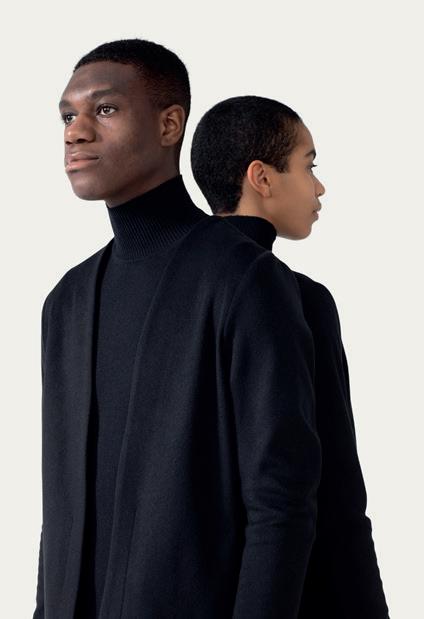

Nomen Nescio is a Helsinki-based clothing design studio focused on minimalistic and sustainable style and values. When Niina Leskelä couldn’t find clothing that she liked and that reflected her values, she used her skills in design and sewing to create her own new clothing brand.
By Mari Koskinen | Photos: Nomen Nescio
One definition of sustainability is the quality of not being harmful to the envi ronment, or depleting natural resources, and thereby supporting long-term eco logical balance. Nomen Nescio is built on these values. To define what that means for them, co-founder and designer Nii na Leskelä explains: “Sustainability is not just about using ecological materi als; it’s about changing how people think about and use clothes. It’s about time less design that does not follow seasons or short-term trends. When you choose clothes that you really love and feel com fortable in, instead of buying many pretty garments, your wardrobe is much more functional, and you can easily match the pieces together.”
“We are not just another fast fashion brand. We put effort into designing the garments. We have our own design and production cycle and don’t bring out a new collection every season,” she says. This permanent, seasonless collection is up dated regularly to improve the garments even further. The choice of colour is also unchanging: at Nomen Nescio, it’s all black. “We think that black is the most us able and suitable colour for all occasions,” says Leskelä.
Another way to ensure a collection is ecological and sustainable is to make the clothes long-lasting, even with heavy use. “We always advise on how to take care of the garments, and we also offer
96 | Issue 148 | November 2022
repair and alteration services,” she says. In the rare case that the client no longer has use for the clothes, they have set up the Nomen Nescio Second Cycle, in which they take back used clothes, and even compensate for them depending on the condition of the garment, or recycle it appropriately.
Functional design
Nomen Nescio’s clothing is very func tional, without many decorative details. “It’s even more important to me how the garment makes the person wearing it feel, than what it looks like,” says Le skelä of her design philosophy. “During the design process, the clothes are fit ted repeatedly by people with different body types, so that I can find the most functional design and overall result. You should be able to feel good and safe in the clothes you wear.”
“Although we feel that Nomen Nescio style is very Nordic, it has many mutu al aspects with, for example, Japanese minimalism, and it has received a very warm response there,” she explains. They also have stockists all around Eu rope, as well as Asia. “Many stockists in North America are also closely watch ing our progress and it is likely that our clothes will be available there in the near future,” she adds.

A decade of dedication
The company is celebrating its ten-year anniversary this year. The past decade of dedication to changing the way we think about dressing has had many exciting twists and turns. “I am grateful for all that has happened, and I’m excited about the future for Nomen Nescio,” Leskelä says, contemplatively. She remembers how exciting it felt when she first noticed peo
ple wearing a Nomen Nescio jacket on the street. Since then, it has grown into an international brand. Along the way, it has been featured in several international fashion publications and visited landmark fashion events, including Paris Fashion Week and Pitti Uomo in Italy.

Last year, their flagship store moved to the heart of the shopping district in Hel sinki. “We have a great team here. They all approached us, having recognised themselves in our design and values, and they are strongly committed to Nomen Nescio,” Leskelä says. “Our loyal clients are also part of the family. When they experience that this is exactly what they have been looking for, they often return for more.”
www.nomennescio.fi Instagram: @nomennescio.fi
November 2022 | Issue 148 | 97
Scan Magazine | Design Studio of the Month | Finland
Architecture Firm of the Month, Denmark

Designing the revolution: hybrid architecture for flexible workspaces

“Why would you leave your home, where you have all your comforts, if your office doesn’t present an equally good environment?” ask Christensen and Co. Architects. The Copenhagen-based architecture firm has an unrivalled understanding of hybrid environments, having helmed projects for some of the most innovative shared spaces in Denmark across culture, education and housing. Now, the firm is emerging as a pioneer in the flexible workspaces of the future.
By Lena Hunter | Photos: Christensen & Co. Architects
“The sudden rise in remote working dur ing the pandemic caused permanent changes in the work-life balance. For a time, our homes became our offices, and now there’s a revolution in the way we see our working spaces,” says Mikkel Sørensen, architect and partner at Chris tensen and Co. Architects.
Indeed, according to figures from mar ket-data specialist Statista, the percent age of employees working remotely in
Denmark more than doubled from 2020 to 2022, and demand for roles that offer hybrid offices, hot desking and activitybased workspaces has skyrocketed.
“Today, the workplace has to deliver something different to the home,” says Sørensen. “You might prefer to do tasks
98 | Issue 148 | November 2022
DTU Compute B324.
Odsherred teater.
that require concentration at home, whereas for a collaboration or dialogue, you go to the workspace.”
A myriad of data shows that flexible working encourages productivity, and that hybrid job posts receive higher numbers of applicants. To capitalise on the trend, many forward-thinking businesses are physically reshaping their offices.
Christensen and Co. Architects are ex perts in designing buildings that facilitate social and professional exchange, support collaboration and inspire creative thinking –with an unrivalled understanding of the nuances of shared spaces.

“We are projecting our experience from the university and research environment into the workspace environment,” says Sørensen. “Many new workplaces don’t necessarily have permanent personal desks or other office conventions, so you interact in a different way, which can sup port the formation of new ideas and rela tionships.”
Architects of change
Particularly of note is their upcoming transformation project of the headquarters of Finansforbundet – the union of finance workers in Copenhagen. “This is a community-focused place both anchored in history and tradition and a future-driven foundation for development. To support this, we’ve designed an open
and inviting house with easy access, an improved daily flow for employees, a healthy acoustic work environment and an energy-optimised indoor climate,” explains Sørensen.
The rearrangement will see the top-floor member facilities moved down to ground level to encourage a holistic understanding of the ground floor as the social, professional and architectural heart of the building, with a visual connection to outdoor areas.

Meanwhile, the expansive atrium will offer open sightlines to a plethora of flexible workspaces, including digi
tal meeting rooms, with screens and lounge furniture, quiet rooms and sin gle-spaces optimised for peace and concentration. The atrium reflects the organisation’s broader philosophy, with a transparent and porous design that signals modernity and innovation.
Higher-education design for flexible workspaces
There are many parallels between higher-education learning and flexible working, and much of the thinking be hind Christensen and Co. Architects’ workspace designs draws on their sub stantial experience in designing learn ing environments.
November 2022 | Issue 148 | 99
Scan Magazine | Architecture Firm of the Month | Denmark
KBHallen.
Finansforbundet, ATRIUM
“In Denmark, we don’t have a campus culture, so it’s important that university architecture encourages students to stay on site. Similarly, today, it’s important for employers to keep workers in the office. We know how to translate architectural solutions across those environments,” says head of business development Ma rie Partoft.
A touchstone of both environments is the need for an interdisciplinary communal space. In 2013, Christensen and Co. Ar chitects designed a bold new interdepart mental building for the Department of Ap plied Mathematics and Computer Science at the world-leading research institute, Technical University of Denmark (DTU).


“Compute B234 is a great example of ar chitecture facilitating a cross-pollination of people and ideas,” says Sørensen. “We designed a network of various study spac es and breakout zones, rooms for group meetings, lectures and seminars. Within the shared environment was the option for concentrated study. All these transitions
draw researchers, alumni and students together, allowing them to be seen and interact informally, in an inspiring space that even has large trees growing inside. It’s an incubator for the whole campus.”
Similarly, in 2018, a project for DTU’s Life Science and Bioengineering department
saw the creation of a 13-metre-tall atri um – the heart of the building, dubbed the Biosphere. Here, thousands of gold en-hued oak lamellas comprise a warm and textured façade, a visual gesture to biology and nature. “The laboratories are generic, but they are connected to this very different, warm environment, where there are meeting spaces, study spaces and relaxation spaces. That contrast is very stimulating,” says Sørensen.
In both Biosphere and Compute B234, as with every project, sustainability perme ates the design. This means long-last ing architecture that minimises resource consumption, creates cultural connec tions, and ensures functionality that can transform along with its users.
Designing from the inside out Taking a humanist approach, Christensen and Co. Architects begin each project with thorough research into end-user needs. “Every architecture project is a co-cre ation process with the end users, engi neers, contractors and municipalities. We’ll have detailed dialogues with every body involved in developing and using the space – even small kids. In the end, if peo ple don’t use the building, then it doesn’t matter what we do,” says Sørensen.
Sørensen emphasises that form is never at the expense of function – despite the firm’s notably beautiful design language. “We design from the inside out, meaning
100 | Issue 148 | November 2022
DTU Compute B324.
Finansforbundet, HOVEDINDGANG.
that we begin by addressing the complex ities of the interior spaces. Once we know how the building will cater to the needs of the users, we move outwards.”

Furthermore, each project aspires to a ‘no dead ends’ interior layout, in which interlinking spaces create an atmos phere of prospect. “The idea is that there are always options. In the workplace you might pass a meeting room and ob serve a type of project that excites you. In a public-school, a big window into the sports hall or the art class can have the same effect.”
By designing the context in which the workplace revolution will take place, Christensen and Co. Architects are at the core of the cultural paradigm shift. “Though we’re founded on the ambition of accelerating sustainability in the built environment, we’re not just talking about progressive, environmentally-conscious architecture, here. We’re developing so cially sustainable, future-proof work places that respond to the emotional and professional needs of employees, while enhancing business productivity in this new era of flexible working,” concludes Sørensen.

www.ccoarch.com
Instagram: @cco_architects
Facebook: ccoarchitects

November 2022 | Issue 148 | 101 Scan Magazine | Architecture Firm of the Month | Denmark
DTU Compute B324.
DTU Life Science and Bioeningeering
DTU Life Science and Bioeningeering
Museum of the Month, Finland
Finland’s colourful history of textile printing on display
Forssa Museum is telling the story of how textile printing came to Forssa and how the textile industry came to shape the town. While industry-scale printing no longer takes place in Forssa, the museum’s 8,000 kilos of textile history make for a visually stunning museum tour.
By Ester Laiho | Photos: Forssa Museum
Forssa was built around the textile indus try, with the rapids of Kuhalankoski be ing an excellent place for a mill. It grew from cotton spinning to weaving, to dyeing and eventually to textile printing. Forssa merged with Finlayson in the 1930s, and the production of printed fabrics under Finlayson remained in Forssa until 2009.
Today, Forssa Museum tells the stories of the mills, the workers and, most impor tantly, the fabrics.

You can learn about Forssa’s textile-mak ing history in the museum’s City of Col ourful Cloth exhibition, while a newly opened exhibition space called Pattern
Centre focuses on the prints and patterns themselves. On display are old sketches from the archives, prints – too many to count, and photographs and stories of the designers whose fabrics dressed Finnish people and their homes.
Project Coordinator Tuuli Ravantti is ex cited for more people to discover the art and history of printmaking. She initially came to Forssa Museum from Helsinki for a placement, and never left. With a back ground in archaeology, she enjoys finding old fabrics and learning about their histo ry. “The ongoing work in our textile archive
102 | Issue 148 | November 2022
Forssa Spinning Mill’s dyeing plant exterior.
allows us to discover and learn more and more about the design of different dec ades. It is incredibly rewarding to be able to share these experiences with our visi tors,” she says.
Informed by a deep understanding and appreciation of the past, Forssa Museum is looking to the future, establishing Fors sa as a place for current and future textile designers to visit and learn from, as well as running international collaborations. Some Forssa fabrics were on show in Fu jiyoshida, Japan in October, as a part of the Pattern Centre En Route exhibition, as well as in the Finlayson200 exhibition that has been touring Japan since the summer of 2021, and will be on show next at Naga saki Prefectural Art Museum in January 21 till March 26 in 2023.


Forssa is situated in the middle of three big cities: Helsinki, Turku and Tampere, and can be reached by bus from Helsinki city centre in an hour.
www.forssanmuseo.fi Instagram: @forssanmuseo Facebook: forssanmuseo

November 2022 | Issue 148 | 103
Scan Magazine | Museum of the Month | Finland
Red fabric samples on display in the Pattern Centre.
Finlayson textile samples in the Pattern Centre.
Forssa Spinning Mill area.
Attraction of the Month, Finland
Paimo – a breath of fresh air in the Finnish forest
Finland has long been known as a leader in modernist architecture and design. How ever, there is an oft-overlooked jewel in the crown: Alvar Aalto’s Paimio Sanatorium.
 By Philip Denvir | Photos: Paimio Sanatorium

Tucked away in the countryside, near the city of Turku in south-western Finland, this historic facility is growing a new lease on life. Founded 90 years ago, Paimio Sanitarium was designed by Alvar and Aino Aalto as a tuberculosis treatment hospital. The pair designed the building, interiors and even furniture as ‘medici nal instruments’, in order to promote the wellbeing of its residents and the staff.
From the soothing colour schemes of shades of cerulean, to soundless wash basins that disturb no one, and the sun decks overlooking the forests to give light and air, every element is designed to ex press tranquility. However, the only wide ly-known piece is the iconic Paimio chair, still reproduced today by the internation ally renowned Finnish-based design com pany Artek.

Mirkku Kullberg, chair of the Alvar Aalto Foundations explains: “I first saw the Pai mio Sanatorium in 2005. It was a physical

experience. It had an emotional impact: the dimensions, the colours, the feeling –it really felt like a medicinal instrument.”
“Alvar Aalto and his wife Aino designed a sanctuary for those suffering. Rooms were designed for comfort and peace and the building had space for sunbathing and forest bathing. The staff were also catered for so that the vast building felt ‘cosy’,” she continues.
Future-proofing
The Paimio Foundation intends to cele brate the past while embracing the future. The Sanitorium already offers self-con

tained suites in the former staff quarters, faithfully furnished by the Artek design company, and a restaurant featuring Finnish cuisine. In addition, it offers tours and regular exhibitions.
There are plans afoot for 2023 for a well ness organisation and conference cen tre. This foundation would bring togeth er internationally recognised architects, designers and healthcare professionals, as well as the local, Finnish and inter national communities. The ethos of the Paimio Foundation is to promote Aalto’s vision of wellness through architecture and considered design. “We have a duty to understand and save this kind of icon ic architecture and promote its legacy, so that it continues as a living thing.”
“When architecture fulfills the role of a shelter, when a huge building like Paimio Sanitorium still feels like it is a shelter, protecting you and reaching out to help you – that is good architecture and de sign,” asserts Kullberg.
www.paimiosanatorium.com Instagram: @paimiosanatorium Facebook: paimiosanatorium
104 | Issue 148 | November 2022 Scan Magazine | Attraction of the Month | Finland
Paimio Sanatorium is surrounded by tranquil forest.
Interior details.
The famous Paimio chair.
The sundeck at the Sanatorium.


Experience one of the most genuine Swedish Christmas markets at Gamla Linköping Open Air Museum 26-27 November & 3-4 December 2022 WHEREHISTORY COMESALIVE www.gamlalinkoping.se
Our Architecture: Iconic Danish design for all
A right for all, not a privilege for the few: that is the foundation that has shaped the history of Danish architecture. In its autumn exhibition Our Architecture, the Danish Architecture Center (DAC) is showcasing this story through the lens of star architect Vilhelm Lauritzen, and his most iconic buildings of the last 100 years. Lauritzen’s timeless designs have become part of the cultural heritage of Denmark –institutions that have borne witness to a society in a state of change.
Opening on 18 November, the exhibition unwraps the story of a quiet giant of modern design, who always insisted on a democratic approach to architecture.
By exploring Lauritzen’s defining pro jects like Copenhagen Airport, for which he designed the first terminal in the late 1930s, and the iconic Danish Radio House, the exhibition will set the scene for a tour de force of his architectural masterpieces and the lives lived within their walls.
Interactive installations will allow visitors to explore the architecture using new
technology. Here, you can experience his designs with all your senses, and discover first-hand the impact that well-executed architecture has on the way we work, travel, learn and live.
When visiting the Danish Architecture Center in Copenhagen, be sure to explore the many architectural gems and contemporary projects in the city. Every week, the Danish Architecture Center organises guided walking, boat and bicycle tours to the city’s historic gems and modern masterpieces, designed by architects like Bjarke Ingels, Henning Larsen and Lundgaard & Tranberg.

In 2023, Copenhagen will be named UNESCO World Capital of Architecture, during which the Danish Architecture Center will offer a wide range of activities and exhibitions. Landmark venues and other historic buildings usually closed to the public will be opened for visitors during the Open House Copenhagen event. Plus, don´t miss the summer exhibition

106 | Issue 148 | November 2022
Spillestedet VEGA.
Photo: Betina Garcia, Ritzau Scanpix
Danish Architecture Center in BLOX. Photo: Rasmus Hjortshøj
The Vilhelm Lauritzen terminal in Copenhagen Airport from 1939. Today it is closed for air traffic, but it used to receive heads-of-state and other VIP travellers. Photo: Rune Buch
Copenhagen in Common, where the Dan ish Architecture Center will celebrate all the Copenhagen architecture we share. www.dac.dk
About Danish Architecture Center (DAC):


The Danish Architecture Center is an international cultural attraction for anyone who wants to experience and understand how architecture and design create the framework for our lives. DAC is based in the heart of Copenhagen, by the inner harbour, in the spectacular building BLOX.
Our Architecture: 18 November 2022 - 9 April 2023
Copenhagen in Common: 4 May - 22 October 2023
Open house: 25 - 26 March 2023
Danish Architecture Center (DAC) Bryghuspladsen 10
1473 Copenhagen
Opening hours: 10am to 6pm daily, Thursdays until 9pm
LIFE Campus, Vilhelm Lauritzen Architects, 2021. A national children’s leaning centre for natural sciences. The architcture references to DNA and Fibonacci numbers. Photo: Rasmus Hjortshøj

November 2022 | Issue 148 | 107 Scan Magazine | Culture | DAC
The Radio House by Vilhelm Lauritzen from 1945. The building used to house The Danish Broadcasting Coorporation and is today home to The Royal Danish Academy of Music. Photo: Rasmus Hjortshøj
Tina Hee: The DNA of a Danish artist
The work of an artist is often born out of the struggles in their life – experiences that can bring a quality of authenticity to the creation of art. Certainly, this is the case for Tina Hee.
By Karin Blak | Photos: Suezanna Zenani
As a child, Tina wanted to be a nurse. She had a strict upbringing, however, and her father instead arranged for her to take an apprenticeship in marketing. Although this provided Tina with a successful ca reer, she didn’t feel right in these roles.
The pivotal moment
Inspired by her son’s teacher, she at tended an art class and, with newly awakened energy, she enrolled in a fourmonth art course. This was the pivotal moment when she discovered the sense of belonging she had been missing.
“Challenges make me stronger,” she says, describing the hardship she went through during her early 40s. Therapy and painting were the tools she used to find peace inside.

An intuitive journey
Tina describes her art as an intuitive journey. “I use symbols of life’s expe riences: the crooked stairs reflect the hard times, the eye mirrors the soul,
and the bird gives a panoramic view and a sense of freedom.”
Working like a CoBrA-artist, her art is of ten humorous. While very personal, the paintings have a special energy and hap piness that lifts the viewer, is said to be typically ‘Hee-esque’, and is appreciated by both private and business clients.

Tina’s DNA
Like a string of DNA, her need to help others runs through her life. When she encountered her first student with men tal health issues, the feedback she re ceived was that painting with Tina was medicine for the student’s buzzing brain.

Tina now teaches groups at the mental health charity Sind, and says “there is no right or wrong in painting, there is just a safe space for creativity to happen.”
Tina’s travelling companion
The creation of the bronze statue of a man with a top hat on a bike was inspired by Hans Christian Andersen’s The Travel

ling Companion. When she told the story to a man she met, he responded: “that sounds just like my grandad, his name was Johannes”. So, the statue was named Johannes. It became Tina’s logo and trav elling companion, just as she is the travel ling companion to those she helps.
Like the fairytales written by H.C. Ander sen, a man she identifies with, Tina’s life has reached a happy destination and she hopes to help others achieve the same. www.tinahee.com Instagram: @tinahee_art Facebook: ateliertinahee LinkedIn: tinahee
Visit Tina’s atelier Atelier Tina Hee Lyngby Hovedgade 1 2800 Lyngby - Danmark
Johannes the travelling companion.
108 | Issue 148 | November 2022 Scan Magazine | Culture | Atelier Tina Hee
Tina Hee when inspiration settles. Reunion and on new adventures 2022.
Peace not war.
November’s new Scandi music releases
 By Karl Batterbee
“Hey there Madonna…Won’t you be my Mama?” trills Denmark’s biggest popstar right now, Drew Sycamore. She’s named her new single Madonna after the all-time Queen of Pop, and dedicated to her a suita bly banging bit of disco-house with a bouncy pop chorus. This pairs perfectly with Drew’s previous release, Electric Motion - if you’ve yet to check it out.
She went independent, and ended up making her best album to date. Sweden’s Tove Lo is back with her fifth album, Dirt Femme – her first to be released on her own label. It’s that rarity of an album that we all hope to experience from our favour ite artists – where you can press play, and never have to go anywhere near the skip button. Each track is essential, pulling you back and forth between disco decadence and disco damage. It’s a ride – one to keep
Monthly Illustration
Fitting in
Fitting in as a Swedish teenager in England was difficult. I was shy and awkward. My hobbies (listening to difficult techno on my Walkman) didn’t match the other girls’ hob bies (listening to Take That loudly from the back of the school bus) I had no idea how to dress, or act, or talk.
The first small breakthrough came when the TV programme The X-Files first launched in the UK. Suddenly, there were a few of us who would get together before English Lit once a week to discuss the gruesome plot of the previous night’s episode with genuine enthu siasm. Then came a discovery that would el evate me from my place of frumpy geek into the coveted position of (almost) Normal Girl.
Enter the Wonderbra. This magic garment did more for my self-esteem than eight GCSEs in a foreign language. I wore the wrong size, fitted wrong, with the little cush
getting back up on – and a real contender for Album of the Year.
She co-wrote the song with him for his lat est album, Playlist, and now Nea has gone and jumped on a new recording of Dance For Me, turning it into a duet for Benjamin Ingrosso’s brand-new single. It’s been gift ed a whole new production too, pairing the ABBA-esque melodies with an even more dancefloor-friendly backdrop.
Hailing from Aarhus in Denmark, duo ROYA consists of songwriter and singer Line Gade and producer Sebastian Igens. Kinda Sad is their new single - their third release to date - and it kinda slaps, in that low-key electronica way that dazzles you into action. In this case, it inspires you to get yourself out of the sads, and to just get over it in general.
Finally, another new artist from Denmark. Flavio has cast his net as far back as the ’80s, to find inspiration for his second single, Aiming On You. It’s a beat-heavy, synth-soaked uplifter that plays out like it’s taken from a pivotal scene in a film from the same iconic era.
www.scandipop.co.uk
By Maria Smedstad
never with the matching knickers. These precious garments were wrapped in lovely tissue paper, placed inside paper bags, and scattered with scented beads. This wasn’t just a newfound luxury. It was a rose-scent ed step towards adulthood. And I felt like I finally fitted in. It still took until the mid-00s for me to realise my real bra size. But by this point I was moving on to seamless bralettes anyway. Because real and lasting friend ships don’t chafe.
ions escaping all over the place. But it didn’t matter. I felt wonderful. Suspecting that I was onto a good thing, I then made a further discovery. In my local shopping centre, there was a shop just for bras. This was a bright, welcoming place, where the shop assistants treated our The X-Files clique like we were all Normal Girls.
So, we bought bras. Usually in the wrong size, pretty much exclusively on sale, and
Maria Smedstad moved to the UK from Sweden in 1994. She received a degree in Illustration in 2001, before settling in the capital as a freelance cartoonist, creating the autobiographical cartoon Em. Maria writes a column on the trials and trib ulations of life as a Swede in the UK.


Scan Magazine | Culture | Columns
November 2022 | Issue 148 | 109
Scandinavian Culture Calendar
–Where to go, what to see? It’s all happening here!
Thomas Houseago – WE with Nick Cave & Brad Pitt (until 15 January 2023)
Did you know that Nick Cave and Brad Pitt are besties – and visual artists? Neither did we, but a surprise joint ex hibition at Sara Hildén Art Museum in Tampere provides an opportunity to assess the two men’s skills in ceramic and sculpture, respectively. The works are exhibited as part of a collective of which UK-born Thomas Houseago, who sculpts and paints, is also a member.
Undoubtedly the most talked about art event in the Nordics this autumn. Särkänniemi, Tampere www.sarahildenintaidemuseo.fi
CircOpera 2.0 (25 November to 7 January 2023)
Combine circus with opera, and add a good dose of modern technology and the world’s first singing avatar. This, and much more, can be experienced on the Finnish National Opera stage over
 By Hanna Heiskanen
the darkest winter months. If you can’t make it to Helsinki, a performance will be broadcast on the Opera’s website on 20 December. Helsinginkatu 58, Helsinki www.oopperabaletti.fi
Brunch and ballet (select dates from 5 November until 23 May 2023)
Even if you don’t know anything about ballet, a professional group’s daily rehearsal at the barre is a fascinating
110 | Issue 148 | November 2022
CircOpera combines circus and opera.
Photo: Heikki Tuuli
sight. Not many companies offer this level of access to the general public, but at the Danish Royal Opera you can spend a relaxing Saturday morning with a cup of coffee and a pastry in hand, watching the dancers do their thing on stage, with their pirouettes and plies.


August Bournonvilles Passage 8, Copenhagen www.kglteater.dk
Haus-Rucker-Co: Giant Billiard (until 16 April 2023)
Copenhagen is known for its several world-class contemporary art muse ums, and one of them is ARKEN, locat ed 25 minutes by train from the centre, which is hosting an exhibition by the

November 2022 | Issue 148 | 111 Scan Magazine | Culture | Calendar
Brunch and ballet is a great way to start your weekend. Photo: Miklos Szabo
Giant Billiard at ARKEN. Photo: Frida Gregersen
1960s collective Haus-Rucker-Co. In Giant Billiard, museum goers (120cm or taller, we should add), become a part of the exhibition as players of the humon gous ‘billiard balls’. Skovvej 100, 2635 Ishøj www.uk.arken.dk
Films from the South Festival (12 to 20 November)
Films from the South is Oslo’s biggest film festival and aims to expand visitors’ cinematic perspectives beyond western films. One of this year’s films to watch is Korean Broker, whose star Sang Kangho won best actor at the Cannes Film Festival in the summer. Venues around Oslo www.filmfrasor.no
Meanwhile in Ukraine (until 30 November)

The attack by Russia on Ukraine has prompted a strong reaction from the
art world, too. Ukrainian photographer Olena Shovkoplias started to document life in Kyiv mere days after the war began and, in a collaboration by its Ukrainian sister museum, the National Swedish Museums of Military History is now

putting up her moving images. Grouped under six themes, they highlight the suffering of ordinary people in conflict. Free entry. Riddargatan 13, Stockholm www.sfhm.se

Scan Magazine | Culture | Calendar
Meanwhile in Ukraine.
Photo: Olena Shovkoplias
Meanwhile in Ukraine. Photo: Olena Shovkoplias
We
Do you want to sell our drinks in your country?
a


for our

(Train Station
that have won
and mixed drinks over the years. Now
are
to the
and we are looking for the right
in this venture.
for a person or a
high
We
a wide range of craft

have
and craft
their
about 10 years ago in an old
now
have both
Almost all of our
in 1867. The
and
www.trainstationbrewery.com

Colin

MADE IN KNIVSTA SWEDEN
some of our brewery awards Career/Business opportunity!
are
Swedish brewery
Brewery)
several awards
beer
we
expanding
international arena
partner
We are looking
company that is passionate about
quality drinks.
have
sodas
beer.
products
won awards for
premium quality. Our journey started
train station built
first products were beer and
we
mixed drinks
craft sodas in our portfolio. If this business opportunity got you excited, send us an email at info@trainstationbrewery.com See our products at
Best Regards,
& Simon SWEDENS BEST LAGER UMEÅGUIDEN TESTWINNER STHLM BEER WHISKY BEST SWEDISH BEER GOLD BEST IN TEST GROUNDBREAKER MITTKÖK.SE BEST IN TEST EXPRESSEN EASTER BEER GAMBRINUS SM GOLD BESTinTEST SHIPFACED BÅTNYTT HELSINKI BEER WHISKY GOLD UMEÅGUIDEN GROUNDBREAKER 10 POINTS
Alejandra
Mari Koskinen
Maria Smedstad Maria Vole
Marie Westerman Roberts Miriam Gradel Molly McPharlin Ndéla Faye Nina Bressler
Scan Magazine Ltd
3rd floor, News Building, 3 London Bridge Street, London SE1 9SG, United Kingdom www.scanclientpublishing.com info@scanmagazine.co.uk www.scanmagazine.co.uk
Eva-Kristin
Philip Denvir Silvia Colombo Tina Nielsen Xander Brett Åsa Hedvig Aaberge
Emma Fabritius Nørregaard Johan Enelycke
Veronica Rafteseth
© All rights reserved.

contained in this
may not be reproduced, in whole or in part, without prior permission of Scan Magazine Ltd.
Scan Magazine® is a registered trademark of Scan Magazine Ltd.
This
contains advertorials/promotional
Scan Magazine Issue 148 November 2022 Published 11.2022 ISSN 1757-9589 Published by Scan Client Publishing Print H2 Print Executive Editor Thomas Winther Creative Director Mads E. Petersen Editor Lena Hunter Copy-editor Karl Batterbee Graphic Designer Mercedes Moulia Cover Photo Mikki Tenazas - @thetravelpro Contributors
Cerda Ojensa Andri Papanicolas Celina Tran Emma Rodin Ester Laiho
Urestad Pedersen Grethe Nordgård Hanna Andersson Hanna Heiskanen Hanna Margrethe Enger Heidi Kokborg John Sempill Karin Blak Karl Batterbee Linda Thomspon Lotta Lassesson Malin Norman
Sales & Key Account Managers
Advertising marketing@scanmagazine.co.uk To Subscribe scanmagazine.co.uk/subscribe
Material
publication
magazine
articles 114 | Issue 148 | November 2022 Scan Magazine | Culture | Calendar
The Danish Royal Opera House. Photo: Camilla Winter


Fnd it in Stockholm Duty Free, Arlanda Airport First-class, organic spirits from the heart of Roslagen, Sweden. Roslags Whisky • Roslags Gin • Roslags Punsch • Roslags Sailing www.norrteljebrenneri.se
A picture tells more than a thousand words, they say.
But what if there are no words?
Just the sound of the sea and the wind. And an island.
Far out in the Finnish Archipelago, off-grid. Where design follows the landscape.

Where your only job is to light the logs for the sauna. To switch off from time. To disconnect from the world. To reconnect with the nature. With yourself.
A place where feelings and experiences count more than words or pictures.
A place to simply be.
Project Ö The island to be.
www.project-o.fi
