NORDIC INNOVATORS
ADAPTING TO EXTREME HEAT
SWEDEN’S MAGICAL ISLAND
NORDIC INNOVATORS
ADAPTING TO EXTREME HEAT
Dear reader,
Is Gotland on your bucket list? If not, perhaps it should be. The island is stunningly beautiful, with dramatic cliffs, soft rolling sand dunes, sweeping fields and quiet countryside roads. I have fond childhood memories from here, spending summer holidays on the Swedish paradise island with my family.
In our cover story, I explore what Gotland has to offer as the high season slowly winds down and the island’s pantry fills up with treasures from the autumn harvest. If you happen to be a foodie, there’s plenty to discover – including the much-loved truffle festival. If the outdoors is more your thing, Gotland is a fabulous destination too. And if you love Nordic Noir, well, take a look at the feature and you will see what the area offers on that front, too.
More unexpected discoveries await in this issue, for instance in Joseph Phelan’s article about Scandinavia’s trailblazing whisky distilleries and how they make the most of what is already there: landscape, climate, local materials and community. An inspiring read, for
sure, and you will see how these producers take pride in doing things their own way.
On another note, I’m guessing that some of you might have suffered from the recent heatwaves. Our regular contributor Anders Lorenzen, who is knowledgeable in the field of climate change, explores Nordic innovators at the forefront of adapting to extreme heat. Check out his piece to learn about pioneering technologies that are helping us better adapt to a warming world.
As usual, there is plenty more to read as we highlight top art and design profiles in Scandinavia, present what to see and do across the region this month, and bring you a few tasty treats.
Stay cool and enjoy our August issue!

Malin Norman, Editor

6 Nature-toned outfits and reading nook ideas
On our Design pages, you will find stylish naturetoned pieces to jazz up your wardrobe for late summer wining and dining. We also tempt with inspiring ideas for additions to your cosy reading nook, so that you can enjoy more relaxing days with a good book.
23 A taste of Gotland
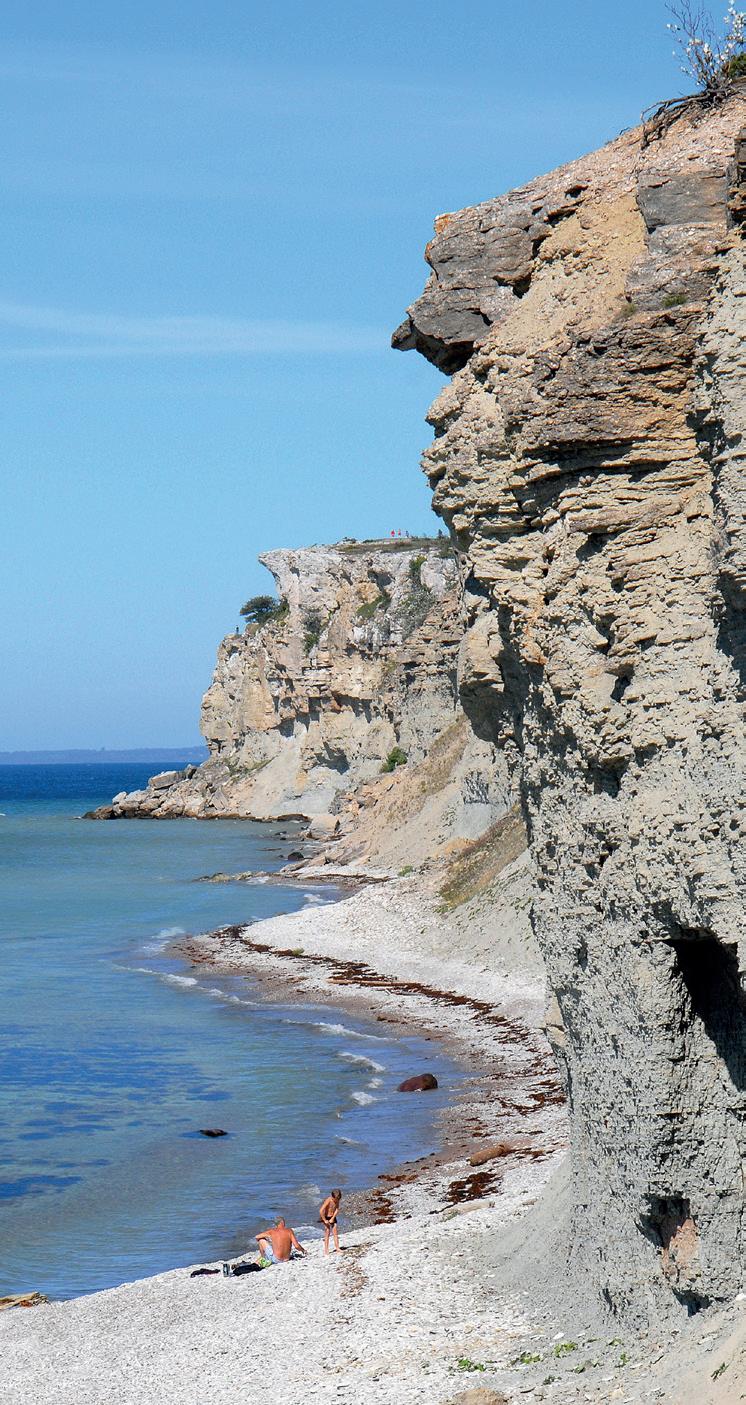
With mile-long beaches, limestone landscapes and culinary experiences, Gotland is a haven. As the high season draws to an end, a slower pace will make for a quieter lifestyle on Sweden’s own paradise island and the pantry will fill up with treasures from the autumn harvest, including some much-loved truffles.
30 Red currant crumble and taxi drivers’ beer tips
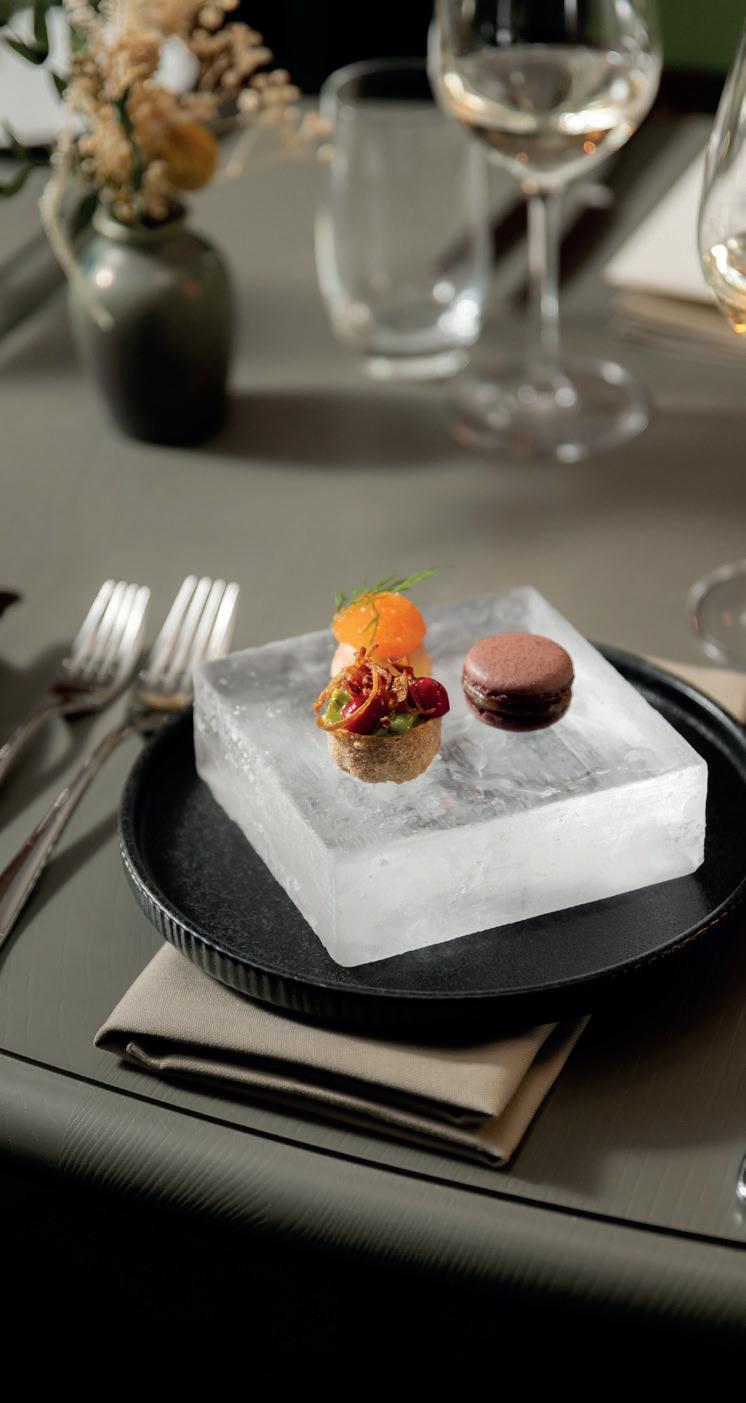
Our food columnist Sofia Nordgren loves this time of year, and her latest favourite treat is a delicious red currant crumble pie, which has the perfect balance of sweet and tart. And in our beer column, Malin Norman remembers taxi drivers from the FIFA World Cup medal-winning countries and their beer recommendations.
33 Whisky’s new frontier
In this feature about Scandinavia’s trailblazing whisky distilleries, Joseph Phelan discovers how the producers take pride in doing things their own way: utilising their surroundings to lay down the foundations of a distinctive whisky-making style.
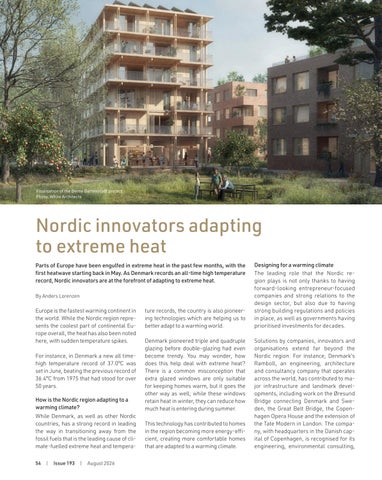
54 Adapting to extreme heat
Parts of Europe have been engulfed in extreme heat in the past few months. Our regular contributor Anders Lorenzen explores Nordic innovators at the forefront of adapting to extreme heat. Check out this piece to learn about pioneering technologies in a warming world.
40 Made in Norway
In this special theme, we get to know more about some of Norway’s successful brands, from a goldsmith that celebrates its 150th anniversary to natural skincare producers and tech companies that are shaping the future of Nordic industry.
82 The best new events, film and music in Scandinavia
In this month’s Culture Calendar, music columnist Karl Batterbee highlights party-starting anthems and motivational music, film enthusiast Anders Lorenzen finds that the Nordic TV sector is still in a healthy space, and illustrator Gabi Froden ponders scheduling and how Swedes have their own way of counting time.
With the height of summer upon us, we can look forward to several more weeks of lazy days, Aperol Spritz breaks and sun-kissed skin. Jazz up your wardrobe for some evening wining and dining with these nature-toned pieces.
By Celina Tran | Press photos

The finishing touch for sunny August days, Wood Wood’s Archie cap is made from 100 per cent organic cotton in a versatile neutral colourway. Whether protecting you from the afternoon sun or adding a casual edge to a clean Scandi look, it’s an easy accessory that works all season long.
WWDouble A archie cap in Seneca rock/nature, EUR 33 www.woodwood.com
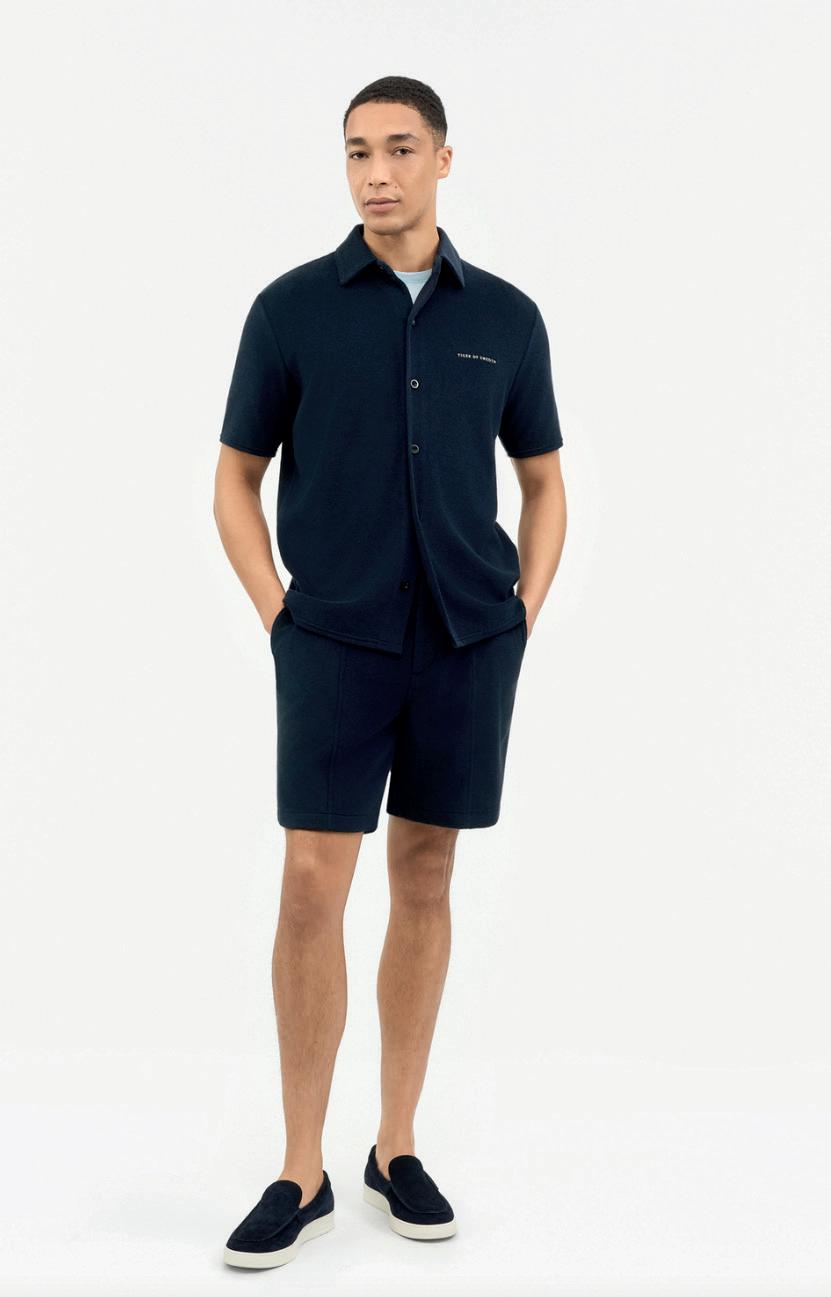
Smart enough for dinner yet relaxed enough for holiday afternoons, the Paul shorts strike the perfect balance. Cut with a mid-rise waist and straightleg silhouette, they feature slanted front pockets, refined rear welt pockets and a lightweight unlined construction. Wear with the matching Saint shirt or a crisp t-shirt for that effortless Scandinavian ‘je ne sais quoi’.
Paul cotton terry shorts, SEK 909,30 www.tigerofsweden.com
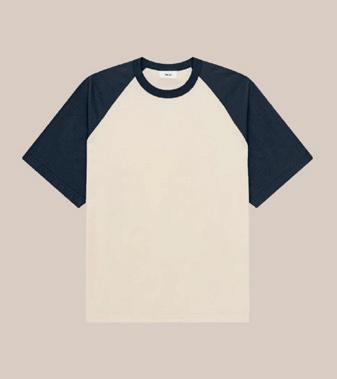
Every summer wardrobe needs a flawlessly cut white t-shirt. NN07’s Regie tee is made from soft organic cotton jersey with comfortable raglan sleeves and a relaxed fit that feels easy without looking oversized. Lightweight, versatile and endlessly wearable, it’s a staple you’ll reach for long after summer ends. Relaxed fit organic cotton tee, EUR 75 www.nn07.com
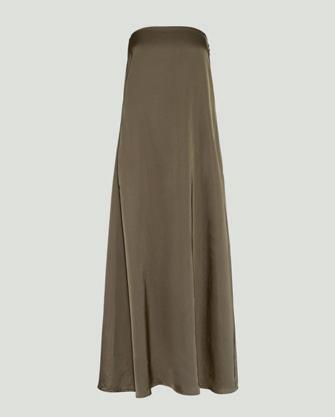
Known for their refined monochrome aesthetic, founders Celine Aagaard and Pia Nordskaug continue to define modern Scandinavian dressing with Envelope 1976. Returning this season in fluid 100 per cent viscose, the Esmoriz dress features a minimalist tube silhouette and maxi length. Finished with discreet side pockets and presented in a rich, burnt olive shade, it’s a beautifully uncomplicated piece that moves effortlessly from daytime strolls to sunset dinners. Esmoriz dress, EUR 287 www.envelope1976.com
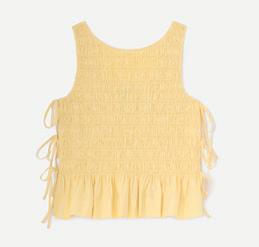
Nothing says summer quite like a burst of sunshine yellow. GANNI’s sleeveless, organic cotton top combines a flattering smocked texture with playful tie details, a scoop back and a softly ruffled hem. Feminine, fresh and easy to wear, it’s an ideal companion to linen trousers, denim or a flowing skirt throughout the warmest days of the year.
Top in yellow cotton, Italian straw, GBP 195 www.ganni.com
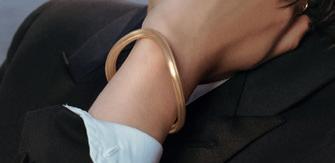
Inspired by the movement of the ocean and the shifting patterns of sand beneath the waves, Sofia Lynggaard Normann’s Under the Sea collection celebrates organic forms. This lightweight hollow bangle, made from 18-carat yellow gold, makes a striking statement. It’s a timeless investment that elevates even the simplest summer outfit.
Under the Sea bangle, USD 14,000 www.olelynggaard.com

Based in Jæren, Woodling takes inspiration from Norwegian tradition and nature. With a particular focus on comfort and quality, Woodling likes to use natural fabrics that last. Perfect for the August heat, the relaxed, brownish-green Beth trousers are made from linen and feature practical side pockets and elastic for comfort and flexibility. Depending on what look you’re going for, they can be worn as both high waist and low waist, and for a more elevated look, pair with a pretty blouse and some gold jewellery. Beth trousers in Oliventre, NOK 1,439 www.woodlingstudio.com
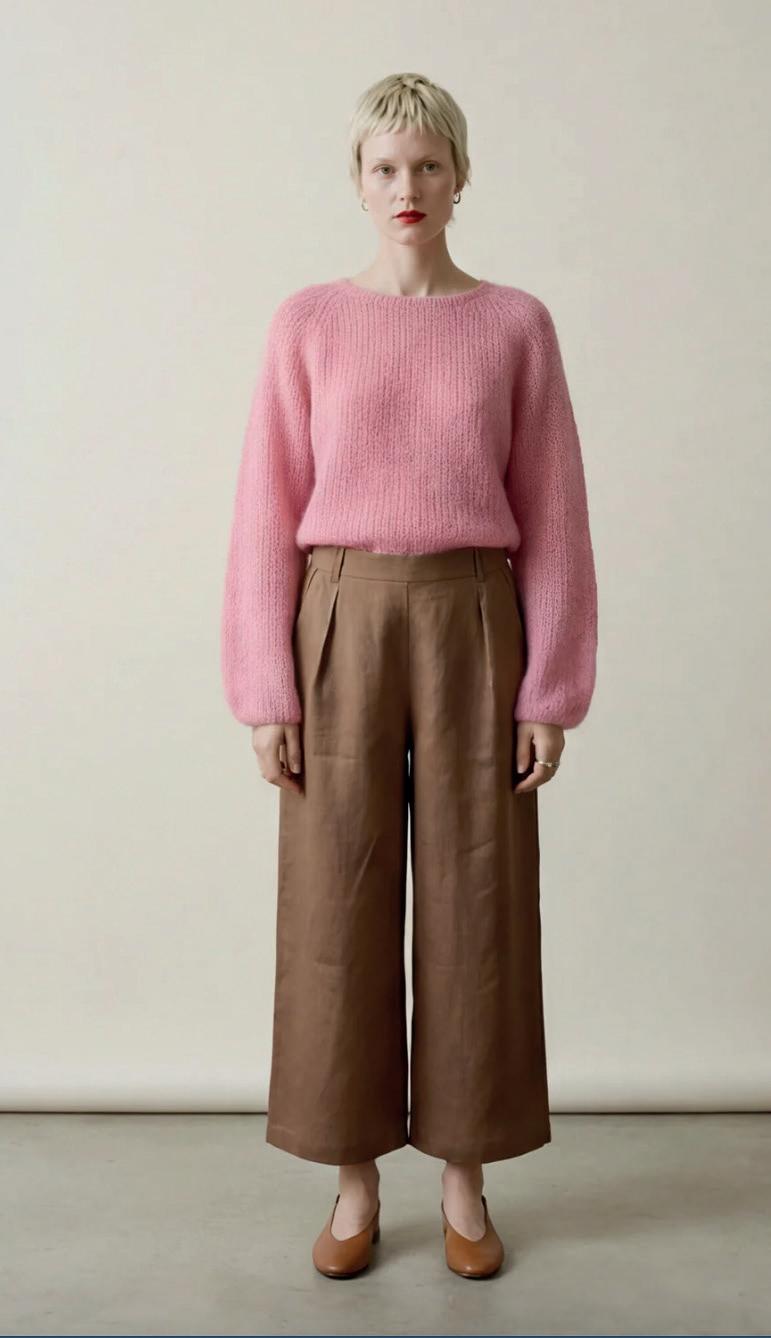

For relaxing days with a good book, perhaps on the terrace or in a cosy study, take a look at these inspiring ideas for new additions to your reading nook. You’ll be all set to settle down into the pages of your favourite kind of escape.
By Malin Norman | Press photos
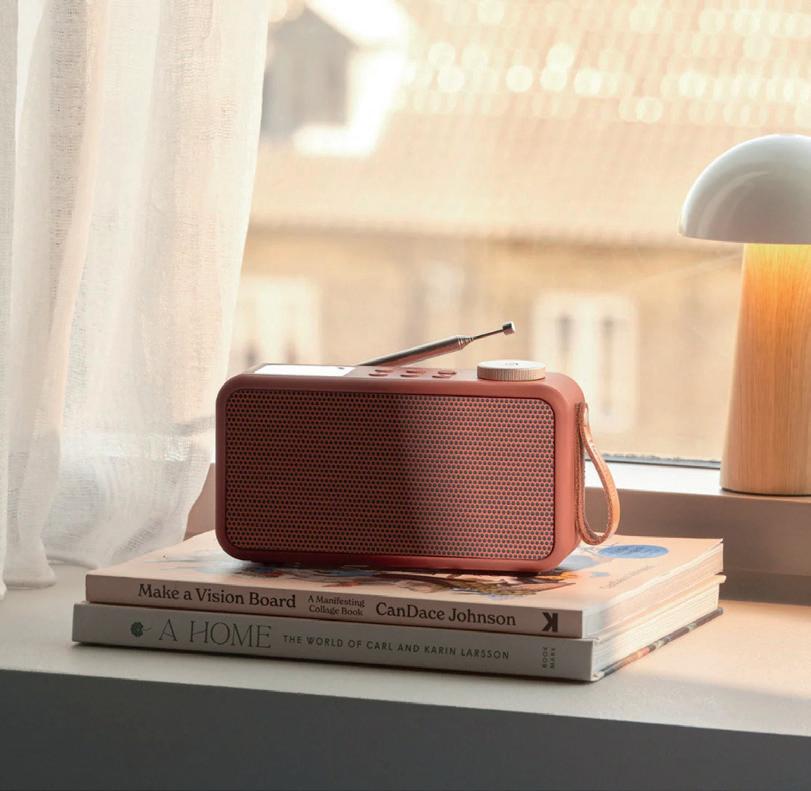
Kreafunk – aTUNE 2 BT, FM/DAB+
The all-in-one radio aTUNE 2 by Danish brand Kreafunk combines DAB+, FM, Bluetooth speaker and alarm clock. The charming retro design is small but with a big personality. Made from recycled materials with consideration for both form and environment, it has space for up to 40 radio stations and smooth switching between functions – so it’s easy to find the right mood. It’s available in the stylish colours of ivory sand, black, mango burst, Nordic green and terracotta. aTUNE radio, EUR 149.95 kreafunk.com
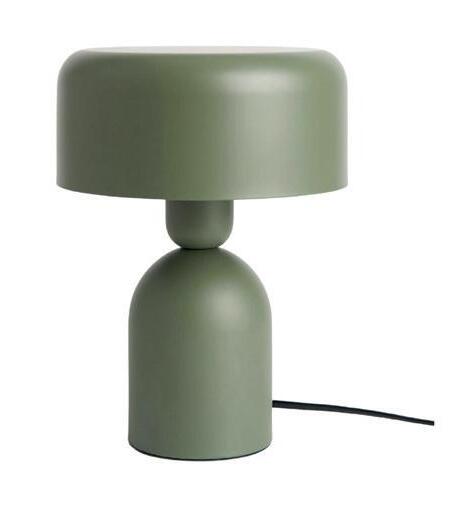
Åhléns Home – Tova table lamp
Tova by Swedish department store brand Åhléns Home is a modern table lamp with round shapes and a flat top. Made of lacquered metal, it looks just as good taking pride of place in the window as it does on a table. The lamp comes in green and beige.
Tova table lamp, SEK 599 ahlens.se
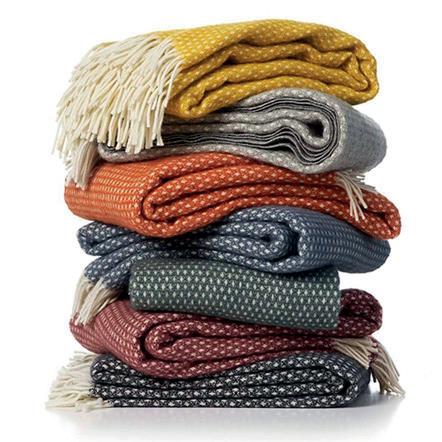
Founded in 1879, family business Klippan Yllefabrik has experience aplenty in textile craftsmanship. Knut is a classic blanket made of 100 per cent lambswool. Beautiful as a throw, it’s also nice and warm to cuddle up with when the evenings start to get a bit chilly. Available in nine colours. Knut blanket, SEK 975 klippanyllefabrik.se
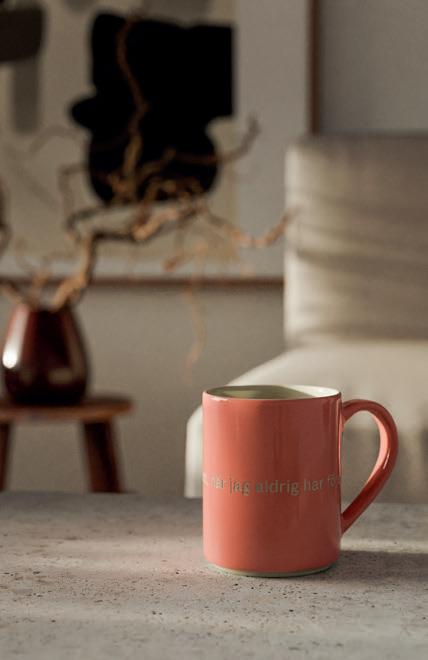
Together with Astrid Lindgren AB, Swedish brand Design House Stockholm has launched a collection of stoneware mugs that celebrates the famous author’s magnificent storytelling and writing legacy. The collection consists of nine mugs in different colours, with nine individual quotes engraved. What better mug for your morning tea or coffee, than one with Astrid’s wisdom to inspire you?
Astrid mug, SEK 295 designhousestockholm.com

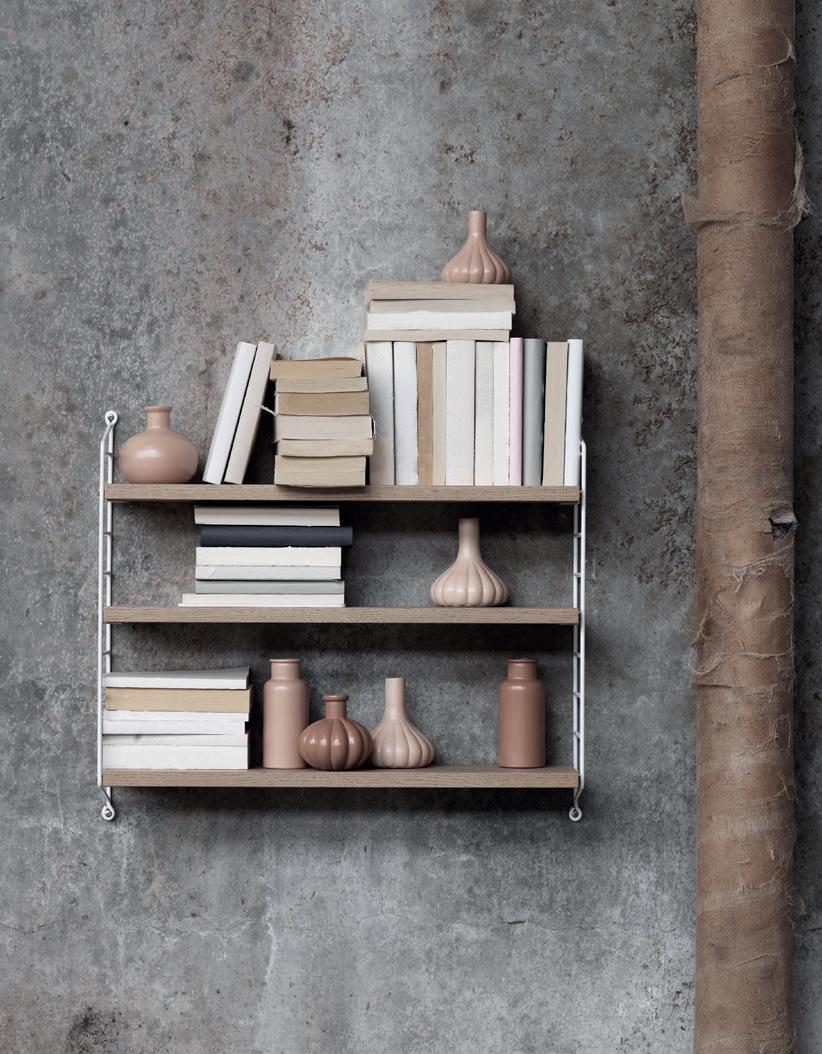
String Furniture – String Pocket shelf
Designed by Kajsa and Nisse Strinning in 1949, this icon of design is a true masterpiece. Since 2004, founders of String Furniture, Peter Erlandsson and Pär Josefsson, have been continuing the legacy of the designers. String Pocket is sold as a complete shelf, but you can mix and match colours and wooden alternatives to suit your style. It also works as a nightstand or as an extra shelf in your kitchen or hallway. Available in a range of colours, from the classic white, oak and walnut to sage and fuchsia.
String Pocket shelf, GBP 160 stringfurniture.com
This rechargeable portable fan Fantastic by Swedish brand Printworks is designed to suit your desk or coffee table. Operating in total silence and with three levels of wind speed, it offers customisable cooling, and with 360-degree rotation, you can direct the breeze where you need it. With a wooden frame and available in wood beige, wood pistachio, wood dusty pink and wood petroleum, cooling down has never looked cooler. Fantastic portable fan, EUR 75 printworksmarket.com
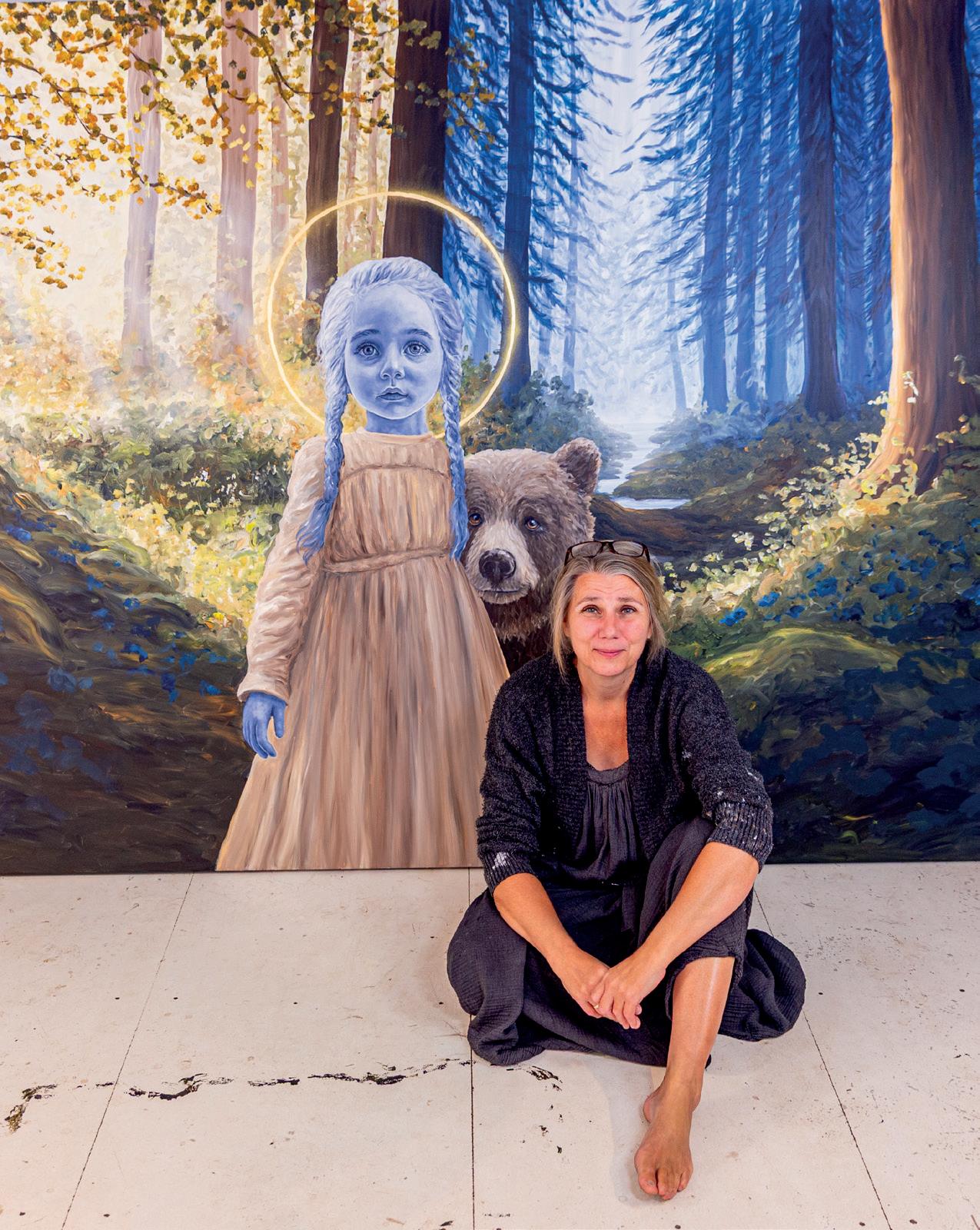
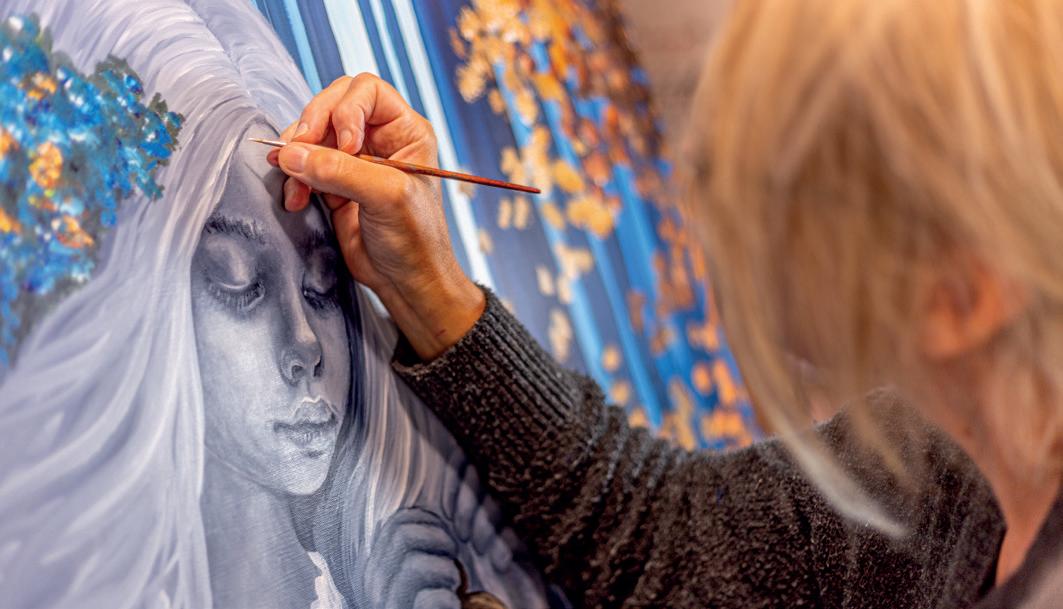
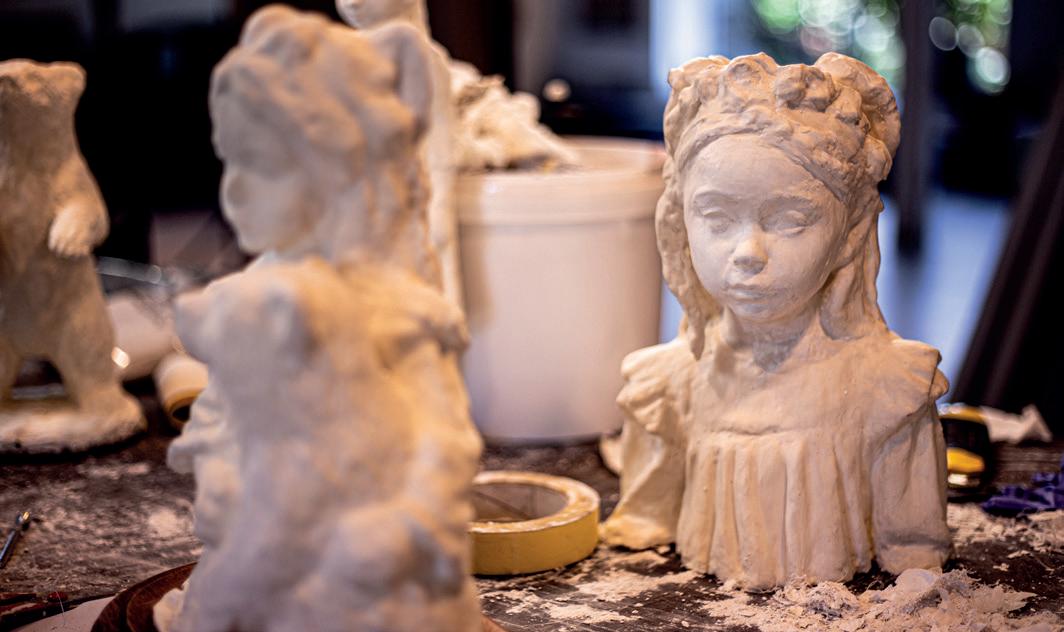
Nestled in the marshlands of Southern Jutland, where birds fill the sky and the horizon seems endless, artist Anne Juul Christophersen has created a world that is entirely her own. This autumn, you can experience her largest exhibition to date, S L, where she explores the connection between humans, animals, nature and the shared source from which life begins.
By Heidi Kokborg
Growing up in an artistic family, Anne Juul has painted and drawn her whole life. She works from her 100-square-metre studio on the farm she shares with her husband, in the marshlands surrounding the UNESCO-listed Wadden Sea.
“Living here means that you experience nature every single day. The geese, the wind, the changing light, the enormous skies. Over time you realise that we’re not above or separate from nature. We’re part of it,” Anne Juul says.
This sense of belonging lies at the heart of her artistic practice. Her paintings,
sculptures and ink drawings explore the relationship between people, animals and nature, inviting viewers to reflect on ideas of connection, belonging and shared existence.
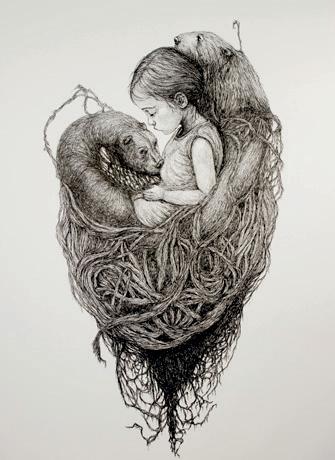
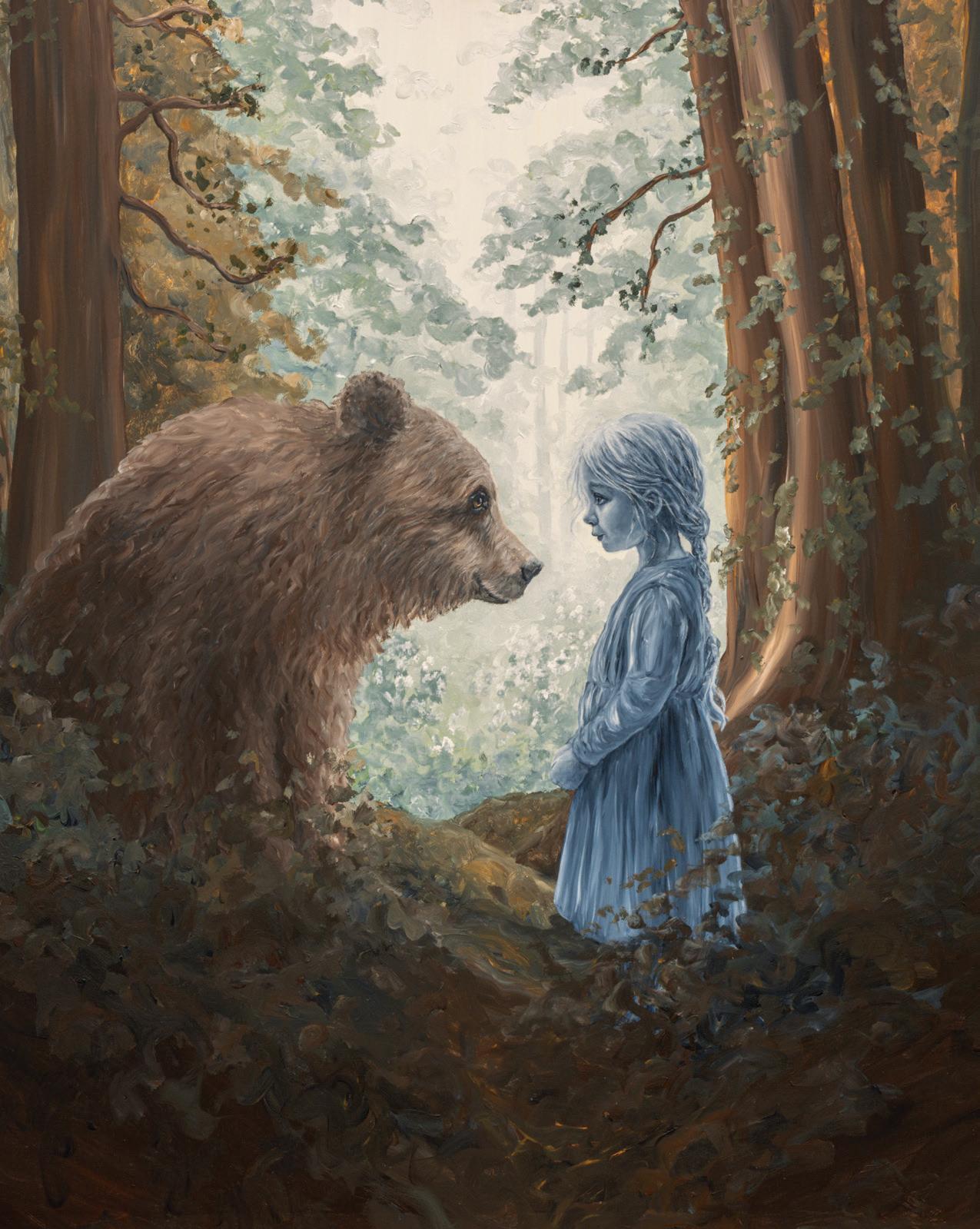
Many of Anne Juul’s works feature the same recognisable figures: a young girl accompanied by a bear or, sometimes, a wolf. Rather than repeating herself, she compares the process to directing a theatre production. “They’re almost like my actors,” she smiles. “I’ve created a universe where I can tell all the stories I want to tell. Every work becomes another scene, another conversation.”
This autumn, Anne Juul presents the largest exhibition of her career. Titled S L – using the ancient symbol for the sun at the heart of the Danish word ‘sol’ (meaning sun) – the exhibition opens at Spritten in Aalborg on 3 October and runs until 31 October. Created in collaboration with Galerie Wolfsen, it will fill 657 square metres with paintings, sculptures and ink drawings.
The title is simple yet layered with meaning. “The symbol is just a circle with a point in the middle, but it contains so much. It speaks about a centre, a shared origin. Everything begins there,” says the artist.
That idea of connectedness runs through the entire exhibition. Rather than presenting individual artworks in isolation, visitors move through a sequence of spaces where the works relate to one another as parts of a larger whole. Together
with gallerist Kent Wolfsen, whom Anne Juul has worked with for more than a decade, the raw industrial halls at Spritten will be transformed into an immersive artistic journey.
The exhibition includes monumental paintings measuring up to 2 x 3.5 metres, alongside sculptures and a large collection of expressive ink drawings. While the ink drawings continue to use Anne Juul’s familiar visual language, the drawings introduce a newer series titled FAVN, where roots, hearts, bodies and nature merge into almost abstract forms.
Although the media differ, they all explore the same underlying idea: that everything is connected. Anne Juul describes it through the image of a hologram: “If you break a hologram into a thousand pieces, every single piece still contains the whole image. I think we’re a little like that. Every person, every animal and every part of nature carries something of the whole within it.”
A mirror into the soul
Alongside her visual art, Anne Juul has published a poetry collection and books
connected to her work. Words and images allow her to explore the same questions in different ways: where stories begin, how nature shapes us, and what connects one living being to another. “I see forms, patterns and stories everywhere. I grew up with Astrid Lindgren, Tolkien and books filled with different adventures and worlds, which is reflected in my art,” says Anne Juul.
That connectedness is also reflected in the way audiences respond to her work. Her art mirrors something within ourselves and it is not unusual for viewers to become emotional when looking at her paintings. Her art has the ability to go beyond each piece’s individual subject and evoke something more universal. “There’s something that resonates and touches something timeless in my work. I keep working with those deeper layers.”
Her paintings, sculptures and ink drawings do not separate people from animals or the surrounding landscape. Instead, they invite visitors to enter a world in which everything shares the same origin, and even the smallest fragment carries something of the whole.
www.annejuul.dk
Facebook: Anne Juul Christophersen
Instagram: @annejuulchristophersen
Experience Anne Juul Christophersen’s largest exhibition to date, S L, from 3–31 October 2026 at Spritten, Aalborg. Presented in collaboration with Galerie Wolfsen, the exhibition features paintings, sculptures and ink drawings.
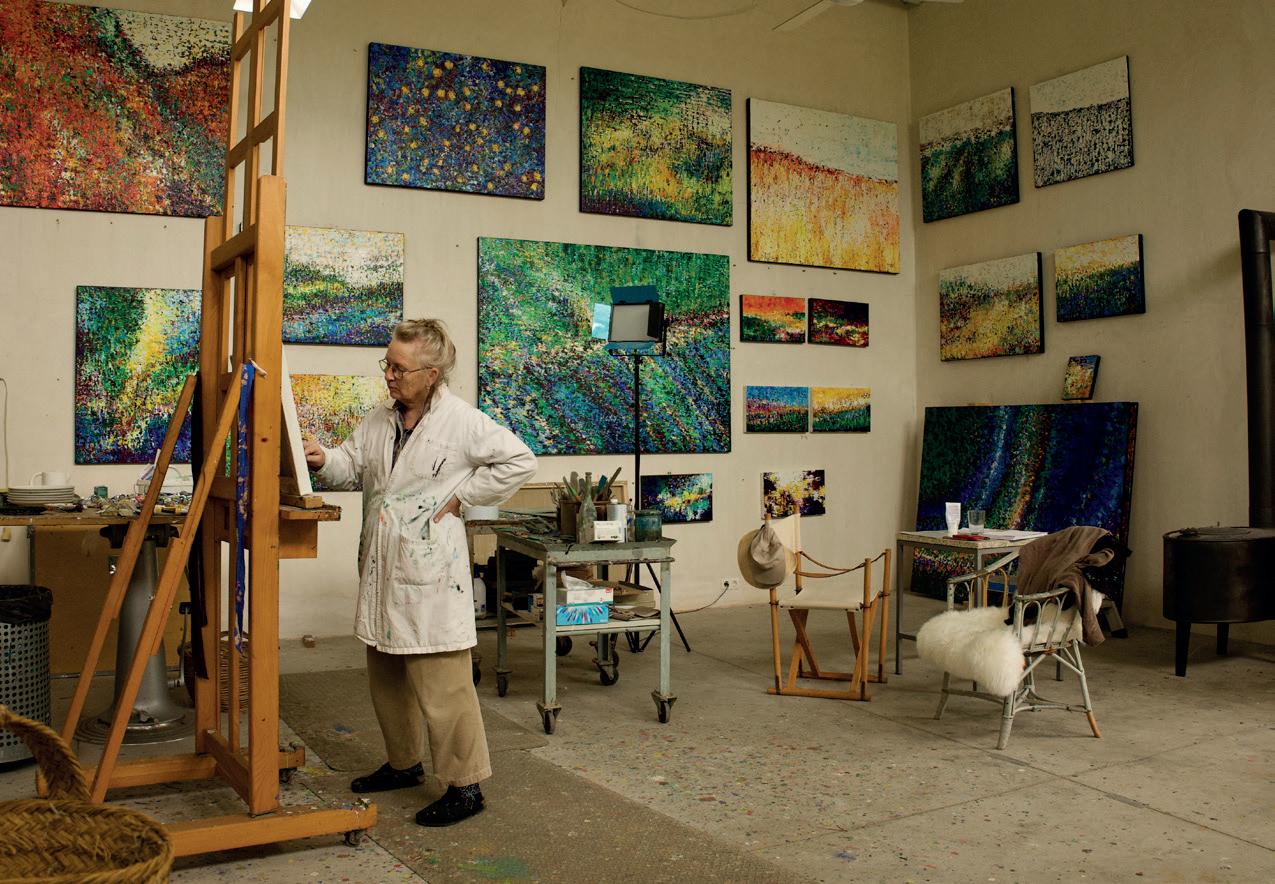
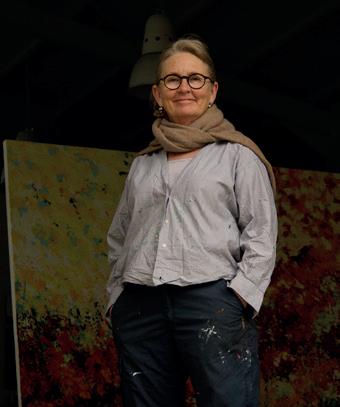
For more than four decades, Danish artist Pia Andersen has explored the world through paint, colour and texture. From scholarships in Poland and Mexico to an atelier surrounded by nature in Spain, her artistic journey has never followed the obvious route. Instead, it has been guided by curiosity, craftsmanship and a determination to create work that is entirely her own.
By Heidi Kokborg | Photos: Pedro Luis Jiménez Arnaiz
Pia Andersen has spent her entire career as an artist. After studying at the Design School Kolding, she received a scholarship that took her to the Academy of Fine Arts in Kraków in the early 1980s. What was meant to be a one-year stay became two and proved to be a defining chapter in her artistic development.
“It was an incredible experience,” says Pia Andersen. “Professionally, I learned so
much, but I also discovered that limitations can be incredibly creative. Materials were scarce in Poland at the time, so you had to think differently and find new solutions. That has stayed with me ever since.”
Rather than following a conventional career path, Andersen continued to seek out places that challenged her. Another scholarship later brought her to Mexico, where she immersed herself in local traditions,
landscapes and artistic techniques while writing articles about handmade paper and pre-Columbian craftsmanship.
“I’ve always followed my own slightly crooked path,” Pia Andersen explains. “Travelling has never been about ticking places off a list. I like staying somewhere long enough to create a daily life. I look at the art, talk to people, experience the food and the landscape. All of those impressions become part of what I create.”
Although the artist has travelled extensively, nature remains her greatest source of inspiration. Today she divides her time between her home in Copenhagen and her studio in rural Spain, where
she has spent more than 25 years surrounded by vast landscapes.
“It isn’t about looking at one specific tree or flower. I take in everything around me. The changing seasons, the textures, the colours, the way the light shifts throughout the day. Then I mix it all together and it becomes something entirely new,” says Pia Andersen.
Those experiences emerge in paintings that are unmistakably abstract yet deeply rooted in nature. Rather than depicting landscapes directly, she builds her compositions layer by layer, allowing colour and texture to create an atmosphere that feels both familiar and open to interpretation. “The colours in nature are never flat. Everything is built up in layers. Flowers bloom and fade, leaves change colour, light transforms everything. I try to create that same depth in my paintings.”
Throughout her career, Pia Andersen has found inspiration in artists who each approached colour, material and composition in distinctive ways. Among those who have influenced her most are Mexican painter Rufino Tamayo, American abstract expressionist Joan Mitchell, Polish sculptor Magdalena Abakanowicz, German artist Gerhard Richter, and the Spanish masters Francisco de Zurbarán and Diego Velázquez.
Art in dialogue with architecture
Alongside her gallery exhibitions, she has increasingly devoted herself to large-
scale site-specific commissions, creating artworks designed specifically for the spaces they inhabit.
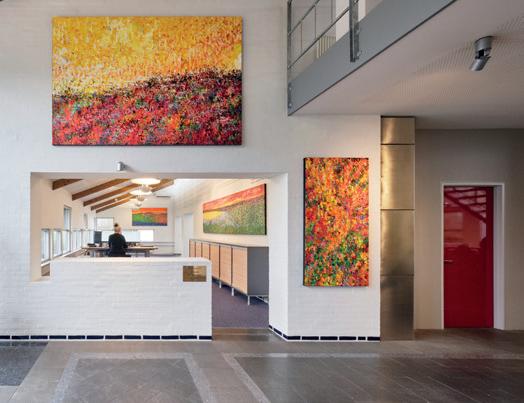
One of her most recent projects was a complete artistic commission for Dansk Auto Logik’s headquarters in Vamdrup, where she created 14 large paintings that respond to the building’s architecture, light and atmosphere. Earlier commissions include works for the Danish Parliament, the Copenhagen Opera House and the Forest School in Nødebo. “I love these projects because every space is different,” she says. “I visit the building, study the light, measure everything and get a feeling for the people who will use it. Even though my paintings are abstract, they still need to belong to the space.”
That dialogue between artwork and architecture has also led Pia Andersen beyond painting. While she still describes herself as a painter, she regularly collaborates with specialist workshops to create porcelain, glass and ceramic works. Her newest porcelain collection was produced at Tommerup Ceramic Workshop, where repeated firings, glazes and gold detailing bring each piece to life.
The freedom of abstraction
Perhaps the greatest strength of Andersen’s work is that it never dictates what the viewer should see. She remembers exhibiting at the Library of Alexandria in Egypt, when a visitor came up to her. “She said, ‘I like the one with the camels.’ It was a yellow and orange painting, and I had
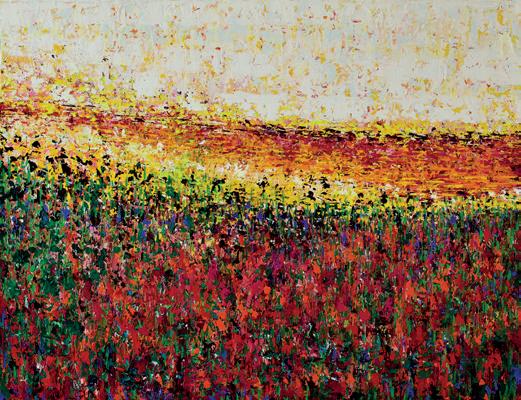
never once thought about camels. But that’s exactly what I love about abstract art. People bring their own experiences and stories with them.”
Rather than giving her paintings descriptive titles, Pia Andersen deliberately keeps them open, allowing viewers to create their own narratives. “Abstract painting allows everything to mix together. You can create entirely new landscapes and new worlds. The painting becomes a catalyst for someone else’s story.”
Pia Andersen’s work can be experienced through ARTSY, Galerie Provence in Denmark and Whitesquare Gallery in Berlin.
www.piaandersen.com
Facebook: Pia Andersen Artist
Instagram: @piaandersenartes
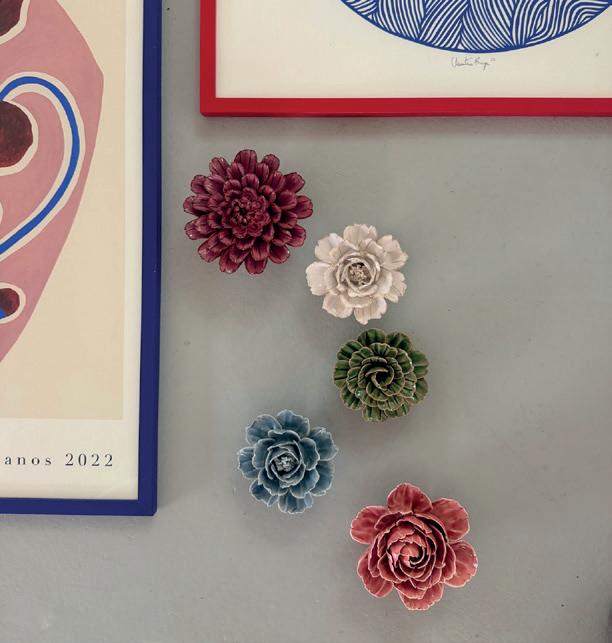
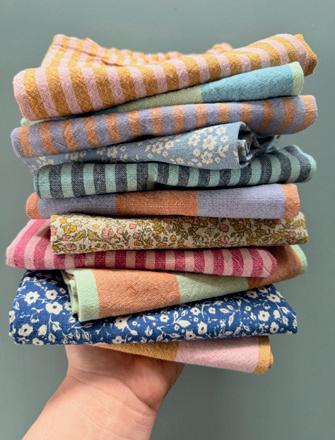
Some people follow trends, others follow instinct. For Marlene and Helge Mark Waldorf, the husband-and-wife team behind web shop MARK&WALDORF, it has always been about finding products that make them stop in their tracks. Quirky without being childish, timeless rather than trend-driven, their carefully curated collection proves that the best finds are often the ones you never knew you were looking for.
By Heidi Kokborg | Photos: MARK&WALDORF
Long before MARK&WALDORF came to life, Marlene Mark Waldorf spent her career surrounded by consumer products. She worked as a product manager for companies including RICE, BoConcept and Bahne, travelling extensively and helping shape collections for other brands. But after suffering from stress, she reached a point where she wanted something different. “I didn’t feel sorry for myself, it became the beginning of something new. I was tired of creating products for other people. We wanted to create something ourselves,” smiles Marlene Mark Waldorf.
Together with her husband, Helge, she started MARK&WALDORF in 2013. Even
the name reflected their desire to keep their options open. Mark comes from Helge’s family name, Waldorf from Marlene’s grandfather, while the ampersand symbolises the partnership between them. They deliberately avoided names including words like home, living or interior. “We wanted the freedom to develop. If one day we decide to sell orange marmalade, we can. The name should not limit us.”
Although home accessories remain at the heart of the business, the philosophy has always stayed the same: finding products that are not necessarily available everywhere else but still feel approachable and useful.
Following the gut feeling
Perhaps the most surprising thing about MARK&WALDORF is how new products are discovered. Many businesses in the industry spend weeks each year visiting international trade fairs. Marlene and Helge have not attended a single one
since launching the company. Instead, discoveries happen naturally.
“I’ve learned to trust my gut feeling,” Marlene confides, and continues: “I might be walking through a small town in Italy, stop for a coffee, notice a tiny shop that’s open and suddenly see something that catches my eye. My first thought isn’t whether we can sell it, but simply ‘isn’t that beautiful?’”
Only later does she begin tracking down suppliers and exploring whether a product belongs in the MARK&WALDORF collection. Her ability to spot potential has followed her throughout her career. “I once had a job interview where they asked me what I was good at,” she laughs. “I said, ‘if you and I walked around a flea market for 15 minutes, you would probably think it was all rubbish. I would come back with four or five treasures.’ That is what I do. I find the gold.”
Knowing the customer is just as important. Over the years, Marlene has developed an understanding of the women who make up much of MARK&WALDORF’s customer base and what they are drawn to –not because something is fashionable, but because it has lasting appeal.
Products with a twist
Spend a few minutes exploring MARK&WALDORF and certain themes quickly emerge. There are delicate ceramic wall flowers that can be arranged
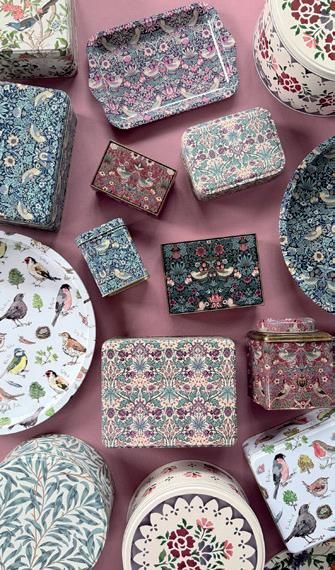
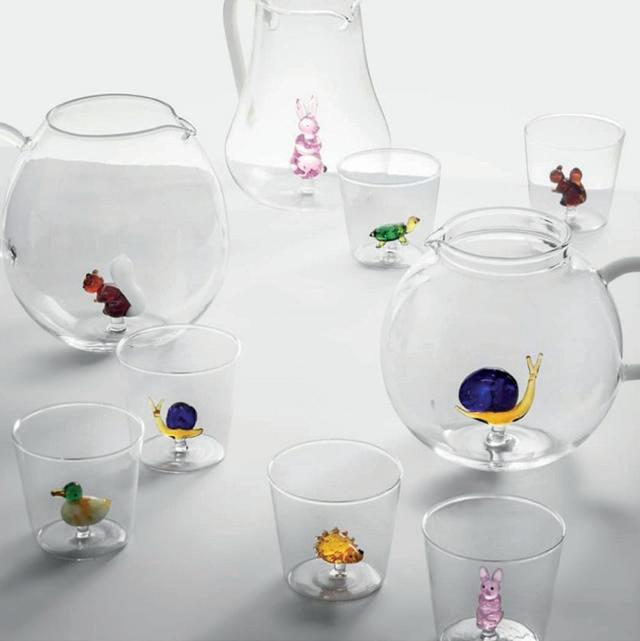
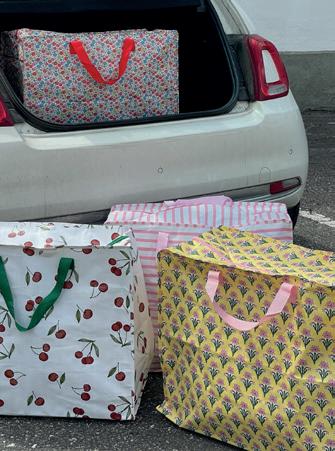
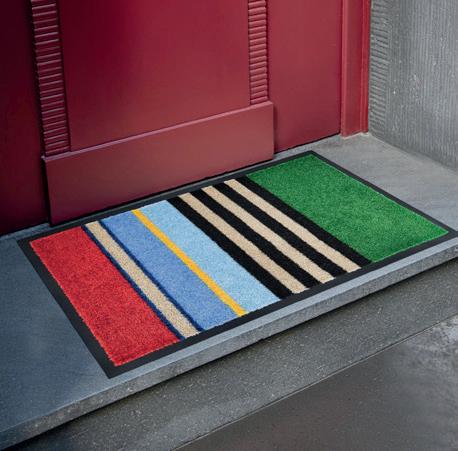
into bouquets that never fade. Colourful Italian glasses decorated with strawberries, horses and other playful figures. Foldable travel bags that pack flat inside a suitcase until they are needed. Decorative tins and trays inspired by classic tea boxes, quirky doormats, Moomin favourites and a carefully selected collection of products that all share one characteristic: they have personality.
“We’ve never wanted to be super modern. That’s not very interesting. Trends come and go, but we’re more interested in prod-
ucts with a little twist. Something quirky without becoming silly or childish.”
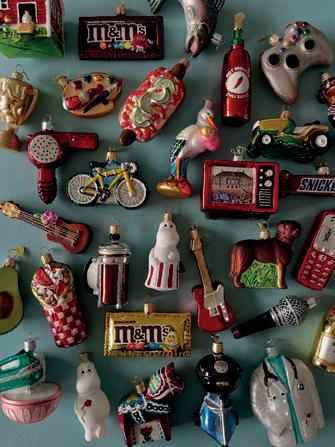
That philosophy extends to the company’s own designs. Every Christmas, MARK&WALDORF produces its own collection of ornaments, ranging from chef’s hats and gin bottles to bespoke decorations created for clients such as Falsled Kro and Molslinjen.
A family business at heart
Despite its growth over the past 15 years, MARK&WALDORF has remained unmistakably personal. “It means a lot to us that people can feel we’re available on the other side of the screen,” Marlene explains, and continues: “Whether it’s an order confirmation, customer service or handling a complaint, we want people to know that they’re communicating with real people, not just a form.”
That personal approach is reflected throughout the business, from photography and communication to the carefully chosen collection. Every product has earned its place through the same instinct that inspired the business from the beginning. “There has to be something that catches my attention, a little twist,” adds Marlene. “When that happens, I know that I’ve found something worth sharing.”
www.markwaldorf.dk Facebook: Mark&Waldorf Instagram: @markogwaldorf
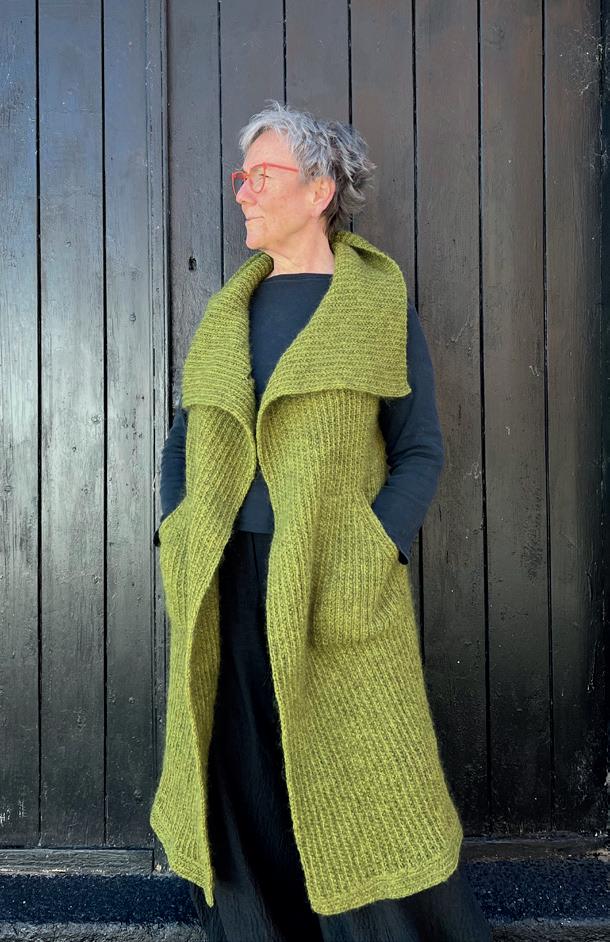
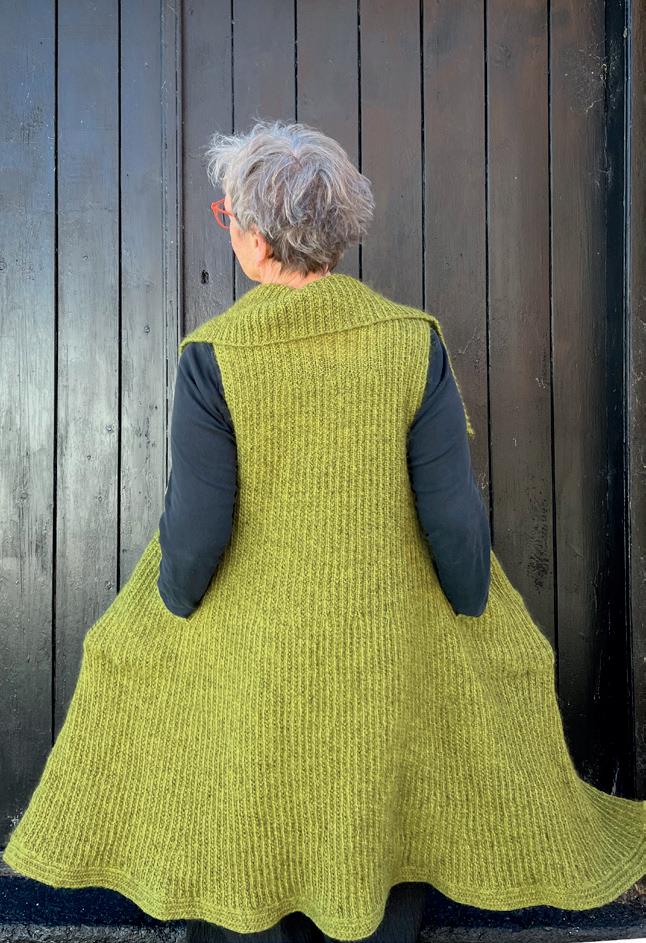
Åsa Söderman is the knitwear designer behind Åsa Tricosa, a brand created with a passion for seamless, wearable and well-fitting Ziggurat sweaters, cardigans, shawls and gloves. The knit-as-you-go designs have a top-down approach with clever built-in details – no seaming, no endless ends.
By Malin Norman | Photos: Åsa Tricosa
Back in 2010, Åsa Söderman developed a special knitting technique, Ziggurat, that soon caught on in the international knitting community. Selling her patterns on Ravelry, providing tutorials and publishing two books about Ziggurat, Söderman has become somewhat of an international name in knitting and regularly organises workshops in Scandinavia, France, Germany, the UK and the US.
Ziggurat is a method of knitting a sweater or a cardigan without having to cut the yarn. “By carefully thinking through the construction of the garment during the design process, it’s possible to find a way to continue knitting everything in one piece, from the top down. When it’s finished, you’ll have only six threads to attach – like magic,” she says. “It never ceases to amaze me how some -
thing as simple as knitting can transform a one-dimensional thread into a 3D-shaped piece.”
The designer works sculpturally, almost architecturally, and her customers must simply trust the pattern – which they clearly do! “My patterns are inspired by craftsmanship, but they are not constructed in a traditional way,” she says. “They are not for beginners but rather for someone ready for the next challenge, with unexpected and fun details. You can even use different details in the patterns to mix and match designs, like a modular system: a pocket from one design, an overlapping hem from another,
a seamless lined hem from yet another, and so on.”
On a mission to offer designs that ultimately make women feel good, most of Åsa Tricosa’s sweaters are tailored, as she is not fond of ill-fitting, oversize garments. Above all, she makes sure that the sweater or cardigan fits nicely over the shoulders – for a beautiful silhouette.
“The garments should feel comfortable to wear, but also be flattering.”
Originally from Sweden, and by way of the US, the UK, Singapore and Germany, these days Söderman is based in a picturesque small town in Denmark with her husband. Here, she continues to work on her craft, playing with designs and using locally produced yarn when possible.
“The knitting community is strong, respecting old traditions whilst welcoming modern thinking,” Söderman adds. “It’s a passion project. Knitting is better than scrolling, is my motto.”
asatricosa.com
Instagram: @asatricosa
Upcoming Ziggurat workshops
22-23 August
Wollcraft Festival 2026 in Worms, Germany
18-20 September
Wool Days Thy in Hurup Thy, Denmark
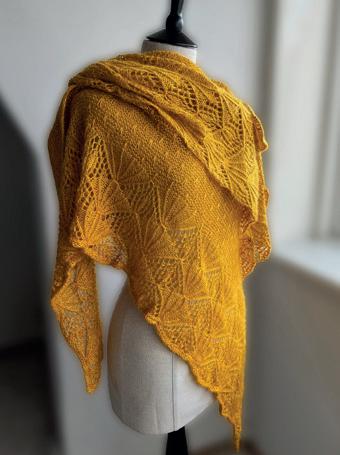
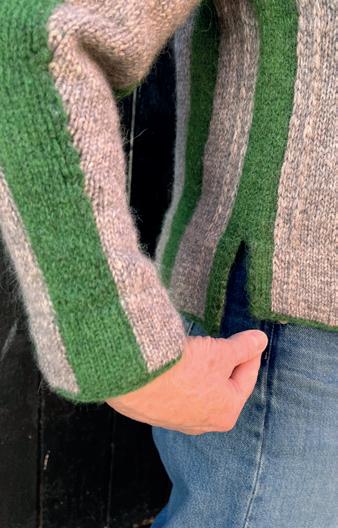
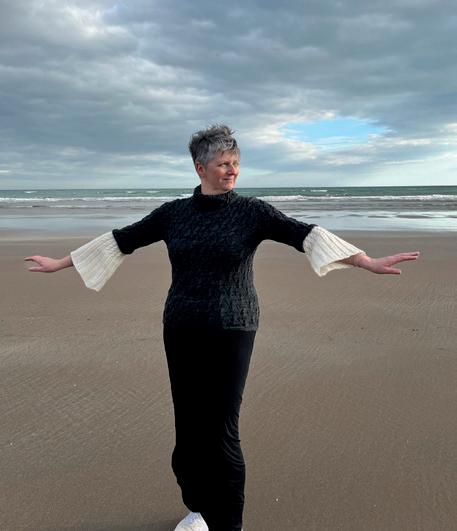
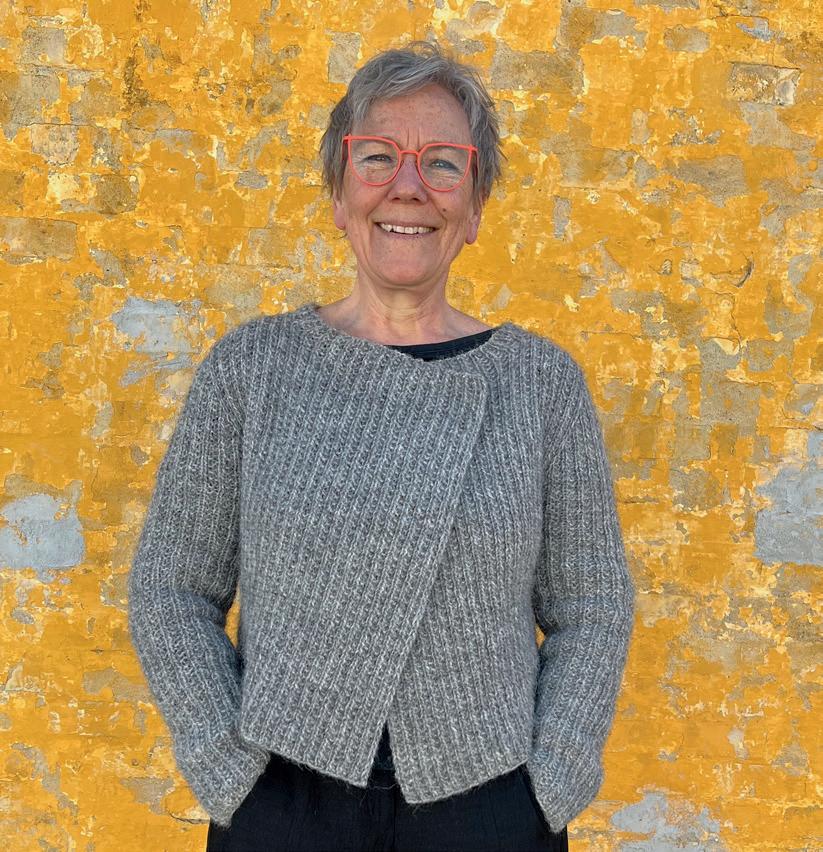
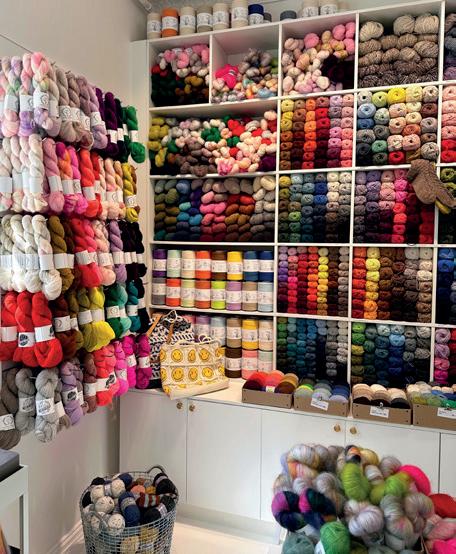
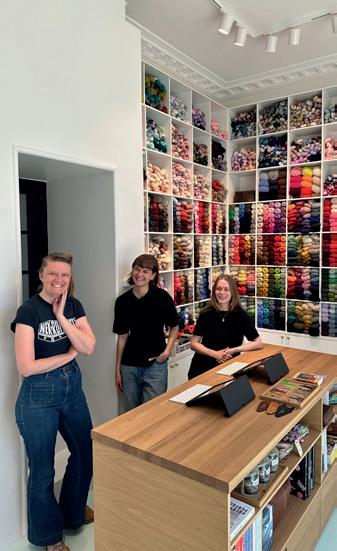
For 15 years, Yarnfreak has been following and contributing to the growing popularity of knitting in Denmark and beyond. With its recent renovation, the shop is aiming to be an even more inspiring destination for local and international knitting fans alike.
By Miriam Gradel | Photos: Yarnfreak
In 2026, knitting entails much more than producing colourful Christmas sweaters for your grandkids. Now, the popularity of knitting is getting bigger every year and showing no signs of slowing down. Add a sprinkling of influencers and some YouTube tutorials on top of the trend, and what we are going through is a real renaissance for crafting with yarn.
This is particularly felt at Yarnfreak, a go-to location for some of Denmark’s most renowned names in knitting. Since opening in 2011, the shop has offered colourful and speciality items, helpful advice and social gatherings for anyone who identifies with the store’s name. Ask owner Camilla Schmidt Rasmussen and it is clear that knitting is here to stay. “We’re so busy all the time,” she says. “In a highly digitised age, knitting somehow dissolves the stress by offering something physical to focus on.”
Post those COVID lockdowns, knitwear designers such as Lærke Bagger and Mette Wendelboe Okkels (aka Petitknit) further turbocharged the trend, with modern aesthetics and patterns to reign in a broader audience. In Denmark today, it is near impossible to pass a café without spotting a piece of knitwear in the making inside.
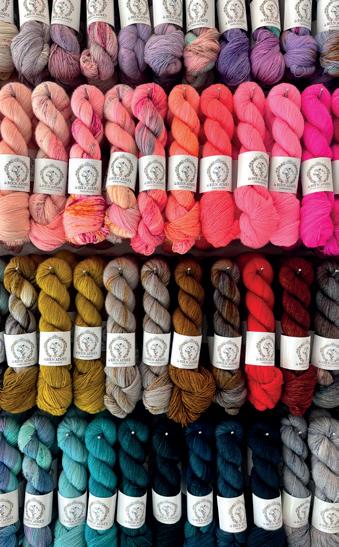
As a result, Yarnfreak is bustling. When Rasmussen’s own fingers are not guiding the knitting needles, she has them on the pulse of the latest trends. “We’re a colourful shop,” confirms Rasmussen. “My motivation when curating the selection is to find something that you can’t simply pick up anywhere else,” she adds, noting that all staff members also knit and contribute to the shop’s selection. As a result, Yarnfreak’s physical and online shops are real meccas for hand-coloured and specialty yarn – including Noro from Japan, La Bien
Aimée from France and Hedgehog Fibres from Ireland – in addition to playful patterns, labels and magazines.
Yarnfreak is opening its newly-renovated shop just as international tourists are arriving in Aarhus for the summer. With a new, more spacious front desk, the expert staff is well prepared to help visitors plan their piece or keep the rib going. “Our mission is to showcase the realm of opportunities beyond the classic and basic knitwear,” says Rasmussen. “We want to inspire folks to create some banging knits!”
www.yarnfreak.dk
Instagram: @yarnfreakdk
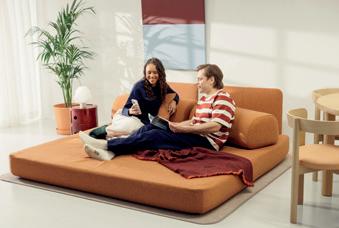
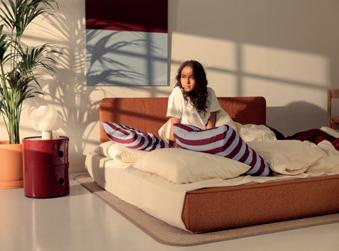
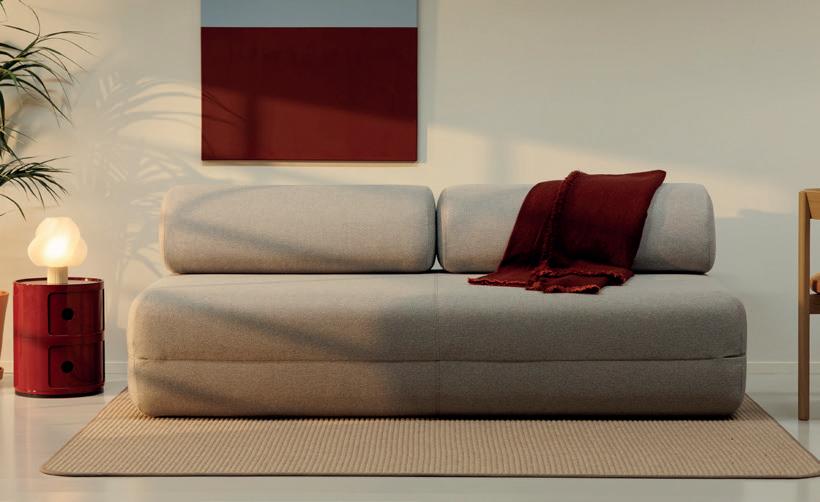
Khoy’s quest for the ideal sofa bed began with a challenge: could they design a product comfortable enough for daily sleep, yet able to fit into a stylish living space? After a year of innovation and testing, Khoy’s efforts came into fruition, and the Finnish company was up and running. Khoy combines comfort, design, sustainability and convenience, bringing its sofa beds to homes throughout Europe and beyond.
By Molly McPharlin | Photos: KHOY
Khoy’s founders have an abundance of design experience between them. For instance, co-founder András Kelemen has worked with Dutch designer Marcel Wanders and Finnish furniture icon Eero Aarnio. They have a deep understanding of product development and high-end furniture design, inspired by the simplicity and calm presence of Nordic aesthetics. Khoy created a contemporary sofa bed that complements a range of homes and interior styles.
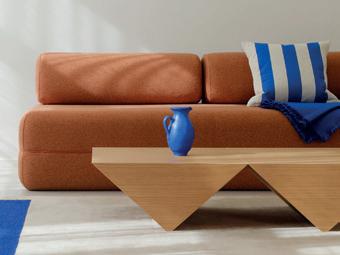
The various styles and interchangeable covers give owners the flexibility to refresh and adapt appearances for years to come, extending both style and longevity. Simple to assemble and use, Khoy’s sofa beds provide superior comfort, as both a sofa and a bed. The modular design allows parts to be replaced or updated, extending the bed’s lifetime. And Khoy’s cutting-edge ship-
ping method and local European manufacturing significantly reduces carbon footprints and environmental impact.
The King sofa bed is one of the best-selling models. It offers a spacious 180 x 200 guest bed while allowing users to reposition two backrests to create different seating configurations. The mattresses feature a dual-foam construction, with 15 centimetres of medium-firm foam on the sofa side and 4 centimetres of memory foam on the bed side. This provides firmer support for sitting and a softer, more comfortable sleeping surface.
This popular sofa bed has been awarded the prestigious Red Dot Design Award and the A Design Award, receiving overwhelmingly positive feedback from the design community. In an independent laboratory, life-cycle tests show that the product will continue to look and
perform beautifully even ten years after extensive use.
Khoy is continuously expanding its product range in the UK and will launch in the US market in the future, while introducing new products with additional fabric options. The sofa beds are truly multifunctional pieces of furniture. If you need a sofa, lounger or guest bed without cluttering living space, Khoy is an ideal choice. It elevates your interior, makes the most of your space and still leaves enough room for a dance floor.
www.khoycompany.com
Instagram: @khoy_company
YouTube: @KHOY-company
TikTok: @khoy_company
WhatsApp: Khoy
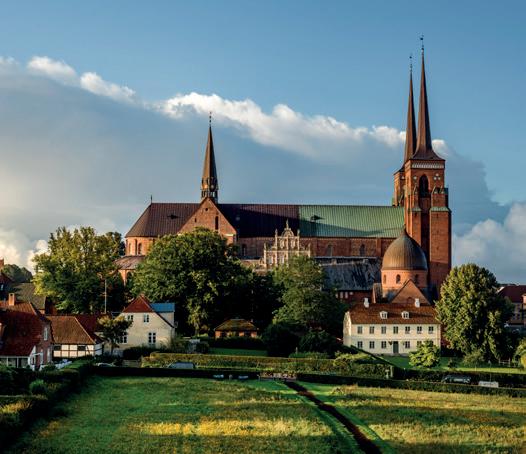
Roskilde Cathedral stands as a testament to centuries of architectural and cultural significance. The masterpiece of Gothic design dates back to the 13th century and is a UNESCO World Heritage Site. With around 170,000 visitors per year, the spectacular brick building also offers a programme of concerts, guided tours and treasure hunts.
By Malin Norman
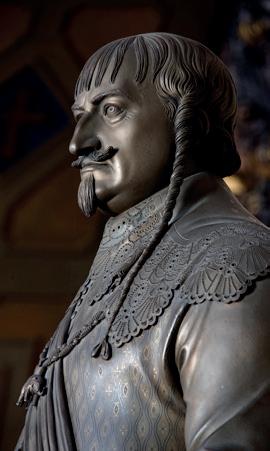
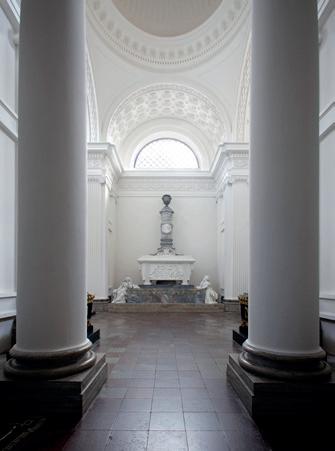
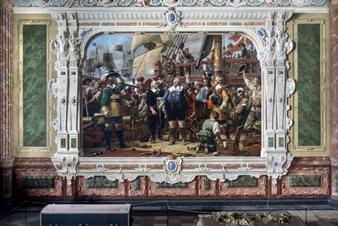
In Roskilde Cathedral, the kings and queens of Denmark will take you on a journey through 1,000 years of history, from the Vikings to today. Here rest the country’s most influential historical figures, including the great Danish builder-king Christian IV and Queen Margrete I of the Kalmar Union. Even the Viking king Harald Bluetooth is said to be buried here.
“This is the burial church of the Danish royal family, and around 40 monarchs are buried in the royal chapels,” says Sara Peuron-Berg, head of interpretation. “Their decisions, alliances, marriages and conflicts have left a lasting mark on Denmark’s history and development. Nowhere else in the world will you find such a longstanding tradition still alive.”
Denmark’s most important church, the Gothic masterpiece, with its twin spires
and semi-circular gallery, has been a UNESCO World Heritage Site since 1995. Dating back to the 13th century, this was Scandinavia’s first Gothic cathedral to be built of brick, and it encouraged the spread of this style throughout northern Europe. Over the centuries, side chapels, porches and other structures were added, each in the architectural style current at the time and adding to the atmosphere.
“The moment people step inside they are amazed. Roskilde Cathedral reflects the development of European architectural history and shows how new techniques fundamentally changed humanity’s relationship with architecture and engineering,” says Peuron-Berg. “The cathedral stands for something stable, with its long history in an ever-changing world. At the same time, beyond its architectural marvels, it still plays a vital role as a place of death, worship and music.”
Roskilde Cathedral attracts some 170,000 visitors per year. In addition to services, ceremonies and concerts, it also offers guided tours, as well as fun and educational treasure hunts for children. A new visitor centre is in the works, too, planned to open in 2028.
The beautiful landmark is located in central Roskilde, on a small hilltop overlooking the fjord. Close by is the Viking Ship Museum with a working boatyard, maritime crafts and a large collection of traditional, Nordic wooden boats. “The location is significant in Danish history, reflecting the transition to Christianity,” adds Peuron-Berg. “And just 25 minutes by train from Copenhagen Central Station, this is ideal for a day trip with the family.”
roskildedomkirke.dk
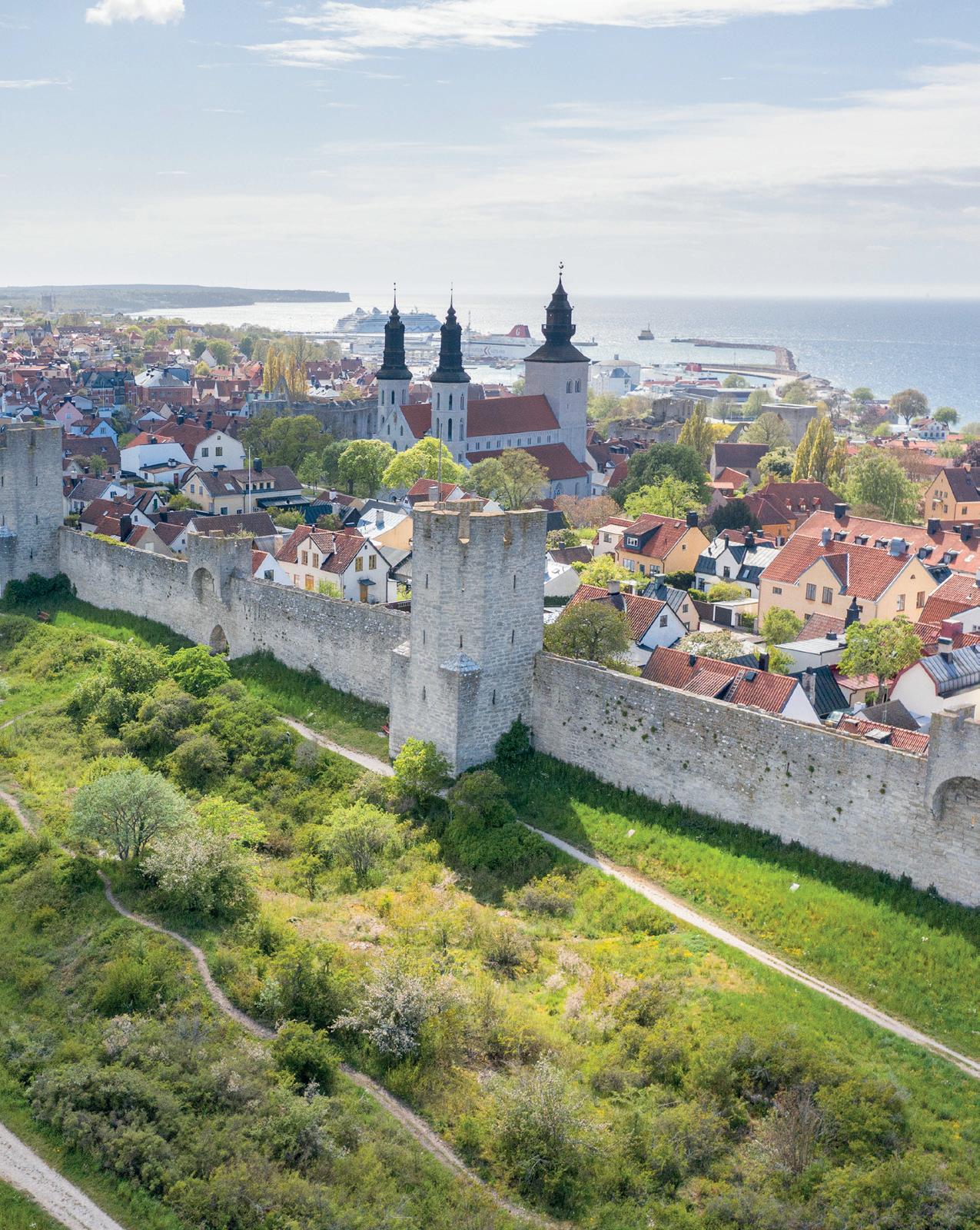
The best time of year in Gotland, Sweden’s own paradise island, is on the horizon. Before long, the crowds will be gone, the pace will slow down, the sea will still be warm and some of the late summer sun will linger for a little longer. Many hotels and restaurants will still be open, and the island’s pantry will fill up with the autumn season’s harvest.
By Malin Norman
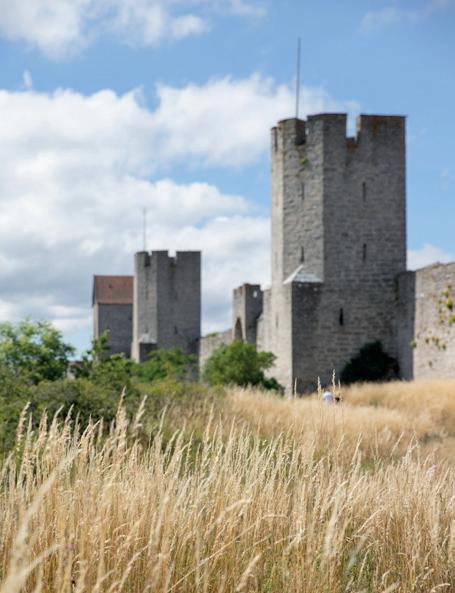
With its limestone landscapes, mile-long beaches and local culinary experiences, Gotland is a haven. In summer, the largest of Sweden’s islands is a hotspot for holidaymakers and partygoers, but as the high season draws to an end, the pace changes and a sense of calm returns.
Visitors and locals appreciate the slower, quieter way of life in autumn, as well as the hyper-local culinary scene. As it turns out, the island is ideal for gourmet endeavours with world-class produce.
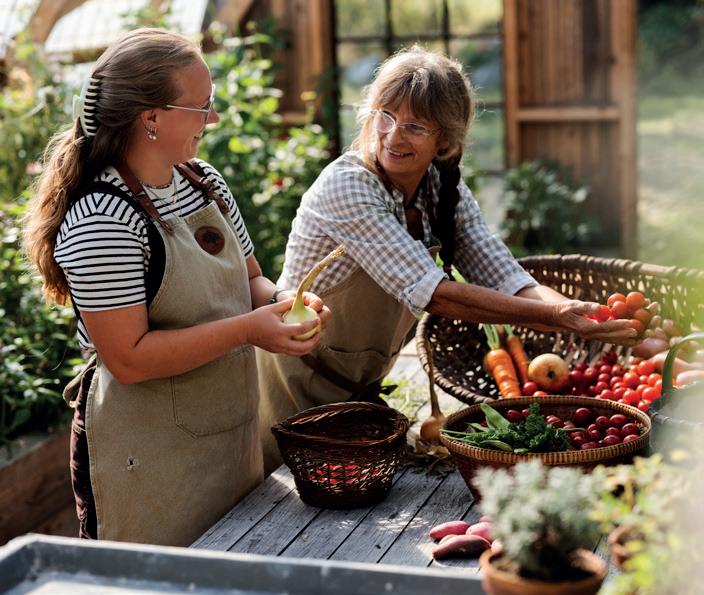
Here, innovative cuisine, creative food entrepreneurs and delicious ingredients tempt around every bend.
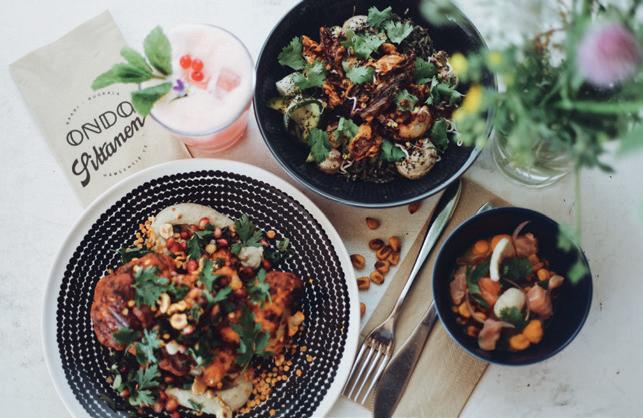
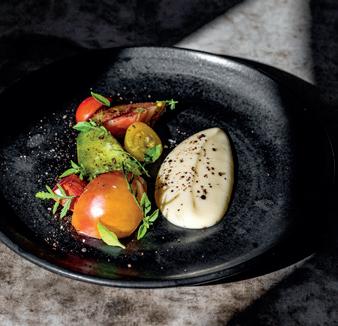
Thanks to its location, Gotland has a history as a vibrant trading hub, with the locals developing a fondness for exotic ingredients such as saffron – as seen in the popular saffron pancake, served with whipped cream and strawberry jam. The island also has a strong fishing tradition and delicious seafood plays a central role, while the local lamb
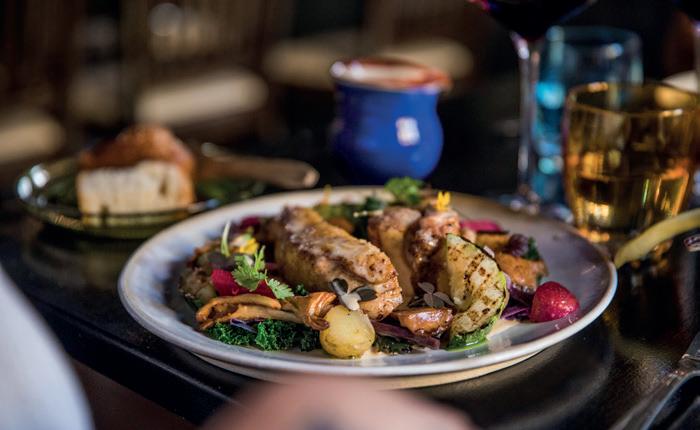
is nothing but outstanding. Whereas in spring, asparagus and Ramson wood garlic (ramslök) are a sure hit, in autumn, the Gotland truffles (black Burgundy truffle) take centre stage.
Gotland on a plate
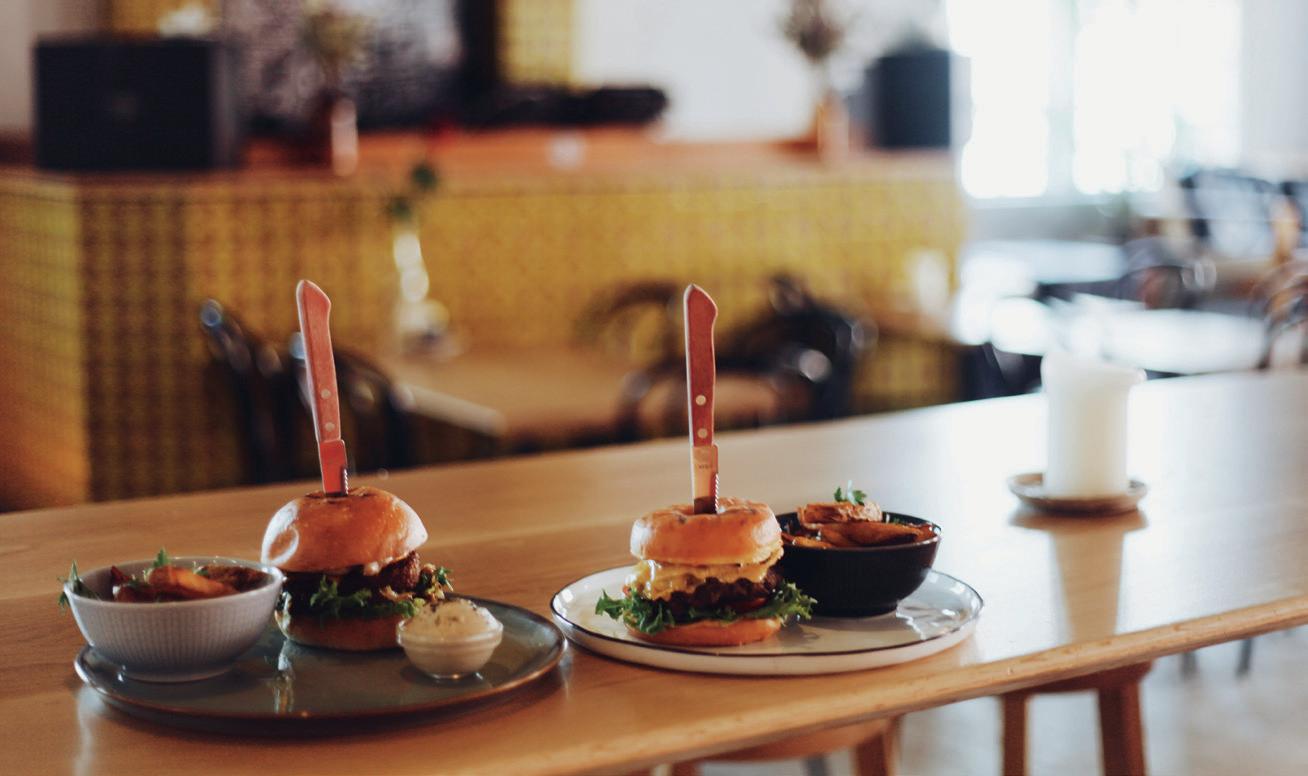
The island is renowned for its top-notch restaurants; for instance Krakas Krog, located in Kräklingbo on the east side of the island. Featured in the prestigious Michelin Guide, Krakas is praised for its seasonal, locally sourced produce, meat from nearby farmers and ingredients from the restaurant’s own garden.
Another renowned restaurant is the family-owned smokehouse Katthammarsvik Rökeri, on the east coast of the island, which specialises in fish and prawns smoked on-site. It serves up freshly-caught delicacies year-round and you can even create your own plate of seafood.
In Visby, try authentic, tasty dishes at Bakfickan; for instance, the signature fish soup with aioli or the pickled herring with sour cream. Lilla Bjers, just south of Visby, reinterprets classic Gotland flavours in innovative ways. And Krusmyntagården,
north of Visby, is popular too. Set in an idyllic location overlooking the sea, it features a herb garden where you can buy your favourite spices to take home.
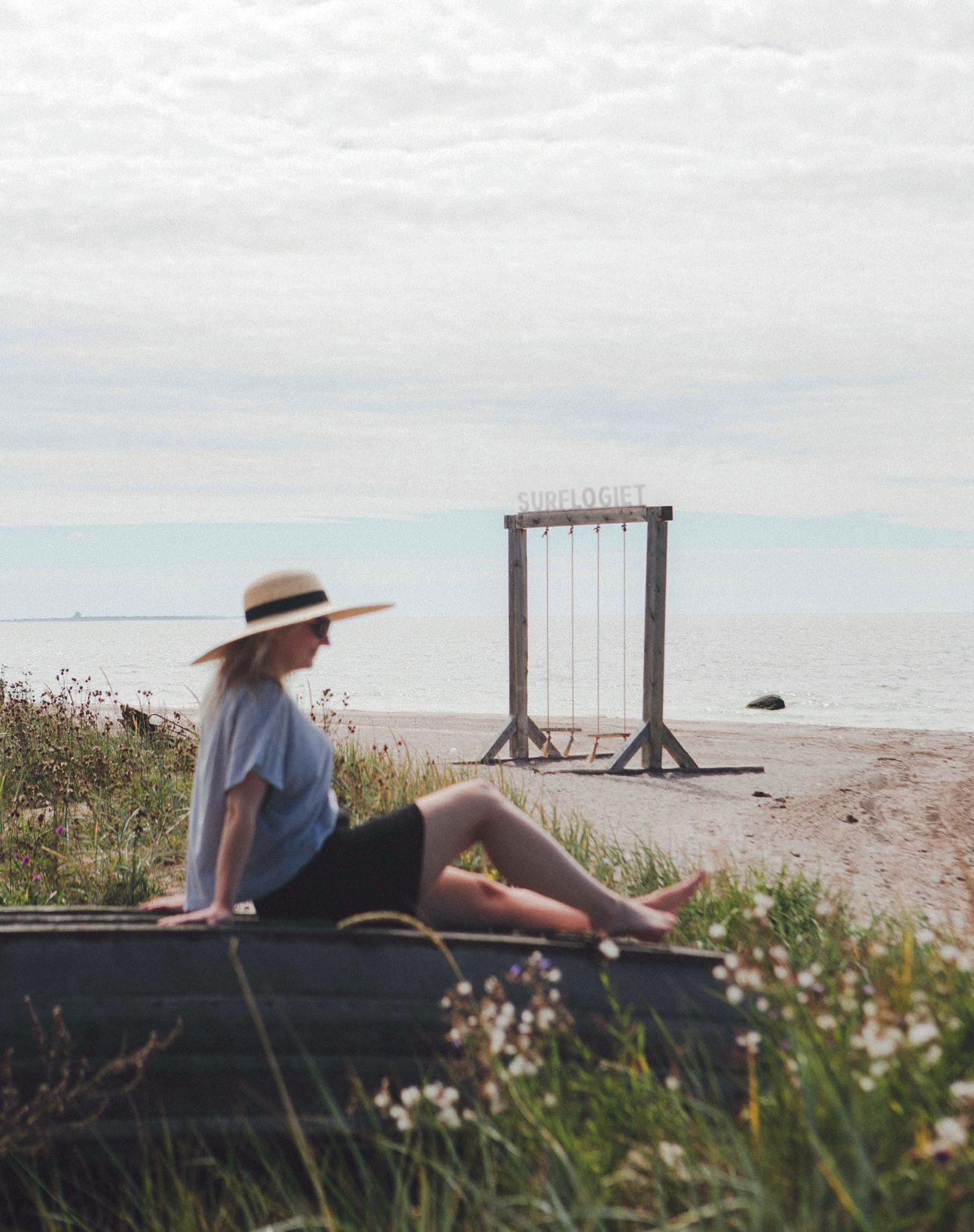
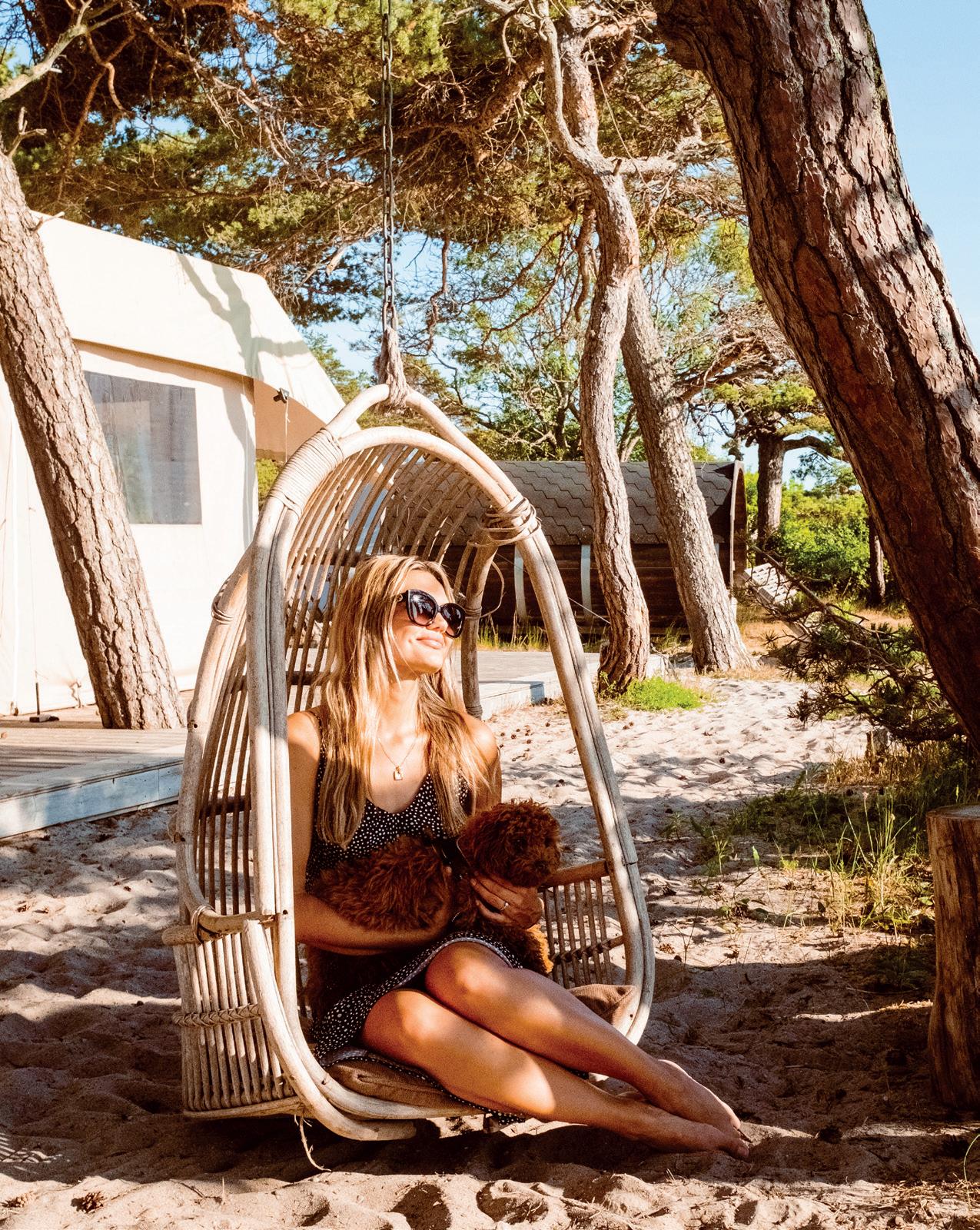
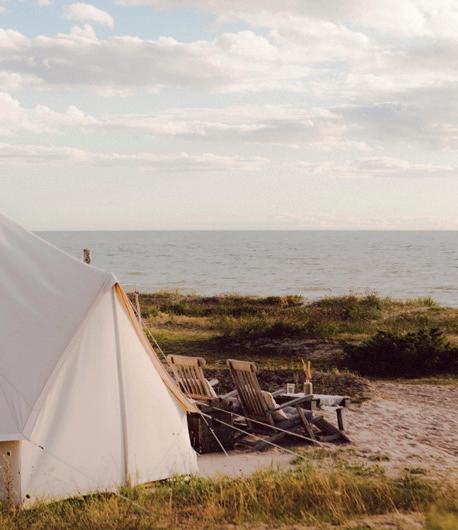
Eco-minded surf hub Surflogiet, located in Tofta, is keen to share and educate guests about the culinary heritage of the region. Hosting beachside stays, including SUP, windsurfing and kitesurfing, Surflogiet also invites its guests to sample food cooked with locally sourced ingredients, depending on season.
And Gotland in a glass
It may come as a surprise that one of Sweden’s oldest vineyards is located here. Established in 1999, Gute Vineyard is based in Hablingbo in the southern part of the island, surrounded by open landscapes and countryside roads. Vines grow close to the sea, and the local limestone soil, in combination with the many hours of sun, ensure good conditions for viticulture. Join a tour, to get up close to the production, enjoy a tasty meal at
Restaurang Vingården on-site, or stay the night at the estate’s own hotel – right next to the vineyard.
On the western coast of Gotland, Långmyre Winery in Burgsvik integrates Italian wine-making knowledge with Swedish awareness. This location also benefits from the mild maritime climate and sandy soils, again ideal for grape cultivation. Långmyre was established in 2018 and similarly to Gute Vineyard, it focuses on organic farming methods.
Beer lovers will find plenty of local brews too, to pair with their Gotlandic food. In fact, Gotland has the highest concentration of breweries in Sweden.
One long-standing popular brewery is Gotlands Bryggeri, which produces the classic Wisby Stout. Also check out small brewery Snausarve Gårdsbryggeri, founded in 2017, and its newly released Snausarve Brown Ale with locally grown hemp seeds. And Brygghuset in Visby offers more than 100 different beers, many
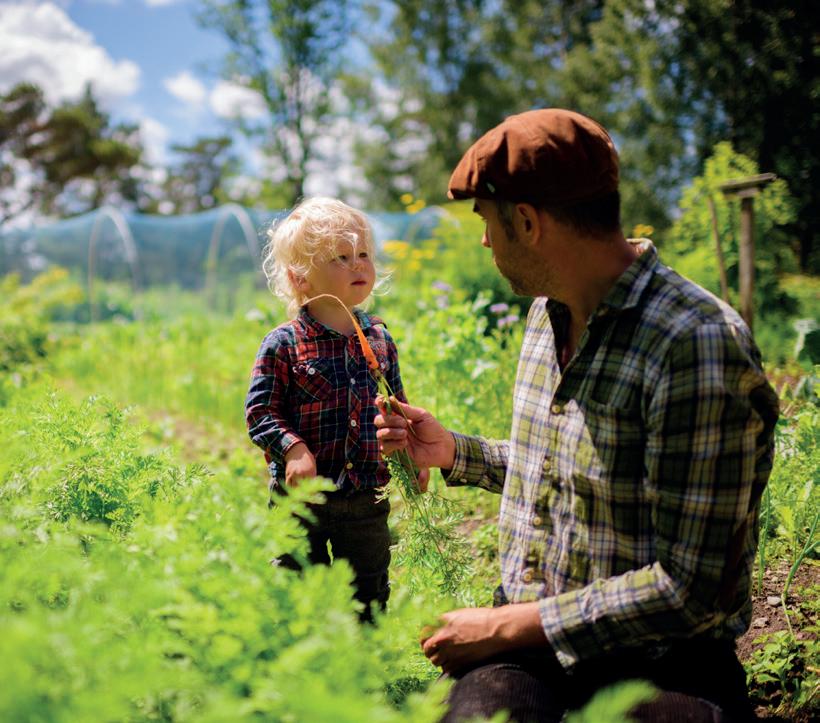
local. Gotland even has its own beer style: Gotlandsdricka is a smoky-sweet, juniper-flavoured farmhouse ale, brewed on the island for centuries.
Three gastro festivals on the island
This autumn, three not-to-be-missed culinary festivals await. First up is Gotland’s Harvest Festival (Gotlands Skördefestival), which takes place 5-6 September. It
features food producers, animals and machines, and visitors can take part in workshops too. This is where to experience the scents, tastes and traditions of Gotland –from farm to table.
A few weeks later, 25-27 September, Gotland Taste Festival brings together local producers, chefs and food lovers for a weekend of engaging talks and tastings at
the food market in Visby, as well as farm shops and restaurants across the island.
Gotland’s Truffle Festival (Gotlands Tryffelfestival), hosted 13-15 November, concludes Gotland’s Truffle Month. The weekend-long festival is dedicated to the island’s black gold, the Gotland truffle, and visitors can immerse themselves in the world of truffles with expert-led
seminars, a truffle market, truffle hunts, a truffle ceremony and truffle menus at many restaurants.
The island’s barren landscape and sheer light have inspired artists, writers and performers for centuries. Gotland has served as the backdrop for film productions such as the original Pippi Longstock-
ing series, the French drama Bergman Island, which was praised by The New York Times, and the works of legendary director Ingmar Bergman.
Hit Swedish crime drama Maria Wern (known as Murder in Sweden internationally) is set here. The series is based on best-selling novels by Anna Jansson, who was born in Visby, and follows a detective who relocates from Stockholm to Gotland after her husband’s death. Also set on the island is the German-Swedish co-production The Inspector and the Sea (Der Kommissar und das Meer), based on Mari Jungstedt’s novels. It follows a German police inspector navigating murders in Gotland.
The island is also where Lars Jonsson, one of the world’s foremost painters of birds and nature, lives and works. His paintings are displayed at Museum Lars Jonsson in Vamlingbo Rectory, one of Gotland’s top attractions with a well-liked restaurant, a lush garden and a garden shop – great for a day trip, by the way. Authors Håkan Nesser and Maria Grund also live here, and the list continues.
Explore the natural wonders of Gotland Apart from a fabulous gastronomic scene and inspirational settings for creatives, Gotland offers plenty of outdoor activities,
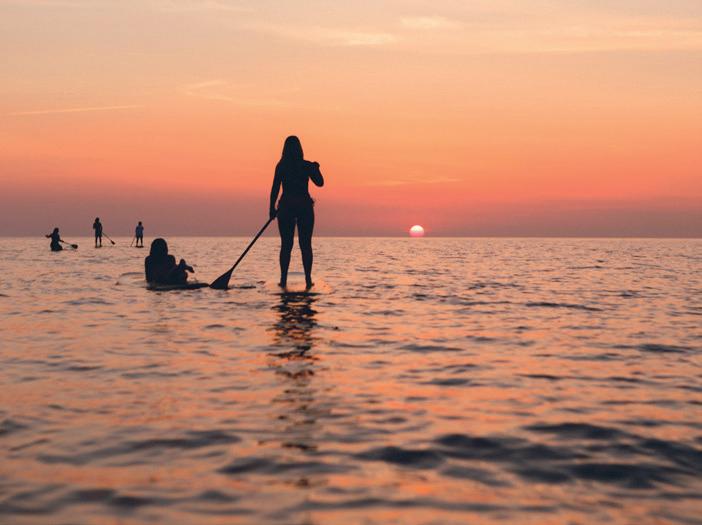
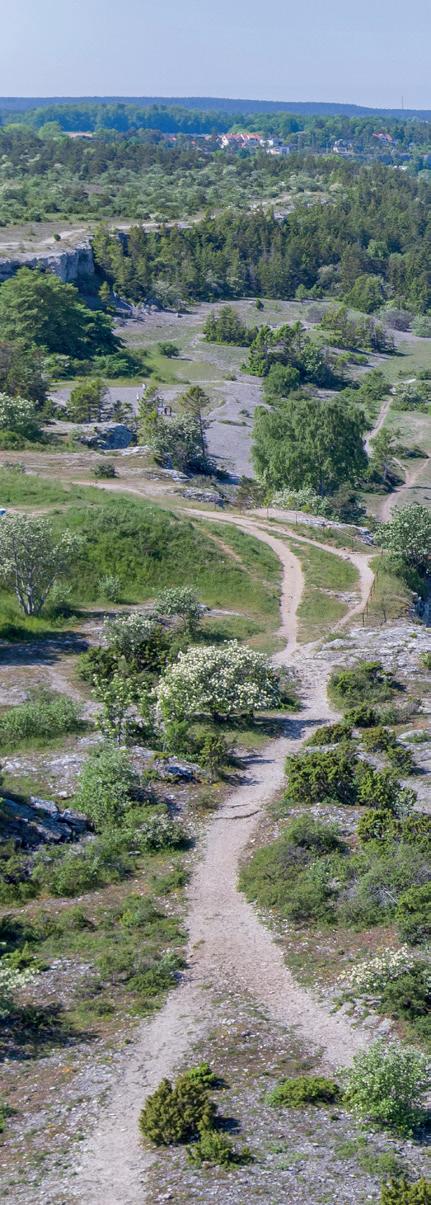
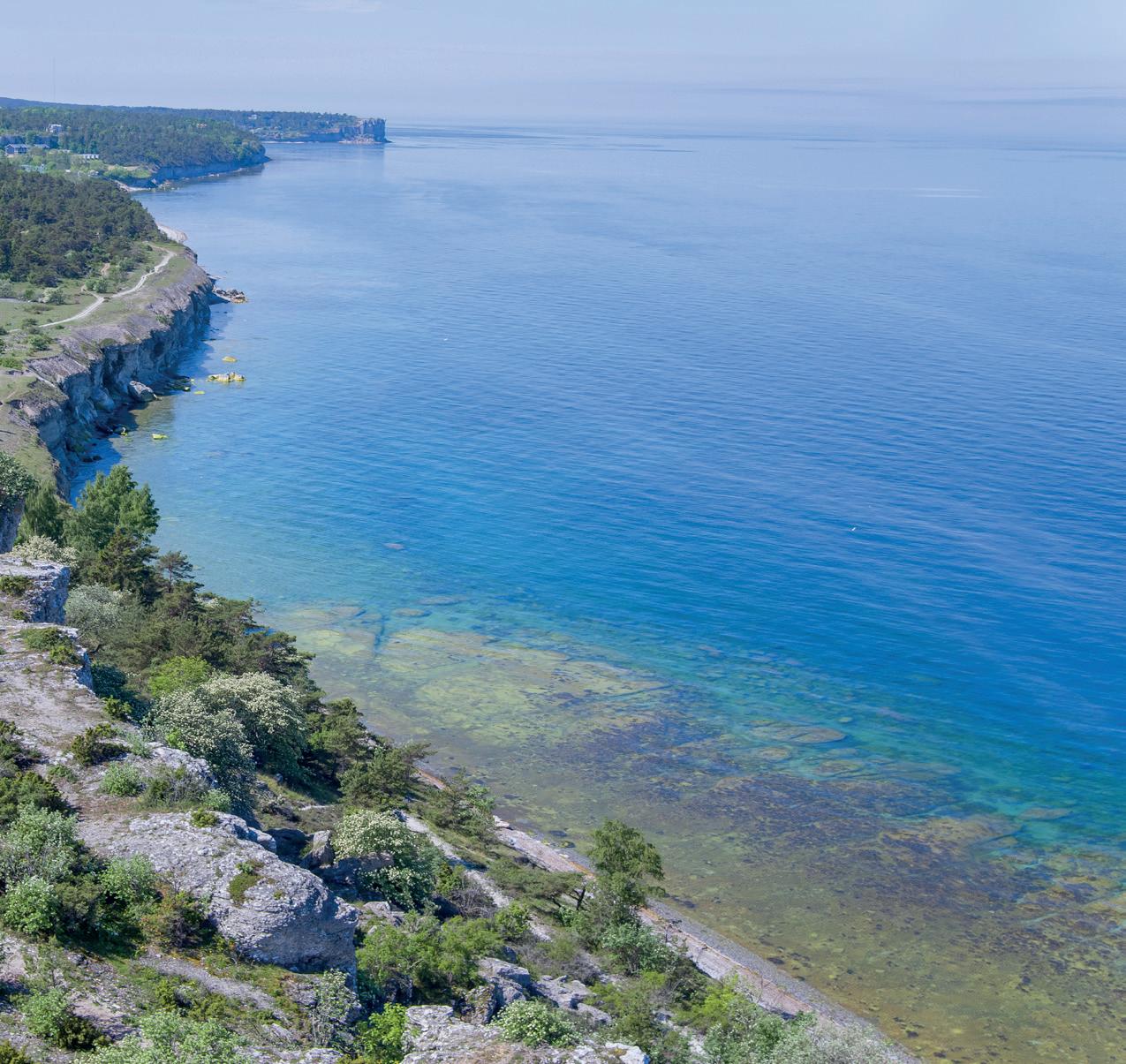
with its more than 100 nature reserves. As Gotland is largely flat, it is a dream destination for cyclists, and hiking is another popular activity. For instance, the 30-kilometre Klintkustleden Trail is considered one of the most scenic coastal hikes in the country, linking six nature reserves along the island’s northwest coast – via dramatic cliffs with sweeping views of the Baltic Sea, through ancient forests and past old fishing villages. And Jungfrun, Gotland’s tallest sea stack, is situated along the trail.
Just north of Gotland lies the small island Gotska Sandön, well-worth a visit. Only eight kilometres long and five kilometres wide, almost the entire island is a nature reserve with white sandy beaches, rolling dunes and clear water. Uninhabited, this is natural beauty at its purest.
Culinary events in Gotland: 5-6 September
Gotland’s Harvest Festival
Location: Gotland Grönt Centrum in Roma, Gotland gotlandsskordefestival.se
25-27 September
Gotland Taste Festival
Location: various places throughout Visby and Gotland gotland.com/gotland-taste-festival
13-15 November
Gotland Truffle Festival
Location: various places throughout Visby and Gotland gotlandstryffelfestival.se
Facts about Gotland:
• Sweden’s largest island with an area of 3,140 square kilometres.
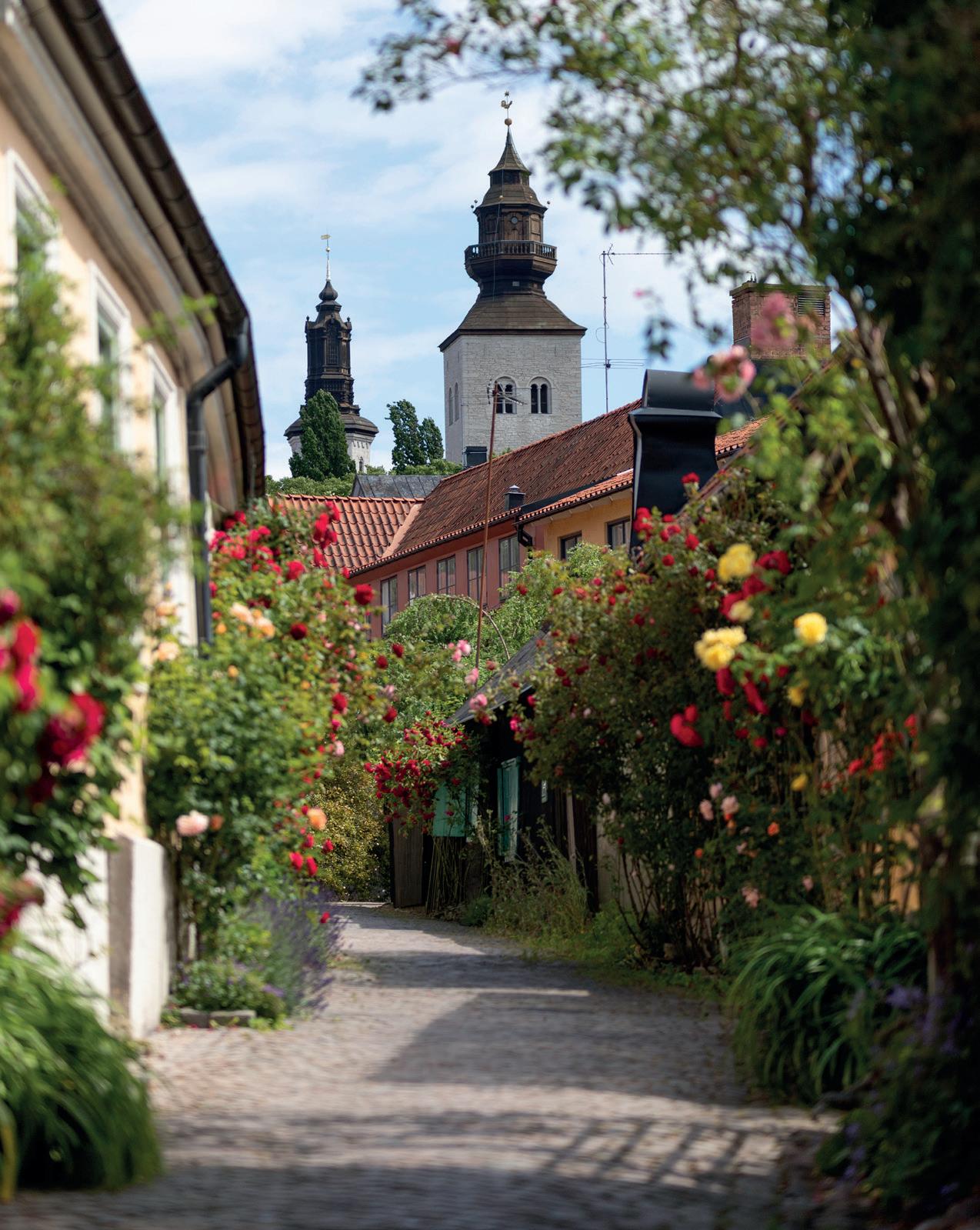
• The Hanseatic town of Visby is a UNESCO World Heritage Site, as the best-preserved fortified commercial city in northern Europe.
• The island has 92 medieval churches from the 12th to 15th centuries.
• It features 800 km of coastline, ideal for beach holidays and exploration.
How to get there:
Ferries operate year-round from Nynäshamn and Oskarshamn to Gotland, and the journey from the mainland takes around three hours. There are also several guest harbours around the island. A number of airlines also fly to Gotland, with flight time as short as 30 minutes.
For more information on what to see and do, check out visitsweden.com and destinationgotland.se
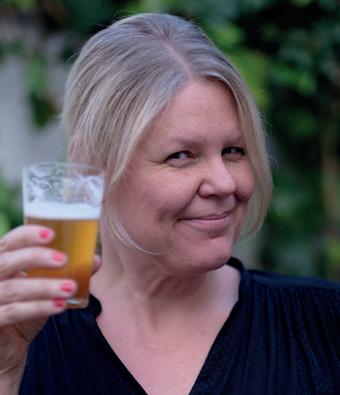
Surely, nobody has missed the FIFA World Cup. The medal-winning nations are close to my heart, as I have lived in all three, and it got me thinking about taxi drivers I have encountered in these countries and their beer (or non-beer) recommendations.
By Malin Norman
Let us start with Spain, the winning nation. This is probably the country with the most frequent taxi journeys for me. Not using taxis very often, it just so happens that it adds up over the years. Mostly in Mallorca, where I was living for a while, but also in Catalonia, Asturias and Andalucia – regions I have visited often.
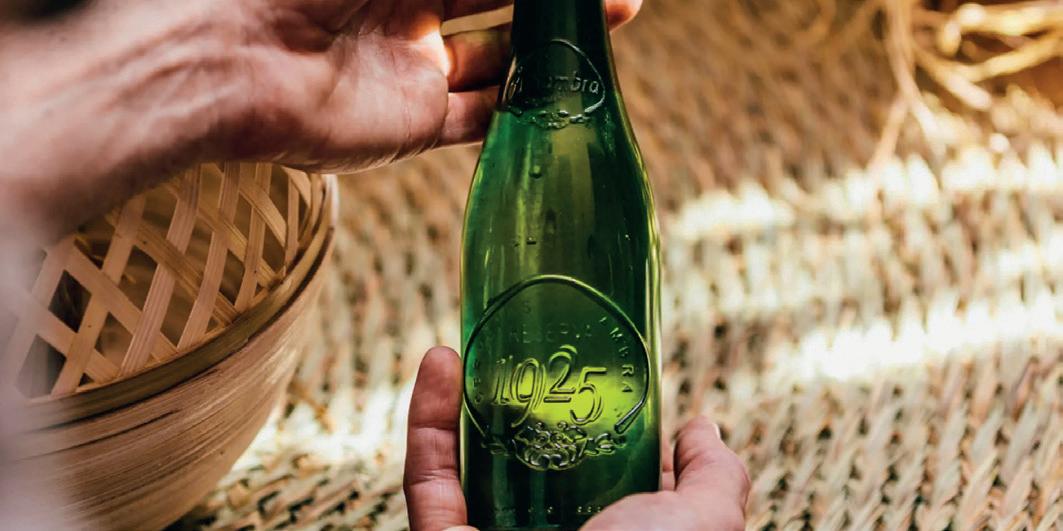
A taxi driver from Andalucia heard that I had been judging a beer competition. “I will put you to the test now,” he said. “Which Spanish beer do you think is the best?” My go-to beer is Estrella Galicia, and I told him so. “Fair enough,” he said, and accepted my recommendation as it was also on his list. His favourite, however, was Alhambra. A good beer, I agree, but as it is higher in ABV I tend not to have it too often. All good, me and the taxi driver were on the same page.
In England, my taxi journeys have mostly taken place in Norwich, where I judge the World Beer Awards every year. This city
has a fabulous beer scene and the drivers know most of the top pubs – and they are happy to give tips on more hidden-away places, especially if they hear that you work in the industry. One of them admitted to drinking cider rather than beer, and shared where to get the best cider in the city. It is on my list for next time!
In Argentina, a driver in Mar del Plata took me to one of the craft breweries. On the way, he confessed that he actually prefers Fernet and Coke, a common tiple – especially when watching football, and called himself a Fernetero. One of the best drivers, beerwise, was in Buenos Aires. He had fantastic knowledge of the craft beer scene and we eagerly shared tips. It turns out that his mate has a brewery, one I had not heard of, and next time I will make sure to check it out.
My Spanish is never as good as in a taxi, by the way. There is something so easy-going, with the drivers and their intent to un-
derstand you. The conversation is flowing, as they move on to the next question, and the next, happily chatting away and looking in the rear mirror, whilst driving way too fast. And as in most places, beer opens doors. “Ah cerveza!” Regardless of language and culture, people do know about beer, also taxi drivers.
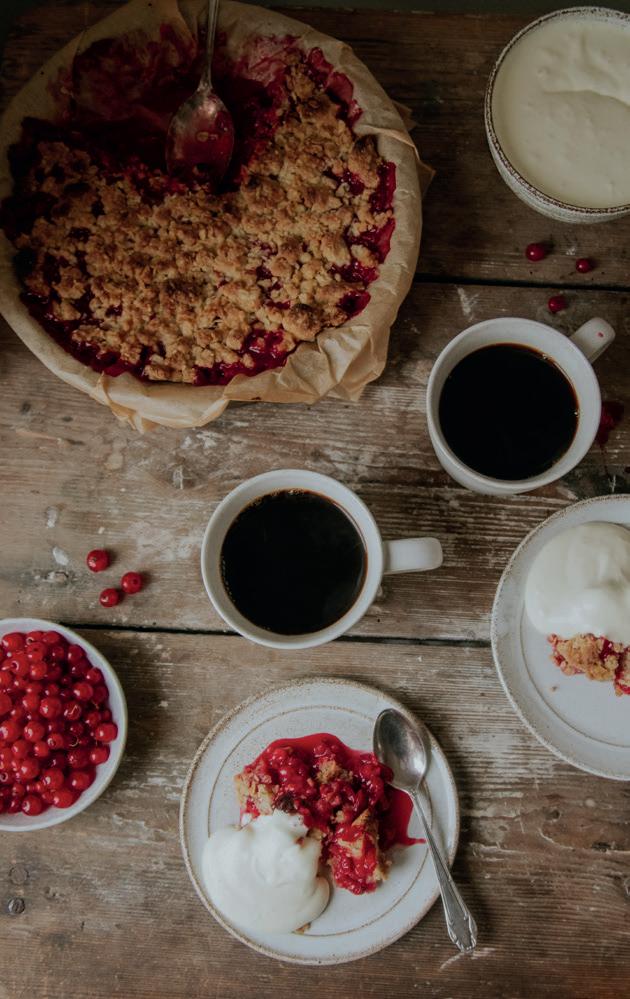
This is my favourite time of year – the height of the harvest season. Our garden and the forests surrounding our home are overflowing with fruit, berries and vegetables. We savour everything fresh that nature has to offer, and whatever we can’t enjoy fresh, we preserve in different ways.
By Sofia Nordgren
Homemade jams and cordials will always have their place, but my current favourite is baking pies to freeze for later. There’s something incredibly comforting about pulling a strawberry pie from the freezer and warming it up on a grey autumn afternoon while the rain drums against the windows.
Below is the recipe for my latest favourite, a red currant crumble pie. To me, it’s the perfect balance of sweet and tart. I hope you’ll enjoy it as much as we do, whether it’s fresh from the oven or warmed up from the freezer.
INGREDIENTS:
Filling
•500 ml red currants
•3 tbsp caster sugar
•1 tsp vanilla extract
•½ tbsp potato starch
Crumble topping
•90 g all-purpose flour
•60 g rolled oats
•45 g caster sugar
•Pinch of salt
•75 g butter or margarine, cubed
INSTRUCTIONS:
1. Preheat the oven to 225°C (435°F).
2. In a lar ge bowl, combine the red currants, caster sugar, vanilla extract and potato starch until the berries are evenly coated.
3. L ine a 22 cm (9-inch) pie dish with parchment paper, or lightly grease it. Spread the berry mixture evenly in the dish.
4. In a separ ate bowl, mix together the flour, rolled oats, caster sugar and salt.
5. A dd the cubed butter and rub it into the dry ingredients with your fingertips until the mixture resembles coarse crumbs.
6. Spr inkle the crumble evenly over the berry filling.
7. Bake on the middle rack of the oven for about 20 minutes, or until the topping is golden brown and the filling is bubbling.
8. L et the crumble cool for a few minutes before serving.
9. S erve warm with vanilla ice cream or vanilla custard.

Winner of the best Regional Cookbook at the Guild of Food Writers Awards 2022, Sofia Nordgren lives with her family in a small town in Sweden, working as a photographer, content creator and plant-based cookbook author. Cooking and baking have always been a hobby of hers and on top of that, she has a passion for nature, gardening and slow, seasonal living. Foggy mornings, cinnamon buns, and playing with her kids are among her favourite things in life. Sofia Nordgren also runs the successful blog, The Nordic Kitchen
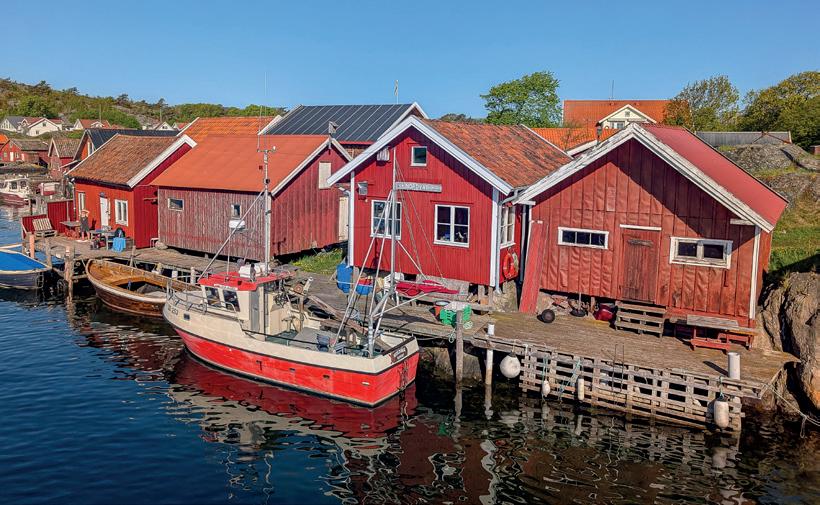
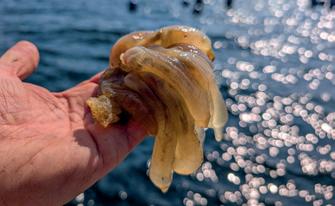
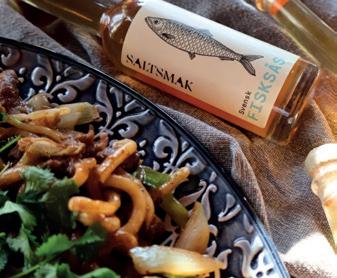
Saltsmak is a family-run business with a love for good food and sustainable marine aquaculture. The Swedish food brand utilises sustainably cultivated sea squirts and herring to produce premium, and tasty, condiments.
By Malin Norman | Photos: Saltsmak
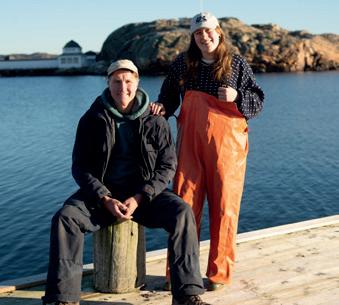
Founded by marine biologist Fredrik Norén last year, in the small fishing village Lysekil in Bohuslän, Saltsmak crafts umami-rich marine delicacies using sustainably farmed sea squirts. Leveraging the sea squirt’s naturally briny profile –which is sweet, sour, salty, bitter and umami – the brand provides premium products never seen before.
Aquaculture, or aquafarming, has been practiced for thousands of years. It is a controlled form of cultivation and farming of aquatic organisms, including fish, shellfish and aquatic plants. Considered one of the fastest growing foodprocessing sectors, aquaculture has a bright future, and so does Saltsmak.
“This is our way of working towards more sustainably aquafarming. Building on old fishing traditions, we’re making the most of the raw materials of the sea to devel-
op new flavours, products and dishes,” says Fredrik, who runs Saltsmak together with his daughter Ella. He is an entrepreneur with extensive experience in the industry, once known as ‘the sea squirt king’! Fredrik is the brain behind the celebrated sea squirt condiment developed under the name Marine Taste, before he set up his own brand Saltsmak.
“Sea squirts are eaten in Japan, Korea, Chile and the Mediterranean – often eaten raw and seen as a marine delicacy, similar to oysters,” he says. “Sea squirts are the undiscovered gold of the sea, and we’re the first in the world to produce a sea squirt condiment of this kind. It sits somewhere between soy sauce and fish sauce, and adds a fantastic umami flavour to dishes. Imaging a caprese salad with sun-ripe tomatoes, fresh mozzarella and basil, drizzled with olive oil and sea squirt condiment for additional depth.”
Saltsmak also produces an Asian-style fish sauce made from herring, which was the most important commodity for Lysekil historically. “Fish sauce has a long tradition in the Mediterranean and Asia, where it’s used almost like ketchup,” says daughter Ella. “Our fish sauce, made with herring from the North Sea, is a delicious condiment that integrates our local fishing heritage into food in a new way. It works fantastically as a dipping sauce for spring rolls!”
saltsmak.se
Facebook: Saltsmak
Instagram: @saltsmak
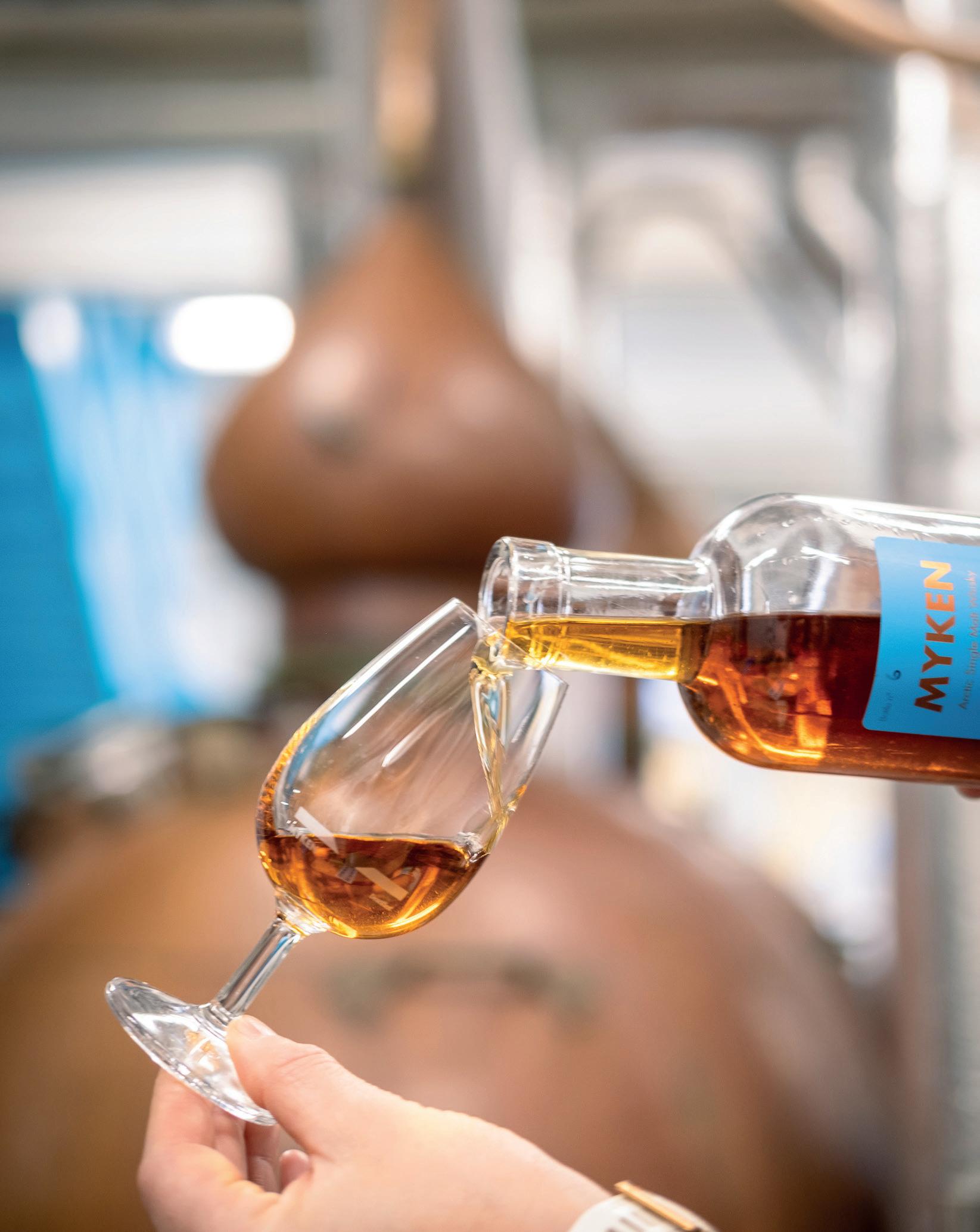
Small, remote and unbound by tradition, Scandinavia’s whisky distilleries are utilising their surroundings to lay down the foundations of a distinctive whisky-making style.
By Joseph Phelan
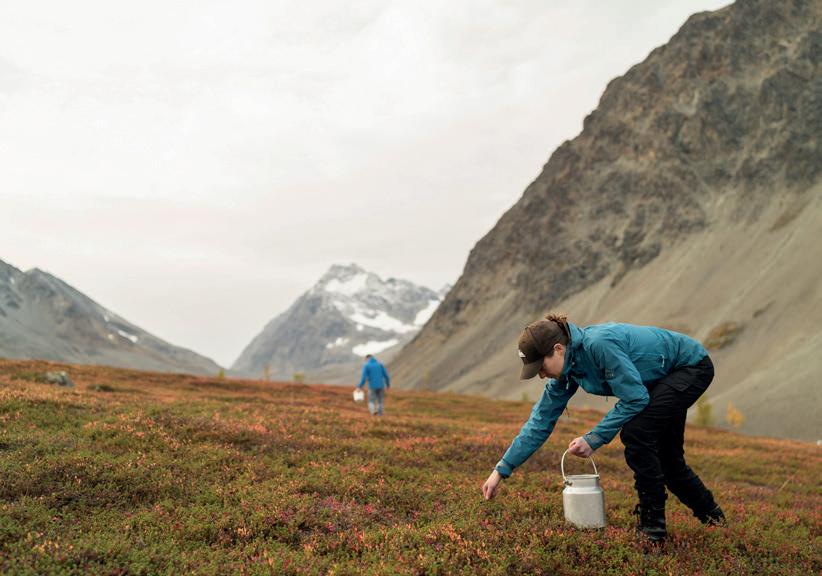
For centuries, the world’s whisky map has been drawn around a handful of heartlands: Scotland’s glens, Ireland’s rolling green hills, the plains of Kentucky and Tennessee, and, more recently, the spring-fed foothills of Japan.
Scandinavia, by contrast, has barely featured in that story. For close to 500 years, the region’s defining spirit has been aquavit, not whisky. Yet today, across a stretch of Europe defined by long winters, salt-laced winds and rugged terrain, a new generation of distilleries is rewriting what whisky can be, and where it can come from.
Denmark’s Stauning has done much to put Scandinavian whisky on the radar of connoisseurs, but the region’s whisky-making scene extends much further north: into Iceland, the Faroes and the Norwegian Arctic. In these isolated pockets, small distilleries are doing things on their own terms, harnessing their environment to make spirits that could not be created anywhere else.
“The Nordic whisky scene is still young, but that’s exactly what makes it interesting,” says Petter Christensen, CEO and founder of Aurora Spirit Distillery, which
produces whisky far within the Arctic Circle. “We’re not bound by centuries of tradition in the same way as Scotland, which gives us a freedom to experiment, with yeast, cask types, fermentation and raw materials.”
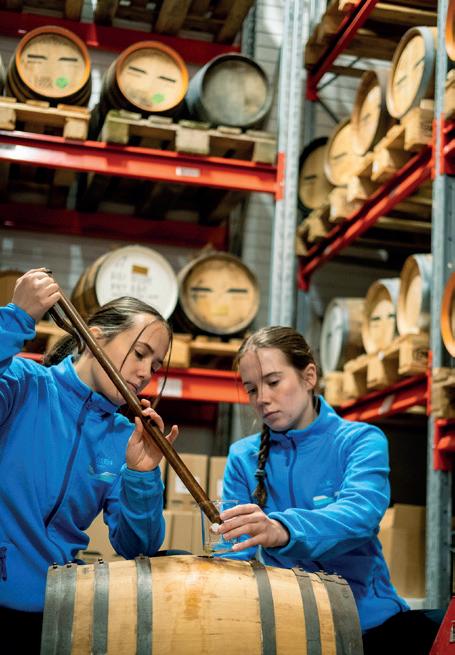
At Aurora, that freedom has produced whiskies aged in unconventional vessels, including teak casks, an experiment Christensen says creates “flavour profiles you simply won’t find in more established regions.” It is a small, telling
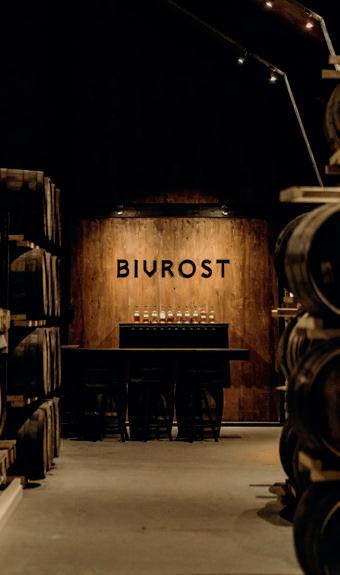
detail that hints at a much wider truth about Scandinavian whisky: while the most celebrated distilleries are bound by centuries-old rulebooks, the producers here are still working on drafting their own.
A different terroir
If freedom from tradition is one half of the Scandinavian story, the other is place. The northern reaches of Europe offer climates and landscapes that fundamentally change how whisky behaves
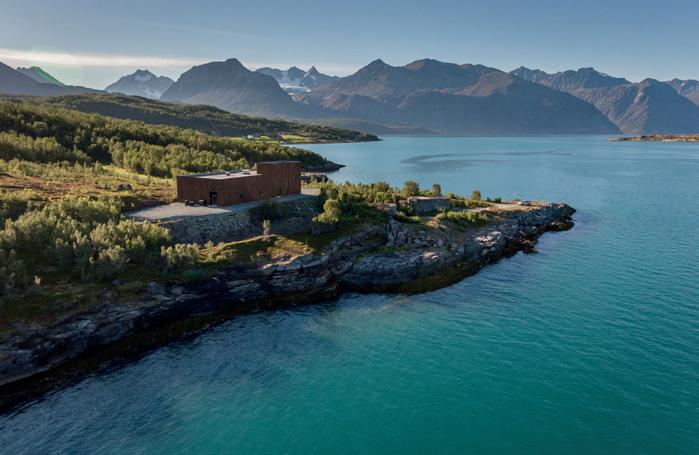
once it has been distilled. At Aurora, the Arctic climate is not a problem to be engineered away, but a tool to be exploited.
“We mature whisky at 69° North, where cold temperatures and seasonal extremes slow down maturation and create a different interaction between spirit and cask,” explains Christensen. “It’s not about speed. It’s about precision and balance.”
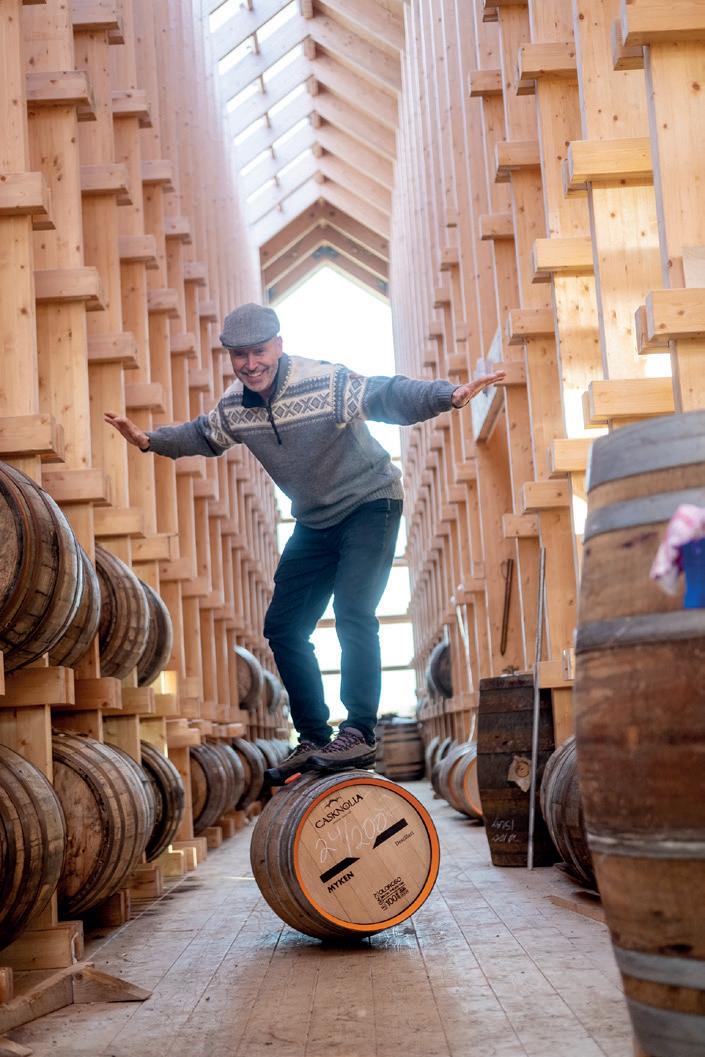
The cool temperatures also slow evaporation. At Aurora, one warehouse los-
es less than 0.5% of its whisky to the air each year – a figure that would be unthinkable in warmer regions, and one that fundamentally changes how a spirit evolves over time. “Our whiskies tend to reflect purity, clarity and a connection to nature, often with a fresher and more nuanced profile compared to traditional regions,” Christensen notes.
That sense of environmental specificity runs through almost every distillery in the region. Iceland’s Eimverk, a family-run
operation founded in 2009, uses Icelandic-grown barley – a crop that was farmed on the island until the 1400s, when cooling temperatures forced it out of cultivation, and which warmer conditions have since allowed to return. Combined with the country’s pristine water and volcanic soils, the result is a whisky inseparable from the place that produced it.
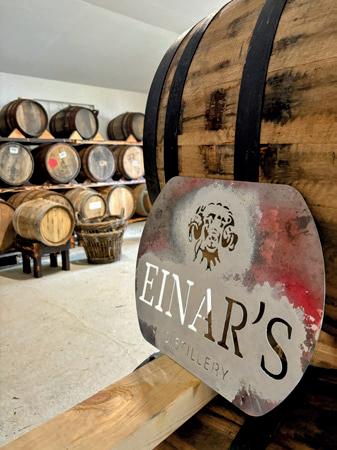
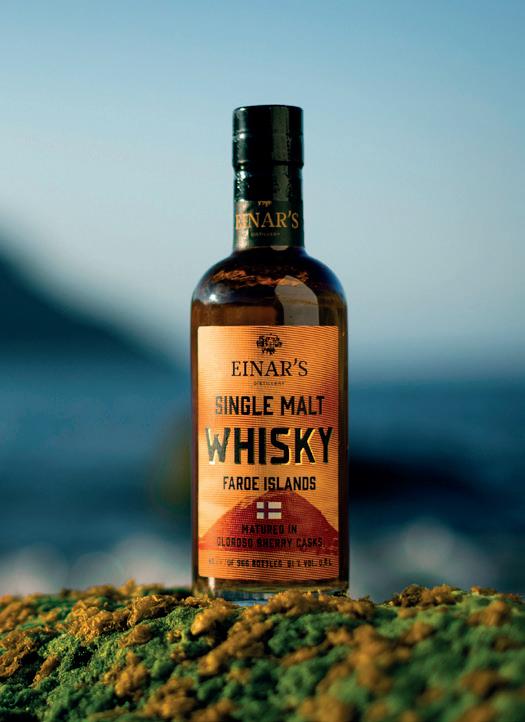
A few hundred kilometres of open sea away, in the Faroe Islands, Einar’s Distillery is shaped as much by history as by climate. It was established by Föroya Bjór, the family-run brewery that has anchored Faroese drinking life since 1888, soon after the Faroese prohibition on crafting strong spirits ended in 2012. The whisky produced in this staggeringly beautiful location is cultivated by conditions unusually well-suited to long maturation: high humidity, salt-laden Atlantic air and remarkably stable temperatures. Even the logistics carry a sense of place; delivery crates half a century old are still in constant rotation around the islands.
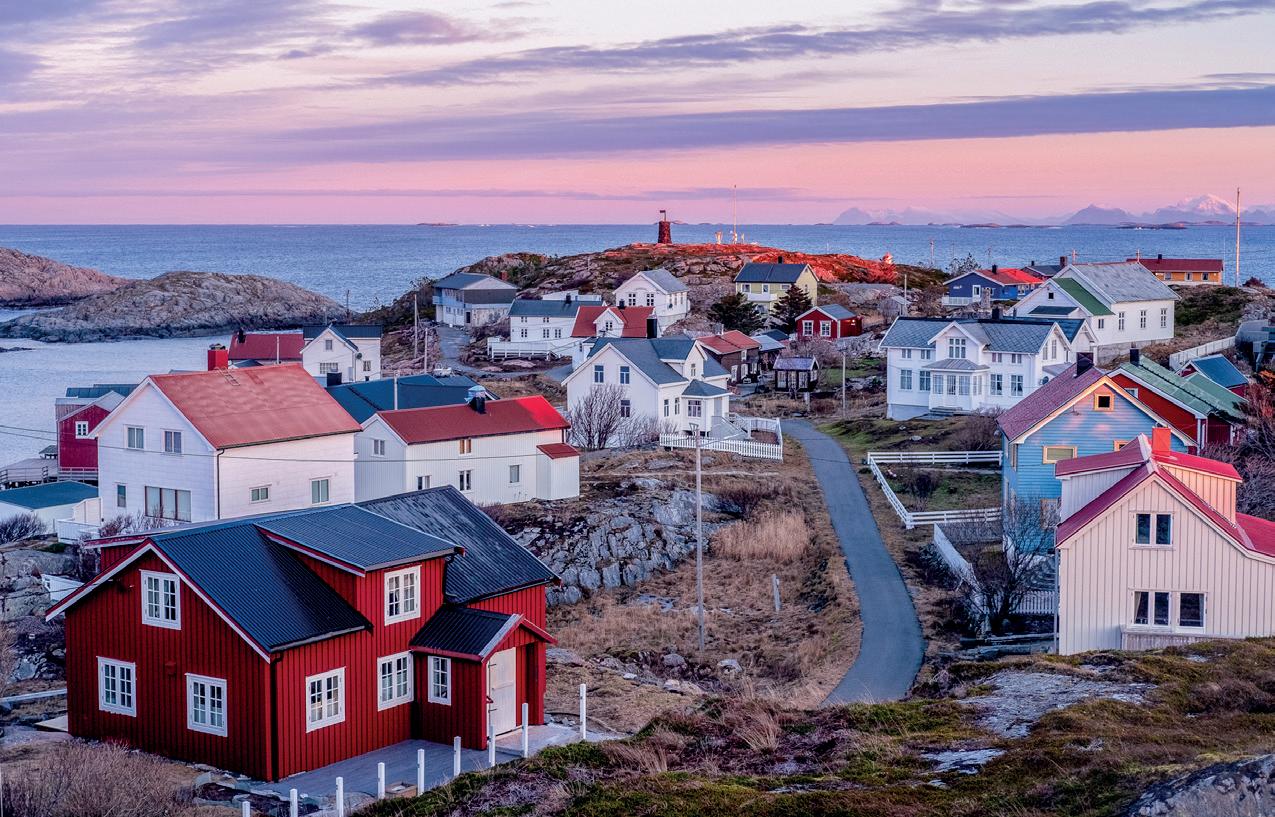
In Norway, Myken Distillery occupies an archipelago of less than one square kilometre off the country’s far northern coast. The team began producing whisky in 2014, and in those early days, no maltster could supply Norwegian barley at the volumes they needed. Today, largely owing to the team’s insistence
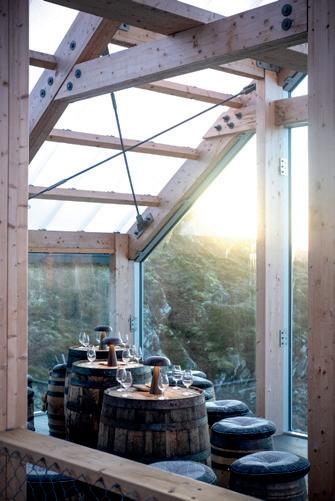
that they prioritise the use of local ingredients, around half its malt is Norwegian: more expensive and lower-yielding than malt from warmer regions, but distinctly flavoured. Stored in uninsulated, fully exposed warehouses, Myken’s whisky is shaped by the extremes of cold and warmth endemic to this part of the world.
Sustainability as necessity
Scandinavians have always been adept at making the most of what they have. Resource scarcity, harsh weather and isolation tend to produce a particular kind of practicality; one in which waste is uncommon, and working with the environment is critical. It’s perhaps unsurprising, then, that these pioneering distilleries have put eco-conscious practices at the centre of how they operate.
Eimverk’s production runs almost entirely on Iceland’s abundant geothermal and hydroelectric energy, an advantage of geology that turns sustainability into something close to a default setting.
Aurora’s distillery is powered entirely by hydroelectric energy drawn from local waterfalls. Spent grains feed nearby cattle. Used casks are repurposed into furniture, art or smoking wood for local salmon producers. International shipments are consolidated through a single warehouse

in the Netherlands to cut transport emissions. The distillery itself is constructed from cross-laminated timber, a low-carbon alternative to concrete or steel. None of these decisions is incidental.
What stands out is how much of this thinking is structural rather than bolted on. At Eimverk, soil health, reforestation and water management sit in the same conversation as cask choice. Myken’s founders frame their distillery not primarily as a business, but as a way of keeping a one-square-kilometre island community alive, drawing explicit parallels with the local fishing tradition of taking only what the sea can replace. The result is a model of whisky-making in which environmental stewardship and commercial viability are part of the same picture.
“The challenges are very real,” Christensen says of operating in the far north. “Logistics in the North can be unpredictable. Roads close, distances are long, and transport costs are high. Rising die-
sel taxes and increasing energy prices also put pressure on production.”
“But these challenges are also what shape our identity,” he continues. “Being small and remote forces us to be focused, creative and deliberate in everything we do. We can’t compete on volume, so we compete on quality, authenticity and experience.”
Perhaps the most consequential recent development in Scandinavian whisky is a distinct focus on collaboration. Distilleries from across the region have started coming together under the banner of the Nordic Whisky Collaboration, which this year held its first Nordic Whisky Forum in Helsinki.
“It’s a very exciting development,” says Christensen, who attended. “It allows us to share knowledge, align on key challenges, and collectively strengthen the Nordic whisky category.”
“There’s a growing global curiosity for new whisky regions,” Christensen adds. “Consumers are increasingly looking beyond Scotland, and the Nordics represent something new, credible and premium. That creates a real opportunity.”
Whisky is a slow craft. It is an endeavour that demands and rewards patience. And that long horizon, Christensen refers to, is part of what shapes the mindset of those making it. “Everything we do today is an investment in something that will be ready years from now. It forces you to think differently, but also more ambitiously.”
Scandinavia’s trailblazing distilleries have never set out to mimic. They make the most of what is already there: landscape, climate, local materials, community. What is being built across the region rests primarily on three things: taste, authenticity and the conviction that things should be done the right way. Combined, this has created a foundation as solid as the landscapes these distilleries call home.
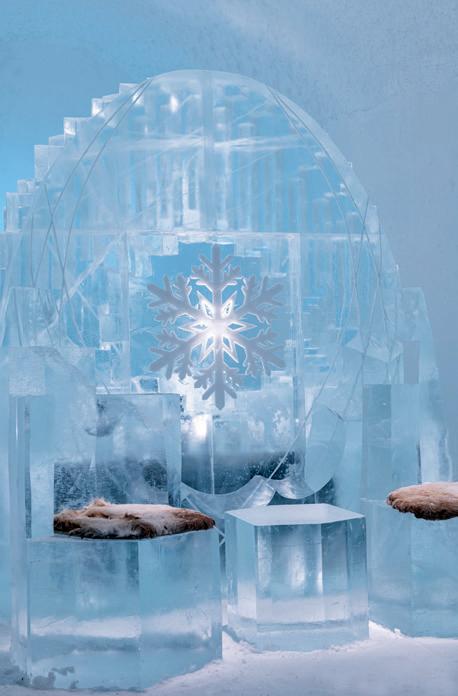
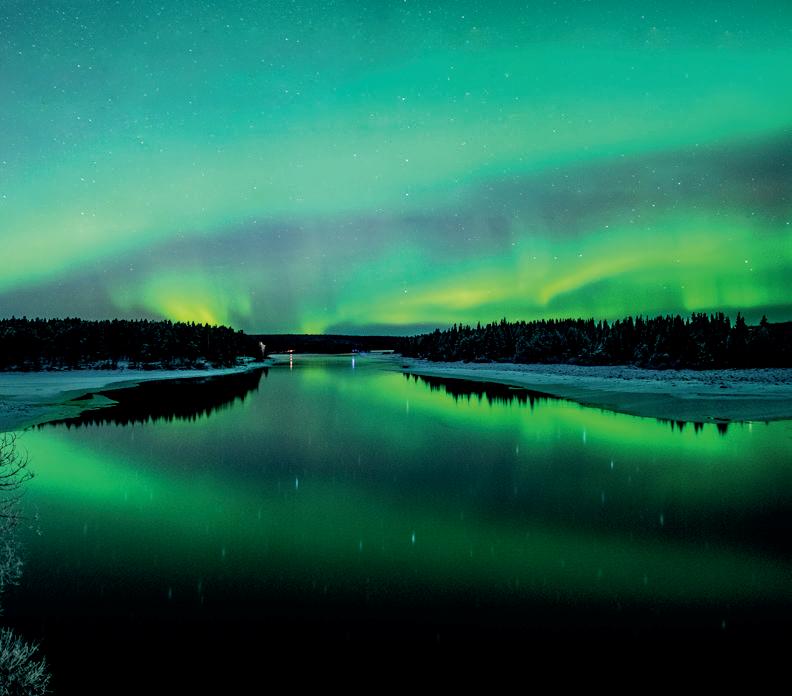
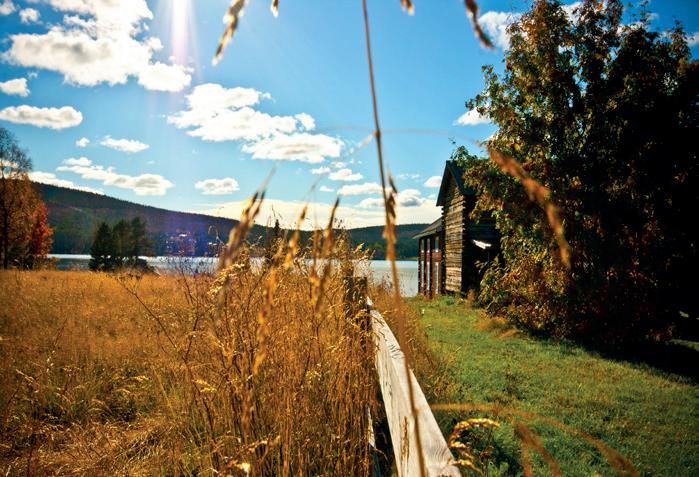
Most people associate ICEHOTEL with deep winter, frozen landscapes and snowcovered adventures. But before the winter season takes over and the seasonally exclusive ICEHOTEL opens in December, another extraordinary season unfolds in Jukkasjärvi. Autumn brings dramatic colours, crystal-clear skies, stunning Northern Lights and a rare opportunity to experience the Arctic in transition.
By Nina Bressler | Photos: ICEHOTEL
ICEHOTEL in Jukkasjärvi is, quite literally, the only of its kind. The hotel was created by entrepreneur Yngve Bergqvist in 1989, who started his icy venture with rafting tours on Torne River and excursions to explore the magnificent nature of the area.
The river has been pivotal from the beginning: as it froze, Bergqvist saw what the majority missed – cubic metres of natural material that can be forged into art, walls and ceilings. ICEHOTEL was born; a global attraction that has fascinated and accommodated hundreds of thousands of guests since.
ICEHOTEL coming full circle
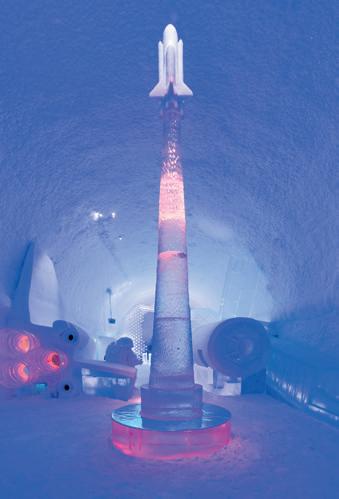
As the end of summer draws near, the hotel celebrates the tenth anniversary of ICEHOTEL 365 – the world’s first
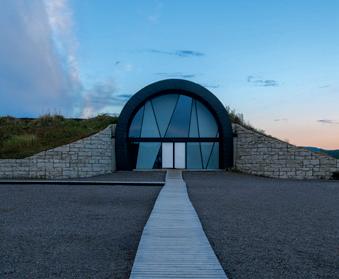
permanent hotel entirely made from ice, an addition to the seasonal ICEHOTEL WINTER. ICEHOTEL 365 features a unique chance to stay in icy suites and rooms at any time of the year, alongside the comfort of the hotel’s warm accommodation. 18 ice rooms, ranging from classic Art Suites to luxurious Deluxe Suites, are completed with private heated bathrooms and saunas.
“Autumn is such a short window in this corner of the world, essentially lasting between August until the first snowfall a few months later. Staying in ICEHOTEL 365 is a unique way of experiencing autumn in Jukkasjärvi, when nature unlocks another magical season and explodes in colours and natural phenomena exclusively reserved for the Arctic. When the first Northern Lights appear towards the end of August, there’s no blanket of snow reflecting the light, and the aurora becomes even sharper and more vivid. It’s
a stunning spectacle,” says Marie Herrey, CEO of ICEHOTEL.
Autumn at ICEHOTEL consists of cold and warmth combined in a rhythm determined by nature: from a refreshing swim in the icy river and a traditional sauna ritual to local culinary experiences and a dinner inspired by the world of ice. While guests can try their hand at ice sculpting, there are plenty of hiking trails for a breathtaking landscape painted in autumn colours. Torne River guides the journey through a wilderness where berries are gathered, the hunting season begins and winter slowly begins to take over.
A construction process like no other Building the ICEHOTEL requires extraordinary technical expertise. Ice is harvested every year from the Torne River along with snice, a mix of snow and ice, for floors, walls, and ceilings. “Every year when the river has returned to ice, we harvest it in massive blocks that are stored and used for construction of the hotel and our ICEBARS. With the seasonal ICEHOTEL born from and returning to water every year, the harvest is a tribute to nature, requiring flexibility, collaboration and harmony with the elements to succeed,” says Herrey.
The entire construction process takes six weeks from start to finish. Corri-
dors and rooms are built using the same principles as classic arches for a stable structure that enables, not just a visually stunning, but also safe and durable construction. The seasonal ICEHOTEL consists of up to 55 rooms upon completion, including 12 unique art suites forged in ice, with exclusive sets of art that have been purpose-built by local and international artists handpicked for that season alone.
Homage to the elements
“Autumn at ICEHOTEL is all about contrast: spending one night surrounded by
ice and snow, followed by another in warm comfort. ICEHOTEL 365 makes it possible to experience the magic of ICEHOTEL regardless of the season, offering one of the world’s most unique year-round hotel experiences,” says Herrey.
The opening of ICEHOTEL 365 was made possible by significant technological advancements that enabled the facility to maintain its frozen environment no matter the season. “By 2016, we had access to the technology needed to sustainably cool the facilities using solar power and green energy. Just as our hotel is deeply connected to our encircling environment, we are combining the power of nature with modern innovation to offer our guests the unique ICEHOTEL experience all year round,” Herrey concludes.
www.icehotel.com
www.icebarbyicehotel.com
Instagram: @icehotelsweden
ICEHOTEL is located in Jukkasjärvi, northern Sweden. ICEHOTEL 365 is open year-round with exclusive art- and deluxe suites with ensuite bathroom, while ICEHOTEL WINTER is open between December and April. ICEBAR BY ICEHOTEL, meanwhile, is a unique ice bar in the heart of Copenhagen and Stockholm with more branches opening soon.
Few names are as deeply woven into Norway’s jewellery heritage as David-Andersen. Since opening its doors in 1876, the family-founded goldsmith has created beloved family heirlooms and pieces that celebrate life’s milestones, all while standing the test of time. As the company prepares to mark its 150th anniversary this year, it continues to demonstrate that heritage and innovation can go hand in hand.
By Celina Tran | Photos: David-Andersen
Founded in what was then Christiania (Oslo) by goldsmith David Andersen after completing his apprenticeship in Norway and gaining experience in London, David-Andersen Gullsmed was established with a vision to unite traditional goldsmithing with new production techniques, making high-quality Norwegian jewellery more widely accessible without compromising on craftsmanship. Over six generations, that vision has evolved into one of Norway’s most respected jewellery houses, renowned for its design legacy, enamel artistry and enduring commitment to quality.
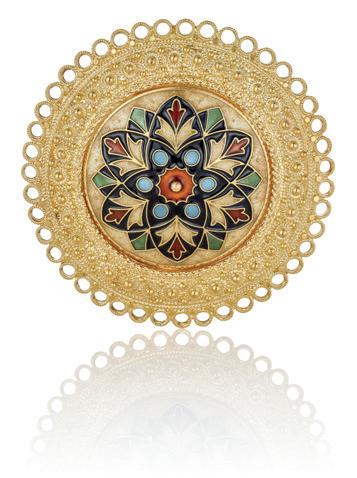
Today, David-Andersen offers an extensive universe of jewellery and services. Alongside its own collections, the company creates bespoke pieces, restores and remodels treasured heirlooms and curates a selection of leading international jewellery brands.
Yet at its heart remains a working goldsmith’s workshop, where traditional techniques continue to shape jewellery made to last for generations. “Our role is to continue David-Andersen’s design heritage while creating jewellery that feels relevant and contemporary for today’s customers,” says creative director Sophie Vanay.
Rather than treating its history as something preserved behind glass, David-Andersen actively reinterprets its rich archive for a modern audience. Historic
designs are revisited through a distinctly Scandinavian lens, balancing clean lines, harmonious proportions and timeless elegance with inspiration drawn from Norway’s landscapes, architecture and cultural traditions.
This dialogue between past and present defines the company’s collections. From iconic engagement rings and handcrafted enamel jewellery to contemporary interpretations of archival pieces, each design reflects an appreciation for enduring aesthetics over fleeting trends.
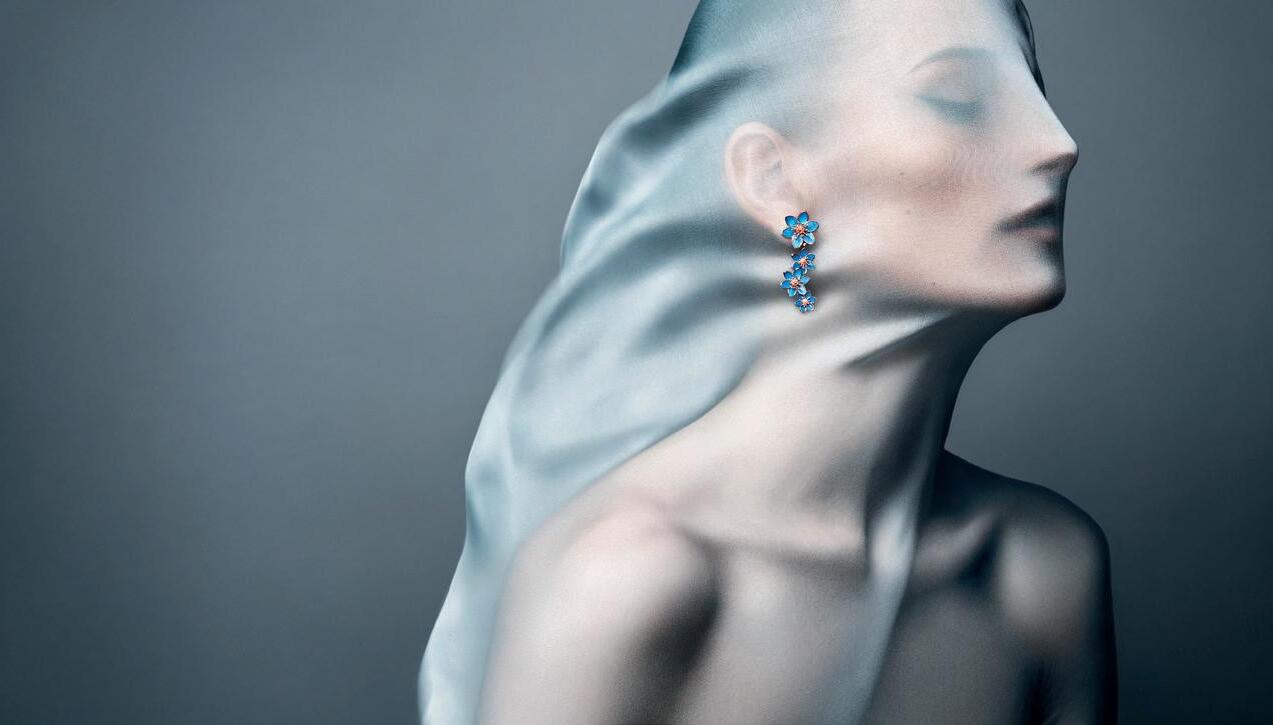
The company’s celebrated enamel work remains an important part of this identity. Having played a significant role in Norway’s enamel tradition for well over a century, David-Andersen continues to produce hand-painted enamel jewellery that honours one of its most distinctive artistic legacies.
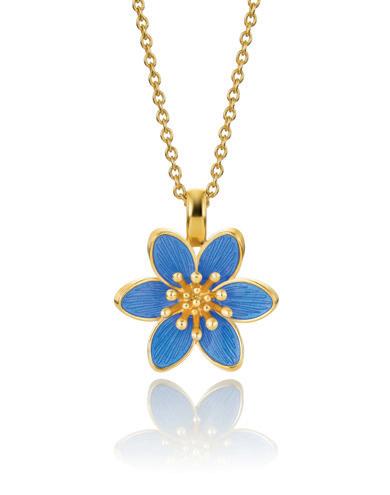
become the starting point for something entirely unique.”
This philosophy extends beyond creating new pieces. Through jewellery remodelling, repairs and its pre-loved concept, David-Andersen helps customers give treasured pieces new life, reinforcing the idea that fine jewellery should evolve alongside the people who wear it.
ing, gemstone expertise, enamel craftsmanship and design, while passion continues to drive innovation without losing sight of tradition.
Vanay adds that sustainability is equally embedded within this philosophy. By working with precious metals, genuine gemstones and timeless designs intended to be worn, repaired and passed down through generations, David-Andersen sees longevity itself as one of the most meaningful forms of responsible craftsmanship.
While its ready-to-wear collections form an important part of the business, bespoke jewellery occupies a special place within David-Andersen. Customers collaborate closely with the company’s designers and goldsmiths to create oneof-a-kind pieces that capture personal stories, family traditions and meaningful milestones.
“We believe the most beautiful jewellery is the jewellery that carries personal meaning,” says Vanay. “Our bespoke service allows each customer’s story to
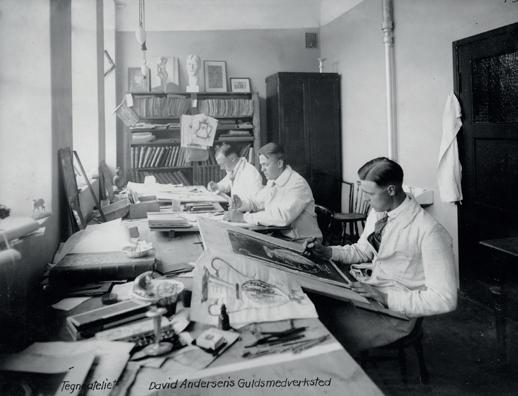
Quality that lasts David-Andersen’s values are defined by three principles: exclusivity, expertise and passion. Together, they underpin every stage of the creative process, from initial sketches and gemstone selection to hand-finishing in the workshop. “For us, exclusivity is not simply about precious metals and gemstones, but about uncompromising quality and creating jewellery with lasting emotional value,” says Vanay.
Expertise reflects nearly 150 years of accumulated knowledge in goldsmith-
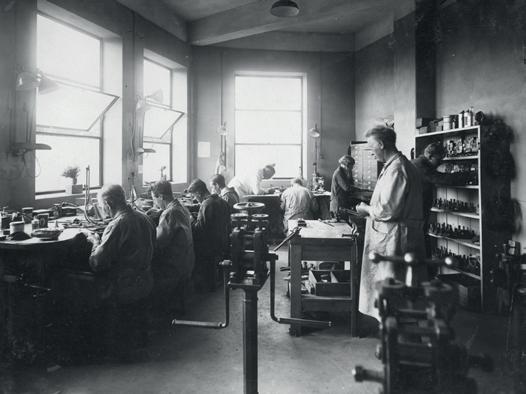
The upcoming 150-year anniversary represents far more than a historical milestone. It is an opportunity to celebrate Norway’s jewellery tradition while reaffirming David-Andersen’s ambitions for the future. “Throughout the anniversary year, we will highlight its heritage through special collections, exhibitions and publications, showing how David-Andersen is still an innovative participant in contemporary Norwegian jewellery design.”
Looking ahead, David-Andersen aims to further strengthen its position as Norway’s leading goldsmith, both domestically and internationally, championing original design, exceptional craftsmanship and jewellery that becomes more valuable with every generation that wears it.
www.david-andersen.no
Facebook: Gullsmed David-Andersen
Instagram: @david_andersen
Across Europe, wastewater treatment plants are facing ageing infrastructure, stricter environmental regulations, and rising chemical and operational costs. At the same time, pressure to reduce emissions and recover valuable resources continues to grow.
By Thea Johansen | Photos: Hias How2O
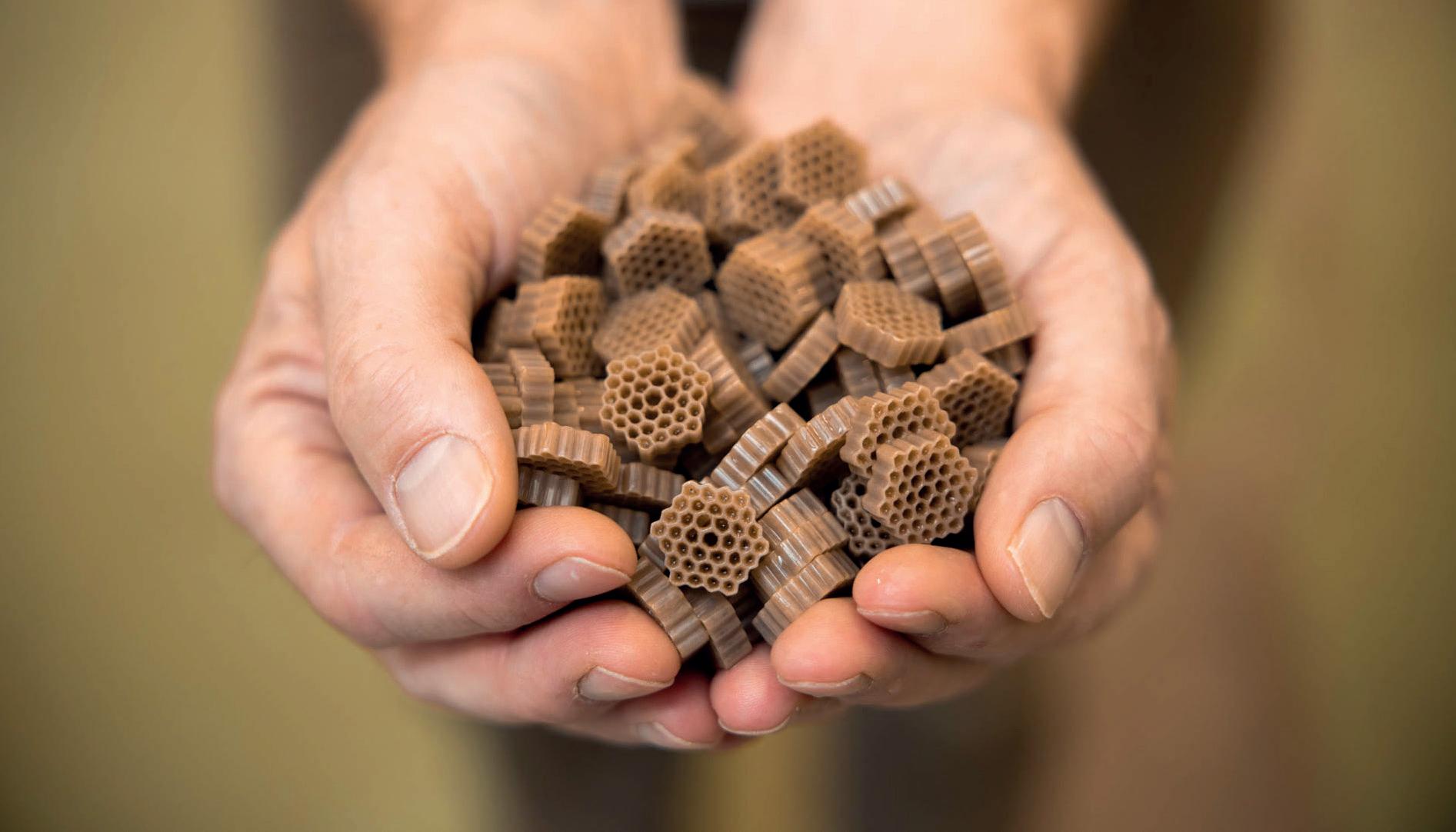
Just outside Hamar, Norway, a wastewater treatment plant has spent the last decade proving that there may be a different way forward. Developed at Hias IKS, the regional wastewater treatment facility serving communities around Lake Mjøsa, the Hias Process® is a patented treatment technology that uses biology rather than chemicals to remove nutrients from wastewater. What began as an ambitious research and development project has evolved into an internationally recognised solution with the potential to transform how wastewater is treated.
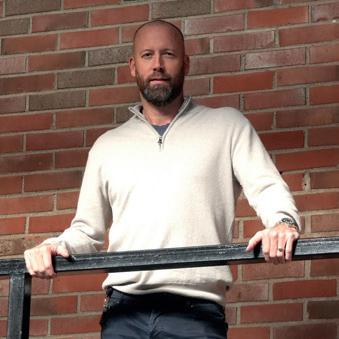
“The idea is actually quite simple,” begins Anders Enger, managing director at Hias How2O, the company established to commercialise the technology. “Instead of forcing the process with chemicals, we let biology do the work it was designed to do.”
For decades, wastewater treatment plants have relied heavily on chemical dosing to remove phosphorus and other pollutants before water is discharged back into the environment. While effective, this approach comes with significant drawbacks, including high operating costs, chemical dependency, increased sludge production and a larger environmental footprint.
The Hias Process® takes a different approach. By carefully managing natural-
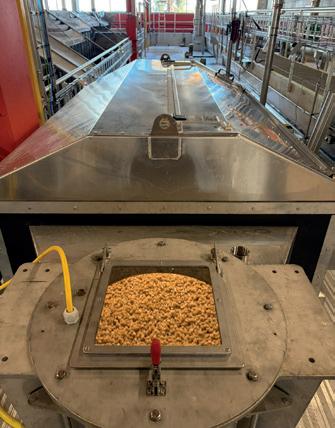
ly occurring microbial communities, the system removes phosphorus and nitrogen biologically, eliminating the need for chemical precipitation while maintaining high treatment performance. “The result is a more natural, robust and cost-efficient treatment process,” Enger explains. “We’re working with biological mechanisms that already exist in nature and creating the conditions for them to perform at their best.”
Before transitioning to biological phosphorus removal, the Hias treatment plant used approximately 30 tonnes of chemicals every week. Today, those chemicals are no longer required, reducing annual operating costs by millions of Norwegian kroner, while significantly lowering the plant’s environmental impact.
The technology has also allowed Hias IKS to maintain treatment capacity while creating a more compact and efficient system. Since 2020, three treatment lines have been operating successfully at the facility, with further expansion planned to meet future nitrogen-removal requirements.
The technology is currently being implemented in Kongsberg, where the first phase of a new wastewater treatment facility using the Hias Process® is expected to be completed in 2027. Yet the innovation is about more than reducing costs and improving efficiency. It also
reflects a growing shift in how wastewater is viewed.
Increasingly, wastewater is being recognised not as waste, but as a valuable source of energy, nutrients and reusable resources. Among the most important of these is phosphorus, a finite resource that plays a critical role in global food production.
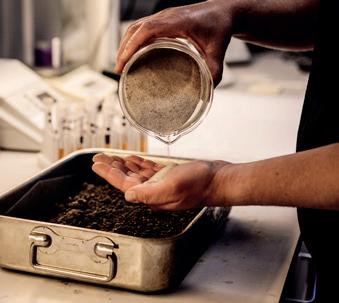
By relying on biological treatment, the Hias Process® creates better opportunities for recovering valuable nutrients and supporting circular resource use – a priority that aligns closely with evolving European Union policies and sustainability goals. “Wastewater contains resources that society needs,” says Enger. “If we treat it correctly, it can become a source of clean water, nutrients and energy, rather than simply a waste stream.”
The approach also offers greater resilience at a time when climate change is placing increasing pressure on infrastructure systems. Biological treatment processes are inherently adaptable and can respond more effectively to fluctuating wastewater volumes and changing operating conditions. “As regulations become stricter and weather patterns become more unpredictable, flexibility will be essential,” Enger says. “Treatment plants need solutions that can adapt to future challenges rather than simply meet today’s requirements.”
That message is resonating internationally. Across Europe and beyond, municipalities and utilities are searching for technol-
ogies that can help them meet ambitious environmental targets while keeping long-term costs under control. Rising chemical prices, growing sustainability expectations and stricter nutrient-removal requirements are making biological treatment increasingly attractive.
With patents covering large parts of the global market, Hias How2O is now expanding its international focus and engaging with utilities, engineering companies and public authorities in several countries.
“Our technology demonstrates that it’s possible to meet stringent environmental standards, reduce dependency on chemicals, lower lifecycle costs and support circular resource use at the same time,” says Enger. “Those are challenges that water utilities everywhere are facing.”
Perhaps what makes the Hias story particularly compelling, however, is the philosophy behind the technology. Rather than attempting to overpower natural systems, the company has built its innovation around understanding and working with them.
“Instead of viewing nature as something we need to control, we see it as a partner,” Enger reflects. “By harnessing natural biological processes, we can create solutions that are not only more efficient but also more sustainable. In many ways, the answers to some of our biggest environmental challenges are already there –we simply need to learn how to work with them.”
www.hias.as
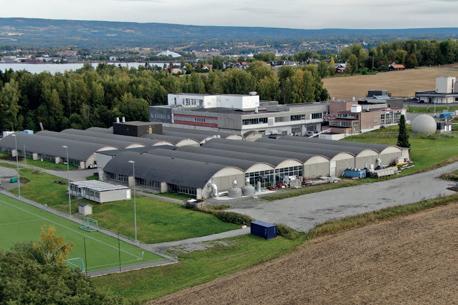
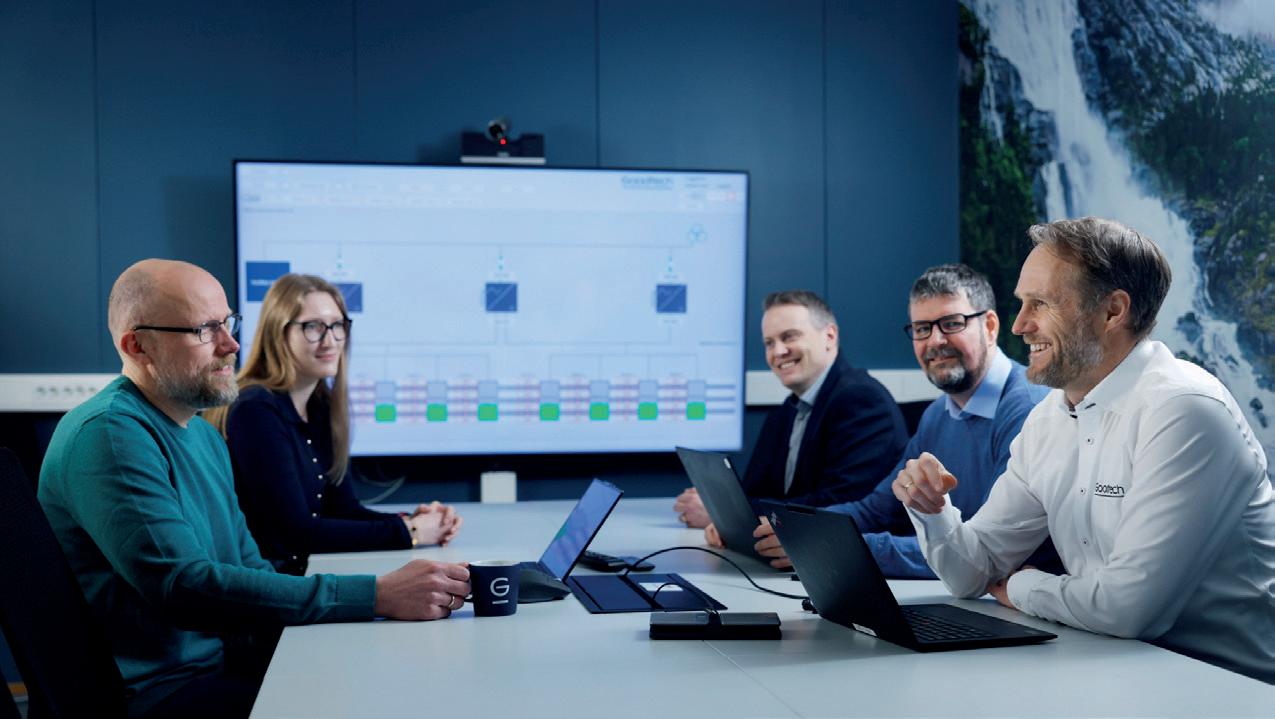
As manufacturers face rising costs, shorter value chains and growing pressure to modernise, Norwegian technology company Goodtech believes that the future belongs to businesses willing to work smarter – and bold enough to invest in change.
By Thea Johansen | Photos: Goodtech
For decades, Nordic industry has built its reputation on quality, engineering expertise and innovation. Today, rising labour costs, global uncertainty and ambitious sustainability targets are forcing manufacturers to rethink how they produce and remain competitive.
Helping businesses navigate this transformation is where Norwegian technology company Goodtech has found its purpose.
“Our vision is to create winners through insight and technology-driven transformation,” says CEO Margrethe Hauge.
Founded in 1913 as Norsk Elektrisk Kabelfabrikk, Goodtech has evolved alongside industry for more than a century. Today, the company is one of the Nordic region’s leading system integrators,
delivering automation, digitisation and electrification solutions across sectors including aluminium, aquaculture, food production, renewable energy and process industries.
Unlike many technology providers, Goodtech is not tied to a single supplier or platform. Instead, the company focuses on finding the right solution for each individ-

ual challenge. “We’re system independent,” Hauge explains. “We choose the solutions that are right for the problem we are solving.”
Although automation is central to Goodtech’s work, the company believes technology alone is never the answer. Real transformation requires a deep understanding of both the industry and the people behind it. “You can’t help someone become better if you don’t understand their business,” says Hauge.
This combination of different industrial-domain knowledge and technical expertise has enabled Goodtech to support customers across a wide range of sectors. While their industries differ, many face the same challenge: improving efficiency, gaining better control and making smarter decisions.
“We work from the sensor to the boardroom,” says product and solution man-
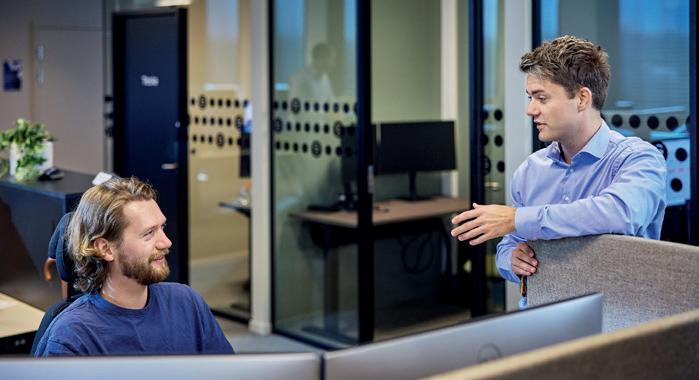
ager Nils Petter Lillebø. In practice, this means connecting production equipment, automation systems and the data used to guide strategic decisions. Rather than delivering isolated products, Goodtech develops integrated solutions that support customers throughout the lifetime of their operations.
One example is Goodtech’s work with Aker Solutions, where the company delivered an automated production solution for steel jacket foundations used in offshore wind projects. Combining robotics, automation and digital technology, the solution streamlined production while improving both efficiency and quality. Beyond manufacturing, Goodtech also develops control room solutions for wind farms and digital systems that help renewable energy producers monitor and optimise performance.
Industrial companies have never before had access to more information. The challenge is making sure that data is accurate, reliable and valuable. “It’s one thing to have data. It’s another to have quality data that you can actually trust,” says Lillebø.
When data can be collected and understood effectively, it gives manufacturers a clearer picture of their operations. This allows companies to identify inefficiencies, optimise energy use and make faster decisions. Hauge smiles as the conversation turns to the possibilities ahead: “It’s exciting to be right in the middle of these changes,” she enthuses.
Artificial intelligence is becoming an increasingly important part of this development. For Goodtech, AI is not about replacing people, but about strengthening what humans can achieve. “The more digital the industry becomes, the more important human expertise becomes,” says Lillebø.
Efficiency and sustainability go hand in hand
For Goodtech, sustainability is not a separate objective. Instead, it is often the result of making industrial processes smarter. By helping customers optimise production, the company contributes to lower energy consumption, reduced waste, improved resource utilisation and safer workplaces.
These improvements also create economic value. “Reducing emissions usually means reducing costs,” says Hauge. “The two go hand in hand.”
As industries face increasing pressure to reduce their environmental impact while remaining competitive, the connection between efficiency and sustainability is becoming more important than ever.
The courage to invest
Asked what she would change if she could transform the industry overnight, Hauge points to the importance of ambition. “I would like to see more companies invest in their own competitiveness,” she says.
With shorter supply chains and more production moving closer to home, Nordic manufacturers have an opportunity to strengthen their position. But doing so requires long-term thinking and the courage to make decisions today. Hauge explains: “Norway has the expertise, the technology and the energy resources. What we need are courageous leaders who are willing to make those decisions – and we’re here to help them.”
Having adapted alongside industry for more than a century, Goodtech understands that transformation is never a one-time process. Technology will continue to evolve, but the need for forward-thinking industries will remain.
For Goodtech, the goal is clear: helping companies build the knowledge, systems and competitiveness needed to thrive in the future.
goodtech.no
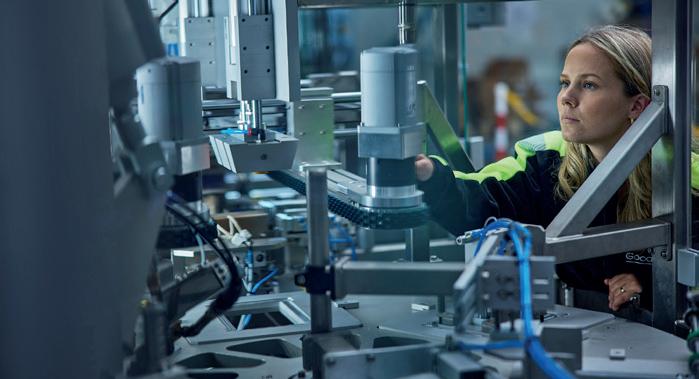
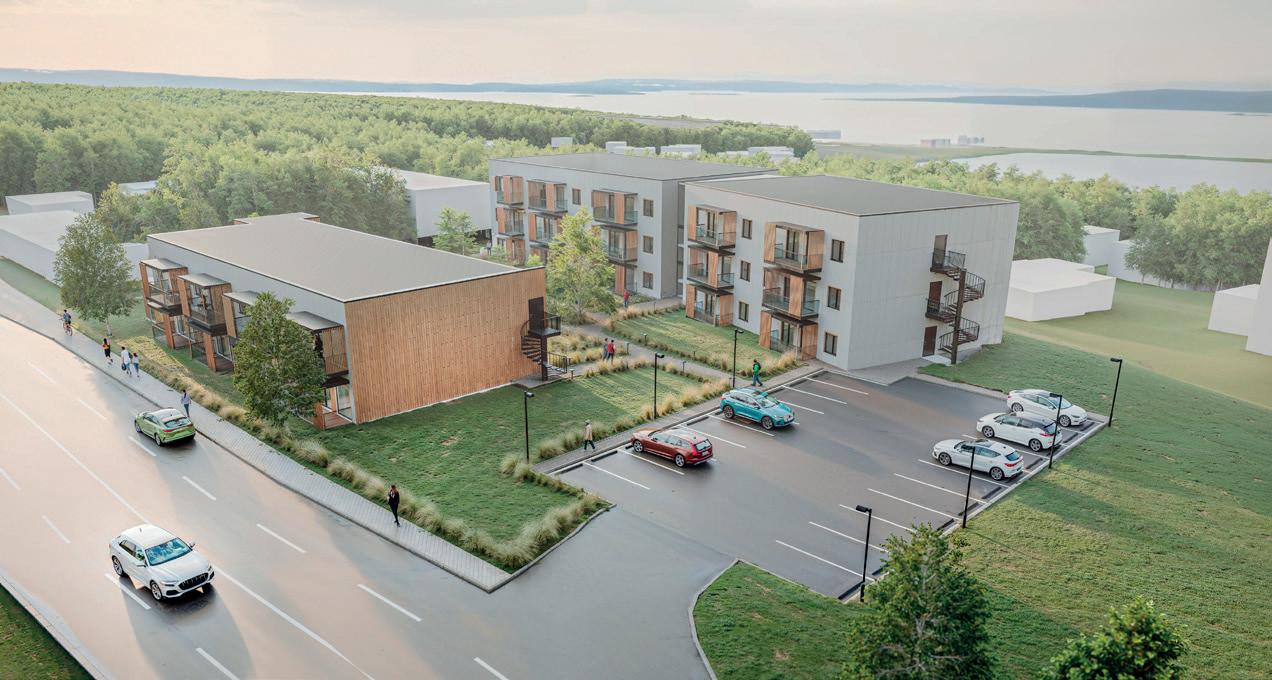
As housing markets across Europe search for ways to deliver affordable, sustainable homes without compromising quality, Norwegian company Nordic Smart House believes that the answer lies in thinking differently about how homes are built.
By Celina Tran | Photos: Nordic Smart House
As cities and communities across the continent face mounting pressure from housing shortages, rising construction costs and increasingly ambitious climate targets, the traditional way of building homes is being challenged. Developers are expected to deliver faster, more affordable and more sustainable housing, all without compromising the quality of living or the need for lower energy consumption.
Norwegian company Nordic Smart House believes that the answer lies in rethinking the construction process itself. “We specialise in zero-emission, steel-framed residential modules designed that combine efficiency, quality and environmental performance,” says Tom Teitrem, exec-
utive chairman at Nordic Smart House. With its patented technology, technical approvals and strong international production structure, the company aims to play an important role in the future of residential construction.
Nordic Smart House delivers complete apartment buildings using prefabricated
steel modules that are transported and assembled on site, all while addressing some of the biggest challenges facing residential development today: cost, speed and sustainability.
“Through years of development, we’ve created a modular building system intended to reduce costs and construction time while delivering homes with improved comfort and sustainability,” says Teitrem. “The system provides the market with affordable apartments through steel modules, which have technical approvals from Sintef for the Norwegian market, as well as patented climate shells that surround the modules.”
The company’s technology has been developed to improve both environmental performance and everyday living quality, with the system reducing energy costs by up to 40 per cent while also dramatically improving sound insulation between homes. “I find that there is a lack of at-
tention to acoustics in the modern builds that we’ve focused our attention on,” says Teitrem. “We have a layer of air between apartments and floors, creating very good acoustic performance that reduces up to 50 per cent of the noise between walls, so that people won’t hear their neighbours.”
From vision to practical solution
The company was founded by Stephen Fu, a Norwegian-Chinese entrepreneur whose early observations helped shape the vision. Fu was in London around 20 years ago and saw Container City, which has stacked homes using recycled shipping containers, and was instantly inspired. “It was the beginning of an idea that developed into Nordic Smart House,” says Teitrem. “While we don’t use shipping containers for our modular apartments, we apply the same standard dimensions to support efficient transport and logistics from our manufacturer in China.”
Along with the logistical efficiency, the system is designed to provide practical advantages for developers and communities alike. “We wanted to offer a system that reduces construction costs by 20–30 per cent and cuts construction time in half,” he says, explaining that construction speed has become one of the company’s defining strengths, enabling projects to move from prepared building sites to completed residential buildings significantly faster than conventional construction methods.
Like many other businesses, Nordic Smart House has looked to China for its production. While manufacturing in China supports efficiency, Teitrem stresses that quality control and local expertise are critical to making the model work successfully. “Many Norwegian companies think that you can go to China and produce cheaply,” he says. “But a success factor is having a
local organisation there. We have fulltime engineers at our office in China who monitor production and quality to ensure that everything meets agreed standards.”
Looking ahead, the company has ambitious plans for growth and sees modular housing becoming an increasingly important part of the future residential landscape. Teitrem adds: “We aim to become part of the housing mix and deliver 300–500 apartments annually within the next three to five years.”
As cities continue to seek housing solutions that are faster, more sustainable and more affordable, Nordic Smart House is positioning itself to help reshape how homes are built for the future.
www.nordicsmarthouse.no
Facebook: Nordic Smart House
Instagram: @nordicsmarthouse.no
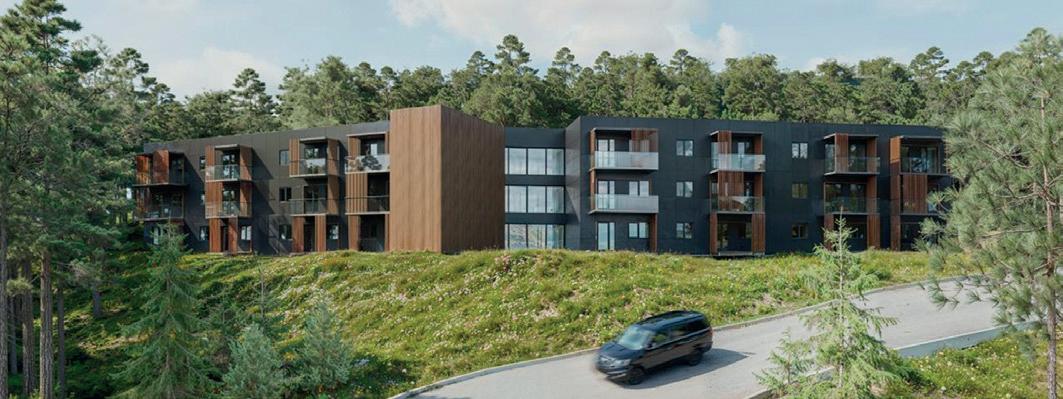
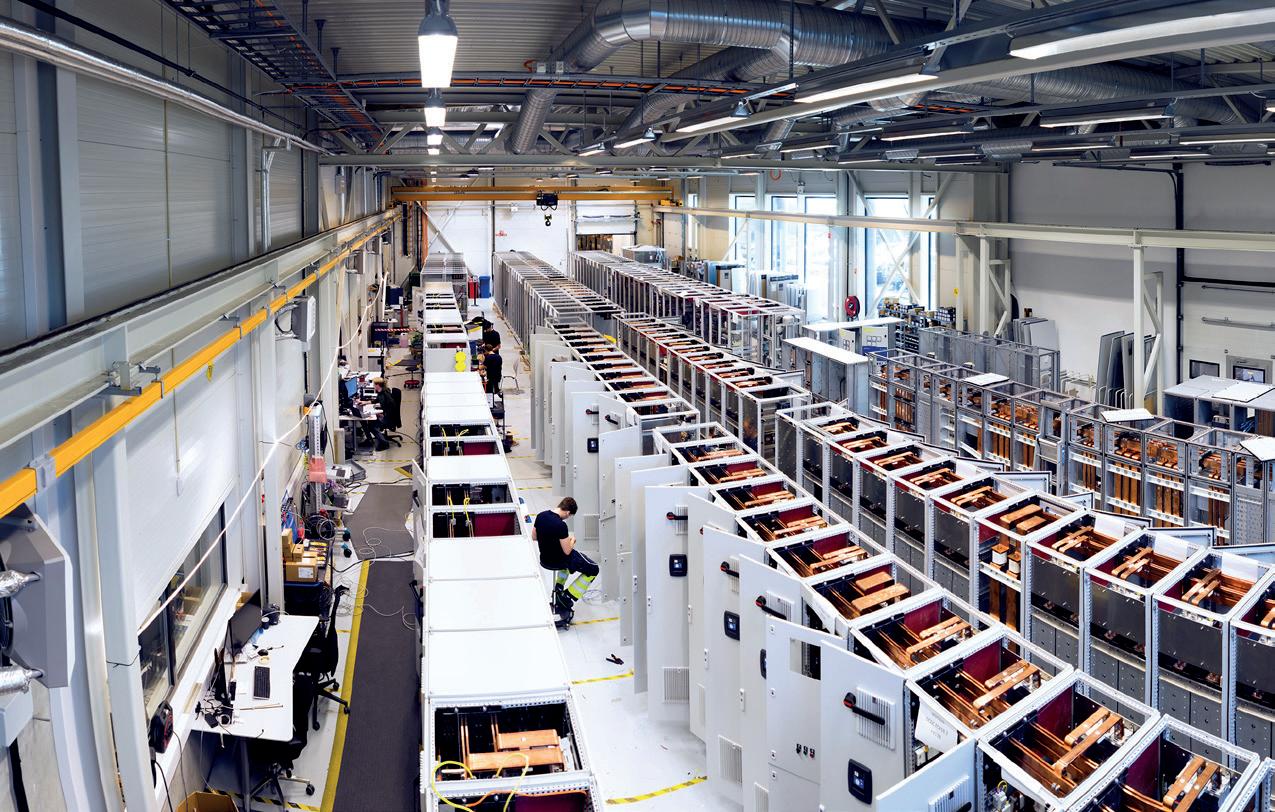
Combining deep maritime expertise with a collaborative approach to innovation, Norwegian technology company SEAM is helping accelerate the transition towards cleaner and smarter shipping solutions.
By Celina Tran | Photos: SEAM
As the maritime sector faces mounting pressure to reduce emissions and improve efficiency, electrification and smart technologies have moved from being future ambitions to becoming urgent priorities. Norwegian company SEAM has positioned itself at the centre of this transformation, drawing on years of specialised experience to help shape the next generation of sustainable shipping.
Headquartered in Norway, SEAM is an electro and automation company dedicated entirely to the maritime sector. The company develops and delivers products and engineering solutions related to
electrification, batteries, automation and energy-efficient vessel systems. While many companies spread their expertise across multiple industries, SEAM has
intentionally chosen a different route. “What makes us unique is that we focus exclusively on ships,” explains sales director John Roger Nesje.
The company’s sole focus has allowed it to become highly knowledgeable and experienced about ship regulations and the operational use of vessels, an approach that has become one of its greatest strengths and forms the foundation of its ambitions for a cleaner future at sea.
Although the name itself is relatively new, the story of SEAM reaches further back. Through a series of mergers and acquisitions, the business spent many years as part of Westcon Shipyard before evolving into an independent company with a clearer focus.
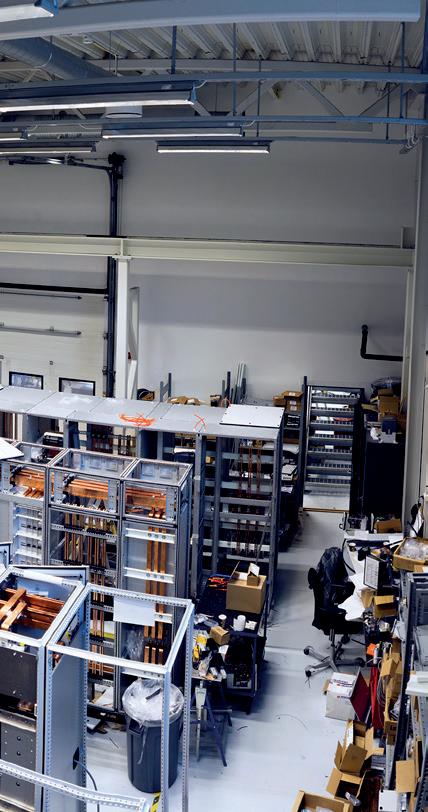
The company launched its own automation system for ships in 2008 and has since delivered around 500 systems. Several years later came the next major step in its journey, with the company delivering its first battery installation in 2015.
“In 2021, we were separated from Westcon, which is when the name SEAM was established,” says Nesje. “Since then, we have been on our own and continued growing within electrification and automation.”
Today, the company employs engineers specialising in both software and electri-
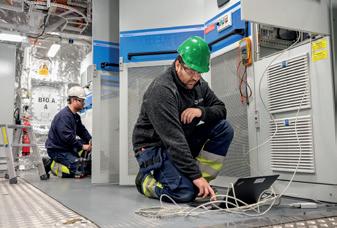
cal systems, reflecting the increasingly digital and interconnected nature of modern maritime technology. Most recently, SEAM entered another important chapter in its development through the acquisition by the Korean Hanwha Group, opening new opportunities for continued international growth.
Rather than simply delivering off-theshelf systems, SEAM has built much of its business around close collaboration with shipowners and operators. The company becomes involved early in projects, helping customers identify the right solutions for specific operational requirements.
“We spend a lot of time workshopping together,” says Nesje. “When a shipowner is planning a vessel, we work alongside them to find the right systems and create what they actually need, instead of selling them something they don’t.”
This flexible and tailored approach has become increasingly valuable as maritime operators face changing regulations and rapidly evolving technologies. Different vessels have different needs, and no two projects are the same. “We have been very conscious about tailoring solutions and delivering exactly what the vessel and shipowner need,” Nesje explains.
For many customers, introducing hybrid systems, batteries or advanced automation technologies can feel like a significant step involving both investment and uncertainty. SEAM believes that its experience can help make this transition easier. “As we already have the knowledge, our customers don’t need to learn this from scratch. We can remove much of the risk for those who want to try it.”
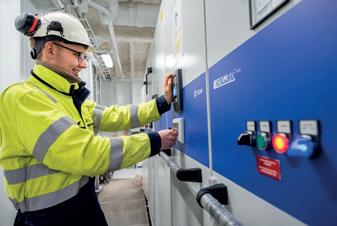
The Norwegian landscape and early adoption of sustainable solutions means that Norway has established itself as a pioneer in maritime electrification, giving companies like SEAM the opportunity to gain practical experience over many years.
“In Norway, we have many fjords with ferry routes and many factors that allowed us to become early adopters of hybrid and electric vessels. We have always wanted to and are thus working on sharing our experience with the rest of the world,” says the CEO.
In fact, regardless of how you encounter SEAM, customers can expect to be met with knowledge and good intentions at every step, whether that be through sales, service or a specific project. “Of course, alongside offering competence and experience, our main goal is making our industry greener, and working towards zero-emission solutions within the maritime,” Nesje adds. “We work with efficiency through automation to remove losses and make vessels as efficient as possible, as well as making vessels hybrid and electric to reduce emissions.”
As the maritime sector continues moving towards a lower-emission future, companies that combine technical expertise with practical knowledge are likely to play an increasingly important role. For SEAM, the ambition is not merely to participate in the green transition at sea, but to help steer it.
www.seam.no
Facebook: SEAM
Instagram: @seamnorway
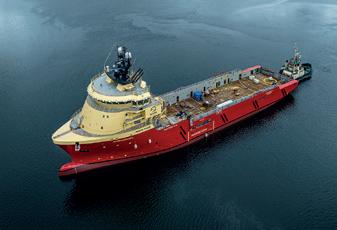
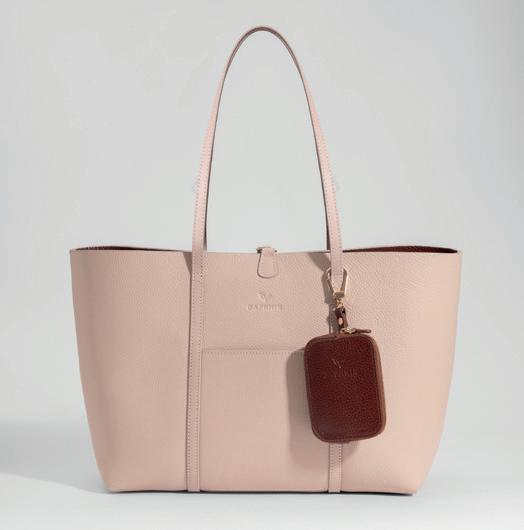
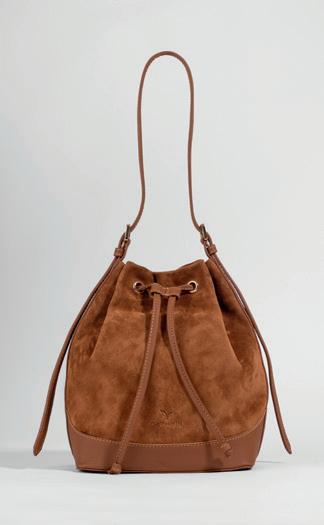
Founded by longtime friends Eda Lerzan Bækkevold and Derya Albayrak Reite, Uliq celebrates quality craftsmanship, natural materials and sustainable production. The brand has been dedicated to bringing unique, thoughtfully designed pieces to customers since its launch last year.
By Maria Sødal Vole | Photos: Daphmin
With backgrounds in architecture and civil engineering respectively, Bækkevold and Albayrak Reite share a deep interest in structure, aesthetics and quality. Driven by a shared passion for well-designed, high-quality products that stand the test of time, the idea for Uliq was formed.
The name is inspired by the words unik (unique) and ulik (different). The product range has been carefully curated, each item designed and produced with purpose. “Our name is both a promise and a reminder that differences are what make us beautiful,” the friends say. “We hope our customers see that our products have been chosen with care.”
Committed to natural materials and sustainable practices, Uliq is the culmination of many heartfelt conversations around design and mindful production. The founders are concerned about the
way many things are produced quickly and replaced just as fast in today’s society. “For us, quality isn’t just about how a product looks – it’s the feeling of owning something that was actually made to last. Quality materials and great craftsmanship can live on for generations,” they say. “We believe that good things take time.”
Uliq values natural fibres and refined materials that provide long-lasting, timeless products which can be used and enjoyed for years to come. “Genuine leather that softens with age, wool with natural warmth, breathable linen, silk with effortless elegance and comfortable, durable cotton – each piece is carefully crafted with both people and the environment in mind,” Bækkevold and Albayrak Reite explain.
The founders are intentional about collaborating with partners whose values
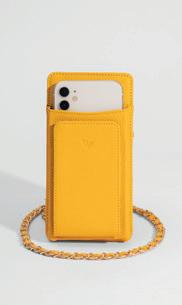
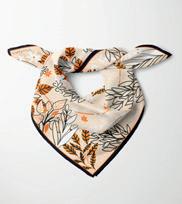
and goals align with their own. “We work with family-owned businesses, skilled artisans and companies that share our belief in slow, quality-conscious production. We want to showcase pieces that reflect the time, skill and care that has gone into making them.”
Uliq is currently working with two producers – Daphmin, designing handmade bags, scarves and other accessories in natural materials such as leather and silk, and Souf, creating adorable soft toys for little ones, each piece hand-sewn and unique.
The founders are always looking for new products to bring to their customers. “We love to discover people, materials and stories that deserve to be celebrated,” they enthuse. “We want to be a bridge between exciting, talented producers and the Norwegian market – it means a lot to us to be able to share their craftsmanship with new customers.”
www.uliq.no
Facebook: Uliq.no
Instagram: @uliq.no
While some businesses begin with a business plan, others begin with a philosophy. For founder of skincare brand White Tara, Silje Thomassen, years of practising yoga, mindfulness and working closely with people revealed the importance of creating small moments of pause in everyday life.
By Celina Tran | Photos: White Tara
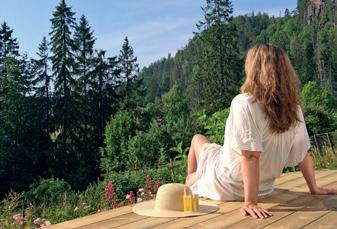
“It showed me how much difference just a few quiet minutes can make,” says Thomassen. “I wanted to bring that feeling into something we already do every day –skincare.”
Based by the tranquil lake Semsvannet in Asker, Thomassen develops and hand-
crafts White Tara’s natural skincare in small batches using carefully selected ingredients. From here, she invites customers to slow down and reconnect with themselves through simple, mindful rituals.
The brand’s name dates back to a journey to Tibet in 2004, where Thomassen discovered the symbolism of White Tara, representing compassion, purity, vitality and protection. “Those values stayed with me and have become a kind of compass for everything I create.”
White Tara launched less than a year ago and remains intentionally small because it allows Thomassen to oversee every detail herself. She describes the work of developing and creating products as her very own
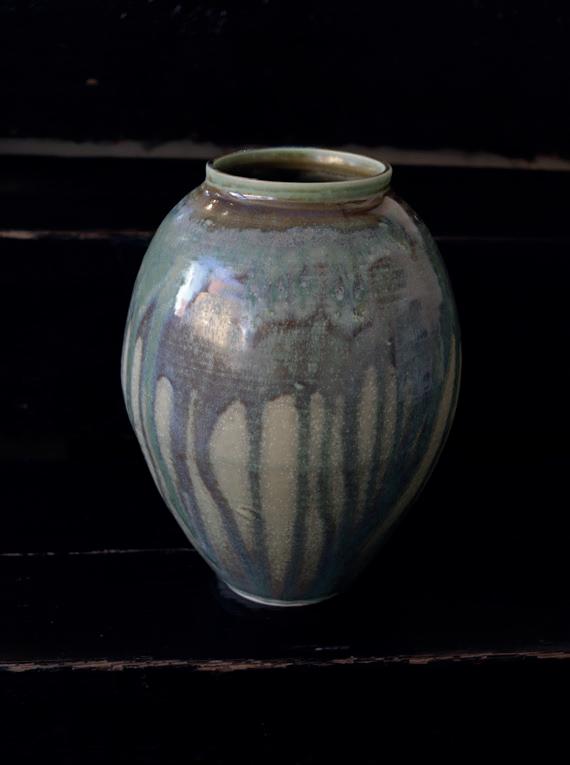
www.cosytimesceramics.dk
Instagram: @cosytimesceramics.kerteminde
sanctuary, a feeling she wishes to share with her customers, evident in the aptly named Sanctum, White Tara’s signature facial oil.
Meaning ‘a quiet place’ in Latin, the product is designed to turn skincare into a moment of presence, whether as part of a morning ritual or while applying lip balm during a busy commute.
whitetara.no
Instagram: @whitetara.no
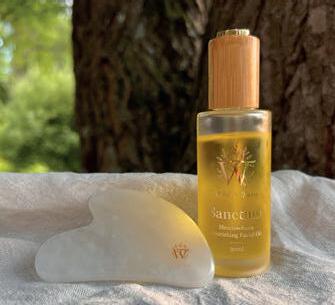
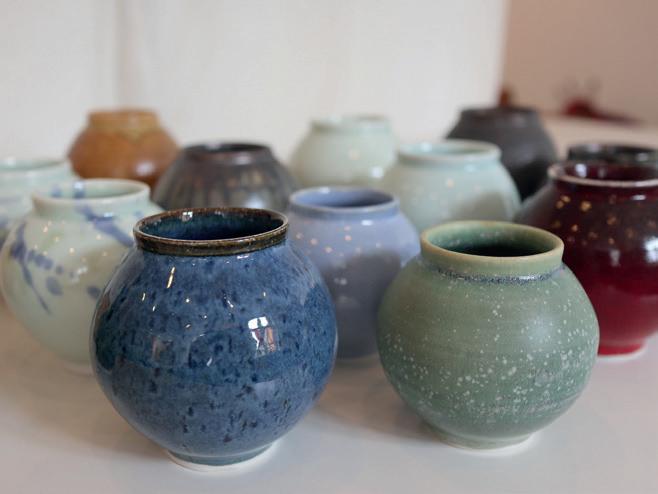
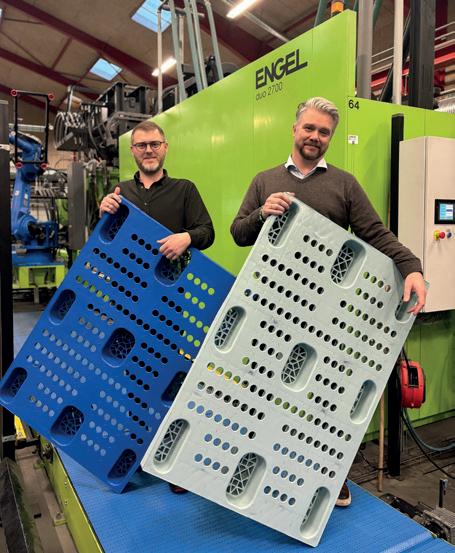
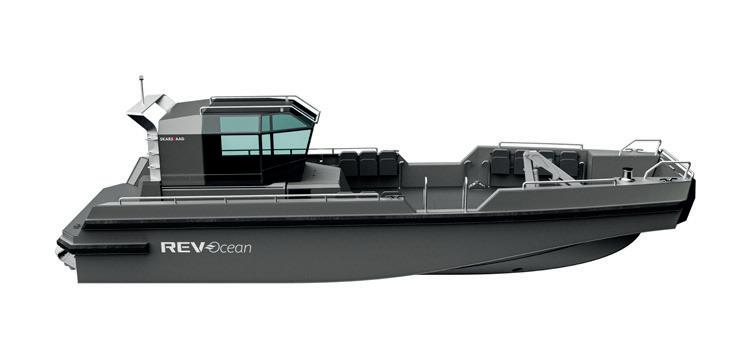
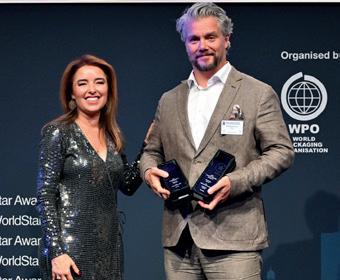
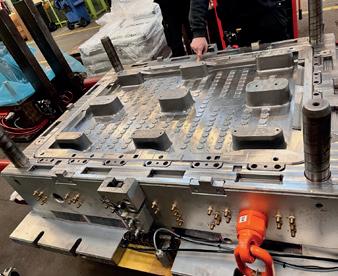
With ever-booming global industry, the issues of rapidly growing plastic waste means that businesses are facing increasing pressure to reduce waste and improve resource efficiency. Specialising in material formulation, industrial design and value chain optimisation, AION works with organisations to reduce virgin plastics by redesigning products and transforming waste into valuable new resources.
By Celina Tran | Photos: AION
Originally established as a corporate venture within Aker BioMarine, AION was born from a challenge to find a better use for discarded fishing nets. While investigating how to give the material a second life, the team discovered that many industries were facing similar issues around plastic use, waste management and resource efficiency. This led to the creation of AION, which has since expanded with major businesses in the fishing, maritime and logistics industries.
Firm believers in circularity as an economic concept, rather than an environmental one, it works throughout the entire process, from analysing material flows and identifying waste streams to designing products and implementing manufacturing processes. The company believes that successful circularity depends on solu-
tions that are technically robust, commercially viable and operationally practical.
“We’re design-first, but we’re not a design agency,” explains Nils Henrik Parborg, Head of Materials and Design. “We start with data. We build the evidence needed to make the right design decisions, then help customers put those decisions into operation.”
This approach has delivered successful projects for companies including Circmar, where seafood industry waste was transformed into durable logistics pallets, and McDonald’s, where AION developed the process for turning used plastic crates into new logistics packaging products.
“Sometimes that’s redesigning a product to use less material; or it’s integrat-
ing design innovations that allow products to nest or collapse for improved logistics economics. In the most ideal scenario, that’s turning a waste stream into an input for something new. In every case, the solution has to work operationally and stack up commercially, or it doesn’t get built.”
Looking ahead, AION is focused on scaling its industrial solutions. In a recently completed project for REV Ocean, one of the world’s largest and most advanced privately owned research and exploration vessels, Parborg’s design team utilised used fishing nets to formulate plastic sheets for high-stress maritime applications. The formulated sheets demonstrated comparable performance to 100 per cent virgin alternatives and are ready to be scaled across the maritime industry.
“The goal isn’t circular design as a sustainability ambition,” says Parborg. “It’s circular design as a better way to build products and value chains.”
www.aion.eco

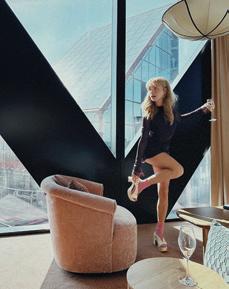

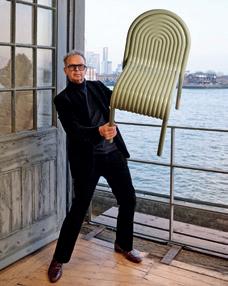
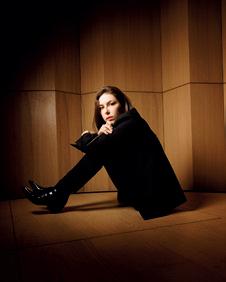

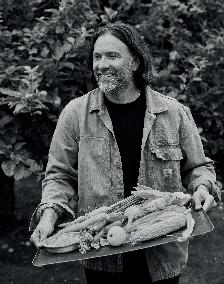

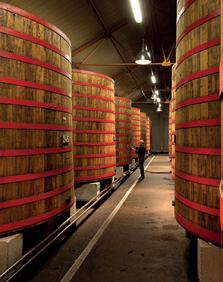
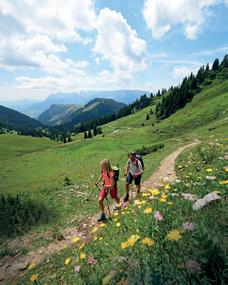

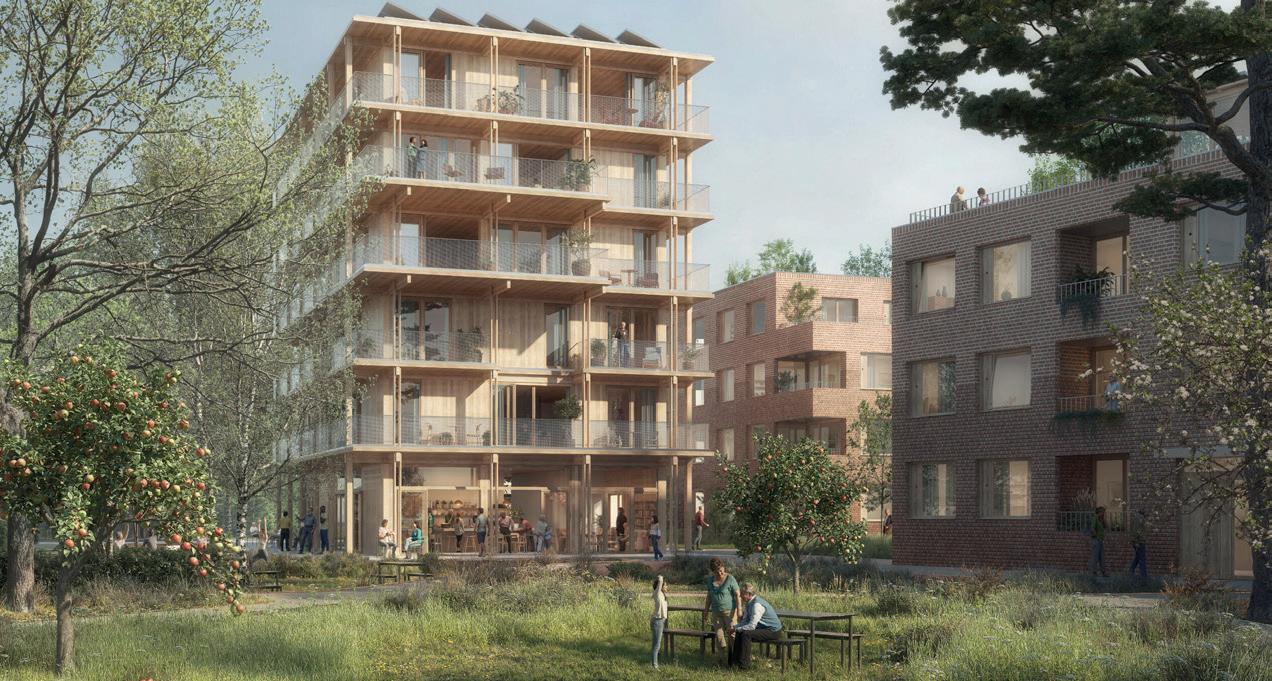
Parts of Europe have been engulfed in extreme heat in the past few months, with the first heatwave starting back in May. As Denmark records an all-time high temperature record, Nordic innovators are at the forefront of adapting to extreme heat.
By Anders Lorenzen
Europe is the fastest warming continent in the world. While the Nordic region represents the coolest part of continental Europe overall, the heat has also been noted here, with sudden temperature spikes.
For instance, in Denmark a new all timehigh temperature record of 37.0°C was set in June, beating the previous record of 36.4°C from 1975 that had stood for over 50 years.
How is the Nordic region adapting to a warming climate?
While Denmark, as well as other Nordic countries, has a strong record in leading the way in transitioning away from the fossil fuels that is the leading cause of climate-fuelled extreme heat and tempera-
ture records, the country is also pioneering technologies which are helping us to better adapt to a warming world.
Denmark pioneered triple and quadruple glazing before double-glazing had even become trendy. You may wonder, how does this help deal with extreme heat? There is a common misconception that extra glazed windows are only suitable for keeping homes warm, but it goes the other way as well; while these windows retain heat in winter, they can reduce how much heat is entering during summer.
This technology has contributed to homes in the region becoming more energy-efficient, creating more comfortable homes that are adapted to a warming climate.
Designing for a warming climate
The leading role that the Nordic region plays is not only thanks to having forward-looking entrepreneur-focused companies and strong relations to the design sector, but also due to having strong building regulations and policies in place, as well as governments having prioritised investments for decades.
Solutions by companies, innovators and organisations extend far beyond the Nordic region. For instance, Denmark’s Ramboll, an engineering, architecture and consultancy company that operates across the world, has contributed to major infrastructure and landmark developments, including work on the Øresund Bridge connecting Denmark and Sweden, the Great Belt Bridge, the Copenhagen Opera House and the extension of the Tate Modern in London. The company, with headquarters in the Danish capital of Copenhagen, is recognised for its engineering, environmental consulting,
urban development and renewable-energy-related projects.
Similarly, the Swedish architecture company White Architects works across a broad range of building types and planning activities. It has undertaken a broad and diverse set of projects across housing, education, healthcare, cultural buildings, commercial developments, public spaces and urban planning. The firm has a nature-based focus, building with rather than against nature, and often integrates architecture with the landscape – with design sustainability at the core of the early design stages.
The company has described its mission as enabling sustainable life through architecture and, as a result, has set a long-term goal of delivering regenerative and climate-neutral architecture through its work. White Architects has worked on several significant projects such as Sara Kulturhus (Sara Cultural Centre) in Skellefteå, one of the world’s tallest timber buildings; the Stockholm Waterfront complex; the long-term Kiruna city relocation; and numerous hospitals, schools, transport facilities and civic buildings throughout and beyond the Nordic region.
Green roofs, living walls and rainwater retention
Denmark’s Henning Larsen is a design and architecture company which has taken a people-centred design approach alongside environmental performance. The company develops projects with the sensitivity and need for the local context. Its designs are built upon emphasising and utilising available daylight, public space and biodiversity, fostering collaboration between architects, landscape architects, engineers and sustainability specialists with the objective of creating places that support both communities and ecological systems.
In the company’s portfolio, several high-profile and internationally recognised projects are included, such as Copenhagen Opera House, Harpa Concert Hall and Conference Centre in Rey-
kjavík, Moesgaard Museum in Denmark and Quay Quarter Tower in Sydney.
The Nordic region has gradually but firmly established itself as a world leader in using nature-based materials to roll out green roofs and other urban cooling initiatives, such as living walls and rainwater retention, which enhance urban biodiversity and reduce urban heat islands. Such technologies and initiatives can simultaneously address heatwaves, flooding and stormwater management.
Initiatives such as these have led to further collaboration between stakeholders in the Scandinavian Green Roof Institute (SGRI). Since its inception in 2001, SGRI has been a research and competence centre for urban blue-green solutions and ecosystem services.
Cooling without air-conditioning
With current technology, air-conditioning (AC) has a very high carbon footprint. Aware of its own goal of increasing emissions by adding high-carbon AC units, the Nordic region has taken a different and more innovate approach to cooling, by scaling up the district cooling technology.
The region has taken on a leadership position in this cooling method that is not to be confused with district heating. By adopting the lower carbon footprint of district cooling, instead of high-carbon AC, you also adopt reusability by utilising a combination of seawater, lakes, waste cooling, heat pumps and underground for cooling needs.
One company that has invested in district cooling is Stockholm Exergi, which

is based in the Swedish capital of Stockholm. The energy company provides district heating, district cooling, electricity and energy services for the Stockholm region. It is one of the Nordic region’s largest district energy operators and has become internationally recognised for its leadership in bioenergy with carbon capture and storage (BECCS), an approach designed to remove carbon dioxide from the atmosphere while generating heat and power.
Denmark’s Danfoss has pioneered the modern reversible heat pump design. The versatile engineering company produces heating, cooling and plumbing appliances. The odds are high that you, no matter where in the world you are, have a product in your home that is made by Danfoss!
Adapting to climate with digital services
Digital services and data are becoming increasingly crucial when it comes to managing our rapidly warming world, where weather is only going to become more extreme and unpredictable as warming intensifies.
Nordic companies are actively working on how better to innovate and plan for this. Some, such as Sweden’s Combient and Afry, have adopted AI to create better and more accurate urban heat mapping, digital twins, emergency planning and infrastructure resilience.
Reaching 37°C degrees in Denmark is a big deal. ”I wouldn’t be surprised if within the next ten years, we reach 40°C,”
Eigil Kaas, a Danish climate scientist, told the Danish broadcaster Denmark’s Radio (DR), highlighting the need for cooling solutions as much as heating solutions – even in the Nordics.
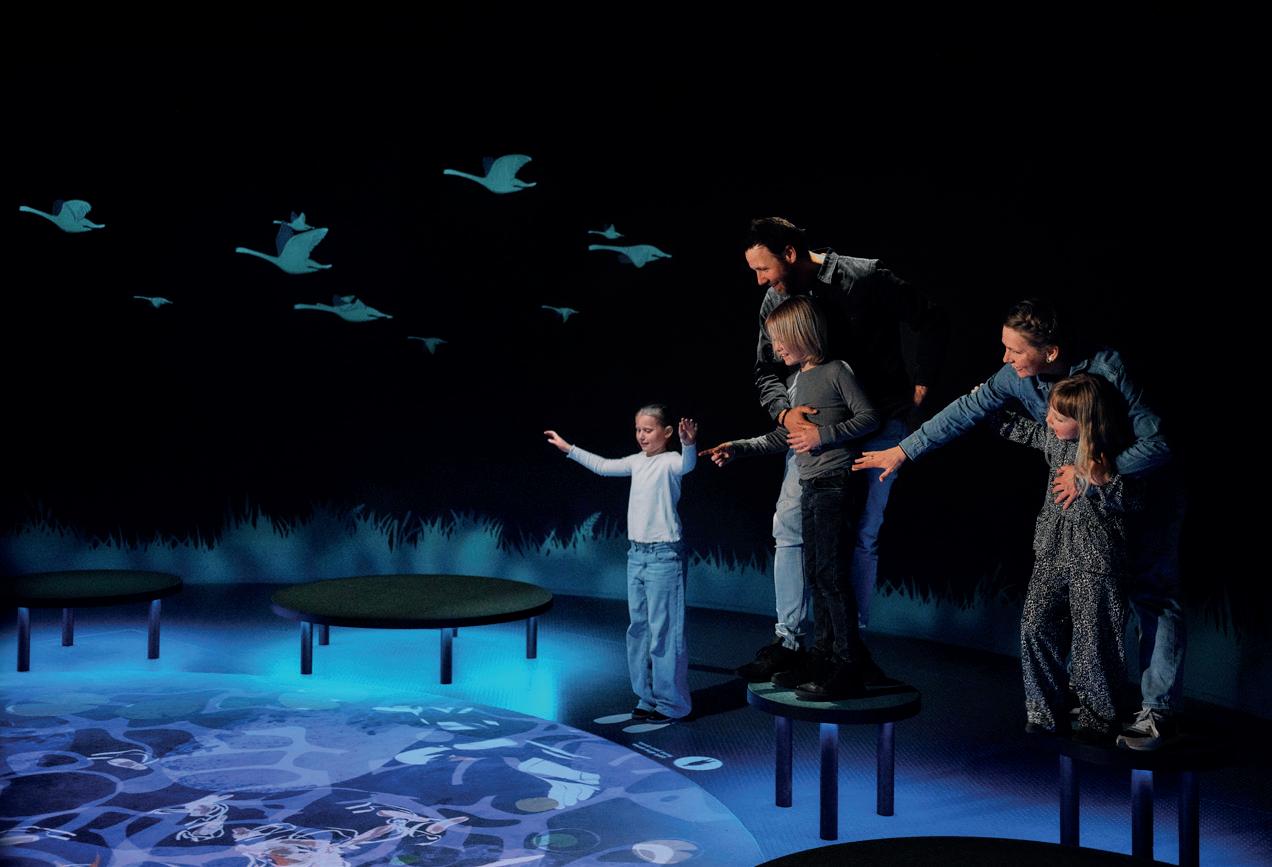
With the largest collection of artifacts from H.C. Andersens’s life and fairytale history, H.C. Andersen’s House in Odense attracts around 200,000 visitors per year. The museum has plenty to explore for the curious who, like millions of people around the world, grew up with his stories.
By Malin Norman | Photos: Museum Odense
The internationally renowned museum H.C. Andersen’s House in Odense was created by the Japanese architectural firm Kengo Kuma & Associates and inaugurated in 2021. At the museum, you can see original objects, paper cuttings and drawings by Denmark’s worldfamous author.
Senior Researcher at H.C. Andersen’s House, Ejnar Stig Asgaard, says: “H.C. Andersen is an incredibly fascinating figure in European cultural history. He called his life a fairytale – not without reason, because with his unusual abilities he created a fantastic career. From being a poor shoemaker’s boy, he became an internationally famous and recognised author. He had a creative urge beyond the ordinary and could elegantly address everyone at the same time through his writing and visual art, both children, youth and the elderly. It is a great skill, especially because Anders-
en’s art greatly touches on humanity and the bright and dark sides of human life.”
Andersen’s many journeys
Andersen’s adult life was characterised by a sense of longing. Where others felt homesick, he experienced the opposite; he had to go out there to meet the world. Therefore, the exhibition also highlights his many journeys that helped provide inspiration for his stories.
The permanent exhibition is filled with a large amount of original artefacts, from travel bags to love letters and manuscripts of the well-known tales. All well-preserved objects that Andersen left behind and which can be seen in the museum today.
The large museum is built in connection with the house where Andersen was born. Visitors can experience an exciting combination of the original birthplace and the museum, whilst guided through Andersen’s story with a special audio guide available in Danish, German, English, Chinese and Ukrainian.
The playful Ville Vau universe
Children are also offered a special attraction in Ville Vau. Dressed in handsewn costumes, they play into a universe as if they were part of the tale themselves. Here, they can let their imagination run free and play baker, postman or witch in the small houses, or
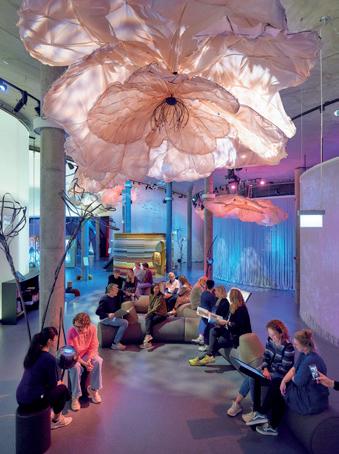
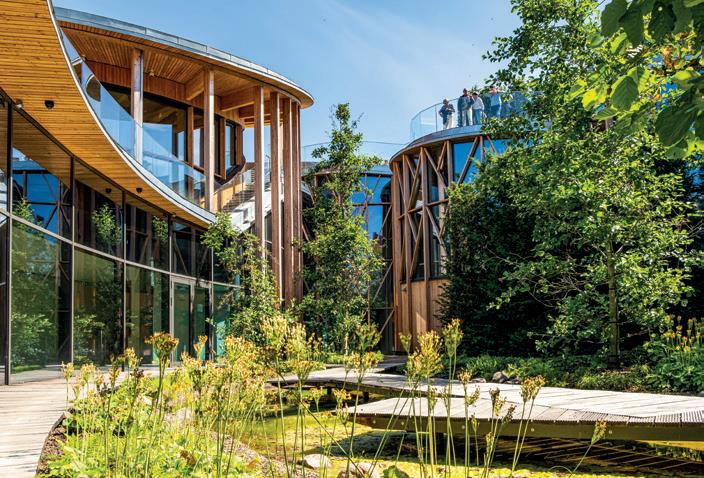
create drawings and figures in the universe’s own studio – bringing their own magical stories to life.
The garden at H. C. Andersen’s House is also a tribute to imagination, curiosity and the wonder found in everyday life. Inspired by his many tales and his unique way of seeing the world, the garden was designed by landscape architects MASU Planning in collaboration with architects from Kengo Kuma & Associates.
At café Deilig, you step into a green oasis in the middle of the H.C. Andersen Garden. Both taste and atmosphere take centre stage. Whether you visit for
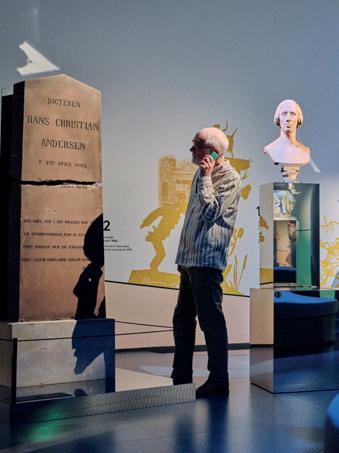
brunch, lunch, or a relaxed evening, this is a place where food meets fairytales and imagination.
A five-minute walk from H.C. Andersen’s House, on Munkemøllestræde, sits the small yellow half-timbered house where he lived from the age of two until he moved to Copenhagen at 14, to pursue admission to the Royal Danish Theatre. H.C. Andersens Childhood Home is also a museum and the ticket is valid for both museums.
hcandersenshus.dk
Facebook: H.C. Andersens Hus Instagram: @hcandersens.hus
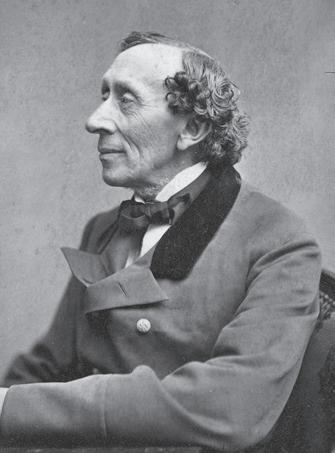
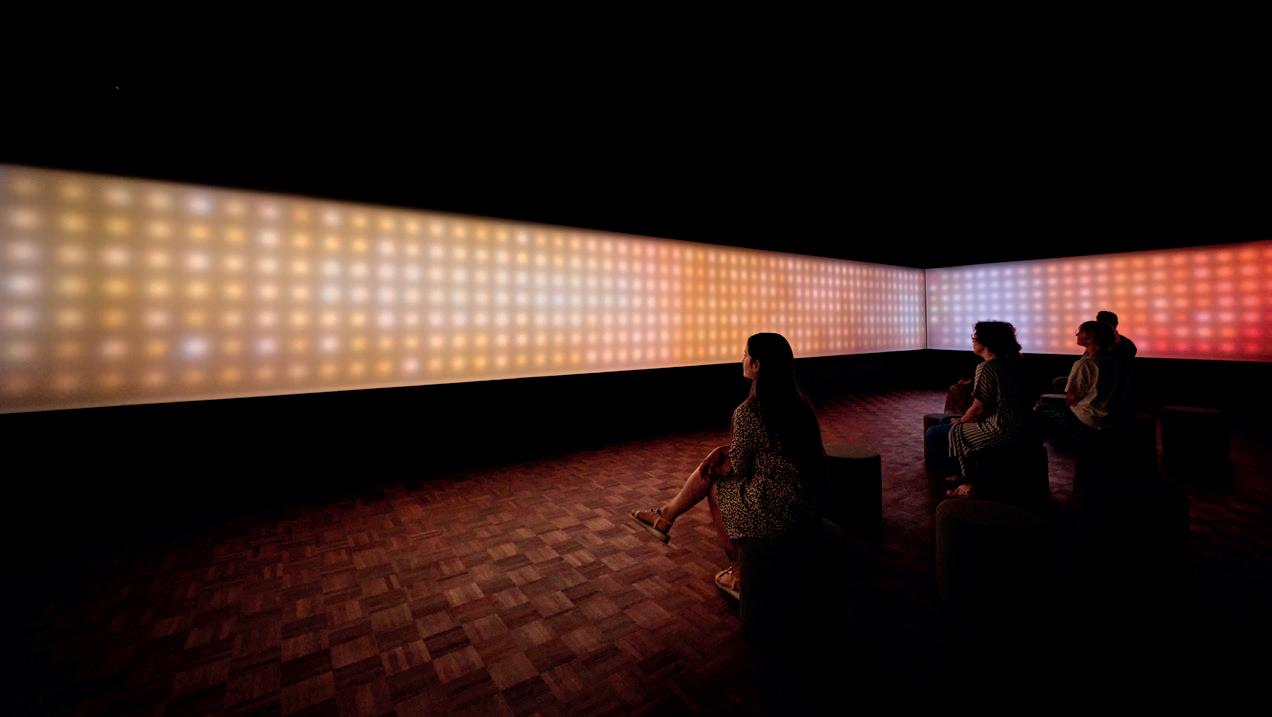
Winner of the prestigious Luigi Michaletti Award and named Most Surprising Museum Visit, the museum dedicated to the famous composer Carl Nielsen, with his great symphonies and folk melodies, offers unexpected musical experiences for the whole family.
By Malin Norman | Photos: Carl Nielsen Museum
In the modern Carl Nielsen Museum in Odense, housed in the same building as the Odense Concert Hall and the Odense Symphony Orchestra, the life and work of the world-famous composer are brought to life. Here, music itself is the most important object.
First established in 1988, Carl Nielsen Museum opened as a classic composer museum. In 2023, it reopened as something modern and interactive, after an extensive renovation. The following year, the museum won the prestigious Luigi
Micheletti Award, presented by the European Museum Academy, for its outstanding storytelling and innovative presentation. It was also named Most Surprising Museum Visit by DR’s P2 program Aftryk (Impressions).
Entice your senses at the museum
A visit to the Carl Nielsen Museum provides insight into the story of Denmark’s greatest and most productive composer, who was just as committed to renewing folk songs as he was to developing great concert music.
Listen to the sounds that filled Carl Nielsen’s world. Catch glimpses of the places and people who inspired his creativity. Follow the rhythm of his music as
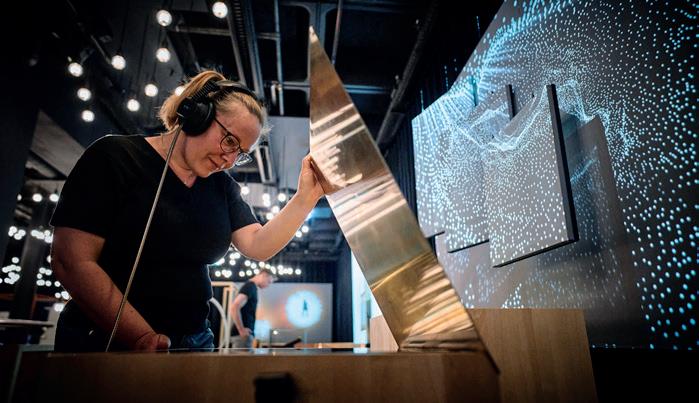
it flows through the exhibition, and experience surprising and unexpected moments that provide a fresh understanding of what his music can be. Each displayed object tells a story from the composer’s life through music.
The museum brings his story to life through experiences that awaken the senses. Sounds, stories and creative activities give visitors the opportunity to explore the many expressions of music while they play their way to new discoveries. There is room to touch, listen and create without being afraid of doing
something wrong. Put your hand on the piano and see it play. Open a door and the stories spill out.
Michael Fjeldsøe, author of the latest major literary work about the composer, titled Carl Nielsen. En kulturhistorisk biografi (Carl Nielsen. A cultural-historical biography), and leader of Carl Nielsen Centre, a division of Museum Odense, considers curiosity and wonder to be the museum’s most important DNA.
“That’s how Carl Nielsen was – never satisfied, always on his way to the next chal-
lenge. Curious and stubborn,” he says. “When children are allowed to create, listen and explore for themselves, the museum becomes a place where inspiration arises quite naturally, and where a single visit can be the beginning of a lifelong interest in music.”
Let the children lead the way
Children can help find things, places and connections that grownups would never have found themselves. It can be a special experience for both young and old if the children’s curiosity is allowed to take the lead. Maybe the children can come up with a game? For example, find the melody you like best, or find the prettiest colour or the craziest thing in the entire museum.
A visit to Carl Nielsen Museum does not require that you know about the composer or classical music in advance. There is plenty of inspiration for both nerds and beginners. You can safely embark on new discoveries about Carl Nielsen and his music – maybe you can also learn something new about yourself?
carlnielsenmuseet.dk
Facebook: Carl Nielsen Museet Instagram: @carlnielsenmuseet
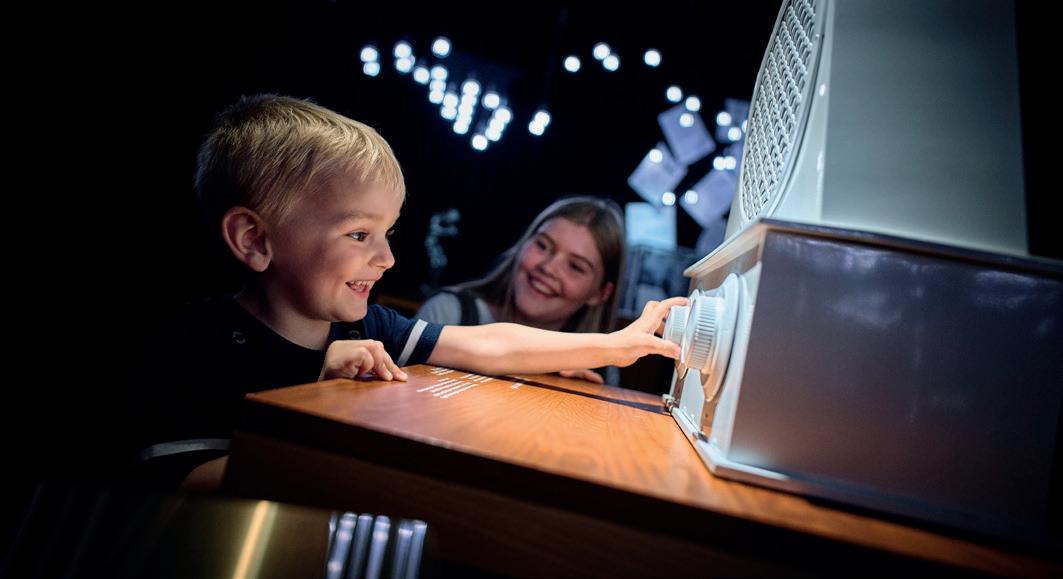
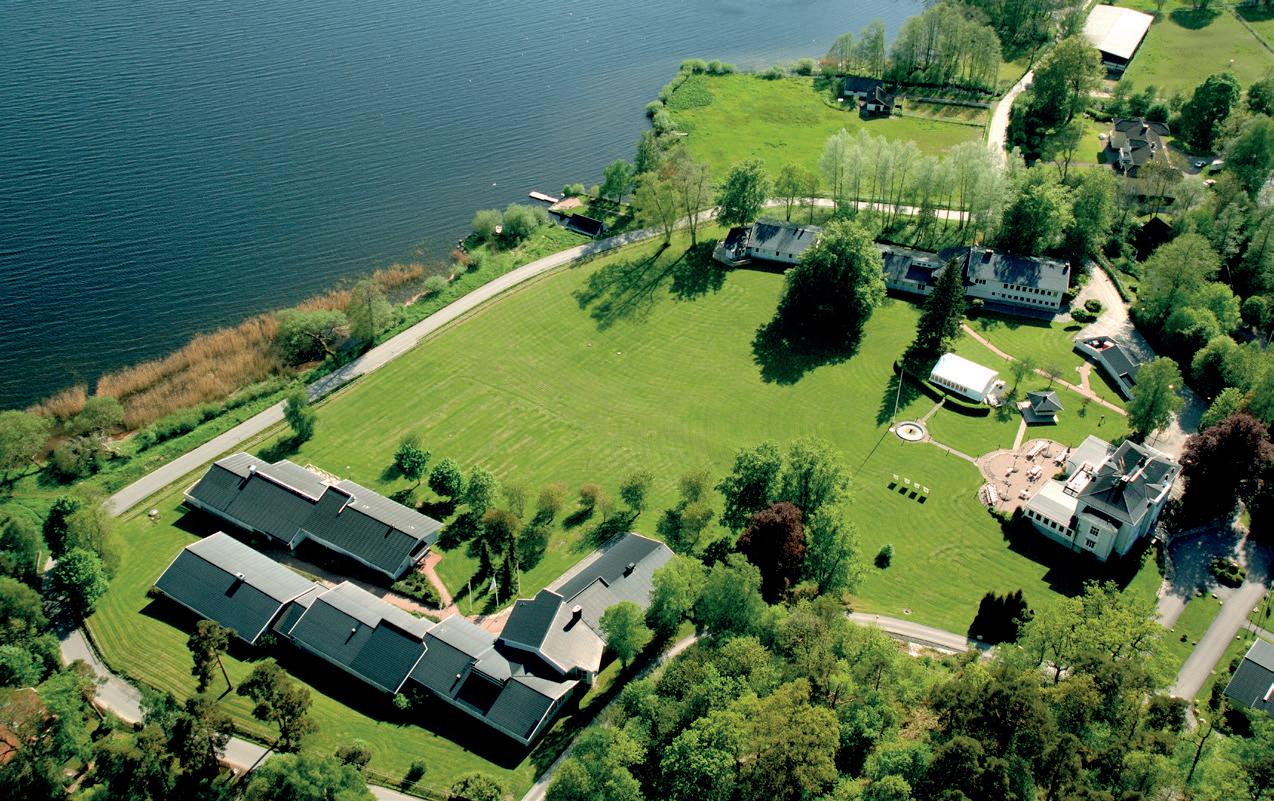
The 200-year-old manor house Aspenäs Herrgård is taking the next step on its journey, with tastefully renovated guest rooms, a newly opened spa, a popular restaurant and café, and an ambition to become a must-visit destination in its own right.
By Malin Norman | Photos: Sofia Lewerin
For generations, Aspenäs has been a place for rest and recovery. “Since the late 19th century, when wholesaler Arthur Seaton acquired the estate, people have come here to enjoy the stately manor house and the closeness to nature,” says Clara Wenander, marketing manager. “The tradition lives on and our tranquil settings, beautiful views and culinary experiences attract many visitors, but we’re also continuously updating our facilities to meet changing demands.”
The main building is over 200 years old, and this is where the reception and restaurant is housed, whilst the guest rooms are located in a few different buildings on the estate. “As soon as you arrive, you will feel the peaceful atmosphere,” says Wenander. “There’s something quite special about this location by Lake Aspen.”
In the past 60 years, Aspenäs has primarily been a venue for conferences, meetings and weddings. And whilst those will
always remain a focus, the manor house is taking the next step on its journey to attract a wider audience.
Aspenäs offers tastefully decorated rooms, where historic charm meets modern aesthetics. Formerly single rooms have been transformed into bright, stylish double rooms, where comfort meets design. The manor also features new suites with magical lake views.
The restaurant has been completely renovated, too, and given a more modern character. “Aspenäs has become a place where guests want to stay even longer, really creating memories together,” says Wenander.
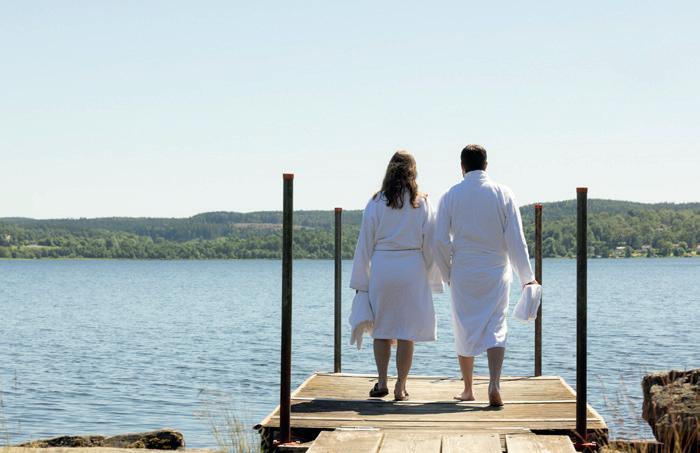
On 13 July, the brand-new, modern spa and retreat opened its doors. “The experience is created to follow the rhythm of nature,” explains the marketing manager. “We have several saunas – including an infrared sauna and a steam sauna – as well as experience showers, a foot spa, quiet relaxation areas, a spa lounge with service and a large terrace facing the lake.”
In addition to the relaxing spa retreat, food remains one of the main strengths at Aspenäs. The restaurant team works with classic Swedish flavours and carefully selected local ingredients from the west coast, and everything is made from scratch. “Our food is the main reason for
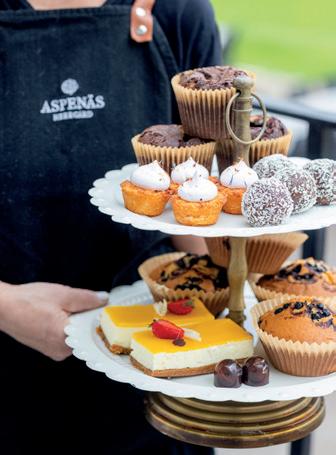
many guests to visit,” says Wenander. “Here, you can enjoy tasty dishes and let conversations take place, long after the last plates have been cleared.”
The manor house café is a popular spot too, for coffee, lunch and relaxation, with its own dedicated pastry chef. The café is open every day during summer, from 1 July to 9 August, and on weekends the rest of the year.
The area around Aspenäs is great for outdoor experiences, such as cycling with plenty of winding roads, lakefront stretches and forest trails, as well as paddling, swimming and sailing.
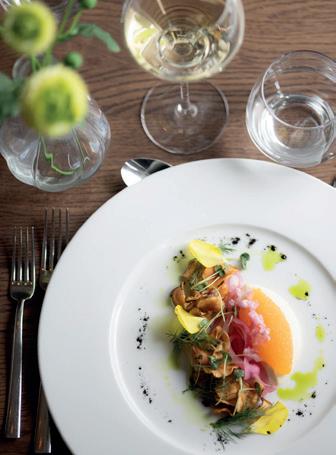
For those who love hiking, the Gotaleden trail is regarded as one of West Sweden’s finest hiking routes, with beautiful scenery and plenty of places to relax and enjoy nature. The trail stretches between Gothenburg and Alingsås, with approximately 71 kilometres of varied nature, including forests, lakes, and open landscapes.
Apart from the outdoor experiences, Aspenäs also organises tastings, live music and activities such as breakfast yoga. “You can come for our delicious breakfast buffet, have a coffee with homemade pastries in the café, enjoy a tasty evening meal, or stay for the night,” advises Wenander. “Treat yourself to a break from everyday life. Bring family and friends, enjoy our peaceful oasis by the lake and let us take care of the rest.”
aspenasherrgard.se
Facebook: Aspenäs Herrgård Instagram: @aspenasherrgard
To celebrate the opening of its brandnew spa, Aspenäs Herrgård has announced its special package, the Aspenäs Spa Retreat. Enjoy a threecourse dinner, entrance to the spa and retreat, a night in one of the stylish guest rooms, and a delicious breakfast buffet in the morning. To book, you can visit boka.aspenasherrgard.se/package
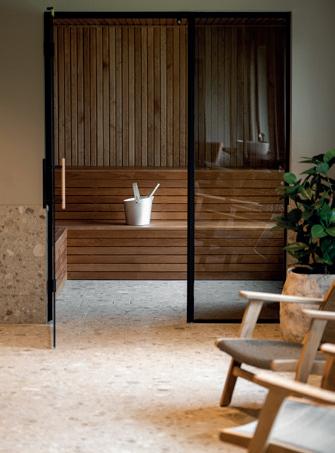
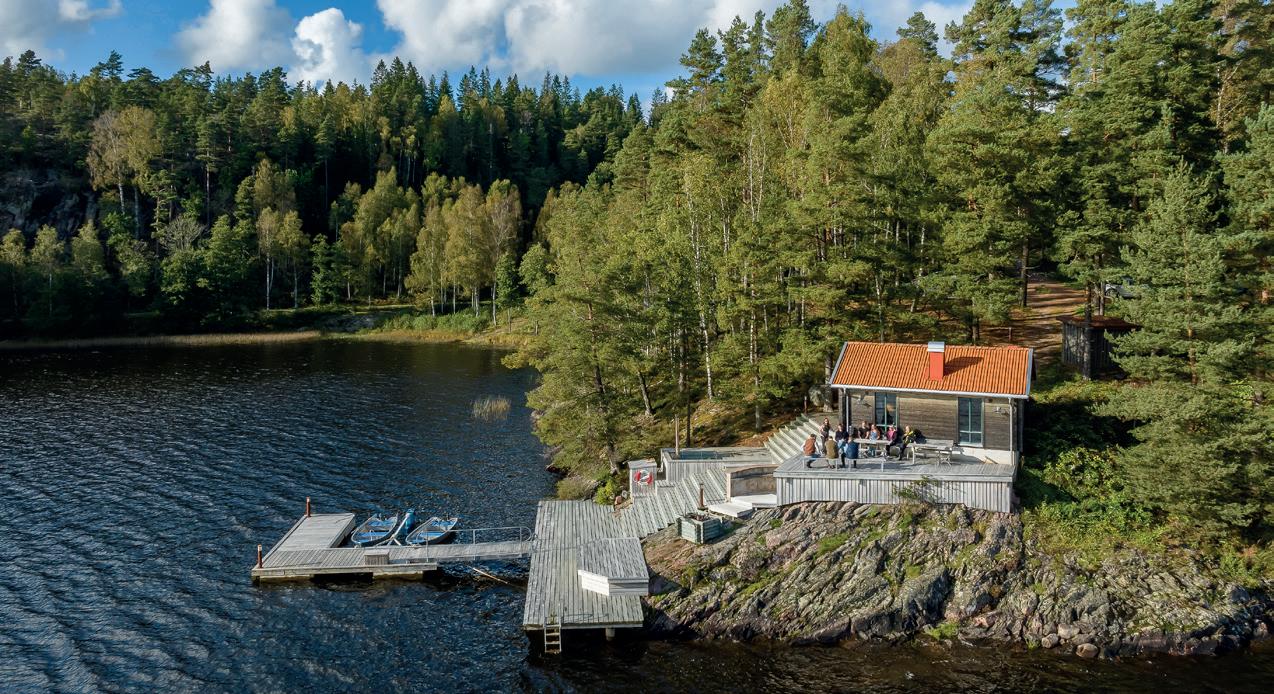
Between the rugged coast of Bohuslän and the deep forests of Dalsland, Ulkeröds Gård is surrounded by a vibrant open landscape with meadows and pastures. The estate operates as a hotel, restaurant and conference venue, but is also a working farm. Here, nature, food and people are intertwined – this is farm to table at its best.
By Malin Norman | Photos: Ulkeröds Gård
In northeastern Bohuslän, just outside Hedekas, lies Ulkeröds Gård. The estate offers comfortable accommodation in a relaxing atmosphere, with delicious food from the farm’s crops, game pens and sheep pastures, as well as a range of activities.
The farm has been a place of residence for over 600 years, and the buildings bear traces from the 17th century. The Lyrdal family took over the farm in 2003, after almost ten years of searching.
“Through careful development, the family has preserved the feeling of what once was, whilst creating something new and lasting,” says Lars Olof Lyrdal, CEO. “His-
tory and the present meet in an environment where everything is allowed to take its time. What started as a refuge for the family and their friends has become a calm oasis for guests from near and afar,
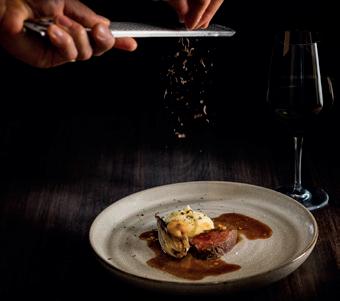
yet with that ‘feel at home’ atmosphere still present.”
Come and stay at the farm
Ulkeröds Gård is not a backdrop. This is a working farm where life goes on, every day. When visiting, you will see that the animals, the land and the production are a natural part of the whole. In addition to lambs, deer, Linderö pigs and Highland Cattle, this year the family takes the next step with egg production.
“The setting at Ulkeröds Gård is amazing and as a guest, you will experience the real countryside,” says Lyrdal. “The most common comment we get from guests is ‘this is so much more beautiful than you think’ and that’s quite something.”
For those who want to stay the night, 25 comfortable guest rooms are available in two buildings, Hotell Ängslyckan and Hotell Björkhagen, each with uniquely decorated rooms and beautiful views – a place
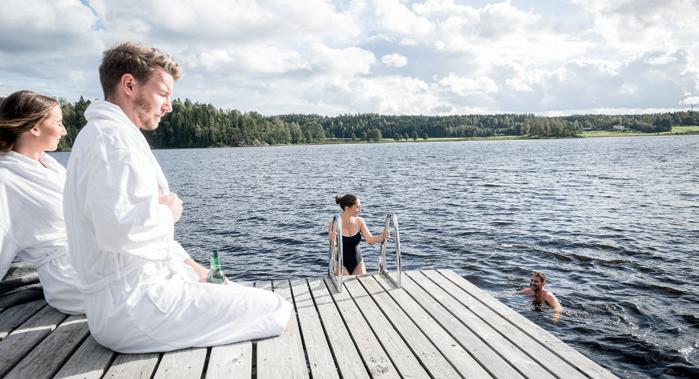
for rest, with closeness to nature and time to just be. Wake up to peace and quiet, go for a walk on the grounds and let the experience continue at its own pace.
The beating heart of Ulkeröds Gård is the restaurant Ekbacken, which opened in 2018 and in recent years has been put on the map as a culinary destination. Under the leadership of head chef Jonas Blomstervall, world-class food is served all year round, both two-course farm lunches and six-course tasting menus in the evenings. During summer, the restaurant moves to Paviljongen, where the food is prepared in the outdoor kitchen right next to the pastures.
Restaurant Ekbacken is part of the network Smaka på Västsverige, which brings together restaurants and cafés that, in close collaboration with local producers,
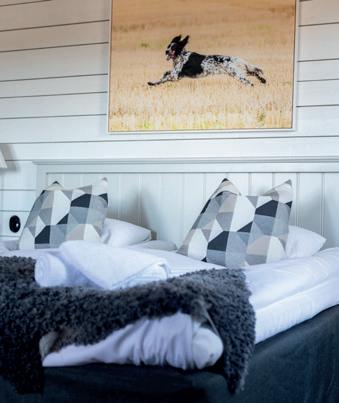
offer Western Swedish food experiences based on seasonal local ingredients.
“Our passionate kitchen team continuously creates dishes where the season, the farm and the local produce set the tone,” says the CEO. “This is honest cooking with a deep foundation in craftsmanship and the surrounding landscape.”
The beautiful surroundings and the tranquillity of the farm are ideal for inspiring and creative meetings, and Ulkeröds Gård is a popular venue for conferences. “We have modern conference rooms tailored to your needs and nature as your closest neighbour,” says Lyrdal.
Just a few steps from the meeting rooms, exciting activities await including clay pigeon shooting – this is considered to be
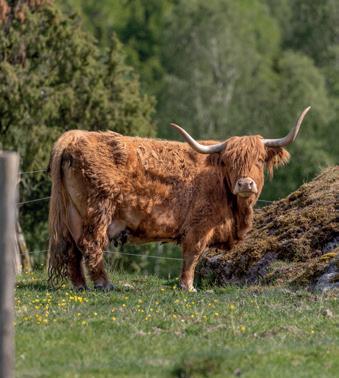
one of Sweden’s coolest ranges – with a variety of shooting stations and professional instructors. Ulkeröds Gård also has an outdoor gym and trails for cycling, walking and running, and a wood-fired sauna and hot tub by the lake.
“At the farm, you will find that the air is clearer, the pace is calmer and the tranquillity is palpable,” adds Lyrdal. “It’s a place to come to, and a place to long to return to – for the food, the closeness to nature, and the feeling of experiencing something real.”
ulkerodsgard.se
Facebook: Ulkeröds Gård
Instagram: @ulkerod
Ulkeröds Gård is located in northern Bohuslän, just an hour’s drive from Gothenburg and Oslo.
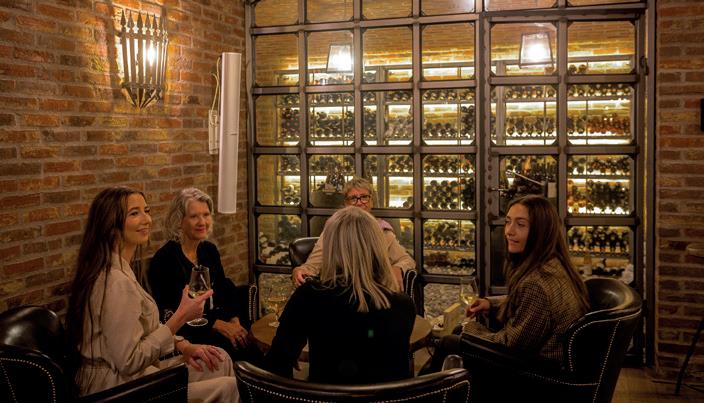
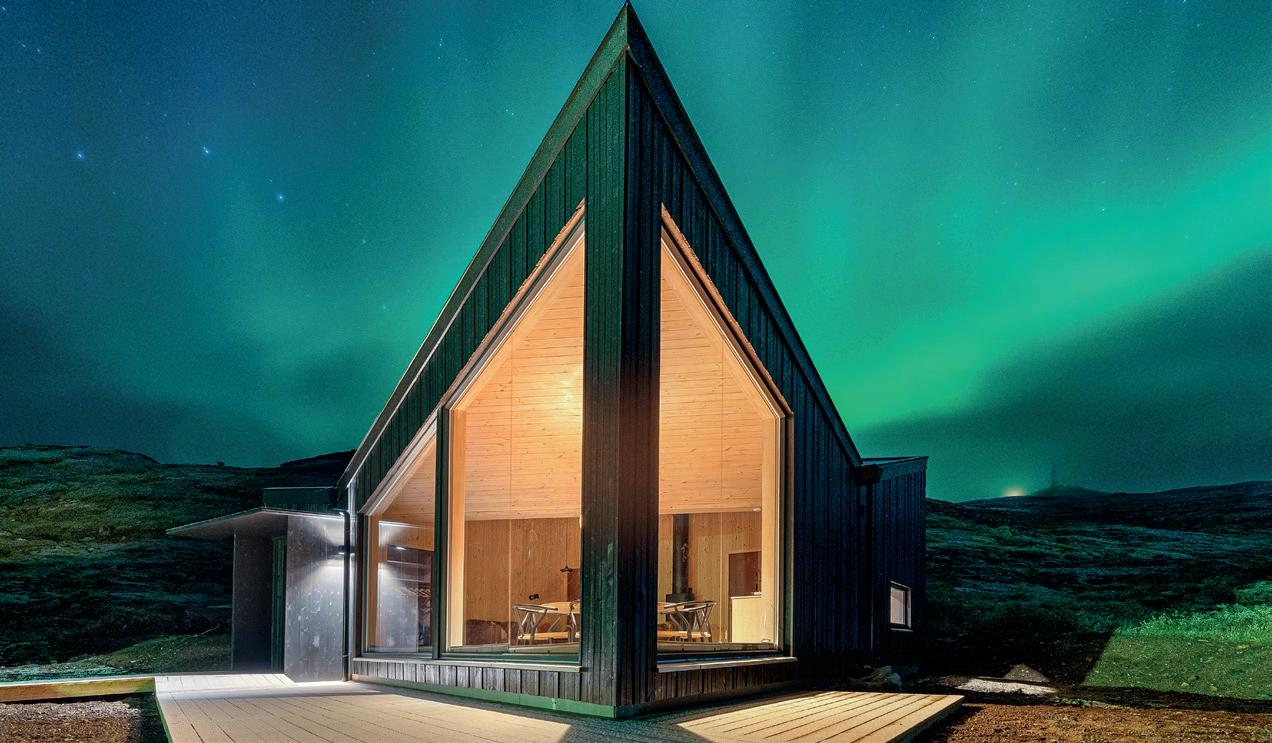
Nestled in the dramatic landscape of Hardangervidda, Halne Fjellstugu has welcomed guests for almost a century. Offering rustic stays and tailor-made getaways in the Norwegian highlands, the team invites travellers to slow down, reconnect with nature and embrace a mountain way of life.
By Maria Sødal Vole | Photos: Halne Fjellstugu
Originally built in 1933 as a simple mountain farm offering overnight shelter for passing travellers, Halne Fjellstugu is rich in history and traditions. Over the years, the family-run business evolved into a dedicated inn known for comfortable lodgings and hearty meals.
Halne entered a new chapter when Geirmund Tormodsgard and Ingar Dalen took over as owners in 2016. Over the past ten years, the pair have worked tirelessly to preserve the inn’s unique character while continuing to improve the guest experience. “This is a lifestyle for us,” says Tormodsgard. “When we
took over, Halne was well-run with a great reputation for good food and hospitality. It’s been a joy to continue building on this heritage and keeping local food traditions alive using the natural ingredients of Hardangervidda.”
In its humble beginnings, Halne provided a safe place to stay for those travelling between east and west, its location by the fjord making it a convenient resting place before continuing the journey. “The word ‘halne’ means halfway, and this has been a natural stopover for travellers for centuries,” Tormodsgard explains.
Today, Halne offers a range of accommodation options to suit different budgets and types of stays, combining its historic charm with modern comforts. Guests can choose from room types, apartments and cabins ranging from simple and rustic to well-positioned lodges with panoramic views.
“There’s something for everyone,” Tormodsgard says. “Whether it’s a quick stop on the way somewhere, a child-friendly family holiday, an active getaway with friends or a unique experience in a modern mountain suite, we have options for every traveller.”
In this traditional mountain region, people have always relied on the natural ingredients of the changing seasons. At Halne, using locally sourced food is a way of life... And the land certainly provides.
Wild game such as moose and deer are key components of many dishes, fantastic fishing conditions ensures plenty of fresh fish, and wild lingonberries, blueberries, cloudberries, herbs and more are foraged in the area.
The menu is built on high-quality seasonal produce and focused on authentic, homemade dishes. The signature dish is wild trout caught in the clear waters of Halnefjorden, just a stone’s throw away. “It’s fantastic to be able to serve our guests real mountain trout, fresh as can be – fished from the lake 200 metres away and put straight into the chef’s pan,” Tormodsgard enthuses.
Dedicated to celebrating the traditions and flavours of the area, the team at Halne source cheese from local small-scale producers, and guests can enjoy the delicious cider, fruit and berries that the Hardanger region in Western Norway is famous for.
Halne is a popular destination for company trips, conferences and special events such as weddings, birthdays and family reunions. Alongside dedicated meeting rooms with modern AV equipment, groups have a range of teambuilding activities at their hands.
Guests can also take part in courses teaching traditional crafts such as making ‘rakfisk’ (fermented trout) to take home.
“We want our guests to experience the joys of mountain life,” Tormodsgard says.
“This is such a unique place – it’s honest, real and authentic.”
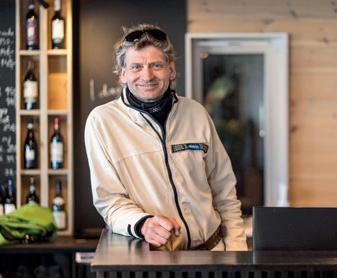
The largest mountain plateau in Europe, Hardangervidda, is located more than 1,000 metres above sea level with vast open spaces. It is one of Norway’s most remarkable natural landscapes, known for its dramatic, untamed nature; from rugged mountain terrain to green valleys, sparkling waterfalls and peaceful lakes, to the breathtaking Hardangerjøkulen glacier.
“The first thing that struck me about Halne was its remarkable contrasts – the landscapes and seasons are fascinating to experience,” Tormodsgard says. “We want to share this special place and give our guests a taste of everything that Hardangervidda has to offer.”
Hardangervidda is a diverse and sought-after destination. Plenty of interesting activities and experiences await visitors, ranging from excellent hikes and skiing, fishing expeditions, boat trips, berry foraging and much more. Tormodsgard recommends the 45-minute hike to Halnekollen, which offers an incredible view of the entire
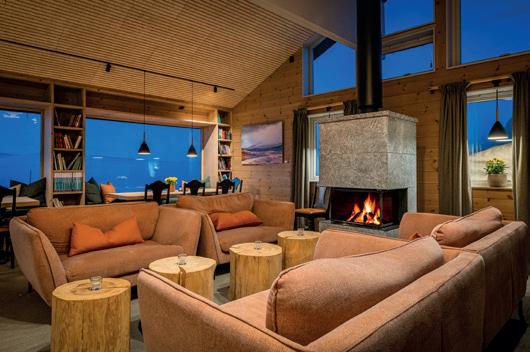
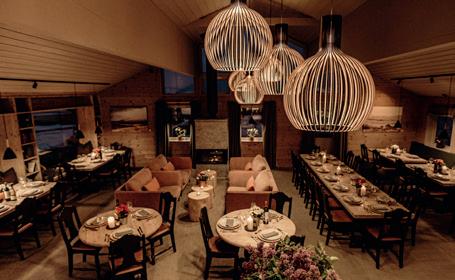
plateau – from Gaustatoppen mountain in the southeast to Hardangerjøkulen glacier in the west and Hallingskarvet mountain range in the north.
With its remote location and minimal light pollution, Halne has some of Norway’s best conditions for stargazing. “This is the perfect place if you want to experience the magic of nature. The peace and stillness you find here is unlike any other.”
Hardangervidda’s Alpine climate supports a rich diversity of plants and wildlife – in fact, it is home to Europe’s oldest and largest remaining population of wild reindeer. Tormodsgard and his team are deeply committed to protecting the natural environment and its abundant wildlife. “I hope our guests come away with a deeper understanding of the importance of looking after our incredible nature,” he adds. “This is one of the few remaining natural areas in Norway, and it’s crucial that we preserve it.”
halne.no
Facebook: Halne Fjellstugu
Instagram: @halnefjellstugu
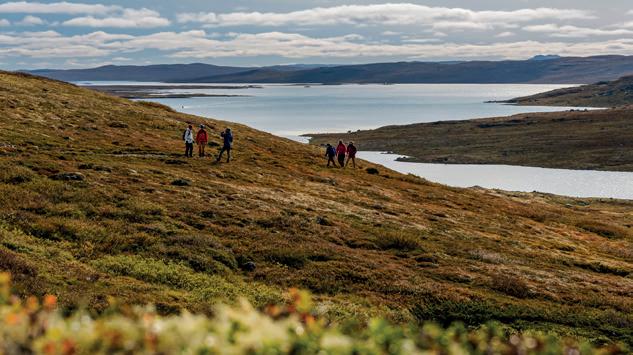
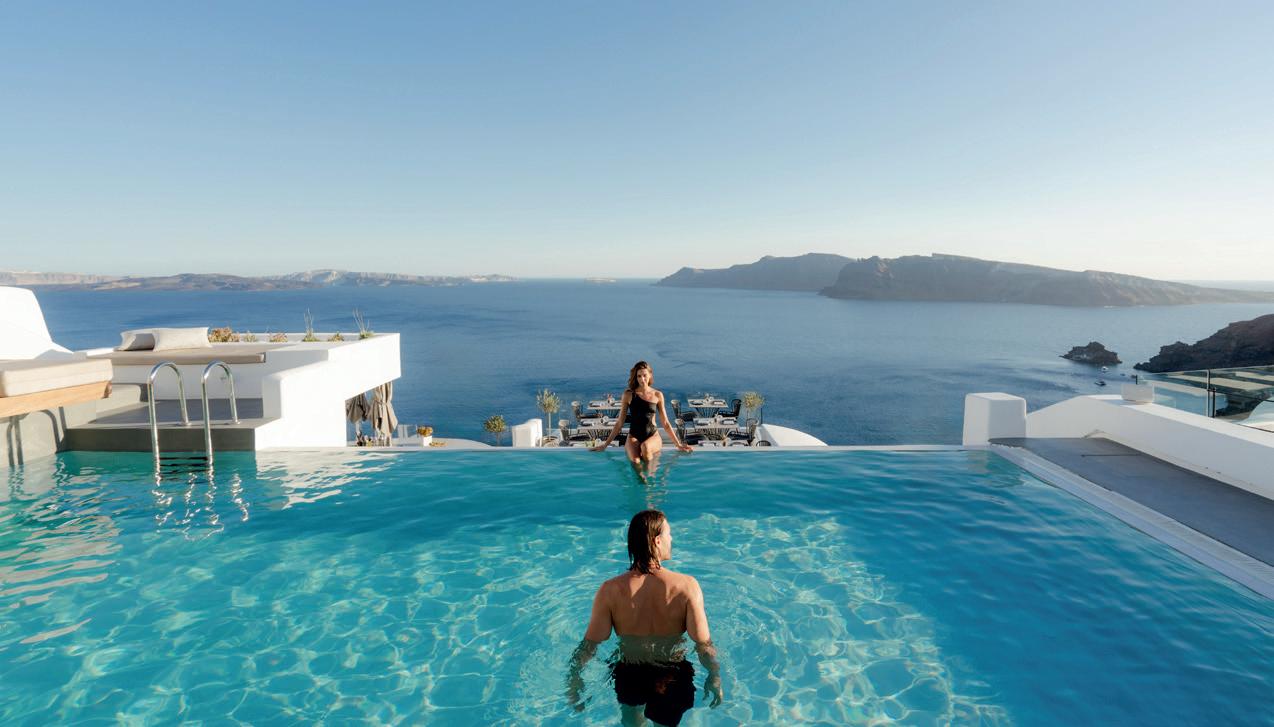
In Oia, where whitewashed architecture meets the drama of the caldera, La Perla Villas & Suites offers more than a luxury stay. The family-rooted boutique hotel blends Santorini’s cave-house heritage with contemporary comfort, inviting discerning travellers to slow down, look out to the Aegean and experience the island with rare intimacy.
By Nane Steinhoff | Photos: DREAMODD
There are places in Santorini that seem designed simply to be admired, and then there are places that carry a story within their walls. La Perla Villas & Suites belongs firmly to the latter. Set in the heart of Oia, one of the island’s most prestigious villages, the boutique hotel occupies a privileged position on the famous caldera, where the horizon opens towards the volcano and the Aegean Sea.
Its origins are unusually personal. Long before Santorini became a fixture on international travel wish lists, the property began life as a private family residence overlooking the caldera. As the island’s
reputation grew, the family gradually transformed the home into an intimate boutique hotel, careful not to lose what had made it special in the first place: pri-
vacy, authenticity and a distinctly Greek sense of welcome.
“La Perla Villas & Suites began its journey as a private family residence overlooking the caldera of Oia,” explains Ioannis G. Moutsatsos, CEO at La Perla Luxury Selections. It is a hotel, certainly, but one with the atmosphere of a secluded residence, where service is polished without feeling performative.
At the centre of the story is Kiki Feroudi Moutsatsos, who co-founded La Perla with George Moutsatsos. Known also as the former personal secretary to Aristotle Onassis and author of The Onassis Women, she helped shape the property into the destination it is today. The next generation has since carried that vision forward.
Today, La Perla Luxury Selections brings together La Perla Villas & Suites in Oia and Kasimatis by La Perla in Imerovigli,
united by what Mr. Moutsatsos describes as “authentic hospitality, personalised service and exceptional standards.” The focus is clear: couples and discerning travellers seeking tranquillity, understated luxury and meaningful experiences.
The luxury of simplicity
Part of La Perla’s appeal lies in the way it wears its luxury lightly. The property is carved into Santorini’s caldera cliffs, embracing the island’s traditional cavehouse architecture while introducing contemporary comfort and a quiet, elegant design language. Officially recognised by the Greek National Tourism Organization (GNTO) as a traditional building, it reflects the island’s architectural heritage in a refined, modern way. La Perla allows its setting to take precedence. “Throughout the property, interiors remain intentionally minimal, allowing the dramatic caldera views, natural light and Cycladic architecture to become the true focal point of every stay,” explains Mr. Moutsatsos.
For guests, that means waking up to sculpted white walls, sunlit terraces and the almost theatrical stillness of the caldera. The experience here is deliberately intimate: a place to retreat to
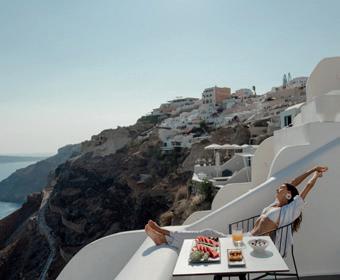
from the island’s bustle while remaining close to the energy of Oia. To create an atmosphere perfectly suited to honeymoons and unhurried escapes, all suites and villas offer private outdoor spaces with hot tubs. The Deluxe Villa elevates that special experience even further with both a private outdoor hot tub and a private heated infinity pool.
One of the most distinctive accommodations is the La Perla (Canava) Suite, created by restoring and transforming a 450-year-old traditional wine press into a luxury suite. The result preserves the memory of Santorini’s winemaking past while providing the comforts of a contemporary five-star retreat.
Mr. Moutsatsos describes the overall mood of the boutique hotel as “a peaceful retreat where architecture, history and nature exist in harmony.” Mornings begin slowly here, with a freshly prepared breakfast served in the privacy of each guest’s suite or terrace. Breakfast also reflects La Perla’s commitment to authentic Greek gastronomy. As proud members of the Greek Breakfast initiative, both La Perla Villas & Suites and Kasimatis by La Perla celebrate the is-
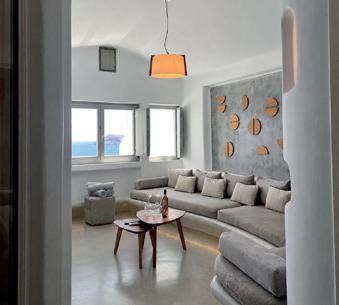
land’s culinary heritage through carefully selected local ingredients and traditional recipes. Guests can savour authentic Santorini flavours, including the island’s famous fava, prepared in the traditional way used by the island’s earliest residents over 4,500 years ago.
Flavours with a view
Dining at La Perla follows the same philosophy as the architecture: authentic, thoughtful and shaped by the setting. At Olira Restaurant, Mediterranean dishes are paired with panoramic views of the Aegean Sea and Santorini’s endless blue. The emphasis is not on excess, but on fresh flavours, careful presentation and the pleasure of eating somewhere unforgettable.
For guests who want to explore further, the hotel also recommends its sister restaurant Ammilos, located in the picturesque village of Imerovigli and renowned for its spectacular sunset views. The concierge team can arrange reservations and tailor dining suggestions to individual preferences, ensuring that the island’s wider culinary scene feels accessible without interrupting the ease of the stay.
In a destination famous for dramatic views, La Perla Villas & Suites stands out by offering something quieter and more enduring. It is a place where tradition does not feel preserved behind glass, but lived in; where luxury is measured in space, privacy and attention; and where Santorini’s history becomes part of the guest experience.
www.laperlavillas.com www.kasimatisbylaperla.com
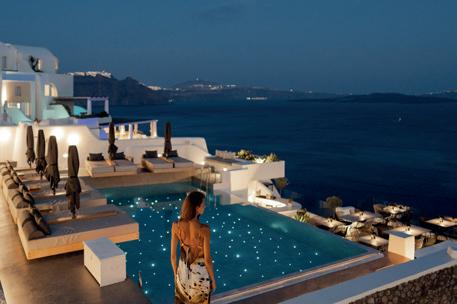
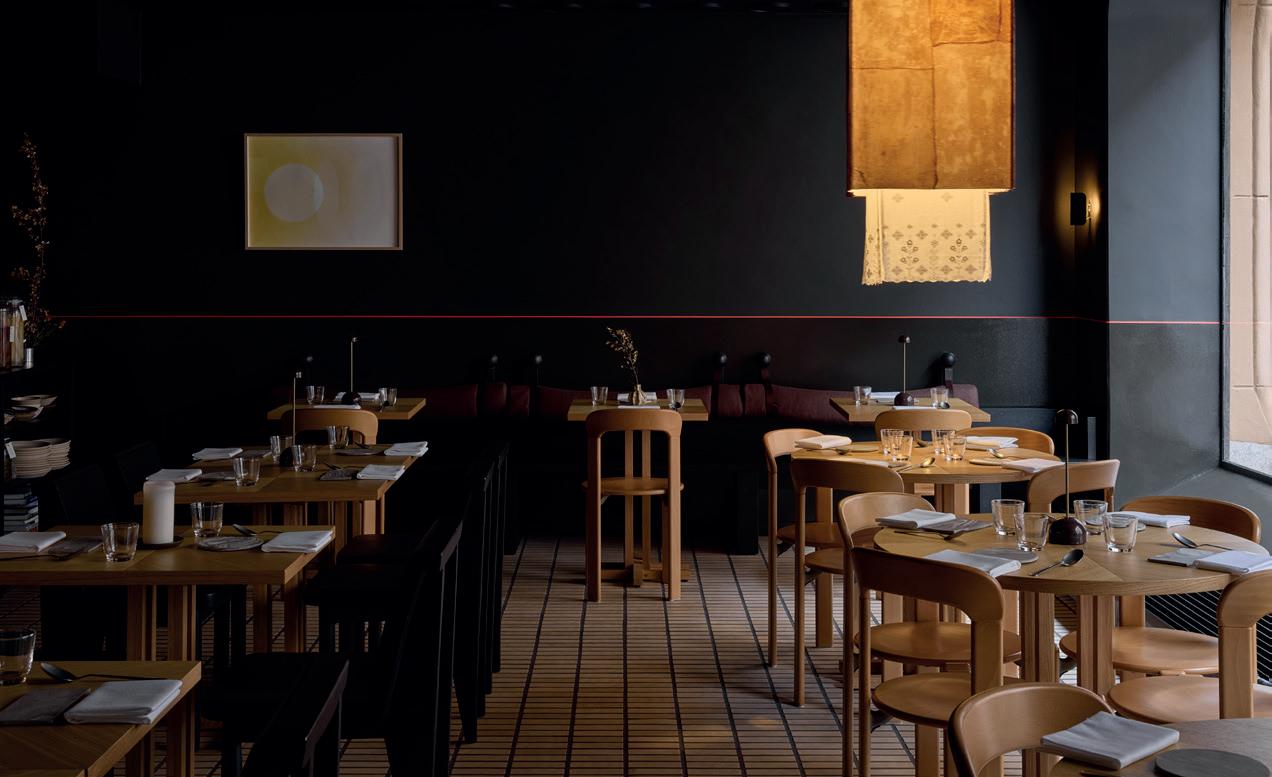
In the heart of Helsinki’s design district, chef Pasha Demin has built a fine dining experience that breathes with the Finnish seasons. The result is a restaurant where the food, design and sense of place come together seamlessly, creating a coherent whole that has earned Boreal its first Michelin star.
By Ndéla Faye | Photos: Sofia Kulianu
The boreal forest covers much of Finland and spreads across the Nordic north, shaped by long, harsh winters and short growing seasons. This world defines every aspect of Pasha Demin’s cooking, from the fleeting availability of ingredients to the preservation techniques needed to carry them through the year.
Boreal launched at the end of 2025. For Demin, Nordic cuisine had long been a source of inspiration, and the restaurant became an opportunity to bring that passion to life through a concept rooted in Nordic flavours and traditions. “The north
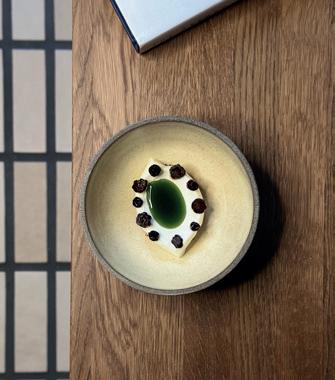
had always drawn me in, so the restaurant was built around northern nature: the cold sea, the still lakes and the moss-covered stone landscapes,” he explains.
Just six months later, his vision received one of the industry’s highest accolades. In May 2026, Boreal was awarded its first Michelin star, recognising Demin’s distinctive interpretation of northern cuisine and the restaurant’s commitment to seasonality, craftsmanship and sustainability.
That connection to the landscape is reflected throughout Boreal’s menu, where fermented and foraged ingredients play a central role. Finland’s Everyman’s Rights allow anyone to forage freely for wild mushrooms and berries, a tradition the Boreal team enthusiastically embraces. They regularly ven-
ture into forests and coastal areas to gather mushrooms, bladderwrack seaweed, lingonberries, blueberries, wild currants, spruce shoots, rosehip blossoms and meadowsweet flowers. These self-harvested ingredients appear throughout the menu, whether served fresh, pickled, dried or fermented.
Preservation techniques are equally important. Fermentation, drying, curing and smoking allow the kitchen to capture seasonal abundance, extending the life of ingredients while reducing waste. These methods are not simply practical solutions but fundamental expressions of Boreal’s philosophy and its relationship with the northern environment.
That philosophy extends beyond the food itself. Alongside the wine pairing, diners can opt for a carefully curated juice pairing featuring fermented and smoked berries, herbs and teas. The resulting drinks are layered, nuanced and deeply expressive of the northern landscape, offering a compelling alternative to wine.
The same values underpin Boreal’s approach to sourcing. Sustainability and responsibility are not box-ticking exercises, but principles that guide every purchasing decision.
Boreal sources its meat from farms across Finland, while seafood comes from across
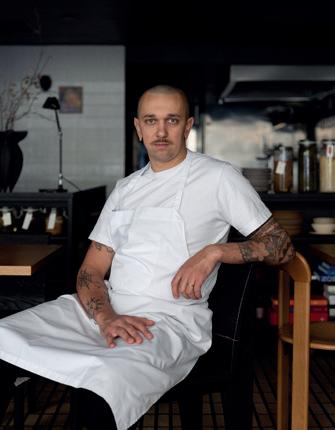
the wider boreal region, including Finland, Denmark, Sweden and Norway. Before entering into any partnership, the team takes time to understand each supplier’s practices, philosophy and approach to cultivating their land or caring for their animals. Whenever possible, they also visit suppliers in person.
“If it’s vegetables, we look at how they are grown – whether the soil is fertilised and if pesticides are used,” Demin explains. “With meat and other animal products, we focus on how the animals are raised and what they are fed.”
The restaurant works closely with organic farms and small producers to source seasonal Finnish ingredients,
game, responsibly reared meat and northern seafood. Demin’s focus is on ensuring that every ingredient is used to its full potential. A core principle at Boreal is purchasing whole animals rather than only premium cuts.
Boreal’s interiors are a natural extension of its culinary ethos, drawing heavily on the landscapes and materials of Finland. Much of the furniture and ceramics have been produced by Finnish artisans, while the artwork includes a custom-made painting by Jaakko Mattila, created using natural dyes sourced from Boreal’s kitchen, including koji spores, yellowroot and Swedish saffron.
The restaurant’s amber-toned kombucha lamps introduce an unexpected touch of innovation. Created from Symbiotic Culture of Bacteria and Yeast (SCOBY), often used for brewing kombucha, and grown in Boreal’s own fermentation lab, the lamps exemplify the restaurant’s meticulous attention to detail and fascination with true craft. Even the door handles – fashioned from stones rounded by the Baltic Sea –reflect a deep connection to nature.
Boreal’s commitment to local sourcing goes far beyond the menu, and seeps into every detail of the space.
www.borealhki.fi
Instagram: @borealhki
At Raffiné, each visit is a rich and layered experience. The atmospheric restaurant and wine bar invites guests to explore Lebanon’s geography, history and culture through an immersive concept with carefully designed menus representing the country’s varied landscapes.
By Maria Sødal Vole | Photos: Raffiné
After opening in March 2025 in the trendy district of Tullinkvartalet, Raffiné very quickly became a local favourite, earning the top spot on TripAdvisor for Oslo restaurants within three months.
Co-founders Jhonny Maroun and Dan Elkarouni have poured care and attention into every aspect of the intimate restaurant – from atmospheric décor featuring handpicked artwork to thoughtful service and gastronomic experiences celebrating the rich heritage of Lebanon.
“We want Raffiné to become a place that people remember – somewhere that feels personal and rooted in something real,” says executive chef Maroun. “Lebanese food is generous, layered, and emotional. It’s very rewarding to be able to show that Lebanese cuisine can be both deeply traditional and beautifully refined.”
Named among the Top 100 Mediterranean Restaurants in Europe 2025, Raffiné’s unique dining concept features menus representing different Lebanese landscapes, from the coast to the mountains and valleys. Each dish uses the ingredients, cooking techniques and culinary traditions that evolved within that ecosystem over thousands of years.
“For us, high-quality food starts with respect: for the ingredient, the tradition behind it and the guest who is experiencing it,” Maroun says. “The best dishes are the ones where flavour, memory, texture and storytelling come together naturally.”
Raffiné’s philosophy is centred on preserving regional culinary heritage rather than reinventing it, refining the presentation while staying true to the history and identity of each landscape. Lebanese cuisine has always been closely
connected to the land and the rhythm of the seasons.
“Our menu never stands still because our research never stops. We continue travelling, speaking with communities, studying traditions and uncovering forgotten ingredients, recipes and techniques that have shaped Lebanese cuisine for centuries,” Maroun says. “It gives returning guests new discoveries throughout the year.”
While Raffiné’s carefully crafted menu pays homage to Lebanon’s landscapes, the extensive wine programme explores the origins of wine itself, featuring Norway’s largest collection from the world’s oldest wine-producing regions of Lebanon, Georgia and surrounding lands. Alongside celebrating the ancient wine regions with a special focus on Lebanon’s rich, historic wine culture, the drinks offering also includes a curated selection of acclaimed wines from around the globe and non-alcoholic options such as speciality botanical blends.
www.raffine.no
Facebook: Raffiné
Instagram: @raffinerestaurant
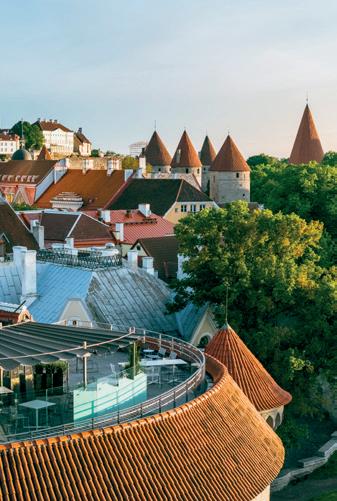
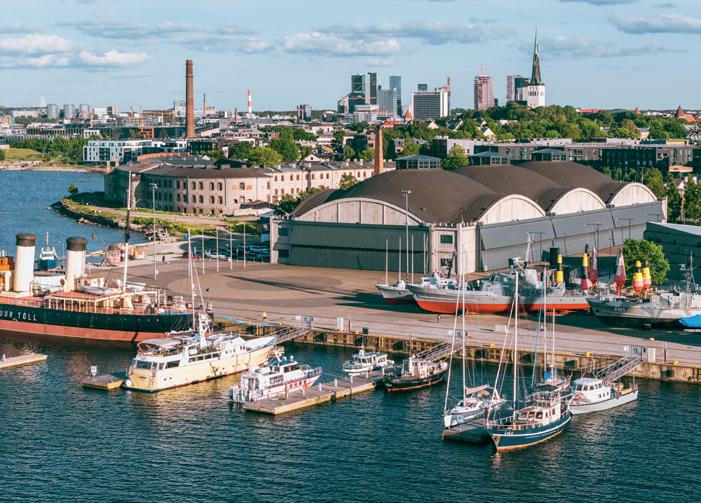
For centuries, the Baltic Sea has shaped Estonia’s culture, economy and identity. At the Estonian Maritime Museum (SA Eesti Meremuuseum), those connections are brought vividly to life through immersive exhibitions, remarkable historic settings and handson experiences that appeal to visitors of all ages.
By Celina Tran | Photos: SA Eesti Meremuuseum
Founded in 1935, the Estonian Maritime Museum was established to preserve and share Estonia’s rich maritime heritage. Today, it has evolved into one of the country’s leading cultural institutions set across two distinctive locations in Tallinn: the Seaplane Harbour (Lennusadam) and the beautifully restored Fat Margaret (Paks Margareeta) Museum-Visitor Centre in the city’s UNESCO-listed Old Town.
“Our goal is to bring Estonia’s maritime heritage closer to everyone,” says marketing manager Mariliis Milbach. “We want to make maritime history engaging, relevant and accessible, whether someone is passionate about ships or simply looking for an inspiring museum experience.“
Inside an architecturally impressive historic seaplane hangar, the Seaplane
Harbour offers an unforgettable encounter with maritime history. Visitors can step aboard the legendary submarine Lembit, explore authentic historic vessels, try interactive simulators and enjoy exhibitions that encourage curiosity through participation rather than observation.
Meanwhile, Fat Margaret presents a journey through centuries of Estonia’s relationship with the sea, and all within the walls of one of Tallinn’s best-known medieval towers! Highlights include the remains of a 700-year-old shipwreck, an outstanding collection of historic ship models, and interactive displays that make maritime history accessible for families, history enthusiasts and international visitors alike. And a little bonus: the panoramic views across Tallinn and the Baltic coastline from atop the tower.
“One of our greatest strengths is our ability to tell both the grand story of Estonia’s maritime past and the personal stories of sailors, explorers, shipbuilders and coastal communities whose lives have been shaped by the sea,” says Milbach.
Through ongoing research, carefully maintained collections and thoughtfully curated exhibitions, it continues to safeguard Estonia’s maritime legacy while inspiring new generations to engage with it. Sustainability and respect for the marine environment also form an important part of the museum’s mission, reinforcing the enduring relationship between people and the sea.
Whether discovering a medieval shipwreck, venturing inside a historic submarine or simply enjoying Tallinn’s waterfront from a unique perspective, why not look towards Estonia and dive into its many maritime treasures?
www.meremuuseum.ee
Facebook: Eesti Meremuseum
Instagram: @eestimeremuuseum
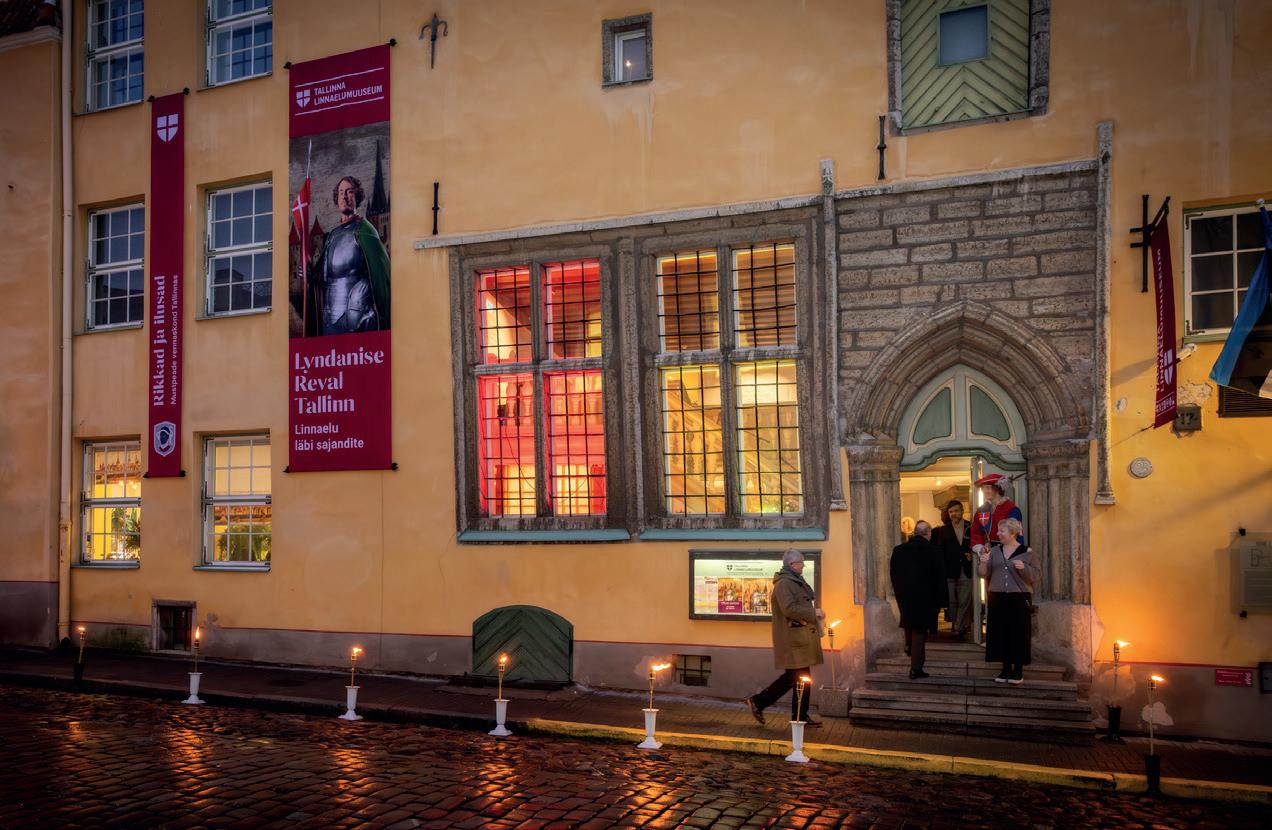
In Tallinn, the city’s stories are not only preserved behind glass; they are lived and shared. Across seven distinctive branches, Tallinn City Museum introduces you to Estonia’s capital through the lives of the people who have shaped it – merchants and photographers, soldiers and schoolchildren, neighbours, families and communities past and present.
By Nane Steinhoff | Photos: TALLINN CITY MUSEUM / MEELI KÜTTIM
More than a keeper of history, Tallinn City Museum is an active city museum and a place where Tallinn’s memory meets the everyday life of the city today. Although officially founded in 1937, the museum’s story began much earlier. In 1911, mayor Jaan Poska proposed collecting objects, artworks and documents connected with Tallinn to make the city’s history accessible to the public. Soon after the official foundation, its first exhibition opened in the
Town Hall in 1938. Since then, its role has grown far beyond safeguarding the past: today, it uses those collections as a starting point for conversations about how Tallinn’s people have lived, worked and belonged in the city. As Tallinn City Museum director Heli Nurger puts it, the museum is “not only a place that tells history; it is part of that history.”
Today, Tallinn City Museum brings together seven different branches across
the Old Town, Kadriorg and Kalamaja. “Each branch offers a different way into Tallinn,” says Nurger. “Whether you’re exploring medieval fortifications, family life, photography, neighbourhood history or multicultural communities, you’re discovering different perspectives on the same city.”
Tallinn City Life Museum: Step into a medieval merchant’s house
At Vene 17, in the heart of the UNESCOlisted Old Town, Tallinn City Life Museum turned a medieval merchant’s house from the 14th century into a time machine. Over the centuries, the building was connected with prominent townspeople, and its medieval cellars, late Gothic portals, Baroque staircase and later decorative details make the building
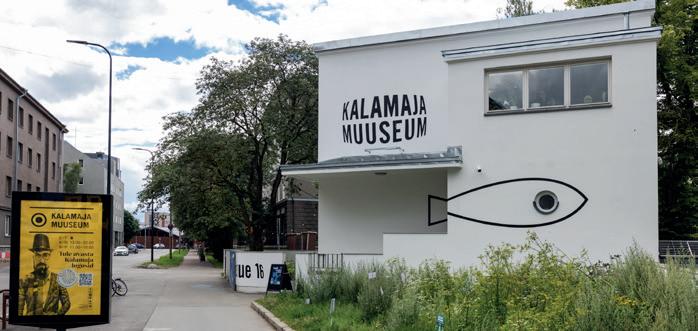
itself a layered architectural document of Tallinn’s urban life. Across five floors, the museum traces Tallinn’s story from the era of the Hanseatic League to 20th century homes, fashion and technological innovation. Interactive exhibits and rare treasures from the city’s collections offer discoveries for all ages, from first-time visitors to devoted history enthusiasts. Here, you can discover what it meant to live, work and accumulate wealth in the city across the centuries.
The exhibitions bring Tallinn’s history to life through personal everyday stories, inviting visitors of all ages to discover the city’s rich and diverse heritage. The exhibition Lyndanise. Reval. Tallinn. City Life Through the Centuries follows the city through its names, legends and generations. Younger visitors are guided through the exhibition by young Vana Toomas, who introduces them to the city’s stories and characters in a playful and engaging way. Another exhibition, The Wealthy and Handsome. The Brotherhood of the Black Heads in Tallinn, explores the influential association of unmarried merchants whose history was closely intertwined with Tallinn’s com-
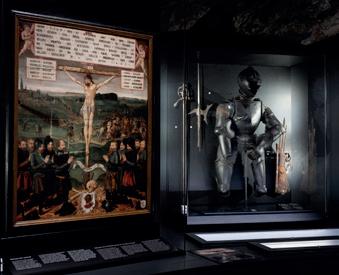
mercial and social life. “You can discover how the Brotherhood of the Black Heads helped shape the city’s trade, social life and traditions,” says Nurger.
Kiek in de Kök Fortifications Museum: A city built to endure Few museums make defence feel as dramatic as Kiek in de Kök Fortifications Museum. Kiek in de Kök is the tallest defence tower in Tallinn, and combined with the Stable Tower, the Maiden Tower and the Gate Tower, the section of the city wall connecting them and the Inger and Swedish underground passages, the journey of discovery through the museum extends for more than one kilometre. The city’s longest wall walk connecting the towers offers magnificent views of Tallinn’s Old Town.
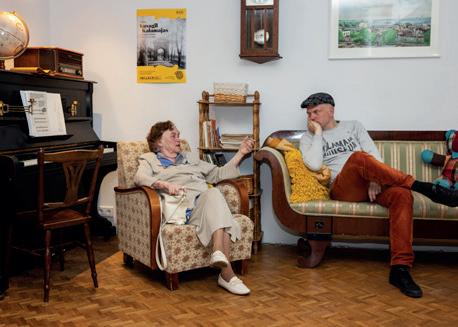
Its permanent exhibition, A Fortress City, A Safe Haven, tells how prosperous Hanseatic Tallinn invested in walls, towers, bastions and artillery to protect itself through centuries of conflict. Inside the artillery tower, weapons, armour and engineering details bring the city’s military past vividly to life. A dedicated exhibition also presents the Brotherhood of the Black Heads not only as influential merchants, but as defenders of Tallinn, remembered by the uncompromising motto “Victory or Death.” Beyond the battlefield story, the Maiden Tower reveals what happened when fortifications lost their military role and became homes, studios and even café spaces.
After a season of Moomin-inspired reflections on peace, Kiek in de Kök turns
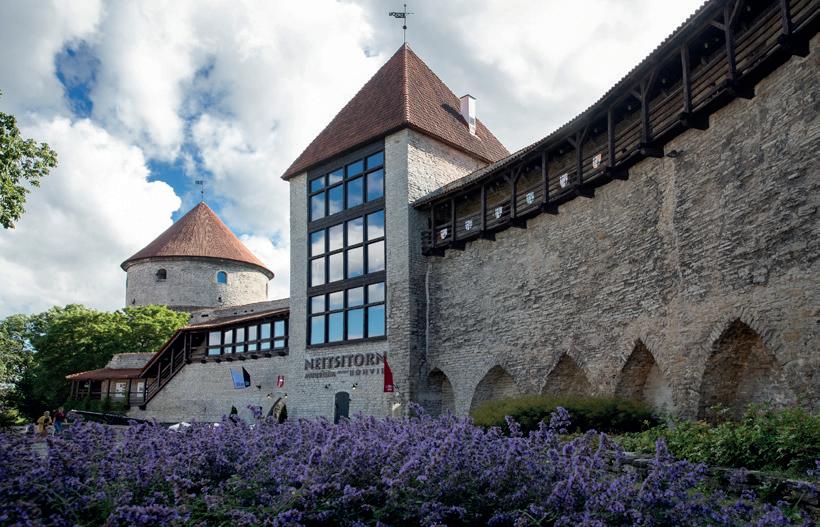
up the volume and the punks move in: from October, iconic photographs of Finland’s rebellious 1980s hardcore punk scene take over the artillery tower in an exhibition created in collaboration with Helsinki’s Punk Museum. Emerging at the height of the Cold War, when nuclear conflict felt frighteningly close, hardcore punks used music, activism and attitude to challenge conformity, uniformity and the sabre-rattling of world leaders.
Museum of Photography:
Colour in a medieval jailhouse
Behind the Town Hall, in a former medieval prison, Estonia’s photographic heritage finds an atmospheric home. The Museum of Photography brings cameras, images and contemporary photographic art into dialogue with vaulted rooms and narrow corridors. Kicking off the theme year dedicated to colour photography,
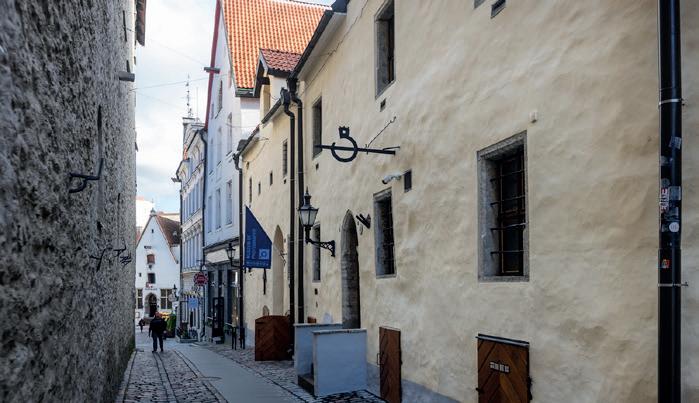
the immersive exhibition Colour Tickle is designed for all ages, explaining colour physics, perception and the history of colour photography through hands-on encounters. You can enter the eye, move through colour synthesis, colourise photographs and wander through the labyrinth of Estonia’s oldest colour photographs.
Children’s Museum Miiamilla: Learning through wonder
In picturesque Kadriorg Park, the Children’s Museum Miiamilla understands that curiosity is nothing less than serious business. Here, fun and learning go hand in hand, with colourful rooms, a courtyard for developing gardening skills and many opportunities to connect with nature. The permanent exhibition Children’s Spaces invites families to see the world through a child’s eyes: the in-
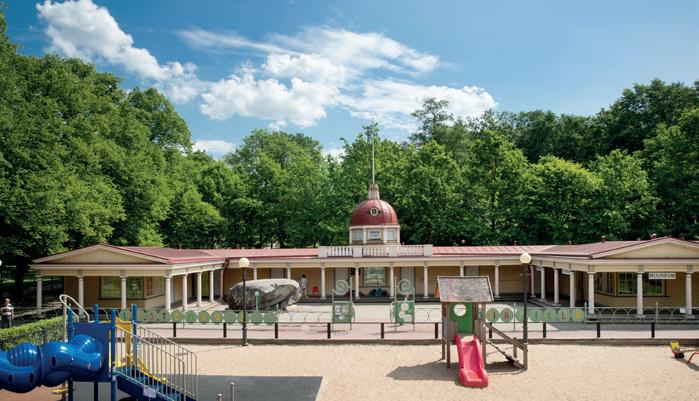
ner world, the outer world, the world of imagination, and the multifaceted nature of childhood. Guided by the motto “The child leads and the adult follows,” the exhibition turns the usual museum visit upside down, encouraging grown-ups to slow down, listen and discover alongside young visitors. Miniature worlds, emotional expression and playful fantasy environments make this a first museum experience that feels less like instruction and more like shared discovery.
Kalamaja Museum:
The neighbourhood speaks Kalamaja Museum, on the other hand, is Tallinn’s community storyteller: intimate, eccentric and proudly local. Set in Kalamaja, one of the city’s most creative and oldest neighbourhoods, it captures what Nurger calls “the district’s rich and colourful character.” Its exhibitions move through the language of everyday life –houses, residents, cellars, corridors, a garage, a living room and, unexpectedly, even a toilet. Younger visitors meet a Tallinn-style doll’s house and retro play corner, Additionally, from August, Kalamaja
Museum will turn its attention to Pelgulinn, another distinctive Tallinn neighbourhood. Kalamaja Museum spills into the streets with a series of outdoor exhibitions that turn the neighbourhood into an open-air museum. Vintage games, family photographs, lost city views and local memories appear in courtyards, cafés and street corners – even an old phone booth shares stories told by Kalamaja residents.
House of Peter the Great: Tallinn’s oldest museum
Opened in 1806, House of Peter the Great is Tallinn’s oldest museum which puts a special focus on Kadriorg, a 70-hectare park and district in central Tallinn. As Nurger puts it: “This small yet remarkable museum building is a unique historical site, where Tallinn’s role during the Northern War, the birth of the Kadriorg ensemble, and the beginning of Estonian museum culture are closely intertwined.” In 2026, House of Peter the Great marks 220 years as a museum and 85 years as part of Tallinn City Museum. A special staircase-gallery exhibition brings its history to life through artworks and rare archival photographs.
People’s Museum of Tallinn: A city of many voices
Located in the medieval Nottbeck House, where painter Ants Laikmaa’s studio school opened in 1903, the People’s Museum of Tallinn focuses on the multicul-
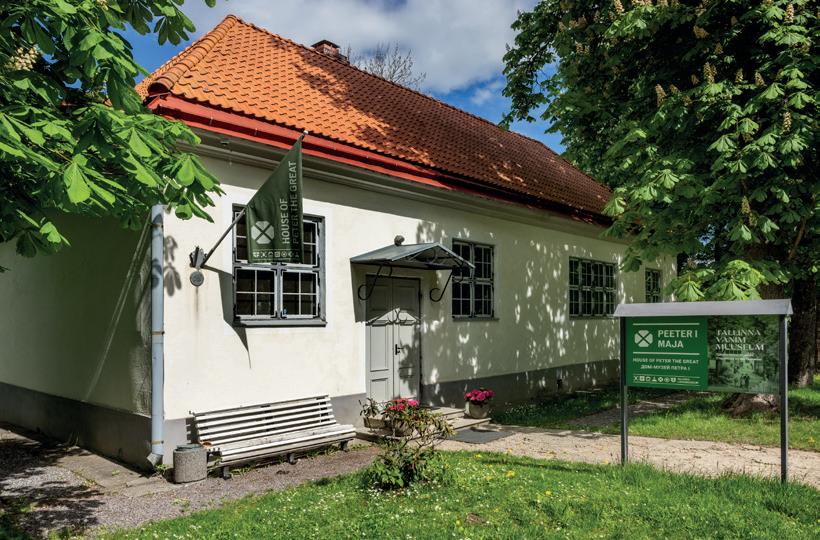
tural communities that make the city what it is today. Its exhibitions highlight the “rich heritage of the different nationalities living in Tallinn and their contributions to our cultural space,” according to Nurger. In 2026, its programme looks outward and inward at once, exploring Nigerian stories of belonging in Tallinn, the experiences of migrant women through the story of a woman who moved from Malaysia to Estonia, as well as cultural figures and women’s mobility in Tallinn and Porto. The exhibitions also revisit the cultural life of the young Estonian capital in the 1920s and celebrate Armenian heritage through contemporary art, traditional instruments and national dress.
Looking ahead, Tallinn City Museum’s future Open Collections building will make the museum’s behind-the-scenes work part of the public experience. Designed as an accessible home for the collections of Tallinn City Museum, the Museum of Photography and the Museum of Contemporary Art of Estonia, it will bring storage, archives and visitor spaces together in one cultural destination. With only three per cent of the museum’s collections currently on display, the new building will make up to 60 per cent of its holdings visible, while offering a rare glimpse into how objects are stored, researched, conserved and restored.
Together, the seven branches reveal a city that is constantly changing while remaining deeply connected to its past. Rather than telling one definitive history, Tallinn City Museum invites you to explore many perspectives – through places, collections and the people whose lives continue to shape Estonia’s capital. Approaching its 90th anniversary in 2027, the museum has prepared a programme that reflects its role as a living city museum. The anniversary will extend that conversation across its branches, highlighting the many voices, communities and everyday experiences that make Tallinn’s history feel alive.
www.linnamuuseum.ee
Facebook: tallinnalinnamuuseum
Instagram: @tallinnalinnamuuseum
Located on a picturesque hillside overlooking Tallinn Bay, Maarjamäe History Centre, part of the Estonian History Museum Eesti Ajaloomuuseum, is a place where history, culture, architecture and nature come together, creating one of the capital’s most rewarding destinations for visitors of all ages.
By Nane Steinhoff | Photos: Estonian History Museum, Vahur Lõhmus
Just a short journey from Tallinn’s bustling Old Town, Maarjamäe offers spectacular sea views, peaceful parkland and a fascinating insight into Estonia’s past, making it an ideal place to spend a few relaxing hours or even an entire day.
For centuries, the area has been one of Tallinn residents’ favourite summer retreats. In 1873, Count Anatoli Orlov-Davydov established Maarjamäe Palace as his family’s elegant seaside summer residence. Today, the beautifully restored palace forms the heart of the Estonian History Museum’s Maarjamäe campus, which reopened as a modern history discovery centre during the cel-
ebrations of the Republic of Estonia’s 100th anniversary.
Although Maarjamäe lies within the city limits, visitors are immediately struck by its peaceful atmosphere. Surrounded by mature trees, open lawns and pan-
oramic coastal views, it feels worlds away from the bustle of central Tallinn. Whether you come to explore the exhibitions, enjoy a leisurely walk through the historic park or simply relax with a coffee overlooking the sea, Maarjamäe offers a refreshing escape.
The centrepiece of the palace is the award-winning permanent exhibition My Free Country, which, as Ajaloomuuseum’s CEO Jaanus Rohumaa describes it, “takes visitors on a journey through 100 years, from the birth of the Republic of Estonia to the modern day”. Visitors travel through eight immersive exhibition rooms, each recreating a different period in Estonia’s history, from the struggle for independence to the modern digital nation Estonia has become today. Rather than simply displaying artefacts, the exhibition combines multimedia, soundscapes, interac-
tive installations and personal stories to bring history vividly to life.
Families will appreciate the Children’s Republic; a colourful learning environment designed for children aged five to 12. Here, history becomes a game. As Rohumaa explains, “power is in the hands of children”, who can elect their own president, become ministers, create laws, balance a national budget and even try out their dream professions. When governmental duties become too demanding, youngsters can reward themselves with the popular indoor tube slide. It is an imaginative space that successfully combines education with entertainment, making learning about democracy genuinely fun.
Cinema lovers should not miss the striking Estonian Film Museum, opened in 2017 and located just steps away from the palace. Its permanent exhibition, Take ONE, reveals every stage of filmmaking, from the first spark of an idea through
scriptwriting, filming, editing and finally the red-carpet premiere.
Interactive exhibits allow visitors to experiment with movie-making techniques, create special effects and even step in front of the camera themselves. The museum became internationally known after acclaimed director Christopher Nolan visited during filming Tenet in Estonia and praised the exhibition for its engaging presentation of cinema.
History, art and fresh air in one destination
Maarjamäe’s appeal extends well beyond its indoor galleries. The extensive palace park invites visitors to slow down and explore the grounds at their own pace. One of its most thought-provoking attractions is the outdoor exhibition of Soviet-era monuments. The collection, assembled by the Estonian History Museum as part of its mission to preserve the country’s political history, brings to-
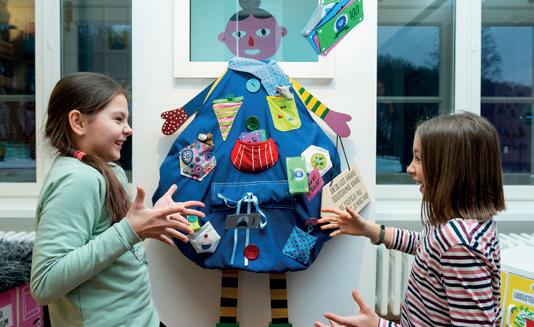
gether monumental sculptures and memorials created between 1945 and 1990. Displayed together in a new context, they encourage reflection on Estonia’s complex 20th century past.
Families will also find plenty of opportunities for outdoor fun. The spacious playground shaped like the map of Estonia is a favourite with younger visitors, while the distinctive red-carpet pathway linking the palace and the Film Museum features a series of playful sculptures by artist Jass Kaselaan, inspired by memorable characters and moments from Estonian cinema. The landscaped park itself is perfect for picnics, leisurely walks or simply enjoying the magnificent views across Tallinn Bay.
After exploring the museums, visitors can round off their day at the palace café or browse the museum shop for books, gifts and locally inspired souvenirs. Throughout the year, Maarjamäe History Centre also hosts temporary exhibitions, family events, educational programmes and guided tours, ensuring that every visit offers something new to discover.
Whether passionate about history, fascinated by film, travelling with children or simply looking for one of Tallinn’s most popular cultural attractions, Maarjamäe History Centre delivers an experience that is both enriching and enjoyable. Combining centuries of history with innovative exhibitions, beautiful parkland and interactive experiences, it offers a memorable day out that captures the spirit of Estonia’s past, present and future.
www.ajaloomuuseum.ee
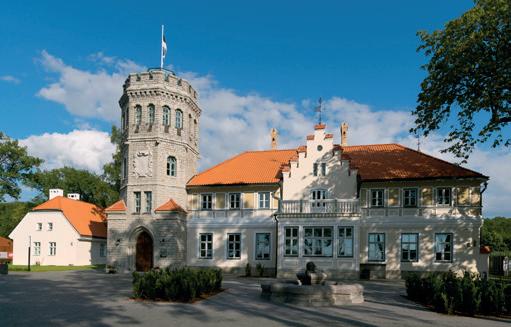
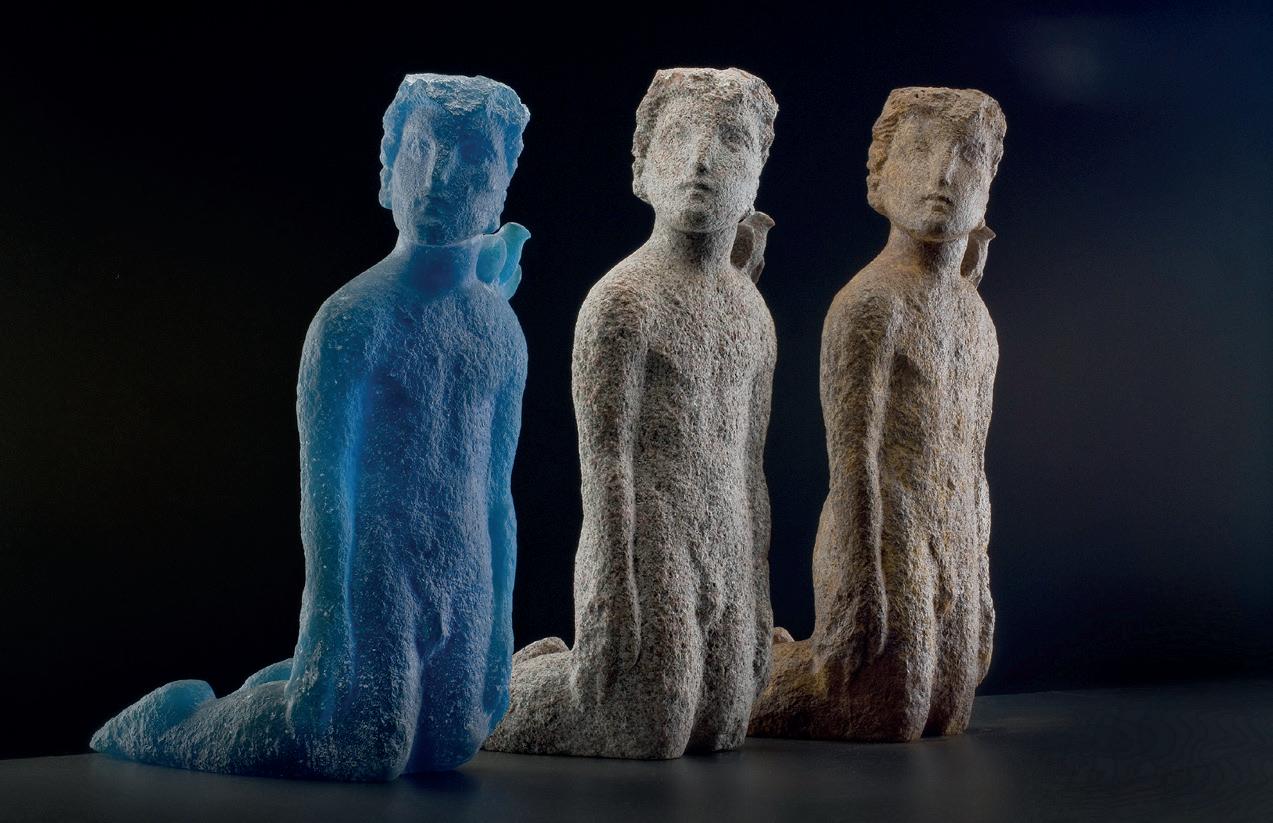
Artists Lars Widenfalk and Alena Matejka met 25 years ago. Although their materials, themes and working methods differ, they share an interest in narrative, memory, mythology and the relationship between human beings and nature.
By Malin Norman
Swedish artist and sculptor Lars Widenfalk works primarily with stone and comes from the tradition of figurative sculpture. He is behind the famous black stone violin Blackbird, the only one of its kind in the world. Constructed to the designs of the iconic Stradivarius violin, it uses the artist’s own technical solutions.
“I have always worked figuratively but with elements of architectural forms, such as stairs and house constructions,” says Lars. “My main theme is time; time passing, time gone, the future. Stone,
and especially granite, is for me a carrier of time.”
Perhaps you can see in his archaeological studies a context where Lars uses fragments and the raw stone surface as an indicator of time. An eroded face that he has just dug out of time – from his own universe of experiences and dreams. “The beauty is as much in the stone as the traces of the chisel,” he continues. “My large house constructions make both me and the viewer enter the room that the sculpture forms with its four pillars and gables.
Follow the stairs that lead into the room and out of it. Like our lives.”
Glass and its optical transformation
Since meeting artist Alena Matejka 25 years ago, Lars has also been working extensively with glass. “Alena was invited to participate in a Swedish/Czech sculpture symposium at KKV-B, an artist-run workshop in northern Bohuslän. The symposium lasted a month and it so happened that I was there at the same time, working on my large solo exhibition at Röda Sten,” says Lars. “And Alena introduced me to the fantastic world of glass.”
Alena is a Czech sculptor working primarily with glass and stone, which she often combines with metal, organic materials or found objects. “I’m interested in the
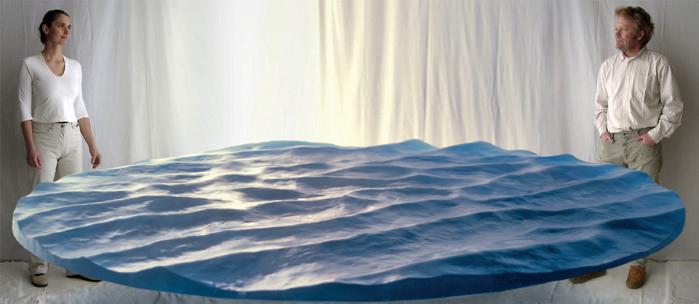
tension between fragility and weight, transparency and opacity, impermanence and endurance,” she says. “In my work, I often bring traditional sculptural materials together with the particular qualities of glass – light, transparency, fragility and optical transformation.”
Her work draws on myths, dreams, memories and personal stories. “Narrative is important to me, but I don’t present it directly or in a linear way. Instead, I create situations in which reality merges with fiction, poetry with irony, and beauty with a certain sense of unease.”
Two artists, different visual languages
Alena showed Lars how to transform his stone sculptures into glass sculptures. It is a technically long and complicated process that includes silicone moulds, wax casting in the silicone mould and moulding of the wax casting, which is then boiled out in a steam bath so that the refractory mould becomes empty. Coloured glass is placed in the mould, heated to 870
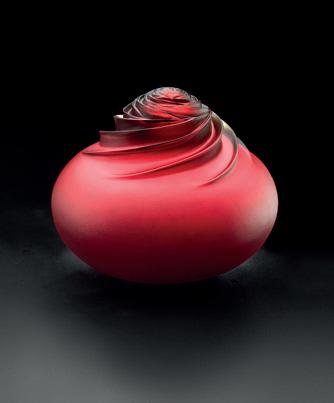
degrees and then cooled in the glass furnace for a month or longer – depending on the size of the sculpture.
“With stone as an artistic material, it’s a much simpler and faster process. You have your work right in front of you and every chisel stroke or hand file becomes the finished surface of the sculpture,” says Lars. “However, stone doesn’t have the different colours and transparency that glass has. It’s also possible to make more copies this way.”
Although the artists discuss each other’s projects, they work independently. “Sculpting is often physically demanding and heavy, so we give each other a helping hand,” says Alena. “We sometimes exhibit together, but we’re basically two independent artists, each with our own visual language. The differences between our approaches are an important part of our collaboration. We don’t try to create pieces that look alike. Instead, we look for ways in which
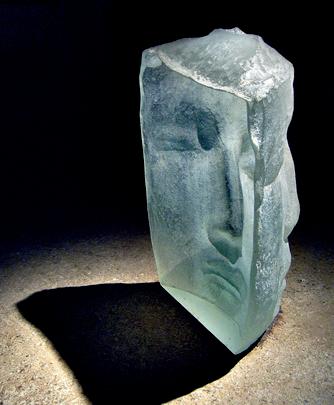
our work can communicate and complement one another.”
Upcoming joint exhibition in Prague
The artist couple divides their time between Sweden and the Czech Republic. Right now, Alena is completing one of her largest glass sculptures to date for the Imagine Museum in St. Petersburg, Florida, USA, whilst Lars is working on various separate exhibitions for Galleri Tom Stölting in Hamburg, Germany, Galleri Allmeningen in Bergen, Norway, and Galleri Kuzebauch in Prague, the Czech Republic.
Together, they are also preparing a permanent glass exhibition for the new glass museum at the Clam-Gallas Palace in the Czech capital of Prague, which will be part of the Prague City Museum. It is scheduled to open at the end of 2027.
“The exhibition will present our individual works, allowing visitors to experience two different approaches to glass, sculpture, material and narrative within the same space,” explains Alena. “The project is also special to us because of its location. The Clam-Gallas Palace is a historic building with a powerful atmosphere, and contemporary glass will enter into dialogue with both the architecture and the history of the palace.”
www.widenfalk.com
www.alenamatejka.com
Facebook: Alena Matejka Instagram: @matejkaalena
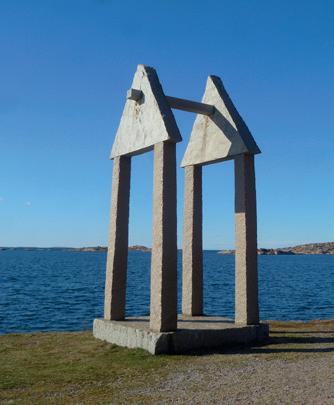
In a volatile stock market, discipline is often the dividing line between success and failure. Having a clearly defined strategy – and executing it consistently on every single trade – is essential. Over the years at MyStockScanner, we have refined our investment approach into what we call the 3-Point Playbook.
By Hans-Henrik Nielsen, MyStockScanner.com
The strategy is built around three non-negotiable questions that a stock must answer with a decisive “yes” before earning a spot in our portfolio:
1. Is it a quality company? (Fundamental data)
2. Is there attractive potential? (Valuation)
3. Is the timing optimal? (Technical momentum)
Below, I walk through a current case study of the Danish company Nordic Transport Group (NTG).
1. Is NTG a high-quality company?
When assessing quality, we strip away emotion and let the data do the talking. We look for companies with a solid track record and positive future outlooks.
NTG scores a strong quality rating of 81 out of 100 in our quantitative model. While earnings per share (EPS) have experienced a decline over the past few years, both EPS and revenue are now projected to grow in the coming years. The PEG ratio is notably low at 0.39, indicating that we are not overpaying for this future growth.
Return on Capital Employed (ROCE) has trended downward alongside earnings in
recent years, but this metric is also poised to reverse alongside the bottom-line recovery. Free cash flow remains comfortably positive, and the company is fundamentally sound—though they are operating under somewhat tight constraints regarding interest payments on their debt.
2. Is there attractive potential in the stock?
Quality alone is not enough; the price must also be right. We use our proprietary valuation graph to look 1 to 2 years into the future. Here, we plot consensus analyst earnings estimates against the historical multiples (P/E ratios) that the market has historically been willing to pay for the stock.
For NTG, analysts expect earnings of DKK 19.41 per share in two years. Based on this estimate, we have modelled three scenarios for the potential return:
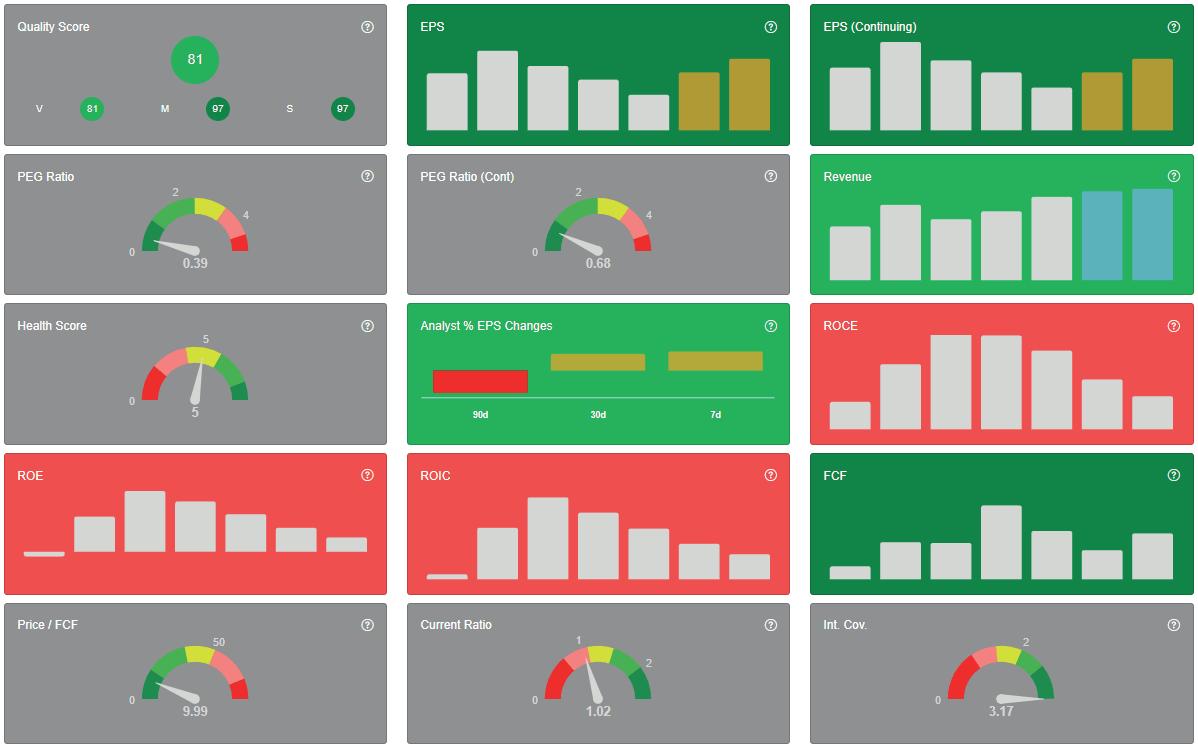
Disclaimer: Investment involves risk. Past performance is not indicative of future results. Consult with a financial advisor before making investment decisions.
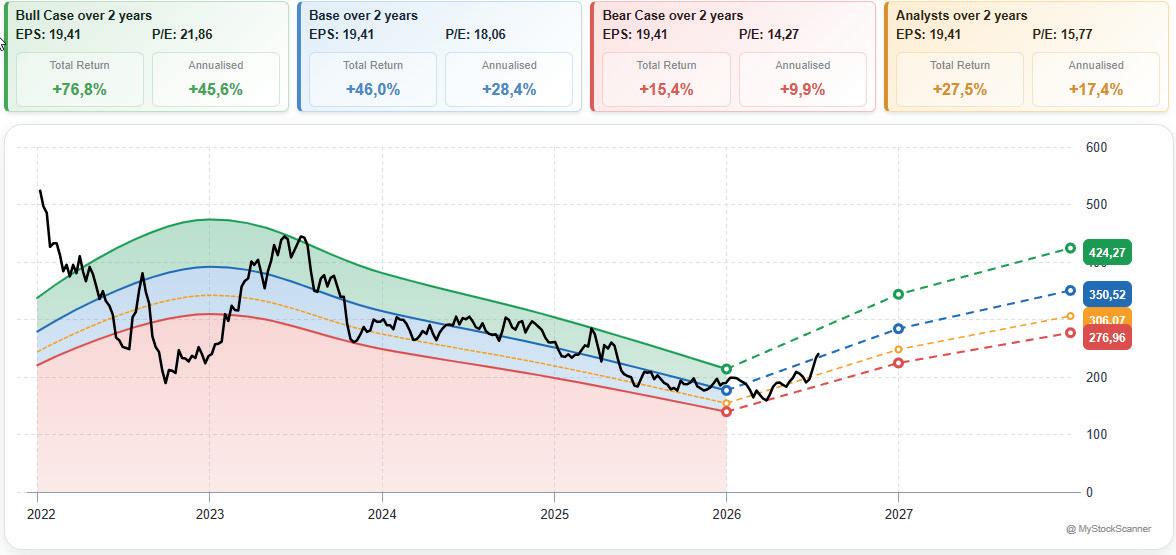
• Bear Case: +15.4%
• Standard Case: +46.0%
• Bull Case: +76.8%
These scenarios are calculated using P/E multiples ranging from 14.5 to 19.41, which is highly conservative relative to the stock’s historical trading range.
While past performance is never a guarantee, this range indicates an asymmetric risk/reward profile with significant upside. There is no guarantee these returns will materialize, but they point to a fundamentally sound case with a compelling margin of safety.
3. Is the timing optimal?
Even the best business can see its stock price stagnate for years if the market’s attention is elsewhere. That is why we only buy into stocks displaying an established, rising trend.
NTG is currently in a very strong uptrend, trading above its moving averages (the coloured lines). Our trend indicators are green in both the MTI (the bottom two indicators below the chart) and the MTX (visible in the background behind the price chart). This suggests robust buying pressure. If we were to wish for anything, it would be a minor pullback, as illustrated in the chart, to provide a cleaner entry.
Another key tool we analyse is our proprietary StockMap (shown below). Here, we see NTG accelerating upward into the green zone, indicating that it is actively outperforming the broader market.
At the time of writing, NTG meets our strict criteria for quality, potential, and timing. While these dynamics can shift rapidly,
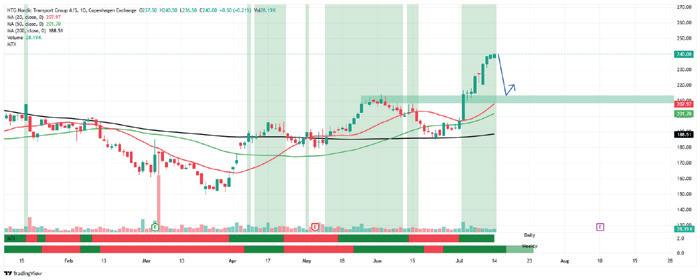
we view NTG as a highly compelling candidate – though we would ideally prefer to see a minor pullback before establishing a new position.
We currently hold the stock in our model portfolio—a portfolio that generated a 34.5% return in 2025 alone by strictly adhering to this disciplined 3-Point Playbook framework.
3 Other Scandinavian Stocks on MyStockScanner’s Radar:
• Sweden: Lifco
• Sweden: Getinge
• Denmark: Carlsberg

Hans-Henrik Nielsen Co-owner of MyStockScanner. Together with British Fintech expert Liam Flavelle, he developed the analysis tool 3-Point Playbook. The tool is available to private investors via membership.
Hans-Henrik has traded stocks since 1987 and has spent the last 15 years teaching thousands of private investors how to achieve stable returns with peace of mind through a solid strategy and the right tools.
In 2025, the 3-Point Playbook Model Portfolio on MyStockScanner delivered a return of 34.48%.
Party-starting anthems and motivational music are the flavour of the month this August!
By Karl Batterbee
FARLIGT is a hot new tune that’s just come bouncing out of Denmark courtesy of the increasingly popular Mille. Taken from her new EP VÆRD AT ELSKE, the song is an emotional outcry set to a ferociously fastpaced beat for maximum drama. It could well turn out to be this generation’s Kun For Mig by Medina!
Dagny gets philosophical on us via her latest smash C’est La Vie, a song which also serves as the high point of the Norwegian superstar’s new Dancefloor Erotica album. Granted it’s difficult to go wrong with disco strings, but on C’est La Vie this pop queen swirls them to her advantage like she’s
Scheduling should be pretty straightforward. Let’s meet 25 July or 14 October. But no, Swedes have their own way of counting time. In weeks!
Ask a Swede when school holidays begin and you’ll hear “week 23”. Need to schedule a meeting? Someone will suggest “week 39” without a second thought. To a Swede, this is perfectly normal. To almost everyone else, it sounds like you’ve accidentally misunderstood everything. By the time they’ve worked it out, the school holidays are over and the meeting has already moved on to week 44.
Outside Sweden, people generally think in dates or months. If someone says, “see you in early October,” everyone understands. It’s clear, it makes sense.
Having left Sweden, I’ve also left this odd way of counting behind. However, when I
been conducting them professionally since the ’70s. It’s a future Dagny classic that you must not sleep on.
Fresh from giving Denmark its best result at the Eurovision Song Contest since the nation’s win over a decade ago, Søren Torpegaard Lund is now out with the muchanticipated follow up. Festen Stopper Aldrig is the appropriately titled saviour of parties across Denmark this summer, with a brilliant break-down before the final chorus that will really take you by surprise.
Never has saying ‘NO’ sounded so satisfying! Yes Girl is a brand-new pop bop
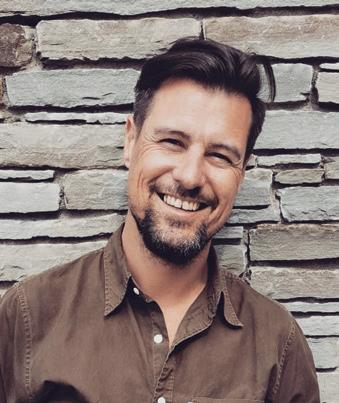
from Norway’s NESTA. It’s the ultimate anthem of self-care, character growth and teaching yourself the underrated art of politely declining. Because sometimes the party actually does have to stop!
www.scandipop.co.uk
By Gabi Froden

plan meet ups with friends on visits back home, they insist on talking in weeks and I pretend I know what dates they’re referring to, which leads to some extreme confusion when I show up on the wrong day, in the wrong month.
If you live inside the system, it’s practical. It makes long-term planning efficient. But
since most of the world doesn’t instinctively know what week 19 or week 35 corresponds to, the efficiency disappears the moment someone from anywhere outside of Sweden joins in the planning.
Then, you’re not just translating the language, but a whole calendar year, one confused week at a time.
Gabi Froden is a Swedish illustrator and writer, living in Glasgow with her husband and two children. Her children’s and YA books are published in Sweden by Bonnier Carlsen and Natur&Kultur. www.gabifroden.com
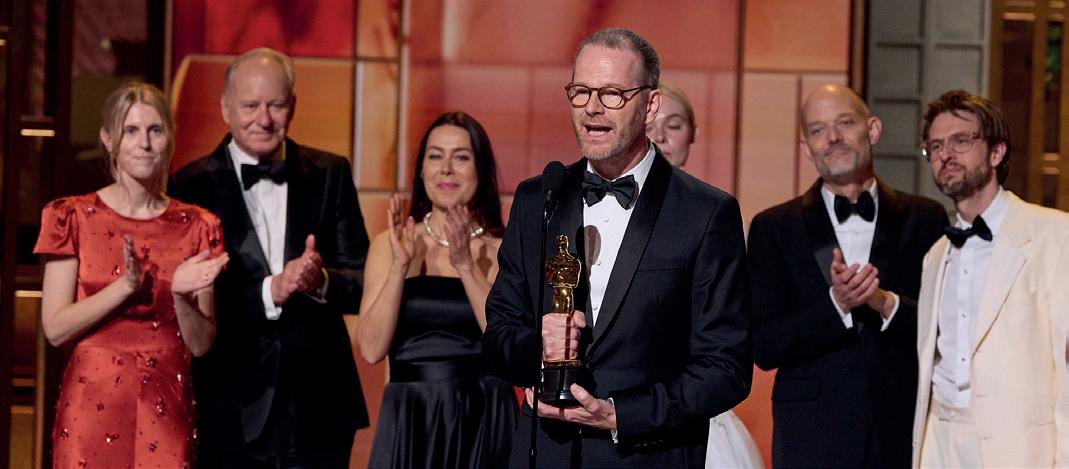
The Nordic TV sector is in a healthy space despite peaking in 2022.
For some time, Nordic TV production has punched well above its weight, but it has now endured somewhat of a correction and is looking towards more sustainable production levels, according to analysis.
Several pieces of independent analysis point to declining numbers, some of it is following global trends and other more localised issues. “Production output in 2022 was exceptionally high – close to a bubble – so the drop that followed had consequences for production companies and their employees,” said Rasmus Andersen, head of research and projects at the Danish Producers’ Association.
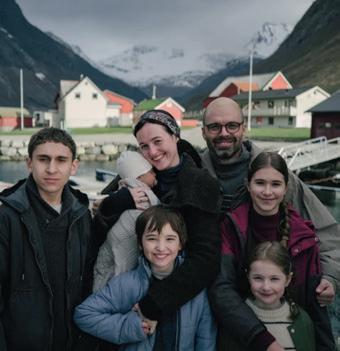
Then a significant drop followed. Research carried out by the analytics firm Ampere Analytics found that unscripted commissions fell 21 per cent and scripted commissions by 29 per cent between 2024 and 2025. However, it was not an even drop across different genres, but showed evidence of a global trend that younger audiences are hard to retain. The biggest change was in the unscripted children and family genre, with a drop of 75 per cent.
Nordic Noir, which has been the regions strongest brand, seems in a good condition as scripted crime and thriller only dropped 13 per cent. Additionally, documentaries, another strong genre in the region, had an almost similar moderate fall of 14 per cent.
Another piece of analysis, carried out by the Swedish media analyst Mediavision, points to one of the reasons of the decline; global streaming services are pulling back on local production. In 2025, the number of new Nordic titles released by global players declined by about 20 per cent compared to 2024. This is a continuation of a downward trend seen in recent years.
By Anders Lorenzen
Globally, the film and TV sectors find themselves in severe disruption volatility, much of these are technological shifts and advances happening so fast that many producers and broadcasters cannot follow that pace and the globalisation of the sectors.
But despite this, the Nordic TV sector is probably as healthy as anywhere in the world, due to the continuing strong demand for the Nordic brand, and the Nordic sectors are good at innovating and conceptualising new ideas such as the re-launch of Dogme as mentioned in the previous column, as well as staying on top of technological developments.


There are plenty of reasons to venture out into the August sunshine this month, with a festival focus in place all across the Nordics. We’ve highlighted some of the most unmissable options for your diary, including a unique art space, a haven for comedy fans, and music gigs that encompass opera, indie and humour!
By Karl Batterbee

(4 – 22 August)
Since her debut, Veronica Maggio has established herself as one of Sweden’s most prominent pop artists, with songs that have become part of the Swedish musical landscape over the past two decades. And the pace has shown no signs of slowing
down… The first part of the “deliberately unruly” album SCIURA was released last year, featuring hits such as Level Up and Backspegeln; the latter nominated for Song of the Year at the P3 Guld awards. The highly anticipated second part was released a few months back and now au-
diences are all set to see it performed live! In August, you’ll be able to watch her in no less than five locations around Sweden, culminating in a huge headline show at the impressive Stockholm Stadium. Visby, Borgholm, Helsingborg, Gothenburg, Stockholm www.veronicamaggio.se
KAJ (8 – 15 August)
Ahead of an autumn tour that will include dates across Norway, Sweden and Finland, the ‘humorgrupp’ KAJ have three summer shows pencilled in across Sweden this August. It’s a great opportunity to see the increasingly popular trio live. After winning Melodifestivalen in 2025, the group went on to represent Sweden at the Eurovision Song Contest that same year, giving the country yet another Top 5 placement in the Grand Final. The sauna-themed smash hit they did it with, Bara Bada Bastu, ended up winning the Swedish Grammy for Song of the Year in April of 2026.
Västerås, Uppsala, Värmdö www.humorgruppenkaj.com
Free entry, no tickets required, and good vibes only! That’s what Stockholm’s Culture Festival promises for its 2026 edition. The festival offers a packed programme of activities and entertainment, attracting over one million visitors each year. Over five days, the city’s streets come alive with an explosion of culture from around the world, with Stockholm transforming into a vibrant stage where art, music, dance and much more are put into focus. Entry is free for all and the headliner for 2026 is none other than recent Scan Magazine cover girl Agnes!
Various locations, Stockholm kulturfestivalen.stockholm.se
– 27 August)
The Malmi Summer of Events programme in Finland’s capital of Helsinki will be bringing high-profile gigs and interesting workshops to Ala-Malmi

Square. And the best part – it’s all free of charge! Throughout August, the Container Stage will host a cross-genre lineup of top acts such as Teini-Pää, The Ghost of Bruce Springsteen & The E Street Band, Arnie Alligator, Lyyti, Antti Paalanen, Kukkatalo, ANI and many more. In addition to enjoying the concerts, members of the public are also invited to take part in a wide range of inspiring workshops in both Ala-Malmi Square and at Cultural Centre Malmitalo.
Ala-Malmi Square, Helsinki www.malmitalo.fi
Copenhagen Opera Festival (13 – 23 August)
Copenhagen Opera Festival is taking the genre out of its traditional theatres and letting its unique sounds ring out over the streets, underground and waterways of Copenhagen. Since 2009, Copenhagen Opera Festival has taken enormous pleasure in bringing the greatest artists to the Danish capital, filling concert halls, theatres, streets and canals alike, with world-class mu-

sic making. With an international outlook, combined with an eye for local and national talent, the festival has created a diverse programme of performances, concerts and events that welcome the aficionado, the culturally curious and families with children alike. Various locations, Copenhagen www.operafestival.dk
Cph Art Space was initially developed in collaboration with a number of artists who wanted to create an art event with a high degree of aesthetics that could attract quality-conscious art users and art buyers. They succeeded, and Cph Art Space 2026 will be the eighth event this
August. It’s a unique concept in the arena of high-quality art; a different kind of art exhibition, because the emphasis is on the space. Activities interacting creatively with the exhibited works will also take place, in a format that breaks with the usual notion of a stand. Even the ‘mega walls’ themselves are regarded as a sculptural expression in the space. For art fans, this sounds like an experience with a difference.
Docken, Copenhagen www.cphartspace.dk
Stockholm Fringe Festival (STOFF) is a five-day multidisciplinary arts festival,
acting as a stage for local and international artists to present their innovative work, ranging from performance to installation art and anything in between. Since its inaugural edition, the festival has stood for artistic freedom and focuses on out-of-the-box works that may not fit into mainstream performance or exhibition spaces. STOFF has also ended up becoming a place for arts practitioners to test new ideas, network and collaborate with other artists, develop work and get inspired by many different creative expressions. The full programme on the STOFF website includes a headline appearance from American comedienne Ruby Wax. Various locations, Stockholm www.stockholmfringe.com
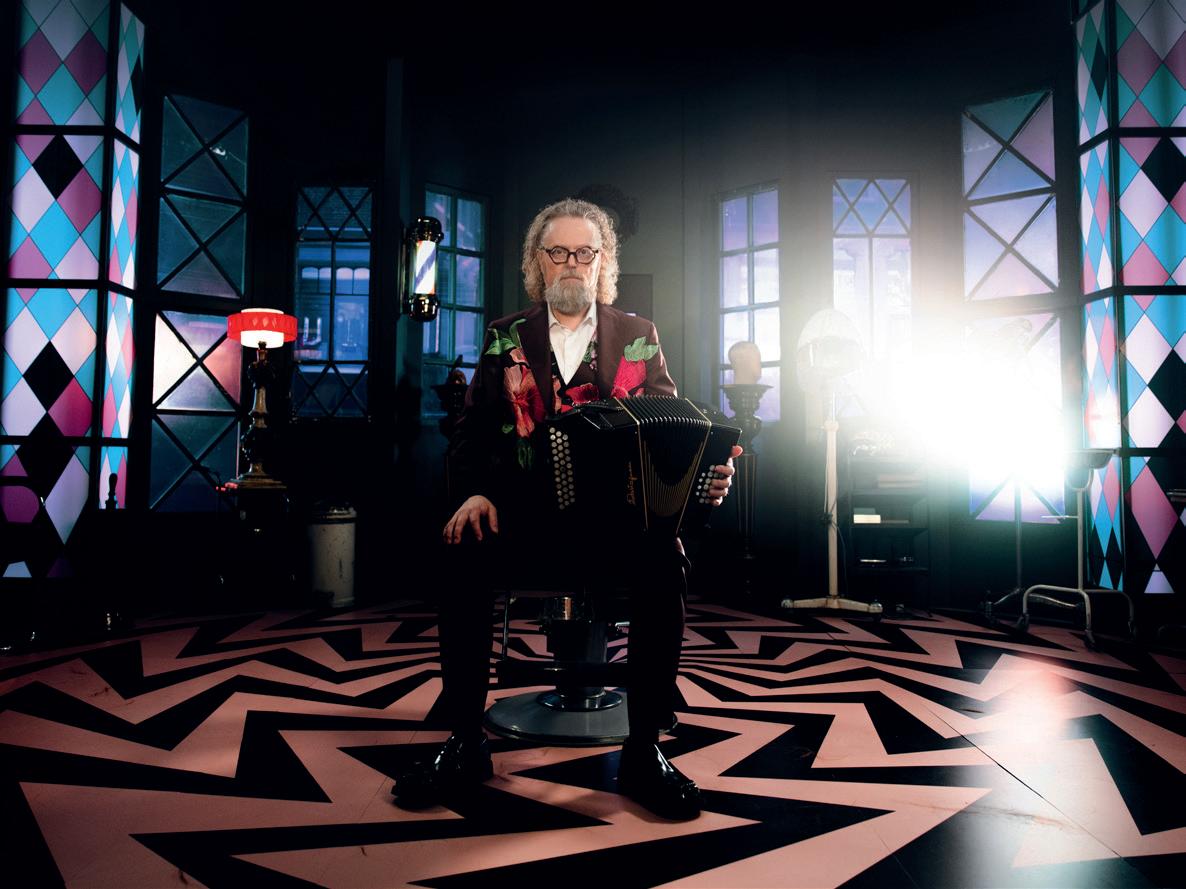

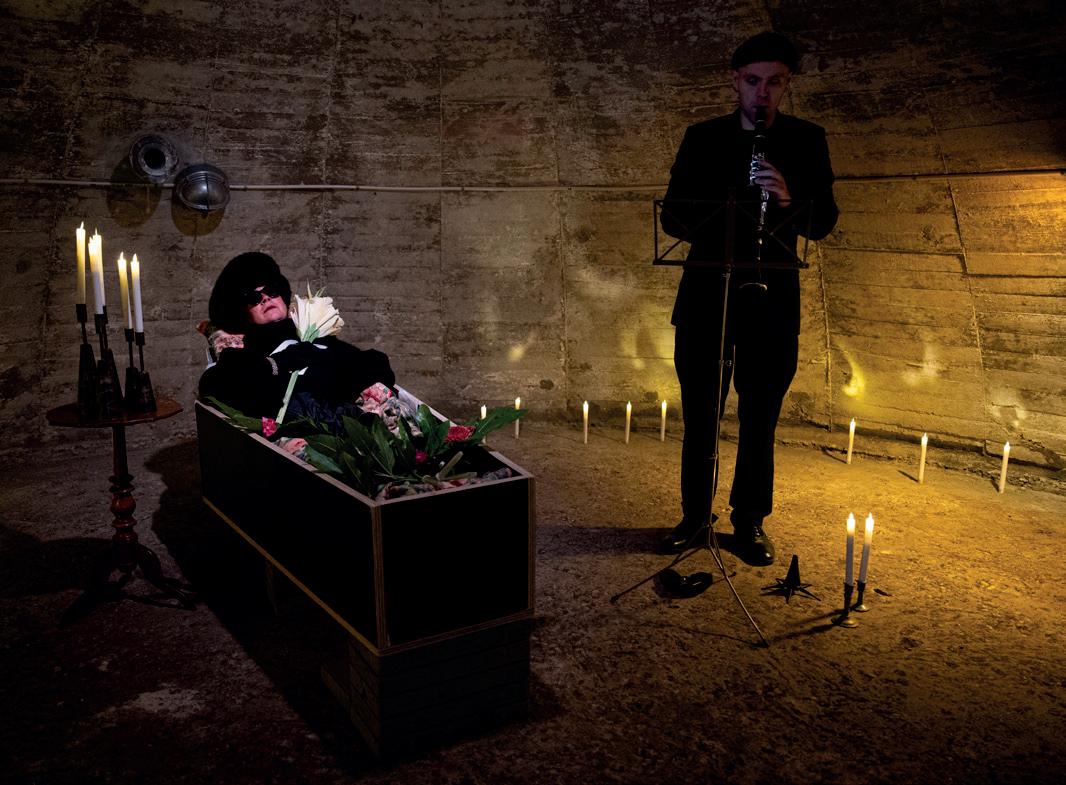
Scan Magazine Issue 193 August 2026
Published 08.2026
ISSN 1757-9589
Published by
Scan Client Publishing
H2Print
Executive Editor
Thomas Winther
Creative Director
Mads E. Petersen
Editor
Malin Norman
Copy-editor
Karl Batterbee
Graphic Designer
Mercedes Moulia
Cover Photo
Moaz Altawill / Surflogiet Gotland
Contributors
Anders Lorenzen
Celina Tran
Gabi Froden
Hans-Henrik Nielsen
Heidi Kokborg
Joseph Phelan
Karl Batterbee
Malin Norman
Maria Sødal Vole
Miriam Gradel
Molly McPharlin
Nane Steinhoff
Ndeala Faye
Nina Bressler
Sofia Nordgren
Thea Johansen
Sales & Key Account Managers
Emma Fabritius Nørregaard
Evelina Duned
Mette Tonnessen
Veronica Rafteseth
Advertising marketing@scanmagazine.co.uk
To Subscribe scanmagazine.co.uk/subscribe
Scan Magazine Ltd
3rd floor, News Building, 3 London Bridge Street, London SE1 9SG, United Kingdom www.scanclientpublishing.com info@scanmagazine.co.uk www.scanmagazine.co.uk
© All rights reserved. Material contained in this publication may not be reproduced, in whole or in part, without prior permission of Scan Magazine Ltd.
Scan Magazine® is a registered trademark of Scan Magazine Ltd.
This magazine contains advertorials/promotional articles