SCAN MAGAZINE

SWEDEN’S TOP EDTECH COMPANIES,TOP EXPERIENCES IN ICELAND, AND TOP SUMMER EXPERIENCES IN ESTONIA
PROMOTING BRAND SCANDINAVIA ISSUE 167 JUNE 2024 CASPER RUUD ON REACHING THE TOP OF HIS GAME NORDIC MUST-READS 7 SPECIAL THEMES
AND WEEKEND
IN SWEDEN NORWEGIAN SUMMER DESTINATIONS
HIDDEN GEMS
GETAWAYS

29 RUE DU DRAGON, 75006 PARIS 5 EARLHAM STREET, LONDON
Editor’s Note

Dear reader,
For me, June brings to mind summery celebrations with breezy linen clothes and cakes with whipped cream and strawberries. This month, school is out for summer and the kiddos dress up for the last gathering with their class mates. And of course the big one happens, the magical and mysterious Midsummer with fun and games, festivities at long communal tables, and flowers in the hair – or under the pillow. Yes, us Scandis do this on Midsummer! I was told that if you place seven types of flowers under your pillow on Midsummer’s Eve, you dream about your future spouse. Of course I had to try, right?
The June issue has plenty in store for you, apart from festive cakes and breezy linen, including summer getaways around Scandinavia and further afield. One of my top summer destinations in Sweden is Båstad, it encapsulates all things summer – and tennis! By the way, we have a fantastic feature with the highest-ranked Norwegian tennis player ever, Casper Ruud, in this issue. He’s reached the top in a country otherwise obsessed with winter sports.
Here, you can read about his thoughts on success and the importance of pursuing your dreams.
Oh and June is also a good time to pick up a book. I have set my own reading challenge, to read 100 books this year. I’m way behind, of course, but I have devoured two of the best books I’ve ever read so far, Barbara Kingsolver’s Demon Copperhead and Cecile Pin’s Wandering Souls. I will for sure check out the seven Nordic must-reads in this issue. Have you read any of them?
I hope you have the chance to get your hands on a good book, bake a delicious summer cake, and experience the best of what this month has to offer. And enjoy reading our fully-packed and summery June issue!
 Malin Norman, Editor
SCAN

94 June 2024 | Issue 167 | 3 Scan Magazine | Editor’s Note
MAGAZINE
In this issue
COVER FEATURE
8 Casper Ruud on reaching the top of his game
The highest-ranked Norwegian tennis player ever, Casper Ruud, shares his thoughts on what it takes to reach the top. A combination of determination and physical fitness is part of his success, and the confidence to pursue his tennis dreams in a country obsessed with winter sports.
DESIGN
18 Six products to transform your outdoor space
On our design pages, we feature products that will transform your outdoor space into the perfect spot for relaxing, as well as architecturally designed wellness experiences. Furthermore, we check out design with a focus on craftsmanship, quality and storytelling. And we present three international design profiles.
LIFESTYLE AND FOOD
33 Seven Nordic must-reads, simple summer cake and hybrid beers
In time for summer, we dive into seven mustreads that take place across the Nordic countries. Our food columnist Sofia Nordgren tempts with a simple yet delicious summer cake with fresh berries, whilst beer sommelier Malin Norman looks into hybrid beers.
SPECIAL THEMES
44 Norwegian summer destinations
We get to know the natural beauty and culture of Vindafjord, the charming municipality in Haugalandet, as well as Evenes in Nordlandet with its spectacular countryside and intriguing cultural events. We also feature Sandnessjøen, an underexplored pearl along Helgelandskysten, and the water paradise Aquarama. 8

4 | Issue 167 | June 2024 Scan Magazine | Contents

56 Hidden gems and weekend getaways in Sweden
In this guide to the road less travelled, we take you to Medieval Week in Visby, where you can see action-packed jousting and medieval markets. We reveal world-famous photography displayed in Falsterbo, as well as gorgeous weekend getaways with wondrous views and a taste of the sea.
MINI THEMES
70 Top experiences in Iceland
The land of fire and ice has plenty of experiences on offer. Make sure to check out the Reykjanes peninsula and stay at Ocean Break Cabins before or after your adventures. Another must is the old Viking home Eiríksstaðir. And for stranded passengers or those who need to plan an unforgettable trip, Hotel Service KEF Airport can help.
75 Top summer experiences in Estonia
In this mini theme about our neighbouring Estonia, we explore Tartu Observatory, a regional hub for space science and education. And we present two cultural experiences for the summer; the Contemporary Art Museum of Estonia and Viljandi Folk Music Festival.
79 Sweden’s top edtech companies
Sweden is renowned for innovation, a high level of education, and being one of the most connected countries in the world. In this mini theme, we look into some Swedish edtech companies that have developed user-friendly services and products focusing on learning.
CULTURE
92 The best new events and music in Scandinavia
In this month’s Culture Calendar, we look into the best events in the Nordics. Our music columnist Karl Batterbee picks out the best new tunes in the region, film enthusiast Anders Lorenzen explores the best of Scandinavian cinema and TV, and illustrator Gabi Froden reflects on the joy of unplanned visits. We also explore the Ultima Oslo Contemporary Music Festival, a beacon of avant-garde musical expression.
June 2024 | Issue 167 | 5 Scan Magazine | Contents BEST OF THE MONTH 83 Restaurant 84 Destination 86 Culture Profile 88 Hotel
86
Fashion Diary
Summer is finally here! Peel off those thick layers and get ready for warm city strolls, beach days, and good old-fashioned tourist activities in light, versatile and classic outfits.
By Celina Tran | Press photos


MarZio – Wedge Espadrille
SCAMPI – Acapulco swimsuit
Inspired by Acapulco, the Mexican pearl of the Pacific Ocean, Scampi’s Acapulco swimsuit is a classic with its stripes and draped silhouette, not to mention the amazing support that comes with it!
Acapulco Stripe Sea swimsuit, 1,895 SEK www.scampi.se
If you’re looking to travel, versatile pieces are more important than ever. Stockholm-based MarZio has always shown an uncompromising commitment to its handmade Italian shoes, and the Wedge Espadrille shoes are no different. Whether you’re going to the beach or for brunch, these rustic heels are perfect for style and comfort regardless of the occasion.
Wedge Espadrille in beige suede, 1,695 SEK www.marzio.se

Lovechild1979 – Rhoda bag
The charming and simple Rhoda bag from Lovechild1979 helps elevate every outfit, adding a touch of playful elegance.
Rhoda bag in tan, 2,000 DKK www.lovechild1979.com
Aiayu – Susanna dress

Summer sees a long-awaited return of long, breezy dresses. With its loose fit and playful ruffle straps, Aiayu’s versatile Susanna dress is perfect for the clammy heat.
Susanna dress, 190 EUR www.aiayu.com
Scan Magazine | Design | Fashion Diary

Filippa K – Linen shorts
Thanks to its lightness and airiness, linen is perfect for the summer season. Pair Filippa K’s navy linen shorts with a white cotton t-shirt or linen shirt for a classic look, and toss on some light knitwear to combat any seaside breeze.
Linen shorts in navy, 2,400 SEK www.filippa-k.com

Stenstöms – Patterned silk bandana
Is your outfit missing some of that je ne sais quoi? Try Stenström’s patterned silk bandana to add an extra touch of playfulness to any outfit. For a preppy look, it can be paired with linen shorts, a white jersey or a polo. Patterned silk bandana in green, 1,099 SEK www.stenstroms.com
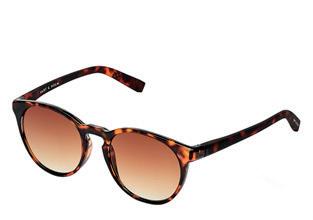
Hart & Holm – Torino sunglasses
Danish Hart & Holm knows sunglasses better than anyone. Whether or not you need sunglasses with strength, this brand has affordable pieces, including the unisex and elegant Torino sunglasses, which come in a range of colours.
Torino Classic sunglasses, 27.20 EUR www.hartandholm.com

A Day’s March – Tron relaxed T-shirt
You simply can’t go wrong with a classic off-white t-shirt, whether it’s hot or cold. Made from organic cotton, A Day’s March’s relaxed T-shirt Tron is light, and gives that cool and laid-back look to any wearer. Tron relaxed T-shirt, 65 EUR www.adaysmarch.com
 Ruud’s achievements include three Grand Slam finalist finishes and eleven ATP Tour singles titles.
Photo: ©Alexander Scheuber/@alexanderscheuber
Ruud’s achievements include three Grand Slam finalist finishes and eleven ATP Tour singles titles.
Photo: ©Alexander Scheuber/@alexanderscheuber

Casper Ruud – on reaching the top of his game
What does it take to reach the very top of your game? If you ask Casper Ruud, the highest-ranked Norwegian tennis player ever, it is all about a combination of determination and physical fitness as well as the confidence to pursue your dream even in a country where tennis stars are a rarity and winter sports an obsession.
By Signe Hansen
Travelling from one exotic destination to the next, accompanied by his beautiful girlfriend, psychologist Maria Galligani, and admired by fans from near and afar – at just 25, Casper Ruud is living the dream of many. But when we ask the handsome Norwegian about the greatest thing about his life, it’s not the fame or glory – it’s competing. “We are all real characters, all players, and we love competing,” he says of himself and his fellow top players. “That’s why most of us have made it this far. We don’t like losing. The feeling of being in battle – it’s just thrilling, it gives you a lot of adrenalin and nerves, a feeling of being invigorated, and that’s what I love about tennis.”
So far Ruud’s love of competing has resulted in a career-high singles ranking of world No. 2 (achieved on 12 September 2022), three Grand Slam finalist finishes and eleven ATP Tour singles titles. And
it just keeps getting better – in April this year, he secured the biggest title of his career when he defeated Stefanos Tsitsipas to win the Barcelona Open. Impressive for anyone, even more for someone who grew up in a nation where tennis was far from an obvious choice for a young boy dreaming of reaching the top.
Starting with baby steps, literally
While great leaps have defined the last years of Ruud’s career, it all started with baby steps, literally. Asked what his earliest memory involving tennis is, Ruud answers: “I started playing even before having memories – my dad used to take me to a mini court in our backyard, so I don’t remember the first time stepping onto a tennis court. But my earliest significant memory was probably when I watched Rafael Nadal win his first Grand Slam on TV, he became my biggest idol, the one I looked up to.”
June 2024 | Issue 167 | 9 Scan Magazine | Cover Story | Casper Ruud
Though just five or six years old at the time, Ruud also describes the experience as the moment when he was first inspired to make tennis his livelihood. “Even though I didn’t know what it meant, it planted the seed in my mind to seek a professional career,” he says.
As the son of professional tennis player Christian Ruud, the young talent had more than one source of inspiration for his pursuits. However, he does not remember his father, who achieved a career-high singles ranking of world No. 39 in October 1995 and retired in 2001,
playing as a professional player, but as a great source of support.
A tennis star from the cold north
Today, Ruud’s father is also his coach and it was on his father’s advice that he decided to give up on other sports when he decided to go for a professional tennis career. “My father was always very encouraging and helpful in mentoring and coaching me. We worked hard during the weekends and would practise four hours every Saturday and Sunday to get in some extra hours while others would be out doing other things,” says Ruud


and continues: “He pushed me, but in the right way – I enjoyed it and respected him as coach and father, for how he always wanted the best for me.”
His father’s support was significant in an environment where tennis was far from perceived as the most obvious road to success. Indeed, Ruud, who started playing at a local club while also pursuing other sports, like football, often had doubts about his chances of success.
“Several times during my childhood, I remember finding it difficult to believe that a guy from Norway could reach the top of the rankings and play the big tournaments,” he admits. “It wasn’t always easy to go to bed and believe I’m going to make it, but then you get some results, and you get more, and along the way, you start believing in yourself. It’s the beauty of sport – how important it is with confidence and self-belief.”
Known as a fair and polite player
With an extensive list of impressive achievements behind him, it’s no wonder that Ruud’s confidence is currently peaking, and he is seen playing at the very top of his game. Specifically, two achievements have been significant to the young Norwegian. “The first one was when I broke the ‘golden barrier’ to be ranked inside the Top 1000 and could start playing professionally,” says Ruud adding: “Obviously, when I broke into the top ten for the first time was also epic because it was something that I had looked up to and envisioned.”
10 | Issue 167 | June 2024 Scan Magazine | Cover Story | Casper Ruud
Ruud lists finding “the one”, his girlfriend Maria Galligani, as one of his greatest achievements. Photo: ©Alexander Scheuber/@alexanderscheuber
With a career-high singles ranking of world No. 2, Casper Ruud is the highest-ranked Norwegian tennis player ever. Photo: ATP TOUR
 25-year-old Ruud is in peak physical form.
Photo: ©Hamburg European Open/Alexander Scheuber
25-year-old Ruud is in peak physical form.
Photo: ©Hamburg European Open/Alexander Scheuber

It is, however, not just his professional achievements that give Ruud the confidence and stability to excel on court. Privately too, he feels he has already secured a significant victory. “I live together with my girlfriend Maria, and I feel like I found the one, I think that’s a great achievement. We’re not married and don’t have kids yet, but I envision, we might have in the future,” he says.
Professionally too, Ruud has plenty of ambitions for his future. Firstly, of course, he dreams of winning a Grand Slam. “Ultimately, that’s what I always dreamed of, my highest and biggest goal,” he says, but adds: “But what I would like to be remembered for by fans and other players is that I was a fair player, someone who was well-mannered and didn’t provoke the other players.”
Having already achieved more than any Norwegian tennis player before him and behaving impeccably, forthcoming and
friendly, during our talk – despite being in the midst of a demanding tournament – Ruud looks well on his way to achieving his goals.

Facts:
• Casper Ruud is the highest-ranked Norwegian tennis player ever.
• He currently has a singles ranking of world No. 7.
• Ruud was born in Oslo, December 22, 1998.
• Casper Ruud has two younger sisters, Caroline (health and fitness coach) and Charlotte (college tennis player at University of South Florida).
• Casper Ruud lives together with his girlfriend, Maria Galligani, who holds a master’s degree in psychology.
• Ruud has won eleven ATP Tour singles titles and finished runner-up at three Grand Slams and at the 2022 ATP Finals.
• Like his father, Ruud is also an avid and talented golf player and even has a separate Instagram account for his golf adventures.
12 | Issue 167 | June 2024 Scan Magazine | Cover Story | Casper Ruud
On top of being a striking talent on the tennis court, Ruud is an avid and skilled golf player. Photo: ©Alexander Scheuber/@alexanderscheuber
Photo: ATP TOUR
 Most of all, Ruud wants to be remembered as a fair player, someone who treated fans and fellow players well. Photo: ©Alexander Scheuber/ @alexanderscheuber

Tennis by the sea in a summer sporting spectacle
Grand Slam tournaments usually take place in metropolises. Wimbledon sits on the outskirts of London, Roland-Garros in the suburbs of Paris. To catch sight of top seeds with a more bucolic backdrop, head to Båstad, a small town on the southern Swedish coast. Here, the centre court is a short walk from the beach and spectators and sporting titans mingle on the resort’s cobbled streets.
By Xander Brett | Photos: Johan Lilja/Nordea Open
14 | Issue 167 | June 2024 Scan Magazine | Special Feature | Nordea Open
Spectators look across to the Kattegat Sea.

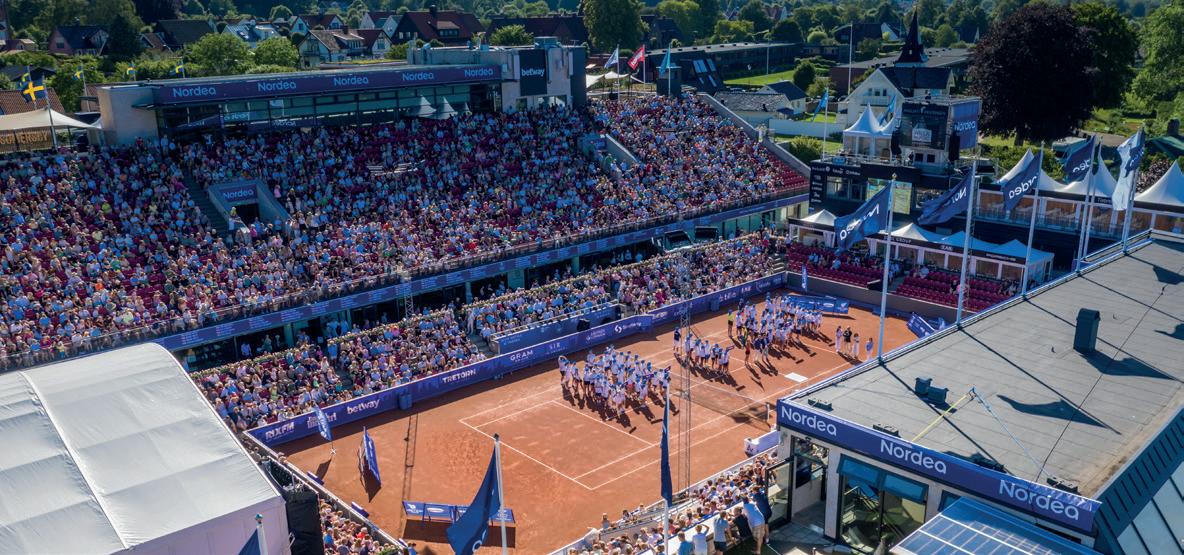
Each July, the Swedish Open, which was first held in the 1940s, takes place on outdoor clay courts in Båstad’s town centre. With courts looking across to the Kattegat Sea, a salty breeze often ruffles the hair of players and spectators. The tournament, also called Nordea Open, forms part of the ATP 250 series (for men) and WTA 125 series (for women). Last year, the women’s singles title went to Olga Danilović and Andrey Rublev secured the men’s singles crown.
“It’s popular for clay court players to come to Båstad after the grass season,” says Christer Hult, the event’s managing director. In 2003, Hult watched a young Rafael Nadal play in Monte Carlo. He gave Nadal a wildcard, and the player competed at Båstad later that year. Two years on, the superstar Spaniard won the men’s singles title on Båstad’s centre court.
The town, which nestles on a peninsula near the border of the Skåne and Halland counties, houses just over 5,000
permanent residents. During the Nordea Open, the population increases to around 100,000. “We have around 70,000 to 80,000 spectators watching the tennis,” he explains. “Our centre court has a capacity of 4,300, but we sell up to 2,000 ground tickets alongside. A circulation of people is only natural, so if there are empty reserved seats you can sit there until the purchaser arrives.”
Nordea Open offers free entrance to the women’s WTA competition, which runs
June 2024 | Issue 167 | 15
Scan Magazine | Special Feature | Nordea Open

from 8 to 13 July. “If you enjoy that, you could then buy a ticket to the ATP tournament the following week,” says Hult.
A celebrity playground
Rafael Nadal and Serena Williams (who took the women’s singles title in 2013) are two of the most famous names to have triumphed in Båstad. Sweden’s Björn Borg, however, won three men’s singles here in the 1970s. Stefan Edberg, another Swedish legend, finished runner-up twice. “Sweden has a huge interest in tennis and that interest is only increasing,” Hult confirms. “Our tennis heritage has been built over a long period of time.”
During the tournament, Hotel Skansen provides players with direct access to the adjoining centre court. “We mostly use our transport to take players to and

16 | Issue 167 | June 2024 Scan Magazine | Special Feature | Nordea Open
Sunset descends on one of Sweden’s best-loved resorts.
Båstad has played host to some of the biggest names in sport.
from the airport. Everything else is in a small area, which is relaxing for the players.” Celebrity encounters are frequent in the town’s bars and restaurants. Such meetings come with players, of course, but also with visiting politicians, artists, and singers.
After the tournament ends, Båstad’s courts are available to rent and Hotel Skansen is available to book as usual. Holidaymakers can imagine an adoring crowd as they step onto the empty centre court. “Of course, it has always been our intention to build up the tournament,” Hult explains. “But we
also want to make everything around the tournament attractive. Båstad has also become a popular corporate destination.”
A rich history in tourism
Annika Borgelin, CEO of Båstad Tourism & Business, says that the town can trace its tourist roots back to engineer Ludvig Nobel (uncle to Alfred Nobel, whose will established the Nobel Prize). “Nobel saw that visitors from Stockholm needed something to do apart from swimming in the sea, so tennis courts and golf courses were constructed,” Borgelin says and explains that Rudolf Abelin was another

notable figure in the resort’s history. His Norrviken Gardens, not far from Båstad, remain a popular excursion.
“Besides watching and playing tennis and strolling around the harbour, people love hiking and cycling,” says Borgelin. The Kattegatleden cycle path, which runs from Helsingborg to Gothenburg, passes through Båstad on its 390-kilometre journey. Borgelin adds that although July is the busiest month, the town’s summer season runs from May to October. “We also have farm shops and vineyards in the region, and many exciting events too,” Borgelin continues. “Around 180 days a year, an event is taking place here. There’s so much more than tennis!”
Nordea Open takes place in Båstad 8-21 July.
WTA runs July 8-13 July, free entry
ATP runs 15-21 July, tickets available to purchase
Båstad sits just over 100 kilometres from Copenhagen. It’s connected by train to Malmö and Gothenburg. www.nordeaopen.se
June 2024 | Issue 167 | 17 Scan Magazine | Special Feature | Nordea Open
The competitions run from 8 -21 July.
Båstad’s centre court can accommodate thousands of fans.
We Love This: June 2024
After a long and breezy spring, summer is finally here! Time to throw the doors wide open and let the light in. While you’re at it, why not just take your morning coffee or lunch on the patio? These six products will transform your outdoor space into the perfect spot for relaxing this season.
By Celina Tran | Press photos
Bloomingville – Cruz hammock
Can you imagine anything more wonderful than lazing in a hammock on a sleepy summer day? Kick your feet back, listen to the birds sing, and feel the prickle of the sun’s fingertips against the back of your eyelids. The Cruz hammock comes in different earthy and muted colours, blending in perfectly on a rustic patio or a wild summer garden.
139 EUR www.bloomingville.com


Cane-Line – Hive chair
Designed by Danish duo Foersom and Hiort-Lorenzen MDD, the Hive chair from Cane-Line is inspired by the shape of a beehive and was created to encourage concentration and relaxation. The woven wicker is not only solid and durable, but also waterproof, making it a perfect sitting piece for any patio! And if you want to take it a step further, the Hive chair can also be hung.
2,715 EUR www.cane-line.eu
GUBI – Seine portable lamp
Based in Denmark, GUBI knows how to design unique light fixtures that blur the lines between functionality and art. Mouth-blown, the glass shade of the portable lamp Seine is inspired by the movement of light and water. Along with its brass base, the lamp adds a great touch to any indoor or outdoor space.
299 EUR www.gubi.com

18 | Issue 167 | June 2024 Scan Magazine | Design | We Love This

Tell Me More is a Swedish company that knows how to boost a space with simple solutions. The Franca pot is a clay urn in deep, brown tones and a distinctive glazing. As the pot is handmade, each piece is unique and can vary in colour and shape, and is guaranteed to elevate your living space without all the noise. Use the pot for plants, to store cookware, or whatever else might tickle your fancy!
229 SEK
www.tellmemore.se

House Doctor – Watering can, burgundy
While you might not think a simple garden tool can do much to change a space, the devil is truly in the details, or in this case, a watering can. House Doctor’s burgundy watering can is practical for the plants in your garden and paired with your outdoor furniture it makes a most elegant piece of décor.
74 EUR www.housedoctor.com

Ferm Living – Staffa coffee table, small
Fern Living’s Staffa coffee table is truly a statement piece that will elevate any space, whether inside or outside. Inspired by volcanic rock formations, the table resembles carved stone and is bound to start conversations.
815 EUR www.fermliving.com
June 2024 | Issue 167 | 19 Scan Magazine | Design | We Love This
Tell Me More – Franca pot
Photo: Tell Me More

Design with a focus on craftsmanship, quality and storytelling
EST.18 represents international design brands that live and breathe craftsmanship, quality and storytelling. From beautiful handwoven rugs from SERA HELSINKI, to exceptional furniture inspired by the spirituality of Japanese culture from Ariake, to Portuguese Origin Made that tells the story of every artisan behind its products. Their commonality? Staying true to tradition.
By Heidi Kokborg
Anja Bothe has worked in the design and furniture industry her entire career, it’s in her DNA. In 2018, she founded her own company EST.18 in Copenhagen, where she represents international design brands. It was not a lifelong dream of being self-employed that made her found EST.18. No, it was something else.
“In a time when products were manufactured for a purpose and became very commercial, I wanted to take a step back. Look at the story, craftsmanship and technique, from which a product comes

alive. To be proud of the product. To remember and honour the human behind the product. From designer to craftsman. For me, this is of big value in a product,” tells Anja Bothe, founder of EST.18.
EST.18 certainly does not wish to disrespect innovation; it’s simply a company dedicated to slowing down a little bit and returning to the tradition, craftsmanship and stories behind our furniture and interior design – from the couch you are sitting on to the vase on your coffee table.
Iconic Japanese furniture
EST.18 currently represents three international design and furniture brands that are simply extraordinary. All three have a deep respect for and dedication to tradition and craftsmanship that is rare; Ariake from Saga, Japan, SERA HELSINKI from Finland, and Origin
20 | Issue 167 | June 2024
Origin Made. Photo: Jonas Bjerre Poulsen
Origin Made. Photo: Jonas Bjerre Poulsen
Made from Portugal. Once you hear the stories of these three brands, you will fall in love with them too.
Ariake was founded more than 60 years ago in Saga, Japan. Today the founder’s grandson, Mr. Kengo Kabashima, has taken leadership of the family company, while his brothers are dedicated to production. His father is still operational and his grandfather lives around the corner from the factory. After all, in Japan you take care of every generation, and nothing gets lost. The respect for the tradition and craftsmanship shines through in every piece of furniture that Ariake makes.
“Our furniture is made for cosmopolitan living, but it contains the essence of Japan,” explains Gabriel Tan, creative director of Ariake. “We try to meet halfway between traditional Japanese furniture and modern, urban furniture. For instance, we use traditional Japanese indigo dyeing techniques and the cultural red colour, which gives the furniture a distinctive finish.” Ariake also applies the traditional calligraphy ink, sumi, on its wood furniture. Sumi is

made by ink makers in Japan by mixing candle soot with water.

Ariake offers its furniture in a wide range of woods from oak to American ash wood, but it also uses hinoki wood from a forest just 45 minutes away from the factory in Saga. “Originally, hinoki wasn’t ideal for furniture because it’s light and soft, but we tried using it for this collection to make our production chain more sustainable, and it worked,” explains Mr. Kengo Kabashima.
“Hunoki is water resistant so it’s great for bathtubs, spas and hot springs, but we also use it for everyday furniture such as sofas. It has a lovely citrus fragrance that never goes away, it’s like aromatherapy and is proven to have calming effects when you breathe in the scent.” Ariake is also introducing a new dye finish in its latest collection made from persimmon fruit, something that has been used in Japan for centuries but never before on wood.
Ariake works with designers worldwide and once a year everyone spends a week together at the factory in Saga. Here, they can experience Japan, visit the hinoki forest and the lumber mill, and work together with the craftsmen. “You get the feeling of being part of a family,” smiles Bothe. “This brand is amazing, and I’m so proud to be able to be part of this family.”
June 2024 | Issue 167 | 21 Scan Magazine | Design Profile | EST.18
Photo: Ariake
Photo: Ariake
Revolutionary inclusive rugs
SERA HELSINKI is another incredible design business that EST.18 represents. The brand combines Scandinavian design with Ethiopian craftsmanship and has a fully transparent production chain. SERA HELSINKI creates the most beautiful rugs you have ever laid eyes on, made from pure sheep wool and without any chemicals. Founder Anna Suoheimo lived in Ethiopia for five years and fell in love with the country and its people, in particular she loved the work of local artisans and their rugs.

“I fell in love with Anna at first sight,” says Bothe. “She’s the kind of person you would like to be with all the time. This is not just about products; it’s a feeling. She works with disabled Ethiopians who live in the mountains. Anna found a way for them to be proud of who they are.”
SERA HELSINKI has a clear vision of improving inclusivity on every level of the business. Many artisans making the rugs don’t know how to read and write and they have been excluded from the society they live in because of their disabilities. But this is a true story of empowerment, as SERA HELSINKI empowers over 300 people in Ethiopia.
SERA HELSINKI was born from a love for design and a desire to create a better future. When you buy its rugs and towels, you support people who desperately need it but you also get the highest quality. The pure sheep wool is warm,

easy to clean and simply beautiful. The collections include knotted and woven rugs made by using different techniques. Every rug is handmade to order and no two products are the same, they vary a little bit in colour and weaving. If properly taken care of, your SERA HELSINKI rug will last you a lifetime.
Preserving cultures through design
When Anja Bothe established EST.18, she had a clear vision, to honour and tell the stories of craftsmanship and the artisans behind the products. That’s exactly what Origin Made does. The Portugal-based design brand is the brainchild of Gabriel Tan and Cherie Er. The Singapore couple founded the brand in 2019 and moved to Portugal in 2020. “There are many makers in Portugal and lots of brands produce here, but nobody was telling the story of the craftsmen,” says Gabriel Tan, co-founder of Origin Made. “We tell the stories of our makers and designers. Our goal is to create a bridge between traditional handcraft and high-end design.”
The founders have a deep respect for the Japanese Mingei folk crafts movement, and they understand the importance of preserving these vanishing craft cultures. That’s what they are trying to do with Origin Made, to ensure that authenticity and human connection is at the forefront. “Not only do we want our customers to enjoy original design, we also want them to feel a deeper connection

22 | Issue 167 | June 2024 Scan Magazine | Design Profile | EST.18
Photo: Sera Helsinki
Photo: Origin Made
Photo: Origin Made

with the people behind the product,” tells Tan. All products are mostly or partially handmade only 90 minutes from the couple’s home in Porto.
While Ariake, SERA HELSINKI and Origin Made might be far apart on the map, their vision and core are the same. “These are not just products or brands, they are artisans,” smiles Bothe. “There is a bigger idea and vision behind all three that align with my values at EST.18. They stay true to and respect the tradition. They are proud of what they do, and I’m so proud of them.”
www.est18.dk
Instagram: @est18.dk
www.ariakecollection.com
Facebook: Ariake Collection Japan
Instagram: @ariake_collection
www.serahelsinki.com
Facebook: Sera Helsinki
Instagram: @serahelsinki
www.origin-made.com
Facebook: originmade
Instagram: @orginmade


You can discover all three brands at the festival 3daysofdesign in Copenhagen, which takes place 1214 June. The showroom is located in an old boat house on Kanonbådsvej 4 in the district of Holmen. You can arrive by foot or car, but the best way to experience the showroom is to arrive, you guessed it, by boat. Here you will be met with a spectacular showroom, featuring SERA HELSINKI, Ariake and Origin Made. This is a festival not to miss if you are visiting, or living in, the capital of Denmark.
June 2024 | Issue 167 | 23 Scan Magazine | Design Profile | EST.18
Photo: Sera Helsinki
Photo: Sera Helsinki
Photo: Sera Helsinki
Photo: Sera Helsinki
A place you always leave feeling better

Scandinavian Sauna designs high-end saunas that blend traditional Scandinavian design with modern, mobile solutions. Its innovative saunas offer an architecturally designed wellness experience built from premium materials.
By Trine Ejlskov Jensen-Martin | Photos: Jakob Gate
After years of intense work in London’s architecture industry, Swedish architect Jakob Gate and Danish design project leader Cecilie Wang found themselves seeking a change. The couple made a bold decision to quit their jobs and move to the Philippines, where they set up architecture firm Native Narrative. For two years, they worked closely with local NGOs, building educational centres for children. This experience in practical, community-oriented architecture significantly influenced their approach to design.
Upon returning to Scandinavia in 2018, the couple’s reacclimatisation to the cold climate rekindled their love for saunas.
“That first winter back in Scandinavia was brutal, it felt like we only managed to stay healthy by being in the sauna every day. We just felt so cold here,” recalls Cecilie. Not surprising, after years in the tropical heat of the Far East.

Having grown up using saunas with their families, both Jakob and Cecilie were reacquainted with this essential part of Scandinavian life. One day, while warming up in a barrel sauna, they found themselves inspired to use their architectural skills to improve the many design flaws. This sparked the idea of developing the perfect mobile sauna, leading to the founding of Scandinavian Sauna in 2019.
The couple combined their expertise to create high-end, mobile saunas that blend traditional Scandinavian design with modern, mobile solutions. The premium saunas cater to a growing market of European and Japanese enthusiasts, offering an architecturally designed wellness experience built from premium materials. “Many mobile saunas were compromised in the name of mobility,” Jakob says. “We refused to do that, so we offer mobile units that are as solid as high-end stationary saunas.”
24 | Issue 167 | June 2024
Commitment to community, environment and well-being
The mobile saunas are constructed in fully certified timber, emphasising the founders’ commitment to community, environment and well-being. Jakob states, “We come from a charity architecture studio, so community and health mean a lot to us.”
The first sauna client provided invaluable feedback. After two years of daily use and refining the design, it was not only aesthetically pleasing but also highly functional and robust. “This process of continuous improvement and client collaboration is central to everything we do, not just as professionals but also as people,” confirms Cecilie.
Feedback from clients has been overwhelmingly positive. Some liken the saunas to fine furniture, while others value the immediate return on investment they provide. As Jakob notes, “Many of our clients are hotels and rental businesses who love the fact that they can buy a sauna and have an instant pop-up business, seeing a return on investment within an hour of delivery.”
There was nothing like it on the market and the design quickly gained interest from all over the world, not only in colder regions but also in warmer countries like Singapore, Kenya, Saudi Arabia, and Australia.
A different way of socialising with friends and family
The saunas are becoming increasingly popular as an alternative place to meet,

a different way of socialising with friends and family, and a new way to switch off and recharge. “It’s a wonderful place to gather with the whole family,” says Cecilie, reflecting on their childhood experiences.
The success, however, came with its own set of challenges. The unique design of Scandinavian Sauna started to get replicated, a testament to its popularity but a point of contention. “Seeing our design, which we put so much into, being copied is frustrating, but in the end, it has pushed us to keep innovating and designing even better saunas,” says Jakob, emphasising their commitment to originality, innovation, and craftsmanship.
Looking to the future, Cecilie adds, “We enjoy learning from our clients, and now, with quite a few out there, the feedback we get is making our product even stronger. It’s a bit like the car industry which

comes out with new updates yearly, only we’re not waiting a year but updating our design as soon as we gain new insights.”
At the moment, the couple is working on several bespoke projects, mobile units but also garden saunas and even a larger high-end spa. “We enjoy pushing the sauna market even further, while improving health and well-being along the way,” concludes Jakob. “Our sauna is a place you always leave feeling better!”
Interested readers are invited to experience a Scandinavian Sauna firsthand by visiting the open-air showroom in southern Denmark to see for themselves how custom sauna design can enhance their lifestyle or business.
www.scandinaviansauna.dk
Facebook: Scandinavian Sauna
Instagram: @scandinavian_sauna

June 2024 | Issue 167 | 25 Scan Magazine | Design Profile | Scandinavian Sauna


Upcycling and the art of sustainable candle making
The story behind KunstIndustrien begins in the aftermath of WWII, at the back of an old catholic bookshop in Copenhagen. Besides selling books, it cast wax altar candles at night to sell in the shop the following day, and these are still the company’s signature products.
By Trine Ejlskov Jensen-Martin
The original shop in Bredgade was located opposite Kunstindustrimuseet (now the Danish Museum of Art & Design), the inspiration behind the company name. The business changed and developed over several decades until KunstIndustrien closed the shop and became a wholesaler. It has a steadily growing customer base in Denmark and sells its creations worldwide, through high-end shops like interior design boutiques and luxury department stores.
Entrepreneurs Steen and Britta Frost bought the company in 2019 and have since firmly put their mark on the business. With a focus on which natural materials they should be using, from both an ethical and an environmental point of view, they are bringing candles and the process of candle making up to the high ecological
standards of the 21st century, particularly with the latest addition, which launched this spring; upcycled olive oil wax candles.
“We use the discarded natural materials left over from olive oil production,” say the owners. Made from 100% residue material from olive presses around the Mediterranean, the range of candles currently comes in five different natural colours, with just a small amount of dye used to create the muted and earthy tones.
Reducing impact on the environment
“We aim to be transparent with everything we do and take one step at a time in order to uphold our commitment to being environmentally friendly in every aspect of the business,” Steen explains. This extends to packing materials, with boxes made from recycled paper,
packing tape made from recycled plastic, and 100% biodegradable package filling made from corn starch and water.
All the goods are exclusively made from raw materials of the highest quality, which is in line with ensuring that every aspect of the production process is ethical. Facing competition in a market flooded with artefacts that are neither natural nor transparent, KunstIndustrien continues to lead the way in the creative use of residual products and to work towards a more sustainable future, whilst never compromising on the high quality of its designs.
www.kunstindustrien.dk
Facebook: KunstIndustrien
Instagram: @kunstindustrien

26 | Issue 167 | June 2024 Scan Magazine | Design Profile | KundsIndustrien
Wax altar candles. Photo: Peter Bjerke
Production of wax altar candles and olive wax candles. Photo: KunstIndustrien
Owners Steen and Britta Frost with candles. Photo: Chris Opander Tonnesen
Olive wax candles. Photo: Peter Bjerke
Ocean Plastics by

Guided by the principle of simple Scandinavian design, Happy Ears has created a reusable earplug for whatever your need.
Try our newest earplugs made of ocean plastics. An important product when you know more than 1Bil single use traditional earplugs are used and thrown away each year.
Better product, less waste. This is Happy Ears. Made in Sweden since 2010. www.happyearsearplugs.com
Visit our shop here and try one of our Discovery Packs, which offer you a money back guarantee.

Weaving well-crafted products into captivating narratives
Artisanal by Tokyovision is a fusion of tradition and innovation. This new e-commerce venture celebrates Japanese culture and craftsmanship, with a range of products that not only serve a purpose but also tell a captivating story.
By Malin Norman | Photos: Artisanal
Tokyovision is a seasoned player in international video production. For over 40 years, the company has shared the beauty of traditional Japanese crafts and culture through video content, collaborating with major international television networks such as France TV, Discovery Channel, and ZDF. Artisanal is Tokyovision’s new e-commerce venture, a way of weaving tangible products into the narratives.
“During filming around Japan, we have seen artisans preserve traditional culture and produce high-quality products,” explains Eri Fukuyasu, merchandising

manager. But the travels also highlighted challenges facing Japan’s craftspeople; declining domestic consumption of traditional crafts, soaring raw material costs, and other issues.” We hope to help by taking traditional techniques that have been handed down over generations and transforming them into a form that suits modern life, and bringing them to the rest of the world.”
Japanese minimalism and natural beauty
Artisanal is a fusion of tradition and innovation. Two concepts are at the core of the brand; Japandi, which incorporates the aesthetic of Japanese minimalism, and Wabi Sabi, which means natural beauty. An example of the fantastic craftsmanship is the bamboo pouch, made by a bamboo-working artisan in
28 | Issue 167 | June 2024
Scan Magazine | Design Profile | Artisanal
Beppu City. Drawing upon the traditional techniques of Beppu bamboo craft, which dates back to the 14th century, the artisan has melded centuries-old traditions with modern design sensibilities for a refined masterpiece.
“For our range, we select simple and well-crafted products, designed in a contemporary way that also fits in with our daily lives,” assures Fukuyasu. “Everything is designed and made by hand, by artists in workshops throughout Japan. And we also collaborate to create original products that are not available elsewhere, such as gadget pouches made of textiles from the Ryukyu Kingdom.”
The natural materials that the artisans work with may have certain limitations, but they are full of charm that cannot be achieved with plastic products and mass-produced goods. Taking bamboo as an example, it will develop a rich, caramel hue as it ages, a testament to its journey through time and exposure to sunlight. This natural ageing process adds to the allure of bamboo products, inviting owners to nurture and cherish their pieces as they evolve over time.
Volcanic stone glass and lasting coffee cups
A recent addition to the range of products is the Niijima glassware series. The area where the glassware is produced, Niijima, belongs to Tokyo but is surrounded by the sea. This is the only pure volcanic stone glass in the world, made by melting an entire Koga stone. In the final step after shaping the Tsukime glass in the series into a perfect round shape, the

inside of the hot, blown glass is poked outwards. And the gentle bumps on the surface of the Sazanami glass represent the ripples of ocean waves, known as Sazanami in Japanese.
Another inspiring design is the Shodai Blue series by renowned contemporary artisan Tomokazu Yamaguchi, who has inherited the traditional pottery technique, originating in the Kumamoto region in southwest Japan, and transformed it into a captivating series including plates, teapot, cup and saucer. The beautiful irregular blue pattern is formed by a reduction reaction on the natural straw ash glaze, which is applied to the ceramics. It’s difficult to produce this pattern exactly as the artist intended, as the final result is largely controlled by nature, however after years of trial and error Yamaguchi found a way by precisely adjusting the temperature of the kiln and the convection of the heat.

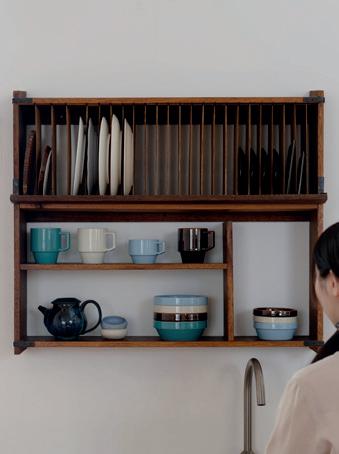
Next up for the brand is the launch of the Keyaki To-Go Coffee Cup on Kickstarter crowdfunding. The campaign will run from 14 May to 28 June. The cup is shaped like a familiar take-out cup but is made entirely of zelkova wood, which is carved by hand. Instead of using disposable coffee cups for take-out, Artisanal proposes using this reusable wooden cup. The original product was developed in collaboration with a workshop that has been producing Yamanaka lacquerware for four centuries. Fukuyasu concludes; “It’s challenging to achieve the precision required for a perfect fit between the cup and the lid with natural materials. Only traditional Japanese craftsmen possess the expertise to curve the wood with such precision.”
https://artisanal.tokyo/ Instagram: @artisanal.tokyo

June 2024 | Issue 167 | 29 Scan Magazine | Design Profile | Artisanal
Creating beautiful spaces across the globe

From Tokyo to Paris. From Christmas ornaments to modern vases and flowers. From private homes to high-end hotels and spas. You will find the Norwegian-Estonian home décor brand Shishi everywhere. If you happen to be in Tallinn, don’t miss a visit to Shishi’s flagship store nestled in the historical Port Noblessner.
By Heidi Kokborg | Photos: Shishi
When Mart Haber, Taivo Piller, Lili Bendriss and Linda Johnsen founded Shishi almost 30 years ago, they probably didn’t foresee that their products would one day be sold in 81 countries and that they would be decorating renowned hotels, bars, casinos and spas across the globe. Despite the massive success, the team is still down to earth and the heart of the brand is still the same; to offer fresh and interesting ideas for interior decoration.
“We really try to attract the whole planet, and we are currently available in 81 countries,” explain Mart Haber and Taivo Piller, co-founders and owners of Shishi. “Our collections include many different types of materials such as porcelain, iron, fabrics,
glass, and natural materials such as cones and branches. The style leans towards minimalistic, but our products come in all

kinds of sizes and colours to fit every market, yet the style stays the same.”
A world of flowers
From the outset, vases and artificial flowers have been the core of Shishi. Both Linda Johnsen and Taivo Piller are internationally recognised florists and champions in their respective countries as well as world champions, so it was only natural to focus on flowers, plants, and vases.
Shishi’s flowers and plants decorate spas, restaurants, swimming pools, hotels, and private homes internationally. “Artificial plants and flowers are perfect in spaces where there’s not enough daylight or where living plants cannot survive, such as swimming pools and spas because of the chlorine,” say Haber and Piller.
When you hear the words artificial flowers, do you think of those plastic flowers from the early 2000s that look fake?
30 | Issue 167 | June 2024
It’s time to let go of that image. Artificial flowers and plants have come a long way since. “Our artificial plants and flowers are the highest quality and true to nature. And most importantly, they look real. You shouldn’t be able to tell the difference between a real plant and an artificial one, you should be fooled into thinking it’s the real thing,” tell the two co-founders.
Christmas ornaments
If flowers and plants are the heart of Shishi, Christmas is the lungs. Since the beginning, Shishi has offered yearly Christmas collections, but it was not until the 2008 financial crisis that the brand became world-renowned for Christmas decorations in all shapes and sizes. “In 2008, 60 percent of our distributors cancelled their orders, but we couldn’t cancel the orders at the factory. We had an enormous stock of goods, so we looked for new markets. We went to Christmasworld in Frankfurt and later Maison et Objet in Paris. It was a success from the start, and now we are known for Christmas,” say Haber and Piller.
Shishi’s Christmas assortment consists of five different collections, each featuring 400-500 ornaments, so there is an ornament for every taste and home. Whether you are looking for ornaments for the Christmas tree or an actual tree, you will find it here.


more environmentally friendly, and we use less and less plastic, especially single-use plastic,” explain the two owners.
If you are in Tallinn, don’t miss out on a visit to Shishi’s spectacular flagship store located in the historical Port Noblessner. The building was originally used for making batteries and electrical parts for submarines but has been transformed into an impressive store that will inspire you to decorate your own home.
www.shishi.ee / www.shop.shishi.ee
Facebook: Shishi - Home of Beauty
Instagram: @shishi_homeofbeauty

ing every single piece in our collections. And the collections change every year, as the way we live constantly changes. For instance, these days everything is much


Shishi is available in 81 countries and participates in Christmasworld in Frankfurt, Maison et Objet in Paris, and has a permanent showroom in AmericasMart in Atlanta.
June 2024 | Issue 167 | 31 Scan Magazine | Lifestyle and Wellness | Shishi


Handcrafted high-end wood furniture in organic designs
Buttery softwood. Soft and organic shapes. Timeless designs. Premium quality. This is exactly what you get with Artisan, which handcrafts every single piece of furniture and has more than 50 years of experience. Artisan controls the entire production process from the log to the final product and with a zero waste policy, ensuring that you only get the crème de la crème of furniture.
By Heidi Kokborg | Photos: Artisan
Artisan has a deep love for wood. The founder of the company, Fadil Ćostović, comes from a long line of wood carpenters, so it was only natural for him to start Artisan in 2007. However, his love for wood began long before, as a child – with a family tradition of working with wood for more than 50 years, it was simply in his blood.
Fast forward seven years, and Artisan is a successful, thriving company with several awards, providing furniture for Louis Vuitton stores, members of the Dutch Royal family and private customers across the globe. It’s no wonder Artisan is so loved; it works with world-renowned designers and its furniture is simply amazing.
“Our style is soft and minimalistic, it’s very organic with soft, round shapes. Many of our designers are inspired by the female body when they design,” says Armin Huremović, sales director at Artisan. “Our furniture invites you to touch it, it’s so soft that it doesn’t even feel like wood. You can really feel our love for wood.”
Slow and sustainable furniture
Artisan controls the entire production process from the log to the final product. The company sources the logs from forests in Bosnia-Herzegovina and brings them back to the sawmill in Tešanj. Here, the wood is dried naturally for months, until it’s ready to be made into furniture –a process that can take up to a year.
Moreover, the company has a zero-waste and sustainability policy. Huremović explains: “We collect all the sawdust from the wood and compress it to make wooden pallets, so we don’t waste any wood at all. Within the next two years, our packaging will be completely plastic-free.”
Artisan can customise all designs depending on your style, taste, and home. Its furniture is truly a long-term investment that you can pass down to your children and grandchildren.
www.artisan.ba
Facebook: artisanlovewood
Instagram: @artisanlovewood

32 | Issue 167 | June 2024 Scan Magazine | Design Profile | Artisan

NORDIC MUST-READS 7
While perhaps best known for its crime fiction, the Nordic literature scene is an under explored gold mine. These seven reads take place all across the Nordic countries, and offer a diverse, yet captivating glimpse into the rich literary tradition, all while exploring the human condition and culture of each respective country.
By Celina Tran | Photo: Kelly Sikkema via Unsplash
Across the China Sea by Gaute Heivoll Norwegian, 2017
Set against the backdrop of the waning German occupation of Norway, Across the China Sea follows Karin and her family as they move to a small southern village, where they plan to care for those who can’t care for themselves. Their rooms are soon filled with three psychologically unstable men – including Karin’s own uncle – and five siblings whose parents are deemed unfit to raise them, and they all play a part in this new, unconventional family. Heivoll’s portrayal of these gentle spirits navigating an uncertain and often unkind world is tender, gentle, and heartbreaking.
Not Before Sundown by Johanna Sinisalo Finnish, 2003
Captivating and thought-provoking, Johanna Sinisalo’s Not Before Sundown is inspired by Finnish folklore. It follows Mikael, a gay photographer, who finds a young and injured troll – in the novel trolls are existing animals, rather than myths – and brings it home. Broken into novel segments, news articles, jokes, and more, the book challenges the conventional notions of identity while also addressing humanity’s changing relationship with nature.
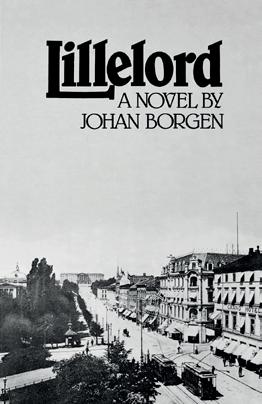
Lillelord by Johan Borgen
Norwegian, 1982
The first in a trilogy (but perfectly fine as a standalone), Lillelord follows the well-behaved and sweet Wilfred Sagen, nicknamed “Lillelord” by his family, who sees him as a “Little Lord Fauntleroy.” To his teachers and some of Oslo’s street boys, however, Wilfred is nothing but a force of disruptiveness and danger. Aware of his split personality, the protagonist longs for control but quickly realises that this might not be possible. The book is a reflection of Johan Borgen’s belief that our lives, whether we like it or not, tend towards schizophrenia, and leave readers with a lot to think about.


We, The Drowned by Carsten Jensen Danish, 2011
Spanning across four generations of seafaring men from the Danish town of Marstal, We, The Drowned is an epic tale, alive and full of wisdom and tension. Don’t be intimidated by the almost 700 pages, the various storylines offer a panorama of history, passion and adventure, and has been hailed as an instant classic.

34 | Issue 167 | June 2024 Scan Magazine | Lifestyle | 7 Nordic must-reads
Photo: Graywolf Press
Photo: New Directions Publishing Corporation
Photo: Peter Owen LTD
Photo: Vintage (Penguin)

Girls Against God by Jenny Hval Norwegian, 2020
Set in rural Norway in the 90s, Hval’s thought-provoking Girls Against God merges feminist theory with experimental horror, as well as literary and artistic expression. There are neat and pristine white picket fences in Christian conservative homes, but also witches, time-travel, and an Edvard Munch who’s pursuing a dream of playing in a black metal band. In its own unique fever-dream-like way, this is a tale of womanhood, religion, life, desire and capitalism.

This Should Be Written in the Present Tense by Helle Helle Danish, 2015
This should be written in the present tense, but it isn’t. Dorte, the book’s narrator, should probably go to her classes at the University of Copenhagen, stop sleeping with her neighbour’s boyfriend, and start doing something, but she doesn’t. Using Dorte’s random, stream-of-consciousness scribbles to move through the narrative, which is efficient in making the reader painfully aware of how unsure the protagonist is about the big picture of her life. It has a minimalism that Beckett fans can appreciate and is a perfect example of how Helle Helle has the ability to make any character completely enthralling, even without extravagant plots or language.

The Family Clause by Jonas Hassen Khemiri Swedish, 2020
Against the backdrop of contemporary Stockholm, a series of quickly changing perspectives portrays the chaos and closeness of a normal family wounded by the disappearance of a father and the death of a child. A prize-winning author and master of contemporary Swedish literature, Khemiri takes a perfectly normal family and paints an intimate, emotional portrait.
June 2024 | Issue 167 | 35 Scan Magazine | Lifestyle | 7 Nordic must-reads
Photo: Vintage (Penguin)
Photo: Verso Books
Photo: Vintage (Penguin)
Simple summer cake
Summer is often a time for celebration. Vacations, graduations, birthdays – there are many reasons to celebrate. And is there a better time to celebrate than this season? The long, warm summer evenings are perfect for gathering all your friends and family. Or maybe an afternoon get-together with coffee and cake. Catch up and let the kids play together in the garden. It’s not just the big things that deserve to be celebrated though, why not honour a special friendship or the arrival of summer? No matter who, what and how you want to celebrate, you just need a simple and tasty cake recipe. A straightforward one that also amateur bakers can master. My favourite cake requires few ingredients but is both delicious and beautiful in all its simplicity.
By Sofia Nordgren
Amount: the cake recipe makes 1 layer, you need 2
Ingredients:
Cake
150 ml aquafaba (chickpea broth) or 3 eggs
110 g caster sugar
105 g all-purpose flour
1 tsp baking powder
Filling
100 ml heavy cream (milk or plant-based), whipped 10-15 strawberries, cut in slices
Topping
100 ml heavy cream (milk or plant-based), whipped Fresh summer berries, e.g. strawberries, currants and raspberries
Instruction:
1. Preheat the oven to 200°C.
2. Add aquafaba (or eggs) and caster sugar to a bowl and beat until fluffy.
3. In a separate bowl, combine all-purpose flour and baking powder.
4. Add the flour mixture to the aquafaba and stir until smooth.
5. Line a 15 cm cake pan with baking parchment and pour the batter into the pan.
6. Bake in the middle of the oven for about 20-30 minutes, or until light golden.
7. Let cool for about 15 minutes in the pan, then transfer the cake to a wire rack and let cool completely.
8. Repeat steps 1-7 to make a second cake layer.
9. Assembly: Place one of the cake layers on a cake stand. Cover with strawberry slices and a thick layer of whipped cream. Place the second cake layer on top and cover it with whipped cream. Top with fresh summer berries of your choice. Serve immediately!


Winner of the best Regional Cookbook at the Guild of Food Writers Awards 2022, Sofia Nordgren lives with her family in a small town in Sweden, working as a photographer, content creator and plant-based cookbook author. Cooking and baking have always been a hobby of hers and on top of that, she has a passion for nature, gardening and slow, seasonal living. Foggy mornings, cinnamon buns, and playing with her kids are among her favourite things in life. Sofia Nordgren also runs the successful blog, The Nordic Kitchen.
36 | Issue 167 | June 2024 Scan Magazine | Lifestyle | Food Column

What’s the deal with hybrid beers?
You might have seen hybrid beers popping up all over the place. But what are they? Basically, hybrids are a little bit of this and a little bit of that – they don’t follow convention. It’s more of a freestyle approach to achieve certain characteristics in the finished beer, however not necessarily something never seen before. Some socalled hybrids are in fact old beer styles defined by the region where they originate.
You might have seen hybrid beers popping up all over the place. But what are they? Basically, hybrids are a little bit of this and a little bit of that – they don’t follow convention. It’s more of a freestyle approach to achieve certain characteristics in the finished beer, however not necessarily something never seen before. Some so-called hybrids are in fact old beer styles defined by the region where they originate.
Brewing hybrid beers usually involves using yeast intended for a different type of beer and fermenting at a different temperature. Kölsch is a good example, a German beer brewed with ale yeast and held at cold temperatures, like a lager. And California Common, an American beer style also called Steam Beer, is another hybrid – usually brewed with lager yeast that works better at
warmer temperatures, like an ale. But let’s not dive any deeper into the brewing process, or we might be lost forever.
IPA seems to be a favourite for brewers as a base to experiment. In the past few years, we’ve seen Brut IPA, Cold IPA, and White IPA. In my latest beer column, I wrote about West Coast Pilsner, a mix of a hoppy West Coast IPA and a crisp German Pilsner. Hybrid or not, there’s a lot more to try in terms of non-conventional beers; vegetable beer, pumpkin beer, herb and spice beer, honey beer, smoked beer, and much more. And brewers never tire of experimenting, that’s for sure.
I’m not against the hybrid concept. On the contrary, I find it quite fascinating. Perhaps it’s because I don’t like to follow conventions myself, I prefer not to be put into a certain category. I’m a born Swede, a former Londoner, an
By Malin Norman
adoptive Mallorquin, a digital nomad, a writer, a runner, a dreamer, and so on. I wonder what kind of hybrid beer I would be?

Malin Norman is a Certified Cicerone®, a certified beer sommelier, an international beer judge and a member of the
June 2024 | Issue 167 | 37 Scan Magazine | Lifestyle | Beer Column
Photo: Unsplash
British Guild of Beer Writers.

Nybroe Smørrebrød: 20 years of Danish delights
With two successful restaurants in Stockholm’s Östermalm district, Nybroe Smørrebrød has treated hungry visitors to traditional Danish smørrebrød and pilsner for two decades. A pared-back offering with great service, delicious food and every detail considered, Nybroe Smørrebrød is proof that simplicity really does go a long way.
By Emma Rodin | Photos: Nybroe Smørrebrød
When Jarmo Tammisto started Nybroe Smørrebrød all those years ago, serving Danish smørrebrød in a classic, Swedish setting was something unique. However, the concept itself was familiar as open sandwiches in various forms are undoubtedly a Nordic staple. That’s why, perhaps unsurprisingly, the first restaurant which opened in Stockholm’s historical market hall Östermalmshallen quickly gained traction to become a hotspot for regulars and international visitors alike. A reputation that remains to this day.
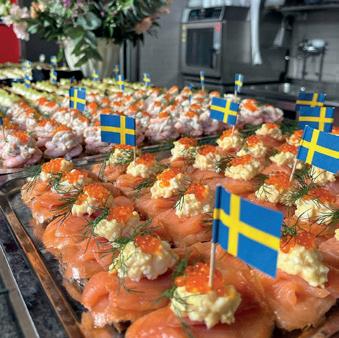
“It has been quite the journey over the past two decades,” tells current owner Vincent Vintilescu who joined Nybroe Smørrebrød as a 19-year-old intern. He took over the reins from Tammisto in 2020 and has since successfully grown the business, which Tammisto is still a big part of. “We’ve moved in and out of the market hall multiple times, successfully kept trading throughout the difficult COVID times, and have opened a second restaurant in Hötorsghallen, a stone’s throw from our original venue.”
When asked what lies behind the restaurants’ success, Vintilescu explains that his team has always remained focused on their path and maintaining a high level. And aside from great-tasting food, there’s an emotional side to the service that continues to draw people in. “We’re
38 | Issue 167 | June 2024
Enjoy classic Danish smørrebrød in a vibrant setting.

a tight-knit team and together we have built an atmosphere that people want to be part of. We’re open, we make time to chat with every guest, and we’re anything but pretentious. The biggest reward for us, and proof that we’re doing something right, is that our guests want to come back for more.“
So, what is smørrebrød, really?
Smørrebrød is a type of sandwich with a rye bread base, topped with a combination of Scandinavian staples such as prawns or cod with different additions. Whatever the topping, the perfect smørrebrød should feature salty, sweet, umami, fresh and tangy elements, and it’s all about equal measures of consistency and quality. “To us, smørrebrød is a handicraft which is crystalised by a dedication to making everything ourselves, on site. We even have a full-time employee whose sole role is to source and

provide the best possible prawns every day,” explains Vintilescu.
What’s more, smørrebrød is versatile. Indeed, it can be enjoyed for breakfast and lunch as well as for a sit-down dinner. It’s also the ideal choice in summertime. There’s nothing like a bite of smørrebrød and a beer on a hot summer’s day. And the restaurant in Östermalmshallen has a welcoming patio where guests can enjoy their food while watching the world go by. “Another thing about smørrebrød is that it transcends generations as it’s something everyone has a connection to. I love seeing a family or group of younger and older members enjoy a meal at our restaurants together,” says Vintilescu.
A delicious dose of culture
Food and drinks aside, both restaurants showcase local art for guests to feast their eyes on. “We rotate our art every six

but I think there’s always room for it,” says Vintilescu. “So, here at our restaurants, singing is always encouraged. In fact, I don’t mind singing a little song myself.”
A proud part of Stockholm’s incredible food offering, Nybroe Smørrebrød is now set to open a third restaurant within the next year. An expansion led by Vintilescu, who has explored food scenes all over the world. The actual concept of this new venture is still undecided, however. Will it be more smørrebrød or something entirely different, like Japanese food? Only time will tell. But one thing is certain, no matter the culinary direction, the new restaurant will join the others in offering fantastic service, delicious food and an unbeatable atmosphere.
www.nybroe.se
Facebook: Nybroe Smörrebröd
Instagram: @nybroesmorrebrod

June 2024 | Issue 167 | 39 Scan Magazine | Culinary Profile | Sweden
Vincent and Jarmo, the duo behind Nybroe Smørrebrød.
Drinks crafted with love in Northern Europe
MULL° drinks is tapping into the global trend of mindful consumption. As more consumers worldwide move away from alcoholic beverages in search of sophisticated non-alcohol alternatives, its range of tasty drinks is set to take the world by storm.
By Ndéla Faye | Photos: MULL° drinks
Estonia, despite its small size, has emerged as a vibrant hub of innovation. The country is known for its pristine natural landscapes and clean air. It’s also home to MULL° drinks, a company crafting Estonian sparkling wines and alcohol-free sparkling drinks.
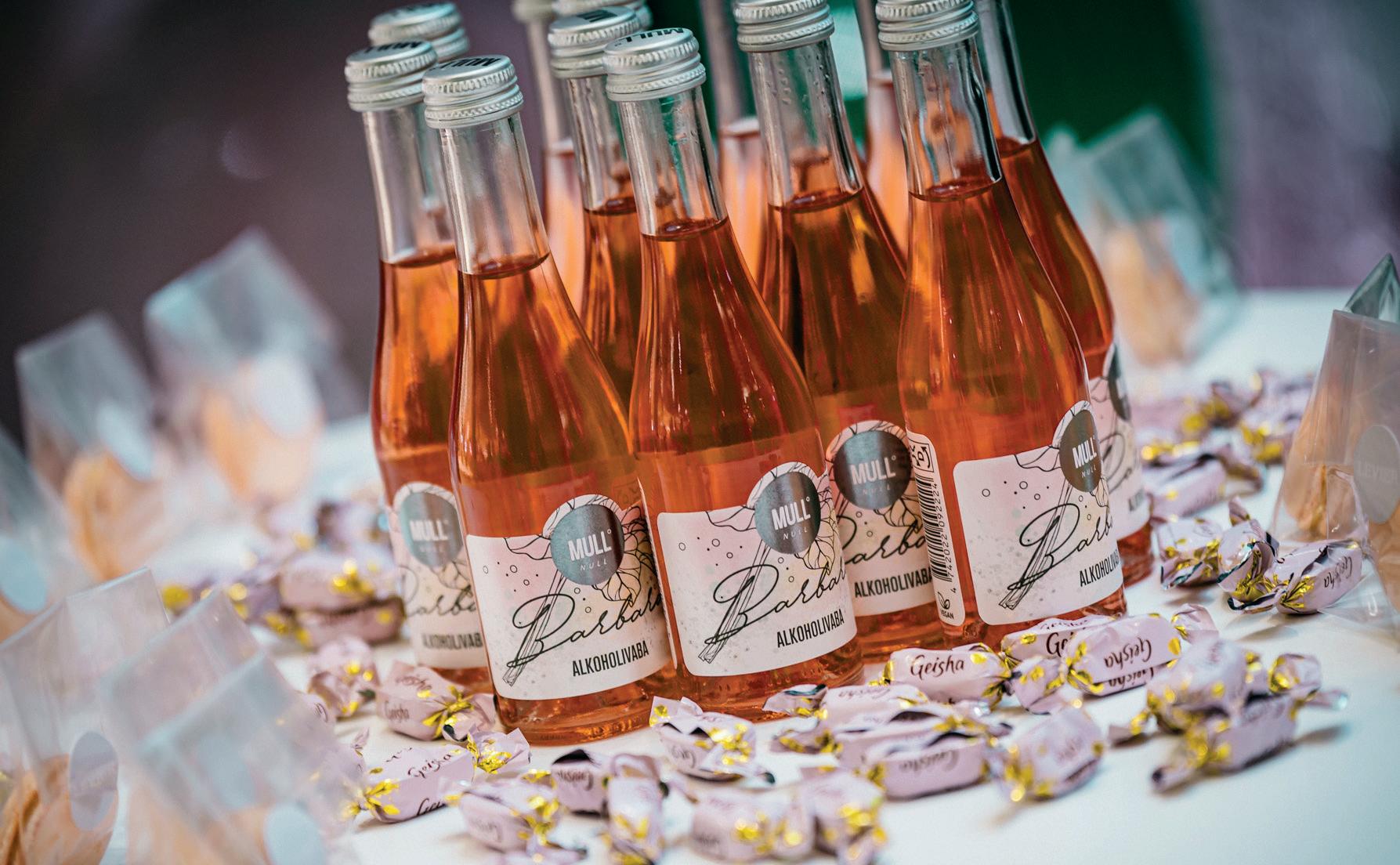
Although MULL° drinks is a small business, it has grown to become a leading brand – known for its non-alcohol drinks in particular – in Estonia. The company’s alcohol-free line, including the market-leading MULL° NULL range, delights
consumers with its bubbly, semi-dry sparkling drinks, showcased in a sumptuous champagne bottle and made from

a blend of local fruits without any added preservatives or flavourings.
Market leader of a global trend
MULL° isn’t just in the business of crafting exceptional beverages; it wants to foster a culture of mindful consumption. In recent years, a new global trend has emerged where consumers are moving away from alcoholic drinks and increasingly seeking non-alcohol alternatives. Recognising that people are seeking higher quality experiences, the company aims to provide alternatives that allow individuals to enjoy their life to the fullest.
“We have noticed a shift towards consumers wanting more choice when it comes to alcohol-free drinks, and es-
40 | Issue 167 | June 2024
pecially younger people seem to be increasingly looking for alternatives to alcohol,” says Lauri Sild, founder and CEO.
Long gone are the days when consumers would have to be content with juice or tap water. “Nowadays, there are plenty of options available to alcohol and we’re excited to be ahead of the curve with our alcohol-free drinks range,” he continues.
Endless love for rhubarb
At the heart of the company’s philosophy is a commitment to using carefully selected raw materials, infused with passion and a deep belief in the excellence of the product. Recently, the company has expanded its sales, with products currently sold in Australia, Korea and Japan. “We have become a household name in Estonia and our drinks are being served in Michelin-star restaurants and embassies around the world. Next, we’re looking at expanding into even more countries,” Sild states.
According to Sild, rhubarb is a relatively unknown and underutilised ingredient in some countries and he wants the rest of the world to discover its beauty and fantastic taste. “We adore rhubarb. It’s a versatile ingredient, and organic rhubarb
juice makes a great base for our drinks,” he explains. “In Estonia, rhubarb is the same as grapes in France, you can make lots of things from it and it produces excellent, refreshing and full-bodied drinks with nuanced flavours. Our well-balanced dry sparkling drinks feature the best of what rhubarb has to offer.”
MULL° also has a range of alcoholic sparkling wines, which are made from rhubarb and mixed with berries. “As with all our products, quality comes first. And, true to our style, our alcoholic beverages also contain no added sugar or artificial flavourings,” the CEO confirms.


“We’re in the business of creating high-quality and tasty beverages and we don’t skimp on the quality of the ingredients we use. Our success is a testament to the excellent taste and craftsmanship in our products, and our range represents pure indulgence for our customers. We’re excited to be expanding our reach and introducing our flavours to new audiences,” he concludes.
www.mulldrinks.com/en Instagram: @mulldrinks


June 2024 | Issue 167 | 41 Scan Magazine | Culinary Profile | Estonia


The art of making gourmet caramel popcorn
Ástrík Poppkorn makes popcorn unlike anything you have tasted before. Made with simple, high-quality ingredients from Iceland, the popcorn will delight your taste buds. Whether paired with your afternoon coffee, a glass of bubbly, a cheese platter, or enjoyed during a traditional Friday movie night with the family, the popcorn is sure to please.
By Heidi Kokborg | Photos: Ástrík Poppkorn
Gone are the days when popcorn was solely reserved for movie nights. With Ástrík Poppkorn you can enjoy caramel popcorn with your coffee, a glass of champagne, wine and cheese, or how about a popcorn bar at your next party? Based in Iceland, Ástrík Poppkorn is a small company with a big heart. “Ást” means love in Icelandic, and “rík” means rich, which perfectly describes what you will experience – rich popcorn made with love.
“The majority of ingredients are cultivated with care right here in Iceland, ensuring the highest quality,” smiles Asthildur, founder of Ástrík Poppkorn. “We use sea salt and butter from Iceland and make the caramel from scratch, the old-fashioned way. And our popcorn is completely free of preservatives, genetically
modified components and other harmful substances.”
Flavours for every palate
Ástrík Poppkorn only makes the delicious popcorn by order, using simple and highquality ingredients. As no additives or preservatives are involved, this ensures that nothing goes to waste and you will receive freshly made popcorn, every time. “I firmly believe in the power of small batches,” says Asthildur. “It’s about crafting each batch meticulously, infusing it with care and attention, something that’s just not feasible with large-scale factory production.”
While salty caramel popcorn is the signature flavour, you can also treat yourself to decadent vegan coconut, Turkish pepper, liquorice, or how about cara-
mel and rosemary? There’s a flavour for every palate. Ástrík Poppkorn also caters to events, such as weddings, parties and confirmations, and the tasty popcorn is a delightful treat in gift bags for friends and family, or business partners.
www.astrik.is
Facebook: Ástrík Gourmet Poppkorn
Instagram: @astrikgourmetpoppkorn

42 | Issue 167 | June 2024 Scan Magazine | Culinary Profile | Iceland


THE ULTIMATE IN SUSTAINABLE LUXURY
Arctic Roe of Scandinavia is the pioneering producer of the world’s most unique delicacy, Black Caviar, produced without a single fish having to die. Sturgeons have become extinct and making Black Caviar without killing the fish aids in the recovery and survival of the world’s sturgeon population. A microchip is affixed to each sturgeon so its growth curve and harvests can be monitored over a decade or longer. Every second year, the females are milked for caviar, and on each caviar tin or jar sold, the name of the individual female sturgeon and the date of production are printed on a label.
The female sturgeons occupy an abandoned paper mill in southern Sweden on the banks of the
massive river Lagan that empties into the North Sea. The aqua system at Arctic Roe recycles more than 99% of the daily water consumption, and on-site wells provide water for the property. Swedish Black Caviar can be found in several Guide Michelin restaurants, fish delicacies and retail stores. It can also be ordered directly from the company.
Arctic Pearl Caviar by Arctic roe of Scandinavia was served to 1,350 guests including the Swedish Royal family and all Nobel prize laureates at the Nobel Prize Award dinner on December 10, 2023 in Stockholm City Hall.
www.arcticroe.com | info@arcticroe.com
SWEDISH BLACK CAVIAR
SWEDISH BLACK CAVIAR THE ULTIMATE IN SUSTAINABLE LUXURY SWEDISH BLACK CAVIAR THE ULTIMATE IN SUSTAINABLE LUXURY
SpecialTheme: NORWEGIANSUMMER DESTINATIONS

Norwegian summer destinations
Now is the time when nature is at its lushest. You can go kayaking on the stunning fjords, go hiking in the majestic mountains, or head to the beach. Did you know that Norway has the world’s second longest coastline? The beach is never far away and there are thousands of islands, lakes and rivers to explore.
By Malin Norman | Photo: Raimond Klavins via Unsplash

In this issue, we get to know the natural beauty and culture of Vindafjord, the charming municipality in Haugalandet. With spectacular outdoor activities in stunning nature as well as plenty of cultural experiences, this is a fantastic summer getaway. And nestled amongst blue fjords and mountain ranges, Evenes in Nordlandet offers spectacular countryside and intriguing cultural events. With Narvik and Harstad just 50 minutes away and Sweden half an hour’s drive, this is a great starting point to explore the dynamic region of Northern Norway.
Tucked between majestic mountains and beautiful islands, Sandnessjøen is an underexplored pearl along Helgelandskysten. Here, you will find for instance the hat-shaped mountain Torghatten, the mountains of Træna, and the Seven Sisters mountain range. Last but not least, Aquarama is a hugely popular waterpark and spa in Kristiansand. With a range of fun activities and experiences, this is a water paradise not to be missed.
Whether you want peace and tranquillity or fun and adventure, there is something in store for you in Norway this summer.
www.visitnorway.com
Instagram: @visitnorway
June 2024 | Issue 167 | 45 Scan Magazine | Special Theme | Norwegian Summer Destinations

Sandnessjøen: Experience Norway’s coastal jewel
Tucked between some of Norway’s most majestic mountains and beautiful islands, Sandnessjøen is an underexplored pearl along Helgelandskysten. Whether you want peace and tranquillity or fun and adventure, Sandnessjøen has something in store for you.
By Celina Tran
Along the Norwegian coastland, the northern city of Sandnessjøen is surrounded by some of Norway’s most beautiful natural sights, such as the hat shaped mountain Torghatten, the mountains of Træna, and of course the incomparable Seven Sisters mountain range, with its seven distinct peaks rising from the sea. The mountains offer fantastic opportunities for hiking, being easily accessible and with varying degrees of difficulty, and are also ideal for day trips.
“We’re located in the middle of the Helgeland Coast in Nordland, making us a
perfect base for travellers not just here but also in the surrounding areas. There’s easy access to all the most sought-after sights and experiences,” says Trine Mathisen Vassvik, cultural consultant in

Alstahaug municipality, in which Sandnessjøen is located.
While the natural sights bring hikers and travellers from all over, many tend to overlook the rest of Sandnessjøen, thinking perhaps that the landscape might be the only thing the area has to offer. In reality, the city is a hub for culture and history, not to mention a summer full of fun activities.
Swing into summer with music and Vikings
Odd Arnold Skogsholm, head of culture in the municipality, explains that Sandnessjøen has a long and rich history stretching back to before the Viking ages, with evidence of settlements from over 4,000 years ago, and further excavations show permanent settlement as early as the year 800.
46 | Issue 167 | June 2024
Photo: Hans Petter Sørensen – FarOutFocus
Photo: Scandic Syv Søstre


“Alstahaug church, which is one of the seven preserved medieval churches in Northern Norway, was built around the year 1200, possibly before,” says Skogsholm.
“From the 1300s to 1738, it was Helgeland’s ecclesiastical centre, and today it’s co-located with the Petter Dass Museum, designed by Snøhetta.” Often considered the foremost Norwegian priest and poet of his generation, Petter Dass served as one of the most important figures in Danish-Norwegian literature from the 1600s.
“Visitors seeking history will not be disappointed,” he assures. “Sandnes, for example, was an important location dur-
ing the Viking Ages, and today visitors can experience the Viking Chiefdom seat, which is mentioned in the saga about Egil Skallagrímsson.”
Sandnessjøen’s position along the coast means that it has served as an important location for as long as the area has been inhabited. Fishing, seafaring and trade have always been and continue to be important to the city. “Today, we remain a hub for seafarers, with boats to many of the surrounding areas on a daily basis, such as the World Heritage Site, Vegaøyene, and this year’s European Culture Capital, Bodø,” adds Vassvik.


June 2024 | Issue 167 | 47 Scan Magazine | Special Theme | Norwegian Summer Destinations
Photo: Emil Sollie
Photo: Scandic Syv Søstre
Photo: Inge Ove Tysnes
Photo: Ketil Born
Harbour festival and culture centre
Sandnessjøen has always served as a port of call for the Norwegian Coastal Express, and the harbour is important to its locals. The people of Sandnessjøen are proud of their history and local businesses and treat the harbour as more than just a place of work.
“We have one of the largest harbours in northern Norway and the sea has always been important to us. Because of its historic and contemporary importance, the harbour also serves as a cultural meeting point,” Skogsholm explains. “We also celebrate an annual harbour festival, which is a two-month-long music festi-

val. Visitors to Sandnessjøen can expect a lively summer!”
The cultural programme is not limited to the warmer season. At Kulturbadet, the municipality’s local culture centre, there are activities for people of all ages, ranging from music and literature to film and theatre. At Kulturbadet, visitors have access to traditional culture centre activities, but also a cinema, library, art gallery, and a water park. “My favourite thing about living in Sandnessjøen is the easy access to anything one might need, including a rich and vast culture scene,” says Vassvik.
Kick back, relax and eat your heart out
For guests travelling from far away, there are different opportunities for overnight stays, all depending on preference. The beautiful wilderness offers great camping opportunities, but if you’re looking for something a little bit more comfortable, there’s a range of hotels and inns, such as the Scandic Syv Søstre Hotel. It’s attached to Kulturbadet, making it a great base with access to everything. The hotel is located near the harbour and offers a view of the mountains on one side and the sea on the other.
Travel here!
Sandnessjøen Port – 0.3km away
Sandnessjøen Airport – 11km away
Mosjøen Train Station – 60km away
Mosjøen Airport – 69km away

48 | Issue 167 | June 2024 Scan Magazine | Special Theme | Norwegian Summer Destinations
Photo: Kristoffer Mollevik
Map: Visit Helgeland

“At Scandic Syv Søstre, we work with the local area to showcase everything Sandnessjøen has to offer. Naturally, there’s a range of activities available on-site, being attached to Kulturbadet and all, but we also like to host different events ourselves,” says Sara Karlsen, sales and marketing manager at Scandic Syv Søstre.
Working with local producers and farms, the hotel likes to host themed culinary evenings with inspiration from the local areas. Steak nights, Dinner in the Dark, and immersive theatre experiences are some of the possibilities at the hotel.
In addition to the hotel’s own restaurant, the culinary possibilities in Sandnessjøen are endless. “Many of the other local hotels, such as Napoli Hotell og Restaurant and Havkanten Gjestehus, also offer great gastronomic experiences.
Furthermore, there are wonderful restaurants and pubs such as Restaurant Soprano, Frk. Lovise, Helgeland Kolonial, Onkel Oskar, and many more,” Karlsen says. “That’s the wonderful thing about Sandnessjøen; no matter what you’re looking for, there’s something here for everyone.”
www.alstahaug.kommune.no Facebook: Alstahaug Kommune Instagram: @alstahaug
www.kulturbadet.no Facebook: Kulturbadet Instagram: @kulturbadet
www.scandichotels.no/hotell/norge/ sandnessjoen/scandic-syv-sostre Facebook: Scandic Syv Söstre Instagram: @scandicsyvsostre
www.visithelgeland.com


Overnatting www.sandnessjoenovernatting.no Napoli Hotell og Restaurant www.napolihotell.no
June 2024 | Issue 167 | 49 Scan Magazine | Special Theme | Norwegian Summer Destinations Other local hotels to check out: Havkanten Gjestehus
Skogsholmen
Sandnessjøen
www.havkanten.no
Gjestehus www.skogsholmen.no
There are plenty of ways to experience the Seven Sisters – hiking, kayaking, or maybe just glancing at them from a restaurant in the city. Photo: Johanne Tysnes
Swing into summer with the many concerts that take place over the season. Photo: Kenneth Solfjeld
Photo: Johanne Dahl Tysnes
Photo: Emil Sollie

Explore the natural beauty and rich culture of Vindafjord this summer
The charming municipality of Vindafjord in Haugalandet is a true hidden gem. Offering a range of spectacular outdoor activities in Norway’s stunning nature as well as plenty of cultural experiences, Vindafjord is the ideal summer getaway.
By Maria Sødal Vole
You’ll find Vindafjord in Haugalandet in the northern part of Rogaland, a traditional district in West Norway known for its breathtaking natural beauty as well as its rich history and cultural heritage. “Surrounded by beautiful fjords and mountain peaks, Vindafjord offers plenty to see and experience,” says Ane Kesia Eide Fatland, culture manager at Vindafjord municipality. “Here, you can enjoy Norway’s fjords, mountains, forests, cultural landscape and wonderful people.”
Vindafjord municipality consists of nine villages; Skjold, Vats, Vikebygd, Bjoa,
Ølensvåg, Ølen, Sandeid, Vikedal and Imsland. The vibrant villages offer interesting and exciting experiences for travellers, each unique with its own individual charm. “With so many villages with their own characteristics to explore, you have a fantastic opportunity to experience Norway’s traditional rural culture,” says Eide Fatland.
A snapshot of Norway
In Vindafjord, there’s something for everyone, whether you’re interested in adventures in nature, diving into local culture and history, or sampling the local
fare. This is a hub of cultural experiences and activities for people of all ages. A visit to Vindafjord Museum in Vikedal, where visitors can gain valuable insight into local history and traditions, is highly recommended. At Unni Marie Rosemaling in Ølen, you can admire the art of rose painting, a much-loved traditional Norwegian folk art. History lovers will be interested in exploring the cultural trail at Bjoa, which features fascinating cultural heritage monuments including petroglyph fields.
The local cuisine is not to be missed. Plassabakeriet in Vikebygd is located by the waterfront along the stunning Ålfjorden and is famous for its delicious cinnamon rolls. Dating back to 1842, this is one of the oldest traditional bakeries in Norway still in use. For those looking
50 | Issue 167 | June 2024
Vindafjord Bibliotek is a modern, three-story library in Ølen. Located in the exciting culture and learning centre Sjøperlo, the library is a natural meeting point for locals and is often busy during summer. Photo: Trond Ove Alvseike
for a unique place to stay or to sample local food, Nesheimstunet is the perfect destination. The historic area of Nesheim dates back to the 1400s, and Nesheimstunet farm is a tranquil setting for visitors to enjoy a tasty home-cooked meal made from local ingredients or spend the night in the charming sleeping quarters.
The family-run farm Øvregård in the village of Imsland is also well worth a visit. Located in the heart of Vindafjord, Øvregård focuses on traditional farming and flatbread making. Farmer Anita Øvregård has won an award for her work to preserve traditional local knowledge and practices as well as her efforts to make the local community a wonderful place to live. “We place emphasis on preserving our history and cultural heritage,” says Eide Fatland. “So we’re grateful to have so many dedicated locals who keep our culture alive.”
Experiences in nature
Vindafjord is an underrated pearl of coastal Norway. The area benefits from a long coastline and a landscape that offers diverse experiences in the outdoors.
“Nature in Vindafjord is a mix of coastline, forest and mountains,” says Eide Fatland. “There’s a wide range of outdoor activities for people of all ages and abilities.”


The area is great for cyclists, who can spend a lovely day cycling from one village to the next. There are fantastic opportunities for hiking and mountain climbing too, with over 100 marked trails across the nine villages. The hike to the traditional mountain lodge Olalia Fjellstove is especially popular among locals and tourists, as well as hiking to the cab-

in Vadhytta. Mountain hikes to Gråhorgja, Hellandsnuten and Sjurstøl are also highly recommended.
Excellent boating and water-related activities await in this coastal region. Visitors can enjoy boat rides and the atmosphere in the area’s harbours, most of which are teeming with activity in the

June 2024 | Issue 167 | 51 Scan Magazine | Special Theme | Norwegian Summer Destinations
Traditional stone peat huts in Fjellstøl. Photo: Trond Ove Alvseike
Vindafjord Bibliotek is a modern, three-story library in Ølen. Located in the exciting culture and learning centre Sjøperlo, the library is a natural meeting point for locals and is often busy during summer.
Photo: Silje Holden Birkeland
Vindafjord has fantastic nature, with plenty of lush greenery, flora and fauna.
Photo: Trond Ove Alvseike
Those interested in the beautiful art of rose painting can visit Unni Marie Rosemaling in Ølen. Here, you can purchase unique pieces and take part in a rose painting course.
Photo: Ane Kesia Eide Fatland


summer. The many fjords, lakes and rivers also offer spectacular opportunities for fishing – Storavatnet lake and Yrkjesfjord are particularly popular spots. Visitors can enjoy summer to the fullest on the beautiful beaches, and taking in the vista of Vindafjord is a must – the area is named after this fjord.
A lively summer scene
While Vindafjord is amazing all year round, the summer season is an ideal time to experience the area. The vi -

brant culture and arts scene is busy, with various festivals across the nine villages. Vikedal Roots Music Festival (18-20 July) attracts plenty of locals and international visitors. Vikedal is one of the most popular destinations in the area, with a lovely beach and fantastic camping facilities. The village also has a well-developed autocross track where national motocross competitions have taken place, and an exciting new pump track has recently been unveiled.
Its location makes Vindafjord the perfect base for exploring the best of what Rogaland has to offer. Travellers can enjoy a scenic boat ride to visit Bergen and Stavanger, and there are lots of great day trips in the local area. With a trip to Vindafjord, you can truly experience the rich and varied natural and cultural landscape of Western Norway!
www.vindafjord.kommune.no
Facebook: Vindafjord kommune
Instagram: @vindafjordkommune
52 | Issue 167 | June 2024 Scan Magazine | Special Theme | Norwegian Summer Destinations
Vikebygd is located by the beautiful fjord Ålfjorden. Photo: Trond Ove Alvseike
Plassabakeriet in Vikebygd is famous especially for its delicious cinnamon buns. Photo: Trond Ove Alvseike
Vikedal has its own autocross track, which has been the site of national motocross competitions. Photo: Trond Ove Alvseike


A water paradise of fun and relaxation for people of all ages
With its stunning location overlooking the Skagerrak Strait, Aquarama is a hugely popular waterpark and spa in Kristiansand. Offering a diverse range of fantastic activities and experiences, this is a summer destination not to be missed.
By Maria Sødal Vole | Photos: Aquarama
You will find Aquarama by the idyllic Bystranda beach in the beautiful summer city of Kristiansand. With its stunning location by the sea, this is the biggest indoor water park and spa in South Norway, and it’s a fantastic spot for your summer vacation.
At Aquarama, visitors can enjoy a varied selection of activities, ranging from baby swimming to water-based activities for seniors. “Our motto and mantra is to be a place for everybody,” says Caroline Hansen, marketing manager at Aquarama. “We want to create an inclusive environment where everyone can feel welcome and enjoy themselves.”
The water park features both indoor and outdoor pools, saunas, and whirlpools, as well as many child-friendly slides and fun features such as a surf wave, diving tower, wave pool, and an exciting obstacle course. Visitors can explore a luxurious spa featuring a range of restora-
tive and therapeutic saunas, cold baths, heated pools, and a refreshing sanarium with air infused with etheric oils.
Aquarama recently unveiled an eye-catching new area designed to give guests even more opportunities to enjoy outdoor activities and take in the spectacular scenery. Featuring even more pools with different features, it’s a versatile and attractive environment for relaxation and activities.
The largest of the three outdoor pools has a temperature of 28°C for training on weekdays and a warmer temperature of 32°C during weekends for well-being, play, and recreation. The bottom of the pool can be raised and lowered according to the desired depth and can also be tilted for a beach vibe. The outdoor area can be enjoyed even on cold winter days and features a 38°C hot pool with automatic massage jets.
Aquarama is open year-round, but the summer season is especially fun. This summer, a new outdoor kiosk will open for guests to purchase tasty food and drinks as a fun addition to the existing indoor restaurant. “We look forward to welcoming new and regular guests to a summer filled with fun, relaxation, and memorable experiences,” says Hansen. “We’re always working to ensure that our guests have a safe and pleasant experience with us, and we’re excited to create wonderful memories together!”
www.aquarama.no
Facebook: aquaramakrs
TikTok: @aquaramabad
Instagram: @aquaramakrs

June 2024 | Issue 167 | 53 Scan Magazine | Special Theme | Norwegian Summer Destinations
Aquarama’s new outdoor area features three swimming pools, including a 10x25 metre pool for exercise and play and a hot pool with automatic massage jets for relaxation.
Aquarama’s peaceful spa provides plenty of opportunities for rest, relaxation and restoration.
At this water paradise, you´ll find 5 different but fun water slides. Fun for all ages.
Aquarama is the perfect spot for water-loving kids and adults of all ages
Among the many fun, actionfilled activities available, the surf wave is popular.

Spectacular countryside and intriguing cultural events await in Evenes
Located in Nordland and nestled amongst blue fjords and stunning mountain ranges, Evenes offers visitors the chance to experience the natural landscape of Norway at its most pure and peaceful. With strong Sami culture, lively annual festivals, the charismatic cities of Narvik and Harstad just 50 minutes away and Sweden half an hour’s drive, this is a destination in itself and a starting point to explore the dynamic region of Northern Norway.
By Molly McPharlin | Photos: Evenes Kommune
Evenes is home to a thriving local community. A centre of the Ofoten region in north Nordland since 1250, the municipality housed the earliest church and shop in the area and was a natural meeting place for settlers. These days, Evenes hosts events throughout the year for both locals and visitors.
One of the best-known events is Markomeannu, an annual Sami festival that celebrates Sami art and culture
from all over Sapmi, the province of Sami communities located in Northern Europe. Several other festivals highlight activities as varied as milk pail throwing and the Great Boat Race, where selfmade small boats compete against each other in a route that runs between the old and new bridges in the town.
Stunning landscape and activities for all abilities
Torill Helene Larsen, the head of hu-
man resources for Evenes municipality, means that the natural landscape is diverse and full of possibilities. “We have steep mountains and gentle valleys, sheltered birch forests and beautiful coastal landscapes,” says Larsen. For instance, Ofotfjord, one of the longest and deepest fjords in Norway, offers many different types of boating activities.
Local rivers are rich in salmon for fishing, and, for hunting enthusiasts, the forests teem with grouse and moose. Hiking trails are some of the best in the country. In summer, there are hikes for both beginners and more experienced walkers. And in winter, they are accessible for different types of skiers, from those looking for a challenge to others who want to experience a peaceful glide through the snow.
54 | Issue 167 | June 2024
Visitors can enjoy a number of festivals in Evenes.
Extreme winter enthusiasts can visit Lilletinden, or the ‘little tooth’, Evenes’ highest mountain. Even Aurora Borealis is a frequent visitor. “Because we have little light pollution, viewing the Northern Lights above snow-covered mountain peaks is not an unusual sight,” says Larsen.
Something for aviation enthusiasts and plenty more
For fans of aviation history and aeroplanes, Evenes became a regional transport hub when the airport opened in 1973. Nowadays, this is an advanced operational base for combat aircraft, one of three in Norway. Used by both the Norwegian Air Force and NATO, Evenes airport is under further development for a specific purpose; to act as a base for both F35 planes and P-8A maritime patrol aircraft. Investment into Evenes is rapidly expanding and by 2025, the municipality expects to be home to over 800 new employees and soldiers on the base.
And for those interested in local culture, a visit to the Gallogieddi open-air museum is a must. The museum offers visitors a taste of Sami history and culture. Explore a Sami farmyard dating back to the 18th century and learn about reindeer herding, traditionally the main source of livelihood for Sami communities. The museum incorporates a range of buildings and farmhouses, as well as a 2 kilometres long cultural trail where visitors can see different Sami monuments as they hike. The trail itself is also histori-

cally important, once acting as the road into local mountain ranges.
Ultimately, Larsen thinks the diverse experiences Evenes offers visitors make it an ideal place to spend some time, whatever the season. “Evenes has light and dark, calm days in the summer and blizzards and zero visibility in the winter,” she says. “We have lovely sandy beaches and cultural relics and memorials from the Second World War. It’s a place that those who enjoy leisure and others who seek the thrill of reaching a summit can enjoy. There’s something for everyone.”

www.evenes.kommune.no
Facebook: EvenesKommune


June 2024 | Issue 167 | 55 Scan Magazine | Special Theme | Norwegian Summer Destinations
A concert at the Markomeannu festival, celebrating Sami culture. The craggy snow-topped cliffs of the mountains near Evenes.
SpecialTheme HIDDENGEMSAND WEEKENDGETAWAYSIN SWEDEN,2024

A road less travelled: hidden gems and weekend getaways in Sweden
Summer is a great time to discover the road less travelled in Sweden, with lush greenery and warm breezes. Take the opportunity to go off the beaten track, be amazed by the rich history and unassuming cultural experiences, and make sure to enjoy the beautiful coastline and countryside.
By Malin Norman | Photo: Salt & Sill
56 | Issue 167 | June 2024

Every year during one week in August, Visby serves up a treat with the Medieval Week and this year, the theme is set around medieval horses. So if you travel to Gotland this summer, don’t miss the chance to see the medieval markets, action-packed activities such as jousting and archery competitions, and the island’s own breed of horses, Gotland Russ.
In the charming town Falsterbo, in the southwest corner of Skåne, you can see photos by two of the world’s most fa-
mous fashion photographers, Richard Avedon and Herb Ritts, some not previously shown in the Nordic countries. At Falsterbo Photo Art Museum, you can also check out the exhibitions by Gabriel Isak, Johan Lindeberg, Ewa-Mari Johansson, and more.
For a relaxing getaway with wondrous views, head to the Lodge Resort, a romantic hideaway above the treetops. Villa Baro in Östergötland also offers stunning views and one of Sweden’s most famous golf holes, Långa Sjö, Family-run Tof-
ta Manor located on the Tofta peninsula between Gothenburg and Marstrand is ideal for a quiet getaway with family and friends, and for a taste of the sea, Salt & Sill on Tjörn island is home to Sweden’s first ever floating hotel and a renowned seafood restaurant.
Take inspiration from these hidden gems to make your next trip to Sweden unforgettable.
www.visitsweden.com
Instagram: @visitsweden
June 2024 | Issue 167 | 57
The Lodge: a romantic hideaway above the treetops

With breathtaking panorama views, 22 hotel rooms, a locally curated menu and a spectacular spa, The Lodge resort is an experience for all the senses. And with its seasonal approach to everything from food to spa treatments, this is an everchanging getaway for both weekend dwellers and daytime visitors.
By Emma Rodin | Photos: The Lodge
A stone’s throw from Malmö and Lund in Sweden’s south, The Lodge Resort and Spa is perched on top of the picturesque Romeleåsen hillock. A secluded location with eye-pleasing surroundings and wildlife on its doorstep, the location was originally home to a small hunting lodge, the Romele hut, which drew visitors keen to explore nature.
Romeleåsen revived
The Lodge was founded by three friends and adventurers who travelled the world together via hot air balloon as part of the Volvo Ocean Race, including the North American east coast. This trip fuelled the inspiration to start their own venture back home on Romeleåsen, 167 metres above sea level.
In an otherwise flat landscape, this above-the-treetop spot provides miles of unbeatable views over the fields be-
low, as well as glowing sunsets over the city of Lund. Built in New England style, The Lodge welcomed its first guests to Romeleåsen and its historic hunting grounds in 2006.
“We think it’s important to cherish the area’s history as part of what The Lodge stands for,” says Tove Gejde, hotel manager. “You can see this in the buildings themselves, but in our food offering too,

like our delicious stick bread with sourdough and herbs. It’s an elevated take on a simple, coal-fired bread that many guests will recognise from their childhood outings. It’s become a defining dish for us, and you can see the excitement in people’s eyes when they spot it on the menu.”
Stairway to Heaven
Aptly named Heaven, The Lodge’s onsite restaurant offers great food inspired by the surrounding area. Keep an eye out and you might even see one of the chefs foraging for ingredients in the nearby forest, such as spruce shoots and sorrel, then turning these into delicious broths and other delicacies to give diners a proper taste of the land.
Indeed, sourcing local ingredients and collaborating with local producers is key (look out over the fields below and you can see some of them). And so is maintaining a seasonal approach to the menu, always allowing nature to control the reins, while ensuring the highest quality.
New for this season (starting mid-July), The Lodge will also offer daily sittings for its Afternoon Tea Party. Open for book-
58 | Issue 167 | June 2024
ings and drop-ins, this offering is perfect for guests who are stopping by for a quick visit and fancy relaxing on the porch with a glass of cold iced tea in hand.
Aloha Honulele
The Lodge’s award-winning Honulele Spa is an oasis of calm and relaxation. Here, visitors can enjoy an outdoor infinity pool, 12 metres long and heated to 38 degrees. Plus, soak up the surrounding views before or after visiting the cold bath and sauna.
Ideal for day visitors, the Honulele Retreat Spa package includes a four-hour entry and Aloha Spa Ritual. This entails 90 minutes of pure restoration through seven different treatments, inspired by Polynesian knowledge and techniques. A dedicated host offers guidance throughout each treatment, and afterwards, all guests are welcomed into the VIP section to relax on comfortable daybeds while gazing out over the treetops through large, panorama windows.
As with The Lodge’s food offering, the Aloha Spa Ritual is directed by the seasons. For instance, springtime sessions focus on catering for dull winter skin with plenty of peels, while summer treat-


ments revolve around boosting moisture and fresh-looking skin.
“Our spa is open to everyone, whether they’re visiting for the day or an entire weekend. We have a lot of returning

guests who come to make the most of their days off, many of them from Copenhagen, which is only an hour away,” says Camilla Persson, sales, marketing & commercial manager.
A life less ordinary
There are also plenty of walking trails around, ideal to explore the rich flora and fauna of the nearby area. In fact, The Lodge sits on the Skåneleden trail, a 1,250 kilometre long walking trail in Skåne’s countryside. The trail markers literally run next to the hotel and into the wilderness, guiding walkers to beautiful forests, valleys, streams and viewpoints. Those who enjoy cycling are in for a treat too.
At The Lodge, every detail is carefully considered to give guests an overall experience they’ll want to come back to. “With everything we do, we ask ourselves ‘does this give our guests a life less ordinary?’ and if the answer is yes, we know we’re on the right track,” concludes Persson.
www.thelodge.se
Facebook: The Lodge Resort
Instagram: @thelodgeresort
June 2024 | Issue 167 | 59 Scan Magazine | Special Theme | Hidden Gems and Weekend Getaways in Sweden, 2024
Relax by the infinity pool with unbeatable views.
Escape the everyday with a visit to The Lodge.

Celebrating the Medieval Week in magical Visby
Every year, Visby is host to the Medieval Week, Sweden’s largest historical festival. This year’s theme is medieval horses and will bring plenty of four-legged fun, plus medieval markets, live music and jousting, heaps of culinary treats, and much more.
By Malin Norman
During one week in August, Visby is packed with musicians, jesters, knights, craftsmen and some 50,000 curious visitors. They all come to take part in the Medieval Week, which is Sweden’s largest historical festival. During eight fun-filled days, the past is brought to life.
Visby was the main centre of the Hanseatic League from the 12th to the 14th century. The former Viking site is the best-preserved fortified trade city in northern Europe and is a UNESCO World Heritage Site. Since 1984, the Medieval Week is a joyful celebration of this unique heritage,

with activities taking place around town, in museums and churches, on streets and in parks, and even in the old ruins.
“What’s special about the Medieval Week is the atmosphere,” says Simone Duvander, producer and communications manager. “You’re sent back in time with all the experiences that’s on offer. The activities and events during the week are rooted in a love for Visby’s and Gotland’s history, it’s fantastic to be a part of the celebrations.”
Medieval horses, jousting and pipers
This year’s festival theme is medieval horses. The horse was one of the most important means of transport in medieval times, and also a sign of status and wealth. In Gotland, a large number of equestrian graves and pictographs clearly depict the uses and importance of the horse. During
60 | Issue 167 | June 2024
Photo: Nancy Coste
Photo: Therese Hübner

the Medieval Week, the horse’s role will be highlighted in lectures and workshops, and of course in the horse parade. By the way, Gotland actually has its own breed of horses – Gotland Russ.
The most popular event during the festival is the jousting games with brave combating knights in armour. Sweden’s most skilled knights take part, so it’s sure to be an action-filled event. “Jousting is speed and competition, excitement and thrilling entertainment,” says Duvander. During the Medieval Week, the games take place every day and spectators can also watch jousting on Thursdays and Saturdays throughout July.
In addition to jousting and horses, visitors can take part in lectures and workshops, check out the medieval markets, feast on delicious food and drink, and just hang out – many even dress up in medieval costume. Every third year, participants re-enact the Battle of Wisby.
Important to note is that the Medieval Week is a co-created festival. No acts are purchased, everything is staged by
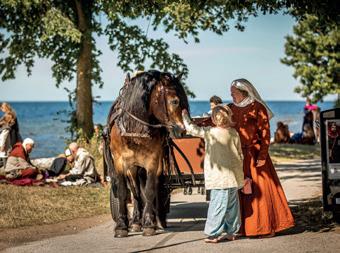
people and groups who want to take part with their particular event. “Last year, we had pipers from Transylvania and a fighting group from Georgia, and we have a band from Germany that joins every year,” smiles Duvander. For visitors and volunteers who want to stay the night, two campsites are available, one modern and one medieval campsite.
Year-round activities and Hanseatic Day
The team behind the Medieval Week is busy throughout the year, with related activities such as Medieval Christmas 6-8 December. The program includes concerts and performances, a Christmas market and a flea market, a fire show and jousting, and more. The team behind the festivals sits in the old pharmacy in Visby, Gamla Apoteket, a 22-meter-high gable house built in the early 13th century. It’s considered to be the best preserved stone house still used as living space in the Nordic region. Visitors are welcome to pop by and take a look. Every Thursday, you can also join them in a sewing circle (syjunta).
Every year, a different Hanseatic city organises celebrations of the historic Han-


seatic League. Next year, Visby will be the host for the International Hanseatic Day, which is set to take place 5-8 June. The event will bring together visitors from all of the world, to celebrate medieval traditions and international understanding, with lots of activities, markets and exhibitions.
www.medeltidsveckan.se
Facebook: Medeltidsveckan
Instagram: @medeltidsveckan


June 2024 | Issue 167 | 61 Scan Magazine | Special Theme | Hidden Gems and Weekend Getaways in Sweden, 2024
The Medieval Week takes place 4-11 August in Visby. This year’s theme is medieval horses.
Photo: Isabelle Mackenzie
Photo: Sarah Rosenquist
Photo: Medeltidsveckan
Photo: Sarah Rosenquist
Photo: Therese Hübner
Photo: Mike Fergusson
Escape to the breathtaking!
Experience the magic of summer in the Swedish mountains in Trillevallen, where every day is a new adventure waiting to be discovered. Whether you choose to hike through the pristine wilderness, explore the charming near by villages, or simply relax and soak in the beauty around you, this is a destination that will inspire and rejuvenate your soul. From cozy cabins to newly renovated retrospective mountain hotel, there is something for everyone to enjoy.
Photo: @iammatslind

Book your summer holiday today and discover the wonders that await you in this enchanting mountain landscape. Book online - trillevallen.com
Or give us a call +46 (0)647 - 360 90 Welcome!


Wonderous views and soothing experiences at Villa Baro
At Villa Baro you won’t want to be anywhere else – all your needs are catered for. A game of golf, a conference, a hike on a picturesque trail, or a culinary delight in the restaurant awaits you.
By John Sempill | Photos: Villa Baro
Villa Baro’s story began in the 1760s, with the construction of a country house by the lake Bysjön in southern Sweden. In 1901, the house was relocated across the lake and became a school for practical and creative gardening.
A blossoming establishment would then follow for the next 50 years, before the school became a hotel in 1957 and the surrounding grounds a golf course. “In 2018, the hotel underwent a substantial renovation, leading to the grand opening of Villa Baro in 2020,” says co-partner Sabina Lundgren.
Villa Baro also opened a new wing with hotel rooms, lounges, a yoga studio and conference rooms. And only 15 minutes away by foot is Adelwärdska villan – a villa with nine extra double rooms, a restaurant kitchen, and a view reminiscent of an Italian dream destination.
The rural surroundings are full of wildlife, and the hunting is on point. This also means locally sourced meat for the award-winning kitchen. “We have our own beef, our own venison, crayfish and lamb,” continues co-partner Mikaela Andersson.
Prepared by renowned chefs and kitchen staff, a meal at Villa Baro is a given. “Our goal is to offer experiences that exceed expectations, with exquisite dining, topclass hosting, and a wide range of activities all year round,” says Andersson.

“And guests can rent the entire building for conferences, weddings or birthday celebrations.”
A visit here tends to lead to another. Guests dropping by for a business lunch or perhaps a beer, often return later for a weekend stay with their partner or friends. Experiencing the magical Scandinavian forests and mesmerising lakes, and of course, some of Sweden’s finest golfing. “The golf course is a point of pride,” adds Lundgren. “It’s a park course, with oak landscape, along Bysjön. In fact, we have one of the most famous holes in Sweden, called Långa Sjö, along the lake.”
When it’s finally time to wrap up after a day of activities, you’ll feel right at home indoors. The interior decoration is second to none. “No stone has been left unturned,” says Lundgren. “Our architects have decorated the whole site together with project manager Malin Adelswärd. It’s modern and daring, yet harmonious.”
www.villabaro.se
Facebook: villabaro
Instagram: @villabaro
June 2024 | Issue 167 | 63 Scan Magazine | Special Theme | Hidden Gems and Weekend Getaways in Sweden, 2024


A taste of the sea, all year around
If you fancy a stay on the sea (literally), head to Tjörn island on the picturesque west coast of Sweden. Here you’ll find Salt & Sill – home to the country’s first-ever floating hotel and a renowned seafood restaurant, both inspired by the small island’s rich fishing legacy.
By Emma Rodin | Photos: Salt & Sill
About an hour’s travel from Gothenburg, Salt & Sill sits neatly on the edge of a jetty. Here, where nature is close and the pace is slower, visitors come to rest and recharge as much as to discover the many activities the area has to serve.
“We offer a 360-degree experience of food, drink and living, all year round, and welcome day guests too,” says manager Jonas Espefors. “It’s also a wonderful environment to boost creativity, which our conference guests will vouch for.”
Sea sleeping
Inside the unusual (and popular) hotel, you’ll find bright and modern rooms designed with Scandinavian simplicity at heart yet influenced by the fishing community. This goes for the hotel’s name too, with ‘sill’ being the Swedish word for herring.
“You really can’t get any closer to the water,” explains Espefors. “In fact, you can dive straight in from outside your room while enjoying the views of the archipelago and the sea.”
Lovely rooms aside, the real appeal of Salt & Sill is its surroundings. There are plenty of walking trails and visitors can rent kayaks or go on boat tours with Salt & Sill’s own fishermen. You can also spot seals from the many cliffs around (ideal for picnics) or rent bikes to discover the area on wheels. Then of course, there’s S/S Silla – a catamaran defined by relaxation, featuring a sauna, jacuzzi and sun deck.
A bite to eat
Head to Salt & Sill’s on-site restaurant for high-quality fish and seafood, such as local herring which is one of Sweden’s oldest food traditions and the star of the
menu. There’s also restaurant Sjöboden which specialises in pizza – the perfect spot for a snack and a cold beer after a day in the sun.
“Because this area has ties to the fishing industry dating back to the 15th century, it has always been part of our ambition and responsibility to share this legacy and grow visitors’ interest in food and flavour,” concludes Espefors. “I hope that our guests can sense that in every way possible.”
www.saltosill.se
Facebook: Salt & Sill Klädesholmen
Instagram: @saltosill

64 | Issue 167 | June 2024 Scan Magazine | Special Theme | Hidden Gems and Weekend Getaways in Sweden, 2024
Sumptuous seafood and Sweden’s first-ever floating hotel.


Take a break at this charming mansion in Tofta
Bordering a natural reserve and close to the sea, family-run Tofta Manor is ideal for a quiet getaway with family and friends. The historical estate boasts fantastic culinary experiences, numerous activities and themed packages, and an inspiring backdrop for conferences and meetings.
By Malin Norman | Photos: Tofta Manor
Tofta Manor is a family-run estate, located on the Tofta peninsula between Gothenburg and Marstrand on Sweden’s west coast. The main building dates back to the 18th century and is listed as a historical landmark, with classic interior including more than 100-year-old wallpaper and some of the original furniture. The estate includes a number of other beautiful buildings with cosy rooms for guests, a praised restaurant, conference and meeting rooms, a new sauna and lounge, and its own farm.
In the restaurant, the team serves up a culinary experience with carefully selected local produce from small-scale farms and gardens in the area. “Our chefs work with set menus in the evenings, which means that we can control the waste,” confirms Petter Karlander, who runs the hotel and restaurant together with his wife Karen. “We also work with local produce on a seasonal basis. And the estate actually
houses a farm, so if we serve for instance steak tartare in the restaurant it will made be with meat from our own cows.”
Inspiring meetings in gorgeous backdrop
The estate borders a natural reserve and the scenic backdrop adds another dimension to conferences, workshops and meetings. “Groups find Tofta Manor an inspiring setting for their activities,” confirms Petter. “Walk & Talk meetings around the natural reserve are particularly popular and perfect for combining teambuilding, creativity and fresh air.”
The peaceful and cosy atmosphere is also ideal for romantic weekends and celebrations such as birthdays and anniversaries. And Tofta Manor offers fantastic themed packages including golf, with the golf course winding itself around the estate, as well as hiking and gour-
met experiences. “The whole family will find something to enjoy,” assures Petter. “Someone might enjoy a round of golf, whilst someone else goes for a hike or a swim, and then they’ll meet up for a drink by the sauna afterwards.”
New at Tofta Manor this year is a sauna and lounge designed by architect Karin Wingårdh, the perfect place to unwind and socialise after a day of inspiring activities. And on 29 June, the summer theatre will premiere with Private Lives by Noël Coward, a play about passion and marriage. Theatre tickets are available from Wednesday to Saturday during the month of July.
www.toftaherrgard.se
Facebook: ToftaHerrgard
Instagram: @toftaherrgard

June 2024 | Issue 167 | 65 Scan Magazine | Special Theme | Hidden Gems and Weekend Getaways in Sweden, 2024
Photo: AmplifyPhoto
Photo: AmplifyPhoto

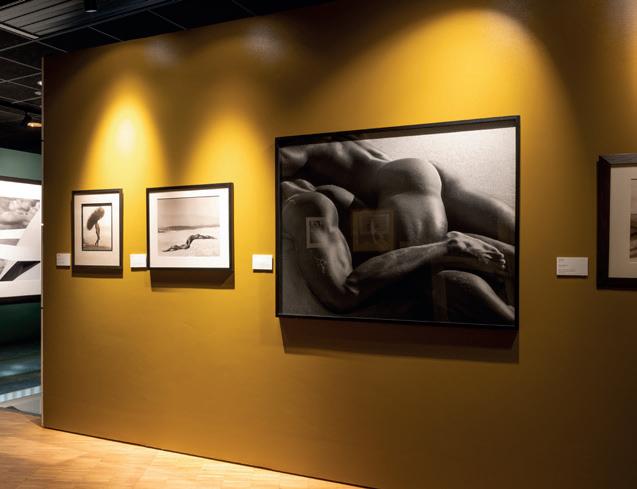
Cutting-edge fashion photography in Falsterbo
Falsterbo Photo Art Museum has a fantastic treat in store this summer. On 14 June, the museum opens two parallel exhibitions with photos by world-famous fashion photographers Richard Avedon and Herb Ritts. Make sure not to miss this!
By Malin Norman | Photos: Falsterbo Photo Art Museum
Richard Avedon was an American fashion and portrait photographer, often seen as one of the most prominent of all time. “Avedon was one of the first to photograph fashion models outside the studio in everyday settings, in cafés or on the street, which had never been seen before,” says Claes Lindquist, co-founder of the museum. “In the 60s, he also started capturing movements in still pictures, with models such as Twiggy, and became a trendsetter in the field.”
The Avedon exhibition at Falsterbo Photo Art Museum will focus on fashion and colour. “We will show at least 50 photos including a number of colour photos not previously shown in the Nordic countries,” confirms Lindquist. “In the world of photography, Avedon has the status of someone like Picasso, so this is set to be an extraordinary display!”
Herb Ritts was also an American fashion photographer and director, known for his photos of models, musicians and celebrities in the 80s and 90s. He shot to fame thanks to photos of his friend Richard Gere, then an aspiring actor, and later photographed stars such as Madonna and Michael Jackson, often outdoors and in black and white. Ritts is also known for his fashion and nude photos from the supermodel era, with Naomi Campbell and Cindy Crawford to name a few.
This exhibition will show around 50 photos, including the famous one of Richard Gere that kicked off his career, as well as fashion photography and male bodies. “Ritts was openly gay and fascinated with the male body, but his photos were always elegant, more like statues,” says Lindquist. “We will also have eight large-scale photographs in colour shot
at the Ice Hotel for Absolut Vodka, which is set to cause a stir. Nothing in the images has been fabricated in Photoshop, it was as freezing cold as you can imagine!”
In addition to the temporary displays, Falsterbo Photo Art Museum has a fantastic permanent exhibition with iconic photographs from its collections.
www.falsterbophoto.com
Facebook: Falsterbo-Photo-Art-Museum Instagram: @falsterbophotoartmuseum
Also showing at Falsterbo Photo Art Museum this summer:
Gabriel Isak – Into the Blue, until 9 June
Ewa-Mari Johansson – Supermodels Backstage, until 1 September
Johan Lindeberg – Inspiring Women Beyond Boarders, until 1 September
TV show Antikrundan (Antiques Roadshow) will film at the museum on 23 August
66 | Issue 167 | June 2024 Scan Magazine | Special Theme | Hidden Gems and Weekend Getaways in Sweden, 2024
Photos by American fashion and portrait photographer Richard Avedon will be displayed at Falsterbo Photo Art Museum this summer.
Falsterbo Photo Art Museum will also show photos by American fashion photographer and director Herb Ritts.









Scan Magazine | Hidden Gems and Weekend Getaways in Sweden, 2024 This is my house!
is a creative
for
and their adults. This is a place where curious children can play, get up to mischief, climb and discover a world full of exciting things Slussgatan 1, Gothenburg, Sweden alfonskulturhus.com © Bok-Makaren AB
Alfons Åbergs Kulturhus (Alfie Atkins’ Cultural Centre)
cultural centre
children
Details that matter.
Just as the child seat in your vehicle is approved and tested to provide maximum protection in accidents and unexpected events, the safety of the GARO Entity Compact is equally paramount. It is a minimalist wallbox, yet it is packed with details that ensure secure charging at your home. In GARO Entity Compact, all the necessary components for safe charging are already built-in, saving you from unnecessary additional costs.
Find your retailer.
 Wallbox GARO Entity Compact
MiniTheme: TOPEXPERIENCES INICELAND

Unwind in a peaceful cabin in Reykjanes
When in Iceland, make sure to stay at Ocean Break Cabins. Located in the UNESCO Global Geopark on the Reykjanes peninsula, these rustic and cosy cabins with breathtaking sea views are the perfect spot to relax by the seaside and experience wild bird life, midnight sun and rugged southwestern nature. The cabins are just 12 minutes from KEF Airport, but still in the middle of nowhere.
By Malin Norman | Photos: Ocean Break Cabins
Travellers exploring the sights and landscape of Iceland often start on the Reykjanes peninsula. With its diversity of volcanic and geothermal activity, this is the youngest part of Iceland.
In 2015, Reykjanes was recognised as a UNESCO Global Geopark. According to UNESCO, geoparks are areas of international geological significance with a focus on protection, education and sustainable development. “Reykjanes peninsula is a geological wonder,” confirms Katrín Valdimarsdóttir. “It’s home to the

blue lagoon and resent volcano activity in Iceland.”
After travelling the world for a few years, Katrín decided it was time to settle down and ground herself in Iceland again in 2018. “I had the idea to welcome the world to my area,” she says. “I was raised in the small town Garður, 5 minutes from the cabins, and this landscape was my playground.” She started with five cabin in 2019, and this summer there will be nine cabins in total.
With Ocean Break Cabins, Katrín wants to offer a comfortable base for travellers in this rugged landscape. The wind can be fierce here, the northern lights are breathtaking, and the wild bird life is unique. “This is an ideal place where you can take your time to get some peace and quiet before your next step,” she says.
70 | Issue 167 | June 2024

Peaceful cabins to unwind and relax
Located within walking distance from the coastline and boasting undisturbed sea views, Ocean Break Cabins is a good spot to wind down, recharge, and relax. With no light pollution, one of the most spectacular natural displays, the northern lights, can be enjoyed at their brightest from here in wintertime. And in summer, wild bird life and the midnight sun are spectacular.
The interior of the cabins is what can be described as Scandinavian minimalist but rustic. The cabins are comfortable and fully equipped to make guests feel well taken care of. All cabins have outdoor private hot tubs, filled with fresh geothermal water upon arrival, and the biggest cabin, which houses up to ten people, has a private sauna. And guests are just a short drive from shops and restaurants.
Safe travels and the environment
The powers of nature are visible everywhere; erupting volcanos and rapidly changing weather. Nature provides spectacular and unforgettable experiences, with natural phenomena such as the rapidly changing, and at times extreme, weather.


“It’s important that travellers understand nature’s powers and use the app Safetravel while traveling in Iceland,” Katrín adds. “At Ocean Break Cabins, we care about our footprint and are focused on sustainability. And as a host, I want my

guests to feel that they have found a welcoming and peaceful getaway.”
www.oceanbreakcabins.is
Facebook: OceanBreakCabins
For information about Reykjanes, visit www.visitreykjanes.is

June 2024 | Issue 167 | 71 Scan Magazine | Mini Theme | Top Experiences in Iceland
Katrín Valdimarsdóttir, owner of Ocean Break Cabins
The cabins vary in size, from 30 to 100 m2.

Make travelling stress-free – also for airlines
We’ve all been there: stuck in an airport because our flight was cancelled. Or have you ever felt overwhelmed and stressed when planning an entire trip by yourself? Hotel Service KEF Airport is the answer to all your prayers – at least if you’re in Iceland. This vital service takes care of stranded passengers and helps plan an unforgettable trip to the land of fire and ice.
By Heidi Kokborg | Photos: Hotel Service KEF Airport
“They took care of us after a cancelled flight was rescheduled. They found us hotels, restaurants, and activities for the day and took good care of making sure everything was going well.” This is just one of the many glowing reviews that Hotel Service KEF Airport in Iceland has received – and it’s no wonder why.
You too might have experienced being stranded at an airport because your
flight was delayed or cancelled. This is where Hotel Service KEF Airport enters the picture, it goes above and beyond for customers and offers 24-hour personal service. It mainly assists airlines when they experience cancellations or significant delays and helps groups plan their trip to Iceland.
“We work directly with the airlines. If a flight is cancelled or significantly delayed,
we meet passengers at KEF Airport,” explain Davíð Jónsson and Eva Dögg Sigurðardóttir, founders and owners of Hotel Service KEF Airport. “Sometimes it’s 10 passengers, other times 360 passengers, depending on the size of the aircraft. We arrange buses, meals and accommodation for all passengers and crew.”
Davíð and Eva assist passengers from the moment when the flight is cancelled until they are up in the air again. “We’re not part of the airlines, so passengers are always happy to see us, they know we’re not the problem,” says Davíð. “Our role is simply to assist. And we offer a full 24-hour service and even give passengers our phone number, so they can reach us any time.”
72 | Issue 167 | June 2024
Photo: Jeshoots via Unsplash
Going the extra mile
Before starting Hotel Service KEF Airport in 2018, Davíð had almost 30 years’ experience in hotel management. When he lost his job, Eva encouraged him to start a business with her. Not long after, their company saw the light of day.
“We had been talking about it numerous times,” smiles Davíð. “We wanted to control our own time, and thanks to my wife, eventually we made it happen. My idea was to work from our home, but Eva said no and found an office by the airport where we could move in the same day.”
From the outset, it has been of the utmost importance to provide customers with a good experience where they feel well taken care of. Whether the couple takes care of stranded passengers or books a trip for groups or individuals, they always go the extra mile.
“We take care of accommodation, activities and transport. Sometimes we even do the grocery shopping. We will always make it happen, and we never say no,” laughs Davíð. “Eva is always optimistic. Sometimes I think we can’t make something happen, but she will tell everyone that we can do it. To her, a big problem will seem small. Last summer, we couldn’t find a bus for a group, so she went on Facebook and found a bus on sale 12 hours’ drive away and planned

with a driver to make it work. We can solve most things, even last minute.”
Ensuring a worry-free trip
Hotel Service KEF Airport also arranges travel plans for both small and large groups. Planning a trip to Iceland can be equally exciting and stressful –there’s so much to explore and options aplenty. So why not take away the worry and stress and let Hotel Service KEF Airport plan your trip for you? All you have to do is get in touch, and the team will take care of the rest; from booking transport and accommodation

to planning memorable visits to the lagoons and spectacular tours, so you can experience Iceland from a different perspective.
www.hotelservicekef.com

Top 5 tips for travelling to Iceland
Book accommodation and tours in advance.
Try one of the many swimming pools or lagoons.
Visit during winter for the chance to see the northern lights, ice caves and unique nightlife.
Rent a suitable vehicle and experience the highlands.
Go whale watching, sea angling or horse riding.
June 2024 | Issue 167 | 73 Scan Magazine | Mini Theme | Top Experiences in Iceland
Davíð Jónsson and Eva Dögg Sigurðardóttir, founders of Hotel Service KEF Airport.
A 10th century Viking home with heart and soul
By Trine Ejlskov Jensen-Martin | Photos: Eiríksstaðir
Imagine travelling back to the 10th century and experiencing a day in the life of a Viking household, feeling the materials they worked with and understanding the skills they used day-to-day. At Eiríksstaðir in West Iceland, you can get up close and personal with the Vikings.
Eiríksstaðir is the birthplace of Leif Eiriksson and the farm of Eirik the Red and nowadays functions as a living history museum. “You can touch the museum pieces and handle items that would usually be behind glass,” says Bjarnheidur Jóhannsdóttir, húsfreyja (‘the lady of the house’). The authentic replicas are based

on archaeological evidence and made to be handled, making Eiríksstaðir a living and breathing museum where each item comes to life and helps bring back the beating heart of this Viking home.
Bjarnheidur is one of several Viking enthusiasts who lives and works here.
“We have gathered a bunch of true Viking geeks,” she explains. “From an archaeologist to a specialist in Medieval religion, to wool-dyeing enthusiasts and people interested in historic battles.” The museum’s focus goes beyond events and people glorified in the old sagas, and Eiríksstaðir is treated more like someone’s home rather than a museum.

www.cosytimesceramics.dk
Instagram: @cosytimesceramics.kerteminde

“Here we talk about daily life, chores and responsibilities, to get a real sense of the soul of the house, the inhabitants and their lives,” she adds. “Of course, we don’t know exactly what life was like in the past, but we have created a convincing place as close to an Icelandic farm in the 10th century as possible, where you get to go back in time and breathe in a little bit of history.”
www.eiriksstadir.is Facebook: Eiríksstaðir Instagram: @eiriksstadir


Scan Magazine | Mini Theme | Top Experiences in Iceland



EXPERIENCETOPSUMMERINESTONIA
Contemporary Art Museum of Estonia: a monument for freedom
Located in central Tallinn at the edge of the city’s Old Town district, the Contemporary Art Museum of Estonia (or EKKM) is a cultural cauldron for artists and art lovers alike. A self-initiated institution of the Estonian art community, EKKM is a hub for playfulness and curiosity while always encouraging reflection – and it’s all free.
By Emma Rodin
EKKM first took shape in 2006 when four ambitious creators took hold of a former, unused power plant and together started cleaning out the three-storey building. Although the group was initially just looking for a space to exhibit their work, the initiative took a stronger hold as Tallin’s Kumu Art Museum opened around the same time and left contemporary art fans unfulfilled. “There was a lot of excitement ahead of Kumu’s launch, but it turned out lacking in the contemporary area. And so EKKM set out to fill this void, gradually becoming the contemporary art museum it is today,” explains Evelyn Raudsepp, curator and project manager.
When it comes to its mentality, EKKM inhabits the wide area between official state-funded art institutions and artist-run and do-it-yourself project spaces. Since 2007, EKKM has produced exhibitions that include a variety of displays, events and art
projects, as well as collected, popularised and helped shape the field of contemporary art. By January 2024, EKKM had produced 89 exhibitions with the participation of 62 curators and 497 artists.
“We host 3-4 exhibitions per year, incorporating different aspects,” says Raudsepp. “For instance, an exhibition can be site-specific which allows the artist to use the building’s state as a foundation for their creativity. Whether they want to tear down walls or drill holes, they’re welcome to. Another aspect is radical

curating, which means that we encourage strong authorship. To question and to challenge. The third and final aspect is to experience with experiment, which relates to thinking further from what a normal exhibition can be.”
As part of EKKM, there is also a lush community garden. Here, the team hosts regular music programmes in summer, which move inside during winter (between exhibitions). There is also a bar which supports the museum’s profile as an electric meeting point for curious souls. So, pop by this summer to immerse yourself in contemporary art. A new exhibition opens on 14 June, and you’re invited.
www.ekkm.ee
Facebook: EKKM
Instagram: @ekkmtallinn

June 2024 | Issue 167 | 75
Edith Karlson, 2021. Photo: Paul Kuimet
Opening Jaanus Samma, 2023. Photo: Aron Urb
MiniTheme:
The Laugh of the Medusa, 2023. Photo: Paul Kuimet
Trigger, 2024. Photo: Paul Kuimet
shelter – sanctuary, 2023. Photo: Paul Kuimet

Tartu Observatory: a launchpad of ideas
Nestled in the lush forests of southern Estonia, Tartu Observatory is a regional hub for space science and education. Fuelled by curiosity and enthusiasm, it’s also home to one of the largest optical telescopes in northern Europe and is a renowned contributor to a galaxy of space-related endeavours.
By Emma Rodin | Photos: Tartu Observatory
Tartu Observatory, an off-campus institute of the University of Tartu is located in the small village of Tõravere and is a long-standing institute focused on space-related research and development. As a unique asset, Tartu Observatory has accredited test laboratories where companies and research groups can test their equipment in different environmental conditions. “We can conduct the full set of tests needed to send a small satellite or satellite component to space,” explains Antti Tamm, director and associate professor at the observatory. Across Europe, Tartu Observatory is a valuable partner
for calibrating and characterising optical devices, especially for remote-sensing applications.
Then and now: a rich heritage
The history of Tartu Observatory goes back to the early 19th century when the Tartu Old Observatory (Tartu Tähetorn) was built. From there, astronomer F. G. W. Struve conducted one of the first measurements of the distance of a star (Vega) and carried out a massive project to determine the shape and size of the globe. The resultant geodetic arc of nearly 3,000 kilometres of triangulation
measurements is featured on UNESCO’s World Heritage list. In the mid-20th century, most of the observatory’s research work moved to the brand-new Tõravere observatory. Here, scientists led by astrophysicist Jaan Einasto discovered the honeycomb-like structure of the universe and were among the pioneers of the concept of dark matter – a form of matter still not fully understood.
Today, the observatory’s mission stems from its growth plan to contribute to

76 | Issue 167 | June 2024
An active space hub in the middle of nature.
Pupils soldering during space career day.
the development of society with the achievements of space science. There are modern facilities for space research and development with around 100 eager researchers and engineers. “Enthusiasm and curiosity can make miracles, especially if combined with highly valued working conditions,” says Tamm. “Our employees are fully supported by the high-tech facilities and always ready to pick up any challenge.”
Projects at the centre of the universe
With research being a major pillar of the observatory, the multinational team has its hands full with a whole host of thrilling projects. One such project revolves around studying planets orbiting distant stars together with the European Space Agency, searching for life on extra-terrestrial planets and trying to find out what the place of our Earth is within the universe. This includes asking questions such as, ‘how unique is Earth really?’ and ‘how did the planet take form?’. The observatory’s remote sensing department also facilitates the usage of satellite data for monitoring Earth, focusing especially on the planet’s delicate ecosystems, like water bodies and forests.
Another exciting direction is based on developing a variety of space cameras for different purposes, including NASA lunar missions. This was initiated with the first Estonian satellite ESTCube-1, built by students, launched in 2013 and leading to an offspring of space-tech companies and engineers. Speaking of lunar, the team

also works on developing autonomous lunar rovers as efficient ways to navigate extra-terrestrial landscapes using digital-twin landscapes and game engines.
Space for the next generation
The message of Tartu Observatory is delivered to orbit by its visitor centre which showcases the latest achievements in space science and technology (as well as the scientific profession) to the wider public. There is a special focus on younger generations, providing them with tools that will inspire them for the future. For instance, there are active learning programmes for school children, where students can solve tasks, give presentations and participate in practical work. An even bigger impact is achieved by teacher training, helping to make their lessons more attractive and interrelated through a variety of space topics, not only for the obvious cases of
math, chemistry and physics but even music and sports. Inspired by these trainings, several schools have organised their own space-days.
Then, of course, there’s the environmental aspect. “We don’t want Venus or Mars happening on Earth. And while we’re still doing too little to save Earth’s environment, perhaps the solution lies in space,” says Tamm. “However charming and colourful images are of distant celestial objects, we’re constantly reminded that the space around us is sterile and unwelcoming, so we have to take good care of our spaceship Earth and its life-supporting systems, while never cease to explore the wonders and secrets of the universe,” he concludes.
www.kosmos.ut.ee
Facebook: Tartu observatoorium
Instagram: @tartuobservatory
Looking for partner(space)ship?
A place to test your technology or ideas? Reach out to the team using the ‘Contact’ tab on the observatory’s website.
June 2024 | Issue 167 | 77 Scan Magazine | Mini Theme | Top Summer Experience in Estonia
International companies find their way to the labs for testing satellites.
Snow-tests of the tiny lunar rover KuupKulgur and its team.
Celebrate summer and world-class music at Viljandi Folk Music Festival
Set in Estonia’s unofficial culture capital, Viljandi, a four-day-long celebration of culture, tradition, and music awaits. With more than 75 concerts and over 50 musicians from all over the world, why not celebrate the height of summer at Viljandi Folk Music Festival?
Each year in the last week of July, a picturesque small town in the south of Estonia is awoken by the sound of music and dance. Viljandi is home to the iconic Viljandi Folk Music Festival, which will feature a range of Estonian and international acts this year, including Puuluup, Trad.

Attack!, Duo Ruut, Florence Adooni from Ghana, and Scotland’s very own RURA.
Founded in 1993 by musician and artistic director Ando Kiviberg, the festival set out to help and support the revival of Estonian music traditions. “Over the past 30 years, I can say that we have succeeded. Now, we aim to strengthen and diversify these traditions,” says Kiviberg. “Our audience often says that the picturesque setting and friendly atmosphere is what makes the festival special.”
The aim is to support local music traditions in Estonia and at the same time introduce music traditions from around the world to the audience. “We aim to help people discover these fascinating differ-
By Celina Tran
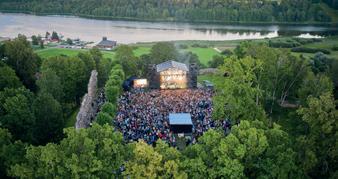
ences and understand and respect cultural diversity,” means Kiviberg. “We believe that the culture of humanity is richer when there are many well-preserved traditions.”
With a world-class international line-up, this year’s festival is bound to be a success. If you’re seeking sun and culture, head to Viljandi 25-28 July.
www.viljandifolk.ee
Facebook: Viljandi pärimusmuusika festival / Viljandi Folk Music Festival Instagram: @viljandifolk

Scan Magazine | Mini Theme | Top Summer Experience in Estonia
Swing into summer with the best of international folk music. Photo: Aron Urb
Photo: Henri-Kristian Kirsip
Swedish edtech: future-proofing your organisation
 By Malin Norman | Photo: Unsplash
Sweden is renowned for innovation, a high level of education, and being one of the most connected countries in the world. “We are recognised for our expertise in technology and fast-growing services, spanning industries from gaming to finance to music,” says Jannie Jeppesen, CEO of the Swedish Edtech

Industry. “I’m often asked about the key factors behind our competitiveness and innovation, “the secret sauce” if you will. The simple answer lies in the accessibility of high-quality education and learning for everyone, regardless of background.”
The Swedish educational system has been digitised for over forty years. Some 120 years ago, Sweden “invented” distance education through correspondence courses and two decades ago, Sweden was a global leader in distance education at universities.
“We were early adopters of digital education, with e-learning gaining traction even before the turn of the millennium. Today, Swedish multinational corporations have extensive experience in digital, distributed distance education,” says
Jeppesen. “Thanks to this fertile ground, Swedish edtech companies have developed user-friendly services and products focusing on motivation for learning, efficiency, and equity. We excel in this area – it’s our insurance for the future.”
www.swedishedtechindustry.se www.edtechkartan.se
The Swedish Edtech Industry is a trade organization for edtech companies targeting the formal education system, from preschool to university, as well as those catering to businesses and consumers. It collaborates with stakeholders such as government agencies, academia, and the business sector to strengthen the conditions for innovation and competitiveness, promoting lifelong learning.
June 2024 | Issue 167 | 79
MiniTheme:TOPSWEDEN’S COMPANIES,EDTECH 2024
Jannie Jeppesen, CEO of the Swedish Edtech Industry. Photo: Swedish Edtech Industry


Everyone should remember what they learn
With NanoLearning, organisations can invest in their employees by raising awareness and boosting collective knowledge. Junglemap is behind the innovative method and system, which supports continuous and effective learning with measurable impact.
By Malin Norman | Photos: Junglemap
With NanoLearning, organisations can invest in their employees by raising awareness and boosting collective knowledge. Junglemap is behind the innovative method and system, which supports continuous and effective learning with measurable impact.
NanoLearning is a ground-breaking method for learning, in which a subject is divided into small modules, distributed to learners over time, and with regular follow-ups to see the effect. The company behind NanoLearning is Junglemap, which was founded in Norway some 20 years ago. Since 2006, Junglemap has delivered over 40,000 NanoLearning courses to companies and organisations, and reached more than 7 million users.
“Learning is a process, not an event,” says Joakim Hejestad, director of business development at Junglemap. “Although I have over 30 years’ experience in eLearning,
artificial intelligence and edtech, NanoLearning has taken me by storm. Instead of just digitalising traditional learning, with this method you get the same information to everyone, at the same time. It’s cool to see how NanoLearning actually generates learning for the target group.”
With NanoLearning, clients can create their own courses, establish a distribution plan, get reports over time, and follow up on the impact. At the outset, Junglemap provided NanoLearning courses in information security, a challenge facing most organisations these days. But clients can also create their own content in the ground-breaking AI-supported production tool, for instance courses in compliance, laws and regulations, and sustainability.
Fighting the forgetting curve
The mission at Junglemap is that everyone should remember what they learn.
“We want to fight the forgetting curve,” says Hejestad. “We all know how fast you forget the content of a one-day course if you don’t put it into practise, or at least repeat what you learned within a day after the training event.”
The best way to fight the forgetting curve, according to Junglemap, is to provide information in three-minute lessons, with spaced repetition and retrieval practice. “We do this to get the best effect and ensure collective behavioural change throughout the organisation,” adds Hejestad.
With these three-minute lessons, spread out over time, the completion rate of every started lesson is an impressive 98%. “Everyone has 3 minutes to spare. And if people get the same information at the same time, in bite-size chunks, they will start talking. By boosting this type of social learning, we help create awareness and achieve organisational effect.”
www.junglemap.se
LinkedIn: Junglemap
Instagram: @junglemap_global
80 | Issue 167 | June 2024 Scan Magazine | Mini Theme | Sweden’s Top Edtech Companies, 2024
Joakim Hejestad, director of business development at Junglemap.


Game-changer for guitar learning
Zoundio turns music education into the awesome experience it should be. With its praised Gibson App, you can learn how to play the guitar and have fun at the same time.
By Malin Norman | Photos: Zoundio
Zoundio is a tech and music-loving team of musicians, developers and creatives based in Stockholm, with a portfolio of products including a multi-patented music engine. “Our focus is to enable music creation and learning through technology in an inspiring, educational and interactive way,” says Fredrik Andersson, chief operating officer at Zoundio.
Since 2020, Zoundio has collaborated with iconic brand Gibson, the most renowned manufacturer of guitars in the world. Together, they have developed the official Gibson App, which was launched in 2021. It’s an app you can use to learn how to play the guitar. “Lots of people want to learn how to play an instrument, but it can be tough for beginners and hard to know how to start. Traditionally, 9 out of 10 quit during the first year. We’re turning this around,” says Andersson.
The Gibson App works with any guitar and includes curated lessons, customised to your needs so you learn the right things at the right time. The app’s microphone listens when you play and you get feedback in real time. In short, it’s like Guitar Hero, but with a real guitar and with serious education added. The app also includes a digital amplifier with acoustic and electric effects.
The Gibson App is available globally and hundreds of thousands of users are already learning how to play. “This is a gamified experience, to keep you motivated and to continue playing. As you get better, you become more independent,” adds Andersson. “It doesn’t have to be hard, you don’t need years of pain and suffering to learn how to play.” The app is suitable for beginners as well as more advanced guitar players.
According to a review in Guitar World, the Gibson App is a game-changer; “Whether you’re a beginner and just getting started, an occasional player at home, or a serious gigging and recording musician, the Gibson App provides you with everything you need to learn and play – and have fun doing it!”
The team at Zoundio has also developed a new app for iOS called Rechords, which is intended for piano and guitar players who want to jam to their favourite tunes.
www.gibson.app
Facebook: gibsonapp
Instagram: @gibson.app

June 2024 | Issue 167 | 81 Scan Magazine | Mini Theme | Sweden’s Top Edtech Companies, 2024
With lifelong learning as a driving force
Ping Pong is a leading platform for lifelong learning. By offering a meeting place for learning and skills development, it helps organisations put learning and personal development at the forefront – so they can become better, more competitive and ultimately, more successful.
For more than 20 years, Stockholm-based Ping Pong has delivered digital solutions for accessible and active lifelong learning. ”Learning is our driving force and we take it seriously,” says Mats Nilsson, sales and marketing director. “It’s popular these


days with gamified, digital solutions to bring out the fun in learning, but we also want to make sure that learning is done in the best way and has the desired impact.”
Ping Pong ensures that learning reaches the right audience and is understood, and conducts follow-ups with organisations and participants. According to the 40-20-40 model, developed by American professor Robert O. Brinkerhoff, learning should not be seen as just the training event itself, which amounts to only 20 percent of learning, but also what comes before and after. “To get the full impact of learning, we pay attention to those 40 percent before and 40 percent after the actual training,” says Nilsson.
By Malin Norman | Photos: Ping Pong
Whilst clients provide the content itself, Ping Pong’s skilled team stands for the framework for learning. “By creating customised meeting places for exchanging knowledge and experience, continuous development and learning is encouraged in employees, which makes them more curious and motivated – and in the long run gives a more successful organisation.”
Ping Pong’s clients are mostly from the public sector. With around 2.4 million accounts in Sweden and approximately 300,000 monthly users, the team is constantly developing the digital tools and tries to always be at the forefront. “It’s crucial to be aware of the development in the outside world, and to meet the needs of new needs that appear.”
www.pingpong.se
LinkedIn: Ping Pong AB

Scan Magazine | Mini Theme | Sweden’s Top Edtech Companies, 2024

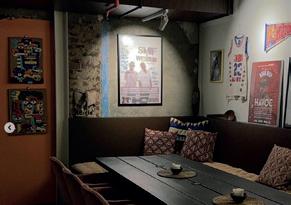

Restaurant of the Month, Sweden


Afrika in Stockholm: summer’s hotspot for good vibes and great food
An authentic fusion of cuisine and culture, restaurant Afrika serves up more than just good food. And as one of the first restaurant-and-bar to open in Stockholm’s up-and-coming meatpacking district, Afrika is leading the charge with daily events including DJ sets, live music and intimate parties, inviting you to a vibrant community where no one is excluded.
By John Sempill | Photos: Afrika
The talk of the summer is Afrika Block Party on 25 August. This is an African-themed festival hosted by Afrika in partnership with event company Luger, with Omah Lay and King Promise among others set to perform at venue Förbindelsehallen. “The shows will be incredible, no doubt, and we’ll be running the party surrounding it. It will be a great day of music, food and culture, basically everything we’re about,” says Afrika’s Erik Wretman.
On the restaurant side of things, Afrika’s kitchen is the heart of the establishment and a great place to get a real taste of African cuisine. The food offering is split into different concepts, showcasing styles from three African kitchens. One is Kenyan with its Swahili Street Food concept. Another is Gambian food, offered in partnership with GamDine, and the
third is Eritrean and Ethiopian food from Mamasawa Injera. Across the menu, diners can expect colourful stews, finger food, pies and vegetables like plantain and cassava. Not sure what to order? Opt for the tasting menu.
“We want to be an institution where people can feel at home, whether you have roots in Africa or are completely new to the food and culture. It’s about bringing people together and inspiring new experiences,” explains Wretman. “We also partner with black-owned suppliers in Africa to source drinks that fit our values, like South African wine and beer from Kenya. Our mission is to represent African producers who may struggle to be seen, and to present the African culture in genuine way. It’s our way of giving something back to the community we love,” he adds.
With food and entertainment on offer six days a week all summer, there’s no better place for a genuine gastronomic experience served with a helping of good tunes on the side.
www.afrikasthlm.se
Instagram: @afrikasthlm

Afrika Block Party is scheduled for 25 August in Stockholm. Visit the website to learn more, and you can buy your tickets via luger.se.
June 2024 | Issue 167 | 83 Scan Magazine | Restaurant of the Month | Sweden

Destination of the Month, Denmark
Slow travel: the antidote to everyday life
In our fast-paced, always-switched-on society, finding time to unwind and reconnect with oneself has become more essential than ever. Traditional travel, often characterised by packed itineraries and whirlwind sightseeing, can sometimes feel as hectic as daily life. Enter slow travel – a philosophy that emphasises quality over quantity, immersion over rushing, and relaxation over exhaustion.
By Landfolk | Photos: Landfolk
In today’s world, where we seem to be obsessed with time, doing anything slowly feels almost revolutionary. Nonetheless, slow travel is about moving at a speed slow enough to notice the small things as you move through the world. It’s a shift away from ticking off as many bucket-list destinations as possible with a packed itinerary and choosing to go deeper rather than just skim the surface. To immerse oneself into a place instead of ticking off five in one go. It’s a mind-
set. It’s about taking the time to make a connection – to where you are and who you are with.
The Scandinavians have done it for centuries
Every summer, Scandinavians flock to their holiday homes to escape the cities, unwind and be outside. Even though many holiday homes today are upgraded with modern life conveniences such as running water just to name one, it’s still
about connecting with the simple pleasures of life. And it’s this very idea of staying in a place that’s very much the opposite of your everyday residence that’s the essence of the Scandinavian holiday home culture. With this, the physical surroundings help you carry yourself in a different way. Be with your kids in a different way. Let breakfast turn into lunch, never get out of your pyjamas, play with sticks, or eat ice cream for dinner. Essentially, it’s about having no agenda and being present in the now.
Until recently, this appealing vacation form specific to Scandinavians has been out of reach for outsiders. But in 2021, a new platform for handpicked holiday homes called Landfolk has emerged, giving international travellers an oppor-
84 | Issue 167 | June 2024 Scan Magazine | Destination of the Month | Denmark
tunity to experience this first-hand with an exclusive selection of holiday homes in Denmark, Sweden, Norway and Germany.
How to slow travel with Landfolk
If you want to experience this everyday life antidote by staying in a Scandinavian holiday home yourself, Landfolk is the place to seek out. Here’s your step-bystep guide on how to embrace slow travelling with Landfolk:
Take leisurely walks: explore the natural surroundings at your own pace. Whether it’s a stroll along a Danish beach, a hike in the Norwegian mountains, or a walk through the Swedish forests, the goal is to immerse yourself in the beauty around you.
Unplug and unwind: leave your gadgets behind and enjoy the simplicity of life. Read a book, meditate, or simply sit and enjoy the view from your holiday home. The serene setting is perfect for digital detoxing.
Local flavours: enjoy locally sourced food and drinks. Visit nearby markets, try re-


gional delicacies, and perhaps even cook your meals using fresh, local ingredients. This not only supports local communities but also enhances your connection to the place.
Mindful activities: engage in activities that promote mindfulness and relaxation. Try yoga on the beach, fishing in a quiet lake, or kayaking in the fjords. These activities help you stay present and appreciate the moment.
Cultural immersion: take time to learn about the local culture and history. Visit museums, attend local festivals, or simply chat with residents. Understanding the cultural context enriches your travel experience.
In a world that often feels overwhelmingly fast-paced, slow travel offers a much-needed antidote. By choosing to stay in carefully selected holiday homes through Landfolk, you can experience the true essence of Scandinavian nature at your own pace. This approach to travel not only benefits your well-being but


also fosters a deeper appreciation for the beauty and simplicity of life. So, next time you feel the need to escape, consider the serene landscapes of Scandinavia and the slow travel experience that awaits with Landfolk. It’s the perfect way to disconnect, relax, and rediscover the joy of travel.
www.landfolk.com
Facebook: landfolk
Instagram: @landfolk_com
About Landfolk
Landfolk is a platform and community for handpicked, extraordinary holiday homes available for your next holiday. Founded in Denmark in 2021 by an ex-Airbnb team, Landfolk has grown to more than 2,500 unique holiday homes across Denmark, Germany, Norway, and now also Sweden. Landfolk believes that design, access to nature, personality and quality solutions play an important role in any getaway.


June 2024 | Issue 167 | 85 Scan Magazine | Destination of the Month | Denmark
Culture Profile of the Month, Denmark
The Ceramics Trail: a beautiful collaboration between art and nature

The picturesque town of Middelfart is home to the largest Nordic ceramics museum, CLAY Museum of Ceramic Art Denmark, which houses a collection of Danish and international pieces. In addition to visiting permanent exhibits inside the museum, you can venture outside on a curated tour around town and its scenic surroundings, combining local nature and culture with a collection of wonderful works of ceramic art.
By Trine Ejlskov Jensen-Martin
The Ceramics Trail (Keramikruten) premiered in 2021. “The vision was always something that could develop and grow over the years,” says Pia Wirnfeldt, museum director. The trail is Wirnfeldt’s brainchild, and the idea has been brewing for some time. With her team at CLAY, she put a proposal together in 2018 and approached the local council in Middelfart. “From the outset, we had two intentions,” she explains. “We wanted to activate ceramic art as an element of beauty and identity outside the walls of CLAY, and to introduce Middelfart and the beautiful nature here.” However, like with many other initiatives, the pandemic delayed the plans.
“It gave us time to develop the idea further and to combine it with how we talk about and respond to climate change,” Wirnfeldt remembers. She realised that as well as enhancing visitors’ experience of nature, storytelling, and ceramic arts,

they could also raise awareness of the effects of climate change on the local landscape. It turns out that clay is a great medium with which to approach looking at climate change and the impact of rising sea levels, and Middelfart is an ideal place for this, surrounded by water on three sides. “There’s a real and symbolic link between the medium of clay, the issues and challenges of rising sea levels and Middelfart,” she means. “Think about clay and water, and think about the key elements of ceramics.”
Clay-findings instead of way-findings
The 2.3 km Ceramics Trail takes you on a scenic route which loops around the museum, continues along the water and through the pedestrianised area of Middelfart’s historic centre, and past the old church. There are currently 22 sculptures along the trail, presented by renowned author and ceramicist Peder Rasmussen, who with his trademark wit and experience talks you through each piece along the route.
86 | Issue 167 | June 2024
Magne Furuholmen,Rook takes Bishop.
Photo: Ole Akhøj
The sculpture in the forefront is Morten Løbner Espersen’s Magma. Photo: Ole Akhøj
During the process, the idea of clayfinding came up instead of way-finding, as a way of guiding visitors along the trail, using handmade tiles and colours instead of maps. CLAY worked closely with Tommerup Keramiske Værksted (Tommerup Ceramic Workcenter), which created the beautiful tiles for the trail, enabling you to walk or skip from stone to stone along the route. The distinctive tiles and stones were added in 2022, with shades of blues and greens fitting in with the natural environment.
An all-round synergetic experience
To pick out the right spot and context for each piece takes time and thought. The process is a dialogue between the artists, CLAY’s ceramics experts and the local council, and together they decide where to place the sculptures. “For new additions to the trail, we always ask the artist, who in turn considers the local community, the immediate surroundings and its people,” Wirnfeldt adds. It goes without saying that the high quality of the ceramic sculptures and the artistic ambition behind every piece is crucial. Each artist works closely with the community and the surroundings, and the balance and understanding between the artists and the locals is a fundamental part of the process.


The local community continues to encourage and benefit from the Ceramics Trail, and its involvement and support are vital to its continued success and growth. This is bringing to life a vision that relies on a strong and positive working relationship between CLAY, the local council, and the people of Middelfart. Another


central aspect of the project is the purpose of bringing art into the public space, making the experience of ceramic art more accessible and inclusive, and breaking down preconceptions and boundaries. Wirnfeldt explains; “the Ceramics Trail is an all-round synergetic experience.”
There are many good reasons to go to Middelfart, and a visit to CLAY and a stroll along the Ceramics Trail is a great place to start. “It’s wonderful to experience people’s reactions and responses to the Ceramics Trail, to witness their joy,” the founder concludes. And this is ultimately what CLAY sets out to do; increase people’s engagement with ceramics and awareness of climate change, through a unique experience of wonderful art and breathtaking nature.
claymuseum.dk keramikruten.claymuseum.dk Facebook: claymuseum Instagram: @claykeramikmuseumdanmark
5500
June 2024 | Issue 167 | 87 Scan Magazine | Culture Profile of the Month | Denmark
CLAY Museum of Ceramic Art Denmark Kongebrovej 42
Middelfart
Gunhild Rudjord, Krukke (Vase).
Photo: Ole Akhøj
American artist MattWedel, Flower Tree. Photo: Ole Akhøj
Ingrid Askeland, Delirium DK. Photo: Ole Akhøj
Betty Engholm, untitled, one sculpture from a larger sculpture group. Photo: Ole Akhøj
Hotel of the Month, Iceland
A first-class hotel experience in the heart of Reykjavík

Hotel Reykjavík Grand is the biggest business hotel in Iceland, providing guests with a first-class experience. The hotel offers modern and stylish venues perfect for any kind of event, workshop, meeting, conference and wedding. With easy parking, just a 40-minute drive from the airport, located in the business district and both Green Key and Nordic Swan Ecolabel certified, what more could you ask for?
By Heidi Kokborg | Photos: Hotel Reykjavík Grand
The land of fire and ice is the ultimate destination for any business trip, conference, workshop or event. Iceland is a land of spectacular contrasts and natural beauty, known for its volcanic landscapes, stunning glaciers, dramatic waterfalls and majestic mountains. Its pristine wilderness makes it the perfect spot for mixing business and adventure – and the location in the middle of the North Atlantic Ocean is ideal.
“We host a lot of companies that have branches in both the United States and Europe. Iceland is the perfect middle, and there is so much to do here. This is where business meets adventure, and the flight connections are very good,”
says Íris Tara Sturludóttir, hotel manager at Hotel Reykjavík Grand.
The ultimate destination for business and adventure
If you are thinking of hosting your next business event in Iceland, you need the right hotel. Hotel Reykjavík Grand is just
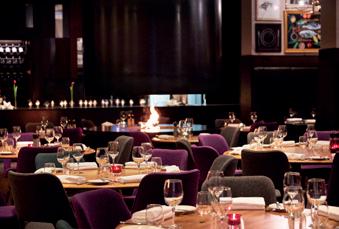
what you are looking for. The hotel is located in the business district and is a popular spot for both international and domestic business events of all sizes. It offers large, stylish spaces that can accommodate anywhere from five to 300 guests.
“At the hotel, we receive large MICE groups, but we also do events such as weddings thanks to our modern and stylish venues with lots of natural daylight,” tells Sturludóttir. “Our rooms are spacious and vary in size from 23m2 to 40m2. We also have several family rooms.” The hotel is conveniently located close to the biggest swimming pool in Iceland, the zoo and the biggest park in Reykjavík, making it ideal for both business and family trips.
Of course, you should also explore the Icelandic capital while visiting. Reykjavík is a vibrant and dynamic city that blends modernity with traditional charm. It boasts a lively cultural scene, with art
88 | Issue 167 | June 2024
Scan Magazine | Hotel of the Month | Iceland

galleries and museums, and there are natural wonders aplenty to explore as well. You should also treat yourself to a dining experience at one of the many amazing restaurants in the city.
Speaking of food, Hotel Reykjavík Grand has its own restaurant, Grand Brasserie. Here, you can choose among dishes cooked with the finest ingredients. Whether you fancy a burger or more traditional Icelandic cuisine, the brasserie can accommodate your taste buds. The hotel also offers a top-notch breakfast with different breads, fruits and much more to keep you energised throughout the day. When it’s time for some self-care, you will find both a spa and a gym at the hotel.

Sustainability at the forefront
Iceland is known for its hospitality and friendly locals, and Hotel Reykjavík Grand is no exception. You will feel welcomed from the moment you park your car, and the staff will go above and beyond to ensure that you have the best possible stay. This also includes taking care of the environment and the hotel is both Nordic Swan Ecolabel and Green Key certified.
“This means that everything from laundry soap and napkins to shampoos and conditioners are environmentally friendly,” says Sturludóttir. “Of course, the spa only uses products that are Nordic Swan Ecolabel certified. And with Green Key,

we are committed to reducing consumption of resources and motivate our staff and guests to act responsibly.”
Although Hotel Reykjavík Grand is already the largest business hotel in Iceland, the hotel has plans to further expand. Soon there will be a conference centre that can host several hundred guests, so if you have a big event coming up, the hotel can host anything from large conferences and exhibitions to big weddings.
www.islandshotel.is/hotels-in-iceland/ hotel-reykjavik-grand/ Facebook: GrandHotelReykjavik Instagram: @islandshotel.is

Hotel Reykjavík Grand is located in the business district of Reykjavík. The hotel offers more than 1,950 m2 of event space that can host anything from small meetings to large conferences, exhibitions, and dinners. The hotel offers free parking to all guests.
June 2024 | Issue 167 | 89 Scan Magazine | Hotel of the Month | Iceland

Hotel of the Month, International


Romantik Hotel Walhalla: the perfect place to stay in the heart of Osnabrück
With some of its buildings nearly 400 years old, a trip to the stunning Romantik Hotel Walhalla makes for a truly exclusive experience. It’s an ideal stopover when travelling to or from Scandinavia, but with the hotel’s historic charm, high-end facilities, and heartfelt warm welcome, you could easily be persuaded to stay for longer.
By Trine Ejlskov Jensen-Martin | Photos: Romantik Hotel Walhalla
Romantik Hotel Walhalla is located in the old part of Osnabrück, a medieval German town with an old market square and stepped gable houses. The hotel’s grand main building was built in 1690 and almost 200 years later the inn, previously known as the Ratsschänke (The Rat’s Tavern), was given the name Walhalla. It was named after ‘Valhalla’, the great hall of the fallen gods in Nordic mythology, symbolising the hotel’s impeccable hospitality.
“Osnabrück is a pretty town with plenty of history,” says managing director Andreas Bernard, who has run the hotel for 30 years with his wife Tanja. Over the years, the hotel has expanded and seen several improvements, all with great attention to detail. The couple has stayed true to the
atmosphere and has treated all renovations with utmost respect for its history.
This magnificent hotel is medium-sized with space for up to 120 guests and comprises eight buildings including three restaurants, meeting and conference facilities, and a spa. The 69 rooms are all different in style and size yet decorated to the same high standard that is evident throughout the hotel; from rooms and restaurants, to the spa, and the quality of service.
When celebrating the 350th anniversary of the Peace of Westphalia in 1998, the hotel hosted all European Kings and Queens, and Queen Silvia of Sweden visited Romantik Hotel Walhalla no less than three times.
Easy access to major road and rail networks makes Romantik Hotel Walhalla ideal for a stay when travelling to or from Scandinavia.“Many visitors stop over on the way to or from other destinations, but there is plenty to do and see right here,” Bernard says. Osnabrück is more than a handy break on a journey, with its charming buildings and picturesque town centre. So whilst your intention may have been to stay for one night only, you might want to book a few extra days and leave time to enjoy what this beautiful, historic town has to offer.
www.hotel-walhalla.de
Facebook: Romantik Hotel Walhalla
Instagram: @walhalla_os

90 | Issue 167 | June 2024 Scan Magazine | Hotel of the Month | International


HESTRAGLOVES.COM | @HESTRAGLOVES | #HESTRAGLOVES
SIGNE
LAURA
TIRIL MITT
ELISABETH
MARY
LAURA
Best new Scandi releases in June
Their first new music in 6 years – Swedish outfit NONONO have taken us all by surprise and returned with a comeback song, Our Time Is Now. After bursting onto the scene in 2013 with Pumpin Blood (which has racked up over 100 million streams to date on Spotify alone), the trio enjoyed hits aplenty up until their break in 2018. Now they’re back – and they haven’t lost any of that quirky sonic charm that made so many of us fall for them first time around. And as back then – this new single sounds like nothing else around at the moment.
Danish artist Christopher had a pretty awesome 2023, starring in the Netflix film A Beautiful Life and providing the tunes for its soundtrack too. Now, since that incredible career highlight, he’s back with a brand-new single of his own – ONE. The anthemic song already sounds like a potential Danish radio smash in the making, but wisely, also caters well to the hordes of new fans
Monthly Illustration
that will have found him through his music on A Beautiful Life.
This summer she’ll release a new EP of songs called Where Flowers Grow, but ahead of that, Swedish artist ORKID is out with her latest single. The similarly floral themed Bed Of Roses lives up to its title –it’s a strikingly beautiful piece that catches your attention right away. With a rich production and a decadently disassociated delivery of the vocal, ORKID’s Bed Of Roses is something to lie back and luxuriate to.
Sweden’s Benjamin Ingrosso has teamed up with German producer Purple Disco Machine, Jamaican artist Shenseea and all-time icon of music Nile Rogers in a fabulous new collab. Honey Boy is the sweet fruit of all their labour, released as a single in May. It’s dreamy disco-pop with a chorus that bears repeating (and so they do repeat it, a lot!). Fans of Benjamin’s music will be pleased to learn that it’s es-
The unplanned visit
It was an ordinary evening and the doorbell rang. Outside stood my pal who was just passing by on her way home from work. She thought she would just pop by for a cuppa. “Come on in,” I said, “We’re about to have dinner, you fancy some?” She did. She stayed for dinner, played a board game with the kids, and then headed home.
It seems like a completely normal thing to have happened, right? But in Sweden, not so much. In Sweden, you book a dinner date ahead of time, clean the house, look up a nice recipe, put on nice clothes and it’s an EVENT. I struggle with this way of organising my social life. Perhaps it’s because I’m no good at making plans or I don’t own any nice clothes... Perhaps it’s because I know that the best things happen when you don’t make plans. Good conversation generally can’t be planned.

I often think that I can’t live in Sweden because my house is always messy, I cook things that take max. 30 minutes and I have low standards when it comes to my attire. There’s paint or dust or something random on most of my clothes. And they are unfashionable because I’m an illustrator and have no money to look good.
By Karl Batterbee

sentially the more grown up follow-up to what remains one of the best songs of his career to date – Don’t Leave Me Hanging He’s at his best when he’s leaning into the utterly funked-up side of his songwriting.
www.scandipop.co.uk
By Gabi Froden
I need to live in a place that accepts me like this. A place where you can ring the doorbell, pop by for a below-average dinner, shuffle some clothes off the sofa, and play a board game on any given day. Where chatting with your pals is something you don’t schedule. It’s something that happens when one of you just pops by on your way home from work.
Gabi Froden is a Swedish illustrator and writer, living in Glasgow with her husband and two children. Her children’s and YA books are published in Sweden by Bonnier Carlsen and Natur&Kultur. www.gabifroden.com

92 | Issue 167 | June 2024 Scan Magazine | Culture | Columns

Scandinavian Film & TV
For this month’s column, I’m looking at the new high-profile Netflix production Ronja, the Robber’s Daughter, a Swedish fantasy adventure. The book by world-famous Swedish children’s author Astrid Lindgren, who is probably most known for Pippi Longstocking, was a favourite of my childhood.
By Anders Lorenzen
For this month’s column, I’m looking at the new high-profile Netflix production Ronja, the Robber’s Daughter, a Swedish fantasy adventure. The book by world-famous Swedish children’s author Astrid Lindgren, who is probably most known for Pippi Longstocking, was a favourite of my childhood.
In March this year, Netflix brought the Swedish fantasy tale to a global audience. It’s released in two instalments. Part 1 premiered on 28 March in the Nordics, Central and Eastern Europe, the UK, France, Spain and the Netherlands. Part 2 will come later this year with no exact date yet announced.
For those who, unlike myself, didn’t grow up with Ronja, the Robber’s Daughter and are unaware of the plot, it centres around the adventures of Ronja, a spirited and rebellious girl born into a gang
of robbers in a medieval Scandinavian castle. As she grows up, she discovers the magical but dangerous surrounding forest with its strange and mysterious creatures.
Lindgren wrote the tale in 1981 and the Netflix adaptation has been scripted by Hans Rosenfeldt, directed by Lisa James Larsson, and Kerstin Linden stars as Ronja. When it premiered, the director explained the huge effort and investment that went into the production, which takes us to some of Sweden’s magical places.
I’m excited to revisit a story I haven’t heard since childhood, but also to bring that story to my daughter once she reaches the appropriate age. And for the opportunity it gives global audiences to witness Sweden’s vast, beautiful landscape and to experience Swedish art and creativity.
At a time when large-scale global productions usually come from the US and the UK, it’s welcome news that a Nordic nation can put on such a large production where thousands of actors auditioned and with the final cast and crew reaching more than 200 people.
Part 1 of Ronja, the Robber’s Daughter is currently streaming on Netflix.

June 2024 | Issue 167 | 93 Scan Magazine | Culture | TV column
Anders Lorenzen is a Danish blogger and film and TV enthusiast living in London.
Photo:: Audrius Solominas/Netflix
Swing your way out of summer with Ultima Oslo Contemporary Music Festival

Every September, the Norwegian capital is transformed by contemporary music, art and expression from all corners of the world. A beacon of avant-garde musical expression, Ultima Oslo Contemporary Music Festival is not only a platform for contemporary music but also ideas.
By Celina Tran
When summer gives way to the first crisp month of autumn, one might think the Norwegian capital is getting ready to bid the busy season of fun adieu. In reality, the fun is only about to begin! From 1221 September, the annual Ultima Oslo Contemporary Music Festival will take place across Oslo, and visitors can expect fun festivities, but also thought-provok-

ing and conversation-starting art and culture. “Ultima has been opening ears and minds through contemporary music and sound-based art since 1991,” says festival director Heloisa Amaral.
The festival includes special contemporary music activities for all ages, including a Children’s Ultima Day. There’s also Ultima Context, a series of talks, panel discussions, seminars and workshops. Through these programmes, young people and curious listeners can get closer to today’s music. “We seek to create not only an image of Oslo and the people who live here through music, but also of the wider society and modern world,” says Amaral. Through art and creation, the festival’s many numbers want to spark dialogue, reflection, and new ideas about the world around us.”
A longing for togetherness
This particular year has been one of global conflict, polarization, and worry, and Amaral explains that this year’s festival takes care to reflect the image of the world as it is today. While the performances might take on more serious topics, she reassures that the event itself will be one of togetherness and celebration. “There’s a theme of longing, almost; longing for resources, for togetherness, new relationships to the environment, for peace. But the festival is not one of melancholy, but rather a beautiful opportunity for people to come together and dream together,” she says.

94 | Issue 167 | June 2024
Scan Magazine | Feature | Ultima Oslo Contemporary Music Festival
Over the years, there has been a range of unique experiences at Ultima, including Marianne Stranger’s Vannverk in 2021 where the audience listened from the inside of inflatable balls.
Photo: Signe Fuglesteg Luksengard
Photo: Signe Fuglesteg Luksengard
Photo: Vilde Mikkelhaug
In many ways, coming together is the very foundation of Ultima. While it’s an independent foundation, it consists of 18 different member organisations that make up some of Norway’s biggest art and music institutions, including the Munch Museum, the Oslo Philharmonic, and the Henie Onstad Art Centre.
“Our story actually started before we knew it, with the establishment of the International Society for Contemporary Music in 1922, where organizations from all over the world joined. nyMusikk, one of our member organizations, became a member and Norway’s representative,” explains Amaral. “When it was Norway’s turn to host an event in 1990, several groups came together to create this fantastic event, and that’s essentially how Ultima was born. The communal work and collaboration is a testament to our Nordic spirit.”
Ever since its establishment, Ultima’s many organizations have come together every year to share and spread contemporary music with people of all backgrounds. Some contemporary music festivals can be more aimed towards music specialists, but Ultima is meant for everyone.
Creating poetry from polarization
This year’s agenda explores a range of topics that can be difficult to confront in an everyday conversation. By taking something challenging and creating something poetic out of it, artists featured at Ultima show how important art is to humans, not only at a historical but also at a contemporary level. The theme is best described as ‘an ear to the pres-

ent’ and serves as an artistic looking glass into the world as we see it today.
Performances include new music by Jana Winderen and Chris Watson, an electronic mix of whale sounds from the sea floor where Norway has proposed deep sea mining. Another interesting performance is Maja Ratkje and Ensemble Modern’s National Anthems, where the artists have used AI to make five new countries and further created hymns and anthems for these countries. It seeks to reflect on what exactly a nation-state is.
“I’m particularly looking forward to Fire in My Mouth by Julia Wolfe, performed by the Oslo Philharmonic and an orchestra of 140 women and girls,” says the festival director. “The show is meant to encapsulate the fire inside the Triangle Shirtwaist Factory, and acts as an homage to not only the tragedy and victims, but also the labour movements that followed.”

A large part of the work focuses on representation across the board, which is why it’s important for Ultima to tell these stories. Amaral concludes; “We’re proud to have achieved our gender parity goals in terms of the artists that are presented at the festival. There’s always work to be done, and we have many such goals, but we’ve come far and are proud to share this festival with the world.”
The many different events will be scattered across the city, from the famous music conference and festival, by:Larm, to the roof of the Opera building, and the public library, Deichman. Valuing accessibility, plenty of Ultima’s concerts will be free and held in public spaces.
www.ultima.no
Facebook: Ultima Oslo Contemporary Music Festival
Instagram: @ultimafestivalen

June 2024 | Issue 167 | 95 Scan Magazine | Feature | Ultima Oslo Contemporary Music Festival
Everyone is welcome to Ultima! The annual Children’s Day ensures that also the youngest get to experience the best of contemporary music at their own pace and level. Photo: Signe Fuglesteg Luksengard
Photo: Signe Fuglesteg Luksengard
Photo: Signe Fuglesteg Luksengard
Scandinavian Culture Calendar
Your glimpse into what’s happening around the Nordic nations over the coming weeks!
By Karl Batterbee

The Arctic – While the Ice Is Melting (until 7 June)
Nordiska museet’s Great Hall has been given over to the life and changing conditions of the Arctic region. In The Arctic – While the Ice Is Melting, you encounter the history and the future of the ice, and above all the people who live in the Arctic today – through objects, photos, design, artwork, films and projections. Nordiska Museet, Stockholm, Sweden www.nordiskamuseet.se/en/ exhibitions/arctic POPera (7 June)
Blurring the borders between concert and performance art, you’re invited to follow a purple werewolf on his quest across the universe to find his long-lost father. It’s club kid culture meets classical instrumentation in a contemporary art project, referencing musicals, opera, folk, pop, punk and progressive rock. Admission is free and everyone is welcome.
IÐNÓ, Reykjavík, Iceland www.listahatid.is/en/vidburdir/popera
Heartland Festival (13 June to 15 June)
Heartland is a cultural festival that combines live talks and contemporary art with the best parts of the music and food scene. Taking place in the magical surroundings of Egeskov on the island of Funen, this year’s festival boasts Lauryn Hill, Keane, Kasabian and Grace Jones among its headliners. Egeskov, Denmark www.heartlandfestival.dk
World Wife Carrying Championship (5 July to 6 July)
Among the longest running and headline-grabbing competitions that take place in Finland, the World Wife Carrying Championship has been organised in Sonkajärvi every year since its inception in 1992. As its name suggests, the race is won by the first over the finish line carrying their spouse. The fun-loving event attracts loads of onlookers each year and the prize is the wife’s weight in beer. Sonkajärvi, Finland www.eukonkanto.fi/en
The Copenhagen Photo Festival (6 June to 16 June)
Copenhagen Photo Festival is the largest festival for photography in the Nordic countries. The festival itself has existed since 2010 and today it’s also a year-round platform that works to shine a light on camera and lens-based art via events, exhibitions, digital formats and cross-collaborations. The theme of the 2024 festival is Entanglement. Throughout Copenhagen, Denmark www.copenhagenphotofestival.com

96 | Issue 167 | June 2024
The Arctic. Photo: Hendrik Zeitler / Nordiska museet
Heartland. Swan Thing installation af David Shrigley, 2019. Photo: Michelle Berg

Allsång på Skansen (25 June to 6 August)
The iconic Allsång på Skansen is a live-broadcast sing-a-long show that has been running since 1979. The singa-long is hosted by Pernilla Wahlgren, who will be accompanied by a different batch of popular artists every week. To join the show live at Skansen you need a ticket, but you can also do as millions of Swedes do, and tune in from home! Skansen, Stockholm www.skansen.se/en
Edvard Munch – Trembling Earth (throughout June to 25 August)
Billed as the first significant survey of Edvard Munch’s depictions of nature, this exhibition aims to challenge many of the usual preconceptions about his art. On display is a diverse range of Munch’s work from the Munch Museum’s collection, as well as numerous pieces from other public and private collections.
Munch Museet, Oslo, Norway www.munchmuseet.no


June 2024 | Issue 167 | 97 Scan Magazine | Culture | Calendar
Copenhagen Photo Festival. A Muntagna, 2023. Photo: Emanuele Occhipinti
POPera. Photo: Sandijs Ruluks
Edward Munch. Photo: Ove Kvavik @MUNCH
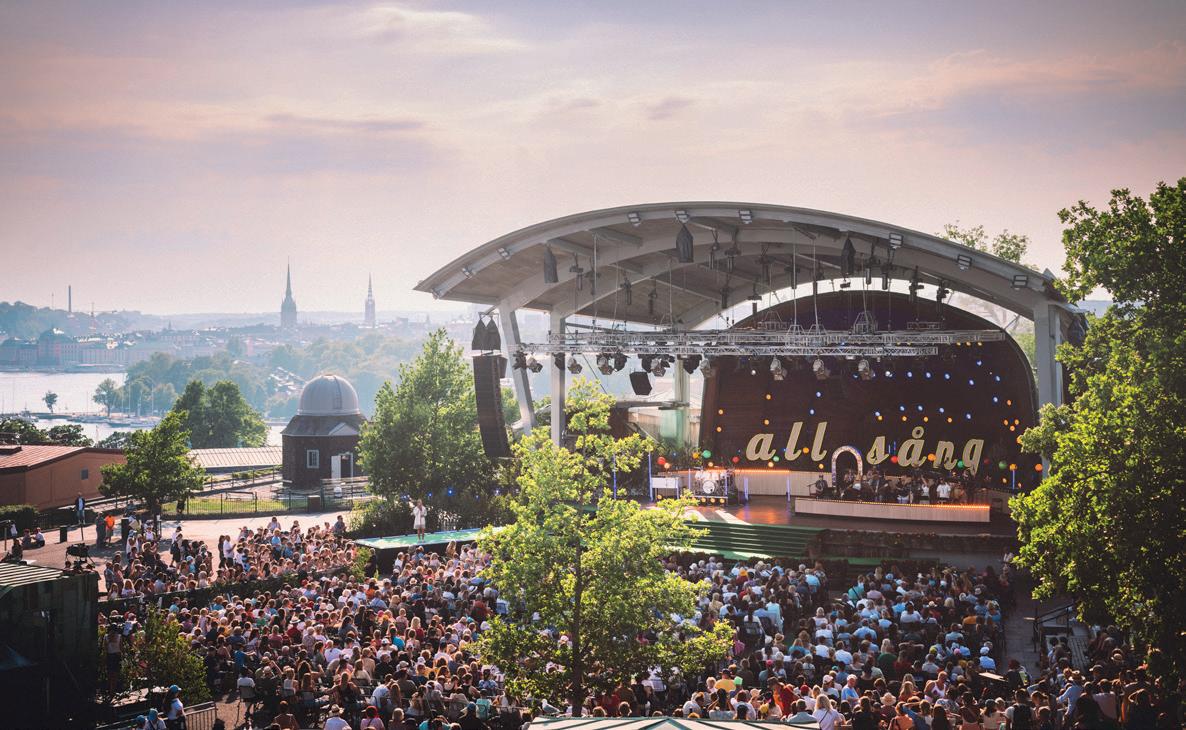
Scan Magazine Issue 167 June 2024
Published 06.2024
ISSN 1757-9589
Published by
Scan Client Publishing Print
Stibo Complete
Executive Editor
Thomas Winther
Creative Director
Mads E. Petersen
Editor
Malin Norman
Copy-editor
Vera Winther
Graphic Designers
Mercedes Moulia
Mauro Salerno
Cover Photo
© Alexander Scheuber/ @alexanderscheuber
Contributors
Anders Lorenzen
Celina Tran
Emma Rodin
Gabi Froden
Heidi Kokborg
John Semphill
Karl Batterbea
Malin Norman
Maria Vole
Molly McPharlin
Ndela Faye
Signe Hansen
Sofia Nordgren
Trine Jensen-Martin
Xander Brett
Sales & Key Account Managers
Emma Fabritius Nørregaard
Johan Enelycke
Veronica Rafteseth
Victoria Hagen
Advertising marketing@scanmagazine.co.uk
To Subscribe scanmagazine.co.uk/subscribe
Scan Magazine Ltd
3rd floor, News Building, 3 London Bridge Street, London SE1 9SG, United Kingdom www.scanclientpublishing.com info@scanmagazine.co.uk www.scanmagazine.co.uk
© All rights reserved. Material contained in this publication may not be reproduced, in whole or in part, without prior permission of Scan Magazine Ltd.
Scan Magazine® is a registered trademark of Scan Magazine Ltd.
This magazine contains advertorials/promotional articles
98 | Issue 167 | June 2024 Scan Magazine | Culture | Calendar
Photo: Skansen