
Issue 103 | March 2023 THE MAGAZINE PROMOTING GERMANY, SWITZERLAND & AUSTRIA PLUS SWISS EVENT LOCATIONS 2023 SOFTWARE DEVELOPMENT COMPANIES GERMANY’S TOP COACHES DESIGN, TRAVEL, BUSINESS & MORE BERLIN
FEVER:
BIKE
TOP SPRING CYCLING ROUTES
Schönstes Besteck kommt aus Biel!
Mit dem "TableWare International Award of Excellence 2022" für das weltbeste Besteck verfügt die Messermanufaktur sknife in Biel über 4 Internationale Designpreise. Das einzigartige Messerdesign findet mittlerweile in den weltbesten Restaurants mit über 100 Michelin-Sternen seinen Einsatz. Präzision aus der Uhrenstadt Biel zeichnet auch das Taschenmesser mit High-Tech Keramik Gleitlager aus. www.sknife.com


With the "TableWare International Award of Excellence 2022" for the world's best cutlery, the knife manufactory sknife in Biel is recognised with 4 international design awards. The unique knife design is now used in the world's best restaurants with over 100 Michelin stars. Precision from the watchmaking city of Biel also characterises the pocket knife with high-tech ceramic plain bearing. www.sknife.com


www.sknife.com sknife ag | Neuengasse 5 | CH-2502 Biel | Tel.: +41 32 322 97 55 | info@sknife.com | Vertrieb: www.world-of-knives.ch
COVER FEATURE
40 BERLIN FAHRRAD FEVER
Berlin is as bike-friendly as they come. With over 600 kilometres of bike paths, and grandiose new schemes in the pipeline, it’s no surprise that over twothirds of households in the city own a bike. To get you inspired to cycle more, we present five perfect places to bike to this springtime.

SPECIAL THEMES
14 3D-PRINTING COMPANIES IN GERMANY
Numerous companies are already using 3D-printing technology to develop highly efficient solutions and products that will blow your mind. Find out more in our special round-up.
22 TOP EVENT LOCATIONS IN SWITZERLAND IN 2023
What makes an event truly perfect? Well, the perfect location is a great start, of course. Luckily, Switzerland has many different event locations on offer that can cater for all needs and demands.
54 EDUCATION, TRAINING & DEVELOPMENT
Ready to embrace the next step in your life? A good place to begin is by perusing this carefully curated theme.
64 HEALTHCARE SOLUTIONS
In this special theme, we introduce some of the DACH region’s top healthcare solution providers. Get inspired by their stories!
70 GERMANY'S TOP COACHES – A REGIONAL SELECTION
Looking to take your business or your personal skills to the next level? Choosing a coaching or consulting expert might just do the trick.
73 SOFTWARE DEVELOPMENT COMPANIES
Software is everywhere right now and the industry is booming. Find out more about the movers and shakers in the sector.
FEATURES
20 STAR INTERVIEW: BERNHARD BETTERMANN
Discover Germany, Austria & Switzerland met up with actor Bernhard Bettermann to talk about his role in the popular TV series In Aller Freundschaft, his future goals and more.

36 THE BERLINALE PHENOMENA
Every Berliner and many visitors have their list of special moments to remember from years of attending a dearly beloved Berlin institution: The annual Berlin International Film Festival.
50 WARTBURG CASTLE: A SIGNIFICANT CULTURAL LEGACY
Join travel writer Stuart Forster on his quest to explore Wartburg Castle.
62 BORGWARD:
A HISTORIC GERMAN AUTOMAKER
Borgward isn’t a household name today, but in the 1950s and early '60s, this German carmaker was rivalling Volkswagen. Find out more here.
REGULARS & COLUMNS
8 DEDICATED TO DESIGN
Trendy interior items or unique fashion pieces at our Design section.
40 TRAVEL
Stunning hotels, top getaways and innovative attractions – check out the Travel section.
54 BUSINESS
Our Business section is filled with innovative companies and much more.
78 CULTURE CALENDAR
Our Culture Calendar is your perfect guide to what not to miss in March.
82 BARBARA GEIER COLUMN
This month, our columnist Barbara Geier talks about punctuality, one of Germany’s favourite pastimes.
March 2023 | Issue 103 | 3 43 20 Contents MARCH 2023
Photo: GNTB, Mountainbikepark Pfälzerwald e.V. /Andreas Meyer, World of MTB
Photo: Christian Kaufmann
Dear Reader,
March is upon us! And we can almost smell that spring air on the horizon. Did you know that Germany, Austria and Switzerland are each pretty wonderful spring destinations?

With longer days come warmer temperatures, and there are budding and blossoming flowers and plants everywhere, which are alone well worth a visit anywhere throughout the DACH region. For example, you could head to Palatinate’s Southern Wine Route to embrace the almond blossom season while indulging in some fine local wines. Or head to Bonn to experience the cherry blossom that rivals the experience you would get in Japan.
To fully embrace spring, cycling tours are always a great idea. That’s why this month’s cover feature presents five perfect places to bike
to this springtime. Furthermore, we head to Wartburg Castle and explore its significant cultural legacy.
Other topics covered in our March issue are an interview with actor Bernhard Bettermann, some brightly coloured and airy spring outfits in this month’s Fashion Finds, top event locations in Switzerland, the famous Berlinale event, Wartburg Castle, healthcare solutions, top coaches, 3D-printing technology, software development companies, education providers and much more.
Sit back, relax and thanks for reading.
Nane Steinhoff Editor

4 | Issue 103 | March 2023
Discover Germany | Editor’s Note
24
Photo: Kraftwerke Oberhasli AG, David Birri
The most spectacular show in Europe!


Die ARISE Grand Show ist eine Achterbahnfahrt der Gefühle voller strahlender Akzente –gefühlvolle Momente wechseln sich ab mit artistischen Meisterleistungen in schwindelerregenden Höhen und Choreografi en voller tänzerischer Perfektion. Verliebe Dich in über 100 Künstlerinnen und Künstler auf der größten Theaterbühne der Welt.


ARISE Grand Show at the Friedrichstadt-Palast Berlin is an emotional rollercoaster ride filled with dazzling highlights – touching moments alternate with artistic masterpieces at dizzying heights and stunning choreographies. Fall in love with over 100 artists on the world’s biggest theatre stage!


TICKETS www.PALAST.BERLIN ONLY UNTIL SUMMER 2023
EXPRESS,
DAILY
London

Fashion Finds
Radiate colour this spring with these gorgeous outfits by German brand Betty Barclay. With ‘70s inspired patterns and bright hues with an Italian touch, you are sure to be dressed to impress. Here are our top picks of the season that will see you sport the floral prints, bold tones and pastel hues that are so on trend.
Whether you’re heading to Italy this spring or not, this airy floral-print dress is a beautiful way to bring some spring vibes into your life. £115. www.bettybarclay.com/de

8 | Issue 103 | March 2023
Discover Germany | Design | Fashion Finds
EDITOR’S PICKS I PRESS IMAGES
A summer scarf is a great way to finish your outfit or to bring some colour to otherwise quite muted attire. This one comes with a dazzling pattern that just screams summer. £35. www.bettybarclay.com/de

A jumpsuit to get excited about. With its pink hue and midi-length legs, it is destined to become one of your favourite new spring staples. £97. www.bettybarclay.com/de

Bring some colour to your outfit with this shortsleeved jacket that impresses via the intricate embroidery that is featured on its lower edge. £71. www.bettybarclay.com/de

The ‘70s are back, again! With this short dress with its extra-special pattern, Betty Barclay have created a style masterpiece for this spring and summer season. £102. www.bettybarclay.com/de

March 2023 | Issue 103 | 9
Dedicated to Design
We can almost feel the spring. And to embrace it to the fullest, let’s update our home interiors. Dive into this beautifully refreshing trend inspired by clear-blue summer seas. Ocean-blue hues are said to exude peace, calm and tranquility, making them the perfect addition to your space.
BY: NANE STEINHOFF I PHOTOS: PRESSLOFT
1. This modern, contemporary, glossy, oceaninspired wallpaper mural on wood panel is layered with turquoise mica, jewel toned inks and deep green pigments. White foamy waves glisten as they splash against the shore. £40. www.feathr.com

2. Bring some colour into your bathroom with this gorgeous vanity cabinet by TOM TAILOR. It can either be mounted onto the wall or be ordered with feet. £704. www.otto.de

3. Redefine your lightscape with this ravishing Aquanura Fountain Chandelier. This dreamy chandelier boasts an inspired waterfall effect with its cascading glass tubes, in a soothing aqua-blue finish, suspended from delicate hooks around the perimeter of the light. £1,640. www.sweetpeaandwillow.com

4. This stool by H.O.C.K, which is both practical and stylish, also manages to be both versatile and comfortable at the same time. £78. www.hock-dich-hin.de

5. Embrace the ocean with this wall decoration in the shape of a school of fish. Individually handmade in Indonesia. £61. www.guru-shop.de

Discover Germany | Design | Dedicated to Design 5 2
10 | Issue 103 | March 2023
1
4
Swiss Edelweiss by Gexist®

Jewellery for lovers of the Swiss Alps
The Swiss Edelweiss by Gexist® collection is a tribute to the Swiss mountains. The jewels have a real identity that cannot be found anywhere else and a unique know-how...à la suisse!


Swiss Design jewellery in 925 sterling silver and 18 carat gold.

Photos: Thierry Pradervand www.gexist.com
ICONIC FAUCETS
With high-quality design faucets and bathroom accessories for all interior styles, Steinberg has design ideas that would certainly win anyone over.

From classic-elegant to minimalistic-modern, from kitchen fitting to bathroom appliances –“Our product lines are characterised by outstanding design, sophisticated functionality and exceptional quality. Typical of the Made in Germany stamp,” says marketing manager Jessica Beckmann.
Exclusive establishments, such as the Elbphilharmonie in Hamburg and top-tier hotels worldwide appreciate Steinberg’s ideas and quality just as much as those private customers with an eye for the exceptional. They are all united in their admiration of the outstanding designs that express a classicmodern individuality – individuality that starts at the very beginning. After all, Steinberg promises that inspiration, configuration and planning come first when it comes to customer service.
“Our customers’ satisfaction means a lot to us,” underlines the marketing expert. “A design should be well suited. We therefore offer various options that allow our customers to choose the design that suits them most. We use augmented reality on the smartphone, our 3D-showroom and a planning tool that maps out a project down to the smallest accessory. In this way, essentially nothing can go wrong.”
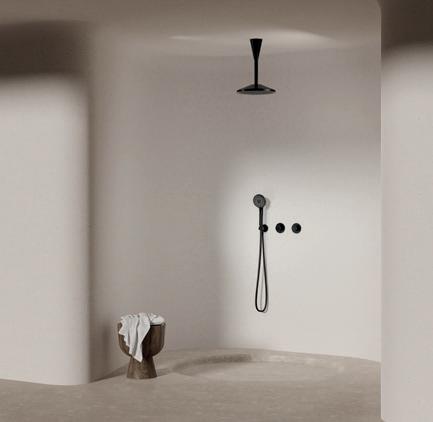
A new product line is currently making quite an impression: ICONIC. Inspired by Bauhaus’ avant-garde, timeless design, ICONIC sets new standards. Where the rounded, minimalist design language promises harmony, the recurring, typical conic design element stands for distinctiveness. Further highlights are the innovative technology that blends aesthetics and functionality. For with ICONIC, the water
temperature of bathtub and sink faucets, as well as iFlow shower faucets, can be adjusted individually by means of an intuitive push dial.
“A particularly striking eye catcher of the series is the thermostat’s LED colour gradient display, which changes its colour depending on the temperature,” adds Beckmann. A further innovative feature is the ICONIC shower head with its integrated circular LED lighting, that gently illuminates each shower with a soft glow – a perfect start to the day and a real highlight in your own home spa.
All faucets in the ICONIC range are now available online in a chrome or matt-black surface finish.
www.steinberg-armaturen.de/en-de
12 | Issue 103 | March 2023
TEXT: SILKE HENKELE
PHOTOS: STEINBERG GMBH
IKONISCHE ARMATUREN
Hochwertige Design-Armaturen und Badaccessoires für jeden Interior-Stil: Steinberg hat Designideen, die überzeugen.
Einen ganz besonderen Marktauftritt legt momentan die neue Produktlinie ICONIC hin. Inspiriert vom avantgardistischen, zeitlosen Design des Bauhauses, setzt diese Linie neue Maßstäbe: Wo die abgerundete, minimalistische Formensprache Harmonie verspricht, steht das wiederkehrende, typisch konische Gestaltungselement für Unverwechselbarkeit. Für weitere Highlights sorgt die innovative Technik, die das Schöne mit dem Nützlichen verbindet. Bei ICONIC lässt sich nämlich die Wassertemperatur bei Wannen- und Waschtischarmaturen sowie bei der passenden iFlow Duscharmatur mittels eines intuitiv zu bedienenden Reglers individuell einstellen.


Von klassisch-elegant bis minimalistischmodern, von Küchenarmatur bis Badmöbel –„Unsere Serien zeichnen sich durch herausragendes Design, durchdachte Funktionalität und exzellente Qualität aus. Eben typisch Made in Germany”, so Marketingmanagerin Jessica Beckmann.
Exklusive Häuser wie die Elbphilharmonie in Hamburg und exklusive Hotels weltweit wissen die Ideen und die Qualität von Steinberg genauso zu schätzen, wie private Kunden mit einem Auge für das Besondere. Sie alle schätzen die außergewöhnlichen Designs, die einer klassisch-modernen Individualität Ausdruck verleihen - einer Individualität, die bereits bei

der Auswahl beginnt. Schließlich stehen bei Steinberg Kundenservice Inspiration, Konfiguration und Planung an erster Stelle.
„Für uns ist vor allem wichtig, dass unsere Kund:innen mit ihrer Wahl zufrieden sind”, betont die Marketingexpertin. „Die Designs sollen zu ihnen passen. Wir bieten daher verschiedene Optionen, mit denen unsere Kund:innen in Ruhe aussuchen können, welches Design am besten ihren Vorstellungen entspricht. Wir nutzen dafür Augmented Reality auf dem Smartphone, unseren 3D-Showroom sowie ein Planungstool, das das Vorhaben bis ins kleinste Zubehörteil plant. So kann eigentlich nichts mehr schief gehen.”
„Ein ausgefallener Eyecatcher dieser Serie ist übrigens die LED-Farbverlaufsanzeige am Temperaturregler, die je nach Temperatur die Farbe wechselt”, ergänzt Beckmann. Eine weitere innovative Besonderheit ist die ICONIC-Kopfbrause mit integrierter, ringförmiger LED-Beleuchtung, die jeden Duschgang mit einem sanften Lichtschein begleitet - ein idealer Start in den Tag und ein echtes Highlight im eigenen Home-Spa.

Alle Armaturen der Produktlinie ICONIC sind ab sofort online mit den Oberflächenveredelungen Chrome und Matt Black erhältlich.
www.steinberg-armaturen.de
March 2023 | Issue 103 | 13
Steinberg GmbH | Design | Discover Germany
SPECIAL THEME: 3D-PRINTING COMPANIES IN GERMANY
Unlock countless possibilities
3D printing, the new generation of printing, will become bigger, faster and cheaper in the coming years. Numerous companies are already using this innovative technology to develop highly efficient solutions and products that will blow your mind. Find out more on the following pages.

 TEXT: NANE STEINHOFF I PHOTOS: UNSPLASH
GANZ NEUE DIMENSIONEN
Als kompetenter Partner für großformatige 3D-Drucke bietet AllgäuTec aus Leutkirch im Allgäu ganz neue Dimensionen - im wahrsten Sinne des Wortes.
Aller Anfang ist klein und so begannen auch Stefan Leinmüller und Christian Merk als gelernte Industriemechaniker 2014 erstmals damit eigene 3D-Drucker zu bauen. Ein Jahr später folgten dann größere Anlagen und 2017 wurde die Firma AllgäuTec ins Leben gerufen. Seitdem hat das Unternehmen stetig expandiert und ist mit mittlerweile 20 3D-Druckern in der Branche ein erfahrener Partner für Mittelstand und Industrie mit langjährigem Kundenstamm.
Als Dienstleister von 3D-Druck Bauteilen aus Kunststoff bietet AllgäuTec eine breite Palette an additiven Fertigungsverfahren einschließlich SLS (Selektives Lasersintern), Polyjet und FDM an. Je nach Anforderung des Bauteils kann das passende Druckverfahren angeboten werden.


Einzigartig am Markt sind dabei die drei selbst entwickelten „XXL-Drucker", die besonders im Messebereich gefragt sind, wie Co-CEO Stefan Leinmüller erläutert: „Den großen Druckbereich der XXL-Drucker können nicht viele Dienstleister anbieten. Das ermöglicht Eyecatcher und komplizierte Formen zu pro-
duzieren, die normalerweise in mühsamer Handarbeit hergestellt werden müssen“.
AllgäuTec bietet nicht nur überdurchschnittlich große Bauteile an, sondern übernimmt auch die Veredelung der Oberfläche vom einfachen Verspachteln bis hin zur aufwendigen Airbrush-Lackierung.
Durch die Investition in moderne Lasersinter Anlagen (SLS) können Prototypen, Vorrichtungen, Werkzeuge und Serienteile mit hohen Qualitätsansprüchen hergestellt werden. Um wettbewerbsfähig gegenüber anderen Dienstleistern und zu konventionellen Fertigungsverfahren zu sein, werden Prozesse ständig optimiert.
Außerdem benutzt das Team eine ganze Reihe verschiedener Materialien und freut sich über jede Herausforderung in Sachen Kundenwünsche. Auch die Produktion rund um die Uhr kommt gut an - teilweise liefert AllgäuTec sogar mehrere hundert Teile über Nacht.
„3D-Druck ist richtig effizient, wenn ein Mehrwert geschaffen wird“, erläutert Co-CEO
Christian Merk. Das ist beispielsweise dann der Fall, wenn Bauteile nicht mit klassischen Fertigungsverfahren hergestellt werden können, besonders leicht sein sollen oder komplexe Geometrien erfordern. Außerdem können Änderungen oder individuelle Bauteile einfach umgesetzt werden, da keine Werkzeuge verändert werden müssen.

Häufig ersetzt AllgäuTec ganze Baugruppen mit einem 3D-Druck Bauteil. Dies verringert nicht nur Aufwand in der Beschaffung, Fertigung und Montage, sondern reduziert dabei noch Lagerkosten. Merk fügt hinzu: „Oft sind die Kunden überrascht, wie unkompliziert die Beschaffung von 3D-Druck Bauteilen ist und wie schnell die Bauteile geliefert werden.“

www.allgaeutec.de
T.: +49 176 4726 78 50
March 2023 | Issue 103 | 15 3D-Printing Companies in Germany | Special Theme | Discover Germany
TEXT: MARILENA STRACKE | FOTOS: ALLGÄUTEC GBR
GOOD, BETTER, 3D!
It’s time to say goodbye to manual production and welcome 3D prints instead. Why? Its options are almost endless.
Schwandorf-based 3DPrint-Creations UG was founded in 2022 and has very quickly made a name for itself with exceptional product quality and customer-orientated service delivered to a large clientele. “We aren’t limited to a particular field,” clarifies founder and director Tom Tuszynski: “We are interested in all segments.”

Miniatures, prototypes, components, actiongame figurines, vases, wall decorations, machine spare parts or bespoke designs made to customers’ requirements – the professionals at 3DPrint-Creations have a print solution for every request.
“If customers are uncertain about a design,” adds Tuszynski, “we consult with them and supply the print templates ourselves. Our team has excellent knowledge of CAD pro-
grammes and is able to realise almost any idea. All we need is a model or a sketch of the respective object that needs to be printed.” Here, there are virtually no limits: “Our customers can let their imaginations run wild. If it’s feasible, we can almost always realise it,” emphasises Tuszynski.
This huge flexibility is also facilitated by the printing methods used. “Depending on the project, we use different processes. We offer standard FDM, i.e. layer-based printing as well as SLA with liquid resin, or SLS, i.e. selective laser sintering. Parts used with or in machines, for example, are best printed by SLS while SLA is best suited for small parts that also need to be visually appealing,” explains the director.
3DPrint-Creations accepts print jobs of only one item, which is one of the reasons it is an
interesting partner for private as well as corporate customers. “We work 24/7 in three shifts, which allows us to process orders very quickly and reliably. We are therefore able to fulfil orders that reach us on Saturday morning to be ready for collection or dispatch on Monday morning.” A truly invaluable service, therefore, if speed is important.
Anyone who wants to talk with Tuszynski about upcoming 3D-print projects can meet him and his team at Formnext in Frankfurt am Main, where the company will be presenting itself from 7 to 10 November 2023.
www.3dprint-creations.de
Already have a 3D-print object in mind? Simply upload your sketch on their homepage, enter discount code Discovergermany10 and marvel at the quality and service of prints by 3DPrintCreations.
16 | Issue 103 | March 2023
TEXT: SILKE HENKELE I PHOTOS: 3DPRINT-CREATIONG UG
GUT, BESSER, 3D!
Manuelle Produktion war gestern, 3D-Print ist heute. Aus gutem Grund. Denn: Die Möglichkeiten eines 3D-Prints sind nahezu unerschöpflich.
2022 gegründet, hat sich die 3DPrintCreations UG aus Schwandorf sehr schnell mit außergewöhnlicher Produktqualität und kundenorientiertem Service bei einem großen Kundenkreis einen Namen gemacht. „Wir haben uns auf keinen bestimmten Produktbereich festgelegt”, stellt Gründer und Geschäftsführer Tom Tuszynski klar. „Für uns ist jedes Segment interessant.”

Egal ob Miniaturen, Prototypen, Bauteile, Actionspielfiguren, Vasen, Wanddekorationen, Maschinenersatzteile oder Sonderanfertigungen nach Kundenwünschen - die Profis von 3DPrint-Creations haben für jedes Anliegen eine (Print-)Lösung parat.
„Wenn unsere Kund:innen sich bei einem Design noch unsicher sein sollten”, fügt Tuszynski hinzu, „liefern wir in Abstimmung mit den Beauftragenden auch selbst die Druckvorlagen. Wir kennen uns mit CADProgrammen bestens aus und können eigentlich fast jede Idee umsetzen. Hierzu reicht uns dann ein Modell oder eine Skizze des zu druckenden Objekts.”
Der Fantasie sind dabei keine Grenzen gesetzt: „Unsere Kund:innen können Ihren Ideen freien Lauf lassen. Was realisierbar ist, realisieren wir in den allermeisten Fällen”, unterstreicht Tuszynski. Diese große Flexibilität wird auch durch die verwendeten Druckmethoden möglich.
„Je nach Projekt verwenden wir unterschiedliche Verfahren. Wir bieten das normale FDM, also das schichtbasierte Druckverfahren genauso an, wie das SLA-Druckverfahren mit Flüssigharz oder das SLS-Verfahren, also das selektive Lasersinternverfahren. Das SLSVerfahren beispielsweise nutzen wir meistens für Teile, die an oder in Maschinen benötigt werden, während das SLA-Verfahren am besten geeignet ist für kleine Teile, die auch optisch ansprechend sein sollen,” klärt der Geschäftsführer auf.
Die 3DPrint-Creations UG druckt bereits ab einer Stückzahl von eins, und ist nicht nur deshalb für Privatkunden genauso interessant wie für Großkunden. „Wir arbeiten 24/7 im Drei-Schicht-Betrieb, wodurch wir Druckauf-
träge sehr schnell und zuverlässig ausführen können. So ist es uns möglich, auch Projekte, die uns am Samstag morgen erreichen, bis Montag früh abhol- bzw. versandfertig zu produzieren.” Ein unschätzbarer Service, wenn es schnell gehen muss!
Wer mit Tuszynski über die nächsten anstehenden 3D Print-Projekte sprechen möchte, der kann ihn und sein Team bei der Formnext in Frankfurt am Main treffen, wo sich das Unternehmen vom 7. bis 10. November 2023 vorstellt.

www.3dprint-creations.de
Das nächste 3D-Print Objekt steht an? Einfach auf der Homepage die Skizze hochladen, Rabattcode Discovergermany10 eingeben und sich von der Druckqualität und dem Service von 3DPrint-Creations selbst überzeugen.
March 2023 | Issue 103 | 17
3D-Printing Companies in Germany | Special Theme | Discover Germany
3DPrint-Creations sind (v.l.n.r.): Robin Hausmann (Produkt-Marketing Manager), Tom Tuszynski (Geschäftsführer und Gründer), Daniel Elsner (Geschäftsführer).
ALPINE FLAVOURS
Since 1906, Albert Spiess AG has been known worldwide for its unique dry-cured meat specialties from the Grisons. The meat matures at Europe's highest-altitude dry-curing site, developing its delicious taste in the fresh mountain air. From Grison meat, raw ham to bacon, Salsiz and Coppa – Albert Spiess AG promises to pamper your palate.

The home of the original Grison meat is the dry-curing site in Davos-Frauenkirch. For more than 100 years, the fine dry-cured meat specialties have been made here at over 1,500 metres above sea level. Cool mountain air and humidity from the Sertig creek provide the ideal conditions needed. And you can taste precisely that!

The recipes have been passed down from generation to generation and traditional craftsmanship can still be found here today. Werner Huber, sales director of Albert Spiess AG, adds: "Nothing is left to chance. We guarantee premium products."

The world-famous original is now also available with sustainable packaging. Thinly sliced and placed on the tray by hand before it is sealed, it tastes like it’s been freshly sliced, but you can enjoy it at home!
The various Grison specialties can be purchased in selected Swiss stores or online.
www.albert-spiess.ch
www.shop.albert-spiess.ch
DER GESCHMACK DER ALPEN
Seit 1906 ist die Albert Spiess AG für ihre einzigartigen Bündner Trockenfleisch-Spezialitäten weltweit bekannt. Das Fleisch reift in Europas höchstgelegener Trocknerei an der frischen Bergluft und entwickelt so seinen herrlichen Geschmack. Von Bündnerfleisch, Rohschinken und Speck bis zu Salsiz und Coppa – die Albert Spiess AG verspricht höchsten Genuss.
Das Zuhause des Bündner Originals ist die Trocknerei in DavosFrauenkirch. Hoch oben in den Alpen - nämlich auf über 1.500 Metern über dem Meeresspiegel - werden seit mehr als 100 Jahren feine Trockenfleisch Spezialitäten hergestellt. Kühle Bergluft und Feuchtigkeit vom Sertig Bach sorgen für ideale Bedingungen. Und das schmeckt man!
Die Rezepturen wurden von Generation zu Generation weitergegeben und noch heute findet man hier traditionelles Handwerk. Werner Huber, Verkaufsleiter der Albert Spiess AG, fügt hinzu: „Dabei wird nichts dem Zufall überlassen. Wir garantieren für ein erstklassiges Qualitätsprodukt.“
Den weltberühmten Klassiker gibt es nun auch verpackt in nachhaltigen Schalen. Dünn geschnitten und von Hand in die Schale gelegt, ermöglichen sie so ein Geschmackserlebnis wie frisch geschnitten – allerdings zuhause!
Die verschiedenen Bündner Spezialitäten gibt es im Schweizer Detailhandel oder im Onlineshop.
www.albert-spiess.ch
www.shop.albert-spiess.ch
18 | Issue 103 | March 2023 Discover Germany | Wine & Dine | Albert Spiess AG
TEXT: MARILENA STRACKE | PHOTOS: ALBERT SPIESS AG
KINKHAO: THAI HOSPITALITY IN THE HEART OF ZURICH


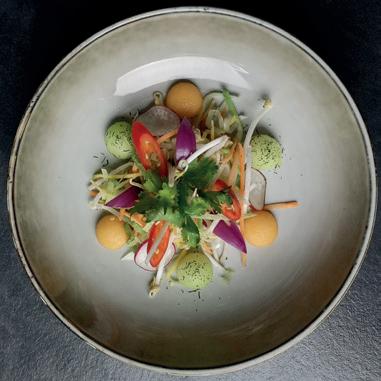
Enjoy a culinary journey through Thailand while remaining in the heart of Zurich, at the Thai restaurant KINKHAO. The cuisine combines three different cooking styles of Thailand –north, north-east and central – to create a Thai menu as a ‘Tavolata’. For the last three years, the restaurant has received the Swiss Guest Award. On Tripadvisor, Google and other review platforms, meanwhile, guests seem to outdo each other with their uses of superlatives.
"Kin Aharn Pen Ya – food is the natural medicine". And when it comes to enjoying good food together, can there really be a better medicine than that? The restaurant's set-up with three long tables creates the special atmosphere of ‘Tavolata’ – dining together with fine Thai cuisine, warm hospitality and a familiar atmosphere, like eating at your friend's place.
The focus of the Thai restaurant KINKHAO is on the diversity of Thai cuisine and Swiss regionality. The dishes are prepared exclusively with Thai spices and herbs and meat from Switzerland. Healthy cuisine with no flavour enhancers or glutamates used. KINKHAO invites you to enjoy with all your senses, and can also cater for vegetarians or vegans on request.
The menu includes dishes from all regions of Thailand. For example, the special Thai sausages, which are KINKHAO's own recipe, plus red curry pork, green curry vegetables, or grilled fish with coconut milk. The dishes can also be combined, for maximum enjoyment. The culinary journey is offered at a fixed price, including wine and coffee, until closing time.
www.kinkhao.ch
KINKHAO: THAILÄNDISCHE GASTFREUNDSCHAFT IM HERZEN VON ZÜRICH
Eine kulinarische Reise durch Thailand genießt man im Herzen von Zürich in dem Thai Restaurant KINKHAO. Die Küche vereint die drei verschiedenen Kochstile Thailands –Nord, Nordost und Zentral – zu einem thailändischen Menü als ‚Tavolata‘. In den letzten drei Jahren wurde das Restaurant mit dem Swiss Guest Award ausgezeichnet. Auf Tripadvisor, Google und den einschlägigen Portalen übertreffen sich die Gäste mit Superlativen.
„Kin Aharn Pen Ya – das Essen ist die natürliche Medizin“. Gutes Essen gemeinsam genießen, kann es eine bessere Medizin geben? Die Einrichtung des Restaurants mit drei langen Tischen schafft die besondere Atmosphäre der ‚Tavolata‘ – mit feiner thailändischer Küche, herzlicher Gastfreundschaft und einer familiären Atmosphäre, als ob man bei Freunden essen würde.
Der Fokus im Thai Restaurant KINKHAO liegt auf der Vielfalt der thailändischen Küche und auf der Schweizer Regionalität. Die Gerichte werden ausschließlich mit Fleisch aus der Schweiz zubereitet sowie mit Gewürzen und Kräutern aus Thailand verfeinert. Eine gesunde Küche, die auf Geschmacksverstärker und Glutamate verzichtet. KINKHAO lädt zum Genuss mit allen Sinnen ein, auf Wunsch auch vegetarisch oder vegan.
Zum Menü gehören Speisen aus allen Regionen Thailands. Etwa die besonderen Thai-Würstchen nach eigenem Rezept von KINKHAO, oder das Rote Curry Schweinefleisch, grünes Currygemüse oder der gegrillte Fisch mit Kokosnussmilch aus dem Gebiet Bangkok. Für den maximalen Genuss werden auch die Gerichte miteinander kombiniert. Die kulinarische Reise wird zum Festpreis inklusive Wein und Kaffee angeboten.
March 2023 | Issue 103 | 19
TEXT: SAKIB HADZOVIC I PHO TOS: LAORTIP GASSER
Thai Tavolata.
Top cuisine Switzerland | Wine & Dine | Discover Germany
Thai Spicy Salad. Inside the restaurant.
“UNCERTAINTY, RISK AND ADVENTURE ARE PART OF MY DNA”
Discover Germany, Austria & Switzerland met up with actor Bernhard Bettermann to talk about his role in the popular TV series In Aller Freundschaft, his love for Switzerland, his future goals and much more.

DISCOVER GERMANY: You were born in France, have grown up in Germany and currently live in Switzerland. How do your roots coin your life today?
BERNHARD BETTERMANN: My French roots only shape me to the extent that one day I really want to live in Paris for a few months. The affinity for the language is there, but it takes me a few days to get used to it and I'm having trouble getting started. I'm German, Cologne has shaped me, Switzerland is my adopted home. I'm a big friend of the Swiss understanding of democracy and would wish that political co-determination, and a trusting relationship with politics in general, would also spread to the rest of Europe. At the end of my days, I would like to be a proud European. I will do whatever I can to contribute.
DISCOVER GERMANY: What does the term ‘home’ mean to you? Why did you choose Switzerland?
BB: I came to Switzerland through my training as an actor and have struck down artistic roots here, done a lot of theatre. With my wife at the time, Sabina Schneebeli, I brought two lovely men into the world, and being so close to them is a key reason for being connected to Switzerland. There is a lot to discover in this small country and the world of art in particular, in interaction with business and politics, is diverse and lively. I'm also a nature boy and Switzerland has something extraordinary to offer in that respect. The proximity to Lake Zurich makes me happy every day.
DISCOVER GERMANY: Your acting career started in the theatre. How is the world of theatre different from the world of TV? Are you more drawn to one of the two worlds?
BB: I like to compare the two disciplines of acting to the world of sports. Theatre is a marathon, filming is a short-distance sport. This mainly relates to the time I have available to develop the role and the length of the engagement. If I had to decide, which luckily I don't have to, I would choose the theatre. It
deals even more intensively with the content of the story to be told and I have greater responsibility. As an artist, I have more design options on stage. And a theatre hall is simply a magical place.
DISCOVER GERMANY: Is acting your dream job or has there ever been another?
BB: Acting was and is my dream job. I also don't think that without this passion and conviction it is possible to lead a fulfilling life as an actor. There is too much resistance in this profession that needs to be overcome and endured. The key words here are financial insecurity, the unsteady rhythm, constant criticism and uncertainty, whether from outside or inside, and the difficult compatibility of family and career. Success only protects to a limited extent, it is a fleeting companion. Personally, I derive my satisfaction from the constant growth that goes hand in hand with every acting task that is mastered. The route is the goal. A few of these hackneyed phrases have their merits.
DISCOVER GERMANY: How do you prepare for the different roles? Are there certain rituals that you like to include?
BB: Starting with the training, I learn new things and then rituals and techniques develop organically. I don't have a notebook on how I approach the next role. Starting with the acting challenge, directing, colleagues and working conditions; each task is very unique. I love learning about it. And that has to be noted here, too – my acting life doesn't take me from one big role to the next. I haven't had this great gift so far, but I'm not at the end of my career yet. Hopefully it will accompany me until my earthly farewell.
DISCOVER GERMANY: You play one of the main roles in In Aller Freundschaft. What makes this series so special for you?
BB: The overall package is right. On the one hand, the world of medicine offers an enormous number of stories, we are all confront-
ed with them sooner or later– each of us has been a patient at some point. On the other hand, an artistic team has come together in Leipzig that functions like a good ensemble. Special positions and vanity have no place and the implementation of the respective story is in the foreground. And the immense popularity that IAF enjoys among TV viewers, incidentally also in the industry, does the rest to make people feel comfortable in this workplace.
DISCOVER GERMANY: You now want to be more involved in international streaming formats. What is so fascinating about this new format?
BB: The main reason I want to get to know other formats is because I want to grow. In addition, I find our society as a whole to be too anxious. Existential worries don't leave me cold either, but I don't want to be subjugated by them. Fear of loss, especially of a material nature, should not be allowed to rule my life. And such a series is like a golden cage. You're cared for, a valuable member of a well-oiled machine, but it's also a cage. And I didn't choose this job to be safe and protected through life. Uncertainty, risk and adventure are part of my DNA. I'm an Aquarius after all!
DISCOVER GERMANY: What else can we look forward to from you in 2023? Are there already exciting projects that you can talk about?
BB: I was with IAF for 17 years. This year, I want to reposition myself and orientate myself. The streaming services haven't discovered me yet, but this almost unemployed time is also important – the ‘emptiness’ has to be endured. Everything has its time, impatience has to be braved. But after 37 years of almost continuous employment, that's good.
DISCOVER GERMANY: Wishes and dreams for the future?
BB: Private happiness. Inner peace. Loved ones by my side. Keep going.
March 2023 | Issue 103 | 21
TEXT: NANE
I
Star Interview | Culture | Discover Germany
STEINHOFF
PHO TO: CHRISTIAN KAUFMANN
SPECIAL THEME: TOP EVENT LOCATIONS IN SWITZERLAND IN 2023
Finding the right location
What makes an event truly perfect? Well, the perfect location is a great start, of course. Luckily, Switzerland has many different event locations on offer that can cater for all needs and demands. Find out more in the following special theme.

 PHOTOS: PIXABAY
A HOT SPOT FOR INNOVATION IN THE HEART OF ZURICH

Trust Square is a technology-driven co-working space and innovation hub located in Zurich. Founded in 2017 with the goal of fostering collaboration within the blockchain and cryptocurrency communities, it has become a central hub and event venue for entrepreneurs, start-ups and established companies, to exchange ideas, network and bring projects to life.


Trust Square was formed during the early days of blockchain technology and cryptocurrency in Switzerland. As a pioneer, it initially held networking events, before it expanded further. Following the motto "from entrepreneurs for entrepreneurs", the Venture Studio and Venture Services were launched, offering a wide range of services with a focus on business operations, IT services and infrastructure, as well as developing and implementing new business models.
Today, Trust Square has developed a considerable network of partners and customers and is a well-established central hub for innovation with over 4,500 square metres in three different locations and hosting more than 500 events – including the largest Swiss blockchain hackathon. It’s the go-to destination in the field of blockchain, digital technologies and innovation. Hence, their
client base does not only include Swiss companies, universities and investors, but also international players.
“Although networking events and external events are still a fundamental part of our digital habitat, we now offer office and event spaces, which are managed by hotel professionals,” Sebastian Sieber, head of locations and community, explains. “At the Paradeplatz location, we can accommodate everything from a 12-person executive meeting to a 400-person conference. The event space for 120 people and the community space for 50 people each have access to one of our beautiful terraces and offer an impressive location for successful events.”
From the equipment of the event rooms to the catering and background entertainment, no two events are the same, as they are put
together individually according to each customer’s special requirements.
Thanks to its substantial network within the technology, innovation and finance industries, Trust Square easily stands out, as Sieber adds: “Our strength lies in our long-term partnerships with established companies and the constant development through innovative start-ups. In many cases, it's not complicated. Often, we know people with ideas and people with capital, and just need to connect the dots.”
For inquiries, you can contact Sebastian. sieber@trustsquare.ch
www.trustsquare.ch
March 2023 | Issue 103 | 23 Top Event Locations in Switzerland In 2023 | Special Theme | Discover Germany
TEXT: MARILENA
|
STRACKE
PHO TOS: KARIN BISCHOF
Sebastian Sieber, head of locations and community.
Photo: Karin Bischof
POWER RESTORATION NEAR HISTORIC MOUNTAIN PASSES
Between imposing granite walls and reflecting mountain lakes, the Grimsel hotels allow visitors to fully restore their energies in blissful seclusion.
Formerly home to the historical ‘Säumer’ traders who would use the Grimsel and Susten passes to carry goods to Italy on foot, the region is nowadays mostly known for its breathtaking landscape marked by 13 water-power stations generating electricity for one million citizens.

Markus and Marianne Meier have been co-running the Grimselwelt hotels since 2019. Their guest list includes those looking to recharge within a peaceful environment, as well as companies seeking the perfect spot for a business retreat. Many guests also enjoy a thrilling visit to the Spitallamm dam wall construction site, or a guided tour through the state-of-the-art power stations.
Situated just above a reservoir lake, the picturesque ‘Grimsel Hospice’ invites people to participate in winter retreats in complete seclusion, as well as being an inspiring place for a summer holiday. The resort hotel Handeck mainly attracts families, as well as sports and nature enthusiasts, with its vast choice of outdoors activities and a real farm holiday feel.
SWISS LOCATION AWARD
Guest service and sustainable tourism are key to the ISO certified Grimselwelt operations and the Grimsel hotels have been voted one of the best Swiss event and culinary locations in both 2021 and 2022.

As a unique symbiosis between nature and astonishing technology, the Grimselwelt landscape allows a complete recharge of the batteries – in whichever way you prefer to do it.
www.grimselwelt.ch
KRAFT TANKEN ZWISCHEN URALTEN GEBIRGSPÄSSEN
Inmitten von imposanten Granitwänden und spiegelnden Bergseen laden die Hotels der Grimselwelt zum Auftanken in erfrischender Zurückgezogenheit.
Historisch gesehen für die ‚Säumer‘ bekannt, welche die Gebirgspässe Grimsel und Susten nutzten, um zu Fuß Waren nach Italien zu transportieren, ist die Gegend heute vor allem wegen ihrer atemberaubenden Landschaft beliebt – markiert durch die dreizehn Wasser-Kraftwerke Oberhasli, die eine Million Nutzer mit Energie versorgen.
Markus und Marianne Meier leiten seit 2019 die Grimselhotels und wissen um die Vielfalt der individuellen Bedürfnisse ihrer Gäste: So gibt es zum einen die Erholungssuchenden, die Abgeschiedenheit und Entspannung suchen, und zum anderen Firmenkunden, die hier ideale Bedingungen zur Klausurtagung vorfinden. Nicht zuletzt sind es auch die Kraftwerksführungen und der derzeitig entstehende Jahrhundertbau der Staumauer Spitallamm, die regelmäßig interessierte Besucher in ihren Bann ziehen.
Majestätisch oberhalb eines Stausees gelegen bietet das Historische Alpinhotel Grimsel Hospiz sowohl die Gelegenheit zum inspirierenden Winter-Retreat als auch zum erfrischenden Sommerurlaub. Das Hotel und Naturresort Handeck zieht derweil mit Chalet-Ambiente und weitläufigem Grundstück Familien sowie Sportler und Naturfreunde an.

SWISS LOCATION AWARD
Gästebetreuung und nachhaltiger Tourismus stehen für die ISOzertifizierten Grimselwelt-Betriebe an erster Stelle. Die Grimselhotels wurden bereits 2021 und 2022 als eine der besten Schweizer Erlebnislocations (Historisches Alpinhotel Grimsel Hospiz) sowie in der Kategorie Genusslocation (Hotel und Naturresort Handeck) ausgezeichnet.
Durch ihre Symbiose zwischen Natur und erstaunlichen Technologien erlaubt die Landschaft der Grimselwelt ein volles Krafttanken – sowohl wortwörtlich als auch im übertragenen Sinne.
24 | Issue 103 | March 2023
Discover Germany | Special Theme | Top Event Locations in Switzerland In 2023 TEXT: CORNELIA BRELOWSKI | PHOTOS: KRAFTWERKE OBERHASLI AG, DAVID BIRRI
Historic Alpine hotel overlooking a reservoir lake and power station.
Grimselwelt winter retreat with hot tub.
Tower hall at Grimsel Hospiz, Historic Alpine Hotel.


Hotel Grimsel Hospiz www.grimselwelt.ch
EVENTS IN BREATHTAKING SURROUNDINGS
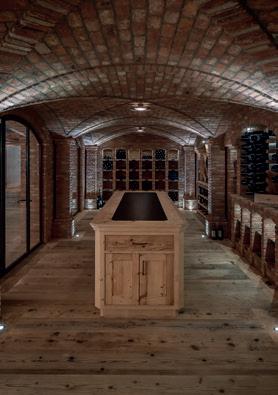
Different, better, finer – really, events are supposed to be this special. They are meant to inspire, motivate and, above all, create positive memories for the participants.
Located at 1,900 metres in the heart of the Grison Alps, Madrisa-Hof is a place that makes event ambitions become a reality. Nestling in the stunning Alp mountains, it therefore offers true Alpine cosiness. Here, private events such as weddings or anniversaries become unforgettable, as do company seminars or meetings.

While this unique location promises the exceptional, so too the team of Madrisa-Hof impresses with cordiality and personal, competent advice. “It is our goal to provide our guests with unforgettable moments. We want to help create beautiful bonding experiences. Experiences that all guests will remember happily,” enthuses event sales manager Ramona Feurle.
The feel-good factor at Madrisa-Hof does not solely come from the stunning surroundings, but also the singular venues with their large panoramic windows that offer a view of the breathtaking Alpine panorama. Culinary, authentic Alpine delights made and served by the team, with a lot of love for detail, round off the services offered at this unique event location. “We firmly believe that successful catering forms part of a successful event,” says Feurle.
The perfect partner for extraordinary, successful events in a beautifully imposing location? It’s most certainly Madrisa-Hof, near Klosters.

www.madrisa.ch/en
EVENTS IN ATEMBERAUBENDER UMGEBUNG
Anders, besser, schöner - Events sollen etwas Besonderes sein. Sie sollen inspirieren, motivieren und vor allem allen Teilnehmenden positiv im Gedächtnis bleiben.
Auf 1.900 Metern im Herzen der Bündner Alpen gelegen, ist der Madrisa-Hof ein Ort, an dem Eventträume wahr werden. Eingebettet in die traumhafte Bergwelt der Alpen bietet er alpine Gemütlichkeit pur. So werden private Anlässe wie Hochzeiten oder Geburtstage ebenso zu einem unvergesslichen Erlebnis wie Firmenseminare oder Tagungen.
Wo der außergewöhnliche Ort Besonderes verspricht, überzeugt das Team des Madrisa-Hofs mit viel Herzlichkeit und persönlicher, kompetenter Beratung. „Unser Ziel ist es, unseren Gästen unvergessliche Momente zu schenken. Wir möchten dazu beitragen, schöne, verbindende Erfahrungen zu erschaffen. Erfahrungen, an die sich alle Gäste gerne erinnern”, betont Event Sales Managerin Ramona Feurle.
Zum Wohlfühlprogramm des Madrisa-Hofs gehören neben der Landschaft Räumlichkeiten mit großen Panoramafenstern, die den Blick auf das atemberaubende Alpenpanorama freigeben. Kulinarische, authentisch alpine Genussmomente, die das Team mit viel Liebe zum Detail zubereitet und serviert, runden das Angebot dieser besonderen Eventlocation ab. Denn: „Wir sind der festen Überzeugung, dass zu einem gelungenen Event gelungenes Catering gehört”, so Feurle.
Der beste Ansprechpartner für außergewöhnliche, gelungene Events in einer imposanten Umgebung? Der Madrisa-Hof nahe Klosters.
www.madrisa.ch
26 | Issue 103 | March 2023 Discover Germany | Special Theme | Top Event Locations in Switzerland In 2023
TEXT: SILKE HENKELE I PHOTOS: MICHA MEIER
Sternen-Suite Sternenhimmel geniessen
In einem kuschlig warmen Bett auf fast 1‘900 m. ü.M. in den Sternenhimmel schauen, die Madrisa macht es möglich. In der gemütlichen Sternen-Suite können Sie die Natur von einer ganz neuen Perspektive erleben. Noch nie war eine Übernachtung so spektakulär und einfach zugleich.


BIG EVENTS WITH A VIP FEELING
Events that take place where superstars such as Michael Bublé, Sam Smith, Peter Gabriel or Ricky Gervais have performed? That sounds pretty enticing!

Located in the centre of Zurich, the Hallenstadion provides the perfect conditions for a successful event of a special kind. Deputy director Renzo Cannabano elaborates: “The Hallenstadion is the biggest multifunctional arena in Switzerland. It offers ample outdoor spaces as well as more than sufficient parking facilities. Thanks to its central location, the logistics are easy and the venue is easily accessible by public transport.”
Even for a minimum of 500 guests, there is ample space for company events or congresses, as well as for concerts or trade fairs. “We accommodate our clients’ needs. Redundant rows of seats, for example, can easily be moved and stowed away,” adds Cannabona.

The Hallenstadion’s team strives towards an outstanding, positive customer and event experience. To this end, it never stops enhancing its range of services in order to optimally serve customers and partners. Currently, this encompasses gastronomy, light and seating concepts, event organisation as well as more than 250 state of the art LED screens for digital signage (200 more will follow soon), designer loges or the recently introduced STUDIOS, which can be booked as an upgrade for an extra VIP feeling.
www.hallenstadion.ch/en/
GROSSE EVENTS MIT VIP-FEELING
Events, die dort stattfinden, wo sich Superstars wie Michael Bublé, Sam Smith, Peter Gabriel oder Ricky Gervais die Klinke in die Hand geben? Na klar, das geht!
Inmitten von Zürich gelegen, bietet das Hallenstadion die besten Voraussetzungen für ein gelungenes Event der besonderen Art. Der stellvertretende Direktor Renzo Cannabona zählt auf: „Das Hallenstadion ist die größte multifunktionale Arena in der Schweiz, die außerdem über großzügige Außenflächen und mehr als ausreichend Parkmöglichkeiten verfügt. Durch die zentrale Lage ist nicht nur die Logistik unproblematisch, auch die Anreise für die Gäste mit den öffentlichen Verkehrsmitteln ist äußerst bequem.”
Ab 500 Personen ist für Firmenevents oder Kongresse im Hallenstadion genauso Platz wie für Konzerte oder Messen. „Wir passen uns hier den Bedürfnissen unserer Kunden an. So können beispielsweise überflüssige Sitzreihen ganz einfach zurückgeschoben werden”, ergänzt Renzo Cannabona.
Das Team des Hallenstadions steht für ein ungetrübt positives Kundenund Eventerlebnis. Dafür entwickelt es sein Angebot immer weiter, um Kunden sowie Partner optimal bedienen zu können. Aktuell sind das neben der Gastronomie, dem Licht- und Stuhlkonzept und der Eventorganisation, mehr als 250 topmoderne LED-Screens für Digital Signage (weitere 200 folgen bald), Design-Logen oder die neu lancierten STUDIOS, die als Upgrade für ein einzigartiges VIP-Feeling gebucht werden können.
www.hallenstadion.ch
28 | Issue 103 | March 2023 Discover Germany | Special Theme | Top Event Locations in Switzerland In 2023
TEXT: SILKE HENKELE | PHOTOS: HALLENSTADION ZÜRICH
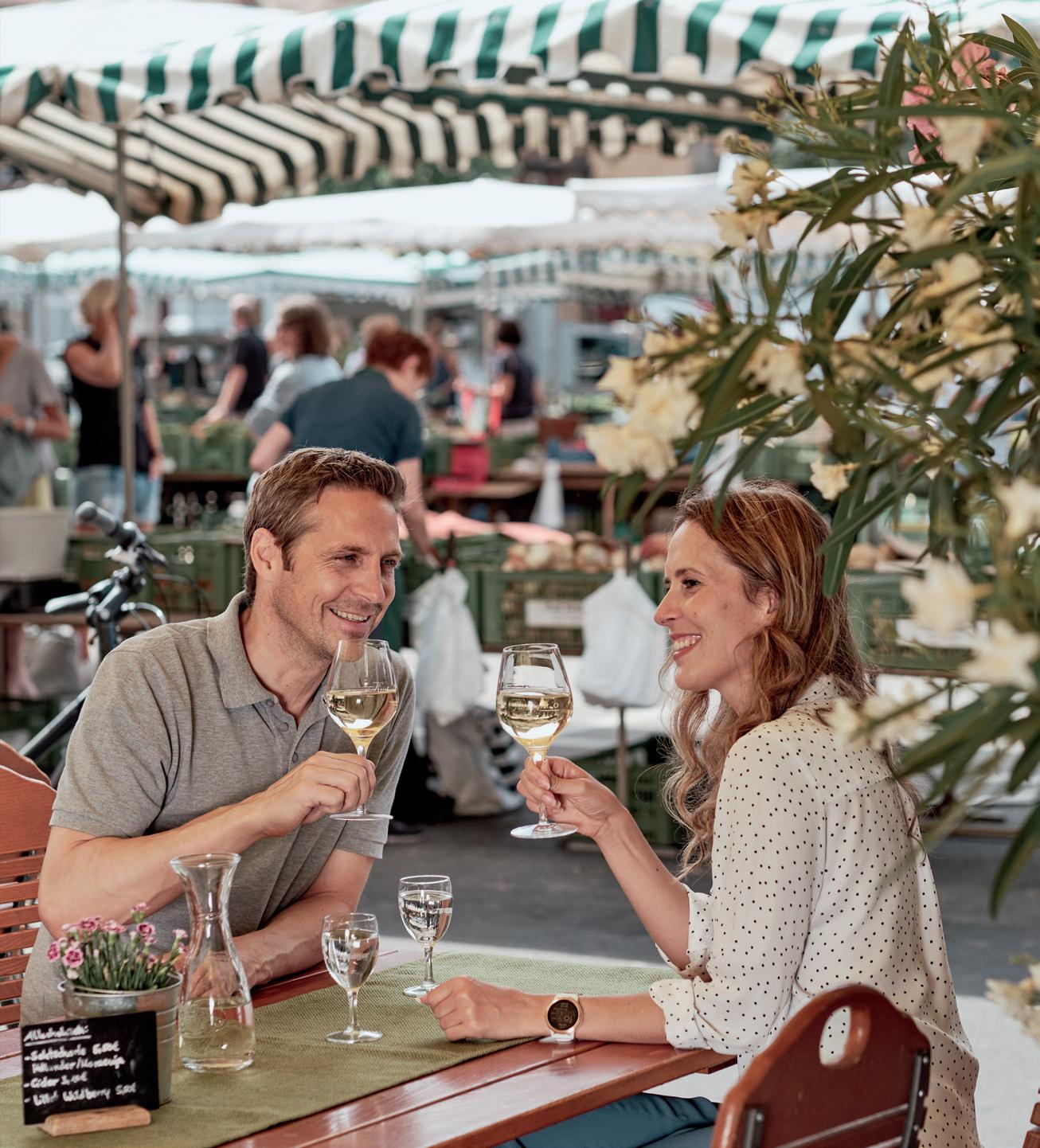
tourism-bw.com DISCOVER THE TASTE OF BADEN-WÜRTTEMBERG CULINARY EXPERIENCES IN 2023
Entdecke die einzigartige Weinvielfalt mit spannenden Weinschnäppchen

Aus dem Herzen von Winterthur in die ganze Schweiz nach Hause geliefert
Jetzt viele festliche Weine in Aktion! Online auf www.granreserva.ch bestellt


TROPENHAUS FRUTIGEN –THE OASIS IN THE BERNESE OBERLAND
The Tropenhaus Frutigen is an attractive destination that offers a transparent conveyance of much-needed relaxation, transfer of knowledge, as well as some simple pleasure.
Renewable energy, fish farming, caviar production and a tropical garden are all topics that are on the schedule at Tropenhaus Frutigen's world of experience. The only exhibition in Switzerland on sturgeon and fish farming, as well as caviar production, provides the basis for an interactive integration of visitors into guided tours and supporting programmes.

Tropical plants and fruits thrive under ideal conditions in the tropical

garden, which invites visitors to enjoy a haptic and sensory experience. The use of Tropenhaus-specific products is unique, as is the variety of fish served with regional products in the restaurant Tropengarten. Here, the genuine Swiss caviar ‘Oona’, as well as many other highlights from the menu, caters for an indulgent lifestyle to be enjoyed once you set foot inside.
www.tropenhaus-frutigen.ch/en
www.oona-caviar.ch/en
TROPENHAUS FRUTIGEN –DIE OASE IM BERNER OBERL
AND
Das Tropenhaus Frutigen ist ein attraktives Ausflugsziel, das Erholung, Wissensvermittlung und Genuss auf transparente Art und Weise erlebbar macht.
Erneuerbare Energie, Fischzucht, Kaviarproduktion und ein Tropengarten sind Themen, die in der Erlebniswelt des Tropenhauses Frutigen vereint sind. Die schweizweit einzige Ausstellung über Stör- und Fischzucht sowie Kaviarproduktion bietet die Basis der interaktiven Integration der Besucher in Führungen und Rahmenprogramme.
Tropische Pflanzen und Früchte gedeihen unter idealen Bedingungen
im Tropengarten und laden zu einem haptischen und sensorischen Erlebnis ein. Einzigartig ist die Verwendung von Tropenhausspezifischen Produkten, die Fischvielfalt in der Kombination mit regionalen Produkten im Restaurant Tropengarten. Der echte Schweizer Kaviar ‚Oona‘ liefert hier den möglichen ungezwungenen Lifestyle und Genuss.

www.tropenhaus-frutigen.ch
www.oona-caviar.ch

TEXT: SILKE HENKELE I PHO TOS: TROPENHAUS FRUTIGEN Top Event Locations in Switzerland In 2023 | Special Theme | Discover Germany
March 2023 | Issue 103 | 31
HISTORY, ART AND SWISS HOSPITALITY GESCHICHTE, KUNST UND SCHWEIZER CHARME
The three-star-superior Hotel Adler Zurich, in the heart of Zurich’s picturesque Old Town, has a 500-year long tradition and combines art with unmatched Swiss charm.

Das 3-Sterne-Superior Hotel Adler Zürich im Herzen der malerischen Zürcher Altstadt hat bereits seit 500 Jahren Tradition, und vereint Kunst mit unvergleichbarem Schweizer Charme.
If you want to enjoy Swiss hospitality to the fullest, the Hotel Adler Zurich is the place to be. For five centuries, the hotel has been a central meeting spot for interesting personalities in Zurich. For example, the famous Swiss animal and landscape painter Rudolf Koller spent his childhood here in the 1830s.

Today, the hotel is not only popular among business travellers and tourists, but it’s also a favourite for families. "Our location is unique and therefore suitable for everyone," resident manager Tessy Bloch adds.
The 52 renovated rooms of the house, all including air conditioning, leave nothing to be desired. The cosy furnishings with lots of wood, mood lighting and stylish furniture create a feel-good atmosphere from the very first moment. Individual murals by Heinz Blum, featuring different views of the city, help set the mood for your stay in Zurich.
Culinary highlights also await here, as the famous Swiss Chuchi Restaurant offers fine Swiss specialties. From the first fondue parlour in the Old Town of Zurich to the number one address for Swiss cheese and meat specialties: the Swiss Chuchi Restaurant attracts both locals and travellers from far and wide who appreciate fantastic food.
www.hotel-adler.ch

Wer Schweizer Gastfreundschaft in vollen Zügen genießen möchte, der ist im charmanten Hotel Adler Zürich goldrichtig. Seit fünf Jahrhunderten ist das Haus ein zentraler Zürcher Treffpunkt interessanter Persönlichkeiten. So verbrachte beispielsweise der berühmte schweizerische Tier- und Landschaftsmaler Rudolf Koller hier in den 1830ern seine Kindheit.
Heute ist das Hotel nicht nur eine beliebte Adresse für Geschäftsleute und Touristen, sondern auch für Familien. „Unsere Lage ist einzigartig und somit für jeden geeignet“, fügt Resident Manager Tessy Bloch hinzu.
Die 52 rundum renovierten Zimmer des Hauses, inklusive Klimaanlage, lassen keine Wünsche offen. Die Einrichtung mit viel Holz, stimmungsvoller Beleuchtung und Stilmöbeln sorgt vom ersten Moment für eine Wohlfühl-Atmosphäre. Individuelle Wandgemälde von Heinz Blum mit verschiedenen Stadtansichten stimmen perfekt auf den Zürich-Aufenthalt ein.
Auch für Gaumenfreuden ist gesorgt, denn im berühmten Swiss Chuchi Restaurant kann man feine Schweizer Spezialitäten genießen. Von der ersten Fonduestube der Zürcher Altstadt zur ersten Adresse für Schweizer Käse- und Fleischspezialitäten: Ins Swiss Chuchi Restaurant kommen zum guten Essen Einheimische ebenso wie Reisende von weit her.
32 | Issue 103 | March 2023
TEXT: MARILENA STRACKE PHOTOS: HOTEL ADLER ZÜRICH Discover Germany | Special Theme | Top Event Locations in Switzerland In 2023
Junior Suite, Hotel Adler Zürich.
Stairwell, Hotel Adler Zürich.
Raclette in the Swiss Chuchi Restaurant.
Enjoy a good night’s sleep at the charming Hotel Adler Zürich, a unique 3-Star-Superior Hotel in the middle of Zurich's old town, 52 total renovated rooms with air-condition, nice art paintings of Zürich in each room. Savour Swiss specialties at the famous Swiss Chuchi Restaurant.


Genießen Sie eine erholsame Nachtruhe im charmanten Hotel Adler, einem einzigartigen Drei-Sterne-SuperiorHotel mitten in der Zürcher Altstadt, 52 total renovierte Zimmer mit Klimaanlage und schönen Wandmalereien von Zürich in jedem Zimmer. Genießen Sie Schweizer Spezialitäten im berühmten Swiss Chuchi Restaurant

 Hotel Adler Zürich. Swiss Chuchi Restaurant.
Double room, Hotel Adler Zürich.
EXPERIENCE THE HISTORY OF SWISS HOSPITALITY UP-CLOSE
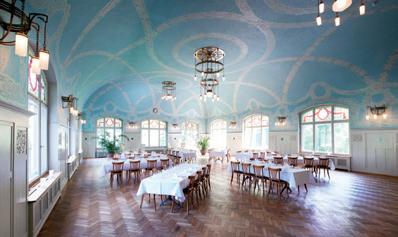
Swiss Historic Hotels is a collective of the most beautiful historic hotels in Switzerland. Not only are these hotels steeped in history and feature their own unique charm, but they are also excellent event locations with a special atmosphere.
Swiss Historic Hotels is the brainchild of dedicated Swiss hoteliers and conservationists, who wanted to promote Switzerland’s historic hotels better. In close collaboration with Schweiz Tourismus and hotelleriesuisse, the organisation Swiss Historic Hotels was born.
The range of partnering hotels is extremely diverse and speaks to people with a passion for history and architecture: some of the hotels are well over a century old. From cosy, intimate spaces, to marvellous grand halls – rest assured that Swiss Historic Hotels has the perfect venue with a unique atmosphere for any kind of event.
Whether you choose the grand hotel in the mountains, a simple historic Inn, or a former monastery on the lake – each Swiss Historic Hotel has its own story to tell and benefits from being in a stunning location.
Top tip: for larger events, the mountain hotel Schatzalp in Davos, the Schadau castle in Thun or the Hotel Waldhaus in Sils-Maria come highly recommended.
www.swiss-historic-hotels.ch

DIE GESCHICHTE DER SCHWEIZER HOTELLERIE HAUTNAH ERLEBEN
Swiss Historic Hotels ist ein Zusammenschluss der schönsten historischen Hotels der Schweiz. Die Hotels haben nicht nur lange Tradition mit einzigartigem Charme, sondern eignen sich auch hervorragend als überaus besondere Veranstaltungsorte.
Swiss Historic Hotels ist das Projekt engagierter Schweizer Hoteliers und Denkmalpfleger, die die historischen Hotels der Schweiz besser vermarkten wollten. In enger Zusammenarbeit mit Schweiz Tourismus und hotelleriesuisse entstand so die Organisation Swiss Historic Hotels.
Die Mitgliederhotels bestechen vor allem mit ihrer Vielfalt und sprechen überwiegend Menschen mit einer Leidenschaft für Geschichte und Architektur an: Einige der Hotels sind weit über hundert Jahre alt. Von gemütlichen, intimen Räumlichkeiten bis hin zu prachtvollen Sälen kann man sicher sein, dass Swiss Historic Hotels den perfekten Veranstaltungsort mit ganz besonderer Atmosphäre für jede Art von Event bietet.
Ob glamouröses Hotel in den Bergen, einfaches historisches Gasthaus oder ehemaliges Kloster am See - jedes Swiss Historic Hotel hat seine ganz eigene Geschichte und profitiert von einer atemberaubenden Lage.
Top-Tipp: Für größere Veranstaltungen sind das Berghotel Schatzalp in Davos, das Schloss Schadau in Thun oder das Hotel Waldhaus in SilsMaria besonders zu empfehlen.

34 | Issue 103 | March 2023
TEXT: MARILENA STRACKE
Hotel Waldhaus, Sils-Maria.
Photo: Swiss Historic Hotels
Schadau castle in Thun.
Photo: Schloss Schadau Thun
Kurhaus Bergün.
Discover Germany | Special Theme | Top Event Locations in Switzerland In 2023
Photo: Kurhaus Bergün


Swiss Historic Hotels | 3000 Bern | Tel. +41 31 302 32 26 info@swiss-historic-hotels.ch | www.swiss-historic-hotels.ch Vom Grandhotel in den Bergen, über das einfache historische Gasthaus, bis zum ehemaligen Kloster am See – jedes Swiss Historic Hotel hat seine eigenen Geschichten zu erzählen. Where the story begins From the grand hotel in the mountains, to the simple historic inn and a former monastery on the lake - every Swiss Historic Hotel has its own story to tell.
THE BERLINALE PHENOMENA
Denzel Washington with tears in his eyes accepting the Silver Bear for best actor in 2000, Juliette Binoche “smothering” former artistic director Dieter Kosslick with a human-sized stuffed teddy in 2019, or Johnny Depp offering slow but wise words on the state of human society – every Berliner, and many visitors, have their list of special moments to remember from years of attending a dearly beloved Berlin institution: the annual Berlin International Film Festival.
Ever since its humble beginnings in 1951 during the Cold War period, the Berlin Film Festival has evolved enormously, drawing the crème de la crème of the independent film world as well as many big names from the industry.
HONOUR YOUR AUDIENCE: THE PUBLIC ASPECT
The above-mentioned lasting impressions are as random and individual as the person remembering them – due to the fact that the
Berlin film festival retains one key aspect which makes it quite unique: while being a magnet for the industry, it is also open to the public.
The Berlinale has always been magically and quite easily accessible to anyone interested in the latest, lovingly curated output of the film world. The general public can thus enjoy some of the most excellent and exclusive new films at moderate prices, for as long as tickets are available. Almost fondly remem-

bered are the times when queuing played a big role – an event in itself, where both new friendships and future creative networks could be sealed.
Nowadays, you can of course browse the programme and purchase your ticket online and – as of this year – enjoy the festival crowd up close and on site again. Not to speak of the many industrial and public side events such as workshops and viewings with directors and actors, often including an open Q&A. Furthermore, there is the networking at the European Film Market fair (EFM) and the “Berlinale Talents” week. As ever, anyone and everyone can learn as much about the art of film-making as they please – and even become part of the jury by way of the Audience Prizes.
36 | Issue 103 | March 2023
Berlinale 2023's on-site motto: “Let's Get Together”.

March 2023 | Issue 103 | 37 The Berlinale Phenomena | Culture Feature | Discover Germany
Kristen Stewart – President of the International Jury 2023.
The reason behind the unique accessibility of the Berlinale is hidden in its own history. For the first years of the festival, the Federation Internationale des Associations de Producteurs de Films (FIAPF) banned the awarding of jury prizes at the festival – and as a consequence, the prize winners were determined by the audience members themselves. FIAPF finally relented in 1956, and ever since, the prize winners have been chosen by an international jury. This year, the jury is led by a rather independent spirit of the industry, renowned actress Kristen Stewart.
Film producer Mariëtte Rissenbeek, who has been Berlinale executive director since June 2019, is thrilled to have the festival running at its usual schedule and locations again, for the first time since the pandemic. She tells us about the unique role it plays for both Berliners and visitors: “Berlin is a major city with lots of film-savvy citizens with many diverse interests. This is a great starting point and allows us to pick up on current topics and to win an enthusiastic audience for them.”
CONSTANTLY EVOLVING AND ‘YOUNG AT HEART’
Together with Cannes and Venice, the Berlinale today counts as one of the ‘Big Three’ in Europe. Much like the city itself, its history reads like a rollercoaster. However, it has retained one guiding selective principle since its beginnings as a ‘showcase of the free world’: the Berlin International Film Festival has always been the most political one.
This year, the Berlinale Special Gala features the film Super Power by Sean Penn and Aaron Kaufman (USA 2022), a documentary on the Ukraine’s struggle after the invasion, which evolved under difficult circumstances, “into something less controllable but more meaningful”. The event marks its world premiere.
A counterbalancing and rather surprising theme is this year’s ‘Young at Heart’ theme. Youth and thus the conversations around change and hope interact with the gruelling and equally pressing topics of global warming and war.
Here, both Kristen Stewart, as the youngest ever Berlinale jury president, as well as the homage to the industry’s artistic icon Steven Spielberg, come into play. With The Fabelmans, he has recently created the magical yet realistic coming-of-age story of a future film-maker and his family. Berlinale artistic director Carlo Chatrian explains how the choice of Spielberg’s latest film fits the 2023 ‘Young at Heart – Coming of Age at the Movies’ theme perfectly: “While the usual magic resonates throughout the story of the Fabelman family, Spielberg’s latest film is also painfully real. The American Dream, which finds its perfect match in the coming-of-age genre, has always had a concealed darker side: the pain, strain and sacrifice every dream entails and demands.”
Both in Spielberg’s case and the Berlinale’s magical and never-stopping evolvement –it’s a big and magnificently realised dream, indeed. www.berlinale.de

38 | Issue 103 | March 2023
Discover Germany | Culture Feature | The Berlinale Phenomena
The Executive Director and the Artistic Director of the Berlin International Film Festival.
Photo: Alexander Janetzko


March 2023 | Issue 103 | 39 The Berlinale Phenomena | Culture Feature | Discover Germany
Retrospective 2023: Rebel Without a Cause, Natalie Wood and James Dean in Nicholas Ray's 1955 film.
Source: Deutsche Kinemathek. Photo: 2022 Warner Bros. Entertainment Inc. All rights reserved.
Poster design for the 73nd Berlinale. Photo: Internationale Filmfestspiele Berlin / Claudia Schramke, Berlin
The European Film Market 2023 returns as a physical event and for the first time concentrates all offers at Potsdamer Platz
Photo: Lia Darjes / EFM
BERLIN FAHRRAD FEVER
To get you inspired to cycle more, something which is a favourite German pastime, we present five perfect places to bike to this springtime.

Discover Germany | Cover Feature | Berlin Fahrrad Fever 40 | Issue 103 | March 2023
TEXT: DANIEL COLE
Berlin's Landwehrkanal.
Photo: visitBerlin, Dagmar Schwelle

Berlin Fahrrad Fever | Cover Feature | Discover Germany March 2023 | Issue 103 | 41
Berlin is as bike-friendly as they come. With over 600 kilometres of bike paths, and grandiose new schemes in the pipeline, it’s no surprise that over two-thirds of households in the city own a bike.

In 2021, the Berlin government unveiled the ‘Radverkehrsplan’, with a goal of upping bike traffic to at least 23 per cent by 2030. In order to do this, the local senate has set in stone a goal of having a bicycle network that extends to over 3,000 kilometres. And this is just in Berlin alone.
Surrounding Berlin in the state of Brandenburg there are over 7,000 kilometres of interconnected bike paths and routes. Some of these routes extend across the entire state, heading as far as Copenhagen and further.
With Spring just around the corner, we take a look at some of the best bike-excursions available to and from the German capital, covering routes for all competencies.
KOSTRZYN, POLAND (80 KILOMETRES) – PEDDLING TO POLAND
The Polish border is just under a day’s bike ride away from Berlin, with the offer of pierogi awaiting those who make the journey.
The bike route is actually part of a much larger, pan-European trail that goes all the way across Germany to the French coast, called the Europourte ‘Europaradweg’ R1. Well-signposted, the route picks up from the city centre, heading around Europaradweg R1 and the woods of Grünheide, all the way to the stunning national park Märkisches Schweiz.
En route, the bike tail passes the Pyramid of Garzau, an 18th-century Prussian mausoleum, and an antique narrow-gauge railway at Buckow, hidden among the wild nature.
Eventually, the stretch traverses through bountiful fields full of storks and plum trees before arriving at the Oder-Neiße-Radweg that separates Poland from Germany. At the end of the
day-long trip, the route crosses the river into the Polish town of Kostrzyn, a quaint little settlement with bountiful borscht and pierogi; all in all, a fair reward for a good day’s biking.
BERLIN TO BEELITZ (35 KILOMETRES) – SPEED CYCLING TO THE ‘SPARGEL’ SOURCE
As soon as the colder days start to become yet more reclusive and the daffodils begin to tease you of the warmer days ahead, it can only mean one thing: spargel time is coming. What better reason than to journey on the Asparagus Road, the Spargelstrasse.
Beelitz is the German capital of asparagus. More than that one can also find Beelitz-Heilstätten, a disused and spooky sanatorium, and Baumkronenpfad, an elevated tree-top walkway.
To get there, the bike route once again follows the Europaradweg R1 past the ‘Bridge of Spies’ – Glienicke Brucke – and through
42 | Issue 103 | March 2023 Discover Germany | Cover Feature | Berlin Fahrrad Fever
Green meeting in Berlin. Photo: visitBerlin, Dirk Mathesius
 Mountain bike park Palatinate Forest.
Photo: GNTB, Mountainbikepark
Pfälzerwald e.V. /Andreas Meyer, World of MTB
Mountain bike park Palatinate Forest.
Photo: GNTB, Mountainbikepark
Pfälzerwald e.V. /Andreas Meyer, World of MTB
Potsdam. The bike route then hugs Templiner Lake before crossing over to Schwielowsee.
The route journeys through fields and farmyards, before eventually arriving at Beelitz. Should you arrive at the right point in the year, there will be an abundance of streetside spargel-peddlers waiting to greet you, to fuel your engine for the ride back.

NIEDERFINOW BOAT LIFT (40 KILOMETRES) – BIKE TO BOAT, FIT TO LIFT
Connecting the River Oder and the Oder-Havel Canal, the Schiffshebewerk Niederfinow was one of Europe’s biggest and oldest functioning boat lifts. A staggering industrial contraction, the 60-metre-tall canal transports boats between the two tributaries, by physically lifting them up and down using a system of mechanical pulleys. Today, the boat lift has been retired and replaced by a newer, bigger lift system, located right next to its predecessor.
To get to this wonderful, gargantuan steel contraption, start in the north of the city at Buch, and join the Berlin-Usedom bike route to Bernau, and then through to Biesenthal. From here, the cute countryside transit car-
ries on to Eberswalde, the forest town of Brandenburg, where your journey carries on along the picturesque Finow Canal until it gets you to your destination.
BERLIN FLUGHAFEN-BRUCKE (70 KILOMETRES) – BIKE AND FLY TO BERLIN’S OLDEST AIRSTRIPS
The German capital can proudly boast that it has more disused airports than it has functioning ones. In Berlin, you can bike along the runway at Tempelhof, before peddling off through the city to former airports of Tegel, Gatow and Schönefeld,

Starting at Flugplatz Gatow, a former RAF base on the city’s eastern edge, bike along the Berliner Mauerweg, which follows the old Berlin Wall, in a clockwise direction. Across up into Spandau’s old-town, cross the River Havel, to the recently closed airport, Tegel. From here, the Berlin-Spandau Ship Canal zigzags back through the city, through Tiergarten, down to Bergmannkiez and to the historically famous Tempelhof, the former airport, now a public pak.
To get to the last airport, bike towards S-Bahn Neukölln, following the Teltow Canal, and join
44 | Issue 103 | March 2023 Discover Germany | Cover Feature | Berlin Fahrrad Fever
Mountain bike park Palatinate Forest. Photo: GNTB, Mountainbikepark Pfälzerwald e.V. /Andreas Meyer, World of MTB
Photo: Yvonne Hartmann
the Berliner Mauerweg cycle path once more, through Rudow until arriving at Schönefeld. Sitting next to the newer BER airport, Schönefeld is the city’s most recently closed airport.

WESTHAVELLAND NATIONAL PARK (60 KILOMETRES) – A DRIVE TO DARKNESS
Westhavelland is a star-spotters paradise. Also known as Sternenpark (Star-Park) the protected reserve is officially the darkest part of Germany, where excessive light use is totally forbidden.

To get there, follow the Havelland Radweg bike route, which starts in Spandau. From here, follow the route through the old town of Nauen, through tranquil villages, forests and historic farmland. As you enter the national park, there are monuments dedicated to Otto-Lilienthal, the pioneering German who spearheaded the global-aviation industry.
Throughout the park you’ll be hard pressed not to spot a deer or two, storks and other assorted birds. At the centre of the park is the village of Rathenow, where camping options are available for those looking to stay the night –an activity which you should partake in, in order to see the night sky.
March 2023 | Issue 103 | 45 Berlin Fahrrad Fever | Cover Feature | Discover Germany
Daniel Cole is a Berlin-based writer and musician, and co-author of Lonely Planet’s Epic Bike Rides of Europe.
Photo: Yvonne Hartmann
Berlin in spring. Photo: visitBerlin, Dagmar Schwelle
DIE PERFEKTE LÖSUNG FÜR ENTSPANNTE ZWISCHENSTOPPS AM FRANKFURTER FLUGHAFEN
Inmitten des Frankfurter Flughafens befindet sich das MY CLOUD Transit Hotel. Der perfekte Rückzugsort für Reisende, um bei Zwischenstopps fernab vom hektischen Flughafentreiben Ruhe, Kraft und Energie zu tanken. Einfach einchecken und Wohlfühlen.
Die HERING Unternehmensgruppe hat sich mit dem MY CLOUD Transit Hotel in eine völlig neue Richtung weiterentwickelt – und das mit großem Erfolg. Mittlerweile ist das MY CLOUD im Frankfurter Flughafen fest etabliert und kann sich nicht nur über ein hohes Buchungsaufkommen, sondern auch über fantastisches Feedback der Gäste freuen.

Für Fluggäste, die auf der Durchreise sind und längere Aufenthaltszeiten haben, oder Reisende, die von Flugausfällen betroffen sind, wurde mit dem MY CLOUD ein einzigartiger Rückzugsort mit Blick auf das Vorfeld des Frankfurter Flughafen geschaffen.
GEMÜTLICHE ZIMMER STATT FELDBETTEN UND HEKTISCHE WARTEBEREICHE
Da sich das MY CLOUD tatsächlich direkt im Flughafen hinter der Pass- und Sicherheitskontrolle befindet, ersparen Transitreisende sich jegliche Ein- und Ausreiseformalitäten. Gäste brauchen daher auch alle eine gültige Bordkarte, denn man ist wirklich mitten im Transitbereich des Terminal 1.
„Wir tauschen Feldbetten und Wartebereiche gegen ein gemütliches Zimmer“, erzählt Hotelmanagerin Gabi Jentsch. „Viele von unseren Gästen haben Aufenthaltszeiten von 8 bis 12 Stunden. Da lohnt es sich, ein Zimmer bei
uns zu buchen. In unserem Hotel haben Gäste volle Privatsphäre, können sich erholen, in Ruhe einen Kaffee trinken oder sich zum Beispiel aufs nächste Meeting vorbereiten.“
Sie führt fort: „Fällt ein Flug aus, sind wir oft ein wahrer Zufluchtsort für Gäste. Wenn sie kein gültiges Visum haben, müssten sie irgendwo im Wartebereich übernachten. Diese Passagiere sind dann mehr als dankbar, dass sie bei uns einchecken können.“
Außerdem ist das Hotel fußläufig erreichbar, so dass man schnell wieder beim nächsten Boarding ist. Die Buchungszeiten von 3 bis 24 Stunden Aufenthaltsdauer sorgen für höchste Flexibilität.
KOMFORT UND UNGLAUBLICH RUHIG
Dass man den Frankfurter Flughafen vielleicht nicht sofort mit Ruhe assoziiert, sei einem
46 | Issue 103 | March 2023
TEXT:
MARILENA STRACKE I FOTOS: MY CLOUD
verziehen. Das MY CLOUD macht allerdings genau das im Handumdrehen möglich, wie die Hotelmanagerin erläutert: „Von der lauten Geräuschkulisse des Flughafens bekommen Gäste nichts mit, da das Hotel über einen hervorragenden Schallschutz verfügt.“


Dazu herrscht eine ganz besondere Atmosphäre mit dem Blick auf das Vorfeld des Flughafens. Mittendrin – aber irgendwie doch gut versteckt. Die 59 Zimmer sind mit jeweils circa 10 Quadratmetern sehr kompakt und perfekt auf die Bedürfnisse von Reisenden mit kurzen Aufenthaltszeiten ausgestattet. Sie bieten alles, was man für einen kurzen Aufenthalt benötigt: ein bequemes Bett, einen Fernseher, einen Schreibtisch sowie ein Badezimmer mit Dusche und WC. Ein Teil der Zimmer ist mit Fenstern und ein Teil ohne ausgestattet. Falls man also tagsüber zwischen zwei langen Flügen einfach nur schlafen möchte, bietet auch das die perfekte Lösung.
Kulinarisch ist man am Flughafen Frankfurt dank des vielfältigen Angebots ohnehin bestens versorgt, aber für den kleinen Hunger gibt es Snack-Automaten im Hotelbereich. Außerdem gibt es gratis Kaffee, andere Heißgetränke und Wasser. Im Falle von Layovern organisiert das Hotel auch gerne kleine Lunch-Packages für die Gäste.
TOP SERVICE… UND EIN OFFENES OHR
„Die meisten Gäste loben unseren guten Service“, so Gabi Jentsch. „Oft ist es so, dass die Reisenden zu uns kommen und einen Rückzugsort suchen, wenn ihr Flug ausgefallen ist. Sie sind oft sehr aufgelöst, weil
sie noch nicht wissen, wie ihre Weiterreise verläuft. Unsere Mitarbeiter haben immer ein offenes Ohr und versuchen für unsere Gäste immer das Unmögliche möglich zu machen.“
Von Business-Reisenden und Vielfliegern bis zu Familien und Urlaubern ist der Kundenstamm von MY CLOUD breit gefächert. Auch Fluggesellschaften und Reisebüros gehören zu den Kunden und im Durchschnitt buchen Gäste ein Zimmer für 8-12 Stunden.

Die Buchung kann entweder online über die MY CLOUD Website oder über eine der gängigen Buchungsplattformen erfolgen. „Wir haben aber auch viele Direktbuchungen von Gästen, die dann an der Rezeption buchen und einchecken“, fügt Gabi Jentsch hinzu.
Neugierig geworden?
Mehr Info gibt es unter: www.mycloud.de
March 2023 | Issue 103 | 47 MY CLOUD Transit Hotel | Travel | Discover Germany
THE OCEAN UP-CLOSE… RIGHT IN VIENNA
A piece of the ocean right in the heart of Vienna? It actually exists! From sharks and rays to crocodiles and monkeys, the aqua terra zoo Haus des Meeres houses over 10,000 animals to observe on 11 floors. Aside from the incredible 360-degree shark tank, which combines the beauty of the Maldives with the skyline of Vienna’s city centre, the adorable brush-tailed bettong baby is currently taking the visitors’ hearts by storm.
As soon as you enter the Haus des Meeres, you are plunged into another world. There is, for example, the surf reef, featuring authentic sea surf. Thanks to a half-tunnel, you can be almost ‘inside’ the impressive sea surf with

its countless vibrant tropical fish. The stunning coral reef, which consists of 14 interconnected aquariums, is also buzzing with colourful life.
A real highlight is the 360-degree shark tank, measuring about 120 square metres, on the seventh floor. Here, the undisputed stars are the Whitetip and Blacktip reef sharks, who share their habitat with related ray species.
In the tropical house, a real jungle adventure awaits. Cheeky little Goeldi's monkeys jump around freely to their hearts' content here. The five-metre-long Sunda Gavial, named Adam, can be found in the Crocodile Park.

Much smaller, but no less impressive, are the ants next door, who are busy working on what is possibly the longest ant street in the world. It runs over two floors and is an incredible 70 metres long.
In the newly opened Australia area, some unexpected offspring has caused delight all around. In December, a small brushtail bettong baby suddenly appeared from its mother’s pouch and surprised the zookeepers. Until then, the mother had successfully kept her offspring hidden and only when the little one was old enough to leave the pouch, the secret was revealed. Since then, it has happily explored the facility and enchanted the visitors of ‘Vienna’s Australia’.
Whether you come to admire the sea turtles, sharks, monkeys or the mini kangaroo, a visit to Haus des Meeres is always an unforgettable experience.
www.haus-des-meeres.at
48 | Issue 103 | March 2023
TEXT: MARILENA STRACKE | PHOTOS: DANIEL ZUPANC
DEM OZEAN SO NAH
–UND DAS MITTEN IN WIEN
Ein Stückchen Ozean mitten im Herzen von Wien? Das gibt es tatsächlich, denn im Haus des Meeres kann man auf 11 Stockwerken von Haien und Rochen bis hin zu Krokodilen und Äffchen über 10.000 Tiere aus nächster Nähe beobachten. Neben dem 360-Grad Haifischbecken, welches die Schönheit der Malediven mit der Skyline der Wiener Innenstadt vereint, verzaubert momentan auch das zuckersüße Rattenkänguru-Baby die Besucher.
Gleich beim Betreten vom Haus des Meeres taucht man in eine andere Welt ein. Da ist zum Beispiel das Brandungsriff mit authentischer Meeresbrandung. Dank eines Halbtunnels ist man quasi „mittendrin“ in der beeindruckenden Meeresbrandung, in der sich unzählige farbenprächtige, tropische Fische tummeln. Auch im traumhaften Korallenriff, das aus 14 miteinander verbundenen Aquarien besteht, wimmelt es nur so von buntem Leben.
Ein absolutes Highlight ist das 360-Grad Haifischbecken auf knapp 120 Quadratmetern im siebten Stock. Die Publikumslieblinge sind

hier die zwei Haifischarten, Weissspitzen- und Schwarzspitzenriffhai, die sich das Habitat mit verwandten Rochenarten teilen.
Im Tropenhaus dürfen sich die Besucher auf ein echtes Dschungel-Abenteuer freuen, denn hier turnen freche Springtamarin Äffchen nach Herzenslust frei herum. Den 5-Meter langen Sunda Gavial namens Adam findet man hingegen im Kroki-Park. Wesentlich kleiner, aber mindestens genauso beeindruckend sind die Ameisen nebenan, die auf der möglicherweise längsten Ameisenstraße der Welt fleißig ihrer Arbeit nachgehen. Sie
verläuft über zwei Stockwerke und ist unglaubliche 70 Meter lang.
In der erst kürzlich neu eröffneten AustralienAnlage gibt es zurzeit überraschenden Nachwuchs. Im Dezember schaute plötzlich ein kleines Bürstenschwanzkänguru-Baby aus dem Beutel seiner Mama und überraschte die Tierpfleger. Bis dahin hatte die Mutter ihren Nachwuchs nämlich erfolgreich geheim gehalten und erst als das Kleine alt genug war, den Beutel zu verlassen, wurde das Geheimnis gelüftet. Seitdem erkundet es fröhlich die Anlage und lockt entzückte Besucher ins ‚Wiener Australien‛.

Ob Meeresschildkröte, Haifisch, Äffchen oder Mini-Känguru, ein Besuch im Haus des Meeres bleibt zweifellos ein unvergessliches Erlebnis.
www.haus-des-meeres.at

March 2023 | Issue 103 | 49 Haus des Meeres | Travel | Discover Germany
Rattenkänguru-Mutter mit Nachwuchs. Foto: Dominik Moser Haibecken.
WARTBURG CASTLE: A SIGNIFICANT CULTURAL LEGACY

Bright sunshine cuts through the chilled, mist-laden air hanging with uncanny stillness around Wartburg Castle in central Germany. The scene appears ready for a director to call 'action' on a horror movie that might take viewers into the serene lair of some sleeping vampire lord. Instead “follow me, please” is uttered politely by our tour guide, who patiently intimates that we stop clicking photos and follow her into the UNESCO World Heritage Site.
The fog of warm breath carrying her words rolls towards us and dissipates. I nod, acknowledge that I’m on my way, and then turn back to admire the magnificent exterior of the medieval castle.
Snow dusts the steep-sided rocks that the imposing landmark is built upon. The precipice drops for more than 400 metres. It’s easy to understand why, centuries ago, this location near the town of Eisenach was chosen to host a fortress. Difficult to reach, Wartburg Castle has commanding views far over the surrounding countryside.
From its ramparts, occupying Soviet troops could gaze into the homeland of their morally
decadent enemy and defend their comrades in the German Democratic Republic from the corrupting influence of the West. Unwittingly, the border defences and strict regulations that for decades denied civilians entry to the Thuringian Forest helped the woodland regenerate and rewild during the Cold War. For nature lovers, that makes the area today known as the Green Heart of Germany and a fulfilling place to spend time outdoors.
The Thuringian Forest Nature Park is characterised by dense woodland penetrated by hiking routes, including the 170-kilometre Rennsteig Trail. From vantage points around the castle, gazing out at branches still bare of leaves but covered by today’s heavy frost, it’s
easy to imagine the expanses of old-growth forest that once decked so much of central Europe and played such a key role in folklore. The Brothers Grimm famously collected such popular stories and wrote them down as fairytales, building upon a tradition of engaging storytelling that has close associations with Wartburg Castle.
Interestingly, the fortification can lay claim to being the birthplace of the German language as we know it today. While staying at the castle, from May 1521 until March 1522, Martin Luther translated the New Testament of the Bible from ancient Greek into a form of German that could be widely understood. In an age of distinctive regional dialects and little standardisation, Luther’s choices became popularised by the printing presses that helped share his version of the New Testament.
Inside a small and sparsely furnished room, visitors look at an edition of his work beneath a protective glass casing. The book is displayed atop a scratched wooden desk, next to an
50 | Issue 103 | March 2023
Discover Germany | Travel Feature | Wartburg Castle: A Significant Cultural Legacy TEXT & PHOTOS: STUART
FORSTER

March 2023 | Issue 103 | 51
uncomfortable-looking chair with U-shaped arms, in the room where Luther transcribed the New Testament. Presumably, the green ceramic tiles of the heater in the corner of the room date from significantly later.
An oil painting of Luther, a stern-looking bearded figure, is displayed on the wall, above where he is reputed to have worked. When he arrived at Wartburg, the castle was already more than 450 years old. Having already been excommunicated, Luther was being afforded protection by Frederick the Wise, the Elector of Saxony, and was living under the name Junker Jörg. Some versions of the tale suggest he was more a captive than a willing guest and a pawn in the power politics of the early 1520s.

Would Luther recognise many of the castle's half-timbered buildings if he joined a tour today? The castle underwent remodelling during the 19th century, a time when so many of Germany’s castles were restructured to fit with Romantic ideals of how the fortresses of the Middle Ages should look. Aspects of the Romantics’ views of the era were drawn from the lyrical poems of Walther von der Vogelweide and Wolfram von Eschenbach, whose works espoused chivalric ideals.
Von Eschenbach is believed to have composed at least part of his great work Parzival in the castle – the work was Richard von
Wagner’s inspiration for his opera Parsifal
The medieval minstrel is depicted on a dramatic fresco by Moritz von Schwind, showing a scene from an event that reputedly took place in 1207 within the castle’s walls. Known as the Sängerkrieg, meaning Minstrels’ War, the leading lyrical poets of the age are said to have participated in a contest to win honour and renown.
That work is displayed within the castle’s Singers’ Hall inside the Palas, which is recognised as the best-preserved secular Ro-
manesque building north of the Alps. The structure dates from the third quarter of the 12th century and features ornate embellishments dating from 700 years later, including mosaics on the ceiling arches and depictions of armour-clad knights under banners bearing heraldic symbols.
Myth and medieval history have become interwoven at Wartburg Castle. Visiting conveys the uses of the fortress over the past nine and a half centuries and insights into its significant cultural legacy.

52 | Issue 103 | March 2023 Discover Germany | Travel Feature | Wartburg Castle: A Significant Cultural Legacy
HERZLICHE GASTFREUNDSCHAFT MIT 500 JAHRE LANGER TRADITION
In der verkehrsfreien Ortsmitte von Innichen im Hochpustertal, welches durch die berühmten Bergspitzen ‚Drei Zinnenʼ der Südtiroler Dolomiten weltweit bekannt ist, findet man das kleine, aber sehr feine 4-Sterne Boutique & Gourmet Hotel Orso Grigio. Hier trifft historische Gastfreundschaft auf Komfort und Gaumenfreuden.
Die Geschichte des Gebäudes des heutigen Orso Grigio Hotels beginnt bereits im Jahr 1303, und zwar mit der Verleihung des Marktrechtes. Dies brachte Händler und Reisende in den kleinen Ort, die im damaligen Gasthof ‚Zum Grauen Bären’ Unterkunft und Verpflegung fanden. Seit 1745 ist das Haus im Familienbesitz und wird heute in neunter und zehnter Generation von Franz Ladinser und seiner Tochter Verena geleitet. Die Gastfreundschaft hat man hier quasi im Blut.

Vieles hat sich seit den Anfängen verändert, aber der einzigartige Charme der alten Mauern ist geblieben. So mancher bekannter Architekt hat in enger Zusammenarbeit mit der Eigentümerfamilie hier seine Spuren hinterlassen. Die über 500-jährige Geschichte wird so kontinuierlich fortgeführt und ist und bleibt eine Erfolgs-Story. Als eines der ältesten Häuser im Alpenraum besticht es vor allem mit seinem historischen Charme, der
zeitlosen Eleganz – und dem einzigartigen Charakter. Die Spuren der Vergangenheit werden hier erlebbar.
Es ist ein faszinierender Design-Mix aus bedeutenden Epochen. Da ist zum Beispiel die spätgotische Empfangshalle und das Bürgerzimmer aus dem Biedermeier, in dem einst die Bürgervertreter konferierten. Dagegen setzen das Bären Café und der Speisesaal starke architektonische Kontrapunkte. Dass sich im Orso Grigio Tradition mit Moderne trifft, und man trotz des historischen Bauwerks besten Komfort erwarten darf, zeigt auch die fantastische Sauna-Landschaft, die 2020 den German Design Award bekam.

Authentizität und viel Liebe zum Detail spiegeln sich auch im Service wider. Hochwertige regionale Küche gehört hier genauso zum Programm wie der unglaublich gut bestückte Weinkeller mit der hauseigenen Enotheque.
Wer Lust auf eine stilistische Zeitreise vom Biedermeier über Landhausstil und klassische Moderne bis hin zu neuem Design hat und dabei Wert auf top Komfort und herzliche Gastfreundschaft legt, ist im Orso Grigio goldrichtig.
Ein kleines Hoteljuwel mit lebhafter Vergangenheit und florierender Zukunft.
www.orsohotel.it


March 2023 | Issue 103 | 53
Hotel Orso Grigio | Travel | Discover Germany TEXT: MARILENA STRACKE | FOTOS: HOTEL ORSO GRIGIO
SPECIAL THEME: EDUCATION, TRAINING & DEVELOPMENT
Embrace the next step in your life
Looking to take your career a step further? We’re here to help. Take a look at the following pages for some inspiration on education, training and development providers that can help you with precisely that.

 TEXT: NANE STEINHOFF I PHOTOS: UNSPLASH
DIE SICHERHEIT AN ERSTER STELLE

Die BuS GbR bietet Beratungen und Schulungen rund um das Thema Sicherheit am Arbeitsplatz. Seit 2014 unterstützt das erfahrene Familienunternehmen kleinund mittelständische Unternehmen in den Bereichen Arbeitssicherheit, betrieblicher Brandschutz, Ladungssicherung und Gefahrgut. Ein vertrauensvoller Partner, der sich tief in der Materie auskennt.
BuS GbR Gründer, Gesellschafter und Trainer
Mike Maldener hatte schon immer ein großes Interesse an Arbeitssicherheit. „Ich übte diese Tätigkeit schon bei meinem früheren Arbeitgeber aus“, erzählt er. „Da war der Schritt in die Selbstständigkeit nur noch eine Frage der Zeit.“ Seitdem hat Maldener, der die Firma mit seiner Stieftochter und Mitgesellschafterin Yudith Torres Maduro führt, nicht nur sich selbst kontinuierlich weiterentwickelt und qualifiziert, sondern auch ein exzellentes Team aus Spezialisten zusammengestellt, um das gesamte Gebiet der Betriebssicherheit abzudecken.

„Unser eigentlicher Fokus liegt in dem vollumfassenden Arbeitsschutz“, fügt der sympathische Gesellschafter hinzu. „Das soll heißen Arbeitssicherheit und Arbeitsmedizin. Zudem können wir die komplette digitalisierte Dokumentation der gesetzlichen Forderungen abbilden und mit der entsprechenden Software darstellen.“

Die Mehrheit der Kunden sind klein- und mittelständische Unternehmen, wobei allerdings
auch Großkunden bis hin zu Konzernen von BuS GbR vollumfänglich betreut werden. Da Arbeitssicherheit in Deutschland von allen Unternehmen dargestellt werden muss, wenden sich Kunden aus allen Branchen vertrauensvoll an Maldener und sein Team, welches bundesweit im Einsatz ist. Dabei geht BuS GbR immer auf die spezifischen Bedürfnisse der
Kunden vor Ort ein und liefert nicht einfach nur ein Standardprogramm ab. Neuerdings wird neben dem klassischen Frontalunterricht bei den Kunden im Unternehmen auch Online-Training angeboten.
Dank der langjährigen Erfahrung mit komplexen Themen der betrieblichen Sicherheit, kann BuS GbR den Kunden mit Rat und Tat zur Seite stehen und dafür sorgen, dass Sicherheit am Arbeitsplatz an erster Stelle steht.
Mehr Information findet man unter: www.bus-gbr.de
oder unter: anfrage@bus-gbr.de
March 2023 | Issue 103 | 55
Education, Training & Development | Special Theme | Discover Germany TEXT: MARILENA STRACKE
Mike Maldener Foto: BuS GbR
Foto: iStock
Yudith Torres Maduro Foto: BuS GbR
UNTER PROFIS…
Die PROFI-MAKLER-AKADEMIE ist das Herzstück des bekannten Trainings- und Informationsportals makler-wissen.de – Deutschlands größter Anbieter dieser Art. Hierzu gehört auch die PROFI-VERWALTER-AKADEMIE mit dem Portal verwalterwissen.de. Hier lernen Immobilienmakler und Wohnimmobilienverwalter in der Praxis erprobte und vor allem erfolgreiche Vorgehensweisen, um ihre Umsätze zu steigern und immer auf dem neuesten Informationstand zu sein.

Hinter Deutschlands größtem Online Trainings- und Informationsportal für Immobilienmakler und Wohnimmobilienverwalter steht Gründer und Inhaber Markus Langenbach. Für ihn war immer klar, dass gezielter Wissensaufbau zu mehr Erfolg führt. Bevor der Diplom-Betriebswirt 10 Jahre als erfolgreicher Makler und Büroinhaber in München aktiv war, sammelte er 15 Jahre lang nicht nur wertvolle Erfahrungen als Schulungsreferent, Dozent und Trainer, sondern auch in Sachen Technologie. Bei diversen Großprojekten setzte er beispielsweise schon sehr früh auf e-Learning und erkannte, dass der Wissens-
aufbau der Zukunft online ist. Nachdem 2016 sein erstes Fachbuch 21 Erfolgskriterien für Immobilienmakler – die ich vorher nicht wusste erschien, lag es nah, die beiden Welten clever zu kombinieren. So gründete er 2017 die PROFI-MAKLER-AKADEMIE und im Jahr 2022 zusätzlich die PROFI-VERWALTERAKADEMIE mit Sitz in Aschaffenburg.
Heute ist das Online-Portal makler-wissen. de nicht nur deutscher Marktführer im Online Aus- und Weiterbildungsbereich und BVFI Certified Education Partner, sondern hat auch über 5.000 Kunden, die sich dank der

Plattform an verschiedenen Stationen ihrer Karriere kontinuierlich weiterbilden. „Wir haben knapp 500 Google-Bewertungen mit 4.9 Sternen“, freut sich Langenbach und lächelt. „Da kenne ich keinen Zweiten.“ In der Tat ist die Kündigungsrate extrem niedrig, was für die Nachhaltigkeit des Angebots spricht –hier geht es um langfristigen Erfolg.
AUS DER PRAXIS, FÜR DIE PRAXIS
Die PROFI-MAKLER-AKADMIE (und die PROFI-VERWALTER-AKADEMIE) bieten eine ganze Reihe verschiedener Lernformate an –perfekt für die unterschiedlichen Bedürfnisse der Teilnehmenden. Die Kurse und Seminare, das Trainingsprogramm, die Erfolgskonzepte und das individuelle Coaching sind darauf ausgelegt, durch Wissensaufbau die eigenen Provisionsumsätze zu steigern. Wichtig ist für Langenbach dabei, dass das Wissen nicht auf Theorie basiert: „Was wir sagen und referieren, haben wir in der Praxis erlebt. Das

56 | Issue 103 | March 2023
TEXT: MARILENA STRACKE | FOTOS: PROFI-MAKLER-AKADEMIE
Foto: Bundeskongress 2021, www.bvfi.de/kongress
angebotene Wissen hat uns als Makler und Büroinhaber erfolgreich gemacht, und wir setzen es zu 100 Prozent selbst um.“
Die ca. 1-stündigen Kurse sind ideal, um sich als Makler in einem bestimmten Themengebiet so richtig fit zu machen, während es sich bei den Seminaren um intensivere Lerneinheiten von einem halben bis zu mehreren Tagen handelt. Diese sind perfekt für Makler, die in Sachen Immobilieneinkauf, Immobilienbewertung, Immobilienverkauf oder Sachkundenachweis in die Tiefe gehen wollen.
Daneben gibt es das Trainingsprogramm, welches sich über 12 Monate erstreckt und Maklern über ein Jahr lang in überschaubaren Lerneinheiten fachliches und vertriebliches Wissen vermittelt. Dazu gehören live Trainings-Webinare, die zum spannenden Austausch mit erfolgreichen Immobilienmaklern und Experten einladen.


Die ebenfalls angebotenen Erfolgskonzepte sind in der Praxis erprobte und erfolgreiche Vorgehensweisen, die einen klaren Fokus auf
Obwohl es sich um e-Learning handelt, gibt es immer auch persönliche Ansprechpartner, die sich um die Teilnehmenden kümmern. So können Makler und Verwalter zum Beispiel auch individuelle Problemsituationen im Tagesgeschäft an die Profis herantragen und lösen.
Das e-Learning Konzept bringt den großen

Wert darauf, kontinuierlich neue Inhalte zu präsentieren und in das vorhandene Lernprogramm zu integrieren.
Die Teilnehmenden profitieren außerdem von 100 Premium-Partnern mit Sonderkonditionen rund um das Thema Immobilien. Abgerundet wird das Angebot der PROFIMAKLER-AKADEMIE durch hochwertiges
„Die Herausforderungen unterschiedlicher Immobilienmärkte sind uns sehr bewusst. Dementsprechend bringt auch eine Karriere
gen mit sich“, fasst Langenbach zusammen. „Eine Lösung ist, sich frühzeitig fortzubilden
Education, Training & Development | Special Theme | Discover Germany
Foto: Bundeskongress 2021, www.bvfi.de/kongress
BERLIN BRITISH SCHOOL –A VIBRANT, CHALLENGING ALL-ROUND INTERNATIONAL EDUCATION

The Berlin British School is an international school of British foundation based in Charlottenburg in Berlin. It is an IB World School that runs the PYP, IGCSE and Diploma programmes. It specialises in providing a first-class education to children in the local community as well as to children of embassy staff and mobile parents who are in Berlin for only a few years.
The Berlin British School caters to age groups from two to 18 years of age. It has children from 80 countries and the highly qualified staff come from more than 20 nations. The maximum class size throughout the school is 20 students. The school currently has about 500 students in total.
Fully accredited by the Council of International Schools, and implementing programmes from both the globally recognised International
Baccalaureate and Cambridge International Examinations, BBS has been at the forefront of educating students from Berlin’s international community since its foundation in 1994.
The British foundation of the school explains the enduring presence at BBS of certain traditions and approaches to school life. There is a house system, in which students both cooperate with and compete against each other across a range of diverse pursuits. Wearing a school uniform encourages students to view themselves as proud members of a community of equals. The pastoral system is dependent on a strong, meaningful bond between teacher and student, with excellent communication and early intervention as ways of supporting students. A

58 | Issue 103 | March 2023
TEXT: BERLIN BRITISH SCHOOL, GEORG MÜSING, DOMINIC COUTTS, CATRIONA PHELANKÖRNIG, MARILENA STRACKE | PHO TOS: BERLIN BRITISH SCHOOL
Break time at Primary School.
wide-ranging co-curricular educational programme enables students to develop holistically and appreciate the importance of evolving important skills and dispositions that go beyond the walls of the classroom.
The Berlin British School is a friendly, welcoming school lucky enough to enjoy an idyllic woodland setting in which their students can grow. It is small enough for all students and teachers to know each other, and large enough to offer opportunities for all students to flourish in a challenging yet caring environment.

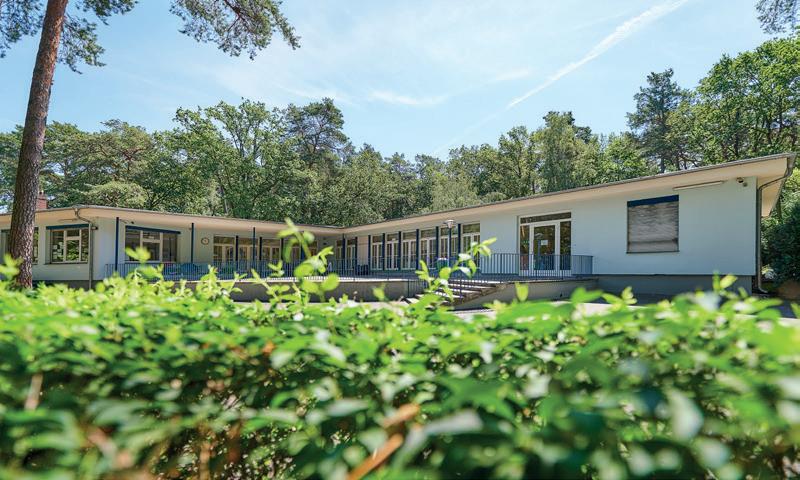
BBS is unique in the Berlin education scene as the only international school to offer the choice between a curriculum delivered through the medium of English, ideal for students from an international business or diplomatic background, and a bilingual option that enables native German speakers to enjoy the benefit of studying selected subjects in German.

BBS is proud of how it fulfils its mission to create confident learners and creative thinkers through providing a caring and supportive community. If you are interested in finding out more about the school, it is possible to arrange a tour.
Early Years/ Kita
The Early Years curriculum is based on a blend of the Foundation Stage Curriculum of England and Wales, the International Baccalaureate Primary Years Programme and the Berliner Bildungsprogramm. Every group is supported by an English-speaking teacher and a native Germanspeaking Erzieher/in. This combination provides the best of all systems, enabling the school to provide a British-based bilingual IB education.
Primary School
The Primary school implements the International Baccalaureate Primary Years Programme, known as the PYP, as well as the Berliner Rahmenlehrplan. The programme offers an international curriculum, which addresses the whole child, catering for children’s academic, social and emotional growth through an inquiry-based approach. The PYP encourages students to develop independence and to take responsibility for their own learning.
Contact: Berlin British School gGmbH

Dickensweg 17-19, 14055 Berlin
Admissions Secretary:
T: +49 (030) 35109 191
info@berlinbritishschool.de
www.berlinbritishschool.de
Secondary School
In Grades six to ten, all students work towards their International General Certificate of Secondary Education (IGCSE) examinations. Students in the bilingual stream also take the German MSA (Mittlerer Schulabschluss; i.e. German intermediate school-leaving qualification).Grades 11 and 12 pursue the IB Diploma. Competition for places at IB level is intense, with an entry policy in place for those wishing to study the Diploma.
March 2023 | Issue 103 | 59 Education, Training & Development | Special Theme | Discover Germany
Secondary School Campus.
Early Years Campus at the Havelchaussee.
P.E. lesson at the Primary gym.
BBS Library at Secondary School.
BY PRACTITIONERS FOR BUSINESSES
Succession, selling or buying a business, recruitment and qualification of skilled workers and increased profits: the Wanner GmbH is a strong partner by your side.
Some consultants out there may be excellent on the theory side of things, but have little experience when it comes to practice. This is an issue that Dipl.-Ing. Reinhold Wanner believes is quite common. But what has his own approach been over the last ten years? He elaborates: “My team and myself optimally combine theory and practice, always. I am a trained electrician and a graduate in electrical engineering – and as a managing director, I have managed companies with up to 500 employees in various economic situations and industries.”
Within the fields of M&A, Consulting, Recruitment and Coaching, Wanner GmbH offers a truly unique range of both experience and knowledge. For Wanner, however, this is a logical way to conduct business: “The biggest challenges for small and medium-sized businesses are the lack of successors and skilled workers, weak leadership, inadequate business processes and a lack of profit. These issues need to be addressed in an overall context if changes are to be achieved,” believes the holder of the Meggle Young Enterprise Award.
Wanner GmbH is also a strong partner when it comes to buying or selling a business. “Every entrepreneur considers it at some point. Thanks to our international network, we are able to think beyond borders, which creates attractive prospects. We are just as competent and committed a partner in the realisation of these plans as we are in all other consultation activities.”
VON PRAXISPROFIS FÜR UNTERNEHMEN
Nachfolge, Firmenverkauf & -kauf, Fachkräftegewinnung & -qualifizierung und Ertragssteigerung: Wanner GmbH ist ein starker Partner an Ihrer Seite.
Manche Beratungsunternehmen kennen zwar die Theorie, haben aber mit der Praxis wenig Erfahrungen. Dipl.-Ing. Reinhold Wanner hat diese Situation erkannt. Was macht er seit nunmehr 10 Jahren anders? „Mein Team und ich vereinen Theorie und Praxis in idealer Weise. Ich bin gelernter Elektriker, Dipl.-Ing. Elektrotechnik und habe als Geschäftsführer Unternehmen mit bis zu 500 Mitarbeitenden in unterschiedlichen wirtschaftlichen Situationen und Branchen geleitet.”
Mit den Beratungsfeldern M&A, Consulting, Personalvermittlung und Training bietet die Wanner GmbH ein Beratungsspektrum an, das ein absolutes Unikum am Beratermarkt darstellt. Für Wanner aber ein logischer Schritt: „Die größten Herausforderungen für kleine und mittlere Unternehmen sind Nachfolger- und Fachkräftemangel, Führungsschwäche, unzureichende Unternehmensprozesse und fehlender Gewinn. Diese Themen müssen im Gesamtkontext gedacht werden, wenn sich etwas ändern soll”, so der Träger des Meggle-Gründerpreises.

Auch bei einem Unternehmenskauf bzw. -verkauf ist die Wanner GmbH ein starker Partner. „Solche Überlegungen stehen bei jedem Unternehmer einmal an. Dank unseres internationalen Netzwerks können wir auch über Grenzen hinaus denken, was zu attraktiven Perspektiven führt. Bei der Realisierung sind wir ein ebenso kompetenter und engagierter Partner, wie bei allen anderen Beratertätigkeiten.”
www.wanner.gmbh
60 | Issue 103 | March 2023 Discover Germany | Business | Wanner GmbH
TEXT: SILKE HENKELE | PHO TOS: ISTOCK
Dipl.-Ing. Reinhold A. Wanner, founder and owner of Wanner GmbH.
Photo: Wanner GmbH
Developing the future M&A Coaching Consulting Recruitment
Success is plannable. For people & companies!
9 von 10 CIO´s machen immer wieder den gleichen teuren Fehler…
Als CIO müssen Sie sich und Ihre IT-Organisation immer mehr an die Bedürfnisse der Kunden und der Unternehmensstrategie ausrichten. Es bedarf einer kunden- bzw. servicezentrierten Vorgehensweise, die nur intrinsisch erfolgen kann.
Oftmals (oder In der Regel) werden dazu klassische und namhafte IT-Beratungsfirmen beauftragt, die Ihre vorhandene Organisation umstrukturieren und sie dadurch auf direktem Wege in eine teure Abhängigkeit führen. Um das Problem jedoch im Kern zu lösen, müssen Sie selbst in der Lage sein, eine moderne IT-Organisation selbstständig zu etablieren.
Das - und nur DAS ist der einzige Weg, um langfristig unabhängig von Dritten zu werden.
Wir von GreenSocks befähigen Sie in allen Phasen, in denen Sie Ihre IT-Organisation so ausrichten, dass sie endlich die aktuellen Anforderungen des Unternehmens erfüllt, und das mit “klarer Kante”! Wir machen uns selbst überflüssig, in dem wir unser Wissen an Sie weitergeben!
Lassen Sie uns kennenlernen und über diese und andere Themen sprechen.

Mehr dazu unter www.greensocks.de
BORGWARD: A HISTORIC GERMAN AUTOMAKER
Borgward isn’t a household name today, but in the 1950s and early '60s, this German carmaker was rivalling Volkswagen, and some of its models were outperforming Porsches. Founded by Carl FW Borgward, the Bremen-based company also produced trucks and a helicopter.
Borgward had success from its first vehicle in the 1920s, to its famous Isabella cars in the 1950s. But by 1959, time was running out for Borgward: circumstances led to the company ceasing production in 1962. Daimler-Benz and BMW filled the void and all but eclipsed the memory of Borgward as a German car brand.
BEGINNINGS AND BREMEN
Carl Friedrich Wilhelm Borgward was born 10 November 1890 in Altona, Hamburg. As a child, Borgward loved to tinker with parts and, in about 1900, he built his first motorised toy car. He attended the Hamburg Machine Construction School and worked as an engineer’s apprentice for Mencke and Ham-
brock. Borgward then enrolled at the Technical High School in Hanover, and held a job in a steel manufacturer’s office.
Borgward moved to Bremen in 1912 and worked as an engineer for Schellhass and Druckenmuller, a steel company, and relocated to Berlin in 1914. He was drafted into the German Army in 1915, was wounded and spent months recuperating in a military hospital. After being discharged, he joined Franke Textile Company in Bremen, and acceded to head of its technical department.
THREE-WHEELERS
In 1919, Borgward joined automotive firm Bremer Reifen-Industrie GmbH. Borgward
presented his first vehicle in 1924, the threewheeled Blitzkarren (‘Lightning Cart’) delivery van. The Blitzkarren was a hit with tradesmen and the Deutsche Reichspost. Borgward demonstrated the vehicle himself in the streets of Bremen, to drum up business.
The company moved to Industriestrasse in 1925, and Borgward produced another three-wheeler in 1926, the Goliath. The company further expanded in 1928, and acquired a majority share in Hansa-LloydWerke, a body works firm, in 1929, leading to ownership and a merger in 1931. This move created the Borgward Group. The company did well: the Goliath Pioneer, another three-wheeler, was the best-selling car in Germany at this time.
HERE’S HANSA
Borgward launched the Hansa line in 1934, with the 1100 and 1700 autos, and plans for expansion at a new Bremen-Sebaldsbrück

62 | Issue 103 | March 2023
TEXT: ERIC BRYAN
Photo: Unsplash
factory were enacted in 1936. The factory opened in 1938.
By 1939 Borgward
was one of Germany’s leading automakers, and the Hansa cars began to carry the Borgward name. During World War II, the company produced trucks and military vehicles. The Borgward factories were nearly obliterated by Allied bombs on 12 October 1944.
POSTWAR: THE ISABELLA AND MORE
Production resumed in 1945 with the manufacture of the B 3000 truck, and in 1949, Borgward & Co. apportioned itself into three companies: Lloyd, Goliath and Borgward. At this stage, Borgward presented the first new German postwar car, the Borgward Hansa 1500. This auto was also the first European car to have a ponton body. The year 1950 brought the Lloyd LP 300, the first viable German postwar compact car, and the Goliath GP 700. Borgward also premiered in international motorsport at this time, establishing 12 records at Montlhéry, France in the F class up to 1.5 litres.
The group’s first luxury car, the Hansa 2400, debuted in 1952. The Borgward Isabella, which premiered in 1954, proved to be a popular sedan, selling over 200,000 units. Borgward expanded into aviation by develop-

ing the Focke-Borgward BFK-1 helicopter in 1956. This was a utility aircraft used primarily for agricultural work. Also that year, Borgward introduced the Isabella Coupé. A four-speed with a 1493cc engine, the coupé could go to speeds of 93 mph. The front-wheel-drive Lloyd Arabella appeared in 1959, and the P 100, the first German auto with pneumatic suspension, also debuted that year.
DISQUIET, DISSOLUTION AND DISPERSION
As the P 100 went into production in 1960, Borgward ranked next behind Volkswagen and Opel in the hierarchy of German automakers. However, Lloyd and Goliath profit losses began to inhibit cash flow. There was increasing competition, and the Borgward range was too broad to be economical. The problem became acute, with Carl Borgward finally stepping down and the companies coming under the control of the Bremen City Council in 1961, leading to bankruptcy procedures.
The council appointed attorney Johannes Semler – who was on the board of Borgward’s arch-rival BMW – as receiver. Borgward’s supposed insolvency was one of the largest and most dramatic in German history. The assets were liquidated, with some of the factory going to vehicle maker Hanomag. When the measures were concluded eight years later, it was clear that all Borgward em-
ployees and creditors had been paid in full. Suspicion began to fall on the proceedings, and on the motives of the council and the press, the latter of which had vilified Borgward. Borgward completed the last 23 Isabellas, delivering the final one at the start of 1962. Carl FW Borgward died of a heart-attack on 28 July, 1963 in Bremen.


Production machinery for the Isabella and P100 were sold to a concern in Mexico, where the cars were made from 1967-70. There was also Isabella assembly in Argentina and Brazil, and smaller Isabella operations existed in the Philippines and Indonesia.

March 2023 | Issue 103 | 63 Borgward: A Historic German Automaker | Business Feature | Discover Germany
Photo: Unsplash
This Goliath GP 700 was photographed at a Borgward meeting in Andernach. Photo: Spurzem
The Borgward Isabella’s sound design made it popular as a squad car. This Isabella, complete with roof beacon and spotlight, is in the livery of the Bremen Police.
Photo: Jürn C. Schulze
A 1959 Borgward Isabella at speed, participating in the Saxony Classic Rallye, 2010.
Photo: André Karwath
SPECIAL THEME: HEALTHCARE SOLUTIONS

Become your best self
Being fit and healthy usually translates into feeling better, more alive and up for more tasks during your everyday life. In this special theme, we introduce some of the DACH region’s top healthcare solution providers. Get inspired!
 PHOTOS: UNSPLASH
BOOM-BRANCHE GESUNDHEITSWESEN: WEITERBILDUNGEN BLEIBEN HOCH IM KURS
Das Interesse an beruflicher Weiterbildung ist ungebrochen und bleibt auf einem hohen Niveau, wie Statistiken zeigen. So war die Teilnahmequote an beruflicher Weiterbildung laut Statistischem Bundesamt zuletzt auf einem Höchststand. Die Idee des Arbeitsministeriums, Weiterbildung unter anderem mit einer Bildungszeit voranzubringen, zeigt, dass Aus- und Weiterbildung auch in den politischen Fokus gerückt sind und als zunehmend wichtig erachtet werden. Schon jetzt gibt es verschiedene Fördermöglichkeiten.
Nicht zuletzt aufgrund der aktuellen globalen Herausforderungen erfährt zudem das Thema Gesundheit ein zunehmendes persönliches wie gesellschaftliches Interesse. Unser Stresslevel erhöht sich stetig und führt zu ganz persönlichen Herausforderungen. Welche gesundheitlichen Auswirkungen das hat, wurde etwa im Psychreport der DAK, einer der größten deutschen Krankenkassen, und in Telefoninterviews durch das Robert KochInstitut ermittelt – mit eindeutigen Ergebnissen: Psychische Erkrankungen wie Depressionen, Anpassungs- und Angststörungen und nicht zuletzt Burn-out-Erkrankungen nehmen weiter zu. Immer weniger Menschen empfinden ihre psychische Gesundheit als gut.
STEIGENDER BEDARF AN FACHKRÄFTEN IN THERAPIE UND PRÄVENTION
Dietrich Munz, Präsident der Bundespsychotherapeutenkammer, bestätigt, dass der Therapiebedarf in allen Altersklassen stetig
zunimmt. Das führt zu immer längeren Wartezeiten auf einen Therapieplatz und zunehmendem Druck auf das Gesundheitssystem. Schon jetzt beginnen die Krankenkassen sich für Alternativen zu den klassischen psychotherapeutischen Angeboten zu öffnen. Gleichermaßen steigt der Bedarf an Prävention und somit an Fachpersonal, das Klienten kompetent, nachhaltig und vertrauensvoll coacht und anleitet. Neben den klassischen Entspannungs- und Stressreduktionsthemen wird immer häufiger Ernährungsberatung nachgefragt, und durch den demografischen Wandel ergibt sich ein Mehrbedarf an Betreuung und Pflege, aber auch an speziellen Bewegungsangeboten. Der Trend übt natürlich auch Druck auf die Angebotsseite aus: „Spätestens seit Beginn der Covid-Pandemie ist das Thema der beruflichen Weiterbildung im Gesundheitswesen noch einmal verstärkt in den Fokus gerückt“ weiß Olga Dudda, Schulleiterin des Weiterbildungsspezialisten BTB.
WEITERBILDUNG ALS CHANCE ZU
BERUFLICHER UND
PERSÖNLICHER WEITERENTWICKLUNG
Weiterbildungen in den genannten Bereichen sind also auf verschiedenen Ebenen eine lohnende Investition in die Zukunft – in die eigene und die gesellschaftliche. Wer gerade berufliche Veränderung sucht und aktiv werden will, für den bieten die berufsbegleitenden Fernlehrgänge des BTB gleich mehrere Chancen auf beruflicher, aber auch auf persönlicher Ebene.
Informieren Sie sich jetzt und lernen Sie Ihren Partner für Weiterbildung und Gesundheit kennen. Neben der individuellen Beratung vorab und der persönlichen Betreuung während der gesamten Ausbildung unterstützt das BTB seine Absolventen auch im Anschluss, etwa auf dem Weg in die Selbstständigkeit. Das zertifizierte Bildungsinstitut freut sich darauf, auch Sie mit geballter Erfahrung aus fast 40 Jahren in Ihre berufliche Zukunft zu begleiten.

www.btb.info
BTB - Bildungswerk für therapeutische Berufe
Lobirke 1, 42857 Remscheid, Deutschland
Tel. +49 (0)2191/46431-0
(Mo. - Fr. 8 bis 18 Uhr)
E-Mail: kontakt@btb.info
Internet: www.btb.info
March 2023 | Issue 103 | 65
Healthcare Solutions | Special Theme | Discover Germany
TEXT &
FOTOS: BTB
Olga Dudda, Schulleiterin des Weiterbildungsspezialisten BTB.
EIN GESUNDHEITSUNTERNEHMEN IM STEIGFLUG
Das Gesundheitswesen befindet sich in einem massiven Wandel. Dazu tragen neben einer alternden Bevölkerung die zunehmende Häufigkeit chronischer Krankheiten sowie eine Überlastung der zahlenmäßig weiter schrumpfenden Ärzteschaft und der weniger werdenden Pflegekräfte bei. In diese Gemengelage hinein tritt dann noch ein weiterer Faktor, der zu einem Paradigmenwechsel führt: aktive und vernetzte Patienten.
Viele Menschen wollen ihre eigene Behandlung engagiert und aktiv mitgestalten. Es ist erwiesen, dass ein informierter, aktiver Patient bessere klinische Ergebnisse erzielt, und dass dieses Engagement insgesamt die Erbringung von Dienstleistungen sowie die Steuerung des Gesundheitswesens verbessern und zur Senkung der Gesamtkosten beitragen kann.

GESUNDHEIT IN EIGENER HAND
Aktive Patienten wollen sich auf Augenhöhe mit ihren Ärzten austauschen. Sie wollen ihre Gesundheit selbst in die Hand nehmen und
erwarten von den Dienstleistern im Gesundheitswesen, dass sie sie dabei unterstützen und sich über den gesamten Verlauf der Behandlung hinweg mit ihnen auseinandersetzen. Moderne, auch virtuelle Methoden der Kommunikation sind dabei akzeptiert und nachgefragt. So zeigt eine Studie aus Deutschland und Österreich, dass über 90 Prozent der Patienten, die eine ärztliche Videokonsultation wahrgenommen haben, diese wiederholen würden. Über 80 Prozent dieser Patienten fühlten sich eher in der Lage, eine selbstbestimmte, aktive Entscheidung zu treffen, wenn sie ihre telemedizini-
sche Konsultation mit einer herkömmlichen Konsultation vor Ort verglichen. Angesichts dieser Erwartungen müssen Gesundheitssysteme ihren Ansatz neu definieren und von einem patientenzentrierten zu einem patientenaktiven Herangehen wechseln.
Der patientenaktive Ansatz ist besonders wichtig, wenn es um die Behandlung chronischer Erkrankungen geht. Lebenslange Erkrankungen werden durch Genomik, Metabolomik, Umweltfaktoren oder soziale Determinanten der Gesundheit vorbestimmt und erfordern das Engagement von Angehörigen der Gesundheitsberufe aus verschiedenen Fachbereichen. Dieses Engagement muss sich über das gesamte Kontinuum der Versorgung hinweg erstrecken. Dabei wollen die Patienten aufgeklärt werden und suchen nach einer Zusammenarbeit mit ihren Ärzten. Damit werden sie zu aktiven Teilnehmern an ihrer eigenen Versorgung.
66 | Issue 103 | March 2023
TEXT & FOTOS: DEDALUS
OPTIMIERUNG DURCH IT
Dazu bedarf es allerdings IT-Lösungen, die eine Zusammenarbeit mit allen Beteiligten und die Einbeziehung des Patienten in den digitalen Versorgungsprozess ermöglichen, beispielsweise Patientenportale.
Grundsätzlich bieten innovative IT-Lösungen eine ganze Reihe von Hebeln, über die sie die Leistungsfähigkeit eines Krankenhauses steigern können. Vorrangig fördern sie die Optimierung von Prozessen und verbessern so die Effizienz der Patientenversorgung. Innerhalb der Einrichtung vereinfacht innovative IT die Standardisierung und Automation von Prozessen, sie lässt medizinisches Expertenwissen in die digitale Prozesssteuerung einfließen und gestattet damit den fokussierten Einsatz von Fachkräften. Eine digitale Ressourcenoptimierung verbessert die Auslastung und steigert damit die Wirtschaftlichkeit.
GUTE HEALTH IT HILFT DEN PATIENTEN

Dedalus HealthCare ist Marktführer für Klinik-Informationssysteme in Deutschland und steht seinen Kunden bei der digitalen Transformation zur Seite. Gegenwärtig arbeiten allein in Deutschland mehr als 800 Gesundheitseinrichtungen mit dem Krankenhaus-Informationssystem (KIS) ORBIS, rund 41 Prozent aller stationären Fälle werden durch das System prozessiert. Jedes Jahr kommen
auf dem hart umkämpften Markt zehn bis 20 neue Kunden hinzu. Von den rund 2.800 Krankenhäusern in Deutschland, Österreich und der Schweiz vertrauen gut 2.300 auf mindestens eine der Produktplattformen aus dem Hause des Bonner IT-Spezialisten.
Das hat in den Märkten zu einem organischen Wachstum von 12,5 Prozent und einem Umsatz von rund 280 Millionen Euro geführt. Weltweit beschäftigt Dedalus HealthCare aktuell 6.700 Mitarbeiter. 2.400 davon arbeiten in der Softwareentwicklung, fast ein Viertel in der DACH-Region – Tendenz jeweils steigend. Das gelingt vor allem durch junge und innovative Teams. Teilweise liegt der Altersdurchschnitt an den Entwicklungsstandorten bei unter 30 Jahren.
ZUKUNFTSTHEMEN BEREITS ANGEPACKT
So wird Dedalus HealthCare auch die Zukunft gestalten. Großes Potenzial liegt in Anwendungen mit Künstlicher Intelligenz sowie cloudbasierten Lösungen. Ein weiteres dominierendes Thema wird Big Data sein, also die Analyse der umfangreichen Daten, die während einer Patientenbehandlung entstehen. In diese Bereiche investiert das Unternehmen und hat bereits Lösungen implementiert.
Beispiel Big Data: In den Kliniken befinden sich riesige „Data Lakes“, aus denen sich
mittels intelligenter Algorithmen sehr nützliche Erkenntnisse gewinnen lassen. Die Schaffung neuer medizinischer Anwendungen, die die Versorgung spürbar verbessern, ist nun möglich. Dedalus HealthCare hat mit seiner KI-Lösung clinalytix bereits zwei konkrete prädiktive Use Cases umgesetzt. Das ist aber nur der Anfang. Es geht um Verfahren der Künstlichen Intelligenz (KI) und um Ansätze von NLP (Natural Language Processing) sowie NLU (Natural Language Understanding). Entsprechende Lösungen werden künftig in vielen Bereichen zum Einsatz kommen, in der klinischen Analytik, im Medizincontrolling, in der Diagnostik, aber auch in der Pflegeprozesssteuerung.
Ein anderes Beispiel: Behandlungsqualität und Patientensicherheit gewinnen durch eine klinische Entscheidungsunterstützung (Clinical Decision Support) in den digitalen Anwendungen. Warnmeldungen reduzieren Behandlungsfehler; Therapievorschläge und Behandlungspfade stärken eine leitliniengerechte Versorgung. Das wiederum reduziert Haftungsrisiken.

Das sind nur wenige Beispiele, wie IT die Patientenversorgung verbessern und das Krankenhausmanagement erleichtern kann.
www.dedalusgroup.de

March 2023 | Issue 103 | 67 Healthcare Solutions | Special Theme | Discover Germany
DEIN SCHLAF - DEINE PERFORMANCE
Deine Schlafqualität ist ein wesentlicher Schlüssel zu deiner Leistungsfähigkeit und Gesundheit. Du willst mit deiner Performance durchstarten und abheben? Mit dem App-basierten Onlinekurs ‚Dein Schlaf. Dein Tag.‘ kannst du deinen Schlaf nicht nur messen, sondern auch verstehen und verbessern.

Ganz ohne Fitnesstracker oder Smartwatch wird dank innovativer Sonartechnologie deine Schlafqualität so gut wie nie zuvor kontaktlos und genau erfasst, analysiert und ausgewertet. Das Ganze ist sogar im Flugmodus deines Smartphones möglich.

Mit Dein Schlaf. Dein Tag. bekommst du direkt am Morgen zum Start in den Tag eine präzise Aufzeichnung deiner Schlafdaten. Auf dieser Basis erhältst du dann wissenschaftlich fundierte, personalisierte Tipps, Anleitungen und Life-Hacks, um langfristig gesund und erholsam zu schlafen.
Schlaf ist neben Ernährung und Bewegung der entscheidende Faktor für ein gesundes Leben. Optimierst du deinen Schlaf, werden
auch deine Konzentrations- und Leistungsfähigkeit am Tag auf das maximale Level gehoben und du bist für alle Herausforderungen deines Alltags bestens gewappnet.
Dein Schlaf. Dein Tag. kann als app-basierter Präventionskurs schnell und einfach genutzt werden: Da der Schlafkurs durch die Zentrale Prüfstelle für Prävention zertifiziert ist, übernimmt deine Krankenkasse bis zu 100 % der Kosten – es lohnt sich also noch einmal mehr für dich, deinen Schlaf in den Fokus zu setzen.
Lade die App einfach kostenlos im App Store oder Play Store herunter und beginne mit der Nutzung. Auf www.deinschlaf-deintag.de/app erfährst du alles Wichtige. Dort findest du auch den Krankenkassenrechner und eine Anlei-

tung, wie einfach die Erstattung durch deine Krankenkasse funktioniert.
www.deinschlaf-deintag.de/app
68 | Issue 103 | March 2023
TEXT & FOTOS: MEMENTOR GMBH
Discover Germany | Special Theme | Healthcare Solutions
Foto: Adobe Stock
IS YOUR CUSTOMER WHO YOU THINK THEY ARE ?
We make sure that you know exactly who your customer is. Our innovative identification products allow consumers to identify themselves or sign contracts legally online. Fast, safe, in compliance with laws and regulations, and from anywhere. Our services already help hundreds of partially global clients in Banking, Financial Services, Telecommunications, eCommerce and many more to streamline their onboarding and KYC processes. Get in touch with us. So you always know your customers‘ True Identity.

www.webid-solutions.de
SPECIAL THEME: GERMANY’S TOP COACHES – A REGIONAL SELECTION
Taking skills to the next level
Looking to take your business or your personal skills to the next level? Choosing a coaching or consulting expert might just do the trick. To find your right fit, we have collected some of Germany’s top coaching experts in the following special theme, and take a closer look at their respective fields of expertise. Get inspired!

 TEXT: NANE STEINHOFF I PHOTOS: PIXABAY
FÖRDERN, STATT AUSBREMSEN: AUSSERGEWÖHNLICHE MENSCHENBEGLEITER FÜR AUSSERGEWÖHNLICHE MENSCHEN
Die HOCHiX Akademie bietet professionelle Coaching-Ausbildungen mit Schwerpunkt auf hochsensible, hoch- und vielbegabte sowie hochbewusste Menschen an. Hier lernt man nicht nur wie man als Berater anderen HOCHiX Menschen zur Seite stehen kann, sondern auch seine eigenen, vielfältigen Begabungen selbstbewusst wahrzunehmen und zu leben – und das steigert die Produktivität.
Coaching-Koryphäe Anne Heintze bringt im Gespräch sofort auf den Punkt, worum es bei der HOCHiX Ausbildung geht: „Zehn Prozent aller Menschen haben eine HOCHIX Persönlichkeit - sind also hochsensible, hochbewusste, hochbegabte und vielbegabte Menschen mit besonderen Fähigkeiten und Bedürfnissen. Wenn diese Menschen mit hohen kommunikativen, analytischen und kreativen Kompetenzen in Aufgabenbereichen tätig sind, in denen sie ihre außergewöhnlichen Talente nutzen können, wirkt sich das positiv auf vielen gesellschaftlichen Ebenen aus.“

„Die Realität ist jedoch, dass genau diese Menschen mit enormem Potenzial überpro-

portional unter Mobbing, Bossing, Boreout und Burnout leiden“, führt die charismatische Mentorin fort. „HOCHiX Menschen sind weit denkende, schnell merkende, tief fühlende und klar wahrnehmende Menschen. Damit stoßen sie in einer Welt, die auf eine Norm ausgelegt ist, schnell an enge Grenzen.“
Dass sich die Problematik durch alle Berufsfelder zieht, leuchtet ein, denn immerhin sind zehn Prozent jeder Belegschaft betroffen, wie Anne Heintze erläutert. „Beispiele, die sich jeder ausmalen mag: Eine hochintelligente Führungskraft trifft auf Mitarbeiter, die die Komplexität eines Problems noch nicht nachvollzogen haben. Eine hochsensible Lehrkraft
leidet unter Reizüberflutung durch zu große Klassen. Ein vielbegabter Unternehmer hat zahlreiche kreative Projektideen und Innovationen im Kopf, kennt daher aber auch Entscheidungsschwierigkeiten. Eine hochsensitive Mitarbeiterin geht in die innere Emigration, weil sie das Betriebsklima als toxisch wahrnimmt. Wenn all diese Talente ungebremst eingesetzt würden, gäbe es weniger ungelöste Probleme“, so Heintze.
Genau hier setzt die HOCHiX Akademie mit ihrer Ausbildung an und bietet handfeste Tools, um sich selbst zu entfalten sowie andere außergewöhnliche Menschen professionell zu coachen. Egal, ob man als hauptberuflicher Coach arbeiten möchte, oder mit den gewonnenen Erkenntnissen und Kommunikationsfähigkeiten die bisherige Karriere und somit sein Unternehmen bereichert – es ist eine transformierende Erfahrung. www.hochix.com
March 2023 | Issue 103 | 71 Germany's Top Coaches – A Regional Selection | Special Theme | Discover Germany
TEXT: MARILENA STRACKE
Anne and Harald Heintze. Foto: HOCHiX Akademie
UNBEWUSSTE DYNAMIKEN IN UNTERNEHMEN AUFDECKEN …UND VERÄNDERN
Als erfahrene Business-Coach und psychodynamische Organisationsentwicklerin unterstützt Beate Krenzer ihre Kundinnen und Kunden mit großer Analysekompetenz und viel Empathie unbewusste Dynamiken zu erkennen und daraus entstandene Probleme zu lösen. Wertneutral steht sie „außerhalb der Organisation“ und ermöglicht ihren Coachees dadurch ganz neue Sichtweisen.

Beate Krenzer hatte schon immer eine Leidenschaft für die Arbeit mit Menschen. Nachdem die in Düsseldorf ansässige Diplom-Volkswirtin lange als Führungskraft in einer renommierten Beratungsgesellschaft für integriertes Personalmanagement arbeitete, erfüllte sie sich vor rund 10 Jahren einen absoluten Herzenswunsch. „Ich absolvierte die Ausbildung zur Psychodynamischen Organisationsentwicklerin und Business-Coach, um unbewusste Dynamiken im ersten Schritt zu erkennen und diese dann im zweiten Schritt, durch Coaching von Führungskräften, Teams oder der Organisation passgenau zu verändern“, erzählt sie.
Ihre große Begeisterung für das Thema führte in Verbindung mit der Nachfrage aus ihrem beruflichen Netzwerk dazu, dass sie sich quasi über Nacht selbständig gemacht hat. Heute ist sie als Senior Coach (DBVC) fest etabliert
und bietet neben Executive Coaching, Organisations- und Team-Coaching, sowie Konfliktlösung auch Gesundheitsmanagement und Sales Development an. Nebenbei hat sie einen Lehrauftrag zum Thema „Gesundheitsorientiertes Führen“ an ihrer Alma Mata in Mannheim. Ihr Kundenstamm erstreckt sich über die gesamte DACH-Region – darunter finden sich nicht nur Führungskräfte, Young Professionals in Großkonzernen und mittelständische Unternehmen, sondern auch bedeutende öffentliche Institutionen.

„Der psychodynamische Ansatz deckt unbewusste Verhaltensmuster auf, macht sie bewusst“, erklärt die sympathische Beraterin. „Durch die Bewusstmachung des unbewussten Verhaltens ist der Coachee in der Lage, die eigene Handlung häufig erstmalig nachzuvollziehen. Er kann zukünftige Situationen, die
ähnlich gelagert sind, neu bewerten und sein Verhalten bewusst neu steuern.“
So erzählt sie zum Beispiel von einer erfolgreichen Hauptabteilungsleiterin aus der Medizinbranche, die Probleme mit ihrem cholerischen Geschäftsführer hat. Auch nach Zweiergesprächen mit ihm, wiegelt er ihre Präsentationen in großen Meetings regelmäßig ab. „Im Coaching wird sie sich bewusst, dass viele ihrer Kollegen im Umgang mit dem Choleriker entspannter sind. Sie versteht, dass sie in diesen Situationen getriggert wird durch frühe kindliche Erfahrungen mit ihrem cholerischen Vater. Bildlich gesprochen: Die Hauptabteilungsleiterin wird sich erstmalig bewusst,, dass der cholerische Chef Salz in ihre alte Wunde streut“, so Krenzer. „Diese Projektionen passieren sehr häufig im beruflichen Kontext insbesondere im Umgang mit Autoritäten. Durch die Bewusstmachung ihres unbewussten Verhaltens, lernt sie, entspannter mit solchen Situationen umzugehen.“
72 | Issue 103 | March 2023
Discover Germany | Special Theme | Germany's Top Coaches – A Regional Selection TEXT: MARILENA STRACKE FOTOS: SASCHA MARTIN
www.beatekrenzer.de www.stratton-times.de/team/ beate-krenzer
Senior Coach (DBVC) Beate Krenzer.
Auftragsklärungsgespräch – Grundlage aller erfolgreichen Veränderungsprojekte mit Beate Krenzer.
SPECIAL THEME: SOFTWARE DEVELOPMENT COMPANIES
A booming sector
Software is everywhere right now and the industry is booming. Find out more about the movers and shakers in the sector, across the following pages.

 TEXT: NANE STEINHOFF I PHOTOS: UNSPLASH
INTELLIGENT PROCESSES FOR ESTATE AGENT PROFESSIONALS
The real-estate market is highly dynamic. Appointments have to be coordinated well and administrative matters need to be dealt with efficiently. There is also the organisation of viewing appointments and the perfect presentation of the property. What are the most effective ways to coordinate the work to maintain focus on the most significant matter: namely, the client's satisfaction?
Founded in 2001 by Stefan Mantl, onOffice has long been a reliable software partner for real-estate agents. “We work closely with our clients, design solutions for all requirements. Hence our software and our services are specially tailored to the needs of a respective estate agent’s office – regardless of whether it’s a single agent, an office with several people or large networks,” says Mantl.
onOffice enterprise, the software developed by Mantl and his team, is able to digitally map the real-estate business one-to-one. Thanks to intelligent processes, it adapts perfectly to current market conditions. “Routine tasks in the fields of acquisition, client loyalty, marketing and service can thus con-
veniently be managed in the background by onOffice. This saves the agents time – time in which they can work more efficiently and concentrate on the essentials: namely, on contact with clients and about the property,” highlights the founder and owner of onOffice.
A product such as onOffice enterprise relies on user input – input which is vital for its continuous improvement. The team around Mantl therefore considers itself not only a software provider, but a partner to its clients.
“It is imperative that we maintain personal contact with our clients as well as a high level of customer loyalty. Which is the reason why we regularly organise events such as the onOffice business-beats in April or

the onOffice Summer Travelling in Majorca. Here, customers can discuss current issues, exchange ideas and expand their network in a relaxed setting.”
Part of the onOffice Summer Travelling experience are specially designed training sessions where the optimisation of workflows is discussed and users become even more familiar with the functionalities of onOffice enterprise. “onOffice Travelling, by the way,” adds Mantl, “is the best opportunity to contribute your own ideas and to bombard the trainer with questions!”
Curious? It's not too late to register for the onOffice Summer Traveling programme and the onOffice business-beats in Aachen. In addition to interesting presentations, lively discussions and renowned exhibitors, participants can also expect a thoroughly enjoyable event, too.
www.en.onoffice.com
74 | Issue 103 | March 2023
TEXT: SILKE HENKELE PHO TOS: ONOFFICE GMBH
INTELLIGENTE PROZESSE FÜR MAKLERPROFIS
Der Immobilienmarkt ist geprägt von großer Dynamik. Termine müssen abgestimmt, Behördengänge koordiniert werden. Dann noch die Organisation von Besichtigungsterminen, die optimale Präsentation der Immobilie. Wie lässt sich die Arbeit am besten organisieren, um das Wichtigste, nämlich den Kundenkontakt, nicht aus den Augen zu verlieren?
2001 von Stefan Mantl gegründet, ist onOffice schon lange ein zuverlässiger (Software-)Partner von Immobilienmaklern.„Wir arbeiten eng mit unseren Kunden zusammen, entwickeln für jedes Anliegen eine Lösung. Dementsprechend ist unsere Software, sind unsere Dienstleistungen, speziell auf die Ansprüche des jeweiligen Maklerbüros zugeschnittenegal, ob Einzelmakler, ein Büro mit mehreren Personen oder große Netzwerke”, so Mantl.
onOffice enterprise, die von Mantl und seinem Team entwickelte Software, ist in der Lage, das Maklergeschäft eins zu eins digital abzubilden. Sie passt sich dank intelligenter Prozesse optimal den aktuellen Marktgegebenheiten an: „Routineaufgaben in den Bereichen Akquise, Kundenbindung, Vermark-
tung und Service können so ganz einfach im Hintergrund erledigt und getrost onOffice überlassen werden. Das erspart den Maklern Zeit. Zeit, in der sie effizienter arbeiten und sich auf das Wesentliche konzentrieren können, nämlich auf den Kundenkontakt und das Objekt”, betont der Gründer und Inhaber von onOffice.
Ein Produkt wie onOffice enterprise lebt vom Input der Nutzer, kann sich nur durch diesen ständig verbessern. Damit versteht sich das Team um Mantl nicht nur als reiner Softwareanbieter, sondern als Partner seiner Kunden. „Wir legen sehr großen Wert auf den persönlichen Kundenkontakt und die persönliche Kundenbindung. Wir organisieren daher regelmäßig Events wie die onOffice

business-beats im April oder das onOffice Sommer-Travelling auf Mallorca. Hier können unsere Partner in entspanntem Rahmen aktuelle Themen ansprechen und sich bei gemeinsamen Expeditionen austauschen und ihr Netzwerk erweitern.”
Teil des onOffice Sommer-Travellings sind speziell konzipierte Schulungen, in der gemeinsam über die Optimierung des Workflows diskutiert wird und die Nutzer die Möglichkeiten von onOffice enterprise noch besser kennenlernen. „Das onOffice Travelling”, wirft Mantl ein, „ist übrigens die beste Möglichkeit, eigene Ideen einzubringen und die Schulungsleiter mit Fragen zu löchern.”
Neugierig geworden? Für das onOffice Travelling und auch für die onOffice businessbeats in Aachen gibt es noch freie Plätze. Dort erwartet die Teilnehmer ein interessantes Vortragsprogramm, lebhafte Diskussionsrunden und namhafte Aussteller. www.de.onoffice.com
March 2023 | Issue 103 | 75 Software Development Companies | Special Theme | Discover Germany
REAL ADDED VALUE THANKS TO INTELLIGENT OPTIMISATION SOFTWARE
INFORM is the perfect partner when it comes to digital decision making. With 50 years of expertise in optimising complex dispositions, the leading German tech company provides innovative software solutions, which optimise and automate complex business processes. This results in a unique competitive advantage through the integration of artificial intelligence into a company's existing IT.
INFORM (Institute for Operations Research and Management) is one of the oldest software companies in Europe. As a pioneer in the industry, it was founded in 1969 by Professor Dr Hans-Jürgen Zimmermann to prove how mathematical process and planning research added entrepreneurial value


–at a time when terms like ’AI’ were hardly used. True pioneering work!
Since then, the company from Aachen has become a global player with locations around the world. As a result, INFORM software is now used by over 1,000 customers across various industries worldwide. The list of prestigious clients is impressive, including Lufthansa, AirFrance, BMW, FedEx, Audi, Siemens and thyssenkrupp, to name but a few.
"We see ourselves as pioneers who create sustainable value through digital processes featuring data-based and optimised decisions," says CEO Matthias Berlit. "Through our expertise and commitment, we help other companies to act even more resiliently and successfully in a sustainable way."
Unlike data-management software that only provides information, INFORM systems can analyse large amounts of data within seconds, calculate potential decisions, and suggest the best actionable solution to its users. Thus, the entire process regarding all aspects of the business is clearly optimised, and productivity is sustainably increased.
Even though INFORM is active in many different industries, on principle they don’t develop ‘one size fits all’ solutions. "We rely on highly configurable software, tailored to the conditions of our target markets," Berlit explains. "This means we can ensure that our systems meet the high requirements that enable real optimisation. At the same time, we are, step by step, opening new business areas organically, instead of applying simplified procedures to just any problem."
One thing is certain: 50 years of experience in optimising complex dispositions pays off! www.inform-software.com
76 | Issue 103 | March 2023
TEXT: MARILENA STRACKE PHO TOS: INFORM INFORM Headquarters in Aachen.
INFORM Campus in Aachen.
INTELLIGENTE OPTIMIERUNGSSOFTWARE
INFORM ist der perfekte Ansprechpartner in Sachen Digital Decision Making. Mit über 50 Jahren Jahren Know-How bei der Optimierung von komplexen Dispositionsentscheidungen, stellt das führende, deutsche Tech-Unternehmen innovative Softwarelösungen zur Optimierung und Automatisierung komplexer Geschäftsprozesse bereit. So entsteht dank Integration von Künstlicher Intelligenz in die bestehende Unternehmens-IT ein einzigartiger Wettbewerbsvorteil.
Die INFORM (Institut für Operations Reserach und Management) GmbH ist eines der ältesten Software-Unternehmen in Europa. Als absoluter Vorreiter der Branche wurde es 1969 von Prof. Dr. Hans-Jürgen Zimmermann gegründet, um den unternehmerischen Mehrwert mathematischer Ablauf- und Planungsforschung zu beweisen – zu einer Zeit, in der Begriffe wie �KI‘ noch kaum Verwendung fanden. Echte Pionierarbeit!
Seitdem hat sich die Aachener Firma zu einem globalen Player mit Standorten rund um den Globus entwickelt. Entsprechend ist INFORM-Software heute weltweit bei mehr als 1.000 Kunden in diversen Branchen im Einsatz. Die Liste der renommierten Kun-
Matthias
den ist beindruckend: darunter finden sich beispielsweise Lufthansa, AirFrance, BMW, FedEx, Audi, Siemens und thyssenkrupp.

„Wir verstehen uns als Wegbereiter für eine nachhaltige Wertschöpfung durch digitale Prozesse mit datenbasierten und optimierten Entscheidungen“, sagt Geschäftsführer Matthias Berlit. „Durch unsere Expertise und unser Engagement helfen wir anderen Unternehmen dabei, selbst resilienter und nachhaltig erfolgreicher zu agieren.“

Im Gegensatz zu datenverwaltender Software, die nur Informationen zur Verfügung stellt, sind die INFORM-Systeme in der Lage sekundenschnell große Datenmengen zu
analysieren, Entscheidungsvarianten durchzukalkulieren und Usern die bestmögliche Lösung zur Umsetzung vorzuschlagen. Der gesamte Ablauf aller Geschäftsprozesse wird so klar optimiert und die Produktivität nachhaltig gesteigert.
Auch wenn INFORM in vielen verschiedenen Branchen aktiv ist, werden aus Prinzip keine „One size fits all“-Lösungen entwickelt. „Wir setzen auf hochkonfigurierbare Software, abgestimmt auf die Bedingungen unserer Zielmärkte“, so Berlit. „Auf diese Weise stellen wir sicher, dass unsere Systeme den hohen Anforderungen gerecht werden, die echte Optimierung erst ermöglichen. Gleichzeitig erschließen wir organisch Schritt für Schritt neue Zielmärkte, anstatt vereinfachte Verfahren beliebigen Problemen überzustülpen.“
Eins ist klar: 50 Jahre Erfahrung in der Optimierung von komplexen Dispositionsentscheidungen zahlt sich aus.
www.inform-software.com
Geschäftsführer von links nach rechts: Dr. Andreas Meyer, Peter Frerichs, Matthias Berlit und Dr. Jörg Herbers.

March 2023 | Issue 103 | 77 Software Development Companies | Special Theme | Discover Germany ECHTER
MEHRWERT DURCH
Berlit: „Wir verstehen uns als Wegbereiter für eine nachhaltige Wertschöpfung durch digitale Prozesse mit datenbasierten und optimierten Entscheidungen."
Culture Calendar
Spring is around the corner and there are plenty of activities and events to enjoy while we await a milder breeze. From gourmet food festivals and mountaintop farmer’s markets to garden trade-shows and jazz concerts – this month will be anything but boring.

78 | Issue 103 | March 2023
TEXT: MARILENA STRACKE
Ski and Wine Week, Gasteiner Tal.
Photo: Gasteinertal Tourismus GmbH, Marktl
26TH VIENNESE WEEK OF RESTAURANTS, VIENNA (6 – 12 MARCH)
The Viennese week of restaurants (‘Wiener Restaurantwoche’) is an absolute highlight in the event calendar for food lovers, restaurateurs and celebrities. It is also known as the ‘gourmet marathon’ – and rightly so. This delicious week tempts guests with irresistible dishes. It should come as no surprise that it’s extremely popular, so make sure to book your table in advance.
www.restaurantwoche.wien
ITB BERLIN CONVENTION, BERLIN (7 – 9 MARCH)

The ITB Berlin is back. The live event is one of the world's largest travel trade-fairs, thanks to around 10,000 international exhibitors. It offers fabulous insights into different countries and cultures. A vibrant event throughout.
www.itb-berlin.de
SKI AND WINE WEEK, GASTEINER TAL (11 – 18 MARCH)
This is a truly special week, also lovingly called the ‘highest farmer’s market of the Alps’. Tasty home-made delicacies are sold at 28 stalls along the snowy skiing slopes. Grab some beautiful local treats such as Swiss cheese and sweet jam, or enjoy a glass of gorgeous local wine in a glorious setting.
www.gastein.com

March 2023 | Issue 103 | 79
Culture Calendar | Culture | Discover Germany
Photo: Pixabay
Opening Press Conference of ITB Berlin 2022.
Photo: Messe Berlin GmbH
GARDEN & AMBIENT BODENSEE, FRIEDRICHSHAFEN (15 – 19 MARCH)

When the garden slowly wakes up from its winter sleep, it’s time to get inspired for the new season. This garden trade-show in Friedrichshafen is the perfect place to do just that. With a great range of plants, lawn mowers, garden decorations and even ponds and swimming pools, there is the right thing however you plan to design the garden of your dreams.
www.gartenambientebodensee.info
NIGHT OF THE MUSEUM, BERN (17 MARCH)
This one is for the night owls among us. Starting at 6pm and finishing at 2 in the morning, Bern’s Night of the Museum is always packed to the brim with events, workshops and surprises. Each year the diverse range of participating institutions turns this night into something truly special.
www.museumsnacht-bern.ch

Discover Germany | Culture | Culture Calendar 80 | Issue 103 | March 2023
Whisky Festival, Dresden-Radebeul.
Photo: Whiskyladen Radebeul
Ski and Wine Week, Gasteiner Tal.
Photo: Gasteinertal Tourismus GmbH, Marktl
48TH INTERNATIONAL JAZZ FESTIVAL, BERN (21 MARCH – 27 MAY)

The International Jazz Festival brings smooth tunes to the city of Bern. More than 200 individual jazz, blues and soul concerts will be held at Marian’s jazz room. The very intimate atmosphere at the venue gives the concerts a special touch. Year after year, it not only attracts 30,000 people, but also well-known global jazz icons.
www.mariansjazzroom.ch/jazzfestival-home
FRÜHLINGSDOM 2022, HAMBURG (24 MARCH – 23 APRIL)
Hamburg’s legendary fun fair in Spring is an absolute magnet for locals and tourists alike.

With lots of different rides, food stalls and attractions, the fun fair brings thousands of visitors to the vibrant harbour city. Perfect for the entire family.
www.hamburg.de/dom
12TH WHISKY FESTIVAL, DRESDEN-RADEBEUL (25 – 26 MARCH)
Incredible tastings of international whisky await at this festival known for its casual vibe. There are also plenty of other spirits, exclusive wines, selected cigars and even fine chocolates on offer. Live music, professional seminars and various other surprises complete the experience. Cheers to that!
www.whiskyfestival-radebeul.de
March 2023 | Issue 103 | 81 Culture Calendar | Culture | Discover Germany
Garten & Ambiente, Bodensee.
Photo: IBO
International Jazz Festival Bern.
Photo: Internationales Jazzfestival Bern
Punctuality revisited
This month’s topic: punctuality. Because Germans are always on time. Right? Well, speaking for myself, yes, it’s true. It’s one of the clichés about Germans that I absolutely fulfil. I don’t know if that is because I inherited it from my über-punctual father – as opposed to my not-so-punctual mother – or if it’s because there is indeed a Teutonic tendency to stick to the clock.
I guess it’s a bit of both and unlike some other alleged German characteristics (love of beer, sausages, saunas, nakedness in general and strategic towel placing on sun loungers) that I like to distance myself from, I will always fly the flag for punctuality. It’s a question of manners, politeness and consideration. There, I said it – big words. And it makes life for everyone so much easier. If you can rely on people to show up at a certain place at a certain time, for example, it ensures that everyone involved can actually get on with their lives and not just spend – or rather lose – time waiting for someone who happens to have forgotten or thinks that being 30 minutes late is still ok because they decided to do something else with their time. No, it’s not –because I could have done something else with those 30 minutes, too, instead of using it to be on time. Yes, I find it rude and dis-
Discover Germany
Issue 103, March 2023
Published 03.2023
ISSN 2051-7718
Published by Scan Magazine Ltd.
Print
H2 Print
Executive Editor
Thomas Winther
Creative Director
Mads E. Petersen
Editor
Nane Steinhoff
respectful to let other people wait because it somehow implies that you think your time is worth more than theirs.
If you now think you’re detecting a certain aggressivity in my tone, you’re right. Simply because I am usually on time (or in other words: I hate being late), I have spent a lot of time waiting for others and built up a certain intolerance towards the later comers. Now, obviously, there can always be very good reasons for being late, in particular in London where there’s the tube and traffic and I have learnt to accept that 15 minutes after the agreed time is not necessarily being late here. No problem with that. To my own surprise, I have even become a bit more relaxed myself. And given that being late is something that makes me feel genuinely uncomfortable and nervous, this is quite something for me. However, I will never really be ok with the kind of attitude where someone texts you two minutes before the agreed time saying: “oh, by the way, I didn’t make it out of the house on time, will be 30 minutes late” (Hello??!!! I’m already here!!). Or if the person you’re supposed to meet saunters along, all relaxed, without showing any acknowledgement of being late or the concept of time as such. Coming back to the stereotype, I do believe
Assistant Editor
Marilena Stracke
Copy-Editor
Karl Batterbee
Graphic Designer
Mercedes Moulia
Contributors
Barbara Geier
Cornelia Brelowski
Daniel Cole
Eric Bryan
Sakib Hadzovic
Silke Henkele

Stuart Forster
Cover Photo
© GNTB, DZT/Jens Wegener
that in general, yes, being punctual does count for something in Germany and maybe more than in other parts of the world. If only Deutsche Bahn would get on board with that. But the un-German state of German railway operations is a topic for another time… Need to dash now, can’t be late!
Sales & Key Account Managers
Julia Freisinger
Lawinia Toth
Sophie Blecha
Jörg Schmid
Publisher:
SCAN CLIENT PUBLISHING
SCAN MAGAZINE LTD
The News Building,
3 London Bridge Street, SE1 9SG, London
Phone: +44 (0)870 933 0423
Fax: +44 (0)870 933 0421
Email: info@discovergermany.com
www.discovergermany.com
© All rights reserved. Material contained in this publication may not be reproduced, in whole or in part, without prior permission of Scan Group – a trading name of Scan Magazine Ltd.
This magazine contains advertorials/ promotional articles.
82 | Issue 103 | March 2023
Barbara Geier is a London-based freelance writer, translator and communications consultant. She is also the face behind www.germanyiswunderbar.com, a German travel and tourism guide and blog that was set up together with UK travel writer Andrew Eames in 2010.
Discover Germany | Barbara Geier Column
simple beautiful. the way I design my furniture. including sustainability, minimalism and a unique form.


how much material do we really need? minimalism is sustainability and design.
simple beautiful minimalism reduced true materials sustainable handcrafted precision unique

RICHARD STRAUSS TAGE
2. BIS 16. APRIL 2023 IN DER SEMPEROPER
DER ROSENKAVALIER
ML: Christian Thielemann / I: Uwe Eric Laufenberg
Mit Camilla Nylund, Peter Rose, Sophie Koch, Markus Eiche, Tuuli Takala, Christa Mayer, Pavol Breslik u.a.
3.April 2023, 17 Uhr, 10. April 2023, 16 Uhr
ARABELLA
ML: Christian Thielemann / I: Florentine Klepper
Mit Hanna-Elisabeth Müller, Bo Skovhus, Nikola Hillebrand, Pavol Breslik, Kurt Rydl, Daniela Fally, Christa Mayer, Petra Lang u.a.
5.April 2023, 19 Uhr, 7. April 2023, 16 Uhr
SONDERKONZERT
Sächsische Staatskapelle Dresden
Dirigent: Jakub Hrůša
8.April 2023, 19 Uhr, 9. April 2023, 11 Uhr
9. SYMPHONIEKONZERT
Sächsische Staatskapelle Dresden
Dirigent: Christian Thielemann / Sopran: Diana Damrau

Sächsischer Staatsopernchor Dresden
15.April 2023, 19 Uhr, 16. April 2023, 11 Uhr
WEITERE VERANSTALTUNGEN
6.Kammerabend – Kammermusik der Sächsischen Staatskapelle Dresden
»Enoch Ar den« op. 38, TrV 181, Melodram für Sprecher und Klavier
Fenster aus Jazz: »Laut & Leise«
Eine musikalische Äußerung zu Richard Strauss
»Morgen!« Matinee mit Liedern von Richard Strauss
Semper Bar: »Strauss Deli«
Semper Matinee: »Ein Vor-Mittag für Richard Strauss«
semperoper.de/richard-strauss-tage
Semperoper Dresden
