COMMUNITY-UNIVERSITY RELATIONS
COMMUNITY PERSPECTIVES ON THEIR INTERACTIONS WITH THE UNIVERSITY OF ARIZONA


AMANDA HILTON, SYDNEY PULLEN, ELIZABETH EKLUND, AND DIANE AUSTIN BUREAU OF APPLIED RESEARCH IN ANTHROPOLOGY, UNIVERSITY OF ARIZONA | JULY 2022

IN ASSOCIATION WITH:


TABLE OF CONTENTS
FOREWORD .................................................................................................................................................
PREFACE .......................................................................................................................................................
CHAPTER ONE: FRAMING THE STUDY ........................................................................................
The Need for this Study..................................................................................................................
The Present Study............................................................................................................................
CHAPTER TWO: APPROACH AND METHODS ............................................................... ............
Phase One..........................................................................................................................................
Phase Two..........................................................................................................................................
The Participants................................................................................................................................
CHAPTER THREE: EXPLORING COMMUNITY-UNIVERSITY RELATIONSHIPS .........
Characteristics of the University that Establish the Context of Relationships.................
The University as a Potential Resource................................................................
The University as a Complex Organization.........................................................
The University as an Organization in Constant Flux.........................................
Establishing and Maintaining Relationships.............................................................................
Gaining Access..........................................................................................................
Clear Expectations and Assessments...................................................................
Mutual Respect and Benefits for All...................................................................... Representation of the Community in Communications.....................................
Mutual Learning.........................................................................................................
Branding vs Commitment........................................................................................
Summary.............................................................................................................................................
CHAPTER FOUR: TYPES OF COMMUNITY-UNIVERSITY RELATIONSHIPS ...............
Internships and Service Learning.................................................................................................
and Service Learning: Summary........................................................ Community as Expert......................................................................................................................
as Expert: Summary............................................................................
Grant Writing and Research:..........................................................................................................
Writing and Research: Summary
CHAPTER FIVE: MOVING FORWARD
Advice for Organizations Seeking Partners Within the University
Internships
Community
Graduate
..................................................... Grant
.................................................................
...................................................................................................................................... Student
................................................................................................... Service on
Boards.................................................................................... Volunteering:
........................................................................................... Best Practices and Things to Avoid.............................................................................................. Best Practices............................................................................................................. Things to Avoid........................................................................................................... Discussion...........................................................................................................................................
and Professional Student Research
Volunteering
Volunteers
Advisory
Summary
...........................................................................................
...................................... Considerations for
..................................................................................... For Further
...................................................................................................................... REFERENCES CITED ............................................................................................................................... APPENDICES .............................................................................................................................................. Appendix I: Tools for Research Partnerships in Lawrence, MA........................ Appendix II. Interview Questions........................................................................... iii v 1 1 4 6 6 7 8 10 11 11 12 13 13 14 15 16 17 18 20 21 22 23 27 27 30 30 33 34 36 36 38 40 40 40 44 48 49 50 51 51 53 55 56 57
University Partners
Attention
FOREWORD
In story after story told at football games, family picnics, and corporate board rooms, there is an abundance of evidence affirming that people all across Arizona, Pima County, Tucson, and the region at large recognize the value of the University of Arizona. Whether it is as a leader in scientific discoveries, as an engine of economic growth, or as the animator of ideas that keep democracy vital, UArizona is deeply imprinted in the DNA of Tucson and the state. In other words, the university is a visible facilitator of opportunities that change people’s lives. Wildcat Country is not just a marketing slogan ---it is how our neighbors see those of us on campus, interface with us, and share hopes and dreams for the quality of life in our shared communities.
The coronavirus pandemic of 2020 put these core benefits in relief as campuses all across the United States, as well as here at UArizona, became centers of gravity for vaccination efforts and advanced medical insights on the virus and its impact. And yet, despite this solid foundation of shared interests, researchers keep accumulating evidence that the public’s confidence in major institutions (including universities) is eroding (Brenan 2021).
This paradox became a rich subject of conversation at several meetings that we (Jen Fields and Maribel Alvarez) attended on campus starting in 2018. We heard our colleagues wrestling with the question: how can both things be true at once—simultaneously affirming a record of public value through good work and rising sentiments of distrust? Furthermore, how did these opinions and trends show up to either expedite or chill campus-community collaborations on major social problems? UArizona researchers, instructors, and outreach staff are “out there in community” doing their best to be good partners and build bridges of collaboration in numerous key areas of policy and public service. However, the question emerges: how do we know whether these values are transparent, understood, and shared by those outside the university on whose generosity and critical insights we depend to make headway?
Through our jobs and from two distinct campus vantage points (the office of Research, Innovation, and Impact and the College of Social & Behavioral Sciences) we both saw a renewed interest on campus in making visible the ways in which the University cared for community locally and globally, worked hard to engage non-academic partners in projects of mutual interest, and aimed to be a force for good in the world at both small and large scales. Because we both came to our respective university positions after holding jobs outside of academe in the nonprofit, political, educational, artistic, and community organizing sectors, we often found ourselves locking eyes across the room where these campus discussions were taking place and asking ourselves:
• Does the perception of beneficence we hold inside the university mirror the perception people outside the university have of our intentions and behaviors?
• What do they perceive is our value added to the good work they are already doing?
• What do they think we get right as partners?
• What do community members think the university and its representatives can do better?
• Are there any things we got wrong for which we need to be accountable as an institution?
Although we were aware of dozens of individual cases of university faculty and staff whose relationships with community projects were built on rock solid ethics of equity and authenticity, we could find no evidence that a reflexive, inclusive, participatory inquiry had ever been formally undertaken by any UArizona administrative or academic unit. Not surprisingly, community members with whom we talked to probe the interest in examining these questions more deeply expressed a readiness to engage. “This has always been the elephant in the room when UArizona engages community members in projects,” a leader in the community told Maribel. “Do you want to hear from us what we need or do
iii University of Arizona | UCR Report
you only want tell us what you think we need? That is the difference between projects that I choose to engage in or those that only cause further harm to communities.”
We found, too, a great deal of encouragement and enthusiasm among our colleagues at UArizona to pursue a systematic exploration of these questions. From leaders in faculty affairs and faculty governance bodies, to student success and engagement, government relations, senior leadership, strategic plan stakeholders, and across the subject-matter experts in health, psychology, agriculture, and myriad campus units, we heard repeatedly the need for a benchmarking assessment that would put the University of Arizona at the forefront of a movement of universities committed to re-examining their institutional rights and responsibilities towards communities. With seed funding from the Dean’s office in the College of SBS, supplemented with funds from a Racial Equity in Research Challenge Grant under RII, we asked one of our most skilled campus units in participatory action research, the Bureau of Applied Research in Anthropology (BARA), to lead this first-of-its kind inquiry. Fortunately for us, the winds of change for new pathways in engaged scholarship and community engagement in the American academy are blowing in our favor. Communities and universities everywhere are recognizing a higher order of principled accountability that goes beyond the era of tacit benevolence in truth-gathering and truth-telling by experts. We are grateful for the opportunity to hold space for the meaningful conversations and changes that we hope will continue to resonate from these findings for many years to come.
Maribel Alvarez, Ph.D. (former) Associate Dean, Community Engagement College of Social and Behavioral Sciences
Jen Fields, MA Director, Office of Societal Impact Research, Innovation, and Impact
iv University of Arizona | UCR Report
PREFACE
It has been an honor and privilege to be asked to carry out this important study, to be trusted by the university administrators and the participants to listen, hear, and document the perspectives of community leaders who have partnered with university faculty, staff, students, and programs during the past several decades. This is a critical time for this study, not just for the University of Arizona but for many universities that are grappling with how best to balance their obligations to their academic communities with their obligations to the communities in which they are physically located. While land acknowledgments are attempts to recognize and honor the original stewards of a place and their enduring ties to it, and labor acknowledgments remind us of the unpaid labor and forced servitude that enabled new groups to settle there, studies such as this call attention to the people and organizations upon whom the university’s current operations depend. They remind us of our responsibilities to the communities within which we live and work.
In 2020 and 2021, at the time the data for this study were being gathered, at least five initiatives to increase and recognize campus-community engagement were underway at UArizona.1 These initiatives follow decades of interactions between university and community collaborators. As efforts such as these go forward, it is imperative that they are shaped by lessons learned from both long-time and more recent collaborators. Good intentions are necessary but not sufficient for successful relationships. Budget cuts and reallocations, financial rewards for classes teaching large numbers of students, and structural conditions such as the growing proportion of faculty in temporary positions—which in 20202021 climbed above 50% (University of Arizona 2021)—all challenge the translation of rhetoric into practice.
Fortunately, dedicated community leaders, along with their university partners, have developed—and are willing to share—approaches and models that work, as well as those that have not lived up to expectations. We are grateful for the time and energy of the 60 people who participated in interviews for this study.
We express special thanks to Interim Associate Vice Provost Maribel Alvarez (then Associate Dean of the College of Social and Behavioral Sciences), who requested this study and secured funding (twice!) to see it through. Thanks also to Jennifer Fields, Director of the University of Arizona Office of Societal Impact, for her enthusiasm and support for the study. We are indebted to Isabella Moreno and M. Bailey Stephenson who helped identify and review relevant literature, designed the interview protocols and developed questions, and participated in the initial round of interviews just prior to and during the early months of the global COVID-19 pandemic.
We are especially grateful to the 60 individuals who participated in interviews for this study, along with the numerous others who shared their ideas and insights and guided us to the study participants. Despite the disruptions of their lives and organizations during the pandemic, they took time to reflect upon and help us understand their experiences and perspectives. It goes without saying that this study would not exist without them.
1 In October 2019, the University of Arizona adopted UArizona as its new nickname. The report authors refer to it in this way. Many of the study participants use prior nicknames such as UA and UofA to refer to the institution.
v University of Arizona | UCR Report
CHAPTER ONE: FRAMING THE STUDY

The Need for this Study
Universities, colleges, medical centers, research institutions, and other centers of higher learning create jobs, occupy physical and social space, and bring together people from the places where they are physically located and beyond. They simultaneously are a source of resources for and draw upon the resources of the communities they call home. A significant concern for public universities is balancing their responsibilities to their students, staff, and faculty and the academic communities within which they are embedded with their responsibilities to the public, which include state, national, and international constituents as well as the communities in which they are situated. Multiple publications including peer reviewed articles, reports, books, and entire journals have delved deeply into the topic of community-university relationships far beyond the scope of this project. Some of the breadth and depth of that work has been captured in an annotated bibliography prepared as a supplement to this document. This chapter provides a glimpse into that literature to allow readers to put the University of Arizona into the wider context and summarizes the University of Arizona’s efforts to develop, expand, and assess community-university interactions.
Community, in the context of community-university relations, most often refers to actors outside the university who contribute to the public good (Janke et al. 2014). Most broadly defined in this context, community includes private and public sectors, businesses, and nonprofit organizations. Though universities regularly interact and form relationships with other academic institutions, business and industry, and government agencies within the communities within which they are located—increasingly motivated by disinvestment of state governments in higher education, especially public universities—
1 University of Arizona | UCR Report
this study is focused on nonprofit organizations serving the community (see Chapter Two). Likewise, community-university interactions take many forms and have received many labels: service learning, community engagement, participatory or participatory action research, community-based research and scholarship, community-based participatory action research, and collaborative community research. Often, the boundaries among these are fluid, as when students participate in structured activities that promote both learning and serving the community (Jacoby 1996). Chapter Four of this report explores the types of relationships identified in this study.
In the United States, community outreach and service have been expected at land-grant and public universities since their inception (Ward and Wolf-Wendel 2000). Outside this country as well, university mandates for service have a long history. In Mexico, for example, students have been required to perform service to earn a university degree since 1929 (Austin 2010). Many credit Ernest Boyer (1990) for renewed attention to service and service learning. Boyer critiqued university criteria for rewarding faculty, argued for the need to prioritize service, and created a category, “scholarship of application,” to reflect the popularization of service learning and engagement within the U.S. academy. Reflecting back, Hironimus-Wendt and Lovell-Troy (1999:360) noted, “service learning has become the ‘pedagogy of the 1990’s’ across many U.S. campuses.”
A core principle that has emerged from scholarship addressing community-university relationships is the need for reciprocity and mutual benefit resulting from the university and non-university sectors working together (e.g., American Council on Education 2022). Efforts to formalize institutional commitment to engagement include Campus Compact, a national coalition of colleges and universities founded in 1985 and committed to civic education and community development (Campus Compact nd), and the Carnegie Foundation for the Advancement of Teaching Classification for Community Engagement. In her 2016 retrospective, Barbara Holland, a scholar of the institutionalization of community engagement, wrote, “The [Carnegie Classification] process has revealed to all of higher education what a high-quality, sustainable, effective, and assessable framework for community engagement looks like for students, community, faculty, staff, and campus leadership” (p. 79). As of 2020, 119 colleges and universities had applied for and received this “elective designation that indicates institutional commitment to community engagement” (Association of Public & Land Grant Universities 2020).
Institutionalization of community engagement is often most visible through college and university centers devoted to service learning and community engagement, which date back to the 1990s and have emerged on campuses across the United States. However, institutionalization has also required changes in expectations of faculty and students. As noted by Holland (2016:76), “Community engagement, as defined by the Carnegie Elective Classification framework, has been affirmed as a scholarly method and, as such, has become a legitimate option for faculty who find the method relevant to their goals, objectives, and areas of intellectual focus in any or all aspects of their schol¬arly practices.” This legitimization through scholarly publication has been accompanied by a proliferation of academic publications and journals such as the Michigan Journal of Service Learning, the Journal of Higher Education Outreach and Engagement, and the Journal of Community Engagement and Scholarship.
Universities have been aware of and sought to address challenges in partnering with community organizations and other members of the communities where they are located. Scholars have investigated whether various forms of community engagement meet the goals of students, universities, and community partners (e.g., Enos and Morton 2003, Hutchins et al. 2013, Horowitz et al. 2009, Sasson 2019, Schensul et al. 2008, Shepard et al. 2002, Silka and Renault-Caragianes 2006, Watson et al. 2011). For example, in their popular article, “Building a Two-Way Street: Challenges and Opportunities for Community Engagement at Research Universities,” in the Review of Higher Education, Weerts and Sandman (2008) gathered data from three land grant universities and three urban public research institutions,
2 University of Arizona | UCR Report
beginning with interviews with campus provosts and chief officers overseeing engagement programs and snowballing to include leaders of engagement campus initiatives. Their key findings include: interpersonal relationships are necessary and require that university personnel listen carefully and demonstrate humility; university leadership should communicate the value of engagement broadly, incorporating it in the institutional culture while also providing administrative resources; flexible governance is needed; and partnerships should be equitable but not equal in that decision making is shared but the university must provide the resources.
Despite the outpouring of academic writing, though, only a small fraction of the work has included community voices (for critiques, see Biruk and Prince 2008, Bortolin 2011, Dempsey 2010, Eby 1998, Jones and Lee 2017, Zlotkowski 1995). Of the more than 100 published articles reviewed for this study, just over 10 percent explicitly or exclusively focused on community partner perspectives and only a handful of these provided direct feedback from community partners or shared open-ended responses. When their perspectives were solicited, community partners and the scholars who reported the findings provided important observations on improving relationships and on components that define success. With two exceptions, the published attitude toward researchers, research institutions, and partnerships was overwhelmingly positive.2 Community members emphasize that community-university partnerships require trust building and effective communication (McNall et al. 2009; Sasson 2019; Taha and Pellegrino 2018), all participants’ commitment to the community partner’s goals or perspectives (Sandy and Holland 2006, Sasson 2019), and efforts and strategies to maintain reciprocity (Worrall 2007). Partners saw more benefits when they had greater voice in the planning phase (Miron and Moely 2006). They identified a need to share power (McNall et al. 2009) and resources (Groulx et al. 2020, McNall et al. 2009), including decisions about how funds are raised (Sasson 2019) and shared (Silka et al. 2008). Using regression analysis, Miron and Moely (2006) found in a Tulane study that reports of greater community partner voice in program development positively correlated with reports of more benefits, and greater perceived benefits positively correlated with positive perception of the university. Multiple authors emphasized the central importance of relationships, emphasizing that relationships are foundational and must be valued and maintained (Sandy and Holland 2006, Worrall 2007). In this vein, Silka et al. (2008) remind readers of the challenges, noting, for example, that turnover of personnel means who is at the table will always be in flux. Stanlick and Sell (2016) report that instead of institutions launching grand new initiatives (the “superhero mentality”), effort should be made to sustain and empower existing relationships. Authors also emphasized the importance of clear roles (Sasson 2019) and regular conversations about partnership processes and outcomes (Sandy and Holland 2006, Worrall 2007). Sandy and Holland (2006) and Worrall (2007) both also reported that community partners recognized their roles as co-educators and partners in education. This requires participation of faculty (Kindred and Petrescu 2015) and not just students (Sandy and Holland 2006). Sandy and Holland (2006) also highlighted the need for collaborative training and planning, along with accountability and clear leadership while Sasson (2019) discussed the importance of joint formulation of objectives and decision making (Sasson 2019). Though positive relationships can foster creativity (Groulx et al. 2020), they also come with costs, a significant one being time (Bushouse 2004; Groulx et al. 2020; Hutchins et al. 2013).
Community partners also reported insights about the larger contexts and structures important to successful partnerships. Projects must take local context and situations into consideration (Siemers et
2 Silka et al. (2008) wrote that their community is “Inundated with Researchers” (p. 6). Negative feedback shared by Kindred and Petrescu (2016) included that partners reported certain activities were not helpful or a waste of time (p. 836), they felt forced at times (p. 838), and they didn’t benefit from all the university had to offer (p. 837). However, the same partners also reported that they also really benefited from the project and that the grant “started opening doors” (p. 839).
3 University of Arizona | UCR Report
al. 2015) and should address issues of equity and social inclusion (Groulx et al. 2020). Working with multiple campuses in California, Sandy and Holland (2006) found that community partners expressed greater satisfaction with partnerships when they liaised with a central point of contact. For McNall et al. (2009), working as a group added new perspectives and allowed community partners to accomplish more. In contrast, Sasson (2019) noted that partners’ concerns about bureaucracies, their university partners’ lack of knowledge about their activities, and incompatibility of interests can limit partnerships. Drawing upon their findings, Silka et al. (2008) created a localized guide of questions to ask when research partnerships are being established (see Appendix I). This study draws on the lessons and advice from the literature to investigate the experiences and perspectives of individuals working in community organizations that have relationships with UArizona and provide a baseline for further investigation.
The Present Study
[T]he practice of service learning and engaged scholarship at the [University of Arizona] varies; a commitment to community engagement has only recently been acknowledged at the level of the central administration and is generally dependent on individual faculty and their interests. The UA 2010–2014 Strategic Plan includes, as one of its four primary goals, that of ‘expanding community engagement and workforce impact’ (University of Arizona, 2000), but that goal must still be translated into policy and action. (Austin 2010:373)
UArizona was designated Arizona’s land grant university by the Morrill land-grant acts of 1862 and 1890 and given the responsibility to provide non-formal education to agricultural producers and communities through its Cooperative Extension programs. Since that time, extension’s scope and mission have broadened (To engage with people through applied research and education to improve lives, families, communities, the environment and economies in Arizona and beyond). In addition, across the University, in colleges ranging from the College of Architecture, Planning, and Landscape Architecture to the College of Social and Behavioral Sciences, personnel and programs are dedicated to addressing community needs. Although individual units and their programs are regularly assessed and evaluated (i.e., through sunset reviews and as requirements of grants and contracts), there is no central or regular mechanism for examining the relationships between the University and the community organizations with which it is involved, and no recent studies have focused on community perspectives of those relationships. Likewise, although the findings from research and assessments conducted at other universities and in other places are undoubtedly relevant to UArizona, given recent attention to community engagement and the establishment of offices and initiatives, there is a need for data on this University and its relationships with community organizations. This study was initiated to address that need, focusing on Tucson and Pima County in 2020 and 2021.
As will be discussed in Chapter Two, a key challenge for this study was the emergence of the global COVID-19 pandemic as the community interviews were getting underway. While the interviewers did not explicitly ask for, or systematically collect data on, how community partners perceived this project, their willingness to participate despite very challenging circumstances—when they could have readily dismissed emails and phone calls soliciting their participation—is testimony to their hopes for this study. Most interviewees who commented on it expressed appreciation for having a space to share their experiences and perspectives (e.g., “I am so glad you are doing this” (INT55)) and some expressed genuine excitement (e.g., “I can’t wait to see what y’all produce” (INT1)). For some interviewees, BARA researchers served as a point of contact with the University. A few interviewees spoke about needs that they or their organization had, and asked BARA researchers for advice or help in identifying appropriate university contacts. In sharing their experiences and perspectives, interviewees discussed both
4 University of Arizona | UCR Report
positive and negative aspects of their interactions with university entities. On the positive side, interviewees shared experiences that had gone well, where they had felt heard and respected, and in some cases that had resulted in unexpected benefits for their organizations. On the negative side, interviewees shared experiences that were trying, hurtful, and extractive. Of course, missing from the dataset are community actors who did not participate.
Several respondents who were too busy for an interview nevertheless expressed interest or support for the project. In their comments, participants confirmed the general lack of opportunities to provide feedback about their experiences working with the university: “I think it’s great that the university is doing this. It’s always helpful to know where you’re at and how you stand and what you can do to be better at communicating and finding ways to partner. I think it’s a great approach, especially for a small community as we are” (INT23); “I really appreciate this conversation. This should’ve happened a long time ago. You need to hear where the real work is happening” (INT40)
5 University of Arizona | UCR Report
CHAPTER TWO: APPROACH AND METHODS
The University of Arizona is a large, public, land grant university, with properties, offices, and programs throughout Arizona. Its faculty, staff, and students establish and participate in field sites, programs, and projects across the United States and internationally. The question of the relationship between university activities and the non-university communities affected by them is relevant everywhere UArizona people and programs operate. However, given the lack of data on this topic and the concentrated impacts of the University via its main campus in Tucson, this research is focused on the geographic area within the political boundaries of Tucson and Pima County. While identifying participants for this study, the researchers were directed to and had the opportunity to speak with a few people working with community organizations beyond those boundaries; the perspectives of those individuals are included where relevant to the scope of this study and report.
Phase One
This study was initiated by Associate Dean Maribel Alvarez in December 2019 with support from the College of Social and Behavioral Sciences. It included a literature review and semi-structured interviewing with participants identified through known contacts and then chain referrals. The original research team, consisting of two PhD students (M. Bailey Stephenson and Sydney Pullen) and one MA student (Isabella Moreno), was organized through the Bureau of Applied Research in Anthropology (BARA) and supervised by Diane Austin. As noted in Chapter One, there is a vast literature on community engagement, and the team focused on identifying publications that incorporated the experiences and perspectives of community partners. The references were coded and organized into a bibliographic database and served as the basis for developing the interview protocols and questions.
Initial interviews to explore interest in the study, develop the interview questions, and then refine those questions took place in person in February and early March 2020. The onset of the global COVID-19 pandemic moved everything online and significantly impacted many community organizations with relationships with the University. Though some individuals interested in the study were able to participate in virtual interviews, others were unable to do so given many competing obligations. By the end of

6 University of Arizona | UCR Report
April 2020, 17 interviews had been completed, and, due to the intensification of the pandemic in Tucson and Pima County, the researchers paused interviews and completed transcriptions and a summary of key themes they had identified.
Phase Two
The research remained on hold through the rest of 2020 as the pandemic took its toll on people and community organizations throughout Tucson and Pima County and kept university classes and programs online. In January 2021, Associate Dean Alvarez and Jennifer Fields, Director of the University of Arizona Office of Societal Impact, identified additional funding to support the completion of the study. None of the three graduate students who had participated in the initial round of interviews were in Tucson, but Sydney Pullen was available to participate remotely. Two recent UArizona graduates, Drs. Elizabeth Eklund and Amanda Hilton, were recruited to work with Pullen and Austin to review the materials and data gathered in spring 2020 and develop a plan for going forward. Eklund took over the bibliography, updated it with 14 additional references, added annotations, and finalized the annotated bibliography for use by university and community groups. The researchers updated the project description and interview questions (see Appendix II). Hilton submitted and received approval for the study’s application to the University Institutional Review Board, and the team began the second round of interviews in June 2021. Forty-two interviews were conducted in the second round with the final interview completed in October 2021. Interview transcripts and notes from the interviews were added to the notes and transcripts already in the database.
The literature review focused on academic publications and was drawn from discipline-specific journals including Collaborative Anthropologies, Environmental Justice, International Feminist Journal of Politics, Teaching Sociology, Pimatisiwin: A Journal of Aboriginal and Indigenous Community Health, and The American Behavioral Scientist; engagement-focused journals including the Journal of Community Practice, Journal of Higher Education Outreach and Engagement, Michigan Journal of Community Service Learning; and higher education journals including Academic Affairs, College Composition and Communication, Innovative Higher Education, and Journal of Higher Education. Articles were identified from course syllabi, key word searches, and citations in published literature. The literature on engagement is vast, so the literature review was intentionally biased toward efforts or projects that attempted to reflect partner concerns, rather than a representative sample of all the literature on the topic. Even with this intentionality, a minority of publications (12%) prioritize community perspectives.
Sixty interviews were conducted between February 2020 and October 2021; the majority took place between June and August 2021. All but eight of the interviewees were affiliated with a nonprofit or community organization; one was a staff member at a community college, one worked at a public school, two were with foundations, and four were university faculty or administrators. The six interviews with individuals who worked for UArizona and foundations provided important context for this study, but because this study was focused on the perspectives of nonprofit and community-based organizations, they were excluded from the analyses upon which this report is based. Several of the 54 individuals whose interviews were included were affiliated with the University as well as with a nonprofit or community organization but responded to the interview questions primarily from the perspective of the latter. In Spring 2021, Professors Beth Meyerson (SIROW) and Maribel Alvarez (SBS Dean’s Office) conducted a similar study, focused on university participants. They interviewed 17 SBS faculty members to better understand the range of definitions and practices they employ in their “community engagement” projects. The answers are codified in a paper they are co-authoring, expected to be made available through the SBS Dean’s office in Fall 2022.
7 University of Arizona | UCR Report
Where approved by the interviewee, the interviews were recorded. Otherwise, the conversation was documented in written notes. Recorded interviews were transcribed, and notes and transcripts were entered into a Qualitative Data Analysis (QDA) software package where the text was coded to identify key themes. During analysis, the researchers also coded the interviews for approaches to collaboration, best practices, things to avoid, and recommendations for future interactions. The researchers also categorized each interview by the type of organization, the size of organization, and the length of relationship between the organization and the University. After the coding was complete, Austin became involved in the analysis and report writing. Because she has worked with community organizations in Tucson and Pima County for more than 20 years, several interviews were conducted with individuals who had worked with her. To protect the confidentiality of the community members who have worked with Austin, the team members identified those interviews and, except for the cases where she was present during the interview, Austin did not read the interview transcripts or notes from those interviews and only worked with coded text that had been deidentified.
The Participants
The 54 interviewees represented 44 organizations, with a mean of 1.2 individuals per organization. These organizations were classified into five categories (see Table 1). Activist/Advocacy organizations perform social justice advocacy work or are politically active in their advocacy; Education organizations explicitly highlight education in their mission or work; Social Service organizations offer social services to their community or clientele; Cultural/Arts organizations are arts-centric in their mission or work, or focus on cultural programming or events. Organizations included in the Other category performed work with businesses and other nonprofits or had a specific topical focus such as the environment, animals, particular sports, or human health. Many organizations were classified into more than one category, so the total number of organizations in Table 1 is greater than 44.
Three categories were used to classify the size of organizations: small corresponds to organizations with a staff numbering 10 or less, medium to organizations with a staff between 11 and 50, and large to organizations with a staff of 51 or more. Length of relationship was also classified in three categories: new (within the last 5 years or described as new by the interviewee), medium (has existed for 6 to 10 years) and longstanding (longer than 11 years or described by the interviewee as “from the beginning” or “since forever”). The data on size of the organization and length of the relationship were gathered from the interviews and the organizations’ websites.
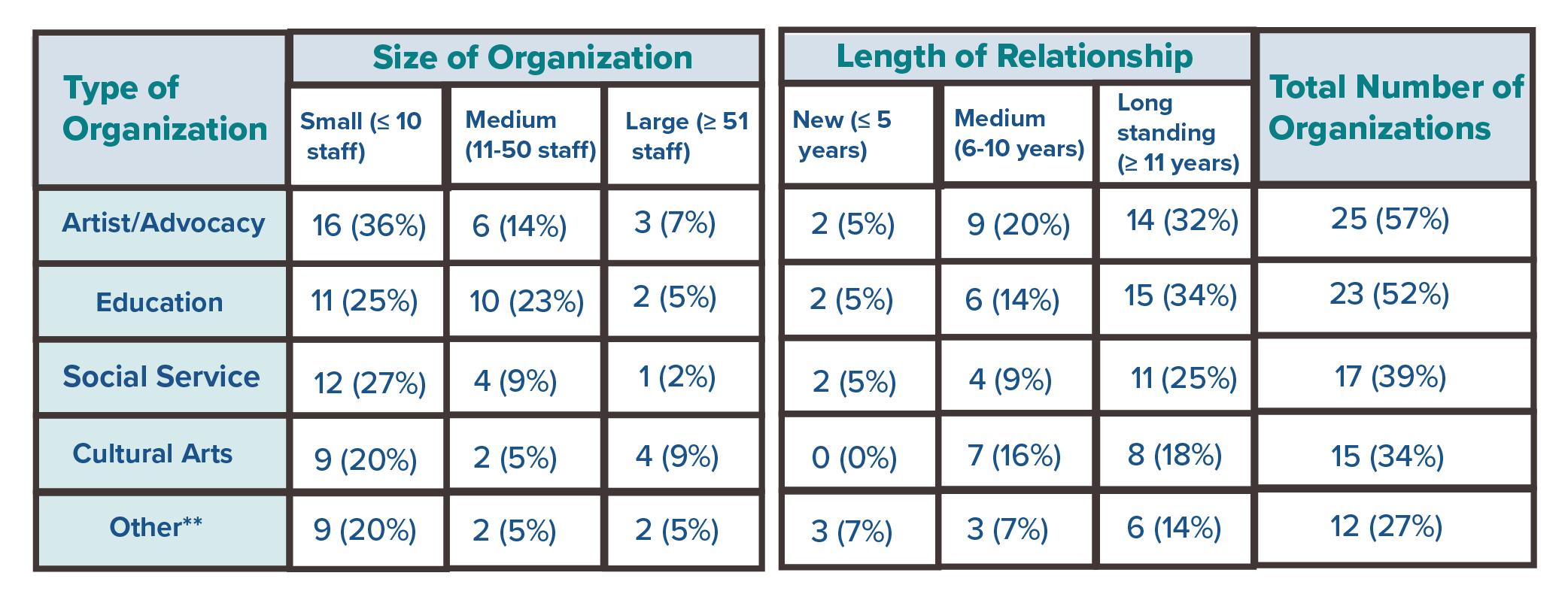
*Some organizations were classed into more than one category, so the total is greater than 44.
**The Other category included organizations that work with small businesses and other nonprofits, as well as organizations with a topical focus such as the environment, animals, sports, or human health.
8 University of Arizona | UCR Report
Table 1. Distribution of Interviews by Type and Size of Organization and Length of Relationship (percent in each cell based on 44 organizations)
As shown in Table 1, the organizations represented considerable diversity in size and length of their relationship with the University. Not surprisingly, given many community-university relationships are rooted in service, most of the organizations were focused on advocacy, education, culture, and social service. Interviewees shared information about their partnerships and collaborations across the University, naming people, projects, and programs within units and at the college level. To protect the confidentiality of the participants, others in their organizations, and their university partners, identifying details have been omitted. References to those details are replaced with ellipses ([…]) or general descriptors (e.g., [department]).
9 University of Arizona | UCR Report
CHAPTER THREE: EXPLORING COMMUNITY-UNIVERSITY RELATIONSHIPS
Even focusing only on nonprofit and community organizations serving the geographical area of Tucson and Pima County, this study encompasses many types of relationships: (1) from short- to long-term; (2) centered on individuals and on institutions; (3) from informal to formal; and (4) incorporating many approaches (see Chapter Four). Underlying all these are several factors that influence the relationships that develop between these organizations and the University of Arizona. These include differences in resources, access, size, and complexity; the status of the University as a large, state institution; and the historical and recent experiences with the University of people in the neighborhoods and communities that the organizations serve. Key to how partnerships form and develop are whether and how the partners acknowledge these differences, seek to address them, and evolve as circumstances change. For the most part, interviewees reported both positive and negative experiences stemming from their relationships with university people and programs. They had learned lessons and had advice to offer. Even the most positive individuals shared challenges—often only after being reassured again that their responses would be treated confidentially so as not to damage their relationships. Likewise, even those individuals whose experiences had been mostly negative expressed a desire to work with the University again in the future. It is important to recognize that individuals who would not work with the University again were unlikely to be referred by others to the study and to agree to participate.

10 University of Arizona | UCR Report
Interview notes and transcripts were coded by theme; thus, whether the interviewee was sharing examples of clear and consistent communication or of failures to communicate, both would be coded as communication. The coded text was examined for differences based on the size of organization, the type of organization, and the length of the organization’s relationship with the university. Generally, no patterns emerged. Where differences were found, they are noted in the following sections. This chapter begins with a discussion of several key characteristics of the University that establish the context within which relationships form. It then examines the processes of establishing and maintaining relationships by exploring the six major themes that emerged from the analysis of the interviews. Following the discussion of each theme is a subsection, in which interviewees’ suggestions and ideas of how to address challenges and improve relationships are presented.
Characteristics of the University that Establish the Context of Relationships
“I think a lot of people are just too impatient in terms of how long quality projects take. So, I think the most successful thing is if you got [have] to work with an entity like the University of Arizona, a kind of bureaucracy of that size, you got to have those two things in mind. What are my outcomes, how do I want to reach them, and how long am I willing to take to reach those outcomes?” (INT58).
Analysis of the interview data pointed to characteristics of the University that establish the context within which relationships are pursued and evolve. This section describes those characteristics to set the stage for the sections that follow.
The University as a Potential Resource
The University of Arizona is a large, public university with numerous colleges, units, and people who can provide financial and material support, human and social capital, and other resources. Its landgrant mission “represents the foundational basis for the University of Arizona’s bond with Arizona communities along with its efforts to expand educational opportunities while helping to address important societal concerns” (UANews 2012). Some members of those communities have ready access to the University while others do not. One interviewee noted, “Having a lot of people who look like the community has led to them doing more things in the community, makes it easier to communicate with the University“ (INT4).
Still, though the University has become a more diverse place in recent decades, it does not reflect the populations of Tucson or Pima County on several important variables that were noted by interviewees (see Table 2). Some interviewees who represented communities and organizations that are underrepresented in the university community discussed efforts they believed were moving the University in the right direction. “People perceive it to be maybe extractive and people in the community perceive it to be destructive. And I imagine that comes from a long history of it being extractive and harmful in some cases… What I have witnessed is a lot of honest effort from very passionate and caring people who want to work more closely with the community and to make those ties and make sure the University isn’t in an ivory tower but is actually spreading its roots throughout our community and having a larger impact” (INT7). Nevertheless, the gaps help explain the differences in perspectives and experience expressed by interviewees.
11 University of Arizona | UCR Report
*Based on Fall 2021 Census; Source: University Analytics and Institutional Research: Interactive Fact Book
**Based on 2020 Census; Source: U.S. Census Bureau
*** Combined median for students from University of Arizona, Arizona State University, and Northern Arizona University, For students born in 1991, roughly the class of 2013; Source: The Upshot: The New York Times, 2017
^Percent female faculty vary significantly by faculty type: Clinical (63.0%), Other Instructional (54.9%), Research (35.5%), Tenure Track (37.4%).
The University as a Complex Organization
UArizona is a large, complex institution. It is fundamentally hierarchical, with designations distinguishing students (undergraduate vs. graduate; freshman to senior), faculty (tenure track vs. adjunct; assistant to full professor), staff, and administrators (unit, college, and central leadership; assistants and associates; vice presidents and presidents). It is centralized in some areas and decentralized in others. It develops strategic plans, mission statements, and budgets, with expectations that units align themselves with these. It is both land grant and research intensive. Its main campus is in Tucson, but it has satellite campuses and offices throughout Arizona, and its faculty, staff, and students work in communities and at research sites across the globe. It is a governmental entity tied to the state of Arizona. According to one interviewee, “It’s a very siloed institution with fiefdoms. And the power dynamics have got to be fiercely difficult to navigate and to have a cohesive institutional approach to anything. I don’t want to underestimate that…I get it. UA’s a global research institution with a global student body, and yet the local piece is often neglected. Or overlooked or taken for granted or just not attended to, sustainably, transformatively, year in and year out” (INT6). As another individual put it, “[Things] are fraught that come with an under-resourced community-based organization partnering with an enormously resourced, large institution” (INT17).

12 University of Arizona | UCR Report
Table 2. Comparison of University of Arizona Students and Faculty with Tucson and Pima County Residents
The nature and structure of university bureaucracy are daunting—and resistant to change. “When you work with a bureaucracy of any kind, whether it be the University of Arizona or Pima Community College or the military, the bureaucracy is an entity unto itself. And it turns over in terms of personnel every few years. But because of the nature of bureaucracy, the culture grows over time and becomes very stagnant in who it is, what kind of entity it is. And so the University is like that. You could change everybody at the University and probably within five years it would be exactly as it is now” (INT58). Working with the University is, as one interviewee described, “a delicate balancing act.”
The University as an Organization in Constant Flux
Despite the persistence of the university bureaucracy, as INT58 noted above, the institution experiences both predictable and unplanned changes in leadership, faculty, and students. This fluctuation in personnel adds another layer to the complexity. Changes in leadership also bring shifts in mission and focus, sometimes with unanticipated changes in expectations. For example, when the University adopted its most recent strategic plan, it instituted major changes to its contracting, but, one interviewee reported, no one reached out to community organizations to explain the changes. In general, interviewees reported that inconsistency—in people and policies—undermines partnerships. “[It is] part of this existential struggle of the UA. And a lot of it is based on the state legislature and the trustees… They go through—some president, whatever president—they go through just focused on their own internal stuff. And then a new one will come and say, or a dean or whatever, no we really want to be out in the community. It’s almost like a breathing machine, just in and out and in and out” (INT2)
Change is especially difficult when relationships depend on individuals who leave and when funding is no longer available. “People move and change. Your contacts disappear. And that’s crazy making… that you’re dealing with one person and suddenly they’re not there anymore and then who do you deal with?” (INT24). Another individual (INT31) reported they had experienced a lot of transitions in staffing of internship programs that were not made clear to partner organizations and which, along with new and unexpected assignments, put new, last-minute expectations on the interns. The impacts of change are exacerbated for individuals and organizations without long-standing and deep ties to the University.
Establishing and Maintaining Relationships
Interviewees were asked to share the nature and extent of the relationship between the University and their organizations. They also were asked to describe how the relationship began. Separate questions addressed potential improvements, but many interviewees also blended their discussions of their experiences with comments on how things should be. Despite some negative experiences, almost all interviewees expressed interest in maintaining or improving their relationships with the University. Some had left dysfunctional partnerships and used what they learned to establish new ones. Each of the following sections begins with a summary and examples of interviewees’ experiences and ends with a subsection that expresses the participants’ desires and suggestions for improvement.
The six topics are: (1) gaining access; (2) clear expectations and assessments; (3) mutual respect and benefits for all; (4) representation of the community in communications; (5) mutual learning; and (6) branding vs commitments. Many interviewees highlighted the importance of open, effective, and transparent communication. When asked about primary challenges, for example, INT23 responded without hesitation: “Communication, first and foremost.” Interviewees also noted that not just a lack of communication but a poor style of communication led to problems and withdrawal from relationships. “Communication is 50 percent hearing and 50 percent talking” (INT4). After careful review, rather than treating communication as a separate topic, we addressed it in each section and especially in (1) gain-
13 University of Arizona | UCR Report
ing access, (2) clear expectations, (3) mutual respect and benefits, and (4) representation of the community
Gaining Access
The first step in any relationship with the University is gaining access. Interviewees’ discussions of how their relationships began provided a wealth of information about the opportunities and challenges associated with navigating the university bureaucracy. Many interviewees had connections within the University and used them to initiate a partnership, or they were contacted to partner because of those connections. Other interviewees noted that it is not easy to figure out who to talk to or how to advance the conversation once they do. “You have an idea you want to find someone at the University to enter into dialogue with and that’s not always as easy as maybe it could be. And maybe it can’t just because of the size of the place.” (INT25) Access means more than “just sending a link” and includes “willingness from university partners to come to meetings, talk about what they’re working on, hear from others about what they’re working on to have a better understanding of what’s going on at those two very different entities” (INT7). A successful partner reflected, “I know now, after five or six years, I know everybody. I can send an email and it won’t get marked as spam. They’ll know who I am. This has been a process of building. So I’m at a place where I’m very happy. When I need to speak to somebody, I get to speak to them.” (INT55). INT10 also highlighted how that access, once acquired, can translate across university departments, to include administrative folks in grant processing, contracting, and events, all of whom have been extremely responsive, professional, and organized.
In contrast, several individuals relayed stories about what one individual referred to as “non-communication…making it difficult to find information, making it difficult to find the right person to answer your questions, not communicating with community groups” (INT8). As a specific example, INT37 explained “the challenge of not being able to connect to the […] department. I think it would have been really helpful to us and helpful to them. I think it would have been helpful too in training and providing basic [services for our program participants]. We just could not get that program off the ground.” As INT5 noted, failure to respond sends a strong message, “I sent them a formal invitation to join the consulting network and radio silence. Not even, ‘I got it. I’m not interested.’ Just nothing.” “I had a conversation with a woman who was going to contact me and we’re going to work together but I never heard from her” (INT24). INT46 summarized the challenges of bridging what, for some organizations, is a huge divide, “It’s hard to maybe feel like you can approach somebody since you’re not in that world… Maybe the intimidation comes from our own insecurities, but the institution is kind of elitist.”
Several interviewees, especially those who represented organizations and communities with negative or little experience at the University, pointed to deeper levels of limited access that had to be overcome. Though some recognized improvement, it “feels like a more recent shift toward community partnerships and the value of community-based knowledge and epistemologies. It hasn’t always been the case, hasn’t always been there. There’s plenty of exploitation that happened.” (INT17)
Some characterized their differences as cultural, which included explicit and implicit references to their experiences of racism. INT58 explained: “It’s part of the institutional culture at UofA because they— many of the people—have been there for a long time. And they go back to a much different cultural mindset as far as the University and its relationship with people of color in the community goes. And it pops up every now and then. They feel threatened by you, and they attack. Because they’ve always been the power structure. And they do control your future.”
INT40 summed it up: “[T]he quantifying of things and the competitive nature of things, it’s just really not the kind of culture we have at [our organization]. And it’s not the culture of most of the organiza-
14 University of Arizona | UCR Report
tions that are doing community-based work. It limits opportunities overall. It manifests like they just want to use us. It’s just about the bottom line, about return on investment, and we don’t work that way. There are other things we value.”
According to INT20, “There’s still like this mentality of like, maybe a savior complex, that a lot of folks from the University have, and that’s really toxic. We don’t need that. And that’s what I think prevents us from having a good relationship with folks in the University.” Despite having positive experiences with their university partners, INT3 described the process of competing for university resources: “[I]t’s like a shark tank and it feels very shitty, it feels horrible, it makes you feel like… and it sucks because you have these amazing other community organizing groups and you think wow, I hope you win, but then we’re fighting against each other… And it always feels sucky when you have to prove my neighborhood deserves this. I deserve this, my community deserves this, we deserve this money.”
Making the University More Accessible
Interviewees shared their ideas for increasing access to the University. These included having someone from the University help community organizations get connected to different people in the institution so they could start having conversations about whether they could find ways to partner. In the words of INT11, “that front end engagement and dedication of some time would be awesome.” Several interviewees talked about the potential of a central place, or portal, through which people within the University could find community partners and share opportunities and community organizations could find willing university partners (INT29, INT46). Recognizing the challenge of a formal mechanism for connecting organizations with the University, INT45 noted, “I’m imagining you could have a structure that could promote good relationships, make it possible for people to reach each other…An organization could get in the way of forward movement, or they could help it.” INT3 emphasized the idea that relationships would provide community organizations with access not only to potential partners but also to resources, not just funding but also office space, printers, and interns, without requiring the organizations to shift their priorities completely to meet the goals of the university partner.
INT58 emphasized that “helping them understand the culture of cooperation [for the institution and the community] that they can build together as a group is extremely important. And it’s not something that happens when you do one thing or another. It happens over time as a life goal.”
Clear Expectations and Assessments
Interviewees made it clear that establishing expectations is necessary at the beginning of the relationship and that the expectations must be revisited and revised periodically. Formal and informal assessments provide feedback to all partners about their success in meeting expectations and guide the ongoing adjustment of those expectations.
Almost all interviewees stressed the importance of understanding expectations “from both sides” in any relationship with the University, regardless of the depth or duration. “We’ve had consistent communications. We get together. We talk about what we’re going to do. We make decisions together. We often think about things. We come back together. I mean, it’s been a model partnership.” (INT5). [We need] “just a time to sit down and look at what kind of project they’re wanting to do, how much time they want our staff to put into that, from the start having a clear communication channel” (INT20). “We have a pretty good relationship trying to keep each other posted so we don’t step on toes, there’s like a reciprocity of a collegial working together—I’m not sure that’s a partnership” (INT26)
Interviewees described various levels of institutionalization of programs and assessment. “When a relationship is set up, there is a project manager on the university side and a project manager on the
15 University of Arizona | UCR Report
small organization side that can help, work hand-in-hand to ensure that thing can be navigated, that communication lines are clear” (INT28) “Every year we get together before we make any decisions and have honest conversation about what we both need and how we move forward… They take the time to listen, building trust over time so we can be honest about our struggles, our issues; really think through what are the unintended consequences of the things we do” (INT40). INT57 emphasized that what has worked best for their organization has been when community outreach with local organizations is built into the program, rather than being the inspiration of a department or professor who says, “Gosh, we should do something with the community… They ask us at the end of each year what worked and what didn’t, they give feedback.” Even during the global COVID-19 pandemic, INT10’s organization continued working with university interns and maintained almost weekly communication with their advisors, noting how critical it was for both sides to receive updates on protocols. For INT23, negative experiences underscored the importance of working out clear objectives, outcomes, and the details of an equitable partnership, noting that their biggest challenges had come when university partners had brought people in at the last minute.
Establishing Expectations and Tracking Progress
A clearly defined partnership, where everyone shares what they envision bringing to the table and what they want their partners to bring to the table, allows the community partners to “know where we stand and what each person and we’re supposed to do, where we’re supposed to go, how we’re supposed to move forward” (INT9). Several interviewees highlighted the importance of starting from the beginning to define roles, explore what everyone will get out of the relationship, and know the responsibilities of both parties, the pros and cons, and the sense of time and energy that will be required of everyone. Some interviewees argued for a point person with clear expectations about partnership goals, mechanisms through which the partners can check in, systems of feedback, and ways to grow and maintain the relationship over the years (INT24 plus). Others emphasized the need for clarifying these in writing to ensure continuity when people within either organization come and go, allow everyone to review what was agreed upon, and enable partners to track progress. INT2 cited the importance of metrics of success that are outcome focused as well as process and relationally focused and noted that while such an approach requires a high level of commitment and takes a lot of time early on, it establishes what the non-negotiables are on both sides. Though acknowledging the challenges of having many departments and schools, they added, “If you had a framework, if you had a mission, vision of what it means to engage with the community, I think that could help” (INT2).
Interviewees noted room for improvement on both sides: “The university has to overcome its own past mistakes. The community partners need a better understanding of the constraints that their university partners work under, bureaucratic constraints that they don’t know about” (INT30). As INT8 put it, “If you’re going to do something that is going to impact an area, a community, a group of folks, walk it back and do the work to present the plan first.”
Mutual Respect and Benefits for All
Fundamental to healthy and functional relationships is mutual respect with benefits for all partners. Providing access to the University and establishing clear expectations and regular assessments will only contribute to positive outcomes if both partners are seen as having something to offer and are respectful of one another. Interviewees shared their partners’ strengths, noting that their successful efforts at listening and trying to learn have helped make the partnership a great learning experience for their organizations. “I’ve never felt where somebody from the University has shown where they feel superior to me just because they’re from the University” (INT4). Interviewees offered numerous descriptors
16 University of Arizona | UCR Report
for successful relationships, highlighting consistent and open communication, transparency, responsiveness—especially at the outset of a program or partnership—respect, reciprocity, openness, and “a willingness to think together” (INT25)
A key measure of respect is the acknowledgment when things do not go well and then evidence that feedback has been heard, acknowledged, and acted upon, resulting in change. “All good relationships have to learn how to have productive conflict and resolve productive conflict and get through to a better place.” (INT6). Likewise, successful partnerships plan for disruption and the mitigation of impacts of that disruption on all partners.
Negative examples that highlight the importance of mutual respect and ensuring benefits for all included what interviewees described as marginalization and tokenism, as well as when people committed to partnerships but lacked the necessary follow through (INT40). “We were a second thought in their scheme. They reached out because they needed a partner. That’s tokenism – you just need a name on the grant… Things would’ve been different if we’d been involved from the beginning... There’s difficulty working with UA because there’s always this sense of ego. Like, ‘we’re the experts, you have to do what we do, and if you don’t, then this partnership doesn’t work” (INT50); “Marginalizing and tokenizing people and communities is not a good thing. Actions speak louder than words. If they say something and don’t do it – they say we’re going to be with you, and then they say we want to be there but we can’t. I see that a lot. That can really undermine a relationship” (INT53).
The style of communication also matters. Drawing on their background in science and significant experience working with scientists, INT10 discussed the importance of “understanding that criticism is part of academic, and part of an academic’s way of interacting and creating better outcomes.”
Demonstrating Respect
Interviewees noted that improvement requires commitment to discussing who benefits and how, to clarifying what each partner needs, to following up, and to “the principle that we listen to understand and that we really truly appreciate the knowledge of the communities we serve. Those would make for more productive partnership” (INT40). They also offered specific ways to demonstrate respect and increase benefits for community partners. “All the ways we can formalize… a relationship that’s directional and make that equitable so that there is financial support for the community-based organization that is educating the university students that the student is paying the University for” (INT17) “Know how, and be okay with, listening and not speaking… and be okay with hearing the word ‘No’, because some professors, they’re used to getting what they want” (INT19). “It’s not too much to expect a monthly call or check in” (INT34).
Because the style of communication faculty use when evaluating student work, grant proposals, or manuscripts submitted for academic publications may be uncomfortable for community partners, several interviewees commented on their reluctance to engage with some faculty. Even alumni who have established relationships based on strong ties they developed while at the University referred to the challenges of dealing with the egos some of the people they had worked with. Leaders of community-based organizations who have never attended a university bring a wealth of knowledge, talent, and skill but may lack familiarity with the forms and styles of communication common to academics (see also “Mutual Learning” below).
Representation of the Community in Communications
Here, too, reporting both positive and negative experiences, interviewees identified the importance of careful and responsible communication about the community the organizations serve and projects that
17 University of Arizona | UCR Report
result from collaboration with university partners. INT45’s call for “communication that is clear, consistent, punctual, reliable, and informed” is especially noteworthy here. In meetings, presentations, and publications, the content and form of the information shared is important. Appropriate communication can enhance relationships while significant missteps serve as signals of their superficiality.
INT30 offered praise for student interns who had worked with their organization and translated what they had learned about the community into products INT30’s organization had been able to use: “[T]he students have accomplished a lot, including policy papers that we have followed up on by advocating for those policy changes… publication of a directory… development of educational materials.”
Several interviewees who had been involved in research conducted through the University discussed their concerns about whether and with whom information was shared. In contrast to recognizing community organizations as partners, one interviewee reported that “people are using our name and did research but never asked us about it” (INT40). When they are approached, INT31 noted it is important for the University to “share metrics and efforts, [tell us] how are you going to use this data?” As INT50 put it, “We don’t need another research paper or data point to tell us how messed up we are. You can ask grandmas, kids, they already know.”
Taking the Community’s Perspective
Broadening the forms and channels of communication can increase the value of community-university partnerships. “For there to be long term change or even if a report comes out, you use it as a tool to change policy or city planning. If you’re highlighting that there’s no resources, where’s the committee or task force bringing this to the city? This community is in need of tax dollars, resources. Especially with professors – instead of just talking to the student body, go talk to neighborhoods and hold sessions, report back on findings and explain, this is what that means” (INT50).
From the way communities and potential projects are described and discussed to the presentation of project outcomes, interviewees shared their perspectives on how to change for the better.
I want people to—especially if they reach out to the community—to take into consideration the best interests of the community. For folks to ask themselves, why is this important? How does it benefit the community? Versus how it benefits me as a professor, or the department. Also, just be compassionate and equitable towards how budgets or projects or made. It would be beneficial if university partners were to take, read or study or go to a workshop or seminar on privilege—what does it mean to be backed by a huge institution? This is something we’ve seen, this distrust of working with UA because it’s extractive. How do you complain? How do you go up against a professor or department when they have so much power? (INT50)
Mutual Learning
Appropriate and effective communication provides the foundation for building effective partnerships. Interviewees talked about the need for ongoing opportunities for mutual learning, especially to bridge the divides of race, class, and institutional culture highlighted in previous sections. INT2 observed that even for programs focusing on social justice “it’s almost like this white intellectual progressive vision that totally doesn’t get what it means to be in and of and with the community.”
Efforts to support mutual learning must recognize the form as well as content of the learning opportunities—and the time that it takes to become comfortable with, contribute to, and be able to use new forms. As INT11 discussed, efforts to provide information to the community that rely on having community organizations input the data can quickly become overwhelming: “Over my time in this field, I’ve
18 University of Arizona | UCR Report
seen lots of approaches. Databases often fall flat because when nonprofit organizations are invited to load a lot of information into a United Way database or a university system database, I think that creates the inundation. In the absence of a sophisticated way for folks to search on tags, we’re just wasting labor populating these databases of that sort.” This individual offered an alternative: “Even if it was twice a year, the University hosting a gathering, even if that was virtually, so that nonprofits could come to the table [and share information]. I’m not talking like five-, seven-minute presentations, but really just elevating [their voices]. Like, ‘Here are seven needs,’ and then listening to responses from representatives of the University. These are places you could get rooted, almost an intermediary function that was more human than technological.”
Many community organizations are very intentional in their efforts to learn about and address differences and have experienced resistance from individuals within the University when seeking to take the same approach with university faculty and students. “We are learning a ton about equity. [At our organization], we’re all at different points on the learning journey. And so when students or faculty or professors connect with us and have no understanding of inequity, that’s tough. Because the knee jerk response I might have sitting in a room with a professor is, ‘this isn’t going to work. I’m not interested. If you’re not willing to acknowledge you have learning to do.’… We need time dedicated to talking about who these children are and what our expectations are around ways that students engage with them so that they‘re not arriving and getting caught up in some hero syndrome or, you know, completely oblivious. So, having a professor say, ‘Oh, I don’t think we need to build time in for that’ can be disconcerting” (INT11).
When we hire new staff or have interns, we do a whole orientation about how we do the work we do, why we do the work, and we focus it on communities and understanding historical oppression, and how we facilitate anti-oppression work, and the University doesn’t always. They might understand but that might not be the real focus of their work. We believe that no matter what department you’re in, that should be the focus—changing an unjust paradigm basically. (INT2)
Increasing Understanding
Interviewees offered suggestions for increasing understanding that would benefit future partnerships. “Understanding what parachuting is? The effects it has on folks?...Make it reciprocal, building leaders from within. To have follow up, no one-time grants just because it’s good for your salary or your class. And that goes on both sides—it’s true of [community organizations] as well” (INT50).
INT2 shared a broad vision for enhancing community and university partnerships: “So it would be great if the UA had its own intentional vision for race, equity, decolonization, inclusion, and then different schools or departments could figure out well, what does that mean for them. From my perspective it would be very helpful for them to have a mission and vision for that. And then if they come and want to engage with us they could say, ‘Here’s our mission and vision. Here’s why, as a land grant institution in our particular area of expertise and resourcing, this is what we want to share, but this is what we want to learn.’ [Is their approach to the relationship] a top-down, ‘We’re going to teach you and show you’ or is it, ‘Oh, we come here to have a greater impact, to bring more equity to the community, and while we have some expertise we also want to take an asset-based approach and learn with you’.”
If the departments could be a little more open to new ideas on how to partner with different organizations, that would be a great change. [Do something more than] bring students to our [event] here are some cheap tickets. That’s great, but that’s very basic and not a dynamic partnership… When it is different, it falls more on the individual professor. [They could use] some
19 University of Arizona | UCR Report
training, or an attitude from department chairs that wasn’t risk avoidance. Risky things are not always at the top of their list. (INT18)
Branding vs Commitment
Within the past 10 years, UArizona has increased its public commitment to community engagement. Many interviewees commented on changes they had observed during that time. They identified the elements of relationships that indicated commitment. For example, INT57 mentioned “the professor who had half of her undergraduate class do projects here. That was really well thought out. She was really organized and at the end she asked what worked and what didn’t. It was programmatic thinking and not just, ‘hey, let’s do this.’” Several campus units were praised by multiple interviewees who highlighted their experiences with specific faculty and, at times, the unit as a whole. They also commented that among their most respected partners, program budgets had been cut and some programs and positions had been eliminated, even as the university-level rhetoric around equity, partnering with communities, and such had increased. As several interviewees noted, the programs that were highlighted had mechanisms in place to facilitate communication and resources to support faculty, staff, and students, as well as community partners (usually through grants but also personnel whose jobs included time to do the work necessary to sustain the relationships). These programs did not rely solely on individual faculty and students but had the infrastructure in place to support them.
In contrast, interviewees highlighted the perverse impacts of rhetoric and short-term trends associated with engagement and diversity, arguing that the University must consider how initiatives will be sustained after that initial moment, especially with communities that have been traditionally marginalized. “I’ve got relatives who work at the UofA, I’m a UA graduate. I understand the value of the UA. I would just call bullshit on community engagement… It’s not deep enough, transformative enough, sustained enough and unequivocal enough to benefit those most in need of that benefit” (INT6)
I get suspicious or cynical when I hear 100% involvement. Like, what is the nature of that partnership? Are we having now 40,000 experts come to the community and tell us what to do? What does that look like? What do we mean by these things? What does it mean that staff and faculty have to find these places to place people –it’s become like school testing. It’s just meaningless. More robust, consistent, systematic engagement is what would be needed, rather than these lofty ideas… I’ve seen a lot of that ‘now we’re going to look good, and we’re done.’ That’s not the kind of investment that we’re interested in. (INT40)
INT7 decried false promises and their concerns about the implications for building trust that result from instances when people from the University convey they are going to help make a project happen or help obtain resources and do not follow through. Several interviewees noted that it had become more challenging to commit to partnerships. “I will say it creates hesitancy for our staff practitioners to work with UofA researchers because of this mixed bag approach. It doesn’t seem to be a standardized ethos across the University of Arizona with researchers... My first gut-level reaction would be that [the university’s approach to community engagement is] superficial. It’s more rhetoric than follow-through. It is to enhance the University’s brand reputation. It is not significant, there are no transfer of assets, financial assets out of the UofA Foundation to community endeavors. I don’t see the translation to the most vulnerable communities of color in this community as powerfully as it could….So the UA leadership having on the radar screen, ‘How do we utilize our enclave of privilege and power for the benefit of the tens of thousands of households that don’t even see themselves as part of the UofA?’ And who’s the steward of that at the UofA? Who is the champion of that? Who wakes up every day thinking that is what my mission is with this institution? I don’t think there’s a champion or steward of that. I think there’s marketing people and public relationship people. And we’re talking about something that
20 University of Arizona | UCR Report
goes beyond brand.” (INT6)
INT1 explained: “There are such few faculty that I would be excited to partner with, and even the ones that I know and trust and love, I would expect to have to push back against some of the problematic stuff that’s just so ingrained at UA and the way that partnership happens. The big blind spot is the workload that you bring with you everywhere you go. As a faculty person doing community engagement you’re just draining and delegating workload like [whistling sounds], and I think there’s just a big blind spot to that... There’s no breathing room for those folks to get into the community in a real way.” Nevertheless, despite the dangers of rhetoric that does not translate into practice, INT1 observed that “Since [the community engagement movement began] I feel like there’s been critical discourse on how to do that with equity, but it’s just practice is slow to change. And some of it’s impossible. The whole thing, being bound to a semester or a year for a dissertation, that’s not changeable.”
Committing to Lasting Change
Interviewees reflected on the challenges of creating meaningful and measurable change and offered suggestions that range from calling out the institutional racism and oppression in the system, removing the “entitlement umbrellas,” and putting people over productivity (INT3) to engaging in “contingency planning” to maintain long-term relationships (INT16). They advocated for supporting the areas of the University that are really committed to deeper, longer, sustainable partnership. “What does a deep, committed investment in long-term change [look like]? It’s not just about seeking opportunities and having the face of the University there” (INT40). In other words, “engagement with a purpose.”
Summary
The University of Arizona is a large, complex organization in constant flux. While this can make it challenging for community organizations to identify, establish, and sustain meaningful and effective relationships with people and programs within the University, it also means that the potential for the University to serve as a resource is great and always evolving. As explored in this chapter, key to achieving this potential are six fundamental elements of partnerships that span all stages of the relationship, from gaining access and establishing clear expectations to ensuring that the community’s interests are served and the investment is real and enduring.
As University actors seek to expand their involvement in Tucson and Pima County—as well as in other places where university people and programs are present—it is critical that they recognize the University’s history and the harms wrought by taking land, acquiring resources and funneling them to some communities and not others, and excluding people—especially people of color—from its campuses, classes, and programs. Given the challenges facing even well-resourced organizations with decades of interactions with university partners, careful and dedicated work is needed to build bridges and partner with all organizations that serve the diverse people and communities with whom the University shares this special place.
It is to be expected that across the University are myriad individuals, programs, and units who form and maintain relationships with community organizations. This diversity could benefit from a coherent institutional philosophy of and approach to community engagement that would help tie the various efforts together and make it possible to assess their value to the community. The following chapters examine the types of community-university relationships that interviewees and their organizations were engaged in and then offer suggestions for both community and university actors seeking to establish, sustain, or grow their relationships.
21 University of Arizona | UCR Report
CHAPTER FOUR: TYPES OF COMMUNITY-UNIVERSITY RELATIONSHIPS

As discussed in Chapter Two, 44 organizations participated in this research. Given the variety that exists in any community in terms of size, mission, and scope of nonprofit community organizations—and particularly in Tucson—and the scale and scope of University of Arizona-affiliated administrator-, faculty-, staff-, and student-led initiatives, relationships between community organizations and the University can and do take many shapes and forms. This chapter describes four types of relationships between community organizations and the University discussed in interviews: (1) internships and service learning; (2) the community as expert; (3) grant writing and research; and (4) volunteering. To maintain confidentiality, these relationships are discussed in general terms, without naming specific collaborators or organizations. For each type, both pros and cons, or positive and negative aspects, are presented; these are drawn directly from interviewees. Finally, this chapter provides information about best practices and things to avoid when building community-university relationships.
Researchers assigned organizations to the four types of relationships based on the information shared during interviews (see Table 3). While an organization might be involved in other types of relationships, the organization was only categorized into types that the interviewee discussed. Where multiple individuals from the same organization were interviewed, and represented different kinds of work, the organization was categorized to include all activities the interviewees discussed.
22 University of Arizona | UCR Report
Table 3. Types of Relationships Discussed by Study Participants
*Some organizations were classed into more than one category, so the total number is greater than 44. **The Other category included organizations that work with small businesses and other nonprofits, as well as organizations with a topical focus such as the environment, animals, sports, or human health.
Internships and Service Learning
Internships and service learning form the basis for many relationships between community organizations and universities. These activities originate from various actors within the University, oftentimes instructors who assign internships or service-learning components in their courses, departmental representatives who help students meet graduation requirements, and undergraduate or graduate students seeking experience. Community organizations may have staff formally dedicated to managing and mentoring interns or staff who become de facto internship coordinators and take on training and mentoring of student interns.
Although in academic settings and literature distinctions are often made between internships and service learning, in practice—and in the interviews conducted for this study—these are often conflated. Students frequently earn academic credit for internships and may apply what they learn in university courses in a community internship setting or vice versa; this can also be true of students engaged in service learning. The label assigned to the activity may depend on academic disciplinary traditions, the length of the engagement, or the perceived importance of internships to young people’s professional development. Cases discussed here may be referred to as “internships” but may be more akin to service learning in the sense that they are undertaken by students applying specific classroom learning for relatively short periods of time (generally less than 40 hours during a semester). Despite the differences between these categories, and regardless of how the experiences were referred to by the interviewees, the general model of university students being matched and spending time with a community organization as part of a university course, program, or degree is the focus of this section. To protect participant confidentiality, internship programs or participants are not named, whether interviewees praised or voiced frustrations with them.
Interviewees noted many positive aspects of internship and service-learning programs, with caveats for the planning and labor necessary to execute one that is well-run. Interviewees spoke of the possibility of students bringing energy and labor to their organizations, and doing quality work that the organization made use of in pursuing their mission.

23 University of Arizona | UCR Report
The college provided credits for those students, for those semester long internships. Those internships have been very productive… the students have accomplished a lot, including policy papers that we have followed up on by advocating for those policy changes. The interns have also accomplished projects, publication of a directory. Other outcomes of those internships have included [the] development of educational materials. (INT30)
I think that we’ve been able to get quality students who are working with us and working on specific projects. …We just had an undergrad intern who we were paying for some part-time work over the summer. She’s really thoughtful about our approach and doing research and developing reports. (INT26)
One, since Spring semester 2014, we have been working with [...] …. We present them with a project. They act as our consultants, and we’ve been working—we took one semester off between spring of ‘14 and fall of ‘21, so, however many semesters that is, is how many projects we worked actively with those students on. And then in addition to that, I’ve had the honor of judging their [...] competition, three or four different times. [...] competition is the semester-long project and this is an undergrad class that we, that we work with. (INT25)
In the above examples, student interns or service learners have undertaken projects that have benefitted the community organization. In cases where internships and service-learning activities go well, the energy and labor students provide can be a positive attribute for the community organizations hosting them. Along with students bringing energy and a labor force, student interns were also praised by interviewees for their technological savvy, helping to do tasks like build or update websites.
The girls that I had helping me, assisting in the […] program, I learned a lot from them. I hope they have learned from us, too…. But I also learned from them about technology and ways to do better, provide the services we need in a more practical way, I would say more, I don’t know, using the technology, it’s one of the things that I have learned from every single student we have work with us. And the success to me is in different ways, like I said before. Accountability, professionalism, and knowing that they will be here day by day with no absences or excuses and knowing that they are full time students and they have many things to do, they are very accountable. To me, that is success for them and for us, too, because we can count on them.
(INT12)
INT12 ties praise for students’ tech savvy to a broader explanation of why their internship program is a success: student accountability. This interviewee was particularly positive about the students’ level of professionalism, a perspective not shared by all interviewees, as discussed below.
Another potential benefit of internship programs interviewees discussed is the potential for student interns to become employees in the very same organization, or in a similar one. In these cases, internships function as a training pipeline from which community organizations may benefit in the future.
I started as an intern when I was working on my master’s degree. (INT26)
I would have to say [that, of the interactions I’ve had with the University, the most successful has been] the internship program and probably the [...] partnership, because internships, again, that’s really creating those future employees, really giving those students the skills who are interested in going into work at a [...], that background to be able to achieve that career goal.
(INT9)
24 University of Arizona | UCR Report
Established internship programs also provide a structure for maintaining a collaborative relationship, whether at the individual faculty level for faculty who teach classes with internship or service-learning requirements, or at the level of programs of study or even departments. An established and successful internship or service-learning program requires frequent communication, not only to prepare and place interns, but also in the management of students and their internship or service-learning experiences and outcomes, discussion of difficulties that arise, and preparation for repeating the process the next time around. When this is done successfully, it can be of great benefit to community organizations.
A professor who was willing to elevate a singular community partner to route a good number of students who, I don’t think we were the only site or the only partnership, but who maintained that connection with us, not just for a semester, but over several years. That ongoing connection mattered a lot and brought a lot of capacity into the organization. It didn’t require a ton of interacting between the professor and the organization. They built the system, the system worked. They addressed, you know, any hiccups that came up and refined it over time to the point that it was just a really exceptional pathway between the University or that particular professor’s class and [organization]. So we’ve had some really awesome connections with professors over the years. (INT11)
Finally, the relationships formed between students and community organization actors can prove to be enjoyable, and perhaps even increase job satisfaction, for the people involved.
My focus is always the individual, you know, and as I said in my comments, one of the most enriching experiences I’ve had in my career is dealing with students, a particular part of their progression through their academic and educational process. (INT58)
At the same time, however, community organizations can struggle with interns or student volunteers who are not a great fit with the organization, and who drain, rather than enrich, interpersonal experiences for community organization staff.
I thought… we did have one [individual] that was really difficult. It took more effort than the outcome, but you know, the year before we had someone who was absolutely exceptional. So, I guess it’s the luck of the draw. It wasn’t somebody I could count on. Always a drama going on. (INT36)
As internships and service learning are common approaches to university-community collaboration, there were plentiful examples of interviewees voicing frustrations with them. Scheduling was identified as one such issue. Community organizations do not operate on an academic calendar, so coordinating around students’ class and work schedules to find the time for students to spend in internship or service-learning capacities can be difficult. The academic calendar also presents a challenge in terms of the depth of commitment students are able to make to community organizations within the confines of an internship or service-learning course.
And then a semester is like no time at all, so to really leave something meaningful behind rarely happened, you know? It was like one out of 20 interns would do something useful and the rest of them would do something that probably even got them an A [...] but it just became clutter [...], all of these stupid intern projects.… I think I say that because I think it’s emblematic of some of the problems within the University. Because we’re constrained by semesters, we’re constrained by the academic life of a student, even PhD students only have three to four years, and three or four years isn’t even enough time to get a deep understanding of what the issues are and to build the relationships where you’re going to get the support to do something meaningful, but you know you’re on the treadmill where you have to produce it, you just have to produce it.
(INT1)
25 University of Arizona | UCR Report
Time was raised as an issue not just for scheduling and the length of time students are available to spend in internship or service-learning experiences, but also regarding the time necessary to manage internship programs. Some organizations have dedicated staff positions for internship coordination, but many others do not, this labor falling on often already overburdened staff.
We have one staff member who manages students’ and interns’ projects, but that’s a big part of her job. (INT43)
Yeah, but we’ve also hosted interns, which I thought would lead to more opportunities. And at least for us at this point, interns are more work than help. (INT59)
I mean, I have thought for years about the education that [community organization] has provided to what we used to call internships and we don’t do them anymore for a number of reasons and this is one of them: that education was given at the expense, you know… I don’t know who’s doing it now but a student would pay the University to get college credit, and then work for this community organization but... What’s the benefit on the other end, we’re providing all this management and supervisory and instructional labor to somebody who’s not a professional. (INT17)
I got my MA at U of A; service learning was part of that program, and I value that experience that I had. That was with [a certain department]. Now, I’m on the other side, seeing that service learning — something needs to change in that dynamic for it to be mutually beneficial, whether we change duration or change the criteria somehow, or the population that’s coming in, maybe it’s just MA students. Something so it’s not just this onslaught of students. (INT43)
Coordinating and managing students requires time and effort, so while some community organizations found this effort to be worthwhile, others concluded that it was not worth their time. Likewise, internship and service-learning projects or deliverables can be burdensome rather than helpful, especially when they are not conceptualized together with the organizational partner.
Interns had to conceptualize and carry out a project [...]. And the project that they finished was like their final… I was on the end of those semester-long projects, 90% of them went in the trash as soon as those interns left. Because number one, they’re 20 year-olds, they’ve never been involved in that work before so how can they conceptualize a project? (INT1)
INT10 remarked that their organization would love to host more students, but added:
The work that we do is so specialized that it’s very hard to bring in somebody, you know, who’s a novice, and get useful work out of them. As much as many of the staff would really enjoy having a role in training and providing experience for the next generation, we’re always so thinly staffed that it hasn’t been, it’s been minimally possible. (INT10)
Interviewees also noted challenges connecting to student interns or service learners who would be a good fit for their organization and needs.
There was some internship fair. We needed volunteers. This was a few years back. That did not pan out. We were new, and also the students that decided to partner with us, that was another issue, we couldn’t connect. That was the earliest connection we had [with the University]. It wasn’t fruitful. (INT51)
26 University of Arizona | UCR Report
We’ve worked with the gamut. There’s no central place for me to say, we have these internships available – I have to go to every single department and post something on their bulletin board and update it every semester, it’s just super labor intensive and there’s no way to get the information without spending hours searching to figure it out. (INT56)
Internships and Service Learning: Summary
Study participants shared both pros and cons of working with university internship and service-learning programs, whether these programs involved unspecialized undergraduate students or highly specialized graduate or professional students. Pros included students providing energy and labor and supporting organizations’ missions; students’ professionalism; and the fact that student internship programs can serve as a way for organizations to train and hire the next generation of employees. Cons included difficulties in coordinating schedules between the academic calendar and the community organizations’ rhythms and needs; the time, effort, and labor involved in training and managing interns; and the sometimes dubious quality or usefulness of interns’ efforts in terms of projects or deliverables, especially given the time invested in training them.
Despite the many challenges expressed by interviewees, one community organization with a long-standing internship program has found the program to be worth the organization’s effort in terms of staff labor and is seeking to develop more paid internship opportunities to further diversify the UA intern pool:
One of the things that I’ve been trying to do for I think since my time started here, and we’re finally moving towards that within the next few semesters, is paid internships. So what we’ve been doing is unpaid, pre-professional, credit based internships. They’ll still be receiving credit, but we’re trying to move to do a stipend so that we, because we understand there are individuals, underrepresented minority communities that aren’t able to do an internship because they can’t afford to not be working for a semester. (INT9)
Community as Expert
The idea that university actors hold expertise or resources to impart to community organizations and community members in a unidirectional exchange, like filling up an empty cup, is mistaken, problematic, and, unfortunately, commonplace. This idea can be critiqued in part by explicitly recognizing the expertise of community actors and the resources held by community organizations and community members who exist outside of the University. In this framing, the community organization is considered the expert, and the university actors are positioned to learn from community actors. This approach, of treating community organizations as holders of expertise, included community members or community organization representatives being invited as guest speakers in university classes or conferences, doing curriculum development for courses, serving on university advisory and other boards, and hosting university actors, including students, at their organizations. This last example is covered above in internships and service learning, but nonetheless it is worth pointing out that community organizations’ expertise and resources are explicitly valued in many internship and service learning models.
Interviewees spoke of being asked to come and speak in university classes:
We’ve done, I’ve also been, gone and spoken in a couple of classes in the [...] department about the work that we do in the community. Where else. I also spoke at the [School] about the same thing. It’s good in your actions to work with people. (INT4)
27 University of Arizona | UCR Report
I do lectures at the University – I’ll get called in to do talks on [subjects], in multiple classrooms, [colleges], [departments], [subject matter] classes, I’ve partnered with [another community organization]. I’ve done talks through [another college]. All these connections that happen naturally, because that’s one thing I appreciate is that they acknowledge the work instead of bringing outside folks in. There are people already doing this here in town, let’s bring them in. (INT50)
Interviewees also have been involved in curriculum planning which integrates their organization into a particular path of study or a particular class.
I’ve also done some curriculum development for the University for a new minor that they’re working on. Again, that’s with the [school]. Then working in partnership with specific classes and course requirements, not necessarily… supervising interns but thinking about projects and intersections for courses, so students can have kind of practical application within the [organization]. (INT26)
We get professors that want us to guest lecture or do experiential learning sessions. They write us into their curriculum…. (INT56)
In other cases, interviewees have been asked to give workshops on their areas of expertise, as well as guest lecturing in classes, and hosting students in visits to the community organization.
Interviewer: What different kinds of interactions have you had with the University?
INT19: Um, a lot of the times it’s been, like, can you come and present in my class or can you give a workshop on this, can we take students out to see your [site]?
Some community organizations are also contacted by university actors interested in their work, looking for data from their organizations, or hoping to use their expertise in evaluation of student work:
With the [organization], I get a lot of students requesting interviews, partners or UA staff contacting us for data, numbers… (INT50)
There was a competition they were in where they had to create a plan for these projects, real [...] projects for Tucson. They wanted our feedback on the projects. I’m not a [specific kind of expert], what could I do? But that was really cool—very cool to partner with a class or student or whatever, where there’s more direct impact from our expertise. (INT51)
Community organization representatives appreciated being acknowledged as experts, especially given their knowledge of and dedication to their fields. Some, however, felt that although it is appropriate to acknowledge their expertise, asking for their time without compensating them for that time reflects a power dynamic that disadvantages community organizations. Other interviewees spoke of university actors valuing their own ways of knowing more highly than community members’, doing harm to some community members and sowing seeds of mistrust between the broader entity of “the University” and particular community groups. This mistrust often has historical precedent, especially in Native, Latinx, and other communities of color and/or of lower socioeconomic status.
Also just coming in thinking that because they have a title or spent so many years being a quote-unquote expert on this they come in and just totally dismiss our traditional knowledge that we’ve been doing for years and years. Yeah. Like, we don’t value that, that title to us means nothing. We value more life experiences. (INT3)
Community organizations’ expertise is also acknowledged when university actors ask community organization representatives to sit on university advisory councils, committees, and boards. These could be
28 University of Arizona | UCR Report
for university activities, including university hiring committees, or they could be for joint university-community initiatives, such as grants, programs, and events. In other cases, community organizations seek out university actors to sit on community organization-centered advisory boards, including and especially boards of directors (see Volunteering section).
Advisory roles include hiring committees and boards serving specific populations.
We help the leadership of the U of A – with any concerns, we advise, we act as an advisory committee. (INT55)
And then in a community sense, I serve on an alumni executive board. That well, tries to advocate for [particular population of underrepresented] students. (INT60)
These advisory groups may include actors from more than two institutions (the community organization and the University).
Couple that with myself being president of [a university-community council], that then also brings me into—I get to know the leadership of the University. The [university-community council] is one of the councils on the community advisory committee. (INT55)
INT2 spoke of a multi-partner initiative that included government, as well:
So going back before the great recession, we worked in [...] with a multisector partnership with the University, so they were doing credit to career work with the community. There were some folks from [...] school, department, I don’t remember what it’s called. We continue to serve; our staff serves on that advisory committee. So we continue to work with them. (INT2)
Service on advisory councils, committees, and boards highlights the interconnected nature of university actors seeking out community organization actors’ expertise; frequently community actors gain access to the University through their service.
Well, so I know our CEO is on the board of the [College]? I’m blanking on the name of the college, but he’s on the board for that. (INT13)
When established and managed carefully, such boards can increase community representation within the University. However, they also have the potential for limiting access to a small, already-powerful group of community actors.
Asking community organization actors to serve on university boards can be a valuable way for the University to recognize the unique expertise and perspective of people who have often dedicated years, if not their professional lives, to specific issues and causes—people who have invested in building relationships of trust with the communities they serve. No interviewee mentioned being paid for their time spent on university advisory boards, though the broader topic of compensation came up in many interviews. Some individuals might be compensated by their employer for these activities, but that information was not captured in interviews. Clearly, individuals who cannot afford to donate their time and whose organizations cannot pay them for this type of participation have less access to the university than those who can.
As discussed in this section, community organizations are the expert in their exchanges with the University in numerous ways. These include frequent requests to speak in classes; involving community organization actors in helping to design academic curricula; community organizations’ sites and facilities being visited as a learning experience; and individuals from community organizations serving on university advisory boards. Community organization actors may also serve as judges or panelists for student research or competitions. These examples illustrate some of the ways community organiza-
29 University of Arizona | UCR Report
tions act as experts and are valued as such in community-university interactions.
Community as Expert: Summary
Given the depth of knowledge interviewees hold, they spoke of appreciating being seen as a resource and source of expertise. This approach to collaboration is important because it turns on its head the notion that the University holds all the expertise and knowledge. In addition to subject-matter expertise ranging from art and science to structural racism and food injustice, community organizations represent a wealth of knowledge about the community.
[P]artners bring unique knowledge and networks, relationships. Those community stakeholders often have the trust of the community and that’s something that they can bring and add value to the collaborations. (INT30)
Community organizations have often spent years developing relationships of trust with the communities they serve, and community organization actors may not wish to risk this goodwill on a collaboration with the University, particularly with university actors with whom they have not already had positive experiences. And, whatever the nature of the expertise, university actors must navigate if, how, and when to monetarily compensate community organization actors for the time and expertise that they share with the university community.
Grant Writing and Research
Much university-community collaboration is structured around grants. This is not surprising given the amount of funding that comes to the community in the form of grants both to the University and to community organizations, particularly nonprofits. Though data are not routinely collected, interviews and discussions with college and departmental leaders indicate that these grants run the gamut in terms of university actors involved—departments, schools, colleges, and other university organizations—the nonprofits with which they partner, and the levels of involvement. Nonprofits often pursue grants and then seek university involvement for some aspect of the initiative or project being undertaken, from development to implementation to evaluation. In addition, university actors pursue grants for which they then seek community involvement. Interviewees shared many types of roles they had played, from co-writing grants as a partner from the beginning to learning they had been listed under “broader impacts” or otherwise included on a grant and finding out about it only after the grant had been funded.
Given the importance of grants to academic research, many (29) interviewees spoke of their experiences collaborating with University of Arizona actors on grants and research. A key takeaway from these conversations is that community organizations prefer to be consulted from the start if they are to be involved in grants, rather than being contacted after the project and research design are already conceptualized or added on after a grant has been written.
In cases where university professors or research staff reach out to community organizations, many factors contribute to successful collaborations and the difficulties encountered. Positive experiences can be held up as examples of how university-community collaborations can serve both institutions. Interviewees spoke of the benefits of getting access to grant funds that would have been impossible without a university partner; the scientific legitimacy and stature their organizations and projects gained from collaborating on prestigious grants, such as those funded by the National Science Foundation; and the University resources, from material resources such as labs, equipment, and library databases to the knowledge and expertise of university faculty (see also Best Practices / University Resources below).
30 University of Arizona | UCR Report
So we have another collaboration, which I’m just not in the middle of, so I don’t know as much about it. But I have to say, it’s also successful in that it’s funded by the National Science Foundation…. Oh, I think it [the relationship with the University] has strongly influenced our scientific legitimacy. Almost as an issue of perception and also in reality, just having the access to people to vet papers and proposals and ideas with has been extremely valuable…. The access to funding from especially federal agencies, I think having university partners has been extremely important. And review and collaboration on our [...] work has been essential.... (INT10)
That was really great! Technical expertise, that knowledge from [UA entity] we received … we have kept that knowledge for [other initiatives]. (INT18)
Of course, the missions and values of community organizations influence whether they value or benefit from perceptions of scientific legitimacy. Below, interviewees from (1) a large service-oriented organization and (2) medium-sized cultural organization spoke of utilizing researchers for another purpose, for internal evaluation and reflection.
There’s a lot of contact [with the University]. With the [organization], I get a lot of students requesting interviews, partners or UA staff contacting us for data, numbers, but we also reach out to UA, to [particular faculty member] and [unit] to help us do studies—what we’re doing, if what we’re doing is the right thing. (INT50)
They [university researchers] help with our research, like the research they did for the feasibility study for the [...]. They provide their expertise to proposed projects. (INT15)
One interviewee reported that, because their organization is nationally-focused, working with the University helps their organization stay abreast of local-level activities. This was in contrast to many organizations who are deeply locally embedded and for whom the University is the less-locally-involved actor. Most of our contact with [university entity] has been centered around research and support with the evidence-based nature of the program. And when you’re a program working on a national basis, sometimes you don’t know your own community. [University entity] helps us network with things going on in Tucson, Southern Arizona, and Arizona. They let us know what’s happening, watch for opportunities where we might be useful to someone, facilitate some networking. That’s important for a community leader. (INT45)
Interviewees also spoke about desiring more research collaborations with the University, for purposes that would serve their organizations.
There’s a lot of ways to gather data and do evaluation[s]. That would be very interesting, …so there’s good science opportunities. But we don’t have those. (INT29)
We want to continue to expand in a specific way with specific departments. In my area there are so many different studies that could be done. I do [...]. It’s hard to quantify and qualify [this field]. It’s hard because I can’t follow the students for 10 years to see what the long-term impact is. Those kinds of studies would be good to do…. So much more we could do. I don’t want anybody to feel like it’s a burden, it is more work for staff in both areas. But so much could come from that. There’s so much to be done. I’m older now and it’s rejuvenating to me when I work with students at the University. You guys are in it, getting all the knowledge, and I miss that. I don’t miss the stress. (INT46)
31 University of Arizona | UCR Report
While the interviewees quoted above desire research collaboration with university actors, INT46 nevertheless noted that such undertakings are stressful and require time and work, which can be burdensome for both university and community organization actors.
Interviewees also spoke to the fact that research collaborations, even when university actors follow best practices in terms of being clear about expectations and trying to ensure that projects also serve community organizations, can nonetheless end up being lackluster or worse for the community organization.
Our grant projects have also been mixed. The faculty we worked with always were clear about wanting to make sure it was a meaningful project for us. In application of that, that doesn’t always play out. You have to plan as though you’re not going to get the grant, so we had a lot of wheels spinning at the same time—that’s just the nature of grants being unknown. So when implementation time came, there was a lot going on [in our organization], we were overloaded, at our maximum capacity. It wasn’t anyone’s fault. We also didn’t always see eye to eye on what outcomes we wanted to measure. Because the grant was initiated with the University, it defaulted to the University’s priorities. But we always had open discussion about it, I didn’t feel disrespected. (INT43)
The potential mismatch in timing, such that when a grant does come through the organization is already at capacity, is only one area of concern for INT43. They raised deeper questions about outcomes of the research; because the research had been initiated by the University, the interviewee noted that, in the face of questions about the purpose of the research, the project defaulted to the University’s priorities. Despite this, the interviewee noted they did not feel disrespected because the issues were discussed openly. The importance of open, frequent, honest communication in community-university relationships cannot be overemphasized.
The level of formality associated with relationships that involve research and grant writing differs widely, from informal collaborations to formal contracts.
The [...] report just came out and we kind of worked with the researchers that headed up that project just to get them information about what the last year working in COVID [...] was like. But we don’t really have any direct ties to the University outside of that. (INT7)
One potential benefit of less formal relationships is the ability to side-step what interviewees often simply referred to as bureaucracy.
[Working with UA has] been positive. The people we have worked with have always been helpful, forward thinking, very organized in the research study approach which we don’t have expertise in. They helped us conceive of different strategies to involve our clients in research. That said, it’s not like we’ve had to go into a contracting phase with the University, or deal with bureaucracies. I work with universities across the country and people who are implementing our program—it’s not fun dealing with that kind of bureaucracy. I haven’t had to do that with UA. (INT45)
The benefits of such less-formal arrangements must be weighed against potential risks, including lack of clarity regarding roles. Formal relationships are necessary for many grants, especially when the University and community organizations develop them together, with joint budgets. Under these circumstances, the grants require clarification about which institution is the contractor and which the subcontractor, as well as which institution is the fiscal sponsor. Some organizations play both roles.
We are a subcontractor sometimes to the UA and we also subcontract to the UA [on] grant, grant projects. (INT10)
32 University of Arizona | UCR Report
Graduate and Professional Student Research
Beyond university faculty, graduate and professional students do considerable research and build significant relationships with community partners. In doing so, these students assist community organizations with a wide variety of tasks.
As with other types of interactions, interviewees shared positive and negative experiences working with graduate and professional students. These collaborations were perceived as positive when they served the interest of the graduate student and the community partner.
I’ll just say it—sometimes it’s just easier to work with graduate students and not the University. We have lots of projects where we want to make sure grad students benefit; find people who have the expertise and work with them. (INT40)
If grad students can be plugged in to move this stuff along, that’s like gold—for them to achieve their goals at the same time that we achieve ours. (INT42)
Graduate students may also have the capacity to assist community organizations at a deeper level than faculty and staff, to the benefit of both the graduate student and the community organization. And so she actually, for a while had been our notetaker and historian and really helped get the website together and all of that kind of stuff. And she also really helped me work with the group and figure out kind of our mission. So she brought stuff that she knows from being a [...] grad student and was able to take all of this information that people provided and help put it into a cohesive couple of sentences, which is not something I could do at all. (INT8)
Graduate students may also get involved in community organization programming to benefit the community partner, using their expertise to do things like teach workshops on research methods.
[W]e got a graduate student who came and worked with youth learning to conduct [a type of research]. She [the graduate student] came, it was really great, and did about 10 [research activities], she taught like a 2-hour workshop, working with students in [...], talked to them and gave them [a lesson on how to conduct research] and got it [the workshop] on video. (INT18)
We collaborate with a program out of [department]. Every summer some of the [...] students, three MA students come to work with us in [location]. …They hold [research method] workshops to … engage some of the youth that we work with, in [research methods] and trying to share some of the experiences that they have during the summer with the broader audience. So that’s one of the ways is through collaboration they can spend two weeks with us, which is really cool. (INT22)
In addition to the potential benefits of working with graduate and professional students, interviewees also discussed drawbacks. Primary among these was the limited time graduate students have, and the fact that are likely to leave after completing their research and completing their degree.
And again, going back to- “Yeah, come and help and volunteer.” But don’t volunteer, write your thesis about it, and then leave. We’ve1 … had maybe one or two folks who have [volunteered while conducting research and then just left afterward]. Yeah, they kind of did that, but they still continue to like send us emails if there’s a resource or an opportunity.... (INT19)
INT1 is quoted earlier (see Internships and Service Learning, p. 29), noting the difficulty of three to four years of a graduate student’s tenure not being enough to really build a relationship and understand the issues at stake. This problem is a thorny one, since graduate and professional students are constrained by their academic programs’ expectations and can face problems in their programs if they take too
33 University of Arizona | UCR Report
long. INT19, quoted above, also points to having felt abandoned once the researcher got what they needed, something discussed by another interviewee at a small Activist/Advocacy organization.
INT3: So I think the [interactions with the UA] that have been least successful have not taken into consideration the community members and the community that they’re working in. Just wanting to exploit, strip data. I don’t know, [they] almost have this entitlement. And there were multiple, I feel like they’re mostly scientists who have that. Who want interviews but [offer] no compensation. I don’t know, like this is wasting my time, this is valuable time for the community…. People [from the University] have gotten defensive over it, when we asked, “Cool, what’s your compensation look like?” They got defensive. And they got mad that we want compensation from the UA.
Interviewer: Have those been like individual students, researchers, professors?
INT3: I think there have been grad students, they’re mostly grad students, so their mentors, advisors need to really home on them, like you can’t expect to go to a community and ask how we did all this with no compensation or anything like that.
Interviewer: Yeah, yeah. So that’s definitely something to avoid.
INT3: Even if it’s like hey sorry, I don’t have money but thank you for your time, but not be defensive over it. I don’t know. But it would be nice if UA people, if they started with, “Hey, this is the budget that we have.” Because it’s also a very uncomfortable situation for us, like, “Hey, so is there a budget?” That’s a very uncomfortable conversation but we’ve been having to have that and it’s starting to be a thing and so it’s nice for UA people to just say, “Hey we’ll pay you $100 for your time,” already in their ask, you know?
This interviewee gets at another issue that comes up in any research and grant collaboration, regardless of whether the university actor is a graduate or professional student, or a staff or faculty member: money. Budgeting resources is a primary way power is exercised in the management of a grant or research project, and this community actor speaks to the discomfort involved in asking to see the grant budget and asking to be compensated for time. This example points to some of the difficulties inherent in university actors asking for one-time interviews with community members as opposed to developing a partnership; or asking the community organization to collaborate on a grant versus including them (in some cases without notification) under the auspices of broader impacts. Community organizations positioned as Activist/Advocacy may be targeted by university researchers precisely because of their relationships with their communities, and this interviewee voices the frustration of being put in the position of being asked to share knowledge, or of asking community members to share knowledge, without compensation.
Grant writing and research collaborations have the potential to be mutually beneficial, supporting the mission and goals of both the community partner and the University; and, if they go well, they can help structure and maintain strong relationships, enhancing the social capital or networking ability of the community partner. However, and equally as importantly, they have many potential pitfalls. Some of these are applicable to grants and research and others are generalizable beyond this type of relationship.
Pitfalls particular to grants and research include when University actors develop and initiate projects without serious enquiry into the community organization’s needs.
34 University of Arizona | UCR Report
I think early, early collaboration is really great. For example, we were involved, the person who kind of helped identify grants [...] identified us and [another organization] early on for a, I believe it was an NSF grant... maybe not. Some sort of larger, much larger scale grant that the University wanted to put on and both organizations were involved in helping to create the content of the grant and the vision—and just from the very beginning or at least earlier on. And so if that grant funding comes through, we’re very sure that we’ll be able to carry out what was written at a high level of just impact, I guess, you know, in a more meaningful way. Because another example is (laughing) we found out we were, a grant was awarded that we were written in for broader impacts on yesterday! (INT14)
Even though grants may bring resources in the form of money, they also require staff time and organizational effort to carry out—discovering that the organization was included in the grant only after the grant was awarded sets up considerable challenges.
There’s been a grant that we weren’t a part of at the beginning, we joined later… It has multiple partners, it’s an outreach grant. They had a partnership with [two other community organizations]. But [one] pulled out, so they called us. We were like, what is this? What are you outreaching for? Are there resources for this? No, well then your grant is bullshit. (INT50)
Interviewees discussed university overhead as inequitable and problematic. Yeah, I think that the biggest thing is that it’s easier for a nonprofit to spend money from the nonprofit world than the University. I think the University’s overhead is always a complaint that we get. You know, they take so much money for administrative costs and all that type of thing to do things. So we end up doing and making sure that we have the grants listed under us and never under the University just because of that, because they take so much overhead. (INT4)
Interviewees expressed their expectations that University actors who lean on community organizations because those organizations know and have the trust of their communities carefully consider the risks that community organizations take on—to their organizations and hard-earned trust—when they agree to bridge the University and their communities. Why should community organizations take on that risk?
I can go talk to people about [topic] all day, but if there’s no resources, we can’t do it. So they shared their budget, surprisingly, and it was so inequitable. We told them if you want this to work, you need to rearrange this. They were already a year into the grant. So they asked, can you connect us to people? But we don’t know your intentions. Relationships take years to develop. We don’t want you to ruin those relationships for us. It was parachute research. So we proposed budget changes. We were able to pay… paying people for their time. We’re grassroots, but this is time we’re giving up, not time to spare. From there, we did that, we secured more grant funding to get [...]. We created a connection for them [the university partner]. Toward the end of project, we let them know that you can’t just leave this project. The community knows you now. If you want to avoid being another statistic on our end, what’s your continuation plan? They were going to keep pushing it forward. They’re still doing projects at that [site]. It’s cool that they’re listening…. That was a tough partnership. We wanted to step out six months in. [Another community organization was] going to be the community outreach people. So then why do you have us on the grant? That’s what we do. If you respect the work and what we do, you’d let us do it our way. When we took over, we were rocking it. It was tough. A lot of educational pieces. (INT50)
35 University of Arizona | UCR Report
Grant Writing and Research: Summary
In sum, grants and research are major and important ways that community organizations interact with the University and university actors. These vary widely in terms of their scope, the amount of funding involved, the amount of time necessary to write and revise the grant and the time needed to carry out research responsibilities, including in some cases the dissemination of findings. Any summation of these experiences necessarily omits some important context of specific grant and research projects and experiences. However, the themes of mutual benefit and involving community organizations from the outset in developing the research were echoed by multiple interviewees.
Volunteering
Volunteering is another important way that university and community actors interact. University actors volunteer with community organizations, or vice versa, in a variety of ways, but the focus here is on university actors volunteering with or for community organizations, which came up most often in interviews (n=19). These volunteering activities range from students providing unskilled labor to perform community service, to university actors with specialized expertise offering specialized clinics to address community needs, to university actors serving on community organization boards. They are distinct from the activities discussed in the Internships and Service Learning section above because, while students may learn something from the experience, they are not explicitly tied to a course or degree requirements or sought out primarily for their learning potential.
But, you know, we have certain volunteer positions that are often filled by students that are not internships per se. You know, they don’t have an academic component. And there’s probably about 20 of those a year where students will volunteer for a position, but it’s not an internship.
(INT10)
We do have some UA staff and students as volunteers, also, not interns, but just volunteers in different programs. So they reach out. We were going to do like a volunteer project. I think it was the, one of the [...] classes, but then they decided with COVID being on the rise again, they were going to postpone that. So we were going to have sort of a rotating groups of their students come out to just do basic volunteer group projects type of thing throughout the year.
(INT9)
Student Volunteers
Students provide volunteer labor through university clubs, societies, and athletic teams with community service expectations or requirements. They contact community organizations to identify and carry out their service, often returning year after year to the same events or organizations. Interviewees shared positive examples of collaborating directly with students and student organizations. In some organizations, students in search of volunteer hours can do valuable work, even if only for brief periods of time (a couple of hours or a single day, for example). Undergraduate students, in particular, organize volunteer workdays through their school clubs or their fraternities or sororities.
But occasionally we also get requests from the fraternities and sororities to do service projects out here, which we usually do some sort of grounds work, along that [line]. (INT9)
Let’s take the volunteers, for instance. We have had so many student groups. And this year we really felt that because we were closed for a solid year. We have Greek life and students themselves, albeit usually at the end of the semester when they’re scrambling to get their hours
36 University of Arizona | UCR Report
in. Now that we’ve reopened, we’re seeing all these departments coming back. They’re doing teambuilders, volunteering, whatever reason different departments are coming back. Our reliance on the volunteer workforce is pretty big. (INT54)
Depending on the focus of the community organization and the types of tasks they can assign to students seeking community service or volunteer hours, engaging with university students as volunteers can range from being important to the functioning of the community organization to being superfluous. While some organizations, such as that represented by INT54 on the previous page, rely on a large, fluctuating volunteer workforce, others, such as the small social service-oriented organization represented by INT20 below use fewer volunteers focused on specific activities.
I think the most successful [interactions with the University] are ones… [where] we have retention across years since there’s so much change over time [with the] student populations. More of a like set thing, like this club always works with us for tutoring or something like that. Those have been a lot of the really positive experiences that we’ve had with the University. Like every year the [club] coming back and teaching [subject matter] because we are always having such a hard time finding [subject matter] tutors, and then it was a set group of people that every year came and it was sort of an institutional knowledge at that point. (INT20)
INT20 highlights the importance of the relationship with the student organization to address the challenge of working with individual undergraduates who cycle through the University fairly quickly and may have limited interactions with them. They contrast that experience with one-time interactions.
[W]e’ve had like one offs with some of the Greek life things where we, they’ve asked us to do a presentation and then, there wasn’t [much] follow through or… We’ve gotten, we’ll get like one donation thing and then no contact ever again. (INT20)
These “one offs” can become burdensome for community organizations in terms of the time necessary for fielding requests and making the events happen.
I have worked with students. I run the education department, so I work with different fraternities and sororities, or the [...] department, who want to come and do service. It’s easy to reach out and say you want to do service, but oftentimes groups aren’t flexible with their service, or they are too short sighted to actually schedule things…. An issue that came up more recently was that we implemented a [...] fee for groups who want to do service here. Having a service group here is often more about the service group than service. We [can work with] inmates who do the kind of things that service groups want to do. We’re also limited in the amount of students we can take because of space. (INT46)
This interviewee addresses the crux of volunteer service: how much of the service is truly benefiting the community organization, and how much is the service benefitting the volunteers? Multiple factors must come together to make volunteer service happen, not least coordinating volunteers and coming up with a task that untrained people with little to no familiarity with the organization or its mission can do without hurting themselves or damaging equipment or other resources.
Oh! Just a couple of years ago we had irresponsible kids here and they can undermine the partnership. Like, one time we gave a fraternity a whole bunch of really expensive [equipment] and 50 leather gloves, and then they brought back all of the left-hand gloves. The right hand of the gloves completely disappeared. So that was a big hit for us. So just that kind of stuff, say bring that [...], bring that stuff back now. So that’s why when we really connect it’s so great. These young leaders, they’re just like on it, we can really help them be successful and make accomplishments, we can help them achieve their goals. It’s a powerful thing when that happens.
(INT29)
37 University of Arizona | UCR Report
Despite negative experiences with one or a couple of student groups, many organizations continue to work with student groups, emphasizing the positive benefits of their interactions. For many, students are one of the primary resources the University has to offer, and they work to maintain relationships with them. Interviewees shared their appreciation for how much work volunteers can get done and the potentials that could be sparked in even one volunteer event. Interviewees were asked how their work brings them in contact with the University.
Volunteers. Volunteers… just an incredible source of willing, eager, able volunteers… It surely was a slow year with COVID, but … fraternities and sororities are the most common. …They’re just looking for something and they know somehow [that] they can call us and we fix them up with their service hours. (INT29)
Really positive, great volunteers coming from the University. (INT35)
Departments or units also organize food or toy drives to benefit particular community organizations; though this came up in only one interview, perhaps because interviewees came from organizations with active relationships with the University. University-affiliated staff, students, and faculty also volunteer with community organizations outside of their connections to the University.
You know, to my knowledge, I believe that most of the connection has come through having members of [organization] who are either employees of or students at the University. And so I think that’s been the main connection is just we have either academics or staff at the University that are a part of [organization]. (INT7)
This is an important means for university folks to come into contact and work with community organizations, but, given that it is based on individual volition and not on university roles, it is not discussed further in this report.
Students and student groups volunteering their time to provide unskilled or semi-skilled labor for community organizations are at one end of the spectrum. At the other end are University departments and colleges that offer programs explicitly for the benefit of a particular population or community group. These clinics or workshops channel the expertise of the university unit—faculty, staff, and students— and interviewees remarked that it would be impossible for their organizations to offer the service without the university unit’s involvement.
Interviewer: How would you say that your relationship with the University has impacted your organization?
INT4: I would say it’s a very positive impact. It’s something, like we couldn’t possibly do the [program] without the [university program] students with a lot of the graduate, last year of [university program], ex-[university program] students that are now [professionals] that help us.
When they are thinking, who do I trust? Who can I trust? They trusted the clinic, [redacted name], the [specialists], they really appreciated it. And the students appreciated it. I’m sure many of them never forgot those experiences. It was really wonderful. (INT37)
Service on Advisory Boards
Serving on boards—advisory boards, boards of directors or trustees—offers myriad opportunities for university actors to volunteer with and for community organizations. In contrast to the advisory positions discussed above in Community as Expert, here the roles are flipped; the university actors serve
38 University of Arizona | UCR Report
on community organization boards. This is initiated, in both cases, when organizations or university entities recognize a need to include people with expertise in an advisory capacity.
Because [approximately] half of our board are all affiliated with the University – the other half are community- … that creates a really great balance of getting community viewpoints and voices at our table, but also to connect us with university people too. (INT28)
And as a scientific institution, [organization] has been collaborating with the University from the very beginning in terms of having board members working together on science projects. (INT10)
Now I’m thinking—I was just told by our [...] board member that she is probably not going to renew and I’m like ok—I’d really like a [...] professor on our board, someone with a [...] background or [...] background just because we need that. (INT51)
By the way I should mention we also have a board member who’s a professor from the University, at least one. (INT2)
Just as community organization actors serve on the boards of some academic centers, schools, or part of accreditation programs, some science-focused organizations have scientific advisory boards that include university actors.
We have a scientific advisory board focused on the science of [...]. So the science advisory board is made up of professors at U of A and people around the world. (INT54)
One interviewee spoke of having faculty serve on search committees:
The [organization] itself, in just some very recent examples, we utilize faculty on particular searches for positions like [particular position] or community engagement. (INT23)
Service on community advisory boards or committees is included in this section on Volunteering because these are typically unpaid positions; no interviewee mentioned financially compensating university actors for their time spent on boards or councils. However, depending on their position, university actors may be able to “count” this time serving in their professional capacity towards the service requirement of their University position. University actors in other capacities, such as graduate and professional students or adjunct faculty, may have fewer opportunities to take credit for or be compensated for their time spent on boards.
Service on community boards may offer other less obvious—but equally important—benefits. Such service may provide opportunities for university actors to become part of new social circles, often comprised at least in part by people who hold privileged social positions and cycle through the boards and leadership positions of local institutions. Consequently, these boards may serve important networking functions and help University actors make connections to people with power and influence. At the same time, they can reinforce the status quo regarding who at the University, as well as in the broader Tucson community, holds positions of power, and who does not.
And other than that, what I can also point out is that we’ve been very fortunate over time to have on our governing board of the [organization] people from time to time from the University who have served on that board or serve on it now. The former, I believe he was maybe the Dean of [...] is on the board. And I think he has since maybe retired from that position. And then the person who formerly was the head of [...] joined the board. (INT5)
Interviewees cited advisory boards and committees as an important way that community organizations and university actors interact. University actors with expertise and experience can be valuable
39 University of Arizona | UCR Report
additions to advisory bodies and boards of community organizations. The type of community organization and the length of the relationship they have had with the University can influence whether the organization is likely to have this sort of relationship with university actors, and whether they and the communities they serve would view it as beneficial. Community organizations serving communities that have been harmed by the University may not seek out university personnel to sit on advisory bodies or boards of directors. Yet, those same organizations might benefit from the access to resources gained through such relationships with university actors, particularly ones with power and prestige within the University.
Volunteering: Summary
Volunteering, like other types of community-university engagement, requires the time and effort of people in the University and the community. There is considerable variation in the utility of volunteers and volunteer service for community organizations, due especially to the expertise needed to perform the volunteer activities and the time necessary to organize and supervise volunteers versus the time the volunteers spend doing service. University programs that volunteer time to serve specific community populations exemplify how university expertise can be applied effectively in the broader community. So, too, can university actors who volunteer their time serving on community organizations’ boards or advisory bodies, though the role of boards and advisory bodies in community-university relations is more ambivalent. The value of students and student groups volunteering for infrequent, short periods of time varies, depending on the needs and capacities of the community organizations.
Best Practices and Things to Avoid
When asked what they found helpful and positive in their interactions with university actors, and things that should be avoided, interviewees had much to say. The corpus of interviews included more than 200 individual cases where interviewees spoke of things the University does well and should continue or things that had gone poorly and should not be repeated. Despite the particularities associated with each type of community-university relationship, several themes emerged. Some of these have been raised in the above sections; this section focuses on the themes that are relevant across the types of interactions.
Best Practices
Time: length of commitment and sustainability of relationship
Interviewees emphasized that part of what they valued and viewed as successful in their interactions with the University were strong, long-lasting relationships.
We’ve made very good relationships. I mean, to me, all my life, because I worked in [an industry] for 15 years and I worked in [another sector] for another 15 years and then in the non-profit world. And it’s always about relationships. You build good relationships, those relationships always blossom and those relationships always get you across so many things, because if we don’t know what we’re doing, we could always look for somebody else or they help us find somebody else that can help us. So, yeah, just relationships. (INT4)
Significant periods during which people had known each other and worked together made for a stronger collaboration, a depth of knowledge that would otherwise be difficult to arrive at, and a higher level of trust.
I think staying power is the success. And I’m talking like 10 years. That if you can maintain a good relationship with somebody where they still want you around 10 years from now or you’re
40 University of Arizona | UCR Report
still engaged in a meaningful relationship after 10 years, that I think is success. Yeah I think the [department] does it well. I think they’re sensitive to all of the things I’ve talked about. (INT1)
Interviewer: What attributes make for a strong university-community partnership?
INT20: I think having something that is sort of an ongoing connection, like every year we work with the same class and do a different kind of project or something where it’s continuous, it continues beyond just one semester, kind of a relationship.
These benefits of long-standing relationships can intensify the costs of personnel turnover, within both the University and the community organization, so planning for such turnover is vital.
Communication
Closely tied to strong and lasting relationships, interviewees also spoke of the importance of clear, frequent, honest communication. Several highlighted communication as a necessary prerequisite for a functional relationship, discussing the value they see in university actors’ willingness to listen, to be flexible and responsive to what they hear, and to be clear about their own goals and desires.
So, I think it’s helpful to have explicit upfront expectations articulated, including metrics of success that are outcome-focused as well as process-focused and relational, relationally-focused. And then there’s probably a plethora of just best practices around, you know, regular communication opportunities, feedback opportunities, progress check ins, all that good stuff that you’d want in any relationship. Yeah, and it has worked. (INT6)
Ongoing communication, not just, you know, I think I’ve had the experience of maybe reaching out to somebody for a resource and they send a link and that’s kind of the extent of the communication. But really, really building relationships over time, through ongoing communication, willingness from university partners to come to meetings and to talk about what they’re working on and to hear the folks in the room out about what they’re working on too and just having better understanding of what’s going on at those two different entities. (INT7)
The professors have been on site, they’ve engaged. I think that’s been really valuable in many different ways. They’ve been able to help us address issues that we needed to address and they’ve also been open to us talking about issues of concern. So I think that’s really important. (INT2)
And if I can afford to be perfectly honest with you, when it was first announced that we were doing this [a collaboration with the University], I felt, oh no, I felt saddled with something that just didn’t, it was like, why are we doing this? And it’s like, I don’t have time for this. And it’s going to be, you know, I just I had a sense of dread about it. And I was so wrong because it ended up being a terrific partnership we’ve had. But we’ve had, you know, consistent communications. We get together. We talk about what we’re going to do. We make decisions together. We often think about things. We come back together. I mean, it’s been a model partnership. It’s been a great experience. (INT5)
Building and sustaining successful relationships requires both time and a commitment to regular, open communication.
41 University of Arizona | UCR Report
University Resources
Interviewees also cited the importance of university resources becoming available to the wider community as an important aspect of strong university-community relationships. These resources were conceptualized differently, depending on the work of the community organization and the nature of their interactions with the University. They included the University’s physical space and equipment—the campus, buildings, or rooms in which to meet, or access to parking spaces and library resources—as well as intangible resources, such as the specialized expertise and knowledge held by faculty, staff, and graduate and professional students.
I’m currently a community partner, I forget what that’s exactly called [Designated Campus Colleague]. It gives me access to the libraries. It’s something that, people in small nonprofits often don’t have access to research journals. (INT10)
I just had an email from the current student that said, hey, can we do a co-presentation at our next conference with the program we’re doing now? So it’s really nice to have that expertise at our fingertips and available to us. And the partnerships really, it doesn’t take, it seems almost one sided, like we’re getting more somehow [laughter]. But, yeah, it’s just been super, super great to have all that access to areas that we don’t have that expertise. (INT9)
So, you know, when we go to the University, we’re looking for expertise. We have a problem and we’re looking for expertise. Success is not just going to the various departments for expertise, but also the outcomes being solutions. They’re not always the solution we want, but there are multiple solutions. That looks different in every case. We go to U of A when we’re looking for some type of expertise. The biggest thing that’s important to us is the researchers who analyze our data—they’ve been doing this for years, tracking [...], that sort of thing. (INT54)
Without care, the imbalance in resources between university and community entities can lead to lopsided relationships where the university partner overwhelms a community organization. One interviewee emphasized the need to ensure the independence of the community organization.
Interviewer: How would you define success in terms of university-community relationships?
INT3: Yeah so to me it would be where the community organizations, grassroots, still hold their autonomy. They’re still able to be autonomous and still within their mission and vision, so there’s autonomy, there’s trust, and then there’s shared responsibilities, and then also using the UA’s platform to help empower by bringing them to the table, more resources. But without tokenizing certain groups. And so, sharing the resources, that could look like a lot of things. It could be funding, like grants, but it could also be these different opportunities that the UA has, like [access to spaces to meet on campus]. To print, like printing flyers, that’s a big thing, most of our [...] work is printing flyers to get the word out. Sharing resources like that, volunteers, interns, but still having our autonomy where we didn’t have to shift completely to make the goals of whatever department that it is, shifting what we were envisioning.
The opposite practice of not sharing university resources outside of the University creates frustration and a sense that the University is isolated from the community. This will be explored further in the section on Things to Avoid.
42 University of Arizona | UCR Report
Bridging the Gap Between the University and Community
Closely related to sharing resources is linking community members with whom community organizations work to university actors, often in the form of university students but also including faculty or staff. More than a dozen community organizations who serve populations who have little access to the University, especially children, identified this as an important benefit. One interviewee spoke about the importance of exposing local children to university students who come from different parts of the country.
And at the same time, you know, just working with students from the U of A, there’s a lot of privilege and we want to make sure that that privilege gets spread out and that they don’t, you know, they don’t keep it, we want them to tell our kids, talk to our kids about where they come from and what they’ve done because we want our kids just to experience more, to learn more. You know, a lot of times our kids don’t have the vocabulary because we don’t go out to different areas and stuff. So we don’t know about the oceans or the mountains or that type of thing. But some of these university students come from, you know, close to the beaches or the Great Lakes or different parts of the country or even different parts of the world. And all that exposure is extremely helpful and very beneficial for our students. (INT4)
This interviewee then added that the benefit is not unidirectional—it isn’t only helpful for the students this organizations serves, but is also beneficial to the privileged university students:
But I think that our kids really help students understand the diversity, the wealth gap that exists in this country and at the same time, you know, a lot of students are real privileged from the University of Arizona and they’ve never seen a brown kid or a black kid or poverty, for that matter. And I think they get to see it and they understand that it’s not a disability or a handicap. It’s just something that we need to be better at providing assistance and or help because, you know, these kids are just as smart as any other kids. So that to me is a lot of success when we’re helping each other. (INT4)
University students working with children in the community, not only working together but also sharing outcomes, was discussed as a particularly powerful way of providing access or encouragement to youth coming from less privileged backgrounds.
They’ve also, how they’ve engaged with the young people, so the young people have done little projects with the UA students, and then they usually put together some kind of a project and they present it to the students, so the students get to see themselves engaged in it. So again that’s healthy, that’s wiring the kids and building their confidence and capacity. It’s great to watch kids watching themselves tell their story or share something that really is impactful because most media, kids of color, poor kids don’t see themselves. Again it’s how the work is done but also how the outcome is shared is really important. So I think that’s been successful.
(INT2)
Interviewees also emphasized the benefits of university students becoming involved in working with community organizations when those university students themselves reflect the community in which they work—demographically, culturally, and linguistically.
I feel like, I think not programmatically but the impacts of our program, you know we’re working in low-income [sites] here in Tucson where the trajectory for a lot of those kids historically is not to the University. So I feel like there’s a real value in bringing young university students to those [locations] and building relationships with those students where they can. Especially as UA has become a Hispanic Serving Institution and has been intentional about diversifying, we’ve seen it. I’m not saying it’s as good as it needs to be. But 10 years ago the [university program] was all
43 University of Arizona | UCR Report
white. You know? And they were all just kind of crunchy white kids but now that’s really shifted. Now we see more representation and I feel like that makes that piece even better, where kids get to start seeing people that look like them and come from places like they do, that have this identity as a university student—that has a lot of value. (INT1)
Interviewees spoke about the commitments of their organizations to bring children they serve into contact with university students, including university students who resemble the children in some ways—university students from the same parts of Tucson as the children are from, university students of color—as one way of encouraging the children they serve to recognize that a university education is a possibility for them.
So it’s really organization-wide… I think about extended opportunities for enhancing our expertise in terms of the children moving through our [program], simply the exposure to young people, young adults who have made the choice to attend college, who are sticking with it. That’s a powerful connection to create linking young people. You know, the word, the concept of mentoring can be really messy and loaded, but it can boil down to having students, University of Arizona students, at the [site] as volunteers for a while or as interns for a little while, building relationships and trust with our [group] members. That alone is enormous. And then when we kick it up to having students facilitating programming at [the organization] or becoming staff at [the organization], there are many more layers we get to unpack. More often than not, the larger percentage of the [UA] students actually have lived in Tucson. They’re not from out of state, so they’re familiar, they may have familiarity with the community [we are] situated in. They may have familiarity with the challenges and adversity those communities have experienced, so they’re bringing an awareness, knowledge and empathy as well to their connections with children in [the organization], that’s hard to, it’s not impossible to develop, but it can be tough, or it can take a while when somebody’s got a pretty intense learning curve. So there are multiple, multiple benefits that we receive that our members get access to, when students and professors are connected with the organization or the [site] specifically, and I think there are benefits for the [UA] students as well. (INT11)
Things to Avoid
Drawing on their knowledge and experiences, interviewees also shared things that should be avoided in community-university relationships. While interviewees emphasized that some amount of difficulty is to be expected in any collaborative relationship, they distinguished structural problems that can and should be removed. Many of these mirror the best practices discussed above, but in the negative: a lack of time to dedicate or a one-time interaction; a lack of clear communication or even misleading communication; not sharing or otherwise obstructing community members’ access to university resources, both physical and intangible. They also include behaviors and structures that obstruct the representation of Indigenous, Black, and other people of color, as well as socioeconomically disadvantaged people, and especially young people, on campus.
I think the most valuable thing that I ever learned was that campus existed within a community outside of those fences, and that it was impacting the lives of those people who lived outside those fences and the kids who looked at those fences and think the fences are for them. And I think that that’s a problem, especially as a land grant institution, it should be more open and less gatekeeping. I think that there’s beautiful research happening and good work happening and it needs to be fully accessible to community that surrounds the University—because we pay for it, in every single way you can imagine, right? (INT34)
44 University of Arizona | UCR Report
Time: Timing and Length of Commitment
Time is a significant factor challenging successful community-university engagement, for multiple reasons. Universities and community organizations run on different calendars, with university actors being bound by an academic calendar structured around semesters and the smaller units of time therein, such as student project due dates, midterms, and finals. Community organizations are bound by different calendars, often structured by the specific rhythms of their work and the communities with whom they work. Both groups can be constrained by calendars associated with grants and other funding cycles.
I think the constraints of the academic year, the constraints of dissertations, the time constraints on all of that stuff gets in the way of doing really good work. (INT1)
While the sometimes conflicting academic and non-academic calendars cannot be avoided, failure to recognize and address these conflicts up front can.
Another concern is the timing of the involvement, especially when community organizations are brought into projects or grants by university actors sometimes after the plan has already been crystalized. This sort of last-minute, poorly conceived partnership can be avoided by proper planning.
Interviewer: What would you want from a faculty member who wanted to begin partnering with you? I
NT11: Seriously, just the time up front to map out the potential partnership together. You know, just having a faculty member reach into [the organization], share what they are hoping to create for their students and ask, can we by email play with this? Or can we jump on a call and flesh out whether this would be a fit for you? That front end engagement and dedication of some time would be awesome.
Finally, while one-time engagements can serve the needs of some community organizations and university actors, such as when student organizations provide a large group to perform a few hours of community service, university actors can avoid exploitative, one-sided relationships by contacting community organizations well in advance, confirming the needs and capacities of the organizations to absorb students, and maintaining communication through the end of the interactions.
It’s a good question. I think I tend to think of it in terms of longevity. So is it a program that continues on and either it’s an annual thing, a semester, every semester rather than just a one time. And not to say that those one time experiences and partnerships aren’t worthy, but I feel like both entities get more out of it if it’s a sustainable program rather than a one off. (INT9)
Communication
Good communication was an important aspect of positive and functional university-community relationships; the flipside of this is poor communication, which interviewees described as a challenge and critiqued. “Communication” is a broad term and can refer to logistical aspects of checking in regularly, keeping in touch, and opening lines of communication; it can also refer to the content and attitudes of the parties involved in those communications. All these require care for successful navigation of partnerships and collaborations. In discussing their experiences, interviewees highlighted challenges that aspiring collaborators would be wise to avoid.
Interviewer: How would you describe your experience working with the University overall?
INT50: It’s been ok. Not the best. There are definitely gems out there like [individual] and [indi-
45 University of Arizona | UCR Report
vidual]. There’s other folks who are just like super whack. It’s just weird, too. There’s also been communication issues – there’s difficulty working with UA because there’s always this sense of ego. Like, “We’re the experts, you have to do what we do, and if you don’t, then this partnership doesn’t work.”
Interviewer: Is there anything about your relationship with the University that you would like to see change?
INT24: Um, well the communication things could be challenging. And … trying to figure out who the right person to talk to is can be challenging. And getting paid on time would be nice. (INT24)
Effective and timely communication can help community and university actors identify and address problems, avoiding larger conflicts and potential stress on the relationship, including “having to put up with UA kids that are problematic.” (INT1)
Resources
While interviewees praised university collaborators and collaborations that provided access to resources, they offered words of caution to help all parties navigate unequal power dynamics.
So, let’s see... yeah, I mean, money is always great [laughter], you know, and I think that a lot of times what happens is like the University gets resources. They have very experienced grant writers and, you know, people who are very talented and knowledgeable about how to actually get money. And then sometimes it stays at the University, whereas if they were actually sharing those funds with community partners, it might go further in actually serving the community’s needs. So.… Money is always a great way to help earn trust and actually get things done. (INT7)
While only a handful of community organizations can match the University in terms of resources, partnerships can be structured to avoid having one partner seen as controlling access to resources and the other seen as wanting or needing the access.
And then I would add to that the power dynamics of partnering with somebody that doesn’t have resources. When you bring resources, that, it just sets it up where you can get people to do things that they don’t necessarily want to do. Or isn’t the best for them because of that imbalance. And then also what goes along with that imbalance is like people don’t want those resources to go away so they don’t speak critically to the hard stuff. The trade-offs in the end make it worth it to them to partner with the UA even though there could be some deeply problematic things that constrain the [organizations]. (INT1)
Interviewees who identified as Native, African American, and Latinx spoke to behaviors and structures at the University that work against Indigenous, Black, and other people of color—as well as people who are socioeconomically disadvantaged—feeling welcomed, comfortable, or like they belong on campus.
Hmm. Well I was a UA student and I hate being at the UA. It’s so triggering to me. That’s why, although [person] and [faculty member] do open their space to me—sometimes we’ve done it because there’s no other place—but it took a long time even after I graduated to even set foot at the UA. Just a person of color, a woman, you know? Yeah, it was so triggering, I feel like I do have post-traumatic stress about it. So there’s that, … that’s still in my head and my subconscious. Yeah, I feel like the UA still has a long way to go. [...] were the ones that got targeted
46 University of Arizona | UCR Report
when [they] called out the Border Patrol being at the UA, we went through all of that. That was [...], that was our community. The president gaslighting it and doing all of that stuff, it’s just, yeah. They still have a lot to work on, for sure. (INT3)
[O]ne time, we took a group of students over to the University for a campus tour, [...]. And they were seeking out to finish up with their bachelor’s program, because the [community] that I serve, you know, we are directly, you know, that the University sits on the traditional homelands. I thought this university has as a responsibility, as a land grant institution, to be able to serve those students from this particular tribe. And so when we got there, it was very interesting because the students weren’t as welcomed as they should have been. And the whole experience was very off putting. (INT60)
While these interviewees spoke of the university campus itself as a site of trauma, mistreatment, and discomfort, racialized systems and structures of power also make their way into community-university interactions that do not take place on campus. A primary critique of university actors attempting to engage off-campus and in local communities centered around an extractive or ill-informed approach to community-based research.
[W]e get contacted by people trying to do work or research [in a certain part of Tucson]. Our crew blocks that because it often doesn’t benefit the neighborhood. It’s kind of like parachuting. We don’t want something to start with no follow up. What resources does our community get? We don’t need another research paper or data point to tell us how messed up we are. You can ask grandmas, kids, they already know. When we do partner, we make sure there’s equitable access to resources at the U of A. That’s how we ride. It’s not super friendly. People understand, and when they don’t, we step in and do education. People will write a grant with us in mind, but with a superficial view of our neighborhood without walking or riding through it or being a part of it. It’s so different. To get back into conversations of that, what it means to be a good partner—sometimes it gets taken serious, sometimes people get offended or laugh it off. At the end of the day we have to be proactive—what’s in the best interest of our community? We don’t want it to be extractive. (INT50)
Interviewees from several types of organizations spoke to feeling frustrated with how to reach university resources, describing the University as “massive” and difficult to navigate. This difficulty led interviewees to remark on the importance of solid relationships with university actors, though some also warned that the university contact could become somewhat of a gatekeeper, restricting the community organization from access to other university resources.
Well, I think I’m wondering if maybe there’s some insularity at the University, that might be part of the problem. And I think for those of us on the outside, just how to identify and break in. I mean, you know, you feel so lucky if someone from the University calls you and says, “Hey, I heard you’re doing some cool stuff. How can we help?” It’s like, wow. But not exactly knowing where to go or how to access that talent. Not a clear pathway. (INT5)
But for us, the difficulty has often been, you know, we’re connected to a professor who knows other professors who makes introductions, and that only goes somewhere if the professors we get linked with actually have the bandwidth to engage with us. If they’re not professors who would typically assign their students, you know, volunteer hours or internship hours then that’s where we hit walls and fall short. Not really being able to see where the pathways are that might be fruitful. (INT11)
47 University of Arizona | UCR Report
Another area for university actors to avoid is competing with community-based organizations for resources. As was clear throughout this study, many of these organizations have been established or are being led by UA alumni, further complicating the University’s relationship with community organizations.
Discussion
Fundamental to successful community-university relationships, regardless of the type or nature of those relationships, is the need for complementary missions and to share and operationalize values. Their responses to interview questions revealed that many interviewees felt the University of Arizona does not share their mission or that, despite what is written in documents and on websites, it is not clear what the University’s mission really is. Without such clarity and lacking an overarching structure that helps unify the many individual partnerships that exist across campus, each university actor brings their own understanding and approach, potential collaborators must struggle to figure out what each partner brings to the table. A large, diverse institution such as the UArizona faces significant challenges developing and sustaining a structure that is sufficiently broad and stable to unify the various community-university interactions with which university actors are involved while at the same time not constraining or limiting the partnerships that can emerge. University leaders establishing such a structure must be very well-versed in the myriad, often abstract, understandings of community “engagement” but also intimately familiar with and knowledgeable about the communities the University serves. Even restricting that to Tucson and Pima County, the focus of this study, would be daunting.
[S]o that’s the other thing, I think humility is important that we all see ourselves as assets and the focus, that’s the mission, the mission is not our institution’s, the mission should be bringing greater equity and justice to the community. So if that’s the focus, then these collaborative partnerships really take a lot of time and they’re hard. A lot of what we do is through partnership. You can’t just get together and think you’re going to do the work without that, without talking about the values and being honest about really practicing those and where can we improve?
(INT2)
A first step is to identify and circulate within the University a university-wide set of guiding principles and resources, developed by community and university actors and circulated to faculty, staff, and students. A corresponding set of resources and guiding principles must be available to community organizations interested in partnering with the University.
It has worked with for us, with [university entity] consistently… and I always say that to U of A leadership—here’s a group that does it consistently. You can learn from this group how to have a standardized ethos and a standardized tool kit. I get it, because I think, “[University entity] staff and folks involved with [university entity], you have this practice that has been probably developed by your training, your formation, your ethos, your collective, and it’s just part of your community of practice and others don’t.” (INT6)
The foundation for such principles, drawn from advice shared by interviewees in this study, is presented in Chapter Five. From those principles, the University must develop the infrastructure to ensure that the principles are applied and resources are put to use appropriately. Reports such as this one can act to shine a light on the needs and challenges, but they do not by themselves lead the way.
48 University of Arizona | UCR Report
CHAPTER FIVE: MOVING FORWARD

The University of Arizona has left extensive environmental, economic, and social footprints in Tucson and Pima County, and those footprints continue to grow and change. As a land grant institution, the University has obligations to serve communities beyond its campuses and offices, and distinct programs such as Cooperative Extension were established to help meet those obligations. In addition, other units and programs have supported the land grant mission for decades by conducting research and supporting educational programs with the communities within which University personnel work. More recently, efforts to highlight and respond to that mission have extended beyond these units and programs to the entire campus, increasing attention to interactions between the University and the communities within which it is located. Individuals who participated in interviews for this study represented organizations that had been involved with university partners from across that spectrum, and they consistently highlighted the need for clear and effective communication, mutual respect, and shared understanding and expectations of relationships.
The prior chapters have explored key themes that emerged from the interviews and the types of relationships that study participants described. This final chapter draws out lessons for moving forward with increased opportunities for successful partnerships for all organizations, especially those with fewer resources and without pre-existing ties to the University. The first section offers advice for nonprofits and community-based organizations seeking to partner with the University. The next section provides guidance for university actors. Both respond to several key characteristics that frame how the University is understood and experienced by the interviewees: (1) within the University there is no common understanding of what a community partnership or community engagement is; (2) the University is a complex bureaucracy and it is necessary to work both up and down the chain to make things
49 University of Arizona | UCR Report
happen; (3) decisions, initiatives, and programs often proceed at a very slow pace; (4) university actors can and do behave arrogantly and in ways that are experienced as highly judgmental. Likewise, the advice and guidance reflect interviewees’ understandings that unequal power dynamics are not overcome simply by establishing a collaborative relationship, even when everyone in that relationship is operating with a desire to be part of it and has something to gain from it.
Advice for Organizations Seeking Partners Within the University
BARA researchers asked interviewees what advice they had for community organizations seeking to interact with the University. Given the expertise of the study participants, it is not surprising that they had lots of advice. This section draws upon the information shared by interviewees.
1. Do background research on potential partners – find out how they operate, whether they have ever worked with community organizations before.
2. Have a clear idea what you are looking for going in, what success will look like from your perspective, but be open to adapting as you identify partners and projects.
3. Take time up front to map out the partnership – get coffee first and get to know one another. What are your dreams and aspirations for your community?
4. Be intentional in identifying and building relationships, building trust and learning what each partner expects from the relationship, speaking openly on both sides about needs.
5. Figure out how much time everyone has to put into the relationship; what are the goals, objectives, and expected outcomes; is this a one-off experience or are there expectations that the relationship will be ongoing?
6. Start small in terms of the size of the collaboration (e.g., one faculty member), the scope of the project, and the expectations. Nevertheless, confirm the tangible benefits for the organization and the community it represents.
7. Expect a lack of clarity in roles and responsibilities at the beginning.
8. Expect it will take time to understand each other’s cultures and differences between working with graduate and undergraduate students, working within a semester or academic year, the financial and bureaucratic constraints on the partners. Be persistent!
9. As formal projects emerge, collaborate on the development of the Scope of Work, timelines, and budget. Clarify the role of and expectations for disseminating information about the partnership or project, authorship, and protecting privacy. By and to whom will information be shared? Under what conditions?
10. You will benefit if you can identify a liaison/interpreter within the university who can help identify potential barriers and resources up and down the chain.
50 University of Arizona | UCR Report
Considerations for University Partners
University partners have many motivations for entering and sustaining relationships with nonprofit and community-based organizations. Whether these relationships are established at the individual, program, or unit level, they require time, energy, and commitment. This section draws upon the information shared by interviewees translated into questions for the university partners to consider.
1. Do you have the resources—including time—to support networking and planning for a new partnership or a new program or project within an existing partnership?
2. For research proposals and grants, have you involved partners from the outset in determining the research objectives, research design, and budget?
3. Have you determined the relative salaries of the project leads and included permanent university salaries as leverage where possible?
4. Have you determined the additional financial costs of the project for each partner? Have you examined the labor that partners will need to provide to make this partnership work and how that labor will be compensated?
5. Have you identified sources of funding and other resources that will not put you and your partners in the position of competing with other community organizations?
6. Have you built in flexibility to accommodate changing circumstances within the university or community organization? Have you established how you are going to communicate changes, such as the loss and additions of personnel within the university?
7. Have you established mechanisms for communicating that recognize diverse styles for sharing and receiving feedback?
8. Have you determined your expectations for disseminating results? In what venues, to what audiences, and by whom?
9. Have you examined the risks that partners will face in this partnership and identified safe guards for all participating organizations?
For Further Attention
After decades of studying the institutionalization of community engagement by universities, Barbara Holland (2016:74-75, 79) wrote:
The bottom line is that so long as community engagement work is enacted by a self-selecting group, with separate infrastructure, limited funding, and a random agenda of interaction across community issues and partners, campuses will struggle with sustainability, quality, extent of benefits to the institutional mission, and ability to measure activity impacts and outcomes… Going forward, we should see community engagement as core work; it is not an exotic activity for the few who have those motivations described in 1999. In the 21st century, engagement is strategic work, a valuable method of conducting scholarship, and an essential strategy to renew higher education’s role in public progress, in partnership with other sectors.
This study is one step in a process of increasing understanding, identifying areas for improvement, and making changes to advance community-university relationships at the University of Arizona. Participants shared a range of encounters and perspectives, reflecting on what they had experienced and
51 University of Arizona | UCR Report
what they would like to see in the future. Community actors can find it challenging to critique university partnerships and projects, whether because they share backgrounds with—or even received their degrees from—their university partners or because they lack common experiences and face vast power and resource differentials. Opportunities such as this one for community actors to confidentially share their knowledge and experiences are important and should be made available regularly to help both university and community participants stay on top of best practices and remain aware of areas that require attention.
To maximize participation, regular assessments of community-university relationships should be developed collaboratively with university and community actors. Efforts by the University to capitalize on these relationships can lead to pressure to take part in them. Special attention is needed to ensure the involvement of community organizations encompassing many types of interactions with the university and of university personnel representing all types of faculty—full and part-time; tenure-track, continuing status, career track, and adjunct—as well as graduate and undergraduate students and staff. Several topics raised during this study require a closer look. A few of those are shared here to illustrate the complexities of community-university relationships, especially as the number and type of relationships increase. For example, careful attention is needed to the dissemination of information about community-university collaborations. Experienced researchers recognize the publication of research findings as a particular form of communication and are aware that even research reports and academic journal articles have different purposes. Likewise, the meaning of co-authorship can vary, from communicating who contributed to the work to indicating that all co-authors support the arguments made in the publication. In academic writing, publications are mechanisms through which authors enter a scholarly debate, taking up theoretical and political positions, and it is important that partners are aware of that and have the option to participate or not. Likewise, often the style of scholarly communication assumes that of a debate, a place that is not immediately familiar or comfortable for all partners.
Further investigation is also needed on the benefits and drawbacks associated with various degrees of relationship formality. Contracts and agreements are mechanisms for clarifying roles, expected levels of effort, and distribution of resources, but they can limit flexibility. They help assess and manage financial and legal risk, but they offer no protection against risk to an organization’s standing in the community. For communities that have been harmed by university policies and practices—whether taking of land and constructing large buildings that destroy and change the character of neighborhoods, using communities as sites for training students without benefitting residents and instead reinforcing negative stereotypes, or excluding community members from university activities—the risk to those who engage in partnerships is very high. Failure can mean not only loss of a potential resource for the community but also alienation of the organization leader from the community.
As explored throughout this report, community-university relationships hold significant promise for helping the University of Arizona and community organizations meet complex and diverse needs within Tucson and Pima County. Key to successful collaboration is careful consideration of the capacity to really engage. Doing collaborative work requires extra commitment and effort, from both university and community partners, to ensuring there is the time, flexibility, patience, and energy to establish and sustain the relationship. Often, community-university relationships are also complicated by differences in the backgrounds, access to resources, and power between university and community actors and the people and communities they represent. When any partner is unprepared to devote the extra time and effort, the collaboration is likely to be unsuccessful and could even be harmful. The advice, wisdom, and insights shared in this document can help willing participants create a path forward together.
52 University of Arizona | UCR Report
REFERENCES CITED
American Council on Education. (2022). Carnegie Elective Classifications: Defining Community Engagement. https://carnegieelectiveclassifications.org/the-2024-elective-classificationfor-community-engagement/
Association of Public & Land Grant Universities. (2020). 2020 Carnegie Community Engagement Classification Recipients Announced. Published Feb. 4, 2020. https://www.aplu.org/newsand-media/blog/2020-carnegie-community-engagement-classification-recipients-announced
Austin, D. (2010). Confronting Environmental Challenges on the US–Mexico Border: Long-Term Community-Based Research and Community Service Learning in a Binational Partnership. Journal of Community Practice, 18(2–3), 361–395.
Biruk, C. L., & Prince, D. (2008). ‘Subjects, Participants, Collaborators’: Reading Community in Public Health Literature. International Feminist Journal of Politics, 10(2), 236–246.
Bortolin, K. (2011). Serving Ourselves: How the Discourse on Community Engagement Privileges the University over the Community. Michigan Journal of Community Service Learning, 18(1), 49–58.
Boyer, E. L. (1990). Scholarship Reconsidered: Priorities of the Professoriate. Princeton University Press.
Bushouse, B. K. (2005). Community Nonprofit Organizations and Service-Learning: Resource Constraints to Building Partnerships with Universities. Michigan Journal of Community Service Learning, 12(1), 32–40.
Campus Compact. (2021). Campus Compact and Campus Compact Overview: About. https://compact. org/who-we-are/
Dempsey, S. E. (2010). Critiquing community engagement. Management Communication Quarterly, 24:359–390.
Eby, J. (1998). Why Service-Learning Is Bad. Service Learning, General. Paper 27. https:// digitalcommons.unomaha.edu/slceslgen/27
Enos, S., & Morton, K. (2003). Developing a theory and practice of campus-community partnerships. In Building partnerships for service-learning (1st ed, pp. 20–41). Jossey-Bass.
Groulx, M., Nowak, N., Levy, K., & Booth, A. (2020). Community needs and interests in university–community partnerships for sustainable development. International Journal of Sustainability in Higher Education, 22(1), 274–290.
Hironimus-Wendt, R. J., & Lovell-Troy, L. (1999). Grounding Service Learning in Social Theory. Teaching Sociology, 27(4), 360–372.
Holland, B.A. (2016). Factors Influencing Faculty Engagement—Then, Now, and Future. Journal of Higher Education Outreach and Engagement, 20(1), 73 – 81.
Horowitz, C. R., Robinson, M., & Seifer, S. (2009). Community-Based Participatory Research From the Margin to the Mainstream: Are Researchers Prepared? Circulation, 119(19), 2633–2642.
Hutchins, K., Lindenfeld, L., Bell, K., Leahy, J., & Silka, L. (2013). Strengthening Knowledge CoProduction Capacity: Examining Interest in Community-University Partnerships. Sustainability, 5(9), 3744–3770.
Jacoby, B. (Ed.). (1996). Service-learning in higher education: concepts and practices (1st ed). JosseyBass.
53 University of Arizona | UCR Report
REFERENCES CITED CONT.
Janke, E. M., Medlin, K., & Holland, B. (2014). Excellence in Community Engagement & CommunityEngaged Scholarship: Honoring the Mosaic of Talents And Stewarding The Standards Of High Quality Community-Engaged Scholarship. Vol. 2. University of North Carolina, Greensboro. https://communityengagement.uncg.edu/wp-content/uploads/2014/07/Honoring-the-Mosaic-ofTalents-and-Stewarding-the-Standards-of-High-Quality-Community-Engaged-Scholarship.pdf
Jones, D. O., & Lee, J. (2017). A Decade of Community Engagement Literature: Exploring Past Trends and Future Implications. Journal of Higher Education Outreach and Engagement, 21(3), 165–180.
Kindred, J., and Petrescu, C. (2015). Expectations Versus Reality in a Community-University Partnership: A Case Study. Voluntas, 26(3), 826-845.
McNall, M., Reed, C. S., Brown, R., & Allen, A. (2009). Brokering Community–University Engagement. Innovative Higher Education, 33(5), 317–331.
Miron, D., & Moely, B. E. (2006). Community agency voice and benefit in service-learning. Michigan Journal of Community Service Learning, 12(2), 27–37.
Sandy, M., & Holland, B. (2006). Different Worlds and Common Ground: Community Partner Perspectives on Campus-Community Partnerships. Michigan Journal of Community Service Learning, 13(1), 30–43.
Sasson, I. (2019). Building a sustainable university–community partnership: case study in science education. Studies in Higher Education, 44(12), 2318–2332.
Schensul, J. J., Berg, M. J., & Williamson, K. M. (2008). Challenging Hegemonies: Advancing Collaboration in Community-Based Participatory Action Research. Collaborative Anthropologies, 1(1), 102–137.
Shepard, P.M., Northridge, M.E., Prakash, S., & Stover, G. (2002). Advancing Environmental Justice through Community-Based Participatory Research. Environmental Health Perspectives, 110(suppl 2), 139–139.
Siemers, C. K., Harrison, B., Clayton, P. H., & Stanley, T. A. S. (2015). Engaging Place as Partner. Michigan Journal of Community Service Learning, 22(1), 101–105.
Silka, L., Cleghórn, G. D., Grullón, M., Tellez, T., & Group in collaboration with the Lawrence Research Initiative Working. (2008). Creating Community-Based Participatory Research in a Diverse Community: A Case Study. Journal of Empirical Research on Human Research Ethics, 3(2), 5–16.
Silka, L., & Renault-Caragianes, P. (2006). Community-University Research Partnerships: Devising a Model for Ethical Engagement. Journal of Higher Education Outreach and Engagement, 11(2), 171–183. https://openjournals.libs.uga.edu/jheoe/article/view/572
Stanlick, S., & Sell, M. (2016). Beyond Superheroes and Sidekicks: Empowerment, Efficacy, and Education in Community Partnerships. Michigan Journal of Community Service Learning, 23(1), 80–84.
Taha, M. C., & Pellegrino, M. (2018). Doorway to a Partnership Assessment in Tucson, Arizona. Anthropology Now, 10(3), 21–32.
UANews (2012). The UA’s Land-Grant Mission: Its Contemporary Relevance. August 27. Excerpted at https://cals.arizona.edu/news/uas-land-grant-mission-its-contemporary-relevance
University of Arizona (2021). Faculty Affairs Annual Report 2020-2021. September 20.
https://facultyaffairs.arizona.edu/faculty-reports-and-data
54 University of Arizona | UCR Report
REFERENCES CITED CONT.
Ward, K., & Wolf-Wendel, L. (2000). Community-Centered Service Learning: Moving from Doing For to Doing With. American Behavioral Scientist, 43(5), 767–80.
Watson, D., Hollister, R., Stroud, S. E., & Babcock, E. (2011). The Engaged University: International Perspectives on Civic Engagement. Routledge.
Weerts, D. J., & Sandmann, L. R. (2008). Building a Two-Way Street: Challenges and Opportunities for Community Engagement at Research Universities. The Review of Higher Education, 32(1), 73–106.
Worrall, L. (2007). Asking the Community: A Case Study of Community Partner Perspectives. Michigan Journal of Community Service Learning, 14(1), 5–17.
Zlotkowski, E. (1995). Does Service-Learning Have a Future? Michigan Journal of Community Service Learning, 2(1), 123–133.
55 University of Arizona | UCR Report
APPENDICES
APPENDIX I: TOOLS FOR RESEARCH PARTNERSHIPS IN LAWRENCE, MA
From: Silka, L., Cleghórn, G. D., Grullón, M., Tellez, T., & Group in collaboration with the Lawrence Research Initiative Working. (2008). Creating Community-Based Participatory Research in a Diverse Community: A Case Study. Journal of Empirical Research on Human Research Ethics, 3(2), 5–16.
CORE PRINCIPLES
• Research is helpful to community development.
• Working with community members makes better science.
• Researchers and members of the Lawrence community can and should create good partnerships based on fairness and positive exchanges.
QUESTIONS FOR RESEARCH PARTNERSHIP AGREEMENTS
The Research Working Group recommends that research projects in Lawrence have formal agreements between participating community organizations and researchers. The following list of questions can help guide research partnerships toward best practice for research in Lawrence.
• Who are parties to the collaboration?
• How will each party and the City of Lawrence benefit from the research?
• How will funding be shared?
• How will the parties communicate and understand each other?
• How will language translation be accomplished?
• What will be each party’s responsibility for communication about the project to the public and other parties?
• What will be the opportunities for mutual education about the parties’ motivations, interests and background?
• What will be each party’s role in identifying, defining and prioritizing research questions?
• If the research involves an intervention or a project to change people, organizations or environments, what will be each party’s role in designing that intervention?
• What will be each party’s role in designing the overall research protocol and deciding how the research questions will be answered?
• How will the ethical basis of the research be assessed and assured?
• Which Human Subjects Review Boards will review the proposed project and how will each party contribute to that process?
• How will community ethical standards and concerns be represented in the research protocol and human subjects reviews?
• How will it be assured that informed consent forms and procedures are understandable to potential research subjects?
• What will be each party’s role in the recruitment of participants?
56 University of Arizona | UCR Report
• How will recruiters, liaisons and participants be compensated?
• What will be each party’s role in collecting data?
• What will be each party’s role in analyzing data?
• Who will have access to the data and who will have control and/or ownership of the data?
• Who will be able to propose changes to the research protocol and what will be each party’s role in approving changes?
• Who will be able to propose that a project end before its completion and what will be each party’s responsibility in deciding to end a project before its completion?
• What will be each party’s role in disseminating and sharing results with other researchers, funders, government agencies and representatives, and community members?
• What will be each party’s role in using results to support new policy, programs, and research projects?
• How will the partnership be sustained beyond the completion of the project?
APPENDIX II. INTERVIEW QUESTIONS
• Can you tell me a bit about the work you do?
• How long have you been in your current position?
• How does your work bring you into contact with the University?
• How long have you been working with the University?
• What departments in the University have you worked with?
• What different kinds of interactions have you had with the University?
• How did your organization come to work with the University?
• How would you describe your experience working with the University overall?
• [If organization only has a relationship with one department, skip d and e.]
• I’m going to ask the following question: Of the partnerships you’ve had with the University, which has been the most successful?
• But before I ask that, how would you define success in terms of university-community relationships?
• Of the interactions you’ve had with the University, which has been the most successful?
• Why?
• Using the same definition of success, which interaction has been the least successful?
• Why?
• How has your relationship with the University impacted your organization?
• How has your relationship with the University impacted your ability to carry out your organization’s goals?
• Is there anything about your relationship with the University that you would like to see change?
• What have been the benefits of partnering with the University?
• What are the primary challenges of working with the University?
• What attributes make for a strong community-university partnership?
• What dynamics might undermine a partnership?
• What would you want from a faculty member who wants to begin partnering with you?
57 University of Arizona | UCR Report
• What advice would you give to a community organization seeking to begin a relationship with the University?
• Do you have any final thoughts about the topic of community-university relationships?
58 University of Arizona | UCR Report
59 University of Arizona | UCR Report
