PATHWAYS TO CMI LEVEL 2 TEAM LEADING

Unit 2004V1: Controlling Resources

Copyright © School of Business & Technology London Ltd, Registered in England & Wales (Company Reg. No: 08967560), 44 Broadway, E15 1XH, London, United Kingdom.
All rights reserved. No part of this publication may be reproduced, stored in a retrieval system, or transmitted in any form or by any means, electronic, mechanical, photocopying, recording or otherwise, without the written permission of the copyright holder except in accordance with the provisions of the Copyright.
ABOUT THIS WORKBOOK
The main purpose of this workbook is to support you as you study for the Chartered Management Institute CMI Level 2 Team Leading, so it specifically focuses on the content of the syllabus for the Unit 2004V1: Controlling Resources.
This workbook provides underpinning knowledge and develops understanding to improve your skills as well as to prepare you for future assessment. If you are studying towards the CMI Level 2 Team Leading then, if you choose to do so, you will be assessed on your knowledge and understanding of the learning outcomes.

CONTROLLING RESOURCES

Unit Number 2004V1
Ofqual Reference
D/504/8995
This unit is about identifying, sourcing, managing and maximising resources to achieve team objectives.
Unit Aim
Keywords: Team Objectives, Physical Resource Management, Resource Wastage, Lean Transformation, Variance Analysis, Internal Communication, Inventory Management
LO1: Be able to identify and source resources needed to achieve team objectives
1.1 Describe the process of identifying the resources needed to achieve team objectives
1.2 Produce a plan identifying how the resources will be sourced and utilised to achieve team objectives
1.3 Assess the appropriateness of the resources in achieving team objectives
Physical resources include all the followingthatare used in an organisation:
● Materials – anything used in the production of goods
How can you manage physical resources?
or provision of aservice includingraw materials
(components and so on), office requirements (copy
paper, pens, etc.) and any otherconsumables used in the business.
● Equipment – machinery, computers, conveyor belts, fork lift trucks. (These could be owned by the organisation or acquired under a lease agreement.)
● Premises – any offices and works buildings whether all in one location or in a variety of places or countries.
● Vehicles –both for personnel to use to carry out their
jobs and also for deliveries.
● Energy –any gas, electricity or other source of
power that is used within an organisation to power
machines, heating, lighting, etc.
● Services – any services that are acquired for use within the business are considered a physical resource. This could include logistics services, provision of canteen facilities, printing and servicing of machinery and vehicles.
The need for all of these resources will have to be assessed
and then the resources acquired and used as effectively and
efficiently as possible. This will have enormous implications
for both the performance of the organisation and also its
effect on the environment, so resources must be carefully managed.
This requires a systematic approach to purchasing
and managing resources to avoid overuse and waste and to ensure that essential supplies are always available. The use
and control of physical resources can be taken step by step
Identifying the necessary resources
The first step in making the use of physical resources more efficient within an organisation is to identify exactly what is necessary in terms of resources in order to achieve the organisation’s aims. Its vision and values will also have to be taken into account.
For example, that if a company has stated in its mission statement that one of its most important values is sustainability and it is committed to caring for the environment then efficient use of resources such as water and power will be particularly important and all purchases will need to be reviewed taking into consideration the effect on the environment.
A list of all physical resources used in the organisation should
be compiled based on planned activities and then the data
analysed.There are several ways of tackling this:
● By department – get a list of everything used within a
department or function within the organisation.
Start from the purchasing department – everything they buy will need to be on the list of physical resources and this list must go back some time so that everything –even things that are only bought every few years (e.g. machinery) – is taken into account.
●
● Take an accountant’s view – this will take in everything
that is paid for and also things – such as premises –that
are considered assets of the organisation.
Whatever approach is taken to this exercise it is important that the list is comprehensive.
The next step is to analyse this list to enable effective planning of the use of resources to be carried out. The following should be considered:
● Quantities used –can the quantities be reduced in any
areas? Are the quantities of all items that are kept in
stock correct considering the amounts used?
● Duplications –are any of the resources used by more
than one department but purchased separately? If so,
could the orders be amalgamated to get a better deal?
● Suppliers – do you have too many causing confusion and perhaps not resulting in the best deal? Or are you relying on just one supplier for an important resource, without a back-up plan if this supplier lets you down? Have you identified the very best supplier of the resource required? This will not necessarily be the cheapest quote received as reliability, quality and sustainability will need to be taken into account.
● Environmental efficiency – reducing an organisation’s use
of energy and improving how it deals with waste will
manage the environmental impact of its use of resources.
This can reduce costs and produce an important benefit for the environment that can be publicised, giving an
organisation an improved reputation.
● Sustainability – an organisation should ensure the responsible use of natural resources, so examining its use of raw materials, machinery and energy will improve its performance in this area.
● Safety – in pursuing a cost reduction policy in the use of physical resources it is important that safety is not compromised.

The analysis should address all of the above and evaluate how
resources have been used.
This examination of current usage will
give a baseline fromwhich to work towards improvements.
It is necessary also to look at how this usage has changed overtime so
that trends can be spotted that should be taken into account in
future plans.
At this point it is also useful to evaluate changes that
may occur both inside and outside of the organisation that may
affect future use of resources. Developments such as planned expansion within the organisation or changes in the market for the
products or services produced by the organisation can obviously
affect future demand.

Having analysed just what physical resources the organisation
is currently using, analysed trends and considered future
developments that may affect resource requirements, you will need to create a plan detailing how the organisationwill use physical resources.
A further aspect of this examinationof the organisation’s needs for physical resources shouldbe a cost-benefits analysis.
This is a process of comparingthe total cost of a proposed action with the total benefit that will be gained as a result of takingthe action. This will allow a decision to be made that is judged to be the most profitable.

Planning the use of resources
It is essential that a comprehensive plan is drawn up, using the analysis of the use of physical resources, to ensure that adequate supplies of all resources are available to all areas of the business while making reductions wherever possible. If a department has been given targets to meet, there should be sufficient resources of all types to enable that department to meet them

Wherever possible the cost of any planned increases in resources such as machinery, energy, materials and so on should be met from
generating extra revenue from the activities of that department. So, simply producing more goods to sell is not sufficient reason to increase the resources necessary – there must be a corresponding
increase in revenue and/or profits to justify the increased resources.










It can be seen therefore that planning to use resources effectively and efficiently will cover a great deal of ground. The plan should include:
● estimated quantities required
● a breakdown of costs
● return on capital employed
● an assessment of the risks involved
● details of suppliers –and checks to ensure they have
supplies available when they will be required
● AN ASSESSMENT OF THE IMPACT THAT THE PROPOSED USE OF
RESOURCES WILL HAVE ON THE ENVIRONMENT
● A MONITORING PLAN ● A CONTINGENCY PLAN –INCLUDING ACTIONS THAT CAN BE TAKEN
IF THE PLAN NEEDS TO CHANGE, E.G. ALTERNATIVE SUPPLIERS,
HOW CHANGES CAN BE MADE TO ACTIVITIES AND SO ON.
Whether planning the use of resources in a small business, for a department in an organisation or for an entire large company, it is vital that others are involved.
People who use the resources in question should be encouraged to give their views on how essential – or not – the resource is, how its use could be improved and how reductions can be made.
If this is done, there will be several benefits:
● Ownership – the people using the resources will own theproblem of reducing the use of resources and of usingthem to best effect.
● Information and understanding – by having input into
what resources are needed and how they are used and by assisting in the compilation of data, workers in the affected department will acquire knowledge and an understanding of the problems faced by management.
Making a Business Case for Resources
THE TWO MOST IMPORTANT ASPECTS OF THE BUSINESS CASE FOR THE USE
OF PHYSICAL RESOURCES WITHIN AN ORGANISATION ARE EVIDENCE AND
COSTS. 1. EVIDENCE – IT IS VITAL TO SHOW THAT A FULL EVALUATION OF THE
NEED FOR THE RESOURCES IN QUESTION HAS BEEN CARRIED OUT.
This evidence must include quantities that it is planned to use and show exactly where and how the resources will be used. Many stakeholders will want to see an environmental impact assessmentbeing used in making a business case for the use of physical resources –especially in respect of the use of energy or water.

2. Costs – quantifying the expenditure that is deemed necessary and any savings that have been identified will mean that the people to whom the case is being made will have all they need to make a decision as to whether the case is a reasonable one and also whether it is affordable for the organisation.
Any business case for the allocation of resources should be detailed and should clearly identify the benefits to the people responsible for deciding on such expenditure.
Following the decision on the allocation of resources it may be necessary to adjust plans for the future to take account of any shortfall that may occur. For this reason it is always advisable to make contingency plans in advance.
Ensuring the availability of physical resources
Having decided how much of a resource is needed and
when it needs to be made available, the main task will be to ensure
that suppliers provide the resources when required. This will be particularly apt in the case of materials to be used in production. The
consequences of a lack of availability of, for example, components on a production line are enormous.
Following these steps will help to ensure that supplies are available as and when required:
● Choose the right supplier – checking the supplier’s reputation and adherence to quality standards will help.
● Set up a schedule of requirements and agree this with suppliers.
● Monitor any supply contract –
● Maintain a good relationship with suppliers – encourage them to report if problems occur.
● Manage stock carefully – set minimum stock levels and have regular reviews.
● Use stock in rotation, i.e. using the oldest stock first, to
avoid stock becoming old and deteriorating.
● Monitor the use of all stock items –with particular
production. emphasis on important items that would affect
With carefully managed stock control and good relationships with the right suppliers it is possible to keep the minimum of stock while still ensuring sufficient supplies to keep production lines adequately supplied. In effect, your suppliers become your store room for the resources you need.
Although this has the obvious
advantages of your not havingto pay for the items until required
and saving the space needed to store product, the success of this
depends on three things:
1. Your supplier’s efficiency and responsiveness.
2. The accuracy of your planning.
3. Your production requirements being predictable – a
sudden surge in orders for a particular product could
leave you needing stock that is not there.
Just in Time
The alternative to this ‘just in time’ way of stock control is to build a buffer stock held within the organisation. This will mean that sudden increases in demand can be dealt with but also means that large amounts of stock may be held that have been paid for but are not required for some time.
Keeping stock in hand to meet most eventualities or using
suppliers as stock holders are the two main considerations in stock
items are held for other purposes, for example consumables such
as fuel (petrol, oil or solid fuel), office supplies and so on.
control for items required for raw materials and production components but other things must be taken into account when
IN THE CASE OF CONSUMABLES THE FOLLOWINGMIGHT BE CONSIDERATIONS:
● USAGE PATTERNS–USAGE OF SOME ITEMS MAY BE LOWER AT
CERTAIN TIMES. FOR EXAMPLE, FUEL CONSUMPTION WILL USUALLY
FALL IN THE SUMMER WHEN MANY COMPANY CAR USERS MAY BE
ON HOLIDAY.
● THE POSSIBILITYOF A PRICES INCREASE– DO YOU WANTTO BUY
MORE TO DELAY THE EFFECT OF THE INCREASE?
● The space availableto store these items – if all you have
● Bulk discounts.
is a small stationery cupboard,for example, you will not be able to buy envelopes or copier paper in bulk.
Monitoring Resources to meet Team Objectives
THE USE OF RESOURCES –FROM PURCHASE OF THE RESOURCE TO DISPOSALOF
ANYWASTE CONNECTED WITH IT – SHOULD BE MONITORED CONTINUOUSLY.
MONITORINGSHOULD NOT BE VIEWED AS A PROCESS THAT COMES WHEN
FINALRESULTS ARE ASSESSEDANDTHE SUCCESS OF ANYCHANGES IS
EVALUATED, BUT SHOULD BE SOMETHING THAT GOES ON AT REGULAR INTERVALS
TO CHECK THE PROGRESS TOWARDS THE AGREED OBJECTIVES.
Importance of Monitoring
It is important that a system and schedule for monitoring progress should be built
impossible to know if the organisation is on the right track and, if
not, corrective measures taken.
into the plan at the initial stages. If results are not measured, especially in the early stages of the resources plan, it will be
Specific Targets to achieve
There must be specific targets set
data frombefore and afterimplementation.
that are quantifiable so that itis clear whetherornot the objectives
have been met. It will then be a relatively simple task to compare
How to Monitor the progress
However, monitoring progress is not simply about checking
figures. It is also about people, so it is a good idea to schedule regular meetings where team members have the opportunity to
update their manager about progress made and about concerns
they may have about how things are going. It is also an opportunity
to celebrate results achieved so far. This is all part of the process of keeping a team on track and achieving results.
Contingency Plan
if it is found that the objectives are not being met, it will be necessary to put contingency plans in place as mentioned earlier. Above all, it is vital that results are not simply measured over time and then the data that is produced and the feedback received ignored. Monitoring is only useful if action is taken in response to the results.
In the same way as the people directly involved in the use of resources in each work area should be involved in the analysis of requirements and use of resources, they should also be closely involved in the monitoring of the use of the resources. If everyone is aware of the results being produced then they will be able to react appropriately – by making changes if necessary or doing more of the same if success is being achieved.
Organisational Importance
Managing physical resources efficiently is vital to the success
of any organisation. This includes the management of resources such as water, electricity and gas and an organisation’s use of
these resources has an important effect on the environment.
Callis, S., 2010. Working With People. London: Hodder Education.
Reading List
Get along, get it done, get ahead: interpersonal communication in the diverse workplace, Geraldine E Hynes
New York, NY: Business Expert Press, 2015
Writing for the workplace: business communication for professionals, Janet Mizrahi
New York, NY: Business Expert Press, 2015
Exploring internal communication towards informed employee voice, 2nd ed., Kevin Ruck ed.
Harlow: Pearson Education, 2012
Successful workplace communication, Phil Baguley
London: Hodder Education, 2009
• Setting performance targets, Carolyn Stringer, Paul Shantapriyan Publication Information:
New York, NY: Business Expert Press, 2012
• Goals and goal setting: achieve measurable results, 4th ed., Larrie Rouillard
Rochester, NY: Axzo Press, 2009
• Goal setting: how to create an action plan and achieve your goals, 2nd ed., Susan B Wilson and Michael Singer Dobson
New York: AMACOM, 2008
• Achieving high performance: a research-based practical approach, Richard F Gerson
Amherst, Mass: HRD Press, 2006
• Management excellence: productivity through MBO, Heinz Weihrich
New York NY: McGraw Hill, 1985
• The practice of management, Peter Drucker
London: Heinemann, 1955
LO2: Be able to manage the resources effectively and efficiently to achieve team objectives
2.1 Identify methods of communicating the use of resource to the team
2.2 Monitor the team’s use of resource in achieving their objectives
2.3 Explain methods of dealing with variances in planned resource use
1
2
3
Communication plays a vital role in every aspect of an organisation's operations and activities.
Introduction

When internal communication channels work well, tasks can be carried out in an efficient and timely manner, employees are informed and involved and feel more engaged, committed, and valued.
In addition, relationships can flourish at all levels of the organisation, improving coordination and collaboration between bosses, peers and employees.
Good Communication
Types of Communication
From mass communications,to one-on-one exchanges, internal communication takes place formally as well as informally.
Increasingly, this is taking place virtuallywith the growing globalisation ofbusiness and the rise of digital communication platforms includingmobile telephony,video-conferencing,the Internet and social media, which offer opportunitiesnot open to previous generationsof managers.
Digital Technology and Communication
Digital technology helps to ensure that everyoneis kept in touch at all times, irrespective of organisation size or structure. Digital media transcend geographical boundaries so that those working remotely are never out of touch.
With all communications circulated swiftly, and all out-of-date information promptly removed, everyonecan have full knowledge of how the organisation stands today, rather than yesterday.
Internal Communication
Actions for Managers to Take
Conduct a review of how employees are currently receiving and sharing information and how effectively communication channels are being used. Consider undertaking a full communication audit looking at information and communication needs - what needs to be communicated to whom and what are the best methods for doing so.
Ask Yourself
Which channels are being used for different types of communications?
How effectively is information being shared?
Are key messages being communicated consistently across the organisation?
What internal communication processes and procedures are in place?
Are some employees fully informed and up to date, while others are left in the dark about what is happening in the organisation, how well they are performing
When changes are introduced are all those who need to know about them informed in a timely manner?
What procedures are in place to keep part-time and remote workers up to date - as well as those who are temporarily absent, on leave or away on business?
What channels and technologies are being used?
How can employees be involved in providing feedback on what works and what doesn't work for them?
How can constructive ideas on improving communications be prompted and gathered from others?
Select the Right Delivery Channel
Consider the pros and cons of different communication channelsand how to use them appropriately:
Face to face: all-staff briefings, team or departmental meetings and briefings, one-to-ones, presentations, workshops, focus groups, team away days
Remote audio:telephonecalls, conference calls, videoconferencing
Paper-based - newsletters, memos, bulletins,letters, reports, posters, flyers, brochures
Online- email, internet, intranets, social media, collaborativeworking tools.
WHICH CHANNELS YOU USE WILL DEPEND ON A RANGE OF FACTORS, INCLUDING:
THE SIZE AND LOCATION OF THE ORGANISATIONWHETHER IT IS SINGLESITE, MULTI-SITE OR INTERNATIONAL
WHETHER ALL OR SOME OF THE EMPLOYEES ARE OFFICE-BASEDOR WORK REMOTELY
THE NATURE OF THE INFORMATION TO BE COMMUNICATED
THE TIME SCALE WITHIN WHICH IT NEEDS TO BE DELIVERED
WHO - WHICH INDIVIDUALS, GROUPS ANDDEPARTMENTS NEED TO BE INFORMED
COSTS - REMEMBERING TO CONSIDERNOT JUST DIRECT COSTS SUCH AS DESIGN OR PRINTBUT ALSO INDIRECT COSTS INCLUDINGTIME, VENUE ANDTRAVEL.
Example
For example, all staff will need to be publicly informed of a change in strategic direction, or a restructuring initiative, ideally at the same time, so an all-staff briefing or presentation may be appropriate. Alternatively, you might wish to cascade the information through senior managers to line managers and their teams. Changes affecting specific individuals will need to be communicated individually, preferably face to face and/or by written letter. In many cases, using a combination of two or three channels will increase the effectiveness of a communication, as it will cater for individual preferences and ensure that the messageis heard loud and clear by everyone.
Suggestion for Managers
If you opt for a verbal method of communication such as a team meeting or presentation, provide briefing notes for the speakers, allowing for some personalisation, but ensuring all the relevant information is covered in a consistent manner.
This gives managers the opportunity to clarify and make sense of the message before they take on the responsibility for broadcasting the information to their teams.
• Supporting documents posted on the intranet or sent out by email will reinforce the messageand ensure that those who work remotely or who are unable to be present are fully aware of the situation. If you do choose to use more than one method of communication, it is imperative to ensure consistency in messaging across the piece so there is no room for misunderstanding.
Ensure Consistent Communication and Process
• Putting standard processes in place and making sure that everyone in the organisation is aware of them will help to ensure effective and consistent communication. Decide how different types and levels of communications should be handled and draw up a framework which can be followed by all.
Example
As well as procedures for top-down communication, standard processes should be implemented to enable employees to raise issues, ask questions and give feedback. Organisations often focus on cascading information downwards, so pay particular attention to ensuring that everyone knows how to communicate upwards, raising concerns and issues in a constructive way.
•
Beware of Legal Responsibilities
• Although much of what is communicated internally will differ from one organisation to another, there are instances where all employers have a legal obligation to communicate and consult with the workforce. Depending on which national and international legislation applies, this may include areas such as health and safety, restructuring and redundancy. In the UK, the Information and Consultation of Employees Regulations (ICE) 2004 require organisations with more than 50 employees to put formal consultation procedures in place when sufficient members of the workforce request it and larger employers must establish a European Works Council if sufficient employees request it.

Communicate the Mission, Vision, Values and Strategies of Organisation
• All employees need to know what the organisation is trying to achieve and how it plans to do it. They need to understand how their own job role and that of their colleagues, bosses and peers contribute to that mission and strategy. Corporate values also need to be communicated and integrated into individual attitudes and behaviour or they will be worthless. Think up creative ways to communicate organisational mission, vision and strategy - both long and short term, in ways which are accessible to all employees.
Communicate Change
•
Remember to explain the rationale for change as well as the specifics of what will change and who will be responsible. Help people to make sense of new information by tying it back to what they already knowthe organisational mission or the current strategy, for example. Make sure your communications are rooted in context and convey a clear sense of why and how this is relevant to employees at this point in time.
Communicate Business Performance
• In order to ensure employees are engaged and informed it is vital to communicate with employees about the performance and growth (or otherwise) of the organisation. Employees should have an ongoing awareness of how the organisation is performing; which targets are being met and where there are shortfalls. Most employees may not need or wish to see detailed financial reports, so provide summaries which will give a good overview. Case studies or examples can also be used to bring the big picture to life especially where they illustrate how organisational values and vision are being played out in real life by real people.

Plan Ahead
An organisational framework outlining procedures and processes to be followed should provide a sound foundation for routine communications.But it is still important to plan ahead, particularly when announcing big changes or introducing new initiatives.
Firstly, establish the what, why, how, who, and when:

• What - What do you want to say? What is purpose of the message? What outcome do you hope to achieve?
• Why - Why do you need to communicate this message?
• How - How will you communicate; what method(s) will you use?
• Who - Who is your target audience? How are they likely to respond?
• When - When is the best time to deliver the message? Is it urgent? Is it a one-off announcement or will an ongoing communication programme be needed?
• How will you know if the communication is successful and what signs will indicate that it isn't working?
The answers will provide the basis for planning the delivery of the message or messages. Don't assume that when a message has been delivered once, it has been understoodand taken on board by everyone. A series of repetitions and reminders, maybe presenting the informationin a slightly different way will maximise the retention and assimilation of the message. Some messages will need to be repeated at regular intervals. Examples would be reminders on subjectssuch as benefits available to employees, security policies or social media usage guidelines. Organisational values also need to be revisited on a regular basis.

Take Advantage of Social Media

The successful use of social media within an organisation relies on the technology supporting it. A lack of equipment, outdated equipment or poor broadband connectivity will limit the value of this modern medium. So before adopting it as a communication platform, make sure that your organisation is fully set up to maximiseits potential. Take into account the resource implications when introducing its use and weigh the cost of equipment, IT support and employee training against the potential return on investment. Be particularly mindful of the resources available to any overseas or remote colleagues.

Disseminate Information Accurately
• If you want to convey a message to others through a third party such as your secretary/PA, make sure that they understand the message and interpret it correctly. For written communications, ask to see the final version before giving your consent for it to be circulated. Whether acting as the instigator or simply the messenger, you need to ensure that all internal communications are clear and transparent so that they will be effective and achieve the desired outcomes.
Evaluate internal Communication Practice
Review the effectiveness of internal communications regularly. Ask questions such as:
Are messages reaching the intended audiences?
How well informed are employees?
Are the right communication channels being used?
Are there any new patterns emerging which necessitate changes to processes and procedures?
How engaged are employees?
Have there been any changes in attitudes or behaviour?
Are communications too frequent or not frequent enough?
Are the right resources such as technology and training plans in place?
• Employee surveys and opinion polls are proactive ways of assessing how well, or otherwise, internal communication is received, understood and acted upon. One-to-one meetings, interviews and informal conversations will also provide insight into how well internal communication is working. Allow time and opportunity for mass communications to be discussed in smaller groups or on a one-to-one basis so that their impact can be more accurately assessed. Take all feedback and comments into account and take appropriate action if necessary.
Explain methods of dealing with variances in planned resource use
• Variance is the difference between the planned allocation of resources and the actual use of resources. Variance can occur for many reasons, for example poor planning, increased costs, additional sales, unexpected events.
Why Plan?
People are the main asset of any business. Its economic
success or failureis largely determined by the peoplethat
forces at work today give people a greater importance to your
make it up: how well they are managed, how easily their ideas
business than ever before. As everyone in the business
are accepted and how well they are using available
acquires new skills, working with people becomes even more
technologies. Working with people is a challenge,but the
of a challenging task.
Unfortunately a workforce is rarely stable, things happen,
changes need to be made. As far as possible, any manager
needs to look to the future, do the essential short- and longterm
planning and also make contingency plans for things
expected! that may never happen – but probably will, and when least
Planning Generally
Planning is a primary managerial function and will go on at all levels
in the organisation. It is a formal process in which specific
objectives are discussed, agreed and set. Detailed ways of accomplishing these objectives are established and many
alternatives need to be thought about. There is a prime need to be flexible and:
● anticipate a need to change
● decide what is most likely to change
● be alert to changes in others (and the reasons)
● consider the possible effects on your people.
Three Levels of Planning
● The organisation: has broad objectives in general terms.
These will mostly concern the strategic aims of the
business decided at board level.
● Functional departments: have sub-objectives and specific
detailed plans for their own areas of influence expanded
from the overall plans.
specific and the team plans are more detailed and are actually operational plans.
● The supervisory level: the subobjectives here are very
If management is realistic they plan, because in any business change is inevitable and the organisation must adapt or die. Thus there is a need to plan to cope with change and be flexible to deal with the ‘expected unexpected’.
Inevitably changes are certain to affect the economic situation; the organisation may need new policies. Consumer preferences/fashions/trends may change and there will be a need for new products/services, possibly in new markets.
Certainly financial situations will alter and new technologies will be developed.
Government legislation changes will involve new codes of practice, possibly new production standards, and environmental conditions or new conditions of service.
Remember though, your plans are but a part (perhaps large, or maybe very small) of the whole.
Nevertheless they need to be integrated into the whole picture; therefore the guidelines supplied to you, and that you pass on to your people, should be carefully followed. This means that you:
● set out your objectives
● decide outline procedures
● assign responsibilities;
● explain all this to your people clearly and precisely, plus (and this is very important)
● encourage and answer questions from them.
Plan Guidelines
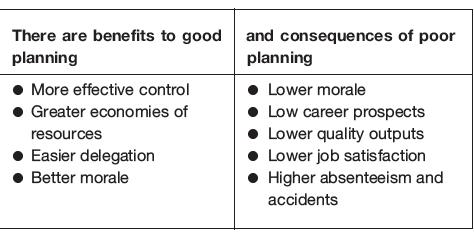
Good Planning
Feeling part of the process is excellent motivational practice; your people will appreciate it.
Good planning must have:
● specific goals
● agreement as to how we are to get there
● be attainable and reasonable, and
● be consistent with the overall objectives of the business.
Poor planning happens because:
● there is too little time available
● there are conflicting priorities
Poor Planning
● lack of knowledge
● pressures of work.
All these are well-known management factors. When working with people do all you can to get them on your side; your planning will be good, not poor.
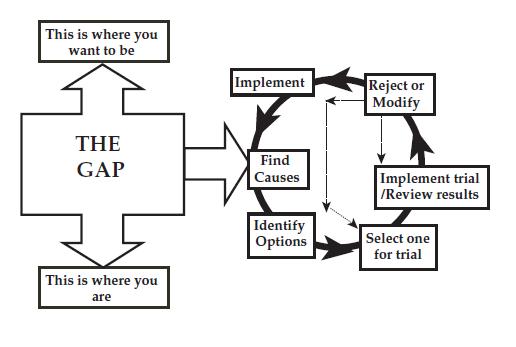
Performance Management Performance
• identify the gap between where you are and where you want to be
Pilot Measurement And Monitoring Scheme
• find the causes of that gap
• look at options for closing that gap
• select one for trial or test
• implement that trial and review its results
• modify or reject the option as required
• implement that action.
What Gap?
Your performance measurement and monitoring tells you where you are. But that’s not enough. If you’re going to improve your performance, you’ll need a target or goal to aim for. But this can’t be just any old goal or target. It’s worth reminding yourself of what you read on Sunday about this goal.
You saw then that it must be:
• specific and quantified, rather than vague and generalised
concerned with results now, rather than next week
easily understandable, rather than complicated or jargonized
achieved by continuous, on-going and incremental activity, rather than on-off chunks of major effort.
•
•
•
You will need to:
• identify and choose those goals and targets with care
• plan, prepare for and implement with care and forethought the actions that you take in order to achieve them.
Reading List
Callis, S., 2010. Working With People. London: Hodder Education.
Get along, get it done, get ahead: interpersonal communication in the diverse workplace, Geraldine E Hynes
New York, NY: Business Expert Press, 2015
Writing for the workplace: business communication for professionals, Janet Mizrahi
New York, NY: Business Expert Press, 2015
Exploring internal communication towards informed employee voice, 2nd ed., Kevin Ruck ed.
Harlow: Pearson Education, 2012
Successful workplace communication,Phil Baguley
London: Hodder Education,2009
Setting performance targets, Carolyn Stringer, Paul
Shantapriyan Publication
Information:
New York, NY: Business
Expert Press, 2012
Achieving high performance: a research-based practical approach,Richard F Gerson
Amherst, Mass: HRD Press, 2006
Goals and goal setting: achieve measurable results, 4th ed., Larrie Rouillard
Rochester, NY: Axzo Press, 2009
Goal setting: how to create an action plan and achieve your goals, 2nd ed., Susan B
Wilson and Michael Singer
Dobson
New York: AMACOM,2008
Management excellence: productivitythrough MBO, Heinz Weihrich
New York NY: McGraw Hill, 1985
The practice of management, Peter Drucker
London: Heinemann,1955
LO3: Be able to identify and reduce resource wastage
3.1 DISCUSS THE EFFECTS OF RESOURCE WASTAGE
3.2 EXPLAIN METHODS OF IDENTIFYING RESOURCE WASTAGE
3.3 IDENTIFY ACTIONS TO BE TAKEN TO REDUCE RESOURCE WASTAGE WHILST MEETING TEAM OBJECTIVES
Understanding Waste
Awareness of waste, in its various forms, is a key part of Lean. Waste or 'muda' can be found in any activity which takes up resource but creates no value.
The philosophy of the Toyota Production System is to attain cost reductions through the elimination of wasteful operations. Taiichi Ohno, the chief production engineer, who pioneered the Lean production system at Toyota identified seven types of waste:
• Overproduction
• Transporting
• Unnecessary stock on hand
• Producing defective goods
• Waiting (idle/non-productive time)
• Processing itself
• Unnecessary motion.
Other Wastes
Other forms of waste include:
• Mura or waste due to variation
• Muri or waste due to overburdening or stressing the people, equipment or system
Sometimes you will also hear "the disengagement of people" identified as a form of muda.
Waste is relatively easy to identify in physical areas: parts, inventory, material, people who aren't working, and so on. But it is much harder to recognise in transactional areas.
Is that person sitting in front of his computer adding value? Is the computer program he's running adding value? Is the process that's consuming the results of that program adding value? Are the data providing value?
The key to eliminating waste is first of all to find it, and secondly to ensure that it is recognised as waste by all.
Inventory Management to reduce Resource Waste
• A fundamental dilemma lies at the heart of inventory management, or stock control, as it is still often known. On one hand too much stock of the wrong kind - or even the right kind - means that cash resources are tied up unnecessarily, that cash flow is prejudiced and, in extreme cases, that survival may be in jeopardy. On the other hand, too little stock of the right kind can result in being unableto meet customer needs in a timely fashion. It is clear, therefore, that a failure to manage inventory levels carefully can lead to serious problems.
Stocks are held by retailers (finished goods), wholesalers (finished goods), manufacturers (finished goods, part finished goods, parts, and raw materials), local authorities, public bodies and every other type of organisation (a range of stocks for use or distribution).

•
WHILST THE INTRODUCTION OF AN INVENTORYMANAGEMENTSYSTEM REQUIRES SIGNIFICANTEFFORT ANDRESOURCES, IT ALSO OFFERS MAXIMUM ADVANTAGEATA REASONABLECOST, ENSURING THAT:
CASHIS RELEASED FOR THE MAJOR PURPOSES FOR WHICH THE ORGANISATION EXISTS
THE STANDARDOF SERVICEIS CONSISTENTWITH PREDETERMINED POLICY
STOCKHOLDINGCOSTS (THE COST OF FINANCE;STORAGE; INSURANCE; HANDLING; OBSOLESCENCE;PILFERAGE) ARE MINIMISED.
Supply Chain Management and Lead Time
• Stock holding levels are generally determined by the lead time of the stock items. If the lead time of an item is one year, then more than a year’s usage of that item may be required. Conversely, if the lead time is one day, then a day’s usage may be all that is required. This means that the focus on managing stock levels should include a focus on reducing lead times for all stock keeping units (SKUs) and reducing the number of SKUs. Stock turn is a valuable measure of supply chain effectiveness (value of sales divided by the value of stock). A stock turn above a hundred would be considered very good; less than ten very poor.

Inventory Management Defined
Inventorymanagement is the sum total of the policies, practices and procedures which an organisation follows to ensure that its stocks are balanced at levels that are consistentboth with meeting predetermined standardsof service and with releasing funds for the purposes of working capital.
For the purposes of this checklist, strategic stock is defined as essential stock, without which the organisation cannot function. Non-strategic stock is defined as basic commodities that can be readilysourced and so are not critical to the overall function of the organisation.
Key Elements Inventory Management
• Inventory management can be extremely simple, using ledger books and card index systems. However, today it is usually carried out at a more sophisticated level, and in large organisations can involve highly computerised operating environments. Whatever type of system you establish will need to provide information on current stocks on a regular basis. It should also record supplies received together with sales, deliveries, outputs and usage. The system adopted will depend on common sense - the cost of the system and its operation must not be greater than the cost of the problem which it is intended to solve.
It will not be necessary to keep precise stock records for every item held, but the following elements must be built into any stock control system:
Precise Stock Records
identification of current stock levels
recording of receipts/dispatches
identification of re-order levels and quantities (by analysing lead times, volume discounts, price stability)
establishment of a pattern of regular auditing and stock checking.
You will need to recognise that identifyingreorder levels will have a cost in itself, the form of higher ordering costs, possible loss of bulk discounts and possible additional handling charges.


•
Analyse Usage and Demand of Resources
ANALYSE USAGE OF ALL ITEMS IN TERMS OF:
VOLUME
STRATEGIC/NONSTRATEGIC STOCK.
It is common in manufacturing industries to classify parts in terms of A, B and C where:
Class A are high value, low value items that are closely managed often on an individual, regular review basis.
Class B is the difficult area where it is important to let the system determine the re-ordering, having spent enough time to determine accurate values, lead times, handling requirements, and more.
Class C are the low unit value high volume usage commodity items that can be managed simply by reordering at a pre-determined value or volume and needing very little management, sometimes reordering on a 6 month rotation
If the organisation is converting raw materials or parts to higher value items internally using its own manufacturing capacity the study of the ‘K-Curve’ technique is worth investigating. (See Additional resources)
It is important to: recognise key products which must be available on demand and ‘be right' first time
classify products in terms of importance to overall turnover but not in big product families or in other broad product groupings
focus attention on the items which produce the most revenue
realise that most stock must be bought to a forecast and that the forecast process itself will have a lead time
avoid trying to give equal attention to all stock items
analyse sales to identify the real money earners and recognise that 80% will probably yield only 20% of the total value.
Identifying the Level of Stock
Identify the level of stock which must be held to avoid the risk of missing key opportunities or failing to supply basic needs. Identify non-strategic stock and reduce it by means of the following: special offers
non-replacement repackaging
scrapping for salvagevalue
in extreme cases, writing itoff
Objective of Identifying Level of Stock
Don't spend time on monitoring products which yield 5-10% of annual revenue – instead, reduce your stocks of them, and monitor the right 20% to achieve control over 80% of total stock values. Avoid making arbitrary demands to reduce stocks by X%, as to do so may result in reduced service levels without identifyingareas of wasted investment.
The main objective is to identify the level of stock above which excess inventory ties up money and diminishes the return on capital employed.
Plan Stocking Area
Locate frequently used items in an accessible place. 01 train staff in methods of handling - manual handling and operation of mechanical handling equipment 02 choose appropriate stacking methodsconsider pallets, drums, bins, shelving, pipe racks - do not try to store every item in the same environment 03
Consider
consider shelf life and implement a stock rotation system
Consider
consider storing large or bulky items at your suppliers, if you have insufficientspaceensure availabilitymeets requirements
Use

Consider
use an appropriatelabellingsystem for stock identification (this might include bar coding or a simple handwritten label)
consider environmental conditions,such as temperature and humidity.
Establish
Appropriate Resourcing
Identify the Cost of Stockholding
Discover (if any):
• financial costs (for example, the cost of funds or lost opportunities for better investment)
• storage costs, including equipment and labour costs
• costs of protection from damp, cold or damage
• insurance costs
• handling costs
• costs of obsolescence
• cost of losses through pilferage
• the alternative rental value of your storage facilities.
Adopt a Common Sense Approach
Build Links to Other Departments
• Try to develop a system which links through to other departments. A system which works hand-in-hand with the accounts department, for example, will minimise workloads for both sections; and good communication with buyers and dispatch departments will minimise the risk of staff and plant being overworked one day, then having little to do the next.

Suggestion for Managers
Managers should avoid:
• holding stocks only to fill the store or warehouse
• buying speculatively
• assuming there will be no losses from pilferage, excessive waste or other form of ‘shrinkage'
• exaggerating the potential consequences of ‘running out'
grabbing every quantity or early delivery discount offered, assuming that it is to your advantage
letting stock-taking become an annual nightmare - do it regularly on a partial basis
thinking that an inventory management system must be expensive and complex - a basic system may give you the controlwhich is lacking now, at a cost below the resulting savings.
1
2
3
Identify actions to be taken to reduce resource wastage whilst meeting team objectives
Lean management principles identify how teams can work more efficiently by looking at non-essential work tasks to eliminate duplication and surplus and improve productivity.You are required to list what you would do to reduce wastage but still ensure team objective were met.
This could include using Lean management techniques, identifying bottlenecks, increasing security or checks on staff hours and productivity, conducting a full project review and obtaining team feedback.
Lean Production Introduction
Lean is essentially a management philosophy concerned with relentless, sustained improvement and the removal of waste (muda). Any expenditure of resource - materials, people, or time - that does not add value to the customer is considered to be waste and should be removed.
Value must be viewed from the customer's perspective and can be deemed to be any action or process for which customers would be willing to pay. Lean organisations understand customer value and focus attention on continuous improvement.
• Research by the Lean Enterprise Research Centre suggests that for most manufacturing production operations, typically only 5% of activities actually add value, 35% are necessary non-value adding activities and 60% add no value at all. Eliminating non value adding activities (or waste) is thus the greatest potential source of improvement in customer service and corporate performance.
Lean Production Defined
• The term 'lean production' was coined by John Krafcik, a researcher at the International Motor Vehicle Programme (IMVP) at Massachusetts Institute of Technology. Lean is a management philosophywhich focuses organisational effort on understandingand improving customer value with fewer resources through the elimination ofwaste.
Principles of Lean Management
Womack and Jones identified five principles of Lean:
1. Specify what creates value from the customer's perspective
2. Identify all steps across the whole value stream
3. Make those actions that create value flow
4. Only make what is pulled by the customer just-in-time
5. Strive for perfection by continually removing successive layers of waste.
Lean is about less waste, shorter cycle times and reduced bureaucracy, higher levels of employee knowledge and engagement, improved organisational agility, and higher productivity.
Application of Lean in Enterprise
• As a result of its origins, Lean has often been seen as an approach that can only be applied to manufacturing activities and can't possibly be relevant in other sectors. There are now many detailed examples of the successful application of Lean in service-based organisations which demonstrate that this is no longer a valid stance. The implementation of lean covers all areas of the organisation, including all internal functions.
• Lean should not be approached as an activity that relates to just one or two sections of the organisation. Any activity has the potential to be inefficient or wasteful of resources. The aim should be for all activities within the organisation to create value, not just those which are obviously at the forefront of customer service.

How Lean Improves Business Performance
Lean practices improve overall business performance, by:

• reducing the time spent in performing business activities
• reducing the total cost of doing business by eliminating wasted time and effort
• increasing customer satisfaction through the improved quality and timeliness of deliverables
• improving employee morale and increasing enthusiasm by engaging staff in the development and implementation of improvements.
Lean Transformation must Start with Senior Team
• As is the case with many change projects, Lean transformations may face resistance from people across the organisation. Strong leadership will be required to drive the initiative forward and to keep people focused on the key objectives. Hence senior manager commitment across the organisation is critical to success.
Engage your Team
• As with any change initiative, getting employee buy-in to the project will be critical to success. People put up barriers to change when there is uncertainty, a lack of understanding of the need for change or poor communication. Many staff will have experienced a myriad of change initiatives which have resulted in varying degrees of success.
People will usuallybe more receptive to change and engage with lean if they:
• understand the failings of the current approach
• recognise that the current situation is unsustainable
• believe that now is the time to change
• are clear about what the change will involve
• are confident in their abilityto implement the changes
• believe that everyone is working to deliver success.
Good Communication
Good communications are vital to the success of Lean projects, so bring representatives from all functions and levels of the organisation into the planning process. Lean is about cultural change and employee participation, and ownership is an essential part of accepting the change process. Arrange meetings, briefing sessions and newsletters to promote the objectives of lean.
•
Tools and Techniques for Lean Transformation
There are many tools and techniques in the Lean toolbox,but valuestream mappingis one which is commonly used in Lean transformations.
A value stream mapping (VSM) activity is where teams come together to record, analyseand improve flow in a value chain. This is a powerful tool which quickly helps you to see how different activities contributetowards adding value,or act as blockages to the deliveryof the product or service
The aim of a VSM event is to:
understand how current processes work (called current state analysis or 'as is').
create an improved plan of how the process will work (called future state or 'to be')
develop an implementation plan that will take you from the current state to the future state.
The organisationwide use of VSM can help you to start to see how your organisation could be organised along product family lines.
On going learning Requirement
• In the Lean enterprise, learning and continuous improvement are fundamental parts of every job role. Although certain work skills require specialist external training, acquiring and refining Lean process and improvementskills should become a regular and routine part of everydaywork.
Reading List
Improvingbusiness Performance with lean, 2nd ed., James R Bradley
New York : Business Expert Press, 2015
Lean service : a practical guide for SME owner / managers, Richard Keegan and Eddie O'Kelly
sl: Oak Tree Press, 2015
Lean practitioner's handbook, Mark Eaton
London:Kogan Page, 2013
Lean turnaround:how business leaders use lean principles to create value and transform their company, Art Byrne
New York NY: McGrawHill, 2013
Leadingand managingthe lean management process, Gene Fliedner
New York, NY: Business Expert Press, 2012
INTRODUCTION TO OPERATIONS MANAGEMENT: THE JOY OF OPERATIONS, AJAY
DAS
NEW YORK NY: TAYLOR & FRANCIS, 2016
INVENTORYMANAGEMENT: ADVANCEDMETHODS FOR MANAGINGINVENTORY WITHIN BUSINESS SYSTEMS, GEOFF RELPH AND CATHERINE MILNER LONDON: KOGAN
ESSENTIALS OF INVENTORY MANAGEMENT, 2ND ED., MAX MÜLLER
NY: AMACOM. 2011
PAGE, 2015 NEW YORK