World
Languag Singapore American School’s world language program focuses on interpersonal listening and speaking skills at all levels. Our interest goes beyond the content knowledge we expect students to have, and instead focuses on what they can do with the language. The language curriculum at SAS is vertically aligned across the school, from kindergarten through high school for each proficiency level, with similar themes and units of study. As students progress through language levels and advance in age, more content and a wider range of skills is expected. When students begin their language journey at the novice level, the focus is on oral communication, including simple words, phrases, and formulaic language that students practice and memorize, so they are able to progress quickly through the lower levels. Later, as literacy, narrations, and abstract thinking are incorporated, complex learning takes more time. Age, maturity, life experience, and progression of thinking skills all contribute to language acquisition and the progression rate. Every learning activity and assessment within a unit of study is a performance. Each performance is a snapshot in time of a student’s ability within a certain set of skills and language expectations, and each performance over time builds toward proficiency. The American Council on the Teaching of Foreign Languages (ACTFL) provides a criterionreferenced assessment called the Assessment of Performance toward Proficiency in Languages (AAPPL) that SAS has used since the 2013-14 school year.
REPORT 2016-17
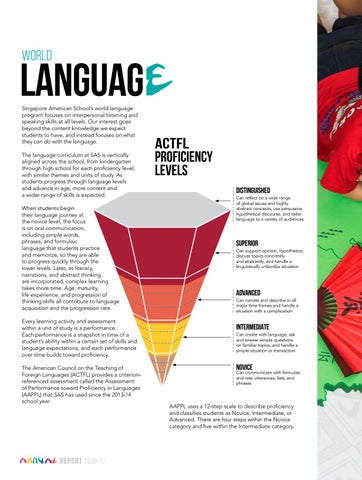
ACTFL PROFICIENCY LEVELS DISTINGUISHED Can reflect on a wide range of global issues and highly abstract concepts, use persuasive hypothetical discourse, and tailor language to a variety of audiences
SUPERIOR Can support opinion, hypothesize, discuss topics concretely and abstractly, and handle a linguistically unfamiliar situation
ADVANCED Can narrate and describe in all major time frames and handle a situation with a complication
INTERMEDIATE Can create with language, ask and answer simple questions on familiar topics, and handle a simple situation or transaction
NOVICE
Can communicate with formulaic and rote utterances, lists, and phrases
AAPPL uses a 12-step scale to describe proficiency and classifies students as Novice, Intermediate, or Advanced. There are four steps within the Novice category and five within the Intermediate category.