For better or worse, I was only able to participate in the May 19 primary as a voter and bystander, not a reporter. With my foot elevated, iced and locked in a boot cast following foot surgery the day before, I lay on my couch — loaded up on hydrocodone, acetaminophen and ibuprofen — and watched the results roll in until way too late into the night. Maybe it was the drugs, maybe it was an overactive imagination, but I started feeling a little like Jimmy Stewart in Rear Window. Were District 1 voters doing what I thought they were doing? It sure looked bad as the vote totals rose with the fully reported precincts. By the time I hobbled off to bed, I was pretty sure a grievous harm had been committed. The morning proved my fears correct: Of the 15,000-ish Republican voters who turned out for the legislative races, a majority had rejected two experienced, committed, well respected and effective incumbents — and failed to seriously consider a promising challenger — in favor of a delegation that combines lack of experience and solid ideas with culture war lawsuit bait and “I’ll put root beer in all the drinking fountains” promises. I spent the whole day on May 20 texting and talking with friends, family members and associates from around the district, state and country who were in various stages of grief: mostly anger, mingled with despair. As I counseled and commiserated, I reminded myself and hopefully a few others, that the primary is not, actually, “the real election.” The Idaho GOP, with its insidious closed primary, has managed to propagandize too many of us into the incorrect idea that whoever gets the party nomination is the inevitable winner in November. This, of course, is not true. Parties install lawmakers in dictatorships; in democratic republics, voters do that and they do that in November. No has “won” anything yet. Of the 15,000 or so Republicans who voted in the primary, no more than 9,000 accumulated the majorities that produced the Dist. 1 GOP nominations. According to the Idaho Secretary of State’s Office, there are 37,495 party-affiliated and unaffiliated registered voters in Dist. 1. That means the strongest vote-getter — incumbent Dist. 1B Rep. Cornel Rasor, with 9,314 votes — was only supported by 24.8% of the overall voting population. That hardly adds up to “inevitability” and underscores that the race is far from run, despite what the GOP apparatchiks would have you believe. Assuming Republican primary voters turn out again in comparable numbers both for and against the party’s nominees, and the latter are joined by even about 8,000 districtwide voters of all or no affiliations in supporting the Democratic and Independent legislative candidates in November, there’s a more than realistic chance that the Republican Party machine won’t automatically determine our representation in Boise based on a fraction of the people who live here. It’s far past time that we make November matter again, and with initiatives on women’s reproductive health care and medical cannabis legislation also on the ballot, this cycle is the perfect opportunity to start taking our elections back from the party hacks who, despite their bluster, deserve none of the power we’ve allowed them to accrue through our inaction at the ballot box.
READER DEAR
READERS,
I hope everyone had a good holiday weekend. We’re now officially over the hump into the tourist season, so make sure to do your breathing exercises and practice patience.
I’m a big fan of the shoulder season in North Idaho. Sadly, it seems this liminial space between what used to be snowy winters and what used to be smoke-free summers is shrinking more and more every year. So it goes.
There are still a few weeks before it truly gets wild around here, so do your best to get out and enjoy the rivers, lakes and mountains before the circus comes to town for the summer.
In the meantime, thanks for reading our weekly effort. Election season takes a lot of wind out of our sails at the Reader, so please forgive any flubs or typos you might see over the next couple of weeks as we catch our editorial breath again.
Cheers!
– Ben Olson, publisher
111 Cedar Street, Suite 9 Sandpoint, ID 83864 208-946-4368 sandpointreader.com
Printed Weekly At: Tribune Publishing Co. Lewiston, ID
Subscription Price: $200 per year
Website Designed By: Keokee
The Sandpoint Reader is a weekly publication owned by Ben Olson, Zach Hagadone and Soncirey Mitchell. It is devoted to the arts, entertainment, bluster, politics and lifestyle in and around Sandpoint, Idaho.
We hope to provide a quality alternative by offering honest, in-depth reporting that reflects the intelligence and interests of our diverse and growing community. The Reader is printed on recycled paper using soy-based ink. Leftover copies are collected and recycled weekly, or burned in bonfires to appease the gods of journalism. For back issues, contact the publisher. Free to all, limit two per person, please.
Letter to the Editor Policy:
We welcome letters to the editor on all relevant topics. Please, no more than 200 words, no excessive profanity or libelous statements and no trolls. Please elevate the discussion and stay on topic. Letters will be edited to comply with the above requirements. Opinons expressed in these pages are those of the writers, not necessarily the publisher. Send to: letters@sandpointreader.com
About the Cover:
This week’s cover photo of a young grand fir was taken by Karley Coleman, a very talented local photographer.
Commissioners of the five northern counties deny PHD budget
By Soncirey Mitchell Reader Staff
Commissioners from the five northern counties met with Panhandle Health District May 20 to vote on the Fiscal Year 2027 budget, which includes an ambitious expansion and restructuring of clinical services. The group voted 4-1 to deny the budget, citing issues with PHD’s environmental regulatory side and with a proposed 2% cost-of-living adjustment for employees.
According to Idaho Code, the counties must pass PHD’s budget by Monday, June 1. Counties are required by law to pay into the health district; however, ongoing negotiation will determine how money is allocated to PHD’s various services. As yet, there are no plans to reduce current service offerings, but without support from the counties, PHD will likely be unable to move forward with planned clinical program expansions intended to broaden services and attract more regional users.
PHD requested $2,216,903 from Benewah, Bonner, Boundary, Kootenai and Shoshone counties, which is the same sum as last year. PHD set the overall proposed FY ’27 budget at $12,299,702 — funds that would come from a mix of permits, licenses and health services. PHD further planned to use $443,630 from its reserves.
The amount each county contributes depends on its population and valuation, meaning that had the budget passed, Kootenai County would have paid the lion’s share, totaling $1,479,299. Bonner County would have paid the second-highest amount, at $470,211. For every county except Kootenai, those numbers reflected a reduction of $1,000-$2,000 in contributions
from previous years.
The FY ’27 budget was structured around changes to clinical services to attempt to tackle the “chronic disease epidemic” by hiring additional staff — including a social worker, two medical assistants, a nurse practitioner and a public information officer — and incorporating naturopathic medicine. PHD also planned to provide more clinic days in each county. According to the Centers for Disease Control and Prevention, three in four adults in the U.S. have at least one chronic condition. Chronic diseases such as heart disease, cancer and diabetes are the leading causes of death and disability in the nation.
According to PHD Medical Director Gregory Pennock, those changes would help to increase community use of the clinics, which would in turn fund the operations through insurance payouts and patient fees, making for “more budget neutrality.”
Still, at the outset of the May 20 meeting, Boundary County District 2 Commissioner Tim Bertling made the motion to deny the budget, which Bonner County Dist. 1 Commissioner Brian Domke seconded. Bertling argued that the proposed budget did not benefit his county, which uses Boundary Community Clinics in partnership with Kootenai Health, and that the district needed to “go back to doing what PHD does well,” by which he meant environmental services.
The proposed budget did not cut any funding from PHD’s environmental programs, and in fact increased septic permit fees to completely cover the cost of processing applications and testing sites.
Shoshone District 3 County Commissioner Jeff Zimmerman agreed, stating that
his county frequently struggled with illegal sewage dumping and required additional assistance from PHD.
“It was my understanding ... that we were functioning as expected,” said Board of Health Chair Thomas Fletcher. “So, that we are functioning subpar is new to my thoughts.”
He added that the commissioners had never brought up those issues during PHD’s many meetings during the budgeting process. Environmental and Health Protection Division Administrator Jason Peppin agreed, adding that his department handled all such issues, and that all the affected parties need do is file a report, and PHD staff would work with landowners to get into compliance, whether through septic or wastewater disposal systems or other means.
“We’re staffed appropriately in all the five counties, including Shoshone County, and the budget was crafted to be budget neutral in the septic program,” added Peppin.
According to Domke, the BOCC’s issue with the budget was the inclusion of a 2% cost-of-living adjustment for all PHD employees.
“The issue is, however, that if I were to vote to approve a COLA for the PHD staff, and then we are ultimately unable to match or do something similar for our own county staff, then I would be creating an inequity,” said Domke. “And so it’s a challenging situation and I don’t have a great solution, but I’m unwilling to create that potential inequity.”
Domke clarified that the issue stems from Idaho Code. Though PHD must pass a budget by the first Monday in June, Bonner County’s fiscal year begins Oct. 1, meaning its budget usually gets passed in late August. Therefore, PHD must pass its
budget — with or without a COLA — well before Bonner County can determine if it has the budget to pass one for its employees.
Other commissioners agreed, adding that their respective boards worried that, with the additional employees and clinic changes, PHD would need to ask for more money from the counties in FY ’28.
“So, in our view of what the clinical budget looks like, we’re hiring nurse practitioners, physicians [and] clinical people to generate revenue,” said Pennock, arguing that each hire will likely bring in three times their salary in revenue because of expanded capacity to meet the demand for services.
“So in the private sector ... we look at clinical people as revenue generators, not as expenses,” he added.
The counties voted 4-1 to deny the budget, with Kootenai County Dist. 2 Commissioner Bruce Mattare dissenting. The PHD board of health will present a new proposal on or before Monday, June 1, with different options for
counties to opt out of clinical services. Doing so will not reduce a county’s overall contribution to the health district, which is set by state statute.
As of the May 20 meeting, only Boundary County commissioners had indicated a desire to eliminate clinical services in their jurisdiction.
“Unwittingly, this would make for a much more efficient clinic,” said Fletcher.
“If you think about it, for us to provide a once or twice a month service, 100 miles away, is an expensive proposition, whereas [Kootenai’s] patient population is just right here. It ... just from a straight business perspective, is more efficient.”
Panhandle Health District meetings are open to the public and take place at the district’s headquarters (8500 North Atlas Way, in Hayden). Stream them online on PHD’s YouTube page or via Microsoft Teams by visiting panhandlehealthdistrict.org.
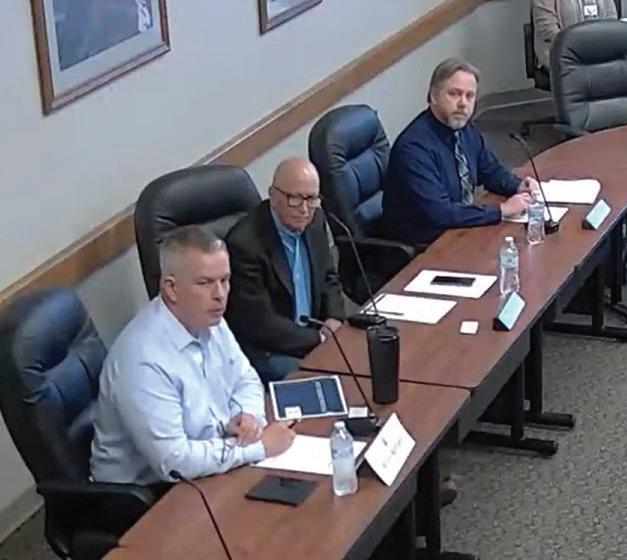
Kootenai County Commissioner Bruce Mattare, PHD Board of Health Chair Thomas Fletcher and PHD Director Erik Ketner discuss the FY ‘27 budget. Capture from YouTube.
‘Some of the worst legislation I’ve ever seen’
Sandpoint City Hall holds off on repealing short-term rental regs to align with new state law
By Zach Hagadone Reader Staff
One way or another, the city of Sandpoint will be required to repeal its short-term rental regulations by Monday, July 1, when a new state law goes into effect. But neither the City Council nor Sandpoint Mayor Jeremy Grimm are happy about it.
“Although I realize that we have to comply with state law, I think this House Bill 583 was some of the worst legislation I’ve ever seen,” Grimm said, referring to the law signed by Gov. Brad Little in March.
The council took up the issue on May 20, considering whether to approve an ordinance repealing the city’s current regulations in order to align with H.B. 583, which forbids Idaho municipalities from regulating STRs in ways different from any other private residential property.
Councilors first voted in a tie to advance the repeal ordinance to its third reading, with Council President Deb Ruehle voting “very disgustingly and apprehensively” in favor of moving the ordinance forward.
Councilor Joshua Torrez also said that while being “100% still against this,” he would vote in favor “to make sure that our city does not go through more pain because of not supporting it.”
Councilors Pam Duquette and Kyle Schreiber both voted “no,” with Grimm reluctantly breaking the tie.
“I agree with all of you,” Grimm told the council. “But when we think about the taxpayers’ standpoint and our limited resources and the machine that is the swamp of lobbyists that put self-interest, corporate interest and profit
over the health and benefit of communities, the fact [is] that we can’t fight that from Sandpoint City Hall effectively.”
However, the council then voted unanimously against the measure, delaying a final decision until its next meeting at the earliest.
“I just wanted to make a public statement that I’m very much opposed to the passing of H.B. 583 for many, many reasons that have already been stated here,” Ruehle said.
Schreiber echoed that sentiment, adding that he is “100% against this legislation and I think it’s very short-sighted and is going to cause all sorts of problems for our community. But we don’t have many options, unfortunately, and I don’t want to open the city up to undue risk by not keeping our ordinance in line with state regulations.”
“I have voted against this every time we’ve talked about it,” Duquette said. “I still agree that it is not in the best interest of our city and its taxpayers.”
Lobbied for by state and national vacation rental
industry representatives — including from international STR platforms like Airbnb and VRBO — H.B. 583 was supported by Dist. 1B Rep. Cornel Rasor, R-Sagle, though opposed by Dist. 1A Rep. Mark Sauter, R-Sandpoint, and Dist. 1 Sen. Jim Woodward, R-Sagle.
City Hall had been grappling with how to address STR regulations even before the passage of H.B. 583, beginning with threats of a lawsuit from the vacation rental industry in 2025 if Sandpoint didn’t remove its cap on the number of STRs allowed in city limits. Councilors voted in February to remove that cap while adopting a number of new policies related to establishing occupancy categories, permitting, parking requirements and administrative changes.
With Little’s signing of the bill into law in March, even that amended ordinance became obsolete, resulting in the May 20 agenda item totally repealing it.
“Cities and municipalities across Idaho are no longer able to regulate short-term
rentals any more rigorously than you would a single-family home,” said Sandpoint Assistant Director of Planning and Community Development Bill Dean on May 20, later adding, “We’re basically going to be out of the business of being able to regulate these beyond basic basic life safety considerations regarding carbon monoxide monitors and things like that.”
Both local and state opponents have criticized H.B. 583 as an undue restriction of local control over property regulation, as well as putting communities at risk of seeing their housing stock opened to the unrestrained proliferation of vacation rentals — making already tight real estate markets even more accessible and reducing municipal tax revenue, while also presenting health and safety risks as well as threatening neighborhood integrity.
“The state of Idaho has invested tens of millions of dollars to diversify the economy of this community over the past two, three decades. We’ve succeeded,” Grimm said. “We represent one
of the most diverse mountain town economies in the country today with aerospace, bio-med, food production, computer analytics and many other industries.
“Over the past five years, with our challenges with affordable housing and capacity, those employers are struggling to find full-time, year-round housing for our citizens,” he added. “Allowing unfettered short-term rental speculators and investors to come in and buy our housing stock — displacing the opportunity for a local resident or employee to live there year round for the proposed benefit of the individual for a short-term profit on a short-term rental — in my mind is not the direction we need to be going as a community.”
Before casting her vote against passing the repeal ordinance and delaying the final vote to a further reading at a future meeting, Ruehle emphasized: “I’d like this to be read that many more times so we can express our disgust publicly.”
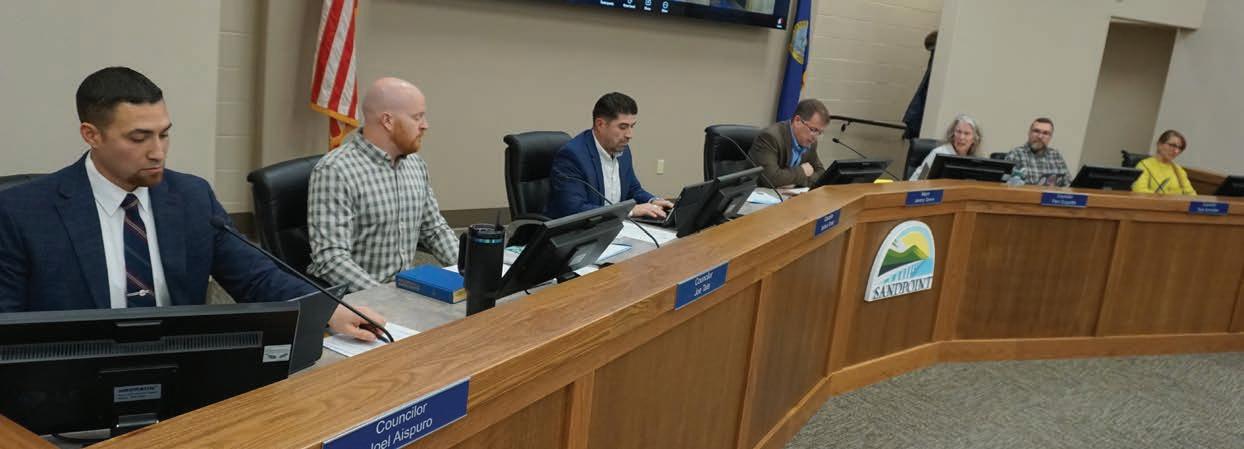
The Sandpoint City Council. Photo by Ben Olson
About 30% of Idaho voters turned out for 2026 primary election, early data shows
By Kyle Pfannenstiel Idaho Capital Sun
Roughly 30.3% of Idaho’s registered voters cast ballots in the May 19 primary election for state legislative, statewide, congressional and county officials, according to initial figures from state election officials.
That is slightly above the median voter turnout for primary elections since 2000, which was about 28.1% voter turnout, according to the Idaho Capital Sun’s analysis of turnout data reported by the Idaho Secretary of State’s Office.
This year, no statewide incumbent constitutional officers besides the governor faced Republican primary challengers. Two-term Gov. Brad Little won an eight-way primary election May 19, and Idaho’s incumbent congressional Republicans all fended off challengers. But dozens of legislative races were competitive, and nine incumbent Republican lawmakers lost their re-election bids, including five members of a conservative group of lawmakers that pushed for budget cuts.
Boise State University political science professor Jaclyn Kettler called this year’s turnout impressive given the lack of primary challenges for statewide offices, which tend to drive turnout higher. But she said the competitive legislative primaries and local races helped contribute to the higher turnout levels.
“It’s possible this year that they’re starting to feel some energy building, that there’s some people ... getting more engaged in politics that are paying attention, that are ... motivated to turn out,” even if races at the top of the ballot weren’t that competitive, Kettler said in an interview May 20.
Idaho Secretary of State Phil McGrane called the turnout “really good,” especially when many races were uncontested or called early. He said he saw regional hotspots of higher turnout across the state.
“Considering there wasn’t a lot of activity in certain parts of the state, 30% for a primary feels good,” McGrane said in an interview Wednesday. “Of course, we’d always love to see more people participate in the primaries. We know the general election will be a higher turnout. But 30%, I think, should feel really good for everyone.”
Idaho primary election voter turnout, by the numbers
Idaho’s initial 30.3% primary voter turnout rate this year surpassed most primary elections since 2010, besides the 2022 and 2018 primaries. Those years also featured statewide office primaries but had higher turnout, at over 32%.
This year’s voter turnout rate is likely to decline from here, as local election officials tally up how many voters registered to vote on Election Day. But the early data shows that 312,460 of Idaho’s more than 1 million registered voters cast ballots on May 19.
A little more than 87,000 of those ballots were cast early or through absentee voting. About 40,800 people voted early in-person and more than 86% of absentee ballots, or 46,000 out of roughly 56,000 absentee ballots issued, were returned, according to the Idaho Secretary of State’s Office.
The primary election results won’t become official until they are certified by the State Board of Canvassers, which is scheduled to meet on Tuesday, June 9.
Primary elections — when candidates compete for political party endorsements — tend to have lower turnout than general elections, when voters cast final votes for races. But in Idaho, where Republicans have long controlled statewide offices and the Legislature, primary elections often decide the winners of major elections.
Republicans make up 62% of Idaho registered voters, or more than 631,000 people, according to the Idaho Secretary of State’s Office. Unaffiliated voters make up 25% or more than 257,000 of Idaho’s registered voters. Over 120,000 Democrats comprise 12% of Idaho registered voters.
At the county level, turnout varied widely — up to as high as nearly 51.9% in Bear Lake County in eastern Idaho, down to as low as almost 21.8% turnout in Teton County, the early results show.
McGrane spotlighted high turnout in southeastern Idaho counties, such as Bear Lake and Power counties, along with high turnout in the Magic Valley, where several incumbent legislators were unseated.
“Across the board, the Magic Valley turned out a lot, and I think that ... played a big factor in some of the outcomes,” McGrane said.
Bear Lake County Clerk Amy Bishop said the county, which has around 3,700 registered voters, tends to have a
Bits ’n’ Pieces
From east, west and beyond
According to Forbes, President Donald Trump’s net worth today is $6.1 billion, up from $2.4 billion in 2021. Meanwhile, ABC reported, the U.S. stock market has hit new heights, but two in three Americans are reducing spending. Economic confidence has grown for those with incomes at or above $100,000, and fallen for most others.
In 2025, Trump pardoned more than 1,500 participants in the Jan. 6 Capitol insurrection, which led to five deaths and 140 police officers injured. Trump now wants to funnel more than $1.7 billion in compensation for those who were punished — despite their criminal records including rape, domestic violence, violent assault of police officers, manslaughter, drug trafficking and production of child sexual abuse material, various media reported.
Trump’s acting Attorney General Todd Blanche recently told CBS, “Just to be clear, people that hurt police get money all the time.”
Former-Senate Majority Leader Mitch McConnell, R-Ky.: “So, the nation’s top law enforcement official is asking for a slush fund to pay people who assault cops? Utterly stupid, morally wrong — take your pick.”
A congressional closed-door meeting with Blanche was described by Sen. Ted Cruz, R-Texas, as “fireworks at an epic level.” “Slush fund” applicants include My Pillow CEO Mike Lindell and former Proud Boys leader Enrique Tarrio. One pardoned rioter wants $30 million.
The Nation reported that Trump’s $1.776 billion IRS settlement fund — which he won after originally suing for $10 billion over leakage of his tax returns) — wants those dollars distributed to those he calls “victims” of the Justice Department.
Jan. 6 rioters were found guilty — or pleaded guilty — in jury trials and were sentenced for battering police officers, hunting members of Congress to kill them, vandalism and for trying to prevent the post-election peaceful transfer of presidential power.
“One of the hallmarks of an authoritarian government is that the ruler regards the nation’s treasury as their personal piggy bank — to be raided at will, with its contents parceled out to friends, family, regime loyalists, and enforcers,” wrote Sasha Abramsky in The Nation. “It is the quintessence of public corruption.”
Stephen Colbert, who signed off as Late Show host on May 21 after being
By Lorraine H. Marie Reader Contributor
canceled by CBS under pressure from Trump, said the FCC and Trump administration have focused on him because, “Authoritarians don’t like anybody who doesn’t give them undue dignity ... Authoritarians are never going to like anybody to laugh at them.”
A Trump-selected federal panel approved his plans for a 250-foot “triumphal” arch in Washington D.C., The New York Times reported. Trump’s proposed arch would dwarf the Lincoln Memorial. He rejected the panel’s suggestion to remove statues of eagles and an angel from the top of the arch, but agreed to removing lion statues. A group of Vietnam veterans is suing to stop construction, saying the arch obstructs the view between the Lincoln Memorial and Arlington National Cemetery. Other objections include misuse of public funds, that the arch is “authoritarian” and that it may pose an aerial hazard The arch is “intended” to celebrate “250 years of greatness, freedom and posterity,” according to architect Nicolas Leo Charbonneau.
Describing Trump as an “accidental environmentalist,” The New Republic reported that higher oil prices stemming from the Iran war have boosted alternative energy, though economic benefits have mainly gone to China.
Also according to TNR, Epstein’s former assistant Sarah Kellen has named three new abusers. Rep. Thomas Massie, R-Ky., plans to take further action since acting AG Blanche does not appear inclined to do so. Finally, 18 Epstein survivors have accused Blanche of lying under oath by falsely claiming that he’d met with them and their lawyers when he had not.
The Associated Press reported that a judge has dismissed human smuggling charges against Kilmar Abrego Garcia, who was mistakenly deported to a notorious El Salvador prison in 2025. The judge said the smuggling charges were punishment for challenging his prior deportation.
Blast from the past: German dictator Adolf Hitler attempted to build an arch to honor dead WWI soldiers. His arch would have been nearly 400 feet tall, intended to be three times as large as the Arc de Triomphe in Paris. Hitler’s arch was also intended to symbolize Nazi power and supremacy. It started sinking shortly after construction began, and work on it was stopped with the outbreak of WWII.
ITD taking steps to restrict left turns off Lakeshore Drive onto U.S. 95
By Zach Hagadone Reader Staff
Pending weather conditions, the Idaho Transportation Department announced May 27 that crews would begin work as early as that evening on re-striping the intersection of Lakeshore Drive and U.S. Highway 95, signaling the first phase in creating a permanent restriction on left-hand, northbound turns there.
ITD spokesperson Heather McDaniel told the Reader earlier in May that the department would take steps to direct motorists to turn right off Lakeshore and travel a short distance south on U.S. 95 to the J-turn on the east side of the highway, where they will turn and reenter traffic going north.
The new striping will require all traffic exiting Lakeshore Drive to turn right onto U.S. 95, including drivers who previously crossed the highway from Lakeshore onto Lakewood Avenue. The change will not affect how north- or southbound traffic enters Lakeshore from the highway.
According to ITD in a May 27 news release, “Traffic
< ELECTION con’t from Page 6 >
higher voter turnout. But she said this year there were some high interest local races, like two open county commissioner seats, a contested race for her office, along with a levy for a fire district and a permanent override levy.
The county, she said, is one of few in the state that hand counts — so it was a long night for poll workers there.
“We’re really proud of Bear Lake County and our community for being involved and shaping their future. And we work really hard to run elections that can represent the voters,” she said in an interview on May 20.
Election results could shake up the Idaho Legislature’s budget committee
The election comes on the heels of a legislative session
in this area often becomes congested as lines of vehicles exit the Long Bridge and funnel through the intersection. Drivers attempting left turns frequently wait for extended periods, which can create backups and increase pressure to make risky decisions.”
In addition, vehicles waiting to turn left often block drivers trying to use the J-turn, which leads to “delays, confusion and frequent near misses,” ITD stated.
“Requiring all traffic to turn right will create a more consistent traffic pattern,” the department added.
If the weather doesn’t cooperate, striping work could take place later in the week or early in the first week of June, during which time drivers should expect flagging on Lakeshore Drive.
The new striping is only temporary, however, with a permanent raised concrete median planned for later in the summer to physically prevent left turns from Lakeshore onto U.S. 95.
Meanwhile, ITD is also exploring how to keep drivers from accessing private business
marked by steep spending cuts to avoid a budget shortfall.
This year’s budget decisions might have shaped voter attitudes, along with other issues, Kettler said.
“There’s also been some issues where the ideological differences within the Republican Party have really played a key role in shaping outcomes. ... It’s a little early yet to see the broad effects ... of some of those but the spending cuts, things like that, that were done in the session.
But voters may be concerned about or paying attention to how some of those budget decisions got made,” Kettler said. “But there are also issues like immigration enforcement that were major points of debate within some of the ideological wings of the Republican Party.”
And though this year’s losses of incumbent Republicans is
parking lots and side streets as unofficial turnarounds on the east side of the highway.
“We understand this change may add a short amount of travel time for some drivers,” stated ITD District Engineer Ryan Hawkins “However, reducing conflict points at this intersection will improve safety and reduce risk for severe crashes for everyone traveling through the area, which is our top priority.”
The change comes amid a larger $9 million plan to improve safety along the U.S. 95 corridor, which experienc-
still less than in 2024, Kettler said the election could shake up votes on budgets and immigration bills next year. Three of the incumbents who lost their primaries — Sen. Glenneda Zuiderveld, Rep. Steve Miller, and Sen. Jim Woodward — served on the Legislature’s budget committee, called the Joint Finance-Appropriations Committee.
“On both budget and immigration-related bills, we saw some really close votes, so just a few — even just a handful of seat changes — could make a difference in the types of bills being passed in a future session,” Kettler said.
In Twin Falls County, officials sent an election pamphlet to all voters
In the Magic Valley, Twin Falls County also had high turnout — with 38% of the county’s more than 41,000
es numerous serious crashes every year — including, most recently, a May 25 head-on collision further south on U.S. 95 in Sagle that took the lives of 18-year-old McCoy “Coy” Jensen and his 48-year-old stepfather Joshua Pilch, and resulted in life-threatening injuries for 65-year-old Kurt and Franny Hoopes (59).
(GoFundMe efforts have since been established for all parties involved in the Memorial Day crash.)
ITD stated in its May 27 news release that the Sagle Road signal and median
registered voters casting ballots, according to the state’s data. The county also had a lot on the ballot — contested legislative races, school bonds and plant facility supplemental levies — that drove turnout, said Twin Falls County Clerk Kristina Glascock.
But there was also an effort by the county to bring information directly to voters.
For the first time in Twin Falls County, officials mailed every registered voter a pamphlet with information that candidates could submit about themselves, Glascock said. She said she’d requested that in her election budget because she knew that the Idaho Secretary of State has unsuccessfully attempted to get funding for a state-issued voter guide in the Legislature.
In talking to voters, Glascock said she has seen a need for information about elections.
U-turn put in place in 2023 were intended to address a history of near misses and crashes caused by drivers attempting to cross traffic. But with traffic volumes increasing in the corridor since then, further efforts such as the left-turn restriction at Lakeshore and U.S. 95 are necessary as part of overall safety improvements.
“Even when a gap looks safe, traffic conditions can change quickly,” Hawkins stated. “Requiring all traffic to turn right removes that uncertainty and creates a more predictable and safer intersection.”
“We’ll have voters come in, even if it’s just when city council or school board trustees are on the ballot, and they cannot find anything. They’ll search the internet. They’ll try and find any source where they can find information about the candidate, and they can’t. There’s nothing out there,” Glascock said. “And then, so they won’t vote, or they will leave a contest blank, because they don’t feel like they have any information to cast a vote for that in that contest.”
She’s hoping to continue sending out the pamphlet in future elections.
This story was produced by Boise-based nonprofit news outlet the Idaho Capital Sun, which is part of the States Newsroom nationwide reporting project. For more information, visit idahocapitalsun.com.
A diagram of the Lakeshore J-Turn at the intersection with Highway 95. Image courtesy of ITD
Bouquets:
• Here’s a Bouquet for John and Nancy Hastings, owners of All Seasons Garden & Floral in Kootenai. Cadie and I just put in our very first fruit trees at our new home and both John and Nancy were super helpful getting us started on planting techniques and instructions for care. I know we have a lot of work ahead of us (peach and nectarine trees will be a bit more finicky than other fruits), but it’s nice to know we have garden experts a phone call away for expertise. I hope they like peach pie, because they’re getting our first after the harvest.
Barbs:
• Since the primary election on May 19, I’ve probably had conversations with a half dozen people who confessed — after a gripe session about the results — that they didn’t even vote. Still others only requested an unaffiliated ballot and could only vote for judicial nominees. Many just shrugged and said, “What’s the point?” I cannot adequately describe the loathing I feel for people who complain about politics, yet refuse or forget to vote on Election Day. Our government is broken and has been for a long time, but the only way we can change it is to vote. I hate to be a doomsayer, but it’s only going to get worse in the future with all the gerrymandering intensifies.
I realize I’m screaming into the void right now, but if I can reach one reader and convince them of the importance of voting, maybe we won’t have 30% of the registered voters deciding 100% of the elections in our state (Bonner County’s turnout was higher at 45% of registered voters).
SHS team wins national title at Business Professionals of America competition
By Reader Staff
Two Sandpoint High School students took first place in the Small Business Management Team competition at the 2026 Business Professionals of America National Leadership Conference in Nashville.
Junior Nathan Egbert and Senior Harrison Giles claimed the national title against 42 qualifying teams from across the country, becoming the fourth national champions in Sandpoint High School BPA history and the first to win in this small business category.
“I’m extremely proud of
Why is the county ignoring residents’ concerns over bike park?…
Dear editor,
The people opposing the Panhandle Bike Ranch are often portrayed as anti-progress or anti-recreation. The Sagle residents living on or near East Dufort Road are not any of the abovestereotypes. We are for recreation but in the proper areas, and progress that is cohesive to zoning codes.
According to its website, PBR plans to open May 22 and is not in accordance with the conditional use permit given in 2024 but vacated by Judge Casey Simmons in June 2025. A substantial majority of residents voiced concerns regarding the bike ranch with very valuable concerns on the impact of a private road being over-trafficked, possible fire hazards after last summer’s evacuation and limited water sources.
Bonner County should not dismiss the voices of the people who live with these impacts eachday. Whether the bike ranch is a nonprofit 501(c)(3) operation or not, they are still required to obtain use permits for operation and appears to be going forth without one. Sagle residents deserve to understand why the county seems to allow this to go forth.
I, for one, am wondering why this is allowed and seems to be ignoring codes and regulations of Bonner County. Respectfully, Yvette Rainey Sagle
Harrison and Nathan for their dedication, teamwork and professionalism,” said CTE Director Alex Gray. “Earning a national title is an incredible accomplishment and a reflection of the opportunities available through BPA and Career Technical Education at Sandpoint High School.”
BPA is a career and technical student organization that allows students to apply classroom learning in real-world competitive events focused on business, finance, technology, marketing, communication and management. This year’s Small Business Management Team event challenged students to create a strategic growth plan for a real business, seeking ways to sustainably expand while improving efficiency and maintaining the owner’s work-life balance. Egbert and Giles developed a detailed business proposal that included marketing strategies,
revenue-growth opportunities, passive-income ideas, tax strategies and operational improvements.
“We went into finals feeling pretty confident, but there were a lot of strong teams,” said Giles. “When they announced we were first place, we were honestly surprised.”
Six SHS students qualified for nationals this year after advancing through both regional and state competition. Other national competitors included Rachel Aylward, William Bean, Cecilia Dignan-Omodt and Jackson Lankamer. This year, 19 SHS
students competed at the regional level, with 18 advancing to the state competition.
“The true value of Business Professionals of America is the personal growth, the small wins, and the confidence these students take home,” said SHS Business Technology teacher Melinda Nieman. “That is what makes this organization so special, and those are the achievements that will last them for a lifetime.”
SHS students who competed in the Business Professionals of American national conference (L-R): Jackson Lankamer, William Bean, Harrison Giles, Nathan Egbert, Cecilia Dignan-Omodt and Rachel Aylward.
Courtesy photo
On $1.8 billion dollars and lilacs
By Sandy Compton Reader Columnist
“The Trump administration announced on Monday the creation of a $1.8 billion fund to compensate those who claim they were targeted by the Biden Justice Department and Democrats, forging a pipeline to funnel taxpayer money to President Trump’s allies. ... The arrangement raised the possibility that American taxpayers might end up writing checks to those prosecuted for the attack on the Capitol by a pro-Trump mob ... and others the president has cast as victims of Biden administration actions.” — The New York Times, May 18, 2026
You can’t make this stuff up. $1.8 billion dollars to reward Donnie’s devotees, including those who trashed the Capitol in January 2021. Of course, that’s small change compared to what we’re spending on an unwinnable war with Iran. Even if we “win,” the same problem is going to jump back up. This is a game of political “whack-amole” the West has been playing in the Middle East since the end of the 19th century and has yet to “win.”
A gallon of gasoline is $1.60 more than it was in February. Diesel, which runs the trucks by which almost everything we eat, drink or wear is delivered, is up $2.25 a gallon Everything we eat, drink and wear is following the trend.
Maybe you already know that. Maybe you also know that Donnie’s approval rating is down around 37% and falling. What’s interesting about that, is that on May 20, 70% of his political party still approved of Donnie’s actions in Iran. But it seems some folks are changing sides. We can only hope so.
There’s so much to rant about, I could go on and on — and on — but that’s it for this edition.
We have a plethora of swallows at the Compton Compound this spring. For some reason, they are occupying birdhouses that haven’t seen a newly feathered nest in years. We don’t mind. They are constantly straining the air for mosquitos and other bothersome bugs, a much more eco-friendly method than chemicals. It’s also somewhat hypno-
tizing to watch them hunt, swooping and swirling — sometimes for seconds without batting a wing, as if they are jet-powered. Their iridescent backs change color as they glide through the sunlight. They are a study in aerodynamics and momentum.
Everything is a bit early. Robin hatchlings are nearly ready to fledge, my newly planted grass seed has already spouted and the Apache rose in my yard is about ready to start competing with the lilac.
My lilac blooms white, and I wanted a purple one in my environs for balance. So, a couple of years ago, I undertook a transplanting project, moving a purple lilac bush from where my maternal grandparents lived out their lives and plopping it down next to the playhouse my father and paternal grandfather built for us long, long ago.
The playhouse was saved from rotting into the ground about a decade ago, and now serves as the tool cache for the Friends of Scotchman Peaks Wilderness trail crew; noble duty, indeed.
The transplanted lilac did not do well. Its first year near the playhouse was very hot and dry, and though I watered it religiously, it suffered. The following spring, it had a few leaves sprout here and there, but it was by no means healthy-looking. When fall came, I pruned off the dead bits. The next spring didn’t bring much in the way of green, either. That fall, I pruned off more dead wood.
“Harumph,” I thought. “I went to a great deal of time, trouble and physical exertion to move this thing, and it’s looking worse every year.”
This continued through last summer. A few hopeful leaves, but no new growth on the stem. There was nothing left to lop, really, unless I wanted to just cut the poor thing off at the ground, which I was loath to do.
“OK,” I thought. “One more spring. We’ll see what happens.”
About a month ago, when things began to green up, I went to check on the lilac. Way down at the base was a tiny, new-looking bud, and I thought, “Maybe.” Then, I left home for 10 days in the tropics. When I got home, the lawn had already gotten out of hand, so I fixed the lawnmower (a somewhat annual event) and began driving it around the yard, trying to cut
off as many dandelions as I could before their seedheads developed. When I drove past the poor, pathetic lilac, I stopped to see how that hopeful little bud was doing — not well — just two tiny lilac leaves.
Then I compared those two leaves to the leaves of several healthy-looking stems growing right nearby. The purple lilac is coming back from the roots. I pray that our country will do the same.
Sandy Compton is author of more than a dozen books, fiction and non-fiction. They are available at bluecreekpress.com, amazon.com, Sandpoint Books and the Sanders County Ledger.
Sandy Compton. Courtesy photo
Science: Mad about
magnetic recording
By Zach Hagadone Reader Staff
The last time Brenden Bobby took a week off from “Mad About Science,” we wrote about 1950s technology — including the invention of video tape. That entry turned out to be particularly interesting, not least because it prompted Reader reader Valerie Maxey to reach out and let us know that her father, Alex Maxey, was one of the core members of the team at tech company Ampex that was responsible for developing the first practical video tape recorder in 1956.
With Brenden out for another week, we figured we’d delve deeper into the technology behind video tape and, thanks to Valerie’s additional information, the race to develop it.
The technology started with sound recording on magnetized metal wires in the late-1800s. Though theorized as early as the 1870s, Danish inventor Valdemar Poulsen is credited with the first working magnetic recorder in 1898. Though crude, Poulsen’s innovation — which came to be called the telegraphone — already operated on the same basic principles that led to later recording and storage technologies.
Put as simply as possible, the first magnetic recorders relied on the ability to convert sound waves into electrical signals by passing through the air and causing vibrations inside a microphone. To record those signals, Poulsen’s invention used a metal wire that passed through a magnetic field created by a small electromagnetic array — otherwise known as a recording head. At the same time, the electrical signals are moved through the field, causing constant fluctuations that physically arrange
magnetic particles or sections of metal on the wire into specific patterns reflecting the characteristics of the signal.
Once the wire has been altered by the magnetic field’s interaction with the electrical signals, it is effectively stored as a kind of magnetic fingerprint. Now magnetized and carrying the specific pattern created when it passed through the recording head, the wire is run through another field that picks up on the magnetic pattern fluctuations emanating from the wire. This is the playback head, which responds by creating various levels of electrical voltage (in other words, replicating the electrical signals that were created when the original sound waves interacted with the microphone at the beginning of the process).
When run through a speaker, those electrical signals again create vibrations that are amplified and come out the other end as sound waves that — hopefully — match the ones that were initially recorded. Essentially, sound becomes electricity, electricity becomes magnetism on the wire, and then the magnetism is turned back into electricity and finally into sound again.
That technology was proved by the turn of the 20th century, but with more usage came the need for more storage capacity. There was only so much physical space on a thin metal wire to retain magnetic patterns, so other, more robust storage media was needed. The first innovation came with a metal ribbon (greatly increasing the surface area on which magnetic patterns could be created). In 1935, German chemical firm I.G. Farben’s subsidiary BASF came up with a cellulose acetate-based tape that was lightweight, and
easier to produce than metal strips and could be coated with iron oxide particles. BASF’s step forward resulted in the Magnetophone, but the breakthrough was hidden from the world by the Nazis until after World War II.
The story of the video tape usually starts with U.S. Army Signal Corps Major Jack Mullin, who discovered a Magnetophone in a Frankfurt radio station shortly after the war. An electrical engineer, he took two of the machines apart and mailed them to San Francisco in pieces, then reassembled them when he got home. The devices made a splash with radio engineers and Mullin ended up working as chief engineer for Bing Crosby Enterprises.
We already told part of that story, but magnetic recording made a huge leap from sound to video recording in the early 1950s — what “would be like the difference between a paper airplane and a moon rocket,” according to the 1994 article “The Race to Video,” by Stewart Wolpin, in American Heritage’s Invention & Technology magazine.
A number of players were involved, including BCE, RCA and Ampex — the latter which assembled a team including Charles Ginsburg, Ray Dolby (a.k.a. Dolby surround sound), Charles Anderson, Shelby Henderson, Fred Pfost and Alex Maxey — the latter a mechanical prodigy without a high school diploma whose contributions greatly improved the efficiency of scanning and the efficiency of tapes themselves.
Poulsen’s original wire recording principles remained mostly the same; winning the race for a viable video tape recording technology centered on expanding storage capacity, and that meant super-sizing every aspect of the process:
from more powerful recording and playback heads to improved magnetic signal scanning (one of Maxey’s individual contributions) to finding a tape medium that was durable and spacious enough to run at the high speeds necessary to achieve the bandwidths required to hold both the light and sound waves of video.
While Crosby’s crew and RCA made more P.R. waves, Ampex was quietly — and effectively — making those advancements, resulting in the Ampex Mark IV, which
debuted before hundreds of CBS bigwigs on April 14, 1956 in Chicago and represented the first example of a truly commercial-grade video tape recording.
Thanks to Valeria Maxey for sharing her dad’s story and, for more detail, read Wolpin’s fascinating article. Meanwhile, stay curious 7B.
Random Corner
• Known today as “America’s Pastime,” the first mention of baseball dates to 1744, when it appeared in John Newbery’s A Little Pretty Pocket-Book. In the children’s book, a short poem described the early version of the game, which was popular in England.
eights and stitched together.
• The New York Knickerbockers were one of the first organized teams, founded in 1845 by Alexander Cartwright under the name the “Knickerbocker Base Ball Club.” They were one of the first teams to play under the same rules used in baseball today. They were also the first team to experiment with uniforms. The team remained active until 1870.
• The Reading Red Roses were the first team to wear numbers on their jerseys. In 1907, manager Alfred Lawson decided to give his players numbers, which he thought would help fans identify the players on the field.
• Major League baseballs are made with exactly 108 double stitches. The ball consists of two pieces of cowhide shaped like figure
• The first Major League Baseball World Series occurred in 1903 between the Boston Americans and the Pittsburgh Pirates. For the first two years, the series was a best-of-nine games event, but in 1905 the format changed to best-of-seven games, which is how it remains today.
• Baseball was added as an Olympic sport in 1992, but it had a short run. Prior to the 2008 Summer Olympics, baseball was dropped from the games, returning for a single appearance at the 2020 Summer Olympics in Tokyo.
• Neither Jack Norworth nor Albert von Tilzer — who wrote “Take Me Out to the Ball Game” together in 1908 — had ever attended a baseball game.
• Catchers are rarely left-handed because of the disadvantage of throwing to third base, made worse when a right-handed hitter is at bat. There hasn’t been a southpaw catcher in the MLB since 1989.
The VTR project team with 1957 Emmy statuette (L-R): Charles Anderson, Ray Dolby, Alex Maxey, Shelby Henderson, Charles Ginsburg, Fred Pfost. Photo courtesy of the Maxey family archives
Religion: A pawn in the political game of power
By Georgia Earley Reader Contributor
History clearly shows that infusing religion into government leads to division, repression and conflict. Yet almost half of all governments are intertwined with religion to various degrees. Once entrenched, that’s hard to reverse.
In Europe, the Roman Catholic Church merged into politics around the fourth century. By the sixth century, it was a religious, political and military regional authority. By the 12th century, the pope was wealthier and more powerful than kings and emperors. And as its wealth and power grew, so did its repression, which by the 16th century resulted in a bloody reformation until the last man was executed in 1826 in Spain for failing to attend mass and for teaching heresy.
Similarly, here in the “New World,” by the late 1700s, 11 of the 13 colonies had tax-supported churches that dominated politics. They restricted speech, voting rights and land ownership; and many required compulsory worship and religious oaths for public office. The repression both in America and in Europe prompted the framers of our constitution to create a secular government free from religious entanglements.
In the past century, we’ve seen division and religious-based civil conflicts between Sunnis and Shias in the Middle East, Protestants and Catholics in Ireland, Christians and Muslims in the Philippines and more. At least 10 countries are currently involved in religion-based international conflicts.
So why does this pattern persist?
Research by the Belfer Center for Science and International Affairs points to “religious outbidding,” where “political leaders use religious identity to strengthen their legitimacy.” Religion, as with any ideology, creates strong in-group identities that, when threatened or exploited, can fuel conflicts, dividing communities and justifying violence against “others.” When used politically, absolute beliefs lead to structural injustice, political exclusion and/or militant extremist action.
We are now seeing this in the United States. Laws and policies being passed increasingly reflect narrow religious perspectives. More than 100 well-funded organizations openly advocate for reshaping public policy to make America conform to their
singular religious belief. For example, in 2025, the group WallBuilders introduced 96 bills through “Project Blitz,” targeting education, health care and environmental, economic and social policy. Twenty-eight of these bills sought to incorporate religious ideology into public schools across at least 16 states, including Idaho. Many are now in court.
Long-upheld safeguards are also being challenged. The 1954 Johnson Amendment was enacted to prohibit tax-exempt 501(c)(3) organizations, including churches, from engaging in political campaigns. This rule has helped to prevent tax-deductible donations from funding political activity; prevent wealthy donors and politicians from using nonprofits as shields for undisclosed political donations; protect nonprofits from manipulation through political campaign funding; and preserve political neutrality within and between religious institutions.
Bonner County has more than 500 nonprofit and religious organizations, including more than 30 houses of worship in Sandpoint, each with its own doctrinal view. Politicizing churches could easily create division within, and conflict between, these organizations and other nonprofit groups in our community and throughout our country.
Yet, in July 2025, the IRS intended to settle a lawsuit regarding the Johnson Amendment, which, when combined with language included in the 2026 Financial Services and General Government Appropriations Act, would have opened the door to political activities for religious organi-
zations while preserving their tax-exempt status. A federal judge dismissed the case in March. The IRS decision is now being appealed, but for now, the Johnson Amendment stands.
In Idaho during the 12-week 2020 legislative session, 559 bills were introduced; 341 passed. In 2025, 1,378 bills were drafted, 790 were introduced and 341 passed, many advancing sectarian parochialism. In 2026, 2,665 bills were drafted, 817 introduced and 350 passed, leaving little time for lawmakers to read and understand the enduring impacts of each bill or for public input. Some had none.
In February, lawmakers attempted to repeal Idaho’s Blaine Amendment, which has prohibited public funding for religious institutions since 1890. Then-Senate Bill 1365, which failed narrowly, would have allowed certain political donations through churches and their donors to avoid disclosure requirements, overriding Idaho’s Sunshine Law, which, it’s worth noting, was created by a 1974 voter initiative and passed with 77% of the votes.
Then, on April 9, Gov. Brad Little
and Idaho Superintendent of Public Instruction Debbie Critchfield announced a partnership with the religious organization Turning Point USA to ensure Club America chapters are present on every high school campus “without administrative obstruction.”
When governments align too closely with any single ideology, history repeatedly shows freedom erodes and conflict grows. It’s incumbent on citizens to pay attention and ensure balance. And in our democratic republic, it’s worth remembering: What’s granted to one is granted to all, regardless of belief.
Thomas Jefferson said that “religious beliefs are a matter which lies solely between man and his God.” In a democracy, respect for differing views is not just a courtesy, but a cornerstone of liberty. So let’s elect leaders who demonstrate that respect, who know history and will represent and serve the people — not a person, party or ideology.
Georgia Earley is a Bonners Ferry resident.
Georgia Earley. Courtesy photo
POAC’s annual Student Art Show
By Reader Staff
Pend Oreille Arts Council will once again celebrate the creativity and talent of the area’s young artists with its annual Student Art Show on Saturday, May 30 at the nonprofit’s gallery (313 N. Second Ave., in downtown Sandpoint).
The exhibition opens with Saturday’s event at 5:30 p.m. and will remain on display until Monday, June 1.
The current lineup includes work spanning multiple mediums and themes from students at Sandpoint High School, Clark Fork High School and the Homeschool Academy, though submissions are still open. Admission is free to both the opening reception and the show during the gallery’s regular hours. POAC will also keep the exhibition open on Sunday, May 31, from 10 a.m. to 2 p.m., so community members have even more time to explore the artwork.
Visit artinsandpoint.org for more information.
29 days
BY THE NUMBERS
The total time former-Waco, Texas attorney Adam Hoffman served in jail after a friend of his son testified that Hoffman sexually assaulted him multiple times over a three-year period beginning when he was in the third grade. Hoffman initially faced life in prison; but, after his trial on first-degree felony continuous sexual abuse of a young child charges ended in mistrial in 2015, Texas Attorney General Ken Paxton made a plea deal that saw Hoffman only receive 60 days in jail — less than half of which he actually served. What’s more, Hoffman will not have to register as a sex offender on the misdemeanor charges.
21
The number of names usually set aside each year for Atlantic tropical storms and hurricanes tracked by the National Hurricane Center. The list starts alphabetically — skipping Q,
U, X, Y and Z — with this year’s list going from Arthur to Wilfred. The names are usually rotated on a sixyear cycle. Storms that cause enough death and destruction will often have their names retired permanently.
3 million
The number of people who have dropped off the Supplemental Nutrition Assistance Program rolls between July 2025 — when the “One Big Beautiful Bill” was enacted — and January 2026. This marks an 8% decline nationwide. Some states saw steeper declines, such as Arizona (42% drop) and Virginia and Tennessee (12% drop each). Starting in 2027, most states will be required to pay between 5-15% of SNAP benefit costs, a shift that could cost states hundreds of millions of dollars annually.
89,494
The number of voluntary departure agreements in immigration courts during the second Trump
By Ben Olson Reader Staff
administration as of May 1. That represents more than seven times the number recorded in the last 16 months of the Biden administration. “Conditions in some detention facilities are dire and, especially in the locations where bond is unavailable, individuals may feel voluntary departure is their best option in those circumstances,” said Colleen Putzel-Kavanaugh, an associate policy analyst at the nonpartisan Migration Policy Institute.
The number of majority-Black congressional districts left in Tennessee after lawmakers approved a new map that dismantled the Memphis-based Ninth District. Black people make up almost a fifth of the entire state population of Tennessee. The gerrymandering has reshaped all nine seats into districts that would have favored Trump by at least 20 points.
101 Women award $11K grant to Priest Lake Food Bank
By Reader Staff
Local philanthropic organization
101 Women Sandpoint announced the recipient of its 2026 spring grant cycle, awarding $11,000 to the Priest Lake Food Bank.
The food bank plans to use grant dollars to install a sewer pressure line and gravity sewer line to the building at its new Priest Lake site. Currently sharing a small space with a local thrift store, sewer infrastructure is the critical first utility that must be in place before the facility’s Phase 1 garage/storage building can be built in fall 2026.
According to 101 Women organizers, “A permanent, purpose-built facility is essential to expanding their capacity and ensuring reliable year-round service to food-insecure neighbors.”
In addition, 101 Women Sandpoint has learned that another generous donor will match the $11,000 grant, further supporting the food bank’s mission.
101 Women is a membership group
made up of 101 women living in Bonner County. Each member’s yearly donation is leveraged to create two annual awards, which were increased to $11,000 each in the fall of 2025. The grants are presented to two nonprofits at the group’s membership meetings in the spring and in the fall.
Last spring, the then-$10,000 spring grant went to the Sandpoint Area Seniors, Inc.
“We were happy to hear that with the grant and exposure to the 101 Women community, SASi was able to build a much-needed portico from the kitchen door of the Senior Center to the sidewalk at the curb to provide safer access and egress, facilitating meal delivery and better protecting the volunteer drivers who make the vital meal service possible,” 101 Women stated. “The project also included the installation of two automatic garage door openers to enhance access and safety.”
Each grant cycle recipient is selected from among three finalists — this spring
Bike Rodeo teaches street safety to students
By Reader Staff
The Sandpoint Branch of the East Bonner County Library District will host the annual Bike Rodeo, teaching kids bike skills and safety, on Friday, May 29 from 2-4 p.m. in the library’s parking lot (1407 Cedar St.).
Sponsored by the Lake Pend Oreille School District Safe Routes to School program and the Pend Oreille Pedalers, students should bring their bikes, scooters and helmets to the event, where they can practice their skills
on the obstacle courses and get some safety tips from experienced bikers. Volunteers will be on hand to perform bike safety checks and minor repairs, as well as hand out free helmets (while supplies last).
Parents and kids can also take advantage of the free crafts and giveaways throughout the event, making for a perfect outdoor afternoon for the whole family.
Visit the Safe Routes to School Sandpoint Idaho LPOSD 84 Facebook page for more information.
including Better Together Animal Alliance and the Community Resource EnVision Center — which undergo a vetting process including grant application reviews and site visits, and are provided in a presentation to the membership, which includes a summary of the group’s purpose and need for funding. 101 Women members then cast votes to choose the winning organization.
Interested nonprofit organizations can find more information about grant
cycles and applications at 101womensandpoint.com. Member information and registration are also available at the group’s website or by emailing 101womensandpoint@gmail.com.
Sandemonium pandemonium at the library
By Reader Staff
Sandemonium, the perfect Sandpoint-sized comic con, is back Saturday, May 30 for one of two nerdy parties. The celebration of fan culture, science fiction, fantasy, games and everything else that makes life grand will run from 10 a.m. to 4 p.m. at the Sandpoint branch of the East Bonner County Library (1407 Cedar St.).
Sandemonium invites attendees to don costumes from their favorite media — a.k.a. cosplays — grab their Dungeons and Dragons dice, movie props and video games, and spend the day playing, crafting, shopping and bonding over shared interests.
Throughout the day, anyone can join in tabletop role-playing games, Magic the Gathering competitions, mini-figure painting, DnD character creation classes, face painting and more. From 10 a.m. to noon, test your skills during open video game play with esports staples, virtual reality goggles and classic games like Mario
The official opening ceremony begins at 11 a.m., followed by a host of all-ages cosplay, painting and game competitions. At 2:30 p.m. local improv group Mediocre at Best will perform in the library’s community
rooms, and everything will wrap up at 4 p.m. with the closing ceremony.
For the first time, this May’s con won’t be Sandpoint’s only annual dose of Sandemonium; organizers have announced a second party Friday, Oct. 24. Details will be announced later this year on the con’s website, 7bcon.com, and its Facebook page.
Visit either for more information or to see a full schedule of Saturday’s events.
Front row (L-R): 101 Women Board Members Debbie Dickerson, Julie Jurenka and President Vicki Reich; Priest Lake Food Bank Secretary Mary Gumaer and Director Joan Andrews; and 101 Women Board Member Liz Koster. Back row (L-R): 101 Women Board Members Debbie Love, Mary Catherine Role and Anita Porter, and Priest Lake Food Bank President Richard Gumaer. Courtesy photo
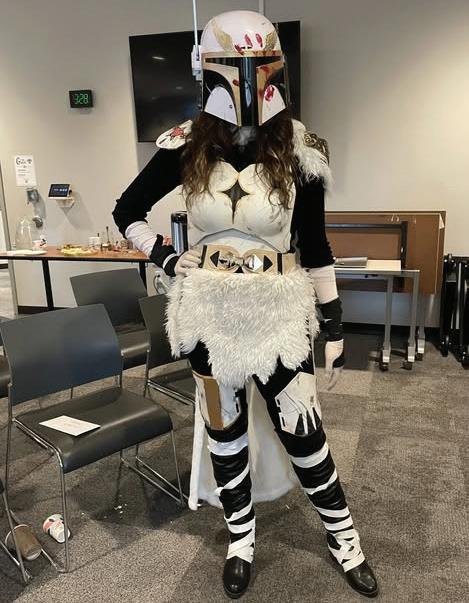
The 2025 Cosplay Competition winner, Molly, dressed as the Angel of Mandalore. Photo courtesy of Facebook.
Hospice hosts Celebration of Life: Remembering Children
By Reader Staff
Bonner General Community Hospice invites the community for a celebration of life dedicated to children who passed on before their time. The gathering will take place Tuesday, June 2 at 4 p.m. at the Healing Garden (520 N. Third Ave., in Sandpoint), providing a time and place for love, reflection and healing as a community.
Violinists Charlie and Emerson Johnson will perform alongside the garden’s blooms throughout the ceremony. Bonner Community Hospice Manager Tami Feyen will give the
opening remarks, followed by the evening’s main speaker, Licensed Clinical Social Worker Stephanie Ray. Attendees will then have the opportunity to share their children’s names and take a moment to remember their lives with people who understand this unique grief. Everyone can then connect over light refreshments while touring the garden, including the Family Tree and Children’s Remembrance Garden, created by and for community parents who have lost children.
For more information, visit bit.ly/ BCHCelebrationOfLife.
COMMUNITY Marcella Nelson: Short in stature but big in service and commitment
By Reader Staff
Longtime area residents are well familiar with Marcella Nelson, who celebrated her 97th birthday in October 2025. Though famously petite, Nelson has played an outsized role in the Ponderay and Sandpoint communities over the years.
For her past and continued service to a wide range of local causes and organizations, Nelson recently received a certificate of achievement from Rotary’s District 5080 conference committee, which brought together hundreds of Rotary International members from Idaho, Washington, Montana and British Columbia in Sandpoint in April.
Nelson grew up on a farm in the Paradise Valley near Bonners Ferry. Following retirement from a 37-year career with the Idaho Department of Labor, she volunteered at the Greater Sandpoint Chamber of Commerce full-time as an events fundraiser and
membership coordinator. Nelson still volunteers on the board for the Festival at Sandpoint and has been part of
the Ponderay Centennial Rotary Club for 21 years, also serving as a charter member at its formation in 2005.
Nelson was working as the executive director of the Ponderay Community Development Corporation at that time, and managed that office for nine years until retiring in 2013.
“She is amazing at putting together a raffle basket when needed, selling flower baskets or procuring an item for a fundraiser,” Rotary officials stated.
“Last November, Nelson was even willing to dress up as a pickle for the Rotary Club’s pickleball tournament.”
Through the years, Nelson has also helped the club’s large Duck Derby fundraiser at Schweitzer, and would brave the cold and wind in her orange snowsuit to help collect yellow ducks. She attends the weekly breakfast meeting for Ponderay Rotary and, as the organization stated, even at the age of 97, Nelson still believes in Rotary’s motto of “Service Above Self” in everything she does.
Festival awards $11K in scholarships to local art and music students
By Reader Staff
The Festival at Sandpoint recently awarded $11,000 to seven local students for their accomplishments to art and music.
The awards a $3,000 Instrumental Excellence scholarship to Sandpoint High School senior Heaven Day for her performance on the flute, while Forrest Bird Charter School senior Arayah Glines earned a $3,000 Vocal Excellence scholarship. Both Day and Glines will perform at How to Train Your Dragon 2 — In Concert at the Festival’s Summer Series finale show on Sunday, Aug. 9.
Thanks to the Knickerbocker Foundation, the Festival added a new Music Appreciation scholarship for the 2026 award season, with $1,000 awarded to one student at each of the following school regions/districts: Lake Pend Oreille School District and greater Sandpoint area schools, West Bonner County School District and Boundary County School District.
To apply, students were invited to share how music has impacted their lives on a four-by-six-inch postcard,
using either writing or art.
The three winners who each received $1,000 included: Sandpoint High School sophomore Ida Gaddess, Priest River Lamanna High School sophomore Bella Guidoni and Bonners Ferry High School freshman Isabella Janda.
Sandpoint High School freshman Sophia Brubaker was awarded the $1,000 Charley Packard Memorial Songwriting Scholarship for her original song “For You.”
Outside of the traditional scholar-
ship season, the Festival also awarded a $1,000 scholarship to North Idaho College student Elspeth Gibson for her art piece “Sunset on the Byway,” which was selected as the winning series lineup poster from the Festival’s 2026 Poster Contest.
Learn more about the Festival at Sandpoint’s scholarships and other year-round music education programs at festivalatsandpoint.com/education.
Marcella Nelson and Indy. Courtesy photo
2026 Festival at Sandpoint scholarship winners (L-R): Sophia Brubaker, Ida Gaddess and Heaven Day with Festival at Sandpoint Education Manager Paul Gunter. Courtesy photo
Send event listings to calendar@sandpointreader.com
Live Music w/ Liam McCoy and Friends
7pm @ Eichardt’s Pub
Live Music w/ Frytz Mor 8-11pm @ Roxy’s Lounge
Live Music w/ The Bakerwood Bros.
8-11pm @ 219 Lounge
Live Music w/ John Firshi 8pm @ Eichardt’s Pub
Live Music w/ Ponderay Paradox
5:30-8:30pm @ Barrel 33
Live Music w/ Endless Switchbacks
5pm @ Connie’s Lounge
Live Music w/ Picked Up Pieces
6:30-9:30pm @ MickDuff’s Beer Hall
Live Music w/ Tim G.
6-9pm @ MickDuff’s Beer Hall
Live Jazz w/ Bright Moments
6-8pm @ Arlo’s Ristorante
Live Music w/ KOSH
5-8pm @ Pend d’Oreille Winery
Live Music w/ John Firshi
6-9pm @ Barrel 33
Live Music w/ Spool Effect
6pm @ Blue Heron Cafe
Live Music w/ Brian Jacobs
6-8pm @ Baxters on Cedar
Sandpoint Chess Club
9am @ Evans Brothers Coffee
Live Music w/ Fiddlin’ Red
1-4pm @ Barrel 33
Monday Night Blues Jam w/ John Firshi
7pm @ Eichardt’s Pub
Cribbage tournament
6pm @ Connie’s Lounge
4th annual Celebration of Life
4pm @ BGH Healing Garden
THURSDAY, May 28
Open Bluegrass jam
5:30pm @ Connie’s Lounge
Weekly BCA 8-ball tournament
6pm @ Roxy’s Lounge
FriDAY, may 29
POAC annual Art Party
5:30pm @ Spt. Organic Agriculture Center
Limited seating. Champagne, tasty apps, live music w/ Matt Lome and more
Music w/ DJ Sterling 9pm @ Roxy’s Lounge
Live Music w/ Wiebe Jammin’
5-8pm @ Pend d’Oreille Winery
Live Music w/ Mason Van Stone
6-8pm @ Baxters on Cedar
SATURDAY, may 30
11th annual Sandemonium
10am-4pm @ Sandpoint Library
Sandpoint’s fun-filled day of cosplay and nerd culture, with prizes, games, e-sports, DnD character creation, etc.
Annual Student Art Show
5:30pm @ 313 N. Second Ave. Ste. B Exhibition of local student artwork on display through June 1. Free
Music w/ DJ Crooz 9pm @ Roxy’s Lounge
SunDAY, may 31
Magic with Star Alexander 5-8pm @ Jalapeño’s
Live Music w/ Blue Krawdads 3-5pm @ Idaho Pour Authority
monDAY, June 1
Outdoor Experience group run 6pm @ Outdoor Experience 3-5 miles, all levels welcome
Trivia night w/ Ben Olson 6-8pm @ Idaho Pour Authority
tuesDAY, June 2
An event hosted by BGH Community Hospice to remember and celebrate the lives of children who have left us too soon
Beginner Argentine tango class
7pm @ Embody Center, 823 Main St. No partner needed. $15
Artist reception: Heather Mehra-Pederson
5-7pm @ Pend d’Oreille Winery
See Pederson’s vibrantly-colored pieces
May 28 - June 4, 2026
Teen Zone: Dungeons and Dragons
3-5pm @ Sandpoint Library
See Page 14 for more info
SHS Choir Spring Fling concert 6pm @ Sandpoint High School auditorium
Sandpoint Senior Ctr. monthly breakfast
8am @ Sandpoint Senior Center
Guest chef Wendy Franck of the Hoot Owl will create the breakfast buffet. $10
Bike Rodeo • 2-4pm @ Sandpoint Library
See Page 14 for more info
Live Music w/ Justin Lantrip
6-8pm @ Idaho Pour Authority
Live Music w/ The Swingin’ Jays
6-8pm @ Smokesmith BBQ
Sandpoint Farmers’ Market
9am-1pm @ Farmin Park
Produce, live music, art and more
Live Music w/ Picked Up Pieces
6-8pm @ Idaho Pour Authority
Live Music w/ Aly Johnston & Light on Water
6-8pm @ Smokesmith BBQ
Live Music w/ Sydney Dawn 6pm @ Connie’s Lounge
Spring Serenade: MCS instructor concert
7pm @ Little Carnegie Hall, MCS
An evening of music and commentary by conservatory instructors.
East coast swing lessons
7pm @ Danceworks Studio, 409 N. 4th Ave. Learn to dance w/ Muffy Nye. $15
wednesDAY, june 3
Sandpoint Farmers’ Market 3-5:30pm @ Farmin Park
Benny on the Deck concert series
5:30-8:30pm @ Connie’s Lounge (patio)
ThursDAY, june 4
Live Music w/ Liam McCoy and Friends
7pm @ Eichardt’s Pub
Live Music w/ Jonathan Nicholson
5-7pm @ Pend d’Oreille Winery
Open Mic/Jam 5-8pm @ Idaho Pour Authority
Live piano w/ Dwayne Parsons
4-7pm @ Pend d’Oreille Winery
Family Night, live music w/ John Firshi
5-7:30pm @ Matchwood Brewing Co.
Open Irish jam
5:30pm @ Connie’s Lounge
Weekly BCA 8-ball tournament
6pm @ Roxy’s Lounge
Wicked good Apple TV series Widow’s
By Zach Hagadone Reader Staff
Both big- and small-screen productions have become so formulaic and derivative that pointing out that fact is, itself, formulaic and derivative. Regardless, there are deviations from the norm, and the new Apple TV series Widow’s Bay is a prime example.
Premiered on April 29, the 10-episode season just aired its sixth and seven installments on May 27, with further entries scheduled for Wednesdays through June 17. Each week it gets better and better.
Starring Matthew Rhys, with critical support from Kate O’Flynn and Stephen Root, Widow’s Bay is a witch’s brew of horror and comedy focused on a fictional New England town of the same name that has a troubled past, to put it lightly. Situated on a weather-whipped island lacking almost every modern convenience — from Wi-Fi to cell service — the few thousand inhabitants know everything about their neighbors, secrets and all, and life revolves around a handful of bars and cafes, the local church and City Hall.
The latter is where Tom Loftis (Rhys) serves as the beleaguered, endlessly exasperated mayor of a community that barely tolerates him, and his only allies are the collection of oddballs who make up the municipal staff. That includes his assistant Patricia (O’Flynn), a socially maladjusted, embittered but earnest lifelong local; Rosemary (Dale Dickey), a chain-smoking, hard-bitten city employee whose exact position remains amorphous; Ruth (Katherine Callen), his batty, ancient secretary; and Dale (Jeff Hiller), a persnickety dweeb whose official job is also unclear.
Loftis’ working life is the first example of how Widow’s Bay breaks from formula. The show was created by Parks and Recreation screenwriter Katie Dippold, and she brings to bear her genius for creating workplace ensembles that are addictive to watch. Right off the bat, the audience is introduced to a dysfunctional city government full of eccentrics who ostensibly manage a community that’s even more off-kilter than they are (call it Pawnee-meetsTwin Peaks-meets Amity Island).
Then there are the townsfolk,
Bay is an addictive horror comedy
unofficially led by salty seadog Wyck (Root). Wyck literally knows where all the bodies are buried and thinks Loftis — who despite a lifelong relationship with the island wasn’t born there — is a pathetic milquetoast and beneath contempt.
Through Wyck (who brings to mind Captain Quint, from Jaws), we learn that the island is unironically cursed: rife with killer fogs and storms, sinister entities and serial murderers, plagues, and demon-haunted forests and shores. The supernatural terrors ramp up cyclically into a crescendo of periodic bursts of chaotic evil that the residents are doomed to endure since (for some reason?) no one born on the island ever leaves it.
When we come to Widow’s Bay in the first episode, it’s on the cusp of one such cycle and Loftis doesn’t believe a word of it. Rather, he’s frantically trying to drag the town out of its atavistic, gloom-struck funk and turn it into a touristy Martha’s Vineyard (more shades of Amity Island, from Jaws). If not for the community itself, Loftis’ quest for progress is for his son, whom he’s raising as a single father after the mysterious death of his island-born mother when the boy was an infant.
Now a teenager, Evan (Kingston Rumi Southwick) is also a born
islander and has therefore never been to the mainland. Deadly bored, he’s a pot-smoking, trouble-making slacker whose rebelliousness underscores Loftis’ inability to control anything — even under his own roof.
There we have a family-grief drama folded into a workplace comedy operating against a Stephen King-inspired backdrop of honest-to-goodness horror with more than a few H.P. Lovecraft beats.
As the inner social tensions in Widow’s Bay grow more fraught and the instances of inexplicable disaster and mayhem pile up, Loftis comes to admit that something’s not right about his town and has to join forces with Wyck and Patricia to save a population that would just as soon vote him off the island.
Not a single performance is wasted, and the stellar scene-setting, score and production value provide a rock-solid foundation for a story that operates both episodically (almost like a monster-of-the-week format, à la X-Files) and as a cohesive overall narrative. No mean feat in a formulaic era when series are too often presented as super-long movies bloated with filler installments and exposition dumps. Widow’s Bay is as wicked sharp as it is wicked good.
Courtesy photo
By Marcia Pilgeram Reader Columnist
There are moments when the world feels too loud to recognize. Lately, for me, politics has been one of those things. The elections left me carrying a heaviness like a fog that won’t lift, as though all flights have been canceled and no clear destination remains. It’s a mix of disappointment, uncertainty and exhaustion that seems to linger in conversations everywhere I go.
Luckily, I’ve been traveling a great deal lately, and movement helps. New scenery helps. Airports, train stations, unfamiliar languages, bustling markets, tiny cafés tucked down cobblestone alleys — all of it offers a temporary reprieve from the relentless churn of headlines and commentary here at home.
What has surprised me most during my recent travels is how aware the rest of the world is of America’s emotional climate. Everywhere I’ve gone, especially during last month’s trip to Ireland, people ask questions. In elegant hotel lounges and dark-paneled pubs, strangers quietly ask what is happening in the United States. They wonder where we are headed, as do I.
Many clients confess they feel anxious about traveling abroad, uncertain how Americans are perceived. Even fellow Americans I’ve encountered overseas speak wistfully about starting over somewhere else. More than one conversation has drifted toward the possibility of dual citizenship and expatriate dreams.
It seems everyone is searching for solid ground and steadiness.
My own family conversations have reflected that longing. My youngest daughter, Casey, and her family are
The Sandpoint Eater My choice is chocolate
currently in Egypt attending a family wedding. Her husband John’s family emigrated from Egypt years ago, and now, in an unexpected turn, his mother, Mirfat, is considering renewing her Egyptian citizenship while they are there.
It’s a different America than the one I see in the framed photograph of Mirfat and her late-husband, Samih, displayed on a wall in Casey’s home. In the photo, the young couple waves American flags, celebrating their new citizenship and anticipating the opportunities ahead. Now I listen to younger generations contemplating futures that may stretch beyond American borders. It feels surreal, yet strangely understandable all at once.
As for me, I’ve found myself exploring the possibility of Canadian or Irish citizenship. My grandparents emigrated from Ireland by way of Canada before eventually settling in the U.S. There is something comforting about tracing family roots backward during uncertain times, as though history itself might
offer direction. Maybe it’s less about leaving and more about remembering where so many of us — proud descendants of immigrants — first began.
Still, no matter how much I love traveling, no matter how complicated the world feels, I always find myself returning to the same sanctuary: my kitchen. Cooking has always been my grounding force. There is reassurance in the ritual of chopping onions, kneading dough or whisking cream. Planning meals occupies the anxious corners of my mind. Stirring sauces and folding batter gives my hands purpose. Serving people I love reminds me that comfort can still be created, one morsel at a time. And of course, there is eating — humankind’s most universal form of comfort.
For me, one ingredient rises above all others: chocolate. Whether dark, bittersweet or semisweet, chocolate transcends borders and politics. It belongs equally in Parisian pâtisseries, Belgian chocolate shops, American birthday cakes and Egyptian desserts scented with
cardamom and honey. Chocolate is memory, celebration, consolation and joy all wrapped into one glorious indulgence. Next week, I’ll happily immerse myself in it because I’m taking my baking protégé granddaughter, Mikey, to Paris. It’s her well-earned high school graduation gift and I can hardly wait. We’ll spend our days wandering through pastry shops and cafés, filling our eyes and bellies with every chocolate treasure we can find: flaky pain au chocolat leaving buttery shards behind with every bite, delicate financiers, elegant tortes displayed like artwork, rich Belgian truffles tucked into ribboned boxes, and my personal favorite — silky chocolate mousse.
The timing feels perfect because this fall Mikey will begin a baking and pastry program in Spokane. Having her nearby feels wonderfully serendipitous. Originally, she had planned to attend a program in North Dakota, much closer to her dad and their eastern Montana home, but sadly the program was canceled due to budget
cuts. Funny how life rearranges itself. Sometimes disappointment quietly redirects us toward something even better.
Now, with me in Sandpoint and her aunties in Spokane and Moscow, she’ll be surrounded by family while she chases her dream of opening her own bakery. I find myself dreaming right alongside her, with late-night conversations about a location, business name, menus and logos.
Dreams can sweeten and soften sharp edges, if only briefly. In times of upheaval, perhaps that is enough. We cannot always control elections, economies or world affairs. We cannot predict where our children may eventually call home. But we can gather in kitchens. We can feed one another. We can create moments of warmth amid uncertainty. Sometimes the answer to a troubled heart is simply a bite of something really delicious. And no matter what the world is doing, chocolate can still make things better. I recommend starting with this decadent mousse!
Decadent chocolate mousse
This dessert is one of my most requested recipes. There are not many ingredients and it’s worth the effort. Make at least four hours in advance. Yields 4-8 portions, depending on the size of your serving dishes. I recommend small stemmed parfait, coupe glasses or espresso cups.
INGREDIENTS: DIRECTIONS:
• 8 ounces bittersweet chocolate, chopped
• 3 tablespoons unsalted butter
• 3 eggs, separated
• 2 tablespoons sugar
• 1 teaspoon vanilla extract
• Pinch of sea salt
• 1 cup heavy whipping cream
• Chocolate shavings or berries for garnish
Melt the chocolate and butter together in a heat-proof bowl set over simmering water. Stir until smooth, then remove from heat and cool slightly.
Whisk a little of the chocolate mixture into the egg yolks. Continue adding slowly and whisking continuously so the egg yolk does not cook. Once all combined and smooth, add vanilla and salt.
In a separate bowl, beat the egg whites until soft peaks form. Gradually add the sugar and continue beating until glossy stiff peaks form.
In another bowl, whip the cream until soft peaks form.
Gently fold the whipped cream into the chocolate mixture, then carefully fold in the egg whites until no streaks remain. Spoon into serving dishes and chill, covered, for at least four
hours. Garnish with whipped cream, chocolate shavings, fresh raspberries or simply enjoy as is. Guaranteed to be gloriously rich and comforting.
MUSIC
Goosebumps acquired
A short list of the best use of music in cinema
By Ben Olson Reader Staff
The usage of music in cinema is, arguably, just as important as the images captured on the screen. Whether full songs, orchestral scores or moody notes, a film can be made or broken by the music that accompanies it.
Here’s a short list of some of my favorite examples of music on the silver screen. These iconic moments in sound still have the ability to deliver goosebumps on command.
John Williams
Instead of a particular film, one category has to be entirely given to American composer John Williams for his outstanding body of work. With a total of 54 Oscar nominations, Williams is the most-nominated person in Academy Award history after Walt Disney. Williams’ scores for Jaws, Star Wars and Close Encounters of the Third Kind were all so popular they even made the Billboard hit singles charts. Throw a rock and you’ll hit an iconic film with Williams’ score. There’s Home Alone, Jurassic Park, the Indiana Jones franchise and so many more, it’s safe to say he’s cemented his legacy in Tinseltown. He’s just that good.
Fight Club (1999)
When The Pixies’ “Where is My Mind?” plays at the end of Fight Club as skyscrapers burn to the ground, something feels resolved in this crazed angsty world created by author Chuck Palaniuk.
Almost Famous (2000)
Director Cameron Crowe has always used music as an uncast character in his films. For the fictional biopic Almost Famous about a band called Stillwater, Crowe’s use of iconic songs gave the film a warm, nostalgic glow. The scene with Elton John’s “Tiny Dancer” playing as the band rides in silence on the bus helps push away those dark feelings and culminates with everyone singing loudly together, their differences quashed for the time being.
Reservoir Dogs (1992)
For fans of Quenton Tarantino’s work, it’s impossible to listen to the song “Stuck in the Middle with You,” by Stealers Wheel, without flinching and feeling your ear. The song’s campy, feel-good beat is juxtaposed beautifully in a scene in Reservoir Dogs when actor Michael Madsen cuts off an undercover policeman’s ear while dancing and goofing around. It’s dark, kind of funny and
really gets the point across that Tarantino is a madman.
The Good, the Bad and the Ugly (1966)
Perhaps the most famous of the “spaghetti Westerns,” Sergio Leone’s iconic film starring Clint Eastwood has one of the most memorable main themes in film history (I’ll bet a dollar you’re humming it in your head right now, aren’t you?).
The theme, composed by Ennio Morricone, was a twonote motif designed to evoke the howl of a coyote. What’s even better is that the instrumentation changes according to each of the three protagonists: it’s a flute for Eastwood’s “Blondie” character, an ocarino for “Angel Eyes” and human voices for “Tuco.”
The only thing that comes close is Charles Bronson’s character “Harmonica” in Leone’s Once Upon a Time in the West, who plays the same haunting bars on a harmonica in his scenes that culminates perfectly with what happens in the final scene.
Lord of the Rings franchise Canadian Composer Howard Shore might not be a household name like John Williams, but his work with The Lord of the Rings franchise alone puts him at the top of a
short list of talented film composers. The orchestral score to LOTR is dynamic and bespoke, with more than 50 different leitmotifs — or returning phrases — that are unique to the location being filmed and the characters in the scene. The result is an expansive, deep and cathartic score that lives up to the films that will be watched for generations.
The Life Aquatic (2004)
It wouldn’t be a list of films with good music without a mention of director Wes Anderson, who has always cultivated a unique and fresh soundtrack for his various films. In The Life Aquatic, the song “Search and Destroy” by The Stooges plays while Bill Murray’s character Steve Zissou snaps and begins firing at pirates who had taken over his ship. The scene is humorous because even though hundreds of bullets are fired, none seem to land anywhere, but the amped up Iggy Pop song is like a shot of adrenalin, propelling the viewer further into Anderson’s precious and strange world. Honorable mention for Nico’s version of “These Days” and Elliott Smith’s “Needle in the Hay” used in different scenes in Anderson’s The Royal Tenenbaums.
A snapshot of notable live music coming up in Sandpoint
Spool Effect, Blue Heron Cafe, May 30 Spring Serenade, Music Conservatory of Sandpoint, May 31
While not exactly “wellkept secrets,” Bonners Ferry trio Spool Effect and the Blue Heron Cafe are both a little off the beaten path from the downtown-centric Sandpoint music scene. That said, it’s more than worth the short northward journey up U.S. 95 to catch the band’s fun-loving, down-home blend of reggae, funk and jam band styles in one of the area’s most appealing outdoor live music
settings. Heck, we’ll put the Blue Heron’s stage setup — located in the gorgeous field behind the Samuels store — up there with the region’s best venues, and one where Spool Effect will be right at home.
—
Zach Hagadone
6 p.m., FREE. Blue Heron Cafe, 486260 U.S. 95, Samuels, 208-263-1146, blueheronsamuels. com. Listen on YouTube and other streaming services.
The Music Conservatory of Sandpoint is putting on its much-anticipated instructor concert for the last day of May, and, as usual, it promises to be a night of joy and community. The school’s talented cast of instructors will perform songs from a variety of genres on the instruments they’ve spent countless years studying and teaching — from violins to flutes and everything
This week’s RLW by Ben Olson
READ
Idaho has always attracted those who want to live by the beat of their own drum. When my friend Woods gave me the book Idaho Loners: Hermits, Solitaries and Individualists, I knew immediately that I’d like it. The book, by Cort Conley, is filled with characters who populated Idaho over the years; each one weirder and more isolated than the last. It’s a hard book to find, but I’ll bet the Sandpoint library can help you locate a copy.
LISTEN
in between. Attendees can also enjoy the no-host wine bar and seasonal treats for all ages. In other words, go for the music; stay for the free chocolate fountain.
— Soncirey Mitchell
7-8:30 p.m. $15 for students and seniors, $35 for adults. Music Conservatory of Sandpoint, 110 Main St., 208-265-4444, sandpointconservatory.org.
The poet Charles Bukowski has always reached a part of my dark heart that nobody ever touches. His poems and novels are, in a word, perfect. Occasionally, while delivering the newspaper to Bonners Ferry or heading out to my boat, I’ll put on Master Collection, a 2.5- hour grab bag of live readings and musings by Hank himself. You can stream it on Spotify, but don’t rely on these if you haven’t read Bukowski before — read his books cover to cover and report back to me in the morning. Warning: It’s not for the faint of heart.
WATCH
Director Alexander Payne has an uncanny ability to make me laugh, cry and question everything all at once. His films (About Schmidt, Sideways, The Holdovers and others) all contain his unique dark comedy with a dramatic edge. They are clever, poignant and quirky in all the right ways. It’s hard to pick a favorite Payne film, but Election, with Matthew Broderick and Reese Witherspoon, is probably the best entry-level into his strange world. Stream it on Amazon Prime.
From Northern Idaho News, June 2, 1905
CLARIN VEVEA INJURED
Clarin Vevea, the twelve year old son of Mr. and Mrs. W.H. Vevea, met with a painful and serious accident Tuesday forenoon while enjoying an outing with a picnic party of young people in the Weil addition near the lake. The little fellow had climbed a tree to assist in putting up a swing when the branch he was on gave way and he fell to the ground some twenty-five feet below. Striking on his side, there was a compound fracture of the left arm just above the elbow, the right arm was broken in the wrist and the left thigh bone broken near the joint.
The little fellow was carried to the Sandpoint hospital where Doctors Slusser and Moody reduced the fractures, and he is reported as getting along as well as could reasonably be expected after suffering such a shock. The compound fracture of the left arm was the most serious of the injuries, the bone having been forced through the flesh and clothing and into the earth by the compact of the lad’s fall. It was feared that blood poisoning might set in from the foreign substance getting into the bone, and if that does not occur it is not thought there will be any serious complications, although the little fellow will be laid up for many weeks to come.
BACK OF THE BOOK The pleasure of nonsense
By Soncirey Mitchell Reader Staff
In old newspapers — as in from the 1880s through to the 1970s — it wasn’t uncommon to see the nonsense phrase “etaoin shrdlu” taking up a line of text in the middle of a story. The news piece, for instance, would progress normally, only to be interrupted by a word jumble, then jump right back into the narrative on the next line.
This was the age of hot type publishing, or hot metal typesetting, on type-casting machine keyboards like Linotype and Intertype. The letter keys were arranged by frequency of use, and, as it happened, the first two columns of the lower case contained the letters e, t, a, o, i, n, s, h, r, d, l and u, which were considered the most common. (Today’s most frequently used letters in the English language are e, r, i, o, t, n, s, l, and c, in that order.)
The people operating the machines would type out whatever message they were printing, and if they made a mistake, rather than fixing it on the spot and potentially disturbing the complex machinery, they would simply fill the line out with nonsense by running a finger down those two columns.
In theory, the proofreaders would then recognize the pattern and remove the stray text. They missed it often enough — especially in newsprint — that it became a recognizable and beloved quirk of print media at the time. It was nonsense given so much sentimental meaning that The New York Times created a documentary called Farewell, Etaoin Shrdlu when it switched from hot metal typesetting in 1978. Variations on the jumble appear in song titles, character names and references in a wide variety of media.
STR8TS Solution
Humanity found even more treasured nonsense with the progress of graphic design, publishing and web development. “Lorem ipsum” is another example. If you’ve ever opened a text box while designing a website, you’ll recognize lorem ipsum — a placeholder text that pops up everywhere, though most people don’t think about it. Versions of lorem ipsum have been used in typesetting since the 1960s and computer design since the 1980s, and nowadays, everything from Microsoft Word to Wix uses it.
People thought that lorem ipsum was pure nonsense until sometime around 1982, when Latin scholar Richard McClintock discovered that it’s actually a jumbled fragment of Marcus Tullius Cicero’s Socratic dialogue De finibus bonorum et malorum (On the ends of good and evil). Though letters have been added and altered, leaving the text far from its original Latin, anyone reading Cicero in that dead tongue is liable to pick up on it.
The first line would have originally read “dolorem ipsum” or “pain itself.”
In that section, Cicero argues that no one strives for pain in life unless that pain is a means to some greater end. He uses, in this case, the example of exercise — not for its own sake, but to become more physically adept.
The section taken for lorem ipsum ends with, “But who has any right to find fault with a man who chooses to enjoy a pleasure that has no annoying consequences, or one who avoids a pain that produces no resultant pleasure?”
Both etaoin shrdlu and lorem ipsum are, in a sense, on opposite ends of a spectrum. Lorem ipsum was a piece of ancient philosophy that has been meditated on since the first century B.C.E., and in the hubbub of type-
Sudoku Solution
writers and personal computers, we obscured its innate meaning. Etaoin shrdlu, on the other hand, is an exercise in ascribing meaning to the meaningless. It was a jumble of keys near one another but never intended to form its own word, yet we found the hint of human error among the mechanized typeset so endearing that we made it a symbol of print media. In both cases, the nonsensical structure of these scrambled letters is what makes them so enjoyable.
It feels like an unforeseen example of Cicero’s point. Humans could have painstakingly reset the keys whenever they mistyped, or they could have programmed computers to print a textbook whenever they needed placeholder text, but they chose playful jumbles instead of the pain of extra work. It seems that humanity has learned to enjoy the pleasure of nonsense, without consequence.
Crossword Solution
I guess more bad things have been done in the name of progress than any other. I myself have been guilty of this. When I was a teenager, I stole a car and drove it out into the desert and set it on fire. When the police showed up, I just shrugged and said, “Hey, progress.” Boy, did I have a lot to learn.
Solution on page 22
Laughing Matters
By Bill Borders
CROSSWORD
ACROSS
1. Highly skilled 6. Manila hemp 11. Metric unit of capacity 12. Pours 15. Countenance 16. Eternally 17. Evil spirit
18. To provide maintenance 20. Black bird
21. See the sights 23. Apiece 24. Assists 25. Initial wager
Skin disease 27. Carpenter’s tool
Strong cleaners
Dog with a wrinkly face
Not younger
Too keen
Week of the
/NEY-kree-uhs/ [adjective] 1. lustrous; pearly
“The nacreous shell shimmered with soft, rainbow colors.”
Corrections: In the May 21 article “2026 primary election results,” we identified Scott Herndon as aligned with the so-called “Gang of Eight” legislators during his one term in the Idaho Senate. Most of them weren’t elected yet when Herndon was in the Statehouse and most of them lost their primaries this year. So call that a correction.
Team
Falsehood
Ages
Kick
Digestive juice
Kitchen or bathroom
Electrical distribution
Labyrinth
Fizzy drink
Petroleum
In an exposed manner
Make lace
Woven together
First-aid item
Solution on page 22
Robber
Go-between
Clothe
Scope
Solution on page 22 8. Unot of land
A rotating disk
Coat
Dealer
Stitches
Tank
Was laid up
Run very fast
Worked patchwork 38. Carousing
Payment to an ex
Argument
Greek letter
Clothespins
Tall woody plant
Consultant’s
Kind of nut DOWN
Critical
Converted to Christianity
Happen again
Echo
House location
Mimicked
Beer
Curved molding
Moderate in tempo 40. Glide over ice
Bread makers
Leaves
Flowing tresses 48. Egyptian river 49. Teller of untruths 50. Eastern discipline